An Historical Retrospect by J. George Hodgins, M.A., LL.D., Barrister-at-law,
and Deputy Minister of Education for Ontario.
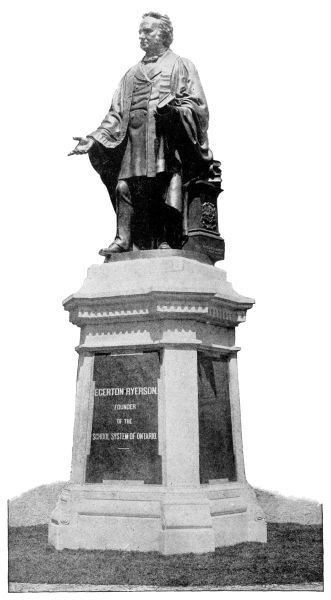
To-day will long be memorable in the educational history of Ontario—for to-day has
been unveiled the first statue ever erected in this province to one of its own sons.
It will be still more memorable from the fact that that special subject of public
interest and national concern which has been signally honoured to-day, is the pre-eminently
important one of popular education. These two facts combined give to the celebration
and pleasant incidents of the day a peculiar significance and a special interest.
One of the first indications of a growing national life and a patriotic national spirit
is the erection of statues to noble sons who have rendered such valuable services to the
state as are recognized and honoured here to-day.
It is a most hopeful sign, as well as an assuring and happy augury for the future of
a country, when its patriotism takes the grateful and graceful form of doing honour to
those who have aided in laying the foundation of its future greatness and prosperity.
This, we all rejoice has been done by Ontario to-day in the unveiling of the statue of the
distinguished founder of her educational system. She has reared to-day to one of the
sons of her soil a noble monument, expressive of grateful acknowledgment for services of
the greatest importance and value to her and to the thousands of her sons and daughters
yet unborn.
The erection of this statue emphasizes in a striking manner a notable fact, chronicled
by John Milton, which the mature judgment of the nineteenth century has everywhere
endorsed, that—
"Peace hath her victories no less renowned than war."
That is, that it is not heroic deeds of valor alone which call forth a nation's gratitude.
It further shows us that unswerving devotion to duty in any of the departments of the
public service, or professional or private life, which have to do with matters which
concern a nation's progress and welfare, is equally recognized, if not more signally honoured,
than were deeds of prowess in the days gone by. We have, at all events on this continent,
many notable examples of distinguished honour being done to literary men, to men
of science and to noted educationists. Any one who has visited the chief city of Massachusetts
cannot fail to have seen, on the broad terrace in front of the capitol, a massive
bronze statue to Horace Mann, the well-known Founder of the Public School system, not
only of Massachusetts, but practically of the New England States.
So, in like manner we unveil to-day the statue, not only of the Founder of the School
System of Ontario, but of one, the impress of whose hand, and the practical suggestions
of whose mature experience, may be recognized in the systems of education of some of the
Maritime Provinces, and in those of Manitoba and British Columbia. The first Superintendent
of British Columbia, and the second of Manitoba were trained in the schools of
Ontario, and were thus experienced pioneers in the new Provinces of their educational
systems. Also in the West Indies the educational example of Ontario was felt to be of
some value by Sir Francis Hincks, when Governor of the Windward Islands.[12]
Even the grand old Mother Country has not failed to acknowledge her indebtedness
to him whom we honour to-day, for practical suggestions in the solution of the educational
problems which confronted her public men, notably the Duke of Newcastle and the Right
Hon. W. E. Forster,[13] during the years reaching from 1860 to 1870.
In 1860, at the request of the Duke of Newcastle, who accompanied the Prince of
Wales to Canada, Dr. Ryerson prepared an elaborate sketch of the system of education
in Upper Canada, and contrasted it with the English and other European systems of education.
This report was embodied in a letter to the Duke, dated 12th October, 1860.
As to the appropriateness of our erecting a Statue to Egerton Ryerson in Ontario,
as was done to Horace Mann, in Massachusetts, I may here quote a reference to the equal
value of the labors of those two noted men which was made twenty-five years ago by that
acute observer and experienced educational commissioner, the late well-known and distinguished
Bishop Fraser, of Manchester. He said:
"What Education in New England owes to Horace Mann, Education in Canada owes to Egerton
Ryerson."
To-day we honour ourselves by seeking to discharge that obligation, at least in part.
There is one circumstance connected with the erection of this statue which, to my
mind, gives it a peculiar value and significance. The erection of statues by popular vote,
or by the Legislature, gives a quasi, if not a real national character to such erection, but, a
statue erected from the proceeds of thousands of small contributions, as in this case, shows
that deep down in the hearts of the people of this country there must have been genuine
regard for the man whom they thus seek to honour. When a memorial takes such a form
as that we may well regard it as more enduring and precious than either the bronze or
marble which constitute the material of its structure.
It devolves upon me, as Chairman of the Committee having charge of this work, and
at the kind request of my colleagues,—no less than as the life-long friend and fellow-laborer
of him whose deeds and memory we honor to-day—to trace back to their source
the origin and underlying principles of our system of education, and to show that these
underlying principles and other vital forces were so combined by a master-hand an to
form the groundwork, as they have, in their combination, become the charter of our educational
system of to-day.
And here, in this connection, a thought or two strikes me; and each thought contains
for us a moral and a lesson.
The first is that educational systems are essentially progressive in their character and
purposes, and truly they "never continue in one stay."
The second is that the earliest sources of what might be called our educational
inspiration are now uncertain guides, and, as such, are to-day of doubtful authority.
No one will venture to affirm that even—as it was then considered—the broad and
comprehensive scheme of public education sketched by Dr. Ryerson in 1846, should be
considered as the acme of our educational achievements of to-day. Nor would any one at
all conversant with the condition and progress of education on this continent alone be
content to draw his inspiration from, or limit his range of observation to, the New England
States as formerly. The examples to be seen, and the experience to be consulted,
and the systems to be studied, must to-day, so far as the United States is concerned—be
sought for in the far-off Western States.
In this matter I speak of what I know; and I speak, therefore, with the more
emphasis on this point, because of the primary importance of keeping this Province and
the Dominion educationally abreast of the most advanced States of the American Union—our
near neighbors, and our energetic and actively progressive educational rivals.
As an illustration of these notable facts, I may state that having been selected by
the United States Bureau of Education to act as one of the seven international educational
jurors, at the New Orleans Exhibition in 1885, it was, during six weeks, my duty with
others, to examine into and report upon the condition and results of the various state systems
of education in the Union, and in other countries.
I need not more than state, what you likely anticipate, that France, by her enlightened
educational legislation of 1881—providing for manual, or industrial, training in
all of her schools—and Germany, by her earlier and more systematized educational legislation,
stand at the head of European States, as does Japan at the head of the whole
Eastern World. But, in this connection, the interest to us should be to note the fact
that the educational centre in the United States has within the last few years been gradually
shifted from the east to the west. As an illustration, I may say that the highest
award for the extent, variety and completeness of its educational system in all its details,
was unanimously made by the jurors to Minnesota, while Massachusetts and other New
England States, with New York, Pennsylvania, etc., were entitled to only second and
third class honors. France and Japan justly received first-class honors, while England and
other countries (omitting Germany) had to be placed in the second and third class ranks
as educating countries.
A revelation of these and other suggestive facts in regard to the progress of education
in countries outside of our own, more than ever convinced me of the wisdom of Dr.
Ryerson's policy of observation while head of the Education Department. He laid it
down, not so much an educational axiom, as a wise dictum—the result of his educational
experience, that—
"There is no department of civil government in which careful preparation, varied study and observation,
and independent and uniform action, are so important to success and efficiency, as in founding,
maturing and developing a system of public instruction."
He, therefore, wisely devoted a large portion of his time to this "careful preparation,"
as well as to "varied study and observation" of systems of education in Europe
and America. And this fact largely accounts for the "success and efficiency" of his
efforts in "founding, maturing and developing" our system of public instruction.
In a reply to a resolution from the Council of the County of Norfolk, in 1851, Dr.
Ryerson thus referred to this subject:—
"There is no poetry in the establishment and development of a public school system;
it is a matter-of-fact-work from beginning to end; and its progress, like the growth of
body and mind in an individual, is gradual, and is the joint result of time and labour. I
am happy, however, to know that our school system has already become so far developed in its
principles, objects and character as to command the attention and almost unanimous
approbation of the country. I have laid it down as a first principle to educate the people
through the people themselves, by their own voluntary co-operation and exertion, through
the usual elective municipalities and other acknowledged and responsible organs of a free
people."
When we reflect upon the fact of the immense growth, and the comprehensive character
of the educational machinery in operation on this continent alone, and the vast
sums expended to keep it in motion, we cannot fail to be profoundly impressed with the
serious and grave responsibility which is constantly imposed upon our educational leaders,
of being forever on the watch-tower of observation, to note the changes, improvements
and advances which are continually taking place in the educational world outside. We
are too apt to be content with our own progress, and to measure ourselves by ourselves.
In this connection the words recently addressed to the Kingston Board of School Trustees
by the Very Rev. Principal Grant, are of special value as an apt illustration of my
meaning:—
"During my absence I have studied the school systems of many countries, and have learned lessons
that ought to assist me in coming to right conclusions. The world is wider than Canada, or than America.
The British Empire itself is wider than this continent, and within its boundaries there are so many educational
systems and methods that a man who travels with eyes and ears open cannot help learning many
things that confirm opinions previously held, and suggest improvements on what he may have thought perfect,
or the necessity of revising his former judgments. He gets new points of view, and that of itself is a
great matter."
Our American neighbors became fully alive years ago to the evils of the fluctuating
and uncertain character of the prevailing system of educational administration in vogue
amongst them. They saw that new and officially untrained men, of merely local experience
and knowledge, were constantly being elected to take charge of the administrative
department of the schools of a state. Such men were often able educators, but by no
means experienced educationists, or masters of systems of education. The American
people, shrewd and practical as they are, felt the absolute necessity, therefore, of furnishing
such men, and the vast army of their educationists and educators, with full and accurate
information on systems and plans of education all over the world. With this object
in view, they established a central observatory, or Bureau of Education at Washington.
I need hardly say how ably the work of this Bureau was systematized and most efficiently
performed under the direction of the Hon. John Eaton, Commissioner of Education. His
successive reports and periodical circulars of information are mines of educational wealth.
Their fullness and comprehensiveness have been a marvel. They have aroused and
stimulated educational workers everywhere. They are largely welcomed, and are highly
prized in these Provinces and elsewhere, as suggestive, and as invaluable storehouses of
information, and of the practical details of education all over the world. They have, therefore,
largely supplied the place of personal inquiry and research, and yet have greatly
stimulated both.
It was Dr. Ryerson's ideal that sooner or later a similar Bureau would be established
by the Central Government at Ottawa, the object of which would be, not only the supplying
of abundant and reliable information to each province on the subject of systems and
plans of education, but also, by intercommunication, to secure a general harmony of aim
and purpose. And that further, without attempting any interference in local administration,
the Bureau would be the means of keeping up an active yet friendly intercolonial
rivalry; and thus, on Dominion and national lines, to build up the confederacy, and to
stimulate and encourage the efforts made in each province for the promotion of substantial
educational progress, combined with efficiency and economy.
The educational history of Ontario naturally divides itself in three periods, viz.:—
1. The early settlement, or United Empire Loyalist period.
2. The period preceding the union of Upper and Lower Canada in 1840.
3. The period since that union, and including the administration of the Education
Department by the Rev. Dr. Ryerson, down to 1876.
The United Empire Loyalists period takes us back to a period antecedent to that of
their historical prominence as a factor in the events of the war of the American Revolution.
In order, therefore, to estimate the value of the educational influence of those
times on the future of the provinces in which the U. E. Loyalists settle, we must take a
glance at the Colonial chapter in the History of American Education.
It is, therefore, interesting in taking note of our educational progress to give a brief
glance at what was done by our fellow colonists at a corresponding early period in the
history of the "old thirteen colonies," which formed the nucleus of the present
American Confederation.
It has been the custom, probably unwittingly, but chiefly on the part of certain
American writers, to exalt every good in their political and social condition, as of revolutionary
origin, and reluctantly to admit that anything which was really excellent in
both, in the early colonial times, was of British origin. One unacquainted with the processes
and progress of civilization in America would, on consulting such writers, suppose
that, Minerva-like, the young Republic had sprung from the head of Revolutionary Jove,
fully equipped, if not fully armed for the battle of life, into the arena of the new world,
and that this phenomenon happened just at the extinction of British power in the old
colonies, and as the result of it. The policy of these writers has been either to ignore
the facts of history, or to keep entirely out of view the forces which had been
operating in the British colonial mind, before and at the time of the Revolution. They
have never stopped to enquire as to the source whence they derived their idea of political
freedom, but have attributed it to their own sagacity, or regard it as the outgrowth of
their own enlightened speculations and thinkings when emancipated from British control.
There never was a greater mistake as to fact, or a greater wrong done to the memory
and example of such noble English patriots as Hampden and his compeers, who laid
down their lives for political principles which, considering the times in which they lived,
were even more exalted and ennobling than those which were professed by the American
revolutionists of 1776. In fact, no proper parallel can be instituted between them. John
Hampden, in our humble judgment, was as far superior to John Hancock, "President
of the Continental Congress," in the purity of his political motives and aspirations, as
Cromwell was above Jack Cade.[14] However, it is not our purpose to discuss this question,
but rather to vindicate the sagacity of the old colonists, who (at a time when loyalty was
the rule, and not the exception), laid the foundation of those educational institutions,
which to this day are the glory of the American Republic.
Nor were the British colonists into those early times peculiar in their zeal for the
promotion of Education. The Dutch, Swedish, and Irish colonists who settled in Pennsylvania,
New York, and Maryland did their part in his great work, and on the whole
did it well, according to the spirit of the times.
In 1633, the first schoolmaster opened his school in the Dutch Colony of New
Amsterdam; and in 1638, the "articles for the colonization and trade of New Netherlands,"
provided that, "each householder and inhabitant shall bear such tax and public
charge as shall hereafter be considered proper for the maintenance of schoolmasters."
General Eaton, the United States Commissioner of Education, in his valuable report for
1875, says:
"We find, in numerous instances, the civil authorities of these Dutch colonies acknowledging, (1) The
duty of educating the young, (2) The care of the qualification of the teacher, (3) Provision for the payment
of his services, and (4) The provision of the school-house. When, in 1653, municipal privileges were granted
to the New Amsterdam [New York], the support of schools was included."
In 1642, the instruction sent to the Governor of New Sweden [Pennsylvania], was
"to urge instruction and virtuous education of youth and children." In 1693-6, large
numbers of primers, tracts and cathechisms were received from Sweden, for these schools
on the Delaware. This was the educational state of the Swedish settlement in
what was afterwards known as Pennsylvania, on the arrival of its noble English founder,
William Penn. His views on education were well expressed in the following declaration:
"That which makes a good Constitution must keep it, viz.: men of wisdom and virtue; qualities
which, because they descend not with worldly inheritance must be carefully propagated by virtuous education
of youth, for which spare no cost; for by such parsimony, all that is loved is lost."
The first real systematic efforts to promote popular education began in New England,
from thence it has spread in all directions. In 1635 the first school was opened at
Boston, Massachusetts, and brother Philemon Purmount was appointed schoolmaster by
the Town Committee. Thirty acres of land were given for his support. In 1642 the
General Court, (or Legislature) passed a resolution enjoining on the local authorities:
"To keep a watchful eye on their brothers and neighbors, and above all things to see that there be no
family in so barbarous a state, that the head thereof do not himself, or by the help of others, impart
instruction to his children and servants, to enable them to read fluently the English language, and to
acquire a knowledge of the penal laws, under a penalty of twenty shillings for such neglect."
Speaking on this subject, in his inaugural address in 1853, President Walker of
Harvard University said:
What most distinguishes the early settlers of Massachusetts, is the interest and care
they took in education, and especially in the institution of a system of common schools,
to be sustained at the public charge.
Here they were first. In other things they thought wisely and acted nobly; but
in this, and perhaps in this alone, they were original. Honor, immortal honor to the men,
who, while still struggling for a scanty and bare subsistence, could yet find the means and
the heart to do what had never been done or attempted before: placing the advantages
of a competent instruction within the reach of all. By taking this course, what a noble
confidence they manifested in the truth of their principles and in the justice of their measures....
But the founders and early settlers of Massachusetts did not limit their views
of education to common schools. Many of their leading men had studied at the English
Universities and were imbued with, or at least, could appreciate the highest scholarship
of that day. They also knew, on general grounds and as practical men, that the public
good requires the advancement, as well as the diffusion, of knowledge; in short, that
both must go together; that the streams will soon cease, if the fountains fail.—Pages
33, 34.
To be brief on this point I may state that in 1847, the first legislative enactment
in favor of schools was made in Massachusetts; and in 1670, the Governor of Connecticut
declared that "one-fourth of her revenue was devoted to schools."
General Eaton in his comprehensive report of 1875 says:
"History, with hardly a dissenting voice, accords to the English Colonists of New England, the
credit of having developed those forms of action, in reference to the education of children, which contained
more than any other the distinct features of the systems adopted in this cuntry."
In the early colonial times, before the revolution, there were nine colleges established
in seven out of the thirteen colonies.
These colleges, with the date of their foundation, are as follow:—
| 1. Harvard—Massachusetts, in | 1638 |
| 2. William and Mary—Virginia, in | 1693 |
| 3. Yale—Connecticut, in | 1700 |
| 4. Nassau Hall (now Princeton)—New Jersey, in | 1748 |
| 5. Kings (now Columbia)—New York, in | 1754 |
| 6. Brown—Rhode Island, in | 1765 |
| 7. Dartmouth—New Hampshire, in | 1770 |
| 8. Queen's (now Rutgers)—New Jersey, in | 1771 |
| 9. Hampden—Sydney, Virginia, in | 1775 |
The Legislature of Massachusetts, aided by the Rev. John Harvard, founded Harvard
Congregational College, in 1638, and the colonists of Connecticut, established the
Yale Congregation College in 1700.[15]
The New Hampshire colonists endowed the Congregational College at Dartmouth
with 44,000 acres of land in 1770. The Episcopalians of the English colony of New
York, aided by the Legislature, founded King's now Columbia College, in 1753. Indeed,
so true were the English colonists to the educational instincts of the mother land, that
when the Dutch Province of New Netherlands fell into their hands in 1644, the King's
Commissioners were instructed "to make due enquiry as to what progress hath been made
towards ye foundaçon and maintenance of any College Schools for the educaçon of
youth."—(Colonial History of N. Y., Vol. III. p. 53.)
The English Province, par excellence, of Virginia made various praiseworthy efforts
to promote education. In 1619, soon after the settlement of Jamestown, Sir Edwin
Sandys, President of the Virginia Company, had 10,000 acres of land set apart for the
establishment of a University at Henrico for the colonists and Indians. The churches
in England gave £1,500 sterling in the same year to aid in the education of the Indians.
In 1621, 1,000 acres of land as an endowment, and £150 were granted to establish a school
at Charles city. Other efforts were made in the same direction in 1660 and 1688. The
colony also nobly determined to establish a University; and in 1692-3, the project was
practically realized by the founding by the King and Queen, under royal charter, of the
Church of England College at Williamsburgh, of William and Mary. To this College
the King gave nearly £2,000, besides 20,000 acres of land, and one penny per pound on
all the tobacco exported from Maryland. The Legislature also gave it in 1693, the duty on
skins and furs exported, and on liquors imported.[16] The plans of the College were
prepared by Sir Christopher Wren. Among the first donors to the College was the
celebrated Robert Boyle.[17] Of all the colonial Colleges few exercised a greater educational
influence among the leading men than did this royal college. Jefferson, Munroe,
Marshall (afterwards Chief Justice of the United States), the two Randolphs, and
Governor Tyler, of Virginia, received their education here.
The Irish Roman Catholic Province of Maryland was not, at least in purpose, much
behind her English sister. In 1671 an Act was passed by one of the Houses of the
Legislature for the establishment of a School or College, but owing to religious differences
the other House did not concur. In 1692, the Legislature passed an Act for the encouragement
of learning; and in 1696, King William's Free School, Annapolis (afterwards
St. John's College), was established.
New Jersey was one of the colonies which early promoted higher education by
founding the Presbyterian College at Princeton, under the name of Nassau Hall, in 1746,
and the Dutch Reformed College at New Brunswick (N.J.), under the name of Queen's,
now Rutger's College, in 1770.
The little colony of Rhode Island did not fail in its duty to higher education, for in
1764 it founded the Rhode Island College, now Brown University.
The Quaker colony of William Penn, following the example of the Anglicized Dutch
colony of New York, established the University of Pennsylvania at Philadelphia—the
metropolis of the colonies in 1755.
Of these nine ante-revolution Colleges, Harvard, Yale, Columbia and Princeton
maintain an equally high reputation, while Brown University, the University of
Pennsylvania, Rutgers, William and Mary and Dartmouth Colleges are more or less
about the average standard of American Colleges.
Governor Oglethorpe, the founder of Georgia, was a graduate of Oxford. He, with
other English University colonists, conceived the idea of a College for this, the then
youngest of the English colonies. The project of his friend, the Irish Bishop Berkeley,
of Cloyne, of founding a College in the Bermudas having failed, he secured £10,000 of
the Bishop's funds to aid him in his settlement of the colony. The seed sown by Oglethorpe
bore fruit; and while Georgia was still a colony, provision was made for a generous
system of education.
D. C. Gilman, Esq. (President of the John Hopkins' University, Baltimore),
in his admirable sketch of the growth of education in the United States during the last
century, pays a high tribute to the nine Colonial Colleges to which we have referred.
He says:—
"These nine Colleges were nurseries of virtue, intelligence, liberality and patriotism, as well as learning;
so that when the revolution began, scores of the most enlightened leaders, both in council and upon
the field (on both sides) were found among their graduates. The influence of academic culture may be distinctly
traced in the formation of the Constitution of the United States, and in the political writings of
Adams, Hamilton, Jefferson, Madison, Munroe and many other leading statesmen of the period. A
careful student of American politics has remarked that nothing more strikingly indicates the education
given at Cambridge than the masterly manner in which different problems of law and government were
handled by those who had received their instruction only from that source."[18]
Prof. Charles Sprague Smith, A.M., (of Columbia College) in his essay on The
American University, read June, 1887, thus refers to the character of these colonial
colleges:—
"In New England the higher system at general education, brought over from Old England, was
divided here, as there, into the two studies of the College and the Grammar School; the latter being superceded
in quite recent times by the so-called Academy. The curriculum of the American (or Colonial)
College was, in the main, modelled upon that of the parent country, special consideration being given to
theological science, etc."—Page 13.
A recent American publication on revolutionary topics, thus deals with the question
of the superior education of the British colonists who formed the first American
Congress:—
"An examination of the Continental Congress, composed as it was of leading men of all the colonies,
affords some light upon the topic of popular education at that period. The Congress, whose sessions
extended through some ten years, comprised in all some three hundred and fifty members, of whom one-third
were graduates of colleges. A recent writer in one of the most intelligent and accurate of American
journals has[19] taken pains to collect and array a paragraph of important statistics upon this subject, which
we have taken leave to insert here, though without verification, that, however, being hardly necessary for
our present purpose.
"There were in the Continental Congress during its existence, 350 members, of these 118, or about one-third
of the whole, were graduates from Colleges. Of these, 28 were graduates from the College of New
Jersey in Princeton, 23 from Harvard, 23 from Yale, 11 from William and Mary, 8 from the University of
Pennsylvania, 4 from Columbia College, 1 from Brown University and 1 from Rutger's College, and 21
were educated in foreign Universities. These 118 graduates were distributed in the Colonies as follows:—New
Hampshire had 4 College graduates among her delegates; Massachusetts had 17; Rhode Island had
4 graduates; Connecticut had 18 graduates; New York out of her large delegation had but 8 graduates;
New Jersey had 11 graduates; Pennsylvania had 13 graduates; Delaware had 2 graduates; Maryland had
7 graduates; Virginia had 19 graduates; North Carolina had 4 graduates; South Carolina had 7 graduates;
Georgia had 5 graduates. We find that Princeton had representatives from 10 of the colonies;
Yale from 6; Harvard from 5; the University of Pennsylvania from 3; William and Mary from 2;
and Columbia, Brown and Rutger's from 1 each. Fifty-six delegates signed the Declaration of Independence.
Of these, 28, or just one-half, were College graduates."
Incidentally, and as illustrative of the influence of college-bred men in the Legislature,
Mr. Adams, speaking of the great liberality of South Carolina in founding a college
in that State, says:—
"But no State ever made a better investment. During the first part of this century the general
accomplishments and political ability of the statesmen of South Carolina were the just pride of the State,
and would have been the pride of any State. In forming this high standard of intellectual and political
power the influence of the College was immeasurable."—North American Review, January, 1876, pages
215, 216.
It is gratifying to us, British Colonists, and to the descendants of the U. E. Loyalists,
thus to have from so important a source, an acknowledgment so candid and so
honorable to men, many of whom were the founders of Ontario and the Maritime
Provinces of the Dominion. It is an historical fact of equal significance, and an element
of social and political strength to us in these British provinces, to know that it was to the
thoroughness and breadth of culture which the American "Revolutionary heroes"
received in early days in British colonial institutions which fitted them afterwards to take
so prominent and effective an intellectual part in the great struggle which took place
when they were in the prime of manhood. Another gratifying reflection arises out of
the fact that the high place which the United States has taken in later years as a great
educating nation is due to her following out the traditional policy of the Colonists of
ante-revolution times.
This fact is clearly brought out by Mr. Gilman in the North American Review for
January, 1876. We only quote the following remarks on this point, he says:—
"When the new constitution of Massachusetts was adopted in 1780 public education received full
recognition. An article (the spirit of which was fully in accordance with the legislation of 1647 [more than
200 years before]) was adopted, and still remains the fundamental law of the State.... The constitution
of New Hampshire, as amended in 1784, transcribes very nearly the same words of that section of
the constitution of Massachusetts already quoted," etc.—Pages 198, 199.
Thus Andrew Ten-Brook, Esq., in his American State Universities, says:—
"The introduction of an educational system into the New England Colonies may be deemed substantially
contemporaneous with their settlement. It was of such a character, too, and so energetically prosecuted,
that education suffered little if any deterioration in passing from Old to New England. It was
even more on this side than the other side of the ocean.... Thus Common School instruction at
least was provided for all. Higher schools, too, had an early beginning. What afterwards was Harvard
College was established but six years after the settlement of Boston.... Every town [township] of
fifty families was obliged to support a school, and the same general state of facts existed throughout New
England. Classical schools followed in regular succession. These were modelled after the Grammar
Schools of England, in which the founders of the Colleges had themselves received their first classical
training.... As early as 1701, the law of Connecticut required every parent to see that he had no
child or apprentice in his household who could not read the Word of God, and 'the good laws of the
colony.' The system embraced a High School in every town [township] of seventy families, a Grammar
School in the four chief county towns to fit pupils for college, and a College to which the general court
[Legislature] made an annual appropriation of £120."—Pages 1-3.
Mr. Ten-Brook, speaking of these New England schools, which were afterwards
transplanted to each of Western States, says:—
"They were the elements of that noble system out of which has grown the present one, by the natural
laws of development," etc.—Page 18.
Mr. C. K. Adams, in his interesting paper on State Universities in the North
American Review for October, 1875, in speaking of the educational policy of the
colonies, "pursued up to the time of the Revolution, says:—
"In general terms it may be stated that, through all the dark periods of our Colonial history, the
encouragement of higher education was regarded as one of the great interests of the State. It was no
doctrine of the Fathers that higher education was less entitled to the fostering care of the commonwealth
than was the education offered by the Common Schools."—Page 374.
The "Free School" idea, of which we hear so much as the outgrowth of "modern
American civilization and enlightenment," was due to Colonial thought and foresight. It
was first broached by Jefferson, three or four years before the treaty with Great Britain
was signed by which the United States became a nation. His plan was so comprehensive
that we reproduce it here. In a letter to the veteran philosopher, Dr. Priestley, he
thus unfolds it:—
"I drew a bill for our [Virginia] Legislature, which proposed to lay off every county into hundreds, or
townships, of five or six miles square. In the centre of each of them was to be a free English School [to be
supported, as his bill provided, "by taxation according to property."]
The whole Commonwealth was further laid off into ten districts, in each of which was to
be a college for teaching the languages, geography, surveying, and other useful things of
that grade, and then a single University for the sciences. It was received with enthusiasm
(he goes on to say), but as he had proposed to make the Episcopal College of William
and Mary the University, "the dissenters after a while began to apprehend some secret
design," etc.—Ten-Brook's American State Universities, pages 9, 10.
A writer in the North American Review for October, 1875, in referring to Jefferson's
scheme, says:—
"The view entertained by Jefferson was by no means exceptional. Indeed, a similar spirit had pervaded
the whole history of our Colonial life."—Page 379.
Thus this comprehensive scheme of public instruction for Virginia unfortunately
failed; and that noble "Old Dominion" is in consequence to-day immeasurably behind
even the youngest of her then New England contemporaries in the matter of public
education.
As to the abiding influence of the old Colonial ideas in regard to higher education,
we quote the following additional remarks from Mr. Gilman, in the North American
Review, he says:—
"In reviewing the history of the century, it is easy to see how the colonial notions of college organization
have affected ... the higher education of the country, even down to our own times. The graduates
of the older colleges have migrated to the Western States, and have transplanted with them the college
germs ... and every Western State can bear witness to the zeal for learning which has been manifested
within its borders by enthusiastic teachers from the East."—Page 217.
Mr. Ten-Brook, in his American State Universities, also says:—
"The New England colonists left the mother country in quest of greater religious freedom. Their
religious system was put first, and carried with it a school system as perfect in organization, and administered
with equal vigor. This formed an active leaven, which, at a later day, was to spread to other parts....
Everywhere there was a considerable infusion of men who had received in the European universities
a liberal culture, which they desired to reproduce on those shores. Early action was full of promise.
Probably, at a period from just before the Revolution to the end of it, the average position of the colonies
in regard to lighter education relatively as to age, and to the population and wealth, was quite as good as
it is at the present time."—Pages 16, 17.
This opinion of the writer is a virtual admission that in reality higher education in
the United States has not advanced in quality, though it has in quantity. To be in 1876
merely where education was "relatively" in 1776, is no advance at all, but rather retrogression.
The cause of this declension, the writer thus incidentally admits:—
"Most of the colonies established, or aided, the (ante-revolution colleges named). The principle of
the State support to higher learning was not merely accepted, but was the prevalent one."—Page 17.
Mr. Gilman, President of the Johns Hopkins' University, touching on the same point,
says:—
"There was a civil as well as an ecclesiastical element in most of these foundations. Harvard and Yale
were chartered, and, to some extent, controlled by colonial government of Massachusetts and Connecticut,
and were for a long time nurtured by appropriations from the public chest....—Page 215.
"These institutions were colleges of an English parentage and model, not Scotch nor continental universities....
They were disciplinary in their aim, and had more regard for the general culture of large
numbers, than for the advanced and special instruction of the chosen few. They were also, to a considerable
extent, ecclesiastical foundations—finding the churches and ministers their constant, and sometimes their
only efficient supporters. Harvard, Yale and Dartmouth were controlled by the Congregationalists;
Princeton was founded by the Presbyterians; and New Brunswick, N.J. (Queen's, now Rutgers) by the
Dutch Reformed; William and Mary was emphatically a child of the Church of England; and King's
College (now Brown University) was under the patronage of the Baptists....
"The declaration of the original supporters of these colleges indicate a desire to train up young men
for service of the State, not less distinctly and emphatically than to desire to provide an educated
ministry. Individual aid was also expected and invited, and the names of Harvard and Yale perpetuate
the remembrance of such generous gifts."
Then follows a eulogy upon these colonial colleges, and a tribute to the intellectual
vitality of their teaching, as shown in the mental equipment and breadth of culture exhibited
by men who took part in the perilous and stormy times of the American revolution.
To this we have already referred. Mr. Gilman, in following up his remarks in the
extract which we have just given, says:—
"Hence these nine colleges were nurseries of virtue, intelligence, liberality and patriotism, as well as
of learning; so that when the revolution began, scores of enlightened leaders, both in council and in the
field (and on both sides), were found among their graduates. The influence of academic culture may be
distinctly traced in the formation of the Constitution of the United States, and in the political writings of
Adams, Jefferson, Madison, Munroe, and many other leading statesman of the period. A careful student
of American politics has remarked that nothing more strikingly indicates the influence of the education
given at Harvard, 'than the masterly manner in which difficult problems of law and government were
handled by those who had received their instruction only from that source.'"—Pages 215, 216.
We might pursue this branch of our subject further, were it desirable. But that is
not necessary. Our object was to show that to British Colonial foresight, zeal, and self-sacrifice,
was due, not only the foundation of the best colleges and universities on the
continent, but the introduction and diffusion of the principle of "free and universal education
for the masses of the people." This we have done on the authority of American
writers themselves. We might multiply examples on the subject; but the fact is already
sufficiently established. We should rather seek to draw lessons of instruction from the
noble example of the devotion to education on the part of our British colonial progenitors,
whose descendants have shed such a lustre of heroic self-sacrifice and patriotism on
the history and exploits of the United Empire Loyalists of the thirteen colonies. To the
Americans they have left a rich legacy from the colonial times in such universities as
Harvard, Yale, Columbia and Princeton—of which the descendants of the expatriated
Loyalists, no less than those of the victorious revolutionists, are so justly proud. Let us,
as worthy representatives of these clear-headed and far-seeing Loyalists, bequeath to our
children as noble a heritage as the fathers of the founders of this Province did to New
England, and indeed to the whole Republic.
Trained in such an educational school, and animated with the educational zeal of
these old colonial times, the "United Empire Loyalists" brought with them into Canada
their love for education and their devotion to the sovereign.
In order to keep up the historical sequence of this Retrospect, I shall now refer to
the early beginning of Educational life in Upper Canada, and then take up the thread of
the narrative at the point where the educational forces—afterwards directed by the Rev.
Dr. Strachan and the Rev. Dr. Ryerson—took practical form and shape. (See page 59.)
Lieutenant-General J. Graves Simcoe, the first Governor of Upper Canada, arrived
here in 1792. He was a man of comprehensive views and noble impulses in regard to
university education. He was educated at Eton College and partly at Merton College,
Oxford, but entered the army before taking his degree. He served with distinction under
Wolfe at Quebec, and during the American revolutionary war.
In April, 1795, Governor Simcoe addressed a letter to the Protestant Episcopal Bishop
of Quebec.[20] In that letter Governor Simcoe uses the following striking language in
describing the social condition of the people in the rural parts of Upper Canada, and the utter
absence of schools and churches, as contrasted with their existence on the United States
side of the lines. He said:—
"There was nothing, in my late progress, that has given my equal uneasiness with the general application
of all ranks of the most loyal inhabitants of the Province, that I would obtain for them churches and
ministers. They say that the rising generation (of the U. E. Loyalist settlers) is rapidly returning into
barbarism. They state that the Sabbath, so wisely set apart for devotion, is literally unknown to their
children, who are busily employed in searching for amusements in which they may consume the day. And
it is of serious consideration that on the approach of the settlements of the United States, particularly on
the St. Lawrence frontier, these people, who, by experience, have found that schools and churches are
essential to their rapid establishment (as a nation), may probably allure many of our most respectable
settlers to emigrate to them, while in this respect we suffer a disgraceful deficiency."
The remedy which Governor Simcoe suggested for the state of things which he so
graphically described is thus set forth in the same letter to the Bishop of Quebec. It
was, as will be seen, entirely general in its character:—
"Nothing has happened since I left England, in the least, to invalidate, to my own conception, the
policy of the measure I then proposed. And as far as may be now in the power of His Majesty's ministers,
I most earnestly hope that what remains to be effected—that is by giving the means of proper education in
this Province, both in its rudiments and in its completion, that from ourselves we may raise up a loyal, and,
in due progress, a learned clergy."
A few particulars as to the kind of schools which existed in Upper Canada before
and after the date of this letter may be interesting. For instance, the first school opened
(so far as I have been able to learn) was by the Rev. Dr. John Stuart, a Protestant
Episcopal clergyman, and a United Empire Loyalist, who had been chaplain to the provincial
volunteers, and came into Upper Canada with them as a refugee.[21]
In the year 1785 Dr. Stuart opened a select classical school at Cataraqui,
(Kingston); and a Mr. Donovan taught the Garrison school there. In 1786, Mr. J.
Clarke taught a school in Frederickburg, and Mr. Smith one in Ernestown. In
1789, Mr Lyons kept school in Adolphustown. In the same year, Deacon Trayes,
a Baptist, opened one at Port Rowan. In 1792, Rev. Mr. Addison, an Episcopalian,
opened a school at Newark (Niagara), then the seat of government. In 1794, the
Rev. Mr. Burns, a Presbyterian, (father of the late Judge Burns) opened a school
at the same place; and in 1796, Mr. Richard Cockrel opened an evening school in Newark;
Mr. Cockrel shortly afterwards transferred his school to the Rev. Mr. Arthur and
removed to Ancaster, where he opened another school. A notice in the York Gazette
in 1796 stated that "as schools were now opened, ignorance would be no longer
tolerated." In 1797, Mr. James Blayney opened a school at Niagara. In 1798, Mr.
Wm. Cooper opened a school in George St., little York, (Toronto). In 1800, the late
Bishop Strachan opened a private school at Kingston, and in 1804, one at Cornwall. In
1802, Mr. and Mrs. Tyler opened a school near Niagara; and in the same year, Dr.
Baldwin, (father of the late Hon. Robert Baldwin) opened a classical school at York, and
in 1803, the first school in Prince Edward district was opened at "High Shore,"
Sophiasburgh; another at "Grassy Point," was taught by John James. Rev. Wm.
Wright, (Presbyterian) kept the first school at Meyer's Creek, (Belleville) in 1805. He
was followed by Mr. Leslie. In that year, Rev. Mr. Strachan held the first public
examination of his school at Cornwall.
As to the actual state of education in Upper Canada at this time, we get a brief
glimpse from the travels of the Duc de la Rochefoucauld, who visited Kingston in July,
1795. He says:—
"In this district there are some schools, but they are few in number. The children are instructed in
reading and writing, and pay each a dollar a month. One of the masters taught Latin, but he has left,
without being succeeded by another instructor in the same language."
As to the character of the private schools thus established, and the facilities of
education which they afforded, we learn incidentally from letters and early books of
travel, what they were. In a "Tour through Upper Canada, by a Citizen of the
United States," published in 1799, we learn that the policy of the government of that
day, was to exclude "schoolmasters from the States, lest they should instil Republicanism
into the tender minds of the youth of the province."
As the result of the correspondence between the Governor and Bishop Mountain,
the question of a University and free grammar schools was discussed. The Governor
referred the matter to the Upper Canada Legislature, which, in 1797 memorialized King
George III, soliciting a grant of land for the endowment of a grammar school in each
district, and a University for the whole Province. To this request the King gave his
assent, and, in 1798, the "chief civil officers" in Upper Canada recommended that
"500,000 acres of land be set apart for the establishment of a grammar school in each
district and a central University for the whole Province." They also recommended a
grant for the erection of a "plain but solid and substantial building for a grammar
school in each district, containing a school room capable of holding 100 boys without
danger to their health from too many being crowded together, and also a set of
apartments for the master, large enough for his family and from ten to twenty
boarders."
The salaries proposed to be given were: £100 for the head master, £50 for the
assistant master; and £30 for repairs, etc., Kingston and Newark (Niagara) were
recommended as eligible sites for schools; after which, when the funds were sufficient,
schools were to be established at Cornwall and Sandwich. York (Toronto) was recommended
as entitled to the University, and for the establishment and support of which a
sum at least equal to that granted to the four schools was named.
In 1799, an act was passed by the Upper Canada Legislature "to provide for the
education and support of orphan children." It authorized the township wardens, with
the consent of two magistrates, to bind and apprentice, until they became of age, children
deserted by their parents. In the same year an orphan school was opened near St.
Catherines.
Governor Simcoe authorized the Hon. Messrs. Cartwright and Hamilton, to select
a person to take charge of the proposed college. The celebrated Rev. Dr. Chalmers
having declined the appointment, it was accepted by Mr. (late the Right Reverend
Doctor) Strachan (Bishop of Toronto) then a schoolmaster at Kettle, Scotland; but his
arrival at Kingston, on the 31st of December, 1799, he found that the project of a
college had been abandoned, Governor Simcoe, in the meantime, having left for
England.
It was soon discovered that half a million of acres of land would endow but few
grammar schools, land being then only worth a shilling per acre: the schema had, therefore,
to be abandoned. Meanwhile the Hon. Mr. Cartwright made an arrangement with
Mr. Strachan to instruct his sons, and a select number of pupils for three years. In 1804,
Mr. Strachan, having been ordained, removed to the mission of Cornwall, where, at the
request of the parents of his former pupils, he opened a private school.
For several years this school was the only one of any note in Upper Canada; and in
it and in Mr. Strachan's school at York, were educated many of those gentlemen who
have filled some of the most important positions in the province. Subsequently Mr.
Strachan's school was constituted the grammar school of the Eastern district. In 1806,
a temporary act was passed by the Legislature and made permanent in 1808, establishing
a classical and mathematical school in each of the eight districts into which Upper
Canada was then divided. In the same year(1806) at the suggestion of Dr. Strachan
an Act was passed, granting £400 for the purchase of apparatus for illustrating the
principles of Natural Philosophy, which were to be deposited in the hands of a person
employed in the instruction of youth. In 1807 an appropriation of £800 a year for four
years was made to provide for the salaries of masters in the Grammar Schools to be
maintained in each of the districts into which Upper Canada was divided. These masters
were to be engaged by trustees appointed by the governor, and the governor's sanction
was also necessary for the teacher's appointment. There is still in existence the letter,
dated, April 16th, 1807, signed by Governor Gore, appointing the Rev. George Okill
Stewart, D.D., Archdeacon of Kingston, first Head Master of the Home District
Grammar School at York (Toronto).
North of what is now Adelaide Street (formerly Newgate Street), bounded westward
by Church Street, and eastward by Jarvis Street, was a large field, almost square, containing
about six acres—for many years the playground of the District Grammar
School.
In the south-west corner of it, some hundred feet or more from the street boundaries,
was elected the plain wooden building, about fifty-five feet long by forty wide in which,
on the first Monday of June, 1807, when the population of the town was only about five
hundred, the Grammar School was opened. It was attended by the sons and daughters
of the well-to-do citizens of York, and on the few existing records may be found many a
well known name.
In 1812, the Rev. John Strachan. D.D., was appointed Rector of York, and succeeded
the Rev. Mr. Stewart as Head Master of this school.[22] Mr. Barnabas Bidwell
(father of the late Hon. M. S. Bidwell) kept a good Latin School at Bath, on the Bay
of Quinté, in 1811. In 1813, he removed to Kingston, where he taught for twenty years
until he died in 1833.
In 1820, the "Central School at York" was opened under the mastership of Mr.
Joseph Spragge, father of the late Chief Justice Spragge. Lieutenant-Governor and Lady
Sarah Maitland took a special interest in the success of this school.
In a View of Upper Canada, published at Baltimore in 1814, by Mr. M. Smith,
(who resided in the Province from 1808 until the breaking out of the War in 1812)
he said:—
"The greater part of the inhabitants are not well educated, for, as they were poor when they came to
the Province and the country being but thinly settled for a number of years, they had but little chance for
the benefit of schools. But since the country has become settled, or the inhabitants rich, or in a good way
of living, which is almost universally the case, they pay considerable attention to learning. Ten dollars a
year is the common price given for the tuition of each scholar by good teachers."—Page 52.
In 1813, Rev. John Langhorn (a Church of England missionary at Earnestown and
Bath from 1787 to 1812, and teacher of a school) made a present of his library to the
inhabitants of the Bay of Quinte district. In 1814 Rev. Robert Baldwin was appointed
Grammar schoolmaster at Cornwall, vice Rev. John (afterwards Dean) Bethune resigned.
In 1815 the Midland District School, so-called, was incorporated.
Dr. Strachan resigned the head mastership of the District School on July 1st, 1823.
He was succeeded by Mr. Samuel Armour, M.A., a graduate of Glasgow University, who
afterwards became a clergyman of the English Church, and officiated many years in the
township of Cavan.
The Rev. Thomas Phillips, D.D., an accomplished scholar, came out from England
in 1825 to take charge of the school, and remained in the position of headmaster, much
honored and beloved by his pupils, until, in 1830, chiefly by the exertions of the Governor,
Sir John Colborne, Upper Canada College was established and the work of the college
began in the old District Grammar School building. Classes were opened in the new
buildings erected in another part of the city for the college in 1831, and the Grammar
School was closed, the building being removed from its original site to the line of Nelson
street (now Jarvis street), and fenced into a plot about 70 × 120 feet. The remaining
portion of the six acres was handed over to Upper Canada College.
On the active remonstrance of the citizens living in the eastern part of Toronto, the
school was re-opened and secured to the city, Mr. Charles N. B. Cosens being appointed
headmaster in 1836, and succeeded by Mr. Marcus C. Crombie in 1838.[23]
In 1816, seven years after the establishment of District Grammar Schools, a praiseworthy
effort was made to provide for the establishment and maintenance of common
schools."[24] A liberal grant of $24,000 a year, for four years, was made as an experiment.
Whether the experiment was a success, or not, does not appear, but in 1820, the grant
was reduced to $10,000 a year.
In regard to the state of education of Upper Canada in 1817, and the fluctuating
character of its progress since the settlement of the Province, in 1784, up to that time,
Mr. Gourlay, a well-known Canadian politician and author, writes as follows:—
"There is no college in Upper Canada, but there are said to be several townships of land set apart for
the purpose of endowing such institution, when the population and circumstances of the Province
shall require it.
"No provision is made by law for free schools. The inhabitants of the severe! townships are left to a
voluntary support of schools, according to their own discretion.
"An Act of the Provincial Legislature, in 1807, granted a hundred pounds a year to the teacher of one
school, in each of the eight districts under the direction of trustees. In some districts the school thus provided
for is made a free school; but in other districts the salary is considered as a public encouragement to
a teacher of literary eminence, in addition to the compensation received for the tuition of each scholar."—Statistical
Account of Upper Canada, etc., by Robert Gourlay, 2 vols., London, 1822.
The Rev. Dr. Strachan became a master of one of these schools, and Rev. George
Ryerson and his brother, Egerton, master and usher of another.
As to the state of feeling in the rural parts of the oldest settled portions of Upper
Canada, we make the following extracts from a letter written to Mr. Gourlay from the
township of Grimsby, in 1818, by a highly respected resident there, William Crooks, Esq.
Mr. Crooks remarks:—
"The state of education is at a very low ebb, not only in the township, but generally throughout the
[Niagara] district; although the liberality of the legislature has been great in support of the district
(Grammar) schools, (giving to the teachers of each £100 per annum), yet they have been productive of little
or no good hitherto, for this obvious cause, they are looked upon as seminaries exclusively instituted for
the education of the children of the more wealthy classes of society, and to which the poor man's child is
considered as unfit to be admitted. From such causes, instead of their being a benefit to the Province,
they are sunk into obscurity, and the heads of most of them are at this moment enjoying their situations
as comfortable sinecures. Another class of schools has, within a short time, been likewise founded upon
the liberality of the legislative purse, denominated common, or parish, schools, but like the preceding, the
anxiety of the teacher employed, seems more alive to his stipend than the advancement of the education
of those placed under his care: from the pecuniary advantages thus held out, we have been inundated with
the worthless scum, under the character of school masters, not only of this, but of every other country
where the knowledge has been promulgated, of the easy means our laws afford of getting a living here,
by obtaining a parish school, which is done upon the recommendation of some few freeholders, getting his
salary from the public, and making his employers contribute handsomely beside.
"It is true, rules are laid down for their government, and the proper books prescribed for their use;
but scarcely in one case in ten are they adhered to, for in the same class you will frequently see one child
with Noah Webster's spelling book in this hand, and the next with Lindley Murray's. However prone
the teachers are to variety in their schools, much blame is to be attributed to the trustees, who are in
many instances too careless and I might almost add too ignorant to discriminate right from wrong, in the
trust they have undertaken for the public benefit. It is, therefore, not to be wondered at why the parish
school system should meet with almost universal reprobation from most discerning men.
"Of these parish schools, we are burdened with a liberal share, having no less than three of them. If
the establishment of this system was meant by the legislature to abbreviate the present enormous price of
education, they have been miserably deceived; for I can see no alteration or reduction from the charge
made before the passing of the act. The price then was 12s. 6d. [i.e. $2.50,] and is now the same, per quarter."
In July, 1819, provisions was made for an additional district grammar school; for
holding annual public examinations; for reporting the condition of the schools to the
governor, and for educating ten common school pupils, free of charge, at each of the nine
public grammar schools already established; but the provincial allowance to teachers of
grammar schools was reduced to £50 in all cases where the numbers of pupils did not
exceed ten.
In 1822, Sir Peregrine Maitland, the Lieutenant-Governor, submitted to the Imperial
Government a plan for organizing a general system of education, including elementary
schools; and, in 1823, he obtained permission from England to establish a Board of
Education for the general superintendence of this system of education, and for the
management of the university and school lands throughout the Province. The members
of this Board, with Rev. Dr. Strachan at its head, as chairman, were: Hon. Joseph Wells,
Hon. G. H. Markland, Rev. Robert Addison, Hon. J. B. Robinson, and Thomas Ridout,
Esq. This Board prepared some general regulations in regard to the schools and proposed
a plan by which to exchange 225,944 acres of the less valuable of the school lands for the
more productive Clergy Reserve lands. The plan having been approved by the Home
Government, was carried into effect by the Governor soon after. In 1824, the first
attempts towards providing the public with general reading books, in connection with the
Common and Sunday schools, were made. The sum of £150 was annually appropriated
for this object, and authorized to be expended by the Provincial Board of Education in
the purchase of "books and tracts designed to afford moral and religions instruction,"
and distributed equally among all the districts of Upper Canada.
Thus were presented the dim outlines of a system of public instruction which it was
clear the necessities of the country required, but which for want of a vigorous and systematic
supervision was gradually permitted to languish, and the legislative enactments
themselves were suffered to become almost obsolete on the statute book.
In January, 1824, the Common School Act was made to apply "to all schools that
are now or may hereafter be established and kept among the Indians who shall be resident
within the limits of any organized county or township within this Province, excepting
such schools as shall or may be otherwise provided for."[25] Provision was also made for
the examination of Common School teachers by County Boards of Education.
The number and condition of the Common and other schools in Upper Canada in
1827 may be gathered from "An appeal to the Friends of Religion, and Literature, in
behalf of the University of Upper Canada," published in London in 1827 (of which I
have an original MS. copy). Dr. Strachan says:—
School in Upper Canada, 1827.—"In about 340 Common Schools in Upper Canada from 12,000 to
14,000 children are taught reading and writing, the elements of arithmetic, and the first principles of religion.
The people, scattered as they are over a vast wilderness, are thus becoming alive to the great advantage of
educating their children ... insomuch so, that schools supported by subscriptions are more in number
than those established by law. Provision is made by statute for the translation of some of the more promising
scholars from the Common to the District Schools, where the classics and practical mathematics are taught.
In these schools (eleven in number) there are at present 300 young men acquiring an education to qualify
them for the different professions....
Niagara District Board of Education, 1828.—"It must be admitted generally that after the approval
and appointment of teachers by the Trustees the Board have not rejected teachers however incompetent,
from a regards to the wishes of their employers, the terms for tuition being so very low as not to induce men
of sufficient qualifications generally to engage in the humble and ill-requited duties.
Reading, writing and arithmetic have been uniformly taught in all schools. Grammar and
geography in a few. Religious instruction has not been overlooked. Upon the whole, the system of
education in this district may be considered as efficient as can be expected upon the footing on which it is
placed."—Rev. Thomas Creen.
Provincial Board of Education, 1828.—The number of District Grammar Schools in operation in the
Province is 11; pupils in attendance, 372. Number of Common Schools, 401; number of pupils in attendance,
10,712—increase over 1827 of nearly 2,000 pupils.
The President of the Board (Rev. Dr. Strachan) last summer visited in person all the districts of the
Province, and not only inspected the grammar schools, but examined minutely the systems of management
adopted by their respective teachers.
In order to produce a greater uniformity of the system to supply, in some measure, the want of experience
to younger teachers, the President has submitted an outline of study for the grammar schools, the
adoption of which, the board cannot but think would be highly beneficial, and produce a higher standard
of education throughout the Province.[26]
In some places girls are admitted to the district schools, for want of good female schools, but the
admission of female children interferes with the government which is required in classical seminaries.
In a population of nearly 200,000, at least one-fifth, or 40,000, is composed of children between the ages
of 5 and 15 who should be going to school. Taking the number of those who are benefited in the Common
and Sunday schools at 15,000, then the expense to the Province is about 3s. 9d. each. In some districts the
salaries allowed to the schoolmasters of the Common Schools are exceedingly small. They range from
£12 10s. downwards. In some little more than £5, and in one less than that trifling sum. Many schools
continue only six months; others eight months in the year. The natural consequence of this state of things
is that superior teachers desert the Common Schools as soon as they can procure any other employment,
and many persons resort to the occupation of teachers merely as a temporary expedient. These latter are
without experience, which is all-important to an instructor of youth and can have little desire to establish
a reputation in an employment to which they have only recourse for present convenience.
In the sister Colony of Nova Scotia, the sum of £1,000 is annually appropriated to the Common
Schools and divided among 12 counties, not equally, but in proportion to population. One law, by giving
the same sum to each district, whether populous or not, in that particular requires alteration.
The Board would submit that in addition to the public allowance, a power should be given to the townships
to assess themselves for the schools. In Nova Scotia it is provided in the statute that two-thirds of the
freeholders may, under certain conditions, tax themselves according to their ability for the support of
education, and that no school of 30 scholars shall be entitled to the stipulated aid of £20, unless the teacher
receives bona fide from his employers £10, together with this sum, exclusive of and in addition to board,
etc.; and that no school of 15 scholars shall be entitled to the stipulated sum of £15 unless the teacher
receives from his employers £25 per annum as aforesaid. The Board had distributed to the Common
Schools a large quantity of useful school books including Mavor's Spelling Book. They have also contracted
for 2,000 copies of this excellent work to be executed on cards for the township schools. There appears
to be a great scarcity of arithmetic books in the Province, and those in use are in general too difficult or
deficient in matter, etc. The President has, therefore, undertaken to draw up a short manual on the subject,
suitable to the state and business of the country.
Neither the sick nor the destitute have higher claims upon the public than the ignorant. The want of
knowledge brings all other wants in its train; and if education be regarded as a charity, it is a charity of
which the blessings are without alloy. It demands no jealous scrutiny of the claims of its applicants, nor
does it require to be so stinted as not to multiply their number.—Rev. John Strachan, President, York, 5th
February, 1829.
Midland District Grammar School, 1829.—It is to be lamented that so few of the wealthy farmers of the
Midland District avail themselves of the means of giving their sons that degree of education which the
public school can readily afford, which would qualify young persons to discharge the duties of the magistracy
and other public situations with credit to themselves.
The trustees regret that no poor children are educated gratis under the patriotic and very benevolent
provision of the statute, in consequence of no returns being made to them of the most promising scholars
from the Common School. The trustees, therefore, submit, whether in order to encourage native genius in
humble circumstances, some means might not be devised of maintaining all the 10 children whom the
statute authorizes the trustee to select for gratuitous instruction.—Rev. George O'Kill Stuart, Thomas
Markland and John Macaulay, Kingston, December 30th, 1829.
Note.—The local reports for the succeeding year are chiefly statistical and explanatory and contain no
general remarks. From a report signed by the Rev. Dr. Strachan and Hon. Wm. Allan in 1839, it would
appear that things had for years remained in statu quo. They say:—
"For many years elaborate reports were sent from this (Home District) Board of Education detailing
what were believed to be the alterations necessary to render the present Common School Act efficient. In
consequence of these, and like reports from other districts, a measure for the establishment of such schools
has been for more than six years before the Legislature, which purposes to provide remedies for the defects
which are met with in the working of the present system."
In a "letter from the Rev. Dr. Strachan to Rev. A. N. Bethune, Rector of Cobourg,"
dated October 6th, 1829, he thus sketched a course of study for Grammar Schools:
1st. Latin.—Eton Grammar; Vocabulary; Corderius; Selectæ e Profanis.
2nd. English.—Mavor's Spelling Book; Enfield's Lessons; Walker's Lessons; Murray's
Lessons; Blair's Class Book; English Grammar; Writing; Arithmetic, chiefly
mental.
1st. Latin.—Grammar; Valpy's Delectas; New Testament; Daley's Exercises;
Exampla Minora; Entropius; Phædrus; Cornelius Nepos.
2nd. English.—Grammar and Reading, as before; Writing and Arithmetic (mental
and mixed); Geography; Civil and Natural History and Elocution.
3rd.—To commence French.
1st. Latin—Grammar; Bailey's Exercises; Cornelius Nepos; Cæsar; Ovid's Metamorphoses;
Nonsense Verses; Psalms into Latin Verse; Exampla Moralis; Versions
or rendering English into Latin.
2nd. Greek—To commence about the middle of the third year: Eton Grammar, or
Nelson's edition of Moore's Grammar; Greek Vocabulary; New Testament; Greek
Exercises.
3rd. English.—Grammar; Writing; Elocution; Civil and Natural History;
Geography, Ancient and Modern; English Composition.
4th. Arithmetic.—And to commence Algebra.
5th. French.
1st. Latin.—Grammar; Terence Virgil; Horace; Sallust; Cicero; Livy; Latin
composition, verse and prose; Grotius de Veritate Exampla Moralia.
2nd. Greek.—Eton Grammar; Græca Minora; Greek and Latin Testament;
Xenophon; Homer.
3rd. English.—Grammar and Composition; Civil and Natural History; Geography,
Ancient and Modern, use of the globes; construction of maps.
4th. Mathematics.—Arithmetic; Book-keeping; Algebra; Euclid.
5th. French.
1st. Latin.—Virgil; Horace; Livy, Juvenal; Tacitus; Composition, in prose and
verse.
2nd. Greek.—Græca Majora; Homer; Thucidides; Composition, in prose and verse.
3rd. English.—Grammar and Composition; Elocution; Civil and Natural History;
Geography, Ancient and Modern; use of the globes; construction of maps.
4th. Mathematics.—Algebra; Euclid; Trigonometry, Application to heights and
distances; Surveying; Navigation; Dialling; Elements of Astronomy, etc.
5th. French.
Rev. Dr. Scadding, in his sketch of Dr. Strachan, "The first Bishop of Toronto—a
Review and a Study," says:
"The system pursued in Dr. Stachan's school at Cornwall and afterwards at York, exhibited features
that would have gratified the advanced educationists of the present age. In that system the practical and
the useful were by no means sacrificed to the ornamental and theoretical, or the merely conventional.
Things were regarded as well as words.... In regard to things—the science of common objects—we
doubt if in the most complete of our modern schools there was ever awakened a greater interest or intelligence
in relation to such matters. Who, that had once participated in the excitement of its natural history
class, ever forgot it? Or in that of the historical or geographical exercises? We venture to think that, in
many an instance, the fullest experience of after life, in travel or otherwise, had often their associations
with ideas awakened then; and often compared satisfactorily and pleasurably with the pictures of places,
ani given, rudely it may be, in text books, ransacked and conned in a fervour of emulation
then. The manner of study in these subjects was this: each lad was required to prepare a set of questions,
to be put by himself to his fellows in the class. If a reply was not forthcoming, and the information furnished
by the questioner was judged correct the latter 'went up' and took the place of the other. This
process, besides being instructive and stimulating to the pupils, possessed the advantage of being, as it
often proved, highly diverting to the teacher."
On this system Dr. Strachan himself remarks:
"The method of instruction by question and answer possesses many advantages over any other, and is
not only the very best and shortest, but the most satisfactory. In this system the deficiencies of each
scholar becomes manifest, and the teacher knows to what particular points he must direct his explanations.
There is no time for inattention or wandering; the question and necessity for reply compel attention
and recollection. The children, if the teacher proceed with conciliatory firmness, acquire lively interest
in the lesson, for each is particularly addressed and brought forward with action."[27]
The late Bishop Fuller, who was also one of Dr. Strachan's pupils, also states
that:—
"He had a remarkable talent for interesting boys in their work; and, by taking a deep interest in it
himself, he led them to do the same. He was very original in many of his plans for promoting the good of
his school. Amongst others, which I never met with elsewhere, was one of making the boys question one
another on certain of the lessons. This made the boys quick at seizing on the leading points in the lessons,
ready at shaping questions, and deeply interested in the questions and answers. The Bishop took as deep
an interest in the questioning and answering of the boys as they did themselves; and thus this plan,
whilst it was of great service to the boys in various ways, tended strongly to bind master and scholars
together."[28]
As to his method of teaching arithmetic, he explains it in the following words:
"In a new country like this, a variety of branches must be taught in every respectable school. Young
men ... are anxious to get forward as fast as possible, and even those destined for the learned professions
are seldom allowed the time requisite for acquiring the knowledge previously necessary. These
considerations induced me to turn my thoughts to the discovery of some sure, and at the same time,
expeditious method of teaching arithmetic. This object I have accomplished with a much greater degree
of success than I dared to promise myself.
"I divide my pupils into separate classes according to their progress. Each class has one or more sums
to produce every day, neatly wrought upon their slates. The work is carefully examined, after which I
command every figure to be blotted out, and the sums to be wrought under my eye. The one whom I
happen to pitch upon first gives, with an audible voice, the rules and reasons for every step, and as he proceeds
the rest silently work along with him figure for figure, but ready to correct him if he blunder that
they may get his place. As soon as this one is finished, the work is again blotted out and another called
upon to work the question aloud as before, while the rest proceed along with him in silence, and so on round
the whole class.... This method of teaching arithmetic possesses this important advantage, that it
may be pursued without interrupting the pupils' progress in any other useful study. The same method of
teaching Algebra has been used with equal success. Such a plan is certainly very laborious, but it will be
found successful, and he that is anxious to spare labor ought not to be a public teacher."[29]
Desiring to give a local interest to the exercises in his book, Dr. Strachan gave
several examples from Canadian subjects. Thus a question is addition reads:—
"From Quebec to Montreal is 180 miles—from thence to Kingston 200—from thence to York 149—from
thence to Niagara 78 miles—from thence to Detroit, 210. Required the distance from Quebec to
Detroit. Answer—317 miles."
Again a question in multiplication reads:—
"The distance from Quebec to Montreal is 180 miles, supposing the road 17 yards broad, how many
square yards does it contain? Answer—5,385,600 yards."
As to his diligence as a student, while yet a teacher. Dr. Fuller remarks:—
"The late Bishop said to me on one occasion: 'I had to study every night quite as hard as the boys;
for I was not much in advance of the highest class in school. These and parochial duties demanded sixteen
hours every day,—and yet these nine years were the happiest years of my life."
Having been appointed Minister at Cornwall in 1803, Dr. Fuller states that there
he was:—
"Induced to resume his school, at the solicitation of the parents of those boys who had been in his
school at Kingston, and of others, both in Lower and Upper Canada, who were desirous of placing their
sons under a master so practical, wise and successful, as he had proved himself to be. Thus he commenced
the school at Cornwall, which afterwards became so celebrated, and at which were educated the first men
that Canada has produced, and of whom she may well be proud—such men as the late Sir J. B. Robinson,
Judge Maclean, Sir J. B. Macaulay, Sir Allan MacNab, Judge Jones, Mr. Stanton, the Bethunes (Alexander,
John and Donald), Sir James Stuart, and his brother Andrew Stuart, besides many others who have
reflected credit on our country.
"The Bishop had a great faculty for not only attaching his scholars to him, but also for inducing them
to apply themselves most assiduously to their studies. He told me he made it a rule, during the time he
kept school, to watch closely every new boy, and at the end of a fortnight, to note down in a book his
estimate of the boys who had passed through his hands.
"He was never afraid of having his dignity lowered by liberties taken with him, and he always felt
every confidence in his position and entered warmly and personally into many of the boys' amusements,
and thus gained an immense influence over them. The influence over his pupils has been shown in the fact,
that almost all of them embraced his principles; and the love and affection for him of his celebrated Cornwall
school was shown many years ago, when the surviving members thereof presented him with an address[30]
and a most beautiful and costly candelabra. Nor did his more recent scholars entertain less affection for
him, though they never proved it so substantially as did those of his Cornwall School.... He was an
excellent teacher. His scholars were well grounded in their work. The grammar was well mastered,
and every rule thereof deeply impressed on the memory. Every lesson was thoroughly dissected, and everything
connected with it thoroughly understood, before we passed on to another lesson."[31]
In 1830 Mr. Mackenzie republished at York (Toronto), in pamphlet form, the first
part of a Catechism of Education, prepared by Mr. Joseph Hume, M.P., in England.
The pamphlet in my possession is worn and weather-stained. It is inscribed to David
Thorburn, of Queenston, and extends to 46 pages. In his preface Mr. Mackenzie says:
"To Mr. Joseph Hume.—The compiler is indebted for an Essay on Education,
which lays down and explains principles of vital importance to the best interest of the
Canadians, the perusal of which first suggested the design of this catechism.
"In the first parts, under the heads Domestic, Technical, Social and Political Instruction,
it has been attempted to shew chiefly what the means are by which the human mind
may be endowed with those qualities on which the generation of happiness depends."
For many years subsequently spasmodic efforts were made from time to time by
progressive and earnest men in the Legislature to establish a system of schools.
Enquiries were instituted and reports made, chiefly but not wholly, by the House of
Assembly. A vigorous contest was maintained between that body and the Legislative
Council on the subject. Bills were passed by the Assembly and rejected by the Council.
The contest continued until the Rebellion occurred, and this event turned all men's
thoughts into another channel for the time.
Of the able and zealous men who, almost single handed, fought the battle of elementary
education in the Legislature, prior to the rebellion of 1837, I may refer to the
efforts in this direction of Dr. Charles Duncombe and Mr. Malhon Burwell, who did good
service in the cause, as also did Archdeacon Strachan, Hon. William Morris and others
for higher education.
In the light of the growth and educational progress of to-day, the miserable condition
of public education in the days of the educational pioneers to whom I have referred, can
hardly be credited. And were it not on record in the proceedings of the Legislature, the
statements there made would appear to apply to some other country rather than
to ours.
There were in the House of Assembly in those days (as I have intimated) men of
rare power and ability, who did noble service in the popular cause, and in behalf of
general education. They passed school bills, founded on elaborate reports, year after
year, only to see them defeated by a majority in the Legislative Council. This state of
things continued for some years, and with disastrous effects on the intellectual life of the
country. This fact is illustrated in the proceedings of the House of Assembly. For
example: In a petition of the United Presbytery of Upper Canada, presented to the
House in 1830, the signers say:—
"It is with deep regret that your petitioners (in their ministerial capacity, connected with a very large
portion of His Majesty's subjects in this Province) are compelled to say that the state of education is, in
general, in a deplorable condition."
The reason for this state of things is thus clearly set forth by the House of Assembly
in an address to the Lieutenant-Governor, adopted in the same year:—
"We the Commons of Upper Canada, in Parliament assembled, most respectfully represent that there
is in this Province a very general want of education; that the insufficiency of the school fund to support
competent, respectable and well-educated teachers, has degraded common school teaching from a regular
business to a mere matter of convenience to transient persons, or common idlers, who often teach school
one season and leave it vacant until it accommodates some other like person, whereby the minds of our
youth are left without cultivation, or, what is still worse, frequently with vulgar, low-bred, vicious or
intemperate examples before them, in the capacity of monitors."
Few men exerted themselves more or to better purpose in the cause of education than
did Mr. Burwell during the time he was a member of the old Upper Canada Legislature,
in 1831-1838.[32]
Amongst the many motions relating to education which were moved by Mr. Burwell
in the House of Assembly from time to time, was the following important one, which
was concurred in by the House in February, 1831:—
"That a standing committee be appointed on the subject of education generally in this Province....
"That it be a principal duty and business of the committee to enquire whether an appropriation of
500,000 acres of land was not made, in virtue of a joint address of both houses of the Provincial Parliament,
adopted at their session of 1797, or 1798, and whether the same is not subject to the control of the Legislature
of this Province; to enquire if anything, and what, has been done with the lands or any part of them,
and what is their present situation.
"That the said committee do enquire in what way the several district schools of the Province can best
be endowed with portions of the said lands, so as to render them more efficient and fitting for the improvement
of the rising generation than they are at present."...
Such were the comprehensive terms of a motion which gave to the subject of education
a status in the House of Assembly at the time by making a committee on the subject
a Standing Committee of the House, and clothing it with important powers. Mr. Burwell
also, of the same month, moved for the production of all the despatches, reports, and
other documents relating to the royal grant of lands by George III. for grammar schools
and colleges in Upper Canada. In response to this latter motion, the Lieut.-Governor,
Sir John Colborne (Lord Seaton), sent down to the House a mass of papers of great
value, showing what steps had been taken by the Imperial and Provincial Governments
during the intervening years for the promotion of public education. These papers were
printed at the time, but little is now known of their contents.
In April, 1831, Mr. Burwell, as chairman of the Quarter Sessions of the London
District, presented to the Lieut-Governor a memorial setting forth the advantages to
that locality of endowing a college at London. Amongst the reasons given are the
following:—
"Your memorialists are aware that education of a superior kind cannot be brought to every man's
door, and that under any arrangements, the inhabitants of the Province generally must send their children
a short distance from home; but such is the extent of the several districts, that the school can seldom be
a day's journey from any part of them; and the scholars can return to their homes without expense during
the holidays; and, if sick, they can be visited by their parents in a few hours, and removed to their
habitations without difficulty. Added to all this the cheapness at which board can be obtained in country
places, and the easiness with which, in most cases, it can be paid for by produce from their farms."
These reasons are somewhat primitive in their character; but they throw light on
the social condition of the people in these days, and illustrate the common practice then
of paying even for education "in kind," or by "produce from the farms." The object of
the memorialists was to obtain such an endowment for the London District Grammar
School—
"As shall render it efficient as a classical seminary, and a nursery (as such schools are intended to be)
for the University of King's College....
"The endowment should be such a one as would furnish a good school-house, a commodious residence
for the head master—to enable him to keep boarders and produce an income of four or five hundred
pounds."
In the following June a similar, but a much longer and more strongly worded,
memorial was presented to the Governor from the trustees of the Kingston "Royal
Grammar School," protesting against the withdrawal from that school of an extra grant
of £200 a year and giving it to Upper Canada College, thus reducing the rank of the
Kingston "Royal Grammar School" to that of a district grammar school.
As one of those who took a prominent part in the troublesome events of 1837-38,
in Upper Canada, Dr. Duncombe acquired considerable notoriety. He was, nevertheless,
a man of broad views, of comprehensive aims and large sympathies.[33]
From his first entry into the House of Assembly, Dr. Charles Duncombe, M.P.P. for
the county of Norfolk, took up warmly the cause of popular education. In this he was
actively supported by two other medical gentlemen—Dr. Thomas D. Morrison and Dr.
Thomas Bruce—who were also members of the House of Assembly at that time.
Dr. Charles Duncombe's first motion in the House of Assembly (on the 13th
December, 1831) was for an address to the Lieut.-Governor urging the setting apart of
a sufficient quantity of the public lands of the Province to form a permanent fund for
the support and maintenance of common schools. His motion was, however, defeated.
As Dr. Duncombe's motion is of historical interest, so far as the facts which it
alleges are concerned, I give some extracts from it. The motion stated:—
"That there is in this Province a very general want of education; that the insufficiency of the Common
School Fund to support competent, respectable and well-educated teachers, has degraded common school
teaching from a regular business to a mere matter of convenience to transient persons, or common idlers,
who often stay but for one season, and leave the schools vacant until they accommodate some other like
person, whereby the minds of the youth of this Province are left without due cultivation, or, what is worse,
frequently with vulgar, low-bred, vicious and intemperate examples before them in the persons of their
monitors," (i.e., teachers).
The motion goes on to say that:—
"If provision were made for the liberal and punctual payment of common school teachers ... the
teaching of common schools would soon become a regular and respectable calling, gentlemanly, well-educated
persons would not be ashamed to take charge of youth, the schools would be no longer vacant,
nor the scholars ignorant. Upper Canada would then form a national character that would command
respect abroad and ensure peace, prosperity and happiness at home, perpetuate attachment to British
principles and British institutions, and enable posterity to value, as they ought, the inestimable blessings
of our glorious constitution."
The motion went on to urge the Lieut.-Governor to represent to the Colonial
Secretary the important necessity—in view of the facts cited—of entreating
"That His Majesty, William IV., be graciously pleased to place at the disposal of the Provincial
Legislature a portion of the waste lands of the Crown as a permanent fund for the support of common
schools within the same."
Dr. Charles Duncombe, with a prescience of the future, and of the necessities of the
case, (which were not then recognized, nor for many years afterwards,) strongly urged, as
did other members of the Assembly, that at least one million acres of the "waste lands"
of the Province should be set apart for the support of common schools.[34]
The motion was negatived. Dr. Duncombe was, however, determined not to be
beaten. Mr. David Burn and other friends of his in the county of Oxford—no doubt on
his suggestion—got up a petition to the Legislature on the subject, and on the 21st
December—a week after his motion was defeated—Dr. Duncombe read this petition and
had it referred to a select committee for report thereon.
On the 26th December an elaborate report on the petition was brought in by Dr.
Duncombe himself, as chairman of the committee. In that report the whole subject was
gone into fully, and a scheme elaborated by which the 1,000,000 acres of land were proposed
to be hypothecated in advance, so that by the issue of debentures for $500,000,
redeemable in ten, fifteen and twenty years, a sufficient sum would be at once realized on
the prospective value of these lands to form a permanent fund for the support of common
schools.
This report (as did the rejected motion) placed on record a few facts and principles
which are interesting in the light of to-day. The report stated that—
"The common schools of this Province are generally in so deplorable a state that they scarcely
deserve the name of schools."
It recommended that the common school law of the Province be so amended that
hereafter the school grant be paid only to—
"Organized schools, taught by a person who had a certificate from the District Board of Education,
or school inspector, of his or her ability to teach a common school."
It also urged that the Common School Fund should be large enough, with the local
contributions, to provide an ample stipend for good teachers, instead of "transient persons"
and "common idlers" then so often employed as teachers—
"So that common school teaching, instead of being a mere matter of convenience to transient persons,
or common idlers, would become a regular, respectable business in the hands of gentlemanly, well-educated
persons. For surely the foundation of the minds of our children (on which must depend the happiness or
misery we are to enjoy with them) and their own success in life, is a business worthy to be respectable,
worthy of the patronage of men in the highest walks of life."
The report then laid down an important principle in regard to the necessity for a
certain and permanent endowment for public education. It said:—
"Funds and appropriation for the support of education should be permanent. They should not depend
upon the annual vote of the Legislature, nor on any other casualty that might, by possibility fail, and
thereby check the regular progress of education."
Dr. Duncombe, in stating this principle, had no doubt in view the example (then
well known) of the fickleness of the Legislature in the matter of school grants. In 1816
the vote for the support of common schools was $24,000. In three subsequent years the
same vote was repeated; but, in 1820, it was reduced to $10,000—closing schools here
and there all over the Province, and inflicting grievous hardship on many worthy (and,
in the language of the day and of the report, unworthy) teachers. This miserable state
of things continued for many years, and, as I stated on this subject in 1863—
"Thus ebbed and flowed, without a master hand to stay the current, that tide which, in other lands,
is regarded as the nation's life's blood; and thus was permitted to ensue that state of living death by
which Upper Canada, in the significant and popular metaphor of the day was likened to a 'girdled tree,'
destitute alike of life, of beauty, or of stately growth."[35]
No wonder that in these degenerate days the young men, with stirrings within them
of noble impulses and patriotic devotion to their country, should have been compelled to
depend upon themselves for intellectual enlightenment and advancement. The flippant
sneer of many persons of to-day at such "self-made" men is unworthy of those who
enjoy the advantages which these self-made men laboured to secure. They belonged to
that noble band of pioneers, who achieved for us the civil and religious freedom which
we now so richly enjoy. All honour to them, therefore!
In January, 1832, Mr. Burwell made a motion similar to the defeated one of Dr. C.
Duncombe, which led to considerable discussion. It was as follows:—
"That this House do address His Majesty, humbly beseeching that His Majesty will be graciously
pleased to grant an appropriation of one million of acres of waste lands of the Crown in this Province for
the maintenance and support of common schools within the same."...[36]
In the same month Mr. Burwell introduced a bill "for the establishment and support
of common schools throughout the Province." It was printed but was not proceeded
with that session. Mr. Burwell's object clearly was to keep the subject before the House
and to promote discussion on it. In this he succeeded. The House of Assembly was
alive to the importance of the question, but the Legislative Council was obstructive in
regard to the same subject.
In November, 1832, Mr. Burwell again had a committee of the House of Assembly
appointed to enquire into the manner in which the King's wishes had been carried out
in regard to the royal grant of lands for educational purposes in 1798. To expedite this
enquiry the important despatches and reports formerly asked for by him and sent down
to the House by the Governor, with others, were printed and distributed.
Mr. Burwell also introduced a bill "for the establishment, maintenance and regulation
of common schools," in the Province. He made several motions, too, on the subject
of the King's College charter and school lands. On the 21st November he submitted
the first report of his "Select Committee on the Subject of Education." The historical
part of this report being somewhat interesting in its statements, I quote it as follows:—
"The committee have been forcibly struck with the uniform anxiety which has been manifested at all
times by the Legislature and Provincial authorities for the establishment of a university.
"It formed part of the prayer of both Houses in their address to the King in 1797.
"It was strongly recommended by the Executive Government, the judges, and law officers of the
Crown, in 1798.
"In 1806 the Legislature, to show that something more was even then required than grammar schools,
did all their limited means permitted, in providing a small apparatus for the instruction of youth in
physical science, that they might enter the world with something more than a common district school
education; such an institution was again noticed in 1820, and an earnest desire expressed by the Legislature,
which knew best the wants of the Province, for its speedy establishment.
"In 1825 so many young men were found turning their attention to the learned professions that the
Executive Government thought that the establishment of a university could be no longer delayed without
the greatest detriment to the Province, and, therefore, applied to His Majesty for a Royal Charter, which
was granted in 1827, in terms as liberal, it is said, as the then Government would allow; but such has proved
by no means satisfactory to your Honorable House."[36]
About the middle of December, 1832, Mr. Burwell brought in the second and very
elaborate report of the Select Committee on Education. This report was chiefly based
upon the opinions of several witnesses examined by the committee on the subject of
school lands, King's College charter, U. C. College, and education generally. The witnesses
examined were Chief Justice Robinson, Archdeacon Strachan, Chairman, and the
Hon. G. H. Markland, Secretary to the Provincial Board of Education; Hon. Joseph
Wells, a member of the Board, and Treasurer of U. C. College; Rev. Dr. Joseph H.
Harris, Principal of U. C. College; Rev. Dr. Thomas Phillips, Vice-Principal, and Mr.
S. P. Hurd, Surveyor-General of the Province.
The general views of these noted men on the subject of education are both interesting
and instructive in the light of to-day. The report itself deals with the then pressing
question of the extension of educational facilities to the entire Province. It points out
in strong language the undesirability of continuing a system of district, or grammar,
schools which were quite adequate to the wants of the Province when the population was
only 50,000, but which was not at all equal to the requirements of Upper Canada when
that population had increased to nearly 300,000. These references show how wonderfully
the Province has progressed in population and in its educational advantages since
that time.
The following passage from the report of 1832 is prophetical in its anticipation of
the future. By way of illustration I may mention the fact that a somewhat similar utterance
was made by Sir Lyon Playfair in his address as president of the British Association,
at Aberdeen, in 1887. The passage in the report of 1832 is as follows:—
"That the situation of the Province in wealth and commerce, and in its demand for superior attainments
in the various professions is very different from what it formerly was; and that unless opportunities are
immediately furnished by the establishment of superior schools for the instruction of our youth in the higher
branches of science, we must fall behind the age in which we live."
What was thus put forth as a local thought, but yet as an educational axiom, by
these educational pioneers of Upper Canada, upwards of fifty years ago, is thus forcibly
and beautifully amplified by the president of the British Association in 1887. Speaking
generally, and contrasting the educational policy of the colonies and that of the mother
country, he said:—
"The colonies, being young countries, value their raw materials as their chief source of wealth. When
they become older they will discover it is not in these, but in the culture of scientific intellect, that their
future prosperity depends.... Jules Simon tersely puts it:—'The nation which most educates her
people will become the greatest nation, if not to-day, certainly to-morrow.' Higher education is the condition
of higher prosperity, and the nation which neglects to develop the intellectual factor of production must
degenerate, for it cannot stand still.... The illustrious consort of our Queen was not the first prince
who saw how closely science is bound up with the welfare of states.... How unwise it is for England
to lag in the onward march of science, when most other European powers are using the resources of their
states to promote higher education and to advance the boundaries of knowledge. [She] alone fails to grasp
the fact that the competition of the world has become a competition of intellect.... A nation in its
industrial progress, when the competition of the world is keen, cannot stand still.... I contend that
in public education there should be a free play to the scientific faculty, so that the youths who possess it
should learn the richness of their possession during the educative process.... Science has impressed
itself upon the age in which we live; and as science is not stationary, but progressive, men are required to
advance its boundaries, acting as pioneers in the onward march of states. Human progress is so identified
with scientific thought, both in its conception and realization, that it seems as if they were alternative terms
in the history of civilization."
In giving these extracts so fully I have done so for two reasons: First, I desire to
do honour to the zeal and to acknowledge the forethought and prescience of those members
of the House of Assembly who, in 1832, placed so strong an emphasis upon the value of
"the instruction of our youth in the higher branches of science;" and secondly, to point
out, in the weighty words of Sir Lyon Playfair, the immense importance (in the light of
past experience) which he and other leaders of thought in regard to England's industrial
life and practical progress, attach to the teaching of elementary science in the schools.
He touches upon this point in another part of his address, in pointing out the absurdity
of requiring all pupils to study the same subjects. He says:—
"In a school a boy should be aided to discover the class of knowledge that is best suited to his mental
capacities, so that in the upper forms of the school, and in the university, knowledge may be specialized in
order to cultivate the powers of the man to the fullest extent.... The adaptation of public schools
to a scientific age does not involve a contest as to whether science or classics shall prevail, for both are
indispensable to true education. The real question is, whether schools will undertake the duty of moulding
the minds of boys according to their mental varieties."
So deeply impressed was I of the immense importance of this subject, and of the
necessity of providing in our school system for a practical solution of the question which
was then, and is now, of pressing importance—viz., manual training in our schools—that
in 1876 I prepared and delivered a lecture on the subject, in various parts of the Province.
The lecture was founded on the industrial lessons taught to us so impressively at
the Centennial Exhibition, Philadelphia, in 1876. These lessons, in their educational
aspects, were even more forcibly impressed upon me at the great Industrial Exhibition
held in New Orleans, in 1885. Having been there six weeks, as an Educational Juror,
on behalf of the United States Bureau of Education, I had abundant and admirable facilities
for studying the whole question, and for seeing how it was being worked out (more
or less effectually) in the various national school systems which came under review during
that enquiry—especially in France. Thus the French school law of 1882 provides
that "primary education includes [among other things] the elements of the natural,
physical and mathematical sciences, and their application to agriculture, to hygiene, and
to the industrial art; manual work, and the use of tools of the principal trades, the elements
of drawing, modelling, etc." Apprenticeship schools have also been established, the
object of which is to form workmen, as distinguished from foremen, and in which various
trades are taught. An official report, published by the United States Bureau of Education
in 1882, states that the apprentices of these schools "find employment readily after
they have left the workshops, at wages, it is said, varying from five to even as much as
eight francs per day."
In discussing this question in the lecture to which I have referred, these passages
occur:—
"It is not assumed that every pupil in our schools is qualified, or that he should be
compelled, as a matter of course, to engage in the study of elementary science or practical
drawing. Far from it. But what I do say is, that those pupils who exhibit a taste
for any of the various subjects of natural history, elementary science or practical mechanics,
should have an opportunity in the Public and High Schools (of cities and large towns) of
learning something about them. In an address by Mr. Gladstone on this subject, he
stated that the boys of the English schools, and it is so in our schools, had not yet had
fair play in the study of elementary science and natural history....
"There are few schools in which there are not boys possessing talent scientific,
inventive, or industrial talent, or constructive genius, which are never evoked, much less
aroused or stimulated. As to the question whether for the few the country should be
put to the expense of their special training, I answer it in the words of Professor Huxley,
who says:—
"To the lad of genius, even to the one in a million, I would make accessible the
highest and most complete training the country could afford. Whatever it might cost,
depend upon it the investment would be invaluable. I weigh my words when I say:
that if the nation could purchase a potential Watt, or Davy, or Faraday, at the cost of a
hundred thousand pounds down, he would be dirt cheap at the money.... It is a
mere commonplace and an every-day piece of knowledge to say that, what these three
men did, (in their special departments of practical science), has produced untold millions
of wealth for England and the world, speaking in its narrowest economical sense of the
word."
The educational mind of the United States, as well as Europe, is being constantly
directed to the consideration of this interesting practical subject. Magazines and reviews,
as well as educational journals, freely discuss it. One of the most useful articles on
"Manual Training in the Public schools," will be found in the Andover Review for October,
1888. The United States Bureau of Education has also published various reports
and papers on the subject. One of the most valuable is an elaborate report on Industrial
Education in the United States, published in 1883. Some of the more important railways
in that country have also established training schools for their employés.
For the four years during which Dr. Duncombe was a member the Legislature of Upper
Canada, his efforts to promote the cause of education were unceasing. With the exception
of Mr. Burwell, who devoted himself almost entirely to the interests of education in the
House, none excelled Dr. Duncombe in his zeal for the cause of public education. His
efforts were chiefly directed to awaken an interest amongst his fellow members in the
subject generally, and especially on behalf of the education of the deaf and dumb, in asylums
for the insane, in prison discipline and similar matters. At length his efforts in the
session of 1835 culminated in the appointment, by resolution of the House of Assembly,
of Doctors Charles Duncombe, Thomas D. Morrison and William Bruce, Commissioners,
to enquire, amongst other things, into "the system and management of schools and colleges"
in the United States and elsewhere. Two of these commissioners deputed their
colleague, Dr. Duncombe, to "go on a journey to the United States, or elsewhere, to obtain
such information as is desired by a resolution" of the House of Assembly in that behalf.
Six hundred dollars were granted by the House to defray the expenses of this enquiry.
Late in 1835 Dr. Duncombe went on his mission of enquiry to the United States,
and visited literary institutions in the Western, Middle, Eastern and some of the Southern
States of the Union. He also obtained detailed information as to education in England,
France and Prussia, and embodied the result in an elaborate report of nearly sixty
pages and an appendix of one hundred and sixty pages. To this report he annexed the
draft of a School Bill, extending to twenty-two pages, with a variety of forms and
instructions appended. The whole document embraced two hundred and sixty pages of
printed matter. The report is minute and exhaustive in its treatment of the subject in
hand, although somewhat discursive and speculative in many parts. It is, nevertheless, in
the light of to-day, both interesting and instructive. It presents a vivid picture, and not
a very flattering one, of the condition of education in the United States and in Europe.
Its discussions of special subjects—such as female education, classical studies, the management
of colleges and universities, etc., etc.—are fair and enlightened, and, on the
whole, intelligent and practical in their character.
It is clear that the Legislative Council of the day did not sympathize with Dr. Duncombe
and his colleagues in their zeal for popular education.
The bill which he had so carefully prepared, although adopted by the House of
Assembly by a vote of 35 to 10, early in 1836 failed to receive the sanction of the Council.
His proposition to increase the common school grant from $22,600 to $80,000 per
annum was considered too great a step in advance, and was not therefore pressed to a
vote in the House of Assembly. He, however, got two influential committees appointed
to deal with the questions of public education and school lands. These committees were
subsequently united and enlarged. They did good service and kept public interest
awakened as to the value of the important subjects entrusted to them.
The report, be it remembered, speaks of events and educational facts of more than
fifty years ago. They are of special interest to us of to-day, since they form the background,
so to speak, of our own educational history and progress. I shall make a few
extracts from the report:—Dr. Duncombe says:—
"The first principles of the system recommended in this report with regard to common schools, schools
for the education of the poorer classes, and for the education of teachers (or the normal schools) made their
appearance almost simultaneously in Great Britain and on the Continent, as appears by the voluminous
reports of Lord Brougham ... and by Mr. Dick's very able and splendid report upon the common
schools ... of Scotland, and by M. Cousin's reports of the schools in Prussia and Germany, and
Bulver's observations upon education as a prevention of crime in France.... The glimmering of this
beacon light was soon seen across the ocean, and lighted up a similar flame in the United Slates. Commissioner
after commissioner was sent to Scotland and to England by the authority of their State Legislatures
to light their lamps at the fountain of science, that the whole continent of America might be ignited
by the flame."
Dr. Duncombe's observations in regard to the state of education in the United States
are interesting, as by contrast they illustrate the remarkable progress made in that country
during the last half century in the matter of public education. He says:—
"In the United States, where they devote much time and expense towards the promotion of literature,
they are equally destitute of a system of national education with ourselves: and although by their greater
exertion to import the improvements made in Great Britain and on the Continent, and their numerous
attempts at systematizing these modern modes of education ... they have placed themselves in advance
of us in their common school system. Yet, after all, their schools seemed to me to be good schools on bad or
imperfect systems; they seem groping in the dark, no instruction in the past to guide the future, no beacon
light, no council of wise men to guide them, more than we have, upon the subject of common schools. Our
schools want in character, they want respectability, they want permanency in their character and in their
support.... It should be so arranged that all the inhabitants should contribute something towards
the [maintainance of the school fund], and all those who are benefited directly by it should pay, in proportion
to such benefit, a small sum, but quite enough to interest them in the prudent expenditure of their
share of the school moneys."
The objection to a liberal education being too freely given for the benefit of the
learned professions seems to have been urged even in these days. Dr. Duncombe answers
it in the following language:—
"It has been supposed that there are too many in the learned professions already, and that, therefore,
there are too many who obtain a liberal education. But this opinion is founded upon two errors: One is, that
every liberally educated man must be above manual labor, and must, therefore, enter one of the learned
professions; and the other is, that all who do enter these professions do it, and have a right to do it, from
personal and family interests, and not for the public good—whereas a liberal education ought not to unfit a
man, whether in his physical constitution or his feelings, for active business in any honest employment; and
neither ought men who enter any of the learned professions to excuse themselves from labor and privation
for the good of the world. There is a great and pernicious error on this subject."
The question of free education is thus discussed by Dr. Duncombe:—
"Nothing is more important in the formation of an enterprising character than to let the youth early
learn his own powers; and in order to this, he must be put upon his own recourses, and must understand,
if he is ever [to be] anything, he must make himself, and that he has within himself all the means for his
own advancement. It is not desirable, therefore, that institutions should be so richly endowed as to furnish
the means of education free of expense to those who are of an age to help themselves; nor is it desirable that
any man, or any society of men, should furnish an entirely gratuitous education to the youth of the Province.
All the necessary advantages for educating himself ought to be put within the reach of the young
man, and if, with these advantages, he cannot do much towards it he is not worthy of an education."
After discussing several other topics in his report, Dr. Duncombe made a striking
forecast of the educational future of Upper Canada. He said:—
"Was there ever a more auspicious period than the present for literary reform? If I rightly understand
the signs of the times, we stand upon the threshold of a new dispensation in the science of education,
and especially in the history of common schools, colleges and universities in this Province. The flattering
prospects of our being permitted legally to dispose of the school lands of this Province, so long dormant—the
sale and appropriation of the clergy reserves for the purposes of education, and, above all by our having
control of the other natural resources of the Province, we shall be enabled to provide respectably and permanently
for the support of literary institutions in every part of the Province, while by remodelling the
charter of King's College, so as to adapt the institution to the present state of science of education, and
the wishes and wants of the people of this Province.... With such charming prospects before us, with
what alacrity and delight can we approach the subject of education to make liberal, permanent and efficient
provision for the education of all the youth of Upper Canada, to cause 'the blind to see, the deaf to hear and
the dumb to speak,' and, above all, to make certain and extensive provision for the support of schools for
teachers and tutoresses."...
It is sad to think that to the writer of these cheering, hopeful words, the future so
vividly pictured by him became suddenly darkened, and the pleasant hopes in which he
then indulged were never realized by him, or by many of those who, more than half a
century ago, were like him so active in promoting the great cause of popular and collegiate
education in this Province. Within one year Dr. Duncombe was a "proscribed rebel,"
as were many others who with him saw as in a vision the future which, he then pictured
for Upper Canada.
During the next session of the Legislature, in the winter of 1836, Mr. Burwell sought
to give effect to Dr. Duncombe's liberal resolution of the preceding session, viz., to
provide, out of the public in revenue, a grant of $80,000 a year for support of the common
schools. He proposed two resolutions: one was to the effect that $40,000 a year be
granted out of the public revenue for the support of these schools; the other was as
follows:—
"That the sum of ten thousand pounds ($40,000), be raised annually by assessment, by order of the
Quarter Sessions in the several districts on the ratable property of the inhabitants, in aid of the Provincial
grant for the common school fund, in the same manner as other assessments are now made."
When the matter came before the House of Assembly in February, 1837, the committee
of supply reported a grant of only $22,400 for the year. The assessment proposition was
not adopted, as the question of local taxation for school purposes though often before it
had not yet been practically entertained by the Legislature.
Next year, however, another effort was made to provide somewhat liberally for the
common schools. But as the Bill as passed by the House of Assembly, embodied in it
the principle of local taxation for schools for the first time, it was not concurred in by
the Legislative Council. That body proposed a conference to explain the reason, and
appointed the Honorable Messrs. Allan and Hamilton as its conferees. The House of
Assembly nominated Messrs. Boulton, Cartwright, Thompson and Rykert as its representatives
at the conference.
The Legislative Council stated that:—
"It could not pass the Bill, because it proposes to levy an assessment at the discretion of the Justice of
the Peace, to the extent of 11⁄2d. [3 cents] in the £ [$4] to support Common Schools; and as acts have lately
passed imposing rates on the inhabitants of several of the districts, for the purpose of defraying the expense of
building jails and court-houses and for the construction of macadamized roads, the Council fear that the
proposed assessment for common school education might be burthensome," etc.
Thus, because jails, court-houses and roads were considered more necessary and
important than schools, the last Act for the promotion of education ever passed by the
Upper Canada House of Assembly was rejected by the Legislative Council! Such was
the untoward state of affairs when the Legislative Union of Upper and Lower Canada
took place in 1840.
I shall now give a few extracts from official returns illustrative of the state of
education in the Province in 1838 and 1839, while these efforts of improvements were
being made. They also show how entirely practical were the views of those who took an
active part in educational affairs of the time, how keenly alive they were to the educational
deficiencies of those days.
Other extracts from official reports and proceedings of the House of Assembly might
be given to illustrate this part of the subject, but they would make this retrospect too
long. They are all of a most interesting and instructive character, and well deserve
publication in a connected form. They throw a vivid light upon the educational chaos
which existed at the time. They also show how enlightened comparatively, as well as how
darkened also, were the views of those who took part on both sides in the educational
debates and proceedings of those years—especially during 1830,—1836, 1838 and 1839.
What were then problematical theories and merely tentative schemes, are to-day educational
truisms and successful fields of operation.
The growth of the schools under the fitful system which prevailed in Upper Canada
from 1816 to 1842 was painfully slow. The number of what was called "schools" was
small, and the quality of them, with rare exceptions, was exceedingly inferior. Anything
beyond the three R's was generally taught by itinerants. Dr. Ryerson mentions in an
autobiographical letter, as an example, that his knowledge of English grammar was
derived entirely from the "lectures" of a peripatetic teacher of that subject. He also
mentions several of his after contemporaries who acquired a knowledge of grammar and other
special subjects in the same way. No one, as he said to me, ever heard in these days of
the possibility of a "royal road to learning." It was hard work, of the hardest kind, and
few ever dreamt of reaching a higher eminence than that of mastering the first two
R's—Reading and 'Riting. Arithmetic was approached with caution, and its higher
"developments" with consternation. How could such a state of things be otherwise
when "transient persons" and "common idlers" were with rare exceptions, the kind of
"teachers" employed. Education had no money value then, except in so far as it
receded from a rate of payment to that of a day laborer or a pensioner.
The following are the extracts from the official reports:—
Schools in the Home District—No United States books permitted.—The schoolmasters,
with the exception of two Americans who have been long in the Province, are all British
subjects—that they have all taken the oath of allegiance—that during the last year the
salary allowed was £10 (ten pounds each), and no books from the United States are
permitted to be used in the schools.—John Strachan, Wm. Allan, Toronto, 8th March,
1839.
Schools in the Eastern District—Transitory Teachers.—Were the allowance to be
increased teachers would come forward better prepared and be induced to remain. Many
at present seem to continue for a few months, as a matter of convenience, and to assist
themselves in following other occupations, which greatly retards the improvement of the
children.—Joseph Aderson, D. McDonell, Cornwall, 9th May, 1839.
Schools in the Western District: Their State and Suggestions for Improvement.—The
situation of the school houses is not always judiciously chosen, it being situated often
more for the convenience of some one influential person than for that of the inhabitants
generally of the settlement.
The school-house is often a wretched log hut, or a ruinous building altogether unfit
for the purpose—especially in the winter season.
In too many cases the teachers are badly qualified for the task which they undertake;
and some of them having taken up the profession more from necessity than choice
are seldom permanent, and consequently very ineffectual teachers.
The remuneration which the teachers of common schools receive for their services
are by no means sufficient to induce respectable and well qualified teachers to undertake
the irksome and laborious task.
Hints for the Improvement of the Schools of the Province (condensed).—1. The school
should be erected in a dry and healthy situation if possible, and situated so as to suit the
majority of the inhabitants of the settlement in which it is erected. It should be a neat
and commodious building, sufficiently large to render it airy and healthy in the summer
season and well finished inside and out to cause it to be comfortable in the winter.
2. A comfortable dwelling should be erected for the accommodation of the
teacher and his family.
3. Teachers throughout the Province might be divided into three classes, allowance
from Government to be not less than £100, £75 and £50 respectively.
4. Every teacher, previous to receiving any appointment, should be examined as to
his literary acquirements, his political opinions and his moral character.
5. A uniform set of elementary books should be compiled and published for the use
of the common schools of the Province, and those republican productions that tend to
poison the minds of the youth of the country should be driven out of the Province.
6. A discreet and competent person should be appointed by his Excellency the
Lieutenant-Governor to visit the schools in each district eight, or at least four, times in
the year to examine the scholars and the internal economy of the schools and to report
thereon—W. Johnson, Sandwich, 21st February, 1839.
Schools in the London District—"Boarding Round"—American Books.—The Board
of Education cannot abstain from remarking upon a system commonly practiced by
teachers and generally encouraged by the employers in the country, of receiving the
teachers as members or lodgers with each family who are subscribers to the school in
succession for the period of engagement, which in its influence and consequence has not
hitherto been productive of good; and more especially in cases where the teachers have
been Americans, a system than which none can be more mischievous in its effects, added
to which the circumstance, as will be seen by reference to the books used in the schools,
that a portion of American books, particularly geographies, have been permitted to be
used (notwithstanding the Board have the power to order the discontinuance of such)
because others could not be procured in the country, nor has any provision been made by
the legislature for the formation of depots where proper books could be had.—John B.
Askin, London, 12th February, 1838.
Names of text-books used in the common schools of Upper Canada in 1838, viz.:—
Old and New Testaments.
Readers—English, Murray's, Canadian and Reading Made Easy.
Spelling Books—Mavor's, Cobb's, Webster's, Graham's, Universal.
Grammars—Murray's, Lennie's, Kirkham's, McCulloch's.
Arithmetics—Walkingame's, Gray's, Dillworth's, Daboll's, Watson's, Pike's, Adams',
Morrison's, Hutton's, Rogers', Bailey's, Hall's, Joyce's, Keith's, Allison's, Bonnycastle's.
Geographies—Goldsmith's, Hutton's, Olney's, Woodbridge's, Willett's, Evans',
Stewart's, Parley's, Elvey's.
History—English, Goldsmith's, Tytler's, Hume's, Simpson's.
Geometry and Euclid—Ingram's, Hutton's.
Dictionaries—Walker's, Cobb's, Walker Johnson's.
Miscellaneous—Dillworth's Teachers' Assistant, Burham's Primer, Mason's Primer,
Child's A, B, C, Scott's Lessons, Morrison's Book-keeping, Blake's Natural Philosophy,
Blair's Rhetoric.
Number of schools in Upper Canada in 1838 (estimated), 835.
Number of pupils in attendance, " 23,776.
The Commissioners appointed to conduct this enquiry were the Rev. Dr. McCaul,
Rev. H. J. Grasett and S. B. Harrison, Esq. James Hopkirk, Esq., was appointed
Secretary. The following are the extracts:
Preliminary Educational History.—In 1797 both Houses of the Legislature petitioned
the King for an appropriation of waste lands of the Crown to form a fund for the
support of a Grammar School in each district and a College or University for instruction
in the different branches of a liberal education. In 1807 an Act, limited to four years,
was passed granting £800 for the support of eight district Grammar Schools. In 1808
the limiting clause (to four years) was repealed. In 1816 an Act establishing common
schools was passed and £6,000 were granted for their support. In 1819 an amending
Act was passed requiring annual examinations in the schools; that reports to the district
Board of Education should be made each year; that "ten children of the poorer inhabitants,"
to be selected by ballot, should receive free tuition in each Grammar School, and
that trustees should give certificates to teachers. In 1820 the grant to common schools
was reduced from £6,000 to £2,500 per annum. In 1824 £150 per annum was granted
for the supply of common schools, with books, tracts, etc., and that teachers must be
examined and licensed by the District Board of Education, one member of which might
certify as to the ability of the teacher before the payment to him of the public grant.
In 1833, the annual grant to common schools was increased from £2,500 to £5,650.
No grants to a teacher is to be made "unless the trustees shall make it appear that they
have made provision for his support so as to secure him for his services in a sum at least
equal to double the amount which may be allotted by the Board of Education from
the public money." No school legislation took place during the years from 1833
to 1841.
District Grammar Schools.—The Commissioners made several recommendations for
the improvement of the schools, viz:—1. Uniformity in the system applicable to all the
schools. 2. Examination of teacher, so as to test his qualification for the office of
teaching. 3. Assistant in each school where there are 30 pupils. 4. School-house built
on a uniform plan. 5. Admission of a certain number of free pupils. 6. Quarterly
reports from each school and systematic inspection of them.
Common Schools.—The Commissioners also made recommendation for the improvement
of these schools, viz.:—1. That there should be a model school with two rooms in
each township, and at least two acres of land attached thereto for the use of the master.
2. In each of these schools there should be a male and female teacher (married desirable),
and, in addition, other "teachers licensed to itinerate through the township, beyond the
sphere of the permanent school," say at places "more than two miles distant from it."
"Thus provision is made for one permanent and four occasional schools in each township."
3. Fees to be $2 per quarter, while one pupil in five might be admitted free.
4. The subjects of the instruction should be: Spelling, reading, writing, the Holy
Scriptures, geography, history, arithmetic, book-keeping, mensuration, and in girl's
school sewing and knitting. 5. Books should be provided at a cheaper rate from
Britain, or a series of compilations, or republications should be prepared and printed
here, and that they should be appointed to be used in all the schools of the Province.
6. The general control of the schools should be vested in a Board of Commissioners, with
a secretary at Toronto. One of the Board should be chairman and inspector general of
the schools—having control over the Grammar and Common Schools, and should be the
medium of communication between the District Boards and the Council of King's
College. 7. There should be elected township director of schools. The Commissioners
add:—
Normal School.—"No plan of education can be efficiently carried out without the
establishment of schools for the training of teachers." They, therefore, recommended that
the Central School of Toronto should be a Normal School—others to be added
afterwards.
Grants.—The Commissioners recommend that £21,410 be granted for District
Grammar Schools—£12,000 from the sale of Grammar School lands, and £24,300 for
Common Schools—£15,000 of the latter to be raised by taxation at the rate of 3⁄4d. in
the £.
Hon. G. S. Boulton.—In his replies to the Commissioners, he said:—Teachers should
be British subjects and should be examined by the Board of Education and approved
previous to appointment. Each teacher should receive at least $20 per annum, exclusive
of fees from pupils.... I recommend the passage of an Act appropriating 500,000
acres of land for the support of Common Schools, as proposed in the last session of the
Legislature by a joint committee of both Houses."
Hon. Wm. Morris, in his reply to the Commissioners, said:—The hundreds of the
youth of the country who, for want of convenient institutions of learning, have been
sent to and educated in the neighboring Republic, where, if they have not imbibed a
predilection for that form of government, have been greatly exposed to the danger of
losing that attachment to monarchical government, and the principles of the British
Constitution, which is the essential duty of those who administer the affairs of this colony
to cherish in the minds of the rising generation.
Hon. James Crooks.—The system of Common Schools, although in some instances
abused by the employment of improper persons, indeed sometimes aliens, as teachers,
yet, on the whole, I think highly beneficial; perhaps were the system of parochial
schools, as established in Scotland, with such modification as would be necessary under
the different circumstances of this Province, engrafted upon the Common School system,
it might be found to work well.
Hon. P. B. De Blacquiere.—The present condition of teachers is truly wretched, and
reflects great disgrace upon the nation, and what but the actual results can or could be
expected? I think a difficulty will arise as to finding inspectors properly qualified, or
who, in the present state of the country, can be trusted....
Rev. Robert McGill.—I know the qualifications of nearly all the Common School
teachers in this (Niagara) District, and do not hesitate to say, that there is not more
than one in ten fully qualified to instruct the young in this the humblest department. I
should doubt, therefore, whether the money granted to them being an equivalent good,
or whether the state of education in this Province would be worse were those funds
entirely withdrawn.
Rev. Robert Murray.[37]—The great difficulty attending any change in the present
wretched system of education in the Province is to ensure the efficiency of that scheme
which may be adopted in its room. To leave the supervision in the hands of the electors
in each district, or to a few individuals appointed by them, probably themselves without
education, would certainly tend to perpetuate the system of gross oppression to which
teachers have been subjected, and to disappoint the reasonable expectations of the
Government.... It appears absolutely necessary to ensure the efficiency of a system
(as suggested) that men of education, who themselves have had large experience in the
education of youth should be appointed to superintend the whole system of operation....
Malhon Burwell, Esq.—I cannot conceive anything more wanting in efficiency than
our present system for Common School education. I annex for the notice of the Commission
of Investigation a copy of a Common School bill, which I have several times
endeavored to get passed through the House of Assembly.
(Note.—See Bishop Strachan's estimate of this bill in next extract.)
Right Rev. Bishop Strachan.—The Common School Bill, drawn up by Mr. Burwell,
appears to be an able performance; it has several times been entertained by the House
of Assembly, and once passed that body, but was unfortunately lost in the Legislative
Council. It is based on true principles, and contains within it the power of expansion
as new townships, counties and districts are organized. It may, perhaps, admit of a few
modifications, but is, on the whole, by far the best measure for the establishment of
common schools which I have seen.
I will now take up the thread of the historical narrative of education in Upper
Canada from page — of this Retrospect.
During the early settlement period, and that preceding the union of Upper and
Lower Canada in 1840, two social forces (which took an educational form later on), were
slowly shaping themselves into an antagonism to each other which culminated in the
events or political crisis of 1837-38. This was apparent from the position which the
representatives of these forces assumed on the religious, political and other questions of
the day. As yet the question of an educational system for the Province—beyond that
of a University and district Grammar Schools—had, down to 1836, taken no definite
shape in the public mind. Indeed, such a thing, as we now regard it, was not deemed
practical, except by a few leading men, as I have shown, who were years in advance of
their times.
It will simplify my statement of the case if I revert back to the transition period
between the establishment of the district Grammar Schools in 1809 and the university
charter of 1827; and from thence take a somewhat prospective view of events in the
order in which they afterwards transpired. For convenience I would, therefore, select
two noted men of their times as representatives of the two social forces to which I have
referred, and of the opposite opinions on education and other subjects which then
prevailed.
The first was the Rev. Dr. Strachan (afterwards first Church of England Bishop of
Toronto), and the other was the Rev. Dr. Ryerson, the representative and trusted leader
of the members of the Methodist Church in the Province.
Dr. Strachan was the undoubted representative of the English and particularly the
Scotch views on educational matters. Dr. Ryerson, on the other hand, was the equally
true and faithful exponent of the British Colonial, or United Empire Loyalist, views and
opinions on the same subject. What these latter views and opinions were may be
gathered from a reference to the educational chapter in the colonial history of the thirteen
colonies, as given in an earlier portion of this Retrospect.
The first settlers of Upper Canada were "exiled tories," so called, from the revolted
colonies. In that, and in the other Provinces, they were warmly received and welcomed
as the heroic defenders of the royal cause. They sacrificed everything but their principles
and their honor in maintaining "the unity of the Empire." Even after the struggle was
ended, they adhered to the "lost cause" with the same devotion as they had shown in
following the royal standard, not only to victory, but even to disaster and defeat. They
were men of wonderful resolution and daring, as well as of superior intelligence. Such
were the first settlers of Upper Canada.
Soon after the arrival of the "U. E. Loyalists" in Upper Canada, a tide of emigration
set in, chiefly from the three kingdoms. These immigrants brought with them the
feelings and habits of home life in the old world, with the opinions and prejudices of their
class, illustrating the truth of the old Latin quotation, "Cælum, non animum, mutant
qui trans mare currunt."
By degrees portions of the U. E. Loyalists and of these immigrants, whose views on
"Church and State" coincided, united their forces and formed a powerful and dominant
party. They ruled the Province with a high hand for many years. From their social
position and frequent intermarriage they became a compact and exclusive party, and were
distinguished by the sobriquet of the "Family Compact." Against this powerful party
was arrayed many of the U. E. Loyalists and their descendants, and the entire liberal and
progressive party.
It is sufficient to say in this connection that under the skillful leadership of Dr.
Ryerson and other prominent men of moderate views who acted with him, the power of
the Family Compact was broken, the compact itself was gradually dissolved. Its opponents
became in turn the ruling party in this Province, a position which their legitimate
successors still occupy.
The Family Compact party, in the heyday of their power and influence, were not
averse to education. Far from it; for they were men of education themselves. But it
took the form of zeal for higher education and for the higher classes. Rev. Dr. Strachan,
who was the most energetic and powerful leader of this party, occupied a seat in the
Legislative Council (Senate) by appointment of the Governor. He devoted all his energies
to the establishment of a university, with district classical schools as feeders. He practically
ignored elementary schools, or rather made no provision for them; and it was not until
nine years after these district classical schools were established that the U. E. Loyalists,
(combined with the progressive party of which it formed no inconsiderable portion), were
able to get a measure passed by the Legislature for the establishment and maintenance of
common schools.[38]
But in order to understand more fully the sequence of events which led to the
development of the educational spirit in this Province, it will be necessary to give a condensed
summary of the facts. With this historical background in prospective view, the
distinguishing features of that comprehensive system of education which, in later years,
Dr. Ryerson was privileged to found, can be more clearly seen.
The U. E. Loyalists removed to British America in 1783, the year of their exile.
Most of them settled in Upper Canada, along the north shore of the Upper St. Lawrence,
and the corresponding margin of Lakes Ontario and Erie. They brought with them from
the old colonies their educational traditions and their devotion to the flag of the Empire.
Those of them who had settled along the Bay of Quinté, united in 1789, in framing a
memorial to Governor-General Lord Dorchester (Sir Guy Carleton), in which lamenting
the educational privations which they had endured since their settlement in Canada, they
prayed the Governor to establish a "seminary of learning" at Frontenac (Kingston).
Their prayer was granted, so far as the setting apart of lands for the support of the
seminary was concerned, as well as the support of schools wherever the expatriated
colonials had settled, or might settle, in the country.
Immediately after the passing of the Constitutional or Quebec Act, of 1791, by which,
among other things, Upper Canada was separated from Quebec, the Governor of the new
Province (J. Graves Simcoe), sought the co-operation of the Church of England Bishop
(Mountain), of Quebec, who had ecclesiastical jurisdiction over both Provinces, in urging
upon the Home Government the necessity of providing for a University and for classical
schools in Upper Canada. Provision for elementary schools formed no part of this scheme.
The British Colonial idea of providing for such schools never crossed the minds of the
leaders of public opinion in these days nor that of the bishop. They were chiefly Englishmen,
with the old-fashioned English ideas of those times, that the education of the masses
was unnecessary, for it would tend to revolution and the upsetting of the established
order of things.
In April, 1795, Governor Simcoe addressed a letter to the Protestant Episcopal Bishop
of Quebec—then having jurisdiction in Upper Canada—urging him to seek to promote
the establishment of a "Protestant Episcopal University" in Upper Canada. The reasons
which he gave for this appeal were characteristic of the English Churchmen and of the
times, and reveal somewhat of the social and religious state of the colony. They showed,
too, that he was a statesman as well as a Churchman. He said:
The people of this Province enjoy the forms as well as the privileges of the British constitution.
They have the means of governing themselves; and, having nothing to ask, must ever remain a part of the
British Empire, provided they shall become sufficiently capable and enlightened to understand their
relative situation and to manage their own power to the public interest. Liberal education seems to me,
therefore, to be indispensably necessary; and the completion of it by the establishment of a university in
the capital of the country, * * * would be most useful to inculcate just principles, habits, and
manners into the rising generation; to coalesce the different customs of the various descriptions of settlers
* * * into one form. In short, from distinct parts and ancient prejudices to new-form, as it were, and
establish one nation, and thereby strengthen the union with Great Britain and preserve a lasting obedience
to His Majesty's authority.
I naturally should wish that the clergy requisite for offices in the university, in the first instance, should
be Englishmen, if possible. * * * I most earnestly hope that * * * by giving the means of
proper education in this Province, both in its rudiments and in its completion, that from ourselves we may
raise up a loyal, and in due progress, a learned clergy, which will speedily tend to unite not only the
Puritans within the Province, but the clergy of the Episcopal Church, however dispersed * * * and
on all sides, to bring within the pale [of the Episcopal Church] in Upper Canada a very great body of
sectaries, who in my judgment, as it were, offer themselves to its protection and re-union.
These objects would be materially promoted by a university in Upper Canada, which might, in due
progress, acquire such a character as to become the place of education to many persons beyond the extent of
the King's dominions. * * * The Episcopal clergy in Great Britain, from pious motives as well as
policy, are materially interested that the Church should increase in this Province. I will venture to
prophesy its preservation depends upon a university being erected therein. * * * I have not the
smallest hesitation in saying that I believe if a Protestant Episcopal university should be proposed to be
erected (even in the United States) the British nation would liberally subscribe to the undertaking. * * *
The universities of England, I make no doubt, would contribute to the planting of a scion from their respectable
stock in this distant colony.
There are two or three things worth noticing in this vigorous letter of the
Governor:—
(1) Among the objects sought to be attained by the establishment of a university was
the conservation of "the privileges of the British Constitution"; (2) the fusing of the
various nationalities represented in the colony; (3) the absorption of "Puritans" and
"sectaries" into the Episcopal Church; (4) the growth and spread of loyalty to the
King's authority.
Two things also are noticeable: First, the Governor did not ignore, or underestimate,
the necessity of popular education, or "education in the rudiments;" second, he gives no
hint of a desire to appropriate the public domain to the building up of an "Episcopal
university." On the other hand, he assumes that, if done at all, it is to be aided by contributions
from England. I call attention to these two points, from the fact that they
were quite lost sight of by those who afterwards took up the cause of university education
in Upper Canada where he had left it.
Governor Simcoe, having received a higher appointment in the colonial service, left
soon after. The Bishop of Quebec, however, acted upon his suggestion and wrote to the
Colonial Minister on the subject, in June, 1796. In November, 1797, the Legislature of
Upper Canada addressed a memorial to King George III, asking:
"That His Majesty would be graciously pleased to direct his Government in this Province to appropriate
a certain portion of the waste lands of the Crown as a fund for the establishment and support of a
respectable grammar school in each district thereof, and also of a college, or university, for the instruction
of the youth in the different branches of liberal knowledge."
To this memorial the King directed a gracious answer to be sent. The duke of Portland,
Colonial Minister, therefore instructed the acting Governor, President Russell, to
give practical effect to the prayer of the petitioners. In doing so he used the following
language:
[His Majesty] being always ready ... to assist and encourage the exertions of his Province in
laying the foundation for promoting sound learning and a religious education, has condescended to express
his [desire] to comply with the wishes of the Legislature ... in such a manner as shall be judged to be
most effectual—
First, by the establishment of free grammar [classical] schools in those districts in which they are called
for, and—
Secondly, in due process of time, by establishing other seminaries of a larger and more comprehensive
nature, for the promotion of religious and moral learning, and the study of the arts and sciences.
Such were the terms in which the King, through his Colonial Minister, intimated his
desire that classical and university learning should be promoted in this Province. The
very comprehensiveness and express terms of the duke of Portland's dispatch on this subject
gave rise to a protracted controversy in after years, especially as the controverted
expressions were embodied in substance in the royal charter for a university obtained in
1827 by Rev. Dr. Strachan (afterwards first Church of England Bishop of Toronto).
Around the expressions—"religious education," "religious and moral learning," and "other
seminaries of a larger and more comprehensive nature," etc., a fierce war was waged for
many years, which, though virtually over now, has yet left traces of the bitter conflict.
The result of the instructions to President Russell was, that 549,217 acres of crown
lands was set apart for the twofold purpose set forth in the Colonial Minister's dispatch.
Of these acres, 225,944 were, in 1827, devoted to the university that was virtually
established, on paper, in that year, and by royal charter in 1828.
As these lands thus set apart were, in those early days, unproductive of revenue,
nothing could be done to give practical effect to the gracious act of the King. A
principal for the proposed university was, however, selected in Scotland. The position
was first offered to the afterwards justly celebrated Rev. Dr. Thomas Chalmers, but
declined. It was then offered to a successful parish schoolmaster, Mr. (afterwards so
distinguished in this Province as the Rev. Dr.) Strachan.
Rev. Dr. (afterwards Bishop) Strachan, though not a versatile man, was in many
respects a many-sided one. In his day he had to do with all of one great public questions
which came before the country. On many of them (and in their settlement), he has left
the impress of his active mind and persistent will. This was particularly the case in
regard to those questions which more deeply touched the best interests of Canadian life,
in its religious and social aspects. And it was a singular yet characteristic fact, that the
more he was opposed by those who differed in toto from the policy of his acts, the more
strenuously he persevered in his purpose—even against the wiser counsels and calmer
judgment of many leading public men of his time. But this opens up a question which
it is not my purpose to discuss.
Dr. Strachan, as I have said,—although not versatile,—was a many-sided man. And
this was quite true in regard to that department of his career which I desire to illustrate.
He was both an educator and an educationist. In the former capacity he was
successively the parish schoolmaster, near St. Andrew's, and at Kettle, (Scotland). He
had there as a pupil the afterwards celebrated Sir David Wilkie. In Canada, he was
first a tutor in the family of the Hon. Richard Cartwright, at Kingston; then master of
the Cornwall Grammar School, at which most of the distinguished public men of the
Bishop's later years were educated. Subsequently he was Chairman of the Provincial
Board of Education at York. He was named by the late Hon. Peter McGill as first
Principal of McGill College, Montreal—although he never was in a position to undertake
its duties. He was afterwards President of King's College, Toronto, and subsequently
President of Trinity College University.
In his capacity as an educator, Dr. Strachan was considered one of the most successful
teachers which this Province has yet produced. His aim was to call into active play
the varied mental powers of his pupils, and to stimulate any desire which they had to
excel in knowledge and virtue. One of his earliest brochures is a Letter to his Pupils,
and is in the nature of an appeal on behalf of the Christian religion. This, he inscribed,
"as a mark of esteem to Mr. Andrew Stuart and Mr. James Cartwright, students-at-law."
This letter was printed at Montreal, in 1807, in the quaint old type of the time. It is
evidently a warning appeal against the infidelity and excesses of the French revolutionists.
Dr. Strachan's early and practical experience as a teacher gave to him an additional
and keen sense of the educational wants of the country. His success as an educator
proved to him what could be done in that direction. It also enlisted his feelings and fired
his ambition to be the founder of an institution of superior learning, in which the young
men of the Province could be thoroughly educated. The education of the masses was not
provided for by him, but in an Act passed in 1819 and relating to classical schools (which
he promoted), it was agreed—
That in order to extend the benefits of a liberal education to promising children of the poorer inhabitants,
trustees [of common schools wherever established] shall have the power of sending scholars, not
exceeding ten in number, to be chosen by lot every four years, to be taught gratis at the [classical] schools.
Thus, in this exceptional manner, provision was made so that, should a limited number
of the children of the poorer inhabitants develop ability or taste for learning, they
should not be wholly excluded from the privileges so liberally provided for children of
the richer classes. These class distinctions have, happily, forever disappeared from our
statute book. They were no doubt conceived in a benevolent spirit, and were characteristic
of the social ethics of the times, but they were pernicious as a principle to embody
in a school law.
In his "Appeal" in behalf of a university in Upper Canada, published early in 1827,
Dr. Strachan gave a fuller expression to this idea of providing education only for the
wealthier classes. He said:—
It is indeed quite evident that the consequences of a university ... possessing in itself sufficient
recommendations to attract to it the sons of the most opulent families, would soon be visible in the greater
intelligence and more confirmed principles of loyalty of those who would be called to various public duties
required in the country—i.e., the governing classes.
In justice to Dr. Strachan, it is proper to state that a few years afterwards (in reply
to a question put to him by a committee of the House of Assembly) he laid down a
broader, a nobler and a more comprehensive principle in regard to a system of national
education. He said:—
The whole expense [of education] in a free country like this should be defrayed by the public; that
promising boys, giving indication of high talent, though poor, might have an opportunity of cultivating
their faculties, and, if able and virtuous, taking a lead in the community.
The policy of the country in regard to education in these early times was further
marked by a lack of comprehensiveness in its aims.
The framework of the educational system, then projected, was constructed on a
principle the very reverse of natural. And this fact led to the existence, subsequently,
and for many years, of a singular anachronism as the result of its application of that
principle. Thus, in 1797, lands were set apart in Upper Canada by the Crown for the
establishment of district grammar schools and a university. But no provision was thought
of for the establishment of elementary schools. These grammar schools were first established
in 1807—eight in all, viz., at Sandwich, Townsend (London District), Niagara,
York, Cobourg, Kingston, Augusta (District of Johnstown), and Cornwall. But no
provision was made for elementary schools (and then only for four years) until 1816—nine
years after the district grammar schools were established.
Dr. Strachan's feelings in this matter were evidently in harmony with this spirit of
the times, and he directed his efforts exclusively to the establishment of these higher
institutions of learning. He never lost sight, however, of the crowning institution of all—the
university. His speeches and addresses on education all pointed to "this consummation,
devoutly to be wished."
Referring to this educational anomaly, or anachronism, of establishing higher institutions
of learning before providing for elementary schools, an English resident in a book
entitled "Three Years in Canada," and published in 1839, thus forcibly points out the
singular want of foresight in this matter. He says:—
"The Provincial Board of Education either assumed that elementary education in Upper Canada had
attained its zenith or deemed it better to begin at the apex and work downward to the base of the structure
they were called upon to rear than to follow the old-fashioned custom of first laying the foundation and then
working upwards."
The fact was, and the chief reason for the perpetration of this educational anachronism
was, that the friends of popular education, while all-powerful in the House of Assembly,
were few and consequently uninfluential in the Legislative Council. They were,
therefore, not able at all times to influence that body so as to secure its assent to the elementary
education bills passed by the popular branch. We have seen that, in 1838, the
Council refused to concur in the Common School Bill passed in that year by the House
of Assembly. Before another School Act was introduced, both Houses had ceased to
exist in the Union of the two provinces in 1840.
The reasons which Dr. Strachan gave for urging the early establishment of a Provincial
University were reasonable and weighty in themselves, had the other necessary
kind of school been established and provided for. I shall give these reasons in Dr.
Strachan's own words. They are characteristic of the Bishop's own feelings in regard to
American institutions and their influence on the young. He said:—
"There is not in either province any English seminary ... at which a liberal education can be
obtained. Thus the youth of 300,000 Englishmen have no opportunity of receiving instruction within the
Canadas in law, medicine or divinity.
"The consequence is that many young men ... are obliged to look beyond the province for the last
two or three years of their education—undoubtedly the most important and critical period of their whole
lives ... The youth are, therefore, in some degree, compelled to look towards the United States, where
means of education, though of a description far inferior to those of Great Britain, are yet superior to anything
within the province, and a growing necessity is arising of sending them to finish their education in
that country."
Dr. Strachan then proceeds to point out in his own graphic language, the peculiarly
adverse influences to which loyal Canadians from youth were then subjected while attending
schools and universities in the United States. He says:—
"Now, in the United States a custom prevails unknown to or unpractised in any other nation; in all
other countries morals and religion are made the basis of public instruction, and the first books put into the
hands of children teach them the domestic, the social and religious virtues; but in the United States
politics pervade the whole system of education; the school books, from the very first elements, are stuffed
with praises of their own institutions, and breathe hatred to everything English."
Dr. Ryerson came to the same conclusions as did Dr. Strachan in regard to the
character of American school books. Speaking on the same subject, twenty years afterwards,
he said:—
"With very few exceptions American school books abound in statements and allusions prejudicial to
the institutions and character of the British nation."
Dr. Strachan still further refers to the anti-British influences of education obtained
by Canadian youth in the United States. He said:—
"To such a country our youth may go, strongly attached to their native land ... but by hearing its
institutions continually depreciated, and those of the United States praised ... some may become fascinated
with that liberty which has degenerated into licentiousness, and imbibe, perhaps unconsciously,
sentiments unfriendly to things of which Englishmen are proud."
Dr. Strachan then proceeded to point out the advantages of having the youth of the
province "carefully nurtured within the British Dominions." He said:—
"The establishment of an university at the seat of Government will complete a system of education in
Upper Canada from the letters of the alphabet to the most profound investigations of science.... This
establishment, by collecting all the promising youth of the colony into one place, will gradually give a new
tone to public sentiment and feelings ... producing the most beneficial effects through the whole province.
It is, indeed, quite evident that the consequences of an university ... possessing in itself sufficient
recommendations to attract to it the sons of the most opulent families would soon be visible in the
greater intelligence and more confirmed principles of loyalty of those who would be called to various public
duties required in the country."
From these wise and practical remarks, it will be seen how truly Bishop Strachan
estimated the great advantages to the youth of the country of university training obtained
within our borders. In this view he was far-seeing enough. But yet his range of vision,
as to its beneficial effects, did not extend beyond "the sons of the most opulent families"—which
was another indication of the prevailing feeling of the times, that higher education
in the form of university training was not thought of even for "the promising children
of the younger inhabitants." Happily our public men, and the Bishop himself, outgrew
this narrow feeling and social prejudice. He even lived to see, and with great
satisfaction as to the results, that, under the fostering care of men of large sympathies
and more generous impulses, the doors of the educational institutions of the country, from
the highest to the lowest, were thrown wide open to every boy, rich and poor, high and
low, and to all the youth of the province, without distinction of race, or creed, or social
rank.
Rev. Dr. Strachan succeeded in getting a Royal Charter for the university in 1828.
This charter virtually placed the proposed university under the control of the Episcopal
Church. When its terms were known in Upper Canada it was fiercely assailed. The
charter was subsequently modified, in deference to public opinion; but it was not until
many years afterwards that the university was, by statute, declared to be free from
denominational control. Out of the controversy which the Duke of Portland's despatch
and the charter caused, arose other colleges and universities, viz, Victoria and Queen's.
In the Rev. Dr. Scadding's most interesting sketch of the "First Bishop of Toronto,—a
Review and a Study"—occurs the following striking passage in regard to the founding
of the "Twins of Learning" in Toronto:—
The results of the life of the first Anglican Bishop of Toronto are tangible realities....
He built the principal church edifice appertaining to his own communion
four times.... "Twins of Learning" witness for him; he founded two universities
in succession (1842 and 1852), both invested with the character borne by such institutions
as originally instituted, by Royal charter—procured in both instances by his own personal
travail; the later of the two by an individual and solitary effort, to which it is not easy
to find a parallel. He saw both of them in operation, investigating, conserving and propagating
truth, on somewhat different lines indeed, but probably with co-ordinate utility,
as things are. The very park, with its widely renowned avenue, the Champs Elysées of
Toronto, in which the bourgeoisie of the place love to take their pastime, are a provision of
his—that property having been specially selected by him, as President of King's College,
with the same judiciousness and the same careful prescience of the need of amplitude
for such purposes which guided him also in choosing the fine site and grounds of Trinity
College.
This university was originally established under the charter obtained by Rev. Dr.
Strachan in 1828. But it only existed on paper until 1842-43.
In April, 1842, the corner-stone of the new institution was laid by Governor-General
Sir Charles Bagot, (M.A. of Christ Church, Oxford). In June, 1843, it was opened
under the style and title of the "University of King's College," Toronto, by the Right
Rev. John Strachan, D.D., LL. D., President of the University. In October of that year,
an effort was made by Hon. Attorney-General Baldwin to introduce a comprehensive
scheme of university reform, but it was defeated in the Legislature. In 1845 and 1847
other abortive attempts were made to "reform" the university; but in 1849 a comprehensive
measure was introduced into the Legislature and passed into a law, by which it
was reincorporated under the name of the "University of Toronto," and made a purely
provincial institution, by placing it under the sole control of the Government, and of a
senate and officers appointed by the Government.
In 1853 another Act was passed, under which the University was constituted with
two corporations, "The University of Toronto," and "University College," the functions
of the former being limited to the examination of candidates for degrees in the several
faculties, or for scholarships and honors, and the granting of such degrees, etc.; those of
the latter being confined to the teaching of subjects in the Faculty of Arts.[39] By this
Act certain institutions, from which students might be examined, were affiliated with
the University.
In 1873 further amendments were made in the constitution of the University. The
Chancellor was made elective for a period of three years by Convocation, which was then
re-established. By this Act the powers of the Senate were extended to all branches of
knowledge, literature, science and arts, and also to granting certificates of proficiency to
women; the power of affiliation was likewise extended; the Senate was also empowered
to provide for local examinations.
Latterly, the faculties of law and medicine have been restored and other extensions
of the University course have been made.
The Rev. Dr. Ryerson, who was the founder of this University, thus speaks of its
early history, in an address to the students when he was appointed its first principal in
1841. He said:—
His late Most Gracious Majesty William IV., of precious memory, first invested this
institution, in 1836, with a corporate charter as the Upper Canada Academy—the first
institution of the kind established by Royal Charter unconnected with the Church of
England, throughout the British colonies. It is a cause of renewed satisfaction and congratulation
that, after five year's operation as an academy, it has been incorporated as a
university and financially assisted by the unanimous vote of both branches of the Provincial
Legislature—sanctioned by more than an official cordiality, in Her Majesty's name,
by the late lamented Lord Sydenham, Governor-General, one of whose last messages to
the Legislative Assembly was a recommendation to grant £500 as an aid to the Victoria
College.... We have buoyant hopes for our country when our rulers and legislators
direct their earliest and most liberal attention to in literary institutions and educational
interests. A foundation for a common school system in this Province his been laid by
the Legislature, which I believe will, at no distant day, exceed in efficiency any yet established
on the American continent;[40] and I have reason to believe that the attention of the
Government is earnestly directed to make permanent provision for the support of colleges
also, that they may be rendered efficient in their operation and accessible to as large a
number of the enterprising youth of our country as possible.
This institution originated with the Wesleyan Methodists in 1828-30. The conference
in the latter year agreed to establish it as an Academy, and the following year, Dr.
Ryerson, in the Christian Guardian newspaper, of which he was then editor, issued a
strong appeal in behalf of the proposed institution on the 21st April, 1831. On the 7th
June, 1832, the foundation stone of the Academy was laid; and on the 18th June, 1836,
it was formerly opened under the designation of "Upper Canada Academy." In the
previous year Dr. Ryerson was deputed to go to England to collect subscriptions on
behalf of the institution. He was there enabled to obtain a Royal Charter for the Academy
and a grant of $16,400 from the Local Legislature.
Amongst the last public acts performed by Lord Sydenham was the giving of the
Royal assent to a Bill for the erection of the Upper Canada Academy into a College with
University powers. This he did on the 27th August, 1841. Dr. Ryerson thus refers to
the event, in a letter written from Kingston on that day:—
The establishment of such an institution by the members of the Wesleyan Methodist
Church in Canada attests their estimate of education and science; and the passing of
such an Act unanimously by both Houses of the Legislature, and the Royal assent to it
by His Excellency in Her Majesty's name, is an ample refutation of recent statements
and proceedings of the Wesleyan Committee in London ... while the Act itself will
advance the paramount interests of literary education amongst Her Majesty's Canadian
subjects.... For the accomplishment of this purpose, a grant must be added to the
charter—a measure ... honorable to the enlightened liberality of the Government and
Legislature. When they are securely laying a broad foundation for popular government,
and devising comprehensive schemes for the development of the latent resources of the
country, and the improvement of its internal communication, and proposing a liberal
system of common school education, free from the domination of every church, and aiding
colleges which may have been established by any church, we may rationally and confidently
anticipate the arrival of a long-looked for era of civil government and civil liberty, social
harmony, and public prosperity.
The Academy was thus incorporated as a University, in August, 1841. In October,
1841, Rev. Dr. Ryerson was appointed the first president of the University, a position
which he held until he was appointed Chief Superintendent of Education for Upper Canada
in 1844. He was succeeded by the Rev. Dr. Macnab, now rector of Darlington.
In 1850 the late accomplished president (Rev. S. S. Nelles, D.D., LL.D.) was appointed.
He had been a pupil under Dr. Ryerson, but finished his university education at the
Wesleyan University, Middletown, Conn., and graduated there. He received the degree
of D.D. from the Queen's University, Kingston, and that of LL.D. from his own university.
His career was an unusually long and prosperous one; and under his administration the
university has taken high rank amongst the sister universities of Ontario.[41]
In the original appeal made by Dr. Ryerson in England on behalf of the Academy
(in 1835), he stated the "specific objects of the institution" to be as follows:—
1. To educate, upon terms equally moderate with similar institutions in the neighboring
republic of the United States, and with strict attention to their morals, the youth
of Canada generally.
2. To educate for common school masters, free of charge, poor young men of Christian
principles and character, and of promising talent, who have an ardent thirst for
knowledge.
3. To educate the most promising youth of the recently converted Indian tribes of
Canada as teachers to their aboriginal countrymen.[42]
These extracts are highly interesting, as showing the noble and comprehensive aims,
in these early days of educational effort, which Dr. Ryerson had in view in founding
this valuable institution of learning. He goes on then (apart from these objects) to
show the grave necessity which existed for the early establishment of such an institution.
He said:—
For want of such an institution upwards of sixty of the youth of Canada are now
attending seminaries of learning, under a similar management, in the United States,
where nearly two hundred Canadian youth have been taught the elementary branches of
a professional education during the last eight years. There is good reason to believe that
nearly, if not quite, all the Canadian youth now being taught in the United States seminaries
of learning, will return to Canada as soon as this institution shall have been
brought into operation....
In behalf, therefore, of this institution—most important to the best interests of a
healthy, fertile and rapidly improving British colonial possession, the inhabitants of which
have in this, as in other instances, shown the strongest desire to help themselves to the
utmost of their very limited means—a respectful and earnest appeal is made to British
liberality, an appeal which it is devotedly hoped will be responded to in a manner that
will contribute to draw still closer the bonds by which the loyal Province of Upper and
the British population of Lower Canada are united to the Mother Country.
This appeal was endorsed by the Governor of the Province, Sir John Colborne (afterwards
Lord Seaton), in the following terms:—
The Rev. Egerton Ryerson proceeds to England ... to solicit subscriptions ...
to enable [the conference here] to bring into operation a seminary established at
Cobourg, in Upper Canada.... As I am persuaded this colony will derive the
greatest advantage from the institution and from the exertions of the conference to diffuse
religions instruction, I cannot but strongly recommend that it may receive encouragement
and support from all persons interested in the welfare of Upper Canada.
The "appeal" was also heartily endorsed by the Hon. Peter McGill, founder of
McGill College University, Montreal, and by other distinguished gentlemen and merchants
in Montreal. In his letter Mr. McGill referred to Dr. Ryerson as "a gentleman
who has distinguished himself in Upper Canada by his writings in defense of religion,
order, and good government."
After much delay and great discouragement, Dr. Ryerson succeeded in the objects
of his mission—money and a royal charter; but at the close of his mission he writes to
the Academy Committee as follows:—
Thus terminated this protracted [business], ... though I had to encounter successive,
discouraging and almost insurmountable difficulties [in obtaining the charter].
Not having been able to effect any loan ... on account of the agitated state of the
Canadas, and being in suspense as to the result of my application to the Government, I
was several months pressed down with anxiety and fear, by this suspense and by reason
of the failure of my efforts to obtain relief. In this anxiety and fear my own unassisted
resolution and fortitude could not sustain me. I had to rely upon the unfailing support
of the Lord my God.
I have given these particulars somewhat in detail, as they afford a striking narrative
illustration of the almost insurmountable difficulties which the early pioneers of education
in this Province encountered in endeavoring to found these valuable institutions which
have been so useful to this country, and which have shed such lustre upon their founders'
names. It is also due to Victoria University, and (as I shall show) to Queen's University
also to state these particulars, from the fact that the first practical, yet entirely
abortive, attempt to make King's College a provincial university, was made in 1843, two
years after the Methodists and Presbyterians had, in self-defence, been compelled to
found universities of their own. This they did at a great sacrifice.
By the time that the liberation of King's College took place, in 1849-'53, the really
provincial universities at Cobourg and Kingston had become recognized as most important
factors in our educational system; and from them alone, up to that time, could students
of all denominations obtain a university education.
In connection with the university, Faraday Hall, or School of Practical Science,
was erected in 1877. It is a handsome and spacious building, and is admirably fitted up
for the purpose of science teaching.
As early as 1829 it was felt among the members of the United Presbytery of Upper
Canada that a seminary, or college, for the training of their ministers was highly desirable.
As the management of King's College at Toronto was in the hands of the adherents
of the Church of England, it was felt that such an institution could not be made available
for Presbyterian theological instruction. A committee of the British House of
Commons, to which had been referred petitions from Canada in 1828 and 1830 against
the exclusive character of the charter of King's College, Toronto, were disposed to solve
the difficulty by suggesting that two theological chairs be established in King's College
(and did so recommend)—one for students of the Churches of England and Scotland,
respectively. Nothing, however, of the kind was done; nor was there any arts college
then open on equal terms to all the youth of the country. The Presbyterians, like the
Methodists, had, therefore, to found an institution of their own. Steps were taken by
the synod of the Church in 1831 and 1839 to found such an institution. At a meeting held
in Hamilton, in November, 1839, the commission appointed for that purpose prepared the
draft of a charter for the proposed college. Kingston was selected by the synod as the
site for the new institution.
An Act embodying the charter was passed by the Provincial Legislature in February,
1840, incorporating the "University of Kingston." The Act was, however, disallowed
by the imperial authorities, on the ground that it conflicted with the royal prerogative of
granting charters. A royal charter was, however, issued in 1841, incorporating the
institution under the name of Queen's College, with "the style and privileges of a
university."
The opening of Queen's took place on the 7th of March, 1842. Rev. Thomas
Liddell, D.D., of Edinburgh, was the Principal and Professor of Divinity, and Rev.
P. C. Campbell, of Brockville, Professor of Classics. Rev. James Williamson, D.D.,
LL.D., in 1842, became Professor of Mathematics and Natural Philosophy. He is,
therefore, the oldest college professor in Ontario.
After the opening of King's College, Toronto, in 1843, an agitation commenced
with the view to unite the three universities then in operation into a single provincial
institution. Many plans were proposed, and several measures tending to that end were
introduced into Parliament and fully discussed. In 1843 the Hon. Robert Baldwin
introduced a university bill, which, though it presented many popular features, was
strongly objected to by the churches named and others also, because it was deficient in
providing for religious instruction.
A bill was introduced by Hon. W. H. Draper, in 1845, to amend the law so as to
make it more generally acceptable to the religious bodies of the country; and in 1847
the late Hon. John Hillyard Cameron introduced a measure in which it was proposed to
devote a large part of the endowment to increased support of high schools and also to
largely subsidize the denominational colleges. The measure failed to carry in Parliament,
however, and this practically ended the agitation for the union of colleges for many
years.
In 1846 Dr. Liddell resigned his position as Principal and returned to Scotland.
Rev. J. Machar, D.D., was next appointed Principal, and under his administration there
was slow but real improvement.
Rev. Dr. Cook, of Quebec occupied the position of Principal for a time, but he
refused to accept the position permanently. Rev. Dr. Leitch was next appointed, but
his early death deprived the institution of his services. He was followed by the Rev.
Dr. Snodgrass, and on his retirement the Rev. George Monro Grant, D.D., of Halifax,
was appointed. Dr. Grant entered on his arduous duties with his accustomed energy,
and occupies that position with great acceptance. He is an able speaker and a wise
administrator. Queen's College has now faculties of arts, theology, and law, and there
are affiliated with it the Royal College of Physicians and Surgeons, also in a prosperous
condition, and the Kingston Women's Medical College.
In 1869 it was resolved to make an appeal to the country for aid. The people of
Kingston raised about $25,000, and the result of the whole effort was that about $103,000
was raised for the equipment of the college.
In 1878 Principal Grant made the proposition to raise $150,000, in order to provide
new buildings, additional professors, and apparatus. The appeal was successful; additional
ground of about twenty acres was at once purchased—a site of rare beauty and
convenience—and the present noble building was erected.
The immediate cause of the founding of this College and University was the suppression,
in 1849, of the Faculty of Divinity in King's College, now the University of
Toronto. In consequence of this the Right Rev. J. Strachan D.D., Bishop of Toronto,
issued in February, 1850, a pastoral appeal to members of the Church of England for
funds to enable him to establish a Church University and College. In response to this
pastoral, the Bishop succeeded in raising a large endowment from voluntary subscriptions
from churchmen in Canada, England, and the United States, so that on April 30, 1851,
the foundation stone of the college building was laid, and on January 15, 1852, the
work of instruction was begun, the staff consisting of four professors in arts, besides
those in the faculties of law and medicine. During the last thirty years the endowment
has been largely increased by liberal contributions made from time to time, so that the
original amount is now about trebled. In 1878 a large and handsome convocation hall
was erected, and in 1884 a long felt want was supplied by the erection of a finely
proportioned and beautiful chapel.
The University of Trinity College at present consists of the faculty of arts and
divinity, of an affiliated Medical School with a commodious building and a large staff of
professors, and an affiliated Women's Medical College. Provision is also made for the
higher education of women in connection with the Bishop Strachan School in Toronto,
and connected with the University is a large school for boys at Port Hope.
The College (or University) of Ottawa is under the direction of the Roman Catholic
Church. It was founded in 1848 by the Right Reverend Joseph Eugene Guignes,
O.M.I., D.D., first R. C. Bishop of Ottawa. In 1856, the Bishop confided the direction
of the college to the "Society of the Oblate Fathers of Mary Immaculate." The total
value of the college building and grounds is about $75,000. It has also a good library
and cabinet of natural philosophy (or physics), and of chemistry and natural history.
The college obtained university powers in 1866. It confers degrees in arts, science, and
literature—B. A., B. Sc., B. L., as well as M. A.
This institution, in connection with the Church of England in Canada, was incorporated
in 1878, with power to affiliate with Huron Theological College and to confer
Degrees in Arts, Divinity, Medicine and Law. The affiliation between that College and
the University took place in 1881, and the University was inaugurated in the month of
October of that year. The object of its establishment was, as a Church of England
Institution in the Diocese of Huron, to obtain the same power of conferring Degrees as
was possessed by the sister University of Trinity College; also, that a liberal Education
in Arts, Science and Literature might be extended to that extensive portion of the
Province of which London is the geographical centre.
By the munificence of the late Hon. Wm. McMaster, McMaster University is being
established on a sound financial basis. McMaster Hall, Woodstock College and Moulton
College (for ladies) are affiliated institutions.
Upper Canada College was founded in 1828 upon the model of the great public
schools of England, and was endowed with a grant of 66,000 acres of public lands, from
which it now derives an annual income of $15,000, in addition to its building and
grounds in the city of Toronto. It is governed by a committee of the senate of the Provincial
University. The curriculum extends over a six years' course of study in the same
number of forms, and embraces the usual subjects.
In other forms, known as the lower and upper modern, commercial and scientific
training can be obtained. Scholarships may be established by the different county
councils, while four exhibitions have been founded out of the University funds. This
college and the high schools constitute the principal feeders of the Collegiate Institutes
and provincial University.
This institution, founded in 1854, was the product of the zeal of the Methodism of
that early day. Accordingly, the General Conference of the Methodist Episcopal Church,
in 1854, adopted a scheme—initiated in the Bay of Quinté Conference in the preceding
year—for the erection and maintenance of an educational institution of high grade in
Belleville. Having been chartered by Parliament in 1857 as "Belleville Seminary,"
it was opened in July of the same year, and entered upon its work under very
favorable auspices.
In the year 1886, by Act of Parliament, the name was changed to "Albert
College," and a senate created with ample powers. By the terms of the union of the
Methodist Churches of Canada, Albert College was retained in Belleville, and adopted
by the General Conference of the United Church as a church school. The charter was
amended and the college was affiliated to the Victoria University, Cobourg. The senate
has full powers to examine, grant prizes, scholarships, medals, honor certificates, and
diplomas in music, fine arts, commercial science, collegiate courses, etc.
Woodstock College, formerly "The Canadian Literary Institute," was founded in
1867, principally through the exertions of the late R. A. Fife, D.D. Under his presidency,
ably assisted for eighteen years by Prof. J. E. Wells, M.A., the school constantly
increased in efficiency and power, until from a small beginning it has attained its present
large proportions and wide influence.
Prior to the year 1871 there was no institution in the Province for practical instruction
in the industrial sciences. In 1870 the Government of the Province issued a
commission to Dr. Hodgins, Deputy Superintendent of Education, and to Dr. Machatt
of London, directing them to proceed to the United States for the purpose of inspecting
and reporting upon any Technical or Science Schools or Colleges there established, as to
their buildings, departments of study and general appliances. On their return a report
was submitted to the Government, with full details as to the cost of the proposed institution.
The Government acted upon the information contained in their report, and with
a grant of $50,000 established a "College of Technology" in Toronto. In 1877 the
name was changed to the School of Practical Science, and the Hon. Adam Crooks, Q.C.,
Minister of Education, had a suitable building for it erected close to the Provincial
University, four of the University Professors are engaged in Departments of the
School. The new building was opened for students in September, 1878.
There are numerous superior colleges and schools for boys and colleges for ladies in
Ontario, but the limits of this paper forbids a further reference to them, or to the other
numerous educational institutions—theological, literary and commercial—in the Province.
During all this time the friends of popular education were not idle. From 1827 and
for many years Dr. Ryerson was engaged in waging war with the opponents of liberal
institutions and religious equality. His chief antagonist was Dr. Strachan. The subjects
in dispute related to a dominant church, the application of clergy-reserved lands to
the purposes of education, and the liberation of the provincial university from exclusive
control under the presidency of Dr. Strachan, first as archdeacon and afterwards as
bishop. Not being eligible to the popular branch of the Legislature (being a minister),
Dr. Ryerson had to develop his powers of resistance to the dominant and ruling party in
other directions; and this he did with wonderful success. As a writer and debater few
equalled him in his presentation of facts, and in his skill in detecting the weak points of
his adversary's position or argument. As a controversialist and pamphleteer he had confessedly
no rival. He, therefore, was able to furnish his friends in the House of Assembly
with facts and arguments which were irresistible. They passed resolutions and school
bills time and again, but could not always induce the Legislative Council (Senate) to
concur in their adoption. This state of things continued for many years, and with disastrous
effects on the intellectual growth and well-being of the province. This fact is
attested by indubitable witnesses, and is recorded in the proceedings of the House of
Assembly of the time, as is shown in the extracts from its proceedings which I have
already given.
In 1840 the House of Assembly and Legislative Council of Upper Canada ceased to
exist, and the two Provinces of Upper and Lower were united under one Legislature.
The momentous political events which preceded this union, and which led to the
total disruption of all political parties and combinations, were very salutary in their
effects. Under the liberal policy pursued by the Home Government, after the publication
of Lord Durham's report, grievances were redressed, and a broad and comprehensive
scheme of popular government inaugurated. The result was that the wise and statesmanlike
measures, designed to promote public tranquility and local self-government, were
proposed to and adopted by the Legislature.
Amongst these was a measure providing for the establishment of a municipal council
in each local division of the Province of Upper Canada (and partly so in Lower Canada)
for the regulation of internal matters.
In recommending the scheme of Common School Education to the favorable consideration
of the first Parliament of United Canada, in 1841, Lord Sydenham, the first
Governor-General, used the following language:—
A due provision for the education of the people is one of the first duties of the State, and, in this province
especially, the want of it is grievously felt. The establishment of an efficient system, by which the
blessings of instruction may be placed within the reach of all is a work of difficulty, but its overwhelming
importance demands that it should be undertaken. I recommend the consideration of that subject to your
best attention, and I shall be most anxious to afford you, in your labours, all the co-operation in my power.
If it should be found impossible so to reconcile conflicting opinions as to obtain a measure which may meet
the approbation of all, I trust that, at least, steps may be taken by which an advance to a more perfect system
may be made, and the difficulty under which the people of this province now labor may be greatly
diminished, subject to such improvements hereafter as time and experience may point out.
The enlightened expectations of the Governor-General were, happily, realized. But
so diverse were the populations of the two Canadas thus united, and so different were
their social conditions, that the School Act then passed was repealed two years afterward
(in 1843), and a school bill for each Province was passed by the Legislature in that year.
Provision for Roman Catholic and Protestant Separate Schools was made in both Acts.[44]
On this system was ingrafted, by means of a separate Act applicable to the whole
Province, a scheme of public education, with a liberal provision ($200,000 per annum)
for its maintenance.
In a letter to the writer of this Retrospect, from the Hon. Issac Buchanan, dated
11th April. 1883, in reply to some enquiries in regard to the appointment of Dr.
Ryerson, Mr. Buchanan thus related the circumstances under which the munificent
sum of $200,000 a year was granted by the Legislature in 1841 for the support of the
then newly-established Common Schools in Upper and Lower Canada. He said:—"This
first attempt of mine to get an endowment for education (out of the Clergy Reserve
Fund), failed as there was no responsible government then. But five years afterwards
when my election for Toronto had carried Responsible Government, and before the first
parliament met, I was talking to the Governor-General (C. Poulett Thompson, Lord
Sydenham). He felt under considerable obligation to me for standing in the breach
when Mr. Robert Baldwin found that he could not succeed in carrying Toronto....
He spoke of Canada as 'a drag upon the mother country.' I replied warmly ...
for I felt sure (as I told him), that if we were allowed to throw the affairs of the
Province into regular books ... we would show a surplus over expenditure. His
Excellency agreed to my proposal, and I stipulated that, if we showed a yearly surplus,
one half would be given as an endowment for an educational system. Happily
we found that Upper Canada had a surplus revenue of about £100,000 ($400,000),
one half of which the parliament of 1841 laid aside for education, the law stipulating
that every District Council getting a share of it would tax locally for as much more,
and this constituted the fund of your educational system."
Up to this time Dr. Ryerson's energies, as I have shown, were wholly engrossed in
contending for the civil and religious rights of the people. He had also, ten years before,
projected and collected money for the establishment of an academy or college for higher
education at Cobourg, on the north shore of Lake Ontario. His efforts in this, and
in the establishment of the Victoria College at Cobourg, as a university, in 1840,
aroused a widespread interest in education generally, which bore good fruit afterward.
This university has now been in operation forty-eight years, and from it the first arts
graduate in Upper Canada was sent forth in 1846. Its first president was the Rev. Dr.
Ryerson; the second was the Rev. Dr. Macnab, now of Bowmanville. Its late distinguished
president, the Rev. Dr. Nelles, was Dr. Ryerson's pupil. He held his position
with honor to himself for thirty-six years, and died in October, 1887, deeply and universally
regretted by the entire community.
In the Canada Gazette of May, 1842, the following announcement was made:—
"Secretary's Office, Kingston, 11th May, 1842.
"His Excellency the Governor-General has been pleased to make the following appointments:—
"The Honorable Robert Sympson Jameson, Vice-Chancellor, to be Superintendent of Education,
under the Provincial Act, 4th and 5th Victoria, chapter 18.
"The Reverend Robert Murray and Jean Baptiste Meilleur, Esquire, to be Assistant Superintendents
of Education for Western and Eastern Canada, respectively.
"By command,
"S. B. Harrison, Provincial Secretary."
Had the Governor-General, Lord Sydenham, not met with the fatal accident which
terminated his life, in September, 1841, the Rev. Dr. Ryerson would, without doubt, as
I have shown in "The Story of my Life," have been appointed in that year. Mr. Murray,
who was neighbor and friend of the Hon. S. B. Harrison, of Bronte, near Oakville, then
Provincial Secretary, was nominated by him, and received his appointment from Lord
Sydenham's successor, Sir Charles Bagot.
In point of fact, the appointment was first spoken of to Dr. Ryerson by Lord
Sydenham himself, in the autumn of 1841. The particulars of that circumstance are
mentioned in detail in a letter written by Dr. Ryerson to T. W. C. Murdoch, Esq.,
Private Secretary to Sir Charles Bagot, on the 14th January, 1842. Dr. Ryerson
said:—
"In the last interview with which I was honoured by [Lord Sydenham], he intimated
that he thought I might be more usefully employed for this country than in my present
limited sphere; and whether there was not some position in which I could more advantageously
serve the country at large. I remarked that I could not resign my present
official position in the Church, with the advocacy of whose interests I had been entrusted,
until their final and satisfactory adjustment by the Government, as I might thereby be
represented as having abandoned or sacrificed their interests; but that after such adjustment
I should feel myself very differently situated, and free to do anything which might
be beneficial to the country, and which involved no compromise of my professional
character; that I knew of no such position likely to be at the disposal of the Government
except the superintendency of Common Schools (provided for in the Bill then before the
Legislature), which office would afford the incumbent a most favorable opportunity, by
his communications, preparation and recommendation of books for libraries, etc., to abolish
differences and jealousies on minor points; to promote agreement on great principles and
interests; to introduce the best kind of reading for the youth of the country; and the not
onerous duties of which office would also afford him leisure to prepare publications calculated
to teach the people at large to appreciate, upon high moral and social considerations,
the institutions established amongst them; and to furnish, from time to time, such
expositions of great principles and measures of the administration as would secure the
proper appreciation and support of them on the part of the people at large. Lord
Sydenham expressed himself as highly gratified at this expression of my views and feelings;
but the passing of the Bill was then doubtful, although His Lordship expressed his determination
to get it passed if possible, and give effect to what he had proposed to me, and
which was then contemplated by him."
"What afterwards grew to be the Department of Education was (under the first
general school law, passed in 1841, for the whole of the Province of Canada) originally a
subordinate branch of the Provincial Secretary's office at Kingston. That for Upper
Canada was managed by Assistant Superintendent Rev. Robert Murray, M.A., and one
clerk (Mr. Robert Richardson). The nominal Chief Superintendent, as above noted, was
the Hon. Vice-Chancellor Jameson. On the repeal of the General School Act of 1841
and the passing of a separate Act for each province in 1843 the Education branch of the
Provincial Secretary's office was divided and reconstructed. The divisions then made
were designated respectively "Education Office (East) and Education Office (West)."[45]
In 1844 Mr. Murray was made Professor of Mathematics in the University of King's
College, and the Rev. Dr. Ryerson was appointed as Superintendent of Schools in his
place. The announcement of this appointment appeared in the Canada Gazette of October,
1844, as follows:—
"Secretary's Office, Montreal, 18th October, 1844.
"His Excellency the Governor-General has been pleased to appoint:—
"The Reverend Egerton Ryerson, D.D., to be Assistant Superintendent of Education for that part of
the province formerly Upper Canada, in place of the Reverend Robert Murray, appointed a Professor in
the University of King's College, and all communications connected with the Education office for Upper
Canada are to be addressed to him at Cobourg.
"By command.
"D. Daly,
"Secretary of the Province."
Dr. Ryerson was notified of the appointment by letter in September, 1844, but was
not gazetted until the 18th of the next mouth. It was my good fortune to be associated
with him from the time of his appointment in 1844 until he retired from office in 1876.
Immediately after his appointment Dr. Ryerson went to Europe, and remained away
for over a year in familiarizing himself with the systems of education there. On his return he
published an elaborate report on his projected scheme of "Public Instruction for Upper
Canada." That report was approved by the Governor-General in Council, and he was
directed to prepare a bill to give effect to his recommendations, which he did in 1846. A
brief analysis of that report may be interesting:—It is divided into two parts:
1. Principles of the system and subjects to be taught; 2. machinery of the system.
After defining what was "meant by education," the principles of the system were
laid down as follows:—
1. It should be universal.
2. It should be practical.
3. It should be founded on religion and morality.
4. It should develop all the intellectual and physical powers.
5. It should provide for the efficient teaching of the following subjects: Biblical history
and morality, reading and spelling, writing, arithmetic, grammar, geography, linear
drawing, vocal music, history, natural history, natural philosophy, agriculture, human
physiology, civil government, political economy. Each of these topics was fully discussed
and illustrated in the first part of the report.
The second part explained the machinery of the system, which was summarized as
follows:—
1. Schools—their gradation and system.
2. The teacher and his training.
3. The text-books recommended.
4. Control and inspection on the part of the Government.
5. Individual and local efforts.
These several topics wore also fully discussed and illustrated, so that the whole
comprehensive scheme of education proposed by Dr. Ryerson was clearly and fully understood.
The report occupied nearly 200 pages.
The school law founded upon this report provided, amongst other things, for—
1. A general Board of Education for the Province, to take charge of a normal school,
and to aid the Chief Superintendent in certain matters.
2. A normal school, with practice or model schools attached.
3. The regulation of school libraries.
4. Plans of school houses.
5. Appointment of district, instead of county and township, school superintendents.
6. Apportionment of school moneys to each school according to the average number
of children in each school district, as compared with those in the whole township.
7. Levy of a school rate by each district (county) municipal council, of a sum at
least equal to the legislative grant to each such district.
8. The collection, by the local school trustees, of the balance required to defray the
expenses of their school, in any way which the school ratepayers (at the annual meeting)
might determine.
9. The recommendation of a uniform series of text books, with the proviso that no
aid would be given to any school in which books disapproved of by the general Board of
Education might be used.
10. The establishment of district model schools (reënacted from the Act of 1843).
11. Examination and licensing of teachers.
12. Visitation of schools by clergymen, magistrates, municipal councillors, etc.
13. Protection of children (reënacted from the Act of 1843) from being "required to
read or study in or from any religious book, or join in any religious exercise or devotion,
objected to by parents."
14. Establishment (reënacted from the laws of 1841 and 1843) of Roman Catholic
Separate Schools, where the teacher of the locality was a Protestant, and vice versa.
(These schools received grants in accordance with their average attendance of pupils.)
15. Levy of rates by district municipal councils, at their discretion, for the erection
of school houses and teachers' residences.
Such were the principal provisions of the first School Act, proposed and adapted
from other school laws by Dr. Ryerson in 1846, so far as rural schools were concerned.
In the following year he prepared a comprehensive measure in regard to schools in cities,
towns and incorporated villages.
In sending his draft of School Bill to the Government, early in March, 1846,
Dr. Ryerson, in a private letter to Hon. Attorney General Draper, dated 30th of that
month, thus explained its general features:—
"I thank you sincerely for your kind favor of the 23rd instant, and feel not a
little gratified that you approve of the draft of Bill which I had prepared for your
consideration. I feel the justice of the high ground on which you place the moral
qualifications of teachers and their duties....
"That to which I attach the highest importance in the measure is the authority
of trustees to levy a rate-bill upon all the inhabitants of a school section. The rate-bill
will thus be a second edition of the school tax imposed by the District Council. The
principle, once established, it will be seen after a while that the Council may as well
impose the whole of the school tax at once as to have the imposition of it divided
between the Council and the trustees....
"I attach the greatest importance to the Normal School. I have no doubt the
Legislature will be disposed to support it when once established.... I hope, however,
that you will have in view the providing for it hereafter, and some appropriation
for school libraries ... from which an offer to a district or township, five pounds for
example, upon the condition that it would also contribute so as to purchase books from
a list recommended by the Provincial Board of Education, and, therefore, the most
suitable for the young and grown-up people of the country....
"It has been mentioned to me, and I have thought that the term inspector,
instead of superintendent, would be the better designation of the District overseer of
Schools....
"I this day transmit to Mr. Secretary Daly my 'Report on a system of Elementary
Instruction for Upper Canada.'... I have introduced no debatable topics, except
that of Christianity, the principle of maintaining which as the basis and cement of a
system of public instruction, I have discussed at large. On the defective modes of
teaching those branches (viz., reading, writing, arithmetic, grammar and geography),
which are taught in the Common Schools, I have also dwelt at some length in order to
furnish District Superintendents and other persons concerned with a proper standard of
teaching and examination, and in order to inculcate the true principles of teaching which
are applicable to all subjects. I hope the Report will be the means of laying a
good foundation in the leading minds of the country on the great work of public
instruction.
"I should add in respect to my Report that, in pointing out defects in systems of
instruction and modes of teaching, I have almost invariably quoted American authors,
and have thus incidentally exposed the defects of almost every part of the American
system, and have practically shown that every redeeming feature of the American school
system has been or is being borrowed from European governments."
In a private letter to Hon. Attorney-General Draper, dated 20th April, 1846, Dr.
Ryerson replies to several objections made in the House of Assembly and by the press
to his first School Act of 1846. I quote the following:—
"The Montreal Pilot objects to appointing trustees for three years. This is one of
the improvements adopted in the New York law of 1843. The superintendents, in their
reports, speak largely of the evils of the annual system, and strongly on the advantages
of the triennial one. The opposition to the Bill seems to be based on notions derived
from what the State of New York system was several years ago. The opponents do not
seem to be aware that it was amended in 1841, and amended again in 1843. Messrs.
Price, Roblin, etc., seem to be where the Americans were ten years ago.
"I anticipate the objection to the rate-bill clause. I look upon that above all others
to be the poor man's clause, and at the very foundation of a system of public education.
It is objected to by precisely the class of persons or rather by the individuals that I
expected. I have heard of one rich man objecting to it, who educates his own children
at colleges and ladies' seminaries, but who looks not beyond his own family. He says, I
am told, that 'he does not wish to be compelled to educate all the brats in the neighborhood.'
Now, to educate 'all the brats in every neighborhood' is just the very object of
this clause; and, in order to do so, it is proposed to compel selfish, rich men to do what
they ought to do, but what they will not do voluntarily.[46]
"Mr. Gowan's statements as to the evils of not extending the period of keeping a
school open in each district beyond three months of the year are substantially what have
been communicated to me in many reports and letters. In several of the annual
district reports which I have received, it is stated that giving public money to districts
in which a school is not taught more than three months of the year is an actual injury
rather than a benefit, and an abuse of the intentions of the Legislature."
Dr. Ryerson was assisted in his important work by an able council of representative
men, who were appointed in 1846. The members of this first council were as follows:—
Rev. Egerton Ryerson, D.D., Chief Superintendent of Schools; Right Rev. Michael
Power, D.D., Roman Catholic Bishop of Toronto; Rev. Henry James Grasett, M.A.,
Rector of Toronto; Hon. Samuel Beaty Harrison, Q.C., Judge, County of York; Joseph
Curran Morrison, Q.C., M.P.P.; Hugh Scobie, Esq., Editor of the British Colonist;
James Scott Howard, Esq., Treasurer, County of York.
Dr. Ryerson proposed to Bishop Strachan that he should represent the Church of
England on the new Board. The Bishop was quite pleased at his request, and so
expressed himself. He declined, however, on the ground that he feared his appointment
might embarrass, rather than aid, in the promotion of the new scheme of education. He
suggested that Rev. H. J. Grasett be appointed in his place.[47] He also gave friendly
advice to Dr. Ryerson to be careful not to recommend a personal enemy for appointment
on such a board.
Two more members were added in 1850, viz., Rev. John Jenning, D.D., Presbyterian
Minister; Rev. Adam Lillie, D.D., Congregational Minister. Not one of the gentlemen
named survive; but, in their day, they rendered effective service to the country as members
of the first and second Councils of Public Instruction.
The Hon. S. B. Harrison (afterwards Judge of the County of York) was nominated
by Rev. Dr. Ryerson, as Chairman of the reconstructed Board of Education in 1850
(then named the Council of Public Instruction), as successor to the lamented Bishop
Power, who died in 1847.[48] Mr. Harrison held that position until his death, in 1862.
Dr. Ryerson did not enter practically upon the duties of his office until about the
middle of 1846. In the meantime, the correspondence and routine duties of the Education
Office were (on Dr. Ryerson's suggestion) placed in the hands of his friend, the Rev.
Alexander MacNab, D.D., now Rector of Darlington (Bowmanville).
Among the first duties of the new Provincial Board of Education was the establishment
of a Normal School, the authorization of a series of text-books, and the preparation
of regulations for the government of the Common Schools. The most important of these
regulations was the one relating to religious instruction in the schools. Before submitting
it to the Board for adoption Dr. Ryerson consulted various representative persons on the
subject. In a private letter to Hon. Attorney-General Draper, dated December 17th, 1846,
Dr. Ryerson thus explained his proceedings in regard to the preparation of the clause in
the new regulations relating to religious instruction in the schools. He said:—
"I submitted the clause first to Rev. Mr. Grasett. He quite approved of it, as he
felt exceedingly anxious that there should be such an explicit recognition of Christianity
in our school system. I then waited on the Roman Catholic Bishop, who examined it and
concurred in it.... I showed it also to the Bishop of Toronto. After he had read
the section he said he believed I had done all that could be done on that subject, and that
... he would write a circular to his clergy, recommending them to act as school
visitors, and to do all in their power to promote the efficiency and usefulness of the
Common Schools."
In his report for 1847, Dr. Ryerson stated that he consulted other ministers on the
subject. The Hon. Mr. Draper, in a private note to Dr. Ryerson, dated 1st January,
1847, said:—
"I am more gratified than I can express that you have so successfully met the difficulty
about the religious instruction of children in Common Schools. You (to whom I
expressed myself about three years ago on the subject of the importance of not dividing
religion from secular instruction) will readily understand the pleasure I feel that in Common
Schools at least the principle and promoted application of it, for mixed schools, has
been approved by the Bishop of my own Church and by the Roman Catholic Prelate."
In a letter to the late Hon. Robert Baldwin, written in 1849, Dr. Ryerson thus
refers to the question of religious instruction and the Bible in school: "Be assured
that no system of popular education will flourish in a country which does violence
to the religious sentiments and feelings of the churches of that country. Be
assured, that every such system will droop and wither which does not take root in the
Christian and patriotic sympathies of the people—which does not command the respect
and confidence of the several religious persuasions, both ministers and laity—for these
in fact make the aggregate of the Christianity of the country."
Speaking in a subsequent letter of another feature of the question of the Bible in
schools, Dr. Ryerson says: "The principal opposition which, in 1846 and for several
years afterwards, I encountered was that I did not make the use of the Bible compulsory
in the schools, but simply recognized the right of Protestants to use it in the school (not
as an ordinary reading book), as it was not given to teach us how to read but to teach us
the way to Heaven), as a book of religious instruction, without the right or the power of
compelling any others to use it. The recognition of the right has been maintained
inviolate to the present time; facilities for the exercise of it have been provided, and
recommendations for that purpose have been given, but no compulsory authority
assumed, or right of compulsion acknowledged; and the religious exercises in each
school have been left to the decision of the authorities of such school, and the religious
instruction of each child has always been under the absolute authority of the parents or
guardian of each child."
To the objection urged against the reading of the Bible in the schools because
"a majority of the teachers are utterly unfit to give religious instruction," Dr. Ryerson
replied: "The reading of the Bible and giving religious instruction from it are two very
different things. The question is not the competency of teachers to give religious
instruction, but the right of a Protestant to the reading of the Bible by his child in the
school as a text-book of religious instruction. That right I hold to be sacred and divine."
From the reports then made to him by the County Superintendents of Schools, I
select the following extracts, showing what was the actual state of education in the
province when Dr. Ryerson commenced his labors as Superintendent of Education.
Mr. Hamilton Hunter, Superintendent of Schools in the Home District (County of
York), in his report for 1845, says:—
"There is one fact with which I have been forcibly struck, in my visits to the schools, which shows, in
the clearest manner, the great necessity that existed in this Colony for the establishment of a system of
Common School education. It is this: That in our schools the amount of attainment, on the part of the
pupils, is generally in an inverse ratio to their size and age, after they have reached their twelfth or
thirteenth year. The largest scholars that attend our schools are by far the lowest in point of attainment,
which shows how sadly the education of that portion of the community, now about to attain the years of
manhood and womanhood has been neglected. In many of our country schools, it is a very common thing
to find persons advanced to the age of young men and women commencing to learn the first rudiments.
The mind feels pained upon contemplating this; but it is gratifying to think that a remedy has been
provided against it in the establishment of our Common Schools, by which the elementary branches of
education are brought within the grasp of all. It leads us to reflect upon the melancholy state of ignorance
that must have existed at no distant period in this Province had no means been provided other than those
which formerly existed for placing the elements of knowledge within the reach of the rising generation."
Hon. Hamnett Pinkey, Superintendent of Schools in the District of Dalhousie
(Carleton, etc.), in his report, says:—
"The Common Schools are very indifferently conducted, and the masters in general very inadequately
perform the duties required of them; a reform is expected from the establishment of the District Model
School."
Rev. Alexander Mann, M.A., Superintendent of Schools in the Bathurst District
(Lanark, etc) says:—
"In existing circumstances I have declined giving a regular certificate to any teacher.... I made
an effort on my own responsibility, and at my own expense to improve teachers, by opening a private
school, solely for their benefit, but as I did not meet with proper encouragement I was obliged to relinquish
my purpose."
Richey Waugh, Esq., Superintendent of Schools in the Johnstown District (Leeds
and Grenville), says:—
"The trustees of many schools employ teachers only for whatever time the school fund will pay their
wages, and they receive but little benefit from the public money thus expended."
Patrick Thornton, Esq., Superintendent of Schools in the Gore District (Wentworth,
etc.), says:—
"It is a matter of regret that the old parrot system of repeating words without attaching ideas to them,
does still in too many instances prevail; and the dregs must remain till some of the old formal teachers
are off the field."
Rev. Newton Bosworth, F.R.S., Superintendent of Schools in the Brock District
(Oxford, etc.), says:—
"The diversity of books and modes of teaching referred to in my last report, still exists, nearly to the
same extent; and in the qualifications of teachers also, as great a variety was observable as before....
It appears to me that parents should be impressed, to a much greater extent than at present, with a sense
of the necessity and importance of education for their children."
George Duck, jr., Esq., Superintendent of Schools in the Western District (Kent,
etc.), says:—
"In many townships little or nothing was raised by rate-bill. In many places the poverty of the
settlements prevented it; and the only school that was kept open in these districts was just during the
time that the allowance from the aggregate fund was sufficient to pay the teacher. This course is, in fact,
of very doubtful benefit, as the school is seldom kept open for more than three months in the year, and the
children lose so much benefit continuous education produces."
The Rev. Dr. Ryerson, in his report for 1845-46, speaking of school houses in the
Province, says:—
"With a few exceptions, the school houses are deficient in almost every essential
quality of places adopted for elementary instruction. Very few are furnished with any
thing more than desks and forms of the most ordinary kind, and have no apparatus for
instruction, nor appendages, or conveniences either for exercise or such as are required
for the sake of modesty and decency."
In his annual Report for 1847, Dr. Ryerson incidentally refers to the character of
teachers in some districts. He says:—
"In one district, where intemperance heretofore prevailed to a considerable extent,
even among school teachers, the Superintendent gave notice that he would not give a
certificate of qualification to any but strictly sober candidates, and that, at the end of six
months he would cancel the certificates of all teachers who suffered themselves at any
time to become intoxicated.... I know of two other districts in which the Superintendents
have acted thoroughly on the same principle, with the same happy results....
In a note in reference to it in the printed Form of Regulations, I remarked that 'no
intemperate or profane person should be intrusted with the instruction of youth.'...
No one will doubt that there are fewer unqualified and immoral teachers employed now
than there were before the passing of the present School Act (of 1846)." Pages 8 and 9.
In his circular issued to the newly formed County Boards of Examiners, dated 8th
October, 1850, Dr. Ryerson thus referred to this matter:—
"Many representations have been made to this Department respecting intemperate
and profane and Sabbath-breaking teachers.... I cannot but regard it as your
special mission to rid the profession of common school teachers of unworthy character, and
... to protect the youth against the poison of a vicious teacher's example."
Report for 1850, pages 305, 306.
It will thus be seen from the foregoing, that at this time educational affairs were at
a low ebb. Dr. Ryerson, therefore, sought in every practical way to overcome this
educational apathy and inertia. His pen and personal effort were freely used. The first
circular to municipal councils—prepared by him—was issued by the new Provincial
Board of Education in August, 1846. This he followed up by one from himself addressed
to county councils, in which he explained fully and at length the scope and objects of
the new scheme of popular education. This was done under three heads:—1. That it
was "based upon the principles of our common Christianity." 2. That "upon the duty
of educating the youth of our country there exists but one opinion, and, therefore, there
should be but one party." 3. That "the system of elementary education is public, not
private."
Another agency Dr. Ryerson sought to employ to aid the Department in its great
work. And by it he hoped to educate and rightly influence public opinion in favor of
the new departure then in progress. The plan he proposed to the Government in 1846,
to authorize the issue, under his direction, of a departmental Journal of Education, "to
be devoted," among other things, to the exposition of every part of our school system,"
then new to the people, ... "and to the discussion of the various means of promoting
the efficiency of the schools." This the Government felt unwilling at the time to
do. He, therefore, undertook the expense and responsibility of the publication himself
in January, 1848. And it was not until years had demonstrated the practical value and
success of the proposed agency that the expense of the publication was provided for by
an annual vote of the Legislature.
A third agency which Dr. Ryerson successfully employed to aid the Department was
that of personally holding county school conventions. In explaining this project to the
Government in 1846, he said:—
"I propose ... to visit and employ one or two days in school discourse and
deliberation with the Superintendent, Visitors, Trustees and Teachers in each of the
several Districts of Upper Canada. I know of no means so effectual to remove prejudice,
to create unanimity of views and feelings, and to excite a general interest in the
cause of popular education," etc.
This project was concurred in by the Government, on condition that the expense of
the proposed nearly three months' visitation "should not exceed £75."
Thus was inaugurated, in 1846, a series of county school conventions which, at
intervals of about five years each, were held all over the country. The early ones involved
travelling in all kinds of weather and in all kinds of conveyances, so as to keep engagements
made weeks before. They were, however, of immense service to the Department
in removing prejudice, settling difficulties and solving doubts as to the practicability of
plans proposed for improving the condition of the schools and raising the intellectual and
social status of the teacher.
It was not to be expected that so comprehensive a scheme of education as that
proposed by Dr. Ryerson in 1846 and 1847 would meet with general acceptance. The
very reverse was the fact. It was assailed as revolutionary and oppressive. It certainly
was revolutionary in the best sense; but not oppressive, for it was largely permissive and
wholly tentative. And, for many years the Town of Richmond, in the County of Carleton,
refused to establish schools under its provisions. The new measures were so far revolutionary
that they differed almost wholly from the former projected school acts. The
system proposed was composite. Its machinery was adopted chiefly from the State of
New York. The principle upon which the schools were to be supported was taken from
New England—Normal schools, from Germany, and the uniform series of school books,
from Ireland. All were, however, so blended together and harmonized, to meet the
requirements and circumstances of the country that they became, in Dr. Ryerson's moulding
hands, "racy of the soil."
Up to this time no one but Dr. Ryerson had been able to give a practical turn to the
rather crude theories which had been held on the subject of popular education. He,
however, had to pay the penalty of all such reformers; but yet he lived to see the fuller
details of his system of education worked out on his own lines.
It is needless to say that Dr. Ryerson's scheme was assailed as impracticable. This
I have explained. It was held to be too comprehensive for the country. Even his
reference to the compact and systematized plan adopted in Prussia was seized upon as an
indication of his covert design to introduce the baneful system of so-called "Prussian
despotism." His commendation of "free schools," as a prospective feature of our educational
system was denounced as an attempt to legalize an "outrageous robbery," and as
communistic "war against property." As an example of the injustice of these
criticisms on Dr. Ryerson's scheme of education, he said in a lecture on education
in 1847:—
"I have seen in certain of the public prints, a provision of our school law ascribed
to Prussia, which was borrowed from the school law of the City of Buffalo; and another
provision declared to be incompatible with the rights of man which forms the basis and
glory of the common school system of Massachusetts."
Although opposition to Dr. Ryerson's educational plans, as embodied in his school
acts, was somewhat general, yet it was singularly illogical. The sore point was that
it touched men's pockets in the form of school rates.
An influential district council in the West sought to influence all of the others against
the new system, especially against the establishment of a Normal School. In a memorial
to the Legislature (which it sent broadcast), dated Hamilton, 10th November, 1847, and
signed by James Little, Chairman of the Education Committee, John White and
Francis Cameron, and adopted by the Gore District Council, the following passages
occur:
"With respect to the necessity of establishing a Normal, with Elementary Model Schools in this Province,
memorialists are of opinion that, however well adapted, such an institution might be to the wants of
the old and densely populated countries of Europe, where services in almost every vocation will scarcely
yield the common necessaries of life, they are, so far as this object expected to be gained is concerned,
altogether unsuited to a country like Upper Canada.... Nor do your memorialists hope to provide
qualified teachers by any other means, in the present circumstances of the country than securing as
heretofore, the services of those whose physical disabilities from age render this mode of obtaining a livelihood
the only one suited to their decaying energies, or by employing such of the newly arrived emigrants
as are qualified for common school teachers year by year as they come amongst us, and who will adopt this
as a means of temporary support, until their character and ability are known and turned to better account
for themselves."
This memorial having been sent to each of the district councils in Upper Canada for
their concurrence, and with a view to procure the repeal of the School Act, 9 Vic., ch. 20,
the Colborne District Council not only refused to concur in it but subjected it to severe
criticism. In regard to the foregoing extract from the Gore District Memorial, the
Colborne Council (now Peterboro' and Victoria) in its report on that memorial said:
"That the moneys required to pay for the establishment and support of Normal and Model Schools
are little less than a waste of so much of the Legislative grant, is an opinion in which your committee are
so far from concurring, that they believe it is from these sources must mainly arise the instrumentality
through which the friends of education can alone hope for the first considerable amelioration of the evils
they lament.... Nor can your committee reconcile it either with their just expectations, or
their sense of duty to rest satisfied with the services of those whose physical disabilities from age and decaying
energies render them unfit, or of those 'newly arrived emigrants,' whose 'unknown character and
abilities' render them unable to procure a livelihood by any other means than by becoming the preceptors
of our children; the dictators of their sentiments and manners; the guardians of their virtue; and in a high
degree the masters of their future destinies in this world and the next."
This report was prepared by Mr. Thomas Benson, Chairman of the Education Committee,
and Warden of the District (father of Judge Benson of Port Hope). It was
adopted by the Colborne District Council in February, 1848.[49]
The Western District Council, in its memorial to the Legislature against the School
Act, represented that "spite, hatred and malice between neighbors and friends," existed,
and was "occasioned by the present School Act." It added:
"So numerous are the petitions on the subject that more than half of the time of the Council is taken
up in endeavoring to settle the differences, but unfortunately without any beneficial effect."
The Chief Superintendent, in his report, referring to this statement says:
"Now, in examining the printed report of the committee, to whom all these petitions were referred, I
find that of the twenty-nine petitions presented to the Council, one prayed for the establishment of a
female school in one of the sections (which was granted); one prayed for a local school tax in a section;
two related to the formation of new school sections, and the remaining twenty-five related to the disputes
as to the boundaries of school sections and the non-payment of school moneys by township superintendents.
Thus not one of these disputes could have arisen out of the School Act, but must have all been caused by
an improper division of the school sections, either by the township superintendents under the late Act, or
by the Council under the present statute."
In this (Western) District the Council says:
"We well know that a very large number of the trustees can neither read nor write, and, therefore, it
must be obvious that the greater part of the requirements of the law remain undone."
On this statement the Chief Superintendent remarks:
"In other districts where the trustees can read and write, and where the councillors an correspondingly
intelligent and discreet in their school proceedings, no disputes or inconvenience have, as far as I am
aware, occurred on this subject."
In the District of Dalhousie, the Chief Superintendent states:
"Still greater dissatisfaction and confusion were created by the mode of proceeding adopted by the
council. Before the passing of the present School Act the council of this district never imposed a school
assessment.... The introduction of a district assessment (under the new Act) would naturally
excite some dissatisfaction, and especially in a district bordering on counties in Lower Canada where the
school assessment had been resisted.... In addition the Chief Superintendent adds:
"The Council in the autumn of 1847 passed a by-law to this effect:
"Whereas the school section division mode by this Council at its last session, are in many instances,
discordant to the convenience and wishes of the inhabitants, and that to correct them satisfactorily this
present session is impracticable. The District Superintendent is empowered and required to make a distribution
of the school fund (legislative grant and county assessment) 'share and share alike,' among qualified
teachers without reference to the number of scholars under their tuition, but in proportion to the time such
teachers may have been teaching, etc."
Thus the Superintendent remarks, "this by-law contemplated the abolition of the statute requiring
the school grant to be distributed according to the school population of each section. It made no distinction
between the able teacher who taught sixty scholars and the young one who taught twenty; it had no regard
to the engagements which may have been made by trustees according to law; it required of teachers conditions
which the law had not enjoined, and proposed to deprive many of them of advantages which the law
had conferred.... Of course I pointed out the illegality and injustice of the by-law and it was not
acted upon. At the session of the Council lately held, a resolution was adopted praying the Governor-General
to dissolve the Council that the sense of the inhabitants of the Dalhousie District might be taken
on the school law.... It is doubtless probable that many of the inhabitants have not distinguished
between the provisions of the law and the proceedings of their own Council—attributing to the former
what has been occasioned by the latter."[50]
Contrast the enlightened discussion of such questions to-day with the ignorant
dogmatism of that day, and you can form some idea of the magnitude of Dr. Ryerson's
labors,—not only in laying broad and deep the foundations for his superstructure, but in
seeking to overcome the deep-rooted and unreasoning prejudices of those days—days
indeed of anxiety and toil and fierce opposition, which I so well remember.
On the arrival in Canada of Lord Elgin, as Governor-General, Dr. Ryerson wrote
confidentially to Hon. Attorney-General Draper (on the 16th February, 1847), asking him
for his "opinion of the new Governor-General." Mr. Draper replied on the 22nd as
follows:—
"As far as my opportunities of judging go, I think Canada will find cause of satisfaction
in having Lord Elgin for a Governor. He is industrious in habit, pleasing in
manner, extremely courteous and affable in bearing. I find him also diligent and shrewd
in inquiry; and the observations which fall from him show that he has studiously kept
pace with the great questions of the day (I do not mean our Canadian politics simply),
and besides the cultivation of classical education in its broader sense, he possesses a mind
stored with facts bearing on and illustrative of those questions. In these respects, or
more correctly speaking in the latter, and as regards trade and finance, he reminds me
more of Lord Sydenham than any other governor of my time. I think he possesses also
caution and firmness;—that he will not resolve hastily, that he may not have to change
his resolves. He has large ideas of the capabilities and resources both of Canada and of the
British North American Provinces, and, as it strikes me, without any reference to a
political union of these provinces, thinks that a course might be taken to develop the
whole, by separate parts taking a common course in matters in which they have a
common interest—internal communication, favorable to our European commerce and connections
will serve as an illustration of the sort of questions to which I allude....
All this, of course, is mere opinion, but such are my first impressions, and as such, and no
more, I readily give them to you in reply to your enquiry, etc."
Subsequently, Dr. Ryerson met Lord Elgin in Montreal, and, in a letter to me, dated
24th July, 1847, he says:—
"At his own request I have had an interesting interview with Lord Elgin. He is
exceedingly well versed in systems of education, and is a thoroughly practical man on the
subject."
It was fortunate that just at this crisis Canada was favored with the presence of one
of the most accomplished, in every sense of the term, of the Queen's representatives, the
Earl of Elgin and Kincardine.
That distinguished statesman, who afterwards filled with great dignity the highest
post in the civil service of Great Britain, that of Governor-General of India, reached
Canada at a critical transitional period in our history. Few can recall the incidents of
those days without a feeling of admiration for the fearlessness, tact, and ability with
which he discharged the delicate and difficult duties of his high office.
When Lord Elgin arrived in Canada in 1847, and when he removed to Toronto, after
the riot and burning of the Parliament House in Montreal in 1849, educational affairs
were fiercely discussed and were yet almost at the low ebb at which Dr. Ryerson had
found them. Not that they had previously reached a higher plane and had gradually
settled down to a lower one. The reverse was the fact, but the question of education had
only then (in Dr. Ryerson's hands) begun to attract serious public attention. It was,
however, as I have explained, in an adverse direction, for the whole subject, in the
advanced form in which it was presented by Dr. Ryerson, was unpopular. It involved
taxation and other unpalatable "burdens," as its opponents averred. Notwithstanding
the zeal and ability with which Dr. Ryerson had collected and arranged his facts, analyzed
the various systems of education in Europe and America, and fortified himself with the
opinions of the most experienced educationists in these countries, the system which he
projected, and the school law which embodied it, continued to be fiercely assailed by a
portion of the press, and by hostile politicians. This hostility culminated in an event
which brought things to a crisis in 1849.
At this time, an administration was in office, one or two members of which were personally
unfavorable to Dr. Ryerson's continuation in office. One of these, a prominent
and popular member of the cabinet (Hon. Malcolm Cameron, who afterward became a
warm friend of Dr. Ryerson) induced his colleagues to assent to the passage of a school
bill which practically legislated Dr. Ryerson out of office, besides being objectionable in
other respects. He at once tendered his resignation. The Hon. Robert Baldwin,
Attorney-General, declined to recommend its acceptance. By advice of the Cabinet, the
operation of the bill was suspended until a new one, framed by Dr. Ryerson, could be
prepared and passed. The result was the passage of the School Act of 1850—popular in
its character and comprehensive in its provisions. It now forms the broad basis of the
present school system of Ontario.
It was at this period of our educational history that Lord Elgin first came into official
contact with our educational system. Being familiar with the Scottish parochial school
system, he soon mastered the whole subject, and perceived the great importance to the
whole country of the question which was then being so fiercely discussed.
Being in England in 1853, Dr. Ryerson wrote to me there:—
"I was glad to learn that Lord Elgin was to go in the same steamship with you
from Boston. I have no doubt it will have proved interesting to him as well as to you,
and perhaps useful to you. I miss you very much from the office, but I do not like to
employ any more aid without sanction of the Government, though I could get no one to
take your place. I would wish you to write me what Lord Elgin may have thought or
have said as to our doings and plans of proceeding. If the library plan succeeds, it will
achieve noble results.[51] I feel that our success and happiness in the Department are
inseparably united."
It was indeed fortunate for my mission that I was on the same Cunard steamer to
England with His Excellency the late lamented Lord Elgin, to whom I entered into full
detail in regard to the objects of that mission. Before leaving the steamer, Lord Elgin
most kindly promised to aid me in every way he could while in England, and wrote
me his address as "Broom Hall, Dumfermline," in case I should have occasion to
refer to him. He also added the following paragraph to the letter of your instructions
and authority, which, in more than one instance, I found to be of essential service
to me:—
"I believe the object of Mr. Hodgins' mission to be most important to Canada, and
I trust that he will meet with all support and encouragement.
(Signed) "Elgin and Kincardine,
"Governor-General.
"September, 1853."
One of my letters, reporting to Dr. Ryerson as far as I had gone, my proceedings in
England, having been enclosed to the Hon. Mr. Hincks, he said in reply:—"I return
you Mr. Hodgins' interesting letter, with thanks for its perusal. It was fortunate he
went by the same steamer as Lord Elgin. I am much interested in the success of your
libraries, which is beyond my most sanguine expectations.
"Quebec, 11th Oct. 1853."
I recall with pleasure the great services which Lord Elgin then rendered to the cause
of education at a critical period of its history in this Province. His speeches and
addresses on the subject at that time had a wonderful effect in moderating the opposition
which Dr. Ryerson received while laying the foundations of our system of education.
They had also the potent effect of popularizing that system in the estimation of the people
which it was designed to benefit. That popularity has, happily, continued to this day,
thanks in a great degree to the dignity imparted to the subject by the persuasive
eloquence of Lord Elgin. His eminence as a distinguished graduate of Oxford, and his
general knowledge of European systems of education, enabled him to speak with a precision
and certainty which few could gainsay. It was a gratifying fact that he identified
himself personally, as well as officially, throughout the whole of his seven years' administration,
with the general education and intellectual improvement of the people of Canada.
The first bill to which His Excellency assented in the Queen's name was the School Act
of 1850, to which I have referred.
One of the first and necessary acts of the Provincial Board of Education, or first
council of public instruction, was the adoption of a uniform series of text-books—one
only on each subject. Those chosen were the Irish National Series, with two additions.
The next important step taken by the Board was the establishment, in November, 1847,
of a Normal School, with the necessary adjunct of a Model School. The old Government
House was fitted up as a Normal School, and the stable connected with it was renovated
and converted into a Model School, or school of practice for teachers-in-training.[52] On the
removal of the seat of government to Toronto, in 1849, the Normal School was held in
the Temperance Hall, and other arrangements were made.
So successful were these schools in raising the status of the teaching profession that
the government of the day—the memorable Baldwin-Lafontaine administration—willingly
listened to a proposition of the Provincial Board of Education to grant funds for the purchase
of a site and the erection of suitable buildings for these schools. The Hon. Francis
Hincks, who was Inspector General, had (upon Dr. Ryerson's estimate) a proposed grant
of £15,000 put in the estimates of 1850 for the purposes named. A site of seven acres
and a half of land was purchased from the estate of the Hon. Peter M'Gill. The writer
of this retrospect had the pleasure (in the absence of Dr. Ryerson in Europe) of signing
the cheque for the purchase money, £4,500, and of seeing that the deed was duly made
out in the name of Her Majesty the Queen and her successors, and transferred for safe
keeping to the Crown Lands Department.
After the plans for the buildings had been approved, certain important additions
were considered desirable (chiefly a theatre, or central lecture hall, etc.). As the grant
already made was quite insufficient for the proposed additions, Mr. Hincks was once more
appealed to. He responded very promptly and heartily, and recommended to his
colleagues that a further grant be made, which was done, and an item of £10,000
additional was placed in the estimates of 1851 and concurred in by the Legislature. The
work then proceeded and near the close of the second year it was brought to a conclusion.
So carefully had these two grants been husbanded that when the buildings were
completed and furnished, there was a balance left over of £90. With this sum the
expense of fitting up the Departmental Library was defrayed. The result was highly
gratifying to Mr. Hincks, and he so expressed himself at the opening of the buildings in
the following year.
On Wednesday, the 2nd of July, 1851, the imposing ceremony of laying the corner
stone of the new edifice took place. The guard of honor was the 71st Highlanders, under
Sir Hew Dalrymple. Ministers of both Houses of Parliament, the city corporation, etc.,
attended. The inscription on the brass plate—I quote from the original, as written by
Dr. Ryerson—was as follows:
"This Institution, Erected by the Enlightened Liberality of Parliament, is Designed for the Instruction
and Training of School Teachers upon Christian Principles."
Right Rev. Bishop Charbonnell, to whom was assigned the duty of presenting the
Governor-General with the silver trowel, spoke with great cordiality, and with French
grace and eloquence. He said:
"Monseigneur,—Je suis très heureux et très honoré d'avoir èté choisi par le Conseil de l'Instruction
Publique, dont votre Excellence a daignè me faire membre, pour lui prèsenter cette truelle d'argent aux
industrieuses emblèmes du blazon des Bruces.
"L'etablissement dont votre Excellence va poser la pierre angulaire, Monseigneur, sera un des plus
glorieux monuments de tout ce que son libéral gouvernment aura fait pour la prospérité, de ce pays: ad
ædificationem."
This in substance is as follows:—
"My Lord,—I am very happy and am highly honored to have been chosen by the Council of Public
Instruction—of which your Excellency has condescended to make me a member—to present to you, on their
behalf, this silver trowel emblazoned with the industrial emblems which form the arms of the Bruces.
"The institution, of which your Excellency is about to lay the corner stone, is destined to be, my Lord,
one of the most glorious monuments amongst all of those which your liberal administration has devised for
the welfare of this country."
In laying the corner-stone, Lord Elgin was particularly happy in his reply to these
remarks, and to the address of the newly-constituted Council of Public Instruction. He
said, addressing Dr. Ryerson:—
"It appears to me, sir, ... that this young country has had the advantage of profiting by the
experience of older countries—by their failures and disappointments, as well as by their successes; and
that experience, improved by your diligent exertions and excellent judgment ... and fortified by the
support of the Council of Education, and the Government and Parliament of the Province, has enabled
Upper Canada to place herself in the van among the nations in the great and important work of providing
an efficient system of general education for the whole community.... I do not think that I shall be
charged with exaggeration when I affirm that this work is the work of our day and generation—that it is
the problem in our modern society which is most difficult of solution.... How has Upper Canada
addressed herself to the execution of this great work?... Sir, I understand from your statements—and
I come to the same conclusions from my own investigation and observation—that it is the principle of
our educational system that its foundation be laid deep in the firm rock of our common Christianity....
Permit me to say, both as an humble Christian man and as the head of the Civil Government of the Province,
that it gives me unfeigned pleasure to perceive that the youth of this country, ... who are
destined in their maturer years to meet in the discharge of the duties of civil life upon terms of perfect civil
and religious equality—I say it gives me pleasure to hear and to know that they are receiving an education
which is fitted so well to qualify them for the discharge of these important duties; and that while their
hearts are yet tender ... they are associated under conditions which are likely to provoke amongst
them the growth of those truly Christian graces—mutual respect, forbearance and charity."
One of His Excellency's last acts in Toronto, when about to leave the country, was
to visit those buildings and express his satisfaction with the several departments of the
system therein conducted.
The necessity of these schools was felt more than forty years ago, and provision was
then made for their establishment. Thus, in the first School Act passed in 1843 to regulate
Common Schools in this province, section 57 of that Act declares:—
"That it shall and may be lawful for the court of wardens of any county in Upper
Canada ... to raise and levy by county rate a sum not exceeding £200 ($800),
and to appropriate and expend the same for the maintenance of one or more County
Model Schools, within such county and to constitute, by by-law, or by-laws, to that effect,
any township, town, or city school, or schools within the county, to be, for any term not
less than one year, such County Model School or Schools," etc.
"A sum not less than £40" was appropriated to each such school towards 'the
payment of the teachers and the purchase of books and apparatus.' The 66th section of
the same Act also declared:—
"That in every such township, town or city Model School gratuitous instruction
shall be given to teachers of Common Schools within the township, town or city, wherein
such Model School may be established during such periods and under such regulations of
the township, town or city superintendent may from time to time direct."
"Again, in the first Common School Act prepared by Dr. Ryerson, and passed in
1846, after providing for the establishment of District Model Schools—it was declared
(sec. 40):—
"That at every such District Model School gratuitous instruction shall be afforded
to all teachers of Common Schools within the district in which such Model School may
be established during such period and under such regulations as the district superintendent
may from time to time direct."
These County Model Schools (as will be seen) had higher functions than have the
County Model Schools of the present day. They were designed to afford instruction to
persons who were already teachers, and were thus in Dr. Ryerson's views constituted local
Normal Schools for that purpose. So much importance did Dr. Ryerson attach to the
value of training institutions for teaching, and so much did he anticipate a demand for
them that on page 162 of his "Report on a System of Public Elementary Instruction,"
published in 1845, he said:—
"As soon as examples of the advantages of trained teachers can be given, I believe
the ratio of demand will increase faster than that of supply, and that an additional Normal
School will soon be required in each of the most populous districts."
Then again so jealously was the efficiency of these District or County Model Schools
guarded that in the same Act, 9 Victoria, chapter 20, it was provided that no teacher
could be appointed to such school without the approval in writing of the district superintendent,
and unless he held a certificate from the Normal School (which was established
in 1847). In addition to these requirements power was given to the district superintendent
to suspend or dismiss Model School teachers and to appoint others in their places, in
case the local trustees neglected or refused to do so. This district superintendent was
also authorized to examine (as they often did at the Model School) all "candidates for
teaching in Common Schools" and to give them certificates of qualification, special or
general, at his discretion.
The question may here be asked, "Of what practical value were these County Model
Schools in the work of training school teachers, and did they at all discharge the higher
functions to which reference is made?"
It was clear that these schools were regarded in those early days as a necessary
adjunct to our system of education, for the very purpose of aiding teachers in their professional
work. Thus, Mr. Hamilton Hunter, in his report as School Superintendent of
the Home District for the year 1844 says:—
"The deficiency in the qualification of teachers could be remedied by establishing in
each district a Model School upon a good scale, and having it under the management of a
superior teacher or teachers.... The School Bill makes provision for this, etc."
In his report for 1847 Dr. Ryerson thus speaks of the operation and success of these
schools wherever they had been established:—
"The School Superintendent of Dalhousie District says: 'In this [County Model School]
I have there held public examinations of Common School teachers; and on some occasions,
when reluctant to give them certificates, I have sent them to the Model School Master for
information and examination.... [These teachers] did not make any permanent
stay except one, merely learning the mode of instruction, the value of the studies and discipline
of the school.'... The Superintendent of the Johnstone District says:— ...
'Much good has been done by the establishment of the Model School in this district.
Several teachers, whose education was by no means good, have acquired a sound knowledge
of the subjects which are required to be taught in the Common Schools.' The
Superintendent of Schools in the Midland District says:—'Almost every teacher who has
attended the Model School for any length of time is now teaching with good success.'"
In the Act which was hurriedly passed in 1849, but which, by Order-in-Council,
never went into operation, provision was made to establish, or continue the County
Model Schools "in any township, town, or city," and granting to each of them "£25
over and above the sum to which such schools would be entitled as a Common School
... which sum shall be expended in the payment of a teacher or teachers, and for
no other purpose."
In the Act of 1850, provision for the establishment and maintenance of Township
Model Schools was made. Township councils were authorized to raise a special tax for
the support and efficiency of these schools; and it was "provided likewise, that tuition
to student-teachers in such Model Schools should be free."
The reason why Township Model Schools were substituted for county ones, is given
by Dr. Ryerson in his circular to town reeves, dated 12th August, 1850. Other reasons
contributed to this change, but the circular gives the chief reason.
"The attempts of district councils to establish Model Schools have thus far proved
entire failures...: The late district councils have in every instance, except one,
abandoned the attempt.... To the success and usefulness of a Model School, a
model teacher, at any expense, is indispensable, and then a Model School-house, properly
furnished, and their judicious and energetic management."
In addition, I may say that the causes of failure of these valuable training institutions
in 1850, may be incidentally learned from the very words here used by Dr. Ryerson
by way of suggestions to town reeves. These schools had neither model teachers, nor
were the buildings "model school-houses." Besides, the district superintendents of that
day, and after them, the township superintendents, had, as a rule, no experience as trained
teachers themselves.
By the Act of 1871, the status and qualifications of these most important officers
were raised to their present high standard. The very name was changed, and that of
inspector was substituted.
It was felt by Dr. Ryerson that until these new officers had secured some degree of
popular favor, and had proved their efficiency as organizers of schools, and as practical
judges of the necessary qualifications of teachers, it would be useless for him to attempt
the re-establishment of the County Model Schools. Before that time had fully arrived he
retired from office—leaving this important and necessary duty to be undertaken (as it was
efficiently) by his successor, Hon. Adam Crooks, as Minister of Education.
In founding the system of public instruction for Upper Canada, Dr. Ryerson wisely
laid down certain fundamental principles which he believed to be essential to the success
and stability of that system. These general principles may be thus summarized:
1. That the machinery of education should be in the hands of the people themselves,
and should be managed through their own agency; they should, therefore, be held, be
consulted, by means of public meetings and conferences, in regard to all school legislation.
This he himself did every few years.
2. That the aid of the Government should only be given where it could be used
most effectually to stimulate and assist local effort in this great work.
3. That the property of the country is responsible for, and should contribute toward
the education of the entire youth of the country; and that, as a complement to this,
"compulsory education" should necessarily be enforced.
4. That a thorough and systematic inspection of the schools is essential to their
vitality and efficiency.
These and other important principles, Dr. Ryerson kept steadily in view during his
long administration of the school system of his native Province. He was not able to
embody them all at once in his earlier school bills, but he did so in the final legislation
on the subject with which he was connected in 1870-1874. Their judicious application
to the school system contributed largely, under the Divine blessing, which he ever
sought, to the wonderful success of his labors.
In his "Address to the People of Upper Canada" on school affairs in 1850, Dr.
Ryerson thus answers this question:—
"Another ground of encouragement in our country's educational work is the practical
proof already acquired of the possibility of not only improving our schools, but of successfully
emulating our American neighbours in this respect. Often have we heard this,
both publicly and privately, pronounced utopian; and often have we sought in friendly
discussion to prove that it was neither impracticable nor extravagant to aim in rivalling
our New York neighbours in our Common Schools."—Journal of Education for Upper
Canada, vol. 3, page 2.
In his report for 1851, Dr. Ryerson returns to this subject. He says:—
"The period is very recent when the [subject of educational comparison with the
State of New York] would have been an absurdity—when the word 'contrast' must have
been employed instead of the word 'comparison,' when not a few of our fellow countrymen,
and some of our public men, considered the project, or the idea of emulating the
Common School doings of our New York neighbours, as presumptuous and chimerical. I
have not viewed the noble and patriotic exertions of the American people in any spirit of
jealousy.... I hold up their example to the admiration and imitation of the people of
Canada; but I have not despaired of, much less depreciated my own country; and have
had, and have still in a higher degree than ever, a strong conviction that there are qualities
in the people of Upper Canada, which, under a proper and possible organization, and with
judicious counsel, would place schools and education in this country upon more than a
level with what we have witnessed and admired in the State of New York. It is true
our American neighbours have had more than thirty years the start of us; but I am
persuaded we shall not require half that time to overtake them—profiting, as we have
done, and doubtless will do, by their mistakes and failures, as well as by their ingenuity
and success. To rebuke an unpatriotic spirit of Canadian degradation in which some
Canadians indulge,[53] and to animate the hopes and exertions of the true friends of our
intellectual and social progress, I will show what has already been accomplished in Upper
Canada in respect to Common Schools by a comparison, in a few particulars, with
what has been done in the State of New York." (The particulars which Dr. Ryerson
points out are seven in number).—Report for 1851, (written in 1852), page 17.
In his reply to a complimentary letter from the Municipal Council of the County of
Norfolk, in 1851, Dr. Ryerson thus referred to this subject:—
"No person who has at all studied the subject of comparative school legislation
between Canada and other countries, can fail to observe that there is an extent of local
discretion and power in each of our School and County Municipalities not found in any
one of the neighbouring States, while there are other elements incorporated into our
school system, which secure to the remotest municipality of Upper Canada the information
and facilities which can alone be acquired and provided by a Public Department.
But the rational conviction and voluntary co-operation of the people themselves have
been relied upon and appealed to as the basis of exertion and the instrument of success.
When, therefore, steps were taken to improve the text-books of the schools, a set of the
books recommended was procured and furnished to each County Municipality in Upper
Canada, that the people might examine and judge of the desirableness of the books proposed,
in regard to both excellence and cheapness. In promoting an improvement in the
condition and character of school-houses, plans and illustrations of school-houses and
premises were procured and placed in the hands of the local councils, and several of them
were published in the Journal of Education. The same course has been adopted in
respect to School Maps, etc. And in pressing upon the public mind the necessity and
advantage of duly qualified School Teachers, an institution has been established to train
them; and the specimens of Teachers thus trained (though but partially trained in most
instances, from the short period of their training) have excited a desire and demand for
improved teachers in every County in Upper Canada. I trust this year will witness the
introduction of Libraries—thus completing the establishment of every branch of our
school system.
"In all this there has been no coercion—but a perfect blending of freedom and
unity, of conviction and action; and the entire absence of any opposition to the school
system during the recent elections throughout Upper Canada, shows how general and
cordial is the conviction of the people as to its adaptation to their circumstances and
interests.
"I have the deepest conviction of the strong common sense and patriotism of the
Canadian people at large—a conviction founded on long observation and comparison
between the people of Canada and those of many other countries; and I have a faith,
little short of full assurance, as to the advancing and glorious future of our country.
With this conviction and faith, and animated with the consciousness of general approval
and co-operation on the part of the people, I shall renew my humble contributions of
labour to the common treasury of Canadian progress and civilization."
In 1850-51, Dr. Ryerson, while in England, made arrangements for establishing a
library, a prize book and an apparatus and map depository, in connection with his Department.
His reasons for doing so may be thus briefly stated:
1. He felt it to be practically useless to train teachers in the best methods of imparting
instruction, and in the use of apparatus and other school appliances in the normal
school and not provide for them, when in charge of schools, a constant and abundant
supply of these necessary appliances at the very cheapest rates.
2. He held it to be equally necessary that the pupils, who had acquired a taste for
reading and knowledge in the schools, should have an equally abundant and perennial
supply of the best and purest literature as it is issued from the press; otherwise they
would be sure to procure reading matter (often pernicious, as he had painful proof) for
themselves.
3. He could see no distinction, and therefore could not admit of any, in the principle
of providing such a two-fold supply of school material and reading matter, and in that of
providing trained teachers and skilled inspectors at the expense of the Province, as well
as a money bonus to aid in maintaining the schools in a state of efficiency.
4. He further felt that it was immaterial whether the money voted by Parliament
was expended in one direction or the other, so long as in each department of the system
the best interests and necessities of the schools were consulted, and the symmetry and
efficiency of the school system, as a whole, were preserved and promoted.
5. He projected this plan of supply on a purely commercial basis, and so arranged
and successfully carried out his scheme that while there was distributed nearly a million
dollars' worth of school material and books up to the time when the depository was closed,
it did not cost the country anything for the expenses of its management, as it more than
paid its way. An elaborate report on this subject was prepared by Mr. James Brown,
an experienced accountant, under the direction of Hon. Adam Crooks, the first Minister
of Education. It more than sustained the statement here made. The particulars are as
follows:—
| Total amount of legislative grants to the depository for all purposes, viz.: |
| (1) Purchase of stock, and (2) Salaries and the entire cost of management, etc., 1850 to 1875 inclusive | $811,523 72 |
| Total value of books, maps and apparatus despatched from the depository, 1850 to 1875 inclusive | 803,067 86 |
| Difference to be accounted for | 8,455 86 |
| Net value of the stock on hand at the end of 1875, after paying all expenses of management, etc | 79,509 41 |
| Deduct the difference to be accounted for (as above) | 8,455 86 |
| Grand total of profits made by the depository after paying all charges, as above, during the years 1850-1875 | 71,054 55 |
On the 1st of May, 1854, the Legislature of New Brunswick passed an Act empowering
the Lieutenant-Governor to appoint a Royal Commission:—
"To enquire into the present state of King's College, its management and utility,
with a view of improving the same, and rendering that institution more generally useful,
and of suggesting the best mode of effecting that desirable object," etc.
In accordance with this Act, Sir Edmund Head, the then Lieutenant-Governor, in
August, 1854, appointed the following gentlemen as commissioners, viz.:—Hon. John
Hamilton Gray, (late Judge of the High Court of British Columbia), Rev. Dr. Egerton
Ryerson, John William (now Sir Wm.) Dawson, Hon. John Simcoe Saunders, and Hon.
James Brown.
In accepting the position of commissioner, Dr. Ryerson, at the close of his letter to
Provincial Secretary Partelow, said:—
"When I mentioned to the head of the Canadian Administration the request which
had been made to me from New Brunswick, and the probability that a compliance with
it would cause my absence for two or three weeks from the duties of my department, he
thought I ought, by all means, to go—that it was part of my appropriate work, and that
we should regard each Province of British North America as a part of our own country.
"New Brunswick is so to me, in a peculiar sense, as the birth-place of my sainted
mother and my elder brothers and sisters."
The commission met first at Fredericton, and afterwards at Toronto. To Dr.
Ryerson was entrusted the principal duty of drawing up the elaborate report, and in
Hon. J. H. Gray's letter as chairman, accompanying the report in December, 1854, he says:
"I beg to express, with the full concurrence of my fellow commissioners, our acknowledgements
of the very valuable assistance afforded us by Dr. Ryerson. His great
experience and unquestioned proficiency on all subjects connected with education, justly
entitle his opinion to great weight."
Sir Wm. Dawson, in a letter to Mr. Gray, thus summarizes the contents of the
report:—
"1st. The improvement of the College course of instruction and its extension by the
introduction of special courses. 2ndly, The definition of the true place of the Provincial
College in its relations to the other educational institutions of the Province, and to the
religious beliefs of the people; and 3rdly, The union of all the educational institutions in
a Provincial university system, under official supervision."
A change in the Government of New Brunswick in 1854, prevented the report being
considered in the Legislature at that time. In a letter from Mr. Gray to Dr. Ryerson,
dated May 15, 1855, he says:—
"The change of Government prevented our report being adopted and acted upon,
but it met with universal approbation, and from every portion of the Province the voice
of praise has gone up. I give you credit for it all; and in my remarks in the House, I
made my acknowledgements publicly to you and Mr. Dawson."
In a confidential letter to me, on Separate School matters, from Dr. Ryerson, dated
Quebec, January 30, 1858, he said:—
"Sir Edmund Head (now Governor-General), highly approved of my Report, etc.,
on the New Brunswick College question and has sent it to the authorities of McGill
College to see if they cannot adopt something of the same kind."
Mr. Gray had hoped that the comprehensive bill proposed by the commission in
1854, and to give effect to their recommendations relating to King's College, Normal and
Model Schools, and a Chief Superintendent of Education, would be passed in the following
year, 1855. In this he was disappointed, for the bill did not pass until 1860. In a
letter to Dr. Ryerson from the Hon. Charles Fisher, dated Fredericton, 14th May, 1860,
he said:—
"After years of controversy and difficulty we have passed an Act to remodel King's
College on the plan proposed by your commission, under the title of the University of New
Brunswick. We have not connected the College or the head of it with the other educational
interests in the Province, but confined him to the University, and he must be a layman.
This provision was inserted to prevent difficulty."[54]
I will now give a brief summary, in chronological order, of the successive steps
which Dr. Ryerson took to develop the system of education which he had founded.
In 1855 Dr. Ryerson established meteorological stations in connection with twelve
selected county grammar schools, ten following the coast line of the lakes and on the
large rivers, and two entirely inland. In this he was aided by Colonel now General Sir
(J. H.) Lefroy, R.E., for many years director of the Provincial (now Dominion) Magnetical
Observatory at Toronto. Sets of instruments, having been purchased in London
and tested at the Kew Observatory, were sent out to the twelve stations, duly equipped
and provided with all necessary appliances.
In 1857 Dr. Ryerson made his third educational tour in Europe, where he procured,
at Antwerp, Brussels, Florence, Rome, Paris and London, an admirable collection of
copies of paintings by the Old Masters, statues, busts, etc., besides various other articles
of a typical character for an educational museum in connection with the Department. In
1867 I was deputed to largely add to this museum collection, which I did in Paris,
London, etc., especially in the direction of Egyptian and Assyrian antiquities, busts,
casts, fictile ivory, etc.
In 1858-61 Dr. Ryerson took a leading part in a protracted public discussion before
a committee of the House of Assembly, in favor of grants to the various "outlying"
denominational universities, chiefly in terms of Hon. Robert Baldwin's liberalized University
Act of 1853. He maintained that these colleges "did the State some service,"
and that it was right that their claims should be recognised in a substantial manner, as
colleges of a central university. He deprecated the multiplication of universities in the
Province, which he held would be the result of a rejection of the proposed scheme. His
plan was not adopted, and universities were increased from five to eight subsequently.
Twenty-five years after the close of that discussion a scheme for the confederation of these
colleges was again considered but without much effect.
In 1862, Dr. Ryerson addressed a circular to boards of trustees in cities and towns,
deploring the "numbers of children in these centers of population, growing up with no
other education than a training in idleness, vagrancy and crime." He added: "I have,
at different times, submitted three propositions or plans for the accomplishment of the
object of free schools in cities and towns. First, that as the property of all is taxed for
the common school education of all, all should be compelled to allow their children the
means of such education at either public or private schools. Or, secondly, that each
municipality should be empowered to deal with the vagrancy of children of school age, or
the neglect of their education, as a crime, subject to such penalties and such measures
for its prevention as each municipality, in its own discretion, might from time to time
adopt. Or, thirdly, that the aid of religious benevolence should be invoked and encouraged
to supplement the agency of our present school system."
Before bringing the matter again before the Government, Dr. Ryerson solicited the
opinion and suggestions of the school boards on the subject.
In 1863, Rev. James (afterwards Bishop) Fraser (of Manchester), was appointed a
Royal Commission to enquire into the American and Canadian systems of education.
From his report, published after his return to England, I quote the following passages:—
"The Canadian system of education, in those main features of it which are common
to both Provinces, makes no pretence of being original. It confesses to a borrowed and
eclectic character. The neighboring States of New York and Massachusetts, the Irish,
English and Prussian systems, have all contributed elements, which have been combined
with considerable skill, and the whole administered with remarkable energy, by those to
whom its construction was confided. It appears to me, however, that its fundamental
ideas were first developed by Mr. (now, I believe, Sir Arthur) Buller, in the masterly
report on the state of education in Canada, which he addressed in the year 1838 to Lord
Durham, the then Governor-General, in which he sketched the programme of a system,
'making,' as he candidly admitted, 'no attempt at originality, but keeping constantly in
view, as models, the system in force in Prussia and the United States, particularly the
latter, as being most adapted to the circumstances of the colony.'
"As a result of Mr. Buller's recommendations, (not, however, till after the legislative
union of the Provinces which Lord Durham had suggested, as the best remedy for the
various political ills under which they severally laboured,) a law was passed in 1841,
covering both Provinces in its range, for the establishment and maintenance of public
schools. It provided for the appointment of a Superintendent of Education for the whole
Province, with two Assistant Superintendents under him, one for each of the sections.
A sum of $200,000 was appropriated for the support of schools, which was to be distributed
among the several municipal districts, in proportion to the number of children
of school age in each of them; $80,000 being assigned to Upper and $120,000 to Lower
Canada, such being the then ratio of their respective populations.
"The circumstances of the two sections, however, particularly in the proportions of
Roman Catholics to Protestants in each, and the extent to which the Roman Catholic
religion may be said to be established in Lower Canada, were soon found to be so different
that insuperable difficulties were encountered in working a combined system under
one central administration, and in 1845 the law was changed. The nominal office of
Chief Superintendent was abolished, and the entire executive administration of the system
was confined to the sectional superintendents, and the Provinces, for all educational purposes,
again became separated. The law itself was thoroughly revised and adapted to
the peculiar wants of each Province, as ascertained by experience; and ever since there
have been two systems at work, identical in their leading idea, differing, sometimes widely,
in their details, administered by independent executives, and without any organic relations
at all.
"Before we proceed to observe the manner and record the results of its practical
working, it is proper to premise that it is a purely permissive, not a compulsory system,
and its adoption by any municipality is entirely voluntary.... Entering a Canadian
school, with American impressions fresh upon the mind, the first feeling is one of disappointment.
One misses the life, the motion, the vivacity, the precision—in a word,
the brilliancy. But as you stay, and pass both teacher and pupils in review, the feeling
of disappointment gives way to a feeling of surprise. You find that this plain, unpretending
teacher has the power, and has successfully used the power, of communicating
real, solid knowledge and good sense to those youthful minds, which, if they do not
move rapidly, at least grasp, when they do take hold, firmly. If there is an appearance
of what the Americans call "loose ends" in the school, it is only an appearance. The
knowledge is stowed away compactly enough in its proper compartments, and is at hand,
not perhaps very promptly, but pretty surely, when wanted. To set off against their
quickness, I heard many random answers in American schools; while, per contra to the
slowness of the Canadian scholar, I seldom got a reply very wide of the mark. The
whole teaching was homely, but it was sound. I chanced to meet a schoolmaster at
Toronto, who had kept school in Canada, and was then keeping school at Haarlem, New
York, and he gave Canadian education the preference for thoroughness and solid results.
Each system—or rather, I should say, the result of each system—seems to harmonize
best with the character of the respective peoples. The Canadian chooses his type of
school as the Vicar of Wakefield's wife chose her wedding-gown, and as the Vicar of
Wakefield chose his wife, "not for a fine, glossy surface, but for such qualities as will
wear well." I cannot say, judging from the schools which I have seen—which I take
to be types of their best schools—that their choice has been misplaced, or that they
have any reason to be disappointed with the results. I speak of the general character
of education to which they evidently lean. That the actual results should be
unequal, often in the widest possible degree, is true of education under all systems,
everywhere.
"One of the most interesting features in the Canadian system is the way in which
it has endeavored to deal with what we find to be one of our most formidable difficulties,
the religious difficulty. In Canada it has been dealt with by the use of two expedients;
one, by prescribing certain rules and regulations, which it was hoped would
allow of religious instruction being given in the schools without introducing sectarianism
or hurting consciences; the other, by permitting, in certain cases, the establishment of
"separate," which are practically denominational, and in fact Roman Catholic schools.
"The permission under certain circumstances to establish separate, that is, denominational
schools, is a peculiar feature of the system both of Upper and Lower Canada.
Dr. Ryerson thinks that the admission of the principle is a thing to be regretted, though
at the same time he considers that the advantages which it entails entirely rest with those
who avail themselves of its provisions, and he would not desire to see any coercion used
either to repeal or modify them.
"Such, in all its main features, is the school system of Upper Canada. A system, in
the eyes of its administrators, who regard it with justifiable self-complacency, not perfect
but yet far in advance, as a system of national education, of anything that we can show
at home. It is indeed very remarkable to me that in a country, occupied in the greater
part of its area by a sparse and anything but wealthy population, whose predominant
characteristic is as far as possible removed from the spirit of enterprise, an educational
system so complete in its theory and so capable of adaptation in practice should have
been originally organized, and have been maintained in what, with all allowances, must
still be called successful operation for so long a period as twenty-five years. It shows
what can be accomplished by the energy, determination and devotion of a single earnest
man. What national education in Great Britain owes to Sir James Kay Shuttleworth,
what education in New England owes to Horace Mann, that debt education in Canada
owes to Egerton Ryerson. He has been the object of bitter abuse, of not a little misrepresentation;
but he has not swerved from his policy or from his fixed ideas.
Through evil report and good report he has resolved, and he has found others to support
him in the resolution, that free education shall be placed within the reach of every
Canadian parent for every Canadian child. I hope I have not been ungenerous in
dwelling sometimes upon the deficiencies in this noble work. To point out a defect is
sometimes the first step towards repairing it; and if this report should ever cross the
ocean and be read by those of whom it speaks, I hope, not with too great freedom, they
will perhaps accept the assurance that, while I desired to appreciate, I was bound, above
all, to be true; and that even where I could not wholly praise) I never meant to blame.
Honest criticism is not hostility."
In a letter addressed to Dr. Ryerson in 1875, the Bishop says:—
"I take it very kindly in you that you remember an old acquaintance, and I have
read with interest your last report. I am glad to observe progress in the old lines almost
everywhere. I was flattered also to find that some words of mine, written in 1865, are
thought worthy of being quoted.... It is pleasant to find a public servant now in the
thirty-second year of his incumbency, still so hopeful and so vigorous. Few men have
lived a more useful or active life than you, and your highest reward must be to look back
upon what you have been permitted to achieve."
Speaking of the character of Dr. Ryerson's educational work and of the way in which
he met difficulties in accomplishing it, Mr. J. Antisell Allen, of Kingston, in his paper on
"Dr. Ryerson, a Review and a Study," says:—
"There is hardly a foot-length of our civilization on which he has not left his mark.
For those who believe that, on the grounds of expediency, a government is justified in
interfering with the ordinary working of the great human life-struggle, and so, in taking
one man's money to benefit another man's children, that is to a majority so overwhelming
as to come almost under the category of universal, as to be every one's belief—what
system of general education can recommend itself more fully, or work more smoothly,
than does his? In his struggles in this direction, neither seduced by friends, nor cowed
by enemies, nor damped in his ardour by the vastness of the undertaking—turning neither
to the right hand nor to the left—he has raised to himself a "monumentum perennius
ære," and has bequeathed to us and posterity a system of public and high school education
second to none anywhere, and, making some deduction for possible mistakes incident to
our weak humanity, a system almost as perfect as we in this generation are perhaps
capable of generally acquiescing in."
In 1867 Dr. Ryerson made his fourth and final educational tour in Europe and
America. On his return he submitted to the Government a highly valuable "Special
Report on the Systems and State of Popular Education in the several countries in Europe
and the United States of America, with practical suggestions for the improvement of
public instruction in Upper Canada." He also made a separate and interesting "Report
on the Institutions for the Deaf and Dumb in various countries." A few years afterwards
he had the happiness of seeing institutions of a similar kind in successful operation
in this Province.
The fifth and last series of conventions was held in 1869, and on the results of the
consultations and deliberations of these conventions, Dr. Ryerson framed that crowning
measure of his administration, which received the sanction of the legislature in 1871—twenty-one
years after the first great departure in school legislation—that of 1850.
For the various objects which he had recommended during the years from 1850 to
1871, liberal grants were made by the Legislature. The policy of the Government during
those years was to sustain Dr. Ryerson and to second his efforts to build up and consolidate
the system of public instruction which he had taken such pains to establish. The
result was that our school system expanded and grew in every direction, and became
firmly rooted in the affections of the people. In this way it came to be regarded as one
of the most successful and popular systems of education on the continent. And yet, as I
have shown, he was continually suggesting improvements in it, for he always held that
there was room, as well as a necessity, for them.
School legislation, chiefly in regard to high schools and matters of detail, took place
at intervals during the intervening years, but it was is 1871 and 1874 that the final
legislation under Dr. Ryerson's auspices took place. That of 1871 was strikingly progressive
and took a wide range. That of 1874 was largely supplemental and remedial.
The Act of 1871 introduced into our school law for the first time some important
principles, which, as yet, had not received legislative sanction. They were chiefly those
which related, among others, to the following matters:
1. Governmental, combined with improved local, inspection of schools.
2. A high and fixed standard of qualifications for inspectors of public schools.
3. The abolition of non-certificated township superintendents of schools, and the
substitution therefor of duly licensed county inspectors.
4. The institution of simultaneous and uniform examinations in the several counties
for teachers desiring certificates of qualification. This principle was soon extended to
other examinations, including competitive examinations in counties, etc.
At Dr. Ryerson's request I prepared for him and wrote the text of his education
report for 1870. In that report I reviewed in detail the various provisions and improvements
introduced into our school system by the School Act of 1871. I reproduce here
the more salient points of that report, touching upon the reasons for the passing of that
progressive measure, and indicating some of its main features. I said:—
So many and important have been the changes recently made in the law affecting our
System of Public Instruction, that it may be well, as a preliminary to a discussion of
those changes, briefly to refer to a few facts relating to the history and progress of our
School System.
In 1844, our municipal system (on which our then elementary School Law was
engrafted), was in its infancy. The principle of local self-government was new, and much
opposition was experienced in giving effect to the School Law then in operation. The
theory of local taxation for the support of schools was in some places vigorously opposed,
and in others regarded as a doubtful experiment. Even as late as 1850, some municipalities
refused to accept the improved law enacted that year, or act under its provisions, and thus
deprived their constituents of the great boon of popular education. It is only six years
since the last disability, caused by such refusal, was removed,—thus uniting the entire
Province in a cordial acceptance of the School Law.
The following brief statistical references will illustrate the growth and advance of
our School System:—
In 1844, there were but 2,610 Public Schools, in 1870, there were 4,566. In that
year, (1844), the school population was 183,539—of which 96,756 children attended the
Public Schools, while 86,783 (or nearly as many more) were reported as not in attendance
at any school whatever.
In 1870, the school population was 483,966—of which 420,488 children were in
attendance in our schools, and 63,478 reported as not in attendance—not one-seventh,
instead of nearly one-half of the children of school age, as in 1844. In 1844, the whole
sum available for the support of the Public Schools was about $280,000—of which,
approximately $190,000 were raised by local taxation.[55] In 1870, the whole sum available
for Public Schools was $1,712,060—of which $1,336,383 were raised by local taxation
and fees—an increase of more than seven hundred per cent over 1844!
There are few Canadians who do not now refer with an mixed pride and satisfaction
to the vastly improved condition of our Public Schools under the operation of the present
law, revised in 1850, and now revised and extended.[56] On no one point have we greater
cause for thankfulness and congratulation, than in the fact of the unanimity and cordiality
with which our School System is supported by all classes of the community, by men of all
shades of political feeling, and, with a single exception (and that in part only), of all
religious persuasions in the Province.
It is a singular and gratifying (yet in some respect it has proved an embarrassing)
fact that the chief difficulty experienced in promoting the improvement of our School
System has arisen from the somewhat over-sensitiveness of the friends of our Schools, lest
the proposed changes should disturb the foundations of a system which they had learned
to regard with so much favor and affection. This solicitude arose partly from a mistaken
view of the condition and necessities of our system, and partly from a misapprehension of
the scope and objects of the proposed ameliorations in our School Law. It will be my
aim, however, in the following remarks to justify and illustrate the principles and policy
involved in the recent important changes which have been made in our School Law.
I would, in the first place, remark that were we, in making improvements in our
School System, to confine our observation and experience to our own Province alone, we
might be disposed to look with complacency upon that system, and to rest satisfied with
the progress which we have already made. The effect of such a state of feeling would be
that we would seek to profit little by the educational experience and advancement of other
countries. But such a short-sighted and unpatriotic course, though approved by some on
the principle of "let well-alone," yet would not commend itself to the maturer judgment
of those who are accustomed to look at the "stern logic of facts," and to take a comprehensive
and practical view of the underlying causes of the social progress in other
countries.
5. The fixing and rendering uniform of a higher standard of qualification for public
and high school teachers.
6. Giving the profession of teaching a fixed legal status, and providing more fully
and equitably for the retirement and united support, by the profession and the legislature,
of worn out or disabled teachers.
7. The establishment by law of a national system of free schools.
8. Declaring the right by law, as well as the necessity, of every child to attend some
school, thus recognizing the principle of, and providing for, "compulsory education."
9. Requiring, by law, that adequate school accommodation, in regard to school house,
playground and site, be provided by the trustees, for all of the resident children of school
age in their localities.
10. Prescribing a more systematic and practical course of study for each of the classes
in the public schools.
11. Discriminating, by a clearly defined line, the course of study in public and high
schools respectively.
12. Providing for the establishment and support of collegiate institutes, or local
colleges.
13. Requiring municipalities to maintain high schools and collegiate institutes,
equally with the public schools, and as part of the general school system.
14. Providing, at the option of the ratepayers, for the substitution of township
boards of education, in place of local trustee boards.
15. Authorizing the establishment of industrial schools.
Such were the main features of the comprehensive and progressive School Act passed
in 1871. In many respects it revolutionized the existing state of things. It gave a
wonderful impetus to the schools, and to every department of school system—the effects
of which we feel to this day.
We are a young country, placed in close proximity to a large and wonderfully progressive
people. In the good providence of God, we are permitted to construct on the
broad and deep foundations of British liberty, the corner-stone of a new nationality,
leaving to those who come after us to raise the stately edifice itself. Apart from the
vital Christianity of our people, what more lasting bond and cement of society in that
new nationality, than a free and comprehensive system of Christian education for the
youth of the land, such as we have sought to establish? Our aim should, therefore, be to
make that system commensurate with the wants of our people, in harmony with the
progressive spirit of the times, and comprehensive enough to embrace the various branches
of human knowledge which are now continually being called into requisition in the daily
life of the farmer, the artizan, and the man of business. In no department of social
and national progress have our neighbors made greater advances, or prided themselves
more justly, than, in that of free popular education. On the other hand, in no feature of
progress under British institutions up to a late period has there been less satisfaction, as a
whole, or less positive advancement than in that of public education. By many of our
neighbors on the other side of the lines, such inertness and non-appreciation of a vital
part of national life has been regarded as inherent in monarchical institutions. The fact,
however, has been overlooked that the lingering effects of the long prevalence in Britain
of the feudal theory, on which her social and political institutions were originally founded,
has, in spite of various ameliorations in the condition of her people, exercised a sure but
silent influence against the earlier adoption of the principle of the free and universal
education of the people. But so surely and certainly has this latent feeling of opposition
to popular education given way before the prevalence of more enlightened views, that, even
in the most monarchical countries of Europe, the desire felt and the efforts put forth for
the diffusion of public education in all its comprehensiveness and fulness have been remarkable.
Nevertheless, even among ourselves, that principle of latent opposition to
popular education did exist in the earlier stages of our educational history. Its gradual
removal, therefore, under the beneficent operation of our School Laws, and the prevalence
of juster and more patriotic views in matter of education are subjects of sincere congratulation
to our people.
We will now proceed, in the light of the educational facts and illustrations which we
have given from other countries, to discuss the recent improvements which have been
effected in our own law.
The population of this Province, according to the recent census, is 1,620,842.
The number of children of school age is 483,966, or a little over one-fourth of the whole.
The number of Elementary Schools is not much below 5,000, and are maintained at
an annual cost of nearly $1,800,000, or one dollar per head of the population. Such being
the magnitude to which our Educational System has grown, every man will feel how
imperative it is upon us to see that that system is as thorough and complete in all of its
details as possible; and that in no respect should it be allowed to fall below the standard
now reached by the other educating countries to which we have referred.
So long as our system of schools was in its infancy, and might be fairly regarded as
yet an experiment, so long as we confine our efforts to mere elementary organization
and be content with very moderate results. Experience has shown, however, that
without great care and constant effort the tendency of all systems of education, and ours
among the rest, is to a state of equilibrium, or to a uniform dead level of passable respectability.
This is the stage in its history, as elsewhere, at which our system has arrived,
and at which, as we have explained, many of its friends are disposed to leave it. But
those who have carefully studied the subject in all its bearings, and have looked more closely
into the educational history, the progress and failures of other countries, know full well
that our school system would fall behind that of other countries and become stationary,
unless it embodies within itself from time to time the true elements of progress, and
provides fully and on a sufficient scale for the educational wants of the youth of the
country.
Since 1850 it was left to the ratepayers in each school division to decide annually
whether the schools should be free or partly supported by rate-bill on pupils attending the
school. The principle, that a Public School education is the right of every child in the
land, and that every man should contribute, according to his property, to the education
of every child in the community, by whose influence and labors such property is protected
and rendered valuable, had greatly obtained, so that Free Schools had increased from one
hundred to five hundred per annum, until upwards of four thousand of the four thousand
four hundred Public Schools were made free by actual experiments, and by the annual
discussions and votes in these primary meetings of the people. The demand was very
general for several years, that all the Public Schools should now be made free by law, and
all local disputes on the subject be thus terminated. This has now been happily accomplished
by the new law.
It is not necessary to go farther into detail in this retrospect, as the foregoing
extracts indicate the scope and spirit of the improved Act of 1871.
In his speech before the Legislative Assembly on the 18th of February, 1877, the
first Minister of Education for Ontario, in referring to the improved system of school
inspection introduced by the Act of 1871, and the more certain tenure of office secured
to County Inspectors under that Act, said:
"I have also been ready to say that most valuable results were secured by the change in the law in
1871, under which the present mode of school inspection took the place of the old plan of local superintendence.
Inspectors now must possess high qualifications, both as teachers and in scholarship, while the
emoluments of the office make it an object of ambition to every school teacher; and we have many
teachers in the Province who posses qualifications of the high standard prescribed for Public School
Inspectors. The tenure of the office of County Inspector is such as should secure their impartiality. So
long as an Inspector discharges his duties efficiently, he can be removed only by a two-thirds majority of
the County Council. It is unlikely that such two-thirds majority would be found unless the Inspector had
given reasonable cause for his dismissal. It would not be wise therefore to alter the tenure by which
County Inspectors hold office."
The following valuable testimony as to the great improvement in our schools which
was wrought through the agency of the School Act of 1871, is highly suggestive and
practical in its character. What is true of Haldimand, as here expressed, is also true of
other parts of the Province.
In an address to the teachers of Haldimand in 1873, Mr. Inspector Harcourt,
M.P.P., said:—
"No one, whose attention has been called to the matter, could imagine the miserable
condition of the majority of the school-houses of 1871. At that time there were not ten
properly furnished buildings in Haldimand. Many of them with low ceilings, broken
floors and damaged windows, had for seats nothing better than the antiquated bench
facing the wall. Too cold or too hot by turns in winter, and suffocating in summer.
With nothing to attract and everything to discourage scholars, we wonder that an
intelligent public has so long tolerated their existence.... In the main, however, I
am especially gratified at the improvements effected. In two years sixteen brick buildings
have been erected; all of them substantial and well furnished—some of them models
of neatness and finish. In a dozen sections preparations are being made for replacing the
old houses, so that we have good reason to hope that in a year or two, at furthest, our
country will no longer be noticeable for the miserable style of its school-houses."
"Connected with the question of progress in certain branches of study, in relation
of which I might say of cause and effect, are the two items of Examination of Teachers
and School Accommodation. The provisions now in force for the examination of teachers
are such that, if wisely carried out, the standard of the profession must be raised, and
along with it the status of our schools.... The fact that somehow or another
teachers received first and second class certificates, three or four years ago, who could not
now obtain a third; that while it was exceptional for an applicant to fail then, those who
succeed now are but thirty per cent. of the whole is known to all of us....
"To summarize the foregoing statements we HAVE progressed since 1871, swiftly in
one particular, slowly and steadily in several others."—Address, pages 5-7.
At the inauguration of the new school-house in Barrie in 1872, the Rev. Wm.
McKee, B.A., Inspector of Schools in South Simcoe, stated what had been the salutary
effect of the School Law of 1871 in his county. He said:—
During my visits to the schools I found many of the school-houses of a very
inferior description—being rude log buildings, old and dilapidated, with seats and desks
of a corresponding character, often situated on the edge of the road, and without wells,
offices, playgrounds or fencing of any kind; so that it is quite certain and plain the
requirements of the new School Law have not come into force at all too soon, so far as
the interests and advancement of education in this part of Ontario are concerned.
Indeed truth obliges me to state that in the Riding which forms my field of labour—and
I believe the remark will hold true with still greater force in regard to North Simcoe—the
school-houses which are sufficiently large, well ventilated, fully furnished, and provided
with an adequate supply of requisites are very few—perhaps less than half-a-dozen
all told. It is true, however, that since the New School Law and Regulations came
into operation there are indications of a change for the better in regard to the matters to
which I have alluded. I could mention not less than twelve or fourteen school sections
in which steps have already been, or are being taken for the erection of new school-houses
which are designed to replace the old buildings, and which, in regard to adequate
school accommodation, are also intended to meet the requirements of the New School Law,
and to be in every way suitable for school purposes. And it is to be distinctly noticed
that in all the cases to which I have referred, the initiative has been taken by the people
or the trustees themselves; and I, for my part, feel that I cannot but regard this as a
very significant fact—a very hopeful and encouraging symptom. I look upon it as an
omen for good, and as an important and gratifying evidence of the favourable and
successful working of the New School Law and Regulations. For being intimately
acquainted with the southern part of the county for the last fifteen years, I have no
hesitation in maintaining that the effects spoken of, or the action taken by school trustees
or the people, can be fairly traced to no other cause than to the working and influence
of the New School Law and Regulations. I can testify that latterly—I mean particularly
since the passing of the New School Act—I have marked among the people of
these townships a deepening sense of the importance of a sound education, and likewise
an increasing desire to encourage and promote it. I have noticed, also, I think, both
among trustees and parents, a growing conviction that not only the efficiency of the
teacher, but, also the discipline and spirit of a school, the progress of children in their
studies, their proper training, and their successful education, are far more intimately
connected than it was one time imagined, with the style and character of the schoolroom
in which the work of instruction is carried on, and with the kind of school accommodations
provided for and enjoyed by pupils.[57]