It seems strange that some industrious person, who
is not overly fine in feelings or in habits, does not take
it upon himself to make soap for sale. Verily it would
be better that a family like ours buy a quart of soap
whenever it is needed, than for the whole house to be
turned topsy-turvy because of the dirty work.
I wonder if there are in this country any girls so
fortunate as not to have been obliged to learn how to
make soap? I know of none in Boston, although it
may be possible that in Salem, where are some lately
come over from England, live those who still know the
luxury of hard soap, such as can be bought in London.
For those fortunate ones I will set down how my
mother and I make a barrel of soap, for once we are
forced to get about the task, we contrive to make up
as large a quantity as possible.
First, as you well know, we save all the grease which
cannot be used in cooking, and is not needed for candles,
until we have four and twenty pounds of such
stuff as the fat of meat, scraps of suet, and drippings of
wild turkey or wild geese, which last is not pleasant
to use in food, and not fit for candles.
Well, when we have saved four and twenty pounds
of this kind of grease, and set aside six bushels of
ashes from what is known as hard wood, such as oak,
maple, or birch, we "set the leach."
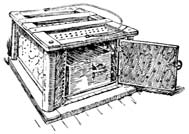
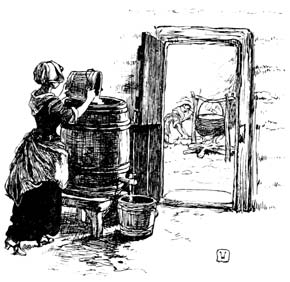
I suppose every family in Boston has a leach-barrel,
which is a stout cask, perhaps one that has held pickled
pork or pickled beef, and has in it at the very bottom
a hole where is set a wooden spigot.
This barrel is placed upon some sort of platform
built to raise it sufficiently high from the
ground, so that a small tub or bucket may be put
under the spigot. Then it is filled with ashes, and
water poured into the top, which, of course, trickles
down until it runs, or, as some say, is leached, out
through the spigot, into the bucket, or whatsoever you
have put there to
receive it.
While running
slowly through the
ashes, it becomes
what is called lye,
and upon the making
of this lye depends
the quality
of the soap.
Now, of course,
as the water is poured upon the contents of the
barrel, the ashes settle down, and as fast as this
comes to pass, yet more ashes are added and more
water thrown in, until one has leached the entire
six bushels, when the lye should be strong enough, as
mother's receipt for soap-making has it, to "bear up an
egg, or a potato, so that you can see a portion of it on
the surface as big as a ninepence."
If the lye is not of sufficient strength to stand this
test, it must be ladled out and poured over the ashes
again, until finally, as will surely be the case, it has
become strong enough.
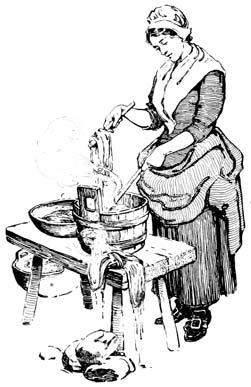
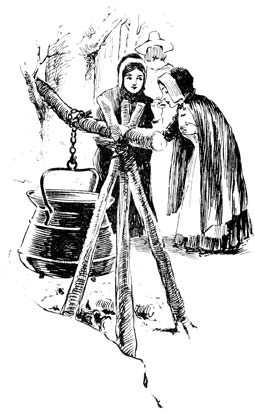
The next turn in the work is to build a fire out of
doors somewhere, because to make your soap in the
house would be a most disagreeable undertaking.
One needs a great pot, which should hold as much as
one-third of a barrel, and into this is poured half of
the grease and half of the lye, to be kept boiling until it
has become soap.
Now just when that point has been reached I cannot
say, because of not having had sufficient experience;
but mother is a master hand at this dirty labor, and
always has greatest success with it.
Of course, when one kettle-full has been boiled down,
the remainder of the lye and the remainder of the grease
is put in, and worked in the same manner as before.