Being kept indoors by the rain was not altogether
a privation. At least, the three girls
staying at the Big House did not find it such.
They became acquainted with Mammy Dilsey
during that first day of rain. At least, the girls
from the North did; Nettie had been a pet of the
old woman for years.
Dilsey was full of old-time stories—just such
stories as were calculated to enthrall girls of the
age of Ruth Fielding and her friends. For even
Ruth, with all her good sense and soberness, loved
to hear of pretty ladies, in pretty frocks, and with
beautifully dressed gentlemen dancing attendance
upon them, such as in the old times often filled
Merredith House.
Mammy Dilsey insisted she could remember
when men really dressed in satin and lace, and
wore wonderfully fluted shirt-bosoms, and fine
linen and broadcloth. The pre-Civil War ladies,
of course, with their crinolines, and tiny bonnets,
and enormous shade-hats must have looked really
124
beautiful. The girls listened to the tales of the
parties at the Big House almost breathlessly.
“An’ dat time de Gov’nor come—de two
Gov’nors come,” sighed Mammy Dilsey. “De
Gov’nor ob No’th Ca’lina an’ de Gov’nor ob So’th
Ca’lina——”
“I know what they said to each other—those
two governors,” interrupted Helen, her eyes dancing.
“My father told me.”
“I dunno wot dey said,” said Mammy Dilsey,
who did not know the old joke. “But I sho’ knows
how dey looked. Dey was bof such big, upstandin’
sort o’ men. My-oh-my! Ah tells yo’,
chillen, dey was a big breed o’ men in dese pahts
in dem days—sho’ was.
“Ma Miss Rachel, she been a li’le tinty gal in
dem days. Ah car’s her in ma arms ‘mos’ de time.
Her maw was weakly-like. An’ I could walk up
an’ down de end o’ dis big verandah wid dat mite
ob a baby, an’ see all dat went on.
“My-oh-my! de splendid car’ages, an’ de beautiful
horses, an’ de fine ladies an’ gemmen—dere
nebber’ll be nothin’ like it fo’ ol’ Mammy Dilsey
t’ see ag’in twill she gits t’ dat Hebenly sho’ an’
see dat angel band wot de Good Book talks about.”
Incidents of this great party at the Merredith
plantation, and of other famous entertainments
there, were still as fresh in Mammy Dilsey’s mind
as the occurrences of yesterday.
125
“Oh, goodness,” sighed Helen, “there never
will be any fun for girls again. And nowadays
the boys only care to go to baseball games, or to
go hunting and fishing. They refuse to come at
our beck and call as they used to in these times
Mammy Dilsey tells about.”
“I guess we make ourselves too much like themselves,”
laughed Ruth. “That’s why the boys of
to-day are different. If chivalry is dead, we
women folks have killed it.”
“I don’t see why,” pouted Helen.
“Oh, my dear!” cried her chum. “You want to
have your cake and eat it, too. It can’t be done.
If we girls want the boys to be gallant and dance
attendance on us, and cater to our whims—as they
certainly did in our grandmothers’ days—we must
not be rough and ready friends with them: play
golf, tennis, swim, run, bat balls, and—and talk
slang—the equal of our boy friends in every particular.”
“You’re so funny, Ruthie,” laughed Nettie.
“Lecture by Miss Ruth Fielding, the famous
woman’s rights advocate,” groaned Helen.
“I am not sure I advocate it, my dear,” sighed
Ruth. “‘I, too, would love and live in Arcady.’”
“Goodness! hear her exude sentiment,” gasped
Helen. “Who ever thought to live till that wonder
was born?”
“Maybe, after all, Ruth has the right idea,”
126
said Nettie, timidly. “My cousin Mapes says
that he finds lots of girls who are ‘good fellows’;
but that when he marries he doesn’t want to marry
a ‘good fellow,’ but a wife.”
“Horrid thing!” Helen declared. “I don’t like
your cousin Mapes, Nettie.”
“I am not sure that a girl might not, after all,
fill your cousin’s ‘bill of particulars,’ if she would,”
Ruth said, laughing. “‘Friend Wife’ can still be
a good comrade, and darn her husband’s socks. I
guess, after all, not many young fellows would
want to marry the kind of girl his grandmother
was.”
The trio of girls did not spend all their rainy
hours with Mammy Dilsey, or in such discussions
as the above. Besides, now and then the sun
broke through the clouds and then the whole world
seemed to steam.
The girls had the big porch to exercise upon,
and as soon as it promised any decided change in
the weather there were plans for new activities.
Across the river was a place called Holloways—actually
a small island. It was quite a resort in
the summer, there being a hotel and several cottages,
occupied by Georgetown and Charleston
people through the hot season.
Mrs. Parsons thought that her young guests
would become woefully lonely and “fair ill of
Merredith,” if they did not soon have some social
127
diversion, so it was planned to go to Holloways
to the weekend “hop” held by the hotel guests
and cottagers.
This was nothing like a public dance. Mrs.
Parsons would not have approved of that. But
the little coterie of hotel guests and the neighbors
arranged very pleasant parties which the mistress
of the Merredith plantation was not averse to her
young folks attending.
As it happened, she herself could not go. A
telegram from her lawyers in Charleston called
Mrs. Parsons to the city only a few hours before
the time set for the party to start for Holloways.
“Now, listen!” cried Aunt Rachel. “You
girls shall not be disappointed—no, indeed! Mrs.
Holloway will herself act as your chaperon and
will take good care of you. We should remain
at her hotel over night, in any case.”
“But we won’t have half so much fun if you
don’t go, Mrs. Parsons,” Helen said.
“Nonsense! nonsense! what trio of girls was
ever enamored of a strict duenna like me?” and
Mrs. Parsons laughed. “I’ll send one of the boys
on ahead with a note to Mrs. Holloway to look
out for you and Jeffreys will drive you over and
come after you to-morrow noon. I believe in girls
sleeping till noon after a party.”
“But how are you going to the station, Aunt
Rachel?” cried Nettie.
128
“I’ll ride Nordeck. And John shall ride after
me and bring the horse back. Now, scatter to do
your own primping, girls, and let Mammy Dilsey
’tend to me.”
In half an hour Mrs. Parsons was off—such
need was there for haste. She went on horseback
with a single retainer, as she said, riding at her
heels. Although the weather appeared to have
cleared permanently, the creeks were up and Mr.
Lomaine reported the river already swollen.
Mrs. Parsons had been wise to ride horseback;
a carriage might not have got safely through some
of the fords she would be obliged to cross between
the plantation and the railroad station.
On the other hand, the girls bound for Holloways
were not likely to be held back, for there
were bridges instead of fords. All in their party
finery, Ruth and Helen and Nettie started away
from the Big House in the roomy family carriage,
and with them went Norma, Nettie’s own little
colored maid, with her sewing kit and extra wraps.
The road to the bridge which spanned the wide
river led directly past the cotton warehouse. Ruth
had not been there since her conversation with
Mr. Jimson; but the warehouse boss had sent her
word twice that Curly Smith seemed to be contented
and desired to remain.
Both of the Northern girls were extremely
anxious to see the boy from Lumberton. Ruth
129
looked every day, now, for a letter from Mrs.
Sadoc Smith; and she hoped the stern old woman
would relent and ask her grandson to return.
The river was, as Mr. Lomaine had said, very
high. The brown, muddy current was littered
with logs, uprooted trees, fence rails, pig-pens, hen
houses, and other light litter wrenched from the
banks during the last few days. Ruth said it
looked quite as angry as the Lumano, at the Red
Mill, when there was a flood.
Jeffreys had brought the carriage to a full stop
on the bank overlooking the stream and the warehouse.
The water surged almost level with the
shipping platform. There had been a reason for
Mr. Jimson’s shifting all the cotton in storage
to the upper end of the huge building. He had
foreseen this rain and feared a flood.
Suddenly, just as Jeffreys was about to drive on,
Helen uttered a scream, and pointed to a drifting
hencoop.
“See! See that poor thing!” she cried.
“What’s the matter now, honey?” asked Nettie.
“I don’t see anything.”
“On the roof of that coop,” Ruth said quickly
espying what her chum saw. “The poor cat!”
“Where is there a cat?” cried Nettie, anxiously.
She was a little near-sighted and could not focus
her gaze upon the small object on the raft as
quickly as the chums from the North.
130
“Dear me, Nettie!” cried Helen, in exasperation.
“If you met a bear he’d have to bite you
before you’d know he was there.”
“Never mind,” drawled the Southern girl, “I am
not being chased and knocked down by deer——Oh!
I see the poor kitty.”
“I should hope you did!” Helen said. “And
it’s going to be drowned!”
“No, no,” Ruth said. “I hope not. Can’t it
be brought ashore? See! that coop is swinging
into an eddy.”
“Well, Ruthie Fielding!” cried Helen, “you’re
not going to jump overboard in your party dress,
and try to get that poor cat, I should hope!”
“There’s a boy who can get her!” exclaimed
Nettie, standing up in the carriage, and being able
to see well enough to espy a figure on a small raft
down by the loading dock.
“Oh, Nettie! ask him to try!” gasped Ruth.
“Hey, boy!” called Nettie. “Can’t you save
that poor cat for us?”
The boy turned, and both Ruth and Helen
recognized the curly head—if not the shockingly
ragged garments—of Henry Smith. He waved a
reassuring hand and pushed off from the platform.
Mr. Jimson came running from the interior of
the warehouse and shouted after him.
“There! I hope we haven’t got him into more
trouble,” mourned Ruth.
131
“And he can’t get the cat,” wailed Helen, in a
moment. “The current is taking the raft clear
out into midstream.”
Curly was working vigorously with the single
sweep, however, and he finally brought the cumbersome
craft to the edge of the eddy where the
hencoop with its frightened passenger whirled
under the high bank.
“Yo’ kyant git that cat, you fool boy!” bawled
Jimson. “And yo’ll lose my raft.”
“Oh, Mr. Jimson!” cried Nettie. “We do want
him to save that cat if he can.”
“But he’ll lose a mighty good oar, an’ that
raft,” complained the boss.
“Never mind,” said Nettie, firmly. “You can
make another oar and another raft. But how are
you going to make another cat?”
“I’ll be whip-sawed!” exclaimed the long and
lanky man. “Who ever heard the like of that?
There’s enough cats come natcher’lly without nobody’s
wantin’ t’ make none.”
The girls laughed at this, but they were anxious
about the cat. And, the next moment, they began
to be anxious about the boy.
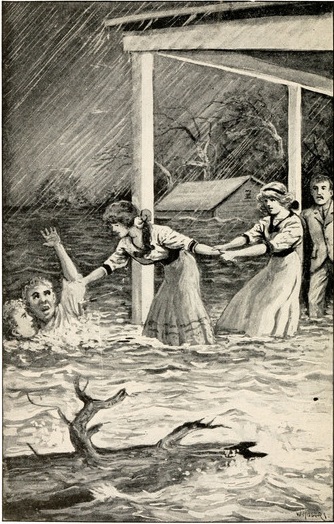
Curly threw away the oar and plunged right
into the eddy. He had little clothing on, and no
shoes, so he was not greatly trammeled in swimming
to the drifting hencoop. But once there, how
would he get the cat ashore?
132
However, the boy went about his task in quite
a manful manner. He climbed up, got one arm
hooked over the roof and reached for the wet and
frightened cat. The poor creature was so despairing
that she could not even use her claws in defense,
and Curly pulled her off her perch and set
her on his shoulder.
There she clung trembling, and when Curly
let himself down into the water again she only
uttered a wailing, “Me-e-ou!” and did not try
to scratch him. He struck out for the shore, keeping
his shoulders well out of the water, and after
a fight of a minute or two, brought the cat to
land.
Once within reach of the land, the cat leaped
ashore and darted into the bushes; while Jimson
helped the breathless Curly to land.
“There! yo’ reckless creatuah!” exclaimed the
man. “I’ve seen folks drown in a current no
worse than that. Stan’ up an’ make yo’ bow t’
Miss Nettie, here,” and he turned to Nettie, who
had got out of the carriage in her interest.
Ruth and Helen stayed back. They did not
wish to thrust themselves on the notice of Curly
Smith. Nettie told Jimson to see that the saturated
boy had a new outfit.
“And don’t let him get away till Aunt Rachel
returns from Charleston and sees him. She’ll
want to do something for him, I know,” she added.
133
The boy glanced shyly up at the girls and suddenly
caught sight of Ruth and Helen in the background.
Like a shot he wheeled and ran into the
bushes.
“Oh! catch him!” gasped Ruth. “Don’t let
him run away, Mr. Jimson.”
“He’s streakin’ it for my shack, I reckon,” said
the boss. “Mis Jimson’ll find him some old duds
of mine to put on.”
“But maybe he won’t come back,” said Helen,
likewise anxious.
“Ya-as he will. I ain’t paid him fo’ his wo’k
here,” chuckled Jimson. “He’ll stay a while
longah. Don’t fret about that.”
Nettie got back into the carriage, which went
on toward the bridge. As they crossed the long
span the girls saw that the current was roaring
between the piers and that much rubbish was held
upstream by the bridge. The bridge shook under
the blows of the logs and other debris which
charged against it.
“My! this is dangerous!” cried Helen. “Suppose
the bridge should give way?”
“Then we would not get home very easily,”
laughed Nettie.
It was not a laughing matter, however, when
they came later to the shorter span that bridged
the back water between the island where the hotel
was situated, and the shore of the river. Here
134
the rough current was level with the plank flooring
of the bridge, and as the carriage rattled over,
the girls could feel that the planks were almost
ready to float away.
“We’ll be marooned on this island,” said Ruth,
“if the water rises much higher.”
“Who cares?” laughed Nettie, to whom it was
all an exciting adventure and nothing more. With
all her natural timidity she did not look ahead
very far.
Jeffreys and the footman were in a hurry to get
back. The instant the girls and their little maid
got out at the hotel steps, the coachman turned the
horses and hastened away.
A little, smiling woman in a trailing gown came
down the steps to welcome the party from Merredith.
“I am Mrs. Holloway,” she said. “I am
glad to see you, girls. Jake reached here about
an hour ago and said Mrs. Parsons could not
come. It is to be deplored; but it need not subtract
any from your pleasure on the occasion.
“Come in—do,” she added. “I will show you
to your rooms.”