July 1914—Enthusiasm at Moscow—My Ambition Realised—England
and Russia Allies—A War of Right—Wounded Heroes—Russia's
Faith in Victory—Our Emperor's Call—England's
Greatness—I am Introduced to Mr. Gladstone and Mr. Disraeli—"The
M.P. for Russia in England"—Mr. Gladstone's
Championship—An Unpopular Cause
I was in Moscow when our Monarch's mighty
voice sounded in defence of little Serbia. I
was driving near the Tverskoi Boulevard,
when a shouting crowd rushed past me, and burst
into a neighbouring restaurant.
"What does it all mean?" I exclaimed. "Is it
a riot? do they want drink?"
"Oh no," said the bystanders. "They only
want to call out the orchestra and make them play
the national hymn."
I stopped my carriage.
The orchestra appeared, and played our God
save the Tzar, while the whole crowd, wild with
enthusiasm, joined in.
Delighted and touched, I followed them. Most
were singing and shouting "Hurrah," some praying
and making the sign of the cross, while the throng
continually increased.
Similar scenes occurred daily in various quarters
of the town. One evening, an idle crowd had
assembled near St. Saviour's Church. A priest
appeared with a cross. The whole crowd fell on
their knees and prayed. Such moments one cannot
forget—indeed one can only thank God for them.
People say that in Petrograd the demonstrations
were still grander. It may be so—but whenever
the Emperor visits Moscow, and speaks there with
his powerful, animating voice, the old capital rises
to unapproachable heights of enthusiasm and to
resolutions of unbounded self-sacrifice.
A few days later I realised that the great ambition
of my life was about to be realised, not only by
an entente, but by an alliance between Russia
and the country that has given me so many
friends and shown me such splendid hospitality.
Yet how differently everything had happened from
what I had anticipated after the signing of the
Anglo-Russian Agreement. It was not the gradual
drawing together of the two countries that each
might enjoy the peaceful friendship of the other:
but the sudden discovery that they had a common
foe to fight, a common ideal to preserve, a common
civilisation to save.
Years ago I wrote, "I want to be a harbinger of
peace, of hope, of prosperity to come," and yet here
was my great ambition being realised to the sound
of the drum and midst the thunder of the destroying guns.
History was repeating itself. As in 1875, a Slav
nation was being oppressed, threatened with
annihilation, and the great heart of Russia was moved.
I remember so well those days forty years ago when
our Foreign Office tried all it could to stop the
reckless chivalry of the Russian people—determined
as all classes were to sacrifice everything, life itself
even, for the sake of their oppressed co-religionists,
the Bulgarians.
In that August thirty-eight years before (1876),
Petrograd itself (always more cautious and reserved
than Moscow) showed an enthusiasm for the cause
of the Christian Slavs that daily gathered strength.
It pervaded all classes from prince to peasant.
The sympathy of the masses had been evoked by
the atrocities, committed in the usual unspeakable
Turkish fashion, in Bulgaria. That sympathy,
however, bore chiefly a religious, not a political
character, and as in almost all great national
movements our Emperor identified himself with his
people. Public collections were being made for the
sick and wounded.
Officers of the Red Cross and ladies of the Court
and society went from house to house requesting
subscriptions.
At railway stations, on the steam-boats, even on
the tramways, the "Red Cross" was present
everywhere, with a sealed box for donations. Every
effort was made to animate feelings of compassion for
the suffering Christians, and to swell the funds for
providing ambulances for the sick and wounded.
And now in 1914 another great national emotion
had swept over three hundred millions of people.
This was not a war of greed or gain; it was not
concerned with some insult levelled at Russia or
the violation of her frontiers; it was the result of a
deep religious sense of justice in the hearts of the
people. It was what in England would be called
"the sporting instinct" which forbids a big man
to hit another smaller than himself.
No power could have held back the chivalrous
Russians from going to the aid of threatened Serbia.
All recognised that a terrible and fateful day had
dawned, and throughout the dark days of the
autumn of 1915, the people never flinched from the
task they had undertaken. They were pledged to
save Serbia.
Russians believed, still believe and will always
believe, in the sacredness of an oath given in the
name of God. Certain words indeed are not meaningless
sounds! To such sacred promises naturally
belongs also the oath of allegiance.
For centuries confidence and harmony reigned
between all the Russian subjects. Now, the
blasphemous Kaiser was trying to abolish every moral
and religious tie. Could anything be more cruel
and mischievous?
Everywhere it was the same. When I visited the
wounded in my Tamboff country place, our poor
soldiers, in answer to my queries as to their wants
and desires, answered quite simply, not in the least
realising the nobleness of their feeling:
"If God would only make us strong enough to go
and punish the infamous enemy. You do not know
the harm done to our fields, our churches, our
brothers."
The tone of this and similar remarks was very
striking. One of the wounded was a Mohammedan.
I do not know whether it is wise or not, but the
Mohammedans in Russia are treated exactly like
other Russian subjects, and they know that in
serving Russia they may attain the highest military
positions, as did, for instance, General Ali Khanoff,
and others of the same creed.
Russia, as a whole, has an unlimited faith in
victory. The Russian Emperor's New Year's
address echoed far and wide, like a clarion call,
through the ranks of the Imperial army and fleet.
All doubts vanished beyond recall, for the utterance
of the Sovereign was more decided, definite and
determined than any that had gone before. Here
are words that must ring like a knell in the ears of
exhausted Germany, trembling under the strain of
her last efforts.
"A half-victory—an unfinished war"—this was
the hideous phantom before which the hearts of our
brave soldiers sank, and which, like a ceaseless
nightmare, disturbed the rest, even of our most
illiterate peasants. Far and wide, indeed, Russian
hearts to-day thrill and respond to their beloved
Emperor's call:
"Remember that without complete victory our
dear Russia cannot ensure for herself and her people
the independence that is her pride and her birthright,
cannot enjoy and develop to the full the fruits
of her labour and her natural wealth. Let your
hearts be permeated with the consciousness that
there can be no peace without victory. However
great may be the sacrifice required of us, we must
march onward unflinchingly, onward to triumph for
our country and our cause."
The air vibrated with the echoes of these splendid
words—and the bereaved mothers, sisters, wives,
weeping in the loneliness and despair of their broken
hearts, look up and smile again, because Russia's
blood has not been shed in vain. The news travelled
on the wings of the wind, and over countless distant,
unknown graves, it brought its message to our fallen
heroes: "You shall be revenged, brave warriors;
your souls shall celebrate the moment of triumph,
together with your living brothers!"
It is good also to know that we are not alone in
our determination, that our Allies are with us, and
share our views.
Therefore, if we assume that Germany's entire
population numbers about seventy millions, the
outside limit for the numerical strength of her army
can in no circumstance exceed ten millions, this
being already 14 per cent of the whole nation, and a
completely unprecedented percentage of the nation's
manhood. Such figures, indeed, represent an entire
people in arms—a people, however, that has taken
upon itself the impossible task of measuring its
strength against that of three other mighty peoples,
armed, also, to the teeth. In this uneven struggle,
Germany must ultimately, in spite of Austrian,
Bulgarian and Turkish help, meet her ruin, and
bleed to death.
We, in Russia, look forward to the future without
fear. We stand united as one man. All political
strifes and disagreements are forgotten; there is
no division of parties, no discussion of any affairs of
State except those connected with the war. "War
war, war, till victory, till triumph. There lies our
future, and so shall it be." With these words our
Home Secretary, Monsieur Khvostoff, concluded his
recent speech to the members of the Press Bureau.
The same sentiments are echoed everywhere. We
are determined and hopeful, and ready for every
sacrifice, because, to quote our Empress Alexandra
in her New Year's telegram to the Secretary of State,
"A war that has been forced on us by our enemies,
and that has attained dimensions unprecedented in
history, naturally calls for immense sacrifices. But
I know that the Russian people will not hesitate
before these sacrifices, and will fight on nobly until
the moment when God's blessing will bring to the
glorious warriors who are shedding their blood for
their fatherland and their Emperor, the peace that
shall be bought by complete victory over our foes."
By these words may English people discern the
spirit of their Russian friends, their faith in victory.
The difference between 1876 and 1914 is our
attitude towards Great Britain. Whereas forty
years ago we suspected, even hated, her, now we
see her in her true colours. She is doing for
Belgium what we once did for Bulgaria, and from a
sense of right and political honour. She could have
remained neutral, safe in her sea defences, devoting
her time to capturing the trade of the combatants.
Instead of which she chose to risk all in honouring
her pledge. This fact brought Russia very near
to Great Britain, and I hope the years that are
coming will see a better understanding in Great
Britain of the Russian Spirit.
And now something about myself. In 1873
Baron Brunow, the Russian Ambassador in
London, introduced me to Mr. Gladstone and
Mr. Disraeli in the same evening. The one was
to become a dear friend who was to give
powerful support to my efforts to bring Russia and
England closer together, whilst the other a few years
later was to confer upon me the honorary title of
which I have always been so proud. "Madame
Novikoff," he said, during the Bulgarian agitation,
when Mr. Gladstone and I were doing our utmost
to negative his pro-Turkish activities, "I call
Madame Novikoff the M.P. for Russia in England."
This remark was not intended to give me pleasure,
although, now that my years of work have ended
successfully, it may appear, as Mr. W. T. Stead
said, "a flattering compliment."
At that time, however, Lord Beaconsfield was not
feeling so cordial towards me as to frame graceful
compliments, and he probably knew that, expert as
he was in the art of flattery, nothing he could say
would divert me from the path of antagonism
towards his policy that I had chosen for myself.
"Ambassadors represent Governments, M.P.'s
represent the people," Mr. Stead wrote, apropos
Beaconsfield's remark, and I have always striven,
however unworthily, to represent Russia, the most
peace-loving nation in the world.
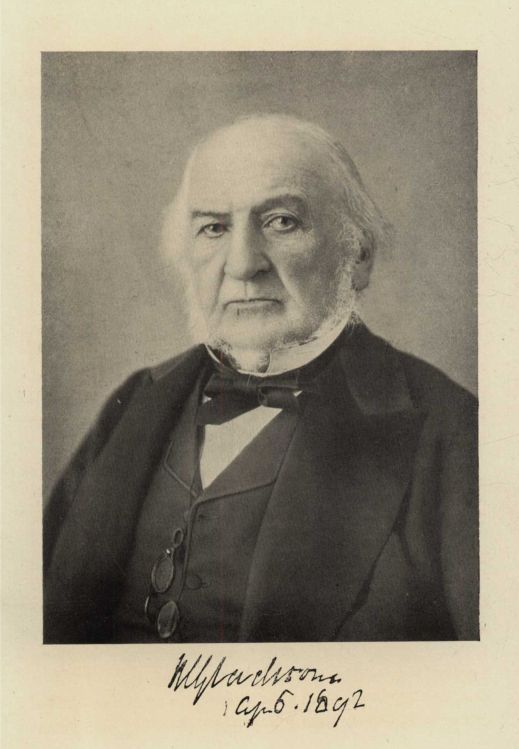
W. E. Gladstone (April 5, 1892)
It was to the enjoyment of peace to my country
that I first undertook my self-imposed work, the
bringing of Great Britain and Russia to a better
understanding that would result in their working
together towards a common end—peace. It is a
strange trick of fate that the two countries should
eventually be brought together, not by peace but
by war; but the workings of Providence are
inscrutable, and out of this great evil perhaps a still
greater good may come.
By the Anglo-Russian Agreement of 1908 the two
countries became good friends, now they are allies.
Britons are fighting in Russia under the Russian
High Command, and it is no secret that British
sailors are fighting ship by ship with Russian sailors
in the Baltic; and with those who have fought
together for a common cause, friendship and
understanding are inevitable.
It is strange to look back upon what have come
to be known as the "jingo days," when in the
streets and music-halls was sung a ditty in which
Britons told each other—I quote from memory:
We don't want to fight; but, by jingo, if we do,
We've got the men, we've got the ships, we've got the money too.
and all this was levelled at Russia, because she
chose to do what Great Britain to her everlasting
honour is doing to-day, avenging a downtrodden,
but uncrushed people.
There was one man who saw clearly and stood up
fearlessly against the popular clamour, and that was
Mr. Gladstone. For twenty years he worked with
me loyally towards the end I had in view. He never
faltered in his denunciations of the unspeakable
Turk and all his ways. From 1876 to 1880 the
crisis was acute, and at any time war between Great
Britain and Russia was possible.
During the whole of this time Mr. Gladstone was
doing his utmost to counteract the evils of the
Disraeli policy, and he was always in close touch
and constant communication with me. His support
and unflinching championship of what he thought
to be the cause of right was to me a great comfort.
I was a woman in a foreign land, fighting against
the prejudices that I saw everywhere about me.
In the early part of 1876 ugly rumours were afloat
as to wholesale massacres of Bulgarians by the Turks.
On June the 23rd there appeared in The Daily News
a letter from its Constantinople correspondent (Mr.,
now Sir, Edwin Pears), and the attention of the
House of Commons was directed to the appalling
allegations it contained. Mr. Disraeli, then Prime
Minister, treated the whole matter with airy
unconcern, but the members on both sides of the
House were irritated rather than soothed by his
manner.
With a caution that was infinitely to his credit,
for I know from our talks how deeply he felt,
Mr. Gladstone waited the report of Mr. Walter Baring,
the British Commissioner, which confirmed in all
their revolting detail the rumours of the slaughter
of harmless Bulgarians, men, women and children.
Convinced that the evidence was uncontrovertible,
Mr. Gladstone plunged into the fray, first by
publishing his pamphlet, The Bulgarian Horrors and
the Question of the East, and later by urging an
understanding with Russia that would render this
wholesale slaughter of a Christian people impossible
in future.
In Russia there was only one thought in the
people's minds—war, which no human power could
have prevented. The nation insisted that they
should be allowed to stand beside their co-religionists
and fight in defence of their freedom.
As for myself, those were busy days. I saw
around me nothing but suspicion of Russia, perhaps
even of myself: but I had a noble example set me,
if one were needed, by Mr. Gladstone. Ours was a
fight for Christianity and civilisation. Every hour
of my day and sometimes far into the night was
occupied. I rushed fearlessly into print, as I have
done for the last forty years when I felt that my
pen might serve the purpose I had in mind. In
those days editors were less hospitable towards me
than they have since become. Mine was an
unpopular cause, I wrote as a Russian patriot, which
meant that I sometimes showed a tendency to injure
British susceptibilities. "But what matter that?"
I asked myself with Jesuitical satisfaction. "The
end is good, and it is the end that matters." I
think there are very few of my friends in England
to-day who will not echo my words.
The day on which I write these words is the
Russian Flag Day, the second since the war broke
out. In the streets are English and Russian girls
and women selling small flags, for the most exorbitant
sum they can extract from the purchasers, "to help
Russia."
When I look back upon those days of gloom,
when Mr. Gladstone used to come and see "the
Russian agent," "the M.P. for Russia in England,"
and talk anxiously about the near future, and
whether the storm would pass or break, it is with
gratitude and expressions of heartfelt thanks to the
people who have so often shown me hospitality and
in time began to listen to my words. They
must have found some difficulty in avoiding the
words I showered upon them; for I frankly
confess I lost no opportunity of "rushing into
print."
A New Era—My Brother Nicholas—Hadji Ghiray: Hero—Terrible
News—A Heroic Advance—My Brother's Death—Aksakoff's
Famous Speech—Russia Aflame—A Nation's Sacrifice—My
Heart-broken Letters—Mr. Gladstone's Response—Mutual
Suspicion—My Visits to England
It is not only easy, but delightful at this moment
to write in dear England about Russia and
Russians, about our institutions and customs,
confessing even our drawbacks when they have to
be explained. But, alas! some thirty or forty years
ago such was not the case.
I wonder if it will interest English people to
follow the life of a Russian, who, like myself, has
felt the effect of these different currents.
We must remember, that, if at this moment,
everything English is not only appreciated in
Russia, but even enthusiastically admired, things
were quite different at the time when I began writing
pro-Russian articles in England.
Yes, indeed: the Russian feelings in the years
'76, '77 and '78 were permeated with severe bitterness
against Disraeli's English policy so hostile to
Russia.
Find and study the Russian papers of these years.
They will show you how all the Russian Press, and
in fact the whole country, was convinced that
Turkey would never have refused to introduce the
reforms asked by Russia in favour of the tortured
Slavs if it had not been for England's cruel support
and advice.
The whole of Russia at that time was seething
with indignation and resentment.
In the year 1876 in all our papers, and in every
mouth, were variations on the same theme:
"England is the principal cause of all our sacrifices
and losses. England's obedient slave, Turkey,
refuses all our most legitimate demands in favour of
our co-religionists, our brethren by race. Turkey's
insolent opposition is England's doing. Besides,
the Russian Government hesitated to present her
Ultimatum to the Sultan—not being prepared for war."
And so it really was. Russia then was as pacific
and unprepared for fighting as she was at the
beginning of the present gigantic Armageddon. Russia
imagined that everybody understood that she was
not coveting new acquisitions, and was quite
unprepared for war, which was true enough—indeed
she seemed as if she never cared to be prepared.
She lived in a fool's Paradise, insisting on universal
peace as at The Hague Conference, and as if the whole
world were composed of "the friends" (better
known as "Quakers").
The present diabolical war has taught us many
good lessons, including the necessity for prudence
in the future. It will also teach us to develop our
own endless resources without depending on foreign
help, which is always paid for not only at usual,
but at monstrous prices, such as those which now
exist at Petrograd and Moscow.
But hostile as Russia was in 1876 to any kind of
war, yet, when the Balkan troubles commenced,
crowds of poor Russians, preferring death to peace
at any price, rushed to that country, concealing
even from their relatives and friends their
determination to support the Slavs, notwithstanding the
complete unpreparedness of the latter. That was
perhaps pure folly on the part of our volunteers,
but a sublime and heroic folly, of which we are now
proud. At that time, however, I, at all events (in
spite of all) only felt the bitterness of indignation
and despair with our Government and with England's
policy.
My brother, Nicholas, as a member of the Slavonic
Benevolent Society, went to Belgrade, Sofia and
Cettingje. But he went armed only with money
collected for ambulances and for the establishment
of medical depôts, where medical aid could be
obtained. The insurrection in Bosnia and
Herzegovina was already spreading, and no preparations
had been made. The helplessness of the wretched
Balkan Slavs was simply appalling. As Nicholas
had distributed all the money entrusted to him, and
had sent in all his accounts to the Benevolent
S. Society to the last copeck, our brother Alexander
and I expected his speedy return to Russia.
In fact, I had Alexander's letter in my pocket,
where he spoke of Nicholas' splendid business-like
arrangement, when I read in all the papers a short
but terrible telegram: "Hadji Ghiray is killed at
Zaitcher"—it was Nicholas Kiréeff. He had joined
the Serbians under an assumed name, as we later
discovered.
My horror at this news was indescribable. I could
not believe it. But it was soon followed by a wire
from Alexander which said: "The Emperor has
sent for me and informed me of our brother's death.
He allows me to go to you at once, and we will go
to see Mother in Italy. She must be now at Lucca,
and probably knows nothing as yet of our misfortune."
I shall hope to be forgiven for quoting Kinglake's
account of my brother's sacrifice. It was
characteristically Russian in its Quixotism:
"The young Nichol ... Kiréeff was a noble, and
being by nature a man of an enthusiastic disposition,
with the romantic example before him in the life of
his father, he had accustomed himself to the idea
of self-sacrifice. Upon the outbreak of Prince
Milan's insurrection, he went off to Servia with
the design of acting simply under the banner of
the Red Cross, and had already entered upon his
humane task, when he found himself called upon by
General Tchernaieff to accept the command of what
we may call a brigade—a force of some five thousand
infantry, consisting of volunteers and militiamen,
supported, it seems, by five guns; and before long,
he not only had to take his brigade into action, but
to use it as the means of assailing an entrenched
position at Rakovitz. Young Kiréeff very well
understood that the irregular force entrusted to him was
far from being one that could be commanded in the
hour of battle by taking a look with a field-glass
and uttering a few words to an aide-de-camp; so
he determined to carry forward his men by the simple
and primitive expedient of personally advancing
in front of them. He was a man of great stature,
with extraordinary beauty of features, and, whether
owing to the midsummer heat, or from any wild,
martyr-like, or dare-devil impulse, he chose, as he
had done from the first, to be clothed altogether
in white. Whilst advancing in front of his troops
against the Turkish battery he was struck—first by
a shot passing through his left arm, then presently
by another one which struck him in the neck, and
then again by yet another one which shattered his
right hand and forced him to drop his sword; but,
despite all these wounds, he was still continuing his
resolute advance, when a fourth shot passed through
his lungs, and brought him, at length, to the ground,
yet did not prevent him from uttering—although
with great effort—the cry of 'Forward! Forward!' A
fifth shot, however, fired low, passed through the
fallen chief's heart and quenched his gallant spirit.
The brigade he had commanded fell back, and his
body—vainly asked for soon afterwards by General
Tchernaieff—remained in the hands of the Turks."[1]
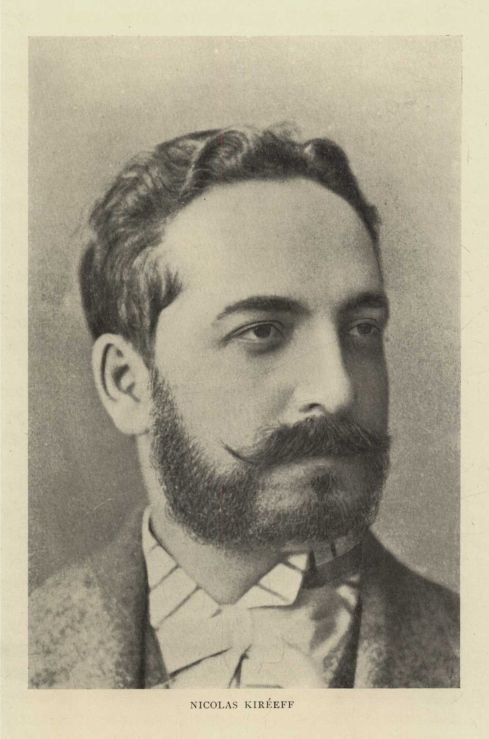
NICOLAS KIRÉEFF
I saw it stated in the newspapers a short time
back that a German officer and some hundred and
fifty men had surrendered to the British, stating that
he and his men would probably be of more use to
Germany alive than dead. When I think of the
tragedy surrounding the death of my brother,
Nicholas Kiréeff, I can now see that he served Russia
better by his death than he could by living for her.
The news of his heroic fall passed from one end
of Russia to the other like the notes of a bugle calling
an army into being. But for his death my own
humble efforts to bring about a better understanding
between two great nations might possibly never
have been attempted. There is probably no evil
out of which good cannot be formed.
The effect of my brother's death was instantaneous
and electrical. He was the first Russian volunteer
to fall in the cause of freedom, the cause that people
in Great Britain could not or would not understand.
Officers and men of the Russian army clamoured to
go to the front. By giving his life freely for the sake
of his conscience, my brother was the instrument
of Russia doing one of the finest things that any
nation has ever done.
Kinglake has written:
"It may be that the grandeur of the young colonel's
form and stature, and the sight of the blood, showing
vividly on his white attire, added something
extraneous and weird to the sentiment which might
well be inspired by witnessing his personal heroism
... but, be that as it may, the actual result was that
accounts of the incident—accounts growing every
day more and more marvellous—flew so swiftly
from city to city, from village to village, that before
seven days had passed, the smouldering fire of
Russian enthusiasm leapt up into a dangerous flame.
Under countless green domes, big and small, priests
fiercely chanting the 'Requiem' for a young hero's
soul, and setting forth the glory of dying in defence
of 'syn-orthodox' brethren, drew warlike responses
from men who—whilst still in cathedral or church—cried
aloud that they, too, would go where the young
Kiréeff had gone; and so many of them hastened to
keep their word, that before long a flood of volunteers
from many parts of Russia was pouring fast into
Belgrade. To sustain the once kindled enthusiasm
apt means were taken. The simple photograph,
representing the young Kiréeff's noble features, soon
expanded to large-sized portraits; and Fable then
springing forward in the Path of Truth, but
transcending it with the swiftness of our modern
appliances, there was constituted in a strangely short
time one of those stirring legends which used to be
the growth of long years—a legend half warlike,
half superstitious, which exalted its really tall hero
to the dimensions of a giant, and showed him piling
up hecatombs by a mighty slaughter of Turks."[2]
The death of Nicholas Kiréeff was a kind of spark
falling on a train of gunpowder. In a month's time
the whole of Russia was roused.
"The news of the death of Nicholas Kiréeff,"
said Aksakoff, in one of his most famous speeches,
"at once stimulated hundreds to become volunteers—an
event that repeated itself when the news was
received of the deaths of further Russian volunteers.
Death did not frighten, but, as it were, attracted
them. At the beginning of the movement the
volunteers were men who had belonged to the army,
and chiefly from among the nobles. I remember
the feeling of real emotion which I experienced when
the first sergeant came requesting me to send him
to Servia—so new to me was the existence of such
a feeling in the ranks of the people. This feeling
soon grew in intensity when, not only old soldiers,
but even peasants, came to me with the same
request. And how humbly did they persevere in
their petition, as if begging alms! With tears they
begged me, on their knees, to send them to the field
of battle. Such petitions of the peasants were
mostly granted, and you should have seen their joy
at the announcement of the decision! However,
those scenes became so frequent, and business
increased to such an extent, that it was quite impossible
to watch the expression of popular feeling, or to
inquire into particulars from the volunteers as to
their motives. 'I have resolved to die for my
Faith.' 'My heart burns.' 'I want to help
our brethren.' 'Our people are being killed.' Such
were the brief answers which were given with
great sincerity. I repeat there was not, and could
not be, any mercenary motive on the part of the
volunteers. I, at least, conscientiously warned every
one of the hard lot awaiting him. Privations,
wounds, and death were all that these volunteers
could expect for themselves, but they rightly
guessed that sooner or later the official Russian army
would take up their cause."
In less than a month after my brother's death 75
officers of the Imperial Guards at Petrograd resigned
their commission in the army, and hurried to Serbia;
120 officers at Moscow and Southern Russia did the
same.
The impartial British Ambassador, Lord Augustus
Loftus, informed his Government that according
to private information 20,000 Cossacks were going
to the Balkans in disguise. He also communicated
the following characteristic letter:
"Even women, old men, and children speak of
nothing but the Slavonic war. The warlike spirit
of the Cossacks is on fire, and from small to great
they all await permission to fall on the Turks like a
whirlwind. At many of the settlements the Cossacks
are getting their arms ready, with a full conviction
that in a few days the order will be given to fall on
the enemies of the Holy Faith and of their Slav
brethren. There is at the same time a general
murmuring against diplomacy for its dilatoriness
in coming to the rescue. Deputies have arrived
from many of the Cossack settlements to represent
to the Ataman that the Cossacks are no longer able
to stand the extermination of the Christians."
Lord Augustus Loftus reluctantly admitted that
"neither the Emperor nor Prince Gortschakoff are
now able to resist the unanimous appeal of the
nation for intervention to protect and save their
co-religionists." At that time Russia knew perfectly
well that nobody outside her realms cared to share
her sacrifices and her work, and that the greatest
part of England even threatened her with war—an
eventuality which certainly could not be
contemplated with indifference.
The tragedy at Zaitschar had lighted a flame that
spread throughout the length of Russia. Enormous
sums of money were offered with reckless generosity.
Foreigners who witnessed the enthusiasm of the
movement were astonished. They did not understand
the romantic chivalry of the Russian nature.
Ivan Aksakoff, the President of the Benevolent
Slav Society in Moscow, alone collected more than a
million roubles, and everywhere Red Cross Societies
sprang up with a suddenness that was amazing.
I belonged to the Moscow Red Cross Committee.
It was one of our duties to collect money and material
for ambulance work. I recollect vividly, although
forty years have since passed, how people of all
sorts and conditions came to us with their offerings.
Women of fashion tendered their jewels, paupers
their copper coins. Everybody gave what he could.
I could write volumes about what occurred in
those glorious yet tragic days. Everywhere I
encountered examples of a deep religious enthusiasm
that seemed to animate the whole country, irrespective
of class; yet the foreign Press saw in this
spontaneous movement only a sham engineered for
political purposes.
The years '76 and '77 formed a grand page of Russian
history—years of real crusade in our prosaic,
materialistic nineteenth century. The crowds of Russians
who rushed to meet almost certain death in heroic
defence of their oppressed and unarmed Christian
brethren in the East, the vast sums of money, offered
with spontaneous and reckless generosity, astonished
all those foreigners who witnessed the marvellous
enthusiasm of that movement.
This enthusiasm in Russia was the first direct
result of my dear brother's death; but there was
another. I was prostrated with grief by the shock.
To my distraught mind England was responsible
for the tragedy. Had she not encouraged the Turk
there would have been no war and my brother would
have been alive. If Mr. Gladstone had been in
power, my brother would not have been sacrificed.
How bitterly I upbraided England in my own mind.
As soon as I was well enough and influenced by all
that I had read in our Press about England's
interference with Russia's humane policy, and also by my
personal passionate grief, I simply lost my head.
Can it be believed that I wrote to my English friends
in these very words: "It is England who has killed
my brother. It is England who prevents our
Government from helping our brethren in the
Balkans. Russia was in duty bound to remonstrate
with the Sultan, even to the extent of threatening
him with war, the moment his massacres began.
Impulsively Russian volunteers rushed to the rescue,
and my poor brother Nicholas happened to be the
first amongst them. He would not have been the
first hero to be killed at the head of the unarmed
Serbian troops, if those had been enrolled as official
soldiers, well-armed and ready for battle."
Such letters can be written only, as this was, in
moments of real despair. But I must gratefully
add that my English correspondents understood
my grief, and that people like Lord Napier,
Froude, Kinglake, Freeman, Charles Villiers, Sir
William Harcourt and others—then known to me
rather as clever and pleasant conversationalists—all
answered me with extreme kindness and sympathy.
They assured me that Disraeli's policy in
Turkey was wrong, that Parliament intended to
question it, that The Daily News and other papers
had already started the campaign, etc., etc. Yes, I
felt their kindness, but the only person who left
my letter unanswered was Mr. Gladstone, and this
rather grieved me. In fact, I expected that he
would have been the first to respond, as we had
understood each other so well on the old Catholic
movement.
Two or three weeks later, however, I received a
communication from Mrs. Gladstone, which read:
DEAR MADAME NOVIKOFF,
My husband, overwhelmed at this moment
with business, wishes me to write and express to
you our sincere sympathy with you in your great
loss; indeed we know what it is to lose a precious
brother, and we also know as you do how to rejoice
in a beautiful unselfish life being crowned with joy
eternal. You will ere this have read the answer
to your question as to Bulgaria in my husband's
pamphlet in the newspapers. England is at length
roused from her lethargy; indeed it is terrible what
has been going on. Once more assuring you of our
heartfelt sympathy in your sorrow, believe me, yours
very sincerely,
CATHERINE GLADSTONE.
I could not at the moment understand what she
meant, but I was soon enlightened by the appearance
of the celebrated pamphlet on the Bulgarian horrors.
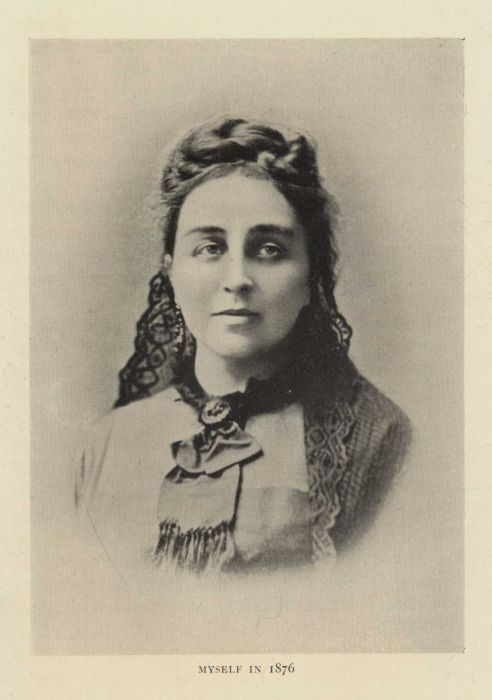
MYSELF IN 1876
Although all the letters I received were deeply
sympathetic, I could see that the sympathy expressed
was with me personally rather than with the cause
I had so much at heart; for how can anyone
sympathise with what they do not understand?
Great Britain suspected Russia as if it were the
most natural thing in the world to do so, whilst
Russia reciprocated by suspecting Great Britain.
Each put the worst possible construction upon the
acts of the other. Seeing this, I decided to do all I
could in my humble and unpretentious way to further
a better understanding between the two nations.
I remembered the fable of the mouse and the lion,
and that was the beginning of forty years' work,
during which I have never once wandered from the
path I had chosen.
There is in the little kingdom of Serbia a village
situated near the place where Nicholas Kiréeff fell,
named Kireevo in his honour. My brother Alexander,
who was present at the ceremony of naming the
village, was deeply impressed by its fervour and
the gratitude shown to a Russian hero. Whatever
good I have been able to do I always regard as an
offering upon the grave of my brother Nicholas.
An intense craving came over me to explain
to all my friends the Russian public opinion's
ground for accusing England of responsibility for
our mishaps in the Balkans and for the tardy
declaration of war by our Government. (All the
telegrams and letters referring to these terrible
years have been duly collected by me and given to
the Roumiantzoff Museum in Moscow. Certain
documents and letters belong to history and must
not perish with our death.) Let me give some
further details about what I (unsupported,
unprotected, ignorant as I felt myself to be) returned
to face on my arrival in England. Those visits to
England, by the by, did not extend at first over a
couple of months, my family duties naturally taking
me always back to Russia. I never like to speak too
much of myself, but I think I am in honour bound to
explain to all those who showed me their sympathetic
support that, after all, my only object was to do my
very best and in that way, to a certain extent,
deserve their support and sympathy.
My plan was a very simple one: to let England
know real Russians and Russian views, and to let
Russia know England and English views.
The Real England—The St. James's Hall Meeting—Remarkable
Enthusiasm—Mr. Gladstone's Speech—He Escorts me
Home—Newspaper Comment—Lord Salisbury and General
Ignatieff—Mutual Regard—The Turks Displeased—An Embarrassing
Tribute—The End of the Constantinople Conference—Mr. Gladstone
Compromised—War Declared—"What Will England
Do?"—Bismarck's Policy—Prince Gortschakoff's Opinion
England's attitude towards Russia had
been frankly hostile: but a revulsion of
feeling soon set in. I had always maintained
that the real England was represented by
Mr. Gladstone and not Mr. Disraeli. The first sign
came from the north, and meetings of protest were
held in different large towns, the upshot of which
was the calling of a National Conference on
non-party terms. Many of the most distinguished men
in the country heartily supported the idea, and a
great meeting was arranged to be held in the old
St. James's Hall on November 27, 1876.
I was present during the whole conference, to
which I received ten separate invitations. The
enthusiasm was tremendous throughout the
proceedings: but when Mr. Gladstone rose to speak he
received an ovation, and it was some minutes before
the uproar subsided sufficiently to allow of his being
heard. I was thrilled as I had never been thrilled
before. The speech was a magnificent effort and I
need not describe it here. I had never before heard
Mr. Gladstone speak in public, and I was glad that
it should be on the subject of the downtrodden
Slavs.
He spoke for upwards of an hour and a half, and
when he finished there was another outburst from
the audience. It was nearly eight o'clock when I
rose to leave the hall. As I was slowly making my
way down the staircase, pushed and buffeted by
the vast throng that was pouring out of the hall, I
heard my name called and I recognised Mr. Gladstone's
voice. He had seen me as he, too, was
making his way out, and, offering me his arm, he
conducted me into the street. In spite of his having
delivered a long speech and that he was due at a
dinner party, he insisted on accompanying me to
Claridge's, where I was staying, talking with interest
and animation as we walked.
Leaving me at my door, where I strove to thank
him for what he had done for Russia in striking a
blow at Turkish prestige in England, he strode off
to keep his appointment to dine with the Corps
Diplomatique.
When he arrived it was to find himself an hour
late, and half the Ambassadors to the Court of
St. James's hungry and diplomatically impatient. He
tendered his apologies, also for the fact that he had
not had time to dress, adding, "I have just been
taking Madame Novikoff home to her hotel, which
caused me to be a little late."
This explanation was regarded by the diplomatists
rather as adding insult to injury. To them it seemed
an indiscretion for a British politician to see to her
hotel the "agent" of a foreign Power with whom
relations were somewhat strained. The jingo and
Turkish newspapers seized upon the incident as an
admirable means of prejudicing Mr. Gladstone in
the eyes of their countrymen. Thus was a simple
act of courtesy on the part of an English gentleman,
who happened also to be a politician, magnified into
something of an international incident.
Mr. Gladstone, however, was fearless. He never
did anything that he was not convinced was right,
and then he faced the world with that lion-like
courage that seemed to say "Come on—if you
dare."
Of that memorable day I wrote soon after
Mr. Gladstone's death, and although what I said has
already been partly printed, it so clearly shows the
fearlessness of Mr. Gladstone that I venture to quote
it here.
"On more than one occasion it has happened that
he has acquainted me of his intentions, the daring
of which both charmed and affrighted me. But
hesitation before a goal firmly resolved upon he
never knew. 'God indeed he feared, and other fear
had none!' So, after the famous Conference at
St. James's Hall, organised under his superintendence
in favour of the Orthodox Slavs in Turkey, I
remarked that, in opposing thus the policy of Disraeli
and the Queen, he was waging a revolution. He
interrupted me: 'Quite so, that is just the word
for it. But my conscience has nothing to upbraid
me with, for it is pre-eminently a Christian revolution.
Besides,' he went on more slowly, 'I am not
the only one who is doing so. The four thousand
people who were present in the hall were almost
unanimous in their adherence, and did not hesitate
to express their sympathy with the noble part
played by Russia in the Balkans. 'Did you not
notice,' he asked quickly, with a slight smile, 'that
the only speaker hissed by the public merited this
disgrace only because he sought to prove his
impartiality by declaring that he was not specially
a friend of Russia? The funny thing about it,'
he added, 'is that the poor orator is by no
means a Russophobe. I know him personally.' I
shall never forget that incident as long as I
live!"
Following the Conference was the Conference of
the Powers in Constantinople. When Lord Salisbury
went as the British Plenipotentiary it was with a
heart full of suspicion of General Ignatieff, the Russian
Ambassador at Constantinople. Poor Ignatieff had
been the text for many journalistic sermons upon
the duplicity of Russians in general, and the Russian
Ambassador to Turkey in particular. He was a
veritable Machiavelli, Lord Salisbury was told, who
must be carefully watched.
Lord Salisbury was, however, a man given to
judging for himself, and much to the chagrin of the
Turks, he soon threw his suspicions aside and entered
into cordial personal relations with the man whom
he had been sent to circumvent.
Lord Salisbury soon discovered that underneath
a bluntness that was sometimes a little disconcerting,
there was a man of honour and conviction. The
British plenipotentiary was a just man who
recognised that he had to deal with one who was too
fearless to be diplomatically suave.
Soon the two men came to appreciate each other's
qualities. Ignatieff told Lord Salisbury not to
believe anything he told him until he had first
assured himself of its truth. There is one quality in
an Englishman that no one appeals to in vain, and
that is his sportsmanship. Whether by accident or
design, Ignatieff had struck the right note, and
henceforth Lord Salisbury and he worked loyally
together for peace.
The Turks were far from pleased with the course
events were taking, and Lord Salisbury became
extremely unpopular. Sir Edwin Pears in his
fascinating book, Forty Years in Constantinople,
has written that "Lord Salisbury may even be
said to have been hooted out of the city."
He could not, however, succeed in the face of
Disraeli's policy of antagonism, and the sending of
a plenipotentiary to Constantinople was little more
than a farce,—a sop to British public opinion.
After he left Constantinople, General (or to give
him his full title Count Nicholas) Ignatieff, became
Minister of the Interior, and at one time President
of the Slavonic Society.
On the day of the Slavonic Saints, Cyril and
Methodius, this Society generally holds its Annual
Meeting, attended by from 1000 to 2000 members.
On one such occasion the Ignatieffs invited me to
dine at their house and to go to the meeting with
them. The Countess, by the way, was as good a
Slavophil as her husband. At the conclusion of the
meeting, the Count made a very enthusiastic and
eloquent speech, to which we both listened
attentively. Suddenly, to my great dismay and
annoyance, I heard him say in a loud voice: "And here
is a Russian lady who is serving our patriotic cause
abroad," etc. etc.
Taken aback by this unexpected demonstration,
I heartily wished myself at the Antipodes, and this
wish increased when almost the entire audience
surrounded me to express their effusive gratitude.
It really was a terrible moment, though of course it
was kindly meant....
But to return to 1876. The Conference at
Constantinople had broken up, I was then in Russia,
and Lord Salisbury had left the city conscious of his
own unpopularity. He had endeavoured to impress
upon the Turks that against Russia they stood alone,
that is as far as Great Britain was concerned. Abdul
Hamid knew Great Britain's suspicions of Russia,
and upon this he relied. The awakening came on
April 24 (1877) when Russia declared war against
Turkey and Great Britain remained neutral, holding
a watching brief.
The public attitude towards myself at this period
was one of very obvious hostility. The frank and
open friendship existing between Mr. Gladstone and
the "notorious agent of the Russian Embassy in
London," did not pass without comment, and
certain busybodies became very active. Mr. Gladstone
was said to have "compromised" himself
politically by writing letters to the "agent" of a
foreign Power which was at the very time being
threatened with war by Great Britain. It all seems
very absurd now, but in those days, when public
opinion was at boiling point, it was not a matter to
be treated lightly. We were accused by the Press
of conspiracy.
We in Russia were constantly asking each other
what would be the attitude of England. On the
eve of war our newspapers ascribed to England the
following plans: (1) To occupy Athens and Crete,
preventing Greece by all means from rising and
helping us; (2) refusal to permit Russian vessels
to pass Gibraltar; (3) and occupy Constantinople
if Turkey gets too great a thrashing. I confess that
I was at a loss as all these suggestions were
tantamount to a declaration of war against Russia.
Those were days of terrible anxiety.
News of the declaration of war was received in
Petrograd on April 24/12, at 2 p.m. At 5 p.m. the
Moscow Douma assembled in the Hotel de Ville.
There was immense enthusiasm. The Douma at
once offered a million roubles and 1000 beds for
the wounded. Cries were heard from different
directions. "It was too little, far too little." Then
it was decided to consider the sum as a simple
beginning. The merchants also met together and
the same thing was repeated; also a voluntary
donation of a million; 160 ladies offered their
services as Sisters of Charity; 100 of them having
already passed their examinations. Russia seemed
quite revived. "What will England do?" I wrote
on that day to Mr. Gladstone. "I know what she
would do if you were at the head of the Government.
But as it is now—well, we'll do our duty
and let happen what may."
England's decision was to do nothing—for the
present. In the meantime a great wave of feeling
was passing over Russia; yet in England it
appeared impossible for people to see that this was not
a piece of political jobbery. When I went to Russia
at the end of 1876 I despaired of peace; but hoped
that the courageous stand made by Mr. Gladstone
might after all prevent war.
Those were very dark and gloomy days. We in
Russia were victims of all sorts of rumours as to
what England intended to do, whilst in England
there seemed to be a conviction that whatever
Russia might do it would constitute an unfriendly
act.
I have been proudly described by my brother
Alexander as maintaining a splendid, although a
forlorn, struggle in the interests of peace. It may
have been splendid, I do not know, but it was
certainly forlorn. For a woman to endeavour to
keep apart two nations who seemed determined to
misunderstand each other, was a folly which, had I
been more versed in the ways of the political world,
I might have never attempted. Out of my ignorance
came my strength; for I dared to hope things at a
period when hope was not 'quoted' on the political
exchange.
One of the curious anomalies of the situation was
that, although Bismarck's policy of getting England
embroiled with Russia was not overlooked in
Britain, yet everyone seemed to be doing their
utmost to assist the Iron Chancellor in his designs.
It was said that Queen Victoria herself was quite
aware that Germany was doing all she could to get
the British Army to the East so that her hands
might be freed in the West, and the very
newspapers that called most loudly for war frankly
admitted their conviction that Germany had designs
on Belgium.
All this puzzled me excessively. With a woman's
impatience I felt that I wanted to shake the silly
men who would not understand that they were
being used as catspaws of the master-mind of
Europe.
Bismarck was playing his game as only Bismarck
could. How he must have smiled to himself! No
words of mine can give the slightest idea of what I
suffered in those days. I could not sleep and I
could not think. My mind was in a whirl. I felt
again the torture which came over me when I
heard of Nicholas' death.
In February I wrote from Moscow as one almost
distraught: "I would willingly give my life, a
very poor gift indeed, for peace."
Soon after the St. James's Hall Conference, as I
was passing through Petrograd, I made a point of
seeing Prince Gortschakoff: to urge him as well as
I could, to do justice to the better part of England.
I gave him as vivid a description as I could of the
magnificent Conference, and of the sympathies of
the real representatives of well-thinking Englishmen.
That same evening, as I afterwards heard, he
related to the Czar our conversation in every detail.
I remember Prince Gortschakoff observing that
the British people were powerless and that Beaconsfield
would hoodwink them at a moment's notice.
I could only reply that I hoped not. But I insisted
on rendering justice to a people who, after
meeting, had convinced me were as noble, as generous
and true as we were ourselves.
"You are partial," the Prince said to me.
"No," I replied, "I am true."
I felt that in all Russia I was the only one who
was never tired of showing the difference between
these two Englands, the official England and the
popular England. Thus many of my countrymen
and countrywomen who favoured a rupture with
"Perfidious England" were angry with me. They
thought that I showed them only one side of the
question, and that the whole country would yield
to Disraeli.
His Last Utterance—His Fearlessness—His Opinion of Russia
and England—Cardinal Manning's Tribute—Gladstone and the
Old Catholics—The Question of Immortality—Mr. Gladstone's
Remarkable Letter—A Delightful Listener—His Power of
Concentration—Hayward and Gladstone—Their Discussion—Miss
Helen Gladstone—We Talk Gladstone—The Old Lady's
Delight—I Miss My Train
Somebody once compared life to an
education that can never be completed—and
indeed, the more deeply one studies events
and people, the more emphatically one realises how
much must always remain that it is hopeless to try
to understand. Nevertheless, the very contact with
certain characters, even if we cannot always fathom
their depths, is ennobling and edifying, and
however much time may have passed since they left us
to go to a better sphere, it is always good to linger
over memories of great men whom we have had the
privilege to meet. I hope, therefore, that I may be
allowed to add in this book a few words about my
friendship with Mr. Gladstone.
I have been told that the last word to fall from
the lips of the great statesman several moments
before his death, was "Amen." What a fitting and
characteristic ending! The whole life and activity
of this grand old man, indeed, reminds one of nothing
so much as of some nobly worded prayer or
confession of faith. All his existence was based upon
his religious ideals and convictions, which he put
into practice simply and naturally in every word
and action of his everyday life. Christian love and
charity permeated his activities in a way that is
rare indeed among public men, surrounded as they
are by intrigues and rivalries and difficulties. He
was generous, as only so great and noble a character
can be, to the many enemies that surrounded him,
supported even by Queen Victoria herself, whose
sympathies were all in favour of Gladstone's opponent
Beaconsfield.
Another trait in Mr. Gladstone's character, that
always aroused my admiration, was the firm,
unhesitating manner in which he would demolish all
obstacles and, without looking to right or to left,
make straight for his goal, in the face of opposition,
animosity, even danger, once he had decided that
the goal in question was the right one, the one
pointed out by his conscience and his principles.
He was entirely fearless in his opinions and
convictions—he knew indeed only one fear: the fear
of God. It seems to me that his courage could only
be compared to his kindness, and I should like, in
this connection, to mention an incident that comes
to my mind, and that can surely be no secret now
after so many years. It happened in the year 1884,
during the great political crisis, when one heard on
all sides the query: 'Will he return to
power?' Everyone knew very well who was meant by the
word "he." Just at that time I published my
Russia and England, which cost me four years of
work and fatigue, and also some hesitation.
Mr. Gladstone called with his wife to express his
sympathetic approval, which he did in the most
encouraging terms.
"I will write a review of your book," he said,—to
which generous offer I replied protestingly, to
Mrs. Gladstone's surprise and almost indignation:
"No, no!" I exclaimed. "On no account! Not
at this critical moment. Such a step may do you
much harm. Besides, in these emotional times,
English people will never read my book at all!"
In answer, Mr. Gladstone struck his hand angrily
on the table, "I will compel them to read it," he
said in a determined voice. "Every Englishman
should not only read but study it!"
And truly enough, in spite of my remonstrances,
the review was published in The Nineteenth Century,
and contained the above recommendation to
Mr. Gladstone's countrymen.
Could anyone be kinder or show greater political
courage?
How the events and incidents of those exciting
days linger in one's memory! It is indeed certain
that I shall never forget them!
A few days after that glorious St. James's Hall
meeting, there was a great reaction in public opinion.
A large section of the Press began to ridicule
Mr. Gladstone, calling him Gladstonoff (English people
at that time, having the scantiest knowledge of
things Russian, imagined that all Russian names
ended in off!), and even insinuating that he was an
agent in the Russian pay! But although one must
admit that his responsibilities weighed heavily upon
him, nothing shook the courage and the determination
of this dauntless English Slavophil to continue
along the path he considered the right one.
Afterwards, when, at the summit of his greatness,
he was for the second time re-elected Prime Minister,
he wrote in his diary:
Oh, 'tis a burden, Cromwell, 'tis a burden!
Too heavy for a man that hopes for Heaven!
And yet, how nobly and unflinchingly did he
bear that burden all through his life!
Mr. Gladstone has been discussed and appraised
and honoured all the world over as a great
statesman. To me, however, his supreme claim to
greatness lay even beyond his genius, in his rare and
irreproachable moral qualities. Cardinal Manning
once remarked that Mr. Gladstone was a more
fitting person to receive Holy Orders than himself.
"In fact," added the Cardinal frankly, "he is as
perfectly suited for the Church as I am unsuited for it!"
Already in his childhood, Gladstone seems to
have exercised a beneficial influence over his
companions. Bishop Hamilton, famed for his many
virtues, and treated by his contemporaries almost
as a saint, has admitted that little Willie Gladstone
saved him from many an escapade at Eton!
Much later, in 1838, Gladstone wrote his famous
work, The State in its Relations to the Church; in
1845 he gave up his position as chief of the Ministry
in order to remain true to his religious convictions,
and still later, in 1857, he opposed, with all his
energy, the "Divorce Bill," on the ground of his
belief that a union consecrated by the Church
cannot be broken by human law.
I will not dwell upon a fact so well known as the
sensation produced by the great English statesman's
pamphlet on The Vatican. I will only say
that it was the general public, and not Mr. Gladstone's
personal friends, who were so astonished at
the views expounded in that pamphlet. In his own
intimate circle, I constantly heard him repeat his
opinion that "Roman Catholicism is the systematic
tyranny of the priest over the layman, the Bishop
over the priest, and the Pope over the Bishop."
Feeling in his soul, on the one hand, almost a
horror of Rome, and on the other a deep religious
inspiration, Mr. Gladstone's sympathy with and
admiration for the great cause of the Old Catholics
were almost a foregone conclusion. He first came
in contact with this movement through his friend
Döllinger, and he never ceased to express his
confidence in its ultimate success. Whenever he spoke
of the Old Catholics, and he did so very frequently,
it was always to express himself about them in
terms of deep sympathy and approval, as of true
Christians who strive, with such inspired faith and
steadfast purpose, to propagate the doctrines of the
original Christian Church, robbed of all the human
errors that have crept into it and are represented
by the ambitious and tyrannical Papacy of the
Vatican. Mr. Gladstone was one of the first
subscribers to the Revue internationale de Théologie,
which always occupied a place of honour in his
library, and which, in January, 1895, published his
long letter to me on the subject of Old Catholicism
and Döllinger. This letter is reproduced in my
pamphlet: "Christ or Moses? Which?" For
Döllinger, Mr. Gladstone had the warmest admiration
and friendship, looking upon him as one of the
most remarkable men in the contemporary Christian
Church.
The following letter from Mr. Gladstone will, I
think, have some interest for my readers:—
HAWARDEN CASTLE, CHESTER,
Oct. 6, 1894.
MY DEAR MADAME NOVIKOFF,
I can hardly ever write anything upon suggestion,
what is more, is that I have before me
continuous operations, long ago planned, and must
refrain from those that are fragmentary. So I can
undertake nothing new.
My interest in the Old Catholics is cordial. A
sister of mine died in virtual union with them after
having been Roman for over 30 years.
I remember suggesting to Dr. Döllinger that
their future would probably depend in great
measure upon their being able to enter into some
kind of solid relations with the Eastern Church.
And I earnestly hope this may go forward.
Dr. Döllinger agreed in this opinion. They may do
great good, and prevent the Latin Church by moral
force from further Extravagances. All this you
will think disheartening with reference to the
object of your Letter. But I have a little more to
say.
I have been drawn into writing a Preface to a
Pictorial Edition of the Bible, which will probably
have a very wide circulation in America, but will
be confined to English-speakers. My Preface will
have no reference to that Edition, but to the
Authority and Value of the Scriptures. I think
there will be nothing to which you or Old Catholics
would object....
Believe me, sincerely yours,
W. E. GLADSTONE.
One of the most interesting letters I ever received
from Mr. Gladstone, and one which showed his
extreme kindness to me when I was in some
theological difficulties, involves a story.
A very eminent and scientific friend, discussing
with me some years ago the weighty question of
Immortality according to the Old Testament,
emphatically said:
"The Old Testament knows no Immortality!
This is a fact which almost every student of theology
understands perfectly well, and which, at the same
time, nobody outside that class appears to have the
least inkling of. The Old and New Testaments are
commonly spoken and thought of as one book—one
inspired work—instead of as two volumes, based
on opposite and irreconcilable principles. The
doctrine of the first is principally materialistic.
The doctrine of the second is purely idealistic. The
Old Testament represents God as Jehovah, quite
otherwise than He is pictured by Jesus Christ.
God, as pictured by the Jews, manifested Himself
in the terrible 'Lex Talionis,' described in Exodus
xxi. 24, 25: 'Eye for eye, burning for burning,
wound for wound.' Whilst we are ordered by Jesus
Christ to 'do good to them that hate you, and pray
for them which despitefully use you.'"
I was greatly impressed by that conversation.
It is obvious that once we deny immortality, we,
at the same time, reject the existence of the soul.
An ardent desire seized me to discuss that most
important question from different points of view.
I pressed my friend to sum up all his arguments
and publish them to the world. After much
hesitation he consented to do so, provided I took upon
myself the responsibility of the publication and the
distribution of his pamphlet amongst well-known
professors of different European Universities.
Beyond this, a condítío sine qua non was my
promise not to reveal his name during his lifetime.
Of these stipulations the latter was, of course, the
easiest; but I carefully carried out all of them. But
now that he is dead I am at liberty to disclose his
name. It was Count Alexander Keyserling, to whom
Bismarck offered the post of Minister of Public
Instruction in Germany, but which Keyserling
refused.
I published, for private circulation, the German
pamphlet Unsterblichkeítslehre nach der Bibel, and
sent it to one hundred professors, including
Frohschammer, Albert Réville, Treitschke, Blunschli,
Aloïs Riehl, etc., etc., asking their opinion. In the
great majority of cases they returned answer that
the facts set forth were already well known to
them, and, in fact, were generally admitted. One
of the fraternity, a Roman Catholic priest, abused
me roundly for dragging such a subject into public
discussion.
But I bore this censure with equanimity. "Du
choc des opíníons jaillit la vérité," and the more we
study and investigate questions which guide our
life the better.
Since then my desire to have the question more
deeply investigated has been increased greatly by
the assertion of a talented and outspoken Jewish
writer that Judaism, or rather its teaching, is
spreading. In the August number of the Fortnightly Review,
1884, he says: "This virtual assumption that the
limits of human knowledge can extend no farther
than those of the visible world, appears to me to
be the central idea of Judaism." And he further
asserts: "Judaism, the materialistic teaching, is then
found to have resulted in Judaism the physical force." The
author finishes thus: "History will show that ... it
has been silently engaged in that further
Judaisation of mankind, which is the sole ideal of its
singularly practical teaching." Be it noted that the
above is quoted from a panegyric of the Jewish
doctrine!
Amongst those who wrote to me was Professor
E. Michaud, one of the most distinguished
representatives of the Old Catholic movement, and the
editor of the La Revue internationale de Théologie
(Berne, Suisse) who wrote as follows: "From a
habit of detesting the Jews, people are sometimes
brought to depreciate Judaism and ascribe to it
almost materialistic doctrines. Judaism is certainly
not Christianity; but neither is it Materialism."
Somewhat bewildered by these unexpected, and,
as I think, exaggerated protests, I appealed to
Mr. Gladstone, whose kindness in these matters had for
years been unfailing to me. My letter appears to
have given him the mistaken impression that I was
venturing on my own account into the polemical
arena. Hence his reply, cautioning me against an
undertaking so obviously beyond my powers.
His letter is most important, and I am glad to be
able to publish so weighty a judgment on the most
serious of all subjects, by the greatest Englishman
of his century. Here it is:—
HOTEL CAP MARTIN, MENTONE,
Feb. 13th, 1895.
MY DEAR MADAME NOVIKOFF,
I am sorry you have not a better adviser,
but I will discharge as fairly and frankly as I can
the part which you desire me to undertake.
I do not see why the word "heresy" should be
flung at you. Heresy is a very grave matter, and
should not be charged except in cases where not
only the subject matter is grave, but also the whole
authority of the Church or Christian community
has been brought to bear. I conceive, however,
that the question of Jewish opinion on a future
state, as opened in the Old Testament, is a question
quite open to discussion.
I have myself been a good deal engaged latterly
in examining the question of a future state, and
have had occasion to touch more or less upon
Jewish opinion. The subject is very interesting, but
is also large and complex, and I would advise you
as strongly as I may against publishing anything
upon it without a previous examination
proportioned in some degree to the character of the
subject. How can you safely enter upon it without
some attention to the researches and the opinions
of the writers who have examined it?
My own state of information is by no means so
advanced as to warrant the expression of confident
and final conclusions. But I think there are some
things that are clearly enough to be borne in mind.
We cannot but notice the wise reserve with which
the Creeds treat the subject of the future state.
After the period when they were framed, Christian
opinion came gradually, I believe, to found itself
upon an assumption due to the Greek philosophy,
and especially to Plato, namely, that of the natural
immortality of the human soul. And this opinion
(which I am not much inclined to accept) supplies
us, so to speak, with spectacles through which we
look back upon the Hebrew ideas conveyed in the
Old Testament.
Another view of the matter is, that man was not
naturally immortal, but immortalíable. That had
he not sinned, he would have attained regularly to
immortality; but after his eating from the tree of
knowledge he was prevented, as the text informs us,
from feeding on the tree of life, and the subject of
his immortality was thus thrown into vague and
obscure distance.
I suppose it to be a reasonable opinion that there
was a primitive communication of divine knowledge
to man, but of this revelation we have no knowledge
beyond the outline, so to call it, conveyed in the
Book of Genesis. That outline, however, appears
to show in the case of Enoch that one righteous man
was specially saved from death; and the words of
our Saviour in the Gospel give us to understand
that there were at any rate glimpses of the future
state underlying Jewish opinion. We must not, I
think, forget the respect with which our Saviour
treats that opinion.
Nor can we forget that the Mosaic dispensation,
coming as it were upon the back of the old patriarchal
religion, being essentially national, was also
predominantly temporal, and tended very powerfully
to throw the idea of the future state into the shade.
Nevertheless, it is, I think, generally admitted
that, while in certain passages the Psalmist speaks
of it either despairingly or doubtfully, in some
Psalms the subject is approached with a vivid and
glowing belief; as when, for example, it is said:
"When I awake up after Thy likeness I shall be
satisfied with it."
You know how much upon some occasions I have
both sympathised with and admired your authorship.
I do not dissuade you from following up the
task to which you are now drawn. But I do not
think you have as yet quite reached the point at
which publication would do honour to yourself or
justice to your theme. And I am sure this very
imperfect reply will serve to show that I do not
treat your letter with levity nor try wantonly to
throw obstacles in your path.
I shall be interested to know what you decide
about writing—with or without further study.
W. E. GLADSTONE.
P.S.—Your letter, dated 6th, reached me yesterday.
Mr. Gladstone's letter may be regarded as the
first and most interesting of those authoritative
opinions which it is my sole object to elicit.
People who met Gladstone at my house always
found in him not only an excellent and charming
listener, but also a man who was ever ready to hear
new suggestions, and who delighted in original
opinions or ideas that seemed worthy of closer
investigation. On some occasions, he was eloquent
and talkative; at other times, quite the contrary.
One afternoon, for instance, he was in the midst of
arguing an interesting point with me, when he
suddenly perceived on my table a catalogue of recent
works on Shakespeare. It happened that he had
never seen this particular catalogue before, and
being an ardent Shakespeare enthusiast, the title
attracted his attention. He picked up the book,
approached a lamp, and began interestedly turning
over the pages. Presently he sank into a chair, and
having clearly quite forgotten his surroundings,
was soon lost in study of his favourite literary
subject.
Among my other visitors on that particular
afternoon was Hayward, a well-known critic, also a
dabbler in poetry and a would-be man of the world.
Hayward had a great weakness for people with
sounding names and assured positions, and was, of
course, always more than pleased to be seen in
conversation with the great Prime Minister of England.
I was quite aware of this, and inwardly somewhat
amused, for indeed, though myself belonging to the
class patronised by Hayward, I often invited to my
house people whose present was perhaps humble,
but whose future seemed to me promising. I have
every sympathy and admiration for family traditions,
and aristocratic manners and associations—but
I have always felt that if one never comes in
contact with self-made, energetic, persevering
people with ideas and ideals, one is inclined to grow
narrow and prejudiced. This has always particularly
struck me during my visits to Vienna. The
Viennese aristocracy, in spite of loud voices and a
bad habit of shouting as though one were deaf, is
distinguished for its graceful and charming manners.
However, beyond references to ballets and to sport,
punctuated by gossip about mutual friends,
conversation is practically non-existent. There is only
a perpetual buzz of small talk, tedious to the highest
degree, and to me at least, acceptable only in
homoeopathic doses!
Self-made men, as I have found, always have
something more interesting to say; their characters
are often worth studying, give one food for reflection,
and, being a new element in society, introduce new
ideas to broaden our minds. This has always been
my view, and I have followed it out, often in the
face of protests from my friends who urged me to
be more exclusive, and who failed to understand
that ideas are better than empty grandeur.
Gladstone, Froude, Kinglake, Tyndall and many
others, however, fortunately shared my peculiar
tastes in this matter, and perhaps this was one of
the reasons why my association with them was
always, as I think, pleasant for us all.
But I have made a long digression, and must
return to my party.
Hayward, as I have said, was always greatly
attracted by the presence of Gladstone, and made
every effort to draw him into conversation. Alas,
however, nothing could divert him from his book
(the Shakespeare Catalogue). His answers to all
Hayward's remarks were vague and monosyllabic,
and only after some time did he look up and reply
quite irrelevantly to some question on current events.
"Strange, I have never seen this catalogue before,"
observed Gladstone. Hayward was indignant.
"There is nothing to see," he grumbled testily, "it
is only a list of reprints, and an incomplete list at
that."
"No, no," remonstrated Gladstone enthusiastically,
"that is just the charm of it—there really
seems to be nothing missing."
"Oh, yes," objected Hayward angrily, "there
are many things missing. I know all the Shakespearean
literature as well as anyone. I can show
you at once."
"Oh, but show me, show me," exclaimed Gladstone,
highly interested.
Hayward took the volume somewhat resentfully,
and it was now his turn to lose himself in its pages,
while Gladstone waited in silence, and my remaining
visitors looked at me almost in distress! The
incident ended as unexpectedly as it began. After
having almost quarrelled with Hayward about some
published or unpublished works, Gladstone suddenly
remembered that he had promised Mrs. Gladstone
to be back at a certain hour, rose hurriedly, and
took his leave. I was exceedingly amused; not so,
however, my remaining guests.
"You can hardly say that these manners are
good!" remarked someone to me. "Well," I
answered, "I never find fault with my friends.
Besides, is it not natural that an Englishman should
be carried away with enthusiasm for your great
English genius Shakespeare, who is honoured all the
world over?"
This was not the only occasion on which I
remarked that Gladstone had an almost morbid
love of books. In Russia, we had only one man
who was a match for the great English Premier in
this respect: this was the head of our Holy Synod,
Pobyedonostzeff. I used to send new books that I
came across to both these friends, but I confess that
I seldom had the satisfaction to find that my gifts
were not already known to them.
Pobyedonostzeff being, of course, incessantly
busy and in demand, and rarely having a moment
to himself, would on receiving a new book that
interested him, take a train from Petrograd to
Moscow, and back in order to enjoy some hours of
solitude and the possibility of reading his book
undisturbed during this improvised journey!
Another of my book-lover friends who has left so
warm an impression in my remembrance, and whose
name comes to my mind as I write, is Tyndall.
How good and kind-hearted he always was, and
how responsive and eager to do good and to help
others!
As I have said, Mr. Gladstone was greatly
interested in the Old Catholics. On one occasion
when we were both dining with Dr. Döllinger, one
of the leaders of the Old Catholic movement, at
Munich, we were discussing the Old Catholicism and
Mr. Gladstone repeated how greatly interested he
was in the movement. I remember the way in
which he spoke to me afterwards of his sister in
connection with the Old Catholic question. I
thought it only natural to tell him that, as I should
pass Cologne on my way to Russia, I would like to
call on her. Mr. Gladstone's face brightened at my
suggestion.
When I called on Miss Helen Gladstone I found
that she already expected my visit, and had heard
a great deal not only about me, but about the Old
Catholic question.
"Yes," she said, "my brother is quite a superior
man. But if you knew what an original he is!
For instance, once when he was travelling abroad
already in his capacity of Prime Minister, his wife
desired him to take a drive and off they went. But
what vehicle do you think they took? A little
one-horsed cart, just as if they were two paupers sent
on some business!"
"Don't you think it is natural," said I, "for a
man like Mr. Gladstone, who has so many grand
ideas and splendid schemes, to pay no attention
to the trivialities of this conventional world? Let
me tell you what happened to us once, when the
Gladstones and myself met at Munich. We went
to a Museum, the President of which was very
anxious to make the 'honneurs' of some very rare
specimens. He showed us a certain dish, and seemed
particularly proud of it. Your brother took it in his
hand, examined it very carefully, and then said:
'But you know, Professor, this is not genuine. In
a genuine dish there would be here a special little
mark that is not to be found here,' The President
actually turned pale—would you believe it?"
Dear Miss Gladstone seemed quite charmed with
this story. "Oh, how like him!" she exclaimed.
"He knows everything. But you promised to tell
me something more about him," she pressed.
"Well," I said, "my second recollection refers to
our meeting in Paris. When I arrived there the
celebrated politician and journalist, Emile de
Girardin, asked me to a large dinner party that he
was giving. A few days before this event, I heard
of the Gladstones' arrival in Paris and mentioned it
to Monsieur de Girardin, with the suggestion how
nice it would be if he were to invite them also. My
old Frenchman was delighted. 'Oh, do try to
arrange that!' he exclaimed; 'I do not know them
personally, but have always longed to make their
acquaintance. I shall send you the list of all my
guests, and hope you will try to ascertain whom
they would like to meet, and whom to avoid.' This
was an easy task, and I fulfilled it. Mr. Gladstone
said: 'I would very much like to meet your brother,
General Kiréeff (who had already been invited), and
the Contributor of the Revue des Deux Mondes,
Scherer'—(Scherer was a celebrated senator,
politician and literary critic). It so happened that by
chance I knew some of his work, and was delighted
at the prospect of this meeting. But Mr. Gladstone
frankly admitted that he would not like to meet
Gambetta. This desire was also observed at the
end of the dinner; one of the guests addressed a long
speech of welcome to Mr. Gladstone, of course in
French. But just fancy my surprise, when Mr. Gladstone
rose and answered, also in French, to the
delight of the whole assembly. No one had suspected
that he possessed such a mastery of the French
language. As to my brother, who took Miss Helen
Gladstone in to dinner, they turned out to be both
great admirers of Botticelli and well agreed on their
favourite subject."
Dear old Miss Gladstone seemed delighted with
all these details about her relations, and pressed me
to prolong my visit, which I did to the point of
losing my train!
My Thursdays in Russia—Khalil Pasha's Death—Lord Napier and
the Lady-in-Waiting—Madame Volnys—My Parents-in-law's
ménage—An Exceptional Type—Prince Vladimir Dolgorouki's
Embarrassment—The Grand Duchess Helen—A Brilliant
Woman—The Emperor's Enjoyment—The Campbell-Bannermans—A
Royal Diplomatist—Mark Twain on Couriers—In Serious
Vein—Verestchagin—"The Retreat from Moscow"—The Kaiser's
Remarkable Utterance
I must say I was very fortunate with my
Thursday receptions in Russia. In the first
place, my husband, who was not particularly
fond of singing or playing, never opposed either.
Diplomatists like Lord Napier, the English
Ambassador at Petrograd, and the Turk, Khalil Pasha,
Turkish Ambassador (but brought up in France
and devoted to French theatres), also used to come
and be as silent as mice if music was already going
on. That poor Khalil had a very dramatic end. He
returned to Constantinople, as he thought for a
short time, but fell ill. His European doctors
insisted on an immediate cure at Carlsbad, but his
Sultan, for some reason unknown to me, opposed
his leaving Turkey. The poor man died mysteriously,
and his enormous wealth as mysteriously disappeared.
At one of my little receptions there happened a
very disagreeable duel between Lord Napier and a
lady-in-waiting belonging to the Court of the Grand
Duchess Helen. She was the sister of an
ambassador, with whom, however, she was not on very
affectionate terms. Undoubtedly pretty, she was
occasionally rude and almost ill-bred. On seeing
him, Mademoiselle de —— exclaimed: "Lord
Napier, I spent last evening at the Winter Palace
with old Countess Bludoff. We talked of you and
laughed very much."
I felt simply horrified at that speech, but Napier
remained quite self-possessed.
"I know," said he, "you were asked there to
be shown to my new secretary, Mitford." Here,
fortunately, the dialogue was interrupted by
Rubinstein, who started a sonata. A fortunate
interruption!
Soon after that in came Madame Volnys, the
celebrated French actress, who promised to give us
some scenes of Molière's Tartuffe, which she did to
perfection.
Madame Volnys was a remarkable woman, not
only possessing great histrionic talent, but also
very superior character. She lost her only child,
whom she adored. This brought her into contact
with our Empress Marie Alexandrovna (very particular
in her choice of associates), the consort of our
"Emperor Liberatas," who used to invite her to the
Palace as her lecturer fairly often.
In the same year something quite unexpected
happened to me. My husband's parents, very old
people, but who had never been abroad, suddenly
decided to go to Paris, and I was asked to join them
later on. Off they went, after having paid us in
Petrograd a visit of two or three weeks. They
travelled in quite exceptional comfort. They had
a lady travelling-companion, my mother-in-law
had her maid, my father-in-law his valet, and to
crown all there was a Russian cook, whom my
mother-in-law declared to be far superior to any
foreigner, including even the French. Whatever
my mother-in-law declared was law to the whole
family, not only to her docile husband and her two
sons, but to her two daughters-in-law, and anybody
coming to her house.
I remember one day my brother-in-law, who was
already Ambassador at Vienna, and my husband,
who at that time was a lieutenant-general attached
to the Grand Duke Nicolas, father of the present
head of our troops, were sitting and talking
together. Their mother entered the room and they
both got up and stood until she told them to sit
down again.
My mother-in-law was an exceptional type. She
was the daughter of Prince Vladimir Dolgorouki, the
poet, and tremendously proud of her origin, but in
Russia all the princes Dolgorouki descended from
Rurick, who came to Russia in the ninth century,
and having all the same origin are surely fairly equal.
But such was not my mother-in-law's idea, and she
once upbraided the governor-general of Moscow,
having the same name as her own, for belonging
to the younger branch. The poor man looked very
much embarrassed.
Another pleasant memory is that of the Grand
Duchess Helen. A woman who loses her youth,
beauty and gaiety, and remains in possession only
of her immortal soul, may naturally expect to be
forgotten by her so-called "friends." But a Russian
Grand Duchess enjoying an exceptionally high
position, with palaces and a numerous court at her
disposal, is a privileged person. No need for her to
"request the favour" of So-and-so's company to
tea, dinner or reception. She dictates her list,
including the names of wits, artists or ministers, whose
attendance she desires. The courier transmits her
orders, and the guests arrive. Voilà tout!
Permission to attend service in Palace private
chapels is generally received through a lady-in-waiting
or the "Grande Maitresse"—as, at least, I
know from personal experience.
The dear Grand Duchess Helen remained to the
last day of her life, to me, always brilliant and
clever, and I was sincerely attached to her.
I shall never forget, however, the difficulty I had
to execute one of her orders. She was giving a ball
to their Majesties, at which, punctually at
midnight, dominoes were to appear in a prearranged
set. I was asked to secure these mysterious
apparitions. But this proved a far from easy task. For
not only had I to find ladies who were witty, amusing
and sprightly, but also those who would be willing
to deprive themselves of being seen as invited guests,
in order to pass through the rooms as
apparitions—carefully masked.
Now one of my candidates had the misfortune to
possess very ugly prominent egg-like eyes, "but"—thought
I—"there is the mask, it will conceal all
sorts of imperfections." Nevertheless, I thought
it prudent to warn her. "Remember," said I,
"the orders are that identity must be strictly concealed."
"Oh, that is quite impossible in my case," she
proudly replied, "for my bright and almost oriental
eyes are well known and would certainly be
recognised by everyone."
So I dropped the oriental-eyed creature and
secured a substitute.
The Emperor assured his aunt afterwards that he
had greatly enjoyed her party.
The Grand Duchess, as well as her other nephew—the
Grand Duke Constantine Nicolaevitch—was
devoted to the Emperor's reforms, especially to his
scheme concerning the abolition of Serfdom in
Russia. That plan, no doubt, was of tremendous
magnitude. It not only granted personal freedom
to forty-eight millions of serfs, but half the number
of them had to become freeholders.
That reform, by the by, was carried out in two
years' time. Was it not a miraculous rapidity?
There was another detail of this measure, which
was really a very noble and grand one; we, the
nobility of all the country, have lost, through that
measure, nearly half of all we possessed. An
important fact, no doubt, but I never heard any
indignation, protest or murmur evoked by that
change. Everybody felt its urgency, and a feeling
of justice prevailed with all the others.
Sir Henry Campbell-Bannerman was very much
interested in that question, and plied me with many
questions. Not being able to satisfy his curiosity
during our meetings at Carlsbad, I promised to
procure from Russia the desired information, and
did so eventually on my arrival at London.
It was at the Grand Duchess Helen's villa at
Carlsbad, where we were invited every evening
during her stay, that I met the Campbell-Bannermans
for the first time. Those were immensely
interesting evenings, when one met only people worth
knowing.
One of the charming characteristics of these
gatherings was their unpretentiousness and
simplicity. Many of the guests were invalids,
melancholy slaves to all sorts of hygienic regulations.
Fortunately, I was not one of these, and could enjoy
my moral food as well as the beautiful fruit that
the rest of the world could only contemplate. My
friend, Count Alexander Keyserling, was attached
to the Grand Duchess Helen's court during her
foreign trip of that year, and he alone could make
any gathering most interesting.
Before leaving Carlsbad, the Campbell-Bannermans
insisted upon my promising to see them often
in London, and they soon became a new attraction
for me during my stays in England.
The first years of my travels, my winter visits to
London were of very short duration—but dear England
grows upon one, and little by little my sojourns
extended themselves from October till May.
Few people have left me such dear memories as
Sir Henry Campbell-Bannerman and his wife. I
visited them in their English country house, but
never in Scotland, as I was always afraid of being
too much carried away from my work, which
required unremitting perseverance and study.
Contrary to what often happened to me, I liked
them both almost equally, though dear Lady C.-B.'s
moral qualities prevailed over her physical charms.
She had excellent qualities, greatly appreciated by
her husband and her friends. Thus, for instance,
she knew her Blue Books almost better than did her
husband, and when the conversation turned on
some particular events with dates and detail she
could surpass everybody with her memory. I must
add that both husband and wife were very hospitable,
and I was allowed, no, even pressed, to lunch with
them whenever I liked. I did so fairly often on
Sundays, as I frequently wanted Sir Henry's advice
on different subjects, and this he never failed to
give. More than once I said to him: "I recognise
your wisdom and your prudence in all you say and
do, I feel sure the day will come when you will be
Prime Minister."
Though I am neither a clairvoyante nor a
prophetess—still, my prophecy turned out to be
true. He always (was it simply out of modesty?)
denied the possibility of such a happening. But I
was right after all, and he was wrong.
To be with Sir Henry was always a particular
pleasure to me. It was such a delight to see a man
so staunch to his principles, so firm with people
about him, and so kind to those depending on him.
He certainly, pace Sydney Smith, appreciated a
joke. We were talking one day about the head of a
Royal House. I related how I, along with some
diplomatists, was presented to the Court in question.
"I think I am right," said the Royal Hostess, to
one of the latter, smiling graciously, "you are the
successor of your predecessor?" He bowed very
deeply, and seemed quite pleased with that platitude.
I was somewhat taken aback and rather amused,
but when the reception was over, a lady-in-waiting
said to me: "Is not Her Highness admirably
clever and gracious? How well she talks!" Court
people are sometimes very easily pleased. I did not
commit myself to much admiration!
Sir Henry was greatly amused at the story.
The last time I saw Sir Henry and had a long talk
with him, was when he dined with me after his return
from France. He came to meet the Russian
Ambassador on the 23rd of January.
"Do you know," I said, "people assure me that
you are going to the House of Lords. I am rather
surprised to hear it," I added frankly. But he
simply ridiculed the idea of such a step.
"You are quite right in being sceptical," he said.
"I love my work, and I am not going to lay it down." That
was the last time he dined out. He made a
further brief appearance in the House of Commons,
but it speedily became evident that his days were
numbered. Still, he clung to the hope that he
would regain strength. His colleagues, Mr. Asquith
in particular, did everything a man could to ease
his burden.
Doctors declared that dropsy had set in as the
result of heart weakness. But his courage was
unabated, and his faith undimmed. My impression is
that his wife's death undoubtedly accelerated his
own end. Strange reports have been spread about
his last days. People who were allowed to watch
around his bed heard the dying man speak from
time to time, as of old, to the life-long companion of
all his joys and sorrows, his beloved wife, as if she
were present before him, and that he would soon
rejoin her in the land of another life.
Tennyson had the same experience with his son
Lionel. If these visions are actually granted, would
it not be a great consolation and a reward for deep
affection?
In those days I had many friends who possessed
very little in common with each other. Carlyle and
Froude would sometimes call on me, but generally
when I was likely to be alone. To me Carlyle
showed only the lovable and affectionate side of his
nature. He was a dear old man, and I loved nothing
better than to see opposite me his rugged old face,
and hear his broad Scots accent.
When the publication in book form of my articles
was under discussion, he said, "You must publish
all your articles."
"But who will write a preface?" I enquired.
"Will you do so?" The dear old man shook his
head dolefully, and, looking at his trembling hand,
said:
"I could not, I am too old, but here is a young
man"—and he looked at Froude who was with
him. "He can do it."
Froude protested very gallantly that my articles
did not require a preface, but nevertheless he most
kindly wrote one which, no doubt, induced a large
number of people to make themselves acquainted
with my views.
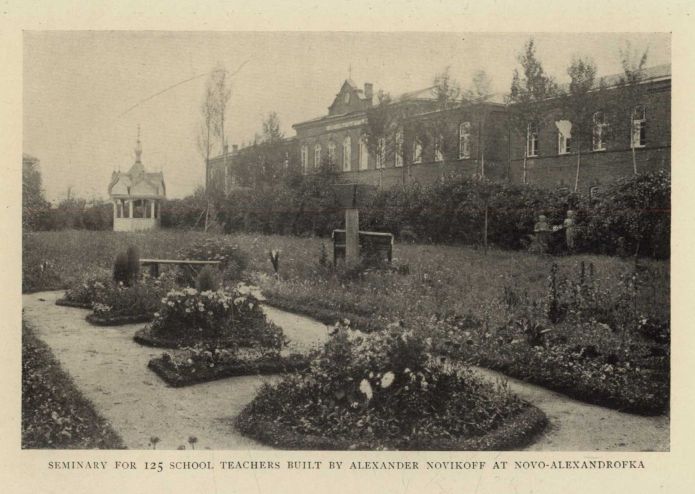
SEMINARY FOR 125 SCHOOL TEACHERS BUILT BY ALEXANDER NOVIKOFF AT NOVO-ALEXANDROFKA
Carlyle and I had one great thing in common:
our distrust of Disraeli and our sympathy with the
oppressed Slavs. In 1878, when the jingoes were
shouting their loudest over the Russian Mission to
Afghanistan, which had precipitated the Afghan
War, Carlyle referred to politics as "a sore subject
nowadays with our damnable premier," as he called
him.
He was always generous with regard to the
humble efforts of the "Rooshian Leddy" as he
called me. He knew that whatever my literary
shortcomings I was sincere, and that was the one
golden key to dear old Carlyle's heart.
When death came within sight, almost within
touch, he regarded it not as an enemy but rather
as a magician who was to open to him a new world
of wonder. It might almost be said that he went
part of the way to meet it. We, his friends, were
always being thrilled by false alarms. One day,
two and a half years before his death, he solemnly
warned those about him of his approaching death.
I recall on another occasion I was told the end
was very near; the next I heard was that he was as
devoted as ever to his omnibus rides. In those
days one never knew whether Carlyle were dying
or riding in an omnibus.
When two years later the end was slowly
approaching, I refrained from going to see him,
thinking it a greater act of friendship to remain
away rather than to make any claim upon his
fast-ebbing vitality. I was deeply touched when
he enquired of those about him: "Why does not
Madame Novikoff come to see me?"
I went and found him very weak, but genuinely
glad to see me. He talked slowly and carefully,
showing that the breaking-up of the body had in
no way affected his magnificent mind. I remember
his complaining to me that Froude wanted him to
correct proofs on his death-bed; but that he had
refused!
I am not what would be described as emotional,
having perhaps more than the average amount of
control over myself; but I felt at the bedside of
that dear old man that I could not keep my
self-possession.
His last words to me were:
"Ay, ay, when you come back here (from Russia)
you will not find me alive."
As to my other old friends, like Kinglake, Froude,
Charles Villiers and Count Béust—who were, in
fact, my daily visitors—I need not more than
mention their names, having written of them so
fully elsewhere.
Among the many interesting personalities whom
I have at various times met, there comes to my
mind the remembrance of Mark Twain. The society
of the great American humorist was always greatly
sought after—a very natural circumstance—for,
unlike many famous wits who keep all their brilliancy
exclusively at the points of their pens, Mark Twain
was sociable and talkative and seemed to have an
inexhaustible supply of delightful anecdotes, ever
ready and at the disposition of his friends. He
called on me one day, and, speaking of his approaching
departure on some pleasure trip with his wife
and two daughters, remarked with a humorous
twinkle in his eye:
"It is fortunate that we have no courier to make
a muddle with our tickets——"
"Why should couriers make muddles?" I asked.
"Have you had tragic experiences of that kind?"
"Not personally," he answered; "but there was
a millionaire who travelled with all his huge family,
the kind of family that is described in the Old
Testament. They gave themselves great airs, and
of course arrived at the station one minute before
the departure of the train, having left everything to
their courier. The latter, however, had evidently
been otherwise occupied, and was late too, arriving
almost at the same moment as the family.
"'How late you are!' shouted the irate millionaire.
'Give me the tickets—quick!' The courier,
in great haste, fumbled nervously among a confusion
of papers in his pocket-book, and thrust into his
employer's hand a packet of tickets. The engine
was already getting up steam, and there was not a
moment to be lost. My poor friend passed the
packet on to a guard and asked excitedly for his
reserved carriage, only to receive in reply a questioning
stare. Alas! The tickets turned out to be of
little use on the railway, for they were—concert
tickets! The courier, you see, was a singer, and had
been thinking too much about his own affairs!"
Mark Twain often amused his hearers by describing
in the most humorous manner his own past jokes.
"Some time ago," he told me on one occasion,
"everyone went mad about table turning! I wrote
a long article on the subject, but in spite of the
remonstrances of my publisher, refused to sign it.
"Don't you see?" he added, "I wanted to be
taken seriously—had I disclosed my identity,
everyone would have taken all I said for a joke!"
So there is something in a name after all, in spite
of Shakespeare!
I have, indeed, seen Mark Twain very much in
earnest. That was on the Negro question. What
seemed to me a great prejudice, represented, in his
eyes, a regular danger to the civilised world. Not
long ago, a very cultivated woman, just arrived
from America, spoke to me with dread about the
impudence and self-conceit of the negroes. How
different her pictures were from those of
Mrs. Beecher-Stowe in Uncle Tom's Cabin!
Another great personality was Verestchagin, the
Russian painter, a very dear friend of mine. I have
elsewhere described him as the Count Tolstoy of
painters. He had the same genius, the same
fearlessness and the same craving for what he
conceived to be the truth, and possibly occasionally
the same exaggerated touch of realism. We Russians
have a way of regarding our great artists as artists,
and if they injudiciously dabble in politics, we
forgive it when considering their genius.
Verestchagin took part in many wars, and it is
not strange that he should say, as he once did to me,
that men were everywhere the same, "all animals,
combatant, pugnacious, murderous animals."
His remarks upon war are peculiarly interesting
at the present time, for he was not an arm-chair
philosopher, but, like Francisco Goya, had seen the
real horrors of war. He pointed out that the actual
killing of the enemy was only a very small part of
war, which means hunger and thirst and great
hardship, sleepless nights, marches beneath blazing
suns, or drenched by rain.
Verestchagin was a great friend of Skobeleff,
and this drew us closely together. The two had
been through the same war together; and I
remember that but for the wisdom of certain Russian
officials that war might have been prolonged.
It is well known that Skobeleff was a man of
very independent character. On the eve of the
Russo-Turkish War some difficulty arose between
him and the authorities, and he determined to resign
his commission and enlist as a private, as he was
determined to fight, no matter in what capacity.
He was saved from this by a prudent act on the
part of the officials known in England as "climbing
down." Who knows what would have happened
had the brave and glorious Skobeleff been one of
the led instead of the idolised leader?
Skobeleff was indeed one of the most charming,
captivating men I ever met. I was acquainted
with his mother at a time when the son was only
known to me by his brilliant reputation. Madame
Skobeleff, passing through Moscow, once invited me
to accompany her on a journey to the Balkans,
which tempting invitation, however, I did not
accept, owing to the fact that my husband was at
the time ill, and I did not venture to leave him.
My matrimonial scruples probably saved my life,
as Madame Skobeleff met her death during that
journey, and had I been with her I should probably
have shared her fate. To be more precise, she was
assassinated by her Montenegrin guide, Uzatis, who
immediately committed suicide, so that the motives
of the murder remained an inscrutable mystery, as
he did not touch her jewellery or her money.
One day I received a letter from Skobeleff, asking
permission to call on me. He came and talked,
which he did to perfection. And I—listened: the
only thing I do to perfection! My heart was
throbbing all the time, to a point that made me
wonder whether it would not burst, as he kept on
talking of his determination to go to Egypt, or
anywhere, for some fighting, no matter in what
capacity, be it even as a humble private.
"Are you not ashamed of yourself," I exclaimed,
"to risk a life so precious to Russia? Stay at home,
exercise your influence on our foreign policy—that
is also a noble work."
"Oh," he answered, "as to that I am convinced
that death will find me, not on the battlefield, but
at home, in Russia. Every day I receive scores of
anonymous letters, predicting the nearness of my
end."
On leaving me, he asked if I would accept his
photograph, which he afterwards sent me, with
charmingly encouraging inscription: "To Mme. Olga
Novikoff from an enthusiastic admirer of her
patriotic work." I may add that this fine portrait
is now in Moscow in the Roumiantzoff Museum.
Two weeks later he was no more.
Verestchagin described to me some of the horrors
of the Bulgarian war. I would willingly have
closed my ears to them, but there is a strange and
grim fascination in horror, especially when described
by a man of Verestchagin's personality.
He saw the Turkish prisoners being driven northward
to Russia and the agonies they suffered. To
add to the frightfulness an early frost set in and the
poor fellows, worn out through the long siege,
dropped by the wayside and were frozen to death.
These scenes enabled him to paint Napoleon's
"Retreat from Moscow." It is of peculiar interest
now to recall the Kaiser's comments when he saw
Verestchagin's picture exhibited at Berlin. He
looked long and earnestly at the canvas, in particular
at the figure of Napoleon tramping through the
snow. He is said to have remarked that such
pictures were our safest guarantees against war.
"Yet," he added, "in spite of that there will still
be men who want to govern the world, but they will
all end the same."
Was this a prophecy, or merely a remark uttered
with the object of blinding his contemporaries to his
real purpose? It is certainly very interesting to
note that the Kaiser would not allow the students
of the military schools to see the "Retreat from
Moscow." People must draw from that their own
conclusions.
Verestchagin came to London on the occasion of
his Exhibition, when I saw a good deal of him.
Suddenly he was called back to Russia, and he came
to me and announced his intention of returning
immediately.
"But," I said, "you cannot leave your pictures."
"There are my two servants," he replied. "They
will look after them."
"But," expostulated I, "they can speak only
Russian, and that will not be of much assistance to
them in London. How can they look after your
affairs when they cannot speak either English or
French?"
"Oh, that will be all right," he replied. "They
will manage."
That was Verestchagin all over. The upshot of it
was that I volunteered to look after his interests,
and every morning I would go down to the gallery
to see if there was anything demanding attention,
and the people at the gallery, apparently marvelling
at such devotion in a friend, insisted upon addressing
me as Madame Verestchagin.
Verestchagin was one of the first victims of the
Russo-Japanese war.
A Pacific Emperor—An Imperial Fault—The Pauper's Funeral—The
Emperor's Visit to my Mother—My Dilemma—The Emperor's
Kindness—He is Snubbed by an Ingenue—The Emperor's Desire
for an Alliance with England—Prince Gortschakoff's
Rejoinder—The Slav Ideal—Russia and Constantinople—Bismarck's
Admiration—He Discomfits a Member of the Reichstag
A noteworthy example of a rapprochement
between England, France, and Russia,
long before the Triple Entente in politics
became an established fact, was the researches
undertaken three-quarters of a century ago, by three
leading scientific authorities, into the geological
features of the Russian Empire. Sir Roderick
Murchison, M. de Verneuil and Count Alexander
Keyserling were appointed by their respective
Governments to make a joint expedition and, as a
result of their labours, wrote a book entitled The
Geology of Russia in Europe and the Urals, which
was published by the British Museum in 1845, in
two volumes. This was indeed a promising beginning,
and may be said to have been the precursor for
much co-operation between these nations long
before an Entente was within the sphere of practical
politics. At any rate, it serves to prove that there
is a natural bond of sympathy between the great
Allies, and that it is in no sense a question of political
expediency.
This took place under the Emperor Nicholas I,
who was always for peace, and in particular for an
understanding with England. The whole situation
in Europe has changed since those days, or rather
seems to have changed. In reality it is not so. A
few persons have made an effort to open their eyes,
and have discovered a well-established fact. That
is all. It is an important discovery, no doubt, so
important that nervous politicians conjure up
imaginary difficulties, and appeal to all sorts of
magic utterances: "Balance of power," cries one;
"Immediate danger," shouts the other; "Traditional
policy," exclaims the third. But all these
appeals might as well not have been made. The
"newly-discovered fact" has been known to
Russians for years, although clever Westerns have
only just found it out. It is indeed only natural
that we should know it first, for it relates to our
Emperor. Europe has learned to feel that there is
once more an Emperor Nicholas on the Russian
throne, and that in Alexander III even the most
imperious of Chancellors found a Sovereign whom
no intimidation could dismay, and no menace could
deter from the path of duty. Some Englishmen, I
regret to say, did not like the memory of the Emperor,
whose noble and generous qualities are more and
more appreciated in History. The Emperor Nicholas I
was undoubtedly a superior man in many respects.
Imperious he was, no doubt—it is an Imperial fault!—but
he was not only disinterested, he was generous
and noble in the highest degree. Books could be
written about his kind actions.
He was once driving on a cold winter's day, when
he perceived a poor hearse, and a still poorer coffin.
There were no followers, but the young driver,
almost a child, was sobbing bitterly, and evidently
overwhelmed with his grief. The Emperor stopped
his horse and asked who the departed was.
"It was my father," answered the boy, through
a new torrent of tears. "He was a blind beggar,
and I had him under my care."
The Emperor left his sledge and followed the
humble coffin to the burial ground. Naturally,
many people followed His Majesty's example, and
the procession became a strange sight. Strange,
but fine—paternal, showing once more the link
between the great autocrat and his people—a link
based on devotion and trust. As a very young
child I have myself experienced the kindness of his
smile, and felt the protection of his powerful hand.
If I may tell the story again, I remember, when
my father died, the Emperor Nicholas I paid a
visit of condolence to my mother, and desired to see
his god-children. My two brothers and I appeared.
I, as the only girl, received from my governess
stringent orders before entering the drawing-room
to "look well and to make a deep Court
reverence." Penetrated with my new role,
and full of zeal, I did
my best—which, alas! turned out to be my very
worst—I bowed so deeply that suddenly all became
confused and I fell over backwards against a pillar.
A horrified glance from mother—the roof with its
painted flowers and Cupids—misery and bewilderment!
But all this lasted only a second. The dear
Emperor rushed to me, seized my trembling hands,
and began praising me as if I had really covered
myself, not with ridicule, but with glory. Thus he
cheered me and made me happy. People who
knew him intimately speak of him with unqualified
devotion. But the fascination he exercised did not
render less commanding the conscious power which
dwelt within him. For he was a power—perhaps
the greatest power of his day.
The great and unexpected steps taken by his
grandson allowed us to hope to find the same
resolute devotion to his country in our present
ruler, Nicholas II, and we did not hope in vain.
The Emperor Nicholas I was charmingly courteous
and kind to young people. Thus, one day, the
Court arrived in Moscow, and the Moscow nobility
arranged a brilliant ball to greet Their Majesties.
Naturally the young girls all longed to be presented
on this occasion. One amongst them was exceedingly
beautiful and attractive. The Emperor addressed
a few words to her, expressing his pleasure
at making her acquaintance. She looked at him
somewhat severely, without answering a word.
"Do you not hear what I say?" enquired the
Emperor in some surprise.
"Yes," replied the young lady curtly, "I hear, but
I do not listen!" (J'enténds mais je n'écoute pas!)
The Emperor, extremely amused by this tone of
self-defence, when he never dreamt of attacking or
offending, went to the Empress. "There is a
charming child here," he said, "most amusing and
innocent. Make her your Maid of Honour." This
was done. By her position she was quite entitled
to this distinction, but still, people were very much
amused. Later on she received other honours,
occupied a high position at our Court, and died only
a short time ago.
One of the great desires of the Emperor Nicholas I
was to establish such a close and cordial alliance
between Russia and England as even then would
form a solid guarantee of peace to the world. It
was his desire to cement the alliance that led him
to make those overtures to Sir Henry Seymour,
which were so basely misrepresented and so perfidiously
utilised to destroy the good understanding
they were intended to promote.
"'You know my feelings?' so Mr. Kinglake
begins the story, in his vivacious and charming but
slightly unjust The Invasion of the Crimea, 'you
know my feelings,' said the Emperor to Sir Henry
Seymour, 'with regard to England. What I have
told you before, I say again; it was intended that
the two countries should be upon terms of close
amity; and I feel sure that this will continue to be
the case; and I repeat that it is very essential that
the two Governments should be on the best of terms,
and the necessity was never greater than at present.
When we are agreed, I am quite without anxiety as
to the rest of Europe. It is immaterial what the
others may think or do.'"
This is what the Emperor Nicholas always said,
and it was with him a fixed idea. "I desire to speak
to you," he said on another occasion, "as a friend
and as a gentleman. [The Emperor little knew how
the confidence he placed in the "gentleman" would
be requited.] If England and I arrive at an understanding
in this matter it is indifferent what others
do or think."
In 1846, during his visit to London, the Emperor
expressed a wish that, while he would do all in his
power to keep the "Sick Man" (Turkey) alive, we
should keep the possible and eventual case of a
collapse honestly and reasonably before our eyes.
This is not the only reason why the memory of the
Emperor Nicholas I is ever grateful to those who
labour for the Anglo-Russian Alliance. Nor is it
the only one why I recall these suggestive passages
just now. Some people invoke the prejudice of the
past to poison the friendship of the future. Let me
take a more grateful course of recalling the repeated
attempts of Russia to arrive at a good understanding
with England. There is a continuity about Russian
policy, and the principles laid down by the
grandfather are followed by the grandson.
It is important to remember that in the last
century, Austria and England, the friends of the
Porte, have taken more Turkish territory for
themselves than we, her hereditary foes.
Let us remember the following facts: The Emperor
Nicholas I decided to concede to England all
she wanted concerning Egypt; and in return, so
far from stipulating for the possession, at that time,
of Constantinople, he offered to make an engagement
not to establish himself there as possessor, not
even if circumstances compelled him to undertake a
temporary occupation of the city. What then was
the Emperor's proposal? It was that of a friendly
understanding, "as between gentlemen," that
certain things should not be done in case of a
sudden collapse of the Ottoman Empire.
Such were the earnest wishes of Russia, but
England remained deaf and prejudiced, suspicious
and hostile. She preferred a bloody struggle to a
hearty alliance, and a tremendous war was
fought—thousands of innocent people killed, millions of
money spent on both sides—and with no actual
result. Does anything remain of the famous Treaty
of Paris? I remember having once asked Prince
Gortschakoff whether it was he or Count Nesselrode
who signed that treaty. The Chancellor was ill,
and thought he could not leave his chair, but my
question electrified him.
"No," he exclaimed, forgetting his illness and
jumping to his feet, "I did not put my name to
that document, but I spent a good part of my life
in tearing it to pieces. And it is torn to pieces," he
repeated, with a vivid, delighted look.
In order to be on good terms with Russia,
England has merely not to interfere in Russia's
dealings with the Slavs, her co-religionists; not
demoralise the latter, not to support elements opposed
to our Church and our nationality. In fact, it is an
easy, negative part she has to play. Instead of this,
in Beaconsfield's days, she quarrelled like a nervous
woman, and we acted, perhaps, like another nervous
woman. Now, however, is the day of strong men,
both English and Russian.
Nicholas I saw that it is of vital importance for
the Slavs, who are no traitors to their country, to
cling to Russia, because she is the only Power
that cares for their Church and their nationality.
The Slavs incorporated with Germany have been
thoroughly Germanised. Austria is not so clever
as her master, but she successfully introduces the
Roman Catholic propaganda among the Slavs;
imprisons men like Father Naoumovitch for his
devotion to the Eastern Church, and morally does
almost more harm to the poor young nationalities
than does Turkey.
I remember when I was quite a child, a young
Southern Slav came to my mother and began
complaining of their position. My mother interrupted
him by asking, "Would you prefer to belong to
Austria?" Though a child, I was horrified to see
the despair of his face. "Oh," cried he, "Austria
is even worse than Turkey. Turkey kills the
body—Austria kills the soul." This is an opinion which,
it may be said, is generally held amongst the
Southern Slavs—and terribly verified in Bulgaria
at the present moment (1916).
It is difficult for outsiders to judge Slavonic
troubles and Slavonic needs. It is a private family
affair, which ought to be left to us to settle. The
Slavs awoke England's sympathies only when it
was thought they were the enemies of Russia.
Alas! They had their pet name in England, and it
was not complimentary.
Is it rational, I ventured to ask in the year 1886,
to awaken general indignation in a country like
Russia, which could be so useful as an ally? We
have common enemies in Asia. Fancy the power
represented by two great Christian countries like
Russia and England, when they are united and
friendly! Is it really not worth having? Time has
given me my answer.
People have been so kind as to say that I have
been mainly responsible for the bringing together
of England and Russia, but whatever I have done
I have merely been carrying on the ideal of the
Emperor Nicholas I.
Kinglake wrote: "The Emperor Nicholas had
laid down for himself a rule which was always to
guide his conduct upon the Eastern Question; and it
seems to be certain that at this time (the eve of the
Turkish war of 1853), even in his most angry
moments, he intended to cling to his resolve. What
he had determined was that no temptation should
draw him into hostile conflict with England."[1]
It must be borne in mind that this is the testimony
of an Englishman, and one who cannot be accused
of being pro-Russian.
It is interesting to recall the words addressed by
the Emperor Nicholas I to the English Ambassador
at Petrograd in 1853. The Emperor then said:
"The affairs of Turkey are in a very disorganised
condition; the country itself seems to be falling to
pieces; the fall will be a great misfortune, and
it is very important that England and Russia
should come to a perfectly good understanding
upon these affairs. We have on our hands a
Sick Man, a very Sick Man. It will be, I tell you
frankly, a great misfortune if one of these days
he should slip away from us, especially before
all necessary arrangements are made. If the
Turkish Empire falls, it falls to rise no more; and
I put it you, therefore, whether it is not better to
be provided beforehand for a contingency, than to
incur the chaos, confusion, and the certainty of an
European war, all of which must attend the
catastrophe if it should occur unexpectedly and before
some ulterior system has been sketched."
The Sick Man certainly has taken longer in dying
than the Emperor thought, but he certainly seems
to be well on the way now.
Nicholas I was a statesman, one who has been
described as bearing "the stamp of a generous and
chivalrous nature."
Bismarck himself, in 1849, expressed his admiration
of the Emperor's conduct in regard to Hungary.
He was always essentially upright and straightforward,
and was in every sense of the term a strong
man.
Writing of Bismarck reminds me of a story I have
heard which I do not remember to have seen in
print.
One of Bismarck's most violent opponents thought
to damage the Chancellor's position by re-reading
one of his own speeches made some years previously.
In a loud determined voice the deputy read Bismarck's
words before the Reichstag, no one listening
to him with more attention than Bismarck himself.
When at last the deputy concluded, confident of his
own triumph, Bismarck exclaimed: "I should
hardly have expected to hear such a prudent, useful
speech, and some twenty years ago nothing could
have been more appropriate. At this moment, of
course, it is quite out of date and could not be acted
upon."
"A Russian Agent"—"To Lure British Statesmen"—A Charming
Tribute—The Press at Sea—Wild Stories—A Musical Political
Agitator—"An Unofficial Ambassador"—Baron de Staal's
Indifference—Prince Lobanoff's Kindness—Count Shouvaloff's
Dislike of My Work—Prince Gortschakoff and the Slavs—Baron
Brunow and the French Ambassador—English Sportsmanship—A
Shakespeare Banquet
How people talked about me in those
days! asking each other who and what I was,
what I was doing, or intended doing.
"Oh! Madame Novikoff," said some, "she is a
Russian agent," and their significant nods and
glances conveyed all sorts of terrible things. I had
come to England, some thought, to lure British
statesmen to betray their country into Russian
hands. In short, quite a number of amiable things
were said about poor, simple me, who tried so hard
to say exactly the truth about what I well knew.
In later years, Sir Ellis Ashmead-Bartlett at a
public meeting paid a tribute to my work which
I quote, not from vanity, but as an unexpected
exaggeration. Sir Ellis said, "As for Madame
Novikoff, it is simply impossible to estimate the
services she has rendered her country. Not all the
diplomatic corps of the Empire and all the Grand
Dukes have done as much for Russia as that lady,
who since 1877 has directed the Russian campaign
in England with consummate ability. She has been
worth more to Russia than an army of 100,000 men.
Nothing that the Tsar could bestow upon her could
adequately repay her peerless services."
But there was the other side of the picture. The
London correspondent of a provincial paper described
me as "one of the most masculine and accomplished
women of her time—she has come to be looked upon
as the Czar's agent, as a sort of unofficial
Ambassador." Imagine my being described as
"masculine," a thing I execrate in women. I became too
accustomed to the term "unofficial ambassador"
to take any notice of it, but "masculine!" Ugh!
Then, said another paper, "Think of the women
who have achieved a reputation in diplomacy—such
women as Madame de Novikoff, Princess Lise
Troubetskoi, Madame Nubar Pasha, Princess Metternich,
and the late Princess Leopold Croy. What
other characteristic is common to them all? Only
this, that one and all they have been inveterate
consumers of cigarettes, and each has availed
herself with signal advantage of the opportunity
afforded by toying with a fragrant papiletto to
reflect before speaking, which women, as a rule, are
said not always to do."
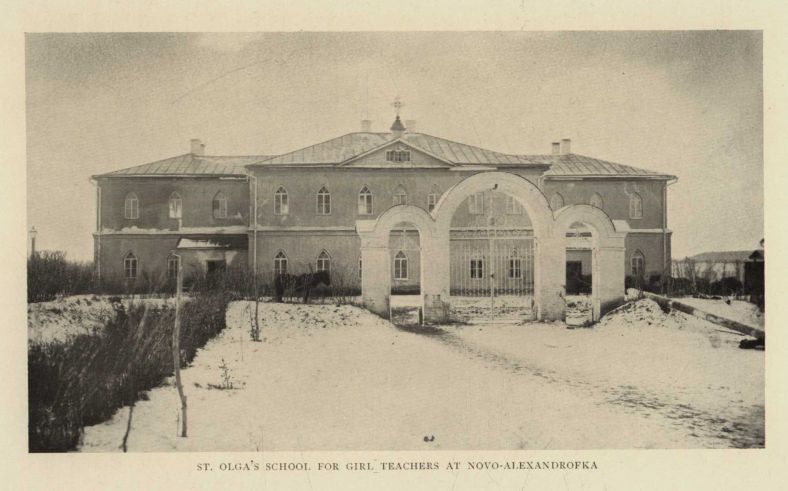
ST. OLGA'S SCHOOL FOR GIRL TEACHERS AT NOVO-ALEXANDROFKA
Alas for the common characteristic! I have
never smoked in my life. But then I may be one of
the women who do not "reflect before speaking." Smoking
is not so common a habit of Russian ladies
as is generally supposed. Indeed, Petrograd society
was a little surprised some years ago when a British
Ambassadress, with kind intent, arranged at the
Embassy a smoking-room for ladies. Even amongst
men, smoking was not universal. My husband was
not a smoker, nor was either of my two brothers.
Several Russian gentlemen whom I know in London
do not smoke.
On another occasion the Press informed me that
I had selected America as my future home. "Her
mission," one paper grandly announced, "on behalf
of Russia has not of course been very popular....
What she has to do for Russia in America the
Yankees will doubtless find out; at any rate she is
backed by the Russian fleet, which will soon be, if
it is not already, in American waters." I need not
say that this was pure imagination. The idea of a
"secret agent" being "backed" by a fleet is, I
think, new in international methods.
I detest the word "mission" as applied to my
work, which was as much in the interests of England
as of Russia, as can easily be seen to-day. Where
would Europe be now if it were not for the Russian
armies, and where would the Russian armies be but
for the English Navy? A woman with a mission is
as objectionable as a man with a grievance.
One provincial newspaper, in a burst of confidence,
assured its readers that Madame Novikoff "does not
suggest the political agitator, she is very fond of
music, and some distinguished artist is generally to
be found at her piano." I have often wondered
what "a political agitator" would appear like to
the writer of this paragraph, and why should he not
be musical?
Was anything ever so bewildering? When I
look over my press-cutting books I cannot do so
without a smile. Now it is all so amusing; but
then it had in it an element of tragedy, for my work
was nearer to my heart than anything else. The
Pall Mall Gazette, for instance, remarked that
"Mr. Gladstone praises Madame Novikoff for her
remarkable ability in handling political controversy.
Some of us think it would be more correct to do
homage to her remarkable ability in handling
political men." This was a tribute to me, in a way,
at poor Mr. Gladstone's expense.
Another industrious young man wrote in 1889,
apropos my return to London, that my "Thursdays"
would be "again the rendezvous of the light,
learning, and wit of London society. At least, this is
how the friends of the Russian lady describe her
parties. But her detractors and enemies say they
are merely a clever trap for attracting people from
whom she may obtain information to dispatch to
Russia. A curious thing is that Baron and Baroness
de Staal, the Russian Ambassador and his wife, are
often to be seen there, so that the legitimate and the
illegitimate purveyors of news to Russia meet on
common ground."
It is quite easy to see which view of my poor
"Thursdays" was taken by the writer of the above.
Neither Baron nor Baroness de Staal were ever
afraid to show me publicly their sympathy and
support. Monsieur de Staal even went so far as to tell
an English Cabinet Minister, who wished to verify
one of my statements, that if Madame Novikoff said
so, it was probably true, for she was often better
informed than he of what the Russian Government
was thinking of doing. "Indeed," said the old
Ambassador, "they never tell me anything until
they have definitely decided on doing it."
I heard this from Mr. Stead, who had just returned
from the Foreign Office, and looked somewhat
bewildered by the compliment paid to me. We were
both amused, since few ambassadors make such
admissions.
Not less welcome than the frank admission of the
Russian Ambassador was the approval of my efforts
by our Minister for Foreign Affairs himself, who,
unlike Count Shouvaloff, about whom I still have a
word to say, recognised the usefulness of my
endeavours to foster friendly feelings between Russia
and England.
It was with profound satisfaction indeed that I
received the following letter from Prince
Lobanoff-Rostovsky:
ST. PETERSBURG,
21 Feb./14 March, 1896.
MADAME,
I admire your courageous perseverance in
dealing with messieurs les Anglais, and I am very
grateful for the assistance that you render us.
Accept my profound respects,
LOBANOFF.
It is such kindnesses which, in supporting and
encouraging my efforts, have bribed me hitherto,
and shall not fail to bribe me in the future.
Sometimes my own people showed themselves
anything but understanding and sympathetic. As
my thoughts wander through the pages of memory,
many shadows from the past arise before me, and I
think of how much good, and also how much harm,
can be done by a man in a great public position.
There are indeed many things in life that one must
try to forget and forgive.
I confess that, unfortunately, my ardent aspirations
did not, in every case, meet with sympathy,
even amongst my own relatives.
I fully appreciated, for instance, the talents and
honourable qualities of my brother-in-law, E. Novikoff,
and much admired his excellent and exhaustive
work on John Huss, the Czech reformer and writer,
who preceded Luther by a whole century. This
book, by the way, is now unfortunately out of print.
But while I always remained a staunch Slavophil,
E. Novikoff, after his appointment as Ambassador
to Vienna, was obliged in his official capacity to
obey the orders of the Foreign Office, and in so
doing yielded so far to Austrian views as to
become indifferent, not to say hostile, to the
Slavonic cause. To me, personally, he invariably
showed friendship, and invited me for a whole year
to the Russian Embassy at Vienna, a visit which I
greatly enjoyed. But I always avoided all reference
to the subjects that henceforth divided us.
This was also the case in my relations with Count
Shouvaloff, at one time our Russian Ambassador in
London, who instead of helping me, constantly did
me harm. He was polite and ceremonious in paying
me visits, but he hated my work. I am surprised
indeed that he did not succeed in paralysing my
efforts altogether. It is useful sometimes to be
tough and obstinate!
In the light of this fact there was something
almost comical in the comment of one journal
which said:
"Madame Novikoff is a Russian agent in close
relations with Count Shouvaloff, and she is the
sister of General Kiréeff and sister-in-law of the
Russian Ambassador at Vienna. This is the person
with whom our ex-premier was admittedly in close
alliance, public and private, during the recent
atrocity agitation. But when the climax of the
pro-Russian agitation was reached, and its managers
believed the overthrow of Lord Beaconsfield to be
imminent, Mr. Gladstone, at the close of the St.
James's Hall 'Conference,' left his seat, went up to
Madame Novikoff, offered her his arm, and led her
triumphantly through the bewildered crowd, in
order to give them an earnest of the anti-Turkish
alliance at last concluded between England and
Russia, and thereby publicly acknowledged that his
relations with that lady belong to the province of
public life, and ought to be treated as matters of
public concern. That also, we have no doubt, will
be the opinion of the country when the nature of
these relations has been more explicitly revealed."
There was one man who occupied a powerful
position in Russia and, as I have said, was well
known in the world, and who boasted that though
he never signed the Paris Treaty, he did all in his
power to abolish the consequences of that detestable
document. I mean the Chancellor of Russia, the
Prince Gortschakoff.
My last interview with him was not altogether
pleasant: with one hand he gave "his praise," with
the other "his blame." (His right hand really did
not know what his left was doing!) But here are a
few facts, now known in Russia, but unknown in
England.
I think I have said that for several years I
carefully concealed my literary identity. In Russia it
was known to Katkoff, the editor of the Moscow
Gazette, in England chiefly to Stead, my English
editor, and to Mr. Gladstone, who was my energetic
political confidant. For that purpose I used my
maiden initials "O.K." (Olga Kiréeff).
On my return home from England I received a
note from the Chancellor asking me to call on him
"as he was too ill to make calls."
By the by, I must say that in Russia it is quite
customary, even for a very young woman, to call
on business, either at a Cabinet Minister's Office or
on an Ambassador at his Embassy.
In both cases the Office and the Embassy take
the place of the absent wives, and such visits are
fully understood. Still, people make some jokes
about wives being thus replaced. But let me return
to my unpleasant interview. The Prince received
me, as usual, very cordially, flattering and
complimenting me, but after which he said: "But, dear
Madame Novikoff, I must insist upon one point and
draw your serious attention to something very
important. You really must not mention the word
'Slav.' Europe hates that word, and Russia must
ignore it."
"But Russians are Slavs, every schoolboy must
know that," I exclaimed.
"Of course, of course," admitted the old Chancellor,
"but Europe hates that word. It is the red
rag thrown to an infuriated bull," etc. etc.
If I indulged in fainting fits I really think that
such friendly advice would have made me sink to
the floor, but that is not in my line. Still, I
protested.
"But, Prince," said I, "you forget that my
brother died for the Slavs, that I, in memory of that
death, am working for that Cause, that Mr. Gladstone,
in his review of my book, Russia and England,
distinctly recommended every Englishman to read
it, and that he himself wrote a pamphlet on the
Bulgarian horrors. Your advice to a Russian, who
naturally is a Slav, means—give up your nationality,
forget it. No, that I cannot do, for that would be
suicide."
I think my vehement indignation amused the old
Chancellor, and he said: "Well, well, but do you
know that people actually think that you are my
agent?"
"It only shows," I said, "how important people's
opinions sometimes are. Let them know that I am
my own agent and nobody else's." He smiled, I
smiled, and we parted—never to meet again.
Of course, we must remember that officials come
and go and have to execute orders, which sometimes
vary and contradict each other. But you can obstinately,
perseveringly, year after year and day after
day—work, in accordance with your patriotic duty,
only when you are guided by your own deep,
independent conviction and ideal!
Why did the Emperor Nicholas save Austria in
1849; alienating himself from the brave Hungarian
people, who during a whole century heroically fought
to liberate themselves from Austrian despotism?
There is a story about another of our diplomatists,
Baron Brunow, which although it has been told
before, is so characteristic of Brunow that it will, I
think, bear re-telling.
On arriving in London for the first time I was
pleased to receive an invitation to the Russian
Embassy, because Baron Brunow knew my mother
personally, and also because I had heard the
following anecdote about him which had greatly amused
me: Queen Victoria, deeply grieved by the death
of the Duke of Wellington, had expressed her wish
that the funeral of the "Iron Duke," as he was
called, should be as splendid as possible. The whole
of the Corps Diplomatique was requested to attend
the ceremony. All the diplomatists unhesitatingly
accepted the royal invitation—with one exception,
that of the French Ambassador. The latter, in a
state of great perplexity and indecision, hurried to the
Doyen of "the diplomatic" world, Baron Brunow.
"I am in a very disagreeable position," he said,
"I am indeed quite at a loss what to do. How shall
I escape from my dilemma? Of course, one does
not like to disobey Her Majesty's wishes—almost her
orders; but one must nevertheless consider before
all else one's duty to one's country, one's national
dignity!"
Unlike a Frenchman, the visitor seemed particularly
agitated and nervous.
"But what is the matter?" exclaimed the Baron.
"I have received no communication about your
difficulty. None of my secretaries has informed me
of anything unusual. What is the matter?"
repeated the old Baron somewhat impatiently.
"Don't you understand?" exclaimed the other.
"The Queen desires every diplomatist to attend
Wellington's funeral. From her point of view she
is quite right. But I, as a Frenchman, can never
forget the terrible harm done by the Duke to the
country I represent."
"Oh!" exclaimed the Russian in smiling surprise.
"You dislike the idea of attending the State
funeral? I confess that I also hardly like the idea
of the fatigue it involves. But then, you are much
younger and stronger than I. Of course, if you were
asked to attend Wellington's resurrection, perhaps
I should say 'don't go'—but his funeral, which
represents the end of all possible mischief to your
country, I can only say, 'Go and attend it by all
means with great satisfaction!'"
I have never been able to find out from the various
books I have consulted relating to those times,
whether or not the Frenchman followed Brunow's
advice!
Although I have never hesitated to speak my
mind, English people—individually that is—have
always seemed to understand me, and my sincerity
has never been allowed either to interfere with my
personal friendships, or hinder societies and
committees paying the compliment of asking me to their
gatherings. In England they love a fighter,
provided he fight fair, and I think I have always done
that. Imagine Germany, for instance, paying
tributes to the commander of an English _Emden_,
which had [done enormous damage to her shipping!
Yet in England almost as much praise was bestowed
upon this German naval officer as in the
Fatherland.
Why was this? Because he had played the
game!
I have received many and unexpected invitations
to be present at public dinners and banquets. When
I received a "card" from the Committee of the
Shakespeare Society for their banquet, I could not
help wondering how anyone could find something
new to say on a subject so well-worn during the last
300 years! Imagine, then, my astonishment, my
horror, when I found on the programme my own
name with the announcement that I was responding
to the toast addressed to foreign guests. My first
impulse was to fly; but such cowardice not being
in my nature, I took my courage in my hands, and
at the given moment pronounced these few words,
as if it were quite a natural thing for me to make
speeches:
"Kind audience,--I am flattered by your amiable
invitation, to which, as a foreigner, I have hardly
any right. But let me tell you that I have a little
friend who renders me invaluable services. I mean
my little watch bracelet, that makes me think of
time and space. I shall not trouble you for more
than five or six minutes; for though I feel myself
to be a veritable Demosthenes, I resemble him only
as he was before his famous pebble cure! You
know that at the time he hesitated, stammered, and
stuttered. Therefore, five minutes of eloquence on
these conditions is all I dare inflict on your patience.
"I will begin by saying that one of the best
translations of your great writer was made by the
Grand Duke Constantine, who died a few months
ago. This charming Grand Duke had, in addition,
a considerable histrionic talent, and his 'Hamlet'
represented by himself at the Palace of Their
Majesties in Petrograd, achieved an immense
success.
"But there is still something else that I shall
take the liberty to say about Shakespeare. In our
day there is much talk of enemies, alliances, friendly
treaties, etc. Nothing can be more apropos at this
moment. But Shakespeare has done something
that surpasses all ententes, alliances, and treaties
between countries large and small. Shakespeare
has become the eternal link by which all parts of
the civilised, thinking, reading world are indissolubly
united. This is a unique part created by an
Englishman.
"As a last word. I can only say, ladies and
gentlemen, you have every reason to be proud of
this acknowledged fact."
Upon this I bowed and resumed my place. My
little speech was received most kindly. There
could not have been a better reward for my laconism.
The Jews and the War—Their Attitude in 1876—Their Hatred of
Slavism—The Problems of Other Countries—English Sympathy—The
Guildhall Meeting—The Russian Government Blamed—Tolstoy
and the Jews—My Jewish Friends—A Curious
Tradition—Self-Protection
In many respects the Jewish Question in Russia
has now become an anachronism. I am happy
to say that a new argument in favour of the
Jews is the part played by many of them in our
ranks during the present struggle against the Central
Empires. Their present attitude has effaced the
great hatred they used to manifest against
everything Russian. But a survey of my work for
Anglo-Russian friendship would be incomplete and would
not be honest if it passed over my attitude on this
question, and especially as the attacks made upon
me have been very vigorous and have forced me to
retort in what was, for me, an almost single-handed
struggle.
My first public expression of views upon the
Jewish Question was in 1882, when I addressed two
letters to The Times in which I protested against
the accusations levelled against the Russian
Government that it encouraged the social war against the
Jews in the southern provinces. I pointed out that
the origin of the disturbances was economic rather
than religious. I said then, as I shall always say,
that the worst charges brought against the Jews
could not by any form of special pleading be held
to justify outrage and murder. I reminded the
Jews that when thousands of harmless peasants,
men, women and children, were being ruthlessly
slaughtered in Bulgaria, they ranged themselves
beside those responsible for the massacres, the
Turks. The next worst thing to committing a
murder is to look calmly on and sympathise with
another who is taking life. That is what the Hebrews
did in 1876. At least they should be logical, and if
they do not like the application of "the Law,"
which demands "an eye for an eye, and a tooth for
a tooth," they should have acted differently in 1876.
When Mr. Gladstone and his friends were fighting
what seemed to be a losing battle, the Jews were
against them. It was a Jew, Disraeli, who was the
arch-plotter against the freeing of Bulgaria, and with
a few exceptions his race was with him. The Jews
hated Slavism, and the Slavs could not be expected to
retort with soft words of brotherly love. In spite of
this, I repeat that the peasant riots against the
Jews in some provinces deserved blame; but the
actions of mobs are never based upon religious
principles or religious teaching.
In England, Russia's Jewish problem is not
understood. I wrote in 1882, and the same applies now:
"It may be wrong to dislike the Jews, but if two
and a half million Chinese were monopolising all
the best things in Southern England, and were
multiplying even more rapidly than the natives of
the soil, perhaps the cry 'England for the English'
would not be so unpopular as some of our censors
seem to think."
The feeling against the Japanese in certain parts
of America is, I believe, every whit as bitter as the
feeling against the Jews in Russia. I have always
been puzzled why the Englishman cannot see this.
The Jew is the Cuckoo of Russia; he is forcing the
aborigines out of their own nest, and Russians not
unnaturally say: "Our own Government helps him
to do it, therefore it is time we helped ourselves."
People are prone to hasty judgment.
In The Times, on the occasion to which I have
referred above, I wrote:
"The Landlordism of which your Irish farmers
complain is but a pale shadow of the cruel servitude
enforced on our peasants by the Jews. The disorders
both in Ukraine and in Ireland are social and
agrarian."
Eight years later the Jewish Question in Russia
once more seemed to catch hold of the English
imagination, and with increased violence.
A flaming up of Russian violence against the Jews
in the south-western provinces of Russia was the
cause. In London Christian sympathy was invoked,
and the heads of the Church, nobility and members
of Parliament besought the Lord Mayor to convene
a meeting of protest with the object of preparing a
Memorial to be sent to the Tsar "to give public
expression of opinion respecting the renewed
persecutions to which millions of the Jewish race are
subjected in Russia, under the yoke of severe and
exceptional edicts and disabilities."
I immediately wrote to The Times pointing out
that before Englishmen began to look abroad for
things to reform, they might well put their own
house in order. I called attention to General
Booth's recently published book, In Darkest England,
which I had read with something akin to horror. I
wonder what would have been said in England if
meetings of protest against the Horrors of London
had been held in Petrograd!
In my indignation I even ventured to assume the
mantle of prophecy. "While your meeting," I
wrote, "will have no effect whatever upon Russians,
it will have a great effect upon the Jews of Russia.
It will proclaim aloud, in the hearing of these
millions, that England and its great Lord Mayor,
with all the wealth of London at their back, have
undertaken the cause of the Russian Jews. And
these poor people will believe it, and thousands
and tens of thousands will sell all they have and
come over to experience the first fruits of the
generosity which promises them a new land of
Canaan—in the City of London.
"I adjourn the further discussion of the Jewish
question until you have had, let us say, ten per
cent of the immigration which these meetings will
invite."
In a little more than the ten years I mentioned
the Aliens Act had become law!
The Guildhall meeting was held on December 10th,
1890, and the Memorial to the Russian Emperor
was carried without a dissentient voice and duly
sent to Petrograd. In February the Russian
Ambassador handed the Memorial to Lord Salisbury
with a request that he would have the kindness to
return it to the Lord Mayor unanswered; as a
matter of fact it had not even been read in Russia.
I need scarcely add that I was assailed by Jews
from every quarter as "one whom the whole Jewish
race recognised as their bitterest enemy," and yet
all I said in effect was that if the Montagues hate
the Capulets, and the Capulets the Montagues, then
all the Acts of Parliament will not ensure peace.
And yet we women are called unreasonable.
I will quote again from one of my letters to The
Times, for although written thirty-four years ago, I
see no reason to change so much as a word.
"The Jewish question is not entirely religious, but
social. Englishmen ought to understand it, for they
have to deal very often with the same difficulties.
An Anglo-Indian member of Parliament, of great
eminence as an administrator in Bengal, was kind
enough to lend me the other day an interesting
Blue Book on the riots in the Deccan, from which I
learn that the most innocent agriculturists in
India have repeatedly attacked the Hindoo
money-lenders, exactly as our peasants attacked the Jews,
and for the same reason. And how did you deal
with this difficulty? Not by increasing the licence,
but by restricting the opportunities of the Hindoo
money-lenders; and as you do it with some success,
your example can be useful indeed. In short, you
do as General Ignatieff proposed to do in his famous
rescript which you abuse so much. Seek to remove
the cause of the disorder by protecting the peasants
against the extortionate practices of the village
usurers."
In those days I was not lazy and wrote as well as
I could; but how difficult people were to convince.
They seemed unable to distinguish between a Yiddish-speaking
Jew, who had been domiciled in Russia, and
a true Russian, and nothing can be more insulting to
a Russian than this. The Yiddish jargon is not used
by men of the Russian race, who have at their
command so rich, so musical, so melodious a language
as that which Pouschkin, Tourguenieff, and Tolstoy
found an adequate instrument for the expression of
their genius.
A Yiddish-speaking man may be a Russian subject,
but he is no more a real Russian on that account
than a Hottentot, being a British subject, is a real
Englishman. Although we Russians may be as bad
as some people describe us, we have at least one
virtue which is not always recognised: we do our
utmost to prevent murderers, thieves, and burglars,
and other criminals crossing the frontier. No
Russian subject is allowed to leave Russia without
a passport, which is never granted to any known
criminal. If any such criminals evade our vigilance,
our police are only too anxious to inform your police
and solicit their co-operation in the arrest of the
fugitive. But such offenders have only to allege
that they are political refugees, to be welcomed in
England and protected by the authorities. In
England murder used to be regarded as no murder
when the victim was a Russian policeman. But
when the same criminals kill an English policeman,
as they did in the Sydney Street affair, the matter
is not seen in quite the same light.
Try to put yourself in our place. What would you
think if "Peter the Painter" had been welcomed
in Petrograd, and if our Government had refused to
give him up because he had only killed an English
policeman, and was therefore entitled to the right of
asylum as a political refugee? Of course, such a
crime against civilisation is unthinkable on the part
of the Russian Government, but it would represent
only too faithfully the position which England has
been proud to maintain before the world.
At the time of the Sydney Street outrage I asked:
"What I want to know is whether, now that you
are suffering a very, very small part of the misery
which these murderers have inflicted on us, you are
willing to co-operate with the police of the world in
extirpating this gang of ruthless murderers? If you
are, you will find ready co-operation on our side;
if you are not, then, I fear, the world will say that
you care nothing for murder so long as it is only
Russian police, generals, or ministers who are
murdered, and you will remain in the future, as in
the past, the refuge and the shelter of the assassins
of the world."
Truth compels me to admit that there are blindfolded
people in Russia as well as abroad, and it is
not only amongst the foreigners that the real nature
of the Russian nation has been sometimes misunderstood.
Unfortunately there are prejudiced people
amongst ourselves who insist upon being blind and
unable to see obvious facts, and the meaning of the
war of 1876 has been entirely misunderstood. Let
us, for instance, quote Count Leon Tolstoy, who
had very peculiar ideas about war. Can anybody,
not only in Russia but even abroad, doubt his
talent? But nevertheless he proved how easy it is
to err in politics even in spite of literary gifts.
I must quote a letter published abroad under the
pompous title, A Protest, signed by Count Leon
Tolstoy and Russian "celebrities." This document
had to be presented to the Emperor—for his
enlightenment. This document, however, never went
so far.
This event should never have been taken au sérieux
anywhere, though stated by a talented author.
Nothing amuses Russians more than to see how
gravely "Tolstoy's philosophy and theology" is
taken abroad. Amongst us he is only great as a
novelist. You may, no doubt, find among the
Russians, as well as abroad, enthusiasts ready to
embrace any craze. Fortunately they have no
lasting moral weight.
The Jewish question in Russia is a very difficult
problem indeed. We have in Russia millions of
Jews belonging to an anti-Christian creed, and those
who imagine it is sufficient for our Emperor "to
write a few lines ordering the country at large to
love the Talmudist Jew," and who fail to see the
difference between the latter and the Greek Orthodox
Russian, forget that even Jesus Christ's law to love
our enemy is often neglected by those who pride
themselves on being His followers. I insist upon the
term "Talmudist Jews." The Karaite Jews having
joined Russia in the greater part of her national
aims and duties, deservedly obtained the same
privileges and rights as the rest of the people. The
Talmudists, unfortunately, take a different ground,
and sometimes have to suffer for it.
At the time of the Guildhall Meeting The Daily
News, with perfect fair play, allowed a correspondent
to state the facts "within their own knowledge." One
of them had shortly before visited the Russian
southern provinces. Here are his very words:
"The Jewish population of Odessa alone numbers
about 100,000 souls. Nearly the whole of the vast
commerce is in the hands of the Jews. They own a
large share of the immovable property in the city.
Of the very few and unimportant industries over
which they do not command an absolute monopoly,
there is scarcely one which is not virtually
controlled by the ramifications exercised by their secret
commercial syndicates."
N.B.—The Municipal Council of 72 members
always includes 24 Jews, or one-third of that civil
and constituent body, and in material power the
Jewish section of the Council outweighs the rest.
The author also admits that "if there were no
limitations at all, the Jewish elements at the
university would exclude all the Russians."
The same paper, allowing also another witness to
be truthful and accurate, admits the following
account from Petrograd itself. After complaining
bitterly of the difficulty of getting from the Jews
themselves any instance of oppression, he expressed
his surprise that: "In the English community,
chiefly interested in commerce, sympathy with the
Jews has been difficult to find. Amongst the
Germans and French," he goes on to say, "the same
dislike of the Jews is found."
The Anglo-Saxon race has shown to the world
how careful it can be in defending its interests on
the least appearance of danger from without. The
innocent children of the Celestial Empire have been
simply hunted out of America and Australia, although
these poor timid creatures never dreamed of
establishing an imperium in imperio which can be
dangerous to the State, nor even asked for any political
rights at all, their only ambition being to live in
peace and to work for their rice and their rats.
The Russian Government, though not hampered
by the ignorant prejudices of the masses, is obliged
nevertheless to acquaint itself with public feeling,
and to do its best to paralyse mischievous outbursts
from whatever source. Thus in protecting the
Russians from the Jews, our Government is, in fact,
in accord with the parliamentary spirit of the age
in its support of the protesting majority against an
aggressive minority. England, of all the world,
should be the last to blame those efforts.
It must not be thought that I am anti-Jewish as
far as individuals are concerned. I have had very
friendly relations with many Jews, including
Auerbach, Mr. George Montofiore and Dr. Max Nordau,
to quote only a few names. The last-named dedicated
to me his play The Right to Love, after the Guildhall
fiasco. Perhaps the most curious thing was that
whereas I was attacked by Jews and vilified without
mercy, my friends in Russia were angry with my
"judophilism."
Just before last leaving for Russia, I was startled
by the contents of a letter which appeared in London.
The Jewish author of that curious document is
fortunately personally unknown to me. He actually has
the impudence to say that "in Russia a foreigner of
the Hebrew persuasion can easily find means and
ways—generally for the sum of fifty roubles—to be
transformed ad hoc into a true believer, into a Christian
of any denomination of his own choice." To me that
phrase is a regular riddle. Thank God! I do not
know people who for fifty roubles, or no matter for
how many roubles, may change their political or
even religious creed. Being a convinced Christian
myself, I can only be glad when I hear of somebody
who has appreciated the Greek orthodox views
enough to adopt them. Our Church prays daily for
such unions, and I cannot understand why I should
doubt the good faith of such proselytes. Has not
Jesus Christ Himself ordered to propagate His
teaching, and counselled us to love our enemies? I
do not see why we should wound their feelings by
doubting their good faith. A Hebrew or a Mohammedan,
after the establishment of a new moral link
with us Christians, ought to be treated as a brother
and an ally.
Even without that Christian union a very great
gulf exists in Russia between the "Talmudist Jews"
and the "Karaims" (in England called "Karaites").
The latter are treated with confidence and respect,
and their dealings are characterised by integrity
and love for Russia—two qualities which are not
by any means the predominant characteristics of
the Talmudists. All this can be easily proved. A
curious tradition seems, in the eyes of some Russians,
to account for that great difference between people
of the same race. The ancestors of the "Karaims"
are said to have left the Holy Land much before the
beginning of our era, escaping thus the blame of
having taken any part in the crucifixion of Jesus
Christ—hence their moral superiority!
In protecting our country from obnoxious
proselytism—be it religious or political—we defend in
reality that great unity; which naturally has to be
in accordance with our Church. But our Church,
as such, does not interfere with the temporal power.
Her only weapon is the exclusion from her bosom
of those who depart from her teaching and her
practice.
My Russian Home—The Horrors of Famine—The Peasants'
Heroism—Starving yet Patient—The Society of
Friends—I am Invited
to Meeting—Magnificent Munificence—Among the
Starving—Terrible
Hardships—Some Illustrations—The Stoical
Russian—Cinder Bread
The Tamboff Steppes have a great
fascination for me. I was always very happy
at Novo Alexandrofka, our country home.
It possesses the beautiful church built by my son.
Then I have there my two other attractions, the
two splendid schools, each capable of accommodating
over one hundred pupils, that for boys
being called St. John's, after my husband's patron
saint; and the girls' school, of which I am directress,
is called St. Olga's. My son and I were always
ardent believers in the importance of education, for
in it lies the whole of the world. Good teachers
are necessary above all, and bad schools do more
harm by their existence than no schools at all,
and there is nothing more wonderful or beautiful in
Russia than to see the passionate eagerness of the
peasants to have their children educated. I am
happy to say that, thanks to our excellent teachers
and the principal director, a very superior priest of
our church, all our examinations have resulted in
very fruitful success.
At Novo Alexandrofka, my husband, my mother,
my brother, Alexander Kiréeff, my son (the founder
of the church) Alexander Novikoff—are already in
the family vault. The last addition will be myself,
and then the vault shall be definitely closed.
Some ten years ago when I was present at the
final examination of the girls, no less than nineteen
fulfilled the requirements of the Tamboff Education
Committee, and were all qualified to become
school-teachers. Since then we have had only excellent
results of our schools.
The most unhappy time I ever spent at my
home was during the terrible famine in Russia in
1892. I could not remain in England while my
country was suffering so. I felt that my place was
at Tamboff, and I accordingly left a land of plenty
for poor, desolate Russia. I remember only too
vividly those terrible days of famine. At one time
my son Alexander had under his charge no less
than 33,000 men, women and children, all
depending upon him to find them food.
I call to mind one terrible day that brought from
Alexander this tragic telegram: "Funds exhausted,
send me something, position indescribable." It was
terrible, tragic.
All the work done by the Relief Committees was
voluntary. The Grand Duchess Constantine fed
2000 people a day.
Even in those days we strove to guard against
reckless charitable effort, which can only have a
demoralising influence. I call to mind one person
who insisted on his name being unknown, offered
my son 1000 roubles to be spent in providing food
for the inhabitants of a certain village on the
condition that the amount were regarded only as a
loan, which should be repaid and subsequently spent
on that same village for educational purposes. This
donor was doubly a donor by the proviso he made.
It was a tragedy to see splendid men in the prime
of their lives, walking about with stony faces and
hollow eyes. With them were women clothed only
in wretched rags, and little children shivering in the
cold wind. They would crowd round the relief
parties, which drove about in sledges, holding out
their hands saying:
"We have sold our last horses, cows and sheep,
we have pawned all our winter clothing; we have
nothing left to sell. We eat but once a day, stewed
cabbage and stewed pumpkin, and many of us have
not eaten that."
This was true. There were some among them
who had not tasted food for days. It was agonising
to hear these poor people pleading to us for mercy
lest they die of starvation. As they spoke in dull
voices, tears would spring up into the eyes of strong
men and course slowly down their cheeks into their
rough beards; but there were no complaints, no
cries, just the slow, monotonous chant, broken by
the sobs of worn-out mothers and the cries of hungry
children.
We had neither wood nor coal, only straw and
the refuse of stables, for fuel. The Volga was frozen,
and in some provinces corn was absolutely unprocurable.
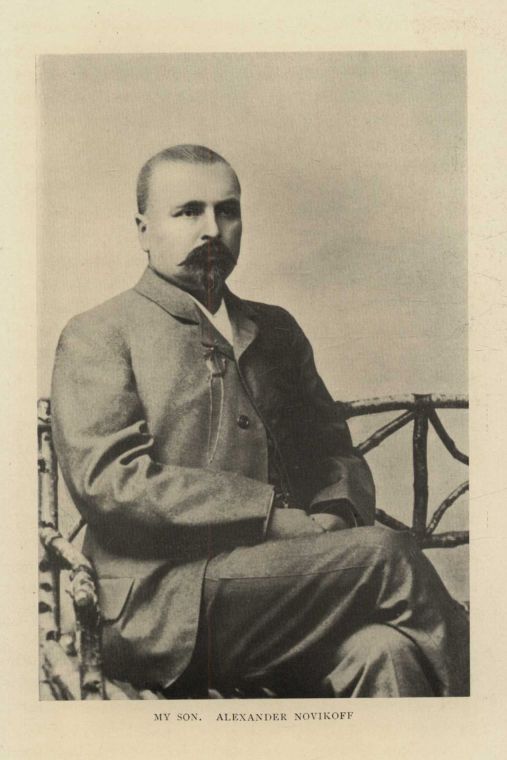
MY SON. ALEXANDER NOVIKOFF
In that great calamity the help given by the
English Society of Friends was very remarkable.
After some preliminary enquiry, I was invited to
attend a Committee Meeting. There were, I think,
between twenty and thirty present, and I was the
only woman. A series of questions was addressed
to me about the state of things in Russia. I
exaggerated nothing. I concealed nothing. I told them
that an unforeseen blow had befallen sixteen of our
provinces and found us unprepared to combat its
effects. My son, Alexander Novikoff, was just
organising a committee in the district of Kazloff
(Tamboff province), and, thanks to him, I knew the
question fairly well. "The Friends" listened
attentively, but said very little. Mr. Braithwaite, the
chairman, only expressed a hope that "God will
help our efforts." Nothing more: but without
losing a day they went to work, and worked
splendidly. They not only collected about £40,000,
but sent their delegates—Mr. Edmond Brookes and
Mr. William Fox—to distribute their help on the
spot amongst the famine-stricken peasantry.
Do you know one of the results of such practical
application of sympathy?
It is now generally admitted in my country that
unofficial Englishmen are "kind and generous,"
and, when left to their own true nature, are capable
of being friends deserving trust and confidence.
I also received, quite unsolicited, liberal
subscriptions from friends in the City, which enabled
me to send without delay much needed relief to the
starving peasants in my district of Tamboff. The
"English bread," as they called it, is remembered
and spoken of even now.
Perhaps the best description of that terrible
famine, and of the efforts to relieve it, is that
recorded in an interview with me by the
representative of The Week's News, which I therefore
transcribe, the more so because that enterprising
journal sent out a special Commission to our famine
districts to report upon the situation there. Here
is the interview:
"NOVO ALEXANDROFKA,
"12th February, 1892.
"A beautiful night drive across the snow from
Bogojawlensky brought me to Madame Olga Novikoff's
estate during Wednesday night. The thermometer
stood at 36 degs. Fahrenheit below freezing
point, yet the air was so calm that the cold was
scarcely noticeable. A heavy hoar frost covered
the trees, and the slight mist gave a weird aspect to
the desert of snow that stretched away on every
side. Without a house on the horizon to direct him,
the jamschick drove out into the night, and the
sledge glided along over the crackling snow.
"Mr. Alexander Novikoff, the son of Madame
Olga Novikoff, was at Novo Alexandrofka to
welcome me, and put me in a position to judge of
the state of things in his district of the Tambov
Government. He is Zemski Natchalnick, and very
popular amongst the peasants whose little
differences he has to judge.
"In the early morning we started off to visit the
hospital in the village of Tooriévo. After all that
has been said of the condition of Russian hospitals
at this moment I was agreeably surprised, both at
the cleanliness and the absence of patients whose
illnesses might be directly attributed to the famine.
I, however, found there the first case of hunger
typhus that I have seen, and learned from the
surgeon, Dr. Malof, that in one village close at hand
there were no fewer than 150 similar cases.
"This is one of the strongest proofs of the hardships
through which the people are now passing. It
is the disease that always follows in the wake of war
and famine, and although the mortality amongst
those seized is relatively small, the fact that
numerous cases are occurring is significant. They
arise from stomach disorders, brought on by
insufficient and bad food, and the disease then takes
the course of ordinary typhus.
"Tooriévo is a long straggling village, and
contains about 1000 huts. The harvest in the
neighbourhood was fairly good, and the population
will probably weather the storm. Another large
village in the district, Céslavino, with its 7000
inhabitants, is suffering intensely, the majority of
the inhabitants being in receipt of relief. I found a
particularly bad state of things in the village of
Spasskoe. Amongst the 1500 inhabitants there were
but three huts in which there was sufficient corn to
keep the occupants till the next harvest. Most of
the families are already receiving help from the
Government, and the private committee presided
over by M. Novikoff.
"I will mention but few cases in this village
where the monotony of misery is so apparent in the
deserted street and the dilapidated huts. This is
the only village I have visited in this neighbourhood
where the uniformity of distress compares
with the village in the south of Tambov that I
described last week.
"Paul Axenoff is the head of a family of nine,
comprised of two old people, Axenoff and his wife,
and five children. They were receiving aid from
both the authorities and the committee, but they
had run through everything except three pounds of
bread that was to last them for some weeks to come.
The same thing happened to them last month, and
in spite of all their efforts to secure food they ate
nothing for three days prior to the last delivery of
the month's flour.
"The horse and cow have both been sold, and the
outhouses pulled down and used for fuel. Straw is
usually employed in Russia for heating, but this
year there is none, so the peasants are glad to find
anything to burn. There is very little wood in this
part of the country, and what there is is young, and
has evidently been planted by the landowners.
With the exception of a sheepskin cloak worn by
one of the boys who came in from school while I was
in the hut, the members of Axenoff's family had
nothing to wear but the rags in which they stood.
"In this hut I discovered a fresh article of food—a
soup made of hot water and weeds. They didn't
eat it for the good it might do them, but simply for
the sake of having something hot. At another hut
in this village I found a similar concoction made
with boiling water and chopped-up hay.
"All the bread I found in the next hovel was
broken, and had been begged from house to house.
The occupants had burnt the wood, straw, and
outhouses they had at the beginning of the winter, and
were now pulling the straw from the roof over their
heads to keep the hut warm.
"Although this was a new-fashioned hut, that is,
one with a chimney, the occupants had stopped this
up to prevent the fire burning too quickly, and to
keep the heat in. This caused the suffocating smoke
and tar-like odour that is found in the chimneyless
huts.
"On leaving this place we struggled through the
snow to visit another house from which the roof had
been torn, and which was almost embedded in the
quantity of snow that the gale of the previous night
had whirled round it. The mayor of the village,
who accompanied me, told me that the family of
five persons included a dying woman, and two
children down with scarlatina.
"With some difficulty we struggled through the
four or five feet of snow that barricaded the door,
and on getting it open we found the outer part of
the hut half filled with snow that had been driven
through the unthatched roof. We had some trouble
to open the door leading to the inner room, and
when this was done the mayor seemed surprised to
find that the place was tenantless.
"He enquired amongst the neighbours what had
become of Nicolas Semine and his dying wife.
Nobody knew, and all were lost in surmise as to
what might have happened had they been driven
forth by the storm of the previous night. We
continued the tour, and half an hour later I came
upon a scene the like of which I hope never to see
again.
"Eight or ten persons were crowded into a hovel
not more than ten feet square. An unconscious
woman had been leaned against the brick stove to
keep her warm in the stifling atmosphere. On the
ground several dirty and ragged children were
playing around two suffering creatures, whose arms and
faces were masses of sores. I had already taken in
these details when my guide told me this was
Semine's dying wife and scarlatina-stricken children,
that a man he pointed out was Semine himself, and
that the ten-year-old boy lying on the stove was his
eldest child.
"I was not able to understand how the father
and this boy brought the dying, and now
unconscious, woman and the two children through the
storm of the previous night. I had myself had an
experience of the blinding violence of clouds of snow
blown across the plains by a hurricane.
"The story of the refugees is a very sad one; I
will tell it just as it was told me. Between the time
the harvest failed and the time the authorities
commenced to aid the family, they had been obliged
to sell everything they possessed to get food, and to
pull down the outbuildings for firing purposes. The
wife had been ill since autumn, and to keep the place
warm they had been obliged to burn first the table,
then the benches, then the old clothes, and last of
all, to pull the straw from the roof and burn it.
"Yesterday they had nothing. No food, no firing,
and the wind drove the snow through the unthatched
house. To have stayed was certain death,
so they wandered out into the night and were taken
into the house where I saw them on condition that
they consented to the four walls of their hut being
pulled down and used to heat the hovel in which
they had taken refuge. They brought no food with
them, and the family of four persons which has
taken them in had just five pounds of bread to last
till the end of February.
"In the hut occupied by Timothy Metchariakof
I was shown some lebeda flour which the peasants
often mix with rye or maize flour thinking that it
gives nourishment to the bread. The fact that
there are quantities of lebeda this winter is another
sign of famine. Whenever the crops fail the weed
from which the grains of lebeda are thrashed is found
in abundance.
"In spite of what the peasants say about the
satisfying properties of these seeds, the doctors
consider the flour made from them most injurious to
the health. All sorts of stomach complaints can be
traced to the consumption of bread of which it is an
ingredient.
"The bread was very black everywhere, but as
long as this blackness resulted from the use of rye
flour it was not unhealthy, and the bread although
rather bitter was not uneatable. In many houses,
however, the people had mixed anything that came
to hand with the flour served out to them, and the
bread consequently suffered.
"I tasted some this morning in which cinders or
grit was undoubtedly one of the ingredients. It is
also generally very badly baked, and if the authorities
can improve on the official bakers I have seen,
there should certainly be a public bakery in each
village, as many of the sufferers have not sufficient
fire in their stoves properly to cook anything.
Disease will go on increasing even more rapidly than
famine if this unhealthy food is eaten by the
peasants.
"I visited a great many of the families in this
village so as to be satisfied that I was not basing my
judgment of the distress on exceptional cases. The
misery I found was very widespread, and actual
starvation is only avoided by the aid of the Zemstvo
and M. Novikoff's committee. If these aids were
stopped for a week, nine-tenths of the village would
be starving.
"From Spasskoe I drove across to the little
village of Dolguinko, where I found a part of the
population living in holes dug in the earth. Towards
the end of last autumn, one half of the village was
burned to the ground. The work of rebuilding had
scarcely commenced when winter set in, and those
peasants who were not able to lay beams and
branches over their partially-built huts and thus
make a roof, dug holes in the ground in which they
are now living with their families.
"To reach these burrows it was necessary to
follow a long passage cut in the snow, at the end of
which was a hole through which the visitor was
supposed to let himself, legs first, and then steady
his descent by catching at the snow till he felt the
ground beneath his feet. I did all this, and am not
certain whether I was not more astonished at my
safe arrival than the occupants of the hole were to
see me.
"Beyond the difficulties of entrance and exit the
hole is no darker than an ordinary hut. But a
more horribly insanitary place of abode for human
beings it would be hard to find. As could only be
expected, it was very damp, and the occupants
were condemned to stand and sit in several inches
of mud, and to support the drippings of the snow
melted by the heat of their fire. However they
manage to live with insufficient nutriment amid such
surroundings I cannot imagine. The man in one of
these burrows that I visited was making wooden
boots, for which he could earn a penny a pair. If
he worked very hard he could make two pairs a day.
"On returning to Novo Alexandrofka, I looked
over the books of the district of which these villages
form part. It comprises twenty-five villages, with
a total of 60,000 inhabitants. How many of these
are relieved by the authorities cannot be said, but
M. Novikoff's Committee has supplemented the
efforts of the Government by feeding 10,436 persons
during the month of January. Each one of these
10,436 persons was the recipient of twenty-five
pounds of flour.
"According to the inventories made of the
possessions of every inhabitant of the district, the
number of destitute, unprovided for by Government
relief, will increase by more than 1000 a month,
and will reach 18,000 by June. The committee has
already distributed 650,000 pounds of flour since its
institution. As many Britons have aided this work
by funds sent to Madame Olga Novikoff, it will
interest them to know what is doing.
"In the village of Novo Alexandrofka no one is
in receipt of relief. Thanks to M. Novikoff, who has
endowed it with elementary, secondary, and adult
schools, it is a particularly happy village, and counts
800 teetotalers in a population of 900 persons.
"Before leaving the Tambov Government, I may
say that although in certain villages the want is
appalling, and is rendered more palpable by the
condition in which the inhabitants live, I do not
anticipate an overwhelming disaster in this province.
It is well served by railway lines, though the
companies have little rolling stock, and grain can be
easily conveyed to these central Governments if it
is in the country, and has been brought to some
available spot before the thaw."
On a second occasion, when the present War
Charities began to press for support, the same kind
friends in the City and elsewhere, who had helped
during the Russian famine, again came forward and
collected for me a handsome sum. Part of this
money I had the satisfaction of distributing to
Russian, British and Serbian Red Cross funds. A
part also (2000 roubles) was sent as a Christmas
present to the wounded soldiers in H.I.M.'s Hospital
at Petrograd, in gracious acknowledgment of which
I received the following telegram from the Empress
Marie:
"Am greatly touched by your letter and your
generous gift, for which I wish you to express to all
those who have contributed my warmest thanks.
MARIE."
From the Princess Helène (daughter of the King
of Serbia), to whom I had also sent a small sum,
came the following telegram:
"Best thanks for your generous gift—profoundly
touched—affectionate greeting."
And from Monseigneur Cyril, Bishop of Tamboff,
came his acknowledgment of my remittance:
"Generous gift received—great joy—many thanks
and blessings."
The Grand Duchess Elizabeth, who is at the head
of so many charitable institutions in Moscow, and
takes such an active interest in good work there,
also very kindly acknowledged the small sum sent
to her. All these remittances were kindly telegraphed
for me by Monsieur de Helpert, the obliging Director
of the Russian Bank for Foreign Trade.
Amongst other remittances to Petrograd was one
of £50 to Lady Sybil Grey, who was at the head of a
Red Cross branch there, and respecting the safe
transmission of which I had consulted her father,
Earl Grey, who replied to me with the necessary
advice, and concluded his letter with very warm
acknowledgments of the kind and hearty reception
his daughter had met with in Petrograd.
Later on I had the additional satisfaction of
raising a further sum for War Charities by the raffle
of a Diamond Ornament, for which purpose my
friend, Lady Primrose, lent me her house as well as
her valuable personal aid.
The above are a few illustrations, among others
that might be added, of the British warm-heartedness
and generosity that never fails in time of need.
My Mother—Her Musical Friends—I Study with Masset—His
Generous Offer—Litolff's Visit—My Mother's Musicales Develop
into a Conservatoire—Rubinstein's Anger—His Refusal to Play
for the Grand Duchess Helen—The Idols of the Musical
World—A Friendly Jealousy—My Stratagem with Liszt—Glazounoff's
Kindness—The Musicless
Our great poets Pouschkin and Lermontoff
admired my mother's beauty; Yazikoff
also wrote a lovely poem in which he
says that
The ancient Greeks would have delighted
To kneel and worship at your feet,
To build you shrines of snowy marble,
Where clouds of fragrant incense sweet,
From golden altars night and morning,
Would rise your image fair to greet.
But my mother was not merely beautiful, she
was also exceedingly kind and very artistic. The
great musician and pianist Thalberg dedicated to
her one of his lovely nocturnes, and I afterwards
inherited Liszt's kindness for her memory. In the
year 1860 my mother used to invite to our house
every Thursday first-rate musicians like Nicolas
Rubinstein (as fine a pianist as his brother Anton),
eminent violinists like Laub and Wieniawski, the
'cellist Cossman, and other celebrated instrumentalists,
from whom we heard, with greatest
enjoyment, examples of the finest classical music,
which lasted from eight to ten. At ten the young
people were allowed to dance, and I am ashamed to
say that my young friends much preferred the
second part of the evening to the first!
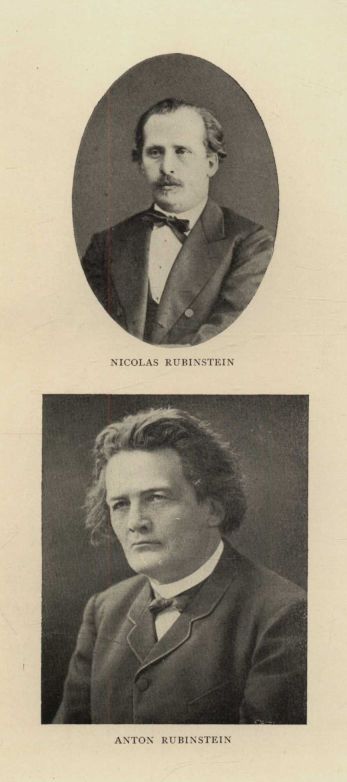
NICOLAS RUBINSTEIN, ANTON RUBINSTEIN
A year or two after my marriage, having (as
mentioned in a previous chapter) been ordered by
my parents-in-law to accompany them to Paris, I
duly obeyed, and I think I may say that my life
there was unique. From ten in the morning till
ten in the evening, I almost invariably stayed with
the old people, sitting with them in the Bois, or
laying a "Patience" (the only one I know) at home.
I gained, however, one great benefit. I managed
to take daily singing lessons at the Conservatoire
at half-past eight in the morning, from the celebrated
Masset, who took great interest in my progress.
But at last my time was over, for I had to rejoin
my husband and my boy in Petrograd. When I told
Professor Masset that I was taking my last lesson,
he seemed greatly surprised.
"Oh!" he said, "I guess why you are stopping
your lessons. But you are wrong. I will give you
lessons gratis for two years, on condition that you
make your debut in Grand Opera. One reason why
I ask high fees is in order not to be besieged by too
many pupils."
"Well," said I, "of course twenty-five francs per
lesson is a large sum for daily lessons, but that is
not my reason. I am unfortunately obliged to
interrupt my studies for another reason, my husband
wants me to return home."
The Professor looked perfectly horrified. "Your
husband! Are you then married?" he exclaimed.
"Yes, I am," I answered, "and I have a son."
"Voilà une surprise!" he cried. "And does
your husband sing well?"
"Oh no, he does not sing at all."
"Then what does he do?"
I had to explain as well as I could my husband's
position, to which Masset impatiently retorted,
"Well, I only wish I had not taken such pains with
your lessons!" which I thought more frank than
polite, but the poor Professor was disappointed to
find that he had been wasting his time on a mere
amateur.
In order to practise singing without disturbing
my old people, I took a little mansarde in the same
house, and, when hidden there, the concierge had
my order to say I was out. One afternoon, I went to
my piano and was studying hard Gluck's "Orpheus,"
when suddenly, there was a violent knock at my
door.
"Won't you let me in?" cried a voice. "Your
stupid concierge insisted that you were out, but I
heard your voice, which I recognised. Let me come
in, I am Henri Litolff."
I opened the door, but I said, "You see that I
have only a piano and one chair. I cannot receive
visitors."
"I will take the chair, and will accompany you,"
was the answer. And then we had a charming
improvised concert.
My mother's musical parties led to an important
result. Struck by their success, Nicolas Rubinstein
and his friend the millionaire Tretiakoff, conceived
the idea of founding a Conservatorium in Moscow.
My dear native town is very enthusiastic and generous
when she realises the importance of a great idea. A
foundation for a Moscow Conservatorium was
immediately arranged, whilst Nicolas Rubinstein's
elder brother, Anton, submitted the same idea to the
Grand Duchess Helen, who at once identified herself
with a similar project for Petrograd. Thus we came
to possess two Conservatoriums, with the two
brothers Rubinstein as their Principals, Anton in
Petrograd, Nicolas in Moscow, to the great
adornment of both capitals.
In that enterprise the Grand Duchess Helen
showed her true grandeur. And here again, as in
the question of the emancipation of the serfs, she
found a great supporter in her nephew the Grand
Duke Constantine Nicolaievitch. I should like any
English travellers who visit Moscow and Petrograd
to make a point of seeing these two Conservatoriums,
of which we certainly may be proud.
I continued to be on good terms with both the
Rubinsteins, and the Grand Duchess Helen often
invited Anton to her parties. But one evening
something happened which was far from pleasant.
Whilst Rubinstein was playing one of his lovely
compositions, a young fellow very "well born,"
but very badly brought up, began turning on his
heels muttering in an audible tone something about
"Rubin, Rubin, Rubin" (inflamed, I was told, by
jealousy in connection with a young girl who was
extremely enthusiastic about the artist). Rubinstein
stopped playing and left the palace. The next
day he called on Baroness Rhaden, lady-in-waiting
to the Grand Duchess, and said, "The Grand
Duchess is kind enough to offer me 2000 roubles for
my performances; I must decline that payment, as
also the honour of playing again at the palace. I
am quite ready to play to the Grand Duchess when
she is alone, but not otherwise."
A few days later the Grand Duchess sent for me.
"Is it true," she said, "that the bear is playing at
your house every Thursday?"
"The bear! Madame, do you by chance mean
Rubinstein? If so, yes, he plays for me every
Thursday."
"Well but, how do you manage to tame him?
Do you know that he actually refuses to play at my
palace on any terms?"
"The only thing I can suppose, Madame, is that,
although I have no grandees to lend attraction to
my receptions, my artist friends, like Rubinstein,
Wieniawski, Litolff, etc., always meet with an
attentive hearing—they are always accorded
complete silence."
"Yes, but Rubinstein should understand that
what occurred at the palace the other night was
quite an unfortunate and exceptional mischance."
The Grand Duchess, as she looked at me, was
evidently very angry, nor did she hasten to invite
Rubinstein again. But very much later the storm
subsided, and peace was restored.
The brothers Rubinstein were, naturally, the
idols of the Russian musical world. In Petrograd
it was Anton whose reputation was highest. In
Moscow Nicolas was considered the superior. A
friendly jealousy on behalf of the two great musicians
existed between the two cities. Anton in his later
years had a charming villa at Peterhof where I have
met also his wife and family. I remember that, at
the conclusion of a discussion on Wagner's
magnificent, but lengthy, Music Dramas, Rubinstein said
he doubted whether anyone could listen to music
with real attention and enjoyment for more than
two hours at a time. A frank admission! But was
he not right? He also endorsed Paganini's dictum
about the necessity of daily study. "If I do not
practise one day I notice it. If I do not practise
two days, the public notice it." One of his friends
and collaborateurs was Leopold Auer, who was for
so long principal Violin Professor at the St. Petersburg
Conservatoire, and to whose eminent talent
the world owes so much.
Amongst other well-known musicians whom I
have known in my earlier years, were Litolff (already
mentioned, who, like Thalberg, dedicated a
composition to my mother), Ferdinand Hiller, Halevy,
Stockhausen, Ole Bull, Madame Pauline Viardot,
Liszt, Tchaikovsky and others.
I knew Liszt well in Weimar, where I spent a few
weeks. Once when he called on me at the Hotel de
Russie, I happened to be changing my dress after a
long walk. As I began to hurry my toilette, I heard
enchanting sounds from my piano below. Judge of
my delight to be listening to Liszt's improvisations.
Instead, therefore, of hurrying, I prolonged my
change of dress to what I considered would be the
extremity of my visitor's patience. But I found him
friendly and smiling, not in the least annoyed, when
I at last entered the room. Indeed, he evidently
guessed why I had delayed so long, and was even
amused at my little stratagem.
Here is a letter from him:
MADAME,
Le charme et l'émotion de votre chant m'a
fait complètement oublier hier que je n'étais pas
libre de mes heures aujourd'hui. Veuillez bien
m'accorder indulgence et me permettre de venir un
autre jour pour vous renouveler mes très respectueux
hommages?
FR. LISZT.
It was Liszt also who introduced to me Lassen,
who came every morning to teach me his lovely
songs. In Weimar, Lassen was quite an artistic
personage.
But I might ramble on for ever with such
reminiscences. A few words only about later
acquaintances in London. Amongst these I think
I ought specially to mention my distinguished
compatriots, Glazounoff and Safonoff.
Tchaikovsky was also here and had fully intended
to return to London, where his glorious music had
become so popular, and had indeed accepted the
invitation of an English friend to be his guest during
the forthcoming visit. His death in Petrograd
occurred shortly afterwards, to our great loss.
On one of Glazounoff's visits I had a small musical
gathering, at which the young Russian 'cellist, Varia
Irmanoff, was to play her composition "Volga"
(Air Russe pour Violoncelle), which she had dedicated
to me. Unfortunately her accompanist never turned
up. Glazounoff, seeing the poor girl's embarrassment,
then went very quietly to the piano and said,
"I will accompany you." Very Russian in kindness
and simplicity! I was proud of him.
A few minutes later, when my other pianist, the
talented Miss Vera Margolies, came, Glazounoff
seemed delighted to meet his favourite Russian
artist-friend, just returned from new successes in
Paris, and about to achieve another success at the
Queen's Hall under the direction of our great
Safonoff.
I must add a few words on Mrs. Rosa Newmarch.
She has rendered great service to the artistic world
in publishing her two big volumes on our great
Tchaikovsky, and her works on The Russian Opera
and The Russian Arts, and we Russians must always
think of Mrs. Rosa Newmarch's efforts to bring about
an artistic entente between Russia and England.
Safonoff, that grand artist so well known to
London orchestras and audiences, used, in his
lighter moments, to amuse us with his inimitable
six-line caricatures on the back of menu cards, or
on any handy scraps of paper.
In these later years I used frequently to meet
that grand violinist August Wilhelmj, and shall
never forget the rather rare examples he gave us of
his extraordinary gift of tone, in that respect
reminding me somewhat of Laub.
I used also to meet Auer on his occasional visits
here, during which he introduced to me his
celebrated pupils, Kathleen Parlow and Mischa Elman,
who have since won world-wide fame.
Ernest De Munck, the eminent Belgian
violoncellist, formerly married to Carlotta Patti, I knew
very well during his last residence in Londen, and
often heard him perform on his beautiful "Strad." He
had made his reputation throughout the world,
and after the death in Paris of his celebrated wife,
he spent his last years in London. We had many
mutual friends in the musical world of former days.
The above are some of the dii majori of the
musical profession past and present. But there is
also much excellent amateur talent in English
Society, to which I have often listened with real
enjoyment. On the other hand, I must confess that
some of my best friends have shown a conspicuous
absence of "music in the soul," though far from
being on that account "fit for treason's stratagems
and spoils!" I need hardly repeat my well-known
story of dear Kinglake, who used to be unutterably
bored by music, and frankly admitted that, of all
instruments, he preferred the drum! His attitude
was, I suppose, somewhat like that of your celebrated
Dr. Johnson, whose attention was called at a musical
party (at which no doubt he unwillingly found
himself) to a tour de force of an eminent performer on the
violin. "Is it not wonderful?" said an ardent
listener. "I wish, sir, it were impossible," replied
the grim Doctor.
A Fatal Treaty—Gladstone's Opinion—The Concert of Europe—The
Unspeakable Turk and His Methods—England's
Responsibility—Mr. Gladstone's Energetic Action—Lord Rosebery
Resigns—Gladstone's Astounding Letter—"I Shall Keep Myself to
Myself"—"Abdul the Damned"—"A Man whose every Impulse
is Good"—The Convention of Cyprus—Russia and England
There is an old and cynical saying that no
lawyer draws up an agreement or contract
without an eye to the future. If ever a
document left trouble for the future it was the
Berlin Treaty. The clause referring to Armenia
was tantamount to handing over the wretched
Armenians to the Turks; for the Concert of Europe,
that misbegotten child of the Treaty of Paris, has
failed consistently in its futile endeavours.
The contention of Russia has never been better
expressed than by Gladstone in a letter to me dated
January 2, 1877, in which he wrote: "A guarantee
dependent on the Turk for its execution becomes
thereby no guarantee at all." Again, on February 6,
he wrote: "The real issue, so far as I can see, will
arise when the question shall assume this form:
Is Russia to be left alone to execute the will and
work of Europe?" This is exactly what Russia
did in 1876, unless it be contended that the "will of
Europe" sanctioned the wholesale massacre of
harmless citizens by the very power ordained to
protect them—the Ruling Power.
The Sublime Porte has been as consistent as the
Concert of Europe in evading its responsibilities, and
it is needless to say that it as carefully refrained
from carrying out its undertaking with regard to
Armenia as the Powers on their part did from
insisting on the reforms. Possibly the argument of
the Concert was that, as there were no "ameliorations
and reforms" on the part of the Sublime
Porte, there was no opportunity for them to
"superintend their application."
None of us who knew the Turk had any doubts
as to the truth of the atrocities at Sassoun. These
things were too common. The scale differed, the
crime was always the same. And what was it?
The crime was the establishment—or the
re-establishment—of Turkish Mussulman authority over a
Christian race. If that were the crime, who were the
criminals? On that point I should like to be allowed
to say some plain truths, hoping that my English
friends will tolerate the candour in others which
they never hesitate to practise themselves. The real
criminals who were responsible for the atrocities
which horrified the civilised world were not the
Kurds—who at first got all the blame. The criminals
who perpetrated the massacre were Turkish regular
troops, commanded by Turkish officers acting in
direct obedience to explicit orders from the Turkish
Government.
But although the direct complicity of the
"Sublime" Porte in these hideous crimes was not
disputed even by the Pashas of Stamboul, it was
not with them that the responsibility of these
horrors originally lay.
The crime at Sassoun lay primarily at the door
of Disraeli. It was one of the many disastrous
results of that "peace with honour" which
Mr. Gladstone had the courage to describe as a peace
that was no peace, with the honour that prevailed
among thieves.
That may seem to be a hard saying to those who
do not know the facts. To those who do it will be a
mere truism.
Why was it that the Armenians at Sassoun were
left as sheep before the butcher? Why was it that
the Sultan and his Pashas felt themselves perfectly
free to issue what order they pleased for the massacre
of the poor Armenians? The answer is, unfortunately,
only too simple. It was because England at the
Berlin Congress, and England alone—for none of the
other Powers took any interest in the matter—destroyed
the security which Russia had extorted
from the Turkish Government at San Stéfano, and
substituted for the sterling guarantee of Russia the
worthless paper-money of Ottoman promises. Was
it not, then, England's doing that these poor
wretches were outraged and murdered by the rulers,
to whose tender mercies England insisted upon
consigning them?
Let me prove my case: In the treaty of San
Stéfano, the Turkish Government entered into a
direct and explicit obligation to Russia to guarantee
the security of the Armenians.
Article 16 of the Treaty of San Stéfano runs thus:
"As the evacuation by the Russian troops of the
territory which they occupy in Armenia, and which
is to be restored to Turkey, might give rise to
conflicts and complications detrimental to the
maintenance of good relations between the two
countries, the Sublime Porte engages to carry into
effect without further delay the improvements and
reforms demanded by local requirements in the
provinces inhabited by Armenians, and to guarantee
their security from Kurds and Circassians."
Now, it is obvious that this clause imposed clear
and precise obligations not only upon Turkey, but
also upon Russia. If the reforms were not carried
out, if the security of the Armenians were not
guaranteed, Russia would have been bound to
interfere, and would have interfered, to compel the
Turks to carry out their treaty obligations.
This article seemed to the British plenipotentiaries
to give Russia a virtual protectorate over Armenia,
and therefore they insisted upon striking it out.
The poor Armenians were forbidden to look for their
protection to the strong arm of the Tsar. The
Turks were delivered from their express obligation
to guarantee the security of their Armenian subjects,
and it was calmly decreed that the Armenians
should be content with Article 61 of the Berlin
Treaty. That clause ran as follows:
"The Sublime Porte engages to realise without
delay those ameliorations and reforms which local
needs require in the provinces inhabited by the
Armenians, and to guarantee their security against
the Circassians and the Kurds. It undertakes to
make known, from time to time, the measures taken
with this object to the Powers, who will watch over
their application."
Mark the difference. In place of a positive
obligation entered into with the only Power near
enough and strong enough to enforce the fulfilment
of treaty engagements, there was substituted this
engagement, over the execution of which the Powers,
in their beneficence, promised to watch: as the
execution has never begun, the Powers were not
overburdened with much "watching." "Waiting"
rather expresses what they did—waiting for the
Turks to begin the fulfilment of the promises which
they made to collective Europe years and years ago.
They are waiting still. Meanwhile the Armenians
were massacred, as, for example, at Sassoun, and
not there only. But even this did not exhaust the
criminal responsibility of Lord Beaconsfield. He
had taken Cyprus as a material pledge for the
execution of reforms in Asiatic Turkey. But there
were no reforms in Asiatic Turkey. The only effect
of the Anglo-Turkish Convention was to increase the
confidence of the Sultan that he could do as he
pleased in Armenia, Article 61 of the Berlin Treaty
notwithstanding.
England, therefore, was responsible in three ways.
She destroyed the Russian guarantee exacted by
the Treaty of San Stéfano. She framed the
worthless "watching" clause of the Berlin Treaty, and
then, to preclude all possibility of effective
pressure upon the Turk, she concluded the Cyprus
Convention, which established an illegal British
protectorate over the Asiatic dominions of the
Sultan.
At Sassoun was seen the result of that policy.
No amount of dispatch-writing, friendly advice, or
admonition would improve the condition of the
Armenians. Remonstrances were idle. What was
wanted was action. But who could act? No
Power could occupy and administer Armenia but
Russia. Unfortunately, she had no wish and no
obligation now to undertake so arduous and so
thankless a task. But who else was to do it?
No one did it; for Russia had once played
St. George and Europe had thrown back the maiden to
the dragon.
When I heard of the Armenian massacres in 1894,
I was more horrified than surprised. When the full
confirmation of the horrible news arrived, it made
my heart sick. What was even worse, if that were
possible, was the fact that the relations between
England and Russia were strained. All Mr. Gladstone's
energies were concentrated upon urging on
Lord Salisbury's Ministry the coercion of the Sultan,
single-handed if need be. The result was Lord
Rosebery's resignation as Leader of the Liberal
Party in the Lords, as a protest against a policy
that in his opinion could not fail to plunge Europe
into war.
Prince Lobanoff, who was responsible for Russia's
policy of opposition to armed intervention against
Turkey, aroused Mr. Gladstone's indignation, and I
came in for a share of his wrath by virtue of my
defence of Prince Lobanoff. At that time
Mr. Gladstone wrote to me:
HAWARDEN CASTLE,
October 18th, 1895.
It is most kind of you to waste powder on an
outcast like me; an outcast first from active life;
secondly I feel—from your scheme of opinion I
cannot read your articles—not because I deal so
little with newspaper print, but because I am afraid
of disagreeing with you, and in this case I prefer
ignorance to strife. I am, you see, possessed with an
idea as to the truer mode of dealing with the Sultan
and his accursed system, founded upon my
experience in the year 1880—when we received most
valuable and effective aid from your good and great
Emperor Alexander II.
Now I have no power and little knowledge—and
my imagined knowledge may be all wrong. It is to
this effect:
(1) That Lord Salisbury is not up to the mark in
all points, but that he is the best of those who
have the matter in their hands. The best there is
at the moment to do the work.
(2) That he is held back by others—not to act,
say, according to rumour, most by Russia.
If this is so it is most painful, for this Armenian
case is the very worst of all that has yet happened,
and if the Powers are beaten by the Sultan, whom
every one of them can crush with the little finger,
they will be deservedly covered with indelible
disgrace.
There is plain speaking for you.
It was; but I replied soothingly, trying to put to
him Russia's case. His reply electrified Europe.
It ran:
October 22nd, 1895.
MY DEAR MADAME NOVIKOFF,
In these sad circumstances I am so far
comforted as to believe that there is no occasion for
controversy between you and me. We have in
some critical circumstances heartily co-operated,
and I think we have the same sentiments as to
Armenia.
I shall carefully and for many reasons keep myself
to myself.
I see in The Times that the wretched Sultan,
whom God has given as a curse to mankind, waving
his flag of triumph, and the adversaries at his feet
are Russia, France and England.
As to the division of the shame amongst them, I
care little. Except that I hope that my own
country, and for its good, be made conscious and
be exhibited to the world for its own full
share—whatever that may be.
May God in His mercy send a speedy end to the
grinning Turk and all his doings. So I said when I
could say, and could even sometimes do, so I say in
my political decrepitude and even death.
Always yours sincerely,
W. E. GLADSTONE.
This letter was the sensation of the hour. Here
are some of the English press comments upon it:
"An extraordinary letter," "the sensation of the
hour," "startling vehemence," "now famous letter,"
"essentially Gladstonian," "silly and wicked
balderdash," "ring of life and strength," "shameful
letter," "Tory papers are terribly shocked," "has
startled the civilised world."
When I returned from Russia to England in 1896,
one of the first things I saw on reaching London was
"Plain words to the Assassin," in large letters on
the newspaper posters, staring down upon me from
the hoardings, and I found people still telling each
other what a dreadful fellow the Turk really was!
Plain words, strong words, fierce words was the
diet presented to the Sultan in varied diplomatic
sauces; but the dish was always the same, and his
response was quite as monotonous. To empty words,
plain or flavoured, he replied by massacres, and this
seemed likely to go on for ever. For us this
passe-temps was monotony. To the poor Armenian, alas,
it is death!
I rejoiced to see that the English nation was
weary of the vaticinations of diplomatists, and was
urgently demanding not words, but deeds. It
reminded me of 1876, that great year when so many
brave attempts were made to change its traditional
policy—attempts which, unfortunately, met with
but partial success. And above all I rejoiced to
hear once more sounding deep and loud, like the
great bell of our grand Kremlin, above the general
hubbub, the commanding note of Mr. Gladstone's
voice—that voice through which the heart and
conscience of nations has so often found utterance.
But although in some respects like 1876, there
was this difference, which, as a Russian, I felt more
keenly than any one. In 1876 Russia led, and
though no other Power followed, we fought, we
suffered, we triumphed! In the Armenian question
the initiative of chivalrous action was no longer
ours, and bitterly I regretted it. It did not seem,
however, to have passed into any other hands. But
that made things worse. Why was it that Russia
was not as in 1876? The answer was easy. Because
of the Treaty of 1878.
Mr. Gladstone lamented and condemned the
policy of Prince Lobanoff. With the lament I
concurred. From the condemnation I dissented. Prince
Lobanoff's policy in Turkey was inevitable. The
responsibility for that departure from our traditional
policy rested with England, and it was for England
to say how long it should continue.
The vividness with which England's Armenian
agitation brought 1876 back to my mind also
recalled not less vividly, the hideous disillusionment
of 1878; and I had reason. For through these
years of trial and of triumph I did my utmost to
persuade my countrymen that England was
Mr. Gladstone and not Lord Beaconsfield. The generous
enthusiasm of St. James's Hall made me wrongly
suppose that it was equivalent to a resolute reversal
of England's traditional policy. But when we had
made our sacrifices and settling day came, we found,
alas! to our cost, that England was Lord Beaconsfield
after all, and not Mr. Gladstone. Imagine the
reproaches that were addressed to me! No one
can ever realise the reproaches I addressed to myself.
We were not likely to make that mistake again.
We were no more to be deluded with words than the
Sultan was to be coerced with adjectives. We
looked at facts—hard, disagreeable, ugly though
they were—and adjusted our policy accordingly.
The first fact was the Sultan. In 1896 England
called him "the Assassin" and the "accursed." Mr. William
Watson even went to the length of referring
to him as "Abdul the Damned." But England,
alas! saved him in 1878, and she gloried in the
deed. When Lord Salisbury reported from Berlin
the net result of English diplomacy at the Congress,
he boasted that it had "restored, with due security
for good government (!), a very large territory to
the Government of the Sultan," and that the
alterations made in our Treaty of San Stéfano tended
"powerfully to secure from external assault the
stability and independence of his Empire."
It is difficult to repress a bitter smile when
recalling the positive assurances which were given
to Europe by Lord Beaconsfield as to the "angelic"
character of Abdul Hamid, who was then England's
protégé, England's ally, England's favourite.
Russia maintained that no Sultan could be
trusted to protect Christian subjects, and
Mr. Gladstone concurred. Everywhere there must be a
guarantee. Either the populations must be freed
entirely from his rule or an outside Power must
superintend and enforce the execution of reforms.
England met this with a flat refusal. She made it
the first object of her policy to restore the direct
uncontrolled authority of the Sultan over as wide
a territory as possible, and Lord Beaconsfield exulted
in the fatal success of that policy for many reasons,
but especially for one, which most of my English
friends seem to have forgotten, but which Russians,
being the sufferers, do not forget so easily.
Lord Beaconsfield was sure he had done right
because the Sultan was such "a good man." On his
return from Berlin, in his speech at the Mansion
House (July 27, 1898) he gave the following
testimonial to Abdul Hamid—the hero of to-day:
"I look to the individual character of that human
being as of vast importance. He is a man whose
every impulse is good. However great may be the
difficulties he has to encounter, however various
may be the influences that may ultimately control
him, his impulses are always good. He is not a
tyrant, he is not dissolute. He is not a bigot. He
is not corrupt."
The comments of the Young Turks on this
pronouncement would be interesting.
England had her way. Abdul Hamid, "whose
every impulse was good," reigned by virtue of his
action in 1878 over regions from which Russia had
driven him out. But that was not all. England
deliberately spoiled, as may be seen by reference to
the protocols of the Congress, every stipulation
made to compel the Sultan to keep his word. His
"impulses were so good" it would be cruel to make
provision for the proper execution of his treaty
obligations! He must be left unhampered and
uncontrolled. England rejected Russian proposals
to impose upon all contracting parties the mutual
duty of controlling the stipulations of the treaty
because the Porte objected to allow within its own
limits the control of other States. That was not to
be thought of. The Sultan must be left free and
uncontrolled to obey those "good impulses" of
which Lord Beaconsfield was so well assured. Thus
it is that Europe was paralysed over the Armenian
massacres.
In face of such a situation which had thus been
created, and in the midst of an impotence which was
prepared in advance at the Berlin Congress, Russia
was overwhelmed with denunciations because she
did not remain true to the crusading policy of 1876.
This hardly seemed to me to be what in England
you call "fair play."
But that was not all. If we had merely to do with
the Berlin Treaty, we might have endeavoured to
make the best use of the worthless weapons which
it contains. Unfortunately, the responsibility of
England for the inaction of Russia was far more
direct, far more deadly, than this.
For Lord Beaconsfield, and the English people
applauded him, with the evil prescience of hatred,
foresaw the Armenian massacres, and provided in
advance for the paralysing of Russia's generous
initiative. He even fixed a date when events would
compel Russia to face the necessity of resorting to
force to coerce the Sultan, and, as he publicly
explained in the heart of the City of London, he
regarded it as the crowning achievement of his
policy to prevent such action on our part by the
solemn public pledge of immediate war by England
in that case.
Lord Beaconsfield said:
"Suppose the settlement of Europe had been
limited to the mere Treaty of Berlin. What are the
probable consequences which would then have
occurred? In ten, fifteen, it might be twenty years
[it has been exactly eighteen!] the power of Russia
being revived, her resources having again resumed
their general strength, some quarrel would again
have occurred, Bulgarian or otherwise [Armenian
this time], between Turkey and Russia, and in all
probability the armies of Russia would have assaulted
the Ottoman dominions both in Europe and Asia,
enveloping with her armies the city of Constantinople
and the powerful position which it occupies.
Well, what would have been the probable conduct
under these circumstances of the Government of
this country?"
This was the vital question for Prince Lobanoff,
and the answer to it has shaped the whole policy of
Russia.
Lord Beaconsfield continued:
"Whoever might have been the Minister and
whatever the party in power, the position of the
Government would have been this. There must
have been hesitation for a time, there must have
been a want of decision and firmness, but no one
could doubt that ultimately England would have
said: 'This will never do; we must prevent the
conquest of Asia Minor and must interfere in this
matter to assist because of Russia.' No one, I am
sure, in this country who merely considers this
question can for a moment doubt that that must
have been the ultimate policy of this country."
Therefore, he went on to explain (I summarise
the points of a long speech), in order to remove any
possible doubt on the subject, the voice of England
should be clearly, firmly, and decidedly expressed
in advance, and this he claimed he had effected by
the conclusion of the Cyprus Convention. There
has to be no more hesitating, doubting and
considering "contingencies." England was, once for
all, definitely committed to defend the Asiatic
frontier of the Ottoman Empire against any advances
of the Russian army in any quarrel, "Bulgarian or
otherwise."
This, he declared, was "the ultimate policy" of
England, and he embodied it for all men to see in
the Cyprus Convention. Lord Salisbury had
previously described that convention as an undertaking
given "fully and unreservedly" to prevent any
further encroachments by Russia upon Turkish
territory in Asia.
That was plain speaking. The Convention of
Cyprus, therefore, was a document prepared to
prevent our taking any action for the protection of
the Armenians. It meant war—war by England,
by sea and land all round the world, against Russia
if she advanced a single company of armed police
into the valleys of Armenia. With this Convention
still in force, who could blame Russia for not joining
in operations against Abdul?
Of course I was told—even by Mr. Gladstone
himself—that the Cyprus Treaty contained no obligation
to protect the Assassin in Armenia except on condition
of reforms, and that the Sultan had been informed
long ago that the covenant fell to the ground by his
breach of faith in not giving the reforms.
This, I confess, was news to me, and in Russia we
knew nothing of any such abandonment of the
Convention by the English Government.
In those years the Russian people did not move,
although they undoubtedly followed with intense
interest all the eloquent speeches delivered in
England on behalf of the unhappy Armenians, for
Russia certainly can never be indifferent to the
Christian cause in Turkey. All her policy in the
East had that permanent basis. But this time the
lead was taken by Great Britain, who was credited
with some definite plan of her own. Russia's help
was never asked in the only way which could be
fruitful, and her Minister of Foreign Affairs, Prince
Lobanoff, unhesitatingly expressed his dissent from
the half-measures which were proposed, and which
would only irritate the Sultan and further injure the
cause of the unhappy Armenians—bad enough
already.
Thank God, their losses did not amount to the
250,000 lives stated in the English Press; but even
the tenth part is a terrible, terrible slaughter. The
poor Armenians would never have risen in rebellion
had they not expected from Great Britain the help
that the Slavs received from Russia. I suppose our
crime is that we did not do Great Britain's work.
But really this cannot constitute Russia's duty!
It was at the beginning of 1878, when the long
agony of the War of Emancipation in the Balkans
and in Armenia was drawing to a close, that I
published Is Russia Wrong? It was a protest and
an appeal against the fatal superstition that our
two countries were natural enemies. The appeal
was for the re-establishment of the Russo-English
alliance, which seemed to me essential for the best
interests of both countries. It was venturesome,
perhaps even audacious, to issue such an appeal
when all your arsenals were ringing with
preparations for war with Russia, and when Lord
Beaconsfield was even completing his arrangements for
forcing your fleet up to the gates of Constantinople.
In those days there were few who listened to
Russian protests; among these few, however, were
the flower of English intellect. My great friend,
Mr. J. A. Froude, in an eloquent preface,
commended my appeal to the attention of his countrymen.
Mr. Carlyle honoured it with his emphatic
assurances of support. In fact, it was he who was
the first in urging me to republish in book form all
my letters on the Anglo-Russian relations. Four
years later, when I re-issued the appeal with other
matter in my Russia and England, M. Emile de
Laveleye reviewed it in the Fortnightly, but so
great was the popular prejudice against Russians,
that Mr. Morley would not allow him even to name
the author of the book whose proposals were under
review. I shall never forget De Laveleye's
indignation at having been so roughly treated by the editor.
"It is pure despotism," exclaimed he. "People
talk of freedom of opinion, and they will not allow
you, at the same time, to express that which you
most strongly hold! It is despotism and deceit
combined. Of all kinds of despotism—the worst,"
concluded he. I did not contradict my friend, as he
was expressing exactly my own views.
Fortunately for me, Mr. Gladstone was not
handcuffed in the same way by the editor of the
Nineteenth Century. He reviewed the book not only at
length, but warmly supported my humble plea for
a cordial and good understanding between the two
great Empires which dominate Asia. "Every
Englishman," said he, with his wonderful
outspokenness, "must read this book." His advice
may have been followed by some of his party, but I
certainly ignominiously failed to convince the
Jingoes.
But all this is very long ago and a new era has
since opened for Russia and England. I have
written this chapter to show what apparently
insurmountable obstacles have been overcome to
allow Russia and England to join forces in 1914
with the common object of freeing Europe from an
intolerable tyranny. In the meantime, poor Armenia
suffers as even she has not suffered before, and once
more Russia is carrying hope to the hearts of
unfortunate Christians ground beneath the Turkish
heel.
Russian Dreamers—Fighting a Curse—First Steps—An Interesting
Encounter—A Great Reform—Its Acceptance by the Peasants—The
Cabman's interrogative—He Begs me to Intercede with
the Tsar—The Temptation of Drink—My Peasant Teas—The
Drink Habit—Our Courageous Emperor
There are some people who accuse me of
being a dreamer, and I confess they are
not altogether wrong. For many years I
"dreamed" of an Anglo-Russian understanding;
it was the great dream of my life. I could have
wished that it had been realised without the shedding
of rivers of blood and the wasting of tens of thousands
of lives; still, I have been spared to see my
dream come true, and I can only hope that out of
this terrible sacrifice good may come.
Some of my friends were as inveterate dreamers
as I, notably Mr. M. Gringmuth, the editor of The
Moscow Gazette, who, in 1908, announced his
determination of struggling energetically against
drunkenness in our beloved Russia. "We must convince
our Government," he said, "of the absolute necessity
of stopping this evil and of finding better sources of
revenue—sources more worthy of a great country."
I remember with what thankfulness I read these
patriotic words. In alcohol I saw a greater enemy
to Russia than Nihilism and all its kindred influences.
It was the secret enemy eating into our country's
very vitals. Then came the day when, with a stroke
of the pen, our Tsar did the greatest thing that any
monarch has ever done for his subjects—he killed the
foe that had been for generations menacing millions
of homes.
There have been many dreamers in Russia who,
like Mr. Gringmuth, have fought the common enemy.
I remember in the year 1899 I was travelling in
Finland. It was a bitterly cold September day,
and I was glad when we reached Terioki (a station
an hour's distance from Petrograd) to get some
refreshment. Sitting in a corner of the room I was
enjoying my cup of tea, when suddenly I heard a
rough and imperious voice.
"A glass of gin (vodka). Be quick!"
"But we have no gin," replied the waiter. "We
sell no alcohol here."
"What is the meaning of this? Well, then, give
me some wine."
Again the waiter answered quietly, "We sell no
wine at this station."
"Dear me! How absurd!" exclaimed the rough
voice. "Well, then, give me some beer at once."
"Very well, sir, I can offer you beer, but only if
you also take some solid food. Here are beef-steak,
chops, patties—choose what you like."
"All right, all right; give me beer and anything
you like besides," shouted the thirsty traveller.
Grumbling and vexed, he swallowed his steak and
drank his beer, looking with disappointed eyes at
the half-bottle that had been placed before him.
I followed the scene from my corner, and was
greatly amused. During that time a gentleman
who was studying my face seemed to read the
meaning of my satisfied and joyful look.
"Madam," he said politely, taking off his hat,
"pardon the liberty I take in addressing you, but I
see you are pleased with this little scene."
"Pleased," I repeated; "no, I am not pleased, I
am delighted."
"Well," continued he, "let me tell you that our
struggle against drunkenness has not been in vain.
And I am happy to meet people who seem to
sympathise with the results of our work."
"Tell me more about it," I said. "I must know
how you manage to paralyse drunkenness, even at
railway stations, where there are so many sorts of
people."
"Ah, it has gone further than those," proudly
replied the unknown. "It seems that only a strong
step in the right direction was needed to set the
whole enterprise at work. The simple but
important programme we have adopted is to induce
our people to feel that a drunken country—like a
drunkard—may easily degenerate and go to ruin.
We are determined not to fall in that abyss."
"But what are the practical measures you
recommend and which you apply?"
"Since this important duty became clear to us,"
he said, "we started to work with great energy. We
established in every town and every village
temperance meetings, conferences, discussions. We
distributed useful leaflets, simply but clearly
expounding our views on the necessity of our struggle,
and I am happy to say we have been all this time
extremely successful. Our schemes have been
eagerly accepted, and our society has immensely
increased. In fact, our success has far exceeded
our warmest expectations, both in diminishing the
hours for the sale of alcohol and in reducing the
number of public-houses. In many places—in
Viborg, for instance—even beer is not sold. Those
who want to buy alcohol must go elsewhere—that is
to say, where our propaganda has not yet been so
well established. No doubt it is only a question of
time; far wider results are certain.
"Our propaganda," he continued, "at first seemed
strange. Now all our societies compete with each
other in zeal and energy. During our last elections,
all our candidates secured the support of the
tee-totallers, and when in Parliament, strengthened by
the agitation, they carried most drastic measures."
"And yourself," I asked, "what political party
do you belong to?"
"Heaven forbid!" exclaimed he, as if I had put
the most grotesque question. "I am a business
man. All my time is absorbed by my business, and
I have never had time for politics. Those who
sympathise with our propaganda are my friends,
that's all."
"What keeps your societies together? What
pledges? For how long is the pledge binding?
With us, in Russia proper," continued I, "each new
member takes an oath in church, and likes to feel
that there is a religious element connected with his
pledge."
"We require nothing of the kind," answered he;
"the moment a man recognises the harm of alcohol
he clearly sees where his duty lies, that's all. The
conditions concerning the furtherance of our
propaganda differ. In some places there are no alcohol
shops at all. In others there are only a limited
number of public-houses. As a rule, where they
reduce that number they also limit the hours of
sale."
"But I understand, according to the charming
scene we have just witnessed," said I, "restrictions
are also put on beer, whilst Count Witte actually
recommended to teetotallers beer as a deviation from
alcohol."
"Can it be possible?" exclaimed the gentleman.
"What was his object in doing so? Every man
knows perfectly well that it is only a question of
degree. The substance remains the same. When
you start with beer, you gradually go to the gin.
This is known everywhere and, I repeat, by
everybody. Among certain precautions, which are very
useful, though they may seem at first glance trivial,
is this. Where the sale of alcohol is not absolutely
abolished, only diminished, gin is never sold in small
bottles, which could be carried in the pocket. Alcohol
is sold only in large bottles, which are too costly for
the poor man and too cumbrous. The latter have
to go to some other place or town—which is neither
a cheap nor easy way of getting what one wants.
As to private sale, it is out of the question, as it
would be denounced immediately by some teetotal
neighbour, and punished by law."
"What is the part of the Government in all these
reforms?" I asked.
"None," replied he, "none whatever, except
that they ought to look for their revenue elsewhere,
and not be afraid of displeasing the publicans."
Here I remembered that I had to continue my
journey to Petrograd, and, thanking my obliging
informant, hurriedly rushed to my train.
The terrible evil wrought in Russia by drunkenness
has been generally admitted and discussed ever
since I can remember. As is very well known, half
of our convicts committed their crimes under the
influence of this horrible scourge, a fact which is
probably equally applicable to other countries,
including England.
Some of our officials, my son amongst them, I am
happy to say, availed themselves of every opportunity
to explain the danger of the drink evil to the
peasantry.
When the great reform of the Zemski Natchalnik
(a local administrator resembling the English J.P.)
was introduced, Alexander Novikoff delivered an
address to the peasants on our estate in the following
words:
"I came among you to make your acquaintance
and to explain to you what was meant by the new
reform inaugurated by His Majesty, and the changes
which that reform introduces into your life. Let
me read you the Imperial manifesto addressed to
the Senate."
(Here followed the reading aloud of the ukase,
amidst profound and attentive silence.)
"You thus see for yourselves that the object of
this reform is the Emperor's desire to abolish certain
previous conditions of your life, in order to promote
your well-being. The harvest of last year was of
medium average. This year is worse; our fields are
almost naked; and people are already threatened
with famine. Is it possible that during several years
of good harvest you could not have provided for one
bad year? This and other such negligences on your
part have shown His Majesty 'the necessity of coming
to your aid in establishing'—as it is said in the
ukase—'a help which stands more within your
reach.' That help, which is possessed of
considerable power, stands nearer to you in two ways:
nearer, locally speaking, and also nearer by the
confidence which a Zemski Natchalnik hopes to
arouse in you. Formerly, every complaint against
the rural administration had to be forwarded to the
tribunal in the district town; that tribunal could
thus form its judgment of a case only on the
foundation of written documents, and consequently just
rights were sometimes inadequately protected.
Other cases necessitated appeals to still more distant
authority. Henceforth, in all your business affairs,
which your village judges are not allowed to settle,
you have simply to appeal to your Zemski Natchalnik
who lives close to you. But besides the local
proximity there is the proximity of confidence,
which I hope to deserve from you. Remember that
I am always ready to hear you whenever you are
in need, at any time of the day, either at my own
house or in your village. I beg you to come to me,
not only with your complaints, but also when you
require advice or guidance. I shall always be happy
to help you to the best of my power.
"Let me now tell you what I expect from
yourselves. I begin with your meetings. You must
admit that great disorders have taken place at these
gatherings. Were they not often accompanied with
drinking? What a quantity of land and property
has been exchanged for brandy! I have now given
strict orders—which I repeat to you now—that the
smallest piece of land is not to be disposed of
without the consent of your village judges and unless
sanctioned by me. You must keep well in mind
that a village meeting is not a convivial gathering
of friends, but is an administrative assembly, where
you have to perform a serious duty conferred upon
you. Had you always looked upon that duty in its
proper light there would be no question of drunkenness
at your meetings, nor could your village judges
ever complain of not having the number of
householders necessary for a legal meeting.
"I must now point out what is expected from
you in your private life. First comes your duty to
God. It is not for me to investigate what happens
with your soul. That is the duty of your spiritual
fathers—your confessors. But remember that I
shall severely punish any disorderly behaviour in
church or during any service. How often have I
seen drunkenness at your marriage festivities—people
going to church under the influence of drink.
The same happens at Easter and other holidays. I
appeal to your spiritual fathers to help me in
re-educating you; and I shall also be very happy, so
far as the law allows me to do so, to help them,
whenever my authority may be needed for their
support.
"I now mention your duties to your Sovereign.
You beg him to help you in your harvest difficulty.
What can you do in return? How can you repay
him? Only in helping us, in the execution of his
orders, in faithfully obeying the laws and their
administrators. Until now you have considered
your village chiefs almost as your servants; while
their sacred duty is not to flatter your weaknesses,
but to lead you in the path of right.
"Now let us refer to your family obligations. It
has lately become the custom for the youngsters to
attend the village meetings, with loud and idle talk;
while the heads of the family, who are best entitled
to express their opinions, as they used to do in olden
times, shrink from attending. Addressing ourselves
to a village meeting, we say 'elders,' but there are
only youngsters to be seen. You must admit that,
though the old people are less educated than you in
reading and writing, they have nevertheless much
more experience and are more attentive to their
duties.
"As far as your private life is concerned, I must
draw your particular attention to two of your
shortcomings, which have not been hitherto sufficiently
pointed out to you.
"The first is your want of respect to your parents,
which I will not tolerate, because how can any man
expect respect from others when he is himself
disrespectful to his own parents?
"The second fault is drunkenness. How many
families are driven to misery; how many crimes are
committed only through alcohol? Neither I nor
your village judges have the right to break into your
homes and prevent you by law from spending your
time in drinking. We can only urge and beg you to
give up that habit. But remember well: to come
to a village meeting or to a tribunal in a state of
intoxication is prohibited by law, and for this you
may be severely punished. A new election of village
judges has now to take place, and this new
administration is subject to the control of your Zemski
Natchalnik. I have often heard people say: 'He
is a happy fellow now. He may drink as much as he
likes, now that he is a judge.' For myself, I
confidently expect that with the new administration
there will be neither drunkenness nor bribery. Your
new judges have to give an oath on the gospel. It is
your duty to elect men who realise the importance
of such an oath. The title of a village judge should
command a respect of which every man ought to be
proud. I hope that we shall live together in harmony,
and that you will help me in my difficult task. Now
let us thank God for granting us an Emperor so
anxious to help us and to promote our well-being.
Let us also pray the Almighty to enlighten us, and
to guide us in our choice in the important duties we
are now about to undertake."
A Te Deum followed Mr. Novikoff's speech, then
the election of the village judges, and the assemblage
of peasants, thus rendered serious and thoughtful,
presented an impressive scene.
It was satisfactory to see with what intense
interest the peasants followed these words of sober
advice.
Some years ago, I cannot exactly say when and
where, I ventured to describe some of my own
personal experiences connected with the same vital
question. I remember so well the details of the
facts of which I then spoke, that I would like to
repeat them even now.
I was driving one evening from the Zarskoe Selo
Station in Petrograd to my hotel, some distance
away. Although it was the summer season the
weather reminded one rather of October or November.
It was cold, rainy and windy; under such
circumstances one naturally begins dreaming of personal
comfort, a warm room and a cup of hot tea. One
becomes prosaic. It seemed to me as if my drive
would never come to an end.
Suddenly I heard a voice: "Madame," asked
my young driver, "are you a Russian?"
"Yes," answered I, "thank God, I am a Russian!"
A few minutes later I heard the same voice say:
"Madame, are you a Greek Orthodox?"
I naturally repeated again: "Yes, thank God, I
am a Greek Orthodox!"
But my driver seemed to be inquisitive.
"And do you often see the Tsar?" asked the boy.
"No, unfortunately very seldom," answered I.
But I was puzzled to know the cause of all these
questions, I even forgot for a few minutes to dream
about my cup of hot tea, and took up the dialogue
myself.
"But tell me, why do you want to know all these
things?"
"Well, I thought that perhaps I could beg you
to intercede on our behalf, when you see His Majesty.
The fact is, I have been brought up at Mr. Serge
Ratchinsky's school as a teetotaller. May God bless
him for the good he has done to us children."
The lad went on to explain that on growing up he
had to help his parents, who owing to a bad harvest
suffered great privations. He left his village and
came to Petrograd to work and earn some money.
Of course he had to buy a nice horse, a good cab
and an overcoat—the authorities are very particular
now as to the drivers' appearance in towns. He
had to face all these expenses, and to work very
hard, as may be imagined. In fact he was at it all
day.
"When the evening comes," he continued, "one
can really die of starvation: nowhere is a crust of
bread obtainable. All the bakeries, all the
tea-rooms, sausage-shops and canteens of every sort
are closed punctually at 8 p.m. Only the public
bars are open all night, but even there no food can
be procured. You must admit that no man can
live entirely without food," wisely concluded my
driver.
Having expressed my acquiescence I became
silent, and soon afterwards reached my hotel.
But ever since that day my young cabman's
unpretentious conversation has been retained in my
memory. Besides, a strange circumstance resulted
from it. Mr. Serge Ratchinsky was one of my best
friends. I had now met one of his pupils, who are all
devoted to him and to his teaching, and are
moreover all teetotallers.
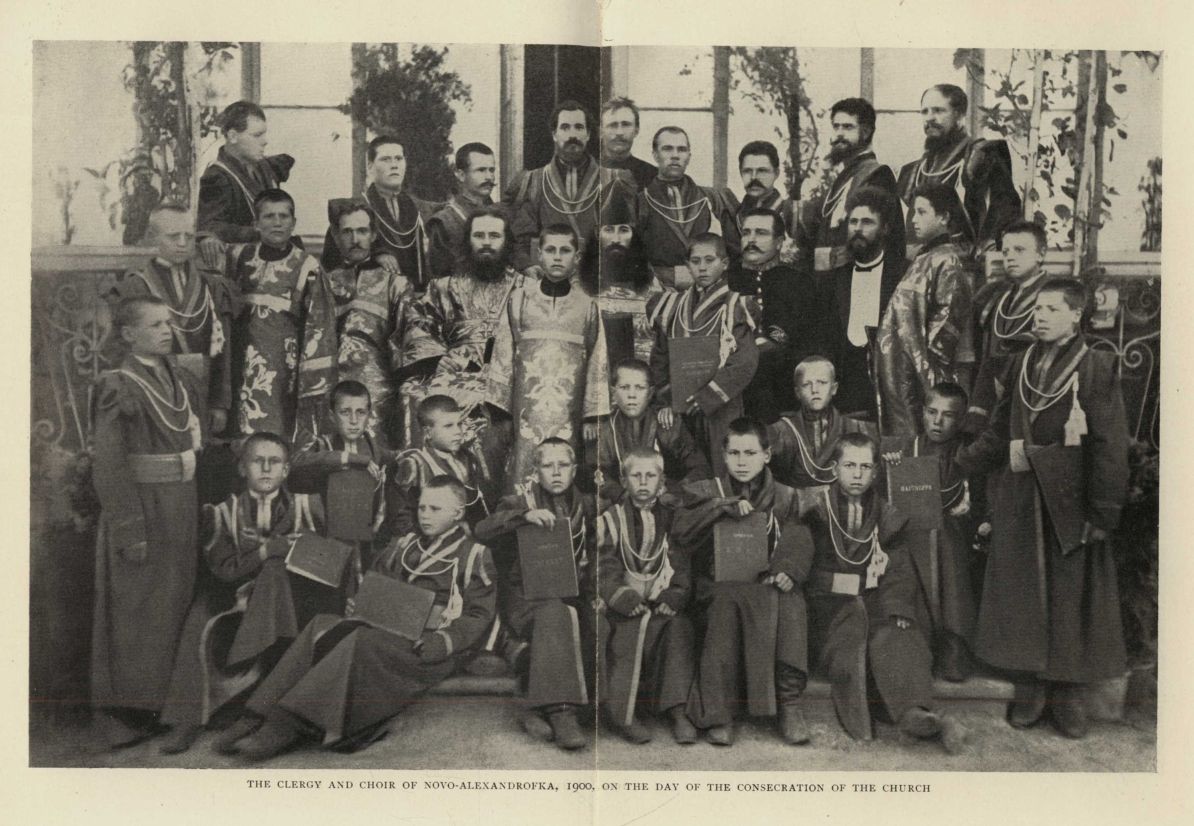
THE CLERGY AND CHOIR OF NOVO-ALEXANDROFKA, 1900, ON THE DAY OF THE CONSECRATION OF THE CHURCH
It is pleasant to see sometimes good work actually
bearing good fruit, and to realise that all our efforts
are not in vain. Of course we must never hesitate
to do our duty because sometimes it results only in
disappointment. I also had worked to the best of
my ability in the same direction as Ratchinsky, but
more and more did I realise my impotence in fighting
an evil of such magnitude. It became evident to
me that certain measures, in order to be accepted by
the whole of Russia, could only be carried out when
proclaimed by the highest Power in the land. If
only the Tsar would come to our rescue! was my
constant thought. Had not the emancipation of
forty-eight millions of Serfs been a good enough
example to justify this hope? But still in my
humble way I continued to do whatever I could, at
all events for conscience' sake.
So when I used to go to our village Novo
Alexandrovka, I sometimes invited peasants to take tea
with me. I confess they always accepted my
invitations with pleasure, though they knew that I
was an inveterate teetotaller, and that I hated their
favourite vodka. So they took one mug after
another of my tea, and bit their sugar with evident
satisfaction. I took advantage of these informal
meetings to explain to them the horror of taking
intoxicating liquors. Once I asked one of my guests:
"How many roubles a year do you spend on
drink? Tell me frankly." They all seemed very
embarrassed at my question, but one of them
dolefully replied:
"Well, I believe, not less than fifty roubles a
year."
"Is it not a sin," exclaimed I, "a great sin? We
in the Government of Tambov, as you all know,
can buy a good cow for that money, and with that
there would be ready food for all the chicks and
brats, and no need for them to go about begging for
food."
"That may be so," agreed my visitor; and then he
became silent and continued to drink his mug of tea.
Watching my poor folk, I would sometimes ask
them if they cared for tea, and always received the
same reply:
"Why of course we all like tea, but it is too dear
for us. Naturally our masters may indulge in it,
but we are poor people with empty pockets, while
vodka is quite within our reach, and is cheap and
plentiful everywhere."
"Yes," I said to myself, "Count Witte has not
shrunk from tempting the poor people everywhere
in every way. He introduced the diabolical habit
amongst them of buying their alcohol in small
bottles at a conveniently low price. Thus any
beggar can buy one of these bottles and put it in his
pocket." This drink question made me feel sometimes
exceedingly wretched. Surely, I said to myself,
something might be done? The evil done by Witte's
demoralising measure is well understood by the
Germans. As soon as they occupied the Polish
provinces in Russia, one of their first steps was not
only to re-open all the alcohol shops, but to add
greatly to their number. Let us hope that this evil,
like the occupation itself, is only temporary.
If some benevolent person would make alcohol
very expensive and tea very cheap and therefore
accessible, another of my dreams would be realised.
But fairies are scarce. Yet perhaps there exists a
means by which this end may be attainable.
If the duty on imported tea were greatly diminished,
as well as the excise on sugar, a great step towards
sobriety would thereby be assured. People who are
indifferent to the moral condition of Russia assure
me that this would cause too heavy a loss of
Government revenue. They may be right, but I should
suppose that any temporary loss of revenue would
soon be made up by the increased demand for tea
and sugar, which would undoubtedly be immense,
both articles being so important to our people's
comfort. Still less doubt could there be about the
moral advantage. Temperance has, it is agreed, an
enormously beneficial effect.
Those who want to see this for themselves and to
study this question thoroughly, should go especially
to Plotsk in our Polish provinces, and visit there
our Old Catholics called "Mariavites" and their
bishops. It cannot be sufficiently well known that
since this noble religious movement began in the
year 1871 (when the Pope's infallibility was
proclaimed), 200,000 people have become Mariavites,
thanks to the efforts and example of their bishops
and priests, and that all the congregation is
composed of absolute teetotallers. A leading and curious
characteristic of Bishop Kovalsky's parish is that
they are all absolute teetotallers—materially very
poor, but rich in faith and energy. Each of them
joyfully brings to the Church his hard-earned
contribution, with the result that the community is
well provided with churches, schools, workshops, etc.
Try to understand by this example what voluntary
efforts, personal sacrifices and teetotalism may
do. Since these lines were written, God has taken
pity upon us, and on the declaration of War, our
noble and courageous Emperor came to our rescue
by ordering the closing of the vodka bars and the
total prohibition of alcohol. From all the reports,
this measure, drastic though it was, has elicited not
the complaints, but rather the blessings of the entire
country. A curious fact is also traceable to this
wise legislation in many parts of Russia: the village
banks have never been in better funds than now,
while crime has enormously diminished, and family
life flourishes.
Reforms in Russia, even of the greatest magnitude,
are sometimes carried out with miraculous rapidity.
As a great many people, even in England, well
know, the liberation of forty-eight millions of
Serfs—half of whom suddenly became freeholders—was
actually introduced (19 February, 1862) after two
years working out.
The abolition of the village Commune (in many
respects resembling the Indian Communal System)
has been abolished in still shorter time. It worked
fairly well, I am told, before the emancipation, but
ceased to do so after the great Reform.
The complete abolition of the Traffic in drink
was effected in two days, all over Russia, by
the Emperor's order, and at this very moment, in
spite of the war and our bewildering expenditure in
self-defence, for which Russia never thought of
preparing herself, our Minister of Public Instruction,
Count Ignatieff, is elaborating another gigantic
reform—the execution of which will prove that he
is a true son of his celebrated father. The latter,
Count Nicolas Ignatieff, our former Ambassador in
Turkey, and later Minister of Interior, was well
known in the world for his grand schemes and ideas.
At this moment, whilst I am writing this (August,
1916) the intention is to introduce in the whole of
our large country, general compulsory education,
and ten additional universities. And we Russians
firmly believe in the realisation of measures of such
gigantic proportions, when they are urgently needed
by our people.
With us, what may seem almost incredible
becomes perfectly real when guided by one
concentrated and intelligent power.
My Embarrassment—A Spy—I Am Easily Taken In—A Demand for
Fifty Pounds—A Threat—I Defy the Blackmailer—A
Warning—Gladstone's Refusal to Meet Gambetta—My Husband's
Dilemma—Russian Views on Duelling—Kinglake Challenges
an Emperor—My Brother's Views—Kinglake's Charm—The
Value of an Englishman—The Dogger Bank Incident
I once heard an after-dinner speaker refer to
his remarks as "long pauses bridged by a
poverty of thought." I find that a volume of
reminiscences is in danger of becoming a sheaf of
inconsequences bound by unpardonable egotism.
I seem long since to have exhausted what I regard
as a reasonable number of I's; and then again,
there are so many things that I want to say that
bear no reasonable relation to each other.
My position is that of the young man at a dinner
party who was boiling over with eagerness to tell a
shooting story. He waited impatiently for the
conversation to develop in such a direction as would
enable him to drag it in. Dessert arrived, and still
no opening. In sheer desperation he stamped
loudly on the floor beneath the table. "What was
that? Sounded like a gun. Talking of guns, etc.,"
and he secured his opening.
If I appear inconsequent, my readers must
remember that young man's shooting story and
forgive me.
For some reason that I have never quite been
able to understand, people seem to think that I am
endowed with great wealth. If they only knew
how money hates me. The moment I take it into
my hands it runs and runs away from me with
frightened speed. But all this does not prevent
people from convincing themselves not only that I
am possessed of great riches, but that I am so
stupid as not to know what to do with them.
Sometimes this state of affairs is extremely
tiresome. I recall one incident that should be a
lesson to others as it has been a lesson to me. One
day a card was brought to me bearing the name
GRETCHEN ——
Aus Riga.
I asked myself: is that Gretchen going to
complain to me of her Faust? Have I to chastise that
captivating mangeur de Coeurs? But the fact
that my visitor was from Riga, and thus a
compatriot of mine to a great extent, prevailed upon
my doubts, and I received my young lady, who by
the way was not particularly young and not exactly
a fashionable lady, was not only terribly lean, but
angular and wretched in appearance. This killed my
hesitation, and I eagerly tried to find out what she
wanted and what I could do, and who recommended
her to me. "Nobody," she said. "I never
heard your name, but by mere chance saw it in the
Court Guide." She wanted some remunerative
work, as remunerative as possible. I already had a
secretary, but engaged my "Gretchen" as an extra
reader. She seemed pleased, and I was in hopes
that I should also be pleased with that new alliance.
My new reader was certainly not stupid, and always
wanted to have some messages for my friends,
wanting to know everything about everybody.
Always being busy and short of time I could not
satisfy that curious fancy of my "Gretchen." She
said she knew nobody in England, except myself.
I tried to help her, advising her to start a little
boarding-house, especially as I was going to Scotland
for a fortnight to stay with Lady Mary
Nisbet-Hamilton. Besides, a new plan suggested itself to
me; I thought that whilst "Gretchen" was
looking for her rooms and furniture, she might live in
my rooms at the hotel during my absence. May I
now say that no plan could be more foolish and
dangerous than mine turned out to be.
Scotland is a wonderfully hospitable and kind
part of the world, and oh! how beautiful, and I was
naturally captivated and prolonged my visit. On
returning to my hotel I found "Gretchen" much
less angular and less melancholy. The little cottage
was found, the furniture bought, and she still
wanted only a little more help. Upon this we
parted, to my great satisfaction. But something
perfectly unexpected happened to me a few weeks
later. "My Gretchen" returned to me and said
that she decidedly wanted more help, not less
than £50 (fifty). At that time, my pocket being
empty, I looked at her sternly and said: "But you
are mad, this is out of the question," "No," said
she, "you shall give me this money. In fact I can
compel you to do so. Do you know that I can sell
your correspondence to an editor or a publisher?
You forgot to lock your drawers and I have taken a
copy of all letters addressed to you." I confess I
was appalled.
This happened in the years 1878-1880, I don't
remember which, when I was in the midst of a
tremendous political agitation. With my answer I
generally returned letters which might be taken as
political documents, still my drafts could serve as a
clue to many important discussions, and then I
remembered that I did not return Bishop Strossmeyer's
letter to Mr. Gladstone, as I wanted to
discuss it verbally at our first meeting.
Yes, I was terribly served for my imprudence.
However, trying to look perfectly calm, I said:
"Very well, sell my correspondence, sell your copies
to whom you like, but I cannot give you the money
you require, and I forbid you ever to come to me
again. Sell me to whomsoever you like, be it a
statesman or a publisher."
A few years later a friend of mine was interested
to find out what had become of her and her
boarding-house, but there she heard that my Gretchen had
left England and many debts behind her. We then
understood that I simply had been in the hands
of a spy. But have I not been cruelly punished
for being young and stupid? Alas! stupidity is
very often a great luxury for which one pays dearly.
I was still in deep mourning, and somehow personal
questions affected me very little.
I hope that this strange experience will be
understood by some of my indulgent readers, and may at
the same time serve as a warning especially to
thoughtless, confiding Russians.
I remember dear Kinglake once annoying me by
referring to John Bright as "only" a Quaker. I had
for Bright a great admiration, and before I had
finished I think poor dear "Eothen" became
convinced of the fact.
My first meeting with Bright was in the late
eighties. I was as carried away as were my two
brothers, Nicolas and Alexander Kiréeff, by the
movement of the Old Catholics and the idea of
Universal Peace (even before The Hague Conference).
Great was my joy when one day the visit was
announced to me of the famous John Bright, whose
name was not only known, but also revered in Russia.
We naturally began talking on the mission of "The
Friends" to Russia, their reception by the Emperor
Nicolas, and the Crimean War.
"After all," said I frankly, "in spite of all her
sacrifices in the year '54, England has gained but
little; just a monument in Pall Mall inscribed
'Crimea' to remind the world of a costly struggle."
Our interview lasted about two hours. He talked
away and I remained a patient listener. I confess I
fancied that as I said nothing, the conversation
would be quite to his liking! And I suppose it was,
for meeting a friend of mine shortly afterwards, he
remarked: "I saw O.K. the other day. I was very
much struck by her. She is the very picture of health
and strength. She will never grow old."
Nothing more! Was it not dreadful? Are you
smiling?
Our position in Finland offers sometimes amusing
experiences. I remember my poor husband's
trouble at Helsingfors. At that time he was attached
to the Grand Duke Nicolas (father of the present
Grand Duke), who was always very kind to him. In
meeting his chief at Helsingfors he was invited to
come to lunch on the same day. At the appointed
time, having put on all his decorations and the
appropriate uniform, he went out into the street
and tried to get a cab. He saw many vacant
vehicles one after the other, and made desperate
signs to make them stop, all in vain. Not even the
policeman seemed to understand what the poor
General tried to explain. Will you believe
it!—Novikoff entirely missed his appointment because
they all pretended that they could not understand a
word of Russian. I confess my husband's distress
amused me, but his helplessness seemed so incredible
that I only saw its funny side at the time—whilst
in reality it certainly possessed also a very
serious side.
It was always pleasing and interesting to me to
feel and to know that my old friend Kinglake and
my dear brother Alexander, though they did not then
know each other personally, were linked together
by a common opinion on a subject they both took
very deeply to heart: the subject of duels.
Kinglake could never pardon the Duke of Wellington
the abolition of duelling in the British Army.
Personally, having always felt very strongly
against every kind of violence or bloodshed, I found
his point of view very difficult to understand, and
often tried to investigate more profoundly the ethics
of the question.
"Do you really mean," I said to Kinglake one
day, "that it is right and justifiable for people to
attack each other, sometimes for the flimsiest
reasons, as is so often done in Germany, just for the
fun of the thing—while the tragic little game, as
often as not, ends in the death of one of the
combatants?"
"That is so," said Kinglake seriously; "but the
possibility of a duel ennobles the spirit of a country,
is an education in manners, and results in the
development of a kind of moral muscle."
The anecdote, by the way, is well known that
Kinglake once sent a challenge, went off to Boulogne
where the duel was to take place, waited there for
days in vain, and, his adversary having failed to
appear or to make any sort of response, returned to
London in disgust. The point of this story,
however, has never been revealed, and after so many
years I think I can hardly be accused of indiscretion
if I tell my readers the interesting detail that the
adversary to whom Kinglake had sent his
unanswered challenge was no less a personage than
Louis Napoleon, afterwards the Emperor Napoleon
III! I have this from Abraham Hayward, a very
indiscreet friend of Kinglake's, who never
appreciated the importance of the Oriental saying:
"Speech is silver and silence is gold." For my part,
I have often regretted having said too much, and
never deplored having said too little.
But to return to the serious aspect of the
question. My brother, though he always strongly
condemned the frivolity and light-mindedness with
which the practice of duelling is treated in Germany,
held the view that duels were an indispensable
necessity where questions of honour are concerned.
"Can you imagine," he said to me one day in
reply to a remonstrance in this connection, "that
I could, for instance, allow some madman to attack
with impunity your good name or that of our
mother? How could I hesitate for a moment to
send him a challenge?"
"But you yourself say 'a madman,'" I protested.
"A madman is not responsible for his actions."
"The line between madness and sanity," answered
my brother, "is a very difficult one to determine.
The punishment of certain misdeeds is necessary,
not only for the culprit himself, but as a deterrent
and precautionary measure, without which no
civilised society can long exist in safety."
My brother, indeed, was exceedingly keen on this
subject, and really became quite an authority on
the question of duelling. Not long before his death,
when he was already very ill, General Mikoulin, who
was publishing a book in this connection, came and
asked my brother to give him some of his views,
which he did at some length.
"Why can we not publish your thoughts ourselves?"
I protested, when Mikoulin had left the
room; "why should you give them to someone else?"
My brother smiled sadly.
"Is it not all the same?" he asked. "As long
as these views are propagated, what matter under
whose name? Mikoulin is a staff-general, and I am
sure he will do it well."
Mikoulin, by the way, who published the book
entirely according to what my brother had told
him, was killed the other day, after many brilliant
deeds. It seems to me that some of the opinions my
brother at various times expressed on this favourite
theme, may be of interest to English readers. I will
quote from some of his letters and articles.
"The question of duels in military circles," he
once wrote, "has been thoroughly investigated and
placed in its true position by the firm, guiding hand
of our late beloved Emperor Alexander III, always
so sensitive in matters of personal honour, and so
keen for the preservation of peace.
"The matter is by no means an easy one to deal
with, the more so as few people have the courage to
discuss it with frankness and sincerity, preferring
rather to 'run with the hare and hunt with the
hounds,' in an indefinite desire to appear both
ultra-humane and ultra-chivalrous!
"Duels have always existed, still exist, and will
continue always to exist, whatever may be said
against them and whatever measures may be taken
to do away with them. I will even go so far as to
say that they must exist, as long as the moral status
of society does not rise above its present level, as
long as our culture does not grow broader."
"Is it not strange that no one will deny my right,
revolver in hand, to defend my watch or my money
against the assaults of a burglar? Why then am I
to be denied the right to defend my honour in the
same fashion? Besides, in defending my honour, I
am defending society—for indeed it would be
unthinkable to live in a world where honour could find
no defender!
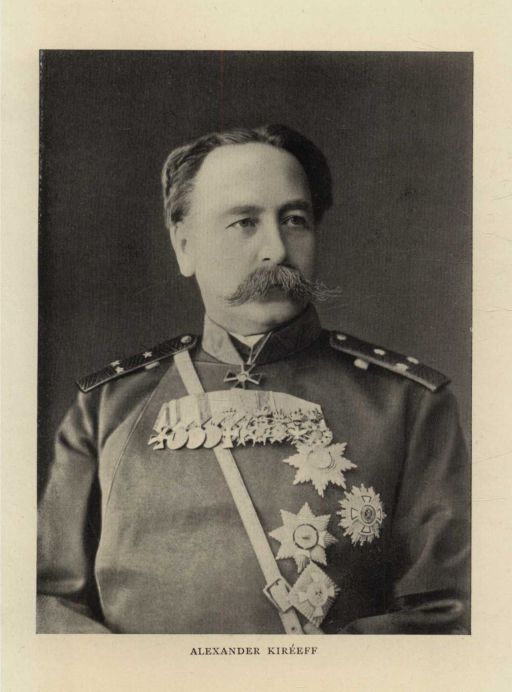
ALEXANDER KIRÉEFF
"Does it not seem strange and illogical to admit
the defence of one's minor worldly goods and to
forbid that of the most precious of all treasures?
We who believe in duels attack nobody—we only
defend ourselves against attack. Let no one attack
us, and we shall be as silent as deep waters, as
unobtrusive as grass. The priceless treasure of our
honour may be, in the opinion of others, an illusion,
an abstract nothing that has no set value on markets
and exchanges—but to us, it is precious. Leave us
in peace. We do not ask you to abandon your
utilitarianism, your financial materialism, we do not
in fact interfere with your ideals, cannot you let us
abide, unmolested, by ours?
"It is obvious, of course, that while defending
duelling as a system, I do not for a moment deny
the many undesirable factors that cannot be
prevented from occasionally creeping into it. The
ideal duel would be one in which the combatants
would take upon themselves the defence not of
personal, but of public and social interests and
rights. Such a high level is, of course, hard to attain,
but the element of personal revenge can nevertheless
be considerably diminished.
"We hear on all sides that duelling is no better
than murder, that duellists are brainless and
thoughtless, that none but a fool could, in our enlightened
age, mistake such a mad, meaningless savagery for
chivalry. Poor duels, and poor irresponsible duellists!
Were Pouschkin and Lermontoff, those victims of
offended honour, really such fools? And Bentham,
and the great socialist Lassalle himself? No—on
certain conditions, duels are inevitable, and not one
of my opponents in this matter will ever produce or
invent anything better to take their place."
After quoting these passages from various of my
brother's private letters and articles, I insist upon
adding that I have never seen a man more courteous,
polite and universally esteemed than he. Two of our
old generals—General Fock and General Smirnoff—who
distinguished themselves by their courage in
the Japanese war, quarrelled and found no one
better able to arbitrate between them than Alexander
Kiréeff. Their confidence in him was unlimited, but
he understood that the question was of vital
importance, and that a duel was unavoidable. Both
combatants asked him to be present at the duel,
and to see that the Russian duelling laws were
strictly adhered to, which he did. General Smirnoff
was wounded, but both recognised that my brother
did all he could to bring about a reconciliation. If
he failed, it only showed that certain tragic elements
in life will take place in spite of all our efforts to
prevent them.
I may add that my brother, equipped as he was
with his chivalrous code of honour, was also an
expert fencer, so distinguished indeed that, at a
public fencing competition at Naples open to the
whole of Europe, he carried off the first prize—a
gold sword of honour. But I am glad to say that
never once did he engage in a duel.
Apart from being in favour of duelling, Kinglake
was, although in himself essentially a man of peace,
all for war; it thinned out populations, just as
duelling kept up a better tone in society. I, on the
other hand, the daughter of a man who earned the
St. George's Cross on the battlefield, the sister of
two soldiers, and the wife of another, was always
dreaming of peace.
My own idea is that no generation that has suffered
a great war ever wants another. That is left for
following generations who cannot conceive the
horrors of what they themselves have not experienced.
Whenever I was absent from England I always
received from Kinglake a weekly letter. I
remember his once complaining that writing to a
lady through the poste restante was like trying to
kiss a nun through a double grating. Sometimes
he would imitate the "little language" of the
great satirist Swift, calling himself "poor dear me,"
and referring to me as "my dear miss." Thereby
hangs a story.
On one occasion at dinner Hayward told a
characteristic anecdote which, although it seemed
to amuse the other ladies present, caused me
considerable embarrassment. Kinglake afterwards said
to me: "I thought you were a hardened married
woman; I shall henceforth call you 'miss.'"
He was a very sweet, lovable man, old in years
but a youth in heart. His letters were full of gaiety
and persiflage.
Once he wrote to me:
"Hayward can pardon you having an ambassador
or two at your feet, but to find the way to your
heart, obstructed by a crowd of astronomers,
Russ-expansionists, metaphysicians, theologians,
translators, historians, poets—this is more than I can
endure."
He was never tired of rallying me about my callers
and friends, insisting that I was a grande dame
to whom all the really great in the land came to
make obeisance. Once when staying at Sidmouth
he wrote:
"Mrs. Grundy has a small house there, but she
does not know me by sight. If Madame Novikoff
were to come, the astonished little town, dazzled
first by her, would find itself invaded by
theologians, bishops, ambassadors of deceased emperors,
and an ex-Prime Minister."
When he gave me his photograph, and I gave
him mine, he referred to the transaction as "an
exchange between the personified months of May and
November."
On one occasion The Times inserted, to Kinglake's
great indignation, a statement that I had been
obliged to leave England. Shortly afterwards
Chinery, the editor, happened to seat himself at the
same table with Kinglake at the Athenæum Club.
Kinglake immediately rose and moved to another
part of the room.
"So unlike me," was his comment; "but somehow
a savagery as of youth came over me in my
ancient days; it was like being twenty years old
again."
Later, however, he discovered that Froude had
been indirectly responsible for the paragraph, and
Kinglake immediately found means of conveying
to Chinery his regrets.
Poor dear "Eothen's" mind was powerful and
bright to his last day. I called on him frequently
during his last days, and it was not until the end,
which came on January 2nd, 1891, that I realised
the extent of my loss.
For one thing there is, in the Englishman's eyes,
nothing more sacred on earth than the person and
property of an Englishman. It would be well if
some of our Russian officials would follow the
example of their English friends. It is a
praiseworthy and unquestioned fact that all Englishmen
at home and abroad are penetrated by a personal
sense of their duty towards each other. Everything
English must be defended and encouraged, every
Englishman must be helped and protected. Such
patriotic esprit de corps and solidarity makes one
sometimes feel quite envious, and indeed I have
often noticed the very natural smile of incredulous
surprise with which English people regard the
so-frequently-met-with indifference shown by certain
Russian officials towards Russian affairs.
An amusing example comes to my mind in
connection with Lord Napier of Ettrick, a former
British Ambassador at Petrograd, and a great friend
of mine. Lord Napier called on me one day, and
greeted me with a humorous glance. "I have just
been to see your Governor-General," he said, smiling.
"What funny people there are in the world! I
went on business about some Englishman who came
to me a few days ago with a complaint against a
Russian. I was too busy to occupy myself with the
matter, so thought I would hand it over to the local
authorities. The Governor-General, however, didn't
give me time to say much—before I had explained
anything, he interrupted me with the warmest
assurances that I need have no fears whatever,—that
the Russians would be punished, and the
Englishman given full satisfaction for whatever
offence he may have suffered."
"I considered it my duty," continued Lord
Napier, "to make it quite clear to the Governor-General
that I knew nothing about the rights of the
matter and that it was necessary to look into the
facts. After all, the Englishman might be in the
wrong, or the whole thing might be an invention!
But really, I had the greatest difficulty in persuading
our friend to consider such a possibility! Is not my
impartiality praiseworthy? Are you not pleased?"
and Lord Napier smiled questioningly. We both
laughed, and I thought it best to treat the incident
as a good joke—but actually, I confess that its
humour by no means appealed to me!
Let me draw a parallel: A few years ago a
woman of doubtful nationality was arrested by
the Russian authorities in Warsaw. She immediately
wailed out that she was of British extraction, and
made a theatrical appeal "to the English nation,"
through the medium of some English newspaper
correspondent.
Without making the smallest attempt at investigating
the circumstances, the whole of Great
Britain was up in arms and astir with anger and
indignation. Excited meetings and demonstrations
followed through the length and breadth of the
land, while the newspapers filled their columns
with foolish unfounded libels on Russia. The whole
agitation only ended with the official report of the
British Consul in Warsaw, announcing the Emperor's
pardon, by which the originator of all this agitation
was allowed to return to her country.
It is indeed a happy fact that no Englishman or
Englishwoman need ever fear to travel in any
country where there exists a British Embassy or
Consulate. Every British subject knows that
wherever he may be, there is someone who can, in
case of need, protect and defend him, and that once
he has announced his nationality he has nothing
more to fear.
All this only makes one repeat the wish that our
Russian officials might somehow be induced to show
more interest in their fellow-countrymen, and, in
their international relations, to follow closely and
fearlessly the admirable example of our great ally
England.
It appeared to us Russians that England was
always on the look out for something to magnify into
an international incident. As I write, I am reminded
of another incident where the sacredness of the
person of British subjects was demonstrated. This
was the Dogger Bank affair. Although the
circumstances are well known, I will recapitulate them.
Russia was at war with Japan, and her Baltic
Fleet was on the way to the Far East. On the night
of October 21st-22nd, 1904, fifty British trawlers,
manned by some five hundred men, were engaged in
fishing on the Dogger Bank. The first division of
the Baltic Fleet passed them, the second division
turned their searchlights upon the fishing boats.
The officers in charge imagined that they saw
torpedo boats approaching. They immediately
opened fire on the trawlers with quick-firing guns,
and in the course of twenty minutes had fired some
three hundred shots. Their gunnery was not very
good, however, as fortunately only six of the boats
were hit, one being sunk. Two fishermen were
killed, and four wounded. The Russian fleet then
steamed away to the south.
Unfortunately the officers of this scratch fleet
seemed to have been suffering from nerves, but that
did not, I think, justify the outcry raised in this
country.
I wrote to the Press, drawing attention to a
similar mistake that had occurred in 1890, in which
the position had been reversed. It was on the
occasion of the joint international forces that were
being sent from Tientsin to Peking at the time of the
Boxer Revolt. About midnight on June 4 a body
of Russian sailors were returning on foot from their
work. Some English sailors, believing them to be
Boxers, opened fire from the railway carriages.
Before the mistake had been discovered two Russians
had been killed and several others wounded.
Vice-Admiral Seymour, who was in command of the
British forces, hastened to send an official letter of
regret, which was immediately accepted, and there
the matter ended. There was no outcry in the
Russian Press—we understood and accepted the
Englishman's word.
England's Sympathy with the Nihilists—Cabinet Ministers'
Indiscretion—Mr. Gladstone's Incredulity—I Prove My
Words—Mr. Gladstone's Action—A Strange Confusion—A Reformed
Nihilist—His Significant Admission—The Nihilist's Regret—The
Death of Revolutionary Russia—The Greatness of the Future—The
Reckless, Impulsive Russian—The Russian Refugees at
Buenos Ayres—They Crave for a Priest
Once upon a time the newspapers in Great
Britain devoted quite a considerable space
to Nihilism, almost invariably writing of it
with considerable sympathy and very little insight.
If the editors, in whose papers many "illuminating"
articles appeared, were to imagine those self-same
articles written to-day in Russian newspapers with
the single alteration of the word "Nihilism" into
"Sinn Feinism," they would understand something
of the feelings their articles aroused in the hearts of
Russians.
As an illustration of the fascination that the
internal affairs of Russia seemed to possess for
Englishmen, I may tell a little story which at the
time caused me and other Russians no little
annoyance. There was a paper that used to reach me
more or less regularly entitled Free Russia. It was
the organ of the English Society of Russian Freedom,
and its amiable object was "to destroy the Russian
Government." In other words, it was Nihilistic. I
believe the publication started in the autumn of 1893.
As soon as I discovered its purpose I used to drop it
into the waste-paper basket without a second thought.
One day, however, I happened to glance at the title
page, on which I found were printed the names of the
General Committee of the Friends of Russian
Freedom, and to my astonishment I found there the
names of the Rt. Hon. Arthur Ackland, M.P., and the
Rt. Hon. G. J. Shaw-Lefevre, M.P. (who became Lord
Eversley), and Mr. Thomas Burt, M.P. The two
first-named were members of Mr. Gladstone's Ministry.
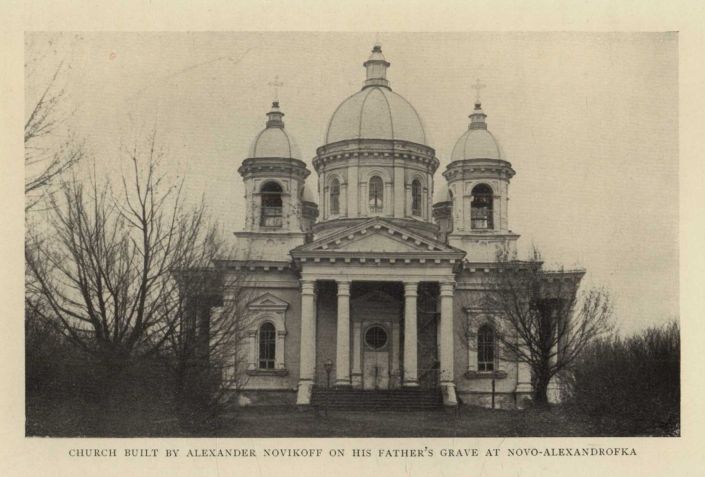
CHURCH BUILT BY ALEXANDER NOVIKOFF ON HIS FATHER'S GRAVE AT NOVO-ALEXANDROFKA
By a curious chance, on the day of my discovery
Lady Spencer was holding a reception, and there I
saw Mr. Gladstone. I am afraid rather impetuously
I burst into reproaches at the conduct of two of his
ministers. He was incredulous, and asked me to
send him proofs. I promised that I would, but
alas! I found the waste-paper basket had been cleared,
and the paper destroyed. This was the next
morning. What was I to do? It was a miserable, foggy
day. I hate London fogs, but I was determined to
convince Mr. Gladstone. I therefore went into the
City, and anyone who goes into the City on a foggy
day must be either a lunatic or a patriot, I told
myself. The only redeeming feature of that
uncomfortable morning was that I proved conclusively
that the circulation of Free Russia must be a very
small one. I had two hours' hard work before at
last I ran a copy to earth. Returning home I wrote
to Mr. Gladstone in great triumph, and the result
was that I received a letter from him which showed
his uncompromising disapproval. He wrote:
"It appears to me that a minister in our country
has no title to belong to a Political Society in another.
Let him look to his own affairs—here, at any rate,
these give us enough, and more than enough, to do."
Mr. Gladstone went on to say that his colleagues,
Mr. Lefevre and Mr. Ackland, were of his opinion,
and that he did not propose to worry about Mr. Burt
unless I wished it, as he was not a minister.
I fancy there must have been a disapproving look
in Mr. Gladstone's eye, and a stern note in his voice
when he interviewed his ministers.
Oh dear, if English people had only refrained
from directing that vast fund of sympathy which
they undoubtedly possess towards Nihilists and
men whose sole object is destruction and what the
Germans call 'frightfulness'! I once said, and I
believe it to be true, that as a rule the only thing
known in England about Russians is that they take
lemon with their tea.
There were some, even, who went to the length
of asserting, always taking good care to add that
their information came from unimpeachable sources,
that "Panslavism and Nihilism went hand in
hand." Imagine the astonishment of the British
Imperialists if they were told on the best authority
that "Imperialism and Sinn Feinism went hand in
hand!"
What a calumny! What are the tenets of
Panslavism? Religion, autocracy, and nationality.
These three motives, according to us, are not only
united but indissoluble. They form the very essence
of our creed, of our life. In fact we are the opposite
pole to the Nihilists, who hate every idea of God,
who detest autocracy and despise nationality! The
hostility between these two lies in their nature.
There can be no compromise between them. The
Russian people abhor the Nihilists, who are
perfectly aware of that feeling.
I am told that some years ago a judge offered a
Nihilist the alternative of being left to Lynch Law,
upon which the prisoner fell on his knees and
implored to be punished by the existing Russian laws.
All the Russians who deserve that name, who are
devoted to their Church and their country, are
particularly devoted to the present Emperor. They
trust, they love him; they appreciate his noble and
generous qualities, his extreme kindness, and his
self-sacrifice. Anything done to injure him injures
the whole of Russia. It needs, in truth, no effort
on the part of the Panslavists to be devoted to
Nicholas II. I have seen it stated that the peasants,
disappointed with not receiving a new distribution
of land at the last coronation, form a fertile ground
for Nihilism. This is not the case. The Nihilists
have long ago given up the hope of spreading their
diabolical doctrines among the rural classes. If
they got hold of a few peasants—thank God! very
few indeed—those "Converts" of theirs have
abandoned their plough and have been perverted in
some public school only by a semblance of science.
It is a fatal tendency, which is to be deplored and
deprecated in all the public establishments in Russia
as well as in foreign countries, that very young
people, even children, are allowed to discuss and
twaddle on politics, instead of studying their
grammars and their geography! With that tendency
mistakes and false doctrines are unavoidable; any
mischievous teacher may easily take hold of them
and turn them into flexible tools.
People are misinformed about the hardships of
compulsory military service, which gives every year,
even in time of peace, a contingent of about 830,000,
which is much below the number required by the
Army.
Russia has never shown herself anxious to fight.
In fact she has had fewer wars than her neighbours.
From the Crimean War in 1855 till the year 1877 she
fought only one serious war with a European Power.
In the course of this time France had two—in 1859
with Austria, in 1870 with Germany; Prussia two—in
1866 with Austria, in 1870 with France; Austria
two—in 1859 with France, in 1866 with Germany.
So there is no actual ground for pitying the Russian
soldiers more than any other. Of course, every
soldier risks being killed. That is not, however, the
speciality of my countrymen alone. All the great
European countries, even Great Britain herself has
been forced to sacrifice her ideals victim to emergency.
People often talk of the difficulty of an autocratic
Government in crushing revolutions. Is this really
so? Are the years of '48 and '49 meaningless or
forgotten? Surely not in France, not in Germany,
not in Austria, or Italy! The form of government
has nothing to do with plots and assassinations.
The prototype of a constitutional monarch was
undoubtedly Louis Philippe, who during his eighteen
years' reign had to face eighteen attempts directed
against his life. The Emperor Louis Napoleon had
about ten; and the President of the United States,
even his life is not unassailable. The assassination of
Lincoln and McKinley are full of meaning.
There is an old English saying, "Set a thief to
catch a thief." I would say, "Learn from an
ex-Nihilist what Nihilism really means." In 1888
Mr. Leon Tikhomirov, an able author and
accomplished scholar, who had been led into Nihilism, in
a pamphlet entitled Why I have Ceased to be a
Revolutionist, publicly recanted his former faith.
This act on the part of one of its most prominent
and active members spread something like dismay
in the Nihilist camp. "A great misfortune has
befallen us, brethren, a very great one," was the
beginning of an open letter addressed by a
contemporary Nihilist to his political co-religionists.
"Yes, a great misfortune," he exclaims again, with
Russian frankness at the conclusion of his epistle.
From the Nihilistic point of view the event referred
to was undoubtedly a very great loss, a most serious
"misfortune."
I did not then know Mr. Tikhomirov personally,
but he has since become a great friend of mine.
Alter leaving the Kertch Gymnasium with the gold
medal, he entered a Russian university, where he
took a foolish part in one of the students' riots, and
in the propaganda. Four years' prison life was the
result of those follies.
The pamphlet which contains his confession is
notable for its tone of extreme honesty and sincerity.
In all Christian charity we are bound to sympathise
with him who repents. "Do not strike a man on
the ground" is a good proverb which should have a
practical application. In Mr. Tikhomirov the
Nihilist party had a talented, cultivated and
probably sincere member, who sacrificed his material
interests and prospects in life in order to be true to
his convictions.
At that time his idea, unfortunately, was that the
only possible evolution for Russia was—Revolution.
In that direction he worked and wrote for several
years. The first edition of La Russie Politique et
Sociale belongs to that lamentable period of his
career. But the success which attended that
mistaken book has not prevented its author from
retracing his steps in an opposite and more worthy
direction, with the result shown in his pamphlet
Why I have Ceased to be a Revolutionist. The
unreserved sincerity of this publication is remarkable.
To speak out one's mind needs much moral courage,
especially when one knows that all who sympathise
are far away, and that one is surrounded by people
who are only too ready to impute the meanest and
most despicable motives. Mr. Leon Tikhomirov,
however, faced that risk.
The sketch of his moral convalescence is worth
study. Whilst pondering over his psychological
diagnosis, one involuntarily recalls Shakespeare's—
Yes, indeed, none are so surely caught, when they are caught,
As wit turned fool!
But, fortunately, the wit is now restored. In
order to render Mr. Tikhomirov full justice, it would
be necessary to translate every line of his pamphlet;
short of that, where I cannot give the words in full,
I shall endeavour to carry the spirit.
"I look upon my past with disgust," says he,
and this is not surprising when the details of that
past are examined. He is not influenced by any
expectation of the future. Having left the
revolutionary party his only object now is to promote, by
legitimate means, the cause of true progress; the
conviction that he has been right in abandoning his
former faith is only strengthened by the reproaches
now heaped upon him by his former associates....
"When I was twenty," says he, "I used to write
revolutionary programmes. If twenty years later
I were unable to write something better, I should
really have a very poor opinion of myself."
Still, that transition, from folly to wisdom, was
not accomplished without struggle and hesitation.
Mr. Tikhomirov frankly admits how hard it was for
him to acknowledge that he was utterly wrong;
that, in clinging to his theories, he held a dead body
which could not be revived! He hesitated to bury
it, in spite of its obvious lifelessness.
"About the year 1880," Mr. Tikhomirov continues,
"I, and not I alone, began to feel that our
party was becoming torpid, was daily losing more
and more of its vital force, which had at first seemed
so great. The following year I began wondering
how it was that Russia was healthy and full of life,
while the revolutionary movement, that very
movement which, according to our ideas, was the very
manifestation of national growth, was withering and
decaying. This obvious contradiction reduced me
to a morbid despair. I went abroad with the sole
object of publishing my recollections of the events
through which I had lived. Since then, all the
remains of the old organisations have perished, all,
all have tumbled down! Reality has given me
startling lessons. One consoling hope, however,
remains. I deemed it possible to rebuild our party,
while remaining within it. Oh, what a self-delusion
that was! In reality it was I who enslaved myself,
who was prevented from thinking, from meditating,
as I ought to have done! Still the strokes fell too
heavily; their weight became intolerable. I felt
we were on a wrong track, and urged Lopatine and
the other members of our party to search for some
new paths. On finding that they would not, or
could not, follow my advice, in 1884 I wrote to say
that I had ceased to belong to their party, and
withdrew their right to use my name. Thus ended my
co-operation with all their circles and organisations."
There is in Mr. Tikhomirov's narrative a sincerity
and truthfulness which appeal to our best nature.
He is not melodramatic, he does not strain after
theatrical effects, but he compels his reader to feel
for him, almost to share his sorrow. But let us
listen again to his own voice.
"Meditating upon recent events, I wrote in my
diary of March, '86—'Yes, I am definitely
convinced now that revolutionary Russia—taken as a
serious intelligent party—does not exist.
Revolutionists still exist, and may make some noise. But
it is not a storm, only ripples on the surface of a sea.
Since last year one fact seems to me perfectly obvious.
All our hopes have to depend henceforth on Russia,
on the Russian people. As to our revolutionists,
hardly anything may be expected of them. I came
to the conclusion that it was absolutely necessary to
arrange my life so as to serve Russia according to
my own instinct, independently of any party. The
Nihilist party, I now see too well, can only injure
Russia. My common sense and my will might remain
dormant, but once they awoke I had to obey them.
If my former friends could leave their graves and
come to life again, I would spare no effort to induce
them to follow me, and then with them, or quite
alone, I would take the path which I now feel to be
the true one."
Mr. Tikhomirov has much sinned, but he has also
loved much. Even in his revolutionary epoch,
Russia was still precious to him, and he was always
ready to die for her unity. In that respect, to his
credit be it said, he was not a model Nihilist, whose
creed it is to despise such "obsolete notions" as
patriotism. How much freedom of thought was
tolerated in those circles can be seen from the
following incident. In an article intended by
Mr. Tikhomirov for the Revolutionary Journal, The
Popular Will, among many truisms he wrote:
"Russia is in a normal state, while the revolutionary
party is collapsing—a fact which can only be
explained by some mistakes in the programme of our
party." And again: "If terrorism is recommended
to a country, the vitality of that country must be
very doubtful." At these sentiments, Mr. Tikhomirov's
comrades—the other editors of the paper
were thunderstruck, and peremptorily declined to
admit them into their columns.
This schism was the dawn of Mr. Tikhomirov's
salvation. His better self rapidly developed. He
soon recognised that the less a country at large is
desirous of revolution, the more compelled are
revolutionists to resort to terrorism. Thus the
weaker the cause, the stronger the necessity for
terrorism, which obviously was a criminal paradox.
Further on, Mr. Tikhomirov says: "I have not
given up my ideas of social justice, but they take a
clearer, a more harmonious shape; riots, revolts,
destruction, are all the morbid results of the social
crisis which now traverses Europe. These things
are not easily introduced into Russia. That disease
has not yet reached her; nor can revolutionary
movements, however temporarily pernicious, divert
Russia from the path of her historical development.
"Political murders (says he) produced a certain
commotion in the Russian Government so long as it
believed that it had to deal with a strong threatening
power. The moment it was realised how wretchedly
small was that handful of men who resorted to
murder merely because of their weakness and
inability to undertake something on a larger
scale—since that moment the Russian Government shows
no signs of any kind of anxiety. It determined upon
a strong system, which it unflinchingly carries out.
Of course the life of the Emperor and of his different
officials is spoilt by the perpetual expectation of
danger, but in spite of this the Government will
certainly never make any concessions to the Terrorist.
A legal Government recognised by the whole country
naturally objects to subordinate itself to whims....
"The Russian Emperor has not usurped his
power. That power was solemnly conferred upon
his ancestors by an overwhelming majority of the
Russian people, who have never since shown the
remotest desire to withdraw that power from the
Romanoff dynasty. The law of the country recognises
her Emperor as one above any kind of responsibility,
and the Church of the country invests him
with the title of her temporal head.
"Ten years of hard struggle have proved beyond
possible doubt that all the revolutionists may well
perish, one after the other; but Russia was dead
against supporting them. The life of a Terrorist is
a terrible one; it is that of a hunted wolf in
momentary expectation of death. He suffers perpetual
alarm from detectives, has to use false passports,
to live in hiding, to resort to dynamite, to meditate
murder.... Such a life necessitates the abandonment
of all matters of most vital interest. All ties of
affection under such circumstances are torture.
Study is out of the question. Everybody, except
the few ringleaders, has to be deceived. An enemy
is suspected on all sides. No, the best among us,
had they lived long enough to see the results
obtained, would not have failed to give up such a
struggle. We committed a terrible crime in
demoralising Russian youth. One of our revolutionary
chiefs—himself already doomed—to whom I
expressed my present views as frankly as I am now
doing, urged me to save our younger generation, and
to exhort them to give up premature meddling with
politics, and instead to prepare themselves for a
useful life by hard study."
What good advice! "Think, observe, learn; do
not trust words and shallow theories. That is what
I now say to the inexperienced youth," says
Mr. Tikhomirov. "I am utterly indignant," he
continues, "when I hear remarks of the following kind:
'Let them make riots. Of course it is foolish, but
what does it matter? There is not much weight in
all these fellows, and a riot is still a protest.' For
my part, I now look upon these things quite differently."
After explaining at some length the stern duties
of the rising generation, after earnestly entreating
them to form their character and their principles, to
study hard, to avoid the influence of political
charlatans who simply exploit their ignorance,
Mr. Tikhomirov goes on to say that "Russia has a great
past, but a still greater future." He is, however,
not blind to our shortcomings, of which a very
serious one among our youths is their want of
prudent resistance to mischievous influences. Their
want of thought makes them accept every new
political aphorism, however absurd.
"As soon as the universities are quiet for eight
or nine months," he continues, "pressure is put
upon the young students to make some absurd
demonstration, some riots, something, and they
listen to such instigations. Our censors are not
infallible; but censorship is an institution whose
importance is exaggerated. The principal mistake
lies in ourselves. We Russians have an unlimited
confidence in every new theory, in every hypothesis,
no matter how superficial, how foolish. The
so-called 'Intelligenzia' are far inferior in common
sense and practical questions to the simple Russian
peasant, who possesses few notions, few facts, but
whose mental faculties and sound judgment have not
been spoilt. The fantastic element, deplorably
developed in our middle classes, reaches its zenith
amongst our revolutionists. What young revolutionists
repeat now I, alas! used to think several
years ago. Russia would immensely gain if her
young people, instead of meddling with politics,
resolved to spend some five or six years on a regular
course of lectures and in studying their own country,
her present position, and her history. Hundreds of
Russian undergraduates perish merely thanks to
evil influences from without."
This, unfortunately, is only too true. Such
instigators have neither pity nor judgment. Any
kind of riot equally serves their purpose, provided it
makes mischief and commits foolish reckless boys.
Mr. Tikhomirov, describing the difference between
the students of 1840 and 1860, shows how superior
were those of the former year. Their aspirations
were much higher. He relates an anecdote which is
charmingly characteristic: "Some undergraduates
of the old school were engaged in an animated
discussion one day when dinner was announced. 'How
can you disturb us?' reproachfully exclaimed one
of the orators, who afterwards became a celebrated
Russian writer. 'We are just settling the existence
(das Sein) of God, and you summon us to
... dinner.'"
What Mr. Tikhomirov says about the duties of a
citizen may be endorsed by every wise patriot.
"From the question of culture I now pass to that
of autocracy. Whatever constitutes a man's general
views, the moment he proclaims himself as opposed
to the Tsar he belongs to the welcome set, he is
'one of ours.'"
This reminds one of the Irishman who, on landing
in America, declared: "I do not know what is the
form of government here, but I am against it."
Let Mr. Tikhomirov, however, continue his own
story:
"If you point out the unreasonableness of this
view, if you convict him of extreme ignorance, you
are met with the protest, how can a man be cultivated
as long as there exists in Russia an Autocrat!
Unfortunately, such views may be sincere. To my great
regret, at one time I used to share them myself. But
now what pain they give me! In the first place, no
form of government is able to prevent intellectual
culture when the people are sincerely anxious to
acquire it. Besides, let us refer to history. Were not
Peter the Great and the Great Catherine Autocrats?
Was it not in the Emperor Nicholas's time that the
present social ideas originated? Is there any
republic in the world which has carried out such
great reforms as those of Alexander II? I regard
autocracy in Russia as the result of our history,
which cannot and ought not to be abolished so long
as tens of millions desire nothing else. I deem
unjust, unwise and useless the presumption to
interfere with the wishes of a great nation. Every
Russian desiring to carry out reforms should do so
under the shelter of the autocratic power. Has
autocracy prevented Poushkin, Gogol, Tolstoy,
etc. etc., from developing the greatest possible
progress in literature?
"For argument's sake, suppose that some Russian
Emperor consented to impose limits upon his powers.
Such concession would be only apparent, not real.
At the slightest hint an enormous majority of the
people would disperse the handful of men who
ventured to restrict the unlimited power of their
Tsar. What every country needs above all is a
strong and stable Government, which firmly carries
out its programme. Russia needs this even more
than any other country. The parliamentary system,
although it has some good sides, has proved itself
most unsatisfactory—a fact which our critics of
autocracy should keep firmly in mind. Unfortunately,
our young generation behave in a way to
drive a rational statesman mad. One day they take
part in a Polish insurrection: another day they try
to organise a reign of terror. Like true fanatics,
they display a passionate energy, a remarkable
self-sacrifice. It is simply deplorable!"
Mr. Tikhomirov insists over and over again upon
the necessity for sound learning and right thinking.
In a footnote he still further develops this idea.
Insisting upon the evils of half-culture: "I do not
mean," he explains, "the small amount of information—a
peasant is still less informed—but it is the
manner of foolishly adopting anything said by
others—on faith, without reflection—which is so
fatal. It is the want of mental discipline which I
lament."
Mr. Tikhomirov's sketch is of great psychological
interest. It throws a true light on Russian nature.
Russians, unfortunately, are too impulsive, not to
be often misled—which, of course, is deplorable.
With all this there lies in their heart of hearts a
deep affection for their country, their Church, their
traditions, their customs, their language—in fact,
everything Russian. To them "ubi bene, ibi patria,"
is a faulty phrase; there is no place where they can
be happy when they are banished, when they are
anathematised by their native land. Certain feelings
are stronger than arguments.
I may be perhaps allowed to quote a case in point.
Some years ago a colony of Russian refugees whose
life, for some political reason or other, became
uncomfortable in Russia, emigrated to Buenos Ayres.
They deemed it would be quite easy to acclimatise
themselves anywhere. Little by little, however,
they discovered, with acute pain, that their soul
craved for their former faith. At last they appealed
to the representative of the Russian Government,
begging him to secure for them a Russian Greek
Orthodox priest, offering to build a church and to
provide all the necessary means for supporting the
clergy. The Russian Government did not hesitate
to acquiesce. The Reverend Father Ivanoff, a
brilliant theological student, sympathising also with
the request, hurried across the seas to undertake this
novel duty.
Yes! It is easy sometimes to be an absentee, but
it must be intolerable to feel oneself a renegade!
From this reproach Mr. Tikhomirov is now rescued.
"There is more joy over one sinner that repenteth
than over ninety and nine just men who need no
repentance." The Russian authorities, however,
were not at once convinced of the genuineness of
Mr. Tikhomirov's recantation. But when all the
official documents supported his statements, he was
allowed to return to Russia at once.
Our Convict System—Misunderstood in England—Siberia, an
Emigration Field—A Lax Discipline—Capt. Wiggins' Opinion—A
Land of Stoicism—My Experiences as a Prison Visitor—Divine
Literature—Helen Voronoff's Work—A Russian Heroine—Her
Descriptions of Prison Life
To the Englishman the word "Siberia"
seems to possess a significance so sinister as
to make death appear almost a luxury; but
imprisonment and the conditions under which the
prisoners live are entirely comparative. To
condemn a gourmet to live on roast beef and cabbage
would be a punishment much greater than to
sentence a farm labourer to live on porridge and black
bread.
In England our "atrocious convict system" has
been a subject for much comment. I think very
few people in England have any conception of what
Siberia really is.
Some, I have no doubt, who speak most freely
about it, would be in some difficulty if they were
asked to describe where it is. As a matter of fact
it is the northern half of the Continent of Asia,
greater in area than the whole of Europe. The
north is almost uninhabitable, but we do not send
our criminals to the north, but to the fertile south.
It is mostly in the fertile south that our present
colonies exist. We used to send to the quicksilver
mines only the worst criminals and murderers,
with whom I do not think even English people
would have much sympathy.
After all, would a man prefer to work in a
quicksilver mine or to be hanged? Another very
important point is that transportation to Siberia does not
necessarily involve imprisonment. In some cases
the convicts are turned loose to look after
themselves, and are allowed to go whither they will,
provided they do not attempt to return to European
Russia. Moreover, the families of the convicts used
also to be transported at the expense of the
Government—which was, of course, a great consolation to
them. But now the whole system of transportation
to Siberia has been abolished.
We wish to do with them just what England
strove to do with her criminals in the first half of
last century—get rid of them. They are undesirable
citizens, and as all good government is the greatest
good to the greatest number, the best thing that
can happen is to get the criminal population away
from the non-criminal, so that one does not
contaminate the other.
In the old days the English convict was
compelled to work under the penalty of "the cat" or
the gallows. On the other hand, the Russian
convict is sent into Siberia, and there he can do what
he chooses, short of actual crime. As a matter of
fact, in Russia there is a strong feeling in certain
quarters that our convicts have too much liberty.
Let me bring the matter nearer home. Suppose
instead of being sent to Portland and shut up in a
grim and gloomy building, English prisoners were
sent to the extreme north of Scotland and given
their liberty, and told they must not come further
south than a certain point, is there any question as
to which of the two they would choose?
If English people could be persuaded to regard
Siberia as a huge field for emigration, they would
understand things much better, and in sending our
convicts there we serve a double purpose—that is to
say, we get rid of them, and we are colonising the
country that an Englishman has described as
"offering unique advantages to a young man with
a small capital."
The proportion of prisoners sent to Siberia per
annum is about one in every five thousand of the
population, not a very high average I think. In
England and Wales, I believe, the average is vastly
higher.
To give some idea of the lack of constraint on the
liberty of the convict, I will give some particulars
of escapes.
On one occasion, when a census was taken of the
convicts in Tobolsk, out of some fifty thousand
exiles only about thirty-four thousand could be
found.
At Tomsk, five thousand were missing out of
thirty thousand.
There is one very serious drawback to our system,
that is our method of pitchforking convicts into
Siberia without arranging for their occupation, and
the result is that a large number of them refuse to
take to honest labour, and become good-for-nothings.
Siberia is not a holiday resort. No one could
possibly regard it as challenging the Riviera, for
instance; its primary object is to rid European
Russia of her criminal population, and in this it
succeeds.
The redoubtable Captain Wiggins has described
the convicts in Siberia as "a happy, rollicking,
joyous community—well clad, well fed, and well
cared for."
I do not propose to comment on this, but shall
leave the matter between the British Public and the
shade of Captain Wiggins. Some may be inclined
to recall a passage from Sir Thomas Browne which
runs (I quote from memory), "There be those who
would credit the relations of mariners."
In the past there has been a tendency in England
to look for archangelic qualities in her neighbours,
and she has been a little hurt at not finding them.
Once when writing to me in 1876, Mr. Gladstone
said:
"The history of nations is a melancholy chapter,
that is, the history of their Governments. I am
sorrowfully of opinion that, though virtue of
splendid quality dwells in high regions with individuals,
it is chiefly to be found on a large scale with the
masses; and the history of nations is one of the
most immoral parts of human history."
I have heard it stated of Mr. Gladstone that he
was too true a gentleman to be a good politician.
Upon that I will venture no comment beyond
saying that I am convinced that he never did anything
in his life actuated by any other idea than that it
was right.
The same morality that applies in private life
never has and probably never will apply to Governments,
and to expect perfection in relation to the
treatment of prisoners in Siberia, or of Chinese
labour in South Africa, is out of the question.
I cannot do better than quote here what I said in
my introduction to Siberia As It Is, by Harry de
Windt:
"To form a proper opinion of the Russian prisons,
it is necessary to possess, what English people
certainly do not possess, some knowledge of the ordinary
conditions of life in our country. A preface to any
book on Russia ought, in fact, to be somewhat of an
introduction into the penetralia of our innermost
existence. But in giving real facts about our
country, I have the feeling of printing advertisements
about ourselves—to us Russians a very antipathetic
work indeed.
"Russia is, over a great extent, a land of stoicism,
fortified by Christianity—not a bad basis for the
formation of character, after all, but it is a hard
school. Our country life is an important study. It
is full of self-denial, of hardships, of privations.
Indeed, in some parts peasant life is so hard that we,
the so-called upper classes, could scarcely endure it.
"Landed proprietors are generally in close intercourse
with their ex-serfs. The latter, though now
perfectly free and themselves landowners, from the
fact that their former masters have at heart their
welfare, naïvely think that the latter are still under
obligation to furnish help when needed. This
somewhat amusing relationship is generally accepted
good-naturedly by the ex-masters, though very often
it involves great material sacrifices. We could all
give our personal experiences of village life, and I,
for one, venture to do so, though there are many
others better qualified.
"To visit the sick and the poor is a common duty
recognised by a great many in our country, although
the discharge of this duty sometimes is rather an
ordeal. How overcrowded and dark are their
dwellings! How poor their daily food! (The only
approach to the condition that I know of in the
United Kingdom is in the poverty-stricken districts
of Ireland and in some corners of the East End of
London.) Yet those who lead that rough life seem
strong and happy, on the whole. They will make
merry jokes, and after a long day's heavy work,
from sunrise to sunset, return home from the fields,
singing and dancing.
"Injudicious and indiscriminate charity would do
harm here as elsewhere. In illustration of this, I
will mention the following from my own experience:
"My son, when appointed Zemski Natchalnik
(Zemski chief), built a church over his father's
grave and founded two schools for training male
and female teachers on our Tamboff estate.
"The principal local representatives of the Church
and the chiefs of our local school inspectors were
invited to discuss the programme of the teaching
and management of these schools—one for boarders,
future primary school teachers, with a class for
daily pupils of the parish. They used to be almost
free of charge before the emancipation of the serfs.
So were both my son's schools. But now—since
they depend on the Holy Synod—education has
to be paid for. The yearly Seminarian's fee for
board, dress and education is £10 yearly. The
girls' (future school mistresses) fee is £8—but they
will soon be increased. All our schools for the people
are, and have always been, free of charge.
"The educational scheme met with almost unanimous
approval, but when the boarding arrangements
came to be discussed, with suggestions about 'light
mattresses and pillows,' they were met by a general
outburst of disapproval.
"'Here you are wrong. Why should you spoil
them, and make them unfit for their usual life, by
accustoming them to unnecessary luxuries? The
utmost you should provide, as a comfort for peasant
boys, is some straw, and a plain bench to sleep on.
Nothing more.' I may add, that this stoic
simplicity partly accounts for their bravery.
"It may perhaps interest my readers to know
that there is such a thirst for learning amongst our
peasant children that candidates come in
overwhelming numbers, and this happens to all our
educational institutions—they are overcrowded to
the last degree. The population increases more
quickly than church and school accommodation for
it. That inconvenience is also noticeable with regard
to the children of our prisoners. But to people
accustomed to a very hard life, would it be a
punishment if, instead of suffering discomfort for their
crimes, they were surrounded with what to them
would appear extreme luxury? Where is one to
draw the line between necessaries and luxuries?
A prison ought to be a punishment, not a reward for
crimes.
"In visiting the prisons I have heard the remark
that some of the convicts would not have committed
their misdeeds had they possessed at home half the
comforts provided in the prisons, though, of course,
the privation of every liberty is already a terrible
punishment. They also know that whilst they are
away, good care is taken of their children. I
remember a female prisoner, who had to suffer a year's
punishment for theft and smuggling, whose looks of
distress and misery forcibly struck me. Knowing
that she was near the end of her term, I asked how
it was that she did not look happier.
"'I am pining for my boy; I feel sure he is dead.
I wrote to him twice, but he never replied,' answered
she, sobbing. 'He was taken up as a beggar and
a vagabond by the Beggars' Committee.'
"'Well,' said I, 'since you can tell me where he
may be found, I will go and see him at once, and
you shall know the exact truth about him. Wait
patiently till I come back.'
"Off I went to the 'Beggars' Institution,' which
is a branch of the prisons, though geographically a
great distance away, and had the boy brought to
me. He looked clean and healthy.
"'Your mother sends you her blessing,' I began;
'she is in good health, but grieves that you never
answered her letters. Have they not reached you?'
"'Oh yes, they have, but I cannot write. I
began learning here, and can only write O's and
pothooks.'
"As I always provide myself with writing
materials on visiting the prisons, and am always
ready in deserving cases to write letters, dictated to
me by illiterate prisoners, I offered my services to
the little beggar boy.
"He seemed radiant. 'Yes, tell her that I am
very well fed here, three times every day. Food
plentiful.'
"'What else?' asked I. 'Would you not like
to see your mother? Don't you go to church every
Sunday, and don't you pray for her?'
"'Oh yes. Tell her to come to live with me
here.'
"You should have seen the joy of the mother
when I brought her this very undiplomatic despatch,
and the interest created amongst her
fellow-prisoners!
"To help the wretched is a pleasure thoroughly
appreciated by Russians. It is absurd to preach
to us charity and compassion. We are brought up
in those notions from our childhood. Christianity
with us is not a vague term; it represents a very
clear 'categorical principle' which forms a link
between all of us, from the Emperor down to the
humblest peasant. Our highest classes are very
well represented in that respect. First comes our
Empress Marie, the present Dowager Empress, who
is the soul of charity and compassion. I never
heard of any appeal made to her in vain. Nor could
anybody, I think, be kinder than the Emperor. His
aunt, the Grand Duchess Constantine, notwithstanding
the endless demands on her generosity,
once undertook to feed a thousand famine-stricken
peasants in our district till next harvest. I could
also give other examples from amongst the Imperial
family.
"Then, coming to a lower rank, we had, for
instance, the procurator of the Holy Synod,
M. Pobédonostzeff, and his wife. The latter, though
far from strong in health, takes care of a large
school, visiting it almost daily. With the support
and sympathy of her husband, she collected large
sums every year in order to send to the prisoners
of Sakhalin (our worst criminals) quantities of
clothes, useful tools, tobacco and toys, writing
materials and religious books. Our lower classes
only care for 'divine literature,' as they call it.
Religious books are in great demand in every part
of Russia, which helps to defeat Nihilistic teaching,
and saves the people from that criminal folly.
"Or take another well-known case: a man of
good birth and worldly prospects, a distinguished
Moscow professor, Serge Ratchinsky, who, without
any of that self-advertisement which seems to be
the necessary stimulus to similar efforts in Western
Europe, buried himself in the country, and there
founded a school which has served as a model for
ten or twelve other schools in the same province,
and which he superintends and guides with fatherly
care, and in strictly Greek Orthodox views. He also
organised a large temperance movement, which is
now spreading throughout Russia.
"I could give numerous instances to show that
philanthropy, far from being unknown, is widely
practised in Russia. In fact, it permeates all our
work, including the prisons.
"Our great Empress, Catherine II, used to say:
'Better pardon ten criminals than punish one
innocent.' This became a favourite saying with us,
and perhaps accounts for the leniency of our juries,
which is often carried too far. For what right have
we to endanger the public safety by allowing crime
to reign unchecked?
"In England murderers are quietly hanged.
According to us, this is going too far. How are you
to manifest Christian compassion and love to sinners
when they are so quickly and definitely disposed of?
"What chance have they to repent? Capital
punishment is repellent to public feeling in Russia,
and has been used in cases which, thank God! were
quite exceptional and extremely rare. With us,
only the very worst crimes are punished with
imprisonment for life. Even for these it may at
all events be said, 'While there is life there is hope.'
"Very great improvements have been introduced
in our prison system. More are to follow. We see
our shortcomings better than ignorant dilettante
critics, whose only object is to excite artificial
indignation.
"These questions are very important and
complicated; but, as Thiers used to say, 'Prenez tout
au sérieux, rien au tragique.'"
It is difficult to write of Russian prisons without
reference to the work of my great friend, Helen
Voronoff. It has been said, and nothing could be
truer, that her whole existence might have been
summed up in the three words, "all for others." She
killed herself by her devotion to her self-imposed
duty as an angel of light in the gloomy recesses of
Russian prisons.
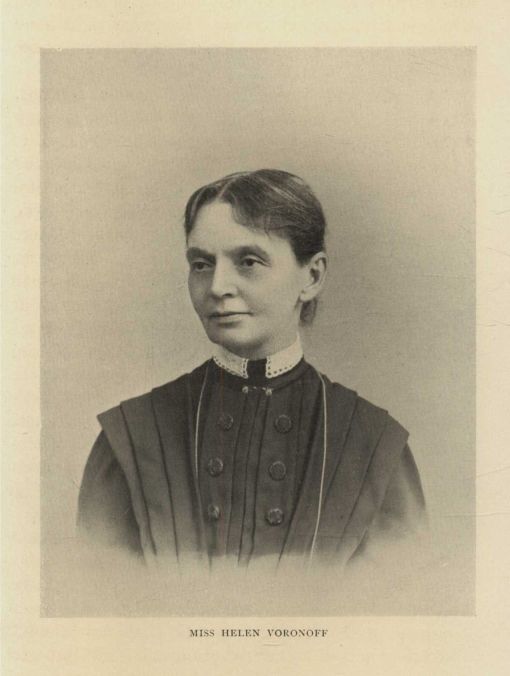
MISS HELEN VORONOFF
The first years of her life were devoted to teaching,
but in 1906 she turned her attention to another
sphere of activity that had long attracted her, and
which turned out to be her life's mission: the
bringing of comfort and hope and spiritual light into
the lives of criminals in prisons, more especially of
political offenders. In spite of her weak health, and
of the fact that she had already in her early youth
been condemned to death by her doctors, she
exhibited the most extraordinary physical and moral
energy, and looked upon all fatigue in connection
with her work simply as an unavoidable and
unimportant detail in the carrying out of her divine
mission.
She never hesitated before those excessively
tiring and depressing journeys to the Schlüsselbourg
Fortress, and other prisons, before wanderings
through cold dark cells, and keeping long vigils at
the bedsides of the dying. Her influence among
the prisoners was so beneficent, that the authorities,
in all cases, allowed her to come and go as she
pleased, and to visit even the most dangerous
criminals in their solitary confinement cells.
On one particular occasion that comes to my
mind, two gaolers seriously opposed themselves to
her entering a certain cell alone, since the prisoner
confined there was a ruffian who literally boasted
of having killed twelve persons, and whom it seemed
most dangerous for an unprotected woman to
approach. Miss Voronoff would not even listen to
the gaolers.
"I must go to him quite alone," she insisted.
"Your presence would show mistrust on my part
and would only wound his feelings."
On her entry, the criminal looked up in surprise.
"Why have you come here alone?" he growled.
"I have killed twelve people. Are you not afraid
that I shall kill you too?"
"There is no reason why you should do that,"
was the quiet reply. "I have only come because
I should like to help you a little. Your past sins
can make no difference."
The prisoner seemed taken aback, and gradually
allowed himself to be drawn into a conversation
that lasted more than half an hour, after which,
when his visitor rose to go, this rough outcast,
touched and softened, begged her to come again.
Between her visits to the various prisons, Miss
Voronoff spent all her time in correspondence and
interviews with the relatives of the prisoners, and
in untiring efforts to alleviate their sufferings and
soften their fate. Many indeed are the bright
moments that this consoling angel brought into the
darkness of those hopeless lives!
Miss Voronoff left behind her (she died only
recently) an interesting book of sketches entitled
Among the Prisoners. Never was a book published
more worthy of being described as a human
document. It is full of the charm and goodness of one
saintly personality reacting upon the victims of a
great tragedy. The following quotations that I
have made from this book are so illuminating as to
Russian character that they require no apology or
explanation:—
"It was not until after a lapse of six years that I
was once more able to visit the Wiborg Cellular
Prison, in the consumptive ward of which I first
began to work for poor prisoners. Then I was in
the company of Princess Maria Dondoukoff-Korsakoff.
Now, this noble woman has gone to her reward,
but everything around seemed to speak to me of her.
There was not a bed in that ward upon which she
had not sat (she seldom, if ever, used the chairs
provided, feeling that in this way she was nearer to the
patient). And many a sufferer had she comforted.
Laying her hand upon his shoulder or his head, she
would speak words which, delivered in her sweet and
affable voice, could not fail to reach his heart.
Ah! how many a heart was softened, how much physical
pain relieved, how many souls gained back to God
by her sweet ministrations!
"And now, with these dear memories crowding
upon me, I visited once again the Wiborg Cellular
Prison.
"It has been much improved; now there are two
wards for consumptive patients, whereas formerly
there was but one, which was both overcrowded and
airless. In fact, the place, I remember, on one
occasion was so close as to overcome the Princess, who
was obliged to lie down and recover before
continuing her ministrations to the sick.
"Upon the occasion of this my first visit to the
prison after six years, a touching incident occurred,
which I should like to recall.
"Upon entering the ward I saw at once that there
were three there who would not be long upon this
earth, for they remained motionless as I advanced.
But the others brightened up at my coming, trying
to check their troublesome coughs, and even, where
strong enough, raising themselves to greet me.
"During my conversation with them I asked if
those so near their end had received Holy
Communion. Upon this point I was reassured, and was
much comforted to see how anxious were those not
yet about to die that their fellow-sufferers should
receive this consolation when the end approached.
"I noticed as I passed along the ward a specially
young and handsome face, the face of one of the
three about to breathe their last. I drew closer, and
silently watched him for a few moments, fearing to
rouse him, for his eyes were closed, and his breath
was short and interrupted. Bright red spots burnt
upon his cheeks.
"As I stood thus his neighbour called him, and,
looking above his bed, I read the name, 'Paul
Rostchin.'
"'Why do you disturb him?' I asked. The man
explained that Rostchin expected me, and wished
to ask me something, and that when he regained
consciousness he would be very sad that he had not
been roused to speak to me.
"'After some time, Rostchin opened his eyes. I
shall never forget their expression. It was a mingling
of pain and hope and entreaty. He tried hard to
speak, but, although his lips moved, I could hear no
sound.
"Gently I tried to soothe him, begging him to be
calm, and telling him that I was in no hurry, and
would wait until I understood what it was he wished
to say to me.
"At last I caught one word, 'Mother.' 'Ah!'
said I, 'you are calling your mother; you want to
see her; perhaps I could find her. Where does she
live?'
"'She is far from here,' he whispered, 'and cannot come.'
"My heart ached for him. It was pitiful to hear
him in these his last moments calling for his mother.
I bent over him and said:
"'Your own mother, as you say, is far from here;
but God has sent me to comfort you. Can you not
count me your spiritual mother, and confide in me,
when I come to you and sit with you and listen to all
you have to say?'
"His face brightened at the thought, and a little
strength seemed to return. 'I have something,' he
said, 'to tell her before I die.'
"Then I begged him to say to me what he wished
to say to her, promising that I would hear it as
though I were his mother. Hardly had I said this
than the man on the bed at our right, being able to
walk, got up and moved away, and the other, who
was not equal to that effort, turned his back to us,
that he might not hear. I was touched at the feeling
displayed by these apparently rough, though simple
Russian men.
"And then I made out from his laboured words
his sad story. A good, kind, and loving mother
abandoned for more than a year and a half, while he
suffered in prison. His great wish now was to let her
know how much he felt his guilt, and beg for her
forgiveness.
"I listened, holding my breath that I might catch
the halting words, and as he bared his soul, and made
clear the confession he wished to make, it seemed as
though a great weight fell from him; and when,
from sheer exhaustion, he sank back and closed his
eyes, I knew that the tears were there, as he said
brokenly, 'I shall never see her again to tell her
this. I have only a few days, perhaps a week, left
to live.'
"I never hold out vain hopes to the poor patients
when they are about to die, so, seeing how near he
was to his end, I did not undeceive him.
"Again I asked him for his mother's address,
promising to write and tell her that he was dying,
and asked forgiveness, and that I would ask her to
reply immediately, so that he might hear the answer
before the end. The face of the dying man shone
with a great joy; the forgiveness of his mother was
all he sought now upon the earth. Then, sinking
back upon his bed, he murmured, 'If I get the
answer, I shall take it with me.'
"Before leaving the hospital I made the sign of
the Cross upon his forehead. His eyes were closed,
but he whispered, 'Thanks, thanks.'
"Meeting the doctor on my way out, I inquired
whether he thought it was worth while to suggest
that the mother should come, or could he last so long.
The doctor seemed unable to decide, saying he might
live a week or he might die that day.
"Hurrying home, I despatched the promised
letter, and for days awaited the answer. Each
day I telephoned to the prison for news of the
dying man, and each time I received the same
reply, 'He is alive, but very weak.' And this for
five days.
"On the sixth day, when I came home in the
afternoon, my servant met me with the information that
a very old woman, poorly dressed, in bast shoes and
a wallet on her back, had been there asking for her
son Paul.
"Rostchin's mother, upon the receipt of my letter,
had determined to come in person to pardon her
son. As the journey cost five roubles twenty
copecks, she sold all her possessions, pledging even
her felt shoes, thus being forced to travel in bast
shoes, in spite of the intense cold. It was her first
visit to a large town; she was bewildered by all she
saw; but her mother's love helped her to surmount
all obstacles.
"The next morning, very early, I went to her. In
her anxiety to get to her son, she came to the tram
with one golosh only over her bast shoe; the other
she had forgotten. It was not until we were on the
way that I broke the sad tidings to her that the
hospital to which we were going was the hospital
of a prison. 'Oh! Paul, Paul, my beloved son.
My darling! How did you get to prison?' she
sobbed. 'He was a warrant officer, and now he is
in prison.'
"To me it was most touching that she did not
once reproach him. She only pitied him without
end. She warmly thanked me that I had not
mentioned in my letter that he was in prison.
"'Oh, God! Oh, Holy Virgin Mary! Let me
find him alive; let me but hear one word from him;
let him look on me only one moment,' prayed the old
woman.
"We found, on our arrival at the prison, that
Rostchin yet lived, but to give an adequate description
of the meeting between mother and son I feel
is beyond me.
"When I led the poor woman into the room where
Rostchin lay, and showed her the bed on which he
was stretched, she staggered, and would have fallen
had I not supported her. But her eyes fell on the
picture of a saint, and, making the sign of the Cross,
she approached the bedside of her son. He was so
weak that he could not even turn his head, but tears
rolled down his cheeks, and the poor mother, bending
over him, gazed so earnestly into his eyes that
her tears fell and flowed with his.
"'Forgive me, forgive me, my own mother. I
am very guilty,' repeated the dying man.
"'My son, my dear son Paul, God will forgive
you,' wept the sorrowing woman.
"I could stand the scene no longer, and I
withdrew. When later I returned, some of the sick
prisoners came up and thanked me for the great joy
I had given to Rostchin.
"Once more was I thrilled to find such feelings in
these poor prisoners, themselves suffering and
outcast, yet rejoicing with their fellow-sufferer. It is
easy to weep with those who weep, but when one's
own heart is sad and suffering, is it so easy to
rejoice with those that rejoice? Envy so easily
creeps in.
"Rostchin did not live long after the visit of his
mother. Having received her pardon, he became
calmer, asked for the clergyman, and once more
received the Holy Sacrament. His death was that
of a good Christian. His sufferings were great, but
he remained still in the same peaceful disposition.
Before he breathed his last, he repeated again and
again, 'Forgive, forgive!'
"It is interesting to note that his mother did not
remain until the end, but, having pardoned and
blessed her son, asked to be sent back to her home.
"This is characteristically Russian. Having satisfied
herself that his soul was prepared to meet his
God, she was less anxious about the dying body,
asking only to be informed when God had called
him away.
"I let her know when all was over, and in reply
received a simple and touching letter, in which she
begged me to 'go to his grave, take from it a handful
of earth, and send it to me.'
"What treasures lie hidden in the faithful soul
of the simple Russian!"
Dostoyevsky's Call—His Retort to a Dandy—Russia and the
Revolution—The Court of Imperial Mercy—How Political Prisoners
may Solicit Pardon—The Coach-driver's Letter—The People's
Belief in the Emperor—A Typical Russian Appeal—Military
Offenders—How they have Justified the Emperor's
Clemency—Political Prisoners and the War
The name of Dostoyevsky is fortunately well
known in England, so perhaps I may be
allowed to relate an incident in connection
with him.
He called on me one afternoon and began talking
of his life in Siberia, and the wonderfully beneficial
effect it had had upon him. We were interrupted
by a flippant young dandy, just arrived from abroad,
who chattered animatedly about his impressions of
various ballets and theatres. I thought he would
never stop, and felt rather angry. Dostoyevsky,
however, listened attentively, his wonderful, dark
velvet eyes, with the deep expression so peculiar to
them, fixed kindly on the gossiper. After a while
he remarked, "I am interested in what you say.
There is life in you, artistic instinct and good nature.
If you could spend thirteen years in a Siberian
prison, as I have done, it would be most beneficial
to you, and might make you a useful, energetic
member of society."
Dear Dostoyevsky! How often have I remembered
that strange remark, and how often also have
I thought that prison life indeed sometimes makes
people serious, patient and religious. Of late,
unfortunately, one has often been haunted by
questions connected with prisons. My late friend,
W. T. Stead, expressed the pious opinion quite seriously,
how useful it would be if everybody—innocent as
well as guilty—were made to spend one or two
months in prison.
Of all horrible wars, the most horrible, I think,
is internal strife, for the suppression of which,
Governments always use strong measures. Are they
to be blamed for measures taken with the object of
saving their country from dismemberment? I
think not—though indeed, personally, I am happy
not to be obliged to mete out justice on such
occasions. But then, I always think that to judge one's
neighbours fairly is no easy task. When Thiers
had to save France from the Commune, he
unhesitatingly killed several thousand Communards—some
say 200,000 were punished, some say 20,000,
there are also people who speak of only 2000. But
who can use the word "only," when it is followed
by thousands of killed?
In the year 1905, Russia had the misfortune of
experiencing a revolution at home. The majority
of the people, of course, understood the criminal
folly of that movement, and the insurgents were
mostly misguided dreamers who did not realise the
rascality of their leaders, such as Gapon and others.
Many of them, indeed, afterwards looked back with
deep regret and even shame, on their folly. I have
known some of them, and it is difficult to say with
what deep feeling of commiseration I listened to
them, and now remember their words. If there be
exaggeration and contradiction with regard to the
numbers of the punished Communards, there is
similar difficulty in fixing the numbers of our own
culprits. Upon that point I am not going to insist.
Even one death is often the cause of endless pain.
In England I have only once seen any mention of
that Court of Appeal by which Russian political
prisoners who repent of their ways may solicit the
Imperial clemency.
The exact title of that institution is "The Court
of Petitions addressed to the Emperor," or "The
Court of Imperial Mercy." It was founded in the
sixteenth century in the reign of John IV, under the
control of Alexis Adasheff (whose life and character
have so brilliantly adorned the pages of Russian
history) and his friend and ally, the Rev. Father
Sylverst, who was another bright star of that
period. But, after their disappearance from the
field of action, the institution failed to be marked
by the same zeal and success as previously. Once
more was it shown that, in every human effort,
personal character plays a greater part than the
written law. For, however perfect may be the law,
its application must be varied by circumstances,
and is thus greatly dependent upon the personal
character of its administrators.
Fortunately, however, Peter the Great, with his
masterly genius, recognised the importance of such
a Court in an autocratic country where the power
of doing generous work is in the hands of a ruler who
stands above conventional formalities, or obsolete
customs, of parties or of newspapers. Nor did Peter
the Great fail to realise that an exact knowledge of
real facts was of vital importance to the proper
exercise of such power. To secure this, therefore,
he introduced new and very drastic regulations and
reforms.
He made it a rule that the head of the Court was
to be bound by a solemn and patriotic oath of
fidelity to his charge. At the same time he was to
be allowed a larger initiative, by which his personal
power was increased. He became entitled to
delegate powers to other administrative offices and
courts, by which the work of the institution became
more decentralised.
But although it was thus understood that appeals
to the Emperor personally were to be allowed only
in special cases, yet little by little these personal
appeals became more and more numerous, and were
with difficulty controlled by the head of the Court.
When the Empress Catherine the Great ascended
the throne, that wonderful monarch resolved that
she would personally receive all appeals to mercy.
But it soon became evident that such a task was
beyond the powers of even her exceptional energy.
Catherine herself relates that on one occasion she
found it impossible to reach church, owing to the
crowds of petitioners who knelt before her with
petitions in their hands.
Such a condition of affairs, of course, could not
possibly continue. In the following year the Empress
appointed three high officials, called State Secretaries,
to whom she gave detailed instructions which
show the great pity she felt for such petitioners.
The secretaries were to communicate personally with
the petitioners "kindly, patiently, indulgently,"
and to extract from them all necessary details and
explanations. For this purpose reference had
sometimes to be made to the separate tribunals before
whom special cases had to go. But sealed letters
addressed privately and confidentially "in His
Majesty's own Hands" (as the Russian expression
goes), still reach the Emperor without any
intervention. And this happens even now.
Not long ago I heard of a boy, a poor little
coach-driver, who addressed a pitiful letter of this kind
to the Emperor Alexander III when he was in the
Crimea, and not only was the letter received, but
the request generously granted.
To return to old times, the Emperor Paul, while
young and in good health, tried to imitate the great
Empress Catherine, and endeavoured to come into
contact with people who appealed to his mercy. To
facilitate this a large, yellow iron box was attached
to one of the ground-floor windows of the Winter
Palace (Petrograd) in which petitions were to
be deposited. This box had to be periodically
opened by the State Secretaries, and the contents
submitted to the Emperor for orders. Some, when
too absurd, were partially torn and returned through
the Post Office. Others were published in the
Petersburg Gazette, with the reason for their refusal.
In 1799 the same Emperor Paul issued a rather
strange ukase, forbidding the presentation of
unreasonable requests. No doubt the question of
what was and what was not reasonable was not an
easy one, and the unfortunate box could hardly
hold the burden of its strange correspondence. It
obviously became necessary to dispense with this
original method of communication.
In the time of Alexander I, thanks to the great
Speransky's efforts, a "Commission of Appeals"
was established, and in the time of the Emperor
Nicholas I the "Court of Petitions" was reformed
more or less on the basis upon which it now exists.
The members are appointed by the Emperor himself.
To their former duties have been added others
relating to orphans and lunatics. Certain rules have
to be observed by petitioners, and they must have
lived in the realm not less than one year.
By the wish of His Majesty the reasons for
refusals to grant favours are sometimes given, but
this law cannot always be observed.
The Emperor has recently given orders to enlarge
the Court's sphere of work by accepting appeals to
Imperial mercy for criminal charges, and
administrative misdemeanours.
Finally, I will note the fact that in the year 1908
there were 65,357 petitions through this Court, out
of which 64,174 were fortunate enough to obtain
the Imperial order for immediate attention. As a
rule there are about 65,000 petitions presented
yearly. Imperial benevolence (mercy) shown to
children amounts to 10,000 cases in famine years.
During the war His Majesty ordered from the
coffers of the "Court of Petition" no less a sum
than 178,000 roubles for the wounded soldiers.
"If anyone were to tell the Russian people that
the Emperor had not the power to help them, they
would never believe such an assertion," observed
Baron Budberg (the late head of the Petition
Department), "and may that belief in His Majesty's
power always remain with the Russians." The
Emperor's remark on this statement was that Baron
Budberg was right.
"Let those who require my mercy come to me
with their sorrows in confidence."
And many, many are the thousands who have
been made happy—thanks to that Court of Appeal.
People in England often talk about red tape.
It is not for me to judge whether their complaints
are well founded—but naturally, when one comes
in contact with official pedantry, one is inclined to
grumble and lose one's temper, though this as a
rule does not mend matters. But to get the better
of red tape—ah! that is useful and pleasant. There
are occasions even when it may become a great
blessing, as in the following, which I hope I may
be allowed to relate:
In Russia, the Court of Appeal to Mercy allows
everybody to appeal to the mercy of the Emperor.
It is not difficult to understand that there are great
differences in the nature of such appeals, and, in
Russia, as likewise in England, prisoners are not
allowed to publish their grievances, and still less
their appeals to the head of the State. However,
by a very happy mistake, such an appeal from the
political prisoners slipped, at the end of last year,
into one of our best Petrograd papers. The following
is a translation of this appeal which may be of
interest to English readers:
"Your Imperial Majesty, most merciful Tsar. In
this tragic hour of our beloved Russia's destiny, we,
the prisoners in the Petrograd prison of solitary
confinement, approach the footstool of your
Majesty's throne, our hearts full of love and
boundless devotion, our suffering souls burning with
prayers for the victory of our heroic Russian troops.
"Within the walls of this prison, we are paying
the penalty of our sins. We are far from our homes,
far from the heart of the Russian people, doomed
to confinement and exile; the only light in our
darkness is our faith in the mercy of God and the
Tsar.
"It is not for us to judge of the sorrow we have
caused our beloved country—but in the moment
of her great trial our Russian hearts beat with but
one care: that of her well-being. We have, indeed,
no personal cares.
"We have read with tears of deep emotion these
words of the Imperial call: 'In this hour of trial
let all internal disagreements be forgotten,' and we
pray that God may move the heart of the Emperor
and the heart of the people, to forget also our past
sins, to return to us the privilege of taking our places
in the ranks of those who arise and go forth in all
the fullness of their youth and strength to defend
the honour and glory of our country.
"It is not a lack of courage to suffer our
punishment which prompts us to make this appeal for
mercy; we were condemned at various times, and
have never before dared to voice any such prayer—but
these tragic days, in which countless numbers
of our physically weaker brothers are laying down
their lives on the battlefield, fill our souls with one
profound desire. Most merciful sovereign, call us
into the ranks of your loyal army, and, having paid
for our sins with our sufferings, we will join our
brothers, inspired with an unshakable faith in your
Imperial goodness and mercy.
"The dawn of this national war has awakened
our souls, has renewed in us the sense of our duty
and our right to defend Russia, side by side with
all Russians.
"May the war renew our lives for the benefit
of the Russian people, or accept them as an offering
to our Russian soil. In the silence of our solitary
cells, we pray that God may save and keep your
Imperial Majesty, and all the August Imperial
family."
This appeal, thank God, was not overlooked by
His Majesty. I myself know of two cases where
former prisoners were allowed to go to the war,
where they acquitted themselves splendidly—so
much so, that one of them, whose case is known to
me, now wears the Cross of St. George for bravery.
A decree of His Majesty has already been applied
to another section of prisoners, the military offenders.
This special decree gave to the commanders of the
various military districts the right to take into active
service for the duration of the war such of the
military prisoners in their jurisdiction whom they
consider deserving of the right to win, by bravery in
the field, the possibility of future pardon.
This right has been widely utilised, with the result
that of 4786 military prisoners, 4091 had, by January
1st, 1915, been taken into active service. Of
these, 1203 have remained under their particular
district commanders, most of them working in
munition factories, and the remaining 2888 have
been distributed among various regiments at the
front, and in the reserve; the actual number of
military prisoners still confined is 393.
There are, of course, criminals and criminals, and
among them are many who represent a real danger
to society, and who, in other countries, would be
sentenced to death immediately after their trial.
Our legislation, however, remembers the saying of
Catherine the Great, "Better pardon ten who are
guilty, than kill one who is innocent." We also
think that every culprit should have time to
repent, and thus to be able to meet death with greater
calm, and confidence in God's pardon.
After the outbreak of the Great European War
many political prisoners in Russia made appeal to
the Tsar to be allowed to fight for their country
against the Germans. Many people in Russia would
have welcomed a general amnesty to political
prisoners for this purpose. There are among these
men many who deeply regret their political mistakes
and past illusions.
They have offended against her laws, but still
love and wish to stand by her in the hour of trial.
The country would gain much by such an amnesty.
New forces would doubtless rise to the surface, with
new feelings of gratitude for the opportunity thus
afforded them of helping Russia, and of sacrificing
their lives for the national cause.
Some ten years ago, in the days of our revolution,
almost half of Russia was acting, as many of us
thought, mistakenly and foolishly, and making even
serious sacrifices for this folly. Fortunately, such
a regrettable state of affairs did not last long, and
I was soon able to dream of founding a society for
the reclamation and return to Russia of those who
had outlived their ideas of revolution and who, after
all, loved Russia, right or wrong. Unfortunately,
this scheme met with numerous obstacles. Such
a society would have required not only many
members, but also a cautious committee, one not liable
to fall into traps—and I failed to procure them.
Since the beginning of the war this question has
again been constantly in my mind, and I have
spent many hours in discussing it with my friend,
Helen Voronoff, and she was entirely of my opinion
in the matter.
We read together a most touching petition signed
by 110 political prisoners, confined in a Petrograd
prison. It was composed by one of themselves, and
handed round among the prisoners for signature.
It seems to me that such petitions should not
remain unheard.
A Remarkable Personality—The Grand Duke's Graciousness—His
Tact and Sympathy—The Wounded Soldier—A Censored
Book—Prince Oleg and my Brother Alexander—A Talented Child—A
Strange Premonition—The Prince's Interest in Public
Affairs—His Studious Nature—The Prince Wounded—His Joy on
Receiving the Cross of St. George—He Becomes Worse—The End
The late Grand Duke Constantine (known in
the literary world as "K.R.") was a man of
remarkable character and personality, richly
endowed alike in imagination and those qualities
that make for friendship.
He was, of course, widely known and admired
for his remarkable musical and literary talents, and
not in Russia alone, while his famous drama, The
King of the Jews, revealed in addition a powerful
intellect, combined with deep religious feeling. This
greatest and last of the Imperial poet's works has
been translated into several foreign languages. It
has awakened universal admiration, and has been
enthusiastically praised by the Press of most European
capitals. All this, however, is too well known to
need repetition. Let me, therefore, turn to another
and still more personal aspect of the Grand Duke's
character: the extraordinarily attractive graciousness
and the sympathetic intuition that endeared
him to all who had the privilege of coming into
intimate contact with him. Here, indeed, was a
precious and priceless quality—the gift of unfailing
tact and exceptional intuition, the power always to
say the right thing at the right moment, and to
enter warmly and cordially into the thoughts and
feelings of others.
I will quote an instance: I am deeply devoted
to the memory of my two brothers, Alexander and
Nicolas, but, realising that this fact is of interest
to no one but myself, I seldom speak of it. The
Grand Duke, however, seemed to have read what
was written in my very soul. I had the privilege of
conversing with him at some length on only two
occasions, but they were occasions I shall never
forget. The other occasions were passing and
rather superficial. The first time, he spoke to me at
length of nothing but the Slav question and the
death of my brother Nicolas. The Grand Duke
remembered all the details of my brother's untimely
end in Serbia.
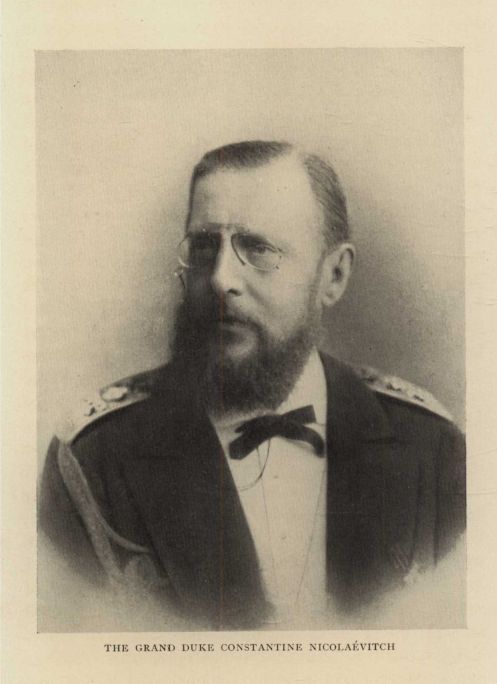
THE GRAND DUKE CONSTANTINE NICOLAÉVITCH
On the second occasion—-alas! I was destined
never to see the dear Grand Duke again—our
conversation was dedicated to the memory of my brother
Alexander and to Old Catholicism and Slavophilism,
to which my brother devoted his whole life, and of
which he spoke even in his very last moments. I
must add that I had edited two large volumes of
my brother's works in Russian, but had hesitated
to send them to the Grand Duke, contenting
myself with offering him my Berne editions of
Alexander Kiréeff's French works, which, as far as I know,
are unobtainable in Russia. With his usual
amiability, the Grand Duke had thanked me by letter—and
now, how indescribably kind and charming was
the manner in which he reproached me for not giving
him all I had edited!
There was another trait in the Grand Duke's
character, which, to me, had a peculiar charm:
I refer to his ever-ready sympathy and interest in
all cases where his influence or help might be of
advantage. It goes without saying that neither my
brother nor myself ever appealed to this kind
interference unless we had thoroughly investigated the
case in question. The Grand Duke was aware of
this, and his help was always immediately forthcoming,
without any needless delays or formalities,
and without a trace of the distressing red-tapeism
that is elsewhere often responsible for so much
mischief and sorrow.
One meets with just this same kindness and
compassion when one approaches our beloved Emperor.
One has only to be absolutely free from all egotistical
aims, and to be known as were my two brothers—and
once this is so, no appeal to the Imperial
sympathy is ever neglected or fruitless.
It is, of course, exceedingly difficult to reach His
Imperial Majesty, not only because of his exalted
position as Emperor, but also by reason of his being
overwhelmed by work. He hardly ever limits himself
to an eight-hours' day labour. An eight-hours'
day would be almost a rest to our Emperor. There
is no Trades Union rule for the protection of Kings.
But let me return to my kind Grand Duke.
Perhaps I may be allowed to quote two incidents
that took place a few weeks before his death. There
had been brought to my notice a wounded soldier,
whose case was particularly tragic. His friends
considered nothing so desirable as to have him received
in the hospital founded by the Dowager Grand
Duchess Constantine, the mother of the Grand
Duke. I wrote to His Imperial Highness on the
subject, and in the course of the same day received
a kind reply, informing me that the matter had
been arranged and that the soldier would be at the
hospital in a few hours' time.
The second incident was concerned with the
publication of a book. In all cases where members
of the Imperial family are involved, certain
formalities have to be observed by our censors—failing
which the book may have to be greatly altered, or
suppressed. Anyone connected with literary work
knows that such alterations are sometimes extremely
costly and troublesome. A dear friend of mine, who
had very little money to spare, had written a book
that was threatened with difficulties of this order.
I wrote to the Grand Duke explaining the facts,
and here again everything was immediately and
satisfactorily arranged.
I could give countless other instances, but the
above, which I have taken at random, are sufficiently
characteristic.
I have often had occasion to speak of the Grand
Duke, and have always noticed with the deepest
pleasure that the mention of his name awakened
everywhere, even among people who knew him but
slightly, feelings of sincere affection and devotion.
The fascination exercised by his personality was
unfailing. His literary gifts appealed to poets, his
musical talent to musicians—but to me, his most
charming and touching quality was that deep,
indescribable sympathy and insight which seemed
to enable him to read people's souls. Such
sympathy, such intuition, is a great living force!
Yes—God sometimes sends into the world exceptional
people, who can never be replaced, and whose very
memory radiates like a warm, shining light, where
their footsteps have passed.
Of such, unquestionably, was our never-to-be-forgotten
Grand Duke Constantine.
On one occasion he wrote the following letter,
which I quote as showing the charm with which he
expressed himself:
DEAR AND HIGHLY-ESTEEMED MADAME NOVIKOFF,
Again I take up the pen to thank you heartily
for the new series of valuable and curious
autographs, with which you so graciously enriched my
collection, that I already owe to your generosity.
The Ikon of Christ of Andrea del Sarto, before
which your brother always prayed, forwarded to
me by General M. E. Keppen for Pavlovsk, is
placed here at the Palace Church, on the Chancel,
where all our family attends church service and
where your dear brother often prayed as well.
This beautiful Image will remain a prayer memorial
to Alexander Alekseevitch, who lived so many years
in his favourite Pavlovsk. I hope you will
acquiesce in the choice I made for this most valuable
Image of Christ the Saviour—in the Pavlovsk Church.
Allow me to kiss your hand, asking you to keep
me your kind friendship in the future.
Your heartily devoted, etc.,
CONSTANTINE.
On October 27th, 1914, I received from him the
following note: "It is just a month to-day since
our beloved son was wounded—not 'slightly' as
seemed at first to be the case, but mortally. God
gives and God takes away. May His name be blessed
now and for ever more."
It will be seen by the date of this note that
Prince Oleg, then only twenty-one years of age, was
one of the early victims of the war. At the time I
little thought that the Grand Duke himself would
soon follow his gifted son, Prince Oleg Constantinovitch.
Until the recent appearance of his biography, the
fame of Prince Oleg was too little known, and it
certainly had not travelled far outside Russia.
To me, this charming Prince was particularly
dear; for I had seen him taking such affectionate
care of my brother, Alexander Kiréef, who was
already blind, ill and dying. The young man used
to come, and talk to him, the principal defender of
"Old Catholicism," of the efforts to revive the pure
teachings of the Church, as it was before the division
of the churches in the ninth century. No subject
was dearer to my brother's heart, and, seeing the
beneficial influence of these conversations, the young
Prince returned to the subject many times in my
presence.
One day he said: "General, nobody has ever
been so useful as you in supporting the Old Catholic
movement. You are my father's friend, and I am
as proud of you as he is."
Yes, I shall never forget with what loving eyes
the young man gazed into the clever beautiful face
before him, where the eyes were already dim and on
the point of being closed for ever. How terribly
vividly some moments come back to our memory.
The talented child of a talented father, it was
early evident that Prince Oleg had inherited the
brilliant gifts of the Grand Duke. It is barely two
years since The King of the Jews was produced with
immense success at the Hermitage Theatre in the
Winter Palace at Petrograd, the Grand Duke
himself, as well as his sons, taking part in the
performance.
Prince Oleg was clearly marked out as belonging
to the elect of the earth, and by his early death
not only has Russian literature been deprived of a
future shining light, but the most cultured circles
of Petrograd society are the poorer for the loss of a
personality, touching and lovely in its goodness and
unselfishness, and its youthfully enthusiastic and
unswerving sense of duty and obligation.
The young Prince's biography concerns itself with
the reminiscences of Prince Oleg's early governesses
and later tutors, with his diaries and rough sketches,
countless unfinished stories and poems, and also
with a particularly interesting undertaking in
connection with Poushkin's works.
Poushkin was the boy's ideal from his earliest
days, and it was this love for the great poet and his
works that gave him the desire to enter the same
Lyceum (College) at which Poushkin had been
educated. This desire was realised, the completion
of his course happening to coincide with the
centenary celebrations of Poushkin's birth. On
leaving, Prince Oleg presented to the Institution
a personally executed facsimile of all the Poushkin
manuscripts, carefully treasured in the Poushkin
museum, which were written while the poet was
a student at the college. The young enthusiast
afterwards conceived the idea of editing the whole
of Poushkin's works in this fashion, bringing them
out in loose sheets and unbound folios, and
distributing them among museums and book-lovers.
The work was carried out mostly by means of the
most detailed and perfect photographic reproduction,
not even omitting the smallest line, point, or blemish
in the paper. Unhappily this labour of love was
not destined to be completed, but as much as has
been done is a wonder of execution and a real
literary treasure.
For the general reader, perhaps the most attractive
pages of the biography are those that deal with
the Prince's early years, recent as they are.
"I sometimes try to imagine," he writes in one of
the diaries of his childhood, "what would happen
in my own immediate circle if I were to die. What
would my friend do? I suppose he would grow
pale and thin, and would fret terribly. I see him
in imagination, mounting the steps of my catafalque
to bid me a last good-bye, and I see mama's
expression as she follows him with her eyes.
"And then, suddenly, it seems curiously pleasant
to have all these people thinking of me so regretfully!
There flashes across my mental vision a copy
of the Novoye Vremya, and I see on the first page,
in large letters, the announcement of my death. I
notice also that there is a reproduction of my
photograph—and for a moment, I stop to wonder which
photograph they will publish. All this gives me
extraordinary satisfaction.
"But the pleasantest thought of all is that the
Novoye Vremya will print an obituary notice saying
that I took my Degree at the Lyceum, that I won
the Poushkin medal, and that they liked me there.
Perhaps even Radloff himself may write a memoir
of his late pupil. At this point, I stop ... really,
I was going too far, it is very ridiculous, and I am
ashamed of myself! I wrinkle my brow, and try
to decide seriously whether I should really be willing
to die just now. My inner consciousness tells me
that actually, it would be stupid to die before having
accomplished anything. No, not for the world ... I
don't want to die without fame, without having
done anything, without deserving to be remembered
by anybody."
How touching this is—especially now, when one
can regard it as something like a presentiment.
Interesting from another standpoint is the
description by the then thirteen-year-old Prince Oleg
of the reception by the Emperor, at the Winter
Palace, of the Deputies of the first Duma in 1905.
The young, awakening soul of the child trembled
with awe and ecstasy. His eyes, fixed on the
Emperor, noted every shade of tone and expression,
and his description, too long for quotation here, is
glowing in the extreme.
On February 10th of the same year he writes:
"Something unusual is in the air. It is said that
on the 19th there will be a rising in the whole of
Russia. Recently M—— sent a secret telegram to
Simferopol. A message has also come from the
Crimean Division—they have caught a Revolutionist.
They say there is a plot to blow up Livadia.
There has been a rising in St. Petersburg and
disorders in the suburbs of Moscow. On the 4th
Uncle Serge was murdered. Poor Uncle Serge! mama
has written us horrible details—she says
we have lost a true friend. This awful incident has
made a deep impression on us all. May it be God's
will that everything should right itself somehow.
Disorders in every town! How painfully this must
affect mama! It is a long time since I last received
a letter from her."
Then a page about Port Arthur!
"What have we lived to see! Stoessel has
surrendered Port Arthur! It appears there was no
possibility of holding out any longer. Kondratenko
is killed. Yes, many heroes have fallen at Port
Arthur."
How significant and how true are the following
words, which show a remarkable insight in a boy so
young:
"Our Government is composed chiefly, not of
Russians, but of Germans—and, of course,
Germans do not care what becomes of us. Naturally,
the result is that Russians lose. We are too
careless—we do not sufficiently educate ourselves.
It is imperative that every Russian should work
at himself and educate himself from his childhood."
When one considers that the writer of the above
lines was barely thirteen years old, one cannot but
wonder as much at the serious trend of his thoughts
as at the simplicity of his style.
Here is another charming page from about the
same period, a little earlier:
"To-day I received a letter from my tutor, I.M.
It was so touching that I nearly burst into
tears—but of course I restrained myself. How stupid I
was, when, at first, I was glad of the war! [Between
Russia and Japan.] How much suffering, how
many orphaned families it has occasioned! At the
beginning I wanted to run away and go to the front.
If, during our journey to the Crimea, it should be
God's will to send me to the war now, I should still
be happy. To-day at lunch they were saying that
there were only 10,000 left in Port Arthur, that
Port Arthur cannot hold out. At six o'clock in the
evening, I shut myself up in my room and prayed
that God might help us. I took my Prayer Book,
and thought to myself, 'I will open it just at
random, and read. Perhaps I may chance on
something suitable, just for the war.' I opened the
book and read, 'Special prayers for times of war!'"
The above is an extract from a diary.
"The education of the young Prince and his
brothers," says the Novoye Vremya in an interesting
article on the life of Oleg Constantinovitch, "was
very systematic and thorough. They rose at
half-past six, were taken for a morning walk in the
park, and at eight were already at their lessons.
Each lesson lasted forty minutes, and between it
and the next there was an interval of twenty minutes.
There were from four to five lessons daily. Luncheon
was at one, and from two to four the young Princes
rode daily with their uncle, the Grand Duke Dimitri.
From four to seven preparation for the following
day, at seven dinner, then forty minutes' reading
with one of the teachers of foreign languages, then
drawing and dancing. An arduous day's work
indeed!"
Here is another charming extract from the diary:
"We must study hard and prepare ourselves.
Perhaps we must work even more seriously than
did the rulers of to-day in their youth. There are
hard times coming—and hard times call for serious
preparation. The further we get from the year of
Christ's birth, the harder grow the times, and the
harder the times, the more necessary a thorough
preparation."
These are wonderful words from a boy of twelve.
The following words, also written in his diary,
this time in the train when homeward bound after
a summer spent abroad, are interesting in their
charmingly expressed and idealistic patriotism:
"We are already nearing beloved Russia. Behind
us is France, with her joyous, charming, talented
people, with Paris, Versailles, and Napoleon's tomb.
Now we are passing through this dull Germany, in
an hour we shall have crossed the Russian border.
Yes, in an hour I shall be in Russia, that dear land
where there breathes something sacred, unknown
in other lands, on the face of whose soil are scattered
churches and monasteries, in the mysterious twilight
of whose ancient cathedrals there rest in silver
coffins the bones of her sons, in whose dim shrines
the faithful kneel constantly at prayer before the
solemn sacred images of her saints. In my beloved
Russia there are still dreamy forests, immeasurable
steppes, and impassable marshes.
"There are moments in one's life when suddenly
with a deep, passionate impulse one realises how one
loves one's country. In those moments one longs
unspeakably to work, to help, to do something
worthy, to devote one's life to the service of Russia!"
A later extract from his diary is the following:
"We are five brothers and are all going to the
war with our regiments. This fact pleases me
immensely, for it proves that at a trying moment
the Imperial Family knows how to rise to the
occasion.
"On the 20th of July, Germany declared war
against us. On the same day we were commanded
to assemble at the Winter Palace at 3.30. The
streets were crowded and there was tremendous
cheering as we passed. In the Nicolaevsky Hall
there were first prayers, and then the Manifesto was
read. During the prayers the whole assemblage
sang, 'Save us, O Lord,' and 'God save the Emperor!'
[the Russian National Anthem.]
"At the moment when the Emperor drove up to
the Palace, the whole dense crowd on the great
square on their knees. We were all overcome and
wept with emotion."
The Prince never had the slightest presentiment
of his death, and was afraid only for his brothers.
"I am constantly anxious," he wrote, "about Kostia,
Gabriel and John, but perhaps principally about
Igor. For myself, I fear nothing. Something tells
me that no bullet will so much as touch me."
God willed it otherwise! The Prince was wounded
during an attack on Vladislavov by the Second
Division of the Guards. Our side started the firing.
The Germans retreated, but were stopped by a
detachment of our Hussars. At this point Prince
Oleg, longing for action, eagerly begged his
commander, Count Ignatieff, to allow him with his
men to rush forward and seize this handful of
Germans.
For a long time the commander refused to accede
to this request, but, at last, allowed himself to be
persuaded and gave in. Misfortune came immediately.
Prince Oleg, fired with youthful enthusiasm,
rode fast and far in advance of his men. The
Germans were caught up, five of them were killed,
the rest surrendered. Suddenly, a wounded trooper
fired from the ground. A report—and the Prince
fell. Alas, the wound, taken at first to be quite
slight, turned out, on closer examination, to be only
too severe, and very soon—possibly through the
unavoidable delay in operating—blood poisoning set
in. The operation was performed at Vilna, after a
long and weary journey, first in a plain jolting cart,
the only conveyance at hand—and then in the
train. The Prince regained consciousness very
quickly and felt well. A telegram arrived from the
Emperor, conferring on him the Order of the Cross
of St. George; also came a telegram from the Grand
Duke Nicolas.
"It was good to see the Prince's joy," writes an
eye-witness of the scene, "and the pride with which
he showed me both these telegrams."
In the evening the Principal of the Military
College at Vilna visited the patient and congratulated
him on having suffered and been wounded for
his country.
"I am so happy," exclaimed the Prince in
answer. "So happy. This was most necessary.
It will encourage the troops to know that the
Imperial House is not afraid to shed its blood."
The Prince was very animated and beamed with
joy at the consciousness of his own suffering for his
beloved country. At times it was evident, in spite
of his effort to hide the fact, that he was in great
pain.
Here is a very interesting letter from the Grand
Duke Constantine's aide-de-camp, who was with
the Prince during all these terrible days. This
letter is published by the Moscow Gazette:
"At about one o'clock in the night, I was told
that the Prince had just awakened. I immediately
went to him. He was pale as death. At the sight
of me a troubled, welcoming smile lit up his youthful
features. 'Nicolas!' he exclaimed. 'Here you
are at last! Heavens, how glad I am now that you
have come! Now you shall not leave me again.
I will not let you go.'
"'Of course I shall not leave you,' I answered
with emotion. 'Here we shall stay together till we
are quite well again.'
"'Yes ... yes ... together ... till I
... get ... well....'
"So convinced was he that his recovery was to
be speedy and certain. One had to swallow one's
tears and to hide one's grief.
"'Has Igor told you everything?' he continued.
'The Emperor has given me the St. George. I am
so happy! There is the telegram, there, on the
table.'
"I sat down beside the bed, as he asked me, and
tried to talk; but soon noticed that he was falling
into a state of semi-consciousness. At my slightest
movement, however, he opened his eyes and
exclaimed: 'There, he is gone—and I said I would
not let him go!'
"At about eight o'clock in the morning the Prince
grew more restless. He constantly asked to be
moved from one side to the other, now putting his
arms under his head, now embracing me feverishly
and stifling a cry or a groan.
"A telegram arrived, saying that the young
hero's parents were on the way to him and would
be with him at five o'clock. At midday the doctors
examined the patient again and found the pulse
good, and the poisoning not advancing. There
was still hope. At about four o'clock, however,
a change for the worse suddenly set in. The
breathing became more frequent and the pulse weaker.
There were signs of sepsis and delirium. The train
by which the Grand Duke and Grand Duchess were
arriving was two hours late. In the meanwhile the
patient's strength was failing minute by minute
and it became necessary to recur to the aid of
injections to stimulate the heart's action. His lips were
constantly moistened with champagne, and in order
to hide from the Prince the hopelessness of his
condition, we filled our glasses and told him that we
were all drinking with him to his speedy recovery.
It was horrible beyond words, and never in my life
shall I forget those few sips of champagne in the
presence of the dying Prince!
"Clear consciousness alternated with delirium.
At seven o'clock he suddenly threw his poor little
thin arms round my neck and whispered, 'Like
this.... Like this ... together ... to meet
them.' I thought at first that he was wandering,
but no! He was alluding to the arrival of his
parents. At last they came. For one moment he
recognised them. The Grand Duke had brought his
dying son the Cross of St. George from his Imperial
uncle.
"'The little white cross! ... The little white
cross! ...' whispered Prince Oleg, and he bent
forward slightly and kissed the shining enamel.
We pinned the Cross to his shirt. Presently the
patient began to gasp for air, and it was clear that
the end was near. Those awful moments of silent
waiting, those last short breaths ... how terrible
is the mystery of death. At 8.20 the young life
closed...."
A deep and real love breathed in all his life,
doubly touching through the purity and transparency
of the innocent heart in which it throbbed.
Perhaps his soul, looking down from Paradise, can
see the tear-dimmed eyes of many Russians gazing
sadly up to Heaven's gates through which the
beloved young hero has passed.
Russia is loyal to her sons. She will never forget
them.
Russia Blamed for the Balkans Muddle—Bulgaria's
Treachery—Gen. Grant
on the Russians and Constantinople—Bulgaria's
Dissatisfaction—The Reign of the Fox—The Treatment of Prisoners of
War—The German Method—The Allies' Failure—Lack of
Organisation—Insidious German Propagandism—Britain and
Her Prisoners in Germany
Many people blame Russia for what is going
on in the Balkans. They may, perhaps, be
more right than one would imagine, but
probably not quite in the way they suppose! In
political, as in private life, there are moments when one
must be guided only by the criterion of one's own
duty and conscience, whether one pleases the world
or not, whether even one is openly blamed or not.
Russia, unfortunately, has not always observed this
principle.
It seems to me that in politics nothing is so
dangerous as to be more carried away by
cosmopolitanism than by patriotism, and to forget one's
own feelings and duties in one's desire to please some
other Power. Cosmopolitanism kills patriotism.
I have spent many winters in England, and have
known many Englishmen, but I have never met a
true Briton who would boast of being a cosmopolitan
and not a patriot. Happy England!
They tell me that there are prisons and lunatic
asylums in this country. Naturally—even in this
happy land there are madmen and criminals—but
they are considered and treated as such. In the
present situation all the harm has been brought
about by our past diplomacy, anxious, as it has
always been, ever since the Turkish war of '76, to
please the European Concert.
At this moment, of course, we fervently adhere
to the policy of the Allies—and for this, indeed,
one can only say "Thank God!" The aims and
objects of the allied nations are identical, and we
have one common end in view: victory over our
enemy at any cost. This fact is not based on any
vague, cosmopolitan craving to win the approval
of some wretched concert, but is founded on the
most ardent and determined sense of patriotism.
Now let us consider what is just now the real
position of Bulgaria, and how this position has
been brought about. 'Yes, the incredible has
happened, the liberated slave has turned against
the hand that gave him freedom, the but recently
enchained captive fights side by side with his
oppressors, and uses his armed forces against his
brothers. We turn away in horror, and cry
"Treachery!" The cry is taken up and repeated,
its echo resounds everywhere, and it seems at first
sight as though nothing could be said in defence
or justification of an act so inexcusable. Our
indignation, indeed, is just; but before we
condemn an entire nation, let us look round for a
moment and consider whether we cannot point
the finger of our scorn and contempt at an object
more deserving of such feelings than an ignorant
people victimised by falsehoods and intrigues,
and drawn against its will into an adventure of
which it is already tiring.
In the first place, European diplomacy, guided
by Lord Beaconsfield, opposed Russia's
imminent triumphant entry into Constantinople. In
connection with this fact, I am tempted to recall
the following incident.
Several years after the end of the war, ex-President
Grant called on me in Paris, and put to me the
following question:
"Can you explain how it happened that the
Russians did not occupy Constantinople, when
it was obviously entirely in their hands?"
"Alas!" I replied, "I have no pleasant explanation
to offer. We never expected such a voluntary
abdication of power. In fact, some of our military
people telegraphed to Moscow, saying, 'To-morrow
Constantinople will be occupied for several days.' The
general conviction is that our Government,
misled by news from abroad, telegraphed orders to
our Generals not to advance."
General Grant, who was listening attentively,
smiled, and said:
"Well, I can only say one thing. Had I been
one of your Generals I should have put the order
in my pocket, and opened it at Constantinople
three or four days later!"
Soon after the Constantinople mistake we again
foolishly yielded to the demands of the European
Concert, when the San Stéfano Treaty was opposed,
and once more this was a terrible blow to our
patriotic feelings, and a real misfortune to Bulgaria.
By Count Ignatieff's scheme, the Treaty of San
Stéfano raised the whole of Bulgaria on this side
and on the further side of the Balkans to the rank
of a Principality. Bulgaria breathed again, and a
bright future seemed about to dawn for her—when
suddenly, once more thanks to the demand
of European diplomatists, the newly liberated
State was sawn asunder alive, and the best, the
richest portion of its territory found itself once
more under the Turkish yoke. As if this were not
enough, it was insinuated, with an entire disregard
for national attachments and views, that Russia
must not dream of nominating a Russian orthodox
Prince to be the Ruler of the new Principality.
No Russian messages or manifestations of
sympathy are allowed to find their way into Bulgaria,
for the Austrian has reason to fear the Russian
influence. The remembrance of what Russia has
done is not quite dead; there is still a spark among
the ashes, and perhaps even a faint breeze might
revive the dying embers. Many people, indeed, are
of opinion that there is profound truth in the
following words recently pronounced by General
Radko Dmitrieff, the Bulgarian General who is
fighting in the Russian army against one common
foe, the only foe a true Slav can acknowledge at this
moment.
"Once the Bulgarians can be made to understand
that they have been deceived, that Russia is
no enemy, but rather, now as ever, their traditional
friend, also that when the time comes for regulating
frontiers and boundaries the Allies will be just and
generous, great changes may be expected. There
may, indeed, be a repetition of that famous incident
during the Battle of Leipzig when the Saxons,
fighting on the French side, suddenly changed front
and went over to the enemy. I should not be at all
surprised if something similar happened in the near
future." Yes. Bulgaria ought to follow General
Radko Dmitrieff's advice—if she wants to be
pardoned and saved.
A large section of the people is already bitterly
discontented with the Government, and there have
already been demonstrations in Sofia in favour of
peace. During one demonstration that took place
outside the Royal Palace, the demonstrators had to
be dispersed by the police and a detachment of
cavalry, several people being killed. In the
best-informed Bulgarian military and political circles,
also, great restlessness and uneasiness is being
shown, and the whole state of affairs seems exceedingly
unstable and uncertain. The poor Bulgarians,
indeed, are in a helpless and inextricable position.
From the moment of their liberation they have
been in the hands of German Princes, who,
encouraged by the German Press, have been spreading
the falsehood that Russia is not to be trusted, and
that she is rather an enemy than a friend!
Ferdinand has used every opportunity to emphasise
this idea, and since the outbreak of the present
war has steadily influenced the people into the
belief that the Allies would, in the event of their
success, crush Bulgaria out of existence. It is,
indeed, probable that the fate and fortunes of the
Bulgarian people do not touch Ferdinand very
deeply—he, an Austrian, a Catholic, cares little for
the welfare of his orthodox State subjects. His
object is to unite the Bulgarians with their former
oppressors; but such a union, even if it is, to all
appearances, established, can certainly never be
sincere. Ferdinand has learned from his German
masters (first-rate masters, indeed, in such matters!)
how to demoralise the poor uncultivated Bulgarians:
demoralisation is not too strong a term—for
Europeans who serve Turkish interests and persecute
Christians are renegades of the worst description.
All this would certainly never have happened
had Russia not yielded to the demands of the
European concert after the Turkish war in '78.
I must say here that the England of to-day is by
no means the same as the England of Disraeli.
The Bulgarian people, indeed, perhaps deserve
more pity than condemnation, and it is wrong
to lay all the blame for the present state of affairs
entirely at their door. It is, for instance, a significant
fact that there are countless Bulgarian subjects
in Russia to-day who have refused to answer the
call of their Government, in spite of the losses and
dangers of future vindictive persecution of
themselves and their families which such an action
involves. The former Bulgarian Minister in London
and afterwards in Petrograd, M. Madjaroff, is said
to have been imprisoned for treason the moment
he touched Bulgarian soil. His offence was nothing
more than a suspected gratitude towards Russia
for the good done to Bulgaria.
Russia as well as England is naturally indignant
with the attitude suddenly adopted by Bulgaria.
That only shows that Bulgaria is in the power of
an Austrian Roman Catholic Prince, who is on the
best of terms with everything Austrian. Just
compare these two irreconcilable elements: an
Orthodox people freed from the Turkish yoke of
cruelty and persecution, and an Austrian Prince
quite unprepared to guide his newly-annexed
subjects, and penetrated with the idea of turning them
as much as he can against Orthodox Russia, the
Liberator of that people, and subjugating them to
Jesuits and other anti-Russian elements. I
remember Mr. Froude brought me one morning the British
Ambassador at the Porte, Sir Drummond Wolfe.
We began talking about the plan of granting
constitutional government to Bulgaria. "But do you
want their death?" I exclaimed. "They have no
schools, no roads, no universities, no seminaries:
and suddenly you want to plunge them into
Parliamentary subtleties?" He smiled. "Yes. No
doubt," said he.
Fortunately Russian and Bulgarian have not so
far come into actual collision. It seems terrible to
think of killing those we fought for forty years ago,
or of having them kill our soldiers. There are many
grave problems facing Europe, Bulgaria is not the
least important.
In the meantime there are several lesser questions
that demand attention, and I think one of these is
unquestionably what to do with our prisoners of
war. As I write news has come to hand that Germany
is using 200,000 prisoners of war to strengthen the
Rhine defences! In other words, to increase the
death-roll amongst the Allies.
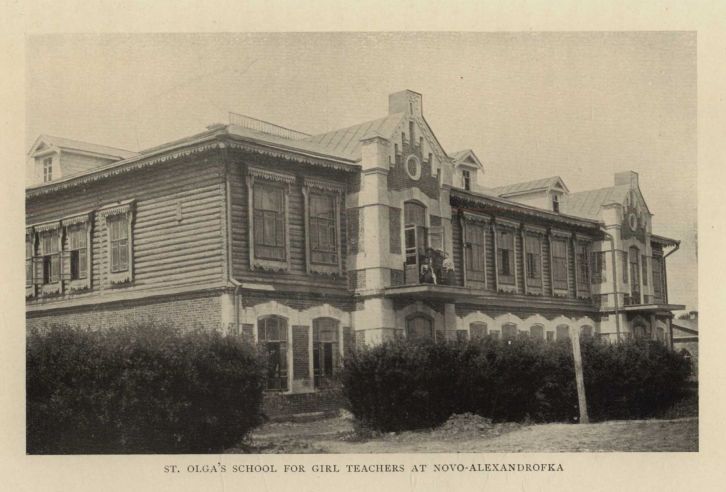
ST. OLGA'S SCHOOL FOR GIRL TEACHERS AT NOVO-ALEXANDOFKA
Roman lawyers were not kind to women. The
code of Justinian says: "Women are not admitted
to political activity," and adds laconically:
"Propter animæ levitatem" ("They cause levity").
It is not unnatural if after such a compliment we
lose the inclination to trouble ourselves about
complicated and sometimes painful public questions.
But—God helps the brave! And so, I take courage and
step straight into the heart of a resolute and
searching judgment on one such painful question: that
of our prisoners of war. Men, almost without
exception, maintain silence on this point, so why
should I not try to investigate the matter? At the
present moment our prisoners of war, including
Germans, Slavs and Turks, number well over a
million—that is, more than the entire army of, say,
Bulgaria, Norway or Holland. Through the Press
and private sources we know that Germany does
not hesitate to make use of the working power of
her war prisoners. They are kept hungry, and are
forced to earn their bread by all kinds of labour,
even purely military occupations.
How prisoners are employed in Germany is
described by "The Man Who Dined With the
Kaiser," that daring young neutral who penetrated
into the heart of the enemy country and brought
back much information valuable to the Allies. In
My Secret Service he writes:
"At Buda-Pesth the Balkan-Zug was tidied and
made presentable. Windows were cleaned by men
having little ladders, and the compartments and
corridors swept. To my great surprise I found that
this work was being done by big bearded men in
Russian uniforms. I spoke to one or two of them,
but they had very few words of German. They
explained that they were Russian prisoners."
What are we doing with our prisoners of war?
This indiscreet question never receives a satisfactory
answer. Forty thousand prisoners have been placed
in Government and private employment, but the
remaining mass are twirling their thumbs, languishing
in enforced idleness. This hopeless and monotonous
inactivity has even here and there developed
hooliganism in their ranks. And further, how have
we placed the comparatively few to whom we have
seen fit to give employment? I have received a
letter from a lady landowner of my acquaintance,
who tells me that after a long and complicated
correspondence, ten prisoners of war were sent to
her estate. The men were quiet, polite and respectful,
and on their arrival were sent to the cattle
yard to dig manure. But at this point came
surprises: one of these prisoners was a violinist from
an opera orchestra, another a photographer, a third
a skilled working optician, a fourth a clerk, a
fifth—but good Heavens! what is one to do with such
farm labourers as that? The dull misery of their
long complete inaction had so depressed them, that
they were only too pleased to be occupied even
if only with the roughest manual labour; but of
what use is such work, and what return can it give
for the outlay of the employer?
On a recent occasion, chancing to meet at a
friend's house several army men, Government
officials and financiers, I reproached them for their
lack of initiative in not more practically organising
the means of using to our advantage this colossal
and invaluable working force. As everybody knows,
labour at this moment is so costly, that great
national enterprises, such as the cutting of canals,
the drying of marshes, the making of roads, the
hewing of timber, are left neglected and unaccomplished
through the costliness and general lack of
working hands. Now I ask—where is the intelligent
landlord, or other employers, who will take the risk
of engaging, without even the roughest choice or
selection, a heavily paid contingent of workmen
containing the most fantastically mixed elements,
persons of the most varied and contrasting stations
and professions and habits, most of them in all
probability entirely unsuited to, and incapable of,
carrying out the work required? In addition, who
knows or understands anything about the legal
aspects of the matter?—all the special rights and
special duties of these special workmen? All the
special rules in connection with insubordination or
any other misdemeanour, if only the much discussed
refusal to work?
I will state my conclusions shortly: it is to my
mind necessary, first of all, to compile and publish
without delay, in the Russian, German, Turkish and
all the Slavonic languages, a short and clear statement
of the rights, the duties, the responsibilities of
all prisoners of war within our Empire, pointing
out that work is obligatory, that refusal to work
will be punished disciplinarily and by maintenance
on black bread and water. That remuneration will
be given in part immediately, the remainder on the
conclusion of peace, and on the condition that our
prisoners in Germany receive the like remuneration.
Then, it is indispensable to organise military
detachments and contingents solely and entirely
for the direction and government of the affairs of
war prisoners. Numbers of these prisoners must
receive a short and hasty course of training for
Government national work, which courses, as also
the entire administration of the army of working
prisoners, can be under the direction of numbers of
our brilliant officers and generals who have left the
ranks crippled or otherwise incapacitated for further
active service. They will be only too happy to
take upon themselves responsible work for their
country. Further, it is necessary to form a
committee for inspection of prisoners in the Intendance
department.
There is in our provinces a whole section that
does not know how to occupy itself, since the closing
of the vodka monopoly. Immense numbers of
splendid buildings are standing empty. It seems to
me that they could be without further ado turned
into schools and reading-rooms with tea-rooms
attached, whilst countless local Government excise
clerks are entirely without occupation and would
be exceedingly useful in the economic department
of the larger national working enterprises.
Lastly, all the departments, especially those
concerned with agriculture and land development, must
be made immediately to set in motion all their
sleeping projects: the making of roads and
railways, the hewing of forest trees, the cutting of
canals, etc., etc., all of which are lying on the shelf for
no other reason than the lack of working hands.
Nobody will ever persuade me of the impossibility
of employing disciplined detachments of our present
war prisoners on the execution of many of these
projects, especially those connected with building
and agriculture. It is beyond question that the
labour of the prisoners would immediately cheapen
and hasten their completion. Of course,
contractors for these undertakings will not make
fortunes, and they will certainly do their best to prove
the impracticability of the whole plan—but their
loss is the country's gain.
Then again, I recently happened to make the
acquaintance of the administrator of one of our
northern provinces. He was raising with the
greatest energy and enthusiasm the question of
realising an already fully worked-out project of
joining the White Sea to Lake Onega by means of
canals. These canals were to cover a distance of
200 versts. Again, nobody will assure me that
it is impossible to apply the labour of war prisoners
to the execution of this and similar tasks of immense
importance to our Empire. Peter the Great dug
the Ladoga canal with the hands of his Swedish
prisoners—a striking reproach for our present lack
of enterprise.
How often it is necessary to recall to one's mind
the examples of Peter and Catherine the Great!
These reminders of old times usually receive the
offensive reply: "Oh, in those days there were
men—now we have no more men, only pigmies!" No
men? In our Russia that is seething with
talented inventors? No men devoted to Russia,
to her honour and her might? Indeed ... we have
our eagles....
But to return to the question of war prisoners.
Can it be that all I have dared to say is so obviously
senseless or so excessively profound and complicated
that men prefer to pass it over in silence?
Or does the question I have touched upon deserve
no attention simply because the Romans disregarded
a woman's opinion, seeing in it only levity,
especially when connected with public questions?[*]
German methods with war prisoners are vastly
different from those of the Allies. The German is
not content with using their bodies for carrying out
his various schemes, but he strives to divert their
minds from allegiance to their respective countries.
It has been proved in a court of law, the witnesses
giving evidence under oath, that in the case of the
Irish soldiers, prisoners in Germany, endeavours were
made to turn them into rebels. No form of duplicity
or dishonour seems to come amiss to the German,
and his methods with the Russian prisoners are not
dissimilar to those practised against the Irish, and
I can only hope that they will be as loyal to their
country as were the splendid soldiers of our Ally.
With the Russian prisoners the German authorities
occupy themselves with torturing the souls of all
that fall in their hands, sowing discord and despair
for future generations to reap. It is a terrible but
authentic fact that the minds of Russian prisoners
in Germany are being systematically poisoned by
means of the propagation of atheism, nihilism, and
anti-patriotism, through every variety of that
pernicious literature that was always so well
received and patronised in Germany. Our soldiers
beg for religious and patriotic books, instead of
which they receive the very opposite, their gaolers
hoping thus to deprive them of their sole remaining
consolation, that of an unshaken faith.
One of the most encouraging things that I have
heard recently came to my knowledge only as I
was going over the manuscript of this book. The
British authorities have taken up the question of
sending educational books to the English prisoners
in Germany. Apparently the men are tired of
fiction, and they want some serious study, such as
seamanship, engineering and various other crafts.
What particularly interested me was the fact that
simple Russian grammars and text-books are very
much wanted, and these are being sent out. What
greater link can there be between two nations than
that each should speak the other's language? Our
tongue, however, is by no means an easy one to
acquire. Bismarck could not understand why
Greek should be learnt at all. "If it is contended
that the study of Greek is excellent mental discipline,
to learn Russian would be still more so, and at the
same time practically useful. Twenty-eight
declensions and the innumerable niceties by which the
deficiencies of conjugations are made up for are
something to exercise the memory. And then, how
are the words changed! Frequently nothing but
a single letter of the original root remains."
The Revival of Parish Life—The Ancient Russian Parish—A Peaceful
Community—Slavophils and the Parish—The Metropolitan and
the Emperor Nicholas I—The Independence of the
Church—Father John of Kronstadt—A Blessing to Russia
Our new Metropolitan of Petrograd, Pitirim,
fortunately considers the Parish question
to be of enormous importance. He ascribes
to it even the power for future victory over our
enemies. The Metropolitan, of course, is a great
authority, and the Duma seems to be sharing his
views. The proposal in Orthodox Church circles is
to bring back life to the parish, which at present
seems to be greatly neglected and to be losing its
legitimate ground. The resurrection of parish life
has indeed long been hoped for. The plan for its
revival is complete, and is only waiting to be made
public. The Holy Synod, as is well known, has
presented lately to the Duma a project that was
due to the initiative of M. Sabler (now called
Desyatovski). For some reason or other this project had
been abandoned and withdrawn by its author, to
the great dismay of many who are fervently Greek
Orthodox.
The Metropolitan, Pitirim, is now making every
effort to introduce into the Duma other projects
of great importance. In any case, however
incomplete or imperfect these projects may be, it is
imperative to apply them with as little delay as
possible, practical experience being itself the best
leveller of defects. How satisfactorily the reorganisation
of parishes will revive Church life, we shall
see. History, with which all who are interested in
this question should acquaint themselves, gives
ample evidence of how gradually this ecclesiastical
arrangement has died out.
The ancient Russian parish was something very
different from what is implied by the present
meaning of the term. As everybody knows, a modern
parish is simply a certain amount of property
within the boundaries of a limited distance from a
given church. Social life within the parish has of
late been diminishing, and the activities of
parishioners in parish matters scarcely go beyond
the election of a churchwarden, and the payment
of his wages. The part allotted to them in
all other matters is purely passive, and consists
principally of paying subscriptions to various
brotherhoods and charitable institutions. In other
words, if the priest happens to enjoy some authority
or popularity among his flock, such institutions
flourish by aid of voluntary contributions. In other
cases, they exist only on paper, this deception being
used because their upkeep is desired by the higher
powers, disobedience to whom might have occasionally
disagreeable consequences to the parish
control.
How different is all this to old-time conditions!
In bygone days, parishioners, in frequent cases,
built their own church, and therefore naturally
regarded it as their personal property, dependent on
their care for its needs and its welfare. Never was
there an absentee at elections of churchwardens or
other officials. Everyone was personally interested,
the whole parish being like a large family, whilst all
social and other activities revolved round the church.
Close to the church was always a sort of marketplace
with booths and other such erections, where
all the affairs of the neighbourhood were transacted,
and where the people collected in gay crowds on
festival days. Here also was a sort of social club,
where the parishioners discussed the news of the
day, and rested after their labours. The people
were thus closely linked together, under the
protecting shadows of their church. They had their
organisations and their enterprises. For instance, they
would club together to build homes for beggars and
pilgrims to be received therein and fed and helped
on their way. Sometimes also the churchwardens
acted as bankers, and advanced money on prescribed
conditions, to needy parishioners. In fact,
to quote the words of Professor Titlinoff, the parish
authorities considered it their duty to look after both
the moral and material welfare of their flock. Family
quarrels were regarded as a disgrace. Public opinion
strictly required of all parishioners regular
attendance at confession and communion, with cessation of
work on Sundays and Church festivals. The parish
sometimes also made itself responsible for the
education of its children, providing teachers out of
the church funds.
On festival days, great feasts were organised, to
which all participants subscribed in money and
kind. These feasts were enlivened by public games
and useful amusements. All this drew the people
very closely together into a real, living Church and
social organisation. Such were our parishes, as
long as the system of an elected clergy lasted. But
as the electoral system died out, social and
independent parish life declined, the parishioners losing
all personal interest in their church and its clergy.
The church gradually ceased to be the centre of
local life, the social club disappeared, the schools
ceased to exist. The authority of the church
weakened, and all general parish organisation was
a thing of the past.
In some parts this influence of the Church is
almost extinguished.
Now that attention has been drawn to these
facts, real and serious efforts are needed to awaken
general interest in the matter. This question of the
revival of parish life is very serious and important.
In the foundation of parishes lies the seed of future
economic victory—for, without a parish, there can
be neither solidarity nor union of interests, nor any
means of utilising to the utmost all the resources of
the nation for the benefit of our Church and State.
In view of the rumour that the parish will be
renewed, some time ago an ecclesiastical parish
meeting was held. The questions debated regarded
the parish, and many resolutions were passed. One
of the most important was to ask the Metropolitan's
consent to renew meetings of clergymen of the
whole town, parish churchwardens and representatives
of parishioners to discuss and decide parish
questions, and by this meeting give a mutual
understanding among all concerned in the question on
hand.
Here the most prominent of professors should be
allowed to express their opinions, as well as a number
of other laymen.
In the parish life there are instances known only
to the clergyman.
Up to now such instances have been the clergyman's
realm of Christian duty which he made his
chief care and happiness.
The Russian Slavophils were all supporters of the
parish and its prerogatives. These always appealed
to our ancient history and our traditions, and to
see them appreciated at their real value by a man
of such position as the Metropolitan, Pitirim, is
certainly an event of great importance in the life of
our Church, and especially welcome in our times,
where there is decidedly a great religious revival
throughout the whole of Russia.
Slavophils always maintained that religion ought
to have the upper hand in questions where the
temporal power was attempting to interfere. The
following is a case in point.
As is well known, the Emperor Nicholas I was a
very energetic man, who liked to have his own way.
On one occasion he was strongly in favour of a step
of which the Church disapproved. At that time we
had as Metropolitan of Petrograd a very superior
man, by name Plato. I must add that our Metropolitans
have no difficulty in obtaining interviews
with the Emperor. The Metropolitan, therefore,
after putting on all his decorations, went without
hesitation to the Palace, where he arrived in great
state in his carriage drawn by four or six horses.
"Majesty," he said, laying all his decorations
before the Emperor on the table, "here are all the
gifts I have received from you. I will leave my
carriage at your gates and return on foot as a poor
monk. But I will never sanction the reform you
demand."
The projected reform was abandoned. So do we,
old-fashioned Slavophils, always supporting the
independence of the Church, now welcome with joy
the intention of the Holy Synod and the Metropolitan,
Pitirim, to return to the parish system with
all its former privileges which have of late years
been neglected—indeed, almost forgotten.
In our times, in spite of the difficulties, certain
efforts have been made to revive the parish question
of ancient days. Thus, for instance, in Kieff, and
in the diocese of Kieff, various brotherhoods have
been organised which began with the starting of
preaching and organising schools. And they soon
discovered that in the same province there existed
already about one hundred associations of the same
kind, though in more limited forms. These were
exclusively organised by the clergy. Thus, for
instance, in one of the districts, there were already
over thirty consumers' stores, started by the
initiative of one single clergyman. The brilliant result
of this initiative in the year 1913 represented
already a considerable balance, which helped to
open a second-class school, classes where trades were
learned and where there were stalls of agricultural
implements. The Brotherhood's Council then
organised its own special committee, calling it the
Agricultural Committee, whose task it was to "bring help
to all ripening agricultural questions and to discuss
them in council." Libraries, reading-rooms, moving
pictures, choral singing, and sermons on education
and other important requirements were thus
established. Naturally those grew the most prominent
which were already united by faith and prayer.
Brotherhoods of this kind admitted of no division
in classes, corporations, or party factions, all being
equals in the eyes of the Church. For general
parish work there is room for every one; for the
cultured landowner, the doctor, the teacher, and for
every intelligent man, and also for every intelligent
peasant. When an association of this kind bears
the character of clericalism, being under the
guidance of the Church, it is rooted deeper, and has
higher objects, than when it is in private hands,
where the interests are often purely egotistical or
trivial.
We had, for instance, a remarkable example in
the Reverend Father John, of Kronstadt, thanks
chiefly to whose proverbial disinterestedness and
other high moral powers, tremendous sums of money
were offered voluntarily for his philanthropic work;
this was practised on an incredibly large scale.
Father John, of Kronstadt, daily received streams
of money, and always at once disposed of them in
charities, keeping nothing for himself. When he
died he left his widow so poor, that the Tsar
intervened and a pension was allotted to her.
No one could be guided by a better example than
we have had in the Reverend Father John, of Kronstadt,
who, though he began life without any protection,
and as a very poor and humble parish
priest, attracted the whole Russian nation, inspiring
a faith that approached the miraculous. Hundreds
come daily to salute his grave and pray for his soul.
Similar parish reforms ought to be introduced
everywhere in Russia, and it is a real blessing that
the Metropolitan of Petrograd supports this
movement. Had this been done already, the importance
of it would have been realised not only in home
policy, but also in questions of international
significance. In former days members of such
brotherhoods jealously pursued the severe dictates of the
ordinances of the Church. It is evident that the
chief enlightenment and prosperity of every Christian
country lies in the moral conscience of her people in
respect to the Church, as the arbiter of Power and
Light.
A New Era—The Russian Ideal—The Trick of Double
Nationality—Lord Kitchener's Legacy—The Armenian Inventor—The
Kaiser and Double Nationality—The Future of Prussia—Russia's
Hope of Victory—Germany's Influence on Anglo-Russian
Friendship—Days of Suspicion—Lord Clarendon's Opinion—An
ex-Cabinet Minister's Boast—Russian Memories of England—A
Glorious Future
At the time I left England in May, 1914,
there was, of course, no thought of the
coming calamity. I wished to return in
the autumn of that year to follow my usual habit
of spending the winter in London; but the
declaration of this unexpected war changed all my plans,
and I remained in Russia, returning in the late
autumn of 1915.
It has been a great happiness to me to see how
the friendship between England and Russia has
become realised, and how with all the sufferings and
mutual anxieties it becomes stronger day by day.
The idea of an Anglo-Russian alliance has inspired
me a good portion of my life. It is what I have
worked for—my dream, my ideal.
The war takes an intolerably long time and is a
great strain. The sacrifice of men is terrible; the
cost unprecedented. We have undergone much
and lost much. Our Russian soldiers are equal in
bravery to the British, the French, the Belgians
and the noble Serbs. We are inspired by the same
high ideal, and therefore we must win. The new
conditions of warfare have horrified the world—the
suffocating gases, the atrocities, the diabolical
machinery. Our task is not easy, but I do not
think anyone in Russia doubts the final result. In
spite of the new German weapons, the terrible
cost, the German intrigue and corruption, and the
tremendous sums that must have been secretly
economised by Germany for the purpose of bribery,
we shall win.
Then there is the German trick of double
nationality—the becoming naturalised in Russia or
England and yet retaining allegiance to the Emperor
Wilhelm. I rejoice to notice that Great Britain is
dealing with that so wisely and energetically, not,
I believe, recognising nationality obtained within
the last ten years.
Perhaps one of Lord Kitchener's most valuable
legacies to his country may be his advice that no
Germans should be given naturalisation papers in
England for the next twenty-one years. The whole
system of naturalisation in general is never a good
or praiseworthy one. It kills real patriotism. Why
can one not abolish it entirely in the whole world?
We cannot at will take a new father or mother and
break all the ties God and nature have given
us—why then a new nationality? The habit of
becoming a naturalised subject of some adopted country is
most common among Germans, their Government
rather encouraging the practice than otherwise, but
not allowing naturalisation abroad to interfere in
any sense with the full rights of citizenship at home.
This, of course, creates the great evil of double
nationality that has done so much harm, among
others to countless Russian subjects of German
birth or parentage. The legalisation of the practice
was accomplished soon after the Franco-German
war of 1871, but it was kept quiet and very little
was heard of it. I should like to quote an example
of the harm done by this pernicious system.
A talented Armenian had invented some
important novelty in connection with naval matters.
For some reason no one took any interest in him in
Russia, and his life's work seemed unlikely to achieve
any result. In despair, he turned his steps to Berlin.
There he was immediately appreciated, but as, by
the German law, the Government cannot finance
the enterprises of any but its own subjects, my poor
Armenian, after much hesitation and grief, and
with the permission of the Russian Government,
became a German subject. Thereupon the German
Government bought his invention, largely rewarding
and providing for the inventor—only, however,
after his official naturalisation as a German subject.
Some time after, this same Armenian, having
lost all his means, and having suffered much from
illness ana other troubles, set to work and tried his
luck in London. Here, however, his double nationality
brought him nothing but trouble. Germans,
in spite of his naturalisation, regarded him as a
Russian, and Russians, since he had chosen to
become a German subject, considered him a German.
Neither the one nor the other would help him, and
he was driven to despair and starvation.
The German Emperor has caught at the system
of double nationality, and has done all in his power
to create confusion in this connection. It is as
though he had wished above all things to revenge
himself on those of his former subjects who have
adopted Russia as their country, and have become
naturalised there. He has, by legalising the
practice, sown discord and mistrust between the German
Russians and the people among whom they might
have continued to live peaceably and happily. Is
not this the action of a wicked foe?
One of my friends, an experienced and clever
judge, recently returned from the front, expressed
himself to the effect that Wilhelm had dragged his
hapless country into a state of Satanism and had
everywhere sown dissension and bribery and evil
and sorrow. This is indeed a fact and a danger
of which by now not only Russia, but also France
and England are convinced, and this very
conviction has drawn the Allies more closely together,
uniting them by an indissoluble bond, as they fight
side by side in this war of liberation and self-defence.
Prussianism deserves merciless punishment, and
a radical cure for its mad and boundless greed and
ambition. Prussia must be forced back to its former
modest dangerless limits. All the mischief done by
and since '71 must be undone, and their military
system destroyed once and for all.
Some people pretend that Prussia should be
returned to the limits not only of the year '71, but
to those of the Paris Treaty. I hardly think that
so drastic a measure could be carried through.
But of course we may remember that Berlin has
been once invaded by Napoleon, and that the
same victories could be repeated in our time.
This is par excellence a war of good against evil.
The good must always triumph—we must only be
patient, stand loyally side by side, and struggle,
struggle, struggle on to the end!
In spite of all, we shall win. On our side are—(1)
Belief in the cause; (2) Faith in God; (3) Faith
in the Emperor; (4) Faith in our Allies; or, to put
it shorter, in the words of the motto of our Army,
"Snami Bog" ("God is with us").
We sympathise deeply, too deeply for words,
with England, and appreciate all she is doing. Our
enemies, of course, have done their best to shake
our confidence in each other. That is only natural,
but we know that, but for the British Fleet, the
Germans would have passed through the English
Channel and invaded the coasts of France; that
our Baltic shores would have been in greater danger;
and that the German trade would have continued.
We know what the British Army is doing, and we
view with deep compassion and fellow-suffering the
losses which it has suffered in Gallipoli, chiefly for
our sake. We follow with deep sympathy Britain's
Roll of Honour.
My personal belief is that our friendship will
survive all strains, and will persist into the coming
time when, with God's help, peace in Europe will
be restored for many, many years.
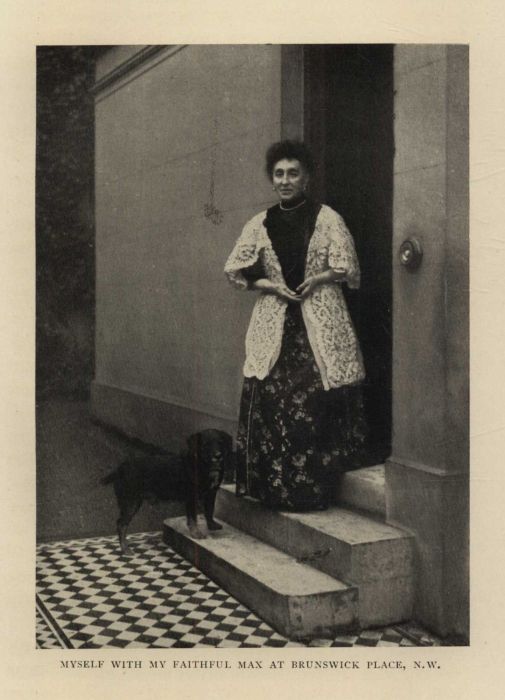
MYSELF WITH MY FAITHFUL MAX AT BRUNSWICK PLACE, N.W.
It is now very interesting to look back and trace
the growth of the understanding between Russia
and England that developed into an Alliance.
Symptoms of Russophobia began to disappear
about the middle nineties. Once the Indian
north-west-frontier bogy disappeared, my mind became
easier. Anglo-Indian suspicion has been not a little
responsible for the breach.
The change was largely due to the rise of Germany.
In the old days there was only one continent where
the shadow of a European Power fell across the
English doorstep. As Russia was that Power she
monopolised alike the attention and suspicion.
What puzzles me most is, how it has been possible
for a nation that has shown itself almost uncannily
suspicious of Russia, to permit Germany to make
all the preparations she has made, and which for
years it has been known she was making, without
suspicion. British ministers became quite cross at
the mere suggestion that Germany's aims were not
entirely pacific, as if a man builds a Dreadnought
for Cowes, or a submarine for Henley. Sometimes
politicians seem to me very silly.
I remember Charles Villiers once writing to me
that "in England there is a disposition to believe
that Russia is an enemy of Liberty and a sort of
ogre that goes about looking for sickly people to
swallow them up."
This is exactly what England did believe for very
many years. Nothing Russia did could be right. If
she appeared to be actuated by high principles,
people sought for some hidden motive; if, on the
other hand, they could trace self-interest, then they
contented themselves with saying that it was just
what was to be expected from Russia.
There were, of course, exceptions to this rule.
Charles Villiers himself, in that same letter, added
that he was not a party to so ridiculous a belief.
Later, Lord Clarendon wrote to me expressing
disbelief that Russia would go to war with Turkey;
but in his mind there was the same suspicion of her
actions. "That she should," he said, "see with the
utmost confidence and resignation troubles excited
in the East by others I think very likely indeed, and
I cannot believe that the Prince of Serbia would
make these preparations for exciting war unless he
had the sanction of Russia. Russia may perhaps
say with a safe conscience that she did not advise
such measures, but can she declare that she ever
said one word to disapprove or check them?" If
she had done so, or would even now exert her
authority, the Prince would become as tame as a
mouse.
"I am not one of your category who 'cares not a
straw for Russia,' for I know what vast elements of
greatness she has, and that if she gives herself to
develop her resources and consolidate her power,
and does not yield to the lust of conquest, she must
be the greatest nation of the world."
I quote these words because Lord Clarendon was
in every sense a man who thought carefully before
expressing an opinion, and it is easy to see even in
his words some suspicion of Russia.
Another cause for the gradual change of public
opinion that for some years past has been manifesting
itself in England, is that Africa has displaced
Asia in the international arena, and that over
British Africa Russia casts, and can cast, no shadow,
whereas other nations have been treading with
heavy foot upon England's colonial toes.
No nation can be on bad terms with all its
neighbours, as Germany will have good reason to know
in the very near future, and the rising menace of
German ambition synchronised with the lessening
of the tension between Russia and England. The
national danger for England had shifted to another
zone.
Twenty years ago I wrote:
"It appears as if, at last, Englishmen were
really beginning to understand that Russia is a
sister nation, which is as great by land as England
is by sea."
As I write I call to mind a dinner-party, at which
an ex-Cabinet Minister, obviously wishing to frighten
a foreigner, somewhat pompously remarked:
"You have no idea of the great power which
England represents by her fleet. No other nation is
a match for us."
He may have been right, but the tone amused me,
and I said in reply:
"So much the better. It is a new argument in
favour of my beloved scheme—the Anglo-Russian
Alliance. Our army stands to us in the same relation
as your fleet to you, and in case of need might supply
your military deficiency. On the other hand, your
fleet might perhaps work in union with ours. But
even putting aside an offensive or defensive alliance
of this kind, there is one fact which is clear—left to
themselves, England and Russia, having such
different weapons, cannot fight each other."
If I had ventured this as a prophecy instead of an
ideal how I should have been laughed at; yet it has
been realised, and the British Navy and the Russian
Army have been united at last. No matchmaker
ever had more trouble in bringing together a
self-conscious youth and coy maiden than those who
have fought so long and so hard to bring England
and Russia together.
Again, there was always that tendency on the
part of England to interfere in the internal affairs
of Russia. To this I have referred elsewhere. If
we had started in Russia a society called "The
Friends of Irish Freedom," with the names of
Russian Cabinet Ministers upon the title-page, what
an uproar there would have been. I have, time after
time, striven to emphasise the evil done in the past
to the growth of a proper understanding between
the two countries by such societies as "The Friends
of Russian Freedom."
Anyone who is cold to Russia may be said at this
moment to be rather a pro-German. Also any
Russian who is cold to England is also rather
pro-German. Such people no doubt do exist. Every
good cause has its enemies, and the cause of our
friendship has had enemies all along.
But our friendship is founded on a genuine mutual
admiration of Russians and English for one another.
And when one says admiration, does not one mean
in reality love? We like one another. We do not
really distrust one another. Knowledge is this case
always breeds affection. Against that fact all
hostility from German and pro-German intriguers
must fail.
The Anglo-Russian alliance is first of all one of
hearts. My heart is with England. I feel that I
now have two countries, Russia and my foster-country
England. The hearts of many English are
with Russia. There are now many friendships.
It is also an alliance of minds. You read our
literature with profit, we yours. You are interested
in our arts and institutions, we in yours. It is also
an alliance of economic interests, of pockets, may I
say? We both stand to help one another in
commerce. After the war this will increase with the
passage of each year.
It is also an alliance of arms. We are both in the
field against the common enemy, and the ideals for
which we are fighting are one and the same, the
motives similar.
Everything is helping forward the cause of
Anglo-Russian friendship.
As far as my own experience of England goes she
is not only unselfish, but really enthusiastic and full
of generosity. Her patriotic self-sacrifice is
displayed every day during this monstrous war. Young
or old, experienced or inexperienced, everybody is
anxious to fight or die for the glory of his country.
As to her generosity, can anybody doubt that? In
these two fundamental feelings Russians and English
are very dear to each other. They only need to
know each other better.
I have said this in Russia, and have described it
many times. Let us remember, for instance, the
splendid generosity of England during the famine
of 1891 in Russia. That was a terrible time, especially
in the province of Tamboff as I have explained,
and we all remember how England helped.
Last summer, when I was at Alexandrofka, one
of the old porters began talking to me about the
"English bread, which was sent by England." At
first I did not quite grasp what he meant. Little by
little I understood that he spoke of the English
subscriptions which had allowed my son to sell
bread at very cheap prices when everywhere else in
our neighbourhood the cost was monstrously high.
People came from the remotest districts to buy our
bread. More than 100,000 people were thus saved
from starvation. The philanthropic Grand Duchess
Elizabeth, sister of our Empress Alexandra, also
hurried to help us. The magnificent part played in
Russia by the Society of Friends, represented by
Mr. Burke and Mr. W. Fox, is well remembered by
all of us Russians.
Somebody has said there are no small things.
Everything may have great and important results,
but nevertheless real.
At this moment, to my great satisfaction, my room
is crammed with pamphlets and books about Russia,
all kindly disposed and insisting upon the
Anglo-Russian alliance. One regrets not to be able to
grasp gratefully every hand that wrote such useful
and excellent books. But there is no time to be
lost. We must strive as much as we can to work
harmoniously together. Even when this war is
over and when written treaties are definitely signed,
we must go forward hand in hand. Friendship lies
not so much in the letter and the word as in the
spirit.
As to the future, with Great Britain, France,
Russia, and Italy working hand in hand, what has
Europe to fear? In July, 1914, the Prussian War
Party saw a "decadent" England, a still more
"decadent" France, and a Russia not yet
recovered from her last war. In July, 1916, Germany
has to face a New England, a New France, and a
New Russia, and the time is not far distant when
we shall have something like pity in our heart for
Germany, the pity that one feels for alienated
criminals.
It would be most unfair (not to say stupid) to
forget the hundreds, perhaps thousands, of men
with foreign names, who at this very moment are
bravely fighting and sacrificing their lives for Russia
and Russia's glory.
Every Russian—even those with scanty and
superficial education—should always remember
certain names with gratitude.
Let me take a few names at random. The best
friend of the Slavonic cause was Hilferding. The
great Academician, A. Behr, has opened Russia's
eyes to our fishing riches, a great branch of our
commerce.
Ostaken, who took the Russian name of Vostokoff,
was the author of Slavonic Philology.
Dr. Haas—whom the people always call "our
Saintly Doctor."
Then there were Barklay de Tolly, Todleben, and
many others—who will always live in our history,
and ought to be remembered with admiration and
gratitude.
Thackeray said that three generations were needed
to make a gentleman. But, surely, three centuries
of honest allegiance to a country are required to
make a trustworthy subject.
The present war will undoubtedly bring in its
train many reforms and changes in the most varied
directions. Among these, it is imperative to look
very seriously into the question of necessary and
unnecessary expenses, and of luxury in both its
good and its bad sense. That there is a clearly-defined
dividing line between the two, is an obvious
truth, an indisputable truism. Russia, as well as
other countries, will, for a long time after the war,
be obliged to exercise economy of the severest order.
Self-defence will be necessary even when the clash
of arms and the thunder of the guns have ceased.
Great and inevitable problems face us wherever we
turn. We need more churches, general education,
new roads, and the development of all the latent
natural wealth of our country.
All this is as important as our daily bread, without
which there can be no life.
Yes, it is indeed a fact that well organised economy
spells great and mighty results. Unfortunately, we
cannot hide from ourselves the truth that large sums
of money are constantly being spent on needless
and foolish vanities. There comes to my mind a
conversation that took place many years ago,
during one of my visits to Moscow. The subject
under discussion was connected with the buttons
and gold braid on our military uniforms. Their
arrangement was to be altered, and something
added or taken away, I forget which. I listened for
some time in silence, and then remarked with a
smile that the whole thing reminded me of some
typical discussion among Gogol's "fair
ladies." "But you are mistaken," answered one of the
Moscow experts seriously, "this is a matter that
has to be examined very carefully. Do you realise
that the simplest change, the taking away or adding
of one button or one inch of braid represents an
enormous sum of money? When one is dealing
with an army and a navy numbering millions, every
extra thread deserves consideration. One must
keep most careful accounts and weigh every detail
conscientiously!"
Unfortunately, this is all too often left undone.
Gogol's ladies disputed about "frocks and frills";
in our case the matter under discussion concerns our
national income, of which we need every penny,
and which it is incumbent on us not to waste. I
repeat, we need, for instance, more churches. Have
you ever been to the St. Isaac's Cathedral in
Petrograd at Easter? Even such huge places of worship
as this, or as the Kazan Cathedral, cannot accommodate
half of the throngs waiting and thirsting for
prayer.
I myself have often stood waiting for two hours
among the crowd in the street unable to force my
way through into the church.
But in addition to churches, we need general
education. We must have more schools and universities,
more roads, more libraries, more books. All
this is anything but on a line with the "frocks and
frills" of Gogol's ladies—no, we are discussing the
welfare of Russia, and that is for us no trifling
matter. Every insignificant change in connection
with buttons or trimming affects the budget of our
Empire—how much more then could be saved by
giving up all the needless splendour and extravagance
of our magnificent uniforms?
At the time of the discussion to which I have
referred, there was no thought of war, but happily,
even in days of unclouded peace and prosperity,
there are people who occupy themselves with the
good of our country, and their passing remarks
sometimes remain deeply engraved on the memories
of their hearers.
If some good fairy were to appear before me at
this moment and ask me to pronounce a wish, I
would, without a moment's hesitation, repeat the
words of my Moscow friend, and would add on my
own account the wish that luxury might be done
away with, that we might after the war never again
see the old gorgeous military attire, but that it
might give place for good to the modest war-time
uniforms of the moment. These simple uniforms,
indeed, will always bring back soul-stirring memories,
for they are connected with the brilliant victories of
our heroes, whose glorious deeds have astonished the
whole world. These glorious deeds, this magnificent
self-sacrifice is one of Russia's trophies. Let our
children understand the meaning of these simple
uniforms, and never forget them. Such economy
and simplicity would be of immense benefit not
only to our pockets, but to our ethical and moral
education.
Wise remarks should be remembered. Of course,
the great men of the day are not always those of the
century.
On the other hand, simple, unpretentious, humble
people make sometimes remarks of deep importance.
We all ought to learn how to listen and understand
what we hear.
Ah, yes! we have much, much to learn in every way!
One sometimes hears strange theories advanced
in favour of magnificent uniforms. It is said, for
instance, that they attract young people to the
service. I cannot understand how one can even
repeat such an ignoble argument. People who wish
to serve their country are not guided by such
thoughts as this. They have far higher moral
requirements and ideals—ideals indeed that are far
more likely to destroy than to encourage mean and
petty vanities that sometimes show themselves in
such varied forms among men and women alike.
Money can be a great power for good, when it is
applied to the development of latent but deep-rooted
national possibilities. This war has awakened
all our activities and will guide our energies in the
right direction. Russia, with God's help, will grow
stronger than ever, will free herself from foreign
elements and dangerous help, and will become a
greater power than ever before.
And now I have finished. I have told of some
of the things I have seen, heard, and felt. I
have drawn upon my recollections just as
one might draw tickets at a raffle.
From my earliest childhood I have always been
greatly attracted by people much older than myself.
They taught me things that I wanted to know but
was too lazy to learn through books and from
governesses, who generally appeared to me stiff,
cold, and unsympathetic.
Ugly and whimsical child as I was, outsiders
generally took a fancy to me, and, through their
conversation, my mind unconsciously obtained the
habit of meddling with serious questions which I
very often felt to be beyond me. This habit of
meddling with things beyond my depth has never
left me, with the natural consequence (Heaven
knows!) of frequent disillusionments.
Now I have to reverse the order of my youth, and
find interest in the younger generation more than
I did when I was a contemporary.
However, my raffle is closed. I hope that some
words of mine have not been in vain. It remains
for Russians and Englishmen to get to know each
other. When they do, their friendship will be
indissoluble—I know both.
Abdul Hamid, 48, 157, 158, 161
Afghanistan, 81
Aksakoff, Ivan, 37
Alcohol in Russia, 168, 169
Alexandra, Empress, 23
Alexandrovna, Empress Marie, 73
Anglo-Russian agreement, 18, 25
Anglo-Russian Alliance, 94, 286, 293, 294
Anglo-Turkish Convention, 151
Armenia, 147, 148, 152, 161
Armenians, 148, 149, 150, 151, 152
Asquith, Mr. H. H., 79
Athens, 49
Austria, 95, 96, 203
Balkans, the, 31, 39, 41, 46, 85, 264
Baltic, the, 25
Baring, Walter, 26
Bartlett, Sir Ellis Ashmead-Bartlett, 99
Belgrade, 31
Belgium, 23, 51
Berlin, 87
Berlin Congress, 149, 159
Béust, Count, 82
Bismarck, Prince, 50, 51, 60, 98, 277
Bludoff, Countess, 73
Bosnia, 31
Brunow, Baron, 23, 108
Bulgaria, 19, 23, 40, 113, 265, 267, 270
Bulgarians, 19, 267, 269
Bulgarian Horrors and the Question
of the East, The, by Mr. Gladstone, 26
Campbell-Bannerman, Lady, 78
Campbell-Bannerman, Sir Henry, 76, 78, 79
Carlyle, Thomas, 80, 81, 163
Cettingje, 31
Christ or Moses? Which? by Madame Novikoff, 58
Clarendon, Lord, 292
Cologne, 69
Constantine, Grand Duke, 247, 253
Constantinople, 47, 49, 72, 163, 266
Constantinople Conference, 46, 48
Cossacks, 37
Crete, 49
Crimean War, 203
Cyprus Convention, 151, 161
Daily News, The, 26, 39, 120
Disraeli, Mr. (Lord Beaconsfield),
first meeting with Madame
Novikoff, 24; his policy resented by
Russia, 29; against the freeing
of Bulgaria from Turkish
oppression, 113; his high opinion
of Abdul Hamid, 157-158; on
the Treaty of Berlin, 159; on
England's policy with regard to
Asia Minor, 160; opposes
Russia's entry into Constantinople, 266
Dmitrieff, General Radko, 267
Dogger Bank incident, 197
Dolgorouki, Prince Vladimir, 74
Döllinger, Dr., 57, 58, 68
Dostoyevsky, Fiodor, 236, 237
Douma, the, 49
Egypt, 94
Elizabeth, Grand Duchess, 137, 296
Emperor, Russian, 21
England, 20, 29, 30, 38, 39, 40, 41,
42, 43, 44, 49, 50, 52, 89, 93,
96, 97, 99, 100, 113, 118, 149,
151, 155, 158, 160, 164, 185, 186,
193, 194, 197, 201, 216, 217, 238,
242, 269, 292, 293, 294, 296
France, 79, 89, 203, 237
Franco-German War, 288
Freeman, E. A., 39
Free Russia, 199
Fock, General, 192
Fortnightly Review, 61, 163
Froude, Henry, 39, 66, 80, 82, 194
Germany, 22, 33, 50, 51, 95, 109,
203, 271, 277, 287, 291, 293, 297
Ghiray, Hadji, 31
Gibraltar, 49
Girardin, Emile de, 70
Gladstone, Mr. W. E., makes
acquaintance of Madame Novikoff,
23; what he called her, 24;
solitary championship of Russia,
25; publishes his pamphlet,
The Bulgarian Horrors and the
Question of the East, 26; his
anxiety about the future of
England and Russia, 27; speaks
at St. James's Hall, 43; a
misunderstood incident, 44; his
fearless denunciation of Turkey,
45; his friendship with Madame
Novikoff criticised, 48; his dying
utterance, 53; his character, 54;
he reviews Madame Novikoff's
Russia and England, 55; Cardinal
Manning's opinion of him, 56;
his interest in the Old Catholics,
57; a letter to Madame Novikoff,
58; another letter, 62-64; his
interest in Shakespeare, 65; a
talk with Hayward, 67; his
love of books, 68; an incident
at Munich, 69; at a dinner in
Paris, 70; his knowledge of
French, 71; a comment by the
Pall Mall Gazette, 102; on the
Berlin Treaty, 147; urges the
coercion of the Sultan, 152; a
letter on Lord Salisbury's
position, 153; on the Sultan of
Turkey, 154; condemns the
policy of Prince Lobanoff, 156;
on the Cyprus Treaty, 161; on
the history of nations, 219
Gladstone, Mrs., 40, 55, 67
Gladstone, Miss Helen, 69, 70, 71
Gortschakoff, Prince, 37, 51, 95, 105
Goya, Francisco, 84
Great Britain, 23, 34, 40, 48, 162
Greece, 49
Grey, Lady Sybil, 137
Grey, Earl, 137
Hague Conference, The, 30, 186
Hamilton, Bishop, 56
Harcourt, Sir William, 39
Hayward, 65, 67, 193, 194
Helen, Grand Duchess, 73, 74-77, 141, 142
Herzegovina, 31
Ignatieff, General, 46, 47
Is Russia Wrong? by Madame Novikoff, 162
Italy, 32, 203
Japan, 197, 257
Jews, 112, 113, 114, 115, 116, 117, 119, 120, 121
Kaiser, 20, 87
"Karaims," ancestors of, 122
Kinglake, A. W., 34, 39, 66, 82, 93,
97, 186, 187, 188, 192, 193, 194
Karaite Jews, the, 119
Keyserling, Count, 60, 77, 89
Khalil Pasha, 72
Khanoff, General Ali, 21
Khvostoff, Mons., 23
Kiréeff, Alexander, 31, 32, 50, 125, 248
Kiréeff, Nicholas, 31, 32, 33, 35, 39, 41, 51
Kireevo, 41
Kovalsky, Bishop, 179
La Revue Internationale dc Théologie, 61
Liszt, Franz, 138, 143
Lobanoff-Rostovsky, Prince, 103, 160
Loftus, Lord Augustus, 36, 37
London, 23, 77, 87, 100, 102, 104, 114, 115
Lucca, 32
Manning, Cardinal, 56, 57
Mariavites, the, 179
Mikoulin, General, 189
Milan, Prince, 32
Mohammedans in Russia, 21
Montefiore, Mr. George, 121
Moscow, 17, 18, 19, 36, 37, 49, 51, 68, 85, 141, 142, 298
Moscow Gazette, 106, 165
Munich, 69
Murchison, Sir Roderick, 89
My Secret Service, 271
Naoumovitch, Father, 96
Napier, Lord, 39, 72, 73
Nesselrode, Count, 95
Newmarch, Mrs., 145
Nicholas, Count, 47
Nicolaevitch, Grand Duke Constantine, 76, 141
Nicholas I, Emperor, 90-95, 97-98
Nicolas, Grand Duke, 74
Nihilism, 199, 201, 202, 204, 276
Nineteenth Century, The, 55, 163
Nordau, Dr. Max, 121
Novikoff, Alexander, 125, 127, 128, 170, 174
Novikoff, E., 104
Novikoff, M., 129, 134, 135
Novikoff, Madame Olga, in Moscow,
17; her ambition being realised,
18; memories of 1876, 19;
introduction to Mr. Gladstone,
23; and to Mr. Disraeli, 24;
what Mr. Gladstone called her,
24; her fight against prejudice,
26; Mr. Gladstone's visits, 27;
her brother, Nicholas, goes to
help the Slavs, 31; his death, 32;
effect on Russia, 34; she assists
the ambulance work, 38; in
despair she blames England, 39;
her English correspondents, 39;
letter from Mrs. Gladstone, 40;
at the St. James's Hall meeting,
43; Mr. Gladstone sees her
home, 44; she writes to him, 45;
back in Russia, 48; Russia
declares war against Turkey, 49;
she publishes her book, Russia
and England, 54; which
Mr. Gladstone reviews, 55; a letter
from Mr. Gladstone, 58; she
publishes a German pamphlet,
60; a letter from Prof. E. Michaud,
61; Mr. Gladstone
writes to her, 62; Hayward, the
critic, 65; her memory of Tyndall,
68; a visit to Miss Helen
Gladstone, 69; her Thursday
receptions in Russia, 72; her
mother-in-law, 74; at the
Grand Duchess Helen's ball, 75;
she meets the Campbell-Bannermans,
77; her last talk with Sir
Henry, 79; visits from Carlyle
and Froude, 80; she visits
Carlyle on his death-bed, 81-82;
a memory of Mark Twain, 82;
her friendship with Verestchagin,
84; her meeting with Skobeleff,
85; his last visit to her, 86; a
talk with Prince Gortschakoff,
95; a reminiscence of childhood,
96; a tribute from Sir Ellis
Ashmead-Bartlett, 99; her
detestation of the word "mission,"
101; a remark of the Pall Mall
Gazette, 102; a letter from
Prince Lobanoff-Rostovsky, 103;
her brother, E. Novikoff, 104;
a Press comment on her friendship
with Count Shouvaloff, 105;
her last interview with Prince
Gortschakoff, 105; why she
used the initials "O.K.," 106;
in London, 108; a speech on
Shakespeare, 110-111; her first
public expression of views on the
Jewish question, 112; letters to
The Times, 114--116; her
comment on the Sydney Street affair,
118; her attitude towards Jews,
121; in Russia, the famine, 125;
her son, Alexander Novikoff,
127; interviewed by The Week's
News, 128-136; a visit to Paris,
139; about Nicolas Rubinstein,
140-142; a talk with the Grand
Duchess Helen, 142; memories
of well-known musicians,
143-146; she hears of the Armenian
massacres, 152; letters from
Mr. Gladstone, 153-154; she
tries to persuade her country
that Disraeli does not represent
England, 156; what she was
told about the Cyprus Treaty,
161; she publishes Is Russia
Wrong? 162; her dream of an
Anglo-Russian understanding,
165; a conversation on the
drink question in Russia,
166-170; in Petrograd, 175; in the
village of Novo Alexandrovka,
177; about the "Mariavites,"
179; memories of Scotland,
184; her first meeting with
John Bright, 186; a talk with
Kinglake, 187; his weekly letters,
193; about the Dogger Bank
affair, 197; in London, 200; on
the English idea of Siberia, 216;
why prisoners are sent to Siberia,
217; her introduction to Siberia
as it is, 220; her friend, Helen
Voronoff, 226; on Russian
prisons, 227; a visit from
Dostoyevsky, 236; about Russia in
1905; on the Grand Duke
Constantine, 247; a letter from
him, 251; on Prince Oleg
Constantinovitch, 252; a visit
from ex-President Grant, 266;
on prisoners of war, 272; on the
Russian Slavophils, 282; her
ideal in life, 286; on
Prussianism, 289; on England, 295
Pall Mall Gazette, The, 102
Paris, 70, 73, 139
Parliamentary system in Russia, 214
Pasha, Madame Nubar, 100
Pears, Sir Edwin, 26, 47
Pears, Sir Edwin, Forty Years in Constantinople, 47
Petrograd, 18, 19, 36, 49, 68, 72,
97, 100, 111, 115, 118, 139, 141,
144, 166, 170, 175, 242, 243, 269,
299
Pobyedonostzeff, C. P., 68
Rakovitz, 32
Ratchinsky, Mr. Serge, 176, 177
Revue des Deux Mondes, 70
Roumiantzoff Museum, Moscow, 41, 86
Rubinstein, Nicolas, 138, 140, 141, 142, 143
Russia and England, by Madame
Novikoff, 54, 107, 163
Russia, Tsar's reception in
Petrograd and Moscow, 18; sympathy
for oppressed Slavs, "Red Cross"
collections, 19; pledge to save
Serbia, 20; Mohammedans, 21;
Emperor's New Year address,
21; political unity, 22; attitude
towards Great Britain in 1876
and in 1914, 23; crisis between
Great Britain and Russia, 25;
inclination for war with Turkey,
26; bitterness against Disraeli's
policy, 29; England blamed for
Slav oppression, 30; Russian
volunteers to help Slavs, 31;
army eager to assist, 34; effect
of Nicholas Kiréeff's death, 35,
38, 39; Cossacks in disguise sent
to Balkans, 36; chivalry of
Russian nature, 37; Great
Britain and Russia's distrust of
each other, 40; England's
attitude hostile, 43; war declared
against Turkey, England's
neutrality, 48; plans ascribed to
England, 49; receipt of the
news of declaration of war, 49;
mission to Afghanistan, 81;
eve of Russo-Turkish War, 85;
smoking not common among
women, 100; "Russians are
Slavs," 106; Jewish question in
Russia, 112; what the Hebrews
did in 1876, 113; feeling between
Slavs and Jews, 113; Yiddish
jargon not used by Russians,
117; vigilance with regard to
criminals, 117; famine of 1892,
125; sufferings of people, 126,
128-136; Moscow and Petrograd
Conservatoriums, 141;
people's interest in England's
expressed sympathy for
oppressed Armenians, 162;
temperance measures, 167; Germans
encourage sale of alcohol in
Polish provinces, 178; reforms
in Russia effected rapidly, 180;
arrest of alleged Englishwoman
at Warsaw, 196; Dogger Bank
incident, 197; and a parallel,
198; feeling towards Nihilists,
202; war never desired, 203;
effect of political murders, 209;
people's loyalty to Emperor, 210;
unlimited faith in new theories,
211; difference between
students of 1840 and 1860, 212;
parliamentary system unsatisfactory,
214; Russian nature,
214, 215; meaning of Siberia to
Englishmen, 216; the convict's
treatment in Siberia, 217;
proportion of prisoners, 218;
revolution of 1905, 237; the "Court
of Petitions," 241; the Court of
Appeal to Mercy, 242; prisoners
taken for active service, 244;
political prisoners' patriotism.
245; the ancient Russian parish,
279; proposed reforms, 281,
282; appreciation of England's
assistance in European War, 290
Russo-Japanese War, 88
Russo-Turkish War, 85
Salisbury, Lord, 46, 47, 115, 152, 153, 161
Safonoff, M., 145
San Stéfano treaty, 149, 150, 266, 267
Sassoun, 148, 149, 151, 152
Serbia, 17, 20, 35, 41, 216, 217, 218, 248
Seymour, Sir Henry, 93
Seymour, Vice-Admiral, 198
Shouvaloff, Count, 103, 104, 105
Siberia as it is, by Harry de Windt, 220
Skobeleff, General, 85, 86
Skobeleff, Madame, 85
Slavonic Saints, 47
Slavs, treatment in 1875, 18;
Russian sympathy, 19; Russia's
pledge to help Serbia, 20;
England blamed for Turkey's
cruelty, 30; help from Russian
volunteers, 31; Mr. Gladstone's
sympathy, 45; Russia the only
Power which cares for Slavs, 95
Smirnoff, General, 192
Smoking in Russia, 106
Sofia, 31
Staal, Baron and Baroness de, 102
State and its Relation to the Churches,
by Mr. Gladstone, 56
Stead, W. T., 24, 103, 106, 237
St. James's Hall Conference, 43, 45, 51, 55, 105
Sultan, the, 30
Sydney Street outrage, 117, 118
Talmudist Jews, 119, 122
Tchaikovsky, 144
Tchernaieff, General, 32, 33
Tikhomirov, Leon, 204-215
Times, The, 112, 114, 115, 116, 154, 194
Treaty of Berlin, 147, 159
Treaty of Paris, 95, 105, 147
Troubetskoi, Princess Lise, 100
Tsar, the, 17, 18, 21, 51, 100, 114, 166, 177
Turkey, 30, 39, 45, 46, 48, 49, 72,
96, 97, 150, 160, 162, 181
Twain, Mark, 82, 83, 84
Tyndall, 60
Unsterblichkeítslehre nach der Bibel, 60
Vatican, the, 57
Vatican, The, by Mr. Gladstone, 57
Verestchagin, Vassily, 84-88
Verneuil, M. de, 89
Victoria, Queen, 50, 54, 55, 108
Vienna, 104
Viennese aristocracy, the, 66
Villiers, Charles, 39, 82, 291
Volnys, Madame, 73
Voronoff, Miss Helen, 226-228
Warsaw, 196
Watson, Mr. William, 157
Witte, Count, 178
Zaitschar, 37