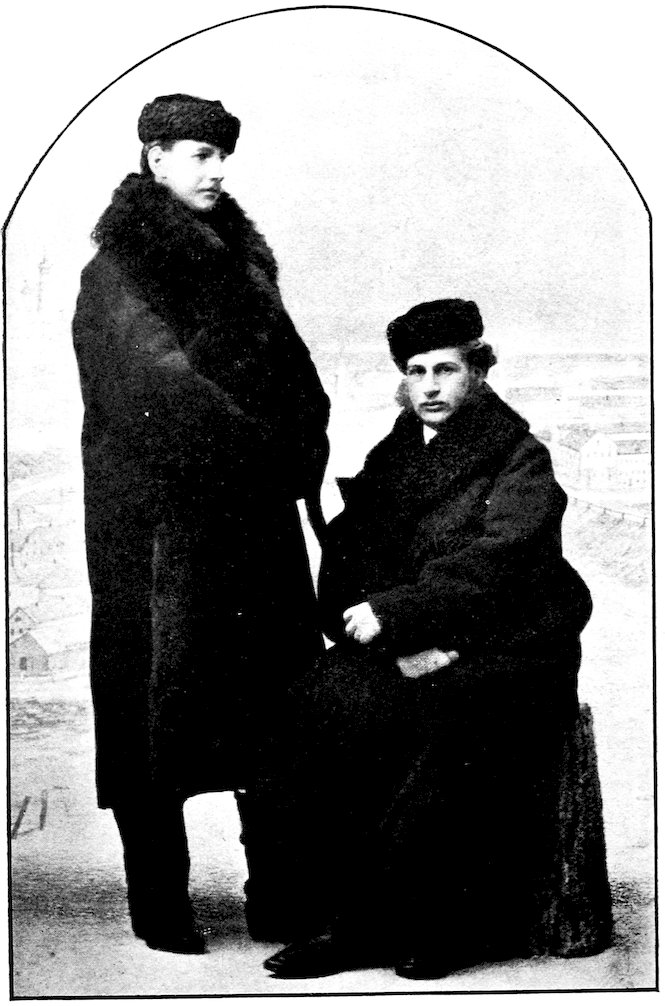
RUSSIAN LIFE AND SOCIETY AS SEEN IN 1866-’67 BY APPLETON AND LONGFELLOW, TWO YOUNG TRAVELLERS FROM THE UNITED STATES OF AMERICA, WHO HAD BEEN OFFICERS IN THE UNION ARMY, AND A JOURNEY TO RUSSIA WITH GENERAL BANKS IN 1869.
Transcriber’s Note:
New original cover art included with this eBook is granted to the public domain.
RUSSIAN LIFE AND SOCIETY.
WITH SKETCHES OF ALEXANDER II. AND ABRAHAM LINCOLN, AND EMANCIPATION IN THE EMPIRE OF RUSSIA AND THE REPUBLIC OF THE UNITED STATES OF AMERICA.
Prepared by
BREVET CAPTAIN NATHAN APPLETON
Author of
“HARVARD COLLEGE DURING THE WAR.”
BOSTON, 1904.
Copyright, 1904
By Nathan Appleton.
(All Rights Reserved.)
Press of Murray and Emery Company Boston, Massachusetts
TO
PRINCESS J—— G——
IN PLEASANT RECOLLECTION OF SKATING AT MOSCOW. JANUARY, 1867, THIS BOOK IS DEDICATED BY
LIST OF ILLUSTRATIONS — CHAPTER FIRST. ARRIVAL IN PARIS AND ADIEU. THE YACHT ALICE. — Gay, Gay Paris. — A Letter To My Mother. — The Yacht Alice. — From Brother Tom in London. — General de Trobriand. — To My Mother. — Later: Resolve in Favor of St. Petersburg. — A Letter from My Mother. — Adelaide Ristori. — La Diva, Café Napolitaine. To My Mother from Paris, Nov. 15, 1866. — The New York Yacht Club. — The Four-in-Hand Club. — James Gordon Bennett, Jr. — Polo and Horse-Racing. — Races on the Newport Beach. — Ten Years Later. A Retrospect. — The Race at Newport. — The Washington Club. — From My Mother in Boston, Sunday, November 18, 1866. — To My Mother from Paris, November 21, 1866. — Adieu to Paris. — William Morris Hunt.
I sailed from New York early in October, 1866,
in the French line steamer Ville de Paris, Captain
Surmont. Time about eleven days to Brest.
Cloudy weather, and the last four or five days no
observation, so one morning we found ourselves
near the Scilly Islands, and from there steamed
over to Brest, arriving in the afternoon. I had a
room with Frank Burgess of Boston, whom I then
knew but slightly, and, as we found that we liked
each other and had the same objects in view at
Paris, we went there and took rooms together at
the Hotel de la Paix, since torn down for the Place
du Nouvel Opera, corner Rue de la Paix and the
Boulevard. The month I passed there until going
to Russia was one of my liveliest and pleasantest
in Paris.
The voyage across the ocean was the same old
story so often and often described. There was
the same queer medley of passengers as always,
and they told the same stories they always do,
and passed their time in the same old way. There
10was the knowing Yankee buyer, going on his hurried
autumn business tour through Europe, who
gave every one to understand that this was his
forty-seventh voyage across the Atlantic, and that
he knew pretty well how to take care of himself.
He had been in nearly every steamship of every
line between Europe and America, and gave advice
freely as to their relative merits. He always could
tell the exact position of the ship, in fog or shine,
better than the Captain himself, and was most
active in getting up, every day after lunch, pools
on the ship’s run, after which he would rush about
making his “book,” buying and selling tickets to
increase his chances of winning.
Then there was the jolly paterfamilias, who had
been passing the last four months at the Fifth
Avenue Hotel, looking after his investments, and
was now returning, to join his family who were
living in Paris, and who would gladly welcome
him and his full purse. He was always around,
and very attentive to and a great favorite with
the ladies, young and old.
There was the same group of Cubans smoking
cigarettes and talking Spanish together with wild
gesticulations, but keeping aloof from the other
passengers. And, oh! the pretty French actress,
returning for the winter season in Paris at the
Folies Dramatiques or the Palais Royal, fresh
from the applause and bouquets in New York,
Chicago and San Francisco. She was dark, she
was petite, she had arched eyebrows and the
slightest touch of paint under her sparkling orbs.
She never appeared on deck until near dinner
time and then in a lovely toilette, as if she were
just going to take a drive at the Bois. And how
at the concert, organized a few nights before sighting
11the coast of la belle France, she charmed all as
she sang some of her opera bouffe songs.
Of course the precocious youth was aboard, going
out for the fourth time to see the Coliseum, and
what wonderful information he imparted to such
listeners as he could get. When the wind was aft
he assured you that the boat was making at least
fifteen knots, and that we should arrive at Brest in
time to take the eight o’clock train for Paris; then,
again, when the wind was dead ahead he consoled
you with the thought that it made the fires draw
well, which was a good thing; but if it struck the
boat on either beam he could conclusively prove
that the sails being well filled the steamer was
steady in her movements, which, after all, was
better than rolling about too fast. If it chanced
to rain he cheered the disconsolate passengers by
stating that it would help beat down the waves
and make the sea less rough! Every day, too,
he seemed to think,—nor did he keep this sagacious
thought to himself,—lightened the ship of
so much coal, and then as for the advantages of
fogs or icebergs, no possible question on the subject
could puzzle him.
Pretty girls flitted here and there, or were spread
out in their chairs and looked uncomfortable.
“Swells” gloomily lounged around: enthusiastic
young travellers were always on hand at everything
which turned up in the ship’s management,
especially the throwing the log and taking the
observations, as if determined at the outset to
lose none of their money’s worth of sight-seeing.
A clever lady from Washington was always
posed in a corner of the saloon, a half read novel
in hand, her flacon and fan on either side, and
she herself happy at any time, morning, afternoon
12or evening, to enter with you into a long conversation
on any subject.
A French priest and a Western parson kept
theology well argued as an appetizer for your
meals, while in the smoking room the poker party
was going on all through the voyage with scarcely
an intermission.
The bluff old Captain was ever about with a
pleasant smile and word for all, inspiring those
of whom he was the ten-day autocrat, with a
feeling of security by his own solid and comfortable
appearance.
A system for passing the time on shipboard I
found worked very well, and I am only too glad
to recommend it to any who choose to try it for
themselves.
Take your coffee about nine in bed in your
state room propped up with numerous pillows,
then go through the operation of being shaved
if the offices of a Figaro are required, who may
be one of the ship’s stewards. After this a couple
of hours or so may be passed in reading, and for
this a selection of a dozen books or so you may
have had placed on the shelf over your couch, so
that you can choose any one which happens to
suit your mood, or, scratch off your thoughts on
a block of paper, always to be carried on your
travels, thus taking down rambling notes where-ever
you go. Rising about half an hour before
lunch time, you get up an appetite by sniffing the
sea air and chatting with those who are about.
Next comes lunch itself, an important item in
the day, which with its subsequent cigar or pipe
can be made to dispose of nearly two hours. Then
approaches the toughest part of the twenty-four
portions into which day and night are subdivided,
13the time between lunch and dinner. A
hand at poker or vingt-et-un helps it along, a conversation
with some fair one in that favorite spot
behind the wheelhouse is a powerful auxiliary,
and, if nothing else turns up, a lazy novel or a
siesta would annihilate the moments until the
first bell ringing gives the welcome intimation
that the time for toilette is at hand.
Dinner, with or without appetite it makes no
difference for go through the form of remaining
at table you must, would next take its regular
place in the programme, and that and a cigar well
over and digested, you are ready to sit down to
your evening party of whist. Than this there is
no better recreation for passing the hours after
dark, and the selection of a good set of players
at an early stage of the voyage is an important
and not to be neglected duty. Is it not probable
that the great Talleyrand, when he advised the
young man to learn thoroughly this king of games
at cards out of regard for his declining years,
remembered with pleasure the hours he had thus
passed in his journeys by water? So the evening
goes along, the ladies retire, the lights are put out
in the saloon, and the male portion of the community
is free to take possession of the smoking
room, there to sit well into the night and to recount
story after story.
It was thus we existed the ten days of our passage,
making pleasant acquaintances in that free
offhand way which gives no binding claim for
future continuance. You meet, you take each
other for what you are worth, you separate, it may
be to see each other again some time, it may be
never, and intimacies under such circumstances
are quickly formed, and as quickly forgotten.
14Before we were well aware of it, so speedily the
last days on the ocean flew by, all the passengers
being well and overflowing with good spirits, the
bright coast of France loomed up before our eyes
in the distance, the green fields could almost be
scented afar off, and there was bustle and activity
in the Ville de Paris. Trunks were being brought
up, and people who did not in the least care for
each other were saying good by a dozen times.
Down goes the anchor with a plunge, the quai
at Brest is swarming with officials and idlers, all
chattering like mad, the tug boat sweeps up before
the douane, we step ashore, and find ourselves in
France.
How the heart of the American beats with joy
whenever he enters Paris, that queen city of cities,
which he regards as almost a second home, feeling
a genuine pride of possession in its beautiful monuments,
its long avenues, its brilliant fêtes, and
all its institutions of instruction and amusement.
And cannot a probable reason why the American
takes to it so much more than to any other foreign
city,—why the asphalt of the boulevard is to him
almost as dear as the flag-stones of Broadway,—be
found in the fact of the real democracy of the
social life in Paris and France? The government
may be a despotism or a revolution: the annoyances
of bureaucracy and red tape are nowhere greater
than there; the petty details of business life amuse
and vex you, but in spite of all, the social life of
the people, whether natives or strangers, is as
free as free can be, provided none of the laws of
the land are broken. You come, you go, you do
this or you do that, you can dine at one o’clock
15on beef and cabbage, or at seven on woodcock
with truffles; you can live in a palace or a cinquième;
you can go to the opera in evening dress
or blouse; you can study medicine or you can
study pleasure; you can drive in a four-in-hand
or in a fiacre; you can do everything or nothing:
whoever you are, or whatever your fortune may
be, no one will interfere; your eccentricities will
cause little remark, you will be unmolested, for
all are too much occupied with themselves to pay
much attention to others, and you may be certain
that, do your best to astonish those about you,
it will not be easy to offer them a new sensation.
I had been there before,—this was my third
voyage across the Atlantic,—and had seen the
guide-book sights of the city, and congratulated
myself heartily upon the accomplishment, for it
was off my mind and I would be spared from
doing it now.
One is not likely to forget the sensations experienced
during the long drive from the railroad
station to the hotel when first arriving at Paris,
especially if it be after dark, through the brilliantly
lighted streets, across the great squares, full as
they always are of the gayest hearted people in
the world, with apparently nothing to do except
treat life as a continual holiday, and I went
through it again with the freshness of a first visit,
as we were taken the distance which separates
the Gare de l’Ouest from the Grand Hotel, at
which place we had decided to camp for the night,
and leave hunting up some snug apartment until
the morrow. The clock was just striking nine as
the little omnibus came with a clatter and cracking
of whip into the spacious court-yard, and after
supper and a short stroll on the boulevard, I
16“turned in,” my imagination picturing in rose-colored
dreams all we would do and see.
Paris, October 22, 1866.
Dear Mamma:
My last note must, I think, have been rather
unsatisfactory, and I hasten to do amends with
a longer one. The fact was that I arrived in
Paris at the Hotel just about half an hour before
the French mail for the Cunard steamer closed,
and I had either to drop just one line to announce
my safe arrival or nothing at all. The voyage
over was, like all, very tedious, and we had pretty
bad weather on the whole. Not knowing where
we were at length we ran into a light on the English
coast, and from there made our way down
south to Brest, where I landed and ran right up
to Paris. I like the steamer better than the
Cunard, she is very fast, and is much more adapted
to the comfort of a gentleman, especially as there
is a cozy little smoking room where you could
play whist in the evenings; also a barber’s shop,
and the state rooms are better arranged. I came
up to Paris with Frank Burgess and Maurice Le
Ray (one of the Newport jockeys of the past
summer, attaché to the French legation at Washington,
who was a passenger on the steamer), and
Burgess and I have taken some very nice rooms.
Yesterday morning Charlie Longfellow (Charles
Appleton Longfellow, late lieutenant in the 1st
Mass. Cavalry, wounded at Mt. Hope Church,
Va., Nov. 27, 1863. He was the son of the poet
Henry W. Longfellow, who married my half-sister
Frances, so was my half-nephew, a year
17and some months younger than I), and Harry
Stanfield tumbled in upon us, as they had that
very night come over from London, and they
gave us jolly accounts of the doings of the Alice
during the past summer. Brother Tom (Thomas
Gold Appleton) and Arthur Clark (Captain of the
Alice) sail for home the last of the month. Charlie
likes the idea of going off to Saint Petersburg by
and by, so as to get there in the height of the winter,
which time they say is really the best to see the
place, but he wants to stay here a while to brush
up his French. So I think I shall be quartered in
Paris for some little time, perhaps a month, and
pitch right into the study of French, and then
start off with him for the cold regions of Europe.
Tuesday: After writing thus much yesterday
I went round to the bank (Bowles, Drevet & Cie
at that time 24 Rue de la Paix) where I found
your letter awaiting me, and I must say that considering
you had only two or three days you have
managed to pick up a vast amount of interesting
items. The first Bostonian I met was Hollis
Hunnewell. I have seen my classmates (at Harvard)
(Charles C.) Jackson and (Frank L.) Higginson,
and yesterday I called on the Harry Sargents.
The weather is charming now, just right
for driving about, and I hope it will continue so
for a month, when we ought to expect the drizzly
rains which will drive me off. There are so many
from the “Hub” here now that Brother Tom’s
last bon mot is said to be “All Parisians are Bostonians.”
Au revoir.
Nate.
18
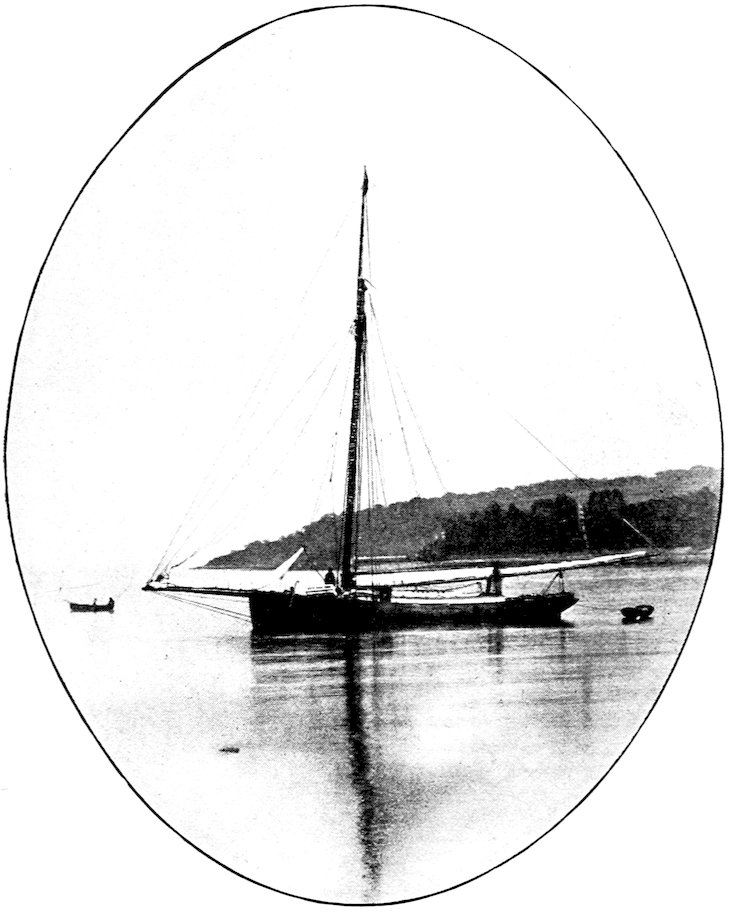
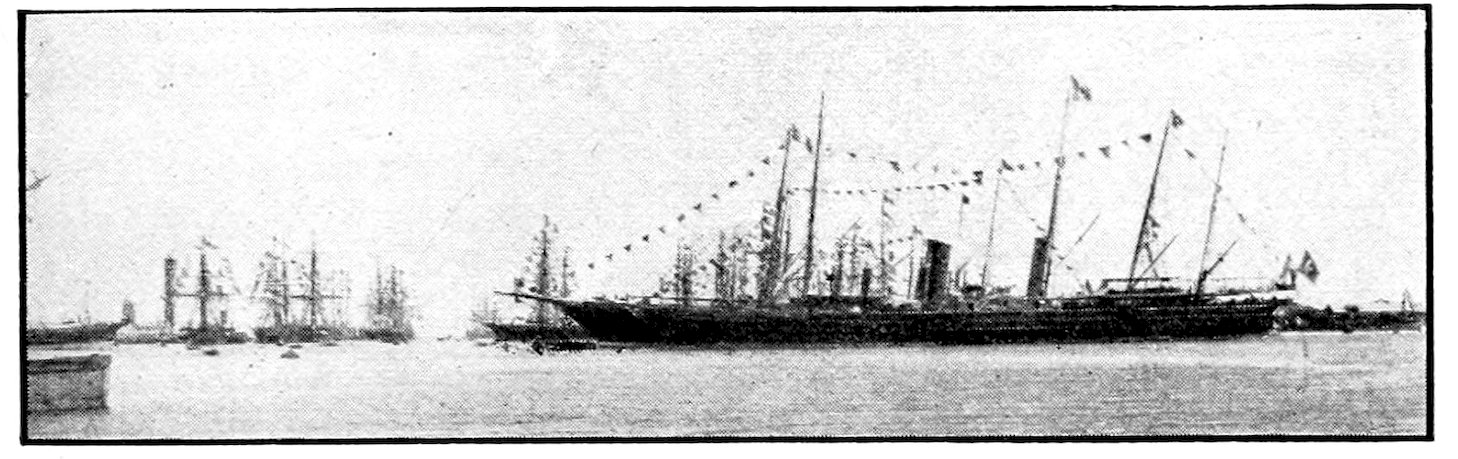
The sloop yacht Alice was owned by Thomas
Gold Appleton. She was about fifty feet in length
and was built by Townsend at Portsmouth, R. I.,
in 1866. When last heard from she was a trader
off the coast of Maine.
The Alice left Nahant July 12, 1866, arrived
at the Needles July 30th, and Cowes Roads July
31st. It was a remarkable trip and faster than
that of any kind of vessel made across the Atlantic
ocean with the then time allowance.
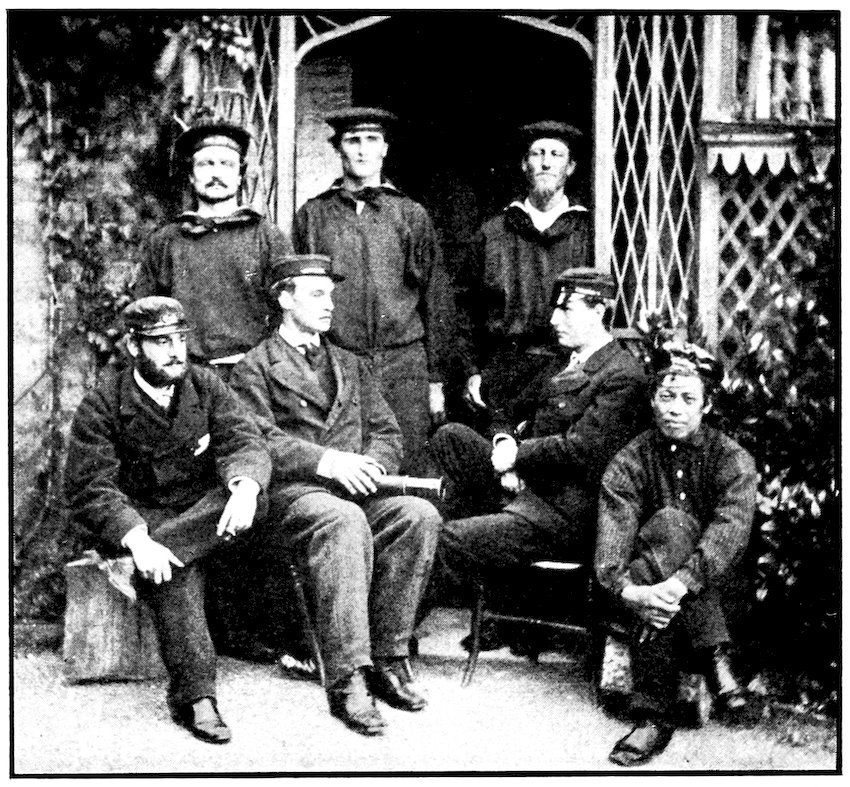
Captain Arthur H. Clark was in command, and she
carried Charles A. Longfellow, the owner’s nephew,
Harry Stanfield, a crew of three men and a Chinese
steward. The owner, then fifty-four years old,
crossed in the Cunarder China, and, joining the Alice
at Cowes, cruised off the French coast and the Channel
islands, see A Cruise of the Alice in A Sheaf of
Papers, by T. G. Appleton, 1875.
One of the first business despatches sent by the
cable across the Atlantic, the Great Eastern having
successfully landed the cable at Newfoundland
on July 27, 1866, was the safe arrival of the Alice,
by C. A. Longfellow.
The owner thus addresses the beautiful yacht
in his collection of poems called Faded Leaves:
YACHT ALICE.
“Away! the cloven waves unite
Behind in murmuring braids of snow,
And seething whispers of delight,
As through the glassy fields we go;
And curtseying with a grace her own
Her bows of beauty in reply,
The white-winged creature moves alone,
Swan-like between the wave and sky.
· · · · ·
Farewell, dear friend, my floating home;
A menacing finger in the sky
Bids us through summer seas to roam
No more, and from harsh winters fly.
Sleep! dreaming of the violet deep,
And think of us and happy hours,
While we through icy nights shall keep
Thoughts of the sails that once were ours.”
CAPTAIN, PASSENGERS AND CREW OF THE ALICE.
The yacht wintered at Cowes and was brought
back the next spring.
19
Many thanks, my dear Naty, for your letter
and the one enclosed. I would have been sorry
to have missed it, as it is from an old friend, and
in peculiar circumstances, and it would not have
been well to have the letter go astray. And
thanks for yours, too, though only announcing
your arrival, and a sketch of your plans. You
will do well to take Charlie and Harry if they will
go, and in the winter Saint Petersburg must be
fine, though after all not much beyond in cold
splendor dear old Boston. I am reading a new
book on Russia, by Henry Morley, and find much
in it interesting. Today is so dark no one is up,
and I am writing alone.... Who should be here
but Townsend, my boat builder. He could not
be quiet, hearing so much of the Alice. Tell
Charlie he has gone to Cowes. Don’t you wish
you loved yachting, and could have had the nice
time we have had? It beats fancy wagons and
top boots, I assure you.
Remember me to Charlie and Harry and bid
them take care and be prudent and get into no
scrapes.
20Farewell and prosper, and do not leave your
whiskers in the snows of Russia.
Yr. aff. brother, T. G. Appleton.
Charing X Hotel, 25th October.
To my mother I wrote again from Paris, October
26, 1866, Friday:—
I give you a short letter now which will make
two for this week, enough certainly to satisfy the
most rapacious of mothers! I have got pretty
well settled into my life here now, of which one
very important object is the study of French.
I take a lesson every morning from a very good
teacher, and go to a theatre most every evening,
and I think I shall make rapid progress, in fact,
as we ought to know a good deal before starting
for Russia, it is advantageous to stay here a month
and pitch into it. I have got quite a nice little
French phaeton, with which I can rattle about
the town, and drive up to the Bois in the afternoon,
and the great difficulty is to find a decent horse
to hire; my own at home being so very superior
my taste has been quite ruined. I saw all the
Imperial cortège out yesterday driving, but I
think they all go to Compiègne soon, so that the
season won’t begin here for some time.
General de Trobriand is here, and I handed
him his commission, whereat he was in great
doubt whether to go home or no. He wants to
accept the commission of colonel of the 31st
Infantry U. S. A. Let me know anything you
would like to have me get you in Paris. I can
easily find time to get it. Exchange is so different
from when I was here before (On leave of absence
on account of wound during the war.) that one
can well be extravagant.
Nathan.
21
General de Trobriand, author of Quatre ans de campagnes
à l’armée du Potomac (Four Years in the Army of
the Potomac) 1867, Paris, Bruxelles, (translated) whose
full name is Philippe Regis Denis de Kerodem, Baron de
Trobriand, was born near Tours, France, June 4, 1816. In
the United States he was known as Philippe Regis de
Trobriand. From 1849 to 1861, in New York, he was
editorially connected with first the Revue de Nouveau
Monde, of which he was publisher, and then the Courrier
des Etats Unis, as associate editor. In August, 1861, he
was placed in command of the 55th New York Regiment,
U. S. V. of the Third Corps, promoted to Brigadier General
in January, 1864, and from May to June of that year had
charge of the defenses of New York City. He was brevetted
Major General U. S. V. April 9, 1865, and was in
command of a Division at Lee’s surrender. In 1867, he
was made colonel in the Regular army and placed in command
of the 31st Regt. U. S. Infantry, brevetted Brigadier
General in the same year, commanding the district of
Dakota, and in 1869, was transferred to the district of
Montana and the colonelcy of the 13th U. S. Infantry.
Later he was ordered to Green River.
I visited him at Camp Douglas, near Salt Lake City, in
October, 1870, and had a good opportunity of observing
western army life and the institution of Mormonism. The
camp was prettily placed on the slope of a hill, with
quarters comfortably arranged. Several of the officers
had their wives with them which made quite a little
society. I stayed in the General’s house and had a horse
at my disposal whenever I wanted to take a ride, and so I
explored some of the picturesque and grand scenery of the
neighborhood with the snow capped mountains quite near.
To go into the city we generally took the headquarters
wagon and did the thing in style.
General de Trobriand was the father-in-law of my friend
and classmate Albert Kintzing Post, so naturally our
relations were most friendly, and I have often met him on
both sides of the ocean. He was in New Orleans in 1875,
during the reconstruction period, after he retired from
service on account of age, having been stationed there for
some years.
In 1885, during the Cotton Exposition I lunched with
him at his house in New Orleans, and met him and some
22friends one day at the grounds, where we strolled about,
and had a picnic repast under the trees. In 1887, at
Paris I saw him again. It was in the summer, and at my
suggestion he joined the “Franco-American,” known first
as the “Washington,” Club, and he enjoyed dining there
at the table d’hôte with agreeable companions.
The General came on to Class Day at Harvard, to hear
the poem delivered by his grandson Waldron Kintzing
Post, the son of my old classmate, when he graduated in
June, 1890, to attend the “spread” and other festivities,
and then one evening we had a little family dinner at the
Somerset Club. After passing a few days at the “Masconomo,”
Manchester-by-the-Sea, with his daughter and
her family, he went to the Reunion of the Society of the
Army of the Potomac, at Portland, Maine, July 3d and
4th, where he was enthusiastically received by the comrades
of his old Corps the Third, and elected vice president
of the Society to represent the Third Corps, Army of the
Potomac. At that meeting I was elected a vice president
in behalf of the Fifth Corps, it being the custom to elect
every year, in addition to the president, vice presidents
and other officers of the society, a vice president from each
army corps that was in the Army of the Potomac.
My last meeting with General de Trobriand was at the
wedding of his grand daughter Lina Beatrice Post to
Hamilton Fish Webster, at the Long Island summer home
of the Posts. This was the autumn of 1891, and a pretty
wedding it was in the little church, and a breakfast later
under a large marquee. Of the grandparents of the
young couple present at the wedding, besides General de
Trobriand, there were Mrs. Armand de Macarty, grandmother
of the bride, and the Hon. Hamilton Fish, grandfather
of the groom.
General de Trobriand died at the home of his daughter
in Bayport, Long Island, July 15, 1897.
Hotel de la Paix, Paris,
October 31, 1866.
My dear Mamma:
I have been calling on several of our good old
Boston citizens, but have not found many of them
23at home. I went to the Louvre the other day,
and found that lots of new galleries had been
added, with all my friends of the French school
put together, and I reveled in Watteau, Boucher,
and Fragonard. I do not do much sight-seeing,
and don’t care to, but tomorrow I am going out
to Versailles with a party of ladies to finish up
the chateau. This afternoon Charlie Longfellow
goes with me driving in the Bois. Yesterday
evening Charlie, Stanfield and Burgess and I went
to the “Lyrique” and saw Faust very well put
upon the stage. It was the first time I had ever
seen or heard the opera, and I thought it very
fine. Charlie and I shall start off for Russia probably
in the course of a month, as we are not in
any hurry and we are to find out about what will
be the best season to be there and then hit it.
Charlie is studying his French very industriously,
and oddly enough he has tumbled into the very
same rooms that Erny (His brother Ernest Longfellow.)
had a year ago. I got a letter from brother
Tom at London, a few days before he sailed. He
seemed in good spirits over the triumphs of the
Alice.
Friday Morn: Yesterday I had a very good
though somewhat fatiguing day at Versailles, and
I should have enjoyed the pictures very much if
I could see them by degrees; but there are so many
millions that one glance at them was all you could
get. Some of those illustrating the wars of the
present emperor in the Crimea, Italy and Algeria,
are very fine. We had a young French “swell”
to chaperon us, and of course saw all the best
things, such as the private apartments of the
Louis’ and Marie Antoinette. I visited with
Charlie, on Wednesday, Jerome Napoleon’s Pompeiian
24villa, which is now a concert room and well
repays a visit. I don’t think the Pompeiian
magnates themselves had anything quite up to it.
Charlie and H. Stanfield still keep up their yachting
fever and go to Asniéres on the Seine quite
near Paris, and sail in a small yacht which some
French count whom they met at Dieppe, has
placed at their disposition. The de Trobriands
leave for Brest in a few days, to pass the winter
there as the General wishes quiet to finish his
book before rejoining the army.
Here I am at my desk, having finished my
French lessons, and having written a long business
letter, to find something to put upon paper
in reply to “No. 3.”
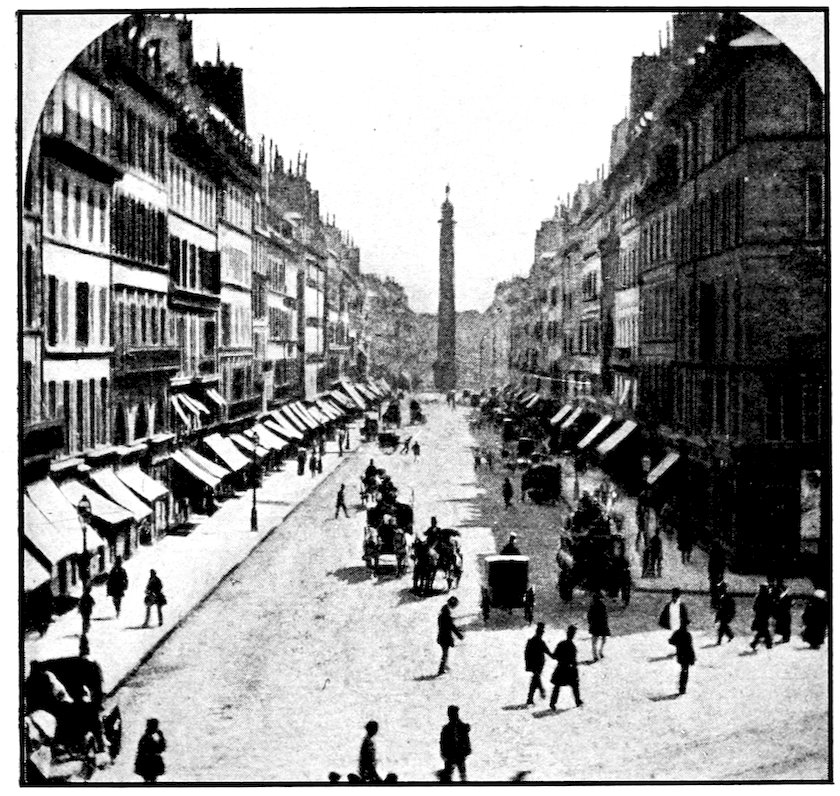
The Boulevard and the Rue de la Paix with
the Grand Opera and the Grand Hotel are just
opposite, and below in the streets there is a continual
excitement of passing objects; vehicles and pedestrians,
soldiers and beggars, but principally Americans.
There is always so much going on all around,
that our apartment is not, perhaps, the best
adapted for the quiet pursuit of literature. You
see I am still in Paris, and perhaps you wonder
whether I mean to leave at all. Know then that
Charlie and I have made a vigorous resolution to
pack up and be off the 25th of this month, stopping
at Brussels, Berlin, Königsberg on the Baltic,
and Wilna, to Saint Petersburg, and then Moscow,
thus seeing the real winter life of the Russians.
I think it will be a plendid trip. From Moscow
we may go to Odessa, etc., but this is very doubtful,
and we shall probably return viâ Warsaw to
Dresden, where we separate—I for Vienna, and
he back to Paris.
RUE DE LA PAIX À PARIS
25
A Review by Napoleon III.
Thursday Eve: A few days ago, Charlie Jackson
drove out with me to Longchamps, where the
Emperor had quite a large review of the troops
around Paris. There were, perhaps, fifteen thousand
troops there, and as it was the first thing of
the kind I had seen in Europe, it was very interesting
and imposing, and brought back something
of the old military ardor. The Emperor and
Prince were there, but Napoleon looked rather
shakey. He is no longer young.
I saw Mr. T. B. Curtis for a few minutes yesterday
and thought he was seeming quite well after
his sickness. He told me particularly to “go it,
while” I was “young,” adding that he “had had
his time.” His advice is certainty good. At the
American chapel last Sunday were crowds and
crowds of people, but very, very few whom I
recognized. The same day Robert H. Stevenson
and I went to the last races of the season, and saw
a very fair steeple chase, but as it was some ways
out of Paris there were not many there.
My mother in Boston wrote me in Paris, Nov.
11, 1866,—... “And Charlie Longfellow is in
Paris! All that is left in Boston will soon find
its way there. I had a very pleasant visit from
your brother Tom last evening, telling me of the
Alice, and of all his doings. Ristori (tragedienne)
has reigned supreme here for two weeks, and
26everybody has cried to their satisfaction. I did
not dare to see her for I felt that I should not sleep
for a month after it.”
I first saw Adelaide Ristori, mentioned in my mother’s
letter, at the theatre at Havana, in Medea, when I was
there in February, 1868, and I met her and her daughter
Bianca at a reception given at the hotel. Later, in the
summer of 1884, at Paris, I was taken to her apartment by
Mr. Henry F. Gillig, president of the American Exchange
in Europe, and saw her and her husband the Marquis
Giuliano Capranica del Grillo, just as they were preparing
to leave the city for their trip to America. I remember
that the rooms were encumbered with their baggage,
which was in every stage of packing for their departure.
The following winter 1884–5, when I was living at the
Vendome Hotel, Boston, I called upon them at the Tremont
House, and introduced to them Mr. C. C. Perkins,
one of our citizens most prominent in music, art, literature,
etc., who was very desirous of meeting the great tragedienne.
He chatted with her in her native language, as
he had long resided in Italy, and had written several
books when there.
Charlie dropped in yesterday just before dinner,
and we decided to start on the 24th, 25th, or
26th, for Brussels, and then have a look at Waterloo;
thence to Berlin to buy fur coats, and so to
Russia. Went to the Italian opera last night and
heard “Crispino e la Camare” (“The Cobbler and
the Fairy.”) sung by dear little Patti. She has
improved much since I saw her two or three years
ago in America, and quite captivated me. I
should make her acquaintance if I was to remain
27long, as she prides herself on being American,
and goes to Mrs. John Bigelow’s soirées. At the
Café Napolitaine later a crowd of Boston men
tumbled in. It is our favorite resort for smoking
our nocturnal cigar,—George Weld, Ned Johnson,
Bob Stevenson, and others. The great talk
is the winter ocean race between three of the New
York Club yachts, the Henrietta (owned by James
Gordon Bennett, Jr.), Fleetwing, and Vesta. (The
Henrietta with her owner on board won the race.)
In that case the Alice will have to be put afloat
again. Well, adieu for a week, and then my last
from Paris.
Nathan.
Adelina Patti, now (1904) Baroness Cederstrom,
was in Boston in 1885, and I happened to be
introduced to her early in that year when I was
living at the Vendome. She was with her second
husband, Nicolini.
May 17, 1866, I was notified that at a meeting held that
day I was admitted a member of the New York Yacht
Club. The yacht Henrietta, owned by James Gordon
Bennett Jr., belonged to the squadron. Bennett’s colors
were a blue diamond and a red crescent on white ribbons.
I once had the pleasure of calling upon Mr. James Gordon
Bennett Senior. It was one Sunday morning, in the
spring of 1872, when I was on a visit to America. I was
strolling up Fifth Avenue with Mr. Leonard W. Jerome.
As we came to Mr. Bennett’s house on the corner of 38th
street, he proposed that we should go in and pay a visit to
the old gentleman, who was then very infirm and evidently
destined not long to live. I was delighted at the opportunity
of seeing him, for although I had stayed with his son
at their fine place at Washington Heights, and often dined
at the city mansion, I had never been able to be introduced
to the father, as he was quite unwell, and generally confined
to his room.
28We were shown up stairs to a small study, where Mr.
Bennett was seated in a comfortable easy chair, in a loose
dressing gown, with a quantity of the daily newspapers
lying around him. We sat there conversing with him
some time, and I remember his speaking of the proposed
plan of rapid transit for New York, and how he had, years
before, advocated the idea in his paper, the New York
Herald. He spoke very strongly of the future growth of
the city. It was only a few months after I saw him that
he died.
Near Mr. Bennett’s place at Washington Heights and
the Hudson River the Four-in Hand Club had a house for
several years. I remember driving there for a ball the
autumn of 1870, with Colonel William Jay and a party of
ladies, and then returning through some of the unfinished
roads, nearly upsetting on the way. The Club was started,
as far as I can remember in 1866. I was elected a member
January 20th of that year; the idea of membership being
any one who had a “four-in-hand,” “spike,” or “unicorn,”—three
horses, two in the pole and one on the lead,—“tandem,”
i. e. something different from the ordinary
single horse or pair hitch. I had a tandem at the time.
The president was George Griswold Gray, whom I had
known at Newport. The Club came to an end, but I cannot
say what year. The Coaching or Four-in-Hand Club
of New York has taken its place.
My first recollection of meeting Mr. James Gordon Bennett
Jr., was on the deck of his yacht Henrietta, at the
spring meeting of the New York Yacht Club, June 19,
1866.
I had been the guest, on his yacht, of Commodore McVickar
(W. H. McVickar, one of the incorporators of the
New York Yacht Club and its commodore in 1866. He
died in New York, Nov. 25, 1896, aged 78.) when Mr.
William C. Otis was fleet captain, and some time during
the afternoon we paid a call upon the young captain of
the Henrietta. This was in the harbor of New York, and
29a very pretty scene it was. Later on, i. e. during the
summer of 1870, on my return from Europe, where I had
often seen Mr. Bennett in Paris at the Washington Club,
he invited me to join a party on his new yacht the Dauntless
at New London, and make the cruise from there to
Newport, which I did.
We were a jolly party,—Lawrence Jerome, Harry
Stanfield, A. W. Knapp and others. With reference to
James Gordon Bennett Jr., in a letter from Newport to the
Boston Globe in August 1876, I remarked:—“Newport
certainly owes a great deal this year to the enterprise of
Mr. James Gordon Bennett, in introducing the games of
polo and la crosse, for the afternoon reunions at the polo
grounds have become one of the most delightful features
of the life here this summer, and Mr. Bennett has proved
himself to be as much at home astride of his pony, as he
was not many years ago on the deck of his yacht, when he
gallantly offered his services to the government during the
civil war, (He was with the blockading fleet in his yacht
from 1861 to 1865.) or when he pluckily scudded across
the Atlantic in mid-winter for the great ocean race.”
In 1881 and 1882, I remember dining at his house, the
old Brooks greystone mansion on Bellevue Avenue, Newport,
where he entertained with generous hospitality, as
also, at his New York home, Fifth Avenue corner of 38th
street. He had a fine, old fashioned family butler, who
seemed to take delight in looking after the comfort of his
friends and guests. The last time I was in the New York
house was at lunch with the Austin Corbins, who had then
rented and afterwards purchased it. This was in 1886.
Austin Corbin, financier and philanthropist was killed by
being thrown from his carriage at his country place at
Newport, N. H., in June, 1896, aged 69.
In Paris too, I would occasionally meet Mr. Bennett,
and he generally made some enquiry about the Panama
Canal.
What I have seen both of polo and horse-racing
has made me consider them both, if not actually
cruel sports for horses, at least those in which
a great deal of unnecessary hard treatment is
inflicted upon the poor animals who try to do
30their best. In polo they seem to be jerked about
indiscriminately, and whacked over the head and
body by the polo mallets. In running races the
use of the whip and spur is often an abomination.
I have seen a horse straining his utmost and at
the same time receiving the cruel blows of the
whip in a way which might naturally discourage
him from making his best efforts, but which in
addition to this, by cramping his nerves and
muscles, must actually keep him back instead
of leading him on. Often, too, this is done to
some horse so far behind that he can have
no chance of winning the race. I believe horses
are frequently demoralized and even made vicious
from the senseless and inhuman treatment they
receive. To get the best out of a horse you have
only to encourage, not discourage him. He
understands more than we give him credit for.
My only experience as the owner of a race horse
was during the spring of 1866, when I had bought
a very pretty and graceful little animal, which
had the name of “Carolina Filly.” She had been
secured after the war by General Joseph J. Bartlett,
who sold her to Mr. George W. Weld, from
whom I bought her. She ran under my colors,
blue and silver, once at Clyde Park, now the Country
Club, but was not victorious.
At 4.30 p. m. on the 30th of August, 1866, there
was a flat race and steeple chase at Newport, at
which 13 horses were entered, and an account of
which appeared in the local press, as follows:—
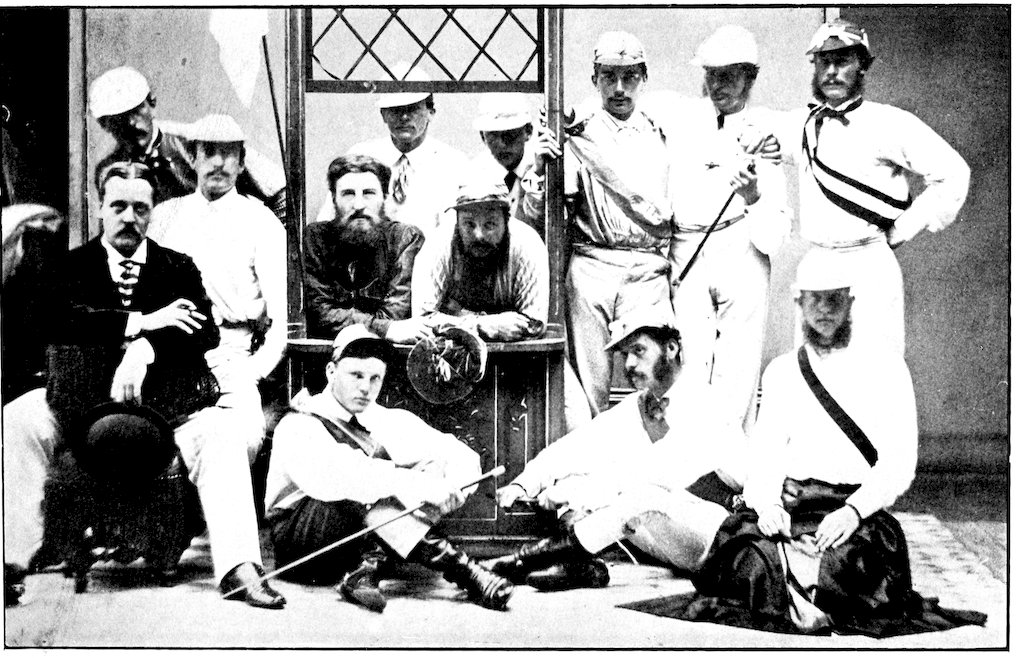
GENTLEMEN RIDERS OF THE NEWPORT RACE
Newport has really had another sensation, in fact has
been convulsed to its “head” centre. (Allusion to Fenianism
31then very rampant.) Yes, the old town has been
startled by the spectacle of no less a modern invention
than a hurdle race!
“Is Saratoga to do all the racing?” muttered the Newport
Jockey Club, “Are there not greener laurels to be
gathered in other fields? We have no track it is true, yet
we can make tracks. Our horses have not received a
university education, but what of that? We have. We
will show them how to surmount difficulties. We will be
our own jockeys, and risk our own gentlemanly lives. It
shall be neck or nothing.”
So it was settled there should be a race, and for the past
week Fashion has talked itself eloquent over the matter
of hurdles. On Thursday the excitement culminated
when Easton’s Beach, where Channing once drew inspiration,
and where since, the lesser mortals have “drawn
their slow length along” in the moist costume of the sea,
found itself transformed into a race course, and its classic
sands desecrated by the presence of hurdles!
One great charm of the affair was to be its selectness.
Only you and I and our dear five hundred friends were to
know anything about it. It was to be a bonne bouche for
our private eating. Yet, strange to say, five hundred
people never can keep a secret, and the little family party
turned out to be the largest concourse of bipeds and
quadrupeds that Newport has seen for many a day.
Fashion glittered and shone, respectable elderly parties
fairly thrilled with excitement. Newport rich and Newport
poor, stood side by side in every species of vehicle,
from barouche to butcher’s wagon. (There were about
7000 spectators and 500 carriages.) The way in which
most of the horses shied around the hurdles, bolted and
did everything but go over them, was delectable. Yet,
let not the Jockey Club be disparaged. Considering the
circumstances its gallant members covered themselves
with glory,—a few of them were additionally covered
with something of a more clinging nature. One daring
rider (Nathan Appleton) landed on his head, another
(Prince Ourousoff) mingled himself with the sands of the
sea, but all lived to tell the short but moving tale, and the
winner (Baron de Mesnil of Belgium) lived to receive a
silver cup from the hands of the lady (Mrs. Paran Stevens)
who had been most actively interested in the day’s sport.
Thus does beauty reward the brave. In honor of the fait
accompli the Jockey Club will give a fête the beginning of
32next week. (Captain Harry Russell of Narragansett
Avenue was declared winner of the second race, which was
a steeple chase, the first one having been over a flat course
of beach.) Pursuant to this announcement cards were
issued by the Gentlemen Riders of the Newport Race,
inviting their friends to the Jockeys’ Ball on Monday,
September 3d, 1866, at the Academy of Music.
Speaking of horse races in a letter from Newport
to the Boston Globe, under date of August
26, 1876, I called to mind the events of ten years
previous:—
“We have only to look up the records of ten years ago,
and we will find that then at least, perhaps even long
before, they had taken place. Ah! It was a brilliant season,
that of 1866. We were a jolly crowd, representing
the jeunesse dorée of many nations. There was a young
Russian Prince, several Frenchmen,—one representative
of the old noblesse and another of the Napoleonic regime,—a
sturdy Belgian, and plenty of Americans, some fresh
from the excitement of the war a year before. And we
had races on the beach when many were the mishaps that
befell the riders. One of them, needless to say who, had a
hard-mouthed horse which he could not control, and so,
near the finish, rushing up among the assembled crowd of
carriages he distinguished himself by leaping clear over a
pony-phaeton, in which were two young ladies, and then
depositing himself half-stunned in the sand. The account
of this may be found in the old files of the Newport News
but a better souvenir of it still remains for those who took
part, in the shape of a colored print now in the Country
Club in Brookline, which was published by one of the
riders, an Irish nobleman, Viscount Southwell, from his
own sketch, in which he gives a fanciful representation of
the great race for a cup presented by Mrs. Paran Stevens,
the lady who then, as now (1876) presided so graciously
over many of Newport’s hospitalities and festivities, and
whose charming villa could tell many a tale of ‘vanished
summer glory.’”
33
The colored print of the race in the Country
Club, by Viscount Southwell, represents the race
as if it was on the turf instead of the sands of the
beach, as was actually the case, but this was to
make it more natural, as it was the only kind of
race to which he was accustomed. In fact racing
on the beach was a new departure, and I have
heard it stated that this was the first one with
“gentlemen riders” which had ever occurred, in
the Northern States at least. He brought in on
the slope of the hill leading down to the beach,
the coach and four-in-hand of Hon. August Belmont,
who had at that time the most correct
equipages to be found in our country. Mr. Belmont
in those days drove occasionally “en daumont,”
i.e. four horses attached to an open
barouche with postillons dressed for summer in
jackets, top boots and tall white hats, as you
see them in Europe.
Mr. G. G. Gray would at times bring out his
open break with five horses, three at the wheel,
then two, and one on the lead, a very fanciful and
effective rig. I must not forget that at the Country
Club there is also a satin programme of the
race, with the names of the horses, their owners
and riders, contributed by some other person.
It makes the affair complete, and it is a valuable
relic of those old days of gayety.
In the summer of 1882, Mr. Ely Goddard had
some marvellous turnouts. He had a fancy for
horses of bay and white, like those you see in the
circus, and often call “wishing horses,” and
managed to drive them four-in-hand, unicorn,
three abreast, tandem, a pair, or even one alone.
34It was really remarkable how he could find so
many of these variegated animals to serve his
purpose.
As far as I can remember, the Washington
Club in Paris, to which I refer in my recollections
of James Gordon Bennett Jr., was started in the
winter of 1868 and ’69, the idea being to have it
a purely American club, on the same principles
as those in the United States. I was not one of
the incorporators, but joined it shortly after it
was organized, and May 8, 1869, was elected one
of the board of direction.
I hardly know what to say of the Washington
Club, so many souvenirs does it now recall. Mr.
Willett, always known as “Bronnie” Willett,
was the first secretary, and I succeeded him in
the first year, 1869, and continued until 1872.
Mr. W. Pembroke Fetridge and I were the two most
active persons in bringing Americans there, and
having them join as temporary or permanent
members.
While I held the position of secretary I kept
the records very carefully, and one of the notes
regarding membership I have now in my scrapbook
from the pen of Mr. A. J. Drexel, of the
banking house of Drexel, Harjes & Co.:—
3 Rue Scribe, Paris.
January 4, 1869
My dear Sir.
I am in receipt of the notification of my election to the
“Washington Club.”
After authorizing Mr. Bowles to propose my name, upon
reflecting that my stay here would be so short that it would
be of no use to me to join, I concluded to ask him when I
35saw him again, not to do so, and therefore prefer declining
to become a member, altho’ the Club has my hearty
sympathy.
Wishing, however, that one of our firm should become a
member, I beg of you to propose the name of our Mr.
Eugene Winthrop in my place. Hoping this substitution
will be satisfactory to you
I remain very truly yours,
A. J. Drexel.
N. Appleton, Esq.
The first apartment the Washington Club occupied
was a good suite of rooms, well adapted to
its uses at that time, belonging to Dr. Thomas
W. Evans in the Rue Auber, which he offered to
the Club free of rent. They were, however, too
high up, on the third floor, and not quite large
enough, and during the summer of 1869, it was
decided to take an apartment at the corner of the
old Rue de la Paix, by the opening, or rather
the beginning of the Avenue de l’Opera, diagonally
across from the Grand Hotel, the first
floor over the entresol.
When I returned from Egypt and the opening
of the Suez Canal, I wrote my sister in Boston,
December 19th, 1869, “We Americans have just
got into our new club rooms on the corner of the
Boulevard, what was formerly the Rue de la Paix
(Now Place de l’Opera), and a new street cut
through to the Bourse. It is the finest situation
in Paris, and we are in a most prosperous state,
and begin to wonder how we ever got on without
a club before.”
It soon became popular in the American colony,
and a rendezvous for the transient travellers.
Mr. Lorillard Spencer was the president, and
Mr. J. F. Loubat the treasurer. I have preserved
the receipt of my payment of 500 francs for membership.
36It is number 7, dated May 28, 1869,
and signed by J. F. Loubat, who at the present
time (1904) is le Duc de Loubat, a title he received
from the Pope.
In New York, on September 28, 1873, he presented
to me his book entitled “Narrative of the
Mission to Russia in 1866, of the Hon. Gustavus
Vasa Fox, Assistant Secretary of the Navy.
From the Journal and Notes of J. F. Loubat.”
Mr. Wm. Pembroke Fetridge, Mr. Alfred Lockwood,
Mr. de la Chaise, Dr. “Tom” Pratt, Mr.
Sheppard, Armand Voisin, the Lorillards, George
and Louis, Elisha Riggs, John Garcia and Augustus
Samanos, both Cubans, Lloyd Phœnix, James
Gordon Bennett, and others, were active members
of the Club. Indeed the membership included
many noted and rich Americans, with the Minister,
Consul General, and other officials of the
U. S. Government, as honorary members.
At that time there was no restaurant, but reading
and card rooms, a billiard table and bar, and
plenty of American newspapers.
The rooms extended around the corner of the
Boulevard des Italiens. When I returned to Paris
about a week or ten days after the collapse of the
Commune, in May, 1871, I was one of the first to
look in upon the old club, and it was in many
respects a scene of desolation.
The Versailles troops who came down the Rue
Auber, found it right in their line of shooting, as
they attacked the Communists, and many were
the broken windows and glasses in the different
rooms.
I picked up a lot of bullets, or found them in
the walls, and, knowing how soon they would be
lost or disappear, had them neatly arranged in
37a case under glass, to preserve them, an interesting
relic of the Commune.
Several of us members of the club met there one
afternoon, and were endeavoring in various ways
to be reasonably gay under the circumstances,
when one who was by his family partly related
to France appeared, and thought it was all wrong
for us to be so light-hearted in the day of France’s
trouble. We said, on the contrary, that we
thought we ought all to make the best of the situation,
and so help retrieve the sadness of the past,
and so we did.
The club still exists, and we old members have
been given the privilege of life membership, so
that we can avail ourselves of its rooms whenever
we may happen to be in Paris. This adds much
to the comfort of a sojourn there, as the table
d’hôte breakfast at twelve, and dinner at seven,
were as good as any to be had in Paris, while the
view from the balcony is a perpetual delight.
I have often been there since, but the club
name has been changed to that of “Le Cercle
Franco-Américain,” so as to admit persons of
various nationalities.
An interesting album of portraits of the prominent
members, painted by Mr. Armand Dumaresq,
was one of its attractions when I was there in
1887. Mine was very good, and under my name
I had written “le Champion de Panama.”
The autumn of 1894, part of September, all of
October, and part of November, I passed in Paris,
to find out what the new Panama Canal Company
proposed to do, and also to place the bronze
marker of the Society of the Sons of the American
Revolution by the grave of Lafayette in Picpus
Cemetery, Paris. While there I noticed the apartment
38of the Franco-American Club was closed,
and was told how it happened to be so, but that
the members could go to the “Cercle des Capucines”
nearly opposite, on the other side of the
boulevard of that name. I went there one afternoon,
and sent up my card, and was cordially
received by my old friend, William Pembroke
Fetridge, Lynch, Davis, and others, and Fetridge
invited me to dine with some of them which I did.
“I have received this last week your nice letter
of October 30. I read it to Longfellow, and he
was pleased to hear so much of Charlie. He
says, ‘Do caution the boys to guard their ears
and noses in going to Russia. They are frozen
before one is aware of it, and once thoroughly
chilled you never recover from the effects.’
Monday evening: I have been to Cambridge
again today. Your ‘Brother Henry’ (Longfellow)
has seen a Russian gentleman who tells him
November is too early in the season to go there.”
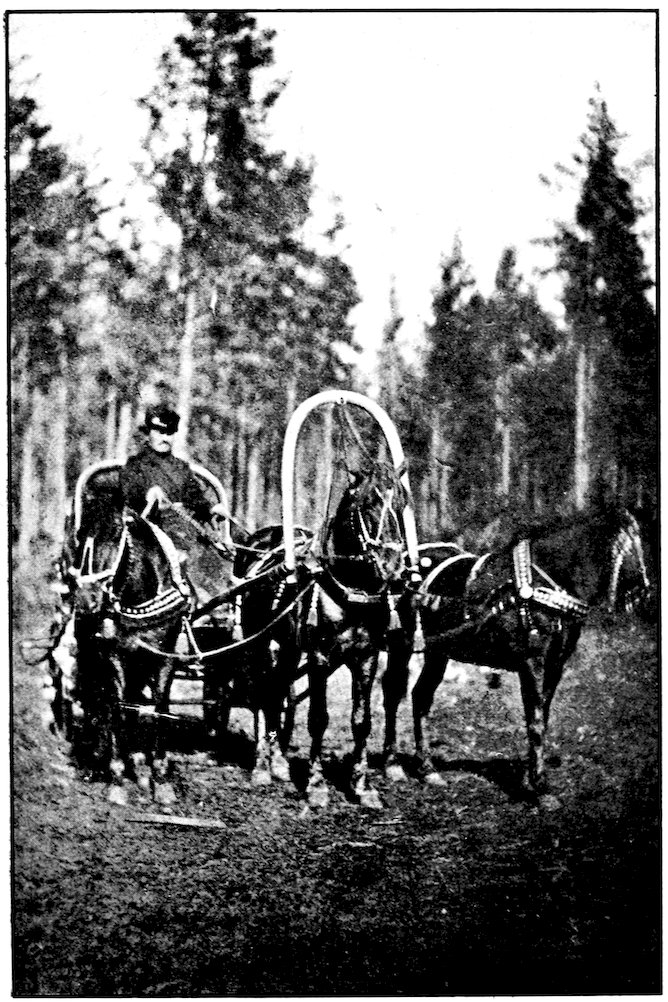
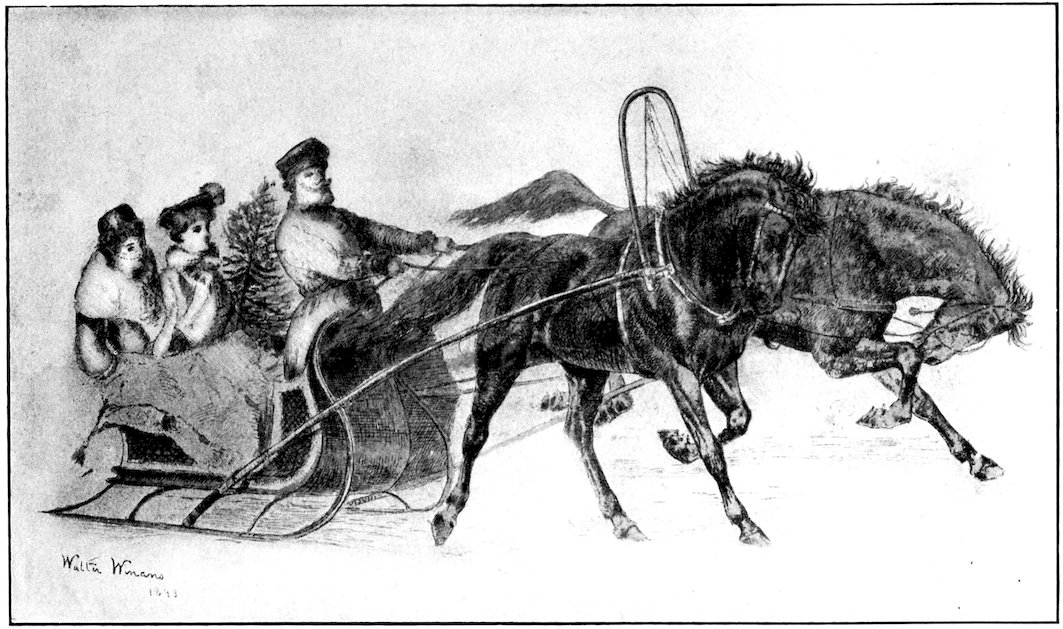
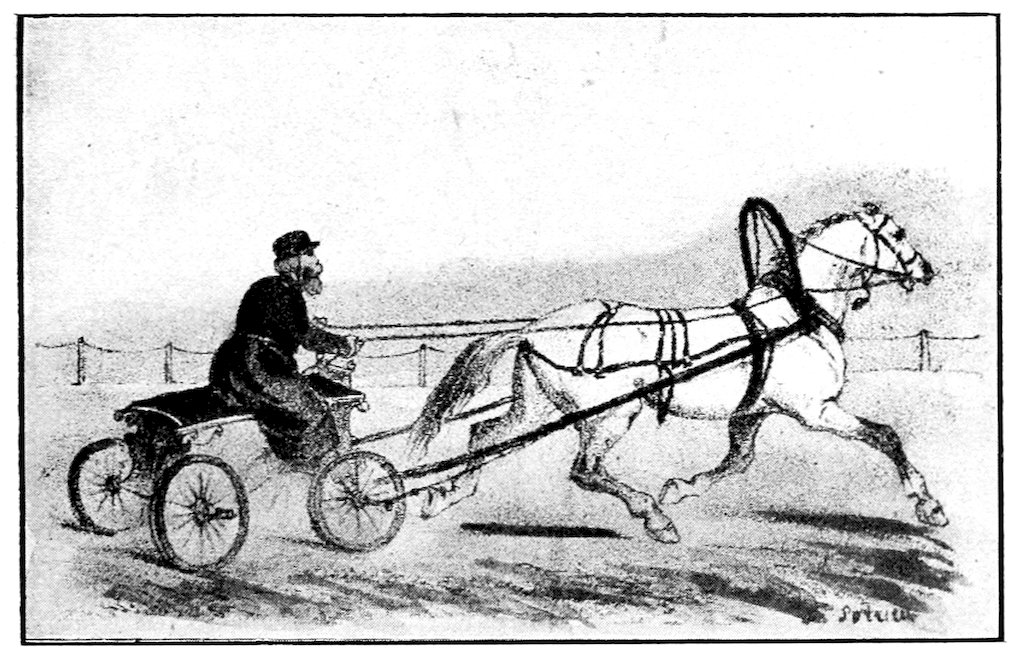
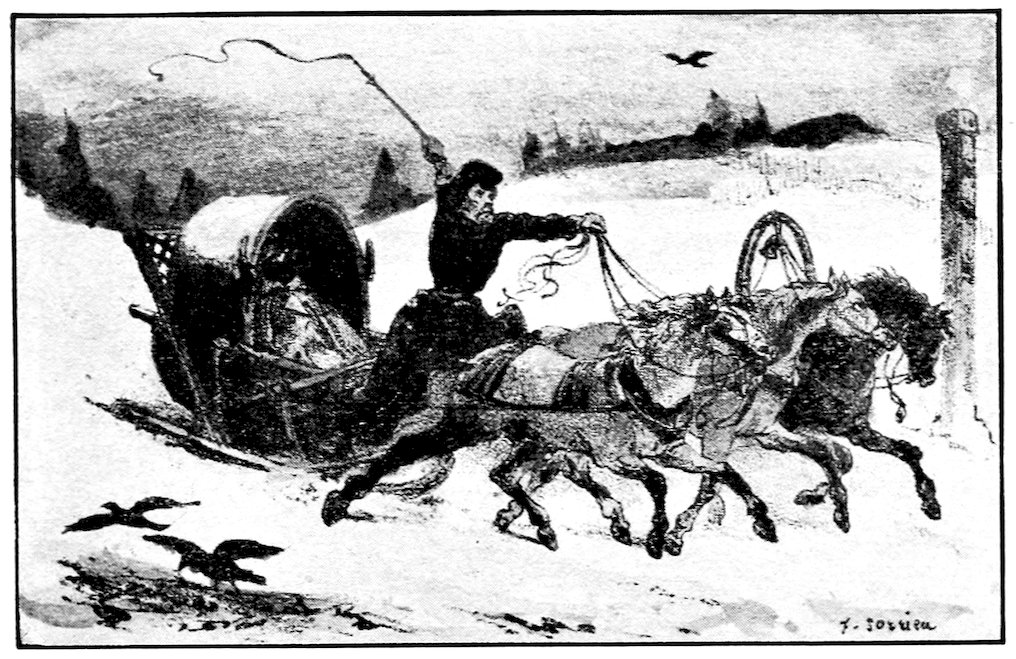
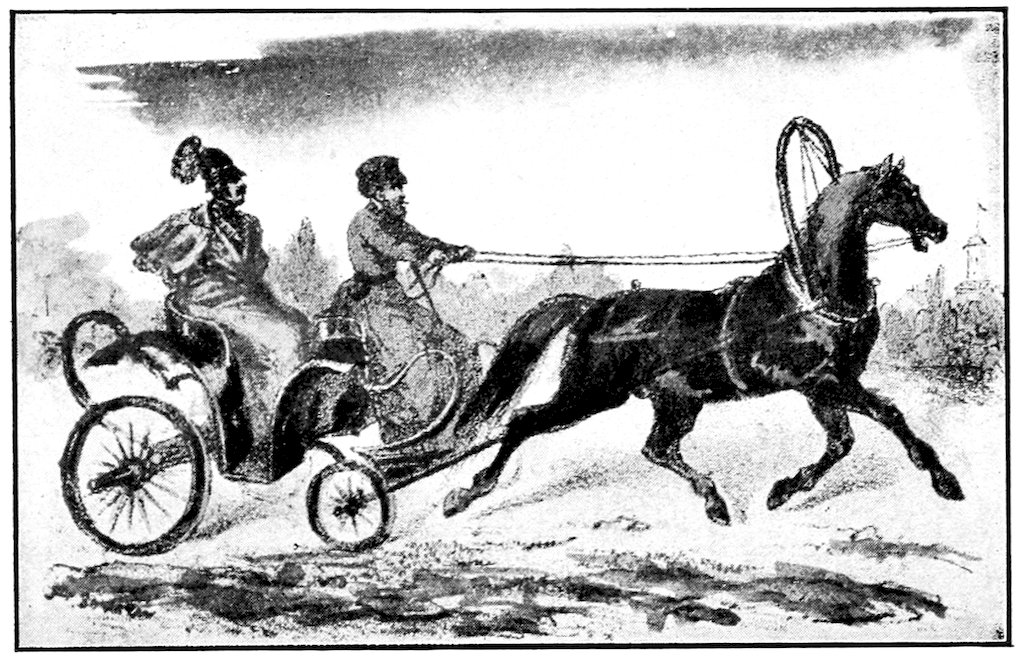
TROIKA.
This is my last from Paris for some time. I
tear myself from the distractions and gayeties,
from the Bois and the dance, to meet the frantic
embrace of the Russian bear. I am quite crazy
about the St. Petersburg trip, my anticipations
are so high, and we long so to be off, and every night
I fall asleep dreaming of driving troikas with
three horses about the streets of St. Petersburg
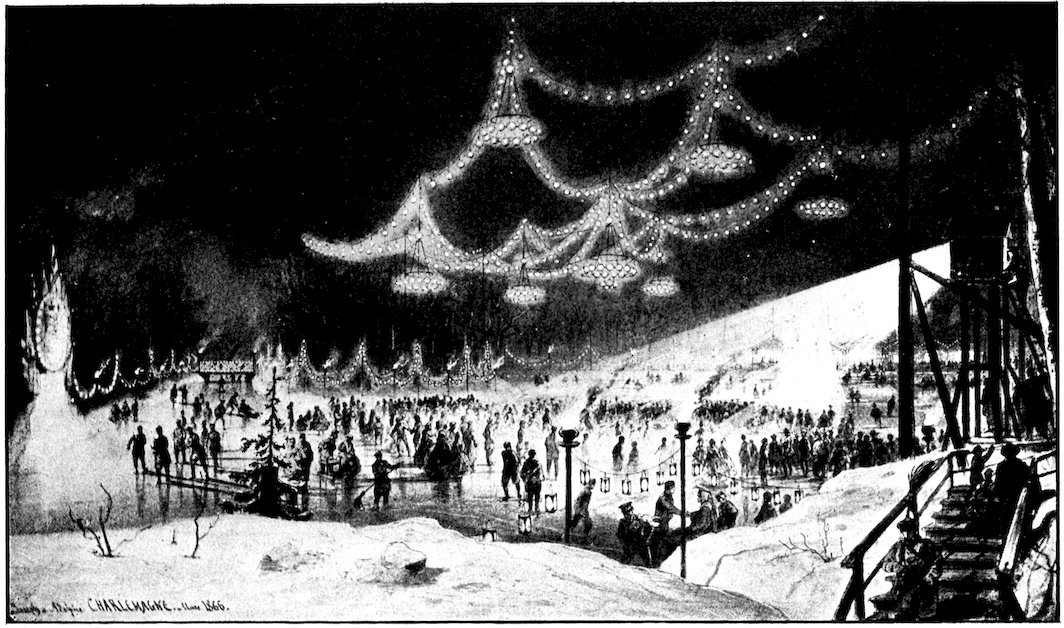
and Moscow, skating the American touch on the
39Neva, endless flirtations with Russian Princesses
and Polish Countesses in the salons and boudoirs
of St. Petersburg. All this, too, is a terra incognita,
and our life is not all cut and dried for us,
as in Rome or Paris. My plan is this,—to pass
the winter just where it will be agreeable, St. P.,
Moscow, or Vienna, or perhaps a trip to Greece
and Constantinople, with the Carnival in Venice,
but certainly return to Paris in April for the Exposition,
and London for the season, and then to
America early in the summer. However, if you
want me to come, if you feel nervous or unwell,
don’t hesitate a moment to write me, and I can
easily and without regret turn about. On Saturday,
at five, I leave Burgess alone, much to his
regret, and Charlie and self go to Brussels, where
we arrive just exactly in time for the “revelry
by night,” a peep at Waterloo, if not too cold,
and then on to Berlin to congratulate Bismarck
on the state of Europe, through Poland to Russia,
a journey of a few days only. You will be
pleased to know that I have not yet lost your
little package for Eliza Carnatz, and I doubt not
that it will reach her in safety. On Friday I
dine at the T. B. Curtis’s, and on Wednesday with
Weld and a lot of men at “Philippe’s.” Have
you ever heard about my horses, if they are well?
I trust they will do the winter comfortably.
Don’t you want me to bring you home a nice little
French “Victoria” this summer, instead of the
old family ark? (The old family carriage imported
by my uncle Samuel Appleton and after his death,
in 1853, taken by my father.) As to the Bois, I
can safely say that if I had my Boston turnout
here complete there would not be a prettier one
in Paris.
40Thursday: I am reading now with my French
teacher, Théophile Gautier’s Voyage en Russie,
and find it most entertaining and instructive,
particularly as he gives a couleur de rose account
of the winter amusements.... I take up my
pen for the third time to finish this, but you know
there is never the least opportunity of doing anything
in Paris, or even of finishing what is begun,
and except my weekly letters to you I have
scarcely written at all. My groom has just been
amusing himself with packing up some of my
traps, as I have one good sized trunk to leave in
Paris full of summer clothes, which I don’t think
I shall want, and odds and ends I have picked
up here.
Received an invitation yesterday from the
Bishop of Pennsylvania, to confer with him on
matters of importance for the church in Paris.
Today is dull and dreary out, but except for
the Bois it makes little difference in P.
I leave my phaeton, etc., at the Bank. I am
going to try to find William Hunt, the artist,
today. Well, I close and take this to the mail.
Adieu to Paris and mes beaux jours—en route!—Russia
and the North! Love to all.
Nate.
While he lived I regarded William M. Hunt
as the first American artist, certainly in the line
of portrait painting. I wanted for a long time
to possess one of his pictures, and I would have
41liked to have had him paint my own portrait,
but I never had the opportunity of doing so.
One day in 1866, just before he was to sail for
Europe, I went to his studio, and after some talk
with him, he said he would let me have the head
of Lincoln, which he had painted as a study for
the full length portrait now in Faneuil Hall, for
eight hundred dollars, currency. I agreed to purchase
it and the bargain was made. He told
me that he wanted to take it with him to Paris,
that he might exhibit it at the great Exhibition
of 1867, and I was pleased at this, and readily
acceded to it, as I thought the portrait would
have an additional interest and value from having
been there. It was understood that I should not
pay for the picture until it was delivered to me,
and a bill of sale was made out to this effect. I
afterwards saw the portrait both at Mr. Hunt’s
studio at Paris, and also in the American department
of the Exhibition, where it attracted considerable
attention, and I gave myself no concern
as to when I should own it.
It so happened that the painting never came
into my possession before my financial troubles
in 1872, and after that, of course, I no longer
thought of having it.
After his death by drowning (He was found
dead in the water.) at Appledore, Isles of Shoals,
N. H., Sept. 8, 1879, his widow, the late Mrs.
Louisa D. Hunt, was very disinclined to part
with it, and so I never pressed my claim. According
to a provision in her will a large number of his
paintings and charcoal drawings were sold at public
auction and the Lincoln portrait was reserved at
the sale in February, 1898, at the request of the
Government. Mr. Hunt was a curious man, brilliant,
42full of eccentricities, and very fascinating
in certain moods. His age was only fifty-five
when he died.
Regarding the portrait I received the following
note, dated May 5, 1866:—
My dear Appleton,
If you would like my portrait of President Lincoln you
will please let me know or Mr. Jere. Abbott. My price for
it is $800. I should like the privilege of taking it to England
with me, and will return it to you in a few months in
case you desire it.
Yours truly,
Wm. M. Hunt,
16 Summer St.
In care of Abbott & Howard, Kilby St., Boston.
There was at the time I refer to, 1865–1866
(It was on the list at the sale.), a beautiful landscape
of the Forest of Fontainebleau I ought to
have bought, but did not. I once had in my
collection of paintings one which had belonged
to my brother, T. G. A., a small picture, with a
church in the background, and in the foreground
several sheaves of wheat, and peasants returning
to their houses from the field, with the light of a
setting sun. It had the touch and the glow of
the master.
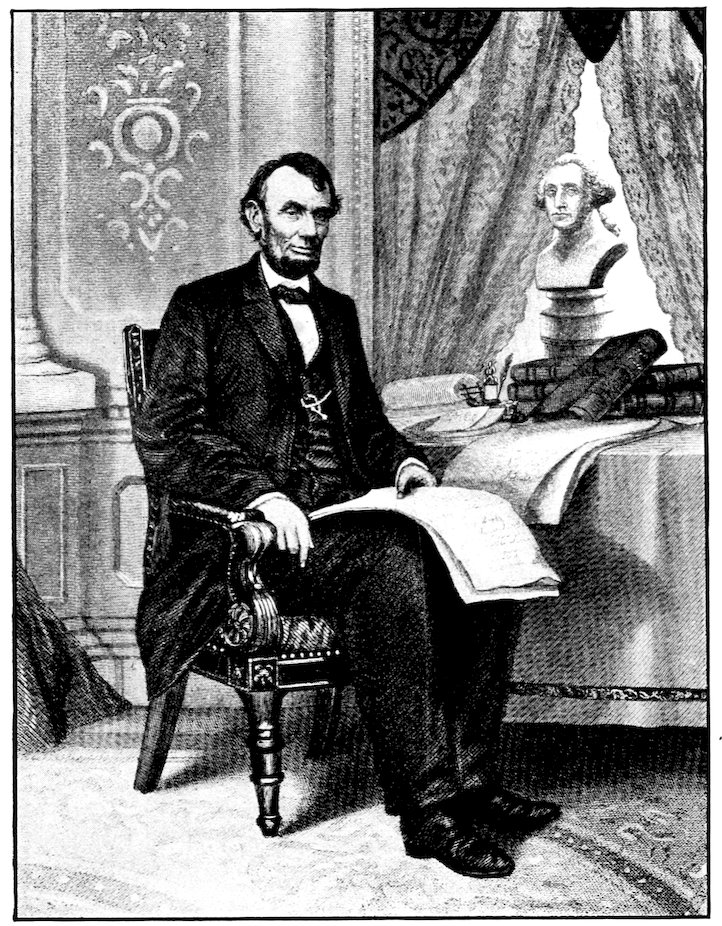
ABRAHAM LINCOLN.
CHAPTER SECOND Lincoln and Emancipation — ABRAHAM LINCOLN — Lincoln and Emancipation. — Colonization. — Proclamation of Emancipation. — Slaves Still Held in Loyal States. — The Constitution of the United States. Fourteenth Amendment. — The Constitution of the United States. Fifteenth Amendment. — After Emancipation. — An Appeal to the Country. — Death of Lincoln. — Personal Recollections. — Statue at Springfield, Ill. —
43
“All merit comes
From braving the unequal:
All glory comes from daring to begin:
Fame loves the state
That, reckless of the sequel,
Fights long and well, whether it lose or win.”
—Eugene F. Ware
I have always regretted that I never had the
privilege of making the acquaintance of President
Lincoln. I remember having met him one summer
at Washington during the war, as he was driving
to the Soldiers’ Home,—a few miles out of the
city where he passed the hot season,—in an open
carriage with an escort of cavalry, which was a rare
sight for a President of the United States, until the
requirements of war and the treasonable elements
which pervaded society in Washington seemed to
make such a precaution advisable. This was civil
war with its unseen dangers in the nation’s capital.
I can just remember his sad face, which appeared
full of the responsibilities of the situation, as he
drove along.
The antislavery movement in the United States,
began in the mountains of the South by Benjamin
Lundy, of Wheeling, West Virginia. He published
a paper called “The Genius of Universal
44Emancipation,” first at Mount Pleasant, Ohio,
afterwards at Jonesville, East Tennessee, and in
1824, he removed it to Baltimore, Md.
In 1825, Miss Frances Wright, a youthful and
enthusiastic philanthropist, established ten miles
east of Memphis, Tenn., a manual training school,
in which each negro was to be freed as soon as he
proved himself capable of self support. She was a
friend of Lafayette, who was keenly interested in
the plan, but it failed, and she took her slaves to
Hayti, where she settled them on land granted by
the Haitian government, freed them, and left them
there.
All this was before the organization of the New
England Antislavery Society, which was formed in
1832, by William Lloyd Garrison, returning from
Baltimore where he had been associated with
Lundy.
On December 6, 1847, Abraham Lincoln took his
seat in the Thirtieth Congress as a member from the
state of Illinois. He was thirty-eight years of age,
and six feet four inches in height. His character
and principles are thus briefly and truthfully
described by J. G. Holland, in reviewing his public
career:—
“He introduced them to a new national life. He
has given them a statesman without a statesman’s
craftiness, a politician without a politician’s meannesses,
a great man without a great man’s vices, a
philanthropist without a philanthropist’s impracticable
dreams, a Christian without pretensions,
a ruler without the pride of place and power, an
ambitious man without selfishness, and a successful
man without vanity.”
His position in the Thirtieth Congress on all the
principal points at issue were of the Whig party,
45and in the second session he began his work for the
abolishment of slavery in the District of Columbia
in which the national capital is situated, by introducing
on the 16th of January, 1849, a measure
which he intended as a substitute for a resolution
introduced by Mr. Gott of New York, instructing
the Committee of the District of Columbia to report
a bill prohibiting the slave trade in the District.
Mr. Lincoln’s substitute provided that no person
not within the District, and no person thereafter
born within the District should be held to slavery
within the District, or held to slavery without its
limits, while it provided that those holding slaves
in the slave states might bring them in and take
them out again when visiting the District on public
business. It also provided for the emancipation of
all the slaves legally held within the District, at
the will of their masters, who could claim their full
value at the hands of the Government, and that
the act itself should be subject to the approval of
the voters of the District. It had also a proviso
to restore to their owners all fugitive slaves escaping
into the District.
Mr. Lincoln regarded slavery as property under
the Constitution. Legally he believed slavery to
be right, morally he believed it to be wrong.
On the presentation of this bill Mr. Lincoln had
a considerable number of influential supporters in
the District, but they subsequently withdrew, and
the subject was given up, to be revived again, under
circumstances impossible to be foretold, thirteen
years after.
Speaking in 1859, on the slave power, he said:—“Broken
by it, I, too, may be, bow to it I never
will. The probability that we may fail in the
struggle, ought not to deter us from the support of
46a cause which I deem to be just, and it shall not
deter me. If ever I feel the soul within me elevate
and expand to those dimensions not wholly
unworthy of its Almighty Architect, it is when I
contemplate the cause of my country, deserted by
all the world besides, and I, standing up boldly and
alone, and hurling defiance at her victorious oppressors.
Here, without contemplating consequences,
before high Heaven, and in the face of the world, I
swear eternal fidelity to the just cause, as I deem it,
of the land of my life, my liberty, and my love.”
On March 4th, 1861, Mr. Lincoln was inaugurated
President of the United States, and several of the
slaveholding states rebelled against the authority
of the National Government, passed ordinances of
secession, and with other states joined to them
attempted to gain possession of the national capital,
thereby bringing on the great war of 1861, which
lasted four years, and ended in the preservation of
the Union and the re-establishment of the national
authority over every state and territory.
In the effort to reclaim the recalcitrant states
and restore peace to the country, every expedient
was used, and when, by proclamation of President
Lincoln, Congress assembled in extra session on the
Fourth of July, 1861, Mr. Trumbull of Illinois
introduced a bill in the Senate to emancipate all
the slaves in the rebel states.
At that time one-eighth of the whole population
of the United States were colored slaves, located in
the southern portion. They had been held in
slavery two hundred and fifty years, having originally,
and as required thereafter, been brought to
this country in slave ships principally from the
coast of Africa and the brisk and remunerative
traffic still continued. The extra session closed on
47August 6, 1861, having lasted but little more than
a month. In the meantime Major General John
C. Fremont having been placed in command of the
Department of the West, with headquarters at St.
Louis, on the 25th of July, 1861, contemplating the
restoration of order in Missouri, and the reclaiming
of the control of the Mississippi River, proclaimed
martial law, declared the property of all those who
should take up arms against the United States
confiscated to the public use, and their slaves, if
they had any, were declared free men. In other
words, he proclaimed freedom to the slaves of
rebels, but, fearing that this would alarm Unionists
in the South, Mr. Lincoln desired General Fremont,
as of his own motion, so to modify his proclamation
as to make this freedom apply only to such slaves
as were engaged in the rebel service.
General Fremont had taken this step without
consultation or notice. The President wished him
to conform to a confiscation act passed by Congress,
but Fremont wished the President to order the
change desired, as, if he should do it of his own
motion, it would imply that he thought himself
wrong, stating the difficulties under which he
labored, with the communication with the government
so difficult and the development of perplexing
events so rapid in the department under his command.
This the President did in a despatch under
date of September 11, 1861, in these words:—
“It is therefore ordered, that the said clause of said proclamation
be so modified, held and construed, as to conform
to, and not to transcend the provisions on the same
subject contained in the Act of Congress entitled ‘An Act
to Confiscate Property’ ... approved August 6,
1861, and that such act be published at length with this
order.”
48Before this order had been received, or on the
day following its date, General Fremont, though
acquainted with the President’s wishes, manumitted
two slaves of Thomas L. Snead of St. Louis,
in accordance with the terms of his proclamation.
Lincoln believed that the time had not come for
the liberating the slaves of rebels by proclamation,
if he had, the Act of Congress would not have stood
in the way. The Act was the embodiment of his
own policy at that time. He had undertaken to
preserve the Union and the rights of all the states.
A record was to be kept of the slaves of loyal
masters, and for their repayment for them Congress
would provide. Slavery could only be interfered
with as a military necessity, an essential means of
saving the Union. He was assailed on the one side
for being too slow, and on the other for being too
precipitate.
In March, 1862, the following resolution recommended
by President Lincoln passed both houses
of Congress, only a few members of the border
states voting for it:—
“Resolved, That the United States ought to coöperate
with any state which may gradually adopt abolishment
of slavery, giving to such state pecuniary aid, to be used
by such state in its discretion, to compensate for inconveniences,
public and private, produced by such change
of system.”
Before the close of the session the President
invited the senators and representatives of the
slaveholding states not in rebellion, to a conference
at the White House, at which he admonished them
that if they had all voted for the resolution the war
would then have been substantially ended.
49“If the war,” said he, “continues long, as it must
if the object be not sooner attained (i. e. the restoration
of the Union without disturbance of the
institution of slavery) the institution in your states
will be extinguished by mere friction and abrasion—by
the mere incidents of the war. It will be
gone, and you will have nothing in lieu of it.
Much of its value is gone already. How much
better for you and for your people to take the step
which at once shortens the war, and secures substantial
compensation for that which is sure to be
wholly lost in any other event.... I do not
speak of emancipation at once, but of a decision at
once, to emancipate gradually. Room in South
America for colonization can be obtained cheaply,
and in abundance, and when numbers shall be large
enough to be company and encouragement for one
another, the freed people will not be so reluctant
to go.”
The time for the voluntary abolishment of the
slave system was at any date previous to 1900.
In this session slavery was abolished in the
District of Columbia, completing the work begun
in 1849, and recognizing the two principles of
colonization and compensation. This session also
passed the confiscation act by which the traitor to
the general government forfeited his slaves, as well
as any other property, and Congress decided in
advance, that the slaves thus confiscated and held
by the government should be declared free.
Then the public at the north, these measures
having been enacted, demanded a sweeping proclamation
of emancipation. The antislavery element
clamored for swifter and more radical recognition,
aroused and sustained by the eloquence of
the spoken and written word.
50These were the clarion notes of Whittier’s
“Voices of Freedom”:—
“If we have whispered truth
Whisper no longer:
Speak as the tempest does,
Sterner and stronger.
Still be the tones of truth
Louder and firmer:
Startling the haughty South
With the deep murmur.”
To which the President made reply:—
“What I do about slavery and the colored race,
I do because I believe it helps to save this Union,
and what I forbear, I forbear because I do not
believe it could help to save the Union.... I
intend no modification of my oft-expressed personal
wish that all men everywhere could be free.”
He understood that his oath of office stood in the
way of the present accomplishment of that wish,
but that for the preservation of the Constitution
and the Union measures otherwise unconstitutional
might become lawful. That to preserve
slavery he could not permit the wreck of government,
country and constitution all together. He
objected to General Fremont’s order of emancipation
because he did not then consider it a necessity.
He objected to the arming of the blacks, as suggested
by the Secretary of War, Simon Cameron,
for the same reason; also to an attempt by General
David A. Hunter for a military emancipation,
believing as he did in compensated emancipation.
But the border states, toward whom he had fulfilled
his whole duty, turned a deaf ear to his
expostulations, and by this attitude relieved him of
further responsibility toward them.
51
Congress placed at the President’s disposal a sum
of money to be used for experiments with the
colonization of the blacks, his choice of location
being the Spanish American republics of Central
and South America. In August, 1862, he invited
a representative company of negroes to visit the
White House and address him on the subject; the
President asserting his conviction that both the
whites and negroes would suffer by living in association
with each other. He offered them the benefit
of the fund intrusted to him for the purposes of
colonization. But the Spanish American republics
protested against black colonies in their midst.
Liberia and Hayti only would receive them, and
the blacks were not disposed to emigrate to those
countries, and so that project faded as all such
projects have failed in relation to sending the
colored population out of the country. The President’s
plan was one of benevolent solicitude for a
race which he hoped to make self-reliant and
independent.
And it came to pass, that in the midsummer of
1862, President Lincoln called a meeting of his
Cabinet and laid before them a draft of a proclamation
of emancipation, which involved the freedom
of all human beings held in slavery in the United
States, amounting to four millions then living, and
affecting untold millions then unborn, and revolutionizing
the social status of more than a third part
of the nation, but the Secretary of State, William
H. Seward, while approving of the proclamation,
opposed its issue at that time, immediately after so
many reverses, and advised its postponement until
it should have some military success to support it,
52that it should not have the appearance of an appeal
for help. So the proclamation waited until the
invasion of Maryland brought on the battle of
Antietam resulting in the victory won by McClellan,
when Mr. Lincoln brought forward his second
draft of the instrument,—even then a preliminary
proclamation,—which was issued on the 22d of
September, 1862, the battle having been fought on
the 17th; Mr. Lincoln being reported as saying that
he made a resolve that when McClellan should drive
Lee over the river he would send the proclamation
after him.
This proclamation declared free the slaves of
those states, and those sections of states, which
should be in rebellion on the 1st of January, 1863,
thus affording an opportunity for all rebel states
which wished to preserve their ownership of slaves,
to do so by returning to their allegiance to the
Federal Government.
September 24, 1862, the President issued a proclamation
suspending the writ of habeas corpus, as
the ordinary processes of law were not sufficient to
restrain disloyal persons from hindering the execution
of a draft of militia, which had been ordered,
and from giving aid and comfort to the insurrection.
This suspension lasted for two months, or until the
22d of November, 1862, and persons held in military
custody were released on parole.
On the 1st of January, 1863, the final proclamation
of emancipation was issued. It was as
follows:—
Whereas, on the twenty-second of September, in the
year of our Lord one thousand eight hundred and sixty-two,
a proclamation was issued by the President of the
53United States, containing, among other things, the following,
to wit:
“That on the first day of January, in the year of our
Lord one thousand eight hundred and sixty-three, all
persons held as slaves within any state, or designated part
of a state, the people whereof shall then be in rebellion
against the United States, shall be then, thenceforward
and forever free, and the executive government of the
United States, including the military and naval authority
thereof, will recognize and maintain the freedom of such
persons, and will do no act or acts to repress such persons,
or any of them, in any efforts they may make for their
actual freedom. That the Executive will, on the first day
of January aforesaid, by proclamation, designate the
states and parts of states, if any, in which the people
thereof respectively shall then be in rebellion against the
United States; and the fact that any state or the people
thereof shall on that day be in good faith represented in
the Congress of the United States by members chosen
thereto at elections wherein a majority of the qualified
voters of such state shall have participated, shall, in the
absence of strong countervailing testimony, be deemed
conclusive evidence that such state, and the people thereof,
are not then in rebellion against the United States.”
Now, therefore, I, Abraham Lincoln, President of the
United States, by virtue of the power in me vested as
Commander-in-Chief of the Army and Navy of the United
States in time of actual armed rebellion against the authority
and government of the United States, and as a fit and
necessary war measure for suppressing said rebellion, do,
on this first day of January, in the year of our Lord one
thousand eight hundred and sixty-three, and in accordance
with my purpose so to do, publicly proclaimed for the full
period of one hundred days from the day first above
mentioned, order and designate, as the states and parts of
states wherein the people thereof respectively are this day
in rebellion against the United States, the following, to
wit:
Arkansas, Texas, Louisiana (except the parishes of St.
Bernard, Plaquemine, Jefferson, St. John, St. Charles, St.
James, Ascension, Assumption, Terre Bonne, Lafourche,
St. Marie, St. Martin and Orleans, including the city of
New Orleans), Mississippi, Alabama, Florida, Georgia,
South Carolina, North Carolina, and Virginia (except the
forty-eight counties designated as West Virginia, and also
54the counties of Berkely, Accomac, Northampton, Elizabeth
City, York, Princess Anne, and Norfolk, including
the cities of Norfolk and Portsmouth, and which excepted
parts are for the present left precisely as if this proclamation
were not issued).
And, by virtue of the power and for the purpose aforesaid,
I do order and declare that all persons held as slaves
within said designated states and parts of states, are,
and henceforward shall be free, and that the Executive
Government of the United States, including the military
and naval authorities thereof, will recognize and maintain
the freedom of said persons.
And I hereby enjoin upon the people so declared to be
free, to abstain from all violence, unless in necessary self-defence,
and I recommend to them that in all cases, when
allowed, they labor faithfully for reasonable wages.
And I further declare and make known that such persons
of suitable condition will be received into the armed service
of the United States to garrison forts, positions,
stations and other places, and to man vessels of all sorts in
said service. And upon this act, sincerely believed to be
an act of justice, warranted by the Constitution, upon
military necessity, I invoke the considerate judgment of
mankind, and the gracious favor of Almighty God.
In testimony whereof I have hereunto set my name, and
caused the seal of the United States to be affixed.
Done at the City of Washington, this first day of January,
in the year of our Lord one thousand eight hundred
and sixty-three and of the
[L. S.] Independence of the United States the
eighty-seventh,
Abraham Lincoln.
By the President.
William H. Seward, Secretary of State.
In the cabinet meeting to which the preliminary
proclamation was submitted, by request of Mr.
Seward the words “and maintain” were inserted
after “recognize” in the third paragraph of that
document in the second paragraph of the final
proclamation, the President in his wisdom, having
omitted the words, as it was not his way to promise
more than he was sure he could perform, and he was
55not prepared to say that he thought he was able to
maintain this. Thus the story is told on the best
authority.
Another paragraph is said to have been written
by the Secretary of the Treasury, Salmon P. Chase,
who had prepared a proclamation from which the
President only selected the sentence beginning
“And upon this Act,” and ending with “Almighty
God,” with the exception of the word “sincerely”
and the phrase “upon military necessity” which
are the President’s own. It is said that Mr. Lincoln
voluntarily revealed the authorship of the
words attributed to Seward and Chase.
By this proclamation of emancipation the loyal
slave states were allowed to retain the institution
of slavery, which was secured to them by the Constitution,
and in order to reach them certain articles
of amendment to the Constitution of the United
States must be acted upon by the legislatures of
the several states, three-fourths of the number of
which would make the articles valid. No servile
insurrection or tendency to violence marked the
execution of the provisions of the proclamation
relative to the arming of the negroes.
At the session of Congress beginning in December,
1863, the Fugitive Slave Law was repealed.
At the national Republican convention which
met at Baltimore, June 8, 1864, and nominated
Lincoln for re-election, one of the resolutions
advocated a constitutional amendment abolishing
slavery. Another declared that the government
owed protection to all its soldiers, without distinction
of color, and at the session of congress which
56opened the following December, an amendment to
the Constitution was passed abolishing slavery in
all the states. It needed now to be adopted by the
vote of the states, and the necessity was pressing,
for in order to place in their hands a weapon of self-defence
against re-enslavement the negroes must
be given the right to vote.
Article XIV. Section 1. All persons born or naturalized
in the United States, and subject to the jurisdiction thereof
are citizens of the United States and of the state wherein
they reside. No state shall make or enforce any law
which shall abridge the privileges or immunities of citizens
of the United States; nor shall any state deprive any person
of life, liberty, or property, without due process of law, nor
deny to any person within its jurisdiction the equal protection
of the laws.
Section 2. Representatives shall be apportioned among
the several states according to their respective numbers,
counting the whole number of persons in each state,
excluding Indians not taxed. But when the right to vote
at any election for the choice of electors for president
and vice-president of the United States, representatives
in Congress, the executive and judicial officers of a state, or
the members of the legislature thereof, is denied to any
of the male inhabitants of such state, being twenty-one
years of age, and citizens of the United States, or in any
way abridged, except for participation in rebellion or other
crime, the basis of representation therein shall be reduced
in the proportion which the number of such male citizens
shall bear to the whole number of male citizens twenty-one
years of age in such state.
Section 3. No person shall be a senator, or representative
in congress, or elector of president, or vice-president,
or hold any office, civil or military, under the United States,
or under any state, who, having previously taken an oath,
as a member of congress, or as an officer of the United
States, or as a member of any state legislature, or as an
executive or judicial officer of any state, to support the
57constitution of the United States, shall have engaged in
insurrection or rebellion against the same, or given aid or
comfort to the enemies thereof. But congress may, by a
vote of two-thirds of each house, remove such disability.
Section 4. The validity of the public debt of the United
States, authorized by law, including debts incurred for
payment of pensions and bounties for services in suppressing
insurrection or rebellion, shall not be questioned.
But neither the United States, nor any state, shall
assume or pay any debt or obligation incurred in aid of
insurrection or rebellion against the United States, or any
claim for the loss or emancipation of any slave; but all
such debts, obligations and claims shall be held illegal and
void.
Section 5. The congress shall have power to enforce,
by appropriate legislation, the provisions of this article.
The Fourteenth Amendment was proposed to
the legislatures of the several states by the thirty-ninth
congress on June 16, 1866, and after delay
caused by withdrawals of ratifications and of rejections
of ratifications by many of the states, on July
28, 1868, it was announced by the Secretary of
State that it had become valid to all intents and
purposes, as a part of the Constitution of the
United States.
Article XV. Sect. 1. The right of citizens of the United
States to vote shall not be denied or abridged by the United
States, or by any state, on account of race, color, or previous
condition of servitude.
Section 2. The congress shall have power to enforce
this article by appropriate legislation.
The fifteenth amendment was proposed to the
legislatures of the several states by the fortieth
Congress on February 27, 1869, and was declared,
58in a proclamation of the Secretary of State, dated
March 30, 1870, to have been ratified by the constitutional
number of states, and to have “become
valid to all intents and purposes as part of the
Constitution of the United States.”
The history of the war shows that one hundred
and seventy-eight thousand nine hundred and
seventy-five negroes, took part either in the army
or the navy of the United States, and the losses these
troops sustained from sickness, wounds, killed in
battle and other casualties incident to war, were
sixty-eight thousand one hundred and seventy-eight.
The war was over in the spring of 1865. Then
came the reconstruction period, and in 1876, the
Democratic party, most influential in the Southern
States, unqualifiedly accepted in its national platform
all the results of the war, including the war
amendments to the Constitution.
Yet, while the race progressed with marvellous
rapidity through educational facilities eagerly
sought for, and secured to them from private and
public sources, the condition of the freed slaves and
their descendants has not improved so materially as
was anticipated.
President Lincoln’s solicitude has not been
proven false or exaggerated, “both the whites and
negroes” have suffered “by living in association
with each other.”
The tendency is to divide the whites from the
blacks, the whites avoiding those sections where
the races are placed on an equality in labor. The
large plantations are being let out to colored tenants
59while the landlord seeks a more congenial environment
in the cities, the poor whites seeking occupation
in the manufacturing industries which have
arisen and are being developed.
It is asserted that the number of counties in the
South in which the negroes outnumber the whites,
counties containing the best cotton, tobacco, rice
and sugar lands, has risen from 237 in 1860, to 279
in 1900, and that within these counties there are, on
the average, 130 negroes to every 100 whites, and
that in 1860, there were 71 counties in which the
negroes were more than twice as numerous as the
whites, which number in 1900, had increased to
108, and 92 per cent of the colored race is found in
the states which were in rebellion in 1861.
Notwithstanding the investment with citizenship
which was supposed to remove from the slave the
disqualification of having no standing in court,
from the time of emancipation to the present, negro
lynchings in the southern and western portions of
the United States have shocked the civilized world
by their frequency and cruelty; victims of both
sexes having been burnt at the stake without any
pretense of a form of trial, while local juries were
unwilling to indict or condemn those who thus transgressed
constitutional law.
The Fourteenth Amendment has been virtually
annulled, and the white vote is apportioned on a
fictitious representation, and based upon a black
majority.
Measures, more or less disguised as to their purpose,
have been passed by several southern states,
tending to disfranchise the negroes, showing an
inclination to gradually return to former conditions,
until they have once more assumed their original
bold attitude, and in the Fifty-eighth Congress,
60which assembled December 7, 1903, notice was
given that the United States Senator from Tennessee
would introduce a bill for the repeal of the Fifteenth
Amendment, “with a view to a permanent
solution of the vexing negro question, by eliminating
the enfranchised negro as a political factor.”
It was said that the Senator would be supported by
every Southern member in Congress, and not a few
members of other sections of the Union. An ex-governor
of Virginia was quoted as saying in New
York, that there is only one solution, and that is
that the Nation must recede from its position on
negro suffrage, and plans to that effect have been
announced in several southern states.
On their own behalf, in a mass meeting held in
Boston, November 7, 1903, forty years after Emancipation,
and three years after the outside limit of
time, 1900, set in the resolution recommending the
co-operation of the Federal Government in the
gradual abolishment of slavery, with compensation,
passed in March, 1862, the following appeal, involving
the rights of 10,000,000 colored people of the
United States, was addressed to the country by the
Boston Negro Suffrage League:—
“We appeal to the conscience of the country to rally to
our help, to restore to us rights bought by us with a great
price, the price of nearly three centuries of faithful service
and of blood shed by us in four wars. We appeal to the
American people in their strength, to have regard for us
in our weakness, and to grant us fair play and equal
opportunities with others, to make the most and the best
of ourselves in their midst. We call upon a Christian
nation to treat us as fellow Christians, as human beings.
We implore a boastfully free republic to save us from
61re-enslavement, to mete out to us even-handed justice,
and to throw over us everywhere the impartial protection
of her laws and Constitution.”
“So he grew up, a destined work to do,
And lived to do it: four long-suffering years.
Ill-fate, ill-feeling, ill-report, lived through,
And then he heard the hisses changed to cheers,
The taunts to tribute, the abuse to praise,
And took both with the same unwavering mood:
Till, as he came on light, from darkling days,
And seemed to touch the goal from where he stood,
A felon hand, between the goal and him,
Reached from behind his back, a trigger prest—
And those perplexed and patient eyes were dim,
Those gaunt, long-laboring limbs were laid to rest.
· · · · ·
The Old World and the New, from sea to sea,
Utter one voice of sympathy and shame!
Sore heart, so stopped when it at last beat high,
Sad life, cut short just as its triumph came.”
—London Punch, May 6, 1865.
Re-elected President of the United States for
another term of four years, and having seen the
termination of the war, Abraham Lincoln died in
Washington by the hand of an assassin. He was
shot by J. Wilkes Booth, a member of a family of
actors, in a private box of Ford’s Theatre, a few
minutes past ten o’clock on the evening of April 14,
1865, and was carried across the street to a private
house, 516 Tenth Street, where he died at 7.22 the
next morning without recovering consciousness.
Reverent and devout by nature, his utterances had
often impressed the people with a sense of his own
62firm reliance on the Divine arm. “I have been
driven many times to my knees,” he once remarked,
“by the overwhelming conviction that I had nowhere
else to go. My own wisdom and that of all
about me seemed insufficient for that day.” So
when the bewildering news of his death burst upon
the world, that was the characteristic most forcibly
brought to mind, and “God lives” was the chosen
message flashed over the wires from a high state
official to quell the tumult of indignation which
thrilled every corner of the great Republic. At his
obsequies the funeral procession was so long that the
head of it had begun to disperse at the Capitol, before
the rear had passed the Treasury Department
on its way from the Executive Mansion.
At the cemetery in Springfield, Illinois, where he
was buried May 4, 1865, the procession being under
the immediate charge of Major General Joseph
Hooker, Bishop Simpson quoted his words spoken
in relation to the slave power, in 1859, beginning
“Broken by it, I, too, may be, bow to it I never
will.”
On the evening of April 16th, just before sunset,
when the news of the assassination came to our
camp, during an exhausting march from Appomattox
Court House after Lee’s surrender, to guard the
railroad at Nottaway C. H., a courier rode up with
a despatch for General Charles S. Wainwright of
whose staff I was a member, announcing the event
in a few words.
The effect upon us was tremendous, we could not
believe that it was true, and I thought at the time
that it must lead to some uprising or revolution. It
was a shock to both soldiers and citizens that they
63could hardly realize. But his work was done, his
life was complete, and he was allowed to die in all
the glory and dignity of an unselfish triumph.
In a building corner of Broadway and 10th Street,
New York, between what was then Stewart’s great
dry goods establishment and Grace Church, I had
from 1874 to 1879, a little den. It looked, like all
my rooms, very cozy, with a medley of boyish,
college, and army trophies hanging about, and endless
souvenirs of travel and previous years experience
on the walls, and in graceful confusion.
Many of my old half discarded things had fallen
into place, and I wrote under the light of a Russian
double candlestick with a soft green shade, while
my gas was being put in order. My old army
toggery I had arranged in a trophy—sword, belt,
sash, cap, pistol, spurs, blouse of Second Lieutenant
of Artillery (Fifth Massachusetts Battery,
Light Artillery) with the holes through the right
sleeve and the blood on the lining, corps and other
military badges, etc., and as a background the
American flag, in silk, given me by some dear
friends with whom I often stayed at Weston,
Mass., and which I carried with me in the army,
and had suspended in my winter quarters on the
Rappahannock River, Va., 1863-’4. As I now
look at them I can see on my sword knot the very
same crape which was twisted round it by my
servant “Joe,” when all the army went into mourning
for the death of Abraham Lincoln. It is to
me a precious relic, and one such as I imagine
there are few preserved.
In April, 1879, I wrote what follows in a letter
to the Boston Transcript:—
“The writer paid a visit yesterday to that
remarkable picture now on exhibition at Doll and
64Richards’, 2 Park Street, (Boston) by Albion H.
Bicknell, representing President Lincoln at the
dedication of the cemetery at Gettysburg. Oh,
that word! What a story does it tell! It was
the central turning point of the war, just as Bull
Run was the beginning, and Appomattox the end.
As you look at that wonderful painting, and
gaze at the different men there—men who were
towers of strength for the Union,—you find, as
you count them off one by one, that more than
two-thirds of those who were there that bright
autumn afternoon, November 19, 1863, have ere
this passed on,—Seward, Andrew, Everett, Meade,
Chase, Wilson, Stanton, Morton, Greeley, Sumner,
Welles, Johnson, Hamlin, Fessenden,—are with
us no more.
The landscape, with the trees and the sky and
the flavor of autumn in the air, is admirable.
The grouping is simple, natural and effective, and
the likenesses of the different persons are remarkable.
There they are, honest and earnest American
citizens, in the prosaic dress of the day,—real,
not ideal,—some few of them in uniform,
but a majority in the habiliments of civil life. You
can almost catch the serious words of President
Lincoln, just as he delivered them in that terse
speech which will go down to posterity as his masterpiece
of oratory.”
Grant’s Longest Speech.
Early in the year 1874, a bronze statue of Abraham
Lincoln was placed over his grave at Springfield,
Illinois. It was unveiled with appropriate
65ceremonies and in the presence of over 25,000 people.
Prayer was offered by Bishop Wayman of the
(colored) Methodist Church, and an oration was
delivered by Senator Oglesby of Illinois. President
Ulysses S. Grant, Vice President Henry Wilson,
ex-Vice President Schuyler Colfax and General
William T. Sherman were present, and all made
brief addresses, that of General Grant said to be the
longest speech he ever delivered. It was as follows:—
“Mr. Chairman, Ladies and Gentlemen: On an occasion
like the present, it is a duty on my part to bear testimony
to the great and good qualities of the patriotic man whose
earthly remains now rest beneath the dedicated monument.
It was not my fortune to make the personal acquaintance
of Mr. Lincoln till the beginning of the last year of the
great struggle for national existence. During those years
of trouble and despondency, amongst the many patriotic
men of the country, Abraham Lincoln never for a moment
doubted that the final result would be in favor of peace,
union, and freedom to every race in this broad land. His
faith in an all-wise Providence directing our arms to this
final result, was the faith of the Christian that his Redeemer
liveth. Amid obloquy, personal abuse and hate
undisguised, which were given vent to without restraint
through the press, upon the stump, and in private circles,
he remained the same staunch, unyielding servant of the
people, never exhibiting revengeful feelings towards his
traducers, he, rather, pitied them, and hoped for their own
sakes, and the good name of their posterity, they might
desist. It did not occur to him for a single moment that
the man Lincoln was being assailed, but that a treasonable
spirit, one waiting to destroy the fairest government the
sun ever shone upon, was giving vent to itself on him, as
the chief executive of the nation, only because he was such
executive. As a lawyer in your midst, he would have
avoided all that slander, for his life was a pure and simple
one, and no doubt he would have been a much happier
man; but who can tell what might have been the fate of
the nation but for the pure, unselfish, and wise administration
of Lincoln?
66From March, 1864, to the day when the hand of an
assassin opened the grave for Mr. Lincoln when President
of the United States, my personal relations with him were
as close as the nature of our respective duties would permit.
To know him personally was to love and respect him
for his great qualities of head and heart, and for his
patience and patriotism.
With all his disappointments from failures on the part
of those to whom he intrusted command, and treachery on
the part of those who had gained his confidence but to
betray it, I never heard him utter a complaint, nor cast
censure for bad conduct or bad faith. It was his nature
to find excuses for his adversaries. In his death the nation
lost its greatest head. In his death the South lost its most
just friend.”
Lincoln said to Grant, when as Lieutenant General
he placed him in charge of all the Armies:—
“The particulars of your plans I neither know, nor seek
to know. You are vigilant and self-reliant; and, pleased
with this, I wish not to obtrude any restraints nor constraints
upon you.”
Boston is fortunate in having in Park Square the
emancipation group by Thomas Ball, of Lincoln
breaking the fetters of a negro slave, the gift of
Hon. Moses Kimball to the city.
In Chicago, October 1, 1893, during the World’s
Columbian Exposition, I went to see the statue of
Abraham Lincoln by Saint Gaudens in Lincoln
Park. It is splendid in every way, one of the finest
certainly in the country and perhaps in the world,
and in 1903, a bronze statue of Lincoln, cast in
heroic mould with uplifted arm, was erected on a
hill in a town in Illinois from which point it may be
seen for twenty miles in every direction.
The theatre building where he was shot was never
afterwards used for entertainments, but for many
67years contained a collection of curios from the battle
fields, which was subsequently removed to the
National Museum, and it has since been attached to
the War Department as an office building for a
bureau.
August 5, 1901, I visited the house where he
died, now containing the Oldroyd Lincoln Memorial
Collection, consisting of over 3000 articles pertaining
to the martyred President.
CHAPTER THIRD. BRUSSELS. THANKSGIVING IN BERLIN. WILNA. — Letter to My Mother . — Berlin in 1866. — Thanksgiving Dinner. — My Fairy Sleigh. — Stop Over at Wilna. — The Russian Beggar. — A Tour of the Town. — The Russian Horse, Sleigh and Coachman. — At Wilna. The Chief of Police.
68
“This is the place. Stand still, my steed,
Let me review the scene,
And summon from the shadowy Past
The forms that once have been.”
—Henry W. Longfellow.
“A Gleam of Sunshine,” edition of 1864.
Berlin, Nov. 29, 1866,
Or, in other words, Thanksgiving Day.
I happen to be aware of this fact, Mama, because
yesterday, strolling about the Berlin gallery we met
first Mr. Urbino (Dealer in choice foreign books in
Boston) and afterwards Mr. Kellogg, (My brother
Willie’s travelling friend) the latter of whom told
us that all the Americans were to have a big Thanksgiving
dinner at some hotel here, and so we also put
our names down, and mean to do “the eminent
American.”
Almost twelve and not breakfasted as yet! How
lazy one does get, and we have tickets to see the
Schloss at twelve, precisely.
Well then, to begin,—We really left Paris on
Saturday, arriving at Brussels in time to take a cup
of tea, a chicken cold, and retire, and you have no
idea how nice it is again to be on the move!
WILNA.
Sunday, a drizzly day, we drove all the way out
to Waterloo amidst the hoots of the “rag, tag and
bobtail” of the villages taking us for British
69tourists. We scanned the scene of conflict with
military gaze, bought a cane and a lunch, chaffed
the natives, and returned in time to see Déjazet
the celebrated old actress perform in a charming
little piece. Monday we strolled about the town,
looked at a few pictures, flattened our noses on the
shop windows, very pretty they are, too, that is,
the things within, and would find ourselves suddenly
bringing up at some grand old cathedral, or a
fascinating marketplace, with statues to old “swells”
whose heads had been discontinued there; gilt-edged
houses in which the ancient guilds and clubs
held forth, crooked streets, high hills, etc. etc.
That evening after dinner we billeted ourselves
for Berlin viâ Cologne, and I soon had an excellent
opportunity of airing my execrable German, and
thanking myself for the little I possess.
Well, here we are in Berlin, the city of music and
philosophy, and here is Charlie,—by the way, the
best travelling companion imaginable,—ready to
descend for breakfast.
P. M. I am now in my evening harness with
just time to finish this before going to dine. Yesterday
we went to the Gallery, which I liked
exceedingly, although there are only a few real
masterpieces, many of which I knew well from your
book “The Berlin Gallery,” at home. The Murillo
is perhaps the finest. The building itself is charmingly
arranged, all the different schools in order,
and the temperature just right, which you won’t
find in the Italian galleries. We then sauntered
along to Unter den Linden, and caused a great
sensation. Whether our reefing jackets and little
hats and blue scarfs, or our truly distingué and
chic,—tell Willie the word is still a favorite in
Paris,—appearance were the cause, I know not.
70I can here say that the Berliners are not exactly
“swells,” though big on metaphysics, and now on
diplomacy and war; certain it is, however, that
many were the smiles bestowed upon us as we gaily
marched along.
In the evening we saw a very good ballet at the
Victoria Theatre. Today we have not accomplished
much except the King’s old palace, and got
fur lined boots, very necessary for travelling, and
filled our pockets with roubles. Tomorrow we go
to see the paintings in company with Mr. Thies and
probably in the evening start for Königsberg,
where I will get you an amber bracelet. The
weather is quite mild now, but I think after leaving
Wilna it will be fresh enough. It is rather an odd
city, this Berlin, with a feeble little stream called
the Spree, just under our window. Charlie sends
love to all. Good night, for I go to the feast of
Bacchus,—roast turkey and plumb pudding.
N. A.
Professor Thies, whom I met in Berlin, had been
curator of the Gray Collection of Engravings at
Harvard College, and showed to a party of us in
the second term of my Junior year the famous
prints, collected by Francis Colley Gray principally
abroad, which he bequeathed to the College, and
which were then in one of the alcoves of Gore Hall,
or the Library, up stairs. Our party consisted of
Professor Longfellow and his son Charlie, George
B. Shattuck and his sister, my sister and myself.
It was a great treat and gave me my first real
knowledge of art. We examined all the engravings,
taking several weeks, and the remarks of
Professor Thies were full of knowledge and charm.
It was an education not only in the art of different
71kinds of engraving, but of painting and sculpture,
as many of them were copies of the masterpieces
of these two branches of art. The Collection was
transferred to the Boston Museum of Fine Arts
when it was opened, and now forms a part of the
Fogg Museum at Harvard.
In Berlin, the palaces, houses and stores on the
principal thoroughfares, stand before you as dull
and unsentimental looking as the Prussian sentinels.
The people whom you meet, while appearing as
respectable and worthy as church deacons, have
no elegance nor grace about them, they come and
go on every side as gravely and soberly as is permitted
to human beings, with nothing disorderly
or gay in their manner. They impress you all as
being in what is called “comfortable circumstances,”
wearing a look of contented commonplaceness,
and with the most unbounded respect
for things as they are in Prussia, from the Kaiser
down, and a corresponding ignorance of and pity
for the situation in other less favored countries.
There is an egotistical patriotism in this which is
delicious, and which must have its merits, but it
certainly makes its supporters more objects of curiosity
than of interest to any outsiders, with whom
they may come in contact. But, on the other
hand, there is a compactness in the forward march
of the North Germans as a nation, which is irresistible,
and which is certain to accomplish great
results, and for it the philosophical student of
history cannot but feel an admiration which he
does not accord to the more attractive and mercurial
inhabitants of other countries. He respects
72intensely the Prussians, but he does not care to live
among them.
The next morning after our arrival in Berlin we
sauntered forth to see all there was in the city, and
to provide ourselves with a complete outfit of furs:
caps, coats and boots. The weather was cold and
we would need these protections for the rest of our
journey, and we knew there was no better market
in Europe for obtaining them of good quality and
at reasonable prices than in the city of Frederick
the Great.
Wilna, Dec. 3, 1866.
My dear Mamma:
I begin you a letter here as we have some time
before the train starts for St. Petersburg which I
will finish there, and will take up my story at
Berlin, where I left myself just going to dinner.
The dinner was quite successful and amusing:
about one hundred Americans of all styles collected
together, one pretty girl, Miss R. of Springfield, my
classmate Green (The distinguished oculist Dr. J.
Orne Green.), lots of old professional buffers, and a
good deal of ruff skuff in long coats and red scarfs,
and several military men. Charlie and I got an old
Russian gentleman between us and talked philosophy
and la vie Russe.
The minister, Mr. Wright, presided, and went
through very gracefully the rather difficult performance
of drinking the health of the President!
The Opera House at Berlin is quite stunning, and
they have the best female singer in the world,
Lucca. We did not have the good fortune to hear
her. Berlin is ahead of all the world in music. In
other respects I think it rather a dull city, but then,
we have not as yet shaken off the glitter of Paris
from our garments.
STATUE OF KANT. KÖNIGSBURG, 1866.
73The next day we went to Königsberg on the
Baltic, where we passed twenty-four hours, and
visited the Schloss where the Teutonic Knights in
ye ancient time held their revels, and where later
the King and Queen of Prussia lived when Napoleon
captured Berlin and made the peace of Tilsit.
There is an old modern church in which the numberless
columns almost prevent your seeing across, and
a very old cathedral, with lots of interesting
monuments.
Yesterday we came here, a flourishing Polish
town before Russia “gobbled it up,” and go
through the experience of having our trunks and
passports examined every few hours, although,
when they find we are Americans, they are very
civil. They can’t quite make us out, and look
upon us as curiosities, especially stopping at Wilna.
America seems to them so far off. The Russian
surveillance is very strict in the Polish cities, more
so than in Russia proper, and it was here that lots
of Poles were hung only a few years ago. Napoleon
slept in the palace here the night after Alexander
left it.
It is so awfully funny, this first taste of Russia,
little sleighs just holding one man all covered with
furs, and a big hoop over the horse like the pictures
in our geography,—narrow streets with crowds of
Jews, great bulb like steeples to the churches, and
everything different. They keep the houses so
warm that you almost suffer. Well, I must close
for tonight.
N. A.
74
The spring previous to this Russian journey I
received the following note from Mrs. Harrison
Gray Otis, on receiving a photograph of myself in
my fancy sleigh:—
“Mrs. Harrison Gray Otis presents her regards to Mr.
Appleton, and very much thanks him for the interesting
photograph which she had already admired. She hopes
he will have more snow the next winter to enjoy his fairy
like equipage, and wishes him health and happiness as a
reward for his wounds in the service of his country.”
Mt. Vernon Street,
14th March, 1866.
My pretty sleigh had the appearance of a Russian
one as I had arranged what looked like a “duga”
over the saddle of the horse, with a waving plume.
I once drove down State street in it with my
colored groom, the same old “Joe” who was with
me in the army, sitting behind in the rumble, and
from its striking appearance, with the white fox
robes, made a mild sensation.
We broke the journey from Berlin to St. Petersburg,
which is long and uninteresting, by stopping
over twenty-four hours at Wilna, once the
capital of Lithuania, afterwards an important
Polish and at present an unimportant Russian
town. We thought we ought not to jump into the
middle of Russia at once; we ought to look a little
at the edges, and study the ways and customs of
the provincials, which we were sure would be
curious and worth seeing, so it was decided that we
pass a day at Wilna.
SINGLE SLEIGH.
75There is probably no part of the civilized world
where the annoyances about passports and baggage
are greater than in conquered Poland. Everyone
who enters the land is looked upon with suspicion,
and the difficulty is not by any means over when
you get in, for there is the same trouble to get out
again, sometimes even worse. But few tourists
stop there, and so any well-dressed stranger seen is
an object of curiosity, and is most carefully watched
by the police. Particularly is this system of
espionage strong in the small cities, and one’s life
there by it becomes a burden.
It was late at night when we arrived at the depot.
Our passports were carefully scrutinized, our names
recorded, the name of the hotel where we intended
to stop was taken down, and we were told that
owing to the lateness of the hour our trunks would
not be examined that night, but that we must come
for the ceremony at ten o’clock the next morning.
We were also informed that we could not leave the
city without again having our passports examined
and the proper visa put on.
When we looked out of our hotel window the next
morning the street in front was filled with beggars
of every description, who on seeing us at the window
began going through every imaginable kind of
pantomime which might appeal to the pity or the
pride of those to whom they were addressed.
Perhaps of all the types of beggars in the world, the
Polish Jew is the most striking. His long greasy
hair, his longer and greasier coat, his trowsers
tucked in his boots and his peculiar cap, are distinguishing
traits. And then how he can pile on
76the agony in facial expression and gesture! No
imagined grief of Dante’s Inferno can excel what
the Polish Jew would make you believe are his
sufferings as he stands thus piteously addressing
you. For a handful of copper coins flung among
the crowd, they fought hard and long.
After, with some difficulty, getting possession
of our trunks, and showing that they contained
no infernal machines, nor suspicious looking insurrectionary
pamphlets, we jumped into a sleigh, as
the ground here was well covered with snow, and
wrapping ourselves up in our shubes started off on a
tour of inspection through the town.
There is something very fascinating in the first
suspicion of the Orient as seen in the outlying
frontier towns of the Sclavonic race. The bright
colored churches with their bulbous steeples albeit
dull and in miniature, give a suggestive hint of
what the glories of Moscow and Constantinople will
be. The queer costumes of the people, neither
Asiatic or European, and their manners in which
the patriarchal reverence for authority of the East
is tinged with the curiosity and thirst for knowledge
of the West, make you regard them as a sort of
stepping stone or connecting link between Eastern
and Western customs and civilization. And then
it is all so different from life in the other European
capitals, where each one is more or less a stilted
copy of the others. Here you have the mixture of
the European and Asiatic elements in such a
peculiar way, that something astonishing strikes
you continually, and the social relations are so
vague that real adventures are likely to befall you
in all the classes of society.
77The rough wooden sleigh in which we were
whisked through the place, with its brightly
painted duga over the horse’s head, the light
ornamented harness, with the strange dress of the
driver, made visions of winter pleasures in St.
Petersburg fill our imaginations, and we thought
what a sensation we would make could we only be
transferred just as we were into the Harlem Lane!
Your sleigh follows you round by day and night,
always within call, and so, enveloped in the dark
furs of Astrachan or Siberia, you sally forth on
your round of conquest. The horses are superb,
very fast trotters, with high knee action, and holding
their heads gracefully; the favorite colors are
black or dappled gray. The ordinary sleigh, that
of the grand seigneur, such, indeed, as the Emperor
almost always uses, as well as those you pick up
anywhere in the streets, are not unlike our well-known
Portland cutters. Between the regular
seat and the dash-board is a little narrow seat on
which the driver perches, with one foot inside, and
the other in a sort of stirrup outside, from which
he braces himself to hold the horse. A fur robe,
or rather a thick cloth robe trimmed with a deep
border of fur, comes over you and is fastened
around you, and hooked at the corners of the
sleigh in such a way that you cannot tumble out.
The sleighs are very plain, generally of varnished
wood, not even painted. The coachman is a type
quite different from what you will see in any other
country. The most stylish are stout, impressive
looking men of middle age, with a long beard like
a French sapeur. They wear a dark, thick garment,
which in shape I can only compare to a
78dressing-gown, fastened around the waist with a
brilliant sash, and then falling nearly to the feet in
great plaits.
The fashionable owners of these turnouts are
seated behind their drivers as comfortable as possible,
and take as much interest in racing on the
road and passing those about them, as we do when
handling the ribbons ourselves. By far the most
elegant turnout is the single sleigh with a trotter
in the shafts and a horse on each side, making three
abreast, galloping along. They are trained specially
for this when young, and they do it well; bending
their heads down to the right or left, as it may
be, and rushing along madly. The Prefect of
Police of St. Petersburg had a stunning team of
that kind.
Besides all I have mentioned there are many
handsome double-seated sleighs, with a flunkey
standing up behind on a board near the ground in
some gorgeous livery, and cocked hat with turkey
feathers of different colors, like a major general’s.
I must not forget to mention the net that goes
from the horse’s back to the dash-board of the
sleigh, to prevent the snow from being kicked in
your face, a most sensible idea, and one we could
well copy in America. These nets are of brilliant
colors, red, blue, or green, to match the livery and
the sleigh, and the effect is fine as they float in the
wind. The winter of 1870-’1, after my return from
Russia, I used the net to keep the snow from being
kicked in my face, a blue one, which I bought in
St. Petersburg. A young fellow who saw me passing
and did not understand what it was for, cried
out:—“Look at that man, he’s afraid the flies will
bite his horse!”—Not a bad remark for mid-winter,
and I came to the conclusion that Russian
79ideas of sleighing were not altogether appreciated
in America.
The most amusing scene of our stop over at
Wilna, was at the office of the Chief of Police. To
arrange our passports for departing we went to the
office during the afternoon, but as it was jour de
fête, as it generally is, in honor of some saint, the
bureau was closed and the head official was absent.
In consideration of the great regard Russia felt for
the United States, the second in command agreed
to attend to our case, as we were in a hurry to leave
the city, with the understanding that it must be
submitted to his chief for approval. The interview
was characteristic and ludicrous. The official
spoke a little bad German, nothing else except
Russian. We had both neglected our German
studies and only knew a few phrases, sufficient to
demand the necessities of life in travelling. The
gaps were filled up with gestures, and the interrogatory
of name, age, residence, occupation,
went on slowly and unintelligibly enough until the
hotel keeper, having heard of the dilemma in which
all parties found themselves, came to the rescue
with the little French he knew and assurances of
the good character of the persons on trial, affirming
that he had conversed with us long at his hotel and
he was certain there was nothing suspicious about
us. This only confused things more, and the poor
official hardly knew what to do. He was unwilling
to take so great a responsibility upon himself and
began to think he had got some important political
offenders. It is difficult to say how the interview
would have ended; it began to look as if he intended
80locking us up until he should have time to reflect,
but fortunately the Chief of Police at this moment
came in. He was a gentleman of education and
delicacy of feeling, one of those polished Russian
officers so often met, and what was more to the
point spoke both English and French fluently. He
sat down quietly at his table, and in a dignified
manner saying a few words in Russian to his now
abashed assistant, examined carefully the passports,
and finding everything en regle, asked us a
few simple questions, which being satisfactorily
answered, he said:—
“I must apologize, gentlemen, for the annoyance
to which you have been unavoidably subjected,
but we poor officials have very strict orders in
Polish Russia, and mistakes will sometimes arise.”
When it was time to leave we were consigned to
the best attention of all the conductors and railroad
officials of the line, with orders to be treated as
became American princes. The train was well
filled with passengers, and we took our places in
carriage 722, C, première classe, St. Petersburgh
and Warsaw Railroad.
NEVSKI PROSPECT ST. PETERSBURG.
CHAPTER FOURTH. ST. PETERSBURG. TSAR ALEXANDER II. — Letter to My Mother. — To My Sister. — To My Mother. — Great Sea Street. — Pretty Russian Maidens. — Charles K. Smith. — The New York Club. — To My Mother. — Emperor Alexander II. —Presentation. — The Presentation. — The Invitation. — Gortschakoff. — Letter to my Mother. — To Cronstadt—An American Party. — The Imperial Stables. — Ross Winans.
81
“I shall not be particular in stating
His journey, we’ve so many tours of late,
Suppose him then at Petersburgh; suppose
That pleasant capital of painted snows:—
· · · · ·
Damsels and dances, revels, ready money,
Made ice seem paradise, and winter sunny.”
—Lord Byron.
St. Petersburg, December 5, 1866. (Continuation
of letter written at Wilna.) Here we are at
last, having arrived yesterday evening, and I must
say that our first impressions are in the midst of
difficulties, for on awakening this morning we found
it actually thawing, and the streets are all filled with
slosh, but the funny little sleighs rush about incessantly,
and perfectly silently as there are no bells
on the horses. We have been occupied today
going to the banker’s where I found your letter, and
to the American legation where we saw the minister,
who told us that my classmate, Jeremiah Curtin,
had gone only yesterday to Moscow for two or
three weeks, and in looking up some kind of good
apartment.
I think we shall stay here some time over Christmas,
which I believe comes later in the Russian
calendar than with us, and devote some time to
learning Russian and continuing our French. In
fact for the latter there can be no better place than
82here. There are only about six or seven hours of
daylight now, and these we must give up to sight
seeing, which I mean to do thoroughly, and to
skating and sleighing. In my next I will give you
a good account of Saint Petersburg and its sights.
Till then adieu.
Nathan.
Saint Petersburg, December 14, 1866.
... Well, isn’t it droll, here is your young
brother established as a gay flâneur in St. P., who
means to delve into all the gayeties of the Russian
life.
Our Minister, General Cassius M. Clay, (Of
Kentucky, then 56 years of age.), presented Charlie
and myself the other day to a most lovely Russian
Princess, who lives in a gorgeous palace worth
about one million roubles,—a rouble in gold is
just our paper dollar. (This was true at that time
when our currency was depreciated.) After going
through suites of apartments, billiard room and
salons, we found her in the boudoir, and she
received us with such a graceful cordiality that she
won both our hearts immediately, and we are now
at her feet. Tomorrow General Clay is to take us
to the reception of the Spanish Ambassador, as
they are to give a ball soon to which he wants us
to be invited. The Minister seems very inclined
to be attentive and kind. We shall presently be
presented in due form to the Imperial family.
Charlie and I are very comfortably established
in a nice apartment with our books, and I want to
stay here indefinitely. One must pass the winter
somewhere, and why not here, where so few Americans
have tried it?
HON. CASSIUS M. CLAY, MINISTER TO RUSSIA.
83We have a jolly sleigh at our disposition, with a
horse who rushes off like mad. Vehicles are a
necessity here, where the distances are so tremendous,
and no one ever walks, and you can hire
excellent traps by the day, week, or month, much
cheaper than taking them by the course. The
sleighing has been splendid for the last week, and
the Nevsky Prospect any afternoon is a sight worth
seeing, filled with all kinds of sleighs. I have even
seen one or two of our American cutters. All the
strange equipages you read about are actually true,
and the troika with one horse trotting and the other
two galloping is no uncommon sight. The sleighing,
when it once begins, lasts right along, as there
is no sun at all to melt it, the days being very short,
and what little sky there is overcast. You don’t
feel the cold much either as there is very little
wind,—how I shiver when I think of the Mill
Dam,—(The “Mill Dam Road” a favorite Boston
drive.), and we are learning many a wrinkle in the
art of keeping warm, which we shall bring out in
America. The shops, too, are fascinating, and I
expect to invest heavily during my stay in all kinds
of Russian articles, Persian silks and Circassian
silver, Russian amulets, and the thousand and one
things which you don’t see even in the cosmopolitan
shops of Paris; among others a complete Russian
harness, with a cap for the driver. There is a huge
bazaar, where everything can be found, built in a
parallelogram, with shops on the four sides.
The most fascinating things are the hoods all the
ladies wear, covering just half their little fur caps.
These are made of different colored cloths with
embroidery of gold or silver. The fur lined slippers,
too, are not bad, but I won’t tantalize you
with descriptions. As I do not anticipate coming
84here again soon I mean to do the thing up this
time. I skated today for the first time on a pond
belonging to the Russian Yacht Club, to which we
have received tickets, but there were only a few
there, in fact the skating does not fairly begin until
the Neva Skating Club is open, which is the swell
place, where all the nobility go. It is gotten up
by the English, and is a large square, fenced in
with pine trees planted in the ice, situated on the
Neva in the city, with nice houses to put on your
skates and warm yourself, very necessary here,
and several times during the season they give fêtes
by night. We have subscription tickets for the
season, and I think it will be open in a few days.
But with all this we must not forget our art, and
here we have the magnificent gallery of the Hermitage,
one of the finest though not the best known
in Europe, and we can wander a whole winter
through its endless galleries without exhausting
the treasures.
Sunday morning: I hope the little jacket and hat
will be pleasing to Master Billy, which Mr. Burgess
is to bring from Paris. I will get him a few of the
Oriental and Cossack children’s dresses, which are
stunning and very plentiful here, and then I think
he will make a sensation on Beacon street.
Well, my dear, I must close and dispatch this.
Today we are to skate on the Yacht Club Pond, as
they have a fête there every Sunday, and tonight
at midnight is the first bal masqué at the Grand
Opera. “On with the dance,” and vive la jeunesse!
Last evening we passed at the English consul’s and
met some very pretty young Cossacks, quite civilized,
however. Charlie sends lots of love to you
both. He is now in front of the fire with his feet
in the air. Well, goodbye, and pinch Billy’s
cheeks for me.
Nate.
85There is a pretty arrangement in Russian houses,
which is not to be found elsewhere that I know of.
Part of the large drawing-room, generally a corner
by windows, is often fenced off by itself, raised on
a platform, about a foot above the rest of the floor.
Here is formed a sort of garden in the house. The
light iron fence is covered with some green, flowering
vine, and inside are some exotics, palms and
other tropical plants, and the effect is enchanting.
The ladies select this as their especial haunt, transforming
it into a boudoir where they read their
favorite novels, write their notes, or work at
embroidery.
I made my purchases of Circassian trinkets and
toys, to send home to my nephews and nieces, in
the Passage, a much frequented place for the idlers
of the town, in imitation of the Burlington Arcade
in London, and the Passage des Panoramas of
Paris.
Those were pleasant skating parties we had on
the Neva, in the open rink of the Club, where all
the nobility and swells of the place came out to
show their agility. Thanks to much practice and
many a tumble upon the Frog Pond of Boston, I
was a skillful skater, and my partners were also
proficient in that difficult accomplishment. How
we dashed along over the place where Peter the
Great had often been paddled in his rough-hewn
boat, now forward together arm-in-arm, now one
backward and the other forward, each bending in
time to the graceful curves of the outside edge!
86
St. Petersburg, 27th Nov. Russian Calendar.
9th Dec. American Calendar.
My dear Mamma.
Your letter containing the tribute to Charlie
Smith I found at the bank yesterday. How true
and good the account of him is. You expected
it would reach me in Paris, but you see we have got
off before. We are getting somewhat settled here
now, though we are not as yet fairly lancés into the
gay life. This is partly on account of the horrid
weather, for ever since we have been here it has
been gradually melting into slosh and the sleighing
rapidly disappearing. Sudden changes are common,
and today is cold again with snow falling.
We have got a very nice little apartment on the
great Moscow street, just in the centre of the city,
and the house opposite being very low we get as
much light as is possible anywhere.
We are in a French maison meublée with a very
pleasant Arthur O’Leary style of table d’hôte, where
we meet half a dozen different gentlemen from all
kinds of countries, and we talk in French of the
relative merits of our respective nationalities. In
fact, we do more French talking here than in Paris.
In the afternoon before dinner we take a lesson in
Russian, our teacher using French as the basis of
instruction, and I presume by the time I leave
Russia, I shall be unable to speak any other language.
It is considerable difficult though, but I
go on the principle of learning everything.
BOLSHAJA MORSKAJA (GREAT SEA STREET).
The Church of Sault Isaac, which is about the
only sight we have seen, is perfectly gorgeous, with
its huge pillars of malachite and lapis lazuli from
the mines of Demidoff. You enter, and a mysterious
feeling, half oriental and half European,
carries you away. The perpetual incense, the
prostrate worshipers, the delicious temperature and
the ornaments which combine the luxe of Europe
with the savage gorgeousness of Asia, form a whole
which the churches of Italy do not have. Perhaps
this combination of East and West is the great
charm to the life in Russia. The toilettes of the
ladies have come from the brain and fingers of
Parisian couturierès adapted to climate here. The
Oriental element you see strong in the livery of
servants and the uniforms of officers. The feeling
of caste is very marked, and while the London
flunkey beats the world in servility, and the Italian
beggar in woe-begone dejection, the Russian servant
seems to be afraid of you, recognizing the
superior man in everything.
CHRISTMAS SHOPPING IN ST. PETERSBURG.
87
I have not yet had a good chance to see all the
different sleighs in their glory, but from what I
have seen I think they will be stunning. We saw
two pretty little Russian maidens, with their white
furs, driving along in a jolly sleigh, the horse in the
shafts trotting gaily, and one on his left cantering
beside him.
The omnibuses have three horses, but I have
not seen a swell in his troika. The horses certainly
trot faster than any except ours, and some I see on
the Nevsky Prospect would make a very creditable
show on the Brighton road.
P. M. We have been out today to visit Mr.
88Pierce, (A relative of the Longfellows, who had
been secretary of legation during President Pierce’s
administration, and at the time we were in Russia
connected with the Winans in the railroad building
business.) who lives about four miles outside the
city, and after passing the place by mistake and
returning, we succeeded in finding him, and received
a most hospitable reception. He seemed much
inclined to help us in any way to have a jolly time.
The sleighing was fine and the air deliciously cold
and clear.
The Russian youths at the theatres are a most
enthusiastic crowd, and I have seen singers at the
Opera, ballet dancers, or even a circus star called
out five or six times. The Grand Opera House is
very fine, and the ballet troupe gorgeous, quite as
good, if not better, than the one in Paris. There
is a theatre (Saint Michel) where they give French
and German plays, so that one can have most
everything.
Well, I have lots of letters to write and no time
to write any of them, so that this must suffice you
for the week.
Nathan.
The theatre is large and finely decorated. The
Imperial box is always ready to be occupied by the
Tsar or some member of his family, the sentries
standing on each side of it in their gorgeous uniforms
as motionless as statues. The pit is filled
with the viveurs of the city, young and old, who
are in their stalls, lorgnettes in hand, watching
every movement on the stage. Between the acts
all file out into the smoking room, when a papyrus
is inhaled, and some cooling beverage partaken of
in the interlude of the play.
The ballet itself is a masterpiece of skill in its
89peculiar style. The dancers are trained carefully
for years in a school under the Imperial patronage,
and only appear upon the stage after having gone
through a long apprenticeship. The story of the
piece, of which the scene takes place in Russia or
some of the Oriental countries, is most carefully
worked up by the author, and entirely acted in
pantomime and dance. All the passions of love,
hatred, jealousy and revenge will be exhibited by
motions aided by the changing strains of an excellent
orchestra. When a favorite danseuse comes
bounding across the stage, attired in Russian
costume, delineating in her movements sentiments
which appeal to the pride or patriotism of the
audience, the enthusiasm of the house knows no
limit, and words and shouts of applause rend the
air long and loud.
I went to New York on my seventeenth birthday,
February 2, 1860, when I was a Freshman at
Harvard College, to pay a visit to the family of
David Lane, whose wife was Caroline Lamson,
sister of Colonel Daniel S. Lamson, friends of my
mother, who lived at 12 East 10th Street or Brevoort
Place, as it was called. The firm was Lane,
Lamson, & Co. The American flag in my trophy
was given me by one of this family. It was on this
New York visit that I made the acquaintance of
Charlie Smith, and he seemed to take a great liking
to me.
In my diary of Feb. 2, 1860, I find, “In the evening
people came, it being the Lanes’ reception
evening, Mr. Smith and others.” This is the first
mention of him. One evening, shortly after this,
90he invited us all to go to the Italian opera at the
Academy of Music, in Brooklyn, and we accepted,
driving over and back.
The next mention is in regard to a visit to Weston,
Mass., “Feb. 16, 1860. Went to Weston in a
glorious snow storm. Stunning dinner. Went for
two of the party in an ox team to the station.
Took profiles in the evening. Supper stunninger.
Sunday, Feb. 19, 1860. There was no church
but we went out in the sleigh to see Mr. Smith’s
protégé, deaf and dumb. (A boy he was interested
in and was having educated.) Good dinner.”
Daniel S. Lamson, our especial host and entertainer
in 1860, was commissioned Major 16th
Mass. Infantry, Aug. 1, 1861, Lieutenant Colonel
July 23, 1862, and resigned for disability Sept.
29, 1862. But this was the year before the War.
I always called him “Uncle Dan” and do so
still (1904).
Charlie Smith was about ten years my senior,
and that sort of regard from an elder is always
appreciated by a boy. At the time of my visit to
New York he was stopping at the Brevoort House.
He was a member of the New York Club in Broadway,
the crack one at that time, and won my
heart and esteem at once. I was devoted to him.
One day we strolled down Broadway and he treated
me to oysters and a glass of beer, and I thought
I was a man of the world.
When we met at Weston he fascinated me more
than ever, with his stories and songs, and we had
many merry evenings. I was treated as a young
man, not a boy, and I look back to those old
times with unmingled delight.
The letter I received from my mother announcing
Charlie Smith’s death at San Francisco, I can
91now recall and explain. Of Boston parentage,
he had gone to California in the early days, and
made what at that time was considered a good
fortune. He was killed accidentally by a shot
when out gunning. He was so popular in the
city of San Francisco that the body was laid in
state in the rooms of the Union Club of that
city, as a tribute to the appreciation in which he
was held by its members.
The New York Club, corner of Broadway and
Great Jones street, I never visited with Charlie
Smith, but during the War they moved to the
Haight house, Fifth avenue and 15th street. That
was the apogee of their greatness, and I was introduced
and became a six months’ member. Great
Jones street was near property which belongs to the
Jones-De Trobriand-Post families.
Wednesday, Dec. 20, 1866.
Saint Petersburg.
My dear Mamma:
I begin you a letter now, to finish sometime if
possible. Your last one talked to me about the
furs. I think you are quite right to want lots of
Russian things, as they are fascinating, and you
will probably never have as good an opportunity
of getting them. Be easy, then, for I am to buy
no end of various things, and send them all off to
Boston, by the first Spring boat of Mr. Ropes.
Mr. Prince, who is the head one of the house here,
is very obliging, and being a good judge of furs,
92I think I can satisfy you in that line, though they
won’t be in time for this winter. I shall buy the
skins only, and you can have them made up in
Boston to suit you, as the fur goods they wear
here are different from ours, and might not please
you. For instance, I have not seen a pair of cuffs
in St. Petersburg. I shall get handsome, dark
Siberian sable skins, worthy of a princess, Persian
table cloths, malachite ornaments, slippers, Circassian
silver, etc., etc., and also something which
will make you very happy—a little box or two of
the stunning tea, which is brought across from
Pekin in caravans.
We are to dine with Mr. Prince next Tuesday,
which is Christmas day, and have since had to
decline an invitation for the same day, given us by
the English Ambassador.
Two days ago we were presented to the Emperor.
We were quite alone, no other people being presented
the same day. We marched through suites
of apartments, and were formally ushered into
His Majesty’s billiard room, where we were received
by two of the chamberlains, and from there we
went into the reception room where we soon had
a little conversation with the head of all the Russias
in our native (?) language of French. He
is very nice, I give you my word, but we were
disappointed in not seeing the Empress, though
this comes some other time.
We have a good many occasions of airing our
French in the beau monde of Russia, and I find
that there is no trouble with it; the only thing to
do being to go right along regardless of errors,
93for I see that although I do not speak very well,
there are plenty who speak quite as bad and worse,
and this being a neutral ground of course one is
bolder. However, a great many of the well
educated speak English admirably.
All this goes to show that we are in for society
now, and have to await quietly a round of balls,
operas, and dinners, and return our calls most
punctiliously, a form of etiquette about which the
Russians are very exacting.
We went to a jolly young count’s (Koucheleff
Besborodko) the other day, who immediately
made us at home with a delicious cigar. His
house, take it all in all, was about as lovely as
any I have ever seen, with an Oriental smoking
room, a Pompadour boudoir, a Chinese room, a
long gallery of paintings, an immense dancing hall,
and a conservatory arranged with grottoes and
cascades, a rustic bridge, and an original old statue
of a satyr, picked up in Rome. The Count is a
great connoisseur of art, and his collection in all
its branches is magnificent, with souvenirs of every
city of Europe, and all the ages of the world,
enough to drive to despair any such little dabblers
as myself.
I have met quite a charming young Austrian
lady, who lives with the Spanish Ambassador’s
wife, but I shall take good care of my heart and
bring it back to Boston.
Our acquaintances, thus far, are eminently diplomatic,
as you see, the English consul’s family
especially being very attentive.
We skated yesterday on the Neva Club place
for the first time, as the grounds are only just
opened, but today it is thawing again, and we
must wait a bit for it to freeze.
94I think you would be rather frightened at the
way they drive here in the sleighs, rushing off as
fast as possible, yelling to people and carriages
to get out of the way, and then bringing the horse
up suddenly with a droll sound—bhr-r-r-r!—which
corresponds to “whoa” in English. In some letter
I will describe a sleigh for you, but they are all
alike, from the Emperor’s to the street cabs, except
in finish. There are very few covered vehicles
here to hire, and you always go, by night and day,
in an open sleigh, so you can judge from that, that
the cold is not so awfully severe here as you imagine.
We take very good care not to be frozen, as
we both have a horror of the amusement, but
enough for today.
Nate.
The Hon. Cassius M. Clay, the American Minister,
presented C. A. Longfellow and myself to
the Emperor.
Translated from the French.
Ministry of the Imperial Court.
Direction of Ceremonies.
St. Petersburg, 5–17 December, 1866.
The Grand Master of Ceremonies has the honor to
inform Mr. N. Appleton, that he will have the honor of
being presented to His Majesty the Emperor tomorrow,
Tuesday, 6–18 December, at half past one in the afternoon
at the Winter Palace.
You are requested to come to the door of Her Majesty
the Empress.
[Seal]
[See binding of this book.]
95The invitation was gladly accepted, not only
from the desire of meeting in person the Autocrat
of all the Russias, but also because once done your
name was put upon the list of distinguished visitors
to the capital, and, as a matter of course, you
were invited to all the balls and festivities of the
season. General Clay called for us in his sleigh,
and we drove to the Winter Palace, where we were
met by some of the officers of the staff, on horseback.
The regulation dress prescribed for us was
“black or blue dress coat, black vest and pantaloons,
white cravat and white kids,” as stated
in a marginal note by General Clay.
Having been ushered into the presence of the
Emperor, as detailed in my letter to my mother,
we had a little chat with him, principally answering
some questions about America, and then retired,
and went down stairs.
While waiting in the hall below for our sleigh to
drive up, the Tsar came bounding down the staircase,
followed by his favorite Newfoundland dog,
with which he was often photographed, and before
jumping into his sleigh and dashing off on some
call, he stopped and exchanged a few more words
with us. Indeed the whole interview made a most
agreeable impression upon me.
“The days when the great Nicholas leaned on him
sweep back from the mists of the buried years. In his
old age, he is the Richelieu of another Tsar, for Russia
draws the sword in fight once more.”
—Col. Richard Henry Savage on Gortschakoff in 1876.
I was naturally very much delighted with the
prospect of being presented to the distinguished
96veteran Russian diplomatist and chancellor of
the empire. This occurred in December of this
year, 1866. General Clay had arranged the interview
beforehand with Count Gortschakoff, and
one morning called for us at our hotel in his sleigh
to take us there. Another person was of the party,
and strangely enough a negro, a certain Captain
Chester, who was out in Russia on some special
business.
We started off through the cold, clear air, and
were soon at the door of the Ministry of Foreign
Affairs, where we were expected, and ushered in.
We first met Mr. Westerman, a gentleman who
for some time had been Count Gortschakoff’s right
hand man and assistant in the tremendous duties
of his office, and were then shown by him into the
private cabinet of the chancellor.
Our interview was, of course, not lengthy, but
most interesting. The old gentleman chatted
with us very pleasantly on different topics, and
in his manner and reception of us was as simple
and unaffected as a child. He looked hale and
hearty, and as though he had before him many
years, which he meant to devote to aiding the
development of Russian progress and civilization,
and he did live two years after the death of the
Tsar and died in Baden-Baden March 11, 1883.
St. Petersburg,
Thursday, Dec. 27, 1866.
My dear Mamma.
Another week has glided rapidly by, finding us
still at St. Petersburg, and I have two of your
letters to acknowledge, the last one bearing date
of December 9th.
97
What have we been doing? Among other things
yesterday a party of Americans went to see Cronstadt.
We were, General Roberts, U. S. A., a
good specimen of an American general (Benjamin
Stone Roberts, graduate of West Point, served in
the Mexican war and the Rebellion, brevetted
Brig. Gen. U. S. A., and Major Gen. U. S. V.,
inventor of the Roberts breech-loading rifle, which
he was trying to introduce to the Russians. He
was a remarkably genial fellow, and had lots of
good stories which he delighted in telling.), Mr.
Sawyer, correspondent of the New York Herald,
and a very pleasant companion, C. A. L., and
myself, and we had a Russian colonel put at our
disposal to open the gates of everything. We
went down by rail to a place opposite Cronstadt,
and then crossed over the Gulf of Finland on the
ice, with two funny little Finnish ponies to each
sledge, one trotting and the other galloping,
but going like the wind, and doing the five miles
in less than half an hour, without lessening speed
once. It was very cold and our fur coats were
necessary. We visited some of the forts, and
afterwards breakfasted at the Navy and Army
Club of the place. The whole effect of the day and
the adventures were eminently Russian. We had
to get up long before daylight, and saw the sun
rise about 9 o’clock, something one does not often
see here, as we are generally asleep at that time.
One day last week we visited the Imperial
stables, which I thought very shabby, although
98many of the horses were stunning, and afterwards
we examined all the swell carriages and sledges,
which have been used at coronations, weddings
and fêtes from the time of Peter the Great to the
Princess Dagmar. They showed all varieties of
taste, and are more magnificent than those at the
Trianon at Versailles.
On Christmas Day Charlie and self dined with
Mr. Prince, and attended just before dinner the
christening of his youngest child. It was quite
a large dinner, Anglo-American, and most decidedly
respectable. It is curious how very few
American families there are living in St. Petersburg.
Last Sunday we dined with Mr. Whistler,
(George W., father of the artist James Abbott
McNeill W.) who is one of the gentlemen connected
with the Winans car manufactory. There
were about twelve, all gentlemen, and all Americans,
indeed it included almost all the American
males here,—General Clay, and the Consul, Mr.
Winans, Mr. Pierce, and others, and it was jolly
enough.
On Saturday next Charlie and I think of starting
for Moscow, spending ten days, or so, and then
returning, as we give up the Odessa plan, but we
have not quite decided.
Well, I must stop now, as I go in a minute to
drive with the Spanish Ambassador and his wife,
the Duke and Duchess d’Osuna et de l’Ynfantado,
but whether it is a “grand diner diplomatique” or a
“petite causerie intime” I know not.
Friday morning: I have just time to finish and
dispatch this now, before going out to perform the
numerous last duties on the eve of our departure
for Moscow. Cards must be sent round, etc. etc.
The dinner yesterday was very good, rather in
99the heavy diplomatic line, old swells with countless
decorations, and jewelled dowagers nodding
over the table, with a sprinkling of youthful
attachés and officers filling up the corners. Later
in the evening I went to a ball at the rooms of
the Artists’ Club, and danced a little.
Well, I must rush out, one is always hurried
here, as I have before observed. My next will
probably be from Moscow, where I can give you
an account of our cousin Eliza, and deliver her
your present; also, the Kremlin, and the tea-drinking
gardens. A hard snow storm which looks like
continuing.
Adieu. Nate.
In a letter from my mother visiting Baltimore
in 1852, to my sister and myself in Boston, she
wrote:—“This morning we have been to see the
most superb house in the country, built by a gentleman
of the name of Winans, who has been
employed by the Russian government in the construction
of railroads and cars, and has made an
immense fortune.” This letter was sealed according
to the custom of the time with a red wafer.
Ross Winans, a native of New Jersey, was an
inventor and manufacturer of railroad machines
in Baltimore, and undertook the Russian railroads
by the advice of George W. Whistler. He died
in Baltimore, in 1877, at the age of eighty-one.
He had two sons who went to Russia; Thomas
de Kay, who died in Newport, R. I., June 11, 1878,
aged fifty-eight, and William Louis, who never
returned to this country, but went to England
after the completion of the St. Petersburg and
Moscow railroad, and died in London, June 25,
1897, aged seventy-five.
CHAPTER FIFTH. MOSCOW. THE CITY AND ENVIRONS. TROTTING IN RUSSIA. — From St. Petersburg to Moscow. — First Letter from Moscow. — Russian Tea-drinking. — Fast Trotters in Moscow. — Snow Hills. — The Carnatz Connection. — The Carnatz Children. — A Russian Mansion. — The City and its Environs. — Trotting in Russia. — To Harness a Horse a la Russe. — Letter to my Mother. — The Christmas Tree. — The Patriarchal Cathedral. — The Russian Bath. — The Mazourka. — Off to St. Petersburg. — From My Mother in Boston. — The Staigg Portrait. — New Year’s Day in Moscow. — New Year’s Day. — The Russian Groom. — From My Sister in Boston. — The Staigg Portrait. The Surprise. — On the 11th My Mother Wrote :— — Letter from Geo. B. Shattuck. — Allston’s Rosalie. — Thomas Sully. — Mary E. Nealy to N. A. — My Brother Tom and Allston. Letter from T. G. A. to Mrs. Samuel Appleton. — From My Mother at Boston.
100
“Say, Mandarin, fresh from the Orient old,
Will they give us the queue when they give us the gold?
Rise, Curtin, arise! Let the Manchu declare—
Is he under the paw of the Great Northern Bear?
You uncovered the Pole, brought Pan Michael to light,
Ran Sienkievitch down through the vast polar night;
Then, skirting the coast to the isles of the Celt,
You caught the sweet ballads that make the heart melt,
Thus linking two worlds. Nate Appleton tried,
But the Gulf was too deep, or the Isthmus too wide.
Brother Pratt had the keynote—he doesn’t know which,
Art, music, the lingo of Ivanovitch.”
—James Herbert Morse.
Harvard College Class of 1863. Poem at Class Dinner of
1901.
The journey from St. Petersburg to Moscow
is a long ride, and in winter when the days are
short, seems to be a night which will never end.
You take the train in the afternoon and have not
accomplished many scores of versts, or disposed
of many hours, before twilight fades into dark,
and the great snow plain on every side loses its
brilliant whiteness, and has a grey and mysterious
look. So, too, in the morning, though late, the
sun is not more than fairly up when you behold
in the distance the gilded domes and fairy minarets
of the old Russian metropolis, as they first appear,
and you feel that at last you are in the heart of
the Empire. But the hours passed in the cars
are far from tedious. “Car” is the word that can
be used, for those on that railroad line much more
resembled what we have in the United States, than
anything to be found in Europe. They were
divided into small rooms or compartments, a large
saloon being left in the middle, and a passage
going the length of the car, so that you could pass
from one end to the other, and get off on either
platform. At that time no regular beds were
made up, as in our “sleepers,” but the cushions
could be comfortably arranged and the weary
traveller repose very satisfactorily. There was,
too, a room overhead for smoking, which you
entered by climbing up a narrow, ladder-like staircase,
and where the fragrant Havana could be
enjoyed in security. Double doors and windows
kept out the excessive cold, and a good stove
plentifully supplied with wood made the temperature
within all that was to be desired. The
buffets on the road could not be excelled, and a
table d’hôte dinner was taken at one of the stations
about six o’clock, which offered a glittering array
of glass and silver as you entered on leaving the
train, while the display of viands alone would
tempt one, were he not ravenous with travel.
THE KREMLIN, MOSCOW.
101The occupants of the car, in an easy fellow-feeling
way, soon get acquainted with each other,
and throwing off the reserve they might otherwise
have, mix together in democratic freedom.
Their nationalities are soon known, if not their
names, for there is always one man aboard who
has a knack of finding them out and of communicating
102adroitly his information to the others,
and stories of travelling adventures in different
countries, with accounts of the queer persons met,
and the dangers escaped, beguile the hours.
St. Petersburg is entirely a modern city, and
a modern city like other European capitals, or,
rather, like the modern parts of them. The
stranger going there expects, very naturally, to
see predominant the stamp of Muscovite nationality
but he does not find it, as the principal public
buildings were designed by foreign architects, and
show plainly traces of the country from which
the brain that gave them birth has come.
Moscow, fortunately, is quite different, and is
well worthy of being the place where the Tsars
are crowned. Any one who dropped down their
blindfold would, as soon as the bandage was
removed from his eyes, cry out like the soldiers
of Napoleon’s army, as its green roofs and gilded
cupolas met their anxious gaze, “Moscow, Moscow!”
No city in the world has a more marked style,
which is neither of the East nor of the West, but
rather suggestions of both. Constantinople, Venice,
Vienna, all can be seen in part, and as you look
at it calmly, in awe and admiration, you can only
say, “This place is unique, it resembles nothing
else,” and you know why it is so, in reflecting that
here is the old homestead of the great Slavonic
race, a race sufficiently different from all others
to be well warranted in leaving one typical city
as a monument.
To my mother from Moscow I wrote as follows:—I
cannot date this as there is no French paper
103about, and also, what with the Russian and our
difference in the calendar, time is considerably
mixed up. This cannot be better shown than
by the agreeable fact that we have two Christmas
Days this year, one which we passed in St. Petersburg,
and the other which comes next week, when
we are to see a real German Christmas tree at the
Carnatzes.
Well, then to begin, Mrs. Appleton, we are now
in Moscow, a truly Russian city, and as different
to St. Petersburg as Boston is to Paris. We left
St. P. on Saturday afternoon, and after a journey
of hours, with several Americans in the train, we
arrived here, and are comfortably established in
the Hotel Dusaux.
I first went to find Curtin, my old classmate and
the secretary of our Legation, who was much surprised
at seeing me, and said he would do his best
possible to make our stay pleasant. We then
called on my cousin Eliza Carnatz, and had no
difficulty in finding her and making ourselves
known, and she was delighted at seeing her relatives
and appreciated your present, which I am
happy to say has finally reached its destination
safely. This picture (The letter-head showing a
colored view of the Kremlin.) will do for your
scrap book, so I will leave it entire.
In the evening Curtin took us to a Russian
party, and I think I passed about the pleasantest
evening there in Europe. It was at the house of
General Behring, a lineal descendant of the one
who discovered the Straits, and the soirée began
with private theatricals in Russian and French,
afterwards dancing, then the mazourka, then a
sit down supper, the universal custom at parties
here, and finally the cotillon, something as with
us, and home between four and five.
104The General received us with charming cordiality,
and would make us believe we were doing
him a favor in coming, and his lovely daughters,—their
mother being dead,—acted well in the plays,
and did the honors of the house most gracefully.
There were several pretty Russian young ladies
there, and many were the sentiments and toasts
for the friendship between Russia and America,
the two great rising nations of the world!
The young ladies here nearly all speak English
well, besides French, German, Russian, and also,
sometimes, Italian. This is true of many of the
young men, too, and although this seems to make
us very ignorant, still, in the matter of general
education, the classics, philosophy, mathematics,
etc., I imagine we are their superiors. Moreover,
languages are almost a necessity here, while with
us they are only a very desirable luxury.
Wednesday p. m.: The day after the ball we
did not rise much before dinner time, when we
dined with the Carnatzes. The party consisted
of Coz. Eliza and husband, Mr. Watson, the
father of his first wife, a brother, a French lady
friend, and one or two others. It seemed quite
natural there, as there were several family portraits
on the walls, and her album was filled with
photographs of all of us. We had a quietly
pleasant evening, with long chats about Russia
and America, family events, literature, politics,—and
drank tea indefinitely.
Tea is the national drink of the Russians, and
a genuine tea-drinking restaurant is very curious.
We went to one the other evening which is the
resort of the isvoschiks (cabbies) and the peasants.
Your true Russ orders a pot of tea and another
larger one of hot water, the latter of which is often
replenished, and he will sit over it several hours,
drinking fifteen or twenty cups of tea, and not
finishing until he can get no more color out of it.
What do your delicate nerves think of this?
DRINKING TEA.
105The tea is wonderfully good, and the commonest
stuff here would put to the blush the very best
hotel article in America and much of that you
have at family tea parties also.
Yesterday morning we went with Mr. Young,
a very pleasant and attentive young American
from Niagara, who has been here several years in
the business of agricultural implements, to see
the Kremlin, and all the big bells therein, which
are truly wonderful, and can make much noise
when they try, and in the evening to the Carnatz’s
box at the ballet of the Grand Theatre. The
building is considered, perhaps, the finest in
Europe, and the ballet itself as is always in Russia,
remarkably fine. After the ballet Charlie and
I went to a ball at the Kosakoff’s, where we had
a good idea of a fine Moscow house and the Muscovite
beau monde. Dancing, supper, music, etc.,
and finally I had for my partner in the German
cotillon the prettiest girl in Moscow, a Miss Martinoff.
We went out today to the race course, where
they often have races in sleighs, and saw the sports
of Moscow exercising their fast trotters. The
scene was very like ours at home, and we conversed
on the relative merits of Russian and American
106trotters, and one enthusiastic old Russ wanted
to bet two hundred thousand roubles on his country,
so that if I buy and import “Dexter” (The
fastest trotter of the time.) I can make a goodly
sum.
The snow hills are a national institution on the
same principle as our coasting, only the hills are
artificial and are all ice, and you take a lady on
the sled with you, and dash down like the wind.
There are two hills opposite, so that they go from
one to the other and then return.
Remembrance to all,
Nate.
My diary when a boy of fourteen had the following
entry:—“January 16, 1858. Our Russian
cousin sent us some nice things; among them were
a malachite pin and sleeve buttons, and one of
the medals thrown to the peasants at the coronation
of the present Emperor Alexander.”
My mother’s mother, Mrs. Jesse Sumner, was
a daughter of Mrs. Nathaniel Coffin, whose son
Thomas established himself in business in Moscow
about 1829, and died in Perovo, Russia, in
1832. His daughter Eliza married Mr. Carnatz,
a German. In 1870, we received the intelligence
that they proposed to remove to Dresden.
Nothing has ever shown me more conclusively
how easy it is for children, when very young, to
107learn and speak several languages, than my experience
with my little Carnatz cousins. Of course
being Russians by birth, that may naturally have
been their first language, but their mother, who
insisted upon being an American, the country of her
father, had them at once instructed, probably by
herself, in the English tongue. Then her husband,
their father, being a German the language of the
Fatherland had its proper place. After that came
French, which was the cosmopolitan language of
all well-to-do people in the Russian empire. They
could rattle off these various languages “as easily
as rolling off a log,” and so can any one who begins
them in childhood.
A good type of the elegant Russian mansion
was large, made of wood and only two stories,
with a long array of rooms running en suite. At
the door stood the ever watchful porter, ready
to take the shubes and overshoes of the guests,
and never forgetting to whom each belonged,
resplendent in his showy livery with the eagles
embroidered in the wide border of his cape, looking
the picture of comfort as he stood by the blazing
fire, the thermometer outside showing a temperature
well below the zero of Fahrenheit.
Beyond him, at the foot of the stairs, a huge,
stuffed black bear stood erect, in his paws a salver,
with a pitcher and glasses, as if bidding you welcome
to the hospitalities of the house.
We went on many excursions in the city and
its environs. The Kremlin, with its endless interesting
108objects, the churches so numerous that they
say there is one for every day in the year, and
the old historical monuments from which can be
gleaned a knowledge of all the phases from barbarism
to civilization through which the vast
Muscovite nationality has passed, were carefully
and intelligently studied. We would ramble for
hours through the curious bazaar, the Gostinny
Dvor, gazing at the different wares exposed, talking
and bargaining with the shrewd Jew shopkeepers,
and picking up many curiosities, from
Persian talismans to Siberian rugs, which had
found their way to this cosmopolitan mart in
boats through the Caspian Sea and up the curving
Volga River, or in caravans all along the dreary
plains and through the steep mountain ranges,
from the interior of China and Hindostan. Malachite
from the mines in the Ural Mountains,
fragrant packages of high-priced tea, chain-armor
from Circassia, and quaint Albanian gems, gorgeous
colored silks, pipes of every description, in short,
a perfect medley of bric-a-brac, we hunted up
leisurely, sending daily some newly discovered
treasure to our collections.
The trotting during the winter months takes
place on the ice, when a large river or pond is
accessible; as, for instance, on the Neva itself at
St. Petersburg, which is the favorite place of all.
But a well made track on the frozen snow is nearly,
if not quite, as good, and this can be found and
laid out anywhere. The course, which is one or
two versts long,—the Russian verst is 3501 English
feet,—is in the form of an ellipse; that is, the
109length of two of the curving sides is much greater
than that of the other two, as is often seen in
American tracks, where a long and narrow piece
of ground only can be obtained. But now comes
the great peculiarity of the Russian race, which
is, that the horses do not start or trot together.
One starts from a line in the centre of one of the
long sides of the course, while the other starts
from a line exactly opposite and on the other side.
Should there be four horses entered they have two
parallel tracks close to each other, and for six
horses three of these ellipses, and so on. When
there is more than one track the effect is most
peculiar: for, at the signal for starting, the horses
all seem to be rushing off in different directions.
Then, too, the horses all start from a standstill,
each one toeing the line before the word “go” is
given. Of course, in this system, there is not the
excitement of seeing the horses together, changing
places, now one ahead, and now another; those who
break held in, and all trying to secure and keep
the pole from the others. They merely trot round
the course at their greatest speed and the one
which returns to his goal or starting point first,
is declared the winner. In case of breaking, a
certain number of steps at a gallop only is allowed
during the heat, and any horse that is not brought
down into this allotted number is thrown out of
the races by the judges, and loses his chance. It
is common to have a running horse by the side
of the trotter to excite him to his utmost speed,
but generally this horse is not harnessed, but is
mounted by a skillful rider, who keeps close alongside
of the other, knowing exactly the pace at
which he can go without breaking.
The sleighs used are very light, seemingly made
110of some kind of basket-work, and also very low,
the driver being seated not more than a foot off
the ground or snow, bracing himself with his feet
in a sort of stirrup on either side. Low vehicles
are also used for racing on the gravel track, and
primitive they are in appearance, a narrow board
supported on the axles, with four small wheels
nearly the same size, and the American twowheeled
spider-sulky has come into use, as the
small wheeled vehicles detract from the speed, on
account of a badly regulated centre of gravity and
excessive friction.
For getting the greatest pulling power out of
the horse with the least fatigue, and leaving all
the muscles unimpeded and in full play, the Russian
method of harnessing is excellent. The shafts
of the drosky or sleigh, the collar of the horse and
the duga meet at one point on the horse’s shoulder,
and at this point is all the strain of pulling. There
are neither traces nor breeching to interfere with
the action. The collar, made of wood, is carefully
fitted to the horse’s neck, and while the shafts
are inclined to press it against the neck, the duga
exerts a corresponding pressure out on either side,
and these three parts of the harness are so lashed
together by leather thongs that they remain firmly
in place, and it is a rare sight to find a horse with
his neck galled from exercise.
A COURSIER.
The horses are put on the track very young, at
the age of two, three or four years, and after that
time, are found rather to lose than increase their
speed. Perhaps there may be peculiarities in the
breed which gives them their greatest strength
when young, or it may be the climate brings out
forces which in milder regions it takes more time
to develop. Certain it is that the Russian horse,
111of which the Orloff is the handsomest type, when
taken to a foreign country soon loses his grace of
action and fire. At home they are the beau ideal
of beauty, with great natural knee action, arching
necks, distended nostrils and flashing eyes, but it
has often happened that the same horse which
would attract the attention of every passer by on
the Nevski Prospect, when seen in the Bois de
Boulogne or Hyde Park has lost his distinguishing
traits and seems but an ordinary animal.
As there is always a question as to the beauty
of “banging” the horse’s tail in accordance with
the English taste, or of leaving the natural growth
as was more common in America some years ago
than at present, I would state that the tail in Russia
is left as nature made it, long and waving, and
sometimes even trailing on the ground. And for
another disputed question, whether or not it is
beneficial to clip the horse in winter, without
touching on the numerous arguments which humanity,
convenience and preference have brought plausibly
up on either side, I will simply say that in
Russia it is the universal rule to leave the horses,
whether they be for work or for pleasure, with the
long-haired coat, God has given them, untouched
all through the months when they need some protection
against the cold.
First put on the bridle, which is merely a headstall
without blinders. Saddle and surcingle together.
Collar and breeching together. Put the
horse in the shafts and put on the hoop, strapping
the shafts and hoop together with a long
strap, which is afterwards wound around the shafts.
112There is a strap on each shaft just opposite the
saddle. The one on the left shaft goes over the
saddle, passing through rings, and is wound around
the right shaft. The one on the right shaft goes
through loops under the surcingle and is wound
around the left shaft. These straps help to keep
the shafts firmly in place. The horse pulls from
his collar. The ends of the shafts and hoop must
just meet, the hoop going inside of the shafts and
pressing them out. Of the four straps from the
top of the hoop, two go under the check strap and
fasten to the bit ring, and the other two, with the
loops through which the reins pass, are fastened
to the shafts, behind the hoop. The bit should
be simple snaffle.
The running horse is on the left side. A strap
goes from his bit to the shaft of the wheeler, passing
through the martingale ring. This strap is
quite long, and gives him considerable play. The
rein, only one, goes from the outside ring of the bit.
For a pair of horses there are no saddles. The
traces are fastened to leather rings on the collar.
A surcingle is fastened on the traces and passes
under each horse, close behind his forelegs.
They always drive with four reins but this is
useless.
The ridiculous custom of having blinders over
the horse’s eyes is unknown to the Russians,
except as imported from other countries. The
animal is allowed to see for himself on all sides,
pleasant or ugly sights, and is not treated like an
infant, whom his human doctors suppose is going
to be frightened at what may meet his gaze. Sensible
both for horse and man is this, as the former
doubtless derives pleasure in his way from the
sights of the street or the scenery of the country,
113while the latter enjoys seeing what is one of the
finest points of a horse—his eye.
Check reins are happily not a part of the Russian
harness.
The men who congregate about the race-course
are pretty nearly the same types in all the nations
of the world. There are the elaborate dandies,
known as petits crévès in France, who go because
it is the fashion to see and be seen, whether or not
they have any taste for the racing itself, and can
tell one horse from another. There are gentlemen
who really are devoted to the noble animal,
who are interested in improving the breeds, and
who, if possessed of fortune, generally have some
of their own stock taking part in the races. Then
comes the sporting fraternity of all degrees, horse
dealers sharp for making a good bargain in buying
or selling, trainers, jockeys, stable boys and besides
them plenty of loafers who are there for betting
on the race, or for “turning an honest (?) penny”
in any way that their wits suggest.
Moscow, Dec. 27, 1866. This is dated by the
Russian calendar, which is just twelve days behind
ours, so you can calculate. I have a few minutes
before going to dine with Cousin Eliza to begin
this and I will dip promiscuously into some of the
events of the past week.
Let me see,—Christmas has come and gone for
the second time this year, and we have seen the
way it is done in Russia. It is the same old story—a
114tree, arbre de Noël,—everywhere, though the custom
has been brought here by the Germans.
We went to the Carnatzes about half-past seven,
and they being German of course all the arrangements
were a la mode Allemande. The tree always
comes off Christmas eve, and is generally a family
gathering, gotten up especially for the amusement
of the little ones. A large tree just like ours at
home, greeted our gaze on entering, placed on a
table, brilliantly lighted, covered with all kinds of
things, bonbons, gold balls, etc., topped off with
an American flag in compliment to us. The presents
were all lying around on tables, and the tree
remains untouched for a week, so that poor children
can come in and enjoy it on different days.
Charlie and I were not forgotten, and we received
each a portfolio filled with different views of Moscow.
Every guest, on leaving, also, takes a huge box
filled with almonds, sugar plums, cakes, etc., etc.,
quite enough to make you ill for a week. The
party was not very large, and we broke up just
before midnight to go to the French Catholic
church to hear the mass, but the place was jammed,
and we did not stay long. Charlie and I then
jumped into our sleigh, and the great bells of the
Kremlin and the neighboring churches were booming
all around.
We wended our way up the hill and pushed into
the Patriarchal Cathedral of Russia, where all the
Tsars are crowned, and here we saw the Russian
mass. The crowd was so dense that it was impossible
to penetrate more than a few feet into the
church, and we soon left.
115
One evening last week we did the Russian bath.
It is perfectly delicious, a general steaming all over
first, and then you are bodily champooed by the
careful attendant,—the soap suds being, so to
speak, whipped in with a bunch of rushes flourished
round you,—and then recline at your ease,
as long as you please, and finally cool off with
differently moderated showers of water.
We have made the acquaintance of a Mr. Arnoldi,
who has a charming wife. He is a great lover of
horse flesh, and took us over a stable, where we
saw splendid specimens of the different types of
the Russian horse, and afterwards we went to the
trotting track and saw the sports with their fast
trotters. The scene was not unlike Riverside
Park at home, and very interesting to me. They
want to get up international races.
We afterwards dined with Mr. A., quite en famille.
We have been to another party at the aunt’s
of my lovely Miss M—, and I again watched her
going through the graceful slides of the mazourka.
There are two public balls every night now during
the holidays, sometimes a masquerade at the
Nobility Club or the Grand Opera, or again a
dance or concert at the German Club, and so on,
but the masquerades, after Paris, are tame.
The holidays are much made of here, and every
one celebrates them by getting tipsy, for the Russian,
besides his everlasting tea, also manages to
dispose of considerable vodki, the alcoholic drink
116of the country. (Spelled vodki and vodka, distilled
from rye, also from potatoes.)
To a hard working Yankee it is odd, the slowness
and want of ambition of all. For instance,
Sunday is a holiday, and the day before he prepares
himself for it, and the day after he gets sober,
and as there is on the average one fête day during
the week, when the same game is tried, it does not
leave many days for work.
Thus you see the days slip along on golden wings,
and your flâneur looks with horror on the bore of
packing up his traps, but we may be off on Saturday
to St. Petersburg. I have your letter No. 11,
with the Boston gayeties. I will get you some
nice postage stamps some time, but for the present
these will suffice. Accept, also, the photograph
of Chawls and myself à la Russe, with the
Kremlin in the background, and us in the front,
done up in our shubes and boots, and waiting the
approach of many bears. (See frontispiece.)
Fear not for our ears and noses now, for although
the thermometer keeps down steadily in the region
of “Niblo” (Meaning zero, an old joke of First
Lieutenant Peleg W. Blake of the Fifth Mass.
Battery, who when speaking of the weather always
called zero “Niblo,”) we are much more comfortable
in the streets than we are at home, where it
seems to be the fashion to be cold always out of
doors.
The photographs of Moscow are the best in the
world. (I had never seen such beautifully glazed
ones at that time.) We do not get much news
here about Americans, as there is no French paper
in Moscow, and even if there were there would be
no time to read it, we are in such a whirl of excitement.
Going to bed at four gives you a short
morning.
THE STAIGG PORTRAIT.
117I read the President’s (Johnson’s) message with
interest, and great satisfaction in regard to everything
except the internal politics of the United
States. How pleasant, too, is the report of the
Treasury. People here look upon our diminishing
debt with perfect amazement. Indeed the influence
which our country is giving to the world is
more perceptible every day and very noticeable
here.
We are of course much interested in the great
yacht race, and want brother Tom to come over
in the Spring, and give the graceful little Alice
another wetting in the Channel. Tell him she
must not go home in May. I want to sail in her
once in the summer. What a carnival there will
be in Paris, and how much nicer to be a “swell”
in Moscow than an individual in the former.
Well, adieu. Nate.
Dec. 27, 1866.
You can judge of my amazement, my excitement,
on going up to the drawing-room after
dinner on Christmas Day, to find before my eyes
a portrait of you, my dear Nathan, gracefully
standing with your arm holding the bridle of your
horse, and looking so like life that I really started,
reading the announcement, put on by Hattie:—“By
Atlantic Telegraph, St. Petersburg. A Merry
118Christmas!”—Why, I felt that it had actually
come from there! It is a charming picture. What
a villain you are! Of course it is not finished,
and is to go back to have some alterations.
Oh you sly boy! Coming up from Lynn (Our
summer home at the beach.) every day to give me
this delightful surprise! I thank you.
We had a charming Christmas dinner, and, will
you believe it? the presents for the third time were
so hid they had great difficulty in finding them,
and some were obliged to be told.
Russ., January 2, 1867.
I begin you this, Dear “Mum,” from Moscow,
but I may finish it in St. Petersburg. Children
of chance, that we are, how dare we calculate on
even the events of a few days? With this moral
question at the beginning, I will tell you that we
are still here, and have been through various
adventures. Among others was the dedication
of a church in the Russo Greek style, and the
magnates of the city thought we had better see
it. I did not object, as a dinner formed an important
feature. Accordingly, one of the selectmen
of Moscow routed us out of bed, and I gave him
audience in my robe de nuit, and after he had conversed
some time in Russ he thought matters
would be expedited by an interpreter. I soon
discovered that his sleigh was at the door, and
that he wanted us to be off, so I hastened, and
was ready,—Charlie following in our sleigh with
Curtin.—He wore a medal and his horse was a
high stepper. We soon reached the church, and
had standing places of honor, vide Moscow Gazette
119of the next day with our distinguished names in
Russian print,—for above three and a half hours,
and we were not sorry to rattle off to the good
dinner, which the opulent merchant, who had
given the church, had had prepared for his guests.
The lunch was stunning, entirely à la Russe, with
some little wrinkles I mean to remember, and the
menu on very gorgeous frosted paper, and a photograph
of the church under each plate. We returned
from our day’s work very much satisfied.
The society of this place is quite funny. We
have got into the very “swell” little clique of the
town, the Faubourg Saint Beacon Street of Moscow,
and like the same set in our own blessed
“Hub,” it is a close oligarchy with an endless
array of cousins. The other evening we saw a
most pretty phase of the holidays. About twenty
young ladies and cavaliers of this set, with one or
two matrons, went round the town in masquerade
with fancy domino costumes, stopping at half a
dozen different houses, at each of which they would
dance once, with a supper later. Chawls and I
went to two of the houses to see them and the
effect was stunning; a postillion rushing in first,
and then the others following in couples, Poles,
Spaniards, and Tartars, Folly, a Cook, a Baby and
her Nurse, &c., and so on. The coachman and
footman, even, were in mask, to make the disguise
as complete as possible, but we soon discovered
our friends.
I think we will try it in Boston next winter.
The society of the merchant families is quite
another set, but as they have the money now their
entertainments are on a most gorgeous scale.
120
After all how like people are in all countries.
This is well shown by yesterday, the Russian New
Year’s Day. We got up a very “swell” trap,—a
trotter and a runner by his side,—and went about
slaughtering all our acquaintances. It was precisely
the same as in New York, except that they
gave you no grub anywhere, nor wine, though we
did see one inebriate youth driving off. Every
one always drives about the city and you get into
the state of being unable to walk ten steps. You
wo’n’t do it. Sleighs are very cheap, and the distances
are very great, so that you keep your sleigh
about you as an indispensable companion, from
twelve noon until after midnight. The coachman
follows you round like a dog, merely going off to
feed his horses some time in the afternoon. With
all this it is strange that the Russians never drive
themselves, and no matter how fine the horses of
the gay youth of the city, and how elegant his
equipage, the coachman always drives. Perhaps
this is because horses are a necessity, not a luxury,
and having to drive so much every day you do not
care to do it yourself. I think I, myself, with all
my fondness for horses, would soon be indisposed
to drive in Russia.
The “swell” groom here has a chic quite his own,
and totally different from the London “tiger,”
which has spread over the rest of the continent
and America. My “Tom,” with his neat tights
and top boots, carefully trimmed whiskers and
square shoulders is very different from your
121bearded Russian coachman, the stouter the better,
with lozenged-shaped, pin-cushion like, velvet hat,
long tunic with a gorgeous colored sash and big
boots. They drive with both arms stretched out
at full length, and have four reins for a single pair
of horses.
Tuesday, p.m.: I will finish this off now and
take it on with me to St. Petersburg, tomorrow,
to mail it there, as we have decided to change our
base, in fact, having slaughtered all the fair ones of
Moscow, and having left a good impression, it is
much better to make our bows and retire quickly.
I have been skating today and yesterday with a
most bright and attractive young lady, the Princess
G—— (Princess Julie Gagarine now for years
Madame la Princesse Ourousoff, one of the same
great family represented at the Races on the Newport
beach in 1866.) a cousin of the beautiful Miss
M——. Being in mourning we have not seen her in
society. She goes to St. Petersburg in a few days
where we shall meet her again.
We go to our last party tonight. Private theatricals
and a ball afterwards. Last evening a
soirée musicale at the Martinoffs, and a dance later
at another house.
We go to St. Petersburg to be quiet(?) as you
imagine, and we shall arrive just in time for the
“Blessing of the Neva,” breakfast at the Winter
Palace, Review of Troops, etc., etc., and from now
until Lent we shall have all we want of gayety.
Adieu, oh Moscow! with thy Kremlin and gilded
turrets, thy fair princesses, thy fast horses, thy
caviar and thy mazourka. Fain would we linger
here, but the hand of time points onward, and the
vague sensation of joys now past, vibrates in the
brain!
122I have some little packages for you and Hattie
from Coz. Eliza, which will I hope reach you safely
some day. I am off now to bid her good bye.
Nate.
January 8, 1867.
Your letter from St. Petersburg arrived by the
same steamer that brought Mr. Burgess and little
Billy’s blue suit, for both of which many thanks.
I wish you could see the little man in the jacket
and cap, he looks awful cunning, and the color just
suits his complexion. They are just the right size,
and all beholders say “How remarkable that a
young man like Mr. Appleton should know just
what to get for a baby like that!”
The worsted work for the old lady was also a
great success. She thinks it the funniest thing she
ever saw. And all this page and not a word yet
about the picture!
... I took Elias (The old family servant.)
into the secret, and he was so important, and so
excited with it that I never expected he would get
through waiting on table that dinner, without
smashing something. You know we got it into the
house very quietly, during church time, and hid it
on the back piazza, and Elias got it up into the
drawing-room while we were eating dinner, and
coming down made such telegraphic signals that
Erny (Ernest Longfellow) who was next me, said,
“What has come over Elias? he is winking and
making such faces at you. There’s some immense
secret!”
123As I had not my “eyes” on it was unfortunately
thrown away. When Mamma did get up and saw
it, she was fairly terrified, apparently thinking you
were there yourself in some incomprehensible way.
I don’t know but she will pull down “Rosalie” to
have a place to hang it. Brother Tom takes a
great interest in it, and brings artists to see it, who
mostly think it Staigg’s best work.... Dear
me. I have not told you about the piano we are
having constructed to match our book cases, and
with Mr. Staigg’s first sketch of you inserted in a
panel,—truly lovely!
Your brother Tom has just been in to read a
letter from Charlie. He was quite excited in hearing
about Russia, and really wished he was with
you to enjoy something so new. He would have
been a great addition, and talked French and made
everything as jolly as possible. He hopes that
you have made known that you were officers in the
army and wounded men, and I trust it is understood
that C. A. L. is son of the “great poet.”
Your letters stir us all up, and though this is not
a regular writing day, I could not resist telling you
how much we enjoy hearing from you.
The “presentation” must have been rather a
trial, not speaking French fluently. How T. G. A.
would have rattled it off! He rather wonders that
he came home. Of course the yachting will take
him out in the Spring. We have now fine sleighing,
and he is every day on the Brighton road, but
not a “fascinating hood” is to be seen; all the
women with veils tied tight over their faces. T. G.
A. drives his pair and has some damsels with him.
124Monday Eve: Little Billy (Curtis) came to see
his Grandma this morning in full French costume;
his pretty blue coat and hat, and Astrachan fur.
It is lovely and very becoming to the little man.
All are so charmed with your picture. It gives
life and light to the old house. I cannot bear to
part with it, and I believe Staigg does not consider
it finished.
I am glad you have nice quiet apartments, and
are not at a hotel. Please be moderate, and do not
dash about and make yourself conspicuous. It is
foreign to the family name.
“Boston. January 8, 1867.
My dear Nathan.
A visit to No. 39, a few days since, and the
exhibition of your portrait by Staigg, spurred me
up to an undertaking which I have long been proposing
to myself, answering a letter which you
wrote to me before your departure and after mine
from San Francisco, and which was forwarded to
me here.... I was much pleased with your
picture, and thought it an excellent likeness for the
number of sittings I was told you had.
Of course, as is the duty of a good artist, he
exerts his best effort that your personal pulchritude
may not suffer, and the war-horse, etc. is rather in
the style of General Washington. You ought to
have had your negro “Joe” brought into the
picture holding the charger. The horse, as well as
I could judge from a short inspection, is well done,
and surprisingly so, if, as Mrs. Appleton told me,
this is Staigg’s first horse. I speak so at length as
I suppose the thing to have been completed since
you left home.”
ROSALIE.
125
The picture of “Rosalie” by Washington Allston,
mentioned in my sister’s letter as hanging in the
drawing-room at 39 Beacon street, and to which
the author addressed some exquisite verses, became
mine after the death of my father, at whose request
it was painted.
It was in 1835, that my half-sister, the wife of
the poet Longfellow, then Miss Frances Elizabeth
Appleton, made a copy, which I now have in her
own handwriting, of the following verse which was
added by Allston some time after the original three
verses were composed:—
“So, at that dreamy hour of day
When the last lingering ray
Stops on the highest cloud to play,
So thought the gentle Rosalie,
As in her maiden reverie,
First fell the strain of him who stole
In music to her soul.”
The original three verses are as follows:—
“Oh! pour upon my soul again
That sad unearthly strain
That seems from other worlds to plain;
Thus falling, falling, from afar,
As if some melancholy star
Had mingled with her light her sighs,
And dropped them from the skies.
· · · · ·
No—’tis not born of aught below,
That melting breath of wo
Which now doth o’er my spirit flow;
Waking the deeply-seated springs
Of silent joy; that round me flings
This nameless light—if light it be—
That veils the world I see.
126For every form around me wears
The hue of other spheres:
And something mixed of smiles and tears
Comes from the very air I breathe.
Oh, nothing, sure, the stars beneath
Can mold a sadness like to this—
So like angelic bliss.” —Wa. Allston.
These three verses have the signature as given
above, in the copy in my possession. To the
peculiar circumstances under which the picture was
painted, an allusion is made in a letter to my
brother Tom in Paris, by Mr. Tom Kemper Davis
in Boston, a member of the legal profession with a
strong leaning toward literary pursuits.
“Sully, the artist,” he wrote, “is in town. I
went with him yesterday and bowed at the shrine
of the divine ‘Rosalie’. Sully’s first exclamation,
after gazing some time at the picture, was,—
‘Raphael and Titian combined!’
Allston, by the way, has in conversation with me
frequently alluded to your father’s purchase of this
picture, and as I never heard him allude before to
any like transaction. The manner in which the
thing was done seems to have touched his heart.”
When they went to see it, the picture hung in the
drawing-room of our old house, 39 Beacon street.
That the artist Sully may have had a personal
interest in the “Rosalie,” was suggested to me by
a letter from the pen of a Washington correspondent
of the New York Daily Graphic, signed “Mary
E. Nealy,” which I chanced to see. I, being then
in London, addressed a letter to this correspondent
from 449 Strand, the Reading Room and Exchange
127of Robert Bowles, dated October 26, 1875, in the
following words:—
“I noticed in a recent number of the Graphic, a
letter of yours from Washington, in which you
gave quite a long account of a collection of pictures
painted by Sully. My attention was attracted to
it by what you say of ‘Rosalie’, and the verses
written by Allston, because I am the owner of the
painting of ‘Rosalie’, which Washington Allston
painted, and for which he wrote the verses.
This picture was painted for my late father and
hung by the direction of Allston himself at our
house, where it has remained many years, the
admiration of all. Should you ever go to Boston,
I think it will give you pleasure to see it.
I always supposed that the name was merely a
fancy one, but what you say of Allston’s intimacy
with Sully and his family, makes me believe that
quite probably the name was taken from one of
Sully’s daughters, and as such it may even be a
sort of portrait of her.”
I closed by asking for further information in
regard to the original of the picture, and received
the following reply:—
618 Sixth Street, Washington City, D. C.
Nov. 18, 1875.
Your letter of enquiry in regard to the portrait of
“Rosalie” by Allston was duly received. Colonel Wheeler
does not know about it, and Mrs. Wheeler, formerly Ellen
Sully, being married before her sister Rosalie was grown,
does not know that the verses were inspired by her sister,
but thinks it highly probable, as Mr. Allston admired her
very much. She was very beautiful, as well as talented,
but died at an early age. Mrs. Wheeler could tell you
certainly about your picture if she could see a photograph
of it.
128I will be happy to call and see the picture if I ever go to
Boston, and thank you kindly for the privilege and the
invitation. I have been intensely interested in his
pictures, and think that few artists ever created more
lovely female heads. I have an old annual called The
Gift, published in Philadelphia, in 1842. On the title page
is a lovely vignette head, which Col. Wheeler says is
Rosalie Sully. If I could send it to you without spoiling
my book I would do so. But the more simple way would
be for you to photograph your painting.
P. S. This is a handsome and youthful brunette, with
a spirited yet most lovely and womanly expression. Her
hand supports her head, and the dark rich curls fall carelessly
about her face. Sully painted his daughters in
many positions and in various characters, and many
female heads of his, supposed to be imaginary, are portraits
of his own loved ones.
The Gift, edition of 1842, is in the Boston
Athenæum Library. The second picture on the
title page really does look like “Rosalie” but
younger.
Allston died in Cambridge, Mass., July 9, 1843.
Mrs. Jameson, the English author, in her Memoir
of Washington Allston, January 1, 1844, gives the
following description:—
“‘Rosalie Listening to Music.’ The figure of a young
girl, life-size and three-quarters. She has been reading.
The hand which holds the book has dropped: the other is
pressed on her bosom. The head a little raised. Rapt,
yet melancholy attention in the opening eyes and parted
lips. The coloring deep, delicate, rich.
When I first saw this picture, in the drawing-room of Mr.
Appleton of Boston, I had never seen Allston, did not even
recollect his name. It at once so captivated my attention,
that I could not take my eyes from it, even though one
who might well have sat for a Rosalie was at my side. I
thought I had never beheld such a countenance, except in
some of the female heads of Titian or Palma. Yet the
face was not what would be termed beautiful; and oh, how
far from the sentimental, ringletted prettiness of our
fashionable painters!
129When I afterwards asked Mr. Allston whether his poem
of ‘Rosalie’ had suggested the picture, or the picture the
stanzas, he replied, that, ‘as well as he could recollect, the
conception of the poem and of the picture had been
simultaneous in his mind.’ He received for this picture
1,200 dollars, about £250.”
The “Rosalie” was exhibited at the Philadelphia
Centennial Exposition in 1876, and a lithograph
was published by James R. Osgood & Co., Boston,
in a collection entitled “Massachusetts Artists’
Centennial Album, 1876.” The description is as
follows:—
“This picture was painted in 1835. It represents a
beautiful girl seated, facing the spectator, with one hand
upon her bosom, and the fingers of the other between the
leaves of a red book which she holds upon one knee. A
piece of dark-brown drapery thrown across the lap nearly
hides the blue of the skirt. The waist of the dress is of
gray, with white sleeves, and is bound to the form by a
yellow girdle. The background is a dull red curtain with
a gray column at the left. The picture is owned by Mr.
Nathan Appleton. The illustration is a heliotype made
from the original.”
I loaned it for some years to the Boston Museum
of Fine Arts, and in 1893, it was exhibited at the
World’s Columbian Exposition in Chicago. I
afterward sold it to my brother W. S. Appleton,
and it is now at 462 Beacon Street, Boston.
31st August, 1844.
Ashby de la Zouch.
I have been a week with Lady S. and her husband
Mr. Smith Wright, not far from here. Lady S. is
famous for her taste in flowers. Her conservatory
130is superb, and her white “yackas” unrivalled.
She has a sister like “ma chere Mire” in Miss
Bremer, with a wonderful face for energy. She is
87, but quick as a girl, a very clever botanist as
well, and corresponding with all the best botanists
in England. I drove and rode and walked over
the country; magnetized a little, and drew a little,
and so the hours flew. The Everetts were there a
bit, and then flew to Scotland. To show how kind
a man Mr. Smith Wright is,—he it was at Rome
who got the Protestant burial ground enclosed, and
did away with the burial by torchlight of old time.
He is president of the Mechanics’ Institute at
Nottingham. I shall hope to see these excellent
friends again. I am the first American who ever
visited them.
Yesterday Lady S. drove me to Sir George Beaumont’s,
wishing herself to see Allston’s picture, I
had so interested her in him. On the way there
she told me how odd a person the present Sir
George was,—the nephew of the famous art
patron,—He received us at his superb porch in a
blouse, with a funny white hat on, and was in great
spirits to see us.... He took us over the fine
house, a miracle of taste, as was everything of his
uncle’s, and at length into a glass conservatory-like
gallery he had built to hold the over abounding
pictures. Here were all the first good things of
Wilkie, Leslie, etc., which Sir George bought to
encourage the young artists, but Sir G.’s own
sketches were as interesting as any, and as good.
The last one he was upon when he fell with apoplexy
was peculiarly so. It represented boys
playing over water upon a fallen tree, and every
figure was in danger. Sir G. considered this very
curious, so anticipating his own situation.
131I mentioned Allston. He jumped. “I’ll show
you a picture of his,”—and he ran for the key.
It is in a lovely gray stone church, close to the
house, a sort of guardian angel to the place.
Allston’s picture is the only one in the church.
It is the one he often spoke to me about. It is ill
placed, and ill lit, but wonderfully fine. An angel
in white with sky blue scarf fluttering, points,
while standing on the steps, to the prison door with
a radiant hand, while Peter lifts a majestic face,
heavy with sleep, upon the Angelus from between
his bent and drowsy guards.
There is a huge patine of moonlight breaking
through the grates of the prison above.... The
angel’s hair is nut brown and a little too pretty for
so sacred a subject. It reminded me of “Rosalie’s”
which is womanly, not angelic. The figures are
life size and the picture one of Allston’s fine ones
tho’ not equal to the “Jeremiah,” “Miriam” or
“Balshazzar.”
We spent hours in wandering through the
grounds....
Oh! the dairy, you should see that! An arched
alcove, all tiles above and below, rows of huge
cream bowls standing upon marble slabs, and a
fountain coolly splashing from an antique mask at
one end. This gem of a dairy was dead Lady
Beaumont’s doing.
There were poems of Wordsworth cut in stone
about the walks. He was a great friend of the
former Sir George, and I saw a stone seat, the rock
cut, in which he wrote many of his poems. When
one thinks of this lovely place and the great men,
Sir George, Allston, Wordsworth, and Beaumont
and Fletcher,—this is one of the family,—perhaps
Shakespeare, one must allow this to be almost
unmatched as a country seat.
132On page 67, of brother Tom’s volume of poems
entitled “Faded Leaves,” in one addressed to
Allston after seeing his “Peter delivered from
Prison” at Colcorton Hall, in Wordsworth’s winter
garden, may be found the following stanzas:—
“A portion of thy soul divine
Is fitly shrined in yon meek aisle
Where arching roofs in prayer incline,
And chasten all the silent pile.
· · · · ·
Ah! yes, dear Allston, from the bars
And dungeon of this mortal sphere,
At length thy spirit seeks the stars,
Free in their happier atmosphere.”
“February 24, 1867.
I do think you are having splendid times. The
last princess seems to be the loveliest. And then
the furs, and the slippers, and the table covers, and
the malachite! Oh, what a boy!
Mr. Sayles (Henry Sayles) and Ned Brown
(Edward Ingersol Brown) called to see me and were
so much pleased with your picture. (Staigg
portrait.)
They were told you really sent a telegram from
St. Petersburg on Christmas Day, and thought it
so like you to do it. W. S. A. is in pursuit of a
second pair for his four-in-hand. I do not approve
so much display.”
In another letter my mother observes parenthetically:—“You
must remember I am an old lady
and belong to the old school of manners and
propriety, which has sadly changed since my day.”
THE BLESSING OF THE NEVA. ILL. LONDON NEWS.
CHAPTER SIXTH. ST. PETERSBURG. THE NEVA. NOVGOROD. POLAND. — The Blessing of The Neva. — Fox’s Mission to Russia. — The Ceremony of Blessing the Waters. — “ A Friend at Court. ” — A Cousinly View. From My Cousin at Moscow to My Mother. — Novgorod. To My Mother. — The Midnight Drive. — Isla. — My Circassian Uniform. — Letter to My Mother Continued. — The Costume Ball at Delmonico’s. — From Miss Stevens on Receipt of the Photograph, 1877. — The Loom of the East. — My Twenty-Fourth Birthday. From My Mother in Boston, Sunday, Feb. 3, 1867. — The Last Letter from Russia in ’67. — “ 20 and 30 Below. ” — Russian Footmen. — Lady Buchanan’s Ball. — Tsarskoë Selo. — A Drive with Reindeer. — Gas-Lighting in Moscow. From My Mother in Boston, Feb. 10, 1867. — Gifts to the South. — “ Poor Poland. ” — Letter to My Mother. — Parting Company.
133
“We look into each other’s eyes,
And see a friendly peace which says,
While on the snowy Cossack flies,
‘Rave ye without, here Quiet stays.’
This silent, unexpressed delight
Glows brighter so severely set:
Heart-warm against the stormy white,
The Rose of Joy burns warmer yet.”
—Thomas Gold Appleton
A Snow Storm, Jan. 17, 1867.
St. Petersburg, Jan’y 20, 1867.
My dear Mama.
Here we are back at the capital, where we were
most enthusiastically received by our hostess
Madame Octavie, who expressed great joy at seeing
her “little Americans” safely returned, and
installed us into our old apartments.
Your letters came the next day, with accounts
of Christmas festivities at home, and the prospective
party for New Year.
I am so glad that the portrait à la militaire has
been accomplished enough to show what it is, and
that the likeness is good, and the whole thing gives
pleasure. I rather pride myself upon it, for the
idea of the composition and pose was quite my own,
and the secrecy with which it has all been done is
commendable.
134Driving down the Nevski from the Moscow
station St. Petersburg looked so funny, not in the
least like a Russian city, but a great, sprawling
capital, and they tell us it is not gay here at all,
especially after Moscow. No balls at Court as yet,
as the government is not very rich just now, and
after the tremendous expenses of entertaining our
fleet last summer, and later all the gorgeous display
connected with the wedding of the Tsarevitch, they
are really trying to economize a bit. This is good
theoretically, but not for us individually, and I
hope we shall see one big ball at the Winter Palace.
The morning after our return was the day of the
ceremony of the baptism of the Neva, which the
Emperor attends. We received invitations to the
Palace to go with the Diplomatic Corps, and
although we could not see much of the performance
outside,—and how the poor fellows, Tsar, priests,
and “strikers” have to suffer with uncovered heads
in the bitter cold,—we got a very good idea of
the male portion of the Russian court in the Palace,
and afterwards enjoyed an excellent breakfast.
It was quite striking to see us, the only two civilians
in the big throng of officers, courtiers and
diplomats, and it was a pleasant feeling that the
grandeur of America does not go in for outside
display.
We dined yesterday at the English Club with
Curtin, the best one in the city, and English only
in name, and later played Russian nine-pins with
a party of officers.
I skated, also, on the Neva Club grounds, which
have been carefully arranged during our absence,
and it was very jolly there, with music and all the
swells of the city. The costumes are very effective,
and add much to the brilliancy of the scene, those
135of the gentlemen being quite as elaborate as of the
ladies, velvet jackets and tight fitting tunics
trimmed with fur and slashed à la Polenaise, with
Knickerbockers and leggings. It is strange that
if a gentleman with us should attempt to wear such
a costume, elegant, comfortable, and appropriate
for the ice, he would be set down as a snob. The
democratic principle of every one always wearing
the same style of raiment on all occasions may,
perhaps, be good, but it certainly takes away much
from the beauty of any assemblage of human
beings.
The ladies were much as in New York or Jamaica
Pond, with the addition of the omnipresent basilisk
or hood, made of different colored cloth, and
trimmed with gold or silver braid. We mean to
bring several of them home, as there is nothing
prettier or more genuinely Russian here to take
away, and for a lady to wear sleigh-riding they are
perfect. I hope to see some of my own on the
Brighton road next winter.
Today was held the first race of the season on
the river, but it was so very cold that it was not
particularly amusing to witness. The horses look
fine, parading about covered with Persian blankets.
Monday morning. Very early! We start in a few
minutes on an excursion of two or three days to
Novgorod the Great, once the capital of Russia,
and I have just time to seal this up without finishing
it.
Therefore in haste, Nathan.
The reference in my letter to our fleet and its
presence in Russia is to Fox’s mission. On the
16th of May, 1866, the President of the United
136States, Andrew Johnson, signed a joint resolution
passed by Congress, congratulating the twenty
million serfs upon the providential escape from
assassination of the Emperor Alexander II., by the
hand of an enemy of emancipation, and in order to
give additional significance to the act, Congress
selected the Hon. Gustavus Vasa Fox, assistant
secretary of the navy during the entire period of
the war for the Preservation of the Union, to perform
the delicate mission of carrying this resolution
to the Emperor of Russia. He was sent in the two
turreted monitor Miantonomoh, a class of vessel
which had never before crossed the Atlantic, and
the Augusta and Ashuelot, two wooden men-of-war,
accompanied the Miantonomoh.
August 6 (July 23) 1866, the fleet arrived in the
harbor of Cronstadt, on the 17th the Tsar sent the
address acknowledging the visit of Mr. Fox, and on
Saturday, September 15 (3d) Mr. Fox left Saint
Petersburg, after a farewell breakfast given on the
Russian yacht Rurik at which Lieutenant General
Greig said in a speech while presenting a medal
struck in memory of the enfranchisement of the
peasants:—
“He will see on it the likeness of our blessed
sovereign, and the effigy of a nobleman and of a
peasant.”
A narrative of this mission to Russia from the
Journal and Notes of J. F. Loubat (Duc deLoubat)
was published in 1873, and presented to me in New
York, by the author, September 28th of the same
year.
In some notes made in February, 1879, and
printed in the Boston Advertiser under the title
137“Outre Mer,” I referred to the occasion of the
annual benediction of the Neva, a rite of the Orthodox
Church commemorative of the baptism of the
Saviour, when the Tsar takes his position in an
open chapel built out on the quay, and the ice
below having been broken the Metropolitan blesses
the waters and the cross is dipped therein three
times:—
“It takes place just opposite the Winter Palace,
and all the guests witness it comfortably from the
windows of one of the large rooms of the palace,
while the Tsar and the priests and those who
actually participate in it have to go out with bare
heads in the cold and take some of the water from
the frozen Neva, which they can only get through
a hole made in the ice. It is principally a religious
service, with rites performed upon a handsome
platform, with a canopy above, erected for it
between the palace and the water. It does not
last long, and in this instance the Emperor and his
suite might well have been glad to get out of the
intense cold when it was over.
We had some difficulty that day, my companion
and myself, in getting up to the door of the Winter
Palace. We had our cards of invitation all correct,
indicating where we should go, and we supposed
that our invostchik, or the driver of the sleigh
we used every day, understood it perfectly. But
it seems he did not, and we were stopped by a
mounted soldier to whom we could not talk a word,
while we brandished the card before him. But this
did not work, and we had to turn back. We were
at our wits’ ends, determined if possible not to miss
the sight, and I suggested that we should drive at
once to the United States Minister’s residence,
General Clay, to see if we could not find his servant,
138or some one who would act as pilot. On the road
we met our commissionaire whom we had dismissed
at the hotel, thinking we should not need
him, and took him in front with the driver.
As it was then rather late we drove up to the
nearest door of the palace, but not the one designated
for us to enter on the card. There we met
one of the young officers of the imperial household
whose acquaintance we had made at our regular
presentation to the Tsar some weeks before, and,
explaining to him our dilemma he said it was all
right, and put us in charge of a chasseur, who was
to conduct us to our proper places. He was a
gorgeously dressed fellow, with a very tall plume
in his hat, and slowly took us along through the
endless salons of the building, which were filled
with people,—ladies in the galleries,—and at
length reached the room set apart for the Diplomatic
Corps and distinguished strangers who
happened to be in St. Petersburg, where we had a
view of the ceremonies.”
Moscow, January 22, 1867.
My dear Cousin.
About a month ago, as I was standing at the
window, I saw two gentlemen stop at our door, with
very English faces as I thought. I was surprised,
for I expected no visitors from abroad, but how
much greater was my surprise when the two gentlemen
were introduced as Mr. Appleton and Mr.
Longfellow.
139You may well imagine my joy at seeing some of
my American relations at last. Their stay in
Moscow was for me a perfect enjoyment. I had
such pleasure in seeing them, and saw them as
often as was possible, for they had so many invitations
from all sides that they could hardly find
time to answer them all: they went very much
among the nobility.
Nathan admired the Russian ladies much and
teased me all the time by saying he would marry
a Russian Princess or a Polish countess. I said I
would not acknowledge him after that, he must
remain constant to the American beauties. He
left Moscow, however, with the firm intention of
falling desperately in love with the first fairy
princess he met in St. Petersburg. I trust, however,
that the 30 degrees of frost we have at the
present moment will freeze his heart so as not to
admit any warmer feeling into it, and prevent
melting away those he brought with him from
America.
You may well think, dear cousin, how much
Nathan and Charles had to tell us about you all,
and it seems as if since I know them the ocean has
disappeared between us, and we are brought nearer
to each other. How much I should like to see you
and know you all, and always will regret not to
have gone over to Boston during the three months
I stayed in Ostend, some twelve years ago. I
should have then seen our dear Grandmamma, let
me call her thus, dear cousin, for she was to me
more than ever an aunt could be.
How much I value the beautiful pin you sent me
is needless to say. Receive my warmest and
sincerest thanks for this kind attention, and believe
me, dear cousin, that I shall always wear the pin,
140so dear to me, in remembrance of our dear Grandmamma
and of yourself.
How do you like Nathan’s and Charles’s photograph
in their furs? (See frontispiece.) We admire
it much, and I claimed one for my album.
Kiss the dear baby for me. I sent him a pair of
little red Russian boots, which I hope he will be
able to wear by the time they reach him.
Good bye, dear cousin, write to me sometimes,
and tell me something about our travellers that
interest me much. My husband begs to be kindly
remembered to you and your dear family.
Most affectionately,
Eliza Carnatz.
Saint Petersburg,
January 28, 1867.
Ma chère Maman.
Our little trip to Novgorod was most successful.
We went down the railroad about 70 miles, to
Tchudova, and there took the troikas and the
funniest vehicle imaginable, in which you lie down
on the hay and are covered up with felt and skins.
We made our forty-five miles in a few hours, arriving
at the town in time for supper and bed.
The next morning we set about seeing the sights
of the place, which are very few, the old church of
St. Sophia and the modern monument celebrating
the 1000th anniversary of Russia.
What a quaint old place, with its Kremlin, and
its white yellow churches, and everything so
Russian!
THE MIDNIGHT DRIVE.
I found a fascinating antiquary, who would have
driven Billy crazy, in his gown and skull cap. He
had a book store in his house, with curiosities and
minerals, and I bought a Russian missal of the 14th
century (I afterwards gave it to the Boston Public
Library.) and a few coins and odds and ends.
SKATING IN THE YOUSOUPOFF GARDEN.
141
We made the journey home by night, with the
mercury near zero, and cold enough it was. I had
two pairs of gloves on, and mittens over them, and
was just comfortable. We rattled along over the
snow, with a bright moon, and clear, cold stars,
stopping now and then at wayside inns to drink tea
and warm up.
Nothing have we done more Russ than our midnight
drive from Novgorod.
Yesterday we dined with the Count Besborodko,
the one who owns the “swell” palace I mentioned
in a previous letter. The dinner was good, the
company gay, the Countess charming, and never
in my life was I so en train to speak French easily.
I surprised myself. We came home early, changed
our dress, and went for a little while to the fête of
the Yacht Club Skating ground, which was brilliantly
illuminated with lanterns, grottoes of ice
with Bengal lights thrown upon them, stuffed
bears, pretty toilettes, etc. etc.—music.
But even this was not enough for the evening, so
off we go to Isla, a café, theatre, skating ground
combined, a few miles into the country, where
there are life size statues made of ice in the garden.
Shall we go to the bal masqué at the Opera House?
142No, it will hardly pay to put on our funereals twice
the same evening, so go to bed quietly, and good
night!
Since my last return here I have been making
many purchases preparatory to leaving the place.
Your beautiful sables have been selected, paid
for and packed up, and I hope they will come home
in safety.
“‘Brave in battle,’ ‘eloquent in assembly,’ are great
titles in Circassia. But he who is the ‘most hospitable’
wears the brightest crown of all.... A Circassian is
always a Circassian.”
—Colonel Richard Henry Savage.
“A land of the sword and spear, of the chase and mighty
woodcraft—Circassia.”
—R. H. S. 1876.
I have got Master Will a Circassian overcoat for
winter, and myself a Circassian uniform, for fancy
balls at home, very handsome and effective it is
too. Charlie has had a Russian dress made for the
same object. I have picked up in the Bazaar some
nice things in the way of arms,—pistols, daggers
and swords, and am looking for some chain armor.
Today I bought all the malachite I want, a few
pretty pieces only. My Russian harness has come,
and very nice it is, so light and graceful. Look out
for me on the avenue next summer crying “berages,”
Russian for “Look out!” “Take care!”
I have bought you a lovely Persian table cloth
and myself a cover for an easy chair for smoking.
CIRCASSIAN UNIFORM.
We went the other evening to see the Davenport
Brothers, who are here now, and as luck would have
143it I was drawn by lot to tie one of them in the box.
Funny that way out in Russia they should be tied
up by a fellow countryman. There was quite a
party of us Americans there, and we chatted with
them after the performance. It was very good and
just what I have often seen.
29th. Morning:—I have just received a big
packet of letters; among them one from Georgie
Shattuck. He gives me a very good idea of just
what is going on in Boston.
Last eve we were again at the Opera, in the
Pierces’ box. The Barber of Seville—I have often
heard it—with an ugly prima-donna. Tonight
we go first to a ballet, “Meteora,” and after to a
ball at Lady Buchanan’s the English ambassadress,
and, perhaps, at two o’clock, to a costume ball at
one of the Clubs. Saturday next is my birthday,
and I am to give a gentlemen’s dinner to Russians
and Americans.
I have many things here which are not completed,
and I want all my purchases well packed
up and directed, before I leave the place, and, try
as hard as you please, it is difficult to accomplish
much each day.
We made the acquaintance a few days past of
the Souworoff family, the descendants of the great
old fighter whose sabre rang all over Europe. The
young princess was very nice and jolly, and did not
like it that her mother would not let her skate and
flirt. The old party was eminently proper and conservative
in all her ideas, and reminded me of
several ladies in Boston I might perhaps mention.
We passed one evening last week quietly with
Mr. Prince, as he was very desirous we should.
What are you going to do this summer? Will
quiet Lynn content you, or is it Niagara, Saratoga,
144or Newport? Go in for a house there, and I will
come home by the first of August, in time for the
season. I hear the Americans are cutting great
rigs in Paris. Thank Mr. Burgess for me for the
arrival of the package. Breakfast being ready,
12 m., I will say in the last words of many French
comedies, “à table”.
Nate.
“Send me a dream tonight,
A dream of the boy-time days,
Stop for me the shuttle of Time
That ever so swiftly plays—
A dream of the other days,
When the sky was ever bright—
Unravel the warp and woof of years—
Send me a dream tonight.”
—Baltimore American, April, 1900.
From a journal of a visit to New York and
Philadelphia, made in March and April, 1875, I
extract the following written in my den, 788 Broadway,
Room 16, New York, April 11th:—
“Since I left Boston, nearly three weeks ago, I
have been through some such interesting experiences
that I must certainly record them in my
diary. But it is no easy thing to catch them as
they go by, so rapid a life do we lead in the great
cities and so full of movement is the time, still, I
will try.”
The event of the season among the few hundred
persons who make up the fashionables of New York
society, was the Bal Costumé given at Delmonico’s
by thirty gentlemen on Easter Monday, March 29,
1875.
I was invited to take part in the Oriental Quadrille
gotten up by Miss Minnie Stevens (Daughter
145of Mr. and Mrs. Paran Stevens, and afterwards wife
of Arthur Henry Fitzroy Paget.) as I had a fine
Circassian officer’s dress, which I had had made
years ago in Saint Petersburg, just for occasions of
the kind.
The Sunday before the ball I dined at Mr. S. L.
M. Barlow’s, No. 1 Madison Avenue, as my partner
in the quadrille was to be Miss Barlow, and it was
a kind attention on their part to invite me to dinner.
The other guests were Mr. Manton Marble and
Mr. Hurlburt of the New York World, one of the
organs of the Democratic party. These gentlemen,
with Messrs. Barlow, Belmont and others,
were very intimate, and all leading spirits of the
Manhattan Club.
After dessert, I took occasion to say, in a conversation
in which some of the leaders were being
discussed, that the Democratic party to succeed
must get rid of many of its old planks, which would
not support any one today; that there were plenty
of young fellows like myself and others, who had
been in the war, and were now growing up to take
part in public matters, who could not, and would
not, place confidence in the men whose record had
been such as that of the leaders of the Northern
Democrats, the last fifteen years.
But how I have departed from the ball!
Instead of describing it particularly I insert here
a drawing and notice of it from Frank Leslie’s
paper, also the card of invitation, etc. (The
illustration represented the ball room with the ball
in progress, showing many of the finest costumes.)
The invitation was for a Bal Costumé—costume
de rigueur,—signed by H. S. Fearing, secretary,
and the time was nine o’clock. The reverse of the
card bore the names of twenty-eight gentlemen;
146among them August Belmont, W. W. Astor, and
A. Thorndike Rice.
The representative of Frank Leslie’s said in his
report:—
“All that bright flowers, perfumed air, sweet music,
flashing diamonds, manly beauty, female loveliness,
elegant costumes, and grace and refinement could contribute
to such a scene, were found there.... One
of the features of the evening was an Eastern quadrille of
which Miss Stevens of Fifth Avenue was queen. The
costumes of the eight forming the set were superb!”
The note from Miss Minnie Stevens to me with
regard to the ball, was as follows:—
“I write you some time ahead to know if it is possible
for you to be in New York a week from Monday, that is to
say, the Monday before the ball. We have arranged to
dance the quadrille at our place on that evening, for you
have no idea how little any one knows about dancing it,
and, as the audience will be large, it would be very mortifying
to make several mistakes. As there is to be a procession
formed, we have also to know our partners and our
places. I hope you will be able to get here for the rehearsal
on Monday the 22d as I would like all the sixteen to come
together. I am in despair about my dress, it is so difficult
to get up. Hoping soon to have the pleasure of seeing
you,
I am sincerely yours,
Minnie Stevens.”
This was the handsomest ball of the kind I ever
saw, as nearly all the costumes were remarkable for
richness, and few or none of them had a cheap or
tawdry look. The march in of all of us who took
part in the opening quadrille, was a brilliant sight.
Before going to it I went to show myself off in
costume at the Appletons’, 3 Madison Avenue, and
also at the Beckwiths’ on Fifth Avenue and 18th
Street, whence I escorted Miss Helen Beckwith
147(Now Mrs. Dudley Leigh.) in the dress of a Circassian
slave across the street to the Belmonts’, where
there was a large reception, for those in costume
particularly, for the benefit of the invalid daughter
who could not go to the ball, but naturally wanted
to see the people and the dresses. I was glad to
have the chance of paying a call at the house. Mrs.
Belmont looked remarkably well, and her other
daughter (Now Mrs. Samuel S. Howland.) too, as
pretty as possible in Pompadour costume.
At the ball I sat at a supper table with Mrs.
Strong,—née Ruggles,—chatting and looking
at the different persons as they passed by; also,
with Mrs. General Barlow née Shaw. This was a
quiet and comfortable way of enjoying the fête.
Then I danced the “cotillon” with Mrs. Kemys—the
cotillon which was led by Jimmy Otis with all
the animation of twenty years before.
Strolling to my den through 14th street and
Broadway, just as the day was dawning, I got into
bed, well tired, a little before six o’clock.
“So many thanks for the charming photograph just
received. It was very kind of you to have remembered
me, and so justly divined my wish.
The ‘Circassian’ shall join its companions in the album
of the oriental quadrille. We are going to England some
time this spring, but I hope only to return for the summer
at dear old Newport, which we all must acknowledge has
no rivals.”
I wore my Circassian costume again at my
brother’s house, 10 Commonwealth Avenue, Boston,
148at the meeting of the Bric-a-Brac Club, January
17th, 1877, when I read his paper on “The Loom
of the East” (Fifth chapter of “Windfalls” by
Thomas Gold Appleton, author of “A Sheaf of
Papers,” “A Nile Journal,” “Syrian Sunshine”
etc.) my brother suffering from a fall at the time.
“Your birthday (February 2d) was not forgotten,
and as I sat at my lonely meal, I could only
wish you, my boy, many years of happiness,—not
the giddy enjoyment of the present hour, but solid
days of reality, when the heart shall be satisfied,
and all this fascination of travel and society shall
have lost some of its freshness, and you will not
care for a ‘spike’ team, or a ‘four-in-hand’.”
St. Petersburg, February 3, 1867.
Yes, Mamma, it is here. We are off tomorrow
for Warsaw. We leave this delightful place, with
its cold climate and its warm hearts. Willingly
would I linger here a week or two more, but Charles
is resolute, and has been saying for the last few
days that he will go tomorrow, and can’t be stopped.
Our boxes are packed, our bills paid, and as it
would be quite impossible to find a time when we
would not like to stay longer, perhaps it is as well
to go now as ever.
149
It is mild today, but the four days before have
been such cold as I never experienced; the mercury
being all the time between twenty and thirty below
the zero of Fahrenheit. In fact the people here
say they have not had such a snap for years. We
were fortunate not to get frozen, for our isvoschik
was in a continued state of freeze,—which he did
not seem to mind,—notwithstanding the neckkerchief
and mittens we gave him.
The intense cold interferes little with your life,
and wrapped up in our shubes we spend the day
calling or shopping, or by night go from ballet to
ball till late in the morning. They have huge fires
built in front of the Opera House, and the Winter
Palace, for the coachmen to keep warm.
The life of a footman here is odd enough. Their
principal duty is to look after the cloaks and overshoes
of their masters and mistresses, and they
follow them about all day and night, sitting and
sleeping in the entries of private houses during a
visit and the duration of a ball, and in the foyer of
the theatre for the entire performance of the opera
or play.
The carriages, too, are always drawn up in line
at the theatre or ball, and stay there all night
instead of going home and returning at a certain
hour. What would the tender coachmen and hackmen
of Boston say to that, who do not like to wait
half an hour?
This is strange, when it is so cold, especially for
150the horses, but they are never clipped, and the men
are very thickly dressed.
At all the “swell” houses they have an impressive
flunkey in the entry, with a huge knobbed
stick like a drum major or beadle, dressed in
gorgeous livery, a red sash a foot wide and covered
with embroidered black, double-headed eagles.
All he does is to open and shut the front door. In
fact, at all houses, shops, and hotels, they have a
porter, generally an old soldier covered with
medals, to take off and put on overcoats and boots
and goloshes.
Every house in Russia is double windowed and
treble doored, and between the two panes of the
windows there are artificial flowers.
The houses are too hot, and the air bad, so that
they use incense everywhere in the country.
The ball at the British embassy was very good,
and we were introduced to the prettiest girl in the
city, the little Countess Apraxine. We met, also,
a charming young lady, the Princess Ourousoff, a
cousin of my friend at Newport last summer.
Today we have been lunching at the Prince
Galitzine’s, with a crowd of jolly young dogs;
among them the son of the celebrated Gortschakoff.
We passed one day last week at Tsarskoë Selo,
visiting the palace, a summer residence of the
Emperor; also, the arsenal with splendid armor,
and the imperial dairy, where we ate cheese and
drank imperial milk. We afterwards dined with
Gen. Gogol, the commander of the department, who
was very strong on the entente cordiale between us,
with a most healthy detestation of England. He
was another good specimen of that well-known
type of humanity, the Russian general.
SLEDGE DRAWN BY REINDEER.
151The Palace was the best I ever saw, they being
generally cold, cheerless, all alike, and a bore, but
this looked like a habitable place, with a blue and
silver boudoir, a room entirely made of Japan wood,
with panels, pictures, furniture, all Japanese; one
room papered with amber, and at last a Persian
smoking room, small and cozy, filled with bits of
armor and pipes, divans, and a tiny fountain sunk
in the middle of the room.
I have been doing up sights rapidly, preparatory
to leaving; for instance, the Admiralty, where an
officer showed us all the models, interesting to
Charles, especially the Yankee cutters; the Academy
of Fine Arts from which, however, the best
paintings have already been sent to Paris. (For
the Exposition.) I wanted to get a fair idea of the
Russian school, as it is now very little known out
of the country, but headed by Zitchy, a genius. I
have photographs which will give you an idea of
his talent.
The Imperial Library one day I slaughtered, well
repaying a visit, but finally, today, we gave a
hurried half-hour to a last, lingering gaze at the
treasures in the Hermitage.
Yesterday, in all the cold, we took a five minute
drive in a sledge drawn by three reindeer on the
Neva, just to say we had done it.
Midnight and after:—I take up my festive quill
152for the last time in Petersburg, to finish a family
epistle.
We have been to see our last ballet tonight, and
then out to Tivoli, a restaurant in the suburbs of
the city, with a “swell” skating pond under glass.
We have been meaning to see the place for a long
while, but have not accomplished it before our
last eve.
We have our government permission to leave
the country, and nothing now remains for us to do
but gracefully take off our hats and give a parting
kiss to Russia.
Nate.
Please see that all my military traps are safely
returned from the studio of Staigg,—sword, bridle,
jacket, belt, etc. Ask T. G. A. to write me his
opinion of the picture.
“Did you witness the lighting of Moscow with
gas? It must have been a great occasion from the
newspaper accounts. It seems strange it should
not have been done before this.
Mr. George Peabody has made a munificent gift
to the country of $1,500,000 for educational purposes
in the South, so that I am sure the North
may feel relieved of all responsibility.
I read in this evening’s Transcript, that the
largest room in the world is in St. Petersburg, did
you see it? Twenty thousand wax tapers are
required to light it properly.
DROSKY.
It is simply ridiculous the way people are to be
153off, there will be eight or nine vacant houses at
Nahant.”
Later, in a letter dated March 31, 1867, my
mother mentioned the gift of 100,000 volumes of
school books, which the New York Appleton firm
had added to the educational gift of Mr. Peabody.
“Good Kosciusko! thy great name alone
Is a full harvest whence to reap high feeling;
It comes upon us like the glorious pealing
Of the wide spheres—an everlasting tone.”
—John Keats. To Kosciusko.
Vienna, Feb. 12, 1867.
From Saint Petersburg to here, a long pull, is it
not? and what a change in temperature from the
icy zero of the Neva to that which seems almost
like summer! We saw the snow disappear on our
way, and wheels gradually take the place of runners,
and now that I am far away, and in a city,
which like most European ones, is an attempted
copy of Paris, how brilliantly indeed do the peculiarities
of Russia stand forth.
We left St. P. one morning and the evening of
the next day were in Warsaw. Returning to our
hotel late from a ball, we were accosted and stopped
by a policeman of whom I asked the way, and he
very politely took us all (Mr. W. F. Nisbet, an
American gentleman who came with us from Russia,
C. A. L. and myself.) to the station house. It
seems no one in Warsaw is allowed to be out after
midnight without a “pass,” and we had neglected
to get them.
154We coolly entered and sat down and burst out
laughing, and at length I explained in my bad
German, to an official who talked an equally bad
lingo, our situation, impressing him with the fact
of the greatness of the Amerikanski alliance, and
we were soon escorted home.
The next day we rambled about the town, saw
the palaces and the pretty ladies, and were attended
to by some young Russian swells to whom we had
letters from St. Petersburg. In the theatre we saw
the Mazourka most gorgeously danced in true
Polish national costume, which was not allowed
here a few years ago.
Poor old Poland! What is left of her former
greatness? Alas, nothing but the mazourka. As
can be aptly said, how like to Byron’s Greece:—
We have the Polish dance as yet,
Where is the Polish phalanx gone?
Better this than nothing, as it helps keep up still
the nationality of the people.
The next morning Charles and I were off to
Cracow, the old capital of Poland, and one of the
most interesting and quaint old towns I had ever
seen, with its Square and Schloss, and the church
where all the kings of Poland have been crowned
and buried, and we mysteriously descended the
vault, and saw the tombs of Jagellon, Paniatowski,
and our good friend Kosciusko.
This is an Austrian territory, where the rule is
much less rigid, and we saw many old Poles in
faded frogged coats and square caps, and the
antique equipages and livery of families once the
greatest in Europe.
I was never so impressed before with the hard
155fate of Poland, a great nation actually annihilated,
and I got up my sympathy more on my journey by
reading a most interesting history of Poland by
Mickiewicz.
There happens to be a big salt mine near Cracow,
and as we had never seen anything of the sort
before, we descended with Bengal lights and what
not, and did the whole thing: illuminated chambers,
ferried across the Styx, crystal dance halls, and all,
hundreds of feet below ground.
The next morning we were up early for the train,
and Charles and I, after two and more most agreeable
months together, parted company; he for
Dresden and then Paris, and I for Vienna.
CHAPTER SEVENTH. CHARLES APPLETON LONGFELLOW. — In Virginia. Three Years Previous. The Pain of Battle. — From the History of the Fifth Mass. Battery, Light Artillery. Letter of Lieut. Appleton p. 747. The Crossing of the Rapidan. New Hope Church.
156
“Friend of my youth! when young we roved,
Like striplings, mutually beloved,
With friendship’s purest glow,
The bliss which winged those rosy hours
Was such as pleasure seldom showers
On mortals here below.”
“To Lord Clare”—Byron’s Hours of Idleness.
It was the movement of General George G.
Meade called the Mine Run Expedition, Nov. 26,
1863. On the morning of the 27th the First Mass.
Cavalry under command of General John I. Gregg,
marched to Parker’s Store on the Orange Plank
Road, where it met a column of Meade’s infantry,
the Fifth Corps, under command of General George
Sykes, passed them, and marched ahead of them
on the Gordonsville road, leading the column
through the Wilderness. At New Hope Church
they met the enemy’s cavalry pickets, but the
country was so densely wooded they could only
fight dismounted.
Brevet Col. B. W. Crowninshield in his History
of the First Mass. Cavalry, says:—“As the force
advanced, the ground became rougher and well
wooded at times, with occasional openings.
Charges were made, and prisoners were taken from
what proved to be Walker’s North Carolina Brigade
of Infantry.
CHARLES APPLETON LONGFELLOW.
157Lieutenant C. A. Longfellow of Company A, was
badly wounded, at first supposed mortally....
When the 5th Corps infantry came up and
relieved the cavalry the enemy had been pushed
back nearly to his works on Mine Run.... In the
fight the 1st Mass. Cavalry lost one officer and four
men killed, and two officers and eleven men
wounded.”
“On the 27th (Nov. 1863.) off at daybreak,
struck a dirt road, which soon led to another plank
road parallel to the first, and also in the direction
of Orange Court House. On, on, we trudged, and
soon we heard heavy cannonading, which every
minute grew nearer, mixed now and then with the
sharp cracks of the carbine. We soon came to the
little village of New Hope Church, where the Corps
rushed on at ‘double quick’ to relieve the shattered
squadrons of Gregg, and a splendid sight it was.
The cavalry formed in squares by the road side,
right glad to be relieved by the ‘Doughboys’ and
our artillery rushing on to the front. Captain
Martin (Capt. A. P. Martin commanding the
Artillery Brigade) soon got the batteries in posish,
158and in fact the only fighting our Corps did was done
by the artillery. I soon heard that Charlie Longfellow
had been wounded, and stole the first minute
I could get to run off to the hospital, New Hope
Church, where I saw the dear boy, lying on the
pulpit, and surrounded by the officers of the regiment.
(First Mass. Cavalry.) He looked and
talked well, but I did not have but a minute to stay
with him, as my biz. then was on the field.... I
went again to the hospital in the evening, but
Charlie had gone, as they had taken off all except
the worst cases. I assure you it was not a pleasant
sight. Charlie and Bowditch (Captain Henry
Pickering Bowditch shot in the right forearm) went
off together. Charlie was wounded by a ball just
under the shoulder blade, injuring the spine, but
missing the vital parts.”
Previous to his connection with the First Mass.
Cavalry he joined the First Mass. Battery, Light
Artillery, at the front, as a private, but was not
mustered in, and at the age of 19 was commissioned
in the Cavalry. His record in the Adjutant
General’s office of the State of Massachusetts, is as
follows:—
“Charles A. Longfellow, of Cambridge, was commissioned
2nd Lieut., Co. G., 1st Regt. Mass. Vol. Cavalry,
March 27, 1863; mustered March 27, 1863, for 3 years.
Commissioned 1st Lieut. to date January 24, 1864, not
mustered; discharged February 15, 1864, as 2nd Lieutenant.
Charles A. Longfellow, of Cambridge, was commissioned
1st Lieut. in Co. G, 5th Regt. Mass. Vol. Cavalry, January
7, 1864. He declined the commission.”
The Fifth Cavalry was a Regiment composed of
men of African descent.
159In August, 1863, he was Acting Adjutant.
The wound affected him all his life, he was never
in condition to rejoin the army, and it prevented
him from going on the ill fated expedition of
Captain George Washington De Long in the Jeanette,
to the North Pole. He had begged his great
friend James Gordon Bennett to go as a volunteer
on the expedition, but the surgeon who examined
all those who were to take part in it, did not consider
him fit to stand the probable exposure, and
so would not pass him, greatly to his own disappointment
but to the relief of his family and friends.
As he would doubtless have been in the boat with
Captain De Long he was saved the suffering and
terrible death of those brave men.
After much travelling and residence in many
lands, shortly after his return from a trip to Tahiti
with his friend T. Watson Merrill, in the spring of
1892, he had a sudden stroke of paralysis, from
which he never recovered.
Passing the summer with his sister Miss Alice
Longfellow, at the old Nahant Cottage, he returned
with her in the autumn to the historic home at
Cambridge, formerly Washington’s headquarters,
and after living all the winter and appearing somewhat
better, he died April 13, 1893, at the age of
forty-nine. He was born June 9, 1844.
CHAPTER EIGHTH. FRANCE. LAST DAYS OF THE EMPIRE. TO RUSSIA WITH GENERAL BANKS. — The Guests of France. — The Review. — Paris in 1869. — Burlingame and China. — The Union Pacific Railroad. — The Curtin-Drexel Dinner. — At Stockholm. — General Banks, Denmark and Sweden. — A Review of the Army. — Raasloff, Banks and the Islands. — To St. Petersburg. — The Presentations. — The Review. — Agricultural Exhibition. — The Review of the Troops. — General Hiram Berdan. — The Lost Sword. — Individual Enterprise. — On the Way to Suez. — Constantinople. — Arrival at Port Said. — Return to Paris.
160
I
“Friend of the fair old days,
Have you forgotten me?
Back through the pleasant ways,
Oft in my memory,
Gladly I turn again.
Hearing the sounds that blew
Over the meadows then—
Oft at the side of you
Dreaming old dreams, I gaze
Worshipping all I see—
Friend of the fair old days,
Have you forgotten me?
II
· · · · ·
Do you remember me?
· · · · ·
Deeming you great and wise—
Questions I asked you then?
There where the green hills rise
Often your gaze was cast
Down on me tenderly—
Friend of the dear old past,
May you remember me?”
—S. E. Kiser.
I wrote home June 5th, 1867, the year of the
Great Exposition:—“It does not pay just now to
be away from Paris, for it is in a most exceptional
state, filled with Europeans—Kings, Princes, and
all kinds of celebrities. All other places are
deserted and quieter than usual, and moreover
they will all keep for the future, but probably not
for years will Paris see such another sight.
HON. NATHANIEL P. BANKS.
REPRESENTATIVE FROM MASSACHUSETTS.
161The last few steamers have brought over crowds
of ‘Yanks’; others have come up from Italy and
Germany, and I find that since the short time ago
that I left here for England, my many friends have
turned up and prices, too, have run up very fast.
The race for the Grand Prix on last Sunday, was
probably the most brilliant assemblage of the sort
the world has ever seen, and the road home from
the tribune itself to the Place de la Concorde, was
a solid mass of vehicles five or six rows in breadth,
and all going in the same direction.
My friend the Tsar Alexander II. was there, and
I recognized other Russian friends, but I shall let
you get the accounts from the papers, and not from
me, of all the grand doings of the season. There
is to be held at the race course at Long Champs a
huge review of military.
Thursday. Midnight: I must finish this for
you tonight to dispatch it by tomorrow morning.
The Review (Longchamps June 6, 1867, Review
of the French Army.) was superb. It was, perhaps,
the proudest day of Napoleon Third’s career,
having on one side of him, as he reviewed the
troops, the King of Prussia, and on the other the
Emperor of Russia.
I was late in driving up, but afterwards had a
fine view of it all at the apartments of Paul Forbes
and his family of New York, on the avenue.
162Returning to Paris after the Review, the carriage
in which the Tsar was seated passed me somewhere
in the Bois de Boulogne, as I too, was returning
from the pageant. I was so full of the delightful
time I had had in Russia, a few months before, that
I took off my hat as we passed and gave him a bow.
My salutation was so very marked that he looked
at me intently, as if trying to make out just who I
was, but I do not suppose he could bring me back
to his recollection, though of course he returned the
salutation.
The weather is delightful now, and the days so
long that it is not dark at nine o’clock, and Paris
is one prolonged fête, each day and night more
astonishing than the last.
There is a vague rumor floating about that some
crazy Pole attempted to assassinate the Tsar at
the Review.
June 12, 1867: This marvellous life of Paris
runs along, getting more extraordinary every day!
How well Napoleon III. has succeeded in his
undertaking. He invites rulers of all descriptions
to come and visit him in his home, to see the Paris
of ’67.
They accept, and he quietly sits twirling his
moustache, surrounded by Tsars, Popes, Queens,
Sultans, Kings, Grand Dukes and Princes! What
a shrewd and wonderful stroke of diplomacy it all
is, thus showing to the world the marvels of his
great capital! Balls, fêtes, races, reviews, come
and go, but how it will all end one cannot say, for
I think the French people will be tired of the
tremendous expense before the summer is over.
Yesterday I went with a party to Fontainebleau,
but it so happened the Imperialist party were all
there the same morning, and the Palace was closed
163for visitors. We breakfasted, and drove through
the forest, expecting to see a chasse, but, shortly
after reaching the “Rendezvous” we found it was
abandoned on account of the heat, and dogs and
huntsmen all marched home.
It is almost too warm for theatres now, but
tonight I have been to see a piece called La Dame
aux Camélias, which was a great success in Paris
ten or fifteen years ago. (Vaudeville Theatre,
Paris, February 2, 1852, Madame Eugénie Doche
was the first Marguerite Gautier.)
July 4. 1867:—Here we have the great day of
American independence, but, owing to the death of
Maximilian, all festivities, both for the Sultan, and
even our own “Fourth of July” celebration, are
postponed. I must say this seems rather unnecessary,
but I am inclined to think that yesterday
morning Napoleon III did not have a very good
appetite for breakfast. (The Emperor Maximilian
was executed in Mexico, where he bravely insisted
upon remaining to meet his fate when the army of
Napoleon III had been withdrawn.)
Paris is one of those places into which you tumble
very easily, and then find it almost impossible to
get out of it. People are packing up now, however,
and the fashionable resort this summer, for Bostonians
especially, seems to be the baths about Salzburg
in the Tyrol.
Funny thing life is here in Paris. You wake up in
the morning without any idea what you will do
during the day. Invitations come, one thing
succeeds another, and the hours slip along.
July 10, 1867: The death of Maximilian has
caused a very deep feeling in Europe, and most of
the festivities arranged for the Sultan have been
164countermanded. This makes it rather quieter in
Paris now than was expected.
I went out yesterday to Saint Cloud, and saw
some rowing regattas between boats of various
nationalities, but there were few persons present,
and not much excitement.”
The year of the great Exposition of 1867, may
be regarded as the apogee of the Second Empire,
and soon after it ominous rumblings were heard in
the political clouds. The disastrous and humiliating
expedition to Mexico doubtless contributed to
the beginning of the downfall, and even the sight
of Napoleon at the Longchamps Review in 1867,
with the Emperor of Russia and the King of
Prussia on either side, could not bolster up popular
opinion as to the prestige of French military glory.
I never considered that the people of France
endorsed the expedition to Mexico, or believed in
it. No, it was part of the personal ambition of
Napoleon to take advantage of our troubles, and
try to foist an empire upon one of the nations of the
Western hemisphere, where it was not wanted,
would have been out of place, and could not last
long. It was a miserable business from beginning
to end, and did much to weaken the ties of friendship
between France and the United States, as was
shown many years later by the opposition of our
government and people to the peaceful work of Mr.
de Lesseps in his herculean efforts in behalf of the
Panama Canal.
Napoleon was at the height of his tinsel glory in
1867, but the triumph of the Empress Eugénie was
reached in 1869, at the fêtes in Egypt attending the
opening of the Suez Canal, certainly in her case a
well-merited one, her efforts as a relative of de
165Lesseps having contributed so much to the success
of that great enterprise. One would hardly have
imagined then, while looking upon her in all her
grace and loveliness, in every way the queen of the
festivities, that the over-throwing of the Empire
was so soon to follow.
The celebration of our “Fourth of July” at the
Pré Catalan in the Bois de Boulogne was omitted
in 1867, as noted, and I have heard that this was
done at the especial request of the French government,
and I suppose it was made in such a way that
it would not have been easy or in good taste to
refuse. All the same I could not understand what
our celebration had to do with the death of Maximilian,
and I regretted extremely that our representative
succumbed to the pressure brought to
bear. I never learned whether it was the result of
orders from Washington, or if our Minister took the
responsibility, for such an act does not seem to
harmonize with the character of General John A.
Dix, though he was the most courteous of gentlemen.
On the 21st of May, 1869, I wrote my sister—“Paris
is now filled with American diplomats,
Washburn, Jay, Burlingame, Marsh, etc., most of
whom I have seen. Burlingame dined with me ten
days ago, and expatiated on the charms of everything
in California.”
Among my guests at my apartment just off the
Boulevard, were members of congress, prominent
men of business and science, diplomatic representatives,
and others, meeting there as they turned up
in Paris on their European trips for relaxation.
They were generally Americans, as my ambitions
166were all identified with my native country, but I
would often have a sprinkling of Frenchmen or
English to give variety and there, in the neutral
territory of my smoking-room, all restraint thrown
aside, men who at home belonged to political
parties sometimes in bitter opposition, would meet
and express their opinions in a way that would have
been impossible in New York or Washington.
Sparks of wit would fly off from the fast working
grindstone of this unpretentious salon, and there
was plenty of valuable information to be picked up
by any one who would take the trouble to go there
with his eyes and ears open.
At a farewell banquet given to Major General
John A. Dix, U. S. Minister to France, at the Grand
Hotel, June 1st, 1869, by the American residents
at Paris, the Hon. Anson Burlingame was present
and was introduced by the presiding officer Hon.
Elliot C. Cowdin, as one who “pleaded for the
rights of four millions of slaves until their last fetter
fell. He now in loftier tones pleads before the
nations the cause of four hundred millions of men.”
In 1867, Prince Kung, regent of the Empire of
China, offered to appoint Burlingame, who was
United States Minister to China appointed by
President Lincoln, special envoy to the United
States and the great European powers, for the
purpose of framing treaties of amity with these
nations, an honor never before conferred upon a
foreigner.
He resigned as U. S. Minister to accept this mission
around the world, and arrived at the United
States the head of a numerous party, in March,
1868.
167In the course of his remarks the following year
at the banquet to General Dix, he said:—
“While we do not interfere in other people’s
affairs, nor permit them to interfere in ours, we
cannot forget that we are a great nation, that we
cannot abdicate our responsibilities, that we must
take our part in the peaceful police of the sea and
the land, and in the maintenance of those principles
of international law, which recognize the equality
of nations as we recognize the equality of men.
That, as it is the highest duty of every society to
protect the weak from the strong, so the weak
nations and struggling peoples should find ample
protection in that sense of justice of the strong
nations which they cannot lose and prosper.”
Mr. Burlingame visited St. Petersburg the last
of the European capitals, and died there at forty-eight
years of age, on Washington’s birthday, 1870,
about a year after the original departure from
China. I first met him when he had the Chinese
Embassy in London, then frequently in Paris, and
the last time in Stockholm before we left.
In the speech of Ex-Governor Alexander H.
Bullock at this banquet, he said with reference to
the mission of Burlingame, and the Union Pacific
Railroad just completed:—
“The great work is done, and hereafter the states
are a unit in commerce as in government. Before
my friend Mr. Burlingame has half completed his
cosmopolitan mission, the freight trains have been
made up at San Francisco, laden with the product
of China, and by the time he shall have unpacked
his trunks at Berlin, he may drink at the breakfast
168table his favorite tea, which, thanks to the irrepressible
and irresistible Yankees, has been brought
round to him the other way.”
My first thought of seeing Le Canal de Suez, of
going to the opening ceremonies which took place
on the 17th November, 1869, was the result of a
dinner given at the rooms of Bowles Brothers &
Co. early in July of that year.
The dinner was given in honor of Governor
Andrew G. Curtin of Pennsylvania, who had been
appointed U. S. Minister to the Russian court at
St. Petersburg, and was then en route to his post,
and to Mr. Anthony J. Drexel of Philadelphia, who
was making his first visit to Paris after the establishment
there of the branch house of Drexel,
Harjes & Co.
Among the guests present I can now recall the
Hon. Elihu B. Washburn U. S. Minister at Paris,
Hon. Anson Burlingame at the head of the Chinese
Embassy, Major General the Hon. Nathaniel P.
Banks M. C., Hon. Zachariah Chandler U. S.
Senator, Hon. Fernando Wood M. C., Mr. John C.
Lee, of Lee, Higginson & Co., and Mr. S. Endicott
Peabody afterwards a partner in the house of J. S.
Morgan & Co.
Charles Bowles then and there suggested that
General Banks and I go to the opening of the Suez
Canal. I talked with the General about it and we
agreed to meet in Paris the middle of September,
and start on the trip.
We went first to Hamburg, then to Copenhagen,
where we arrived about the 20th of September, and
met General Waldemar Rudolph Raasloff, Chargé
169d’Affaires from Denmark to the United States, 1858
to 1862, Envoy Extraordinary and Minister Plenipotentiary
1864 to 1866, and then on to Stockholm,
where we saw a great deal of Mr. Burlingame, who
had just arrived with the Chinese Embassy.
From a letter written to my sister from Stockholm
I take what follows under date of October 4,
1869:—“You will be, doubtless, somewhat surprised
at seeing from the heading of this, how far I
have managed to get from my beloved Paris without
any previous warning. With General N. P.
Banks M. C. from Massachusetts, I set out on the
trip which he was very desirous of accomplishing,
first through the north countries of Europe, and
then through Russia to Constantinople and the
opening of the Suez Canal.
There is not a man in the United States just now
who is a more valuable companion for such a trip.
We have been passing several days here very
pleasantly though quietly, and tonight after dining
with the U. S. Minister, General C. C. Andrews, we
take the steamer direct for Saint Petersburg, where
I shall have an opportunity of revisiting and seeing
in a more summer like garb the scenes of my former
triumphs.
Mr. Burlingame happens to be here with all the
Chinese, and they cause an immense sensation in
the city. The square in front of our hotel is continually
crowded with groups of curious ones, trying
to catch a glimpse of the Celestials, as they sit
complacently at their windows and gaze and smile
benignly on the people below.
Mr. Burlingame, General Banks and I have long
170talks, lasting late into the night, about everything,
which generally end in glorifying the grandeur of
the great Republic.”
There is to be held this year (1904) a Shakesperian
celebration marking the 300th anniversary
of the first printed edition of the tragedy of Hamlet,
and a portrait statue of Shakespere is to be erected
on the road to Kronborg Castle, the foundations of
which are now said to be insecure through the
undermining of the tides. I remember well after
our visit to Hamlet’s castle at Elsinore, and promenade
on the terrace, when we returned to the
hotel, and had dined, and were in adjoining rooms,
before retiring, the General was full of the inspiration
of the scene, and repeated to me many of the
lines of Hamlet appropriate to the place and
occasion. It seemed to me as if he knew the whole
play by heart.
At Stockholm the house he especially wanted to
see was that of Swedenborg,—founder of the
Swedenborg religion,—and we went there one day.
It was a simple dwelling as I now recall it after
these many years. We made an excursion, also,
to the town of Upsala, famous for its university.
The American Minister Gen. Christopher Columbus
Andrews, of Minnesota, who had but recently
been appointed, gave us a dinner, and all in his
power to make our sojourn agreeable and instructive.
We saw a review of the army by King Oscar, and
were told afterwards how much he regretted he had
171not known we were there, so that he could have
invited us to join his staff, and take part in it.
In Copenhagen at the Raasloff lunch of perhaps
20, after he was elected deputy, General Banks
made at table one of his effective impromptu short
speeches. General Raasloff was the only candidate,
and thus his election was not difficult, but
he never recovered from the disappointment of
our government not taking the island of St.
Thomas, when he supposed it was all settled
between the United States and Denmark. Banks
was elected member of congress from Massachusetts
in 1853, and 1855, Governor of the state from
1858 to 1861, elected member of congress again,
with the exception of the election of 1872, from
1865 to 1877. In 1888, he was again elected, and
served until 1890. He was chairman of the committee
on foreign affairs of the U. S. House of
Representatives in 1865 and later, including the
years General Raasloff was minister from Denmark
to the United States. I had heard him often speak
of the purchase of Saint Thomas, and the disappointment
of his friend General Raasloff at its nonaccomplishment.
In his judgment we ought to own or control all
the islands of the West Indies, showing the danger
to us, as proved by the action of England during
our civil war, of their being in the possession of
governments that might be hostile. The blockade
runners were almost entirely English ships, making
money out of our troubles by supplying the Confederates
with articles they needed, and receiving
principally cotton in return, which was then selling
at a tremendous price.
172If the advice of Banks had been followed, the
War with Spain in 1898, which began by the desire
to assist Cuba in gaining its independence, could
not have occurred. He was one of the strongest
advocates of the purchase of Alaska.
During my travels with General Banks, then 53
years of age, from the middle of September, 1869,
to the early part of December, I always found him
a very abstemious man. I do not remember that
he ever took a glass of spirits; I mean by this what
are called hard liquors. At dinner he would take
a little wine, and when I asked him what he preferred
he would say, “Well, you know, I consider
champagne the most agreeable,” and so once or
twice a week we would have a bottle. Occasionally,
at night, he would indulge in a glass of beer.
Nor did he smoke at all. He would say to me,
“I cannot smoke.” This reminds me that he
never clipped expressions of the kind, i. e. he always
said “I do not,” “I will not,” “I shall not,”
instead of “I can’t,” “I don’t,” etc. It was a
good lesson for me which I have tried to follow,
for the abbreviations always seem to me cheap
and undignified, especially when used in a speech
or in writing. Of course in ordinary conversation
it may be to a certain extent different, but, all the
same, I prefer the two words to the shortening
them into one.
Crossing the Gulf of Finland, we stopped at
several small towns on the way to St. Petersburg,
where our new minister, Ex-Governor Curtin and
the Secretary of Legation Mr. Titian J. Coffey of
Pennsylvania, both of whom had been but a short
time in the country, treated us most hospitably.
173
Writing from St. Petersburg on this date I said:
“The 27th of October will be remembered by
Americans as a day of great interest.”
Today at 2 o’clock at the Winter Palace, our new
minister Ex-Governor A. G. Curtin presented his
credentials and was formally received by the
Emperor Alexander II.
Our minister’s speech and the reply by the Tsar,
were short but to the point, and replete with sentiments
of increasing friendship between the two
great continental nations of the world, and the
happy remarks about President Grant and the
Emperor Alexander will be appreciated by the
people of both countries. The secretary Mr.
Titian J. Coffey, was presented at the same time,
and the United States legation at Russia can well
be proud of its representatives.
Another event of the day was the review of
military forces stationed in and about the city, to
the number of thirty-five thousand, which took
place on the Champ de Mars. Two great reviews
are held yearly in Saint Petersburg, one in the early
spring and the other in January. The review of
today was especially ordered by the Emperor, out
of regular course, and whether or not it has any
political significance was subject of speculation.
The display was, as such things always are here,
very fine, the beauty and strength of the Russian
horses being especially observed.
Besides General Banks there was present General
Hiram Berdan, who has been for some time in
174Russia, and we understand that he has large contracts
from the Russian government for supplying
them with his improved musket and cartridges.
In this month (October) there has been a very
interesting exhibition of the different herds of
cattle raised in the Russian Empire. This is the
first exhibition of the kind ever held in the city,
and it has been an object of great interest. The
prizes were awarded yesterday by the Grand Duke
Nicholas, and today the Emperor visited it in
person. The ladies of the Court have been much
interested in its success, and many of the farms in
the neighborhood of the city where the finest stock
is raised, are owned by members of the Imperial
family. Its object is to improve the breed of all
kinds of stock, and to assist as much as possible
the Society for the Prevention of Cruelty to
Animals, especially in everything that relates to
preparing animal food for the market.
I went to the Review with General Banks as if
attached to his staff. We were both in uniform,
he as a major general of United States Volunteers,
and I as a captain of Light Artillery, in accordance
with an Act of Congress which allows all honorably
discharged officers of the Union army to appear in
their highest brevet rank on any and all occasions
during life when a uniform is the appropriate dress.
As a general rule the other armies of Europe
follow the customs of the great nations, and when
the head of the government ordinarily wears a
uniform of course the officers follow the example,
making it their habitual dress. The Russian
175government dresses its men in the best of all colors,
gray, and besides the trimness and inconspicuousness
of the uniform itself they have many simple
appliances, as for instance, the hood or basilisk, for
the comfort of the soldier, for adopting which the
rigorous climate of the country has doubtless contributed
a great deal. The result is, that for
thorough winter work I doubt if there is any soldier
in Europe as well prepared as the Russians.
Horses were there ready for us, and we rode along
the lines and between the squares, on the staff of
the Emperor himself. It was a fine sight and I
was specially struck with the enthusiasm of the
troops for their chief the Tsar. In no country is
this carried to such a pitch as in Russia. The
shouts of the men as he approaches are astonishing
in their half-barbaric ecstasy, platoon after platoon
taking up the cry in turn. The shouts of these
strange looking Russians I thought at the time
implied a power and assurance of fighting well for
their country and the Tsar, whenever the time
should come, different from the élan of the French,
the dogged determinedness of the English, or the
severe discipline of the Prussians. Subsequent
events proved that I was not wrong in my deductions.
The army was under the command of the Tsar’s
brother, the Grand Duke Nicholas, who turned it
over to its real head as he came down at the last
moment in his open drosky, and mounted his horse
which was in readiness for him there.
In connection with this review I recollect an
amusing incident. It was in the month of October,
and the weather was consequently becoming rather
cold, and so a day or two before a general order was
issued for the troops to appear in their overcoats.
176This made it a matter of etiquette for us, also, to
wear some kind of overcoat, and as we neither of
us had one of a military style, we went with our
good-natured consul George Pomutz to a tailor,
where we each ordered a little dark blue cape
which must be made in a day’s time, and we
thought would serve our purpose. They did do
very well, and I have often used mine since in the
militia, and once lent it to a lady to wear going to
a dinner party, fastened with a bright brass button.
General Berdan, of rifle renown, happened then
to be in St. Petersburg with one of his famous guns
he was offering for the consideration of the Russian
government, and he, too, was at the Review.
Fortunately I did not have with me my precious
army sword, but one I had bought at Paris just
before starting, an historic sword as the proprietor
of the little shop in the Rue St. Honoré,—on the
right from the Rue Castiglione, as you go towards
the Rue Royale,—where I got it, told me that it
had belonged to one of the suite of Napoleon at
St. Helena, and that one of the family had brought
it back.
Just before General Banks and I left Saint
Petersburg for Moscow, we heard that the railroad
bridge over one of the great rivers had been burned.
This was indeed the case as we found on arriving
there shortly after dark, and we had to pass the
night on the train where we were, and traverse the
stream the next day in boats, rafts, or any way we
could.
177As we had reached the southern side, and were
stepping on to the bank from the boat, the sword
slipped out of my bundle of rugs, and fell into the
river, where I have no doubt it has remained to
the present time. Morijiks tried to find it for me,
but the water was very deep, the current swift, and
it could not be recovered. I doubt if it was ever
known how, or by whom and for just what purpose
the bridge was fired, for it was generally believed
to have been the work of an incendiary.
A short time before, the railroad had been sold
by the Winans people of Baltimore, who had built
and largely owned it, for 7,000,000 roubles cash to
the Court clique, headed by Count Strogonoff, who,
by the way, came down on the same train with us
to see what was the matter.
All the old employés were discharged for some
reason or other, and their places filled by Poles
taken from the St. Petersburg and Warsaw railroad,
and so very likely one, or several, of the men
turned off, devised and carried out this plan of
revenge.
I remember that Governor Curtin and the Secretary
Mr. Coffey, whom we had often seen during
our stay in St. Petersburg, came to see us off at the
station. We experienced great difficulty in getting
any kind of information as to the situation, but we
were determined to start and run the chance, as we
had but little time to catch our boat at Odessa.
As it was, we lost about twenty-four hours, reaching
Moscow just one day later than we should.
It was during our sojourn at St. Petersburg that
I received, thanks to Mr. Charles Bowles then in
America, an invitation from the Board of Trade of
my native city of Boston, of which the Hon.
Alexander H. Rice was then president, to be its
178delegate for the opening ceremonies of the Suez
Canal, and to write a report thereon. I consider
this as the beginning of my service in the interest
of a canal across the American Isthmus, for instead
of going to Egypt merely as a tourist and spectator,
I had some work to do by which my attention was
specially called to the subject of ship canals.
Certain it is that since that time with many other
occupations it has constantly been before my mind
and is so now.
To beguile the time on board ship I jotted down
the following notes, Odessa, Nov. 7, 1869:—
“The idea strikes me forcibly here—that of
individual enterprise, or rather great results accomplished
by individuals—because the prosperity
of this city is mainly due to the unaided efforts of
two persons. First the Duke de Richelieu, a
French nobleman who may be regarded as its
founder, and, secondly, Prince Woronzoff, for
many years the Russian governor of the province.
How much any one man can accomplish if he
will devote himself entirely to the attempt, and
what a field there is today for such ambition in the
United States of America! We must have the
Darien Canal cut, we must have our commerce
stimulated by a changed tariff; we must have
cheaper internal transportation for our products,
and then there will be little talk about the national
debt. The Secretary of the Treasury will not have
to sell gold in Wall street.”
Passing in our journey from the cold autumn
weather of Russia, partly by rail and partly by
boat and across the Mediterranean, we reached the
glorious sun of Constantinople and the tropical
warmth of Egypt.
FERDINAND DE LESSEPS, 1869.
179At Odessa we joined an excursion party in one
of the boats of the Russian Navigation Company
the “General Kotzebue,” to Constantinople, Rhodes,
Port Said, Ismailia, Suez, passing through the
canal, Cairo by rail, Alexandria, and then by
Brindisi and the Mount Cenis Tunnel back to Paris
in December.
General Banks ought to have been invited to
represent the government of the nation, he was
then member of congress and chairman of the
committee on foreign affairs in the house of representatives,
but he was not appointed.
It was on this occasion that I made the acquaintance
of Count Ferdinand de Lesseps, the hero of the
canal, and my journey with General Banks deserves
more than a passing notice, for his varied experience
of the past, and his penetrating observation of the
present, had given him facilities for seeing and
judging things in a manner which could not fail
to be instructive. The strong American stamp
of his character, while exciting my youthful enthusiasm
did not bias him in his judgment of European
or Oriental customs or forms of government.
From his mind wonderful photographs were taken
as we travelled together from the North to the
South, and his quiet and dignified encouragement
of my aspirations so naturally given in the offhand
intimacy of a journey, with the mixture of petty
pleasures and annoyances, were a stimulus which
came very opportune to me and which I was not
likely to forget.
Accidentally, too, at different stages of our
180wanderings, we were thrown in with several other
marked and representative types of Americans;
among them at Stockholm the noble Burlingame
since then taken away in the midst of his grand
work of Chinese regeneration; Governor Curtin the
war governor of Pennsylvania, the genial, kindly,
bright, wiry type of American politician, and the
well-known American dentist of Paris, Dr. Thomas
W. Evans, whose intimacy with the French
Emperor Napoleon III, and knowledge of the inner
history of the past twenty years in Paris, made
him an agreeable and valued companion.
With the healthy glow of travel, at the most
delightful season of the year, and the excitement
of military reviews and gala fêtes at the different
capitals visited, all ending with the gorgeous
Aladdin-like enchantments of the week in Egypt,
when Europe, Asia, Africa, aye and America, came
at the invitation of the Khedive, and led by the
graceful Empress Eugénie, offered their congratulations
at the completion of that international
work of peace, the Suez Canal,—and the opportunity
of seeing these sights in the presence of
many of the most distinguished personages alive,
and of discussing them with advanced minds amid
the surroundings of attractive places,—what than
this could be a better phase of education?
On arriving at Constantinople the captain of
the steamer gave all the passengers a couple of
days to spend in seeing the wonders of this extraordinary
city before continuing our journey.
We went to the best hotel, and, after breakfasting,
whom should we meet in the hall but my old
181Harvard classmate Jeremiah Curtin vice consul
at St. Petersburg. Curtin is the translator of
“Quo Vadis” by the Polish author Henryk Sienkiewicz,
published by Little, Brown & Co. of
Boston,—John Murray Brown our classmate
being a member of the firm,—and dedicated to
another member of our class Auguste Comte of San
Francisco.
I had seen Curtin in Moscow, when I was there
in January, 1867. General Banks had known him
in Washington, Curtin’s headquarters when not on
his journeys of investigation, and he was very glad
to meet us both. What he was doing in Turkey
we could not quite make out, but I think in the
interest of Russia he was quietly watching the
movements of the Slavonic elements there, and
through the Danubian principalities. Besides this
he was writing letters for one of the great New
York papers. Mr. Curtin told us that for the
morning he met us he was to have by appointment
an interview with the Patriarch of Constantinople
the head of the Greek Church there, and invited
us to accompany him, and we were only too glad
to thus have an opportunity for seeing this distinguished
personage.
The Metropolitan of Moscow and the Patriarch
of Constantinople are two of the heads of the Greek
Church. We went to see the Patriarch simply as
the head of the Turkish branch of the Church.
We started from the hotel on horseback, and,
winding down some narrow streets to the water,
crossed it at the Golden Horn, and were soon in
the old part of the city on the other side, threading
our way to where the Patriarch lived, amidst the
ancient houses and quaint shops which were
swarming with inhabitants, until we arrived at the
door.
182We were taken up into quite a large room with
divans all around it, and ushered into the presence
of the Patriarch, who sat tranquilly in one corner.
He was an aged, fine looking gentleman, with
long, flowing locks and beard, and received us most
graciously.
We talked, through an interpreter, on various
matters, and, after partaking of sweetmeats and
coffee, retired very much gratified with the interview.
His dress, as also that of the interpreter, was
curious; being a combination of Oriental robes and
church trappings like all the religious officers of the
Greek Church. It is striking and effective.
It was on November 15th a little before sundown
that our vessel the “General Kotzebue”
entered the harbor of Port Said, with a very agreeable
company of Russians, and came to anchor in
its proper place about seven o’clock.
We took our position on the right in entering.
The Emperor of Austria had entered just before
us. Salutes were fired.
We went on shore to see the U. S. Consul, but he
was not at home. Left cards on Mr. de Lesseps
and strolled about the town. Left cards on the
Vice Roi in his yacht, and saw Nuba Pacha. Met
Dr. Evans and Dr. Edward A. Crane,—a well
known member of the American colony in Paris
and for many years editor of The American Register
of that city owned by Dr. Evans,—on the street
at Port Said. Later we go to the reception in the
yacht of the Vice Roi or Khedive, a splendid boat,
and I was there presented to the enterprising ruler
183of Egypt, and first met Mr. de Lesseps himself, who
from that time has been one of my favorite heroes,
and who I am free to admit I consider the most
remarkable man of our day.
As I now look back through many years to that
week of fêtes in the land of the Pharaohs, I have
a kaleidoscopic vision of enchantment worthy of
the Arabian Nights, and perceive through the
charm and mystery of the Orient, a work of practical
modern progress which it softens and adorns.
I was with General Banks in Paris after our
return from Egypt about ten days in December,
1869, when he and I, with Paul Forbes, Anthoine
de Gogorza, Alexandre Boyer, two Erlangers,
Emile and Louis Count Excelmans, Dr. Evans,
General Charles B. Norton, and others, were
organizing the Darien Canal Company. Then he
went to Washington for the session of congress,
and I remained in Paris.
CHAPTER NINTH. ALEXANDER II. AND EMANCIPATION. — The Territory of Russia. — The System of Government. — The Serfs. — Emancipation of the Serfs. — After Emancipation. — The Rural Communes. — Death of Alexander II. — Monument at Moscow. — Medals Made Hereditary.
184
“Though watery deserts hold apart
The worlds of East and West,
Still beats the self-same human heart
In each proud nation’s breast.
Our floating turret tempts the main
And dares the howling blast,
To clasp more close the golden chain
That long has bound them fast.
In vain the gales of ocean sweep,
In vain the billows roar,
That chain the wild and stormy steep
Of storied Elsinore.
She comes! She comes! Her banner dips
In Neva’s flashing tide,
With greetings on her cannon’s lips
The storm-god’s iron bride.
· · · · ·
No prairies heaped their garnered store
To fill her sunless hold.
Not rich Nevada’s gleaming ore
Its hidden caves enfold.
But lightly as the sea bird swings
She floats the depth above;
A breath of flame to lend her wings—
Her freight, a people’s love.
When darkness hid the stormy skies
In war’s long winter night,
One ray still cheered our straining eyes,
The far off northern light.
185And now the friendly rays return
From lights that glow afar,
Those clustered lamps of heaven that burn
Around the western star.
A nation’s love in tears and smiles
We bear across the sea:
O! Neva of the banded isles,
We moor our hearts to thee.”
—Oliver Wendell Holmes on Fox’s Mission to Russia, 1866.
ALEXANDER II., 1866
Forty-two years have passed since in Novgorod,
the oldest town, Russia celebrated the one thousandth
anniversary of its birth, and erected a monument
consisting of an enormous globe, in the midst
of emblematic and historical figures. The original
Russia was a republic. It occupied a small district
near the sources of the Dneiper and Western
Dvina, and the site of the future city of Novgorod.
Its name was derived from Rūs the patronymic of
three brothers of a Variag tribe belonging to the
settlement. The oldest brother was called Rurik.
More than six hundred years had passed, when in
the South, Ivan III. united the independent principalities
of Moscow, and, in 1505, cast off the Tartar
yoke from these states, whose rulers proclaimed
themselves Tsars, and which were accidentally
discovered in 1553, on the White Sea, by an English
navigator seeking for a short route to China
and India. A commercial acquaintance was
formed which has been intermittently sustained
ever since with England.
In 1570, was inaugurated the Russian principle
of expansion, by conquering the republic of the
North and annexing it to Moscow. In this process
186it is said 60,000 human beings were sacrificed. In
a circular recently issued by the Ministry of Public
Instruction through the curators of the several
educational districts, instructing the directors of
secondary schools to instil into the minds of their
pupils a correct theory of the war of the present
year (1904) emphasis is given to the method of
treatment of the Russian colonies compared with
that received by those pertaining to other countries.
It says:—“The western European states draw
from their colonies an immense income, they live
on them. Russia expends on her periphery a very
considerable sum annually, and receives nothing
from them in return. The Russian periphery
flourishes at the expense of the centre.”
This periphery embraces the colonies of Finland,
the Caucasus, the Central Asiatic possessions and
Manchuria.
During the reign of Alexander I. the Grand
Duchy of Finland, which stretches from the Gulf
of Finland to the Polar Sea, by the peace of Friederichshamm
was ceded to Russia by Sweden in
1809, and Poland was acquired in 1814. In 1867,
Russia possessed about 106,951 Russian square
miles in Europe and the Caucasus, 248,470 in Asia,
and 24,210 square miles which were ceded to the
United States in that year. Now behold a great
empire with a territory stretching from the Baltic
to the Northern Pacific, and from the Polar Sea to
the frontiers of Turkey, Persia, Afghanistan and
China, crossed by systematically extended lines of
railway, and divided as in the United States of
America, into two portions, whose sources of development,
difference in soil, character of colonization
and products, call for constant reference to the
187distinctive titles of “the North” and “the South.”
Moscow, the commercial and industrial capital of
the empire, which has remained the home of passive
conservatism and an asylum for the discontented,
preserves the tombs of the Grand Princes, and the
palace in which the Tsars of Muscovy lived and
other monuments made sacred by tradition, six
centuries of historical associations surrounding the
Kremlin.
St. Petersburg, a cosmopolitan city was built on
a European design especially favoring French
models, with the purpose frankly avowed by Peter
the Great of having “a window by which the
Russians might look into civilized Europe.” Like
Odessa it has more of a foreign than a Russian
character, but not more than one tenth of the population
are dwellers in the city, while the agricultural
element is ever expanding.
The historical development of Russia has been
peculiar, and her social and political organization
differs radically from that of the countries of
western Europe. Its autocracy is founded on the
unbounded hereditary devotion of the people,—peasantry
and nobles alike. The entire government
of the vast empire is administered from St.
Petersburg, on the principle that the people are
incapable of understanding the methods of governing
their local affairs, and from that or from other
reasons, are not to be trusted with them, so that
the local self government is anomalous. Created
by autocratic power through a commission appointed
for the purpose of “conferring more unity
and independence on the local economic administration,”
188it has not grown into an institution
from popular wants publicly declared, petitioned
for and advocated, but derives its main motive
power and maintenance from the Central Government
which controls it. Peter the Great (1682–1725)
introduced uniformity and symmetry into the
administration of public affairs. After the death
of Patriarch Adrian of the Greek Church, and an
interregnum of twenty years, Peter supplied his
place by an ecclesiastical council a synod which
still remains the highest ecclesiastical authority, in
which as a contemporary observed “the mainspring
was Peter’s power, and the pendulum his
understanding.”
The members of the Synod are appointed by the
Tsar who is accountable to no one. Next to him
in temporal power come the Council of State, the
Committee of Ministers, and the Senate, which is
the sole Court of Revision for the Justice of Peace
Courts and for the Regular Tribunals, and is the
regulator of the whole judicial system of the empire.
Below these are ten ministries, viz., the
Ministries of the Interior, Public Works, State
Demesnes, Finance, Justice, Public Instruction,
War, Navy, Foreign Affairs, and the Imperial
Court.
The territorial administration is divided into
provinces, and each province into districts, all
varying greatly in size. Over each province is a
governor, vice-governor, and council. The governor
is the local representative of the Ministry of
the Interior and each of the other ministries have
their bureaus and representatives in the provinces
drawn chiefly from the nobility and the clergy.
Every province and each of the ten districts into
which it is divided, has an assembly of deputies
189and an executive bureau elected by the assembly
from among its members, but the president of the
assembly is a Marshal of the Noblesse, and a limit
is placed to the taxation of trade and industry.
The deputies are elected by the landed proprietors
of the rural communes, composed of peasants, and
the municipal corporations. The members of the
Assembly for the provinces are elected by the District
Assemblies. The system of government for
the towns differs essentially from that of the country,
the towns receiving the advantage of the development
of trade and industry, the establishment of
schools, etc. They are of three kinds, “Government
towns,” “District towns,” and supernumerary,
each divided into merchants, nondescript,
and artisans, the artisans being partly made up
from the population of the agricultural districts.
The towns have a mayor and council.
Moscow has been described as the centre from
which serfage radiated, decreasing toward the
north, east, and south.
According to the documents of the several periods
and the statements of travellers, the rural population
of Russia was composed originally of three
classes, viz., slaves who were made so by various
causes—some prisoners of war, others freemen who
had sold themselves as slaves, others insolvent debtors
and convicts. One grade higher were the free
farm hands who wandered from place to place,
wherever they could find work, and then the peasants
or small farmers, a distinct class by themselves,
who were highest in the social scale, and
who were possessors of land and of their personal
190liberty. But in the eighteenth century these distinctions
gradually became obliterated on account
of the disproportion between the small number of
laborers and the large amount of irreclaimable
land, systematized immigration being impossible,
and all the classes were rolled into one under the
name of “serfs,” who were owned by the great
landed proprietors or by the state, and being held
as property were bought and sold in families and
singly, and were deprived of legal protection by
the Government according to the ukazes of October
13, 1675, and June 25, 1682, which sanctioned the
practice of selling peasants and the exaction of
the payment to the Government of dues on the
sales of slaves. Free peasants were often kidnapped
from weaker by more powerful proprietors
and made serfs, while the same class although
nominally free were so valuable to those who possessed
their services that they were not allowed to
leave their borders, so by this means, and often
by reason of debts contracted to the proprietor
a large number became practically serfs before
serfage was established by law, i.e. before the
Tsars discharged their obligations to the nobles by
bestowing upon them a certain amount of land
with a certain number of laborers attached, thus
legalizing serfage and the return of fugitive slaves.
A small proportion of the nobles who lived on their
estates held the peasants as slaves.
Under Peter the Great (1682–1725) and his
immediate successor every man was compelled to
serve the state, and every proprietor paid the poll
tax of his serfs, who were thus reckoned as taxable
property, and every unattached laborer was
arrested as a vagrant. In 1766, by imperial
ukaze, the proprietors or masters had a right to
191transport unruly serfs to Siberia for life without
trial. In 1767 and 1781, it was ordered that those
who entered complaints against their masters,
should be punished with the knout or sent to the
mines, or, what they feared most, made to join the
Army as recruits. In extreme cases of the cruelty
of proprietors, the authorities interfered by direction
of the Tsar, who happened to be informed of it.
In 1792, the serfs were bought and sold, and given
away as part of the masters’ working capital, in
large and small numbers, with and without the
land, but they were not allowed to be sold by
auction, nor to be offered for sale at the time of
the conscriptions. From 1792 to 1861, the estimate
of a noble’s fortune was based on the number
of serfs he owned.
The Emperor Paul toward the close of the 18th
century (1796–1801) desiring to limit the authority
of the proprietors, issued an ukaze that the serfs
should not be forced to work for their masters more
than three days in the week, but many paid no
attention to it, and the serfs still had no legal standing
in court in order to make a complaint. There
were indeed enlightened, humane proprietors who
protected those for whom they were responsible
from outside interference, and under whose management
the life of the serf was much easier than
that of agricultural laborers in some countries who
are free, but serfage generally, was the reverse of
this type. The worst suffering was from the
hands of speculators who bought up the land in
order to make money in the shortest possible time,
and parted with the land and the families on it
indiscriminately.
Even among uncivilized tribes the Russian peasant
is good natured, easily conciliated, and patient
192under extreme hardship. He readily adapts himself
to circumstances.
In the ordinary relations which existed between
the serf and the proprietor the manor land and
the communal land were kept separate. From
the laborers on the rural commune land or village
system,—the rural commune contains five-sixths
of the population,—where a share of land was
distributed to each serf, labor dues, a certain number
of days’ labor per week, were exacted, also,
dues consisting of the products of the farm and
the spinning wheel, in the case of the absence of
the serfs who were at work in the cities or larger
towns but retaining, whether they desired it or
not, their membership in the commune. A large
proportion of the serfs could read and write and
were enterprising, self-reliant, and independent.
The Russian proverb, “A story is soon told but
a thing is not soon done,” may be consistently
applied to their great reform, one of the most
interesting events of modern history,—the Emancipation
of the Serfs. An effort was made for
freedom in 1762, by an insurrection led by a Cossack
with a scheme for creating a peasant empire,
but he soon met with defeat and his plan failed.
In 1801, Alexander I. attempted to ameliorate
the condition of the serfs, and entertained
several projects for a general emancipation, and
Nicholas encouraged the consideration of the question
by permitting six committees to be formed
for the purpose. The result was that some thousands
of serfs were emancipated, the custom of
giving grants of land with peasants was abolished,
193a number of the worst masters were removed
from their estates, and some, convicted of murder,
were sent to Siberia. Yet, when a general emancipation
was really inaugurated, the leading
organs of the press acknowledged indebtedness
to the Crimean War for opening the eyes
of the country to the dark side of their political
and social organization. It produced an intellectual
movement and a moral revival which led
to gigantic results. Their foes in the Crimea, said
a Russian writer of the time, whose manuscript
was widely circulated but never printed, were
“British statesmen,” “the crowned conspirator of
France,” “treacherous Austria,” and “Western
Europe generally.” Militia regiments were everywhere
raised throughout the country, and many
landed proprietors spent large sums in equipping
volunteer corps, but unscrupulous members of the
commissary department enriched themselves at the
expense of these patriotic efforts, and the deficiency
of the country in regard to the resources necessary
for a prolonged conflict, were soon manifest. “Another
year of war,” wrote an eye witness in 1855,
“and the whole of Southern Russia will be ruined.”
In this conflict it was the aim of the Tsar Nicholas
to realize the grand idea of Catherine II., consort
of Peter III. who succeeded to his throne, of
driving the Turks out of Europe, but the Allies
were victorious, and even the despised Turks
made a successful stand on the line of the Danube,
and when he, the “Iron Tsar,” the sworn enemy
of liberalism, died in a soldier’s humble quarters
in the Crimea, the system he created,—which
through the sacrifice of the intelligence of the
people to the increase of military power proved
the chief cause it was claimed of the national disasters,—died
194with him, and as soon as peace had
been concluded Alexander II. accepting the responsibility
of the dying words of Nicholas, “my successor
may do as he pleases, but I cannot change,”
began a reign by which the public administration
of affairs was to be improved, in the words of his
manifesto “by the combined efforts of the Government
and the people,” not secretly by the
Administration as had been the custom in making
slight changes.
In March, 1856, soon after the close of the
Crimean War Alexander II. addressed to the
Marshals of the Noblesse of Moscow the following
words:—
“For the removal of certain unfounded reports
I consider it necessary to declare to you that I
have not at present the intention of annihilating
serfage, but, certainly, as you yourselves know,
the existing manner of possessing serfs cannot
remain unchanged. It is better to abolish serfage
from above, than to await the time when it will
begin to abolish itself from below. I request you,
gentlemen, to consider how this can be put into
execution, and to submit my words to the noblesse
for their consideration.”
These enunciations were received with indifference,
and further action was indefinitely postponed,
to the great disappointment of the Tsar, who at
once instituted a committee called “Chief Committee
of Peasant Affairs,” composed of high
officers of the state, and great land owners, among
them the Grand Duke Constantine, who should
privately work for these ends, and who would
make a study of the subject for six months, and
on the assumption that the Lithuanian provinces
where the serfs were in a miserable condition
195desired it, “The Rescript of Nazimof” was prepared,
empowering the proprietors to form committees
for the study of this project with a view
to definite results in effecting the gradual abolition
of serfage, and four days later a circular was sent
by direction of the Tsar, to the Governors and
Marshals of Noblesse all over Russia, informing
them of the action relative to the Lithuanian Provinces,
and a copy of the rescript was furnished
them in case they were disposed to follow suit.
This circular produced an immense sensation. Its
meaning was unmistakable, and convincing to
loyal subjects of the Tsar, for a few weeks later he
made public announcement of his wish that, with
the help of God, and the co-operation of the
Noblesse, the great work would be accomplished.
The public press most enthusiastically sustained
this liberal movement for the amelioration of the
condition of so large a proportion of the population
and welcomed the dawn of a glorious epoch
for the nation in which this obstacle to moral
progress, a relic of barbarism, should be removed,
and Russia be placed on equality with the nations
of the West, and with these advocates were joined
a majority of the noblesse, among whom were
numerous educated young enthusiasts, while some
still clung to serfage as an indispensable source
of revenue not to be obtained except under the
rigid rule of the master, and a part of the land
was to be let go to the peasants. These considerations
formed an adverse current which was felt
throughout the country, but no open opposition
to the will of the Tsar was allowed to manifest
itself, because of its utter futility. Still, when in
1857, it became evident that the emancipation of
the serfs was really at hand the prospect raised
196terrible forebodings in the minds of masters, stewards,
and employers of serfs. By law, it appeared
that the peasants would receive the land which
they occupied on sufferance, comprising half of
the entire arable land of some estates, but no pasturage,
and it was feared that the emancipated
peasants would be content to live by the cultivation
of their own land, and would not consent on
any terms to work for their former masters.
During the year 1858, committees were formed
for the purposes of emancipation in every province
where serfage existed, the projects which they proposed
being always subject to revision and approval
or rejection by the Government. The fundamental
principles of the movement were intended
to accomplish the work of emancipation by allowing
the serfs to remain for a time on the land subject
to the authority of the proprietors, and during
this time they should become possessors, by many
payments or by labor, of their houses and gardens,
and have the temporary use of a certain quantity
of land sufficient for their own support, and their
taxes to the proprietors and the State. The limit
of this transition period does not seem to have
been prescribed. The next move was the appointment
of an “Elaboration Commission,” composed
of officials and landed proprietors named by the
Tsar, which formulated a new plan, approved by
the Tsar, in which the idea of gradual emancipation
was eliminated, and its place was supplied by
a general law for the complete abolition of the
authority of the proprietor over the serf. Thus
the serfs were to be transformed into small proprietors
of a commune or village, possessing a
house and garden and a section of communal land.
The serf was to be declared personally free, and
197a price was to be fixed by Government for the
rent of the land. As to the amount, that was
limited to the land actually enjoyed by the peasants.
Before the project became a law, deputies
from the Provincial Committees were summoned
to St. Petersburg for consultation in matters of
detail before the commission, but this was a mere
formality and added nothing to the influence of
the Provincial Committees, or to future results.
The autocratic power remained supreme. In the
opinion of the Tsar, “The autocratic power created
serfage, and the autocratic power ought to abolish
it.”
In 1861, as the time drew nearer there was great
excitement all over Russia. An actor in one of the
St. Petersburg theatres shouted from the stage,—“Let
us proclaim throughout all Russia that the
time has come for tearing up evil by the roots!”
And the audience responded with frantic demonstrations
of enthusiasm. Speech was free, open,
and unrestrained by police or press censors, and
public attention was absorbed by the great practical
issues of the day. The Crimean war had shown
the necessity of constructing railroads, improving
roads, and steamboat communication on the rivers,
of developing the natural resources, and had taught
them the lesson that even an efficient army could
not be produced from an ignorant population.
Accordingly in current speech and in the public
press different methods of education were discussed,
and reforms in all the branches of the civil service,
and as a result of all this they expected an increase
of military power and the consequent respect of
Western nations.
For the furtherance of these reforming projects,
for the reason that twenty millions of the people,
198one third of the population, were in a state of
bondage, precedence was given to the question of
the condition of the serfs. There were 100,247
landed proprietors, and of these more than 41,000
were possessors of less than twenty-one male serfs.
A proprietor who was owner of 500 serfs was not
considered very rich, and there were only 3,803
of these. There were a few whose possessions
were enormous. One of the nobles possessed
more than 150,000 male serfs, more than 300,000
souls; the latter estimate naturally including
females, though the Russians have a popular saying
that “Women have no souls at all, but only
a vapor.” Another noble owned more than half a
million of acres of land, another extensive mines,
but there were few very rich families. By far
the greater part of the territory belonged to the
state, and one-half of the rural population were
state peasants whose condition differed from the
other serfs in that they had more land and more
liberty, and their position was not so precarious.
Agriculture and the industries languished for the
lack of free labor, and upon the nation’s honor was
the stigma of slavery.
The emancipation law which was signed February
19, 1861, Old Style, or March 3d as we reckon time,
liberated twenty millions of serfs. The manifesto
with which the peasantry is said to have been disappointed,
was read in all the churches and contained
these fundamental principles, to wit:—
“1. That the serfs should at once receive the
civil rights of the free rural classes, and that the
authority of the proprietors should be replaced by
communal self-government.
2. That the rural communes should as far as
possible retain the land they actually held, and
199should in return pay to the proprietor certain
yearly dues in money or labor.
3. That the Government should by means of
credit, assist the communes to redeem these dues,
or, in other words, to purchase the lands ceded to
them in usufruct.”
The domestic serfs should continue to serve
their masters two years, and thereafter they should
be completely free, but would have no claim on the
land. The disappointment in the minds of the
peasants was in the disposition of the land. Many
desired that all the land should be given to the
Communes, making the emancipation in accordance
with traditional right and their material advantage,
instead of which they were still to pay dues on land
they believed to be their own by right. The
Noblesse were well pleased with the manifesto.
After a delay of three months, “Arbiters of the
Peace” were appointed, to regulate the future relations
between the proprietors and peasantry and in
the interval cases of insubordination were frequent,
and even riots, when order was preserved by the
calling out of the troops. The “Arbiters of the
Peace” when organized restored order and regulated
the land question, issued charters, etc. between
the proprietors and serfs, legalizing the new
agreements, with or without their consent. In this
reconstruction many differences were to be reconciled
owing to the distrust of the freed serfs, but
gradually they came to know the situation better
and to help in the progress of the work, which has
advanced slowly but surely, notwithstanding the
complaints in some instances of the Noblesse,
through the wonderful tact of the conscientious
“Arbiters of the Peace.”
The law relating to the dues was as follows:—The
200dues were capitalised at six per cent and the
Government paid at once to the proprietors four-fifths
of the whole sum. The peasants were to pay
to the proprietor the remaining fifth, either at once
or in installments, and to the Government six per
cent, for forty-nine years, on the sum advanced.
This arrangement was willingly acceded to by the
proprietors but the peasants were so backward in
their payments, that in most cases their fifth had
to be remitted.
Of this gigantic, though gradual, reform the
Tsar Alexander II. is acknowledged by all to be the
chief and most energetic and judicious promoter.
He was ably assisted by his brother the Grand Duke
Constantine and the Grand Duchess Helena, a
German Princess, aided by the Noblesse and the
landed proprietors, who when assured that emancipation
was inevitable joined enthusiastically in
its execution, and also by the peasantry of the better
sort as soon as they comprehended the advantages
of the law which gave them back their original
status in the social scale, and made them once more
personally free.
It was so-called freedom in 1861, but they had to
serve as they had done for two years longer, for the
law had a provision enjoining them to obey and
work as hard as of old until some new arrangement
should be made. On appealing to the authorities
the field work was executed, after a fashion, but
the harvest suffered for a few years, until the peasants
began to realize the burden of the taxes they
were obliged to pay on the land, as well as support
themselves, and consented to work in the fields of
201their former owners for a moderate compensation,
taking advantage of the scarcity of labor, and taking
their leave on a word or two too much from
their employers, who are dependent upon them.
Previous to emancipation it was said that the
Russians had little or no practical acquaintance
with pauperism, but now some became fugitives,
and made it a permanent condition of life, wandering
through the cities and villages as professing
pilgrims or beggars, and were supported by the
alms giving of the merchants, the public generally
and the monasteries.
The government of the Rural Commune or Mir,
as established by the Act of Emancipation, is by a
Village Assembly and a Village Elder, but the
Elder’s authority is limited by the heads of households,
all having a common responsibility and paying
a fixed sum into the common treasury; even
the time of planting, mowing and harvesting, being
regulated by the Assembly, and all the households
are equally responsible for the taxes and dues.
The consent of the Assembly must be obtained if a
peasant desires to work in the larger towns, for his
liabilities must be made secure.
Every year the Village has to pay a certain sum
into the Imperial Treasury, according to the number
of male peasants; each Village distributing the
land, according to its own judgment, with taxes
and dues in proportion to the land, sometimes
according to the working power of the families,
which may change every few years, males and
females alike working on the land.
In the meetings of the assemblies the majority
202rules, and is decided by a Court of the members,
composed of heads of households of both sexes,
standing in groups out of doors.
The office of Village Elder is sometimes elective,
at others he is appointed by the landed proprietor.
The office is not sought for, the duties being troublesome
and annoying, and the pay small. In the
allotment of the land the number of shares of which
may or may not be of advantage, according to the
peculiar circumstances of each, the decision of the
Commune is accepted without demur. Some of
these divisions take place annually, others at irregular
intervals. The system compels the peasant
to possess land whether he or she desires it or not.
Every peasant, by the simple fact of his birth,
possesses an inalienable right to a share of the land.
All that is necessary for their existence, their
houses, land, agricultural implements etc., are
exempt from sequestration, and cannot be taken
for debt. The peasants on the land belonging to
the state, have no masters, but are not allowed to
change their official domicile. They pay taxes and
dues. Many of them have left the villages and
have amassed fortunes in the cities, still retaining
their hold on the land by paying the taxes. The
remaining land belongs to rich nobles, who rarely
visit their estates, and the condition of the peasants
is much the same as that of the state peasants,
while others live on their estates.
Now, forty-three of the forty-nine years have
passed, and in January, 1904, the Tsar Nicholas II.
grandson of Alexander II., in response to calls for
legislation relative to a new draft of the present
code, with complaints of arbitrary conduct by the
administrative machinery from the highest assemblies
to the local committees, stipulates that changes
203on three points shall be reserved from discussion,
namely, that the peasant class must remain entirely
separate, legally, from the other classes; that the
Commune is to remain untouched by legislation,
and that the peasant lands are to remain inalienable.
The autocratic power still remains supreme.
March 3, 1904, for the first time since the Emancipation
of the serfs the anniversary was officially
observed throughout the empire as a general holiday
and with special services in the churches.
Thousands stood in the open air, uncovered, in the
great central market of St. Petersburg chanting a
Te Deum.
I was returning to my room in Paris, late one
Sunday night in March, 1881, having passed an
agreeable evening, first dining at my old classmate’s,
E. D. Boit’s, then listening to some music
and meeting some pleasant people at the house of
another artist Mr. G. P. A. Healy, and last calling
with Wad Longfellow upon the Kings, when I
heard a newsman on the boulevard crying out something
exciting though I could not catch what it was.
I bought his extra, “le Soir,” took it to my room,
and found that the news was nothing less than
this time the successful assassination on the 13th of
the Emperor of Russia.
It made quite an impression upon me as I thought
it over, not only because I had met the Tsar two or
three times, but also from the interest I felt he had
taken in the cause of the Union during our civil
war; that he among the crowned heads of the world
had been, if not our only, at least our out-spoken
friend and sympathizer.
204How much in common there was both in the life
and death of Alexander II. and Abraham Lincoln!
Each of these men in his own land had been the
originator and bold champion of a plan of emancipation,
and each of them had at length fallen by
the hand of an assassin!
Prince Kropotkin in 1899, gave to the Atlantic
Monthly the following account of the death of the
Tsar:—
“A bomb was thrown under the Tsar’s iron-clad
carriage. Several Circassians of the escort were
wounded. Rysakoff, who flung the bomb, was
arrested on the spot. Then, although the coachman
of the Tsar earnestly advised him not to get
out, saying that he could drive him still in the
slightly damaged carriage, he stepped out. He
felt that his military dignity required him to see the
wounded Circassians, to condole with them, as he
had done with the wounded during the Turkish
war, when a mad storming of Plevna, doomed to
end in terrible disaster, was made on the day of his
fête.
He approached Rysakoff and asked him something,
and as he passed close by another young
man, Grinevetsky, the latter threw his bomb at their
feet, between himself and Alexander II., so that
both of them should be killed by the terrible engine.
They lived but a few hours.
There Alexander II. lay upon the snow, profusely
bleeding, abandoned by every one of his
followers! All had disappeared. It was cadets,
returning from the parade, who lifted the bleeding
Tsar from the snow, and put him in a sledge, covering
his shivering body with a cadet mantle, and his
bare head with a cadet cap. And it was one of the
Terrorists, Emelianoff, with a bomb wrapped in a
205paper under his arm, who, at the risk of being
arrested on the spot and hanged, rushed with the
cadets to help the wounded man! Human nature
is full of these contrasts.”
It was at the canal bridge near the Nevski Prospect
that the bomb which shattered the body of
the Tsar below the waist was thrown, and he died
within an hour at his rooms in the Winter Palace.
It is said that these rooms and their contents have
never been disturbed in the least since the murdered
Tsar left them for his drive. The hands of the
clock on the mantel still point to 33 minutes past 3,
the moment the Tsar expired.
August 28, 1898, a monument to Tsar Alexander
II. was unveiled at Moscow. His grandson, the
present Tsar, Nicholas II. issued a ukase referring
to the event and eulogizing the deeds of the deceased,
notably the liberation of the peasants from
bondage, which earned him the title of “The Deliverer,”
in the mouth of a grateful people. The closing
words were as follows:—
“Wishing to seal more firmly the memory of this historical
deed, we have resolved to make hereditary the wearing
and possession of the medals he conferred upon his co-operators,
as a sign of his gracious acknowledgment of
their labors.”
The Tsar also sent to M. Constantin Pobiedonostseff,
Procurator General of the Holy Synod, the
decoration of the Order of St. Andrew, together
with an imperial rescript reminding him that he, of
206all the close co-operators with the deceased monarch,
alone remained in possession of the chiefship
of the administrative department then intrusted to
him.
The monument was unveiled by Emperor Nicholas
II. at 3 o’clock in the afternoon, in the presence
of the Czarina, the Queen of the Hellenes, the
Cabinet, the German and Austrian Ambassadors,
deputations from all the land and naval forces of
Russia and the Austrian Uhlans Regiment.
The entire audience knelt while the clergy recited
a prayer in memory of the deceased.
At the moment of the unveiling the troops presented
arms, and a salute of 320 guns was fired.
Then the troops, with the Emperor at the head,
marched past the monument amid the enthusiastic
cheers of the people.
ODESSA, 1899.
CHAPTER TENTH. EUROPE AND AMERICA IN 1870. DEMETRIUS GOUBAREFF. RUSSIA AND THE UNITED STATES. — In London, Paris and Nice. Introductory Remarks. — “ Europe and America in 1870. ” — England and France. — Prussia. — Austria. — Spain. — Italy. — Denmark, Norway and Sweden. — Russia. — The Equipoise of Power. — Looking into the Future. — The Possession of Constantinople. — The Country of the Pharaohs. — The Non-intervention of the United States. — The Path of Peace. — From a Letter to My Sister at Manchester. — Goubareff the Russian. — Russia and the United States. Written in Boston in 1873. — The Double Event of Emancipation. — The Russo-American Fever.
207
“Peace—but the ships of steel increase,
And statesmen watch, perplexed:
What is the thing we folk term ‘peace’?
Where will the war be next?”
—Edwin L. Sabin.
The ideas I give of Europe contained in the following
sketch written in London in April, 1870,
came to me from a residence of two years there, during
which time I had been constantly watching
events, and had been thrown with many of the
leading statesmen and financiers of the United
States.
What I pretended to know of the Eastern question,
I learned from the journey I made the previous
autumn through Russia, Turkey and Egypt,
with General Banks. It then struck me that it
would be well to open the eyes of the American
people to what was passing there as impartially as
possible, as thus far the English accounts had been
one-sided. I may appear to favor Russia too
strongly, but the boat in which we made the journey
208from Odessa to Egypt, and then through the Suez
Canal, was filled with Russian representatives, persons
representing almost all the Russian interests,
and they spoke to us, being Americans, most freely
on these subjects, and in such a way that we were
much impressed with the high ambitions of that
empire. It would have been difficult to have made
the journey under more favorable auspices.
The picture I drew of the future of the United
States was very strong, but the more one lives
away from America, the more he appreciates her
greatness, and the position she must surely hold
among the nations of the world, and I thought it
good to put the plain facts and statistics before
Europeans as well as Americans.
This paper, which I offered to the press, did not
appear originally in the form of a contribution, as
the war suddenly broke out between France and
Prussia before this was accomplished, but I had
copies of it printed in a pamphlet for private circulation,
and in that way it was quite generally read
and discussed.
I was of the opinion that neither Americans nor
Europeans were sufficiently alive to the position
which the United States was destined soon to hold
among the nations of the world, and that they ought
to be diligently preparing themselves for it.
Having faith that the Great Republic will not
only remain undivided, but increase in territory,
population and strength, it logically follows that
she must later be the controlling power. In her,
humanity, commingled together and then reorganized,
will practically carry out the idea of self-government,
and such a government, if successful,
will be irresistible.
209
“Wars and rumors of wars must be, it would seem, for
many years to come the staple of talk in Europe. Nor is
this remarkable, so many different nationalities and languages,
so much intelligence and energy, and so many
shades of ambition being concentrated in a small space of
territory. Thus far in the history of the Old World those
in power have generally sought by arms or state craft to
strengthen the country in whose destiny they were interested.
Constant wars have been the result.
The principles of international interest, of working in
harmony to develop the resources of the globe, of which
perhaps the best exponent is trade and the necessary concomitant
peace, have been unfortunately considered
beneath the dignity of those who by birth, by fortune, or
by talent, have been able to hold leading positions.
Happily this is being changed. The great discoveries
of the last fifty years have given the world such an impulse
as it never received before. The comparative ease of
making money and of possessing it in safety, has caused
persons to look after their own interest more than that of
those who chanced to be their rulers. But the process of
change is slow, and emperors and kings are still able to
make wars even in opposition to the will of their subjects.
Wars are still not only a possibility, but a probability, and
every one is on the lookout for them. When there is lack
of other business, the cabinets of Europe will turn their
attention to the always vexed question of the balance of
power.
When newspaper editors are in want of interesting
matter to fill their sheets, they can ever bring out a glowing
statement of the Eastern question, or dilate upon the
relations existing between France and Prussia.
The map of Europe never ceases to be an entertaining
study, and so a slight review of the present state of affairs
there, as seen and judged by the disinterested traveller,
may perhaps offer some points of interest to those who are
unable to make the journey themselves.
No one nation in Europe, today, seems to have a preponderating
influence over the others.
England and France for a long time the most powerful
have not, during the last ten years, been making any international
210progress, and if they have not by this been actually
losing their influence, they have remained in a state
of inaction, while others have made great advances to
equal or eclipse them. Nor is there to be seen in them
any prospect of changing their policy.
England is so much occupied with domestic questions,
especially those relating to Ireland, that she can give little
time or thought to anything else, unless of very great
import.
In France the holding the various discordant elements
in check, and forming out of them a strong and popular
government, is absorbing all the talent of her statesmen.
The aggressive enterprises that the existing government,
or rather that its head, has lately undertaken, have been
so fruitless and so doubtfully indorsed by the people, that
it is not probable anything of the kind will again be tried
unless upon an almost certainty of success.
Prussia may with a certain show of reason consider
herself the leader, but her, so to speak, inland position,
and the consequent difficulty of her having great naval
or commercial power, prevent her from taking that place
to which her arms and politics might entitle her. Besides
this her relations with both Northern and Southern Germany
are in a preparatory state, and the uncertainty of
her future movements, and of how they will be accepted,
is a present point of weakness. She is recognized to be
the strongest German nation, but the smaller independencies,
certain though they may be of becoming eventually
absorbed, are tenacious of preserving their individuality
as long as possible. They hesitate about siding with
or against Prussia, and as she cannot well now press the
question, matters are more or less at a standstill.
Austria cannot, since the Peace of Prague, be regarded
as a first-class power of Europe; she must regain her lost
strength first, and for some time to come she will best
attempt this by solidifying her relations with Hungary,
and by infusing more advanced principles of government
into the authorities at Vienna.
211
In Spain, affairs are still holding their uneasy course,
and the world looks on astonished at the way the country
is taking care of itself; so many forms of government
proposed by so many different candidates that, in reality,
there is next to none whatever, but, to balance this, a fair
amount of contentment among the people. Not knowing
what they wish, the Spaniards drift on very well with
what they have.
In Italy, economy is so necessary to preserve the
country, that no thought can be given to any foreign
ventures, while at Rome all other questions are dropped,
so long as the Ecumenical Council is sitting there in state.
Denmark, Norway and Sweden, are engaged in discussing
topics of much local interest, and which may
perhaps, result in the unity of the three nations, but they
will have little influence upon the general march of events
in Europe.
Russia remains, as the last great nation to be discussed,
and here, on the stepping stone between Eastern and
Western ideas and civilizations, can be found the germs
of those movements which if not immediately forthcoming,
will, when they burst forth, startle the world with their
grandeur, and essentially change the features of the map
of Europe.
The Russian Empire as it exists today,—the Russia
of Alexander II. and Gortschakoff,—the country which
has emancipated twenty million serfs and offered an equal
trial by jury to all its citizens, this nation, which, day by
day is increasing its territory and influence at home, and
which during a civil war in the other hemisphere extended
a kindly though many will say a not disinterested hand
to the party which represented progressive principles, the
Russian Empire, the friend of the American Republic, has
many qualities which might justly entitle it to leadership,
but the strange mixture of European and Asiatic elements
212in that country, so great in extent and so ambitious of
progress, as interpreted by it, is the cause of a confusion
of ideas, and prevents that unanimity of action which is
necessary to insure the respect and obedience of others.
Moreover, although the spirit of the people is extremely
democratic, the policy of the government is autocratic,
and in the latter part of this century it is impossible for
any but a government founded on popular principles and
supported by the people themselves, to command the
esteem and the envy of the masses in other portions of the
civilized world, and thus to give them laws. The seeds
of dominion are there, but it will take time for them to
ripen and bear their fruit.
From this slight review of the position of the European
nations in 1870, one cannot help being impressed with the
equipoise of power, and concluding that this itself is a
strong guarantee of peace, but, in reality the peace is not
well founded, and cannot be abiding. It is an armed
peace, and as such, may cause the people deep anxiety.
Several millions of men in Europe, today, are wearing the
dress and drawing the pay of soldiers, and all for nothing.
Disarming is continually talked of, but is not being begun,
nor will it be, as long as the nations are mutually afraid
of each other. The pursuits of industry and commerce,
which would develop with increasing force if peace were
secure for ten or twenty years, are now, to a great extent,
held in check. Capitalists are afraid of embarking in
great enterprises, as they know not what may take place
before they will be completed. Thousands of laborers,
able-bodied and intelligent, through fear of being drawn
into military service are leaving the lands of their birth
and emigrating to distant shores, there to seek their
fortunes: a great gain to the countries which receive them,
but a more than proportionate loss to those they leave,
as their places cannot be filled.
One should not seriously wish for war, except in the
most extreme cases, and where the prospect of the good
to follow seems more than to compensate for the immediate
evil.
Without admitting this to be the case now, but believing
that the present peace cannot, from the press of circumstances
213last many years, let us look a little into the future,
and try to divine where it will be first broken, and what
will be the results. It is to the East of Europe we must
turn our thoughts, and here it seems as if great events
would soon be in motion. The problem to be solved is
the dismemberment of the Ottoman Empire, and the consequent
independence of one nation, and the increase in
power of several others.
The actors in the drama will be Turkey, Russia, Egypt,
Greece, and perhaps the Slavonic portions of Austria, the
theatre will be parts of Europe, Asia, and Africa, and the
most interested spectators will be France, England, and
the United States.
It must be well borne in mind that the integrity of
Turkey has been guaranteed for many years, if not actually
preserved, by the cabinets of France and England.
So many pamphlets and articles have been written by
those representing the interests of those governments on
one side, and so little has been said on the opposite side,
that it has almost become an acknowledged fact that the
carrying out of this idea is necessary for the peace of
Europe and of the world. Their arguments are strong,
but will not influence him who visits Constantinople with
an unprejudiced mind. The key to the riddle is the
possession of that city. England and France know that
they themselves cannot obtain it, and this being the case,
they are determined to do all in their power to prevent any
other nation from doing so. It is almost impossible for
one who has not been there himself, to form a fair opinion
of what should be the future of that beautiful city of the
East, but once there, the decision is soon reached that it
should no longer belong to the Turks, but to some people,
whoever they may be, who will do justice to the advantages
Nature has given it.
Constantinople is so placed that it is one of the keys of
the waters of the world, and as such it ought to be a great
commercial centre. The city, as it now is, renders this
impossible, and the Turks, judging from their antecedents
and their present manner of existence, are incapable of
change.
A distinguished statesman of the United States (Gen.
N. P. Banks) one day asked the Turkish minister at Washington,
214if in his country there were many persons celebrated
for their success in finance or business.
The Minister slowly opened his dark mysterious eyes,
and with a half-amused, half-pitying gaze, replied:—
‘Sir, my countrymen know nothing of affairs, the Turks
are warriors.’
In the quiet answer of that Turk, a man who held not
only a high position in his own country, but had also seen
the active life in America, there is a meaning which one
cannot well appreciate who has not been among the people
of whom he spoke. They seem to belong to a different
age and world from ours. They know almost nothing
of the wonderful things every day done in this nineteenth
century, and, if they are told, they take but little interest,
and are incapable of comprehending them.
As already stated the city of Constantinople, until
radically changed, does not admit of greatness. Some
of the civilizing appliances of this century judiciously put
in movement, would soon change the mysterious city of
the Orient, replete with the souvenirs of Constantine and
Mohammed, into a great commercial mart. The past
would be sacrificed for the future, but the sacrifice would
be justifiable. Useless Romance would drop her fascinating
garment, and stand arrayed as the goddess of
Practical Progress.
The question then is, who will begin the work?
The Turks will certainly not; indeed, their opposition
to it will be so strong that it cannot well be undertaken
until they see that their empire is broken, and that their
natural refuge is over the water into Asia, where they
belong.
The mover of all this will be a nation which has the most
to gain from the results,—Russia, and fortunately a
nation fired with the ambitions of progress, and with
sufficient power to be able to carry them out. The intelligent
men of Russia know that it is needful to the dignity
of the nation, as a sentiment, to its safety militarily, and
to its commercial prosperity, to have all the water rights
and privileges in the Black Sea, and in the straits which
connect it with those waters which are acknowledged to
be the common property of mankind. Until this is
brought about their machinery is clogged, and for this the
possession of Constantinople is so important as almost to
be a necessity.
The Russians are already at the work, and the faster it
215advances the better. Slowly and steadily since the peace
was signed at the end of the Crimean War, the government
at St. Petersburg, deeply humbled then, is preparing for
the struggle which will restore her lost rights, and give her
many additional ones. Day by day, she is spreading out
her net-work of railroads, steamboats, telegraphs, and
post-roads; imperceptibly she is increasing her territory,
and this on principles so judiciously arranged for the
conquered, that each fresh Asiatic horde absorbed, soon
becomes as proud of the grandeur of Russia as if it had
always been a part of the empire. Vessels for the navy
and commerce are being built on her northern and southern
seas, and her large inland rivers; her grain-trade is rapidly
increasing, and her rich mines and other resources are
being developed. Besides all this, she has a strong point
of safety in the intense feeling of nationality, daily swelling,
which pervades all the Muscovites. In sentiment
the army is a unit, and the entire population of the vast
empire shout wildly on every occasion for the health and
prosperity of the Tsar.
There may be something barbaric in all this, but it is the
stuff out of which national greatness can be made, and it
may cause anxiety to those countries where such a feeling
does not exist.
The nation most interested after Russia, in the division
of Turkey, perhaps as much or even more interested,
because her own independence is the prize she can win,
is Egypt, that historic land, which, once the mistress of
the world, but today a vassal, has in the future as fine a
destiny as could be desired. The canal lately opened
through the Isthmus of Suez, has done more for Egypt
than fifty ordinary years might have accomplished.
It has turned the thoughts of civilized Europe for more
than ten years upon that country; it has kept their attention
interested, and the result has been more than satisfactory.
Europe has not, in modern days, expected to find much
good in the country of the Pharaohs, but it has found that
although matters there are not what the sanguine might
wish, they are still unquestionably in every point where
comparison is possible, very far in advance of Turkey.
216The infusion of Western ideas into the inhabitants of a
land who have been brought up for centuries to despise
them, is no easy task, but this the Vice Roi of Egypt has
been attempting, and with fair success. He appreciates
the age in which he lives as any one who has visited Cairo
can plainly see, and he feels his superiority over the Sultan
so strongly, that he is merely waiting for the time to be
ripe, to openly disobey the orders from Constantinople,
and assert his independence. Many thought, and with
reason, that at the opening of the Suez Canal the time for
this action had come, but nothing was then done, perhaps
because the armed force of the Khedive was insufficient
for the attempt, or that having accomplished a great
commercial success, he hesitated risking a military failure,
or, more probably still, because the diplomatic complications
were such that he could not make an advantageous
alliance.
For what is to be done Egypt should go hand-in-hand
with Russia, but at the present time this is a difficult
combination to form.
In constructing the Suez Canal, France has done everything
for Egypt, and the presence of the Empress Eugénie
at the opening ceremonies was the natural culmination of
the work.
An alliance between France and Egypt, strong enough
to give France a foothold in the East, and thereby to
checkmate the power of England, but not binding her to
make a rupture with the rulers at Constantinople on the
question of Egyptian independence, would be a fine thing
for Napoleon, but would do Ismail little good. A rational
alliance between Russia and Egypt, each country working
for itself and the other, would be desirable enough, but for
this it would be necessary to give France the cold shoulder,
and in return receive her resentment.
Russia, France, and Egypt, cannot now combine
together. The results of the Crimean war are not forgotten
at St. Petersburg, and, besides this, the existing
relations between Russia and Prussia on other European
questions are such that the former cannot yet offer France
a friendly hand.
The ambition of Napoleon is boundless, but he knows
that the prestige he would acquire in working out the
independence of Egypt, would be overbalanced by what
would fall to the share of the Emperor of Russia.
England, too, could not keep out of the dispute, and
217although lately she has been very silent on the Eastern
question, at the moment of action, regardless of what she
has done in the past, and of her half-promises for the
future, she would bring great force to bear, and in such
a way as to derive advantage for herself alone.
The Austro-Hungarian Empire and Greece have both
something to gain from the dismemberment of the Ottoman
Empire, but, in their present condition, they must
move in the wake of others, they cannot lead the operations.
A masterly brain and arm might unite the different
Slavonic elements on the banks of the Danube, part
of which now belong to Turkey, and amalgamate them
into the Austrian Empire, but it is doubtful if this would
be a desirable move, for, while it would give strength in
territory and population to Austria, it would tend to
weaken the German element of the country, and this
would be fatal if she wishes to be regarded as the great
South-German nation.
The title of Kaiser of Germans, always has and could
still give prestige, but the same title held by one whose
empire was in reality composed of Slavs, would not, but
on the contrary aid the government of Prussia in its plans
of German unity, and unity on a more democratic basis.
Austria’s best course, therefore, would be to take no
active part, but to await the results and turn them as
best she could to her advantage.
The Greeks and Turks have never loved each other,
and while Greece is too weak for definite action at first,
she could later lend a helping hand in the movements
which would result in restoring to her the provinces of
Thessaly and Epirus, which though under the dominion
of Turkey are Greek in everything but the name. Greece
thus regenerated, might again become quite an important
country, and with the commerce which the Suez Canal
opens to her with the Indies, take her place as a growing
maritime nation.
There are no other important moves now apparent in
the horizon of European politics. As mentioned above,
the great powers are too much interested in domestic
affairs to be able to give much thought to what their
neighbors are doing.
It has been expected by many that the continued growling
heard both from France and Prussia, would sooner
or later end in open rupture and war, (The Franco-Prussian
war broke out three months later, July 19, 1870.)
218but one who watches the course of events closely can see
that while they both say they are ready, neither of them
desires to break the peace. Neither will be the first to
sound the alarm, for they both know they have almost
nothing to gain from the result, for, should the war come,
it would accomplish little but the destruction of the lives
of many thousand soldiers. Whichever side was victorious,
the boundary line between the two nations would be but
slightly changed. The existing line is the natural one,
for it is the line of language and race, and, although war
could move it on one side or the other, for a time, it
would soon fall back again to the plane from which it
started. The strength of the two nations is so nearly
equal that neither can absorb portions of the other.
The Rhine is a German river, and neither diplomacy nor
war can make it French.
And now, in conclusion, what position should the Government,
or rather the people of the United States, take
in relation to the march of events in Europe? Are we
to hold forever to our established principle of non-intervention,
when we conscientiously believe that judicious
intervention would often advance the cause of progress?
Better at least keep the right of speaking and acting
as we please, but use it sparingly, and never hesitate to
give sympathy and moral aid,—sometimes more helpful
than actual assistance,—to the parties in any struggle
which we believe to have justice on their side.
But when we look into the future, and a no very distant
future at that, and consider that at the end of this century
we shall be a nation of one hundred millions, thinking
persons can easily see that the preponderance of strength
in our favor will be so overwhelming, that non-intervention
will be a practical impossibility. The weak of the
earth will come to us for protection, and we shall not
wish to throw them off.
What a country it will be in 1900!
One hundred million people, all with a strong sense of
liberty, but not of license; all educated, or desirous and
able to become so; all ambitious, because the highest
prizes are within their reach; nearly all speaking one language:
with private fortunes greater than the world has
ever seen, and with the natural resources of the country
then in their flower.
219One cannot dwell upon this prospect without swelling
with pride, and at the same time almost trembling at its
very grandeur.
The mighty Republic of the United States, which sprang
into existence less than a century ago, will be the acknowledged
law-giver and arbiter of the entire world.
Perhaps at no time has the temptation for us to mix
in the affairs of Europe been so strong as today, because,
selfishly speaking, we have everything to gain and nothing
to lose. (It must be remembered that every word of this
article was written in 1870.) A mere spark which could
any moment be struck at Washington would in three
months’ time set Europe in flames.
An excuse like the Cuban difficulty (The independence
of Cuba, achieved at the close of the century by the assistance
of the United States in its war with Spain), the long
pending question of the Alabama Claims, (Claims of the
United States upon Great Britain for damages by the
Alabama and other Confederate cruisers, settled in 1872,
at Geneva, by a court of arbitration.) the relations between
the Sultan and the Khedive, or the foolishness now between
France and the United States about the postal treaty or
the Atlantic cable. Any of these would be sufficient to
do the work, and what would be the result? (The postal
union was formed by a congress of delegates representing
the principal governments of Europe and the United
States, assembled at Berne, Switzerland, in September,
1874. A treaty was concluded establishing a uniform
rate of postage for letters of 5 cents per half ounce.)
Thousands and thousands of able-bodied men, with
no taste for war, and especially war for the gratification
of crowned heads, would seize every opportunity of
leaving their native lands and hastening to America.
It would be impossible to prevent them.
Millions and millions of treasure seeking safe investment,
would find its way to the United States, and all
that is wanted to develop the country, is hands to work
the natural resources and money to pay for it.
America would become what England has been for
many years, the strong box of the world. England can
be so no more.
Telegraph communication and steam have put her so
near the continent of Europe, that she can no longer be
regarded as a sure land of refuge for men or money.
Nay, it is doubtful if she could actually keep out of the
220conflict. The safe must be separated from the combatants
by a broader piece of water than the Straits of Dover.
Three thousand miles are not too much for perfect security.
The action of the United States could bring on any
war it wished, but the country itself would have nothing
to fear. Its strength is so great that it could meet fairly
in the field any possible combination of the nations of
Europe. The feeling of animosity between the northern
and southern states, which has existed during the civil
war, but which is happily now almost over, would end
in fraternal enthusiasm if the country should engage in
a popular war against any other nation. But the carnage
once begun in Europe could not be carried over the
Atlantic, as there would be enough to keep it there. The
United States would be in any case the attacked and not
the attacking party, and modern warfare has arrived at
the point that, other things being equal, the party which
attacks a distant land is almost sure to be worsted.
What would fall to the lot of the United States would
be the business of the world. The carrying trade of the
nations would be done by her, and the problem of the
revival of her shipping be by the action of others solved.
All the merchant vessels which plough the Atlantic and
Pacific oceans, would claim the protection of the Stars
and Stripes, and this means limitless sums of money
poured into her treasury, wealth to the country, and
wealth to private individuals. The prestige of her flag
would be such as none ever had before.
Such is the prospect which opens before the vision of the
people of the United States today. Deeply conscious of
our great power, let us be equally conscious of our responsibility
in best employing that power for the benefit of
mankind. Let us remember that our path is the path of
peace, and not that of war, let us endeavor not to be turned
from it by the constant temptations of false glory, for, if
we are, we shall ourselves suffer for it later, and cause
others to suffer.
It is for its to show to Europe, not what advantages can
be derived from war and diplomacy, which are the weapons
of the past, but what greater advantages can be derived
from the weapons of the present and the future,—the
weapons of our own peculiar fabrication,—such as the
221nobility of labor and universal education and freedom.
Only by acting thus shall we be able to prove to the nations
who are even now ‘hanging breathless on our fate,’ that
we truly carry with us a grander civilization than has ever
yet been seen.”
“Club House, Newport, August 7, 1870: I was in
Boston yesterday, and had just about ten minutes
at 39 Beacon street, where I found your nice letter.
I am very comfortably established here, in a little
apartment with my friend Bob. Winthrop of New
York, and here I mean to have my headquarters,
running off occasionally to New York or Boston
and I hope before long to turn up at ‘Sharksmouth.’
I have been really very much occupied
the last month, what with my own affairs, la haute
finance at Washington and New York, with the
thermometer at 90°, and with occasional visits to
my friends, and have been very happy with all the
work. I have my old horse ‘Trumps’ from South
Carolina, and he is in as fine a condition as when I
left him, more than two years ago. He reposes in
solitary dignity in the stable.
Poor Europe in 1870, is terribly changed!
I am going to print my little article in a pamphlet
by itself, with an introduction suited to the
times, and will send you a copy when it appears.
I came to the conclusion that to alter it to suit the
ever changing news from Europe would be impossible,
and would really spoil it, and so I will let it
remain as it is as one of my first literary attempts.
I have been to Long Branch, and it is the most
extraordinary American political rendezvous I ever
saw.
222The war in Europe sickens me, so many thousand
poor fellows to be murdered and maimed for
wicked personal ambition. The whole business of
the world is thrown into our hands,—I mean the
United States of America,—if we only take it.”
Demetrius Goubareff was a very intelligent
Russian, to whom I was first introduced in 1871 or
1872. As a young man he had liberated his serfs
before the emancipation action of Alexander II.
and had been a progressive man in every way. He
wrote a book entitled “Philosophie—Religion.”
He had, I believe, taken part in the Crimean war,
and then again in 1879, entered the service of his
country at the time of the later attempt to obtain
possession of Constantinople, which I have been
informed was balked only by the interposition of
Bismarck. The matter I thought ought to have
been settled then and there.
Mr. Goubareff lived much at Nice and Paris, and
often visited London. He kept up an extensive
correspondence with many interesting persons.
He passed Sunday with me at Vevey, Switzerland,
in March, 1876, and we had an excellent
chance to talk there quietly and at our leisure. I
found that he was much interested in the “Association
for the Codification and Reform of the
Law of Nations,” of which, on my proposing him,
he became a member. I was very glad of this because
he proposed to make a good deal of occupation
for himself out of it, getting acquainted, and
opening correspondence with many of the distinguished
persons who were on the list of its members,
and would prove a very valuable addition to the
organization.
223The following month in Paris Mr. Goubareff
introduced me to the Golovine family, and we
dined with them and strolled together in the beautiful
gardens of St. Germain.
“A good deal has been said and written the last ten
years, about the strong friendship existing between Russia
and the United States, the coquetting, as it has been called,
of these two nations with each other.
That such an entente cordiale has existed is beyond all
dispute, but the causes of it open a wide field for discussion.
The nations of Europe who have watched its progress
with some evident alarm for themselves, have come forward
with many unasked-for explanations, to clearly
prove that such a thing is out of all reason, that it should
not be, that it is all nonsense, thereby admitting all the
more plainly the ugly fact. Particularly kind and disinterested
have they been in their advice to the youthful
United States, warning her to be careful, lest she be outwitted
by the shrewd diplomacy of the Muscovite Cabinet,
telling her that it was all a smart trick on the part of the
Russian government, from which they only wanted to
carry out their own ambitious ends, and this done, they
would be ready at any moment to give the innocent and
confiding Americans the slip.
It is pleasant, as a citizen of the United States to feel
what good friends we have on the other side of the Atlantic,—real
friends, too,—who are ready to come forward,
now that we are out of the woods, to save us from the
terrible fate of being killed by too much kindness.
Like the almost historic personage who was talked to
death, perhaps there is danger in store for the American
Republic of being advised to death by her older brothers
and sisters.
It does not take an over-intelligent person to see that
between a military autocracy, under the sway of an almost
absolute ruler, and a government of the people, intrusting
the management of its affairs temporarily to its chosen
representatives, there cannot be, theoretically, certainly,
much genuine and heartfelt sympathy. This is superficially
224the view which any one would take. But deeper
reflection on the traits, or, better still, living among the
people of whom such a comparison is made, will show that
this curious sympathy is not by any means a matter of
government alone,—important as that is to aid it,—but
lies hidden in the life of the people themselves, only to be
brought out by a curious combination of circumstances.
At times the spark will be struck, and blaze forth into a
great conflagration. Such a time was the late civil war
in North America, which was the cause of the emancipation
of the slaves in the Southern states, when, to correspond
with it, at about the same epoch, but from entirely
different causes, came the liberation of the serfs all through
Russia.
Alexander II. and Abraham Lincoln then found a bond
of fellowship existing between them, which nothing could
break, and the masses in Russia and in the United States,
were only too ready to take up the double event and magnify
it in their feeling to an unlimited extent. Then
many other points of similarity were discovered; the great
extent of territory of both nations, giving each a future in
the development of the resources placed there by nature,
whether on the surface of the earth or under it, which
restricted limits had denied to the other nations of the
continent. This same vastness of land, educating many
to be merchants, and farmers, and miners, and railroad
owners on a grand scale, caused a corresponding freedom
of thought and independence of action,—in other words
democratized the people who had come under its influence,—in
a way which cannot well be appreciated by those
whose life is passed in crowded cities alone, where the
prestige of courts and the presence of cliques make individuality
much less marked.
The two nations, the republic and the empire, owned a
wide frontage on the Pacific ocean, which they came in
imagination to regard as a huge lake, and this their common
property. Other events, too, at this time were used
with great effect; such as the arrival of the Russian squadron
in America (The Russian fleet in New York, Boston,
and San Francisco in 1863.), the visit of Assistant Secretary
of the Navy Fox in 1866, and that of Admiral Farragut
in 1867, (Admiral Farragut was in Russia the
225greater part of August in that year, and it was said the
friendship and courtesy of both government and people
were especially marked.) the purchase of Alaska (In 1867,
organized July 27, 1868.) and the return call of the Grand
Duke Alexis to the United States. (The third son of the
Emperor Alexander II. of Russia visited this country in
December 1871, and at a banquet Oliver Wendell Holmes
welcomed him with the following words:—
‘Bleak are our shores with the blasts of December,
Fettered and chill is the rivulet’s flow,
But throbbing and warm are the hearts that remember
Who was our friend when the world was our foe.’
There was a gift to the poor of New York when the
Russian squadron took leave of New York in 1863, a voluntary
subscription of $4,760 from the officers, and during
the famine in Russia in 1891, our government sent over
five large steamers loaded with grain collected from
almost every state in the Union.)
But, supposing there were no characteristics in common,
it will not soon be forgotten in America that, during the
long years of the terrible war, while many of the nations of
Europe were clinging to the policy of keeping an uncompromising
but none the less watchful armed neutrality,
rulers and aristocracies in their hearts against the cause
of the North, while the lower classes everywhere went with
it, Russia, of all the great nations, alone came forward,
and gave openly its sympathy to the side which represented
a more advanced civilization, and which as such, in spite
of its many disheartening defeats, was bound to triumph
in the end. A person who is hard pressed in life, when a
friend comes up to give him encouragement, does not stop
to reflect why it is given, and try to put a selfish construction
on the offer, he accepts it on the spot, and is not apt
to forget the donor in a hurry. So Americans are not to be
easily persuaded that Russia’s assistance to them at that
critical period in their country’s history, was a mere diplomatic
sham and meaningless parade. They are willing
to be ignorant still, if this is so, and need more powerful
arguments to disprove them than have yet been raised by
their officious counsellors.”
In the year of my first journey to Russia, 1866,
the Russo-American fever was at its height, and
226it was a very pleasant thing for those who caught
it when travelling in the other country. They
were fêted and hugged, and wined, and tossed,
according to the customs of the people, and their
nationality alone was a sufficient passport to pass
them along the lines of sight-seeing and pleasure,
passing unchallenged,—nay, rather invited in.
The entire nation was in the attitude of “present
arms” to him from the other country who desired
to pass through on a tour of inspection.