In discussing Russia's role in the past World War, it is customary
to cite the losses sustained by the Russian Army, losses
numbering many millions. There is no doubt that Russia's sacrifices
were great, and it is just as true that her losses were
greater than those sustained by any of the other Allies. Nevertheless,
these sacrifices are by far not the only standard of measurement
of Russia's participation in this gigantic struggle. Russia's
role must be gauged, first of all, by the efforts made by the
Russian Army to blast the German war plans during the first
years of the War, when neither America, nor Italy, nor Roumania
were among the belligerents, and the British Army was
still in the process of formation.
Russia's role must in addition be gauged by the efforts put
forth by the Russian Army to save the situation at other critical
moments of the War. And of such, we know, there were not a
few until the Allies succeeded in gaining their victory over the
stubborn and powerful enemy.
Lastly, and this is the main thing, the role played by the Russian
Army must be considered also in this respect that the strenuous
campaign waged by Russia, with her 180 millions of inhabitants,
for three years against Germany, Austro-Hungary and
Turkey, sapped the resources of the enemy and thereby
made possible the delivery of the final blow. This weakening
of the powers of the enemy by Russia was already
bound at various stages of the War to facilitate correspondingly
the various operations of the Allies. Therefore at the
end of the War three years of effort on the part of Russia,
which had devoured the enemy's forces, were destined to
enable the Allies finally to crush the enemy. The final
catastrophe of the Central Powers was the direct consequence
of the offensive of the Allies in 1918, but Russia made
possible this collapse to a considerable degree, having
effected, in common with the others, the weakening of Germany,
and having consumed during the three years of strenuous
fighting countless reserves, forces and resources of the
Central Powers.
Could Germany have won the war? A careful analysis of this
question brings home the conviction that Germany was very close
to victory, and that it required unusual straining of efforts on the
part of France and Russia to prevent Germany from "winning
out."
The plan of the old Field Marshal, Moltke, was far from worthless.
It is a fact that it took from six weeks to two months to
mobilize the armed forces of Russia, during which period Russia
was unprepared for action. The population of Germany was 70
million and that of Austria-Hungary 52 million, a total of 122
million persons. During these two months of forced inaction
those 122 millions of Teutons were faced only by 40 million
Frenchmen, for Russia was not yet ready. A threefold superiority
in numbers, in addition to an equal degree of military skill,
technical equipment and culture, was bound to crush lone
France.
It is true that for the complete realization of this scheme it was
necessary that the Austrian Army, as well, involve France. This
should have been anticipated, as military science does not admit
of the division of forces. Just to the contrary, it demands "the
concentration of all forces in the decisive hour and at the deciding
point,"—in France, upon this particular occasion.
It may be said that Russia could have occupied Galicia and
East Prussia had the Austrian Army left for France. Well,
the fact is that both these provinces were occupied by Russia
anyhow. But if in the first battle of the Marne, when the Germans
felt the shortage of the two or three corps dispatched back
into Prussia, they would have had these troops at their disposal in
addition to half a million Austrians, Joffre's condition would
have been rendered critical. The loss of the Marne would have
been equivalent to the loss of the War by France, and, consequently,
to the loss of the entire War.
The outcome was different. The concentrated attack upon
France failed because of the fact that of the 104 German divisions
and the 50 Austrian divisions only about 92 or 94 divisions
were on the scene of action in France. The Russian Army, unprepared
for action for another 40 days, nevertheless rushed into
East Prussia in an impulse of self-sacrifice and received in addition
the full strength of the blow from the Austro-Hungarian
Army. This generous move on the part of Russia destroyed the
Moltke plan and his basic idea "the concentration of all forces
against France", as a part of the German force had been diverted
from that front. The plan collapsed, and the only actual chance
which the Germans had of winning a victory was lost with it.
Later, when Russia was prepared, when the English Army began
to grow, and Italy, Roumania and America had abandoned their
neutrality, Germany's chances for a final victory vanished.
It is the recognition of these facts that should prompt every
impartial historian of the War to admit that the self-sacrifice of
the unprepared Russian Army during the first days of the War
played an enormous role in the only period when Germany had
victory almost within her grasp. It is to be regretted that the
extraordinary conditions which developed in Russia towards the
end of the War are obscuring the true historic role of Russia in
the sanguine World struggle. It is simple enough to understand
that during the two or three years, while the British Army was
still in the process of formation, and Italy, Roumania and America
were neutral, the entire burden of fighting the Central Powers
devolved upon the Armies of France and Russia. It is just as
simple to understand that during that period, when the enemy
was most powerful and undemoralized, when he was operating
with his best troops, that the most difficult and responsible part of
the problem had to be performed. It is just as easy—from an
examination of the maps of the first three years of the War, maps
which speak only of two principal fronts, the French and the
Russian, and no other—to grasp the significance of the gigantic
role played in this War by great Russia and the millions of sacrifices
she consecrated to the common cause of the Allies. Sadly
enough, this only correct criterion of Russia's historic role in
the War is becoming more and more obscured from the public
opinion of the world.
In the recently published memoirs of General Ludendorf, the
defeated German military leader, in an endeavor to clear himself,
attempts to slander the Russian Army and discredit all the
great sacrifices and heroic efforts contributed by Russia to the
Allied cause. Taking advantage of the scant familiarity of the
general public with military matters, Ludendorf uses false data,
cites wrong figures and consciously distorts the historic perspective
of the War.
It is difficult to understand how a serious-minded military
leader can stoop to employ, in a supposedly serious work, methods
fit for the yellow press, such as accusing Russian generals of
treason, etc., etc. These memoirs, as a whole, were met at the
time of their publication by sharp and adverse criticism in the
foreign, and even the German, press. Ludendorf's memoirs
are especially misleading in the part describing the first Russian
advance in East Prussia, the advance that played such a
decisive role in the defeat which the Germans suffered on the
Marne. It should never be forgotten that this event proved
fatal and brought about the final defeat of the Germans in this
sonov.[2]
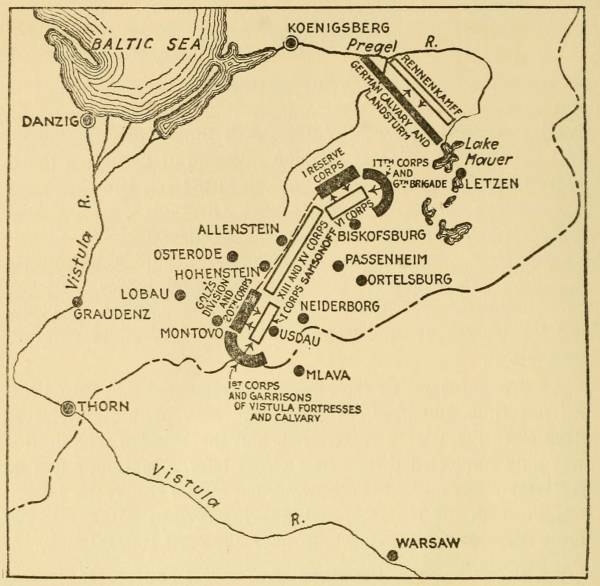
Ludendorf commences his recital of events on the Russian
front with the statement that in 1914, in East Prussia, with a
force of only two German corps, he destroyed 250,000 Russians—six
army corps—under the command of General Samsonov, and
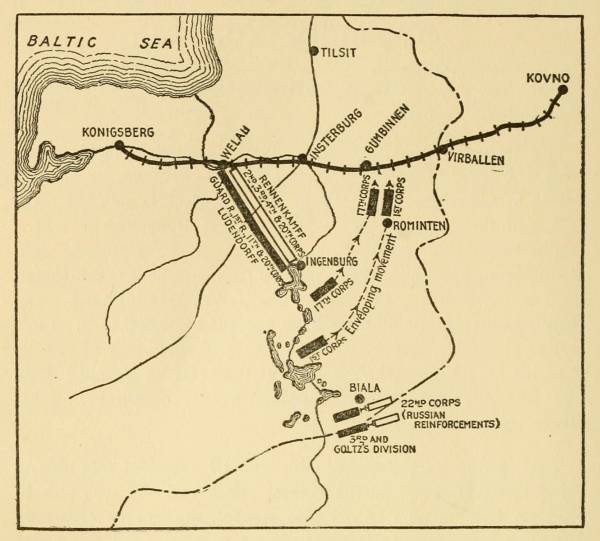
that General Rennenkampf, who was only within two or three
days' march from Samsonov, had designedly failed to aid Samsonov.
This statement by General Ludendorf is absolutely false from
beginning to end. It can be very easily proven that Ludendorf
attacked Samsonov not with two army corps, but with more than
240,000 German troops. With this army he attacked not 250,000
Russians, but only two Russian army corps, i. e., 80,000 men—the
1st and the 6th Russian Army Corps. Thus, Ludendorf had
a force three times larger than his adversary.
It may be easily seen from this that while Ludendorf gives
Samsonov twice as many men as he had in reality, he, at the same
time, credits Rennenkampf with three times the number he actually
had. His own force Ludendorf puts, on paper, at one-third
of what he had in fact.
Rennenkampf knew nothing about the events on the
Samsonov front until August 30, whereas the latter was surrounded
on August 28. (See Gurko's book, "War and Revolution".)
The cause of the Russian defeat in that battle was not
the "genius" of Ludendorf, but lay rather in the fact that the
Russian Army, in its eagerness to relieve Paris, advanced too
quickly, with not fully mobilized and insufficient forces, and in
two separate Armies, coupled with the difficulty of reconnoitering
and obtaining information about the enemy in a country where
the entire population was in a state of armed belligerency. The
death of Samsonov and of a part of his staff and the disruption
of liaison were other causes.[3]
In her haste to aid her Allies, Russia risked much, and she lost
a battle on account of the precariousness of the operation, insufficiency
of forces and an unfortunate accident. But she succeeded
in diverting several German corps from France, and the Russian
blood shed at Tannenberg thus helped win the First Battle of the
Marne.
It may thus be seen from the descriptions of the first battles
in East Prussia that Ludendorf, for the sake of German martial
glory and probably also for the glorification of his own role,
makes use of a very primitive and naive expedient. He multiplies
the number of Russian troops several times, and also diminishes
his own forces several times. This creates the impression that
Ludendorf with "inconsiderable" forces smashed the "many times
larger" forces of the Russians. As a matter of fact, however,
as we have seen, Ludendorf had in these engagements, 1½, 2,
and sometimes even 3 times as many men as the Russians. How
excessive this superiority of numbers was may be inferred from
the fact that the Germans themselves went to France with but
1½ times as many men and that they considered this sufficient
for a decisive victory over the French Army. However, no matter
how much Ludendorf may distort the facts in his memoirs,
he cannot refrain, albeit only by 2-3 words, from mentioning
the strategical catastrophe which overtook Germany through the
invasion of East Prussia by the Russian troops. Ludendorf
himself admits that "the transfer of the two army corps from
the French front to Eastern Prussia had fatal consequences for
Germany. The German advance on France was turned into a retreat."
This admission from Ludendorf characterizes the importance
of all the events of the first few weeks of the War and it contains
an involuntary appreciation of the historic role and self-sacrificing
efforts of Russia. The enemy, albeit indirectly, admits
that Russian blood was not shed in vain on the fields of East
Prussia; it was precisely for this reason that Germany was
unable to win the War at the only moment at which she could
ever have won, taking advantage of Russia's unpreparedness and
the temporary isolation of France.
In conclusion, we must also point out that from a formal
standpoint Russia was not bound to fling herself into a risky
operation in East Prussia. The Russian Army, like any other
Army, was bound to take the field actively only after the completion
of her mobilization, and this early assistance was still
less her duty as she herself was at the time invaded by Austrian
forces.
But Russia regarded her alliance with France from a higher
standpoint than mere formal obligations. The justice of History—not
the "history" of Ludendorf—will in its own time record
how far Russia stood from egotistic politics and egotistic strategy
during those tragic days of August and September, 1914, when
the German masses, smashing every obstacle in their path, moved
through northern France on Paris.
The battle of Ypres, the determined operations of the Germans
for the capture of Calais, is the other critical moment in
the history of the World War, when Russia once more brought
heavy sacrifices to the common cause of the Allies. Ludendorf,
in describing these difficult days for the Germans, again makes
use, we regret to say, of the same unsavory expedient he used in
describing the first engagements in East Prussia.
Thus, for instance, he asserts that when he was defeated
in October, 1914, at Warsaw, the Russians had 1,200,000
men,[4] while he had only one German army—the 9th—and
one Austrian army—the 1st. As a matter of fact, the Russians
were opposed, on the entire front, by five Austrian
armies and two German armies—the 8th and the 9th—by
more than 70 divisions approximating about 1,200,000 men.
The Russians, having left only a small force to oppose four Austrian
armies, fell with their three armies upon two enemy armies,
one German and one Austrian, near Warsaw. With a numerical
superiority of one and a quarter to one the Russians defeated the
Germans, and threw them back across the whole of Poland to
Posen. The Germans saved themselves on that occasion only
by destroying the railroads back of them and by burning the
bridges.
The significance of the operations at Warsaw and in Galicia
in October, and beyond Warsaw in November, 1914, is to be seen
from Ludendorf's own story. Referring to a conversation he
had with General Falkenhayn, who at that time was the main
leader of all German Army operations, he writes in his memoirs:
"At the end of October, 1914, General von Falkenhayn summoned
me to Berlin.... Gen. von Falkenhayn spoke hopefully of the
attack near Ypres, and wanted to defer further decisions."
But already in the beginning of November, i. e., a few days
after this conversation, the operations of the Russian Armies in
Galicia, the Posen territory, and on the East Prussian front,
greatly diminished the hopefulness of Falkenhayn and compelled
him to slacken the pressure against the Allies at Ypres and to
transfer large forces from France to the Russian front—to the
detriment of the offensive against Ypres. Ludendorf himself
figures these reinforcements which arrived from France in the
middle of November, and, consequently, must have left there in
the beginning of November, at 225,000 men. There were 4 corps
with 2 infantry divisions, which Ludendorf figures at 225,000
men. Besides, Ludendorf mentions right here the arrival of
Richthofen's Cavalry Corps, Hollen's Cavalry Corps, the 2nd and
4th Cavalry Divisions. Still earlier Ludendorf mentions that the
newly formed 25th Reserve Corps and the 15th Reserve Corps
were dispatched to East Prussia. And finally, in still another
place, we can find in Ludendorf's account a number of other new
divisions which had been sent to the Russian front instead of
to Ypres.
In this manner it is easy to see, from the data furnished
by Ludendorf himself, that, "hopeful" at the end of
October for the success of the attack on Ypres, Falkenhayn found
it necessary to dispatch from France 300,000 additional soldiers
to the Russian front, aside from the reserves taken from the
interior of Germany, which forces would also have been welcome
to the Germans during the fateful days at Ypres. While the
frontal attacks on Ypres, attended by considerable casualties,
demanded the presence of large German reserves, these reserves
were the very ones which were swallowed up entirely by the
Russian operations in the East, at Warsaw, Galicia and East
Prussia.
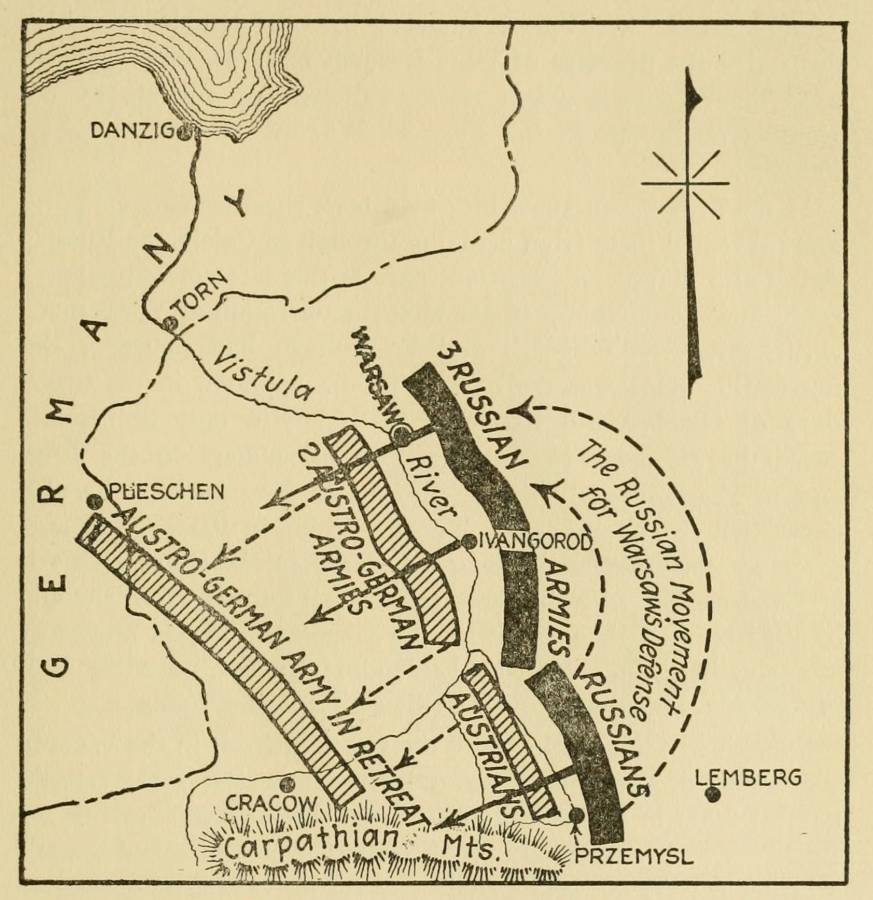
While the Russian troops were persecuting the defeated
Austrians in Galicia, General Hindenburg began an advance
towards Warsaw. The Russian General Staff transferred
from Galicia three armies for the defense of Warsaw, and
these armies defeated the two Austro-German armies and
persecuted them through Poland up to the border of Germany
(October, 1914).
If the firmness of the Allies held back the Germans at Ypres
and prevented them from breaking through to Calais, the Russian
Army also played an important part in this strategic situation—compelling
the Germans to abandon the operation at Ypres much
earlier than the Germans and Falkenhayn had figured. But
not in this alone was the role of Russia apparent in the trying
days of October and November, 1914. Not only did Russia
force the Germans to transfer 300,000 soldiers to the East,
and to abandon early the operations in France, but she also
compelled the Germans, by her operations in 1914, to abandon
for more than a year all large offensives in the West. This is
attested not only by the facts (as is well known, from the end
of 1914 up to February, 1916, the Germans did not start any
offensive in France), but by Ludendorf himself, notwithstanding
all his endeavors to discredit the Russian Army.
Speaking of the weakness of the German front in the West in
the month of November, Ludendorf says that it was perfectly
natural "that in this situation our eyes should again turn to the
East."... Further on he adds that he had asked himself
whether it were not better "once and for all to restrict operations
on the Western front to a defensive and to carry out the contemplated
operations against Russia with all our available forces....
This point of view seemed to me to be the right one,
and I asked our High Command for reinforcements from the
West...." Thus, such facts as the abandonment by the
Germans of all operations in the West for more than a year, as
well as Ludendorf's own words, prove with absolute clearness
and conclusiveness that the Germans, partly through the firmness
of the Allies, but mainly on account of the hard blows from
the Russian Army, found themselves compelled for a long time
to refrain from an offensive in France. There is no doubt but
that the Germans never abandoned entirely the attempt to crush
France, for we have seen how such a serious attempt was made
by them subsequently at Verdun. But if they were compelled at
the end of 1914 to defer this attempt at crushing France for
more than a year, it is obvious that the decisive part in this decision
of the Germans was played by Russia, in the increasing
offensive of her Armies all along the front from the Baltic to the
Carpathians.
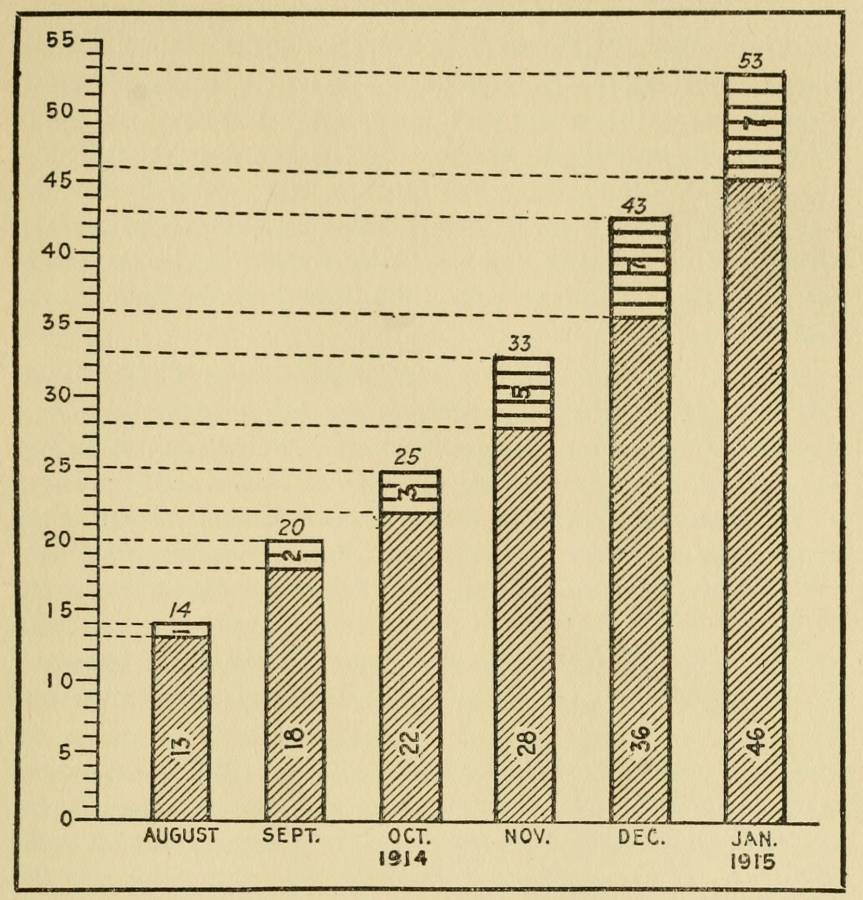
This diagram shows that the Germans had calculated, at
first, to stop the Russian Army with the aid of the Austrian
troops and only 14 of their own divisions—13 infantry and
one cavalry divisions. Soon, in September, 1914, they were
compelled to forward 6 more divisions to the East,—during
the Marne period. Later, when the Austrians were defeated,
the number of German relief columns increased and numbered,
at the end of 1914, 43 divisions, instead of the former
14 divisions,—three times as many. Early in 1915 the number
of German divisions grew to 53. During 1916 and 1917 the
number of the German troops on the Russian front was also
increasing incessantly, at the expense of German strength on
the French front.
Thus, if the taking of the field by unprepared Russia in the
beginning of the War contributed to the defeat of the most dangerous
and main plan of the Germans, in August and September,
the new sacrifices brought by Russia in October and November
on the plains of Galicia, Poland and East Prussia compelled the
Germans to desist for more than a year from all attempts to win
the War in France. August and September, 1914, were the
months in which the German forces were brought to a standstill,
and October and November saw them already much impaired.
At both important, critical moments Russia played her decisive
part.
At this same period, towards the close of 1914, the Germans
were compelled by the operations of the Russian Army to increase
the number of their troops on the Russian front up to 43
divisions. If the Germans were unable in the beginning of the
War to win out in France where they had all their forces, allotting
to the Russian front only 14 divisions and the Austrian
Army, so much the less could they have won at the end of 1914,
when the Russians had compelled them to have 43 divisions in the
field, that is, to treble their forces on the Russian front, to the
detriment of their French front.
The third great period of the world-conflict—1915—is the year
of Russia's single-handed fight against Germany, Austria and
Turkey. This year was hardest for Russia not only because all
attention and all efforts of the three enemy powers were directed
against Russia alone, but also because in 1915 Russia was less
than ever before prepared for the struggle—being without arms,
shells and munitions. No matter how much Ludendorf may distort
the truth in his memoirs, the whole world knows that in that
year the Russian positions were covered not by barbed wire entanglements,
but by the naked breasts of the Russian soldiers, and
German charges were repulsed not by artillery barrages but by
the bayonet, by cold steel—reminding us of the times when the
Mexicans, armed only with spears, fought against the rifles and
cannon of the Spaniards under Fernando Cortez.
Russia's loss of Poland in 1915 is altogether a result of this
situation, unprecedented in any of the wars fought by European
nations. It was hard to gain victory when the shortage of arms
was so great that some corps counted but 1,500 bayonets instead
of 40,000, and at the same time it was impossible to complement
these corps with their quota of men because these men had no
rifles.
Russia had called millions to the colors, but had rifles only for
one-tenth of her men. It is only too obvious that nothing could
be accomplished with millions of men of whom only one in ten
was armed. But in 1916, when Russia acquired rifles and artillery,
Brusilov launched his memorable offensive which netted more
than 200,000 prisoners. Another great offensive was in preparation
for 1917, but the Revolution interfered with its realization.
However that may be, the Germans had planned to have done
with Russia by confronting it with Austrian armies and with
four or five additional German corps. But already in 1914 the
Germans were compelled to keep 19 corps in the East to the
detriment and dislocation of their plans and forces in France.
(See diagrams No. 3,4.) Even during the days of the Revolution
the Germans were obliged to maintain 78½ divisions on the
Eastern front, in addition to 47 Austrian and 15 Turkish, altogether
140 infantry and 22 cavalry divisions, while on the Anglo-French
front the enemy had at that time only 142 divisions. If
we take into consideration all the Russian theatres of war, including
those in Asia, the enemy kept on the Russian fronts 164 infantry
divisions and 28 cavalry divisions,—altogether 192 divisions
(in May, 1917) while on the Anglo-French front the enemy had
in May, 1917, only 142 divisions.
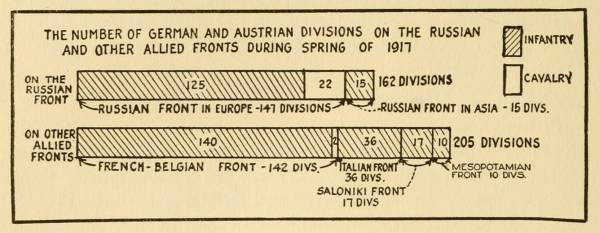
THE NUMBER OF GERMAN AND AUSTRIAN DIVISIONS ON THE RUSSIAN
AND OTHER ALLIED FRONTS DURING SPRING OF 1917
| | INFANTRY | CAVALRY | TOTAL |
| ON THE RUSSIAN FRONT |
| IN EUROPE | 125 | 22 | 147 |
| IN ASIA | 15 | | 15 |
| | | | 162 |
| ON OTHER ALLIED FRONTS |
| FRENCH-BELGIAN | 140 | 2 | 142 |
| ITALIAN | 36 | | 36 |
| SALONIKI | 17 | | 17 |
| MESOPOTAMIAN | 10 | | 10 |
| | | | 205 |
This diagram shows that in 1917—the beginning of the
Russian Revolution—there were 162 German, Austrian, Turkish
and Bulgarian divisions on the Russian front, 147 of whom
were on the Russian front in Europe. On the Anglo-French
front there were at this time only 142 German divisions.
The enemy forces were thus divided as follows: on the
Russian front, 44 per cent.; on the Anglo-French front, 39
per cent.; on the Italian front, 10 per cent.; on the Salonika
front, 4½ per cent., and on the Mesopotamian front—about
2½ per cent. Thus, early in 1917 the Russian Army had
opposing it about one-half of all the forces of the Central
Powers.
It is clearer that if these Teutonic forces would be able to
concentrate on the French front, it would mean an immediate
breakdown of the Allies and the triumph of the Prussian
militarism throughout the civilized world.
Notwithstanding the lack of arms and munitions the Russian
Army rendered the Allies, in the critical days of 1915, assistance
that was not less important and serious than that of the days of
the Marne and Ypres. Russia, by diverting upon herself, towards
the close of 1914, all the efforts of the Central Powers,
thereby offered France and England the opportunity for a whole
year to prepare for the prosecution of the War. Throughout
1915, when Germany, Austria and Turkey were diverted by
Russia, France was enabled quickly to accumulate new reserves,
munitions, shells, to recover from the serious wounds of 1914,
and to prepare for that inevitable blow from Germany which
subsequently took the form of a determined offensive at Verdun
in 1916.
At the same time England, owing to the fact that Russia had
in 1915 taken upon herself the whole burden of the struggle,
was enabled in the course of one year to carry out Kitchener's
stupendous plan of expanding the small, 150 thousand-strong
English Army of volunteers into the four million-strong Army
of the English nation in arms. On the other hand Germany,
having called to the colors new reserves, was compelled by Russia
to expend these reserves on the Russian front, and not on the
main front, in France, where the fate of the whole War was to
be decided for Germany.
All these opportunities, all this stupendous preparation in the
creation and development of new armed forces by the Allies, took
place undisturbed and in favorable circumstances, solely because
1915 was the year of Russia's single-handed fight against three
enemy powers, the year of the greatest self-sacrifice of the Russian
Army for the common cause. Who knows what might
have been the result of the German offensive in France had those
German reserves which perished in Russia broken through somewhere
in the north of France simultaneously with the storming
of Verdun, in February. Who knows how far the German military
catastrophe might have been averted had all the fresh reserves
of the Germans, which were being incessantly swallowed
up by the Russian front, found themselves in the West!
To these questions Ludendorf himself happens to give the answers
in his memoirs. Speaking of the offensive of the Germans
at Verdun and of the offensive of the Austrians in Italy, he says:
"Both offensives suffered from the fact that inadequate reserves
prevented the first successes from being followed up."
Where did these reserves, which were lacking for the capture
of Verdun, where did they go to after Germany had in 1915
created a great many new formations? In 1915 they were
swallowed up by the Russian front during the German offensive
in Poland, and the Verdun operation was frustrated because, as
Ludendorf declares, there were no reserves with which to develop
the first success of the Germans. For this reason the unbiased
investigator will admit that Russia in 1915 contributed
to a tremendous extent towards the calm and systematic preparation
of the Allies for the decisive German blow, struck at
Verdun, but planned to go beyond Paris. If the firm stand of
the French at Verdun, if the talent of Castelnau, who stopped
the withdrawal of the French to the other bank of the Meuse,
directly repulsed the attack of the Germans, the true ally, Russia,
certainly aided by diverting upon herself all the German reserves
in 1915 and giving the Allies a whole year of respite in which to
create new armed forces.
The Russian front incessantly drew to itself all new German
formations and reserves, and thereby automatically forced the
German Army in the West to carry on unproductive operations
which never reached their objective. Not one single German
operation in France could obtain full development, and inevitably
spent itself just because of lack of reserves which were always
opportunely swallowed by the Russian front.
Turning to the operations of 1915 we see that the Germans,
notwithstanding all their efforts and partial successes, never
gained any decisive results on the Russian front. The Russian
Army, having neither munitions nor arms, was naturally
unable to win at this time, and was compelled to retreat
from Poland. But the Russian Army was not crushed, which,
however, had been the main objective of Ludendorf's offensive.
In his memoirs Ludendorf plainly states: "The German
General Staff now resolved to try to obtain a decision against
Russia." This, translated from military parlance into plain English,
simply means that it was the object to settle, to "finish" with
Russia, in other words, to crush her Army, for otherwise
there would have been no sense in starting operations against
Russia, and in wasting against her the reserves so much
needed on the main front, against France. Neither does Ludendorf
conceal this object further on in his memoirs, but he admits
that it was not accomplished. For this failure he blames
General Falkenhayn, the Chief of the General Staff, who, it
was supposed, prevented Ludendorf from crushing the
Russian Army. We shall not enter into the personal disputes
between Ludendorf and Falkenhayn, whom Ludendorf
throughout criticises sharply. We shall only note that Ludendorf
attempted four times during the summer of 1915 to surround
or break through the several retreats of the Russian
Army, but the latter in every instance retreated in perfect
order, carrying their arms with them. In which one of these
four instances, then, did Falkenhayn interfere? How preposterous
this shifting of the blame to Falkenhayn is, may
be seen even from Ludendorf's own statement: "Throughout
the whole War we never succeeded, either on the Eastern or
Western front, in exploiting a big break-through to the full!"
In this way he himself admits that the Germans did not even
once succeed, at the proper time, in utilizing a big success
to the full, i. e., Falkenhayn's role was immaterial. It is but
natural that the resistance of the Russians in 1915 prevented the
Germans from exploiting that success which they regarded as a
big one, but which, as a matter of fact, consisted only in the
systematic retreat of the Russian Army which was without arms
and munitions. However, the most inopportune statement made
by Ludendorf is contained in the following remark of his concerning
the operations against the Russians in 1915: "We had
brought the final overthrow of Russia a step nearer."
The offensive of Brusilov in the following year, which
netted him more than 200,000 prisoners and made Ludendorf,
as he himself says, frequently worry about the fate of the
entire Austro-German front in Russia, demonstrates how the
offensive of Ludendorf in 1915 hastened "the final overthrow
of Russia." On the contrary, this offensive which cost Ludendorf
a great many of his reserves, and afforded a year of quiet
preparation to the Allies, did, as we saw, hasten "the final overthrow
of Germany."
At this period of the campaign of 1915 there were on the Russian
front 67 German divisions and up to 40 Austrian, altogether
107 divisions, and on the French front about 110 divisions. The
Germans could not defeat the Allies in the beginning of the War,
although they had then in France almost all their forces. It is
natural that in 1915, when they had in France only 50 per cent.
of their total forces, the Germans, through the efforts of Russia,
were finally deprived of any chance of winning in France. It
was only through Russia's military operations that the Germans
were driven to such an unfavorable, hopeless grouping of their
forces.
In the following year, 1916, Russia once more came forward
with her assistance at a critical moment, when the Austrians
had broken the resistance of the Italian Armies on the
Asiago-Arsiero front, threatening a further development of
their offensive in the rear of the Italian Army, in the direction
of Venice. At the same time Ludendorf in his memoirs
points out how great were the objects which the Austrians were
aiming at on the Italian front, and he says plainly: "In Italy it
was a question of an operation on a grand scale."
However, the Russian Army in 1916 had no intention of
launching an offensive on the Austrian front, and prepared for
an offensive in an altogether different place, on the German
front. Our General Staff had prepared for the main offensive
in the direction of Vilna, and accordingly it was here that
troops and munitions were being concentrated. (See Gurko's
"War and Revolution.")
Everything was ready when the Italians, crushed by the
Austrians, appealed to Russia for aid. An offensive on the
Austrian front held no particular interest for Russia, which
naturally had in view the crushing of the main enemy—the
Germans. Still, Russia, just as on previous occasions, did
not hesitate a minute to help her Allies. Notwithstanding
that nothing had been prepared for such an offensive, General
Brusilov launched it along a front two hundred miles long,
with the troops he just happened to have on the spot. Everybody
remembers this celebrated offensive of Brusilov, which
netted hundreds of thousands of prisoners, a great number
of other trophies, and which compelled the Austrians to immediately
abandon their offensive in Italy and to begin the
transfer of troops to the Russian front. "Austria gradually
broke off the Italian offensive and sent troops to the Eastern
front," writes Ludendorf. "The Italian Army now started a
counter-offensive in the Tyrol," he remarks further on.
Describing the period of Brusilov's offensive, Ludendorf
does not conceal the fact that they passed through some very
bad and critical moments. "Our G. H. Q. made heavy demands
on both groups (group south of Riga and Prince
Leopold group) and also withdrew divisions from the West,"
writes Ludendorf. "Even all the fresh divisions that were
thrown in were hardly sufficient to hold the front," says he
in describing the situation of the Austro-Germans after the
Russian break through at the Dniester. "This was one of
the greatest crises on the Eastern front," says he further on,
in speaking of the new break by Brusilov at Lutzk.
The effects of Brusilov's offensive proved to be so far-reaching
as to affect not only the situation on the Italian front
but also that on the French main front. The Allies, in view
of the difficult situation of the Germans on the Russian front,
launched an offensive at the Somme, and towards fall they
had finally cleared the forts of Verdun of the Germans.
So did Russia once more fulfill her obligation towards her
allies, as soon as her Army had received some quantity of
munitions. This quantity was not yet sufficient in 1916, and
it was only in 1917 that the Russian troops were at last more
or less provided. The lack of munitions during the period
of Brusilov's offensive was pointed out by the Russian Staff,
and Ludendorf himself emphasizes it. He writes that the
situation was relieved thanks to the fact that "the Russians
were also contending against extraordinary difficulty of supply."
From this it may be seen that the Russian Army, having
obtained only the first consignments of inconsiderable and
insufficient munitions, did not hesitate, in 1916, to offer her
allies generous assistance on the largest scale.
Still earlier, during the Verdun period, the Russian Army, not
yet recuperated from the hard blows of 1915, did by no means
stand by as an idle onlooker of the heroic efforts of the French at
Verdun. When at the end of February, 1916, French Headquarters
appealed to the Russian Army for assistance, preparations
were begun for an offensive. "The Russian Army had not
lost its spirit after the heavy fighting of 1915," says Ludendorf.
On the 16th of March operations were begun by the Russian
troops in the territory to the northwest of Dvinsk, continuing
until the 26th of March. This partial offensive, solely in
aid of the French, was attended by success of a local nature.
Ludendorf criticises this operation and says that "it was
choked in swamps and blood." Of course, the terrible
weather conditions, the rains and the impassable roads, interfered
with a broad development of this offensive, but still it
had a sufficiently serious effect. "From the 11th to the 21st
of March," acknowledges Ludendorf, "the situation of the
10th (German) army was critical."
At the close of 1916 the Russian Army again had to offer
most effective assistance at the critical moment of Mackensen's
and Falkenhayn's invasion of Roumania. General Alexeiev
pointed out to the Roumanian High Command the excessive
length of the Roumanian frontier line which rendered
operations in the border district difficult for the small Roumanian
Army. General Alexeiev, as well as the Allied military
experts, advised the Roumanians to shorten their front
line, by means of a retreat, to a shorter line in the East which
could be held by the comparatively small Roumanian Army.
But the Roumanians, calculating upon a weakening of the
Austrians, preferred to choose a new plan and invaded vast
Transylvania.
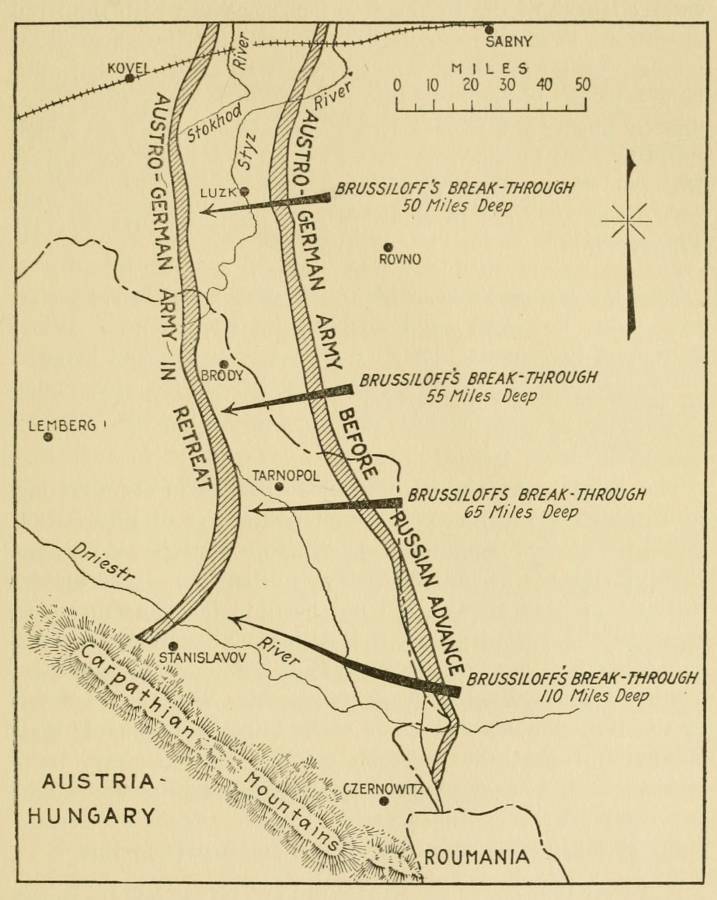
This map shows the four places in which the Russian
Army, led by Gen. Brussiloff, broke through the Austro-German
front in the summer of 1916.
This too daring move, which at first met but feeble resistance,
was, however, soon checked by the enemy. When
thereupon the enemy himself took the offensive and invaded
Roumania and began to threaten Bucharest, the Roumanian
representative at Russian headquarters, General Coanda, appealed
to Russia for aid.
The Russian Army had not yet succeeded in recuperating
from the effects of its great summer offensive of 1916. Russia's
reserves and supplies had been to a considerable extent
spent during the period of Brusilov's offensive. Nevertheless
Russia, again as always, did not hesitate for one minute to
come to the assistance of the Allies. The Russians even
proposed to take upon themselves the defense of the Roumanian
capital—Bucharest—but this offer was turned down
by the Roumanians with some show of embarrassment; they
pointed out that the railroads leading to Bucharest were
blocked with evacuated freights from the capital and could
not therefore carry the Russian troops. Probably certain
political considerations played not a small part in this.
However that might be, Russia did not refuse her aid in the
form desired by the Roumanians. From the long Russian
front which, in turn, stood in need of reserves, troops were
taken off and sent to Roumania. Two armies, under Letchitzki
and Sakharov, and the great mass of cavalry under Mannerheim,
were assigned by the Russians to assist the retreating
Roumanians. This effective help by Russia achieved its
purpose, stopping the offensive of the enemy, and towards
1917 the Russian Armies also took upon themselves the none
too easy task of defending the greater part of the Roumanian
front.
For the following year, 1917, Russia prepared for a decisive
offensive on the German front, in common with the Allies.
That was the first year that the Russian Army had at last
obtained sufficient armaments and supplies. The Germans
realized that most serious danger threatened them, and the
Germano-Bolshevist provocation was now chosen as the
means of disarming Russia. And yet, even during those terrible
days of the collapse of the Russian Army and the Revolution,
Russia was indispensable to the Allies.
During those revolutionary days of 1917 Russia compelled
the enemy to maintain on the Russian front 162 divisions of
German, Austrian, Turkish and Bulgarian troops, to the enemy's
detriment on the French main front. On this front the enemy
was enabled to maintain only 140 divisions.
Russia, although sapped by the Germano-Bolshevist conspiracy,
was still formidable, and the enemy did not risk the
moving of any of his troops from the Russian front. Russia
was growing faint, but that honest Russia which had saved her
allies in East Prussia, Galicia, on the fields of Poland, Lithuania,
Roumania, in the Caucasus and Armenia, did not lay down
her arms to the very last moment, remaining true to her
obligations.
From this brief outline one can readily see what great and
numerous objects Russia accomplished in the World War,
and how important was her role in that final collapse of the
Central Powers at which the Allies had been aiming in the
four-year long struggle. In full accord with these efforts
are the extraordinary sacrifices brought by Russia, sacrifices
in men, sacrifices in material resources and money, and finally,
that great upheaval through which the Russian people
are now passing, as a result of their over-exertion in the
years of the World War.
Among these sacrifices, Russia's losses in men run into
such great numbers that the immense, extraordinary part
played by Russia becomes at once obvious to anyone.
Of the many different figures quoted by various investigators
the most reliable are undoubtedly those furnished by
the official statistics of the Russian Army Staff.
Among these figures made public in the press the most important
are those given by the Staff of the Commander-in-Chief
of the Russian Army, pertaining to the year 1916, concerning
the total number of mobilized soldiers and the number
of those still in the service. According to this information, the
Russian War Ministry called to the colors from the outbreak
of the War up to the winter of 1916 more than 14 million men;
but the commissary department of the Army had towards the
close of 1916 less than 10 million on its rolls. The difference
of 4½ million between these two figures constituted the absolute
losses of the Army during 3 campaigns (1914, 15, 16).
This gave the Staff the basis for calculating the yearly average
total losses at 1½ million men. Adding, accordingly, 1½
million losses for 1917, we obtain 6 million total losses during
the whole War.
But these are only the men who were a total loss to the
Army, i. e., the losses in killed and prisoners, without the
wounded, except a moderate number of crippled who were no
longer fit for service at the front nor for service out of the ranks,
and who therefore had to be discharged from the Army entirely.
The total number of Russian war-prisoners towards the
end of the War, according to figures compiled by the Russian
Commission on War Prisoners, amounted to about 2½ million.
Deducting this number from 6 million, we obtain 3½ million
in killed and the small number of crippled who were discharged
entirely.
This number, 3½ million, obtained from official statistics,
is the basis of our calculations. The percentage of disabled
was comparatively small. German statistics during the War
figured it to be 10 per cent. Hence the figure of 3½ million
must comprize only a little less than 3 million in killed alone.
The number of wounded is usually approximately 2½ times
the number of killed.[5] Multiplying the number of wounded not
by 2½, but only by 2, we obtain about 6 million wounded.
Thus we have a total of 6 million killed and prisoners, and 6
million wounded, or a grand total of not less than 12 million
losses for Russia, in killed, wounded and prisoners.
These figures are rather minimized, for we have above
underestimated the number of wounded. These figures, based
upon official statistics, agree with those arrived at by the
"Copenhagen Society for Studying the Consequences of the
War." This society estimates the losses at 9½ million, exclusive
of prisoners. As we have shown above, there were 2½
million prisoners.
Thus there can be no doubt but that the number of Russian
casualties was not less than 12,000,000, of which there were
3,000,000 in killed.
These losses are almost equal to the combined losses of our
Allies.[6]
Russia's losses are more than twice those of France, 4-5
times those of England, and more than 35 times those of
America. These losses are more than twice the total strength
of the British Army, and 3-4 times all the forces mustered
by the United States. This number of casualties alone is
larger than the total population of any of the following
European countries: Sweden, Norway, Denmark, Portugal,
Belgium, Holland, or the Balkan States!
Thus do simple figures tell us clearly and plainly that Russia
sacrificed in the common cause of the Allies the greatest number
of victims and that she ranks first in the sad roster of
Allied casualties.
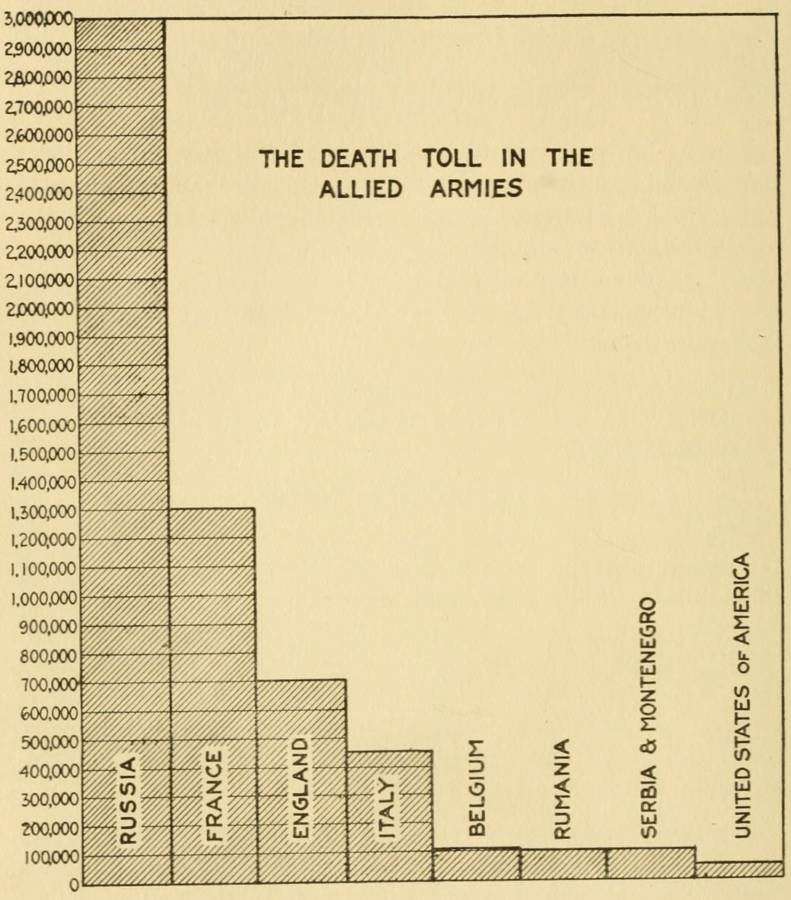
THE DEATH TOLL IN THE
ALLIED ARMIES
| 3,000,000 | Russia |
| 1,300,000 | France |
| 700,000 | England |
| 450,000 | Italy |
| 100,000 | Belgium |
| 100,000 | Rumania |
| 100,000 | Serbia & Montenegro |
| 50,000 | United States of America |
From this brief outline may be seen how tremendous and
important a role was played by Russia in the world conflict.
Summing up the general facts cited above, we arrive at the
following definite conclusions:
1.) Russia's role in the World War was bound to be very
serious and important for this reason alone, that the participation
of a nation numbering 180 million souls could not
fail to be significant in itself, and was therefore bound to
exercise a tremendous influence upon the outcome of the
World War.
2.) Accordingly, Russia's role became apparent even at
the very beginning of the War, in the important aid she
rendered in frustrating the initial and most dangerous plan
of the Germans, by her early offensive in aid of the Allies.
Russia, having diverted against herself the entire Austrian
army and part of the German, at the time of the battle on
the Marne, through her offensive in East Prussia and Galicia,
deprived the enemy of the opportunity to realize the fundamental
idea of Moltke's plan to fling "all forces into France."
The enemy, having contrary to his plan moved on France
with only a part of his forces, inevitably suffered defeat.
This cooperation on the part of Russia was of tremendous
significance, for the Germans based their plan on the idea
that they would at first have to deal only with France alone,
on one front only, whereas Russia compelled them at once to
start the War on two fronts, both with Russia and France. This
made the initial German war plan useless because strategy says
plainly: "Errors in the strategic deploying of forces in the beginning
of a war have a decisive influence and cannot be rectified
until the war is over." From this rule of strategy it is plain that
Russia's operations in the beginning of the war at the outset
condemned Germany to lose the war.
3.) At the following attempt of the enemy to find a decision
in France, to break through to Calais, at Ypres, Russia, by
the blows she delivered in Galicia, at Warsaw and in East
Prussia, contributed to the early termination of this second
offensive in France, so dangerous to England, and compelled the
Germans for more than a year to abstain from their main operations
on the main decisive front of the War—in France.
4.) In 1915 Russia, having shouldered alone the whole burden
of the struggle against Germany, Austria and Turkey,
although forced to abandon Poland, still gave the Allies the
opportunity to prepare throughout a whole year for the
coming German offensive at Verdun. At the same time,
having compelled the Germans during 1915 to spend all their
fresh formations and reserves on the Russian front, Russia
thereby deprived the Germans of the reserves they needed
for Verdun and their other operations in France.
5.) In 1916 Russia, thanks to the Brusilov offensive, saved
Italy at that critical moment when the Austrians, through
their successful offensive from Tyrol in the rear of the
Italians, threatened to cut off a considerable portion of the
Italian Army, at the same time menacing Venice. Together
with this, Russia by this offensive greatly facilitated the
operations of the Allies on the Somme, and was instrumental
in the final clearing of the Verdun forts.
6.) In 1916 Russia took upon herself the blows of Mackensen's
and Falkenhayn's armies which had invaded Roumania,
stopped the further advance of the Germans, and undertook
the defense of a considerable stretch of the Roumanian front.
7.) Through a period of three years of struggle against
Germany, Austria and Turkey, Russia, having diverted the
forces of the enemy, afforded the Allies a long period of
quiet for the preparation and strengthening of the Allied
Armies and for the systematic creation of a new 4 million
British Army.
8.) Throughout this period of three years of struggle
Russia compelled the enemy to spend on the Russian front such
a stupendous amount of force, reserves and munitions as to
hasten the inevitable fall of the enemy, and this immensely facilitated
the delivery of the final, decisive blows by the Allies.
9.) Russia, incessantly drawing upon herself the forces of
the enemy, did not give him the opportunity for one minute
from the very beginning of the War to gather sufficient force
for a decisive blow on the main, decisive front—in France.
The role of Russia, therefore, was clearly apparent in the
fact that she deprived Germany throughout the War of the possibility
to win and rendered futile every effort of the enemy in
this respect.
10.) Corresponding with the most important role that Russia
played in the War are her enormous sacrifices in men,
material and treasure. Her losses in men, amounting to 12,000,000,
exceed several times the casualties of any of the Allies;
are almost equal to the losses of all the Allies combined; exceed
several times the total number of men mobilized by any one of
the Allies....
11.) Russia's role in the recent war was so important and extraordinary
that without Russia the very idea of a struggle with
German militarism would have been impossible. Germany would
have been able to crush any combination of the European
Powers if Russia had not participated in such combination.
Were it not for Russia, Germany would now dominate not
only Europe, but probably the rest of the world as well.
12.) Russia's great role in the World War is so much
the greater since she fought under extraordinary circumstances,
lacking so indispensable an asset as a great network
of railways, with a backward technique, industry, etc. In
the hard first years of the War the Russian Armies, as we
have seen, in extraordinary circumstances and frequently
without arms and munitions, did everything possible, and,
together with failures, had also their successes.
Ludendorf was able to achieve success on the Russian front
only when the Germans outnumbered their adversaries by at
least three to two. At Tannenberg the Germans had twice
as many and, at certain stages, even three times as many men
as the Russians. Against Rennenkampf Ludendorf had three
men to every two of his enemy, and probably even as many as
two to one, as Rennenkampf had suffered severe losses during
the preceding days.
It is equally true that the Russians were able to defeat the
Germans whenever they had even a small superiority of force.
Near Warsaw the Russians had less than five men to every
four Germans and they succeeded in defeating the latter and
throwing them clear across all Poland.
It may seem strange that the Germans should have managed
to have numerical superiority over the Russians all the
time. Regrettable as it may be, it is nevertheless true, for the
strength of an army is determined not by the number of its
men, but by the number of bayonets (infantry), sabres (cavalry)
and guns (artillery). The Russian Army consisted of
millions, but bayonets and guns it had only for one-tenth of
its number. In 1915 some Russian divisions numbered, instead
of 20,000 bayonets, only a mere thousand, owing to
disastrous losses. The only employment of infantry during
those days was as a screen for the artillery, while the latter
was quite useless for fighting purposes because it had no
ammunition whatever. Under such conditions many of our
corps often did not exceed the strength of a single regiment
and some armies numbered no more effectives than a single
division. We had plenty of men, but no arms and ammunition.
Therefore, the Germans frequently surpassed us not in
men, but in bayonets and guns.
The tragedy of the Russian situation lay in the cruel fact
that Russia, while only one-tenth of her Armies were armed,
was facing Germany and Austria, who were armed from head
to foot. Not Ludendorf and not his ordinary military skill
were the causes of Russia's failures in the first year of the
War, but that simple and terrible truth which Brusilov once
expressed in the following words: "The Russians had no shells
with which to blast their way across barbed-wire entanglements
before an attack; so it became necessary for them to break down
the wires with the bodies of Russian soldiers, and to form a
bridge across these dead bodies for the next attacking column."
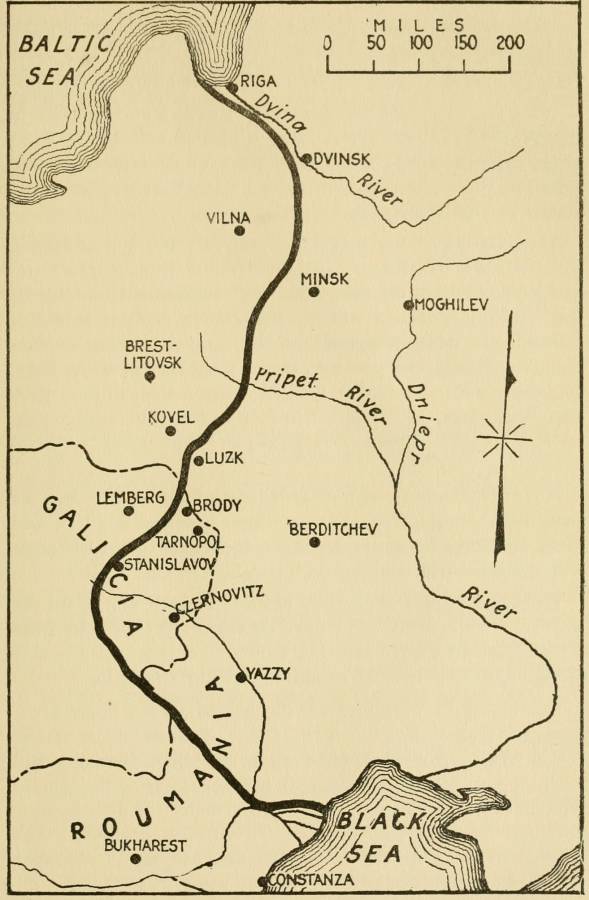
The black line represents the Russian front in 1917. The
front stretched from the Baltic Sea to the Black Sea. The
Roumanian front was held also primarily by Russian troops.
We have concluded our sketch of Russia's participation in
the World War with 1917. But 1918 also has its story: in
that year Russia was denied a voice at the conference on that
peace in the name of which Russia had offered up so many
sacrifices and made such efforts.
We have seen how important and essential a part Russia
played in the overthrow of German militarism. Russia's tremendous
role confirms once more the elementary truth that in
the future also Russia will inevitably be a colossal factor of
political and military equilibrium in Europe. Whatever does
happen to Russia, however they may dismember her living body,
the immense Russian nation, with 125 million souls of pure Russian
blood alone, will always remain that heavy military weight
which inevitably lowers that particular scale upon which it
descends.
It is true, Germany is now crushed and enfeebled. But we
know that victorious countries are now suffering not less, and
some of them even more, from the consequences of the most
stupendous world conflict.
Years will pass, and possibly but a few years, and again the
world will recuperate. We have no reason to expect that the
active German people will lag behind the rest in this work
of reestablishing normal conditions of life and labor.
The Treaty of Versailles has not solved a good many problems,
and among them also those that were the cause of the
World War. Notwithstanding all partitioning, Germany still
retains up to 60 million souls, but France only a little more
than 40 million. The population of Germany has always been
growing, while that of France, if it has not decreased, has
not increased. After all, Germany has and will have a numerical
superiority over France of one and a half times.
France, well aware of that, tries to maintain an alliance with
England, and reckons upon the aid of America. But the
statesmen of the West realize how insufficient all this is, for
they still remember well that first critical month of the War
when France was all alone and saved herself only through
extraordinary efforts.
Until the United States arrives on the scene! Why, that
inevitably means months and months of waiting. Until the
British Army is mobilized and transported! Why, we know
how difficult and tedious are the conditions of embarkation
and landing of troops, artillery, transport columns, munitions,
etc. We know that the 150,000 soldiers of the British Army
alone required, in August, 1914, more than three weeks for disembarkation.
And where? In three ports where everything
was equipped for disembarkation purposes, where ideal conditions
prevailed such as were hard to find in any other
ports.
Thus France, in the event of a new conflict with her old
foe, will again find herself for quite some time left all alone
to face the numerically superior enemy. Where will Russia
be then?
No Poland, no combination of any group of small States
will be able to take the place of Russia, for that would be a
mere 15-20 millions; it will be not Russia, but only one-seventh,
a sixth, or fifth part of that which Russia gave
during the past War. These weak nations will only become
additional trophies to the enemy, just as Roumania, Serbia
and Belgium became his easy prey in the past War.
Where will Russia be then? Not the present-day Russia
bleeding to death in its struggle against Bolshevism, but
the future, once more powerful, Russia?...
Bolshevism, an abnormal phenomenon, is bound to come
to an end—somewhat earlier, or somewhat later. No
matter how much may be cut off from Russia, she will
always remain an immense, great, rich, and therefore powerful,
country. Too much will depend upon what this coming
Russia may have to say, for any sensible statesman to refuse
to reckon with that eventuality.
This question the statesmen of the West must ask of
themselves clearly and plainly—not those statesmen who
think no further than the following day and of the success
of their fight against their political opponents—but those wise
leaders of the nations who really have at heart the interests
of their own countries, as well as of the entire civilized
world. "Ostrich politics" may least of all be applied in
dealing with that tremendous military and political factor
which covers one-sixth of the land surface of the globe and
is called Russia.