In January 1914 I visited Petersburg and
Moscow for a couple of weeks; in September
1920 I was asked to repeat this visit
by Mr. Kameney, of the Russian Trade
Delegation in London. I snatched at this
suggestion, and went to Russia at the end
of September with my son, who speaks a
little Russian. We spent a fortnight and a
day in Russia, passing most of our time in
Petersburg, where we went about freely by
ourselves, and were shown nearly everything
we asked to see. We visited Moscow, and
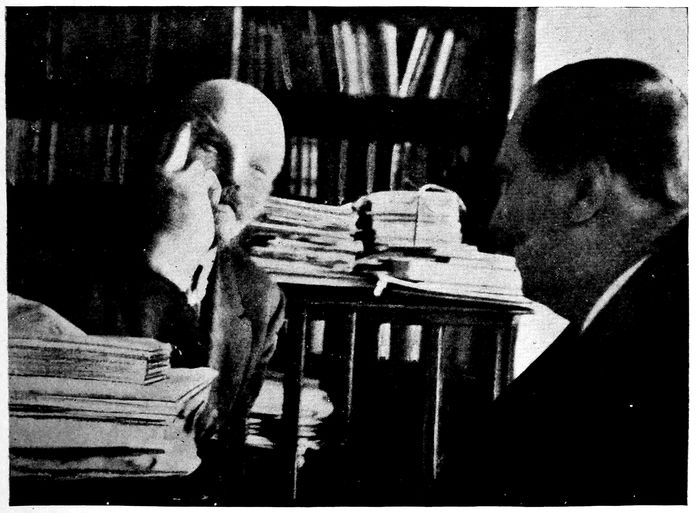
I had a long conversation with Mr. Lenin,
which I shall relate. In Petersburg I did
not stay at the Hotel International, to which
foreign visitors are usually sent, but with my
16old friend, Maxim Gorky. The guide and
interpreter assigned to assist us was a lady
I had met in Russia in 1914, the niece of
a former Russian Ambassador to London.
She was educated at Newnham, she has
been imprisoned five times by the Bolshevist
Government, she is not allowed to leave
Petersburg because of an attempt to cross
the frontier to her children in Esthonia,
and she was, therefore, the last person likely
to lend herself to any attempt to hoodwink
me. I mention this because on every hand
at home and in Russia I had been told that
the most elaborate camouflage of realities
would go on, and that I should be kept in
blinkers throughout my visit.
As a matter of fact, the harsh and terrible
realities of the situation in Russia cannot
be camouflaged. In the case of special delegations,
perhaps, a certain distracting tumult
of receptions, bands, and speeches may
be possible, and may be attempted. But it is
hardly possible to dress up two large cities
for the benefit of two stray visitors, wandering
observantly often in different directions.
17Naturally, when one demands to see a school
or a prison one is not shown the worst. Any
country would in the circumstances show the
best it had, and Soviet Russia is no exception.
One can allow for that.
Our dominant impression of things Russian
is an impression of a vast irreparable
breakdown. The great monarchy that was
here in 1914 and the administrative, social,
financial, and commercial systems connected
with it have, under the strains of six years
of incessant war, fallen down and smashed
utterly. Never in all history has there been
so great a débâcle before. The fact of the
Revolution is, to our minds, altogether
dwarfed by the fact of this downfall. By
its own inherent rottenness and by the
thrusts and strains of aggressive imperialism
the Russian part of the old civilised
world that existed before 1914 fell, and is
now gone. The peasant, who was the base
of the old pyramid, remains upon the land,
living very much as he has always lived.
Everything else is broken down, or is breaking
down. Amid this vast disorganisation
18an emergency Government, supported by a
disciplined party of perhaps 150,000 adherents—the
Communist Party—has taken
control. It has—at the price of much shooting—suppressed
brigandage, established a
sort of order and security in the exhausted
towns, and set up a crude rationing system.
It is, I would say at once, the only possible
Government in Russia at the present
time. It is the only idea, it supplies the
only solidarity, left in Russia. But it is a
secondary fact. The dominant fact for the
Western reader, the threatening and disconcerting
fact, is that a social and economic
system very like our own and intimately connected
with our own has crashed.
Nowhere in all Russia is the fact of that
crash so completely evident as it is in Petersburg.
Petersburg was the artificial creation
of Peter the Great; his bronze statue in
the little garden near the Admiralty still
prances amid the ebbing life of the city.
Its palaces are still and empty, or strangely
refurnished with the typewriters and tables
and plank partitions of a new Administration
19which is engaged chiefly in a strenuous
struggle against famine and the foreign invader.
Its streets were streets of busy shops.
In 1914 I loafed agreeably in the Petersburg
streets—buying little articles and
watching the abundant traffic. All these
shops have ceased. There are perhaps half
a dozen shops still open in Petersburg.
There is a Government crockery shop where
I bought a plate or so as a souvenir, for
seven or eight hundred roubles each, and
there are a few flower shops. It is a wonderful
fact, I think, that in this city, in which
most of the shrinking population is already
nearly starving, and hardly any one possesses
a second suit of clothes or more than
a single change of worn and patched linen,
flowers can be and are still bought and sold.
For five thousand roubles, which is about
six and eightpence at the current rate of
exchange, one can get a very pleasing bunch
of big chrysanthemums.
I do not know if the words “all the shops
have ceased” convey any picture to the
Western reader of what a street looks like
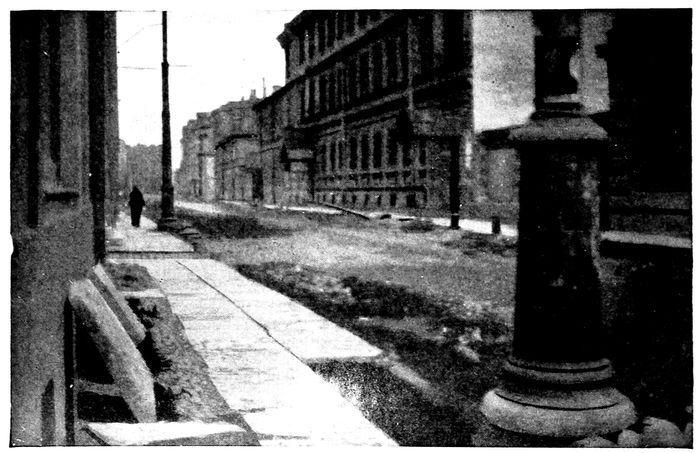
20in Russia. It is not like Bond Street or
Piccadilly on a Sunday, with the blinds neatly
drawn down in a decorous sleep, and
ready to wake up and begin again on Monday.
The shops have an utterly wretched
and abandoned look; paint is peeling off,
windows are cracked, some are broken and
boarded up, some still display a few flyblown
relics of stock in the window, some
have their windows covered with notices;
the windows are growing dim, the fixtures
have gathered two years’ dust. They are
dead shops. They will never open again.
All the great bazaar-like markets are
closed, too, in Petersburg now, in the desperate
struggle to keep a public control of
necessities and prevent the profiteer driving
up the last vestiges of food to incredible
prices. And this cessation of shops makes
walking about the streets seem a silly sort
of thing to do. Nobody “walks about” any
more. One realises that a modern city is
really nothing but long alleys of shops and
restaurants and the like. Shut them up, and
the meaning of a street has disappeared.
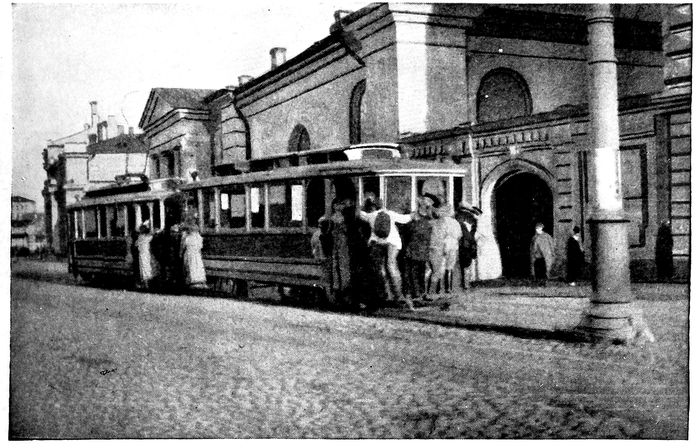
21People hurry past—a thin traffic compared
with my memories of 1914. The electric
street cars are still running and busy—until
six o’clock. They are the only means of
locomotion for ordinary people remaining
in town—the last legacy of capitalist enterprise.
They became free while we were in
Petersburg. Previously there had been a
charge of two or three roubles—the hundredth
part of the price of an egg. Freeing
them made little difference in their extreme
congestion during the home-going hours.
Every one scrambles on the tramcar. If
there is no room inside you cluster outside.
In the busy hours festoons of people hang
outside by any handhold; people are frequently
pushed off, and accidents are frequent.
We saw a crowd collected round a
child cut in half by a tramcar, and two people
in the little circle in which we moved in
Petersburg had broken their legs in tramway
accidents.
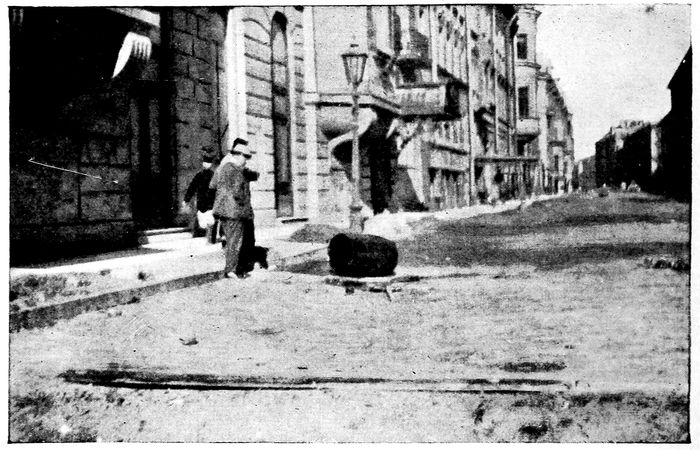
The roads along which these tramcars run
are in a frightful condition. They have not
been repaired for three or four years; they
22are full of holes like shell-holes, often two
or three feet deep. Frost has eaten out
great cavities, drains have collapsed, and
people have torn up the wood pavement for
fires. Only once did we see any attempt to
repair the streets in Petrograd. In a side
street some mysterious agency had collected
a load of wood blocks and two barrels of
tar. Most of our longer journeys about the
town were done in official motor-cars—left
over from the former times. A drive is an
affair of tremendous swerves and concussions.
These surviving motor-cars are running
now on kerosene. They disengage
clouds of pale blue smoke, and start up with
a noise like a machine-gun battle. Every
wooden house was demolished for firing last
winter, and such masonry as there was in
those houses remains in ruinous gaps, between
the houses of stone.
24
STREET SCENERY IN PETERSBURG.
MR. WELLS DISCOVERS A STREET UNDER REPAIR.
25Every one is shabby; every one seems to
be carrying bundles in both Petersburg and
Moscow. To walk into some side street in
the twilight and see nothing but ill-clad
figures, all hurrying, all carrying loads,
gives one an impression as though the entire
population was setting out in flight.
That impression is not altogether misleading.
The Bolshevik statistics I have seen
are perfectly frank and honest in the matter.
The population of Petersburg has fallen
from 1,200,000 to a little over 700,000, and
it is still falling. Many of the people have
returned to peasant life in the country,
many have gone abroad, but hardship has
taken an enormous toll of this city. The
death-rate in Petersburg is over 81 per
1,000; formerly it was high among European
cities at 22. The birth-rate of the
underfed and profoundly depressed population
is about 15. It was formerly about 30.
These bundles that every one carries are
partly the rations of food that are doled out
by the Soviet organisation, partly they are
the material and results of illicit trade. The
Russian population has always been a trading
and bargaining population. Even in
1914 there were but few shops in Petersburg
whose prices were really fixed prices.
Tariffs were abominated; in Moscow taking
26a droshky meant always a haggle, ten kopecks
at a time. Confronted with a shortage
of nearly every commodity, a shortage
caused partly by the war strain,—for Russia
has been at war continuously now for six
years—partly by the general collapse of
social organisation, and partly by the blockade,
and with a currency in complete disorder,
the only possible way to save the
towns from a chaos of cornering, profiteering,
starvation, and at last a mere savage
fight for the remnants of food and common
necessities, was some sort of collective control
and rationing.
The Soviet Government rations on principle,
but any Government in Russia now
would have to ration. If the war in the
West had lasted up to the present time London
would be rationing too—food, clothing,
and housing. But in Russia this has
to be done on a basis of uncontrollable peasant
production, with a population temperamentally
indisciplined and self-indulgent.
The struggle is necessarily a bitter one. The
detected profiteer, the genuine profiteer who
27profiteers on any considerable scale, gets
short shrift; he is shot. Quite ordinary
trading may be punished severely. All trading
is called “speculation,” and is now illegal.
But a queer street-corner trading
in food and so forth is winked at in Petersburg,
and quite openly practised in Moscow,
because only by permitting this can the
peasants be induced to bring in food.
There is also much underground trade
between buyers and sellers who know each
other. Every one who can supplements his
public rations in this way. And every railway
station at which one stops is an open
market. We would find a crowd of peasants
at every stopping-place waiting to sell milk,
eggs, apples, bread, and so forth. The passengers
clamber down and accumulate bundles.
An egg or an apple costs 300 roubles.
The peasants look well fed, and I doubt
if they are very much worse off than they
were in 1914. Probably they are better off.
They have more land than they had, and
they have got rid of their landlords. They
will not help in any attempt to overthrow
28the Soviet Government because they are
convinced that while it endures this state
of things will continue. This does not prevent
their resisting whenever they can the
attempts of the Red Guards to collect food
at regulation prices. Insufficient forces of
Red Guards may be attacked and massacred.
Such incidents are magnified in the London
Press as peasant insurrections against the
Bolsheviks. They are nothing of the sort.
It is just the peasants making themselves
comfortable under the existing régime.
But every class above the peasants—including
the official class—is now in a state of
extreme privation. The credit and industrial
system that produced commodities has
broken down, and so far the attempts to
replace it by some other form of production
have been ineffective. So that nowhere are
there any new things. About the only things
that seem to be fairly well supplied are tea,
cigarettes, and matches. Matches are more
abundant in Russia than they were in England
in 1917, and the Soviet State match is
quite a good match. But such things as
29collars, ties, shoelaces, sheets and blankets,
spoons and forks, all the haberdashery and
crockery of life, are unattainable. There is
no replacing a broken cup or glass except by
a sedulous search and illegal trading. From
Petersburg to Moscow we were given a
sleeping car de luxe, but there were no
water-bottles, glasses, or, indeed, any loose
fittings. They have all gone. Most of the
men one meets strike one at first as being
carelessly shaven, and at first we were inclined
to regard that as a sign of a general
apathy, but we understood better how things
were when a friend mentioned to my son
quite casually that he had been using one
safety razor blade for nearly a year.
Drugs and any medicines are equally unattainable.
There is nothing to take for a
cold or a headache; no packing off to bed
with a hot-water bottle. Small ailments develop
very easily therefore into serious
trouble. Nearly everybody we met struck
us as being uncomfortable and a little out
of health. A buoyant, healthy person is
30very rare in this atmosphere of discomforts
and petty deficiencies.
If any one falls into a real illness the outlook
is grim. My son paid a visit to the big
Obuchovskaya Hospital, and he tells me
things were very miserable there indeed.
There was an appalling lack of every sort
of material, and half the beds were not in
use through the sheer impossibility of dealing
with more patients if they came in.
Strengthening and stimulating food is out
of the question unless the patient’s family
can by some miracle procure it outside and
send it in. Operations are performed only
on one day in the week, Dr. Federoff told
me, when the necessary preparations can
be made. On other days they are impossible,
and the patient must wait.
Hardly any one in Petersburg has much
more than a change of raiment, and in a
great city in which there remains no means
of communication but a few overcrowded
tramcars,[1] old, leaky, and ill-fitting boots
31are the only footwear. At times one sees
astonishing makeshifts by way of costume.
The master of a school to which we paid a
surprise visit struck me as unusually dapper.
He was wearing a dinner suit with a
blue serge waistcoat. Several of the distinguished
scientific and literary men I met
had no collars and wore neck-wraps. Gorky
possesses only the one suit of clothes he
wears.
1. I saw one passenger steamboat on the Neva crowded
with passengers. Usually the river was quite deserted except
for a rare Government tug or a solitary boatman picking
up drift timber.
At a gathering of literary people in
Petersburg, Mr. Amphiteatroff, the well-known
writer, addressed a long and bitter
speech to me. He suffered from the usual
delusion that I was blind and stupid and
being hoodwinked. He was for taking off
the respectable-looking coats of all the company
present in order that I might see for
myself the rags and tatters and pitiful expedients
beneath. It was a painful and,
so far as I was concerned, an unnecessary
speech, but I quote it here to emphasise this
effect of general destitution. And this underclad
town population in this dismantled
and ruinous city is, in spite of all the furtive
32trading that goes on, appallingly underfed.
With the best will in the world the Soviet
Government is unable to produce a sufficient
ration to sustain a healthy life. We went
to a district kitchen and saw the normal food
distribution going on. The place seemed to
us fairly clean and fairly well run, but that
does not compensate for a lack of material.
The lowest grade ration consisted of a basinful
of thin skilly and about the same quantity
of stewed apple compote. People have
bread cards and wait in queues for bread,
but for three days the Petersburg bakeries
stopped for lack of flour. The bread varies
greatly in quality; some was good coarse
brown bread, and some I found damp, clay-like,
and uneatable.
33
A PETERSBURG STREET CAR EN ROUTE.
MESSRS. LENIN AND WELLS IN CONVERSATION.
35I do not know how far these disconnected
details will suffice to give the Western reader
an idea of what ordinary life in Petersburg
is at the present time. Moscow, they
say, is more overcrowded and shorter of fuel
than Petersburg, but superficially it looked
far less grim than Petersburg. We saw
these things in October, in a particularly
fine and warm October. We saw them in
sunshine in a setting of ruddy and golden
foliage. But one day there came a chill,
and the yellow leaves went whirling before
a drive of snowflakes. It was the first
breath of the coming winter. Every one
shivered and looked out of the double windows—already
sealed up—and talked to us
of the previous year. Then the glow of
October returned.
It was still glorious sunshine when we
left Russia. But when I think of that coming
winter my heart sinks. The Soviet Government
in the commune of the north has
made extraordinary efforts to prepare for
the time of need. There are piles of wood
along the quays, along the middle of the
main streets, in the courtyards, and everywhere
where wood can be piled. Last year
many people had to live in rooms below the
freezing point; the water-pipes froze up, the
sanitary machinery ceased to work. The
reader must imagine the consequences. People
huddled together in the ill-lit rooms, and
kept themselves alive with tea and talk.
36Presently some Russian novelist will tell us
all that this has meant to heart and mind in
Russia. This year it may not be quite so
bad as that. The food situation also, they
say, is better, but this I very much doubt.
The railways are now in an extreme state of
deterioration; the wood-stoked engines are
wearing out; the bolts start and the rails
shift as the trains rumble along at a maximum
of twenty-five miles per hour. Even
were the railways more efficient, Wrangel
has got hold of the southern food supplies.
Soon the cold rain will be falling upon these
700,000 souls still left in Petersburg, and
then the snow. The long nights extend and
the daylight dwindles.
And this spectacle of misery and ebbing
energy is, you will say, the result of Bolshevist
rule! I do not believe it is. I will deal
with the Bolshevist Government when I have
painted the general scenery of our problem.
But let me say here that this desolate Russia
is not a system that has been attacked and
destroyed by something vigorous and malignant.
It is an unsound system that has
37worked itself out and fallen down. It was
not communism which built up these great,
impossible cities, but capitalism. It was
not communism that plunged this huge,
creaking, bankrupt empire into six years of
exhausting war. It was European imperialism.
Nor is it communism that has pestered
this suffering and perhaps dying Russia
with a series of subsidised raids, invasions,
and insurrections, and inflicted upon it an
atrocious blockade. The vindictive French
creditor, the journalistic British oaf, are far
more responsible for these deathbed miseries
than any communist. But to these questions
I will return after I have given a little more
description of Russia as we saw it during
our visit. It is only when one has some
conception of the physical and mental realities
of the Russian collapse that we can see
and estimate the Bolshevist Government in
its proper proportions.
II DRIFT AND SALVAGE
41
Among the things I wanted most to
see amidst this tremendous spectacle
of social collapse in Russia was the work of
my old friend Maxim Gorky. I had heard
of this from members of the returning labour
delegation, and what they told me had whetted
my desire for a closer view of what was
going on. Mr. Bertrand Russell’s account
of Gorky’s health had also made me anxious
on his own account; but I am happy to say
that upon that score my news is good. Gorky
seems as strong and well to me now as he
was when I knew him first in 1906. And as
a personality he has grown immensely. Mr.
Russell wrote that Gorky is dying and that
perhaps culture in Russia is dying too. Mr.
Russell was, I think, betrayed by the artistic
temptation of a dark and purple concluding
42passage. He found Gorky in bed and afflicted
by a fit of coughing, and his imagination
made the most of it.
Gorky’s position in Russia is a quite extraordinary
and personal one. He is no
more of a communist than I am, and I have
heard him argue with the utmost freedom
in his flat against the extremist positions
with such men as Bokaiev, recently the head
of the extraordinary commission in Petersburg,
and Zalutsky, one of the rising leaders
of the Communist party. It was a very reassuring
display of free speech, for Gorky
did not so much argue as denounce—and
this in front of two deeply interested English
enquirers.
But he has gained the confidence and respect
of most of the Bolshevik leaders, and
he has become by a kind of necessity the
semi-official salvage man under the new
régime. He is possessed by a passionate
sense of the value of Western science and
culture, and by the necessity of preserving
the intellectual continuity of Russian life
through these dark years of famine and war
43and social stress, with the general intellectual
life of the world. He has found a
steady supporter in Lenin. His work illuminates
the situation to an extraordinary
degree because it collects together a number
of significant factors and makes the
essentially catastrophic nature of the Russian
situation plain.
The Russian smash at the end of 1917
was certainly the completest that has ever
happened to any modern social organisation.
After the failure of the Kerensky Government
to make peace and of the British naval
authorities to relieve the military situation
in the Baltic, the shattered Russian armies,
weapons in hand, broke up and rolled back
upon Russia, a flood of peasant soldiers
making for home, without hope, without
supplies, without discipline. That time of
débâcle was a time of complete social disorder.
It was a social dissolution. In many
parts of Russia there was a peasant revolt.
There was chateau-burning often accompanied
by quite horrible atrocities. It was an
explosion of the very worst side of human
44nature in despair, and for most of the abominations
committed the Bolsheviks are about
as responsible as the Government of Australia.
People would be held up and robbed
even to their shirts in open daylight in the
streets of Petersburg and Moscow, no one
interfering. Murdered bodies lay disregarded
in the gutters sometimes for a whole
day, with passengers on the footwalk going
to and fro. Armed men, often professing
to be Red Guards, entered houses and looted
and murdered. The early months of 1918
saw a violent struggle of the new Bolshevik
Government not only with counter-revolutions
but with rollers and brigands of every
description. It was not until the summer of
1918, and after thousands of looters and
plunderers had been shot, that life began to
be ordinarily safe again in the streets of
the Russian great towns. For a time Russia
was not a civilisation, but a torrent of lawless
violence, with a weak central Government
of inexperienced rulers, fighting not
only against unintelligent foreign intervention
but against the completest internal disorder.
45It is from such chaotic conditions
that Russia still struggles to emerge.
Art, literature, science, all the refinements
and elaboration of life, all that we mean by
“civilisation,” were involved in this torrential
catastrophe. For a time the stablest
thing in Russia culture was the theatre.
There stood the theatres, and nobody wanted
to loot them or destroy them; the artists
were accustomed to meet and work in them
and went on meeting and working; the tradition
of official subsidies held good. So quite
amazingly the Russian dramatic and operatic
life kept on through the extremest
storms of violence, and keeps on to this day.
In Petersburg we found there were more
than forty shows going on every night; in
Moscow we found very much the same state
of affairs. We heard Shalyapin, greatest
of actors and singers, in The Barber of
Seville and in Chovanchina; the admirable
orchestra was variously attired, but the conductor
still held out valiantly in swallow tails
and a white tie; we saw a performance of
Sadko, we saw Monachof in The Tzarevitch
46Alexei and as Iago in Othello (with Madame
Gorky—Madame Andreievna—as Desdemona).
When one faced the stage, it was
as if nothing had changed in Russia; but
when the curtain fell and one turned to the
audience one realised the revolution. There
were now no brilliant uniforms, no evening
dress in boxes and stalls. The audience
was a uniform mass of people, the same
sort of people everywhere, attentive, good-humoured,
well-behaved and shabby. Like
the London Stage Society, one’s place in
the house is determined by ballot. And for
the most part there is no paying to go to
the theatre. For one performance the tickets
go, let us say, to the professional unions,
for another to the Red Army and their
families, for another to the school children,
and so on. A certain selling of tickets goes
on, but it is not in the present scheme of
things.
I had heard Shalyapin in London, but
I had not met him personally there. We
made his acquaintance this time in Petersburg,
we dined with him and saw something
47of his very jolly household. There are two
stepchildren almost grown up, and two little
daughters, who speak a nice, stiff, correct
English, and the youngest of whom dances
delightfully. Shalyapin is certainly one of
the most wonderful things in Russia at the
present time. He is the Artist, defiant
and magnificent. Off the stage he has much
the same vitality and abounding humour that
made an encounter with Beerbohm Tree so
delightful an experience. He refuses absolutely
to sing except for pay—200,000
roubles a performance, they say, which is
nearly £15—and when the markets get too
tight, he insists upon payment in flour or
eggs or the like. What he demands he gets,
for Shalyapin on strike would leave too
dismal a hole altogether in the theatrical
world of Petersburg. So it is that he maintains
what is perhaps the last fairly comfortable
home in Russia. And Madame
Shalyapin we found so unbroken by the
revolution that she asked us what people
were wearing in London. The last fashion
48papers she had seen—thanks to the blockade—dated
from somewhen early in 1918.
But the position of the theatre among the
arts is peculiar. For the rest of the arts,
for literature generally and for the scientific
worker, the catastrophe of 1917–18 was overwhelming.
There remained no one to buy
books or pictures, and the scientific worker
found himself with a salary of roubles that
dwindled rapidly to less than the five-hundredth
part of their original value. The
new crude social organisation, fighting robbery,
murder, and the wildest disorder, had
no place for them; it had forgotten them.
For the scientific man at first the Soviet
Government had as little regard as the first
French revolution, which had “no need for
chemists.” These classes of worker, vitally
important to every civilised system, were reduced,
therefore, to a state of the utmost
privation and misery. It was to their assistance
and salvation that Gorky’s first efforts
were directed. Thanks very largely to him
and to the more creative intelligences in the
Bolshevik Government, there has now been
49organised a group of salvage establishments,
of which the best and most fully developed
is the House of Science in Petersburg, in
the ancient palace of the Archduchess Marie
Pavlova. Here we saw the headquarters of
a special rationing system which provides as
well as it can for the needs of four thousand
scientific workers and their dependents—in
all perhaps for ten thousand people. At this
centre they not only draw their food rations,
but they can get baths and barber, tailoring,
cobbling and the like conveniences. There
is even a small stock of boots and clothing.
There are bedrooms, and a sort of hospital
accommodation for cases of weakness and
ill-health.
It was to me one of the strangest of my
Russian experiences to go to this institution
and to meet there, as careworn and unprosperous-looking
figures, some of the great
survivors of the Russian scientific world.
Here were such men as Oldenburg the orientalist,
Karpinsky the geologist, Pavloff
the Nobel prizeman, Radloff, Bielopolsky,
and the like, names of world-wide celebrity.
50They asked me a multitude of questions
about recent scientific progress in the world
outside Russia, and made me ashamed of
my frightful ignorance of such matters. If
I had known that this would happen I would
have taken some sort of report with me. Our
blockade has cut them off from all scientific
literature outside Russia. They are without
new instruments, they are short of
paper, the work they do has to go on in unwarmed
laboratories. It is amazing they do
any work at all. Yet they are getting work
done; Pavloff is carrying on research of
astonishing scope and ingenuity upon the
mentality of animals; Manuchin claims to
have worked out an effectual cure for tuberculosis,
even in advanced cases; and so on.
I have brought back abstracts of Manuchin’s
work for translation and publication here,
and they are now being put into English.
The scientific spirit is a wonderful spirit.
If Petersburg starves this winter, the House
of Science—unless we make some special
effort on its behalf—will starve too, but
these scientific men said very little to me
51about the possibility of sending them in supplies.
The House of Literature and Art
talked a little of want and miseries, but not
the scientific men. What they were all keen
about was the possibility of getting scientific
publications; they value knowledge more
than bread. Upon that matter I hope I may
be of some help to them. I got them to form
a committee to make me out a list of all the
books and publications of which they stood
in need, and I have brought this list back to
the Secretary of the Royal Society of London,
which had already been stirring in this
matter. Funds will be needed, three or four
thousand pounds perhaps (the address of
the Secretary of the Royal Society is Burlington
House, W.), but the assent of the
Bolshevik Government and our own to this
mental provisioning of Russia has been secured,
and in a little time I hope the first
parcel of books will be going through to
these men, who have been cut off for so
long from the general mental life of the
world.
If I had no other reason for satisfaction
52about this trip to Russia, I should find quite
enough in the hope and comfort our mere
presence evidently gave to many of these
distinguished men in the House of Science
and in the House of Literature and Art.
Upon many of them there had evidently
settled a kind of despair of ever seeing or
hearing anything of the outer world again.
They had been living for three years, very
grey and long years indeed, in a world that
seemed sinking down steadily through one
degree of privation after another into utter
darkness. Possibly they had seen something
of one or two of the political deputations
that have visited Russia—I do not know;
but manifestly they had never expected to
see again a free and independent individual
walk in, with an air of having come quite
easily and unofficially from London, and of
its being quite possible not only to come but
to go again into the lost world of the West.
It was like an unexpected afternoon caller
strolling into a cell in a jail.
All musical people in England know the
work of Glazounov; he has conducted concerts
53in London and is an honorary doctor
both of Oxford and Cambridge. I was very
deeply touched by my meeting with him.
He used to be a very big florid man, but
now he is pallid and very much fallen away,
so that his clothes hang loosely on him. He
came and talked of his friends Sir Hubert
Parry and Sir Charles Villiers Stanford.
He told me he still composed, but that his
stock of music paper was almost exhausted.
“Then there will be no more.” I said there
would be much more, and that soon. He
doubted it. He spoke of London and Oxford;
I could see that he was consumed by
an almost intolerable longing for some great
city full of life, a city with abundance, with
pleasant crowds, a city that would give him
still audiences in warm, brightly-lit places.
While I was there, I was a sort of living
token to him that such things could still be.
He turned his back on the window which
gave on the cold grey Neva, deserted in the
twilight, and the low lines of the fortress
prison of St. Peter and St. Paul. “In England
there will be no revolution—no? I had
54many friends in England—many good
friends in England....” I was loth to
leave him, and he was very loth to let me go.
Seeing all these distinguished men living
a sort of refugee life amidst the impoverished
ruins of the fallen imperialist system
has made me realise how helplessly dependent
the man of exceptional gifts is upon a
securely organised civilisation. The ordinary
man can turn from this to that occupation;
he can be a sailor or a worker in a
factory or a digger or what not. He is
under a general necessity to work, but he
has no internal demon which compels him
to do a particular thing and nothing else,
which compels him to be a particular thing
or die. But a Shalyapin must be Shalyapin
or nothing, Pavloff is Pavloff and Glazounov
is Glazounov. So long as they can go on
doing their particular thing, such men will
live and flourish. Shalyapin still acts and
sings magnificently—in absolute defiance of
every Communist principle; Pavloff still
continues his marvellous researches—in an
old coat and with his study piled up with the
potatoes and carrots he grows in his spare
time; Glazounov will compose until the paper
runs out. But many of the others are evidently
stricken much harder. The mortality
among the intellectually distinguished men
of Russia has been terribly high. Much, no
doubt, has been due to the general hardship
of life, but in many cases I believe that the
sheer mortification of great gifts become futile
has been the determining cause. They
could no more live in the Russia of 1919
than they could have lived in a Kaffir kraal.
56
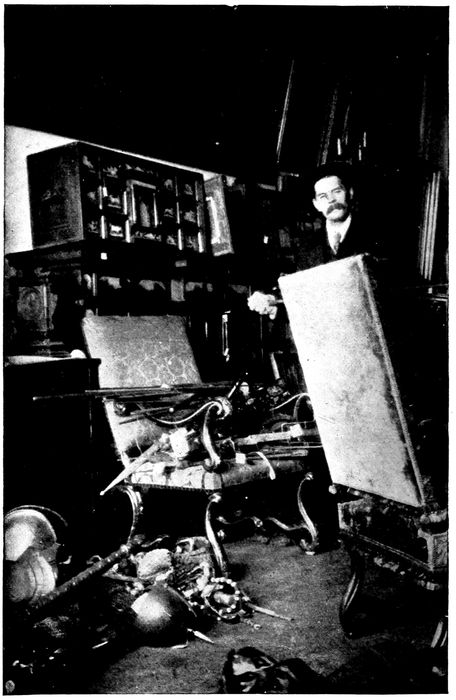
GORKY IN THE GREAT DUMP OF ART AND VIRTUOSITY IN PETERSBURG
57Science, art, and literature are hothouse
plants demanding warmth and respect and
service. It is the paradox of science that
it alters the whole world and is produced
by the genius of men who need protection
and help more than any other class of worker.
The collapse of the Russian imperial
system has smashed up all the shelters in
which such things could exist. The crude
Marxist philosophy which divides all men
into bourgeoisie and proletariat, which sees
all social life as a stupidly simple “class
war,” had no knowledge of the conditions
58necessary for the collective mental life. But
it is to the credit of the Bolshevik Government
that it has now risen to the danger of
a universal intellectual destruction in Russia,
and that, in spite of the blockade and
the unending struggle against the subsidised
revolts and invasions with which we and the
French plague Russia, it is now permitting
and helping these salvage organisations.
Parallel with the House of Science is the
House of Literature and Art. The writing
of new books, except for some poetry, and
the painting of pictures have ceased in Russia.
But the bulk of the writers and artists
have been found employment upon a grandiose
scheme for the publication of a sort of
Russian encyclopædia of the literature of
the world. In this strange Russia of conflict,
cold, famine and pitiful privations there
is actually going on now a literary task that
would be inconceivable in the rich England
and the rich America of to-day. In England
and America the production of good
literature at popular prices has practically
ceased now—“because of the price of paper.”
59The mental food of the English and American
masses dwindles and deteriorates, and
nobody in authority cares a rap. The Bolshevik
Government is at least a shade above
that level. In starving Russia hundreds of
people are working upon translations, and
the books they translate are being set up
and printed, work which may presently give
a new Russia such a knowledge of world
thought as no other people will possess. I
have seen some of the books and the work
going on. “May” I write, with no certainty.
Because, like everything else in this ruined
country, this creative work is essentially
improvised and fragmentary. How this
world literature is to be distributed to the
Russian people I do not know. The bookshops
are closed and bookselling, like every
other form of trading, is illegal. Probably
the books will be distributed to schools and
other institutions.
In this matter of book distribution the
Bolshevik authorities are clearly at a loss.
They are at a loss upon very many such
matters. In regard to the intellectual life
60of the community one discovers that Marxist
Communism is without plans and without
ideas. Marxist Communism has always been
a theory of revolution, a theory not merely
lacking in creative and constructive ideas,
but hostile to creative and constructive ideas.
Every Communist orator has been trained
to contemn “Utopianism,” that is to say,
has been trained to contemn intelligent
planning. Not even a British business man
of the older type is quite such a believer in
things righting themselves and in “muddling
through” as these Marxists. The Russian
Communist Government now finds itself
face to face, among a multiplicity of
other constructive problems, with the problem
of sustaining scientific life, of sustaining
thought and discussion, of promoting
artistic creation. Marx the Prophet and his
Sacred Book supply it with no lead at all
in the matter. Bolshevism, having no
schemes, must improvise therefore—clumsily,
and is reduced to these pathetic attempts
to salvage the wreckage of the intellectual
life of the old order. And that life is very
61sick and unhappy and seems likely to die
on its hands.
It is not simply scientific and literary work
and workers that Maxim Gorky is trying
to salvage in Russia. There is a third and
still more curious salvage organisation associated
with him. This is the Expertise
Commission, which has its headquarters in
the former British Embassy. When a social
order based on private property crashes,
when private property is with some abruptness
and no qualification abolished, this does
not abolish and destroy the things which
have hitherto constituted private property.
Houses and their gear remain standing, still
being occupied and used by the people who
had them before—except when those people
have fled. When the Bolshevik authorities
requisition a house or take over a deserted
palace, they find themselves faced by this
problem of the gear. Any one who knows
human nature will understand that there
has been a certain amount of quiet annexation
of desirable things by inadvertent officials
and, perhaps less inadvertently, by
62their wives. But the general spirit of Bolshevism
is quite honest, and it is set very
stoutly against looting and suchlike developments
of individual enterprise. There has
evidently been comparatively little looting
either in Petersburg or Moscow since the
days of the débâcle. Looting died against
the wall in Moscow in the spring of 1918.
In the guest houses and suchlike places we
noted that everything was numbered and
listed. Occasionally we saw odd things
astray, fine glass or crested silver upon tables
where it seemed out of place, but in many
cases these were things which had been sold
for food or suchlike necessities on the part
of the original owners. The sailor courier
who attended to our comfort to and from
Moscow was provided with a beautiful little
silver teapot that must once have brightened
a charming drawing-room. But apparently
it had taken to a semi-public life in a quite
legitimate way.
For greater security there has been a
gathering together and a cataloguing of
everything that could claim to be a work
63of art by this Expertise Commission. The
palace that once sheltered the British Embassy
is now like some congested secondhand
art shop in the Brompton Road. We
went through room after room piled with
the beautiful lumber of the former Russian
social system. There are big rooms crammed
with statuary; never have I seen so many
white marble Venuses and sylphs together,
not even in the Naples Museum. There are
stacks of pictures of every sort, passages
choked with inlaid cabinets piled up to the
ceiling; a room full of cases of old lace,
piles of magnificent furniture. This accumulation
has been counted and catalogued.
And there it is. I could not find out that
any one had any idea of what was ultimately
to be done with all this lovely and elegant
litter. The stuff does not seem to belong
in any way to the new world, if it is indeed
a new world that the Russian Communists
are organising. They never anticipated that
they would have to deal with such things.
Just as they never really thought of what
they would do with the shops and markets
64when they had abolished shopping and
marketing. Just as they had never thought
out the problem of converting a city of private
palaces into a Communist gathering-place.
Marxist theory had led their minds
up to the “dictatorship of the class-conscious
proletariat” and then intimated—we discover
now how vaguely—that there would
be a new heaven and a new earth. Had
that happened it would indeed have been a
revolution in human affairs. But as we saw
Russia there is still the old heaven and the
old earth, covered with the ruins, littered
with the abandoned furnishings and dislocated
machinery of the former system, with
the old peasant tough and obstinate upon
the soil—and Communism, ruling in the
cities quite pluckily and honestly, and yet,
in so many matters, like a conjurer who has
left his pigeon and his rabbit behind him,
and can produce nothing whatever from the
hat.
Ruin: that is the primary Russian fact
at the present time. The revolution, the
Communist rule, which I will proceed to describe
65in my next paper, is quite secondary
to that. It is something that has happened
in the ruin and because of the ruin. It is of
primary importance that people in the West
should realise that. If the Great War had
gone on for a year or so more, Germany
and then the Western Powers would probably
have repeated, with local variations,
the Russian crash. The state of affairs we
have seen in Russia is only the intensification
and completion of the state of affairs
towards which Britain was drifting in 1918.
Here also there are shortages such as we had
in England, but they are relatively monstrous;
here also is rationing, but it is relatively
feeble and inefficient; the profiteer in
Russia is not fined but shot, and for the
English D.O.R.A. you have the Extraordinary
Commission. What were nuisances
in England are magnified to disasters in
Russia. That is all the difference. For all I
know, Western Europe may be still drifting
even now towards a parallel crash. I
am not by any means sure that we have
turned the corner. War, self-indulgence,
66and unproductive speculation may still be
wasting more than the Western world is producing;
in which case our own crash—currency
failure, a universal shortage, social
and political collapse and all the rest of it—is
merely a question of time. The shops of
Regent Street will follow the shops of the
Nevsky Prospect, and Mr. Galsworthy and
Mr. Bennett will have to do what they can to
salvage the art treasures of Mayfair. It
falsifies the whole world situation, it sets
people altogether astray in their political
actions, to assert that the frightful destitution
of Russia to-day is to any large extent
the result merely of Communist effort; that
the wicked Communists have pulled down
Russia to her present plight, and that if you
can overthrow the Communists every one
and everything in Russia will suddenly become
happy again. Russia fell into its present
miseries through the world war and the
moral and intellectual insufficiency of it’s
ruling and wealthy people. (As our own
British State—as presently even the American
State—may fall.) They had neither the
67brains nor the conscience to stop warfare,
stop waste of all sorts, and stop taking the
best of everything and leaving every one
else dangerously unhappy, until it was too
late. They ruled and wasted and quarrelled,
blind to the coming disaster up to the very
moment of its occurrence. And then, as I
will describe in my next paper, the Communist
came in....
III THE QUINTESSENCE OF BOLSHEVISM
71
In the two preceding papers I have tried
to give the reader my impression of Russian
life as I saw it in Petersburg and Moscow,
as a spectacle of collapse, as the collapse
of a political, social, and economic system,
akin to our own but weaker and more
rotten than our own, which has crashed under
the pressure of six years of war and
misgovernment. The main collapse occurred
in 1917 when Tsarism, brutishly incompetent,
became manifestly impossible.
It had wasted the whole land, lost control
of its army and the confidence of the entire
population. Its police system had degenerated
into a régime of violence and brigandage.
It fell inevitably.
And there was no alternative government.
72For generations the chief energies of Tsarism
had been directed to destroying any
possibility of an alternative government. It
had subsisted on that one fact that, bad as
it was, there was nothing else to put in its
place. The first Russian Revolution, therefore,
turned Russia into a debating society
and a political scramble. The liberal forces
of the country, unaccustomed to action or
responsibility, set up a clamorous discussion
whether Russia was to be a constitutional
monarchy, a liberal republic, a socialist republic,
or what not. Over the confusion
gesticulated Kerensky in attitudes of the
finest liberalism. Through it loomed various
ambiguous adventurers, “strong men,”
sham strong men, Russian monks and Russian
Bonapartes. What remained of social
order collapsed. In the closing months
of 1917 murder and robbery were common
street incidents in Petersburg and Moscow,
as common as an automobile accident in the
streets of London, and less heeded. On the
Reval boat was an American who had formerly
directed the affairs of the American
73
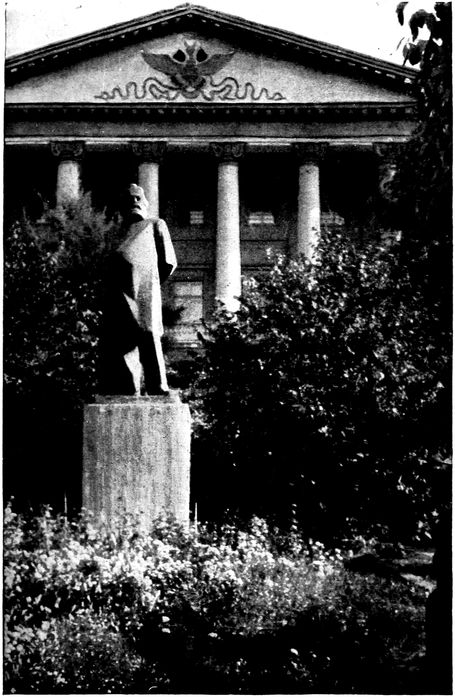
THE STATUE OF MARX OUTSIDE THE SMOLNY INSTITUTE. (Headquarters of the Communist Party.)
75Harvester Company in Russia. He had
been in Moscow during this phase of complete
disorder. He described hold-ups in
open daylight in busy streets, dead bodies
lying for hours in the gutter—as a dead kitten
might do in a western town—while
crowds went about their business along the
sidewalk.
Through this fevered and confused country
went the representatives of Britain and
France, blind to the quality of the immense
and tragic disaster about them, intent only
upon the war, badgering the Russians to
keep on fighting and make a fresh offensive
against Germany. But when the Germans
made a strong thrust towards Petersburg
through the Baltic provinces and by sea,
the British Admiralty, either through sheer
cowardice or through Royalist intrigues,
failed to give any effectual help to Russia.
Upon this matter the evidence of the late
Lord Fisher is plain. And so this unhappy
country, mortally sick and, as it were, delirious,
staggered towards a further stage of
collapse.
76From end to end of Russia, and in the
Russian-speaking community throughout
the world, there existed only one sort of
people who had common general ideas upon
which to work, a common faith and a common
will, and that was the Communist party.
While all the rest of Russia was either apathetic
like the peasantry or garrulously at
sixes and sevens or given over to violence or
fear, the Communists believed and were prepared
to act. Numerically they were and
are a very small part of the Russian population.
At the present time not one per
cent. of the people in Russia are Communists;
the organised party certainly does not
number more than 600,000 and has probably
not much more than 150,000 active members.
Nevertheless, because it was in those terrible
days the only organisation which gave men
a common idea of action, common formulæ,
and mutual confidence, it was able to seize
and retain control of the smashed empire.
It was and it is the only sort of administrative
solidarity possible in Russia. These
ambiguous adventurers who have been and
77are afflicting Russia, with the support of
the Western Powers, Deniken, Kolchak,
Wrangel and the like, stand for no guiding
principle and offer no security of any sort
upon which men’s confidence can crystallise.
They are essentially brigands. The Communist
party, however one may criticise it,
does embody an idea and can be relied upon
to stand by its idea. So far it is a thing
morally higher than anything that has yet
come against it. It at once secured the
passive support of the peasant mass by permitting
them to take land from the estates
and by making peace with Germany. It
restored order—after a frightful lot of
shooting—in the great towns. For a time
everybody found carrying arms without authority
was shot. This action was clumsy
and bloody but effective. To retain its power
this Communist Government organised
Extraordinary Commissions, with practically
unlimited powers, and crushed out all
opposition by a Red Terror. Much that
that Red Terror did was cruel and frightful,
it was largely controlled by narrow-minded
78men, and many of its officials were inspired
by social hatred and the fear of counter-revolution,
but if it was fanatical it was
honest. Apart from individual atrocities it
did on the whole kill for a reason and to
an end. Its bloodshed was not like the silly
aimless butcheries of the Deniken régime,
which would not even recognise, I was told,
the Bolshevik Red Cross. And to-day the
Bolshevik Government sits, I believe, in
Moscow as securely established as any Government
in Europe, and the streets of the
Russian towns are as safe as any streets in
Europe.
It not only established itself and restored
order, but—thanks largely to the genius of
that ex-pacifist Trotsky—it re-created the
Russian army as a fighting force. That we
must recognise as a very remarkable achievement.
I saw little of the Russian army myself,
it was not what I went to Russia to
see, but Mr. Vanderlip, the distinguished
American financier, whom I found in Moscow
engaged in some financial negotiations
with the Soviet Government, had been treated
79to a review of several thousand troops,
and was very enthusiastic about their spirit
and equipment. My son and I saw a number
of drafts going to the front, and also
bodies of recruits joining up, and our impression
is that the spirit of the men was
quite as good as that of similar bodies of
British recruits in London in 1917–18.
Now who are these Bolsheviki who have
taken such an effectual hold upon Russia?
According to the crazier section of the British
Press they are the agents of a mysterious
racial plot, a secret society, in which Jews,
Jesuits, Freemasons, and Germans are all
jumbled together in the maddest fashion.
As a matter of fact, nothing was ever quite
less secret than the ideas and aims and methods
of the Bolsheviks, nor anything quite
less like a secret society than their organization.
But in England we cultivate a peculiar
style of thinking, so impervious to
any general ideas that it must needs fall
back upon the notion of a conspiracy to explain
the simplest reactions of the human
mind. If, for instance, a day labourer in
80Essex makes a fuss because he finds that the
price of his children’s boots has risen out of
all proportion to the increase in his weekly
wages, and declares that he and his fellow-workers
are being cheated and underpaid,
the editors of The Times and of the Morning
Post will trace his resentment to the
insidious propaganda of some mysterious society
at Königsberg or Pekin. They cannot
conceive how otherwise he should get such
ideas into his head. Conspiracy mania of
this kind is so prevalent that I feel constrained
to apologise for my own immunity.
I find the Bolsheviks very much what they
profess to be. I find myself obliged to treat
them as fairly straightforward people. I
do not agree with either their views or their
methods, but that is another question.
The Bolsheviks are Marxists Socialists.
Marx died in London nearly forty years
ago; the propaganda of his views has been
going on for over half a century. It has
spread over the whole earth and finds in
nearly every country a small but enthusiastic
following. It is a natural result of world-wide
81economic conditions. Everywhere it
expresses the same limited ideas in the same
distinctive phrasing. It is a cult, a world-wide
international brotherhood. No one need
learn Russian to study the ideas of Bolshevism.
The enquirer will find them all in
the London Plebs or the New York Liberator
in exactly the same phrases as in the
Russian Pravda. They hide nothing. They
say everything. And just precisely what
these Marxists write and say, so they attempt
to do.
It will be best if I write about Marx
without any hypocritical deference. I have
always regarded him as a Bore of the extremest
sort. His vast unfinished work, Das
Kapital, a cadence of wearisome volumes
about such phantom unrealities as the bourgeoisie
and the proletariat, a book for ever
maundering away into tedious secondary
discussions, impresses me as a monument of
pretentious pedantry. But before I went
to Russia on this last occasion I had no active
hostility to Marx. I avoided his works,
and when I encountered Marxists I disposed
82of them by asking them to tell me exactly
what people constituted the proletariat.
None of them knew. No Marxist knows. In
Gorky’s flat I listened with attention while
Bokaiev discussed with Shalyapin the fine
question of whether in Russia there was a
proletariat at all, distinguishable from the
peasants. As Bokaiev has been head of the
Extraordinary Commission of the Dictatorship
of the Proletariat in Petersburg, it was
interesting to note the fine difficulties of the
argument. The “proletarian” in the Marxist
jargon is like the “producer” in the jargon
of some political economists, who is supposed
to be a creature absolutely distinct
and different from the “consumer.” So the
proletarian is a figure put into flat opposition
to something called capital. I find in
large type outside the current number of the
Plebs, “The working class and the employing
class have nothing in common.” Apply
this to a works foreman who is being taken
in a train by an engine-driver to see how
the house he is having built for him by a
building society is getting on. To which of
83these immiscibles does he belong, employer
or employed? The stuff is sheer nonsense.
In Russia I must confess my passive objection
to Marx has changed to a very active
hostility. Wherever we went we encountered
busts, portraits, and statues of Marx.
About two-thirds of the face of Marx is
beard, a vast solemn woolly uneventful
beard that must have made all normal exercise
impossible. It is not the sort of beard
that happens to a man, it is a beard cultivated,
cherished, and thrust patriarchally
upon the world. It is exactly like Das Kapital
in its inane abundance, and the human
part of the face looks over it owlishly as if it
looked to see how the growth impressed
mankind. I found the omnipresent images
of that beard more and more irritating. A
gnawing desire grew upon me to see Karl
Marx shaved. Some day, if I am spared, I
will take up shears and a razor against Das
Kapital; I will write The Shaving of Karl
Marx.
But Marx is for the Marxists merely an
image and a symbol, and it is with the Marxist
84and not with Marx that we are now dealing.
Few Marxists have read much of Das
Kapital. The Marxist is very much the
same sort of person in all modern communities,
and I will confess that by my temperament
and circumstances I have the very
warmest sympathy for him. He adopts
Marx as his prophet simply because he believes
that Marx wrote of the class war, an
implacable war of the employed against the
employer, and that he prophesied a triumph
for the employed person, a dictatorship of
the world by the leaders of these liberated
employed persons (dictatorship of the proletariat),
and a Communist millennium arising
out of that dictatorship. Now this doctrine
and this prophecy have appealed in
every country with extraordinary power to
young persons, and particularly to young
men of energy and imagination who have
found themselves at the outset of life imperfectly
educated, ill-equipped, and caught
into hopeless wages slavery in our existing
economic system. They realise in their own
persons the social injustice, the stupid negligence,
85the colossal incivility of our system;
they realise that they are insulted and sacrificed
by it; and they devote themselves to
break it and emancipate themselves from it.
No insidious propaganda is needed to make
such rebels; it is the faults of a system that
half-educates and then enslaves them which
have created the Communist movement
wherever industrialism has developed. There
would have been Marxists if Marx had never
lived. When I was a boy of fourteen I was
a complete Marxist, long before I had heard
the name of Marx. I had been cut off
abruptly from education, caught in a detestable
shop, and I was being broken in to a life
of mean and dreary toil. I was worked too
hard and for such long hours that all
thoughts of self-improvement seemed hopeless.
I would have set fire to that place if
I had not been convinced it was over-insured.
I revived the spirit of those bitter
days in a conversation I had with Zorin, one
of the leaders of the Commune of the North.
He is a young man who has come back from
unskilled work in America, a very likable
86human being and a humorous and very popular
speaker in the Petersburg Soviet. He
and I exchanged experiences, and I found
that the thing that rankled most in his mind
about America was the brutal incivility he
had encountered when applying for a job
as packer in a big dry goods store in New
York. We told each other stories of the
way our social system wastes and breaks
and maddens decent and willing men. Between
us was the freemasonry of a common
indignation.
It is that indignation of youth and energy,
thwarted and misused, it is that and no
mere economic theorising, which is the living
and linking inspiration of the Marxist movement
throughout the world. It is not that
Marx was profoundly wise, but that our
economic system has been stupid, selfish,
wasteful, and anarchistic. The Communistic
organisation has provided for this angry
recalcitrance certain shibboleths and passwords:
“Workers of the World unite,” and
so forth. It has suggested to them an idea
of a great conspiracy against human happiness
87concocted by a mysterious body of wicked
men called capitalists. For in this mentally
enfeebled world in which we live to-day
conspiracy mania on one side finds its echo
on the other, and it is hard to persuade a
Marxist that capitalists are in their totality
no more than a scrambling disorder of mean-spirited
and short-sighted men. And the
Communist propaganda has knitted all these
angry and disinherited spirits together into
a world-wide organisation of revolt—and
hope—formless though that hope proves to
be on examination. It has chosen Marx for
its prophet and red for its colour....
And so when the crash came in Russia,
when there remained no other solidarity of
men who could work together upon any but
immediate selfish ends, there came flowing
back from America and the West to rejoin
their comrades a considerable number of
keen and enthusiastic young and youngish
men, who had in that more bracing Western
world lost something of the habitual impracticability
of the Russian and acquired a
certain habit of getting things done, who
88all thought in the same phrases and had the
courage of the same ideas, and who were all
inspired by the dream of a revolution that
should bring human life to a new level of
justice and happiness. It is these young men
who constitute the living force of Bolshevism.
Many of them are Jews, because most
of the Russian emigrants to America were
Jews; but few of them have any strong racial
Jewish feeling. They are not out for Jewry
but for a new world. So far from being in
continuation of the Jewish tradition the Bolsheviks
have put most of the Zionist leaders
in Russia in prison, and they have prescribed
the teaching of Hebrew as a “reactionary”
language. Several of the most interesting
Bolsheviks I met were not Jews at all, but
blonde Nordic men. Lenin, the beloved leader
of all that is energetic in Russia to-day,
has a Tartar type of face and is certainly
no Jew.
This Bolshevik Government is at once the
most temerarious and the least experienced
governing body in the world. In some directions
its incompetence is amazing. In
89most its ignorance is profound. Of the diabolical
cunning of “capitalism” and of the
subtleties of reaction it is ridiculously suspicious,
and sometimes it takes fright and is
cruel. But essentially it is honest. It is
the most simple-minded Government that
exists in the world to-day.
Its simple-mindedness is shown by one
question that I was asked again and again
during this Russian visit. “When is the social
revolution going to happen in England?”
Lenin asked me that, Zenovieff, who
is the head of the Commune of the North,
Zorin, and many others.
Because it is by the Marxist theory all
wrong that the social revolution should happen
first in Russia. That fact is bothering
every intelligent man in the movement.
According to the Marxist theory the social
revolution should have happened first in the
country with the oldest and most highly developed
industrialism, with a large, definite,
mainly propertyless, mainly wages-earning
working class (proletariat). It should have
begun in Britain, and spread to France and
90Germany, then should have come America’s
turn and so on. Instead they find Communism
in power in Russia, which really possesses
no specialised labouring class at all,
which has worked its factories with peasant
labourers who come and go from the villages,
and so has scarcely any “proletariat”—to
unite with the workers of the world and so
forth—at all. Behind the minds of many
of these Bolsheviks with whom I talked I
saw clearly that there dawns now a chill
suspicion of the reality of the case, a realisation
that what they have got in Russia is not
truly the promised Marxist social revolution
at all, that in truth they have not captured
a State but got aboard a derelict. I tried
to assist the development of this novel and
disconcerting discovery. And also I indulged
in a little lecture on the absence of
a large “class-conscious proletariat” in the
Western communities. I explained that in
England there were two hundred different
classes at least, and that the only “class-conscious
proletarians” known to me in the
land were a small band of mainly Scotch
workers kept together by the vigorous leadership
of a gentleman named MacManus.
Their dearest convictions struggled against
my manifest candour. They are clinging
desperately to the belief that there are hundreds
of thousands of convinced Communists
in Britain, versed in the whole gospel
of Marx, a proletarian solidarity, on the eve
of seizing power and proclaiming a British
Soviet Republic. They hold obstinately to
that after three years of waiting—but their
hold weakens.
92
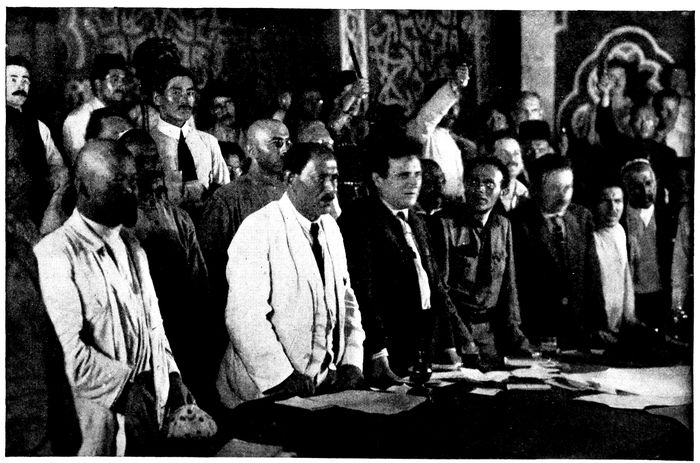
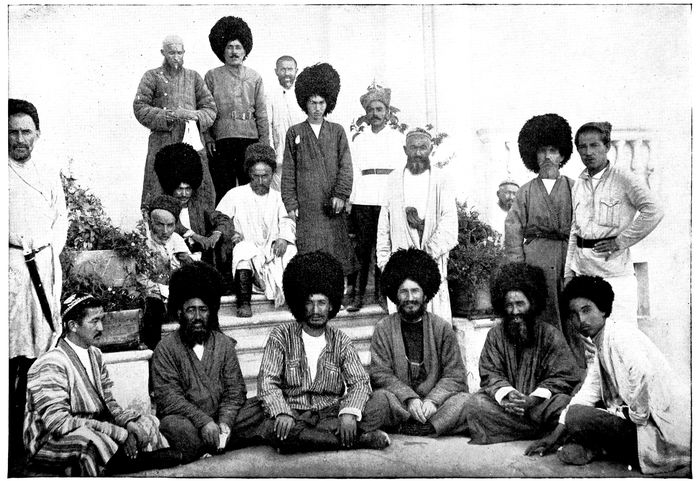
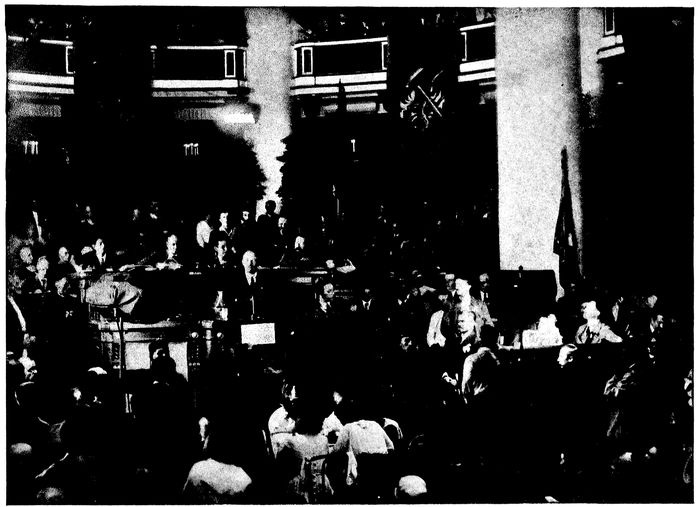
THE BAKU CONFERENCE SWEARS UNDYING HOSTILITY TO CAPITALISM AND BRITISH IMPERIALISM. Zenovieff (by the bell); to the right of him (i.e. on his left) are Radek (spectacles) and Bela Kun (rather foggy).
93
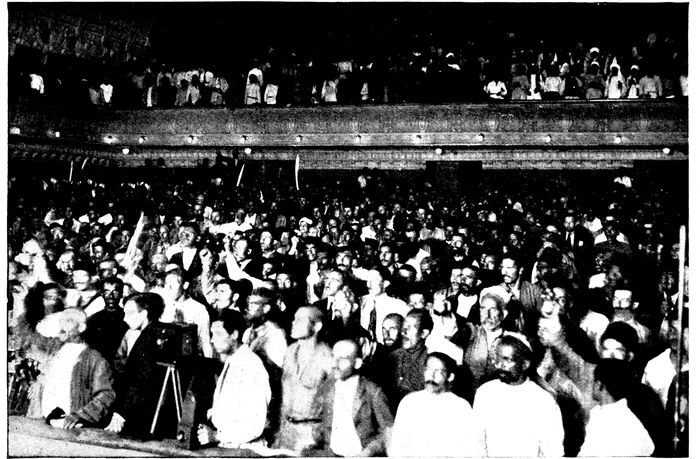
THE BAKU CONFERENCE SWEARS UNDYING HOSTILITY TO CAPITALISM AND BRITISH IMPERIALISM: The Body of the Hall.
95Among the most amusing things in this
queer intellectual situation are the repeated
scoldings that come by wireless from Moscow
to Western Labour because it does not
behave as Marx said it would behave. It
isn’t red—and it ought to be. It is just
yellow.
My conversation with Zenovieff was particularly
curious. He is a man with the
voice and animation of Hilaire Belloc, and
a lot of curly coal-black hair. “You have
civil war in Ireland,” he said. “Practically,”
said I. “Which do you consider
96are the proletarians, the Sinn Feiners or
the Ulstermen?” We spent some time
while Zenovieff worked like a man with a
jigsaw puzzle trying to get the Irish situation
into the class war formula. That
jigsaw puzzle remained unsolved, and we
then shifted our attention to Asia. Impatient
at the long delay of the Western
proletarians to emerge and declare themselves,
Zenovieff, assisted by Bela Kun,
our Mr. Jack Quelch, and a number of
other leading Communists, has recently
gone on a pilgrimage to Baku to raise the
Asiatic proletariat. They went to beat up
the class-conscious wages slaves of Persia
and Turkestan. They sought out factory
workers and slum dwellers in the tents of
the steppes. They held a congress at
Baku, at which they gathered together a
quite wonderful accumulation of white,
black, brown, and yellow people, Asiatic
costumes and astonishing weapons. They
had a great assembly in which they swore
undying hatred of Capitalism and British
imperialism; they had a great procession
97in which I regret to say certain batteries
of British guns, which some careless, hasty
empire-builder had left behind him, figured;
they disinterred and buried again thirteen
people whom this British empire-builder
seems to have shot without trial, and they
burnt Mr. Lloyd George, M. Millerand,
and President Wilson in effigy. I not
only saw a five-part film of this remarkable
festival when I visited the Petersburg
Soviet, but, thanks to Zorin, I have brought
the film back with me. It is to be administered
with caution and to adults only.
There are parts of it that would make
Mr. Gwynne of the Morning Post or Mr.
Rudyard Kipling scream in their sleep. If
so be they ever slept again after seeing it.
I did my best to find out from Zenovieff
and Zorin what they thought they were
doing in the Baku Conference. And frankly
I do not think they know. I doubt
if they have anything clearer in their minds
than a vague idea of hitting back at the
British Government through Mesopotamia
and India, because it has been hitting them
98through Kolchak, Deniken, Wrangel, and
the Poles. It is a counter-offensive almost
as clumsy and stupid as the offensives
it would counter. It is inconceivable that
they can hope for any social solidarity with
the miscellaneous discontents their congress
assembled. One item “featured”
on this Baku film is a dance by a gentleman
from the neighbourhood of Baku. He
is in fact one of the main features of
this remarkable film. He wears a fur-trimmed
jacket, high boots, and a high
cap, and his dancing is a very rapid and
dexterous step dancing. He produces two
knives and puts them between his teeth,
and then two others which he balances
perilously with the blades dangerously
close to his nose on either side of it. Finally
he poises a fifth knife on his forehead,
still stepping it featly to the distinctly
Oriental music. He stoops and squats,
arms akimbo, sending his nimble boots flying
out and back like the Cossacks in the
Russian ballet. He circles slowly as he
does this, clapping his hands. He is now
99rolled up in my keeping, ready to dance
again when opportunity offers. I tried to
find out whether he was a specimen Asiatic
proletarian or just what he symbolised, but
I could get no light on him. But there
are yards and yards of film of him. I wish
I could have resuscitated Karl Marx, just
to watch that solemn stare over the beard,
regarding him. The film gives no indication
of his reception by Mr. Jack Quelch.
I hope I shall not offend Comrade Zorin,
for whom I have a real friendship, if I
thus confess to him that I cannot take his
Baku Conference very seriously. It was
an excursion, a pageant, a Beano. As a
meeting of Asiatic proletarians it was preposterous.
But if it was not very much
in itself, it was something very important
in its revelation of shifting intentions. Its
chief significance to me is this, that it
shows a new orientation of the Bolshevik
mind as it is embodied in Zenovieff. So
long as the Bolsheviki held firmly with
unshaken conviction to the Marxist formula
they looked westward, a little surprised
100that the “social revolution” should have
begun so far to the east of its indicated
centre. Now as they begin to realise that
it is not that prescribed social revolution
at all but something quite different which
has brought them into power, they are naturally
enough casting about for a new
system of relationships. The ideal figure
of the Russian republic is still a huge
western “Worker,” with a vast hammer or
a sickle. A time may come, if we maintain
the European blockade with sufficient
stringency and make any industrial recuperation
impossible, when that ideal may
give place altogether to a nomadic-looking
gentleman from Turkestan with a number
of knives. We may drive what will remain
of Bolshevik Russia to the steppes and
the knife. If we help Baron Wrangel to
pull down the by no means firmly established
Government in Moscow, under the
delusion that thereby we shall bring about
“representative institutions” and a “limited
monarchy,” we may find ourselves very
much out in our calculations. Any one
101who destroys the present law and order of
Moscow will, I believe, destroy what is
left of law and order in Russia. A brigand
monarchist government will leave a trail of
fresh blood across the Russian scene, show
what gentlemen can do when they are
roused in a tremendous pogrom and White
Terror, flourish horribly for a time, break
up and vanish. Asia will resume. The
simple ancient rhythm of the horseman
plundering the peasant and the peasant
waylaying the horseman will creep back
across the plains to the Niemen and the
Dniester. The cities will become clusters of
ruins in the waste; the roads and railroads
will rot and rust; the river traffic will
decay....
This Baku Conference has depressed
Gorky profoundly. He is obsessed by a
nightmare of Russia going east. Perhaps
I have caught a little of his depression.
IV THE CREATIVE EFFORT IN RUSSIA
105
In the previous three papers I have
tried to give my impression of the
Russian spectacle as that of a rather ramshackle
modern civilisation completely shattered
and overthrown by misgovernment,
under-education, and finally six years of
war strain. I have shown science and art
starving and the comforts and many of
the decencies of life gone. In Vienna
the overthrow is just as bad; and there too
such men of science as the late Professor
Margules starve to death. If London had
had to endure four more years of war,
much the same sort of thing would be happening
in London. We should have now
no coal in our grates and no food for our
food tickets, and the shops in Bond Street
106would be as desolate as the shops in the
Nevsky Prospect. Bolshevik government
in Russia is neither responsible for the causation
nor for the continuance of these
miseries.
I have also tried to get the facts of
Bolshevik rule into what I believe is their
proper proportions in the picture. The
Bolsheviks, albeit numbering less than five
per cent of the population, have been able
to seize and retain power in Russia because
they were and are the only body of
people in this vast spectacle of Russian
ruin with a common faith and a common
spirit. I disbelieve in their faith, I ridicule
Marx, their prophet, but I understand
and respect their spirit. They are—with
all their faults, and they have abundant
faults—the only possible backbone now
to a renascent Russia. The recivilising
of Russia must be done with the Soviet
Government as the starting phase. The
great mass of the Russian population is
an entirely illiterate peasantry, grossly
materialistic and politically indifferent.
107They are superstitious, they are for ever
crossing themselves and kissing images,—in
Moscow particularly they were at it—but
they are not religious. They have
no will in things political and social beyond
their immediate satisfactions. They
are roughly content with Bolshevik rule.
The Orthodox priest is quite unlike the
Catholic priest in Western Europe; he is
himself typically a dirty and illiterate peasant
with no power over the wills and consciences
of his people. There is no constructive
quality in either peasant or Orthodoxy.
For the rest there is a confusion
of more or less civilised Russians, in and
out of Russia, with no common political
ideas and with no common will. They are
incapable of producing anything but adventures
and disputes.
The Russian refugees in England are
politically contemptible. They rehearse
endless stories of “Bolshevik outrages”:
chateau burnings by peasants, burglaries
and murders by disbanded soldiers in the
towns, back street crimes—they tell them
108all as acts of the Bolshevik Government.
Ask them what government they want in
its place, and you will get rubbishy generalities—usually
adapted to what the speaker
supposes to be your particular political
obsession. Or they sicken you with the
praise of some current super-man, Deniken
or Wrangel, who is to put everything right—God
knows how. They deserve nothing
better than a Tsar, and they are incapable
even of deciding which Tsar they desire.
The better part of the educated people
still in Russia are—for the sake of Russia—slowly
drifting into a reluctant but honest
co-operation with Bolshevik rule.
The Bolsheviks themselves are Marxists
and Communists. They find themselves
in control of Russia, in complete contradiction,
as I have explained, to the theories
of Karl Marx. A large part of their
energies have been occupied in an entirely
patriotic struggle against the raids, invasions,
blockades, and persecutions of every
sort that our insensate Western Governments
have rained upon their tragically
109shattered country. What is left over goes
in the attempt to keep Russia alive, and
to organise some sort of social order among
the ruins. These Bolsheviks are, as I have
explained, extremely inexperienced men,
intellectual exiles from Geneva and Hampstead,
or comparatively illiterate manual
workers from the United States. Never
was there so amateurish a government
since the early Moslem found themselves
in control of Cairo, Damascus, and Mesopotamia.
I believe that in the minds of very many
of them there is a considerable element
of dismay at the tremendous tasks they
find before them. But one thing has helped
them and Russia enormously, and that is
their training in Communistic ideas. As
the British found out during the submarine
war, so far as the urban and industrial
population goes there is nothing for it
during a time of tragic scarcity but collapse
or collective control. We in England had
to control and ration, we had to suppress
profiteering by stringent laws. These Communists
110came into power in Russia and
began to do at once, on principle, the
first most necessary thing in that chaos
of social wreckage. Against all the habits
and traditions of Russia, they began to
control and ration—exhaustively. They
have now a rationing system that is, on
paper, admirable beyond cavil; and perhaps
it works as well as the temperament
and circumstances of Russian production
and consumption permit. It is easy to
note defects and failures, but not nearly
so easy to show how in this depleted and
demoralised Russia they could be avoided.
And things are in such a state in Russia
now that even if we suppose the Bolsheviks
overthrown and any other Government in
their place, it matters not what, that Government
would have to go on with the
rationing the Bolsheviks have organised,
with the suppression of vague political experiments,
and the punishment and shooting
of profiteers. The Bolsheviki in this
state of siege and famine have done upon
principle what any other Government would
have had to do from necessity.
112
PROLETARIANS OF ASIA À LA BAKU.
113And in the face of gigantic difficulties
they are trying to rebuild a new Russia
among the ruins. We may quarrel with
their principles and methods, we may call
their schemes Utopian and so forth, we
may sneer at or we may dread what they
are doing, but it is no good pretending
that there is no creative effort in Russia
at the present time. A certain section of
the Bolsheviks are hard-minded, doctrinaire
and unteachable men, fanatics who believe
that the mere destruction of capitalism,
the disuse of money and trading, the effacement
of all social differences, will in itself
bring about a sort of bleak millennium.
There are Bolsheviki so stupid that they
would stop the teaching of chemistry in
schools until they were assured it was “proletarian”
chemistry, and who would suppress
every decorative design that was not
an elaboration of the letters R.S.F.S.R.
(Russian Socialist Federal Soviet Republic)
as reactionary art. I have told of the
114suppression of Hebrew studies because they
are “reactionary”; and while I was with
Gorky I found him in constant bitter disputes
with extremist officials who would
see no good in any literature of the past
except the literature of revolt. But there
were other more liberal minds in this new
Russian world, minds which, given an opportunity,
will build and will probably
build well. Among men of such constructive
force I would quote such names as
Lenin himself, who has developed wonderfully
since the days of his exile, and who
has recently written powerfully against the
extravagances of his own extremists; Trotsky,
who has never been an extremist, and
who is a man of very great organising ability;
Lunacharsky, the Minister for Education;
Rikoff, the head of the Department
of People’s Economy; Madame Lilna of
the Petersburg Child Welfare Department;
and Krassin, the head of the London Trade
Delegation. These are names that occur
to me; it is by no means an exhaustive list
of the statesmanlike elements in the Bolshevik
115Government. Already they have
achieved something, in spite of blockade
and civil and foreign war. It is not only
that they work to restore a country depleted
of material to an extent almost inconceivable
to English and American readers,
but they work with an extraordinarily
unhelpful personnel. Russia to-day stands
more in need of men of the foreman and
works-manager class than she does of medicaments
or food. The ordinary work in
the Government offices of Russia is shockingly
done; the slackness and inaccuracy
are indescribable. Everybody seems to be
working in a muddle of unsorted papers
and cigarette ends. This again is a state
of affairs no counter-revolution could
change. It is inherent in the present Russian
situation. If one of these military
adventurers of the Yudenitch or Deniken
type were, by some disastrous accident, to
get control of Russia, his success would
only add strong drink, embezzlement, and a
great squalour of kept mistresses to the
general complication. For whatever else
116we may say to the discredit of the Bolshevik
leaders, it is undeniable that the great majority
lead not simply laborious but puritanical
lives.
I write of this general inefficiency in
Russia with the more asperity because it
was the cause of my not meeting Lunacharsky.
About eighty hours of my life
was consumed in travelling, telephoning,
and waiting about in order to talk for about
an hour and a half with Lenin and for the
some time with Tchitcherin. At that rate,
and in view of the intermittent boat service
from Reval to Stockholm, to see Lunacharsky
would have meant at least a week more
in Russia. The whole of my visit to Moscow
was muddled in the most irritating
fashion. A sailor-man carrying a silver
kettle who did not know his way about
Moscow was put in charge of my journey,
and an American who did not know enough
Russian to telephone freely was set to make
my appointments in the town. Although
I had heard Gorky arrange for my meeting
with Lenin by long-distance telephone
117days before, Moscow declared that it had
had no notice of my coming. Finally I was
put into the wrong train back to Petersburg,
a train which took twenty-two hours
instead of fourteen for the journey. These
may seem petty details to relate, but when
it is remembered that Russia was really doing
its best to impress me with its vigour
and good order, they are extremely significant.
In the train, when I realised that it
was a slow train and that the express had
gone three hours before while we had
been pacing the hall of the guest house with
our luggage packed and nobody coming for
us, the spirit came upon me and my lips
were unsealed. I spoke to my guide, as
one mariner might speak to another, and
told him what I thought of Russian methods.
He listened with the profoundest
respect to my rich incisive phrases. When
at last I paused, he replied—in words that
are also significant of certain weaknesses
of the present Russian state of mind. “You
see,” he said, “the blockade——”
But if I saw nothing of Lunacharsky
118personally, I saw something of the work
he has organised. The primary material
of the educationist is human beings, and
of these at least there is still no shortage
in Russia, so that in that respect Lunacharsky
is better off than most of his colleagues.
And beginning with an initial prejudice
and much distrust, I am bound to confess
that, in view of their enormous difficulties,
the educational work of the Bolsheviks
impresses me as being astonishingly good.
Things started badly. Directly I got to
Petersburg I asked to see a school, and
on the second day of my visit I was taken
to one that impressed me very unfavourably.
It was extremely well equipped,
much better than an ordinary English
grammar school, and the children were
bright and intelligent; but our visit fell in
the recess. I could witness no teaching, and
the behaviour of the youngsters I saw
indicated a low standard of discipline. I
formed an opinion that I was probably
being shown a picked school specially prepared
for me, and that this was all that
119Petersburg had to offer. The special guide
who was with us then began to question
these children upon the subject of English
literature and the writers they liked most.
One name dominated all others. My own.
Such comparatively trivial figures as Milton,
Dickens, Shakespeare ran about intermittently
between the feet of that literary
colossus. Being questioned further, these
children produced the titles of perhaps a
dozen of my books. I said I was completely
satisfied by what I had seen and
heard, that I wanted to see nothing more—for
indeed what more could I possibly require?—and
I left that school smiling with
difficulty and thoroughly cross with my
guides.
Three days later I suddenly scrapped
my morning’s engagements and insisted
upon being taken at once to another school—any
school close at hand. I was convinced
that I had been deceived about the
former school, and that now I should see a
very bad school indeed. Instead I saw a
much better one than the first I had seen.
120The equipment and building were better,
the discipline of the children was better,
and I saw some excellent teaching in progress.
Most of the teachers were women,
very competent-looking middle-aged women,
and I chose elementary geometrical
teaching to observe because that on the
blackboard is in the universal language of
the diagram. I saw also a heap of drawings
and various models the pupils had
done, and they were very good. The
school was supplied with abundant pictures.
I noted particularly a well-chosen
series of landscapes to assist the geographical
teaching. There was plenty of chemical
and physical apparatus, and it was
evidently put to a proper use. I also saw
the children’s next meal in preparation—for
children eat at school in Soviet Russia—and
the food was excellent and well
cooked, far above the standard of the
adult rations we had seen served out. All
this was much more satisfactory. Finally
by a few questions we tested the extraordinary
vogue of H. G. Wells among the
121young people of Russia. None of these
children had ever heard of him. The school
library contained none of his books. This
did much to convince me that I was seeing
a quite normal school. I had, I now begin
to realise, been taken to the previous
one not, as I had supposed in my wrath,
with any elaborate intention of deceiving
me about the state of education in the
country, but after certain kindly intrigues
and preparations by a literary friend, Mr.
Chukovsky the critic, affectionately anxious
to make me feel myself beloved in Russia,
and a little oblivious of the real gravity
of the business I had in hand.
Subsequent enquiries and comparison of
my observations with those of other visitors
to Russia, and particularly those of Dr.
Haden Guest, who also made surprise
visits to several schools in Moscow, have
convinced me that Soviet Russia, in the
face of gigantic difficulties, has made and
is making very great educational efforts,
and that in spite of the difficulties of the
general situation the quality and number
122of the schools in the towns has risen absolutely
since the Tsarist régime. (The
peasant, as ever, except in a few “show”
localities, remains scarcely touched by
these things.) The schools I saw would
have been good middle schools in England.
They are open to all, and there is an
attempt to make education compulsory.
Of course Russia has its peculiar difficulties.
Many of the schools are understaffed,
and it is difficult to secure the attendance
of unwilling pupils. Numbers of children
prefer to keep out of the schools and
trade upon the streets. A large part of
the illicit trading in Russia is done by
bands of children. They are harder to
catch than adults, and the spirit of Russian
Communism is against punishing them.
And the Russian child is, for a northern
child, remarkably precocious.
The common practice of co-educating
youngsters up to fifteen or sixteen, in a
country as demoralised as Russia is now,
has brought peculiar evils in its train.
My attention was called to this by the
123visit of Bokaiev, the former head of the
Petersburg Extraordinary Commission, and
his colleague Zalutsky to Gorky to consult
him in the matter. They discussed their
business in front of me quite frankly, and
the whole conversation was translated to
me as it went on. The Bolshevik authorities
have collected and published very
startling, very shocking figures of the moral
condition of young people in Petersburg,
which I have seen. How far they would
compare with the British figures—if there
are any British figures—of such bad districts
for the young as are some parts of
East London or such towns of low type
employment as Reading I do not know.
(The reader should compare the Fabian
Society’s report on prostitution, Downward
Paths, upon this question.) Nor do
I know how they would show in comparison
with preceding Tsarist conditions.
Nor can I speculate how far these phenomena
in Russia are the mechanical
consequence of privation and overcrowding
in a home atmosphere bordering on despair.
124But there can be no doubt that in the
Russian towns, concurrently with increased
educational effort and an enhanced intellectual
stimulation of the young, there is
also an increased lawlessness on their part,
especially in sexual matters, and that this
is going on in a phase of unexampled
sobriety and harsh puritanical decorum so
far as adult life is concerned. This hectic
moral fever of the young is the dark side
of the educational spectacle in Russia. I
think it is to be regarded mainly as an
aspect of the general social collapse; every
European country has noted a parallel
moral relaxation of the young under the
war strain; but the revolution itself, in
sweeping a number of the old experienced
teachers out of the schools and in making
every moral standard a subject of debate,
has no doubt contributed also to an as
yet incalculable amount in the excessive
disorder of these matters in present-day
Russia.
Faced with this problem of starving and
shattered homes and a social chaos, the
125Bolshevik organisers are institutionalising
the town children of Russia. They are
making their schools residential. The
children of the Russian urban population
are going, like the children of the British
upper class, into boarding schools. Close
to this second school I visited stood two
big buildings which are the living places of
the boys and of the girls respectively. In
these places they can be kept under some
sort of hygienic and moral discipline.
This again happens to be not only in
accordance with Communist doctrine, but
with the special necessities of the Russian
crisis. Entire towns are sinking down
towards slum conditions, and the Bolshevik
Government has had to play the part of a
gigantic Dr. Barnardo.
We went over the organisation of a sort
of reception home to which children are
brought by their parents who find it
impossible to keep them clean and decent
and nourished under the terrible conditions
outside. This reception home is the old
Hotel de l’Europe, the scene of countless
126pleasant little dinner-parties under the old
régime. On the roof there is still the
summertime roof garden, where the string
quartette used to play, and on the staircase
we passed a frosted glass window still
bearing in gold letters the words Coiffure
des Dames.
Slender gilded pointing hands directed
us to the “Restaurant,” long vanished from
the grim Petersburg scheme of things.
Into this place the children come; they
pass into a special quarantine section for
infectious diseases and for personal cleanliness—nine-tenths
of the newcomers harbour
unpleasant parasites—and then into
another section, the moral quarantine,
where for a time they are watched for bad
habits and undesirable tendencies. From
this section some individuals may need to
be weeded out and sent to special schools
for defectives. The rest pass on into
the general body of institutionalized children,
and so on to the boarding schools.
Here certainly we have the “break-up
of the family” in full progress, and the
127Bolshevik net is sweeping wide and taking
in children of the most miscellaneous
origins. The parents have reasonably free
access to their children in the daytime, but
little or no control over their education,
clothing, or the like. We went among the
children in the various stages of this
educational process, and they seemed to
us to be quite healthy, happy, and contented
children. But they get very good
people to look after them. Many men and
women, politically suspects or openly discontented
with the existing political conditions,
and yet with a desire to serve
Russia, have found in these places work
that they can do with a good heart and
conscience. My interpreter and the lady
who took us round this place had often
dined and supped in the Hotel de l’Europe
in its brilliant days, and they knew each
other well. This lady was now plainly clad,
with short cut hair and a grave manner;
her husband was a White and serving with
the Poles; she had two children of her own
in the institution, and she was mothering
128some scores of little creatures. But she
was evidently keenly proud of the work of
her organisation, and she said that she
found life—in this city of want, under the
shadow of a coming famine—more interesting
and satisfying than it had ever been in
the old days.
I have no space to tell of other educational
work we saw going on in Russia.
I can give but a word or so to the Home of
Rest for Workmen in the Kamenni Ostrof.
I thought that at once rather fine and not a
little absurd. To this place workers are
sent to live a life of refined ease for two or
three weeks. It is a very beautiful country
house with fine gardens, an orangery, and
subordinate buildings. The meals are
served on white cloths with flowers upon
the table and so forth. And the worker
has to live up to these elegant surroundings.
It is a part of his education. If in a forgetful
moment he clears his throat in the
good old resonant peasant manner and
spits upon the floor, an attendant, I was
told, chalks a circle about his defilement
and obliges him to clean the offended
parquetry. The avenue approaching this
place has been adorned with decoration in
the futurist style, and there is a vast figure
of a “worker” at the gates resting on his
hammer, done in gypsum, which was
obtained from the surgical reserves of the
Petersburg hospitals.... But after all,
the idea of civilising your workpeople by
dipping them into pleasant surroundings
is, in itself, rather a good one....
129
GUESTS AT THE HOME OF REST FOR WORKMEN ON THE KAMENNI OSTROF.
131I find it difficult to hold the scales of
justice upon many of these efforts of
Bolshevism. Here are these creative and
educational things going on, varying between
the admirable and the ridiculous,
islands at least of cleanly work and, I
think, of hope, amidst the vast spectacle of
grisly want and wide decay. Who can
weigh the power and possibility of their
thrust against the huge gravitation of this
sinking system? Who can guess what
encouragement and enhancement they may
get if Russia can win through to a respite
from civil and foreign warfare and from
132famine and want? It was of this re-created
Russia, this Russia that may be, that I
was most desirous of talking when I went
to the Kremlin to meet Lenin. Of that
conversation I will tell in my sixth paper.
V THE PETERSBURG SOVIET: A LEGISLATIVE MASS MEETING
135
On Thursday the 7th of October we attended
a meeting of the Petersburg
Soviet. We were told that we should find
this a very different legislative body from
the British House of Commons, and we
did. Like nearly everything else in the
arrangements of Soviet Russia it struck us
as extraordinarily unpremeditated and improvised.
Nothing could have been less
intelligently planned for the functions it
had to perform or the responsibilities it
had to undertake.
The meeting was held in the old Winter
Garden of the Tauride Palace, the former
palace of Potemkin, the favourite of
Catherine the Second. Here the Imperial
Duma met under the Tsarist régime, and
136I visited it in 1914 and saw a languid
session in progress. I went then with Mr.
Maurice Baring and one of the Benckendorffs
to the strangers’ gallery, which ran
round three sides of the hall. There was
accommodation for perhaps a thousand
people in the hall, and most of it was empty.
The president with his bell sat above a
rostrum, and behind him was a row of
women reporters. I do not now remember
what business was in hand on that occasion;
it was certainly not very exciting business.
Baring, I remember, pointed out the large
proportion of priests elected to the third
Duma; their beards and cassocks made a
very distinctive feature of that scattered
gathering.
On this second visit we were no longer
stranger onlookers, but active participants
in the meeting; we came into the body of
the hall behind the president’s bench, where
on a sort of stage the members of the
Government, official visitors, and so forth
find accommodation. The presidential
bench, the rostrum, and the reporters
137remained, but instead of an atmosphere of
weary parliamentarianism, we found ourselves
in the crowding, the noise, and the
peculiar thrill of a mass meeting. There
were, I should think, some two hundred
people or more packed upon the semicircular
benches round about us on the
platform behind the president, comrades
in naval uniforms and in middle-class and
working-class costume, numerous intelligent-looking
women, one or two Asiatics
and a few unclassifiable visitors, and the
body of the hall beyond the presidential
bench was densely packed with people who
filled not only the seats but the gangways
and the spaces under the galleries. There
may have been two or three thousand people
down there, men and women. They were
all members of the Petersburg Soviet,
which is really a sort of conjoint meeting
of its constituent soviets. The visitors’
galleries above were equally full.
Above the rostrum, with his back to us,
sat Zenovieff, his right-hand man Zorin,
and the president. The subject under
138discussion was the proposed peace with
Poland. The meeting was smarting with
the sense of defeat and disposed to resent
the Polish terms. Soon after we came in
Zenovieff made a long and, so far as I could
judge, a very able speech, preparing the
minds of this great gathering for a Russian
surrender. The Polish demands are outrageous,
but for the present Russia must
submit. He was followed by an oldish
man who made a bitter attack upon the
irreligion of the people and government of
Russia; Russia was suffering for her sins,
and until she repented and returned to
religion she would continue to suffer one
disaster after another. His opinions were
not those of the meeting, but he was
allowed to have his say without interruption.
The decision to make peace with Poland
was then taken by a show of hands. Then
came my little turn. The meeting was told
that I had come from England to see the
Bolshevik régime; I was praised profusely;
I was also exhorted to treat that régime
fairly and not to emulate those other recent
139visitors (these were Mrs. Snowden and
Guest and Bertrand Russell) who had
enjoyed the hospitality of the republic and
then gone away to say unfavourable things
of it. This exhortation left me cold; I
had come to Russia to judge the Bolshevik
Government and not to praise it. I had
then to take possession of the rostrum and
address this big crowd of people. This
rostrum I knew had proved an unfortunate
place for one or two previous
visitors, who had found it hard to explain
away afterwards the speeches their translators
had given the world through the
medium of the wireless reports. Happily,
I had had some inkling of what was coming.
To avoid any misunderstanding I had
written out a short speech in English, and
I had had this translated carefully into
Russian. I began by saying clearly that
I was neither Marxist nor Communist,
but a Collectivist, and that it was not to a
social revolution in the West that Russians
should look for peace and help in their
troubles, but to the liberal opinion of the
140moderate mass of Western people. I
declared that the people of the Western
States were determined to give Russia
peace, so that she might develop upon her
own lines. Their own line of development
might be very different from that of
Russia. When I had done I handed a
translation of my speech to my interpreter,
Zorin, which not only eased his task but
did away with any possibility of a subsequent
misunderstanding. My speech was
reported in the Pravda quite fully and
fairly.
Then followed a motion by Zorin that
Zenovieff should have leave to visit Berlin
and attend the conference of the Independent
Socialists there. Zorin is a witty and
humorous speaker, and he got his audience
into an excellent frame of mind. His
motion was carried by a show of hands,
and then came a report and a discussion
upon the production of vegetables in the
Petersburg district. It was a practical
question upon which feeling ran high.
Here speakers arose in the body of the hall,
141discharging brief utterances for a minute
or so and subsiding again. There were
shouts and interruptions. The debate was
much more like a big labour mass meeting
in the Queen’s Hall than anything that a
Western European would recognise as a
legislature.
This business disposed of, a still more
extraordinary thing happened. We who
sat behind the rostrum poured down into
the already very crowded body of the hall
and got such seats as we could find, and
a white sheet was lowered behind the
president’s seat. At the same time a band
appeared in the gallery to the left. A
five-part cinematograph film was then run,
showing the Baku Conference to which I
have already alluded. The pictures were
viewed with interest but without any violent
applause. And at the end the band
played the Internationale, and the audience—I
beg its pardon!—the Petersburg Soviet
dispersed singing that popular chant. It
was in fact a mass meeting incapable of
any real legislative activities; capable at
142the utmost of endorsing or not endorsing
the Government in control of the platform.
Compared with the British Parliament
it has about as much organisation,
structure, and working efficiency as a big
bagful of miscellaneous wheels might have
beside an old-fashioned and inaccurate but
still going clock.
VI THE DREAMER IN THE KREMLIN
145
My chief purpose in going from Petersburg
to Moscow was to see and talk
to Lenin. I was very curious to see him,
and I was disposed to be hostile to him.
I encountered a personality entirely different
from anything I had expected to meet.
Lenin is not a writer; his published
work does not express him. The shrill
little pamphlets and papers issued from
Moscow in his name, full of misconceptions
of the labour psychology of the West
and obstinately defensive of the impossible
proposition that it is the prophesied Marxist
social revolution which has happened
in Russia, display hardly anything of the
real Lenin mentality as I encountered it.
Occasionally there are gleams of an inspired
146shrewdness, but for the rest these publications
do no more than rehearse the set
ideas and phrases of doctrinaire Marxism.
Perhaps that is necessary. That may be
the only language Communism understands;
a break into a new dialect would
be disturbing and demoralising. Left
Communism is the backbone of Russia
to-day; unhappily it is a backbone without
flexible joints, a backbone that can be bent
only with the utmost difficulty and which
must be bent by means of flattery and
deference.
Moscow under the bright October sunshine,
amidst the fluttering yellow leaves,
impressed us as being altogether more lax
and animated than Petersburg. There is
much more movement of people, more
trading, and a comparative plenty of droshkys.
Markets are open. There is not the
same general ruination of streets and
houses. There are, it is true, many traces
of the desperate street fighting of early
1918. One of the domes of that absurd
cathedral of St. Basil just outside the
Kremlin gate was smashed by a shell and
still awaits repair. The tramcars we found
were not carrying passengers; they were
being used for the transport of supplies of
food and fuel. In these matters Petersburg
claims to be better prepared than
Moscow.
148
THE PETERSBURG SOVIET IN SESSION. Lenin at the rostrum; below him are the women stenographers; immediately behind him is Zenovieff and the President. Behind these again are officials and ministerial persons, official visitors and the like.
149The ten thousand crosses of Moscow
still glitter in the afternoon light. On one
conspicuous pinnacle of the Kremlin the
imperial eagles spread their wings; the
Bolshevik Government has been too busy
or too indifferent to pull them down. The
churches are open, the kissing of ikons is
a flourishing industry, and beggars still
woo casual charity at the doors. The
celebrated miraculous shrine of the Iberian
Madonna outside the Redeemer Gate was
particularly busy. There were many peasant
women, unable to get into the little
chapel, kissing the stones outside.
Just opposite to it, on a plaster panel on
a house front, is that now celebrated inscription
put up by one of the early revolutionary
administrations in Moscow: “Religion
150is the Opium of the People.” The
effect this inscription produces is greatly
reduced by the fact that in Russia the
people cannot read.
About that inscription I had a slight
but amusing argument with Mr. Vanderlip,
the American financier, who was lodged
in the same guest house as ourselves. He
wanted to have it effaced. I was for retaining
it as being historically interesting,
and because I think that religious toleration
should extend to atheists. But Mr.
Vanderlip felt too strongly to see the
point of that.
The Moscow Guest House, which we
shared with Mr. Vanderlip and an adventurous
English artist who had somehow
got through to Moscow to execute busts
of Lenin and Trotsky, was a big, richly-furnished
house upon the Sofiskaya Naberezhnaya
(No. 17), directly facing the
great wall of the Kremlin and all the
clustering domes and pinnacles of that imperial
inner city. We felt much less free
and more secluded here than in Petersburg.
151There were sentinels at the gates to protect
us from casual visitors, whereas in
Petersburg all sorts of unauthorised persons
could and did stray in to talk to me.
Mr. Vanderlip had been staying here, I
gathered, for some weeks, and proposed to
stay some weeks more. He was without
valet, secretary, or interpreter. He did
not discuss his business with me beyond
telling me rather carefully once or twice
that it was strictly financial and commercial
and in no sense political. I was told
that he had brought credentials from Senator
Harding to Lenin, but I am temperamentally
incurious and I made no attempt
whatever to verify this statement or to
pry into Mr. Vanderlip’s affairs. I did
not even ask how it could be possible to
conduct business or financial operations in
a Communist State with anyone but the
Government, nor how it was possible to
deal with a Government upon strictly nonpolitical
lines. These were, I admitted,
mysteries beyond my understanding. But
we ate, smoked, drank our coffee and conversed
152together in an atmosphere of profound
discretion. By not mentioning Mr.
Vanderlip’s “mission,” we made it a portentous,
omnipresent fact.
The arrangements leading up to my
meeting with Lenin were tedious and irritating,
but at last I found myself under
way for the Kremlin in the company of
Mr. Rothstein, formerly a figure in London
Communist circles, and an American
comrade with a large camera who was also,
I gathered, an official of the Russian Foreign
Office.
The Kremlin as I remembered it in
1914 was a very open place, open much
as Windsor Castle is, with a thin trickle
of pilgrims and tourists in groups and
couples flowing through it. But now it
is closed up and difficult of access. There
was a great pother with passes and permits
before we could get through even the outer
gates. And we filtered and inspected
through five or six rooms of clerks and
sentinels before we got into the presence.
This may be necessary for the personal
153security of Lenin, but it puts him out of
reach of Russia, and, what perhaps is more
serious, if there is to be an effectual dictatorship,
it puts Russia out of his reach.
If things must filter up to him, they
must also filter down, and they may undergo
very considerable changes in the process.
We got to Lenin at last and found him,
a little figure at a great desk in a well-lit
room that looked out upon palatial spaces.
I thought his desk was rather in a litter.
I sat down on a chair at a corner of the
desk, and the little man—his feet scarcely
touch the ground as he sits on the edge of
his chair—twisted round to talk to me,
putting his arms round and over a pile of
papers. He spoke excellent English, but
it was, I thought, rather characteristic of
the present condition of Russian affairs
that Mr. Rothstein chaperoned the conversation,
occasionally offering footnotes and
other assistance. Meanwhile the American
got to work with his camera, and unobtrusively
but persistently exposed plates.
The talk, however, was too interesting for
154that to be an annoyance. One forgot
about that clicking and shifting about quite
soon.
I had come expecting to struggle with
a doctrinaire Marxist. I found nothing of
the sort. I had been told that Lenin lectured
people; he certainly did not do so
on this occasion. Much has been made of
his laugh in the descriptions, a laugh
which is said to be pleasing at first and
afterwards to become cynical. This laugh
was not in evidence. His forehead reminded
me of someone else—I could not
remember who it was, until the other
evening I saw Mr. Arthur Balfour sitting
and talking under a shaded light. It is
exactly the same domed, slightly one-sided
cranium. Lenin has a pleasant, quick-changing,
brownish face, with a lively
smile and a habit (due perhaps to some
defect in focussing) of screwing up one
eye as he pauses in his talk; he is not very
like the photographs you see of him because
he is one of those people whose change of
expression is more important than their
155features; he gesticulated a little with his
hands over the heaped papers as he talked,
and he talked quickly, very keen on his
subject, without any posing or pretences
or reservations, as a good type of scientific
man will talk.
Our talk was threaded throughout and
held together by two—what shall I call
them?—motifs. One was from me to him:
“What do you think you are making of
Russia? What is the state you are trying
to create?” The other was from him to
me: ‘Why does not the social revolution
begin in England? Why do you not work
for the social revolution? Why are you
not destroying Capitalism and establishing
the Communist State?” These motifs
interwove, reacted on each other, illuminated
each other. The second brought
back the first: “But what are you making
of the social revolution? Are you making
a success of it?” And from that we got
back to two again with: “To make it a
success the Western world must join in.
Why doesn’t it?”
156In the days before 1918 all the Marxist
world thought of the social revolution as
an end. The workers of the world were to
unite, overthrow Capitalism, and be happy
ever afterwards. But in 1918 the Communists,
to their own surprise, found themselves
in control of Russia and challenged
to produce their millennium. They have a
colourable excuse for a delay in the production
of a new and better social order
in their continuation of war conditions, in
the blockade and so forth, nevertheless it
is clear that they begin to realise the
tremendous unpreparedness which the
Marxist methods of thought involve. A
hundred points—I have already put a
finger upon one or two of them—they do
not know what to do. But the commonplace
Communist simply loses his temper
if you venture to doubt whether everything
is being done in precisely the best
and most intelligent way under the new
régime. He is like a tetchy housewife
who wants you to recognise that everything
is in perfect order in the middle of
157an eviction. He is like one of those now
forgotten suffragettes who used to promise
us an earthly paradise as soon as we escaped
from the tyranny of “man-made
laws.” Lenin, on the other hand, whose
frankness must at times leave his disciples
breathless, has recently stripped off the
last pretence that the Russian revolution
is anything more than the inauguration of
an age of limitless experiment. “Those
who are engaged in the formidable task
of overcoming capitalism,” he has recently
written, “must be prepared to try method
after method until they find the one which
answers their purpose best.”
We opened our talk with a discussion of
the future of the great towns under Communism.
I wanted to see how far Lenin
contemplated the dying out of the towns
in Russia. The desolation of Petersburg
had brought home to me a point I had
never realised before, that the whole form
and arrangement of a town is determined
by shopping and marketing, and that the
abolition of these things renders nine-tenths
158of the buildings in an ordinary town
directly or indirectly unmeaning and useless.
“The towns will get very much smaller,”
he admitted. “They will be different.
Yes, quite different.” That, I suggested,
implied a tremendous task. It meant the
scrapping of the existing towns and their
replacement. The churches and great buildings
of Petersburg would become presently
like those of Novgorod the Great or like
the temples of Paestum. Most of the
town would dissolve away. He agreed
quite cheerfully. I think it warmed his
heart to find someone who understood a
necessary consequence of collectivism that
many even of his own people fail to grasp.
Russia has to be rebuilt fundamentally,
has to become a new thing....
And industry has to be reconstructed—as
fundamentally?
Did I realise what was already in hand
with Russia? The electrification of Russia?
For Lenin, who like a good orthodox
Marxist denounces all “Utopians,” has succumbed
at last to a Utopia, the Utopia
159of the electricians. He is throwing all his
weight into a scheme for the development
of great power stations in Russia to serve
whole provinces with light, with transport,
and industrial power. Two experimental
districts he said had already been electrified.
Can one imagine a more courageous project
in a vast flat land of forests and illiterate
peasants, with no water power, with no
technical skill available, and with trade
and industry at the last gasp? Projects
for such an electrification are in process
of development in Holland and they have
been discussed in England, and in those
densely-populated and industrially highly-developed
centres one can imagine them as
successful, economical, and altogether beneficial.
But their application to Russia is an
altogether greater strain upon the constructive
imagination. I cannot see anything
of the sort happening in this dark
crystal of Russia, but this little man at the
Kremlin can; he sees the decaying railways
replaced by a new electric transport, sees
new roadways spreading throughout the
160land, sees a new and happier Communist
industrialism arising again. While I talked
to him he almost persuaded me to share
his vision.
“And you will go on to these things
with the peasants rooted in your soil?”
But not only are the towns to be rebuilt;
every agricultural landmark is to go.
“Even now,” said Lenin, “all the agricultural
production of Russia is not peasant
production. We have, in places, large scale
agriculture. The Government is already
running big estates with workers instead
of peasants, where conditions are favourable.
That can spread. It can be extended
first to one province, then another. The
peasants in the other provinces, selfish and
illiterate, will not know what is happening
until their turn comes....”
It may be difficult to defeat the Russian
peasant en masse; but in detail there is
no difficulty at all. At the mention of the
peasant Lenin’s head came nearer to mine;
his manner became confidential. As if after
all the peasant might overhear.
161It is not only the material organisation
of society you have to build, I argued, it
is the mentality of a whole people. The
Russian people are by habit and tradition
traders and individualists; their very souls
must be remoulded if this new world is to
be achieved. Lenin asked me what I had
seen of the educational work afoot. I
praised some of the things I had seen.
He nodded and smiled with pleasure. He
has an unshaken confidence in his work.
“But these are only sketches and beginnings,”
I said.
“Come back and see what we have done
in Russia in ten years’ time,” he answered.
In him I realised that Communism could
after all, in spite of Marx, be enormously
creative. After the tiresome class-war
fanatics I had been encountering among
the Communists, men of formulæ as sterile
as flints, after numerous experiences of the
trained and empty conceit of the common
Marxist devotee, this amazing little man,
with his frank admission of the immensity
and complication of the project of Communism
162and his simple concentration upon
its realisation, was very refreshing. He at
least has a vision of a world changed over
and planned and built afresh.
He wanted more of my Russian impressions.
I told him that I thought that in
many directions, and more particularly in
the Petersburg Commune, Communism was
pressing too hard and too fast, and destroying
before it was ready to rebuild.
They had broken down trading before they
were ready to ration; the co-operative
organisation had been smashed up instead
of being utilised, and so on. That brought
us to our essential difference, the difference
of the Collectivist and Marxist, the question
whether the social revolution is, in its extremity,
necessary, whether it is necessary
to overthrow one social and economic system
completely before the new one can
begin. I believe that through a vast sustained
educational campaign the existing
Capitalist system could be civilised into a
Collectivist world system; Lenin on the
other hand tied himself years ago to the
163Marxist dogmas of the inevitable class war,
the downfall of Capitalist order as a prelude
to reconstruction, the proletarian dictatorship,
and so forth. He had to argue,
therefore, that modern Capitalism is incurably
predatory, wasteful, and unteachable,
and that until it is destroyed it will
continue to exploit the human heritage stupidly
and aimlessly, that it will fight
against and prevent any administration of
national resources for the general good,
and that it will inevitably make wars.
I had, I will confess, a very uphill argument.
He suddenly produced Chiozza
Money’s new book, The Triumph of Nationalisation,
which he had evidently been
reading very carefully. “But you see directly
you begin to have a good working
collectivist organisation of any public interest,
the Capitalists smash it up again.
They smashed your national shipyards;
they won’t let you work your coal economically.”
He tapped the book. “It is
all here.”
And against my argument that wars
164sprang from nationalist imperialism and not
from a Capitalist organisation of society
he suddenly brought: “But what do you
think of this new Republican Imperialism
that comes to us from America?”
Here Mr. Rothstein intervened in Russian
with an objection that Lenin swept
aside.
And regardless of Mr. Rothstein’s plea
for diplomatic reserve, Lenin proceeded to
explain the projects with which one American
at least was seeking to dazzle the imagination
of Moscow. There was to be economic
assistance for Russia and recognition
of the Bolshevik Government. There was
to be a defensive alliance against Japanese
aggression in Siberia. There was to be an
American naval station on the coast of
Asia, and leases for long terms of sixty or
fifty years of the natural resources of
Khamchatka and possibly of other large
regions of Russian Asia. Well, did I think
that made for peace? Was it anything
more than the beginning of a new world
scramble? How would the British Imperialists
like this sort of thing?
165
LENIN. Behind him stands Gorky: to the right of Gorky (i.e. on his left) are Zorin (hat) and Zenovieff. Behind with cigarette is Radek.
167But some industrial power had to come
in and help Russia, I said. She cannot
reconstruct now without such help....
Our multifarious argumentation ended
indecisively. We parted warmly, and I
and my companion were filtered out of the
Kremlin through one barrier after another
in much the same fashion as we had been
filtered in.
“He is wonderful,” said Mr. Rothstein.
“But it was an indiscretion——”
I was not disposed to talk as we made
our way, under the glowing trees that
grow in the ancient moat of the Kremlin,
back to our Guest House. I wanted to
think Lenin over while I had him fresh
in my mind, and I did not want to be
assisted by the expositions of my companion.
But Mr. Rothstein kept on talking.
He was still pressing me not to mention
this little sketch of the Russian American
outlook to Mr. Vanderlip long after I assured
him that I respected Mr. Vanderlip’s
168veil of discretion far too much to pierce
it by any careless word.
And so back to No. 17 Sofiskaya Naberezhnaya,
and lunch with Mr. Vanderlip
and the young sculptor from London.
The old servant of the house waited on
us, mournfully conscious of the meagreness
of our entertainment and reminiscent of
the great days of the past when Caruso
had been a guest and had sung to all that
was brilliant in Moscow in the room upstairs.
Mr. Vanderlip was for visiting the
big market that afternoon—and later going
to the Ballet, but my son and I were
set upon returning to Petersburg that night
and so getting on to Reval in time for
the Stockholm boat.
VII THE ENVOY
171
In these seven papers I have written in
the first person and in a familiar style
because I did not want the reader to lose
sight for a moment of the shortness of
our visit to Russia and of my personal
limitations. Now in conclusion, if the reader
will have patience with me for a few
final words, I would like in less personal
terms and very plainly to set down my
main convictions about the Russian situation.
They are very strong convictions, and
they concern not merely Russia but the
whole present outlook of our civilisation.
They are merely one man’s opinion, but as
I feel them strongly, so I put them without
weakening qualifications.
First, then, Russia, which was a modern
172civilisation of the Western type, least disciplined
and most ramshackle of all the
Great Powers, is now a modern civilisation
in extremis. The direct cause of its downfall
has been modern war leading to physical
exhaustion. Only through that could
the Bolsheviki have secured power. Nothing
like this Russian downfall has ever happened
before. If it goes on for a year
or so more the process of collapse will be
complete. Nothing will be left of Russia
but a country of peasants; the towns will
be practically deserted and in ruins, the
railways will be rusting in disuse. With the
railways will go the last vestiges of any
general government. The peasants are absolutely
illiterate and collectively stupid,
capable of resisting interference but incapable
of comprehensive foresight and organisation.
They will become a sort of
human swamp in a state of division, petty
civil war, and political squalour, with a
famine whenever the harvests are bad;
and they will be breeding epidemics for
173the rest of Europe. They will lapse towards
Asia.
The collapse of the civilised system in
Russia into peasant barbarism means that
Europe will be cut off for many years
from all the mineral wealth of Russia, and
from any supply of raw products from
this area, from its corn, flax, and the like.
It is an open question whether the Western
Powers can get along without these supplies.
Their cessation certainly means a
general impoverishment of Western Europe.
The only possible Government that can
stave off such a final collapse of Russia
now is the present Bolshevik Government,
if it can be assisted by America and the
Western Powers. There is now no alternative
to that Government possible. There
are of course a multitude of antagonists—adventurers
and the like—ready, with European
assistance, to attempt the overthrow
of that Bolshevik Government, but there
are no signs of any common purpose and
moral unity capable of replacing it. And
174moreover there is no time now for another
revolution in Russia. A year more
of civil war will make the final sinking
of Russia out of civilisation inevitable.
We have to make what we can, therefore,
of the Bolshevik Government, whether we
like it or not.
The Bolshevik Government is inexperienced
and incapable to an extreme degree;
it has had phases of violence and cruelty;
but it is on the whole honest. And it
includes a few individuals of real creative
imagination and power, who may with opportunity,
if their hands are strengthened,
achieve great reconstructions. The Bolshevik
Government seems on the whole to
be trying to act up to its professions, which
are still held by most of its supporters with
a quite religious passion. Given generous
help, it may succeed in establishing a new
social order in Russia of a civilised type
with which the rest of the world will be
able to deal. It will probably be a mitigated
Communism, with a large-scale handling
175of transport, industry, and (later)
agriculture.
It is necessary that we should understand
and respect the professions and principles
of the Bolsheviki if we Western
peoples are to be of any effectual service
to humanity in Russia. Hitherto these
professions and principles have been ignored
in the most extraordinary way by
the Western Governments. The Bolshevik
Government is, and says it is, a Communist
Government. And it means this, and will
make this the standard of its conduct. It
has suppressed private ownership and private
trade in Russia, not as an act of expediency
but as an act of right; and in
all Russia there remain now no commercial
individuals and bodies with whom we can
deal who will respect the conventions and
usages of Western commercial life. The
Bolshevik Government, we have to understand,
has, by its nature, an invincible prejudice
against individual business men; it
will not treat them in a manner that they
will consider fair and honourable; it will
176distrust them and, as far as it can, put them
at the completest disadvantage. It regards
them as pirates—or at best as privateers.
It is hopeless and impossible therefore for
individual persons and firms to think of going
into Russia to trade. There is only
one being in Russia with whom the Western
world can deal, and that is the Bolshevik
Government itself, and there is no way
of dealing with that one being safely and
effectually except through some national
or, better, some international Trust. This
latter body, which might represent some
single Power or group of Powers, or which
might even have some titular connection
with the League of Nations, would be able
to deal with the Bolshevik Government on
equal terms. It would have to recognise
the Bolshevik Government and, in conjunction
with it, to set about the now
urgent task of the material restoration of
civilised life in European and Asiatic Russia.
It should resemble in its general nature
one of the big buying and controlling
trusts that were so necessary and effectual
177in the European States during the Great
War. It should deal with its individual
producers on the one hand, and the Bolshevik
Government would deal with its own
population on the other. Such a Trust
could speedily make itself indispensable to
the Bolshevik Government. This indeed is
the only way in which a capitalist State can
hold commerce with a Communist State.
The attempts that have been made during
the past year and more to devise some
method of private trading in Russia without
recognition of the Bolshevik Government
were from the outset as hopeless as the
search for the North-West passage from
England to India. The channels are frozen
up.
Any country or group of countries with
adequate industrial resources which goes
into Bolshevik Russia with recognition and
help will necessarily become the supporter,
the right hand, and the consultant of the
Bolshevik Government. It will react upon
that Government and be reacted upon. It
will probably become more collectivist in
178its methods, and, on the other hand, the
rigours of extreme Communism in Russia
will probably be greatly tempered through
its influence.
The only Power capable of playing this
rôle of eleventh-hour helper to Russia single-handed
is the United States of America.
Other Powers than the United States will,
in the present phase of world-exhaustion,
need to combine before they can be of any
effective use to Russia. Big business is by
no means antipathetic to Communism. The
larger big business grows the more it approximates
to Collectivism. It is the upper
road of the few instead of the lower road
of the masses to Collectivism.
The only alternative to such a helpful
intervention in Bolshevik Russia is, I firmly
believe, the final collapse of all that remains
of modern civilisation throughout what was
formerly the Russian Empire. It is highly
improbable that the collapse will be limited
to its boundaries. Both eastward and westward
other great regions may, one after
another, tumble into the big hole in civilisation
179thus created. Possibly all modern
civilisation may tumble in.
These propositions do not refer to any
hypothetical future; they are an attempt
to state the outline facts and possibilities
of what is going on—and going on with
great rapidity—in Russia and in the world
generally now, as they present themselves
to my mind. This in general terms is the
frame of circumstance in which I would
have the sketches of Russia that have
preceded this set and read. So it is I
interpret the writing on the Eastern wall
of Europe.
THE END
TRANSCRIBER’S NOTES
Silently corrected typographical errors and variations in spelling.
Retained anachronistic, non-standard, and uncertain spellings as printed.
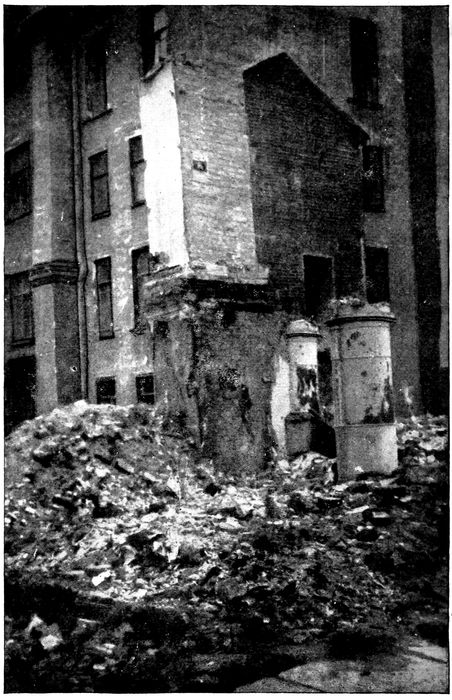
 YORK