The Great River—Kasan,
Tsaritzin—Astrakhan
ANTONIO GALLENGA
It is hardly possible to travel on the Volga without falling in
love with the great river at first sight.
The range of low hills which we had on our right as we descended
the Oka continued now on the same side as we came down the Volga.
The Volga, however, has nothing of the wild, erratic instincts
of its tributary. It is a grand, calm, dignified stream, keeping
to its course as a respectable matron, and gliding down in placid
loveliness, without weir or leap, fall or rapids, or break of any
kind—a fine, broad, almost unrippled sheet of water, with
an even, steady, and grandly monotonous flow, like that of the
stanzas of Tasso.
Its width, so far as eye can judge, does not greatly exceed that
of the Thames at Gravesend, but it is always the same from the
bridge at Twer above Moscow to the only other bridge, one mile
in length, between Syzran and Samara; everywhere the same "full
bumper" for a run of 2,000 English miles.
Though the Volga is numbered among the European rivers, and has
its sources on the Valdaï hills between the European cities,
St. Petersburg and Moscow, it is a frontier stream, and seemed
intended to form the natural line of demarcation between two parts
of the world—between two worlds.
Up to the middle of the Sixteenth Century, Kasan was the advanced
guard of the Tartar hordes. These wandering tribes, which, profiting
by dissensions among the Russian princes, overcame and overran
all Russia, weakened in their turn by division, fell back from
the main part of the invaded territory, but still held for some
time their own on the Volga, from Kasan to Astrakhan, till they
were utterly routed and brought under Russian sway by Ivan the
Terrible.
Even then, however, though their strength was broken, their spirit
was untamed. The men of high warrior caste who survived their defeat
sought a refuge among their kindred tribes further east, at Samarkand,
Bokhara, and Khiva, where the Russians have now overtaken them;
but a large part of the mere multitude laid aside without giving
up their arms, passively accepted without formally acknowledging
the Tsar's sway, and abided in their tents,—swallowed at
once, but very leisurely digested, by the all-absorbing Russian
civilization.
Large bodies of the nation, however, migrated en masse from
time to time, the lands they left vacant being rapidly filled up
by bands of Cossacks, and by foreign (chiefly German), colonists.
For more than three centuries, though already mistress of Siberia
and victorious in remote Asia, Russia proper might be considered as
ending at the Volga; so that most of the older and most important
towns south of Kasan and north of Astrakhan, such as Simbirsk,
Syzran, Volsk, Saratof, Kamyshin, and Tsaritzin, lie on the right,
or Russo-European bank of the stream.
Tsaritzin is at the head of the Delta of the Volga, and it lies 580
versts above Astrakhan, which is said to be at the river's mouth,
but which is still 150 versts from the roadstead or anchorage,
called the Nine Feet Station; the spot on the Caspian where sea
navigation really begins.
At Tsaritzin we might have fancied ourselves in some brand-new
town in one of the remote backwoods of America. It was nothing of
a place before the railway reached it. No one can foretell what
it may become before the locomotive travels past it. For under
present circumstances all the postal service, the light goods and
time-saving passenger traffic from all parts of Russia to Astrakhan,
the Caspian and the Trans-Caspian region, or vice versâ,
must pass between the Tsaritzin pier on the Volga and the platforms
of the Tsaritzin railway station.
We did not see much of the upstart town, for the horrible clouds
of thick, dung-impregnated dust would not allow us to keep our
eyes open. But we perceived that almost every trace of what was
once little better than a second rate fortress and a village was
obliterated; the old inhabitants were nowhere, and a bustling set
of new settlers were sharing the broad area among themselves, taking
as much of it as suited their immediate wants, and extending it to
the utmost limits of their sanguine expectations; drawing lines
of streets at great distances, tracing the sides of broad squares
and crescents, and laying the foundations of what would rise in
time into shops and houses, hotels, bazaars, theatres and churches.
Tzaritzin when we saw it was merely the embryo of a city. Those
that may visit it a score of years hence will tell us what they
find it.
Two more nights and a day down the sluggish waters of the main
channel of the Volga landed us on the tenth day after our departure
from Nijni-Novgorod, at Astrakhan, where we stayed a whole week.
From Tsaritzin to Astrakhan the Volga flows through the Steppe,
the great Asiatic grass desert extending from the Caucasus to the
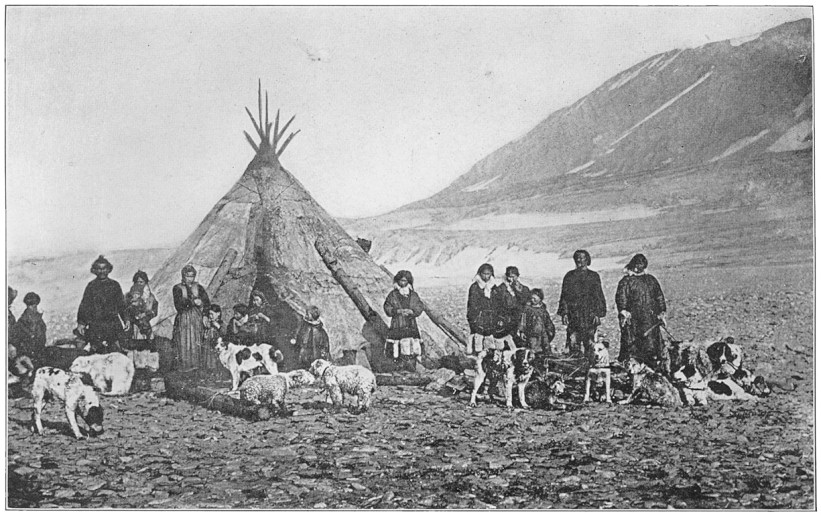
frontier of China. The wild tenants of this wilderness, the various
tribes of Tartars, once the terror of East and West, were like a vast
ocean of human beings swayed to and fro by nomadic and predatory
instincts, which for centuries threatened to overwhelm and efface
every vestige of the world's civilization.
The Russians who were first invested and overpowered by the flood,
were able by the valour and more by the craft of their princes,
first to stem the tide, then to force it back, and in the end to
rear such bulwarks as might for ever baffle its fury, and prevent
its further onset.
Such bulwarks were once the strong places of Kasan and Astrakhan,
the former seats of Tartar hordes, which the Tsars of Moscow made
their bases of operations for the indefinite extension of their
civilized empire over Tartar barbarism.
For the experience of centuries had proved that the Steppe was not
everywhere and altogether an irreclaimable land, nor the Tartars
an utterly untameable race.
Astrakhan, like Kasan, is a Russian town, of whose 50,000 inhabitants
one-fourth or one-fifth at least are tamed Tartars, and the sands
around which can be made to yield grapes and peaches, and a profusion
of melons and watermelons. Beyond the immediate neighbourhood,
over the whole province or "Government" of Astrakhan, stretches
the vast land of the Steppe, the wide and thin pasture-grounds on
which the Tartar tribes roam at will with their flocks; a pastoral
set of men; without fixed homes, and, in our sense of the word,
without laws; and yet perfectly harmless and peaceful—exempt,
at least till very lately, from military service, and only paying
a tribute of 45,000 roubles, at so much a head for each horse,
ox, or camel, ranging over an extent of 7,000,000 dessiatines
(20,000,000 acres) of land, an area of 224,514 kilometers, or about
half of that of France, with a population, including that of the
capital, of 601,514 inhabitants.
Astrakhan is a modern town, with the usual broad, straight streets,
most of them boasting no other pavement than sand, with brick
side-walks, much worn and dilapidated, and, like those of Buenos
Ayres and many other American cities, so raised above the roadway
as to require great attention from those who do not wish to run
the risk of broken shins.
The town has its own Kremlin, apart from the citadel. The Kremlin
is a kind of cathedral-close, with the cathedral and the archbishop's
palace, and several monasteries and priests' habitations. The whole
town, besides, and the environs, as usual in Russia, muster more
churches than they can number priests or worshippers.
In a walk of two or three miles I took outside the town and as
far as the cemeteries, I had a scattered group of at least half
a score of churches all around me, but there was scarcely a human
habitation within sight.
The governor's palace is a low building over a row of shops in the
main square of the city. The square itself and the thoroughfares were
enveloped in thick clouds of blinding dust, almost as troublesome as
that of Tsaritzin; but on the whole, the place is less unclean than
one might expect from a population made up of Russians, Tartars,
Calmucks, Persians, Armenians and Jews.
The Volga and the hundred channels which constitute its delta,
and the northern shores of the Caspian Sea into which they flow,
yield more fish than the coasts of Norway and Newfoundland put
together. The nets employed in catching them would, if laid side by
side on the ground in all their length, extend over a line of 40,000
versts, or twice the distance from St. Petersburg to Tashkend and
back. The annual produce of these Astrakhan fisheries—sturgeon,
sterlet, salmon, pike, shad, etc.—amounts to 10,000,000 puds
of fish (the pud thirty-six English pound weight) of the value of
20,000,000 roubles, the herrings alone yielding a yearly income
of 4,000,000 roubles. With the exception of the caviare, which is
sold all over the world, the produce of these fisheries, salted
or pickled, is destined for home consumption, and travels all over
the empire, although as far as I have been, I have found everywhere
the waters equally well-stocked by nature with every description
of fish; a provident dispensation, since the Russian clergy, like
the Roman Catholic, are indefatigable in their promotion of what
they call "the Apostles' trade," by their injunction of 226 fast
or fish days throughout the year.
The Delta of the Volga and the Caspian Sea lie twenty-five metres
below the level of the Black Sea.
The city of Astrakhan, placed on the left bank of the main channel
of the Delta, and, as I said, 150 versts above its anchorage, becomes
like an island in the midst of a vast sea when the Volga comes down
in its might with the thaw of the northern ice in late spring;
and most of its lowest wards would be overwhelmed were it not for
the dikes that encompass it like a town in Holland.
The eight principal branches and the hundred minor channels and
outlets of the Delta, breaking up the land into a labyrinth of
hundreds of islets, are then blended together in one watery surface,
out of which only the crests of these islets emerge with isolated
villages, with log-huts and long whitewashed buildings, and high-domed
churches, all dammed and diked up like the town itself—Tartar
villages, Calmuck villages, Cossack villages, all or most of them
fishers' homes and fishing establishments—a population of
20,000 to 30,000 souls being thus scattered on the bare sand-hills
and dunes; men of all race, colour, and faith, all employed in the
same fishing pursuit; the Tartars and Calmucks usually as rank
and file, the Russians and other Europeans as overseers, foremen,
and skilled labourers.
From Astrakhan, the queen of the Steppes, to Tiflis the queen of
the Caucasus, we had a choice of routes.
Tourists from England, or from any part of Western Europe, may
easily visit the great mountain-chain on which Prometheus was found,
by crossing the Black Sea from Constantinople or from Odessa, and
landing at Poti, where the Russians have constructed a railway
to Tiflis, once the capital of Georgia, now the residence of the
Governor-General of the whole Caucasus region.
A traveller from the north, bound to the same goal, can take the
train at Moscow, and come down by rail, via Rostov-on-the-Don,
all the way to Vladikavkas, a distance of 1,803 versts; and about
200 additional versts, by post, over a good military road, and
across the main Caucasian chain, will bring him from Vladikavkas
to Tiflis.
But we had descended the Volga, and were now near its mouth. We
had to go down the Volga to the Nine Feet Station below Astrakhan,
embark there on the Caspian Sea, and cross over either to Baku,
whence we could go by post round the mountain-chain at its southern
extremity as far as Tiflis; or land at Petrofsk, and travel along
the chain to Vladikavkas and the good military road across the
chain to Tiflis.
We gave our preference to the last-named route.
We left Astrakhan at ten in the evening on board a heavy barge
belonging to the Caucasus and Mercury steam-navigation company,
towed by a tug down stream at the rate of five or six miles an
hour.
We were all that afternoon and night, and part of the following
day, descending the main channel of the Volga, and it was past
noon before we reached the Nine Feet Station, for so they call
the roadstead above which vessels of more than nine feet draught
dare not venture.
All sight of land, of the seventy larger islands of the Delta,
and even of the minor islets, and of the lowest sand-banks, had
been lost for several hours, and we were here in the open sea,
though scarcely beyond the boundary that the Creator has elsewhere
fixed between land and water. For the Station which, if I can allow
myself an apparent Irishism, is a moveable one, has to be pushed
forward almost day by day as the sands of the Volga silt up far
beyond the choked-up lands of the Delta, encroaching with a steady
inroad on the depths of the waves; the Steppe everywhere widening
as the sea dwindles, and suggesting the thought that the whole
region that is now Steppe must in remote ages have been sea, and
that whatever is now sea, must in time become Steppe.
Indeed, it seems not impossible to calculate how many years or
centuries it may take for the sands of the Volga, aided by those of
the Ural and the Emba on the eastern, and of the Kuma, the Terek,
and the Kur or Kura, with its tributary the Aras, on the western
shore, to fill up the land-locked Caspian, though its extreme depth,
according to the Gazetteers, is 600 feet, and the area covered by
it probably exceeds 180,000 square miles, a surface as large as
that of Spain.
Kasan, once the residence of a redoubted horde, was probably, under
Tartar sway, in a great measure a mere encampment, chiefly a city of
tents; for whatever the guide-books may say, there is no positive
evidence of its present buildings belonging to a date anterior to
the Russian Conquest.
Its situation probably recommended itself to the Tartars chiefly
on the score of strength; for although it stands high above the
river, its present distance from it is at least three miles, and
it is surrounded by a sandy and marshy plain, intersected by the
channels of the Kasana river, erratic water-courses which may have
proved sufficient obstacles to the onset of an invader, but which
raise no less serious hindrances to the conveyance of goods from
the landing-place to the town; an inconvenience hitherto not removed
by the tramway, as it as yet only carries passengers.
Kasan is on the main line of communication between Central Russia
and Siberia.
The travellers bound to that bourne embark here on steamers that go
down the Volga as far as its confluence with the Kama, a tributary
stream, and thence ascend the Kama, which is navigable all the
way to Perm. From Perm a railway runs up to the Pass of the Ural
mountains to Ekaterinenburg, probably to be in course of time continued
to Tiumen, Tobolsk, Tomsk, Irkutsk, the Baikal Lake, the Chinese
frontier at Kiakhta, the banks of the Amoor, and the shores of
the Pacific Ocean.
Along this route it is calculated that some £3,000,000 worth
of merchandise are brought yearly from Siberia down the Kama and
up the Volga to the Nijni-Novgorod fair.
Kasan is a highly flourishing city. It has a population of 90,000
to 100,000 inhabitants, one-fourth of whom are Tartars.
These descendants of the old Nomad race are now here at home, and
live in the city perfectly at peace with their Russian fellow-subjects,
though being Mahometans, they have distinct, if not separate, quarters,
and mosques and a burial-ground of their own. It would seem impossible
for two races which have so little reason for mutual good-will, to
show so little disposition to quarrel. But it should be remembered
that Sclav and Tartar were not in former times so far asunder in
manners, in language, in polish, nor so free from admixture in
blood as the Russians fondly believe.
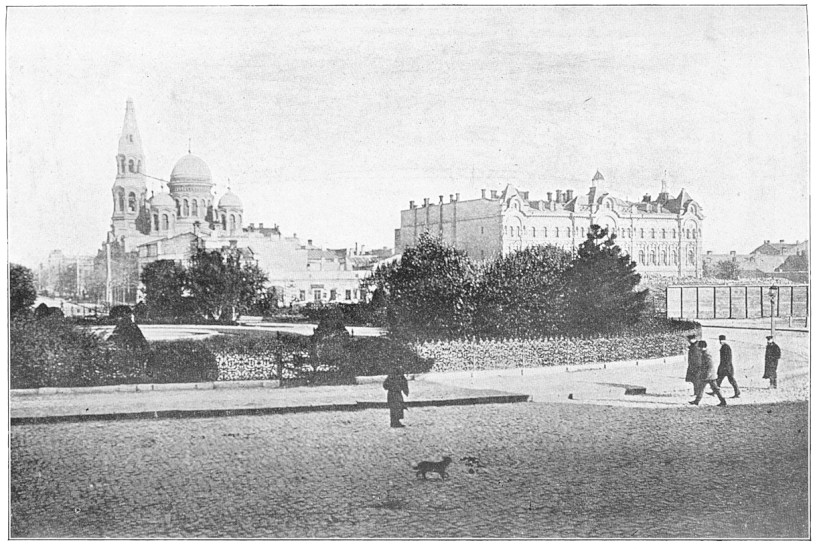
The town has its Kremlin, on the site of the old citadel, with
its cathedral and other churches, and several "telescope towers,"
if they may be so called, built on several stories, dwindling in
size from floor to floor as they rise one above the other, so that
one can conceive how they might easily sink into one another and
shut up like a spy-glass. The great brick tower of Pier Crescenzi
in Rome is such a tower; and here are many in the same style at
Moscow and in most other old Russian cities. Kasan has several public
edifices of some pretension: the Admiralty; the University—one
of the seven of the Empire, etc. But we had enough of it all after
two or three hours, and were glad to shun the heat of the rest
of the day in the cool sitting-room of Commonen's Hotel, which
alone may be taken as a voucher for the high degree of civilization
reached by Kasan.
We gave even less time to the other cities of the Volga, not thinking
it always worth while to alight at all the stations, though the
steamer stopped at some of these for many a long, weary hour.
With the exception of Kasan, Samara, and Astrakhan, the most important
cities are, as I said, on the right or Russian bank of the River;
and three of them, Syzran, Saratof, and Tsaritzin, are connected
by various railways with Moscow and all the other important centres
of life in the Empire.
The Volga, which between Nijni-Novgorod and Kasan flows in an almost
straight easterly direction, takes a turn to the southward after
leaving Kasan and the confluence of the Kama; but it makes a loop
below Simbirsk, turning eastward to Samara, and again west to Syzran,
after which it resumes its southerly course to Saratof, Tsaritzin,
and Astrakhan.
The railway from Moscow to Syzran, upon reaching Syzran, crosses
the Volga on an iron bridge, one verst and a half, or one English
mile, in length, and high enough to allow the largest steamer pass
without lowering its funnel—a masterpiece of engineering
greatly admired by the people here, who describe it as the longest
bridge in Russia and in the world.
We went under it at midnight by a dim moonlight which barely allowed
us to see it looming in the distance not much bigger than a
telegraph-wire drawn all across the valley, the gossamer line of
the bridge and all the landscape round striking us as dreamlike
and unreal.
After crossing the river the railway proceeds to Samara, and hence
419 versts further to Orenburg, a large and thriving place on the
Ural river, the spot from which the straightest and probably the
shortest way is, or will be, open to all parts of Siberia or Central
Asia; preferable, I should think, to that of Perm and Ekaterinenburg
above-mentioned, which is now the most frequented route.
Beyond Syzran and Samara the river scenery, which has hitherto
been verdant, assumes a southerly aspect; the hill-sides sloping
to the river have a parched and faded brown look; the hill-tops are
bared and seamed with chalky ravines; every trace of the forests
has disappeared; and it is only at rare intervals that the banks
are clad with the verdure of the new growth.
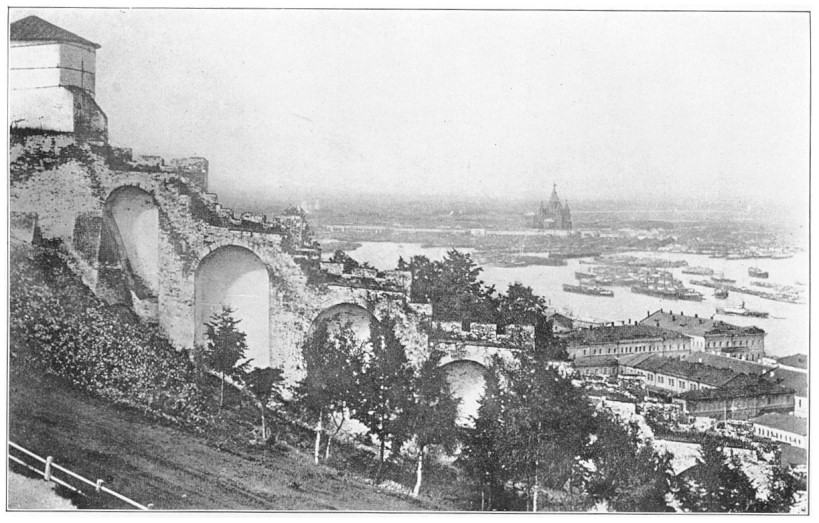
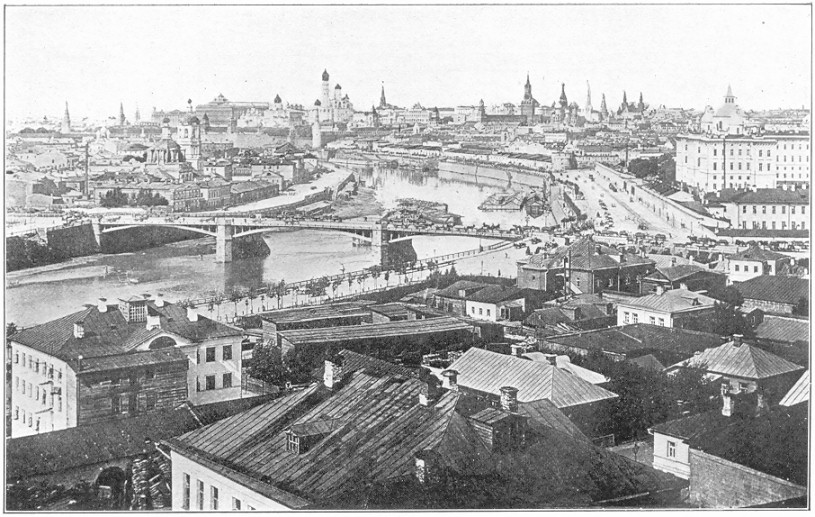
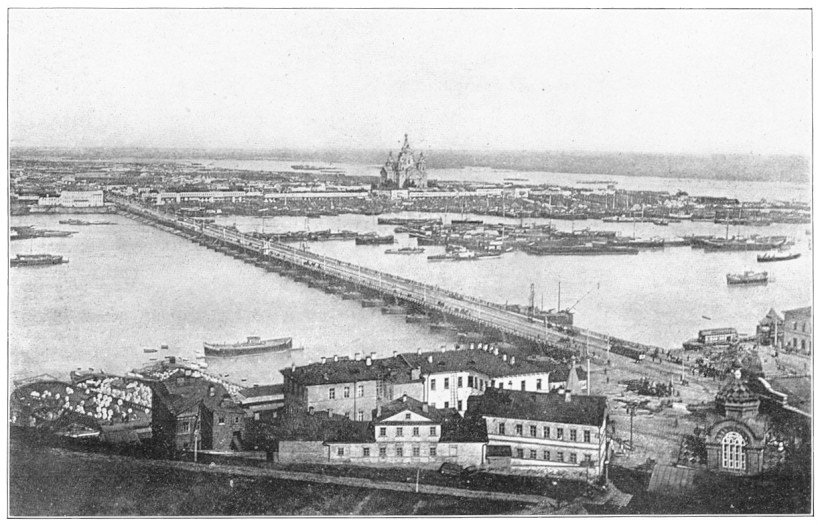
FROM THE RAMPARTS OF THE KREMLIN NIJNI-NOVGOROD.
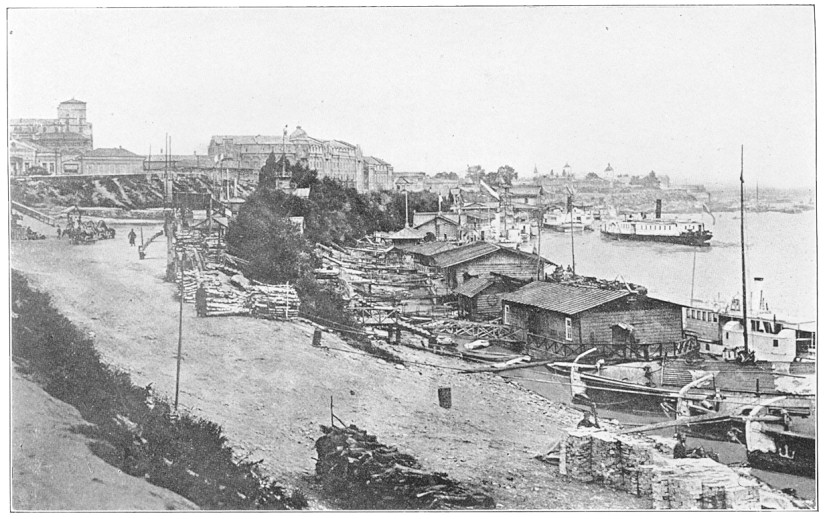
From Nijni to Tsaritzin we have stopped at more than thirty different
stations, and no pen could describe the stir and bustle of goods
and passengers that awaited us at every wharf and pier.
Several of these stations are towns of 50,000 to 100,000 inhabitants,
and, besides their corn trade and tobacco, they all deal in some
articles of necessity or luxury, of which they produce enough for
their own, if not always for their neighbours', consumption.
Everywhere one sees huge buildings—steam flour-mills,
tobacco-factories, salt-mines, soap and candle factories,
tanneries—and last, not least, palaces for the sale of
koumiss or fermented mare's milk, a sanitary beverage; and
extensive establishments, especially near Samara, for the koumiss
cure,—fashionable resorts as watering-places, frequented
by persons affected by consumption, and other real or imaginary
ailments.
There is something appalling in the thought that all this busy,
and, on the whole, merry life on the banks of the Volga must come
to a dead stand-still for six or seven months in the year. I have
been vainly taxing my brain to guess what may become of the captains,
mates and crews of the 700 steamers, and of the 5,000 heavy barges
with which the river is now swarming; of the porters, agents, clerks,
and other officials at the various stations; of the thousands of
women employed to carry all the firewood from the piers to the
steam-boats. What becomes of all these, and of the men and horses
toiling at the steam-row and tow-boats on the Oka, the Kama, the Don,
the Dnieper, and a hundred other rivers during the long season in
which the vast plains of Russia are turned into a howling wilderness
of snow and ice from end to end?
Railway communication and sledge-driving may, by doubling their
activity, afford employment to some of the men and beasts who would
otherwise be doomed to passive and torpid hybernation. But much of
the work that is practicable in other countries almost throughout
the year—nearly all that is done in the open air—suffers
here grievous interruption.
What should we think in England of a six months' winter, in which
the land were as hard as a rock, in which all the cattle had to
be kept within doors, in which the bricklayer's trowel and the
road-mender's roller had to be laid aside?
And, by way of compensation, what mere human bone and muscle can
stand the crushing labour by which the summer months, with their
long days of twenty hours' sunlight, must make up for the winter's
forced idleness; in a climate too, where, as far as my own experience
goes, the heat is hardly less oppressive and stifling than in the
level lands of Lombardy or the Emilia?