VIII
RUSKIN'S DRAWINGS
In his introduction to the Catalogue of a Ruskin Exhibition at
Boston, U.S.A., in 1879, Professor Charles Eliot Norton wrote
a paragraph which, as the verdict of a severely discriminating—though
friendly—critic, is worth reading more than once again.
He said: "The character of this collection is unique. These
drawings are not the work of an artist by profession; there is
not a 'picture' among them. They are the studies of one who,
by patience and industry, by single-minded devotion to each
special task, and by concentrated attention upon it, has trained
an eye of exceptional keenness and penetration, and a hand of
equally exceptional delicacy and firmness of touch, to be the
responsive instruments of faculties of observation and perception
such as have seldom been bestowed on artist or on poet. Few
of these drawings were undertaken as an end in themselves, but
most of them as means by which to acquire exact knowledge of
the facts of nature, or to obtain the data from which to deduce
a principle in art, or to preserve a record of the work of periods
in which art gave better expression to the higher interests and
motives of life than at the present day. These studies may
consequently afford lessons to the proficients in art not less
than to the fresh beginners. The beauty of some of them will
be obvious to an untrained eye; but no one may hope to
appreciate them at their worth who will not, in a respectful and
modest spirit, give time and patience to their study."
In his childhood, long before he thought of drawing from
Nature, he had learnt great neatness of hand by amusing himself
with copying out his juvenile verses to look like print,
by drawing maps and by making facsimiles of George
Cruikshank's etchings in his "Grimm's Goblins." His father
used to sketch a little in the pre-historic style, and was fond of
pictures; but they never dreamed of making John an artist.
At last, when he was thirteen, and his adopted sister, Mary, was
taking drawing lessons at school with much satisfaction to the
family, he, too, was allowed to "learn drawing." Mr.
Runciman, his master, gave him "copies"—the old, bold
pencil copies—which he tried to imitate in a kind of stipple, at
first, but soon picked up the manner, and in a year, as we find
from old letters, was talking like a book about perspective and
composition, and going to begin painting "on grey paper, with
a few of the simplest colours, in order to learn the effects of
light and shade." Mr. Runciman must have been a good
teacher, for this method of his, on grey paper with a few simple
colours, to get light and shade, is exactly what John Ruskin
learnt thoroughly after awhile, and taught energetically in
his turn all his life. But Mr. Runciman could not bring him
to paint in oil, and does not seem to have had much of a
system; for one of John Ruskin's letters in verse to his father,
written early in 1834, says:
"I cannot bear to paint in oil.
C. Fielding's tints alone for me!
The other costs me double toil,
And wants some fifty coats to be
Splashed on each spot successively."
In his later years he used to say that the practical reason
why he never went on with oil painting was that he had to
draw—and to keep his drawings—among books and papers,
and oils were messy, and did not smell nice. But no doubt the
real fact was that his drawings were mainly meant for book-illustration,
done for the engraver, and intended, on a small
scale, to get as much form as possible. All his experiments
in oil seem to have been suppressed; though his water-colour
practice, especially in later times, was to use Chinese white, and
often a good deal of it, very nearly as if it had been flake white.
After some feeble attempts by himself at sketching from
Nature, in 1831 and 1832, he went abroad with his parents for
the summer of 1833, and drew diligently. He had received
for a birthday present the volume of Rogers's "Italy," with
Turner's vignettes, and intended to make something like it, in
a book of verses neatly copied out, with vignettes reproduced
in fine pen-work from his sketches on the spot. Whenever
the carriage stopped he would snatch a sketch, and whenever
they put up for the night he would write up his poetical diary.
Coming home, he began his great work, but school lessons
interfered; not before he had half filled the blank book, and
pasted in a number of neat and pretty vignettes, of which the
best is The Jungfrau from Lauterbrunnen, reproduced in "The
Poems of John Ruskin," on the same scale.
Meanwhile, he had come under the influence of Samuel
Prout, whose work his father admired; and on the next tour,
in 1835, Turner was forgotten in the attempt to be Prout.
The drawings of this "great year," as he called it, when they
are put in order, show a wonderful progress from the first stiff
and timid studies, fresh from the attempt to copy Prout's
lithographs, to a free and quite masterly adaptation of Prout's
"line and dot" manner. By the time he reached the Oberland
and Venice, he had "got his hand in," and the subject went
down upon the paper with ease and decision, always abstracted
and mannered, but with a feeling after style which was entirely
Ruskin. Both in drawing and in writing, much as he talked of
truth and simplicity, he was, first and foremost, the stylist:
and through half his life the conscious imitator of other men's
styles—Hooker or Carlyle, Prout or Turner. But there was
always more of Ruskin than of his model; and even in those
juvenile essays, when style so completely overwhelms fact, as in
some sketches at Venice or Innsbruck, there is a precocious
completeness and charm, as in the art of youthful nations,
early Greeks, pre-Norman English, or pre-Renaissance Italians.
The pen-drawings of this year have less interest, for they
were made from the originals to illustrate another intended
manuscript, and the life, of course, went out of them. Some
of these pen-drawings, as well as some of the original and
superior pencil-drawings, are published in facsimile in the
"Poems" and "Poetry of Architecture" (large editions of
1891 and 1893). Other facsimiles are given in "Studies in
Both Arts" and "Verona." The plates in these volumes very
fairly represent Ruskin's handiwork at different periods, and
are indispensable to any one who wishes to study it. Plates in
"Modern Painters" and "Stones of Venice," nearly all by
engravers after his work, do not represent it in the same
authentic manner.
Before he had completed his new book he wanted more
skill in colour, and took lessons from Copley Fielding, with
no great result, except that the style which he had gained by
practice abroad was lost in trying after new models. The
sketches of his period as an Oxford undergraduate are comparatively
tame and commonplace (1836-1839), though he did
some neat bits for Mr. Loudon's wood engraver to spoil in
the papers on "The Poetry of Architecture," in the Architectural
Magazine, which were his first published writings on
art.
In 1840 he broke down in health, after winning the
Newdigate prize for poetry at Oxford, and before taking his
degree. His parents went with him in the autumn to spend
the winter abroad, as a cure for consumption. He did the
best for himself, according to new lights on the subject of
hygiene, by spending nearly all his time sketching in the open
air. Through France to the Loire and Auvergne, round the
Riviera to Pisa and Florence and Rome, we can trace him by
his drawings, made now on a new method. David Roberts
had been showing his Syrian sketches, hard pencil on grey
paper, with yellow lights in body colour, and the new style
caught young Ruskin's attention before he started for his
journey, so that he set out with the resolve of being Roberts
now. The same decision of line shows itself on this much
larger scale; he always seems to know what he wants, and to
get it without trouble; though when one remembers that these
half-imperial drawings were done by an ailing lad, supposed to
be within danger of death, it is not a little remarkable to see in
them such evidences of tenacity and pluck.
At the beginning of 1841 they moved on to Naples, and
made excursions to Salerno, Amalfi and the neighbourhood,
always with a drawing to bring back; and when he was on his
way home, through North Italy, he wrote triumphantly to a
friend that he had "got forty-seven large and thirty-four
small sketches."
But what he could do with the stimulus of travel he could
not do again in the reaction after it was over. He was not
quite well yet, and went to Leamington to be under a doctor,
in dull lodgings, and without any mountains. Still he drew.
By this time he had dropped David Roberts, and taken up
Turner, whose art he had already thought of defending against
the magazine critics. It was in these circumstances that he
made the Amboise, from a sketch of the year before, and
certain vignettes for engraving, which were published in
"Friendship's Offering," with his poems. In the new Library
edition, vol. ii., photographs from the original Amboise, and
from the old engraving after it, are given, well worth comparing.
He was not naturally a colourist. In later life he found
out for himself the ways and means of producing bits of very
sweet opalescent colour, but at any time was capable of
relapsing into gaudiness, in hours of fatigue or ill-health; and
throughout his earlier life he was much more at home in light
and shade, or in work with the point. It was not that he did
not see and enjoy colour. To judge by his writings, one would
think that he lived for it, almost: and the splendid passage in
the first volume of "Modern Painters," so often quoted for its
word-painting of colour, was written from his diary-notes on
the way back from Naples in 1841. He made a drawing of
the scene he described; one would expect at least an attempt at
"purple, and crimson, and scarlet, like the curtains of God's
tabernacle"; but it is merely washed with faint tints over an
elaborate outline of the architecture.
So the passing mood in sickness, which had led him to try
after Turnerian colour, left him in health, for the more attainable
method of Turner's "Liber Studiorum," and he began, in
1842, to make this his own. A slight pencil blocking out,
firm and emphatic quill-pen to represent the etched line, and
brushwork in brown, rarely in black, sometimes with a little
colour, over paper usually grey—this was after all the manner
that suited him best, and very nearly what Mr. Runciman had
talked about, ten years before. By degrees, year after year,
the pen work became finer, and the colour more predominant;
the solid white, used at first for high lights, invaded the tints
and gave a mystery to the outline, and in ten years more he
had found out his central style, a manner quite his own,
producing beautiful results but inimitable by engraving,
whether the old style of steel-plate or the new style of photographic
process. That style in turn developed into the delicate
and often dainty water-colour painting of his later years—passing
by the way through a phase in which the pencil took
the place of the pen, useful for getting notes of architectural
detail and mountain form—and never quite abandoned, though
the pencil drawings of the later period became a distinct series,
free and emphatic and suggestive, apart from the more
laborious elaboration of his last paintings.
In 1845 he went alone, unaccompanied by parents and
family, to Italy, and found adventures. He made the acquaintance
of the primitive masters at Lucca and Florence, and
copied a little; then to the Alps to look for Turner's subjects
in the Alpine sketches of 1842, which had so taken his heart.
Turner did not like it; it was dangerous to have a writing
young man looking behind the scenes of imaginative picture
production; but Ruskin found out Turner, and was all the
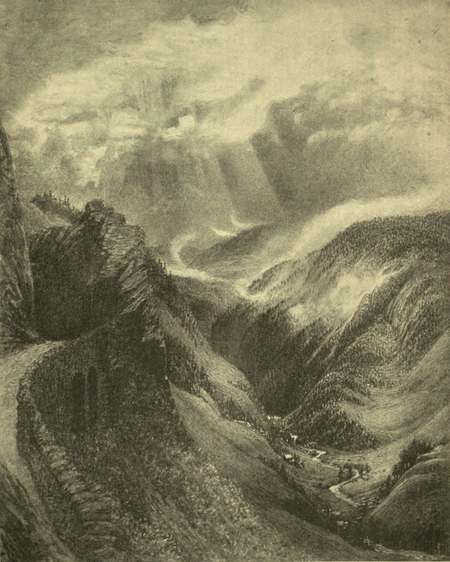
more enthusiastic for the discovery. He drew the Pass of
Faido, and saw what Turner had seen, and what he had
invented, more wonderful than any transcript from Nature;
and afterwards filled half a volume with the endeavour to
expound the same. Then, with his versatility of sympathy, he
met J. D. Harding, who was not so much his teacher as a
valued friend, and together they went to Venice. One sketch-book
leaf of this time is particularly interesting—with a pen
and tint drawing of a mill at Baveno on one side, and a slapdash
sunset on the other, almost Harding. These are photogravured
in the "Poems."
The drawings of 1846 were the first serious mountain
studies, afterwards used for "Modern Painters," though many
things intervened. Sickness at first, and the visit to Crossmount
in the Highlands, recorded in some drawings, not his
best; and then "Seven Lamps of Architecture," for which he
studied in Normandy in 1848, and etched the plates himself in
soft ground—strong, sketchy plates which were thought a
failure at the time, and re-engraved in a queer imitation of the
originals by a professional engraver for the next edition. Then
he set to work upon "Stones of Venice."
He had already some material, but most of the drawings
were made in two winters, November 1849 to March 1850,
and September 1851 to June 1852. Many of the best have
been dispersed, some are in America, but enough remain to
show what a busy time it was, and how much downright drawing
went to the making of that book: how much more drawing,
and of how much finer quality than one can guess at from
reading the book. The large plates in "Examples of the
Architecture of Venice" were not only from his sketches, but
from carefully prepared working drawings. For a mezzotint,
like the St. Mark's Portico or the Arch of Ca' Contarini Porta di
Ferro, he drew the outline separately for etching, and made
another drawing with the tint for the completed engraving.
To do a subject over again seemed no grievance with him, and
there are many examples of his patience in trying the identical
view in different aspects or lights, or even redrawing it from
Nature without alteration, merely to get a result more to his
mind. That the result was worth while in the end we need not
stop to declare. "Stones of Venice" was a revelation to architects
and the public, and for a long while exerted an enormous
influence upon English taste. Suppose, for a moment, such a
book had been written, with all the enthusiasm and learning in
the world, by a man who could not draw!
The later volumes of "Modern Painters," which followed
this, owed their success in great measure to the same cause. The
engravings, beautiful as they are, hardly show the originals;
though from the book one knows that its author had dwelt
upon the aspects of Nature with more than a tourist's glance,
and that he had struggled with the problems of art with more
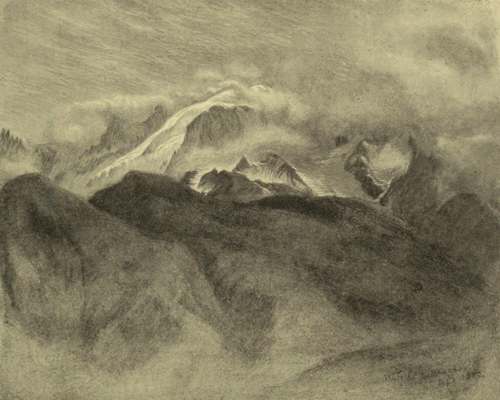
than an amateur's attention. His Aiguilles and Matterhorns,
his Aspen and his mossy stones, his repeated studies from
Turner and the Old Masters, down to the enlargements from
illuminated missals, all tell the same tale of passionate interest
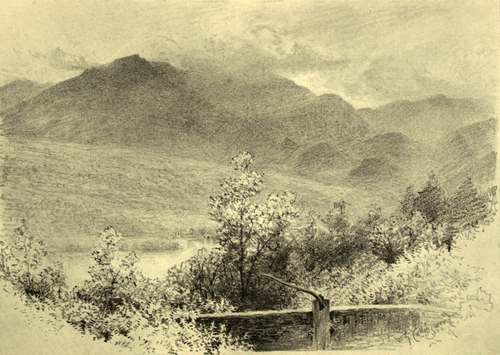
in the subject and penetrative insight into the situation. They
are not, as Professor Norton says, pictures; but incomplete as
they are, there is in them an appeal to which most of those who
love pictures will respond.
During the progress of "Modern Painters," Mr. Ruskin
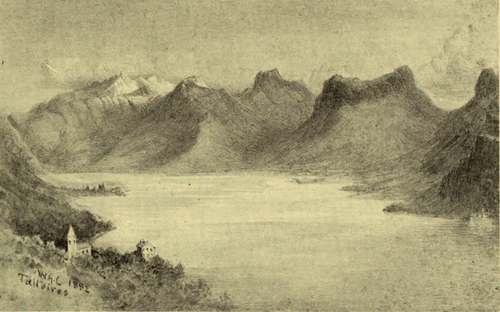
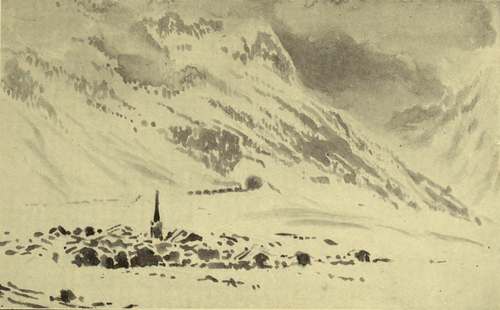
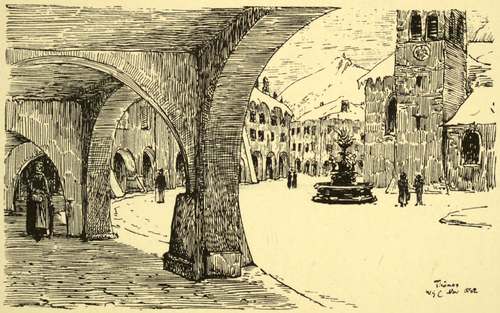
planned a "History of Swiss Towns," for which he spent several
summers in gathering material. His drawings for this series were
more full of detail, handled with extremest fineness in some parts
and with great breadth, often carelessness, in others; intended
for completion and engraving when time should serve. But
this time never came. He was led into the interests in political
and social economy which, in these later years, with a public
tired of hearing about Ruskin and art, have given him a place
among the prophets. He was led into further studies of the
geology of scenery, lightly touched in "Modern Painters,"
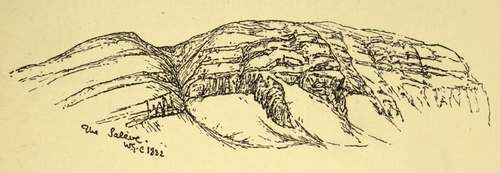
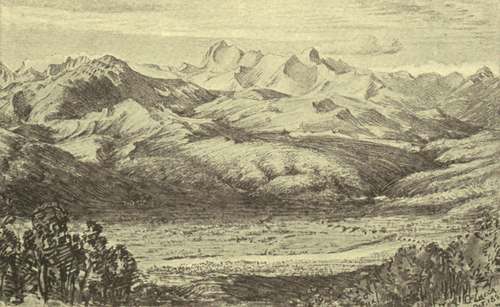
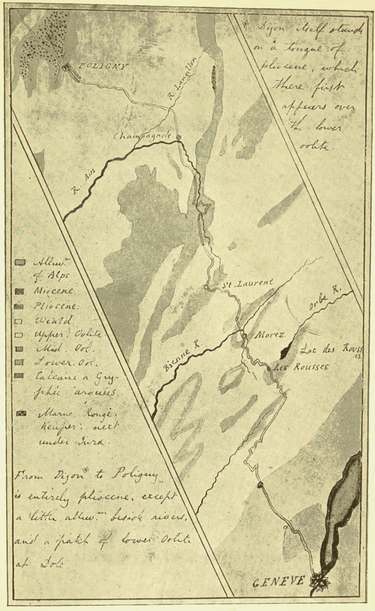
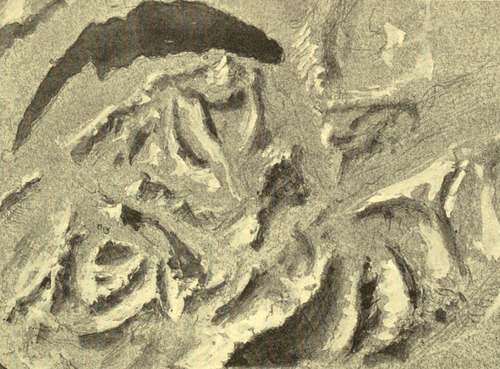
and, during long residence in Savoy and Switzerland, drew Alps
chiefly for their cleavages, and threw the drawings aside. He
was led into botanical and mineral researches, and Egyptology
and Greek coins, and other by-ways, always, however, drawing
as he went, but drawing subjects less interesting to the general
onlooker. But from this backwater he emerged into a new and
more developed style which began to show results in 1866, on
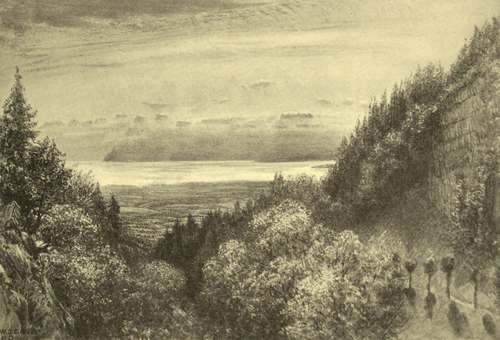
a long summer tour in the Oberland, when he made the sketch
On the Reuss below Lucerne, in "Poetry of Architecture"—a
combination of such breadth and delicacy as he had hardly
attained before, and much fine work with the point.
Next year but one, 1868, his ancient love for French Gothic
took him to Abbeville. There the new style had full scope in
the delicate drawings of that date, a long way in advance of
old "Seven Lamps" period: and the same kind of work was
continued in the next year at Verona (May to September), a
summer of very busy painting in the company of his two assistants,
Mr. William Ward and the late Mr. J. W. Bunney.
The Abbeville drawings were shown in a semi-public
manner at a little exhibition to illustrate his lecture on the
"Flamboyant Architecture of the Valley of the Somme," at the
Royal Institution, January 29, 1869; and the Verona drawings
at a similar lecture at the same place on February 4, 1870.
The catalogue of the latter is printed in "On the Old Road,"
vol. i., part 2, with twenty pieces marked as his own.
In this year he entered on his duties as Slade Professor
at Oxford, and before long had established a drawing-school
there, which took up a great part of his attention. Of this
period is a sketch "Done with my pupils afield," and he used
sometimes to draw in the school, and often to draw for the
school. A Candle, finely shaded, and various botanical studies,
were meant as "copies" or as examples of the treatment he
proposed to his students; and the catalogue of the Ruskin
Drawing School at Oxford contains a very large number of
items by himself, from the great St. Catherine, after Luini, to
little memoranda of plant forms. Several of these examples
of his hand have been engraved in Mr. E. T. Cook's "Studies
in Ruskin."
In 1870 and 1872 he was again drawing at Venice. The
elaborate beginning of the "Riva de' Schiavoni," and the
effective Rialto (in the possession of Miss Hilliard, Coniston),
done one morning before breakfast, are of the former year. In
1874, after a breakdown in health, he visited Assisi, Rome,
and Sicily, and beside the notes of Mount Etna and Scylla
he brought home a series of careful copies from parts of the
Botticelli frescoes at the Sistine Chapel, and the fully realised,
though not completed, Glacier des Bossons, a remarkable piece
of landscape work. In 1876 he went again to Venice, this
time chiefly to copy Carpaccio, though some of his best later
views of canals and palaces bear that date, or the early part of
1877, for he stayed on until May of that year. Casa Foscari
(in the possession of Mrs. Cunliffe, Ambleside) may be named
as a characteristic example of his daring point of view, and
success in giving the mass of building in steep perspective.
In 1878 an exhibition of his drawings by Turner was held
at the Fine Art Society's Galleries in New Bond Street. During
the show he was taken seriously ill, and while convalescent he
amused himself by arranging a small collection of his own
sketches to add to the exhibition. His catalogue and remarks
are given in the later editions of "Notes on his Drawings by
Turner," &c., 1878. Next year a number of his studies were
shown in Boston, U.S.A., under the management of Professor
Charles Eliot Norton, whose appreciative paragraph we have
quoted.
It seemed as though his working life had come to an end
at the time, with that crisis of illness. A visit to Amiens in
1880, with Mr. Arthur Severn and Mr. Brabazon, gave him the
subject for writing the "Bible of Amiens," but his sketches were
less vigorous and full. But in 1882 he was ordered away again
for rest; and, as forty years before, he took his rest—the best
rest for a tired brain—in sketching. He gradually warmed to
work; at Avallon, in Central France, he began with a few
sketches of detail, but in Italy the ancient love of architecture
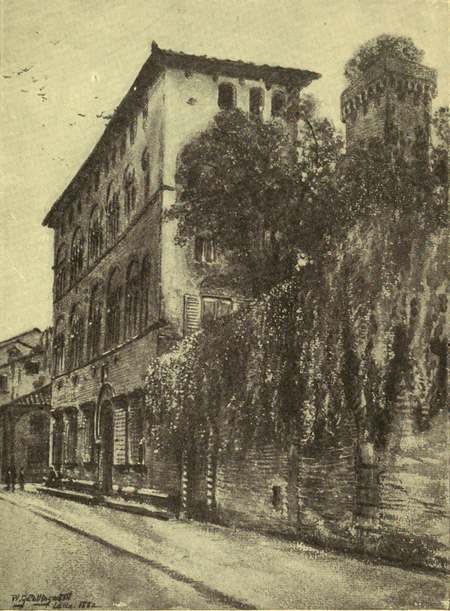
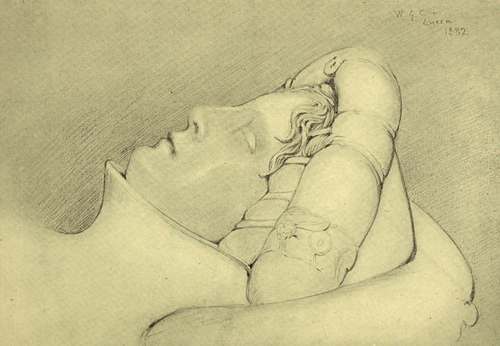
took hold of him, and he drew the Porch at Lucca assiduously.
His two chief drawings of this subject were shown in the next
exhibition of the R.W.S., and one of them at the R.A. in
1901. He exhibited on many occasions at the Royal Society
of Painters in Water Colours, having been elected an honorary
member in 1873. He said at the time to a visitor—"Nothing
ever pleased me more. I have always been abusing the artists,
and now they have complimented me. They always said I
couldn't draw, and it's very nice to think they give me credit
for knowing something about art."
Later than this there is little to chronicle. Ill-health came
down upon him, and his last drawings were done to amuse his
friend of "Hortus Inclusus" in 1886, though he made a few
pencil notes of Langdale Pikes and Calder Abbey in 1889.
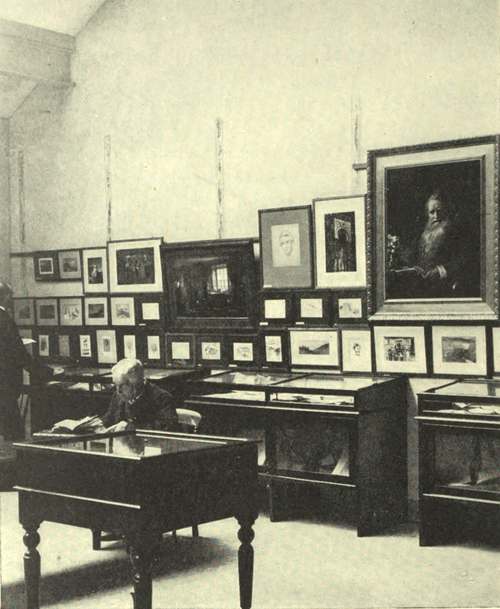
After his death an exhibition of his sketches, with some
personal relics and added examples of the art about which he
had written, was held at Coniston in the summer of 1900. It
attracted over 10,000 visitors to the village, and to many was a
revelation of Ruskin in a new character, and of a kind of art
which charmed in spite of all they had been accustomed to look
for in pictures.
In January and February 1901, a similar exhibition was
held at the Royal Society of Painters in Water Colours,
London. Many of the drawings then shown, with a large
series of engravings after his work, are on view in the Ruskin
Museum at the Institute, Coniston; where, in 1903, the
Fourth Annual Exhibition contained a further instalment of
Ruskin sketches not previously shown in public, giving
examples of his great variety in subject and treatment, ranging
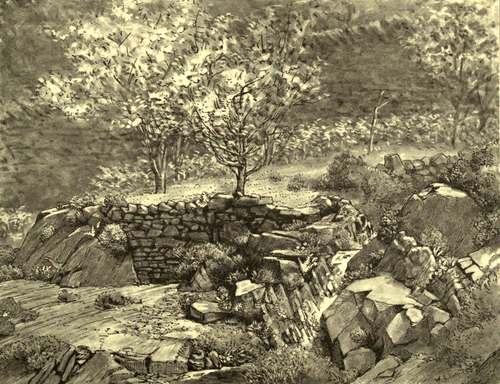
from an early outline of Dover (1831), to sketches at Avallon
and Cîteaux (1882; see above, pages 48-51); from geological
studies of Alps to notes of lions and tigers at the Zoo, and the
head of the Venus de' Medici, elaborately shaded; and from
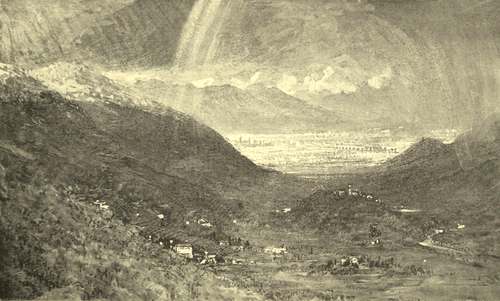
the carefully finished and daintily detailed pen and tint Valley
of Lauterbrunnen, in which the lens is needed to make out
tiny châlets, smaller than a letter of this type, to large splashes
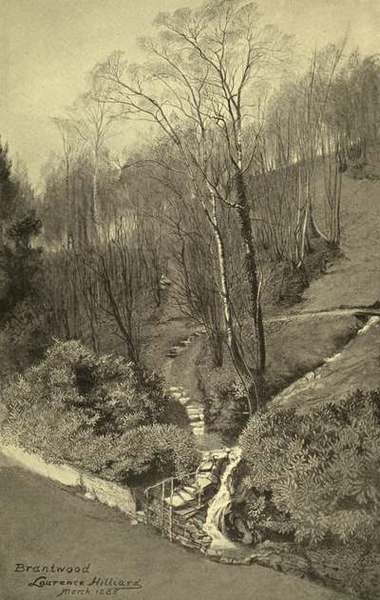
of water-colour, one of which (on a sheet 42 by 23 inches in
size) is identical in subject with the view by Laurence Hilliard
given at page 33 of this volume.
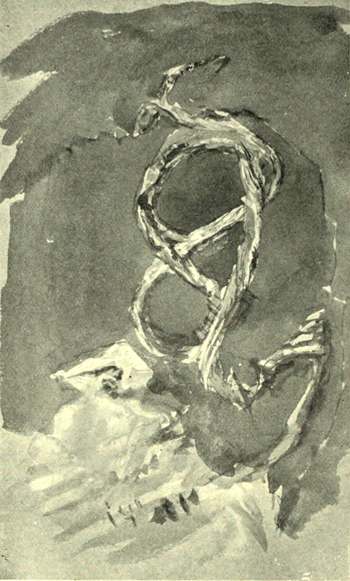
One pair of sketches among these has a curious biographical
interest. When Turner's Sun of Venice Going out to Sea was
exhibited at the Academy (1843), Ruskin was greatly impressed
with its wonderful colour and truth, but especially with the
reflections and eddies of the calm water, on which he wrote a
well-known page in "Modern Painters" (vol. i. p. 357).
Accustomed to write from notes with pen and pencil, he
forgot, or ignored, the rule forbidding visitors at the Exhibition
to copy the pictures. These are the sketches he made, and
for making them was expelled from the Exhibition.