To seek for Rome, vain stranger, art thou come,
And find’st no mark, within Rome’s walls, of Rome?
See here the craggy walls, the towers defaced,
And piles that frighten more than once they pleased:
See the vast theatres, a shapeless load,
And sights more tragic than they ever show’d.
This, this is Rome! Her haughty carcass spread
Still awes in ruin, and commands when dead.
The subject world first took from her their fate;
And when she only stood unconquer’d yet,
Herself she last subdued, to make the work complete.
But ah! so dear the fatal triumph cost,
That conquering Rome is in the conquer’d lost.
Yet rolling Tiber still maintains his stream,
Swell’d with the glories of the Roman name.
Strange power of fate! unshaken moles must waste;
While things that ever move, for ever last.—Vitalis.
As the plan of this work does not admit of our
giving any thing like a history of the various trials
and fortunes of Rome; we must confine ourselves,
almost entirely, to a few particulars relative to its
origin, summit of glory and empire, its decay, and
ultimate ruin.
There is no unquestionable narrative of facts, on
which any writer can build the primitive history of this
vast city and empire; but in its place we have a mass
of popular traditions and fabulous records. On the
taking of Troy, Æneas, a prince of that city, quitted
his native land, and after a long period, spent in
encountering a variety of vicissitudes, he arrived on
the coast of Italy, was received with hospitality by
the King of Latium, whose name was Latinus, and
afterwards obtained his throne, from the circumstance
of having married his daughter.
Æneas after this built the city of Lavinium, and,
thirty years after, his son founded that of Alba Longa,
which then became the capital of Latium. Three
hundred years after, Romulus founded Rome.
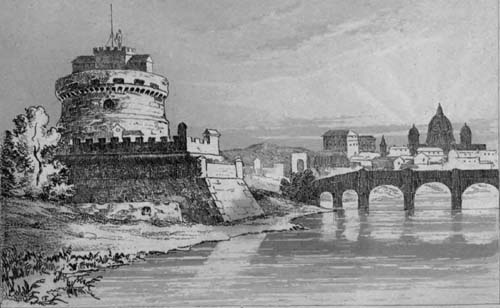
ROME.
Though Livy has given a very circumstantial account
of the origin of this city, sufficient data have
been afforded, since his history was written, to justify
our doubting many of his statements. The first author
in modern times, that led Europe to these doubts,
was, we believe, Dr. Taylor; who, in a work written
about sixty years ago, entitled Elements of Civil
Law, has the following passage:—“It was not peculiar
to this people, to have the dawn of their history
wrapped up in fable and mythology, or set in with
something that looked like marvellous and preternatural.
There is scarce a nation, that we are acquainted
with, but has this foible in a greater or lesser
degree, and almost pleads a right to be indulged
in it. “Datur hæc venia antiquitati, ut miscendo
humana divinis primordia urbium augustiora faciat.”
(Liv. I. Præf.) Indeed the Romans themselves had
some suspicion of their own history. They generally
dated their periods not AB U. C. but began their æra
from their consuls, by whom they always reckoned.
The records of Rome were burned at the irruption of
the Gauls: they had nothing for it but tradition before
that period. Nor was there an author extant of
that age, or near it, at the time that Livy compiled
his history. Diocles Peparethius (the father of
Roman history, since Fabius Pictor, the first historian
that Rome produced, and all his followers,
copied him implicitly) was a writer of no very great
credit. The birth and education of Romulus, is the
exact counter-part of that of another founder of a
great empire; and Romulus, I am satisfied, could
not resemble more his brother Remus, than his brother
Cyrus. The expedient of Tarquin’s conveying advice
to his son, by striking off the heads of flowers,
is given with the minutest difference, by Aristotle to
Periander of Corinth, and by Herodotus to Thrasybulus.
Which similarity is very ill accounted for by
Camerarius. This was one of those ambulatory
stories which (Plutarch in his Greek and Roman
Parallels will furnish us with many such) seem
confined to no one age, race, or country; but have
been adopted in their turn, at several periods of time,
and by several very different people, and are perhaps,
at least some of them, true of none. And, lastly, one
would imagine, that the history of the seven kings,
which has such an air of romance in it, was made on
purpose for Florus to be ingenious upon in his recapitulation
of the regal state of Rome.”
The truth of this subject we leave to abler hands;
proceeding at once to the manner in which the ceremonies
are recorded to have been adopted at the first
laying down the foundations of the city. Romulus,
having sent for some of the Tuscans, to instruct him
in the ceremonies that ought to be observed in laying
the foundations, and they having instructed him
according to his desire, his work began in the following
manner:—First, he dug a trench, and threw
into it the first-fruits of all things, either good by
custom, or necessary by nature; and every man taking
a small turf of earth of the country from which he
came, they all cast them in promiscuously together.
Making their trench their centre, they described the
city in a circle round it. Then the founder fitted to a
plough a brazen plough-share; and yoking together
a bull and a cow, drew a deep line or furrow round
the bounds; those that followed after, taking care
that the clods fell inwards towards the city. They
built the wall upon this line, which they called Pomœrium,
from pone mœnia. Though the phrase of
Pomœrium proferre be commonly used in authors,
to signify the enlarging of the city, it is, nevertheless,
certain that the city might be enlarged without that
ceremony. For Tacitus and Gellius declare no person
to have had a right of extending the Pomœrium,
but such a one as had taken away some part of an
enemy’s country in war; whereby, it is manifest, that
several great men, who never obtained the honour,
increased the buildings with considerable additions.
It is remarkable that the same ceremony with which
the foundations of their cities were first laid, they used,
too, in destroying and rasing places taken from the
enemy; which we find was begun by the chief commander’s
turning up some of the walls with a plough.
We do not, as we have before stated, propose to
give even a slight history of this celebrated city.
It is sufficient for our purpose to state, that it was
first governed by kings, and then by consuls, up to
the time when the Gauls took the city, under their
commander Brennus. This was the first calamity
that Rome experienced at the hands of an enemy;
and this occurred in the three hundred and sixty-fifth
year after its foundation.
The city of Veii had just surrendered to Camillus
after a ten years’ siege, when the Gauls made an
irruption into Italy, and had begun to besiege Clusium,
a Tuscan city; at which time a deputation
arrived at Rome with an entreaty from the Clusians,
that the Romans would interfere in their behalf,
through the medium of ambassadors. This request
was immediately complied with; and three of the
Fabii, persons of the highest rank, were despatched
to the Gallic camp. The Gauls, out of respect to
the name of Rome, received these ambassadors with
all imaginable civility; but they could not be induced
to raise the siege. Upon this, the ambassadors going
into the town, and encouraging the Clusians to a
sally, one of them was seen personally engaged in
the action. This, being contrary to the generally
received law of nations, was resented in so high a
manner by the enemy, that, breaking up from before
Clusium, their whole army marched directly against
Rome. At about eleven miles from the city, they
met with the Roman army, commanded by the
military tribunes; who, engaging without any order
or discipline, received an entire defeat. Upon the
arrival of this ill news at Rome, the greatest part of
the inhabitants immediately fled. Those that resolved
to stay, however, fortified themselves in the
Capitol. The Gauls soon appeared at the city gates;
and, destroying all with fire and sword, carried on
the siege of the Capitol with all imaginable fury.
At last, resolving on a general assault, they were
discovered by the cackling of geese; and as many
as had climbed the ramparts were driven down
by Manlius; when Camillus, setting upon them
in the rear with twenty thousand men he had got
together about the country, gave them a total overthrow.
The city, however, had been set on fire by the
barbarians, and so entirely demolished, that, upon
the return of the people, they resolved upon abandoning
the ruins, and seeking a more eligible abode
in the recently conquered city of Veii, a town already
built and well provided with all things. But this
being opposed by Camillus, they set to work with
such extraordinary diligence, that the vacant space
of the old city was quickly covered with new buildings,
and the whole finished within the short space of
one year. The Romans, however, on this occasion,
were in too great a hurry to think of either order or
regularity. The city was, therefore, rebuilt without
any reference to order; no care being taken to form
the streets in straight lines.
In this conflagration, all the public records were
burned; but there is no reason to believe, that it was
accompanied by any losses, which a lover of the arts
should mourn for. As many writers have remarked,
the Romans were not naturally a people of taste.
They never excelled in the fine arts; and even their
own writers invariably allow, that they were indebted
for every thing that was elegant in the arts to the
people of Greece150.
It is possible that, during the three hundred and
fifty years, which elapsed from the Gallic invasion
till the reign of Augustus, many magnificent buildings
may have been erected; but we have no evidence
that such was the case; and the few facts,
which we are enabled to glean from the pages of
ancient writers, are scarcely favourable to the supposition.
The commencement of the age of Roman
luxury is generally dated from the year 146 B. C.,
when the fall of Carthage and of Corinth elevated
the power of the republic to a conspicuous height.
Yet, more than fifty years afterwards, no marble
columns had been introduced into any public buildings;
and the example of using them as decorations
of private houses was set by the orator Crassus, in
the beginning of the first century before the Christian
era.
The architectural splendour of the city must be
dated from the age of Augustus. “I found it of
brick,” he was accustomed to say; “I shall leave
it of marble.” Nor was he content with his own
labours; at his instigation many private individuals
contributed to the embellishment of the capital.
The Pantheon, one of the noblest structures of
Rome, and several others, were the works of his
chief minister, Agrippa.
Tiberius and Caligula betrayed no wish to imitate
their predecessor; but several works of utility and
magnitude were completed under Claudius. Then
came, however, the emperor Nero; with whose reign
is associated that memorable conflagration, which
malice attributed to the Christians, and which raged
beyond all example of former ages. This fire left,
of the fourteen regions into which Augustus had
divided the city, only four parts untouched. It
was, therefore, fatal to many of the most venerable
fanes and trophies of the earlier ages. This conflagration
lasted from six to nine days. In the time
of Titus, too, another fire ravaged the city for three
days and nights; and in that of Trajan, another
conflagration consumed part of the Forum, and the
Golden House of Nero; after which few remains of
the ancient city were left; the rest being, to use the
language of Tacitus, “scanty relics, lacerated and
half-burned.”
The city, nevertheless, soon rose with fresh grandeur
and beauty from its ashes. Trajan performed
his part; and Hadrian followed with redoubled assiduity.
They were followed by the Antonines; and
so effective was the example they set, that most of
the more opulent senators of Rome deemed it an
honour, and almost an obligation, to contribute to
the glory and external splendour of their native city.
These monuments of architecture were adorned with
the finest and most beautiful productions of sculpture
and painting. Every quarter of Rome was filled with
temples, theatres, amphitheatres, porticoes, triumphal
arches, and aqueducts; with baths, and other
buildings, conducive to the health and pleasure, not
of the noble citizens only, but of the meanest.
The principal conquests of the Romans, were
achieved under the republic; and the emperors, for
the most part, were satisfied with preserving those
dominions which had been acquired by the policy of
the senate, the active emulation of the senators, and
the martial enthusiasm of the people. The seven
first centuries were filled with a rapid succession of
triumphs; but it was for Augustus, to relinquish
the ambitious design of subduing the whole earth,
and to introduce moderation into the public councils.
He bequeathed a valuable legacy to his successors,
the advice of confining the empire within those
limits which nature seemed to have placed as its
permanent bulwarks and boundaries:—on the west
the Atlantic ocean; the Rhine and Danube on the
north; the Euphrates on the east; and towards the
south the deserts of Africa and Arabia.
The first exception to this policy was the conquest
of Britain; the second the conquests of Trajan. It
was, however, revived by Hadrian; nearly the first
measure of whose reign was the resignation of all
that emperor’s eastern conquests.
The Roman empire, in the time of the Antonines,
was about two thousand miles in breadth, from the
wall of Antoninus and the northern limits of Dacia,
to Mount Atlas and the tropic of Cancer. It extended,
in length, more than three thousand miles,
from the Western Ocean to the Euphrates; it was
situated in the finest part of the temperate zone,
between the twenty-fourth and fifty-sixth degrees
of northern latitude; and it was supposed to
contain above sixteen hundred thousand square
miles, for the most part of fertile and well cultivated
land.
Pius studied the defence of the empire rather than
the enlargement of it—a line of policy, which rendered
him more serviceable to the commonwealth than
the greatest conqueror. Marcus and Lucius (Antonini)
made the first division of the empire. At length it
was put up to public sale and sold to the highest
bidder. It was afterwards arrested in its ruin by
Alexander Severus. The fortunes of the empire,
after the progress of several successive tyrants, was
again restored by the courage, conduct, and extraordinary
virtues of Claudius the Second; to whom has
been attributed, with every probability of truth, the
courage of Trajan, the moderation of Augustus, and
the piety of Antoninus.
Then followed Aurelian, Tacitus, and Probus;
and Rome felt redeemed from the ruin that awaited
her: but Constantine laid the inevitable groundwork
of its destruction, by removing the imperial
throne to Byzantium. Rome became an easy prey
to her barbarian enemies; by whom she was several
times sacked, pillaged, and partially burned. The
most powerful of these enemies was Alaric:—the
people he had to conquer and take advantage
of, are thus described by Ammianus Marcellinus:—“Their
long robes of silk purple float in the wind,
and as they are agitated, by art or accident, they
occasionally discover the under-garments, the rich
tunics, embroidered with the figures of various
animals. Followed by a train of fifty servants, and
tearing up the pavement, they move along the street
with the same impetuous speed, as if they had travelled
with post-horses; and the example of the
senators is boldly imitated by the matrons and ladies,
whose covered-carriages are continually driving round
the immense space of the city and suburbs. Whenever
these persons of high distinction condescend to
visit the public baths, they assume, on their entrance,
a tone of loud and insolent command, and appropriate
to their own use the conveniences which were designed
for the Roman people. As soon as they have indulged
themselves in the refreshments of the bath, they
resume their rings, and the other ensigns of their
dignity; select from their private wardrobe of the
finest linen, such as might suffice for a dozen persons,
the garments the most agreeable to their fancy, and
maintain till their departure the same haughty
demeanour, which, perhaps, might have been excused
in the great Marcellus, after the conquest of Syracuse.
“Sometimes, indeed, these heroes undertake more
arduous achievements; they visit their estates in
Italy, and procure themselves, by the toil of servile
hands, the amusements of the chase. If at any time,
but more especially on a hot day, they have courage
to sail in their painted galleys, from the Lucrine
Lake to their elegant villas on the sea-coast of Puteoli
and Cajeta, they compare their own expeditions to
the marches of Cæsar and Alexander. Yet, should a
fly presume to settle on the silken folds of their
gilded umbrellas; should a sun-beam penetrate
through some unregarded and imperceptible chink
they deplore their intolerable hardships, and lament,
in affected language, that they were not born in the
land of the Cimmerians, the regions of eternal darkness.”
Such was the character of the nobles of Rome at
the period in which their city was taken possession of
by Alaric. As soon as the barbarian had got possession
of the Roman port, he summoned the city to
surrender at discretion; and his demands were
enforced by the positive declaration, that a refusal,
or even a delay, should be instantly followed by the
destruction of the magazines, on which the life of
the Roman people depended. The clamours of that
people, and the terror of famine, subdued the pride
of the senate. They listened without reluctance to
the proposing of a new emperor on the throne of
Honorius; and the suffrage of the Gothic conqueror
bestowed the purple on Attalus, the præfect of the
city. Attalus was created emperor by the Goths
and Romans; he was, however, soon degraded by
Alaric, and Rome subjected to a general sack. The
conqueror no longer dissembled his appetite for plunder.
The trembling senate, without any hopes of
relief, prepared, by a desperate resistance, to delay
the ruin of their country. But they were unable to
guard against the secret conspiracy of their slaves
and domestics. At the hour of midnight, the Salarian
gate was opened, and the inhabitants were
awakened by the tremendous sound of the Gothic
trumpet. Eleven hundred and sixty-three years
after the foundation of Rome, the imperial city,
which had subdued and civilised so considerable a
part of mankind, was delivered to the licentious fury
of the tribes of Scythia and Germany. A cruel
slaughter was made of the Romans; the streets of the
city were filled with dead bodies, which, during the
consternation, remained unburied. The despair of
the inhabitants was sometimes converted into fury;
and whenever the barbarians were provoked by
opposition, they extended the promiscuous massacre
to the feeble, the innocent, and the helpless. The
private revenge of 40,000 slaves was exercised without
pity or remorse; and the ignominious lashes,
which they had formerly received, were washed away
in the blood of the guilty, or obnoxious families. The
matrons and virgins of Rome were exposed to injuries
more dreadful, in the apprehension of chastity,
than death itself.
When the portable riches had been seized, the
palaces were rudely stripped of their splendid and
costly furniture; the side-boards of massy plate, and
the variegated wardrobes of silk and purple, were
irregularly piled in the wagons, that always followed
the march of a Gothic army. The most exquisite
works of art were roughly handled, or wantonly
destroyed; many a statue was melted for the sake of
the precious materials; and many a vase, in the division
of the spoil, was shivered into fragments by the
stroke of the battle-axe. The sack lasted six days.
The edifices, too, of Rome received no small injury
from the violence of the Goths; but those injuries
appear to have been somewhat exaggerated. At their
entrance they fired a multitude of houses; and the
ruins of the palace of Sallust remained, in the age of
Justinian, a stately monument of the Gothic conflagration.
Procopius confines the fire to one peculiar
quarter; but adds, that the Goths ravaged the whole
city. Cassiodorus says, that many of the “wonders
of Rome,” were burned; and Olympiodorus speaks of
the infinite quantity of wealth, which Alaric carried
away. We collect, also, how great the disaster
was, when he tells us, that, on the retreat of the
Goths, 14,000 returned in one day.
The injury done by Genseric (A. D. 455), is said
to have been not so great as that, perpetrated by the
Goths; yet most writers record that the Vandals and
Moors emptied Rome of most of her wealth. They
revenged the injuries of Carthage. The pillage lasted
fourteen days and nights; and all that yet remained
of public or private wealth, of sacred or profane
treasure, were transported to the vessels of Genseric.
Among the spoils, the splendid relics of two temples,
or rather of two religions, exhibited the remarkable
example of the vicissitude of human things. Since
the abolition of Paganism, the capital had been violated
and abandoned; yet the statues of the gods and
heroes were still respected, and the curious roof of
gilt bronze was reserved for the rapacious hands of
Genseric. The holy instruments of the Jewish worship
had been ostentatiously displayed to the Roman
people, in the triumph of Titus. They were afterwards
deposited in the temple of Peace; and, at the
end of four hundred years, the spoils of Jerusalem
were transferred to Carthage, by a barbarian who
derived his origin from the shores of the Baltic. It
was difficult either to escape or to satisfy the avarice
of a conqueror, who possessed leisure to collect, and
ships to transport, the wealth of the capital. The
imperial ornaments of the palace, the magnificent
furniture and wardrobe, the sideboards of massy plate,
were accumulated with disorderly rapine; the gold
and silver amounted to several thousand talents; yet
even the brass and copper were laboriously removed.
The empress was rudely stripped of her jewels, and,
with her two daughters, the only surviving remains
of the great Theodosius, was compelled, as a captive,
to follow the haughty Vandal; who immediately
hoisted sail, and returned, with a prosperous navigation,
to the port of Carthage. Many thousand
Romans of both sexes, chosen for some useful or
agreeable qualifications, reluctantly embarked on
board the fleet of Genseric; and their distress was
aggravated by the unfeeling barbarian, who, in the
division of the booty, separated the wives from their
husbands, and the children from their parents.
The consequences of this Vandal invasion, to the
public and private buildings, are thus regarded by
the same authority (Gibbon):—“The spectator, who
casts a mournful view over the ruins of ancient Rome,
is tempted to accuse the memory of the Goths and
Vandals, for the mischief which they had neither the
leisure, nor power, nor perhaps the inclination, to
perpetrate. The tempests of war might strike some
lofty turrets to the ground; but the destruction which
undermined the foundations of those massy fabrics,
was prosecuted, slowly and silently, during a period
of ten centuries. The decay of the city had gradually
impaired the value of the public works. The
circus and theatres might still excite, but they seldom
gratified, the desires of the people; the temples,
which had escaped the zeal of the Christians, were
no longer inhabited, either by gods or men; the
diminished crowds of the Romans were lost in the
immense space of their baths and porticoes; and the
stately libraries and halls of justice became useless
to an indolent generation, whose repose was seldom
disturbed, either by study or business. The monuments
of consular or imperial greatness were no
longer revered as the immortal glory of the capital;
they were only esteemed as an inexhaustible mine of
materials, cheaper and more convenient than the distant
quarry. Specious petitions were addressed to
the easy magistrates of Rome, which stated the want
of bricks or stones for some necessary service; the
fairest forms of architecture were rudely defaced for
the sake of some paltry or pretended repairs; and the
degenerate Romans, who converted the spoil to their
own emolument, demolished, with sacrilegious hands,
the labours of their ancestors.”
In 472 the city was sacked by Ricimer, who
enjoyed power under cover of the name of the
Emperor Libius Severus. His victorious troops,
breaking down every barrier, rushed with irresistible
violence into the heart of the city, and Rome was
subverted. The unfortunate emperor (Anthemius)
was dragged from his concealment, and inhumanly
massacred by the command of Ricimer his son-in-law;
who thus added a third, or perhaps a fourth,
emperor to the number of his victims. The soldiers,
who united the rage of factious citizens with the
savage manners of barbarians, were indulged, without
control, in the licence of rapine and murder; the
crowd of slaves and plebeians, who were unconcerned
in the event, could only gain by the indiscriminate
pillage; and the face of the city exhibited the
strange contrast of stern cruelty and dissolute intemperance.
The sack of Rome by Ricimer is generally
overlooked by the apologists of the early
invaders; but it must not be forgotten, that they
were indulged in the plunder of all but two regions
of the city.
To Vitiges (about A. D. 540) must be ascribed the
destruction of the aqueducts, which rendered the
thermæ useless; and as these appear never to have
been frequented afterwards, their dilapidation must
be partially, but only partially, ascribed to the
Goths.
Vitiges burned every thing without the walls, and
commenced the desolation of the Campagna.
The last emperor of Rome was Augustulus.
Odoacer, king of the Heruli, entered Italy with a
vast multitude of barbarians, and having ravaged it,
at length approached Rome itself. The city made
no resistance; he therefore deposed Augustulus, and
took the dignity of empire on himself. From this
period the Romans lost all command in Italy.
A. D. 479. Five centuries elapsed from the age
of Trajan and the Antonines, to the total extinction
of the Roman empire in the west. At that unhappy
period, the Saxons fiercely struggled with the natives
for the possession of Britain. Gaul and Spain were
divided between the powerful monarchies of the
Franks and Visigoths; and the dependent kingdoms
of the Suevi and Burgundians in Africa were exposed
to the cruel persecution of the Vandals, and
the savage insults of the Moors. Rome and Italy,
as far as the banks of the Danube, were afflicted by
an army of barbarian mercenaries, whose lawless
tyranny was succeeded by the reign of Theodoric,
the Ostrogoth. All the subjects of the empire, who,
by the use of the Latin language, more particularly
deserved the name and privileges of Romans, were
oppressed by the disgrace and calamities of foreign
conquest; and the victorious nations of Germany
established a new system of manners and government
in the western countries of Europe.
That Rome, however, did not always suffer from
the Goths, is evident from a passage in one of the
letters written by Cassiodorus, at one time minister
to Theodoric:—“The care of the Roman city is a
subject to which our thoughts are ever awake. For
what is there which it behoves us to provide for, more
worthy than the keeping up the repair of a city
which, it is evident, contains the ornaments of our
republic? therefore, let your illustrious highness
know, that we have appointed a notable person, on
account of its splendid Cloacæ, which are productive
of so much astonishment to beholders, that they may
well be said to surpass the wonders of other cities.
There thou mayest see flowing rivers, inclosed, as it
were, in hollow mountains. There thou mayest see
the rapid waters navigated by vessels, not without
some anxiety lest they should suffer shipwreck in the
precipitate torrent. Hence, O matchless Rome! it
may be inferred what greatness is in thee. For what
city may dare to contend with thy lofty superstructures,
when even thy lowest recesses can find no
parallel?”
In 546, Rome was besieged by Totila the Goth.
Having reduced, by force or treaty, the towns of
inferior note in the midland provinces of Italy,
Totila proceeded to besiege Rome. He took it
December 17th of the same year. On the loss of
the city, several persons,—some say five hundred,—took,
refuge in the church of St. Peter. As
soon as the daylight had displayed the victory of
the Goths, their monarch visited the tomb of the
prince of the apostles; but while he prayed at the
altar, twenty-five soldiers and sixty citizens were put
to the sword in the vestibule of the temple. The
arch-deacon Pelagius stood before him with the
gospels in his hand.—“O Lord, be merciful to your
servant.” “Pelagius,” said Totila, with an insulting
smile, “your pride now condescends to become a
suppliant.” “I am a suppliant,” replied the prudent
arch-deacon; “God has now made us your subjects,
and, as your subjects, we are entitled to your clemency.”
At his humble prayer, the lives of the
Romans were spared; and the chastity of the maids
and matrons was preserved inviolate from the passions
of the hungry soldiers. But they were rewarded
by the freedom of pillage. The houses of
the senators were plentifully stored with gold and
silver. The sons and daughters of Roman consuls
tasted the misery which they had spurned or relieved,
wandered in tattered garments through the streets
of the city, and begged their bread before the gates
of their hereditary mansions.
Against the city he appeared inexorable. One
third of the walls was demolished by his command;
fire and engines prepared to consume or subvert the
most stately works of antiquity; and the world was
astonished by the fatal decree, that Rome should be
changed into “a pasture for cattle!” Belisarius, hearing
of this, wrote him a letter, in which he observed,
“That if Totila conquered, he ought, for his own
sake, to preserve a city, which would then be his
own by right of conquest, and would, at the same
time, be the most beautiful city in his dominions.
That it would be his own loss, if he destroyed it,
and redound to his utter dishonour. For Rome,
having been raised to so great a grandeur and majesty
by the virtue and industry of former ages,
posterity would consider him as a common enemy of
mankind, in depriving them of an example and living
representation of their ancestors.”
In consequence of this letter, Totila permitting
his resolution to be diverted, signified to the ambassadors
of Belisarius, that he should spare the city;
and he stationed his army at the distance of one
hundred and twenty furlongs, to observe the motions
of the Roman general. With the remainder of his
forces, he occupied, on the summit of Gargarus, one
of the camps of Hannibal. The senators were dragged
in his train, and afterwards confined in the fortresses
of Campagna. The citizens, with their wives and
children, were dispersed in exile; and, during forty
days, Rome was abandoned to desolate and dreary
solitude.
Totila is known to have destroyed a third part
of the walls; and although he desisted from his meditated
destruction of every monument, the extent
of the injury inflicted by that conqueror may have
been greater than is usually supposed. Procopius
affirms, that he did burn “not a small portion of
the city,” especially beyond the Tiber. One of the
authors of the Chronicles records a fire, and the
total abandonment of the city for more than forty
days; and it must be mentioned, that there is no
certain trace of the palace of the Cæsars having
survived the irruption of Totila.
With Totila, the dilapidation of Rome by the
barbarians is generally allowed to terminate.
The incursion of the Lombards in 578 and 593
completed the desolation of the Campagna; but did
not affect the city itself.
Their king Luitprand (in 741) has been absolved
from a supposed violence; but Astolphus (in 754)
did assault the city violently; and whatever structures
were near the walls must be supposed to have
suffered from the attack.
From that period, Rome was not forcibly entered,
that is not after a siege, until the fall of the Carlovingian
race, when it was defended in the name of
the emperor Lambert; and assaulted and taken by
barbarians, commanded by Arnulphus, son of Carloman
of Bavaria (A. D. 896).
It would exceed our limits were we to enter into
a detail of the various causes, which were so long at
work in effecting the ruin of the ancient monuments
of Rome. If we except the Pantheon, the ancient
remains have been so mutilated and destroyed, that
even the name is, in many cases, doubtful. If a person,
says Dr. Burton, expects to find at Rome such
magnificent remains, as he has read of in Athens, he
will be grievously disappointed. It is highly necessary
to know, that whatever exists at Rome as a
monument of ancient times has suffered from various
calamities.
Gibbon states four causes of decay:—The injuries
of time and nature; the hostile attacks of the barbarians
and christians; the use and abuse of the
materials; and the domestic quarrels of the Romans.
There is great truth in Pope’s remark—
Some felt the silent strokes of mouldering age;
Some hostile fury; some religious rage;
Barbarian blindness, Christian zeal conspire,
And Papal piety, and Gothic fire.
The injuries done by the Christian clergy to the
architectural beauty of Rome, may be divided into
two kinds: those, which were commanded, or connived
at, by the Romans, for useful repairs or constructions;
and those, which were encouraged or
permitted from motives of fanaticism.
In the year 426, during the reign of Theodosius
the Younger, there was a great destruction of the
temples and fanes. “The destruction of the idolatrous
fanes,” says an ecclesiastical writer, “was
from the foundation; and so complete, that we cannot
perceive a vestige of the former superstition. Their
temples are so destroyed, that the appearance of their
form no longer remains; nor can those of our times
recognise the shape of their altars. As for their
materials, they are dedicated to the fanes of the
martyrs. Temples are not found among the wonders
admired by Theodoric, except the half-stripped
Capitoline fane is to be enumerated; and Procopius
confines his notices to the Temple of Peace, and to
the Temple of Janus. In the reign of Justinian, the
temples were partly in private hands, and, therefore,
not universally protected as public edifices. Pagan
structures would naturally suffer more at the first
triumph of Christianity than afterwards, when the
rage and the merit of destruction must have diminished.
It is not then rash to believe, that many
temples were destroyed or despoiled, and the materials
employed to the honour of the new religion.
Du Barga asserts that there were marks on the
obelisks of their having been all overthrown, with
the exception of one, which was not dedicated to any
of the false gods of antiquity.”
The destruction of the baths are attributed to the
same piety, and those of Diocletian and Caracalla
showed, in the eighth century, evident marks of
human violence. Pope Gregory III. employed nine
columns of some ancient building for the church of St.
Peter. The rebuilding of the city walls by four popes,
in the same century, was a useful but a destructive
operation. Pope Hadrian I. threw down an immense
structure of Tiburtine stone to enlarge the
church of St. Maria in Cosmedin. Donus I. had before
(A. D. 676) stripped the marble from a large
pyramid, generally known by the name of Scipio’s
Tomb. Paul II. employed the stones of the Coliseum
to build a palace. Sixtus IV. took down the
Temple of Hercules, and destroyed the remains of an
ancient bridge to make four hundred cannon-balls for
the castle of St. Angelo. Paul III. and his nephews
laboured incessantly at the quarry of the Coliseum.
He devastated, also, many other buildings. Sixtus
V. threw down several statues still remaining in the
capital. Urban VIII. took off the bronze from the
portico of the Pantheon, and some of the base of the
sepulchre of Cecilia Metella; and Paul V. removed
the entablature and pediment of a structure in the
Forum of Nerva, and also the remaining column of
the Temple of Peace. Lastly, Alexander VII.
took down the arch called “di Portogallo,” in order
to widen the Corso. The inferior clergy, too, were
great depredators; insomuch that a volume of no
inconsiderable size has been composed by one of their
own order to enumerate the Pagan materials applied
to the use of the church.
It is difficult to say where this system of depredation
would have stopped, had not Benedict XIV.
erected a cross in the centre of the arena, and declared
the place sacred, out of respect to the blood of the
many martyrs who had been butchered there during
the persecution. This declaration, if issued two or
three centuries before, would have preserved the
Coliseum entire; it can now only protect its remains,
and transmit them in their present state to
posterity.
Conflagrations, also, contributed to the destruction
of the city. In 312 the temple of Fortuna was
burned down. The palaces of Symmachus and Lampadius,
with the baths of Constantine, suffered by
the same cause.
Nor must the destruction be confined to one element.
The Tiber rose, not unfrequently, to the walls,
and many inundations are recorded. Indeed, even
so early as the second siege of the city by Totila,
there was so much uncultivated land within the
walls, that Diogenes, the governor, thought the
corn, he had sown, would be sufficient to supply
the garrison and citizens in a protracted defence.
It is impossible to assign a precise date to the
total destruction of the greater portion of the ancient
site; but the calamities of the seventh and eighth
centuries must have contributed to, if they did not
complete, the change. A scarcity in the year 604,
a violent earthquake a few years afterwards, a
pestilence in or about the year 678, five great inundations
of the Tiber from 680 to 797, a second
famine in the pontificate of Pope Constantine, which
lasted thirty-six months, a pestilence in the last
year of the seventh century, and the assault of the
Lombards for three months in 755;—these are the
events which compose the Roman history of this
unhappy period.
Added to all this, the importance of the new
city accelerated the ruin of the old; and great
was the destruction during the periods in which
separate parties fought their battles in the public
streets, after the restoration of the empire of the
West; in which we must record the ruin, caused by
Robert Guiscard, which proved more injurious to
the remains of Rome, from 1082 to 1084, than all
the preceding barbarians of every age: for the
Normans and Saracens of his army, with the papal
faction, burned the town from the Flaminian
gate to the Antonine column, and laid waste the
sides of the Esquiline to the Lateran; thence he set
fire to the region from that church to the Coliseum
and the Capitol. He attacked the Coliseum for
several days, and finished the ruin of the Capitol.
A cotemporary writer says, that all the regions of
the city were ruined; and another spectator, who
was in Rome twelve years afterwards, laments that
although what remained could not be equalled—what
was ruined, could never be repaired.
Thou stranger which for Rome in Rome here seekest,
And nought of Rome in Rome perceiv’st at all,
These same old walls, old arches, which thou seest,
Old palaces, is that which Rome men call.
Behold what wreck, what ruin, and what waste,
And how that she which with her mighty power
Tamed all the world, hath tamed herself at last,
The prey of Time, which all things doth devour.
Rome now of Rome is the only funeral,
And only Rome, of Rome hath victory;
Ne ought save Tyber, hastening to his fall
Remains of all: O World’s inconstancy!
That which is firm, doth flit and fall away;
And that is flitting, doth abide and stay.
Spenser’s Ruins of Rome.
In the annals for 1167, we find that the German
Barbarossa assaulted the Vatican for a week, and that
the Pope saved himself in the Capitol. The Colonna
were driven from the mausoleum of Augustus. After
the Popes had begun to yield in the unequal contest
with the senators and people, and had ceased to be
constantly in the capital, the field was left open for
the wars of the senators; that is, of the nobles themselves.
The Colonna and Ursini then appear among
the destroyers of the city. In 1291, a civil war
occurred, which lasted six months; the issue of which
was, according to a spectator, that Rome was reduced
to the condition of a town “besieged, bombarded and
burned.”
At the period in which Henry VII. was crowned
Emperor, battles were fought in every quarter of the
city. The fall of houses, indeed, the fire, the slaughter,
the ringing of the bells from the churches, the
shouts of the combatants, and the clanging of arms,
the Roman people rushing from all quarters towards
the Capitol; this universal uproar attended the
coronation of the new Cæsar, and the Cardinals apprehended
the total destruction of the city.
The absence of the Popes, also, from the year
1360 to 1376, has been esteemed peculiarly calamitous
to the ancient fabrics. Petrarch was overwhelmed
with regret. He complained that the
ruins were in danger of perishing; that the nobles
were the rivals of time and the ancient Barbarians;
and that the columns and precious marbles
of Rome were devoted to the decoration of
the slothful metropolis of their Neapolitan rivals.
Yet, it appears that these columns and marbles
were taken from palaces comparatively modern,
from the thresholds of churches, from the shrines
of sepulchres, from structures to which they had
been conveyed from their original state, and finally,
from ruins actually fallen. The solid masses of
antiquity are not said to have suffered from this spoliation;
and the edifices, whose impending ruin affected
Petrarch, were the sacred basilicas, then converted
into fortresses.
The great earthquake of 1349 operated, also, in a
very destructive manner; several ancient ornaments
being thrown down; and an inundation of the Tiber
is recorded among the afflictions of the times. The
summits of the hills alone were above the water;
and the lower grounds were for eight days converted
into a lake.
The return of the Popes was the signal of renewed
violence. The Colonna and Ursini, the people and
the church, fought for the Capitol and towers; and
the forces of the Popes repeatedly bombarded the
town.
During the great schism of the West, the hostile
entries of Ladislaus of Naples, and the tumultuous
government of the famous Perugian, Braccio Montone,
despoiled the tomb of Hadrian, and doubtless other
monuments. Yet that violence is supposed to have
been less pernicious than the peaceful spoliation
which succeeded the extinction of the schism of
Martin V, in 1417; and the suppression of the last
revolt of the Romans by his successor Eugenius IV,
in 1434: for from that epoch is dated the consumption
of such marble or travertine, as might either be
stripped with facility from the stone monuments,
or be found in isolated fragments.
We now give place to a description of what remained
in the time of Poggio Bracciolini. Besides a
bridge, an arch, a sepulchre, and the pyramid of
Cestius, he could discern, of the age of the republic, 1,
a double row of vaults, in the salt-office of the Capitol,
which were inscribed with the name and munificence
of Catullus. 2, Eleven temples were visible, in some
degree, from the perfect form of the Pantheon to the
three arches and a marble column of the temple of
Peace, which Vespasian erected after the civil wars
and the Jewish triumph. 3, Of the public baths,
none were sufficiently entire to represent the use and
distribution of the several parts; but those of Diocletian
and Caracalla still retained the titles of the
founders, and astonished the curious spectator; who,
in observing their solidity and extent, the variety of
marbles, the size and multitude of the columns, compared
the labour and expense with the use and the importance.
Of the baths of Constantine, of Alexander,
of Domitian, or rather of Titus, some vestige might
yet be found. 4, The triumphal arches of Titus,
Severus, and Constantine were entire, both the structures
and the inscriptions; a falling fragment was
honoured with the name of Trajan; and two arches
were still extant in the Flaminian way. 5, After the
wonder, of the Coliseum, Poggio might have overlooked
a small amphitheatre of brick, most probably
for the use of the Prætorian camp: the theatres of
Marcellus and Pompey were occupied, in a great
measure, by public and private buildings; and in
the Circus Agonalis and Maximus, little more than
the situation and the form could be investigated.
6, The columns of Trajan and Antonine were still
erect; but the Egyptian obelisks were broken or buried.
A people of gods and heroes, the workmanship of
art, was reduced to one equestrian figure of gilt brass,
and to five marble statues, of which the most conspicuous
were the two horses of Phidias and Praxiteles.
7, The two mausoleums or sepulchres of
Augustus and Hadrian could not totally be lost;
but the former was visible only as a mound of earth;
and the latter, the castle of St. Angelo, had acquired
the name and appearance of a modern fortress. With
the addition of some separate and nameless columns,
such were the remains of the ancient city.
In the intervals between the two visits of Poggio
to Rome, the cell, and part of the Temple of Concord,
and the base of the tomb of Metella, were
ground to lime; also a portico near the Minerva.
Poggio’s description of the ruins, it may be observed,
is not sufficiently minute or correct to supply the
deficiency of his contemporary Blondus; but we may
distinctly mark, that the site of ancient Rome had
arrived at the desolation in which it is seen at the
present day. The Rome of the lower and middle
ages was a mass of irregular lanes, built upon or
amongst ruins, and surmounted by brick towers,
many of them on ancient basements. The streets
were so narrow, that two horsemen could ride
abreast. Two hundred houses, three towers, and
three churches, choked up the forum of Trajan. The
reformation of Sixtus IV., and the embellishments of
his successors, have obliterated this town, and that
which is now seen is a capital, which can only date
from the end of the fifteenth century.
Not long before the imperialists carried Rome, the
Colonnas, in 1526, sacked it, as it were; and that
was followed by that of the Abate di Farfa, and the
peasantry of the Orsini family151.
Rome was assaulted by the Bourbon, May 5,
1527; and the imperialists left it February 17, 1528.
No sooner was the Bourbon in sight of Rome, than
he harangued his troops, and pointed to the end of
all their sufferings. Being destitute of artillery, with
which he might batter the walls, he instantly made
his dispositions for an assault; and having discovered
a breach, he planted, with his own hands, a
ladder against the rampart, and prepared to mount
it, followed by his German bands. But, at that
instant, a shot, discharged from the first arquebuse
which was fired, terminated at once his life and his
misfortunes. Much fruitless inquiry has been made
to ascertain the author of his death, which is commonly
attributed to a priest; but Benvenuto Cellini,
so well known by his extraordinary adventures and
writings, lays claim to the merit of killing this hero.
By whatever hand he fell he preserved, even in the
act of expiring, all his presence as well as greatness
of mind. He no sooner felt himself wounded, than
he ordered a Gascon captain, named Jonas, to cover
him with a cloak, in order to conceal his death, lest
it should damp the courage of his soldiers. Jonas
executed his commands with punctuality. The Constable
still continued to breathe when the city was
taken. He was, therefore, carried thither, and there
expired, May 5, 1527, at thirty-eight years of age.
Philipart, prince of Orange, contrived to keep the
troops in ignorance of their commander’s death, till
they were masters of Rome; and then, to render
them inaccessible to pity, he revealed to them the
fate of Bourbon. No language can express the fury
with which they were animated at this sad intelligence.
They rent the air with the cries of “Carné,
carné! Sangre, sangre! Bourbon, Bourbon!”
The imagination is appalled at the bare recital of the
wanton outrages on human nature, which were committed
by Bourbon’s army, during the time that they
remained masters of Rome. The pillage lasted, without
any interruption, for two months.
Never had that proud city suffered from her barbarian
conquerors, in the decline of the Roman empire,—from
Alaric, from Genseric, or from Odoacer,—the
same merciless treatment as she underwent from the
rage of the imperial troops;—the subjects, or the soldiers
of a Catholic king! Rapacity, lust, and impiety,
were exhausted by these men. Roman ladies of the
noblest extraction were submitted to the basest and
vilest prostitution. The sacred ornaments of the
sacerdotal, and even of the pontifical dignity, were
converted to purposes of ridicule and buffoonery.
Priests, nay even bishops and cardinals, were degraded
to the brutal passions of the soldiery; and
after having suffered every ignominy of blows, mutilation,
and personal contumely, were massacred in
pastime. Exorbitant ransoms were exacted repeatedly
from the same persons; and when they had
no longer wherewithal to purchase life, they were
butchered without mercy. Nuns, virgins, matrons,
were publicly devoted to the infamous appetites of
the soldiers; who first violated, and then stabbed,
the victims of their pleasures. The streets were
strewed with the dead; and it is said that eight thousand
young women, of all ranks and conditions, were
found to be pregnant within five months from the
sack of the unfortunate city.
Three years after the sack by Bourbon, that is in
1530, an inundation of the Tiber ruined a multitude
of edifices both public and private, and was
almost equally calamitous with the sack of Rome.
Simond, writing from Rome in January 1818, says:
“The Tiber has been very high, and the lower
parts of the town under water; yet this is nothing
compared with the inundations recorded on two pillars
at the port of Ripetta, a sort of landing-place.
The mark on one of them is full eighteen feet above
the level of the adjoining streets; and, considering
the rapidity of the stream, a great part of the city
must then have been in imminent danger of being
swept away.” In 1819 the Pantheon was flooded;
but this is not an uncommon event, as it stands near
the river, and the drain, which should carry off the
rain-water that falls through the aperture in the top,
communicates with the stream. The inundations of
the Tiber, indeed, are one of the causes, which combined
to destroy so many of the monuments of Rome
during the middle ages. There is one recorded in
1345, among the afflictions of the times, when only
the summits of the hills were above the water, and
the lower grounds were converted into a lake for the
space of eight days. Several floods are mentioned by
the ancient writers; and Tacitus speaks of a project
which was debated in the senate, A. D. 15, for diverting
some of the streams running into the Tiber, but
which was not carried into execution in consequence
of the petitions of various towns, who sent deputies
to oppose it; partly on the ground of their local
interests being affected, and partly from a feeling of
superstition, which emboldened them to urge that
“Nature had assigned to rivers their proper courses,”
and other reasons of a similar nature.
Aurelian endeavoured to put an effectual stop to the
calamities which sprang from the lawless river, by
raising its banks and clearing its channel. However,
the deposits resulting from these frequent inundations
have contributed greatly to that vast accumulation of
soil, which has raised the surface of modern Rome so
many feet above the ancient level; and thus the evil
itself has occasioned a remedy to a partial extent.
We must now close this portion of our imperfect
account, and proceed to give our readers some idea
in respect to the present condition of Rome’s ancient
remains; gleaned, for the most part, from the pages
of writers who have recently been sojourners in “the
Eternal City:” but in doing this we by no means
wish our readers to expect the full and minute particulars,
which they may find in works entirely dedicated
to the subject; for Rome, even in its antiquities,
would require a volume for itself.
When Poggio Bracciolini visited Rome in the
fifteenth century, he complained that nothing of old
Rome subsisted entire, and that few monuments of
the free city remained; and many writers of more
recent times have made the same complaint. “The
artist,” says Sir John Hobhouse, “may be comparatively
indifferent to the date and history, and regard
chiefly the architectural merit of a structure; but
the Rome which the Florentine republican regretted,
and which an Englishman would wish to find, is not
that of Augustus and his successors, but of those
greater and better men, of whose heroic actions his
earliest impressions are composed.” To which, however,
may be added what Dr. Burton questions,
viz., Whether, in his expectations, the traveller may
not betray his ignorance of real history. “The works
of the Romans, in the early ages of their nation,
were remarkable for their solidity and strength; but
there seems no reason to suppose that much taste or
elegance was displayed in them. But then, again, if
we wish to confine ourselves to the republic, there is
surely no need of monuments of brick and stone to
awaken our recollections of such a period. If we must
have visible objects on which to fix our attention, we
have the ground itself on which the Romans trod; we
have the Seven Hills; we have the Campus Martius,
the Forum,—all places familiar to us from history, and
in which we can assign the precise spot where some
memorable action was performed. Those who feel
a gratification, by placing their footsteps where
Cicero or Cæsar did before them, in the consciousness
of standing upon the same hill which Manlius defended,
and in all those associations which bring the
actors themselves upon the scene, may have all
their enthusiasm satisfied, and need not complain
that there are no monuments of the time of the
republic.”
The remains of ancient Rome may be classed in
three different periods. Of the first, the works of
the kings, embracing a period of two hundred and
forty-four years, from the foundation of the city by
Romulus to the expulsion of Tarquin, very little
have escaped the ravages of time; the Tullian walls
and prison, with the Cloaca Maxima, being the only
identified remains. Of the works of the republic,
which lasted four hundred and sixty-one years,
although the city, during that period, was more than
once besieged, burned, and sacked, many works are
yet extant:—the military ways and aqueducts, and
some small temples and tombs. But it was during the
third period, that of the emperors, that Rome attained
the meridian of her glory. For three centuries all the
known world was either subject to her, or bound by
commercial treaties; and the taste and magnificence of
the Romans were displayed in the erection of temples
to the gods, triumphal arches and pillars to conquerors,
amphitheatres, palaces, and other works of
ostentation and luxury, for which architecture was
made to exhaust her treasures, and no expense was
spared to decorate.
Architecture was unknown to the Romans until
Tarquin came down from Etruria. Hence the few
works of the kings, which still remain, were built in
the Etruscan style, with large uncemented, but regular
blocks. In the gardens of the convent Giovanni
a S. Paolo is a ruin of the Curia Hostilia, called
the Rostrum of Cicero; and some few fragments,
also, remain of a bridge, erected by Ancus Martius.
On this bridge (Pons Sublicius) Horatius Cocles opposed
singly the army of Porsenna; and from it,
in subsequent times, the bodies of Commodus and
Heliogabalus were thrown into the Tiber. In the
pontificate of Nicholas V. it was destroyed by an
inundation. There are also the remains of a large
brick edifice, supposed to have been the Curia,
erected by Tullus Hostilius, which was destroyed by
fire when the populace burned in it the corpse of Clodius.
Julius Cæsar commenced its restoration; and
Augustus finished it, and gave it the name of Curia
Julia, in honour of his father by adoption.
In regard to the form and size of the city, we must
follow the direction of the seven hills upon which it
was built. 1. Of these Mons Palatinus has always
had the preference. It was in this place that Romulus
laid the foundation of the city, in a quadrangular
form; and here the same king and Tullus
Hostilius kept their courts, as did Augustus afterwards,
and all the succeeding emperors. This hill
was in compass 1200 paces. 2. Mons Tarpeius,
took its name from Tarpeia, a Roman virgin, who in
this place betrayed the city to the Sabines. It had
afterwards the denomination of Capitolinus, from the
head of a man, casually found here in digging for the
foundation of the temple of Jupiter. This hill was
added to the city by Titus Tatius, king of the Sabines;
when, having been first overcome in the field
by Romulus, he and his subjects were permitted to
incorporate with the Romans. 3. Mons Esquilinus
was taken in by Servius Tullius, who had here
his royal seat. 4. Mons Viminalis derived its name
from the osiers that grew very plentifully upon it.
This hill was taken in by Servius Tullus. 5. Mons
Cœlius owes its name to Cœlius, or Cœles, a Tuscan
general greatly celebrated in his time, who pitched
his tents here when he came to the assistance of
Romulus against the Sabines. Its having been taken
into the city is attributed to Tullus Hostilius, by
Livy and Dionysius; but by Strabo, to Ancus
Martius. 6. Collis Quirinalis was so called from
the temple of Quirinus, another name of Romulus; or
from the Curetes, a people that removed hither from
a Sabine city, called Cures. It afterwards changed
its name to Caballus, Mons Caballi, and Caballinus,
from the two marble horses, with each a man holding
him, which are set up here. They are still
standing, and, if the inscription on the pilasters be
true, were the work of Phidias and Praxiteles; made
by those masters to represent Alexander and his
horse Bucephalus, and sent to Nero as a present by
Tiridates king of Armenia. 7. Mons Aventinus
derived its name from Aventinus, an Alban king,
from the river Avens, or from (ab Avibus) the birds,
that used to flock there from the Tiber. Gellius
affirms, that this hill was not enclosed within the
bounds of the city, till the time of Claudius; but
Eutropius expressly states that it was taken into it
even so early as that of Ancus Martius.
As to the extent of the whole city, the greatest,
recorded in history, was in the reign of Valerian,
who enlarged the walls to such a degree, as to surround
a space of fifty miles. The number of inhabitants,
in its flourishing state, is computed by
Lipsius at four millions. The present extent of the
walls is about thirteen miles. Sir John Hobhouse
walked round them in three hours, thirty-three
minutes and three quarters; and Dr. Burton did
the same in three hours and ten minutes.
This circuit will bring into view specimens of every
construction, from the days of Servius Tullius down
to the present. Aurelian took into his walls whatever
he found standing in their line, and they now include
some remains of the Tullian walls, the walls of the
Prætorian barracks, the facing of a tank, aqueducts,
sepulchral monuments, a menagerie, an amphitheatre,
a pyramid, &c. Thus do they exhibit the uncemented
blocks of the Etruscan style, the reticular work of
the republic, the travertine preferred by the first
emperors, the alternate tufa and bricks employed by
their successors, and that poverty of materials which
marks the declining empire. Since the first breach,
made by Totila, the walls have been often and variously
repaired; sometimes by a case of brick-work,
filled up with shattered marbles, rubble, shard, and
mortar. In some parts, the cementitious work is
unfaced; here you find stones and tufa mixed; there
tufa alone, laid in the Saracenic manner: the latter repairs
have the brick revêtement of modern fortification.
The gates of Rome, at the present day, are sixteen
in number, of which only twelve are open. The
wall of Romulus had but three or four; and there
has been much discussion among antiquaries, as to
their position. That of Servius had seven; but in
the time of Pliny, (in the middle of the first century)
there were no less than thirty-seven gates to
the city. The twelve gates at present in use correspond
to some of the principal gates of former
times.
Modern Rome, however, can scarcely be said to
rest upon the ancient base. Scarcely two-thirds of the
space within the walls are now inhabited, and the
most thickly peopled district is comprised within
what was anciently the open plain of the Campus
Martius. On the other hand the most populous
part of the ancient Rome is now but a landscape;
it would almost seem, indeed, as if the city had
slipped off its seven hills into the plain beneath. A
remarkable change, too, has taken place in the surface
of the site itself. In the valleys the ground has
been raised not less than fourteen or fifteen feet.
This is strikingly observable in the Forum, where
there has been a great rise above the ancient level,
owing partly to the accumulation of soil and rubbish
brought down by the rains; but chiefly, as there is
reason to believe, to that occasioned by the demolition
of ancient buildings, and the practice which
prevailed of erecting new structures upon the prostrate
ruins.
The Tiber, too, still remains; but its present appearance
has been variously estimated. “The Tiber,”
says Dr. Burton, “is a stream of which classical
recollections are apt to raise too favourable anticipations.
When we think of the fleets of the capital
of the world sailing up it, and pouring in their
treasures of tributary kingdoms, we are likely to
attach to it ideas of grandeur and magnificence.
But if we come to the Tiber with such expectations,
our disappointment will be great.”
Sir John Hobhouse speaks differently: “Arrived
at the bank of the Tiber,” he says, speaking of the
traveller’s approach to Rome from the north, across
the Ponte Molle, “he does not find the muddy
insignificant stream, which the disappointments of
overheated imaginations have described it; but one
of the finest rivers of Europe, now rolling through
a vale of gardens, and now sweeping the base of
swelling acclivities, clothed with wood, and crowned
with villas, and their evergreen shrubberies.” Notwithstanding
this, the Tiber can be by no means
called a large river, and it is scarcely navigable even
below Rome, owing to the frequent shoals which
impede its course. A steam-boat, which plies between
the capital and Fiumicino, a distance of about
sixteen miles, is generally five or six hours in making
the passage. Ordinary vessels are three days in
making their way up the Tiber to Rome; being
towed up always by buffaloes. The velocity of its
current may be estimated from the fact, that it deposits
its coarser gravel thirty miles from the city,
and its finer at twelve; it hence pursues its course
to the sea, charged only with a fine yellowish sand,
imparting to its waters that peculiar colour, which
poets call golden, and travellers muddy. Yet these
waters enjoyed, at one time, a high reputation for
sweetness and salubrious qualities. Pope Paul the
Third invariably carried a supply of the water of the
Tiber with him on his longest journeys; and his
predecessor, Clement the Seventh, was similarly provided,
by order of his physician, when he repaired
to Marseilles, to celebrate the marriage of his niece,
Catherine de Medici, with the brother of the Dauphin,
afterwards Henry the Second of France.
Both within and without the walls of Rome, fragments
of aqueducts may be seen. Of these “some,”
says Mr. Woods, “are of stone, others of brick-work,
but the former cannot be traced for any continuance;
and while two or three are sometimes supported
on a range of arches, in other places almost
every one seems to have a range to itself. It is
curious to trace these repairs, executed, perhaps, fifteen
centuries ago. The execution of the brick-work,
in most instances, or perhaps in all, shows them to
be decidedly prior to the age of Constantine; and
the principal restorations, in all probability, took
place when the upper water-courses were added.
They generally consist of brick arches, built within
the ancient stone ones; sometimes resting on the old
piers, but more often carried down to the ground;
and, in some cases, the whole arch has been filled
up, or only a mere door-way left at the bottom.
Sometimes this internal work has been wholly, or
partially, destroyed; and sometimes the original
stone-work has disappeared, as the owner of the
ground happened to want bricks, or squared stones.
In one place the ancient piers have been entirely
buried in the more recent brick-work; but the brick-work
has been broken, and the original stone-work
taken away: presenting a very singular, and, at first
sight, wholly unaccountable appearance. In other
parts, the whole has fallen, apparently without
having had these brick additions; for a range of
parallel mounds mark the situation of the prostrated
piers.”
“I do not know any thing more striking,” says
Simond, “than these endless arches of Roman aqueducts,
pursuing, with great strides, their irregular
course over the desert. They suggest the idea of
immensity, of durability, of simplicity, of boundless
power, reckless of cost and labour, all for a useful
purpose, and regardless of beauty. A river in mid-air,
which had been flowing on ceaselessly for fifteen
or eighteen hundred, or two thousand years, poured
its cataracts in the streets and public squares of Rome,
when she was mistress, and also when she was the
slave of nations; and quenched the thirst of Attila,
and of Genseric, as it had before quenched that of
Brutus and Cæsar, and as it has since quenched that
of beggars and of popes. During those ages of desolation
and darkness, when Rome had almost ceased
to be a city, this artificial river ran to waste among
the ruins; but now fills again the numerous and
magnificent fountains of the modern city. Only
three out of eleven of these ancient aqueducts remain
entire, and in a state to conduct water; what, then,
must have been the profusion of water to ancient
Rome?”
The Tarpeian rock still exists; but has little in its
appearance to gratify the associations of a classic traveller.
Seneca describes it as it existed in his time
thus:—“A lofty and precipitous mass rises up, rugged
with many rocks, which either bruise the body to
death, or hurry one down still more violently. The
points projecting from the sides, and the gloomy
prospect of its vast height, are truly horrid. This
place is chosen in particular, that the criminals may
not require to be thrown down more than once.”
Poggio Bracciolini gives a melancholy picture of
what, in his time, was the state of this celebrated
rock. “This Tarpeian rock was a savage and solitary
thicket. In the time of the poet it was covered
with the golden roofs of a temple; the temple is overthrown,
the gold has been pillaged, the wheel of
fortune has accomplished her revolution, and the
sacred ground is again disfigured with thorns and
brambles. The hill of the Capitol, on which we sit,
was formerly the head of the Roman empire, the
citadel of the earth, the terror of kings; illustrated
by the footsteps of so many triumphs, enriched with
the spoils and attributes of so many nations. This
spectacle of the world, how is it fallen! how changed!
how defaced! The path of victory is obliterated
by vines, and the benches of the senators are concealed
by a dunghill.”
“Like the modern Tiber, the modern Tarpeian,”
says an elegant traveller, “is little able to bear the
weight of its ancient reputation.” “The only precipice
that remains,” says another traveller (Mathews)
“is one about thirty feet from the point of a wall,
where you might leap down on the dung, mixed in
the fold below, without any fear of breaking your
bones.”
The Aqueducts were, beyond all question, some
of the noblest designs of the Romans. Frontinus, a
Roman author, and a person of consular dignity, who
compiled a treatise on this subject, affirms them to
be the clearest token of the grandeur of the empire.
The first invention of them is attributed to Appius
Claudius, A. U. C. 441, who brought water into the city
by a channel eleven miles in length. But this was very
inconsiderable compared to those that were afterwards
carried on by the emperors and other persons; several
of which were cut through the mountains, and all
other impediments, for above forty miles together;
and of such height, that a man on horseback, as Procopius
informs us, might ride through them without
the least difficulty. This, however, is meant only of
the constant course of the channel; for the vaults and
arches were, in some places, 109 feet high.
Procopius makes the Aqueducts only fourteen;
but Aurelius Victor has enlarged the number to
twenty. The Claudian Aqueduct conveyed 800,000
tons of water each day into the city.
The Forums of Rome were of two kinds; one a
place of popular assembly, both for business, and
pleasure; serving at once the purposes of what we
call an Exchange, certain courts of justice, and of
hustings for the election of public functionaries: the
other consisted of market-places. The chief forum
was emphatically called the Roman, or the Great
Forum.
The second forum, built in Rome, was erected by
Julius Cæsar. The third was called sometimes the
Augustan, from its having been formed by Augustus;
and sometimes the Forum of Mars from the temple
of that god, erected by him. Some remains are still
in existence. The fourth forum was begun by Domitian,
but being finished by Nerva, it was called after
his name. A fifth forum was built by the emperor
Trajan; said to have been the most celebrated work
of the kind in the city. It was built with the
spoils he had taken in his wars. The roof was of
brass.
Ammianus Marcellinus, in his description of Constantine’s
triumphal entrance into Rome, when he has
brought him, with no ordinary admiration, by the
Baths, the Pantheon, the Capitol, and other noble
structures, as soon as ever he gives him a sight of the
Forum of Trajan, he puts him into an ecstacy, and
cannot forbear making a harangue upon the matter.
We meet in the same place with a very smart repartee,
which Constantine received at the time from
Ormisdas, a Persian prince. The emperor, as he
greatly admired everything belonging to this noble
pile, so he had a particular fancy for the statue
of Trajan’s horse, which stood on the top of it,
and expressed his desire of doing as much for
his own beast. “Pray, sir,” says the prince, “before
you talk of getting such a horse, will you be pleased
to build such a stable to put him in?”
Besides these there was another. This was situated
not in the city, but in its neighbourhood. It
was called the Forum Populi, which is frequently
mentioned in the history of the republic; and which
interests us as being the popular and commercial
resort of a free people. At stated periods, the Romans,
and their friends and allies, used to meet at
that spot, and celebrate the Latinæ Feriæ; on which
many holidays and religious ceremonies were accompanied
by renewals of treaties of amity, by the interchange
of commodities, and by manly sports and
pastimes. While the Roman citizens came from
the Tiber, the free confederates descended from their
mountains, or wended their way from the fertile
plains beyond the river. Sir William Gell thinks
he can fix this interesting spot. The habitations
around the temple of Jupiter Latialis, on Mont
Albano, are supposed to have constituted the village
called Forum Populi. It is probable that the
meeting of the Latin confederates upon the mountain,
and the fair held there, led to its erection. Here
the consuls had a house where they sometimes
lodged, which Dio Cassius (lib. iii.) says was struck
with lightning.
We now return to the Great Forum.
... It was once,
And long the centre of their universe,
The Forum,—whence a mandate, eagle-winged,
Went to the ends of the earth. Let us descend
Slowly. At every step much may be lost.
The very dust we tread stirs as with life;
And not a breath but from the ground sends up
Something of human grandeur.
... We are come:—
And now where once the mightiest spirits met
In terrible conflict; this, while Rome was free,
The noblest theatre on this side heaven!—Rogers.
The Forum152 was an entirely open space; it had
public buildings in it, as well as around it; we even
read of streets passing through it. The Curia, or
Senate-house, stood near the foot of the Palatine
hill, in about the middle of the eastern side of the
Forum. It was built originally by Tullus Hostilius,
the third king of Rome; and, after having been repaired
by Sylla, was destroyed by fire in the year
53 B. C., when the body of Clodius, who had been
murdered by Milo, was carried into it by a tumultuous
multitude, and there burnt on a funeral pile,
formed of benches of the senators, the tables, the
archives, and such other materials as the place
afforded. Sylla’s son rebuilt it; but under the
false pretence of erecting a temple to “Felicity.”
It was again restored by Julius Cæsar.
Vitruvius says, that the Greek Forum was square,
with ambulatories in the upper story; the Roman
was oblong, with porticos, and shops for bankers,
and with galleries in the upper floor, adapted for the
management of the public revenues. The Roman
forum also included many other edifices of a different
nature; as the basilicæ, prison, curiæ, and were
enriched with colonnades and sculpture. That of
Trajan was entered by four triumphal arches, and
had his magnificent column in the centre of it.
A few words will describe the present state of this
celebrated spot:—
Now all is changed! and here, as in the wild,
The day is silent, dreary as the night;
None stirring, save the herdsman and his herd,
Savage alike; or they that would explore,
Discuss and learnedly; or they that come
(And there are many who have crossed the earth)
That they may give the hours to meditation,
And wander, often saying to themselves,
“This was the Roman Forum.”
The list of edifices in the Forum would be tedious;
nor could even learned antiquaries now make it
correct; but among them we may mention the
temple of the Penates, or household gods, the temple
of Concord, the temple of Jupiter Stator, the temple
of Castor and Pollux153, the temple of Vesta, the
temple of Victory, the temple of Julius Cæsar, and
the arches of Fabian, Tiberius, and Severus. All
these, however, and in most cases even the traces of
them, have disappeared,—the few objects remaining
being a puzzle to such persons as take an interest in
them, and examine the matters on the spot.
“The glories of the Forum are now fled forever,”
says Mr. Eustace. Its temples are fallen; its sanctuaries
are crumbled into dust; its colonnades encumber
pavements, now buried under their remains. The
walls of the rostra, stripped of their ornaments, and
doomed to eternal silence; a few shattered porticos,
and here and there an insulated column standing in
the midst of broken shafts, vast fragments of marble
capitals and cornices heaped together in masses,
remind the traveller that the field which he now
traverses was once the Roman forum154. It is reduced,
indeed, not to the pasture-ground for cattle, which
Virgil has described, but to the market-place for
pigs, sheep, and oxen; being now the Smithfield of
Rome. The hills, the rivers, the roads and bridges,
in this mother of cities, mostly go by their ancient
Latin names, slightly altered in Italian, but the
Forum has not even retained its name; it is now
called Campo Vaccino, or the Field of Cows!
This scene155, though now so desolate and degraded,
was once the great centre of all the business, power,
and splendour of Rome. Here, as long as the
Romans were a free people, all the affairs of the
state were debated in the most public manner; and
from the rostra, elevated in the midst of the square,
and with their eyes fixed on the capitol, which
immediately faced them, and which was suited to
fill their minds with patriotism, whilst the Tarpeian
rock reminded them of the fate reserved for
treason and corruption, the noblest of orators
“wielded at will” the fierce democracy, or filled the
souls of gathered thousands with one object, one
wish, one passion—the freedom and glory of the
Roman race;—a freedom which would have been
more enduring had the glory been less.
“Yes; in yon field below,
A thousand years of silenced factions sleep—
The Forum, where the immortal accents glow,
And still the eloquent air breathes, burns, of Cicero!
“The field of freedom, faction, fame, and blood.
Here a proud people’s passions were exhaled,
From the first hour of empire in the bud,
To that when further worlds to conquer fail’d;
But long before had Freedom’s face been veil’d,
And Anarchy assumed her attributes;
Till every lawless soldier who assail’d
Trod on the trembling senate’s slavish mutes,
Or raised the venal voice of baser prostitutes.”
Here the orators of the people brought their accusations
against public men, or pronounced eulogies
on such as had died for their country; and here, also,
were exhibited the bleeding heads or lifeless bodies
of traitors, or, as it but too often happened, of men
unjustly deemed so by an overbearing faction. The
Forum was the court of justice, and in homely days
of the early republic, civil and criminal causes were
tried and decided by simple laws in the open air, or
in very plain sheds built in this square. The humble
schools for the republican children (for even these
old Romans had places of public instruction for the
poor people) stood round the Forum, which seems to
have been intermixed with shops, shambles, stalls,
lowly temples, and altars.
No object within the walls of Rome, according to
Dr. Burton, is so melancholy as the Forum. “We
may lament,” says he, “the ruin of a temple or a
palace, but our interest in the remaining fragments
is frequently diminished by our either not knowing
with certainty to what building they belonged, or
because history has not stamped them with any
peculiar recollections. But standing upon the hill of
the Capitol, and looking down upon the Forum, we
contemplate a scene with which we fancy ourselves
familiar, and we seem suddenly to have quitted the
habitations of living men. Not only is its former
grandeur utterly annihilated, but the ground has not
been applied to any other purpose. When we
descend into it, we find that many of the ancient
buildings are buried under irregular heaps of soil.
A warm imagination might fancy that some spell
hung over the spot, forbidding it to be profaned by
the ordinary occupations of inhabited cities. What
Virgil says of its appearance before the Trojan
settlers arrived, is singularly true at the present
moment:
“There oxen strolled where palaces are raised,
And bellowing herds in the proud Forum grazed156.”
Where the Roman people saw temples erected to
perpetuate their exploits; and where the Roman nobles
vied with each other in the magnificence of their
dwellings, we see now a few isolated pillars standing
amongst some broken arches. Or if the curiosity of
foreigners has investigated what the natives neither
think nor care about, we may, perhaps, see the remnant
of a statue, or a column, extracted from the
rubbish. Where the Comitia were held, where
Cicero harangued, and where the triumphal processions
passed, we have now no animated beings, except
strangers, attracted by curiosity; the convicts
who are employed in excavating, as a punishment,
and those more harmless animals, who find a scanty
pasture, and a shelter from the sun under a grove of
trees. If we look to the boundaries of this desolation,
the prospect is equally mournful. At one end
we have the hill of the Capitol; on the summit of
which, instead of the temple of Jupiter, the wonder
of the world, we have the palace of the solitary senator.
If we wish to ascend this eminence, we have,
on one side, the most ancient structure in Rome, and
that a prison; on the other, the ruins of a temple,
which seems to have been amongst the finest in the
city, and the name of which is not known. If we
turn from the capital, we have, on our right, the
Palatine hill, which once contained the whole Roman
people, and which was afterwards insufficient for the
house of one emperor, and is now occupied by a few
gardens, and a convent. On the left, there is a range
of churches, formed out of ancient temples; and in
front, we discover at a considerable distance, through
the branches of trees, and the ruins of buildings, the
mouldering arches of the Colosseum.
The Mausoleo Adriano was erected by Adrian, in
the gardens of Domitian. It is two stories high;
the lower square, the upper round. It was formerly
covered with Parian marble, and encircled by a concentric
portico, and surmounted by a cupola. The Pons
Ælius was the approach to it; during the middle ages,
it was used as a fortress; and the upper works, of brick,
were added to it by Alexander VI.; when it became
the citadel of Rome. This castle was of great service
to Pope Clement VII., when the city was surprised
(A. D. 1527) by the imperial army. The castle
was formerly the burial-place of the Roman emperors,
which, after Augustus’s mausoleum on the side
of the Tiber was filled with arms, Adrian built for
himself and his successors; hence it acquired the name
of Moles Hadriani. The large round tower in the
centre of the edifice was formerly adorned with a
considerable number of small pillars and statues; but
most of them were broken to pieces by the Romans
themselves, who made use of them to defend themselves
against the Goths, when they assaulted the
city; as may be read at large in Procopius and Baronius.
On the top of it stood the Pigna, since in
the Belvidere Gardens. It received its name of St.
Angelo, from the supposed appearance of an angel,
at the time of a pestilence, during the reign of Gregory
the Great. It was fortified by Pope Urban
VII., with five regular bastions, ramparts, moats,
&c. The hall is adorned with gildings, fine paintings,
and Adrian’s statue, whose bust, with that of
Augustus, is to be seen on the castle wall.
The Mamertine prisons157 are supposed to be the
oldest monuments of antiquity in Rome. Livy speaks
of them as the work of Ancus Martius. “The state
having undergone a vast increase,” says the historian,
“and secret villanies being perpetrated, from the distinction
between right and wrong being confounded,
in so great a multitude of men, a prison was built in
the middle of the city, overhanging the Forum, as a
terror to the increasing boldness. These prisons are
supposed to be called after their founder, Martius.
They were enlarged by Servius Tullus; and the part
which he added bore the name of Tullian. The front
of this prison is open to the street; but above, and
resting on it, is built the church of San Giuseppe Falegnani.
It has an appearance of great solidity, being
composed of immense masses of stone, put together
without cement; almost every one of the blocks is
upwards of nine feet long, and in height nearly three
feet. The length of the front is forty-three feet; but
its height does not exceed seventeen; along the upper
part runs an inscription, intimating, that Caius Vibius
Rufinus and Marcus Cocceius Nerva (who were consuls
in the year 23), by a decree of the senate, repaired,
enlarged, or did something to the prison. The traveller
descends, by the aid of stairs, into the upper
cell. Nearly in the middle of the vaulted roof he
may perceive an aperture large enough to admit the
passage of a man’s body; and directly under it, in the
floor of the cell, he will see another opening of a
similar character. This affords a direct communication
with the lower prison; but he descends at another
point by a second flight of steps, modern like the
former. The second cell is of much smaller dimensions
than the other, being only nineteen feet in length,
by nine in breadth, and about six in height.” “It is
faced,” says the Rev. Mr. Burgess, “with the same
material as the upper one; and it is worthy of remark,
as a proof of its high antiquity, that the stones
are not disposed with that regularity which the
rules of good masonry require; the joinings often
coincide, or nearly so, instead of reposing over the
middle of the interior block respectively.”
Dr. Burton says, “that a more horrible place for
the confinement of a human being than these prisons,
can scarcely be imagined. Their condition in ancient
times must have been still worse than it now is.
The expressions ‘cell of groans,’ ‘house of sadness,’
‘black prison,’ ‘cave of darkness,’ ‘place darkened
with perpetual night;’ and many others, which are
to be met with in the pages of the later Latin writers,
sufficiently attest the character they bore in ancient
times.”
Quintus Pleminius, who had done good service to
the republic in the second Punic war, but who afterwards
had been sent in chains to Rome, on account
of the enormities which he had practised in the
government of the town of Locri, was incarcerated in
this prison. In the year 194 B. C. certain games
were being performed in the city; and while the
minds of all were taken up with the sight of them,
Quintus Pleminius procured persons to agree to set
the city on fire, at night, in several places at once,
so that in the consternation of a nocturnal tumult,
the prison might be broken open. The matter, however,
was disclosed by persons privy thereto, and
communicated to the senate; and Pleminius was immediately
put to death in the lower cell. The accomplices
of Catiline, too, expiated their guilt in this
prison. The celebrated African king, Jugurtha, also,
in the same place closed his last days. His melancholy
end is thus described by Plutarch:—
“Marius, bringing back his army from Africa into
Italy, took possession of the consulship the first day
of January, and also entered Rome in triumph,
showing the Romans what they had never expected
to see; this was the king Jugurtha prisoner, who
was a man so wary, and who knew so well to accommodate
himself to fortune, and who united so much
courage to his craft and cunning, that none of his
enemies ever thought that they would have him
alive. When he had been led in the procession he
became deranged, as they say, in his understanding;
and, after the triumph, he was thrown into prison;
when, as they were stripping him of his tunic by
force, and striving in eager haste to take from him
his golden ear-ring, they tore it off, together with
the lower part of his ear. Being then thrust naked
into the deep cavern, he said, full of trouble, and
smiling bitterly, ‘Hercules! how cold is this bath of
yours!’ Having struggled, however, for six days,
with hunger, waiting in suspense till the last hour,
from his passionate desire to live, he met with the
just rewards of his wicked deeds.” In this prison,
also, Perseus, the captive king of Macedonia, lingered
many years in hopeless misery; and in one of its
cells, also, St. Peter was imprisoned nine years.
Next to the Mamertine prisons, in point of antiquity,
but greatly above them as a work of labour
and art, was the Cloaca Maxima. The first sewers
in Rome were constructed by Tarquinius Priscus.
The Cloaca Maxima was the work of Tarquin the
Proud.
Pliny says that Agrippa, in his ædileship, made
no less than seven streams meet together underground
in one main channel, with such a rapid current
as to carry all before them that they met with
in their passage. Sometimes when they are violently
swoln with immoderate rains, they beat with excessive
fury against the paving at the bottom and the
sides. Sometimes in a flood the Tiber waters oppose
them in their course; and then the two streams
encounter with great fury; and yet the works preserve
their ancient strength, without any sensible
damage. Sometimes huge pieces of stone and timber,
or such-like materials, are carried down the channel;
and yet the fabric receives no detriment. Sometimes
the ruin of whole buildings, destroyed by fire or other
casualties, presses heavily upon the frame. Sometimes
terrible earthquakes shake the very foundations,
and yet they still continue impregnable. Such
is the testimony of Pliny the Elder.
The Cloaca Maxima still exists. At its outlet in
the Tiber, it is said to be thirteen feet high, and as
many in breadth. The ancients always regarded this
work as a great wonder. Livy speaks of it in terms
of admiration; and Pliny equally so; and Dionysius
says that the sewers having been once so greatly
neglected that sufficient passage was not afforded for
the waters, it cost no less a sum than 225,000l. to
put them in repair.
The Pyramid of Cestius, one of the most ancient
remains, is the only specimen of a pyramid in Rome.
It was erected daring the republic, to the memory of
Caius Cestius, one of the priests that provided feasts
for the gods. It is of great size, being ninety-seven
feet in the base, and one hundred and twenty-four in
height; and was erected, according to the inscription,
in three hundred and thirty days.
This ancient monument remains entire158. It is
formed, externally, of white marble. At each corner on
the outside was a pillar, once surmounted with a statue.
Its form is graceful, and its appearance very picturesque;
supported on either side by the ancient wall of
Rome, with their towers and galleries venerable in decay,
half shaded by a few scattered trees; and, looking
down upon a hundred humble tents interspersed in the
neighbouring groves, it rises in lonely pomp, and seems
to preside over these fields of silence and mortality.
This structure was repaired by order of Pope
Alexander VII. in 1663; it having been greatly dilapidated;
no less than fifteen feet of rubbish have
accumulated above the base. “It is curious,” says
Simond, “to see how Nature, disappointed of her
usual means of destruction by the pyramidal shape,
goes to work another way. That very shape affording
a better hold for plants, their roots have penetrated
between the stones, and acting like wedges,
have lifted and thrown wide large blocks, in such a
manner, as to threaten the disjoined assemblage with
entire destruction. In Egypt, the extreme heat and
want of moisture, during a certain part of the year,
hinder the growth of plants in such situations; and
in Africa alone are pyramids eternal.”—Close to this
is the Protestant burial-ground. “When I am inclined
to be serious,” says Mr. Rogers, “I love to
wander up and down before the tomb of Caius
Cestius. The Protestant burial-ground is there; and
most of the little monuments are erected to the
young; young men of promise, cut off when on their
travels, full of enthusiasm, full of enjoyment; brides
in the bloom of their beauty, on their first journey;
or children borne from home in search of health.
This stone was placed by his fellow-travellers, young
as himself, who will return to the house of his
parents without him; that by a husband or a father,
now in his native country. His heart is buried
in that grave. It is a quiet and sheltered nook,
covered in the winter with violets; and the pyramid
that overshadows it gives a classical and singularly
solemn air. You feel an interest there, a sympathy
you were not prepared for. You are yourself in a
foreign land; and they are for the most part your
countrymen. They call upon you in your mother
tongue—in English—in words unknown to a native;
known only to yourselves: and the tomb of Cestius,
that old majestic pile has this also in common with
them,—it is itself a stranger among strangers. It
has stood there till the language, spoken round about
it, has changed; and the shepherd, born at the foot,
can read its inscription no longer.”
There is a stern, round tower of other days,
Firm as a fortress, with its fence of stone,
Such as an army’s baffled strength decays,
Standing with half its battlements alone.
And with two thousand years of ivy grown,
The garland of eternity, where wave
The green leaves over all by Time o’erthrown;
What was this tower of strength? within its cave
What treasure lay so hid?—a Woman’s grave.
A little beyond the Circus of Caracalla159 rises the
mausoleum of Cecilia Metella, a beautiful edifice,
built by Crassus, in honour of his wife. It is of
considerable height and great thickness: in the centre
is a hollow space reaching from the pavement to
the top of the building. In the concavity was deposited
the body in a marble sarcophagus, which in the
time of Paul III. was removed to the court of the
Farnesian palace. The solidity and simplicity of this
monument are worthy of the republican era in which
it was erected, and have enabled it to resist the incidents
and survive the lapse of two thousand years.
“At the end of the Velabrum,” says Dupaty, “I
found myself on the Appian way, and walked along
it for some time. I there found the tomb of Cecilia
Metella, the daughter of that Crassus whose wealth
was a counterpoise to the name of Pompey and the
fortune of Cæsar. I entered the tomb, and set myself
down on the grass. The flowers which displayed
their brilliant colours in the corner of the
tomb, and as I may say amid the shades of death;
the noise of a swarm of bees who were depositing
their honey between two rows of bricks, while the
surrounding silence rendered their pleasing humming
more audible; the azure of the sky forming over my
head a magnificent dome, decorated alternately by
flying clouds of silver and of purple; the name Cecilia
Metella, who perhaps was beautiful, and possessed
of the tenderest sensibility, and who most certainly
was unfortunate; the memory of Crassus; the
image of a distracted father who strives by piling up
stones to immortalize his sorrow; the soldiers, whom
my imagination still behold combating from the
height of this tower;—all these and a thousand other
impressions gradually plunged my soul into a delicious
reverie, and it was with difficulty I could leave
the place.”
The portico of Octavia stood upon the Flaminian
Circus and the theatre of Marcellus; it was erected
by Augustus, in honour of his sister Octavia. This
portico formed a parallelogram, composed of a double
row of two hundred and seventy Corinthian columns
of white marble, adorned with statues, enclosing a
court, in which were two temples, dedicated to
Jupiter and Juno, a library, and a large hall for the
exhibition of paintings. A small portion of the
portico, being one of the entrances, is all that now
remains. Many of the pillars are, however, supposed
to be built up in the neighbouring houses.
The general use, porticoes were put to, was the
pleasure of walking or riding in them; in the shade
in summer, and in winter in the day; like the present
piazzas in Italy. Velleius Paterculus, when he deplores
the extreme corruption of manners that had
crept into Rome upon the conclusion of the Carthaginian
war, mentions particularly the vanity of the
noblemen, in endeavouring to outshine one another in
the magnificence of their porticoes, as a great instance
of their extraordinary luxury. Juvenal thus alludes
to them:—
On sumptuous baths the rich their wealth bestow,
Or some expensive airy portico;
Where safe from showers they may be borne in state;
And, free from tempests, for fair weather wait:
Or rather not expect the clearing sun;
Through thick and thin their equipage must run:
Or staying, ‘tis not for their servants’ sake,
But that their mules no prejudice may take.
The Naumachiæ, or places for the shows of sea
engagements160, are nowhere particularly described;
but we may suppose them to be very little different
from the circus or amphitheatres; since those sort of
shows, for which they were designed, were often exhibited.
The Naumachiæ owed their original to the
time of the first Punic war, when the Romans first
initiated their men in the knowledge of sea-affairs.
After the improvement of many years, they were
designed as well for gratifying the sight, as for
increasing their naval experience and discipline; and
therefore composed one of the solemn shows by which
the magistrates or emperors, or any affecters of popularity,
so often made their court to the people.
The usual accounts we have of these exercises seem
to represent them as nothing else but the image of a
naval fight. But it is probable that sometimes they
did not engage in any hostile manner, but only rowed
fairly for the victory. This conjecture may be confirmed
by the authority of Virgil, who is acknowledged
by all the critics, in his descriptions of the
games and exercises to have had an eye always to
his own country, and to have drawn them after the
manner of the Roman sports. Now the sea contention,
which he presents us with, is barely a trial of
swiftness in the vessels, and of skill in managing the
oars, as is most admirably delivered in his fifth
book161.
Warm baths were first introduced into Rome by
Mæcenas. There cannot be a greater instance of the
magnificence of the Romans than their bagnios.
Ammianus Marcellinus observes, that they were
built “in modum provinciarum,” as large as provinces;
but the great Valesius judges the word provinciarum
to be a corruption of piscinarum. And though
this emendation does in some measure extenuate one
part of the vanity which has been so often alleged
against them, from the authority of that passage of
the historian, yet the prodigious accounts we have
of their ornaments and furniture, will bring them,
perhaps, under a censure no more favourable than
the former. Seneca, speaking of the luxury of his
countrymen in this respect, complains that they were
arrived to such a pitch of niceness and delicacy, as
to scorn to set their feet on any thing but precious
stones. And Pliny wishes good old Fabricius were
but alive to see the degeneracy of his posterity, when
the very women must have their seats in the baths of
solid silver. Of the luxury and magnificence of the
Roman bath, we have an interesting account in
Seneca; we borrow the old translation, it being
somewhat of a curiosity:—
“Of the countrie-house of Africanus, and bath:
“Lying in the verie towne (villa) of Scipio Africanus,
I write these things unto thee, having adored
the spirit of him and the altar, which I suppose to
be the sepulcher of so great a man. * * I saw
that towne builded of four-square stone, a wall compassing
about a wood, towers also set under both
sides of the towne for a defence. A cisterne laid
under the buildings, and green places, which was
able to serve even an armie of men. A little narrow
bathe, somewhat darke, as the olde fashion was.
None seemed warme for our ancestors except it were
obscure. Great pleasure entered into me, beholding
the manners of Scipio and of us. In this corner that
horrour of Carthage, to whom Rome is in debt that
it was taken but once, washed his bodie, wearied
with the labours of the countrie: for he exercised
himselfe in worke, and he himself tilled the earth,
as the fashion of the ancients was. He stood upon
this so base a roofe,—this so mean a floore sustained
him. But now who is he that can sustaine to be
bathed thus? Poore and base seemeth he to himself,
except the walls have shined with great and
precious rounds, except Alexandrian marbles be
distinguished with Numidian roofe-caste, except the
chamber be covered over with glasse, except stone
of the Ile Thassus, once a rare gazing-stocke in some
church (temple), have compassed about our ponds
into which we let down our bodies exhausted by
much labour; except silver cocks have poured out
water unto us. And as yet I speake of the conduits
of the common sort; what when I shall come to
the bathes of freedmen? What profusion of statues
is there; what profusion of columns holding nothing
up, but placed for ornament, merely on account of
the expense? What quantity of waters sliding downe
upon staires with a great noise? To that delicacie
are we come, that men will not tread but upon
precious stones. In this bathe of Scipio, there be
verie small chinckes, rather than windowes, cut out
in the stone wall, that without hurt of the fense
they should let the light in. But now they are
called the bathes of moths, if any be not framed so
as to receive, with most large windows, the sunne
all the day long, except they be bathed and coloured
(sunburnt) at the same time, except from the bathing
vessel they look upon both land and sea. But in old
time there were few bathes, neither were they adorned
with any trimming up. For why should a thing of
a farthing worth be adorned, and which is invented
for use, and not for delight? Water was not poured
in, neither did it alwaies, as from a warm fountain,
runne fresh. But, O the good gods! how delightful
it was to enter into those bathes, somewhat darke
and covered with plaster of the common sort, which
thou diddest know that Cato, the overseer of the
buildings (ædile), or Fabius Maximus, or some one
of the Cornelii, had tempered for you with his own
hand! For the most noble ædiles performed this
duty also of going into those places which received
the people, and of exacting cleanliness, and an useful
and healthie temperature; not this which is
lately found out, like unto a setting on fire, so that
it is meet indeed to be washed alive, as a slave convicted
of some crime. It seemeth to me now to be
of no difference, whether the bathe be scalding hot
or be but warme. Of how great rusticity do some
now condemn Scipio, because into his warm bathe
he did not with large windowes (of transparent stone)
let in the light? O miserable man! He knew not
how to live; he was not washed in strained water,
but oftentimes in turbid, and, when more vehemently
it did rain, in almost muddy water.”
The more extensive and best-preserved baths now
remaining in Rome are those of Titus, Antoninus,
Caracalla, and Dioclesian. In the time of Ammianus
Marcellinus there were sixteen public baths. These
were surrounded by extensive gardens; and the main
buildings were used, some for bathing and swimming;
some for athletic exercises; and others for
lectures, recitation, and conversation. They were
splendidly fitted up, and furnished with considerable
libraries.
The ruins of what are called the baths of Titus
extend to a great area. The site is, to a considerable
extent, occupied by gardens; in various parts of
which are to be seen fragments, all once belonging to
the same edifice. This building seems to have consisted
of two stories. Of the upper one little remains;
but of the lower there are more than thirty
rooms accessible.
“We passed,” says the author of ‘Rome in the
Nineteenth Century,’ describing a visit to the baths,
“the mouths of nine long corridors, converging together
like the radii of the segment of a circle, divided
from each other by dead walls, covered at the top,
and closed at the end. They must always have been
dark. Having passed these corridors, we entered
the portal of what is called the house of Mæcenas.
It is known that the house and gardens of Mæcenas
stood in this part of the Esquiline-hill, which, before
it was given him by Augustus, was the charnel-ground
of the common people. The conflagration in
Nero’s reign did not reach to them; and it is believed,
that a part of them was taken by Nero into his
buildings, and by Titus into his baths. Antiquaries
think they can trace a difference in the brick-work
and style of building, between what they consider as
the erection of Augustus’s and that of Titus’s age:
and on these grounds, the parts they point out as
vestiges of the house of Mæcenas, are the entrance,
which leads into a range of square and roofless chambers
(called, on supposition, the public baths), and
the wall on the right in passing through them, which
is partially formed of reticulated building in patches.
From these real or imaginary classic remains, we
entered a damp and dark corridor, the ceiling of
which is still adorned with some of the most beautiful
specimens, that now remain, of the paintings of
antiquity. Their colouring is fast fading away, and
their very outline, I should fear, must be obliterated
at no very distant period; so extreme is the humidity
of the place, and so incessantly does the water-drop
fall. By the light of a few trembling tapers
elevated on the top of a long bending cane, we saw,
at least twenty feet above our heads, paintings in
arabesque, executed with a grace, a freedom, a correctness
of design, and a masterly command of pencil,
that awakened our highest admiration, in spite of all
the disadvantages under which they were viewed.
* * * Leaving the painted corridor, which is
adorned with these beautiful specimens of ancient
art, we entered halls, which, like it, must always
have been dark, but are still magnificent. The bright
colouring of the crimson stucco, the alcove still
adorned with gilding, and the ceilings beautifully
painted with fantastic designs, still remain in many
parts of them; but how chill, how damp, how desolate
are now these gloomy halls of imperial luxury!
No sound is to be heard through them, but that of
the slow water-drop. In one of these splendid dungeons,
we saw the remains of a bath, supposed to
have been for the private use of the emperor. In
another we were shown the crimson-painted alcove,
where the Laocöon was found in the reign of Leo
the Tenth. The French, who cleared out a great
many of these chambers, found nothing but the Pluto
and Cerberus, now in the Capitol, a work of very
indifferent sculpture.”
Another critic (Knight) has estimated these paintings
rather differently. “The paintings on the walls,”
says he, “consist chiefly of what we now call arabesques;
the figures are all very small, and arranged in
patterns and borders. They consist of birds and beasts;
among which some green parrots may be seen very distinctly;
the ground is generally a rich dark red. At
the end of one of these rooms is a large painting of
some building, in which the perspective is said to be
correctly given. This seems to disprove the charge
which has been brought against the ancient painters,
of not understanding the rules of perspective; none
of these paintings can, however, be justly regarded
as specimens of ancient art; they were intended
solely as decorations to the apartments, and were
doubtless the work of ordinary house-painters. To
judge of the proficiency of the ancient painters from
such remains as these would be as unfair, to use Dr.
Burton’s remark, as to estimate the state of the arts
in England from the sign-posts. Where the walls of
the rooms are bare, the brick-work has a most singular
appearance of freshness; the stucco also is very
perfect in many parts; but the marble, of which
there are evident traces on the walls of the floors, is
gone.”
The ruins of the baths of Caracalla are so extensive,
that they occupy a surface equal to one-sixteenth of
a square mile. Next to the Coliseum, they present
the greatest mass of ancient building in Rome. “At
each end,” says Mr. Eustace, “were two temples;
one dedicated to Apollo, and the other to Æsculapius,
as the tutelary deities of the place, sacred to the improvement
of the mind, and the care of the body: the
two other temples were dedicated to the two protecting
divinities of the Antonine family; Hercules
and Bacchus. In the principal building were, in
the first place, a grand circular vestibule, with four
baths on each side, for cold, tepid, warm, and sea
baths; in the centre was an immense square for
exercise, when the weather was unfavourable for
it in the open air: beyond it is a marble hall, where
sixteen hundred marble seats were placed for the
convenience of the bathers; at each end of this hall
were libraries. This building terminated on both
sides with a court, surrounded with porticoes, with
an odeum for music, and in the middle a spacious
basin for swimming. Round this edifice were walks
shaded by rows of trees, particularly the plane; and
in its front extended a gymnasium, for running,
wrestling, &c., in fine weather. The whole was
surrounded by a vast portico, opening into spacious
halls, where the poets declaimed, and philosophers
gave lectures to their auditors.”
The following account is from the author of Rome
in the Nineteenth Century. “We passed through a
long succession of immense halls, open to the sky,
whose pavements of costly marbles, and rich mosaics,
long since torn away, have been supplied by the soft
green turf, that forms a carpet more in unison with
their deserted state. The wind sighing through the
branches of the aged trees, that have taken root in
them, without rivalling their loftiness, was the only
sound we heard; and the bird of prey, which burst
through the thick ivy of the broken wall far above
us, was the only living object we beheld. These
immense halls formed part of the internal division of
the Thermæ, which was entirely devoted to purposes
of amusement. The first of the halls, or walled
enclosures, that you enter, and several of the others,
have been open in the centre. These were surrounded
by covered porticos, supported by immense
columns of granite, which have long since been
carried away; chiefly by the popes, and princes of
the Farnese family. In consequence of their loss the
roofs fell with a concussion so tremendous, that it is
said to have been felt even in Rome, like the distant
shock of an earthquake. Fragments of this vaulted
roof are still lying at the corners of the porticoes.
The open part, in the centre, was probably designed
for athletic sports. Many have been the doubts and
disputes among the antiquaries, which of these halls
have the best claims to be considered as the once
wonderful Cella Solearis. All are roofless now;
but the most eastern of them, that which is farthest
to the left on entering, and which evidently had
windows, seems generally to enjoy the reputation.
Besides these enormous halls, there are, on the
western side of these ruins, the remains of a large
circular building, and a great number of small divisions,
of all sizes and forms, in their purpose wholly
incomprehensible; except that they belonged to that
part of the Thermæ destined for purposes of amusement.
Nothing can now be known; and though
the immense extent of the baths may be traced,
far from hence, by the wide-spreading ruins, it is
equally difficult and unprofitable to explore them
any further.”
In these baths were discovered (A. D. 1540), the
celebrated Farnese Hercules; also the famous Flora
(1540); and the Farnese Bull, in 1544. In those
of Titus, the Belvidere Meleager; and the wonderful
group, entitled the Laocöon; and not far from them
the exquisite figure of Antinous.
Columns, or pillars,162 were none of the meanest
beauties of the city. They were at least converted
to the same design as the arches; for the honourable
memorial of some noble victory or exploit; after
they had been a long time in use for the chief ornament
of the sepulchres of great men.
There are three columns more celebrated than the
rest. These are, the pillars of Trajan, of Antoninus,
and of Phocas. The first of these was set up in
the middle of Trajan’s Forum; being composed of
twenty-four great stones of marble;163 but so curiously
cemented, as to seem one entire natural stone. The
height was one hundred and forty-four feet, according
to Eutropius; though Marlian seems to make
them but one hundred and twenty-eight: yet they
are easily reconciled, if we suppose one of them to
have begun the measure from the pillar itself, and
the other from the basis. It is ascertained on the
inside by one hundred and eighty-five winding stairs,
and has forty little windows for the admission of
light. The noblest ornament of this pillar was the
statue of Trajan at the top, of a gigantic height;
being no less than twenty-five feet high. He was
represented in a coat of armour, proper to the general,
holding in his left hand a sceptre; in his right
a hollow globe of gold, in which his ashes were deposited
after his death.
The subjects of the bas-reliefs, as we have already
stated, are the victories of Trajan, in his Dacian
campaign164. The whole number of figures sculptured
is about 2,500; and the figure of Trajan himself is
repeated more than fifty times. At the lower part
of the column, the human figures are about two feet
high; as they ascend, and thus become further removed
from the eye, their size is increased, till, at the
top of the column, they have nearly double the height
that they have below. These bas-reliefs are executed
with great delicacy and spirit; but they possess a
higher value of a different kind. “The Roman dress
and manners,” says Dr. Burton, “may receive a considerable
light from them. We find the soldiers constantly
carrying their swords on the right side. On
a march they are generally bare-headed; some have
no helmets at all; others wear them suspended to
their right shoulder; each of them carries a stick over
the left shoulder, which seems to have been for the
purpose of carrying their provisions. We may observe
also a wallet, a vessel for wine, and a machine
for dressing meat.”
Their shields165 were oblong, with different devices
upon them; their standards of various kinds; pictures
also were used; which were portraits of gods,
or heroes. The soldiers wear upon their legs a kind
of light pantaloons, reaching a little below the knee,
and not buttoned. The Dacians have loose pantaloons,
reaching to the ankle, and shoes; they also
carry curved swords. The Sarmatian cavalry, allies
of Decabalus (the Dacian king) wear plated armour,
covering the men and horses. Their armour
was a covering of thin circular plates, which were
adapted to the movements of the body, and drawn
over all their limbs; so that in whatever direction
they wished to move, their clothing allowed them
free play, by the close fitting of its joints. Some
Roman soldiers have also plate-armour; but they
are archers. The horses have saddles, or rather
cloths, which are fastened by cords round the breast,
and under the tail. The Dacian horses are without
this covering; and the Germans, or some other allies,
have neither saddles nor bridles to their horses. We
might observe several other particulars, such as a
bridge of boats over a river, and that the boats everywhere
are without a rudder, but are guided by an
oar, fastened with a thong on one side of the stern.
The wall of the camp has battlements, and the heads
of the Dacians are stuck to it. The Dacian women
are represented burning the Roman prisoners. We
may also see the testudo, formed by soldiers putting
their shields together in a compact mass over their
backs. Victory is represented as writing with a
pen on a shield166.
The column of Antoninus was raised in imitation
of this, which it exceeded in one respect; that it was
one hundred and seventy-six feet high. The work
was much inferior to that of Trajan’s, as being undertaken
in the declining age of the empire. The ascent
on the inside was by one hundred and six stairs, and
the windows in the sides fifty-six. The sculpture
and the other monuments were of the same nature
as those of the first; and on the top stood a colossus
of the emperor, naked, as appears from some of his
coins. Both these columns are still standing; the
former most entire. But Pope Sixtus V., instead of
the statues of the emperors, set up St. Peter’s, on the
column of Trajan, and St. Paul’s, on that of Antoninus.
The historical columns167 are true to no order of
architecture. Trajan’s has a Tuscan base and capital,
and a pedestal with Corinthian mouldings. That
of M. Aurelius repeats the same mixture; but its
pedestal is restored: and though higher, both in
proportion and in place, than Trajan’s, does not
associate so well with its shaft. These are the only
regular pedestals that are observed in Roman antiquity.
Next to these may be classed the column of
Phocas168. So recently as twenty-four years ago, the
whole of its base, and part of the shaft, were buried
in the soil; and up to that time, the ingenuity of
the learned was severely tried, in the attempt to find
for it a name. One thought it a fragment of the
Græcostasis; another adjudged it to a temple of
Jupiter Custos; and a third urged the claim of Caligula’s
bridge. At length, it was thought that, possibly,
the column might originally have been isolated,
and thus in itself a complete monument; that, consequently,
if the earth at its foot were removed, a
pedestal might be uncovered with some inscriptions
thereon. The Duchess of Devonshire had recourse
to this simple expedient, in the year 1813; the base
of the column was laid open, and upon it an inscription
was found, recording the fact, that a gilt statue
was placed on the top of it in the year 608, in honour
of the emperor Phocas, by Smaragdus, exarch of
Italy.
The material of the column is Greek marble, the
capital is Corinthian, and the shaft is fluted. The
height is forty-six feet, but as it stands upon a
pyramid of eleven steps, its elevation is increased
about eleven feet.
The seventh Basilica stands about two miles from
the walls; the church itself is a fine building, restored
in 1611; but the portico, of antique marble
columns, is of the time of Constantine. Under the
church are the openings to very extensive catacombs,
originally formed no doubt by the ancient Romans,
to procure pozzolana for their buildings; and enlarged
by the early Christians, who used them as places of
refuge during their persecutions, and as cemeteries,
one hundred and seventy thousand of them having,
it is said, been interred there. The passages are
from two to three feet in width, and extend several
miles in different directions.
A hall of immense size169 was discovered about the
beginning of the last century, concealed under the
ruins of its own massive roof. The pillars of verde
antico that supported its vaults, the statues that
ornamented its niches, and the rich marbles that
formed its pavements, were found buried in rubbish,
and were immediately carried away by the Farnesian
family, the proprietors of the soil, to adorn their
palaces and furnish their galleries. This hall is now
cleared of its encumbrances, and presents to the eye
a vast length of naked wall, and an area covered with
weeds. “As we stood contemplating its extent and
proportion,” continues Mr. Eustace, “a fox started
from an aperture, once a window, at one end, and
crossing the open space, scrambled up the ruins at the
other, and disappeared in the rubbish. This scene
of desolation reminded me of Ossian’s beautiful
description:—‘The thistle shook there its lonely
head; the moss whistled to the gale; the fox looked
out from the windows; the rank grass waved round
his head.’”
There are twelve obelisks at Rome still standing
erect, the oldest of which is that brought by Augustus,
which is eighty feet in height, decorating the fine
square called Piazza del Popolo.
Roman conquerors had successively enriched the
capital of the world with the monuments of subdued
nations, and with the spirit of art from Sicily,
Greece, and Egypt. Among these, the emperor
Augustus ordered two Egyptian obelisks to be carried
to Rome. To this end, an immense vessel of a
peculiar structure was built, and when, after a
tedious and difficult voyage, it reached the Tiber
with its freight, one of the columns was placed in the
Grand Circus, and the other in the Campus Martius.
Caligula adorned Rome with a third Egyptian
obelisk, obtained in the like manner.
A fourth was added afterwards. The emperor
Constantine, equally ambitious of these costly foreign
ornaments, resolved to decorate his newly-founded
capital of Constantinople with the largest of all the
obelisks that stood on the ruins of Thebes. He
succeeded in having it conveyed as far as Alexandria,
but, dying at the time, its destination was changed,
and an enormous raft, managed by three hundred
rowers, transported the granite obelisk from Alexandria
to Rome.
The Circi were places set apart for the celebration
of several sorts of games. They were generally
oblong, or almost in the shape of a bow, having a
wall quite round, with ranges of seats for the convenience
of the spectators. At the entrance of the
circus stood the Carceres, or lists, whence they
started, and just by them one of the Metæ, or
marks, the other standing at the further end to
conclude the race. “There were several of these
Circi at Rome, as those of Flaminius, Nero, Caracalla,
and Severus; but the most remarkable, as the
very name imports, was Circus Maximus, first built
by Tarquinius Priscus. The length of it was four
furlongs, the breadth the like number of acres, with
a trench of ten feet deep, and as many broad, to
receive the water; and seats enough for one hundred
and fifty thousand men. It was beautified and
adorned by succeeding princes, particularly by Julius
Cæsar, Augustus, Caligula, Domitian, Trajan, and
Heliogabalus; and enlarged to such a prodigious
extent as to be able to contain, in their proper seats,
two hundred and sixty thousand spectators. In the
time of Constantine it would hold three hundred and
eighty-five thousand persons to view the combats,
chariot races, &c.170” The Circus Maximus stands on
the spot where the games were celebrated when the
Romans seized the Sabine women; and it was here
also that the interesting scene took place between
Androcles and the lion.
The number of beasts exhibited in the circus is
wonderful; and were it not well attested, would
be incredible. In the days of imperial splendour,
nearly every rare animal that Western Asia or
Northern Africa could produce, was commonly exhibited
to the Roman people. In the year 252 B. C.
one hundred and forty-two elephants, brought from
Sicily, were exhibited in the circus. Cæsar, in his
third dictatorship, showed a vast number of wild
beasts, among which were four hundred lions, and a
camelopard. The emperor Gordian devised a novel
kind of spectacle; he converted the Circus into a
temporary kind of wood, and turned into it two
hundred stags, thirty wild horses, one hundred wild
sheep, ten elks, one hundred Cyprian bulls, three
hundred ostriches, thirty wild asses, one hundred
and fifty wild boars, two hundred ibices, and two
hundred deer. He then allowed the people to enter
the wood, and to take what they pleased. Forty
years afterwards the emperor Probus171 imitated his
example. “Large trees were pulled up by the
roots,” says an ancient writer, “and fastened to
beams, which were laid down crossing each other.
Soil was then thrown upon them, and the whole
Circus planted like a wood. One thousand ostriches,
one thousand stags, one thousand ibices, wild sheep,
and other grazing animals, as many as could be fed
or found, were turned in, and the people admitted as
before.”
Of the trouble which was taken in the republican
times to procure rare animals for exhibition in Rome,
we have a curious illustration in the letters of Cicero.
The orator went out in the year 52 B. C., as governor
of a province of Asia Minor; and while there,
he was thus addressed by his friend Cœlius:—“I
have spoken to you, in almost all my letters,
about the panthers. It will be disgraceful to you,
that Patiscus has sent ten panthers to Curio, while
you have scarcely sent a greater number to me.
Curio has made me a present of these, and ten
others from Africa. If you will only keep it in
mind, and employ the people of Cybira, and also
send letters into Pamphylia (for I understand that
the greatest number are taken there), you will gain
your object.” To this the proconsul replies:—“I
have given particular orders about the panthers
to those who are in the habit of hunting them; but
they are surprisingly scarce; and it is said, that
those which are there, make a great complaint that
there are no snares laid against any one in my province
but themselves. It is accordingly supposed,
that they are determined to quit my province. I
go into Caria. However, I shall use all diligence.”
The avidity172 with which the amusements of the
Circus were sought, increased with the decline of the
empire and the corruption of morals. Ammianus
Marcellinus, who wrote in the fourth century of the
Christian era, gives us the following description:—“The
people spend all their evenings in drinking and
gaming, in spectacles, amusements, and shows. The
Circus Maximus is their temple, their dwelling-house,
their public meeting, and all their hopes. In
the Forum, the streets, and squares, multitudes assemble
together, and dispute, some defending one
thing, and some another. The oldest take the privilege
of age, and cry out in the temples and Forum,
that the republic must fall, if in the approaching
games the person whom they support does not win
the prize and first pass the goal. When the wished-for
day of the equestrian games arrives, before sunrise
all run headlong to the spot, passing in swiftness
the chariots that are to run; upon the success of
which their wishes are so divided, that many pass
the night without sleep.” Lactantius confirms this
account, and says that the people, from their great
eagerness, often quarrelled and fought.
Fortunately there still exists, about two miles
from the walls of Rome, an ancient circus in a high
state of preservation; and from this we are enabled
to acquire a very good notion of the form and
arrangement of such structures. The chief entrance
was an opening at the straight end; and on each side
of it were six carceres, or starting-places. At the
rounded end, or that opposite to the carceres, was
the Porta Triumphalis, or Triumphal Gate, by
which the victor left the circus; the rest of the enclosed
space were the seats for the spectators, raised
in rows one above the other. Down the middle of
the area, or more properly speaking, rather nearer
to one side than the other, ran a raised division,—a
sort of thick dwarf wall, called the Spina; equal
in length to about two-thirds of the area itself. At
each end of this spina was a small meta, or goal,
formed of three cones. The meta which approached
the triumphal gate was much nearer to it than the
other meta was to the carceres. The course which
the chariots ran was by the side of the spina, and
round the metæ. All these different parts of the
circus were variously ornamented; the spina especially
was highly decorated, having sometimes in the
middle one of those lofty Egyptian obelisks, of which
there are more to be seen at this day in Rome, than
are assembled anywhere else173.
Besides the Mamertine prisons and the Cloaca Maxima,
there are other antiquities at Rome which belong
to the early period. Among these are the foundations
and great fragments of the ancient buildings of
the Capitol. The Capitol-hill is said to form a link
between the ancient city and the modern one.—“From
an elevated station, about two hundred and
fifty feet above the Forum,” says Simond, “the voice
of Cicero might have been heard, revealing to the
people, assembled before the Temple of Concord, (to
which the ruins nearest to us probably belonged,)
Catiline’s conspiracy. He might even have been heard
in the Tribune of Harangues, situated on the other
side of the Forum, and next to the Temple of Jupiter
Stator,—of which there are three columns still standing,—taking
the oath that he had saved his country,
and all the people taking the same oath after him.
But the gory head and hand of this saviour of his
country might have been seen from our station soon
after, nailed to the side of this same tribune, and the
same people tamely looking on! Instead of the contending
crowds of patriots, conspirators, orators, heroes,
and fools, each acting his part, we now saw only
a few cows quietly picking up blades of grass among
the ruins; beggars, and monks, and asses loaded with
bags of puzzolana, and a gang of galley-slaves lazily
digging away for antiquities, under the lash of their
taskmasters.”
The hill of the Capitol derived its name from the
head of Tolus174, and the prediction of universal empire
to those who held it. It was famous for a temple
of Jupiter Capitolinus, which was the effect of a
vow made by Tarquinius Priscus in the Sabine war.
But he had scarcely laid the foundations before his
death. His nephew, Tarquinius the Proud, finished
it with the spoils taken from the neighbouring nations.
But upon the expulsion of the kings, the
consecration was performed by Horatius the consul.
The structure stood on a high ridge, taking in four
acres of ground. The front was adorned with three
rows of pillars, the other side with two. Its ascent
from the ground was by one hundred steps. The prodigious
gifts and ornaments, with which it was several
times endowed, almost exceed belief. Suetonius tells
us that Augustus gave at one time two thousand
pounds weight of gold; and a precious stone to the
value of five hundred sestertia. Livy and Pliny
surprise us with accounts of the brazen thresholds, the
noble pillars, that Sylla removed hither from
Athens out of the temple of Jupiter Olympius; the
gilded roof, the gilded shields, and those of solid silver;
the huge vessels of silver, holding three measures;
the golden chariot, &c. This temple was
first consumed by fire in the Marian war, and then
rebuilt by Sylla, who, dying before the dedication,
left that honour to Quintus Catulus. This too was
demolished in the Vitellian sedition. Vespasian undertook
a third, which was burnt down about the
time of his death. Domitian raised the last and most
glorious of all; in which the very gilding amounted
to twelve thousand talents (£2,250,000). He
adorned it with some columns of Pentelic marble
brought from Athens. Indeed, his extravagance in
this and other public works led to that exceeding
severity which accompanied the exaction of the capitation
tax from the Jewish people. It was the opinion
of contemporaries of the emperor, that if he
were to reclaim from the gods the sums which he
now expended upon them, even Jupiter himself,
though he were to hold a general auction in Olympus,
would be unable to pay a twelfth of his debts, or, as we
should say, one shilling and eightpence in the pound.
If, Cæsar, all thou to the powers hast lent,
Thou should’st reclaim, a creditor content,
Should a fair auction vend Olympus’ hall,
And the just gods be fain to sell their all;
The bankrupt Atlas not a twelfth could sound:—
Who bade the Sire of Gods with man compound?
For Capitolian fanes what to the chief?
What can he pay for the Tarpeian leaf?
What for her double towers the Thunderer’s queen?
Pallas I pass, thy manager serene.
Alcides why, or Phœbus, should I name,
Or the twin Lacons, of fraternal fame?
Or the substructure (who can sum the whole?)
Of Flavian temples to the Latian pole?
Augustus, pious, then, and patient stay:
The chest of Jove possesses not to pay.
Of all the ancient glory of the Capitol,175 nothing
now remains but the solid foundation and vast substructions
raised on the rock. Not only is the
Capitol fallen, but its very name, expressive of dominion,
and once fondly considered as an omen of
empire, is now almost lost in the semi-barbarous
appellation of Campi-doglio. “This place,” says a
celebrated French traveller, “which gave law to
the universe, where Jupiter had his temple and
Rome her senate; from whence of old the Roman
eagles were continually flying into every quarter of
the globe, and from every quarter of the globe continually
winging their way back with victories;
whence a single word from the mouth of Scipio, of
Pompey, or of Cæsar, quickly reached the most distant
nations, menacing their liberty, and deciding on
the fate of kings; where the greatest men of the republic,
in short, still continued to live after their
death in statues, and still to govern the world with
the authority of Romans: this place so renowned has
lost its statues, its senate, its citadel, its temples; it
has retained nothing but its name, so cemented by
the blood and tears of nations, that time has not yet
been able to disjoin the immortal syllables of which
it is composed. It is still called the Capitol. At
the Capitol we perceive, in the strongest light, the
insignificance of all human things, and the power
of fortune.”
The Pantheon is the most perfect of all the remains
of ancient Rome, and the only one of the Pagan temples
that retains any thing of its original appearance.
It was dedicated176 either to Jupiter Ultor, or to Mars
and Venus, or, more probably, to all the gods in
general. The structure, according to Fabricius, is
one hundred and forty feet high, and about the same
in breadth; but a later author has increased the
number to one hundred and fifty-eight. The roof
is curiously vaulted, void places being left here and
there for the greater strength.
The statues of all the gods were in this temple;
and these, according to their degrees, were of gold,
silver, bronze, or marble. The portico is one hundred
and ten feet long177, by forty-four in depth, and is
supported by sixteen columns of the Corinthian order.
Each of the shafts of these columns is of one piece of
oriental granite, and forty-two feet in height; the
bases and capitals are of white marble. The whole
height of the columns is forty-six feet five inches;
the diameter, just above the base, is four feet ten
inches; and, just beneath the capital, four feet three
inches. The interior of the rotunda has a diameter
of nearly one hundred and fifty feet.
This building has been generally attributed wholly
to Agrippa; but from careful research, Desgodetz
asserts that the body of the edifice is of much earlier
origin; and that Agrippa only newly modelled and
embellished the inside, and added the magnificent
portico. The building is circular, with a noble dome,
and a fine portico of sixteen pillars of oriental granite.
There are no windows, the light being admitted by a
circular aperture in the dome. The fine marble with
which the walls were encrusted, and the brass which
covered the roof, have long since disappeared; the
bare bricks alone are left.
As St. Peter’s affords the best sample of modern
art in Rome178, so does the Pantheon exhibit the most
satisfactory and best-preserved specimen of ancient
art; for, notwithstanding the injuries it has sustained
by the hands of barbarians of all ages, no signs of
natural decay are yet visible; and with this magnificent
model before their eyes, it appears strange, that
the architects of St. Peter’s should not have accomplished
their task more worthily. The Pantheon
seems to be the hemispherical summit of a modern
temple, taken off and placed on the ground; so it
appears to us, at least, accustomed to see cupolas in
the former situation only.
“It is built in the dirtiest part of modern Rome,”
says the author of Rome in the Nineteenth Century;
“and the unfortunate spectator, who comes with a
mind filled with enthusiasm, to gaze upon this monument
of the taste and magnificence of antiquity, finds
himself surrounded by all that is most revolting to
the senses, distracted by incessant uproar, pestered
by the crowd of clamorous beggars, and stuck fast in
the congregated filth of every description that covers
the slippery pavement; so that the time he forces
himself to spend in admiring its noble portico, generally
proves a penance from which he is glad to be
liberated, instead of an enjoyment he wishes to protract.
We escaped none of these nuisances, except
the mud, by sitting in an open carriage to survey it.
The smells of the beggars were equally annoying.
You may perhaps form some idea of the situation
of the Pantheon at Rome, by imagining what
Westminster Abbey would be in Covent Garden
Market.”
This does not appear, however, to have damped the
enthusiasm of Dupaty:—“I first directed my steps,”
says he, “towards the Pantheon, dedicated by
Agrippa to all the gods, and since, I know not by
what pope, to all the saints179. This consecration has
preserved the Pantheon from the general pillage and
destruction which the other temples have undergone.
It has been despoiled of every thing that made it
rich; but they have left all that made it great. It
has lost its marbles, its porphyry, its alabaster,
but it has preserved its dome, its peristyle, and
its columns. How magnificent is this peristyle!
The eyes are just attracted by eight Corinthian
columns, on which rests the pediment of this immortal
monument. These columns are beautiful from the
harmony of the most perfect workmanship, and the
lapse of twenty centuries, which adds to their grandeur,
and the awe they inspire. The eye can never
tire with mounting with them in the air, and following
their descent. They present I know not what
appearance of animated life, that creates a pleasing
illusion, an elegant shape, a noble stature, and a
majestic head, round which the acanthus, with leaves
at once so flexible and so superb, forms a crown;
which, like that of kings, serves the double purpose
of decorating the august head to which it gives a
splendour, and disguising the immense weight that
loads it. How richly does architecture, which
creates such monuments, merit a place among the fine
arts!”
The light, as we have before observed, is admitted
only by a circular opening in the dome, which is
twenty-eight feet in diameter180. Through this aperture
a flood of light diffuses itself over the whole
edifice, producing a sublime effect, but only showing
all its beauties by permitting every passing shower to
deluge its gorgeous pavement. The rain is carried
off by a drain to the Tiber; but from the low situation
of the building in the Campus Martius, the
waters of the Tiber, when it is swollen, find their
way up the drain, and flood the interior. Myriads
of beetles, scorpions, worms, rats and mice, may then
be seen retreating before the waters, as they gradually
rise from the circumference to the centre of
the area, which is a little elevated above the rest of
it. “A beautiful effect,” says Dr. Burton, “is produced
by visiting the building on these occasions at
night, when the moon is reflected upon the water,
through the aperture of the dome.”
“The Pantheon retains its majestic portico,” says
Mr. Eustace, “and presents its graceful dome uninjured;
the pavement, laid by Agrippa, and trodden
by Augustus, still forms its floor; the compartments
and fluted pillars of the richest marble, that originally
lined its walls, still adorn its inward circumference;
the deep tints that age has thrown over it,
only contribute to raise its dignity, and augment
our veneration; and the traveller enters its portal,
through which twice twenty generations have flowed
in succession, with a mixture of awe and religious
veneration. Yet the Pantheon itself has been ‘shorn
of its beams,’ and looks eclipsed through the ‘disastrous
twilight of eighteen centuries.’”
Augustus dwelt at first181 near the Roman Forum,
in a house which had belonged to the orator Calvus;
afterwards on the Palatine, but in the moderate house
of Hortensius, which was not conspicuous, either for
extent or ornament; it had some porticoes of Alban
columns, and rooms without any marble or remarkable
pavement. For more than forty years he occupied
the same chamber, in winter and in summer;
and although he found the city by no means favourable
to his health in the winter, yet he constantly
passed the winter in it. After the palace had been
accidentally destroyed by fire, Augustus had it rebuilt,
as we are told, and ordered it to be entirely
opened to the public. This edifice was called Palatium,
from the name of the hill on which it stood;
and that being afterwards applied to the residence
of the Roman emperors, it has passed into most of
the languages of Europe, as the common appellation
of a princely mansion.
It was under the immediate successors of Augustus
that the Palatine rose in splendour, till it eclipsed
all that we read of magnificence in the history of the
ancient world. The imperial possessors of this proud
eminence seem to have regarded it as a theatre for
their amusement; and upon it their “gorgeous tyranny”
was amply displayed, in the vast and costly
structures which they erected for the gratification of
their personal pleasure or caprice.
This palace received many additions by Tiberius,
Caligula, and Domitian; and, finally, by Nero; from
whom it was called “the golden house of Nero.”
It is thus described by Salmon, from Suetonius, Tacitus,
and other writers:—“From the remains in the
back part of the Palatine-hill, the ancient palace of
Nero, from its great extent and vast size, was no less
difficult to be inhabited than it is for us to believe
its magnificence. It was built by the famous architects
Severus and Cererus. In the vestibule or principal
entrance was the colossal statue of Nero, of
bronze. It was one hundred and twenty feet high,
of excellent workmanship, by Zenodorus, who was
sent for from Gaul for the purpose. It was restored
by Vespasian, and dedicated to the sun. The emperor
added the rays, which were twenty-two feet
and a half in length. In the porticos were three
galleries supported by large columns, which extended
a mile in length. This palace enclosed all the Palatine-hill,
together with the plain between the Palatine
and the Cælius, and part of the Esquiline mount
near to the garden of Mæcenas. It was raised on
large columns of marble carried on a level from the
Palatine to the Esquiline. The superb entrance was
facing the Via Sacra. Nero, in order to execute this
design, destroyed the houses of many of the citizens,
which occasioned the saying, that Rome consisted of
one house. Tacitus writes, that when Rome was in
flames seven days and nights, it was not to be extinguished
till all the buildings about the Palatine
were burnt. Where the amphitheatre now stands,
Nero formed a lake to resemble the sea, with edifices
around it similar to a city, together with extensive
gardens and walks, and places for wild beasts, vineyards,
&c. In the palace were a great number of
halls, and an innumerable quantity of rooms, galleries,
and statues, resplendent in every part with gold,
gems, and precious stones; from which circumstance
it acquired the name of the golden house. Many
of the rooms destined for public feasts were very
spacious, with most beautiful ceilings, which turned
round in such a manner that from various parts there
fell flowers and exquisite odours. The principal hall
where Nero supped was circular, and of such art,
that the ceiling was ornamented with stars to resemble
the heavens, in conformity to which it continually
revolved night and day. Birds of silver were
carved in the other ceilings with surprising art.
Amulius, a celebrated artist, was employed during
the whole of his life to paint this palace. The tables
were of ivory, the floors of the rooms were intersected
with works in gold compartments of gems and
mother-of-pearl: the marble, the bronze, the statues,
and the richest of the tapestry, were beyond all description.
When Nero went to inhabit it, he said,
full of pride, ‘I now begin to be lodged like a man.’
Here, particularly, was a temple of Fortune, consecrated
by Servius Tullius, and constructed by Nero,
of a fine transparent alabaster, called fingites. This
stone was brought from Cappadocia, and was so clear,
that every object might be seen when the doors were
shut, as if it were noon-day. In the gardens were
delightful baths, numerous fish-ponds and pastures,
with all sorts of animals. Here were also baths of
fresh and sea water. To erect these wonderful edifices
Italy was ruined with impositions and burdens,
and its temples spoiled of their precious ornaments,
statues of gold and silver, as likewise great part of
the empire. Tacitus writes in his Annals, that it was
twice burned and rebuilt; that is, in the fire under
Nero, and in the sixth year of Trajan. According
to Dion, it was burnt the third time under the emperor
Commodus; and, as he rebuilt it, it was called
from him Colonia Commodiana. Various emperors,
abhorring the excess of so much riches and luxury,
removed the most valuable part, and employed it for
the greater ornament of the temple of Jupiter Capitolinus.
Antoninus Pius, detesting the extent of the
palace, contented himself with the part called Tiberiana,
and shut up the rest. All this magnificence,
time, and especially the malignity of man, have destroyed,
and cypresses, symbols of death and desolation,
triumph on the ruins.”
Its present condition has been thus described by
the poet:—
Cypress and ivy, weed and wallflower, grown
Matted and massed together; hillocks heaped
On what were chambers, arch crushed, column strown
In fragments, choked-up vaults, and frescoes steeped
In subterranean damps, where the owl peeped,
Deeming it midnight: temples, baths, or halls?
Pronounce who can; for all that learning reaped
From her research hath been, that these are walls.
Behold the Imperial Mount! ‘tis thus the mighty falls.
Arches were public buildings,182 designed for the
reward and encouragement of noble enterprises,
erected generally to the honour of such eminent
persons as had either won a victory of extraordinary
consequence abroad, or had rescued the commonwealth
at home from considerable danger. At first,
they were plain and rude structures, by no means
remarkable for beauty or state. But in later times
no expenses were thought too great for the rendering
them in the highest degree splendid and magnificent;
nothing being more usual than to have the greatest
actions of the heroes they stood to honour curiously
expressed, or the whole procession of the triumph
cut out on the sides. The arches built by Romulus
were only of brick; that of Camillus, of plain square
stone; but those of Cæsar, Drusus, Titus, Trajan,
Gordian, &c., were entirely of marble.
The most distinguished of these arches are those
of Titus and Septimius Severus. That of Gallienus
is a mere gateway, and that of Drusus seems part
of an aqueduct; yet, coarse as they are, each has its
Corinthian columns, and pediments on a portion of
the fronts. That of Constantine was erected after
the defeat of Maxentius, and was so contrived that
the music for the triumph might be placed in it.
When the procession reached the arch, the band
began to play, and continued till the whole had passed
through.
The arch of Titus is situate on the eastern declivity
of the Palatine Mount. It is so rich, that
some regard it not as elegant. The entablature, the
imposts, the key-stones, are all crowded with sculpture;
yet all, according to the taste of Mr. Forsyth,
are meagre in profile. It was erected by the senate,
in gratitude to Titus for having conquered Judea and
taken Jerusalem. It is, therefore, one of the most
interesting monuments of ancient Rome; and so sensibly
do the Jews still feel the injury, done to their
nation, that none of them can be tempted to pass
under it.
The triumph is represented on each side of the
arch in oblong spaces, seven feet in height, and
nearly fourteen in length. The emperor appears in
a triumphal car drawn by four horses,—Victory
crowning him with a laurel. Rome is personified
as a female. She conducts the horses; lictors, citizens,
and soldiers, attending. On the opposite side
is represented a procession, in which are carried,
by persons crowned with laurel and bearing the
Roman standards, various spoils taken at Jerusalem;
such as the silver trumpets, the golden table, and
the golden candlestick with seven branches.
The arch of Severus was erected in honour of the
emperor Septimius, and his two sons Caracalla and
Geta, on account of victories obtained over the
Parthians. We know from history, says Dr.
Burton, that he made two expeditions into the
East; the first in 195, when he conquered Vologeses;
the second in 199, when he took Ctesiphon, and the
treasures of king Artabanus. Spartian tells us,
that he triumphed after the first expedition; but
refused the honour the second time, because he had
the gout. His son triumphed in his stead; and it
was upon this occasion that the arch was erected.
This triumphal arch consists of three; that is, a
large one in the middle, and a smaller one on each
side. These arches183 are not in a very pure style of
architecture; but they are rich and handsome objects.
Four projecting columns adorn each face, and the
entablature bricks around each of them. Above the
columns are supposed to have been statues; while,
on the top, as we learn from coins, was a car drawn
by six horses abreast, containing two persons in it,
and having on each side an attendant on horseback,
followed by one on foot. The material of the arch is
marble; and each front is covered, between the
columns, with bas-reliefs. These bas-reliefs illustrate
the campaigns and victories, in commemoration of
which the arch was erected. But the whole series,
says Dr. Burton, is in an indifferent style of sculpture,
and presents but a poor idea of the state of the arts
at that time. Mr. Wood, however, regards them,
though bad in design as well as execution, as contributing
to the magnificence of the edifice. Mr.
Forsyth, however, is not given to indulge in respect
to the architecture; for he says, that the composite
starts so often and so “furiously” out, the poverty
of its entablature meets you in so many points, as
to leave no repose to the eye. Within the arch is a
marble staircase, leading by fifty steps to the summit.
The arch itself was half buried so late as the
year 1803. Several excavations had been made;
but the loose soil had slipped down, and quickly
filled them up again. Pope Pius VII. was more
successful in the attempt than his predecessors had
been; and by the year 1804 the whole arch had been
uncovered, and laid open down to the bottom.
The site of the temple of Romulus is now occupied
by the church of San Teodoro, a small rotunda.
The walls are of great antiquity, and marvellously
perfect. In regard to the temple of Romulus
and Remus, few buildings have occasioned more
disputes. It is now the church of S.S. Cosimo
e Damiano; the vestibule, several porphyry columns,
and a bronze door of which are exceedingly
ancient.
The temple of Vesta, erected by Numa, now
forms part of the church of S. Maria del Sola. It is
of Greek architecture, and surrounded by a portico
of nineteen Corinthian columns, on a flight of steps,
the whole of Parian marble. The roof was originally
covered with bronze, brought from Syracuse; but
that has, long since, been replaced by materials
much less costly.
The temple of Minerva Medici stands in a garden
on the Esquiline-hill; it is round without, but forms
a decagon within, and appears to have had ten windows,
and nine niches for statues. Here were found
statues of Æsculapius, Venus, Hercules, the Faun,
and that of Minerva with the serpent.
The church Sa. Maria in Cosmedin is supposed to
have been the temple of Puditia Patricia, or Chastity,
which no plebeian was allowed to enter. Pope
Adrian I. rebuilt this edifice in 728, retaining the
cella, and many portions of the ancient temple.
A mean-looking church, called Sa. Maria d’ Ara
Cœli, wholly devoid of external ornament, is supposed
to stand on the site of the temple of Jupiter
Feretrius. A flight of one hundred and twenty-four
steps of marble, brought from the temple of Jupiter
Quirinus, forms the ascent to it from the Campus
Martius; the interior has twenty-two ancient columns
of granite, and the whole appears to be an
assemblage of fragments of other buildings. It was
whilst musing in this church, “whilst the friars were
singing vespers in the temple of Jupiter,” that Gibbon
says he first conceived the idea of writing his immortal
history.
The beautiful temple of Jupiter Tonans was erected
by Augustus, in gratitude for his escape from lightning.
Only three of the thirty columns of the portico
now remain, together with a portion of the
frieze. They are of Luna marble, four feet four
inches in diameter, with Corinthian capitals, and
appear originally to have been tinged with Tyrian
purple.
During the time of Claudius, the very curious
temple of Faunus was built upon the Celian mount.
It was of circular form, and had internally two rows
of Ionic columns, with arches springing immediately
from the capitals. The upper windows had each a
column in the middle, with arches also springing
from the capitals; and these two arches were enclosed
by a semicircular arch, which had its springing
upon the jambs of the windows; and, rising
higher, left a considerable space between it and the
two before-mentioned small arches, in which space
was a circular opening. This is particularly noticed
as an early and distinct type of what was afterwards
named Saxon, Norman, and Gothic.
The temple of Concord was the place in which Lentulus
and other confederates of Catiline were brought
before the senate in order to be tried, and whence they
were taken to the Mamertine prisons. “For my own
part,” says Middleton, “as oft as I have been wandering
about in the very rostra of old Rome, or in
that of the temple of Concord, where Tully assembled
the senate in Catiline’s conspiracy, I could not help
fancying myself much more sensible of the force of
his eloquence; whilst the impression of the place
served to warm my imagination to a degree almost
equal to that of his old audience.” Of late years,
however, these ruins have been ascribed to the
temple of Fortune, burnt in the time of Maxentius,
the competitor of Constantine.
The temple of Fortune was, for a long time, taken
for the temple of Concord. Its portico is nearly
complete; consisting of six granite columns in front,
and two behind, supporting an entablature and pediment.
The columns all vary in diameter, and have
bases and capitals of white marble. From this circumstance
it is conjectured that it was erected with
the spoils of other buildings; their original temple,
burnt in the time of Maxentius, having been rebuilt
by Constantine.
The temple of Nerva was erected by Trajan. It
was one of the finest edifices of ancient Rome; but
all that now remains of it is a cella, and three fine
columns of Parian marble, fifty feet in height, supporting
an architrave.
The temple of Peace184, erected by Vespasian, was
enriched with spoils from Jerusalem. This temple
is related to have been one of the most magnificent
in Rome: it was encircled with a coating of gilt
bronze, and adorned with stupendous columns of
white marble; it was also enriched with some of the
finest sculptures and paintings of which the ancient
world could boast185. Among the former was a
colossal statue of the Nile, surrounded by sixteen
children, cut out of one block of basalt; among the
latter was the famous picture of Jalysus, painted by
Protogenes of Rhodes. Here, too, were deposited
the candlesticks, and some other of the spoils, which
Titus brought from Jerusalem. There was also a
curious library attached to the edifice.
Three immense arches, which rank amongst the
most remarkable remains in Rome, are all that are
left of this once stupendous structure, which, until
lately, was supposed to be the temple of Peace,
erected by Vespasian at the close of the Judean war.
But the great degeneracy of the workmanship, and
its being wholly unlike all erections of that nature,
has led to the opinion that the remains are neither
of the time of Vespasian, nor those of the temple,
which, with all the immense treasures it contained,
was destroyed by fire, about one hundred years after
its erection; but of a Basilica186, erected by Maxentius
on the ruins of the temple, and converted by Constantine
into a Christian church. The stupendous
proportions of this structure are shown by the three
vaulted roofs, each seventy-five feet across, which
rise above the surrounding buildings in huge but not
ungainly masses. The vault of the middle arch, which
is placed further back, forms part of a sphere; the
side ones are cylindrical; all are ornamented with
sunk panels of stucco-work. The church appears to
have consisted of a nave and two aisles, divided by
enormous pillars of marble, one of which now stands
in front of the church of La Maria Maggiore. It is
of a single block, of forty-eight feet in height, and
sixteen and a half in circumference.
Of the fine temple, di Venere e Roma,187 the cella
of each deity remains, with the niches, in which
were their statues, and a portion of one of the side
walls, which prove it to have been of vast size, great
magnificence, and a chef-d’œuvre of architecture.
The emperor Adrian himself drew the plans, which
he submitted to Apollodorus, whose opinion respecting
them is said to have been the cause of his
untimely death. The temples, although they had
each a separate entrance and cella, formed but one
edifice; the substructure of which, having been
recently excavated, is found to have been three
hundred and thirty by one hundred and sixty feet.
A noble flight of steps, discovered at the same time,
between the arch of Titus and the church of St.
Francesco, formed the approach of the Forum, which
front, as well as that towards the Coliseum, was
adorned with columns of Parian marble, six feet in
diameter; and the whole was surrounded by a portico,
with a double row of columns of grey granite.
The walls and pavement of the interior were incrusted
with fine marble, and the roof richly gilt.
The Temple of Antoninus was erected by Marcus
Aurelius in 178, in memory of Antoninus and
his consort Faustina. The original portico, consisting
of ten Corinthian columns of Cippolino
marble, and a portion of the temple itself, now form
the church of S. Lorenzo in Miranda.
The column of Marcus Aurelius Antoninus was
erected by the senate in honour of that illustrious
emperor. Bassi-rilievi run spirally from the bottom
to the top, representing the Marcomannian war. It
is composed of twenty-six blocks of Parian marble,
and is one hundred and twenty-three feet in height.
The statue of the emperor once stood on its summit,
but it has been replaced by that of St. Paul.
This leads us to speak of the great statue of the
same emperor. The horse was so greatly admired
by Michael Angelo, that when he first saw it, he
looked at it in silence for some time, and then said,
“Go on!” “This great statue of Marcus Aurelius,”
says Mr. Forsyth, “or rather of his horse, which
was once the idol of Rome, is now a subject of contention.
Some critics find the proportions of the
animal false, and his attitude impossible. One compares
his head to an owl, another his belly to a cow’s,
but the well-known apostrophe of a third (Michael
Angelo) will ever prevail in your first impressions.
The spirit and fire of the general figure will seduce
the most practised eye. Ancient sculptors, intent
only on man, are supposed to have neglected the
study of animals; and we certainly find very rude
accessories affixed to some exquisite antiques. Perhaps
they affected such contrasts as strike us in the
work of the Faun and his panther, the Meleager and
his dogs, the Apollo and his swans, where the
accessory serves as a foil. The horse, however,
comes so frequently into heroic subjects, that the
greatest artists of antiquity must have made him
their particular study, and we are told that they did
so; but it were unfair to judge of their excellence
from this bruised and unfortunate animal.”
This celebrated statue is the only one of bronze of
all that adorned the city in ancient times. It has
been called, at different periods, by the names of
Lucius Verus, Septimius Severus, and Constantine.
It was placed in its present position by Paul III. in
1538, being then removed from before the church of
St. John Lateran. A bunch of flowers is said to
be presented every year to the chapter of St. John,
as an acknowledgment, that the statue belongs to
them; but this Sir John Hobhouse denies. The
statue was originally gilt; the coating laid on, according
to the practice of the ancients, in very thick
leaves; and some traces of it may still be observed.
We now turn to the Coliseum. The shows of wild
beasts were in general designed for the honour of
Diana, the patroness of hunting. For this purpose,
no cost was spared to fetch the different creatures
from the farthest parts of the world.
Part in laden vessels came,
Borne on the rougher waves, or gentler stream;
The fainting man let fall his trembling oar,
And the pale master feared the freight he bore.
And shortly after,
All that with potent teeth command the plain,
All that run horrid with erected mane,
Or proud of stately horns, or bristling hair,
At once the forest’s ornament and fear;
Torn from their deserts by the Roman power,
Nor strength can save, nor craggy dens secure.
Some creatures were presented merely as strange
sights and rarities; as crocodiles, and several outlandish
birds and beasts: others for the combat, as
lions, tigers, leopards, &c. We may reckon up three
sorts of diversions with the beasts, which all went
under the common name of Venatio:—The first,
when the people were permitted to run after the
beasts, and catch what they could for their own
use; the second, when the beasts fought with one
another; and the last, when they were brought out
to engage with men.188
The fights between beasts were exhibited with
great variety; sometimes a tiger was matched with
a lion; sometimes a lion with a bull; a bull with an
elephant; a rhinoceros with a bear, &c. But the
most wonderful sight was, when by bringing water
into the amphitheatre, huge sea-monsters were introduced
to combat with wild beasts:—
No sylvan monsters we alone have view’d,
But huge sea calves, dyed red with hostile blood
Of bears, lie floundering in the wondrous flood.
Calphurn. Eclog. vii.
The men, that engaged with wild beasts, had the
common name of Bestiarii. Some of these were
condemned persons; others hired themselves at a
set pay, like the Gladiators; and like them, too,
had their schools where they were instructed and
initiated in such combats. We find several of the
nobility and gentry many times voluntarily undertaking
a part in these encounters; and Juvenal
acquaints us, that the very women were ambitious
of showing their courage on the like occasions,
though with the forfeiture of their modesty.
One of the best accounts of this wonderful edifice, is
that given in Burford’s account of the Panorama
painted by himself, and now (1839,) exhibiting in Leicester
Square, London. “The far-famed amphitheatre
of Vespasian, or, as it is more generally called,
the Coliseum, is one of the most extraordinary and
massive works, that Rome, or any other country,
ever produced; and forms one of the most surprising,
and intensely interesting, objects of attraction
amongst the many gigantic remains of that ancient
city. In whatever way it is viewed, whether as
regards its immense size, the solidity of its structure,
the simplicity and harmony of its architecture, the
grace and beauty of its proportions, or its internal
arrangement and convenience, it equally strikes the
mind with wonder and admiration; and is universally
admitted to be one of the noblest remains of
antiquity in the world. Placed at some distance
from the gorgeous churches, extensive palaces, and
busy streets of modern Rome, it stands alone in
solitary dignity and gloomy contrast; elevating its
stupendous masses from above the surrounding ruins
of the imperial city; a striking image of Rome itself
in its present state, erect on the one side, fallen on
the other; half grey, half green, deserted and decaying;
a splendid and melancholy monument of past
greatness; and no monument of human power, no memorial
of departed ages, ever spoke more forcibly to
the heart, or awakened feelings so powerful, and unutterable.
The Coliseum was commenced by Flavius
Vespasian, in the year 72, as a triumphal
memorial of his victories in Judea; and it also
served to perpetuate the recollection of the many
horrid cruelties, committed by the conquering Romans
during that war. It was erected, according
to Martial and Pliny, on the spot formerly occupied
by a lake or fish-pond, in the gardens of Nero’s
golden house, then nearly the centre of the city.
Twelve thousand Jewish prisoners, reduced to slavery,
were employed on the work; and when it is
considered, that so large and solid an edifice was
completed in little more than four years, it becomes
clearly evident, that the utmost cruelty and oppression
must have been resorted to, to compel these
unfortunates to complete the task. Titus, the son of
Vespasian, finished the building; and on its dedication
exhibited shows and games for one hundred
days, during which numbers of gladiators were
killed, and five thousand wild beasts were torn to
pieces in the arena.”
This vast amphitheatre is of an elliptical shape,
which gives it great powers of resistance. According
to the best and most recent measurement, it
must be about one thousand one hundred and eighty
eight feet in external circumference, the long axis
being six hundred and twenty-eight, the short five
hundred and forty, and the total height one hundred
and sixty feet.189 The whole is a vast mixed mass of
enormous blocks of stone and bricks, (probably portions
of the golden palace), metal and cement, which
have become so hardened by time, as to be like solid
rock. The exterior was entirely of calcareous tufa of
Tivoli, called travertine, a fine hard and white stone.
It presents a series of three ranges of open arcades,
so airy and correct in their proportions, that the
building does not appear so large as it really is.
Each tier consisted of thirty arches; the columns
between which, together with the entablatures, displaying
different orders of architecture, the lowest
being Doric, the second Ionic, and the third Corinthian,
surmounted by an attic story, with Composite
pilasters, and forty windows. The two upper tiers
of arches, which have the remains of pedestals for
statues in them, admitted light to the various ambulacra
or corridors, which were quadrangular at the
base, diminishing in number and size as they ascended,
and terminating in a single passage at the top. The
lowest tier of arches were the entrances, seventy-six
of which were for the emperor, finely ornamented;
one for the spectators, of various denominations;
and one for the consuls, senators, &c.; and two
for the gladiators, animals, &c. These entrances
led to the various staircases by which the populace
gained the different dormitories, and descended by
narrow flights of steps, to the graduated ranges of
seats. Altogether there were one hundred and sixty
staircases: that is,—to the first floor, sixty-four; to
the second, fifty-two; to the third, sixteen; to the
fourth, twenty-four; and four to the extreme top, for
the workmen. In the four ambulacra on the ground
floor, were shops, taverns, stables, and rooms for
refreshments, and places where perfumes were burned.
There was also a fifth, or private passage, under the
pulvinar, for the use of the emperor, which communicated
subterraneously with the palace. In the tier
above were twenty-two small vaulted chambers,
called fornices, devoted to the sensual pleasures of
the privileged classes.
It is impossible to say at what period the amphitheatre
was first suffered to decay. The sanguinary
exhibitions of the gladiators were abolished in the
reign of Honorius, at the commencement of the fifth
century; yet so late as 1632, it must have been perfect,
as bull-fights, and other games, were at that time
exhibited. A great portion of the southern side was
demolished by order of Paul III., it is said at the
recommendation of Michael Angelo, to furnish materials
for the Farnese palace for his nephew, and the
complaints of the populace alone saved it from total
demolition. It has however since suffered frequently
from similar depredations of worse than Goths and
Vandals, so that
“From its mass,
Walls, palaces, half cities have been rear’d.”
These robberies have now ceased; Benedict XIV.
having, by the erection of a series of altars in the
arena, made the whole consecrated ground; a most
efficient protection against the ravages of modern
barbarism. Pius has also erected a massive buttress
against the weakest end, and repaired some parts of
the interior. Thus, after a lapse of nearly eighteen
centuries, having frequently suffered from earthquakes,
storms, and fire; having been several times battered
as a fortress, during the civil contentions of the middle
ages; defaced as a quarter for soldiers; used as a
manufactory, and worked as a quarry, it still remains
a miracle of human labour and ingenuity, and is, even
in its present state, one of the noblest remains of antiquity,
and the most wonderful monument of Roman
magnificence. Solitary and desolated, it is still grand
and imposing; the rich hues which time has overspread
its venerable fragments with, the luxuriant
clusters of vegetation, and the graceful drapery of
numerous beautiful creepers, festooning from the
rifted arches, and broken arcades, whilst assimilating
with the general character, add an indescribable richness
and variety to the whole, that has a powerful
effect on the mind of the spectator.
When the whole amphitheatre was entire190, a child
might comprehend its design in a moment, and go
direct to his place without straying in the porticoes;
for each arcade bears its number engraved, and opposite
each arcade was a staircase. This multiplicity of
wide, straight, and separate passages, proves the attention
which the ancients paid to the safe discharge
of a crowd.191 As it now stands, the Coliseum is a
striking image of Rome itself;—decayed, vacant, serious;
yet grand:—half grey, and half green; erect
on one side and fallen on the other, with consecrated
ground in its bosom, inhabited by a herdsman; visited
by every caste: for moralists, antiquaries, painters,
architects, devotees, all meet here to meditate, to examine,
to draw, to measure, and to copy.
The figure of the Coliseum was an ellipse, whose
longer diameter was about six hundred and fifteen
English feet, and the shorter five hundred and ten feet.
The longer diameter of the arena, or space within,
was about two hundred and eighty-one feet, and
the shorter one hundred and seventy-six feet, leaving
the circuit for seats and galleries, of about one
hundred and fifty-seven feet in breadth. The outward
circumference when complete was about seventeen
hundred and seventy-two feet, covering a surface
of about two hundred and forty-six thousand, six hundred
and sixty-one feet, or something more than five
acres and a half. When some pilgrims192 who journeyed
to Rome beheld this vast amphitheatre, they are said to
have exclaimed, “As long as the Coliseum stands,
Rome shall stand; when the Coliseum falls, Rome
will fall; and when Rome falls, the world will fall.”
193It is impossible to contemplate without horror
the dreadful scenes of carnage which for two hundred
and fifty years disgraced the amphitheatre, or
to regard without utter detestation the character of
the people who took pleasure in spectacles of such
monstrous brutality. We may form some idea of the
myriads of men and animals destroyed in these houses
of slaughter, from one instance which is recorded by
Dio. He informs us that after the triumph of Trajan
over the Dacians, spectacles were exhibited for one
hundred and twenty-three days, in which eleven
thousand animals were killed, and one thousand gladiators
were matched against each other. Nor was
it only malefactors, captives, and slaves, that were
doomed to contend in these dreadful games: free-born
citizens hired themselves as gladiators, men of noble
birth sometimes degraded themselves so far as to
fight on the stage for the amusement of their countrymen,—even
women, ladies too of high rank, forgetting
the native delicacy and the feebleness of their
sex, strove on the arena for the prize of valour for the
honour of adroitness in murder. A people thus inured
to blood, were prepared for every villainy; nor
is it possible to read of the enormities which disgraced
the transactions of the later Romans, without ascribing
them in a great measure to the ferocity of temper,
fostered by the shocking amusements of the amphitheatre.
“The Coliseo,” says Dupaty, “is unquestionably
the most admirable monument of the Roman power
under the Cæsars. From its vast circuit, from the multitude
of stones of which it is formed, from that union
of columns of every order, which rise up one above the
other, in a circular form, to support three rows of
porticoes; from all the dimensions, in a word, of this
prodigious edifice, we instantly recognise the work
of a people, sovereigns of the universe, and slaves of
an emperor. I wandered long around the Coliseo,
without venturing, if I may so say, to enter it: my
eyes surveyed it with admiration and awe. Not
more than one half of this vast edifice at present is
standing; yet the imagination may still add what
has been destroyed, and complete the whole. At
length I entered within its precincts. What an
astonishing scene! What contrasts! What a display
of ruins, and of all the parts of the monument, of
every form, every age, and, as I may say, every
year; some bearing the marks of the hand of time,
and others of the hand of the barbarian. These
crumbled down yesterday, those a few days before,
a great number on the point of falling, and some, in
short, which are falling from one moment to another.
Here we see a tottering portico, there a falling entablament,
and further on, a seat; while, in the meanwhile,
the ivy, the bramble, the moss, and various
plants, creep amongst these ruins, grow, and insinuate
themselves; and, taking root in the cement, are
continually detaching, separating, and reducing to
powder these enormous masses; the work of ages,
piled on each other by the will of an emperor, and
the labour of a hundred thousand slaves. There
was it then that gladiators, martyrs, and slaves,
combated on the Roman festivals, only to make the
blood circulate a little quicker in the veins of a
hundred thousand idle spectators. I thought I still
heard the roaring of the lions, the sighs of the dying,
the voice of the executioners, and what would strike
my ear with still greater horror, the applauses of
the Romans. I thought I heard them, by these
applauses, encouraging and demanding carnage; the
men requiring still more blood from the combatants;
and the women, more mercy for the dying. I imagined
I beheld one of these women, young and
beautiful, on the fall of a gladiator, rise from her seat
and with an eye which had just caressed a lover,
welcome, or repel, find fault with, or applaud, the last
sigh of the vanquished, as if she had paid for it.
“But what a change has taken place in this arena!
In the middle stands a crucifix, and all round this
crucifix, at equal distances, fourteen altars, consecrated
to different saints, are erected in the dens,
which once contained the wild beasts. The Coliseo
was daily hastening to destruction; the stones were
carried off, and it was constantly disfigured, and
made the receptacle of filth; when Benedict XIV.
conceived the idea of saving this noble monument by
consecrating it; by defending it with altars, and protecting
it with indulgences. These walls, these
columns, and these porticoes, have now no other support
but the names of those very martyrs with
whose blood they were formerly stained. I walked
through every part of the Coliseo; I ascended into
all its different stories; and sat down in the box of
the emperors. I shall long remember the silence and
solitude that reigned through these galleries, along
these ranges of seats, and under these vaulted porticoes.
I stopped from time to time to listen to the
echo of my feet in walking. I was delighted, too,
with attending to a certain faint rustling, more
sensible to the soul than to the ear, occasioned by
the hand of time, which is continually at work, and
undermining the Coliseo on every side. What pleasure
did I not enjoy, too, in observing how the day
gradually retired, and the night as gradually advanced
over the arcades, spreading her lengthening
shadows. At length I was obliged to retire; with
my mind, however, filled with and absorbed in a
thousand ideas, a thousand sensations, which can
only arise among these ruins, and which these
ruins in some degree inspire. Where are the five
thousand wild beasts that tore each other to pieces, on
the day on which this mighty pile was opened?
Silent now are those unnatural shouts of applause,
called forth by the murderous fights of the gladiators:—What
a contrast to this death of sound!”
“Ascending among the ruins,” says Mr. Williams,
“we took our station where the whole magnitude
of the Coliseum was visible. What a fulness
of mind the first glance excited; yet how inexpressible,
at the same time, were our feelings! The
awful silence of this dread ruin still appealed to our
hearts. The single sentinel’s tread, and the ticking
of our watches, were the only sounds we heard,
while the moon was marching in the vault of night,
and the stars were peeping through the various
openings; the shadows of the flying clouds being all
that reminded us of life and of motion.”
The manner, in which the traveller should survey
the curiosities of Rome, must be determined by the
length of time which he can afford for that purpose.
“There are two modes of seeing Rome,” says Mr.
Mathews; “the topographical, followed by Vasi,
who parcels out the town into eight divisions, and
jumbles every thing together,—antiquities, churches,
and palaces, if their situation be contiguous; and
the chronological,—which would carry you regularly
from the house of Romulus to the palace of the
reigning pontiff. The first mode is the most expeditious,
and the least expensive; for even if the traveller
walk afoot, the economy of time is worth considering;
and after all that can be urged in favour
of the chronological order, on the score of reason,
Vasi’s plan is perhaps the best. For all that is
worth seeing at all is worth seeing twice. Vasi’s
mode hurries you through every thing; but it enables
you to select and note down those objects that are
worthy of public examination, and these may be
afterwards studied at leisure. Of the great majority
of sights it must be confessed that all we obtain for
our labour is the knowledge that they are not worth
seeing;—but this is a knowledge, that no one is
willing to receive upon the authority of another, and
Vasi’s plan offers a most expeditious mode of arriving
at this truth by one’s own proper experience. His
plan is, however, too expeditious; for he would get
through the whole town, with all its wonders, ancient
and modern, in eight days!”
Expeditious as it is, some of our indefatigable
countrymen have contrived to hit upon one still
more so. You may tell them that the antiquaries
allow eight days for the tour, and they will boast
of having beaten the antiquaries, and “done it in
six.” This rapid system may do, or rather must do,
for those who have no time for any other; but to
the traveller who wishes to derive instruction and
profit from his visit, a more leisurely survey is
essential. “For my own part,” says Mr. Woods,
“the first eight days I spent in Rome were all hurry
and confusion, and I could attend to nothing systematically,
nor even examine any thing with accuracy;
a sort of restless eagerness to see every thing and
know every thing, gave me no power of fixing my
attention on any one particular.”
We must now close our account: not that we
have by any means exhausted the subject, for it demands
volumes and years; whereas our space is
limited, and our time is short. We shall, therefore,
devote the remainder of our space and time to the
impressions with which the ruins of this city have
been viewed by several elegant and accomplished
travellers.
“At length I behold Rome,” said Dupaty. “I
behold that theatre, where human nature has been
all that it can ever be, has performed every thing it
can perform, has displayed all the virtues, exhibited
all the vices, brought forth the sublimest heroes,
and the most execrable monsters, has been elevated
to a Brutus, degraded to a Nero, and re-ascended
to a Marcus Aurelius.”
“Even those who have not read at all,” says Dr.
Burton, “know, perhaps, more of the Romans than
of any other nation194 which has figured in the world.
If we prefer modern history to ancient, we still find
Rome in every page; and if we look with composure
upon an event so antiquated as the fall of the Roman
empire, we cannot, as Englishmen, or as protestants,
contemplate with indifference the sacred empire which
Rome erected over the minds and consciences of men.
Without making any invidious allusion, it may be
said that this second empire has nearly passed away;
so that, in both points of view, we have former recollections
to excite our curiosity.”
“Neither the superb structures,” says Sir John
Hobhouse, “nor the happy climate, have made Rome
the country of every man, and ‘the city of the soul.’
The education, which has qualified the traveller of
every nation for that citizenship, prepares enjoyments
for him at Rome, independent of the city and inhabitants
about him, and of all the allurements of site and
climate. He will already people the banks of the
Tiber with the shades of Pompey, Constantine, and
Belisarius, and other heroes. The first footsteps within
the venerable walls will have shown him the name and
magnificence of Augustus, and the three long narrow
streets, branching from the obelisk in the centre of
the Piazza del Popolo, like the theatre of Palladio,
will have imposed upon his fancy with an air of
antiquity congenial to the soil. Even the mendicants
of the country asking alms in Latin prayers, and the
vineyard gates of the suburbs, inscribed with the
ancient language, may be allowed to contribute to
the agreeable delusion.”
“What,” says Chateaubriand, gazing on the ruins
of Rome by moonlight, “what was doing here eighteen
centuries ago, at a like hour of night? Not only
has ancient Italy vanished, but the Italy of the middle
ages is also gone. Nevertheless, the traces of both
are plainly marked at Rome. If this modern city
vaunts her St. Peter’s, ancient Rome opposes her
Pantheon and all her ruins; if the one marshals from
the Capitol her consuls and emperors, the other
arrays her long succession of pontiffs. The Tiber
divides the rival glories; seated in the same dust,
pagan Rome sinks faster and faster into decay, and
Christian Rome is gradually re-descending into the
catacombs whence she issued.”
What says Lord Byron in regard to this celebrated
city?—“I am delighted with Rome. As a whole—ancient
and modern—it beats Greece, Constantinople,
every thing,—at least that I have seen. As for the
Coliseum, Pantheon, St. Peter’s, the Vatican, &c. &c.,
they are quite inconceivable, and must be seen.”
We close this article with a fine passage from
Middleton’s Life of Cicero:—“One cannot help reflecting
on the surprising fate and revolutions of
kingdoms; how Rome, once the mistress of the world,
the seat of arts, empire, and glory, now lies sunk in
sloth, ignorance, and poverty, enslaved to the most
cruel, as well as the most contemptible of tyrants,
superstition and religious imposture; while this
remote country, anciently the jest and contempt of
the polite Romans, is become the happy seat of
liberty, plenty, and letters; flourishing in all the
arts and refinements of civil life; yet running, perhaps,
the same course which Rome itself had run
before,—from virtuous industry to wealth; from
wealth to luxury; from luxury to an impatience of
discipline and corruption of morals; till, by a total
degeneracy and loss of virtue, being grown ripe for
destruction, it falls a prey at last to some hardy
oppressor; and, with the loss of liberty, losing every
thing that is valuable, sinks gradually again into
original barbarism.”
See the wild waste of all-devouring years:
How Rome her own sad sepulchre appears!
With nodding arches, broken temples spread!
The very tombs now vanish’d like their dead!
Imperial wonders raised on nations spoil’d,
Where mix’d with slaves the groaning martyr toil’d:
Huge theatres, that now unpeopled woods,
Now drain’d a distant country of her floods:
Fanes, which admiring gods with pride survey,
Statues of men, scarce less alive than they!195
Pope’s Epistle to Addison.