O Lady! on thy regal brow
The shades of death are gathered now!
What matter, if in queenly bower,
Was past of life thy fitful hour?
In cloister gray, where meets at eve
The whispering winds that softly breathe;
Or, if in leafy glen afar,
To some lone cot the guiding star
Of him, who turn’d with weary feet
Thy joyous answering smile to meet?
What matter, if in hut or hall,
Was spread o’er thee the funeral pall;
If mutes and banners waited round,
Or flowrets decked thy simple mound?
If wrought on earth thy Maker’s will,
No meddling fiend shall work thee ill:
O blest thy waiting-place shall be,
Till the grave shall set her captive free,
Through His dear might who came to bless
Man in his utter helplessness.—M. R. |
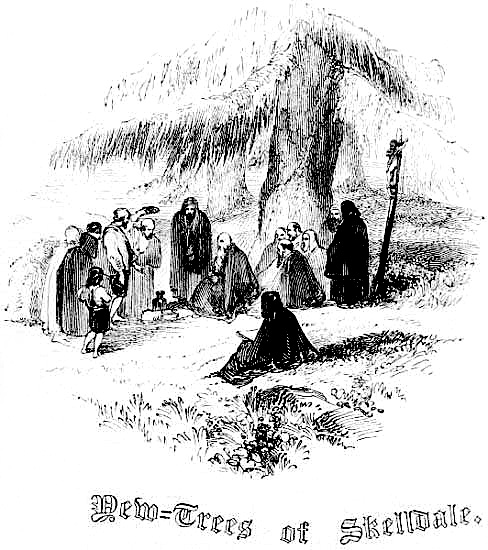
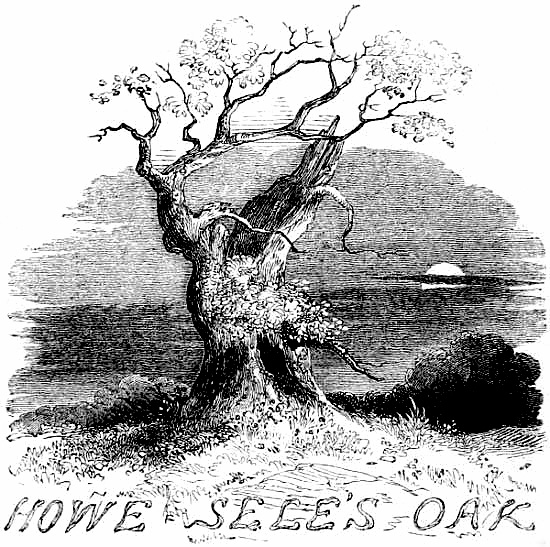
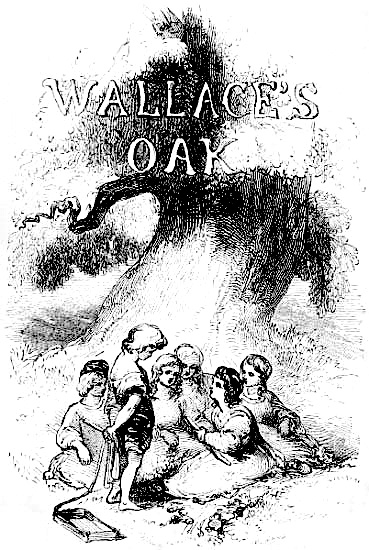
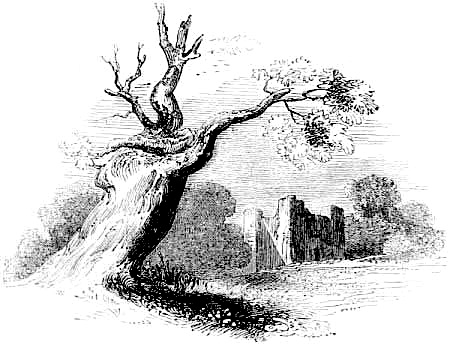
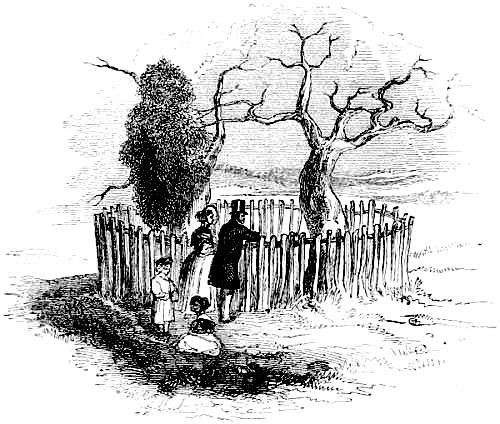
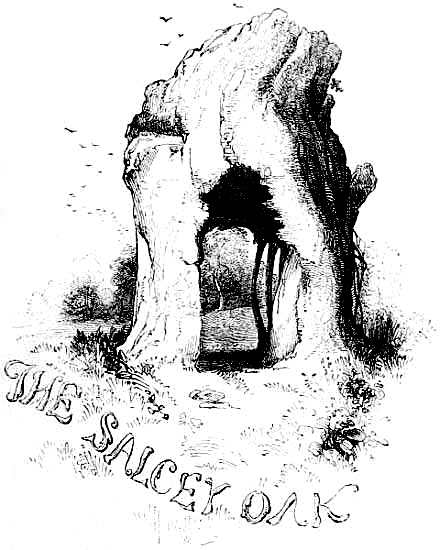
What see you in that old oak more than in any other tree, except that its
trunk is white with age, and that gray lichens hang in tufts from out the
interstices of the bark? That tree, stranger, was a silent witness of
scenes long past. It stood when England was rent asunder during the
fearful contest of the Roses; and beside its noble trunk met those, in all
the pride of chivalry and loveliness of beauty, who now are resting from
life’s weary pilgrimage beneath the tomb of Quentin Matsys.
Who has not heard concerning the Duchess Dowager of Bedford, how she left
her high estate to wed a simple squire, and to dwell with him in the
beautiful solitude of her dower castle of Grafton, far from the scene of
her former greatness! The noble trees that grouped around the castle wall,
mingled with those of the wide forest of Whittlebury, a royal chase, on
the verge of which, and at no great distance from the castle, stood this
aged tree, then in all the pride of sylvan majesty; and far as the eye
could reach, extended one vast sweep of woodland scenery, with breaks of
lawn and thicket. The inhabitants of Grafton Castle passed the first years
of their wedded life in comparative obscurity, exercising hospitality,
according to the manners of the age, yet keeping as much as possible apart
from the dangers and excitements of public life. At length the necessity
of providing for the elder branches of an increasing family, rendered it
desirable to strengthen their connexions, and the Duchess of Bedford,
whose rank was more exalted than her fortune, resolved to introduce them
at the court of her friend, Queen Margaret, to whom her eldest daughter,
the beautiful Elizabeth Woodville, was appointed maid of honour.[40]
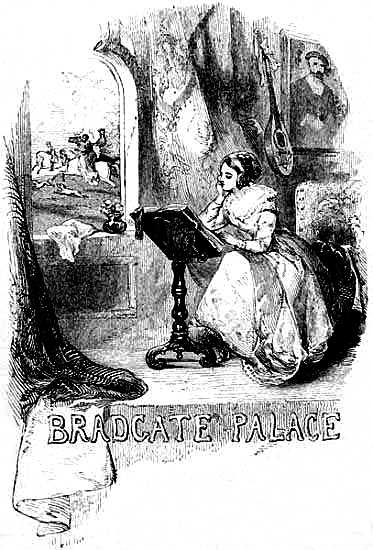
Years passed on, and Elizabeth was united to John Gray, son and heir to
Lord Ferrars of Groby, possessor of the ancient domain of Bradgate,[41] by
reason of his descent from Petronilla, daughter of Grantmesnil, one of the
proudest of our Norman nobility. Withdrawn from her quiet home by the
stirring incidents that attended the fierce contest between the rival
houses of York and Lancaster, Elizabeth accompanied her husband during the
campaign, and shared with him in many of its perils. It was even said that
Queen Margaret persuaded her to visit king-making Warwick in his camp,
under the pretence of requesting some little favour, for the stout earl
was ever kind to her; but in reality to make observations relative to the
number and condition of his troops. This was on the eve of the great
battle of St. Albans, which took place at a short distance from the abbey.
The abbey stood, in peaceable times, like a vast granary, which
continually received and gave out its produce, into which was gathered
both corn, and wine, and oil, barley, and the fruits of the earth, and to
which not fewer than twelve cells and hospitals were appended. And
scarcely was there a forest, chase, or wood throughout the greatest part
of England, which did not in some measure contribute a supply to the abbey
of its timber or venison. Successive monarchs banquetted within its walls,
and while the abbots were distinguished for their extensive hospitality,
the poor were not forgotten. Thus stood St. Albans, often in stormy times
a place of refuge, into which the peasants drove their cattle and were
secure, and while the storm of war raged furiously without, there was
safety and abundance within. But it was not always so, and St. Albans was
sacked more than once. The infuriated followers of Wat Tyler set fire to
the papers and written records of the abbey, and in after times it was
exposed to all the horrors of civil war, when the rival houses of York and
Lancaster battled close beside its walls, and beneath the floor of our
Lady’s chapel rest the remains of many who fought and fell in those
murderous conflicts. Showers and warm sunbeams contribute their aid
ofttimes to repair the ravages which war has made in the aspect of nature.
The trodden fields were again covered with corn; dwellings which had been
set on fire, were speedily rebuilt, and all went on as before. Tributes of
corn, and wine, and oil, were brought into the abbey, and the poor and
destitute received their daily doles. But men had not yet learned that war
and misery are synonymous. The second battle of St. Albans, at which the
forces of Queen Margaret were, for a brief space, triumphant, was deeply
felt within the abbey. Wounded men, borne by their companions from the
fray, were continually brought in; and when the battle ceased, it was
fearful to hear the continual tolling of the bell, sounding daily from
morning till night, while the dead were being interred; if holding rank
among the living, within the precincts of the monastery, if otherwise, in
an adjoining field.[42] The husband of Elizabeth Woodville, Gray Lord
Ferrars, was then in the twenty-fifth year of his age. Handsome, valorous,
and intrepid, and devotedly attached to the cause of Henry VI.; he was
appointed commander of the Red-rose cavalry, and, while leading on the
memorable onset by which the field was won, he received a mortal wound, of
which he died a few days after, at the village of Colney, on the
twenty-eighth of February 1461.[43] Henry VI. visited and endeavoured to
console the dying youth, and sought, with the usual kindliness of his
nature, to reconcile him to the thought of death, by pointing to the only
Refuge, on whom his own hopes rested. Some chroniclers relate, that,
according to the fashion of the age, he conferred the honour of knighthood
on the wounded earl, for the sake of his sons, for although his father,
Lord Ferrars, had died two months before, the distracted condition of the
country had prevented the young nobleman from taking his place in the
house of peers. A deep and rancorous feeling seems to have existed against
the memory of this brave and devoted adherent of King Henry; his harmless
children, the eldest of whom was not more than four years of age, were
deprived of their inheritance, and his widow was not permitted to remain
on the family estate; the fine old mansion, with its broad lands, was
confiscated; it became the property of another, who repaired thither to
take possession, and with him his family and dependents, who filled all
the offices and places of trust and profit which the adherents of the
house of Gray had hitherto enjoyed. Elizabeth, therefore, sought again the
paternal roof. Sad was the day of her return, yet she only was changed.
The avenue of noble trees waved in the breeze, fresh and shady as when
last she passed; the fields, too, looked as green and lovely, and through
them lay the pathway, fringed with wild flowers, where she had often
gathered, with her young companions, fresh garlands of sweet flowers, with
which to bedeck themselves. The mansion had not been altered, since the
family returned from court, at the accession of Edward IV. There was the
open door, down the steps of which the train of sisters had followed their
stately mother, when they set forth a few years before, at the invitation
of Queen Margaret, to visit her court; the eldest, appointed to be her
maid of honour;[44] the others, with promises of favour and promotion.
They had now returned, for there was neither favour nor promotion for
adherents of the Red-rose, and Catherine, and Anne, and Mary, were waiting
to receive Elizabeth with blended feelings of joy and sorrow; joy, to
welcome back their sister; sorrow, to see her widow’s weeds and orphan
children. Time had not changed them, nor were the faithful servants, who
had seen, a few years back, their young mistress depart, with tears and
blessings, yet broken down. Here, then, at a short distance from this
time-worn tree, Elizabeth continued to reside in Grafton Castle, devoted
to the education of her sons; for whom, as well as for herself, she was
dependent on the bounty of her father.
Edward came at length to hunt in the forest of Whittlebury, for this great
forest was a royal chase, abounding with shady coverts and open spaces,
where the fern grew wild and high, and dancing lights and shadows seemed
to sport over a wilderness of broken ground and coppice-wood. Elizabeth
heard that he would pass at a short distance from her mother’s dower
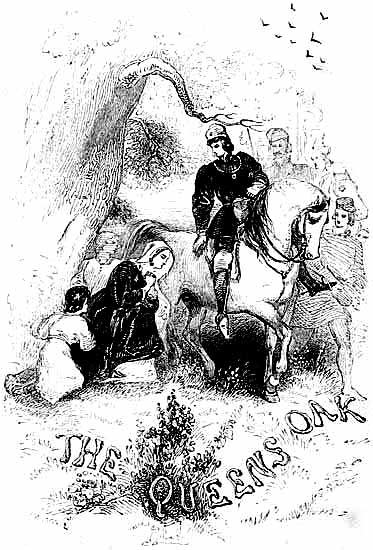
castle, and she resolved to wait for him under the shade of the tall tree,
which bears her name. The mingled sound of hounds and horns, with the
trampling of horses on the green turf, soon reached her ear, and presently
the monarch passed that way with his gallant train of hunters. She was
then, for such is the tradition of the neighbourhood,[45] with her
fatherless boys, on this very spot, for she had thrown herself on the
ground, and besought him, with many tears, to have pity on her
impoverished and bereaved children. The sight of beauty in affliction
softened the stern heart of the monarch, while the anxiety of a mother for
her children seemed to awaken in his heart feelings of kindliness and
compassion, to which he had been long a stranger, and he raised her from
the ground, with assurances of favour and consideration.
Legends tell, that they met again under the same old tree, for that
Edward seemed to prefer that their interviews should take place where he
had first seen and loved the beautiful Elizabeth. History relates that the
espousals were privately solemnised early in the morning of the first of
May 1464, at the town of Grafton, near Stony Stratford. None were present
excepting the Duchess of Bedford, the priest, and two gentlewomen, with a
young man, who assisted in singing. The priest who wedded them lies buried
before the altar, in the church of the Minoresses at London-bridge.[46]
O what a mingled throng are passing now,
As in a mirror, which time seems to hold
For men to gaze in! Actors in all scenes,
Mingled, and yet distinct, with names on each,
Given by Him who sent them forth to bless
Their homes or kindred—dwelling where they may.
Kings, with their crowned heads, and he who serves—
The anxious tradesman, and the gentle one
Who walks with peace, looking on meads and streams—
Loving the sound of whispering winds at eve,
Of warbling birds, and prattling streams that gush
’Mid flowers and ferns, and green hills meeting round;
For such are seen, e’en near the deadly fray
Of battle fields, where meet the sire and son.
The Red-rose conquering now—and then the Pale;
And he, who skulks in forest haunt, or cave
When morning dawns, walks as a chief at eve.
Look, then, at the strange eventful scenes in the life of Elizabeth
Woodville, as they pass before the mental vision, now in brightness and
in beauty, and now in shade and sadness.
Observe that gallant gentleman, holding a lady by the hand, in a large and
antique apartment, for the scene has changed from Grafton Castle to the
old palace of Reading. That gentleman is Edward IV., and standing round,
are peers and princes of the realm, adherents of the house of York, whom
the king has convened in council, that he may present to them the lady
Elizabeth as his rightful queen,—one whom he had wedded because of her
exalted worth, for he could never hope to espouse a foreign princess, on
account of the house of Lancaster.[47] The queen is apparently little more
than twenty-eight years of age, and her delicate and modest beauty is not
impaired by either time or sorrow. Her head is encircled with a high crown
of peculiar richness, the numerous points of which are finished by
fleur-de-lis. Rich pearls, strung in an elaborate pattern, encircle her
beautiful neck, while a small ring, in the middle of her forehead, divides
her pale yellow tresses, which descend in waving curls of great length and
profusion. Her face is exceedingly fair, and her eyes are timidly cast
down. She is royally attired in a splendid kind of gold brocade, woven in
stripes of blue and gold, of which the wearing is restricted to the royal
reigning family, with a close boddice and tight sleeves, and ermine
robings, turned back over the shoulders, and the whole dress is girded
round the waist with a crimson scarf. Her skirt is full and flowing, with
a broad ermine border, and a train of many yards in length, held up by a
trainbearer, a fair and gentle-looking damsel, most probably one of the
queen’s sisters, who has gracefully folded the extremity around her arms.
A rich blue satin petticoat is seen beneath the drapery, and the shoes
that peep forth occasionally are of a pointed form.[48]
From that old room of state, where stands the fair young queen, thus
regally attired, passes on the pageant of king and lady, and bearded
counsellors, in solemn pomp, to the stately abbey church of Reading, the
lady led by the young Duke of Clarence, where she is publicly declared
queen; and where having made her offering, she is receiving the
congratulations of the assembled nobility, among whom, some people say, is
the Earl of Warwick. Brilliant fêtes and tournaments succeed, such as have
not been seen in England, since the gorgeous days of Edward III., when he
held high state in Windsor Castle. Elizabeth presides in all, with her
lovely train of sisters, and around them gather, as shepherds to “the star
of Arcady, or Tyrian cynosure,” many a gallant knight and noble, proud to
tilt in honour of those fair damsels, and to receive from them the prize
that beauty awards to valour. Listen now to the loud hum that mighty
London sends through all her gates, for sights and sounds of revelry
pertain to this bright act in the life of our sovereign lady. Knights,
and citizens, and throngs of people are filling every street, and crowding
every window. The queen is passing through the city to her palace of
Westminster, in a litter borne on poles, and supported by stately prancing
steeds; and right and left, behind and in advance, ride valiant men, whom
the king has deputed to this honour. The queen has come from Eltham
Palace, where the hawthorn-trees are all in blossom, and the little birds
are singing blithely, as if to hail their queen on the day of her
coronation. And when the train of knights and citizens is seen passing
beneath the lofty portal of the ancient abbey, sweet sounds greet them,
not of joyous birds that warble their harmonious concerts among the trees
in Eltham park, but deep solemn music, and glorious human voices chanting
in unison; and thus welcomed and attended, enters Elizabeth, to pass forth
again a crowned and anointed woman. And with her is Count James, of St.
Pol, uncle to the Duchess of Bedford, with a hundred knights and their
attendants; a sovereign prince, and near kinsman of the queen, whom
Charles the Bold had deputed to be present at the coronation. King Edward
desired that the peers of England and the citizens of London should be
assured that the lady whom he married was worthy, by her high descent, to
share his throne, and he had requested the French king to induce some of
the princes of the house of Luxemburg to visit England, and claim kindred
with his wife. Count James set forth accordingly, for now that his fair
cousin wore a crown, he was proud to acknowledge the connexion. It was
otherwise a few years before with the house of Luxemburg: they had not
only chosen to forget the mother of Elizabeth, because she married a
private gentleman, “though he was the handsomest man in all England, and
the duchess was an exceeding handsome gentlewoman.” They had not only
chosen to withold their countenance, but had even spoken such harsh words,
that neither the knight nor lady dared to claim kindred with them on the
continent, for the father of that same count, who was now in England,
would have slain them both, had they ventured within his reach. All was
now forgotten, and he who looks with the mental eye through the long, long
vista of past ages, may discern in the dim distance, gorgeous pageants,
and tilts and tournaments, ladies coming forth from their old Gothic
castles to grace the court, with chevaliers of France and England, each
from their baronial residences, mingling in feats of arms and festivals.
And then, beside the small couch of a fair infant, are seen standing the
haughty Cicely of York, and the royally descended Jaquetta of Bedford,
grandmothers of the young scion, made friends that day, as they bend with
looks of love over the unconscious sleeping one. Sleep on, fair child, thy
brow shall wear a crown, but weary years of woes and wanderings are before
thee.[49]
The hand of the reaper,
Cuts the ears that are hoary:
But the voice of the weeper,
Wails manhood in glory.—Scott.
It is the middle of corn harvest, and reapers are cutting down the rich
brown ears, on the verge of the great forest, where first met the Lady
Elizabeth and King Edward. All around the Queen’s Oak, the oak of
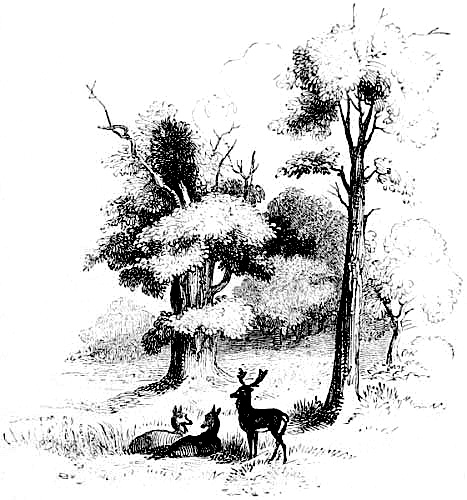
Whittlebury Chase, is one vast joyous solitude of woods and waters,
lonely, yet cheerful; without any habitation, yet not unpeopled, for noble
antlers are seen emerging from the brushwood, and joyous birds and
butterflies fly in and out among the trees, or flit from one flower to
another. All is stillness, and beauty, and luxuriance; and let him who has
found a covert within the woody range, venture not far away, for there are
fearful doings in the land.
Gradually melt away the mists of time, that have hidden for a while the
court of Westminster, but the king is not there, nor yet the queen, nor
the couch on which the young child lay; but instead of these, strange men
are seen hurrying from room to room, as if in quest of plunder. The moon
is up, and her pale beams shine on the white sails of a small vessel, that
urges its way, as in fear, from the shores of Lynn, in Norfolk.[50] They
shine, likewise, on a mother with three little girls, and a noble looking
dame, the Lady Scrope, who have taken refuge in a strong and gloomy
building at the end of St. Margaret’s church-yard. That lone mother is
the beautiful Queen of England, she has fled to sanctuary on the approach
of Warwick’s army, for the ship, whose white sails glisten in the clear
cold moonbeams, conveys her husband abroad in quest of succour. Stern men
are prowling round the gloomy building, but no one dares to go within, for
the queen has registered herself and her three children, Elizabeth, Mary,
and Cicely, and the Lady Scrope, as inmates of sanctuary. That gloomy
place has sheltered murderers and robbers, men, too, who were in peril of
their lives, for treason against their king; but in the present evil
times, ladies and young children often find a home within its walls, when
all other homes are broken up. And thus, all comfortless and forlorn, is
waiting the Queen of England, for the birth of that fair child, who first
saw light within the sanctuary of Westminster.[51] No distinction is there
between the kindred of a prince or peasant, when the crown is put aside,
no royal spell with which to chace away either want or sorrow. The Queen
of England soon began to be in need, and must have been constrained to
surrender to the army of Queen Margaret, had not provisions been secretly
conveyed to her by a kind-hearted butcher of the name of Gould, who could
not bear, he said, to think that the lady and her children should be
distressed for lack of food.
The infant prince is about to be baptized, and this with no greater
ceremony than if he had been a poor man’s child. A poor man’s child might
have more to gladden him, smiling faces and fresh air, but around this son
of a throneless monarch are sad countenances and gloomy walls. No costly
gifts are presented, and for attendants there remain but one or two kind
friends, faithful among faithless thousands. No cloth of gold adorns the
Gothic font of hewn stone, round which the little band of fond and
faithful friends are gathered, while the sacred ceremony is performed by
the sub-prior, who gives to the young prince the name of his father. Those
who promise for him, poor child, that he shall renounce the pomps and
pleasures of the world, when his noble patrimony seems lost to him, are
his grandmother and the Lady Scrope, that devoted woman, who adheres to
the queen in all her trials. The good abbot, Thomas Milling, performs the
office of godfather, no other man being either willing or at hand to do
the desolate one that service.
Hark now to the sound of cheerful voices. They come from those who no
longer fear to be regarded as adherents of the house of York. King Edward
is returned, and with him a gallant company of gentlemen are seen pressing
onward to the sanctuary. One moment more, the bolted doors fly open, and
the king and queen, with their three little girls, are preparing to leave
the sanctuary; the infant prince, borne in the arms of his nurse, and his
blithe and gladsome sisters, making the old walls resound with their
joyous voices. Men speak much concerning the valorous conduct of Queen
Margaret, and all which she has done and suffered in order to replace her
husband on the throne. But they speak more of the gentle Elizabeth; how
she had sat down in meekness and in patience within the walls of that
dismal place, where murderers and traitors had harboured in other times,
waiting quietly till it pleased the Most High to send her better days,
sojourning, indeed, in trouble, heaviness, and sorrow, yet sustaining it
as became a Christian woman, having much to fear, yet hoping against
hope.[52]
The queen is playing now with her ladies at a courtly game called the
marteaux, while others are amusing themselves as best befit them,
according to the fashion of the times. King Edward is dancing with the
Lady Elizabeth, his eldest daughter, and all is mirth and revelry, and
joyousness, and well may those rejoice, who but a few days before knew not
where to find a hiding-place. Who is that stately gentleman, whose dress
and accent bespeak him from foreign parts, on whom all eyes are turned,
and even the king salutes with more than kingly courtesy? The Lord of
Grauthuse, Louis of Bruges. At once a nobleman, a merchant, and a man of
letters, acting as deputy in the Low Countries for his master, Charles the
Bold. He received and welcomed his royal guest, when in the preceding year
the king fled from England, with a few attendants, “the most distressed
company of creatures that were ever seen,” for Edward had left his military
coat, lined with martin’s fur, with the master of the ship, having no
other means of paying him, and was put on shore in his waistcoat. Unlike
many in those days, who made the exiles of either faction, whether of the
red or paler rose, pay dearly for their prison-houses, or hard fare, the
Lord of Grauthuse fed and clothed the king and his attendants. He lent him
ships and money, without which he could not have returned to his family,
and afforded him every facility for making good his landing on the shores
of Britain.[53] The minstrel has ceased now, and night and silence pervade
the castle. The moon, which looked down on the white sail of King Edward,
passing in its swiftness and its loneliness over the dark waters, shines
now on the ancient turrets of Windsor Castle, wherein the king is
sleeping. And there, too, his wife and children, his courtiers and his
guards, are resting, and no sound is heard except the heavy tramp of the
warders as they go their rounds, or perchance the deep bay of some
listening hound, which the leveret’s light step on the damp grass has
roused from his slumber.
Morning returns, and the cheerful sights and sounds of busy life. St.
George’s Chapel, with its painted windows and knights’ banners are
brightening in the sunbeams, while our lady’s mass is sung, with the full
harmony of the choristers’ sweet voices. The king is there, Lady Elizabeth
and the Lord Grauthuse, for it seems as if his late deliverance from so
much peril had wrought good thoughts within him.
Again the scene is changed, from the chapel to the quadrant. The innocent
young prince is being carried by Sir Richard Vaughan. He can hardly speak
as yet, but his chamberlain has taught him to bid the Lord Grauthuse
welcome, who saved his father, and brought himself from his dolorous
birth-place, to enjoy at once his liberty, and the sun’s cheering light.
That faithful chamberlain who carries the young prince everywhere, after
his father’s footsteps, will yet be called upon to act in a very different
scene. He is attending the king and count from place to place, now in the
lodge at Windsor Park, where the royal family dine together, afterwards
through the garden and vineyard of pleasure, for the king desires to show
his guest the many and varied excellencies of his kingly dwelling.
Pageants sweep by, and nobles are presiding in halls of state. See the
monarch, too, in his kingly robes, with his cap of maintenance, and right
and left his lords, both spiritual and temporal. And list to that grave
man, who declares before the king and nobles, the intent and the desire of
the commons, with regard to the queen and Lord Grauthuse; upon the one is
bestowed all honour and commendation of her womanly behaviour and great
constancy during the nation’s peril; to the other, is conveyed that
nation’s gratitude for his kindness and humanity to her sovereign lord, by
the king, creating him Earl of Winchester. And surely the ceremony of that
creation is one of no ordinary interest. The king is passing now into
Whitehall, and thither too goes the queen from her own apartment, wearing
a crown upon her head, with the young prince in his small robes of state,
borne after her in the arms of Master Vaughan. And thus the king and
queen, and that fair child, proceed through the abbey church, to the
shrine of St. Edward, where their offerings are presented. Next, in the
review of pageantries and banquet-halls, hunting scenes and revels, in the
beautiful bowers of Eltham Palace, rises from out the mingled scene, the
rich and gorgeous spectacle of the betrothing of the young Duke of York
with Anne Mowbray, the infant heiress of the duchy of Norfolk. St.
Stephen’s chapel is being hung with arras of gold, and men are employed
both day and night in putting up the drapery, which standing in its
richness, must yet be gracefully arranged in broad folds around the
pillars and the columns. All this is done, and the closed doors are opened
for the entrance of stately ladies and train-bearers, great lords and
their attendants, the beauty and the chivalry of the house of York. And
now the flourish of loud trumpets and the clang of cymbals announce the
king’s approach, and the full quire is pealing forth its melody of mingled
voices and high minstrelsy. The king is entering with the young Prince of
Wales and the three princesses, Elizabeth, Mary, and Cicely; the queen
follows, leading the small bridegroom of five years’ old, her brother,
Earl Rivers, conducts the baby bride, who looks awestruck and wondering,
at the unusual sights and sounds. Thus striking its roots deep, with young
scions rising round, stands the red rose of England in all its richness
and luxuriance.
Look at that desolate woman, who is sitting all sorrowful and dismayed on
the rushes that strew the floor of a large and antique apartment. Her long
hair, once her richest ornament, has fallen from beneath her widow’s cap,
and flowing in all its wonted beauty, over her slight form, is resting on
the pavement. Fearful scenes have passed before the view of England’s
queen since her proud day in St. Stephen’s chapel—her husband’s couch of
death, his deep remorse for sins committed or duties passed over; his
funeral, his empty throne, murder, and usurpation. There is the sound of
many footsteps treading heavily and in haste, and the putting down of
boxes; men are seen busy in conveying household stuff, and chests and
packages, but that desolate woman does not seem to heed them—she is
thinking only of her sorrows, and the dangers that surround her family,
for intelligence was brought to her at midnight that the Duke of
Gloucester had intercepted the young king on his way from Ludlow to the
metropolis; that he had seized his person, and caused the arrest of her
brother, Earl Rivers, and Lord Gray, her son, together with the faithful
Vaughan, who used to carry prince Edward when an infant.[54]
Bitterly does she lament having listened to the evil counsellors, who
prevented her from placing a strong escort around the person of her son;
but she remembered, even in the midst of her exceeding grief, that herself
and her young family had before been saved by taking refuge in the
sanctuary, and she resolved to go thither without delay. Rising up,
therefore, in the midst of the dark night, she caused her innocent
children to be brought to her, and hastened with them from the palace of
Westminster to the residence of the good abbot. She knew that if able to
keep her second son in safety, it would ensure the life of the young king;
but she did not go as heretofore into the ancient sanctuary, for the whole
of the abbey, with its rooms of state and spacious gardens, was equally
privileged, and she felt that she was welcome. Never yet has the right of
sanctuary been violated, even in the worst of times; and, perhaps, a ray
of hope is lighting up in the breast of that lone woman; but now the door
is opening, and the venerable Archbishop Rotherham, who resides in
York-place, beside the abbey, enters, with a cheerful countenance, and
communicates a message, sent him by Lord Hastings in the night, and which
he believed to be of good import. Bourchier, the primate, accompanies him,
and they come in full credence of the duke’s good faith, who has
endeavoured, with much sophistry, to convince the privy council that his
designs are just and honourable.
The queen seems unwilling to receive their message; her just apprehensions
are not to be removed by the hopes which they endeavour to excite. The
good archbishop seeks to comfort her by saying that he trusts the matter
is none so sore as she takes it for, and that he is in good hope, and
relieved from fear by the message sent from the Lord Chamberlain Hastings.
“Ah, woe worth him,” replies the queen, “for he is one of them that
labours to destroy me and my children.” “Madam,” rejoins the bishop, “be
of good cheer: I do assure you, if they crown any other king than your
son, whom they now have with them, we shall, on the morrow, crown his
brother, whom you have with you. And here is the great seal, which, in
likewise, as that noble prince, your husband, delivered unto me, so here I
deliver it unto you, to the use and behoof of your son.”[55]
This sad scene, like others of joy and sorrow in the life of poor
Elizabeth, is fading from before the view, but, while it lingers, look
well at the spacious hall wherein the queen has taken refuge, with its
circular hearthstone in the centre, and an opening in the roof above,
through which the smoke escapes in winter. The further end is nobly
screened with oak panelling, laticed at the top, and having several doors
of ancient workmanship, that open on winding stairs, leading to numerous
small stone chambers, with carved windows and stone mullions. There are
also state apartments, of which the walls are covered with richly carved
oak; an organ-room, and the abbot’s grand reception-room, with its Gothic
window of painted glass, but with such we have no concern.
May, sweet May is come, and the hearth-stone is decked with green branches
and bright flowers; the birth of the young day, but withering before its
close. Emblems of the failing hopes of her who sits all desolate beside
them, and with her are two beautiful and serious-looking maidens, the
princesses Elizabeth and Mary, and four young children, from three to
eleven years of age; Richard, Duke of York, Anne, Catherine, and Bridget.
At one time the terrified children hide in the folds of their mother’s
robe; at another, their cheerful voices are heard, calling to each other
as they run from room to room; now in the state apartment, and now in some
winding passage, or asking leave to wander forth among the bees and
flowers in the quiet garden of the abbey. Poor children, your grief is
light, and it passes soon, like an April shower; but darker clouds are
gathering, and their crushing rain will fall heavily even upon you.
An aged man is seen advancing towards the abbey, and with him a
deputation, apparently of no mean rank. His robes and crosier denote his
dignity, for it is the Archbishop of Canterbury, who is about to pay a
visit to the queen, with a message from the Lord Protector, who has placed
the young king in the Tower, under the pretence of awaiting his
coronation, and who also desires to gain possession of his brother. A long
and stormy debate had taken place in the star-chamber, close to
Elizabeth’s retreat. It was argued there, that men and women might remain
in sanctuary, but that young children had no need, they being guileless of
all crimes that might affect the state; that consequently the Duke of
Gloucester might possess himself of his nephew whenever it pleased him.
The archbishop was extremely concerned when he heard all this, and he
proferred his services to speak with the queen, rather than force should
be used.[56]
The scene has changed from the great hall, with its fresh flowers around
the hearthstone, and its floor strewed with green rushes, to the great
Jerusalem chamber, with its Gothic window of richly stained and painted
glass, its curious tapestry, and ancient picture of King Richard. Observe
the venerable man, beneath the surface of whose placid and pale features
deep feelings are at work. He knows not what to say, nor how to prepare
the mind of the poor queen for the stern resolve of the hunchbacked
protector, with regard to the young prince. At length he began by urging
that the king required the company of his brother, being much cast down
for the want of a playfellow.
“Troweth the protector,” replies the queen, (heaven grant that he may
prove a protector,) “that the king doth lack a playfellow? Can none be
found to play with the king but only his brother, who hath no wish to
play because of sickness? as though princes so young as they be, could not
play without their peers, or children could not play without their
kindred, with whom, for the most part, they agree worse than with
strangers!” The archbishop knew not what to say in answer, he liked not to
tell her that the protector was resolved to gain possession of the young
prince, and he waited in the hope that she might be inclined to accede to
his request. At length the queen, taking her son by the hand, said, in a
compressed and solemn tone, “My lord, and all my lords now present, I will
not be so suspicious as to mistrust your truth. Lo here is this gentleman
whom, I doubt not, would be safely kept by me if I were permitted; and
well do I know there be some such deadly enemies to my blood, that if they
wist where any lay, they would let it out if they could. The desire of a
kingdom knoweth no kindred; brothers have been brothers’ bane, and may the
nephews be sure of the uncle? Each of these children are safe while they
be asunder; notwithstanding, I here deliver him, and his brother’s life
with him, into your hands, and of you I shall require them before God and
man. Faithful ye be, I wot well, and power ye have, if ye list, to keep
them safe; but if ye think I fear too much, yet beware ye fear not too
little! Farewell, my own sweet son! God send you good keeping. Let me kiss
you once ere you go, for God knoweth when we shall kiss together again.”
Tenderly embracing the afflicted boy, she is seen “weeping bitterly over
him, and he too is weeping as fast in his turn.”[57]
Fearful tragedies are acting now in the dim distance of time’s
perspective. They flit before the mental view, fading, and seeming to
appear again; yet not the same, though like in terror and in kind. The
shadowy figures of Hastings, of Gray, and Rivers, are seen passing from
the block, and then the innocent forms of two young children, emerging
from the gloomy range of fortresses belonging to the Tower. And loud is
heard the sobbing, and the pitiful screams of the poor mother, as she
beats upon her breast, and calls her sweet babes by name; and, kneeling
down, implores the vengeance of the Just One, on the guilty head of him
who has thus cruelly deprived her of her sons.
The vaulted door of a spacious room is opening, and across the furthest
end seems flitting a strange succession of sad scenes—a young child’s[58]
funeral passes, and then a burst of anguish comes remotely to the ear, as
if across wide waters, from a stern man, who yet cannot hide his sorrow;
then a woman’s wail, but the wail soon dies away, and a death scene and a
funeral pass in faint review.[59] Then the great fight of Bosworth, where
a king is slain, and another takes his crown; a bridal follows and a
coronation.
Thus they pass; events of other days are shadows now; terrible, indeed,
at the period of their reality, but when ended, how soon forgotten! yet
not forgotten by the aged woman, who is resting, as in a quiet home,
within that spacious room in the Abbey of Bermondsey. It is her right to
be there, for the prior and monks are bound by their charter to entertain,
and that most hospitably, the representative of their great founder,
Clare, Earl of Gloucester. Edward VI. was the sole heir of that family,
and the queen dowager is privileged to occupy the nobly panelled halls,
and state-chambers, that are expressly reserved for the descendants of the
founder.[60]
The waves and billows of life’s deepest waters have passed over that aged
woman who is sitting in a richly carved chair, at the great oriel-window,
watching the summer clouds as they flit over the smiling landscape, and
cast their shadows on the abbey fields. Her venerable figure, beautiful
even in its decrepitude, though not with the beauty of sunny youth, yet
such as the bright ray of the setting sun sheds over an autumn landscape,
recalls the faint remembrance of a lovely woman who once stood, with two
orphan boys beneath the oak of Whittlebury, to sue for the restitution of
her broad lands, from the gallant Edward.
Hark to the toll of the convent bell. It is tolling for Elizabeth
Woodville, late Queen Dowager of England, and the requiem is being sung,
which breathes peace to the passing spirit. The moon is up, and yet the
night is dark and gloomy, by reason of the heavy clouds that are rolling
past, and he who looks narrowly on the deep dark waters of the river may
discern a small boat gliding on, with the coffin of the queen on board,
and four attendants, but when the moon shines out you can distinguish the
prior of the Charterhouse by his robes, with two others in deep mourning,
yet without insignia, by which to designate them, and one female figure.
Now the rowers stop, and the coffin is being carried through the little
park into Windsor Castle, a few torches serving to guide the bearers,
which appear and disappear among the trees, like the twinkling lights of
glow-worms in the grass.
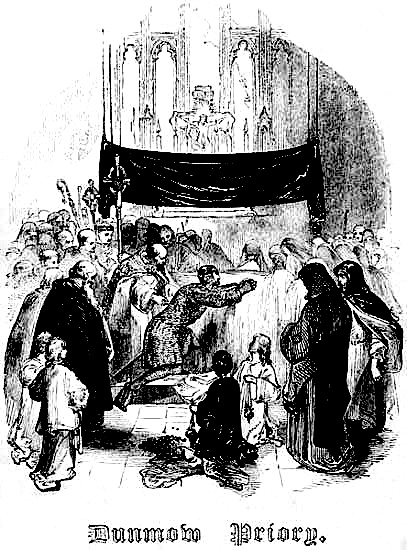
Stately figures are kneeling round the coffin, where it remains for a
while, ready to be borne to its last resting-place, and among the mourners
one is discerned in the dress of a nun. Again the coffin is upborne, and
the queen’s daughters fall behind, with a train of shadowy forms, ladies,
and earls, and viscounts, moving onward to St. George’s chapel. Strange it
seems, that neither plumes nor scutcheons are to be seen; that when the
dirge is being sung, the twelve old men, whose office it is to chant the
requiem for the dead, are not even clad in sable vestments: appearing
rather like a dozen old men indiscriminately and hastily brought together
for the purpose, and permitted to retain the garments of poverty, in which
they were found, and, instead of flambeaux, they light on the funeral with
old torches and torches ends.[61] Some say, that the queen, when dying,
expressed an earnest wish for a speedy and private funeral. If so, her
request was punctually fulfilled. Yet still it is remarkable that no more
of pomp should appertain to the obsequies of her who had been Queen of
England—that scutcheons and nodding plumes, and other mourning tokens,
were wanting to distinguish that illustrious one’s last sojourn on earth.
THE END.
Joseph Rickerby, Printer, Sherbourn Lane.
Footnotes:
[1] Gloucestershire.
[2] South Wales.
[3] Lingard.
[4] Southey’s visit to Godstow nunnery.—Camden.
[5] Roger de Hoveden.
[6] Hatcher’s Account of Salisbury.
[7] The Old Peerage, by Brooke.
[8] Dugdale incorrectly says months, instead of years, a mistake corrected
by Bowles.
[9] History of Lacock Abbey. Monsieur de Saint Palage’s great work on the
History of Troubadours.
[10] Book of Lacock.
[11] Close Rolls, May 2. Rhymer’s Fœdore, 1207.
[12] Book of Lacock.
[13] A most beautiful copy was deposited, and may still be seen, in the
chamber of Records at Salisbury Cathedral.
[14] Clause Rolls.
[15] Dugdale, from a MS. Oxon, in Bibl. Bodl. n. 11. f. 177, et 178. p. a.
[16] Matt. of Paris. Clause Rolls.
[17] Register of Osmund, among the MSS. of the Cathedral. Narrative, by
William de Wanda, published in the first volume of Wilkins’s Concilia.
[18] Matt. Paris. Fœdera.
[19] Matt. Paris.
[20] William de Wanda’s Church History.
[21] History of Lacock. Matt. Paris.
[22] History of Lacock Abbey.
[23] Matt. of Westminster.
[24] Chron. of W. de Wanda. Wilkin’s Concilia, vol. 1 page 559.
[25] Annals and Antiquities of Lacock Abbey.
[26] Book of Lacock Abbey.
[27] Annals of Lacock, p. 180.
[28] Madox’s History of the Exchequer, p. 218.
[29] Book of Lacock.
[30] Book of Lacock.
[31] Historian of Lacock Abbey.
[32] Marian is the legendary name of the Countess of Huntingdon.
[33] Rom. viii. 21.
[34] Rapin.
[35] M. Paris.
[36] Hen. Knyghton.
[37] A small silver cross of beautiful workmanship was found buried a few
years since, near the fatal tree.
[38] Mentioned by Walter Hennyngforde, and quoted in Grafton’s Chronicle.
[39] The Palace of Bishops Hatfield, then a royal residence, where the
Princess Elizabeth resided in a kind of honourable custody, though still
rigorously guarded.
[40] Hall’s Chronicle, p. 365. Parliamentary History. Vol. II. 345.
[41] Afterwards the home of Lady Jane Gray.
[42] History of St. Albans.
[43] Whethemstede and Guthrie.
[44] Parliamentary History. Vol. II. p. 345.
[45] Baker’s Northamptonshire.
[46] Fragment Chronicle, printed by Heane, at the end of the Sprott.
Chronicle.
[47] The Sprott. Chronicle.
[48] Lives of the Queens of England, by Alice Strickland.
[49] Monstrelet.
[50] Hall. Comines.
[51] It is conjectured that the prince was born in the Jerusalem Chamber,
which the kind abbot relinquished to the queen.
[52] Fleetwood’s Chronicle.
[53] Narrative of Louis of Bruges, Lord Grauthuse, edited by Sir F.
Madden.
[54] Cont. Hist. Croyl. Sir Thomas More. Hall.
[55] Sir Thomas More.
[56] Hall.
[57] Hall, 355. Sir Thomas Moore, 358.
[58] Only son of Richard III.
[59] Death and funeral of Richard’s Queen.
[60] Annals of the Abbey of Bermondsey.
[61] Arundel MSS. 30. referred to in the Lives of the Queens of England.