Turning from a survey of Rubens’ life to
a consideration of his art, the three divisions
to which his work groups itself naturally,
are very clearly seen. Up to the time of his
marriage with Isabel Brandt his work may
be referred to the first division, and in art it
may be said that no man’s earliest pictures
are of much consequence save for their
promise of higher things. They do little
more than mark his progress, record impressions
he has received from strong personalities,
and mark his own path through the
influences of different schools and varied
appeals, to the complete expression of himself.
Rubens was never a slavish imitator,
he never assumed the mantles of the men
he admired, as so many great painters
have done. Goya, for example, was a man
whose range of thought and capacity for
receiving impressions were so great that
he has painted after the manner of half-a-dozen
masters, and there are pictures to
be seen in Madrid to-day that are painted
with Goya’s brush and recall Fragonard.
Such instances may be multiplied, and
Rubens is to be admired for the restraint
that marked this side of his early
work.
From the time of his marriage down to
the season when he became recognised on
all sides as a diplomatist, let us say roughly
from 1610 to 1626, we get the second period,
and to this may be referred the greater part
of the work that has given offence—the
presentation of the coarsest types of men
and women in a state of nature—the treatment
of some of the grossest incidents in
mythological stories in fashion that leaves
nothing to the imagination.
We are justified in asking ourselves
whether the extraordinary development of
the painter’s social and political life did not
avail to arrest in late middle age any
tendencies he might otherwise have had to
express still further the coarser side of
classical subjects. By the time he reached
the forties, Rubens was the companion
and even the trusted counsellor of princes
and rulers. Such refinement as Western
Europe boasted was to be met in the
circles he frequented. The greatest work
of the greatest masters was within his
reach, and he had travelled to the point at
which a man is able to select as well as
to admire, at which he can distinguish clearly
between the points that make for a picture’s
strength and those that detract from it.
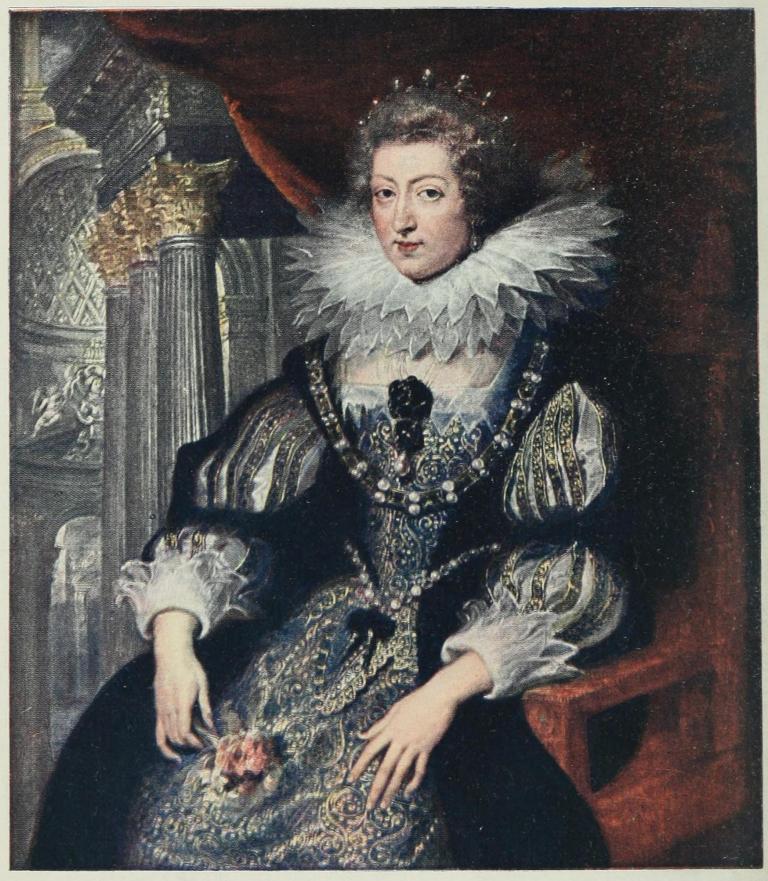
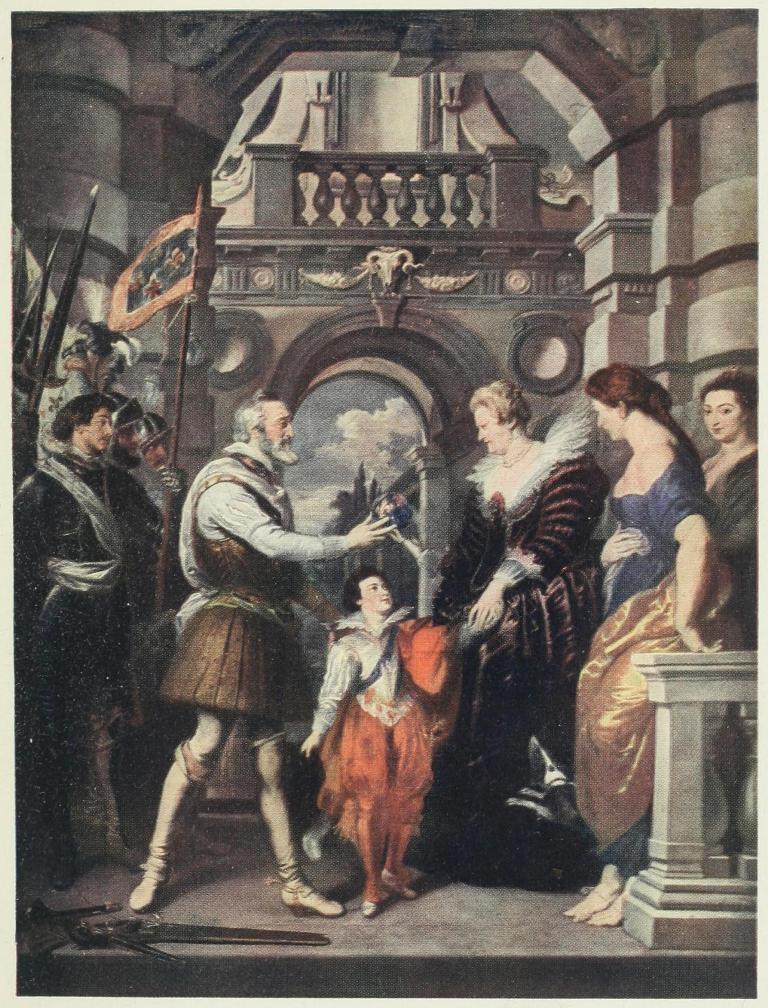
PLATE VII.—HENRY IV. LEAVING FOR A
CAMPAIGN
(In the Louvre)
Here the painter, leaving mythology and allegory for a time, is
seen in one of his most effective historical pictures. Henry IV., who
is leaving for the war in Germany, is seen conferring upon his Queen
the charge of the kingdom.
Rubens on arriving in Italy in the days
when he had first taken service under the
Duke of Mantua, was doubtless unduly impressed
by Michel Angelo and Raphael. On
no other grounds can we account for the
delight that his earliest pictures manifest in
the portrayal of massive and even ugly limbs.
Doubtless he was influenced too by Titian,
though we cannot agree that it was his
admiration for the master that made him
copy the King’s Titians in the Prado, for
it is more probable that on this occasion he
simply obeyed instructions. Moreover, Rome
appealed to him more than Venice did.
The wistful purity of a Bellini Madonna,
the exquisite loveliness of a Bellini child or
cherub, left him unmoved, but a Titian or a
Tintoretto at its biggest, if not at its best,
pleased him, and when he came in Rome
to the works of Raphael and Michel Angelo
he would seem to have looked no further for
inspiration. Doubtless he heard many interesting
theories of art in Rome, where, as we
have said, Caravaggio, who wielded considerable
influence in the art world, was among
his friends. But Rubens thought out things
for himself, and learned to quell his own
instincts and to subdue his own faults as
they were revealed to him.
Violence is perhaps the characteristic of
Rubens’ early work. He has the grand
manner without the grand method, his contrasts
of light and shade and even of colour
amuse where they do not offend, and his
drawing is by no means remarkable or
inspired. At best it is correct. We feel that
we cannot see the wood because of the
trees, that the blending has not been sufficiently
skilful to bring about proportion
and harmony, and that the expression of a
giant form with prize-fighter’s muscles in
the foreground of a canvas is sufficient
to fill the painter with a delight that enables
him happily to ignore the rest. It is
the enthusiasm of clever youth, the youth
of a man in whose veins there is enough
and to spare of very healthy blood, in
whose mental equipment refinement has
been overlooked.
The death of his mother, the distressful
plight of his favourite city, the responsibility
of his commissions, his marriage and
the fruits of his Italian travel brought
about the second period, and started the
traditions that give Antwerp a school and
a name in the history of European art.
The violence passes slowly from the canvases,
the straining after effect that is so
obvious and often so unpleasing in the
earlier pictures goes with it. The chiaroscuro
is more subdued and consequently
more pleasing, only in the handling of
colour the painter is still clumsy and heavy.
Rubens, the great colourist, seems to have
been born when the artist was more than
forty years old.
Some of the best work of the second
period is in Antwerp and Brussels, but it is
to be found scattered all over Europe, and
there are examples in private collections
in this country. Perhaps the dominant impression
that these works leave is one of
certain difficulties created to be overcome.
Just as the painter in his first manner revelled
in his strength, so in his second
period he rejoices in his skill. It was left
to the later years to weld strength and
skill into the service, on pictures that could
stand for both and emphasise neither.
Mythology continued to hold him, indeed
we must never forget that Rubens lived
in the age of pseudo-classicism, and is to
be counted among its victims. To his
second period belongs such work as the
disgusting “Procession of Silenus” now in
Munich, a picture in which the grossness
of the theme is only rivalled by the vulgarity
of the treatment. Some of Rubens’
apologists have held that this class of
work was painted as a protest against
vice, but such apologies are far-fetched.
Rubens needs no apologist. Consider his
work as a whole, and what is good dwarfs
what is bad. Doubtless, had he been able
in the later days to re-possess and destroy
some of his more tainted pictures, he would
have done so. It will be remarked by all
who know Rubens’ work intimately, that
throughout his life he was happier with a
Venus than a Madonna, more at home
with some great classical figure, than with
the picture of Christ. He did not respond
to Christianity in the sense that the Venetians
responded to it, he could not for all
his reputation have painted a Madonna as
Bellini did, and there is no reason to
believe that he would have cared to do so.
Then again we may not forget that Rubens
the artist, and Rubens the courtier, and
Rubens the special envoy, were closely
associated with Rubens the man of business,
who would always have painted for
choice the work likely to find immediate
acceptance. There were times when some
legend of Saint or Martyr moved him
strangely, and he turned to it with a measure
of inspiration not often excelled by
the greatest of the Renaissance artists;
but these occasions were rare, although
Antwerp preserves one of the most effective
results of such inspiration in the “Last
Communion of St. Francis.” It may be remarked
in this place that to see Rubens
at his best, one must not go to the
National Gallery or to the Louvre or to
the Prado—Antwerp and Vienna hold some
of the finest examples of his second and
third manner. And we must never forget
that Art is concerned with treatment, and
that subject is of secondary interest to
artists.
When he became recognised as a diplomatist
whose services were required by
Europe’s greatest potentates, Rubens had
passed the meridian of life. He had known
prosperity from the very earliest days, he
had no occasion to paint pictures of the
sort so admirably summed up by the offensive
word “pot-boiler.” Kings and Queens
and Emperors were offering him commissions,
he was, if we may say so, on his best behaviour.
He rose to the height of every
great occasion. The commission that Maria
de Medici gave him for her palace seems
to have brought him to his third and latest
manner, and from that year until death
overtook him Rubens was one of the great
masters of European art. If we could eliminate
all the pictures of his first manner
and a considerable portion of those belonging
to his middle period, his claims would
hardly be denied by the representatives and
supporters of any school. He seems to
have received added inspiration from his
child wife, and there are few more delightful
pictures than one to be seen in Munich
in which Rubens and Helena Fourment are
walking from their garden to their château.
Perhaps even in the later days woman was
nothing more than a thing of beauty for a
man’s delight, and man was no more than
a godlike animal, but a well-defined measure
of refinement was always beyond their
painter’s mental or artistic conceptions. It
is sufficient for us that the appeal of nature
came to him with great strength. The
Château of Stein in our National Gallery
and the Rainbow Landscape in the Wallace
Collection gives sufficient evidence of this,
while such a work as the Garden of Venus
in the Prado suggests the limitations that
were with him throughout his life. It is
fair to say that in the later years they
were not expressed so prominently in his
work.
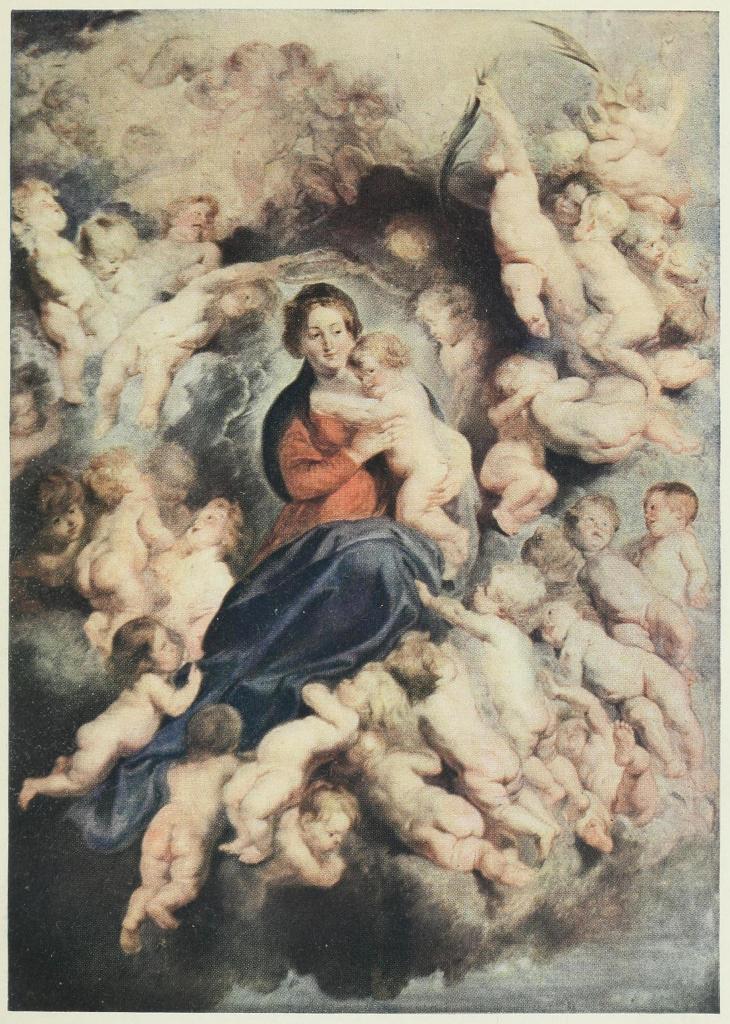
PLATE VIII.—THE VIRGIN AND THE
HOLY INNOCENTS
(In the Louvre)
In this picture Rubens allows his brush to run away with him as
though for sheer joy in its capacity. Perhaps his study of the Virgin
is a little commonplace, a little too suggestive of the exuberance of
Flanders rather than the refinement and spirituality of Nazareth.
But the studies of the Holy Innocents are a delight, and make the
canvas supremely attractive. It will be seen that the grouping of
the children results in every possible difficulty that an artist may
have to face, but that Rubens has encountered them all with sure,
hard, and steady eye, in fashion worthy of Tintoretto himself.
Finally we have to consider and acknowledge
his triumphs as a colourist. It
may be said that Rubens, for all his gifts,
required more than twenty years of unremitting
labour to obtain his mastery over colour,
but when once it was his he retained the
gift to the last hour. In the early days
Rubens as a colourist was a person of no
importance, the grossness of his composition
and the tameness of his drawing were not
redeemed by the handling of pigment. In
the second period the use of paint is far
more skilled, but it does not blend, neither
does it glow. In the later years it acquires
both gifts, and the exquisitely luminous
quality of some of his pictures, the marvellous
delicacy of flesh tint, that must
have astonished and delighted his patrons, is
preserved to us to-day. In fact it may be
said that Rubens has preserved his colour
to a larger extent than many great painters
who came after him. He is far more reliable
in this aspect of his art than is our own
Sir Joshua, whose portraits have long ceased
to tell the story they must have told to
delighted and flattered sitters. It was no
effort of genius that made Rubens a
supreme colourist in the later years. He
came to his kingdom by dint of sheer hard
work, but for his painstaking devotion to
labours such results could not have been
achieved.
The spirit of the Renaissance travelled
very slowly from Italy to the Netherlands,
and that its influence was felt in the sixteenth
century did not lead to any very
marked divergence from the traditions that
the art of the Netherlands was following.
Italian form and Italian sentiment met with
little response there, and there is no doubt
that the eighty years of conflict with Spain
which led to the recognition of the Republic,
turned men’s thoughts away from
art. By the time it was possible to revive
a school, the Netherlands were looking to
life rather than to faith, and even the
classicism of the period that turned Rubens
towards pictures illustrating mythological
incidents could not help him to create imaginary
figures. This is as it should have
been, for it made eighteenth-century art
what it was through the influence of
Rubens and Vandyck. He filled his canvas
with the types he saw around him, and
while nobody will dispute the virtue of the
Netherlands, there will be few found to
assert that it produced the Latin type of
womanhood. The people of the Netherlands
do not belong to the Latin races;
that is why they did not respond earlier to
the Renaissance, that is why they look at
what seems to be their worst rather than
their best in some of Rubens’ most ambitious
works. Yet by reason of his long sojourn
and hard study in Italy, Rubens did do
something considerable to bring Italian art
and tradition into the Netherlands, and if
he could not establish it there, the cause of
failure was that the genius of the country
was opposed to it. Among the painters
who worked for Rubens or were greatly influenced
by him the best known are Anthony
Vandyck, Frans Snyders, Abraham Janssens,
Jacob Jordaens, and Jan Van Den
Hoecke. Then again, of course, it must
not be forgotten that he exercised a very
great influence upon David Teniers, and
that he served the interests of art development
far more than he could have done by
giving fresh life to an art form that had
served its time and purpose.
Rubens the landscape painter, the painter
of religious and mythological subjects, has
rather obscured Rubens the portrait painter,
and this is not as it should be, for many
will be inclined to agree that it is as a
portrait painter that Rubens was often at his
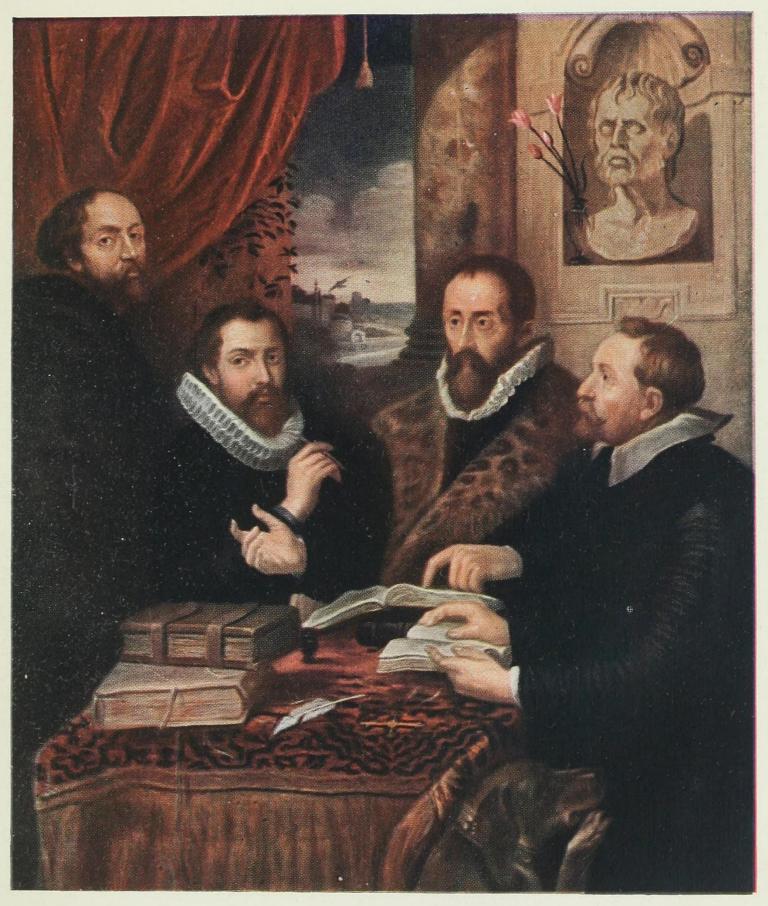
best. Visitors to Florence will not forget the
portrait group entitled “The Philosophers,”
that may be seen in the Pitti Palace.
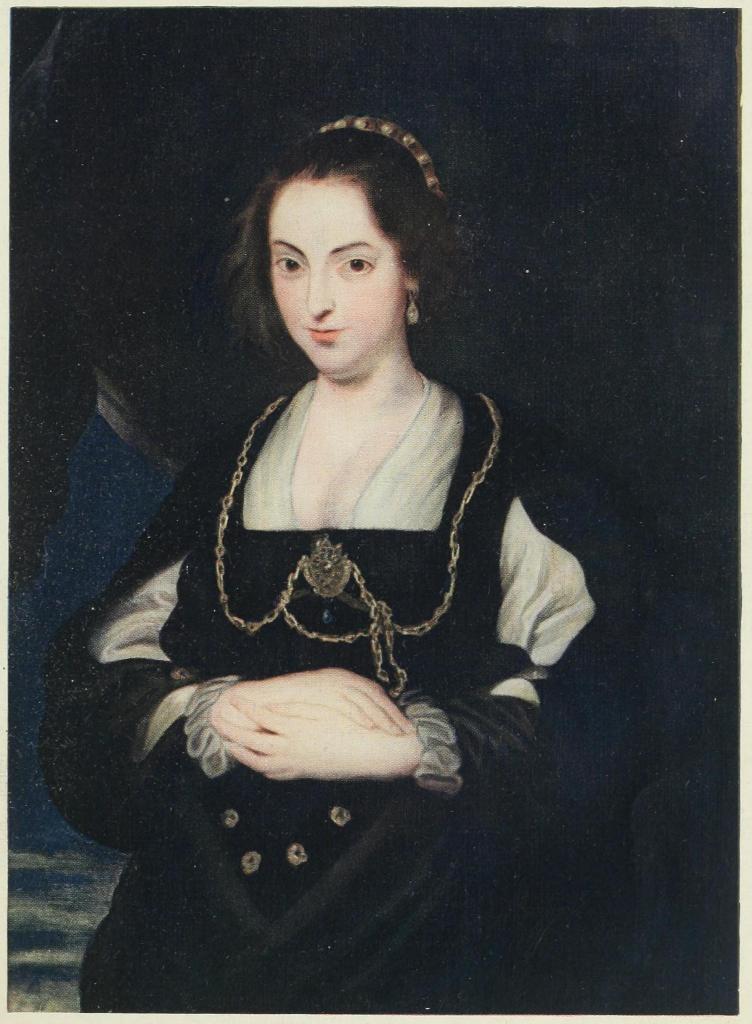
Our Wallace Collection has a delightful
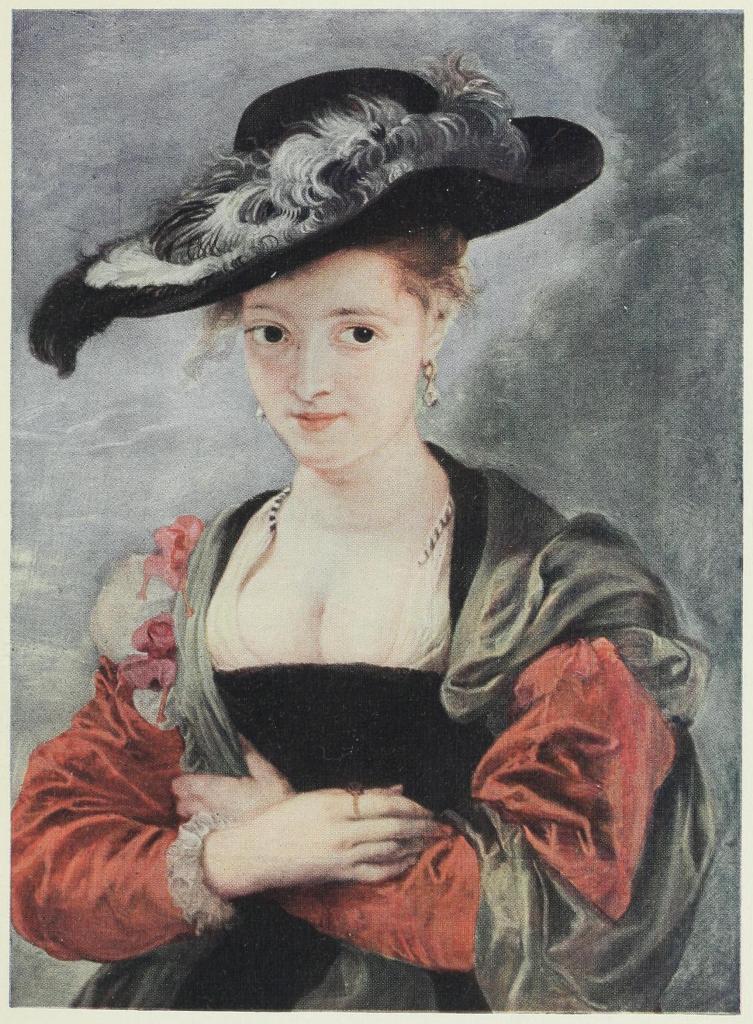
portrait of Isabel Brandt, and the National
Gallery holds the portrait of Suzanne Fourment,
“Le Chapeau de Paille,” while Amsterdam
and other cities hold portraits of his
second wife, the famous portrait of Gervatius
is to be seen in Antwerp, and there are
several delightful examples of his portraiture
in Brussels. It was in these schools of art
that Rubens has succeeded in pleasing
many who turn with feelings not far removed
from disgust from his unshrinking
studies of the coarse overblown or overgrown
womanhood. He contrived either
to confer a measure of dignity upon his
sitters or to conserve one. His portraits
of his two wives, and the portrait group in
the Pitti Palace that introduces his brother,
are full of a deep feeling for which we may
look in vain to many of his larger canvases.
Just as the pianist or violinist will
turn from playing some wonderful concerto
bristling with difficulties for the soloist and
calculated to delight the ears of the groundlings,
and then taking up some simple piece
by a great master will infuse into it all
the qualities that the showy concerto hid,
so Rubens turned from the wars and
loves of gods and goddesses, from Bacchic
carnivals and groups in which nudity is insisted
upon sometimes at the expense of
relevance, and would paint portraits that
will be a delight as long as they remain
with us. Rubens painting the portrait of
wife or brother or friend, and Rubens
covering vast canvases with glittering and
sometimes meretricious work are two different
men. We may admire the latter,
but we come near to intimate appreciation
of the former. In the portraits the man is
revealed, in the big pictures we see no
more than artist, and some of us fail to
realise how clever he is, how many problems
of composition and tone and light
and shade he has grappled with and overcome
in manner well-nigh heroic.
The secret of his changing moods is of
course beyond us, but perhaps one may
hazard an explanation for the difference
in the quality of the work done. As far as
we can see from a study of the painter’s
work and life, he approached mythology
and Christianity from a purely pictorial
standpoint, and did not believe in one or
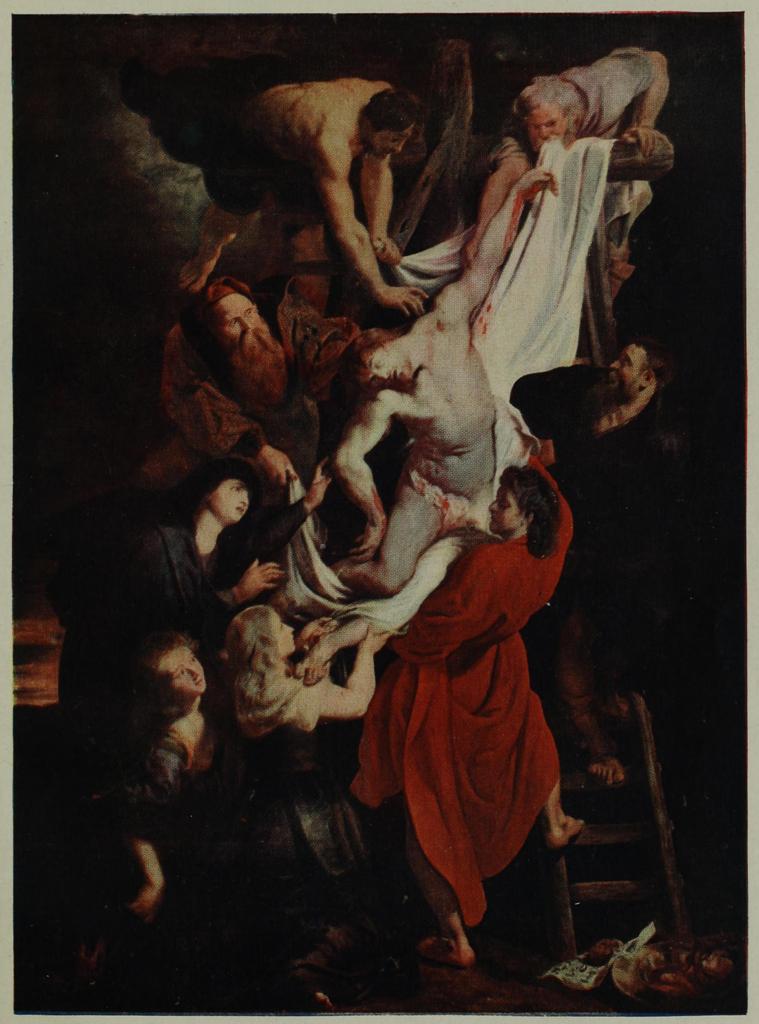
the other. “The Procession to Calvary,”
“The Crucifixion,” “The Descent from the
Cross,” “The Flight into Egypt,” “The
Adoration of the Magi,” “The Draught of
Fishes,” “The Raising of the Cross,” “The
Assumption of the Virgin,” “The Last
Supper,” “The Circumcision,” “The Flagellation,”
and the rest, were no more and no
less to him as subjects than “The Drunken
Hercules” or “The Battle of the Amazons,”
“The Garden of Venus” or “The Judgment
of Paris.” They were popular subjects
for effective treatment, pictures that would
make a sure appeal to those who loved either
the sacred or the profane in art, pictures to
be executed with all possible skill at the
greatest possible speed, and with a measure
of assistance regulated by the price that
was to be paid for them. But the portraits
of his friends, of the brother he loved, and
of the wives to whom he was a devoted
husband, stood on quite a different plane.
He felt the human interest attaching to
them, and this human interest brought to
his canvas certain qualities that belong to
the heart rather than the head, and have
given them a claim that is not disputed
even by the painter’s most severe critics.
The plates are printed by Bemrose & Sons, Ltd., Derby and London
The text at the Ballantyne Press, Edinburgh