Larger versions of most illustrations may be seen by right-clicking them
and selecting an option to view them separately, or by double-tapping and/or
stretching them.
New original cover art included with this eBook is granted
to the public domain. It includes an image of the Title Page of the original book.
AN ACCURATE AND FAITHFUL HISTORY OF THEIR
EXPLOITS AND ADVENTURES.
BY G. W. AGEE,
Superintendent Western Division Southern Express Company.
PUBLISHERS THE HENNEBERRY COMPANY
CHICAGO
RESPECTFULLY DEDICATED
BY THE AUTHOR
TO HIS COMRADES AND CO-WORKERS
IN THE EXPRESS SERVICE
OF AMERICA.
“Some hapless souls are led astray,
While some, themselves, seek out the way.
Some fall, unthinking, in the pit,
While others seek about for it.
’Tis probable, if Satan should
Strive for the universal good,
And close his gates and bar them well,
Some souls would still break into Hell.”
PREFACE.
Since the days of the James and Younger
brothers, bold types of Western outlawry,
which were the immediate products of the late
civil war, no banditti have challenged such universal
attention as those led by the famous outlaw,
Rube Burrow. The press of the country
has woven, from the wildest woof of fancy, full
many a fiction touching his daring deeds, and
manufacturers of sensational literature have made
of the bandit as mystical a genius as the “Headless
Hessian of Sleepy Hollow.”
With the view of correcting the erroneous accounts
heretofore given the public, I have yielded
to the solicitations of many friends in the Express
service and consented to give a faithful and accurate
history, compiled from the official reports of
the detectives, detailing the daring deeds, the
thrilling scenes and hair-breadth escapes of the
outlaw and his band of highwaymen. Important
confessions of some of the principal participants
in the eight train robberies committed, covering
a period of nearly four years, are also given, without
color of fiction or the caprice of fancy.
It is the province of this volume, therefore,
not to laud evil endeavor, but rather to chronicle
the hapless fate of those who, turning aside from
the paths of peace and honor, elect to tread the
devious and thorny road which leads on to the
open gateway, over which is emblazoned, in letters
of living fire, the accursed malediction, “All hope
abandon, ye who enter here.”
G. W. Agee.
Memphis, Tenn., December, 1890.
CONTENTS.
Chapter I.
PAGE
Lamar County, Alabama—The Home of the Burrow Family—Biographical Sketch of Rube Burrow’s Ancestors
Rube Leaves Lamar County, Alabama—His Early Life in the Lone Star State—His Brother Jim Joins Him—The Bellevue, Gordon and Ben Brook, Texas, Train Robberies
The Capture of Rube Smith and James McClung at Amory, Miss.—McClung’s Confession—A Plan to Rob the Train Falls Through—A Safe Robbery Nipped in the Bud
Confession of Leonard Calvert Brock, alias Joe Jackson, made at Memphis, Tenn., July 19, 1890, and Corrected and Amended at Jackson, Miss., October 16, 1890
Tragic Suicide of L. C. Brock, alias Joe Jackson—He Leaps from the Fourth Story of the Prison into the Open Court, Sixty Feet Below, Causing Instant Death—His Last Statement
RUBE BURROW. — CHAPTER I. LAMAR COUNTY, ALABAMA—THE HOME OF THE BURROW FAMILY—BIOGRAPHICAL SKETCH OF RUBE BURROW’S ANCESTORS.
Lamar County, Alabama, the home of the Burrow
family, has become historic as the lair of
a robber band whose deeds of daring have had no
parallel in modern times, and the halo of romance
with which that locality has been invested has
converted its rugged hills into mountain fastnesses,
its quiet vales into dark caverns, and the humble
abodes of its inhabitants into turreted fortresses
and robber castles. The county of Lamar, divested
of the drapery of sensationalism, is one of the “hill
counties” of northern Alabama, and takes high rank
in the list of rich agricultural counties of the State.
It possesses a charming landscape of undulating
hill and dale, watered by limpid streams, and amid
fertile valleys and on the crests of its picturesque
uplands are found the peaceful and prosperous
homes of many good and law-abiding people, thus
proving that good people are indigenous to every
clime and land where the hand of civilization has
left its kindly touch. “It does not abound in grand
and sublime prospects, but rather in little home
scenes of rural repose and sheltered quiet.”
Lamar County was formed in 1868 from the
most fertile portions of Fayette and Marion Counties,
and has changed its name three times; first
it was called Jones, then Sanford, and, finally, it
was named Lamar, in honor of the distinguished
statesman and jurist who now adorns the bench of
the Supreme Court of the United States. This section
of the State, though not until the last decade
possessed of the advantages of development which
more fortunate sections have long enjoyed, has always
had an excellent citizenship. Here, in the
olden time, were found ardent followers of the
political faith of the founders of the Republic, and
while the bonfires of the zealous pioneers of that
day and time lighted the hill tops, the valleys of
that section of northern Alabama reverberated with
the campaign songs of their enthusiastic compatriots.
From this section, no less renowned in war
than in peace, a large company of soldiers was sent
to the Creek war, and a full quota of gallant men
went forth to the Confederate army, three companies
of which were in the Twenty-sixth Alabama
Infantry, one of the most superb regiments in the
Army of Northern Virginia.
This much, in truth and justice, should be said
in behalf of Lamar County, which has gained an
unenviable notoriety as the birthplace of Rube Burrow,
and later as the rendezvous of his confreres
in crime. When metropolitan places, with well-equipped
police powers, give birth to such social
organizations as the anarchists in Chicago and the
Italian Mafia in New Orleans, and become asylums
for organized assassins, the good people of these
cities are no more responsible for the resultant
evils than are the law-abiding people of Lamar
County, Alabama, for the deeds of outlawry of
which one of her citizens, by the accident of birthplace,
was the chief exponent. The Burrow family,
however, were among the earliest settlers of Fayette
County, Alabama, from which Lamar was
taken, and from their prolific stock descended a
numerous progeny, who, by the natural ties of
consanguinity, formed a clan amongst whom the
bold outlaws found ready refuge when fleeing from
the hot pursuit organized in the more populous
localities which were the scenes of their daring
crimes. Chief among Rube’s partisans and protectors
was James A. Cash, a brother-in-law.
Allen H. Burrow, the father of Rube, was born
in Maury County, Tenn., May 21, 1825, his parents
moving to Franklin County, Ala., in 1826, and who,
in 1828, settled within the vicinity of his present
home in Lamar County, Ala. In August, 1849,
Allen Burrow married Martha Caroline Terry, a
native of Lamar County, who was born in 1830.
From this union were born ten children—five boys
and five girls. John T. Burrow, the oldest child,
lives near Vernon, the county seat of Lamar. Apart
from harboring his brother Rube, while an outlaw,
he has always borne a fair reputation. He is of a
rollicking disposition, possesses a keen sense of the
ridiculous, is a fine mimic and recounts an anecdote
inimitably, and, though crude of speech and
manner, having little education, is a man of more
than average intelligence. Jasper Burrow, the second
son, is a quiet, taciturn man; he lives with
his father, and is reputed to be of unsound mind.
Four of the daughters married citizens of Lamar
County. The youngest, who bears the prosaic
name of Ann Eliza, is a tall blonde of twenty
summers, and is yet unmarried. She is of a defiant
nature, has a comely and attractive face, and
is a favorite with many a rustic youth in the
vicinage of the Burrow homestead. She was devoted
to Rube, afforded a constant medium of communication
between the parental home and the
hiding place of the outlaws, and was the courier
through whom Rube Smith was added to the robber
band while in rendezvous in Lamar County.
Reuben Houston Burrow, the outlaw, was born
in Lamar County, December 11, 1854. His early
life in Lamar was an uneventful one. He was
known as an active, sprightly boy, apt in all athletic
pursuits, a swift runner, an ardent huntsman
and a natural woodsman. He possessed a fearless
spirit, was of a merry and humorous turn, a characteristic
of the Burrow family, but he developed
none of those traits which might have foreshadowed
the unenviable fame acquired in after-life.
James Buchanan Burrow, the fifth and youngest
son, was born in 1858, and was, therefore, four
years the junior of his brother Rube, to whose
fortunes his own were linked in the pursuit of
train robbing, and which gave to the band the
name of the “Burrow Brothers” in the earliest
days of its organization.
The facilities for acquiring education in the
rural districts of the South, half a century ago,
were limited, and Allen Burrow grew to manhood’s
estate, having mastered little more than a knowledge
of the “three R’s,” and yet talent for teaching
the young idea how to shoot was so scant that
Allen Burrow, during the decade immediately preceding
the late war, was found diversifying the pursuits
of tilling the soil with that of teaching a country
school. Among his pupils was the unfortunate
postmaster of Jewell, Ala., Moses Graves, who was
wantonly killed by Rube Burrow in 1889. Many
anecdotes are current in Lamar County, illustrating
the primitive methods of pedagogy as pursued by
Allen Burrow. It is said that the elder Graves,
who had several sons as pupils, withdrew the hopeful
scions of the Graves household from the school
for the reason that after six months’ tuition, he having
incidentally enrolled the whole contingent in
a spelling bee, they all insisted on spelling every
monosyllable ending with a consonant by adding
an extra one, as d-o-g-g, dog; b-u-g-g, bug.
Allen Burrow served awhile in Roddy’s cavalry
during the civil war, but his career as a soldier was
brief and not marked by any incident worthy of
note. Soon after the close of the war he made
some reputation as a “moonshiner,” and was indicted
about 1876 for illicit distilling. He fled the
country in consequence, but after an absence of two
years he returned and made some compromise
with the Government, since which time he has
quietly lived in Lamar County. While possessed
of some shrewdness, he is a typical backwoodsman,
with the characteristic drawling voice and quaint
vernacular peculiar to his class. Martha Terry,
the wife of Allen Burrow, claims to be possessed
of the peculiar and hereditary gift of curing, by
some strange and mysterious agency, many of the
ills to which flesh is heir, and had she lived in the
days of Cotton Mather she might have fallen a
victim to fire and fagot, with which witchcraft in
that day and time was punished. There are many
sensible and wholly unsuperstitious persons in
northern Alabama, where old Mrs. Burrow is well
known, who believe in her occult powers of curing
cancers, warts, tumors and kindred ailments, by the
art of sorcery. Capt. J. E. Pennington, a prominent
citizen, and the present tax collector of Lamar
County, tells of two instances in his own family in
which Dame Burrow removed tumors by simple
incantation. The witch’s caldron “boils and bubbles”
on the hearthstone of the Burrow home, and
whether the dark and fetid mixture contain
“Eye of newt and toe of frog,
Wool of bat and tongue of dog;
Adder’s fork and blind worm’s sting,
Lizard’s leg and owlet’s wing,”
or what not, many good but credulous people come
from far and near to invoke the charm of her occult
mummery, despite the fact that our latter-day civilization
has long since closed its eyes and ears to
the arts of sorcery and witchcraft. Here, amid the
environments of ignorance and superstition, evils
resulting more from the inherent infirmities of
the rugged pioneer and his wife than the adversities
of fortune, the family of ten children was
reared. It is from such strong and rugged natures,
uneducated and untrained in the school of
right and honesty, that comes the material of
which train robbers are made.
CHAPTER II. RUBE LEAVES LAMAR COUNTY, ALABAMA—HIS EARLY LIFE IN THE LONE STAR STATE—HIS BROTHER JIM JOINS HIM—THE BELLEVUE, GORDON AND BEN BROOK, TEXAS, TRAIN ROBBERIES.
Rube Burrow’s old companions in Alabama
recall distinctly the day he left Lamar County
for Texas in the autumn of 1872. He left the old
and familiar scenes of his boyhood, full of hope and
eager to test the possibilities that Texas, then the
Eldorado of the southern emigrant, opened up to
him. He was but eighteen years of age when he
took up his abode with his uncle, Joel Burrow, a
very worthy and upright man, who owned and
tilled a small farm in Erath County, that State.
In 1876 Rube was joined by Jim Burrow, his
younger brother, who remained in Texas until
1880, when, returning to Lamar County, Alabama,
he married and resided there until 1884, when he
rejoined his brother Rube in Texas, taking his wife
thither. Jim Burrow was a “burly, roaring, roistering
blade,” six feet tall, as straight as an Indian,
which race of people he very closely resembled,
with his beardless face, his high cheek bones and
coal-black hair. He was in every way fitted for
following the fortunes of Rube, and had he not
succumbed to the unhappy fate of imprisonment
and early death he would have been a formidable
rival of his brother Rube in the events that marked
his subsequent career.
Rube worked awhile on his uncle’s farm, but
soon drifted into that nondescript character known
as a Texas cowboy. Meantime, in 1876, he married
Miss Virginia Alvison, in Wise County, Texas,
and from this marriage two children were born,
who are now with their grandparents in Alabama,
the elder being a boy of twelve years. This wife
died in 1880, and he again married in 1884 a Miss
Adeline Hoover, of Erath County, Texas. These
events served to restrain his natural inclinations
for excitement and adventure, and it may be truthfully
said that from 1872 to 1886 Rube Burrow
transgressed the law only to the extent of herding
unbranded cattle and marking them as his own.
In this pursuit he traversed the plains of Texas,
enjoying with an excess of keen delight a companionship
of kindred spirits, whose homes were
in the saddle, and who found their only shelter
by day and by night under the same kindly skies.
As he grew to manhood he had given full bent to
his love for the athletic pursuits incident to life
upon the then sparsely settled plains of the Lone
Star State. Taming the unbridled broncho, shooting
the antelope, and lassoing the wild steer, under
whip and spur, he soon gained fame as an equestrian,
and was reckoned as the most unerring
marksman in all the adjacent country. With a
reputation for all these accomplishments, strengthened
by an innate capacity for leadership, Rube ere
long gathered about him a band of trusty comrades,
of which he was easily the leader.
A short time prior to this period, at varying intervals,
all Texas had been startled by the bold and
desperate adventures of Sam Bass and his band of
train robbers, with which Rube was erroneously
supposed to have been associated. Possibly inspired,
however, by the fame which Sam Bass had
achieved, and the exaggerated reports of the profits
of his adventures, contrasted with the sparse returns
from his more plodding occupation, Rube
was seized with a desire to emulate his deeds of
daring, and achieve at once fame and fortune.
At this time, December 1, 1886, his party, consisting
of Jim Burrow, Nep Thornton and Henderson
Bromley, returning from a bootless excursion
into the Indian Territory, rode in the direction of
Bellevue, a station on the Fort Worth and Denver
Railway. Here Rube proposed to rob the train,
which they knew to be due at Bellevue at eleven
o’clock A. M. Hitching their horses in the woods a
few hundred yards away they stealthily approached
a water-tank three hundred yards west of the
station, and where the train usually stopped for
water. Thornton held up the engineer and fireman,
while Rube, Bromley and Jim Burrow went
through the train and robbed the passengers, leaving
the Pacific Express unmolested. They secured
some three hundred dollars in currency and a
dozen or more watches. On the train was Sergeant
Connors (white), with a squad of U. S. colored
soldiers, in charge of some prisoners. From
these soldiers were taken their forty-five caliber
Colt’s revolvers, a brace of which pistols were used
by Rube Burrow throughout his subsequent career.
Rube insisted on the prisoners being liberated, but
they disdained the offer of liberty at the hands of
the highwaymen and remained in charge of the
crest-fallen soldiers, who were afterwards dismissed
from the service for cowardice. Regaining their
horses the party rode forth from the scene of their
initial train robbery, out into the plains, making a
distance of some seventy-five miles from the scene
of the robbery in twenty-four hours.
The ill-gotten gains thus obtained did not suffice
to satisfy the greed of the newly fledged train robbers,
and early in the following January another
raid was planned. At Alexander, Texas, about
seventy-five miles from Gordon, all the robbers met,
and going thence by horseback to Gordon, Texas,
a station on the Texas and Pacific Railway, they
reached their destination about one o’clock A. M.,
on January 23, 1887. As the train pulled out of
Gordon at two o’clock A. M., Rube and Bromley
mounted the engine, covered the engineer and fireman,
and ordered them to pull ahead and stop at a
distance of five hundred yards east of the station.
The murderous looking Colt’s revolvers brought
the engineer to terms, and the commands of the
highwaymen were obeyed to the letter. At the
point where the train was stopped, Jim Burrow,
Thornton, and Harrison Askew, a recruit who had
but recently joined the robber band, were in waiting.
As the train pulled up, Askew’s nerve failed
him, and he cried out, “For heaven’s sake, boys, let
me out of this; I can’t stand it.” Askew’s powers
of locomotion, however, had not forsaken him, and
he made precipitate flight from the scene of the
robbery. Rube and Bromley marched the engineer
and fireman to the express car and demanded
admittance, while the rest of the robbers held the
conductor and other trainmen at bay. The messenger
of the Pacific Express Company refused at
first to obey the command to open the door, but
put out the lights in his car. A regular fusilade
ensued, the robbers using a couple of Winchester
rifles, and after firing fifty or more shots the messenger
surrendered. About $2,275 was secured
from the Pacific Express car. The U. S. Mail car
was also robbed, and the highwaymen secured
from the registered mail about two thousand dollars.
Mounting their horses, which they had left hidden
in the forest hard by, they rode off in a northerly
direction, in order to mislead their pursuers.
Making a circuit to the south they came upon the
open plains, which stretched far away towards the
home of the robber band. The trackless plain
gave no vestige of the flight of the swift-footed
horses as they carried their riders faster and still
faster on to their haven of safety, which they
reached soon after daylight on the second morning
after the robbery.
The better to allay suspicion the robber comrades
now agreed to separate, and all made a show
of work, some tilling the soil, while others engaged
in the occupation of herding cattle for the neighboring
ranch owners.
Rube and Jim Burrow, about this time, purchased
a small tract of land, paying six hundred
dollars for it. They also bought a few head of
stock and made a fair showing for a few months at
making an honest living. The restless and daring
spirit of Rube Burrow, however, could not brook
honest toil. As he followed the plowshare over
his newly purchased land, and turned the wild
flowers of the teeming prairie beneath the soil, he
nurtured within his soul nothing of the pride of
the peaceful husbandman, but, fretting over such
tame pursuits, built robber castles anew.
While planting a crop in the spring of 1887 he
had for a fellow workman one William Brock, and
finding in him a dare-devil and restless spirit he
recounted to him his successful ventures at Bellevue
and at Gordon. Thus another recruit was
added to his forces, and one, too, who was destined
to play an important role, as subsequent events will
show. Time grew apace, and Rube wrote, in his
quaint, unscholarly way, affectionate epistles to his
relatives in Lamar County, Ala., sending them
some of his ill-gotten gains. Two of these letters,
written on the same sheet of paper, the one to
his brother, John T. Burrow, the other to his father
and mother, at Vernon, Ala., are here given verbatim
et literatim, and show that a collegiate education
is not a necessary adjunct to the pursuit of
train robbing.
Erath County, Tex., March 10, 1887.
Dear Brother and family:
All is well. No nuse too rite. the weather is good
for work and wee ar puting in the time. Wee will plant
corn too morrow. Mee and james Will plant 35 acreys in
corn. Wee wont plant Eny Cotton Wee hav a feW Ooats
sode and millet. i am going too Stephens Vill too day and
i Will male this Letr. J. T. when you rite Direct your
letr too Stephens Vill Erath county and tell all of the Rest
too direct there letrs too the same place. i want you and
pah too keep that money john you keep $30.00 and pah
$20.00. the Reason i want you to hav $30 is because you
have the largest family. john i don’t blame pah and
mother for not coming out here for they ortoo no there
Buisness. john i want you too rite too me. i did think i
would Come Back in march. i cant come now. Rite.
R. H. Burrow
too J. T. Burrow.
Erath County, Texas, March 10, 1887.
Dear father & mother:
Eye will Rite you a few Lines. all is well. ElizabethA
has a boy. it was bornd on the 28 of february. She has
done well. Mother i want you too pick mee out one of
the prityest widows in ala. i will come home this fawl.
pah i want john thomas too hav 30 dollars of that money
eye want you too Buy analyzer a gold Ring. it wont cost
more than $4. i told her i would send her a present. pah
that will take a rite smart of your part of the money but it
will come all right some day for I am going to sell out
some time and come and see all of you. Rite.
“We have sowed a few oats,” wrote Rube.
Whether this was meant as a double-entendre, and
referred not only to a strictly domesticated brand
of that useful cereal, but also to the “wild oats”
which Rube and Jim had been sowing, and which
bore ample fruitage in after years, it is useless to
speculate.
In the midst of seed-time Rube tired of his bucolic
pursuits, and concluded to try his fortunes at
Gordon again, and on the tenth of May the chief
gathered his little band at his farm in Erath
County and, under cover of a moonless night, rode
northward to the Brazos River, about fifty miles
distant. They found to their disappointment that
the river was very high and was overflowing its
banks, rendering it impossible to cross it by ferry
or otherwise, and spending the day in the adjacent
woodland, they rode back to Alexander the following
night, to await the subsidence of the floods,
which, however, kept the Brazos River high for
some weeks.
Again, on the night of June 3d, by appointment,
Henderson Bromley and Bill Brock met
Rube and Jim Burrow at their home near Stephensville,
in Erath County, and, after consultation,
Ben Brook, Texas, a station on the Texas and
Pacific Railway, seventy-five miles south of Fort
Worth, was selected as the scene of their third
train robbery.
After a hard night’s ride they were at daylight,
on June 4th, within a few miles of Ben Brook.
Having ascertained that the north-bound train
would pass the station about 7 P. M. they secreted
themselves in the woods near by until dark, at
which time they rode quietly to within a few hundred
yards of the station. Rube Burrow and Henderson
Bromley had blackened their faces with
burnt cork, while Jim Burrow and Brock used
their pocket handkerchiefs for masks. Rube and
Bromley boarded the engine as it pulled out of the
station and, with drawn revolvers, covered the engineer
and fireman, and ordered the former to stop
at a trestle a few hundred yards beyond the station.
Here Jim Burrow and Brock were in waiting,
and the two latter held the conductor and passengers
at bay, while the two former ordered the
engineer to break into the express car with the
coal pick taken from the engine, and again the Pacific
Express Company was robbed, the highwaymen
securing $2,450. The passengers and mail
were unmolested.
Regaining their horses within thirty minutes
after the train first stopped at the station, the robbers
rode hard and fast until noon of the following
day. Through woodland and over plain, ere dawn
of day they had fled far from the scene of the robbery
of the previous night, and a drenching rain,
which commenced to fall at midnight, left not a
trace of the course of their flight. Here the robbers
remained in quiet seclusion, disguising their
identity as train robbers by a seeming diligence
in agricultural pursuits, until September 20, 1887,
when they made a second raid on the Texas Pacific
Road, robbing the train at Ben Brook station
again.
When Rube and Bromley mounted the engine,
wonderful to relate, it was in charge of the same
engineer whom the robbers had “held up” in the
robbery of June 4th, and the engineer, recognizing
Rube and Bromley, said, as he looked down
the barrels of their Colt’s revolvers, “Well, Captain,
where do you want me to stop this time?”
Rube laconically replied “Same place,” and so it
was that the train was stopped and robbed, the
same crew being in charge, on the identical spot
where it had been robbed before. The messenger
of the Pacific Express Company made some resistance,
but finally the robbers succeeded in entering
his car and secured $2,725, or about $680 each.
The highwaymen reached their rendezvous in
Erath County, having successfully committed four
train robberies.
About the middle of November following, Rube
and Jim paid a visit to their parents in Lamar
County, Ala., Jim taking his wife there and Rube
his two children. They remained in Lamar County
some weeks, visiting their relatives and walking
the streets of Vernon, the county seat, unmolested,
as neither of the two men had at that time
ever been suspected of train robbing.
CHAPTER III. THE GENOA, ARK., ROBBERY, DECEMBER 9, 1887—ARREST OF WILLIAM BROCK—HIS CONFESSION.
Express Train No. 2, on the St. Louis, Arkansas
and Texas Railway, left Texarkana, Ark.,
on the evening of December 9, 1887, at 5:50 P. M.,
fifty minutes late. Nothing unusual occurred until
just as the train began to pull out of Genoa,
Ark., a small station thirty miles north of Texarkana.
Engineer Rue, on looking about, discovered
two men standing just behind him, with drawn revolvers,
covering himself and fireman.
“What are you doing here?” asked Rue.
The answer was, “Go on! Don’t stop! If you
stop I will kill you!” And further: “I want you
to stop about one and a half miles from here, at
the north end of the second big cut. I don’t want
to hurt you or your fireman, but we are going to
rob this train or kill every man on it.”
Arriving at the spot designated, the leader abruptly
said, “Stop!” The engineer and fireman
were then ordered down from the engine, and the
leader said, “Boys, how are you all?”
A voice from the brush, where a third man was
in waiting, said, “All right, boys!” The latter then
walked towards the passenger coaches and with a
sixteen-shooting rifle opened fire in the direction
of the coaches. The two men in charge of the engineer
and fireman were closely masked, and were
armed with a brace of forty-five caliber Colt’s pistols,
with Winchester rifles strapped across their
backs. Messenger Cavin, of the Southern Express
Company, put out his lights and, like Br’er Fox,
“lay low” for some time. The robbers demanded
admittance, showering volleys of oaths and shots
in one common fusilade. The heavy Winchesters
sped shot after shot through the car, the balls
piercing it from side to side, and yet young Cavin
held his ground until Rube Burrow ordered the
engineer to bring his oil can and saturate the car
with the contents. The engineer was ordered to
set fire to the car, but before doing so he made an
earnest appeal to the messenger, who agreed to
surrender, under the condition that he should not
be hurt. The robbers were some thirty minutes
gaining access to the car. Having done so, they
secured about two thousand dollars.
This was the first train robbery in the territory
of the Southern Express Company for a period of
seventeen years. Not since the robbery of the
Southern Express car on the Mobile and Ohio
Railway at Union City, Tenn., in October, 1870, by
the celebrated Farrington brothers, had highwaymen
made a raid on a Southern Express train.
The Pinkerton Detective Agency having been
given charge of the Union City, Tenn., case, and
all the participants in that crime having been
punished to the full extent of the law, the management
of the Southern Express Company called
to their aid at once the Pinkerton force.
Assistant Superintendent McGinn, of the Chicago
agency, reached Texarkana in about forty-eight
hours after the robbery, and immediately
repaired to the scene of the occurrence. Genoa
is a small railroad station only a short distance
from Red River. The winter rains had filled the
bottom lands with water, and the dense and impenetrable
growth of matted brush and vines, denuded
of their foliage, made the landscape a picture
desolate and uninviting. Here in this wild
woodland came Superintendent McGinn, on the
morning of the third day after the robbery, to take
up the tangled skein from which to weave the net
for the capture of the train robbers.
On the night of the robbery a report of the
occurrence had been telegraphed to the officials of
the Express Company at Texarkana, and a posse at
once started to the scene of the robbery. A few
miles north of Texarkana the posse, being in
charge of Sheriff Dixon, of Miller County, came
upon three men on the railway track, walking
towards Texarkana. This was about three o’clock
A. M. The three men were allowed to pass, when
the sheriff’s posse, turning about, commanded
them to halt. The latter ran, taking refuge in a
railway cut some thirty yards distant, and the
sheriff’s posse at once opened fire, which was
promptly returned, and a score or more of shots
were exchanged.
The night being very dark the firing on each
side was done at random, and no casualties ensued.
After daylight that morning two rubber coats and
a slouch hat were found in the vicinity of the fight,
and these articles were subsequently identified as
having been worn by the men who robbed the
train at Genoa. The hat bore the name of a firm
in Dublin, Texas, and the coats, which were new,
bore the simple cost mark “K. W. P.” Here was
an important clew, proving that the robbers had at
least purchased the hat at Dublin. Thither the
detectives went, with the hat and coats, hoping to
have the purchasers identified. Calling upon the
Dublin firm, diligent inquiry failed to disclose the
purchaser of the hat, the firm having sold hundreds
of a similar style during the season.
No trace of the purchasers of the coats could
be found at Dublin, but the detectives felt that
they were on a hot trail and renewed their exertions.
To Corsicana, Waco, Stephensville and other
points adjacent they journeyed, exhibiting the coats,
with the cabalistic letters, until finally McGinn
arrived at Alexander, Texas, as if carried there by
that intuition common to shrewd men of his profession,
and plied his inquires anew. Falling in
with a salesman of the firm of Sherman & Thalwell,
to whom the coats were exhibited, the answer
of the young salesman, Hearn, was:
“That is the cost mark of Sherman & Thalwell.
I put those letters, ‘K. W. P.,’ on myself.”
He then seemed lost a moment in thought, and
resumed:
“We had a lot of that brand, and I sold a coat
like that to one Bill Brock, who lives, when at
home, at his father-in-law’s, five miles from Alexander,
on the road to Dublin.” He further stated
that Brock had been away, he thought, up about
Texarkana, and added:
“At the time Brock made the purchase there
was a man with him to whom I also sold a similar
coat, and who afterwards went to Alabama, and
who I think is there now.”
Here was a ray of light upon the dark mystery
of December 9th at Genoa. The name, William
Brock, had been copied from the hotel register at
Texarkana, where it was found under date of December
3d, six days before the robbery, and was in
the possession of the detectives who were on the
alert for the owner.
A few days prior to this occurrence another
detective was shadowing a man in Waco, Texas,
who was spending money freely, and who answered
the description of one of the train robbers. Following
him to Dublin, Texas, the man was ascertained
to be Brock, and here the detectives, comparing
notes, found themselves in possession of
abundant evidence upon which to arrest Brock.
Before this was done, however, the important disclosure
was made that Brock had two companions,
Rube and Jim Burrow, and as these men answered
the descriptions of the men who committed the
robbery at Genoa the detectives felt quite sure
that the names of all three of the robbers were at
least known. Further investigation, however, developed
the fact that Rube and Jim Burrow had
recently gone to Alabama, and the immediate arrest
of Brock was determined upon.
At three o’clock on the morning of December
31, 1887, twenty-two days after the robbery, Wm.
Brock was arrested at his home near Dublin, Texas.
The detectives demanded admittance and Brock
surrendered without firing a shot, although he had
a forty-five caliber Colt’s revolver and fifty cartridges
in a belt under his pillow, and also one of
the Winchester rifles used at Genoa. The prisoner
was taken to Texarkana and confronted with
engineer Rue, who thoroughly identified him. He
was also identified by parties who saw him in the
immediate vicinity of Genoa. Brock could not stand
the pressure brought to bear on him by the wily
detectives, and in the course of a few days made a
clean breast of his participation in the Genoa, Ark.,
robbery, confirming the information already in possession
of the detectives as to the complicity of
Rube and Jim Burrow in the daring adventure.
From Brock it was learned that Rube and Jim
Burrow had, about November 15, 1887, gone to Lamar
County, Ala. By agreement, Brock had joined
the Burrow brothers at Texarkana on December
3d, where all three registered at the Cosmopolitan
Hotel, Brock in his own name, and Rube and Jim
as R. Houston and James Buchanan, respectively,
each using his middle name as a surname. They
had robbed the train at Genoa on the night of December
9th, and while walking toward Texarkana
in the early morning of the 10th had been fired
upon by the sheriff’s posse. Taken by surprise,
he and Jim Burrow had dropped their coats, while
Rube had lost his hat. After going a few miles
south of Texarkana they separated, Brock going
into Texas and Rube and Jim making their way
into Lamar County, Ala.
On the 29th of December Rube wrote the following
letter to Brock, which was received by Mrs.
Brock, and turned over to the detectives after her
husband’s arrest:
Dec. 20-29-87.
Mr. W. L. Brock:
All is well and hope you the same Bill notis everything
and let me know Bill eye will sell you my place
ef you want it at 7 hundred let me here from ef you
want it eye will have all fixt right and send you the tittle
in full let me here from you soon.
R. H. too W. L. B.
The figures 20-29-87 meant that Rube and
Jim reached Lamar County on the 20th and the
letter was written on the 29th of December.
William Brock detailed to the detectives the history
of the Bellevue and Gordon robberies, as
gathered from Rube, and of the Ben Brook robberies,
in which he himself participated. He seemed
thoroughly penitent over his crimes, and, after
reaching Texarkana, disclosed the fact that he had
about four hundred dollars of the proceeds of the
Genoa robbery, which he proposed to and did restore.
Brock was a rough, uncouth-looking fellow,
about five feet eleven inches high; weighed about
180 pounds, and was a strong-chested, broad-shouldered
fellow, whose forbidding features made him a
typical train robber. He was about thirty-one
years old, and although born in Georgia, his
parents moved to Texas when he was quite a
child. He was wholly illiterate, not being able
to either read or write, and the environments of
corrupt companionship tended to fill his untutored
mind with evil only. Brock made an important
witness in the trials of the participants in
the various train robberies in Texas, and was afterwards
given a comparatively light sentence as a
punishment for his offenses.
CHAPTER IV. THE PINKERTONS AFTER RUBE AND JIM BURROW IN LAMAR COUNTY—THEIR NARROW ESCAPE.
Ascertaining definitely that at the time of
Brock’s arrest Rube and Jim Burrow were
not in Texas, but supposed to be in Lamar County,
Ala., Superintendent McGinn, of the Pinkerton
Agency, left Texarkana January 5, 1888, accompanied
by two of his detectives, for the purpose of
capturing them.
On arriving at Fayette Court-House, Ala.,
McGinn summoned to his aid the then sheriff of
Lamar County, Fillmore Pennington, a very courageous
and efficient officer, and the party left for
Vernon, the county seat of Lamar County, about
three o’clock P. M., January 8th. The night was
dark, and continuous rainfalls had rendered the
roads well-nigh impassable. It was not until ten
o’clock that the distance of twenty miles was
made, and the detectives, under the guise of land
buyers, reached Vernon.
On the succeeding day a heavy rain set in about
daylight and continued throughout the day. The
weather was, therefore, suited neither to the outing
of land buyers nor to a visit from Rube and Jim to
the town, as the sheriff had so confidently expected.
The detectives kept their rooms in the
hotel during the day, inspecting a large assortment
of mineral specimens which were brought in by
anxious owners of valuable mining properties in
that section.
That night it was determined to arrange a raid
upon the house of Jim Burrow, who had his family
in a small dwelling about four miles from Vernon,
with the hope of finding both Rube and Jim. Accordingly,
on the morning of the 10th of January,
Supt. McGinn, at 2:30 o’clock, left Vernon for the
house of Jim Burrow. Detectives Carney and Wing
were on horseback, with Deputy-Sheriff Jerry as a
guide. Sheriff Pennington and Detectives Williams
and Wilbosky were in a wagon with McGinn.
The party drove to a point designated by the guide
as being half a mile from Jim Burrow’s house.
Leaving a guard in charge of the horses, the posse
quietly surrounded the house, and while closing in
upon the place, just as the day was dawning, the
guide informed the detectives that he was mistaken
in the house, but that it was another house,
pointing to one about a half mile distant, in which
a light was seen. On arrival at the second house
the guide found himself again in error. It was
then daylight. The detectives were about to withdraw
and get their horses and wagon out of the
way before they should be discovered, when they
found they were already observed by the inmates
of the house. It was then too late to retreat and
await the cover of the succeeding night to surround
the house of Jim Burrow, then ascertained to be
still about two miles further on. Their only hope
was to go at once and risk the danger of being discovered
while approaching the place after daylight.
Pushing forward, with great anxiety as to the
result, the house they were seeking was soon visible
on the slope of a hill near the edge of the
timber. Deploying their forces they advanced
quickly, and when within about one hundred yards
a crushing, tearing sound was heard in the rear of
the building. Jim Burrow had discovered their
approach and ran so swiftly from the house as to
tear the door from its hinges. Shot after shot from
the Winchesters of the detectives was fired at the
young robber as he fled. Several of the bullets
perforated his clothing, but he succeeded in reaching
the cover of the woods and escaped, to the
grievous disappointment of the detectives, whose
vigilance and energy had been defeated through
the stupidity of the guide.
After this escapade there was hurrying to and
fro among the kinspeople of the Burrow family,
and preparations were set afoot to apprise Rube,
who was then at Kennedy, Ala., eighteen miles distant,
of the attempt to capture Jim, and of the
fact that the detectives had visited his father’s
house in search of him. Henry Cash met Rube
about one mile out of Kennedy and recited the
events of the morning. Cash was en route to Kennedy
to make some preparation for his marriage,
which was to occur the following day. Rube
awaited his return and the two then rode back
towards Vernon by bridle paths, and met Allen
Burrow, who had appointed a meeting-place for the
two brothers, that night, near the house of one
Green Harris. From this point they started afoot
at midnight, January 10th, traveling in a south-easterly
direction, and before daylight were beyond
the confines of Lamar County.
CHAPTER V. LUBE AND JIM BOARD AN L. & N. RAILWAY TRAIN AT BROCK’S GAP—THEIR ARREST AND THE SUBSEQUENT ESCAPE OF RUBE.
On the twenty-second day of January succeeding
their escape from Lamar, Rube and Jim
boarded a Louisville and Nashville passenger train,
south bound, at Brock’s Gap, a few miles south of
Birmingham. Meantime an accurate description
of the brothers had been obtained, and descriptive
circulars had been scattered broadcast by the officials
of the Southern Express Company, one of
which was in possession of Conductor Callahan,
on whose train the robbers had taken passage. He
was not certain of their identity, and simply sent a
telegram to Chief Gerald, of the police force of
Montgomery, to which point they had paid fare,
which read as follows: “Have special officer meet
number five.”
Captain John W. Martin, one of the most efficient
officers of the force, met the train. The night
was rainy, and Captain Martin wore a rubber coat
and slouch hat, which completely concealed his
identity. The train pulled into the depot just as
Captain Martin arrived, and he inquired of the
conductor what was wanted. The conductor replied,
“I think those two fellows walking down the
track there, and who boarded my train at Brock’s
Gap, are the Burrow brothers.”
Captain Martin at once called to Officer McGee,
who was on duty at the depot, and, like himself,
attired in rain coat and slouch hat, and imparted
to him the information received. The officers then
walked toward the men, who were some distance
away, and hailed them, saying: “You can not go
through that railroad cut at night.”
Rube replied: “We are going to the country to
get timber, but would like to get a boarding-house
for the night.”
Captain Martin said, “We are going up town
and will show you one.”
Rube, thinking the officers were railroad men,
replied, “All right,” and, joining them, the four
men walked a distance of about a half a mile,
when, on reaching the police station, Captain
Martin inserted the key in the door, and while in
the act of unlocking it Rube asked, “What place
is this?”
Captain Martin, shoving the door, which was
adjusted with a heavy spring, half open, with one
hand, laid the other on Rube’s shoulder and said:
“This is the office of the Chief of Police, and you
boys may consider yourselves under arrest.”
“I reckon not,” replied Rube, and straightway
made a break for liberty.
Captain Martin grappled with him, and the
heavy door of the station-house closing, caught his
rubber coat in a vise-like grip, and held him fast.
Soon freeing himself, however, by pulling out of
his coat, he dashed after Rube, who had broken
away, and after running some thirty paces, turned
and saw his brother Jim down, with a police officer
on top of him. Jim, in attempting to break away,
had fallen, in the scuffle with Officer McGee, over
a street hydrant.
At this moment Rube, seeing the officer had
started in pursuit, turned and fled like a deer up
the street. Neil Bray, a printer, being on the opposite
side of the street, joined the officer in the
pursuit and was shot by Rube, who twice fired
upon him, one of the shots taking effect in the left
lung and nearly causing his death.
Out into the darkness Rube fled, leaving Jim
in the hands of the officers, and scaling a fence
some hundred yards ahead he was soon lost to his
pursuers.
Jim was taken to police headquarters and gave
his name as Jim Hankins, and said the other man’s
name was Williams, and he had only known him
three weeks. However, while en route to Texarkana,
he confessed his identity, and said to Capt.
Martin:
“I am Jim Burrow, and the other man is my
brother Rube, and if you give us two pistols apiece
we are not afraid of any two men living.”
He further stated that while walking up the
street from the depot he became satisfied they were
in the hands of the police, but as Rube had the
only pistol, he having failed to secure his in his
sudden flight from his home in Lamar County, he
was looking for Rube to make the first break.
Rube, however, suspected nothing until he reached
the police station. When afterwards chided by
friends for his failure to assist Jim, in view of
the fact that the latter was unarmed, Rube replied
that he thought the whole of Montgomery was
after him.
The next day, realizing the faux pas of the previous
night, and the notorious character of the fugitive,
the entire police force of Montgomery joined
in the chase. The city, its suburban districts and
the adjacent country all swarmed with anxious
pursuers.
No trace of Rube, however, was found until
just before dark, when Officers Young and Hill,
having searched a negro cabin about five miles
south of Montgomery, without result, rode off in
the direction of the city. After leaving the house
a negro boy came running after them and informed
the officers that the man for whom they were
searching had just gone into the cabin they had
left. Rube, hungry and exhausted, had seen his
pursuers leave the cabin, and immediately thereafter
went in and asked for something to eat.
Young and Hill rode back at once in company
with the boy, and instructed him to go in and tell
the man to come out. They were about thirty
paces in front of the cabin, when Rube came to the
door, and, looking out, saw a solitary horseman in
front of the cabin. He deliberately sat down in a
chair in the doorway and pulled off his boots,
while Officer Young dismounted. Hill had covered
the rear of the cabin.
Taking his boots in his left hand, Rube held
his trusty revolver in his right. His chief forte
was a running fight. With the agility of an Indian
he sprang from the cabin and bounded away
to the swamps, which were distant only about one
hundred yards, and as he passed in front of Officer
Young the latter rested his breech-loading shot gun
on his saddle and fired the contents of both barrels
in quick succession at the fleeing desperado, when
only about thirty yards distant.
Rube dropped his boots and hat, and to the
chagrin of the officer, when he picked them up,
he found them filled with number eight birdshot.
He had substituted these for his loads of buckshot
early in the day to shoot a bird, and had forgotten
the fact. Rube carried to the day of his death the
marks of the birdshot, which filled his neck and
face, but were powerless to stop his flight.
Fifty yards further on a countryman, who had
joined the pursuing party, sprang up from behind
an embankment, and was in the act of taking aim
at twenty paces distant, his gun being charged
with buckshot, when Rube wheeled and covered
him with his revolver. His pursuer dropped flat
to the earth and Rube escaped. He was wont to
revert to this incident frequently, afterward and
laughingly state what was the truth, that he had
fired his last cartridge, and the intrepid courage
with which he turned and covered his pursuer
with an empty revolver saved his life.
Hatless and bare-footed, the friendless felon
now found himself, at dark of night, in a wilderness
of swamp, whose treacherous waters were covered
with a tangled growth of brush and vines, and
chilled with the winter’s cold. Exhausted with
the toils of the day’s flight, his face and neck smarting
with the keen pain of the wounds he had just
received, hungry and foot-sore, his body quivering
with the biting cold—could human flesh and blood
be subjected to the frenzy of sharper distress than
that which faced Rube as he blindly picked his
footing through this terra incognita? Plodding
through bog and fen, full knee-deep with water,
his progress was beset by indescribable perplexities,
and so it was nearly midnight when he
emerged from the marsh into a field, distant only
about three miles from the point at which he had
entered it.
A flickering light in a negro cabin a few hundred
yards away, on the slope of a hill, gave
friendly token of comfort within, but Rube, fearing
that some one of his pursuers might be sheltered
there, approached it with cautious step. All
was still within, save the snoring of the sleeping
inmates, and in his dire extremity the outlaw
slowly pulled the latch-string which hung without
and entered. With bated breath he looked about
him. The cheerful log fire alone beamed for him
a silent welcome. Noiselessly taking a chair he
sat himself before the coveted warmth of the
lowly hearthstone, while the old colored man and
his family slept on, in blissful ignorance of the
presence of their midnight visitor.
The robber tarried only long enough to warm
his chilled frame into energy for the task of further
flight, and after about one hour’s stay he quietly
donned the shoes of the black pater familias, and,
stealthily drawing an old quilt from a couch in
which a brood of pickaninnies slept, all unconscious
of their loss, he wrapped it about him, and,
stepping silently out into the darkness, resumed
his journey.
A few miles further on he stole a horse from
the stable of a farmer, and, mounting its bare back,
rode hard and fast till daylight, when he turned
the animal loose in the road, and betaking himself
to the protection of the forests that covered the
bottom lands of the Alabama River, left no further
trace of his course. Here his trail was lost to the
detectives, who, after an arduous and vain pursuit
of several days, abandoned all further effort in that
vicinity.
CHAPTER VI. RUBE BURROW RETURNS TO LAMAR COUNTY—JOE JACKSON JOINS HIM IN MARCH, 1888—THEIR TRIP INTO BALDWIN COUNTY, ALABAMA.
Rube Burrow, having effected his escape at
Montgomery, and successfully eluded pursuit,
it was supposed by the detectives that he would
go down into southern Alabama or Florida, as
the presence of himself and brother at Montgomery
seemed to indicate. Rube, however, was
restless and anxious concerning the fate of Jim,
and at once made his way back into Lamar
County. Soon after reaching home he learned, for
the first time, of his brother’s incarceration at Texarkana,
and also that his old comrade, William
Brock, had disclosed the whole history of their
operations in Texas, and particularly of the Genoa,
Ark., affair.
Rube was heard to say: “Never mind; when I
get my partner, Joe Jackson, from Texas, I will
wreak my vengeance upon the Southern Express
Company.” Rube knew, although he had never
participated in any of the many robberies which
the Sam Bass gang had committed, that the name
of “Joe Jackson” was a terror wherever the fame
of the Bass gang was known, and that Joe Jackson
was the only member of that brutal band of
highwaymen who had escaped justice when their
chief, Sam Bass, was shot, with a small remnant of
his followers, in the streets of Round Rock, Texas.
It was thus he sought to herald, as the comrade he
was about to select to fill his brother’s place, the
guerrilla who had unfurled the black banner at
Lawrence, Kansas, under the leadership of the notorious
Quantrell, and who had drifted into Texas
to join Bass and his unholy gang.
While in northern Texas in 1886, Rube had
met a young Alabamian who went under the name
of Lewis Waldrip. Rube had Waldrip in his employment
while herding cattle, and had witnessed
his unflinching courage on several occasions while
associated with him. Waldrip had, in confidence,
given Rube the story of the troubles which had
caused him to flee from his native State and seek
refuge in Texas. Soon after his return to Lamar
County, in February, 1888, he wrote Waldrip to
join him there. The correspondence was conducted
through Jim Cash, and about the first of
March, 1888, at the house of the latter, the two
men, who had separated in 1886 in Texas, met
again for the first time. Rube recited his recent
history, and acting upon the advice of his friend,
whom he had christened “Joe Jackson,” the two
left for southern Alabama, as Rube had knowledge
of the fact that the vicinity in which he was then
hiding was being constantly watched by detectives.
Leaving Lamar County afoot, the pair traveled
through the woods until they reached Columbus,
Miss. They went thence, partly by rail and partly
by boat, to Baldwin County, Ala., locating at Dunnaway’s
log camp, on Lovette’s Creek, some forty
miles from any railway line, and in one of the most
sparsely settled sections of southern Alabama. The
trail thither, by the circuitous foot journey out of
Lamar County, had been completely covered, and
here Rube and his newly found comrade were not
only lost to the detectives, but to all the world besides,
save the little squad of day-laborers who
gathered about the camp-fire at nightfall, after the
day’s labor was over. This rustic audience Rube
was wont to regale with many a humorous tale.
Mr. Ward, as he was familiarly called, was the hero
of many an adventurous story, and the very life and
humor of the camp. Rube’s fame had preceded
him, even into this retired spot, and he would often
bring up the subject of his own outlawry, that he
might get an expression from those about him as
to the thrilling adventures of which he himself was
the hero.
After a stay of some three weeks, during which
Rube and his partner labored not only with diligence
but with increasing skill (for here it was
that Rube was heard to say that John Barnes, who
afterwards figured somewhat in his final arrest,
taught him how to saw logs), the camp was broken
up, Mr. Dunnaway moving his force to a point near
Perdido, a station on the Louisville and Nashville
Railway.
Rube and Joe then, about May 1st, left the
camp, for the reason, perhaps, that the locality was
more public, and for the additional reason that
Rube began to conceive the idea that he could find
a safe refuge among friends in Lamar County, and
might render some help to his brother, who was
then a prisoner in Arkansas. Setting out, the two
men walked until they reached Forest, Miss., where
Rube purchased horses for the two. At Dixon,
Miss., Joe, finding his horse a poor traveler, traded
him for the “snorting steed” which he subsequently
rode in the Duck Hill robbery, and which
the detectives finally traced from the scene of that
robbery into Lamar County. From Dixon they
rode via Oxford, and thence to Berryhill’s, a brother-in-law
of Rube Burrow, who moved, soon after
his marriage to Rube’s favorite sister, into that
section of Mississippi. Here they remained two
days, and about the 15th of May rode into Lamar
County.
CHAPTER VII. THE RIDE INTO ARKANSAS TO LIBERATE JIM BURROW—FAILURE AND RETURN TO MISSISSIPPI.
On his arrival in Lamar County Rube Burrow
anxiously inquired after Jim’s fate. Jim Cash,
the brother-in-law, had visited Little Rock, where
Jim was confined in the penitentiary for safe
keeping, and had learned that he would be taken
about September 5th to Texarkana for trial. Rube
brooded over the fatal blunder which had resulted
in Jim’s capture at Montgomery, and blamed
himself all the more because it was against the
judgment of his brother that they had boarded
the unlucky train. His proud spirit chafed at the
thought, also, that he alone, being armed, should
have been forced to flee and leave him to his unhappy
fate. He therefore resolved, at all hazard,
to attempt his rescue.
One moonless night in the latter part of August
Rube and Joe Jackson rode out of Lamar County
for the avowed purpose of taking Jim from the
hands of his captors while en route to Texarkana
for trial. Joe Jackson, after his capture, told how
Rube rose in his stirrups, as he galloped away over
the hills of Lamar County at dead of night, and
swore that he would carry the boon of freedom to
his luckless brother at whatever hazard or peril.
“We will board the train, shoot the officers
down, and make Jim a free man, or die in the attempt.
Will you give me your hand and pledge
me your honor, Joe, to do your part?” asked Rube.
“I will,” answered Joe, and grasping each the
other’s hand they rode forth with renewed courage
and hope.
On to Okolona, Miss., thence to Sardis, through
Tate County, and on to Helena, Ark., they crossed
the Mississippi River at the latter point, and rode
thence in a southwesterly direction towards Pine
Bluff, and thence to Arkadelphia, Ark., a station on
the Iron Mountain Railway, sixty-five miles south
of Little Rock.
Ascertaining definitely the date of his trial at
Texarkana before leaving Lamar County, they decided
to attempt the rescue at one of the smaller
stations on the Iron Mountain Railway, either on
the north or south bank of the Oauchita River,
where, if successful, pursuit could not be so readily
organized, and where the dense timber in the adjacent
bottoms would furnish ample cover for escape.
At Donaldson, at Malvern, and adjacent stations,
these determined men boarded train after
train, with cocked revolvers secreted and ready for
the bold endeavor, and, finally, moving down to
Curtis, a small flag station, they learned that the
last south-bound train of that date, September 9th,
was not scheduled to stop at Curtis, and their only
hope to search it was to ride to Arkadelphia, fifteen
miles north.
It was only one hour before the train was due
at Arkadelphia. Rube said, “We will make the
trip, Joe, or kill our horses.” The men were well
mounted, and defeat and disappointment had so
far only sharpened their energies for the difficult
task before them.
This was Sunday night, and Rube knew it was
the last train his brother could be expected on, as
his case was set for trial the following morning.
It was a ride which had the possible alternative of
death to the gallant steeds that bore them onward,
liberty to an ill-fated brother, or grief and chagrin
at the failure of a project on which Rube had set
his heart with desperate devotion. Onward they
rode, at breathless speed, faster and still faster, till
the hill-tops of Arkadelphia hove in sight. At the
same time the shrill whistle of the engine announced
the approach of the train bearing the
manacled brother toward Texarkana, and steaming
into the railway station, paused but a moment,
as if to take breath, and bounded on, leaving the
rescuers, who were several hundred yards away, to
their bitter disappointment.
CHAPTER VIII. RUBE BURROW AND JOE JACKSON LEAVE ARKANSAS—THEY TURN UP AS COTTON PICKERS IN TATE COUNTY, MISSISSIPPI.
Crestfallen and dispirited at the failure
of his long cherished project to release his
brother Jim, Rube decided to abandon all further
effort in that direction and set out on the return
journey. Joe Jackson proposed to visit Hot
Springs, but Rube did not care to expose himself
to the risk of being identified by the cosmopolitan
population of that American Baden-Baden, and resolved
to return immediately to the east side of the
river. It has been popularly supposed that Rube
Burrow was accustomed to visit metropolitan places,
frequent gambling houses and saloons, and, with a
reckless disregard of his personal safety, herald himself
as a cattle king, or play the role of gambler.
Such was not the case. Bold and fearless as he
was in pursuit of his chosen vocation, he kept aloof
from populous localities. His long immunity from
arrest was due chiefly to the fact that, secluding
himself in the wilds of the forest and shunning his
fellow-men as far as possible, he habited the earth
like a beast of prey.
The two men, on their return trip, traveled in
a northeasterly direction, avoiding the public highways
wherever practicable. Crossing White River
at St. Charles, they rode leisurely on towards Helena,
and, under cover of darkness, crossed the river
at that point about one week after leaving Arkadelphia.
Riding up the east bank of the Mississippi
to a point about fifteen miles north of Helena
they debouched from the river bottoms, pushing
their way through bog and swamp for fifteen
miles or more, over ground never perhaps covered
by horsemen before, and where no sign of human
habitation existed. The robbers were seeking a
secure retreat, and this they found in Tate County,
Mississippi, on the farm of Fletcher Stevens, about
eighteen miles from Senatobia, a station on the
Illinois Central Railway. Meantime the detectives
of the Southern Express Company had
searched every nook and corner of southern Alabama,
made several expeditions into Florida, and
had also become satisfied that Rube was not in
Lamar County.
In the early part of September the fact was developed
that a man answering Rube’s description
had been seen near St. Charles, Ark., and the trail
was taken up and followed into Helena, and thence
east of the river a few miles, but all trace was lost
in the ride through the swamps, which Rube had
correctly divined would foil his pursuers if they
should ascertain his presence in that locality. The
farm of Fletcher Stevens, located as it was in a
thinly settled section, and remote from railway
lines, furnished a safe retreat for Rube and his
companion, and here they hired themselves as day
laborers and began the business of picking cotton
about October 1, 1888. Rube was quite an adept
at picking cotton, but Joe proved rather an awkward
hand, as Mr. Stevens afterward reported;
and so Rube, at the price of fifty cents per hundred,
earned the larger share of the compensation
received for their toil.
Strange to state, these men labored diligently
and industriously on this Tate County farm from
October 1st till about December 1, 1888, never once
leaving the place. At rare intervals they would
take their pistols down into the swamps and practice
shooting at a target with one or two of their
white co-laborers, and in a quiet way made some
reputation for their skill as marksmen. Both Rube
and Joe, it is said, could hit a silver dollar nine
times out of ten, with their forty-five caliber Colt’s
revolvers, at a distance of seventy-five yards. During
their stay on the farm they passed for brothers,
Rube assuming the name of Charlie and Joe the
name of Henry Davis. Their general demeanor
was so quiet and unobtrusive that they betrayed
no suspicion of their real identity; and although
farmer Stevens, a very respectable and law-abiding
citizen, did not relish the fact that his hired
help carried such murderous-looking fire-arms, he
gave little thought to the matter. On or about
the first of December the cotton pickers asked for
their pay, which was given them. Mounting their
horses, which were in fine condition from the long
rest they had enjoyed, they rode quietly away from
the scene of their plodding labors.
CHAPTER IX. JIM BURROW ARRAIGNED—TRIAL POSTPONED—HIS RETURN TO LITTLE ROCK PRISON—LETTERS HOME—HIS DEATH IN PRISON.
Meanwhile Jim Burrow, at his preliminary
examination at Texarkana, soon after his
capture, admitted his guilt when confronted with
the confession of Wm. Brock and the strong chain
of circumstantial evidence that had been woven
about him. But while ruminating in the penitentiary,
during the interval preceding the fall term of
the Miller County Circuit Court, he had evidently
reconsidered his original purpose and determined
on making a defense and risking the chances of a
jury trial. Consequently, on September 10, 1888,
the day succeeding the failure of Rube and Joe
Jackson to effect his rescue at Arkadelphia, his case
was called for trial at Texarkana, on the charge of
robbery of the express car at Genoa, Ark. His
attorney filed an application for a continuance, on
account of the absence of witnesses in Alabama,
by whom he alleged he could prove an alibi, and
his case was thereupon continued, and he was returned
to the state-prison at Little Rock, pending
the spring term of the Court. Two days after his
return there he wrote to J. A. Cash and his wife
the following letters:
Sept. 14, 1888.
Mr. J. A. Cash:
I am not well but not very sick. I have put off my
trial. you Send $20.00 to my lawyers if you get the order
from them. tell Elizabeth and the children that I would
like to see them. James you have all the money on hand
by the 1st of Oct. that you can. I will send one of my
lawyers back there on the 15th of November, he is about
such a lawyer as Frank Summers. You was speaking
about furnishing me a lawyer from that county. When
my lawyer comes back to you send him to Summers, he
will take the case. don’t any of you come out until I
write for you to come—they got three bills against me for
train robbery, and the other two for attempt to murder. I
think I will come clear. You collect in my money as fast
as you can.
J. B. Burrow.
* * * * *
Mrs. M. E. Burrow:
As I feel better this morning than I did yesterday I
will write you a few lines. Elizabeth you all rest easy
about me for I think I will best my case—my trial is set to
come up the first Tuesday in March. You have $200.00 on
hand by the 15th of November to pay my Lawyers with.
One of them is a better lawyer than Frank Summers is.
So if you could employ Summers to help them in my case it
would be an advantage to me to have counsel from my own
state. Tell pa that I will answer his letter soon. Tell the
children that I will see them again. Brock’s trial was put
off so he could be a witness against me. Write all of the
news.
J. B. Burrow to Mrs. Burrow.
But Jim, not being a convict and therefore not
required to labor, soon began to chafe under the
restraint of prison life, which was aggravated by a
depressing attack of nostalgia, which soon developed
a fever, resulting in delirium. During his
ravings, which were continuous for about a week,
he talked about his wife and children, his home in
Alabama, the stolen money he had hidden, his boyhood
adventures and his experiences in Texas, but
his statements were so incoherently mingled that
it was impossible to make an intelligent narration
of them. On October 5, 1888, his earthly career
was terminated by death, and his unhonored grave
is surrounded by those of such hapless fellows as
have succumbed to the rigors of prison experience,
leaving their bodies with their captors, while their
spirits have slipped through the bars and gone for
final trial before the Last Tribunal.
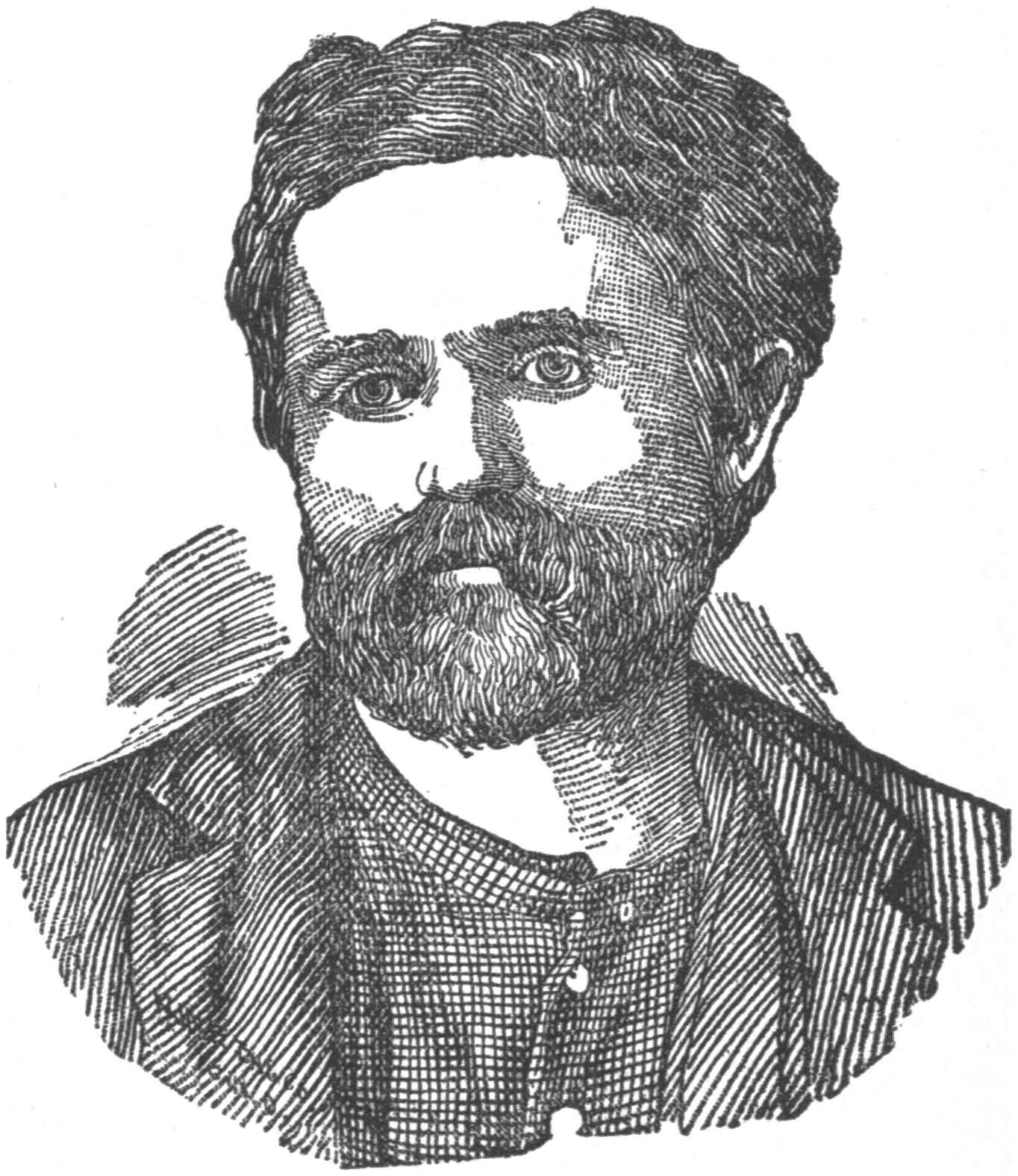
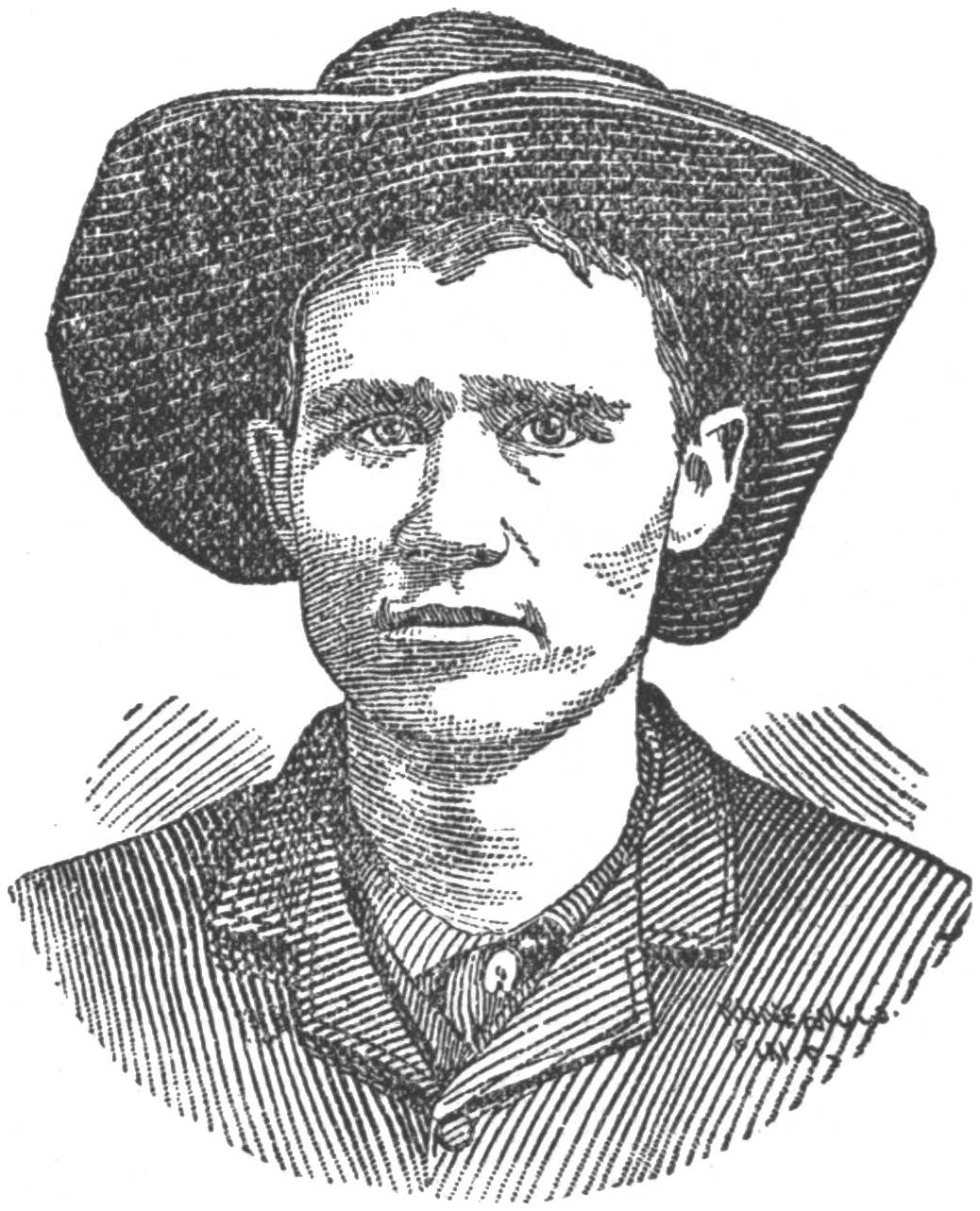
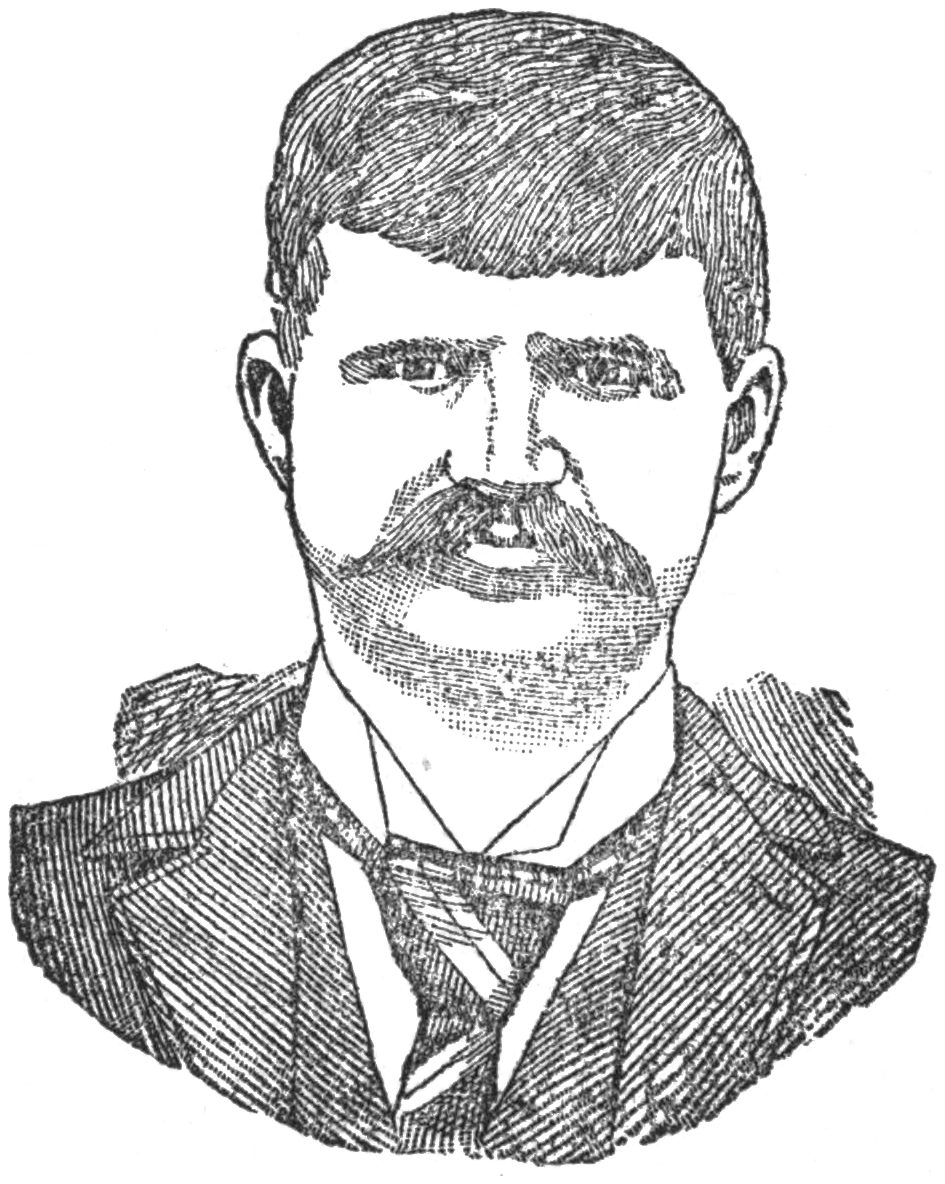
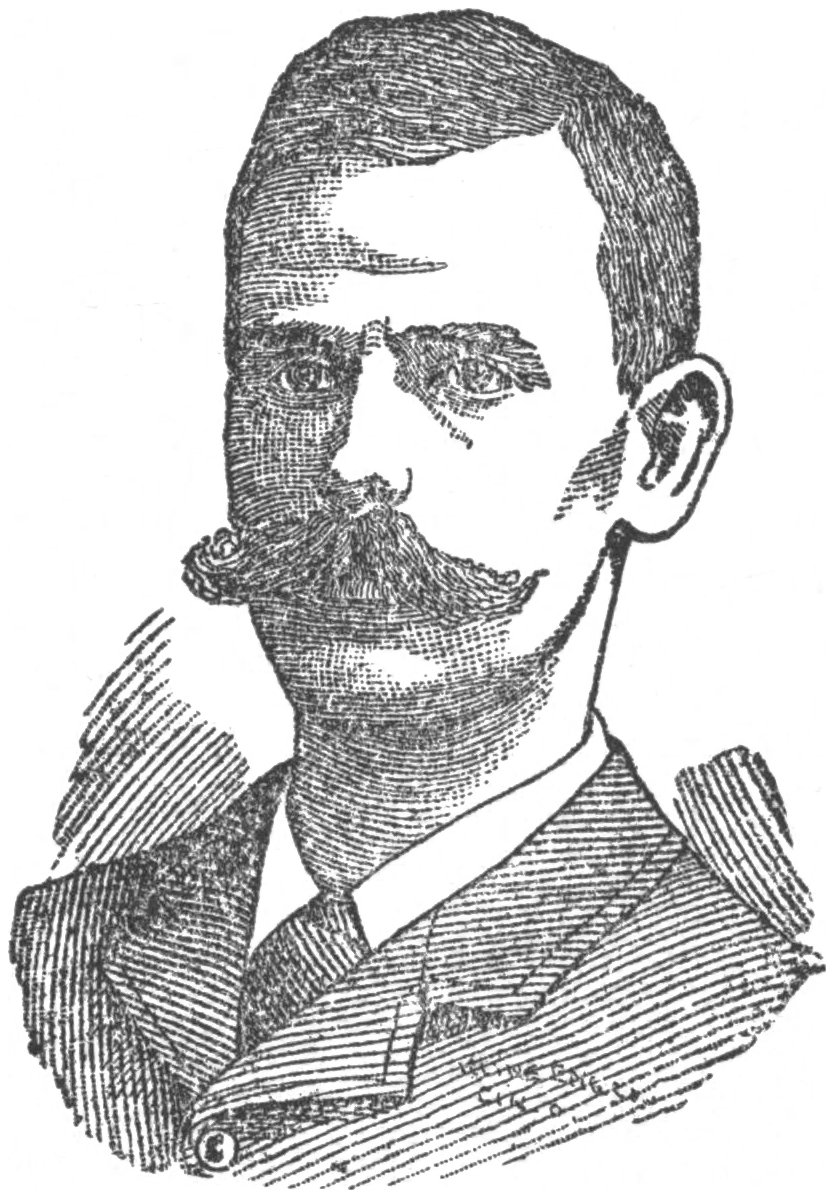
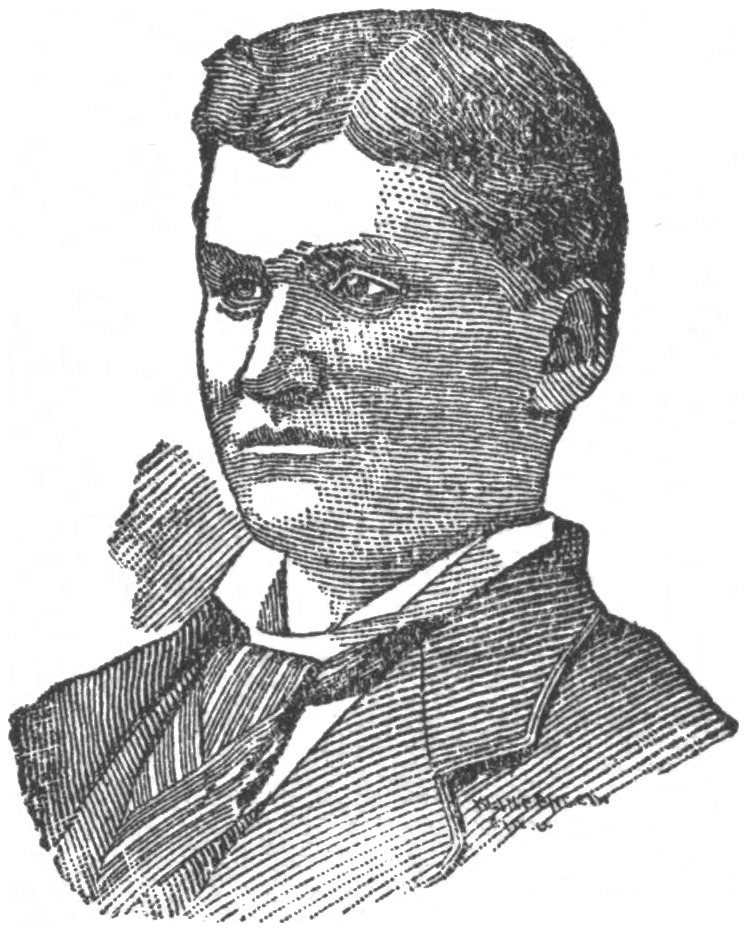
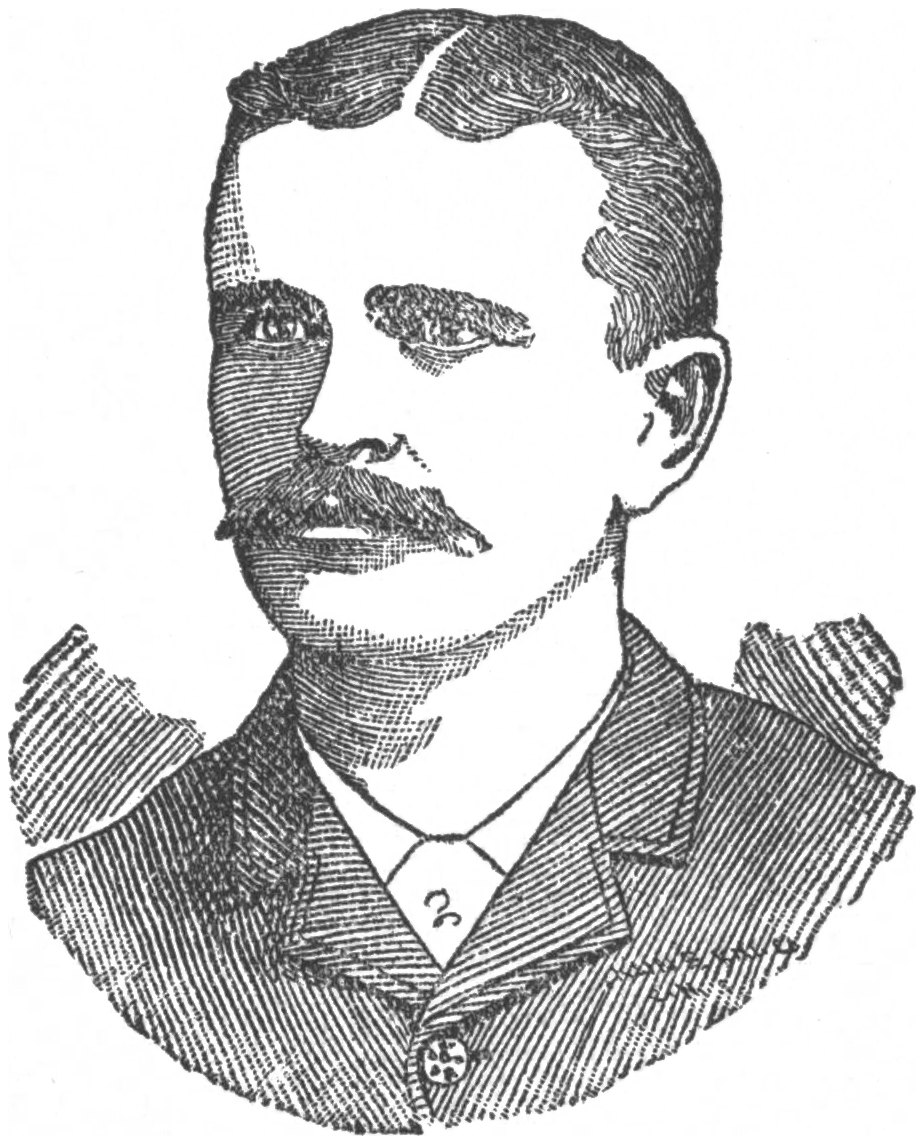
JIM BURROW.WILLIAM BROCK.
CHAPTER X. THE DUCK HILL, MISS., ROBBERY—THE KILLING OF PASSENGER CHESTER HUGHES.
On the cold and cheerless night of December
15, 1888, the north-bound express train of the
Illinois Central Railway, which left New Orleans
for Chicago at seven o’clock A. M. pulled into the
station of Duck Hill, Miss., twenty-five miles south
of Grenada, thirteen hours later. The manner in
which the engine was boarded and the train
stopped is best told in the language of Albert Law,
the engineer in charge of the locomotive. He says:
“I pulled out of Duck Hill Station at 10:05
o’clock P. M. The fireman called to me to look out;
that there was a car of cotton ahead on the side
track. I pulled slowly by, in order to avoid igniting
the cotton by sparks from the engine, and when
I passed the cotton the fireman said: ‘All right, let
her go.’ I started ahead lively, and presently saw
the robbers climb up on my engine from the east
side.
“The smaller man got on first. I thought they
were tramps, and was in the act of slowing up to
put them off when the smaller man covered me
with a big pistol and said, ‘Don’t stop here! go on!
go on!’ I then saw that the men were masked.
I asked, ‘Where do you want to stop!’ He replied,
‘I’ll tell you where to stop.’ I pulled along,
and when we had gone about a mile he said:
“‘Stop here—stop now!’ I put the air on full
and stopped as quickly as I could.
“The little man did all the talking. When we
stopped he got down on the ground and fired his
revolver two or three times. The train had hardly
stopped when he commenced shooting. The other
man said, ‘Get down!’ My fireman and myself
were then made to go ahead, on the east side of
the train, to the express car. Here they stopped
us, and the tall man called out to the messenger,
‘Open up! Open up!’ The messenger looked out
of the door and the tall man said, ‘Where is your
other man?’ The messenger said, ‘I have no other
man—no one here but me,’ to which the reply was,
‘Help this man into the car!’ The messenger being
covered by the revolver of the larger man, extended
his hand and helped him into the car.
“About this time Mr. Wilkerson, the conductor,
came out of one of the rear coaches with his lantern,
and the smaller man, who stood guarding us,
told me to tell him to go back. I did, and the conductor
went back, but in a couple of minutes came
out again. I saw two forms get out of the car.
They had no lights. I said, ‘You had better go
back, or they will shoot you; they are robbing the
express car.’
“The fireman and I were between the robber
and the rest of the train. He kept us in front of
him as a sort of breastwork. Some one in the
direction of the passenger coaches called out:
‘Law, where are you?’ When I answered a voice
said: ‘Look out! I am going to shoot!’ I
stepped back from the train and the firing commenced,
and I broke and ran for the woods, which
were close by.”
Meantime the robber who had entered the car
handed a sack to Southern Express Messenger
Harris and bade him deliver up the contents of
his safe. At this juncture the firing on the outside
of the car had commenced, and advancing to
the door, still keeping an eye on the messenger,
the robber fired three shots into the air. Conductor
Wilkerson had, on first coming out, taken
in the situation, and going back into the coaches
announced to the passengers that the train was
being robbed, and asked who would assist him.
Chester Hughes, a brave young fellow, from Jackson,
Tenn., arose quickly and said, “I will, if I can
get anything to shoot with.” Two colored men
seated near by had each a thirty-eight caliber
Winchester rifle, and these weapons were quickly
gathered by the conductor and his gallant passenger,
and loading them with cartridges furnished
them by the owners they went forth to do battle
with the robbers. It was conductor Wilkerson who
had warned the engineer to protect himself, and he
fired the first shot at the robbers.
Advancing abreast of each other these brave
men fired shot after shot at the dark form of the
robber who stood as a sentinel on the outside of
the car, and who unflinchingly held his ground, returning
with steady aim charge after charge from
his trusty revolver, until finally young Hughes
dropped his Winchester, and exclaiming “I am
shot!” fell to the earth. Wilkerson raised the
brave young fellow to his feet and dragged his
unconscious and bleeding form into the coach,
and returning to the steps of the front coach renewed
the firing at the robbers.
The robber had, meantime, secured the money
from the messenger (about two thousand dollars),
and backing out of the car, still holding his pistol
on the messenger, joined his comrade on the
ground, and under the fire of the conductor both
retreated to the woods hard by.
Chester Hughes had been in charge of a widowed
sister, who, with several small children, were
en route to Jackson, Tenn. The sister knew nothing
of her brother’s participation in the fight with
the robbers until he was carried back into the
coach, when she prostrated herself in affectionate
embrace over his body, from which life was fast
ebbing away. The scene was an agonizing and
affecting one.
The unerring aim of the robber had sent three
shots through the body of young Hughes, all entering
the stomach within a radius of six inches,
and the unfortunate but daring young fellow lived
only a few minutes. The same train on which he
had erstwhile embarked in the vigor of health and
buoyant spirits, bore his lifeless form to the home
of his widowed mother at Jackson, Tenn.
The Southern Express Company and the Illinois
Central Railway promptly presented his grief-stricken
mother with a fitting testimonial of appreciation
for the heroic conduct of her son. While
“On Fame’s eternal camping ground
Their silent tents are spread,
And glory guards, with solemn round,
The bivouac of the dead,”
the name of Chester Hughes will be enrolled
among the bravest of the brave.
The whole country was electrified with horror
at the brutal murder of a passenger on one of the
great trunk lines of railway, in one of the most
populous districts of the South, by train robbers,
and it was determined that no expense or labor
should be spared in bringing the criminals to justice.
General Manager C. A. Beck and Superintendent
J. G. Mann, of the Illinois Central Railway,
were in Memphis in a special car at the time.
During the night a violent and very general rain
storm had prevailed, and the telegraph wires were
down in many places. The news of the robbery
did not, therefore, reach Memphis until about
midnight. The railroad and express officials remained
at the telegraph office all night, seeking
the details, and left about daylight for the scene of
the robbery. The aid of the Pinkertons was again
summoned, and several of the most expert detectives
of the Chicago agency soon arrived at Duck
Hill.
About a month prior to the Duck Hill robbery
the United States Express Company had been
robbed at Derby, Miss., a station sixty-five miles
north of New Orleans, on the Queen and Crescent
Railway, by Eugene Bunch, a man who is supposed
by some persons, even at this day, to be
identical with Rube Burrow. Eugene Bunch, a
native of Louisiana, and long a resident of Texas,
bore a remarkable resemblance to Rube Burrow.
The description, about thirty-six years old, weight
one hundred and seventy pounds, height six feet
one inch, light complexion, auburn hair, long,
drooping mustache, blue eyes, raw-boned and
stoop-shouldered, would fit either Rube Burrow or
Eugene Bunch. Apart from this personal resemblance
they bore nothing else in common except
the title of train robber. Their habits and methods
of life were strikingly dissimilar. Bunch was
a man of some education, had taught school in
Louisiana and Texas, and was for a long period
of time a County Court Clerk in Texas, while Burrow
was a coarse, unlettered fellow, and it may be
stated, as a certainty, that these men never had any
association as train robbers or otherwise.
The Pinkerton detectives, on their arrival at
Duck Hill, were unable to find a trace of the robbers.
There was no clew from which to begin
a search for them. Whence the robbers came,
whither they had gone, whether on horseback or
afoot, was not known. At this juncture Detective
D. C. Hennessey, of New Orleans, who recently met
his death at the hands of assassins in that city, and
a man of undoubted ability in his profession, having
received a descriptive circular of the robbers,
telegraphed the officials of the Southern Express
Company as follows: “Description of the robbers
received. I am well aware as to who they are, and
am satisfied I can get them.”
A conference was at once arranged with Hennessey,
who declared the Duck Hill robbery to be
the work of Eugene Bunch. An unfortunate combination
of circumstances here ensued to corroborate
Hennessey’s view. Bunch answered Burrow’s
description with great exactness. The former was
reliably ascertained to have been in northern Louisiana
a few days prior to the robbery, and, therefore,
within easy reach of Duck Hill; Bunch had
an intimate friend who answered Engineer Law’s
description of the smaller man who stood guard
over him at Duck Hill.
The detectives had, meantime, traced two men
riding out south from the scene of the robbery in
the direction of Honey Island, in the Pearl River,
a favorite resort with Bunch; and, still more remarkable,
one of the horses ridden corresponded
with the one owned by Bunch’s comrade in Louisiana,
who was known to have assisted him in his
flight from Derby, Miss. The chase that followed,
therefore, under the leadership of the Pinkertons,
was organized to find Bunch, and not Burrow.
From New Orleans to Texas, to Monterey and
Mexico City, to Los Angeles and San Diego, and
even to San Francisco, the detectives pursued
Bunch until, just as his capture seemed certain at
San Francisco, he eluded the detectives by taking
a Pacific coast steamer. The chase was then, after
months of labor, abandoned.
Meantime, in a quiet way, the detectives of the
Southern Express Company were at work on the
theory that Rube Burrow was the leader in the
robbery at Duck Hill. It was discovered that
Rube Burrow and Joe Jackson rode away from the
farm of Fletcher Stevens in Tate County, Miss.,
on December 1, 1888, and after paying a visit to
Rube’s brother-in-law, Berryhill, who lives eighteen
miles from Oxford, proceeded to Water Valley,
Miss., where they spent the night; and that going
thence to Duck Hill they robbed the train in the
manner described. After mounting their horses,
tethered in the woods some half a mile from the
spot on which the robbery occurred, they rode
through a drenching rain a distance of forty miles
by daylight. The next day they camped in the
brush, divided the spoils of the robbery, and at sundown
resumed their journey. After another hard
night’s ride they reached the vicinity of the Pearl
River, near Philadelphia, Miss. Here, fearing the
news of the deed at Duck Hill had preceded them,
and that the detectives might be in waiting at the
bridge, they turned their horses into the swamps
and two miles north of the bridge swam the swollen
current of Pearl River. Reaching the opposite
bank, they continued their journey through the
wilds of the forest for a few miles, and turning from
the southwesterly course on which they had ridden
for two days, they rode in a northeasterly direction,
traveling most of the distance at night, until they
reached Lamar County. Here they remained in
quiet seclusion until the tragic event recorded in
the next chapter occurred.
CHAPTER XI. THE COLD-BLOODED MURDER OF MOSES GRAVES, THE POSTMASTER OF JEWELL, ALABAMA.
The reader may well ask what the detectives
of the Southern Express Company were doing
while these men remained in Lamar County
and the adjacent country, from the time of the
Duck Hill robbery until the summer of 1889.
In the contiguous counties of Lamar, Fayette
and Marion the kindred of the Burrow family
abounded on every hand. The homes of his kinsmen,
notably Cash, Terry, Barker, Smith and Hankins,
not only furnished a safe refuge for the robbers,
but they were worshiped as heroes, and each
household vied with the other in its fealty and loyalty
to the robber chief. “Rube never robs a poor
man,” they were often wont to say, forgetting that
one never gets blood out of a turnip. These people
were of a thriftless, restive spirit, and among
them were many shrewd and cunning natures, who
became the paid scouts of the outlaws. A code of
signals was established, and the appearance of a
detective or a stranger of any kind in that section
was at once ascertained, and the information conveyed
to the outlaws. The firing of a gun in a
certain locality, the cracking of a whip, the blowing
of a horn, and the deep-toned “ah-hoo,” as well
as scores of other signals, all had their meaning.
They gave the fugitives warning of the approach
of danger; and so, when occasional raids were
made, a house was surrounded, a trail was covered,
or some solitary scout from among Rube’s
clansmen was encountered, the stillness of the air
would be broken by a signal which plainly told the
detectives that their presence was known and the
robbers were on the alert. It was even impossible
to trail the messengers who carried rations to the
robbers while in camp, for these were stored in the
crevices of rocks and in the trunks of trees, from
which coverts, at propitious times, the food would
be taken.
Detective Jackson once followed Jim Cash,
with a supply of provisions, to a ravine some distance
from Cash’s house, and saw them hidden
away in the cavernous depths of a hollow log. He
concealed himself within one hundred yards of the
spot, and, knowing Rube was in that locality, felt
sure he would be able to pick him off with his
trusty Winchester when he came for his rations.
Jackson crouched behind the huge trunk of a tree,
in breathless expectation of Rube’s appearance,
when a shot fired from the vicinity of Cash’s house
dashed his hopes. Half an hour later Cash walked
cautiously down the hill, took the food away, and
tied a flaming red cloth to the top of an adjacent
bush, thus exhibiting for Rube the red signal of
danger. Cash had, on his return, with the cunning
of his class, discovered strange footsteps on his
trail, and rightly divined that his movements had
been watched. Although the detective took down
the signal, Rube had doubtless seen it. If not,
acting on the signal previously given, Rube missed
his dinner that day.
Thus fed and harbored, the outlaws remained
in Lamar County and the adjacent country all the
spring and summer of 1889, without any event of
note occurring until on the 7th of July, when Rube
Burrow murdered, in cold blood, the postmaster of
Jewell, Ala.
Rube had concluded that a wig and false whiskers
were necessary in his line of business. His
robberies were now of such frequent occurrence
that he sought to disguise himself more closely,
and after writing for a catalogue and selecting
what he desired in that line, he wrote the following
letter to a Chicago house:
June 1, 1889.
Mr. Sthrel:
I just Received your catalogue of wigs and will order
Wig and Bird. Pleas ship one set of Bird, 4 or 5 inches
and one Wig, Cullor of goods light Red, slieghtley Grey,
and croped hair. Ship goods to Sulligent (express office,
ship at once) Lamar county Ala, too W. W. Cain.
P. S.—Please find Five Dollars inclosed. eye Hav no
sample of Hair.
Rube had written for the catalogue and for the
wig in the name of W. W. Cain. The former letter
was written from Jewell post-office, and as the
name “Sulligent” was not plainly written, the
shipper sent the parcel containing the wig and
beard by mail to Jewell, Ala.
Meantime Jim Cash had made several inquiries
for the catalogue to Cain’s address before it arrived.
On the arrival of the parcel containing the
wig and whiskers, the wrapper being torn the contents
were exposed. Naturally great curiosity was
excited as to the ownership of these queer looking
articles. The rumor soon gained currency that
Jim Cash had been inquiring for mail for W. W.
Cain. The postmaster recalled having delivered
him the catalogue, and this parcel was supposed
to be his property. Cash was told that the contents
had been examined, and that the postmaster
declared he intended to arrest the party who called
for the parcel.
When this information was imparted to him by
Cash, Rube became greatly enraged. He swore he
would go to the post-office in person, get the mail,
and kill Graves. Accordingly he left the home of
his brother-in-law, Cash, about daylight on the 7th
of July for Jewell, Ala., distant about six miles.
Rube was known to Moses Graves, who kept the
post-office in connection with a country store, and
who was a quiet and inoffensive citizen.
Rube arrived at Jewell early, but the full-orbed
day was not a fit time for the execution of the
dark deed upon which he was bent. He lurked
about the outskirts of the quiet little village until
the shades of night had begun to fall, and creeping,
with the stealthy step of the assassin, towards the
post-office, he entered. Moses Graves, the postmaster,
and Rube, companions and playmates in
their boyhood, stood face to face, and exchanging a
silent recognition, Rube said: “Have you any mail
for W. W. Cain?”
“Yes,” answered Graves, “but I can not deliver
it to you.”
Instantly Rube drew his heavy revolver and
fired, the ball entering the stomach and piercing
him through and through.
“I’ll teach you how to open my mail,” said
Rube.
Graves staggered towards a chair, and falling
into it, said: “Rube Burrow, you have killed me.”
The murderer then turned, and leveling his
pistol at the head of a young girl who was an
assistant in the post-office, said: “Get my mail
or I will blow your head off.”
The frightened creature, in her terror, could not
find the parcel until Graves, pointing to it with
uplifted hand, bade her get it, and sinking to the
floor soon expired.
Graves’s wife, at the firing of the shot which
killed her husband, rushed in from an adjoining
room. Despite Rube’s threat to kill her if she
entered she flew to the assistance of her dying husband.
He was conscious, however, long enough for
his ante-mortem statement to be carefully taken, in
the presence of witnesses, certifying to the fact
that Rube Burrow was his murderer. Rube walked
out of the town unmolested, and at ten o’clock that
night reached the house of Jim Cash, his hands
stained with the blood of one of Lamar County’s
most respected citizens—the perpetrator of a deed
as wanton and as cold-blooded as ever blackened
the annals of crime.
Rube and Joe were not amiss in surmising that
the officers of the law would swoop down upon
them. As soon as Rube returned to Jim Cash’s,
about ten o’clock that night, he informed Joe Jackson,
his partner, of the events of the evening. The
latter had advised strongly against the policy of
taking Graves’s life, and warned Rube of the consequences;
but Rube’s spirit was full of revenge,
and he determined upon the murder.
All of northern Alabama was aroused with indignation
at the cruel and wanton murder, and ex-Sheriff
Pennington, heading a posse of determined
citizens, went into the Burrow neighborhood a few
days afterward and made an earnest endeavor to
capture the outlaws. Too much praise can not be
accorded this brave and gallant man, and had the
laws of Alabama admitted his re-election to a second
term it is more than probable that the career
of these train robbers in Lamar County would have
been less bold and protracted.
The homes of Allen Burrow, John T. Burrow
and Jim Cash were all raided, and these men, who
were openly aiding and abetting the outlaws, were
arrested and taken to the Vernon jail. Threats of
releasing the prisoners reached the officers, and the
excitement grew with each passing hour. A strong
guard was put around the Vernon jail to prevent
this, and at the same time it was whispered that
the prisoners were in imminent danger of being
lynched.
At this juncture the Governor of Alabama, in
answer to a call made upon him by the sheriff of
Lamar County, sent a military company from Birmingham
to keep the peace. The troops remained
at Vernon pending the arraignment and trial of
these men, who were released, however, under
bond, and being subsequently tried, were acquitted
of the charge of being accessory to the murder of
the postmaster.
CHAPTER XII. RUBE SMITH JOINS RUBE BURROW AND JOE JACKSON—THE BUCKATUNNA ROBBERY. — STATEMENT OF ENGINEER THERRILL.
The murder of the postmaster at Jewell, Ala.,
was done by Rube Burrow in a spirit of bravado,
and, doubtless, with the design of terrorizing
the law-abiding people of that section into such a
state of timidity as would give additional safety to
his chosen place of refuge, and at the same time
knit him all the more closely to the lawless band
of his followers, who not only connived at his
crimes but profited from the spoils of his misdeeds.
Despite the vigilant and unremitting search of
the detectives the presence of the bandit in Lamar
County had not been definitely known until the
murder of Graves occurred. The officials of the
Southern Express Company determined, therefore,
to either capture Rube or drive him from
Lamar County. The task was a difficult one, in
view of the fact that Rube never slept under a
roof nor broke bread at any man’s table in Lamar
County after the murder at Jewell. Soon thereafter,
when invited by his father to come into his
house, on one occasion, he refused, saying, “I might
as well give myself up.”
Detectives Jackson and Burns, of the Southern
Express Company, about this time went into Lamar
County and literally camped there. They endeavored
by every possible means to discover the whereabouts
of the outlaws by shadowing the persons
who communicated with them from time to time,
but the army of scouts in the secret service of the
cunning desperado was so well trained, the field in
which they operated so extensive, that the only
result obtained was to force them to leave.
About September 1st Rube and Joe concluded
to depart. A few days before their departure, however,
Mrs. Allen Burrow brought Rube a message
from Rube Smith, to the effect that the latter
wanted to see him.
Rube Smith is a son of James Smith, who lives
in Lamar County, near Crews Station, and about
eight miles from the home of Allen Burrow. He
is a first cousin of the Burrow brothers. Smith
was about twenty-eight years old, five feet eight
inches high, weighed one hundred and sixty
pounds, and bore a very bad reputation in all
that section. He had never followed any legitimate
occupation, except that, for a short period
in 1883, he had been an itinerant photographer,
moving about from place to place, and making
cheap photographs in country towns of northern
Alabama. In the fall of 1888, however, he was
indicted, with James McClung and James Barker,
an uncle, for robbery from the person of a Mr.
Johnson, a respectable old farmer of Lamar County.
Smith and party went to farmer Johnson’s
home about nightfall, with their faces masked,
and at the point of their revolvers demanded his
money. The old man hesitating, was cruelly
beaten, and at last divulged the hiding-place of
his money, some three hundred dollars, which the
robbers secured. They left their victim bleeding
and maimed, lying upon the floor, where he remained
until the next morning, when kindly
neighbors came to his assistance. Rube Smith
then became a fugitive from justice.
Burrow, knowing of the presence of the detectives
in the vicinity, suspected that Smith was being
used by the officers to entrap him. After considering
the matter several days he sent, through
his sister, a message to Rube Smith that he would
meet him at the hour of midnight, September 4th,
in Fellowship church-yard, a point about four miles
from Vernon. Thither Burrow and Joe Jackson
repaired early after dark, on that night, for the purpose
of forestalling any plan which the detectives
might have to capture them through Smith. The
watch was set, and each, by turn, stood sentinel in
this quiet and lonely spot, awaiting the appointed
hour. Smith, in due course, appeared as agreed.
He was alone, and Burrow was soon assured that
his proposal to join him was genuine.
There, in the graveyard of Fellowship church,
where the body of the famous outlaw now lies
buried, at the solemn hour of midnight, the compact
which linked Rube Smith’s fortunes with his
own was made. There was no subscribing to the
black oath, no signing in letters of blood, but with
the skillfulness of a master Rube Burrow inducted
his young kinsman into the office of train robbing
to which he had elected him. He described the
preliminary step of boarding the engine and getting
the “drop;” the method of “holding up,” and
all the subtle artifices of the craft, in such a masterly
style that the new recruit smacked his lips in
anticipation of the rich dish spread before his mental
vision, and, after the manner of little Jack Horner,
he mentally “put in his thumb, and pulled out
a plum, and said, what a good boy am I.”
Setting out, therefore, with the two-fold object
of avoiding the detectives in Lamar County, and
of robbing a train, the three men journeyed southward,
but without any particular destination in
view. Going down the west bank of the Tombigbee
River, they traveled a distance of about one
hundred and fifty miles, to Buckatunna, Miss., on
the Mobile and Ohio Railroad, seventy-three miles
north of Mobile.
After a careful deliberation of the matter, Rube
Burrow selected Ellisville, Miss., a point on the
Queen and Crescent Railway, sixty-five miles south
of Meridian, and distant fifty-five miles east across
the country, as the point for making his seventh
train robbery.
Leaving the Mobile and Ohio Railway at Buckatunna
on the fourteenth day of September, the
men walked towards Ellisville, arriving there on
the night of the 17th of September. Here Rube
Burrow concluded, after finding there were three
trains daily each way on that road, that there was
no money in robbing a train on the Queen and
Crescent Railway. He argued that the shipments
would be divided up between the several trains,
and no one train would carry much money. He
had been so often disappointed in the amounts obtained
that he was now planning, with great care,
to make a big haul. He concluded, therefore, to
reverse his course, return to Buckatunna, and rob
the Mobile and Ohio, as the schedule on that line
indicated only a single daily express train each
way. Accordingly the robbers resumed their journey
towards Buckatunna, through the “Free State
of Jones.”
The county of Jones, Miss., bears to this day
the appellation of the “Free State of Jones.”
During the late civil war the county seceded from
the Confederacy and set up an independent government
of its own. Here, in the famous Bogue
Homer swamp, which covers one-third of the area
of the county, hundreds of Mississippians, and Alabamians
from across the border, declared themselves
non-combatants, and gathering their families
about them, set up a military government of their
own. Fortified within this inaccessible wild land,
by the aid of their flint locks, they defied Confederate
and Federal alike, and in the solitude of a
peacefulness disturbed only by an occasional unsuccessful
raid upon them, lived on, unmindful of
the fate of the Republic. One may ride, at this
day, over the public road, so-called, from Ellisville
to Buckatunna, sixty miles, and in all that distance
he will find no sign of human habitation save at
intervals of ten miles or so a rude log hut, and
here and there a rosin orchard.
Through this lonely woodland, to the music of
the soughing pines, Rube Burrow, Joe Jackson and
Rube Smith wended their way from Ellisville to
Buckatunna. On Sunday night about dark they
reached an abandoned log cabin on the farm of one
Neil McAllister, a very intelligent colored man,
who lives three miles from Buckatunna station.
Neil found the men snugly quartered in this out-house
early Monday morning, and had frequent interviews
with them during their stay of forty-eight
hours on his premises.
The robbers visited a trestle at Buckatunna
Creek, two miles south of the station of that name,
during Monday, and, after carefully maturing their
plans, agreed to rob the south-bound express train,
due on Wednesday, September 25th, about 2:30 A.
M., at the trestle, one and a half miles south of the
station.
Leaving Neil McAllister’s cabin soon after dark
the trio passed through Buckatunna and went
to the trestle, where they remained until the
north-bound train passed at midnight. Rube Burrow
and Rube Smith then walked to the station,
where, on the arrival of the south-bound train, in
charge of Conductor Scholes and Engineer Therrill,
the two men quietly boarded the engine as it
pulled out from the station.
The cool and determined manner in which the
work was done is well described by Zack Therrill,
the engineer, in his statement taken by the express
officials next day.
Just as I was pulling out of Buckatunna I
heard a voice on my engine, and I thought the
fireman was speaking to me. I turned to find the
fireman and myself covered with pistols by two
men. The larger of the two men, who had his
pistol presented at me, said, “Pull on out!” After
I had run several hundred yards he said, “Don’t
be uneasy.” I told him I was not uneasy. He
said: “I am going to rob this train or kill every
man on it. Stop the train on the trestle beyond
the bridge, so the passengers can’t get off. I will
kill every one that hits the ground.” I stopped as
directed, and was ordered to get down from the
engine. When I got down, there was a man standing
opposite the gangway on the ground, whom
I will designate as number three. He backed
towards the express car door. The man number
one, who had been on the engine, said, “Call the
express messenger.” Just then robber number
three, who was in front, covered the messenger,
who was sitting on the opposite side of the car,
with his back toward us.
The conductor came out at this moment and
asked what was the matter. The big man, number
one, then fired a shot over my head towards
the conductor and said, “Get back or I will kill
you!” The messenger had not yet opened the
door, but was covered by the pistol of number
three. The big man, number one, then covered
the messenger as soon as he had shot. The fireman
was standing behind me, with a coal pick,
covered by number two, who had been on the engine.
The messenger shoved the grated door
back, the wooden or outside door being already
open. The messenger could not have stepped
aside, as he was covered by two pistols. Number
one then said, “Give me your hand and pull me in
the car. Handle my hand carefully, as there are
corns on it.” He was in the car five or six minutes.
Just after he got in the car the conductor
again called to know what was the matter. Number
three said, in a low tone of voice, “Look out, I
will settle him.” He went forward a few paces,
called out “Come and see,” squatted and fired one
shot. He then got up, ran forward about ten feet,
and laid down flat on his stomach. He laid
there until number one, in the car, told the messenger
to get out of the car, which he did, in front
of the robber, who gave him the bag with its contents
to hold, while he himself got out.
Number one then said to me, “Go to the engine
with me and pull the mail car off the trestle.” I
told him it was off, and told him if it was not off
I did not have steam enough to move the train.
He then said to number two, “Take the fireman to
the engine,” and added, “Wait, I will go with you.”
He told the fireman to get on the engine, and told
me to stay on the ground. He told the fireman to
get his fire started, ordered number two to stay
with the fireman, and instructed me to go with
him to the mail car. He told the fireman, before
he started off, not to move the engine until he came
back, and said he would kill me if it started. I
went back to the mail car as instructed, and when
we got to the express car he instructed number
three to bring the messenger up to the mail car.
Number three took the bag from the messenger as
soon as he struck the ground. I called the mail
agent, as instructed, who was inside of the car. As
soon as he appeared he was covered by number
one, who ordered me to go into the mail car ahead
of him, which I did. He ordered the mail agent
to get up his registered letters, and said to him,
“You have been hiding them.”
The mail agent replied, “No, I have only turned
the light down.” The mail agent showed him the
registered mail, saying, “There it is,” and added,
“You are doing the worst thing you ever did in
your life. You will get the U. S. Government
after you, and there are not $20,000 in the pile.”
“That don’t make any difference,” said the robber;
“I will take them anyhow.” He left the car and
said to the mail agent, “If you don’t want to get
hurt, shut the door and keep it shut until the train
leaves here.” He gave the packages he got out of
the mail car to number two, who was guarding the
fireman, and told me to get up on my engine and
pull out. I had started up on the engine when he
told me to sit in the gangway between the tender
and engine. Number one then said: “Do anything
you want to get steam up.”
We were there ten minutes getting up steam.
During that time he said he worked on a section
once—though not on this road—and was discharged
and a negro put in his place. He then
decided not to work any more for a living. He said
he had been around towns and had heard people
say what they would do if they were “held up.”
“What can a man do,” I asked, “in the fix you have
me in?” “Do as I tell you.” he replied.
When I got steam up he said, “Hurry up to
State Line, and send a message up and down the
road, so they can get after us. Tell the operator
I say to hurry up about it. Tell the boss of those
cars (meaning the express cars) to put steps on
them, or I will stop robbing them. Don’t ring
the bell or blow the whistle,” he concluded, “or I
will shoot into the engine.”
He told me, going down to the bridge, that he
came here to rob this train because there was a
boast in the papers last spring that he could not
rob it, and he just wanted to show them what he
could do.
The other two men, while we were talking at
the engine, had gone out in the bushes. While
going to the engine with me he told number three
to put the messenger back in his car. When I got
on the engine to start he said, “Holler to those
boys on the other side, and tell them to get back
from the train.” I thought he referred to his men,
but saw none. In coming down from the station
he said he had men and tools to do the job with.
* * * * *
The man described by Engineer Therrill as
number one is easily recognized as Rube Burrow,
number two as Joe Jackson, and number three as
Rube Smith. The trestle at which the robbery
was committed was undergoing repair by a force
of bridge men, and the train was in the habit of
stopping and then proceeding slowly across it.
When the train stopped, therefore, Messenger Dunning
supposed it was on account of the bad condition
of the trestle, and gave little thought to the
matter. When hailed by the engineer, who had
been instructed by the robbers to call him to the
door, the messenger found himself, on facing
about, covered by revolvers through the grated or
iron barred door of the car, the outer wooden door
being open.
“Hold your hands down, and come to the door,
or I will kill you,” said Burrow.
A shot from the pistol of one of the robbers on
the outside of the car gave emphasis to the highwayman’s
request, and when the grated door was
pushed back, as ordered by Rube Burrow, he got
in the car and, handing a sack to the messenger,
said: “Put your money in there. Hurry up! I
have no time to lose.”
Securing $2,685 from the express car, Burrow
then went to the mail car and called for the registered
mail. Mail Agent Bell had been collecting
the registered matter, preparatory to leaving the
car with it, when Rube entered and demanded it.
The registered mail, which contained $795, was
taken, making the total amount secured $3,480, or
$1,160 each.
In stopping the train the passenger coaches had
been left on the trestle so as to prevent any one
reaching the ground, twenty feet below, and making
an attack from that quarter. The shots fired
soon after the train was halted, two of which took
effect in the steps of the coach on which Conductor
Scholes stood, silenced further inquiry, and the
work was completed without molestation.
When Burrow joined his comrades, after leaving
the mail car, he seemed anxious to have the
train start. During the run from the station down
to the trestle he had forbidden the fireman to put
any coal in the fire-box, and, hence while the train
was being robbed so much steam was lost that it
was ten minutes after the robbery was over before
sufficient steam was obtained to get under headway.
Finally the train resumed its onward course,
and Burrow, sending a few parting shots of humor
after Engineer Therrill, joined his comrades who
were anxiously awaiting his coming in the brush a
few yards distant.
The train dispatcher’s record of that day bore
the simple explanation: “Number five delayed
thirty minutes at Buckatunna trestle, getting
robbed.”
The news of the robbery brought the officials
of the Express and Railroad Companies by special
train to the scene. Possees were at once organized
and sent in pursuit. It was evident that the work
was that of Rube Burrow. “I will rob this train or
kill every man on it” was the identical expression
used at Genoa and at Duck Hill. His disposition
to be humorous—in fact, every detail of the robbery
gave evidence of his identity as the leader.
The robbers were traced from the scene of
their crime in an easterly course. Blood-hounds
were used in the pursuit, but the trail being cold
they were abandoned. The detectives, however,
quietly took up the trail and followed it towards
Demopolis, Ala. At this point it was found that
Rube Smith separated from the other men about
October 5th, and went by rail into Lamar County.
Rube Burrow and Joe Jackson continued their
journey afoot, and traveling by easy stages reached
Lamar County on the night of October 23d, impelled
by some strange fancy to return to the spot
from which they had been so recently routed, and
from which they were soon to depart again.
DETECTIVE T. V. JACKSON.
CHAPTER XIII. THE CAPTURE OF RUBE SMITH AND JAMES M’CLUNG AT AMORY, MISS.—M’CLUNG’S CONFESSION—A PLAN TO ROB THE TRAIN FALLS THROUGH—A SAFE ROBBERY NIPPED IN THE BUD. — M’CLUNG’S CONFESSION.
When the Buckatunna robbery of September
25, 1889, occurred, the fact that three men
participated in that deed proved that a third
man had joined Rube Burrow since his last robbery
at Duck Hill, on December 15, 1888, and the
identity of the third man puzzled the detectives of
the Express Company for some weeks. An accurate
description, however, of all three of the men
had been obtained, and Detective Thomas Jackson,
after a visit into Lamar County a few weeks after
the robbery, became convinced that it was Rube
Smith. On the eighth day of October, succeeding
the Buckatunna robbery, Rube Smith appeared in
Lamar County, exhibited a good deal of money,
and was known to be in hiding in the vicinity of
his father’s home. Here he remained for some
weeks, narrowly escaping capture at the hands of
Detective Thomas Jackson several times, while
the latter was daily securing additional evidence
of his complicity in the Buckatunna affair. Finally,
in the latter part of November, 1889, Jim
McClung, an old acquaintance of Rube Smith’s,
left Itawamba County, Miss., to visit his relatives
in Lamar County, and while en route thither fell in
with Rube Smith near the house of that worthy’s
father. Rube exhibited quite a sum of money to
McClung, and invited him to accompany him to
the Indian Territory, which McClung agreed to
do. This was the hiding place to which Smith
had gone soon after the Johnson robbery.
The two men left for the Indian Territory.
Their destination was Kavanaugh, and Smith unfolded
to McClung, while en route, the whole story
of the Buckatunna train robbery and the part he
played in it. He described every detail and circumstance
of the robbery, and McClung, having a
very retentive memory, was afterwards enabled to
testify about it so minutely that the jury in the
Federal Court, before which Smith had a mistrial
in May, 1890, concluded that Jim McClung had
participated in that robbery. Such, however, was
not the fact.
The section of the Indian Territory to which
Smith and McClung went was wild and sparsely
settled, but no sooner had Smith appeared there
than he learned that the officers were after him for
a violation of the Federal law forbidding the importation
and sale of intoxicating liquors in the
Indian Territory, while he was there in the early
spring. Smith therefore left within twenty-four
hours after his arrival, and returned to Lamar
County, abandoning a project of robbing the disbursing
officer of an Indian agency near Kavanaugh,
which he had unfolded to McClung.
McClung soon tired of life in the Indian Territory,
and, returning to Alabama, found Smith in
Lamar County. Here, on the 13th of December,
Rube Smith conceived the idea of robbing the
Southern Express car at Bigbee trestle, two miles
north of Amory, Miss. The next night, soon after
dark, he set out with McClung from the home of
Rube Smith’s father for that purpose. How the
plan fell through is best told by the confession of
Jim McClung, after the capture of Smith and himself
in the sitting-room of the depot at Amory,
Miss.
At one o’clock A. M. Detective Thomas Jackson,
assisted by local officers Clay and Aikin, of Amory,
made the capture. McClung made but slight resistance,
but Smith grappled with Jackson, despite
the fact that he was covered by the revolvers of
both Clay and Jackson, while Officer Aikin had
McClung in charge, and a hand to hand struggle
ensued, in which Smith succeeded in dragging his
captors into the doorway of the station house,
where he was finally overpowered and the handcuffs
placed upon him. The prisoners were taken
to the Aberdeen, Miss., jail, and on the 18th of
December McClung made the following confession
to the express officials, which confirmed the information
already in their possession as to Smith’s
complicity in the Buckatunna robbery.
My name is James McClung. I am twenty-two
years of age. I have known Rube Smith for
five or six years, but have not seen much of him
until within the past few weeks. I returned from
the Indian Nation three weeks ago next Tuesday.
I went to Henry Smith’s, in Itawamba County,
Miss., thirteen miles from Tupelo, and there found
Rube Smith and Rube Burrow. Rube Smith was
sitting on his horse at the gate when I arrived,
about two hours after sun-up. About an hour after
I arrived Rube Smith told me that Rube Burrow
was there. Smith invited me to go down to the
woods where Rube Burrow was. I went down a
hollow on the west side, and then went to the
south side of the house, in an old field, where
Rube Burrow was lying on his coat. Burrow
asked Smith what he had decided upon, now that
I had come. Burrow said he wanted to go into
Alabama, and to this we all agreed. Rube Smith
and I went to Tupelo that night. We ate two
meals in Henry Smith’s house. Rube Smith carried
Rube Burrow his dinner and supper in the
woods. Burrow promised to meet us at old man
Jim Smith’s, in Alabama, about five miles from
Crews Station. Rube Smith and I got off at
Quincy, Miss., and walked over to Jim Smith’s.
We were afraid to get off at Crews. Burrow did
not join us until last Monday morning. Burrow
made his appearance at the spring at Jim Smith’s
on Monday morning, the 7th of December. I went
down to the spring. They were talking of robbing
a train at Bigbee trestle, two miles north of Amory,
Miss. We all decided on robbing the train on the
K. C. M. & B. Railroad on Friday night, the 16th
of December. The plan was that Smith and I
should board the train at Sulligent and come to
Amory. Burrow was to walk and join us Thursday
at Bigbee trestle. Smith and I got off at Amory
at 3 A. M. Thursday. We went into the woods and
slept about one-fourth of a mile from Amory. We
went to the trestle about 9 A. M. Thursday. We
found Burrow on the south side of the trestle in
the hollow. Smith told Burrow he had taken in
the situation, and did not think it would do to
board the engine at Amory, because there was a
night watchman there, and it could not be done.
Burrow said all right—he did not care for a night
watchman, but was willing to leave it to Smith.
It was then agreed to abandon the robbery of the
train.
We agreed to go down to Winfield, Ala., and
rob Jonathan Jones, a merchant there. Smith
proposed that he and I would go over to Hester’s
grocery, about three-quarters of a mile from
Amory, and get some beer. Burrow said he would
remain until we got back. We were absent about
one hour, and when we came back, found Burrow
there waiting for us. All three of us then went to
Amory. We stopped at Tubb’s spring, one quarter
of a mile out of Amory, and stayed there awhile.
We went then to Mrs. McDaniel’s, getting there
about one hour before sunset. Rube Burrow did
not go in. We found no one in the house, but
got some bread and meat. Smith brought some
out to Burrow. It was then nearly dark. Rube
Burrow proposed that he would go into the woods
on the north side of the track and sleep. Smith
and I went to Mrs. McDaniel’s and stayed all night.
Next morning (Friday, the 13th) we met Rube
Burrow in the woods. We waited until Mrs.
McDaniel went into the field, and then went to
the house and cooked some breakfast for Burrow,
because he would not go into the house, nor would
he allow us to bring anything out while Mrs.
McDaniel was there. We remained about there
until ten o’clock A. M., then Smith and I went to
John Marsh’s and got dinner. We gave Burrow
enough for dinner and breakfast.
We all got together at Amory Junction, about
one mile out of Amory, late in the evening. Burrow
said there was no danger of any one knowing
him, and he was not afraid to come into Amory.
So we all started in about one hour before sunset.
We came up the track until we got near the depot.
Burrow went over towards the round-house, among
the side tracks, where we went over later and
joined him. We all went to a well near Armstrong’s
saloon and got some water. Rube Smith
said he wanted to buy a Winchester rifle. Burrow
said, “Go ahead and get a rifle; but be careful
about fooling around, inquiring for guns.” Burrow
said to Smith that he wanted half a pint of
whisky. Smith went into a saloon and got it.
Burrow said to Smith, “I will meet you and
McClung at the round-house.” Burrow had hidden
the rifle between the Junction and Amory.
Rube Smith and I went into several stores inquiring
for Winchester rifles, but could find none.
We went into Snow’s saloon, and Rube Smith
bought one gallon of whisky in a jug, also one-half
pint. We joined Burrow at the back of the round-house.
Rube Burrow then ordered us to meet
him at Jim Smith’s, about three and one-half miles
from Crews Station. He said he would go ahead
on foot, and would be there between breakfast and
dinner on Sunday, the 15th inst. We went to the
depot to take the train. Burrow told Smith and
myself to be careful and not get arrested. We
were told to be sure and meet him, and were to
rob Jonathan Jones on Sunday night. Smith said
he had stayed at Winfield, Ala., where Jones did
business, and he knew he had a good deal of
money. He told how he generally came out from
supper and stayed at the store all night, and said
we could “hold him up” as he went into the store
and make him open his safe.
McClung gave a faithful account of the Buckatunna
train robbery, as detailed to him by Rube
Smith, while they were on their way from Alabama
to the Indian Territory.
Time afterwards proved that McClung spoke
the truth, as before told in his confession at Aberdeen,
except as to one particular—he was mistaken
as to the identity of Rube Burrow. Rube
Smith had brought with him from the Indian Territory
a boon companion, whom McClung had not
met, and who somewhat resembled Burrow, but
who did not care to reveal his identity to McClung.
As the latter had never seen Rube Burrow, Smith
easily passed his comrade off as the famous train
robber. It was afterwards proved beyond a doubt
that Rube Burrow, on the day of the capture of
Smith and McClung, drove his ox-cart into the
pines near Flomaton, Ala., and camped there on
that eventful night. McClung, however, was perfectly
honest in the belief that the pal to whom
Smith introduced him was no other than his cousin
Rube. The man’s name is well known to the express
officials, but as he never committed, but
merely contemplated, a train robbery, he was allowed
to go back into the Indian Territory, and is
now listed as a suspect only.
Rube Smith had conceived the idea of playing
the role of leader in a train robbery, but when the
appointed hour came he lost confidence in his
ability for so bold an adventure, and abandoned
the project for a less daring deed. While awaiting
the train, however, to take him to the scene of his
contemplated crime, he was arrested as described.
He was taken to Waynesboro, the county seat of
Wayne County, Miss., and on April 1, 1890, was
convicted and sentenced to ten years, the extent
of the penalty, in the state-prison, for robbing the
Southern Express car at Buckatunna, Miss.
RUBE SMITH.
CHAPTER XIV. A FALSE ALARM—THE OX-CART TRIP TO FLORIDA—THE SEPARATION—RUBE LOCATED AT BROXTON FERRY—HIS ESCAPE.
Rube and Joe, on their return to Lamar County,
found their lair closely beset by detectives.
They found shelter, however, for some two weeks,
spending the nights in the barn-loft of Allen Burrow,
one of the men standing watch while the
other slept.
On the 26th of October, 1889, the following telegram
was received by an official of the Southern
Express Company from Sheriff Morris, of Blount
County, Alabama: “A posse in charge of one of
my deputies attempted to arrest two men, armed
with pistols and Winchesters, fifteen miles from
Oneonta, Ala., yesterday. They killed two of the
posse and wounded five. Am positive the men
were Rube Burrow and Joe Jackson.”
Repairing to Blount County, with blood-hounds
and detectives, it was soon ascertained by the express
officials that the men were not Burrow and
Jackson, but two “moonshiners,” who had shot and
wounded a revenue officer at Blockton, Ala., about
ten days prior to the date of the attack by the
sheriff’s posse.
Correspondents representing several prominent
southern journals hied themselves to Blount County
to gather the details of another tragic chapter in
the history of Rube Burrow, and one enterprising
scribe, fresh from the field of carnage in Blount
County, went into Lamar County, bent on an interview
with the famous bandit. This was the handsome
and gifted Barrett, of the Atlanta Constitution.
Arriving at Allen Burrow’s, in company with
Jim Cash, the young journalist made known the
object of his visit.
The detectives having gone on a false trail to
Blount County, Rube and Joe were at that time in
old man Burrow’s barn-loft, and when Allen Burrow
took Barrett’s horse thither he revealed to
Rube the proposition of the correspondent to interview
him. Rube declined, saying he knew the
paper would publish a description of him, and he
did not want that done. Mr. Barrett, however, sent
a very elaborate report of an alleged interview to
the Constitution, which, as a faithful historian, the
author is compelled to state never took place.
A crowning sensation in American journalism
was reached when the Age-Herald, of Birmingham,
chartered a special train to enable it to place
upon the breakfast tables of Atlanta the daring exploits
of Rube in Blount County, and the Atlanta
Constitution responded by chartering a like train
to distribute at Birmingham an interview with the
famous bandit while he was supposed to sit under
the very vine and fig tree of the Age-Herald, but,
as a matter of fact, was engaged in combing the
hayseed out of his hair after a night’s lodging in
his father’s barn.
As soon as the Blount County sensation had
exploded, the detectives of the Southern Express
Company returned to Lamar County, and an incessant
watch was kept upon the houses of Allen
Burrow, Jim Cash, and others. Detectives disguised
as peddlers of books, lightning rods, and
nursery stock, and others assuming the simple
guise of tramps, sold their wares in the one case,
and begged bread in the other, from house to
house, all over Lamar County, and until Allen
Burrow said one day to Rube:
“I believe there is a detective under every bush
in the county; you had better leave.”
Rube concluded his father was right, and on
the twentieth day of November, just about a month
after their arrival, Rube and Joe left Lamar County
again. The two men went afoot to within a few
miles of Columbus, Miss., having resolved to walk
into Florida and avoid the necessity of hiding out
in the brush all winter in Lamar County.
Joe Jackson was not as robust as Rube, and was
not physically equal to the task of walking several
hundred miles. He proposed, after trudging about
eighteen miles, to return to Lamar County, purchase
horses, and make the trip on horseback.
Rube dissented, fearing their trail would be discovered
and that pursuit would ensue, but suggested
that they return to the home of Jim Cash and purchase
a yoke of oxen and a wagon owned by him
and make the trip in that way. Joe Jackson was
averse to this proposition at first, but Rube argued
that as drivers of an ox-cart they could assume the
role of laborers and thus fully disguise themselves.
Returning, therefore, to Cash’s house, the oxen
and cart were purchased.
It was the custom of Allen Burrow and Cash
to make frequent trips by wagon across the country
to Columbus, Miss., and so it was arranged for
Allen Burrow to take the two men, in a covered
wagon drawn by two horses, to within one mile of
Columbus. Jim Cash, according to arrangement,
followed with the ox team, and in the outskirts of
the town, after dark, on the night of November
28th, the four men met. Through the intervention
of Cash an ample supply of provisions, purchased
from a store in Columbus, was stored away
in the wagon, and at ten o’clock at night the outlaws,
in the garb of plodding ox-drivers, resumed
their journey southward. Cash and Burrow returned
home the next day, the former announcing
that he had sold his ox team in Columbus.
The detectives were not long in discovering, by
the bearing and manner of the friends of the outlaws,
that they had left Lamar County. Detective
Jackson, knowing the habits and methods of Rube,
was not satisfied with Cash’s story that he had sold
his oxen in Columbus. Investigation developed
nothing to corroborate the reported sale, and Detective
Jackson declared: “We must find that
team, for it’s just like Rube to give us the slip
that way.”
Going to Columbus, the faithful detective, day
by day, sought diligently to discover the missing
team, but it was not until about January 15th that
his labors were rewarded in finding the trail near
Carrollton, in Pickens County, Miss., forty miles
south of Columbus. The detective was on foot.
The outlaws were then forty-five days ahead of
him, and were evidently heading for southern Alabama
or Florida. Returning and reporting the
discovery, it was deemed best to go by rail to Wilson’s
Station, on the Louisville and Nashville Railway,
and thence to Gainestown, a landing on the
Alabama River, about forty miles distant, where it
was thought the men would cross. The conclusion
had been wisely made. The cunning detective
had shrewdly divined the very spot at which the
robbers would cross the river.
Arriving at Gainestown January 24th, Jackson
found that the ox-cart, in charge of two men,
had crossed the river on the night of December
11th. Encouraged by this discovery the officer
pursued the trail on through Escambia County,
and found that on the evening of December 14th
the two men had driven into Flomaton, Ala., a
small station on the Louisville and Nashville Railway,
forty miles north of Pensacola. Here it was
discovered that the men had camped about half a
mile from the station, and had made inquiries concerning
a logging camp in Santa Rosa County,
Florida.
Leaving Flomaton on the morning of January
29th, Detective Jackson went to McCurdy’s ferry,
on the Escambia River, two miles south, and there
ascertained that a man calling himself Ward had
crossed the ferry with an ox team on the morning
of December 15th, and that he was alone. Pursuing
the trail south some twenty miles, Milton,
Florida, was reached. Here it was found that one
man had crossed Blackwater with an ox team at
that point on the night of December 17th. The
belief that Joe Jackson had separated from Rube
at Flomaton was confirmed, for the man in charge
of the ox team was, beyond question, Rube Burrow.
Leaving Milton, the detective went to Broxton’s
ferry, on Yellow River, about ten miles south.
Arriving at the ferry he was confronted by a stream
about thirty yards wide, whose tortuous length
stretched itself through a jungle of cane and cypress
which seemed to defy his further progress.
There was no boat in sight, and the unbroken
wild-wood on the opposite bank gave no sign of a
mooring. The screech of an owl from his perch
in the dark cover of the jungle broke the stillness
that prevailed, and awakened the detective from
his lonely reverie.
Jackson learned from a man, who came stalking
through the brush at this juncture, that the
opposite bank was that of an island, and in order
to reach the south side of the river the point of
the island must be turned by rowing about half a
mile down stream and then stemming the current
for a like distance along the opposite shore.
While the distance across the island from shore
to shore was only about five hundred yards, the
view was wholly obscured by the canebrake that
covered it.
By shrewd questioning, Jackson found that
Rube, under the name of Ward, was engaged in
hauling feed from the landing on the opposite
shore to Allen’s log camp, about eighteen miles
away, and at that very hour he was loading for his
return trip on the south bank of the river. Broxton,
the ferryman, had, unfortunately, gone to Milton
with the only boat used at the ferry, and it was
impossible to cross the river that day.
It was ascertained that Rube’s practice was to
leave the log camp about seven o’clock in the
morning, reach the ferry about two in the afternoon,
and after loading repair to the house of
Broxton, the ferryman, where he would spend the
night, and making an early start on the succeeding
day arrive at the camp in the afternoon. It
had, therefore, been his practice to reach the ferry
landing on Yellow River every alternate day.
Jackson, being unable to cross the river, returned
to Milton on February 4th, and sent the following
telegram to an official of the Southern Express
Company: “I expect to secure title to tract
number one, about ten miles south of here, Wednesday,
February 6th. The papers are all in good
shape.”
Rube Burrow had always been designated in
correspondence between the officers and detectives
as number one, and the telegram therefore meant
that Jackson had located his man, that his plans
were in good shape, and the capture would be
made at the hour and place designated.
At four o’clock on the morning of February 6th
Jackson was joined at Milton by the express officials,
to whom the details of the situation were
given. At an early hour the start for Broxton’s
ferry was made in a hack, Jackson having selected
four reliable men from Milton to assist him. The
party reached the ferry landing on the north bank
of the river about eleven o’clock A. M., and after
some difficulty a boat was secured and a landing
on the south shore was effected.
It had been determined at first to continue the
journey beyond the river and capture Rube in the
road, but on reaching the south landing the surroundings
seemed so advantageous that it was decided
to await his arrival at the ferry. The roadway,
after leaving the south bank of the river a few
miles, wends its course through a sparsely timbered
pine forest. It is very straight, and persons traversing
it from opposite directions could see each
other for miles. It was therefore feared that Rube,
ever on the alert, might take the alarm at sight of
the posse. On the contrary, at the ferry all seemed
propitious. There was moored the boat which contained
the camp supplies to be loaded into Rube’s
cart with his own hands. It seemed a very trap,
baited and set in the certain pathway of some
beast whose lair had just been discovered, and
here it was agreed to quietly await the hour of his
coming. The exit from the landing where the
boat was moored was a narrow corduroy road that
debouched from the water’s edge, through overhanging
boughs and vines, for some three hundred
yards, to the foot of a hill, and, curving to
the south, shut out all further view from the river.
On either side of the road, approaching the landing,
were the fallen trunks of huge cypress trees,
which afforded a splendid cover for the posse.
At the hour of noon, with the ferryman sitting
not thirty paces distant, so as to watch the road
and give the signal when the cart should appear
in sight, the posse went into ambush and anxiously
awaited Rube’s arrival. He had never been later
than two o’clock in reaching the ferry. It had
been arranged that upon his arrival, and immediately
upon his halting his team, all six of the posse
would cover him with their breech-loading shotguns,
and Detective Jackson should order the bandit
to surrender; and if he failed to do so, the discharge
of Jackson’s gun would be a signal for the
rest of the posse to fire.
Every alternate day for five weeks Rube had
arrived at this spot between two and three o’clock
P. M. The presence of the posse at the ferry was
known to no one save the ferryman, and he was
kept under careful surveillance. The capture of
the outlaw seemed absolutely certain.
As the silent hours rolled by the detectives
watched with bated breath for the signal from the
ferryman. In the awful stillness that prevailed
the ticking of the watches that marked the passing
hours could be heard. Two o’clock, three o’clock,
four o’clock came, and yet the crack of the ox-driver’s
whip, the longed-for music of the “gee-whoa,”
which, on Rube’s coming, were wont to disturb
the solitude of this wild retreat, were heard
not. Finally, at five o clock, after another hour of
anxious waiting had passed, a colored laborer in
the log camp from which Rube was expected, appeared.
He was questioned as to the whereabouts
of Ward, the name assumed by Burrow, and answered
that one of his oxen was sick; that he had
not started at eleven o’clock, and would probably
not come until next day. This was a sore disappointment.
The camp could not be reached until
long after dark. The outlaw might start at any
hour, and the posse might miss him in some of the
many by-roads that intervened the long distance.
It was concluded, therefore, to remain on watch at
the ferry, hoping that he might still arrive before
night.
With the slowly sinking sun sank the hopes of
the anxious officers, who felt that the cover of
night would bring some untoward event to mar
the plans which had been arranged for the capture.
Darkness came, but the silent watch was continued.
Broxton, the ferryman, lived about one mile
from the ferry, and immediately on the road along
which Rube had to travel. It was now quite certain
if Rube should arrive he would spend the
night at Broxton’s and reach the ferry next morning.
Ascertaining that there was a vacant house a
few hundred yards beyond the house of the ferryman,
and only a few feet from the road, it was determined
best to remove the posse to this building
and watch there during the night.
About seven o’clock the posse started from the
river, giving orders to the driver of the hack not to
follow until time had been allowed the advance
guard to reach the ferryman’s house. This order
was, however, disobeyed, and just as the detectives
approached the house, and when only about three
hundred yards distant, Rube drove up to the gate
and inquired of Mrs. Broxton the whereabouts of
her husband.
The woman answered: “He has been at the
river all day with a party of hunters.”
Rube, ever on the qui vive, gathered his Marlin
rifle from his cart, saying: “I’ll go down and see
Mr. Broxton.”
Walking towards the ferry about fifty yards he
heard strange voices, saw the hack, and intuitively
knew that he himself was the game the hunters
were after. Like a deer he bounded into the forest
and was lost to his pursuers.
A guard was placed over the team which Rube
had left as a trophy to his would-be captors, in the
hope that the owner would return to confirm his
doubts, if he had any, but Rube took the safe side,
ran no risk, and did not return.
Rube set out at once for the log camp, arriving
there about midnight. Arousing the cook, he bade
him prepare supper, which he ate with great relish,
while he recounted a story of thrilling adventure
with highwaymen, in which he had luckily escaped
with his life. Supplying himself with a goodly
store of provisions from the camp’s larder, the outlaw
about three o’clock A. M. said good-bye to his
comrades, and went forth into the solitude of the
forest, consoling himself with the reflection that he
had again outwitted the detectives.
There are those who would doubtless have
managed the affair at Broxton’s Ferry, on the
eventful evening of February 6th, differently, perhaps
successfully, but fortunately for Rube they
were not present.
The ox team was taken to Milton and sold for
the sum of $80.
Detective Jackson, undaunted by the luckless
result of the chase, equipped himself for a tour
through the swamps of Santa Rosa, and, leaving
him in pursuit, the rest of the party turned their
faces homeward.
As an example of the unparalleled audacity of
the noted train robber it may here be recorded that
a few weeks afterward he endeavored to recover
the value of the oxen and cart by executing a bill
of sale therefor to one Charles Wells. The latter
demanded the property, but it is needless to say he
did not succeed in obtaining it. The express officials
notified the would-be purchaser that the outfit
had been sold, and that the title of the party to
whom sold would be defended against any and all
claimants.
CHAPTER XV. CAPTURE OF JOE JACKSON.
During the summer of 1890, after having been
routed from his haunts on Yellow River on
February 6th, it was known that Rube Burrow was
in the swamps of Florida, near East Bay, and that
Joe Jackson was not with him. It was definitely
ascertained that they had separated at Flomaton,
Ala., on the 14th of December, 1889, when Rube
drove his ox-cart into Santa Rosa County, Florida.
It was known that the two men had made an
agreement to meet in Baldwin County, Ala., on
the 20th of February, 1890. The information as
to this proposed meeting was reliable. It was evidently
their intention to rob a train at Dyer’s
Creek, a point about thirty miles north of Mobile.
The routing of Rube, however, from his hiding
place in Florida interfered with this project.
Joe Jackson was promptly on hand at the rendezvous,
the exact locality of which was not then
definitely known to the detectives. He had seen
in the Courier-Journal a notice of the pursuit of
Rube Burrow in Florida, and was very cautious in
going to the place agreed upon. He however made
his appearance at Dyer’s. He waited about there
only one day, and not finding Rube, he left, especially
as he casually heard that the detectives were
looking for Rube Burrow in that country.
Traveling from place to place until May, 1890,
and restless over the long separation from Rube,
Jackson went back into Lamar County, as it was
expected he would. His presence in that locality
was soon known to Detective Jackson, but there
were so many hiding places among the Burrow
kinsfolk that it was difficult to locate him. It was
expected daily that Rube would join him, but not
so. Rube still confined himself to Florida.
Detective Jackson knowing that Joe was in
Lamar County, determined to capture him. Taking
a trusty man with him he went into Lamar
County, traveling by night and afoot, and camped
in the woods a few hundred yards from the home
of Allen Burrow. His night vigils were soon rewarded
by observing suspicious movements, and
an interchange of visits between old man Allen
Burrow and Jim Cash. They were evidently preparing
for a trip.
About dark on the night of the 15th of July
Jim Cash and Joe Jackson rode out from the home
of Allen Burrow in the direction of Fernbank, on
the Georgia Pacific Road. The detectives were
close upon their trail, and as it was evident that
Jackson was en route to take a train on the Georgia
Pacific Road it was not deemed safe to attempt the
capture at night on the open roadway.
Detective Jackson covered all trains east and
west of Fernbank with careful men, and he himself
boarded the train at Kennedy, a few miles east
of Fernbank, with ex-Sheriff Pennington and Sheriff
Metcalf, of Lamar County. At Fernbank Joe
Jackson boarded the train. He deliberately walked
into the ladies’ car and took a seat. The detectives
were in the smoking car ahead, but kept the
robber under close surveillance.
On arriving at the first station Detective Jackson
got out and went to the rear of the ladies’ car.
Entering, he took a seat, unobserved, immediately
behind Joe Jackson, and sat there until the train
reached Columbus, Miss. When the train stopped,
and Joe stepped out of the coach, he was covered
by the pistols of the detectives and was arrested
without a shot being fired. He had left his pistols
at Allen Burrow’s, and, as afterwards learned, was
en route to Pleasant Hill, La., the home of his
uncle, J. T. Harrell, having become tired of waiting
for Rube Burrow’s arrival.
The prisoner was taken to Memphis, Tenn.,
where, upon being confronted with the overwhelming
evidence against him, he made the confession
recorded in the next chapter.
CHAPTER XVI. CONFESSION OF LEONARD CALVERT BROCK, ALIAS JOE JACKSON, MADE AT MEMPHIS, TENN., JULY 19, 1890, AND CORRECTED AND AMENDED AT JACKSON, MISS., OCTOBER 16, 1890.
Leonard Calvert Brock is my full
name. I was born in Coffee County, Ala.,
July 13, 1860. My father’s name is Joseph E.
Brock, and he was born near Raleigh, N. C. He
is a physician by profession. He moved from there
to Georgia, and then to Alabama. My mother’s
name was Sallie F. Harrell, and she was born in
Georgia. My parents were married in Georgia
before coming to Alabama. I have one brother,
whose name is John Brock. He was born in 1863,
and now lives on a farm in Coffee County, Ala.
I have a married sister, who was born in 1852,
Rebecca Katherine Brock. She married William
Russell, and lives in Coffee County. The post-office
address of all the above named parties is
Elba, Ala.
I was never married. Was raised on a farm,
and my schooling was limited. I went to school
to a good teacher about eight months. Remained
on a farm in Coffee County, Ala., until 1886, when
I went to Texas, on account of a cutting scrape,
the particulars of which are as follows: I had a
negro working for me whose name was Louis
Chapman. We had some hot words about a business
matter, and I stabbed him very severely. I
was also accused of killing a negro in Coffee
County about the same time, and on account of
these troubles I left home. I am innocent of the
murder of the negro.
I went to Texas via the Southern Pacific route,
and stopped at San Antonio, where I went to work
for one Robert Daniels. Daniels was engaged in
buying horses and driving them to northern Texas.
I went to Dallas from San Antonio, and worked
awhile in a lumber yard. I also worked a month
for a man named Brown. Then I went to Sherman
and stayed a few days, but was unable to get
work. I went from there to Gainesville, and from
there to the Indian Territory, where I worked for
a man named John Pair.
I then went back to Cook County, Texas, in the
southwest part of the county. There I first saw
Rube Burrow, in company with a man whom he
called “Bill.” This was in the spring of 1886.
Burrow employed me to help get up cattle. We
went down into Young County, and from there to
Wise County. I did not visit Burrow’s house at
any time. We drove some cattle to Fort Worth
and sold them. He sold about thirty or forty head.
Then he quit the cattle business and discharged
me.
I then went to Texarkana and worked at a saw
mill for a few days. I then went to Shreveport
and got work at a sawmill about one hundred miles
below Shreveport. I went from there to New Orleans,
and from there to Mobile, and worked a few
days in a livery stable for a man named Metzger.
I went from there, in the fall of 1887, to Pensacola,
and got work driving a team. From there I went
to Milton, and drove a team for a man named Collins
for some time, and went from there to Florida
and remained there, working part of the time.
I was at several stations on the Pensacola and
Atlantic Road.
In the latter part of 1887 I went from there to
Texas. First I stopped at Sherman, and worked
there for a few days. I stayed there until February,
1888. There I got a letter from Burrow. He
addressed me as Lewis Waldrip. I was then going
by that name. He said he was in trouble, but did
not say what it was, and asked me to come to him.
The letter was written from Vernon. I replied to
the letter, addressing it to James Cash, and told
him I was undecided whether to come or not. I
received another letter from him, also from Vernon,
Ala.
About the first of March, 1888, I went to Alabama.
I went via Memphis, and got off the train
at Sulligent, and went to old man Burrow’s by way
of Vernon. I found Burrow at Cash’s house. He
then told me that detectives were searching for him,
and told me about his arrest and escape at Montgomery.
He stated they had gotten off the train
at Montgomery and started up the street, when
policemen attempted to arrest them. He escaped,
after shooting one of them, but his brother was
captured. He was pursued by a party and surrounded
in a negro cabin, where he had gone to
get some coffee. He ran out of the house to the
timber and escaped unhurt, although fired upon.
He sat down in the bushes, and although he had
no cartridges he pretended to be loading his pistol,
and they were afraid to attack him. He went
from there back to Lamar County, Ala.
L. C. BROCK, alias JOE JACKSON.
After I arrived in Lamar County, in March,
1888, we stayed there about a week, and then went
south to Monroe County, crossing the Georgia Pacific
Road at Columbus, Miss. We went into Columbus,
Miss.; from there to Artesia, Miss., and
thence to Meridian. We took a boat on the Tombigbee
River and went to Coffeeville, Ala., and
then walked to Baldwin County, Ala. We worked
in Dunnaway’s log camp there, and it was here we
met John Barnes. I drove a log team for Dunnaway,
and Burrow sawed logs with Barnes. We
remained there three weeks. Dunnaway then
moved his teams to a point on the L. & N. Road,
near Perdido Station. I carried a team there for
him, and he then discharged me and Burrow, and
we sawed logs at another camp for a few days.
We then left, and crossed the Alabama River near
Fort Claiborne. We crossed the Tombigbee River
at the station where the railroad crosses the river.
Workmen were engaged in painting the bridge,
and asked us not to cross on the bridge, and we
went down and crossed at the ferry. We then
went north until we got into Mississippi, and went
via Buckatunna to Ellisville. Then we went to
Forrest, Miss. We bought our horses in Smith
County, Miss. I traded my horse at Dixon, Miss.,
giving $15 to boot. The horse cost $90. Burrow
paid $85 for his horse. From Dixon we went to
Oxford, via Houston, Miss. We went through Oxford
on horseback. We went on to Berryhill’s,
Rube Burrow’s brother-in-law, arriving there about
eleven o’clock A. M. Berryhill was absent, but returned
that evening. We remained there two days.
Left there in the afternoon, and went east to Okolona.
Went thence to Cotton Gin, Miss., and from
there to Vernon, Ala., stopping at Cash’s house.
We got to Lamar County in the middle of May.
Cash kept my horse and Burrow took his to his
father’s. We remained there, being most of the
time near Cash’s house, until the early part of
August, when Reuben Burrow, having learned that
his brother Jim, who was in the penitentiary at
Little Rock, Ark., for safe keeping, would be taken
to Texarkana about the fifth of September for trial,
determined to go to his rescue. We talked the
matter over, and resolved to rescue him from the
guards, even if we had to kill them to do so. I do
not recollect what date it was, but we saddled our
horses, one at John Burrow’s and one at Jim Cash’s,
on a dark night in the early part of August, and
started on the Arkansas trip. We crossed the
Tombigbee River at Cotton Gin, Miss., and came
through Okolona, Miss., through Oxford, Miss.,
through Sardis, Miss., and took a westerly course
to Helena, Ark., where we crossed the Mississippi
River. Went from Helena to Pine Bluff, crossing
the White River at St. Charles. Crossed the Arkansas
River nine miles south of Pine Bluff; then
went to Malvern; then to Donaldson, fifteen miles
south of Malvern, where we expected to get Jim
Burrow from the train. Then we passed Arkadelphia,
remaining there one night, and went down to
Curtis, fifteen miles south of Arkadelphia. There
we searched two trains for Jim Burrow, but failed
to find him. We then came back through Arkadelphia
to Donaldson. There we searched two or
three trains. Then we went up to Malvern, and
boarded two or three trains there. While at Curtis,
Ark., we learned that there was a train which
would not stop at that place, but would stop at
Arkadelphia, and Rube said he would go back to
Arkadelphia. We made the trip, riding hard, but
not in time to get on the train. Just as we rode
into the town the train pulled out.
Then we lost all hope of getting Jim Burrow,
and came on to Pine Bluff, crossing the Arkansas
River nine miles south of Pine Bluff, and came on
back through the country to DeWitt, and crossed
the White River at a point twelve or fifteen miles
north of St. Charles, Ark., and went on back to
Helena, crossing the Mississippi River at Helena.
Stayed all night at a little town on the Mississippi
River, fifteen miles above Helena, on the east side
of the river. Next day we came out through the
bottom, wading our horses through mud knee deep
for fifteen miles. Stayed all night two miles from
the ferry, and there met Fletcher Stephens, who
wanted to hire hands to pick cotton. Burrow proposed
that we go to work picking cotton for Stephens.
Stephens agreed, and gave us fifty cents
per hundred and our board. This was about the
first of October, 1888. Burrow was a good cotton
picker, but I was not. We picked cotton until
about December first, and Stephens paid us $50.
We then went from there to Sardis. Remained
all night at Sardis, and crossed the Tallahatchie
and went south to Berryhill’s, where we stayed
one day. Went from there to Water Valley, Miss.,
and stayed there all night. Put our horses up at
a stable there. Had decided at this time to rob a
train, but no place or time had been set. We decided
on robbing a train before we left Berryhill’s.
While looking at some horses at the livery stable
at Water Valley, Burrow and I noticed a policeman
eyeing us closely. This made us rather uneasy,
and when the policeman went from the stable
to the hotel where we were stopping, Burrow followed
him and went to the hotel and got his saddle-bags,
which he had left there. We then saddled
our horses and left.
We stayed at a widow’s house that night, and
as it was raining next day we stopped at ten o’clock
at a house and remained there until next morning.
We then went south, and took dinner next day ten
or twelve miles from Duck Hill, Miss. Arrived at
Duck Hill soon after dark on the night of December
15, 1889. I went into a store and bought two
boxes of sardines; went back, and we waited a
short while for the train. The horses were hitched
out about half a mile or so from town, and east of
the track.
When the train pulled into the station we were
in plain sight. There was nobody out, as it was a
bad night. We were there close by the station.
We got on the engine just as it was ready to pull
out, both on the same side, and each one of us had
a pistol. I did not point my pistol directly at either
engineer or fireman, but we covered them and ordered
them to run out a certain distance, about
eight hundred yards from the station, and stop.
The engineer was in the act of stopping the train
when we got on the engine, but we made him pull
out. When he stopped the train I stepped on the
ground first. Just as I stepped on the ground I
fired off my pistol in the air, and about that time
Burrow, the engineer and the fireman got out, and
we all walked back to the express car. About the
time I fired my pistol I noticed the door of the express
car was open. Burrow went in the express
car. I remained on the ground.
Pretty soon I saw a man walking towards me
from the passenger coaches, and told him to go
back. I thought he was going to shoot me, and I
asked the engineer to tell him to go back, and the
engineer did so. The engineer asked me at the
same time not to shoot him—that the man had
nothing to shoot me with—and I did not shoot him.
The man did not turn back, and the negro fireman
told him to turn back, and he then did so. In a
few minutes some one down by the passenger
coach spoke, and at the same time commenced
shooting at us. The engineer ran, I don’t know
where to, and as they commenced shooting (I think
they had fired about two shots) I commenced firing.
I kept advancing from the train, in order to
dodge their shots. There was somebody else down
in one of the coaches who shot out several times—probably
four or five times.
After the shooting was over I walked back to
the side of the express car and stood there until
Burrow came out. I did not know there was anybody
shot. I fired one shot when I stepped off the
engine, and fired four shots while standing at the
express car. I could see the man I was shooting
at, but very indistinctly. Did not hear him cry out
when shot. I remained by the car, after the shooting,
until Burrow got out. The negro fireman said
to me, “Don’t shoot me.” I said I was not going
to shoot him.
I think I saw Burrow in the car door while the
shooting was going on outside. We were all shooting
rapidly, and I could not tell much about Burrow’s
shooting. When we left the car we loaded
our pistols. I put in five cartridges, and he put
three, he said, in his.
We then made our way back to our horses, got
on them and rode the balance of the night. It
was raining all the time, and we waded the creek
three times, crossing bends, to get to our horses.
It began to rain very hard after we mounted our
horses.
We rode at least forty miles by daylight. That
day we camped in the woods, about forty miles
from the scene of the robbery. Burrow got some
corn for the horses. We were very wet. We built
a fire to dry our clothes, and then ate something
about the middle of the day. We dried the money
and counted it. There was $1500 in greenbacks
and $365 in silver. We divided it half and half.
This was on Sunday. That evening we started
out about sundown, and crossed the Illinois Central
Road at Weirs Station. Went through the
town, and took the Philadelphia road and rode all
night, making about fifty miles; rode on next day
until about eleven o’clock. Stopped at a house
and got dinner, and stayed there about three hours.
On Monday night we did not ride very far. Built
a fire that night. Tuesday morning there was a
heavy frost.
We left the Philadelphia road next morning,
coming to Pearl River before we got to Philadelphia.
We thought we might be waylaid at the
bridge by detectives and shot, and when we got
within two hundred yards of the bridge over Pearl
River, we turned through the swamps and swam
the river about eight o’clock Tuesday morning,
five miles from Philadelphia. We rode through
the timber until we struck a road leading north
from Philadelphia to Lewisville. Did not travel
the road. Laid up that day in the woods.
Started about sundown, and just after dark
stopped at a negro’s house to buy corn for our
horses, but found no one at the house. There
was a rail pen full of corn, and we could have
taken what we wanted, but we did not do it.
Stealing corn was out of our line of business.
Riding on, we saw a light, and going up to it,
we found an old colored woman in the house.
From her we bought twenty-five ears of corn and
some provisions, paying her one dollar therefor.
Fed our horses there, and went through Lewisville
on Tuesday night after the robbery, and
took the road towards Macon, on the M. & O.
Road. Rode fifty miles that night.
Next day we lay up until ten o’clock, stopping
at daylight. Then went on towards Macon, and
turned to the left and crossed the M. & O. Road at
Brooksville, Miss. We inquired here for the road
to Columbus. Went via Deerbrook to Columbus,
riding slowly, and crossed the Tombigbee River
just before day at Columbus. Went out from
Columbus about six miles and stayed there that
day.
A lightning rod man who lived at Aberdeen,
Miss., came out to the house where we were
stopping. We remained there until after dark.
Took the road at dark and traveled toward Vernon,
Ala. Arrived at Vernon about midnight on
Thursday night after the robbery, and went to
Jim Cash’s house about twelve o’clock. Got something
to eat and fed our horses, and left word for
him to come up next morning and get our horses.
We went five miles above there to a point in the
woods.
Don’t remember that we asked Cash anything
about the robbery. First saw an account of it in
the Memphis Appeal, which came in a day or two
after we got there. John Burrow came to us next
morning. We did not say anything to him about
the robbery. He brought us something to eat.
Told us where we could take our horses and sell
them. We turned over the horses to John Burrow
that morning, and he took them off to sell them,
but did not succeed in selling the horses then.
Mr. Cash afterwards sold the bay horse. A man
there kept the sorrel horse.
We remained around there, staying first in one
house and then in another—most of the time at
Cash’s house and John Burrow’s, but not much at
old man Burrow’s. I stayed in the woods in day-time
and in the house at night.
Stayed there until some time in July, 1889,
having arrived there from the Duck Hill robbery
just before Christmas. Sometime in the spring
Burrow decided to send for a wig, and sent for it,
to be addressed to W. W. Cain. I don’t recollect at
what post-office. After a long time he heard that
some mail had come for W. W. Cain, at Jewell post-office.
Mr. Cash said that one day he asked the
postmaster, Mr. Graves, if there was any mail there.
Graves said there was a circular or paper of some
kind there for Cain, and he would bring it or send
it down, which he did a few days after.
They got word in some manner that a wig had
come, and Burrow also got word that Graves said
he was going to arrest the man that came after
it, and see what business he had with it. Heard
that Graves had taken it out of the wrapper and
was showing it to people, and remarked to several
that he was going to take in the man that came for
it, and find what business he had with it. Burrow
asked me to go for it, but I did not want to go. I
told him that to go after it, if Graves was going to
do a thing of that kind, would stir up a big fuss.
Burrow at last said he was going to have it, and
that Graves would not arrest him, and he went
after it.
He started one morning before day, and, on arriving,
went in the house from a door on the east
side; saw Mr. Graves standing behind a counter
near the post-office department, and a lady standing
behind the same counter near the other end of the
house. As he stepped in he spoke to them politely,
and asked Graves if there was any mail there
for W. W. Cain. Graves made no reply, but walked
slowly from the post-office department towards a
double-barrelled shotgun, which Burrow said he
saw sitting behind the counter, and which was the
gun that Graves intended to arrest the man with.
He asked him a second time if there was any mail
there for W. W. Cain, and Graves said “Yes,” but
still advanced towards the gun. Burrow told him
to get the mail, and he made no effort to go to get
it, and Burrow then pulled his pistol and shot him,
saying, “Get it for me, or I will shoot you again.”
About that time Graves began to fall, and the lady
said, “Don’t shoot him any more; I will get the
mail for you.” She then went and found part of
the mail, and Burrow asked her if there was any
more. She told him she thought there was, and
found it and gave it to him, and he then left, going
out the same door he came in.
There was a negro in the house who ran out
just as Burrow pulled his pistol, and while he was
standing there he saw the negro’s head around the
door, but he ran off again.
Burrow got back at ten o’clock that night to
where I was staying, at Jim Cash’s house. He
waked me and told me that he had to shoot that
man to get his mail. Before Burrow went to the
post-office I advised him not to go for the mail, as
he had heard that Graves intended to arrest the
man. I said, “You might shoot him, and it would
cause a great deal of trouble.” But he said he
was going to have it, and that it was his and he
had paid for it.
After he came to me that night and told me
that he had shot him, we then went out and laid
in the woods. We left without seeing Cash, and
went over about a mile north of Cash’s in the hills,
and remained there until that evening about three
or four o’clock, when Mr. Cash and John Burrow
came from Sulligent. We heard their wagon coming,
and got near the road, where we saw them.
Cash told us where to go, and he would bring us
something to eat next morning. Cash only remained
a few minutes; said he had heard Graves
was killed. Burrow said nothing about it.
That night we went to a place which was over
in another direction, about half a mile from Cash’s.
He brought us something to eat, and we remained
there one or two days. We then went nearer to
Cash’s house, and remained in the bushes for a few
days. Then we went to John Burrow’s and stayed
in the bushes, probably two or three days, when
the men came from Aberdeen. The night they
came was a wet and rainy night, and we went in
John Burrow’s house to sleep. Next morning, just
before day, I went out of the house and discovered
three men lying on the ground. I got within
four or five feet of them. I did not go back in the
house, but went back in the bushes where we had
been staying. Burrow waited until daylight, and
then came out where I was.
The men who had been scattered around the
house were gone. I told Burrow I walked on
somebody out there. He said he reckoned not,
but I insisted that I did, and when Mrs. Burrow
brought us our breakfast we told her about it.
She went out and found signs. She walked on
the other side of the house, in the lane where there
was sand, and she said the sand was all packed
with tracks.
We remained there until we heard the men
coming back to Burrow’s, and they were right at
his house before we got up to walk off. We then
walked around there through the bushes, about
three hundred yards from John Burrow’s house,
and remained through the day. When night came
we walked over in another direction about a mile
from John Burrow’s and half a mile from Cash’s.
The detectives had Jim Cash, John Burrow and
old man Allen Burrow in jail. Rube did not say
much about it, only that they were holding them,
thinking it would enable them to get us, and that
they would turn them out in a few days.
We then depended on the women to bring us
food. John Burrow, Jim Cash and old man Burrow
were turned out of jail in two or three days,
and we then continued around in the bushes until
about the latter part of August, Jim Cash bringing
us food.
About this time old Mrs. Burrow, Allen Burrow’s
wife, went up a few miles north to Crews to
see her sister. She got word that Rube Smith
wanted to see Rube Burrow. She came back and
told Rube Burrow about it, and he decided that he
would about as soon see him as not; at the same
time he thought there might be some trick in it,
but in a day or two he got his sister to go and tell
Rube Smith where to meet him. The place agreed
on was at the lower corner of the graveyard at Fellowship
Church. We went there early on the night
we were to meet him. We did not go to the lower
corner of the graveyard, but went down in the
bushes a piece further. I went to sleep after being
there awhile, and Burrow crawled up near the
corner to see who would come. He got tired waiting,
and came back to where I was and woke me,
and I had been awake a few minutes when we
heard some one walking. He crawled back as
quickly as he could near the lower corner of the
graveyard, where we heard the man walking, and
got over inside. He saw there was only one man,
and he spoke to him. They stayed there a few
minutes; I did not hear the conversation; then he
brought him up and introduced him to me as his
friend, without giving any name, and did not call
my name. Burrow told me he had not seen Smith
since he was a little boy. I knew Smith was the
man we were going to meet, because Rube Burrow
had sent his sister after him. We stayed there a
few minutes, and then we all three went back to
where Burrow and I had been, in the woods half a
mile from Cash’s.
We remained there next day, and next night
we went nearer Smith’s house. We did not go in
sight of the house. It was about ten or twelve
miles from Cash’s. We remained there two days.
Smith went after food for us, but I do not know
where he got it. We then went back near Cash’s
again. Remained there one or two days, when we
started south, traveling down the Tombigbee River.
We did not start for any certain point when we
started. Burrow told Smith, just as he told me,
how a train could be robbed. Smith agreed to go;
said he had no money, and needed some.
We then traveled south to Ellisville, Miss., on
the Northeastern Road. It was concluded before
we got to Ellisville that we would rob a train on
the Northeastern Road, but Rube decided that
there was not a great deal of money on that road,
and we would go back over to Buckatunna and rob
a train there. I should have said that our route
to Ellisville was via Buckatunna, Miss. After getting
to Ellisville we decided not to rob the Northeastern
train, and decided to go back to Buckatunna.
We traveled on the road until we got
within two or three miles of Buckatunna. Waited
over one day in a little out-house. We went out
half a mile from the house and got some bread
cooked at a white man’s house. I went to get
the bread cooked, and made the bargain for it, and
Smith went after the bread when it was cooked.
On the evening previous to the robbery I went
to Buckatunna and got a piece of meat and went
back to the camp. Saw a negro in the out-house
where we were staying, but did not talk to him.
When dark came on we left the house and went
through Buckatunna; don’t remember how far we
went below Buckatunna, but we went to where the
trestle was. We remained there that night until
the north-bound train passed. Then Burrow and
Smith went to Buckatunna. Burrow asked which
one was going with him. I do not remember just
what was said, but he told Smith to go with him,
and I remained there until they came down with
the train. The train stopped right where I was
sitting, at the end of the cross-tie. I then said to
Burrow, “You had better bring out the pick with
you.” Burrow had told me how they had picked
the door open when the express messenger refused
to open it, and they did that rather than fire the
express car. They brought the pick out, when
Smith, the fireman and engineer got off the engine.
Burrow remained on the engine two or three minutes,
or got off on the other side, I don’t know
which. They then came back to the express car.
Burrow took a position in front of the door of the
express car and told the express messenger to open
the door; that if he attempted to move away without
opening it he would shoot him. It was a
barred door that Burrow wanted opened. The
messenger opened the door and Burrow went in.
What words were passed as he was going in, or
after he was in, I do not know. I remained there
with the fireman and engineer. Smith walked
back towards the passenger coach a few steps.
The conductor, or some one, came to the door of
the passenger coach and asked what we were doing—I
suppose two or three times. I fired off my
pistol in the air. Some one—I suppose it was
Smith—fired his pistol off also. Burrow got
through in the express car and came out. He told
the engineer to pull the train up until the mail car
was off the trestle. The engineer said he did not
know whether he could move it until he got up
more steam, but he believed the mail car was already
off the trestle. Burrow stepped back and
asked the mail agent to open the door, which he
did. He then got up in the mail car. What was
said or done in there I do not know. He came out
and said he had the mail.
The engineer said he would have to get up
more steam before he could move the train, as he
had on extra coaches that night. It took him a
few minutes to get up steam, and we remained
there with him until he pulled out. We were all
close to the engine, and there was some talking
carried on, but I don’t remember what was said.
After the train pulled out we went off in an
easterly direction; got out a short distance and
took the covers off the money, in order to get rid
of the weight, piled them up and set fire to them.
Did not divide the money then. The greenbacks
were put in a sack; don’t remember who had it;
believe Burrow took the sack, and we divided the
silver to make it lighter for each one. Some time
that day we divided the money. We then traveled
in an easterly direction until we crossed the
Tombigbee River. I think each of us got $1,150,
making in all about $3,450. After crossing the
Tombigbee River we turned north, traveling up
the river until we got to Demopolis, Ala. There,
after resting in the bottom a couple of days, on
Monday morning Smith took the train, either for
Montgomery or Birmingham (I can not say
which), stating he was going back to Lamar
County. Burrow told him particularly to be cautious
and not to show his money. I have not seen
Smith from that day to this.
Burrow and myself then kept on north until
we got to Lamar County, traveling on foot through
the woods part of the time, and in the road part of
the time. Traveled mostly by day from Demopolis.
Arrived at old man Burrow’s some time in
the night, and remained there a few days until we
rested up. The night we got there we did not
sleep at all, but stayed on the ground until nearly
day, when we went into old man Burrow’s barn, up
in the loft. Some of them came out to the barn
in the morning, and we made our presence known.
We remained in the barn a couple of weeks; then
we went up near Cash’s and remained there for a
week, he bringing our food to us.
We then went back to old man Allen Burrow’s;
remained there a few days, and decided to
go down the country on a wagon. We were tired
of having to lie out in the bushes, and made up
our minds to go south, after discussing the matter.
I proposed buying a horse; Burrow said he did not
want to go that way; he would rather take an ox-wagon
and go. We concluded at one time to walk,
and got as far as Columbus, Miss., or within a mile
or two of that place, and there Burrow said if we
went back he would buy a team, and that if I
would go with him with the team he would pay
my expenses. He offered to pay my expenses because
I did not want to go on the ox-cart. I decided
to go back with him, but it was against my
will.
We went back to Lamar County, to old man
Burrow’s house, and Rube Burrow bought a team
of oxen and a wagon. Jim Cash carried the team
to Columbus, Miss. Burrow and myself went to
Columbus with Allen Burrow in a covered wagon.
We got out of the wagon within a few miles of
Columbus and old man Burrow went on to town.
We waited awhile and then went into the city, it
being about dark when we got there. We then
took the team and drove over about three or four
miles east of Columbus and camped for the night.
Next day we hitched up and drove on; camped
when night came on, and drove in the day-time
until we got to Flomaton, Ala., arriving there on
the 14th of December, 1889.
I concluded I would not go into Florida with
Burrow, but would go to Louisiana. I boarded
the train at Flomaton for New Orleans, where I
took the Texas Pacific Railway next day for the
home of my uncle, J. T. Harrell, at Pleasant Hill,
Sabine Parish, La. He is a well-to-do merchant
there, and is the brother of my mother. I had not
seen him since my boyhood, and he knew nothing
of my connection with Rube Burrow. I represented
to him that I had been in the cattle business
in Texas. I remained there till about the
15th of February. I passed the time pleasantly,
visiting in the town the friends and neighbors of
my uncle.
When Rube Burrow and I separated at Flomaton,
Ala., we were to meet on the 20th of February
at what we supposed was a station called
Dyers, a few miles east of Mobile, on the L. & N.
Road. When I went there on February 20th I
found there was nothing there but a switch. I
failed to meet Burrow, and went back to Mobile
and to New Orleans; did not stay at New Orleans;
got there in the morning and left that night, going
back to Mobile. Remained there a few days and
then went to Scranton and remained there one day.
I then went back to Mobile. I walked to Scranton;
took me several days, and did not stay there, but
came back to Mobile. Was sick at Mobile with
measles two or three days. Remained at Mobile
until the middle of March, when I left and went to
Meridian. Stayed there until the first of April.
Then went to Demopolis, and came back to Meridian
shortly. Made a trip to Vicksburg; stayed
there two weeks. Went back to Meridian and
stayed there until the latter part of April, and
then decided I would go back into Lamar County,
Ala. I got a ticket from Meridian to Columbus;
at Columbus I got off the train and walked to
Allen Burrow’s; got there in the night and went
up in the barn and went to sleep. That was the
latter part of April or first of May, 1890. The first
person I met was Mrs. Burrow, who came out to
the barn; she asked where Rube Burrow was; told
her I did not know where he was; had not seen
him since before Christmas. First heard them
talking about getting after Burrow in Florida,
when I went to Dyer to meet him. Mrs. Burrow
did not know anything about this; asked me if I
knew when he would come; I told her I did not
know. Remained in the barn that day; that night
I went in the house. Went up in the loft at Allen
Burrow’s house; they put bedclothes there and
handed me food up in the loft. Stayed there
during the day all the time, from about the first of
May until last Tuesday, July 15th. Came down
at night; did not go anywhere at all; talked with
old man Burrow very little.
When Rube Burrow and I agreed to meet at
Dyer Station, on the L. & N. Road, it was for the
purpose of robbing a train on the Louisville and
Nashville Railway. He said if we did not meet
on the 20th of February at Dyer Station, that we
would meet early in the fall in Lamar County;
think he said about September 1st. Waited for
him at Dyer one day, February 20th, as agreed, but
he did not come. I heard, while at Bay Minette,
that the detectives had routed Rube in Florida,
and therefore did not much expect to meet him
as agreed.
I left old man Burrow’s last Tuesday night on
his mule, having made arrangements with Cash to
meet me, and Cash was to take me to Fernbank,
Ala. I borrowed $25 from Cash. He carried me
within five or six miles of Fernbank and turned
back. I gave him my pistol, because I did not
intend to ever use another pistol. I felt bad, and
said very little to Cash. When we separated he
asked me when I was coming back. I said I reckoned
I might be back in the fall. He did not
seem to be anxious about Rube, and said nothing
about him.
Rube Burrow never talked with me about any
particular robbery he was engaged in, except at
Genoa, Ark. He did tell me he was in that robbery,
and indirectly mentioned the Gordon and
Ben Brook, Texas, robberies, giving me to understand
he was in those robberies also.
I have heard Rube Burrow say that if he was
out of trouble, or if he was where he could quit
robbing trains, that he would stop it. He thinks
a great deal of his children, and is anxious to have
them educated, and spoke of coming back to Lamar
County in the spring to see if they were at school.
When I started from Allen Burrow’s on the
15th of July I intended to go to Columbus, Miss.,
and from there to some point in Kentucky, and intended
to quit train robbing. That is why I gave
away my pistols.
We got in the Duck Hill robbery about $1,500
in greenbacks, and about $250 in silver. This we
divided, each taking half. We did not rob the
mail at Duck Hill. Burrow wanted to do it, but I
would not agree to it. Burrow insisted on robbing
the mail at Buckatunna, but Smith and I protested
against it. Burrow said, “If we can get away with
one, we can get away with the other; and if we
are taken for one offense, we will be taken for the
other,” and insisted on robbing the mail, and carried
out his view.
My opinion about Rube Burrow is about as follows:
I have often heard him say that if the detectives
crowded him that he would kill them, or
he would shoot his way out if they did not kill
him. He said it would be a life and death fight.
I have heard him say more than once that if he
could get a large lot of money he would leave
enough at home to take care of his children, and
then, if he could, would go off where he would not
be bothered, and lead a quiet life.
Am pretty well satisfied he will come back to
Lamar County about September 1st, because he
said he would do so.
At one time, while in the cattle business at
Fort Worth, Texas, I had an encounter with a man
who was a bully, and who was cutting up one day,
and in an insulting manner ordered me out of his
way. I stepped out of his way, but he kept annoying
me, and I at last decided I did not want
any more of his talk, and told him so. He then
cursed me, and I cursed him also, and he drew a
knife. I had a pistol, and walked up to him and
struck him on the arm, knocking the knife out of
his hand, and then knocked him down. Burrow
witnessed the affair, and this was probably the
reason he chose me to help him in his train robberies.
I was never in a train robbery with Burrow in
Texas, and he never mentioned that he had engaged
in train robbing in that State, except indirectly,
as I have stated.
When we started on the Arkansas trip I had
one Colt’s forty-five caliber pistol. Burrow had
two forty-five caliber pistols. Had no rifle. These
were the arms we used in the Duck Hill robbery,
and, as far as I know, Rube Burrow now has these
same pistols. They are not double, but single
action pistols. Burrow got from Connecticut a
Marlin rifle, thirty-eight caliber, in April, 1889.
It holds fourteen or fifteen cartridges.
At Duck Hill we tied our pocket handkerchiefs,
such as we used daily, around our faces, just before
we boarded the engine. I do not remember the
color of the handkerchiefs. At Buckatunna I tied
my handkerchief on just before the train stopped.
Burrow and Smith had theirs on when the train
stopped, and I suppose put them on before they
boarded the train at Buckatunna.
(Signed) L. C. Brock, alias Joe Jackson.
* * * * *
The foregoing statement being read in the
presence of L. C. Brock, and he having stated that
the same is correct, we, the undersigned, do hereby
certify to the same, and agree that while Reuben
Burrow is alive the statement will not be made
public.
G. W. Agee, T. V. Jackson, V. Dell.
* * * * *
The statement made by a so-called detective,
Stout, in a publication issued by him, that Rube
Burrow was on the train at the time of Jackson’s
capture, dressed in female apparel, and escaped,
like many other accounts in that volume, is a silly
fabrication.
Joe Jackson was brought to Memphis and quartered
in the building of the Southern Express
Company, on North Court Street, for several days.
He was confronted with the evidence of his crimes
by the express officials. The chain of testimony
which had been riveted about him, from the day
he joined Burrow, was unfolded to him link by
link, and he was told to choose between a trial
for the Duck Hill affair, in which the penalty was
hanging, for the murder of Chester Hughes, and
that of Buckatunna, where the penalty was imprisonment
for life. For two days Joe held out,
still denying the crimes charged, but, finally, on
the morning of the third day, when he found he
was to be taken to Duck Hill, he agreed to give
a full statement of his participation in the Duck
Hill and Buckatunna robberies, and to narrate the
story of the movements of Rube Burrow and himself
from the day they first met until they separated
in December, 1889. The sole stipulation
was that his confession should not be made public
while Rube Burrow lived, a promise which was
faithfully kept by the express officials, satisfied,
as they were, that the knowledge they possessed
would soon enable them to capture Rube Burrow,
then the last member of his band at liberty.
CHAPTER XVII. RUBE SMITH’S PLOT TO ESCAPE FROM PRISON—HIS PLANS DISCOVERED—THE TELL-TALE LETTERS.
Rube Smith, having been sentenced to ten
years’ imprisonment, was, therefore, a convict
in the state-prison when Brock, alias Jackson, was
carried there on July 21st for safe keeping. Smith
was at work in the prison shop when Brock was
taken within the gates and given a seat in the
prison-yard, about thirty feet from the shop window.
An official of the Southern Express Company,
with Detective Jackson, approached Rube
and said:
“Well, Rube, we have Joe Jackson.”
Smith had not heard of the capture, and was
evidently somewhat embarrassed at the announcement.
Quickly rallying, however, he answered:
“I don’t know Joe Jackson—never saw him in
my life.”
“Come with me to the window,” said the official.
Rube walked over to the window, and Joe being
pointed out, Rube said:
“No, sir, I never saw that man before.”
On being told he was Rube Burrow’s partner,
Smith repeated what he was often wont to say:
“I have not seen Rube Burrow since I was a
small boy,” and again he denied his guilt.
“Ah,” said the official, “We have new evidence
against you, Rube. We know that Mrs. Allen Burrow
visited your father’s, and through her you sent
a message to Rube Burrow that you wanted to see
him; and we know that Ann Eliza brought the
answer from Rube that he would meet you in Fellowship
church-yard. We know just where you
met before the robbery, and we know you parted
at Demopolis, Ala., after the work was done.”
This information, which was literally true, was
adroitly given Rube for a purpose, and convinced
him that the coils were tightening, and that additional
evidence had, indeed, been secured.
Rube Smith, though not as old in crime as his
copartners, was not a whit less bold and desperate.
While in jail at Meridian, pending his trial at
Waynesboro, he had been discovered in a plot to
kill the jailer and liberate himself and others. He
had not been at Jackson thirty days before it was
developed that he was scheming to make his escape,
and for this offense he then wore a heavy ball
and chain. Bold and unscrupulous, he was ready
to take the life of any man who stood between him
and liberty. He was, however, very secretive and
self-possessed, and up to this time he had not, from
the day of his arrest, spoken a word which could
be used as evidence against him.
Jeff. Moody, a convict from Itawamba County,
was on the eve of being liberated, having served
his time. Smith, in his desperation, sought Moody
as a medium through which to communicate with
friends on the outside, through whose aid he hoped
to make his escape. After cautiously canvassing
the matter, Smith unfolded to Moody his plan of
escape, commissioning him to take letters to his
father, who was requested to buy pistols, which
Moody was to bring to the prison; and as all the
guards were withdrawn from the walls of the
prison at night, under Moody’s guidance Jim Barker
was to scale the walls and hide the pistols in
a drawer of Smith’s work-bench, and at the tap
of the six o’clock bell the succeeding night, after
the guards had been called in, and while the prisoners
were being conducted to their cells, Smith
expected to furnish Brock, and a fellow convict
who had been taken into the scheme, a pistol
each. The inside guards were to be “held up” and
disarmed, after the fashion of train robbers, and
thereby they would effect their escape. As the letters
show clearly the bold, bad character of the
man, they are herewith given literally:
Aug. the 24, 1890.
Dear Father:
I seat my sef to rite you a few lines to let you no what
I want you to do for me. James cash has told all he noes.
they are a going to use him fore a wittness against me—he
sot the trap to cetch Jackson, they have got him heare
now. Agee told me all a bout Miss Burrow & Anlizer a
coming up thaire. He told me rite where wee got together
at & where I left them at, som body has told them
that noes somthing. Jackson ses he hant told them nothing.
he ses his name is not Jackson, it is Winslow. He
told me that James cash set the trap for him he sed that
no body node he was coming but Cash, so it look very darke
for me theay have got all under holt now everything is a
working aginst me heare but if you will doo what I want
you to do I will leave them the Bag to hold themselves. I
mean just what I say and nothing elce. Now I will begin
to tell you what it is so look on the other side. I want
you to see that I get what I want. I want you to send me
three good Pistols. thay will cost a bout $15 a peace but
you be shore to get them I want them to bee 45 caliber
I want the Best ingraned Smith & wesson or colt’s, one or
the other. I want you to get Uncle James Barker to cum
with this man to bring them to me he noes just how to
get them to me If I had them I can get a way without
having to fire a shot I no Just what I am talking a bout
now. thay are goin to send me up salt creak if they can.
this is all the chance for me and I no it & if you dont do
something now I am going to give the gards a faire shot
at me—if theay kill me all rite & if they miss me all rite
but if you will do what I want you to do theay wont bee
eny Danger of geting hurt for i can make them turn me
rite out without eny truble.
Reuben Smith.
* * * * *
August the 24 1890.
Dear father:
I seat myself to rite you a few lines to let you no
that I am well at this time hoping those few lines may find
you the same. I have no news to rite onley times is mity
hard here. My Dear father as I state in my other note
what I want you to do fore me I do ernestly pray that you
will doo it. You know that I would not reckment a man
to you that I thought would get you in truble. I have
bin with Mr. Moody for some time he has proved to bee a
friend too me so faire he has bin heare for three years
he noes the triels and trubles of this place he is not in
very good helth as you will see. I want you to give him
as good treatment as you can for he deserves it, as you will
have to pay all the expences a bout this matter when he
has done thease matters I want you to see him home all
rite so I will close hoping success to all. Yours truley,
from Reuben Smith to Mr. James Smith, in ceare of a
friend.
* * * * *
My Dear father:
I seat myself to rite you a few lines to let you know
that I am well. I have lernt a good eal a bout what theay
Aim to do, theay aim to use James cash as a witness a
gainst me and sum of uncle allen Burrow’s folks. Now
heare is a man that has bin heare serving his three years
in the penitenchery and after his time was out theay warnt
willing to turn him loos thin. he is a good man & I think
he is all rite. I want you to treat this man rite & give
him Plenty to eat and when he Brings me my things then
I want you to fix him up all rite. I want you to get uncle
Jim to cum with him heare you will have to beare his
expences heare and back it will be easy done he can get
me eny thing that I want and he wont bee in any danger
hardly at all he noes where to put them for me & everything
will Bee in a nut shell. Bring me a bout 20 dollars
in money & put it with the pistols I want good pistols.
I want sum like the one that I had if you can get them of
that cind. I want the .45 caliber be shore and get me
plenty of catriges He can tell you all a bout me I dont
think he will tell you a ly to get the advantage of you I
have watch him close evry since I have bin heare i think
he will doo what he ses he will do. he has got a family at
hom a looking for him & after he dos what he can for me I
want you to see him hom all rite. he can tell you how
everything is heare and how me & him has got it fixt up.
it will haft to bee don after dark. Dont fail to Do this for
I no it is all the chance for me if you let this chance pass
you may never get a nother as good as this so I feel that
my hold life is in your hands dont fail whatever.
Yours truley, Reuben Smith.
Moody had disclosed to the prison officials the
proposition of Smith to send these letters out by
him, and had been instructed to humor the plot.
Meantime the express officials had been notified
of Moody’s disclosures, and of the date he would
be released, and the letters were thus secured and
made important links in the chain of evidence
against Smith.
CHAPTER XVIII. RUBE BURROW HARBORED IN SANTA ROSA—THE FLOMATON ROBBERY.
Santa Rosa County, in which Rube sought
refuge from the unflagging pursuit of the detectives,
is one of the northwestern counties of
Florida, its northern boundary being the Alabama
line. Escambia River, whose blue waters are dotted
with numerous islets, marks its western limits,
and flowing onward into Pensacola Bay, interlocks
the many inlets and lakes that indent its shores.
Santa Rosa Island, stretching itself along its
whole southern border, in the white-crested waters
of the Gulf of Mexico, seems to stand as a sentry to
guard its serf-beaten coast. The county is more
than half the size of the State of Delaware. It
embraces 1,260 square miles of territory, and has a
population of only 7,500, or about six persons to
every square mile, and the major portion of this
population is confined to Milton, the county seat,
and other towns lying along the Pensacola and Atlantic
Railway.
Yellow, East Bay, Juniper and Blackwater Rivers
all find their channels to the estuaries of the
Gulf through Santa Rosa. In this isolated and
uninhabited district, amid the hooting of owls, the
hissing of reptiles, and the snarling of wild beasts,
as ever and anon they were startled from their dark
coverts, Detective Jackson quietly but persistently
followed the outlaw.
On February 15th, about twenty miles north of
Broxton’s ferry, Jackson found Rube’s trail, and
reaching a landing on Yellow River, ascertained
that a boy had taken him across about one hour
before his arrival. Learning that the boy had
been instructed to pull the boat half a mile down
stream before landing on the opposite shore, Jackson,
being afoot and finding no other boat could be
secured, swam the stream, and making his way,
with great difficulty, through the canebrake, down
the river’s bank, found, on meeting the boy, that
Rube was only half an hour ahead of him.
Pushing forward, he pursued the trail, though
without result, until darkness compelled him to
abandon it and shelter himself, as best he could, in
the marshy bottoms of Yellow River.
Some weeks after this the outlaw was located
in the vicinity of East Bay, about four miles from
the Gulf coast, in one of the wildest of Florida’s
jungles. Here lived Charles Wells, with his two
sons and two daughters, in a dilapidated cabin,
whose roof was thatched with cane from the brake
not twenty paces distant. Wells bore a very unsavory
reputation throughout all that section, and
was known to harbor criminals of every class and
type. His fealty to the criminal classes who
sought refuge in the wilds of Santa Rosa had been
tested full many a time, and Rube was not long in
ascertaining that in the person of Wells he would
find a friend, whose dark record of crime gave ample
surety of his zeal in the cause of lawlessness.
In this secluded spot Rube found shelter during
the spring and summer of 1890, never venturing,
at any time, however, to trust himself in the cabin
of Wells. He lived in the canebrakes like a beast,
and defied the most vigilant efforts of the detectives
to dislodge him.
Meantime Detective Jackson was withdrawn
from Florida early in July to look after Brock,
alias Jackson, and his capture having been effected
the detective returned about August 1st to Florida,
to renew his pursuit of Rube.
While searching the swamps of Santa Rosa,
Detective Jackson learned that Rube claimed to
know one John Barnes, of Baldwin County, Ala.,
and the information that Barnes had taught him
how to saw logs was confirmed by the confession
of Brock that Barnes was a laborer in the camp on
Lovette’s creek, where all three of the men had
worked in March, 1888. With some difficulty the
detective found Barnes, who lived on a small farm
about twelve miles from Castleberry, Ala. Barnes
soon convinced Jackson that the man known to
him as Ward was Rube Burrow. Barnes was selected
to go into Santa Rosa County and endeavor
to toll the outlaw from his hiding place, or else
definitely locate him, and thus enable the detectives
to capture him. Barnes was peculiarly fitted
for the task. The Indian blood that coursed
through his veins gave him both nerve and cunning.
He was a native of Santa Rosa, and, as boy
and man, had traversed fen and swamp till he
knew every bear trail and deer stand in that entire
section.
About August 20th Barnes went into Santa
Rosa County to make a reconnaissance, and in a
few days visited Wells, to whom he was well
known. Barnes intimated to Wells that he expected
to leave Alabama and settle in Santa Rosa
County, and fortunately for his plans Wells suggested
a copartnership between Burrow and Barnes,
to which the latter, feigning reluctance, finally consented.
Barnes remained long enough at Wells’
cabin to receive a message from Rube that he
would meet him on Sunday, August 31st, in that
vicinity. Barnes returned to his father’s home,
about eighteen miles distant, and reported the
result to Jackson, who was enjoying the quiet of
camp life, within easy reach of the home of the
elder Barnes. Why Rube should postpone the
meeting for a week and enjoin Barnes, as he did
through Wells, to return, was a mystery. Upon
Barnes’ return to Wells, as appointed, he was advised
that Rube had declined the proffered partnership
and would not see him. Rube knew the
detectives were in Santa Rosa, and shrewdly suspecting
that Barnes was being used to entrap him
he refused all alliance with him.
While Barnes was vainly endeavoring to negotiate
a copartnership between Rube and himself,
the wily outlaw was planning another train robbery.
It was suggested to Brock, alias Jackson, a few
days after his arrest, that all of Rube’s partners
being captured he would doubtless recruit his
forces before robbing another train. Brock replied,
“If Rube takes a notion to rob a train by himself,
he will do it.”
When it was reported, therefore, that the north-bound
express on the Louisville and Nashville
Railway had been boarded on the night of September
1, 1890, at Flomaton, Ala., only about seventy-five
miles from the hiding place of Rube Burrow,
it was quite evident that the bold adventure
was the work of the famous bandit.
It was a chef-d’œuvre, in the execution of which
he doubtless congratulated himself. That a man
should, under any circumstances, successfully hold
an entire train crew at bay, and, single-handed, rob
the express car, is a deed of such daring as to almost
challenge admiration, at least for his dauntless
courage, whatever may be thought of his lawless
purpose; but that a man hunted down by detectives,
living like a wild beast in the swamps,
afraid to show his face in daylight because of their
dreaded presence, should emerge from his place of
concealment and rob the very corporation whose
sleuth hounds had tracked him to his lair, betokens
a degree of audacity unparalleled in the
history of crime or the realms of fiction. Rube is
credited with possessing a sense of the ridiculous,
inherent in the Burrow family, and doubtless this
turning of the tables on his would-be captors appealed
strongly to his sense of humor, if, indeed,
the dare-devil deed was not inspired thereby.
The train pulled into the station of Flomaton
about ten P. M., where it was delayed some twenty
minutes in awaiting the Pensacola connection.
Meantime a tall man, coarsely dressed, was seen
to mount the steps of the express car, next the engine,
and look in upon the messenger through the
glass door in the end of the car. When he came
down from the car he was seen to have a coal pick,
which he had taken from the tender of the engine.
A few minutes afterward, just as the train was
pulling out, he ran toward the engine and mounted
it. The yard-master observed these movements,
but simply thought the man was some employe
of the railway.
Before the train was fairly under headway the
engineer, facing about, saw himself and fireman
covered by two revolvers in the hands of a man
whose face was masked and who held under his
arm a coal pick.
“Pull ahead and stop the train with the express
car on the north side of Escambia River
bridge, or I will blow the top of your head off,”
was the stern command.
“All right, Captain,” said the engineer.
The bridge was about three quarters of a mile
north of the station. While en route, Rube said:
“If you obey my orders, I will not harm you,
but the penalty is instant death if you disobey.”
On arriving at the bridge the sharp command
“Stop!” was given, and the engineer instantly
complied.
“Get down,” said Rube to the engineer and fireman,
and he followed the two men to the ground.
The colored fireman, as soon as he reached
terra firma, made instant flight from the scene.
Rube fired two shots at him as he fled, which had
no other effect, however, than to increase his
speed.
When called upon afterwards to explain the
cause of his retreat, the darkey replied:
“I thought I heerd him say run, and as we was
all ’beyin’ orders, I run.”
Rube now ordered the engineer to take the coal
pick which he gave him and break in the front
door of the express car. While the engineer was
engaged in doing so, Rube, standing on the platform
of the car behind him, fired five shots into
the air on the one side, and four shots on the
other side, and by this ruse made it appear that
the woods were full of robbers.
Johnson, the messenger of the Southern Express
Company, stood on the floor of his car, pistol
in hand, as the engineer entered, the door being
broken through, and manifested a disposition to
resist the attack upon his car. Rube, however,
standing in the doorway, covered him with his two
Colt’s revolvers, and threatening to shoot both
engineer and messenger, the latter, being entreated
also by the engineer, like Ben Battle, of old, “laid
down his arms.”
Rube threw a sack to the engineer, not trusting
himself to cross the portals of the doorway in
which he stood, and bade him hold it, while the
messenger was ordered to place within it the contents
of his safe. The messenger complied, but
the bulk of the matter placed in the sack was so
small that Rube insisted he had not received all.
The messenger, taking from his safe a book, said:
“This is all—do you want this?”
“No,” said Rube, “don’t put that in.”
“Give me your pistol,” then said Rube, “butt
end foremost.”
The messenger complied, and Rube backed out
of the car, saying to the messenger and engineer:
“If you poke your heads out of the car before I
get out of sight, I will shoot them off.”
The work was done so quickly that the passengers
were hardly aware of what had occurred until
all was over. The conductor, who came forward
and entered the rear compartment of the express
car, which was used for baggage, while the messenger
was delivering the contents of his safe, was
observed by Rube and ordered to retreat. Taking
in the situation, the conductor deemed prudence
the better part of valor, and complied.
This proved to be Rube’s last exploit at train
robbing, and he secured only the pitiful sum of
$256.19.
Officers of the Express Company, with several
detectives, arrived on the scene the next day, and
it was soon ascertained that Rube had gone back
into Santa Rosa County, from which he was quickly
driven by the detectives, on the long, last chase of
his career.
CHAPTER XIX. RUBE ROUTED FROM FLORIDA—THE CHASE INTO MARENGO COUNTY, ALA.—HIS CAPTURE.
The detectives of the Southern Express Company
were only a few hours behind the outlaw
when he reached his lair in Santa Rosa County
on the third day after the Flomaton robbery. Anticipating
his return an effort was made to cut off
his retreat. Rube, however, had twenty-four hours
the start, and being at home in the swamps, succeeded
in eluding his pursuers.
It was now determined by the officers of the
Southern Express Company to organize a posse
under the leadership of Detective Thomas Jackson
and drive the bandit from the swamps of Santa
Rosa and capture him at whatever cost and hazard.
Detectives Stewart and Kinsler, of the Louisville
and Nashville Railway service, were detailed
to aid Jackson, and several other trusted men were
added to the posse.
“Go into Santa Rosa and capture Rube, or drive
him out,” was the order given.
The faithful detectives, willing to brook any
toil and brave any danger, however hazardous,
pledged their best efforts to carry out the order.
The expedition, having been provided with ten
days’ rations, quietly set out for Santa Rosa County
on the 12th of September.
John Barnes, who had returned, having failed
in his attempted treaty with Rube, was the trusted
guide. Leaving the Pensacola and Atlantic Railway
at a flag station south of Milton, the party set
out afoot across the swamps for Wells’ cabin, distant
about thirty-five miles. The difficulties which
beset the journey, however, were so numerous that
three days were consumed in arriving at their destination.
Reaching the vicinity of Wells’ home soon after
dark on the 15th of September, the cabin was surrounded,
and sentries, under cover of the adjacent
cane and brush, began watch. Morning came, and
with it the detectives hoped Rube would appear,
either to enter the cabin for food, or, if sheltered
there the previous night, he could be seen going
out. Not so. For three days and nights a close
watch was kept under circumstances of hardship
and suffering which sorely taxed the capacity of
the detectives. Driven by hunger and thirst, they
finally resolved upon a strategy which in time
brought good results.
About sunrise on the morning of the 18th of
September the detectives closed in upon the cabin.
Rube was not found. It was evident, however,
that he was in the immediate vicinity. A trunk,
containing a suit of clothing, an overcoat and some
small articles, was found in the cabin, and the property
was confessed to be that of Ward. Searching
the trunk, Jackson found $35 in currency, which
bore the marks of having been stitched while in
the custody of the express company. The money
being claimed by Wells, other money was exchanged
for it, but the clothes were taken in
charge. The detectives now resolved to starve
Rube out—to hold his commissary and prevent
the issue of any supplies.
While the detectives were in ambush about
the cabin, visits were being made by members of
the Wells household to Rube, but it was impossible
to follow these scouts without disclosing the
presence of the detectives. The wild solitude of
the place quickened the ears of these lawless people
to the least sound, and the snapping of a cane
in the brake or the sound of a footstep was regarded
as a signal of danger. The very profession
of these people was to harbor thieves.
Once in possession of the Wells domicile the
detectives put the whole family under close surveillance.
They virtually made prisoners of them.
Deploying part of their forces in the adjacent canebrakes,
they swept every trail for miles around, and
made it impossible for the outlaw to find food in
any part of that section.
While scouring the swamps Detective Jackson
learned from a thoroughly reliable source that
Rube had crossed Yellow River just above the
Florida line on the 25th of September.
The order had been carried out—Rube had
been routed from the swamps of Santa Rosa. The
detectives were at once withdrawn from Florida.
Barnes, the guide, hurried home, his presence not
having been disclosed while in the Wells neighborhood.
Jackson was now making ready to strike the
trail of Rube who, he felt sure, had crossed the
Alabama line, when, on September 29th, the following
telegram from John Barnes was received:
“Ward, the man you call Rube Burrow, took
breakfast at my house this morning and left at
noon, going by way of Repton, Ala. Send Jackson
with sufficient force to capture him.”
The express official who received the message
had talked with Barnes and knew that Ward and
Burrow were identical. There could be no mistake.
Instant pursuit was organized.
Rube had called at the home of Barnes early
in the morning and asked for something to eat.
Barnes recognized him instantly as Rube Burrow,
alias Ward. He felt sure that while piloting the
detectives in and about Rube’s den in the canebrakes
of Santa Rosa his identity had been disclosed
and the outlaw had come to seek revenge.
Barnes invited his unexpected and unwelcome
guest in, with fear and trembling.
Rube being seated, Barnes went into the
kitchen to assist his wife in preparing breakfast.
Barnes said to his wife, who knew the history of
his trip into Florida:
“That man is Rube Burrow, and I believe he
has come here to kill me, and if he does so, you
will know who murdered me.”
Barnes was without fire-arms of any kind, and
although not wanting in courage, felt the struggle
with the armed outlaw would be an unequal one if
he should either attempt to arrest him, or if Rube
should attack him.
Making an excuse to leave the house for a few
minutes, Barnes sent a message to Mr. Johnson, a
neighbor who lived only a half-mile distant, to
come to his aid, but Johnson was not at home.
Rube’s breakfast was soon prepared, and as he
seemed very peaceably inclined, Barnes incidentally
mentioned that he had worked, in March, 1888,
at a log camp in Baldwin County. Finally Barnes
suggested that his guest’s face seemed familiar.
Rube replied, “I guess not,” and refused to renew
his acquaintance with Barnes, and, as subsequent
events proved, was firm in the belief that Barnes
had forgotten him.
Rube provided himself with about two days’
rations, which he paid Barnes liberally for, and
resumed his journey, after making inquiries, according
to his custom, for points in various directions.
Barnes went immediately to Castleberry and
sent the telegram referred to, and waited there
until joined by the express officials and detectives,
at midnight, September 30th.
Detectives Jackson and Kinsler started on the
trail at once. Detective Barnes, of the L. & N.
Railway, accompanied them, having in charge a
brace of well-trained blood-hounds, should their
use become necessary. Jackson correctly surmised
that Rube was making for Lamar County, and he
therefore set out for Bell’s Landing, about fifty
miles distant, and on the line of route to Lamar
County.
About noon the next day, and when within ten
miles of the Alabama River, the detectives found
they were but three hours behind the outlaw, who
was traveling in the direction of Bell’s Landing.
Reaching the farm of John McDuffie, seven miles
from Bell’s Landing, Jackson requested his assistance,
disclosing to him the information that he was
in hot pursuit of Rube Burrow. McDuffie had
been recommended to Jackson by the sheriff of
that (Monroe) county as a brave and fearless man,
and Jackson felt that his assistance would be, as
subsequent events confirmed, a valuable acquisition
to the posse.
Guarding all the adjacent landings on the
river that night, the detectives were quite sure
that Rube had not crossed the Alabama River at
daylight on the morning of October 3d. While
reconnoitering in the vicinity of Bell’s Landing,
about ten o’clock that morning a negro came with
a message from Mrs. McDuffie that Rube was then
eating breakfast at a negro cabin on McDuffie’s
farm, then six miles distant.
JOHN MC DUFFIE.
Under whip and spur John McDuffie led the
party back to his farm. The cabin was quickly
surrounded. It was soon ascertained that Rube
had breakfasted, and taking the only boat at the
landing had put himself across the river about
thirty minutes before the arrival of the posse.
Again had luck favored the outlaw, and a chance
half hour’s time had intervened to save him from
certain capture.
It was discovered that Rube had made a bed of
some brush under the cliff near the brink of the
river and had slept there the previous night. His
appearance at the cabin for breakfast was reported
by the colored people to Mrs. McDuffie, who immediately
sent a courier to her husband. A few
minutes after the posse reached the cabin, Mrs.
McDuffie, having walked from her home, two miles
away, arrived.
“What are you doing here,” said her husband.
Mrs. McDuffie answered: “Oh, I thought the
boy might not find you, and I would come down
and get a good description of Rube, so as to help
you to find him if he should leave.”
Mrs. McDuffie was escorted by Master McDuffie,
only six years of age. Bravo to this courageous
woman. While all who know her do homage
to her many womanly graces, let the brave Mrs.
John McDuffie be laurelled among the bravest of
the matrons of the South.
An accurate description of Rube was obtained
from the colored people, who reported that he had
three pistols and a rifle.
The detectives were obliged to go down the
river six miles before they could cross. Pushing
forward, they crossed the Alabama River with all
possible dispatch. Hoping that Rube would leave
the swamps after crossing the river and take the
one public highway leading towards Demopolis, a
covered wagon was hired. Into this wagon the
detectives and McDuffie crowded themselves and
ordered the driver onward. The pursuit was now
hot and success seemed certain. Every moment
the posse expected to receive from the driver the
preconcerted signal that the fugitive had been
overtaken, when they would cover him with their
guns and demand his surrender.
In eager expectancy the detectives journeyed
for ten miles by wagon, and until darkness ended
all hope of overtaking the outlaw that day. Sending
back for their horses, the chase was resumed
next morning on horseback.
When within two miles of Thomasville, Ala.,
Saturday, October 4th, the pursuing party found
Rube only two hours ahead. From this point telegrams
were sent to the express officials, who repaired
to Demopolis, Ala., feeling confident that
Rube was en route to Lamar County, and would
cross the Tombigbee River in that vicinity.
Jackson pursued the trail in every possible direction
from Thomasville, and confirmed his theory
that Rube, traveling under cover of the woods,
was avoiding the public highways. He therefore
deemed it best to ride into Demopolis, thirty-five
miles distant, that night, and organize other possees
and guard all the adjacent river landings.
Early Sunday morning, October 5th, found the
officers of the Express Company and the detectives
in conference at Demopolis. It was decided to organize
in a quiet way additional possees to guard
the river landings and to search the northern district
of Marengo County, in which it was certain
the outlaw had gone. Scores of the good people
of that section joined in the chase.
Marengo County, by Sunday night, had been
organized into one vast army of detectives. At
daylight on Monday morning it was known that
Rube had not crossed the river. The search was
therefore renewed with unceasing vigilance.
Knowing that the outlaw was apt to visit a negro
cabin for food, the white planters were apprised of
the situation and were especially enjoined to put
their colored employes on watch.
About midnight on Monday, Jackson and
McDuffie returned to Demopolis, and no tidings
of the outlaw, up to that hour, had been received.
However, about three o’clock A. M., Tuesday, a
courier, sent by Mr. D. J. Meadow, brought the
news that Rube had been seen about dark three
miles from Beckley’s Landing, about eighteen
miles south of Demopolis. It was surmised that
the outlaw, being so close to the river, would possibly
cross that night.
Jackson went down on the west side of the
river, while McDuffie took the east bank. While
en route, McDuffie was joined by J. D. Carter, who,
infused by the spirit that prevailed among the
good people of that section, expressed a desire to
assist in the chase. McDuffie and Carter joined
each other at noon, and deploying the men under
him through the bottoms, McDuffie was soon alone
with Carter.
Meantime Jesse Hildreth, a very worthy and
reliable colored man, had discovered Rube in an
abandoned cabin Tuesday morning. Hildreth
had noticed smoke arising from the cabin chimney
the night previous, and repairing thither early
next morning found the outlaw asleep. He woke
him and at once recognized the fugitive described
to him the previous day. Rube said he was hunting
work, and asked Jesse to get him some coffee.
Jesse, pretending to be in search of his horse, told
Rube he would go by home and order coffee sent
him. Jesse kept watch on the cabin, and finding
Rube about to depart, rejoined him at the
cabin and endeavored to detain him by selling
Rube his horse. Rube, however, did not want to
buy a horse, and asked the way to Blue Lick.
Jesse, determined to keep Rube in sight, offered to
go and show him the way. Rube mounted Jesse’s
horse, while the latter walked.
About noon, while passing the house of a colored
man, George Ford, Jesse suggested to Rube,
as it had begun to rain very hard, to stop and get
dinner, and wait till the rain should be over. To
this Rube consented. While dinner was being
prepared, Jesse, on the alert for “some of the
bosses,” as he expressed it, went out of the house.
Frank Marshal, a colored man, who was also looking
for the stranger, at this moment rode up to the
cabin. Jesse quickly explained that the man was
in Ford’s house, and while the colored men were
in conference they discovered, to their great joy,
two white men about a quarter of a mile distant,
riding in their direction. Joining them at the foot
of the hill the two men proved to be McDuffie and
Carter.
Ford’s cabin was in an open field, and McDuffie
and Carter found they could not approach it within
less than two hundred yards without being seen.
It was agreed that Jesse and Frank should go
ahead, enter the cabin, seize the outlaw, and give
the signal to McDuffie and Carter, who would approach
cautiously under cover.
Entering the cabin, the negroes found Rube
making ready for his departure, having eaten dinner.
He was wholly unsuspicious of anything
wrong in the movements of the colored men, however.
Rube was in the act of wrapping his trusty
Marlin rifle in an oil cloth, when Jesse said:
“Boss, let me wrap it for you.”
Rube handed the rifle to Jesse, who carefully
wrapped it, and feigning to hand it back, dropped
it. Quick as thought Jesse gathered his great
brawny arms about the outlaw, and with a grip like
that of an octopus he struggled for the mastery.
Frank Marshal threw himself upon the outlaw
at the same time, but not being very robust, was
not able to greatly assist Jesse. The latter was as
strong as an ox. His weight was one hundred and
eighty lbs., his height about five feet ten inches,
and there was not an ounce of surplus flesh upon
him. He wore no shoes, and his great, broad feet
looked as big as a pair of Virginia hams.
“Where was Frank while you were struggling
with Rube?” said some one afterwards to Jesse.
“Fore de Lord, boss, he had his mouf full of
Frank.”
Rube had caught Frank’s shoulder in his teeth,
while Jesse grappled with him. Biting Frank and
stamping Jesse’s bare feet, the outlaw struggled
with herculean strength for liberty. He dragged
his captors across the floor of the little cabin, shaking
it from bottom to top. The noise of the scuffle
within was heard by McDuffie and Carter, who
meanwhile had been quietly approaching. Just at
the moment when Rube was falling to the floor,
the colored men on top, they rushed in, and seizing
Rube, disarmed him. He was searched and tied
before being allowed to rise. A Colt s revolver,
forty-five caliber, and $175 were found on his
person.
The capture was made about one o’clock P. M.,
eighteen miles from Demopolis. His captors concluded
to avoid the risk of escape consequent upon
a journey after dark to Demopolis, and, therefore,
took him to Linden, the county seat, only nine
miles distant.
Rube was made to mount McDuffie’s horse,
with his hands tied in front, his arms pinioned by
tight cords to his body, and his feet tied underneath
the animal. McDuffie mounted behind the
prisoner, and, escorted by Carter and the two colored
heroes, Hildreth and Marshal, the party set
out for Linden, reaching there just at dark. The
great desperado was in the toils of his pursuers at
last. He was destined, however, in a short time, to
outwit his captors, and to perform the last and
most daring exploit of his career.
CHAPTER XX. RUBE’S LAST DESPERATE ACT—ESCAPE FROM JAIL—THE DEADLY DUEL ON THE STREETS OF LINDEN—THE OUTLAW KILLED.
On arrival at Linden, the sheriff being absent
with the keys, the prisoner was taken to a
room of the jail. The ropes still bound his hands,
heavy iron shackles were locked around his ankles,
and the chain uniting them was securely fastened
to the floor.
McDuffie repaired to the telephone office and
reported the capture to the express officials at Demopolis.
After obtaining a full description of the
outlaw from McDuffie, and being satisfied the right
man had been captured, McDuffie was asked:
“How many pistols had he?”
“Only one,” said McDuffie.
“There must be some mistake,” answered the
express official; “he had three when he crossed
the Alabama River.”
“Rube says he has sold the other two,” was
the answer.
“Rube never sells pistols,” replied the official,
and knowing from the reports received that Rube
always carried a sack, the inquiry was:
“What’s in the sack?”
“Nothing but provisions,” answered McDuffie.
The official then instructed McDuffie to handcuff
and shackle the prisoner, put him in a cell of
the jail and place half dozen men on guard.
McDuffie replied: “There are forty men on
guard.”
Indeed, the whole town of Linden surrounded
the jail, and McDuffie’s answer was not, perhaps,
exaggerated.
When Rube’s supper was brought his hands
were untied that he might eat and they were not
again manacled. Rube sat and joked with his
guards and visitors, entertaining them with his
droll humor, which seemed never to forsake him.
His shoes were badly worn, and a visitor remarking
it, said:
“Rube, your shoes are badly run down—you
need a new pair.”
“Yes,” replied Rube, “some people always
praise their shoes up, but I always run mine
down.”
One by one the visitors dropped out, and at
midnight John McDuffie, Jesse Hildreth and
Frank Marshall were left in charge of the prisoner.
Carter, not feeling well, had retired to
Glass’ store, just across the street from the jail.
He had possession of Rube’s rifle and money.
George Ford, in whose cabin the capture occurred,
found, after the departure of the prisoner,
a greasy cloth sack, and knowing it to be the property
of Rube, carried it to Linden, arriving some
half hour after the prisoner. He deposited the sack
on the steps of the court-house and reported the
fact to the colored men, who informed McDuffie.
It was said to contain provisions.
About four o’clock A. M. Rube complained that
he was hungry. McDuffie said:
“You will have to await the usual hour for
breakfast. I can not get anything to eat now.”
“Where is my grub sack?” said Rube.
“George left it on the court-house steps,” said
Frank.
“Mr. McDuffie, please send Frank for it. I
have some ginger snaps and some candy in it, and
I will give the boys some; I reckon they are hungry,
too,” said Rube.
McDuffie consented, and when Frank returned
he did not even look to see what was handed Rube.
For full half an hour the wily prisoner sat eating
ginger snaps and candy from the sack, which he
occasionally shared with the colored men. Watching
his chance, Rube suddenly pulled from the sack
one of his trusty pistols, and covering McDuffie,
who sat only about ten feet away, said:
“If you make a move I will kill you.”
McDuffie’s pistol was lying in a chair beside
him. Rube, turning to Jesse, said:
“Hand me that pistol quick, or I will shoot
your head off.”
Jesse tremblingly obeyed, and Rube covered all
three of the guards with the two pistols. He then
bade Jesse unlock his shackles. This being done,
he said:
“Now put them on McDuffie.”
McDuffie protested and made a motion to approach
Rube, but seeing he was powerless, said:
“All right, Rube; you have the drop, and can
have your way.”
Rube then made Jesse shackle McDuffie and
Marshal together. Taking the key of the jail-yard
door from the chair where McDuffie had placed it,
Rube, jumping up about two feet from the floor,
cracked his heels together and exclaimed:
“I have the big key to the jail. I am boss of
the town, and as some people say I am not Rube
Burrow, I will paint Linden red, and show them
who I am.”
He then ordered Jesse to go with him to
find Carter. Carter’s exact whereabouts were not
known to either Rube or Jesse. To the hotel and
thence to the sheriff’s office they journeyed, and
spending nearly an hour in a fruitless search for
Carter, Rube thought Jesse was purposely delaying
him.
“I will kill you,” said Rube, “if I find you are
fooling with me.”
Jesse, however, was innocent. He did not
know where Carter could be found. Further inquiry
developed that he was in Glass’ store.
Rube knocked loudly on the door, and stepping
aside, covered Jesse with his pistol, and in a stern
whisper said:
“Tell him the express people have come, and
McDuffie wants him at the jail quick.”
A clerk answered the call to the door, and to
him Jesse repeated the order in a voice loud enough
to be heard by Carter, who was in the rear part of
the store. Carter’s footsteps could be distinctly
heard as he came across the floor. Just as he appeared
in the doorway Rube threw himself in front
of him, and placing his pistol within a few inches
of Carter’s breast, commanded:
“Give me my rifle and my money, or I will
shoot your head off.”
Carter, instantly taking in the situation, replied,
“All right,” and placing his hand in his hip
pocket, pulled a thirty-two caliber Smith & Wesson
pistol.
The hour was just at dawn of day. The two
men stood face to face, the one gleaming with rage
and thirsting for revenge, the other cool, fearless
and determined, with law and justice on his side,
not to accede to the outlaw’s demand.
When the sheen of Carter’s pistol flashed upon
Rube’s vision the outlaw fired, and Carter, anticipating
the shot, threw his body to the right. The
ball pierced the left shoulder, just above the collar
bone, making a painful wound. Carter’s intrepid
courage was not dashed by his wound, and he instantly
returned the fire.
Rube, for the first time in all his career of
crime, was called to stand and fight. He had
“held the drop” on many a field of rencontre, but
here was an even gauge of battle, with the qui
vive as the vantage ground for him.
Carter boldly advanced upon the outlaw, and,
with steady nerve, pressed the trigger of his faithful
revolver, but Rube backed away after the first
shot from Carter’s pistol, and continued backing
and firing until he had retreated some thirty
paces, and until he himself had fired five shots.
Just as Carter fired his fourth round, Rube turned,
and running some ten paces, leaped a few feet in
the air and fell prostrate upon the earth, stone
dead.
After falling upon his knees, from loss of blood,
Carter managed to fire a fifth shot. The fourth
shot from Carter’s pistol, however, had entered
the upper abdomen, and cutting the portal artery,
caused instant death. This was the only shot that
hit Rube.
McDuffie and Marshal, meantime, by means
of a duplicate key, had liberated themselves, and
had visited several places in the town in the endeavor
to secure fire-arms with which to recapture
Rube. Being unsuccessful, they reached the store
just as the duel was ended.
Rube had given to Jesse the fateful sack as
they started from the jail, and while the duel between
Carter and Rube was in progress Jesse
opened the sack, drew out a pistol, and rushing to
Carter’s assistance, commenced firing.
“Stand up to him, Mr. Carter; I’m gwine to be
wid you,” said the heroic Jesse. He fired two
shots, without effect, however, and was the first
man to reach the dead outlaw and take from his
hand his smoking revolver. All honor to Jesse
Hildreth. He has written his name in the annals
of his race and times as a hero.
Rube’s conduct in seeking out Carter and demanding
his rifle and money has been reckoned as
foolhardy. The truth is, however, that McDuffie
had recited to him the details of the chase, and
Rube knew that the detectives of the Southern
Express Company were within a few miles, and
that under their guidance armed possees were
scouring the country in search of him. He had
been told that the ferry landings were guarded,
and that if his arrest had not been effected in the
cabin he would have been captured on his arrival
at the river landing for which he was en route.
Rube knew that blood-hounds were in leash,
ready to be set upon his trail, and that it would
be impossible to escape without his Marlin rifle,
which was in Carter’s possession. With this
weapon, which chambered sixteen cartridges, he
could have held a dozen men at bay, and perhaps
might have effected his escape. His attempt to
regain possession of it, therefore, was not foolhardy,
but it was a dernier resort.
JEFFERSON D. CARTER.
Jefferson Davis Carter, who fought the duel
unto death with the great outlaw, was named in
honor of the President of the Confederacy. His
ancestors, who moved from South Carolina to Alabama
in 1832, distinguished themselves as soldiers
both during the American Revolution and the late
civil war. Young Carter was born in 1860, is unmarried,
and is a prosperous merchant in the village
of Myrtlewood, Ala. He is quiet and modest
in his demeanor, and his encounter with Rube
Burrow is the only time he was ever engaged in
serious combat.
A very general interest has been manifested as
to the condition of Carter’s wound, and universal
sympathy has been expressed in his behalf. He is
now under surgical treatment at Mobile, and will
remain there for some time. The ball from Burrow’s
pistol, a forty-five caliber, pierced the upper
part of the shoulder, passing through the brachial
plexus of nerves, and complete paralysis of the left
arm has followed. It is possible that under careful
antiseptic treatment the functions of the nerves
may be restored, and the use of the arm fully regained.
His general health has been restored, but
he still carries his wounded arm supported by a
bandage.
In a letter dated October 18th, 1890, Governor
Seay, of Alabama, in tendering his congratulations
to the officials of the Southern Express Company,
writes:
“The running at large of the outlaw was a menace not
only to the State but to this entire section of the country,
and the ending of his career of crime is cause for congratulation
to us all. Much as we would have preferred, by
the regular course of law, to have marked a more ignominious
end, his hardiness, his readiness and his desperation
prevented this, but leaves to us the very satisfactory reflection
that there was found in the lawful paths of life the
courage, the presence of mind and the constancy which
surpassed that of the outlaw himself.”
J. D. Carter’s name stands enrolled on the list
of honor as the finest type of American courage
and manhood exhibited in modern times.
Brave John McDuffie—what shall be said of
him and of his discomfiture at being outwitted by
his wily captive? McDuffie said to the express
official, on his arrival at Linden, with whom he
had talked through the telephone the previous
night:
“I can not look you in the face, after all the
caution you gave me last night.”
Taking his hand and pressing it warmly, the
official said:
“Be of good cheer, McDuffie. Napoleon made
a mistake at Waterloo, Lee made a mistake at Gettysburg,
and the heroic Custer made one when he
rode down to death in the valley of the Big Horn.
Greater men have made greater mistakes on
greater occasions, and but for you the chase
would not be over and the battle won. ‘All is
well that ends well.’”
McDuffie had joined Detective Jackson on the
afternoon of October 2d. From that hour he had
been to the fore, riding night and day in the arduous
chase that followed. Worn and fagged with
the toils of the pursuit, he was perhaps less watchful
than otherwise he would have been. Humanus
est errare.
A coroner’s inquest was held, and the body of
Rube Burrow being thoroughly identified a verdict
of death in the manner described was rendered.
After treating the body with preservatives it was
taken to Demopolis, Ala. Here hundreds of people
assembled to view the remains of the great
bandit.
On arrival at Birmingham, at three o’clock on
the morning of the 9th of October, fully one thousand
people were in waiting to get a glimpse at the
body of the great train robber. Special officers
were employed to keep the morbid crowd at bay.
Photographs of the body were taken, and at seven
o’clock A. M. the train leaving Birmingham for
Memphis conveyed the remains to Sulligent, Ala.
A telegram had been sent to Allen Burrow, stating
that Rube’s dead body would be delivered to him
at noon that day at Sulligent. The father was
there to receive it. A representative of the Southern
Express Company said to him:
“We are sorry to bring your boy back in this
shape, but it was the best we could do.”
“I have no doubt,” answered Allen Burrow,
“that he was mobbed.”
This sentiment was diffused among the friends
of the outlaw, and finally found culmination in a
sensational letter written from Vernon, Ala., and
published in the Birmingham Age-Herald. The
publication asserted that Rube had been mobbed,
his neck horribly broken and his body shamefully
mutilated. All this, despite the fact that the body
had been viewed by newspaper correspondents at
Demopolis and Birmingham, and by at least five
thousand persons before it reached Sulligent.
The body and face bore no marks of mutilation
and no wound of any description, save the small
bullet hole from Carter’s pistol.
The remains of the most famous bandit of modern
times were buried among the hills of Lamar
County, in the quiet graveyard of Fellowship
Church, on the morning of the 10th of October,
1890, on the very spot where, a year before, he had
enlisted Rube Smith as a member of his unlawful
band—a strange coincidence, surely.
The train robber’s pistols, belt and Marlin rifle
were taken to Memphis, Tenn., and the publication
of the chase and capture by a Memphis journal,
accompanied by illustrations of the pistols and cartridge
belt, and the announcement that the arms
would be on exhibition at its office that morning,
created a remarkable and unexpected effect. The
rush of visitors that ensued was extraordinary, and
is mentioned here merely to show the wonderful
interest with which the career of Rube Burrow imbued
all classes of people. Early in the morning
the first callers were the newsboys, porters and
clerks. All wanted to see and handle the weapons
of the great outlaw. Later, merchants, bankers,
lawyers, shop-keepers, all alike interested, left their
places of business to view the weapons. It became
necessary to place the pistols and belt in a glass
case and hang the rifle beyond reach, and still the
crowd continued to gather.
The weapons were on exhibition for several
days, during all of which time the influx of visitors
never ceased. Rich and poor, male and female,
black and white, all were possessed of the same
curiosity, and the deeds of the outlaw were discussed
by some with admiration for his courage,
by others with an expression of detestation of his
crimes—by all with a feeling of relief that he was
dead.
CHAPTER XXI. TRAGIC SUICIDE OF L. C. BROCK, ALIAS JOE JACKSON—HE LEAPS FROM THE FOURTH STORY OF THE PRISON INTO THE OPEN COURT, SIXTY FEET BELOW, CAUSING INSTANT DEATH—HIS LAST STATEMENT.
L. C. Brock,alias Joe Jackson, was placed
in the penitentiary at Jackson, Miss., for safe
keeping, on the twenty-first day of July, pending
his appearance for trial at the November Term of
the Federal Court. He had elected to plead guilty,
and receive a sentence of life imprisonment for the
offense of robbing the United States mail at Buckatunna,
Miss., September 25, 1889, rather than be
taken to Duck Hill, because the penalty of death
by hanging he knew would be his fate. Again,
he felt that the outraged friends of Chester Hughes,
the heroic passenger who had, in assisting Conductor
Wilkinson on that fateful night, been shot
down in cold blood, would probably mob him if
taken there for trial, and fearless and bold as he
was, his heart quaked within him whenever the
alternative of being taken to Duck Hill was presented
to him. Again and again he had been told
by the officials of the Southern Express Company
that whenever he repented of the conclusion he
had made to plead guilty to the Buckatunna robbery
and testify against Smith, that the confession
he had made could be withdrawn, and he could
elect a trial for the murder at Duck Hill.
Meantime Rube Smith, unaware that Brock
had made a confession, had notified the officials
of the Express Company that he would turn state’s
evidence against Brock, provided a nolle pros.
could be entered in his case in the Federal Court.
Rube Smith’s proposition was, however, rejected,
but Brock was told of Smith’s offer to testify
against him, and thus he found the coils tightening,
day by day, about him. On August 22d
Brock, under the assumed name of Winslow, the
name he at first gave when captured, wrote the
following letter to his uncle, at Pleasant Hill, La.
Jackson, Miss., August 22, 1890.
J. T. Harrell, Pleasant Hill, La.
Dearest ——:
I wrote to you some time ago, but as you neither come
nor wrote I will write again. I have some very important
business, would like to have you attend to and if you will
come I will pay your expences and pay you any price beside.
the business I want you to do for me is to sell my
land. I do not think it will be any trouble to sell it for
the cash. if you can come please come soon. if not write
and let me know if you will come. remember I will pay
you well besids expences. I am very anxious to see you as
I wrote you before if you come come to the penitentiary
and call for J. B. Winslow or if you do not come address
letter to J. B. Winslow, care M. L. Jenkins, Jackson, Miss.
My health is very bad. Guess it will puzzle you to read
this, am writing on my knee, not even a book to lay my
paper on. I will not put my right name to this. I am
sure you will know the writing anyhow. So I will close,
hoping to see you soon.
Respectfully &c. J. B. Winslow.
N. B. Be sure to come and come in a very few days. I
want my land sold now rite away and I will pay you a hansome
price to go and make the trade for me. Come as
soon as you get this.
Goodbye, Your friend.
Mr. Harrell called on his nephew, Brock, about
September 1st, succeeding the date of his letter,
and for the first time learned that his nephew was
charged with murder and train robbery. He had
no idea who J. B. Winslow was until he met his
nephew face to face, within the walls of the state-prison.
The scene was an affecting one. The
conversation between the two occurred in the
presence of Sergeant Montgomery, of the prison.
Brock made no effort to secure counsel, or to summon
any witnesses, but merely expressed a desire
to have his uncle sell his land, a tract of two hundred
acres owned by him in Coffee County, Ala.,
and turn the proceeds over to his mother.
On the 16th of October, by appointment, the U.
S. District Attorney, A. M. Lea, Col. J. H. Neville,
Special Counsel employed by the Government to assist
in the trial, and the express officials, who were
familiar with the facts, all met at Jackson, Miss., to
arrange for the approaching trial of L. C. Brock
and Rube Smith. All of these gentlemen called
in company upon Brock, in his cell at the penitentiary,
and District Attorney Lea told Brock if he
had any witnesses he desired summoned he would
have subpœnas issued, and that he was free to
choose as to whether he would plead guilty or employ
counsel. Brock then and there reiterated his
determination to plead guilty, so frequently made
prior to that time to the author, and said he had
no money, and did not intend to employ any counsel.
He said he was willing to testify against
Smith, but remarked:
“What will people think of me for doing that—see
how the world looks upon Bob Ford?”
When told that all fair-minded and Christian
people would applaud him for standing on the side
of honesty and truth, he added:
“Well, the Bible does not give Judas Iscariot a
very fair name.”
And so it was easily discovered that the ill-fated
criminal was battling against opposing ideas.
On the one hand he was confronted with the certainty
of conviction and an ignominious death at
the hands of the hangman, on the other life imprisonment,
with the added alternative of standing
as a witness against his copartner in crime and
assisting to fasten guilt upon him. He had often
said:
“I prefer death to imprisonment for life, for
what is life without liberty.”
On Saturday, the 8th of November, two days
before his suicide, he said to a fellow prisoner,
whose hat was worn and old:
“You need a new hat; you may have mine
Monday.”
Brock had evidently made up his mind, as indicated
by these remarks, to take his own life.
About nine o’clock on the morning of November
10, 1890, the day set for his trial, Detective
Thomas Jackson and United States Marshal Mathews
went to the penitentiary building to bring the
prisoner to the Federal Court, as he had been notified
would be done. Sergeant Montgomery sent
the officer of the prison charged with the special
surveillance of Brock to bring him into his office,
where the detective and marshal awaited him.
At night he was confined in one of the cells on the
ground floor of the prison, but was permitted to
occupy during the day one of the guard rooms situated
on the third floor of the building. The prisoner
was in this room when the keeper went after
him to bring him to the sergeant’s office. Just as
the keeper was in the act of unlocking the door,
Brock walked to the iron barred window of the
room, and beckoning to a fellow convict standing
in the yard of the prison, threw out of the window
the following note:
November 10th, 1890.
To all who may read this, I write this to inform you
that my name is L. C. Brock; was born and raised in Coffee
county, southeast Ala. and I am not guilty of the crime
for which I am imprisoned. I am innocent, the God of
Heaven knows it. I have suffered all the while for the
crime of some one else. On the 29th of September I wrote
to L. B. Moseley, Deputy U. S. Marshal, Jackson Miss. to
come and get the names of my witnesses. he has not
come yet. I do not believe the letter was mailed to him
at all. through August I had fever and nothing to lay on
up stairs (daytime) but the floor, fainted 25 or 35 times
from weakness. I am telling this to show or give you an
idea of how I have been treated. They entend to force me
to a trial without my witnesses. You show this to any
and all if you wish.
Respectfully, L. C. Brock.
The officer, unlocking the room door, announced
that he had come to take him to the sergeant’s
office, where the marshal and Detective
Jackson were in waiting to take him to the courtroom.
“All right,” said Brock, and immediately
followed the officer out.
The penitentiary cells are four deep, one above
the other, around a large corridor, eighty feet long,
making an open court sixty feet deep. When the
prisoner reached the head of the stair-way, in front
of the door of his room, instead of descending with
the officer he turned down the hall-way and commenced
to ascend the stair-way leading to the
fourth floor. At the same time he drew a murderous
looking knife, which he had secured and secreted
in some unaccountable manner, and bade
the guard stand back or he would cut him. Sergeant
Montgomery was at once notified of the unusual
conduct of the prisoner, and, in company
with Detective Jackson and Marshal Mathews,
immediately repaired to the rotunda of the court
and inquired of the prisoner what he meant by
such conduct. Brock was then calmly walking to
and fro along the floor of the fourth story brandishing
his knife, and at once declared his intention to
jump to the ground beneath and kill himself.
Meantime the note thrown from the window had
been handed to the officers of the prison, and Brock
was asked to name the party to whom he had
given letters, asking that witnesses be summoned.
This he refused to do, but stated that the Southern
Express Company intended to “railroad” him either
to the gallows or to life imprisonment without giving
him even the shadow of a showing, whereupon
Marshal Mathews assured him that he should not
go to trial without counsel, and further stated that
he would see that all the witnesses he desired
should be summoned.
Brock refused to come down, and, despite the
assurances and entreaties of the officers, continued
to repeat his intention to take the fatal leap. The
stern and determined expression upon the desperate
man’s face, his cool and collected demeanor,
convinced all who saw and heard him that an
awful tragedy would soon be enacted.
At this juncture the prisoner placed a table
near the balcony railing, mounted it, declared he
was alone and friendless in the world, and preferred
death to life imprisonment. He asked that his
uncle, Mr. Harrell—then at Jackson, although the
prisoner did not know it—be telegraphed the information
of his death, and that his body be sent
to his mother.
Sergeant Montgomery, meantime, had conceived
the idea of climbing the latticed walls of the court,
and while the other officers diverted his attention,
would reach the fourth story, directly under him,
and overturn the table, and before the prisoner
could regain his footing he would pinion him and
prevent his suicide. Divesting himself of coat and
hat, the Sergeant climbed as far as the third story,
when he was prevailed upon not to risk his life in
such a hazardous feat, as the prisoner would undoubtedly
knife him before he could carry out his
project. He then came down.
The officers vied with each other in appealing
to the prisoner’s manhood, and entreating him to
forego the fatal project. Finally Detective Jackson
and Marshal Mathews noiselessly went up the
stair-way until they stood on the landing just behind
and about six feet from the prisoner, urging
him all the while to put away his knife and come
down stairs. Detective Jackson, approaching within
three or four feet of the prisoner, said:
“Joe, you are not going to jump, are you?”
“Yes, I am,” replied the prisoner, and stepping
from the table to the railing, he sprang head foremost
into the awful space. Vaulting over and
over in his rapid flight to the stone-covered corridor,
sixty feet below, he fell, crushed and bleeding,
with a sound that reverberated through the
long tiers of cells, from which the gaping eyes of
his fellow prisoners looked, in speechless horror,
upon a tragedy so appalling as to make strong
men shudder and turn pale. The unfortunate
victim of his own desperation lingered for about
one hour, unconscious, his body writhing in horrible
contortions until death ensued. He was buried
in the prison cemetery at Jackson at five
o’clock on the evening of his death.
The author, having repeatedly visited Brock
while confined at Jackson, takes pleasure in acquitting
the officers of the State penitentiary of
any maltreatment of the prisoner.
The prisoner made no attempt to secure witnesses;
in fact, repeatedly stated he had none.
The statement written and thrown from the window,
is, therefore, not entitled to credit. A few
minutes before his suicide he freely confessed to
having received fair treatment at the hands of the
prison officials.
The following lines were found on his person
after death, indicating that the bold outlaw, in his
hours of retrospection, had garnered the bitter
fruitage of despair and remorse so aptly depicted:
“How wise we are when the chance is gone,
And a glance we backward cast.
We know just the thing we should have done
When the time for doing is past.”
CHAPTER XXII. RUBE SMITH’S TRIAL FOR THE BUCKATUNNA MAIL ROBBERY—AN UNSUCCESSFUL ALIBI—PERJURED WITNESSES—MASTERLY SPEECHES—CONVICTION AND SENTENCE.
The tragic and appalling death of L. C. Brock,
alias Joe Jackson, while it spread consternation
among his fellow prisoners and disturbed
somewhat the serenity of the Court, did not impede
the course of justice. The trial of Rube
Smith for the Buckatunna mail robbery was proceeded
with in the Federal Court, Judge R. A.
Hill presiding, as though nothing had occurred.
It was of but little importance to the defendant
whether he should be tried at that time or later.
He had already been convicted in the State Court
for the express robbery and sentenced to imprisonment
for ten years.
His defense was conducted in a skillful and
able manner by Colonel John A. Blair, of Tupelo,
Miss. The Government was represented by Captain
A. M. Lea, United States District Attorney,
who made a masterly presentation of the case in
behalf of the prosecution. Captain Lea was assisted
by Col. J. H. Neville, the brilliant Prosecuting
Attorney for the Second Judicial District of
Mississippi. Col. Neville had successfully conducted
the prosecution for the express robbery, and
had, on account of his familiarity with the facts
and his recognized ability, been employed by the
Department of Justice to assist in the prosecution.
The corpus delicti was proved by the introduction
of the conductor, engineer, express messenger
and the railway mail agent. Neil McAllister, a
very sensible colored man, in whose cabin the robbers
spent two days immediately preceding the occurrence,
identified Rube Smith as one of the men
who had occupied his cabin, and disappeared on
the morning of the robbery. W. D. Cochran, an
intelligent farmer of the vicinity, also identified
Smith as being in that locality two days before the
train was robbed. McClung’s testimony, reciting
all the details of the robbery as given him by
Smith, was corroborated by the engineer and other
train employes. The letters written by Smith,
his proposition to become a witness for the prosecution
against Brock, which was declined, all
formed links in the chain of testimony against him
which the skill and ability of defendant’s counsel
could not weaken or break. The father of the
prisoner testified that his son had slept at his home
in Lamar County on the night of the Buckatunna
robbery. James Barker and Jasper Smith, the
former an uncle by marriage, and the latter a first
cousin of the defendant, both testified unscrupulously
and recklessly in support of the alibi sought
to be established.
As a fitting climax to the trial, otherwise famous
as it had been rendered by the tragic events
that had so closely preceded it, James Barker and
Jasper Smith were arrested for perjury immediately
on leaving the witness stand. The Grand Jury
being in session they were indicted at once, and
finding that any defense would be useless, both entered
a plea of guilty. James Barker was sentenced
to three years’ and Jasper Smith to two
years’ imprisonment at hard labor at Detroit.
Consequent upon the arrest of the defendant’s
witnesses for perjury originated a good story on
Colonel Blair. Jim McClung, Smith’s pal, had
been confined in default of bond in the jail at
Jackson as a witness. When James Barker and
Jasper Smith were arrested they sent for Colonel
Blair, who went to the jail to visit them. On entering,
Colonel Blair found Jim McClung playing
a game of solitaire in the hall of the jail. Jim is
wholly illiterate, but was possessed of a good deal
of droll wit that made him an entertaining witness.
The following conversation ensued between Colonel
Blair and Jim McClung:
Col. B.—“Good morning, Jim. How are you
this morning?”
Jim McC.—“Only tolerbul, Colonel—not feelin’
very well. How are you?”
Col. B.—“First rate, Jim, but I am not surprised
that you are not feeling very well. I don’t
see how a man can feel very well who has (alluding
to his testimony against Smith) put his friend
in prison, as you have done.”
Jim McC.—“Well, now, Colonel, look here.
Before you come into this case there warn’t but
one of my friends in prison, and now you have
been a foolin’ with the case sence last spring and
you’ve got three of ’em in. How is that? Eh?”
The joke was on the gifted and brilliant attorney.
He had been powerless to stem the tide
which swept his client and witnesses alike into
the prisoner’s cell.
On the eighteenth day of November, 1890,
Rube Smith was brought before the bar of the
Court by the marshal, and asked by the venerable
Judge presiding if he had anything to say as to
why the judgment of the law should not be pronounced
upon him for the crime of which he stood
convicted. The prisoner replied he had nothing
further to say, whereupon Judge Hill addressed
him as follows:
“Mr. Reuben Smith, the crime of which you
stand convicted, and for which it becomes my duty
as presiding Judge of the Court to pronounce
against you the penalty of the law, which is confinement
at hard labor in the penitentiary for the
remainder of your natural life, is that of forcibly
and violently robbing the United States mail.
This crime is the highest crime known to the law
of the United States, save that of murder and treason,
and is punished with the severest penalty save
that of death. The reason therefor is that the
robber usually engages in robbery with the determination
to murder his victims if necessary to
carry out his purpose.
“It is sad to behold a young man like yourself,
who, by an upright and virtuous life, might
have been an honorable and useful citizen, enjoying
the blessings of the most refined and elevated
society, banished, as it were, from all that renders
life desirable. The evil consequences of your
crime are not confined to yourself. For to save
you from the punishment of your offense no less
than five of your family and friends have perjured
themselves to establish an alibi in your behalf, for
which offense two of them have already pleaded
guilty and are condemned to serve terms at hard
labor in the penitentiary—a punishment the more
serious in its consequences because not confined to
themselves alone, but to their helpless families and
children as well.
“Sad as these consequences are, you may, and
it is your duty, to repent of your offense against
the laws of the State and the Nation, and against
your Maker, your family, and your own well-being,
and commence a new life by obeying strictly all
the laws of God and man, and especially the regulations
of the prison in which you will be confined.
If you do this, in the course of time the President
may grant you a pardon; but whether this is
granted or not, your best interest is to obey whatever
may be required of you, and also to employ
all of the means that may be offered you to improve
your mind and your morals, and to make
preparations for the final judgment.
“I feel assured that if you conduct yourself
properly you will be not only treated well, clothed
and fed well, but will receive as kind treatment as
the circumstances will permit.
“Will you promise me that you will follow this
advice? (The prisoner replied in a subdued tone,
“I will follow your advice.”)
“The judgment of the Court and of the law is,
that for the offense for which you stand convicted
you be delivered to the warden of the penitentiary
of the State of Ohio, at Columbus, and be there
imprisoned at hard labor for and during your
natural life.”
CHAPTER XXIII. CONCLUSION. — Transcriber’s Notes
“An honest tale speeds best, being plainly told.”
If the reader has been disappointed in the fact that
the hero of this narrative has not been vested
with the glamour of princely wealth; that he has
not been painted a knight-errant of more romantic
type; and that a champion in the field of pillage
and plunder should not wear golden spurs and
a helmet of brass, the fault lies not with the author,
but rather with the popular error which pre-supposes
these fallacious results.
The stereotyped question of all interested in
his career has been, “What did Rube Burrow do
with his money?”
The accuracy of the statement is vouched for,
that in all of the eight train robberies, from Ben
Brook, Texas, to Flomaton, Ala., reckoning his share
as equal with that of his companions in crime, Rube
Burrow secured not exceeding five thousand five
hundred dollars. He invested, in the spring of
1887, about four hundred dollars by purchasing a
one-half interest, with his brother, in a few acres of
land in Texas. Soon after the Genoa robbery he
purchased for sixteen hundred dollars the farm on
which his father now resides in Lamar County,
paying four hundred dollars cash and giving his
note for twelve hundred dollars. A few weeks
after the Buckatunna robbery this note, through his
father, was paid, some of the currency used being
subsequently identified as part of that stolen at
Buckatunna. The residue, the pitiful sum of three
thousand five hundred dollars, was spent in the
vain endeavor to avoid the ceaseless pursuit organized
against him, and which made the latter years
of his life an intolerable burden.
In the autumn of 1889 Rube Burrow made,
through one of his kinsmen, a proposition to the
officers of the Southern Express to surrender, upon
the condition that he would not be tried for the
murder of Hughes or Graves. The proposition
was, of course, promptly declined.
L. C. Brock, alias Joe Jackson, stated, after his
arrest, that he had at one time made up his mind
to seek an interview with Detective Jackson, with a
view of making some conditions for his own surrender,
but Rube’s proposition having been declined
he gave up the project.
Although lawless by instinct, training and ambition,
these men had drunk the bitter cup of crime
to the dregs, and longed, no doubt, to enfranchise
themselves from the toils that beset them, and
which, like an avenging Nemesis, pursued them
to the end.
The Southern Express Company expended, independently
of all rewards, about twenty thousand
dollars in the hunting down of this band of train
robbers. The total rewards offered for Rube Burrow
amounted to about $3,500. The rewards of
$1,000 by the United States Government, and $250
by the State of Mississippi, have been, so far, withheld,
because the language of the statutes, both
Federal and State, under which the rewards were
offered, required conviction in the courts.
Inspector A. G. Sharp, of the United States
Postal Service, who has been very zealous in urging
that the rewards offered by the Government
be paid, writes under date of December 17, 1890,
as follows:
“While in Washington recently, I laid the matter of
reward for Rube Burrow and Joe Jackson before the Postmaster-General
and the Chief Inspector, and strongly urged
that the rewards for both be paid, and the question of conviction
be waived. I believe the claims to be just, and
that good policy suggests prompt payment. I feel satisfied
that the Postmaster-General will accept my advice in
the matter, and that the rewards for both will be paid in
full. Of this, however, I can not speak positively; but
from the reply made by the Postmaster-General, to my
earnest solicitation, I feel justified in saying that I have
strong reasons for believing that he will make the order
allowing the rewards.”
All other rewards for Rube Burrow have been
paid to Carter and his associates. The rewards for
Brock and Smith, excepting those offered by the
Government and the State of Mississippi, have
also been paid to the parties interested.
William Brock, of Texas, was in nowise related
to L. C. Brock. The two men never met, and that
two of Burrow’s clansmen bore the same name was
merely a coincidence.
The question recurs, “Does train-robbing pay?”
Here were men whose untoward inclinings, fostered
by evil association, inflamed them with a
passion for lawlessness. Their brawny arms were
uplifted against the laws of God and man for ambition’s
sake. They loved pillage for booty’s sake.
Behold the hapless fate of the five men who
linked their fortunes together, commencing with
the date of the Genoa robbery in December, 1887.
William Brock, although sentenced to a short term
of imprisonment, will carry to his grave the stigma
of an ex-convict. Rube Smith has entered the
gloomy portals of a prison, in which he is doomed
to spend the remaining days of his life—a fate
more horrible than death.
Rube Burrow, Jim Burrow and L. C. Brock lie
in unhallowed graves, their memories kept alive
only by the recollection of their atrocious deeds,
leaving their kindred and friends to realize the
bitter truth that
“The evil that men do lives after them;
The good is oft interred with their bones.”
Verily, “the way of the transgressor is hard”—“for
whatsoever a man soweth, that shall he also
reap.”
Punctuation, hyphenation, and spelling were made
consistent when a predominant preference was found
in the original book; otherwise they were not changed.
Misspellings and poor punctuation in some
letters have been retained.
Simple typographical errors were corrected; unbalanced
quotation marks were remedied when the change was
obvious, and otherwise left unbalanced.
Illustrations in this eBook have been positioned
between paragraphs and outside quotations. In versions
of this eBook that support hyperlinks, the page
references in the List of Illustrations lead to the
corresponding illustrations.