Of course, you have already guessed that the material
used by the “poor savages” I have been talking about
was rubber. But I should not be at all surprised if
you are thinking that I have made up the whole story
I have told you about the discovery of the product.
For the moment, I will neither confess nor deny that
I have spun you a fairy story. Instead, I will ask you
to give your attention to a few well-known facts about
the history of rubber.
On the authority of an old and honoured historian,
Herrera by name, Columbus saw the natives of the
Island of Haiti, in the West Indies, playing with balls
which were said to be made of gum from a tree. This
was during his second voyage of discovery, in 1493 to
1496. A sixteenth-century document refers to elastic
balls which the aborigines of the New World used in
their games. And early in the seventeenth century a
report was issued dealing with a tree growing in Mexico,
from which the natives extracted a milky liquid that
came to be used by the Spaniards for the purpose of
making their garments water-tight.
In each case, the historical reference is generally
admitted to concern the material we now call rubber.
Therefore, by the way, so far as history enlightens us,
Columbus was the first European to become acquainted
with this forest product.
According to history, then, the aborigines in different
parts of Southern America discovered rubber, and made
use of it, without any help from the civilized world.
By the way, they called the material “cahucu.” When
an English scientist, by name Priestley, discovered in
the latter part of the eighteenth century that cahucu
would rub out pencil marks, this wonderful product
was named india-rubber, in plain English. In nearly
every other country it is now spoken of as caoutchouc.
Now, to come back to that story I told you “out of
my head.” As regards the time in which the events
occurred I have already proved to you that rubber
was discovered before Columbus discovered America;
and as there is no authority which permits me to be
more definite on this point, I think you will agree with
me that I was bound to give the period of my narrative
as Once Upon a Time. The scene of that story is, I
now frankly admit, laid in Brazil—to be more exact,
in the Valley of the River Amazon.
Here, you will surely ask what explanation I have
to offer for selecting Brazil as the home of the great
discovery—why not Haiti, since the first mention of
rubber in history is connected with this island? Or
why not Mexico, since the natives of this country are
also credited by history with being amongst the earliest
folk to make themselves acquainted with the uses of
rubber?
I am quite ready to reply to such very natural questions.
Just as no one can deny that the discovery of
rubber has brought about a great revolution in the
industrial world, so no one who knows the whole history
of that revolution can dispute the fact that it
was the discovery of Brazilian rubber which has been
far and away the most powerful agent in effecting it.
And although history does not give me a cut-and-dried
date to support my belief that the aborigines of Brazil
collected rubber sap, and made use thereof as early as, or
even earlier than, did the natives of Haïti and Mexico,
it supplies me with facts which uphold this theory.
The Portuguese founded the colony of Brazil early
in the sixteenth century, but naturally their first settlements
were on the coast. About a hundred years
later they began to explore the Amazon. The first
European pioneer to journey along this wonderful
waterway was a Portuguese missionary, and it is said
that he was the first civilized man to see the natives
of Brazil making use of rubber. Be this as it may, it
is certain that the natives had long been acquainted
with the product when the Portuguese began to colonize
the Amazon Valley, for the settlers found that the
aborigines of the district were skilled in making not
only balls for playthings, but such useful articles as
water-tight shoes and bags out of the sap of a tree that
flourished in this locality.
It is not at all likely that the natives of Brazil had
received any help from the natives of Haïti or Mexico
in the matter of discovering that tree and the peculiar
value of its sap. For the aborigines of Southern America
are not given to wandering off to foreign lands either
on business or pleasure, and even in these days it is
only the very enthusiastic traveller or the man whose
living depends on the rubber industry who undertakes
a journey into the interior of Brazil, where, for the
most part, the means of communication are still very
primitive.
So far, I have shown you there is little doubt that the
aborigines of Brazil discovered the rubber in their own
country; and I think I have given you sufficient evidence
for asking you to believe that the discovery was
made off their own bat, and at quite as early a period
as the natives of Haïti and of Mexico separately and
independently discovered the rubber-trees in their own
homelands.
I will now give you some further proofs that there
is more truth than fiction in the story I told you.
Come with me into the Brazilian forests this very
day. The scenery, you find, is so wildly beautiful
that words cannot possibly do it justice, much less
exaggerate its delights; in spite of the coming of the
European, and the annual invasion by hundreds of
rubber-gatherers, few changes have been made in
the name of Progress within these forests; so in
the days before the white man knew of their existence
they must have looked very much the same
as they do now. And the pure-bred Brazilian native
has not been entirely wiped off the face of his homeland.
You may still come across some of the aborigines,
and they still scorn clothes, adorn themselves with
feathers and beads, carry a blowpipe, hunt their meat,
and trap their fish.
As we start off along a track that has little or no
more claim to be called a path than had the Indian
trail in my story, I point out to you a specimen of
the rubber-yielding tree that is a native of these forests.
Very soon you notice for yourselves that there are
numbers of these trees in the district. Were you a
son of these wilds, wholly dependent on your surroundings
for anything and everything in the way of supplies,
would you not try to find out whether this tree cannot
be made to provide you with something to eat or drink
or play with?
Take out your penknife, and cut into the bark of one
of these trees. Out oozes a thickish white substance,
some of which drops on to your fingers. Without a
moment’s thought or hesitation, it comes natural to
you to rub thumb against sticky fingers, whereupon
the substance gradually solidifies, and at last breaks
loose in the form of a tiny pellet. In a similarly simple
way the mere savage discovered rubber hundreds of
years ago; only he used a flint axehead, or maybe a
sharp tooth of some animal, instead of a penknife.
With regard to the method of collecting rubber by
scraping a hole in the earth, and leaving the sap which
trickled down into it to be dried by the natural heat of
the earth and the air, I can only assure you that the
white man found the aborigines “making” raw rubber
in this way, so they must have invented the plan themselves.
To defend my choice of Brazil as the scene of my
story, I must now justify my statement that the discovery
of rubber in this country has been of more importance
than similar discoveries in the forests of other
lands.
The native rubber-tree of Brazil, botanically known
as Hevea brasiliensis, yields the finest quality rubber.
This specially good material is called “Para rubber,”
after the port of Para, at the mouth of the Amazon,
which was the first centre of distribution.
The whole flourishing rubber industry of to-day
owes its origin to the trade which sprang up in Para
rubber, following on the colonization of the Amazon
Valley by the Portuguese. During the first half of the
eighteenth century Lisbon began to import rubber
goods, such as hats, boots, bags, and capes, from Brazil,
and in 1759 the Government of Para sent a suit of
rubber clothes as a present to the King of Portugal.
In the early part of the eighteenth century, too, France
began to take an interest in rubber, and it was not long
before other countries, including England, began to
experiment with the new material.
Until well on in the nineteenth century, rubber
goods were made in Brazil only. The chief market
for them was North America, which imported a varied
assortment of such things as rubber shoes, tobacco-pouches,
travelling bags, powder-flasks, and water-bottles.
Amongst all these articles, the waterproof
shoes did most to popularize the new material; the
first shipment was sent to Boston in 1820, and these
found such favour with the Americans that a couple
of years later the United States imported another
500 pairs. So quickly was this second stock sold out
that the States began to think an opportunity had
arisen for them to make a new outlet for their manufacturing
energy and enterprise, and very soon they
decided to import raw rubber and manufacture rubber
goods. About the same time, some pioneer rubber-goods
factories were erected on the Continent.
The factory soon began to rival the forest workshop
in the variety of goods turned out, and in such details
of craftsmanship as style and finish. But the new
enterprise did not prove very satisfactory, because it
was found that these goods did not wear well. Evidently
they suffered from exposure to the air, being
damaged by changes of temperature.
This great drawback to manufactured rubber goods
was removed by the discovery of a method of treating
rubber with sulphur. The process, called “vulcanization,”
was discovered by an American named Charles
Goodyear, who made his first successful experiments in
1839. He himself did much to improve his method of
making rubber more durable, and he also worked up
this product into a material similar to horn; but it
was left for another inventive genius to find out how
to polish that material and give us the very useful form
of rubber which we call “vulcanite.”
The discovery of the vulcanization process acted as
a very great stimulus to the rubber industry. More
and more keen and widespread became the desire to
manufacture rubber goods, and the growing demand for
the raw material led Brazil to extend her search for
Hevea trees, and to set about dealing with the export
of raw rubber in a more business-like way. Up to
about 1877 the forests around the mouth of the Amazon
had been the only source of supply. Now some of
the upper tributaries of the river were exploited, and
the glowing reports as to the wealth of Hevea in the
inland forests led to a rush of rubber-gatherers into
the interior. It soon became known that these reports
had not exaggerated the available supply of Para
rubber, and fresh energy and enterprise were attracted
to the Valley of the Amazon by the rosy prospects of
the raw rubber trade.
“How has that trade prospered?”
The Amazon District (Brazil, Bolivia, and Peru)
now has numerous competitors who cater for the
world’s annual consumption of upwards of 200,000 tons
of raw rubber. But up to 1912 the Amazon Valley
continued to control the rubber industry, because it
exported such a large proportion of the world’s whole
supply of the raw material, and the quality of its output
was far superior to that of the supplies from nearly
every other rubber-producing country.
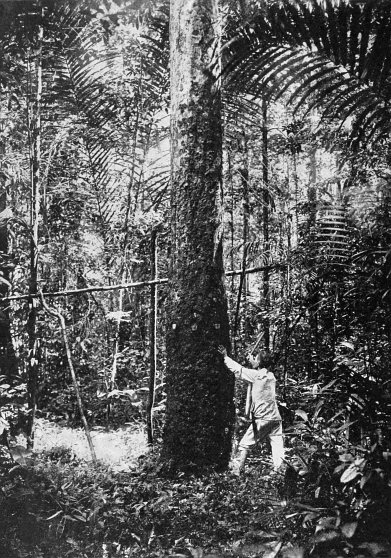
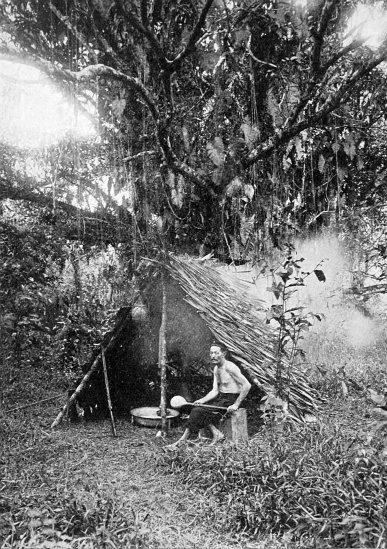
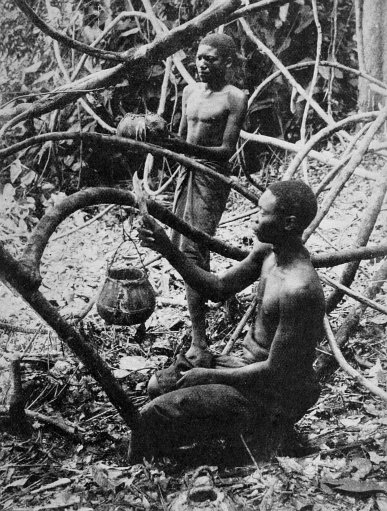
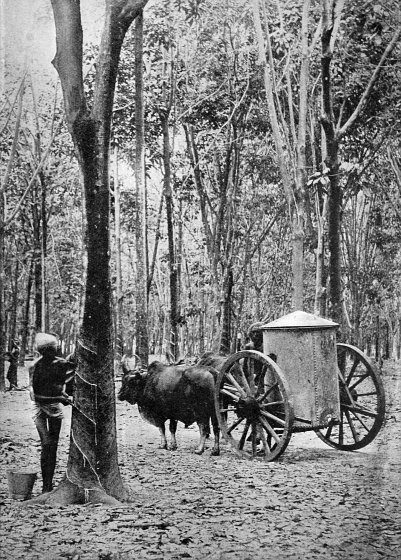
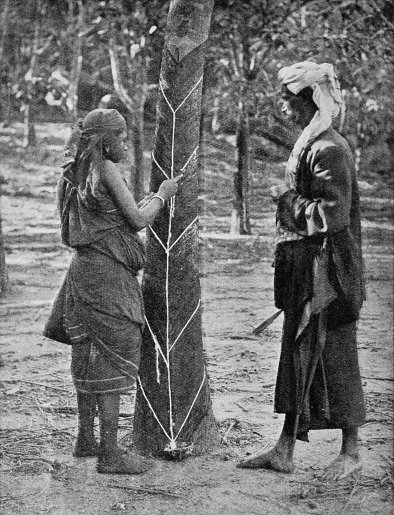
TAPPING THE WILD RUBBER-TREES (HEVEA BRASILIENSIS) IN THE FOREST
NEAR PARA, BRAZIL. Page 23
By permission of the Director of the Museum, Para
About 1900, however, a competitor gave signs of life
in the cradle of the Middle East. The public knew
little about that competitor, and cared less; the experts
with very few exceptions derided it. But a few years
later both the experts and the public began to realize
that, for the first time in its triumphant career, wild
Para had a really fearsome rival. This adversary
is commonly known as Plantation Rubber; as a matter
of fact, it is Cultivated Para, which has made such a
determined fight for supremacy in the raw rubber
market. This is indeed a case of child rising up against
parent, for the Cultivated Para is all being obtained
from trees that owe their existence to seeds taken from
the Brazilian forests. The struggle has brought about
a revolution in the Rubber World; all of you must have
heard of at least one of the stirring events to which
it has already given rise—the Rubber Boom in the
spring of 1910.