CHAPTER I. THE SOURCES OF INDIA RUBBER AND ITS HISTORY.
India rubber or caoutchouc is a very peculiar
product, which is found in and extracted from the
juice of certain trees and shrubs. These are quite
numerous and are referred for the most part to the
following families: Euphorbiaceæd, Urticaceæd, Artocarpeæd,
Asclepiadaceæd, and Cinchonaceæd. It
is evident that a considerable number of trees are
utilized in commerce for its production, and it is
certain that it exists, quite widely distributed, in
many cases as a constituent of the juice of plants
not recognized as containing it.
When an india rubber tree is tapped, which is
effected by making incisions in the bark, the sap of
the tree exudes. It is a milky substance and is
collected in various ways; it may be in vessels of
clay, in shells, or in other receptacles by the india
rubber hunters. If this substance is examined it is
found to be of very remarkable and characteristic
constitution, resembling in its physical features
ordinary milk. It is composed of from fifty to
ninety per cent. of water, in which is suspended in
microscopic globules, like the cream in milk, the
desired caoutchouc or india rubber. If the juice is
left to stand in vessels, like milk in a creamery, the
globules rise to the surface, and a cream of india
rubber can be skimmed off from the surface. If
the juice is evaporated over a fire, the water escapes
and the india rubber remains. By dipping an
article repeatedly in the juice and drying it, a thick
or thin coating of india rubber can be developed.
Before the modern methods for the manipulation of
the gum had been developed, and before the invention
of vulcanization, this method was adopted for
the manufacture of shoes. The original “india
rubbers” for protection of the feet in wet weather
were made in this manner. A clay last was used,
upon which the india rubber was deposited as
described. The clay last was then broken out and
removed. Great quantities of overshoes were thus
made in South America, and many were exported to
Europe.
When caoutchouc has once been removed from
this watery emulsion, which for all practical purposes
is a solution, it cannot be restored to the
former state of liquidity; it remains solid. It will
absorb a considerable quantity of water, but will
not enter again into the quasi solution or combination.
This property of permanent coagulation,
which interferes to a degree with its easy manipulation,
was early discovered. In the last century
quantities of the natural milk were exported to
Europe to be used in what may be termed the natural
process of manufacture, because once solidified
it could not be redissolved, and because the manufacturers
of those days had not the present methods
of dealing with the apparently intractable gum.
The natives of South America before the advent
of Europeans, were familiar with the treatment of
the juice by evaporation just described and used to
make bottles, shoes and syringes of it for their own
use. The name Siphonia applied to several species
of rubber tree, and seringa (caoutchouc) and
seringari (caoutchouc gatherer) in Spanish recall
the old Indian syringes and tubes.
The gum is now collected for export in many
parts of the world. South and Central America
are, as they have always been, the greatest producers.
Some is collected in Africa, Java and India.
The best comes from Para. However carefully
treated a great difference is found in the product
from different countries. The Brazilian india rubber,
known as Para, from the port of shipment,
ranks as the best in the market.
Its history as far as recorded, does not go back of
the last century. Le Condamine, who explored the
Amazon River, sent from South America in 1736 to
the Institute de France, in Paris, the first sample of
india rubber ever seen in Europe. He accompanied
the sample with a communication. He said that
the Indians of that country used the gum in making
several domestic objects of utility, such as vessels,
bottles, boots, waterproof clothing, etc. He stated
that it was attacked and to a certain extent dissolved
by warm nut oil. In 1751 and 1768 other
samples were received through MM. Fresnau and
Maequer, who sent them to the Academy of Sciences,
Paris, from Cayenne in Guiana.
Although from this period numerous experiments
were tried with the new substance little of importance
was done with it for many years. Its first use
was to rub out pencil marks, whence it derived its
name of “india rubber.” As late as 1820 this continued
to be its principal use.
An interesting reminiscence of its early history is
given by Joseph Priestley, the great English chemist
of the last century, celebrated as the discoverer of
oxygen. In 1770 he mentioned the use of the gum
for erasing pencil marks, and speaks of its cost
being three shillings, about seventy cents, for “a
cubical piece of about half an inch.”
As we have seen, its solubility was early studied.
In 1761 Hérissant added turpentine, ether and
“huile de Dippel” to the list of solvents. In 1793
its solubility was utilized in France by Besson, who
made waterproof cloth. In 1797 Johnson introduced
for the same manufacture a solution in mixed
turpentine and alcohol.
The year 1820 is the beginning of the period of
its modern use on a more extended scale. Nadier
developed the methods of cutting it into sheets and
threads and of weaving the latter. Mackintosh in
1823 began the manufacture of waterproof cloth,
using the solution of the gum in coal tar naptha,
which was caused to deposit by evaporation a layer
of the gum upon a piece of cloth which was covered
by a second one. This protected the wearer from
the gummy and sticky coating of raw india rubber.
At the best the original Mackintoshes must have
been very disagreeable articles for wear.
In 1825 india rubber shoes of raw india rubber
were imported from South America and formed for
a while an important article of commerce.
In 1839 Charles Goodyear, of Massachusetts, invented
the art of vulcanizing, or combining india
rubber with sulphur. It was patented on June 15,
1844, and covers only the manufacture of soft rubber.
Vulcanite or hard rubber (whalebone rubber)
is disputed as to its origin, its invention being
assigned by some to Nelson Goodyear and by others
to Austin G. Day, of Connecticut. Goodyear however
succeeded in obtaining a patent on May 6, 1851.
Day obtained a patent on August 10, 1858.
Vulcanization is the most important invention
ever made in connection with india rubber and may
fairly rank as one of the greatest discoveries of the
present century. It is claimed by the English, an
inventor named Handcock being cited as the rival
of Charles Goodyear. The latter inventor had as
an associate Nathaniel Hayward, who is probably
entitled to some of the credit.
By vulcanization india rubber loses susceptibility
to heat and cold, becomes non-adherent, and insoluble
in almost all substances. It is converted from
a comparatively useless substance into one of wide
applicability.
The subject of india rubber is so interesting in its
theoretical as well as practical bearings that it
seems impossible that those who are workers in it
should not feel an interest in its natural history.
For such readers the chapter on the natural history
and collection of india rubber has been written.
As it is a product of widely separated lands on both
hemispheres, and as it is yielded by an immense
number of plants, it is impossible in the limits of a
chapter to give a full outline of its natural history.
The chapter in question is, therefore, with this
apology, inserted where it belongs, near the beginning
of the book. Those who are entirely practical
may pass it over. There is no doubt that the few
minutes necessary for its perusal will be bestowed
upon it by some.
CHAPTER II. THE NATURAL HISTORY AND COLLECTION OF INDIA RUBBER.
African india rubber is mostly exported from
the west coast. The belt of country producing it
extends nearly across the continent. Those who are
familiar with the india rubber plants of our conservatories
are apt to think of the gum as the product
of trees, but in Africa it is largely yielded by climbing
plants of very numerous varieties, belonging
generally to the Landolphia species. It is collected
by the natives by careless or desultory methods,
probably less advanced than the ways followed by
the South Americans. Possibly its marked inferiority
may be partly attributed to this. It is also supposed
by many that, were the gathering restricted
to the vine producing the best gum, better results
would follow. As it is now all gums are mixed
indiscriminately. African gum is of very inferior
quality.
The African india rubber vines grow often in
dark moist ravines, where no valuable product other
than themselves could be cultivated. They are
entirely wild. The vines when cut exude an abundance
of sap, which differs from the South American
product in its quickness of coagulation. As it
escapes from the wound it at once solidifies and prevents
the further escape of juice. The negroes are
said to employ the following highly original method
of collecting it. They make long gashes in the
bark. As fast as the milky juice comes out they
wipe it off with their fingers and wipe these in turn
on their arms, shoulders, and body. In this way
they form a thick covering of inspissated juice or
caoutchouc over the upper part of their body.
This from time to time is removed by peeling. It
is then said to be cut up and boiled in water. This
is one account. According to others the natives
remove a large piece of bark, so that the juice runs
out and is collected in holes in the earth or on
leaves. Wooden vessels are said to be used elsewhere.
Sometimes the juice is said to be collected
upon the arms, the dried caoutchouc coming off in
the shape of tubes. A clew to the inferiority of
African india rubber is afforded by the statement
that too deep a cut liberates a gum which deteriorates
the regular product if it mixes with it. The
drying of the gum is thought to have much to do
with its quality and it is highly probable that this
affects the African product. Some samples seem to
be partly decomposed they are so highly offensive in
odor. The South American rubber is often dried
in thin layers, one over the other, by a smoky fire,
which may have an antiseptic effect upon the newly
coagulated caoutchouc. No such process as far as
known is used in Africa.
The African india rubber appears under different
names in commerce. From the Congo region lumps
of no particular shape called “knuckles”; from
Sierra Leone smooth lumps, “negro-heads,” and
“balls” made up of small scrap; from the Portuguese
ports “thimbles,” “nuts,” and “negro-heads;”
from the gaboon “tongues;” and from
Liberia “balls” are received. It is all characterized
by great adhesiveness and low elasticity.
From Assam, Java, Penang, and Rangoon there
is considerable gum exported. It is supposed to be
the product of trees of the ficus species, in all these
places, as it is known to be in Java and Assam.
In the latter place rigid restrictions are imposed as
far as possible upon the gathering. In the case of
wild trees scattered through the forest the carrying
out of these restrictions is not practicable. The
trees are cut with knives in long incisions through
the bark and the juice is collected in holes dug in
the ground, or often in leaves wrapped up into a
conical form, somewhat as grocers form their wrapping
paper into cornucopia shape for holding
sugar, etc.
It has seemed reasonably certain that the india
rubber producing plants might be cultivated with
profit, and it is as certainly to be feared that
without such cultivation they will become extinct.
Efforts have been made in the direction of raising
them artificially but without much success. In
Assam numerous experiments have been made to
propagate the india rubber bearing ficus tree.
A good instance of the ill effects of carelessness
in the original gathering of the crop is afforded
by the Bornese collectors. The source of Borneo
india rubber is a variety of creepers. These are cut
down and divided into short sections from a few
inches to a yard in length. The sap oozes out from
the ends. To accelerate its escape the pieces are
sometimes heated at one end. It is coagulated by
salt water. Sometimes a salt called nipa salt, obtained
by burning a certain plant (nipa fruticans), is
used for the purpose. In either case it is coagulated
into rough balls and masses. These masses are
heavily charged with the salt water, often containing
as much as fifty per cent., and rarely much less
than twenty per cent.
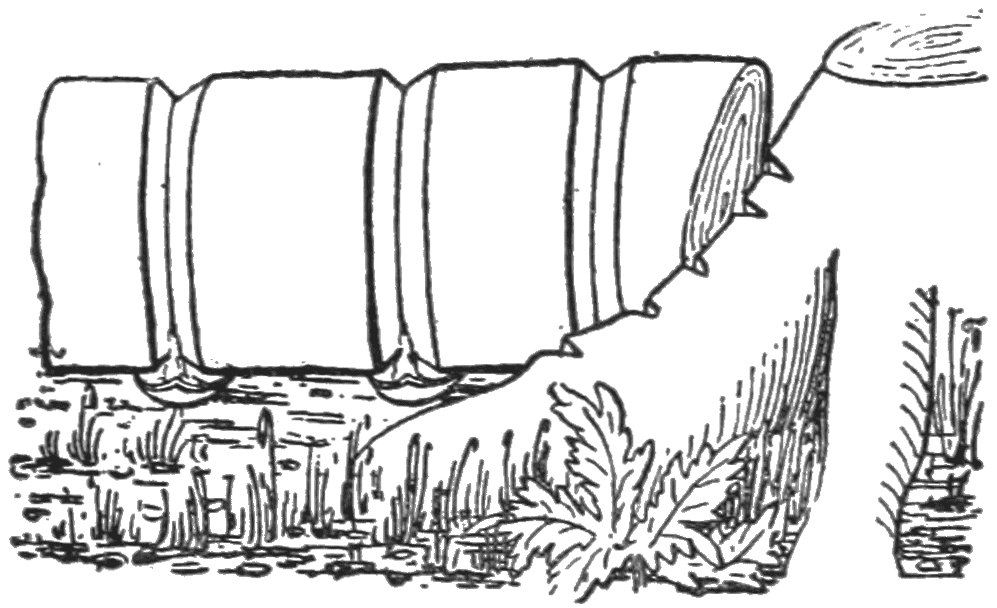
Tree Felled for Collection of India Rubber.
Central America and Panama are great producers
of the gum. In Panama the custom of felling the
trees is often adopted. In this case grooves are cut
around the prostrate trunk, and under each groove
as the trunk lies on the ground a vessel is placed to
collect the sap. Its coagulation is often effected by
leaving it for a couple of weeks standing at rest in a
hole, excavated on the surface of the ground, and
covered over with leaves. The caoutchouc separates
under these conditions. A quicker method,
but one yielding an inferior product, is obtained by
adding to the fresh juice some bruised leaves of a
plant (ipomæa bona nox) which acts something
like acid upon milk, in separating the desired solid
matter or caoutchouc. A jelly like accretion saturated
with blackish water is thus obtained. By
working it together a blackish liquid is caused to
escape, and comparatively pure gum is gradually
obtained. As much as one hundred pounds of
india rubber may be obtained from a single tree
where this destructive system is employed. Further
north, where a better counsel has prevailed, the
trees are only tapped, and the india rubber hunter
is satisfied if from a tree eighteen inches in diameter
he obtains twenty gallons of sap, giving fifty
pounds of gum. Even where tapping is done the
tree is often destroyed by carelessness or ignorance.
Two systems are followed in Nicaragua. The operator
ascends by a ladder if he has one, or in any case
climbs as high as he well can and begins to make a
long incision. Sometimes he carries one long straight
cut clear down to the ground. This is made the
starting point for a number of side cuts, short, and
running diagonally into it. This is also one of the
Brazilian methods. The Nicaraguan sometimes
also makes two spiral incisions, one right-handed
and the other left-handed, crossing each other as
they descend so as to divide the surface of the tree
into roughly outlined diamonds. In either case the
juice flows down to an iron spout, placed at the
bottom of the tree, which spout leads to an iron
pail. The milk is gathered and passed through a
sieve, and coagulated in barrels by the ipomæa plant
as before mentioned. This gives three grades of
rubber. The bulk is obtained from the barrels and
is called often méros; the small lump which forms in
the spout is rolled into a ball and called cabezza;
the dried strips pulled out of the cuts is of very
good quality and is called bola or burucha.
From Brazil is exported the famous Para india
rubber. This is of very high quality, and is greatly
esteemed by all manufacturers. No process can
make a poor gum give a really good product. The
system of gathering it varies. Sometimes the tree
is cut into by gashes from an axe, such gashes extending
in a row all around the trunk. Under each
gash a small clay cup is luted fast with some fresh
mixed clay. These collect from a tablespoonful of
juice upward, which is collected, and the cups are
removed on the same day. The next day a second
row of cuts is made below the others, and the same
process is repeated. This is continued until from a
point as high as a man can reach, down to the
ground the tree is full of cuts. Sometimes a gutter
of clay is found partly around the trunk with
gashes above it. In other cases a vine is secured
around the tree and a collecting gutter is worked
with it for a basis.
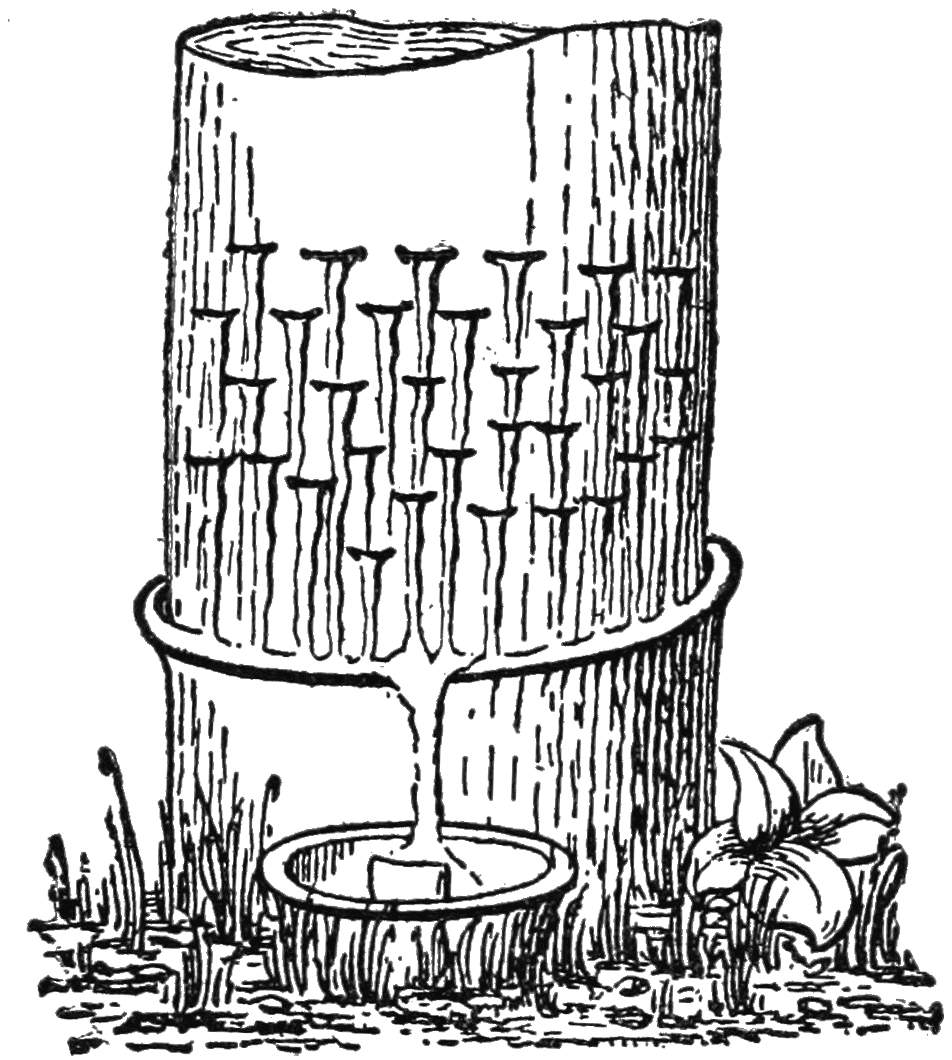
Tree Tapped for India Rubber.
The juice is coagulated in a smoky fire. A bottomless
jar is placed over the fire and some palm
nuts are mixed with the fuel. The mould, which is
often a canoe paddle, is smeared with clay to prevent
adhesion and is then heated. A cup of juice
is poured over it, and after the excess has dropped
off it is moved about rapidly over the smoke and
hot air which ascends from the mouth of the jar.
This series of operations is repeated until the coating
is quite thick; it may be as much as five inches.
After solidifying over night it is cut open and the
paddle or mould is removed. After a few days drying
it is sent to market. With all the heating,
during which it sweats profusely, it still retains
fifteen per cent. of water.
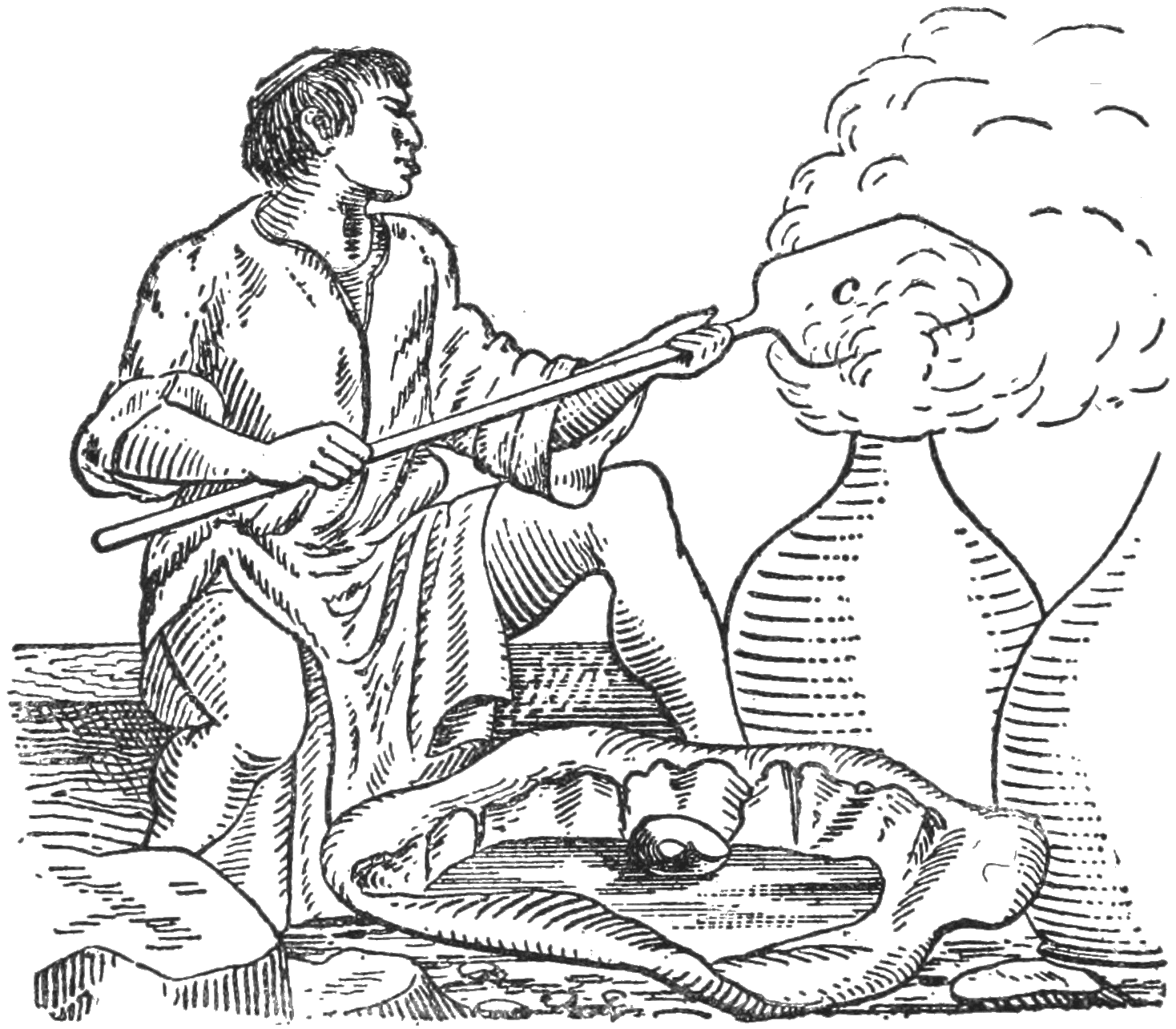
Indian Drying and Smoking India Rubber.
India rubber sap may be coagulated by an aqueous
solution of alum. The process has been tried in
Brazil, and is used to a considerable extent in
Pernambuco. It was proposed by an investigator
named Strauss, and the process is still called by his
name. One objection is that it gives a very wet
product, and apparently one of inferior value to the
smoked gum.
The feeling that india rubber suffers in the gathering
has been so much felt that it has been recently
suggested that if possible the uncoagulated
juice should be exported to Europe there to be
worked up from the beginning.
CHAPTER III. PROPERTIES OF UNVULCANIZED AND VULCANIZED INDIA RUBBER.
There are two broad divisions to which all varieties
of india rubber can be assigned—unvulcanized
and vulcanized rubber. Speaking with a certain
amount of license it may be said that more properties
characterize the former than the latter. The
vulcanized article is very slightly affected by ordinary
changes of temperature, cannot to any considerable
extent be changed by heat short of absolute
destruction or decomposition, cannot be united or
moulded except in simple forms, is highly elastic,
and is insoluble in almost every solvent for ordinary
caoutchouc.
Unvulcanized caoutchouc possesses very interesting
and peculiar properties. The first part of the
present chapter is devoted to this substance. Those
who have never seen the crude gum as imported are
familiar with the article almost pure in the form of
sheet rubber and black rubber articles generally.
These are of nearly pure caoutchouc, though recently
the tendency is to vulcanize them to a considerable
degree.
A piece of pure gum containing no combined
sulphur, iodine, or other vulcanizing constituent
will be found to exhibit a very striking peculiarity.
Two freshly cut surfaces when placed in contact
will adhere. This is not in consequence of any
viscous or sticky coating. When india rubber is
cut the surface is perfectly dry and non-adherent
except to itself.
The writer once had this property of adhesion
brought strongly to his attention. In some analytical
investigations of coal gas he had proposed to
use finely divided india rubber as an absorbent of
sulphur. This constituent it absorbs from gas, and
it seemed that a basis for a quantitative determination
of sulphur might be found in such property.
Accordingly some raw india rubber was procured
and with some trouble was cut up into little pieces
which were put into a bottle. A day or two afterwards
the pieces united wherever they were in contact,
and an irregular cavernous lump was the
result. This involved no melting or softening or
change of shape. Each little piece was there intact
and distinct but firmly attached to its neighbors.
The analogy of this action is seen in lead. Two
fresh surfaces brought together, preferably with a
twisting or wrenching pressure, adhere quite firmly.
The adherence of india rubber and of lead each to
itself is often exhibited by physical lecturers as an
illustration of cohesion. The cohesion of india
rubber is however far more perfect than that of
lead, probably because of its comparatively great
resistance to oxidation, and because, owing to its
elasticity larger areas can be brought in contact.
Comparatively great though this resistance to oxidation
is, oxygen, especially in the allotropic modification
known as ozone, may act quite powerfully
on the gum. Sunlight also can affect it injuriously.
A more familiar illustration of the uniting of two
pieces of the same material is seen in the welding
of iron. The blacksmith heats two pieces of iron
until they are nearly white hot and are pasty in
consistency. On placing them in contact and hammering
to force them together they unite so firmly
as to be practically one. It is necessary that the
surfaces of clean metal should be brought together.
If the pressure induced by the hammering is insufficient
to bring this about, a flux is added which
dissolves the oxide and causes the metal to come in
contact with metal and to weld. The analogy with
india rubber in its cohesive action is evident. Surfaces
long exposed or which are dusty do not cohere.
The relegation of ice is similar in effect.
The cohesion of india rubber is important and
should be thoroughly appreciated. It is not saying
too much to assert that the entire treatment of the
raw gum depends upon this interesting property.
The great lumps of gum are torn to pieces and
washed free from gravel and dirt without going to
powder, because owing to their elasticity they yield
and as fast as torn apart the pieces tend to reunite.
Again india rubber is mixed with pigments and vulcanizing
reagents by a method practically one of
grinding or masticating, but the material while it
changes its shape, and by the admixture of the various
ingredients becomes less strong or easier torn,
still remains intact, as it welds together or coheres
as fast as disintegrated.
As regards its chemical constitution the sap of a
Para rubber tree has been analyzed with the following
general results: (Faraday).
| Caoutchouc |
30.70 |
| Albuminous, extractive, and saline matter, etc. |
12.93 |
| Water |
56.37 |
| |
100.00 |
Its specific gravity is 1.012.
Caoutchouc itself or raw india rubber is a mixture
of several hydrocarbons of the following composition
in general:
| Carbon |
87.5 |
| Hydrogen |
12.5 |
| |
100.0 |
Its specific gravity is from .912 to .942.
The hydrocarbons composing it are isomeric or
polymeric with turpentine. This fact brings it well
within the range of familiar vegetable products.
As will be seen the products of its distillation fall
among the same polymers and isomers.
When pure it is nearly colorless, the dark color
being due to impurities. In thin sheets it is almost
or quite transparent. It burns readily, and with a
very luminous, smoky flame, as might have been
anticipated from its composition. The action of
heat and cold on it is dependent on the degree of
the temperature. At ordinary temperature it is
elastic and firm. It can be stretched and will return
almost to its original size when released from
tension. Yet the return to its shape is so liable
to be incomplete, especially after long sustained
stretching, that pure unvulcanized india rubber is
considered imperfectly elastic.
Any elasticity it possesses is principally elasticity
of shape as distinguished from elasticity of volume.
In other words when pressed or stretched it may
change shape to a great extent but hardly change
its volume at all. A cube of 2½ inches under a
weight of 200 tons lost 1-10 of its volume only.
This is largely due to the fact that it represents an
approximately solid body, or one destitute of considerable
physical pores. Solids and liquids are very
slightly compressible. Whatever degree of compressibility
caoutchouc possesses is due principally
to its minute pores.
If the temperature is reduced to the freezing
point of water a piece of raw india rubber becomes
rigid and stiff. On application of heat it returns to
its former pliable condition. The same return to
flexibility may be brought about by stretching it
mechanically. This may be rather a fallacy.
Stretching india rubber warms it, so that in this
mechanically imparted rise of temperature we may
find at least a probable cause of the softening.
If the temperature is raised several effects are
produced, according to circumstances. A piece
which has been stretched and held stretched, has its
tension increased by a degree of heat considerably
less than that of boiling water. Some offer the
theory that it contains air enclosed in its pores
which, expanding, produces this effect. As the
boiling point is reached the material softens and
becomes somewhat plastic, so that it can be moulded
into shape to a considerable extent and stretched to
threads of great fineness. Its elasticity also disappears
as the heat is maintained. These effects increase
in extent up to a heat of 248° F. (120° C.).
The return to its original state is not immediate
however. Some time is required before the reduction
of temperature will have full effect.
If now a still higher degree of heat is applied,
392° F. (200° C.) the india rubber softens to a
viscous body, or melts. From this state it cannot
be restored. It remains permanently “burned” or
melted whatever is done to it. Some attempt at
hardening may be made by the use of vulcanizing
chemicals, but the result will be very imperfect.
A further increase of heat brings about a destructive
distillation. India rubber treated in a retort to
a heat exceeding 400° F. (204° C.) evolves volatile
hydrocarbons of oily consistency, and it distills
almost completely, a small residue of gummy matter
or of coke if the final heat has been pushed far
enough being left. The distillate is called caoutchoucin.
According to Mr. Greville Williams it consists
of two polymeric hydrocarbons: one, caoutchin
C10H16, boiling point 340° F. (171° C.); the
other, isoprene C5H8 (in formula equal to one-half
of caoutchin), boiling point 99° F. (37° C.). The
mixture has a strong naptha-like odor and has won
considerable reputation as being the best solvent for
india rubber. How far it deserves its reputation is
a matter open to discussion.
The solution of india rubber like its fusion is a
vexed point. There is little question that it can be
dissolved by proper treatment. Usually naptha,
carbon disulphide or benzole are used as solvents, the
choice being guided by motives of cheapness and
efficiency.
It is worthy of remark that the formula given for
caoutchoucin is the same as that of the principal
constituent of oil of turpentine, and that the latter is
often recommended as a solvent. Turpentine is
slightly more volatile than caoutchoucin, its boiling
point being 322° F. (161° C.) Other hydrocarbons
have been recognized in the distillate by Bouchardat,
Himly and G. Williams, varying in boiling
point from 32° F. (0° C.) to 599° F. (315° C.), and in
specific gravity from 0.630 to 0.921.
Although it has been spoken of as approximately
solid it does possess microscopic pores, to which its
limited amount of elasticity of volume is mostly
due. Thus it is found to absorb water, in which it
is quite insoluble. As it does this it acts like a dry
sponge and increases in volume a little, owing to
dilation of these minute pores. The water absorbed
may be as much as 18.7 to 26.4 per cent. with an increase
of volume of the gum of 15/1000 to 16/1000. When
it has once absorbed water it is very hard to get rid
of it. Although the minute surface orifices communicate
with the entire system of capillary vessels
and pores, the surface pores on drying contract and
seal up the absorbed water within the mass. This
is a clew to the impracticability of the gatherer shipping
dry rubber, and to the great difficulty the
manufacturer experiences in drying his washed and
sheeted stock before working it up by masticating
or mixing and curing.
By proper manipulation caoutchouc may be made
inelastic. This can be done by the freezing process
or by keeping it stretched for two or three weeks.
In this way threads can be made to extend and to
remain extended to seven or eight times their original
length. They can then be woven into a fabric.
On gentle heating their original elasticity reappears
and they contract. In this way fluted braids can be
made which will have a high capacity for stretching.
The solution of caoutchouc is difficult often to
bring about. We have seen that in water it swells
a little without dissolving. In benzole it does the
same, but swells to a greater extent, to 125 times its
original volume or even more. Some authorities
(Watts) go so far as to assert that no solvent completely
dissolves it. Acting on it repeatedly with
benzole or other solvent and taking care not to
break up the swelled mass, from 49 to 60 per cent.
of soluble matter can be extracted. On evaporation
this is deposited as a ductile adherent film. The
swelled up residue which remains undissolved is
assumed to be the constituent giving strength and
elasticity, and is only sparingly soluble. If the
gum is masticated or kneaded at the temperature of
boiling water a change occurs not well understood,
by which its solubility is greatly increased. As
solvents many liquids have been named. Oil of
turpentine, caoutchoucin, coal-tar, naptha, benzole,
petroleum-naptha, coal-tar-naptha, anhydrous ether,
many essential oils, chloroform, bisulphide of carbon,
pure, or mixed with seven or eight per cent. of
alcohol, are among the solvents recommended. A
mixture of fifty parts of benzole and seventy parts
of rectified turpentine has been given as a solvent
for twenty-six parts of the gum. Mastication before
or after immersion in the solvent is to be
advised. More will be said on this subject in a
succeeding chapter.
Vulcanized india rubber is unaffected by changes
of temperature within ordinary range. It softens a
little on heating. Even hard vulcanite when heated
can be bent and will retain the bend on cooling.
It is exceedingly elastic with elasticity of shape but
far less compressible as regards absolute change of
volume than the raw gum. It melts at 392° F.
(200° C.) It cannot be made to cohere, and no
cement has yet been discovered that will satisfactorily
unite two surfaces. It is unaffected by light,
by ordinary acids and rubber solvents. In contact
with the latter solvents it swells sometimes to nine
times its original volume, but on heating returns to
its original volume and shape. Of water it will
absorb no more than four per cent. and often much
less. If it is maintained at a high temperature
266° to 302° F. (130° to 150° C.) for a long time it
gradually loses its flexibility, especially if in contact
with metals. Often the escape of sulphuretted
hydrogen may be observed under these conditions.
A small admixture of coal tar operates to prevent
this action.
Its composition and specific gravity vary widely
as the most varied mixtures are added by the manufacturer.
Its relation of carbon to hydrogen is
unaffected by the mixtures added. While it may
contain twenty per cent. or more of sulphur it is
believed that but a very small quantity is combined
with it, although the excess of sulphur or some
equivalent, such as sulphide of antimony is essential
to vulcanization. The combined sulphur is
from one to two per cent. Some or all of the excess
of sulphur is mechanically retained, and as the
rubber in ordinary use is worked about, keeps escaping
and forms a whitish dust upon the surface. By
treatment with alkali some of the excess of sulphur
can be removed when the rubber acquires the power
of absorbing a little more water, up to six and four-tenths
per cent.
Boiling oil of turpentine is given as its solvent.
CHAPTER IV. THE MANUFACTURE OF MASTICATED, MIXED SHEET, AND VULCANIZED INDIA RUBBER.
The manufacture of india rubber relates to the
production of two principal products. One is masticated
unvulcanized sheet and thread rubber; the
other is unmasticated mixed and cured rubber,
otherwise vulcanized rubber. For the purposes of
the rubber-stamp maker an intermediate product is
required, namely, unmasticated mixed sheet which
is uncured. This is really incompletely vulcanized
india rubber.
It will be evident from the description to come
that it is not advisable for any one without considerable
apparatus to attempt to clean and to wash (“to
sheet”), to masticate, or to mix india rubber.
These operations are best accomplished in the factories.
The partially vulcanized (“mixed sheet”)
or the pure masticated article are regular articles of
commerce. Yet a full insight into the manipulation
of india rubber can only be obtained by understanding
its treatment from the gum up to the two
separate lines of products we have indicated.
A third type of product is coated tissue, such as
Mackintosh. This really is a sequence of one of
the other two processes and a few words will be said
of it in concluding the chapter.
As the caoutchouc is received by the manufacturer
it appears an utterly intractable mass. It
occurs in lumps of every size, varying in color and
odor, and very tough but elastic. In virtue however
of the properties already described, its power of
cohering when cut, and its softening when heated,
it becomes amenable to treatment.
It is to some extent received in such assorted
condition as to secure even grades, and then each
grade may be washed by itself. It is thrown into
water which is in many cases kept at the boiling
point by steam-heat and left there for some hours.
It absorbs some water and also softens. Some gum
is so soft that it will not stand hot water. For such
the water is kept cold. The purer gum floats; such
pieces as have stones, dirt, iron, etc. in them, perhaps
placed there purposely from fraudulent motives,
sink and can be picked out for separate treatment.
The lumps are next cut up. A revolving circular
knife driven by power is often used, and sometimes
an ordinary knife is adopted. At this part of the
operation there is frequently need for sorting, as the
grades received may have inferior pieces mixed with
the good. The cutting is mainly to secure good
grading, and to remove concealed impurities. The
gum then goes to the washing rollers, called the
washer and sheeter. (See cut, p. 37.)
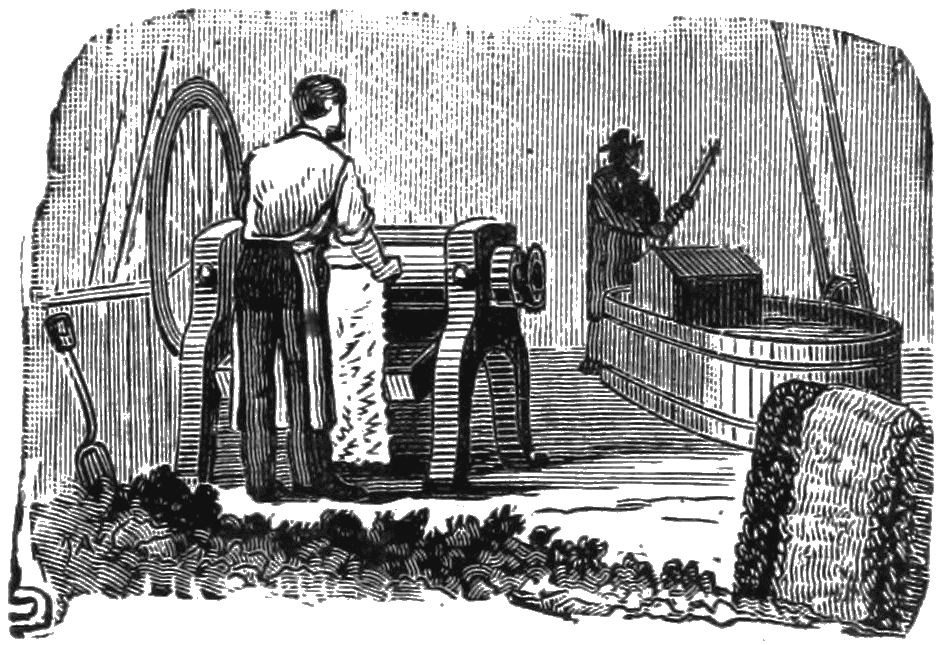
Washer and Sheeter.
These are heavy corrugated rolls made very short,
9–18 inches in length, to prevent springing. They
are grooved or corrugated and have a screw adjustment
for regulating their distance apart. They
are geared together so as to work in corresponding
directions, like a clothes wringer or a rolling mill
of any kind. The pieces of gum are fed into the
rolls and are drawn between and through them.
The friction tends to heat the gum. To prevent
this and also to effect the washing, a supply of
water, either hot or cold, is kept playing upon the
mass. This dissolves out all soluble matter and
washes away mechanically the chips, dirt, etc.
which may be present. The whole operation is one
of main force. The caoutchouc is torn and distended
and delivered as a rough perforated sheet.
It is passed repeatedly through the machine, the
rollers being gradually brought closer together, or
else different sets of rolls are used, set to different
degrees of fineness. The wash water passes through
a screen which catches any small detached fragments
of gum.
Other types of machines have been introduced;
the above is a representative form.
The rough sheets must now be perfectly dried, as
water impairs the final product. This is done in
drying rooms by steam heat, generally, at a temperature
of about 90° F. (32° C.) The windows, if
there are any, are painted to exclude sunlight, which
operates to deteriorate raw gum. When absolutely
dry the caoutchouc is removed and stacked away
for use.
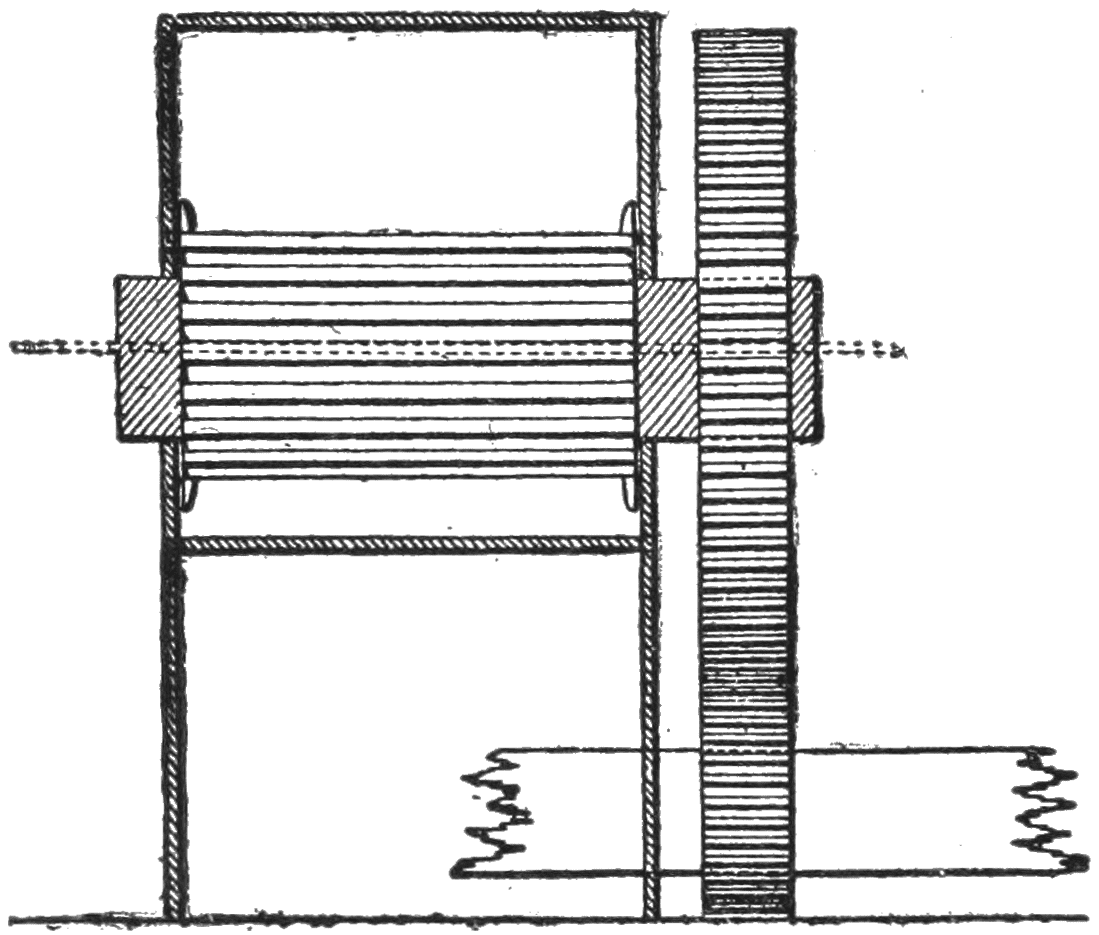
Masticating Machine.
To prepare pure gum for the manufacture of
sheet rubber and as a starting point for many other
preparations, the india rubber is “masticated” in
special apparatus. The machine consists of a fixed
cylinder within which is a corrugated roller set
eccentrically and rotated by power. The perfectly
dry sheets in the masticator are pressed and rolled
and ground and produce a mass of even consistency.
Here the welding or cohering action again appears
in its fullest development. The perfect dryness of
the mass enables it to keep reuniting as fast as
divided. The action is assisted by the heat generated,
which is not inconsiderable. Sometimes the
caoutchouc is warmed before introduction, and
sometimes the roller is heated by passing steam
through it.
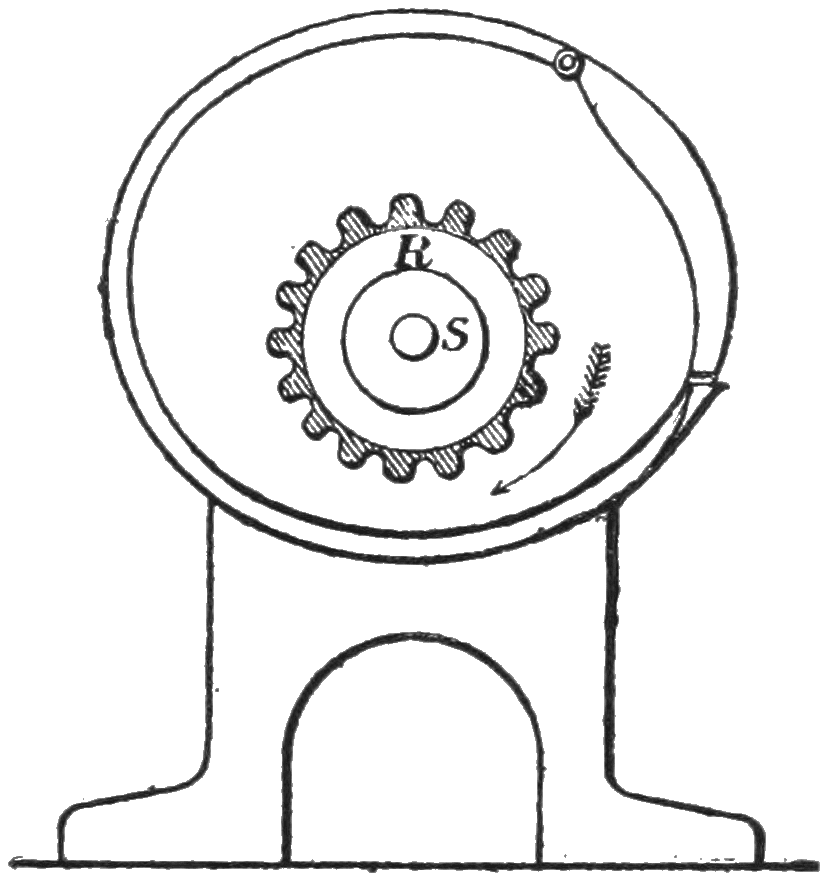
Masticating Machine.
The masticating machine the French picturesquely
term the wolf (loup) or devil (diable). It is
given from sixty to one hundred turns a minute,
and a machine large enough to treat fifty pounds of
gum in a charge, requires five horse-power to drive
it. In it the sheeted gum is ultimately brought to
the state of a perfectly homogeneous dark brown
translucent mass.
The masticated rubber is peculiarly amenable to
mechanical and chemical treatment. It can be
shaped by heat and pressure, and it is the most
soluble form and is used for making cement and
solution, and is moulded into blocks for the manufacture
of sheet and thread rubber. In the process
neutral body pigments, such as oxide of zinc, or soluble
transparent ones, such as alkanine may be introduced;
easily decomposed matter cannot be incorporated
on account of the heat.
In all these machines special provision is made
to prevent any oil from getting into the gum.
There is no greater enemy to india rubber than oil
or fats of any description. The flanges in the masticator
that roll just inside the bearing are for this
purpose.
Sheet rubber is made from the blocks of masticated
gum by slicing. A machine is used for the
purpose which carries a knife which works back
and forth in the direction of its length at high
speed, making two thousand cuts a minute. The
knife is kept wet by a stream of water, and about
sixty cuts are made per inch. In many articles
made from this sheet the marks of the cuts can be
seen as a fine ribbing. The appearance is familiar
to many readers.
The sheet is often cut from rectangular blocks,
but cylindrical blocks are also used. The latter are
rotated in front of the knife edge and a long, continuous
sheet can thus be obtained.
The sheet rubber can be cut into threads on webbing
and braid. Everyone has noticed that these
threads are usually square. The method of preparation
accounts for it. Vulcanized sheet is now
almost universally used for threads.
Round threads however can be made by forcing
softened or partly dissolved gum through a die.
It is from unvulcanized masticated sheet that
toy balloons, tobacco pouches, etc., are made. It is
the starting point for india rubber bands. For the
usual form of the latter article the sheet is cemented
into a long tube which is afterwards cut transversely,
giving bands of any desired width. To make any
of these articles satisfactory vulcanization is imperative.
Unvulcanized rubber for many years was
used, but it is now completely displaced by the
vulcanized product. Sheet rubber is made as above;
is vulcanized by some of the absorption processes
described in the chapter on vulcanization.
We now come to the second product: regularly
mixed and cured rubber. Its starting point is
the washed india rubber from the washer and
sheeter.
We have seen that the pure gum or caoutchouc is
very sensitive to changes of temperature. At the
freezing point of water it is hard and rigid, and at
the boiling point is like putty in consistency.
There are several substances which can be made to
combine with the gum and which remove from it
this susceptibility to change of temperature. The
process of effecting this combination is called vulcanization,
and the product is called vulcanized
india rubber. Sulphur is the agent most generally
employed.
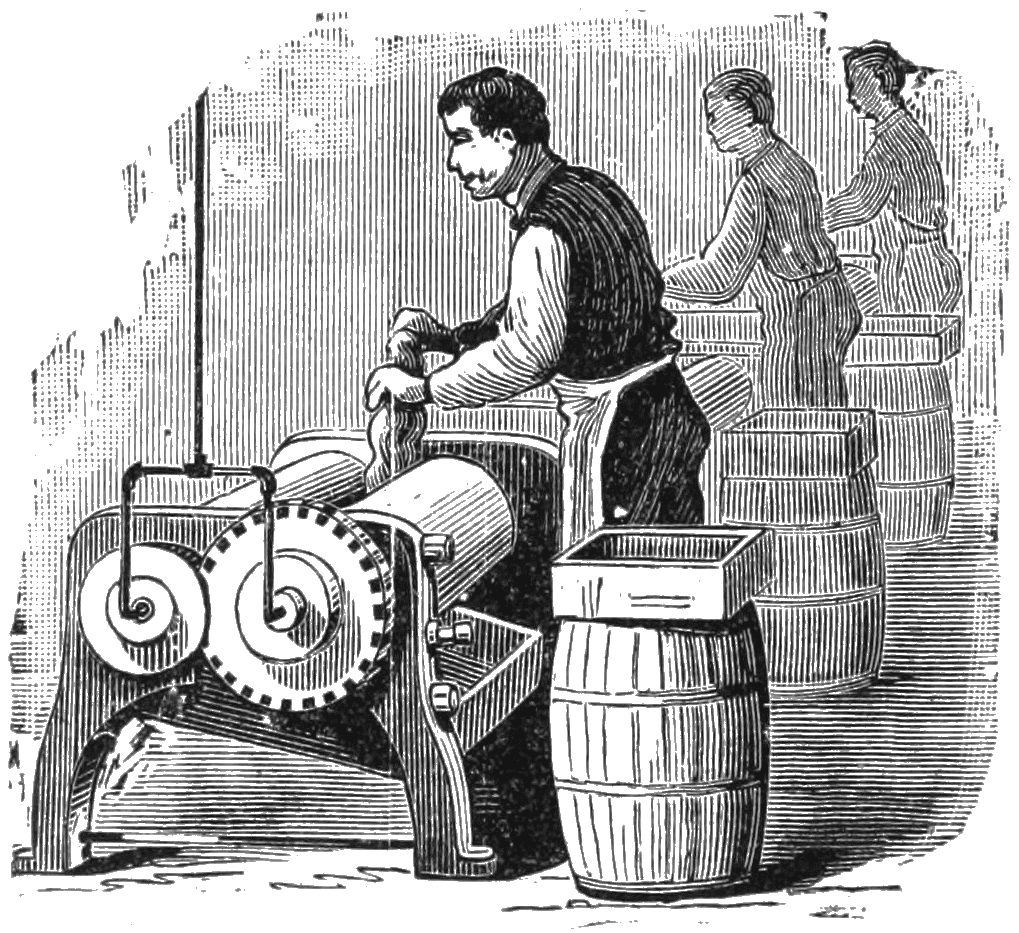
Making Mixed Rubber.
In the factory the normal vulcanization is carried
out in two steps, mixing and curing. The washed
sheet india rubber which has not been masticated
and which must be perfectly dry is the starting
point, and the mixing rolls shown in the cuts are the
mechanism for carrying out the first step. These
are a pair of powerful rollers which are geared so as
to work like ordinary rolls, except that one revolves
about three times as fast as the other. They are
heated by steam, which is introduced inside of
them. The sheet is first passed through them a
few times to secure its softness, and then the operative
begins to sprinkle sulphur upon it as it enters
the rolls. This is continued, the rubber passing and
repassing until perfect incorporation is secured.
About ten per cent. of sulphur is added, and a workman
can take care of thirty pounds at a time.
This material is incompletely vulcanized. It is
in its present condition very amenable to heat and
is ready for any moulding process. Generally it is
rolled out or “calendered” into sheets of different
thickness from which articles are made in moulds
by curing.
These sheets are of especial interest to the reader
as they are the material from which most small articles
are made, including rubber stamps.
This rolling of the mixed india rubber into sheets
of definite thickness is done by special calendering
rolls. The product is termed “mixed sheet.”
In the mixing rolls the incorporation of other
material is often brought about. Zinc white, lead
sulphide, antimony sulphide, chalk, clay, talc,
barium sulphate, plaster of paris, zinc sulphide,
lead sulphate, white lead, oxides of lead, magnesia,
silica, form a list of ordinary mixing ingredients.
These lower the cost of the finished material and are
often serious adulterants. For some cases the addition
if not carried too far is not injurious, or even
may be beneficial. A proper admixture renders the
gum more easily moulded and treated in the shaping
processes.
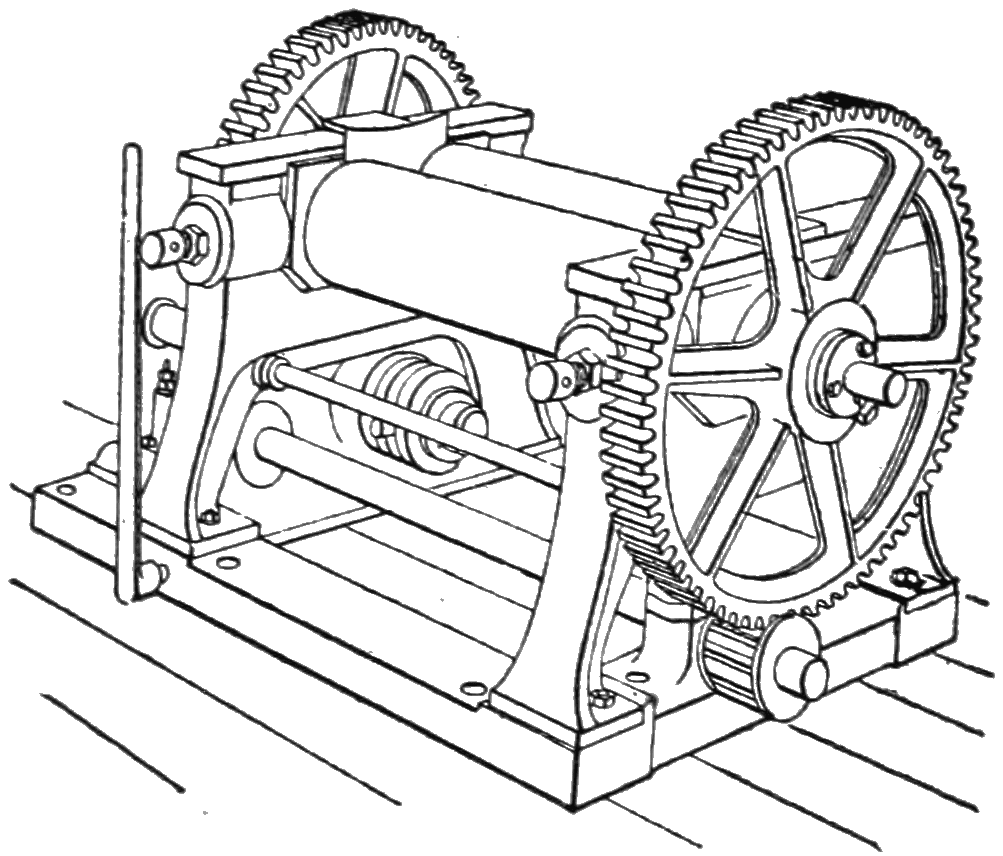
Mixing Rolls.
The next step in the vulcanizing process is the
heating of the mass, which step is called “curing.”
Up to a temperature in the neighborhood of that of
boiling water the mixed rubber can be heated without
change except as it is softened. But if the heat
is increased it begins to get a little more elastic and
less doughy, and eventually becomes “cured” or
vulcanized. The temperature for vulcanization is
about 284° F. (140° C.). The word “about” is used
advisedly, for it is not only a question of heat but of
time of exposure. After vulcanizing, including the
curing, india rubber cannot be moulded to any
great extent. In the manufacturing process, therefore,
it is before curing placed in the moulds,
heated, shaped by pressure, and by exposure to a
higher heat in a steam oven called a vulcanizer, is
at once cured.
To prevent adherence to the moulds they are
dusted over with ground soapstone, and the rubber
itself is often thus coated.
The methods of vulcanization and curing, which
may be of special use to the reader, are given in the
chapters devoted to that subject (chapter XI.), and
in the one devoted to rubber stamps.
Hard rubber, termed ebonite when black, and vulcanite
when of other colors, is simply vulcanized
rubber containing a large percentage of sulphur
added in the mixing process.
The manufacture of coated tissues is effected in
several ways. The following is a typical process.
A mixture of one part washed and sheeted india
rubber with one part zinc white, one fourth part
sulphur, and about one third part naptha is mixed
into a dough-like mass and is spread upon the cloth
by machinery. The latter is simple. It consists of
a bare board arranged to move under a scraping bar.
The cloth is placed on the board and carried under
the bar. The coating mixture is fed on one side of
the bar upon the surface of the cloth. As it passes
under, a regulated amount, according to the set of
the bar, adheres. It is then dried by steam heat
and recoated, until ordinarily six coats, each about
one one-hundredth of an inch in thickness, have been
given. Three coats are given in each direction with
intermediate drying. The fabric is then cured by
heat in vulcanizers.
Sometimes the sulphur is omitted from the mixture
and cold curing, as described later, is adopted.
When the goods are made up the seams are secured
with rubber cement, a thick solution of masticated
gum. Such seams have to be vulcanized.
Sometimes two such fabrics before curing or vulcanization,
are placed face to face and allowed to
adhere and are then cured or vulcanized.
Enough has been said in this outline of the manufacturer’s
treatment of india rubber to show that
the first treatment requires machinery. Very little
can be done with mortar and pestle, although in
making up solution these simple instrumentalities
are available. As a starting point for making small
articles masticated sheet rubber and mixed sheet
rubber are the staple materials. The preceding
steps are best accomplished in the factory.
CHAPTER V. INDIA RUBBER STAMP MAKING.
We have seen that india rubber cannot be cast in
moulds. Except in special cases deposition from
solution is not available. It has to be shaped by a
combination of heat and pressure. When gently
heated it softens and can be pressed in a mould.
As it cools it retains the shape thus given and is
moulded. This applies to all unvulcanized india
rubber. If mixed rubber is moulded and heated to
a higher temperature without removal from the
mould the curing process is brought about and the
rubber may be not only moulded but cured and the
product is moulded vulcanized india rubber. The
mixed sheet whose manufacture is described in
chapter IV. (page 42) is the starting point in rubber
stamp making. It is made for this purpose by
the manufacturers.
When the material is examined it looks like ordinary
white india rubber, being firm in texture and
quite strong. On heating to 280° F. to 290° F.
(137° C. to 143° C.) it begins to become “cured,”
and if in a thin sheet one to ten minutes are sufficient
for the process. As the heat is applied the india
rubber first softens and becomes much like putty.
It can now be pressed through the smallest orifice
and will fill up the finest details of anything it is
pressed against. It is at this point that pressure
must be applied to drive it into the interstices of
the mould.
As the heat continues it begins to lose its doughy
or putty-like consistency. This marks the reaction
of the vulcanizing materials. They gradually combine
with and change the nature of the caoutchouc.
The rubber while still quite soft is elastic. If
pressed by the point of a knife it yields, but springs
back to its shape when released from pressure. The
india rubber is vulcanized.
On removal from the mould it will be found to
reproduce its smallest detail. The color and appearance
have not changed much, but its nature
and properties are now those of vulcanized rubber.
It is unaffected by heat or cold within ordinary
ranges of temperature, and if the india rubber is of
good quality and made by a proper formula it will
last for years.
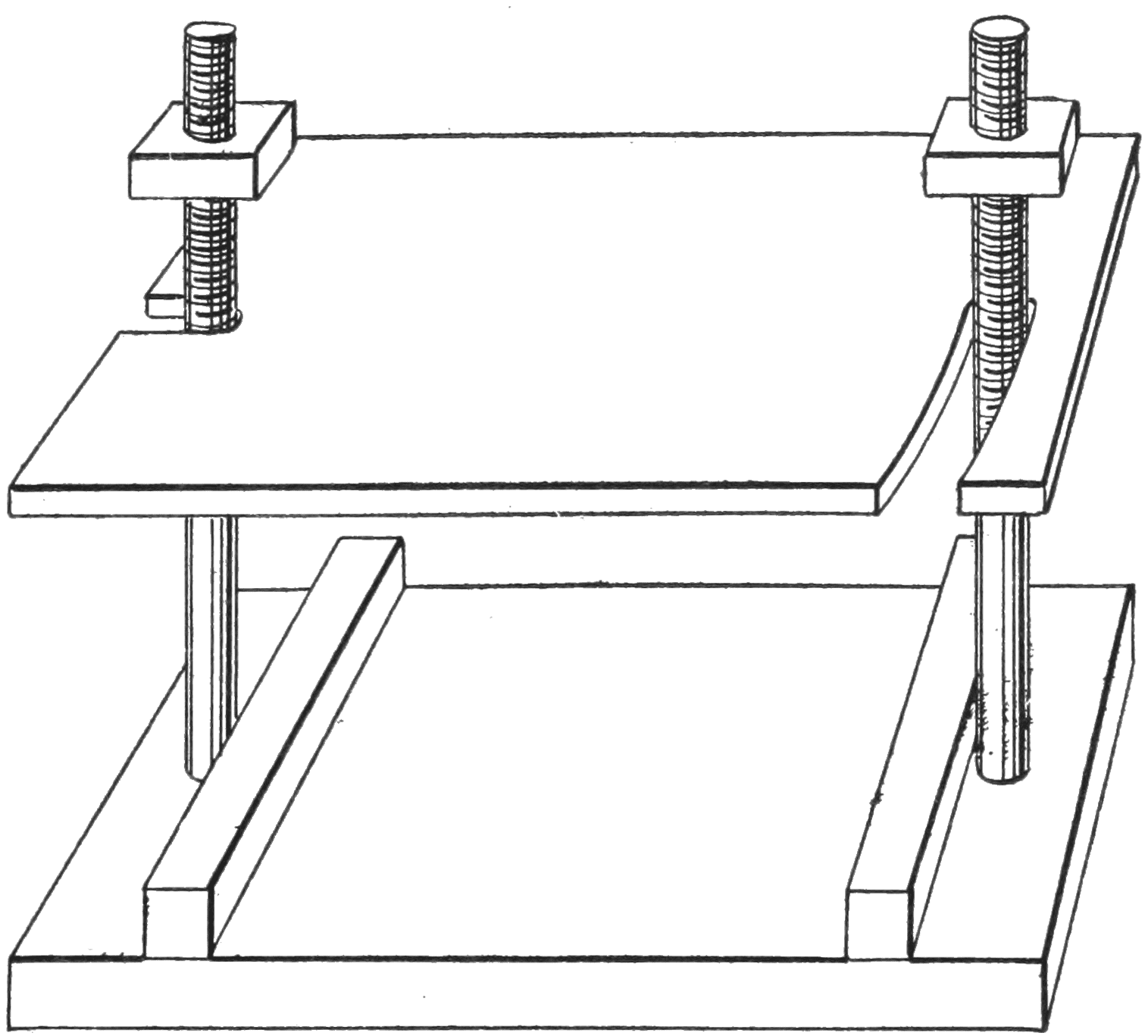
Simple Vulcanizing Press for Rubber Stamps.
The first thing to be described is the mould,
which includes the arrangements for pressing the
sheet of india rubber while heated. A small press
is needed for this purpose. It may be of the simplest
description, and as an example of a home-made
but perfectly efficient one the illustration
may be referred to. The base of the press is a piece
of iron, if heat is to be directly employed. Where a
chamber vulcanizer is used both base and platen
may be of wood. But from every point of view iron
is the best. It lasts forever, admits of direct heating,
and does not split, warp, or char. Through
two holes drilled near its opposite sides two ordinary
bolts are thrust. It is best to use flat
headed bolts, and to countersink a recess for the
heads in order to keep the bottom level. The heads
may need to be filed off so as to reduce their thickness,
in order to secure this object. The bolts may
be soldered in place. One thing should be carefully
watched for—the bolts should be set true so as
to rise vertically from the plane of the base.
The platen is best made of iron, cut of the shape
shown. This is an excellent disposition of the
screw-bolt slots, as by swinging the right end of the
platen back it can be taken off without removing
the nuts and lifting it over the ends of the screws.
Besides the two nuts fitting the thread of the screws
it is well to have half a dozen extra ones larger than
the others, which will slip easily over the bolts, so as
to act as washers. The object of these is to adapt
the press to objects of different thickness. The
thread upon an ordinary bolt does not extend clear
to the head, but by slipping on some loose nuts the
plates can be forced together if desired.
This press can be simplified. Both base and
platen can be made of wood, the platen being simply
bored for the bolts, and the latter driven tightly
through the holes in the base so as to retain their
place. Even this can be improved on as regards
simplicity. Two blocks of wood screwed together
by two or more long wood screws may be made to do
efficient work.
One trouble is apparent with all these devices,
and that is the want of parallelism of the opposed
planes. The base and platen may be true and
parallel or they may not. Perhaps the simplest
way of securing this is the best. It consists in
placing across the base two distance pieces, which
may be slips of wood. These must have perfectly
parallel faces. As the press is screwed up they will
be gripped between the platen and base and will
not only ensure their parallelism but will keep them
at an exact distance apart. Such distance pieces
are shown in the same cut. Pieces of printers’
“furniture,” spaces, or “quads,” may be used for
this purpose. They should not be fastened in place
if there is need to adapt the press to more than one
thickness of material and matrix.
The above described apparatus is a vulcanizing
press. A further improvement in it may be effected
by the use of spring pressure. Two strong spiral
springs may be dropped over the bolts, the nuts
being screwed on above them, or a powerful spring
of flat brass or steel ribband bent into the shape of
a shallow letter V may intervene between nuts and
platen, the centre of the bend bearing against the
centre of the platen.
As regards the strength of the springs there is
this to be said. The distance pieces will prevent a
spring that would ordinarily be too powerful from
doing any harm. Such distance pieces should be
used, as the springs must be based upon giving a
pressure of many pounds per square inch of surface
to be acted on. They should have a range of an
eighth of an inch or more. The greater the range
the more evenly will they work.
The next cut shows an excellent little screw press,
that is made for the purpose of pressing vulcanizing
flasks. This is so simple that it will suggest to the
mechanical reader how he can make a single-screw
press, which is by far the most convenient to use.
In the stationery stores very small model cast iron
copying presses designed for use as paper weights
are sold. They are excellent for a limited amount
of small sized work.
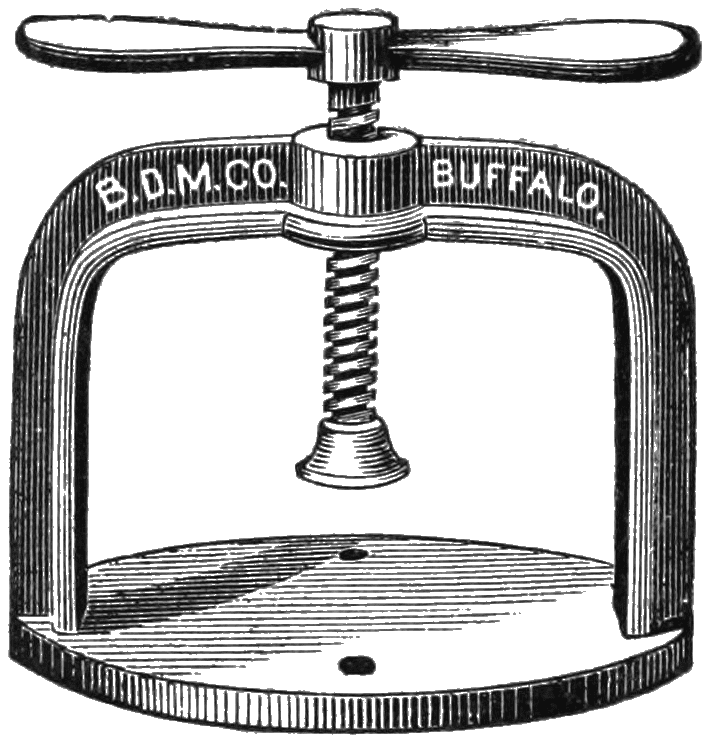
Vulcanizing Flask Clamp.
A large sized gas heated press, such as made for
the purpose of manufacturing rubber stamps, is
shown in the next cut, p. 53. Its construction is
obvious. It is termed by the trade a vulcanizer. Its
manipulation will be given further on.
Type are generally the object to be copied.
These are best set up with high quads and spaces.
Naturally rather a large type is chosen, with extra
wide spaces between the letters. Some advise rubbing
the type faces full of hard soap, afterwards
brushing off the face, leaving the hollows filled.
Sometimes wax is recommended for the same purpose.
This prevents the plaster of the matrix entering
so deeply into the cavities of the letters.
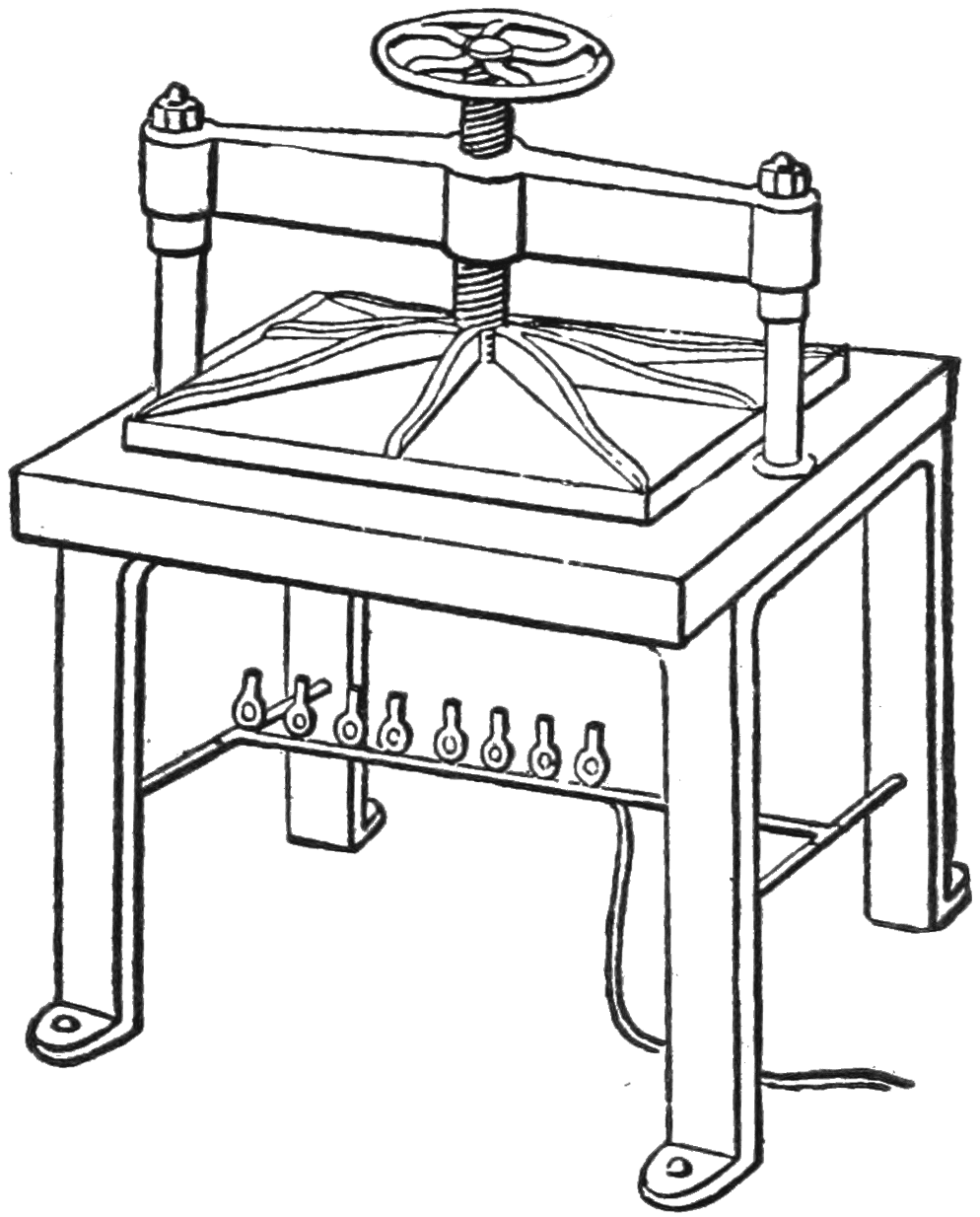
Gas-heated Stamp Vulcanizer.
The type forming the model to be reproduced, is
locked in a frame. Two pieces of printers’ furniture
or other wooden strips screwed together by
wood screws at their ends will answer for a locking
frame for small inscriptions.
The model to be copied need not be type, but any
desired relief may be used, such as an electrotype, a
stereotype, an engraving or another rubber stamp.
In any case it is to be placed upon a flat surface,
best an “imposing stone” or piece of marble, with
the inscription upwards. On each side of it distance
pieces reaching about one-eighth inch above
its upper surface are to be placed.
The next shaping appliance is the matrix or
mould, or reverse of the model which is to be
copied. This in the case of rubber stamps is properly
called the matrix. Those who have witnessed
the stereotyping of a large daily newspaper have
seen the matrices of the type made of paper and
paste, the whole mixture being termed “flong.”
Such a matrix is required for rubber type, but
paper is rather too susceptible to heat although good
work can be done with it. It also does not enter as
deeply into the cavities of the type as is desirable.
As a rule a fine quality of plaster of paris is to be
recommended. What is sold as dental plaster is
the best, but common plaster can be used. It is
mixed with water or with a solution of gum arabic
or dextrine in water. For the latter enough gum
should be added to make the mixing solution as
thick as thin syrup.
A piece of iron, perfectly flat and true, is now to
be taken, large enough to more than cover the
inscription to be copied. Upon its surface a putty
made of the plaster and the liquid used in mixing
is to be spread. This should be rather stiff. The
surface of the iron should not be too smooth as it is
desirable that the plaster should adhere well on
setting. The plaster should be smoothly spread to
a depth of three-sixteenths or a quarter of an inch.
It is best applied with a palette knife or trowel,
although a table knife will answer perfectly. If its
surface does not become smooth it can be made so
by applying a little of the solution with the knife
or trowel.
Before this has been done the model must be
oiled. Olive oil or other clear oil is applied to all
parts of the type faces, and the excess is then wiped
off and cleared out of the interstices with a piece of
blotting paper.
Next the plate with the plaster is inverted and is
pressed steadily down upon the model until it
strikes the distance pieces. It is left to set. In
about ten minutes it can be raised, when it will be
found to give a beautiful impression true to the
smallest detail of each letter.
It has been said that water may be used as the
mixing fluid. If this is done it is well to strengthen
the mould by saturating it with an alcoholic solution
of shellac, after it has dried thoroughly, best
for a few hours in an oven. This operates to
strengthen the small projections that are liable to
crumble or to break off in use.
The dealers in rubber stamp supplies sell a lever
press for conducting the operation of producing the
matrix. The type is locked in a special chase,
which is carried on a bed that travels under and out
from under the platen of the press upon rollers.
From each corner of the chase in which the type
model is locked, a pin rises which is encircled by a
spiral spring. A square frame of flat iron with
holes at the corners for the pins to pass through,
rests upon these springs well above the type.
The pins pass through holes in its corners. The
matrix plate with its coating of plaster is placed
upon this frame, which supports it above and not
touching the type. The whole is now rolled under
the press and the lever pulled to produce the impression.
As the pressure is released the frame
with the matrix is raised from the type by the
action of the springs. This can be done immediately,
and before the plaster has set. It is almost
impossible to raise it by hand with the requisite
steadiness. The same chase with corner pins and
springs can be used in a screw press, the one press
answering for making the matrix and for moulding
and curing the stamps. The plaster matrix can
also be made by casting from a thinner mixture of
plaster and water. After the type has been set up,
or the model has been selected and placed face up
and horizontal, a little ridge or projection must be
made all around it. Paper can be pasted around it,
and wound with thread for this purpose. It is
oiled and wiped off as before. The plaster is now
mixed with water to the consistency of cream, and
is poured upon the model until it lies even with the
projecting ledges or paper border. In an hour or
less it can be removed. If water is used the mould
should before use be treated with shellac solution as
already described. The plaster may also be mixed
with gum arabic solution, or with three to ten per
cent. of powdered marshmallow root. This increases
its toughness.
What is known as the oxychloride of zinc cement
appears to the author to be far preferable to common
plaster of paris. It is a trifle more expensive,
but it costs so little that it is well worth trying. It
is made by mixing oxide of zinc with a solution of
zinc chloride. No particular strength of solution
or proportions are prescribed; the zinc chloride solution
should be a strong one, and the mixture should
be of about the consistency of soft putty.
Zinc chloride may be bought as a solid substance
or in strong solution. The latter answers for the
mixing directly. It may also be simply made by
dissolving metallic zinc in strong hydrochloric acid.
The manipulation is exactly the same as with
plaster of paris.
The manufacture of papier maché and of other
matrices is given in a special chapter. For all ordinary
purposes the plaster or cement matrices are
ample.
The stamp is made from the mixed uncured sheet
rubber, whose preparation in the factory, including
the operation of calendering it into sheets, has
already been described. The best advice the reader
can be given is not to attempt to make it except as
a matter of interest and experiment. It can be
purchased especially prepared for stamps from the
dealers in india rubber.
A piece is cut from the sheet large enough to
cover the face of the matrix. It should have a
perfectly smooth surface, without cloth wrapper
marks sometimes found impressed on it. The sheet
as received from the maker is about one-eighth of an
inch thick. It is thrown into a box of powdered
soapstone or talc to secure a coating of the same on
both sides. A little is dusted over the matrix and
the excess is blown off. The matrix is now placed
upon the base of the press, and heat is applied.
To carry out the process most simply the press if
of metal may be placed upon a support over a gas
burner or kerosene lamp, or even on a kitchen range
or stove. It will in a few minutes become warm.
The sheet of india rubber is now dusted off and is
placed in the press upon the matrix. The platen of
the press is screwed down upon it.
As the india rubber becomes hot it begins to
soften and flow. By the action of the screw of the
press it must be forced down from time to time as
it softens. This drives the putty-like material into
all the interstices of the mould. The excess escapes
from the sides of the tympan in cases where the
latter is of restricted area. The press theoretically
should be heated to the vulcanizing temperature,
which is 284° F. (140° C.). In practice the heat is
not determined with a thermometer. The operator
learns by experience how much heat to apply. The
regulation type of gas heated press or stamp vulcanizer
is shown in the illustration on page 53.
As some of the india rubber is sure to protrude,
the progress of the work can be watched from its
action. By pressing the point of a knife against it
the period of vulcanization can be told. Before
the material is heated it is elastic and resists the
pressure of the knife; as heat is applied it becomes
soft like putty; as the heat increases it again stiffens
and becomes quite elastic. At this point the press
can be opened and the sheet and matrix can be
taken out or the platen swung aside. On pulling
or stripping the sheet from the matrix it will be
found to reproduce the model in elastic india rubber
to the minutest detail.
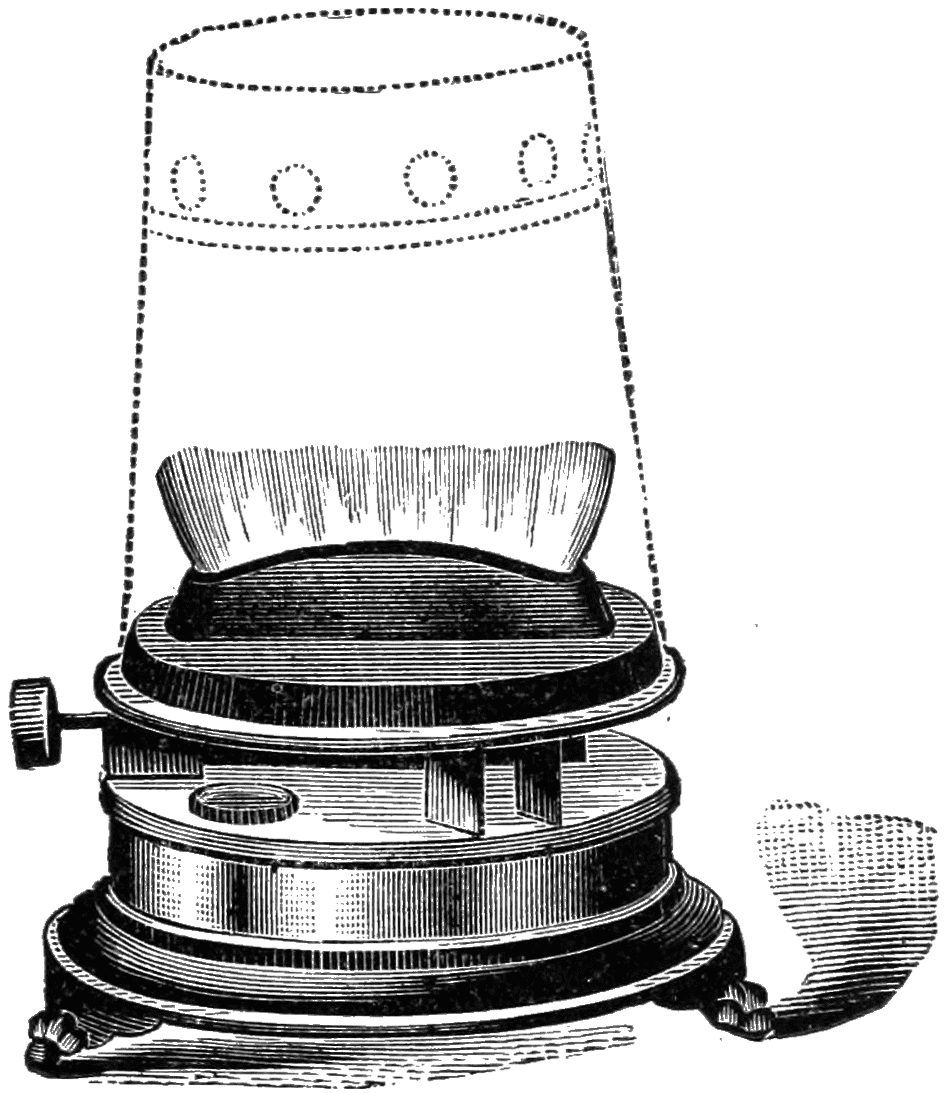
Oil Stove for Heating Vulcanizers.
As regards the minor details there is something
to be said. Distance pieces to gauge the thickness
have been recommended for the home-made press,
page 48. Care must be taken to have these low
enough to provide for enough excess of material to
produce a good impression. For ordinary stamp
work they should allow about one-sixteenth of an
inch for the “squeeze.” It will be seen that by using
the distance or gauge pieces both for making the
matrix and for moulding and curing the stamp, absolute
parallelism of surfaces will be secured.
The reader will have noticed in the description
and will find at once in practice that the press has
to be screwed up as the rubber softens. Where
heavy iron presses are used the large mass of heated
iron comprised in the platen of the press instantly
heats the upper surface of the india rubber sheet and
the heat immediately penetrates into it, while the
heated matrix heats it from below. Thus it softens
at once, and the press is directly turned down and
the india rubber is driven into the mould and curing
at once begins. But where small presses are used
this manipulation is not so easy. For such the
springs mentioned on page 51, are highly to be
recommended. The matrix and india rubber can
be put into the cold press, and the tympan with
intervening springs can be screwed down so as to
compress them. Then on applying heat the moulding
takes place automatically.
With a hot press and good sheet a period of three
to ten minutes is ample for moulding and curing.
Instead of sprinkling with talc the matrix may be
oiled and sprinkled with plumbago and afterwards
polished with a brush. This is not so clean a material
as talc and is not to be recommended for
general use, especially as oil is a bad substance to
bring in contact with rubber.
The distance or gauge pieces whose use has been
recommended are not necessary where presses working
truly parallel as regards their opposing faces are
used. But where home-made apparatus is used
they will be found a valuable addition.
In describing the simple press it was said that it
could be made of wood. It is evident that a wooden
press could not be used for direct heating. Such a
press must be used in a hot chamber or vulcanizer,
properly so called. Originally rubber stamps were
generally made in chamber vulcanizers.
The next cut shows a combined matrix making,
moulding and vulcanizing apparatus of very convenient
and compact form and adapted for rapid work.
As the press stands in the cut the matrix press is
seen in front. A box or chase is carried under its
platen by two trunnions, so as to be free to oscillate
to a limited extent. The type model is secured in
this box. Above this box or chase is a cross-bar
with screw and platen attached, connected at will to
two standards or pillars, so as to constitute the
matrix press.
A matrix plate swings on a hinge joint between
the two presses. The hinge-pin is removable. Its
ends can be seen projecting to right and left of the
press columns. The hinge is at such a height that
when the matrix plate is swung forward over the
type box it will rest upon it in a nearly horizontal
position. The pivoted box will adjust itself so as
to come into parallelism with the plate.
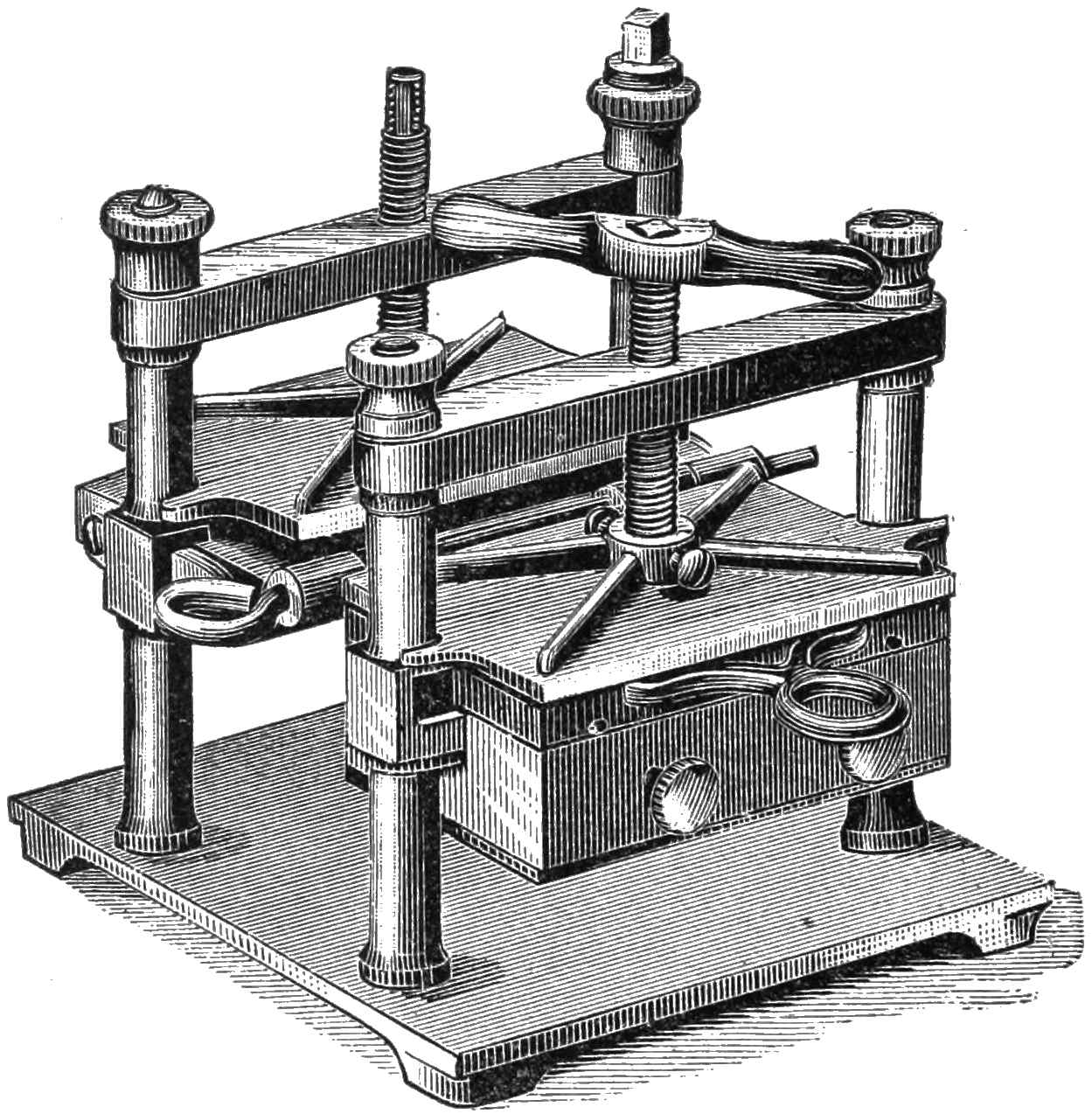
Matrix Making, Moulding and Vulcanizing Apparatus.
When the matrix plate is swung back it falls
upon the base plate of the vulcanizing press seen in
the rear.
In use the composition used for the matrix is
spread upon the matrix plate, which may for this
purpose be removed from the apparatus. It is
replaced and the hinge-pin is pushed home. This
is done with the composition coated side facing the
front of the apparatus as it stands in the cut. The
plate is then swung forwards, the platen of the
matrix press being turned forward out of the way, and
is pressed down upon the type or other model that
rests in the type box. If desired the press is used
to force it home. The cross-bars of both the presses
are arranged to swing each one on one of the
pillars, so that the platens are turned to one side out
of the way of the matrix plate as it is swung back
and forth.
The pressure is released and the platens are
turned aside. The matrix plate is swung over to
the rear upon the bed-plate of the vulcanizing
press. Here it lies with the composition-matrix
upwards.
A lighted lamp, either alcohol or gas, is placed
beneath the bed-plate of the vulcanizing press on
which the matrix rests. This quickly dries it and
brings it to a good curing temperature. The cross-bar
and platen may be swung over it during the
heating so as to be heated at the same time. The
matrix is talced when dry and hot; the mixed sheet
itself talced, is placed upon the matrix, the platen
is screwed down upon it, and in a minute or two
the moulding and curing is completed.
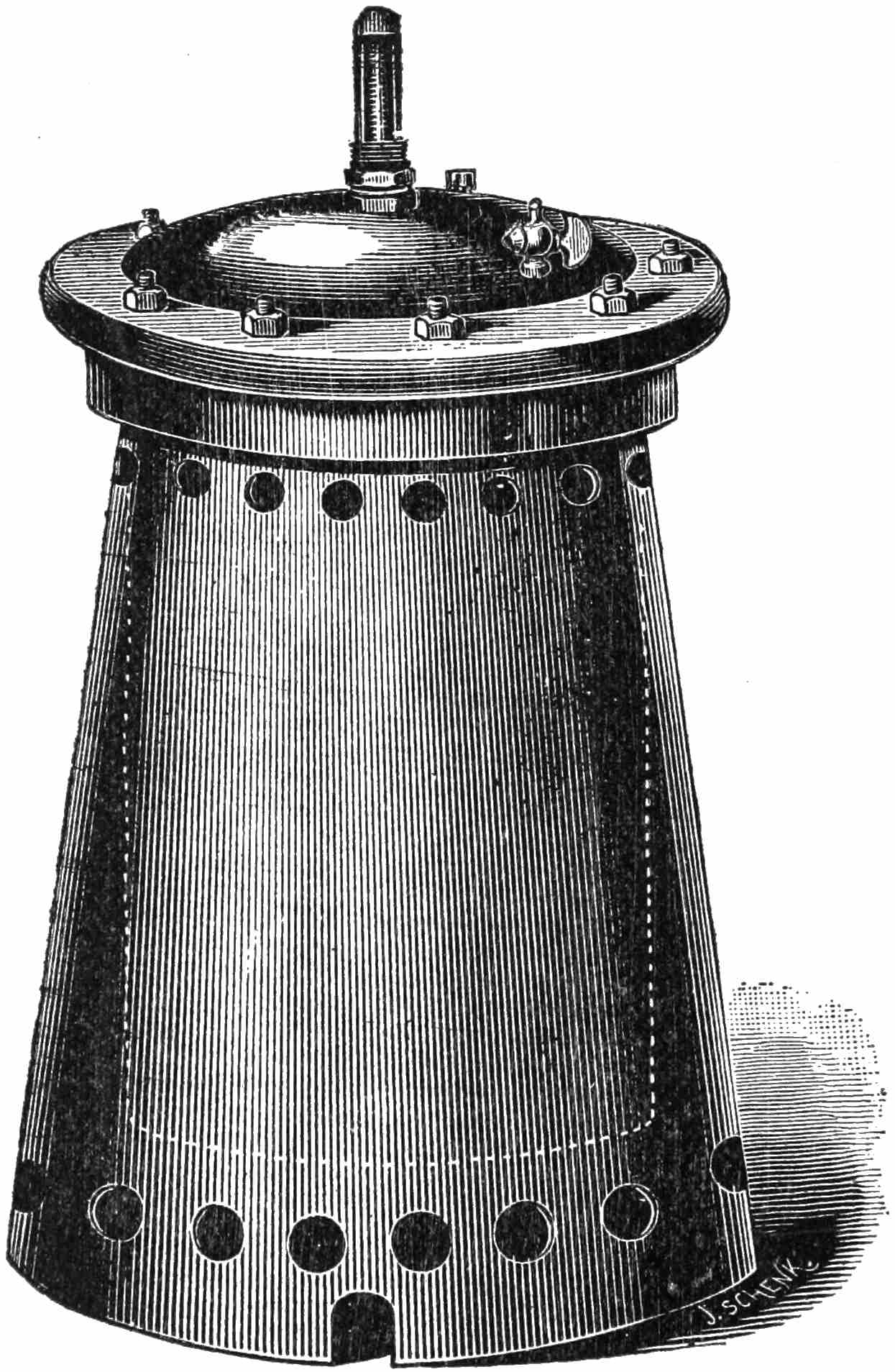
Rubber Stamp Vulcanizer.
A vulcanizer, properly speaking, is a vessel arranged
to heat to a definite degree any desired articles
which are to be cured. The favorite type have
been the steam vulcanizers. If steam is generated
from water at a constant pressure, other things
being equal a constant temperature will be produced.
By raising or lowering the pressure the
temperature can be made to rise or fall. A steam
vulcanizer is a tightly sealed vessel which contains
water and which is provided with a thermometer or
a pressure gauge as well as a safety-valve, safety
disc or safety plug. By keeping the gauge at constant
pressure or by keeping the thermometer constant
the temperature can be limited and kept
steady. The following table gives some pressure in
pounds per square inch with temperatures corresponding
to steam of such pressures:
| Lbs. per square inch. |
Temp. Fahr. |
Temp. Cent. |
| 45.512 |
275° |
135° |
| 52.548 |
284° |
140° |
| 60.442 |
293° |
145° |
| 67.408 |
300.2° |
149° |
The illustration, p. 64, shows a vulcanizer of modern
type made for rubber stamp work. In some recent
vulcanizers the water and steam are excluded from
the vulcanizing chamber, being contained within
double walls forming a steam jacket and maintaining
a constant heat within the chamber. These
illustrate a point that has been much misapprehended,
namely that curing is independent of pressure
or atmosphere. Because vulcanizers have
generally been filled with steam at high pressure
many have supposed that the steam or pressure had
something to do with their action. The fact is that
it is only the heat due to the steam at such pressure
that is instrumental. Steam is a very powerful
radiator and absorber of so called radiant heat. For
this reason an atmosphere of steam maintains all
parts of the vulcanizer at an even temperature and
is to that extent advantageous. Its presence and
the pressure it generates are not by any means required
for vulcanizing. Its pressure is entirely
without effect.
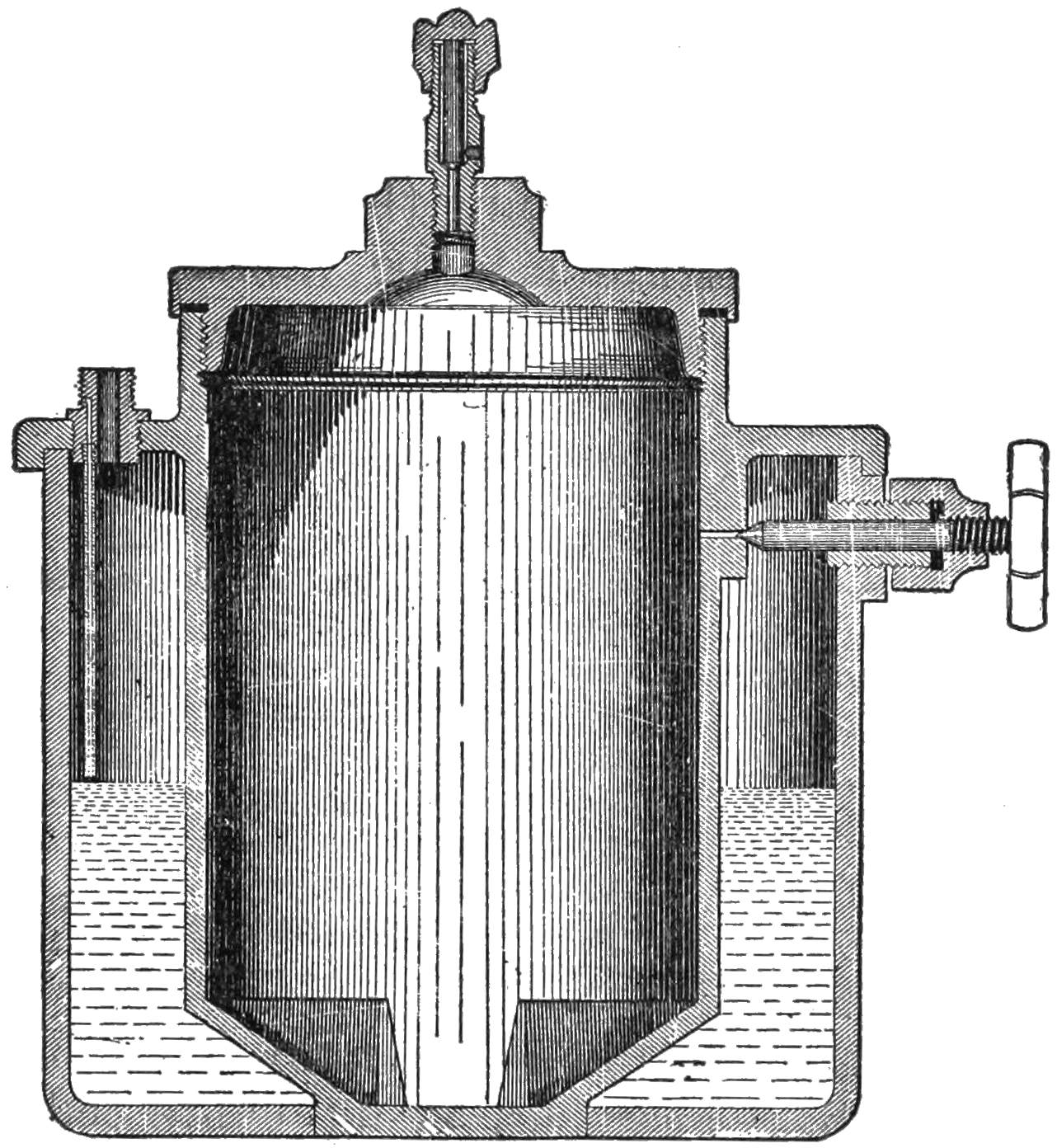
Steam Jacket Vulcanizer.
To use a steam vulcanizer, water is introduced,
the article in the press or mould is placed in it, and
the top is secured. Heat is then applied, best if on
the small scale, from a Bunsen gas burner gas, or oil
stove. Either the pressure gauge or thermometer
may be watched, and the flame turned up or down
to keep it at the proper temperature.
Moulding cannot be executed in the ordinary
closed chambers. The press must first be heated to
the temperature of boiling water or thereabouts and
the moulding is then effected by screwing down the
mould screw, upon the sheet and matrix. It is
then placed in the vulcanizer and cured.
The manufacturers supply gas regulators which
automatically regulate the gas supply. These are
worked by the steam pressure. If any one wishes
to study the practical manipulation of small steam
vulcanizers he can see them in use at any dentist’s
office.
There is no need of a steam vulcanizer for ordinary
stamp work. The hot press system already described
answers every purpose and is in use by the
most advanced manufacturers for thin sheet work.
But if a wooden moulding press is used then it must
be heated in a vulcanizer or some kind of oven or
hot chamber.
A very simple and reasonably satisfactory oven or
air bath can be made from a flower pot and a couple
of tin plates. A plate larger in diameter than the
mouth of the flower pot forms the base of the apparatus.
This is supported on a stand over the gas
lamp or other source of heat. A smokeless flame or
one depositing no lampblack should be used. Alcohol
or a kerosene oil stove illustrated on page 59 are
excellent. On this plate a smaller plate is inverted,
which latter must be so small as to be surrounded
by the flower pot and to be included within it when
the pot is placed over it like an extinguisher.
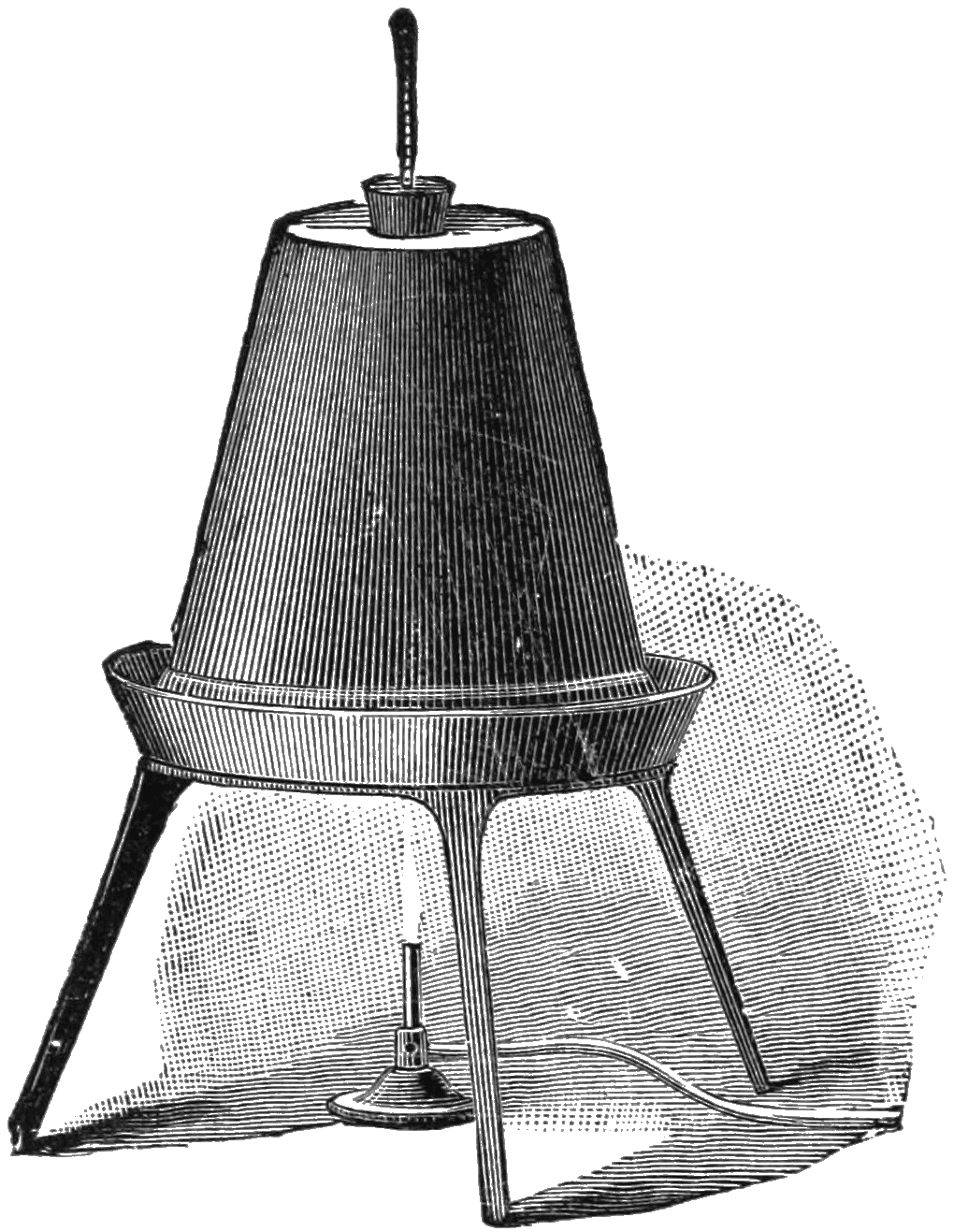
Flower Pot Vulcanizer on Stand.
A chemical or round stemmed thermometer is
arranged to go through the aperture in the upturned
bottom of the pot. This may be hung from
a support or it may be secured by passing through
a hole in a cork or block of wood. Its bulb should
be near the part of the chamber to be occupied by
the mould or press.
The press with the article to be cured is placed
upon the inner plate. The temperature is maintained
at the proper point by regulating the heat,
and all the conditions for excellent work are supplied.
The disposition of the apparatus is shown in
the cuts.
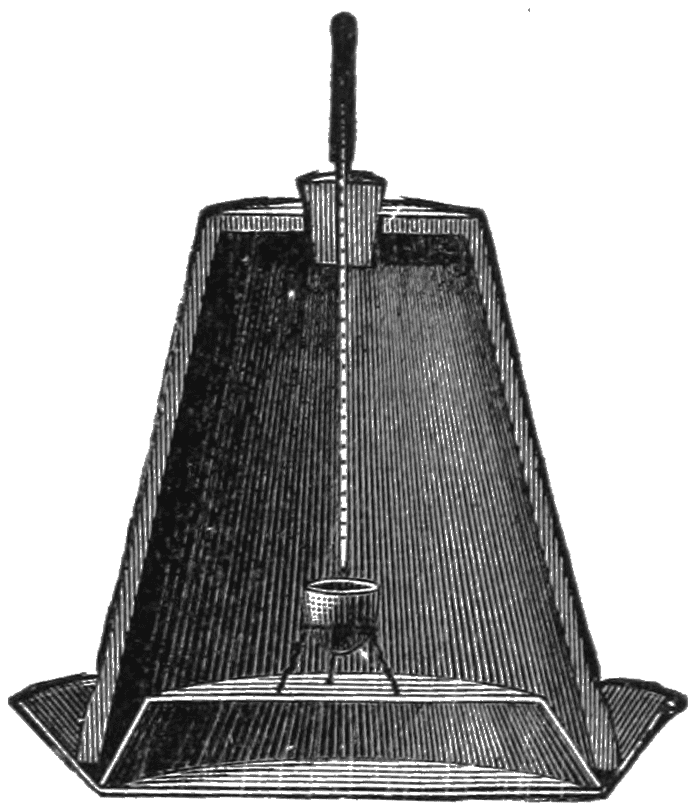
Interior of Flower Pot Vulcanizer.
Another arrangement equally simple is given in
the next cut. An iron kettle has a layer of type
metal or lead poured an inch thick cast within it
upon its bottom. A thermometer passing through
a hole in the cover enters a cup of glycerine that
stands upon the bottom. This gives the temperature.
The object of having a thick or a double bottom
is to prevent excessive radiation of heat from any
one part. The essential condition for good operation
is to maintain an even temperature throughout
the chamber.
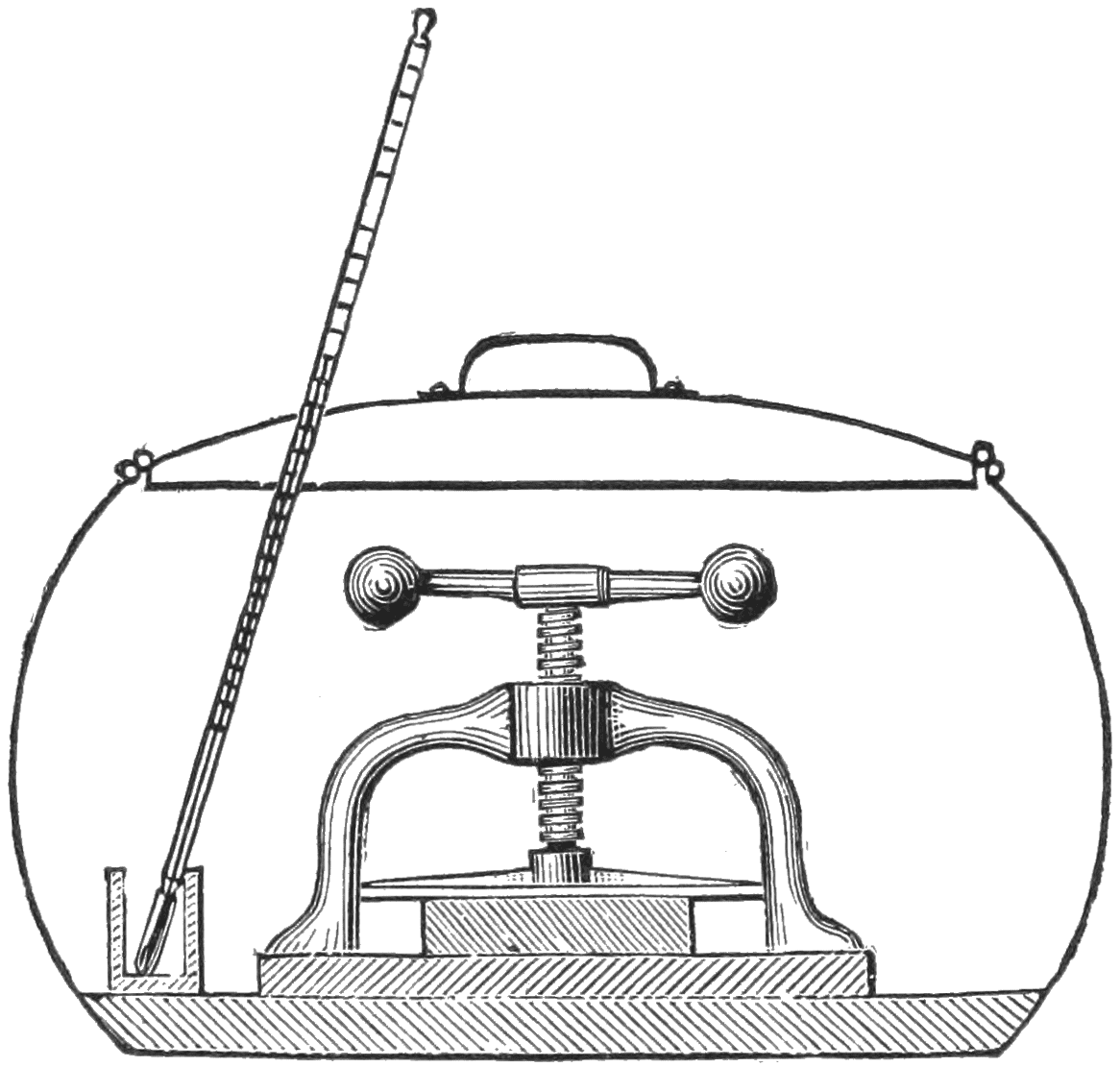
Fish Kettle Vulcanizer.
The thermometer is not an absolute necessity.
By removing the press from time to time and inspecting
the overflow of india rubber the progress
of the operation can be watched. An extra piece
of india rubber may be placed on a piece of wood
by the side of or upon the wooden portion of the
press, and its condition can be taken as the criterion.
Pressure with the point of a knife will tell
the vulcanizing point.
By the press system of curing, a heat far above
the vulcanizing temperature may be made to do
good work by a very short application. There is
however danger of burning the work if left in too
long. If the air-bath with thermometer or the
steam vulcanizer is used, and the heat is kept down
to the proper curing temperature, there is no danger
of burning the india rubber even if the curing is
considerably prolonged.
As the flower pot has often to be lifted off for
introduction or removal of the press, and as it gets
quite hot, a holder of some kind is requisite. A
piece of heavy blotting paper is very convenient for
this purpose.
The flower pot system with thermometer can be
further simplified by being used on a stove or range.
A china saucer inverted, or some similar support,
should be placed under the pot. A part of the
stove at very low heat will suffice. The kettle vulcanizer,
can also be placed on a stove so as to dispense
with gas or oil.
Finally, as the last step in simplifying the work, a
stamp can be made without any special apparatus
beyond a hot flat iron. The matrix may be placed
on a stove where the heat is rather low, the talc-coated
mixed rubber sheet placed upon it, and on
this a hot flat iron. In a few minutes if the heat is
sufficient the stamp will be finished.
A few words may be said about the type. High
spaces and quads between the letters should be used,
such as will come up to the shoulder of the type, as
has been said. But a very nice effect is produced
by using low quads between words. This leaves
each word elevated by itself, producing a good
appearance.
Autograph stamps are made from a model cut in
wood by a wood engraver. The autograph is written
in some form of copying ink upon a piece of
paper, and is transferred by moistening and pressure
to a block of wood. With an engraver’s tool
the wood is cut away from the lines, as the block is
routed after the inscription has been “outlined.”
The woodcut is used as a model for making a
matrix.
It is evident that an autograph of fair quality
could be obtained from a chalk plate. But in rubber
stamp work to get good results certain essential
parts should be of the best. These parts include
the mixed rubber, model and matrix. A departure
from excellence in any of these tends to the production
of an inferior stamp. What is known as a
“healthy cure” is above all essential to the appearance
of the product.
The stamp thus made is attached to a wooden
handle by common glue or by one of the rubber
cements given in chapter XVI.
CHAPTER VI. INDIA RUBBER TYPE MAKING.
India rubber type are often used to set up different
inscriptions in wooden handles, or different date
figures in rubber stamps. The latter are in such
cases made with slots or recesses to receive them.
Rubber type are much shorter than regular type,
and as a rule are larger in the body in proportion to
the face of the letter. Where only a few are required
the following process is the simplest way of
making them from mixed rubber sheet.
The type which are to be copied are set up on a
level base or imposing stone, and quads or spaces
are put between them. High quads and spaces
should be used; otherwise they should be pushed up
until even with the shoulders of the type. After
oiling the faces a matrix is produced exactly as
described for stamps. Before it has set quite hard
the plaster or cement is cut off so that it will just fit
within a little “flask” or frame.
The latter may be made of tin or wood and may
be rectangular or circular, provided it is large
enough to include within its area the full working
face of the matrix. It should be about half an inch
or five-eighths of an inch deep. Its object is to prevent
the softened india rubber from spreading, so
as to secure the requisite height of the type produced.
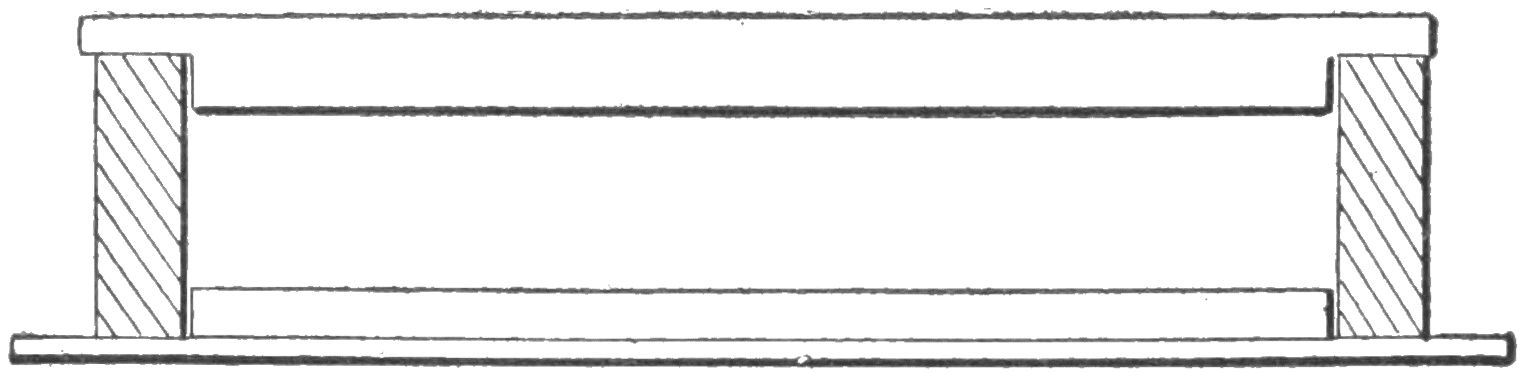
India Rubber Type Mould.
A piece of wood or metal is cut so as to fit closely
within this frame like a plunger. It is provided
with shoulders or cross pieces, so as to limit the
depth to which it can be inserted. It will be seen
that when matrix, flask, and plunger are all put
together a complete mould for a block of type is
produced, as shown in the illustration, the matrix
with its plate forming the bottom of the box.
After the flask is placed upon the matrix it is filled
with the mixed uncured india rubber sheet. As a
matter of preference thick sheet is used, but scraps
of all shapes can be employed as it all fuses together.
The mould and matrix are of course first
well dusted with talc powder. The plunger is put
on and the whole is pressed. Heat is next applied
in a vulcanizer or hot air chamber, such as the
flower pot arrangement, or in boiling water. As the
sheet reaches the boiling point 212° F. (100° C.) the
flask is removed and the plunger examined. If it
goes down to its seat without expelling any india
rubber more of the latter is required and is accordingly
inserted, the plunger being taken off for the
purpose. The softened gum should ooze out around
the sides of the plunger. The whole is again put
under pressure, and the platen is screwed down, and
if all is right an excess of rubber showing itself, the
whole is put in the hot chamber, the heat is raised
to 284° F. (140° C.), and is maintained there for
half an hour.
It is almost a necessity to secure the matrix plate
to the bottom of the flask. This for a single operation
may be done by screws, or for several operations
by hooks or catches.
When the curing is complete the mould is removed
from the vulcanizer, is allowed to cool and is
opened. The block of type will come out with perfect
reproduction of the letters upon one side. If
all the directions have been followed as regards distance
pieces, level imposing surface, etc., both faces
will be exactly parallel, and any number of other
blocks can be reproduced of exactly the same
height, not necessarily from the same matrix,
although one good matrix can be used many times.
The type have now to be cut apart. This is done
with a sharp knife which is kept wet. It is worked
with a sawing motion, and if sharp and properly
used will cut with regularity, and smoothly. Type
with knife marks on the sides are always unmechanical
in appearance and seem to be “home made.”
The object of using high quads and spaces or of
pushing them up, will now be evident. It secures
the evenness of the general face of the block of
letters, which otherwise would have a deep depression
between each pair of letters. If the quads and
leads are properly arranged, the letters will project
upwards from a smooth, plane surface.
The dealers in rubber stamp maker’s supplies sell
special steel moulds for the purpose of making
them. This does away with all necessity for making
matrices, and making up a flask, etc. The general
manipulation is that given above. Where many are
to be made the regular mould is by all means to be
recommended.
Sometimes type are made by cementing single
letters made by the stamp process upon wooden
bodies.
CHAPTER VII. THE MAKING OF STAMPS AND TYPE FROM VULCANIZED INDIA RUBBER.
Although all reference hitherto in the matters of
stamps and type has been to their manufacture from
uncured india rubber, a good deal can be done with
vulcanized and cured gum. The stock that is
known in the trade as pure gum, such as is used for
bicycle tyres, for steam packing and the like, can
be made to yield to moulding to a certain degree.
It will not flow and unite as will the uncured gum,
but it is evident that in certain cases its stiffness is
even an advantage. Thus with it, rubber type can
be made without any flask or frame. The material
has stiffness enough to support itself.
The manipulation is of the simplest. A piece is
cut out with a knife so as to be of proper thickness
and size. It should be a little thicker than will
ultimately be required. The two opposite surfaces
should be smooth and parallel. It is talced, and
placed in the press with the matrix beneath it, and
subjected to pressure by the screws being turned
down. It is then placed in the vulcanizing
chamber and heated to about 284° F. (140° C.).
After it has become hot it softens a little. The
press is removed from the hot chamber and is again
screwed down as hard as the matrix can stand.
This point is largely a matter of judgment. The
heat is largely indifferent as long as it is anywhere
near the above temperature.
By one or two repetitions of the pressing and
heating the softened india rubber can be made to
take quite a deep impression from a suitable matrix.
It is allowed to cool under full pressure. When
removed from the press, it will retain the characters.
It is evident that impressions in as high relief or
as deep and clear as those yielded by uncured india
rubber need not be expected. But where the other
cannot be had, or where some experimental or temporary
work only is on hand, this process will be
very convenient.
The material may be half an inch thick. From
such india rubber type can be cut with advantage.
Old rubber can be thus used. The writer has obtained
excellent results from pieces of an old discarded
bicycle tyre.
The great point is to apply a heavy pressure to
the hot material. Many other articles can be thus
produced extemporaneously. At the same time it
must be considered only a makeshift. One who has
used the soft, easy flowing uncured gum would
never be reconciled to the use of so rigid and difficultly
moulded a material, one too that can never
be trusted to reproduce intricate moulds of considerable
depth. In the slow yielding of the half
melted uncured gum, so amenable to slight pressure,
a quality of availability is found that is missed in
the other. One is worked by main force where the
other readily yields and takes the most complicated
shapes.
By the above process stamps of such thickness
may be made that they can be used without handles.
It is also useful for impressing a designation of any
kind upon ready cured articles. It suggests a very
useful department of manipulation of india rubber.
The heating and moulding can be done also in a
hot liquid bath such as described in chapter XI.
CHAPTER VIII. VARIOUS TYPE MATRICES FOR RUBBER STAMPS AND TYPES. — PAPIER MACHÉ MATRICES. — STRUCK UP MATRICES. — CHALK PLATES.
Matrices for stamp moulds can be made by several
of the methods used by stereotypers. Thus an
electrotype could be taken directly from the face of
the type. There would be little or no utility in
doing this where the simpler processes are available.
The stereotyper for daily newspaper work uses
very generally the papier maché or “flong” process
of reproducing the page. This is also available for
rubber stamp making.
The first requirement is paste. This is made by
softening twelve parts of whiting in forty parts of
water, letting it soak for an hour or more. Nine
parts of wheat flour are added. This is best mixed
with a little water before adding to the main mixture.
It is then brought to the boil and seven parts
of glue softened by soaking in twenty-one parts of
water, are added. For each gallon of such mixture,
one ounce of white crystallized carbolic acid is
added if it is to be kept for a long time.
The “flong” is made by pasting together, one
on top of the other, a sheet of fine hard tissue
paper, three sheets of blotting paper (about 23
pounds to the ream), and a heavy sheet of manilla
paper. The pasting must be smooth and each
layer must be pressed and rubbed down, but not too
hard. It is very important to secure perfect
smoothness and regularity, and entire absence of
air bubbles.
Every printing office where the process is used
has its own traditions as to the preparation of flong.
As a great deal depends on manipulation, it would
be well to endeavor to inspect its practical use in a
newspaper printing office before making it. Ready
prepared flong can also be procured.
The form of type must be very clean and there
must be no paste on the tissue paper face of the
flong. The type are lightly oiled, some powdered
talc is dusted over the damp tissue paper face of
the flong, and the mass is laid face downward on
the type. With a stiff haired brush the paper is
now beaten down against the type. Great care
must be taken to beat vertically; a slight side action
will ruin the resulting matrix. If the brown paper
will not stand the beating, a cloth may be spread
over it.
The progress of the work can be watched by raising
up a corner from time to time. When sufficiently
deep the last touch is given by the printer’s
planer. This is a block of hard wood. It is placed
upon the back of the flong and is hammered down.
The operation is repeated until the entire area has
been treated. For much rubber stamp work the
area would be so restricted that shifting would be
unnecessary.
The work is then put into a heated screw press,
such as the vulcanizing and matrix press, and is
dried for a period varying from some minutes up to
half an hour. Some blotting paper is advantageously
pressed on top of the whole in the press
while drying. The press is opened, the flong removed,
and dried in an oven. It is kept under a
piece of wire net while drying to keep it flat. The
net may be of wire, .064 inch thick, with six
meshes to the inch. This baking is not strictly
necessary for rubber stamp work.
This gives a matrix which may be used as rubber
stamp moulds. In use it is recommended to
place a piece of smooth tin foil over it. This tends
to give a smoother surface to the rubber.
Didot’s polytype process may be advantageously
used for producing type metal matrices. The following
is the method of applying it.
The type form is firmly locked and is backed up
by and secured to a solid block of wood. It is suspended
in a sort of gallows frame with the face of
the type downward and exactly level a few inches
above a table. Underneath it a shallow tray is
placed, into which some melted type metal is
poured. The melted metal is carefully watched.
The block and type are held by a catch so as to be
released at will. Just as the type metal is on the
point of solidifying, the block is released and drops
upon the metal in the tray. The type should be
slightly oiled. The force of the blow produces a
matrix in the metal, and the form can at once be
removed.
It is well to have accurately adjusted distance
pieces for corresponding striking pieces on the type
block to impinge upon. The process is highly
spoken of, especially for small forms such as those
mostly required for rubber stamps.
The base for this form of matrix is a metal
plate whose surface is slightly roughened with sand-paper.
It is next rubbed over with white of egg,
and flooded with the chalk wash made as follows:
Flong paste (described under Papier Maché Matrices,
page 80), six ounces; whiting, twenty-four
ounces; water, three pints. The whiting is softened
by soaking for an hour or more. The whole must
be intimately mixed. It should cover the plate to
the depth of one-thirtieth to one-twentieth of an
inch. The plate is dried in a perfectly horizontal
position.
When dry the design or writing, etc., is made
with a smooth steel point, the lines being carried
clear through the white layer to the metal. The
mould is now baked at a temperature well above
boiling water; as high as 392° F. (200° C.) may be
reached without harm.
If the coating seems too thin, an extra coat can
be given between the lines especially over the larger
areas. This must be done before the baking. A
pipette may be used for putting on this coat. This
deepening has the bad effect of increasing the
chance of the coating stripping from the metal.
The matrix thus prepared is used in the press
just as is the ordinary plaster matrix. It is suited
for reproduction of autographs, scrip, diagrams,
etc.
CHAPTER IX. THE MAKING OF VARIOUS SMALL ARTICLES OF INDIA RUBBER.
India rubber can be so readily shaped in moulds
and the latter are so readily made of plaster of paris
that any one who is interested in such things will
find endless amusement in working out different
designs. Before suggesting any specific articles
the following are the general points to be kept in
mind.
The material may be uncured mixed sheet of any
thickness. As we have seen this material when
heated and pressed runs together. It can be forced
into any shape by comparatively slight pressure.
So exactly does it reproduce the smallest line or
mark, that care must be taken to have the moulds
very smooth and free from defect. Powdered soapstone
is used to prevent adherence to the mould, but
great care must be taken not to mix it among the
pieces of the india rubber, where several are used
in one article, as it will prevent their coalescing
or running together.
Another point is to contrive to introduce the
proper quantity of rubber. The aim must be to
have a slight excess, but to avoid waste this should
be as little as possible. Unless some rubber is
squeezed out there is no certainty that the mould
has been filled. Any projecting “fins” from the
overflow are cut off with a knife or scissors after the
article is removed from the mould.
Plaster of paris or dental plaster mixed with dextrine
or gum arabic water or the zinc oxychloride
cement, already described, is to be recommended for
the moulds. They should be made, if deep, in
frames or “flasks” of tin, as plaster if unsupported
is liable to split open when the rubber is forced home.
For many articles the hot press can be used.
Such articles are mats and other thin flat pieces.
The rubber stamp sheet is a good material for them.
For thicker articles a thicker sheet can be used, and
sheet of any gauge can be procured from the maker.
Much of what has been said about india rubber type
applies to the making of miscellaneous shapes. It
will also be understood where wooden moulds are
spoken of that plaster, or, still better, metal can be
substituted, and is to be recommended for nice
work as the grain of the wood is very apt to show
where the india rubber comes in contact with it.
Suction discs and similar small articles into which
an extra thickness of india rubber enters are best
cured in a vulcanizer. The flower pot arrangement
is excellent for such. The time for curing may
be somewhat extended on account of the greater
thickness of material to be acted on.
Suction Discs.—For suction discs a mould is
required which will produce a shallow cup with the
edge feathered or reduced to a very slight thickness.
Its outer surface should be raised in the centre so
as to give a projection for attachment of the hook.
The discs are generally made small, not over an inch
in diameter, as they are not reliable for any heavy
service. Their principal use is to suspend advertising
cards and light articles to the glass of show
windows. The following is a method of making a
simple mould.
A hole to give the outside contour should be
bored in a small piece of wood. A marble which
will exactly fit the hole is next required. Some
plaster of paris is mixed with water and put into the
bottom of the hole, and the oiled marble is pressed
down until the plaster rises and fills the entire space
under the marble. After it has set the marble is
removed. The proportions should be so arranged
that the plaster will have risen at the sides within
an eighth of an inch of the surface of the wood.
This gives the exterior mould. For the cup or
hollow a marble a shade too large to enter the
hole may be used.
One or if necessary two thicknesses of mixed
sheet rubber cut into disc shape so as to fit the
hole are inserted in the block, and the larger marble
is placed on top and screwed down by the press.
Heat is now applied in the vulcanizer. When the
thermometer indicates 212° F. (100° C.), or better a
little more, the mould is withdrawn and the screws
turned until the rubber is forced down and the
excess begins to squeeze out between the marble and
the wood, which two should now nearly touch. It is
replaced and the heat is brought up to the curing
temperature 284° F. (140° C.). It is possible that
a second screwing up may be needed. The spring
press is in such cases particularly convenient as it
avoids the necessity for removing
the press from the
vulcanizing chamber. After
half an hour it will be thoroughly
cured. A hole is
made through its centre from
side to side thereof, but not
penetrating the disc, and
through this hole a brass
nail is thrust and bent into
hook form.
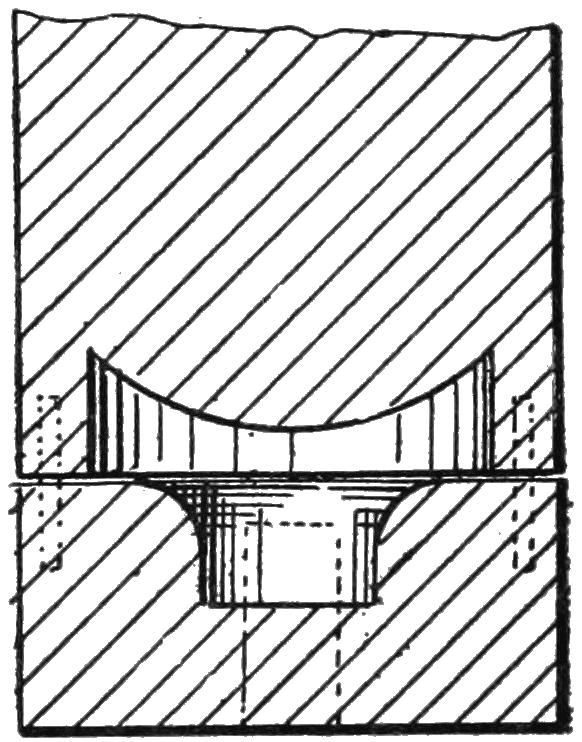
Mould for Suction Discs.
In the cut the correct shape for the mould and
consequently for a suction disc is shown. This can
be easily secured where a disc already made is procurable
by casting in plaster, or, with a little ingenuity
the template for the mould and the plunger to be
used instead of the marble can be whittled out of
wood. The lower body of the mould in such a case
can be made of plaster of paris. To secure the
alignment of the two parts of the mould, dowel pins,
indicated in dotted lines, should be placed near the
periphery. The gum should be introduced in a lump
near the centre, in order that it may sink well downwards
to the bottom of the mould before spreading
laterally. Sometimes the tips have a recessed
end. This is secured by the use of a mandrel,
shown in dotted lines in the axis of the mould.
Such discs are sometimes made to be cemented to
arrows to be discharged against smooth surfaced
targets, to which they adhere on impact by atmospheric
pressure, giving rise to a very interesting
game.
Another use of suction discs is as photographic
negative holders. They can be fastened to a wooden
handle and be attached by suction to the back of
a negative under treatment. For this purpose they
should be at least two inches in diameter.
Pencil Tips.—These are generally little cylinders
of india rubber, which fit into a tube that slides
over the end of the pencil. They can be thus simply
made. A hole is bored in a piece of wood the
diameter of and a little more than the depth of
the pencil tip. A short cylinder that exactly fits
the hole is required for plunger. The gum is put
into the hole in little discs, or rolled up into a
cylinder, the plunger is placed on top, and the
mould put in the press. It is shaped by pressure
and cured as described.
Sometimes the tips are cup shaped. For these
the mould is made in two sections fastened by
catches or by pins set in the plaster as shown in the
cut. The hole is made larger at bottom than at
top, and at the top is a little smaller than the shaft
of the pencil. A plunger that nearly fits the small
end is provided. The india rubber is placed in the
mould and heated. When soft, the plunger is
forced down to the proper distance in the press
and the article is cured. Care must be taken to
give the plunger a good coating of talc, and it must
be made to sit vertically. The arrangement of a
cylindrical hole shown in the cut secures this result
perfectly. As distance piece a pin is passed through
the plunger.
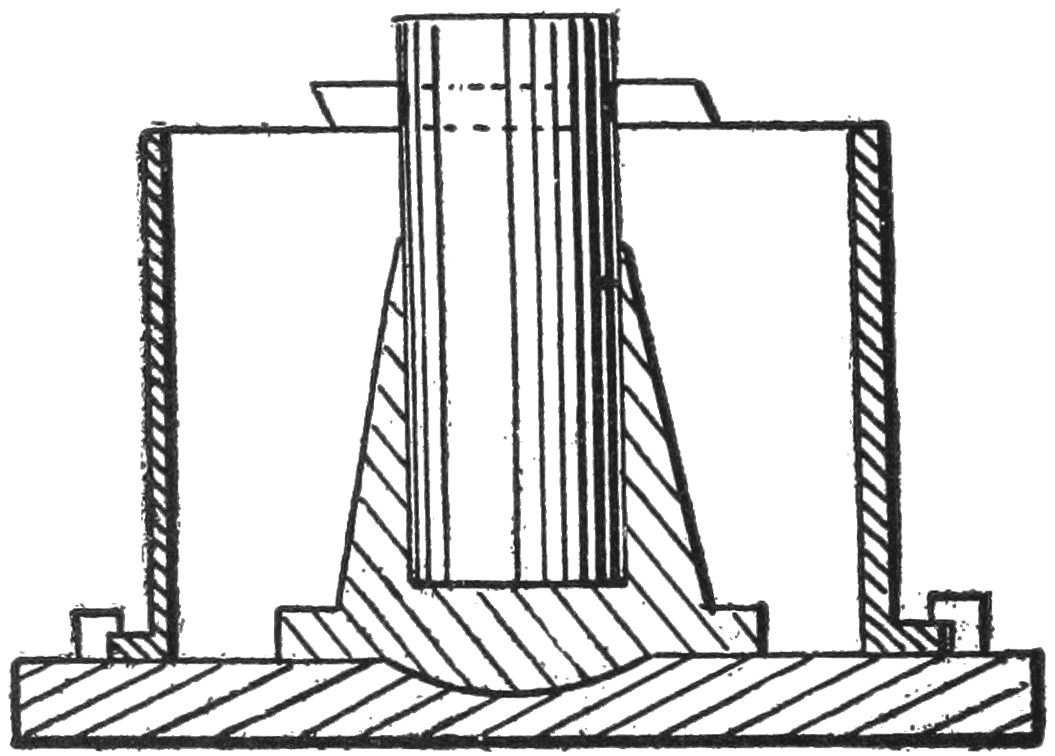
Mould for Pencil Tips.
Cane and Chair Leg Tips, etc.—By carrying out
the process just described with larger moulds and of
slightly different section very convenient tips for
chair legs and walking canes can be made. Such
tips can be modified in size and thickness to answer
as covers for the mouths of bottles, test-tubes, etc.
Corks.—These may be made in moulds tapering
from top to bottom. The india rubber must be
packed in with great care to secure as solid filling as
possible. A plunger is used that enters the larger
end and is a very little smaller in diameter, so as to
descend a little way into the mould. This distance
determines the length of the cork. As the perimeter
of the plunger strikes the walls of the mould
it cuts off almost completely the excess of rubber
that has squeezed up past it. An excellent modification
of the mould is shown in the cut. The
upper part with parallel sides serves as a guide for
the plunger. It is a similar extension as the one
recommended to be used for the plunger in the hollow
pencil and chair leg tip moulds just spoken of.
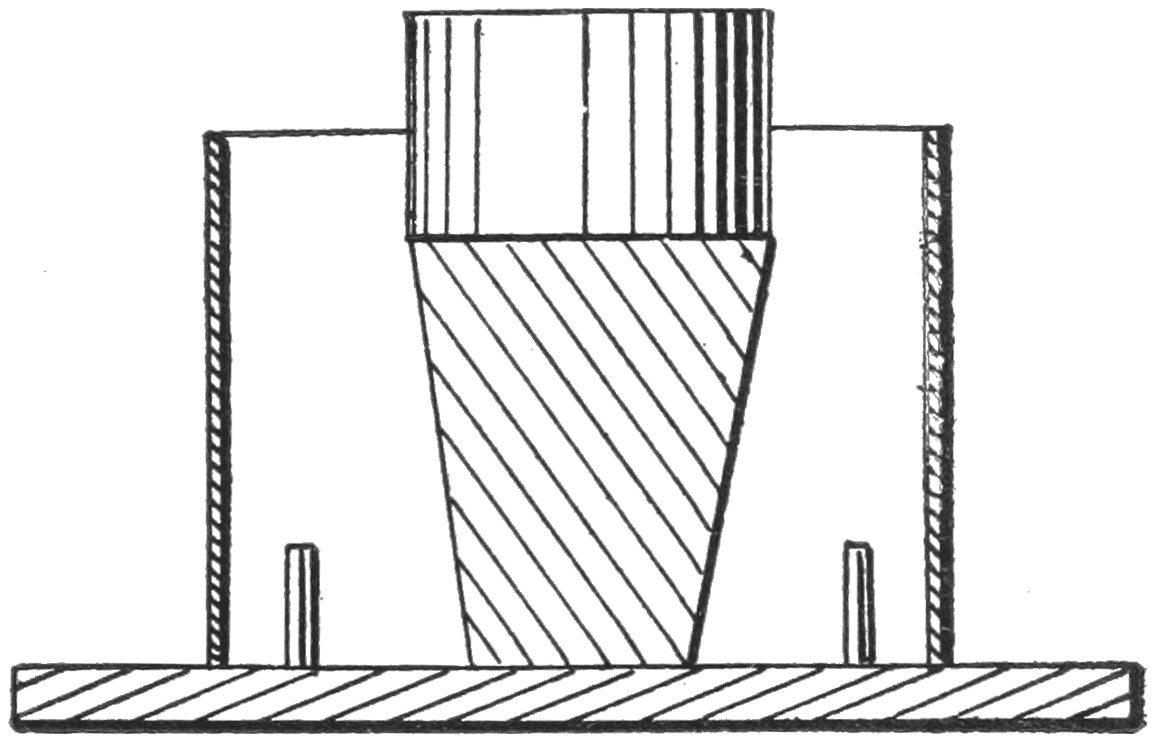
Mould for Rubber Corks.
Mats.—These may generally be made in the hot
press. Designs for them in great variety may be
found in cut glass and pressed glass dishes. Many
of these have patterns on their bottoms that can be
moulded in plaster to serve as matrices.
Cord, Thread and Seamless Tube.—By placing the
mixed india rubber in a cylindrical mould fitted
with piston and with one or more round holes in the
bottom, the material may be softened by heat and
forced out of the holes by depressing the piston.
This will form cylindrical thread or cord. As it
descends it may be received in a box of powdered
talc and be afterwards cured. By providing the
hole with a mandrel seamless tubing may be thus
made. In making such the mandrel usually remains
in place during the curing. Plenty of
powdered talc must be used.
Skeletonized Leaves as Models.—These would form
interesting models from which matrices could be
made in plaster. It would be possible to produce
some very pretty stamps or mats from these and
similar models.
After some experience inspection of any article
will show how it was moulded. The fin will indicate
the joint in the mould, and with this as a clew
the mould can be almost certainly constructed like
the original.
India Rubber Bulbs.—Bulbs and hollow articles
generally, such as dolls, toys and the like, cannot
be made without special high pressure hollow
moulds. The general process consists in cutting
out gores from mixed sheet as for a balloon. The
edges are coated with cement (thick benzole or carbon
disulphide india rubber solution) and while
the rubber is warm the seams are pressed and
knitted together with the fingers. A hole is left in
one place through which some pure water or water
of ammonia is introduced. The bulb is now blown
up with the mouth or otherwise, and while inflated
the hole is pressed shut. This is often done with
the teeth. Any projections around the seams are
cut off with curved scissors. The mould is of iron
and in two halves. Powdered talc is applied, and
the bulb is placed in and shut up in the mould
which it should exactly fill. The mould is clamped
together and the whole is put into a vulcanizer, and
the rubber is cured. The steam and vapor formed
by its liquid contents expand it and press it with
great force against the sides of the mould. After
curing the mould and bulb are removed from the
vulcanizer, cooled by a shower bath of cold water,
the mould is opened and the bulb is removed. Often
an iron pin is left projecting through the side during
the vulcanizing, which pin, when withdrawn, leaves
the necessary aperture, or it is perforated. The bulbs
are polished by tumbling in a revolving cylinder.
Considerable skill and practice are needed to succeed
in making hollow bulbs. Great accuracy is needed
in cutting out the gores and in joining the seams.
CHAPTER X. THE MANIPULATION OF MASTICATED SHEET RUBBER.
The manipulation of pure sheet rubber is simple,
yet is liable to lead to disappointment. When two
pieces are laid face to face and cut across with a
sharp knife, or scissors, the edges will adhere with
considerable tenacity. This may be increased by
applying some thick solution of india rubber in a
volatile solvent, and by manipulating the sheets so
as to bring the entire surfaces of the cuts together.
Finally the material may be charged with sulphur
by absorption or by Parkes’ process, and cured in
a glycerine or calcium chloride bath, all of which
are described in chapter XI. The same treatment
will affect the cement used in making
the joint also, bringing about its vulcanization.
Such in a few words is the main process in the
treatment of this class of goods. Where it is desired
to prevent adherence, soapy water or powdered
talc is used.
Adherence may be produced between the surfaces
of the sheets if they are clean, by pressure and a
little warmth. The method of making toy balloons
will give an example of how the article is dealt with
by the manufacturer.
A pile of pieces of masticated sheet rubber is
made. Every piece has one side coated with powdered
talc, and two talc-coated sides are placed in
contact in each pair. As they are piled up, the
outer surfaces of each pair are moistened with
water. A steel punch or die, pear shaped in outline,
is used to cut down through the pile, cutting
all the pieces into that shape.
The pile is then taken apart in pairs. The separation
takes place between the wet surfaces, the edges
of each pair adhering slightly so as to enclose the
talc-coated surfaces. The neck is opened if necessary.
A rather weak or thin solution of india rubber
in benzole is now brushed over the freshly cut
edges. By pulling out the centre of each piece the
edges are brought into contact, and adherence is
produced.
If the Parkes process of vulcanizing, chapter XI.,
is employed they are cured to the slight extent necessary
upon a tray coated with talc. The balloons
are then ready for inflation.
They are rather delicate articles to make except
for immediate use as the thin material is liable to
become over vulcanized.
In the chemical laboratory sheet rubber can be
used for covering the ends of glass stirring rods.
These answer very nicely for cleaning out from
beakers the last particles of a precipitate. The
sheet is cut of proper size and is bent around the
end of the rod and cut off close with a pair of scissors.
It adheres where cut. It is then pinched
with the fingers to bring the edges into better contact
and the operation is complete. A slight heat
makes it adhere better.
To connect glass tubes in setting up laboratory
apparatus the same material was formerly used. It
was wrapped around the joint, tied with thread and
slightly warmed. At present this form of connection
is wholly displaced by ready made rubber
tubing.
It is interesting to observe in all articles made
from this sheet the marks of the original cutting
knife. These may be observed in inflated balloons,
as parallel lines running all over the surface, and
magnified by the expansion due to the inflation.
CHAPTER XI. VARIOUS VULCANIZING AND CURING METHODS.
The regular methods of vulcanizing and curing
can be departed from and good results obtained.
A few excellent methods differing essentially from
the ordinary ones are described which will be of
service to workers on the small scale, as they enable
one to dispense with vulcanizer and air bath entirely.
One type of curing process does away with the air
or steam vulcanizer, and substitutes, as the curing
agency, a hot bath of liquid. For this purpose a
fluid is required that will not act injuriously upon
the india rubber, and which will give a curing
temperature without boiling away. One favorite
liquid is glycerine. This can be heated to the necessary
degree and is an excellent substitute for the
expensive apparatus often used. For experimental
work it is exceedingly convenient.
In use it is placed in a vessel of proper size
and a thermometer is suspended so that its bulb
dips into the liquid near one side and does not
touch the bottom of the vessel. The heat is applied
by a gas burner, alcohol lamp or oil stove. Of
course the vessel may be placed on an ordinary
cooking stove or range, and the heat may be graduated
and adjusted by moving it about until it
reaches a part of the stove where the proper heat
will be maintained.
The mould with its contents is immersed in the
glycerine, care being taken to see that it so placed
as to assume the mean temperature of the liquid
and not to be heated too hot. This might happen
if it stood on the bottom of the vessel, so it is well
to have it supported or suspended a little above
it.
It is easy to see that the whole may be so arranged
that the screw handle or pressure nuts of the mould
will rise above the liquid. In this case the press
can be screwed down while the article is heating.
Instead of glycerine a strong solution of some
salt in water has been recommended. A solution
of calcium chloride, or some other salt can be substituted.
Either are very cheap and will be quite
satisfactory.
Another treatment which applies also to the mixing
operation is by the sulphur bath. Sulphur is melted
in an iron vessel and brought to a temperature of
248° F. (120° C.). A piece of unmixed pure caoutchouc
immersed in this bath will gradually absorb
sulphur. The case is almost parallel with the
absorption of water or benzole by the gum. The
piece swells and thickens as it is acted on and
eventually will contain enough sulphur for vulcanization.
It may absorb as much as fifty per cent.
The point of proper absorption must be settled
more or less empirically or by successive trials.
After enough has been taken up the piece is removed
and dipped into cold water, which cracks the
adherent sulphur so that it can be brushed or rubbed
off. This gives a piece of mixed rubber ready for
moulding and curing. It can be heated and
moulded and may be cured as desired, in a liquid
bath, hot press or vulcanizer.
It will be observed that this provides for the admixture
of sulphur only; no talc or other solid can
be thus introduced. The addition of these solids
tends to make the rubber of a more attractive color
and their use is not to be deprecated in all cases.
Hence the sulphur bath process is not to be considered
a perfect one.
In the sulphur bath the mixing and curing
processes can be combined. If the liquid sulphur is
heated to the vulcanizing temperature, 284° F.
(140° C.), a thin strip of gum immersed in it will
be vulcanized completely in a few minutes. A
heating of several hours at the lower temperature
will effect the same result.
The sulphur bath processes must be regarded as
unsatisfactory. It is not easy to feel that any dependence
can be placed upon them as regards reliability
or constancy of product. The sulphur also
will mostly effect the surface. Thin pieces may be
satisfactorily treated, but the same confidence cannot
be felt as is experienced when specific amounts
of ingredients have been mixed in with pure caoutchouc
in a regular mixing machine.
The sulphur bath is of value to the experimenter,
enabling him to do his own mixing without expensive
apparatus.
Bromine, iodine, chlorine and nitric acid are vulcanizers.
A piece of sheet rubber dipped into
liquid bromine is instantly vulcanized. Iodine and
nitric acid have also been used in commercial
work.
Alkaline or alkaline earth sulphides can be employed
in solution under pressure for vulcanizing.
At a vulcanizing temperature their solutions will
answer for thin sheet very well. Polysulphides of
calcium have thus been employed.
By simply lying embedded in finely divided sulphur
at a temperature of 233° F. (112° C.) as much
as ten per cent. of sulphur may be absorbed by thin
sheet rubber. This is one of the processes peculiarly
suited for work on the small scale. It may be
used instead of the Parkes process next to be described.
Chloride of sulphur is an orange red mobile
liquid of a peculiar and disagreeable odor. It boils
at 276° F. (136° C.). It dissolves both sulphur and
chlorine so that it is not easy to obtain it in a pure
state. If unmixed india rubber is exposed to its
action it will quickly become vulcanized. At ordinary
temperatures the mixing action takes place,
though it is much accelerated by a slight application
of heat.
It is quite possible that this action may be of use
to the reader in his manipulation of india rubber.
Thin sheet may be vulcanized by being immersed in
a solution of this substance in bisulphide of carbon
followed by slight heating. The thin layer of
caoutchouc left by evaporation of the chloroform
solution of india rubber may thus be vulcanized so as
to become comparatively strong and elastic. Where
the same solution has been used as a cement or for
patching overshoes and finishing the patch, a vulcanization
can thus be given to it.
The process is known as Parkes’ cold curing process.
A solution of one part of chloride of sulphur in
forty parts of bisulphide of carbon is of good
strength for rapid work. A thin article needs but an
instant of immersion. It then is placed in a box or
tray upon some talc powder and is heated to about
104° F., (40° C.). One minute of curing will suffice.
It is advisable to wash off the articles afterwards
in water or in weak lye to remove any traces
of acid.
Petroleum naptha can be used as the solvent instead
of bisulphide of carbon. The latter substance
has an exceedingly disagreeable odor, and its vapors
must be considered rather injurious especially to
those who are not accustomed to them.
When thick articles are to be cured by this process
a much more diluted solution is used. One
per cent. or less of the chloride of sulphur is the
proportion used. The object of this is to enable
a longer immersion to be employed so that the interior
will be affected before the outer layers become
too much charged with the vulcanizing material.
In this short description of the Parkes curing
process hints for a useful method may be found.
The process is beyond doubt by far the simplest
known for treatment of india rubber. Exactly
what reaction takes place is unknown. Whether
the sulphur or the chlorine is the acting vulcanizer
has not as yet been determined.
Its defect is that it produces surface action, analogous
to casehardening. One method of avoiding
this is to remove the articles from the sulphur
chloride bath and at once to immerse them in water.
This prevents the rapid volatilization of the solvent
and an equalizing of the absorption ensues.
CHAPTER XII. THE SOLUTION OF INDIA RUBBER.
India rubber presents some difficulties in its
solution. If a piece of pure gum just as received by
the factory is placed in hot water it will swell and
whiten after a while, but will not dissolve. If a
similar piece is placed in benzole a similar but
greatly exaggerated action takes place. The piece
if left to soak for a day or more swells enormously,
but very little solution is effected.
The swollen india rubber can be removed from
the benzole in a single piece. It will display all the
layers and marks of the original piece which was
perhaps of not one hundredth part of its volume.
Some parts will be a perfect transparent jelly.
It has been found that masticated india rubber
dissolves with comparatively little difficulty. If
the experimenter will place in a porcelain mortar,
the jelly-like mass obtained as above detailed, and
will rub it up thoroughly, it will be effectually masticated.
This requires a little patience, as the
slippery material seems to elude the pestle. Yet
eventually it will all be reduced to a perfectly homogeneous
mass. Its action while being rubbed up is
very peculiar. At first no progress seems to be
made. After a little the lumps yield to the friction.
The rubber then begins to attach itself to the pestle
and mortar, and begins to be drawn out into ever
changing webs and threads. As the operation approaches
completion the material makes a snapping,
crackling noise familiar to all rubber workers.
When complete there will be no lump left, and the
whole will be a uniform pulp.
If benzole or a volatile solvent has been used, the
rubber will easily be removed from the mortar with
a spatula or palette knife. If turpentine was the
solvent it will be impossible to remove the last
traces except after long standing or by solution.
If replaced in the original solvent it will now come
into nearly or quite perfect solution. This is the
best way of masticating on the small scale. It is
almost impossible to masticate untreated gum in an
ordinary mortar.
The dealers sell a special india rubber for the
manufacture of cement and solutions. This is so
treated by mastication that it dissolves with great
readiness. It is also said that heating under pressure
is used to dissolve it in some factories.
Many solvents have been used and none work
without some difficulty. Benzole, coal tar naptha,
petroleum naptha, carbon disulphide, ether and
chloroform, oil of turpentine and caoutchoucin are
the best known. The naptha best suited for its
solution is termed solvent naptha. It has a specific
gravity of .850 at 60° F. (15½° C.); it boils at from
240° F. (115½° C.) to 250° F. (121° C.) and on evaporation
should leave no more than ten per cent. of
residue at 320° F. (160° C.)
Payen recommends a mixture of 95 parts bisulphide
of carbon with 5 parts of absolute alcohol.
Commercial chloroform is apt to be too impure to
act as a good solvent. It is apt to contain alcohol
mixed with it as a preservative, which impairs its
effectiveness.
Some of these solutions are better suited than
others for the deposition of thin layers by evaporation.
Turpentine gives a very sticky and unmanageable
solution, which dries very slowly. Payen’s
solution and the chloroform and the benzole solutions
may be cited as especially adapted for this
purpose. Careful vulcanization by the cold curing
method can be applied to articles made by such
deposition from evaporation.
In the case of all of them some form of mastication
for the india rubber is needed. The simple mortar
grinding of the gum swelled by the solvent is the
only practical treatment without special apparatus.
When it is remembered that fixed oils are destroyers
of vulcanized or unvulcanized india rubber
it will be obvious how important it is to use pure
solvents. Too great care cannot be taken to preserve
the liquids pure and free from such matter.
A solid hydrocarbon may be used. Thus paraffin
wax, such as candles are made of, when melted acts
as a solvent. The resulting liquid solidifies when it
cools, retaining an almost greasy feel.
Boiling oil of turpentine is recommended by
some for the solution of vulcanized india rubber.
Phenyle sulphide, it is stated, will soften it so as to
render it workable. The latter discovery is credited
to Dr. Stenhouse.
It is stated that a solution or pasty mixture of
one part of caoutchouc in eleven parts of turpentine
with one half part of a hot concentrated solution of
sulphur (potassium sulphide) gives on evaporation a
film neither tacky nor soft, a species of vulcanization
taking place.
It is of much interest to note that an aqueous
solution of india rubber has been proposed in which
the vehicle is a solution of borax in water. This is
well known to be a solvent for shellac and other
resins. It has been recommended often as a vehicle
for rubbing up india ink. The ink made by mixing
lampblack with the shellac solution is nearly waterproof.
A shellac varnish is given by the plain solution.
The experiments upon india rubber were published
in a recent trade paper. One method of
making the solution is as follows.
A solution of borax two fifths saturated is made
by adding to two volumes of saturated solution
three volumes of water. To this is added a solution
of india rubber in benzole or other hydrocarbon of
such strength and in such quantity as to contain
from three and one-half to four and one-half per
cent. of india rubber referred to the borax solution.
It is now vigorously shaken and heated to 120°-140°
F. (49°-60° C.) and the agitation, not too violent, is
continued until it cools. Ceara or Madagascar rubber
answers best; Para is not so good for this formula.
This may be termed the indirect or emulsion
method.
For direct solution from two to three volumes of
water may be added to three volumes of saturated
borax solution. The india rubber is added in extremely
thin shavings and the solution is heated.
For weak solutions the boiling point need not be
reached. For strong solutions the heating should
be done under pressure so as to bring up the pressure
to one to three atmospheres.
Such solutions may contain as much as eight per
cent. of the gum. The mixture is liable to coagulate
or gelatinize just at the wrong time, but it may
be of value as a vehicle or as a waterproofing agent.
It deserves further investigation, which it is to be
hoped it will duly receive.
Great care is necessary in working with naptha,
benzole, carbon disulphide and similar liquids.
Their vapor is given off at ordinary temperatures
and may travel some distance to a lamp or fire and
become ignited and carry the flame back to the vessel.
Their vapors are also anæsthetic and should be
avoided as regards inhalation.
CHAPTER XIII. EBONITE, VULCANITE AND GUTTA-PERCHA. — GUTTA-PERCHA.
Ebonite and Vulcanite.—These two well known
substances are india rubber, in which the vulcanization
process has been intensified. From twenty-five
to fifty per cent. of sulphur is added in the
mixing, and the curing is prolonged to several
hours. A temperature of 275° F. (135° C.) for six
to ten hours is sometimes recommended, but generally
a shorter period at the regular temperature,
284° F. (140° C.), may be employed.
The mixed sheet is made and sold extensively for
dentists’ use. It is soft and flexible and very easily
moulded. It is treated like the regular mixed sheet
in every respect, except that plumbago brushed on
the slightly oiled surface of the mould is recommended
instead of the light colored talc, to prevent
adherence. Wax where available is better than
oil.
Sometimes specimens are built up in sections.
About an hour before full vulcanization in the
fourth stage, new material can be added and will
attach itself to the old. The stages of vulcanization
are thus given by Bolas.
“Several distinct stages or steps may be traced
during the curing of ebonite; and I wish to call
your attention to some specimens illustrating these
various stages.
“Here, in the first place, is the plain mixture of
sulphur and rubber, this being nearly white, and
capable of becoming quite plastic or soft by the application
of a gentle heat.
“The second specimen illustrates the action of a
very moderate degree of heat on the mixed material,
this particular sample having been heated to 128°
Centigrade for twenty minutes. It is, as you see,
somewhat darkened, and has lost a little of its original
softness; while a degree of heat which would
have rendered the original mixture plastic, like
putty, fails to make much impression upon it.
“The third specimen illustrates the effect of a
more prolonged heating, this sample having been
heated for an hour to 135° Centigrade. It is olive
green in color, and has acquired a certain amount
of elasticity, resembling that of a rather inferior
quality of vulcanized caoutchouc.
“The fourth stage of curing is illustrated by this
specimen, which you see is brown, and tolerably
hard. Ebonite in this state refuses altogether to
become plastic by heat, and a temperature of 150°
maintained for half an hour or less would suffice to
bring it to the fifth stage, or that of finished
ebonite.
“The fifth stage, or that of properly cured
ebonite, is the goal to be arrived at in manufacturing
the material. There should be no places where
the curing is imperfect, a kind of defect which is
likely to happen when articles of unusual thickness
are vulcanized, and no portion of the ebonite should
be spongy or honeycombed by air bubbles.
“The sixth, or spongy state, is generally the
result of over-heating, bubbles of gas forming in
the material, and converting it into a kind of
porous, cinder-like mass.
“A specimen will now be handed round, which
illustrates the third, fourth, fifth and sixth stages,
as already described. The specimen in question
was cured on a hot plate, this having probably been
heated to 160° or 170° Centigrade; and you will be
able to trace all gradations in the curing operation,
from the first setting of the plastic material to the
destruction of the ebonite by overheating.”
Cement for uniting pieces of the partially cured
material may be made by rubbing up some of the
untreated scrap with benzole.
At the heat of boiling water, ebonite can be bent
to a certain extent, which bend it retains on cooling.
When warm an impression of a coin or relief die
may be made on it by heavy pressure which it will
retain. On heating the image disappears. If before
heating the surface is planed off and the piece is
heated the image formerly in intaglio will expand
into relief.
By the exact process of rubber stamp making
excellent stereotype plates may be made of ebonite.
It can be turned at high speed in a lathe and polished
with fine 000 emery paper followed by a cloth
bob with rotten stone, etc., and water or oil. Blotting
paper, charged with the above or with tripoli,
is excellent for polishing small surfaces by hand.
Ebonite is a good connecting material between
softer rubber and iron, the whole being vulcanized
together; the iron should be well roughened or
cut into rasp-like or file-like projections.
Ebonite is properly the name for black hard rubber,
and vulcanite for the colored products such as
used by dentists and others.
Gutta-percha is prepared by coagulation from the
juice or sap of several trees, among others the
Isonandra gutta, of Borneo and the East Indian
Archipelago. The product gutta-percha is identical
in composition with india rubber. It is hard
at all ordinary temperatures.
Its manufacture includes purification and mastication.
It is far more amenable to treatment than
is india rubber. Many materials are mixed with it
as adulterants or otherwise in the factories.
It is more useful in the form of sheets. These
when heated to 122° F. (50° C.) become pliable and
can be moulded by pressure to any degree. At the
temperature of boiling water it becomes pasty and
adhesive, and at 266° F. (130° C.) it is so soft that it
may be considered as melted.
It is an admirable moulding material. Stereotypes
and other relief or intaglio images can be
made by pressing it while heated. These are often
absolutely perfect reproductions of the original.
Dishes for photographic purposes, etc., are easily
made out of the sheet. By gentle warming they
become pliable, and a greater heat makes surfaces
capable of adhering by pressure.
Tubes can be made by the squirting process, as
used for india rubber. Wires are coated with it in
a similar manner.
It has several defects. It is not durable if exposed
to the air with consequent changes of temperature.
It is also too easily softened by heat, as of
course no hot liquid can be introduced into a gutta-percha
vessel. The Parkes cold curing process can
be applied to it, which makes it more indifferent to
heat. This is applied by dipping an instant and
drying. After several repetitions the period of dipping
is prolonged and ultimately it is left immersed
some time. If left immersed at first it would dissolve.
It is soluble in most caoutchouc solvents, particularly
in carbon disulphide.
CHAPTER XIV. GLUE OR COMPOSITION STAMPS.
Stamps made from a mixture of glue, glycerine,
and molasses or from similar mixtures are an excellent
substitute for india rubber stamps. Properly
made they possess all the flexibility that characterizes
the rubber ones, while for fatty inks such as that
used by printers and lithographers, which inks tend
to destroy rubber stamps, they are much better.
They are adopted by the United States government
for making dating stamps for use in the Post Office
Department; by publishers of directories for printing
advertisements on the edges of their publications,
and in many other cases. Our description
shall follow as closely as possible the process and
methods used in the United States Post Office.
They are there termed “composition blotters.”
The composition of which they are made is printer’s
roller material. Nine and one-half pounds of
fine quality glue are soaked in just enough soft
water to cover it until it is thoroughly softened.
It is then melted. In the Government Department
a steam kettle is provided for the purpose. An
ordinary glue pot will answer for smaller quantities.
When melted four and one-half pounds of best molasses
and seven pounds of glycerine are added, and the
whole is thoroughly mixed. The formula varies a
little according to the prevailing temperature, less
molasses being added when the weather is warm, and
vice versa. Experience is here the best teacher.
When well mixed it is poured out into tin pails
whose inner walls or sides and bottom have been
rubbed over with oil. It solidifies in cooling and
becomes a clear brown jelly quite free from any
stickiness or superficial moistness.
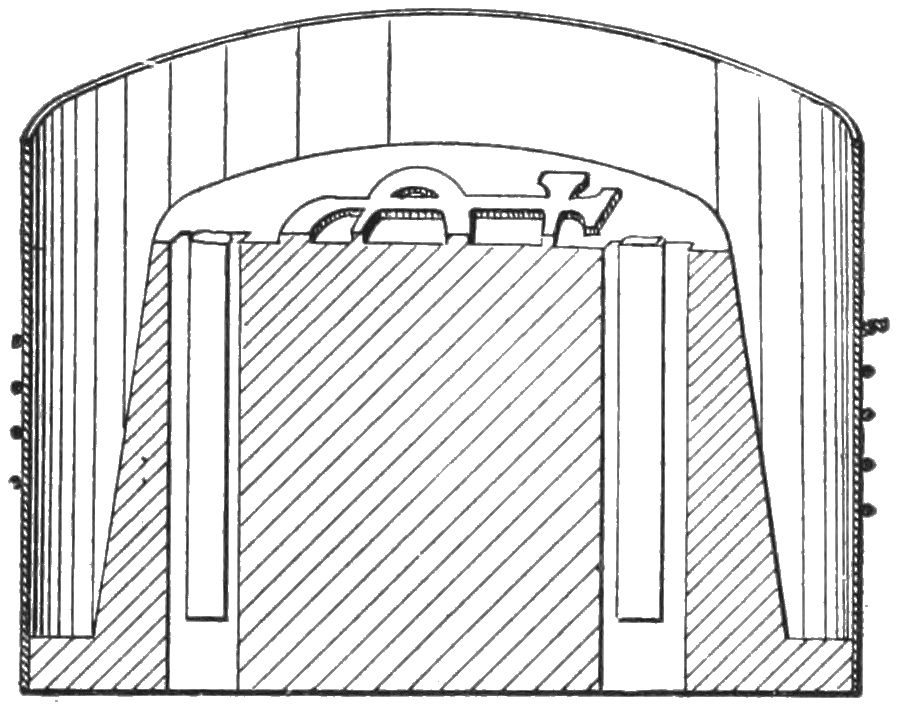
Model for Composition Stamp Mould.
In use it is turned out of the pails to which,
owing to the oiling, it does not adhere. It is cut
off as wanted, melted by heat and cast in oiled
moulds.
The latter are made of type metal to which one-third
its weight of lead has been added. As model
for the mould or matrix a brass model of the
stamp is employed. This represents a sort of oval
based cut-off or truncated cone, about an inch
high and a little over an inch long on its base. A
flange extends outward from its base and a tube is
provided to fit this flange. Its smaller end corresponds
to the face of the stamp, and on it are engraved
in full relief any permanent characters,
circles or border lines, etc. Through its centre one
or more apertures are made. Into these, changeable
steel, iron or brass type may be introduced and set
fast with plaster of paris.
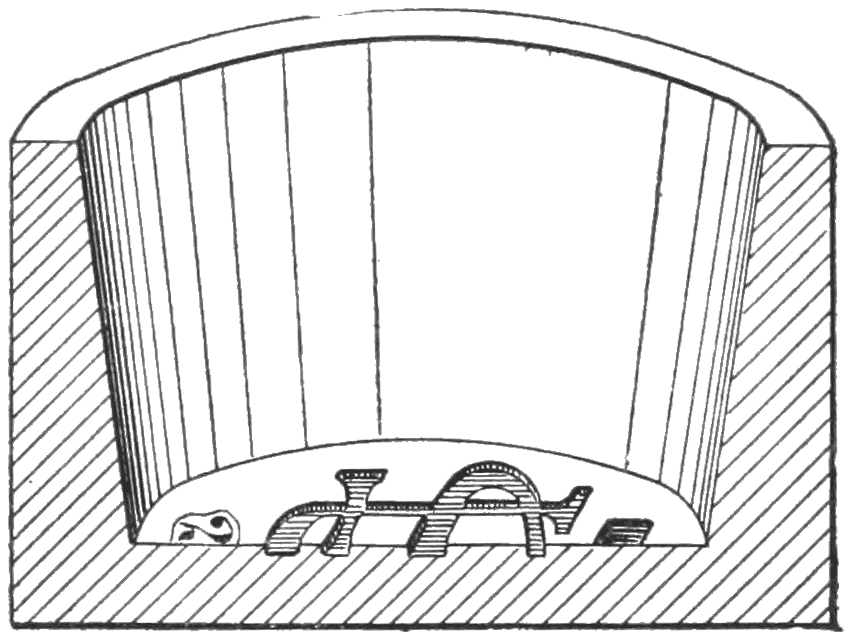
Composition Stamp Mould.
To make the mould, the brass model with its movable
type set as required is placed upon a flat table
or plate, face upward, and surrounded by the tube,
as shown in partial section in the cut, page 114. The
tube is a strip of sheet iron, which is bent around the
flange and is secured in place by a wire twisted
around it. The melted alloy (type, metal and lead) is
poured into the space thus formed until it rises a
quarter of an inch above the face of the model. In
a few minutes it sets and is removed and allowed
to cool. This gives a cup with the inscription and
design depressed or in intaglio upon its inside base.
This is shown in the cut, page 115, partly in section;
it will of course be understood that the mould forms
a complete cup.
To make the stamp the interior surface of the
mould is oiled with a stiff brush. It is not material
what oil is used. The composition melted by heat is
then poured into the cup, and is allowed to solidify.
Owing to the conical shape of the mould it is
readily removed. The mould must be hot but not
too much so.
In the Post Office stamps the date requires to be
changed frequently. Some of the figures do duty
for two or three days each month. Thus the figure
8 is in the designation of three days, the eighth,
eighteenth, and twenty-eighth. There are three
changes involved therefore in connection with this
day numeral. When a stamp mould or matrix is cast
the place of numerals that are to be changed is
filled with a blank space in the part where the type
would otherwise come. A number is stamped in
this space when needed, by means of an ordinary
steel number-punch.
When the number is to be changed the old character
is scraped or cut out, leaving a small irregular
hollow. A very small piece of soft lead, about one-sixteenth
of an inch on each side, is dropped into
the hollow. With a flat faced punch it is flattened
out, and on it the new number is impressed by a
steel punch. This operation is repeated a great
many times before the matrix is worn out.
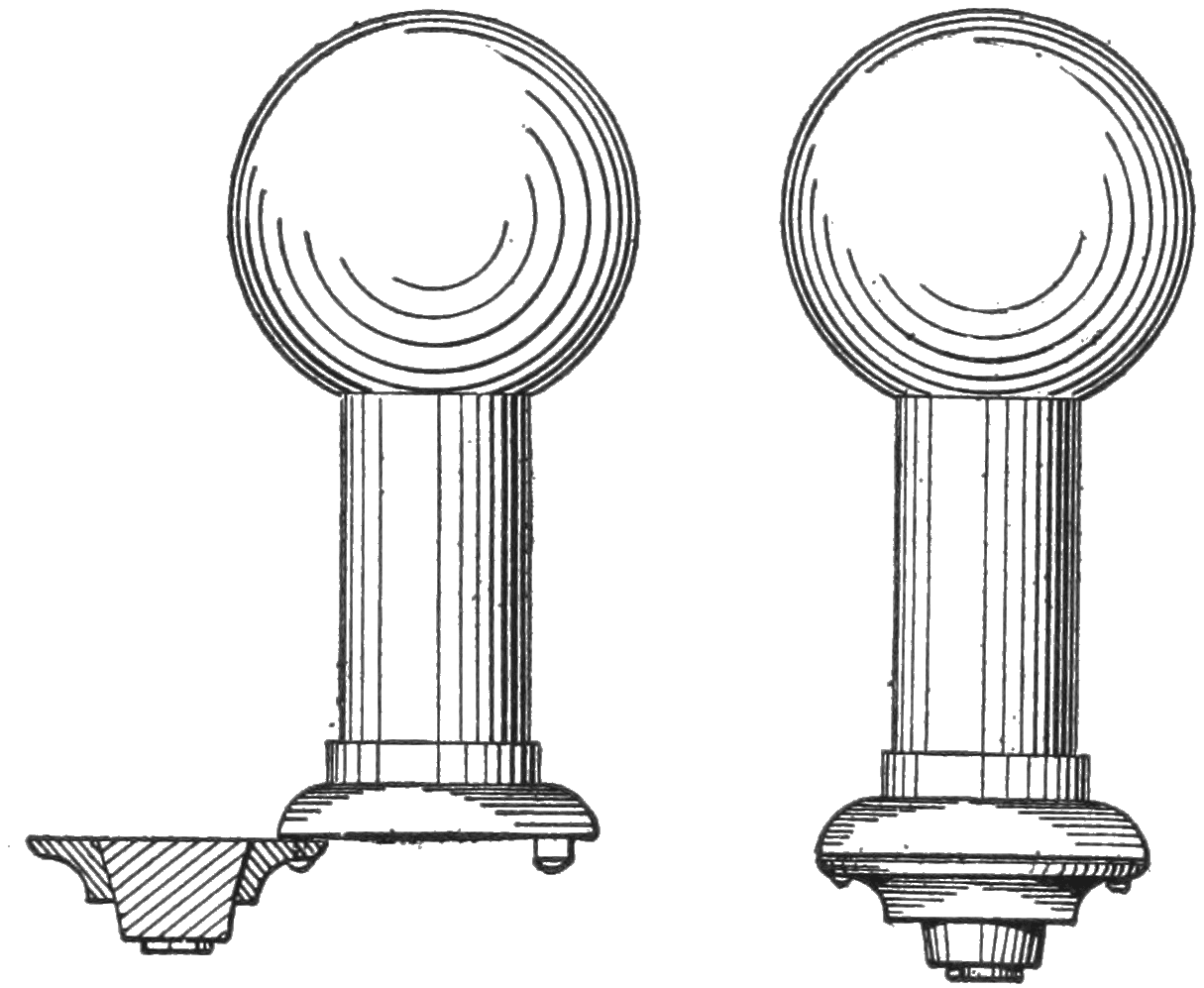
OPEN SHUT
Composition Stamp Handle.
In the cut, page 115, one number is shown as
stamped into the soft lead, and at the other end of
the stamp is a blank space ready for a number.
The casting of a stamp is so extremely simple
that no attempt is made to use movable type, as in
permanent rubber dating stamps.
While it is obvious that these composition stamps
could be attached directly to wooden handles, a special
style of handle, shown in the cuts, is employed
by the Post Office. A wooden handle carries at its
end a brass base, to which is pivotted a swinging
piece that is perforated by a conical oval aperture a
little larger than the small end of the stamp. The
edges of this aperture are slightly rounded.
It is swung around as shown in the first figure,
and the stamp, previously moistened on its sides, is
forced in. If the stamp is properly made it is surprising
how much force may be used to insert it. If
the edges of the brass swinging piece are not rounded
there is danger of the composition being cut. The
stamp in its brass frame is then swung back over
the brass base, where it is secured by a catch. The
stamp is now ready for use, as shown in the second
figure of the cut.
It is imperative that no aqueous or glycerine ink
be employed for continuous work with such stamps.
Common printers’ ink is perfectly satisfactory, and
the work may be nearly or quite as good as that executed
by an india rubber stamp.
The Post Office manufactures a pad for use with
printers’ ink into whose manufacture the same composition
enters. The ink retainer is a piece of fine
felt, one-quarter to one-half an inch thick. This is
placed in the bottom of a shallow steel mould, where
it enters for half its depth into a recess that it accurately
fits. The composition from old stamps,
melted up, is then poured upon and around it, the
mould being previously oiled. When it is full a
piece of strong manilla paper, of the area of the felt
only, is placed upon the bottom of the glue pad on
its centre, which as it lies in the mould is its uppermost
part. The paper adheres strongly as the glue
hardens. Eventually it is turned out of the mould,
and a pad, shown in the cut, is produced. The
dotted lines show the limits of the felt pad. The
glue composition underlies, surrounds and extends
outwards from the felt portion. It is found that
the elasticity of the composition makes the pad
much pleasanter for rapid stamping.
Composition Ink Pad.
The above description gives the clew to making
any stamp of this description. The matrix may be
of dental plaster, or of oxychloride of zinc cement.
The mould may be built up of type of any kind.
The composition is so cheap that the stamp can
be made quite thick. This gives it a high degree
of elasticity and adaptability to uneven surfaces.
It may be mounted by adherence upon a flat board
or block, provided, if necessary, with handles. If the
board or block is placed upon the composition while
it is still warm and liquid, as it solidifies the board
and composition will adhere with great tenacity.
All moulds or surfaces to which it is desired that
the melted composition shall not adhere must be
oiled.
The moulds must not be cold or the composition
will not enter the fine divisions. If on the other
hand they are too hot the mixture will adhere.
Experience will teach the right conditions for success.
Below are given other formulæ for roller composition.
The formula already given in this chapter is
that used by the United States Post Office Department.
I. “Old Home Receipt:” Glue 2 lbs., soaked over
night, to New Orleans molasses 1 gallon. Not
durable, but excellent while it lasts.
II. Glue 10½ lbs., molasses 2½ gal., Venice turpentine
2 oz., glycerine 12 oz.; mix as directed
above.
CHAPTER XV. THE HEKTOGRAPH.
For obtaining multiple copies of writing, the
apparatus called the Hektograph or Papyrograph
has been extensively adopted. In general terms it
consists of a tray filled with a jelly like composition.
Any imprint made upon the surface with aniline
ink can be transferred to paper by simple pressure.
The tray filled with composition is called the tablet.
It is thus prepared.
The tray may be made of tin or even of pasteboard
or paper, and should be about one half an
inch deep. It may be of any size, according to the
work it is to do. The composition is made from
the best gelatine and glycerine. One ounce by
weight of gelatine is soaked over night in cold water,
and in the morning the water is poured off, leaving
the swelled gelatine. Six and one-half fluid ounces
of glycerine are now heated to about 200 F. (93 C.)
on a water bath preferably, and the gelatine is added
thereto. The heating is continued for several hours.
This operates to expel the water and to give a clear
glycerine solution of gelatine.
The composition is then poured into the tray,
which must be perfectly level in order to obtain a
surface nearly even with the edge. It is then
covered so as to keep off the dust. The cover of
course must not come in contact with the smooth
surface. In six hours it will be ready for use.
The original copy that is to be reproduced is
made upon ordinary paper in aniline ink. One
formula for the ink reads as follows: Aniline violet
or blue (2 R B or 3 B) 1 oz., hot water 7 fluid oz.;
dissolve. After cooling add alcohol 1 fluid oz.
and glycerine ¼ fluid oz., a few drops of ether and
a drop of carbolic acid. Keep in a corked bottle.
Other formulæ are given in chapter XVII.
The writing is executed with an ordinary steel
pen. The lines should be rather heavy so as to show
a greenish color by reflected light.
The surface of the pad is slightly moistened with
a wet sponge and is allowed to become nearly dry.
The paper is then laid upon it and smoothed down.
This is best done by placing a second sheet over it
and rubbing this with the hand. No air bubbles
must remain between the copy and the tablet, and
the paper must not be shifted.
It is allowed to remain for a minute or less
and is then raised by one corner and stripped
from the gelatine surface. It will have left the
reversed copy of its inscription perfectly reproduced
upon the tablet.
At once a piece of ordinary writing paper of the
desired size and quality is laid upon the tablet,
smoothed down, and stripped off, when it will be
found to have taken with it a complete copy of
the inscription or writing. This is repeated over
and over again with another sheet of paper, until
the ink on the pad is exhausted. Fifty or more
good copies can be thus obtained.
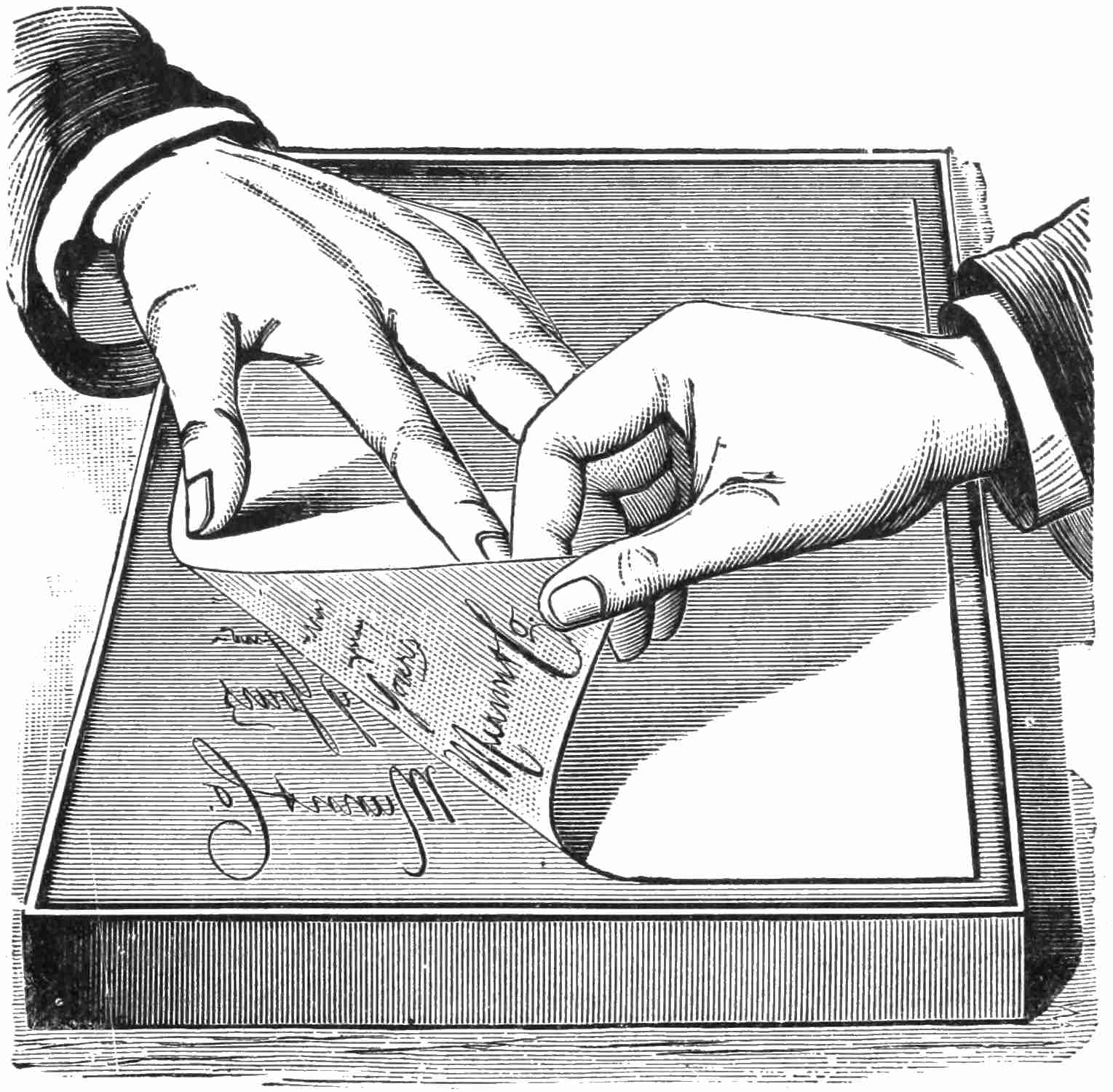
The Hektograph.
As soon as the work is completed the remains of
the ink should be washed off with a moist sponge
and the tablet, after drying a little, will be ready for
a second operation.
Some practice is required to ascertain the proper
strength of the writing and degree of wetness of the
surface. When the gelatine surface becomes impaired
it can be remelted in a water bath if it is not
too dark from absorption of ink.
French Ministry of Public Work Formula.—Glue
100 parts, glycerine 500 parts, finally powdered
kaolin or barium sulphate 25 parts, water 375 parts.
Use a little hydrochloric acid in the water for
washing off the pad after use.
Hektograph Sheets.—Four parts of glue are soaked
in five parts of water and three parts of ammonia
until soft. It is then heated and there is added to
it three parts of sugar and eight parts of glycerine.
The mixture is applied to blotting paper. This is
saturated with it, and successive coats added until a
smooth surface is produced on one side. This is
the side for reproduction. It is used like the regular
tablet except that it is claimed that sponging off
the writing is not necessary. Owing to the capillary
action developed by the blotting paper it is supposed
to be self-cleaning by standing.
CHAPTER XVI. CEMENTS.
Before cementing vulcanized rubber the surface
should be roughened or still better it may be seared
with a red hot iron. For bicycle tyres this is especially
to be recommended.
Cement for Cuts in Bicycle Tyres, Rubber Belts,
etc.—Carbon bisulphide, 5 ounces; gutta-percha, 5
ounces; caoutchouc, 10 ounces; fish glue, 2½
ounces. After it is applied and has dried the
excess can be removed with a wet knife. Bad cuts
should first be stitched up.
Bicycle Tyre Cement to fasten Tyres to Rims.—Equal
parts of pitch and gutta-percha are melted
together. Sometimes two parts of pitch are prescribed.
This cement has extended application.
Cement for Paper Boats and for Mending Rubber
Goods.—Fuse together equal parts of pitch and
gutta-percha, and to this add about 2 parts of linseed
oil containing 5 parts of litharge. Continue
the heat until the ingredients are uniformly commingled.
Apply warm.
Waterproof Cement.—Shellac, 4 oz; borax, 1 oz;
boil in a little water until dissolved, and concentrate
by heat to a paste.
Another.—10 parts of carbon disulphide and one
part of oil of turpentine are mixed, and as much
gutta-percha is added as will readily dissolve.
Cement for Mending Hard Rubber.—Fuse together
equal parts of gutta-percha and genuine asphaltum;
apply hot to the joint, closing the latter immediately
with pressure.
Glue to Fasten Leather, etc., to Metals.—1 part
crushed nut galls digested 6 hours with 8 parts distilled
water and strained. Glue is macerated in its
own weight of water for 24 hours, and then dissolved.
The warm infusion of nutgalls is spread
on the leather; the glue solution upon the roughened
surface of the warm metal; the moist leather
is then pressed upon it and dried.
Marine Glue, Various Formulæ.—I. Dissolve 1
part of india rubber in 12 parts of benzole, and to
the solution add 20 parts of powdered shellac, heating
the mixture cautiously over a fire. There is
great danger of conflagration. Apply with a brush.
II. Caoutchouc, 1 oz; genuine asphaltum, 2 oz;
benzole or naptha, q. s. The caoutchouc is first dissolved
(as described in chapter XII.), and the
asphaltum is gradually added. The solution should
have about the consistency of molasses.
Cement for Vulcanized India Rubber.—Stockholm
pitch, 3 parts; American resin, 3 parts; unmixed
india rubber, 6 parts; oil of turpentine, 12 parts.
Heat and mix very thoroughly. More oil of turpentine
may be added as required.
Gutta-Percha Cement for Leather.—Soak gutta-percha
in boiling water. Soften in benzole after cutting
up for a day. Heat on a water bath until the
greater part of the benzole is expelled. When cool
it will solidify. Use by heating.
Cement for Rubber Shoes.—
| (1) |
Chloroform |
280 |
parts. |
| |
India rubber (masticated) |
10 |
” |
| (2) |
India rubber |
10 |
” |
| |
Resin |
4 |
” |
| |
Venice turpentine |
2 |
” |
| |
Oil of turpentine |
40 |
” |
For first solution dissolve by mastication. For
second, melt the finely divided gum with the resin,
add the Venice turpentine and finally the oil of turpentine.
Use heat if necessary. Mix both solutions
finally. To apply, saturate a piece of linen
with the cement and apply to the spot previously
coated with the cement. As it dries apply a little
more as required. A finishing varnish is given in
the last chapter. Parkes’ cold curing process may
be applied as described in chapter XI.
Chatterton’s Compound for uniting sheets of
gutta-percha in cable cores and for general work
with gutta-percha coated wires.—Stockholm tar,
1 part; resin, 1 part; gutta-percha, 2 parts.
Waterproofing for Wooden Battery Cells.—Resin,
4 parts; gutta-percha, 1 part; boiled oil, a little.
Another Formula.—Burgundy pitch, 150 parts;
old gutta-percha in fine shreds, 25 parts; ground
pumice stone, 75 parts. Melt the gutta-percha and
mix with the pumice stone and then add the pitch,
melting all together. Apply melted and smooth off
with a hot iron.
Cement for Celluloid.—Shellac, 1 part is dissolved
in spirits of camphor 1 part, with 3 to 4 parts strong
alcohol. It is applied warm and the parts united
must not be disturbed until the cement is hard.
CHAPTER XVII. INKS.
RUBBER STAMP INK.
| Aniline blue soluble, 1 B |
3 |
parts. |
| Distilled water |
10 |
” |
| Acetic acid |
10 |
” |
| Alcohol |
10 |
” |
| Glycerine |
70 |
” |
For other colors the following aniline colors may
be substituted in proportions given:
| Methyl violet, 3 B (violet) |
3 |
parts. |
| Diamond fuchsin I, (red) |
2 |
” |
| Methyl green yellowish |
4 |
” |
| Vesuvin, B (brown) |
5 |
” |
| Nigrosin, W (blue black) |
4 |
” |
For very bright red 3 parts of Eosin BBN. are
used. In this case the acetic acid must be omitted.
In all cases the colors should first be rubbed up
with the water in a mortar, and the glycerine
should be added gradually. These inks will answer
for the hektograph.
Hektograph Ink.—Aniline color, 1 part; water, 7
parts; glycerine, 1 part. A little alcohol may be
used with advantage to dissolve the aniline color.
It can be expelled by heating if it proves objectionable.
Aniline Ink Vehicle.—Prof. E. B. Shuttleworth,
of Toronto, Ont., suggests the use of castor oil in
place of vaseline and other vehicles for typewriter
ink. The aniline colors may first be dissolved in
alcohol, and the solution may be added to the oil.
They may also be dissolved directly in the oil in
which most of them are soluble.
Indelible Stamping Inks.—I. Asphaltum, 1 part;
oil of turpentine, 4 parts; dissolve and temper with
printer’s ink. The ink may be omitted, and solid
dry color added.
II. Sodium carbonate, 22 parts; glycerine, 85
parts; dissolve and rub up in a mortar with gum
arabic, 20 parts. In a separate vessel dissolve silver
nitrate, 11 parts; in officinal aqua ammonia, 20
parts. Mix the two solutions, and heat to the boiling
point, 212° F. (100° C.). After it darkens, add
Venice turpentine, 10 parts. After applying to the
cloth, a hot iron should be applied, or it should be
exposed to the sun.
III. Dr. W. Reissig’s formula:
| Boiled linseed oil varnish |
16 |
parts. |
| Finest lamp black |
6 |
” |
| Ferric chloride (sesquichloride of iron) |
2 to 5 |
” |
Dilute a little for use with varnish. After this
ink has been removed, no matter how completely it
can be detected by dipping the paper into a solution
of ammonium sulphide.
IV.
| Aniline black in crystals |
1 |
part. |
| Alcohol |
30 |
” |
| Glycerine |
30 |
” |
Dissolve in the alcohol, and add the glycerine
afterwards.
Show Card Ink.—
| Pure asphaltum |
16 |
parts. |
| Venice turpentine |
18 |
” |
| Lamp-black |
4 |
” |
| Oil of turpentine |
64 |
” |
Dissolve the asphaltum in the turpentine, and
thoroughly mix.
Stencil Ink.—Shellac, 2 ounces; borax, 2 ounces;
water, 25 ounces. Dissolve by heat if necessary,
first the borax alone, and then adding the shellac.
To the clear solution add gum arabic, 2 ounces.
Color with lamp-black, with Venetian red, or with
ultramarine, to suit the taste. Another formula
gives shellac, 4 parts, borax, 1 part, and omits the
gum arabic.
Copying Ink (for use without a press by simply
pressing and rubbing with the hand), by Prof. Attfield,
F.R.S.—Use ink of any kind of extra strength.
This in many cases can be made by evaporating
common ink down to six tenths of its volume.
Then mix with it two thirds of its volume of glycerine,
so as to restore the original volume.
White Ink.—Barium sulphate, or “flake white”
is mixed with gum arabic water of sufficient thickness
to keep it suspended, at least while in use.
Starch or magnesium carbonate or other white powder
may be used instead of the barium sulphate.
The powder must be of impalpable fineness.
White Ink on Blue Paper.—A solution of oxalic
acid in water is used for this purpose. It may be
applied with a rubber stamp or with a common pen.
A quill or gold pen is the best as a steel pen is soon
corroded. The ink bleaches the paper wherever it
touches it, giving white lines on a blue ground.
Gold Ink.—Gold leaf with honey is ground up in
a mortar, best an agate mortar, or on a painters’
slab with a muller. It is added to water, and thoroughly
mixed and at once poured off from the first
sediments, filtered out, and washed. This is done to
secure the impalpably finely ground gold only.
The resulting powder is mixed with a suitable vehicle,
such as white varnish or gum arabic water.
Silver Ink.—As above, using silver leaf.
Zinc Label Ink.—I. Verdigris, 1 part; ammonium
chloride, 1 part; lamp-black, ½ part; water, 10
parts.
II. Platinum bichloride, 1 part; gum arabic, 1
part; water, 10 parts.
Diamond Ink for Etching Glass.—This consists
essentially of hydrofluoric acid mixed with barium
sulphate to the consistency of cream. The barium
sulphate is quite inoperative except as giving a body
to prevent the ink from spreading. It is applied
with a rubber stamp or pen and allowed to remain
for ten minutes or until dry. On removal of the
white powder, the design will be found etched on the
glass. The following is a formula for it.
Saturate hydrofluoric acid with ammonia, add an
equal volume of hydrofluoric acid and thicken with
barium sulphate in fine powder.
CHAPTER XVIII. MISCELLANEOUS. — EMERY WHEELS AND WHETSTONES.
To Soften and Restore India Rubber Hose, etc.—I.
Dip in petroleum and hang up for a couple of days.
Repeat process if necessary.
II. The above process is applicable to all articles,
but is specified for hose. It is stated that old rubber
that has become hard may be softened by exposure
first to vapor of carbon disulphide, followed by
exposure to the vapor of kerosene. The latter vapor is
found to be a general preservative for india rubber.
III. Dr. Pol recommends immersion in a solution of
water of ammonia, 1 part, and water 2 parts, from a
few minutes to an hour.
To Prevent Decay of Rubber Tubing.—The decay
of rubber tubing has been attributed to the formation
of sulphuric acid from the sulphur mixed
with it. M. Ballard has suggested washing with
water or weak alkaline solution five or six times in
a year.
Joints between India Rubber Tubing and Metal.—Where
tubing is temporarily slipped over metal gas
pipes and similar connections, as in the chemical laboratory,
it is well to apply glycerine to the metal.
It acts as a lubricant in slipping the tubing on, and
assists in its withdrawal.
Preserving Vulcanite.—Wash occasionally with a
solution of ammonia and rub with a rag slightly
moistened with kerosene oil.
Effect of Copper upon Rubber.—In a paper read before
the recent meeting of the British Association,
Sir William Thomson stated that metallic copper,
when heated to the temperature of boiling water, in
contact with the rubber, exerted a destructive effect
upon it. With a view to finding whether this was
due to the copper per se, or to its power of conducting
heat more rapidly to the rubber, he laid a sheet
of rubber on a plate of glass, and on it placed four
clean disks, one of copper, one of platinum, one of
zinc and one of silver. After a few days in an incubator
at 150° F., the rubber under the copper had become
quite hard, that under the platinum had become
slightly affected and hardened at different
parts, while the rubber under the silver and under
the zinc was quite hard and elastic. This would
warrant the inference that the metallic copper had
exerted a great oxidizing effect on the rubber, the
platinum had exerted a slight effect, while the zinc
and silver respectively had no injurious influence on
it. The rubber thus hardened by the copper contained,
strange enough, no appreciable trace of copper;
the copper, therefore, presumably sets up the
oxidizing action in the rubber without itself permeating
it.
Gas Tight Tubings.—Fletcher has invented a gas
tight rubber tubing in which a layer of tinfoil is interposed
between two concentric rubber tubes, all
vulcanized together.
Printing Colors upon India Rubber.—It may sometimes
be desirable to have a surface of vulcanized india
rubber so prepared that it will take colors such as
are used for calico printing. This end is simply attained
by sprinkling the article with farina before
vulcanizing. A small quantity attaches itself and
forms an excellent base for color printing.
Gutta-Percha for Coating Glass.—For focusing
glass in photography and for similar purposes where
ground glass or a translucent material is required,
a solution of gutta-percha in chloroform is highly
recommended. This is flowed over or painted on
the glass and is allowed to evaporate afterwards.
Burned Rubber.—A very soft pure gum sold for
artists’ use is improperly termed burned rubber. It
is used in crayon work for removing and lightening
marks by dabbing it against the paper, cleaning the
rubber from time to time. It is so soft that it picks
up and removes crayon marks without the necessity
of friction. Thus the rubbing out or more properly
erasing operation can be localized and crayon tints
can be lightened in tone without impairment or
“smutting.” It is a very elegant accessory to the
artists’ paraphernalia. To make it, pure virgin gum,
preferably the best Para, is cut into pieces and soaked
for some hours in benzole. A long soaking is advisable.
The pieces are then removed from the benzole
and are ground in a mortar until perfectly homogeneous.
The mass is gathered up with a spatula
and is pressed into little tin boxes. If desired it
may be dried upon a water bath. This is not necessary
as, if the box is left open, it will rapidly season
itself. It should be very soft, should tend to adhere
to the fingers, yet should leave them easily, and
should strip cleanly from the box. A very little
turpentine makes it more adhesive. It may even
be softened in turpentine alone. This gives a gum
that seasons more slowly and is in some respects preferable
to the benzole made preparation. It is sold
at a high price by the dealers, as the demand for it is
limited.
Rubber Sponge.—This is also an artist’s rubber.
It is also used for cleaning kid gloves. It is made
by incorporating with the masticated or washed and
sheeted gum any material or materials that will give
off vapor in the curing process. Damp sawdust and
crystallized alum are used as giving off vapor of
water or steam, or ammonium carbonate as giving
off vapors of ammonia carbonic acid gas and steam.
The mixed gum may be cured in moulds, which it
will fill by its expansion.
Shellac Varnish for India Rubber.—This is made
by soaking powdered shellac in ten times its weight
of strong aqua ammonia (26° B.). At first no
change beyond a coloring of the solution is perceptible.
After many days standing the bottle, which
should have a glass stopper, being tightly closed,
the shellac disappears, having entered into solution.
It may be a month before complete solution. This
forms an excellent varnish for india rubber shoes
and similar articles. It may be applied with a rag.
It is also a good application for leather in some
cases and doubtless many other uses could be
made of it. It would act well as a vehicle for a
dark pigment such as lamp-black. It will rejuvenate
a pair of india rubbers very nicely. The
ammonia exercises also a good influence on the rubber.
It has been recommended as a cement for
attaching rubber to metal, but its adhesive powers
are not always satisfactory.
Simple Substitute for Stamps.—A very simple
though rough and imperfect substitute may be
made by gluing with common carpenter’s glue
pieces of thick string upon a piece of wood, the
string being given the form of the desired letters.
Care must be taken to avoid saturating and stiffening
the string with the glue.
India Rubber Substitutes.—One of these under
the name of vulcanized oil is thus described by
Bolas:
“Vulcanized oil is, perhaps, of more interest, and
many oils, such as linseed and others resembling it,
may be vulcanized by being heated for some time to
150° Centigrade with twelve to twenty per cent. of
sulphur. The product obtained is soft, and somewhat
resembles very bad india rubber. By increasing
the proportion of sulphur very much indeed, say
to four times the weight of the oil, and vulcanizing
at a higher temperature, a hard substance, resembling
inferior vulcanite, is obtained.
“Soft and hard vulcanized oil have been introduced
into commerce at various times and under
many names; but these materials never seem to
have made very much headway.”
Another method of treating the oil consists in
mixing it with a solution of chloride of sulphur in
carbon disulphide or in naptha. On standing, the
volatile solvents escape, leaving a thick mass, which
is the substitute.
In combinations of aluminum with the fatty
acids, forming aluminum soaps, and of these, aluminum
palmitate especially, a substitute for india
rubber has been sought but without success.
Metallized Caoutchouc.—Unvulcanized gum is
mixed with powdered lead, zinc, or antimony. The
mixed india rubber is then cured as in the regular
process.
Bolas thus describes their manufacture:
“When ordinary vulcanized rubber is heated to
230° Centigrade, (446° F.) or until it melts, a permanently
viscous product is obtained, and this substance,
if mixed with emery and sulphur to a kind
of paste, forms a material out of which the so-called
agglomerated emery wheels or grinders may be
formed, the mixed materials being next hardened or
cured by the application of a steam heat. Emery
wheels and hones made on this principle were introduced
by Deplanque about twenty-three years ago.
“Thirty-five parts of old vulcanized caoutchouc
having been placed in a kind of still, heat is applied
to melt it, the operation being assisted by the gradual
addition of about ten parts of heavy coal oil;
but this latter is afterward distilled off. The softened
caoutchouc is then incorporated with 500 parts
of emery of the required degree of fineness and
nine parts of sulphur. These materials having
been thoroughly mixed, the hones or wheels are
manufactured, and afterward cured or baked at a
heat of 140° Centigrade, (284° F.) during a period of
about eight hours. Grinding wheels, made in the
above manner, can be worked at a speed of 2,000
revolutions per minute, and are extremely useful
for the working of hardened steel or other obdurate
materials.”
Etching on Metals and Glass.—India rubber stamps
can be used for placing the ground upon knife
blades and similar articles which are to be etched.
The parts untouched by the stamp are attacked by
the acid. In the case of glass, diamond ink (page
133) can be put on with a stamp. The acids for
metal etching might be thickened with barium
sulphate also and applied in the same way. In these
cases the inscription of the stamp would be etched.
Where ground is put on, whether on glass or
metal, the design for the stamp will be protected.
Etching Ground for Metals.—Equal parts of asphalt,
Burgundy pitch and beeswax melted together
and mixed thoroughly. It may be softened with
mutton suet. Beeswax may be used, dissolved in
ether or simply melted. Yellow soap is sufficient
for ordinary work.
Etching Solutions for Biting in.—For steel and
iron, a. sulphate of copper and common salt in solution.
b. sulphate of copper, sulphate of alumina,
and common salt, of each two drachms; acetic
acid, 1½ oz. c. sulphuric acid, diluted with five volumes
of water with a little sulphate of copper.
For other metals, except gold and platinum, nitric
acid diluted with five volumes of water.
Etching Ground for Glass.—Melted beeswax is
generally recommended. It can be removed with
spirits of turpentine after as much as possible has
been scraped off.
Etching Glass.—Glass may be conveniently etched
by exposing it to the vapor of hydrofluoric acid.
A shallow leaden tray, as large as the glass, is required.
A quantity of fluorspar is placed in it and
is moistened with concentrated sulphuric acid. The
glass is placed face downward over the tray. It is
supported over the mixture by resting on the
edges of the tray or by any simple method, and the
whole is covered with a towel. In half an hour or
more the etching will be completed. The vapors
must not be allowed to escape into any room containing
glass or metal articles as they corrode everything.
Great care should be taken also not to let
the mixture touch the hand, as painful ulcers are
the result.
India Rubber Shoe Blacking.—Raw india rubber
is given as a constituent of several shoe blackings.
Formulæ are given as below for paste and liquid
blackings.
I. Paste blacking: bone-black, 20 parts; molasses,
15 parts; vinegar, 4 parts; sulphuric acid, 4 parts;
caoutchouc oil (as given below), 3 parts.
II. Liquid blacking: bone-black, 60 parts; molasses,
45 parts; gum arabic dissolved in water, 1
part; vinegar, 50 parts; sulphuric acid, 24 parts;
caoutchouc oil, 9 parts.
Caoutchouc oil is made by dissolving or digesting
virgin rubber 55 parts in linseed oil 450 parts.
Waterproof Composition for Boots.—One ounce of
virgin rubber cut into pieces is digested in enough
oil of turpentine to form a stiff paste. In applying
heat take great care lest the contents of the vessel
become ignited. When homogeneous, which condition
may be brought about by rubbing in a porcelain
mortar, as described in chapter XII., it is mixed
with 5–6 ounces of boiled linseed oil. This gives
an ointment almost of the consistency of butter.