“The most beautiful Queen on any throne,” she was called when first she
became Empress of all the Russias. She still is tall and stately, her
hair is luxuriant and rich in colour. Eyes that some call blue and some
call grey look out through long, dark lashes, and in them lies a great
sadness, an appealing wistfulness touched with regret, a silent
melancholy betraying soul tragedy. Yet as a child she was known as
“Sunny.”
The life story of “Sunny” has never before been comprehensively told in
English. This is curious, because there probably is not a person in the
whole world who would not like to hear the wonderful romance of how a
poor little German Princess became a great Sovereign, the co-ruler of
one of the vastest empires on earth, the mistress of a fabulously rich
and bewilderingly extravagant court, and with opportunity for becoming
the most powerful woman in Europe. “Sunny” was the childhood nickname
of this little Princess, and after the hardships and vicissitudes of a
quiet girlhood, where there was a constant struggle to maintain
appearances, she was courted by a wayward gallant who was heir to a
mighty crown. “Sunny” lost her heart to the Royal wooer, and he, putting
aside the less noble loves of his reckless, youthful days, pledged
himself to her—persistently courted her against wide opposition—turned
a deaf ear to the councils of Emperors and Queens who tried to
discourage the match, and after years of battling with diplomatic
intrigue and personal restraint he carried his purpose, married the
German Princess who was truly the bride of his heart, and in marrying
her raised her from the obscurity and poverty of her own simple home to
the exalted rank of Empress. This is the true story of Princess Alix of
Hesse whom Nicholas II made Tsaritsa of Russia!
There is something tremendously dramatic about this little German
Princess stepping out of the quiet of her Darmstadt home into the arena
of world affairs, and taking her position as Empress over one hundred
and forty millions of people. Yet, of her life, almost nothing is known
by the world at large.
No woman of modern times has had such marvellous opportunities for the
exercise of personal influence and power. Yet who knows her? I had seen
her in St. Petersburg, I knew men and women of the Court who had told me
things about her from time to time. But I felt less acquainted with her
life than that of any sovereign in Europe. I turned to the magazine and
newspaper files of the last fifteen years and I was amazed at the
meagreness of information concerning her. I made diligent inquiry among
people who frequently are veritable mines of gossip and stories
concerning Royal personages, but scarcely a thing could I gather
concerning the Tsaritsa who in many ways occupies the most unique
position of any woman in the world. When I set forth in all seriousness
to learn of her from her childhood to the present time, to gather the
details of her charming romance and the story how she became the wife of
an Emperor, I found I must go far afield—overseas, to Germany, to
Russia; I must seek my information from her courtiers, her
ladies-in-waiting, her friends, princes and princesses of the realm,
tutors of her children, servants in her palaces, officials of the
Imperial Household. So I went. I talked with all these people and many
more besides, and the story I set down here is the story of her life, as
I have heard it piecemeal from the lips of those who have been closest
to her during the years that she has occupied a position of world
eminence.
The Tsaritsa is now thirty-nine years old. She was born at Darmstadt,
Germany, June 6, 1872, and christened Princess
Alix-Victoria-Helene-Louise-Beatrix. She was the youngest daughter of
the Grand Duke and Duchess of Hesse and the Rhine. Her mother was
Princess Alice of England, daughter of Queen Victoria.
Her sister, Princess Victoria, became the wife of Louis of Battenberg;
her sister Elizabeth became the wife of the Grand Duke Sergius of
Russia, uncle of the present Tsar; while a third sister became Princess
Henry of Prussia. Prince Henry is the brother of Emperor William of
Germany, and he is the official head of the German Navy. The only living
brother of these remarkable sisters eventually came into the title of
Grand Duke of Hesse and the Rhine, which he holds to-day. Besides all
these close connections with important Royalties, she was a niece of
King Edward of England and cousin to innumerable lesser Royalties. After
her marriage she became connected with the courts of Denmark and Greece.
The Dukes of Hesse were made Grand Dukes during the time of the
Napoleonic wars and Grand Dukes they have remained to this day.
Thus Princess Alix has always had grand connections, but the duchy of
Hesse and the Rhine was poor and as the Grand Duke, her father, was not
even ruler of the Duchy, and possessed of only small financial
resources, the family household was forced to accept a comparatively
frugal régime. There are hundreds of girls in America to-day who have
never felt the press of poverty as did Princess Alix through the early
years of her life. The little Princess was taught to sew and to assist
in home duties, not only because this was all part of the proper
training of a princess, but because of necessity.
The simplicity of this home was like the simplicity of an ordinary
German or English middle class home of to-day. In her letters to Queen
Victoria, the mother of Princess Alix was wont to speak very freely of
the straitened circumstances of the family. Some of the items and
incidents mentioned in these letters can hardly be credited. For
instance, in one letter the death of a cow is lamented—“because it will
be so difficult to get another.” In another she sends thanks for some
furniture. In another the summer holiday is discussed and frank
acknowledgment made that they cannot afford to go to Sheveningen, the
charming and fashionable Dutch watering resort a few miles from The
Hague, because it is too costly, but they must be content with
Blankenberghe which is treeless, dull and uninteresting, but more
reasonable of price.
Princess Alix’s allowance of pocket money was twenty-five cents a week
up to the time of her confirmation, when she received double that
amount. Alix was the youngest born of the Grand Duke and Duchess and was
called “Alix” because Queen Victoria had always been annoyed at the way
Germans pronounced Alice. And so at her suggestion Alice was changed to
Alix to simplify it for the people of her own country. “Alicky” she was
frequently called by her mother, but the neighbours and friends of the
family early came to call her the “Little Princess Sonnenschein,” and
from this came the name of endearment which she carried for so
long—“Sunny.”
“Baby is a sweet, merry little person, like Ella (her sister), but her
features are smaller,” her mother once wrote to Queen Victoria, “and her
eyes are darker, and she has very long lashes and auburn hair. She is
always laughing, and with a deep dimple in one cheek just like Ernie.”
(Ernie was her brother who is now Grand Duke of Hesse and the Rhine.) On
another occasion her mother wrote: “She is indeed the personification of
her nickname ‘Sunny.’” During all this time Empress dreams were far off,
and the big world with its infinite possibilities, its large joys and
burden of days, but visions of twilight hours. When she was only six
years old her mother died. This was the first deep shadow of her life,
and from that time on she carried little responsibilities that tended to
weigh upon her, to drive her more and more into herself, and perhaps to
plant the seeds of moroseness which some say is now a quality of her
character. At twelve the True Romance of her life came to her.
Princess Elizabeth, the older sister of Alix, had been courted by Grand
Duke Sergius, of Russia, an uncle of the present Tsar and brother of the
then reigning Emperor. In 1884 Sergius came to Darmstadt for his bride,
and young Nicholas was of the Royal party. Nicholas here met Princess
Alix for the first time and in her saw his future bride—the future
Empress of his country. Nicholas, though nearly four years older than
she, was only sixteen, but sometimes hearts can choose their own at
sixteen as surely as in later years, and if love has since been the
dominant element in the family life of this royal couple, it entered in,
there in Darmstadt at this early time.
From the hour of their first meeting, Princess Alix never doubted the
love of her young Russian scion, whose still boyish heart she knew she
had reached. Child as she was, Princess Alix already felt germinating
within her beginnings of woman love, and from that time through all the
following girlhood days, through her period of lovely maidenhood, she
held in close memory the picture of her first wooer. That her young
lover was less faithful was not so much a matter of surprise, because
first of all being a man, and especially a Russian man, not to include a
Prince besides, Nicholas naturally went the way of all the rest, the way
of so many men, of most Russians, and of all Princes, and under the
tutelage of his relatives, the Grand Dukes, and other unavoidable
corrupt associates of the Court, he sowed his wild oats as part of the
day’s work, and as a matter of course, sowed them furiously and very,
very wildly. Nicholas’ mother, spouse of the Emperor Alexander III,
herself early suggested that a mistress for the young Nicholas might be
well as a choice of evils, the lesser one. Thereupon, Nicholas was taken
to the Imperial Ballet, there to make his choice of a temporary love.
The woman whom he chose at that time lives to-day in St. Petersburg, in
a grand palace, given her by the little man who now rules the mighty
Empire of Russia, built by money exacted from thousands of starving
peasants throughout the length and breadth of the vast empire.
Perhaps—for a time—Nicholas forgot the little German girl, but she
never forgot her Prince! Perhaps Nicholas was lacking in that blessed
quality we call “loyalty.” Or it may be that he was only weak of
character as most of his friends of the time would have us believe. At
all events, he was not even true to his Polish dancer, and when he
became infatuated with a Jewess, his Imperial father cried “Enough!” and
sent his son on a tour around the world. Nicholas was accompanied on
this trip by another bon vivant, his cousin Prince George of Greece.
Prince George, however, was also an athlete and a man of ready wit, and
when in Japan a fanatic rushed upon the Tsarevitch to kill him, Prince
George raised his arm and succeeded in so diverting the stroke that
Nicholas received only a glancing blow on the forehead. Thus was he
spared to return to Darmstadt and renew his suit with his love of
earlier days.
Royal marriages are so rarely love matches, that the world watches the
few that are with admiration and hope. Too often diplomatic objections
prevent the coming together of royal lovers. And so in the case with
Nicholas, his father desired the union of his son with a Montenegrin
princess.
Queen Victoria never really opposed the match, but she feared for the
safety of her grand-daughter. The Russian throne is supposed to offer
unparalleled peril to its occupants, and the health of the Princess Alix
had never been rugged. Queen Victoria feared that under the great stress
and strain of St. Petersburg Princess Alix would not have the strength
to bear up. The Empress Frederick of Germany, an aunt of Princess Alix,
was also doubtful of the wisdom of the match. Her reasons, however, were
somewhat different. Empress Frederick had had many opportunities to
watch the development of her sister’s daughter and she had noticed,
perchance with pain, certain qualities of temperament which may have
been the result of her trying circumstances in early years, together
with the fact that she had been left so much alone through the early
death of her mother. She was reserved and shy, therefore seeming cold of
nature, and haughty of manner. Having seen far less of the great world
than most royal princesses she shrank from the social whirl. The
loneliness of her childhood had taught her to find resource within
herself, thus habits of reading, study, and contemplation had become
part of her nature. These characteristics all make for the development
of a splendid, substantial woman, but they fail to bring out the
qualities essential to a woman who is to preside over a brilliant court,
where the sway of personality, of grace, charm and wit—all of the
surface virtues—count for as much, if not more, than the deeper
qualities of sound character and a disciplined mind.
Appreciating all this Empress Frederick did not encourage, even if she
refrained from actively opposing the marriage.
The Polish Princess, Catherine Radziwill, chanced to be passing through
Germany about this time and lingered for a few days, the guest of the
Empress Frederick. One afternoon, Princess Radziwill referred to the
betrothal and remarked on the happy fate which had led Nicholas to
select a bride who had been imbued with the ideas of Germany and
England. To her surprise the Empress gravely shook her head and remarked
that it was not always safe to trust what was said by people ignorant of
the true character of those they praised or blamed, according to the
exigencies of the moment. When Princess Radziwill pressed the Empress
further she added that “Princess Alix had a haughty disposition, and
would be inclined to take more seriously than might be supposed, her
position of absolute sovereign.”
She went so far as to refer to the despotic temperament of her niece,
and her self-opinioned tendencies. “She is far too much convinced of her
own perfection,” said the Empress, “and she will never listen to other
people’s advice, besides, she has no tact, and perhaps, without knowing
it, will manage to wound the feelings of the persons she ought to try
and conciliate.”
Princess Radziwill remarked that it was passing strange a daughter of
Princess Alice, and a grand-daughter of Queen Victoria could have such a
disposition. Whereupon the Empress returned sadly: “Oh! but when do you
see daughters taking after their mothers?” Then, after a short pause she
continued: “It would not be possible for anyone to be like my sister.”
But Alix loved Nicholas and she would be daunted by neither the perils
of a restless empire, nor the fear of physical weakness or suffering,
nor the discouragements of her royal relatives. And Nicholas, with that
stubbornness that has ever characterised him, set about to win over all
opponents to their marriage. First he appealed to his uncle, Grand Duke
Serge, who had married Alix’s sister, Elizabeth. Then he went to London
and pleaded with Queen Victoria. Finally, he gained the consent of his
own father, who was the last to yield. Then Nicholas went himself to
Darmstadt to carry the news in person to his Princess who had now waited
for this message for nine long years.
There still remained one important obstacle. And that this was a
difficulty to the German Princess, is to her everlasting credit.
According to the laws of Russia, the throne may never be occupied or
shared by anyone not of the Greek Catholic faith. Now Princess Alix,
being born in Germany and brought up in Germany, was a Protestant. From
earliest childhood, she had been devoted to the Church and to her
religion, and the tenets of the Greek Church were totally unfamiliar to
her.
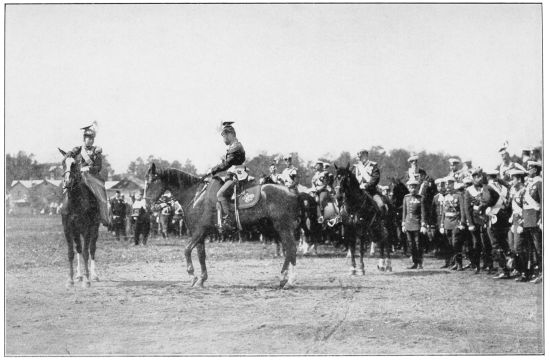
THE TSARITSA IS HONORARY COLONEL OF THE UHLANS OF THE
GUARD.
When they were presented to her there were many things that seemed so
strange that for a long time she could not acknowledge her acceptance of
them.
In most royal marriages, the brides change their faith as lightly as
they change their gowns, and learn the priest-taught formulas that their
tutors prescribe, and subscribe to the doctrines of their adopted church
without fear or question. Alix demanded intimate knowledge of all the
doctrines she must accept, so learned theologians and doctrinaires were
dispatched to Darmstadt to give her instruction. Many are the stories
told of her long arguments with these learned men over points that were
not clear to her, and of her deep prying questions into the reasons for
certain regulations and laws. At one time it seemed as if she could not
accept certain things that these holy men were endeavouring to press
upon her and more than one rumour went abroad that the royal marriage
would never take place simply because of these religious difficulties.
There seemed some ground for these reports, for the priest who had been
her especial instructor, one Yanisheff, at one time became so despairing
of his “heretical” charge, that he left Darmstadt altogether and
returned to Russia.
A long letter from the Princess was received by Nicholas, and he,
instead of being hurt by the way she held out on these matters,
expressed himself as highly pleased. A vigorous correspondence then
passed quickly between them. And in the end, it was her love that
conquered. I do not think that Princess Alix has ever been what the
world calls an “ambitious woman.” No one believes that the Greek priests
“converted” her. But she loved Nicholas with a love that transcended all
creeds and dogmas and finally, after long hesitation, her love rose to
the highest point and for his sake she “accepted” the state church of
the land that was to be her future home.
At the time the betrothal was definitely announced, it was anticipated
that Alexander would probably continue to reign for some years, and that
in the meantime the bride of the Heir Apparent would have ample time to
accustom herself to Russia, and to school herself for the difficult rôle
of Empress, which she would one day have to assume.
The Russian press was flooded with stories and anecdotes of the beauty,
the cleverness, and the varied accomplishments of the German Princess
whom Nicholas was bringing to Russia. This was to popularise her among
the people. It was said that she was a rare musician, a great scholar,
and even that she had taken the degree of doctor of philosophy at some
university! Flaming lithographs of her were circulated by the thousand
among the peasants, and in the space of a few months her name had become
a household word across the Empire and the Russian people were prepared
to accept her as a worthy consort to the Heir Apparent.
The betrothal was announced in April. In September of the same year,
Tsar Alexander’s health began to fail rapidly and he was removed from
the cold of the northern capital to the Royal estate of Livadia in the
Crimea.
I have seen royal palaces and parks in every part of the world, but I
have never seen a more beautiful place than Livadia. It is on the slope
of the Crimean Alps, some of whose peaks tower more than three thousand
feet above the glorious blue waters of the Black Sea that here lap the
shores of Livadia. Yalta, lovely Yalta, a winter jewel daintily set in a
wondrous setting of sea and hills, is removed from Livadia by only a
spur of mountains easily and quickly crossed. And here, when all the
rest of Russia lies frozen beneath semi-Arctic snows, roses and
oleanders bloom, and ripe fruit hangs luscious for the pickers. Here
winter suns are warm and winter evenings balmy.
I think the fairest nights I have ever seen have been in Yalta and on
the road to Livadia when a December moon shone brightly over the
restless water and aslant the lovely hills as in dream nights of June.
To this most beauteous spot in all Russia, Alexander III was taken. It
was the monarch’s last journey. When it became evident that the end was
near Nicholas sent for his bride-to-be. Probably no woman or man in
modern times has had so warm a welcome prepared. The press of Europe was
echoing and re-echoing the praise of the young Princess, in happy attune
with the inspired press of Russia. The Emperor William himself went to
meet the Princess at the Berlin railroad station and bid her
Godspeed—she who was to wear an Imperial crown.
Warsaw was the first Russian city where Princess Alix paused on her
journey to Livadia whither she was hastening in the expectancy of
marrying prior to the death of Alexander III. At Warsaw she was met by
her sister, the Grand Duchess Elizabeth, and farther along in the
journey by the Heir Apparent. Her progress across the Empire was like a
triumphal march despite the sadness that hovered over a nation whose
ruler lay dying. Great arches of welcome were raised to her, and the
populace turned out all along the way to do her honour.
We can well imagine the mingled feelings of surprise and awe which must
have overwhelmed the retiring and somewhat austere German Princess, as
she came in contact now for the first time with the great world, and
with the homage of a vast people which from that day was to be her’s for
all the rest of the days of her life. Princes and potentates, like
peasants from the isolated villages of the Steppes, bent their knees in
humble obeisance, while soldiers stood at salute as she passed. She knew
full well that she was leaving behind her forever the simple life she
had always known up until now. She knew that she was going to a
death-bed scene, between ranks of gold and silver. Though her path was
scattered with flowers and the plaudits of the people continuously rang
in her ears, she knew what the end of the journey must be, and she must
have known too, in a dim, tragic way, all that lay beyond the endraped
gold, toward which she was speeding in the Crimea.
Upon arriving at Livadia Princess Alix hastened to the bedside of the
moribund Emperor. The following day, in the royal chapel of Livadia she
was received into the Greek Orthodox Church under the name of Alexandra
Feodorovna. Her own preference was for the name Catherine, but yielding
to the wishes of Nicholas, she accepted the name of his choosing. The
wedding day was fixed for the following Wednesday, but the nearing end
of Alexander necessitated a brief postponement—only till the end had
come, and all that remained of him had been transported to St.
Petersburg and laid to rest beside the remains of his father, and his
father’s fathers for many generations, in the golden-spired Chapel of
the grim fortress of Saints Peter and Paul on the banks of the swift
flowing River Neva.
Some there are, believers in omens, who attribute many of the
difficulties of her life as Tsaritsa to the name she took when she was
received into the Russian Church,—Alexandra Feodorovna, after the
grandmother of the Tsar, her husband. For Alexandra has long been an
ill-fated name in the unhappy land of Princess Alix’s adoption.
A daughter of the Emperor Paul who was called Alexandra had a very
tragic end. When she was but seventeen years of age her grandmother,
Catherine II, arranged that she should marry the King of Sweden. The
preparations for this royal wedding were all elaborately made and on the
day set all was well, so far as the world knew. The tables were laid for
the marriage banquet and the bride, all robed and ready, awaited her
royal bridegroom. The guests were assembled and the priests stood by in
their gorgeous mantles of gold. Suddenly His Majesty the King announced
that he would not go on with the wedding! His courtiers and suite
pleaded and implored him not to offer so terrible an insult to the
daughter of an Emperor and to the whole Russian nation. But in vain. The
King was obdurate.
The news was tardily announced to Catherine, whose wrath knew no bounds.
The guests withdrew and the Swedish party quit the Winter Palace and
returned to Stockholm. The humiliated Alexandra was given no further
choice even after this terrible ordeal, but was speedily married willy
nilly to an Austrian Grand Duke. But she really did not survive the
shock of the failure of her marriage with the King of Sweden, and she
died of humiliation and a broken heart—only nineteen years of age.
A daughter of Nicholas I was named Alexandra. She was early married to a
step-son of Napoleon Bonaparte. But a fatal disease carried her off
before she was twenty, again emphasising the traditional tragedy
associated with his name.
Alexander II had a daughter Alexandra, a lovely, golden-haired child,
but she succumbed to an illness in childhood.
No wonder then, that the superstitious feared for the future of Princess
Alix, when she took for herself the name that has so often been borne by
daughters of sorrow in Russia. But Alexandra was the name Nicholas chose
for her, and that sufficed. The mourning family returned to St.
Petersburg after the death of Alexander III and as soon as preparations
could be made, the wedding took place—the entire Court laying aside its
mourning weeds for one day. Thus edged in black, the official ceremonial
life of the Tsaritsa began.
At the wedding ceremony, she did not show to advantage. She was reserved
in her manner to the point of severity, and a trait was noticed on that
day that has militated against her ever since. Despite her natural
physical grace she does not know how to dress! Her simple German
training had not taught her how to wear beautiful clothes. Possibly the
wearing of lovely gowns well is an instinct born in some women. At all
events on her wedding day, the Empress-bride failed to please the court.
A few days later when the young Tsar was receiving deputations from
different parts of the Empire, there occurred a rupture between him and
some deputies from the Province of Tver, which he has never been able to
outlive, and for some unexplained reason the sentiments that he then
expressed in heat, were accepted as the sentiments of the Empress as
well. The Chairman of the deputation humbly offered the congratulations
of the people of Tver, and ventured to add that it was their hope that
the new Emperor might be pleased, in the course of his reign, to grant
certain liberties to his people, perhaps even a Constitution. This hope
was partly based on their faith in the young Empress, whom they expected
would have liberal sympathies as a result of her life in Germany and her
affiliations with England. But the Tsar burst forth into a terrible
tirade against such notions, told them “to be done with these idle
dreams,” and even threatened the whole deputation with banishment.
The whole country was astounded at this uncalled for outburst, and a
lurking suspicion sprang up that the Tsaritsa might not be so liberal as
they had hoped. And this indeed seems to have proved true, for whatever
influence the Tsaritsa has exerted in Russia from that day to this, has
been in the direction of Reaction and severe administration. She has
always accepted the point of view of her husband. Nicholas II believes
himself a God-ordained Autocrat, and the great ambition of his life is,
not to hand on to his successor a happy and peaceful nation living under
a constitutional monarchy, but an absolute autocracy, and Alexandra
Feodorovna has supported and worked for the realisation of this
ambition.
When one remembers the glorious, golden romance of this girl, one’s
imagination is fired to highest heat, and one rejoices when the child
who was called “Sunny,” who early battled bravely with life, was at last
coming unto her own. But alas! At the very moment when it would seem
that Providence had filled her cup to the full, the dark clouds began to
gather, and the little German Princess, when she ceased to be Princess
Alix, also ceased to be “Sunny.” Instead of entering upon a period of
life rich in blessings, showered with happiness, she faced graver
responsibilities, greater hardships and harder battles than she yet had
known. The crudest blows of fate were yet to fall upon her.
The wedding of the Tsar and Tsaritsa was almost the only bright day of
the winter of 1894 in St. Petersburg society. Mourning was resumed
before even the usual wedding ceremonials were ended and few court
functions were held until after the coronation, which took place the
following spring. This event was looked forward to by the entire court
and the most elaborate arrangements were made to make it the most
magnificent and dazzling spectacle of the kind that a traditionally
magnificent court had yet known, an historic occasion, notable from
every point of view.
During the festivities celebrating this event, the young Empress might
have been expected to have won all hearts. Instead, the popularity of
the Dowager was enhanced, and the suspicions against Alexandra, which
had been aroused during the wedding celebration, were deepened.
Russia, always poor, was in especially straitened circumstances the year
of the coronation. Crops had failed—the winter had been severe—and
peasants were starving in different parts of the Empire. Yet the
coronation show cost the Government many millions of dollars. The
harness worn by the horses that drew the carriage of the Empress alone
cost more than one million dollars!
The German Princess, born amid frugal surroundings, simply reared, early
taught to value pennies, and never affluent, on this occasion found
herself in a strange setting, indeed. Her coach followed the carriage of
the Dowager Empress. Eight snow-white horses adorned with red morocco
trappings trimmed with exquisitely engraved gold, champed their teeth on
bits of solid gold, and above their heads waved snow-white ostrich
plumes; in her shining chariot sat the Empress in a silver and satin
gown with an ermine cloak over her shoulders, ropes of diamonds hanging
from her shoulders, and a crest of diamonds above her head. How
wonderful a change from the life she had always known! Too great a
change, perhaps. For even now her manner did not please the populace.
The Dowager was hailed with acclamations and unprecedented enthusiasm.
The Empress was received in dead silence. The situation was an
impossible one. She tried to smile upon the throng, but her smiles were
stony and cold, and people remarked to one another that she only “stared
in disdain.” After the long and tedious coronation service, as the
Emperor was painfully making his way to the Church of the Ascension,
staggering under the weight of his royal robes and crown, he stumbled
and fell in a long swoon—just as he has fallen ever since under the
weight of responsibilities and cares he has never been strong enough to
carry.
The following day the coronation festivities were interrupted by a
terrible catastrophe. Some five thousand peasants were crushed or
trampled to death in a stampede and panic preceding the distribution of
certain simple meals, which were to have been in honour of the great
event of the coronation. The calamity has never been satisfactorily
explained, but there seems to have been a general lack of efficiency
among those who had the distribution in charge. No sooner was word
received of the disaster, than the Dowager Empress hurried to the
overcrowded hospitals, administering personal comfort, and relief, and
cheer to the surviving wounded. Her great activity and sympathetic
devotion endeared her yet more to the people, and as long as she lives,
thousands will revere her for her expressions of grief and solicitude on
this occasion.
Nicholas, however, made himself conspicuous by doing nothing. On nearly
every occasion during the course of his reign when he has had a signal
opportunity for doing the right thing, he has acted precisely as he
acted on this occasion—he has turned his back and gone off. And
Alexandra Feodorovna has acted in concert with her husband. They both
attended the ball at the French Embassy that same night, thus horrifying
not only Russia but the civilised world.
I do not believe that the Tsaritsa is lacking in heart warmth or human
sympathies, but her life is dominated by one man. Before she was an
Empress she was a woman, and as a woman she loved, and as a woman she
gave all to that love, and to the end of the chapter one must look for
the real life of the Tsaritsa in those spheres where her personal love
for this one man holds sway.
From the coronation day the Tsaritsa never regained a place in the
affections of the Russian people, and having recognised this fact, and
having realised the futility of usurping the place of the Dowager
Empress, she simply ceased trying. The Russian people don’t dislike her,
they merely do not know her.
When travelling through the interior of Russia, I constantly heard the
Tsar spoken of by the peasants. Sometimes reverently, of late more often
disdainfully, occasionally in the terms of the old Russian proverb: “God
is in heaven and the Tsar is far off.” But I do not recall of ever
hearing a peasant speak of the Empress. When I have asked about her the
moujiks have invariably shrugged their shoulders in silence. They
often have a bright coloured lithograph of her on the walls of their
houses, and they all think the picture very beautiful. More than that,
they know nor care not at all.
Once in an interior village I heard a group of peasants discussing the
Tsar with a trace of old-time superstitious reverence and I asked, “What
of the Empress?”
A shaggy old moujik shook his towsled head stolidly as he replied:
“She is the Little Father’s woman—but what can we know of her?”
The Tsaritsa entered upon a life of unusual difficulty from the moment
she crossed the Russian frontier. She realised even at the time of her
wedding, and more than ever at her coronation that she was not liked at
court, so she did what any sensitive soul would have done under similar
circumstances—she turned from the people who criticised her, who failed
to appreciate her trying, turned to those whom she loved, who loved her.
How many women in our own country have been through just such
experiences! Not called upon to serve as queens or empresses, but
summoned to positions they never were fitted or trained to occupy. With
the realisation of failure comes a terrible disappointment and sorrow,
sometimes heartbreak. Good women then turn to the fruits of love and in
their children seek the salvation necessary to counteract the first
failure.
The Dowager Empress had never approved of the marriage of Nicholas to
Princess Alix. She herself had always been exceedingly popular with the
Russian people. In her affliction and bereavement the sympathy and
affection of the nation went out to her. At the coronation of her son
and his spouse, her warm personality so completely outshone that of her
younger successor as Empress of the people, that a circle of the court
immediately gathered about her. From that day to the present time the
influence of the Dowager Empress and her “court party” has been more
potent than that of the Tsaritsa. At times this influence has been
directed openly against her rival and always to the embarrassment of the
younger woman. For several years they were not even on speaking terms
and to-day they rarely meet save on formal occasions when court
etiquette demands the presence of them both at some particular function.
The attitude of the Dowager Empress has been a source of continual pain
to the Tsaritsa and besides actively militating against her, it has been
one more strong influence driving her away from the usual interests and
activities and more into her family life.
This estrangement between the two first women of the court has also
tended more than anything else to isolate Nicholas. It has resulted in
periodic ruptures between the Tsar and his mother, and it has strained
his relations with his numerous relatives and important personages of
the court, who have remained loyal to her.
These are some of the reasons why the life which ought to have been
bright and happy has been utterly miserable, and now there are
indications that a complete nervous breakdown may crown the burden of
her years.
Alexandra Feodorovna, as the wife of the Emperor, was expected to be the
mother of an heir to the throne of Russia. And even here long years of
enduring pain and travail were before her, for four girls were born
before a son came to them. When the first child was born, in November,
1895, there was disappointment throughout the Empire. But the Tsar said
a splendid thing at that time: “I am glad,” said the Royal father, “that
our child is a girl. Had it been a boy he would have belonged to the
people, being a girl she belongs to us.”
One year and a half after the birth of the Grand Duchess Olga the second
daughter was born, and she was named Tatiana. Marie followed in another
two years, and Anastasie exactly two years later. More than three years
then elapsed before Alexis, the son and heir, made his appearance.
During these three years the aid of all kinds of soothsayers and
charlatans was invoked to influence the sex of the child. An old priest
of the interior who had been dead seventy years was canonised in the
hope that the miracle of a boy might be worked! This is a story by
itself, however, and it would be premature to tell it now.
It is wellnigh impossible for people in America to understand the
disappointment and vexation of the court when girl after girl was
born—four of them—before the long wanted son. The Tsaritsa fell more
and more into disfavour, and the aristocracy—especially those who were
the friends and followers of the Dowager—took advantage of the simple,
superstitious peasants to point out to them that the Empress was not
beloved in heaven or she would have borne a son.
When finally a son was born many people loudly asserted that the boy was
a substitution and not the Tsaritsa’s child at all. This was a very
malicious thing to say and was, of course, entirely untrue. The rumour
persisted, however, and received certain credence until it was pointed
out that the Dowager Empress was far too watchful, and too much at
enmity with the Empress to allow any such imposition to be perpetrated.
Until the birth of the son the Tsaritsa took little part in public
activity. Indeed, it was not until the war year of 1904 (which was also
the year of the birth of a son) that she undertook to participate to any
extent in work for the nation.
At the breaking out of the war between Russia and Japan the Tsaritsa
undertook to assist the work of the Red Cross Society. I have seen
several of the rooms in the Winter Palace which were turned over to the
work of preparing bandages and warm clothing for the wounded soldiers in
the hospitals at the front. In connection with this work the Tsaritsa
was conspicuous before the people for the first time since her
coronation as Empress in an undertaking properly belonging to the
nation. She gathered together hundreds of young ladies of the court,
organised working parties, and before long among the women of
aristocratic circles it was distinctly the thing to do to belong to one
of the Empress’s working groups, to prepare warm caps, and mufflers, and
stockings and bandages for the army. The Empress herself worked
indefatigably. And so did the two older Grand Duchesses, Olga and
Tatiana. They both sewed and knit till their little fingers were stiff
and sore.
The earnest spirit of patriotic pride and sacrifice exhibited by the
Empress at this time was inspiration to thousands of young women in St.
Petersburg and Moscow, and on the big estates of rich noblemen
throughout the Empire. One group of fashionable St. Petersburg girls
presented themselves in a body to the Empress with the request that they
be sent to the front to serve as volunteer nurses. But the Empress
replied: “You are not experienced enough for that work, nor strong
enough to endure the hardships of life in Manchuria. What you may do is
to serve in the hospitals of St. Petersburg, thus enabling the regular
trained nurses to go to the front.” Almost without exception these young
ladies acted upon this suggestion, and many of them did most excellent
service, eventually becoming as useful as nurses who
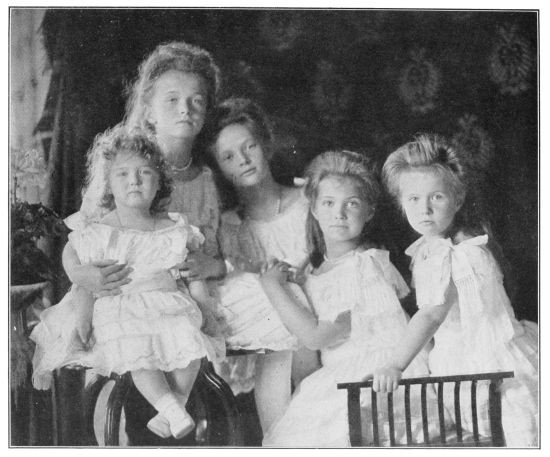
THE FIVE CHILDREN OF THE TSARITSA.
had undergone the usual training in preparation for such work.
Some idea of the extent of this work may be gathered from the single
fact that in the year 1904 the depot at Kharbin alone received from the
Winter Palace headquarters, over which the Empress presided in person,
no fewer than eleven million eight hundred articles. In addition to
these things more than a million dollars in money was collected and
forwarded for the purchase of surgical instruments and such other things
as were sorely needed by the badly equipped Russian forces. Some seventy
ambulance trains were organised, and a number of chapels and libraries.
In thanking the corps of women who had assisted her in this work the
Empress said: “I am happy to know that through the efforts of the
workers in my depot my most ardent desire to give relief to our dear
troops has been satisfied.” And in a telegram to one of the generals
commanding at the front she said: “Inform the troops in the Far East
that I rejoice that it has been given me to lighten even to a slight
extent the lot of the unhappy victims of a cruel war, who have so
self-sacrificingly shed their blood for the honour of the Throne of
Russia. United in prayer with you all I lift up to the Highest my ardent
petition that He may comfort all who have suffered on the field of
battle and continue to keep alive in the hearts of the valiant and
heroic Russian warriors, the feeling of devotion to their duty, their
oath and their love to the Fatherland.”
The Empress also organised the famous “Dog Detachment,” by which, with
the help of dogs especially trained in Germany, the overlooked wounded
were sought out after the tides of battle had swept the Manchurian
plains and hills. Unfortunately this detachment was never given proper
opportunity for activity, as the fields of battle almost invariably
remained in the hands of the enemy.
Besides the Red Cross work, the most important public undertaking of the
Tsaritsa has been the establishment of Labour Aid Institutions. This is
really an incipient charity enterprise and is being gradually extended
to different parts of the Empire.
Viewed as the charity organisation of a great nation the whole scheme is
a ridiculous farce, but viewed as the work of an individual its
proportions seem substantial. A complete list of these institutions
practically means a complete list of the charities of the Empire, and
includes temporary nurseries for babies, homes and asylums for children,
lodging-houses for workless men, old people’s homes, lying-in hospitals,
institutions for the insane, libraries and reading-rooms and various
depots where simple work is provided for those who are able.
I visited a number of these institutions and satisfied myself that,
however satisfactory a catalogue of this work might be, that the work
itself had small value. It is the crudest and most careless organisation
of charity I have seen anywhere in the world, and carried on on such a
trifling scale as to be practically valueless. If the time ever comes
when the Russian Government can take up the work thus begun it will be
given a value—the value that ultimately accrues to all pioneer work.
There are more starving peasants in Russia every year than in any
country of the western world. The numbers annually mount up into the
millions—in 1906 there were twenty-seven millions in the famine belt.
The beggars and workless, the maimed and the crippled victims of the war
fill the streets of all the large cities. A lodging-house for fifty or a
hundred men in a city where fifty thousand are in want is the merest
drop in the bucket. The schools for girls are better equipped and better
endowed than any of the other institutions embraced in this work, and
this is owing to the personal interest of the Empress in girls.
This interest of the Tsaritsa’s in girls is doubtless owing to the fact
that she has so many daughters of her own. Many of the schools which she
has helped to start and to support have been named after her own little
girls. The “Olga Children’s Homes” in St. Petersburg and Moscow were
first inaugurated in 1898 and now are on a firm foundation.
In Russia, the Labour Aid Institutions are treated lightly. Even friends
of the Empress speak of them as trivial. Judged by their present
capacities they are trivial. They are badly managed. They offer rich
opportunities for what is variously called “protection,” “patronage”
and “graft”—opportunities which are fully taken advantage of, as I saw
for myself in several of the places which I visited. There were
elaborate offices, luxuriously fitted with selected furnishings, and
small regiments of young aristocrats and noblemen (like all public
servants of rank in Russia, called “chinovniks”) serving as clerks and
directors. Positions of absolute sinecure carrying rich emoluments. Not
one of these institutions—outside of the orphanages—would stand the
test of scientific charity or philanthropy. For all this I am inclined
to give the work a higher value than do the Russian people for, after
all, Russia will one day be a modern nation in forms and institutions,
and then all of this work will needs be developed. It will then be good
to have this little experiment scattered about the country. It may prove
the foundation for a work of worthy proportions. And I am glad that the
Empress may claim credit for most of what has been done. There are
schools and institutions of one sort or another named after each of the
children, as well as after the Empress herself, and to all of these the
Empress contributes annually from her private purse.
In no sense can any, or all of these enterprises be considered a great
work, but they are all characteristic of the Tsaritsa. It is indicative
of simple, human sympathies, it is quiet and unostentatious—almost
timidly so—but the idea underlying it all is real.
The court of Nicholas II does not entertain nearly so frequently nor so
lavishly as the preceding Courts of the last hundred years. This is
partly owing to the temperament of the present Tsar, and the retiring
characteristic of the Tsaritsa, and also because of the troubled and
distraught condition of the Empire during the last several years.
Several court balls each winter are required, however, and on these
occasions the Tsaritsa is always a conspicuous figure. Her own enjoyment
at these Royal functions may well be questioned. In the first place,
there are certain aged ministers, ambassadors and potentates with whom
she must dance. Doubtless these eminent worthies are frequently endowed
with great dignity, but statesmanship and imposing presence do not make
up for grace and ease in tripping figures to light music. And if,
perchance, the Tsaritsa would waltz with a brilliant young officer, or
charming courtier, all the other dancers must at once stop and clear the
floor for the Empress and her favoured partner. To be thus the observed
of all observers cannot be otherwise than trying to one of so modest and
retiring a nature.
Years before, when the Tsaritsa was still only Princess Alix of Hesse,
she had visited St. Petersburg as the guest of her sister Elizabeth, who
had married the Grand Duke Sergius. During one of the dances at a
certain ball given during this visit, Princess Alix slipped on the
polished floor and fell. Her partner, as well as a number of young
officers, sprang toward her to assist her to her feet, but the Grand
Duke chanced to be near and he, too, sprang to her assistance. Instantly
the embarrassed partner and other officers stepped back. The privilege
of assisting the confused and blushing Princess was the prerogative of
the Grand Duke because of his exalted position!
When the Tsaritsa does participate in a public function she does it with
a stateliness and grace that commands respect, whatever of coldness her
manner may suggest.
I had the privilege of being near to her on one of these occasions. It
was the 10th day of May, 1906, in the Throne Room of the Winter Palace
in St. Petersburg.
The Emperor had called together the First Duma and the members of this
extraordinary body, together with the council of Empire and the entire
Court, were assembled to hear the speech from the Throne. It was the
first time in sixteen months that the Royal Family had visited the
capital. These sixteen months had been characterised by almost
continuous revolutionary activity, successive mutinies in the army and
navy, general strikes and disturbances of every description. There was
wide speculation as to the probable outcome of this meeting between the
Tsar and the representatives of the people. “To us,” remarked one of the
Ladies of Honour attached to the Empress, “to us, it is like letting the
Revolution into the Palace”—this reception of the elected deputies of
the people! Members of the court were fearful lest the Tsar would never
return from the Throne Room. Many, if not most of the nobles present,
went in fear and trembling, and went because they had been commanded by
the Emperor and for no other reason.
I met one well known Prince the morning of that day and he immediately
bade me congratulate him, as he had been excused from appearing at the
function.
When the music of the National Anthem was heard, announcing the approach
of the Royal party the atmosphere of the Throne Room became so tense
that it was painful. Not one person in the room dared think what the
next minute might bring forth! When the Tsar and the Grand Dukes and the
Empress and the Dowager Empress and the Grand Duchesses were all
assembled before the richly attired Metropolitans and high priests for
the interminable preliminary blessings, the slightest sound echoed
throughout the room, so still and strained was every human being in the
room. The nervousness of the Tsar was apparent to all. The agitation of
the Grand Dukes was laughable, especially the manifestations of their
fear in their repeated and excited crossing of themselves. Even
correspondents, schooled and trained to recklessness in all kinds of
danger and calm to the point of being blase in the face of any
situation, breathed hard and showed the terrible strain and tension of
the minutes.
The Empresses alone appeared in full command of every nerve and muscle.
I looked upon the Tsaritsa in silent admiration. The picture of her
strong, immovable figure is imaged forever upon my memory. The
fluttering of a glove or a handkerchief from the balcony to the floor
would surely have upset the entire assemblage in spite of its
magnificent show of military symbols, buttons, medals and gold and
silver trappings. The thought came to me there, and I have recalled it
many times since, had such an untoward incident occurred the Tsaritsa
alone, or at least, the Empresses alone, would have stood stolid. The
exquisite poise and complete possession of the Tsaritsa commanded
absolute admiration. Cold and indifferent she may be toward the people
of her court, but on an occasion like this she certainly acquits herself
with rare credit. At all times a magnificent woman to look upon, tall,
statuesque, imposing, imperial, she never appeared to better advantage
than on this occasion.
With her, somewhat back in the procession were the four older children
of the Tsar and Tsaritsa—Olga, Tatiana, Marie and Anastasie. These
little girls bear the title of Grand Duchess, and in them has the life
of the Tsaritsa long been centred. Presently I shall have a number of
stories to tell of their nursery days. As we go on we shall learn how
completely the life and time of the Tsaritsa have been taken up with her
children and their home and family life.
Easter is one of the greatest fêtes of the year in Russia. The long
Lenten fast is usually kept rigorously by all classes over whom the
church maintains dominion, and even by many who have ceased to reverence
Orthodoxy, but in whom the instinct of traditional observance remains.
On Easter Eve there is a tremendously solemn service in all of the
churches in the land. At the stroke of midnight priests and choir burst
forth in loud hallelujahs and all the people shout “Christ is Risen!”
“Christ is Risen!” and greet one another with a holy kiss. Everybody
kisses everybody else in sight regardless of previous acquaintance. I
remember standing bolt upright in a fearful press in St. Isaac’s
Cathedral one Easter Eve for two mortal hours in the middle of the
night, the atmosphere hot and fetid till even men swooned and all
wearied unspeakably.
On Easter morning presents are exchanged and masters and mistresses
greet all the servants of their households with the holy kiss. The Tsar
and Tsaritsa observe this custom as religiously as the humblest of their
subjects, and every palace maid and stable boy is greeted in this way.
Long before the hour when the Emperor and Empress are to receive the
household, there is great excitement below stairs where all the servants
busily scrub their honest faces with soap and water till they shine like
great apples in preparation for the kiss of their imperial master and
mistress. The Tsar kisses every man in the palace, even to the soldiers
on duty, and the Empress every maid servant. On one occasion the
Tsaritsa remarked that she “sometimes thought the Emperor had rather the
better of it because of the new leather that the soldiers wear on that
day, and which smells so nice!”
In view of the fact that court observance would naturally expect the
Tsaritsa to play the rôle of Empress, rather than of mother and wife as
her life work, it is the more extraordinary that this mighty Queen (in
point of power and opportunity) has chosen the quieter life of the home.
In addition to the private fortune of the Tsar, an immense income
accrues from the gold and precious stone mines of Siberia which are
worked by convicts for the private purse of the Emperor and from the
vast timber holdings that he controls; besides all this, the Government
officially grants him a “salary” of nearly five million dollars a year,
which is paid to him in monthly instalments of four hundred thousand
dollars each.
The Tsaritsa, as head of the Royal Household, is mistress of nearly
thirty thousand servants, scattered in many palaces and residences
throughout the Empire. It is not likely that this vast retinue is any
particular care to her, for the army of servants, just like the army of
soldiers, is divided into groups and officered by various functionaries.
In fact, it is likely that the two armies are not dissimilar in the
minds of the Tsar and Tsaritsa. Every wish of the Tsar’s is a command to
the army and has only to be uttered to an aide to be executed. So the
word of the Tsaritsa spoken to a lady-in-waiting is all sufficient to be
carried out by any or all of her servant host.
There are fifty thousand head of cattle in the Royal pastures, and five
thousand horses in the Royal stables. Over all these the Tsaritsa is
supreme—as the wife and consort of the Tsar,—and one hundred and forty
million subjects besides!
The point of her whole life as Empress is that when Princess Alix
married Nicholas she gave herself and all of her activity to
Nicholas—not to the Russian nation.
Every act of hers has been one of personal devotion. If Princess Alix
had been ambitious as many women in court circles are, or if she had
never loved so intensely and so blindly, the world looking back upon her
career as it does to-day, might have deemed her a better Empress. As it
happened, circumstances throughout her life have all driven her back
from the public role and more into the circle of the family. Thus it
comes about that the chronicler of her life must pass lightly over her
life as Empress and dwell at length upon those sides of her character
which the words wife and mother indicate. In other words, her entire
life has been one long romance. A life of devotion to her husband and to
her children, and this at the expense of her duties as Empress.
As the years have passed the disposition of the child once called
“Sunny” has altered and changed, and the lines of wistful pathos which
have settled round her still lovely face are doubtless indications of
the drops of gall that have tainted her cup of life’s happiness. For all
these mellowing lines the Tsaritsa wears an expression that in many
lights is of that unusual other-worldly beauty, so seldom seen in the
great world of to-day, but common to so many of the women whose
portraits have been left us by the world artists of the Middle Ages. It
is an expression that appears and ripens only under soul development,
and as we see it in the Tsaritsa we do not find it difficult to
understand and trace, for a considerable part of her life has been given
over to religious thought and contemplation, and not to the study of
theological doctrines and controversies only, but to the deeper truths
of spiritualism and mysticism, truths whose elusiveness holds them for
ever remote to all save the few, and whose realities are measured only
by the standards of the eternal verities. This brings us to one of the
most extraordinary, and at the same time one of the fascinating sides of
the life of the Tsaritsa.
An interesting trait of the forebears of Princess Alix was their belief
in ghosts. Presently we shall see that Princess Alix, even after she
became Tsaritsa, gave much of her time to the study of the mystics and
has always had spiritualistic tendencies and beliefs in the
supernatural. Most of the Dukes of Hesse are credited with similar
superstitions.
Duke George II, who lived in the seventeenth century, is said to have
seen the ghost of his dead brother Wilhelm on one occasion. Before the
death of Wilhelm there had been a quarrel between the two brothers. The
ghost chastened and severely reproached Duke George for his bitterness
and hatred. The incident made such an impression upon him that as long
as he lived, he could not shake off the spell of the weird experience.
Another Duke of Hesse, a William, had a life-long terror of ghosts and
always slept in a brilliantly lighted room. A story is on record of this
man that he once returned to one of his hunting lodges at night, when
suddenly all of the lights went out, a great wind magically arose, doors
slammed, windows shook—and presto!—the lights as suddenly reappeared,
but all of the soldiers of the guard had mysteriously vanished and the
entire lodge was dismantled. Long before this the lodge was reputed
“haunted,” so that when the Duke was there the soldiers of the guard
were changed every thirty minutes and the whole establishment kept well
lighted.
Just prior to the birth of the fifth child to the Empress, a phase of
temperament developed, which attracted the attention and comment of the
world. From early girlhood, the Princess Alix had manifested an interest
in things philosophical and theological. Back in her old home at
Darmstadt, the Royal betrothal had once nearly been broken owing to the
religious scruples of the bride-to-be. Princess Alix could not convince
herself or be convinced that she was right in renouncing the Protestant
faith of her mother and adopting that of the Greek Catholic Church.
Finally, her love for Nicholas overcame her scruples of conscience and
she forced herself to accept the doctrines of the State Church of
Russia. Priests who had been assigned to tutor her, to this day relate
their experiences and difficulties in meeting the arguments and
answering the questions brought up by the Princess: the familiarity
which she exhibited with German theological writings and philosophical
theories confused them. In Russia, as Empress, she continued to
encourage her interest in religious doctrines and theories. The friends
of her own choosing were generally men and women with whom she could
discuss vital religious problems. Surrounded as she was by an atmosphere
perennially surcharged with the sense of impending tragedy, she not
unnaturally, developed pronounced morbid tendencies. From time to time,
she believed that she caught the glint of certain gleams of spiritual
truths in the distance and these she pursued with that fatal persistence
which so often leads people, especially women of temperamental or
melancholy tendencies to ultimately accept various “isms.” The Tsaritsa
became more and more markedly spiritualistic. By nature and by training,
she was retiring and preferred the splendid isolation of the court in
her home circle to the more brilliant opportunities offered her by her
supreme social position. These tendencies toward retirement, encouraged
as they were by the Court which did not take kindly to her nor exhibit
at any time the cordiality and friendliness generally accorded Queens,
she came to live more and more in the realms of the spiritual. She
carried her intellectual interests far beyond the things we know and
over into the borderland of Faith and Belief. To those who knew her
well, it was not a matter of special surprise when, after the birth of
three children and no heir to the throne, the Tsaritsa turned an open
ear to various men who claimed supernatural control over things
physical.
Prior to the birth of Anastasie, the aid of eminent medical and
scientific men was sought to influence, if possible, the sex of the next
child, but all to no avail. (What pangs of bitterness must sometimes
have come to her mother heart when she remembered the two boys whose
father was also the father of her daughters,—two sons who could never
be recognised by their own father and who were destined forever to be
exiled to a foreign land because of the blot on their ’scutcheon! What
piercing irony of fate for the father who must sometimes have remembered
his outcast sons upon whom he had bestowed the bastard mark while the
birth of a legitimate son and heir was so long deferred!)
When science failed, religion and spiritualism were appealed to. Rumours
were rife of various charlatans imported from one place or another to
practise their magic. Of these, the one who came to be the most widely
known was called Philippe. Philippe first joined the royal entourage at
Livadia. Later, he was brought to Moscow and St. Petersburg, and for
several years, he is said to have exercised great influence not only
over the Empress but over the Tsar as well. The Tsar has ever been an
impressionable man and though he has displayed all the stubbornness of a
weak nature, he has frequently been under the domination of others. Just
as he was willing to lend a ready ear to Pobiedonostzeff and to his
uncle, the Grand Duke Sergius, so also was he willing to listen to
charlatans who came to him well recommended. It was under the
Reactionary Grand-ducal party that Philippe was brought to Russia. In
course of time, this man came to be known as “the Tsar’s magician.” An
atmosphere of profound mystery always surrounded Philippe, although of
the extent of his domination, there never was any question. From all
that I can gather, this man’s name was Philippe Landard. Landard is
supposed to have been the son of a shepherd and that he was born in a
small village situated high among the French Alps. When quite a boy, his
father would regularly take him to the local abattoir, and on one of
these visits, he made the acquaintance of a butcher who took the boy
into his employ. Landard possessed imagination even as a child, as is
evinced by the fact that his contract with the slaughter-house prompted
him with the desire to become a surgeon. With this hope in view, he
attended evening classes and night lectures in the medical school at
Lyons. Handicapped, however, by lack of money and presumably not endowed
with keenest intelligence, he never succeeded in passing the
examinations necessary to admit him to practice. What he did succeed in
doing, however, was to discover and develop certain magnetic powers
which he undoubtedly had,—powers of personality which he cultivated
remarkably. He turned this power especially in the direction of healing.
He practised auto-suggestion and by the judicious use of massage,
frequently succeeded in convincing people that his healing powers were
literally real. Ultimately, he was able to establish himself as a
thaumaturgist or practising healer in the Rue Tape d’Or at Lyons where
he acquired considerable local notoriety which presently spread all
over France among people who believed in his art. At least twice, he is
said to have been arrested and charged by the police as an illegal
practitioner. This led him to be more discreet in his methods and he
refrained from ever writing a prescription or committing himself in
writing on any point. The leader of the French School of Occultism
became interested in him and through him, he met Dr. George von
Langsdorff of Freyburg. Dr. von Langsdorff had been brought to Russia by
the Grand Duke Constantine Nicholevitch and presented to the Emperor
Alexander II who had actually commissioned him to sense out and unravel
Nihilist conspiracies. Dr. von Langsdorff, whether through the
connivance of the political police or not we do not know, succeeded in
foretelling certain plots which actually materialised. He attained
considerable notoriety in connection with the blowing up of the
dining-room of the Winter Palace in St. Petersburg in 1880. Dr. von
Langsdorff evinced considerable interest in Landard but unlike von
Langsdorff and other members of the French School of Occultism, Landard
ascribed his supernatural powers, both in matters of healing and
prophesy, to divine influence, that is to say, whereas the French
practitioners were avowedly irreligious and proclaimed themselves
Freethinkers, Landard cultivated the spiritual element and professed
himself a religious man.
Through von Langsdorff, Landard was brought into contact with certain
members of the Russian colony of royalties who annually visit the
Riviera. It was upon their invitation that Philippe visited Nice and
while there was fortunate enough to win the favour of the Grand Duke
Alexis. This was accomplished through curing the Grand Duke of a painful
attack of rheumatism of the knee by his “laying on of the hands” method
and magnetism. The Grand Duke Alexis passed Philippe on to the Grand
Duchess Vladimir, who in turn brought him to Russia and was instrumental
in having him put in touch with Tsar Nicholas II. From all accounts,
Philippe was a man of courage, personality, of winning and sympathetic
manner. The Tsar frankly liked him and before long, Philippe was
established as a more or less permanent member of the Royal Household.
The Emperor consulted Philippe on all kinds of personal questions and
later sought his counsel in regard to the weightiest questions of state.
It has even been said that during the winter of 1902-3, the influence of
Philippe had grown so supreme, that a determined protest was submitted
to the Tsar by the members of his council and ministers, including Conte
Witte. Philippe was retired for a time from practice, but was still
retained as a member of the Royal household and, privately, Nicholas
continued to listen to the spiritualistic haverings of this man. From
time to time, Landard also appeared to effect cures upon various members
of the Royal household and of the court. These things naturally tended
to strengthen his position and to enhance his prestige. The result of
these manifestations of power upon Emperor Nicholas was to confirm his
confidence in Philippe’s supernatural connections. In him, Nicholas
thought he had found another, if not the actual reincarnation of Joan of
Arc. Nicholas seems to have had little difficulty in persuading the
Empress to trust in the potency of Philippe’s power in regard to
influencing the sex of their next child. At all events, the next child
proved to be a son. Philippe claimed much of the credit for this, but it
is evident that the entire credit was not accorded him by the Royal
Family inasmuch as a certain parish priest in the Province of Tambov was
later given credit for exerting a like influence. The priest had been
dead many years, but his tomb had been made a kind of shrine by the
moujiks and it had been annually visited by barren women who claimed
to have found in the shrine the secret of fruitfulness and also the
spirit of influencing the sex of unborn children.
The effect of Philippe’s ministrations upon the Tsaritsa let her still
deeper within the portals of the Spirit World. To conclude the story of
Philippe, it is said that he became intoxicated with the power and
confidence bestowed in him by the Royal Family and that he overshot
himself at the time of the Russo-Japanese war. He is supposed to have
been largely instrumental in persuading Nicholas to take the attitude
that he did which brought about the war and throughout the long,
disastrous campaign was continually prophesying a turn in the tide which
never came. Landard is said to have represented to the Emperor that he
had been selected by Divine Inspiration to assure the Emperor that the
war in Manchuria would inaugurate a new and great era of Russian glory
that would forever overshadow the Yellow Peril which at that time was
popularly feared to be menacing Europe. When disaster followed disaster,
members of the Court and Royal Household lost faith in Philippe and
finally the Tsar himself ordered him to leave Russia within forty-eight
hours. This banishment proved a great blow to Landard, who, heart broken
and covered with disgrace, returned to his own native villa of St.
Julian d’Arbresle where he died the following year from a complication
of internal disorders.
Despite the downfall of Philippe, the faith of the Empress was not
shaken in the least in things mystic and spiritual and there is ample
evidence that this inherent characteristic has in reality become a
veritable second nature.
Miss Margaret Eager, an Irish lady of good education, was called to
Russia in the year 1899 to serve in the capacity of Nursery Governess to
the Royal Family. Miss Eager is very much of a Celt. She has a profound
belief in the philosophy of mysticism and indeed she herself seems to be
possessed of certain supernatural powers, second sight, visions and
dreams that come true. Miss Eager related to me various occurrences in
the Royal Family concerning strange and seemingly mystical
manifestations. Miss Eager herself, believes firmly in the reality of
the spiritualistic sense of the Empress.
When the Grand Duchess Olga was three years old, she was taken ill with
a gastric attack from which she did not fully recover for two or three
weeks, the attack itself, in its severe form, keeping the Royal child in
bed three or four days. The first time Miss Eager left the bedside of
the sick child for a breath of fresh air, she went for a walk along the
quays of the Neva. Upon her return, as she entered the room, little Olga
looked up and said, “An old lady was here!” “What old lady?” she asked.
“An old lady who wears a blue dress,” the child replied. Miss Eager was
frankly puzzled because the Court was in mourning at that time and there
was no one wearing a blue dress. “Surely, you mean blue. What kind of
blue?” questioned Miss Eager. “It was not like Mamma’s,” and the child
paused. Miss Eager thought perhaps one of the maids had had a visitor
and so they were all questioned, but nobody knew of any visitor during
Miss Eager’s absence, and so the matter for the moment was dropped and
dismissed by Miss Eager as a possible vagary of the child’s imagination.
A few days later, Miss Eager was sitting on the floor with the Royal
children in a certain room in the Royal Palace playing at building
castles of cards. Suddenly, Olga looked up and exclaimed, “There is the
old lady in blue!” “Where? Where?” said Miss Eager and the other
children. “There! she came through the bedroom door; she is standing at
the door now!” Miss Eager quickly caught up the child and ran through
the bedroom into the room beyond and into yet another room, but she
could find no one nor could she hear any footsteps. “Well,” said Olga to
Miss Eager, “you must be very stupid because the old lady was there.”
Two days later, the Empress directed Miss Eager to take the child to the
Chapel in the Winter Palace and there, in the hall on the way to the
chapel, are two life-sized portraits of the Emperor Alexander II and his
wife. Looking at the picture of Alexander II’s wife, Olga said, “Why,
that is the lady I saw in the blue dress and see, her dress is not the
dress Mamma wears.” The identification was made by the Grand Duchess
with the utmost assurance.
Now, this incident by itself would have no significance, but Miss Eager
relates in connection with it other incidents which give it interesting
if fantastic value. Miss Eager, during her long stay in the Royal
Household, always slept with the nursery. One night, she maintains, she
distinctly heard a voice coming from directly beneath her bed. The voice
was far off and weird and was as of one weeping bitterly and making
terrible complaints and the language used was French. The story she was
relating was one of extreme intimacy. Miss Eager says that she sat up in
bed to try to locate from whence the sounds were coming, but no sooner
had she raised herself upright than the voice ceased. Upon laying her
head on the pillow again, the voice resumed and the complaints were of
her husband’s unfaithfulness. While Miss Eager was still meditating the
extraordinary experience, the Empress as was her wont, entered the room
and Miss Eager asked her what room was directly beneath the room they
were then in. The Empress replied, “Merely storerooms.” Miss Eager then
said to the Empress, “But there is some poor woman there and suffering
from the most terrible affliction.” The Empress replied, “What are you
saying?” Whereupon, Miss Eager related what she had just experienced.
The Empress then asked if the words were spoken in English. “No,”
replied Miss Eager, “It is French; at first I thought it might be the
cook, but that is impossible because the French spoken was very pure and
elegant.” The Empress then said that if Miss Eager thought there was any
one below, she had better get out of bed and listen at the floor, which
she did, but could hear nothing. The Empress then told her to get back
into bed and go to sleep. Immediately her head touched the pillow, the
voice was again audible to her. Suddenly the Empress said, “Tell me,
does it remind you of anything you have ever heard before? Do you know
anything of the story of this room before it was done up for my little
ones?” Miss Eager replied that she knew that the wife of Alexander II
slept in this room and then she recalled having heard that this woman
was very unhappy because of her husband’s numerous peccadilloes with
other women. She recalled, also, that the Princess Dolgoruki was
Alexander II’s mistress. His wife, who used this room over a long period
of time, used nightly to bury her face in her pillow and cry aloud.
After she recalled these things, the Empress said, “Yes, but before she
died, she went to the Dolgoruki and told her of her unhappiness, using
the very selfsame words that you have just repeated to me as having
heard while on your pillow.” The Empress thereupon told Miss Eager that
she was sleeping on the very bed which Alexander II’s wife had used and
upon which she died. The next day, the Empress herself, insisted that
the entire furnishings of the room be changed and that a new bed be
installed. It is said that Alexander II, after the death of his wife,
wanted to marry the Princess Dolgoruki, which indeed, he may have done
morganatically. Miss Eager was deeply impressed by this experience and
in the mind of the Empress there was no question or shadow of doubt
whatever.
Another incident related by Miss Eager in connection with the Empress
occurred in the Palace at Peterhof. One night, according to her custom,
the Empress entered Miss Eager’s room. Miss Eager relates that she awoke
to find herself being shaken by Her Majesty who was crying, “Awake!
awake! come back!” and when Miss Eager came to her senses, she realised
that she was crying bitterly. “What is it? What is it?” exclaimed the
Empress. “I have been here five minutes shaking you and you would not
wake up; what is the matter?” Miss Eager replied that she must have had
a nightmare. The Empress insisted upon knowing what Miss Eager had seen
in her unhappy dream, whereupon, the nursery governess related that in
her dream, she appeared to be in a town of some far distant country—a
southern land. The streets were badly lighted; many of them were narrow
and the people round about her who filled the streets, were dark and
swarthy. Traversing these streets, she presently came to a great
building before which a crowd had collected. As she stood and wondered
what interest held the people, an open carriage drove up. The thought
flashed through her mind, “Royalty must be expected; who can it be?”
Just then, out of the building came an elderly gentleman whom Miss Eager
did not recognise, but he was followed closely by a man in uniform.
After the man got into the carriage, there was the glint of flashing
steel and immediately the oldish man dropped back apparently lifeless.
At once, all was turned into a mad dream and Miss Eager found herself
trying to crush the Empress and the Royal Princesses under the seat of
the carriage. Whereupon, the Empress laughed and said, “You can see for
yourself, that it was only a dream, for you could not shove me under the
seat of the carriage even if you could succeed in putting the children
there.” When the Empress had gone Miss Eager once more drifted off into
sleep. In the morning when she awoke, she was tired and nervous as if
after some long journey. When Mary, the nurse, came in, she said, “Why,
Miss Eager, what is the matter with you this morning?” and Miss Eager
told her that in the night she had had a terrible dream in which she had
seen a man in a carriage murdered. At breakfast time, when she saw the
Empress, she said, “Have you had any more nightmares?” and then turning
to the Emperor, who had just entered the room, Her Majesty directed Miss
Eager to relate to him the hideous dream of the night before. Whereupon,
Miss Eager related the unhappy scenes of her nightmare. The Tsar
listened with the utmost attention and when Miss Eager had finished
speaking, he said, “Miss Eager, I hope that you won’t be very much
frightened because what you saw in your dream last night was an incident
which occurred in a town of Northern Italy where His Majesty, King
Humbert, was assassinated at precisely the hour that the Empress entered
your room and in that manner that you describe in your dream.” Miss
Eager, like a flash, remembered the picture she had seen of the late
King of Italy and it was the man whom she had seen enter the carriage
followed by the officer in uniform! As the Tsar told her this, he held
in his hand a telegram which had just been received detailing the news
of this assassination.
On one occasion, the Empress told Miss Eager that all her life she had
been much interested in the spiritual world, but that she had come to
the conclusion that it was wrong to meddle with such things because if
there was anything in it, it must come from the devil.
Early one evening, the Empress entered the nursery and told the children
that she was going to dinner and would probably be very late,
consequently would not come in to see them on her return, as was her
wont. There was going to be a séance after the dinner. The next day,
Miss Eager took occasion to ask Her Majesty if she had enjoyed the
séance. The Tsaritsa proceeded to tell her all about a clairvoyant
called Philippe but with a note of bitterness in her recital, for she
said that Philippe had mesmerised her husband and made him do exactly
what he told him. The Empress steadfastly refused to see Philippe after
that. Just what occurred at this séance, the Empress never did say, at
least to Miss Eager, but it was quite clear to her that Her Majesty had
been unfavourably impressed and that she would have nothing more to do
with the mysterious Frenchman. Considerable pressure was brought to bear
upon the Empress by various ladies of the Court to persuade her to go
once more to Philippe, but she never would do it.
These incidents indicating this phase of the Tsaritsa’s character are,
of course, sympathetically interpreted by Miss Eager because she,
herself, believes so absolutely in the spirit world, in dreams and
intuitions.
For example, before Port Arthur was beseiged, Miss Eager in a dream saw
its fall and told the Empress about it. The Empress afterwards reminded
her of this dream and deeply regretted that the Tsar had not taken
counsel from Miss Eager’s vision rather than from Philippe.
On another occasion, Miss Eager told Mary, the nurse, to go and tell a
certain lift-man in the Palace that he was not to work that day as, in a
dream, she had seen him terribly crushed and mangled, but Mary laughed
and refused to convey the message. Miss Eager thought it seemed rather
foolish and so did not insist upon sending the message to the man. That
afternoon, when she returned from the daily drive with the Grand
Duchesses, the Empress sent for her and said, “Miss Eager, this morning,
you told Mary to warn the lift-man not to work to-day and Mary refused
to carry your message.” Miss Eager said, “Yes, that is true.” “Well,”
said the Empress, “I sent for you because I wanted to tell you myself
that while you were out with the children, the lift-man was killed.”
Another curious incident which is hard to explain occurred at the time
of the death of Princess Ella, a daughter of the Grand Duke of Hesse, a
charming child of seven years, who succumbed to an illness of only 36
hours’ duration,—apparently ptomaine poisoning. The child was staying
at the time with her Royal uncle and aunt, the Tsar and Tsaritsa at the
Palace in Poland. While the child was ill, and just before her life
spark was extinguished, two of the Russian Grand Duchesses, Olga and
Tatiana, who were sleeping together in a neighbouring room, suddenly
began to scream frantically. The Empress, the physicians in attendance
upon Princess Ella and Miss Eager rushed into the room where the
children were and saw them standing in their beds and shrieking in
terror. It was long before they could be pacified and then they told how
they had seen a strange man with flowing robes and great wings, walk
through their room. While they were still telling of the fearful
apparition, the eyes of both the children suddenly became dilated with
terror and both of them simultaneously pointing in the same direction,
cried, “Look! Look! There he is again. Don’t you see him? He is going
into Ella’s room. Poor Ella! Poor Ella!” Of course, none of the adults
could see anything and the physicians assured the Empress that it was
but an attack of childish hysteria which had suddenly and strangely come
upon both children. Only a few moments later, the Empress and the
physicians were hurriedly summoned to the bedside of the dying child
who, lapsing into a state of coma, died in the Tsaritsa’s arms. To this
day, the Empress, as well as the Emperor and Miss Eager, are convinced
that the children actually saw this Angel of Death passing into the room
of the dying Princess. At least, it is true that there are many similar
inexplicable cases on record of children and sometimes of animals, as
well as of dying persons, having supernatural vision at moments of
death. Horses, for example, have been known to become terror-stricken
when passing the scene of a murder, while the well-known death-rap is of
such common occurrence that there can be no doubt of its existence.
These incidents are related in order to explain much that is otherwise
inexplicable in the character of the Tsaritsa. The mental development
which she has experienced through her entire life has been logical and
in natural sequence. Her early philosophical and theological interests
have simply been developed abnormally in the abnormal environment in
which she has lived. While the Empress has been ever sceptical when
conversing with her friends and reluctant to accept as reality,
manifestations of the spirit world, there can be no doubt that both she
and the Emperor have nevertheless been secretly convinced that they are
both instruments of God as well as possessing the power of holding
converse with the spirit world.
This is proved by the canonisation of Seraphim, the parish priest of
Tambov, whose tomb they visited prior to the birth of the heir, Alexis.
Seraphim had been dead seventy years, but the Tsar, anxious to leave no
stone unturned to procure a son and heir, encouraged by the Tsaritsa,
insisted upon the canonisation of Seraphim. When the remains of the old
priest were unearthed, it was found that the body was badly decomposed,
and to canonise a man whose body yields to the influence of
decomposition is contrary to the traditions and customs of the Church.
Orthodox Bishop Dmitry of Tambov made bold to call attention to this
fact and protest the canonisation of Seraphim. For his temerity, the
Tsar, deeply angered, ordered that Dmitry be deprived of his see and
exiled to Viatka. According to Emperor Nicholas, the preservation of
bones, hair and teeth were sufficient qualification for saintship.
Furthermore His Majesty was upheld in this by various sycophant but
prophetic monks, who, with sublime assurance, allowed that God will one
day work a miracle and restore Seraphim’s body. So Seraphim was
canonised with great pomp and ritualistic solemnity. If anything were
needed to fasten the belief of the Tsar and Tsaritsa in these extreme
forms of religion it was the patent answer to their faith and trust in
Philippe and Seraphim.
The boy was called Alexis and he was born on July 30, 1904, according to
the Russian calendar, and since that time, Tsar and Tsaritsa have been
given more and more to spiritualistic religion.
Of recent years, since the war with Japan and the revolutionary outbreak
in 1905-6, few court functions have been held. In the ordinary daily
routine the Tsaritsa prefers to breakfast alone, to lunch with only one
lady-in-waiting and the Emperor with but one adjutant. The dinners are
likewise simple as often as is possible. The older children are brought
in for meals when there are no guests. The tastes of both Tsar and
Tsaritsa are equally simple as to food and to dress. The Tsar’s
favourite uniform is that of Colonel of one of his regiments, except in
the summer, when he frequently appears in hunting costume—an English
Norfolk jacket, knee trousers and leggings or high boots.
English is the language generally used by the Royal Family when
alone,—English and German. The Tsaritsa speaks Russian quite correctly,
but with a marked German accent. This is not strange in view of the fact
that she did not begin to study the language until after her betrothal.
Like most Germans, she speaks French poorly and consequently French has
never been a popular language with them, although the Tsar speaks it
most excellently well.
Because English is used so much by the Emperor and Empress it is the
popular language in court circles and among officers. Many Russians send
their children to England when they are very young in order that English
may be their first language. I have known many Russians who spoke
English absolutely perfectly; fluently and without the slightest trace
of foreign accent. The children of the Tsar and Tsaritsa use English
most.
The Tsaritsa’s voice is low and deep, not unmusical. Her laugh is light,
usually breaking into a silvery falsetto. She is slightly taller than
the Tsar, being about five feet eight and one-half inches, while he is
barely five feet eight inches. Her face still wears an expression of
soft, wistful beauty, which is enhanced by a small mole near the corner
of her mouth. It is so small that it frequently is not noticed at all,
but if one stands near her it is observed and not unpleasantly.
Miss Eager relates an incident which reveals the curious stolidity not
to say cold-bloodedness of the character of the Empress. The Empress had
gone to the christening of a battleship at St. Petersburg and returned
to the Palace at St. Petersburg in the evening. In the nursery the
Empress told Miss Eager how the officers of the ship had been drawn up
in line for the ceremony when a sudden thunderstorm had descended and a
peculiarly vivid flash of lightning had struck a flagstaff nearby,
shattering as it fell and striking some of the officers. One man rolled
right to the feet of the Empress and her dress had been splashed with
blood. The Dowager Empress had fainted at this sight, but the Empress
herself insisted that the man had died in the service of his country and
that consequently it was not a matter for mourning!
Of late years, the health of the Empress has been decidedly shattered.
During the summer of 1910, the Tsar took her for a long holiday to
Germany. She visited her childhood home of Darmstadt and later took a
cure at a watering-place known for its beneficial effects upon people
suffering from nervous and heart disorders.
During the summer of 1907 when the Imperial Family were holidaying on
the yacht, Standart, off the islands of Finland, there was an attempt
to do away with the entire family, the full details of which have never
leaked out into the broad world. It is known, however, that this attempt
was the result of a conspiracy which included some of the officers and
men of the Royal yacht. The shock which the Empress sustained at that
time, she has never recovered from and more or less sensational rumours
are frequently given to the world suggesting the precarious condition of
her mind as well as of her nerves.
From this extraordinarily exclusive family life, which is at present the
rule at Peterhof and Tsarskoe-Selo (the two places where the Imperial
Family spend most of their time) the Tsar has come to be spoken of
among the Grand Dukes and people of the court as “The Little Married
Man.” This phrase is indicative of the supercilious way that family life
is regarded in Russia. Americans are frequently horrified at the
nonchalant way that Russian nobles flaunt their mistresses about the
streets and public restaurants of St. Petersburg.
The Tsar, as a young man, was probably as fast as any of his court, but
after his marriage he settled down wonderfully. Whether he still has his
wayward periods, as gossip sometimes asserts, I do not know. On the
whole he is a good husband and a fond father. He undoubtedly appreciates
the tremendous love the Tsaritsa pours upon him.
The attitude of the Tsaritsa toward the education of the Russian people
will seem somewhat extraordinary to Americans, though after all it is
probably consistent with her life. In this, as in everything else, she
accepts the attitude of her liege and lord, the sovereign of the Russian
people. When a certain Count Tolstoy (not the late Leo Tolstoy) was
Minister of Public Instruction he once appealed to the Empress to aid
him in extending the educational advantages of the Empire to the girls
and young women of the country. (I have Count Tolstoy’s own permission
to relate this incident.)
The Tsaritsa listened to the Minister attentively as he set forth the
needs of Russia in this direction, and when he had concluded she replied
that she thought all young girls should be taught to sew, to care for
their homes, in short, to become helpful wives and good mothers, but as
for granting them the privileges of so-called “higher education,”
knowledge of history, philosophy and the sciences—to this she was
entirely opposed. “Because these studies, when offered to women, only
result in such terrible times as Russia is now passing through.”
This, surely, is a remarkable tribute to the women of Russia, the
Tsaritsa holding them responsible for the movement toward liberty and
freedom, as a result of their contact with education and culture!
On the other hand, the Tsaritsa sometimes generously encourages the
extension of school opportunities to individual girls whose efforts
happen to have been brought to her attention. For example, Miss Eager,
who for six years was governess to the little Grand Duchesses, and who
probably saw as much of the Tsaritsa during those years as anyone
outside of the Royal Family has ever seen, relates this anecdote, which
I repeat with particular gladness, because it is one of the few of the
kind that I have heard concerning Her Majesty.
“This story was told me by the Empress herself,” says Miss Eager. “One
morning there arrived on the train from the Caucasus, a little girl aged
eleven. She approached a station porter and asked to be sent to the
Minister of Education. The porter was greatly astonished and hesitated
as to what he should do. Then the child said with oldish solemnity, ‘I
have come from the Caucasus, a seven days’ journey, to be put to school;
you must please get me a droshky and send me to his house.’ So the
porter called a carriage and directed that she be driven to the Ministry
of Education. Arriving there she had great difficulty in gaining
admission to the Minister, but the doorman finally consented to tell the
Minister that a little girl from the Caucasus desired to see him.
“The Minister was occupied at the moment, with a Secretary of the
Empress, but the latter was interested in the message and the child was
ushered into the office. The little girl bowed to the two dignitaries
and proceeded to relate her case. The Minister appeared greatly amused
and told the child she must return to her home, as he had no vacancy.
But the little girl was persistent and soon showed that she had no idea
of returning so easily to her distant home across the Empire. ‘You are
Minister of Education,’ she exclaimed, ‘and I have come all the way from
the Caucasus to St. Petersburg to be put to school. You must put me
somewhere.’ The Minister, though puzzled, was beginning to be impressed.
At last the Empress’s Secretary begged that the child be cared for until
there was a vacancy in one of the schools patronised by the Tsaritsa.
These schools are few in number and are very exclusive. A note was
thereupon written by the Minister to the Mistress of one of these
schools and the little girl was sent to her under escort of a footman.
The joy of the child was unbounded and she could scarcely express her
gratitude to the Minister.
“The Secretary went that afternoon to Peterhof and related the incident
to the Tsaritsa herself. The Empress asked that an inquiry be made
immediately and the truth of the child’s story substantiated. The
investigation showed that the two older sisters of the child had been
admitted to a local school, but there was no room for her. She took this
greatly to heart and fretted over it until at last she determined to get
a schooling anyway. She appealed to friends, to the local priest and the
doctor, and all of their combined efforts to reconcile her to the ‘Will
of God’ proved futile. At last, to pacify her, they subscribed enough
money for a ticket to the capital, and the child set forth on her long
journey all alone.
“When the Empress heard the story in detail, her heart was touched and
she commanded that place be made for her in one of her own schools. The
child is there to-day, receiving careful instruction, and enjoying the
direct patronage of the Empress.”
The Empress really loves all children, and in spite of the coolness
which exists between her and her court, all children are fond of her. On
the name day of each of her own children, she takes a long drive with
the child whose celebration it is, and this event is much looked forward
to by them all. Whatever leniency may be exercised in correcting the
capricious whims of Alexis, I believe that she is a strict mother with
all of her daughters.
The Empress has few recreations. Owing to the fact that she rides badly
she practically never rides for pleasure. Because of her disposition she
has few, if any, real confidantes and intimate friends among the ladies
of the Court. She has ladies-in-waiting—several hundred of them—but
these are chiefly for formal occasions, and of her own choice she has
but one near her at a time and different ladies are chosen for brief
periods. Evenings she and the Emperor choose to retire to their private
apartments and if she has no guests she reads aloud to him, not
infrequently from English newspapers or an English novel.
The Tsar is fond of cards. The game of wint, a gambling game much played
all over Russia, is a favourite of his, and he usually plays for high
stakes, much enjoying the zest that the gambling element lends to the
game. The Tsaritsa, on the other hand, is fond of the camera, and enjoys
photography immensely. The children have few playmates apart from their
own family and sometimes Royal cousins, children of one or another of
the Grand Dukes, or one of the Royal relatives of their own mother or
father abroad.
The Princess Ella, daughter of the present Grand Duke of Hesse and
brother to the Tsaritsa, was a playmate whom the little Russian Grand
Duchesses adored up to the sad and untimely death of the German
Princess. Being left most of the time to themselves, the children of the
Tsar and Tsaritsa enjoy joining their mother in her pastimes when it is
possible, and photography is one of the things that they all can do
together.
The Emperor has always done some shooting each year and is really fond
of the sport. One morning a few summers ago he returned to the Palace
quite fatigued, having been out all night after blackcock. Blackcock
shooting is considered right good sport because the birds are so shy
that it is difficult to get near them, and indeed, it is only at certain
times of the year that they can be shot at all. On the morning that I
refer to the Empress greeted the Royal sportsman and turning to a friend
said: “Blackcock can only be shot at the mating season, when the males
are pouring forth their song in deaf and blind rapture.” Could anything
be more cruel than to kill them at such a time?
In the summer the Tsaritsa is fond of sailing in and out among the
Finnish wherries, but this annual outing is for two or three weeks only.
Previous to “Bloody Sunday” in January, 1905, the Winter Palace in St.
Petersburg was occupied, but since that fateful day the two outlying
palaces only have been used. This has been a disappointment to Grand
Duchess Olga, who always loved the Winter Palace and often expresses the
wish to “live there all the time.” The Winter Palace is the largest
building in Europe and is a marvel in appointments. It contains rarest
malachites and jaspers, rich paintings, gifts galore that have been
showered upon other Tsars, priceless jewels, and wonderful carved
furniture. Besides the great rooms of state, salons and banquet rooms,
suites of residence, libraries, offices, and vast halls that are now
used as public museums, are beautiful winter gardens, great
conservatories rich in tropical plants, rare ferns and orchids,
blossoming plants exuding fragrance, and among the forest of greenery
hang many cages of singing birds. In the centre of these winter gardens
are pools of water in which gold fish sport, and at times pretty
fountains play into these pools.
Whenever I have been in this wonderful palace I have felt as if I were
wandering through a dream world. Several times I have been through
portions of this palace and each time I have felt a new thrill of
unreality.
The occasion of my first visit was when the Tsar received the members of
the first Duma, the occasion when I first saw the Tsaritsa, the Dowager
Empress and the little Grand Duchesses. The Tsar had commanded all of
the grand dames of the Court to appear in full court costume, and the
result was a scene of unparalleled splendour, a spectacle imposing
beyond imagination. The Throne Room and halls that were in use that day
suggested scenes from the magnificent days of the Empire of France when
beautiful women and emblazoned, uniformed men arrayed themselves in
costumes of glittering splendour. The old Russian court costumes which
were worn in the Winter Palace that
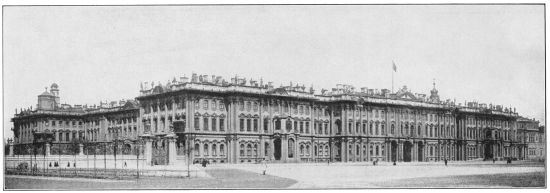
THE WINTER PALACE, THE SCENE OF “BLOODY SUNDAY.”
day were quite as splendid as any the French ever conceived even in the
days of greatest pomp and show.
On another occasion I was received at the Winter Palace by a well-known
and powerful nobleman of the Court, who has been close to the Empress
for many years in the dual capacity of high functionary and friend. He
is one to whom my high thanks are due for some of the material contained
in these articles, for he not only told me some of the anecdotes which
are here related, but he verified much of the material that I had
collected from other persons and sources.
Peterhof is the favourite residence of the Tsaritsa and four of her five
children were born there. One of the several buildings of this palace
boasts a charming romantic history. About half a century ago when the
first Nicholas was soon to be Emperor of Russia, he paid a visit to the
German court. During the visit a tournament was held and Nicholas, then
a Grand Duke, acquitted himself with honour. At the close of the
tournament the victors rode past and close under a balcony, where were
seated the ladies of the court and the Royal Family. A young Prussian
Princess tossed a wreath of roses which the Russian Grand Duke caught on
his sword.
The incident proved the beginning of an attachment which culminated in
their marriage. Some years after, when the Grand Duke had become
Emperor, he bought the great park of Peterhof and built a palace for
his Empress. Remembering the incident of the wreath of roses, at the
tournament at the Prussian court, the device of a sword and a wreath of
roses was made the predominant decorative figure of the palace. You may
see it there to-day. Now as then, Peterhof belongs to the ruling
Empress. Tsarskoe-Selo is an Imperial residence belonging to the
government. Both of these palaces are within an hour of St. Petersburg.
Any visitor may stroll through the outer gardens and adjoining parks of
the palaces and at any time one may meet the Tsaritsa or the Grand
Duchesses driving or riding. The Tsar is the only real prisoner of the
family, although Alexis, the four-year-old heir, is jealously guarded.
The Tsaritsa rides badly. Despite the fact that she is commander and
“honorary Colonel” of at least two cavalry regiments she does not sit a
horse well and never rides for pleasure. In this respect she is very
unlike many modern Queens, notably the Empress Elizabeth of Austria, who
was a marvellous horsewoman, possessing that rare hypnotic influence
over the most spirited horses that the animals themselves are quick to
recognise and yield to. It is only on such occasions as a review of one
of her own regiments that the Tsaritsa mounts a horse. Ordinarily she
drives—in summer in an open carriage, and generally unescorted.
The children may from time to time be seen playing about the lawns with
a favourite pony, or driving in little wicker-work carts. They are as
full of frolic as any little girl in America, and in the nursery and the
household apartments of the palaces they are as ingenuous, as
irrepressible and often quite as embarrassing as any children we all
know. Royal manners, at least in the children, are no different from
manners of other people, and the daughters of even an Emperor and
Empress have sometimes to be rebuked quite as severely as any children
the world over.
The Tsaritsa dresses very plainly. Richly often, but in general effect
simple. The Court has never approved her clothes, chiefly, I think,
because of her inability to wear good clothes well. As a child she
dressed in the utmost simplicity and the habit has remained with her. At
certain court functions etiquette prescribes her costume. When she dons
court dress known as Old Russian, she has merely to wear elaborate
clothes that have been described in detail for her generations ago. It
is when she dons costumes for everyday wear that she fails to please a
fastidious court.
The average American girl very naturally thinks of the clothes of the
Tsaritsa of Russia with a combined feeling of awe and interest, with
just a little of envy creeping in. Imagine having all the money you want
to spend on your clothes and being able to wear jewels valued at
millions of dollars. And, of course, the American girl wants to know all
the details of the Tsaritsa’s wardrobe, and how many hats and dresses
she has each season, and how much they cost.
It may be a disappointing fact, but it is nevertheless true, that the
Tsaritsa just hates the thought of clothes, and though her costumes are
of expensive fabrics, they never have any chic individuality of their
own, for the very good reason that she cares so little about them. Of
course, she does her shopping in Paris, but she does it by proxy. One of
the Ladies-in-Waiting is commissioned to buy each season her gowns and
her hats and all the other little details appropriate for a Tsaritsa’s
wardrobe, in Paris, but many times when they reach the Tsaritsa, she
discards them with the expression, “Indeed, that is perfectly lovely and
very Frenchy, but it would never do for me at all.”
The corsetiere in Paris who makes the Tsaritsa’s stays has troubles of
her own, for the Tsaritsa utterly refuses to change her figure to suit
the ever-changing modes. Her waist is growing large of late, according
to the Parisian idea of a fashionable figure, but this doesn’t trouble
the Tsaritsa as much as it would trouble many women in America.
For everyday wear her gowns are all of the plainest, but, of course,
there are occasions when she must wear regal robes. Her court costume is
a magnificent creation of the richest satin elaborately trimmed with
heavy embroidery. Masses of the embroidery are used, while the corsage
is laden with jewelled trimming. The buttons which trim this court
costume are each one of them worth a small fortune. They consist of a
large pearl in a wonderfully artistic setting. The Tsaritsa’s pearls,
which she wears with her court costume are famous the world over.
It is no wonder she has all of these magnificent things, for in addition
to the hundreds of thousands of dollars’ worth of gifts that she has
herself received from her subjects and from fabulously rich kings,
princes and potentates of the East and Central Asia, she has at her
disposal jewels that belong to the Russian Crown—gifts to other
Empresses, and Emperors, far back, perhaps for several hundred years.
Sometimes she wears drop-earrings of matched pearls, which are
marvellously valuable, and her dog collar and necklace and corsage pin,
also of pearls, have a value of millions of dollars. The Tsaritsa is
always glad when the time comes for her to take off her court costume.
The long, heavy train is a burden to her. She is very partial to
light-in-weight gowns.
Many of her dresses are of the lingerie order, consisting of lace and
fine nainsook.
Yet, on the other hand, she has many house gowns and cloaks of velvet,
trimmed with rare laces. Perhaps, of all her jewels, she cares most for
a long string of wonderful pearls, which she wears very often. The
string is so long that she can wear it twice around her neck, and yet
have the longest loop reach to her knees. The short loop comes to the
waistline, and is finished with one single pear-shaped pearl of enormous
value.
All the children’s clothes are made according to the Tsaritsa’s idea,
and simplicity is their key-note. The children are very apt to wear
white entirely, and the four little girls are dressed exactly alike.
Their hair is arranged in the same way, too, brushed straight back from
their foreheads. Of course, the finest of materials is used in making
their clothes, but the design is always extremely simple. Their
christening costumes were all made alike, even the small boy’s this
time. They were of the sheerest of white mull with exquisitely fine lace
insertions. The little dresses had short sleeves and were cut out round
at the neck, and tied on the shoulders with white ribbon, having long,
silk fringe. The shoulder bows were the dress-up touch, the touch which
is so seldom seen in any of the costumes worn by the Tsaritsa’s
children.
The young man of the family is also usually dressed in white, and though
his little Russian suits come from Paris, they are strictly plain in
design, generally of heavy white linen, and trimmed with bands of
embroidery.
All these little details may be commonplace, but they are perhaps all
important when we are trying to analyse the character of the Tsaritsa
through her tastes.
The effect of the war upon the children of the Tsaritsa caused much pain
to their gentle English governess, Miss Eager, who relates the following
experience: “It was very sad to witness the wrathful, vindictive spirit
that the war raised in my little charges. One of the illustrated papers
had a picture of the baby children of the Crown Prince of Japan. Marie
and Anastasie came running across to see the picture, and wanted to know
who those queer little children were. I told them, and with a look of
hatred coming into her sweet face Marie slapped the picture with her
open hand. ‘Horrid little people,’ said she; ‘they came and destroyed
our poor ships and drowned our sailors.’” Miss Eager then explained to
the little Grand Duchess that it was not these children who had done
this terrible thing, because they were only babies and could not
possibly fight. But Marie answered obstinately, “Yes; those little
babies did it. Mamma told me the Japs were all only little people!”
Olga, as usual, was yet more bitter toward the Japanese. One day she
opened up vituperatively: “I hope the Russian soldiers will kill all of
the Japanese; not leave even one alive.” Her teacher tried to explain
that there were many little children and women in Japan, who had nothing
whatever to do with the war and could not fight under any circumstances.
Would it be good, she asked of Olga, for the Russian soldiers to kill
these too? The child was thoughtful for a moment, then asked: “Have they
an Emperor in Japan?” “Yes, certainly,” the teacher answered. Olga then
asked several more questions, and finally remarked: “I did not know that
the Japs were people like ourselves. I thought they were only like
monkeys.”
Olga, like so many children, who are the oldest in a family, has always
been a handful. About Marie, and Anastasie, and Tatiana too, for that
matter, are many pretty little stories of charming childish ways, but
almost every anecdote I heard of Olga was when she had been up to some
mischief, or disobedient, or stubborn, or quick of temper. One or two of
these stories, however, are interesting and show that even the mother
task of an Empress’s life is very much like every mother’s life, and
especially in the case of the Tsaritsa who has ever undertaken so much
more personal care of her children than most Queens—and one may even
say, than many mothers right here in this land.
One day, before the outbreak of the war, when Olga was quite a little
girl, she was taken for a drive with her nurse along the Nevsky
Prospect, the principal street in St. Petersburg. The little Grand
Duchess simply would not behave. She was continually jumping up and
attracting the attention of people along the streets, and as it was that
time in the afternoon when the Nevsky is crowded, this meant pretty much
the attention of all St. Petersburg.
Suddenly the child dropped back into her seat and sat bolt upright as
quiet as you please, her hands folded demurely in her lap. After a
moment she turned to her nurse and said: “Did you see that policeman?”
The nurse replied she had, but there was nothing extraordinary about a
policeman on the street. “But this one was writing something,” pursued
Olga. “I am afraid he was writing, ‘I saw Olga and she was very
naughty.’”
When the nurse replied that this was unlikely Olga reminded her,
somewhat reproachfully, that a few days before they had seen a policeman
arresting a woman who was under the influence of liquor, and when Olga
had begged that the woman be let off the nurse had replied that the
woman had been very naughty and deserved to be arrested, adding that one
had to be very naughty indeed to be taken off by the policeman in that
way.
The incident evidently made a deep impression upon the child, for no
sooner had they got back to the Palace than Olga began to inquire if any
policeman had been there for her. As soon as she could, she related the
whole affair to the Tsar and the Tsaritsa and ended by asking her father
if he had ever been arrested. The Emperor laughed and said he had never
been quite naughty enough for that, to which Olga exclaimed: “Oh! how
very good you must always have been!”
A little while before this Olga had been naughty all day and her nurse
said to her: “I am afraid you got out of bed with the wrong foot
foremost this morning.” Olga looked thoughtful for a moment but said
nothing. The next morning, before getting out of bed she called to her
nurse to ask which was the right foot for her to get out with. The nurse
indicated one of her feet and Olga slowly descended upon it. “Now,” she
said, “that bad foot won’t be able to make me naughty to-day.” And all
day, whenever Olga started to do things she ought not to do, the nurse
had only to remind her that she had got out of bed with her right foot
that morning, therefore she couldn’t be contrary.
Tatiana’s next youngest sister, the Grand Duchess Marie, one day caused
a ripple of amusement in the same Winter Palace. She was looking out of
one of the windows when a regiment of soldiers marched past, through the
magnificent Winter Palace Square over which a colossal Angel of Peace
broods, perched on a towering marble column. Suddenly Marie exclaimed,
“Oh! I love these dear soldiers; I should like to kiss them all!”
One of the family who was standing near overheard the child’s remark and
said: “Marie, nice little girls don’t kiss soldiers.”
Marie made no reply, but a little later there was a children’s party at
the Palace, and among the guests were the children of the Grand Duke
Constantine. One of the boys, aged twelve, had just entered in the
military school where high noblemen’s sons are trained for the army—the
Corps de Pages. This miniature officer arrived in his brand new
uniform and as he met his cousin Marie he made to kiss her. But Marie
sprang away, covering her mouth with her hand. “Go away, soldier,” she
cried. “I don’t kiss soldiers—nice little girls don’t kiss soldiers.”
Her cousin was so well pleased at being taken for a real soldier that he
readily forgave his dignified little cousin for declining his proffered
kiss.
Tatiana and Marie have always been sweet children, and, on the whole
even tempered if mischievous. Olga, however, the eldest, has never been
so popular. In 1899, when Olga was four years old the Royal Family
(which then included only three children), went to Moscow for a brief
sojourn. While there the Empress decided to have portraits painted of
the three children.
The artist who was entrusted with this commission began to take
innumerable photographs of them all. This was preliminary to the
sittings. The sittings proved tedious and tiresome and after the fourth
or fifth sitting Grand Duchess Olga quite lost her patience and her
temper, and at last exclaimed to the artist: “You are a very ugly man
and I don’t like you a bit.”
To the amusement of several members of the Imperial Household the artist
was much hurt by this Royal comment, and offended as well. He even
ventured to resent the child’s outburst. “You are the first lady who has
ever said I was ugly, and moreover, I’m not a man—I’m a gentleman,” he
replied.
Ladies of the Court were always loath to talk about Olga. “She is
cranky,” said one. “She is not nice,” said another. And one grand lady
of honour went so far as to shrug her shoulders and say: “She is like
her mother!” When I pressed this and begged her tell me more, the lady
merely referred to the haughty, disdainful manner of the Empress. I
think I have explained this attitude as I have understood it.
The Empress received very little sympathy and consideration from the
ladies of her Court from her first coming to Russia, and she soon came
to hold her head high and walk heedless through the throng. She
apparently gave no effort to winning friends but accepted the atmosphere
which circumstances and an obstinate Court created for her. Perhaps the
consciousness of her lack of popularity wore upon her, and rasped. That
wide popularity of the Dowager Empress, and her lack of cordiality
toward her young successor doubtless tended to further develop the very
qualities that have been her bane. At all events her disposition toward
most of the people of her Court has never been happy, and their silent
resentment of her coolness has driven her more and more into herself, to
the consolations of religion, and her family.
One Lady-in-Waiting, for example, told me that she had been attached to
the person of the Empress from time to time for a number of years. She
herself is a Princess of old family and in excellent standing at Court.
One day, when the Grand Duchess Olga was three years old the Princess
and the child were together in one of the nursery rooms. The Princess
stood with her back to one of the walls and Olga came toddling across
the room as fast as her little legs would carry her. The Princess
stretched out her arms, caught up the child and lightly tossed her
ceilingwards, then bringing her slowly down toward her own upturned
face, kissed her and set her down. At that moment the Empress entered
the room. She had no sooner seen this very natural action on the part of
her own Lady-in-Waiting than she exclaimed: “The most you may do is to
kiss the hand of my daughter!”
St. Petersburg is full of similar gossiping incidents concerning the
Empress. Many of them are doubtless fabricated, as many such anecdotes
always are concerning people who occupy conspicuous positions in the
world, but the one I have just related is true, and all of these
anecdotes possess the virtue that they are likely—that they may be
true.
One concluding anecdote of the Grand Duchess Olga is vouched for. One
day a professor from Moscow was giving the Grand Duchess Olga a lesson
in history. A Lady-in-Waiting was sitting by, as usual, to insure that
no dangerous doctrines are taught. Suddenly Olga looked up at her
teacher and asked: “Who is Emperor of France?” The professor felt that
this was an embarrassing question, for it was as yet far too early to
undertake the explanation of a republican system of government. The
Lady-in-Waiting, however, was equal to the occasion, for seeing the
embarrassment of the professor, she answered, “In France the Emperor is
called President!”
The Grand Duke Vladimir was wont to call the Grand Duchess Marie “The
Amiable Baby,” and from all accounts she is more like what her mother
was in babyhood than any of the children. Between her and her older
sister Olga is a world of difference. If half the stories about her are
true she is indeed the personification of sweetness and unselfishness.
Whooping cough attacked the whole nursery one spring. Curiously enough
the Empress came down first and it quickly spread to all of the
children. Even the nurses caught it. One day one of the nurses was
holding the baby, Anastasie, on her lap. The little thing was coughing
and choking toward the whoop of relief when Marie ran up close to her,
and putting her face close up to her little sister’s said: “Baby,
darling, cough on me.” The nurse asked her why she desired that and she
answered: “I am so sorry to see my dear little sister so ill, and I
thought if I could take it from her she would be better.” A charmingly
generous impulse, surely!
Marie is so frequently held up as a model and an example to the other
three sisters that she has been nicknamed the “stepsister.” Her
amiability and sweetness are so marked that her sisters are ready to
admit that she cannot be more than half one of them!
There is a pretty little story current of a nursery incident which
occurred one afternoon when the little Grand Duchesses were playing
house by piling up chairs. The other sisters entered into a conspiracy
against Marie. “You were to be the footman and wait outside,” they told
her. Marie was quite willing to be footman, but she protested against
leaving the nursery and standing all by herself in the hall. But the
others pushed her out and it looked as if poor little Marie would have
to submit. Suddenly she dashed into the nursery, her arms filled with
toys and dolls’ dresses. Rushing up to her sisters she dealt each a slap
and cried out: “I’ll not be a footman. I’ll be the kind, good aunt who
brings presents to the children.”
She then proceeded to distribute her gifts, kissed each of her “nieces”
and sat down. The other children looked sheepishly at one another, and
at last Tatiana said: “We are too cruel to poor little Marie, she really
couldn’t help whipping us.” And after that Marie played with the others
in the nursery.
The children are frequently admitted to where their parents are at tea
time, but they are not supposed to touch any of the cakes that are
served to the older people. It is difficult to prevent this always, for
like all children, they want to sample the good things they see.
One day, when no one was noticing Marie particularly, she helped herself
to some cake and began to gobble it down as fast as she could. With her
mouth still full, she looked up at the nurse who came to take her and
said: “Dere! I’ve eaten it all up. You tant det it now.”
The Empress felt that Marie should be punished for this, so nurse was
told to take her off to bed. But the Emperor intervened, saying that he
had always feared Marie would be growing wings and he was glad to see
that she was only a human child after all!
I remember one occasion when the Tsaritsa was covered with confusion by
the little Grand Duchess Tatiana. The Crown Prince of Siam was visiting
St. Petersburg and during part of his stay, he was a guest of the
Emperor and Empress, who were then occupying the Winter Palace. The
dusky Prince went to pay his respects to the nursery. The Empress
herself accompanied him to present the children.
On the way they met Tatiana and the Empress called to her second
daughter: “Come, Tatiana, and shake hands with this gentleman.” Tatiana
held off shyly, looking askance and with manifest disapproval upon the
brown-skinned potentate from Siam. At last she exclaimed: “That is not a
gentleman, mamma; that’s a monkey!”
The Empress flushed with mortification and retorted: “You are a monkey
yourself, Tatiana.” The Prince laughed heartily at the incident and
before the end of the visit of his Imperial Highness to Petersburg, he
and Tatiana became fast friends.
Tatiana has always been a bright child, with an amusing, alert mind. One
day she and her English governess were walking in the garden of the
Winter Palace, when one of the Emperor’s beautiful great collie dogs
came bounding along the path behind them. With a puppy-like caprice the
dog jumped on Tatiana’s back and threw her down. As the little Grand
Duchess clambered to her feet, the dog gamboled off down the path in a
mad frolic with another dog. Tatiana was not hurt, but considerably
frightened, and after gazing after the dogs for a moment in silence,
great salt tears began to drop down her cheeks. The governess tried to
comfort her by saying “Poor Sheilka, she did not mean to hurt you; she
only wanted to say ‘good morning’ to you.”
Tatiana looked up at her governess and quickly replied: “Was that all?
Then I don’t think she is very polite; she should have said it to my
face, not to my back.”
The Grand Duchess Tatiana is one of the sweetest of children. One day
when she was being got ready to go out, the governess went to get her
coat to go with them. When she returned, the nurse, Mary, was shaking
Tatiana. “How dare you shake Tatiana?” Miss Eager exclaimed. “You are
paid to take care of her,—not to correct her.” “She is paid?” said
Tatiana in surprise. “Yes,” the governess replied, “She is paid and I,
also, am paid,” at which Tatiana put her head on the shoulder of the
governess and cried. “You have seen me get my money every month,” said
the governess. “I always thought it was a present to you,” the child
said. The governess then explained that it was necessary that she be
paid, as she had no money of her own and that her way of earning money
was looking after the Royal children. The next morning when the
governess awoke, Tatiana was standing by her bedside and she said, “May
I get into your bed?” As the little Grand Duchess cuddled down in the
arms of her governess, she exclaimed, “Anyway, you are not paid for
this.”
Another day, as the Royal nursery was going to the beach at Livadia
after a terrible storm, the Grand Duchess Olga picked up a little dead
bird which had fallen on the grass and said, “I will keep this poor,
little bird forever.” The governess did not interfere but watched Olga
carry it, followed by Tatiana who was sympathetically interested. The
governess wondered how long the children would carry this bird before
getting tired of it. Presently, Olga said, “Perhaps I am doing wrong to
take this little bird away because even at this moment, God may have
sent an angel for the bird and what if it is not there? I am going to
put it back.” Whereupon, she retraced her steps to the spot where she
had found it. The next day they were going to the beach again and they
took the same path as on the previous day in order to look for the
bird. When they arrived at the spot where Olga had found and replaced
it, the bird was gone. “Suppose we had taken it away!” said Olga. “Then
God’s angel could not have found it.” “Oh,” replied Tatiana, “I think it
would have been perfectly lovely if He had taken it out of our hands!”
Anastasie has always enjoyed the reputation of being the most
mischievous of all the children. One year, when the Dowager Empress was
about to celebrate her birthday, all of the Imperial children were
arranging their gifts for their grandmother. Anastasie, for reasons of
her own, determined not to take any part in these arrangements or to
select any gift for her grandmother. She refused even to learn a piece
of poetry to recite to her as all the other children did. “At all
events, she will take grandmamma a bouquet of lilies of the valley tied
with a bow of mauve ribbon?” “O yes, I will gather a bouquet in the
morning,” replied Anastasie. The following day, all the children were
dressed to go into the carriage to offer their congratulations to the
Dowager Empress. Anastasie alone, appeared with empty hands. “I thought
we were going to walk so that I could gather some wild flowers for
grandma; now I shall have none.” “When people go to offer
congratulations, they go in carriages,” their governess explained.
Anastasie thereupon went to the cupboard and took a little toy from it.
When the nursery arrived at the Palace, the other children gave their
grandmother gifts and recited their pieces of poetry until it came
Anastasie’s turn when she hung her head and all the other children
turned away with shame and chagrin for their sister. “Have you nothing
for grandma?” the Empress Dowager said. “Yes, I have brought this,
Grandma,” Anastasie replied. “But have you made nothing for me with your
own little hands?” “Nothing, Grandma,” was the answer. “Well, dear, you
are a very little child,” said the Empress Dowager, “but perhaps you
have learned a piece of poetry to say to me.” Anastasie looked more
chagrined than ever, but, unwilling to confess her negligence, thought
to deceive the Empress Dowager by repeating the following lines:
I have a pretty doll,
Her name is Miss Rose,
She has two pretty blue eyes,
And a very small nose.
She can’t stand long,
On her tiny little toes,
She just makes a curtsy,
And then, off she goes.
“That is very pretty,” said the Empress, “but isn’t that what you said
to your mother last week?” Anastasie couldn’t stand it any longer and
fled from the room and burst into tears, but presently she went back to
her grandma to tell her how sorry she was and to beg her forgiveness.
The Empress accepted the child’s apology very sweetly, but told her
that she could not give her the bonbon like the one she had given to all
the other children.
Anastasie, one day, climbed onto the nursery table and jumped off. The
governess said, “You must not do that; it is too high; you can jump off
the sofa if you want to jump, but not off the table.” Paying no heed to
what had been said to her, Anastasie again climbed on the table and
jumped off. So her governess gently slapped her. Anastasie sat down and
thought a moment, then said, “It is not nice to get a slap, but it is
better to climb on the table and get a slap than to jump off the sofa
and not get a slap,” and she promptly climbed on the table once more and
jumped again. The governess then tied her in a chair with a sash.
Anastasie did not like this so she said, “It is better to climb on the
table and get a slap but it is better not to climb on the table than to
be tied in a chair like this.”
The Emperor was with the children one day when Anastasie, in a burst of
temper, slapped Tatiana on the face. The Emperor promptly sent for the
nursery governess and told her to take Anastasie upstairs and make her
hear reason. When the governess had Anastasie alone, she said, “Aren’t
you ashamed of yourself to slap your sister?” “I am not ashamed at all,”
replied Anastasie, “because I did not really hurt Tatiana.” “But you
hurt Tatiana’s feelings,” the governess told her, “and you hurt your
father’s feelings.” “I did not hurt Tatiana so I won’t say ‘I am sorry’
to her but I am sorry I hurted poor daddy’s feelings,” and she
proceeded to go and tell her father how sorry she felt. The governess
allowed her to go downstairs. Anastasie went directly to the Tsar and
said: “Daddy, I am sorry I hurted your feelings,” but to Tatiana she
would not say a word. After a moment, however, she suddenly threw her
arms around her sister’s neck and kissed her.
Anastasie had long wanted a cat for a pet. In the garden near Peterhof,
where the Royal Family were staying for the annual manœuvres, the
nursery, one day, found a cat following the gardener. Anastasie promptly
said, “Sir, will you please give me your cat?” “You may have the cat if
you can keep it,” the gardener replied. Anastasie took the cat home,
buttered its feet and shut it up in one of the rooms. When she went to
look for her cat, she found it had escaped through the chimney. The next
day, Anastasie went again to the garden and, seeking out the gardener,
said, “You said I might have the cat and I took it home but she ran
away.” “No,” said the gardener, “I said you might have the cat if you
could keep it.” Anastasie begged him to give her the cat again and to
tell the cat that she was to stay with her, but the gardener was
reluctant to give up his pet and so a kitten had to be found for
Anastasie elsewhere.
One spring, the nursery was taken to an orchard near the Palace to pick
apples, and, as a reward, they were promised some baked apples with
their tea. When the baskets were filled, the apples were sent to the
Palace and the children were taken off to listen to a military band.
While the band was playing, Anastasie suddenly produced an apple which
she had hidden and began to eat it. The governess took it away from her
and told her not to eat it, as it would make her ill. A few moments
later, she produced another, and said to her governess, “If you take
this apple away from me, I will scream and then the people will all
think you are wicked to me.” So the governess said, “Anastasie, as sure
as you eat that apple, you will be punished when you get home.”
Anastasie was not frightened by the threat and calmly proceeded to eat
the apple. When the nursery returned to the Palace, Anastasie was put
straight to bed and at tea time, all the other children had baked apples
but none was given her. The other children thought to tease her by
asking her if she did not want some of their lovely baked apples. “No,
indeed,” remarked Anastasie, “because you don’t know how good that apple
was that I had in the garden.” The next day, Anastasie wanted again to
be taken to the orchard, but the governess took her somewhere where she
did not want to go. Looking out of the carriage window, Anastasie said,
“It is very lovely here; I am enjoying myself much more than in the
orchard.” The following day, she again asked to be taken to the orchard.
Her governess asked her why she wanted to be taken there again and
Anastasie, throwing her arms around the governess’s neck, said: “Because
it was such fun eating that apple.” Several days later, Tatiana said,
“It is too bad because Anastasie was naughty that we cannot go to the
orchard.” The governess said, “Until Anastasie is good and will promise
not to eat any more apples you cannot go.” It was nearly a week after
that before Anastasie’s stubbornness was subdued and she promised to eat
no more apples if the nursery might only go and play in the orchard.
From these stories, it will be seen that Anastasie is most like her
Imperial father whose traditional stubbornness of character is well
known.
Alexis, son and heir of Tsar Nicholas II and Tsaritsa Alexandra
Feodorovna, was born July 30th (Russian style), 1904. When he was about
an hour old, he was made honorary commander of six regiments of the
Russian army.
When he was twelve days old he was taken to the Royal chapel at Peterhof
in a gilded coach drawn by eight horses and christened. The name he
bears, interpreted, means “Bringer of Peace.” Yet at this time the
Tsaritsa said: “We are bound to hand over to our son an Autocracy such
as we ourselves received.”
Here is one of the curious phases of her character. Born of an English
mother, reared in Germany where at least the idea of a constitutional
monarchy is accepted, she yet opposes the least step toward reform and
progress in Russia, if it interferes with or threatens Autocracy. She
acquiesces in the naming of her son “Bringer of Peace” at a time when
nearly the whole nation is aspiring to freedom and almost ready to rise
up in general revolution to fight for a constitution! It would seem that
in this as in so many other things she learned to conform with the will
of the Tsar, who is her sole liege. The Tsar, two years later, said in
private conversation to a friend of mine: “I believe Russia can go for
twenty years more without a constitution.”
As the Tsar speaks, so thinks the Tsaritsa. Whether this is one of the
tragedies of her life, or whether it is her supreme sacrifice, one
cannot judge. The fact remains, that every thought, every particle of
her own ego has been put aside that she may be more completely the
wife of her husband.
The little Alexis was started in life with a goodly array of godfathers
and godmothers. Among the former were the King of England, the King of
Denmark, the Emperor of Germany, and various Grand Dukes, uncles of the
Tsar. During the baptismal service the baby Tsarevitch, when he was
being anointed, raised a tiny pink hand and extended his fingers as if
he were pronouncing a benediction or bestowing a blessing. And all the
people present accepted this as a good omen of future blessings to come
from the Heir to the Throne.
The training of a young Tsar does not conform with American ideas of
training a child, for very largely the Tsarevitch is encouraged to do
everything he is inclined to do on the theory that the instincts and
impulses of an Autocrat must be right.
During the summer of 1907 I was in Finland when the Royal Family were
cruising along the picturesque Finnish coast in the Royal Yacht
Standart, and I gathered various stories of Alexis from sailors and
officers of the ship. On this cruise Alexis was the Emperor’s adjutant,
and by way of training, this three-year-old was placed in command of the
squadron, that is to say, the Royal Yacht and the accompanying pilot
boat, gunboats and other vessels that make up a Royal fleet when the
Imperial Family goes for a summer outing.
One night in August when the air was still and warm, Alexis had
difficulty in falling asleep. Suddenly he sat up in his little bed and
announced that he desired the ship’s band to come and play for him. The
officer on duty explained that the hour was late and the band had
retired, whereupon Alexis grew furious and commanded that the band be
aroused and brought to him immediately, which was done. The Tsar on this
occasion was inordinately pleased and exclaimed: “That’s the way to
bring up an Autocrat!”
On another occasion Alexis ordered all the Finnish pilots on the various
ships to be brought before him. As the astonished and wondering Finns
appeared on the deck of the Standart the baby commander shouted:
“Zdorovo rebyata!” (Health children!) The Finns, not understanding
Russian, were much bewildered and frightened, and Alexis, became
exceedingly annoyed at their not understanding. So the Finns were
hurriedly taught to respond: “Zdravie zhelayem vashe Imperatorskoye
Vysochestvo”—(“We wish you health, your Imperial Highness.”)
The sailor who acts as orderly to the Tsarevitch on the Standart is
called Stefan. He is of huge physique and is in attendance on the
autocrat-in-process day and night. Up to the present time, Alexis has
shown a greater fondness for this man than for anyone else. He insists
upon his “big Stefan” taking part in nearly all of his games and it is
quite clear that he considers Stefan as second only to his father in all
the vast Empire. Morning and night, little Alexis in his prayers
remembers Stefan but even Stefan has not been able to break his young
charge of a certain military tendency which shows itself at the end of
each of his prayers in a loud “hurrah” instead of an “Amen.” Alexis is
perfectly logical in this, for he says that the soldiers on parade
always cry “Hurrah” when his father appears or when he ceases speaking
and, consequently, it is right that his Heavenly Father should be
greeted in the same way.
Early in the year 1909, the Emperor of China despatched a special
embassy, headed by one of the Princes of the Royal Family in China, to
St. Petersburg for the express purpose of conveying to the Tsarevitch
Alexis a collection of wonderful Chinese toys. The Embassy also brought
with it two wonderfully trained dwarf elephants. This embassy was sent
in acknowledgment of a similar embassy which the Emperor of Russia had
sent to China some time before conveying to the boy-Emperor of
400,000,000 of people, a toy railroad said to have cost more than fifty
thousand dollars and many elaborate and ingenious toys of Russian
design. This toy railroad was similar to one that President Fallières of
France had presented to the Tsarevitch on the occasion of his visit to
the Russian Imperial family. This gift had pleased the Tsarevitch hugely
and he immediately nicknamed the French president, “The train-man.” The
Tsarevitch, like the Royal children of Spain, has frequently been
maligned in the Press of Europe and reported as being defective
mentally. These stories, of course, are all nonsense, for, like the
Spanish Princes, he is a sturdy, wholesome boy in every respect and
takes the keenest interest not only in all the wonderful toys that are
sent him by kings, emperors and eastern potentates but also in childish
sports and games.
That Alexis has a mind of his own and a pretty keen one at that is
illustrated in a story that the Tsar himself has repeated. It appears
that one day, the Emperor was engaged with a council of Ministers when
the little Alexis suddenly burst into the Cabinet room. Surprised at
seeing his father surrounded by so large a group of dignitaries, he
stopped and looked at them for a moment, then quietly said: “Good
morning, brothers.” The Emperor proceeded to point out to the Tsarevitch
that it was not adequately respectful for so small a boy to address
elderly gentlemen as “brothers.” Alexis appeared a little embarrassed
and with an obvious desire to correct his mistake, he said, “Very well;
good morning, boys.”
Probably no heir in Europe is being trained with greater care than young
Alexis, for, unless something unforeseen occurs, he will one day be the
ruler over 150,000,000 of people and, according to the will and wish of
his father, he will perpetuate the traditions of the Tsars of old and
rule the vast kingdom with all the rigid severity which has
characterised the autocratic Tsars of Russia.
The Tsaritsa’s life has been lived out on the plane of the family, not
of the Empress. She might have swayed vast power, she might have
liberated or helped to liberate one hundred and forty millions of people
from oppression and tyranny; and her name would have been enshrined in
all hearts for generations. But she has chosen an humbler part. She has
shrunk from the larger burdens of the opportunities presented to her,
and accepted the quieter tasks of the home. This much we may say, it is
a tragedy that circumstances have prevented her carrying both parts. But
to have been the great Empress, she would have been obliged to sacrifice
her love to a degree. Nicholas doubtless cares tremendously for her, but
a man never loves as a woman loves. For a woman’s joy is sacrifice, and
the sacrifice of ambitions, of personal hopes and dreams, of ideas, of
principles, is the greatest of all sacrifices. In proving herself the
absolutely loving and loyal wife the Tsaritsa turned her back upon the
opportunities fate gave her for moulding history by ameliorating the
condition of humanity in her own vast sphere.
The Tsar must understand the attitude of the Court toward the Empress
and the fact that she is not popular doubtless makes him endeavour the
more to make their own little family circle happy. For after all, the
really exclusive circle of an Emperor and his Empress and their children
is very, very small.
In August 1907 when the Tsar returned from his meeting with the Kaiser
at Swinemünde, the Tsaritsa went to greet him far down the Gulf of
Finland in a Royal Yacht. Court etiquette merely required that she meet
him at the pier upon his landing, and this effort of hers caused a good
deal of comment at the capital and was accepted as another evidence of
her love for him.
When the Tsar promised the nation a constitution—and a parliament—all
might have been well had these promises been literally carried out. No
sooner had the waves of revolutionary activity subsided, however, than
the Emperor began to withdraw and nullify his honeyed promises and to
take back piecemeal the constitution which had been granted in a moment
of panic. Now the people feel that Russia will not have a real
constitution nor a real parliament for years to come unless these
institutions of liberalism and progress and civilisation are battled
for. The government by maintaining a watchful grip on the country, by
extraordinary vigilance, by arresting or exiling thousands upon
thousands of citizens, women and girls just as frequently as men, it is
able to preserve a certain surface calm.
Of late public opinion in Russia, like public opinion in other
countries, has been altering toward the Tsar. He is no longer the
“weak,” “well meaning little man,” who is prevented from doing what he
believes to be right by wicked Grand Dukes, bad ministers and a corrupt
court. If he is ever “led” we know now that it is only in directions in
which he desires to go. If his ministers are “bad,” or the Grand Dukes
“wicked,” we know that the inclinations and ambitions of Nicholas II are
toward Reaction, and that he aspires, in the words of the Tsaritsa, to
“hand on to his successor an Autocracy such as he received.”
We know, too, that however much local police and other officials may be
directly responsible for a policy which uses massacre as a political
weapon that the Tsar himself is not opposed to these methods, and that
he directly patronises and encourages the “League of Russian men,”
popularly called “The Black Hundred.” We know that the Tsaritsa,
likewise, contributes money to support this organisation. This is the
organisation that carries out the pogroms and the policy of
governmental terrorism. In view of these (now) unquestioned facts, it
seems passing strange that the Tsar has not sooner fallen a martyr to
his own despotism. Scores of governors, generals, and other officials
have paid the penalty for their misdeeds, but the Tsar has thus far been
spared.
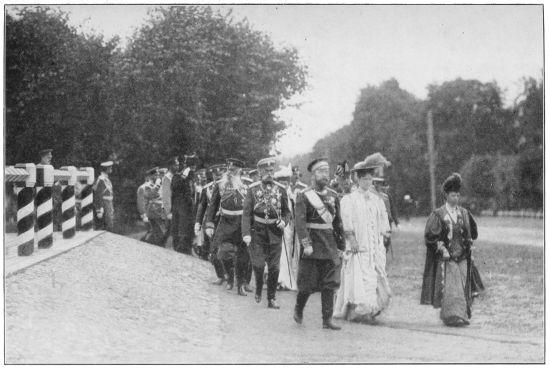
THE TSAR AND TSARITSA AT THE HEAD OF A REVIEWING
PARTY.
There are good reasons for this, however. In the first place the person
of the Tsar is constantly guarded, and to such an extent that it would
doubtless be difficult for a mere fanatic to reach him. But the
revolutionists could get him if they believed his death would serve the
cause of Liberty. That the Tsar lives to-day is due solely to this
doubt. The revolutionists have emissaries at court, in the palaces. It
would not be difficult to carry out a death sentence passed upon him.
But what would be the result of this? Who would be his immediate
successor, that is, the Dictator pending the coming of age of Alexis?
The Russian liberals cannot forget that the assassination of Alexander
II in 1881 instead of helping the Cause, set it back twenty years. It
would be fatal to repeat such a blunder as that. And as to the
Dictator—he might be any one of several Grand Dukes, and one or two of
these would unquestionably be more aggressively tyrannical than the
present Emperor. And while so much doubt prevails the life of Nicholas
II is comparatively safe. On the other hand, if there is a desire to end
the rule of the Romanoffs a much safer method would be to do away with
the successors to the Throne. Such a proceeding would be unaccompanied
by immediate political disturbance, and yet would be effective.
We can understand, therefore, the anxiety with which the Tsaritsa
watches over Alexis. His birth was so long and so earnestly desired, and
at least so long as he is the only son any disaster overtaking him
would be viewed as the most terrible of calamities—probably worse from
the standpoint of the court than disaster to the Tsar himself. From the
hour of his birth the Tsaritsa has taken it as her especial task to
guard and protect her son from all dangers.
At Peterhof, at Tsarskoe-Selo, on the Royal Yacht, wherever Alexis goes
the Tsaritsa is close beside. The little Grand Duchesses may sometimes
be seen playing in the park at Peterhof accompanied by only their
governesses and a groom, but if their brother is there too, so is the
Royal mother. At functions, military reviews and the like, when Alexis
is on exhibition to inspire the regiments with loyalty, the Empress
always remains particularly near to her son.
The education of the children is supervised personally by the Tsaritsa.
The instructors of the children of the Tsar have a very difficult task
indeed. There are certain subjects in which the children must be
thoroughly grounded, and certain others which must be taught
eclectically and others which must be eschewed altogether.
I have a friend, now living in St. Petersburg, who was a court tutor for
four years, and he has sometimes told me of the difficulties he
encountered during that period. The Russian tutors generally have the
rank of General, and are addressed in great formality as “Your
Excellency.” Teachers from abroad, however, appear in the Palace
class-rooms in what we know as “evening dress.” How strange it would
seem to American boys and girls to go to school one morning and find the
teacher wearing a low cut vest and long-tailed coat!
The two older children, Olga and Tatiana, inherit from their mother a
fondness for music, and they both play quite well already. The Tsar
enjoys listening to music, but he plays only by ear and never sings
himself.
The end of the chapter is not yet. The Tsaritsa is still a young woman,
and Empress of one of the most turbulent Empires on earth. The rank and
file of her one hundred and fifty million subjects hold nothing against
her but they are weary of the Romanoff régime. Militarism is now the
last bulwark of the Empire. Martial law is spread over a large part of
the Empire and the people are kept in subjection, in artificial quiet
only through the constant menace of bayonets and prisons whose doors
ever yawn to political heretics.
No one may prophesy the end, nor when it will come. The future is
shrouded in complete mystery and therefore possesses incomparable
fascination.
The Tsaritsa is still, by virtue of her position, one of the most
powerful women in the western world, but whose life has been given to
the natural development of the love of her school-girl days, at the
expense of a career which might have rivalled that of the greatest
heroines of history.
This is the story of the little German Princess, who was left motherless
at six, and came unto her own through her heart’s romance, and has
remained faithful to this romance despite the tempting circumstances of
Opportunity. The simple loving child who was called “Sunny” is to-day
more than anything else the simple, loving wife of Nicholas II, the
devoted mother of his children. Judging from her life, if she had the
dearest will and wish of her heart it would be that she might be
remembered as Wife and Mother, rather than as Empress. Thus the life of
Princess Alix of Hesse—“Sunny”-passed into the Romance of an
Empress—with its burdens and its sufferings and its tragedies, and thus
the end of the road looks dark, uncertain and ominously fearful.