EDWARD VI.—MARY AND ELIZABETH
There are specimens of books bound for Edward VI. in the British Museum,
both before and after his accession to the throne. Most, if not all of
these, in leather, are probably the work of Thomas Berthelet, as they have
many points in common, and he continued the “King’s printer servaunt,” and
furnished him also with bindings.
The earliest of these is a manuscript by Petrus Olivarius, In Trogum
Pompeium et in Epistolas familiares Ciceronis, Chorographica, presented
by the author to Prince Edward in 1546, and it bears in the centre the
Prince of Wales’ feathers within a flamed circle. A somewhat more
elaborate binding, with the royal coat-of-arms of England within a flamed
circle, occurs on another manuscript, a translation by William Thomas of a
book of travels, which is also dedicated to the king. A similar design to
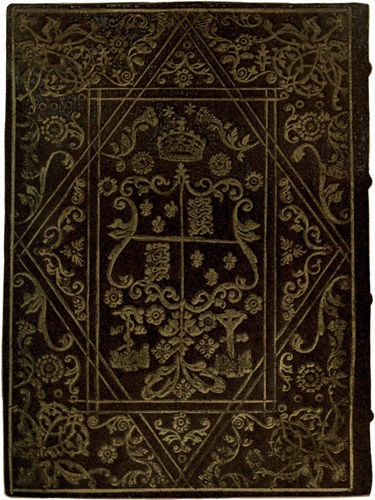
this last book is found on the binding of Xenophon, La Cyropédie,
printed in Paris in 1547. It is covered in rich brown calf, and each panel
is ornamented with an interlacing fillet, coloured black, enclosing an
inner diamond, in the centre of which is the royal coat-of-arms, with “E.
R.” and a double rose above and below. The spaces are filled with
arabesques, cornucopiæ, and small stars. The colouring of the fillets,
with black stain on calf, is a characteristic of Berthelet’s work for
Edward VI. and Mary. This peculiarity does not occur, as far as I know, on
any of those he bound for Henry VIII., so it may be considered that the
black fillets, often interlaced in a masterly way, and frequently arranged
in semicircular forms, are evidence of the later work of this master of
his art. At the same time, many of the smaller stamps used on these later
volumes are found also on the earlier examples. But whereas in the
earlier style so-called “Italian” designs are used, it appears to me that
in his later and finer style Berthelet has given us a very noble series of
books decorated in an original and strikingly effective manner. The
contrast of the rich brown calf with the black of the fillets and the rich
gold of the stamped lines and designs is often beautiful. The finest
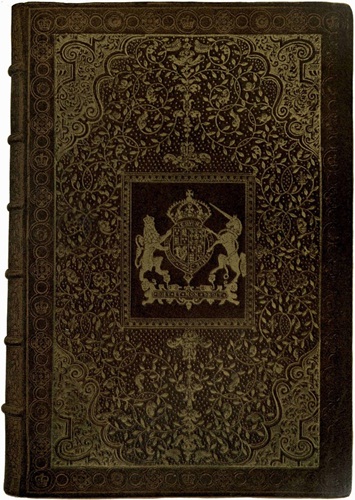
example of this style is to be found in the Museum copy of Cardinal
Bembo’s Historia Veneta, printed at Venice in 1551. It is a large book
measuring 12 × 9 inches, and the single black fillet is most cleverly
interlaced with corners, circles, and semicircles, in such a manner as, in
fact, to form a triple border, in the centre of which is the royal
coat-of-arms, itself surrounded by a line of curves finished at the ends
with double roses and arabesques, and flanked at each side with the
crowned initials of the king. In a circle at the upper part of the board
is the motto “Dieu et mon droyt”; and in a corresponding circle at the
lower part is the date “MDLII.” The spaces throughout are filled with
arabesques, cornucopiæ, double roses, and small stars. The back of the
book is curiously arranged so as to look like the front, so that it
appears to have no back at all.
Gualteri Deloeni Commentarius in tres prima Capitula Geneseos, etc., a
manuscript dedicated to Edward VI., is bound in a very delightful and
simple manner, and one which, for a small book, is nearly perfect in
taste. It is covered in rich brown calf, and ornamented with blind lines
and gold—a contrast which Berthelet uses, especially on small bindings.
The “blind” work in these cases appears to be purposely darkened, which
can easily be done by using the tools hot, or by the addition of a little
printer’s ink. In the centre of this binding is the royal coat-of-arms
surmounted by a crowned double rose. This is flanked by two cornucopiæ; at
the sides of the shield itself are the king’s initials, “E. R.,” and under
each of them the daisy with stalk and leaves. The same cornucopia stamp is
used at each of the four inner corners, and each of the four outer corners
is ornamented with a conventional floral stamp.
King Edward VI. not only had his bindings stamped with his royal badges,
but the edges also sometimes came in for a share of attention, as on a
copy of La Geografia di Claudio Ptolemeo, printed at Venice in 1548. On
the front or fore-edge of the book is the royal coat-of-arms of England,
painted on a blue ground; on the upper edge is the coat-of-arms of France,
and on the lower the golden harp of Ireland. The side space on each of
these edges is filled up with a delicate arrangement of interlacing
strap-work in black, and further ornamented with fine gold scrolls and the
initials “E. S. R.,” also in gold.
One of Edward’s books, however, has actually the first instance in an
English book of a decorated “doublure,” the name by which we understand
the inner side of the boards of a book.
Mr. Herbert Horne, in his most excellent work on the Binding of Books,
mentions, and gives a plate of, an instance of this kind of decoration
occurring on a copy of Petrarch, printed at Venice in 1532. It is an
arrangement of interlaced lines of silver with two figured stamps, and is
said to be the earliest European example. Edward VI.’s doublure (Fig. 6)
is not much later, as it was probably bound about 1547, and, like nearly
all doublures, it is in a wonderful state of preservation; in fact, it may
be said to be the only instance of a sixteenth-century painted book that
is at all in its original state, as the pigment used upon them is
extremely delicate, and chips off freely. The book, a small duodecimo, is
covered in crimson velvet, much worn, and is a collection of “certeine
prayers and godly meditacyons,” printed at Malborow in 1538. The inner
side of each of the boards is covered with calf, and the design is
outlined in gold and filled in with colour. This colour is not quite like
oil-paint, but resembles closely the “enamel” colours which have of late
years been so well known. It has little penetrating quality, lying evenly
on the top of the leather, and dries with an even and polished surface.
The king’s arms, crowned, occupy the centre of the board, the arms in the
correct heraldic colours and the crown of gold, silver, blue, and green.
The king’s initials, stamped in gold, are on each side of the shield. A
rectangular border of green encloses the coat-of-arms, and at each of the
inner corners is a daisy in gold, and above and below the arms is a
semicircular projection from the green border, coloured blue.
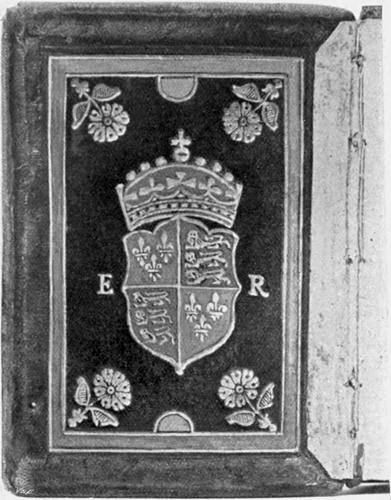
Fig. 6.—Prayers, etc. Malborow, 1538 (Doublure). Edward VI.
There is yet another volume which for many years has been by the British
Museum authorities attributed to Edward VI., but Mr. W. Y. Fletcher, in
his splendid volume on the English Bookbindings in the British Museum,
considers it to be Elizabethan. There is no doubt that the volume in some
ways fits a description of one that was presented to that queen by the
University of Oxford at Woodstock in 1575, but I think the difference in
the dates of printing and presentation is a weak point in the argument.
The book was printed in 1544 at Zurich, and it certainly seems curious
that a book printed thirty-one years before should be offered as a present
to a reigning sovereign. So for the present I shall adhere to its former
description in the show-case in the King’s Library, and describe it here
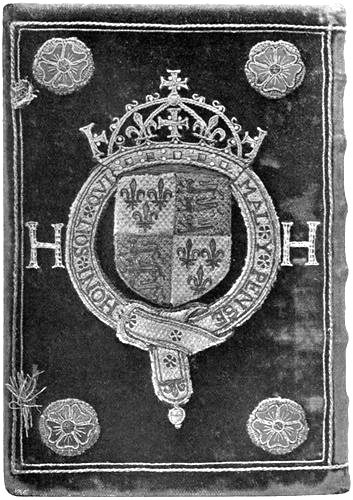
in its place as having been bound for Edward VI. It is covered in green
velvet, with a border parallel to the sides stamped in gold and bearing
the legends, “Esto fidelis usque ad mortem et dabo tibi coronam
vitæ—Apoc. 2” on one side, and on the other “Fidem servavi qvod svperest
reposita est mihi corona jvstitiæ—2 Tim. 4.” In the centre of each cover
is the royal coat-of-arms enclosed within a Garter, crowned, appliqué in
pieces of coloured silk and stamped in gold, beautifully designed and
beautifully executed, and the first instance of velvet or silk stamped in
gold that is known to me. On the gilt edges designs are stamped, or
“gauffred” as it is called, and painted. On the front edge the arms of the
University of Oxford. On the upper edge a crowned Tudor rose with the
initials E. R., and on the lower a portcullis with the same initials.
There are other instances where the similarity between the emblems and
initials of these two sovereigns, Edward VI. and Elizabeth, causes
considerable doubt as to which of them was actually the owner, and I think
that generally the date of the printing of such books must be considered
as some authority, although among the arguments for or against the
attribution of a binding to any particular owner, or author, it may be
said that the date of the printing of the book must generally be esteemed
at a small value.
A book which has some of the peculiarities of Berthelet’s work upon it is
found in a copy of Bude’s Commentarii Linguæ Græcæ, printed at Paris in
1548. It is covered in calf, and has a rectangular border running parallel
with the edges of the boards on each side. This border is coloured black,
but it has the uncommon addition of stamped arabesques in gold upon this
black. At the outer corners are arabesques in outline, and in the inner
corners double roses stamped in gold. In the centre a framework of two
interlaced squares, stained black, enclose the royal coat-of-arms and
initials.
The same workman who executed this binding also made one for Queen Mary,
which I shall describe further on.
At Windsor there is a fine little binding on a copy of Strena Galteri
Deloeni: ex capite Geneseos quarto deprompta, etc. It is bound in white
leather, and ornamented with the royal coat-of-arms in the centre, flanked
by the letters “E. R.,” and surrounded by a scattered arrangement of
double roses, daisies, cornucopiæ, and stars, all enclosed in a small
decorated border. It is probably by Berthelet, and is in excellent
condition. In the British Museum there are instances of bindings in white
leather made for Henry VIII. and for Mary, but there is no instance of one
made for Edward VI., so that this Windsor binding is of considerable
interest apart from its beauty.
A copy of Herodotus’ and Thucydides’ works, bound together in one cover,
belonged most likely to Edward VI. It is part of the old royal library,
and is bound in brown calf, with a broad outer border of Italian character
enclosing the royal coat-of-arms, crowned, within a flamed circle. The
flamed circle first occurs, as may have been noted, on the volumes bound
for Edward when Prince of Wales, and it is afterwards used on several of
his later volumes, and also on many that were bound for Queen Mary. What
the meaning of this flamed circle is I have not been able to conjecture,
it may possibly only be intended for ornament. Berthelet, doubtless, liked
to use circles or parts of circles on his bindings, and in this taste he
was following the lead of much more ancient English binders, as the circle
is characteristic of the splendid blind stamped English work of the
twelfth and thirteenth centuries.
Thomas Berthelet died, according to an entry in the Stationers’ Company
Register, in 1556. So that it is just possible he bound books for Queen
Mary. But I think that Berthelet was quickly copied, and it is very easy
to copy the style or even the actual stamps of any binder; and if the
binding of Cardinal Bembo’s History of Venice be taken as a test example
of Berthelet’s best work, which I think it fairly may be, it will be seen
that although Mary’s bindings have some points of resemblance there are
also many wide differences. Berthelet avowedly acknowledged the beauty of
Italian originals, but I do not find that he actually copied any one of
them, and he, moreover, very soon left them behind. There is a certain
recrudescence of this Italian manner distinctly apparent in many of the
books bound for Queen Mary, and I imagine this to be the work, not of
Berthelet himself, but of one of his imitators or successors, or perhaps
one of his own workmen.
A good example of this Italian-English style is found on the binding of
the Epitome omnium operum Divi Aurelii Augusti, etc., printed at Cologne
in 1549. A very handsome broad border containing an elaborate arabesque is
parallel to the edges of the boards. This encloses an inner black fillet
interlaced with a diamond, in the middle of which is the royal
coat-of-arms within a flamed circle, and at each side, in the angles
formed by the intersection of the diamond points and the inner rectangular
lines, are the initials M. R. The spaces throughout are filled in with
arabesques, single roses, and circles.
A very similar design occurs on the binding of a manuscript poem by Myles
Haggard, addressed to the queen, and another on a copy of Bonner’s
Profitable Doctrine, printed in London in 1555.
Entirely different in manner of decoration is the binding of the
Commentary on the New Testament, in Latin, by Aurelius Augustinus,
printed at Basle in 1542, and which came to the British Museum as part of
the old royal library. It is covered in white leather, and ornamented with
gold tooling of a very elaborate kind. A broad inner rectangular panel,
broken outwards at each side, contains a diamond, and the spaces in and
about these leading lines are filled with arabesques, royal arms, and
royal emblems, roses, fleurs-de-lis, and portcullises. Although the
general design of the original decoration of this book has doubtless been
preserved, it has been grievously tampered with, and no reliance can be
put on any of the small detail work now existing upon it—a most unlucky
circumstance, as it is unlike any other royal book in the general
arrangement of its ornamentation, and so of special interest.
So again different, but in a much less important manner, is the little
calf binding of a Livre faisant mention de sept parolles que N. S.
Jesuchrist dit en l’arbre de la croix, printed at Paris in 1545, and
bound for Queen Mary. It is decorated with blind and gold lines, and
dotted all about in the most reckless manner with M’s and I’s, meaning
doubtless Mary the First. In the centre of each cover there is a knot, the
same knot exactly as is used in the sculptures on our Houses of Parliament
to tie together the initials V. R. of our present Most Gracious Queen, and
surrounding the knot are four M’s. The I’s are down the edge of the boards
nearest to the back. The little book is of great interest, as it never
could have been in any way a State copy, but was most likely a favourite
book of the queen’s, and so decorated with her initials only—leaving
heraldry for once out of the scheme.
The most splendid of the books that Queen Mary has left for us to admire
is a manuscript of Psalms and Hymns in Latin and French of very beautiful
workmanship, known as Queen Mary’s Psalter. It came to the British Museum
with the old royal library. It is bound in crimson velvet and has gilt
clasps and corners, and on each side a large piece of embroidery appliqué.
This embroidery is much worn; it is on canvas, and some of it is actually
gone, but it seems to have been a conventional pomegranate, and this is
all the more likely as such a design would have been a probable one for
Queen Mary to use, as she had an excuse to do so by virtue of her mother’s
right to the emblem of Arragon. The clasps are engraved with the dragon,
lion, portcullis, and fleur-de-lis, and in spite of the damage done to the
volume by time and wear, it is still a splendid specimen of magnificent
binding. By an inscription at the end of the volume we are informed that
it was rescued from the hands of some seamen who were preparing to carry
it abroad by “Baldwin Smith,” who presented it to Queen Mary in 1553.
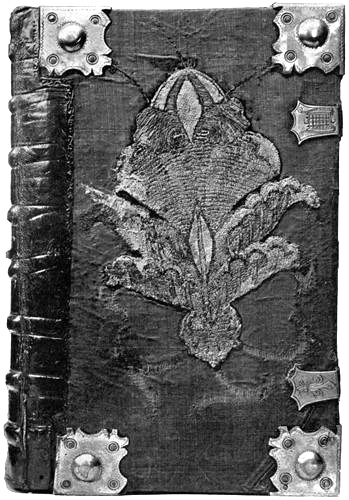
Fig. 7.—Queen Mary’s Psalter, MS.
A book of hours in illuminated manuscript is beautifully bound for Queen
Mary, and is finished in an unusually delicate manner. It is in calf, and
has blind and gold lines. An outer border has stamps within it at
intervals, in a similar style to one already described as having belonged
to Edward VI. In the centre of the book is a delicate stamp of the royal
coat-of-arms with the letters M. R.
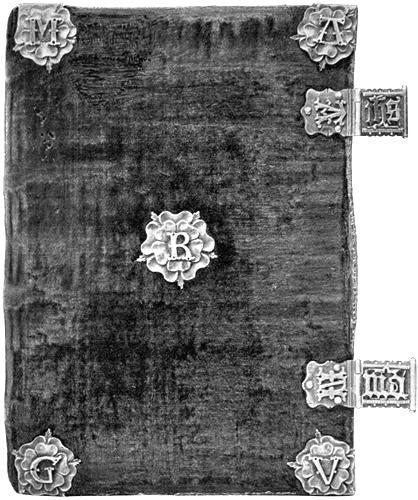
At Stonyhurst College is preserved Queen Mary’s own Horæ in laudeum
Beatissimæ Virginis Marie, Lugduni, 1558. It is covered in figured red
velvet projecting over the boards at the lower edges, and with small
tassels at each corner. On the lower cover is the crowned coat-of-arms in
silver, enamelled in the proper colours. Single ornamental letters
R.E.G.I.N.A. are arranged in couples in three lines round it. On the upper
board are the letters M.A.R.I.A., also in silver. The first two at the two
top corners, the R crowned in the middle, and the two last letters in the
two lower corners. The R in the centre is flanked by a double rose and the
pomegranate of Arragon, both in silver. There are two silver clasps of
ornamental pattern. It was shown at the Burlington Fine Arts Club
Exhibition on Bookbindings in 1891, and there is a fine plate of it in
their Illustrated Catalogue.
The bindings of Edward VI. and Mary, having as a chief ornament the
English coat-of-arms, nevertheless bear with them no supporters. Henry
VII. and Henry VIII., until 1528, used the same supporters, the dragon on
the dexter side and the white greyhound on the sinister; and when Henry
VIII. made a change and adopted the crowned lion as one of his supporters,
he omitted the greyhound and changed the side of the dragon, so that his
successors bore as their supporters a lion crowned on the dexter side and
the red dragon on the sinister, and so they occur on several Elizabethan
bindings.
Fig. 8.—Prayers, etc. London, 1574-1591. Queen Elizabeth.
The bindings executed for Queen Elizabeth may be conveniently divided into
three classes—those bound in, or ornamented with, gold; those bound in
velvet or embroidered; and those bound in leather. In this order I shall
describe them. The gold, as far as I know it, is always enamelled, the
velvet is generally embroidered, and the leather is frequently inlaid with
other and differently coloured leathers. The peculiarity of sunken panels,
borrowed apparently through the early Italian bindings from Oriental
originals, is a remarkable speciality of Elizabethan work; as is also the
first use of large corner-stamps to any extent. There certainly are
instances of corner-stamps on Henry VIII. bindings, but they are rare;
whereas with Elizabeth and her immediate successors the use of such stamps
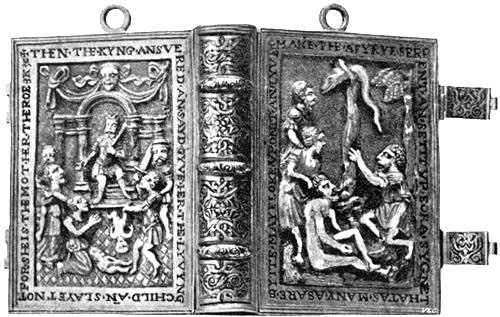
is very usual. The finest, as well as the most interesting, of the golden
books made for Elizabeth is one containing prayers and devotional pieces
by Lady Elizabeth Tyrwhitt, printed for Chris Barker, London, 1574. It
also contains the queen’s prayers, a collection out of other works, and
part of an Almanack for 1583-91 (Fig. 8). In 1790 it belonged to the Rev.
Mr. Ashley, and it was presented to the British Museum in 1894 by Sir
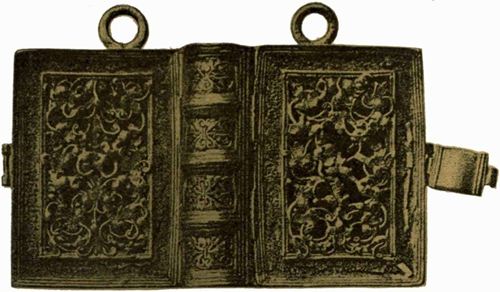
Wollaston Franks. It measures 2¼ inches by 1¾. On each side is a
sunken panel, round which is a flat border containing texts from
Scripture, engraved and run in with black enamel. The upper cover of the
book has a representation in gold of the serpent in the wilderness and the
stricken Israelites. The serpent on the tree and others on the ground, and
the figures of the people, are all carved in very high relief, and
enamelled in colours; the flesh being represented by white. The serpents
are in blue. Round this design are the words “Make · the · afyrye ·
serpent · an · setit · vp · fora · sygne · thatas · many · asare · bytte ·
mayeloke · vponit · an · lyve+.” On the lower cover a similar panel
contains a representation of the judgment of Solomon, worked in a similar
way. Round this runs the legend, “Then · the · kyng · ansvered · an · sayd
· gyve · her · the · lyvyng · child · an · slayetnot · for · sheis ·
themother · therof—1 K. 3 C+.” The back is divided into four panels, each
of which has a delicate and graceful arabesque engraved and run in with
black enamel, as also have the two clasps. There are two rings at the top,
in order that the book might be worn at the girdle. There is no real
record as to who worked this enamel, but it is credited to George Heriot,
afterwards goldsmith and banker to James I., and founder of the George
Heriot Hospital at Edinburgh. It is in very good condition, and but little
of the enamel has chipped off. It is now preserved in the Gold Room at the
British Museum. It is the only one of Elizabeth’s golden books that is
worked in high relief, and such work is undoubtedly of the greatest
rarity.
For actual beauty of workmanship, it would be difficult to find any
specimen of finer execution than that which occurs on the binding of a
little volume of Christian meditations in Latin printed in 1570, and bound
in rose-coloured velvet, with clasps, centre-pieces, and corners all
bearing delicate champlevé enamel-work on gold (Fig. 9). The book is quite
a small one, measuring 5 × 3¼ inches, and the workmanship on the gold
is of corresponding delicacy. In the centre of each cover a thin diamond
of gold is fixed, the outline being broken in each case by a series of
small decorative curves. Each diamond is further ornamented with the Tudor
rose, ensigned with the royal crown, and flanked by the initials E. R. The
rose is red with small green leaves, the cup of the crown is blue, and the
initials are in black enamel. The whole of the vandyked edge of the
diamond is bordered with a thin line of blue enamel, and the remaining
spaces are filled up with small floral sprays having green leaves and red
and blue flowers. The corner-pieces are ornamented in a similar way with
set patterns of arabesques and flowers in red, blue, green, and yellow
enamels, as also are the clasps. These enamels are all what is called
translucent, and many of the colours are remarkable for their brilliancy
and beauty, as well as for the skill with which they are used. The
engraving of the gold plate, which is filled by these enamels, is also of
remarkable beauty. George Heriot again is credited with this work, with
perhaps some show of probability.
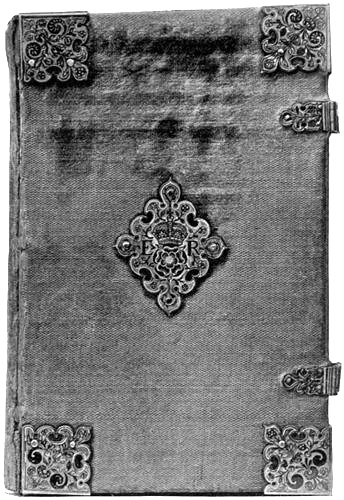
Fig. 9.—Christian Meditations, in Latin, 1570.
Queen Elizabeth.
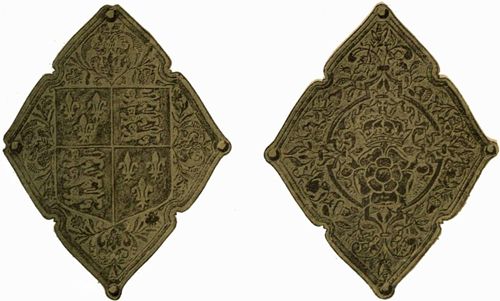
One more book in the British Museum has champlevé enamels upon it,
evidently by the same workman. It is a New Testament in Greek printed at
Paris in 1550. It is now bound in green velvet,—but this probably was the
original material in which it was covered,—and in the centre of each of
the boards is a diamond-shaped panel of gold, 2¾ inches in length and
2¼ in breadth (Plate II.) Judging from the analogy of the smaller book
just described, there probably were originally corners and clasps to this
book, but they are now gone. Each of the diamonds has originally borne
rich-coloured enamels, but by far the greater part of this has chipped
off, only small pieces remaining here and there in corners. On the upper
cover the diamond contains the royal coat-of-arms of England, surrounded
with floral sprays, roses, and flies. The diamond on the lower cover of
the book has a red rose, crowned, contained in a circular border, the
spaces within and without the circle being filled with similar sprays to
those upon the other side. Among them are acorns and flies again. The
delicate engraving on the gold of both these diamonds can be very well
studied, as the marks of the engraving are easily apparent.
Paul Heutzner visited England in 1598, and examined the royal library at
Whitehall. In his Itinerarium he says: “The books were all bound in
velvet of different colours, chiefly red, with clasps of gold and silver,
some having pearls and precious stones set in their bindings.” It is
rather curious he should have mentioned red, because, although there are
many books in velvet that were bound for Queen Elizabeth, the only one I
know of in red is the little volume described above, all the rest being in
green, black, or purple. Dibdin, in his Bibliomania, says that Princess
Elizabeth, when she was a prisoner at Woodstock in 1555, worked a cover of
a little book which is now in the Bodleian Library at Oxford. It now
contains a small copy of the Epistles of St. Paul printed by Barker in
1578, so that, if Dibdin is right in saying that Elizabeth worked it when
she was at Woodstock, it cannot have been worked for the book it now
covers. Certainly, the embroidered portion has been at some time or other
relaid in its present position, and considerable damage has resulted from
the operation. Inside is a note in Elizabeth’s handwriting, in which she
says: “I walke manie times into the pleasant fieldes of the Holye
Scriptures, where I plucke up the goodlie green herbes of sentences by
pruning, eate them by reading, chawe them by musing, and laie them up at
length in the hie seat of memorie by gathering them together, so that
having tasted thy swetenes, I may the less perceave the bitterness of this
miserable life.” The material is, or was, black velvet, but the pile is
entirely gone, except in a few protected corners. The design is outlined
in silver cord, and the raised portions are worked with silver guimp. An
outer border, with lettering, encloses in each case a central design. The
motto on the border of the upper cover reads, “Celum Patria Scopus Vitæ X
P V S. Christus Via, Christo Vive.” That round the lower cover, “Beatus
qui divitias Scripturæ legens verba vertit in Opera.” Within the border,
on the upper cover, is a ribbon arranged in a long oval bearing the words
“Eleva Cor Sursum ibi ubi E. C. (i.e. est Christus).” The E and the C
are in larger type, and between them is a heart in raised work, through
which passes a stem, the lower end of which has two small leaves and the
top a flower. On the lower cover a similar ribbon bears the words “Vicit
Omnia Pertinax Virtus E. C.” These two last letters, Dibdin says, means
“Elizabetha Captiva,” in support of his theory that it was worked by her
at Woodstock. In the centre of the oval on this lower cover is an
eight-petalled flower with stem and two leaves. The record of this book is
remarkably clear. But, besides this, there is little doubt, judging it by
other work of Queen Elizabeth, that it was executed and probably designed
by herself. All the books credited to her with any show of probability are
worked in braid or thick cord, and the designs on each are of a simple
character.
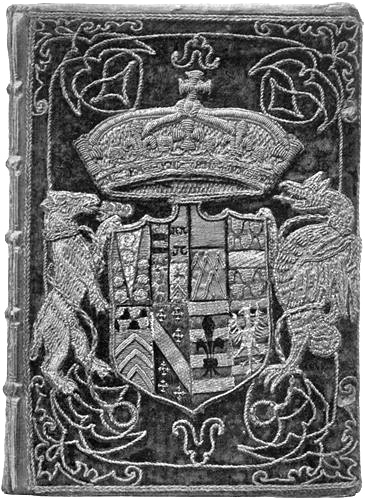
The most decorative of all the embroidered books worked for Queen
Elizabeth is now, unfortunately, in the worst condition of any of them. It
is a copy of Bishop Christopherson’s Historia Ecclesiastica, Louvanii,
1569, divided into three volumes, each measuring about 6 inches by 3½.
It is covered in green velvet, and each side is ornamented in the same
way. In the centre a long oval shield, appliqué, in silks of the proper
colour. The bearings, worked in gold thread, are enclosed in an oval of
pink satin studded with a row of small pearls. Surrounding this is a
decorative Elizabethan border worked in gold thread and pearls. The rest
of the board is closely covered with a rich design of arabesques and roses
in gold cord and guimp, the roses being “Tudor,” with red silk centres and
pearl outer petals, and “York,” worked entirely with small seed pearls.
The narrow outer border, formed by an interlacing ribbon outlined in gold
cord, has an inner row of seed pearls along its entire length; and many of
the spaces all over the side of the book have small single seed pearls in
them. The back is divided into five panels, bearing alternately white and
Tudor roses of the same kind of work as those on the sides of the book,
only on a larger scale. There have also been many supplementary pearls on
the back of the book. A large majority of the pearls are unfortunately now
missing, as is also a great part of the gold cord, so that the above
description is in fact a restoration. But every pearl and every piece of
cord that is wanting has left a distinct impression on the velvet.
One of the most celebrated of all embroidered books done in England was
executed for Queen Elizabeth. It is a large book measuring 10 inches by 7,
and is an account by Matthew Parker, Archbishop of Canterbury, De
antiqvitate Britannicæ Ecclesiæ, etc. It was privately printed by John
Day at Lambeth Palace in 1572 for the Archbishop, being the first book of
the kind issued in England. It is supposed to have been a presentation
copy to the queen. It is covered in deep green velvet. On both covers the
outer border is worked in gold, in a pattern resembling a wooden park
paling, and it is probable that each side is meant to represent a park,
thereby indicating the author’s name of Parker. Within this paling on the
upper cover is a design of a large rose-tree with Tudor roses, and Yorkist
and Lancastrian roses, all growing upon it. Besides these flowers there
are heartsease, daisies, carnations, and others whose species is difficult
to determine. In the four corners of the “park” are four deer, their eyes
being indicated with little black beads, some gambolling, some feeding,
and on the groundwork are many grass-tufts of gold thread. The central
design on the under cover is not by any means so fine. It has several
plants scattered about it. There are two snakes brilliantly worked in gold
and silver cord and coloured silks, and five deer like those on the other
side. Originally there were red silk ribbons to tie the book together
at the front edges, but there is only a trace of them now left. The back
is divided into five panels, bearing alternately white and Tudor roses,
with leaves, stems, and buds. It is said that Archbishop Parker kept in
his own house “painters ... writers, and bookbinders,” so it is very
likely that this book was bound under his own eyes. It is said that only
twenty copies of it were printed, and that no two were alike. It contains
the biographies of sixty-nine Archbishops, but not Parker’s own. This
omission was afterwards supplied by the publication of a little satirical
tract, in 1574, entitled Histriola, a little Storye of the Actes and Life
of Matthew, now Archbishop of Canterbury. The two title-pages and the
leaf with the Archbishops’ coats-of-arms are vellum, and the woodcuts,
borders, and arms throughout the volume are emblazoned in gold and
colours. It is now part of the old royal collection in the British Museum.
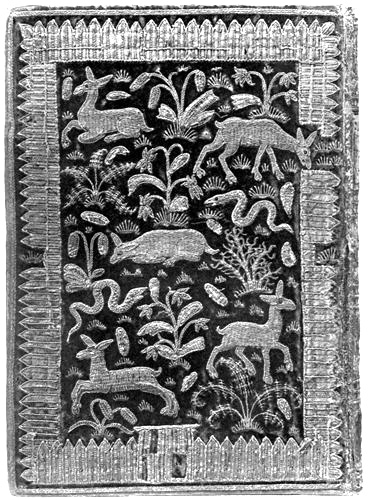
Fig. 10.—Parker. De antiqvitate Britannicæ Ecclesiæ.
London, 1572. Queen Elizabeth.
A small copy of the New Testament in Greek, printed at Leyden in 1576, is
covered in white ribbed silk, and embroidered in gold, for Queen
Elizabeth. Each board has the same pattern upon it; in the centre the
royal arms of England, ensigned with the crown, and surrounded by the
Garter, in both of which are inserted several seed pearls. This is
surrounded by an irregular border of thick gold cord, interlaced, in which
are leafy sprays of single and double roses. The arrangement of this
border is admirably designed. The colours of the arms, the Garter, and the
red roses are painted, probably in water-colours, on the silk itself—the
earliest specimen of such work that is known to me. From the delicacy of
the material on which the embroidery is done, and the high projection of
many of the threads, the book has evidently got into very bad condition at
a remote period; and it has been entrusted to some one to repair, who has
removed all the original binding and re-inlaid it on new boards, the
result being that he has increased the damage already existing.
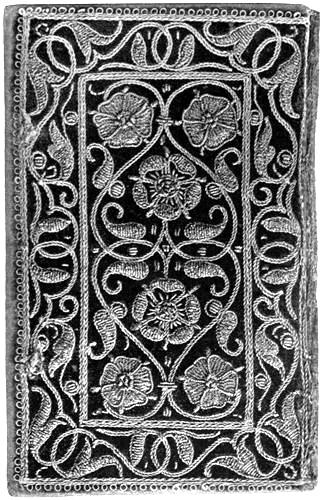
A little book, Orationis Dominicæ Explicatio, per Lambertum Danaeum,
printed at Geneva in 1583, is covered in black velvet, and ornamented with
a very effective design, worked with broad gold cord (Fig. 11). An outer
arabesque border, having also flowers of silver guimp, encloses an inner
panel which has two white roses in the centre, and a red rose in each of
the inner corners. Each of these roses has a little green leaf at the
junction of the petals, and they are apparently outlined with silver
thread. It is, however, often difficult with old books to say for certain
whether a thread has been gold or silver, as the gold cord has a tendency
to wear white, and the silver cord often turns yellow. The contrast of
colour on this little book is very charming even now, and it must have
been particularly beautiful when it was first done. It has the remains of
ties at the front edges of red silk and gold cord.
There is another embroidered book belonging to the old royal collection in
the British Museum that seems to have been bound for Queen Elizabeth. It
is a copy of The Common Places of Dr. Peter Martyr, translated by
Anthonie Marten, printed in London in 1583, and dedicated to the queen. It
is covered in blue purple velvet, and ornamented with silver wire and
guimp. There is an outer border formed of double lines, made easily and
effectively by means of a spiral wire flattened down, giving the
appearance of small overlaid rings. This border encloses a series of
clusters, formed with stitches of silver guimp, arranged in a basket-work
pattern. In the centre is an ornament of diamond shape, outlined with the
same silver-wire edge and enclosing again the basket-work design, and the
four inner corners are filled up with quarter circles of the same work.
The book has been rebacked, and it is not in very good condition; but the
effect of the silver on the deep purple ground still has a very admirable
effect. The broad gilt edges are very handsomely and elaborately decorated
with gauffred work of Elizabethan character.
A Bible, printed in London in 1583, was embroidered and bound for Queen
Elizabeth, and presented to her in 1584, and is now in the Bodleian
Library at Oxford. It is a folio book, measuring almost 17 × 12 inches,
and is bound in crimson velvet. Upon each board is a very graceful design
of rose-branches, intertwined. There are four large roses and two smaller
ones, all embroidered in silver and gold braid and coloured threads, with
here and there a few small pearls. A narrow border runs round the edge,
embroidered in gold thread and coloured silk.
Fig. 11.—Orationis Dominicæ Explicatio, per L. Danaeum.
Genevae, 1583. Queen Elizabeth.
A remarkable binding on calf, executed for Queen Elizabeth, is on a large
Bible printed at Lyons, measuring 16½ inches by 11, each board being
double (Fig. 12). The upper board is pierced in several places, showing
underneath it a lower level covered with green calf, and decorated with
small stars and arabesques. The upper boards on both sides of the book are
elaborately stamped in gold and painted in enamel colours, and in each
case an oval, painted panel occupies the centre. The upper cover of the
book has in the central oval a charming sunk miniature portrait of
Elizabeth as a young woman, dressed in jewelled robes and head-dress, and
carrying a sword or sceptre. The portrait is enclosed in a very delicately
painted frame of jewelled goldsmith’s work. This painting is unfortunately
damaged, especially in the face, and it seems to be executed in opaque
water-colours, varnished, on vellum. Immediately round the miniature, on
the leather, is a very elaborately painted and gilded oval ribbon with the
words “Elizabeth Dei Gratia Ang. Fran. Hib. Regina.” The broad, irregular,
oval border itself has a design of interlacing fillets and floral emblems
of considerable beauty, winged horses and Cupids, all picked out in
colours. This very large stamp, measuring 9 inches in length, which is now
and then found on books other than royal, is the largest English stamp
known to me. There are cartouches left in the upper leather above and
below this central arrangement, and they are of a similar ornamentation
and colour, as are also the very handsome corners. The other side of the
book is similarly decorated, with the differences that the centre
painting, by the same hand, is the royal coat-of-arms of England in an
egg-shaped, oval form, surrounded by the Garter, within an Elizabethan
scroll. Over the crown is a canopy of green and red, and the supporters of
the lion and red dragon are in their proper places. Underneath the coat is
the motto “Dieu et mon Droit” on an ornamental panel, and the legend
lettered on the leather immediately surrounding the painting reads “Posui
Deum adivtorem meum.” On the lower cartouche on this side is the date of
the binding, “MDLXVIII.” This binding, when new, must have been one of the
finest and most elaborately decorated of any of the leather bindings made
for an English sovereign. The back of the volume, nearly 5 inches in
width, is also very finely ornamented with an Elizabethan pattern outlined
in gold and coloured in keeping with the rest of the ornamental work. Its
present condition is unfortunate. The restorations, which have been
largely added, have, however, the merit of being at once apparent, as
little or no trouble has been in this case taken to reproduce the old
stamps. The gilt edges are beautifully gauffred, and are picked out here
and there with colour. The design is a complicated arabesque with masks,
and on the lower edge a curious design of an animal resembling a unicorn.
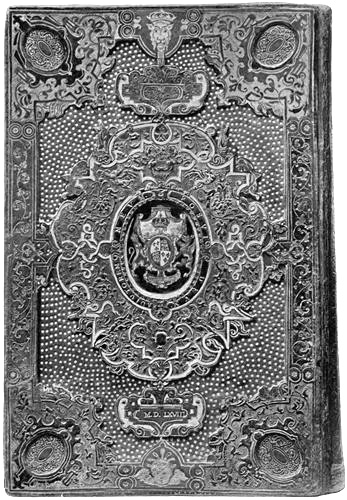
Fig. 12.—La Saincte Bible. Lyon, 1566.
Queen Elizabeth.
One more beautiful book in the old royal collection that belonged to
Elizabeth has double boards. The outer edges on this instance are
interesting, as there is, in fact, an elongated head-band running along
their entire length and joining the edges of the two boards. It is covered
in very dark morocco, and decorated in blind and gold stamped work. In the
centre of each cover is a sunk oval medallion, on which is painted the
royal coat-of-arms of England, surrounded by the Garter; the two
supporters holding up the crown in their paws. Flanking the crown are the
letters E. R. The motto “Dieu et mon Droit” is on a red panel with a blue
border at the lower portion of the oval, and the groundwork of the whole
is silver. The medallion is enclosed in a richly designed broad border of
strap-work, enriched with dots and arabesques, all in gold. Towards the
upper and lower corners are four silver double roses with gold crowns. In
each corner is a quarter circle of vellum, pierced and richly gilded in a
pattern of strap-work and floral sprays. All the foregoing is enclosed in
a border of blind work, and an outer edging ornamented with a succession
of small set stamps. There are traces of green ribbons, both on the front
edges of the book and at the upper and lower edges. It is a copy of Les
Qvatre Premiers Livres des Navigations et Peregrinations Orientales de N.
De Nicolay, printed at Lyons in 1568, and probably bound at the same
time. The book is especially remarkable for its vellum corners, which are
actually inlaid; that is to say, a corresponding piece of morocco is cut
out and replaced by the vellum. This process, which, of course, adds
immensely to the power of a binder in decorating the outside of a book, is
one which, so far as I am aware, does not occur before on any English
binding. It is a fashion that was much followed in the next century both
by French and English binders. In the great majority of instances,
however, the added leather is not actually inlaid, but only scraped or cut
very thin, and superimposed. The remarkable manner in which the two last
books described are made up with double boards is worthy of special
notice, and has not, I think, ever been used since on any sumptuous
binding. The fashion is one, nevertheless, which was much used with great
effect on fine Italian bindings made towards the end of the fifteenth
century, and there are two books of this kind that belonged to Elizabeth,
and were bound for her in Italy after the “Italian fashion,” now in the
British Museum. Vellum inlays for Queen Elizabeth occur in their finest
form on a presentation copy from Matthew Parker, Archbishop of Canterbury,
of Hores Historiarvm, per Matthævm Westmonasteriensem Collecti, etc.,
printed in London in 1570. It is probable that this volume was bound in
Archbishop Parker’s own house. It is covered in calf, and the centre,
border, angles, and side-pieces are inlaid in white vellum, and richly
stamped in gold. The actual centre of the boards has the royal
coat-of-arms of England, with crown and Garter stamped in gold, enclosed
in a vellum oval of strap-work and arabesques, with the letters E. R. at
the sides. The inner parallelogram has large corners stamped in gold, and
is edged with a black fillet, the entire field on the calf being decorated
with a semée of triple dots. The book has two gilded clasps, and the edges
of the leaves are gilt, gauffred, and painted. A small panel on each of
the angle-pieces, which are otherwise ornamented with designs of military
trophies, drums, trumpets, shields, swords, and cuirasses, bears the
initials “J. D. P.” These letters are supposed to mean John Day, Printer.
John Day printed books at Lambeth for Archbishop Parker; and these
corner-pieces do occur on books printed by him and bound in a very similar
way to the volume now described, so there is some show of probability in
the interpretation. A field covered with a succession of impressions from
the same stamp has no name in English, but in France it is known as a
“semée,” its use having come into fashion in that country a little earlier
than the date of this book.
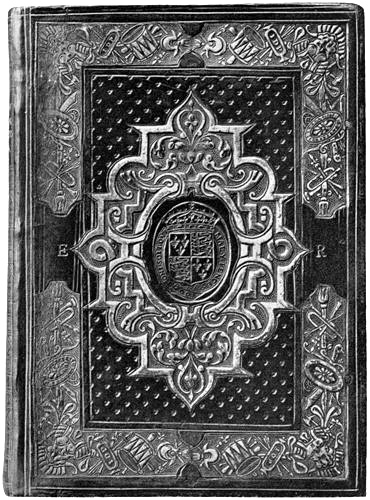
Fig. 13.—Gospels in Anglo-Saxon and English.
London, 1571. Queen Elizabeth.
A smaller example, with centre-piece and angle inlays only, in all other
ways exactly resembling the book just described, was printed in London,
1571 (Fig. 13). It is a copy of the Gospels printed by John Day, and is
the dedication copy, as is stated in a MS. note on the
title-page—“Presented to the Queen’s own hands by Mr. Fox.”
A copy, printed in London in 1575, of Grant’s Græcæ Linguæ Spicilegium
is covered in brown calf, and was bound for the queen. It has large
corners stamped in gold from set stamps. In the centre it bears a fine
stamp of the royal coat-of-arms, crowned, and surrounded by the Garter,
and decorated with Elizabethan scrolls. The remainder of the groundwork is
covered with a semée of small roses. Among the old royal manuscripts is a
curious book, Scholarum Etonensis ovatio de adventu Reginæ Elizabethæ,
1563, covered in white vellum and stamped in gold. It bears in the centre
the royal coat-of-arms enclosed in an oval ornamented border, and has
large corner-pieces impressed from a set stamp, the field having a semée
of small stars. The work upon this binding is of a curiously unfinished
character, and it is probably the work of some unskilled local workman.
The gilt edges are gauffred in a floral design, with some white colour
here and there.
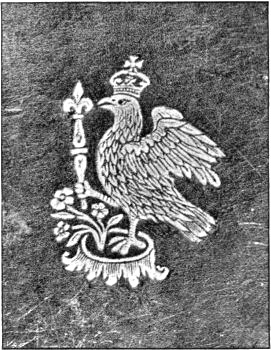
Anne Boleyn bore, as one of her many devices, a very decorative one of a
crowned falcon holding a sceptre, standing on a pedestal, out of which is
growing a rose-bush bearing white and red blossoms (Fig. 14). This badge
occurs first in an illuminated initial letter to her patent of the
Marquisate of Pembroke, and at her coronation, in a pageant at Whitehall,
an image of the falcon played a prominent part. The origin of it is not
very clear, but it may have been derived from the crest of Ormond, a white
falcon, which is placed under the head of the Earl of Wiltshire, Queen
Anne’s father, on his tomb. It was in turn adopted by Queen Elizabeth, and
was exhibited on the occasion of her visit to Norwich, in 1578, as her own
badge; and it occurs also on the iron railing on her tomb in Henry VII.’s
chapel. The queen bore it on several of her simpler bindings impressed in
the centre of each board, with usually a small acorn spray at each corner.
There are several books ornamented like this in the library of Westminster
Abbey, and there are examples at Windsor. The British Museum possesses
few, the best example being a copy of Justinus’ Trogi Pompeii Historiarum
Philippicarum epitoma, etc., printed at Paris in 1581. It originally had
two ties at the front edge. At Windsor a few bindings of Elizabeth’s are
still preserved; among them, a copy of Paynell’s Conspiracie of Catiline
is bound in white leather, and bears the royal arms within a decorative
border. It has large corners impressed by a set stamp, and has a semée of
small flowers. A copy of Spenser’s Faerie Queene, printed in London in
1590, also in the Windsor Library, bears in the centre a crowned double
rose, in the centre of which is a portcullis, and E. B. at each side of
it. The crowned rose was a favourite design with Elizabethan bookbinders;
but unless there be corroborative evidence of royal possession, I do not
think that the existence of this stamp is of itself a sufficient proof of
such exalted ownership.
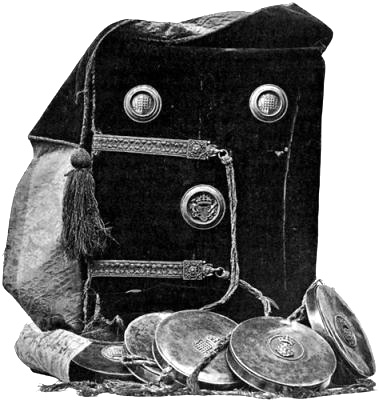
Mr. Andrew Tuer, in his admirable History of the Horn-Book, gives a
figure of one which was exhibited in the Tudor Exhibition in 1890, where
it was described as the Horn-Book of Queen Elizabeth. It is said to have
been given by the queen to Lord Chancellor Egerton of Tatton, and it has
been preserved in his family ever since. The letterpress is covered with a
sheet of talc, and the back and handle are ornamented with graceful silver
filigree work, that on the back being underlaid with red silk. Mr. Tuer
thinks that the type used on this Horn-Book resembles some used by John
Day, the printer already mentioned; and if so, it is not altogether
unlikely that Archbishop Parker himself may have presented this beautiful
toy to the queen, as well as the more serious works in velvet and inlaid
leather.
Fig. 14.—Centre stamp from Trogi Pompeii
Historiarum Philippicarum epitoma.
Parisiis, 1581.
Although Mary Queen of Scots was not directly one of the sovereigns of
England, yet she is so intimately connected with them, both by her
ancestry, her own history, and her descendants, that the few bindings
remaining that belonged to her may well be included among these I am now
describing. The bindings that were done for her when she was Dauphiness,
or Queen, of France, are, like the Scottish ones, of great rarity. These
French bindings are always bound in black, and very often have black
edges; and the only two bindings known to me that belonged to her when
Queen of Scotland are in such dark calf that it is almost black also. The
first and finest of these volumes is a copy of the Black Acts, printed
at Edinburgh, 1576. It is called Black Acts from the character of the
type, and is a collection of the Acts and Constitutions of Scotland in
force during the reigns of the Jameses and Mary herself. The outer border
on each side of the book is impressed in gold, and consists of a broad
arabesque design. Within this border is a representation of the full
coat-of-arms of Scotland—a lion rampant, within a tressure flory
counter-flory. The tressure should be double, but in this instance it is
single. The lion and the tressure are coloured red. Dependent from the
shield is the collar and badge of the Order of St. Andrew. A royal helmet,
crowned, is placed above the shield, and has a handsome mantling, coloured
yellow. On the crown is the crest of Scotland—a crowned lion sejant,
holding in one paw a sceptre and in the other a sword. The lion is
coloured red. The ancient supporters of Scotland, two white unicorns, are
at each side of the shield; each bears a collar shaped like a coronet,
with a long chain. Two standards are supported behind the shield; one
bears the coat-of-arms of Scotland, and the other St. Andrew’s Cross, both
being in their proper colours. Across the top of these standards is a
white scroll bearing the words “In Defense,” and on similar scrolls just
above the heads of the unicorns are the words “Maria Regina.” There are a
few thistles in outline scattered about. The workmanship of this piece of
decoration is unlike that on any other book I know. It is what is called
all “made up” by a series of impressions from small stamps, curves, and
lines, and in places it seems to be done by hand by means of some sort of
style drawn along on the leather, the mark being afterwards gilded. The
appearance, indeed, is that of a drawing in gold-outline on the leather.
The colour, which is freely used, is some sort of enamel, most of which
has now chipped off, but enough of it is left to show what it has been
originally. The book came to the Museum by gift from George IV. The edges
are gauffred, with a little colour upon them.
The other book that belonged to Mary Queen of Scots was, in 1882, in the
library of Sir James Gibson Craig. It is a folio copy of Paradin’s
Chronique de Savoye, printed at Lyons in 1552, and in Edinburgh Castle
there is a list of treasures belonging to James VI., and “his hienes
deerest moder,” dated 1578, in which this book is mentioned. It is bound
in dark calf, decorated in blind and gold. Each board has a broad border
in blind nearly resembling that on the Black Acts. In the centre of
each side is the royal coat-of-arms of Scotland in gold, crowned. Above,
below, and on each side of it is a crowned “M.” The crowned “M” is also
impressed in gold at the outer corners of each board, and it is also in
each of the seven panels of the back.
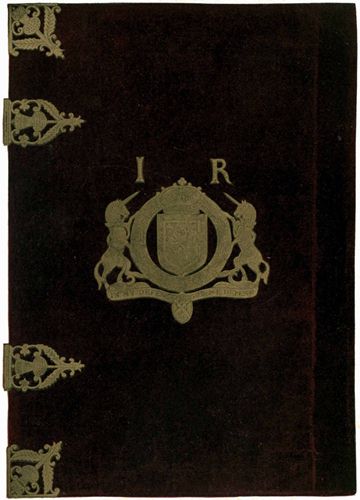
ΒΑΣΙΛΙΚΟΝ ΔΩΡΟΝ. M.S. Written for Prince Henry,
by King James VI. of Scotland.
James VI. of Scotland, whatever may have been his faults, certainly had
the merit of knowing how to advise his son. In 1559 he wrote the curious
Basilicon Doron for his “Dearest son Henry, the Prince.” He writes as
for a Prince of Scotland, and about the Scottish people, and when it was
first issued there were many doubts as to its authorship. The original
manuscript of this work is now part of the old royal library in the
British Museum; and although a study of this most interesting manuscript
will amply repay anybody who cares to read it, it is as well specially
interesting because of the beautiful binding with which it is covered
(Plate IV.) We know from documents that in 1580 John Gibson had been
appointed binder to the King of Scotland, and that when he came to London
this office was granted to John and Abraham Bateman; and, although no
binding is certainly known to have been executed by either of these, I
think it very probable that the binding of the Basilicon Doron may, for
the present at all events, be attributed to John Gibson. It is covered in
deep purple velvet, and the ornaments upon it are cut out in thin gold,
and finished with engraved work. The design on each board is the royal
coat-of-arms of Scotland, with supporters, crowned, and enclosed within
the collar of the Order of the Thistle, dependent from which is the badge
with St. Andrew. The supporters are the two unicorns standing upon a
ribbon, on which is the legend, “In my Defense. God me Defend.” Above the
crown are two large letters, J. R. The corners and two clasps of the book
are made in the form of thistles, with leaves and scrolls. Unluckily much
of this gold work is gone, but in the figure I have restored it where
necessary. The decoration altogether has a most rich and beautiful effect,
and I know of no other book decorated in the same way. Indeed, books of
any sort bound for James when he was king of Scotland are of the greatest
rarity, and it is quite possible that this is the only existing specimen;
although when he came to England a very large quantity of books were bound
for him, the majority of which still remain.