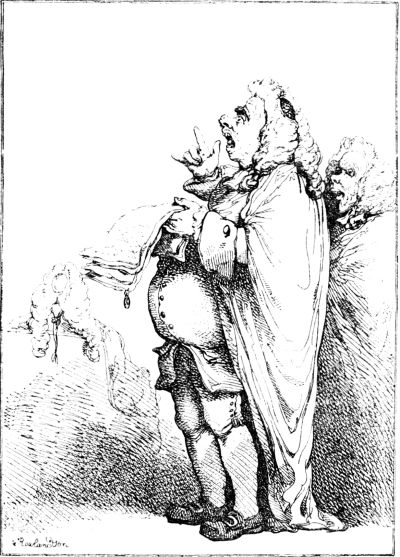
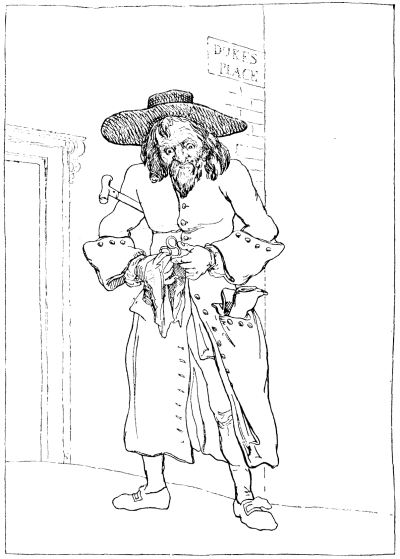
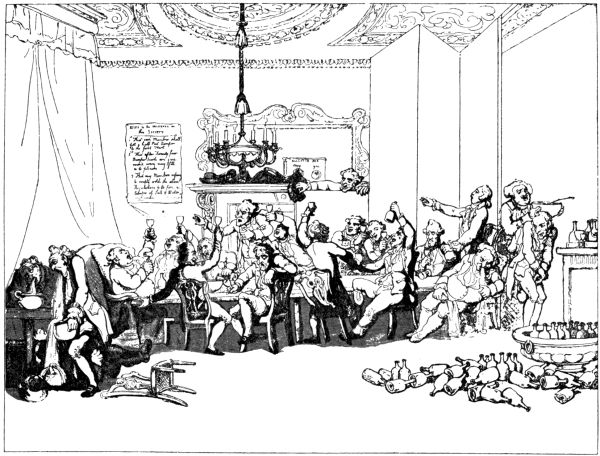
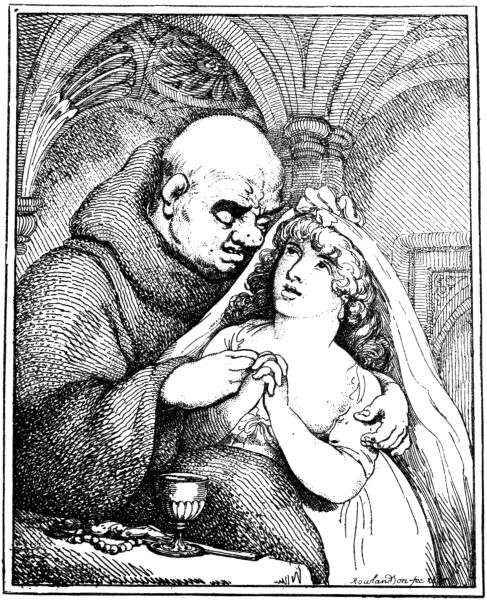
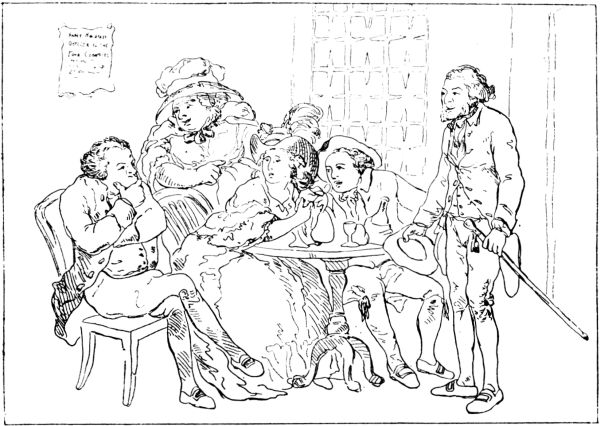
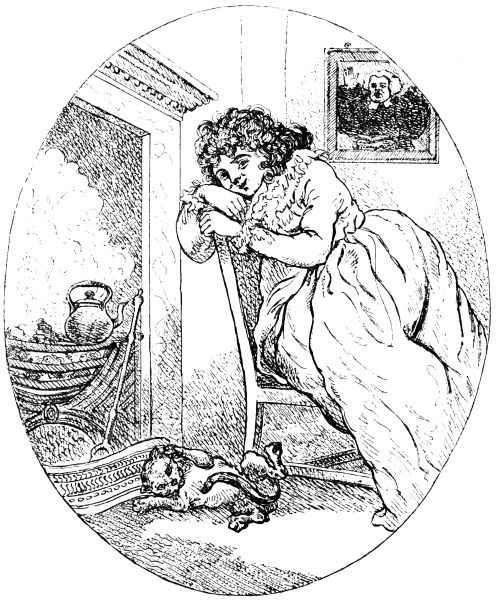
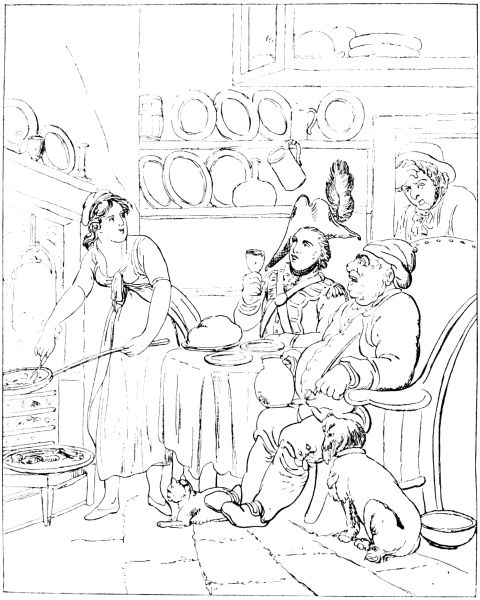
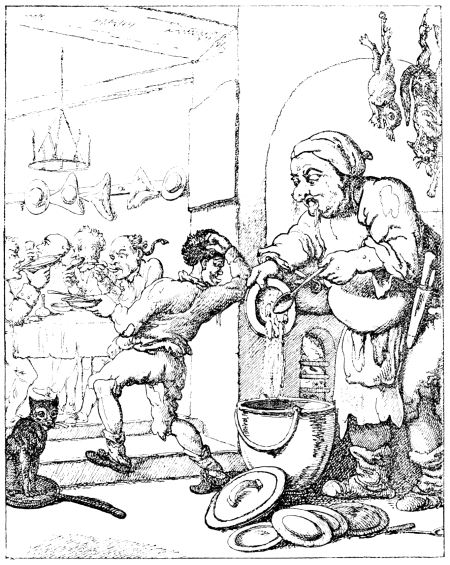
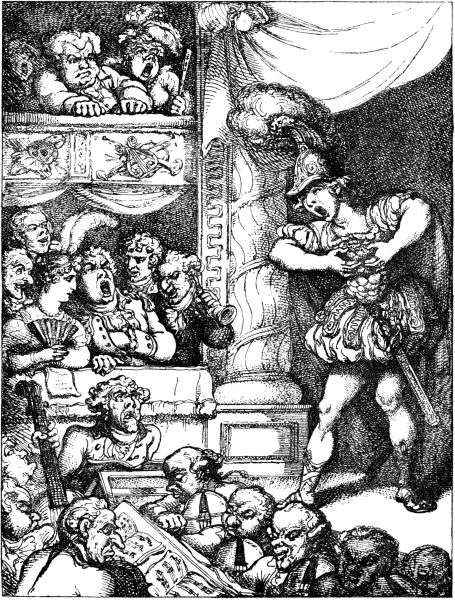
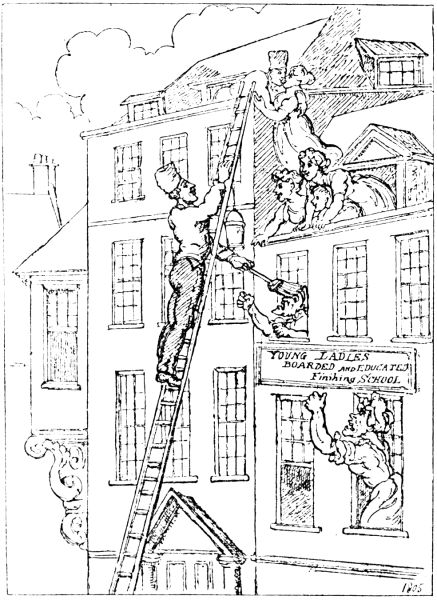
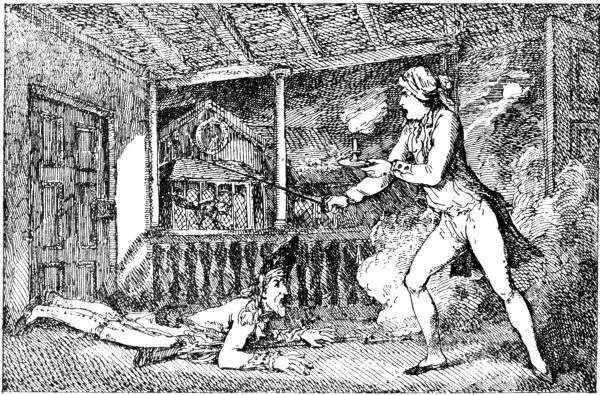
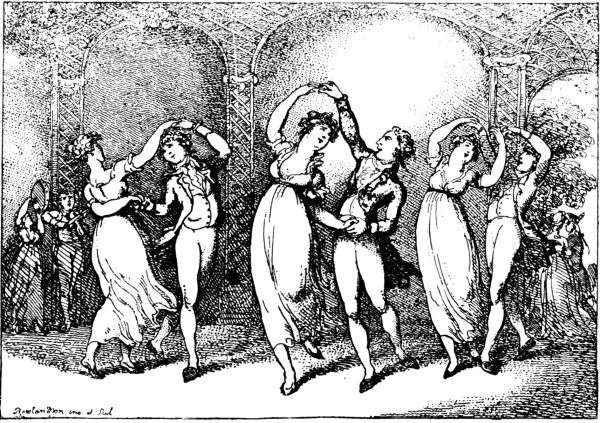
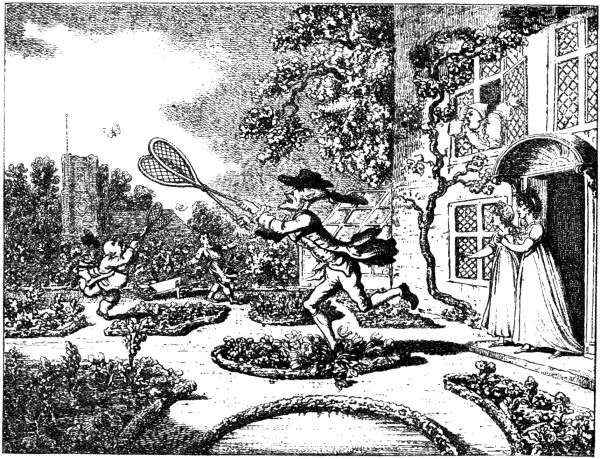
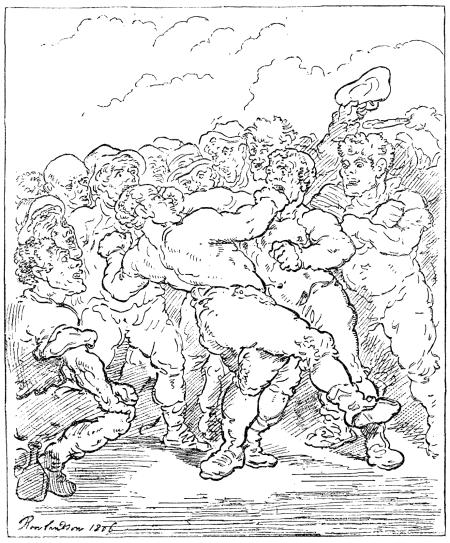
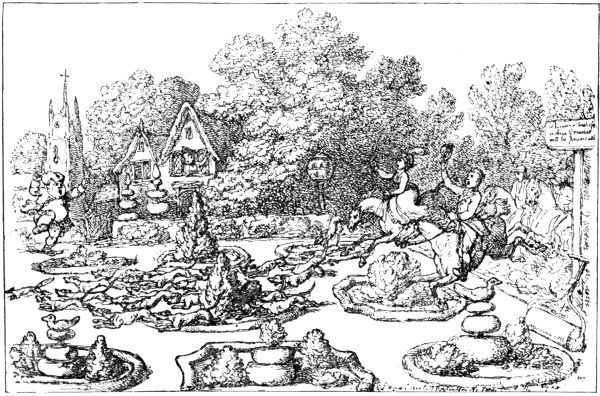
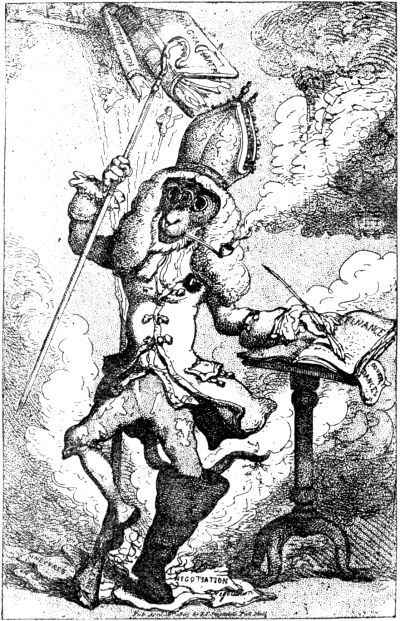
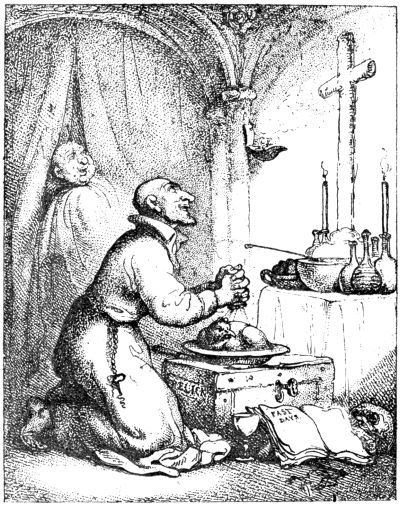
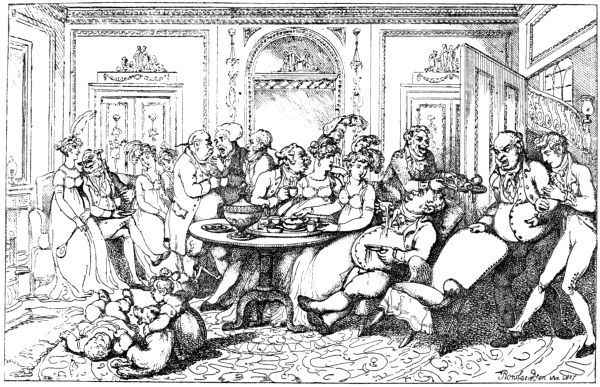
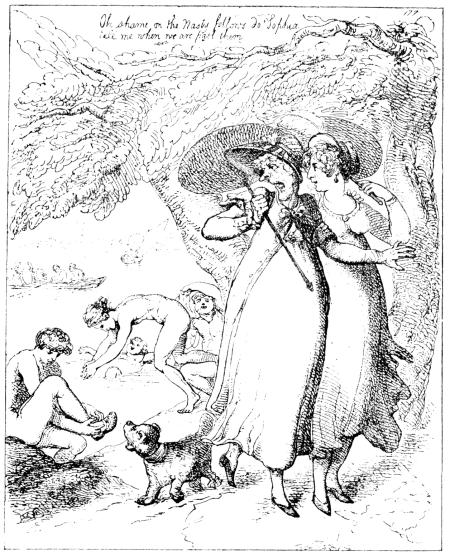
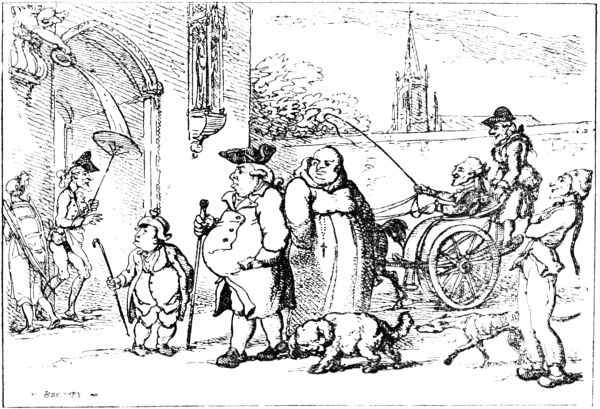
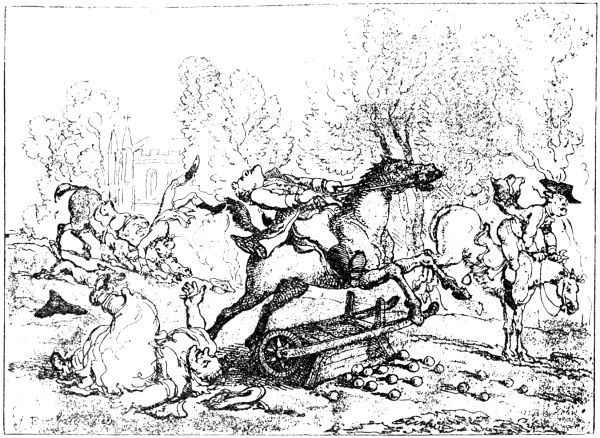
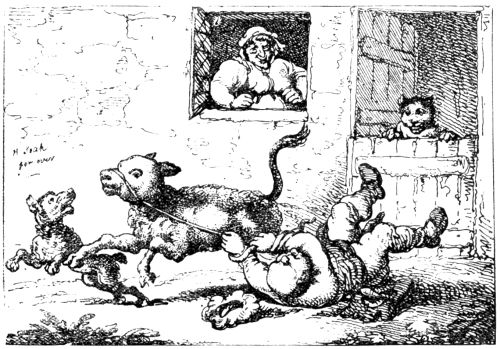
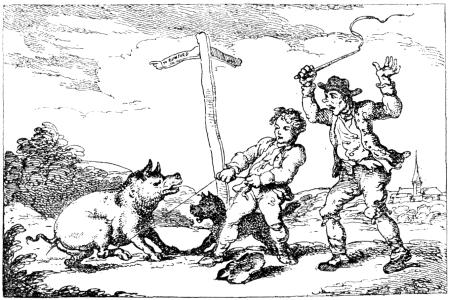
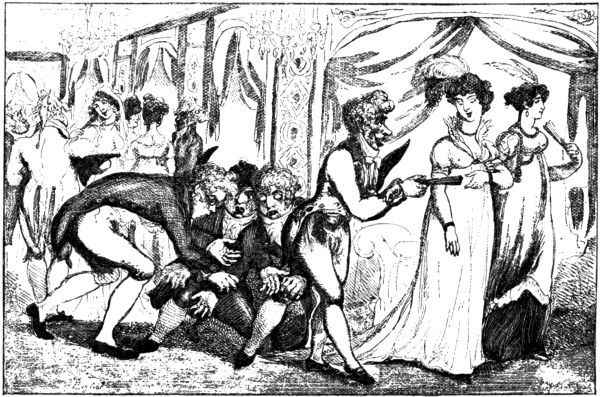
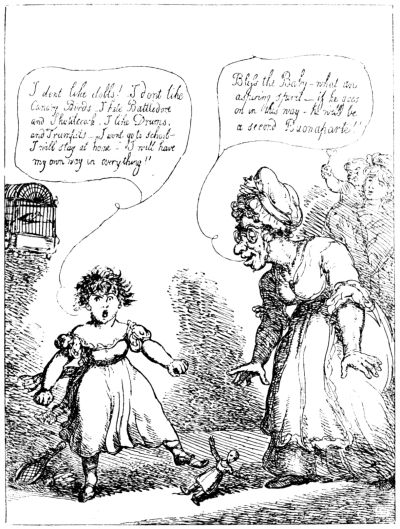
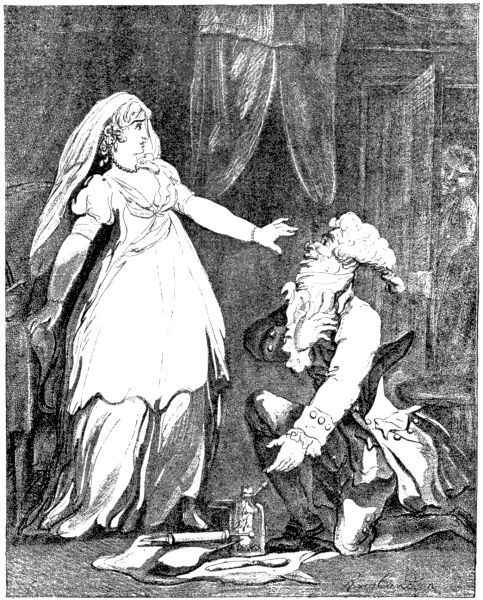
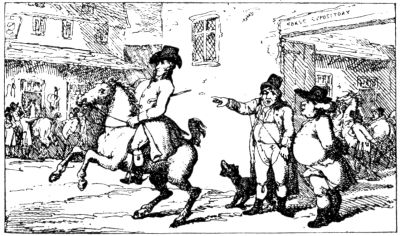
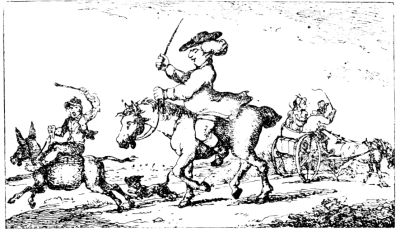
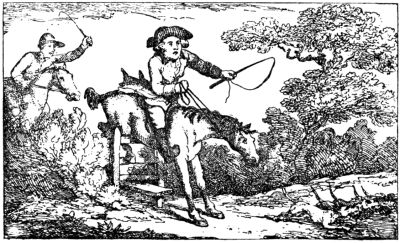
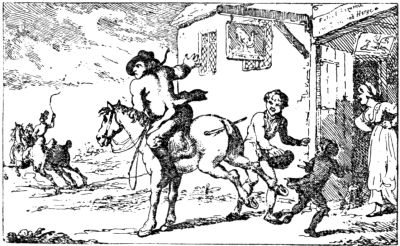
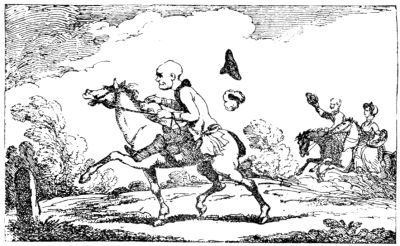
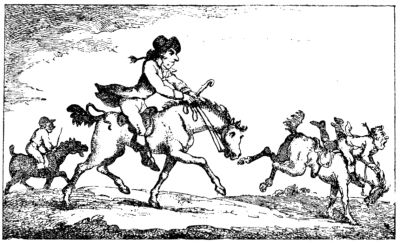
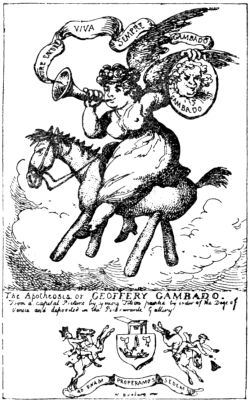
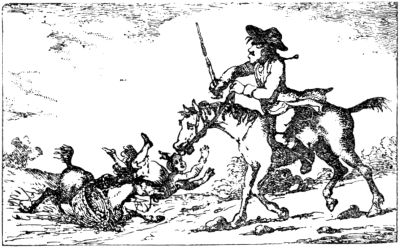
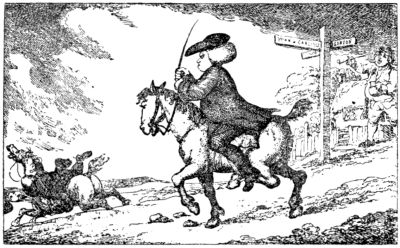
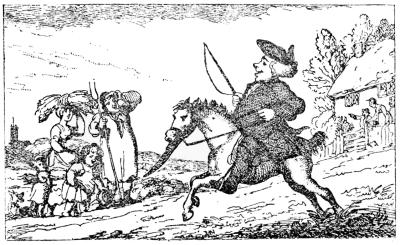
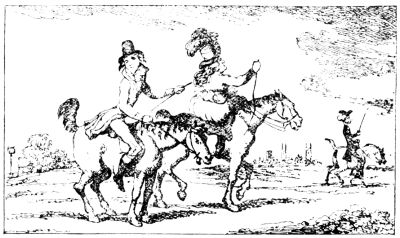
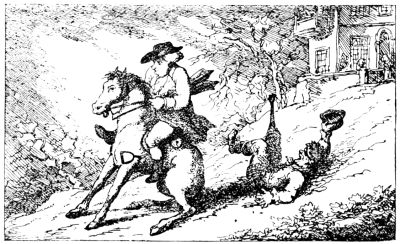
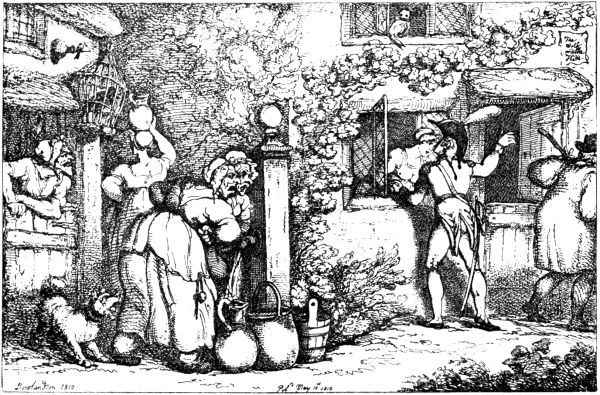
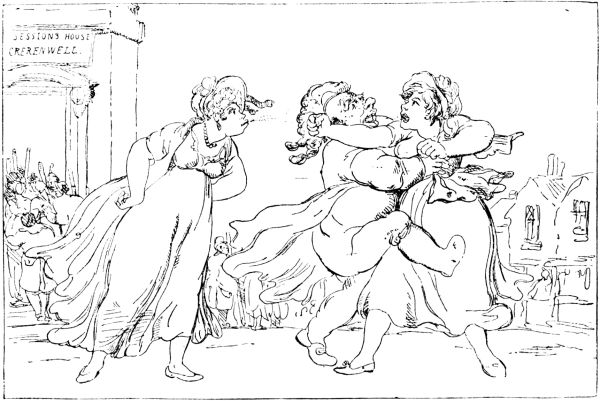
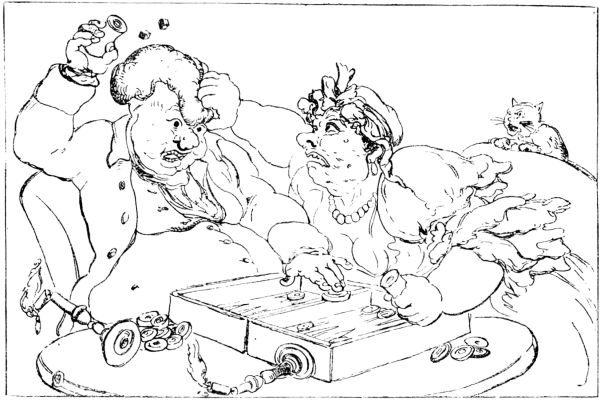
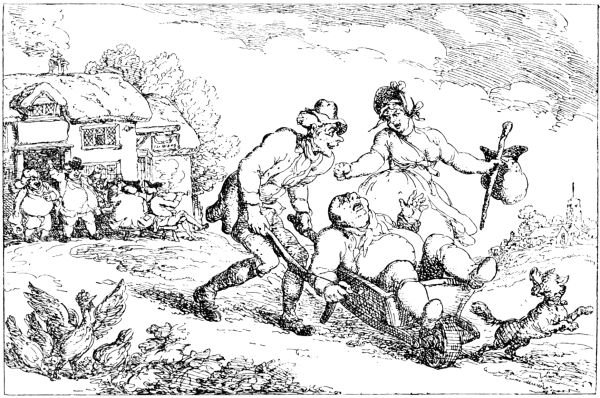
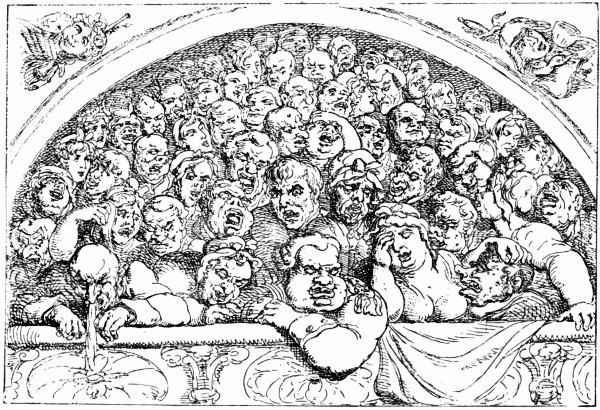
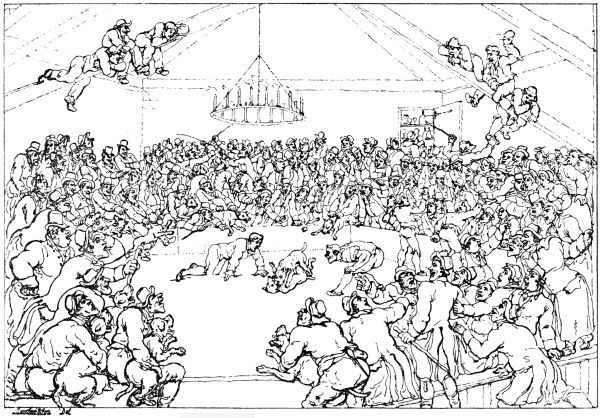
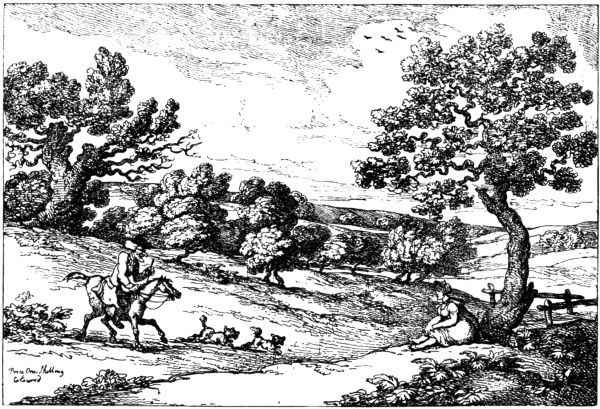
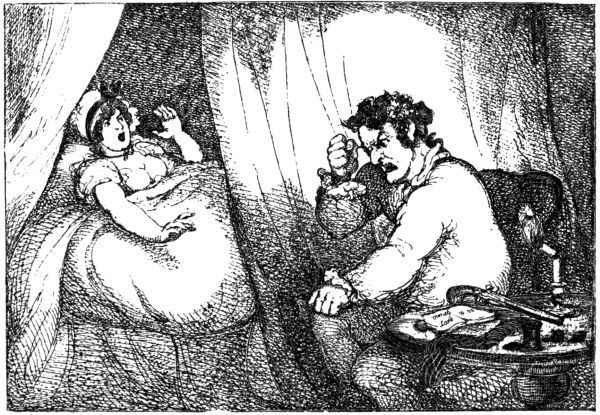
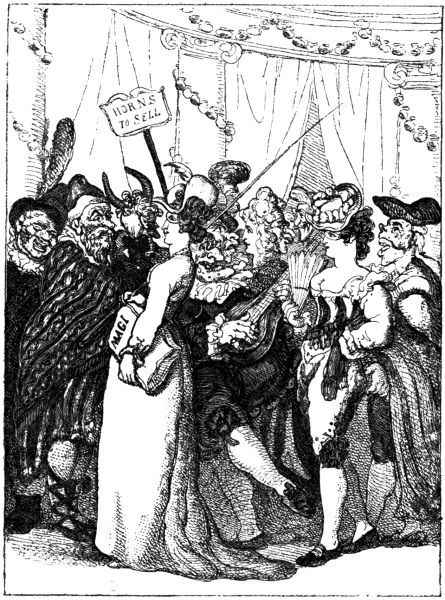
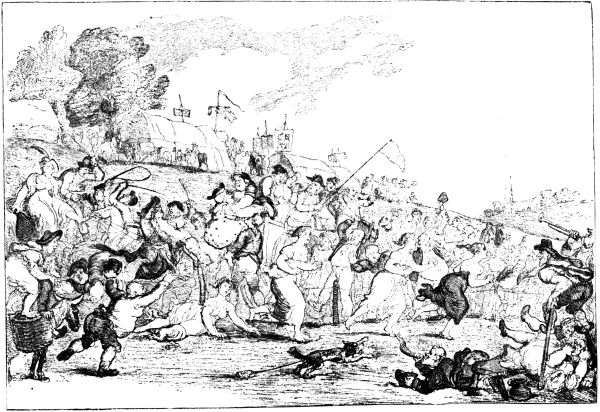
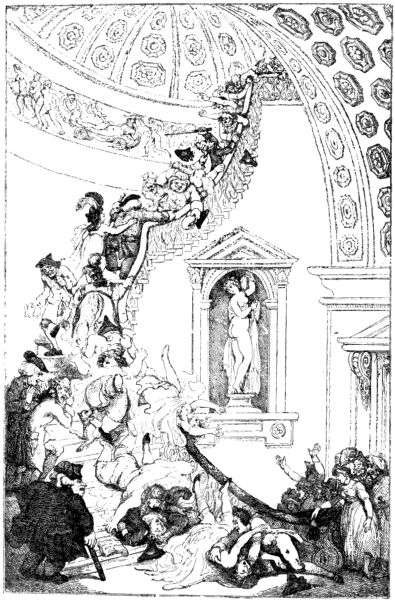
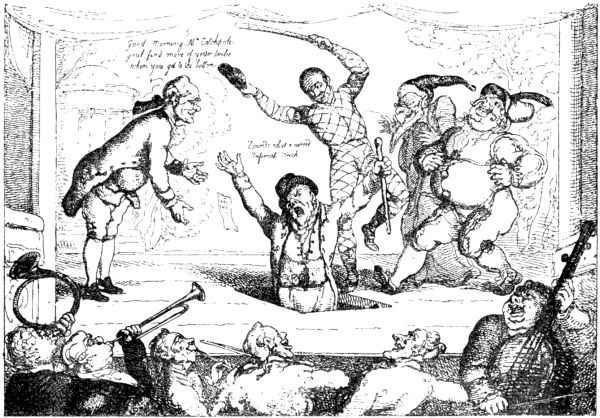
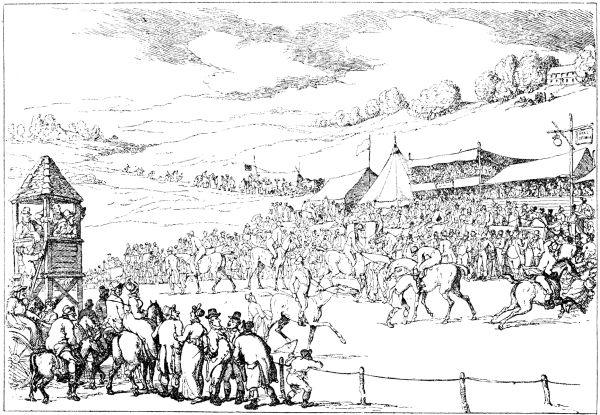
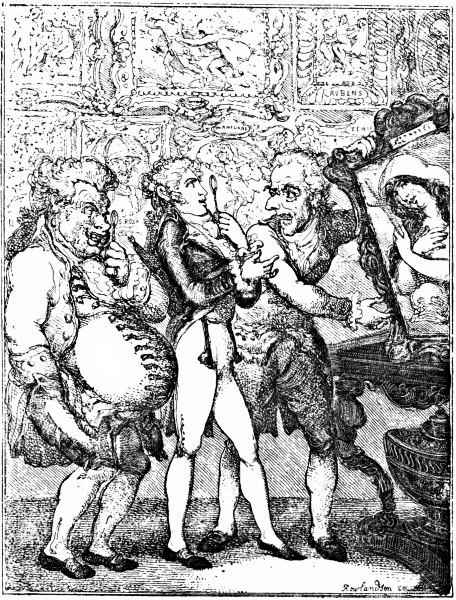
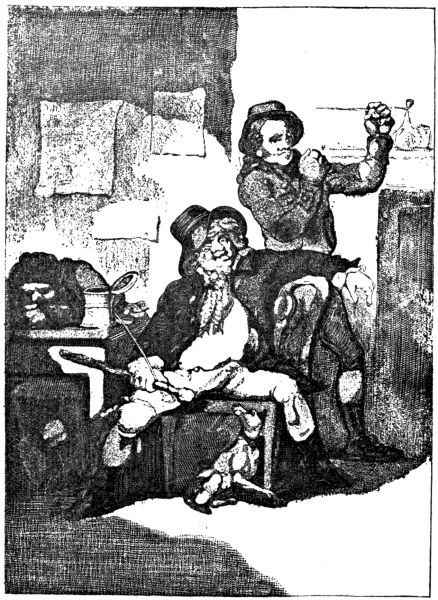
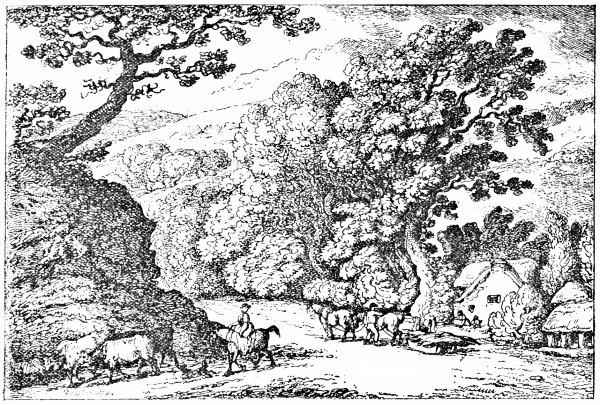
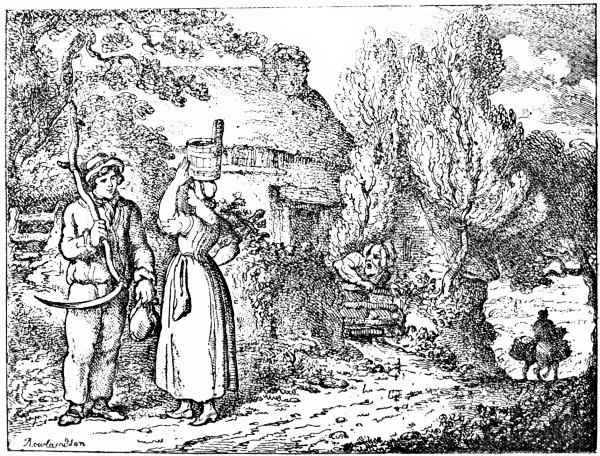
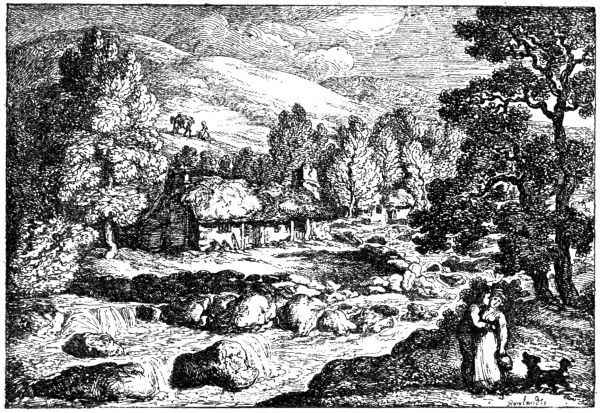
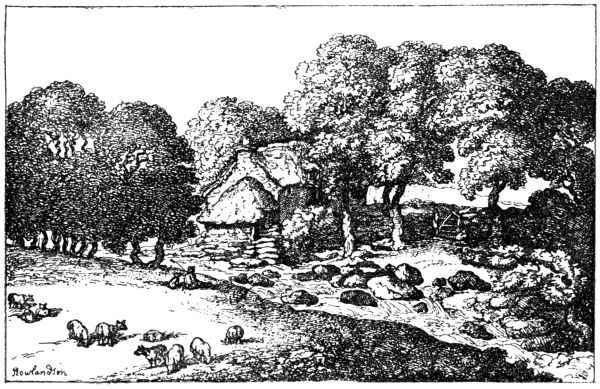
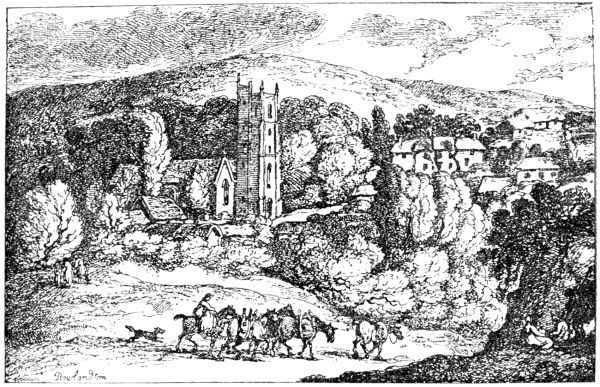
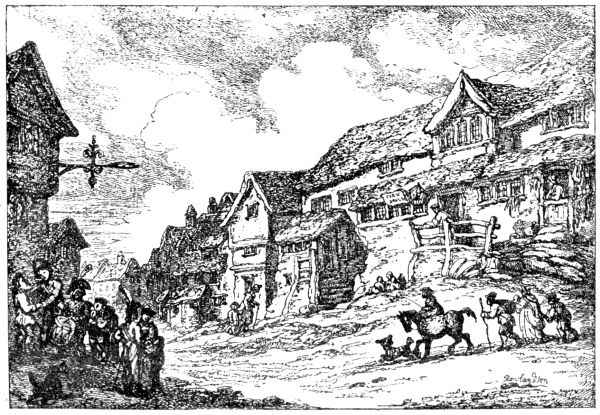
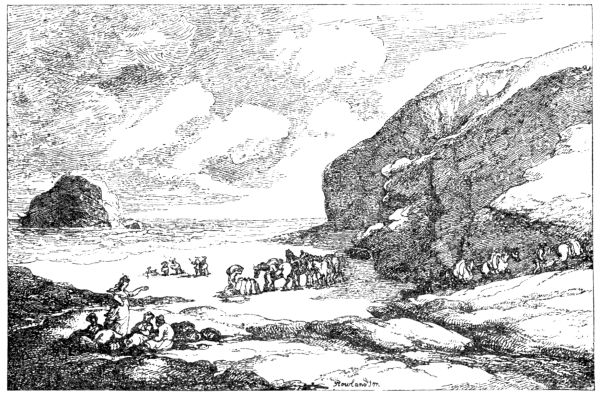
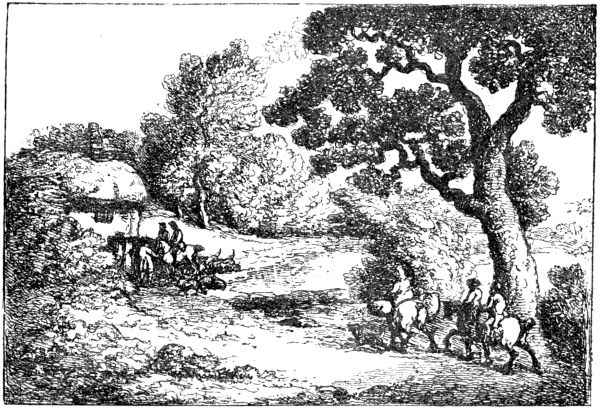
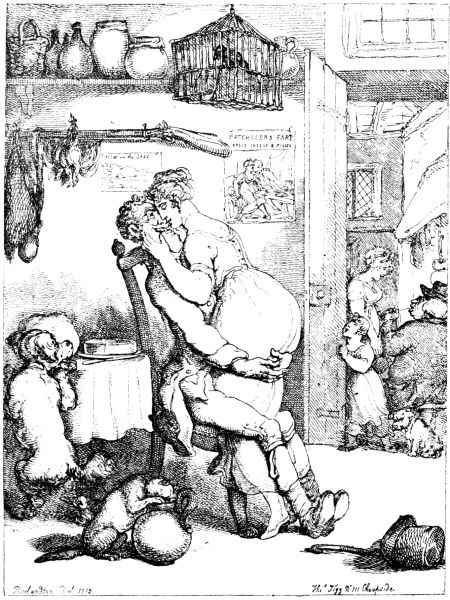
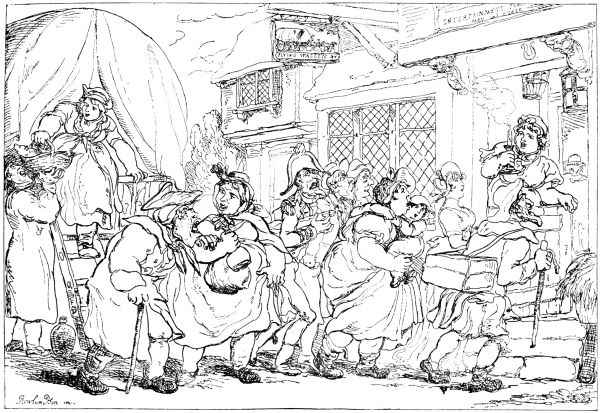
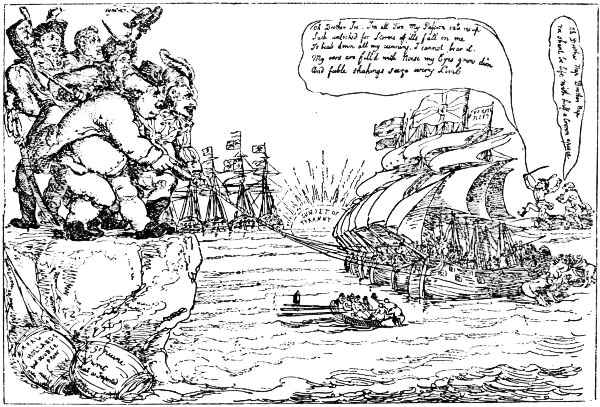
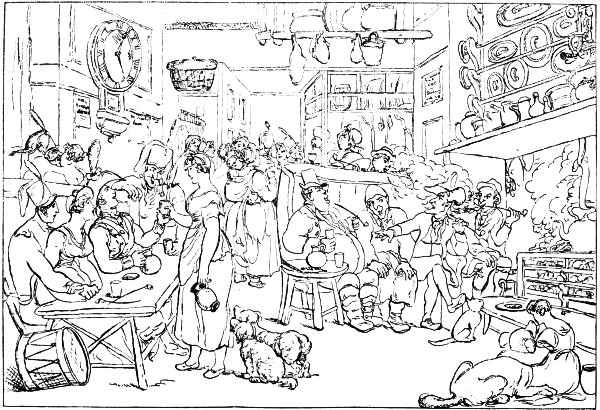
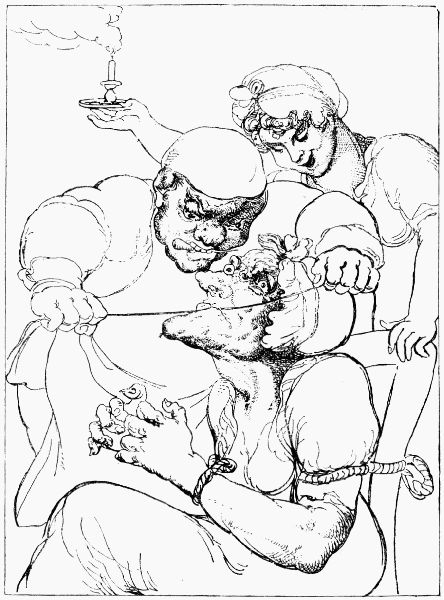
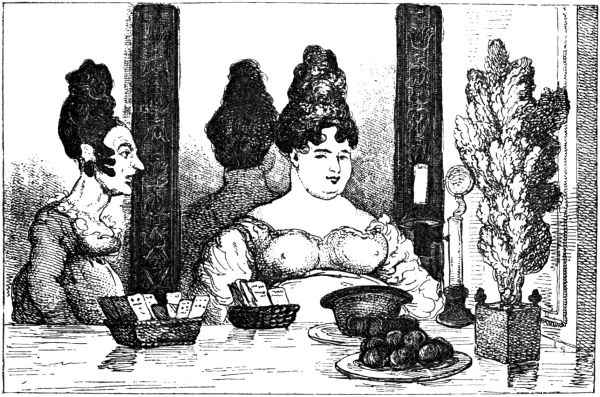
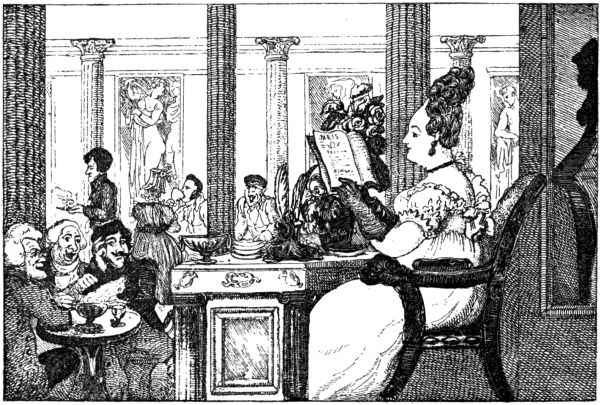
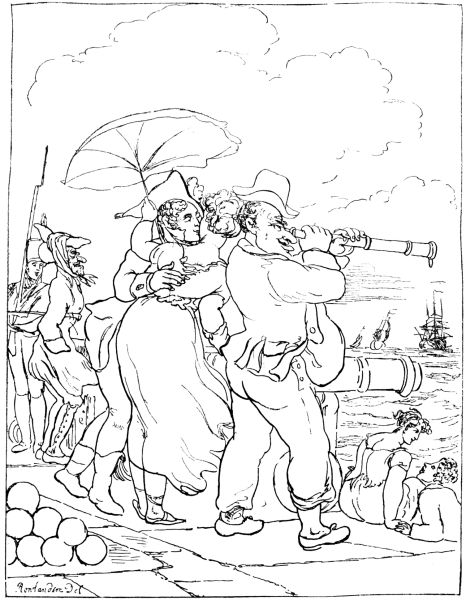
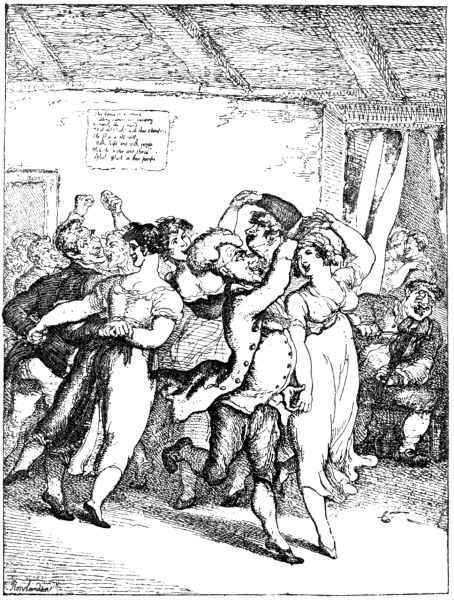
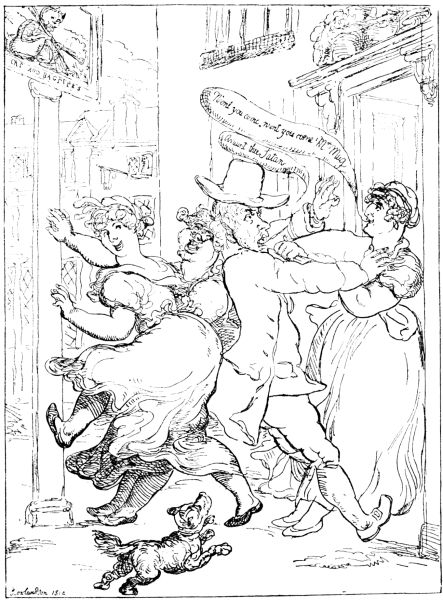
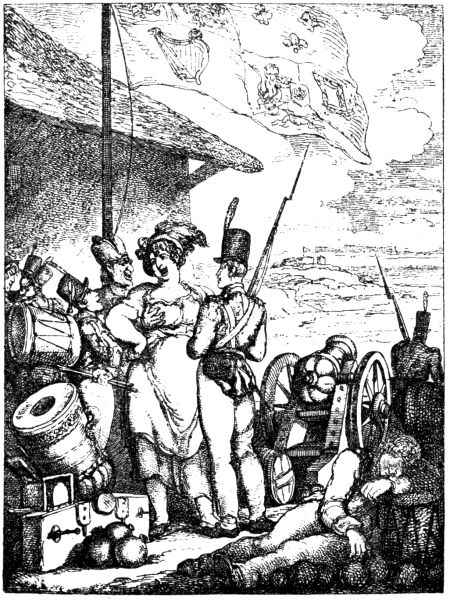
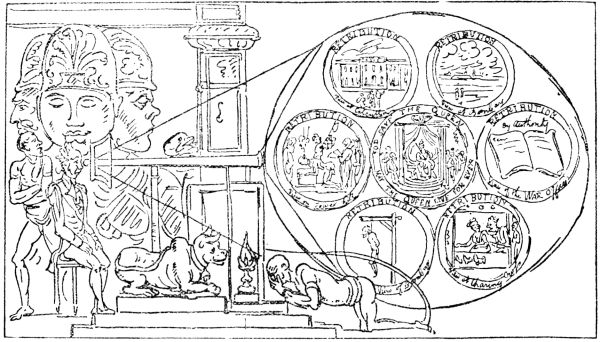
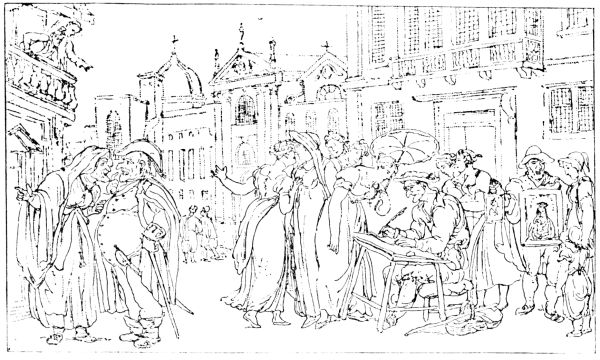
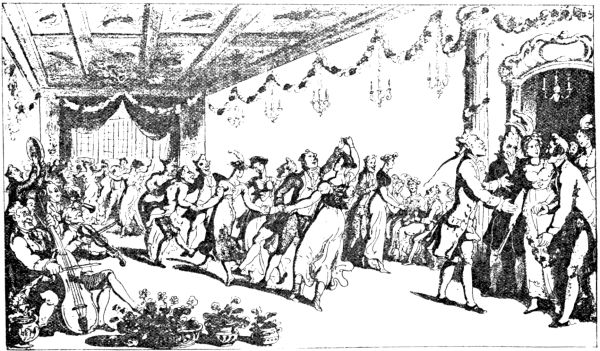
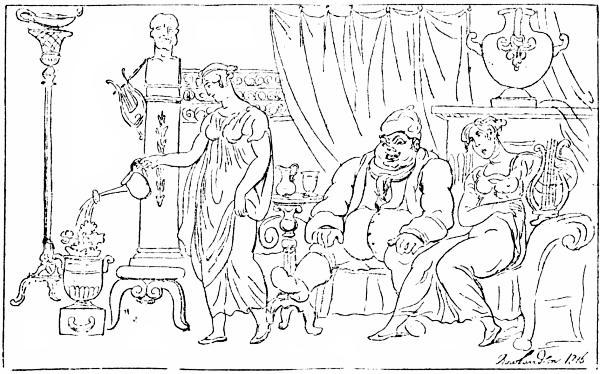
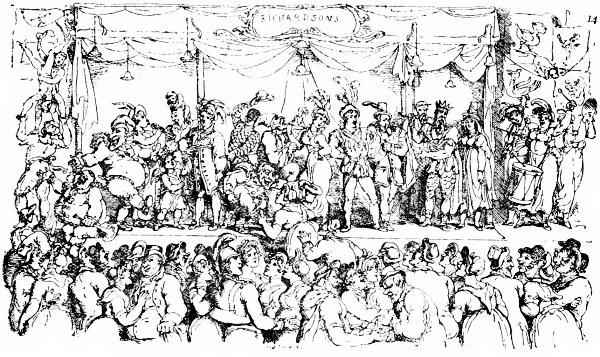
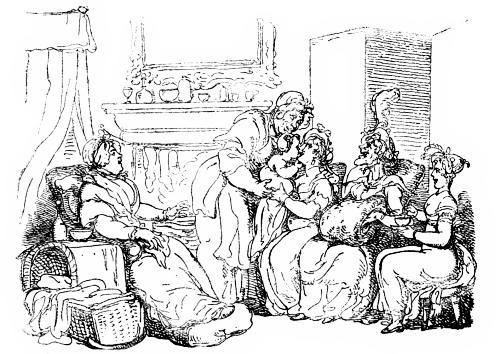
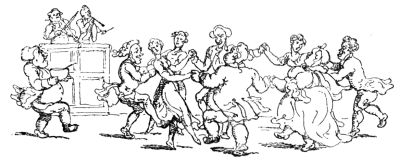
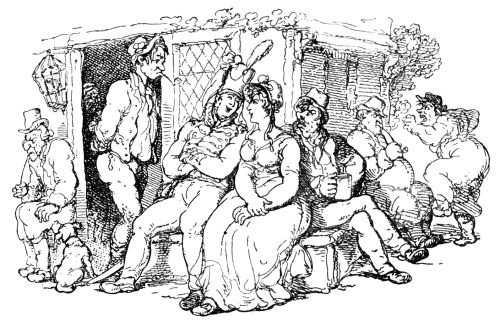
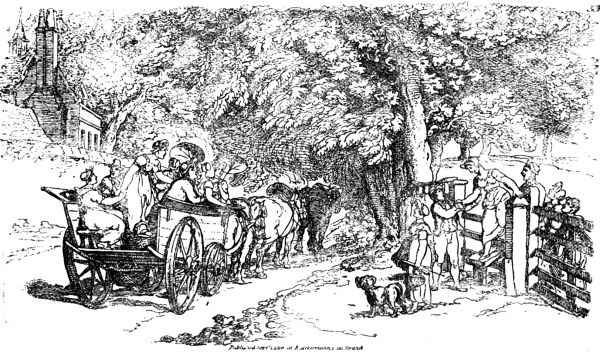
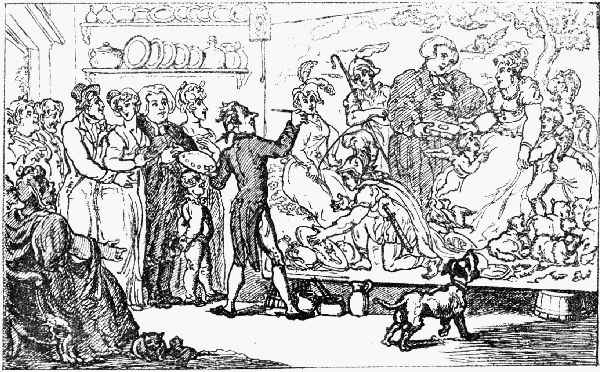
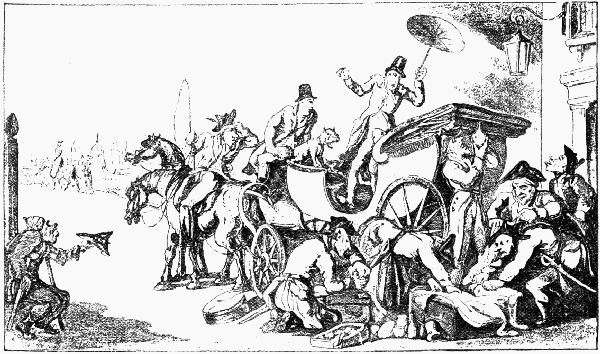
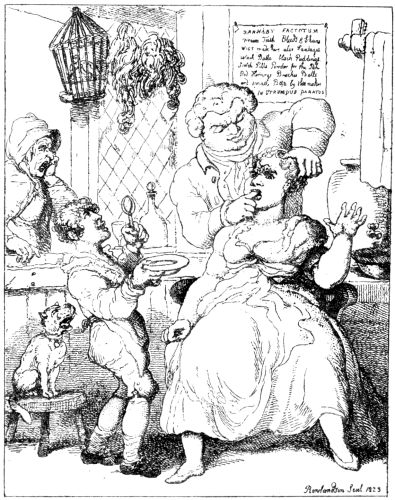
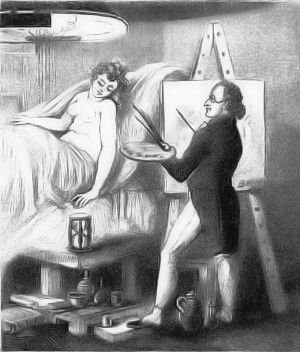
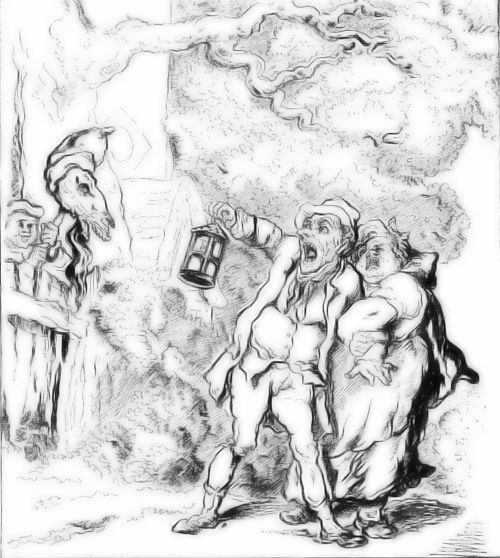
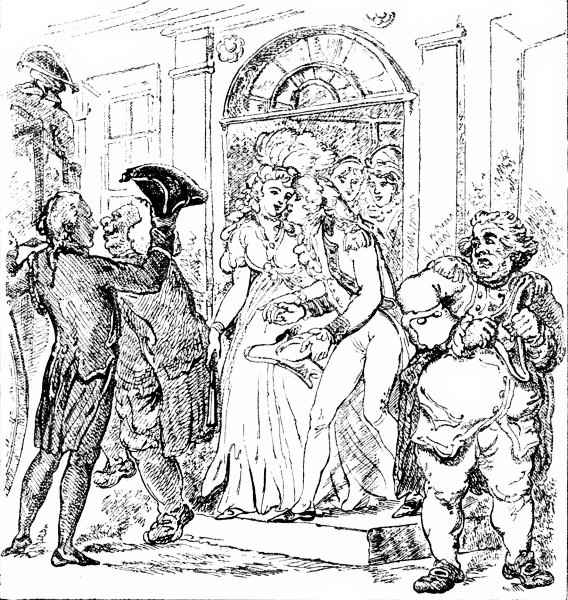
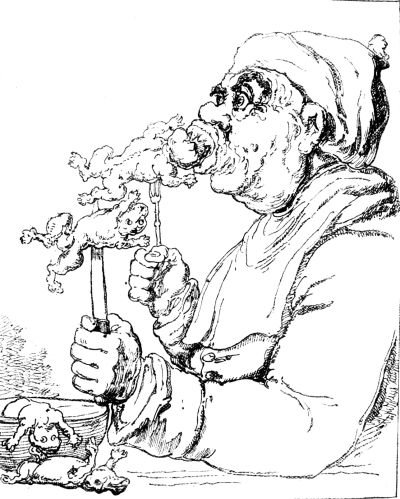
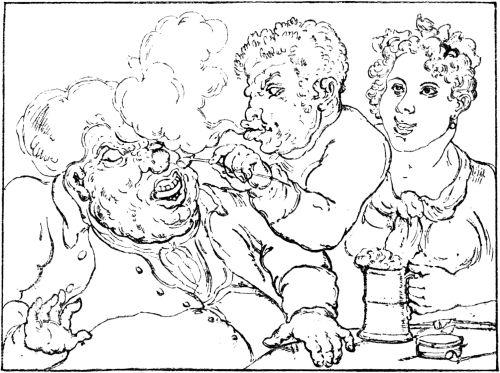
The Discovery. Etched by Rowlandson, 1798. Republished, Jan. 1808–9.
January 15, 1809. The Head of the Family in Good Humour. Published
by Tegg, Woodward del., Rowlandson sc.—John Bull, a very giant among a
race of pigmies, is surrounded by the heads of the different states, who are all
hurling out threats against his chances of peace. Napoleon is thundering for
Ships, Colonies, and Commerce. The Muscovite is denouncing: 'Russian vengeance
attend John Bull.' Holland is blustering: 'I'll eternally smoke him.'
Tom Paine is offering this warning: 'Let him tremble at the name of America.'
The other potentates are following up these threats with valedictions of their
own: 'Beware of Prussia;' 'Austria will never pardon him;' 'Spanish fury
overtake him;' and 'Let him beware of Denmark.' John Bull is smiling good-naturedly
at all these empty vapourings: 'Don't make such a riot, you little
noisy brats, all your bustle to me is no more than a storm in a teacup!'
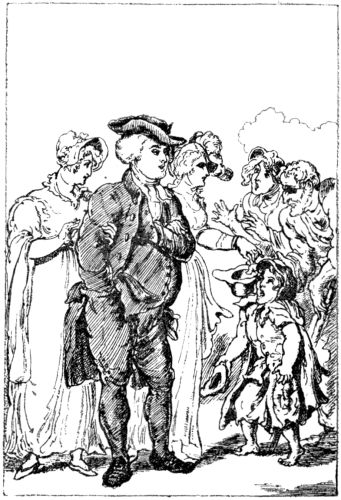
January 15, 1809. The Old Woman's Complaint, or the Greek Alphabet.
Published by T. Tegg, 111 Cheapside.—An old country dame has called upon a
pedagogue, with a fanciful grievance, to make respectful complaints against the
dominie's scholars, who, cap in hand, and satchel on back, are making their entrance
into the learned presence, behind their accuser. The schoolmaster, who
wears a red night-cap, and slippers, is made to say: 'Good woman, you are
always making complaints against my scholars; what have they done to offend
you now?' 'Please your honour's worship, they followed me up and down, and
said one to another, at her, beat her, damn her, pelt her! and a great deal more
that I do not recollect.' The young pupils are explaining the old lady's misconception:
'Indeed, sir, we were only repeating our Greek alphabet, in order
to get it quite perfect; what the old woman heard was only Alpha, Beta, Gamma,
Delta, and so on to the conclusion!'
February 1, 1809. A Traveller refreshed in a Stagnant Pool, after the
Fatigues of a Dusty Day's Journey. Published by R. Ackermann, Strand.
February 1, 1809. Mrs. Bundle in a Rage; or too late for the Stage. Published
by R. Ackermann, Strand.
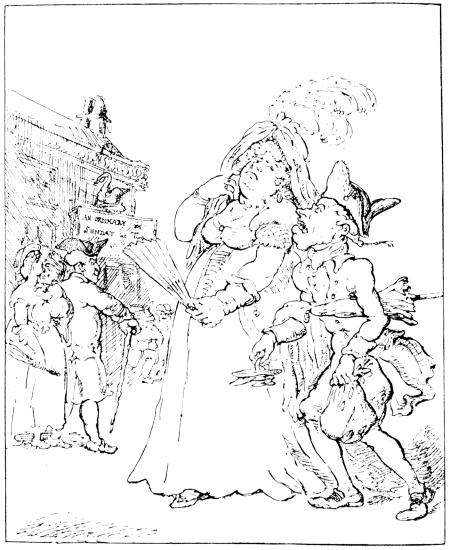
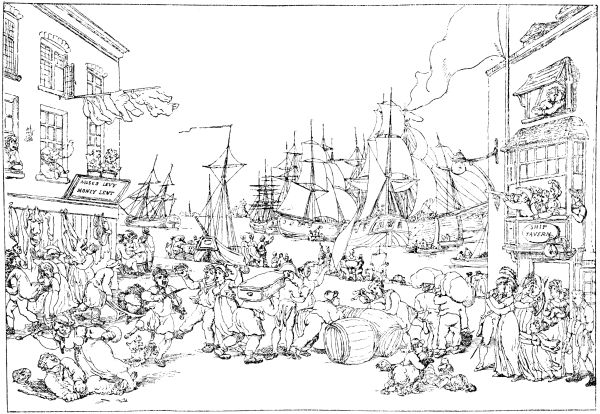
February 1, 1809. Launching a Frigate. Newton del., Rowlandson fecit.
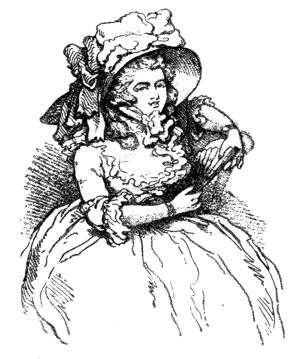
Published by T. Tegg, 67 Cheapside.—A trim nymph, very fashionably dressed,
is starting on her travels from an hotel, situated, as we recognise, from the notice
on the wall, near Portsmouth Dock. The figure of the promenader is drawn
with care, and is perfectly in Rowlandson's most telling manner; behind the
curled, feathered, and blooming damsel, is an ancient and colossal harridan, bedizened
with showy finery, who is supposed to have launched the fair charmer.
Characteristic glimpses of Portsmouth are given in the background of the picture.
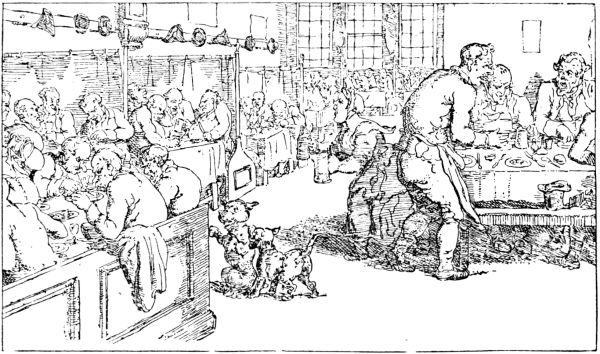
March 20, 1809. A Mad Dog in a Coffee House. Published by T. Rowlandson,
1 James Street, Adelphi.—The advent of a nondescript animal, supposititiously
assumed to be a ferocious mad dog, has produced the utmost terror
and confusion amongst the grave frequenters of a mercantile coffee-house, somewhat
after the model of Garraway's. All the city brokers, and pillars of 'change
found therein, are scared out of their sober senses; some, like the little Jew in
the corner, are paralysed with fear; others are trying to creep under the tables;
a few are seeking escape by the door, which they are effectually blocking; and
groups of affrighted fugitives are endeavouring to gain the refuge of the staircase.
A select knot have made for the bar, and are flinging themselves pell-mell
over the counter; the chimney, and similar places of refuge, are eagerly sought;
tables are mounted; comfortable citizens are thrown on their backs, like turtles,
and trodden on, while the pressure of viler bodies above is expressing a stream
of specie from the well-filled pockets of the overthrown. A cat, her tail swollen
to abnormal proportions, is making a frantic rush into the midst of the cowering
poltroons under the table. Rowlandson generally manages to introduce certain
advertisements appropriate to his subjects, and a notice stuck on the wall of the
coffee-house conveys the following piece of shipping intelligence: For the
Brazils, 'The Cerberus,' Captain Pointer. Burden 300 tons. Laying off Barking
Creek. Enquire of Benjamin Bell, Barge Yard, Broker.
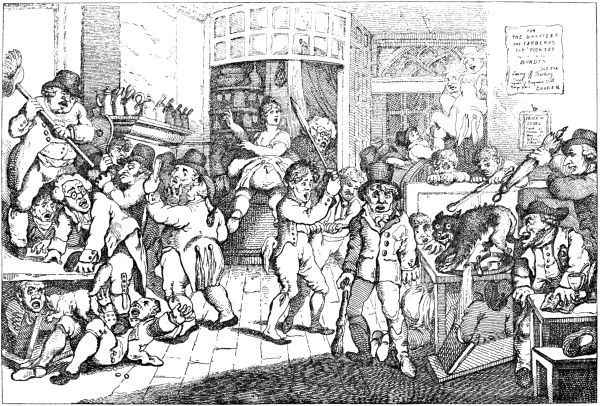
A MAD DOG IN A COFFEE HOUSE.
1809. Disappointed Epicures. Another version of A Mad Dog in a Dining-room.—In
this case the dog has run between the legs of a man bringing in a
dish of cutlets, which bestrew the carpet; his downfall has in turn overset
another retainer, whose soup tureen has come to grief; the butler, more engaged
in watching the calamities of his fellows, has allowed the 'spruce beer' to escape
in a shower of froth all over the place. The scene is well worked out; over the
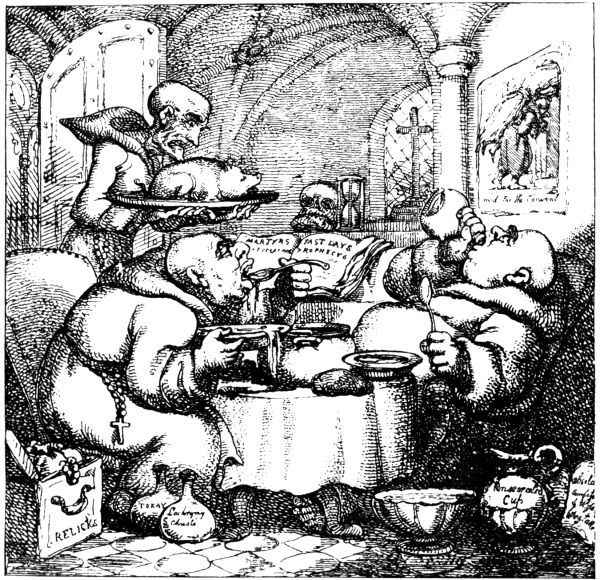
door of the dining-room is a picture representing a party of corpulent friars seated
round a refectory board. The faces of the party—it is a bachelor-dinner in this
instance—express more annoyance than alarm; they are dejected at the prospect
of a curtailed repast.
1809. A Mad Dog in a Dining-room, or Disappointed Epicures.—This
print, which has never before been engraved in its present form, is a literal reproduction
of the original study; one of the collection of drawings by Rowlandson
in the possession of the present writer. The picture tells its own story so graphically,
that it is unnecessary to attempt any fuller elucidation of the subject.
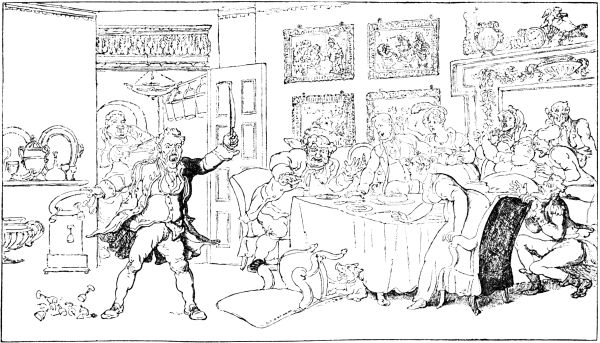
A MAD DOG IN A DINING-ROOM.
April 21, 1809. The Comforts of Matrimony. A Good Toast. Published
by Reeve and Jones.—The picture represents a scene of domestic felicity of the
most touching completeness. The husband is browning a muffin for tea; his
wife's arm is wound round his neck during this delicate operation; his children
are enjoying their peaceful meal; an infant is tranquilly slumbering in the cradle;
and a cat, surrounded by her family of kittens, carries out the unity of the
subject. Another of the series partly published in 1808, in which a rude facsimile
of the original drawings has been attempted, without much success.
The Tables Turned. Miseries of Wedlock. A pendant to the preceding.—The
domestic horizon is clouded by storms. The late happy pair are only kept
from demolishing each other by the table placed between them, which is being
wrecked in the struggle. The wife, in a fury, is holding on to her husband's
hair with all her force, while he has a firm grasp of his unfortunate spouse's head,
at which he is aiming a pewter-pot; children, chairs, crockery, cutlery, and food,
are alike devoted to destruction; the infants are frantic, and general misery prevails.
The execution of these subjects is commonplace, and the engraver has
not done justice to the originals.
April 29, 1809. Oh! you're a Devil. Get along, do! Published by Reeve
and Jones, 7 Vere Street, New Bond Street.—A dashing young officer, a gallant
adventurer, probably crippled with debts, and with nothing but his commission
to support his extravagances, is laying ardent siege to the ordinary person of a
rich dowager, fat, not fair, and decidedly forty; indeed, the lady is more than old
enough to be the mother of her insidious admirer, who is probably looking
forward to the possession of the foolish inamorata's fortune to 'whitewash' his
liabilities, and exchange him from one slavery to another; preferring the fetters
of Hymen to the captivity of a debtor's prison. The lady, a vain piece of
antiquated and frivolous vulgarity, is loaded with massive jewellery, which her
hopeful lover no doubt looks forward to melting for his own purposes, after he
has staked the relict's money-bags on the gambling-table; her feathers are profuse,
and she wears a boa of an extinct kind, famous in the annals of contemporary
fashions, known as a rattle-snake.[10]
June 20, 1809. A Tit-bit for a Strong Stomach.
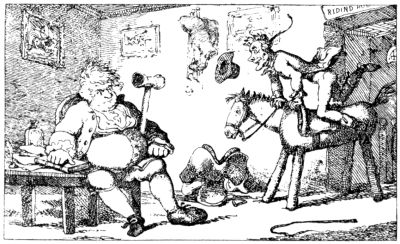
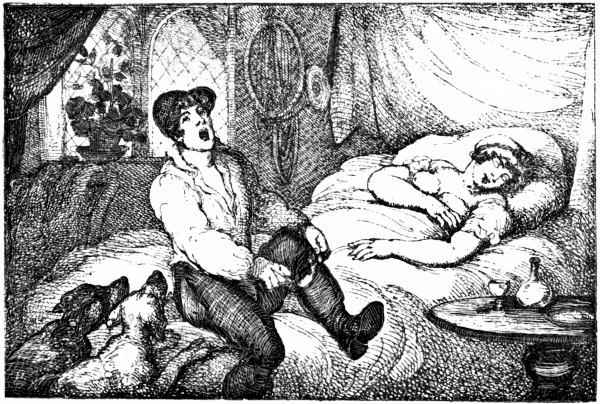
July 31, 1809. The Huntsman Rising. The Gamester going to bed. Published
by T. Rowlandson, 1 James Street, Adelphi. (See 1811.)
1809. Rowlandson's Caricatures upon the Delicate Investigation, or the
Clarke Scandal (Mrs. Mary Anne Clarke and the Duke of York).—In order
to make the caricatures, published by Rowlandson, on the Clarke scandal
intelligible, it is desirable to recapitulate the circumstances, which are given
in condensed form from the writer's 'Life of James Gillray the Caricaturist.'[11]
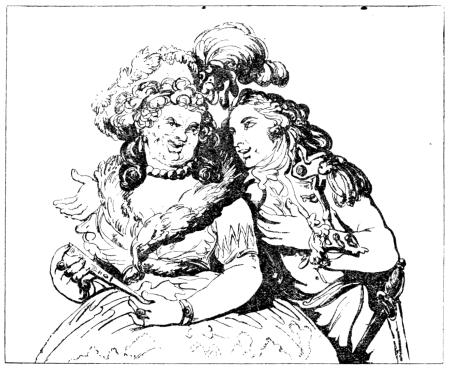
OH! YOU'RE A DEVIL. GET ALONG, DO!
George the Third's darling son, the favourite Frederick, on whom he doted,
and who was so popular out of doors that he was hailed as 'the soldier's friend'—a
compliment which no soldier would be likely to utter concerning a commander
who had not taken the right method to render himself the object of general
affection—began to attract unenviable notoriety at the beginning of 1809. On
January 27 Colonel Wardle charged the Duke with corrupt administration
of the Half-Pay Fund, the sole control of this provision having been vested in
the Commander-in-Chief.
The produce of the fund arose from the sale of commissions fallen in by the
death or dismissal of officers in the army, and amounts thus realised were applied to
the purchase of commissions for meritorious officers, and other beneficial purposes.
Colonel Wardle stated he should prove that the Duke of York had a mistress,
Mrs. Clarke, living in great splendour in Gloucester Place, from 1803 to 1806.
This lady had a scale of prices for the sale of commissions, and he would lay
before the House Mrs. Clarke's prices and the Regulation prices.
| | Mrs. Clarke's | Regulation |
|---|
| | Prices. | Prices. |
|---|
| A Majority | £900 | £2,600 |
| A Company | 700 | 1,500 |
| A Lieutenancy | 400 | 550 |
| An Ensigncy | 200 | 400 |
Every sale effected by Mrs. Clarke was a loss to the Half-Pay Fund of the
difference between her price and the Regulation price. He then made a statement
of a list of sales effected by her, the sums paid, the names and ranks of
the officers, a list of exchanges, &c.
Her patronage, it was stated, extended also to ecclesiastics. He moved for
a Committee of the whole House to investigate the subject. The motion was
agreed to, and the witnesses were ordered to be summoned.
On February 1, Mrs. Clarke stood at the bar of the House—a lovely Thaïs,
eminently self-possessed, armed with ready wit, and with charms of person and
address which dazzled the gravest members. She contrived to turn all questions
put to her with the object of giving annoyance, or for her degradation, into the
means of exposing the Duke of York, who, it appears, had withdrawn his 'protection,'
stipulating to pay her an annuity of 400l. per annum, which had been
suffered to fall into arrears, and her applications for payment had been met with
threats of the 'pillory' and the 'Bastille.'
Wilberforce, who, as we have seen, had been active in bringing forward the
impeachment of Lord Melville, for corruption in his office, when at the Admiralty,
as far as misappropriation of the Navy Fund was concerned; and Whitbread, who,
as a leader of the Radical Reformers, was foremost in exposing state intrigues
and corruptions at Court—were active in bringing forward and proving the
case against the Commander-in-Chief.
Wilberforce has made the following entry in his diary, touching the investigation
before the Parliamentary Committee: 'This melancholy business will do
irreparable mischief to public morals, by accustoming the public to hear without
emotion shameless violations of decency. The House examining Mrs. Clarke
for two hours, cross-examining her in the Old Bailey way, she, elegantly dressed,
consummately impudent and very clever, got clearly the better of the tussle.'
Two officers who endeavoured to shield their chief during the investigation
by giving evidence contrary to the truth, were committed to Newgate for
equivocation.
After an examination which lasted some while, during which facts damaging
to both sides were elicited, while Mrs. Clarke's allegations remained unshaken
in the main, Colonel Wardle summed up the evidence, and concluded by moving
'that the Duke of York had been guilty of corrupt practices and connivance.
He accordingly prayed for his dismissal from the command of the army.'
Mr. Banks moved an amendment acquitting the Duke of York of personal
corruption, but petitioning the King to remove him for gross irregularities and
negligence.
Mr. Percival moved and carried a resolution absolving the Duke of all personal
corruption or criminal connivance.
It was evident that the resignation of the Commander-in-Chief would alone
stop further proceedings. Wilberforce and his party succeeded in forcing him to
retire from the command of the army, and the inquiry was dropped.
Sir David Dundas succeeded the Duke of York, and after holding the appointment
for two years, resigned, and the Duke was reinstated.
Mrs. Clarke was not appeased by the results of the parliamentary investigation,
which had, in fact, effected nothing for her, and all for others. These disgraceful
exposures would have been escaped if the Duke had paid her annuity.
Her motives in the matter were of course entirely personal; the public were on
her side, and she made the notoriety serve her purpose. She announced a
Memoir of her Life, and of her transactions with the Duke of York, accompanied
by a series of his letters; these latter would have been eagerly read, the fervid
specimens which came out in the course of the investigation were republished,
versified, and circulated in various forms, to the delight of the public. The
consequences, and the ridicule apprehended from this exposure, effected the
purpose which a mere regard for good faith could not accomplish: negotiations
were opened for the suppression and destruction of these memoirs, which were
said to be actually in print. An indemnity of 7,000l. is believed to have secured
Mrs. Clarke's silence, and the annuity of 400l. was guaranteed her for life. This
outline of the facts will be found substantially followed by the caricaturist's series,
although the details differ in certain respects from over-colouring inseparable
from satirical versions.
Mrs. Clarke[12] stated that she had been under the protection of the Duke of
York since the years 1802 or 1803, but her establishment in Gloucester Place
did not commence till 1804; it consisted of two carriages, eight horses, nine men
servants, &c., to defray the expenses of which the Duke allowed her 2,000l. per
annum, to be paid monthly. That she had also a small establishment at Weybridge;
the house belonged to His Royal Highness. That the sums she received
from the Duke were barely adequate to pay the servants their wages and
liveries; and when she informed him of it, he replied that 'if she were clever,
she would not ask him for money.' That the applications for her interest in
military promotions were very numerous; she mentioned them to His Royal
Highness, who told her which were likely to be successful. At one period she
had a long list of applicants, procured either by Captain Sandon or Mr. Donovan,
which she gave his Royal Highness, who said he would procure the appointments
by degrees; she stated to him at the same time the sums which she should
receive for her interest in procuring them; that the appointment of Mr. Dowler
to the Commissariat was through the influence of the Duke of York, who knew
that she was to receive 1,000l. for it. That two applications were made through
the medium of Mr. Donovan, for promotions in the Church, one for a deanery,
the other a bishopric; and Dr. O'Meara, who expected one of them, applied to
her for a letter of introduction to His Royal Highness. That the Duke was
fully acquainted with the extent of her establishment as he visited her every day;
paid some incidental debts which she had incurred; but, at the time of separation,
had not made any advances of cash for three months, and, in consequence, left
her involved more than 2,000l. in debt. She resided in Gloucester Place about
three years.
Mrs. Clarke also stated that she obtained for Major Shaw the appointment
of Deputy Barrack-Master-General of the Cape of Good Hope, for which he was
to pay her 1,000l.; she, however, only received 500l., and, on complaining to
His Royal Highness, he warned her to be more careful, and not to suffer herself
to be duped again, adding that he would put Major Shaw on half-pay. Major
Shaw sent her several letters in consequence, complaining of being put upon half-pay,
but she paid no attention to them.
Mrs. Clarke also stated that she had in her service as footman, a young man,
named Samuel Carter; he lived with her about twelve months, and was in the
habit of attending upon her when in company with the Duke of York. She at
length obtained for him a commission in the 16th Foot, by applying to the Duke,
who conversed with him on the occasion. At the time of the investigation he was
a staff officer in the West Indies. Carter was recommended to her by Captain
Sutton, and was indebted to her alone for his commission.
It appeared from later disclosures that this Carter, who was by no means a
person without education, was the natural son of the deceased Captain Sutton, a
most meritorious officer, and a personal friend of the Prince's, and that his son's
appointment was an act of well-deserved benevolence. Carter's age at the date
of his appointment was, according to Mrs. Clarke's account, about eighteen, but
on account of his short stature he looked a mere boy.
Mrs. Clarke was asked whether she intended to abide by the statement of
her having pinned up at the head of the bed a list of the friends whom she wished
to be promoted, and which list the Duke of York took away? She answered
affirmatively, and said that His Royal Highness took it down the second morning,
drew up the curtain, and read it. She afterwards saw it in His Royal Highness's
pocket-book, with scratches through several of the names of those who had been
promoted.
Miss Mary Ann Taylor, who was in the habit of visiting Mrs. Clarke, when
she was under the Duke's protection, very frequently, stated that she heard the
Duke of York speak to Mrs. Clarke about Colonel French's levy, and that what
passed, as nearly as she could recollect, was as follows. 'I am continually
worried by Colonel French. He worries me continually about the levy business,
and is always wanting something more in his own favour.' Turning then to
Mrs. Clarke (Miss T. thinks), he said, 'How does he behave to you, darling?' or
some such kind words as he was wont to use. Mrs. Clarke replied, 'Middling;
not very well;' on which the Duke said, 'Master French must mind what he is
about, or I shall cut him up and his levy too!'[13]
Large sums, it is certain, had been supplied by the Duke to his mistress—upwards
of 5,000l. in notes, and in payments to tradesmen for wine, furniture, and
a variety of articles, to the amount, in the whole, of between 16,000l. and 17,000l.,
and all within the space of little more than two years. The extent of Mrs.
Clarke's debts was likewise to be considered.[14]
Mrs. Clarke's Memoirs.—Mrs. Clarke called on Sir Richard Phillips for the
purpose of making some arrangement respecting the publication of her Memoirs;
this offer was declined for several reasons of a private and political nature: the
unqualified reproaches to which Sir Richard Phillips had lately been exposed
had probably taught him some lessons of reserve, or at least he did not choose to
expose himself to public notice as the publisher of a work which was likely to
create much political interest, at least while the novelty of the thing lasted.
Though this gentleman declined to become the purchaser of Mrs. Clarke's MS.,
he promised to recommend her to a publisher, who would treat her justly and
liberally. At the same time, Sir Richard told Mrs. Clarke he conceived if she
could obtain the arrears of her annuity from the Duke, and a legal settlement
for the payment of it in future, together with the payment of all debts contracted
during her late connection with His Royal Highness, it would better answer her
purpose to suppress the publication altogether. To this reasonable proposition
Mrs. Clarke consented; negotiations were opened with the Commander-in-Chief's
advisers, and a projected plan of accommodation made known. This was followed
by a string of propositions on the other side, which were drawn up, and
assented to by Mrs. Clarke, and the famous threatened Memoirs of this lady,
'written by herself,' were consigned to the flames on the premises of Mr. Gillet,
the printer, of Salisbury Square.
Eighteen thousand copies, with the perusal of which the country was to have
been indulged, were actually destroyed, and the entire publication was effectually
suppressed. Besides destroying the Memoirs Mrs. Clarke gave up ninety
private letters, containing, it is said, anecdotes of illustrious and noble personages,
of the most curious description.
April 29.—'Mrs. Clarke's Memoirs are said to have been suppressed, in consequence
of her receiving 7,000l. down, and an annuity of 400l. for her own life,
and an annuity of 200l. each for her respective daughters, with a promise that her
son shall be provided for. The printer of the work has also received 500l. of
the indemnification money.'[15]
It is difficult to discriminate between the alleged motives of Colonel Wardle's
action and his real object; public spirit was the mainspring which directed the
mover of the investigation, if we may trust his own account, and for awhile the
populace seems to have been of the same opinion, as addresses of thanks from
various corporations acknowledged his patriotism. Somewhat later his disinterestedness
began to be questioned; then the ugly evidence of the house at
Westbourne Place was found difficult to argue away.[16] The absence of Major
Dodd and Mr. Glennie at the action—where their presence was of the utmost
importance—brought against the Colonel by one Wright, an upholsterer, to recover
the expenses of furnishing this house, looked suspicious; the evidence was
against the plaintiff, and Wardle was cast in the suit, and had to pay 2,000l. and
costs.
In the course of the trial it began to be hinted that the chief instigator of
these proceedings was no less than a royal Duke, the brother of the Commander-in-Chief.
It seems tolerably clear, on sifting the motives of the several actors and puppets
in this matter, who had personally nothing to gain by the Duke's dismissal, and
who were obviously, with one or two exceptions, corrupt agents in the first instance
by their own confessions, and therefore likely to be actuated by no higher
principles in the proceedings at issue, that they were (involuntarily in some cases)
exposing their own misdeeds to forward the purpose of a greater personage, who
did not appear, but to whose influence and purse they looked for their reward.
Mrs. Clarke was, as everyone recognised, acting from the common impulse of
personal aggrandisement, and she frankly acknowledged her principles. The
year following the investigation, and the destruction of her Memoirs, she
thought proper to revenge the want of faith which, according to her account, had
characterised the proceedings of the 'conspirators' in her own case, by exposing
the true intentions of the Duke's assailants; her motives, as she admitted, were
in this second exposure prompted by the same interested spirit which had
actuated the previous prosecution of her late friend and protector.
According to her account Colonel Wardle was simply a tool in the hands of
the Duke of Kent; his allies were Major Dodd and Mr. Glennie, the former
being the Duke of Kent's secretary—who engaged himself without scruple to
forward the projects of his employer. According to all accounts Colonel
Wardle had bribed the assistance of an ambitious woman who fancied herself
aggrieved, and who was, above all, amenable to sordid incentives: the Duke
had left her in debt, had broken his word in more than one instance, and had
used threats of the pillory and the Bastille in reply to her applications; she was
tired of living in obscure retirement, and was irritated by the menaces of
creditors, whose demands she had no means of satisfying. The chief temptation
held out to her was, however, a promise that she should once more enjoy
that command of ease, and power of shining in the world of fashion, which had
been Mrs. Clarke's weakness through life. The arrears she claimed were to be
made up, her debts were to be paid, the allowance she sought from the Duke of
York (400l. per annum), was to be doubled by his brother; she was to have a
carriage and four, with a residence and state in proportion; and she was to
exercise her own taste in furnishing a house with the elegance and splendour
which had marked her late establishment at Gloucester Place. To do the lady
justice, she hesitated before inflicting the grave injuries which must attend the
public exposure of her whilom benefactor, although she was by no means habitually
given to sentimentality. She wrote to the Commander-in-Chief, asked for
the allowance which, as she avowed, she had done nothing to forfeit, and at the
same time mentioned the overtures which two factions were making her: one
party for political purposes—the Radical Reformers to wit, headed by Sir
Francis Burdett (who she declared had proposed to treat for the papers and
letters in her possession, some sixty of which, as she informed the Duke, were
in his own handwriting); the other influence brought to bear on her was of a
more subtle and covert description, and she went so far as to indicate the
disastrous consequences to himself which would inevitably follow if she lent
herself to the schemes of his personal antagonists.
The Duke of York remained obdurate, and thus played into the hands
of his personal and political enemies. Colonel Wardle seized the opportunity.
He gave Mrs. Clarke 100l. for present necessities, to induce reliance in
those liberal promises which were later repudiated. The lady's natural
sagacity, and her experience of life, furnished her with strategic abilities almost
equal to the combined talents of the respective factions between which she
found herself; and on the strength of the assistance which she finally consented
to afford to Colonel Wardle and his supporters through Major Dodd—who,
though less seen, was the more active agent in organising the attack on the
Commander-in-Chief—she secured the house in Westbourne Place as an earnest
of the benefits she was to receive hereafter, and succeeded in making Colonel
Wardle become security for the furniture. In her disappointment it must have
proved at least somewhat of a consolation to have out-manœuvred the Colonel;
who, for his reward, reaped in the end the obloquy attending exposure and
ridicule instead of the glorification which at first appeared likely to crown his
exertions. Thus the combination was successfully set in motion, and, in spite of
all its discordant elements, compelled to work with something like consistent
unison, or its individual members were left to take the consequences of any
attempted retrogression, as in the instances of Captain Sandon (Mrs. Clarke's ally),
on the one hand, and General Clavering,[17] whose sympathies were with his chief,
on the other. The opponents of the Duke of York were thus prepared to open
the campaign in the manner we have seen.
In 1810 Mrs. Clarke took up her pen to endeavour to prove that the Duke
of York's fall was actually brought about by the successful ingenuity and
masterly tactics of his brother the Duke of Kent. In a pamphlet entitled The
Rival Princes she argued there was feud between the two Dukes, a fact which
was sufficiently accepted out of doors, before the appearance of her publication,
and that of the refutation which followed it under the title of The Rival Dukes.
It will be remembered that early in 1802 the Duke of Kent obtained the governorship
of Gibraltar, and that when possessed of the supreme command he determined
to introduce all the rigour of German discipline, in accordance with the
school in which he had received his military education. His efforts to remodel
the existing regulations, and to substitute a system of severer subordination and
rigid restraint, were not attended with auspicious results; on the contrary, a
mutiny took place, December 24, 1803, in which, it is said, the Governor's life
was actually aimed at. On this occasion several officers distinguished themselves
by their zeal and activity; while the timely arrival of a detachment of artillery
under Captain Dodd, not only endeared that officer to his royal highness through
the remainder of his life, but contributed not a little to restore order in the
garrison. The Duke of Kent was soon after recalled, and although he requested
that the Commander-in-Chief should hold a court-martial on his conduct, the
Duke of York declined to sanction the proceedings—Mrs. Clarke alleged out of
fraternal kindness, as he declared to her, that if he had acceded to his brother's
wishes, the Duke of Kent would certainly have been dismissed, which would
have resulted in the loss of his emoluments, and this would have occasioned a
reduction of some 2,000l. per annum in his income, at a time too when he was
in sufficiently straitened circumstances.
From the date of his return his royal highness remained unemployed, and all
efforts to obtain a restoration to his governorship, or attain any command in the
army, proved unavailing, although he had received the baton of a field-marshal
in 1805.
Between the Commander-in-Chief and his brother a jealousy had for some
time subsisted, and Mrs. Clarke did not hesitate to state that the intrigue to
which she had been induced to lend herself as the most conspicuous figure, was
prompted by a desire on the part of the principal agitator—who remained discreetly
in the background—to humiliate the Duke of York, in the expectation
that the office of Commander-in-Chief, vacated by his brother's dismissal, would
descend on himself in the natural order of things: an expectation which was not
realised. One wild surmise attributed to 'the party' the belief that the Duke of
York, smarting under his disgrace, would commit suicide, and thus afford the
Duke of Kent a chance of being appointed his successor, as in the event of his
brother's decease, there seems little doubt that the Duke of Kent, in spite of
certain prejudices against which he struggled through his prematurely closed life,
would have filled the office, almost by family right. The character of the Duke
of Kent has been dispassionately reviewed since that date, and the calumnies of
his detractors disallowed; beyond a natural leaning to discipline pushed to
severity, through the fruits of his training, it is clear that his disposition was
remarkably free from the guilty personal weaknesses which marked his age, and
from those unrestrained self-indulgences which disfigured many of the brightest
luminaries of the last century in nearly every phase of society.
It will perhaps be interesting, after having thus attempted to trace the involutions
of this complicated and scandalous intrigue, which, however, belongs to
history, to add a word on the ultimate careers of the principal actors. Mrs. Clarke
chiefly spent her later years in Paris, where it is understood she died, leaving a
fortune amounting to some thousands of pounds. It is a redeeming point in her
character, that when a certain nobleman (best known by the fictitious title of the
'Marquis of Steyne,' under which he figures in a famous novel, perhaps the
finest in the world), presuming on the reputation of the mother, made princely
overtures, with the object of converting one of her daughters—who, we are informed,
were unusually handsome young ladies—into his mistress, the proposal
was treated with the indignation its nature merited.
Mr. Clarke, who was by no means the sinner, according to another account
which has reached us, that his detractors have painted, became for a time, as
we learn, a Brother of the Charter House. He lived to a very venerable age; and
he, too, from the circumstances of his family, was able to leave some property at
his decease.
The majority of caricatures published by Rowlandson in 1809 relate, as we
have already said, to the Clarke Scandal. The exposures which attended this connection,
and the action taken by the members of the Opposition in consequence
of the disclosures of abuses of influence which came out in course of the investigation,
occasioned the Duke of York to resign his office as head of the army, a
temporary concession rendered unavoidable, it appeared, under the circumstances.
The satirical prints put forth to hold up to ridicule the various compromising
revelations which marked the progress of the Parliamentary examination of
witnesses formed a series by themselves. Thomas Tegg who issued the greater
part of these plates, thought proper to bring out a frontispiece or title-page to
the collection, which our artist etched, for the purpose, on March 27, 1809.
The design of this introductory print is arranged as a screen, on which is the
lettering: 'Tegg's complete Collection of Caricatures relative to Mrs. Clarke, and
the circumstances arising from the Investigation of the Conduct of His Royal
Highness the Duke of York before the House of Commons, 1809—'
Out of Evil cometh good—
Learn to be wise from others' harm,
And thou shalt do full well.
On the ground is a book open at the Commandment, 'Thou shalt not commit
adultery,' and beside lie the Duke's letters to his lady-love, beginning, 'My
darling, dearest dear,' &c. Mrs. Clarke and Colonel Wardle, the pair made
most conspicuous during the enquiry, are standing on pedestals, placed at
either extremity, and drawing back the curtains. The mitre and crozier of the
Duke, as Prince Bishop of Osnaburgh, crossed by his long sword and the military
cocked-hat appertaining to his official position, as Commander-in-Chief of the
army, form an appropriate trophy, arranged above the proscenium.
February 15, 1809. Dissolution of Partnership, or the Industrious Mrs.
Clarke Winding up her Accounts. Published by T. Tegg, Cheapside.—Above
the heads of the principal performers in this scene is engraved the well-known
quotation from Gay's 'Beggar's Opera':—
'Tis woman that seduces all mankind;
By her we first are taught the wheedling arts;
Her very eyes can cheat when most she's kind.
She tricks us of our money with our hearts:
For her, like wolves, by night we rove for prey,
And practise every fraud to bribe her charms;
For suits of love, like law, are won by pay,
And beauty must be fee'd into our arms.
Mrs. Clarke is seated on a 'rickety chair,' with a 'Morocco bottom;' at her
feet are the tender epistles of her admirer: 'My love, my life, I cannot exist
without you;' 'My admirable angel;' 'My dear pretty little darling,' &c.; the
lady is holding her lap for a bag of gold (800l.) which a stout old party is handing
her in exchange for her good offices, relative to the promotion of a scarecrow in
military uniform, probably his son, seated in an 'easy chair,' with a paper at his
feet inscribed likewise from Gay's 'Newgate Pastoral':—
'Tis so pat to all the tribe,
Each cries, 'That was levelled at me!'
Mrs. Clarke's boudoir is indicated behind; the portrait of 'Frederick' is hanging
therein, and below it is pinned a 'list of candidates for promotion. Sums offered.
Clavering 2,000l.; Dowling, 800l.; O'Meara, 300l.' &c. Everything is apparently
conducted on a business-like footing. 'Mrs. Clarke's Ledger' is placed
ready to hand, and upon it is a long file of receipts, 'commissions paid for.'
February 20, 1809. Mrs. Clarke's Levee. A pair of subjects on one plate.
Published by T. Tegg, Cheapside.—The interest of this frail dispenser of patronage
was not confined to the army, it was extended to the Church. In the course
of the disclosures it was shown that a certain Doctor O'Meara had secured,
through her offices, and for a consideration, the privilege of preaching before
Royalty—an equivocal road to preferment, on the nature of which the caricaturists
were especially playful, as succeeding prints will elucidate. Mrs. Clarke is seen,
standing in semi-royal state, under a canopy, and holding a levee of interested
applicants: military officers, of various grades, are bowing before the fair patroness;
a Church dignitary, openly provided with the needful (800l. in a money-bag),
and 'cits' who are willing to treat for the advantage of having their sons
converted into officers and gentlemen. Mrs. Clarke is candidly rehearsing the
terms on which business may be transacted at her establishment; the conditions
are sufficiently plausible:—
Ye Captains and ye Colonels—ye Parsons wanting place,
Advice I'll give you gratis, and think upon your case.
If there is possibility for you I'll raise the dust;
But then you must excuse me—if I serve myself the first.
February 20, 1809. The Ambassador of Morocco on a Special Embassy.—In
such delicate transactions as Mrs. Clarke carried on at Gloucester Place, where
the Duke had set up an elegant establishment for her use, the intermediary of
third parties was essential. Among the accommodating persons whose names
were brought to light in the course of the proceedings, as acting in the capacity
of 'go-betweens,' was a certain 'Emperor of Morocco,' as he was styled in the
correspondence, but who, in sober reality, was a ladies' shoemaker, one Taylor,
of Bond Street.
The print represents this mysterious plenipotentiary, with private correspondence
in his hand, hurrying up to Mrs. Clarke's handsomely furnished
mansion; the lady, who is at the open window on the look-out for her envoy,
is crying, 'Open the door, John; here comes the Ambassador. Now for the
dear delightful answer.' John Bull, with his dog by his side, who has apparently
formed a suspicion of the Emperor's errand, is enquiring, 'I say, Master Shoemaker,
where be you going in such a woundy hurry?' To which the bustling
confidential agent replies, 'Don't speak to me, fellow; you should never pry into
State affairs.'
February 24, 1809. Days of Prosperity in Gloucester Place, or a Kept
Mistress in High Feather. Published by T. Tegg.—'Money was expended
upon her footmen, chariots, musicians, singers, players, dancers, parasites, pimps,
and bawds. But in the end the money of the people.'—Vide Cobbett, Annual
Register. A scene of coarse and indiscriminate revelry is represented proceeding
in Mrs. Clarke's drawing-room; a round table is covered with wines, spirits,
punchbowls, and, among the rich dessert dishes, is a gigantic golden bowl, the
thankoffering of a Bishop. The diversions of the company assembled have
passed the bounds of innocent recreation; fiddlers and singers are rolling on the
floor, wine and punch are recklessly thrown about the place, and altogether the
spectacle is not of an improving character. A troop of flunkeys, in expensive
liveries, are helping themselves from the decanters and laughing at the tipsy
antics of the company.
February 26, 1809. All for Love. A Scene at Weymouth.—The Duke's
most affectionate epistles were dated from Weymouth, and the caricaturist has
drawn the stout commander seated at table there, pen in hand, filled with rapture
at the prospect of returning to his Delilah: 'To-morrow I inspect my regiment,
and then for my dearest, dearest, dearest love!' Unfinished love-letters are
scattered around: 'Oh, love is the cause of my folly!' 'My amiable girl!' 'My
dearest dear, I hope to be in your arms,' &c. The Duke's black footboy, who
is standing staring in amazement at the rhapsodising hero his master, is inclined
to moralise over the Duke's follies: 'Bless my massa! what be the matter with
him? Him in love, I fear. Sambo once be in love with bad woman, but him
repent!' On the same plate is a second subject, entitled—
February 26, 1809. An Unexpected Meeting.—An elderly officer is amazed
at running across the figure of Mrs. Clarke's footboy, strutting in his uniform as
bold as the best. 'Can I believe my eyes? Why, this is the little footboy who
waited on us at the house of a lady of a certain description!' The promoted
favourite is highly indignant at this allusion to the past: 'I beg, sir, you will not
come for to go to affront a gemman!'
February 26, 1809. The Bishop and his Clarke. Published by T. Tegg,
111 Cheapside.—The reverend Bishop of Osnabrück has laid aside his crozier
and mitre and assumed the nightcap of domestic retirement. By his side is the
notorious Clarke, who is reminding her companion of certain promises: 'Only
remember the promotions I mentioned; I have pinned up the list at the head
of the bed.' To which the Duke of York is tenderly responding, 'Ask anything
in reason, and you shall have it, my dearest love!' The list of promotions includes
'A Bishopric for Dr. O'Leary,' 'A Commissariat for Dicky Dowlas,' and
other items, down to a post for the lady's footboy. It was stated by Mrs.
Clarke, during the proceedings, that the Duke had assured her 'that as his
favourite she had far more influence than the Oueen.'
February 27, 1809. A Pilgrimage from Surrey to Gloucester Place, or the
Bishop in an Ecstasy. Published by T. Tegg.—The Duke of York, arrayed in
his canonicals as Prince Bishop of Osnabrück, has turned his back on his mansion
and on his wife; he has travelled a long stride upon the 'road to destruction'
and passed the 'stumbling-block' on his path. He is trampling under foot
'Thoughts on Connubial Happiness' and the Commandments, and is just turning
the corner of Gloucester Place, saying, 'Now for a meeting with my dearest
dear.' Mrs. Clarke and a female friend are looking out of window, and signalling
the Duke's arrival. Various placards are pasted on the house of his
mistress: 'To all.—Journeymen Taylors wanted,' 'Man traps are placed every
night on these premises,' 'Diamonds by Mrs. Clarke, Lapidary to His Highness;'
'Agency Office; business transacted on moderate terms;' 'This evening will be
performed "Duke and no Duke," by His Majesty's servants,' &c.
February 29, 1809. The York[18] Magician Transforming a Footboy into a
Captain. Published by T. Tegg.—The Commander-in-Chief has assumed the
white beard, fur cap, and robes of a magician; he is waving a magic wand,
'Petticoat Influence,' over Mrs. Clarke's late footboy, who is rising transformed
into a captain, and filled with astonishment at the rapidity of the performance.
The Duke is made to say, 'By the mystery of my art, no more be a footboy,
but rise a captain!'
March 2, 1809. A Parliamentary Toast. Published by T. Tegg.—A
company, consisting principally of army officers, have been dining; the wine is
on the table. 'Come, Jack, favour with a toast.' The chairman is standing on
his legs to do honour to his toast: 'Here is the lady that can raise five hundred!'
Another gallant gentleman is anxiously enquiring of his neighbour, 'How much
did you give to be gazetted?' The answer, given with a disconsolate air, is,
'Five hundred hard cash!' A listener is remarking, 'I did not think it would
have been done up so soon. I had promised at least a dozen promotions!'
March 4, 1809. Chelsea Parade, or a Croaking Member Surveying the
Inside, Outside, and Backside of Mrs. Clarke's Premises. Published by T. Tegg.—The
front door of Mrs. Clarke's establishment, 'Warren Street.' The door is
inscribed, 'Knock, and you shall enter.' A notice-board, hung out sign-fashion,
bears the quotation: 'All the world's a stage, and men and women merely
players. Some play the upper, some the under part, but chief play that most
foreign to their heart.' Colonel Wardle, wrapped in his military cloak, and indicating
discretion, with his finger on his lips, is handing a bag of money to a
waiting-maid and saying, 'You understand me,' to which the favourite is replying
with an assurance 'that the Colonel's business shall be attended to.'
Mrs. Clarke, leaning out of window, is overlooking her visitor and crying,
'Though not in love, enter quick, my guardian angel, my sweet Widdle-Waddle.'
Mr. Croker, ensconced in 'Prospect Place,' opposite, as the 'croaking member,'
spyglass in hand, is surveying the position of affairs from an attic marked,
'Peeping Tom's Observatory;' he is exclaiming, 'Oh, the devil choke her! he's
Waddling in, as I'm a prying Croaker.' A discomfited group of ex-favourites
are hurrying off as quickly as possible. The Duke of York, with mitre and
crozier, a cope worn over his uniform, and bearing a label on his stole: 'Men
have their entrances and their exits,' cries, 'To part with my dear, and not allow
four hundred a year.' His lawyer, Adam, by his side, cries, 'Alas, alas! all flesh
is grass—so said Adam, my forefather;' and Doctor O'Meara, bringing up the
rear, in great tribulation, is moaning, 'O me, Leary! O me, Leary! who once
made Royalty melt into tears—am now become a sniveller.'
March 5, 1809. The Road to Preferment—through Clarke's Passage. Published
by T. Tegg.—Mrs. Clarke, wearing a general's uniform above her skirts,
is standing at the entrance to a wide thoroughfare, marked 'Clarke's Passage.'
There is a stampede to gain admission—officers, dandies, old fogeys, parsons with
money-bags, fathers and sons—the halt and the lame, the gouty and disabled, are
all flocking in crowds, ready to pay for the accommodation,—but in vain. The
arbitress of promotions and easy advancements is declaring, 'Gentlemen, it is
no use to rush on in this manner; the principal places have been disposed of
these three weeks; and I assure you at present there is not even standing room.'
March 5, 1809. The York March. Published by T. Tegg.—The stout
Duke of York has turned his sturdy back on his fair enslaver, declaring, 'If I
must march, I must; however, I shall leave my Baggage behind me!' The
principal cause of the exposure may be laid to the Duke's account. He declined,
as has been mentioned, to keep his word in respect to an allowance of four
hundred a year, which, there appears no doubt, he had promised to make the
lady, if her conduct, after his desertion, was such as to merit his approval. Mrs.
Clarke, who is dressed precisely as she appeared at the bar of the House of
Commons,[19] is thus reproaching the York deserter: 'O you gay deceiver, to
leave a poor woman without protection!' The storm which was raised during
the enquiry into the abuses of privilege in the administration of the army and
Half-Pay Fund, and threatened to deprive the Duke of his office as Commander-in-Chief,
only hardened his resolution to do nothing for this Ariadne, who, however,
to do her justice, showed herself well able to defend her own interests, and
to pay back her defamers in their own coin.
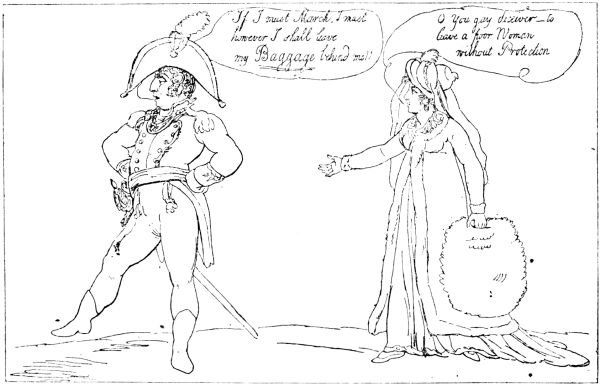
THE YORK MARCH.
March 7, 1809. The Triumvirate of Gloucester Place, or the Clarke, the
Soldier, and the Taylor. Published by T. Tegg.
John Gilpin said, 'Of womankind
I only love but one,
And thou art she, my dearest dear;
Therefore it shall be done.'—Vide 'John Gilpin.'
—The Duke of York is seated at table, on which is wine and dessert, placed between
Mrs. Mary Ann Clarke and her friend and confidante, Miss Taylor. The
Duke's favourite is holding out her 'List of Promotions,' entered upon a
tremendous roll of papers, which seems to be endless. 'I have a small list
of promotions which I wish to be filled up immediately, my dearest!' To
which modest request this weak-minded Samson is readily giving his assent: 'It
shall be done, my darling!'
March 8, 1809. A Scene from the Tragedy of 'Cato.' Published by T.
Tegg.—Two Britons are meeting, wearing the most solemn aspect, indicating
occurrences of portentous gravity. One of the pair is a cobbler, above whose
stall is the figure of an anchor and the words, 'Hope—Insurance Office.' His
friend is reciting with terrific intensity these lines:—
The dawn is overcast—the morning lours,
And heavily in clouds brings in the day—
Big with the fate of York and Mrs. Clarke.
March 8, 1809. Yorkshire Hieroglyphics. Plate 1. Published by T. Tegg.—The
hieroglyphics are not very difficult to decipher, and when transcribed
prove nothing more than a compromising letter, which was produced in the House
of Commons, incautiously sent by the amorous Commander-in-Chief to his lady-love
five years previously:—
The Duke of York's first letter to Mrs. Clarke.
'Weymouth, August 4, 1804.
'My dear little Angel,—How can I sufficiently express to my sweetest, my
darling love, the delight which her dear, her pretty letter gave me, or how do
justice to the emotion it excited? Millions and millions of thanks for it, my
angel, and be assured that my heart is wholly sensible of your affection, and that
upon it alone its whole happiness depends.
'I am, however, quite hurt that my love did not go to the Lewes Races; how
kind of her to think of me on that occasion! but I trust she knows me too well
not to be convinced that I cannot bear the idea of adding to those sacrifices
which I am but too sensible that she has made to me.
'News my angel cannot expect from me from hence; though the life led here,
at least in the family I am in, is very hurrying, there is a sameness in it which
affords little subject for a letter; except Lord Chesterfield's family, there is not
a single person besides ourselves I know. Last night we were at the play, which
went off better than the first night.
'Dr. O'Meara called upon me yesterday morning, and delivered me your
letter; he wishes much to preach before Royalty, and if I can put him in the way
of it I will.
'What a time it appears to me already, my darling, since we parted; how
impatiently I look forward to next Wednesday se'night!
'God bless you, my own dear, dear love! I shall miss the post if I add more!
Oh, believe me ever, to my last hour, yours and yours alone.'
[Addressed 'Mrs. Clarke, to be left at the Post Office, Worthing.' Endorsed
'Dr. O'Meara.']
March 9, 1809. The Burning Shame.—The residence of Mrs. Clarke, at
the corner of Gloucester Place, is made conspicuous to the public by a notification
at one time practised in respect to disreputable vicinities. A man is planted before
the door holding a notice-board, warning the passers-by to 'beware of bad
houses and naughty women;' a couple of watchmen, with their lanterns slung
on the ends of long poles, are throwing a good light on the nature of the case.
A clergyman and an officer, who were evidently coming direct to the establishment
on private ends, are, by this publicity, warned out of danger before their
intention is disclosed to the public.
March 11, 1809. Yorkshire Hieroglyphics. Plate 2. Published by T.
Tegg.
'Sandgate, August 24, 1804.
'How can I sufficiently express to my darling love my thanks for her dear,
dear letter, or the delight which the assurances of her love give me!
'Oh! my angel! do me justice, and be convinced that there never was a woman
adored as you are. Every day, every hour convinces me, more and more, that
my whole happiness depends upon you alone. What a time it appears to be
since we parted, and with what impatience do I look forward to the day after
to-morrow; there are still, however, two whole nights before I clasp my darling
in my arms.
'How happy am I to learn that you are better; I still, however, will not give
up my hopes of the cause of your feeling uncomfortable.
'Clavering is mistaken, my angel, in thinking that any new regiments are to
be raised; it is not intended, only second battalions to the existing corps; you
had better, therefore, tell him so, and that you were sure that there would be no
use in applying for him.
'Ten thousand thanks, my love, for the handkerchiefs, which are delightful;
and I need not, I trust, assure you of the pleasure I feel in wearing them, and
thinking of the dear hands which made them for me.
'Nothing could be more satisfactory than the tour I have made, and the state
in which I have found everything. The whole of the day before yesterday was
employed in visiting the works at Dover, reviewing the troops there, and examining
the coast as far as this place. From Folkestone I had a very good view
of those of the French Camp.
'Yesterday I first reviewed the Camp here, and afterwards the 14th Light
Dragoons, who are certainly in very fine order; and from thence proceeded to
Brabourne Lees, to see four regiments of Militia; which altogether took me up
near thirteen hours.
'I am now setting off immediately to ride along the coast to Hastings, reviewing
the different corps as I pass, which will take me at least as long.
'Adieu, therefore, my sweetest and dearest love, till the day after to-morrow,
and be assured that to my last hour I shall ever remain your's and your's alone.'
[Addressed 'George Farquhar, Esq., 18 Gloucester Place, Portman Square.'
Folkestone, endorsed 'Gen. Clavering,' &c.]
March 12, 1809. The Statue to be Disposed of. Published by T. Tegg,
Cheapside.—Mrs. Clarke's house at the corner of Gloucester Place is again the
subject of caricature. The figure of the Duke of York, in his uniform, with his
back to the spectator, and his face to the wall, is placed on a pedestal for disposal.
A placard, posted on the house, announces: 'The statue on the outside
having been thoroughly repaired and whitewashed, is to be sold by private contract.
For further particulars enquire within.' A bill-poster is sticking up the
following notice on behalf of the publisher: 'Caricature Warehouse, 111 Cheapside.
A new caricature on Mrs. Clarke every day.'
March 13, 1809. A General Discharge, or the Darling Angel's Finishing
Stroke. Published by T. Tegg.—Mrs. Clarke has been making pretty havoc
among the branches of the service. She has drummed out a number of officers
to the tune of the 'Rogue's March;' discomfited generals and prelates, who,
since their intrigues are unmasked, are doing their best to get out of range. As
to the 'Darling Angel's' redoubtable opponent, the Commander-in-Chief, he
has laid down his cocked-hat and sword, and, on his knees, is trying to mitigate
the excess of mischief which his discarded lady-love is in a position to wreak; he
is crying in despair: 'Alas, alas! for ever ruined and undone; see, see, she has
spiked my Great Gun!' Mrs. Clarke, who is putting the finishing stroke to this
destructive operation, is offering a parting word of gratuitous advice to the now
repentant Commander: 'A wise general should make good his retreat.'
March 15, 1809. The Champion of Oakhampton Attacking the Hydra of
Gloucester Place. 'Bellua Multorum es Capitum.' Vide Horace. The Champion
is clad in a complete suit of mail, and he is valorously rushing up to the mouth
of the cavern, whence the Hydra is breaking forth; it must be confessed that
the Champion seems a little staggered at the front displayed by the many-headed
monster; the foremost and most overgrown head is that of the Commander-in-Chief,
begirt with the Collar of Corruption. The other heads are described by
their collars: Dowler, Sandon, Dr. O'Meara, Dr. Donovan, Mrs. Clarke, and
Master Carter.
March 17, 1809. The Parson and the Clarke. Published by T. Tegg.—Dr.
O'Meara is favoured with a private interview, of a strictly business-like
character, by Mrs. Clarke. The ambitious divine is throwing up his head in such
raptures that he has jerked off his learned wig: 'Oh how I should like to preach
before Royalty!' The fair dispenser of patronage, with a long roll of 'Army
preferments' and a shorter list of 'Church preferments' before her, is putting the
case in a matter-of-fact way: 'Only pay the Clarke's fees, and the business is
done.'
So great on the Church were O'Meara's designs
That he prov'd too ambitious a spark;
But where is the wonder, ye learned divines,
That the parson should follow the Clarke?
March 19, 1809. Samson Asleep on the Lap of Delilah. Published by T.
Tegg.—The Duke of York is following the example of the famous slayer of
Philistines. He is sunk in slumber, with his head on the lap of his treacherous
Delilah; a pile of love-letters, addressed to his 'dearest dear,' are sufficiently
indicative of his infatuation. Mrs. Clarke, who is represented in the print as a
by no means repulsive-looking temptress, has taken advantage of the hero's unconsciousness
to chop off his full pigtail, and she is holding up the severed
caudal appendage, as an encouragement to the enemies of the helpless Commander-in-Chief
to take advantage of their opportunity: 'Gentlemen, you may
now take him with safety, his strength is gone; I have cut off his regulation tail,
and there is no danger!'
March 24, 1809. The Resignation, or John Bull overwhelmed with Grief.
Published by T. Tegg.—The departing Commander-in-Chief, in his regimentals,
as he is invariably represented, is trying to harrow John Bull's sympathies before
he deprives him of his valuable services: 'Good bye, Johnny; I am going to
resign; but don't take it so much to heart; perhaps I may very soon come back
again!'[20]
The good-natured national prototype is keeping up a show of affliction under
the approaching bereavement; but, although he is concealing his face with his
handkerchief, a smile lurks round the corner of his mouth as he sobs out somewhat
equivocally in reply: 'O dunna, dunna go! it will break my heart to part
with you—you be such a desperate moral character!'
March 24, 1809. The Prodigal Son's Resignation.—The stout sinner is
humbling himself before the throne. A portion of the King's figure is concealed;
the Duke of York has laid his Resignation, together with his coat, sword, and
cocked-hat, at the paternal feet, and, kneeling in his denuded state, he is quoting
the words of the parable of the Prodigal Son: 'Father, I have sinned before
thee, and I am no longer worthy to be called thy son.' The monarch, who seems
deeply affected by the spectacle of his favourite son's abasement, is returning:
'Very naughty boy! very naughty boy indeed! However, I forgive you; but
don't do so any more.'
March 29, 1809. Mrs. Clarke's Last Effort. Published by T. Tegg.—The
delicate investigation being concluded, the fair mover, Mrs. Clarke, was, as the
satirists suggested, left without occupation; and Rowlandson has accordingly
represented that she might employ her talents to advantage in opening an inn a
little way out of town; she is pictured as the landlady of Clarke & Co's Original
Tavern, from the York Hotel, London. Members of the Army, the Church, a
Quaker, and others are hurrying up to extend their patronage to the new establishment.
Mrs. Clarke, bent on hospitable intents, is encouraging her old friends
to return and rally round: 'Come forward, gentlemen; you'll all be welcome.
Every little helps':—
Your rhino rattle—come—
Men and cattle—come—
All to Mrs. Clarke O
Of trouble and monies
I'll ease you, my Honies,
And leave you in the dark O.
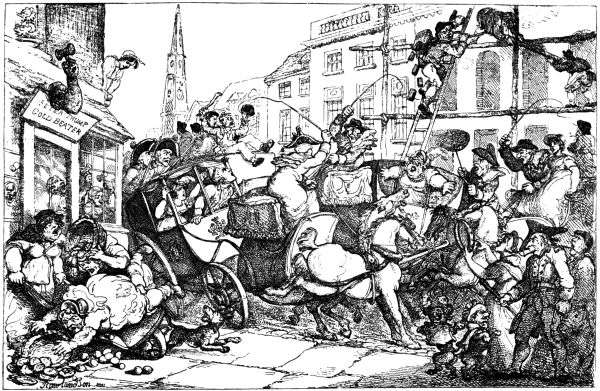
March 30, 1809. The York Dilly, or the Triumph of Innocence. Published
by T. Tegg.—A coach full of learned gentlemen, driven by a Counsel in his
robes, is passing through an enthusiastic crowd; the charioteer is declaring: 'I
thought we should bring him through.' The Duke of York is in the boot, apparently,
'blowing his own trumpet;' a placard, wreathed in laurel, is on the
roof of the carriage, announcing, Acquitted. Glorious majority of 82.
The people are uproariously demonstrative; they are shouting: 'Huzza!
glorious news for Old England!' females are encouraging their husbands to
cheer; the figure of Mrs. Clarke is represented bursting through the multitude
and shaking her fists at her late 'protector,' while a stout Churchman by her side
is loyally protesting, 'I always said he was innocent!'
April 1, 1809. Doctor O'Meara's Return to his Family, after Preaching
before Royalty. Published by T. Tegg.—The reverend divine has returned
home to his comely spouse and family in such an elated frame of mind—skipping
about, to the derangement of his ecclesiastic dignity, and losing his wig
and hat—that his wife is enquiring: 'Why, my dear, you are quite frantic; what
is the matter with you?' The Doctor is replying, in ecstasy, jumping higher
than ever: 'Frantic?—I believe I am—I have been preaching before Royalty—our
fortunes are made—such a sermon—neat text—quarter of an hour's discourse—appropriate
prayer at the conclusion—Oh! to see them cry it would have melted
a heart of stone—Oh bless that Mrs. Clarke; I shall never forget her!'
April 1, 1809. Mrs. Clarke's Farewell to her Audience. Tailpiece. Published
by T. Tegg.—All the principal performers—generals, colonels, captains,
reverend doctors, Master Carter, &c.—who have figured in the 'Clarke Scandal,'
and throughout the series of satirical prints which Rowlandson designed on the
Delicate Enquiry, are drawn up on the stage, in proper theatrical fashion, to
acknowledge the gratifying reception accorded their exertions at the hands of an
appreciative public. The national prototype, as the paying patron of the performance,
is in the stage box, clapping his hands with enthusiasm, and shouting,
'Bravo, bravo!' Mrs. Clarke, as the leading actress, is standing in front of the
line of players, dressed in semi-martial fashion, with a military hat on her head,
epaulettes, a gorget, a laced coat, and a crimson sash. She is speaking the
farewell address, which is as follows:—'Ladies and Gentlemen,—Having done
our duty as far as we were called upon, we most humbly take our leave of a
generous audience; not, like the generality of actors, wishing for a repetition of
the performance, but, on the contrary, that it may never again be repeated. As
to our friend Mr. Tegg, we hope that the graphic illustrations of this drama,
which he and his performers have brought forward, may meet with that encouragement
which is never denied to the effusions of whim and humour by a
loyal and liberal British public; but I particularly request that, while you acquit
the Bishop, you will be merciful to his Clarke.'
April 4, 1809. Original Plan for a Popular Monument, to be erected in
Gloucester Place. Published by T. Tegg.—The contributaries to this monument
of turpitude are grouped together to form a memorial suited to the occasion.
The foundation-stone is a huge block, labelled 'York Folly,' supported on one
side by the Episcopal mitre and crozier of the Right Rev. Bishop of Osnabrück,
with a scroll of 'The New Morality.' The accessories on the other side are the
cocked-hat, sword, and tender love-letters of the ex-Commander-in-Chief. A
block of 'Cracked Portland Stone,' and a third slab of 'Folkestone of the first
quality,' refer to the agitations raised by the Duke of Portland and Lord Folkestone;
the more spirited elements are ranged above this foundation, in the form
of a barrel of 'Whitbread's Entire,' 'Burdett's Stingo,' and 'Wardle's British
Spirit,' these gentlemen having been the most active in enforcing the Duke's
resignation. 'Romilly Freestone' supports a pair of medallions representing the
two officers consigned to Newgate for prevarication—'Sandon' and 'Clavering's
Dumps.' Mrs. Clarke's Pyramid, a golden cone, caps the edifice reared on
corruption.
April 5, 1809. A York Address to the Whale Caught lately off Gravesend.
Published by T. Tegg.—The Duke of York, in his regimentals, has gone down
on his knees to the latest wonder of the hour, and is beseeching the popular
arrival to divert the minds of an excitement-loving public from his own particular
case: 'O mighty monster of the deep, continue to attract the attention of John
Bull, bend his mind solely towards thee, for in that is my only hope; fascinated
by thy powerful attractions, he may perhaps forget the honour of a Prince.'
April 10, 1809. The Flower of the City.—The figure of Alderman Flower
is represented in the centre of a huge sunflower blowing on a stem, 'Weak
Stock,' planted in a pot of 'Rank Butter,' and elevated on two cheeses, marked
'Mouldy and Rotten.' A sinister blast from a diabolical agent is withering the
plant, and the leaves are falling; they are labelled with various uncomplimentary
sentences, suggesting all kinds of vices, belonging to the parent shoot. Below
this unflattering tribute to the Alderman is inscribed the following parody of
verses:—
The Flow'r of the City, so gaudy and fine,
'Midst proud ones the proudest, was erst known to shine.
It spread its gay leaves and it show'd its rich clothes,
And to all (less in consequence) turn'd up its nose!
Till a blight, a sad blight, from a Democrat wind
Struck the sensitive plant, both before and behind.
It felt the keen blast! All its arrogance fled,
And the Flow'r of the City hung, hung down its head.
The Flow'r of the City, thus doom'd to despair,
Droops, pines, and with wailing impregnates the air!
Tells its pride and its folly (the cause of its grief),
While the tears of repentance encumber each leaf!
But vain are its tears, or the fate it bemoans,
The world, the base world, gives but hisses and groans!
For ever! for ever! its proud hopes are fled,
And the Flow'r of the City hangs, hangs down its head.
April 10, 1809. The Modern Babel, or Giants Crushed by a Weight of
Evidence. Published by T. Tegg.—The unfortunate Duke of York, with his
Counsel and learned supporters, are crushed down under the weight of a compound
structure which has been imposed upon their heads and shoulders. The
bulkiest mass is the Evidence of Mrs. Clarke; Miss Taylor's Evidence is next in
consequence, and the pyramidal slabs decrease upwards: Sly hits from Sandon
and Clavering; Home Strokes from Dowling; Mrs. Hovendon's Evidence; Mrs.
Tavery, Doctor O'Meara, Master Carter, &c. The person of Mrs. Clarke,
posed in a triumphant attitude, is the figure which completes this superstructure
of folly.
April 18, 1809. The Sick Lion and the Asses. Published by T. Tegg.—The
Duke of York's head is placed on the shoulders of the disabled forest king,
a pair of asses are showing their heels to the royal beast. 'What a Cur it is!'
and 'Every man has his Price,' written on their collars, proclaim the identity of
these animals. Another ass, of deeper cunning, forbears to take advantage of
the prostrate lion, from far-seeing motives: 'Pshaw, pshaw! don't be afraid, I
shall not kick, you may depend upon me—you may be of service to me hereafter!'
The apologue is said to be 'taken from Mr. Waithman's speech at the Common
Hall:' 'When the royal beast was sick to death, and unable to defend himself,
the minor beasts he had injured came to revile him with their wrongs; but when
the dull asses came to fling their heels at him the royal animal exclaimed: "Injuries
from others I can bear with resignation, but to bear insult from such vile
animals as asses is to die a hundred deaths!"'
April 21, 1809. Burning the Books. Published by T. Tegg.—As we have
traced in the summary of the diversified proceedings in the Clarke Scandal, the
friends of the Duke of York were glad, as a last resource, to make terms with
the enemy; and the conditions under which Mrs. Clarke's silence was purchased
being published abroad (considering the publicity of the circumstances attending
the Investigation, the terms of surrender could not be disguised), the satirists
made merry over this fresh instance of tergiversation.
The edition of Mrs. Clarke's memoirs, the bombshell which threatened the
aristocratic peace of mind, was purchased for a certain sum. In the print of
'Burning the Books' the heroine of the scandal is holding up the terms of
surrender: '10,000l., debts paid, 600l. per annum, &c. &c.' The heroine of the
memoirs is directing the destruction of her eagerly-expected volumes, containing
hundreds of letters from persons of quality, including the correspondence (supposed
to have been destroyed) of the Duke of York. The lady is zealous
enough in the interests of her profitable clients: 'Burn away! I would burn half
the universe for the money. You may preserve a copy or two for Doctor
O'Meara and a few private friends. Now for my Brimstone carriage!' The
printer's men are carrying piles of the offending work, and committing the
edition to the flames. An acknowledgment from the publisher is on the writing-table:
'Received for paper and printing, and also for destroying this,' &c. The
figure of the Duke of York is shown, slily peeping from behind a curtain; the
Commander, lately resigned, is evidently delighted at the course things are
taking, and is crying, 'This will do!' Many of the letters, as Mrs. Clarke declared,
reflected in disrespectful terms on the heir to the throne and others of his
royal brothers.
April 22, 1809. A Piece-Offering. Published by T. Tegg.—Mrs. Clarke,
in all her extensive finery, is sacrificing her memoirs, Life of Mrs. Clarke, the
Duke's ardent love-letters, and all the disagreeable evidences supposed to have
remained in her possession, at the Altar of Repentance. The figure of the Commander
is rising in effigy above the flames, in the centre of a brilliant sun; his
face is turned to the authoress of the pyre with a satisfied smile. The high-priestess
of the sacrifice is gratefully addressing the mollified divinity: 'Thus
perish all that gives my darling pain!'
May 24, 1809. The Quaker and the Clarke. Published by T. Tegg.—A
sedate Quaker, in a suit of modest brown, has turned his back on the beguiling
enchantress, fair authoress of so much mischief, and is hurrying away from her
entreaties 'to tarry a while,' declaring: 'Woman, avaunt! I am not to be tempted;
and be it known also I am a married man,' &c.
May 28, 1809. John Bull and the Genius of Corruption. Published by T.
Tegg (94).—The national prototype has been haranguing on the extinction of
abuses with a compound symbolical monster, who is standing in the way of
progress and healthy legislation. Mr. Bull's corrupt opponent is making the
Jesuitical concession: 'What you say about Reform, Johnny, is very true, but
this is not the time for it!' John Bull, who has no opinion of the obstructive
party, is retorting, 'No, nor it never will be while such a monster as you
remains in existence!'
The monster, who is evidently a difficult customer to deal with, wears a
defensive cap of Professions and Promises; he has 'an eye to Interest,' a Mouth
of Guile, and a nose to Scent for Interest; he wears the Collar of Corruption,
has Wings of Speculation, Arms of Power, and Hands of Extortion, and is
further provided with bags of gold for the purpose of bribery, Deep Pockets of
Perquisites, Legs of Luxury, and he is propped on Feet of Connivance.
June 12, 1809. Boney's Broken Bridge.—The Austrian army is drawn
up in security on one side of the river Danube; Buonaparte, in a fine rage
with his discomfited generals, and his disappointed legions, are arrayed on the
other bank, powerless to disturb their exulting adversaries. The Emperor is
pointing to the remains of his famous bridge, and furiously demanding, in reply
to the Austrian taunts: 'Ah, who is it that dares contradict me? I say it was
some floating timber and the high swell of the river that caused the shocking
accident!' An impolitic old general, bowing low, and in consternation at the
news he is obliged to impart, is replying: 'With all due deference to your little
Majesty, it was the Austrian fire-boats that destroyed the bridge.' The Archduke's
troops are chanting a new edition of an old nursery rhyme:—
Boney's bridge is broken down,
Dance over the Lady Lee;
Boney's bridge is broken down
By an Archduke—ee.
July 9, 1809. Hell Broke Loose, or the Devil to Pay among the 'Darling
Angels.' Published by T. Tegg.—The dark fiend is standing at the gates of the
infernal regions, scourge in hand; he is dressed in the wig and robes of a judge,
and poised on a slab, setting forth the well-recognised axiom: Two of a trade
can never agree. The diabolical personage is holding the balance between the
two principal actors in the late proceedings. It will be remembered that a misunderstanding
occurred between the chief conspirators. Soon after the conclusion
of the investigation in the House of Commons, Colonel Wardle and Mrs. Clarke
began to exchange mutual recriminations, and the public were gratified with
fresh scandalous revelations; the champion of impartial justice began to lose
his strangely-earned popularity. Colonel Wardle is plunged into the scale of
Patriotism, with an infernal imp to weigh him down; the gold box, in which the
freedoms of more than one town were offered to the enemy of corruption, and
the York impeachment papers are thrown into the scale to make weight. Mrs.
Clarke is balanced against her late coadjutor in the scale of Virtue. 'Love-letters,
Mr. Wright's bill, Doctor Donovan's bill,' &c., are added to weigh against
the Colonel's testimonials.
July, 1809. The Tables are Turned. How are the Mighty Fallen!—The
public were treated with the spectacle of the patriotic champion sued in a law
court for the furniture of Mrs. Clarke's house at Westbourne Place, which had
been taken on his guarantee and recommendation. The Court gave judgment
against the crestfallen Colonel, who had denied his liability, and he was adjudged
to pay the heavy expenses incurred in the new establishment and the incidental
costs of the process. In Rowlandson's view of the situation Mrs. Clarke is
seen mounted on her asinine ex-supporter; the head of the steed bears a face
suggestively resembling the countenance of the patriot; a 'Turkey carpet' furnishes
a saddle; the motto England expects every man to do his duty is written on
the bridle; 'Wright, the upholsterer's bill' is tied to the animal's tail; the lady
is whipping up her reluctant supporter with a birch labelled 'Private promises.'
The ass is scattering the chairs, tables, mirrors, fenders, and other objects particularised
on 'the bill' which gave the Colonel so much irritation; the flattering
presentations, addresses, gold boxes, 'Thanks to my ass,' 'Lies against the Duke
of York,' 'Thanks to a Welch Billy Goat,' 'From the City of London,' 'Thanks
and freedom in a gold box,' and other complimentary testimonials, are scattered
on the ground. The dashing rider is making an exhibition of her skilful management
of the donkey tribe:—
I've a fine stud of Asses as ever was seen;
This is one of the number from Westbourne Green.
Gee up, Neddy, come up, Neddy, &c.,
What do you think of my Neddy and me?
July 14, 1809. More of the Clarke, or Fresh Accusations. Published by T.
Tegg.—Colonel Wardle is exposed to the public in a humiliating position; his
former mob-popularity is reversed, and their admiration is changed to ridicule.
The scene is supposed to take place in front of the mansion in Westbourne
Place, before which is assembled a crowd of jeering spectators. Mrs. Clarke,
unabashed, as in the previous disclosures, is frankly denouncing her ex-colleague,
and pointing to the luxurious fittings of her bedroom. She is unmasking the
scandalised champion to his late friends the mob: 'And Clarke said unto Felix,
Thou art the man;—behold the furniture! and Felix trembled.' The Colonel,
whose reputation did not improve as the innuendoes of his new opponents became
more daring, with clasped hands and his knees knocking together, is servilely
trying to reinstate his lost reputation: 'Good people of the United Kingdom,
suspend your judgment for the present, till I get this woman placed in the
pillory. I never did anything naughty no more than the child unborn. It was
all for the good of my country, I assure you. I am as firm a patriot as ever
purchased a convex mirror or a red Turkey carpet.'
July 16, 1809. The Plot Thickens, or Diamond Cut Diamond. Published
by T. Tegg.—Mrs. Clarke is still in the thick of her complications. She is
standing, unmoved, in the centre of the picture. Colonel Wardle, who soon fell
out with his ally when pushed to fulfil her conditions, is declaring for vengeance:
'I intend to commence an action against her for obtaining money under false
pretences in the case of French's levy. I'll teach her to send gentlemen to
Newgate.' Another individual, dressed as a civilian, recommends: 'Leave her
to me; I'll touch her up in the furniture business!' Mrs. Clarke, with her hands
on her lips, is replying: 'I don't care a fig for any of you; and as to you, Mr.
Furnituremonger, I'll be beforehand with you.' A stout gentleman behind the
fair intriguante cries, 'That's a good girl, follow him up; I'll back you; I'll let
him know whose Wright and whose Wrong. If I don't enter an action against
him I'm no upholsterer.' A young barrister, holding a voluminous brief, is
smiling with satisfaction at the prospect of litigation, and encouraging both sides:
'That's right, my good friends; it's all for the Best!'
July 18, 1809. Amusement for the Recess, or the Devil to Pay amongst the
Furniture. Published by T. Tegg.—Colonel Wardle is represented, in an infuriated
state, wreaking vengeance on the offensive furniture, which had caused the
destruction of his popularity and his reputation; the lately immaculate champion
is armed with a bludgeon; he is trampling under foot 'An Essay on Keeping Bad
Company,' and breaking up the elegant belongings of the establishment, for the
privilege of supplying which he had been compelled to pay a sufficiently heavy
penalty; he is made to exclaim: 'D—— the furniture, d—— the convex mirrors
and red Turkey carpets; d—— Westbourne Place and everything that belongs to
it.' Mrs. Clarke is rather entertained than dismayed at this spirit of wanton
destructiveness: 'Deary, those little gusts of Welsh passion become you extremely;
the exercise will do you good; besides, it will increase your popularity!'
July 30, 1809. The Bill of Wright's, or the Patriot Alarmed. Published
by T. Tegg.—The upholsterer has waited on Colonel Wardle and unrolled his
long bill: 'Gullem Waddle, Esq., to Wright. Red Turkey carpet, convex mirror,
chandeliers, sideboards, bed furniture, chairs and tables, vases and cellarets,
Egyptian furniture, sofa à la Clarke,' and other weighty items. 'Mr. Gullem
Waddle, I have brought you in a small bill for goods delivered for the Cleopatra
of Westbourne Place; and, as you are a true patriot, you can have no possible
objection to the Bill of Wright's.' The dismayed Colonel, keeping his hands in
his pockets, is making a counter-proposal: 'What do you talk about patriotism?
I tell you I have left off practice. D—— the Bill of Wright's! It is all a
mistake about Westbourne Place; you should have taken it to Gloucester Place—there
you would be sure to have had your money!'
August 1, 1809. The Mistake. Published by T. Tegg.
August 1, 1809. Wonders, Wonders, Wonders. Published by T. Tegg.
(101).—Ten figures of 'Natural Curiosities,' designed and etched by Rowlandson.
A certain amount of care is bestowed on the execution of this plate. The marvels
of the age in which the caricature was published have not, in most cases, become
monotonously plentiful in our own day. As set down by the satirist the ten wonders
were the discoveries of 'A modest woman of quality; a primitive Bishop;
a real maid of five-and-thirty; an exciseman with a conscience; an author with a
second suit of clothes (this fictitious person has been represented in a most
jubilant fashion); a great man of common sense; a woman who has continued
three months a widow; a theatrical hero of modesty and economy; a complete
honest attorney;' and, lastly, 'a man of talents, wit, and learning possessed of a
thousand a year.'
On the close of the Clarke Scandal, which had fitly served the purpose of the
satirist, our caricaturist resumed his series of attacks upon the more memorable
'disturber of the peace of Europe.'
August 28, 1809. The Rising Sun, or a View of the Continent. Published
by R. Ackermann.—Buonaparte is surrounded by the Continental Powers; his
present occupation is to lull and rock to slumber, in a cradle, the Russian Bear,
muzzled with French promises, and tempted with 'Turkey wheat.' The Corsican
is figuratively and literally sitting on thorns; the sun of Spain and Portugal is
arising on the meridian with threatening import. Sweden has taken the part of
watchguard of Freedom, and is raising the cap of liberty; a Swedish huzzar is
making a desperate sabre-cut at the too successful general, and sounding a
warning note to the betrayed Muscovite: 'Awake, thou sluggard, ere the fatal
blow is struck, and thou and thine execrable ally sunk to eternal oblivion.' The
Emperor is disturbed by the new light: 'This rising sun has set me upon thorns.'
The Dutchman, with a broken sceptre, is sunk in a besotted sleep on a cask of
'genuine hollands,' and leaning the weight of his fat person on his ally, who
finds the weight a trifle crushing. Poland is represented as a shadow; the
Prussian eagle is trussed; and the King, with straw in his hair, and confined in
a strait-waistcoat, is singing mad ditties. Denmark is snuffed out under an extinguisher;
but the Austrian Emperor is once more taking heart and advancing
to the attack, sabre in hand, with dangerous intentions: 'Tyrant, I defy thee
and thy cursed crew!'
September 3, 1809. The Pope's Excommunication of Buonaparte, or Napoleon
brought to his last stool. Published by T. Tegg.—The Pope and his legates
have called on the Emperor, with candle and bell, to produce an effect. The
head of the Church is propped up on 'French crutches,' and his triple crown is
split asunder; he is declaring: 'He has cracked my crown, overturned my temporal
dignities; but I am so trammelled in these crutches that I cannot follow
him as I would wish; however, my good Lord Cardinals, read him the excommunication—it
will make him tremble on his throne.' The Cardinals proceed to
rehearse the contents of the comminatory scroll; the Emperor, who is holding
an 'Essay on the Church of Rome,' amongst other waste papers, is returning,
unmoved: 'Mercy on me! I never heard anything half so dreadful. When you
have done with that paper, gentlemen, I will thank you for it!'
September 4, 1809. Song by Commodore Curtis. Tune, 'Cease, rude Boreas.'
Published by T. Tegg.—The artist has furnished the heading for a parody
setting forth the adventures of the gallant Curtis, Alderman and Commodore, with
the expedition which was sent to assist our allies the Dutch against the French.
Curtis is seated in his armchair in the cabin of his yacht, a great gold challenge
cup, Speedy and Soon, in his grasp, with a turtle laid on its back by his side. A
party of English officers belonging to the expedition have come on board, and
they are making free with his good things; wine and punch are flowing lavishly.
According to the song-writer's version these gallant warriors, having boarded the
Commodore's yacht and made sad havoc with all his provisions, succeeded, after
a three days' devastation, in eating and drinking all the plentiful supplies laid in
by poor Curtis, until at last he began to dread that they might take it into their
heads to eat him too. Although the worthy cit set out enthusiastically and filled
with valour, his return was somewhat less heroic:—
From Ramsgate we set sail for Flushing,
To aid our friends the Mynheers;
And for the Scheld our fleet was pushing,
Resolved to trounce the d——d Monsieurs!
Slightly discomfited, the Commodore sounds a retreat:—
Now farewell all my hopes of glory,
Scheld's muddy flood and isles adieu;
I'll lead the van with the first story,
And tell the Cockneys something new.
I'll talk of batteries, bloody sieges,
Of fizzing bombshells, towns on fire,
Till my tale the whole town obliges
My deeds and courage to admire.
September 14, 1809. A Design for a Monument to be erected in commemoration
of the glorious and never-to-be-forgotten Grand Expedition, so ably
planned and executed in the year 1809. Published by T. Tegg (107).—The
bust of General Chatham, crowned with bulrushes, is at the head of this satirical
memorial; monkeys and frogs are grouped on either side, 'French monkeys in
attitudes of derision,' and 'Dutch frogs smoking their pipes in safety.' The shield
represents 'the immortal William Pitt, Earl of Chatham,' obscured in the clouds.
The supporters of the escutcheon are a 'British seaman in the dumps,' and
'John Bull, somewhat gloomy—but for what it is difficult to guess, after so
glorious an achievement.'
The Motto.
Great Chatham, with one hundred thousand men,
To Flushing sailed, and then sailed back again.
The fleet is represented sailing homeward under the 'Sun of Glory.' 'A flying
view of the return of the expedition. O tempora! O mores!'
September 24, 1809. General Cheathem's marvellous Return from his Exhibition
of Fireworks. Published by T. Tegg (108).—The General is returning
from the abortive Walcheren Expedition, mounted on a flying wooden horse,
which, like Don Quixote's and other enchanted steeds, is performing wonders in
the way of discharging rockets; on one side of the General swings a fleet of ships,
'Wooden castles in the air,' balanced by such empty bladders as the 'Walcheren
Expedition,' 'Bereland, plan and fortifications of Flushing,' &c. The glorious
General has taken a pair of Dutch dolls captive, and these are the chief trophies
of his adventure. 'Here I am, my dear Johnny, escaped from fire, water, plague,
pestilence, and famine; my fireworks have given general satisfaction abroad. I
must now couch on a "bed of roses," and hope when I awake to be rewarded
with a pension and dukedom for brilliant services.' Mr. Bull and his lady are
standing on their own shores, deeply impressed with the General's manœuvres.
Cries Mrs. Bull, 'Lord, what a man of mettle he is!' John Bull is grasping his
thick stick in a way that looks menacing: 'General Cheathem flying back, as I
foretold, garnished out with drops and Dutch metal. Where is the ten million of
British bullion, you scarecrow? The Sinking Fund suits your talents better than
sinking of ships.' Commodore Curtis, in his yacht, is sailing away from the
'mortality at Flushing,' and shouting in great glee: 'A new contract for mouldy
biscuits. Expeditions for ever. Huzza!'
1809. A Plan for a General Reform. Published by T. Tegg.
September 27, 1809. This is the House that Jack Built. (Old Price Row at
Drury Lane.) Published by T. Tegg.—This cartoon, in six compartments, is
aimed at Kemble's new house, which, from certain arrangements of the boxes,
and other innovations, became the cause of considerable turbulence—
These are the Boxes let to the great
That visit the House that Jack built.
The curtain of the theatre bears the advertisement: 'Grand theatrical Bagnio,
fitted up in the Italian style;' 'Lodgings to let for the season, or a single night;'
'Roomy pit for parsons, poets, Presbyterians, Quakers, grumblers,' &c.; 'Boxes
for the Cyprian corps, with snug lobby to ditto;' 'Private accommodations for
the Members of both Houses of Parliament;' 'Boudoirs pour la Noblesse;' 'Rabbit
hutches, seven shillings each;' 'Humbug gallery, two shillings;' and, chief cause
of dissatisfaction, 'Pigeon-holes for the swinish multitude':—
These are the pigeon-holes over the Boxes,
Let to the great that visit the House that Jack built.
This is the Cat engaged to squall to the poor
in the pidgeon-holes over the Boxes, let to the great
that visit the House that Jack built.
Madame Catalini is endeavouring to sing; but the audience, armed with rattles,
post-horns, and other noisy instruments, are raising a regular uproar:—
This is John Bull with a bugle-horn,
That hissed the Cat engaged to squall to the poor, &c.
This is the Thief-taker,[21] shaven and shorn,
That took up John Bull, with his bugle-horn, &c.—
The rioters are having a regular stand-up fight outside the theatre, as well as
within. The last verse—
This is the Manager, full of scorn,
Who rais'd the price to the people forlorn, &c.,
And directed the Thief-taker, shaven and shorn, &c.—
introduces the great John Kemble at the foot-lights, haranguing his unruly
audience; the house is represented much as it actually appeared; the rioters,
provided with squirts, bellows, marrow-bones, cleavers, rattles, cow-horns, and
all sorts of rough music, in short, every instrument of noise that ingenuity could
suggest, with huge streamers, banners, and placards, held out on long poles, &c.,
containing such announcements as 'No theatrical taxation,' 'No intriguing shop,'
'No annual boxes,' 'No Italian singers,' 'None of your Jesuitical tricks, you
black monk,' 'Be silent, Mr. Kemble's head aitches,' 'Kemble, remember the
Dublin tin-man,' 'Dickons for ever, no Catalini.'
September 30, 1809. A Lump of Impertinence. Woodward del., Rowlandson
sc. Published by T. Tegg.—'Who the devil do you stare at? Get along
about your business.'
1809(?). A Lump of Innocence. Woodward del., Rowlandson sc.—A florid
beauty, of the fat, fair, forty, and full-blown type, is 'affecting a modesty, though
she has it not;' her eyes are downcast, and a blush suffuses all over, her cheeks
being about the colour of a bumper of rubicund cognac brandy which she is
imbibing, probably with a view to hide her sensibility: 'Really, gentlemen, if
you gaze at me in this manner you will put me quite to the blush!'
October 9, 1809. Miseries of Human Life. Published by T. Tegg (257).
1809. Business and Pleasure. Published by T. Tegg (292).
October 24, 1809. Preparations for the Jubilee, or Theatricals Extraordinary.
Published by T. Tegg.—A range of booths occupies the background
of the view; a pole is erected before each of the tents, displaying a flag and an
advertising poster, indicating the nature of the show provided within. The preparations
are being completed, the workmen are putting the finishing strokes in
readiness for opening. Under the union-jack is Perceval, Eldon & Co.'s Pic
Nic Entertainments; any port in a storm. Under 'false colours' is Don John's
booth, announcing, Set a beggar on horseback, he'll ride to the devil, with the
Row, or a fig for John Bull. Mr. Canning's Booth advertises The Double Dealer,
with The Duellist. Lord Mulgrave offers A Chapter of Accidents, with 'Tis well 'tis
no Worse. Lord Castlereagh promises The Revenge, with Who would have thought
it? Lord Wellington's booth has The Wild Goose Chase, with The Wanderer.
Under a huge cocked-hat, as a sign, is General Chatham's booth, 'Just arrived from
Flushing.' A comedy called Delays and Blunders, to which will be added He will
be a Soldier, is the bill offered from Holland. Mrs. Clarke's booth presents A
new melodrama, called More Secrets than One, with Various Deceptions; and her
neighbour, Colonel Wardle, promises Plot and Counter Plot, with the farce of the
Upholsterer.
October 25, 1809. A Bill of Fare for Bond Street Epicures. Woodward
del., Rowlandson sc. Published by T. Tegg (188).—Six subjects, representing
fair and fashionably-dressed female loungers of the period, parodied under the
several descriptions of À la Mode Beef, Rump of Beef, Breast of Veal, Veal
Cutlets, Baron of Beef, and Pork Sausage. The figures of these various personages
are marked with spirit, and the respective attributes are conveyed with
a certain humorous appropriateness.
1809. A Bill of Fare for Bond Street Epicures. Published by T. Tegg.—A
variation of the subjects published under a similar title, in which the charms
of numerous females are set forth under figurative titles; the persons of six
ladies are displayed in this print, their personal attractions being grotesquely set
off as Pigs Pettitoes, Scrag of Mutton, Leg of Lamb, Polony, Cod's Head and
Shoulders, and Lamb Chop, with Mint Sauce. (Republished from 1808. Companion
to No. 188. Published October 25, 1809.)
December 1, 1809. Cattle not Insurable.
Hopes of the Family, or Miss Marrowfat Home for the Holidays. Published
by T. Tegg (No. 293).
December 12, 1809. The Boxes. Published by T. Rowlandson, 1 James
Street, Adelphi:—
O woe is me, 't have seen what I have seen;
Seeing what I see!—Shakespeare.
The artist has given a view of the 'pigeon-holes' at Drury Lane, as the new
gallery in 'the house that Jack built' was derisively christened; the present plate
offers a burlesque representation of the refined parts of the house, taken possession
of by a company more miscellaneous than select. The 'rabbit-hutches,'
at seven shillings, are given up to owls and deaf people; a narrow row below,
in which the space is so confined that it is impossible for the spectators to stand
upright, is held by Irish cabmen, roughs smoking long clay pipes, &c.; below
these, in the boudoirs pour la noblesse, we find the servants of the great, dramdrinking,
hobanobbing, and flirting. The occupants of the rest of the private
boxes are of a ruffianly type; big sticks and publican's pewter measures are
noticeable, besides gentlemen with damaged optics, and without coats; a great
dog, ladies from St. Giles's, and similarly distinguished members of society. A
scene of quarrelling, practical joking, and general uproar is proceeding below.
December 23, 1809. A Peep at the Gas Lights in Pall Mall. Woodward
del., Rowlandson sc.—The sketch represents a view of the first thoroughfare
where gas was employed to illuminate the streets. Mr. Ackermann, the publisher,
was one of the earliest to light his Repository with gas, which he manufactured
for the purpose, and was at considerable expense in providing apparatus
and making experiments in improving the process. The sightseers are lost in
wonder and admiration at the novelty of finding gas burning in the streets; the
lamps are arranged in branches of three. A gentleman of fashion is endeavouring
to explain the science of gas-making to an elegant creature on his arm: 'The
coals being steamed, produce tar or paint for the outside of houses; the smoke
passing through water is deprived of substance, and burns as you see.' An
Irish visitor, who has, uninvited, been attending to this lucid explanation, is
bursting out with 'Arrah, honey, if this man brings fire through water we shall
soon have the Thames and the Liffey burnt down, and all the pretty little
herrings and whales burnt to cinders!' Amongst other wondergazers is a
country farmer, who is exclaiming, 'Wauns, what a main pretty light it be! we
have nothing like it in our country.' A Quaker, his companion, is responding,
'Ay, friend, but it is all vanity; what is this to the inward light?' The more
disreputable members of the community are reflecting that the new light will
expose their depravities and put a stop to their commerce.
December, 1809. Joint Stock Street. Woodward del., Rowlandson fecit.
Published by T. Tegg (174).—From this satire it seems that a company-mania
must have raged in 1809, suggestive, in its extravagance, of the days of the
South Sea Bubble. In front of the Hospital for Incurables is a blank wall,
covered with advertisements of various joint-stock enterprises, which are attracting
the attention of the speculative. There is a Doctors' Company, offering incalculable
advantages: 'No charge for emetics, &c.; patent coffins provided on
the shortest notice; no surgeons admitted.' 'A Company of Menders, open to
both sexes; wives to mend their husbands, husbands to mend their wives, and
most particularly, everybody to mend themselves.' Company of White-washers.
N.B. No lawyers admitted. More advantages; a new Cabbage and Potatoe Company,
warranted genuine; no cooking required, saves time and trouble. At the
corner of Bubble Alley is the following tempting notice: Peter Puff, manufacturer
of deal boards without knots, from genuine sawdust, &c. And outside
a miserable hovel is the advertisement of Tim Slashem, barber, and perriwig
maker, who has a company in formation of mowers of beards by a new machine,
to shave sixty men in a minute, to comb, oil, and powder their wigs in the bargain.
December 24, 1809. The Bull and Mouth. Woodward del., Rowlandson sc.
Published by T. Tegg (290).—A corpulent gentleman, wearing a dressing-gown
and nightcap, is yawning and stretching in his armchair. His huge head and
gaping jaws would furnish forth excellently well a sign for the Bull and Mouth.
By his side stands a handsome and highly developed lady, who is taking advantage
of the sleepiness of her rude monster to slip a billet-doux into the hand
of a military officer, who is waiting in the rear.
1809. A Glee. How shall we Mortals Spend our Hours? In Love! in
War! in Drinking! Published by T. Tegg.—Three figures, represented as
seated at table, with all the appointments and accessories incidental to the
brewing of punch, carry out the spirit of the quotation. The lover, a smart
young buck, in top-boots, is rapturously clasping his hands, after a toast, in
inward contemplation of the perfections of his mistress. An old Commodore
illustrates the idea of a life spent in warfare—although minus an eye and a leg,
he is tough and hearty, and is seemingly content with his pipe and bowl. The
brutalising results of hours devoted to mere bestial intoxication are realised in
the person of a slovenly and imbecile sot.
1809. Rowlandson's Sketches from Nature. Drawn and etched by Rowlandson.
Stadler, aquatinta. Published by T. Tegg.
| A View in Camelford, Cornwall | Sept. 1, | 1809. |
| The Seat of M. Mitchell, Esq., Hengar, Cornwall | Sept. 1 | " |
| A Cottage in the Duchy of Cornwall | Sept. 1 | " |
| Village of St. Udy, Cornwall | Sept. 1 | " |
| Fowey, Cornwall | Sept. 30 | " |
| A View near Richmond | Oct. 4 | " |
| A View in Devonshire | Oct. 4 | " |
| Taunton Vale, Somersetshire | Nov. 25 | " |
| View near Newport, Isle of Wight | Nov. 25 | " |
| Temple at Strawberry Hill | Nov. 25 | " |
| White Lion Inn, Ponders End, Middlesex | Nov. 25 | " |
STERNE'S 'SENTIMENTAL JOURNEY.'
CALAIS.
The Coach-yard of Monsieur Dessein's Inn.—'This certainly, fair lady,' said
I, raising her hand up a little lightly as I began, 'must be one of Fortune's
whimsical doings: to take two utter strangers by their hands—of different sexes,
and perhaps from different corners of the globe—and in one moment place them
together in such a cordial situation as Friendship herself could scarce have
achieved for them, had she projected it for a month.'
'And your reflection upon it shews how much, monsieur, she has embarrassed
you by the adventure.' In saying this she disengaged her hand with a look
which I thought a sufficient commentary upon the text.
The triumphs of a true feminine heart are short upon these discomfitures.
In a very few seconds she laid her hand upon the cuff of my coat, in order to
finish her reply.
I fear, in this interval, I must have made some slight efforts towards a closer
compression of her hand, from a subtle sensation I felt in the palm of my own—not
as if she was going to withdraw hers, but as if she thought about it—and I
had infallibly lost it a second time, had not instinct more than reason directed
me to the last resource in these dangers—to hold it loosely, and in a manner as
if I was every moment going to release it of myself; so she let it continue, till
Monsieur Dessein returned with the key; and in the meantime I set myself to
consider how I should undo the ill impressions which the poor monk's story, in
case he had told it her, must have planted in her breast against me.
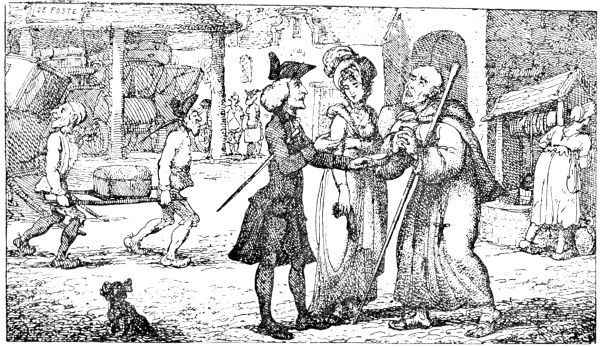
YORICK AND FATHER LORENZO.
The Snuffbox.—The good old monk was within six paces of us, as the idea
of them crossed my mind, and was advancing towards us a little out of the line,
as if uncertain whether he should break in upon us or no. He stopped, however,
as soon as he came up to us, with a world of frankness; and having a horn snuffbox
in his hand, he presented it, open, to me. 'You shall taste mine,' said I,
pulling out my box (which was a small tortoiseshell one), and putting it into his
hand. ''Tis most excellent,' said the monk. 'Then do me the favour,' I replied,
'to accept of the box and all; and, when you take a pinch out of it, sometimes
recollect it was the peace offering of a man who once used you unkindly, but not
from his heart.'
The poor monk blushed as red as scarlet. 'Mon Dieu!' said he, pressing
his hands together, 'you never used me unkindly.' 'I should think,' said the
lady, 'he is not likely.' I blushed in my turn, but from what movements I
leave to the few who feel to analyse. 'Excuse me, madame,' replied I, 'I
treated him most unkindly, and from no provocations.' ''Tis impossible,' said
the lady. 'My God!' cried the monk, with a warmth of asseveration which
seemed not to belong to him, 'the fault was in me, and in the indiscretion of my
zeal.' The lady opposed it, and I joined with her in maintaining it was impossible
that a spirit so regulated as his could give offence to any.
I knew not that contention could be rendered so sweet and pleasurable a
thing to the nerves as I then felt it. We remained silent, without any sensations
of that foolish pain which takes place when in such a circle you look for ten
minutes in one another's faces without saying a word. Whilst this lasted, the
monk rubbed his horn box upon the sleeve of his tunic; and as soon as it had
acquired a little air of brightness by the friction, he made a low bow and said
'twas too late to say whether it was the weakness or goodness of our tempers
which had involved us in this contest; but be it as it would, he begged we
might exchange boxes. In saying this he presented his to me with one hand
as he took mine from me in the other, and having kissed it, with a stream of
good nature in his eyes, he put it into his bosom—and took his leave.
I guard this box, as I would the instrumental parts of my religion, to help my
mind on to something better: in truth, I seldom go abroad without it; and oft
and many a time have I called up by it the courteous spirit of its owner to
regulate my own, in the jostlings of the world: they had found full employment
for his, as I learnt from his story, till about the forty-fifth year of his age,
when, upon some military services ill requited, and meeting at the same time a
disappointment in the tenderest of passions, he abandoned the sword and the sex
together, and took sanctuary, not so much in his convent as in himself.
I feel a damp upon my spirits as I am going to add, that in my last return
through Calais, upon enquiring after Father Lorenzo, I heard he had been dead
near three months, and was buried, not in his convent, but, according to his
desire, in a little cemetery belonging to it, about two leagues off. I had a strong
desire to see where they had laid him—when, upon pulling out his little horn box,
as I sat by his grave, and plucking up a nettle or two at the head of it, which
had no business to grow there, they all struck together so forcibly upon my
affections, that I burst into a flood of tears. But I am as weak as a woman; and
I beg the world not to smile, but pity me.
MONTRIUL.
The Bidet.—When all is ready, and every article is disputed and paid for
in the inn, unless you are a little soured by the adventure, there is always
a matter to compound at the door, before you can get into your chaise; and
that is with the sons and daughters of poverty, who surround you. Let no
man say, 'Let them go to the devil'—'tis a cruel journey to send a few
miserables, and they have had sufferings enow without it. I always find it
better to take a few sous out in my hand; and I would counsel every gentle
traveller to do so likewise: he need not be so exact in setting down his motives
for giving them—they will be registered elsewhere.
Having settled all these small matters, I got into my postchaise with more
ease than ever I got into a postchaise in my life; and La Fleur having got one
large jack-boot on the far side of a little bidet (post-horse), and another on this
(for I count nothing of his legs), he cantered away before me, as happy and as
perpendicular as a prince.
But what is happiness! What is grandeur in this painted scene of life! A
dead ass, before we had got a league, put a stop to La Fleur's career—his bidet
would not pass it; a contention arose betwixt them, and the poor fellow was
kicked out of his jack-boots the very first kick.
La Fleur bore his fall like a French Christian, saying neither more or less
upon it than Diable! so presently got up and came to the charge again—then
this way—then that way: and, in short, every way but by the dead ass. La
Fleur insisted upon the thing—and the bidet threw him.
'What's the matter, La Fleur,' said I, 'with this bidet of thine?' 'Monsieur,'
said he, 'c'est un cheval le plus opiniatre du monde.' 'Nay, if he is a conceited
beast, he must go his own way,' replied I. So La Fleur got off him, and giving
him a good sound lash, the bidet took me at my word, and away he scampered
back to Montriul. 'Peste!' said La Fleur.
Le Diable! which is the first and positive degree, is generally used for
ordinary emotions of the mind, where small things only fall out contrary to your
expectation, such as—the throwing one's doublets—La Fleur's being kicked off
his horse, and so forth—cuckoldom, for the same reason, is always—Le Diable!
But in cases where the cast has something provoking in it, as in that of the
bidet's running away after—and leaving La Fleur aground in jack-boots—'tis the
second degree. 'Tis then Peste!
As there was no hunting down a frightened horse in jack-boots, there remained
no alternative but taking La Fleur either behind the chaise or into it.
I preferred the latter, and in half an hour we got to the post-house at Namport.
NAMPORT.
The Dead Ass.—'And this,' said he, putting the remains of a crust into his
wallet, 'and this should have been thy portion,' said he, 'had'st thou been alive
to have shared it with me.' I thought by the accent it had been an apostrophe
to his child; but it was to his ass, and to the very ass we had seen dead in the
road, which had occasioned La Fleur's misadventure. The man seemed to lament
it much; and it instantly brought into my mind Sancho's lamentation for his;
but he did it with more true touches of nature.
The mourner was sitting upon a stone bench at the door, with the ass's
pannel and its bridle on one side, which he took up from time to time—then laid
them down—looked at them, and shook his head. He then took his crust of
bread out of his wallet again, as if to eat it; held it some time in his hand, then
laid it upon the bit of his ass's bridle—looked wistfully at the little arrangement
he had made, and then gave a sigh.
The simplicity of his grief drew numbers about him, and La Fleur among
the rest, whilst the horses were getting ready; as I continued sitting in the postchaise,
I could see and hear over their heads.
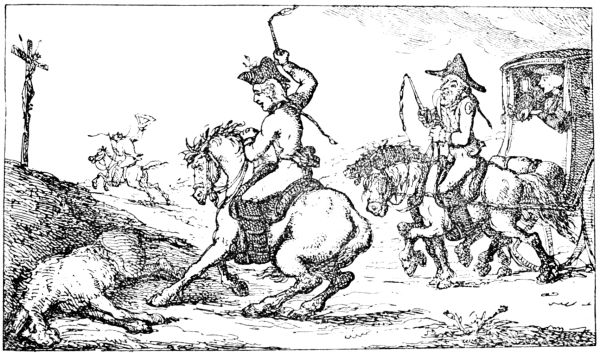
LA FLEUR AND THE DEAD ASS.
He said he had come last from Spain, where he had been from the farthest
borders of Franconia, and had got so far on his return home, when his ass died.
Everyone seemed desirous to know what business could have taken so old and
poor a man so far a journey from his own home.
It had pleased heaven, he said, to bless him with three sons, the finest lads
in Germany; but having, in one week, lost two of them by the smallpox, and
the youngest falling ill of the distemper, he was afraid of being bereft of them
all; and made a vow, if heaven would not take him from him also, he would go,
in gratitude, to St. Jago, in Spain.
When the mourner got thus far in his story he stopped to pay Nature her
tribute, and wept bitterly.
He said heaven had accepted the conditions, and that he had set out from
his cottage with this poor creature, who had been a patient partner of his journey—that
it had eat the same bread with him all the way and was unto him as a
friend. Everybody who stood about heard the poor fellow with concern. La
Fleur offered him money. The mourner said he did not want it—it was not the
value of the ass, but the loss of him. The ass, he said, he was assured loved
him—and upon this told them a long story of mischance upon their passage over
the Pyrenean mountains, which had separated them from each other three days:
during which time the ass had sought him as much as he had sought the ass, and
that they had neither scarce eat or drank till they met.
'Thou hast one comfort, friend,' said I, 'at least in the loss of thy poor beast:
I am sure thou hast been a merciful master to him.' 'Alas!' said the mourner,
'I thought so when he was alive, but now he is dead I think otherwise. I fear
the weight of myself and my afflictions together have been too much for him—they
have shortened the poor creature's days, and I fear I have them to answer
for.' 'Shame on the world!' said I to myself, 'did we love each other as this
poor soul but loved his ass, 'twould be something.'
1809. Butler's Hudibras, in three parts, written in the time of the late wars,
corrected and amended, with large annotations and preface, by Zachary Grey,
LL.D. Embellished with engravings by T. Rowlandson, Esq. London:
Printed for T. Tegg, 111 Cheapside. W. Hogarth, inv.; Rowlandson, sc.
1. Frontispiece. Hudibras and Ralpho in the Stocks.
2. Setting out.
Then did Sir Knight abandon dwelling,
And out he rode a-colonelling.
3. The Battle.
The scatter'd rout return and rally,
Surround the place; the Knight does sally,
And is made pris'ner.
4. The Knight and Ralpho consult the Gymnosophist.
The Knight with various doubt posses't
To win the lady goes in quest
Of Sidrophel, the Rosy-Crucian,
To know the Dest'nies' resolution;
With whom b'ing met, they both chop logic
About the science astrologic;
'Till falling from dispute to fight,
The conj'rer's worsted by the Knight.
5. Sidrophel and Whacum consulting the firmament.
This said, he to his engine flew,
Plac'd near at hand in open view,
And rais'd it 'till it levell'd right
Against the glowworm tail of Kite,
Then peeping thro', Bless us (quoth he)
It is a planet, now I see,
And, if I err not, by his proper
Figure, that's like tobacco stopper,
It should be Saturn.
1809. Surprising Adventures Of the Renowned Baron Munchausen. Containing
singular travels, campaigns, voyages, and adventures. Embellished with
numerous engravings by T. Rowlandson. London: Printed for T. Tegg, 111
Cheapside.
Frontispiece.—Baron Munchausen's extraordinary flight on the back of an
eagle, and supported by a second eagle, from Margate over the continents of
Europe, South and North America, the Polar regions, and back to Margate,
within thirty-six hours.
The Baron arrives at Ceylon, combats and conquers two extraordinary
opponents (a lion and a crocodile).
The snow having melted, the Baron discovers his horse in the air, secured by
the bridle to the church steeple; the Baron proves himself a good shot, cuts the
bridle in two, and resumes his journey.
Is presented with a famous horse by Count Przolossky, with which he performs
many extraordinary feats; the horse is cut in two by the portcullis of
Oczakow, which the Baron only discovers when he leads his spirited steed to
drink at the fountain, and the water flows out at the rear of the severed half.
Bathes in the Mediterranean, is swallowed by a fish, from which he is extricated
by dancing a hornpipe.
The Baron jumps into the sea with a Turkish piece of ordnance on his
shoulders (which fires a marble ball of three hundred pounds weight) and swims
across the Simois.
The ship, driven by a whirlwind, a thousand leagues above the surface of the
waters; the Baron discovers the inhabitants of the moon, with some traders from
the Dog Star.
Travelling in the South Sea they lose their compass; their ship slips between
the teeth of a fish unknown in this part of the world.
The Baron crosses the Thames without the assistance of a bridge, ship, boat,
balloon, or even his own will; being blown out of one of the Tower guns in which
he had fallen asleep, and the cannon is unexpectedly fired to celebrate an anniversary.
1809. The Beauties of Sterne; comprising his humorous and descriptive
Tales, Letters, &c. Embellished by caricatures by Rowlandson, from original
drawings by Newton. Published by T. Tegg, Cheapside.
Frontispiece. The Dance at Amiens, &c.
1809. Poetical Magazine. Dedicated to the lovers of the Muse by the Agent
of the goddess, R. Ackermann. Published November 1, 1809, at R. Ackermann's
Repository of Arts, 101 Strand.
Introduction to The Schoolmasters Tour. Vol. 1.—'In the Tour, with the
first part of which we here present our readers, the author carries his hero
through a great variety of whimsical adventures, to the Lakes and back again.
As tours are a fashionable article in the literature of the present day, we trust that
the poetical peregrinations of Doctor Syntax will come in for some share, at least,
of the public applause, to which we conceive it to be entitled. The lovers of
humour will not be displeased to be informed that it will be accompanied with
a considerable number of illustrative engravings.'
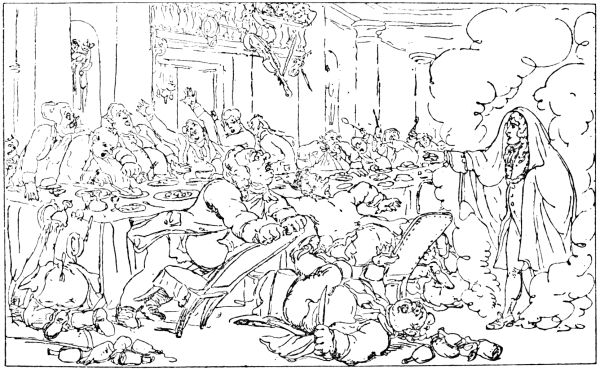
THE MANSION HOUSE MONITOR.
CARICATURES SUPPLIED BY ROWLANDSON TO THE
POETICAL MAGAZINE.
| Volume I. |
| 1. Doctor Syntax setting out on his Tour to the Lakes | May 1, | 1809. |
| 2. The Mansion House Monitor | June 1 | " |
| 3. Doctor Syntax losing his way | June 1 | " |
| 4. Doctor Syntax stopped by Highwaymen | June 1 | " |
| 6. Doctor Syntax bound to a Tree by Highwaymen | July 1 | " |
| 8. Doctor Syntax disputing his Bill with the Landlady | Aug. 1 | " |
| The Last Drop. A Woodcut. (Death striking the Drinker). (See April 5, 1811) |
Aug. 1 |
" |
| 10. Doctor Syntax copying the wit on the Window | Sept. 1 | " |
| 12. Doctor Syntax entertained at College | Oct. 1 | " |
| 13. Doctor Syntax pursued by a Bull | Oct. 1 | " |
Volume II. |
| 2. Doctor Syntax mistakes a gentleman's house for an Inn | Nov. 1 | " |
| 4. Doctor Syntax meditating on the Tombstone | Dec. 1 | " |
| 5. An illustration to 'Edwin and Matilda, or the Beach King.'
A legendary tale, in four cantos | Dec. 1 | " |
The Baron addressing the Harpists at the banquet to Earl Edwin:—
'Cease, caitiffs! nor further insult with your noise
The ears of our noble young guest.
Hence, away! and bear with you those coarse thrumming toys!'
The minstrels departed,—when, raising his voice,
The Baron Earl Edwin address'd.
| | |
| 6. Doctor Syntax tumbling into the Water | Jan. 1, | 1810. |
| 7. Illustration to 'Edwin and Matilda' | Jan. 1 | " |
The Beach King discovering himself to Matilda:—
A truncheon of coral he grasp'd in his hand,
Which, tho' pond'rous, with ease he could swing:
Thus array'd was the monster so fear'd thro' the land;
Thus horribly form'd, by Matilda did stand
The mighty, enormous Beach King.
| | |
| 8. Doctor Syntax losing his money on the Raceground at York | Feb. 1, | 1810. |
| 10. Doctor Syntax at a Review | March 1 | " |
| 12. Doctor Syntax with my Lord | April 1 | " |
| 13. Doctor Syntax made free of the Cellar | April 1 | " |
Volume III. |
| 1. Doctor Syntax sketching the Lake | May 1 | " |
| 3. Doctor Syntax sketching after Nature | June 1 | " |
| 5. Doctor Syntax robbed of his Property | July 1 | " |
| 7. Doctor Syntax sells Grizzle | Aug. 1 | " |
| 9. Doctor Syntax and Rural Sports | Sept. 1 | " |
| 11. Doctor Syntax and the Dairymaid | Oct. 1 | " |
Volume IV. |
| 1. Doctor Syntax at Liverpool | Nov. 1 | " |
| 3. Doctor Syntax reading his Tour |
Dec. 1 | " |
| 5. Doctor Syntax Preaching | Jan. 1, | 1811. |
| 7. Doctor Syntax and the Bookseller | Feb. 1 | " |
| 9. Doctor Syntax at Covent Garden | March 1 | " |
| 11. Doctor Syntax returned from his Tour | April 1 | " |
| 13. Doctor Syntax taking possession of his Living | May 1 | " |
The intermediate plates are landscapes, after anonymous artists, engraved in
aquatint by Hassell and others.
1809. Beresford (James). An Antidote to the Miseries of Human
Life. 8vo.
1809. Rowlandson's Sketches from Nature. Twelve views, drawn and
etched by T. Rowlandson. Aquatinted by Stadler.
1809. The Art of Ingeniously Tormenting. Republished by Tegg. Plates
by Woodward. 12mo.
1809. Annals of Sporting. By Caleb Quizem, Esq., and his various Correspondents.
Published by T. Tegg.
The Courtier is thrown in pursuit of his game,
The Poet's too often laid low,
Who, mounted on Pegasus, rides after Fame,
With 'Hark forward! Huzza! Tally-ho!'
1809. The Trial of the Duke of York. In 2 volumes. Published by T.
Tegg.
1809. Annals of Sporting. By Caleb Quizem. Republished by Tegg. Plates
by Woodward. 12mo.
Frontispiece. The Bucephalus Riding Academy for Grown Gentlemen. H.
Bunbury del., Rowlandson sc.
Titlepage. Vignette; the Author thrown from his Pegasus. Designed and
etched by T. Rowlandson.
Introduction. Caleb Quizem, Esq. Woodward del., Rowlandson sc.
The Maid of Mim.
Hounds.—1. Rugged and Tough. The Lion Hound. 2. The Black
Straddler. The Short-legg'd Stag Hound. Woodward del., Rowlandson sc.
Game Wigs.—1. A Long Bob. A Short Bob. A Black Scratch. A
Physical Tie. A Sir Cloudesley Shovel. A Three Tier. 2. A Cauliflower.
A Full Bottom. A Short Queue. A Long Queue. A Rose Bag. A Full
Bag.
Costume of Hog's Norton.—1. A back-front view of Miss Dickinson's
New Dress. 2. The Morning Dress of a Lady and Gentleman of Hog's Norton.
Fashionable Furniture at Hog's Norton.—1. Chimney Ornaments.
Improved Trencher. Hogs Norton Recess. Fashionable Looking-glass.
Fashionable Clock. 2. The Stocking Sweep. Colonnade of Streets. Fashionable
Table. Cobweb Frieze. Sarcophagus, Cellaret, Coal-scuttle. Fashionable
Chair.
How a Man may Shoot his own Wig.
The Bailiff's Hunt:—
- 1. Going out in the Morning.
- 2. In Full Scent.
- 3. Breaking Cover.
- 4. The Pursuit.
- 5. At Fault.
- 6. The Second Escape.
- 7. Double and Squat.
- 8. The Seizure.
The True Method of Sitting a Horse, Mathematically Delineated.
1. Mathematical Horsemanship.—Mr. Ralph Marrowbone, forming an obtuse
angle. 2. Tom Timorous, forming an acute angle. 3. Dickey Diaper, forming
a right angle. 4. Mr. Robert Rasp, letting fall a perpendicular from his saddle.
5. Mr. Benjamin Buckskin and his horse performing their evolutions within the
circumference of a circle.
How to Vault from the Saddle.
1809. Advice to Sportsmen, selected from the notes of Marmaduke Markwell.
Republished by Tegg. Plates by Woodward, 12mo.
1809. Advice to Sportsmen, rural or metropolitan, noviciates or grown
persons; with anecdotes of the most renowned shots of the day, exemplified
from life, including recommendatory hints on the choice of guns, dogs, and
sporting paraphernalia. Also characters, costume, and correspondence. Selected
from the original notes of Marmaduke Markwell, Esq., with sixteen illustrations
by Thomas Rowlandson:—
But a bold pheasantry, their country's pride,
When once destroyed, can never be supplied.
'Dedication.—To the most enlightened Sportsman in the metropolis of the
British Empire; equally keen in pursuit of the hare, the haunch, the partridge,
pheasant, woodcock, wild fowl, black or red game; devourer of the amphibious
turtle, and terror of the Dutch; dead shot at a patriot; a marksman whose
brilliant and sporting elocution can start a Jubilee in the worst of times, whose
merry jokes can create sport, and are the cause of sport to others: To Sir
William Curtis, Bart., M.P. &c., &c., &c., these effusions of a City Sportsman are
with all respect inscribed by his most devoted and obedient servant,
'Marmaduke Markwell.
'Turn-again Lane, September 1, 1809.'
Frontispiece.The Cockney's first attempt at shooting flying.
Illustrations.Rat-hunting.
How to twist your neck.
Night.
Noon.
Morning.
The dangerous consequences of sporting.
Miss Spitfire's encounter.
Advantage of coupling sporting dogs.
Finishing a gamekeeper.
How to come in at the death.
How to cool your courage.
A duck hunt in Bartholomew Lane.
Neck or nothing.
A shooting parson or pot-hunter.
Evening.
1809. The Pleasures of Human Life. By Hilari Benevolus & Co., with
five plates by Rowlandson, &c. Published by Longmans.
1809. The Pleasures of Human Life. Investigated cheerfully, elucidated
satirically, promulgated explicitly, and discussed philosophically, in a dozen
dissertations on male, female, and neuter pleasures. Interspersed with various
anecdotes and expounded by numerous annotations by Hilari Benevolus & Co.
(Fellow of the London Literary Society of Lusorits). (Mottoes from Milton,
Dibdin, and Peter Pindar.) Embellished with five illustrations and two headpieces.
London: Longmans & Co. Crown 8vo.
Front engraved by W. Bond, after W. Satchwell. Physiognomical vignette
on title-page engraved by W. Bond, from Bell's Anatomy of Expression.
Of Rowlandson's illustrations the author observes, in his preface: 'The five
illustrative commendatory etchings do not require any verbal explanation.'
Five prints by Rowlandson:—
- 1. Christopher Crabtree in the Suds.
- 2. Mr. Ego's marvellous Story.
- 3. Connoisseurs, or Portrait Collectors!
(The 'collector' in question is slily pocketing a print while the shopman's
attention is diverted.)
- 4. A Brace of Full-grown Puppies, or my Dog and me.
- 5. Pleasures of Bond Street, or Fashionable Driving.
1809. T. Smollett: Miscellaneous Works. Twenty-six illustrations by Rowlandson.
5 vols. 8vo. Edinburgh.
1809. Gambado. An Academy for Grown Horsemen, &c. 8vo. Published
by T. Tegg. (See 1808.)
1809. Beauties of Tom Brown. Frontispiece and illustrations by T. Rowlandson.
Published by T. Tegg. 12 mo.
1809. Views in Cornwall, Devon, Somerset, Isle of Wight, &c.
1809. Scandal: Investigation of the Charges brought against H.R.H. the
Duke of York by G. L. Wardle, Esq., M.P. for Devon, with the Evidence and
Remarks of the Members. Containing fourteen scarce portraits by Rowlandson,
amongst which are Mrs. M. A. Clarke, Sir F. Burdett, Duke of York, Colonel
Wardle, &c. 2 vols., 12mo.