Buyers and readers of books, all admirers of pictures, drawings, and engravings—in
a word, the intelligent, and, let us hope, larger proportion of the community—are
well aware, if they are inclined to search for information
in respect to the celebrities of art, or would inquire into
the personal careers of the renowned pioneers and practitioners
of the serious branches of the profession, of whatever
period, school, or nationality, that numerous sources of
reference, tolerably easy of access, are open to the seeker
without being driven far abroad in his quest.
There exist, as we are all thoroughly aware, abundant
lives of artists, dictionaries of painters, and other prolific
sources of information upon the practisers of the sober walks of pictorial art, with
rich collections of engravings from their works, in fact, a complete library of
delightful literature, which goes far towards proving that the world at least
acknowledges a slight interest in individuals as well as works, and that people
care to learn some particulars of the men who spent their industrious existences,
and devoted the gifts of their admitted genius and application to the humanising
walks of life, and to the fitting illustration of the world's universal passions and
history, or to the delineation of the ever-varying beauties of nature under
picturesque aspects.
Wealthy collectors, the cultivated patrons of material refinement, frequenters
of picture galleries, those who love pictures by instinct, art amateurs, and the
hopeful and fervent student, have alike a provision prepared for them in this
regard, which happily leaves little to be desired. The memoirs of artists—men
whose domestic and inner lives in so many instances teach lessons of gentleness,
simplicity, and singleness of purpose, of perseverance under difficulties; making
manifest to a world which is often slow to give them credit for the gifts that are
in them, the strong impulses of talent under untoward conditions—are, for the
most part, tender memorials, labours of love, cherished productions of biographers,
whose own natural qualifications and trained appreciation of the subtler attractions
of art have brought them into more intimate communion with the memorable
subjects of their studies.
It has ever been a source of regret to the writer, since his youthful fancies
were first won by the marvels of grotesque art, and the pleasant creations of the
graphic humourists, that while the names of the designers, familiarly known as
caricaturists—who have enriched the more playful branches of the profession—are
household words, no fitting memorials are to be found of the careers of these
draughtsmen of true genius; they knew their generation, as is instanced in the
inexhaustible memorials they have bequeathed their descendants in their works,
and while they were themselves thoroughly familiar with the varied aspects and
workings of the social life with which they were surrounded, their generation
knew them not, and took no care to preserve any record of the capricious wits
whose pleasant inventions had
often afforded them enjoyment.
The humourists, who
did so much to contribute
towards the amusement of
others, have been suffered to
pass away, in too many cases,
as impersonalities. The works
of their fanciful and fertile imaginations
have been accepted
on all hands and allotted their
recognised position among the other agreeable accessories of life, while the
gifted professors have, with one or two notable exceptions, which make the reverse
the more marked, been pretty generally passed over, if they are thought of at all
under the relationship of realistic characters, as mythical beings, less tangible—as
regards their connection with the living people of their generations, of whose
persons, habits, and follies they have bequeathed animated instances to posterity—than
the most weird and fantastic creations of their own pencils or etching-points,
emanations of the mind, whose utmost substance amounts to paper, and
printing-ink, and ideas.
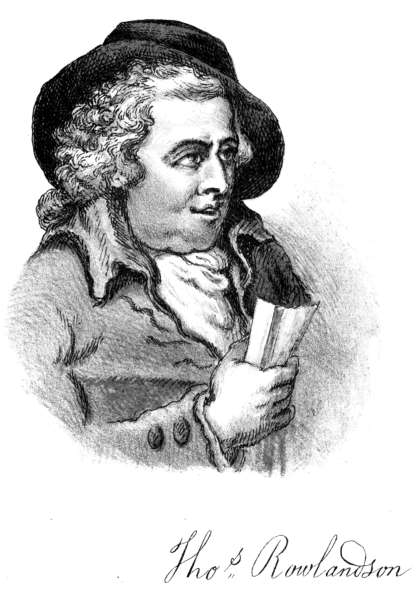
The whimsical conceptions which owe their origin to Gillray, Rowlandson,
Bunbury, Ramberg, Woodward, Dighton, Nixon, Newton, Boyne, Collings,
Kingsbury, Isaac Cruikshank, his son, 'the glorious George,' the veteran calcographist,
who has just passed away full of years and reputation, Lane, Heath,
Seymour, and a bevy of their contemporaries, were in their day tolerably familiar,
their etchings and sketches were in the hands of the print-buying public of the
period, and they enjoy, as far as these relics of the past are concerned, a posthumous
reputation which varies according to the merits of their productions, a generation
or two having assigned them their just relative positions on the ladder of fame;
all the inimitable amusing travesties which reproduce the manners, and even the
sentiments of past celebrities and perished generations, owe their creation to
artists who were suffered to labour in partial obscurity; while the creatures of
their brains were in the hands of every one, their contemporaries, for the most
part, did not trouble themselves sufficiently to reflect whether the designers had
any real existence, possibly classing the actual, practical, living, and working men
under the category of abstract ideas in their own minds, impalpable atomies,
less substantial than their tangible satirical pictures, which enjoyed a popular
circulation.
The late Thomas Wright, F.S.A. (with the collaboration of an earnest worker
in the same field, the late F. W.
Fairholt, F.S.A., who contributed the
valuable aid of his pencil), has done
a great deal for the subject in his
'History of the Grotesque in Literature
and Art,' and still more in his
'Caricature History of the Three
Georges.' 'The Caricature History
of the Fourth George,' which offers
a still wider field of selection, as regards
political and pictorial squibs
and satires, has yet to appear.
A preliminary contribution to the
history of caricature, as an attempt to repair in some measure the oversight of
indifferent contemporaries, 'The Works of James Gillray the Caricaturist, with
the Story of his Life and Times,' published under the auspices of Messrs.
Chatto and Windus, has already met with a favourable reception at the hands
of the press and the public; the present writer devoted several years to the
completion of the volume, with the solitary end in view of associating the artist
more intimately with his works, in the estimation of the public, before it was too
late. Mr. Thomas Wright, as an indefatigable pioneer in a comparatively
unbeaten track, deserved personal recognition on the strength of his important
contributions, bearing on the political history of the House of Hanover, as
duly set forth in the present writer's introduction, and to his name was offered
such repute as was conferred by the editorship.
The writer, from his gleanings in the same direction, has been able to offer
the public a sketch of the 'Life of Henry Bunbury the Caricaturist,' with slighter
croquis of his contemporaries. During the interval since the first intention of
compiling the present volume as a further contribution to the literature of caricature
assumed a definite form, some ten years back, the preparation of the work, imperfect
and incomplete as it confessedly must remain—a mere ébauche at best—has
been proceeding by slow and toilsome stages, the self-imposed task being rendered
a more difficult one than in the instance of James Gillray,[1] from the disheartening
circumstance that it is utterly impossible to arrive at anything approaching a
comprehensive view of the works of Rowlandson; no adequate collection being
in existence, as far as the writer has discovered, with the possible exception of
an accumulation in the hands of Mr. Harvey of St. James's Street, the advantages
of which gathering (it has been going on steadily for years) have hitherto remained
inaccessible to the editor, the possessor's time having been too occupied by the
requirements of his other engagements to permit him to arrange the prints as he
wishes. This circumstance is to be regretted, since Mr. Harvey admits the
personal interest he feels in caricature,
upon which, when communicatively
inclined, he is able to
furnish very valuable information,
in part the results of his own
wide experience as a purchaser,
and still more, perhaps, of painstaking
investigations conducted
for his private delectation; as
his position and opportunities
enable him to gratify his tastes in
this direction to the fullest extent, it is hinted that on occasions he may feel
disposed to furnish the critic with certain valuable facts of a special nature, drawn
from the results of his own practical investigations in directions not generally
available. This gentleman is, undoubtedly, an authority, and as, it is believed,
he possesses unrivalled opportunities for forming a unique collection of prints by
any master whose works he may fancy, the writer has, from season to season for
the past six years, deferred the completion of his volume on the faith of a
generous-sounding promise that he should be allowed to consult Mr. Harvey's
collection of prints by Rowlandson, which, according to his knowledge, must be
both interesting and valuable, and may possibly contain a great deal that has
escaped his previous researches, however zealously they may have been instituted.
The sacrifice of time, labour, and patience involved in attempting to compile
anything approaching a fairly compendious summary of Rowlandson's etchings is
simply incredible. The desire to furnish a complete catalogue, though seemingly
reasonable in itself at the first glance, is discovered upon experience to be practically
impossible, and hence out of the question as regards arrangement; the
productions of the artist, multiplied by pen, graver, and etching-point, as supplied
by the hand of the master, or reproduced by other engravers, are legion, and
where the examples are scattered no amount of application can adequately
ascertain.
As far as kindly assistance is concerned, the writer has to acknowledge, with
sincere gratitude, that where his previous experience has taught him to anticipate
courtesies, he has been gratified in the highest degree, and he is proud to record
that he once more finds himself indebted for cordial sympathy to the best qualified
experts of the day.
Mr. G. W. Reid,[2] the respected keeper of the prints and drawings in the
British Museum, with Messrs. Fagan and Donaghue, urbane members of his staff,
have at all times made his access easy to
the invaluable collection of social and
political caricatures in his department;
Mr. George Bullen (whose affability and
scholarly acquirements are proverbial),
the respected keeper of the printed books
in the same magnificent national institution,
has been able to facilitate the writer's
quest of illustrations and caricatures by
Rowlandson, so far as they come within
the scope of the important department which that gentleman so efficiently administers;
the obliging and accomplished custodian of the superb collection
belonging to the Bibliothèque Nationale of France has most readily allowed the
writer to avail himself of the select and valuable gathering of caricatures by
Rowlandson, which are to be found under his charge. It must be mentioned
that the caricature resources of the royal collection in the museum at Brussels
were as courteously placed at his service by the well-informed custodian, who, it
may be added, takes a considerable individual interest in this branch as illustrative
of men and manners under special aspects. The writer has pursued his perquisitions
as far as the national state collection of engravings contained in the
Trippenhuizen Museum, Amsterdam. These magnificent national institutions
are all, more or less, rich in caricatures of an historical description, but unfortunately,
as regards the success of the present undertaking, the works of Rowlandson,
numerous as they are, happen to be the reverse of the strong features of their
collections of satirical prints, either political or social. The writer has accordingly
been thrown back, to a dispiriting extent, on his own necessarily restricted resources;
and the numerous illustrations which accompany this volume are for
the most part unavoidably drawn from his own folios.
The principal source from whence it was hoped the best information could
be detached proved utterly and exceptionally valueless; the writer refers to the
important publishing establishments (and the successors who carry on the firms
at the present day), whence the far-famed caricatures were originally issued. The
firms of the Humphries, Hollands, Jackson, J. R. Smith, and others under whose
auspices the artist's earliest, and in several instances most finished and ambitious
works, first secured their lasting reputation, have long become extinct, as far as
the editor is informed. But three leading print-publishing houses, established
by Rowlandson's principal patrons, to whom the publication of the major part of
his works was due, are still flourishing, under conditions modified to harmonise
with the requirements of the present age, by descendants
and successors of the well-known founders. These resources
have proved, however, a disappointing failure,
as far as assistance towards the compilation of a catalogue
of the artist's productions is concerned. To Mr.
Rudolph Ackermann, the respected inaugurator of the
'Repository of Arts,' a truly liberal and enterprising
gentleman, who will be referred to at greater length in
the course of this volume, Rowlandson (with many other professional artists and
authors) was deeply indebted both for business-like co-operation, for the pains he
took to sell the artist's countless original drawings, for personal encouragement,
untiring friendship, and pecuniary accommodation. Messrs. Ackermann
have unfortunately preserved no account of the numerous publications due to
the hand of the caricaturist, and issued for half-a-century by their respected
firm, nor have they any collection of impressions from the plates they gave to
the public.
The same observation applies to Mr. William Tegg, whose father, the
indefatigable and well-known Thomas Tegg of Cheapside, published hundreds
of the satirist's later and cruder caricatures, which were more generally familiar
in the windows of printsellers, &c., since copies were multiplied to a larger extent
than was practicable in the case of delicately finished aquatints, which gave
fewer impressions, and commanded higher prices. Consequently, Rowlandson
is better known to the public by his least desirable prints, and under his most
common-place aspect. Mr. S. W. Fores seems to have issued an important
proportion of Rowlandson's larger and more valuable plates, with the addition
of an immense number of small subjects etched by Rowlandson, and finished by
clever aquatinters, published in a more costly form than was generally the custom
of the time. The successors of this gentleman have mentioned that the firm has
not preserved any list of the publications issued under its original and well-recognised
standing, in respect to satirical production, as Fores' Caricature
Museum, but it is understood that, at
the present writing, there still remains
in the house a collection, in huge
volumes, of early impressions from the
multitudinous plates issued from the
establishment under its earlier auspices—a
publisher's summary, in short, such
as, it is to be regretted, is rarely preserved for any length of time. Unfortunately,
owing to the exigencies of their modern print business, the writer has not
been permitted to consult this highly interesting collection; he has, however,
been informed, as an equivocal sort of consolation for his discomfiture, by the
member of the firm to whom his application was addressed, that the major
part of the prints, as far as the works of Rowlandson are concerned, are of
a political character, and that the interesting and valuable social engravings
are wanting; he also learns that nothing of importance by Rowlandson is to be
found in this collection.
It is worthy of note, that the majority of the caricatures described in the present
work, as published by S. W. Fores, belong almost entirely to the more attractive
order of social satires, and pictorial skits at home and abroad, or cartoons levelled
at the leaders of fashion, holding up the prevalent follies of the hour to legitimate
ridicule. The writer confesses that he is inclined to feel a
deeper regret at his inability to describe these political prints,
presuming his informant, who certainly ought to know, is
correct in this conclusion, since he is unable to account for
their existence, as amongst the immense number of caricatures
published by S. W. Fores, he has not hitherto lighted
upon the series in question. Rowlandson's political prints—which,
as the reader will realise in the progress of this
compilation, are numerous enough in all conscience—were mostly published, as
regards the early examples, by Humphries (a few of the somewhat hackneyed
Westminster Election set, 1784, were due to S. W. Fores, it is acknowledged);
while his later productions in this field, such as the succession of plates attacking
Buonaparte, were issued from Ackermann's Repository of Arts, or circulated by
Thomas Tegg (like the series treating of that Delicate Investigation, the Clarke
scandal), according to the circumstances of the artist's employment or the cost of
the plates. Popular prices being a requisition in the case of the sets published
from the City, a coarser method of execution, with unmistakable instances of haste,
detract in an unqualified degree from the interest of these prints, as instances of
the artist's ability, which is exhibited to greater advantage in productions where
his skill was allowed a more liberal exercise, as is evidenced in the capitally
executed plates published by the West End print-selling firms.
The hopeful chances of aid from fountain-heads, upon experience, diminished
to zero; and, while obstacles multiplied, the writer found it necessary to redouble
his energy. As it proved that his own collection must, in the end, serve as the
main source of reliance, fresh efforts were made to increase his gathering, and
valuable additions were gradually secured. The process was somewhat tedious
and costly withal, but it was the only course left open, unless the intention was
renounced after the work had been advertised
in progress.
Print-sellers' shops, at home and abroad,
were ransacked, and auctions of engravings
were attended, whenever the alluring word
caricatures occurred in the catalogue. The
supply was remarkably limited, the demand
considerable and increasing; and
prices, from the nature of the request,
shortly became unreasonable. Choice
caricatures, or those in fairly good condition,
were pushed up to nearly the prices
of the original drawings, and even at these
enhanced rates but few examples were
forthcoming. In Paris, Brussels, and London, a five-pound note became about
a fair equivalent for a moderately fine impression after Rowlandson, if the plate
were large and the subject important or curious, while for certain of the more
sought-after examples, this rate was doubled; for such plates as Vauxhall
Gardens, dealers expect a still larger price—indeed, five-and-twenty pounds have
been demanded in many instances. The chances of fresh examples by Rowlandson
coming into the market have decreased, and possibly the competition will
relax when there is no longer a chance of exciting it.
The writer has necessarily made the acquaintance of several gentlemen who
are fervent collectors of Rowlandson's works, and he by no means ignores his
obligations to those happy possessors of rarer specimens, who have frequently
carried them off with an air of conquest from discomfited rival amateurs, the
condition of their purses, and the artistic enthusiasm aroused at the moment,
rendering similar triumphs comparatively facile, when incidental questions as to
actual worth are too insignificant to engage the attention.
Certain collectors of eminence, who are discriminating selectors of caricatures,
well qualified to judge of their technical merits, and who, further, are well posted
up in curious and out-of-the-way points of the political
and social histories of the times thus illustrated,
have volunteered the results of their researches;
these good-natured offers have arrived too late to
be available, but the writer is not the less indebted
to the kindness which prompted the action; in an
earlier and preparatory stage, these advances would
have been of considerable value and assistance.
So much for the materials; perhaps too much
stress has been laid, as far as the reader's patience
is concerned, on the preliminary difficulties which
have hindered and weakened the execution of the
writer's desire to reproduce, by pencil and pen, a fair
gathering of the works of our greatest humorous designers, an idea long
cherished, and tardily carried out, as regards the first part of his task,
James Gillray; and beset, as he has recounted, in respect to Thomas
Rowlandson, the concluding portion, by unforeseen impediments and technical
difficulties which it would be tedious to enumerate; they may, however,
in a minor degree, be taken into consideration as a plea for the obvious
shortcomings of this laborious compilation, and, while inclining rigid specialists
to be less exacting, induce critics to regard the unavoidable faults of the
performance with lenient
forbearance.
For the space of a
century, Rowlandson's caricatures,
which are more
properly croquis of the life
which surrounded him, have
continued to afford delight
to the appreciators of graphic
humour, from the date,
1775, when he sent his first
contribution to the Royal Academy. It was only this year (1878) that
a pair of his remarkably spirited drawings, Faro Table at Devonshire House,
and A Gaming Table, attracted considerable praise and attention on the
walls of the Grosvenor Gallery. Although the artist was master of the most
elegant refinement, both of delineation and colouring, and produced the most
delicious female heads with that lightness and daintiness of touch which was his
peculiar gift, bringing all the graces, sparkle and animation of the French school
to bear upon the models of winsome female beauty our own favoured isles produced
for the exercise of his pencil, we are constrained to admit, thus early
in our summary, that too many of his productions are strongly tinctured by
that coarseness of subject and sentiment which has been held to disfigure
the works of contemporary humorists; his wit, it must be remembered, was
of the jocose school of Smollett and Fielding, and in justice it must be taken
into consideration that his designs, even in their most uncompromising and
grosser aspects, simply reflect the colour of a period which was the reverse of
squeamish, and, as has been pertinently observed by the late Thomas Wright,
'of a generation celebrated for anything rather than delicacy.'
The artist was pretty generally
recognised as the famous
illustrator of Doctor Syntax and
The Dance of Death, and in this
relation he is fairly acknowledged
by posterity; this limited view,
as the present volume is designed
to demonstrate, being far indeed
from an adequate acknowledgment
of his proper artistic standing.
Rowlandson's higher qualifications,
as a draughtsman in
water-colours of remarkable
merit, a portrait-painter of felicitous promise, and the originator of countless
witty and pointed conceptions, were discovered more tardily. His surprising
facility for representing the human figure, with knowledge and freedom of
execution, his marvellous power of combining groups and crowds of figures in
active movement, his grasp of expression, and fluency of colour and handling,
were more particularly admitted (though in a sense they have since been lost
sight of) after the Exhibition of 1862, where two of his truly characteristic
subjects, of considerable size, made their appearance on the walls, to the amazement
and delight of the spectators, who had no previous acquaintance with his
whimsical genius. These two drawings, which opened the eyes of the world to
his gifts for a little season, are entitled An English Review and A French
Review; they originally formed a very noticeable feature on the walls of the
Royal Academy in 1786; it is believed that eventually they came into the possession
of the Prince of Wales, and, with the rest of George IV.'s collection, have
remained in keeping of the royal family ever since, her gracious Majesty, the
Queen, being pleased to lend them, with other fine representative examples of
art, to the Exhibition Commissioners of 1862.
The English Review, and its companion drawing, a French Review, hang at
Windsor Castle, where we are informed there is a very large accumulation of
caricatures, drawings and prints, put away in a closet, in the order of their appearance;
which, it is likely, have remained undisturbed for generations. It is
not impossible that, hidden away in this mass of satirical productions, may be
found the series of drawings, notoriously of a free tendency as regards subject,
which Rowlandson is understood to have produced for the delectation of George
IV. A collection of a similar description was, as we learn from the same
authority, destroyed by a nobleman well known for his princely liberality, on the
death of the patron who had selected the subjects.
In the unrivalled collection of water-colour drawings of the English school,
which are found on the walls of the sumptuous
permanent Museum of Art at South Kensington,
are exhibited three characteristic examples of Rowlandson's
talents in the caricature direction. The
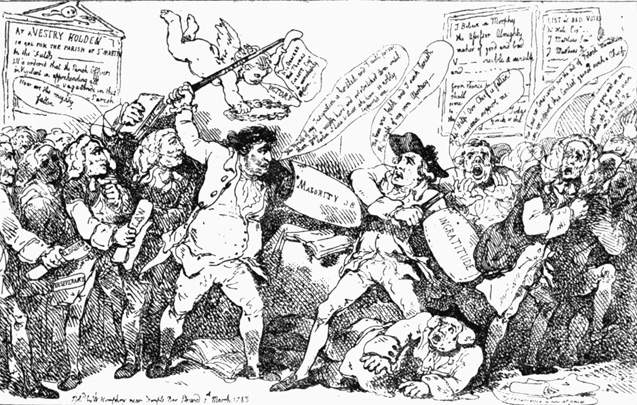
Parish Vestry, 1784, a humorous and spirited
drawing, belonging to the artist's best time, formed
part of the munificent gift made by Mr. William
Smith to the nation; as did the second example,
entitled Brook Green Fair, which we should assign
to about the year 1800. The third drawing, representing
The old Elephant and Castle Inn,
Newington, is also due to a liberal donor, being the gift of G. W. Atkinson, Esq.
As has been related, the caricaturist produced thousands of capital drawings,
delicately tinted, excelling in all styles; and from these original designs, he
executed in turn thousands of spirited etchings with his own hand, which were
frequently coloured to reproduce the first sketches, or aquatinted by engravers
(sometimes by himself), in imitation of drawings tenderly shaded in Indian ink, to
which, in some instances, the resemblance is sufficiently faithful to deceive the
eye of anyone who is not familiar with this method of reproduction.
It must be borne in mind—and we insist the more earnestly on this point, as,
from some incomprehensible wilfulness, it has seemingly been suffered to sink
out of sight for a time—in treating of Rowlandson, that the man was essentially
an artist; it is undoubtedly true that he was gifted (perhaps we might consider
fatally as far as his proper estimation is concerned) with the faculty known as
caricature, and he excelled in burlesque, but his successes were sufficiently high
in other branches of the artist's profession to indicate that he was equally qualified
by original talents, by academic training which he might have turned to the
best advantage, by a sense of the beautiful unusually keen, and a happy power of
expressing his first impressions, to take a foremost place amongst the best recognised
masters of the early English school, to whose body he might have been an
ornament, if he had not preferred his chosen calling of 'a free-lance' with a roving
commission to work mischief. His remarkable gifts of originality, ever fertile,
and apparently exhaustless, and facile powers of invention, either pleasant or
terrific, which seemed spontaneous, were in his case insurmountable hindrances,
instead of promoting his advancement and reputation as a painter of acknowledged
value and eminence. He had the calamity—so fatal, in his and many other instances,
to serious application—to succeed without sensible effort; from the very
first his progress was a series of triumphs; none of the students of the Academy
could draw such ludicrous and yet life-like figures, and thus his popularity with
his fellow-labourers was assured; his studies from the nude, both in London and
in Paris, were wonderful for the rapid ease and talent with which they were
executed, and hence arose another source of glorification, and although personal
vanity has never been mentioned in connection with the artist (he being
thoroughly blind to everything but his own particular hobbies), the professors at
home and abroad, and the members of the Academy themselves, were proud to
patronise in their classes such precocious ability, which could accomplish the
most difficult delineations without effort, and thus reflected credit on their
schools; and the prodigy who drew from the life, in his youth, as vigorously and
well as the most painstaking adepts in their maturity, could not fail to receive a
dangerous amount of admiration, which tempted him to depend upon trifling
exertions, and left his ambition without a spur.
While yet in his boyhood he was recognised as a genius, and was unhappily
flattered into becoming a wayward one; the very fluency of his pencil, and the
fidelity of his memory towards the grotesque side of things proved his stumbling-blocks.
It is with more than a passing shade of regret that we reflect, with his
far-seeing colleagues at the Academy and elsewhere, how eminent a painter was
lost in the development of a caricaturist, admirable and unsurpassed in his own
branch as Rowlandson must admittedly remain. The gifts which were in the
man were marvellous, and beyond this he possessed nerve to persevere, and
manly resolution to sustain his exertions, as he proved in his youth, and subsequently
demonstrated when past life's meridian, times then being less prosperous,
since fortunes and legacies had long ceased to fall in adventitiously, but the very
excitement of setting the little world wondering, and making the public smile, while
his tickled audience accorded him the cheapest popularity by crowding in admiration
round his travesties, turned the wilful artist away from serious application,
where no immediate fun was to be secured for either the limner or his following.
Rowlandson's sense of feminine loveliness, of irresistible graces of face, expression,
and attitude, was unequalled in its way; several of his female portraits
have been mistaken for sketches by Gainsborough or Moreland, and as such, it is
possible, since the caricaturist is so little
known in this branch, that many continue to
pass current. From 1777 to 1781, five years
of Rowlandson's residence in Wardour Street,
with all the freshness of his academic studies,
and the laurels unfaded he had won in the
schools, with golden opinions, as a youth of
paramount promise, indulged by the most
eminent of the Royal Academicians and the
French professors, the artist practised the
more laborious and prosaic, but surer branch of
portrait-painting with success, and his pictures
were duly received by his patrons and well-wishers amongst the omnipotent
Forty, and found their place on the walls of the Royal Academy Exhibition
without a break—no barren compliment when it is remembered that his compeers
were Reynolds, Gainsborough, and Hoppner, and that of the two or three
hundred works selected for the gallery at the period referred to, the superb
canvases of the artists named constituted an average of over ten per cent. of the
entire exhibits.
If we but think for a passing instant over the winsome portraitures of fair
women, whose faces live, for the delectation of all time, on the canvases of Sir
Joshua Reynolds, Gainsborough, Romney, and a few lesser luminaries, it is cruel
to realise that Rowlandson, from sheer wantonness (promoted by what seemed a
happy hit in 1784),[3] neglected his opportunities in the direction of portraiture,
with an indifference which, while proving his disinterestedness and superiority to
mere profit, is the more exasperating when we are frequently told, as every one
of Rowlandson's contemporaries who has mentioned the caricaturist never fails
to reiterate, that the successive presidents of the Royal Academy, the great
Reynolds, the royally patronised West, the courtly and fashionable Lawrence,
the very men we have mentioned who were, it must be conceded, the most competent
judges on the point, pronounced their conviction that his abilities entitled
to acceptance, as one of themselves, a brother artist whose addition to their ranks
they would have gloried to acknowledge, since he had the undoubted genius to
reflect a lustre on the Academy, if he had exerted his talents in the recognised
channels, and withstood the impulse of his notoriety for producing irresistibly
droll novelties, which, as they foresaw, must infallibly prove pernicious to the
practice of sober portraiture.
The versatile acquirements of our artist may, in a sense, be looked upon as
an infirmity, a theory which
had been thoroughly established
while the subject of it
remained in the flesh, and enjoyed
a certain perverse gratification
in contributing to support
its soundness and perspicacity.
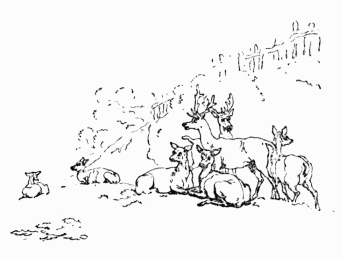
In landscape art we discover
Rowlandson successfully
rivalling the most respected
practitioners in water-colours
amongst his contemporaries,
and helping the younger professional generation, that carried the art to perfection,
to discard the obsolete theories of blackness for clear translucid colouring. His
studies after nature are much esteemed, and are to be occasionally recognised in
galleries and collections. It is a sufficiently capricious circumstance which has
come within our experience—we have heard it asserted confidently more than
once—that Rowlandson, the simple harmonious colourist and ready draughtsman,
whose brush with limpid tints so deftly translated on paper the charms of sylvan
scenes; the truthful artist who pictured the forest, fall, and glade, the distant
hamlets amidst the foliage, the picturesque windings of the silver stream, the
rustic cottages, the cattle wending leisurely through the fertile pastures, the
mellow atmosphere, and the far-extending horizon, is often held a distinct individual
from that other universally known Rowlandson—of equivocal reputation,
it is hinted—whose daring reed-pen produced grotesques which perhaps were
inimitable, but which, it is certain, were often indefensibly vulgar.
The artist's facility was so considerable that, had he been less scrupulous (his
horror of fraud and imposition, especially in their pecuniary reference, was implacable,
in spite of, or perhaps in contradistinction to, his other levities), he could
have allowed his own productions, in the manner of his reputable contemporaries,
and even of deceased celebrities, whose subjects and method he chose to imitate
as a question of pure ingenuity—(while his own style is above all difficult to reproduce)—to
pass current as veritable originals by the masters. A book of
etchings consisting entirely of these imitations is described in the course of this
work, and he has managed to assume, without copying any particular picture, the
modus operandi of the artists, and has varied his own manner of execution and
disguised his salient individualities with such subtlety, that, even to the etching-point,
slight trace of Rowlandson remains to betray the acknowledged imposition.
In his sketches after nature, as we have ventured to advance in respect to his
female portraits and delicious studies from life, in many instances it is difficult to
distinguish between the artless rustic groupings and charming pastoral drawings
by George Moreland and Thomas Gainsborough, let alone those of Barrett, Hills,
Howitt, Pugh, and other of his associates (who executed pictures lightly outlined
with a reed-pen, shaded with a warm tint and delicately washed with transparent
water-colours, as was then the process),[4] and the acknowledged contributions of
our versatile genius to this department, in the earlier stages of the captivating
art of water-colour drawing.
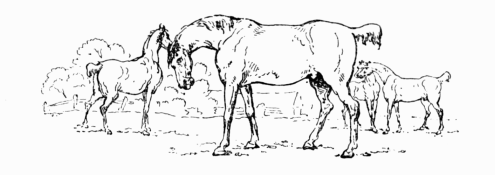
The writer, in the course of his preparation for this work, has been at the
pains to consult more than one well-recognised artist of reputation and authority;
seeking for hints from professors whose celebrity extended well back towards the
beginning of the nineteenth century; these respected ancients, who are now
nearly all gathered to the shades to join the subject of this volume, being from
their age, knowledge, and experience, as well as from the traditions of their
earlier masters, most likely to know and remember circumstances of a special
character bearing upon the subject. Some of these worthies were actually
working as contemporaries of the caricaturist who departed fifty years ago. The
last time the writer met George Cruikshank, a few months before that truly
splendid old gentleman passed away, full of years and honour, to his well-earned
repose, he took occasion to allude to the veteran's acknowledged admiration for
the works of his extraordinarily endowed predecessor, James Gillray, in whose
footsteps he had very literally commenced his career, being selected during the
lifetime of the gifted caricaturist (when Gillray's genius had proved too exacting
for the tension of his faculties, and his reason had unhappily departed, never to
be restored beyond an occasional lucid flitter) to complete several plates which
the attacks of his malady had suspended. George Cruikshank, the most deservedly
popular of the name, was not a little proud of having been thought worthy,
while still a very young man (Gillray's faculties were deranged in 1811), to take
up the plates of the first genius that has adorned his art. With the earnestness
of his disposition, and perhaps with characteristic partiality, he regarded the unfortunate
Gillray as the greatest man, in his eyes, who ever lived, indisputably
'the prince of caricaturists,' as he has appropriately christened him, and this title,
won from a loving disciple, who, in
his turn, became still more famous,
is likely to last as long as the great
caricaturist is remembered.
George Cruikshank voluntarily
called on the writer to express the
interest he good-naturedly felt in
certain slight records of past caricaturists
then publishing, and to communicate some valuable facts about the
works of his father, a meritorious artist whose reputation would be widely
increased if his pictures, exhibited at the Royal Academy, were better known.
On a subsequent occasion the cheery veteran imparted various anecdotes on the
subject within his knowledge, but confessed that he had never been admitted to
terms of personal familiarity with either Gillray or Rowlandson in the flesh.
It was his father, Isaac Cruikshank—for whose graphic powers in the same
walk he expressed the best deserved and truest filial respect—who enjoyed
their intimacy, and it was he who related (with a genial force happily done
justice to by his descendant) to his deeply interested son the circumstances with
which George was acquainted.
The writer was naturally eager to gather, while there was yet time, any facts
which might be of importance for the furtherance of his contemplated sketch of
Rowlandson's career, which was then occupying all his energies, from the last
representative of the famous caricaturists, who formed, in himself, so desirable a
link with the generation of the Georgian epoch, which had been dissolved into
the thinnest elements for three-fourths of a century back. Cruikshank expressed
the most cordial interest in the undertaking, and genially declared, by way of an
encouragement, which is the writer's most appreciated reward, that he should
look forward to its successful completion, and further promised that if, in revising
his notes, and the personal memoirs, touching upon such kindred topics (which,
as he imparted, had long employed his leisure), he could discover any allusions of
an interesting description to his gifted contemporary Rowlandson, or any similar
memoranda left by his father, he would communicate them for the benefit of the
present volume. His death has unfortunately prevented the accomplishment of
this valued service, which was volunteered spontaneously with his well-known
readiness to confer favours.
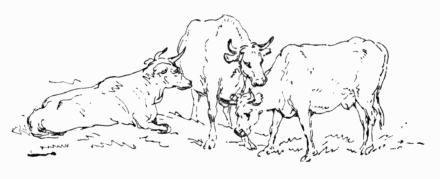
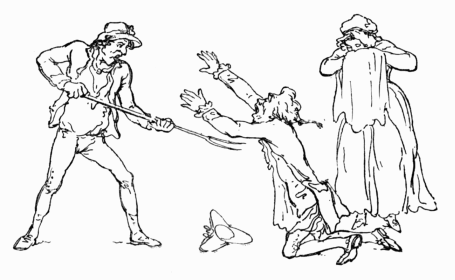
The point about Rowlandson which had most impressed George Cruikshank
is somewhat original, and properly belongs to this part of our subject; hence we
have been glad to have an opportunity of quoting the trustworthy authority of
the aged caricaturist. 'Rowlandson,' said George, 'was a remarkable man in
most respects;' the waywardness of his youth and the notoriety of his gambling
days seemed to have rather prejudicially influenced the mind of his simpler
successor, who had taken his place in 1827, as he had, almost of right, succeeded
to the working-table and unfinished plates of James Gillray, many years before.
Cruikshank, moreover, considered that Rowlandson's academical successes, his
successful rivalry of Mortimer in depicting the nude, the knowledge of his art
and the fluency he had acquired, were altogether exceptional features in the
profession of a caricaturist, to his English views; but, according to his kindly
creed, mellowed by age—his steel a trifle tempered since his own youth, when
his shafts too were not without poignancy—'Rolley' was somewhat unreflecting,
and reckless in exposing the infirmities of others, having but scant regard for his
own reputation or the feelings of society, and further he had suffered himself to
be led away from the exercise of his legitimate subjects, to produce works of a
reprehensible tendency, which respectable dictum will probably find numerous
subscribers.
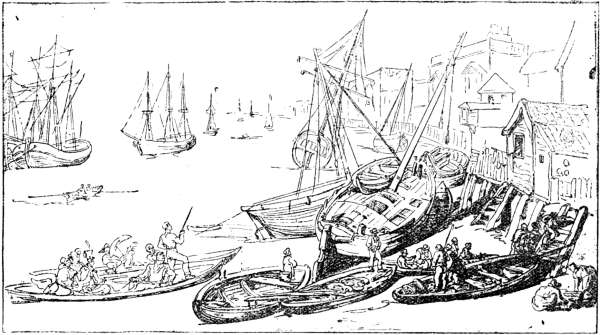
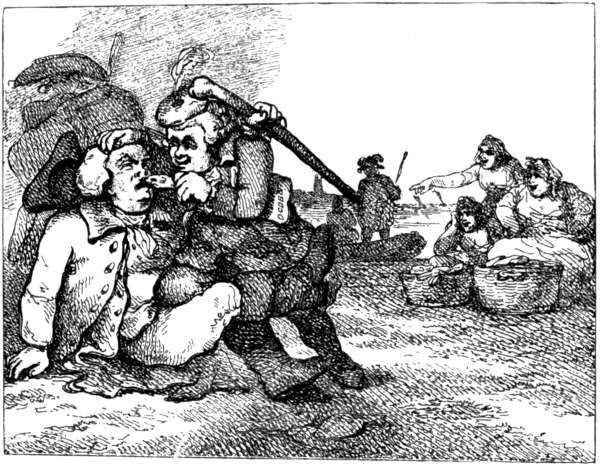
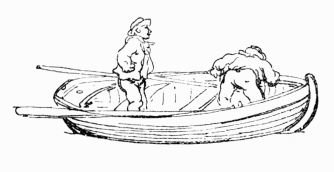
A SHIPPING SCENE.
Strangely as it may sound, it was not as a caricaturist that Rowlandson had
gained Cruikshank's admiration; he appreciated the artist enthusiastically as an
accomplished water-colour painter, the equal in his opinion of most of the founders
of our special school. Rowlandson's masterly power over the delineation of the
figure, and his happy gift, amounting almost to inspiration, of portraying female
charms of face and person, deserved high regard in Cruikshank's estimation; his
peculiarly felicitous pictures of quaint Continental life, and the examples his free
and scholarly handling held out, as admirable models of style to the French caricaturists
of his day; the social sketches produced in Paris at the beginning of the
century, though remarkable for neatness and delicacy, being laborious, formal,
timid, and wanting in that racy comicality, and dashing power of expression,
characterising the drawings under consideration, to which George accorded unqualified
praise.
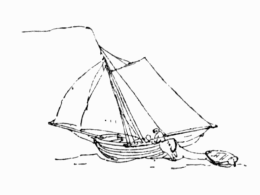
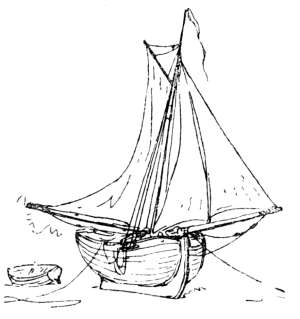
It was chiefly for his skill in landscape delineation that Cruikshank respected
the artist under discussion, and more especially, as he declared, warming with his
reminiscences of the drawings he called to
mind, he had never seen anything superior,
in his estimation, to Rowlandson's water-side
and maritime sketches, for their clear freshness
and simple air of fidelity to nature;
the banks of the river, the 'pool' filled with
vessels, wharves, landing-places, ports, and
naval stations, with the noble men-of-war
lying off; and the bustling craft, travelling
between the fleet and the shore; the groups of busy figures, far and near,
happily introduced in a state of seeming activity; the shipping, which he drew
with picturesque ease and dexterity, his far-spreading landscapes and distant
horizons, the treatment of the water, the movement of his skies, and the general
sense of expanse and atmosphere, were beautiful in the extreme, all noted down,
as they were, without apparently a second thought, with the slightest possible
labour, recalling in a forcible degree the drawings of William Vandevelde, who
was, in Cruikshank's opinion, the only
artist whose marine studies could be
quoted in comparison with those of
Rowlandson.
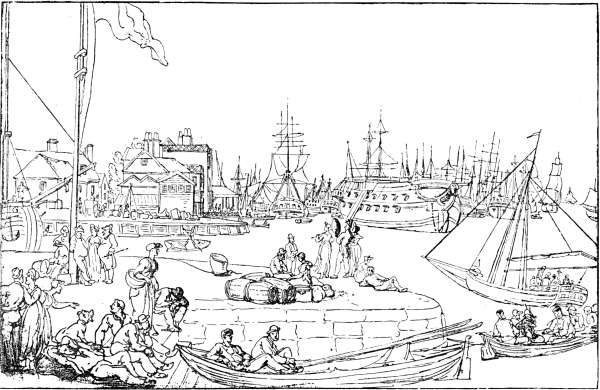
THE QUAY.
We are necessarily anxious to
avoid the suspicion of attempting to
prove too much, and it must be admitted
that we do not pronounce
Rowlandson a Rubens, a William
Vandevelde, a Reynolds, and a Moreland,
all at once; any more than we
can be deluded into the belief that his
landscape drawings might be claimed
by Turner, Girtin, De Wint, Fielding,
or David Cox. In treating of our
artist in relation to the truly great
names which have been frequently put into contrast with his own, it must
not be forgotten that his works are spoken of, as they exist, under their
modest condition of sketches manipulated in the very slightest manner possible,
and, if considered at all in juxtaposition with those of the higher luminaries,
it is only by the side of studies executed under similar circumstances; it would
be a piece of pretension, entirely out of character on our part, to even suggest
submitting Rowlandson's attempts in the most respectable exercise of his
talents in competition with the more substantial finished and ambitious pictures
bequeathed us by the select few of really eminent painters, whose unrivalled
works cannot fail to afford the most unqualified delight to all cultivated lovers of
art of whatever school. Their productions are admitted to stand alone, even
though there exist diversities of opinion, schisms, and heresies in regard to the
generality of the profession.

In resuming our summary of Rowlandson's conceptions in the caricature
branch, we must notice, while contemplating his strongly characterised works,
that, while the rest of his competitors in the grotesque walk have in most examples
left no record of their prints beyond the plates on which they were
executed, for every subject he has produced of his own designing, at least one
corresponding drawing has existed, and frequently three or four variations of
leading ideas are worked out as completed pictures, without, however, any appearance
of experimentalising under difficulties of execution—technical points
never puzzled his skill; and such daring flights as Rubens ventured with the
brush, in the way of foreshortened and difficult attitudes, Rowlandson's reed-pen
accomplished right merrily, as if by its own volition, and without a thought on
the part of its highly-trained wielder, about such common-place requirements as
the posing of living models or preparatory sketches. The original notions of
Rowlandson's whimsical inventions are in the generality of instances far worthier
of attention than the most spirited etchings he thought fit to circulate after them;
and it is well to keep in mind that the artist has produced some thousands of
humorous conceptions (placing his more serious studies out of the question), of
which no engraving has ever appeared; and amongst these unpublished delineations
may be included several of the most ingenious and attractive pictures
executed by his hand, especially from the year 1790, that is to say, for more than
two-thirds of his professional life—a circumstance with which every collector of
original drawings by this artist is thoroughly conversant.
The career of Rowlandson may be divided into periods; the work belonging
properly to the several stages is tolerably distinctive as to general characteristics.
An adept can positively determine, within a year or two, the particular section
to which his designs, when the date happens to be wanting, may be justly
assigned, and, as his manifold sketches and etchings extend over the space of
half a century, this circumstance is a trifle remarkable in itself.
The first period, as far as his published plates are concerned, includes his
smaller social and political satires; the execution, though free and fluent, as his
productions uniformly were, exhibits indications of care which is not so traceable
as his method grew mellower, and practice confirmed the facility which came to
him as a gift. These juvenile etchings bear more affinity to Gillray's manner of
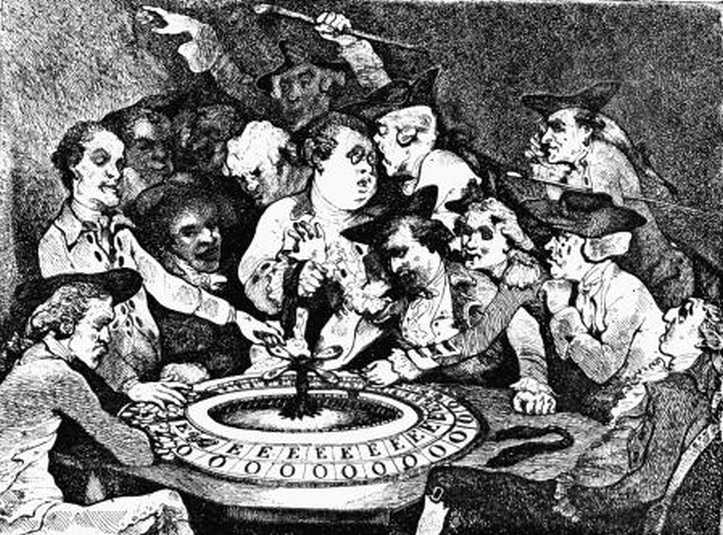
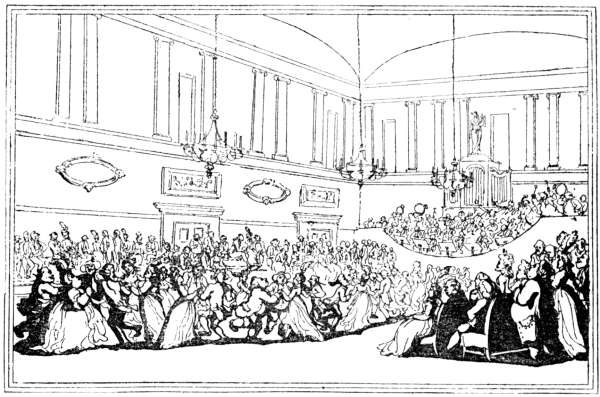
manipulation than is traceable in his subsequent cartoons. A view of A Hazard
Table and its frequenters (E.O. or the fashionable Vowels, October 28, 1781)
offers perhaps the best indications of his growing powers, between 1774 and
1783. His publishers were Humphrey, Holland, Jackson, and a few others; and
he further appears, in conjunction with J. Jones, to have gone into the publishing
way himself, at 103 Wardour Street.
In 1784 the excitement of the famous Westminster Election seems to have
carried him more thoroughly into political
satires, and, as we observe, his humour
discovered an unflagging source of impulse
round the parliamentary candidates,
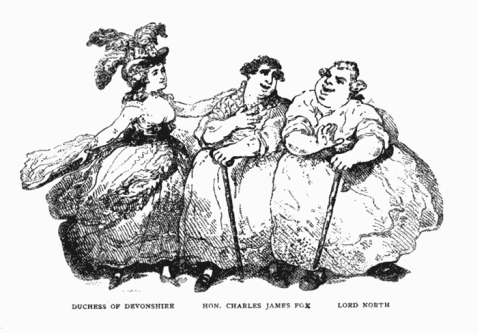
Fox, Wray, and Hood; the fair Duchess
of Devonshire, Lady Duncannon, and
honest Sam House, the Whig canvassers,
and their opponents on the ministerial
side, the Hon. Mrs. Hobart (Lady
Buckinghamshire), and the Duchess of
Gordon; together with the whimsicalities
of the polling-booth. If we were
asked to select his most noticeable social and satirical effusions, we should incline
to particularise English Curiosity, or the Foreigner stared out of countenance;
1784, or the Fashions of the Day; and A Sketch from Nature (January 24, 1784).
In 1784, Rowlandson realised the full extent both of his powers of fancy and
his mastery of the art of water-colour delineation. He discontinued the practice
of sending portraits to the Exhibition of the Royal Academy, in which he had
persevered for five years, and contributed in their places three mirth-provoking
drawings, which must have produced no little sensation amongst the visitors,
who were unaccustomed to such works. These were the inimitable Vauxhall
Gardens, which reveals his talents at their best, An Italian Family, and The
Serpentine River.
In 1785 appeared some of John Raphael Smith's graceful publications after
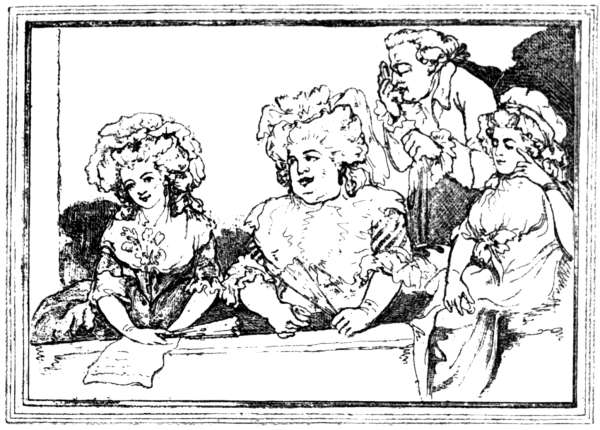
Rowlandson's more refined originals, notably Vauxhall, Opera Boxes, Toying
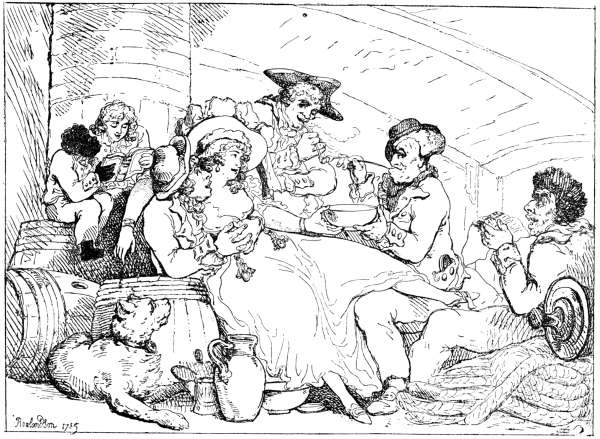
and Trifling, An Italian Family, A French Family, Grog on Board, Tea on Shore;
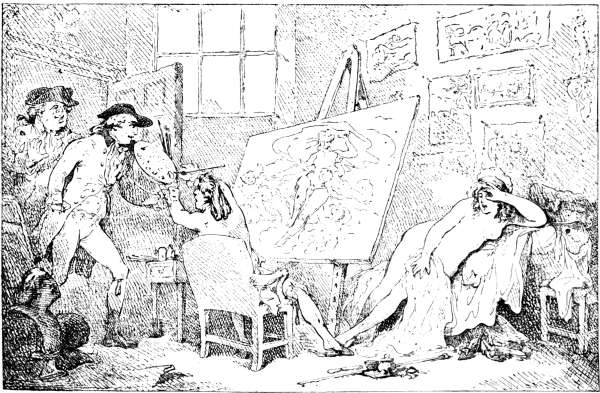
Filial Affection, or a Trip to Gretna Green; Reconciliation; Intrusion
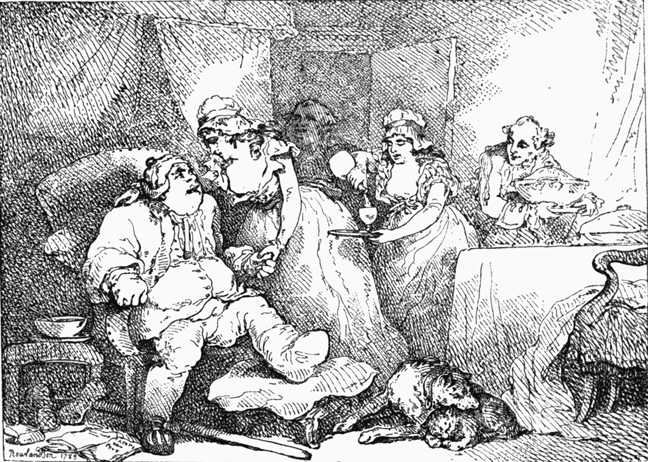
on Study, or the Painter disturbed; Comfort in the Gout; and several other excellent
subjects in his most finished manner, besides an animated scene after
Henry Wigstead, John Gilpin's Return to London.
Rowlandson sent five important and highly humorous drawings, displaying
advanced qualities in the direction of execution, to the Royal Academy in 1786;
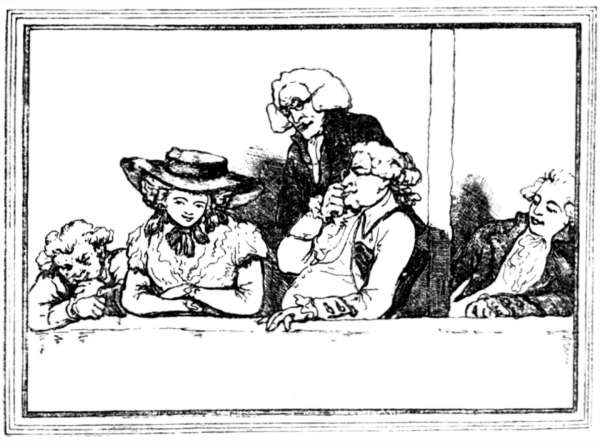
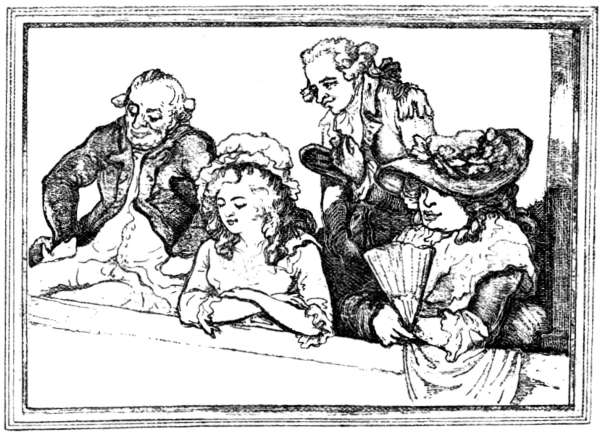
those of the first consequence were An English Review, A French Review, the
pair exhibited at the International Exhibition 1862; Opera House Gallery, under
which designation, as we suspect, we recognise his Box Lobby Loungers, published
the very same year; A French Family (published the year previous); and A
Coffee House, of which we can discover no further record.
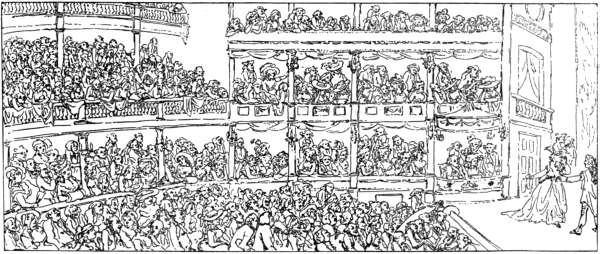
Among the engraved works for the same year we must refer to the print
of Box Lobby Loungers, already mentioned, and Covent Garden Theatre, as the
most noticeable as to size, subject,
and the numerous figures introduced.
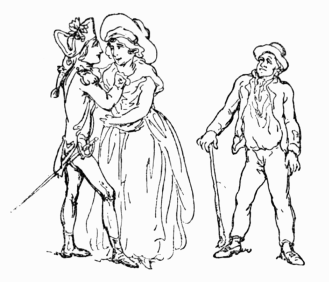
Rowlandson sent four known
works to the Royal Academy, the
season following (1787). They were
French Barracks, a superlative drawing,
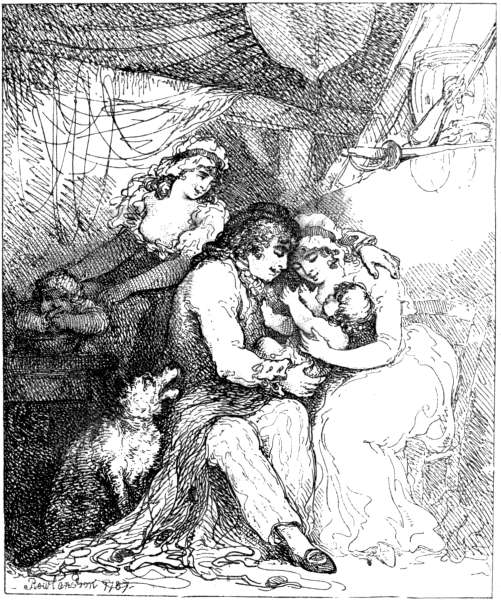
Grog on Board a Ship, Countrymen
and Sharpers (engraved by
Sherwin as Smithfield Sharpers),
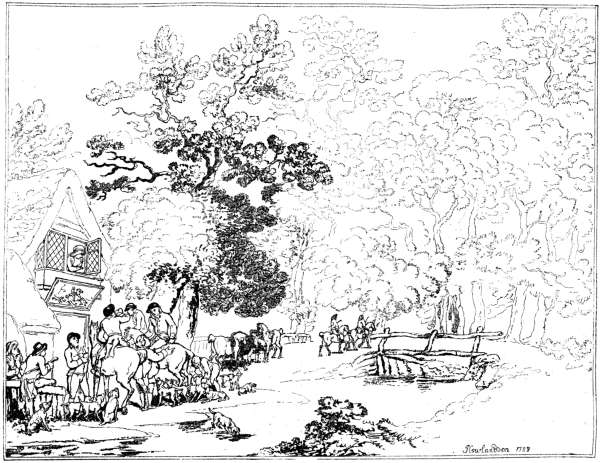
and The Morning Dram, or Huntsman
rising, engraved as Four o'clock
in the Country, S. W. Fores (October
20, 1790). All Rowlandson's contributions
for this year have been published; indeed, it is very possible, from
the popularity of the caricaturist's novel exhibits, that all the pictures he sent to
the Royal Academy were straightway issued on copper. There are two exceptions,
The Serpentine and A Coffee House, of which the writer has never succeeded
in meeting impressions, but it by no means follows that sooner or later
they may not come to light, and it does not seem unlikely that the first named,
The Serpentine River, may be another version of Cold Broth and Calamity
(published in 1792).
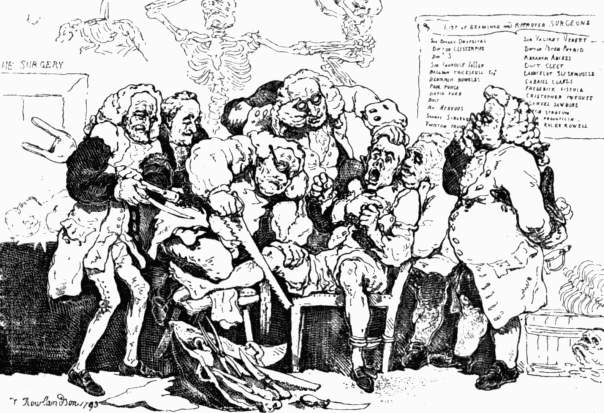
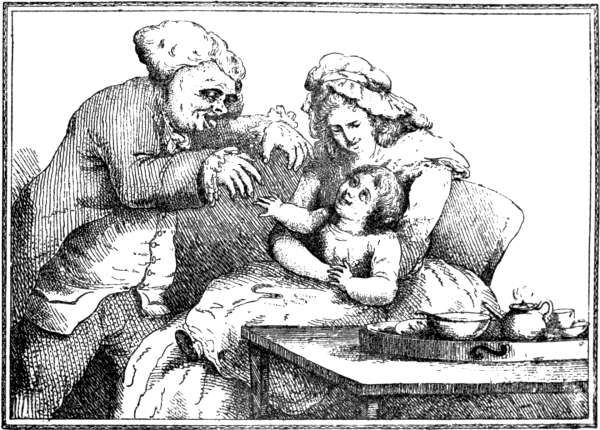
Amongst the engraved works of 1787, the writer instances Baron Ron's
Dental Surgery, or Transplanting of Teeth, and a series of five Hunting Scenes,
The Morning, The Meet, The Run, The Death, and The Dinner, published in a
folio size, and now somewhat rarely met with as a set.
In the two succeeding years Rowlandson again threw his etching-point into
party conflicts, and came out with a shower of political squibs on the amenities
of the Regency Struggle. Nothing very ambitious in the way of social satires
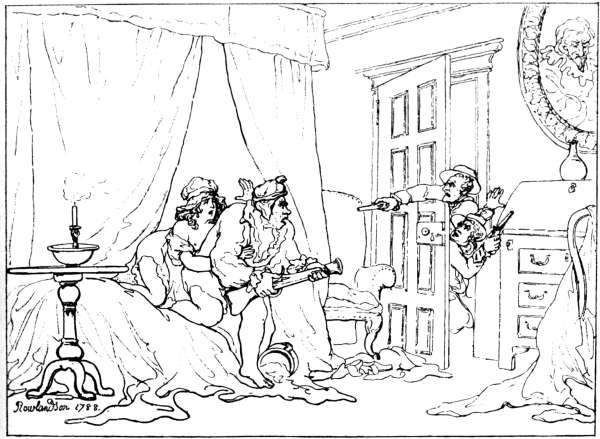
appeared in 1788. Among minor subjects we may allude to Housebreakers, A
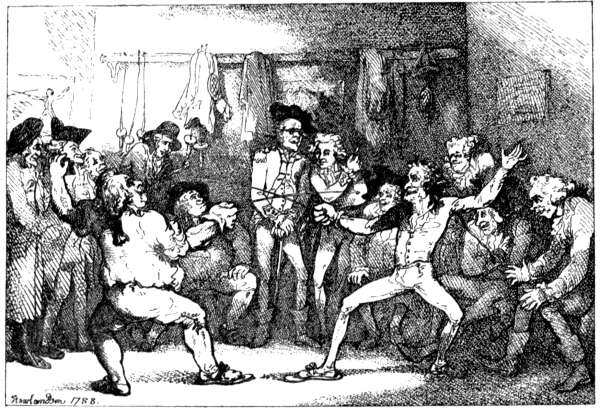
Cart Race, The School for Scandal, A Fencing Match, A Print Sale, Lust and
Avarice, and Luxury and Desire, as being slightly above the average. In 1789
and 1790 but few works of exceptional character were issued to gratify Rowlandson's
devoted admirers or the general public. She don't deserve it! Don't
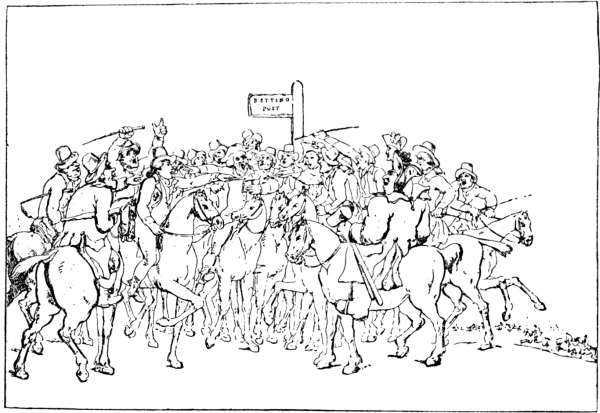
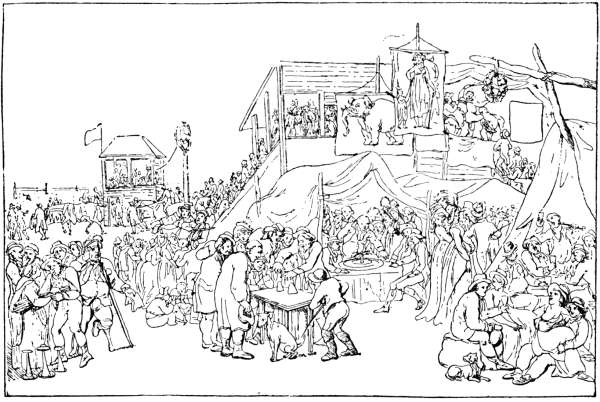
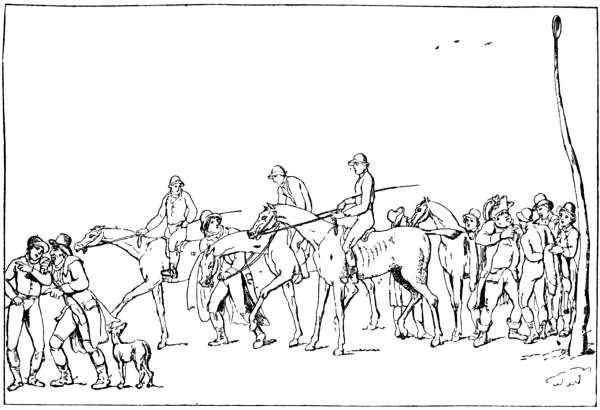
he deserve it? A Racing Series, The Course, The Betting Post, The Mount, The
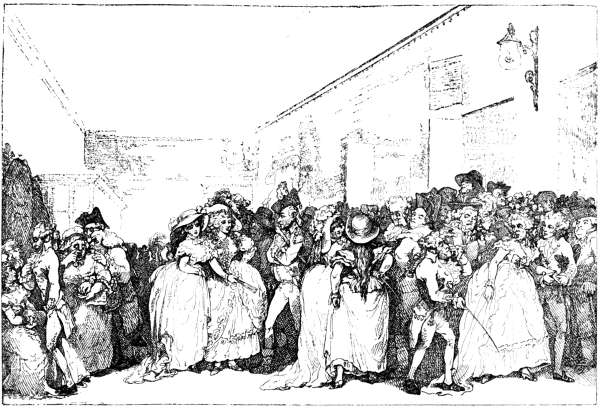
Start, and A Fresh Breeze, take the lead. La Place des Victoires à Paris
belongs to 1789, and, in the writer's estimation, it is perhaps one of the most
attractive subjects due to the artist's pencil, exhibiting, as it does, the quaint
surroundings of Parisian life, as noted by the caricaturist before the Revolutionary
era—delineations of feminine beauty, and studies of real character, such as no
effort of the imagination could fabricate, unless assisted by travel, a familiar
acquaintance with the locality, and keen observation.
A fitting companion is given to
this delightful subject in another important
drawing, crowded with diversified life and
animated groups, produced in 1800; The
Thuilleries in Paris, a reminiscence of previous
studies in the French metropolis, of
manners noted anterior to the destruction of
antiquated fashions; the dainty belles of ton,
and the picturesque society which might be
discovered flourishing under the reign of Louis
XVI., before the inauguration of the all-devouring
Republic, which worked more change
in a few feverish months of turbulence, in
which all the recognised phases of the past were lost, than many sober decades
had effected in their better regulated courses.
The best of Rowlandson's publications for 1790 were A Kick-up at a Hazard
Table, in which, as may be supposed, he was perfectly at home; Four o'clock in
the Morning in Town, which was also in the artist's way, and its companion,
Four o'clock in the Morning in the Country; Frog-hunting (Gallic gourmets fins),
and Tythe Pig, a fine old English equivalent.
The year 1791 was richer in those more ambitious plates, which the writer is
seeking to identify, and several of the caricaturist's choicer subjects appeared,
etched by his hand, and finished in aquatint, to facsimile the meritorious original
drawings. A Squall in Hyde Park is one of the score or two of delineations of
the highest type, which adequately demonstrate the exceptional qualifications
of the artist; and these, we have no hesitation in averring, have never been
excelled in their walk, as far as executive ability, sense of loveliness, grouping,
movement, grasp of character, powers of observation, and diverting qualities are
concerned. Another remarkable subject of extraordinary ability, founded on
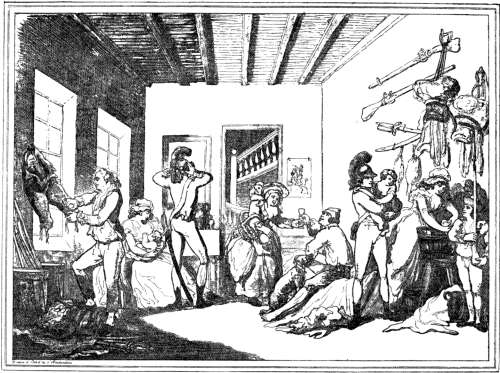
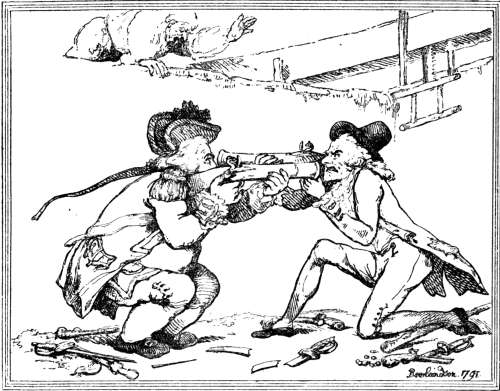
Rowlandson's Continental studies, entitled French Barracks (exhibited in 1787),
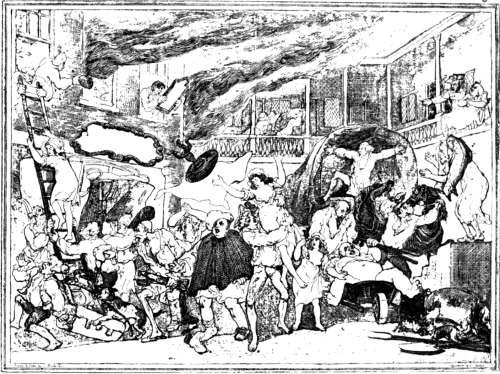
and its pendant, English Barracks, were issued this year. An Inn Yard on
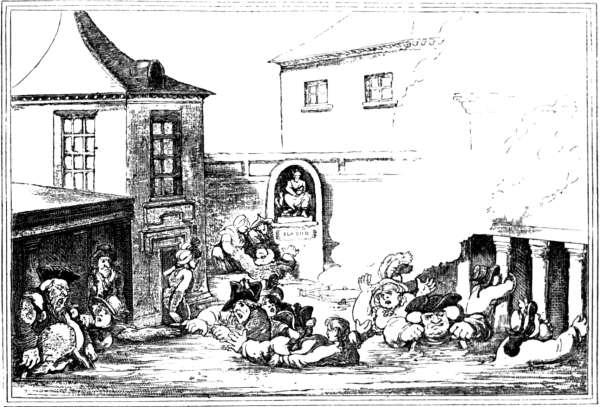
Fire, belonging to the same important series; The Attack; The Prospect before
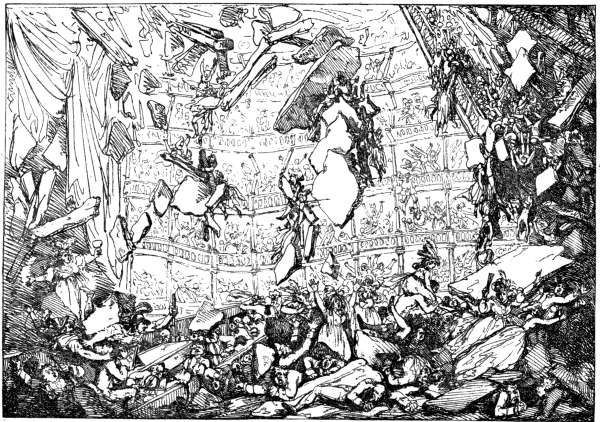
us; The Pantheon; Chaos is Come Again, in allusion to the dilapidated state of
Drury Lane theatre condemned by the surveyors; Toxophilites; House breakers;
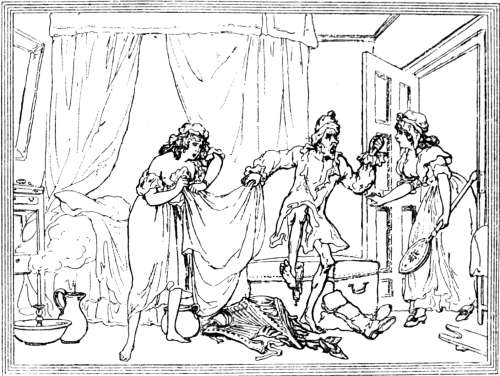
Damp Sheets and Slugs in a Saw Pit, among the numerous lesser subjects,
bring up the total of the truly estimable works which gratified the public
in 1791.
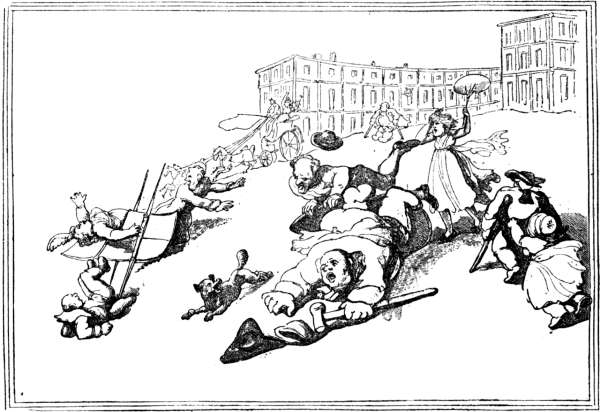
Cold Broth and Calamity, a skating scene representing disasters in the park,
from a ludicrous point of view; A Dutch Academy, drawn from the caricaturist's
experiences in the Netherlands; and Studious Gluttons were the leading plates
published in 1792.
New Shoes, a small, but delicate subject, belongs
to 1793.
In 1797 appeared the admirable plates published
after Rowlandson's studies in the Netherlands;
we cannot too highly commend such inimitable
originals as Fyge Dam, Amsterdam; Stadt
House, Amsterdam; Companion View, Amsterdam;
and Place de Mer, Antwerp.
Admiral Nelson Recruiting with his Brave
Tars after the Glorious Battle of the Nile, was
published in 1798; a series of London Views, of
considerable merit and importance, entrances to the great metropolis from the
four leading turnpikes; and a series of twelve plates portraying the Comforts
of Bath, are most worthy of attention in the same year, as were some large
studies of reviews of the Volunteer Forces, held under the threat of the anticipated
French invasion.
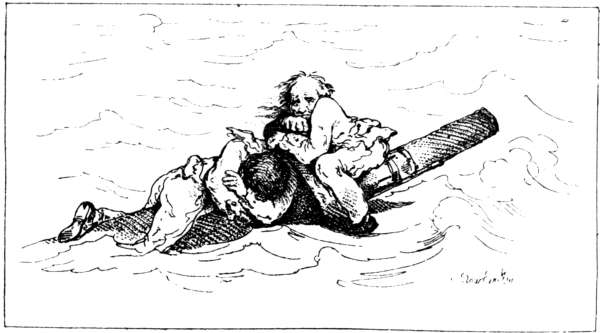
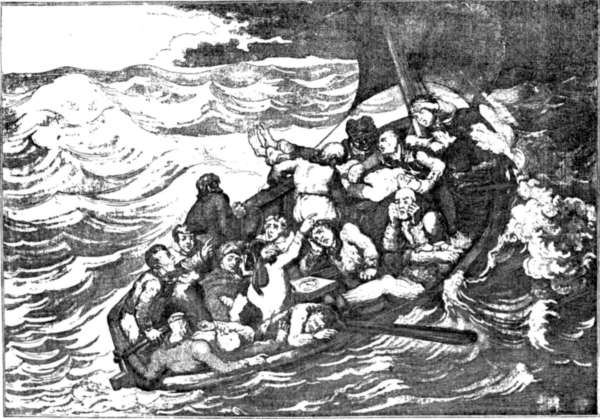
Distress, from a large picture, indicating the horrors of shipwreck with tragic
impressiveness, is assigned to 1799.
Summer Amusement, a Game at Bowls; Doctor Botherum, the Mountebank;
Preparations for the Academy; and A French Ordinary, were among the noticeable
features of the artist's publications in 1800; the peculiarly interesting panorama
of the Parisian world anterior to the French Revolution, entitled The Thuilleries
in Paris was also produced this year.
Rowlandson's skill as an etcher had further, about this time, provided him
with abundance of work in executing the humorous conceptions of Woodward
and Bunbury after his own characteristic fashion.
Rowlandson's plate of The Brilliants, and a long series of subjects designed
by Woodward, with many originals of his own, sufficiently excellent in their order,
but not of the first consequence, found their way to the public in 1801. The
leading print-publishers at the West End, Rudolph Ackermann, S. W. Fores,
Williamson, and Rowlandson himself,[5] at his residence, 1 James Street, Adelphi,
issued an inexhaustible collection of highly ludicrous social satires, and numerous
patriotic and political subjects, during intervening years; and in 1807 the name
of Thomas Tegg of Cheapside was added to the print-publishers who employed
the remunerative talents of the indefatigable caricaturist. Rowlandson also continued
to execute the whimsical conceptions of less qualified draughtsmen, and
swarms of comicalities—by Woodward, Bunbury, Wigstead, Nixon, and other
fashionable amateurs, who possessed the humorous vein, but lacked the skill to
give their ideas a fitting form for presentation to the public—were put into acceptable
shape, and etched by our artist at this period.
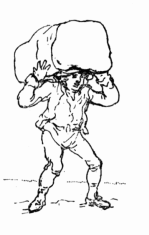
In 1808 appeared the long succession of Miseries of
Human Life, of which examples occur in previous years;
and Rowlandson settled down, somewhat grimly, under
worthy Mr. Ackermann's auspices, to take up the gauntlet
against the dreaded Buonaparte, the great little Corsican,
against whom Gillray had waged such savage warfare until
his powers dwindled into vacancy, and George Cruikshank
stepped valiantly into the place of the colossus of caricaturists,
and carried on the combat with unflagging zeal and
whimsicality on his own account. Rowlandson's ludicrous attacks upon the
ambitious 'disturber of the peace of Europe' were duly appreciated by his
audience, and the demand for these blood-and-thunder caricatures increased
monthly, to the extreme delectation of the great British public, whose antipathies
to the conquering general were, at least, founded on sound and excusable principles,
and if the overflowing excess of their detestation sometimes blinded
the people to points of detail, and wilful misrepresentations passed current, and
rather swamped their more generous sentiments—which were put out of sight
for awhile—it must be remembered that this patriotic zeal was well directed
against the man who had announced his august intention of subjugating
England, and was, by accord, considered as the common enemy, and anyone
who had indulged the temerity of openly acknowledging the grander elements
of his character, since pretty tolerably established, would have been flouted by
acclamation, and we are not sure but the national scorn would have fittingly
signalised such an unpatriotic enormity.
It is certain that the caricaturist's travesties of the little emperor, his burlesques
of his great actions, and grandiose declarations (which, in themselves,
occasionally overdid the heroic, and trenched hazardously on the ludicrous), his
figurative displays of the mean origin of the imperial family, with the cowardice
and depravity of its members, won the popular applause; as did the satirist's representations
of the hollowness of Boney's vaunted victories, and the treachery of
his designs in the days of his success; and, when disasters began to cloud the
career of the mighty Napoleon, and cherished projects were met with sickening
failures—as army after army, collected for the slaughter by schemes, lies, fraud,
and force, melted away, and the prostrate powers of the Continent plucked up
courage, singly at first and finally in legions, until the end of the Corsican's glory
arrived—the artist lent his skill to celebrate the
delight of the public, and the rejoicings over
the discomfiture of the traditional bugbear; glib
cartoons were hurried off by Ackermann and often
by Tegg—the City competing with the West
End in the loyal contest of proving the national
enmity to Buonaparte, by buying every caricature—the
more extravagant the better relished—that
the artists, who toiled like Trojans while
the harvest lasted, could contrive to furnish in
season for the demand.
A suspicion crosses our mind that, in too
many cases, the incentive was to gratify the
hatred of the Corsican, rather than any remarkable inherent merit that could
be discovered in the satires; the best of which were but feeble vehicles for
the exhibition of the jovial abilities of the designers; who, we dare venture
to hint, found themselves a little out of their element, plunged, as it were,
in the 'blood and iron' theory, striking out with their etching points with
the most approved pantomimic vengeance! Very few of these mock-heroic
sallies imprint themselves on the recollection by the sheer force of their own
brilliancy, as was the case in the single instance of James Gillray, in the past,
and as happened—an undeniable test of the veritable fire of genius—frequently
with the cartoons of John Tenniel within our own experience, when the magnitude
of the occasion has conjured up the inspiration, and rekindled the latent
flame.
Our reflections upon the bellicose creations of Rowlandson and Cruikshank,
while their hostile vapourings continue irresistibly droll, never stir the more
passionate emotions or reach impulses which lie below the surface; being risible,
it is true, but the reverse of inspired; and although many a hearty laugh may be
enjoyed over the ludicrous turn the twain caricaturists have, in spite of themselves,
given to situations of an avowedly tragic tendency, their very fury seems
an unctuous jest, their simulated earnestness takes a farcical turn, and the result
of a careful review, as the writer has made quite recently, of their prolific
slaughterous sallies, is the conviction that, often unconsciously to themselves,
they have chiefly succeeded, from the inevitable bent of their innate humoristic
impulses, in burlesquing the fiery feeling abroad, which the public were contented
to gratify in pictorial guise.
It is certain that those discriminating critics best qualified to appreciate the
talents of Rowlandson and Cruikshank, who worked up the anti-Corsican crusade
contemporaneously, are continually disposed to regret that the wondrous inventive
abilities of these fertile designers were not exercised in a more congenial
field.
Our caricaturist worked away, fierce and implacable, following every turn of
Boney's fortunes with a show of savage ardour, until the idol
fell in 1815. Rowlandson, in addition to the immense mass
of caricatures which he fabricated with unflagging energy,
came out brilliantly with several large transparencies, painted
for public exhibition, outside Ackermann's Repository, on
the occasion of the general illuminations, which fittingly
signalised the successes of the allied armies after Leipsig,
the final downfall of the Emperor after Waterloo, and the
subsequent peace rejoicings.
A fresh subject for the exercise of Rowlandson's caricature capabilities was
furnished in 1809 by the scandalous revelations which were disclosed, as evidence
at the bar of the House of Commons, during the 'inquiry into the corrupt practices
of the Commander-in-Chief, in the administration of the army.' With
ill-advised weakness the popular Duke of York seems to have transferred the
exercise of the patronage legitimately invested in his department, to Mrs. M. A.
Clarke, a clever and unscrupulous mistress, whose extravagances he had for
awhile contributed to support at Gloucester Place. The demand for this exciting
pabulum was sufficiently eager to induce the caricaturist to bring out a
fresh pictorial satire almost daily, and sometimes two or more appeared on the
same day, while the 'delicate investigation' was proceeding, and the public
interest in the circumstances remained at a boiling heat. We are not inclined to
argue that any of these ephemeral compositions, superior as they were to the
ruck of contemporaneous productions, were worthy, in any degree, of the artist's
graphic powers, or were likely to contribute to his celebrity. For some time
Rowlandson's ambition seemed to cool down, and although he was working hard,
and producing a fair average of results, he appeared satisfied to turn his skill to
the most prosaic account, as the means of earning a livelihood. He made no
fresh efforts to astonish his admirers, or to sustain his fame by novel efforts of
genius, such as we have particularised as appearing before the commencement of
the nineteenth century.
Among the countless caricatures, good, bad, and indifferent, according to the
circumstances of their publication, produced between 1809 and the close of the
designer's career, nearly twenty years later, we cannot direct the reader's attention
to many subjects above the generality of similar productions by Rowlandson's
hand. It must be borne in mind that the artist's opportunities for graceful delineation
had been considerably curtailed; the fair leaders of the old picturesque
generation, whose effigies beam so charmingly on Reynolds's canvases, and the
days of powder, flowing locks, silk coats, laces, lappels, and their accompaniments,
had gradually disappeared, and left a prosier people, of sober exterior, in their
stead. The difference between the exteriors of Rowlandson's lively personages,
at the earlier part of the career, is so distinct from the outward
appearance of his surroundings, and of the world which
continued to exercise his pencil, at the close of his years,
that it is extremely difficult, with the evidence before our
eyes, to credit that such extreme changes could take place
within the lifetime of one individual. The wanton cruelty
of time in dealing thus harshly with the delicious models,
which at one period seemed expressly constituted for the exercise of Rowlandson's
pencil, may have discouraged the artist, and given him a distaste
for exertions of ambition in which his heart had no part, while his fancy still
hovered round his retrospects of the brilliant scenes, at home and abroad, that
had met his sight in his gallant youth.
A few of Rowlandson's plates in 1811 recall his best days, but we are not too
confident that the originals veritably belong to the year which is engraved upon
the plates; indeed, in two cases at least, Exhibition Stare Case, Somerset House,
and Royal Academy, Somerset House, the caricatures are most probably reprints,
with the dates altered. This practice, common enough in his day, is productive
of no slight confusion; all Rowlandson's most popular conceptions, 'the palpable
hits' which held their own in the public favour, and were eagerly secured, were
republished from year to year, to meet the demand, and, in most cases, the plate
was freshly dated, as if the print had only then appeared for the first time. This
principle has complicated our task, as it is most difficult to secure even a solitary
impression of the finer works, and but scant means exist of tracing them back to
the actual date, in the absence of any considerable collections to which the student
may apply for purposes of reference and comparison. If the reader will be at
the pains to consult the 'Appendix,' containing the nearest approach to an
arrangement of Rowlandson's works, under the years of publication, the writer
could arrive at under existing circumstances, it will be seen that the same caricatures
frequently reappear, with altered dates, for successive years.
In the latter part of the artist's career, although he executed a great many
works of interest in themselves, and his inexhaustible social satires are often
meritorious, and always ingenious, his best talents were devoted to the production
of original drawings for immediate sale. They were chiefly disposed of through
the assistance of Rudolph Ackermann, 101 Strand; and S. W. Fores, Piccadilly.
Both these steady patrons of the declining years of a genius, who must, in a
sense, have found the close of his life exposed to somewhat chilling influences,
are reported, on good authority, to have held hundreds of Rowlandson's original
drawings, scrap-books, and portfolios, filled with his admirable sketches at
the time of his death; but these collections have of course been since dispersed.
In addition to the immense gathering of water-colour drawings left by Rowlandson,
which had accumulated in the possession of those respected
gentlemen with whom he held business relations, there
were several fine collections, formed about the same period, to
be found in the possession of his intimates. Mitchell the banker,
his constant friend in town, with whom Rowlandson frequently
travelled on the Continent, had secured the most remarkable
gallery of the artist's diversified views abroad, and particularly his
sketches of life and character in France and the Netherlands, the
latter being the most remarkable for broad humour. Henry Angelo, the fencing-master,
and Bannister, the comedian, ancient school-fellows of the caricaturist,
and, as will be seen, faithful comrades through life, were also steady collectors
of his picturesque eccentricities, and many noblemen, and celebrities of the day—among
them is mentioned the name of the dashing, and somewhat irrepressible,
Lord Barrymore—took a pride in filling their folios with his works, which, as
we are told, they justly esteemed 'an inexhaustible fund of amusement.'
A few later collections, with the names of the owners, and the titles of the
leading subjects, are mentioned at the end of this volume, with a view to completing
the interest of the subject, and affording a slight indication of the whereabouts
of many of his productions.
It appears from the statements of Rudolph Ackermann, Rowlandson's industry
was such that the considerate owner of the fashionable Repository—favourite
lounge of the dilettanti as it was—at last found it difficult, as regards
the selling department, to keep pace with his friend's creative abilities. In short,
the artist produced drawings faster than the public, as it seems evident, felt inclined
to purchase them for the time being, and it became a perplexing problem
how to increase the demand proportionately to the supply; for the multiplication
of the sketches for awhile—probably under the spur of some emergency, or the
pressure of apprehensions for the future—became so overwhelming that the
worthy publisher, in his relation as a practical man of business, fancied he foresaw
the approaching depreciation of the value of Rowlandson's drawings making such
strides, on the strength of an overstocked market, he was afraid, in the end, the
artist's remuneration would be so seriously diminished, that it would not be worth
his while to persevere, unless a new line could be successfully struck out.
These anticipations were probably well founded, and we cannot but acknowledge
that our artist had discarded prudence, and
become thoroughly reckless—at least, as far as
we can judge by appearances, for possibly he
had more confidence in the ultimate request for
his studies than was entertained by his friendly
employers, and time has proved the soundness
of his judgment. If the story we are told of his
novel method of multiplying his drawings is
serious, it will strike the reader that Mr. Ackermann
had reason to feel anxious, on his protégé's account. It is related that
Rowlandson would saunter from his neighbouring lodgings in the Adelphi,
round to the Repository of Arts, and, as the title of Mr. Ackermann's establishment
was no misnomer, every possible appliance was therein found ready to
hand. The artist would then order a saucer of vermillion, and another of Indian
ink, ready ground, from the colourist's room, with reed pens, and several sheets
of drawing-paper; he would then combine his inks in the proportions he thought
proper, in the flesh lines vermillion predominated, in draperies Indian ink,
shadows were a warm mixture of the two, and distant objects were faintly
rendered in Indian ink alone. The outline was filled in on this principle, but,
as the designer's own manual and dexterous rapidity had ceased to satisfy
him, he had ingeniously discovered an expeditious method of multiplication
sufficient for his purpose, without resorting to the sister art of engraving. The
drawing was made on the principle essential in any engraving which has to
give impressions, that is, the subject was reversed, right being changed to
left—the only extra care required; the outline was somewhat stronger, and the
reed-pen more fully charged than was the usual practice, and when the design
was completed it formed the matrix from which, before the ink became fixed,
by means of a press, and paper damped to the proper consistency, it was easy
to print off duplicates as long as the ink held out. We are rather inclined
to speculate that, ingenious as the process seems, in description, it would by no
means turn out a perennial flowing fountain, and two or three decent replicas
would exhaust the original, however judiciously manipulated. The copies obtained
by this manifold contrivance were corrected and strengthened, according
to their requirements; the series of impressions were then shaded with Indian
ink, so as to lend the figures contour and solidity, and express the lighter distance;
and then came the final tinting, in delicate washes of colour, and the completed
works were ready for introduction to the public. The writer does not believe
that this modus operandi was ever followed up systematically; that it has been
resorted to on occasions, his own observations have
demonstrated; and he confesses to a passing acquaintance
with a collection of drawings by the artist (belonging
to a gentleman of distinction, who is quite
satisfied as to their merits), which are for the most
part the results of this system, and he has more than
once, in the course of his peregrinations, come across
the matrix design, very spread and mysterious as to
outline, having been exhausted in the working, but
shaded with spirit, coloured, and sent into the world,
a shameless left-handed production, craftily smuggled
into circulation to confuse collectors, and throw discredit
on its dexter counterparts. This accounts for
a certain proportion of the duplicates after Rowlandson, which are of frequent
occurrence; and often have purchasers felt their self-esteem lowered, when
another possessor of the same design in a firmer outline has assured them that
they have been deceived into buying a mere copy, oblivious that the guilty pair
are both due to the hand of the master, and that possibly other members of the
same illicit family are lurking in the folios of rival amateurs. A grand central
gathering of works by Rowlandson, presuming a person of sufficient enterprise
could be found to prosecute the scheme of a comprehensive exhibition of the
artist's works, would reveal some curiosities in the way of reproductive capability.
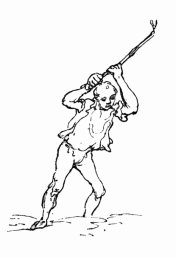
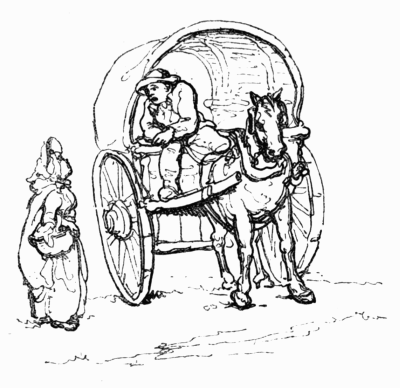
For the credit of our artist, and the comfort of collectors, we can record our
assurance that this crafty method was never persevered in, the replicas issued
under this illegitimate contrivance are confined to a brief period, the temptation
to flood the market was kept within restricted limits, and Mr. Ackermann's business
aptitude quickly discovered a method of enhancing the caricaturist's reputation
and augmenting his means, without the necessity of resorting to tricks of ill-advised
ingenuity. The successful projection of a series of monthly publications
allowed the indefatigable projector—who exercised a princely liberality in his
dealings, as publishers go—to pay his friend, the artist, so handsomely, that he
was relieved from the necessity of multiplying his sketches in any inordinate
profusion, and enabled him to take more time and pains, both in seeking his
subjects, and working them out at his ease. The results of this happy conception,
The Poetical Magazine, the three Tours of Doctor Syntax, and The
Dance of Death, enjoyed unqualified popularity. They were followed by other
works of a corresponding description, which were also well received. The
publisher had his reward;
we have every reason to
believe that Rowlandson
enjoyed his fair share of
these successful ventures;
and continued to furnish
book-illustrations, steadily
following up the new
branch he had discovered
for the exercise of his abilities.
Mr. Ackermann's
enterprise provided him
ample occupation. These
octavo prints were produced
on the same principle
as the superior plates
after his chefs-d'œuvre of
the Academy period: a
neat and carefully finished drawing of the original design was first prepared
(these studies were afterwards purchased by Mr. Ackermann), and Rowlandson
etched the outline sharply and clearly on the copper plate, an impression from
the 'bitten-in' outline was printed on drawing-paper, and the artist put in his
shadows, modelling of forms and sketchy distance, with Indian ink, in the most
delicate handling possible; the shadows were then copied in aquatint on the
outlined plate, sometimes by the designer, but in most cases by an engraver who
practised this particular branch, which a few experts were able to manipulate
with considerable dexterity and nicety. Rowlandson next completed the colouring
of his own Indian ink shaded impression in delicate tints, harmoniously
selected; his sense of colour being of a refined order as regarded the disposal of
tender shades agreeable to the eye. His aptitude in this respect is quite as remarkable
as his ease of delineation; and, if his outlines can be copied with any approach
to deceiving the eye of a connoisseur, an attempt to imitate his colouring, simple
as it remained in its characteristics, is tolerably certain to betray the fraud.
The tinted impression, which was intentionally finished with greater delicacy
and elaboration than the artist generally displayed, served as a copy for imitation,
which was handed to Mr. Ackermann's trained staff of colourists, the publisher
finding constant employment for a number of clever persons whom he had educated
expressly for this skilled employment. These artists had worked under his
auspices and personal supervision for years, until, by constant practice, and the
pains which were taken by the publisher to improve their abilities, they attained
a degree of perfection and neatness never arrived at before, and almost beyond
belief in the present day, when the system has fallen into comparative disuse.
The assistants did their best to reproduce the effect of the original drawings, and
the number of impressions required to satisfy the public must have kept them
constantly at work, and occasionally jeopardised
their high finish.
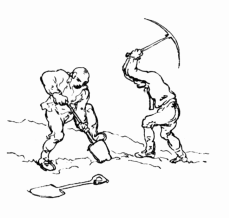
There is an amazing contrast between the
plates issued from the Repository, worked out like
elaborate water-colour drawings, in subdued, well-balanced
tints, with the utmost lightness and skill
of touch, and the lurid chromatic daubs which
pass current to the present day, as Rowlandson's
caricatures were issued from Cheapside 'price one
shilling coloured,' after a school of vulgarity to
which the panorama of the Lord Mayor's Show at one penny, with its four
yards of florid tenuity, is quite a refined work of art.
We are not inclined to offer uncharitable reflections on Rowlandson's City
publisher; the caricatures—excepting always certain rougher specimens, loosely
executed enormities after designs by some of the amateurs of the period, which
indubitably belong to the slip-shod order—are fair enough in their way, when
one is lucky enough to meet with uncoloured copies; it is the bad taste of his
customers, the respectable dealer evidently stooped to flatter, with which we are
inclined to disagree, and we think justifiably; for although it was very good of
the gentleman in question to issue so many copies of his plates, with a providential
eye to the future, that impressions are sufficiently numerous to this day, all print-buyers
must deplore the waste of staring colour expended in making his publications
abominable to the sight of modern purchasers, and ruinous to the fair fame
of the designer, by the uncompromising use of three positive pigments, red, blue,
and yellow, to which, with an occasional brown, the colour-box seemed restricted,
in most cases liberally plastered over the etchings-figures, sky, buildings and
background being treated to the same smart hues in undiluted garishness, which
utterly confuses the mind as to the meritorious qualities of the subjects so
bespattered, and has the sinister effect, deplorable in itself, of compelling persons
of chaste dispositions to dread caricatures as being on the surface something
worse than scarlet abominations, fiendishly aggravated with additional lurid
iniquities of a depraving tendency.
We have introduced Rowlandson in his later relation to the arts, as a skilful
and popular contributor of book illustrations; we cannot leave this portion of our
subject without offering a cursory review of his various labours in this capacity,
since the wider circulation of printed publications has made his name more
familiar to the great world than the finest masterpieces already alluded to, which
seem doomed to remain unknown and inaccessible to the bulk of the public.
The first independent publication we have
to notice was simply a gathering of subjects,
extending over three or four years, collected
in 1788, and issued as Rowlandson's Imitations
of Modern Drawings, folio; including
imitations of the styles of Gainsborough,
Wheatley, Mortimer, Barrett, Gilpin, Bartolozzi,
Zucchi, Cipriani, &c.
In 1786, Rowlandson supplied G. Kearsley,
the publisher of those well-known satirical
effusions of Dr. Wolcot, The Poems of Peter
Pindar, with illustrations to the first volume
of the quarto edition of these familiar works.
This publication was continued the next year. In a burlesque strain, Rowlandson
also came out with twenty illustrations, the drawings suggested by Collings,[6]
caricaturing passages in Boswell's Journal of a Tour in the Hebrides, published
by E. Jackson, small folio (1786). Our artist further supplied certain plates
in parody of incidents in the Sorrows of Werther, also from suggestions by
Collings, who designed a capital series of drolleries in travesty of passages
literally extracted from Lord Chesterfield's Polite Letters.
G. and J. Robinson, in 1790, published the results of a trip to Brighton,
which the artist had enjoyed in company with his friend, the frequent companion
of his wanderings and frolics, Henry Wigstead, Esq., the sitting magistrate at
Bow Street—An Excursion to Brighthelmstone made in the year 1782, by Henry
Wigstead and Thomas Rowlandson, with eight engravings by Thomas Rowlandson,
oblong folio.
There also appeared, in this and the following years, a series of Miniature
Groups and Scenes, published by M. L., Brighthelmstone, and H. Brookes,
Coventry Street, London; and a series of Sheets of Picturesque Etchings,
published by S. W. Fores. Rowlandson also furnished numerous book-plates,
octavo, to the series of novels published by I. Siebbald, Edinburgh; among the
works thus illustrated we must particularise the novels of Fielding and Smollett.
The succeeding year (1792) our artist also contributed illustrations, in large
size folding plates, designed after suggestions by Henry Woodward, to a quarto
edition of Smollett's Novels. Cupid's Magic Lantern, with illustrations, etched
by Rowlandson, also after designs by Henry Woodward, was published in 1797.
The Comforts of Bath, and the folio Views of London, belong to 1798. The
same year the name of W. Wigstead, Charing Cross, appears as the publisher of
the following works:—
Annals of Horsemanship, with seventeen
copperplates by Henry Bunbury,
Esq. Engraved by Thomas Rowlandson.
The Academy for Grown Horsemen,
with twelve copperplates, by Henry
Bunbury, Esq. Engraved by Thomas
Rowlandson.
Love in Caricature, with eleven plates
by Thomas Rowlandson.
The handsome and expensively got-up publications inaugurated by Mr.
Ackermann, began to occupy our artist in 1799. The first of this well-executed
series, with which Rowlandson was connected, was a set of plates, accurately
coloured in fac-simile of the original drawings, in square folio, described as,
The Loyal Volunteers of London and Environs, with eighty-seven plates,
designed and etched by Thomas Rowlandson.
Martial ardour being the key-note this year, when foreign invasion menaced
our shores, Henry Angelo and Son, who were appointed fencing-masters to the
Light Horse Volunteers of London and Westminster, collected a series of subjects
which the artist had prepared under their direction, and issued the results
of their joint ingenuity as a supplement to the elder Angelo's Treatise on Fencing,
under the title of, Hungarian and Highland Broadsword Exercise, with twenty-four
plates designed and etched by Thomas Rowlandson, oblong folio.
Another publication, issued by Ackermann in 1799, appeared as Delineations
of Nautical Characters, in ten plates by Thomas Rowlandson.
In 1800, the results of an excursion to North and South Wales, undertaken
in concert by the author and artist, were given to the public under the following
description: Remarks on a Tour to North and South Wales in the year 1797, by
Henry Wigstead, with plates by Thomas Rowlandson, Pugh, Howitt, &c.
Published by W. Wigstead, Charing Cross.
Rowlandson also supplied some illustrations to The Beauties of Sterne, a selection
of choice passages from the works of that author.
A series of Views in Cornwall, Dorset, &c., appeared as a separate publication
in 1805. The artist contributed serious book-plates to an edition of the
Sorrows of Werther, in 1806. A smaller edition of the witty Annals of Horsemanship
and Academy for Grown Horsemen (portions of which are attributed
to the pen of the convivial Captain Grose, the well-known antiquary, author of
The Military Antiquities, etc.—the original design of the work with the illustrations
belonged to Henry Bunbury) was issued in a cheap form by Thomas Tegg
in 1800, the etchings being executed in a reduced form by Thomas Rowlandson,
and published under the title of An Academy for Grown Horsemen and Annals
of Horsemanship, by Geoffry Gambado, octavo. A collection of
plates portraying The Miseries of Human Life, consisting of fifty
etchings by Thomas Rowlandson, small folio, was published in a
reduced form the same year.
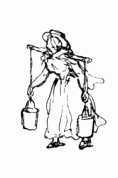
The principal work, however, which appeared in 1808, was,
and must remain, a fitting instance of the enterprise and good
taste of Rudolph Ackermann, his liberal employment of artists
whose abilities were of the first order; while demonstrating the
popularity of his publications, which could guarantee the most considerable
outlays, with a successful return of the capital invested.
We refer to the splendid Microcosm of London, or London in Miniature, with
105 illustrations by Pugin and Rowlandson, in three volumes, quarto. A more
extended notice of this valuable series is given in its proper place in this volume,
under the description of works for 1808; although we believe the actual preparation
of the plates extended over some years.
We have also to notice:—
The Caricature Magazine, or Hudibrastic Mirror, published by Thomas
Tegg, and continued to 1810, 386 plates, in five volumes, oblong folio.
The Art of Ingeniously Tormenting, with illustrations by Rowlandson and
Woodward, octavo; published by Thomas Tegg, Cheapside, 1808.
A Lecture on Heads, by George Alexander Stevens, with twenty-five illustrations
by Rowlandson and Woodward, octavo, published by Thomas Tegg,
Cheapside, 1808.
Chesterfield Travestie; or School for Modern Manners, with ten caricatures
engraved by Rowlandson from drawings by H. Woodward (who supplied the
letterpress), duodecimo, was also published by Thomas Tegg, Cheapside. 1808.
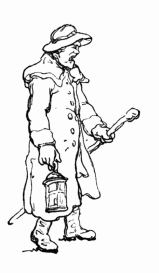
In 1809, appeared numerous book-plates supplied by the artist to publishers.
Thomas Tegg issued an edition of Sterne's Sentimental Journey, and The
Beauties of Sterne, in a separate volume; both embellished with caricatures by
T. Rowlandson. This gentleman also published an edition of The Surprising
Adventures of the renowned Baron Munchausen, with numerous original engravings
by Thomas Rowlandson; The Annals of Sporting by Caleb Quizem, with
illustrations by Rowlandson and Woodward; Advice to Sportsmen, selected from
the Notes of Marmaduke Markwell; with sixteen illustrations by Rowlandson;
The Trial of the Duke of York, with Rowlandson's collected caricatures on the
subject, in two volumes; Investigation of the Charges brought against H.R.H.
the Duke of York, &c., with fourteen portraits by Rowlandson, two volumes;
and Butler's Hudibras, with five illustrations by William
Hogarth, engraved by Thomas Rowlandson.
Beresford's Antidote to the Miseries of Human Life,
octavo, is also advertised in 1809.
The Pleasures of Human Life, by Hilari Benevolus
& Co., with five plates by Thomas Rowlandson, &c.,
was published by Longmans, 1809.
It was in 1809 that Ackermann projected his Poetical
Magazine, royal octavo, which, it was arranged, should
appear in consecutive monthly parts, as a means of
affording his friend, the artist, substantial and progressive
employment. The generous thought which prompted
this enterprise was fittingly rewarded by the successful
reception this venture secured at the hands of the public,
and the patrons of Ackermann's 'Repository of Arts.' The Poetical Magazine
was quite a feature amongst novel publications; the famous plates supplied by
Rowlandson (two monthly), and the verses felicitously written up to the caricaturist's
designs by William Coombe, under the title of The Schoolmasters' Tour,
and introducing the highly popular Doctor Syntax, formed the only important
contributions to the Magazine, which came to a conclusion (at the fourth volume),
with the end of the first Picturesque Tour.
The success which attended the appearance of the familiar Tour was
altogether beyond the expectations of either publisher, artist, or author. The
etchings on the plates to The Poetical Magazine were worked fairly away and
renewed. In 1812, The Tour of Doctor Syntax in Search of the Picturesque,
with thirty-one illustrations by Thomas Rowlandson, was published in a separate
form in royal octavo, a fresh set of the much-admired plates, with but the
slightest variations, being prepared expressly, and these in turn proved insufficient
to supply the number of copies demanded by the delighted public. The
Tour had a still larger success in its independent form, and several editions
appeared in one season; the request continued for years, and was sufficiently
encouraging to induce the projectors to follow it up with a new series, The
Second Tour of Doctor Syntax, in Search of Consolation, with twenty-four illustrations
by Thomas Rowlandson, which also appeared in monthly parts, and was
issued in a collected form in one volume, royal octavo, in 1820. A third tour,
in Search of a Wife, was ventured in 1822, but this was evidently intended to
be the final sequel, as the hero, 'Doctor Syntax,' is removed from life's scene at
the close.
Returning to Rowlandson's successive contributions of book-illustrations,
we find a satirical work, Munchausen at Walcheren issued in 1811; and a Tale
of the Castle (Dublin), published by Stockdale in 1812, as Petticoat Loose, a
Fragmentary Poem, illustrated with four plates by Thomas Rowlandson, quarto.
The artist also issued a series of
Views of Cornwall in the form of an
independent volume the same year.
Mr. Ackermann had introduced,
some years before, an illustrated
Miscellany to his subscribers, which
ran a long and highly successful
career, under the title, borrowed from
the circumstances of its publication,
of Ackermann's Repository of Arts, Literature, Fashion, and Manufactures.
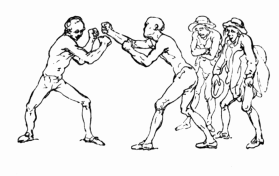
In the pages of this admirable magazine were given many continuous contributions
of a valuable and interesting character, the contents being as diversified
as the description of the undertaking. Among the serials were numerous essays
of merit, which, in the projector's opinion, were entitled to the distinction
of separate publication, and, at intervals, the discriminating proprietor of the
Repository selected various series of articles by his best qualified and most
respected colleagues in the work, and re-issued their contributions, with the
enhanced attraction of fresh pictorial embellishments, as separate publications.
In this manner a succession of Letters from Italy, which had appeared in the
Repository, between 1809 and 1813, furnished by Lewis Engelbach (who supplied
reviews of music; it has been said his criticisms may be usefully studied
by the most successful living contributors to the press), were republished in 1815
in one volume, royal octavo, as Letters from Naples and the Campana Felice,
with seventeen illustrations by Thomas Rowlandson.
Another deserving work, published by R. Ackermann, in the same finished
style, with coloured engravings in aquatint, delicately completed by hand to
resemble water-colour drawings, as were the major part of the illustrations to
this series, appeared under the title of Poetical Sketches of Scarborough, with
twenty-one illustrations by J. Green; etched by Thomas Rowlandson, 1813.
In 1815 was published The Military Adventures of Johnny Newcome, with
fifteen illustrations by Thomas Rowlandson, royal octavo, printed for Patrick
Martin, 198 Oxford Street. This work is written in Hudibrastic metre, by 'An
Officer' in imitation of the flowing lines supplied by Coombe to the Tours of
Doctor Syntax. Another volume (1815 and 1816) was published by Thomas
Tegg, Cheapside, also composed after the model of the same easy versification,
under the description of The Grand Master, or Adventures of Qui Hi in
Hindostan, a Hudibrastic poem in eight cantos, by Quiz, illustrated with twenty-eight
engravings by Thomas Rowlandson.
The principal triumph of our artist's later years appeared in 1815 and 1816,
Rowlandson inventing the subjects, and Coombe supplying the descriptive
versification, as was their usual method of proceeding in the
entire succession of publications, undertaken under this artistic
and literary co-partnership, and issued by R. Ackermann.
We refer to the Dance of Death, which had first been
offered the public in monthly parts under the old and highly
successful system, between 1814 and 1816. This production,
which repays the most careful consideration, received a flattering
reception, and, in spite of the grim nature of the subject,
enjoyed surprising popularity, and added considerably to the
reputation of those concerned in its appearance. We have no hesitation in
recording our impression that the ingenuity and invention displayed in the
seventy-two plates illustrative of the Dance of Death are considerably in advance,
in point of invention, of the pictures supplied to its more genial and popular
rival Doctor Syntax. Both artist and author had arrived at a period of mature
experience, which qualified and disposed them to bring their finest faculties to the
treatment of this melodramatic theme, in which they must have discovered morbid
fascinations; since it has enabled them to rise above their average efforts. As
we have noticed, although the conception is monumental, not to say sepulchral,
in its characteristics, and on occasions, ghastly in its humour, the result is a
masterpiece to the memories of Rowlandson and Coombe; the fires of their
early inspirations were rekindled from their decline; and the Dance of Death
has always impressed us as the last flicker of expiring genius; a fitting memorial
of the vast and almost forgotten faculties of the projectors.
A fuller account of this impressive and truly remarkable work, will be found
under the year 1810, where we have endeavoured to do justice to the exceptional
qualities of a performance which, in our modest conviction, surpasses any previous
treatment of the same subject.
In 1816 Rowlandson commenced a series of charming little pictures designed
in outline, avowedly intended as an assistance to landscape-artists in the direction
of suggesting, and supplying animated groups of figures, suitable for introduction
into drawings. The etchings were executed with exceptional neatness, ease, and
spirit, and the entire collection is highly interesting; it appeared under the title
of The World in Miniature, figure subjects for Landscapes, Groups, and Views,
and was published by Mr. Ackermann at 'The Repository.' A series of a
similar description was commenced under the same designation by Rowlandson
in 1821, and finished by W. H. Pyne in 1826; the set was somewhat diffusive,
if it extended to 637 parts, as we are told.
Our artist's illustrations to the Beauties of Tom Brown belong to 1809.
Rowlandson also contributed a frontispiece to another of Tegg's publications
in 1816, The Relics of a Saint, by Ferdinand Farquhar.
Rowlandson found a congenial exercise for his skill,
taste, and mirth-imparting qualities in the illustration
of Oliver Goldsmith's Vicar of Wakefield, in 1817,
when the famous tale re-appeared, embellished with
twenty-four designs by the artist. Mr. Ackermann
was induced to republish this delightful story as a
vehicle for the display of the delicate humoristic, and
more refined qualifications of the caricaturist (who, by
the way, had almost ceased to deserve this epithet).
Nothing could be more artless than the pathos of this fiction, its simple humour
is ever fresh, and Rowlandson has executed his portion of the undertaking in
a congenial spirit, indeed the happy impulses of the author seem spontaneously
embodied in the picturesque designs.
The success of the Dance of Death was so considerable that the publisher
endeavoured to share its popularity with a successor. The two volumes constituting
the first work were, however, executed in a superior manner; and
more pains were taken to bring the plates to the utmost perfection, as reproductions
of the original drawings, than was the case with later publications.
The Dance of Life, illustrated with twenty-eight coloured engravings by
Thomas Rowlandson, published by R. Ackermann, royal octavo, appeared
in 1817, and although fairly executed, neither the conceptions of Rowlandson,
nor the verses of Coombe, rose above the commonplace; it is evident that
the sentiment which had inspired their gifted faculties in the former subject
found no revival in the present volume, which is somewhat disappointing after
the talent which is manifested in its predecessor.
A pendant to the Military Adventures of Johnny Newcome was issued in
1818 as The Adventures of Johnny Newcome in the Navy, a poem in four cantos,
with sixteen plates by Rowlandson from the author's designs, by Alfred Burton,
published by Simpkin and Marshall, Stationers' Hall Court, Ludgate Hill. More
attention was paid to the artistic preparation of the succeeding portion of The
Second Tour of Doctor Syntax in Search of Consolation, with twenty-four illustrations
by Thomas Rowlandson, royal octavo, which Mr. Ackermann introduced
to the public in a collected form as the companion to the popular first volume
in 1820.
Rowlandson also furnished illustrations to certain pamphlets or chapbooks in
1819; we may particularise one under the title of Who killed Cock Robin?—a
tract on the Manchester Massacre, published by John Cahnac. We have also to
notice his contribution to a chapbook which appeared the same year, as, Female
Intrepidity, or the Heroic Maiden.
The same year appeared Rowlandson's Characteristic Sketches of the Lower
Orders; intended as a Companion to the New Picture of London containing
fifty-four coloured plates, printed by S. Leigh,
18 Strand, 1820.
Another contribution, A Tour in the
South of France, drawn from the excellent
serial publication, 'Ackermann's Repository
of Arts, Literature, Fashion, and Manufactures,'
originally supplied to its pages in
instalments between the years 1817 and 1820, was republished in a completed
form in 1821, with additional attractions, in the way of fresh embellishments, by
the unflagging hand of our artist, under the title of A Journal of Sentimental
Travels in the Southern Provinces of France, illustrated with eighteen coloured
engravings from designs by Thomas Rowlandson, royal octavo, published by
R. Ackermann, 101 Strand.
A French version of 'Doctor Syntax's Tour in Search of the Picturesque,'
Le Don Quichotte Romantique, ou Voyage du Docteur Syntaxe à la Recherche du
Pittoresque et du Romantique, also appeared in Paris this year, with twenty-eight
illustrations, drawn on stone, after the original designs of Rowlandson, by
Malapeau, lithographed by G. Engelmann.
The final complement of 'The Tours,' prepared under the same auspices
as the earlier peregrinations, reached completion as an additional volume in
1822, and the monthly instalments were then reissued in a collected form to
join the two predecessors as The Third Tour of Doctor Syntax in Search of
a Wife, with twenty-five illustrations by Thomas Rowlandson, royal octavo,
published by R. Ackermann.
A further instance of the universal popularity enjoyed by The First Tour
of Doctor Syntax in Search of the Picturesque was afforded, in 1822, by the
appearance of an edition translated into German and freely adapted as Die Reise
des Doktor Syntax um das Malerische au Frusuchen with Rowlandson's famous
illustrations imitated on stone and lithographed by F. E. Rademacher, Berlin.
The interest which it was found, on experience, still surrounded the grotesque
prototype Dr. Syntax, induced the energetic projectors—publisher, artist, and
author—under their old, well-defined relations, to venture on a farther
extension of the familiar framework, and a fresh volume, which had, like the
preceding publications, found its way to the public in monthly instalments, was
inaugurated in 1822 under the description of The History of Johnny Quæ
Genus: The Little Foundling of the late Doctor Syntax—a poem by the author of
The Three Tours (William Coombe)—embellished with twenty-four coloured
engravings by Thomas Rowlandson.
The same year our artist issued another distinct volume of landscape subjects
of his execution under the title of Rowlandson's Sketches from Nature; a
collection of seventeen plates, drawn and etched by the artist
and aquatinted by Stradler. Crimes of the Clergy, an octavo
volume, with two plates by our artist, also appeared in 1822.
As a further proof that the numerous editions in royal
octavo of the illustrious schoolmaster's wanderings were insufficient
to satisfy the requirements of his patrons, Mr. Ackermann
offered the public a fresh copy, in three volumes 16mo.
of The Three Tours of Dr. Syntax, Pocket Edition, with all
Rowlandson's plates, executed on a smaller scale to suit the convenience of
enthusiasts, who might require to carry the volumes about with them ready
for immediate reference, or for perusal on their travels and at odd moments, if
such an opportunity should be in request.
In 1825 Charles Molloy Westmacott, an intimate friend of the caricaturist,
in whose company we learn he visited Paris, thought proper to edit a publication
under his pseudonym of 'Bernard Blackmantle,' a collection of whimsical extracts
from the press, which had appeared in print in the previous season. The
description of his production is as follows: The Spirit of the Public Journals
for the year 1824, with Explanatory Notes. Illustrations on wood by T. Rowlandson,
R. and G. Cruikshank, Lane, and Findlay. London; published by
Sherwood, Jones, and Co., Paternoster Row, 1825. Our artist contributed
eleven highly humorous cuts to this publication, his drawings being engraved
on wood—a novel process as far as the designs usually supplied by Rowlandson
are concerned.
A notable plate was furnished by the caricaturist in 1825 to The English
Spy, a work also produced under the auspices of 'Bernard Blackmantle,' after
the description of the better-known Life in London. The major part of the
plates are due to the hand of Robert Cruikshank. Rowlandson's name is given
on the title-page as having contributed a portion of the illustrations on wood,
but the only example of his skill we have been able to identify is an adaptation
of his drawing (now the property of Mr. Capron), The Life School at the Royal
Academy, which he originally presented to his old friend John Thomas Smith,
of the British Museum. Plate 32.—R. A—ys of Genius Reflecting on the True
Line of Beauty at the Life Academy, Somerset House, by Thomas Rowlandson;
and this illustration is undeniably the most interesting to be found in the entire
contents of the two octavo volumes of which Mr. Westmacott's English Spy is
composed; further particulars of this subject are given under the year 1825.
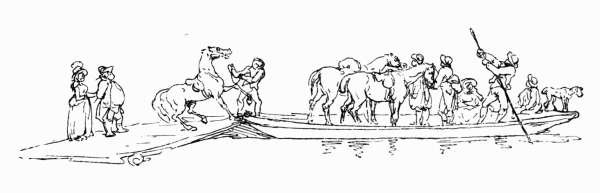
After the caricaturist's death in 1827 the admirable publications, of which
his coloured plates formed the principal attractions, were discontinued; the taste
of the public had changed. Wood blocks and steel plates came into fashion.
Cheap annuals illustrated with woodcuts came into favour for a season, until
the appearance of the more elaborately prepared 'Gift Books,' with fine steel
engravings, 'Keepsakes,' 'Gems,' &c., subsequently took their place. The
folios of Mr. Ackermann were still sufficiently rich in studies by Rowlandson to
furnish the framework for a fresh publication. A choice was made from the
large collection of original drawings, published and unpublished, which still
remained, after the artist's decease, in the possession of the indefatigable
proprietor of the 'Repository'; and these sketches, which of necessity, for the
most part, are assignable to Rowlandson's declining period, when his drawings
became looser in execution and less picturesque in point of subject, were
selected as the materials for a new venture, with a departure from the old popular
style of reproduction in facsimile of the artist's pictures coloured by hand.
The subjects culled from Mr. Ackermann's portfolios were redrawn on a
reduced scale, either as a whole, or striking portions of caricatures, and prominent
figures or groups were adapted, transferred to wood-blocks, and put into
the hands of an engraver. In cutting the designs a considerable amount of the
original spirit, with the individuality of execution peculiar to the master, have
unfortunately been sacrificed; the engravings are heavy and poor; however,
they offer a rough idea of the nature of the studies which happened to remain
in the hands of the publisher, and some interest attaches to this circumstance,
as the major part of these designs have never been issued on copper.
Mr. W. H. Harrison was engaged to write up to the pictorial sketches, and
he has constructed various small fictions founded on the suggestions offered by
the engravings; but the entire work is somewhat clumsy in contrivance, both as
respects the illustrations and the literary setting intended to assist their interest
in the eyes of the public; the editor's inventions are neither original nor brilliant.
The title of the annual produced on this compound principle was The Humourist,
a Companion for the Christmas Fireside, embellished with fifty engravings,
exclusive of numerous vignettes after designs by the late Thomas Rowlandson:
published by R. Ackermann, 96 Strand, and sold by R. Ackermann, junior, 191
Regent Street, 1831. The Humourist contained sixty-seven illustrations in all;
the titles of these, and a brief description of the various subjects, will be found
at the close of the present volume, under the year 1831.
Although Rowlandson was so well known as an artist, no fitting memorials
of his career are extant; and while, as we have related, the task of discovering
a collection of works by the artist, worthy of illustrating his exceptional abilities,
is surrounded by unforeseen difficulties, the operation of culling personal traits,
or records of the life and adventures of the caricaturist, demands even greater
extensions of patience. Nothing short of sincere appreciation for the vast talents
of the man, and of a lasting conviction of the original qualities of his works,
could have encouraged the writer to prolong his researches, the chances in this
case of alighting on any discoveries of note being so problematical.
The person of Rowlandson was familiarly recognised amongst his contemporaries
from his youth, when he was first admitted as a student at the schools
of the Royal Academy (about 1770), through his diversified fortunes, till his
death, which occurred on April 22, 1827.
His figure, we learn, was large, well set-up, muscular, and above the average
height—in fact, his person was a noticeable one; his features were regular and
defined, his eye remarkably full and fearless, his glance being described as
penetrating, and suggestive of command; his mouth and chin expressed firmness
and resolution; the general impression conveyed to a stranger by his
countenance, which was undeniably fine and striking in its characteristics, was
that of the inflexibility of the owner.
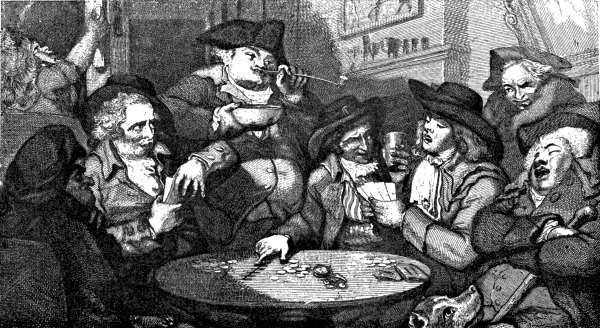
SMITHFIELD SHARPERS; OR THE COUNTRYMAN DEFRAUDED
Old Trusty, with his Town-made Friends,
To gentle sleep himself commends,
With Tray upon his knees;
Whilst Tom, his son, all eager, gaping,
Expects each moment he'll be scraping
The treasure up he sees.
Meanwhile the Harpy Tribe are plotting,
By forcing liquor, winking, nodding,
To cheat the youth unlearn'd;
Who, to his cost, will quickly find
Nor watch, nor money, left behind,
And Friends to Sharpers turn'd.
Two or three portraits of the caricaturist are traceable, besides numerous
burlesque transfers of his own effigy to his imaginary personages. In common
with Cruikshank, Thackeray, and many other humorists of the brush and
etching-needle, he was prone to introduce the presentment of his own lineaments
in whimsical juxtapositions. The most generally recognised likeness, from
which a separate plate has been published by Mr. Parker, occurs in a clever
eccentric drawing, exhibited by the artist at the Royal Academy Exhibition in
1787, under the title of Countrymen and Sharpers (No. 555).
This subject was subsequently engraved by J. K. Sherwin, whose portrait
also figures therein, in the person of the pigeon, while Rowlandson has chosen to
represent himself as the leading sharper, he who, with blustering front, is fleecing
the simple youth at cards, in defiance of his well-accepted reputation for rigid
integrity; for although the gaming table long held the caricaturist an enslaved
votary, ready to make the most reckless sacrifices to tempt the fickle favours of
the gambler's fortune, it is recorded by those of his acquaintances who have
mentioned this disastrous failing (which by the way he shared with all the
wealthy, distinguished, and witty celebrities of his day), and deplored the havoc
it made with his means, and professional pursuits, that his sense of honour was
ever of the keenest, his word was always regarded as sufficient security, and he
possessed a delicacy of feeling, and a sense of independence, which would not
allow him to remain under a debt or an obligation.
At the time Rowlandson sent his drawing of Countrymen and Sharpers[7] for
exhibition, he was 31 years of age, and according to the portrait, looks manhood
personified, with a fine comely figure, and a face that imprints itself on the recollection,
his hair in a profusion of wavy tresses, worn long, and 'clubbed' as was
the fashion of the period. His bold and piercing eyes set under massive and
somewhat prominent brows.
The next attributed portrait belongs to 1799, when Rowlandson was 43 years
of age. In the design, An Artist travelling in Wales, the result of a journey he
made with his friend, the convivial Henry Wigstead, he has represented himself,
with a due allowance for burlesque, looking older than his years; the long hair is
still there, but its curls are thinned, time and a struggle with seasons less rosy
than his youth of many fortunes, are telling on the outward man, but the brows,
eyes, mouth and chin have diminished nothing of their resolute characteristics—indeed,
they are more marked—and the strong nervous figure is beginning to look
gaunt.
The Chamber of Genius appeared in 1812 with the appropriate quotation:—
Want is the scorn of every wealthy fool;
And genius in rags is turned to ridicule.—Juv. Sat.
The head of the caricaturist is strongly defined on the shoulders of the gifted
occupant of a garret, and the likeness is just what might be supposed from the
countenance, as given in 1787, viewed through the intervening quarter of a
century of struggles, and disenchantments, when cares of the hour, and incidental
anxieties, touching provision for the future, had commenced to take the place of
the artist's original careless hardihood.
The last portrait to which we shall at present refer is by another hand; and
was sketched when the health of the caricaturist was a grave source of apprehension,
since we learn that during the last two years of his life he was a severe
sufferer. It represents the figure of a large and powerful-looking old gentleman,
of impressive presence; the main characteristics, and the marked profile have
gathered force with increasing years, the brows are even firmer, and the features
more defined; this croquis of the veteran was drawn by his old friend, and
erst fellow-pupil, John Thomas Smith, the keeper of the drawings and prints in
the British Museum, and the study was taken while the caricaturist was looking
over some prints, on one of his visits to the treasures in his friend's department.
The sketcher, who has written the circumstances under which it was taken,
below the portrait, has given Rowlandson's age at seventy,—within a year, in
fact, of his death. The caricaturist's flowing locks are considerably shorn by
the hand of the inevitable mower, and his penetrating eyes do not disdain the
assistance afforded by a pair of huge tortoiseshell-rimmed spectacles, in which
they are framed; but as far as the visible flight of time goes, regarding the
outward man, he might be assumed to possess powers of vitality sufficient to
carry him over another score years.
If our memory does not deceive us, a sketch of the caricaturist's figure, from
the life, and drawn in chalks, was exhibited some time ago at Bethnal Green,
in the Loan Collection, formed under the auspices of the Science and Art
Department.
We learn that our artist, who is perhaps the most popularly recognised practitioner
of the caricature branch, was born in the Old Jewry, in July 1756, that is
to say, just a year before his remarkable compeer James Gillray. The members
of the Rowlandson family, according to the little we can trace of their personal
history, seem to have been highly respectable people of the middle class in life.
The name is not of common occurrence. There is a tract relating certain misfortunes
which attended two bearers of this cognomen; a pious and worthy couple
who in the seventeenth century went evangelising to New England, where they
suffered incredible persecutions, and escaped all sorts of dismal tortures amongst
the aboriginal Indians, in whose hands they had the mischance to fall; the
succession of hardships which they encountered, and their final miraculous deliverance,
are duly recorded for the encouragement of the faithful. The narrative,
which is simple and circumstantial, forms an item of 'improving reading' not
without its interest in the present age. There is nothing to prove the relationship
of this faithful and much-enduring pair to our caricaturist, beyond the circumstance
of the similarity of name. Rowlandson the elder was assuredly at one
time a man of fair substance, as we are informed—'some say a city merchant,' but
his disposition, like that of his son, seems to have been tinctured with recklessness.
Mention is made of an uncle Thomas Rowlandson, who was godfather to the
subject of our notice; also, as far as we can discover, connected with mercantile
pursuits. This relationship was destined to serve the caricaturist in good stead, if
he had only exercised the commonest prudence in husbanding the resources
which he derived from this connection. We discover that, before Rowlandson
had arrived at man's estate, his chances of inheriting a provision to help him on
his way, together with the prospect of any future support, so far as the paternal
resources were concerned, had melted away; the elder Rowlandson's 'speculative
turn' had taken a sinister bent, considerable sums had been sunk, and still more
portentous liabilities had been incurred, 'by experimenting on various branches
of manufacture,' which were attempted on too extensive a scale for the means at
his command; and, his resources becoming exhausted, before the fruition of his
schemes, pecuniary embarrassments involved his career, and he failed to realise
the considerable fortune which his sanguine temperament had anticipated. The
natural talents of the son, and the professional training which had cultivated his
gifts, were the only contributions he received, on attaining manhood, towards his
future maintenance, as far as the help he could derive from his father was concerned.
Other adventitious aids came to the artist's assistance, indeed, in spite
of the untoward direction which the previous prosperity of the elder had taken,
Rowlandson was to a large degree the spoiled child of fortune throughout his
early career.
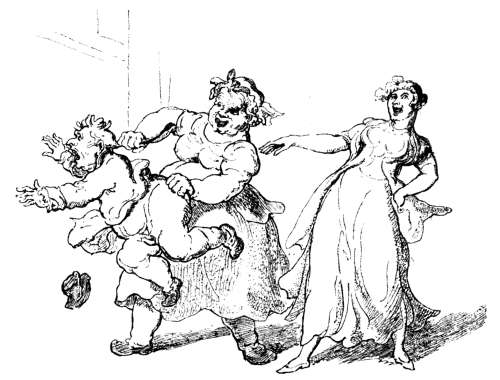
HOW TO TREAT A REFRACTORY MEMBER.
We are not informed whether the paternal estate was restored to solvency.
Among the various 'valuable legacies' which, it is related, fell to the caricaturist's
share (only to be scattered broadcast), it is very possible that, in some sort, an
inheritance from his father formed part of these unexpected 'good gifts.' It
seems, although we have no direct records of the remaining relatives, that
Rowlandson had a sister, since we learn that his brother-in-law was Howitt,
famous as an artist for his delineation of animals, for his spirited hunting subjects,
being eminent as a sportsman, rider, and angler; and, like the caricaturist, somewhat
of a spoiled child—a wayward genius—of a congenial soul, and vivacious
impulses, a trifle too given to yield to careless convivial company, or the allurements
which the hour might hold forth, oblivious of sober consequences to
follow.
Thomas Rowlandson, the uncle, had married a certain Mademoiselle Chattelier,
who was, it is evident, a lady with some command of wealth; and from
the partiality and indulgence of this aunt, our artist, we are told, 'derived that
assistance which his father's reverse of fortune had withheld.'
Another reference to the family name further occurs amongst the announcements
of marriages for September 1800 (Gentleman's Magazine, vol. 70, p. 898),
where we find that Thomas Rowlandson, Esq., of Watling Street, espoused Miss
Stuart, daughter of George Stuart, Esq., of the Grove, Camberwell, Surrey. It
is obvious that Rowlandson senior intended to give his son a sound training.
As a school-boy, the future celebrity wandered into the precincts of that Soho
district to which he afterwards clung in his varying fortunes with the persistence
developed by habit.
The caricaturist began to draw his first instalments from the fount of knowledge
at the scholastic symposium of Doctor Barvis in Soho Square, 'at that
time, and subsequently, an academy of some celebrity.' We are told this establishment
was kept by Doctor Barrow when young
Rowlandson was pursuing his studies. The respectability
of the school, and its soundness as an educational
institution, is satisfactorily demonstrated to our
mind from the circumstance that the great Edmund
Burke had elected to confide his beloved son, with
whose training, it is well known, the philosopher took especial pains, to the
charge of Doctor Barrow; and Richard Burke, the gentle gifted youth whose
untimely death hastened the decease of his patriotic father, was a school-fellow of
our artist. J. G. Holman, who was destined to acquire reputation as a dramatic
writer and performer, was another school-fellow. It appears that, within the
walls of this academy, Rowlandson made the acquaintance of John Bannister,
whose inimitable talents were afterwards to delight the town, and whose name is
a lasting ornament to the histrionic profession; it was, further, in Soho Square
that young Rowlandson and young Angelo, the son of the well-known Henry
Angelo (one of the best recognised and most respected foreigners domiciled in
London of his day), fencing-master to the Royal Family, became fast and firm
friends. The intimacy existing between this worthy trio, dating from these early
days, continued steadfastly through life. All these lads were, in different degrees,
enthusiasts of the graphic art; Angelo and Bannister had strong predilections for
the arts, and both drew as amateurs in their subsequent careers, although, with
Rowlandson, they originally meditated following up the artist's profession seriously.
As to our friend Rolley, like all beginners gifted with the pictorial vein, he
could make sketches intuitively before he had learnt to do anything else, as
seems the rule with youths who possess the artistic faculty and an imaginative
temperament; his powers of fancy directed his hand at a precociously juvenile
age to the practice of exercising his abilities with pencil and pen. 'From the
early period of his childhood,' it is recorded, 'Rowlandson gave presage of his
future talent;' he could make sketches before he learned to write, and, according
to the usual course, 'he drew humorous characters of his master and many of
his scholars, before he was ten years old. The margins of his school-books
were covered with these his handiworks.'
Rowlandson's genius was of the rapid order, his powers were matured before
the average of students have sounded the direction of their inclinations. Young
Henry Angelo left Doctor Barrow's and Soho Square, for Eton, while Bannister
and Rowlandson quitted the seminary of polite learning to follow the arts at the
Schools of the Royal Academy; here our artist made rapid strides, and gave
convincing proofs of his ability,
dexterity, and quickness of parts,
during the short interval his name
was entered as a probationer.
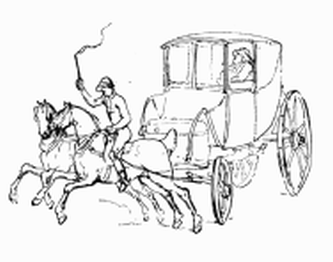
In his sixteenth year, somewhere
about 1771, Rowlandson had the
advantage of being sent to Paris
to continue his education; we learn
that he 'spoke French like a native.'
It was his aunt, née Mademoiselle
Chattelier, residing in the French
metropolis, a widow with what
would have then been considered, in that capital, a handsome fortune, who
invited her hopeful nephew over to the very centre of gaiety, dissipation, and
luxurious refinement—Paris in the latter days of Louis the Fifteenth's reign
being a very Capua for a youth of light and picturesque disposition such as
our artist possessed. The impulse for purposeless frivolities, so deleteriously
nourished amidst the gaieties of Parisian life, seems to have been kept in
tolerable subjection by his earnest intentions to work hard at his adopted profession,
which certainly must have sustained Master Rolley during his earlier
residence on the Continent, until the cup of pleasure was raised to his lips by
an unexpected accession of means. The student did a wonderful deal of real
solid work and thoroughly steadfast application, before, like Moreland, he
allowed himself to be whirled into the eddy of fashionable distractions; in
Paris he was inscribed as a student in one of the drawing-academies there,
and his natural abilities, aided by the excellence of the methods practised around
him, to which his gifts moulded themselves quite naturally, enabled the probationer
to make rapid advances in the study of the human figure, and laid the
foundation for his future excellences. During his first sojourn, which lasted
for nearly two years, Rowlandson became a perfect French buck, with a decided
leaning, however, towards the fine-art section of the condition, and a pride
in his professional calling; he learned to draw with fidelity to nature, with
the graceful ease, and abandon, and the sparkle of style which marks French
pictorial art of the period immediately antecedent to the reign of Louis the
Sixteenth, the very ideal of luxury and refinement. It is related that, during
his abode in Paris, 'he occasionally permitted his satiric talents the indulgence
of portraying the characteristics of that fantastic people, whose outré habits
perhaps scarcely demanded the exaggerations of caricature.'
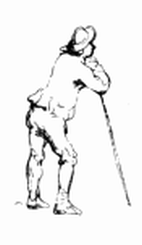
Rowlandson returned to London for a season; and, while still a youth in
years, his studies at the Academy were resumed; his progress was now so
marked that he was set up as a friendly rival to Mortimer, another talented
student, who had won the admiration of professors and pupils
alike, by his skilful drawings after the nude figure. Our artist
seems to have been highly popular with the two sections of
academicians and students; the former appreciated his masterly
endowments, the latter were won by his whimsicalities, his
spirit of mischief, and the marvellous gift he possessed of turning
every situation to comical account in the production of exhaustless
graphic satires, which seemed to flow from his pen of their
own sweet wilfulness.
John Bannister, who, as we have seen, had evinced an equal
predilection for the graphic art, with powers, however, of lesser brilliancy, was
then studying in the antique school, their old friendship was renewed, and a
fresh alliance for fun and frolic was straightway entered into.
These hopeful aspirants were a great acquisition to the mirth of the schools,
but both these eccentric geniuses must have sorely tried the patience of their
venerated pastors and masters. The nature of their drolleries, which were incessant,
is exposed in an extract from the Reminiscences of Henry Angelo, who
formed the third person of this waggish trio.
'At the period when Wilson held the appointment of Librarian to the Royal
Academy, the students were accustomed to assemble in the library; Bannister
and Rowlandson were students, and both being sprightly wights, Wilson kept a
watchful eye upon their pranks. The one was apt to engage the attention of his
fellow-disciples by caricaturing the surly librarian, never forgetting to exaggerate
his mulberry nose; whilst the other, born to figure in the histrionic art, a mimic
by nature, used to divert them, in his turn, by playing off the irritable 'Old Dick.'
Michael Moser was keeper at Somerset House while Bannister and Rowlandson
were students of the Royal Academy, at which period the drawing-school
was held in a part of the old palace, Somerset House, just behind the site of
the present institution. Moser, in virtue of his office as keeper, had apartments
there, which included accommodations for a housekeeper, and other
female domestics.
'Bannister and Rowlandson, as before observed, were prankish youths.
The latter once gave great offence by carrying a pea-shooter into the life
academy, and, whilst old Moser was adjusting the female model, and had just
directed her contour, Rowlandson let fly a pea, which, making her start, she
threw herself entirely out of position, and interrupted the gravity of the study
for the whole evening. For this offence, Master Rowlandson went near getting
himself expelled.
'Bannister, who at this time drew in the plaster academy, not having gained
the step that admitted to the drawing from the life, used to amuse Moser with
his mimicry, and he was, indeed, a pet of the worthy keeper.
'One evening, observing that the student
had vacated his seat at his desk, the keeper
went to seek him, and, hearing an unusual
giggling and confusion in the basement storey
he descended to learn the cause; when he
discovered the young artist romping with the
servant-maids.
'What are you doing, sir, hey?' inquired the keeper, taking him gently by
the ear; 'why are you not at the cast? You are an idler, sir.' Bannister met
his reproof with an arch smile, and whispered, 'No, kind sir, I only came down
to study from the life!'
In dealing with this part of the subject, every scrap of information has its
interest, the resources in this direction being unfortunately most restricted. The
task of writing on Gillray, and that within the lifetime of the subject, was likened
to the toil 'of bondsmen commanded to make bricks without straw,' a comparison
with which we have a lively sympathy, as we have realised to the fullest
extent the difficulties which surrounded that undertaking. The obstacles to be
surmounted in the instance of the first caricaturist are found to be rather more
vexatious in the case of the companion volume, taken up under similar auspices,
to elucidate the works of Rowlandson, and to trace the artist's career as far as
lies within the writer's capabilities. Sixty years ago it was declared while treating
of the first-named genius, in reference to contemporaneous indifference: 'It
is a scandal upon all the cold-hearted scribblers in the land to allow such a
genius as Gillray to go to the grave unnoticed; and a burning shame that so
many of his works should have become ambiguous for want of a commentator.
The political squibs have lost half of their point for want of a glossary, and many
of the humorous traits of private life, so characteristic of men and manners, are
becoming oblivious to ninety-nine hundredths of those who perambulate the streets
of this mighty town.' This remark, so appropriately applied to Gillray (before
Thomas Wright, and successive elucidators, had contributed to render the
reading of these pictorial fables fairly clear, and the solutions easy of access),
is equally striking as respects its undoubted truth in its application to
Rowlandson—in his instance the pioneering remained to be accomplished—although
his works are less complex in themselves, a description of them has
hitherto proved too perplexing an attempt, since, how were the subjects to be
collected?
We feel a glow of gratitude to that worthiest old authority, The Gentleman's
Magazine, which contained a capital obituary notice on the caricaturist's
decease, April 22, 1827, written by 'one who had known him for more than
forty years;' this article has been copied
literally in all subsequent notices of Rowlandson.
W. H. Pyne, the artist, who, under a
pseudonym as Ephraim Hardcastle, conducted
the earliest of English fine-art reviews,
The Somerset House Gazette, 1824, was one of
the intimates of the caricaturist, and he has
left slight allusions to Rowlandson, both in his
Gazette and in another publication of his enterprising, Wine and Walnuts, or
After Dinner Chat, by Ephraim Hardcastle, 1823.
John Thomas Smith, as we have shown elsewhere, was on terms of personal
friendship with Rowlandson throughout his life; but strangely enough, in his
Nollekens and his Times, and his second volume, Memoirs of several Contemporary
Artists from the time of Roubiliac, Hogarth and Reynolds, to that of
Fuseli, Flaxman, and Blake, no mention is made of his much-esteemed associate.
A passing allusion to his 'friend and fellow-pupil' Rowlandson, occurs
in 'Antiquity' Smith's Book for a Rainy Day.
Henry Angelo, the early schoolfellow and constant comrade of our artist, a
gentleman of varied accomplishments, obliged the reading public with his
Reminiscences in 1830, a chatty, interesting, and in some respects highly valuable
book, of which we wish there were more, since the two volumes are, as described
by the title, filled with memoirs of his friends, including numerous original
anecdotes and curious traits of the most celebrated characters that have flourished
during the last eighty years. Unlike the author of Nollekens and his Times,
Angelo has given due prominence to his recollections of the caricaturist's works
and career, and his terms of familiar intimacy have supplied him with many
entertaining details, trivial or unimportant in themselves perhaps, but very much
to the purpose from a biographical point of view, as aids to the effort of reproducing
the subject in his wonted aspect, as he struck the men amongst whom he
passed his life. The spirit of Angelo's Reminiscences will not bear dilution, and
so we think it better to offer his memoirs of the artist as they were published.
'Thomas Rowlandson, John Bannister, and myself, having early in life
evinced a predilection for the study of drawing, we became acquainted whilst
boys, and were inseparable companions.
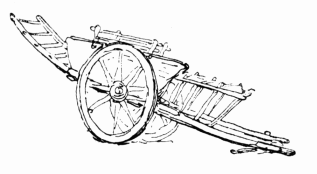
'Everyone at all acquainted with the arts must well know the caricature
works of that very eccentric genius, Rowlandson; the extent of his talent,
however, as a draughtsman is not so generally known. His studies from the
human figure at the Royal Academy were made in so masterly a style that he
was set up as a rival to Mortimer, whom he certainly would have excelled, had
his subsequent study kept pace with the fecundity of his invention. His
powers, indeed, were so versatile, and his fancy so rich, that every species of
composition flowed from his pen with
equal facility. His misfortune, indeed,
was, as I have been assured by capable
authorities who noticed his juvenile
progress, that of possessing too
ready an invention; this rare faculty,
strange as it may seem, however desirable
to the poet, often proves the
bane of the painter. "The poet," as Milton says, "can build the lofty rhyme,"
even with a dash of his pen. The painter, however easily he may conceive
the structure of a mighty building—be it a temple, or be it a ship—must describe
the subject perfectly with all its parts; he must set to work doggedly, as the
great lexicographer, Johnson, said, and labour at the thing with the patience of
the philosopher. Rowlandson was no philosopher, and so his uncontrollable
spirit, sweeping over the prescribed pale, took its excursive flights and caught
its thema on the wing. Hence I think it may safely be averred that he has
sketched or executed more subjects of real scenes in his original rapid manner,
than any ten artists his contemporaries, and etched more plates than any artist,
ancient or modern.
'Few persons—judging from the careless style of drawing and etching which
he so fatally indulged in, too soon, after acquiring the first rudiments of his art—would
believe the possibility of his being the author of some of his earlier
designs; for although all are too slight, yet there are certain subjects of his composition
carried through with a compatibility of style so truly original, and so
replete with painter-like feeling, that Sir Joshua Reynolds and Sir Benjamin
West pronounced them wonders of art.'
On this same head we have the testimony of Ephraim Hardcastle in the
Somerset House Gazette. A certain weight, beyond the mere evidence of partiality,
is due to the opinions of such authorities as Henry Angelo and W. H. Pyne, who
at least deserve the credit of understanding the subject; both were familiar with
the best works of their day, and in the case of the latter we respect the opinion
of an artist of wide experience and well-known repute.
'Thomas Rowlandson, the merry wag, he who has covered with his never-flagging
pencil enough of charta pura to placard the whole walls of China,
and etched as much copper as would sheathe the British navy. Of his graphic
fun and frolic we have seen, Heaven knows, full many a ponderous folio.
'Master Roley, so friendly dubbed by many an old convive, would have taken
higher flights of art had he so willed, for he could draw with elegance and grace;
for the design, no mind was ever better stored with thought—no genius more
prolific. Nothing, even allowing for caricature, could exceed in spirit and intelligence
some of the off-hand compositions of this worthy.
'Predilections for outline and the pen have ruined many a genius who would
have done honour to the arts. Mortimer, Porter, and many other artists have
sacrificed their talents and their fame to the indulgence of doing that with the
pen (confound both goose-quill, crow-quill, and the reed!) that should have
occupied that fitter instrument the pencil, aforetime called the painting-brush.'
Angelo affords us occasional glimpses of Rowlandson in Paris, and frequently
alludes to the artist's travels on the Continent. It seems, at various stages of his
career, he roved about sometimes in search of subjects, at others, on parties of
pleasure. We have seen the young student sent to Paris to pursue art; later
on Angelo finds him there, at nineteen, still earnest and hard-working.
'The subjects of his humorous designs were not sought in England alone.
He travelled early in life to France, Flanders, and Holland; and stored his
portfolios with sketches highly characteristic of the habits and manners of the
people, at every town through which he passed. Paris, as viewed under the old
régime, opened a prolific source for his imitative powers. Nothing can exceed
the fun and frolic which his subjects display, picked up among every class, from
the court down to the cabaret. He mixed in all societies, and speaking French
fluently, made himself acquainted with the habits of thinking, as well as those of
acting, in that city, where everything to an English eye bore the appearance of
burlesque.
'Hogarth had already pronounced Paris "all begilt and befouled." Rowlandson
found it so; and taking that as a sort of maxim which governed all things,
physical as well as moral, in the polite city, he burlesqued even the burlesque.
'His drawings of The Italian and The French Family, from which John Raffael
Smith made engravings, had great merit. My friend John Bannister had one
of the originals. I remember the last time I saw poor Edwin the comedian (I
mean the elder), was on occasion of his wishing me to procure for him these
originals. He was too late in his application, and was obliged to solace himself
with the coloured prints, which were touched upon by the hand of Rowlandson.
They were handsomely framed and hung in his dining-room on the first floor
of one of the houses on the north-east piazza, Covent Garden. They subsequently
became the property of Lord Barrymore.
'It would be difficult to enumerate the many choice subjects which he depicted
even in these first tours to the Continent. Those descriptive of Parisian manners
would now be viewed with tenfold interest, as the general external appearance
of things was infinitely more original and amusing before the period of the commencement
of the Revolution than since. Indeed, I can speak of these changes
from my own observation, whilst two years in that city, and in the midst of its
ever-varying gaieties, more than half a century ago.[8]
'During my residence there, Rowlandson came over in company with an
Englishman of the name of Higginson, whom he got acquainted with at Dover;
a pleasant companion, but, as it fell out, one who seemed to live on his wits.
'Their arrival in Paris was immediately after the death of Louis the Fifteenth
at the moment of the putting on public mourning (1774). Mr. Higginson had
letters of introduction (like Sylvester Daggerwood) to several persons of distinction,
and resided at an hotel adjacent to my quarters. He sent the valet de place
with a civil note to request the loan of my black suit, which he knew would fit
him to a T. On the written assurance that it would be returned in time for me
to pay a promised visit in the evening, I readily consented. Rowlandson lost
sight of him for two days and nights; on the morning of the third day he
returned, and I went, not over well pleased, to demand restitution, when on
entering his apartment, he received me with, "Ah! mon ami, is it you?" seated
under the frosting powder-puff of a French friseur, having his hair frizzled and
powdered à la mode, in my mourning suit. Rowlandson sketched the group, and
subjoined a motto, "Free and Easy." I had many of the drawings made by my
friend Roly at this time.'
It is most likely that our artist's first contribution to the Royal Academy (it
was the seventh exhibition) arrived from Paris; in 1775 there appeared, under
the catalogue Number 253, a certain drawing entitled Delilah payeth Sampson a
visit while in prison at Gaza, by Thomas Rowlandson; the exhibitor's address is
given 'at No. 4 Church Street, St. Ann's.'
This, no doubt, like his contributions up to 1784, was of a serious character.[9]
From 1777 we find Rowlandson settled down to portrait-painting, his address
being given at Wardour Street; his contributions to the Academy were as
follow:—
| 1777. | No. | 302. | A Drawing. |
| 1778. | " | 259. | Portrait of a Young Gentleman, whole length. |
| 1779. | " | 275. | An Officer, small, whole length. |
| " | " | 276. | A Gentleman. |
| 1780. | " | 373. | Landscape and Figures. |
| 1781. | " | 334. | Portrait of a Lady in a fancy dress. |
| " | " | 339. | Portrait of a Gentleman. |
It is improbable, however, that the artist's disposition for change would allow
him to vegetate in one spot for any length of time, and we are not surprised to
discover that his tours to the Continent became frequent; as far as we can judge
of his extended travels, it appears it was in 1778—while his youthful ardour was
still fresh, when his sprightly faculties had not been jaded by the allurements of
fashionable life, and his hand had not been betrayed into the careless execution
which determined some time after his decisive rejection of serious art for the indulgence
of uncompromising caricature—that he went very earnestly to work;
travelling in Flanders and through the cities of Germany; making clever studies
and finished pictures of the incidents of his journeys; noting the travellers he
encountered, their mode of conveyance, the foreign nobility and their equipages,
the townsfolks and the country people, coaches, waggons, and, above all, horses
(which he then drew with great fidelity and spirit from life), as far as the figure
subjects which enlivened his pictures were concerned; while his views were
faithful representations of the places he visited, worked out with the completeness
of landscape art.
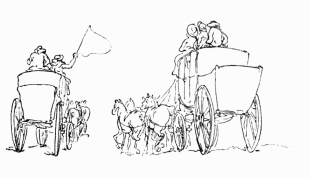
The drawings of this period evince the excellence of his talents. There is
sufficient spice of character introduced into the groups, and incidents which
give action to his pictures, to raise his subjects above the average treatment,
but the comic element is subordinated to the general harmony of the whole
conception; and we have every opportunity of forming our opinion, from the
numerous interesting series of studies which have come under our attention,
that it was not until about 1782 that our artist began to cut himself adrift
from the more legitimate occupation of his vast abilities in the regions of serious
art, for the allurements which the readier exercise of his talents as a caricaturist
held out for the indulgence of his eccentric and wayward tendencies. As
we have seen, his early bias was
undoubtedly towards the simply
ludicrous; then intervened his
academic training in London and
Paris, the maturing of his powers
necessitating an immense, and
indeed almost incredible amount
of sterling hard work, such as
fitted him to excel in any branch
of his calling he elected to pursue; followed by an attempt towards his establishment
as a serious artist and portrait-painter, and then a relapse in the direction
of his early impulses. This inclination was fostered by the encouragement of
his friends, and the influence of their example. His cronies were, as was most
natural, the humorous designers. There was the great and gifted Gillray, the
prince of caricaturists, whose works created an impression on the public justified
by their remarkable qualities. The friendship of this man, whose reputation
was so wide, and whose mastery of the situation appeared extraordinary,
encouraged Rowlandson to strike out a pathway in the same direction; bringing
original qualifications to bear on this impetus, which in no degree clashed with
the strongly marked intentions of Gillray's scathing inventions. There was
his constant friend Henry Wigstead, a man of social standing, profusely liberal
in his house, a jovial companion out of doors; who, richly endowed with the
vein of humorous invention allied to powers of observation, and a refined sense
of the beautiful, as well as a ready knack of seizing the comic features of a
situation, entrusted his sketches to Rowlandson, that they might be produced in
fitting form; and to the proper execution of these whimsicalities Rowlandson
willingly lent the full force of his own trained skill. Another amateur of distinction,
whose example and influence must have had considerable weight with our
artist, was Henry Bunbury, the caricaturist, a man of family, of means, and,
above all, of high culture. The celebrated Bunbury seemed formed expressly
to be courted by the most eminent of his contemporaries; he had married one
of the beautiful Miss Hornecks; the Duke and Duchess of York were delighted
with his company; amongst the brilliant assemblies at Wynnstay, Bunbury's
society was the most relished; Walpole, Garrick, Reynolds, and Goldsmith
were constantly laying adulation at his feet, or exchanging gallant little
pleasantries with this favoured child of fortune; West and Reynolds were
respectfully solicitous that he should send his contributions to the Royal
Academy; the writers of the day were given to deplore that the occupations of
town and country life, the court, the hunting-field, and the ceremony of receiving
company at his country-house or paying
visits to the seats of his noble friends, sadly
interfered with the exercise of his artistic
abilities.
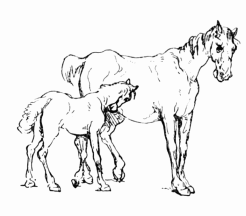
The instance of Bunbury, who was Rowlandson's
senior by six years, no doubt had
considerable influence upon our artist's
career; the praise and adulation lavished
upon the amateur sketches of the man of
fashion, and the prophecies which writers
were in the habit of recording, that, if
Bunbury had not, from his birth and station, been indifferent to mere monetary
advantages, the pursuit of his talents must have infallibly produced him a large
access of fortune (which he did not need, by the way, since his means were
ample) possibly helped to turn Rowlandson from quietly persevering in the less
congenial study of portraiture, and induced him to show the public what could
be done in the grotesque walk. Nor must we forget Mitchell the banker,
whose friendship was always at our caricaturist's service, his travelling companion
to the Continent, where Rowlandson and his patron passed for the
veritable representatives of John Bull. There was 'the facetious Nixon,' the
pleasant and witty John, 'a choice member of the celebrated Old British Beef-Steak
Club, honorary secretary, and sometime providore to that society of native
gourmands;' further, like his friend Bunbury, distinguished as a man of talent
and taste, possessed of original gifts in the humorous department of graphic
art, he was an honorary exhibitor at Somerset House for many years: this
gentleman, who had perfected the study of how to get the largest possible
amount of enjoyment out of existence, also came to Rowlandson to put his
drawings into acceptable shape, and to introduce his eccentric pleasantries to
the public. Nor must the well-known amateurs and choice spirits, Woodward
and Collings, be omitted from the list of those familiars of the artist who, by
precept and example, encouraged him to devote his accomplishments to the
comic branch. It is not surprising that the tendency of this influence, allied to
the strong original bias natural to our artist, drew him farther away from the
steady pursuit of art, and plunged him into the tempting career of a caricaturist,
a pursuit which held out peculiar attractions to an artist gifted with his whimsical
inclinations. We must do Rowlandson the credit to admit that, at the
outset, he distinguished himself marvellously. His first contributions, under
his changed profession, were by no means discreditable to his great qualifications;
indeed these drawings, from the successful impression they produced
on the public, appeared to justify the resolution the artist had taken, and to
prove that he was evidently more at home in the fanciful branch than any of
his predecessors or contemporaries. In 1784 Rowlandson contributed three
somewhat ambitious subjects to the Royal Academy Exhibition; according to
the Catalogue No. 462, An Italian Family; No. 503, Vauxhall; No. 511, The
Serpentine River.
Vauxhall Gardens, which is possibly the best recognised of Rowlandson's
more aspiring compositions, was engraved by R. Pollard, aquatinted, to resemble
the drawing, by F. Jukes, and published under the auspices of John Raphael
Smith, also a convivial companion, a leading spirit amongst the careless souls
who formed Rowlandson's social surroundings; the well-known printseller, who
was 'a jack-of-all-trades' according to his own admission, was celebrated for his
liberality to artists; he personally practised the arts both of engraving and
painting, and he excelled in executing spirited portrait sketches, in crayons, 'miniatures
in large' as they were called, of the fashionable personages of his day.
The Study of Vauxhall is replete with character; the persons of the
principal frequenters are, it is believed, portraits of numerous celebrities of
the period.
Angelo, in his Reminiscences, which touch upon every topic of the time,
among other interesting allusions, recounts the partiality which he and Rowlandson
entertained for the popular resort of the past, and the attractions which,
according to his admission, its diversions held out to the pair.
'Vauxhall.—I remember the time when Vauxhall (in 1776, the price of admission
being then only one shilling) was more like a bear garden than a rational
place of resort, and most particularly on Sunday mornings.
'It was then crowded from four to six with gentry, demireps, apprentices, shop-boys,
&c. Crowds of citizens were to be seen trudging home with their wives
and children. Rowlandson the artist and myself have often been there, and
he has found plenty of employment for his pencil.
'The chef-d'œuvre of his caricatures, which is still in print, is his drawing of
Vauxhall, in which he has introduced a variety of characters known at the time,
particularly that of my old schoolfellow at Eton, Major Topham, the macaroni of
the day. One curious scene he sketched on the spot purposely for me. It was
this:—A citizen and his family are seen all seated in a box eating supper, when
one of the riffraff in the gardens throws a bottle in the middle of the table,
breaking the dishes and the glasses. The old man swearing, the wife fainting,
and the children screaming, afforded full scope for his humorous pencil.
'Such night scenes as were then tolerated are now become obsolete. Rings
were made in every part of the gardens to decide quarrels; it no sooner
took place in one quarter, than by a contrivance of the light-fingered gentry,
another row was created in another quarter to attract the crowd away.'
Before taking leave of Rowlandson and Angelo, the
most agreeable of companions, at Vauxhall, we must add
a further note of another of their holiday jaunts, once
more borrowed from the Reminiscences.
'Mrs. Weichsel (Mrs. Billington's mother) was the
favourite singer at Vauxhall; upon one occasion she
had her benefit at the little theatre in the Haymarket.
Her daughter and son added considerably to the entertainment
that night; though the former could not have
been fourteen years old, her execution on the pianoforte
surprised everyone. The son, then a little boy, played a
solo on the fiddle in such peculiarly fine style that the audience were both
astonished and delighted. Exhibiting his early abilities standing on a stool, I
was present that night with Rowlandson the artist, who made a sketch of him
playing, which he afterwards finished for me, and which, within these few years,
was within my collection.'
We will leave Rowlandson rejoicing in the popular impression his drawings
had produced in the Exhibition of the Royal Academy for 1784, where, as his
friends were inclined to prophesy, his fame and fortune were both assured, and
turn to the subject of another fortune which seems to have come into his possession
about this period. We have said that the artist was a spoiled child of
prosperity; his contemporaries record their impression that the indulgences of
his aunt, the ex-Mademoiselle Chattelier already referred to, as the kindly
patroness of her wayward nephew's budding talents, who supplied him incautiously
with money, when he would have been better without it, paved the
foundation of those careless habits which attended his manhood; and to her injudicious
generosity his biographer affects to trace that improvidence for which, says
our authority, poor Rowlandson was remarkable through life. After this aunt's
decease, she left him seven thousand pounds, much plate, trinkets, and other
valuable property. He then indulged his predilections for a joyous life, and
mixed himself with the gayest of the gay. Whilst at Paris, being of a social
spirit, he sought the company of dashing young men; and among other evils,
imbibed a love for play. He was known in London at many of the fashionable
gaming houses, alternately won and lost, without emotion, till at length he was
minus several thousand pounds. He thus dissipated the amount of more than
one valuable legacy. It was said to his honour, however, that he always
played with the feelings of a gentleman, and his word passed current even
when with an empty purse. Rowlandson assured the writer of the memoir
which appeared, on his death, in the obituary of The Gentleman's Magazine for
June 1827, that he had frequently played throughout a night and the next day;
and that once, such was his infatuation for the dice, he continued at the gaming
table nearly thirty-six hours, with the intervention only of the time for refreshment,
which was supplied by a cold collation, presumably consumed on the spot
and during the intervals of play.
This uncontrollable passion for gambling, strange to say, did not pervert his
principles. He was scrupulously upright in all his pecuniary transactions, and
ever avoided getting into debt. He has been known, after having lost all he
possessed, to return home to his professional studies, sit down coolly to produce
a series of new designs, and to exclaim, with stoical philosophy, 'I have played
the fool; but,' holding up his pencils or the reed pen with which he traced his
flowing outlines, 'here is my resource.' Such was his dexterity of hand, combined
with the richest fertility of imagination, and graphic mastery over the movements
of the human figure, that in a few hours he produced inimitable pictures, replete
with his best qualities of humour, form, and colour, with incredible rapidity; and
these ingenious productions, invented in endless variety, were at once put into
circulation, and excited the competition of collectors of drawings and caricatures,
who eagerly accumulated every sketch which his facile hand designed, too often
under the pressure of the actual necessities of the hour, or the careless effusions
of the intervals in his pleasures or dissipations.
Rowlandson's contributions to the Academy in the succeeding years were
as follows:—
| 1786. | No. | 560. | A French Family. |
| " | " | 566. | Opera House Gallery. |
| " | " | 575. | An English Review. |
| " | " | 583. | A French Review. |
| " | " | 599. | Coffee House. |
| 1787. | " | 525. | The Morning Dram, or Huntsman rising.
|
| " | " | 529. | Grog on Board a Ship. |
| " | " | 531. | French Barracks. |
| " | " | 555. | Countrymen and Sharpers. |
It was about this time that our caricaturist met with a somewhat disagreeable
adventure, which is thus related by his friend Angelo:—
'Rowlandson robbed.—Having walked one night with Rowlandson towards
his house, when he lived in Poland Street,[10] we parted at the corner. It was
then about twelve o'clock, and before he got to his door a man knocked him
down, and, placing his knees on his breast, rifled him of his watch and money.
The next day he proposed that we should be accompanied by a thief-taker, to
try to find him out, as he was certain he should know him again. We first
repaired to St. Giles's, Dyot Street, and Seven Dials, but to no purpose. In
one of the night-houses, four ill-looking fellows, des coupes-jarrets, so attracted
our attention, that whilst we sat over our
noggin of spirits, as he always carried his
sketch-book with him, he made an excellent
caricature group of them for me, introducing
a prison in the background. An idea may be
formed from the caricature, of the different
gradations which lead to the gallows—petty
larceny, house-breaking, foot-pad and highway
robbery; and he afterwards finished it for me
in his best style, superior to the greater part
of his works; this was about 1790. The
coloured drawing once was included in my
collection, in a room crowded with various subjects, the greatest part caricatures
by my old friend Rowly—his general appellation among his friends.
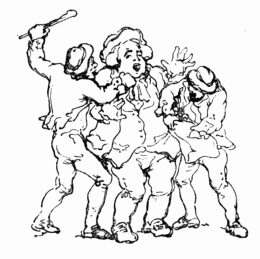
'Our first interview originated in Paris (about 1775); he was then studying in
the French school. Lately, having to dispose of my collection (I may say
unique), my friend Bannister purchased it of me, and it was added to his many
choice and valuable drawings of the first masters, which were so very superior
that the four thieves ought to have esteemed it an honour to be placed in such
good company.[11]
'The next night a gentleman was robbed in Soho Square in like manner.
Soon afterwards several suspicious characters were taken to an office then in
Litchfield Street, Soho, suspected of street robberies, and Rowlandson and
myself went there out of curiosity, accompanied by many others who had been
robbed. They were all placed before us, but none were identified. Rowlandson
was particularly called upon to look around him, but to no purpose. One man
in particular made himself more conspicuous than all the others, treating his
curiosity with contempt, saying, "I defies the gemman to say as how I ever
stopped him any vare." "No; but you are very like the description of the
ruffian," answered Rowlandson, "who robbed a gentleman last Wednesday night
in Soho Square." This was a thunderbolt to the man, who instantly looked pale
and trembled. The gentleman was immediately sent for, and as soon as he
entered the room, though there were several for examination, he fixed directly
on the man that had been suspected. At the sessions following he was found
guilty of robbery, and hanged. This pleased my friend mightily; "for, though I
got knocked down," said he, "and lost my watch and money, and did not find the
thief, I have been the means of hanging one man. Come, that's doing something."'
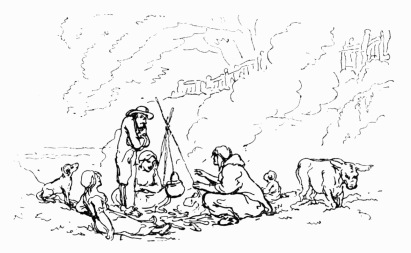
We incidentally learn a few particulars of subjects which found their way into
Angelo's gallery, the collection which subsequently came into the possession of
his excellent friend Bannister.
'Black and White.—Being fond of the arts and particularly of caricatures,
I had by me a great number of Rowlandson's, to one of which I was puzzled
to give a name. The subject was an old man, at breakfast, seated near the fire,
his gouty leg on a stool, and the kettle boiling over; the water is falling
on his leg, and he is ringing the bell. The room door is open behind him,
and a black servant is kissing the maid, who is bringing in the toast. I
requested Theodore Hook to write a title to it, and he put, "Chacun à son
goût."'[12]
We are further afforded an opportunity of recording Rowlandson's enthusiasm
for his profession. The details of a certain visit he paid, with Angelo, to
Portsmouth, and the unflinching nerve he exhibited under circumstances which
were calculated to distress a less robust constitution, are thus recounted by his
friend and travelling companion:—
'The general rumour, after Lord Howe's action on June 1, 1794, was that
he would return to Portsmouth. I was anxious to see the sight, for it was
expected he would bring the French prizes with him.
'The evening after my arrival, according to promise, Rowlandson the artist
came to join me.
'The morning following we saw, on the Gosport side, the landing of the
French prisoners, numbers of different divisions filing off to the different stations
allotted them. As for the wounded, previous to their quitting the boats, carts
were placed alongside, and when filled, on the smack of the whip, were ordered
to proceed. The sudden jolting made their groans appalling, and must have
occasioned the wounds of many to produce an immediate hemorrhage. The
sight was dreadful to behold: numbers were boys, mutilated, some not more
than twelve years old, who had lost both legs. In the evening we went to
Forton Prison. Those who were not in the last engagement were in high spirits
in their shops, selling all sorts of toys and devices, made from shin-bones, &c.
In one of the sick-wards we saw one of the prisoners, who, an officer told us
had been a tall, handsome man, previous to the battle; but, having received a
shot that had lacerated his side, a mortification had taken place. He was then
making his will; his comrades were standing by, consoling him, some grasping
his hand, shedding tears.
'This scene was too much for me, and made such an impression on my mind
that I hastened away; but I could not persuade Rowlandson to follow me, his
inclination to make a sketch of the dying moment getting the better of his
feelings. After waiting some time below for my friend, he produced a rough
sketch of what he had seen:—a ghastly figure sitting up in bed, a priest holding
a crucifix before him, with a group standing around. The interior exhibited the
contrivance of the French to make their prison habitable. When finished, it
was added to my collection, a memento of the shocking sight I beheld at Forton
Prison.
'Our curiosity not stopping here, we entered another sick-ward, but the stench
and closeness of the place, crowded as it was, prevented our remaining there
more than a very short time. The next day, having seen quite enough, I
returned to town. Rowlandson went to Southampton, where he made a number
of sketches of Lord Moira's embarkation for La Vendée. I saw them afterwards,
and was delighted, for it appeared he had taken more pains than usual, and he
must have portrayed them well, from having been on the spot himself at the
time. The shipping and the various boats filled with soldiers were so accurately
delineated, that I have often since regretted that I did not at that time purchase
them. Mr. Fores of Piccadilly, who had by him many of the very finest drawings
executed by Rowlandson in his best days (for latterly they were inferior),
fortunately purchased them. He was one of his first and best patrons; and I
understand he had twenty-five folio volumes of the most choice caricatures of the
last and present centuries, which must have been an invaluable recueil, showing
not only what we have been, but the age we lived in. Had Rowlandson gone
with the expedition then landing in La Vendée as a draughtsman, the attack at
Fort Penthièvre, and the incident that followed, would have furnished us with
many eventful scenes of that fatal expedition.'
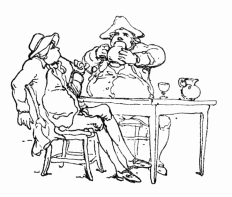
As we have related, Rowlandson was no
stranger to the Continent; in the early part of
his career he was constantly abroad. We have
shown how he studied in Paris; afterwards we
find him wandering farther afield, and taking
in Germany and the Netherlands. Then we
are introduced to him as a man of fashion,
bowling through the legacies which had fallen
to his lot, both in the French metropolis and
in London, calmly sitting down to gamble away his fortune by the shortest route
with the best will in the world. Anon he accompanies his friend Mitchell the
banker on a wider tour. Then we hear of his sojourning in Paris with other
congenial spirits, and making the most of the passing season with his friends
John Raphael Smith, Westmacott, and Chasemore: on all these occasions he
produced drawings innumerable; his most frequent travelling companion seems,
however, to have been his steadfast patron the banker, and it was this liberal
collector who rejoiced in the opportunity of securing the artist's most desirable
Continental studies. Our oft-quoted authority Angelo, who, happily for those
who entertain an interest in the caricaturist, never tires of telling little anecdotes
of his chum Roley, in his own familiar manner relates a few particulars
of the figure these worthies made in the eyes of the Monsieurs, amongst whom
their visits were favourably received.
'Mr. Mitchell, however, possessed the best collection of Rowlandson's French
and Dutch scenes. Among those were many in his most humorous style, particularly
a Dutch Life Academy, which represents the interior of a school of
artists, studying from a living model, all with their portfolios and crayons,
drawing a Dutch Venus (a vrow) of the make, though not of the colour, of that
choice specimen of female proportion, the Hottentot Venus, so celebrated as a
public sight in London, a few years since.
'This friend and patron of Rowlandson, Mr. Mitchell the quondam banker, of
the firm of Hodsol and Co., was a facetious, fat gentleman—one of those pet
children of fortune, who, wonderful as it may appear, seem to have proceeded
through all the seven ages (excepting that of the lean and slippered pantaloon),
without a single visit from that intruder upon the rest of mankind, yclept Care.
In him centred, or rather around him the Fates piled up, the wealth of a whole
family. He was ever the great gathering nucleus to a large fortune. He was
good-humoured and enjoyed life. Many a cheerful day have I, in company
with Bannister and Rowlandson, passed at Master Mitchell's.'
Under the auspices of this great banker, Rowlandson subsequently made a
tour to France, and other parts of the Continent. 'His mighty stature astonished
the many, but none more than the innkeepers' wives, who, on his arrival, as
he travelled in style, looked at the larder, and then again at the guest. All
regarded him as that reported being, of whom they had heard, the veritable
Mister Bull. His orders for the supplies of the table, ever his first concern,
strengthened this opinion, and his operations at his meals confirmed the fact.
'Wherever he went he made good for the house.
'On this tour, Rowlandson made many topographical drawings, in general
views of cities and towns; amongst others, the High Street at Antwerp, and the
Stadt House at Amsterdam, with crowds of figures, grouped with great spirit,
though his characters were caricatures.
'The most amusing studies, however, which filled the portfolio of his patron
were those that portrayed the habits and customs of the Dutch and Flemish, in
the interior scenes, which they witnessed in their nocturnal rambles in the inferior
streets at Antwerp and Amsterdam. Some of these compositions, drawn
from low life, were replete with character and wit. One of the most spirited and
amusing of these represented the interior of a Treischuit, or public passage-boat,
which was crowded with incident and humour.'[13]
Another reminiscence of Rowlandson and Mitchell is found in the Somerset-house
Gazette, edited by Ephraim Hardcastle (W. H. Pyne), an intimate associate
of the caricaturist and a member of the artist's circle of friends.
'I look back with pleasure to former days, when old Mr. Greenwood used
to hold the print auctions by candle-light, and have a perfect recollection of his
good-humour and upright dealing. I well remember, too, a number of artists and
amateurs who constantly attended his room, to purchase etchings of the old
masters for themselves and friends.
'Old Parsons, as he was called, and young Bannister, the celebrated comedians,
were both collectors and amateur artists: the latter was considered an excellent
judge of prints. Rowlandson, the humorous draughtsman, and his friend and
patron Mr. Mitchell the banker, of the firm of Hodsols, were also frequently of
this evening rendezvous of artists, amateurs, and connoisseurs.'
John Thomas Smith, the whilom pupil of Nollekens the sculptor (with whose
life he favoured the public), and one of Mr. Reid's predecessors as Keeper of the
Print Room of the British Museum, in his loquacious Book for a Rainy Day
rambles into the subject of picture sale-rooms, and notes the eccentric characters,
collectors, and their individualities, to be met with thereat in his time. On this
subject 'Antiquity Smith's' account tallies with that given by Angelo. We have
confined our extract to the paragraph which introduces the caricaturist as a crony
and erst fellow-pupil of the versatile chronicler.
'I must not omit to mention another singular but most honourable character,
of the name of Heywood, nick-named "Old Iron-wig." His dress was precise,
and manner of walking rather stiff. He was an extensive purchaser of every
kind of article in art, particularly Rowlandson's drawings; for this purpose he
employed the merry and friendly Mr. Seguier, the picture-dealer, a school-fellow
of my father's, to bid for him.
'I shall now close this list by observing that my friend and fellow-pupil,
Rowlandson, who has frequently made drawings of Hutchins and his print
auctions, has produced a most spirited etching, in which not only many of the
above described characters are introduced, but also most of the print-sellers of
his day.'
The editor of this work has seen a drawing by Rowlandson of this very
auction, the cognoscenti gathered round the long tables lighted with flickering
candles, and peering over the engravings, glasses on nose, while the auctioneer
was endeavouring to excite the interest of the company in the prints brought
to his rostrum.
Before we pass on to other contemporaries of the caricaturist, we think it
advisable to introduce the reader to the society which Rowlandson shared round
the hospitable mahogany of the banker, who, like Wigstead, Nixon, Weltjé, and
certain other generous hosts of our artist's acquaintance, appears to have kept open
house for the entertainment of choice friends, where the enjoyments of social
intercourse were prolonged to the verge of dissipation, and the fun, which enlivened
their hours of relaxation, was frequently kept up until the next day was
well advanced; the associates being loth to interrupt the pleasures of their
sitting, protracted as their gaieties might be considered according to the more staid
usages of a better regulated age, such as we have been taught to regard our own.
'Mr. Mitchell resided for many years in Beaufort Buildings, Strand, and
occupied the house tenanted by the father of Dr. Kitchiner, of eccentric memory.
Here, after the closing of the banking-house, he was wont to retire, and pass a
social evening, surrounded by a few chosen associates whose amusements were
congenial, and whose talent well paid the host for his hot supper and generous
wine. Often, even beyond the protracted darkness of a winter's night, he and
his convives have sat it out till dawn of day, and seen the sun, struggling through
the fog, from the back windows, shed its lurid ray on the rippling waters of the
murky Thames.
'Well do I remember sitting in this comfortable apartment, listening to the
stories of my old friend Peter Pindar, whose wit seemed not to kindle until
after midnight, at the period of about his fifth or sixth glass of brandy and
water. Rowlandson, too, having nearly accomplished his twelfth glass of punch,
and replenishing his pipe with choice oronooko,
would chime in. The tales of these
two gossips, told in one of these nights, each
delectable to hear, would make a modern
Boccaccio.'
Angelo, in his capital chatty Memoirs,
relates an anecdote of one of Wigstead's
pranks played off on the satirist Peter Pindar,
whose trenchant wit spared 'nor friend nor foe;' but, in his turn, Dr. Wolcot
did not relish ridicule, especially when it happened to be excited at his own
expense. It was discovered that, eminently satirical as was the bard with his
pen, he was not emulous to shine as a wit in colloquial intercourse with strangers,
or even amongst his most intimate associates. It was asserted, with some fidelity,
that 'Dr. Wolcot's wit seemed to lie in the bowl of a teaspoon.' 'I could not
guess the riddle,' writes the discursive and cheerful author of the Reminiscences,
'until one evening, seated at Mitchell's, I observed that each time Peter replenished
his glass goblet with cognac and water, that, in breaking the sugar, the
corners of his lips were curled into a satisfactory smile, and he began some
quaint story—as if, indeed, the new libation begot a new thought.
'Determined to prove the truth of the discovery which I fancied I had made,
one night after supper, at my own residence in Bolton Row, he being one among
a few social guests, I made my promised experiment. One of the party, who
delighted in a little practical joke, namely Wigstead, of merry memory, being
in the secret, he came provided with some small square pieces of alabaster.
Peter Pindar's glass waning fast, Wigstead contrived to slip the fragments of
spurious sweetness into a sugar-basin provided for the purpose, when the Doctor
reaching the hot water, and pouring in the brandy, Wigstead handed him the
sugar-tongs, and then advanced the basin of alabaster. "Thank you, boy," said
Peter, putting in five or six pieces, and taking his tea-spoon, began stirring as he
commenced his story.
'Unsuspicious of the trick, he proceeded: "Well, sirs,—and so, the old
parish-priest.—What I tell you (then his spoon went to work) happened when I
was in that infernally hot place, Jamaica (then another stir). Sir, he was the
fattest man on the island (then he pressed the alabaster); yes, damme, sir; and
when the thermometer, at ninety-five, was dissolving every other man, this old
slouching, drawling, son of the Church got fatter and fatter, until, sir—curse
the sugar! some devil-black enchanter has bewitched it. By —— sir, this sugar
is part and parcel of that old pot-bellied parson—it will never melt;" and he
threw the contents of the tumbler under the grate. We burst into laughter, and
our joke lost us the conclusion of the story. Wigstead skilfully slipped the
mock sugar out of the way, and the Doctor, taking another glass, never suspected
the frolic.'
Let us take a further glimpse of the social meetings which Rowlandson shared
in company with Angelo, who duly set down the outlines of the evenings'
diversions in his Memoirs. As this anecdote introduces a personage who figures
somewhat prominently amidst the more lively records of the period, we must be
allowed to say a word or two about the giver of the feast, where we are admitted
by favour and enabled to watch the proceedings from a distance.
Another excellent friend, occasional host, and boon companion of our
caricaturist was, as we have mentioned, Weltjé, the Prince of Wales' cook and
steward, a German of eccentric proclivities, who was pretty universally recognised
as a character in his generation. The huge person of this worthy is
frequently introduced into the social satires of the period; the artistic and literary
wags alike delighted to make the figure of the old bon-vivant conspicuous; it
seems that Weltjé was in no wise offended at this popularity, however unflattering
might be the intentions of the wicked wights; he was a calm humoristic
philosopher, whose composure was not easily deranged, and in return for their
mischievous sallies, which only amused him, he made the wits, who grew waggish
at his expense, his guests at his residence Hammersmith Mall; where he kept
such a table as attracted all classes of society, and to which his friends were ever
welcome. Weltjé's culinary accomplishments, united with his hospitable proclivities,
rendered him a truly remarkable host; his good humour was imperturbable,
his store of anecdotes inexhaustible, and his German bluntness rather added to
the charm of his pleasantries; even that superfine Sybarite and highly sensitive
exquisite, the Heir Apparent, Mr. Weltjé's patron and employer, was glad to
dissemble his offended dignity when his precious and immovable cook was the
assailant. Angelo, who declares he owed many a convivial day to the kindness
of this rough diamond, assures us in his Reminiscences: 'Whether at Carlton
House or his own, Weltjé was always remarkable for singularity. I have been
told that when Alderman Newnham was one day dining at Carlton House, the
Prince said to him, "Newnham, don't you think there is a strange taste in the
soup?" "It appears so to me, your highness." "Send for Weltjé." When Weltjé
made his appearance, the Prince observed that the soup had a strange taste.
Weltjé called to one of the pages, "Give me de spoone," and putting it in the
tureen, after tasting it several times, said, "Boh! boh! tish very goote," and
immediately left the room, leaving the spoon on the table, without taking further
notice of the complaint.'
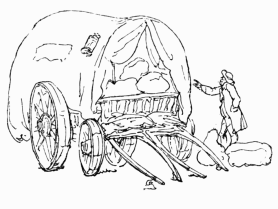
It is not, however, with the worthy Weltjé at Carlton House, but at his own
villa, that we have to deal. Angelo
introduces us to a capital
dinner-party which took place at
Hammersmith Mall, when the old
associates, Rowlandson, Bannister,
and Munden, were among the
guests; Madame Banti the opera-singer,
and Taylor, also of the
Opera House, with Mr. Palmer of
Bath, contributed to make up a
tolerably festive party. The dinner
was long and bien recherché; the
dishes choice, and cooked in superior style; the sprightly conversation, in which
the company delighted, had been somewhat suspended during the discussion of
a great variety of entremets, which were duly appreciated by all the guests, and
especially by Madame Banti, who not only tasted of every dish, but, in addition
to a quantity of strong ale, drank a bottle of champagne. The guests were preparing
for that flow of wine and conversation which were the agrémens of social
intercourse at the period. The repast was concluded as everyone imagined,
and nobody felt disposed to touch another morsel, when Weltjé's grand piece of
the entertainment made its appearance—a huge boar's head, at which delicacy
everyone stared in consternation.
Weltjé plunged into his element, mixing up sauces piquantes at table, of such
ingredients as oil, lemon, cayenne, and different concomitants.
The guests, already lavishly regaled, were inclined to expostulate. 'Indeed,
Weltjé, we have had more than enough.' 'Boh!' responds the entertainer,
'I vill
make you all hungry again; two heads gomed to dis gontry, von for me, toder
for de Queen, dat de Prince of Bronsvick sent;' and away proceeded the compounding
of sauces. The long interval occupied in Weltjé's culinary preparations
was shortened by droll anecdotes, peculiar to his own description, introduced for
the purpose of distracting the attention. Such was his account of his adventure
on his return home to Hammersmith, in his carriage, from Carlton House.
'Fon I gote to de fost dumbpike beyond Kensington, from town, de goach
stobed some time, fon me say, "Godam, ged on:" fon de dumbike say, "Sir, dere
be nobody on de bokes." I was very much fraightened, so I did ged up mine-self.
The next day gome de goachman: "Pray, sir, fon am I to ged the carriage
ready?" "Tartifle, what become of you last night?"' The coachman, it appears,
had fallen off the box in a drunken stupor; unhurt, he had, never troubling himself
about his charge, taken a nap all night under a hedge, and attended on his
master the next morning to receive orders as coolly as if nothing unusual had
happened. The sauce piquante is ready by the time the host has raised a few
laughs; clean plates are handed round; a large dish is filled with slices of the
boar's head, swimming in provocative mixtures; and the guests fall to again;
verifying, as Angelo relates, the French proverb that, l'appétit vient en mangeant,
or, as Hamlet says, 'As if increase of appetite had grown with what it fed on.'
The second repast proved so excellent that the plates were continually replenished.
The poets, painters, actors, musicians, and others, who crowded Weltjé's
liberal entertainments, with 'those whose superior station was more suited to a
palace,' then gave themselves up to unrestrained mirthfulness. The dinner
Angelo describes will serve as a type of the many similar entertainments at
which our caricaturist assisted. With the dessert Madame Banti became somewhat
lively, from her repeated libations of champagne, being, as Angelo informs
us, 'in higher spirits than any French woman I had ever seen. With the
enthusiasm of a true John Bull, she sang "God save the King," that she might
have been heard on the other side of the river. Munden, whom she had never
seen before, sang the "Old Woman of Eighty;" and to give effect to the song, tied
his pocket-handkerchief round his head, though his superior humour needed no
addition. When he had finished his song, Banti left her seat in ecstasy, and
went to the other side of the table, where he and I were sitting, and was so
pleased with his mummery (it could be nothing else, for Joe never was an
Adonis), that she came behind his chair and kissed him; which, however, did
not excite a blush, but an agreeable surprise. What with the songs, the choice
wines, the delicious fruits (from Weltjé's hothouse), and the zest given to the
entertainment by Banti, it formed such a delightful treat, that the evening passed
too quickly, and it was time to depart long before we were sated with "the feast
of reason and the flow of soul."'
To return to the working life of our caricaturist: it must be borne in mind
that Rowlandson's journeys were not confined to the Continent; from drawings
which have come under our attention, we find he must have seen the Lakes; it
is highly probable that he paid a visit to Henry Bunbury, who, towards the close
of his life, settled at Keswick, where he died in 1811. We also know, from his
works, that our artist was familiar with England and Wales: his tours, with his
friend Henry Wigstead, have produced many interesting souvenirs; we have
described how they travelled to Wales, and how, too, they saw Cheshire, Cornwall,
Devon, and Somerset; we find them scampering off to the newly established
Brighthelmstone, and to the more old-fashioned watering-places on the
coast of Kent. It was at Margate that Rowlandson lost his most congenial
associate, who having gone there, in the autumn of 1800, for the benefit of his
health, did not live to return; the death of Henry Wigstead was a serious
bereavement to the caricaturist, the earliest of those losses of his cherished associates
which influenced his spirits considerably.
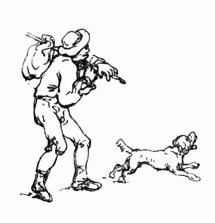
We can also catch glimpses of Rowlandson on
the Scarborough coast, and in Norfolk. Yarmouth
seems to have been a favourite spot with him. We
find him studying at seaports along the south coast;
with Plymouth, Portsmouth, and Southampton he
was thoroughly familiar. Of the Thames and the
Medway, and the shipping to be encountered thereon
in war-time, he has left sketches innumerable; he
has visited the fishing spots on the former, and
drawn the pretty towns which mark the valley of the river. With London, and
its diversified spots of interest, from east to west, and north to south—the
centre, and the outskirts alike—he had the most intimate acquaintance. We
have already spoken of the drawings he made in the two University cities, and
his series of views of the noble colleges.
An Historical Sketch of the Art of Caricaturing was written by the well-known
antiquarian J. P. Malcolm, F.S.A., and published in 1813. This book,
which might, had the author so willed, have supplied the curious with valuable
hints, drawn from personal acquaintance, concerning professors of the art then
living, is confined to the briefest recapitulation, as far as concerns contemporary
works, the book being retrospective in principle; and it is difficult to discover
any allusions of value to those Caricaturists lately deceased or who were still
alive. Malcolm's appreciation of grotesque art was somewhat catholic, but he
does not seem as familiar as might reasonably be supposed the case, with the
masterpieces of the men who were flourishing in his time, or perhaps their chefs
d'œuvre were then so generally familiar as to need no further recognition. The
compiler of the Historical Sketch was evidently an amateur of humorous productions,
and could describe the progress of grotesques, but he does not seem to
have completely carried out the scheme of his treatise.
We have borrowed a paragraph from this excellent antiquarian, as an instance
of his criticisms on the subject of the present volume.
'Rowlandson's Views in Oxford and Cambridge, 1810, deserve notice for the
slight and pleasing manner with which he has characterised the architecture of
the places mentioned; but it is impossible to surpass the originality of his figures;
the dance of students and filles de joie before Christ Church College is highly
humorous, and the enraged tutors grin with anger peculiar to this artist's pencil.
The professors, in the view of the Observatory at Oxford, are made as ugly as
baboons, and yet the profundity of knowledge they possess is conspicuous at the
first glance; and we should know them to be Masters of Arts without the aid
of the background. The scene in Emanuel College Garden, Cambridge,
exhibits the learned in a state of relaxation; several handsome lasses remove
apples from a tree, and the indolent curiosity
with which they are viewed by these sons of
ease is very characteristic.'
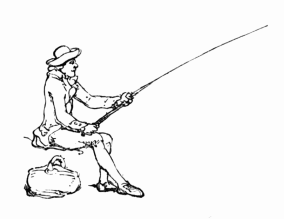
While considering Rowlandson in relation
to his contemporaries, we have chiefly to deal
with those gifted gentlemen who were, like
himself, generally spoken of in their generation
as caricaturists, and to whose works our
artist was able, from his more considerable
acquirements, to give a presentable form, and
put into circulation through the medium of his proficiency with the etching-needle.
Foremost among these we must speak of Henry Bunbury, so many of whose
felicitous conceptions have derived additional force and popularity alike through
the agency of our artist.
In speaking of the caricaturist's treatment of these amateur works, we are
glad to be able to offer our readers the respectable testimony of Thomas Wright
in support of our own modest opinion, with which intention we quote a few
paragraphs from our late friend's History of Caricature and Grotesque in Literature
and Art.
'At various periods certain of Bunbury's designs were engraved by Rowlandson,
who always transferred his own style to the drawings he copied. A
remarkable instance of this is furnished by a print of a party of anglers of both
sexes in a punt, entitled Anglers of 1811 (the year of Bunbury's death). But
for the name, "H. Bunbury, del.," very distinctly inscribed upon it, we should
take this to be a genuine design by Rowlandson; and in 1803 Rowlandson
engraved some copies of Bunbury's prints on horsemanship for Ackermann, of the
Strand, in which all traces of Bunbury's style are lost.
'There was much of Bunbury's style in that of Woodward, who had a taste
for the same broad caricatures on society, which he executed in a similar spirit.
Some of the suites of subjects of this description that he published, such as the
series of the Symptoms of the Shop, those of Everybody out of Town, and Everybody
in Town, and the specimens of Domestic Phrensy, are extremely clever and
amusing. Woodward's designs were also not unfrequently engraved by Rowlandson,
who, as usual, imprinted his own style upon them. A very good example
of this practice is seen in the print entitled Desire, in which the passion is
exemplified in the case of a hungry school-boy, watching through a window a
jolly cook carrying by a tempting plum pudding. We are told in an inscription
underneath: "Various are the ways this passion might be depicted; in this
delineation the subjects chosen are
simple—a hungry boy and a plum
pudding." The design of this print
is stated to be Woodward's; but the
style is altogether that of Rowlandson,
whose name appears on it as the
etcher. It was published by R. Ackermann
on January 20, 1800.'
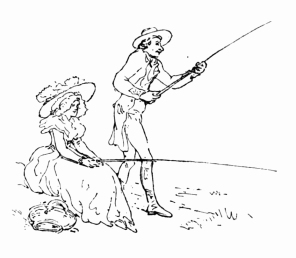
In transferring the works of other
caricaturists to the copper, Rowlandson
was in the habit of giving his own
style to them in such a degree that
nobody would suspect they were not
his own if the name of the designer were not attached to them.
We cannot take leave of the Caricaturists without offering a few slight particulars
concerning the respective careers of the most eminent and appreciated
practitioners of the graphic art in its grotesque bearings.
The fecundity of invention displayed in the works of Henry Bunbury
entitles him to rank among the first in this class of designers. The happy
faculty which he possessed of 'reading character at sight,' and the rare felicity
with which he could embody whatever his observation or fancy suggested,
with that scrambling style which was entirely his own, evince that he was born
with a genius to make a figure in this pursuit. This gentleman may be instanced
as a proof, too, that where there is an original faculty for any peculiar art, it will
develop itself, though the possessor may be entirely unacquainted with the
scientific principles of art. Nothing could be farther removed from legitimate
art than the style exhibited in the drawings of Bunbury; yet no one has hit off
the peculiarities of character, or expressed with less exaggeration those traits
which constitute the burlesque. Bunbury, indeed, may be said to have steered
his humorous course between sterling character and caricature. When he
appears to outrage nature by representing distortion of figure or form, the fault
is not intentional. Those who have not properly studied the drawing of the
human figure, must occasionally, in spite of themselves, render their objects
preternatural.
It should be added, in honour to the memory of this gentleman, that he
never used his pencil at the expense of personal feeling. His satire upon the
French people was not individual, but national; and the characters which he
introduced in his humorous designs at home, were characteristic of a class, but
never the individuals of a species.
Henry William Bunbury, the caricaturist, was born in 1750. He was educated
at Westminster, whence he was removed to St. Catherine's Hall, Cambridge.
On leaving the university he devoted himself, with some enthusiasm,
to the fine arts. He was passionately fond of out-door
sports, and, as in the instance of Leech in our own days,
the saddle held out attractions superior even to the
pleasure of exercising his fancy. His contemporaries were
much given to deplore that he preferred the excitement of
risking his neck in the hunting field to the cultivation of
the profession his skill should have adorned. His taste
and invention were admired not only by the most gifted
and elevated persons of his time, but artists and critics alike lavished their
encomiums on the favoured designer. Horace Walpole coveted the sketches
which Bunbury exhibited on the walls of the Academy, while Sir Joshua
Reynolds and Sir Benjamin West combined to pay their finest compliments
to the artist, and to publish abroad their flattering sense of his merits. Bunbury
appears to have spent the greater part of his time on the estates belonging
to his family, varied by trips to the Continent and visits to his patrons the
Duke and Duchess of York, at Richmond and other residences, with occasional
sojourns in Wales, the scenery of which had considerable attractions for his sense
of the picturesque. He was a frequent guest of Sir W. W. Wynne, and his
pencil has celebrated the theatrical gatherings at Wynnstay. We also meet him
in town, surrounded by illustrious friends, and we find Goldsmith, Garrick, and
other notabilities corresponding with the kindly and generous caricaturist during
his sojourns at his country seat.
Henry Bunbury was married, August 26, 1771, to Catherine, daughter of
Kane William Horneck, Esq., lieutenant-colonel of the army of Sicily. This
lady bore him two sons, and one of them, Sir Henry Bunbury, we believe,
represented the county of Suffolk in Parliament, after the decease of his uncle
Sir Thomas Charles Bunbury, who had previously enjoyed the distinction.
Bunbury, the artist, was elected lieutenant-colonel of the West Suffolk regiment
of militia. His manners were most popular, and it was remarked that he carried
his cheerful and vivacious spirit into every society he frequented. He died at
Keswick, in Cumberland, where he had settled towards the close of his life,
and his sketches of the mountain scenery in his vicinity are said to have displayed
the hand of a master, and to have gained universal appreciation for their
effect and truthfulness.
As a delineator of character, it is stated 'that his sketches approached
nearest to Hogarth of any painter of his period, in the representation of life and
manners; his pencil never transgresses the limits of good taste and delicacy, and
had he been under the necessity of pursuing art for profit, instead of amusement
and pleasure only, he would probably have made a great fortune by the produce
of his genius, which the print-sellers have found a lucrative source of gain,
engravings and etchings after his works having always been eagerly demanded.'
The high estimation in which the caricaturist was personally held is confirmed
by the obituary notice which appeared on his decease in the Gentleman's
Magazine; the praise seems to be spontaneous, and its object, from all we can
gather, richly merited the friendly testimony.
'May 7, 1811.—At Keswick, Henry William Bunbury, Esq., second son of
the Rev. Sir William Bunbury, Bart., of Mildenhall, and of Great Barton, in the
county of Suffolk, and brother to the present Sir Thomas Bunbury, Bart. He
was distinguished at a very early age by a most extraordinary degree of taste
and knowledge in the fine arts. The productions of his own pencil have, from
his childhood, been the admiration and delight of the public. The exquisite
humour of some of his drawings, and the grace and elegance of the rest, were
unrivalled; and he is, perhaps, the only instance in which excellences of such
various and almost opposite character have been united in the same subject in
an equal degree. But though he possessed in this respect a peculiar genius, he
neglected no branch of polite literature. He was a good classical scholar, and
"endowed with the love of sacred song." The Muses were to him dulces ante
omnia. He was an excellent judge of poetry; and the specimens remaining of
his own composition put it beyond a doubt that he would have been as eminent
with his pen as with his pencil, if his natural modesty, underrating his own
powers, had not prevented him from pursuing it with more application. These
accomplishments were conspicuous, and obtained for him universal esteem. His
social and moral qualities, while any of those remain who shared his friendship,
will continue the objects of fond admiration and regret. No ribaldry, no profaneness,
no ill-natured censure, ever flowed from his lips, but his conversation
abounded in humour and pleasantry; it was charming to persons of all descriptions.
No one was ever in his company without being pleased with him; none
ever knew him without loving him. His feelings were the most benevolent, his
affections the most delicate, his heart the most sincere. He was void of all
affectation, alive to praise, but not obtrusively courting it. Conscious, but not
ostentatious of merit; of unblemished honour; full of that piety and liberal-handed
charity which influences the heart, and seeks the witness, not of the
world, but of his Maker.'
The writer of the obituary notice expressed a conviction, confirmed, as he
stated, by an intimacy of fifty years' standing:—
'All who had,' concludes the memorial, 'the slightest acquaintance with him,
will bear witness to the extraordinary tenderness of his disposition, to his kind
and active friendship, to his
universal benevolence, practically
displayed through his
entire career.'
The name of Woodward
occurs so frequently in caricatures
to which Rowlandson
sculpsit is added, that our
readers will probably not consider
the following sketch of
this eccentric gifted celebrity
either out of place, or entirely
superfluous.
Recapitulating his recollections of humorous artists, Angelo informs us that—'The
inventive genius of one burlesque designer was exhaustless—George Moutard
Woodward, commonly designated by his merry associates, Mustard George.
This original genius was the son of the steward of a certain wealthy landholder,
and resided with his father in a provincial town, where nothing was less known
than everything pertaining to the arts. He was, as his neighbours said, a "nateral
geni;" for he drew all the comical gaffers and gammers of the country round;
and having, to use his own words, "taken off the bench of justices, wigs and all,
shown up the mayor and corporation, dumb-foundered the parson of the parish,
silenced the clerk, and made the sexton laugh at his own grave occupation," he
thought it expedient to beat up for new game in the metropolitan city.
'"A caricaturist in a country town," said George, "like a mad bull in a china-shop,
cannot step without noise; so, having made a little noise in my native
place, I persuaded my father to let me seek my fortune in town."
'It appears that the caricaturist came not to London, like many another wit,
pennyless; his father allowed him an annuity of first fifty, and augmented the sum
to a hundred pounds. With this income, and what he obtained by working for
the publishers, he was enabled to enjoy life in his own way; and might be met, with
a tankard of Burton ale before him, seated behind his pipe, nightly at Offley's;
or, if not there, smoking the fragrant weed, at the Cider Cellar, the Blue Posts,
or The Hole in the Wall. Latterly, his rendezvous was transferred to The
Brown Bear at Bow Street, where he studied those peculiar species of low
characters, the inhabitants of the round-house, and the myrmidons of the police.
Enamoured with the society of these able physiognomists, he ultimately took up
his quarters at the Brown Bear, and there, to the lively grief of these tenderhearted
associates, one night died in character, suddenly, with a glass of brandy
in his hand.
'The wit and invention of this artist places him above all others in the personification
of low scenes of humour. Among his earliest productions were
those series of groups entitled Effects of Flattery, Effects of Hope, &c., which
were illustrated by scenes of truly dramatic excellence, and upon
which might well be built farces for the stage which could not fail
to delight the town. His Babes in the Wood, Raffling for a Coffin,
The Club of Quidnuncs, as pieces of original humour, have never,
perhaps, been equalled. Had this low humourist studied drawing
and been temperate in his habits, such was the fecundity of his
imagination and perception of character, that he might have
rivalled even Hogarth. His style, always sufficiently careless,
latterly even outraged the outré. Yet there were those, and men of taste too,
who insisted that the humour of his pieces was augmented by the extravagance
of this defect.'
The name of Henry Wigstead will be met with pretty constantly in the
course of this volume; his designs approach the nearest to those of Rowlandson
as far as regards humorous qualities, a cultivated sense of beauty
and grace, and a decided grasp of character, without that violent divergence
from the semblance of humanity as ordinarily recognised, to which failing the
old-fashioned caricaturists were somewhat over-addicted, as we are inclined to
suspect; but, like many worthy amateurs of his period, his own hand lacked
the skill to express all that his eye saw and his taste appreciated. In the
guise of a skilled translator of crude ideas, our Caricaturist, with ready ease,
and that dexterity which was peculiarly his own, came to the rescue most efficiently,
and his etchings and scrapings have preserved many a capital design,
due to the esteemed Wigstead, which otherwise would have been lost; the
sterling excellence to be detected in many of these pictorial scenes and satires,
renders the action meritorious, which has enabled posterity to judge how far
those praises which partial contemporaries lavished upon all these non-professional
humourists, were justified by the actual merits of their subjects. We
have already recounted certain jocose and whimsical traits in the disposition and
career of this genial son of merriment; we have nothing to add but the brief
notice from the obituary of The Gentleman's Magazine for October 1800,
which informed many a congenial friend of the loss society had sustained, and
made many a heart feel saddened by the stroke which had fallen on the kindliest
and best of comrades.
'At Margate, where he went for the benefit of his health, Henry Wigstead,
Esq., of Kensington, an active magistrate for the county of Middlesex.[14] He
was a man of considerable talent, and contributed to the celebrity of the Brandenburgh
theatre, both by his pen and his pencil. He was a good caricaturist,
which naturally made him more enemies than friends. He was hospitable and
generous to a degree of extravagance. He married the daughter of Mr. Bagnal,
of Gerard Street, with whom he had a good fortune, and by whom he leaves
two children, a son and a daughter.'
Another eminent humourist, in whose praise contemporaries were enthusiastic,
but whose biography no one has taken the pains to collect, was John Nixon, the
facetious Nixon, as he is generally entitled in the memoirs and scribblings of the
period; beyond the kindly appreciative anecdotes of this worthy, set down by
Angelo, barely any record exists. Pleasant John Nixon was an Irish factor, and
resided for many years in Basinghall Street, where, over his dark warehouses,
he and his brother Richard kept 'bachelors' court.' The elder brother, John,
however, was the principal mover in all the convivialities and Bacchanalian
revels celebrated in this old-fashioned dwelling; 'which was not too large for
comfort, and yet sufficiently spacious in the first floor, at least, to spread a table
for twelve. Who that were witty, or highly talented of the days that are gone,
who, loving a social gossip, over a magnum bonum of capital wine, had not been
invited to his hospitable board?' The Nixons were wealthy, and had the
felicity to be well enabled to enjoy life according to their own liking.
John Nixon, besides possessing a well-deserved reputation for social qualifications
of no ordinary calibre, was a man of taste and talent, and an amateur
performer in various arts, his accomplishments being multifarious.
As a man of business he was highly respected, as a man of pleasure universally
sought, and as generally esteemed. Sedulous in his commercial pursuits,
in the counting-house his maxim was that there is time for all things, and he
found leisure daily, when the ledger was closed, to open his heart to the enjoyments
of friendly intercourse. 'I have no objection to placing my knees under
another man's table,' the social convive would say, 'but I had rather seat him at
my own.'
Nixon was at home at the Beef-steak Club, where he was made honorary
secretary and providore, a well-bestowed distinction, since he was a first-rate
connoisseur of wines, and a capital judge of a rump of beef. 'My lord duke,' he
would say to the noble president, 'he who would invite Jupiter to a feast on a
steak, should select a prime cut of little more than half-an-inch thick, from a
Norfolk-fed Scot,' and this, says Angelo, became statute law in that glorious club.
Among other pursuits for which Nixon obtained notoriety among the haut
ton, he was known for his fondness for the stage. An excellent amateur performer,
he shone as one of the stars of the celebrated private theatricals held at
Brandenburgh House, when in the possession of the Margrave and Margravine
of Anspach. It was under the splendid roof of these entertainers, on an occasion
when all the amateurs were celebrating their
host's anniversary, that Nixon was honoured with
his cognomen of 'the well-bred man.' On his
late arrival in a piebald uniform, his blue dress-coat,
with the gold buttons of the Beef-steak Club,
being considerably powdered, the wearer, who
was not in the least disconcerted or embarrassed,
related, on taking his seat at the table, a droll tale
of adventures on the road, to the hearty amusement
of the company, while the servants were
in convulsions of laughter, as Nixon described
how the post-horses were knocked up, and he was
obliged to complete his journey and his engagement in the cart of a baker,
where he got completely dusted with flour; whence the Margravine facetiously
dubbed him the 'well-bread man.'
John Nixon's original talent for the humorous department of the graphic
art was well known; as an honorary exhibitor at the Royal Academy for many
years, his grotesque scenes such as Bartholomew Fair, and village fêtes,
abounding with character, diverted the public. Angelo, in recording the comical
celebrity of his friend, mentions, 'Nixon had the reputation of introducing,
through his inventive faculty, that most amusing species of caricature, the
converting spades, hearts, clubs, and diamonds into grotesque figures and
groups, which he designed with a whimsicality of appropriateness, that Gillray,
or even George Cruikshank himself, might have envied.'
The list of amateur artists, who enjoyed Rowlandson's friendship, and whose
designs received the advantages which his assistance was able to lend them, will
not be complete without the name of Collings, well known in the regions of
Covent Garden, and some time editor of the Public Ledger, who was a lively
satirist, both with his pencil and his pen. 'When Boswell's Tour to the Hebrides
was ushered forth, it was celebrated by as many crackers and squibs as the
Burning of the Boot (Lord Bute). Among other assailants, the impenetrable
Bozzy had to expose his front to this lampooner's shafts. A whole series of
designs were published by this witty wag, the heroes of which, or rather the
knight and the esquire of his drama, were Johnson and Boswell. The knight, it
is likely, never saw them; and, as for the squire, his love of notoriety rendered
him, if not vain of, at least not vulnerable to, these successive attacks.
[15]
'The Laird of Auchinlek, indeed, had a large collection of these satires upon
"self and company," as he used facetiously to inscribe them, and boasted at the
judge's table that his History would be more copiously illustrated than even the
Lord High Chancellor, Clarendon's.'
Caleb Whiteford, another crony of the caricaturist, was an excellent judge of
paintings (especially works by the old masters) and was generally known as a
fervent admirer of George Moreland's pictures; he was the reputed discoverer of
'cross readings,'
[16] and a dabbler in verse. It was he who, as everyone will
remember, received such a complimentary notice in the postscript to the mock
epitaphs known as Goldsmith's Retaliation, that there were not wanting those who
contributed to the flattery by suspecting that the additional epitaph was due to
Caleb's own pen.
Old Caleb Whiteford, the witty wine-merchant and 'connoisseur in old
masters,' knew everyone of any reputation, and was well-received at the various
hospitable boards to which allusions have been made in the course of these
discursive notes; he was a welcome guest at numerous convivial gatherings of
the artistic and literary coteries of the period, whose jovial meetings and good
cheer have been suffered to pass into oblivion, unrecorded by the scribes who
shared 'the cakes and ale,' in the palmy days of sociable festivities and kindly
familiar intercourse.
'Mr. Ephraim Hardcastle, citizen and drysalter,' as he whimsically elected
to style himself—in sober fact, W. H. Pyne, the artist to whose literary ventures
we have already referred—has on occasions come to the rescue in his Wine and
Walnuts, or after-dinner Chit-Chat. Here is the report of a conversation concerning
Rowlandson, which is supposed to have taken place between Whiteford
and the caricaturist's jolly friend Mitchell, culled from the Chit-Chat in question,
which was published in 1823.
'Well, Master Caleb Whiteford
[17]
was on his way up the hill in the Adelphi to
his post at the Society of Arts, and who should he stumble upon at the corner of
James Street, just turning round from Rowlandson's, but Master Mitchell, the
quondam banker of old Hodsoll's house. He had, as usual, been foraging among
the multitudinous sketches of that original artist, and held a portfolio under his
arm, and as he was preparing to step into his chariot, Caleb accosted him: "Well,
worthy sir; what! more choice bits—more graphic whimsies to add to the collection
at Enfield, eh? Well, how fares it with our friend Roly?" (a familiar
term by which the artist was known to his ancient cronies).
'"Why, yes, Master Caleb Whiteford, I go collecting on, though I begin to
think I have enough already, for I have some hundreds of his spirited works;
but somehow there is a sort of fascination in these matters, and—heigh—ha—ho—hoo!"
(gaping) "I never go up—up—bless the man, why will he live so high?
It kills me to climb his stairs"—holding his ponderous
sides—"I never go up, Mister Caleb, but
I find something new, and am tempted to pull my
purse-strings. His invention, his humour, his—his
oddity is exhaustless." "Yes," said Whiteford,
"Master Roly is never at a loss for a subject,
and I should not be surprised if he is taking a bird's-eye view of you and
me at this moment, and marking us down for game. But it is not his drawings
alone; why, he says he has etched as much copper as would sheathe a first-rate
man-of-war; and I should think he is not far from the mark in his assertion.'
'"Yes," replied the banker, "he ought to be rich, for his genius is certainly
the most exhaustless, the most—the most—no, Mister Caleb, there is no end
to him; he manufactures his humorous ware with such increasing vigour, that
I know not what to compare his prolific fancy to, unless it be to the increasing
population....
'"Roly has promised to come down. I would have taken the rogue with
me, only that he is about some new scheme for his old friend Ackermann,
there, and he says he must complete it within an hour. You know Roly's
expedition."'
James Heath, also a caricaturist, and a delineator of sporting sketches, was
another of Rowlandson's intimates; a Good-Friday jaunt, or an Easter excursion,
was for many years indulged by these worthies, who with genial Bannister, the
comedian, and their faithful chronicler, Henry Angelo, the fencing-master,
annually kept up the practice of proceeding on a jovial expedition at this season,
some distance from town, Staines, Windsor, or some similar starting-point, being
the rendezvous selected by these congenial spirits.
The list of Rowlandson's friends would be incomplete without the name of
George Moreland, who, with all his eccentricities and shortcomings, was another
favoured child of fortune, whose inheritance was natural genius; and though the
fairy gift was turned to the very worst account, dragged through the mire of
dissipation, and sordidly made to supply the means of that social degradation,
which lowered the possessor beneath his worst associates, the power remained in
the poor shattered wreck, and did not forsake him until, in a state of premature
decay, he perished miserably before his easel.
A sketch of Moreland's career is by no means called for in this place. His
erratic disposition was not without its whimsical traits; sufficient anecdotes exist
of the wayward painter to prove that, beyond his happy qualifications for his
art, there was found in his composition a spice of pleasantry that did not always
degenerate into buffoonery or horse-play, with occasional flashes of wit and
sprightly allusions which, to say the least of them, were remarkably apposite.
Perhaps too much stress has been laid upon Moreland's deficiencies, while his
more agreeable traits have been somewhat slighted. Putting aside the numerous
anecdotal sketches of the painter, we have only to record, in this place at least,
that a friendship existed between the subject of this volume and the man to
whose sketches those of our caricaturist frequently offer a suggestive resemblance,
it being actually difficult to distinguish between the unsigned etchings
and drawings of the two artists, in the walk practised by Moreland. The
similarity of their talent is more evident perhaps in the larger hunting scenes,
and the studies of female heads, tinted in colours, than in any other direction;
although, with the pencil or the chalk, their rustic landscapes, from the freedom
of their respective handlings, are remarkably alike, both in the choice of
subjects and the spirit of the execution.
As we have already noticed, the most characteristic portrait of Moreland, and
the one which appears to offer us the most life-like representation of the capricious
painter, is due to the skill of Rowlandson. We are informed, in a note
which we gather from Angelo, that Moreland, in his various flittings round
the metropolis in dread of creditors, when he took sanctuary with any intimate
whose residence he happened to remember, gave his colleague the caricaturist
the opportunity of exhibiting his friendship by harbouring him in his lodgings
under one of these emergencies, which were of tolerably frequent occurrence.
'Rowlandson, the artist, lodged at Mrs. Lay's printshop, a few doors from
Carlton House, Pall Mall. One morning when I called upon him, we heard a
loud knock at the street door, and looking out of the window, he said, "There's
Colonel Thornton——knock again! He may be at this fun three months
longer; he is come for his picture, but Moreland, having touched fifty pounds in
advance, is never at home to him now. He's in the next room, which he has for
painting. You had better go and do the same with him, and drink gin and
water; he'll like your company, and make you a drawing for nothing." This
was in the middle of the day.'
We are inclined to think that the most memorable of the caricaturist's
associates was James Gillray, whose age was within a year of that of Rowlandson;
it is a coincidence that two unrivalled geniuses, and in such eccentric
walks, should have been both contemporaries, and steady-going friends, never
clashing in the course of their respective careers. In this work various allusions
will be noticed to the intimacy which subsisted between these remarkably gifted
men, each perfectly original in his fashion, and both possessing singular points of
resemblance in their characters.
We content ourselves with mentioning that they occasionally entered into
friendly alliances, but that, when pitted against each
other, they had more regard for friendship than for
party warfare, which they utterly despised, except as
an opening for the exercise of their skill.
Gillray and Rowlandson were, perhaps, never properly
appreciated in their generation, the higher capacities
which distinguished both these spoiled pets and wilful sons of Momus,
were comparatively slighted, if not completely ignored; all that was vulgar, wayward,
and wild in their dispositions was fostered and enlarged upon; their
errors, and their occasional lapses into downright coarseness, were, according to
the lights of the day, flattered and encouraged as flights of the raciest humour;
the crude, careless, and commonplace, received too frequently a hearty and
undeserved recognition, which their ambitious efforts failed to inspire; the very
productions they scorned were exalted, while, when they felt the magic fire
warming their imaginations, the results were misunderstood too commonly.
Their keen intellects, and their satiric sense of the almost constant unfitness
of things as they found them, the gnawing of the vanity of vanities, ever present,
must have made their temperaments peculiarly sensitive to such slights as the
want of discrimination in their admirers which occasionally shocked and continually
disheartened them—evils which the want of culture, or consideration on
the part of their audience, continually brought in their train.
It is no matter of surprise that the enchantments which they saw before them
at the opening of their careers, vanished all too soon, and left them chilled, and
inclined to become misanthropes; the very genius, which promised to be a delight
to themselves and to mankind, proving a bitter curse.
When the satirists, who felt alike and were sympathetic on most points, met,
it seems their intercourse was the reverse of boisterous—in fact, they were rather
inclined to be depressed, or, at least, they shrunk within themselves with a more
marked contrast to the conduct which should, it was supposed, distinguish
notorious pictorial humourists, and became, perhaps, a trifle more retired and
undemonstrative than ordinary—possibly to the disappointment of the less-informed
habitués, who evidently thought they were defrauded of a diversion, and
had a right to anticipate, these gentlemen being in a sort graphic jesters by profession,
that in private life they would feel themselves impelled to play off a little
whimsical jugglery for the entertainment of the company. These professional
tricks belonged to the lesser lights, and we warrant that Woodward, Collings,
Newton, and the smaller following of the eccentric art, were infinitely more
amusing to the taste of their auditors.
It is certain Gillray was grave and self-contained, and Rowlandson, in his
degree, participated in his friend's humour, slightly at first, perhaps, as a passing
depression, and, later in life, with an intensified and growing grimness, and a
gathering gloom, as friends dropped off, and age crept on, and the caricaturist's
world was materially altered for him, as his work seemed over.
'For years Gillray occasionally smoked his pipe at The Bell, The Coal-Hole,
or The Coach and Horses; and, although the convives, whom he met at such dingy
rendezvous, knew that he was that Gillray who fabricated those comical cuts, the
very moral of Farmer George and Boneyparty, of Billy Pitt and Black Charley,
he never sought, like that low coxcomb Moreland, to become king of the company.
He neither exacted, nor were they inclined to pay him, any particular homage.
In truth, with his associates, neighbouring shopkeepers and master manufacturers,
he passed for no greater wit than his neighbours. Rowlandson, his ingenious
compeer, and he, sometimes met. They would, perhaps, exchange half-a-dozen
questions and answers upon the affairs of copper and aquafortis; swear
all the world was one vast masquerade, and then enter into the common chat of
the room, smoke their cigars, drink their punch, and sometimes early, sometimes
late, shake hands at the door, look up at the stars, say "It is a frosty night," and
depart, one for the Adelphi, the other to St. James's Street, each to his bachelor's
bed.'[18]
Our friend Angelo, a bright chirpy spirit, who retained his liveliness unimpaired,
let us hope, to the last of his long days, not having any pretensions to
be a genius, was exempt from the sinister tendencies which too frequently attend
its possession. Although, as he confesses in his Memoirs, not precisely the 'rose'
himself, he had lived near it, and his association with men of an admittedly
high type, as far as gifts of fancy and versatile talents were concerned, had taught
him to observe the drawbacks not unusually allied to distinguishing attainments;
and he records a few sober axioms for the enlightenment of those who have been
excluded from his privileges.
'Those who at a distance contemplate characters like these, so professedly
eminent for invention, wit, and satirical humour, naturally suppose their society
must be universally sought; and that such must, of necessity, be the life and soul
of the convivial board. Men, however, who see much and speculate but little,
know better. Among the dullest in company could be pointed out those who
are "wondrous witty" by themselves; and this not from pride of their superior
faculty to please, but from a constitutional shyness or modest desire to avoid
notice or applause—or from indolence, or actually from conscious dulness when
absent from the study and the desk, when without the pencil and the pen.
'Peter Pindar was witless, even over his bottle, with his most intimate
cronies. Anthony Pasquin was sour, and not prone to converse. Churchill was
a sulky sot. Butler was lively neither drunk nor sober—a choice companion
only when "half gone;" hence, as the witty Duke of Buckingham observed,
"he was to be compared to a skittle, little at both ends, but great in the middle!"
Burton, who had no less humour than Cervantes, and the learning of a whole
university to boot, was neither a cheerful companion, nor endurable to himself.
A hundred more could be named, whose aptitude and promptness to discover
the ridiculous side of human action, has astonished the grave; and yet, these
men who have thus exposed folly to the laughter of mankind, have been themselves
the dullest dogs alive. Gillray was always "hipped," and at last sunk
into that deplorable state of mental aberration which verifies the couplet, so often
quoted, wherein the consanguinity of wit to madness is so eminently proved, to
the comfort of those who thank God for their own stupidity.'
Perhaps the most constant friend, and certainly the best adviser, our caricaturist
retained to the grave was his principal publisher, Mr. Rudolph Ackermann.
We have mentioned this gentleman last among the personal associates of Rowlandson,
as his untiring services only ended with the life of the artist.
The name of Rudolph Ackermann, who died March 30, 1834, is worthy of
more than a passing mention; he has been cited as one of the first natives of
Germany who, by far-sighted and active occupation, accompanied by philanthropic
exertions for the benefit of his fellow-creatures, raised the character of his nationality
to a high point of esteem in other countries. An account of his energetic
and charitable career appeared in the Didaskalia, Frankfurt-am-Main, No. 103,
April 13, 1864, and was adopted by the writer (W. P.) of an excellent notice upon
the well-known publisher, in the pages of Notes and Queries, (4th S. iv., August
7 and 14, 1869). The son of a coach-builder, Rudolph Ackermann was born
April 20, 1764, at Stolberg, in the Saxon Hartz. We are told 'his sympathies
with the misfortunes of others were so warmly excited by the misery seen around
him in the famine of 1772–73, that he frequently in later years excused the zeal
which he showed on other occasions, by pictures of the distress that he experienced
when he, at the age of eight years, was employed for hours daily
in distributing food and money.' In 1775 his father removed to Schneeberg.
Rudolph received his education in the local school till he was fifteen years old,
and showed a decided predilection for literary pursuits; but his father's pecuniary
position precluding the choice of a profession to more than one of his sons, he
entered the paternal factory. An elder brother, Frederick, instructed Rudolph
in the use of the drawing instruments, and he busied himself more willingly in
the offices than in the workshops, gaining an acquaintance with details, which
proved subsequently as important to his advancement as were his visits to Dresden,
the towns of the Rhine, and Hueningen near Basle. He afterwards went
to reside in Paris, where he became the friend of Carrossi, the most esteemed designer
of equipages of his time, and Rudolph, who proved his best pupil, acquired
sufficient knowledge as a practical draughtsman to push his way in the world.
From Paris he proceeded to London in pursuit of fortune, and to turn his talents
to account: he was delighted to find that, in the metropolis, carriage-building
was one of the most successful occupations, and that the exercise of his acquirements
would be handsomely rewarded; so for several years, until 1795, he was
employed in furnishing the principal coachmakers with designs and models for
new and improved carriages. The models of the state coach, built at the cost of
nearly 7,000l., for the Lord-Lieutenant of Ireland in 1790,[19] and that for the Lord
Mayor of Dublin in 1791, exhibited his taste and skill. In 1805, the preparation
of the car that served as a hearse at the funeral of Lord Nelson was entrusted
to him; and during the years 1818–20 the patent for a moveable axle for
carriages engaged much of his attention.
It is not, however, in this connection that we have to consider Ackermann,
but rather in his relation to the arts as a print-seller and publisher. On his marriage
with an English lady, with commendable prudence, he became desirous of
establishing a business which would, in case of his own premature decease, prove
a suitable provision for his family. He commenced the print trade at 96 Strand,
and soon after he secured a large apartment, 65 feet long, 30 feet wide, and 24
feet high, at 101 Strand (erected upon the courtyard of Beaufort House), which
had been the drawing academy of William Shipley; it had then passed to Henry
Pars, and later passed into the hands of the Radicals, and became notorious as
the British Forum, when it was used by John Thelwall for his oratorical lectures.
These meetings exceeding the bounds of reasonable political discussion, the
Government instituted prosecutions, and the Forum ceased to exist. On the
ministerial interference, October 1794, Mr. Ackermann was enabled to secure
the lease of the premises, and the room was again used as a school for drawing.
In 1796 the entire business was removed to 101 Strand. The drawing academy
seems to have flourished; and in 1806 there were three masters engaged for
figures, landscape, and architecture, and some eighty pupils were resorting to the
school, when the requirements of the founder's business, as a publisher, printseller,
and dealer in fancy articles, papers, medallions, and artist's materials, had
so increased, that the convenience of this room as a warehouse became of more
consideration than the continuance of the school.
During the revolutionary era, and when French emigrants were numerous in
this country, Mr. Ackermann was one of the first to find a liberal employment
for the refugees; it is said that he had seldom less than fifty nobles, priests, and
ladies engaged upon screens, card-racks, flower-stands, and other ornamental
work.
His inventive faculties and his disposition to take up with new ideas were
marked by many improvements he introduced. At the beginning of the century
he was one of the first who arrived at a method of waterproofing paper, leather,
woollen stuffs, and felted fabrics, in which he obtained for some time considerable
traffic; this branch was conducted in a factory he established at Chelsea for the
purpose.
He further contrived an apparatus which was at least ingenious, both in theory
and intention. To counteract Napoleon's endeavours, by bridling the newspapers,
to keep the French nation in complete ignorance, as was actually the
case, of events that were disastrous to him, Mr. Ackermann bethought himself
of reviving, for the annoyance of the enemy, the use made by the French in
1794–96 of aërostation in L'Entreprenant and the Télémaque; and he contrived
a simple mechanism which would, every minute, detach thirty printed placards
from a packet of three thousand. Three such parcels were attached to balloons
thirty-six inches in diameter, made of gold-beater's skin, and committed to the
air in the summer of 1807. The success of the experiment was proved at
Woolwich in the presence of a Government commission. With a southerly wind
the balloons passed over Salisbury and Exeter, and several of the placards, as a
proof of the practical working of the machinery, were returned to London from
various parts of the country.
Mr. Ackermann was one of the first inhabitants of London who adopted the
use of gas as a means of artificial light to his premises.
The establishment of lithography in England was another example of his
patient and persevering expenditure of money and time in the introduction and
improvement of a novelty. 'He was not content with translating Alois Senefelder's
treatise in 1819, but made a journey to the residence of that inventor,
in order to exchange the results of their theory and practice before producing in
1822 a Complete Course. The business relations between leading artists and
Mr. Ackermann enabled him to induce them to touch the lithographic chalk; so
in 1817, through Prout and others, the process became an acceptable, or rather
a fashionable mode of multiplying drawings; lithography, for want of such
advantages, when introduced into this country by Mr. Andréc, of Offenbach, in its
original and rude state, had failed to make its way, and all its subsequent success
may be attributed to Mr. Ackermann's personal emulation of the advancement it
made in Munich.'
In 1813, upon receiving an authentic account from Count Schönfeld of the
misery produced in Germany by Napoleon's wars, particularly in Saxony, culminating
in engagements at Leipzig (during the 'five days' October 15–19,
1813), 'Mr. Ackermann temporarily abandoned the oversight of his own multifarious
occupations, in order to exert all his strength in procuring aid for the
sufferers. With the help of the Duke of Sussex, he formed a committee in
Westminster and in the City; the first obtained a Parliamentary grant of
100,000l., and the second furnished a larger sum in private contributions. This
was the occasion on which the use of Whitehall Chapel was granted for a
musical performance in aid of the subscription. For two years, Mr. Ackermann
undertook the task of corresponding with the German committees for distributing
these sums, examining into the urgency of the appeals for help, and apportioning
the fund. The members of "The Westminster Association for the further
relief of the sufferers by the war in Germany," were anxious to commemorate
their sense of the pains, prudence, and probity Mr. Ackermann had displayed,
by presenting him with a testimonial in silver; this costly acknowledgment,
together with a vote of thanks proposed to be inscribed on
parchment in gold, he had the modesty to decline, begging that all thanks
for his services might be comprised in a few autograph lines from the Archbishop
of Canterbury.'
In his business relations we are told, 'the discretion which he exercised
in choosing his subordinates, and the liberal manner in which he repaid their
services, enabled him to produce several books which deserve the notice of all
those who know how to appreciate the merit of these illustrated works in colour,
relatively to others of similar pretension, both of that time and of the present day.
'A long list might be formed by enumerating the literary, musical, and
scientific men of more or less eminence, who appeared as his coadjutors, and
who enjoyed his intimacy. Several of them owed to him a helping hand, either
in their first efforts or in their declining fortunes. To the end of his days he
retained a strongly-marked German pronunciation of the English language,
which gave additional flavour to the banters and jests uttered in his fine bass
voice; but he wrote in English with great purity on matters of affection and
business long before middle life.
'From early in 1813, every Wednesday evening in March and April was
given to a reception, half a conversazione and half a family party, in his large
room, which then, as at other times, served as an exhibition of English and
foreign books, maps, prints, woodcuts, lithographs, drawings, paintings, and other
works of art and ornament, besides the leading Continental periodicals. There
on those evenings, by annual invitation,[20] amateurs, artists, and authors were sure
to find people whom they knew, or wanted to know. Many an introduction grew
to an acquaintance; and the value of such evenings to foreigners was often
gratefully acknowledged by travellers, who, with any distinction in art or literature,
were welcome without any other introduction.
'His active assiduity and his spirited enterprise were suspended by a weakness
of sight, commencing from his charitable exertions in 1814, which made
his repose at Camberwell, and afterwards at Ivy Lodge in the Fulham Road,
first a matter of prudence, and later on of necessity. In the spring of 1830
he experienced an attack of paralysis, and never recovered sufficiently to exert
his intelligence in business. He removed for a change of air to Finchley, but
a second stroke produced a gradual decline of strength in the honourable old
man; and March 30, 1834, saw an end put to the hearty kindness, constant
hospitality, and warm beneficence which had been inseparable from his unquestioned
integrity. He was interred on April 9 in the family grave, in the
burial-ground of St. Clement Danes.'[21]
The little that remains to be recorded of the Caricaturist is best expressed
by the kindly writer, a friend of nearly half a century's standing, who
contributed an obituary notice of the artist to the Gentleman's Magazine
(June 1827).
It is not generally known that, although a considerable proportion of Rowlandson's
humorous political and social etchings are in many instances strongly
tinctured by an absence of refinement in taste, and are roughly executed—the
means simply of tiding over some pressing necessity, or providing funds for further
relaxations—his early works were characterised by painstaking and conscientious
application; and his studies from the human figure at the Royal Academy
were scarcely inferior to the productions of Mortimer, then the most admired
and proficient among the Academic professors.
From the versatility of his talent, the fecundity of his imagination, his command
of composition, in which he equalled the greatest masters, the grace and
elegance with which he could design his groups, added to the almost miraculous
despatch with which he supplied his patrons with perfectly original compositions
upon every subject, it was a theme of regret at his decease, that he had not
sufficiently valued his reputation, to which it has been suspected he was
thoroughly indifferent. It was universally admitted in his own days that, had
he pursued the course of art steadily, he might have become one of the foremost
and most celebrated historical painters of the English school. His style, which
was purely his own, was unquestionably original. His bold, fluent, and spiritedly
turned outlines were thrown off with easy dexterity, with his famous reed-pen,
in a tint composed of vermilion and Indian-ink, the general effect was rapidly
washed in, so as to produce an effective chiaro-oscuro, and the whole was coloured
in tender tints with a most harmonious arrangement of colour.
His manner, though slight in almost every instance, is highly effective; and
it is known on indubitable authority that the presidents of the Royal Academy,
Sir Joshua Reynolds and Sir Benjamin West, whose manners were most foreign
to those of the Caricaturist, individually asserted their conviction that many of
his drawings would have done honour to Rubens, or to the most esteemed
masters of design of the old schools.
For many years he was too indolent to seek new employment, and his kind
friend, and it may be added with justice, his best adviser, Mr. Ackermann, the
respected and leading publisher of Rowlandson's period, supplied him with
ample subjects for the exercise of his talent. The many works which his pencil
illustrated are existing evidence of this, and books containing impressions from
Rowlandson's etchings continue to fetch high prices, and are industriously sought
after. Many suggestions for plates to enliven new editions of The Travels of
Dr. Syntax, The Dance of Death, The Dance of Life, and other well-known
productions of the pen of the prolific Coombe, the Defoe of the eighteenth
century, will remain esteemed and lasting mementoes of his graphic humour.
It should be repeated that his reputation had never reached its full
maturity in the life-time of Mr. Ackermann, his friend, patron, and publisher.
The inimitable water-colour drawings of Rowlandson, of which he had a large
collection, were justly appreciated by connoisseurs, and his folios have often been
viewed with admiration and delight by the many professional artists and amateurs
who frequented Mr. Ackermann's conversazioni at his library at the old house
in the Strand. No artist of the past or present school, perhaps, ever expressed
so much as Rowlandson, with so little effort, or with so evident an appearance of
the absence of labour.
The artist's remains were followed to the grave by the two friends of his
youth, John Bannister and Henry Angelo, and his constant friend and liberal
employer, Rudolph Ackermann.