 The homeward passage from New Zealand is made via Cape Horn,
and as westerly winds prevail all over the South Pacific, the
craft bound back to the States has everything in her favor.
Five weeks had elapsed since the thousand-ton bark Western
Belle sailed from Auckland and Wellington for Boston, and on
this June morning she was in the South Atlantic, steering a
north-easterly course.
It was evidently mid-day, for the captain and mate were
squinting at the sun through their sextants; while a young lady
stood
near, wondering, as she had often done before, how it was
possible for such queer-looking instruments to aid in determining
their exact position upon so vast an expanse of water.
She was slightly above the medium height, and decidedly
pretty, with a fine color in her cheeks. The sun’s
rays and ocean’s breezes had tanned her fair skin until, as
she expressed it, “her dearest friends couldn’t have
told her from a South Sea Islander.” A heavy blue
flannel dress, sailor blouse, jaunty cap kept in place by a long
pin, and rubber-soled tennis shoes—the finest things in the
world to keep one’s footing in a heavy, sea—completed
the picture; and there you have Miss Laura Blake.
“What would become of us, Captain, if you and Mr.
Bohlman were to fall overboard, or otherwise disappear from the
scene? It never occurred to me before, but there would be
no one left to bring us into port. Mr. Freeman knows
nothing about taking sights.”
Miss Blake said this half in jest, half in earnest. The captain regarded it as a good
joke.
“No, the second mate has never used a sextant, I
believe, though he could doubtless navigate the bark for some
time by dead reckoning. Meanwhile, my dear young lady, you
and Mrs. Evans could study my Epitome, and learn to take the sun
yourselves.”
The idea of her aunt “taking the sun” caused a
quick smile to overspread Miss Laura’s features.
“I’m afraid the Western Belle would soon
run ashore, or go to the bottom, if we women undertook to sail
her,” she replied. “As the widow of a
sea-captain, Aunt Sarah believes she knows all about ships, but I
fear it would require even more than her nautical knowledge to
bring us into port.”
Captain Maxwell shared this opinion, but he was far too
gallant a man to say so.
“Mrs. Evans certainly learned a great deal during the
few voyages she made with her husband, and with your assistance,
Miss Blake, there is no telling what you might not be able to accomplish.
However, both Mr. Bohlman and I are not liable to fall overboard,
so you will probably have no chance to distinguish yourselves as
navigators.”
Though considerably past sixty, and with a head of snowy white
hair, no one ever thought of Captain Maxwell as elderly.
His dark eyes still shown with the fire of thirty, and every
motion of the erect, military figure was surprisingly quick and
agile. In ordinary conversation, his words were spoken with
an effective deliberation that is none too common now-a-days,
while a fine courtly air—“old fashioned” some
people called it—lent additional dignity to his
presence.
Mrs. Evans appeared at this moment emerging from the
companionway, and Captain Maxwell hastened to place a chair for
the widow of his old friend.
“Isn’t it a beautiful day, Captain?” the
lady exclaimed. “I cannot recall a more delightful
morning.”
“I agree with you, madam; it certainly is a fine
day, although, as your niece says, a trifle cool
perhaps.”
“Possibly. But we are approaching the Line, Laura,
and it will become warmer as the bark sails north. For my
part, I think this bracing air delightful, and have not regretted
returning to Boston in this manner rather than by steamer to San
Francisco. It reminds me of the two voyages I made with the
late Captain Evans.”
The widow’s good-natured face beamed with amiability and
placid content. She was a comely matron, and though not
endowed with a great amount of intellect, its absence was in a
measure supplied by the charms of a thoroughly feminine and
womanly nature.
The ladies had been visiting relatives in Sydney, and had
expected to return to America by the Oceanic Liner
Monowai. Happening to meet Captain Maxwell on the
street one day, he had jokingly proposed that they take passage
with him to Boston. Mrs. Evans had known him well in past
years, and she instantly regarded the plan with favor. Her
niece, however, knew no more of sailing vessels than does the average
landsman, who judges all craft of this description by the
coasting schooners which he has casually noticed, and had a vague
idea that it was flying in the face of Providence to go anywhere
in one. Yielding to the joint entreaties of her aunt and
Captain Maxwell, and considerably reassured by a view of the
Western Belle, she at length consented, and had so far
enjoyed the novelty of the trip exceedingly.
“Neither do I regret it, Aunt,” she said,
“although it would be agreeable to know about what time we
may expect to reach Boston. That is the one drawback to
going anywhere on a sailing vessel—you can’t tell how
long the voyage may last.”
“The time required to go from New Zealand back to the
States does not vary much,” the captain answered,
“and I think I can promise you, Miss Blake, that the trip
will not greatly exceed ninety days. We have made a good
run nearly every day so far, and ought to pick up the southeast
trades next week.”
“Even if the voyage should require four months,
it would be nothing dreadful, Laura. We seamen do not mind
a few days more or less, do we, Captain?” said the
widow.
Carl Bohlman, the portly mate, seemed a little surprised at
this reckless disregard of time, while Captain Maxwell stroked
his beard and looked rather doubtful.
“Perhaps not, madam. Your wide experience enables
you to judge of such matters. I remember one time, though,
when your late husband had the Davy Crockett, and I
commanded the Sunrise, we were racing from Hong Kong to
New York; and I can assure you that every minute and every hour
were of the utmost importance. We both passed St. Helena on
the fifty-eighth day out, but the Sunrise was beaten on
the home stretch by twenty-four hours.”
“How exciting!” exclaimed Mrs. Evans.
“Think of it—racing clear around the world!
That was before I met my husband, but I have often heard him
mention the affair.”
“It must be dangerous, Aunt. We have the
pretty Cape pigeons to race with, which satisfies me
perfectly. How sorry I shall be when we see the last of
them.”
“You are timid, Laura, which is excusable in one of your
limited experience. You have crossed the Atlantic twice,
but running over from New York to Liverpool is a mere
bagatelle. Crossing the Pacific is something, to be sure;
but when you have doubled both Capes, and crossed the Line six
times—well, then you can lay claim to being a sailor, and
will not be easily alarmed.”
The widow glanced from one to the other and settled back in
her chair with pardonable pride, after giving this account of her
achievements. She was rewarded with a bow from Captain
Maxwell, who then said:
“To change the subject, Mrs. Evans, you must have been
very busy this morning. Unless I am mistaken, we have been
deprived of your society since breakfast.”
“That is true, Captain. I have been putting the
finishing touches on that rug, which I consider quite an addition
to the cabin furniture. After that, I wrote for some
time—and ah! that reminds me. I feel certain that the
fresh-water tank in the bathroom has again been filled with salt
water. While endeavoring to remove an ink-stain from my
fingers, I found that the soap made no impression. That
careless boy seems unable to remember which tank is for fresh
water, and which for salt.”
The captain frowned.
“This is the second time since leaving port that Dick
has made the same mistake. When I have worked out my sights, the
matter shall be attended to.”
“That Dick Lewis needs a rope’s end,”
observed the mate, as soon as Captain Maxwell had gone below,
“and if the captain would let me, I’d give it to
him.”
“There is something peculiar about that boy,” said
Miss Blake. “Sometimes I think his mind is not quite
right. You know what a mania he seems to have for
fire-works, Aunt. We were not a week out before he was
found to have matches and fire-crackers concealed in the forecastle. Then one afternoon not long ago he
was discovered in the lazarette, although no one had sent him
there.”
“That’s so, miss; and the captain thought Dick
might have been fooling with the signal-lights and rockets.
I hardly think that, though. Most likely he was after the
eatables.”
“You can see, Laura, what sort of sailors the future
generation of captains will have to contend with. Do you
suppose such things ever happened on my husband’s
ship? Fresh and salt water mixed together, matches and
fire-works in the fo’k’sl, rockets and signals in the
lazarette? Why, it is awful to think of!” And
the widow shook her head, as she reflected on this extraordinary
state of affairs.
“That boy in the second mate’s watch is worth a
dozen of this one of mine,” Bohlman observed.
“Freeman predicted he would be the day we divided up the
watches, and he was about right. Don’t tell him I
think so, though.”
The second mate had just come on deck, and Miss Blake said
mischievously: “I shall tell Mr. Freeman what you said
unless you promise to rig up a bo’s’un’s chair
this afternoon, and hoist me up one of the masts.”
“I’ll do it, miss, if you say so,” replied
Bohlman, “though you got scared the other time before you
were a quarter of the way up.”
“Laura, I will not allow such a thing again. What
would you think if I were to go aloft and haul over a
buntline?”
“I should laugh, Aunt; I know I should,” and Miss
Laura did laugh aloud, while the mate turned away to avoid
showing his merriment at the comical idea of the widow
overhauling buntlines.
“But really, Aunt, there is no danger in it, and Mrs.
Brassey, in ‘Around the World in the Yacht
Sunbeam,’ speaks of being drawn clear up to the
mast-head in a bo’s’un’s chair. It is
said, also, that Bernhardt climbed the rigging of a steamer one
day when on her way to Australia.”
“Genius is always eccentric, my dear, and may do
anything with impunity. But there—dinner is
served. Let us go.”
One
could not pass through the bark’s comfortable cabin without
knowing that women were on board. The very arrangement of
the chairs showed it. No matter how neat and tasteful a man
may be—and Captain Maxwell was both—he can seldom
give to a room or dwelling that indescribable air of home-like
comfort and domesticity that a clever woman finds it so easy to
impart. There was something cheerful in the appearance of
the widow’s open work-box, with its pretty blue lining, and
an anchor worked on the inside cover,—for Mrs. Evans
affected everything nautical,—while a large rug or mat made
of spun-yarn and sennit bore witness to her skill. The
vessel’s name was neatly worked in the center.
Several water-color paintings by Miss Laura ornamented the walls,
and a globe of goldfish swung from the ceiling. An upright
piano occupied the space between two doors. There was
nothing especially elegant or luxurious, as the bark had never
been intended for a passenger vessel, but everything was very
pleasant and comfortable. The ladies had separate
state-rooms, each of which contained but one berth, and was
considerably larger than the average state-room on a passenger
steamer.
After dinner, Captain Maxwell sent for Dick Lewis to come to
the quarter-deck. This boy belonged to the mate’s
watch, which was now off duty. He had not turned in,
however, but could be seen with two others of the crew, washing
his clothes in the lee scuppers.
It had rained hard the night before, and many of the hands
availed themselves of the chance to catch the water for laundry
purposes. Two lines were stretched from a starboard
backstay to one on the port side, on which were hung shirts of
various colors and patterns, patched overalls, towels, socks that
had never been mates, and various other articles of apparel.
Dick came aft presently, and stood before the captain; a
lanky, unprepossessing youth of sixteen or seventeen. A
carroty head of hair, low forehead, white eyebrows and lashes,
very pale complexion, and keen blue eyes which constantly shifted
about—these were the most noticeable points of his
appearance.
“Dick,” said Captain Maxwell, “for the
second time within two weeks, you have put salt water in the
fresh water tank. This must not happen again.”
“I must have put the funnel in the wrong hole,
sir,” said Dick, not appearing much abashed.
“That is evident. Get a marline-spike from the
second mate and then go out on the end of the jib-boom.
Stay there and pound the rust off the chains until three bells
strike. That may help you to remember. Go
forward.”
The captain told Mr. Freeman what Dick was to do, and then
went below for his nap. Out on the jib-boom, Dick performed his
allotted task. What was passing in the boy’s mind, it
would be hard to tell from the expression of his face.
Resentment against Captain Maxwell? Scarcely. He seemed
rather to be studying over some project. Now his lips
moved, as though talking to himself. Then would follow a
low chuckle, as of satisfaction at solving some intricate
problem. At such moments, his knitted brows became smooth,
and the chains were pounded with a vigor that seemed to give a
kind of pleasure to the worker. Once or twice his revery
was disturbed by a fancied footstep, and he furtively glanced
around to see if anyone was watching.
Three bells had struck some little time before a hail from the
deck attracted Dick’s attention.
“Jib-boom, there!”
“Aye, aye, sir.”
“Time’s up, Dick. You must like to pound
chains.” It was the second mate who spoke.
Dick felt for the foot-ropes, and remembering Mr.
Freeman’s injunction not to let the marline-spike go
overboard, he slung it round his neck, and made his way to the
deck.
“Where are your ears, Dick?”
“On my head, sir.”
“No impudence, you lubber! Next time
I’ll let you work till we make port. Hand over that
marline-spike.”
“Yes, sir. Will you please tell me something, Mr.
Freeman?”
“Maybe so, if I can. The mate says I don’t
know anything.”
“I want to know, sir, how you send off those
signal-lights, what I was forbid to touch. Are they like
Roman candles?”
Freeman took hold of the youth’s arm, and said sternly,
“Dick Lewis, don’t you ever think of those
things. Why, d— it, you’re as crazy as a loon
about fire-works! If you’ve got any more stowed away in the
fo’k’sl, it’ll go hard with you.
I’ve got nothing against you, Dick, but if I hear any more
talk like this, it’s my duty to report to the
captain. You’ll soon be in irons, at this
rate.”
“I was only fooling, sir. Please don’t give
me away.”
“’Vast talking, and go below. The watch is
half over now.”
Dick disappeared into the forecastle, and Freeman meditated
for some time over the possible meaning of the boy’s peculiar
talk.
“He’ll bear watching,” he mused.
“I’d better tell Bohlman not to send him into the
lazarette, on any account. No, I won’t, either; the
Dutchman’s too d—d arrogant, and thinks he knows it
all. I’d only be told to mind my own
business.”
Freeman had just reached this decision in regard to Dick, when
a Greek sailor called Asso approached, and asked for more
bath-brick.
The officer went to see how his watch were getting on with
their job of cleaning the paint-work on the deck-houses, and
found that buckets of water, swabs, and bath-bricks, were being
used to such purpose that the white paint was rapidly assuming
the appearance of new-fallen snow. Then there was a section
of wire cable to be spliced, and other work to be seen to.
Thus the afternoon passed, and Dick’s talk about the
signals was banished from the second mate’s mind by the
various duties of the hour.
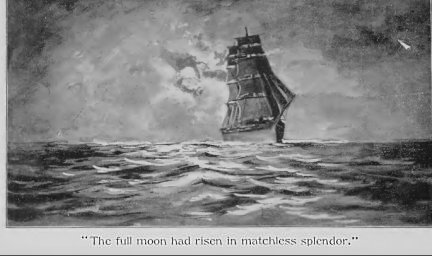
It was a fine evening. The full moon had risen out of
the ocean in matchless splendor, and was rapidly changing its
blood-red hues for more silvery tints, as it soared into the
cloudless sky.
The captain and passengers were on the quarter-deck, while Mr.
Freeman hung over the rail with the comfortable assurance that
the bark was making a better run in the second dog-watch than she
had in the first, when the mate had been in charge.
“I told you, Miss Blake, I should get a good breeze in
my watch, and you see I’m as good as my word.”
“So I perceive; and now that you have it, see that it
doesn’t fail us before morning. Otherwise I shall
think your fine breeze all the result of luck. How pleasant
it is to hear the water gurgling around the ship.”
Eight bells struck, and the dog-watch was over. The
wheel and lookout were relieved, and Freeman went below, while Carl
Bohlman came on duty to stand the first watch, which lasted until
midnight.
“What are you thinking of, Aunt? For ten minutes
you have not spoken a word.”
“The beauty of the night has cast a spell over me,
Laura, and I was thinking of a favorite poem of mine. I
never realized the significance of the first stanza more than on
this evening, when we are out on the great ocean with every
object bathed in white light.
“‘The dews of summer night did
fall,
The moon, sweet regent of the sky,
Silvered the walls of Cumnor Hall,
And many an oak that grew thereby.’”
“Excellent, my dear madam,” said Captain
Maxwell. “You have a fine poetic instinct.”
“The oaks that grew around Amy Robsart’s luxurious
prison are replaced here by the bark’s masts and sails,
captain, but the effect is not less beautiful.”
“A fine conception, Mrs. Evans, but we must remember
that it is not summer in these latitudes, even though the dew is
gathering, and you may take cold sitting there. Will you
take my arm?”
“With pleasure, captain.”
They had paced the deck for some minutes, and the widow was
relating some story that seemed greatly to amuse the captain,
when the latter stopped suddenly, dropped on one knee, and stared
at one of the deadlights’ near his feet.
“Good heavens! How you startled me, captain.
Robinson Crusoe couldn’t have been more astonished when he
saw the footprint in the sand, than you seem to be. What is
it?”
“Worse than a footprint, Mrs. Evans. The moonlight
prevented our noticing it sooner. Stand here—where
your shadow falls on this deadlight. [132] Now what do
you see?”
“A light reflected from below. Oh, Laura, the
lazarette is on fire!”
Captain Maxwell was already disappearing through the hatchway,
while the mate and Miss Blake ran up at the widow’s
exclamation. Even the silent figure at the wheel
started at the mention of the word fire.
It was but a moment before the master of the bark reappeared,
bearing a lighted lantern in one hand.
“The cause for alarm is removed, ladies,” he said
quietly. “There is no fire in the lazarette, though
nothing short of a miracle prevented it. This lantern was
standing on the floor beneath the deadlight and caused the
reflection to appear. Mr. Bohlman, have you any idea how it
came there?”
He spoke with apparent calmness, which Miss Blake readily saw
was more feigned than real.
The mate hesitated a moment before answering: “Dick must
have left it there, sir.”
“Dick must have left it there! So that
bright boy of yours has been in the lazarette again without
permission? If I don’t have him triced up to the
spanker-boom in irons early to-morrow morning, my name’s
not John Maxwell.”
“He was in the lazarette, sir, but not without
permission. I sent him there just before supper to bring up
a coil of old rope that was to be ravelled out. He
wasn’t there ten minutes.”
Both ladies glanced at the mate in surprise at these words,
and Captain Maxwell looked at his chief officer in a way that was
anything but complimentary to the latter. The captain had a
temper of his own, which was under excellent control, but he
found it necessary to cross the quarter-deck twice before
trusting himself to speak.
“After that occasion a week ago, when this boy was
discovered in the lazarette doing God knows what, I should have
thought your own judgment would have prevented your sending him
there again. There are plenty of men in your watch, and if
none of them knew where this old rope was, you should have gone
yourself, rather than let that fool of a boy take a light into
such a place.”
Bohlman smarted under this speech, though he maintained a
discreet silence, knowing it would be useless to attempt to justify
himself in the captain’s present humor. Inwardly,
however, he cursed Dick Lewis for having forgotten the lantern,
and thus bringing his superior’s censure upon himself.
Orders were given for Dick to come aft, and the youth shortly
appeared on the quarter-deck for the second time that day in the
role of culprit. He quailed before the captain’s
glance, and nervously shifted his old felt hat from one hand to
the other.
“Do you know why you have been sent for?”
Dick pointed to the accusing lantern, and said in a frightened
tone: “Yes, sir. I—I remember now I forgot to
bring up the lantern when—when I fetched the
rope.”
This was a lie. He had turned the wick low and then left
it in the lazarette purposely, knowing well that no one would
enter the place after the day’s work was done. But
for the accidental circumstance of its having been placed too
near one of the deadlights, the presence of the lantern would
never have been suspected.
“Do you know what I ought to do with
you?”
The captain’s tones were so stern that Dick was hardly
able to articulate “No, sir.”
“I ought to take a rope’s end and beat you within
an inch of your life. That’s what any captain would
have done twenty years ago, and what some would do now. You
left this light down there among bales of oakum, sennit, old
sails, rockets, signal-lights, and other inflammable stuff, and
if there had been enough sea running to heel the bark over a
trifle more, the lantern would have upset, setting the whole
place on fire—and we out in the South Atlantic, a good
week’s sail from the nearest port!”
The captain’s passion mastered him, and he shook Dick
until the boy’s teeth chattered. Suddenly releasing
him, he turned to Mrs. Evans and her niece.
“I ought to apologize, ladies, for this outburst; but I
lost one ship by fire years ago, and this boy has tried me beyond
endurance.”
“I do not blame you in the least, captain,”
said the alarmed widow; “I feel sure my husband would have
inflicted a severe punishment for such an offense. It is as
bad as Guy Fawkes and the gunpowder plot.”
“You see, madam, we officers have to put up with a good
deal from sailors now-a-days,” said Captain Maxwell,
sarcastically. “If I punished that boy as he
deserved, he would have me arrested the moment we reached
port. Then, aided by some unscrupulous lawyer and the
testimony of various members of the crew, I should be convicted
of ‘cruel and unusual punishment,’ and fined heavily,
or imprisoned. The evidence of yourself and niece might
clear me in this case, but all the papers would print articles
about the barbarity of captains and mates in general, and the lot
of the poor, abused merchant-sailor,—forgetting to mention
the fact that a vessel, her cargo, and all hands, had narrowly
escaped a terrible disaster at the hands of one of these
persecuted saints!
“Dick, you were warned a week ago that if you
entered the lazarette again without permission you would be put
in irons. But it seems you had permission,” with a
glance at the mate,—“and so we shall have to let you
off easier. Go up on the fore royal yard and sit there
until the watch ends at midnight.”
Dick was unable to repress a sigh of relief as he turned away,
but his sharp ears heard Captain Maxwell say to the mate:
“As soon as it is light enough to-morrow morning to see
objects in the lazarette without a lantern, bring up that
canister of powder and those four boxes of rockets and
signal-lights. They shall be kept in a locker in the cabin
during the rest of the voyage. Another thing—never
again let that boy go anywhere with a light.”
“Yes, sir.”
The cause of this trouble went forward, muttering to himself:
“Powder! the captain said powder! I might have found
it to-night if they hadn’t caught onto the lantern.
How did they know it was there, I wonder?”
He
climbed the fore rigging, unmindful of the taunts of the crew at
his second punishment that day, and the captain’s words
kept ringing in his ears.
“To-morrow morning they’ll all be put where I
can’t get at ’em,” he muttered, “and if
only they hadn’t found the lantern, I could have got away
with some of them rockets to-night. And the powder! I
can’t do nothing without a lantern, though, and I
ain’t even got a match.”
He perched himself upon the royal yard, with a lunatic’s
cunning, inventing various schemes for getting at those
fire-works. That was his mania. Although as sane as
anyone on other subjects, he was an absolute monomaniac in
everything relating to such matters; and since the day when he
had overheard a remark relating to the signal-lights and rockets,
his fingers had itched to investigate them and see what they were
like. Not even the certainty of punishment could stand in
his way.
Some people, when they ascend to the roof of a high building,
have an almost irresistable desire to leap from it. It is
not that
they wish to do so, but some strange power seems urging them to
it in spite of themselves. Others have a similar feeling
when in close proximity to a swiftly-moving railroad train, and
require all their will power to keep from casting themselves
before the locomotive. So it was with Dick Lewis. He
could no more keep his mind off the lazarette and its contents,
than steel can resist the influence of a magnet. He sat
there as the hours passed, looking ahead into vacancy; thinking
and thinking; and imagining just how the rockets must look, as
they lay side by side in their boxes down in the midnight
darkness of the lazarette. How quiet and silent they
were! And yet the touch of a match—
He put up a hand before his eyes and turned his head to one
side, as though to ward off a blow.
“Aunt, we really must go below. It cannot be far
from twelve o’clock, and we have staid on deck nearly two
hours past the usual time.”
“That is true, Laura; and yet I feel strangely
wakeful. But, as you say, it is very late, and high time
that we turned in. So good night, captain, and pleasant
dreams. Good night, Mr. Bohlman.”
Mrs. Evans paused as she reached the companion-way.
“How beautiful the moonlight is,” she said, so low
that no one heard; “and from what an awful peril have we
this night been delivered.”
She slowly followed her niece to the cabin.
Captain Maxwell did not linger long on deck after his
passengers had turned in. He, too, usually retired early, and
arose at daylight. But the incident of the lighted lantern
disturbed him. To the master who has once experienced fire
at sea, the mere possibility of another visitation conveys a
dread that the worst hurricane cannot inspire. He paced the
deck for some time, and then, after a glance aloft, went
below.
Midnight came; and the mate was relieved by Frank Freeman, who
found his superior in no very pleasant frame of mind.
“You’ve still got a fair wind,”
Freeman observed; “she’s slipping through it in good
shape.”
“I suppose you expected to come on deck and find a dead
calm, with me and my watch ahead in the long-boat, towing the
bark.”
Bohlman left the quarter-deck with this good-natured
rejoinder, while the second mate smothered a laugh as he lit his
pipe.
Dick climbed down the fore rigging with alacrity, and entered
the forecastle with the rest of the port watch. His plans
were matured. There was a triumphant light in the
boy’s eyes, and a furtive smile on his ill-favored features
as he crept into his bunk and feigned sleep.
A lantern swung from the dingy ceiling, casting a flickering
light upon the tiers of bunks, and upon various other objects in
the forecastle. There were oilers and rubber boots thrown
about here and there, old books without covers, and sea-chests of
various patterns. The numerous initials, names, and dates,
cut into the walls indicated that the Western Belle had sailed the
seas for many years. On one side some one with a talent for
drawing had recently executed a chalk picture of the whale
swallowing Jonah, which was a marvel of realism. Near this
artistic production was tacked a printed card setting forth what
rules the crew were expected to obey, what compensation they were
to receive, and other matters of like import.
Sea air and insomnia are deadly enemies, and before one bell
struck, a chorus of snores assured Dick that his companions were
asleep. He suffered a few minutes over the half hour to
elapse, and then slipped noiselessly from his bunk. Gliding
to the open door, he looked stealthily out. That side of
the deck was thrown into shadow by the forecastle, and no one was
to be seen but two of the watch on duty slowly walking up and
down the main deck, as they conversed in low tones. The
others were doubtless on the opposite side of the
forward-house.
Dick turned from the door, waited a moment to be sure that all
were asleep in the bunks around him, and then produced a towel.
Next he took down the lantern from its hook overhead, and wrapped
the towel about it so that the light was invisible. That
done, he made for the door,—stepped out on deck,—and
crept forward in the shadow of the building.
Upon reaching the corner, he stopped and listened The distant
murmur of voices was heard on the opposite side of the house, but
the moonlit stretch of deck ahead was untenanted.
Apparently no one was about the extreme forward part of the
vessel except the lookout. The boy’s unshod feet made
no sound as he darted across the strip of moonlight that fell
between the forward-house and the forecastle deck. Now he
was standing by the open fore hatch.
In large sailing vessels that stand well out of water, it is
customary to leave the fore hatch off at all times unless some
very severe gale is threatened. The forecastle deck
overhead prevents rain or salt water from entering, and as it is
often necessary to go down to the fore peak half a dozen times a
day, it would be a useless trouble to move the hatch-cover each
time. This was the case with the Western Belle.
Dick well knew he could not enter the lazarette at the
customary place without being seen by the man at the wheel and
the officer on duty, and had conceived the laborious, but
perfectly feasible plan, of descending through the fore hatch to
the ’tween-decks, and then crawling aft over the cargo the
whole length of the vessel to accomplish his purpose.
Without losing time, he placed his foot upon the first step of
the flight of stairs that led down to the fore peak, and then
rapidly descended. It was black as Erebus when he reached
the bottom, and before taking another step he uncovered the
lantern and stuffed the towel in his pocket. Cautiously
walking over old sails, ropes, barrels, casks, etc., the boy was
soon out of the fore peak proper, and at that part of the
’tween-decks where the cargo began to be stowed.
The foremast looming up ahead gave him quite a start, and a
sort of dread possessed him at thought of the long distance to be
traversed in that profound darkness. Dick had not realized
until now the magnitude of the task before him, but he only
wavered a second, and pushed on.
It soon became impossible to walk, and he dropped on his hands
and knees, creeping along on all fours; at the same time holding
the handle of the lantern between his teeth. Its rays
illumined but a short space in front, though they served to make
the gaunt deck-beams assume all sorts of strange and fantastic
shapes that he could not help noticing. Thus he crawled
along over bales of flax and tow, boxes of Kauri gum and sacks of
horns; picking his way carefully, and impatiently wondering how
far he had progressed. This was at length made plain,
though in an unexpected manner.
In attempting to accelerate his speed, the boy had grown a
little careless, when he suddenly felt his left hand go off into
space, and barely saved himself from plunging headlong
downward. The shock was a severe one, and he drew a deep breath of
relief when he had backed away from the yawning aperture.
“Fool!” he muttered; “I clean forgot the
main hatch. I like to have fell all the way down to the
lower hold and broke my neck. Well, Dick, you’re half
way, anyhow.”
He crawled around the square opening and proceeded. In a
few minutes the way was blocked by a great object that the youth
could not account for, but which was really the iron tank
containing drinking water. He avoided it and continued to
advance, having stopped a moment to stretch his cramped
limbs. Next he came to the after hatch, but was on the
lookout for it and pushed on steadily, though he began to ache
all over from crawling so long. Once a startled rat
scurried across his stockinged foot in its haste to escape,
causing another momentary scare. Had it not been for the
increasing excitement under which he labored, the boy must have
been chilled, for a draft of cold air like that in a cellar swept
through the ’tween-decks from one end of the bark to the
other.
The mizzen mast told Dick his journey was nearing its end, and
he stopped a few seconds to take breath. His heart beat so
quick and fast that he felt stifled, and his limbs trembled in a
way that he could not account for. But the thought of the
fire-works nerved him, and cans of powder danced before his
disordered imagination.
There was not much further to go, so after shoving back the
hair from his damp forehead, he crept on until the peculiar
formation of the vessel’s timbers proved that he was in the
stern.
He looked up. Directly overhead was a small opening.
“That must be it!” he whispered.
There were no stairs nor any ladder, but standing erect, his
head was just on a level with the aperture. First arranging
the towel about the top of the lantern so that the light should
not be cast upward, he reached up and set it down on the floor
above. Then, panting with excitement and bathed
in cold perspiration, Dick placed both hands on the edge of the
hatch.
One agile spring, and he was in the lazarette.
So quiet was the night, that Freeman’s measured
footsteps, as he trod the quarter-deck, sounded with strange
distinctness to the guilty occupant of the space beneath.
No other sound disturbed the silence but the gentle swish and
gurgle of the water alongside, and an occasional creak from some
block or pulley.
The piles of swelling canvas; the mast-heads nodding against
the stars; the white paint-work of the poop; the delicate shadows
cast upon the deck by the ropes and shrouds; the motionless
figure of the man at the wheel;—all were beautified and
softened by the white flood of moonlight. Drops of dew glittered
everywhere, and when Freeman laid his hand upon the main brace,
it was wet as though from rain.
He had been reading odd items in an old copy of
the Sydney Herald, and put it down just as two great rats
that had come up from the hold scampered across the deck.
This was nothing unusual, and after stamping with his foot to
scare the bold creatures, he glanced at the binnacle.
“Keep her at N. N. E., Matt; you’ve let her go off
a point. Watch the card, man.”
“Keep her at N. N. E., sir,” the fellow repeated,
shifting his quid to starboard as Freeman walked away.
“I’ll see how the lookout does,” the officer
thought, “though if every night was like this,
there’d be little need of any.”
He went forward along the port side. Happening to cast a
glance through the open forecastle door, he noticed that the
light was out.
“That’s queer,” he soliloquized; “it
burned brightly enough when I passed by a couple of hours
ago.”
He entered the door to see if the wick was out of order, or
whether all the oil had been consumed. Neither—the
lantern was gone!
He
had just made this discovery, and was leaving the building to ask
his men whether any of them had removed the light, when a curious
jarring sensation rooted him to the deck. The idea of a
submarine earthquake flashed through his brain, but within a
second’s time there was a deafening report,—a
blinding flash,—a staggering of the bark,—and then
flying timbers and bales of merchandise were hurled skyward with
awful power. The whole after part of the vessel seemed
going up in the air piecemeal!
“Great God!” breathed Freeman, grasping the ladder
on the forward house.
His self-possession soon returned. Already some of the
crew had begun to act like lunatics.
“Call all hands, and behave like men. The
bark’s still afloat, and now three of you come aft with
me.”
His cool decision inspired confidence, and half a dozen of the
crew followed.
The canvas began to flap—the bark was badly off her
course. Freeman bounded on as he noticed this fact.
“That cowardly Matt’s deserted the
wheel,” he thought—“or else the poor
devil’s been killed.”
But the officer stood motionless when he reached the place
where the quarter-deck had been—the spot where he had been
standing not five minutes since. The whole deck was gone,
and in its place was a great cavity that reached from one side of
the vessel to the other, and seemed to go down to the very
keelson.
It was a time for action, and he crept along on the starboard
side, walking on a few jagged splinters, and holding to the main
brace with his hands. The wheel had been shattered and was
useless, while Matt lay against the rail where the force of the
explosion had hurled him.
“Men, sheet everything home, and move d—d
quick! The wheel’s smashed and we can’t steer
the bark. Let go all the halyards and sheets, and get her
stripped. Work for your lives!”
Had the wind been stronger, a serious accident would probably
have resulted before the unmanageable vessel could have been
relieved of her canvas, but although she careened badly, it was
but a few minutes before enough sails had been taken in to avert
the threatened danger.
The unaccountable disaster that had befallen was sufficiently
appalling to those who were on deck at the time it occurred; but
imagine the feelings of the others—roused from a sound
sleep at three in the morning by a shock as of an
earthquake. The mate’s watch were asleep in the
forecastle, a considerable distance from the lazarette, but to
the captain, passengers, mate and steward, who occupied the after
house, the sensation was indeed awful. What wonder that the
screams of Mrs. Evans and Miss Blake rent the air? Or that
Captain Maxwell, experienced seaman that he was, found himself
utterly stunned and bewildered? But he was on deck in no
time, issuing orders with the confidence of one who has long been
accustomed to command.
Nothing so quickly restores our presence of mind in great
crises as the knowledge that others look to us for advice and help.
When the terrified Miss Blake rushed into her aunt’s cabin,
it must be said to the widow’s credit that she left off
screaming, and endeavored to pacify her niece. She tried to
think what Captain Evans would have done in such an emergency,
although having no clear idea as to what manner of evil had
befallen the vessel; and after hastily assuming her dressing gown
and slippers she issued forth with a boldness that surprised even
herself.
The sight that presented itself utterly confounded the good
woman, and it was only after passing her hand across her eyes
several times, that she could believe the evidence of her
senses. The cabin partition towards the stern was blown
entirely out, together with the companion-way, and skylight
above. The roof of the cabin had been splintered in places
and lifted up, until Mrs. Evans could see a patch of sky here and
there, while the floor under her feet was so uneven she could
hardly walk upon it. She stood holding to the center table,
blankly wondering what could have happened, when the steward came from
Captain Maxwell’s room.
“Oh, steward, in the name of heaven, what has
happened? Are we sinking? Have we been pooped? Is the
bark stove to pieces on a rock?”
“It’s not that bad, Madam Evans. There’s no
rock in this part of the ocean, and if we’re sinking
it’s very slowly. Are you hurt?”
“No; only badly frightened. I cannot realize yet
what is the matter. Is anyone killed?”
“We can’t tell yet, ma’am. But I must
not stop here talking. The after wall of the
captain’s room is blown out and the head of his bed torn
off. The room was set afire, too, and in putting it out he
burned his hands badly. Will you hold this lamp while I get
some linseed oil and batting?”
Captain Maxwell’s injuries were more painful than
dangerous, and considerable relief was afforded as soon as Mrs.
Evans’ deft fingers had applied the dressing. He then
returned to the deck. It still lacked over two
hours of dawn, and the moon was low in the west. Total
darkness would soon descend, and there was much to be done.
Already the carpenter was at work on a new wheel, and the moment
it was in position the captain resolved to steer for Rio de
Janeiro, where repairs could be made.
The strong smell of powder, and the shattered timbers, left no
doubt in the captain’s mind that an explosion of some sort
had caused the catastrophe. Fortunately, its greatest force
had been upward; otherwise the vessel’s bottom might have
been blown out, thus ending her career and those of all on board
in short order. The signals in the lazarette were the only
explosives on board the bark, but how they could have become
ignited was not easily seen, unless a fire had started.
Everyone was on deck but the ladies; there was no more sleep that
night.
“Mr. Bohlman, you will muster all hands amidships, and
you and Mr. Freeman will then call the names of those in your
respective watches. Some one may have been
killed. Whose wheel was it at the time of the
accident?”
“Matt’s, sir,” answered Freeman.
“He was badly hurt by being blown against the
bulwarks. We’ve put him in his bunk, and two hands
are rubbing him.”
While the crew were assembling, the captain questioned his
second mate closely as to whether he had noticed any signs of
fire about the after part of the vessel, or seen any person enter
the lazarette. Freeman was certain, however, that he should
have smelled smoke had there been any fire, while as for anyone
entering the place without being seen by himself or the man at
the wheel,—it was impossible. It will be remembered
that he had gone below just before Captain Maxwell discovered the
lighted lantern, and therefore knew nothing of that
circumstance.
“About how long was it after you left the quarter-deck
until the explosion took place?”
“It wasn’t five minutes, sir. I was going
forward to the fo’k’sl deck to see that everything
was all right, when, happening to look in the port door of the
fo’k’sl, I noticed the light was out. I stepped
in to see whether the lantern was empty or not, but found it
gone. Then—”
“You found the lantern gone!” exclaimed the
captain, an idea striking him. “Did you notice
whether Dick Lewis was gone, too?”
“Dick Lewis? No, sir; why should I? It was
his watch below, and he was probably in his bunk.”
“We shall see. Come with me to the main
deck.”
All hands were assembled around the capstan in various degrees
of astonishment. Several of that motley crew had probably
been shipwrecked during various stages of their careers, but it
may be doubted whether any had ever witnessed an accident similar
to that which had just taken place.
“Dick Lewis, step forward!”
The captain’s stern command produced a sensation, and
all hands wondered what was coming next.
“Dick Lewis, step forward!”
The
words were repeated, but no response came from among the crowd of
men standing about in the raw morning air.
“That settles it,” said the captain,
decisively. “Let the fo’k’sl be searched,
and every other part of the bark. If that boy is not to be
found, he has paid the penalty of his rashness. He may be
dead in the hold, or he may have been blown through the
quarter-deck and into the ocean.”
Freeman remembered the conversation of the previous afternoon,
when Dick had betrayed his curiosity regarding the signals.
Yes, the captain’s theory must be correct, and he shuddered
to think how long the boy might have been at work in the
lazarette while he walked the deck above. But how had he
entered the place? Matt was not so badly hurt but that he
was able to swear no one had passed through the hatch, and he,
Freeman, had left the quarter-deck but twice during the watch,
and then only for a few minutes. The true solution of the
problem passed through the minds of Captain Maxwell, his mate and
second mate, at almost the same moment, but the two former at
first dismissed it as too improbable. Freeman, however,
insisted that Dick must have gotten into the lazarette, if at
all, by crawling all the way aft through the hold; and as Matt
insisted that no one had gone below by the usual way, this view
of the matter was the only possible one left.
“God only knows what ailed that boy,” Captain
Maxwell said, as Dick’s devilish ingenuity became apparent,
“but he’s found out by this time how those signals
work, and what twenty-five pounds of powder can do.”


