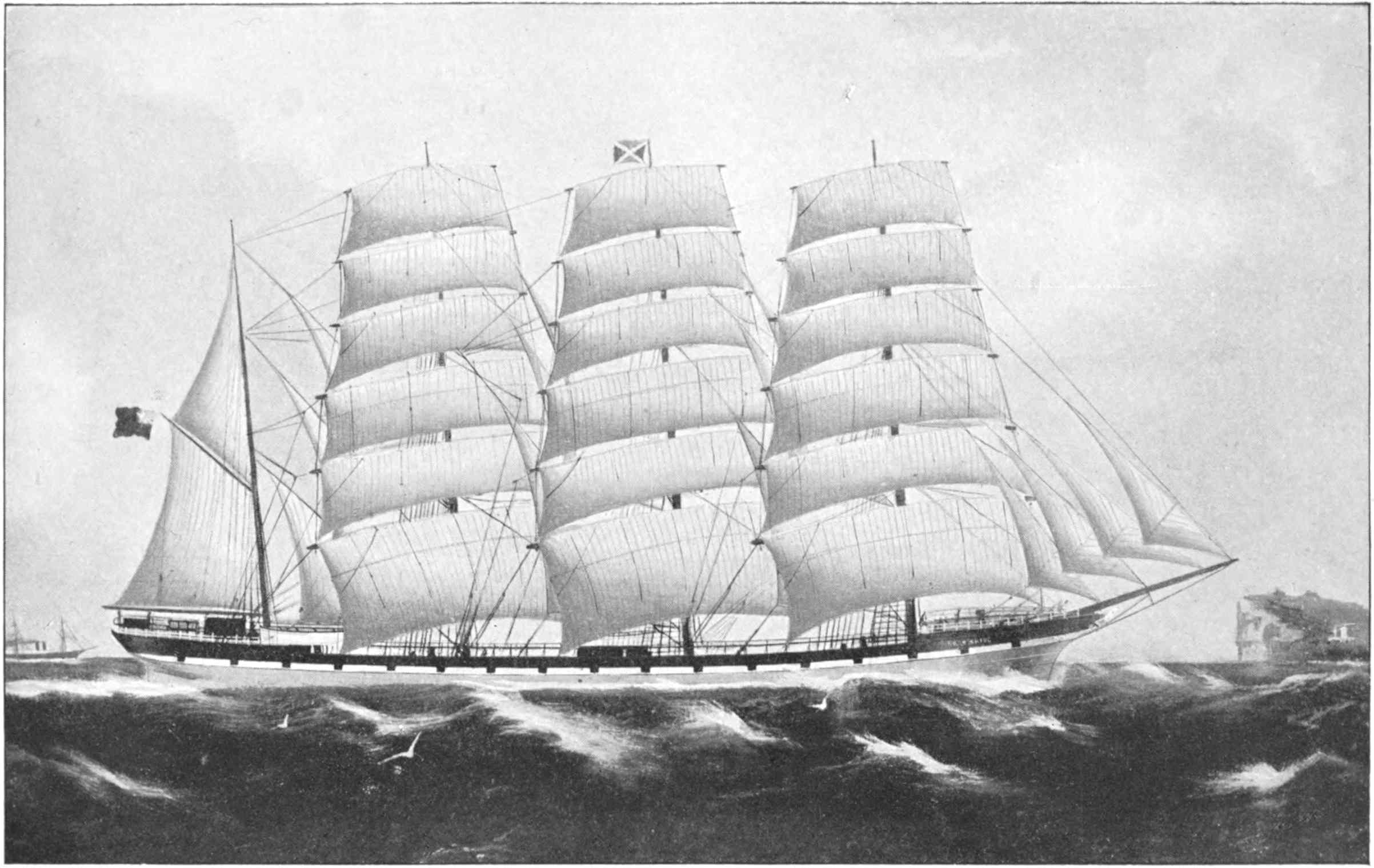
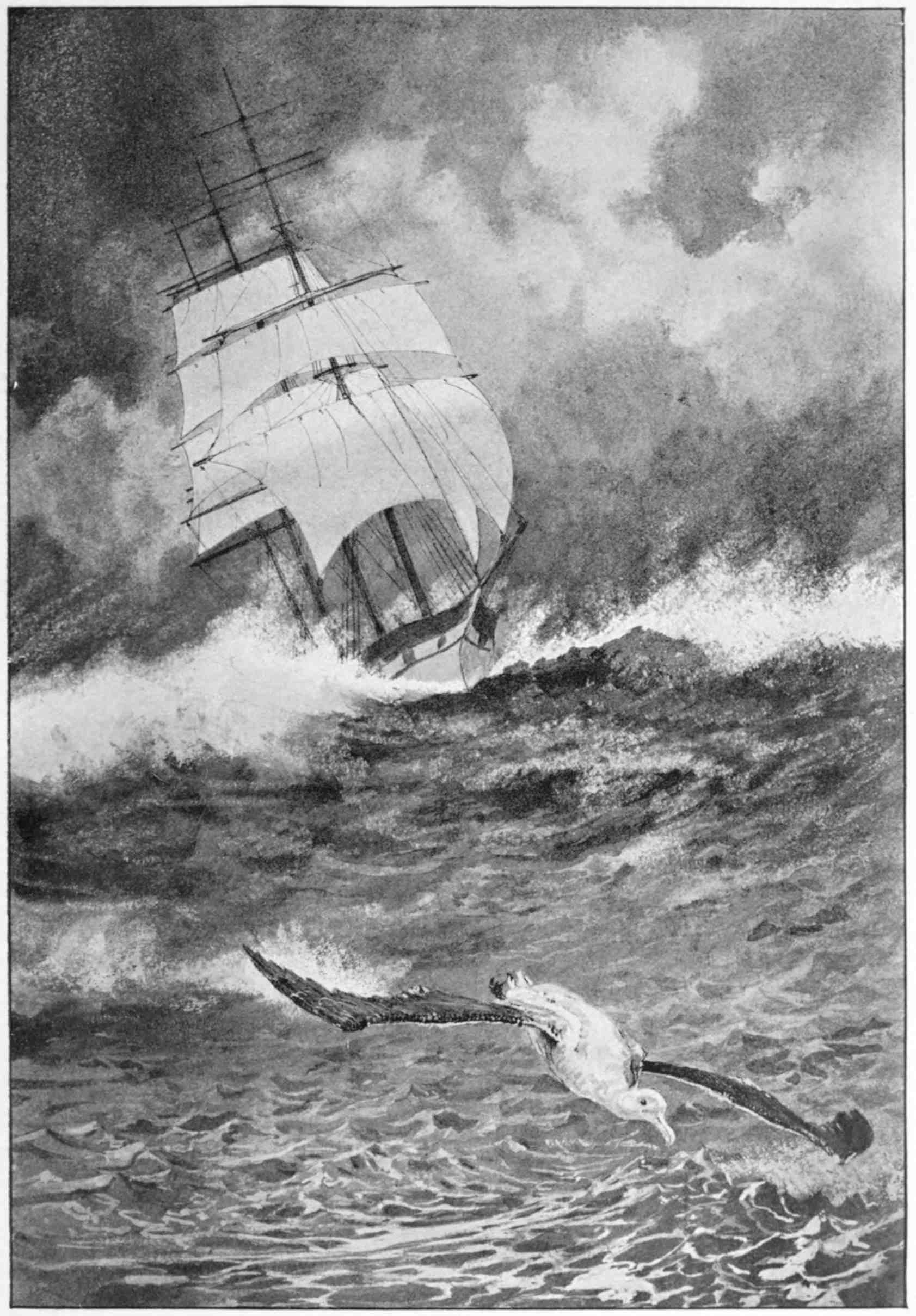
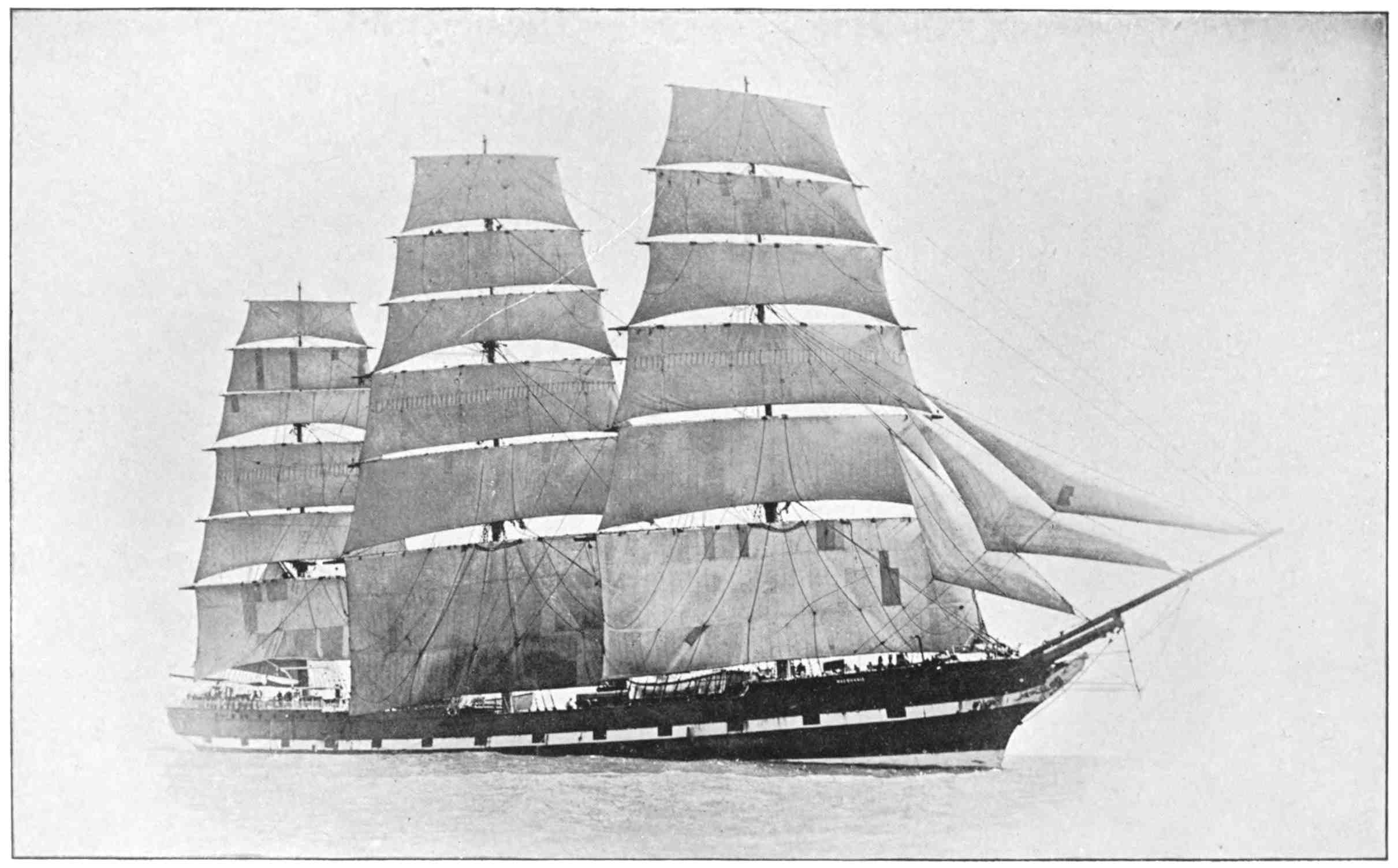
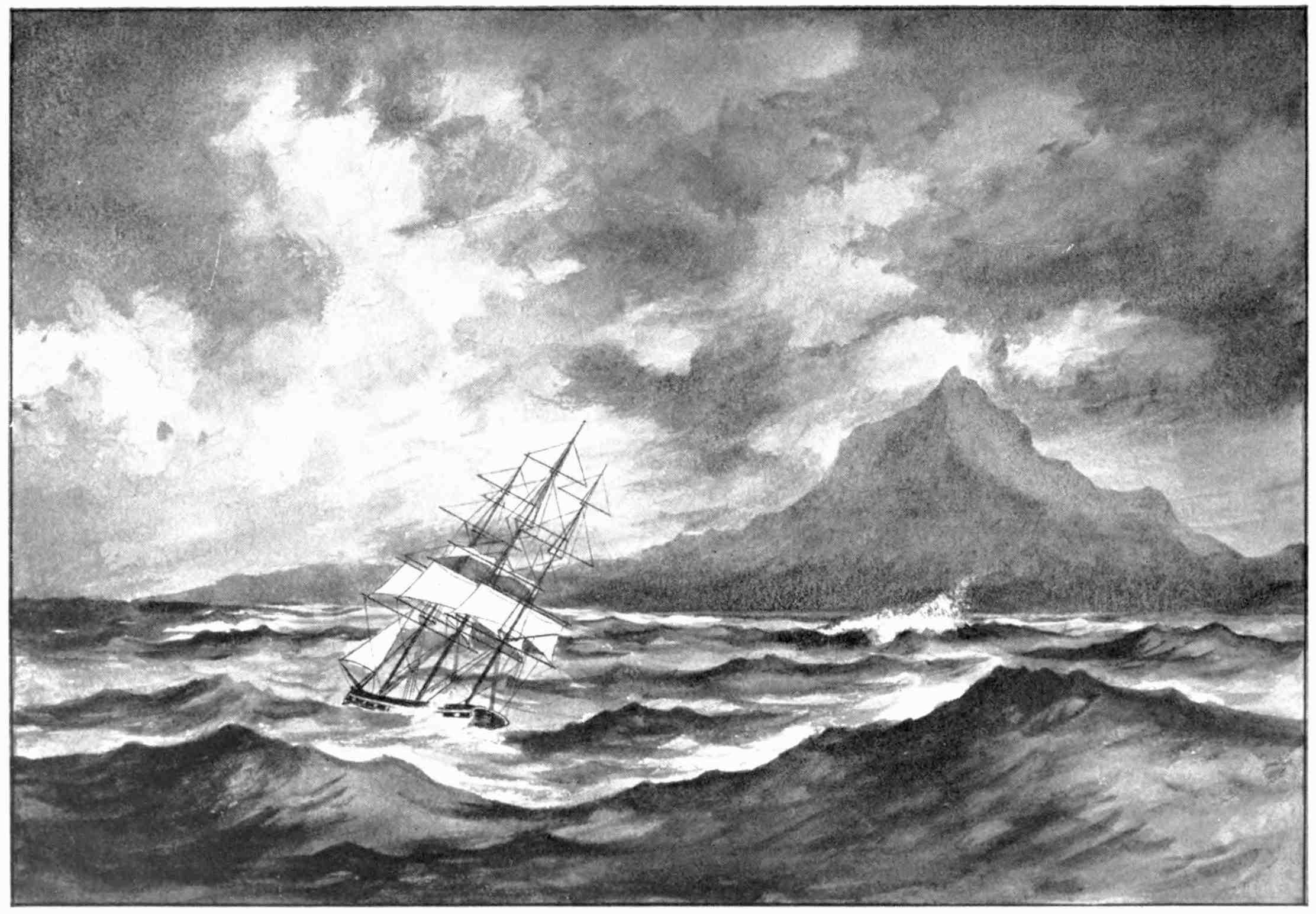
Choosing a Ship—Signing on—Don Henderson—At a
Seaman’s Tailor—First Day’s Work—Cleaning the
Stringers—Sailors v. Base-ballers at Cricket—The Seaman’s
Institute—My Carriboo Bag—A Sailors’ Concert—Emptying
the Bilges—The Marlboro’ Hill’s Crew of
Landlubbers—Yankee Brutality at Sea—Chipping—Johnsen,
the Swede.
A Lively Time crossing the Bay—Mooring Ship—Sea Serpents—An
Old South Seaman—More Cricket—The
Bilges again—Lining the Hold—The Art of Painting—Mosquitoes
and Song—Bleeding the Grain—Bending
Sail—An Early Morning Picnic—Bathing in the Sacramento—A
Fatality—Ready for Sea—Taking in Stores—Our
Crew come Aboard—My Stewardship—The Return
of the Californian Boys.
Man the Capstan—Making Sail—Picking the Watches—Going
About—My Gaff-topsail—Timekeeping—The
Binnacles—Matches—Dandyfunk and Crackerhash—Dutchmen
and Dagos—Johnsen’s Logbook—The Old
Man’s Models—The Bosun’s Songs—“Duckfoot Sue”—Crew
complain of the Food—Rows amongst the After
gang—Peggy—Flying-Fish and Bosun Birds—Lime-juice—Amateur
Haircutters—Sharks and Pilot-Fish—In the
Doldrums—At the Braces in the Middle Watch—Deep-sea
Fishing—The Song of the Trade Wind—Heaving
the Log—My First Wheel—Fine Weather Kites—A
“Jimmy Green.”
Cross the Line—“Stand by your Royal Halliards”—Making
Rovings—Johnsen tries to Knife the Second Mate—Tarring
Down—Dancing in the Dog Watch—Sails—Discourses
on Modern Wind-jammers—Yankee
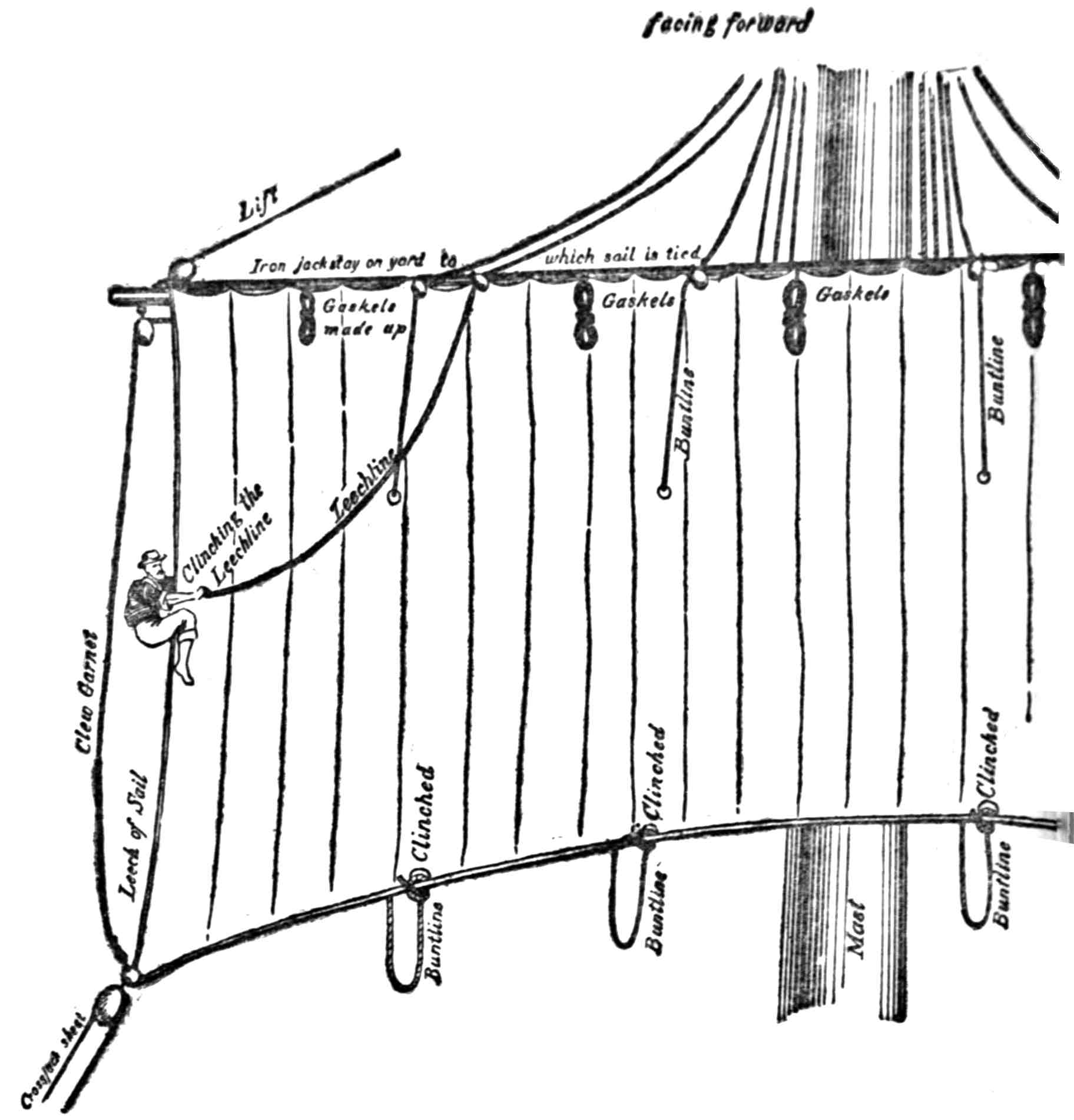
Schooners—Clinching the Crossjack Leech-line—The
Loudoun Hill—Graining Dolphins—Our Farming
Bosun—A Queer Fish—British Sailors on British Ships—Yankee
Buckos—Pitcairn Island—“What ho, Piper!”
Grand Yachting—From the Bowsprit End—A Bad Squall—Fore-royal
blows away—On the Fore Upper-topgallant
Yard—A Battle with the Elements—Wilson and Myself
on the Main-yard—Cape Pigeons—Preparing for Cape
Horn—Fog—Use of a Cowhorn at Sea—Rotten Gaskets—In
the Lazarette—Getting up Bread—Paraffiny
Sugar—Slumgullion—A Cape Horn Sunset—Arguments
in the Half-deck—The Stately Albatross—Our Hens—The
“Roaring Forties”—Famous Tea-Clippers—The
Thermopylæ—A “Blue-nose” Clipper—Rivalry between
Watches—Checkerboard Crews—Negro Crews—Burgoo—A
Mollymawk Aboard—Colder Weather—Making
Fenders—Putting in Rovings—Bird-life in the
Southern Ocean—Cape Horn Hail-storms.
A big Beam Sea—Rolling both Rails Under—Port Watch
washed away from the Fore-braces—The Deck-bear—Dollops—Blood-stirring
Work—Main-deck under Water—Half-deck
Water-logged—In our Watch Below—Waking
Mac—At the Lee Wheel—Cape Horn Greybeards—Dodging
the Seas—Don nearly Drowned in his Lamp-locker—No
Fresh Water—Standing by—Higgins in the
Lee Scuppers—Sunday Breakfast—Snugging Down—Turning
up Gear—Overboard—A Narrow Escape—An
Unlucky Fall—Don Loses his False Teeth aloft—Mountainous
Seas—Pooped—“Sail ho!”—The Music of the
Gale—Chantying in Difficulties—A Huge Sea falls
Aboard—Retrieving the Lamps—All Hands on Deck—Terrific
Work—The Royalshire on her Beam Ends—Hove-to—A
Bad Middle Watch—Make Sail Again—Chantying—Outward
Bounders—Cape Stiff—Old Man’s
Yarns—Foot-gear.
On the Banks—A Low Glass—Blowing Again—I Fall and
Shake the Poop—Taylor’s Whitlow—Sea-Boils—Pipes
growing Scarce—“Storm along, Stormie”—The whole
Crew washed away from the Mainbrace—My knee
damaged—The Bosun and Bower—Clark Russell at
Fault—Model-Making—Discussion on Flogging—An
Albatross Caught—Ill-health on Board—My Medicine
Chest—A Dead Muzzler—An Electric Storm—Jack o’
Lanterns—My poor Knee—Johnsen’s Troubles—A Wild
Highlander at Meals—A Prophet of Evil—Don and Scar.
Old Slush and Greasy Food—A Fleet of Wind-jammers collected
by the Head-wind—Johnsen the Jonah—Washing
Clothes—Quartermaster—Amusements in the Night
Watches—Painting Down—The Frigate Bird—Ocean
Races—Forecastle Artists—The Contents of my Bunk—Taylor’s
Backstays—Old Slush goes Forward—Our new
Cook—At our Prayers—Don in Disgrace—Oiling Decks—Liverpool
Hard-tack—Huge Shoal of Bonita—An
Epidemic of Cramps—The Art of Steering—Head-gear
Scarce.
Shifting Sail Again—My Long Trick—Among the Western
Isles—Slippery Decks—At Work in the Hold—A Broken-down
Steamer—Heavy Gale—Between Two Seas—Loring
Washed Out—Hove-to—A Pulling Match—“Reuben
Ranzo”—Fight with Bower on the Royal-yard—A
Midnight Brew—Grub running Short—Washing
Decks in a Gale—Wearing Ship—Old Man and Mate at
Loggerheads—The Lead-line—A Cause for Strong Language.
“The Coastwise Lights of England”—Queenstown—Away for
Birkenhead—News of the Boer War—A Christmas
Dinner—A Harbour Stow—A Sailor’s Plans—My Last
Wheel—Befogged in the Mersey—Nearly Run Down—“Leave
Her, Johnnie, Leave Her”—Attempts at Docking—Don’s
Last Escapade—Fate of the Royalshire—The
Old Trail.
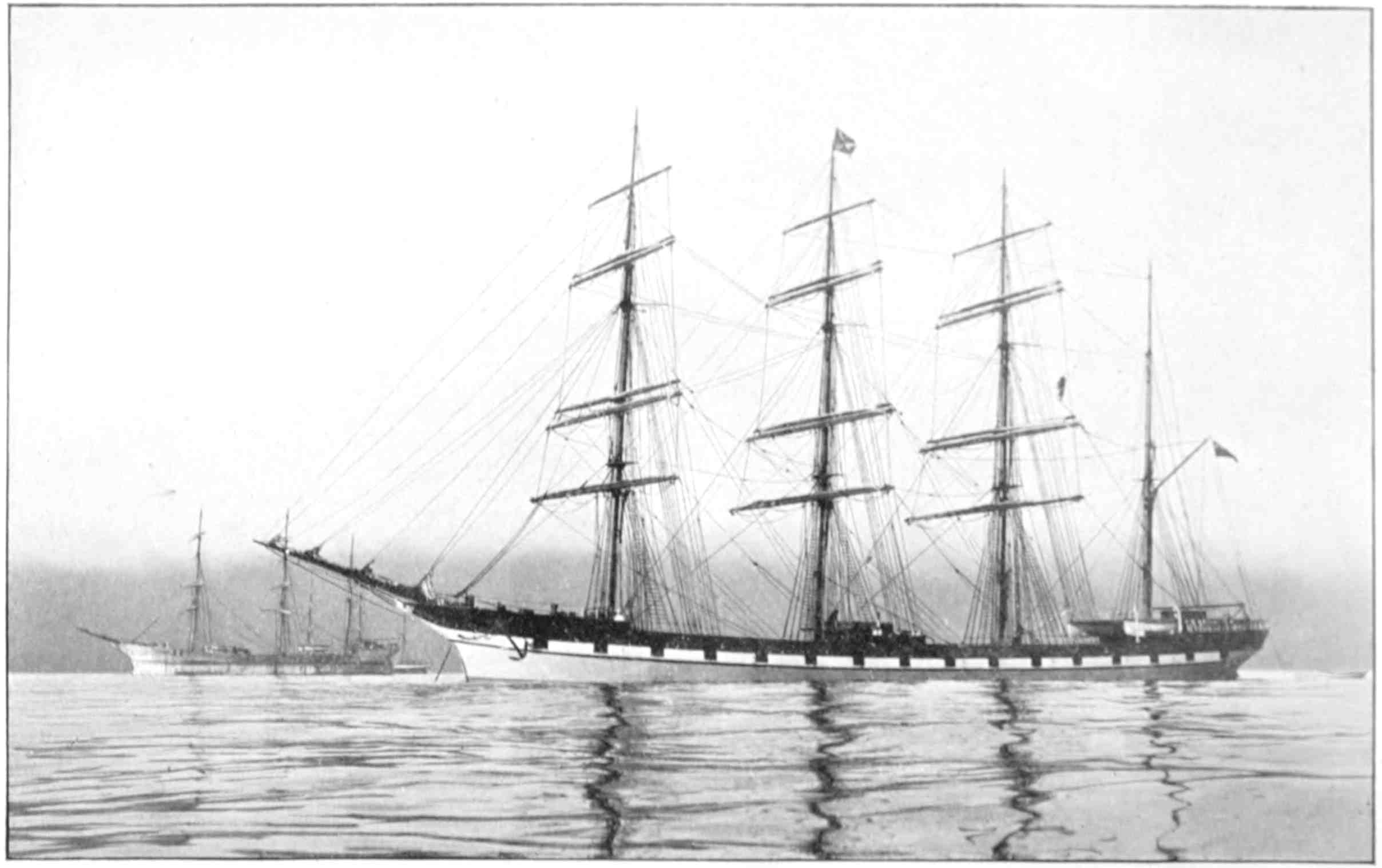
On Wednesday, 12th July 1899, I signed on
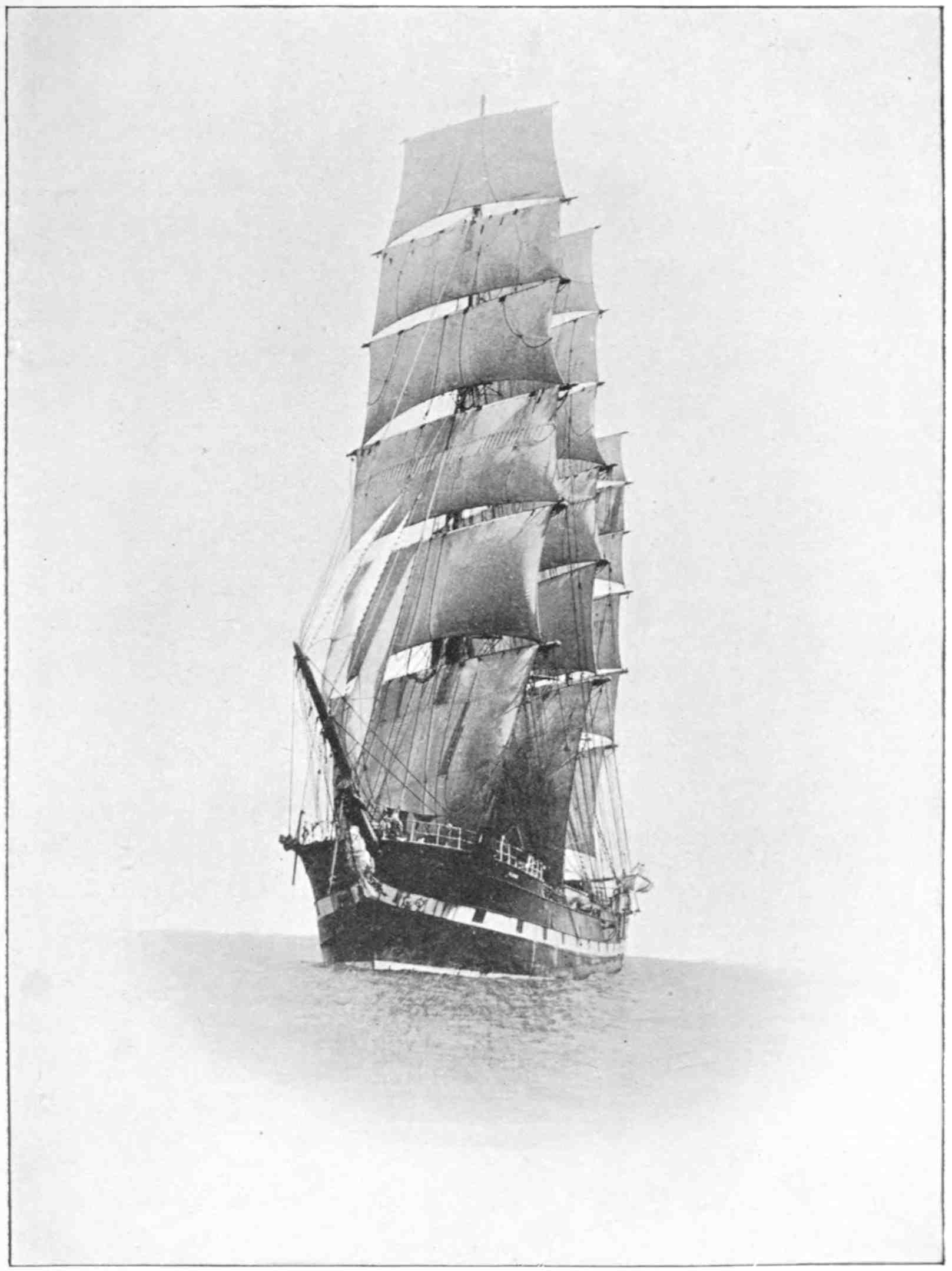
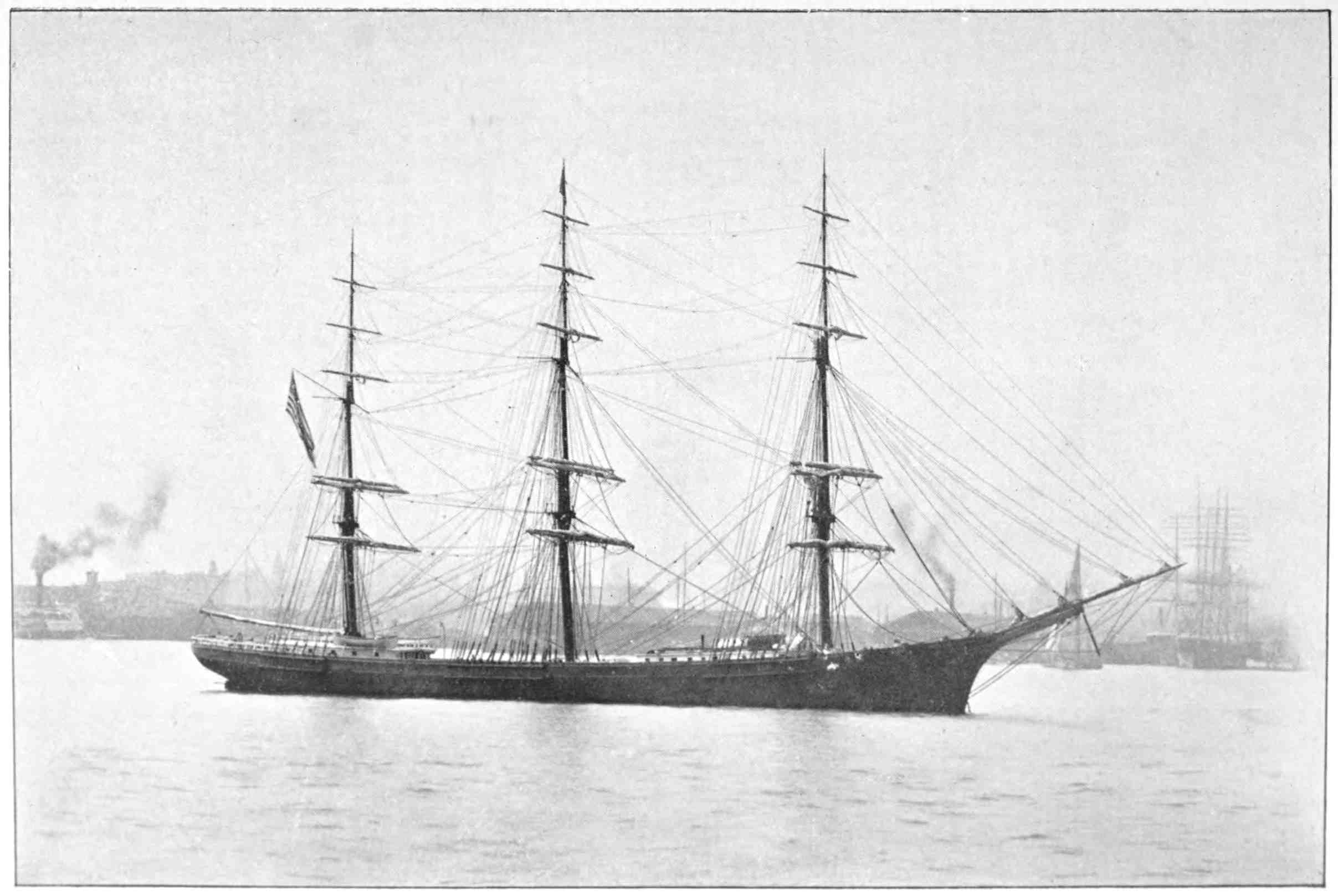
before the mast on the four-mast barque Royalshire
of Glasgow, which had just arrived in Frisco from
Japan, and was busy unloading the first cargo of
Japanese coal that had ever left the country.
I had just come out of the “Golden North,”
having had several months up in the Klondyke,
where I experienced both the “midnight sun”
and the “midday night.” I had intended prospecting
Vancouver Island for copper during the
rest of the summer, but the party having been
broken up for various reasons, I came down to
San Francisco, meaning to ship on board a South
Sea schooner and proceed by slow stages to
Australia; but after a thorough search I failed
to find a single South Sea trader in Frisco,
except the barque Maura Al, which ran to
Honolulu with passengers, so I decided to give
up this plan.
I had long had a wish to sail before the mast,
and witness real sea life in all its dangers and
hardships. The chief officer of one of the
Empress boats, those magnificent steamers of
the Canadian Pacific Railway, on my speaking
to him of this wish, had told me that if I shipped
before the mast on a windjammer, I should find
it a wonderful experience, which, if I was not
afraid of real muscle-trying work, and was
hardy enough to stand the bad food and other
hardships, I should look back upon with much
pleasure.
As I was as fit as it was possible for any one
to be, and felt sure that nothing would come very
hard after such an experience as I had gone
through in the Klondyke, I determined to ship
home round the Horn in one of the magnificent
windjammers which lay in the port.
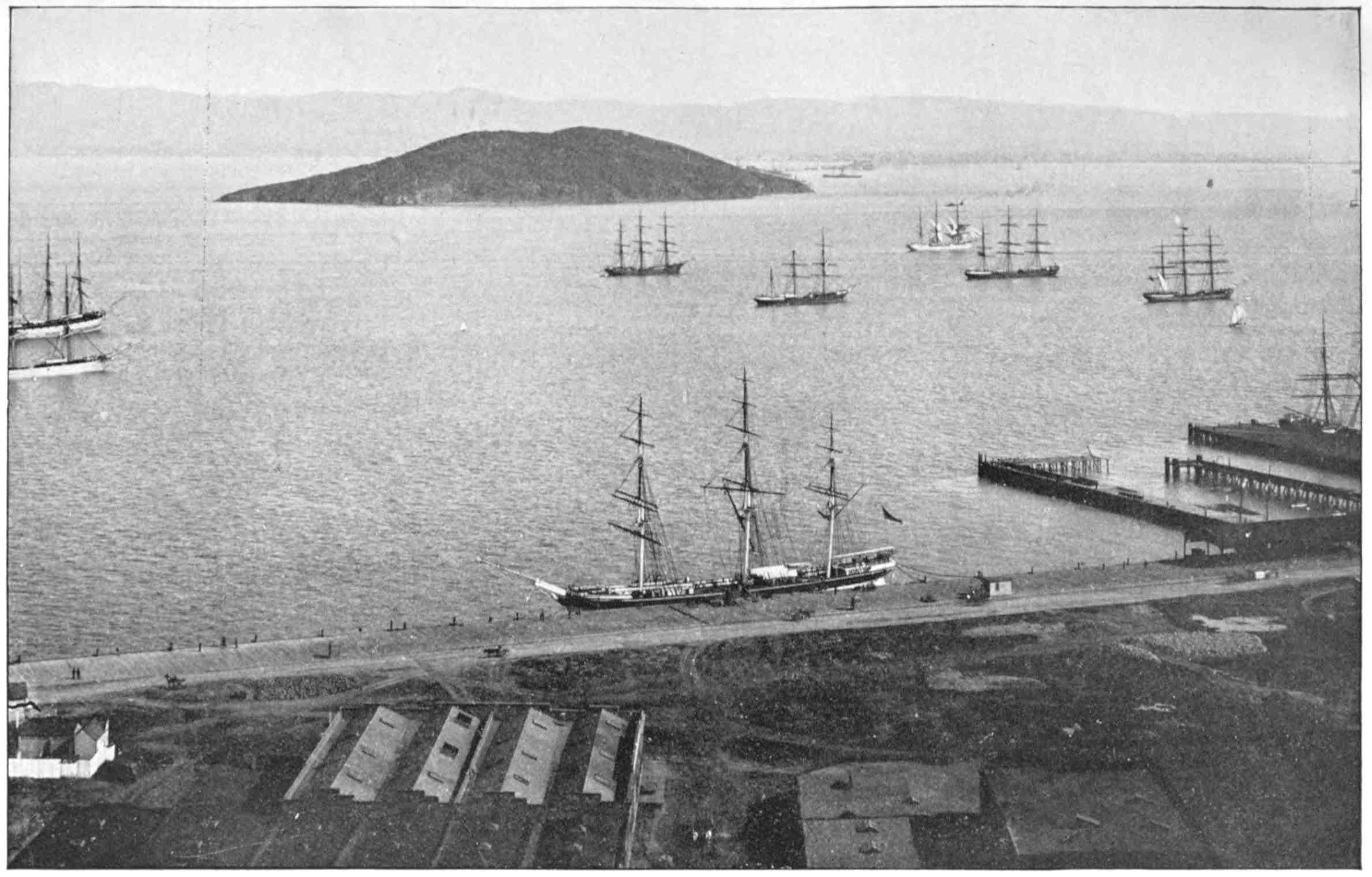
The next thing to do was to pick a good ship.
There were several four-mast barques—beautiful
iron ships from the Clyde—and not a few full-riggers
and three-mast barques, all about to load
grain for the British Isles or Continent.
Though a very keen lover of the sea, and with
a certain amount of experience gained yachting
and travelling, I really knew very little of what a
foremast jack’s life was on board a big deep-waterman.
I knew enough, however, not to ship
before the mast on a ship with “down-east” or
“blue-nose” mates, who, though they are the
finest seamen probably in the world, are terrible
“drivers,” and are a bit too free with belaying
pins, knuckle-dusters, and six-shooters to please
me,—the “gun-play” on board some “down-easters”
being almost worthy of an Arizona mining
camp.
I also knew enough to find out before I signed
on, whether the ship was a hungry one or not,
and whether her skipper drank.
I spent a whole morning prowling round the
docks, and decided that the Royalshire, Lancing,
and Loudon Hill, all four-mast barques, were the
finest ships in port.
The Royalshire I thought the finest looking
alow and aloft, and from the spread of her yards
she had evidently got a larger sail plan than either
of the others. She only had one defect that I
could take hold of, and that was a rather heavy
stern, though this was made up for by one of the
sweetest entrances I have ever seen; the curve of
her cutwater and her bow lines were a delight to
the eye, and I at once decided to make inquiries
about her.
On the wharf, tallying the carts of coal as
they were loaded from the shute, was a small
red-headed Scotchman.
From him I found out that she was reckoned
one of the crack ships of the “Shire Line” of
Glasgow, that her captain and officers were all
Scotch, and that, though not noted for her good
feeding, she could hardly be called a “hungry
ship.”
My red-headed friend answered every question
very readily, and gave the ship and her
captain a first-rate character. He evidently
thought that I wanted a passage in her, and
told me that I could see the captain on the
following day about eleven o’clock, before he went
ashore.
Thanking him for his information, I asked
him what position he held on board.
He replied, “third mate,” and told me that
she carried four mates, and also that the whole
of her crew had run on arriving in Frisco.
“That does not look as if she was such a
comfortable ship,” I said.
“Weel, I dinna think ye’ll find a vessel in
port with her hands aboard—all foremast hands
run in Frisco—I’ve half a notion to run mysel’,
the wages is that gran’ sailing oot o’ Frisco; an
A.B. gets four pund a month, it’s naw great
wonder crews run,” he replied. And with this I
left him and returned to my hotel, well pleased
with my day’s work.
Lo and behold, the first thing I saw on returning
at the appointed time, was the captain and my
red-haired friend shaking their fists in each other’s
faces on the poop, and “cussing around” to beat
creation.
From what I could hear of it, the third mate
was asking for his discharge in language both
“painful and free,” but without success, for
presently the captain went below, and he came
ashore, evidently off up town.
As he stepped off the companion ladder, I
buttonholed him, and asked him when I could
see the captain.
“The old man will be oot preesently, if ye
just wait a wee while,” he answered hurriedly,
and away he went.
As I stood on the wharf watching the
coal being unloaded, I noticed that a small
man, with a thick red moustache and kind,
light-blue eyes, seemed to be bossing things on
board.
After a bit, seeing me loafing around, he
called to me and asked me what I wanted. I
told him I was waiting to see the captain.
“Come aboard; he’s having his breakfast now
but he’ll be going ashore directly, and then you
can see him.”
I came aboard, and spent a couple of hours
waiting for the old man to come on deck. For
some reason or other he was later than usual
going ashore, and it was nearly one o’clock before
he appeared.
Meanwhile I loafed about the deck, keenly interested
in everything. I gave the red-moustached
man a cigar, and found out that he was the
mate, which bit of news caused me to look him
over very carefully, and I decided that I liked the
cut of his jib.
He had got a nice face, with a steady, kindly
eye, and from what I could see, he had a temper
to match. In the short talk I had with him he
was all civility, and I congratulated myself on
hitting upon a ship with such a mate. Of course
I knew enough not to be too sanguine; many a
sailor, who ashore or in port is as mild and
quiet as a lamb, directly he gets to sea, for no
apparent reason, turns into a fiend incarnate. I felt
sure, however, that this man was not one of that sort.
At noon “eight bells” were struck, and the
men came up from the after ’tween-decks, where
they had been cleaning the coal out of the
stringers.
They consisted of the fourth mate, carpenter,
sailmaker, an apprentice out of his time, and the
nipper, as an apprentice on his first voyage is
called.
The nipper, a boy of sixteen, was a picturesque
figure, with a face as black as a nigger minstrel’s,
from the coal, surmounted by a red tam o’shanter;
he was full of fun, and I found out afterwards
that his father was a clergyman in Kent.
I’ll bet he would have stared if he could have
seen his son then in grimy dungarees and jumper,
as I’ve no doubt the last time he saw him was
in a brass-bound serge suit and a deep-sea cap,
one mass of gold braid, with the badge of the
“Shire Line” glittering resplendent upon it.
The stevedores at work on the coal in the
mainhold also knocked off, and went ashore for
their dinner.
I was beginning to think the captain was
going to stay below all day, when he appeared.
He was a keen-faced, middle-aged Scotchman,
of medium height, with a glitter of steel in his eye,
and I put him down in my mind as a “hard nut”
after one look at him.
As he came off the poop I tackled him,
telling him that I wanted to sign on before
the mast.
After scanning me curiously for a moment or
two, he asked, “Can ye climb up there?” pointing
to the mizen-royal yard.
I had never been aloft in my life, but I knew
that I had got a good head from my prospecting
experiences in the mountains, where, looking for
quartz reefs, one constantly takes terrific risks,
especially rock-climbing; a very different job to
climbing the Alps with a guide who knows every
bit of the ground.
So I answered in the affirmative with great
confidence. This was good enough for him, and
he gave me the address of his shipping agent,
who would sign me on, as he explained that if
he signed me on himself without the shipping
agent and it was found out, the shipping agents
would turn against him, and the next time he
came to Frisco he would probably not be able
to get a crew.
Away I went, and in an hour’s time had
turned into an “ordinary seaman,” signed on for
two pounds a month for a passage round the
Horn, calling at Queenstown for orders, either
for the British Isles or Continent.
The shipping agent had got another victim
with him, an Englishman, by name Don Henderson,
a man who had turned his hand to pretty
nearly everything—singing in the opera in New
York, teaching swimming at the Frisco baths
(the finest in the world), mixing wine in Southern
California, gold prospecting in Arizona and
Montana, lumbering in Louisiana, farming and
cow-punching from Texas to the Line—were but
a few of the things he had done.
He had had rather a bad time of it lately,
having had to give up the wine-mixing, where
he was doing very well, as he got knocked over
with a very bad bout of fever; only half recovered
from the fever, he hung on at Frisco, living by
means of his wits and free lunch counters, until
it struck him that he would try and get home,
and see if he could get hold of some money which
was due to him.
He decided to go before the mast—a way not
exactly new to him, as he had come home from
New York in the Umbria before the mast; and
without much trouble he got an introduction to the
shipping agent from a pal, and the thing was done.
As Englishmen in the Colonies will, Don and
I immediately palled up together, and were very
pleased to find we were both going on the same
ship, as we had a good deal in common, both being
English Public School men, and both knowing
how dull it is living or camping for any length of
time with men with whom you have got nothing
in common.
I once shared a canvas bunk for a fortnight
with a man who had a reputation of having killed
twelve men. One would have thought that a man
like this would have been an interesting companion
to yarn with, but not a bit of it; he only
had two ideas in his head, one was whisky, and
the other whittling wood.
He was a silent man, very slow of speech,
but quick enough with a six-shooter; as harmless
and quiet as a prairie dog except when he had
a skinful of “nosepaint,” on which occasions he
was like a busted volcano or a wounded grizzly,
a-raging and tearing around something sinful to
see, and a scandal to a quiet neighbourhood.
Don and I were both in pretty good spirits,
and exchanged chaff with the clerks of the Consulate.
The ceremony of signing on was soon got
through, somebody gabbled off the “ship’s
Articles” to us. I caused some amusement by
giving the “Bachelors’ Club, Piccadilly,” as my
address, and Don raised a laugh by making his
mark, a huge, straggly cross, as he pretended he
could not write.
Pocketing our month’s advance, we gave the
shipping agent a drink, he in return giving us
the address of a seaman’s tailor, and telling us
also to be sure and get aboard the following noon.
This we promised to do, and then we went off
together to do our shopping.
Few landsmen know that a common sailor
before the mast has to provide all his own clothes,
his soap, matches, eating utensils, blankets, and
bedding.
Don and I were soon hard at work bargaining
with as precious a robber of the innocents as I
have ever met.
Luckily for us we were not poor, ignorant,
foremast jacks, whom these landsharks simply
prey upon, but both fellows who had knocked
about a good deal.
We soon had his prices down, and our
purchases were rubber sea-boots, blue jerseys,
overalls, heavy clothing for the Horn, soap,
towels, matches, and plug tobacco.
Then we went off to buy something to eat and
drink out of. From Klondyke experience, I bought
the largest graniteware plate with the highest
rim I could get, and also a huge pannikin.
By the time we had got everything we wanted,
the sun was beginning to go under.
We determined to do this our last evening
as gentlemen, in some style, so we dined at the
Palace, and went to the opera afterwards, finishing
up with an excellent supper.
Thursday, 13th July.—We turned out fairly
early, meaning to go on board about eleven.
Taking a last stroll before going on board,
we began trying the “nickel machines” at the
cigar stores; our luck was terrific wherever we
went, every time we got two or more cigars; the
way we turned up three of a kind, straights,
flushes, and full houses, made us wish that we
were sitting down to a game of poker, and by
the time we were ready to go on board, we had
each got thirty cigars in our pockets.
We hired an express cart, and, piling it with
our luggage, drove down to the ship in style.
The crew and stevedores on the Royalshire
stared in amazement as our craft, with its huge
pile of kit and dunnage bags, hove in sight.
But the mate was ready for us, and told us
to get into working togs and turn to at one
o’clock.
We packed our truck (British Columbian for
“carried our baggage”) into the port forecastle.
One o’clock found me on the wharf in an
old flannel shirt, cowboy hat, and well-worn pair
of overalls—the same had seen a lot of service in
the Klondyke and on the prairie, where I had
bought them, and had lasted twice as long as
English dungarees.
Alongside of me was a big stack of lumber
in long inch and half-inch planks, for lining the
hold with. This must be done before a ship is
allowed to load grain.
These planks I had to pass aboard through
a port, which, as the tide flowed, got higher and
higher above me.
At six o’clock our day’s work was over, and
I for one was quite ready to knock off, for the
lumber was not light, and so rough that it tore
my hands to bits and filled them with splinters.
On going to the galley for our grub, we were
presented with a kid of meat and potatoes, and
had our pannikins filled with a queer-tasting
liquid which the cook, a slab-footed and extraordinary
German, tried to make us understand
in broken English was tea.
“What is this stuff?” said Don, pointing to
the contents of his pannikin.
“Dot ist ze tea.”
“The what?”
“Ze tea, I dell you, for zu drinken!”
“It’s not medicine, is it?”
“Nein; ze tea, I dell you; ze tea, ze tea!”
“What is tea?” asked Don, solemnly.
“Vot is tea! you not know! vy tea is tea; ze
tea for zu drinken.”
Don ended by nearly worrying that wretched
Dutchman off his head.
“Tea, is it?”
“Tea, zat is vat it is; ze tea for zu drinken.”
“Do you mean to say you call that tea?”
“For shor’ zat is tea, very fine tea.”
“Then why on earth didn’t you say so
before?” With this we retired to the forecastle,
which den we had all to ourselves, the crew
having run.
The meat we found was fresh, as, being in
port, we got shore rations; but sailors as a rule
prefer the ship’s salt meat to the fresh meat
which they get in port, as this fresh meat is the
cheapest that can be bought, in fact nothing but
the refuse bits from the butchers.
But Don and I were hungry after our four
hours’ work, and finished it all up.
After our meal we started in and got things
shipshape, choosing our bunks, into which we
hove our “donkey’s breakfasts,” as sailors call
their straw mattresses, and stowing away our
things.
Friday, 14th July.—We were turned out by
the night-watchman at 6.30, and told that we
had got to turn to at seven o’clock.
We had not much time to lose, as we had to
wash, dress, and get our breakfast in less than
half an hour. This at first sight would appear
to be a bit of a rush, but it was not, for washing
consisted of a rough sluice down with salt water,
gained by lowering a bucket overboard, and
dressing was but slipping on a pair of overalls, a
flannel shirt, and foot gear.
For breakfast, we got half a pannikin of hot
liquid each, some “wet hash,” and some “hard-tack.”
“Wet hash” is broken-up beef and potatoes
in hot water, with, perhaps, an onion thrown in:
occasionally, however, we got “dry hash,” which
I much preferred.
Dry hash is simply minced meat and mashed
potatoes, and I believe goes by the name of
“shepherd’s pie” ashore.
As to what the hot liquor was at first, we
were not quite sure.
“I suppose it’s another brew of what the cook
calls ‘ze tea,’ only a bit lighter in colour,” said
Don, sipping it. “I don’t detect much difference
in the taste; I’ve got a pretty keen palate, and
but for a slight flavouring of garlic, I’m willing
to bet it’s ‘ze tea.’”
“I’m inclined to think it’s coffee myself: it’s
got a sediment of flour which seems to remind
me of the slumgullion I’ve drunk at different
times in mining camps,” I answered.
“I think you are wrong. You don’t get me
to believe that a hard nut of a section boss like
our old man is going to pay us two pounds a
month, and throw in two kinds of liquor as well,
don’t you believe it; he’s got his eye square
on the almighty dollar, and he ain’t going to
chuck his dust around in no such lordly style as
that.”
“And I say it’s a full house against a pair
of jacks that it’s coffee, because why—”
“Turn to!” said the mate, poking his nose in
at the door, and out we had to trundle.
We were soon hard at work cleaning the
Japanese coal out of the stringers in the after-hold,
down in the gloomy depths of the ship.
Each man was given a broom-end and a bit of
rag or canvas, and woe betide the unlucky one
who overlooked a small piece of coal stuck in the
stringers, or who did not wipe off every speck of
coal-dust, for the lynx-eyed mate was sure to spot it.
Here we worked all day in the semi-darkness
of the hold, which was only half lighted by the
open after-hatch.
Occasionally one of us had to shovel coal for
a while, which soon finds out the weak muscles
of the back.
We worked hard, with never a spell, for the
mate was a great lover of work, always taking
a hand himself and doing more than any of us.
I found my hands very sore and blistered from
handling the rough lumber yesterday, but comforted
myself with the fact that they would very
soon get hard and would be fit for anything
before we sailed.
At twelve o’clock we were knocked off work
for the “dinner hour,” and how pleased I was
to come up into the sunshine again!
I enjoyed that dinner (the midday meal is
always called dinner on board ship), and especially
the smoke after it, as I have seldom enjoyed a
meal, refuse meat and irrigated potatoes though
it was. Then at it we went again until 5.30,
when we were sent on deck to clear up.
The decks were swept, and any loose gear
put away in the bosun’s locker, and as the
factory whistles screeched out six o’clock, the
mate said quietly, “That’ll do.” We were free,
and our day’s work was finished.
The first thing to do was to wash, for we
were all as black as chimney sweeps, and our
eyes and ears were full of coal-dust.
We got a couple of buckets of fresh water
from the pump, which was just aft of the mizen-mast,
and soon turned ourselves from black into
white men again.
On going to get the grub from the galley,
I found that I was right about the queer liquid we
had drunk in the morning; it was coffee all right,
according to the cook.
As soon as we had demolished our supper,
Don and I dashed ashore, and anybody who saw
us seated in a couple of stalls at the opera
listening to “Carmen” would have been very
much surprised if they had seen us, black and
grimy coalheavers as we were, an hour or so
back.
On our way back to the ship I bought some
Alaska bread and tinned plums, to augment
our scanty fare.
Both these I can thoroughly recommend.
Alaska bread is made of ginger, and is like
sponge cake; it lasts for ever, never gets stale,
and is exceedingly cheap. Tinned plum puddings,
I admit, were luxuries; they were delicious eaten
cold, and I thought they were as good as any
plum pudding I had ever eaten.
“I calculate,” said Don to me as we turned
in, “that you save quite a lot of breath calling
me Don instead of Henderson, whilst I’m all
behind the game calling you Lubbock. What was
the name your godfathers and godmothers gave
you? I’m rising thirty-nine, and can’t afford to
waste my breath any longer on a jaw-breaking
name like Lubbock.”
“Jehoshaphat Nebuchadnezzar are my Christian
names; if you think you can save breath on
either of them you are welcome to try,” I replied
laughing.
“No, bar rot, you old deadbeat; if you
don’t tell me, I shall call you ‘Jos,’ short for
Jehoshaphat.”
“Well, what do you think of ‘Basil’ for a
fine, high-sounding, bang-up, number one, top-side,
high-born Christian name?”
“Too good for a bally old ruffian like you.
Dashed if I don’t call you Bally, it’s short for
Basil, just as Johnny is short for John.”
And Bally I remained the whole time I was
on the Royalshire, though some of the crew
called me “Klondyke.”
Saturday, 15th July.—The mate told us, while
we were at work this morning, that the captain
had given leave for Rowland, the apprentice out
of his time, the nipper, and myself to play cricket
in the afternoon for the “British Sailing Ships”
against the “Californian Cricket Club,” over at
Oakland.
This was a great bit of luck. Our old
man and the mate were both very interested in
cricket, which accounted for our being allowed to
go.
How they found out that I played cricket I
don’t know, as Don, who was also a cricketer,
was never asked to take part in any game, though
he would have been a valuable addition to the
“British Sailing Ships’” eleven.
Our eleven assembled about 1.30, at the
Institute, and were taken over by the ferry to
Oakland by Mr Karney, one of the two clergymen
of the Institute.
We had a most exciting match, just beating
our opponents by two runs. Both teams were
very, very scratch; the Californian Club were the
best side, and as half their men were base-ballers,
their fielding was superb.
The wicket was on cocoanut matting and
concrete, and the ball came along plain and easy,
but the out-fielding was very difficult, being very
sandy and almost rocky ground in places.
The scoring was not very high, I managed
to notch 11 and 24 in my two innings, getting
caught beautifully each time by a base-baller in
the deep field.
After a most enjoyable game, in which we
Royalshires well accounted for our fair share of
runs and wickets, we crossed to Frisco again, and
sat down to a huge tea at the Institute.
Few people know what splendid work the
Institute to British Seamen is performing all over
the world, and in no place more than in Frisco,
where it has perhaps more to contend against
than anywhere else.
It is chiefly apprentices whom it benefits; and
but for it, I am sure, many and many an
apprentice, but an ignorant boy fresh from his
English home, would have gone utterly to the
bad in the great seaport towns of the world.
If an apprentice runs away from his ship, the
clergymen of the Institute search until they find
him, and over and over again persuade him to
return. Even if they cannot persuade him to go
to sea again, they go to endless trouble to get
him a job on shore, or arrange to send him
home.
These institutes are like clubs, where apprentices
can spend their evenings reading, playing billiards,
or with music, or even gymnastics or boxing;
and but for them the apprentices would loaf
about the town, spending their money in all
kinds of sailor’s hells and dance halls, where they
would run great dangers, not only of being
stripped of every cent they possess, but even
their clothes, and could count themselves lucky
if they got safe back to their ship with a whole
skin; this, without speaking of the unmentionable
experiences of drink and women, they would have
in such haunts of vice.
There is no more dangerous waterfront in the
world than that of Frisco; many a mate or
apprentice has disappeared never to be seen alive
again, and often his body would be found,
stripped and mutilated, floating in the Sacramento.
Not only is the Institute a refuge for mates
and apprentices, but sailormen of every nationality
are welcome there.
Most nights they provide you with a splendid
tea for the huge sum of five cents, and certain
nights a week the tea is extra fine, and is free.
Once a week a very good concert takes place,
in which both outsiders and talented ones amongst
the ships perform.
As for the clergymen at Frisco who carry on
this noble work, mere words cannot express the
admiration I feel for them.
Their daily duties require an infinity of tact,
dogged perseverance, and courage, not to despair
at some of the setbacks they get. They have to
be hardened to every kind of insult; such an
incident as being kicked off a Yankee floating
hell, or having to use their fists in a real stand-up
fight, being by no means unusual in their daily
work.
They have to contend against the crimps and
boarding-house masters, the saloon and dancehall
keepers, all of whom stick at nothing from
bribing and perjury to cutting throats.
Frisco is one mass of gambling hells, dancehalls,
low drinking-saloons, and such like places,
which only keep going by bribing the highest
in authority to the lowest.
The policemen pay 500 dollars for their posts,
so lucrative are they in bribes and blood-money.
So much for the Institute to British Seamen,
and the extraordinary good work it is doing; of
course it scatters tracts a bit, but the tract-mongers
at home send them out for distribution, and there
would be a terrible row if they found out that
they were not distributed.
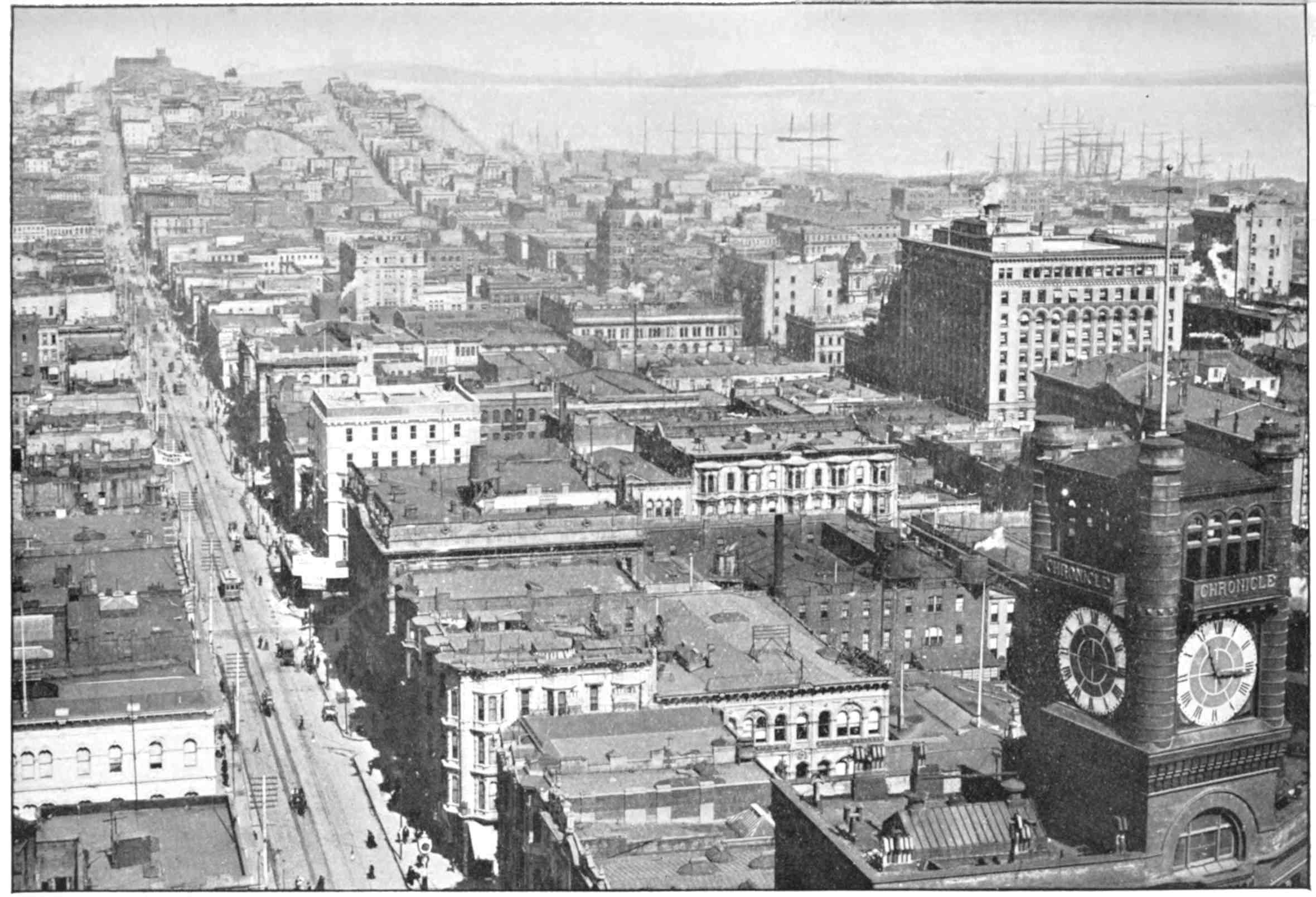
FRISCO
No one hates a tract maniac more than
myself, with their absurdly and often blasphemously
worded literature; of course they are pretty
harmless, except that they bother and worry poor
strangers with their everlasting cant.
I was once in a railway carriage with a tract
maniac and another man. The maniac started
straight away assuring the other man that he
was bound to go straight to hell if he did not
mend his ways, at the same time pressing various
coloured tracts into the man’s unwilling hands.
At last the worm turned.
“I guess, stranger,” he said, “these here be
my passports to that there hell that you say I
am going to sure.”
(But I am clean off the line altogether, and
must make a cast back and see if I can pick up
the scent again.)
Well, I was talking about the Institute. There
is no doubt that this tract-scattering has done
the institutes a great deal of harm and gained
them a bit of a bad name in places; but this is
the fault of the spindle-legged, black-gloved tract
fraternity at home, not the fault of the hard-working,
fearless, and undaunted clergymen
stationed at the different institutes.
The Institute at Frisco, for instance, in no
way thrusts religion upon you. It did not matter
whether you were a Hindoo Lascar, a Mahommedan
Arab, or a Heathen Chinee, you get the same
welcome.
On Sundays there was a Church of England
service in the Institute, which you attended or
you didn’t just as you chose.
To Messrs Karney and O’Rorke, the gallant
workers in Frisco, go my heartfelt thanks for
their many and great kindnesses to me, and my
very best wishes that their great work may
prosper—that work of helping and looking after
the great company of our British mercantile
marine.
Sunday, 16th July.—How I did enjoy our long
lie in bed, my bed being especially more comfortable
than anybody else’s, for I slept in my
carriboo-skin sleeping-bag. This bag I got at
a bargain. I gave a pair of 12-lb. blankets for
it to a man who was camped alongside me at
Lake Bennett, on the way into the Klondyke.
The very next day I was offered sixty dollars for
it, but it was worth a great deal more than that,
and but for it I should have been in a bad
way many a time.
I have slept on ice in it, and have crawled
into it on the muddy floor of a log hut, through
the leaky roof of which the rain poured down;
in the morning I found the bag in a pool of
water, but inside I was quite dry. Where would
blankets, even with waterproof sheets, have been
in a case like that?
This bag was made in Newfoundland by the
Indians from the skins of a couple of carriboo
deer, sewn together with the sinews of the animal,
and Indian cured.[1]
[1] I have since found this bag invaluable whilst at the front
in South Africa.
In the very cold weather in the Klondyke, I
used to fill it as tight as it would pack with
blankets, and, with my head covered up, slept out
in the open with the thermometer well on the
wrong side of zero.
The nipper came and turned Don and myself
out at 8 A.M. to hoist the ensign and house flag,
as it was Sunday.
Don and I spent the morning washing clothes,
a regular Sunday occupation on board ship as it
is in camp.
In the afternoon we went ashore, and taking
a car went into the park and listened to the
band, which was an excellent one; and in the
evening we looked into the Olympia, a free music
hall where, provided you spent five cents on a
glass of beer, you could sit comfortably and
smoke whilst a first-class variety show was performed
before you.
Monday, 17th July.—Cleaning the stringers all
day, and getting into fine condition. Karney
came on board to-day to ask me to dine with
him, and was rather amused when he was shown
a blackface, grimy ruffian, in very dirty dungarees
and a slouch hat.
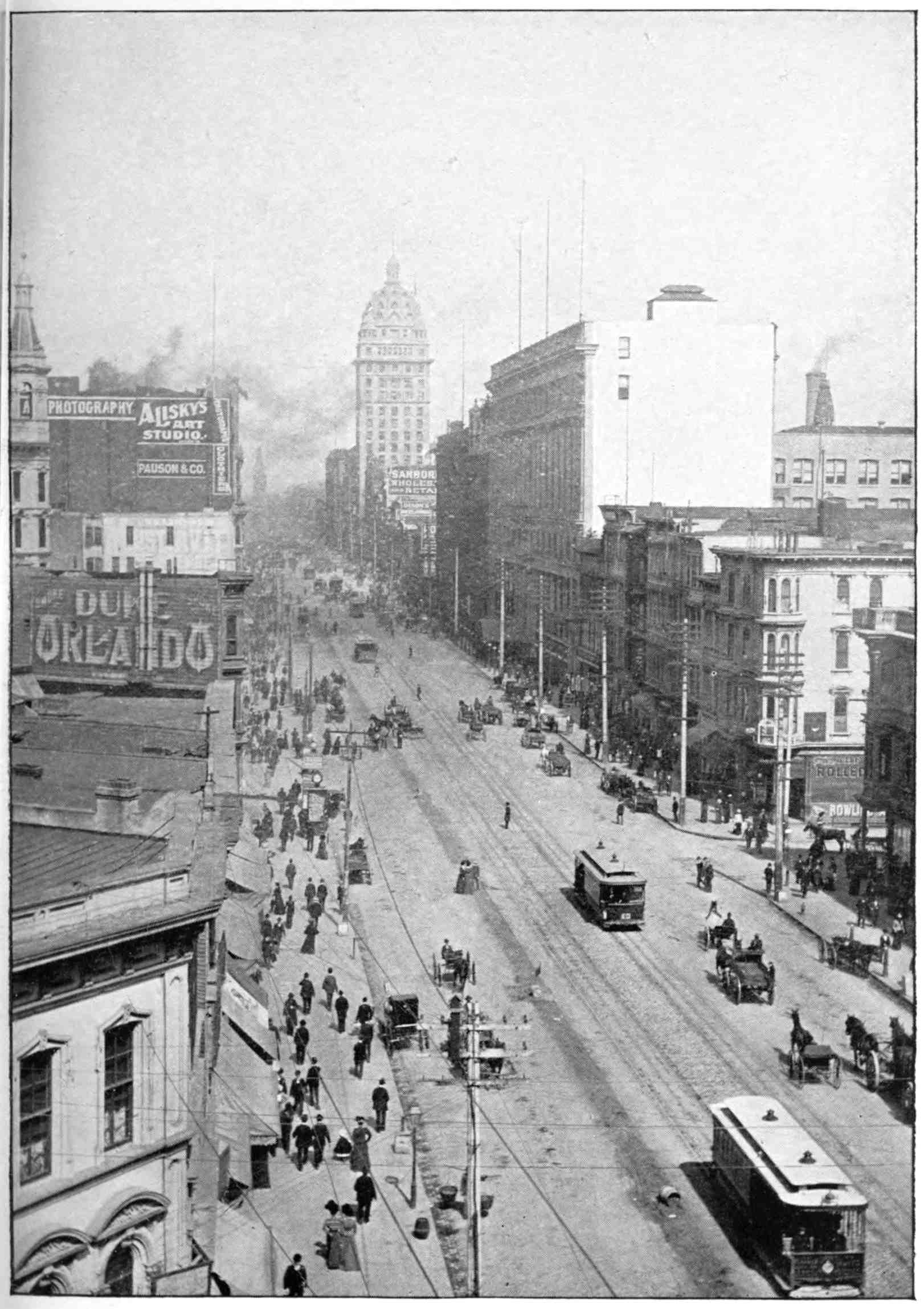
I shall never forget that dinner though: he
took me to the top of the “Call” building, where
there is a very good restaurant.
Here, added to an excellent dinner, you get a
superb view over Frisco in every direction; but
I had come to eat, and eat I did, everything in
the table-d’hôte, and countless plates of nice
white bread and butter, neither of which I had
even seen on board the Royalshire.
My favourite dish on the West Coast of America
is “hot cakes and maple syrup,” not “flapjacks”
made out of flour, baking powder, and water, on
which one lives in the Klondyke, but batter cakes,
smoking hot, and smothered in butter and maple
syrup.
You can get as much as you can eat of these,
with a good cup of coffee to wash them down,
for ten cents at any restaurant in Frisco, and
they are very satisfying to a hungry man, filling
up the corners so well!
Every night when Don and I wander ashore
after the day’s work is over, we have a go of
hot cakes, and sometimes more.
MARKET STREET AND CALL BUILDING
Unfortunately, we are running rather short of
ready cash, and so are economising rigidly; Don’s
boots have fallen off his feet in pieces, so we had
to provide him with new ones, and now all our
spare cash is to go for jam and plum puddings!
Tuesday, 18th July.—Cleaning coal out of the
stringers all day. The darky steward has cleared
out, and a German has appeared, who, according
to himself is a man of vast attraction and many
parts, and his wonderful stock of lies would make
even Kruger or Li Hung Chang green with envy.
Wednesday, 19th July.—The after and main
holds are now quite clean after a hard day’s work.
There is a concert every Wednesday at the
Institute, and performers from the ships are
eagerly sought after.
Don and I went to-day for the first time, and
Don proved a great catch, as he has a vast
répertoire of songs, comic and otherwise, and
accompanies himself.
We found that the two favourites with sailors
are “Tommy Atkins” and “Eliza ’Awkins.”
It was a very amusing concert, and ended
with a hauling chanty, that good old stager
“Blow, Boys, Blow,” all hands tailing on to the
end of the rope, and running three fat apprentices
up by means of a hook in the ceiling and a
block and tackle.
Thursday, 20th July.—My only entry in my
log to-day was a most important one, namely,
“We laid in a stock of jam.” This jam Don
and I meant to keep until we got to sea; but,
alas, when we finally did sail, there were only
four small pots left.
Friday, 21st July.—At work to-day cleaning
out the bilges in the after and main holds. This
is a most filthy job; the bilges are filled with a
thick, greeny-yellow fluid, the refuse of the
different cargoes, case oil, rotten wheat, etc. We
have to shovel it out with anything we can get
hold of, empty sardine tins being at a premium,
and where it is thicker and more foul than usual
you have to use your hands in scooping it out.
Someone stands at the opening of the hatch
and hauls the buckets up as fast as they are
filled, dumping the foul muck overboard into the
bay, which, if you please, supplies the city with
water.
By the time that we had been six hours at
this, the water all round the ship was covered by
a mass of slimy, yellow and green decayed matter,
which smelt worse than anything I have ever
smelt yet.
The four-mast barque Earl of Dunmore came
into the wharf next to us this morning, fifty-two
days from Newcastle, Australia. She is nothing
like such a fine ship as the Royalshire; though
her tonnage is greater, her masts and spars are
half the size of ours. She is a Glasgow-built
ship, like the Royalshire, and is overrun by a
wild crowd of Scotch apprentices.
Saturday, 22nd July.—The Marlboro’ Hill,
which has been lying in the stream for several
days trying to get a crew, has at last got one.
This fine four-mast barque had a very bad
name, and her crew ran directly she arrived in
Frisco; and the mate, having had a row with the
captain, left her also.
Her old man has the reputation of being a
very hard nut, and some people thought he would
be months without getting a crew, as men are
very scarce just now.
Every Saturday afternoon we wash down
decks fore and aft, and put everything into spick
and span order for Sunday.
We are waiting now for our “stiffening,” as
we dare not take our last 400 tons of coals out
until we get a like weight of grain, as there is no
ballast to speak of, and the ship might turn turtle
on the way up to Port Costa if there happened
to be a fair breeze blowing.
All ships loading grain from Frisco have to
go up the Sacramento and load at Port Costa
and Crockett, where the railway deposits the
grain.
Our cargo, it is rumoured, is to be barley, so
we shall be a light ship, and probably cranky.
We had a merry evening at the Institute, singing
and feeding, Don being to the fore with a
new lot of songs.
Sunday, 23rd July.—Delicious weather, sunshine
and blue sky, without being too hot. As
usual, I spent the morning washing clothes.
I dined with O’Rorke, the boss sky-pilot at
the Institute; he is an old Etonian, and I am not
certain if he was not at Eton with me.
The first time he saw me, I was as black as a
sweep, shovelling coal; but he spotted a faded
Eton Rambler ribbon on my dirty old slouch hat,
and inquiring from the captain, found out who
I was. Once before, up in the Klondyke, my
faded Rambler ribbon caused me to make the
acquaintance of a fellow old Etonian.
The new mate of the Marlboro’ Hill, which
sails to-morrow, was also dining with O’Rorke.
He seems to have had a hard time with his new
men. He found the ship swarming with wild
apprentices, who had been having a fine time, with
no one to keep them in order; and of his new crew,
hardly a man has been to sea before; most of them
are farm hands, and six of them had to be put in
irons at once, including two ex-clergymen and two
ex-bartenders.
He said they had great trouble bending sail,
and took the whole of Saturday afternoon bending
the mainsail.
With such a crew as that, a captain and his
mates must use strong measures if they hope ever
to get their ship safe home; but the fault is generally
the captain’s if he cannot get sailors to ship,
and has to pay blood-money to the boarding-house
keepers to “shanghai” farm hands and dead-beats
aboard.
But this is a big subject, and few people know
that this sort of thing still goes on in big ports like
Frisco, New York, and Philadelphia.
Very different to that of the Marlboro’ Hill
was the case of the Benares, another Scotch four-mast
barque, a magnificent ship with several record
passages to her credit.
She left about a week ago with every man on
board a Britisher, and the same crew that she had
left England with.
This, of course, was a great feather in her
captain’s hat, for most crews run at Frisco, as
A.B. wages are four pounds a month out of Frisco,
as compared with two pounds ten out of British
ports.
It is nothing unusual, either, for a ship to sail
with several of her crew in irons. The Royalshire
sailed from Philadelphia this very voyage with half
her men in irons.
The second mate told me of a ship sailing out
of Philadelphia, whose crew were shipped on board
drunk, and were chucked into the sail-locker and
shut in there by her two mates, who were both
very strong men. After keeping them there for
twenty-four hours, the two mates went in amongst
them with belaying pins and laid about the poor
devils with such effect, that the sails they were
lying upon were soon covered with blood, and
two of the victims succumbed to their injuries.
There are quantities of stories of this kind, but
nearly always on Yankee ships; for on board a
British ship a sailor can get justice in port, and a
captain or mate knows he will get heavy punishment
for brutality.
A British ship came in here yesterday from
Cape Town, where her mate had been hanged
for killing a man during the passage there.
One of the biggest bits of brutality I have
heard of, was the case of an apprentice on a ship
outward bound round the Horn.
This poor little chap was shut in the hencoop
with the hens for the whole passage of one
hundred and fifty days, and was never allowed to
come out, even to wash himself. When the ship
arrived in Frisco, the boy was in a truly pitiable
condition; but I am glad to say that the captain
and mates got it very hot, as the case was taken
into court.
There is even a still more terrible case of a boy
who was lashed to the mizen fife-rail all through
the bitter passage round the Horn. It was a
wonder that he did not die of exposure; for to be
wet and half-drowned in that awful weather, day
after day, night after night, unable to lie down to
rest, unable to sit or even stand on account of the
seas continually washing his feet from under him,
this terrible experience many a strong man would
not have survived.
It was a wonder that the boy kept his senses,
but he lived through it all, only to die before
getting into port, from neglected cold and pneumonia
contracted whilst lashed up thus off the
Horn.
If ever a boy was murdered it was that boy.
On some of the Yankee hell ships the things
that go on are almost incredible, and the captains
have to be skilled surgeons to cope with the work
of destruction wrought by their mates.
Legs and arms broken were considered nothing,
ribs stamped in by heavy sea-boots had to mend
as best they could, faces smashed like rotten
apples by iron belaying pins had to get well or
fear worse treatment, eyes closed up by a brawny
mate’s fist had to see. There have been many
instances of men triced up in the rigging, stripped,
and then literally skinned alive with deck-scrapers.
Thus the reputation of American ships has
got so bad that none but a real tough citizen, or
a stolid, long-suffering Dutchman (as sailors call
all Germans, Swedes, Norwegians, or Russian
Finns), will ship in them.
On board these “down-easters” and “blue-nose”
craft, where discipline is enforced by a plentiful
use of belaying-pin, knuckle-duster, and boot,
the work done is stupendous, and the ship is
certainly kept in a wonderfully trim state.
Of course there is also a certain amount to
be said on the side of the captains and mates,
as nowadays some crews are composed of such
villainous scoundrels, that unless you take a high
hand with them, and show you are not to be
trifled with, they would soon take advantage of
what they would call a “softy,” and a reign of
terror would begin, any sort of discipline would
be impossible, the men would do just as much
work as they felt inclined for, and they would
openly sneer and scoff at you if ordered to do
anything they did not wish.
Monday, 24th July.—Thank goodness, we have
finished with the hold for the present, and to-day
we are all over the side on stages, chipping the
rust off the plates preparatory to giving the ship
a coat of paint.
This is a very pleasant change, and it is
quite delicious working in the open air and sunshine
after the gloom of the stuffy hold. But
now, instead of getting our eyes filled with coal-dust,
they get bombarded by bits of rusty
iron.
Chips wears goggles for protection; and I
tried to find my snow goggles, but not being able
to, had to do without.
Chipping is not nearly so simple as it looks.
To begin with, the hammers are by no means
light, and I found that at the end of my first
day’s chipping, my wrist was very stiff.
If you hit too hard, you make dents in the
iron; if you hit too soft, you get nothing done.
Don and I, though we worked like furies,
found that we could not keep up with the others,
who did not seem to be working hard at all.
We started chipping from the port bow, and
as soon as a plate was chipped and rubbed smooth,
it was immediately painted.
We were a very cheerful party. Don and I
started singing choruses at the top of our pipes
in time to the chipping. The mate, who was prowling
about the deck, came to the side and watched
us in amazement, but said nothing.
The second mate, who is a real white man,
does not mind, though his language is often
forcible. Rowland, who had been degraded from
his post of night watchman because he was ashore
till two o’clock one night, joined in with a will,
and Mac, the fourth mate, was also induced to
tune up when he saw that nothing happened.
Chip! chip! chip! And it’s Blow, my bully
boys, blow! As we were not under the eyes of the
mate the whole time, we slipped in an occasional
smoke, and, in fact, thoroughly enjoyed ourselves.
This evening Don and I went to see Heartsease
played at the Columbia Theatre. The piece was
well put on, and well acted. To my great surprise,
the pathetic bits moved Don to tears, and he
insists that he must go again; it is wonderful
what delight a piece gives some people if it is
tragic enough to make them cry.
Tuesday, 25th July.—Still chipping and painting
all day. My hands, which were very sore, are
now quite healed and hardened up, and I am as
fit as a fiddle, and ready for anything.
Don went off this evening, with Rowland in
tow, to see Heartsease again.
Wednesday, 26th July.—Again chipping and
painting.
We are waiting anxiously for our stiffening,
which may turn up at any minute, as we have
to go over to Oakland Creek to discharge the
rest of our coal.
Don and I, on coming on board this evening
from the shore, found Johnsen, the sailmaker,
camped down in our forecastle, and trying to
get to sleep in the bunk next to Don’s.
This man is a very queer character: he is
very silent, and rarely says a word, though he
speaks English very well: he is a Swede, and an
excellent sailor, but a more unpopular scoundrel
never sailed the seas. He has got a villainous
face, with queerish eyes; and, owing probably to
two severe falls from aloft, he is not all there.
He is exceedingly suspicious, and thinks everybody
is trying to do him a bad turn.
As he is such a good sailor, the old man, on
losing his sailmaker, offered him the job, which
he accepted, and moved into the midship-house,
where Chips (who is a Russian Finn) and our
German cook live.
But now, for some reason or other, he has
refused to go home as sailmaker, and has come
back into the forecastle, meaning to come home
as an A.B.
Such is our queer, new mate in the forecastle.
I must say he does not interfere with Don and
myself in any way, even getting his own grub
from the galley, which an A.B. expects an O.S.
to do for him.
Thursday, 27th July.—Oh, joyful sight! On
turning out this morning, we found four lighters
alongside with our 400 tons of stiffening on board.
Before knocking off this evening, we cockbilled
the lower yards, as we are going to be
towed over to Oakland Creek to-morrow morning
to discharge the rest of our coal, and the yards
have to be cockbilled, apparently to clear the
top of the coal sheds.
As this is our last day in Frisco for some
time, I took the second mate, Don, and Rowland,
to dinner at the top of the “Call,” and afterwards
to see Heartsease again.
CHAPTER II OAKLAND CREEK AND PORT COSTA
Friday, 28th July.—We were turned out at
3.30, and started unmooring ship in the dark; no
light work, shorthanded as we are. The tug was
soon fast alongside, however, and away we went
for Oakland Creek.
The early rising had a bad effect on the
captain’s temper. He started letting it off in
loud tones to the pilot about what a —— fool of
a mate he had got. This was on account of the
yards not being cockbilled quite high enough.
This was said so that the whole ship’s crew
and tugboat could hear. The mate happened to
be forward superintending the cockbilling of the
fore-yard a bit higher.
“I’m d—d if I’d stand that,” shouts the
second mate at the top of his voice to the mate,
in plain hearing of the old man; nor did he.
Aft came the mate, not stopping until he was
within talking distance, but shouting at the old
man as he came along, and letting him have it
hot and thick. The old man roared back, and
for a minute or so they went at it in rare style,
much to the delight of the rest of us.
“I won’t stand it, Captain Bailey; I’m d—d
if I will, and so I tell ye.”
“Didn’t I tell ye to cockbill the yards last
night, d—n it? but I can’t trust ye, I can’t trust
ye: what good are ye, what use are ye?”
“I know my duty, Captain Bailey, and I do
it;” and the mate had his say. At last the mate
went forward again to his cockbilling, and then
the old man thundered out to the second mate,
who was under the break of the poop,
“Mr Knowles, come up here!” and then
another furious row began. These two had
been at loggerheads most of the voyage, both
had tempers of the hottest description; the second
mate was afraid of no man, and what’s more,
did not care what he said, and he used to make
the old man almost foam at the mouth, by
laughing when he was cursing him.
On the passage from Japan, the old man had
shut him up in his cabin for a week—this, by
the way, is a not uncommon punishment for
young second mates.
Well, at it they went, and I heard every
word, as, unknown to the old man, I happened
to be doing something on the other side of the
wheel-house.
“You are the worst b—dy second mate I
ever had!” thundered the old man.
The second mate laughed.—He had a laugh
when his temper was up which would have made
an angel grind his teeth.
“D—d mutinous dog.”
This burst the torrent of the second mate’s
language, and the air was sulphurous for a bit.
“I’ll put you in irons! I’ll put you in irons!”
yelled the old man, shaking his fist in the other’s
face.
“Two of you could not do it; I defy you!
d’you hear, I defy you!” and the second mate
glowered over the old man, with clenched fists
and quivering nostrils.
At last they talked themselves out, and the
second mate left the poop.
Turning round, the old man found Rowland
and myself coiling down a line behind the chart-house.
Rowland was just out of his time, and
had served the whole of it under Captain Bailey
in the Royalshire, and so knew him pretty well
by this time.
“Ever cockbilled yards before?” growled the
old man sarcastically to Rowland.
“Yes, sir, in mid-Atlantic this voyage,” said
Rowland, referring to the cyclone the Royalshire
was caught in, in the Western Ocean on her way
to Philadelphia from Hamburg, in which both
her fore and crossjack port lifts carried away,
and the yards were cockbilled as they had never
been before. They had a narrow squeak of it;
all three topsails and the foretopmast staysail
were blown out of the bolt-ropes, and for some
seconds the ship was on her beam ends.
But to return, whilst the skipper raved on
the poop, we were being towed over to Oakland
Creek, and the dawn was not yet.
Presently there was another row, for Mac
was overheard by the old man as he cursed
him in the foulest language under the break of
the poop.
Up Mac had to go on to the poop, and stand
up against the old man’s wrath.
He and Scar the third mate, who is now
acting as night watchman, are both very down
on the old man, because he won’t let them go
home via New York.
Like Rowland, they are both just out of
their time; the old man has made them third
and fourth mates, but they want him to pay
their passage home by New York, as they do
not want to waste the time by going home in
the ship. Rowland hopes to go home by New
York, as his people are going to send the money
out.
On arriving in Oakland Creek, we found a
wretched three-masted schooner in our berth, so
we had to moor ship a hundred yards off the
sheds.
How sick we did get of mooring ship and
unmooring ship. Our whole ship’s company at
present is only nine for working purposes: the
four mates, Rowland, Chips, Johnsen, Don, myself,
and the nipper, who is only sixteen. Mooring
a big ship like the Royalshire is pretty heavy
work for eight men and a boy.
Talk about “sea serpents,” I know what they
are now—“wire mooring-lines.”
These devils incarnate will go any way but
the way you want them to go: as a rule they
prefer lying in a tangled knotted heap on the
deck. If you try to coil them down neatly, they
spring into action at once; one bight trips you
up, whilst another knocks you over the head and
lays you flat on the deck; a third giving you a
gentle rap across the wrist, which nearly breaks
it.
Then if they have been in the water, they
have probably found bottom somehow, and come
out covered with slimy mud, which they immediately
wipe off on you.
They jam in the hawse pipes, they serge, and
in fact play the devil in every way they can think
of. The consequence is, that mooring the Royalshire
is usually done by eight blaspheming, perspiring
ruffians, muddy and bruised, and soaking
wet.
For some reason or other, we always had to
moor or unmoor ship in the early morning, or
late at night in pitch darkness, which certainly
did not improve matters.
Well, by eight bells, 8 A.M., we had got the
Royalshire snugly moored; but no sooner had we
cleaned ourselves and gulped down our slumgullion
than we were turned to to warp the ship further
up the wharf, as another ship wanted to come
in where we were lying.
This meant slacking away our stern lines,
and taking our head lines to the capstan.
Four hands were all we could spare on the
capstan to move the 2000-ton ship, with 600 tons
of coal and the stiffening, about fifty yards against
the stream.
We did it somehow; how long we took I
don’t know, but I shan’t forget those hours at
the windlass, fighting for every inch.
The second mate, Don, Johnsen, and myself
were on the bars.
“Heave and she must, heave and she will!”
sung the mate; but devil a bit of it.
As soon as we had got her moored again, we
were turned out to cleaning out the stringers in
the fore-hold.
Just across the creek lies an old-time South
Sea whaler, and from the look of her lines she
must be at least fifty years old.
She had a regular old-fashioned stern, with
great windows surrounded by ornamentation gilt
work. Her boats, to the number of four, were
slung out on wooden davits; her jibboom had a
great hoist to it, and was very lengthy compared
to the iron spars which form the bowsprits of
modern sailing-ships. Her decks were flush fore
and aft; there was the usual brick-built “tryworks”
amidships, and a small galley forward.
She had long topmasts and stump topgallant
masts, and her topgallant yards were on deck.
I was very much interested in her—a last
survivor of an almost vanished type of ship, whose
business in the Great South Seas was at one
time a source of great wealth to “down-east”
owners.
In the days of their prime, these South Sea
whalers constantly came into port after a three
year’s voyage with a fortune in their hold.
The record whaling cruise, I believe, was that
of the New Bedford South Seaman Onward, which,
after forty-one months at sea, stocked 275,000
dollars. But, like many other good old sea trades,
the day has passed; whales have been thinned
out and killed off, and it no longer pays, and a
South Sea whaler is now a very great rarity.
Saturday, 29th July.—Early this morning we
were again turned out of our berth, and had to
move farther up.
Johnsen is getting quite talkative in the forecastle,
and yarned away last night for some time
to Don and myself.
He has tried to educate himself a bit, and
thinks he knows a good deal about languages.
He told us some very queer and bloodthirsty
yarns about his sprees in New York and other
parts of the world.
They generally had some deep joke in them,
which he would chuckle over for hours, but Don
and I always seemed to miss the point.
He has got a sea-chest which he bought in
China, and which he is very proud of. Somebody
on the last passage broke the lock and stole the
lid, so now he is very much on the alert lest
Don or I should try and repeat the performance.
He has bought some wood, and spends most
of his spare time trying to make a new lid. It
is bothering him a good deal, and we found him
cursing like fury two days ago, as, after all his
trouble, he found he had made his lid a bit too
small, so now he is hard at work making another
one.
Don and I often go and sit in the half-deck
of an evening now, and yarn away with the
nipper, Rowland, and Mac.
This half-deck, as it is called, is a kind of deck
cabin under the break of the poop.
It is the abode of the apprentices, and, though
none too large, has seven bunks in it.
It is pretty well blocked up now with the
curios they all bought in Japan. Each man
bought a tea-set, besides sword-sticks, fishing-rods,
vases, Chinese puzzles, and other curios. The
nipper also has got a canary, which he hopes to
get safely to England.
The occupants of the half-deck at present are
Scar, MacDenny, Rowland, and the nipper. There
was another apprentice, who is at present in
hospital in Frisco.
He fell from aloft one dirty night whilst
making the spanker fast, and landed face down
on a skylight. It was a wonder he was not
killed; his jaw was broken, his face cut to ribbons,
and his skull nearly cracked, but he is slowly
recovering.
The others all swear by him. He appears
to have been a very fine sailorman, strong as a
bull, good-tempered, and fearless.
Sunday, 30th July.—Turned to at 5.30 A.M.,
and warped ship down to the coal bunkers, the
schooner having departed. Finished mooring ship
at 8.30.
After breakfast, Rowland and I went off to
play cricket for the California Cricket Club
against the Pacific C.C. in a cup match, both of
us having been made honorary members.
Neither of us helped them much, and we got
badly beaten. After the match Don, Rowland,
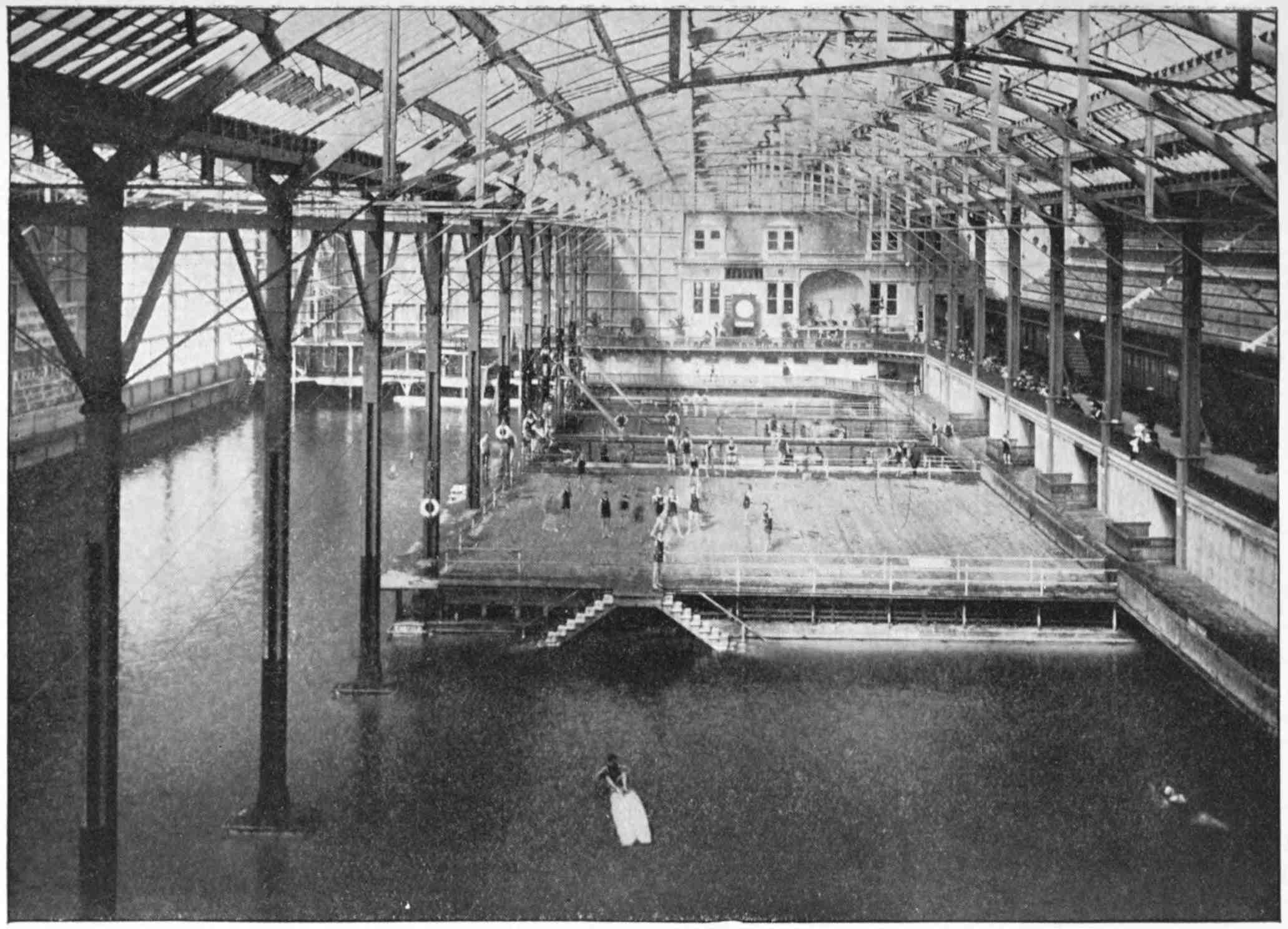
and I went and had a swim in the magnificent
baths they have here.
Don holds several swimming records both in
California and in England, having taught swimming
in the famous Frisco baths, the finest in the
world. He has a lot of diving tricks, and is
really a beautiful performer.
After our swim we wanted our usual go of
hot cakes, but though we searched Oakland high
and low, we could not get them. Apparently in
Oakland they only eat them for breakfast.
Monday, 31st July.—I had the dirtiest day’s
work I have ever had to-day. Directly we had
got the stringers clean as the last of our coal
was taken out, we were turned to cleaning bilges
again. These bilges forward were far worse than
those aft; the smell was worse than any smell I
have ever smelt, and you could not help getting
covered with the awful stuff as you shovelled it
into the buckets with your hands. Once a full
bucket, when half hauled up, fell, and scattered
the muck all over us, and I can tell you it made
some of us feel queer. When we had the bilges
clean, we plastered them, and this filthy job lasted
until knock-off time.
They tell me that when the ship gets home
she will have her bilges full again and the grain
will have grown over a foot high in them.
FRISCO SWIMMING BATHS
Tuesday, 1st August.—Turned to at 3.30 A.M.;
unmoored and towed off to Port Costa, or to be
exact, Crockett, which is about a mile nearer than
Port Costa.
Chips and his mate from the shore have got
all the after and main hold lined with planks
ready for loading grain, and are busy now on
the fore-hold, and all the lumber that I sent on
board from the wharf in Frisco is fast being
used up.
We are busy on a much cleaner job to-day,
that of nailing down old sails and canvas over
the lining in the hold, according to regulations.
Many were the growls when, on arriving at
Crockett, we found our berth again occupied, and
we have got to wait until the other ship has
finished loading.
The captain has allowed Don and myself to
come aft into the half-deck, a rare piece of luck;
so we brought all our truck aft this evening, and
took possession of two empty lower bunks.
Our first night in the half-deck was not a nice
one, as it was very hot and close, and the mosquitoes
were awful, biting like fury; they were half the
size of Klondyke mosquitoes, but twice as vicious.
Too hot to sleep in my bag any longer, so
have turned it inside out to lie upon.
Wednesday, 2nd August.—We finished chipping
this morning, and all hands are over the side
on stages, busy painting. I always thought “slap,
dab, dash” painting of this sort was easy enough,
but I soon found out my mistake.
A modern sailorman has to be an expert with
the paint-pot, and the mates of course have to
understand how to mix the different paints.
It is wonderful how much paint a smart ship
consumes in a voyage.
Well, I started work painting our beautiful
figure-head white, and thought I was doing
very well; but when I had finished it, Chips had
to come along and do it all again. After this
the old man was constantly pointing out bits of
bad painting as he came along the wharf, and
they generally turned out to be my doing.
Don had been in the “slap-dab” trade before,
and rather fancied himself, and the only person
on board who attempted to rival me in bad
painting was the nipper.
Painting is reckoned one of the nicest jobs
on board ship, and most sailors are extremely
neat, quick painters. I was all right at little
tricky jobs, but when it came to putting the paint
smoothly on a big plate, I was done.
This evening we walked down the line to
Port Costa, where there is a small branch of the
Institute. Here we met a number of apprentices
off the other ships loading, marvellous specimens
some of them.
A very kind old lady ran the branch, and
after an evening spent in song, gave us a very
good tea—the great attraction, of course, and one
that was well earned, as the Institute was at the
top of a hill, with a regular breakneck climb
up to it, and a nice time we had coming down
it one or two pitch-dark nights. Walking back
to the ship along the railway track was not a
very pleasant job on a pitch-dark night, with
trains coming along every few minutes, and grain-trucks
being shunted about.
The second mate of one of the ships had an
adventure which provided us with laughter for
some time. As a whole lot of us were sitting
yarning in the half-deck, he came staggering in,
evidently full of nose-paint, and with his trousers
pulled up above his knees.
“My God, boys, I can run, an’ so I tell ye.
I’ll run any man for fthifthy poundths.”
“Why, what the devil have you been doing
now?”
“I’ve just—ah, let me see, I forgeth—oh yeth,
I’veth justh beaten the bloomen thrain; that’th
so’th, boys. I was down sitting on th’ thrack over
ath Port Costa, when I sees a thrain a comin’
righth on top o’ me; well, boyths, will ye believ’
thi’t, but I justh pulled up ma’ throuthers like
this, see,—d’ye see, ye with the uglith mug,—are
you lookin’, you, eh? ugly?”
“Aye, mate, I’m lookin’.”
“Do ye want’th to fighth; if tho, I’m ye man,
d’ye hear, ugly? I can fighth the blasted world,
I can.” He was beginning to get bellicose, and
was right off his subject, leering round and
shaking his fist at us all as we roared with
laughter.
“What about the train, mate; did it catch
ye?” asked somebody.
“Did it catch’th me? ye say; did it catch’th
me? I should smile. Why, I giv’th a whoop,
an’ away I goes for Crocketh quicker ’an flyin;
an’ here I am—the blasted thrain ain’t got here
yet. Run! I can run!” and he pulled his
trousers up higher, and put himself into position
to run a hundred yards. We spent a hilarious
night, heedless of heat and mosquitoes, on the
top of this yarn, and finally had to put the crack
runner to bed.
We never found out the truth of this yarn.
I expect really he ran from a stationary lot of
cars, thinking they were a train after him, or
else some carriages being shunted started him
off.
Thursday, 3rd August.—The other ship
finished loading yesterday, and went off; so early
this morning we warped down into position, and
started loading barley.
How those stevedores did work!—the heavy
bags of grain being simply poured down the
shoots into the hold, where they were immediately
shouldered by great burly half-naked men, who
packed them as tight as possible in tiers and
rows.
I now had a new job. Chips and I crawled
about over the bags as they were stowed, with
our knives “bleeding” them, that is to say we
ripped them open, and poured grain into all the
chinks and crevices.
The stevedores were as rough a crew of men
as I had seen anywhere, and their chaff amongst
one another was of the wildest and coarsest
description, and several times small fights arose
and even knives were drawn, but with no
dangerous results.
One man hove some grain in another’s face
by way of a joke, but the other did not see it,
as, growling out that he wasn’t going to be
blinded, he hurled his knife across the ’tween-decks
at the other; it missed the man by a hairbreadth,
and stuck, quivering, into a bag of grain
by his side.
Friday, 4th August.—The mosquitoes were
very hungry all night, and made a great repast.
Last night the captain had a party on board,
the result of which was that the new steward got
“whole seas over,” and kicked up such a row in
the half-deck that the old man wanted to know
about it in the morning; and as he could not
find out the truth of the matter, put it down on
Don, whom he regards as a real wrong ’un.
After work to-day, all hands from the mate
down, except the Dutchmen, went overboard for
a swim; but it was dangerous work, as the tide
and current of the Sacramento are very tricky
and strong, and full of eddies.
Chips brought out a little 30.30 Winchester
carbine, and we had some shooting at bottles.
I had one of these guns up in the Klondyke,
and was delighted with it. I can’t say much for
sailors as shots, but Scar was the worst of the
lot, and could not go within a hundred yards of
the target, besides letting the gun off by mistake,
and scaring us out of our lives.
Saturday, 5th August.—The old man gave
Rowland, the nipper, and myself, leave to go and
play cricket in Frisco for the “British Sailing
Ships” against the Australian boat R.M.S.
Moana.
We played up in the park on a grass wicket,
and for a wonder it was a very cold, damp day.
I only got 12, and was rather annoyed getting
out, as the old man, who is a keen cricketer, was
looking on.
Rowland and the nipper, however, distinguished
themselves, getting 28 and 18 respectively,
and we of the Royalshire contingent beat
the Moana off our own bat, besides getting most
of the wickets, so we did not do so badly.
Sunday, 6th August.—Karney of the Institute
very kindly put the nipper and myself up for
the night, as we had not got to get back
to the Royalshire until Sunday night, so as
to be in time to begin work on the following
morning.
What a luxury sleeping between sheets seemed.
I did not go to sleep at first, because I felt so
comfortable, and wanted to prolong the enjoyment,
and revel in it as long as I could.
A member of the Olympic Club took us there
in the morning, and we had a fine swim, followed
by a big lunch, at which I ate a whole porterhouse
steak, much to the amazement of our host.
We caught the seven o’clock train back to
Crockett.
Monday, 7th August.—Still at work bleeding
grain bags, whilst the others are painting the
ship.
Amongst the ships loading-up here is the Queen
Margaret, a skysail-yard four-mast barque, with
a great reputation for speed and good treatment.
She is a very fast sailer, and is expected to get
home first out of the whole fleet. Her apprentices
actually get eggs and bacon for breakfast in port:
who ever heard of such a luxury?
Close to her is the Almora, a three-mast
barque, with a greater carrying capacity than
the Royalshire, but so slow that she will be very
lucky if she gets home in one hundred and fifty
days. She is such a hungry ship, that even in
the cabin they do not get butter or marmalade.
Tuesday, 8th August.—Don and I went aloft
for the first time to-day, as we have started bending
sail.
The first sail to be bent was the fore-royal,
and so there was no chance of approaching matters
by degrees. We neither of us found any difficulty,
however, except that perhaps at first we were a bit
more careful, and kept a good hold.
On the royal-yard I found that I was much
too long in the leg for the foot-ropes, so that my
knees came above the yard, and I was in danger
of losing my balance and toppling over if I stood
up, and if I sat down on the foot-rope I was too
low down, so I had to do a kind of kneel to be
able to work in any comfort.
We soon found that bending sail shorthanded,
with a strong wind in your teeth, was terrific hard
work, and most trying to the temper, especially
when you are new to the job.
For those who may not know how a square-sail
is bent, I may perhaps be permitted to give
a short explanation:—
First you have to hoist the sail up by means
of a block and gantline until the bunt, which is
made fast to the end of the gantline, is well above
the yard—(always send up a sail to windward).
Then the sail is spread along the yard, head up,
and the head-earings passed by the men at each
yardarm. Then the buntlines and leech-lines,
which are used to clew up the sail, are clinched.
Then you tie the head of the sail to the jackstay,
which is an iron bar running along the top of the
yard. This is done with rovings, lengths of rope
yarn, three or more being passed according to
whether the sail is a royal, topgallant, topsail,
or course; the sheet and the clew-line being
shackled on to the clew by the men at the yardarms.
The sail is then picked up and furled by
means of the gaskets, short ropes made fast to
the jackstay, and wound round and round the
sail and yard to hold the sail up when furled.
All this is no easy business for two men on
each yardarm and one at the bunt, with the
sail dragging and blowing aback and trying to
knock you off the foot-ropes, and half a gale of
wind in your face.
The old rule on a yard is, “one hand for
yourself and one for the ship,” which means, hold
on with one hand and work with the other. But
if you want to get the work done in a case like
this, when so shorthanded or in real bad weather,
I defy anyone to do much good with only one
hand; you soon find yourself using both, extremely
dangerous as it is, for the sail has a way of flying
up over the yard and hitting you in the face,
which, if you have not got fast hold of the backstay,
must send you over backwards.
All day we worked like furies, sweating and
cursing. The language used up aloft was a
revelation to me; never had I heard such thundery
and hair-curling expressions before, not even in
an American mining camp.
The language of the mates verged from the
forcible to the personal, from the picturesque to
the lurid; and finally their inventive minds gave
way before the strain of coining new words, and
their voices, grown husky and broken, gradually
lapsed into hoarse murmurings and whispered
commands to “hoist away,” or “tie up the sail,”
as the case might be.
There was a kind of fierce enjoyment of it
all as we sweated and toiled, struggling desperately,
and putting every ounce of strength into
the pulling and hauling, such as a man feels in
the midst of a hard-fought battle—an exultation
that lifted one out of oneself, and enabled one’s
muscles to accomplish prodigies of strength without
feeling the tremendous fatigue and strain.
Occasionally a laugh would be raised at some
unfortunate’s expense, and chaff flew thick from
yardarm to yardarm.
By the end of the day we had bent the fore-royal,
two topgallant-sails, and two topsails, and
were all well pleased with ourselves, as it was no
mean performance with half a gale of wind in our
teeth.
The second mate was as active as a cat aloft,
and did the work of six men. As for myself, after
the first hour or so I felt completely at home, and
as if I had been used to swinging on a foot-rope
200 feet above the deck all my life.
Wednesday, 9th August.—No mosquitoes could
keep me awake last night, I was so tired.
We bent the main-royal, topgallant sails, and
topsails to-day, and did even better work than
yesterday; things worked smoother, notwithstanding
that the wind was blowing as hard as ever.
My hands, by the way, are now as hard as
leather, and all this pulling and hauling has got
me into splendid condition.
Don, though, is fifteen years older than I am,
and is feeling the hard work rather, especially in
his back, and is fairly worn out at the end of
every day’s work.
We are bending our best sails; these will all
have to come down after we have been a few
days at sea. We shall bend our old sails for the
tropics, and then bend these again for the Horn.
Many landsmen think that one bends one’s
old sails for the bad weather, and one’s best
sails for the tropics. But just the opposite is
the case.
The old, patched sails that are used in the
tropics would fetch away like tissue paper in a
hard blow; and in the furious southern blasts
and the terrific gales of the Western Ocean, only
the very best and strongest canvas is able to
withstand the strain.
Thursday, 10th August.—Bent mizen-royal,
topgallant sails, topsails, and foresail. This last
was a very heavy job for our small ship’s company.
Friday, 11th August.—We finished bending
sail to-day with the jibs, staysails, spanker and
gaff-topsail.
After work, we were glad to plunge into the
Sacramento and have a good swim, Don giving
us an exhibition of trick diving.
We had several visitors in the half-deck this
evening, and a great sing-song took place, everybody
being required to tune up his pipes and
sing a song in turn.
Saturday, 12th August.—We had a great treat
to-day: the second mate, Mac, Rowland, Don,
and myself went off in the lifeboat to get sand,
taking a dozen empty grain bags to be filled.
Don and I took a pot of jam and some hard
tack, as we started before breakfast; but the
second mate had the remains of a cold leg of
mutton, and some real bread-and-butter sandwiches.
We rowed about two miles up-stream before
we found a suitable sandy bay.
The sand we wanted was good, fine sand, as
it was to be used for that most important business
on board ship known as “sand and canvasing,”
which is “rubbing the woodwork clean by means
of wet sand and pieces of canvas.”
We soon had our bags full, and then began
the picnic. How we did enjoy that breakfast on
the beach!—we even lit a camp fire, though we
had nothing to cook on it.
Rowing back was very heavy work against
the tide, and the sand bags put the boat very
low in the water, added to which, by the time
we got alongside she was quite half-full of
water. As she had not been in the water for
some time, her seams were open, and she leaked
so badly that we had to keep a baler going
the whole time.
After washing down, I was lucky enough to
catch the five o’clock train for Frisco.
Sunday, 13th August.—I played in a cup match
for the California C.C. against the Alameda C.C.
We had a very exciting match, and just won
by a wicket and 6 runs.
I got 34—top score.
I had supper at the Institute, and caught the
seven o’clock train back to Port Costa.
We were greeted by bad news on board the
Royalshire. The nipper had been bathing with
some apprentices off another ship.
He and two of the others could swim, but the
third couldn’t, so he hung around the shore, until
all at once he floundered into a hole. The nipper
was the only one near him, and immediately dived
for him; the drowning boy caught hold of him
as he reached him, and held him under the water
in a deadly embrace. The other two came up
as quick as they could, and after several dives,
managed to fish the nipper, insensible, up to
the surface, but the other boy could not be
found.
When I arrived on the Royalshire, I was told
that the nipper was still insensible, having been
taken on board another ship, and that the other
poor little fellow’s body had not been recovered.
Monday, 14th August.—We have finished bending
sail for the present, and are busy painting.
The nipper was brought on board this morning,
very little the worse; but the other body has
not been found yet. Poor little fellow, he seems
to have been such a nice little chap, and it was
his first voyage.
Friday, 18th August.—Finished loading. The
captain is anxious about the trim of the ship,
but, except for a slight list to port, we seem to
be all right.
About mid-day the tug came alongside. We
cast off our lines, and slowly swung into the
stream, and away we went again for the great
Bay of Frisco; but this time in sea trim, and
loaded nicely down to our marks.
We brought up, and let our anchor go in the
bay about six o’clock.
Around us lay several magnificent ships—two
four-mast barques, a three-mast barque, and two
or three full-rigged ships.
One of the full-rigged ships was a real beauty,
a skysail-yard clipper: she had her masts, yards,
and blocks painted white, which gave her a very
neat and trim appearance aloft.
Soon after we brought up, a scow came off
with some stores, chief amongst which was some
very fine, new, hard tack, which actually was
smoking hot when it came on board.
There were some cabin stores, and some ships’
coffee, which Don declares is not coffee at all,
and I incline to the belief that it is coloured
wood.
Saturday, 19th August.—The second mate,
Henderson, Johnsen, the nipper, and myself, swung
the captain’s gig out this morning, and rowed
him and Rowland ashore.
Rowland had got paid off, and said good-bye
to us, as he is going home overland.
To-day was our first day’s sand and canvasing.
This is the kind of work which you get most
of on a sailing-ship, and at the same time is the
most disagreeable, especially in bad, cold, and
wet weather.
This afternoon more stores came on board.
Sunday, 20th August.—We have no chance of
getting ashore, and occupied ourselves turning
out and cleaning up the half-deck.
Monday, 21st August.—To-day we bent the
mainsail and crossjack in record time for six
men.
Tuesday, 22nd August.—Our crew began
coming aboard to-day. The first man came
alongside about eleven o’clock this morning.
We were at work shifting the bags of barley
from the starboard to port, in the fore ’tween-decks.
The man was soon “turned to” carrying
the bags.
He was a very small, greyheaded dago, called
Yoko, and looked very ill and done up, and it
was as much as he could do to lift a grain bag;
still he stuck to it, and we were soon chaffing
and talking with him.
He was a Peruvian, and thought we were
bound for Callao; but when he heard the news
that we were bound for Europe, it did not seem
to bother him much.
He afterwards turned out to be a good sailorman,
though too old and weak; but he knew
his work, and was one of the best men in the
port watch.
He had not been working long before he
was followed by another dago, who turned out
to be a Brazilian. He was a stronger and younger
man, but not much of a sailor, and one of the
most cheerful men I have run across; everything
made him laugh, and when he was not
laughing, he was singing.
We had just knocked off for dinner, when
two others came aboard: they were only rated
as O.S., and had never been to sea before, both
being American hobos. The biggest was a
strong boy just nineteen, who afterwards took
to the life, and learnt everything he could very
keenly. The other, who was a year younger, and
was a small, weak Canuk, was the drudge of the
ship; he boasted that he had never done a day’s
work in his life, in fact he was a regular good-for-nothing
hobo; but he soon found out that
he had to work, and all the dirty work in the
port watch fell to his portion.
These two, when told to turn to at two bells,
came aft to work in stiff collars and boiled shirts,
which showed that they had not much experience
of hard work.
In the afternoon, boats kept coming off at
intervals from the shore, each boat depositing
a half-drunk and very decrepit-looking man,
who did not at all like paying a dollar for his
boat. As yet no Britishers had arrived, though
we had scooped in an Arab, a Swiss, a Norwegian,
and a Swede.
Wednesday, 23rd August.—Our new steward
came on board too drunk to work, so I have
been appointed steward for the time being.
This is a slice of luck, as I feed with the
second mate in the cabin, and finish up whatever
the captain and mate leave.
The captain had someone to supper with him
to-night, and was very much amused at perceiving
me playing the waiter.
I had been very careful in laying the table,
determined not to forget anything; but, nevertheless,
I forgot the napkins.
The captain, noticing this, said smiling, “H’m,
I think you have forgotten the serviteers.”
He was a self-educated man, and though
very well read, was by no means certain in the
pronunciation of his long words.
He had a talk to me one day about this,
whilst I was at the wheel in the South Atlantic.
He complained that Scotch boys were taught
to spell, but not to pronounce the long words.
I felt very funny standing behind the captain’s
chair, with unsmiling face, and as like a waiter
as I could manage to be.
After the captain and his guest had retired,
the second mate came down, and then how I did
tuck in; though there was only dry hash, and
bread and butter, I could have cleared the board
with ease, but I had to remember the inmates
of the half-deck, who were prowling around the
port-hole, ready for me to pass something through
to them.
Well, I don’t think they complained of my
treatment of them whilst I was steward.
Thursday, 24th August.—A great day for
Frisco, for the Californian boys are expected
home to-day from Manilla, and a great reception
has been got ready for them.
Ever since the transport had been sighted off
the Farallones, every factory and steamer whistle
had been tooting for its life, and this awful din
has been going on since four o’clock yesterday
afternoon.
As the Royalshire was considered the flagship
of the British sailing-ships in port, and had the
reputation of being the smartest, early in the
morning we dressed the ship with flags, and did
what we could towards the general din, by keeping
a man at work on our foghorn.
I had a good climb, as I was sent up to
clear the house flag, which had got foul at the
main-truck.
This means, that after you get on to the
royal-yard, you have to swarm up the naked
mast, and is a pretty good test of the condition
of your nerves. For a beginner, however, I
accomplished the job all right, and thus proved
my statement to the captain when I first met him.
The captain, who had stayed on shore last
night, presently came off in a launch with about
twenty people.
I thanked my stars that the steward was on
his legs again. He was very shaky still, and
had a very busy day of it. How he managed to
feed those twenty people I don’t know; they kept
on going down to the cabin, though, in relay
after relay.
We have been given a holiday on this auspicious
occasion.
The bay was a lovely sight; all the morning,
yachts and crafts of all sort were scudding out
to the Golden Gate to escort the transport in.
There was a bright sun and a fresh breeze,
and the bright colouring of the bunting, the white
sails of the yachts, and the flashing effects of
foam-flecked sea and blue sky, made an exceedingly
pretty and animated picture. It was a
fitting last day in Frisco, for we sail at daybreak
to-morrow.
During the afternoon the rest of our new
hands came off, and a queer crew they looked.
Most of them were under the influence of liquor,
and lurching into the forecastle, were seen no more.
One young O.S., by name Jennings, who was
afterwards in the starboard watch, had been on
the American Navy, but had been kicked out for
some offence at Manilla.
He had been a signaller, and told us what
the battleship Iowa kept signalling.
At last the transport was descried in the distance
slowly approaching up the bay, surrounded
by yachts and steamers, black with cheering
enthusiastic people.
She was a very pretty sight as she approached,
with all her bunting flying, and sailing-yachts
and steam-launches darting about all round her.
As she steamed in between our little fleet of
deep-watermen and Frisco, the din became
deafening; the deep roll of cheering reached us
over the water, the Iowa began firing her guns
off, and every whistle screeched at the top of its
pipes.
As she came by, we dipped our ensign a
number of times, and the man at the foghorn
put his whole heart into his performance.
Dodging round us were yachts of all kinds,
big cutters and little cat-boats; but the prettiest
of all was the Frisco pilot-boat, the Bonita, a
beautiful little schooner, which was scudding about
in every direction under foresail, headsails, and
double-reefed mainsail.
The transport anchored below us, and now
the captain had to get his guests ashore; and as
there was no chance of getting the steam-launch,
the order was given to get the gig over the side.
FRISCO BAY
It was now blowing quite fresh, and with the
tide at half-flood, there was quite a bobble on
the water, and we had evidently got a stiff row
before us, as we were lying some way out.
The captain had got half a dozen women
amongst his guests, who did not seem to like
the lookout at all, especially when they saw us
bobbing up and down alongside.
With some care and stowing we got them all
aboard, and away we started for the shore, the
second mate pulling stroke.
It took us two hours’ hard pulling to reach
the landing-stages, by which time the gig had
shipped so much water that the captain and
ladies in the sternsheets were up to their knees
in water, and the nipper had to give up his oar
and take to baling.
The old man on getting ashore made the
second mate go straight back to the ship, as he
said he would come off in the launch, so we were
done out of a run ashore.
So ended our last day in port.
CHAPTER III THE NORTH PACIFIC
Heh! Walk her round. Heave, ah, heave her short again!
Over, snatch her over, there, and hold her on the pawl,
Loose all sail, and brace your yards back and full—
Ready jib to pay her off and heave short all!
Well, ah, fare you well; we can stay no more with you, my love—
Down, set down your liquor and your girl from off your knee;
For the wind has come to say: “You must take me while you may,
If you’d go to Mother Carey (walk her down to Mother Carey!)
Oh, we’re bound to Mother Carey where she feeds her chicks at sea!”
Kipling.
Friday, 25th August.—Manned the capstan at
4 A.M. The crew were turned out with some
difficulty, and some of them looked very much
the worse for wear, especially those that only
came aboard last night. The German-American
bosun soon began to give tongue, which, with
his size, soon brought the loiterers up to the
scratch.
The longbars were put into the capstan, and
we were soon tramping drearily round in the
raw, misty, morning air. As no one felt equal to a
chanty, we hove her short to occasional “Heave,
and she comes!” “Heave, and break her out!”
“Heave, and she must!” “Heave, and bust her!”
Presently the anchor was hove short, and we
had to wait a while for our tug.
I took the opportunity to take stock of our
crew; they seemed all sizes, shapes, and kinds. At
my bar was a long, thin man, who looked like a
sailor: he turned out to be a Swiss naturalised
American, one of the hardest workers in the ship,
who, though he had been at sea all his life in
sailing-ships and steamers, yet could not steer,
and certainly was hardly qualified for A.B.’s
work.
Close to him was a little Arab, who, in light
blue dungarees, dark blue shirt, and red tam-o’-shanter,
made a picturesque figure, with his bowlegs
and face of bright copper. This man had
shipped as A.B., thereby earning four pounds a
month; but he soon showed himself a lazy and
ignorant little coward. Alongside him was a
man who looked the very image of an old
weather-beaten tar, but who also turned out very
different.
Presently as it grew lighter, we made out the
tug coming off. We soon had her hawser aboard,
and “Man the capstan!” came the order, and
“Break out the mudhook!”
Then came a struggle; everybody strained
with all their might, slower and slower went the
“click” of the pawls, until at last we were almost
at a standstill;—that mudhook refused to leave
his pleasant quarters at the bottom of Frisco Bay,
and twenty men did not seem able to move him.
Puff! goes the tug, and with its help we soon
break out the demon, which presently appears at
the rail, with a mass of dark blue clayish mud
clinging to him. A man is sent to the wheel,
and the tug goes ahead.
The anchor is soon catted and fished, and we
are turned to getting all ready for sea.
Slowly, in the twilight of early dawn, we leave
Frisco, and pass our comrades lying in the bay.
One of them, the smart French barque, has a tug
alongside of her, and will soon be on our heels.
Anxious as I was to get to sea, I felt quite
sorry as I saw Frisco, that gay wicked city of
the West, fading out of sight. It was a lovely
view as the sun rose in all his glory and flashed
on the windows of the great “Call” buildings
and lit up the bay, with the deep-sea sailors
at anchor nearest the American battleship Iowa,
beyond the ferry, and close to her the transport
that had brought the Californian boys home,
and a great Australian liner.
Good-bye, Frisco, we shall ever have pleasant
memories of you; but, as the good old chanty
goes—
“Our anchor we’ll weigh, and our sails we’ll set,
Good-bye, fare-ye-well!
Good-bye, fare-ye-well!
The friends we are leaving, we leave with regret,
Hurrah! my boys, we’re homeward bound!”
As Frisco fades into the distance, the Golden
Gate begins to open up, and the deck to have
a bit of a jump in it as we near the bar.
Here we had quite a tumble for a short time,
and one of our landlubbers did not require any
breakfast when eight bells went. For myself, as
usual, I had an appetite like a shark, and one of
our invaluable pots of jam was sacrificed to the
occasion.
I had an accident this morning that might
have turned out badly. I was down in the cabin
helping the steward to put away some stores in
the lazarette; the trap-door down to the lazarette
was open, of course, and I carelessly, without
looking where I was going, stepped through it,
and of course fell with a terrific bang to the bottom
of the lazarette, a fall of over 10 feet, but I am
pretty hard and fit now, and was not a bit hurt.
By 8.30 we were nearly up with the light-ship,
and we were turned to again.
“All hands make sail!” sang out the mate.
There was a steady breeze from the north-west.
I went up on to the fore-topsail yards and
loosed those sails, and then to the fore-topgallant
yards, and finally the royal. We had a busy
morning of it setting all sail.
When the royal yards had been mastheaded,
I was sent up to the fore-royal to overhaul the
leech and buntlines. This means shinning up
the royal halliards, which are, of course, of chain,
and just within reach from the top of the topgallant
rigging.
Up I went, without any difficulty as regards
the climbing, and luckily for me I have a very
good head, so I was soon on the royal foot-ropes
overhauling the gear.
What a magnificent lookout one gets from
the royal yard of a ship, and what wee specks the
people working on deck do look from such an
elevation!
Having overhauled the gear, I was preparing
to descend on to the upper-topgallant yard when
I was hailed by one of the new hands, who was
trying to overhaul the gear of the main upper-topgallant
yard. He evidently knew nothing
about the job, and I had to shout directions to
him. Then he wanted to know how to get on
to the main-royal yard. I told him, by shinning
up the royal halliards. This was a job he did
not seem to relish at all, and he was for going
down on deck again, but up came the mate’s voice
from below,
“Topgallant yard there!—get a move on, and
overhaul those royal buntlines!”
Up he had to go, and a pretty shaky job he
made of it; any moment I expected to see him
lose his nerve and come tumbling down on deck,
but at last he got up and on to the foot-ropes.
This man was afterwards on the starboard
watch with me: he was a German-American, and
had been “hoboing.” He was an ex-American
soldier, and had no idea of anything connected
with a ship; he found, like the Canadian, that it
was very different from what he had expected.
For some reason, most landsmen think that at
sea, except for setting and taking in sail, you have
nothing to do but sit and smoke.
When all the gear had been overhauled, and
the Royalshire was off with the wind on the beam,
with everything drawing and the decks cleared up,
all hands were called aft, and the watches were
picked.
Don had a big compliment paid him, as,
though only rated O.S., he was made lamp-trimmer,
a job generally given to an A.B., and
one which is sought after, as the lamp-trimmer
has two hours of his afternoon watch on deck,
(whether it is the afternoon or first dog watch)
in which he is allowed to retire into the lamp-locker
and prepare his lamps and binnacles for the
night. As a smart man does not take two hours
over this work, he generally has an easy time,
instead of having to work at some job or other
under the eye of the mate or bosun.
By the way, I forgot to mention the fact that
the tug had cast off directly we had got our topsails
mastheaded, and with a toot of farewell had
turned her head for the Golden Gate; and soon
after the beautiful pilot-boat, the schooner Bonita,
ran down upon us, and sent a boat aboard to
take off the pilot.
But, to return to our watch picking, the mate
always has first choice, and he took a Welshman,
who was immediately made sailmaker. Our new
Sails was a Cardiff man and one of the best all-round
sailormen in the ship, besides being one
of the most cheery. He was a man who knew
something, having worked ashore and steadied
down. He had a big outfit of clothes in his chest,
which is a sure sign in a sailor that he does not
chuck his money about quite so wildly as most
foremast hands.
THE PILOT-BOAT “BONITA”
(Drawn by the Author)
For some unknown reason, all the dago’s were
picked in the mate’s watch; the second mate, in
whose watch I was, having by far the best men.
He only made one bad pick, which was in picking
old man Higgins, second choice: this was the
old buffer who I thought looked such an old
salt whilst we were heaving up the anchor.
Though rated A.B., he was soon found to be
absolutely useless in any technical work.
It was his wheel in the forenoon watch, and,
after nearly getting the ship in irons three
times, he had to be sent away from the helm in
disgrace. He was no sailorman at all really,
but an old soldier who had seen a good deal
of service in India with Roberts.
He was an Irishman, and a very good old
chap; but the poor old man was very badly off
for clothes, and the hardships of the passage
pretty nearly broke him up. It was really hardly
safe to send him aloft, and when you did, he
was of very little use, as he could do nothing
more than hang on as a rule.
The watches being picked, I think I might
take the opportunity to give a list of the ship’s
company.
Besides the captain, the bosun, Sails, Chips,
the cook, and steward keep no watches. They are
called on board ship the “idlers”—a very bad
term, as no men work harder as a rule on board
ship than the bosun, sailmaker, and carpenter,
who begin work at 6 A.M., and with half an hour
for breakfast and half an hour for dinner, as the
midday meal at sea is called, work all day, knocking
off at 6 P.M.
Of course, they have all night in, besides have
a half-holiday on Saturday, and all Sunday free;
but I had had all I wanted of working all day
and sleeping all night, and I think working
watch and watch infinitely more preferable.
I think I have already described all the idlers,
and so will turn to the watches. In the mate’s
watch were:—Scar, third mate; Whitmore, the
nipper, and Don Henderson, lamp-trimmer, all
three in the half-deck; Frenchie, an old man who
had been some years in the French Navy, and
was a good sailor but a bad helmsman, and was
getting rather too ancient (he was a quarrelsome
little beast, though, and the worst grumbler in
the ship); Hassan, the Arab, I have already
mentioned; Liverpool, a young Lancashire man,
and not much of a sailor; Yoko, the Peruvian,
a rare good old chap, and about the best sailor
in the port watch, though too old (he was the
first man of the crew to come aboard), he had an
extraordinary sweet voice, a very rare thing in a
sailor, and without doubt had the best temper
in the ship; Webber, the Swiss-American, who
was alongside me heaving up anchor; and Pedro,
a Brazilian, the merry rascal already mentioned.
These six were all A.B.’s, and had come up
from Chile in a dago barque, which they had
left in Frisco. The two ordinary seamen in the
port watch were the two hobos, Jackson and Joy,
who had wanted to start work the other day in
boiled shirts and white collars. Joy boasted when
he came on board that he was a hobo, and had
never done an honest day’s work in his life, and
at first was inclined to think himself somebody,
but this was soon knocked out of him.
The starboard watch consisted of—Mr
Knowles, the second mate; MacDenny, fourth
mate; Loring, and myself. Of the after gang, I
don’t think I have mentioned Loring before. He
was a young Londoner, about eighteen years old,
and I believe his grandfather was an admiral.
He was an apprentice of two voyages’ standing,
but on his second voyage had run from his ship
in Frisco, on account of bad treatment by the
mate and captain. Then, enlisting in the American
regular cavalry, he served several months, and
did very well; but at Honolulu, on his way to
Manilla, he deserted for two reasons, the chief of
which was, that his charger, which he had a great
love for, had died on the passage, and the other
was, that he had won a lot of money at poker.
From Honolulu he came back to Frisco first-class,
in the clothes he stood up in, and there the
good people of the Institute looked after him,
and got him back again on his old ship, which
had not yet sailed; but the day she was to sail,
he fell down with enteric fever, and was sent
ashore into hospital.
Recovering from fever, he found himself
stranded again, and in danger of being arrested
as a deserter; but Karney of the Institute got
our old man to ship him as an ordinary seaman,
and give him a bunk in the half-deck.
When he first came on board, he was so weak
that it was as much as he could do to lift a bag
of flour. I noticed this as he and I put the
stores away in the lazarette, under the eye of the
second mate.
Loring turned out one of the best, and full of
grit. He and I were, of course, watch mates, and
the first part of the passage looked after the
binnacles, and kept time at night in our watch,
each taking two hours. Our A.B.’s forward are—Jamieson,
a little Scotchman, who had been shipwrecked
three times, and is the best helmsman
the captain has ever had, a good seaman and a
hard worker; Taylor, an ex-man-of-war’s man,
and a Londoner, but getting on in years (he
was the cheery man in the starboard forecastle,
though the passage ended very badly for him);
Wilson, a Swede, an old man with a voice like
a foghorn, and a nature as kind and affectionate
as a child’s, a good sailor, and terrific hard
worker; Johnsen, whom you have already heard
about; Rooning, a young Norwegian, and a very
good sort altogether, with a good temper for a
red-headed man; and Higgins, the old soldier.
The O.S.’s were Bower and Jennings. Bower
was the German-American who I had instructed
in overhauling gear, and Jennings was the young,
down-east American, who had interpreted the
signals of the Iowa the other day: precious little
seamanship he knows, and he is a bit of a shirker
too, though he is pretty active aloft, and twice as
much use as Bower or Higgins. So much for
the crew of the Royalshire: they were a pretty
scratch lot, all things considered, though they
might have been much worse.
The forenoon watch is our watch on deck;
the wind is not very strong, and has hauled ahead,
so that we are close-hauled on the starboard tack.
The French barque soon ran past us, and heading
higher, much to our disgust, was soon almost
out of sight to windward. At which Don let
off some keen sarcasm at Scar and Mac, who had
been talking a great deal about the wonderful
sailing qualities of the Royalshire.
At noon we went about, and no one who has
not witnessed the sight of a big ship going about,
can imagine the yelling and excitement that goes
on.
Before going about, the braces are carefully
coiled down on the deck from off the pins, all
clear for running. The spankerboom is then
hauled amidships. The old man then comes to
the break of the poop, and calls out, “Ready
oh!”
All hands are at their stations; being of the
after gang, my station is on the poop with the
fourth mate, at the mizen-topgallant and royal
braces. The old man gives a keen look round,
and then motions to the helmsman to ease the
helm down. The helm is eased down, so that her
way may not be checked too suddenly.
As soon as the helm is down, the old man
calls out, “Helm’s alee!”
On which the fore and head sheets are let go
and overhauled, the cook always attending to the
fore sheet. Directly the wind is out of the mainsail,
the order comes—
“Raise tacks and sheets!”
The foretack is kept fast until the mainsheet
is hauled, for, as the foresail bellies into the mast,
which it does directly the foretack is let go,
it retards the ship from coming to.
Then comes the order—
“Mainsail haul!” and if the old man has
judged his time well, the yards swing round so
quickly that you can hardly get the slack of the
braces in sharp enough.
The afteryards are now braced up and belayed.
The ship is filled with strange, weird cries, and
the tramp of many men, as on an occasion like
this, every man sings out independently at the
top of his pipes as he hauls on the brace. We
on the poop soon have our topgallant yards round,
and fly down on to the main deck to help the rest
of our watch at the crossjack and mainbraces,
whilst the mate and his watch attend to the
foreyards.
I think the bosun has the most lively time,
though, for he with two men has to attend to
the headsheets, which, when the ship is put
about in anything of a breeze, thrash about and
thump their heavy blocks on the deck with a
force strong enough to knock a man’s brains out;
so he has to keep his eyes skinned, besides which
he has the ticklish job of letting the foretack
go.
Our German-American bosun is a pretty big
coward, having had most of his nerve knocked
out of him by a knife through his lung put in
from behind, and this foretack job he fairly hates.
Everybody works as for a wager, and the
old man stands at the break of the poop ready
for trouble; woe betide the mate if he has trouble
trimming his foreyards, but generally the bosun
and his foresheet receive the most language.
Whilst the mate trims the foreyards, the old
man generally attends to the trimming of the
afteryards. Then we of the starboard watch
board the maintack, whilst the port watch board
the foretack.
The yards being trimmed, the tacks boarded,
and the bowlines hauled out, the old man retires,
and the order is given, “Go below, the watch!”
the watch on deck coiling down and clearing
up.
After a little practice at going about, the crew
get together well, and the manœuvre is executed
rapidly and without any hitch, and each time we
go about we try to break the record as to time.
Of course, putting about a great big ship like
the Royalshire, whose yards are so heavy that it
requires a couple of strong men to the royal braces,
is a pretty heavy job, and every one has to put
all his available weight and strength into the
work.
Our old man is a thorough seaman, as are
both the mates, and though there is plenty of
noise, and a good deal of hard language, still there
are no belaying pins flying, and wild confusion,
as on some ships, Yankees mostly, with hard
gangs aft.
Twice we went about in the afternoon, much
to our disgust, as it was our watch below. The
breeze freshened up towards sunset, and we took
in the gaff-topsail in the second dog watch.
The Royalshire is logging 10 knots, laying
over to it, a bit cranky at present until the grain
settles down a bit. The gaff-topsail is one of my
sails, which I have always to go up to whenever
they are set or taken in; and Loring and I went
up to make the sail fast.
The gaff-topsail is an easy enough sail to
get in if you know how, but if you do not know
how, it is a terror. The way to do it is, to get
on the outside of the sail and ride it down: and
after two or three times, I found that even in a
gale of wind I could manage to muzzle it pretty
easily by myself.
Our first night at sea was an easy one, as it
was our middle watch, so that we got the first and
morning watches in.
Coming on deck at midnight, we found nothing
to do, and most of the watch curled up and went
to sleep on the deck. This is allowable in the
tropics, the only men awake sometimes on a
smooth night in the tropics being the mate of
the watch, the helmsman, lookout, and timekeeper.
Timekeeping is by no means fun: all through
the night at sea the bells are struck every half-hour,
and one bell struck a quarter before the
watch changes. So the timekeeper has no chance
to get a doze, though I have slept between the
bells.
Keeping the binnacles alight was the worst
job. The cheapest and foulest of mineral oil
being used, the wicks soon had a cake on them,
and the binnacles promptly went out; this the
timekeeper has to look out for, as the helmsman,
when steering by the compass, must have his
binnacles alight.
No extra matches were allowed for lighting
binnacles; one has to use one’s own private store,
and sometimes on a bad night I have used as
many as a couple of boxes of matches in a watch,
and the amount of swearing it produced was
lamentable. I have sat in that half-deck, the sea
washing about the floor up to my knees, a binnacle
in each hand, my matches wet, in pitch darkness,
as the lamp was not allowed alight at night after
one bell in the first watch; when I got a match
well alight, I had to scrape the wick clean and
then light it, but often it utterly refused to light
inside, as there was not air enough, and it would
not keep alight outside, as there was too much.
There I would sit, lighting match after match,
burning my fingers, and cursing in a loud whisper
for fear of waking the watch below. Then the
second mate’s voice would be heard at the break
of the poop, “Hurry up with those binnacles!”
and it would be a case of more haste less speed.
Every half-hour, after striking the bell, the timekeeper
has to go forward and see that the side
lights burn brightly, and the lookout is wide
awake on the forecastle head. Coming aft, one
reports in a kind of chant, “Lights burn brightly,
and all is well.”
Talking of matches, it is a great question for
sailors and prospectors, and anybody on the trail
or camping out, what are the best matches to
take.
I have tried all kinds, from “stinkers,” the
common West Coast matches, to all kinds of
different wooden matches.
If you put a block of stinkers amongst your
provisions, you may be certain that the provisions
will be all spoilt. Wooden matches that only strike
on the box are a great nuisance, as you invariably
lose the box, or else it wears out in your pocket.
I also had wooden matches that would strike
anywhere, but their heads invariably come off.
So the match question is still an unsolved one, as
only millionaires can afford to use wax vestas out
of England.
Coming over from Japan, there was great
gambling on board in matches, the nipper losing
twenty or thirty dozen, and Mac winning as
many.
Don and I brought three different kinds on
board—stinkers, matches that struck on the box,
and big wooden matches that struck anywhere.
These big ones used to make a terrific explosion
when struck; and at first, when I used to go
down and wake the mate at one bell, and light
his lamp, I used these, and sometimes I would
use nearly a dozen before one would light, each
one going off like the report of a pistol, and
their heads coming off. They were an awful
swindle too, for occasionally we came upon a box
which had not got a match in it with a head on.
At last I had to give up these matches for
lighting the mate’s lamp, for fear of waking the
old man.
Bang! bang! bang! they would go, accompanied
by whispered curses, whilst the second
mate and Mac on the poop listened, and laughed
to themselves.
“Listen to Bally’s bombardment of the mate;
did you ever hear such a row?”
The second mate swore one morning that he
had picked up nearly thirty of these matches
round the door of the mate’s cabin.
The worst of the matches in general use was,
that their boxes soon crumbled up in your pocket,
or the striker on the side of the box wore out.
The second mate, who only smoked cigarettes,
used always to have one of these boxes in his
pocket, with a couple of matches and a cigarette-end
inside.
But—to return at last—one’s two hours are up,
and one strikes four bells, then the lookout and
wheel are changed, and the old lookout reports
who relieved him.
Much amusement was caused in our first
middle watch by Bower, who came aft from the
lookout and reported,
“Mr Higgins relieved the lookout, sir.”
Great was the laughter at the “mister” being
given to a poor, broken-down old soldier.
This man Bower was fearfully green about
seafaring matters. Whilst I was having a bit
of a yarn with him, he asked me if all ships had
the same coloured lights, referring to the sidelights.
Nevertheless, when he left the ship at
Liverpool, he thought he knew a terrible deal
about the sea.
The weather is delicious and warm, without
being too hot. A pair of serge trousers, rolled
up to my knees, and a flannel shirt, is all I shall
wear until we are well out of the south-east
trades a month ahead.
What a blessing it is not requiring shoes or
stockings; one’s feet soon get hard, and up aloft
or at work on deck I never wore shoes except
in cold weather, and then it was a case of
rubbers and oilskins day and night.
Mac has been telling Loring and myself
terrible yarns about the state of the half-deck in
bad weather.
“You just mark my words: many a night in
bad weather an’ you’ll wake up and find the
water washing into your bunk; aye, I guess you
two will have to swim for it in your lower bunks,
off the Horn, sure enough,” says Mac.—“Why,
I’ve had to swim out of my bunk before now,
and its a top one!”
And truly, Mac’s words were verified; the
half-deck was the worst and most dangerous
part of the whole ship in bad weather.
Saturday, 26th August.—Under full sail all
day, with lightish fair breeze. Fine, smooth,
favourable weather, and wind getting more and
more on the quarter. In the forenoon watch we
hauled down the staysails and jibs, and squared
the yards. Busy sand-canvasing poop ladders,
and overhauling gear aloft. The rigging is very
badly off for ratlines, especially the fore and mizen
topgallant.
This is one of the things a sailor has to be
very careful about.
“Never hold on by the ratlines,” is one of the
well-known rules. What might happen, and what
sometimes does happen, is this:—The watch is
sent aloft to shorten sail, all going up one after
the other to windward; the first man breaks a
ratline as he steps on it—he is holding on by a
ratline also, that goes too, and down he comes,
probably bringing several of the men underneath
him down also. If ever you see a rotten ratline
aloft, out with your knife and cut it at once.
In our topgallant rigging in some places there
were three or four ratlines gone all together; this
had to be seen to, and our best men under the
bosun were put on the job.
Every day, at four o’clock in the afternoon,
the fresh-water pump is shipped and water served
out, the watch below doing the carrying, so many
buckets to the cook, so many to the forecastle,
one to the midship-house, and one to the captain,
and one to the half-deck, and two to the steward.
Fresh water is very valuable on board ship,
and if a drop is spilt as it is being carried along
the deck, there is considerable trouble for the
delinquent.
Scar and Mac each have charge of a tank,
and give it out week and week about.
Sunday, 27th August.—Wind dead aft; captain
thinks we have got the N.E. trades. Weather
superb. Deep-blue sky, and trade-wind clouds.
We are doing about 5 knots.
We had our first go of soft tack to-day, each
man getting a small loaf for breakfast. It was
very poor bread, made with sour dough; and I
thought longingly of the lovely, hot, yeast bread I
used to make up in the Klondyke.
Nevertheless, I managed to eat the whole of my
loaf at breakfast, and would have liked another.
It was my forenoon watch below, and I found
no difficulty in sleeping from 8.30 to 11.30, after
having the eight hours on deck last night.
I went out on to the bowsprit end to-day,
and had a grand view of the ship as she cut
through the clear water under full sail.
Spent part of the afternoon busy with needle
and thread, putting patches on my overalls and
oilskins.
As I sat sewing, Loring came up to me and
proposed that we should make some dandyfunk
for tea. I was always ready for anything in the
eating line, and at once seconded the proposal;
but what dandyfunk was I had no more idea
than the man in the moon.
“What do you make it of?” I asked.
“Well, first we must make a canvas bag,” he
answered.
“What, to put it in?”
“No, to smash it up in, of course.”
“Smash it up in?” I asked; this was truly
curious. What could be the dish, that to start
making it you have to smash it up in a canvas
bag? At last I struck it.
“You are not going to make us a pudding
out of brick-dust and oyster-shells, like the hen’s
food, are you? because, if so, I’m off.”
“You will eat it quick enough when I’ve
made it,” Loring answered. “I’ll make the dandyfunk
if you will make the bag.”
Well, curiosity and greed got the better of me,
and borrowing a palm and needle from the third
mate, I soon had a small canvas bag made.
This Loring proceeded to fill with hard tack,
and then went forward with it; I followed.
He took it to the rail forward of the galley,
and then looked about him for something.
“Get me an iron belaying pin, will you?” he
asked.
“Certainly, if you swear not to use it on me.”
I gave him the belaying pin, with which he
proceeded to pound the bag of biscuits until it
was so much fine dust.
He put this dust into my plate (as it was
the largest in the half-deck), and then proceeded
to put water to it, and mixed it up until it was
a thick paste. Then he added molasses and some
jam (Don and I still had a pot or two left).
This compound, after being thoroughly mixed up,
was taken to the cook, who put it in the oven.
At tea time we were all curious to see the
result of the dandyfunk. Loring went to the
galley for it, and brought it aft steaming hot, a
mixture between a cake and a pudding.
I thought it extremely good, and it had another
excellent quality, it was exceedingly stodgy, and
filled up the chinks splendidly.
For several Sundays, Loring, the nipper, and
I made dandyfunk, but it soon got stopped. The
old man noticed one of us bringing it aft one
day from the galley, and thinking that too much
hard tack was used by this means, put his veto
on it, and shortly afterwards, having run out of
both jam and molasses, we had to give up our
Sunday dish.
Crackerhash is another sea-dish for tea. You
save some of your salt junk from dinner, and
mixing it up roughly with broken-up hard tack,
have it baked by the cook, and thus you have
something hot for tea.
Old Slush hated having to bake our dandyfunk
and crackerhash for us; but the old man
gave us leave to have crackerhash for tea, and
ordered the cook to bake it for us.
Each man brought forward his little dish of
crackerhash, and the cook often had his ovens
full, contributions coming both from the forecastle,
midship-house, and half-deck.
The wind is getting rather light. We hauled
down the staysails in the second dog watch.
Lovely starlight night. We shall soon have
seen the last of the North Star, as it is almost
on the horizon now.
Monday, 28th August.—The wind is same as
yesterday, evidently the north-east trades, but
rather light.
We started shifting sail again to-day, changing
our hard weather sails for the old and light weather
sails. With a whole watch on the job, this is a
very much lighter business than the bending sail
up the Sacramento.
I had my first taste of sea grub to-day, as
our fresh meat has now given out, and salt junk
and pork are now the order of the day.
I did not think much of the look of our first
go of salt junk.
There, in the kid, lay a greasy, fat mass, which
gave out a very strong and nasty smell.
If one is lucky, one may find a couple of
mouthfuls of meat on one’s portion, which is
chiefly nasty red fat. The cook, who is nicknamed
“Old Slush,” well deserves his name, and many
a curse did we give him as we tried in vain to
find some meat on the dirty, greasy, square chunk
he had given us.
The port watch are no good; we are by far
the stronger and better of the two watches, illustrating
well the fact that Britishers and Dutchmen
are far superior to dagos.
Perhaps I ought to explain, for the benefit of
those who do not know it, that in sea parlance
“Britishers” include, of course, anybody hailing
from the “British Isles.” “Dutchmen” include
Germans, Swedes, Danes, Russians, Russian Finns,
and Norwegians; and “dago” is a general term
for any one of the Latin races.
The two O.S.’s in our forecastle, namely Bower
and Jennings, are great rivals, and disputes and
arguments are everlasting between them. They
have both fallen foul of Johnsen already, and I
expect matters will end in a fight. Jennings is
a stout-built little chap, and knows how to handle
his fists, but I doubt if he has got much
“sand.”
Bower is a thin, weedy, unhealthy man, with
no strength or endurance about him.
To-day, when we were bending the fore upper-topsail,
I was between Johnsen and Rooning on
the yard, and was talking to Rooning as we put
in the rovings.
Suddenly Johnsen chimes in, and says to
Rooning,
“What’s dat you say about me, young fellow?
Wait till I gets mit you on deck; you just call
me dat down dere, and you see I just puts one
big head on you.”
Rooning, not knowing Johnsen’s peculiarities
yet, did not know what to make of this, as he
was not even speaking about Johnsen. So I
turned my tongue adrift on Johnsen, as the
only way to treat a scoundrel like him, was
to take a high hand, or he would try to bully
you.
“You d—d scoundrel of a white-livered Swede,
we weren’t talking about you at all. You just
keep that villainous mouth of yours shut, and
don’t come any of your idiotic talk over us, or
when we get on deck, I’ll turn to and give you
such a dressing down as you never got in your
life.”
This stopped his nonsense, and he kept clear
of the pair of us for a bit after this.
Whenever he got up to any of his rot with
me, I always used to let him have it straight
back in the worst language I could think of,
and sometimes even laid hands upon him; and
under this treatment he was always very polite
to me, though it all went down in his log, which,
for fear of having it stolen, he always carried
about with him inside his shirt, even in the
hottest weather, much to the amusement of
everybody on board.
In this logbook of his he puts down every little
incident that occurs on board, but it is chiefly full
of different offences which have been committed
against him by various members of the crew.
They managed to get hold of the book one day
in the forecastle, and great was the laughter
thereat; every soul on the ship had been “logged”
for some offence or other, from the captain down,
and as for people like Don, Mac, and myself,
there were pages given up to our misdemeanours.
The man was as sulky as a bear, and not a
man would he speak to forward; but with quiet
cunning he palled up to the bosun, and thus
managed to get a lot of soft jobs out of him
until he tumbled to it.
Tuesday, 29th August.—Same fine weather.
We finished bending sail to-day, our lightest and
oldest sails being bent.
The old man is at work now all day making
the most beautiful little model yachts, at
which he is a past master. He told me one day
that he had made models of every kind of ship
that sails the seas.
Though his models are very pretty, still I
am not particularly fond of them, as he covers
the poop with shavings, and as I have to see
that the poop is kept shipshape and clean in
our watch. Every afternoon I have to spend
some time sweeping these shavings up out of
all the corners.
We are busy again on all the teak wood
with the everlasting sand and canvas.
Wednesday, 30th August.—Same fine weather;
the wind is blowing nice and fresh, and we logged
10 knots in the first dog watch.
The bosun come into the half-deck this evening,
in the second dog watch, with his guitar, which
he plays very well, and gave us some songs, we
doing full justice to the choruses, of which the
following was a great favourite:—
Chorus of “Duckfoot Sue.”
“For now I’ll sing to you,
Of the girl I love so true;
She’s chief engineer of the ‘white shirt’ line,
And her name is ‘Duckfoot Sue.’
Her beauty was all she had;
She’d a mouth as large as a crab;
She had an upper lip like the rudder of a ship,
And I tell you she was mad.”
This is sung very fast, and with a great swing.
Besides comic songs, he had some pathetic ones;
one of the prettiest of the choruses was this—
“Just a little cradle,
Just a little child,
Just a few fast-fleeting years,
Then a boy so wild!
Soon he reaches manhood,
Then comes on old age;
Thus we have the journey from
The cradle to the grave.”
The wind dropped in the middle watch, and
it came on to rain. There is nothing more
detestable at sea, I think, than rain. Rain water
seems so different to salt water; it wets you,
makes you feel cold and miserable, gives you
rheumatism, and washes the oil off your oilskins.
Thursday, 31st August.—Wet day and head-wind.
Hard at work scrubbing and sand and canvasing
the poop ladders, rails, etc., in the pouring
rain, with oilskins on.
The glass is falling, and there is a heavy
head-sea. We took in the jigger-topmast staysail
and gaff-topsail in the forenoon watch.
I shinned up to the staysail, and got dripping
wet in spite of my oilskins, whilst I was making
it fast, as the sail was full of water.
I was not sorry to go below at eight bells, as
our watch on deck had been very cold, wet, and
uncomfortable.
We are all furious with our dirty old cook, as
the food is so awfully badly cooked, and comes
aft one mass of dirty grease and fat, with hardly
a mouthful of meat per man.
The pea-soup, which is our chief sustenance,
and which we get three times a week, is so dirty
that, instead of being white it is nearly black,
as he never takes the trouble to wash the peas.
Still, though Mac says it is the worst pea-soup
he has ever tasted, I take good care to get
all I can of it, as without it I really don’t think
we could exist.
We save a little of our meat and potatoes for
tea, and take it to the galley, so that the cook
can make us some dry hash out of it.
At present the steward has given us nothing
from the cabin; he will find out his mistake when
the bad weather comes.
The wind fell altogether in the afternoon, and
an oily calm with a swell remained, which continued
until the middle watch, when a breeze
sprang up.
Friday, 1st September.—Same fine weather.
The crew came aft to-day at eight bells, noon,
with their grub, and there was some strong language
on both sides. Of course we in the half-deck
did not take a hand, as we are supposed to
be of the after gang, though we are no better
off than those in the forecastle.
In the midship-house the carpenter, bosun,
and sailmaker are living like fighting-cocks, as
the carpenter has got flour, currants, and jam;
so they even get plum dough, besides getting
the nicest bits of meat.
The old man was down on the men like a ton
of bricks, and says that they shall now only have
their legal whack according to the Board of Trade
regulations, which have made a fine science of
prescribing just enough to keep a man alive and
no more.
The rules say a man is to have 1¼ lbs. of salt
junk a day. This is weighed out every day by
the steward; but is so boiled away in the cooking,
that a man thinks himself lucky if he gets
half a dozen mouthfuls.
It is the same with the pork, of which each
man’s allowance is supposed to be three-quarters
of a pound.
We had less than 1 lb. of pork between three
of us to-day, and my belt is rapidly getting too
large for me.
The other day the old man and the mate had
a terrific row, and they have not spoken to each
other since. The old man has the mate absolutely
in his power, as it is only by his influence that
the mate can get a ship, which he has been
hoping for for so many years—the old man having
more influence than any skipper in the line.
The second mate gets all the old man’s smiles
now the mate is in bad odour; but presently the
mate and old man will be all right again, and the
second mate’s turn will come for the rough side
of the old man’s tongue.
From what I can see of the matter, I think
this petty rowing between old man and mates is
pretty general in wind-jammers, and is chiefly
caused by the old men getting livers on them,
caused by not getting enough exercise; this,
added to anxiety, worry, and excitable dispositions,
is quite enough to account for the extraordinary
exhibitions of childish temper which sea-captains
so often give way to.
It was wet again during the night, and the
wind was very light.
Saturday, 2nd September.—We scrub out the
half-deck twice a week, each watch taking it in
turn on Saturdays and Thursdays.
To-day it was our turn.
An institution on board a sailing-ship is
“peggy.” Each of us take it in turn, and peggy
has to fetch the grub from the galley, and, in
fact, do all the “fagging” necessary.
At breakfast this morning, the steward called
to me to give the burgoo to the chickens.
This was the remains from the cabin table,
and I was the chicken that ate it.
There are a lot of flying-fish about now, and
I think they produce one of the prettiest effects
in the tropics.
It is lovely to see a mass of them suddenly
dart out of the water, flashing like silver in the
sun, to plunge with tiny little splashes in again;
out and in, they never get any rest, for the
bonita go for them in the water, and the bosun
birds in the air.
I think we are only about 18° N. latitude now.
The port watch caught four albacore this
afternoon. These are big fish, rather like bonita,
and are not at all bad eating. Dagos are pretty
good fishermen as a rule.
The binnacles were an awful nuisance last
night. We lit them no less than twenty-one times
in the middle watch.
Sunday, 3rd September.—Lovely day; flying-fish
and bosun birds in abundance. The wind
freshened up, and we set staysails and jibs.
The latitude to-day is 17°.06 N., longitude
121°.18 W., and the run for the last twenty-four
hours was 111 miles—not very good; but our bottom
is awfully foul, as the inland seas of Japan and
Frisco Bay are two of the worst places for fouling
a ship’s bottom.
It is much hotter to-day, and I slept on deck.
Sunday is given over to washing and repairing
one’s clothes, and there is a run on needles. To-day
I put a huge patch in my oilskins, which have got
rather worn, from work in the Klondyke, and I wished
that I had invested in another suit at Frisco.
Monday, 4th September.—To-day, at noon,
the steward appeared with a bucket of lime-juice
for the first time.
Each man had to come aft and take his
whack. In the half-deck we all thought it very
good, and were up to all kinds of dodges for
getting two goes; in the end, the steward finding
we appreciated his brew, used to give us whatever
was left over every day.
I never heard anybody growl at having to take
lime-juice, as, besides being a very good drink, each
deep-water jack knows how good it is to keep off
scurvy.
We turned the after-hatch to-day into a
barber’s shop in the second dog watch; of the
haircutters, the bosun was the best, and I was
the worst.
The nipper was my victim, and I don’t think
his hair has ever grown since. I found myself
cutting huge holes, so cut round them to level it
down; the result was, that when I had finished,
only a razor would have been of any use to take
more hair off, and the nipper got up looking like
an escaped convict gone prematurely bald.
We are still hard at work sand and canvasing
the poop rails and stanchions; every bit of varnish
has to be rubbed off by the primitive means of
sand and canvas, pumice stone, and elbow-grease.
Tuesday, 5th September.—Calm, with big swell
running. Two sharks have been hanging around
us to-day. It is interesting to watch a shark and
his pilot-fish. This little fish is the one friend and
companion of the shark: he is of a blue-and-gold
colour, and generally swims just in front of the
shark, or alongside the shark’s head, and in times
of danger even takes refuge in the shark’s huge
jaws along with the little sharks. No shark will
touch even the most tempting lump of pork before
he has had the little pilot-fish’s report upon it.
Contrary to general belief, the shark in reality is
a very timorous beast, and a little splashing is
sufficient to frighten any number of ravenous
sharks away.
I have seen men bathing off ships in water
infested with sharks, such as the roads off Durban,
Natal; but, what with the splashing, laughing, and
shouting, not a shark dared approach.
Sharks eat human beings whenever they can,
for the chief reason that they have to keep body
and soul together, as they are not fast enough
swimmers, and far too sluggish, to catch any other
fish. Their movements are so slow that expert
swimmers, like South Sea Islanders, have no
fear of them in smooth water, and as the shark
turns slowly on to his back to open his mouth,
they dive quickly under him and plunge a knife
into his white belly, to his great discomfort.
Of all things that have life, the shark has the
greatest appetite, and nothing goes amiss with
him; indigestion does not trouble him, and he
takes his food as it comes, whether it be animal,
mineral, or vegetable.
I don’t suppose even one of Sandow’s big
dumb-bells would give him the least inconvenience.
Lat. 12°.59 N., long. 120°.28 W.
Course—S. 14 E. Run 95 miles.
The ex-American soldier, Bower, in our watch,
is finding out that sailoring is very different to
anything he imagined. He complains that the
work and the food are more than he can bear,
and he is so despondent that he says it will be
a merciful release if he were to fall overboard
and be drowned.
There is something to be said, however, for the
poor devil, as he is in an awful state of health,
being one mass of boils from head to foot.
Wednesday, 6th September.—Calm all day.
There was a thunderstorm in the second dog
watch, it being our watch on deck.
We took in the spanker, gaff-topsail, and royals
in pitch darkness, with the rain coming down in
torrents. One soon gets used to working up aloft
in the dark.
The storm took us by surprise, and as we did
not have time to get our oilskins on, we got a nice
soaking.
Lat. 12°.30 N., long. 120°.29 W. Course—S.
The run was only 29 miles. We are now right
in the troubles, and trials, and heart-burnings of the
doldrums. Very trying weather, hot and muggy;
heaps of rain; the wind never steady for a moment,
and during a good deal of the time conspicuous by
its absence.
However, the thunderstorm did not last long,
and we had to set the spanker, gaff-topsail, and
royals again before the watches changed.
It is trying work at night at the braces in the
doldrums, bracing her up, then squaring the yards
again to every puff of wind.
Behold us on deck in the middle watch; it is a
coal-black night, with not a star showing, and what
little wind there is, is very unsteady and constantly
shifting.
The watch are all lying about under the break
of the poop, and probably the second mate, the
helmsman, the lookout on the forecastle head, and
myself, who am timekeeper, are the only people
awake on the ship.
Even I, though I have to strike the bell every
half-hour, am dozing between the times. I open
my eyes for a moment, and am just turning over
for another snooze, when the second mate’s voice
rings clear through the quiet night,
“Weather crossjack brace!”
I jump to my feet and cry out, in repetition,
“Weather crossjack brace! Up you get, there!
Can’t you hear? Weather crossjack brace!”
Mac goes to the lee braces to slack them away,
and on doing so, cries,
“Haul away!”
Meanwhile we are all standing ready to haul,
with the crossjack brace in our hands, the A.B.’s
at the head, the O.S’s at the tail of the rope.
Our general order was—Wilson, Jamieson,
Rooning, Johnsen, or Taylor, myself, Loring,
Bower, and Jennings.
Then one of us would sing out as we haul on
the brace—(Jamieson and Wilson were our chief
criers, and Jamieson had a very weird, curious
note, in high, minor tones),
“Eh—hai—ai! Eh—hai—ee! Eh—heu!”
Old Wilson had a very deep, gruff voice. We
called him old “Foghorn.” His cry was like the
growl of a big dog, ending in a half bark.
Johnsen used to sing out jerkily,
“Oh—ho! Now den! In mit her!”
I used to sing out,
“Aye—hay! Aye—hay—oh! Oh—ha! Oh—ho—ah!”
In would come the crossjack brace; until the
second mate would cry,
“Turn the crossjack brace!”
Then—“Lower-topsail brace! Take it off!”
More hauling and crying.
“Belay!”
Then—“Upper-topsail brace!”
More hauling and crying.
“Turn the upper-topsail brace!” from the
second mate.
Then—“A couple of hands to the topgallant
braces!”
The topgallant and royal braces come down
to the fife-rail. Loring and I were the two hands
meant, and a rare time we did have sometimes,
as they were very heavy yards, and occasionally,
of course, several hands were wanted to them.
Whilst we were at the topgallant braces, the
rest of the watch were at the crossjack sheet.
In a strong breeze we had to take the sheets
to the capstan, but in an ordinary breeze you can
get the sheet in easy enough, if you watch your
time.
Say it is blowing fresh, we all get on to the
sheet, even the second mate, the strongest nearest
the head.
The man who is going to take the sheet off
the pin, cries,
“Ready?”
“Take it off!” cries the second mate. “In
with her, now—hang on all—watch for the slack
up—now she flaps—in she comes—in with her
sharply—now turn that! Look sharp, do you
think we can hang on all day?”
Devil take the man who does not turn a brace
or sheet quickly; the rest hang on with straining
muscles, the sheet trying to pull the first man
through the port into the sea, as he has to give
inch by inch.
A sheet never really succeeded in taking charge
of us in the starboard watch; but it did with the
port watch, two or three times, and then there
was trouble.
It takes quite a slice out of the watch, bracing
up the Royalshire, as her yards are so heavy.
As a rule, in the trades the lee braces would
be hauled tight in the second dog watch, the lifts
and sheets being also attended to.
You have to be sharp at turning braces;
generally this was Loring’s or my job in our
watch.
Directly the mate says “Turn that!” the men
in front of you hang on, and the men behind you
at the tail of the rope leave go, and you take it
round the pin as quick as you can directly it is
fast, calling out, “All fast!”
Then, and not till then, the men at the head
of the brace leave go.
Thursday, 7th September.—Light breeze and
sunshine once more. Grub very scarce, and bad.
We got a greasy lump of fat for our watch
dinner to-day, and had a consultation what to
do with it, as it was quite uneatable. I advised
heaving it at the cook’s head; but as the responsibility
for any row falls on the shoulders of the
fourth mate, he decided against this course, instead
heaving the fat overboard in the presence of the
cook, at the same time commenting on the cooking
in language both promiscuous and free.
Lat. 11°.25 N., long. 120°.32 W.
Course—S. 20 W.; 65 miles.
Friday, 8th September.—Fine breeze, with tacks
boarded all day, the ship doing 9 knots.
There was a heavy squall in the afternoon
watch, with rain.
I had to go up the jigger and make fast that
everlasting nuisance, the gaff-topsail, and soon afterwards
the royals were tied up.
There has been a good deal of fishing off the
bowsprit, and a number of bonita were caught
to-day, and Loring, who is a great fisherman,
caught a couple.
I had a try, but was not successful. You
want to trail your bait (a bit of white linen
makes as good a bait as anything else) along the
water, jumping it occasionally.
Saturday, 9th September.—My birthday, but the
celebrations were not up to their usual excellence,
and there was no birthday cake.
Since last night, we have been going like a
steamboat, lying over to the fresh breeze, close-hauled,
with the royals fast and the lee scuppers
full of water.
Shoals of porpoises are all round us: they are
a pretty sight as they come curving out of the
water, the sun gleaming on their glistening backs.
Loring, the fisherman, caught another bonita
to-day.
Sunday, 10th September.—We had Loring’s
bonita for breakfast in the half-deck. I don’t
think any of these deep-water fish are much good
eating, being coarse and without much flavour;
but they are very welcome on a hungry “lime-juicer,”
though sometimes you catch a tartar in
the shape of a poisonous one.
We went about at two bells in the forenoon
watch, and set staysails, flying-jib, gaff-topsail, and
royals; and are now on the port tack, heading
S.W. by W. by compass.
A fine day, and fresh breeze. We think we have
got the S.E. trades.
Lat. 6°.25 N., long. 116°.35 W.
Course—S. 68 E. Run 114 miles.
Everybody on board seems very curious about
the Klondyke, and an admiring group sit round
me in the dog watch as I discourse thereon.
Most of them seem to think that one simply
went up there with a spade and dug up nuggets
like potatoes.
Jamieson and old Foghorn are especially curious,
and very keen to go to the Golden North, but
some of my yarns damped their enthusiasm a
good deal.
Monday, 11th September.—We have got the
S.E. trades all right, but they are too far to
the S., so we can only head S.W. by S.
The trades are the ideal weather at sea,—day
after day you sail before a fresh breeze in
warm, balmy weather without touching brace or
tack.
“Oh, I am the wind that the seamen love—
I am steady and strong and true;
They follow my track by the clouds above,
O’er the fathomless tropic blue.
“For, close by the shores of the sunny Azores,
Their ships I await to convoy;
When into their sails my constant breath pours,
They hail me with turbulent joy.
“From the deck to the truck I pour all my force,
In spanker and jib I am strong;
For I make every course to pull like a horse,
And worry the great ship along.
“As I fly o’er the blue I sing to my crew,
Who answer me back with a hail;
I whistle a note as I slip by the throat,
Of the buoyant and bellying sail.
“I laugh when the wave leaps over the head,
And the jibs thro’ the spraybow shine;
For an acre of foam is broken and spread,
When she shoulders and tosses the brine.
“Through daylight and dark I follow the barque,
I keep like a hound on her trail;
I’m strongest at noon, yet under the moon,
I stiffen the bunt of her sail.
“The ocean wide thro’ for days I pursue,
Till slowly my forces all wane;
Then, in whispers of calm, I bid them adieu,
And vanish in thunder and rain.”
Thus sings Thomas Fleming Day of the
“Trade-Wind.”
The ship is evidently very foul, as she is only
logging 5 knots in this fine breeze.
On board a sailing-ship a patent log is not
generally used much, and the log is hove in the
old-fashioned and most reliable style about once
every watch.
The log is a conical-shaped canvas bag, to
the mouth of which the logline is attached.
The logline, which is wound on a reel, is
divided up into knots by means of different pieces
of leather—the first knot being a single piece
of leather, the second knot has two tails to the
leather, and the third knot has an ordinary knot
tied, and so on. The knots are marked off on
the line to correspond with a sand-glass running
28 seconds, the distance between each knot on
the logline bearing the same proportion to a
real knot that the 28 seconds of the sand-glass
bear to the seconds in an hour. Thus, avoiding
any calculation, you just read off the number of
knots that have run astern during the 28 seconds,
and they are the number of knots per hour the
ship is going.
The mate or second mate generally heave the
log, whilst one of us held the glass, and another
the reel, which he holds above his head as the
line runs out.
The first 20 or 30 fathoms of line are allowed
to run out, so that the log may settle in the water;
then, when a piece of rag is reached, the mate,
who is at the rail watching the line run out,
calls out sharply to the man holding the glass,
“Turn!”
The man turns the glass, and the moment the
sand has run out, calls, “Stop!”
The mate at once stops the line from running
out further, and notes the number of knots that
have run out.
When the ship is going 10 knots or over, the
line runs out very fast, and it is as much as one
man can do to haul it in again.
It was the duty of us in the half-deck; and on
hearing the second mate sing out from the poop,
“Heave the log!” Loring and I always had to
scuttle out on to the poop, one to hold the
glass, and the other the reel. The log was
generally hove at the end of the watch, just
before eight bells.
We had a lovely sunset to-day, with a
mackerel sky.
I stood my first trick at the wheel last night,
from ten to twelve in the first watch.
It was an easy night to steer in, as the wind
was steady, and it was light enough to see
the mizen-royal, which, as the ship was close-hauled,
required watching, to see that the clew
was just lifting and no more.
Tuesday, 12th September.—Wind rather light
all day. We sighted a sail in the afternoon off
our lee quarter, and could see down to her
topsails from the deck.
This is the first sail we have sighted, and
there was some excitement as to what ship she
was, as it was evident, as she was heading our
course, that she is one of the San Francisco Cape
Horn fleet.
She turned out to be the smart French barque
which had passed us the first day out, and so
everyone was in great spirits at our being
ahead of her, especially the old man.
A superb night again, with the breeze freshening
up.
The second mate is very keen for me to
take him up to the Klondyke. If I did ever
think of going there again, I could not wish
for a better partner for the job.
Wednesday, 13th September.—All hands disgusted
to find the Frenchy out on our weather
beam at daybreak this morning. The old
man is very angry about it, and bent and
set a topgallant jigger-staysail and a “save-all,”
or “jimmy green,” consisting of a spare topsail
under the mainsail.
Of course, stunsails are hardly known at sea
now, and very seldom met with, though I believe
the American clippers Judas Dowes, Indiana,
and Paul Revere, still carry them.
A fine breeze, and lovely day.
We can only head S.S.W. by the wind,
and shall cross the line to-night, as at noon
to-day our lat. was 1°.25 N. only.
CHAPTER IV THE SOUTH SEAS
Thursday, 14th September.—We crossed the
line last night about four bells in the first watch.
Needless to say, in these days of prose, Neptune
did not show himself above the horizon.
It was a lovely moonlight night, with small
fleecy clouds chasing each other across the star-studded
blue-black vault of heaven.
The wind got rather puffy at times, and we
had not been on deck long in the middle watch
before a rather ugly-looking cloud began to
approach and cover the sky to windward.
Like a great black pall, it gradually spread
over the sky: one by one the bright stars were
engulfed in the great bank of darkness which rose
slowly from the horizon.
“We are going to have a nasty squall, I
expect,” said Mac. “I advise you to get into oilskins,
Bally.”
By the time that we had got our oilskins on,
the bright sky, moon, and stars had been completely
blotted out to windward by this huge,
monstrous cloud. Higher and higher it rose, until
it got right overhead.
Suddenly the second mate, who had got his
eye gummed on it, roared out in a voice which
must have woke the blind sea-snakes down in the
deeps below,
“Stand by your royal halliards!”
There was a rush to the halliards, and I went
to the main-royal and cast the coil off the pin,
ready to let them go if the order came.
Down came the squall upon us, and over and
over lay the Royalshire.
The rain came down like a cloud-burst, and
in a moment the water was rising in the lee
scuppers.
“Let go your royal halliards, clew them up,
and make them fast!” yelled the second mate.
Down came the yards amidst a thrashing of
canvas, and we rushed to clew them up.
We had got them half clewed up when the
squall passed; the Royalshire stood up again, and
once more the stars began to peep out as the
great black cloud retired to leeward.
“That’ll do there at the clew-lines!” said the
second mate. “Masthead the yards again!”
“Ahay! Aheigh! Aho—oh! Up she goes!”
And soon we were once more in quietness,
sailing along 7 knots in the smooth sea, with
every sail set.
Half an hour later, and another black cloud
arose out of the horizon to windward.
Again came the cry,
“Stand by your royal halliards!”
This time the Royalshire lay over; the squall
hissed, roared, and beat upon us; the rigging
shrieked, and the ship groaned; but the second
mate was not to be frightened, and hung on to
his canvas.
In vain we waited for the cry,
“Let go your royal halliards!”
There was a lull, only to be followed by a
severer gust; the ship lay over until the men to
leeward by the main-royal gear were up to their
knees in broken water, still the second mate
stood immovable, with his eye to windward. He
was rewarded for his daring, for the squall passed,
and nothing carried away.
So the middle watch passed, and every half-hour
nearly we had to stand by those royal
halliards.
There was a fine breeze all day, and we
logged 9 knots.
This is grand sailing, and one feels so fit and
well. It is the good times in the trades that a
sailor always remembers; he never remembers the
terrible nights off the Horn, or in the Western
Ocean in mid-winter. Well, it is all for the best,
as few would ever go to sea if they kept the
memory of the hard times before them instead of
the easy times.
Friday, 15th September.—We have got a new
job now, making rovings in the first watch. This
consists of platting three or five rope yarns
together.
One gets wonderfully quick at it, and we
generally race to see who does the most; though
the second mate and Mac are easily the best, and
I am the worst, as I have got a cut finger.
Course—S. ½ W.
We had a little bit of excitement to-day, which
might easily have ended in a tragedy.
I was at work, sand and canvasing boat-gear
by the after-hatch, with Loring and Mac.
The second mate, who was watching us, called
to Johnsen, who was putting a splice in a wire,
and began to row him about something or other.
Johnsen’s evil countenance went into a more
villainous aspect than usual, and his scowl
deepened to a really fiendish leer.
Then suddenly putting his hand into his shirt,
he drew out his knife and stabbed the second
mate full on the left breast.
Everyone of us saw the affair, and Loring
cried out,
“My God, he’s stabbed him!”
It was done so quickly that one could hardly
see the knife, as he held it up his wrist.
But where was the blood? Why didn’t the
second mate fall, for he was stabbed right over
the heart.
The knife must have missed somehow, because,
for a man who had just been stabbed to the heart,
the second mate showed amazing vigour.
Seizing Johnsen’s wrist in a grip of iron, he
tore the knife from the wretched man’s grasp and
hove it overboard, saying,
“I’ll teach you to try and stab me, you hound!”
Then he set to and gave Johnsen such a hiding
as I have rarely seen given to a man.
Smack! bang! His ponderous fist took
Johnsen on the jawbone, and he fell to the deck.
Slowly he got to his feet, still with that everlasting
scowl, and his lips moving silently in
murderous abuse.
Crack! and again he smote the boards.
“Up you get, you cur; can’t you stand up to
me like a man?”
Before the second mate let him crawl haltingly
forward, he was in a pretty battered condition,
with a reddened nose, blackened eye, and twisted
wrist.
“Back to your work again, you knifing coward,
and no skulking, or you’ll feel my fist again.”
And so the incident closed.
But what had saved Mr Knowles?
It was a very simple matter. In drawing the
knife out of his shirt—where, by the way, no
sailor ever keeps his knife—Johnsen had failed to
draw it quite clear of the sheath, and the sheath
had remained on the end of it, thus saving the
second mate’s life.
This incident, which might have been such a
tragedy, was discussed for a little while, and then
entirely dropped, and no one thought further about
the matter.
Such is life! Johnsen meant to kill the second
mate, but Providence intervened: the mate lived,
and Johnsen escaped the gallows.
Saturday, 16th September.—The S.E. trades
are humming to beat the band, and the Royalshire
is snoring through it with her lee scuppers in the
water.
Occasional rain-squalls necessitate taking in
the jigger-topgallant staysail, gaff-topsail, and
flying-jib, which are the light weather sails, and
always the first to come in.
We started “tarring down” to-day; but I
was painting the break of the poop with the
second and fourth mates, and so escaped it.
Of all the jobs on a deep-sea ship, tarring down
is, I think, the dirtiest.
You are sent aloft with a pot of tar slung
round your neck, and a bit of rag in your hand.
As you climb about, you find your hands, arms, and
face gradually getting covered with tar, and a
bungler will come down from aloft pretty nearly
all tar from head to foot.
Poor old Higgins had a very bad time of it,
as he is a very poor climber. First of all he upset
half his pot over the mainsail—a crime which
brought down the curses of the second mate
upon him, and which, if it had happened on an
American ship, he would have probably been
triced up in the rigging for; then he got to work
upon himself, and upon the rigging of the ship,
but from the first it was easy to be seen that he
was more intent upon tarring himself down than
doing anything else.
It must have taken him nearly the whole of
the first dog watch to get himself clean. Even
Loring took an hour of his watch below to get
himself clean.
We are steering now, true course, S. by E.
Sunday, 17th September.—A lovely day again.
Don and I started teaching the second, third, and
fourth mates to waltz in the dog watch.
It was a most amusing sight to watch us
gravely waltzing round and round, occasionally
carrying away as the ship rolled.
The mate and the old man came and looked
on from the break of the poop, and fairly roared
with laughter.
The bosun sat himself down on the after-hatch
and tuned up his guitar, and someone else
started work on a mouth organ, making quite a
creditable band.
The nipper and Loring took a hand, and we
soon had three couples pirouetting about.
Don made a first-rate dancing master, and
took great pains, whilst the three mates were as
solemn as owls over the affair.
The second mate (dancing lady) was like a
huge bear sprawling about, and Mac danced like
a wild man from Borneo; but Scar went in for
grace and stateliness, and pointed his toes and
clicked his heels in a most fascinating manner.
Lat. 6°.25 S., long. 127°.08 W. Run 184 miles.
Monday, 18th September.—The glorious weather
still goes on. We are hard at work with paint
pot and brush, and put a coat of paint on the
topgallant bulwarks and the break of the poop.
The break of the poop is being most carefully
done, and is having coat after coat put on it
after which it is to be stencilled and grained.
Every morning, if it is my watch on deck in
the morning watch, I have to swab it most carefully
with “fresh water” if you please.
Our skipper is a particular man, and being an
expert at painting, graining, etc., is down on one
at once for a bit of bad painting, or if an out-of-the-way
corner has not been properly swabbed.
It is wonderful what a knowledge of, and
memory for ships they have seen, sailors have got.
I was helping Sails to-day, who is at work
on a new royal, and while we worked we yarned.
He told me that the Henry B. Hyde was the
finest wooden American ship afloat.
She was built over twelve years ago, by John
M’Donald, at Bath, Maine, and her registered
tonnage is 2500 tons. There is only one three-master
that is larger than her sailing the seas,
and that is the British ship Ditton, of 2800 tons.
A marvellous fast Yankee is the barque St
James, of 1500 tons.
The Somali, a four-mast steel barque, is the
largest British sailing-ship, and is 3537 tons gross,
and 330 feet long.
To show that sailing-ships are not being
driven off the seas, as some people think, in the
year 1897, 34 steel sailing-ships were launched in
the United Kingdom, with a gross tonnage of
28,481, besides 2 iron ships, and 183 wood or
composite ones.
In the past year, according to the statistics,
there were 863 wooden sailing-ships in the United
Kingdom, with net tonnage of 161,528 tons; 1093
wooden sailing-ships in the Colonies, with a net
tonnage of 403,269 tons; and 2237 wooden
sailing-ships in America, with a net tonnage of
1,123,307 tons. Of composite sailing-ships, the
United Kingdom had only 17, with a net tonnage
of 8884 tons; and the Colonies had only 17, with
a net tonnage of 9292 tons; whilst America had
none. Of iron sailing-ships, the United Kingdom
has got 878, with a net tonnage of 1,040,695 tons;
the Colonies 58, with net tonnage of 32,353 tons;
and America 24, with net tonnage of 27,815 tons.
Of steel sailing-ships, the United Kingdom had
got 503, with a net tonnage of 829,442 tons; the
Colonies 12, with net tonnage of 11,660 tons; and
America 59, with net tonnage of 121,793. So
you see there are plenty of sailing-ships still
sailing the seas, and some of them earn very
good dividends too.
The Americans, always enterprising, are going
in now a great deal for four-, five-, and even six-masted
fore-and-aft schooners, and very fine vessels
these are, easy to handle, with great carrying
capacity.
I passed one of these five-masted schooners
once in the Gulf of Mexico off the Florida
Keys. It was a bright moonlight night, and I
was sleeping in a hammock slung on the boat-deck
of a big four-mast tramp steamer. We passed
within a biscuit-throw of this schooner, which, with
a nice beam breeze, was going almost as fast as
we were.
She was such a lovely sight that the officer of
the watch actually ran down off the bridge and
woke me up so that I could see her. She was
painted white, and in the moonlight her hull and
sails gleamed a pearly yellow, and gave her a
fairy-like and enchanting appearance.
Tuesday, 19th September.—Lat. 11°.48 S., long.
127°.08 W.
We are busy working aloft to-day, sending
down all old gear and sending up new rope;
several of the braces have been renewed, besides
leech and bunt lines.
I nearly had a fall from aloft. We had sent
up a new port crossjack leech-line, and the second
mate asked me whether I could clinch it by going
down the leech of the sail. This is not easy to do,
as you have only the sail to hang on to, but it is
not anything out of the way: some men brag that
they have come down from the royal-yard by the
leeches of the sails.
I went on my old motto, “What one man has
done I can do,” so I said I would try.
I slipped off the yardarm, and, gripping with
hands, knees, and feet, proceeded to slide slowly
down the sail, tearing my nails, and skinning my
legs.
Clinching the Crossjack Leechline.
The sail did its best to shake me off; there
was not much wind, and it kept flapping, each
flap swinging me violently from one side to the
other.
I found it was all I could do to hold on, and
on trying to leave go with one hand to clinch
the leech-line, I all but fell, just saving myself by
gripping the bolt-rope with all my strength. Again
and again I tried; my muscles groaned and crackled
under the tremendous strain, the whole weight of
my body falling on the ends of my fingers, which
were but slightly assisted by my knees and feet,
owing to the flapping of the sail. I ground my
teeth, as I hated to be beaten; how I did strain,
until the muscles felt as if they would break, my
veins stood out like cords on my forehead, from
which great drops of sweat were falling. I crooked
my fingers, and tore my nails as I dug them into
the sail; but it was impossible, I could not hold
on to the flapping sail by means of the tips of five
fingers, whilst I clinched the leech-line by means
of my teeth and my other hand. At last I had
to give it up and slide down. I was quite blown
when I got to the deck, and had ripped the skin
clean off one shin, which, by the way, took over
two months to heal, so bad does one’s skin get at
sea.
No one else would tackle the job, so finally I
was lowered from the yardarm in a bowline, and
so clinched the leech-line. Clinching the leech-line
simply means making it fast to the leech of the
sail about half-way down.
I note in my log to-day the following entry:
“Mac turned out first in the afternoon watch to-day,
a marvellous feat.”
The much-admired and much-written-about
constellation of the Southern Cross is in sight
now, low down on the horizon.
Wednesday, 20th September.—Lat. 13°.55 S.,
long. 120°.02 W. Course—S. 3 W. Run 127
miles.
We had a bad rain-storm in the middle watch
last night.
Again busy sending up new gear all day. We
sighted a four-mast barque on our weather bow
this morning.
The old man thinks she is the Centesima, which
was in Frisco with us.
Much to our delight, we put her on the lee bow
in the middle watch.
Thursday, 21st September.—On coming on deck
this morning at eight o’clock, we found the other
ship on our lee quarter.
They had just been signalling when our watch
came on deck, and she turned out to be the
Loudoun Hill, which left Frisco twelve days
before us, and is considered a smart ship.
All day we gradually dropped her, and the old
man is very pleased at passing her. The wind fell
light, and broke off in the first dog watch, and we
saw a black squall catch the Loudoun Hill all
aback.
There are about a dozen dolphins off the
quarter to-day, swimming alongside the ship.
They are what seamen call “mosky,” that is,
having yellow tails. It is an old sailor’s hoax that
a dolphin gets his yellow tail from eating the weed
off the ship’s bottom, which is supposed to poison
him.
In the afternoon, our watch below, the second
mate, Mac, and I got the grains out and tried to
grain them; but though we hit once or twice, we
were not successful, for it is no easy matter this
harpooning of dolphins.
Lat. 15°.45 S., long. 129 W. Course—S. 28
W. Run 124 miles.
Friday, 22nd September.—A calm day. We
squared the yards, and started shifting sail again;
very hot work, as we are working like demons to
beat the port watch.
We can still see the Loudoun Hill down to her
topsails on the lee beam.
Saturday, 23rd September.—We have lost the
trades, and are in the doldrums, busy bracing the
yards up to any puff that comes along.
The Loudoun Hill is out of sight to leeward.
The dolphins are still showing off their beauty
alongside, but they will not take a bait, and nobody
is skilful enough to grain them, as at the
very sight of the grain poised above the rail, they
dive deeper into the water or swim just out of range.
I had a long yarn with the bosun to-day.
He is a fairly well-to-do man for the bosun of
a sailing-ship, as, until this voyage, he had left
the sea for ten years, having married a woman
with money, and having taken to farming in California,
where he seems to be doing very well,
and talks like an expert on the subject.
He is making this voyage as a means of
getting home to see his old people, who are
Germans, and he is taking them a large cask of
home-made Californian wine, and two huge oil-paintings
of himself and his wife.
He told me that he was chief officer on one
of the Mexican Gulf steamers before he finally
left the sea.
For a chief officer he certainly is a very poor
sailorman, and I expect makes a far better farmer,
as he has not got the nerve or grit that is necessary
to make a good sailor.
Sunday, 24th September.—Fine breeze all night.
In the first watch, when keeping time, I went
forward at six bells to see that the side lights
burnt brightly, and happening to look overboard
from the forecastle head, saw what I took to be
a large fish keeping steadily along with its back
out of water, just astern of our bow-wave.
I called Higgins, who was on the lookout; he
said it was a porpoise, but I thought it was
much too big for a porpoise.
Going aft, I woke up Loring, who was coiled
up asleep under the break of the poop, and sent
him forward to have a look at the queer fish. He
came back cursing. The queer fish was old
Higgin’s clothes, which he had got towing overboard,
and which the old man had forgotten.
It was a lovely day, and the ship lay her
course on a bowline.
“The fair breeze blew, the white foam flew,
The furrow followed free.”
Monday, 25th September.—Lat. 21°.04 S., long.
127° W. Course—E.S.E.
We had a busy time last night, squall after
squall coming up in the first watch.
We stood by the royal halliards eight times.
The gaff-topsail, jigger-topmast staysail, and
flying-jib were taken in in the middle watch.
The breeze is fresh to-day, with a cloudy sky,
and the weather is getting colder.
We are taking sprays aboard, and will soon
be in the ruck of it if this goes on.
Tuesday, 26th September.—The wind went
ahead in the middle watch last night, and we
could not head up better than E. by N., so all
hands were called, and we went about. I think
this is the first time we have gone about at night.
We finished bending sail to-day, and have
bent a brand new foresail for the Horn.
My leg is festering all down the shin, the
result of coming down the weather leech of the
crossjack the other day, and I have had to put
a bandage on it.
On coming on deck in the first dog watch,
we found another sail in sight on our weather
bow, also a four-mast barque.
She proves to be the Centesima, and we are
coming up on her.
We had a long argument to-day about that
vexed subject, British sailors on British ships. A
great deal is written nowadays about the scandal
of British ships sailing the seas manned by crews
of Dutchmen and dagos, and most people think
the reason is, that Britishers prefer sailing in
foreign ships because they are so much better fed.
But the real reason why British ships are
not manned by British seamen entirely is a very
simple one to my mind,—there are not sufficient
British seamen to man the British ships.
Take the better class, fairly steady, foremast
Britisher; he is taken up to the last man by the
mail-steamers and yachts (the amount of prime
sailors employed on yachts nowadays makes no
small item in the grand total of British seamen);
added to this, look at the number of men the
Navy requires annually from the country.
Thus it is that only British sailing-ships and
steam tramps whose good qualities are well known,
and whose officers are well known, can get crews
of Britishers.
There are more British sailing-ships, however,
at sea which never ship a foreigner amongst the
crew than most people imagine. Of course, British
sailormen are often to be found in foreign ships
for more than one reason; perhaps the chief is, that
very often the man is on his beam ends and has to
take the first ship he can get, which as likely as
not happens to be a foreigner.
Many Britishers sail on American ships to
qualify for the “Snug Harbour,” and there are
also a vast quantity of British seamen in the
American Navy.
Therefore I contend that the chief, I do not say
the only, reason why you find so many foreigners
in British ships is, because there are not enough
British seamen to supply the demand.
Wednesday, 27th September.—Course—S.S.W.;
wind faint and unreliable, though we are overhauling
the Centesima.
To-day we came to an end of the Kobe biscuits,
which are nearly all rice, and at last have got the
splendid American hard-tack served out to us: I
don’t think I have ever eaten better biscuit than
this Frisco bread.
Hard at work again to-day scrubbing and
painting.
I had a yarn with Webber in the dog watch.
He is the hardest worker in the port watch, though
he is a poor sailor. He has sailed a good deal in
Yankee hell boats, and has tasted more belaying-pin
soup than is good for him, the consequence
being that though he is a great big man, 6 feet
2 inches high, he is as meek and mild as a newborn
lamb.
He told me that he had sailed with “Black
Taylor” the voyage before this demon in a human
skin was killed. This man came to a fitting end.
He was mate of the S. G. Alley, one of the toughest
of tough hell ships, outward bound, and just off
the Hook.
He found fault with a man for allowing the
rope to surge at the capstan. As the rope was
wet, it naturally paid out in short jerks, which,
of course, could not be helped.
But this was too much for “Black Taylor,”—he
went for the man, kicked him into the waterways,
and was preparing to stamp his ribs in,
when he leaped to his feet and ripped Taylor’s
stomach up, with the trick-twist of the New Orleans
nigger.
“Black Taylor’s” inside fell out, and his career
ended then and there.
The ship put back into New York to get
another mate, and the sailor at his trial pleaded
self-defence, and only got six months, as Taylor’s
record was too well known.
Another notorious Yankee is Captain Summers,
of the H. D. Macgregor. He is supposed to have
broken every bone in his body at one time or
another jumping after the men. He is a little man,
very broad and strong, with a fearful temper.
He jumped clean off the poop one day, meaning
to land on one of his crew, but the vessel rolling,
he missed, and brought up against a water-barrel
instead, and broke his thighbone.
Captain Slocum, of the D. G. Tillie, is another
devil of a “down-easter,” with a terrible character
for brutality.
Thursday, 28th September.—We came on deck
in the morning watch and found heavy rain falling,
and the ship hardly going 3 knots.
My feet are so swollen from wearing no shoes
that I cannot get my rubbers on.
Pitcairn Island is in sight from aloft, and soon
will be from the deck.
We were hoping the captain would call there
and take in some fresh vegetables.
What an interesting story is that of the Mutiny
of the Bounty and settling of the mutineers on
Pitcairn Island!
The island rises like a rock out of the sea, a
mere speck in the great Pacific Ocean.
We had two squalls in the afternoon, and a fine
breeze sprang up, but we are still close hauled, and
going to the westward.
Friday, 29th September.—Fine night, and an
8-knot breeze, our light weather sails coming
in in the first watch.
To-day is another day of painting.
Lat. 24°.55 S., long. 120°.30 W. Course—S.
22 W. Run 96 miles.
In the afternoon one of the port watch caught
a 28-lb. albacore, a rattling fine fish.
Whilst putting a sail away this afternoon
through the skylight on the poop into the sail-locker,
Higgins in sea-boots trod on my bare
foot. I stepped back hastily, and tripping up,
fell through the skylight, smashing it to atoms.
In a Yankee ship I should have been in for
belaying-pin soup to a certainty, but here, the
matter being an accident, only raised a laugh, even
from the old man.
Saturday, 30th September.—Hurrah! Fine
breeze and lovely day, going 7½ knots with the
yards on the backstays all the morning.
It was a case of our great chorus—
“What ho, Piper! watch her how she goes!
Give her the sheet and let her rip—
We’re the boys to pull her through.
You ought to see her rolling home,
For she’s the gal to go—
In the passage home in ninety days,
From Cal—i—for—ni—o!”
In the afternoon the breeze freshened and freed
us a bit, and we logged 8 knots, and all night we
were going like a steam-boat under all sail, the
wind freeing all the time. At midnight the jigger-topgallant
staysail had to come in, and the log
showed 10 knots.
Soon after four bells in the middle watch I
awoke, as I lay under the break of the poop, curled
up on the deck, with the water in the lee scuppers
lapping up to my feet, to hear the stentorian voice
of the second mate above me—
“Square the crossjack yard!”
We had very hard work squaring her in, and
had to take the handy billy to help us with the
lower and topsail yards.
CHAPTER V RUNNING EASTING DOWN
Sunday, 1st October.—The Royalshire is
travelling faster to-day than she has done yet,
going over 10 knots under all sail—splendid
sailing! Ten knots may not seem a great pace
to a man who has only tried the sea in steamers,
but 10 knots on a sailing-ship is equivalent to 20
on a steamer, and far, far more exhilarating. How
some of our keen yachtsmen would enjoy to-day!
The Royalshire is laying over to it like a yacht
with her lee rail, which is nearly 6 feet off the
deck, almost under water: the lee scuppers are, of
course, full of water, and sprays are rattling like
small shot on the deck forward, and on the midship-house.
“ROYALSHIRE” UNDER FULL SAIL
This is indeed sailing; everyone is cheerful,
and in a good temper—as for myself, I feel as
if I should like to dance about the deck and shout
for very joy of such going. It is, indeed, a
magnificent sight from the forecastle head, but
the best view of all is from the end of the bowsprit,
a favourite spot of mine. From there you
see the whole ship. How the sails belly out and
tear at their sheets, how firm and round they
look, how white and gleaming; then look below
you at the fore-foot, slicing the green water in
half, and throwing out a bow-wave as big as a
torpedo-catcher’s,—and all around white horses
prance and toss the spume from their foaming
heads.
The run for the last twenty-four hours was
232 miles, the best we have done yet. Lat.
31°.28 S., long. 127°.09 W.
We of the starboard watch came on deck at
4 P.M., to see a black-looking squall coming up.
“Aft the watch and brail in the spanker!”
yells the second mate. Then the gaff-topsail and
staysails had to come in. I was rolling up the
main-topmast staysail, when there came a clap like
thunder right over my head.
The squall was upon us, the wind shrieking
through the rigging, and the rain rapidly filling
the scuppers.
“The fore-royal’s blown away!” yelled Rooning,
who was rolling up the staysail with me.
I looked up, and there was the fore-royal in
rags, wound round and round the mast and yard;
the sheet had carried away.
This was the signal for the royals to come in.
I went up on to the main-royal yard with old
Taylor, and as we rolled up the sail, we could
see that Johnsen, Jamieson, and Wilson were
having a rare job on the fore-royal yard cutting
the sail adrift.
It took them nearly a couple of hours before
they got the tattered remains of the sail on deck.
I thought the old man would have been rather
mad at losing the sail, but not a bit of it; he
seemed rather pleased than otherwise. There was
no mistake about it, his reputation for carrying on
was no false one.
By 8 P.M. it was blowing very hard, and just
as the port watch were going to turn in, all hands
were called, and the crossjack and mainsail were
hauled up and made fast.
This done, the other watch went below, whilst
we set to work to get the topgallant sails in.
I went up to the fore upper-topgallant with
Jennings and old man Higgins. Getting on to
the yard, we found the sail thrashing about and
raising a great commotion, as it had not been
properly clewed up.
A terrific fight began between the furious sail,
Jennings, and myself; poor old Higgins was of no
use, it being all he could do to hang on.
Whenever one got a grip of the sail, after
repeated attempts and tearing of nails, it shook
itself free again, and then tried to knock you off
the yard. The only thing to do was to trust to
Providence, and use both hands. Of course, it is
taking big risks. To begin with, you are standing
on a swinging foot-rope, the ship is pitching so
that you are first nearly flung over the top of the
yard and then nearly fall over backwards; with
both hands you are trying to pick up the sail,
which every now and again, especially if it is not
quite hauled up by the spilling lines, bellies out
over the top of the yard, and hitting you in the
face, tries to knock you over backwards; then if
you have not got firm hold of the jackstay you
are bound to go—to land on the deck 150 feet
below, an unrecognisable mass, smashed like a
rotten apple.
Jennings and I were soon using both hands,
hitting the sail with our fists, tearing at it, every
now and then getting a bit up, and hanging on
to it like grim death.
Swearing like pirates, sweating, fighting,
struggling, we at last got the bunt up, and the
bunt gasket made fast. Then I went out on to
the weather yardarm, with Jennings inside me, and
Higgins inside Jennings, on the yard. Exerting
all my strength, I managed to pick up the leech
of the sail and get it on to the yard, and hold
it down with my body on top of it. I then got
my arm under the foot, and held on to it for all
I was worth, shouting to Jennings to pass the
gasket round the sail; this he never succeeded in
doing until I could hold out no longer, and had
to let the sail drop again. As we were such a
long time, the fourth mate presently came up to
see what we were about; but he came on to the
yard without stopping to pick his language.
“What the —— —— —— are you doing,
you —— hobos? Are you intending to stay up
here all the —— —— night?”
This was nice language to use to men who
were risking their lives and tearing their hearts
out, and it was too much for our tempers.
Notwithstanding the pitching of the ship, and
the thrashing of the sail, there would have been
a fight on that yard if Mac had not sung low.
Now Mac was one of the best men aloft in
the ship, but even with his aid, we had been two
hours on that upper-topgallant before we had got
the last gasket passed.
This was our first bit of a blow, and of
course the watch wanted a lot of drilling. In
hauling the mainsail up, the maintack had never
been unhooked, so directly I got on deck from
the fore upper-topgallant, I found I had to go up
on to the main-yard with Wilson and send the
tack down. It was a simple enough operation
with the aid of the leech-line, but Wilson and I
managed to get mixed up in the dark and, of
course, lost our tempers, and he started cursing
at me; at last I told him I would chuck him off
the yard if he did not shut his adjectived mouth,
and he was silent. This was the only row I ever
had with Wilson, who was a rare good old chap,
as simple as a child and very kind-hearted.
Whilst I had been aloft, three quarters of the
watch had passed away. From eight to eleven
we had been going fully 14 knots, and for the
first time this passage the ship required two men
at the wheel.
She was taking some big lumps of water aboard,
and hardly had I clambered on deck out of the
main rigging than a big dollop came over the rail
right on top of me, and swept me off my legs;
luckily I had firm hold of the topgallant halliards.
The next moment I heard the second mate
calling for me: it was my timekeeping, and two
of the binnacles were out. I soon had them lighted,
after a liberal use of matches and oaths, and rushing
on to the poop in the darkness, ran straight
into the old man, all but knocking him down.
Hastily apologising, I dashed on, not waiting for
any remarks.
When I turned the watch out at one bell, Don
rounded on me and said,
“I wish you would not make such a row
lighting those binnacles, Bally.”
“Why,” I answered, “I thought I was very
quiet.”
“I don’t know what you call quiet, but I lay
and listened to you scratching matches and cursing
for nearly twenty minutes.”
“Oh, rats! I cursed a bit to myself, I admit, in
a whisper.”
“D—d big whisper,” and with that he proceeded
to roll out of his bunk.
“Any water on deck?” asked the third mate.
“I advise you to put on oilskins; I’ve had a
dollop over me.”
“Where’s Loring?”
“At the lee wheel.”
“What ho! a lee wheel, eh! What’s she
doing?”
“Been going about 14 knots since eight,” I
answered, and glancing at the clock, saw it was
eight bells, and dashed on to the poop again to
strike the bell.
Presently came the welcome words from the
mate,
“Relieve the wheel and lookout!” and our
watch went below, after a busy time.
The second mate came down into the half-deck
when the watch changed, and told them how I had
tried to knock the old man down.
This was a great joke.
“Bally’s been raisin’ hell everywhere to-night,”
said Mac. “He wanted to fight me on the fore
upper-topgallant yard, he threatened to chuck
Wilson off the main-yard, he tried to knock the
old man down—”
“He’s been keeping us awake in here for the
last half-hour whilst he abused the binnacles,”
put in Don.
“Boil your burners to-morrow,” I growled to
Don, and then gave myself up to delicious sleep.
Monday, 2nd October.—In the morning watch
the weather began to moderate. We hove the log
and found she was doing 8 knots.
At 5 A.M. we started setting sail in the dark. I
loosed the mizen-royal and upper-topgallant sail.
We set all three royals and the upper-topgallant
sails, bending another fore-royal.
Cape pigeons made their first appearance to-day,
a whole flock of them hovering round the stern.
They are very jolly little birds, with black and
white markings, and are quite the most cheerful
little beings in the Southern Ocean, far different
to the sullen, majestic albatross, the weirdly screaming
mollymawks, and the great Cape black hens.
The old man had the tattered royal stretched
out on the poop this morning.
The whole of the foot was gone, and only about
half the sail was left, and that was in strips.
“Never seen a sail blow away like that before
have you?” said the old man, turning to me.
“No, sir!”
“Well, you may see two or three more before
the mudhook’s in the ground,” he said, with a grim
smile.
This looked as if he meant carrying on, and I
thought of that twenty pounds bet.
To-day we are preparing for the bad weather in
the half-deck. We have collected all the bits of
canvas we can get hold of, and are nailing them
round our bunks to keep the water which pours
in in bad weather from swamping our bunks out.
I am better off than the others, as I have got
my waterproof sheet which I used camping out.
This I have nailed round mine, and very useful I
afterwards found it. Many a time has the water
been two blocks under the break of the poop, and
of course poured into the half-deck through the
ventilators, in the doors, and the cracks.
One could not keep the ventilators always
closed, as even with them open, the air inside the
little half-deck, with both doors shut, was very bad.
Whenever the water came in through the port
ventilator, it used to pour like a waterspout on
to Don’s and my bunks; mine was the lower one,
and my waterproof sheet had all it could do to
withstand the force of water, firmly nailed as it
was.
I have turned my cariboo-skin sleeping-bag
fur inside again. Clothes lines have been hung
overhead, chests looked to and jammed.
The nipper’s canary was taken to the carpenter’s
shop next the galley, the warmest place in the
ship.
We overhauled our cold weather clothes. I am
very well off indeed with all my Klondyke things;
indeed, but for my leaky oilskins, I could not have
a better outfit for the Horn.
It consists of an Eskimo fur coat with a hood,
a fur cap with nose and ear flaps, a Klondyke coat
of buckskin and corduroy lining, a reefer jacket, fur
mits, a thick waistcoat, and homespun Norfolk coat,
besides thick pilot-cloth trousers, several pairs of
stockings and thick socks, three pairs of arctic
socks, arctic moccasins reaching to the knee, thick
snow moccasins, field boots (to which I had given
a good coating of grease), and hip rubbers.
But, alas! though I bought my rubbers a size
too big, my feet were so swollen from not having
worn shoes for a month that I could not get them
on, and I had to swop them with Mac for a pair of
knee rubbers.
Loring was very badly off, and had no warm
clothes at all, so I gave him my Norfolk coat and
thick waistcoat. The coat nearly reached down
to his knees, and his hands went out of sight up
the sleeves; but this was all the better for warmth.
The wind fell calm after sunset, and a drizzling
rain set in, with heavy swell, which set the ship
rolling very badly, so that it was all one could
do to stand up; I took two terrific tosses, slipping
upon the greasy decks.
How delightful and cosy I felt turning into
my sleeping-bag in the first watch, better far
than a dozen pairs of blankets. Off the Horn
the air is so moist that once one’s blankets are
damp they never get dry again; besides which,
the iron side of the half-deck sweats awfully, and
drips on to everything. But when everybody and
everything else was wet off the Horn, I would
crawl into my bag, my underclothes wet, my socks
dripping—I did not take them off, as the only
chance to get them dry was by the heat of my
body—and on turning out again I would find my
clothes dry, and my feet smoking hot, notwithstanding
the wet socks.
But the job was getting wet rubbers on over
wet socks.
Tug! tug! tug! Puff! puff! puff! It necessitated
turning out punctually at seven bells. In
the tropics it took me two seconds to dress, off
the Horn twenty minutes;—what with putting
lashings on your oilskins, a deep-sea lashing round
the waist, wrist lashings to prevent the water
pouring down your arms as a sea came over the
rail on top of one’s head, and a lashing round
your legs below the knees to prevent the water
from getting up between the oilskins and rubbers.
Tuesday, 3rd October.—The wind went down
in the night, and the morning found us loafing
along with a thick damp fog all round us.
According to Board of Trade regulations, a lookout
was sent on to the forecastle head with a
cowhorn, out of which at short intervals he blew
three blasts—a more weird sound I never heard.
We are busy to-day sending down all the
gaskets and renewing them. Rotten gaskets have
probably caused more deaths by falling from aloft
than any other cause.
A careless sailor will haul his gasket tight
with both hands—result, if the gasket is rotten it
carries away, and over he goes backwards. Even
if the gasket is not rotten, it may give to him
suddenly, and the jerk taking him by surprise
causes him to leave go, and away he goes, to be
smashed like a jelly on the deck below, or, if he
falls outboard and he manages to struggle up to
the surface, the weather is probably too bad for
a boat to be launched.
Lat. 36°.31 S., long. 123°.19 W. Course—S.
36 E. Run 130 miles.
The steward was rather amusing to-day in the
first dog watch. Whilst looking about in the
lazarette for something for the cabin tea, he came
across a tin marked “Frankfurter Sauerkraut.”
This puzzled him completely, and he determined
to find out what the mysterious dish was.
On opening it, of course he found sausage
and cabbage inside.
“Blast me if it ain’t nothin’ but sausage and
greens, after all that heathen writin’ on the tin,”
he growled.
Loring and I were down there getting up
bread for him—by bread I mean hard-tack—which
was a job we had about once a fortnight.
“But that means sausage and cabbage,” I said.
“Well, ’ow was I to know; I ain’t no scholard—they
didn’t learn me no French when I was a
kid,” he replied, much incensed.
This getting up hard-tack was not a bad job.
Loring used to get right inside the tank—the
hole was not big enough for me, so he always
had to do that part of the job.
I used to sit on the tank and pass him down
a plate, this he filled with biscuit, which I poured
into an empty flour sack; this when full I carried
up and emptied into a locker in the pantry. The
steward generally gave us something for filling his
locker up—a piece of soft-tack or a little cold dry
hash—which, you may be sure, we fully appreciated.
On the line, it was, to say the least of it, hot
in the lazarette, and poor Loring in the small
bread-tank fairly sweltered.
The job generally took nearly two hours, as
we did not hurry much, and during that time our
jaws kept steadily munching, as we usually put
away over a dozen biscuits apiece.
The steward kept his eye on us pretty well
as he did not trust us further than he could see
us down there with all the cabin provisions
around us.
Notwithstanding his vigilance, the pair of us
generally left the lazarette our shirts stuffed with
onions, which were much prized in the half-deck,
and eaten raw.
In the lazarette there was a big open cask of
unrefined sugar, which I was very fond of: it was
so juicy as to be quite intoxicating, with all the
properties of Jamaica rum. It had one drawback,
however, and that was that some paraffin oil had
somehow got upset in it, giving it a bit of a
paraffiny taste. This, though sufficient to prevent
it being served out to the crew, did not prevent
me from enjoying a big bit of it whenever I got
the chance.
As luck would have it, our new sugar, which
had been got in at Frisco, also got tainted
thoroughly with paraffin, and was not nearly so
good as this old sugar, to my mind.
This was rather hard lines, as sugar is half
the battle in the sort of tea and coffee you get
on board a lime-juicer.
It is wonderful what you can get used to
however. I have drunk many queer apologies for
coffee, but with time have always managed to
get so used to them that I rather liked them in
the end; in the same way that on a ranche in
winter in the north-west, where I have done a
bit of cowboy work, if snowed up and run out of
tobacco, one smokes tea, and gets so used to it
that one hardly likes leaving it when one gets
tobacco again.
The worst coffee I ever drank, I think, was up
in the Klondyke. I had walked over the Chilkoot
Pass to Lake Linderman, where the Canadian
custom-house was, for the boundary line was the
top of the Pass.
Here I had to wait for my truck, consisting of
my stove, tent, provisions, etc., to come over the
Pass by means of the Wire Cable Company, by
which the things were hauled up to the summit,
and the sleighs and pack-trains by which they
were conveyed across the lakes and over a very
rough trail down to Linderman.
Over a fortnight I had to wait, with nothing
to do but watch snow slides in the mountains,
whittle wood (a popular pastime in the Klondyke),
and shoot ptarmigan. During this time I was
obliged to put up at a canvas bunk-house, with
a sawdust floor, and sleep two in a bunk between
dirty blankets. A small glass of native beer cost
4 bits (the North-west Coast term for 50 cents),
and whisky of the most poisonous description 6
bits (75 cents). Bacon and beans were the staple
fare, washed down by a drink supposed to be coffee,
but generally called slumgullion.
This slumgullion almost formed a meal in itself,
for half the cup was filled with a thick sediment of
flour, sawdust, and one or two other delicacies. It
tasted tallowy, it tasted pork and beany, it tasted
oily, and it tasted of garlic; this, for coffee, I
thought hard to beat, but old Slush’s coffee on
the Royalshire ran it close.
There were two brands of coffee on the Royalshire,
marked “cabin coffee” and “crew’s coffee.”
Don, who posed as a bit of a connoisseur of
coffee, examined both taps as we passed them
aboard. The cabin coffee he pronounced to be
sweepings, the cheapest to be got in Frisco. The
crew’s coffee he bit and tasted, and declared was
not coffee at all.
Goodness only knows what it was composed of;
all I know is that there is a deal of painted wood
doing duty for coffee in America, put in circulation
by certain slim gentlemen, and I sometimes think
we got some of this.
It was wet during the night, and there was
some lightning, but very little wind.
Wednesday, 4th October.—To-day we are busy
sending down and overhauling sheets. I am glad
to say that the Royalshire is not one of those
cheaply-run ships as to gear, which cost so many
men’s lives. The old man looks at every sheet,
leech-line, buntline, and halliard whip with his own
eye, and it is at once replaced with new rope if
showing much signs of wear. The gaskets especially
were all renewed.
It fell dead calm about four bells in the afternoon
watch, and there was a heavy swell running,
so the mainsail and crossjack were hauled up, and
the royals furled.
It is much colder, and socks and boots are the
order of the day.
There was a regular Cape Horn sunset, and I
thought it looked very wild and grand. The sea
was a greyish sickly green, and ran in long ridges
as the swell rolled in from the South’ard, where
there was evidently dirty weather; the sky was
yellow, with a few angry red streaks in it, and the
sun sank very slowly.
In the second dog watch, some fiend started
the discussion of “Brothers and sisters have I
none, but that man’s father was my father’s son:
who is that man?”
After deep thought, Scar declared that that
man was my son, and I seconded him.
“Both wrong,” cried Don excitedly; “that
man’s myself.”
“Well, I’m fair dashed if I can see it,” said
Scar; “he canna be mysel’, an’ he maun be my son.”
“Hear! hear! how can my father and my
father’s son be the same person?” I joined
in.
“Well you must be a pair of —— fools, that’s
all I can say,” said Don, highly scornful.
“What do you think about it, you wild Highlander?”
he continued, turning to Mac.
The canny Scot put his head on one side, and
after meditating a bit, came out with this extraordinary
statement,
“He’s me brither, or myself.”
“I’m me gran’mother if he is!” yelled the hot-tempered
third mate.
“What do you think, Klondyke?” asked Mac
in an aside to me.
“Why, that you and Don are a pair of idiots.”
“Hang it all, Bally, I did not think you were
such a thickhead as all that,” sneered Don in his
superior way.
“Thickhead yourself; I’ll bet you anything you
like that that man’s my son,” I replied.
“And I’ll bet you a fiver that that man’s
myself.”
“Done with you! I’ll lay odds Klondyke’s
right!” almost shrieked Scar.
At one bell the second mate came into the half-deck,
and was immediately appealed to by both
sides. But he found it such a matter for thought
that before he could give his decision eight bells
went, and we of the starboard watch had to go on
deck.
The sides were evenly divided so far; Mac and
the nipper joined Don, whilst Loring “plumped
his stack of blues” on Scar and myself.
Mac, Loring, and I paced up and down the
main-deck arguing hopelessly, each thinking the
other an absolute fool for not seeing the right
answer.
Whenever we came under the half-deck, we
heard Scar and Don hard at it; both had lost
their tempers, and sitting up in their bunks, were
yelling across at each other in a way which was
both painful and free. So excited were they, that
they lost more than half their watch below before
they gave up the unfinished argument for sleep.
Meanwhile the second mate was struggling with
the problem as he walked the poop. Occasionally
he would come to the rail and call us, saying that
he had changed his mind; for, first he declared it
was the son, then he took a few turns and came
back and said it was the father, and so he went
on.
There was no work to be done as we lay rolling
in the swell without a breath of wind, the sails
slating against the masts. Presently the whole
watch were arguing, cursing, and scratching their
heads about the infernal conundrum.
So the argument went on all night. At eight
bells the second mate whispered it to the mate as
he relieved him, and it straightway kept the mate
pondering all the middle watch.
On our watch coming on deck again at 4 P.M.,
Don and his side were in the minority, and soon
after every one went with a rush to our side, and
Don was left solitary, stubborn, and defiant, declaring
that he would prove he was right by mathematics,
or if we preferred it, by algebra, adding
that we were the biggest lot of thickheads and
duffers in creation.
Thursday, 5th October.—The calm cleared off
about four bells in the forenoon watch, and left
us slipping along under all sail in sunshine, blue
sky, and rolling sea. The light breeze is dead aft,
and fog rolls down upon us at intervals, and gives
the “tootler” with the cowhorn on the forecastle
head a chance of showing his powers, and startling
the inhabitants of the Southern Ocean.
Two albatrosses have made their appearance.
How magnificent they look as they hover in our
wake, swooping gracefully about without a single
quiver of their huge double-jointed wings. I have
watched them for hours at a time without seeing
one of them make a flap of his wings. They don’t
fly, they sail; and when they want to go against the
wind, “they brace sharp up,” and in a wonderful
manner seem able to sail right into the wind’s eye.
It is a bad sign to see them so far north, and means
very bad weather to the southward.
Lat. 38°.06 S., long. 122°.03 W.
“Mugi,” the white hen from Japan, died to-day,
making the third death in the hencoop this passage
from unknown causes.
When we were in Frisco, Mugi had the hencoop
to herself, and was as fit as she could be. The day
before we sailed, however, a dozen wretched-looking
barn-door fowls were sent on board with a seedy-looking
cock.
The hencoop, filled with these newcomers, was
brought aft and lashed on to the after-hatch, and
Don was appointed feeder of the hens, a store of
wheat, brick, and oyster-shells being put in his
lamp-locker for their use.
Meanwhile the steward and the nipper prepared
themselves for an egg competition, and it
is probable that if the hens had been good layers,
the cabin would not have seen many eggs, as the
nipper was as sharp at abstracting eggs from a
hencoop as a London pickpocket. Only two eggs
have been laid, however, up till now, and they have
been carefully divided between the six inmates of
the half-deck, and eaten raw, shell and all.
Notwithstanding Don’s unremitting care and
attention, the hens have been getting worse and
worse, and there is evidently some catching disease
which is killing them off.
THE ALBATROSS
Friday, 6th October.—Fine clear day, with a
fresh breeze dead aft. Course—E.S.E. Run 67
miles. Lat. 40°.54 S., long. 120°.17 W.
We are now in the “Roaring Forties,” and
ought to have fair westerly winds until we head
north again on the other side of the Horn.
Between the parallels of 40 and 60 a westerly
gale of wind blows continuously all the year round,
and when a ship bound for Australia gets into
these parallels she keeps in them the whole way
to Sydney, and what sailors call “runs her easting
down.” Some of the old tea-clippers made
wonderful records running their easting down.
Perhaps the best was that of the famous
American clipper Red Jacket, which ran 3184 miles
in ten consecutive days, her daily runs being 312,
300, 288, 400, 299, 350, 357, 334, 245, and 300
miles.
This vessel was built by George Thomas, at
Rockland, Maine, in 1853, for Donald M’Kay.
She made some very fast passages, one of the
most notable of which was thirteen days one hour
and twenty-five minutes from New York to Liverpool.
In this passage she made the extraordinary
day’s run of 417 knots.
The famous record-breaker Thermopylæ was
especially noted for her qualities when running her
easting down. Perhaps as it is now some time
ago when her wonderful passages were the talk
of every one, just as those of the Deutchland and
Wilhelm der Grosse are now, it might be of interest
if I give a short account of this vessel, which was
considered by many sailors to be the fastest sailing-ship
ever launched.
The Thermopylæ was a composite ship of 948
tons net, 1991 tons gross. She was built by
William Hood & Co., of Aberdeen, and designed
by the late Mr Bernard Waymouth, Secretary of
Lloyds’ Register.
Her first voyage was a wonderful one, as she
broke a record every passage.
At 5 A.M. on the 7th of November 1868, she
left Gravesend, the Lizard was passed at 6 P.M.
the next day, and the channel cleared that same night.
She let go her anchor off Port Phillip,
Melbourne, on 9th January 1869, a passage of
sixty days from pilot to pilot. From Melbourne
she went to Newcastle, N.S.W., where she loaded
for Shanghai.
On the 10th of February she left Newcastle
and arrived at Shanghai on the 10th of March, a
passage of twenty-eight days, and another record.
From Shanghai she sailed for London, and
arrived after a passage of ninety-one days. This
was also a record, but was beaten a fortnight
later by her great rival, Sir Lancelot.
Thus she went round the world, breaking the
record each passage.
On her second trip to Melbourne she took
sixty-one days.
When the opening of the Suez Canal broke
the hearts of the tea-clippers, Thermopylæ went
into general trading, in which she remained till
the end of 1895. Her last voyage as a deep-waterman
was from Port Blakeley to Leith in
one hundred and forty-one days, she was then
sold, and is now a training-ship on the Tagus.
Thus, after a very fast life, the Thermopylæ
spends her old age in rest and quietness. A
better ending this than that of many a famous
tea-clipper; most of them were bought by foreign
nations and ended their days timber droghing,
and a number of them are afloat still, but, of
course, with their huge sail-spreads and crews very
much cut down.
Leander, Patriarch, Cutty Sark, Titania, and
Black Adder are all, I believe, still afloat.
Of course sailing-ships of the present day are
only built for carrying capacity; notwithstanding
this, many of them have made records worthy to
be ranked with those of the tea-clippers.
In 1883 the Maulesden, an iron ship of 1455
tons, built by A. Stephen & Sons, of Dundee,
did an extraordinary fine performance.
Leaving Greenock on 2nd March 1883, she
crossed the line seventeen days out, doubled the
Cape in thirty-nine days, passed Tasmania sixty-one
days out, and arrived at Maryborough,
Queensland, after a passage of sixty-nine days.
Running her easting down her best days’ runs
were 302, 303, 304, 311, 317, 322, and 335 knots.
Her best weeks’ runs were 1698, 1798, 1908,
and 1929 knots. From Maryborough she went
to San Francisco, and then home, calling at
Queenstown; the whole voyage, including detention
in ports, took only nine months thirteen days.
Her sister ship, the Duntrune, was also an
exceptionally speedy ship, and in 1887 went from
Port Augusta, Australia, to Valparaiso in thirty-one
days. This was a distance of 6920 miles, and
an average of 223 knots per day.
Many of the modern four-mast barques are
also very fast, and the Royalshire herself is considered
a fast ship, having done some very fine
passages.
One of the finest and fastest of these magnificent
vessels is the Loch Torridon. She holds
the record for a deep-loaded ship from Newcastle,
Australia, to San Francisco, making the passage
in forty-six days. In 1891 she beat a fleet of
seventy-eight vessels, coming home wool-laden
from Sydney in eighty days. It was on this
voyage that she made the wonderful record of
forty-one days from Diego Ramirez to the Lizard.
AN AUSTRALIAN CLIPPER
In 1892 she went out to Melbourne in ballast
in sixty-nine days, and in nine consecutive days
made runs of 302, 290, 288, 272, 285, 282, 270,
327, and 341 knots.
She has also done the passage from Newcastle,
Australia, to Valparaiso in thirty days.
The Dundee is another fast four-master,
making the passage from Montrose to Sydney in
1889 in seventy-six days, her best days’ runs
being 295, 318, 338, and 342 knots.
The Queen Margaret, a skysail-yard, four-mast
barque and a “blue-nose,” was a noted flyer. She
was up at Port Costa loading grain with us, and
at the present moment is probably close on our
trail.
In the afternoon watch it began to freshen up,
and we furled the mizen-royal and upper-topgallant
sail, and at eight bells the mainsail was
hauled up and made fast. As a rule, when a
course was taken in it was done at the change
of the watch, and then the port watch took their
yardarm and we took ours, a race taking place
between the two watches in furling the sail.
As we were much the better watch, our last
man was frequently on deck before they had
picked up their sail. It is a great shipmaster’s
dodge to work his watches in rivalry against one
another, as he then gets twice the work out of
them.
In sand and canvas and painting I don’t think
there was much to choose between us; but when
it came to taking in sail in bad weather, or work
at the braces, we were twice as strong a crew as
they were.
Some Yankee ships have what is called
“checkerboard” crews, that is to say, niggers in
one watch, white men in the other, and I believe
the competition between the two watches is
tremendous. There are some deep voyagers that
go in for entirely nigger crews.
They are said to be rather unruly at sea,
though good and fearless sailors. The great point
about a negro crew is their “chantying.” They
do nothing without a chanty, and their chantying
is a real musical treat, which, if put on the stage,
I am very sure would draw immensely.
Squalls are coming up at intervals, and on
coming on deck in the middle watch we found
the wind had broken off a bit. We had not
been on deck long before the order came to take
in the topgallant sails. Having rolled them up,
we then set the staysails, and when we went
below at 4 A.M. she was going a good 11 knots.
Saturday, 7th October.—From to-day, until
we get to the 40th parallel again on the other
side of the Horn, we get “burgoo” for breakfast,
and I must confess that I have been looking
forward to this for some days.
So, on being called this morning at seven
bells, it being my “peggy,” I was soon out of
my bunk and beseeching old Slush to give us a
good whack.
How we did enjoy that burgoo, badly made
as it was! how we lingered over the last few
mouthfuls! how we scraped the kid!
A lovely day, clear and cold, the topgallant
sails had been set again in the morning watch,
and at eight bells, 8 A.M., she was logging 11½
knots.
In the forenoon watch we set the mainsail
and reefed it, and then set the royals.
The run to-day was 180 miles. Course—S. 47
E. Lat. 42°.57 S., long. 118°.03 W.
It is gradually breezing up, sprays are flying,
and occasionally a dollop of green water slops
aboard. We are surrounded by Cape pigeons,
mollymawks, and other Southern Ocean birds,
and the two great albatrosses are still with us.
The crossjack was reefed between the dog
watches, our watch suffering, as it was our second
dog watch below. We had that crossjack reefed
in pretty quick time, for every minute kept us
from our tea; though it was only hard-tack and
half a pannikin of coloured water per man, such
as it was, it was always eagerly looked forward
to. As for myself, I have twice the appetite at
sea that I have on shore, and up till now have
never missed a meal at sea, either in steam or sail.
In the first watch we had two Cape Horn
hail-storms, and as the wind came more astern
we hauled down the staysails.
Sunday, 8th October.—Regular “running easting
down” weather. Lovely day, not too cold,
with sun shining and foam glistening. The
white water is roaring past as the Royalshire
snores through it with her lee scuppers full,
leaving a wake like that of a channel paddle-boat.
We shook the reefs out of the crossjack and
mainsail this morning, and with all sail set she
is going for all she is worth. One has to watch
one’s time on the main-deck now, as biggish
dollops are coming aboard.
Lat. 45°.08 S., long. 115°.19 W. Course—E.
½ S.
A great big mollymawk flew aboard this afternoon,
a very rare occurrence. He was a magnificent
bird, with a body as big as a swan’s,
and with a splendid white breast. He could not
rise off the deck, and was so sea-sick that he
could hardly waddle along. After we had examined
him, we let him go by throwing him over
the side, and he soon joined his mates, his only
loss being his dinner, which he left on board.
It is now pretty cold, especially at night, and
some of the men forward are very badly off for
clothes. Poor old Higgins and Bower are the
worst off in our watch, and we have each given
them a few things. The old man, who has got
an immense wardrobe, has been very generous,
giving away very good clothes to some of the
men forward.
There is no slop-chest on board, so if a man
comes aboard with only what he stands up in,
he has to trust to the generosity of his shipmates.
But sailors are by far the most generous and
liberal people on this earth, not hesitating to
give away what they know they want very much
themselves.
Bower, who knew nothing of the sea when
he came aboard, thinking he could do without
oilskins, sold his new ones to somebody in the
other watch, and now he has had to cadge
around for what he can get, and after some
difficulty he has managed to get an old suit,
which badly wanted oil and a good deal of
patching.
Old Higgins is also very badly off, as he has
no rubbers, and his sea-boots leak badly. He is
a comic though pitiful sight now, as he has tied
bits of canvas round his boots, and has got
lashings all over him to prevent his tattered
raiment from blowing away. Even his old slouch
hat he has tied on by a piece of canvas passed
over it and made fast under his chin.
When the decks are wet, as they are now, it
is almost impossible to stand up in anything but
rubbers, so the men that have no rubbers tumble
and slip up in every direction as the ship rolls;
even in rubbers, it is hard enough to keep on
your legs.
Monday, 9th October.—Lat. 46°.35 S., long.
111°.52 W. Course—S. 59 E. Run 173 miles.
It is much colder to-day, and much rougher,
with hail squalls at intervals, the wind having gone
more into the southward.
It is too cold for sand and canvasing, so we
are busy making mats for fenders; and Jamieson
is engaged in making a large mat, which is going
to make part of a terrible instrument called “the
bear,” which afterwards caused much heart-breaking
work.
I was beginning to think we were going to
have an easy forenoon watch, as we all sat under
the forecastle head in comfort whilst the seas
thundered on the deck above us, and a continuous
succession of dollops fell aboard amidships. But
it was too good to last long, as presently the
second mate sneaked forward with a large bundle
of rovings—the result of many first watches in the
tropics, which he had kept hoarded in his cabin—these,
and as many rope yarns as we could carry,
he presented to four of us.
“Lubbock and Jennings, you two go up the
fore and put in as many rope yarns as you can
cram in from the royal-yard down, and if there
are any gaps, put a roving in as well, and look
lively about it, Loring and Bower, you do the
same on the main.”
If the reader has not understood this order, I
will explain. We simply had to lash the head of
the sails more firmly on to the jackstay, to resist
the terrific Cape Horn squalls in front of us.
It was a cold job, I can tell you. It was blowing
pretty hard, and there was an icy chill in the
southerly wind which soon had one’s fingers frozen
and numbed, and as one fumbled clumsily and
squeezed one’s fingers under the jackstay, they
were soon sore and bleeding.
But though not a pleasant job, it had one
compensation, the sea and ship from aloft were
a glorious sight.
All around the ship was a mass of white froth,
and great Cape Horn greybeards rolled up on
each side until they overbalanced themselves, and
broke their tops into glittering spray.
A good deal of green water is coming aboard,
and the cook has to keep his weather door shut.
Circling and wheeling astern are sea-birds of all
kinds, Cape hens, mollymawks, Cape blackbirds,
Cape pigeons, and our two friends the great wandering
albatrosses. These Cape blackbirds are like
large black gulls, and utter a weird kind of cry. I
believe they are really another species of albatross
called the “sooty albatross.”
Tuesday, 10th October.—The weather is still
fine but squally, and we are doing great sailing.
It is much colder again.
Loring and I were sent up aloft to finish putting
the rovings in. We both put on our thickest
clothes, and our oilskins over them, and I put on
my Klondyke fur cap; but notwithstanding this,
we found it bitterly cold up aloft, and to make
matters worse, we had hardly put a couple of
rovings in on the mizen upper-topsail yard when
a hail-storm came down upon us, and beat upon
us for nearly an hour. But presently the old man
came on deck, and seeing us up there aloft, told the
second mate to call us down, as he thought it was
too cold to keep us aloft for such a long time in
such weather. Presently the sun came out, and
things looked much brighter.
Loring and I were given half a dozen flags to
patch, which we did sitting to leeward of the
chart-house on the poop, and a very comfortable
time we had of it.
All night it was squally and very cold, and we
are now fairly in the ruck of it.
CHAPTER VI OFF THE HORN
Wednesday, 11th October.—A good blow, and a
big beam sea. We are logging 10 knots, and
rolling both rails under; for the first time, we
have been getting the water in the half-deck,
which is truly in a miserable state, as about
half a foot of water pours backwards and forwards
across it as the ship rolls.
She is rolling so badly, that one has to brace
oneself firmly against something fixed whilst
eating, and anything that is not well jammed
off or lashed, carries away, and either gets
smashed up or forms one of the heap of sodden,
wretched objects which wash ceaselessly across
the floor.
We now live in oilskins and rubbers, and
only take them off to get into our bunks. I had
two big seas over me to-day, but I hung on and
faced them, so that they failed to wash me away,
and my oilskins and rubbers being well lashed,
kept me pretty dry. One of the golden rules in
bad weather is, Never run away from a sea. Catch
hold of whatever is nearest, and hang on for all
you are worth; for if a sea catches you and you
have not got firm hold of something, you stand
a very good chance of being washed overboard.
Even if this does not happen, you are washed into
the lee scuppers and get badly bruised and cut
about, besides being nearly drowned into the
bargain. A real big sea of course you cannot hang
on against, so great is the weight of water, and
you have to go whither the sea wishes you to.
Whole watches have been washed overboard
off the Horn, whilst trying to get a pull on the
braces, which is a most dangerous business in
real bad weather.
The old man is carrying on like anything; but
in the afternoon watch the gaff-topsail, staysails,
and mizen-royal had to come in, and in the first
watch we took in the main and fore royals to ease
the weight aloft. Lat. 49°.28 S., long. 104°.38
W.
Thursday, 12th October.—The wind hauled
ahead last night, and we had hard work bracing
up. The port watch had a rare bad time in the
middle watch, and whilst at the fore-braces were
all washed away—Scar, Frenchie, and Don getting
jammed underneath the spare spars, whilst Jackson
and Webber were floated right aft as far as the
main-hatch.
The wind is lighter this morning, and we have
set the royals again, and the ship is ever so much
steadier with the wind ahead, though the sea is
still very heavy.
Jamieson has finished his mat for the “deck-bear,”
and this afternoon we started work with it.
The bear is a square box, filled with stones
to weight it, and on to its bottom is nailed the
mat; it has a couple of short ropes made fast to
it on each side, and with one man on to the end
of each rope, we have first to haul one way, and
then the other two on the other side haul it back
again. Backwards and forwards it goes without
a stop, some sand being sprinkled over the deck
on which it is pulled. You have to keep at the
same bit of deck until its whiteness passes the
mate’s inspection, and he tells you to move on.
Of course it is splendid for the muscles of the
back and arms, but on board a wind-jammer one’s
muscles get all they want without an infernal
slave-driving deck-bear to wear them out.
It is the hardest work on the back I have
come across yet, and the rolling of the ship does
not improve matters; Loring, Jennings, Bower,
and myself are its victims in our watch, the
second mate and Mac watching us, and occasionally
giving a helping hand to one side or the other.
By eight bells we were all completely cooked,
hardened and in rare training as we were, I
know that I just threw myself into my bunk in
the first dog watch, and lay there dead-beat for
nearly an hour.
But presently I was tumbled clean out by a
terrific roll, and on looking out found that the
wind had hauled right aft again, making the
Royalshire roll in the heavy sea until the deck
was like the side of a house.
Lat. 50°.35 S., long. 99°.35 W.
In the second dog watch a sea caught me
and tossed me like a feather into the lee scuppers,
where I brought up a terrific bang, cutting my
knee open on the port main bits.
Friday, 13th October.—The log was hove at
seven bells in the forenoon watch, and marked
12 knots, and it was as much as I could do to
haul the line in again.
All the morning we have been at that terrible
bear. Yesterday we had started on the deck to
windward by the after-hatch, but as a continual
succession of dollops kept coming aboard just
there, knocking us down and interrupting the
work, the second mate told us to work forward
by the fore-hatch, where the sea did not come
aboard quite so often.
Even here it was exciting enough. All of a
sudden a big wave would be seen approaching,
which looked like coming aboard where we were;
then there would be a rush, the bear would be
left, and we would jump for safety on to the main
fife-rail or the fore-hatch, then crash would come
the great weight of water on the deck where a
moment before we had been working, washing the
wretched old bear before it into the lee scuppers.
The big dollops were not the bother, however,
it was the small ones which were annoying and
at the same time amusing.
Pop! one would put its head over the rail and
fall on two of us, to the amusement of the other
two, who would sooner or later be caught napping
in their turn, or again it would come with a rush
through the port almost sweeping us off our legs.
The sand had to be given up, as it was
washed off the deck faster than it could be put
down.
Loring was very unlucky, a big dollop bowling
him over and thoroughly soaking him notwithstanding
his oilskins! The second mate having
compassion on him as he shivered with cold, sent
him aft to get a change and took his place for a
few minutes; in those few minutes the second mate
got caught and soaked.
Poor Loring, though on his way forward in
dry things once more, got caught by a big sea,
as he was going past the galley; though he
made a jump for the skids, on which the quarter
boat rested, and tried to haul himself up, he was
too late and was again soaked to the skin, as he
had no lashings on his oilskins.
This time he had to stay wet, as his wardrobe
was scanty, and he had no more dry clothes.
The sea and wind began to get worse as
darkness set in, and we had a hard night of it.
Royals came in first, then upper-topgallant sails,
after which all hands were called.
The mainsail and crossjack were now hauled
up and made fast, followed by the fore and mizen
topgallant sails.
Notwithstanding the cold, the discomfort, the
wet, the man-killing work in the pitch darkness,
and the washing about the decks, I thoroughly
enjoy it all. One is stirred up by the danger;
one works like a fury, whether up aloft getting in
sail or on deck up to your middle in water,
occasionally even hanging on for dear life until
you think your lungs will burst, so long is the
water in clearing off.
Though the older men, like poor old Higgins
and some of the dagos in the port watch, are
almost useless from fatigue, cold, and fright, I
never felt fitter in my life, and Loring, who came
on board as weak as a rat from fever, is fast
putting on flesh; it is the same with the second mate
and Mac, who are both as frisky as young lambs.
It is wonderful, too, how used one gets to
being knocked down and floated about the deck
in a half-drowned, half-stunned condition. Every
accident, however dangerous, is always treated as
a joke on board ship; the laugh goes round as
half the watch crawl out of the lee scuppers like
yellow rats, dazed, bruised, and panting for breath.
Orders are given sharply, and those who are
the keenest sailors jump to the front in everything;
up aloft the Britishers and Dutchmen do
herculean work, whilst the dagos hang on, quite
useless and scared, with all their tropical liveliness
taken out of them!
It is blowing now with a vengeance, and if
we were going into it, we would be under lower
topsails and hove-to. The seas are pouring in a
cascade over the weather bulwarks and back again
over the lee bulwarks as she rolls, and the main-deck
is a boiling, seething maelstrom of water,
under which the hatches are constantly hidden.
The two men at the wheel are working like
blacks, as the ship is very unsteady, and swings a
couple of points on each side of her course.
About four bells in the first watch the cook
was washed out of his galley, and his pots and
pans rattled about his head. The water is knee-deep
in the half-deck, and Loring and I are expecting
any moment to be washed out of our bunks,
which are the lower ones. We are afraid that the
doors will be broken in by the seas; if they go,
we shall be in a nice mess, as the half-deck will be
filled up “two blocks,” everything will be washed
out, and we inside will be lucky if we are not
drowned.
Last passage, even with the doors tight shut,
one night the half-deck filled up, and Mac, who
had got his present top bunk, found himself floated
off and nearly drowned, as he could not get his
head above water.
As I lie in my bunk I watch the flood of water
washing backwards and forwards by the dim light
of the turned-down lamp. On deck there is the
ceaseless crash of seas falling aboard, and then
the rushing sound as if of a roaring torrent; as the
sea pours across the deck and comes dashing aft;
it fills up under the break of the poop, and then
I hear it gushing in through the ventilator of the
door against my trusty waterproof sheet.
“Shut that ventilator or we shall fill up,” growls
Mac, half asleep.
Presently the door is opened and shut with a
bang, and Don dashes in, just in time, as a sea
follows him close. He holds a couple of binnacles
in his hands, and proceeds to try and light them as
quickly as possible with damp matches.
“Anything going on outside,” I ask.
“Nothing much; seas getting bigger though,
and Pedro’s been turned away from the wheel;
it’s cold as the Klondyke, and I’m as hungry as a
hunter.”
Saying which, he takes two or three bites out of
a biscuit, and then, watching his chance, dashes on
deck again.
I fall asleep then with the everlasting crash of
the sea in my ears, only to be aroused as I suppose
five seconds later by Don calling out,
“Now then, starbowlines ahoy, tumble out!
One bell’s just gone, it’ll take you all your time to
get your sea lashings on by eight bells, and there’s
lots to do.”
Loring and I immediately start to struggle into
our rubbers. I know nothing more trying to the
temper than getting a pair of wet rubbers on over
wet socks in semi-darkness, half asleep, and shivering
with wet and cold, the ship all the time rolling
and pitching so violently that you cannot possibly
keep your balance even sitting in your bunk.
Meanwhile, as Loring and I hurriedly lash our
oilskins on, Don is vainly attempting to wake Mac.
“Mac, one bell’s gone!” No response.
A tug at the blankets, and again,
“Mac, one bell’s gone!”
This time a good healthy shout, and into the
slumbering man’s ear. Still no response.
“Here Mac, out you get, five minutes to eight
bells!”
At last Don gives up words as useless, then
Loring and I each have a try; no result. Then his
blankets are pulled off him, his toes pinched, his
ears pulled; but the best remedy of all is to tweak
his nose.
He sits up in his bunk at this last, and swears
fluently at you for nearly a minute, then if you let
him, he will fall back again and in a moment be fast
asleep. It is quite fatal to let him lie down again
once he is sitting up in his bunk and trying to get
his eyes open. Every dodge to get him out have
we played.
“Mac, it’s gone eight bells, and the second mate
wants you; buck up, old man, or he’ll be raising
hell!”
This was effective for a while, but he got used
to it, and refused to budge; at last one day, however,
he got caught.
At ten minutes to five in the morning the watch
on deck get coffee, which, if there is not much
doing, they are given nearly half an hour to consume.
This half-hour Mac used to spend in sleep
on one of the chests. This time the second mate
wanted to talk to him about something, and sent
me for him.
But not a bit of it, he would not stir. At last
the second mate came down, and between the
pair of us we managed to get him on to his
legs, and when he came to his senses, Mr Knowles
gave him a rare dressing down.
One thing I will admit, he was easier to turn
out in bad weather than in fine, when it was one
of the labours of Hercules to get him to stir. He
seemed to be in a kind of stupor, and though he
might talk to you and swear for some minutes
before you really got him out, he would not
remember anything about it. He always used to
go to sleep with a lighted pipe in his mouth, and
invariably woke up with it down his back.
Saturday, 14th October.—Strong gale of wind
and very big sea, a regular Cape Horner, main-deck
under water.
I took the lee wheel with Taylor from six to
eight in the morning watch, and how we worked!
Taylor is a good helmsman, and has been in the
Royal Navy; but she swung a point and a half on
each side of her course, and sometimes more, and
the wheel was spinning round the whole time, hard
up and hard down.
The second mate stood behind us on the
watch, for on the helmsman the ship and every
life on board depends now.
Occasionally he says sharply,
“Meet her! Meet her!” and sometimes he
jumps to the wheel and gives us his powerful aid
in grinding it up or down.
Great Cape Horn greybeards, with crests a
mile and a half long, roar up behind us, and at
one moment you see a great green sea with a
boiling whirlpool of foam on its top, which looks
as if it must poop you, and wash you away from
the helm; the next moment the gallant vessel has
lifted to it, and it roars past on either hand,
breaking on to the main-deck with a heavy crash
and clanging of ports, then sweeping forward in
a mighty flood of raging, hissing, seething, icy-cold
water.
The old sailors manage to get about and dodge
the water on the main-deck fairly well, though it
is a queer sight to see an old shellback going his
best pace at a sort of shambling run on the
slippery, heaving deck. But poor old Higgins,
Bower, and Jennings seem quite helpless, and
instead of making tracks along the weather side
of the deck, hesitate, and are lost; the sea catches
them in the open and away they go, and have to
be rescued and picked out of the lee scuppers
half-drowned.
The steward, though still in his shirt sleeves—I
have never yet seen a steward in anything but
his shirt sleeves, even in the coldest weather—has
put on hip rubbers, and has to exert all his
cunning to get the cabin dinner aft from the
galley; we in the half-deck give him our aid in
fetching and carrying, in return for which he
gives us a few leavings from the cabin table.
He has to take everything over the poop and
down through the chart-house to the cabin, as his
little square opening on the main-deck, through
which he usually passes his dishes, has to be shut
tight to keep the sea out.
A big sea came aboard this morning soon after
eight bells, and filled up under the break of the
poop “two blocks,” so that the portholes in the
half-deck, which are 6 feet above the deck, were
under water. It burst in the door of the lamp-locker,
and filled that up to the top.
In a moment, Don, who was inside busily
engaged in cleaning his lamps, was under water,
with his lamps floating around him: perfect
swimmer as he was, with a locker full of trophies
and cups, he was within an ace of being drowned,
for it was nearly two minutes before the water
cleared off sufficiently to allow him, by laying
his head back, to get his nose out of water and
draw breath, notwithstanding a severe bumping
from the deck above.
It was my watch below, and we were just
turning in, when Don staggered into the half-deck,
gasping and half-drowned, and lamenting his
lamps, which he had just cleaned.
Escapes of this kind on a sailing-ship in bad
weather are quite common, and thought nothing
of, and we immediately started chaffing Don
about it.
Hard-tack was our only diet for breakfast this
morning, as the galley is all topsy-turvy, and
half-full of water; the fresh-water pump also could
not be rigged in the first dog watch yesterday
owing to the water on deck, as we dare not risk
getting any sea water into the tanks, as it would
spoil all the fresh water. So no hot liquid for
tea last night, and nothing hot to drink to-day,
for two reasons, namely, in the first place, the
cook could not keep his fire alight, and in the
second place, there is no fresh water left.
Some ships have small stoves in their forecastles
for use off the Horn in cold weather, but
there is no luxury of this kind on the Royalshire,
and as the galley fire is out, we cannot dry our
wet things, which we generally hang in the carpenter’s
shop, which is nicely heated as a rule,
being next the galley.
Lat. 53°.23 S., long. 88°.58 W. Run 236 miles.
We came on deck this afternoon to find the
wind moderating slightly, but the sea if anything
was worse.
It really is a magnificent sight: huge mountains
of water with 10 feet of foam on their crests
rush after us as if they would devour us: like
great beasts of prey they rage round us, then
flinging themselves upon the straining, groaning
Royalshire, they swarm all over her, and seem as
if they would rend her limb from limb.
It is glorious to watch a great sea break: as
it curls over there is a most beautiful deep-green
colour in the very heart of the breaker, a colour
which I have only seen once before, and that is
where the deep water comes over in the centre
of the “Horseshoe” at Niagara Falls.
Jamieson had the first trick at the wheel in
the afternoon, and whilst he was at the helm the
ship was much drier, as he is a beautiful helmsman—in
fact, the old man says he is the best he
has ever seen.
In weather like this the watch can do nothing
but “stand-by,” the men staying in the forecastle
until wanted, whilst Mac, Loring and I have to
keep on the poop ready to summon the watch or
do anything the second mate may want, whilst
the second mate himself stands ever on the watch
behind the toiling helmsman.
The old man is pretty continually on deck
now, and with a keen eye to windward, hangs on
to his canvas.
At four bells it was Rooning’s wheel and old
Higgins’ lee wheel. Watching their time, they
dashed along the main-deck, but just as they
were passing the after-hatch, a big sea tumbled
aboard right on top of them. Rooning hung on
to the starboard mizen capstan like a limpet,
and, though the water passed completely over
him, it failed to wash him away. But poor old
Higgins made a jump for the after-hatch; off this
he was rolled, and hurled into the lee scuppers,
whence Mac and I rescued him in a dazed
condition.
It was bitterly cold, with the everlasting hail-storms
at intervals, so you may imagine Rooning
and Higgins (both of whom were soaking wet)
had a pretty cold trick at the wheel.
During the night the watch on deck, who in
fine weather always stayed aft on the main-deck,
had to come up on to the poop, where they tramped
up and down to leeward in a vain attempt to
keep warm.
Of course this tramping goes on right over
the heads of those asleep in the half-deck. It
does not affect our watch, who can all sleep
through any noise; but in the other watch, Don,
Scar, and the nipper are all very light sleepers,
and in the middle watch, when I sneaked down
into the half-deck to light binnacles, I found
them all three awake and swearing fluently.
They told me to ask the second mate to stop
it. I promised to do my best, but informed them
that the old man was the chief offender.
I managed to get the watch to walk further
aft and more quietly, that is, all except that surly
brute Johnsen, who refused to budge. The old
man, however, continued his promenade to windward,
and stamped strongly to keep himself warm,
and I chuckled to myself as I thought of the
terrific blasphemy that was being used on his behalf
by those below.
Sunday, 15th October.—Lat. 54°.46 S., long.
83°.08 W.
“Seven bells; buck up, Bally, and tumble out!
It’s blowing harder than ever, and there’s the very
hell of a sea running!”
“Nice Sunday morning,” I growl to myself,
as I crawl carefully out of my sleeping-bag and
prepare for the usual struggle with wet rubbers.
“I suppose you haven’t ordered breakfast yet?”
“No, what will you have?”
“Well, I think a fried sole to start on, with
poached eggs and bacon, sausages, and devilled
kidneys to follow; and mind you tell the cook that
I must have my toast crisp.”
“That all; and what will you have, Mac?”
“As many kippered herrings as you can pack
along.”
“And you, Loring?”
“Order me a couple of roast turkeys, with
plenty of chestnuts, stuffing, and sausages.”
With which Don, who had been calling us,
dashed out into the flying spume again.
“There’s no more water in the breaker,” says
Loring, “and from the look of the weather,
there’ll be no chance of rigging the pump for
some days.”
“Then it’s likely well have a pretty good
thirst on before we’re round Cape Stiff.”
“A man does not want much to drink when he
lives in wet clothes like we are doing now.”
“All the same, with nothing to eat but hard-tack
sodden with salt water, I don’t see why one
should not raise quite a respectable thirst, even
though we are up to our necks in water.”
Hard-tack is now our only food, and though we
all try to fill up the void by smoking, it is hard
work even keeping a pipe alight, so wet and damp
is everything.
I took in another hole in my belt to-day, that
makes the third since leaving Frisco.
On going on deck at 8 A.M., we found that the
gale was getting worse, and though we were running
dead before it, it was a case of snugging down.
This kept us at work all the morning. We
took everything off her but the three lower-topsails,
foresail, main upper-topsail, and main lower-topgallant
sail.
When taking in sail, before one can lay aloft
and furl the sail, one has to work on the main-deck,
hauling it up to spill the wind out of it by means of
buntlines, leech, and clew lines. Whilst doing this
we are often up to our necks in water, and not
seldom under water altogether; sometimes, as we
are hauling on a rope, a sea pours over us, sweeps
our legs from under us, and though we hang on, we
are all rolled and tossed about the deck, until the
water, pouring off through the ports in the bulwarks,
frees the ship, and allows us to pick ourselves
up. Many of us are badly bruised, but that
does not matter. I have a bleeding and swollen
knee, but what would be considered serious anywhere
else, is a mere trifle off the Horn; sea cuts,
which eat down to the bone, are very common, and
many of the men have got bad sea boils on their
wrists and arms.
Having made the sails fast, when we reach the
deck again we have to “turn the gear up.” This
is done on the backstays, a few feet above the topgallant
rail, and one hangs right over the whirling
white water that boils around the vessel. Most of
the seas break aboard just below your feet, but not
a few rear up their foaming crests until they are
above the level of your eyes; you tighten your hold
and take a long breath—crash! and the ice-cold
water is pouring over you, and doing its utmost
to tear you from your insecure perch as it pours
like a cataract on to the deck below.
It is trying work, as each roll of the vessel hurls
you into the very lap of the raging sea, sometimes
dipping you to the waist, sometimes under altogether.
Whilst turning this gear up, I very nearly went
to Davy Jones’ locker—in fact, some of the watch
thought I was gone.
An immense sea broke aboard, feet above my
head, and I found myself overboard; but, holding
my breath, I hung on to the end of the main topgallant
clew-line like a leech, and as the water
cleared off over the lee rail I was floated back into
safety.
Meanwhile the sea had caught Mac and Bower
and swept them from the main-hatch to right under
the break of the poop, Bower bringing up with a
bang on the head against the poop ladder. The
second mate, who was on the poop, ran down the
ladder and hauled them out. They emerged half-drowned
and bruised amidst loud laughter.
Coming to relieve the lee wheel this morning,
Higgins lost his head as usual; he had just got
past the mizen fife-rail when he saw a huge
monster of a wave coming aboard. The sight of
the approaching sea left him standing nerveless
and shaking in the middle of the main-deck, with
nothing handy to hang on to.
The old man was watching him from the break
of the poop, and roared out,
“Get on to the fife-rail, you man there! Do you
want to be washed overboard, you paralysed idiot?”
But he was too late; down came the sea—a
hiss, a roar, a stagger, and a muffled shout, and
poor old Higgins was an indistinguishable black
mass, being rolled over and over in the scuppers.
Mac and I had to rush down on to the main-deck
and splash into the water up to our waists, to pick
him up before he got badly hurt by being jammed
in a port or hurled against a stanchion.
It was Jamieson’s trick at the wheel, and when
he was relieved the old man said to him,
“See that man safely forward,” indicating
Higgins, “a whole lot,” as they would say in
Western America.
Ever since this, old Higgins had a dry-nurse,
in the shape of one of the A.B.’s, to take him
along the main-deck.
I have lost my knife somewhere in the half-deck;
it is probably floating about on the débris
of brushes, dungarees, boots, caps, socks, etc.,
which are washing about the floor.
As a sailor is helpless without his knife, in my
watch below this afternoon I thought I would
take a pig-sticking hunting knife which I have got,
and grind down the point a bit, so that it will go
into my sheath easily.
The grindstone being forward under the forecastle
head, with my knife in my hand I warily
started off on my journey. I had just got past
the main-hatch when I saw a big sea coming aboard,
so I started to run, but as the ship rolled, I slipped
up and came down a terrific bang on the deck by
the galley. Picking myself up without a moment’s
delay, I dashed on and reached the forecastle in
safety; not until then did I notice that in my
fall I had cut my thumb to the bone, and was
bleeding like a stuck pig. This was a serious
business, as a sailor’s thumb is a very necessary
part of him, and cuts won’t heal off the Horn.
Well, I had to make the best of it, and after
some difficulty in stopping it bleeding, bound it
up tightly with some rag. This done, I ground
my knife, and succeeded in getting aft again without
any further mishap.
This was a very unfortunate accident, as my
thumb became inflamed and was very painful,
especially as I had to use it just as if it was
quite well. Besides which, all my trouble had
been for nothing, as I found my other knife
floating in the half-deck soon afterwards, much to
my joy, as a knife is a knife, and more valuable
on a wind-jammer than anywhere else.
Monday, 16th October.—Lat. 56°.09 S., long.
77°.04 W. Course—S. 60 E. Run 222 miles.
Blowing harder than ever, and a mountainous
sea running. It is really awe-inspiring, and the
captain told me it is the biggest sea he has ever
seen, which is saying a good deal, as this is his
thirtieth passage round the Horn.
In the forenoon watch, our watch below, the
main upper-topsail split from top to bottom, so
that sail and the lower-topgallant above it were
made fast, and now we are running before the
gale under three lower-topsails and foresail.
Poor Don had a great misfortune to-day,
though we all could not help laughing at it.
Whilst up on the main upper-topsail yard, he
lost his only set of false teeth overboard, with the
result that he now speaks as it were with tongues,
but more as if he had a hot potato in his mouth.
Poor Don, he will have a very bad time now till
the end of the voyage, for, with hardly anything
but hard-tack to eat, his gums will get pretty sore.
We are now well to the southward of the
Horn, and the weather is as bad as any weather
can be; hail squalls blow up at minute intervals,
and Cape Horn greybeards, a mile or two long,
with white shaggy crests, chase us like birds of
prey.
The weather is so bad that there are no albatrosses
about, they are all away to the nor’ard;
there are, however, a few Cape pigeons and mollymawks,
which the weather seems to have very
little effect upon.
It is very cold, and Don and I are wearing
our oilskins over our Klondyke fur coats at night.
The huge seas are beginning to poop her
badly now, especially when the port watch are on
deck, as their helmsmen are a very indifferent lot.
Ever and anon in our watch below we hear a
terrific crash on the deck above us as a sea falls
on to the poop, to pour in a roaring cascade on
to the main-deck.
All the weather clothes put up round the poop-rail
have been torn down by the sea, as if they
had been bits of paper instead of the strongest
canvas.
No sailor likes his ship to be constantly pooped
like this, and I can see that many of the men are
beginning to get anxious and uneasy, especially
the dagos.
The water pours into the half-deck now so
constantly that it came in over my bunk this
morning as she rolled; but though it was over
the foot of my sleeping-bag, none got inside, and
I rejoiced in warmth.
Still no fresh water, of course, and we are
really beginning to get thirsty.
We came on deck in the afternoon watch to
find the sun trying to get out through the
rushing clouds, and its cold gleams lit up the
wild scene, and added a tinge of colour to the
huge, forbidding, foam-topped masses of raging,
hurtling sea.
Just as Mac, Loring, and I got on to the
poop at eight bells, an immense sea pooped her.
The mate, who was standing to leeward of the
chart-house, trying to get a sight, was carried off
his legs, and only the poop-rail saved him from
being swept down on to the main-deck. He kept
his presence of mind, however, as every sailor
does, and clung on to his precious sextant,
picking himself up as the water poured off, very
little the worse for his mishap, which might have
so easily ended seriously.
At the same time, one of the chart-house doors
being ajar, volumes of water found its way down
into the cabin, and the steward had to get
Loring’s help below to put things shipshape
and clear up the damage.
“If the old man does not heave her to soon,
he’ll never be able to heave her to,” said Mac to
me as we stood in the lee of the chart-house, “as,
on the ship coming up to the wind in a sea like
this, it would roll her over and over.”
He was evidently getting uneasy at the terrific
sea and the constant pooping of the ship, and
started yarning about the number of ships which
had been lost with all hands from running too
long before a storm.
I rather enjoyed the fun myself, it was so
stupendous, so magnificent, so terrific.
When on the top of one of the great Cape
Horners, looking forward was like looking from
the top of a mountain; first smaller mountains,
then hills, until what looked like the valley, seemed
miles away in the distance.
I am very certain that it was a good deal
nearer two miles than one mile from crest to
crest of these enormous seas, and I don’t believe
any vessel under 500 tons could have lived in
them for five minutes.
The main-deck is often out of sight now for
some minutes, even the hatches being covered,
and as the ship rolls it becomes a roaring, hissing,
boiling cauldron.
In the midship-house they are almost as badly
off as we are in the half-deck, and the bosun,
who is thoroughly scared, would give worlds, I
am sure, to be safe and sound on his Californian
farm again.
The old man, with all the care on his
shoulders, seems the least anxious man on the
ship, and is ably backed up by the two mates,
who, with nerves of steel, send no one where
they dare not go themselves.
As for myself, I am in raptures with the
magnificent sight, and delight in the tremendous
experience. I feel fit and braced up, ready to go
anywhere and do anything; there is a kind of
glorious exhilaration about it all which fills me
until I can hardly keep it down;—I smile and
chuckle to myself, and watch the huge seas like
a scientist over a new invention, whilst the others
hold on with scared, anxious faces.
All of a sudden, as I watch I catch sight of
the topsails of a ship on our port quarter.
“Sail ho!” I cry.
You could only see her when both were on
the top of a sea; she was a three-master, running
before it like ourselves, under three lower-topsails
and reefed foresail.
The old man said she was probably a wool-clipper
from Australia. A sail is a cheering sight
at all times; but at a time like this, in such a
sea, she was watched with great eagerness, as we
scanned her through the old ship’s telescope and
the captain’s glasses.
I think the sight of her relieved the old man
of a good deal of anxiety, as he got very cheerful,
and spun us several amusing yarns; so much so,
that I forgot about four bells, and I am afraid
struck them nearly ten minutes late, to the great
disgust of the tired helmsman.
A landsman has no idea of the various noises
on board a wind-jammer in a storm. Every part
of the ship groans; up above the gale roars, sings,
and whistles through the rigging; one backstay
produces a deep note, and one could fancy an
organ was being played aloft; others shriek shrilly
like telegraph wires; some hum, some ring, others
twang like banjo strings; and above all is the
crash of the seas falling on the main-deck, and
the clang of the hardly-used ports as they are
banged first open and then shut by each succeeding
wave.
I am afraid the ends of the gear are badly
mauled about, as they get washed off the pins
and dragged through the ports.
We have to be very careful going in and out
of the half-deck, as the break of the poop is filled
up every other wave.
Some of these tremendous seas fall aboard the
whole length of the weather rail, and even the
forecastles are inches deep in water, though not to
be compared with the awful state of the half-deck.
Indeed, it is really beginning to be dangerous
in the half-deck; any moment an extra big sea
may break in the doors, and the watch below
would be drowned like rats in a trap.
We discussed the matter over our hard-tack
in the first dog watch. Mac was for asking to be
allowed to sleep in the cabin; but if one goes down
to the sea in ships, one must take risks, and
though the careful Scot does not like the lookout
at all, Loring and I being mad and reckless
Englishmen, are quite ready to take the risk, and
are not going to bother ourselves with what might
happen.
In the second dog watch, whilst the second
mate was below at his tea, there was a slight lull
in the gale, and the mate ordered the fore upper-topsail
to be reefed and set.
This was, no doubt, a great error of judgment
on the mate’s part; the glass was exceedingly low,
and from the look of the sky, it was evidently
going to blow harder than ever.
Perhaps he thought he would try and put
more speed on to her, as the seas were pooping
her so badly.
The old man was snatching a few moments
for a snooze; but from what we have seen, the
mate is even a bigger terror than the old man at
carrying on—at anyrate, in this instance, I thought
him reckless to the verge of insanity.
But orders must be obeyed.
Two reef-earings were got ready, and away we
went aloft and lay out on the yard.
I went out on to the weather yardarm with
Jamieson, and we soon had the earing passed.
“Ready?” shouted Mac from the bunt.
“Aye, aye, sir!”
“Haul out to windward!”
“Eh—hai—ai! Oh—ho! Oh—ho—oh!” we
chorused.
“Far enough, sir!”
“Haul out to leeward!”
“That’ll do!”
“Tie her up, and don’t miss any reef points!”
We soon had the reef points tied, and Mac
sings out,
“Lay down from aloft, and set the sail!”
We took the halliards to the small capstan
forward, and mastheaded the yard to the chanty of
“Away for Rio!” Jamieson singing the solo. It
was pretty bad weather for chantying, but there is
nothing like a chanty to put new life into a man,
and we roared out the chorus at the top of our
pipes.
The dagos in the port watch looked out of
their forecastle at us in amazement, just in time to
let a sea in, which pretty well swamped them out,
and did its best to wash us away from the
capstan.
Of all the chanties, I think “Away for Rio!” is
one of the finest, and I cannot refrain from giving
you the words.
CHANTY.—“AWAY FOR RIO!”
Solo. “Oh, the anchor is weigh’d, and the sails they are set,”
Chorus. “Away, Rio!”
Solo. “The maids that we’re leaving we’ll never forget,”
Chorus. “For we’re bound for Rio Grande,
And away, Rio! aye, Rio!
Sing fare-ye-well, my bonny young girl,
We’re bound for Rio Grande!”
Solo. “So man the good capstan, and run it around,”
Chorus. “Away, Rio!”
Solo. “We’ll heave up the anchor to this jolly sound,”
Chorus. “For we’re bound for Rio Grande,
And away, Rio!” etc.
Solo. “We’ve a jolly good ship, and a jolly good crew,”
Chorus. “Away, Rio!”
Solo. “A jolly good mate, and a good skipper too,”
Chorus. “For we’re bound for Rio Grande,
And away, Rio!” etc.
Solo. “We’ll sing as we heave to the maidens we leave,”
Chorus. “Away, Rio!”
Solo. “You know at this parting how sadly we grieve,”
Chorus. “For we’re bound to Rio Grande,
And away, Rio!” etc.
Solo. “Sing good-bye to Sally and good-bye to Sue,”
Chorus. “Away, Rio!”
Solo. “And you who are listening, good-bye to you,”
Chorus. “For we’re bound for Rio Grande,
And away, Rio!” etc.
Solo. “Come heave up the anchor, let’s get it aweigh,”
Chorus. “Away, Rio!”
Solo. “It’s got a firm grip, so heave steady, I say,”
Chorus. “For we’re bound for Rio Grande,
And away, Rio!” etc.
Solo. “Heave with a will, and heave long and strong,”
Chorus. “Away, Rio!”
Solo. “Sing a good chorus, for ’tis a good song,”
Chorus. “For we’re bound for Rio Grande,
And away, Rio!” etc.
Solo. “Heave only one pawl, then ’vast heaving, belay!”
Chorus. “Away, Rio!”
Solo. “Heave steady, because we say farewell to-day,”
Chorus. “For we’re bound for Rio Grande,
And away, Rio!” etc.
Solo. “The chain’s up and down, now the bosun did say,”
Chorus. “Away, Rio!”
Solo. “Heave up to the hawse-pipe, the anchor’s aweigh!”
Chorus. “For we’re bound for Rio Grande,
And away, Rio! aye, Rio!
Sing fare-ye-well, my bonny young girl,
We’re bound for Rio Grande!”
Of course the words are not exactly appropriate
in the present occasion, but the chorus is one of the
best I have ever heard, with its wild, queer wail.
It would have been a grand picture for a painter:
the struggling ship surrounded by foam, the great,
greeny-grey seas, the wild, stormy sky just tinged
with yellow where the sun was setting, the wet,
glistening decks, and the ring of toiling men heaving
round the capstan.
With the extra cloth, the poor old Royalshire
laboured terribly, and seemed to make worse
weather of it than ever.
Mac, Loring, and I managed to get along the
main-deck and on to the poop without being washed
overboard, and there found the second mate, the
mate having gone below on being relieved, staring
in consternation at the reefed topsail.
I asked Jamieson to-day whether he called the
Royalshire a wet ship. He said that no iron ship
could expect to be anything but a half-tide rock in
such a terrific sea, and that he had been on ships
which before now would have had their boats and
everything on deck swept clean away by the weight
of water. But the Royalshire has everything of the
best, and all for strength.
“Great snakes, here comes a sea!” cried
Loring all of a sudden.
I gave one look astern, and there, towering
high above us, was a huge monster, roaring and
hissing as it curled its top; it looked as if it
must break full on to the poop, and was a sight
to strike terror into the stoutest heart.
Would she rise to it, or was this our last
moment on earth?
“Hang on for your lives!” roared the second mate.
Up, up, up went the Royalshire, good old
ship, she was going to top it after all; but though
she did her best, the heavy weight aft held her
down, and she did not quite get there.
With a deafening thud, the top of the monster
curled into boiling surf and fell upon us, overwhelming
the helmsmen, who clung desperately to
the wheel, and dipping us to the waist as we
hung in the weather jigger rigging.
In a roaring torrent it poured across the poop,
and then, like an earthquake wave, fell aboard
the whole length of the port-rail. Such a height
was it, that it toppled over in a terrible breaker
upon the top of the midship-house; the gig’s side
and bottom fell out, as if hit by a thunderbolt,
the lamp-locker door was smashed down, and all
the lamps washed out (luckily Don was not inside
this time, or he would have certainly been drowned),
and it filled the main-deck high above the hatches
until the water was on a level with the poop.
The poor old ship gave a sickly roll under the
terrible weight of water, and dipped Loring and
myself up to our necks in the next sea as we
clung on to the port jigger-backstays.
All the life seemed struck out of her; she
swung nearly five points off her course, and old
Foghorn, Jennings, and the second mate were
working like demons as they hove the wheel
up.
“If she gets another on top of this, she’ll go
down like a stone!” yelled Mac in my ear.
“What price the watch below,” I returned.
“I thought the half-deck doors would go to a
certainty.”
“Yes, they held out well; that lamp-locker
door’s torn clean off its hinges, and is smashed
in like a rotten apple. Just look at the lamps
washing about; we must get them somehow, and
put them down in the cabin as soon as the water
clears off a bit.”
“Aye, aye!”
“Did you hear the dagos yelling in the port-forecastle?
I guess they thought they were half-way
to Davy Jones’ locker!”
Gradually the gallant ship shook herself clear,
and the hatches showed their tops once more
above the water.
Down Mac, Loring, and I dashed on to the
main-deck until we were up to our waists in
water, and started retrieving the lamps.
Meanwhile, a howling hail squall came down
upon us, and the second mate rushed for the
captain.
As we splashed about removing the lamps from
the wrecked locker, Mac said grimly,
“If another sea comes along and catches us
two in here, we’re gorners.”
“I should think the betting’s two to one on.
Let’s hope old Wilson won’t let her run off; she’s
steering vile, though,” I reply.
At that moment Loring, who was on the poop
ladder passing the lamps up, shrieked at us,
“On the poop for your lives! God Almighty!
look sharp, or you’re caught!”
We made a wild rush for the ladder, a lamp
under each arm; the invading sea leaping madly
at us, tried it’s best to catch us, but in vain, we
reached the poop in safety. The poop ladder was
now working loose and wanted relashing, or it
would go adrift.
At this moment the old man came on deck,
and giving one glance round, turned to the second
mate and said,
“Call all hands and get the sail off her, I
must heave her to.”
“Aye, aye, sir!”
I ran down to call the mate, and found him
dozing.
“It’s all hands, sir; the captain’s going to
heave her to.”
“What’s that; is the weather worse?” he
asked, as he struggled into his oilskins.
“It’s blowing harder than ever, sir, and she
shipped a very bad sea just now,” I answered,
and ran on deck again.
“All hands! all hands on deck!” yelled the
second mate and Mac, as we splashed forward.
The port watch turned out sharply, looking
pretty scared.
“How did you like the big sea in the half-deck?”
I asked of Don.
“It poured in like a watershute, and your
bunk was under water in double-quick time, my
boy.”
“Well, that don’t matter much; I don’t suppose
I shall get much chance to sleep in it to-night.”
“Henderson, go and get your side lights and
binnacles lighted,” called the second mate.
“What’s become of them, sir; my lamp-locker’s
washed bare as a bone?”
“They are all down in the cabin.”
Away went Don aft, to run the gauntlet of the
furious seas until he reached the safety of the poop.
“Fore upper-topsail first!” called the mate.
“Tail on to the spilling-lines all hands, and show
what you can do!”
“Now then, starboard watch!” cried the second
mate, “up with your sail, and give the port watch
a dressing down!”
“Lively, boys; haul, and show your spunk!”
yelled Mac.
“Yo—ho! Yo—hay! Yo—ho—oh! Up she
goes!”
Crash! and a sea broke over us. One gasp
and a splutter, and we were under water; swept off
our feet, and knocked helter-skelter edgeways, we
lay in tangled knots of yellow humanity. Some
one tried to cram his foot down my throat, whilst
my knee was gouging out his eyes. As the water
poured off, it left us bruised, battered, breathless,
but undaunted.
Scrambling to our feet, at it we went again,
working like fiends and no skulkers.
“Haul, and bust yourselves; haul till you
break!” yelled Mac.
“One more pull and she’ll do!” cries the mate.
“Oh—ho! Oh—har!”
“Turn that!”
“All fast, sir!”
“Up aloft, and roll up the sail!”
“Now then, starbowlines, give her hell and
show your grit!” shouts the second mate as he
dashes aloft at the head of us, as active as a
monkey, whilst the port watch, led by Scar and
Don, take the port rigging.
As we sprang into the shrouds, she rolled her
rail under until we were dipped deep below the
surface. But we hung on like grim death, and not
a man was washed away.
Up we went over the futtock shrouds and on to
the yard. It was pitch black now, and spitting
hailstones as big as marbles.
The wind blew up aloft with an edge to it that
froze one’s extremities into ice. The sail was as
stiff as a board, and it seemed a matter of impossibility
to pick it up.
We hit it, we scratched at it, we clutched at it
with hooked fingers until the blood gushed from
our nails.
“Catch hold of her, dig your fingers in!” cries
Mac. “You there, Bower, blast you, are you going
to sleep on the damned yard, or what the devil do
you think you are doing?”
Frenzied men tore at the sail with both hands,
hanging on by their eyelids, whilst we out at the
yardarm had the hardest task of all.
“Up with her!” roared the second mate at the
bunt. “Now then, all together—Oh—ho!—and
she comes! On to the yard with her—Oh—hay!—and
roll her up!”
Truly a sailor must have each finger a fishhook,
as they say.
Well, we got it on to the yard somehow, and
made a fair stow of it.
Meanwhile the port watch were all at sixes and
sevens, doing nothing much but hang on and swear
in five languages. Don’s language up aloft is
enough to scare the devil, though he’s the best
man on a yard in the watch.
“Lay down from aloft!” cries the second mate,
and we gain the deck glowing with triumph, for our
last man is out of the rigging before they have
picked up their sail.
But now comes the great tussle—the foresail had
to come in, and it is a new sail.
Some of the men were pretty well coopered by
the hard work, cold, wet, and strain of it all. Poor
old Higgins could hardly stand on his legs, Bower
was not much better, and as for the wretched port
watch, their struggles on the upper-topsail yard had
quite worn them out. Don and the red-headed third
mate were hoarse with swearing, though both were
still full of beans; the Arab was a miserable object,
whose teeth rattled like castanets, and eyeballs
rolled their whites in a frenzy of terror.
“Port buntlines and clew-garnets first!” yells
the mate, whilst the second mate takes the ticklish
job of easing away the sheet.
In the small space round the fife-rail, we were
very cramped up and crowded out, and it was
difficult to get the whole weight into the pull, so
some of us got on to the fife-rail and hauled from
above until the blocks came down too low.
Difficulties of all sorts cropped up: the blocks
jammed, the buntlines twisted up and had to be
unrove, and ever and anon the wash of a sea swept
over us.
Men lost their balance and cannoned against
each other, men slipped, and half a watch fell on
their backs cursing, but the mate gave them no
time to think.
“Up you get there, no skulking, jump, or you
won’t know what hit you!” snarls Scar at the prostrate
group. “You damned dagos, what good are
ye?—hell, you ain’t worth thumping.”
“Dat no right, mistar, we do our dam level best,
dat’s true!” whimpers one.
“Oh, curse you for the worst watch I ever sailed
with!” roars Scar in a frenzy of rage. “Here, you
there, you blasted bandylegged Turk, haul, can’t
you! Don’t look at me like that, damn ye!”
Inch by inch, with incredible labour, we hauled
the sail up. The strongest of us got our fighting
second wind, and the icy blast of the south wind
only put new breath into our nostrils.
“Take some of your best hands to the braces
and spill the sail, Mr Knowles!” called the mate.
Mac, Don, Jamieson, Rooning, Loring, and
myself followed the second mate.
“Jamieson and you, Bally, come with me to the
weather braces; you, Mac, take the other three and
get in the slack as we give it you.”
This was as dangerous a bit of work as any one
could want; the seas swept in a continuous cascade
over the rail where we were working, and more than
half the time we were under water, hanging on for
our lives.
One blunder and the yards might take charge.
Inch by inch we let out, and those to leeward took
in, watching our chance as the vessel rolled.
The second mate was like a bull for strength,
and Jamieson a very tiger for energy.
“Take it off! Carefully does it—that’s it—keep
a turn in, and ease away gently.” Then, as a
huge black mountain of water appears above us,
“Hitch it, and hang on all. God Almighty!
quick, for your lives!”
At last we have the fore-yards braced up fairly
well.
“That’ll do!” yells the mate above the shrieking
of the storm, and we dash forward again.
The foresail was now fairly well hauled up.
“Are you going to reef it, sir?” asked Scar.
“No, furl it,” answered the mate. “Away you
go aloft, and take a yardarm at a time.”
There were a goodish crowd of us when both
watches were out on one yardarm, and we did not
have as much trouble as we expected with the sail.
The lower yards are so big that it requires two
men to pass a gasket; one sits down on the foot-ropes
and catches the gasket, whilst the other man,
hanging above the yard, swings it to him.
On the fore-yard the white tops of the huge seas
seemed on a level with us as they rolled by in great
mountains of ink, leaving a trail behind like the
wash of a Kootenay stern-wheeler.
The sight was truly grand, illumined as it was
by a small wisp of a moon which peeped out every
now and then from behind the scudding clouds.
With the foresail furled, we had now the three
lower-topsails alone set; but even this was too
much, and the main lower-topsail had to come in
before the old man dared bring her up to the wind.
The most dangerous work of the lot came now,
as we had to haul up the main lower-topsail right
amidships; here the water was up to our waists
between the seas, and every other moment the
whole ship’s company was under water.
It was a wonder nobody was lost, and a still
greater wonder that no limbs were broken.
The second mate, Scar, Jamieson, and myself,
hauling up the port clew-line, had a rare time of it.
Whenever we did get our heads above water we
managed to get a few short, strong pulls in; but
mostly we had to work like divers.
If we saw a sea coming in time, we took a turn,
and all four dashed for safety, one into the rigging,
another on to the skids, a third up the iron ladder
on to the midship-house, and the fourth on to the
main fife-rail.
At last we had the sail hauled up, and away
we went aloft to furl it.
Directly we had got the sail on to the yard and
were making it fast, the helm was put down.
It was an exciting moment as her head came
slowly up to the wind.
A huge sea rose up before us until the spume
off its boiling crest was blown into our faces, high
up as we were, then down it swooped aboard,
sweeping her fore and aft.
Over and over went the poor old Royalshire,
until the lower yardarms were dipping into the
whirl of broken water to leeward.
The main lower-topsail yard was almost
straight up and down, and we hung on like so
many frightened flies.
“She’ll turn turtle!” yelled some one.
One of the dagos gave a shrill shriek, which
rang like the cry of a wild bird above the roar of
the tempest, and in absolute terror would have
fallen off the yard if the man next him had not
hauled him back by the scruff of his neck.
“Hell, are you all going to sleep up here!”
came the thundering voice of the second mate at
the bunt.
“Tie up the sail and get a move on, or there’ll
be trouble.” Nothing was able to dismay his
indomitable spirit.
Mechanically we turned again to our work.
Seconds passed like hours as we felt the ship
heeling over, ever over.
Was she going? She was almost on her beam
ends now! We could not see the decks; between
them and us was a curtain of boiling, hissing spray
and broken water, into which the masts were stuck
half-way up to the lower yards.
After some terrible moments of suspense, we all
felt that she had stopped going over, and lay steady
almost on her beam ends.
Long before this point had been reached, ten
or twenty years ago, the men would have been
gathered in groups round the masts and standing
rigging, with axes ready, waiting the order from the
captain to “Cut away!”
But in a modern wind-jammer, with masts of
iron and shrouds of the strongest twisted wire, this
is impossible, and you can no longer save your ship
by cutting away the masts.
Presently a lull came, and we could once more
see the deck beneath us.
The Royalshire was lying over with her lee rail
dipped, so that the fair-leads were level with the
water, the hatches were half submerged, and the
lee side of the poop was under water.
As we came down from aloft, the sprays were
thick, as high as the main-yard, and it was like
going into a boiling cauldron with the steam rising
from it, with the difference that its embrace was icy
cold.
Nothing more could be done now; the ship lay
hove-to, though she was a good many points off.
Our watch was sent below for a short hour and a
half before coming on deck for the middle watch,
and the port watch went on to the poop.
Mac, Loring, and I managed to get into the
half-deck without mishap. We were all three soaking
wet, half numbed with cold, and with no dry
clothes to change to.
Mac was anxious, and thought she was lying
very badly, and declared that we should be lucky if
we saw the night through.
Loring, who had been doing wonders in the way
of work, was quite dead-beat, and just got into his
bunk as he was, and lay there in his oilskins. He
could not turn in, as everything was wringing wet;
the lower bunks had evidently been constantly
under water whilst we were snugging her down.
I found, however, that the inside of my good old
sleeping-bag was comparatively dry, so slipping out
of my oilskins and rubbers, I crawled in, and soon
got some heat into my body.
Mac also turned in, and as usual, smoked himself
to sleep.
Just as I was dropping off to sleep there was a
terrific crack as a hail squall struck her.
“Something’s carried away aloft,” growled Mac.
“Hope to hell we shan’t be wanted.”
We heard the watch tramping off the poop on
to the main-deck, and presently heard them singing
out.
I looked out through the forward porthole.
“They are hauling up the mizen lower-topsail
to leeward,” I said.
“Likely the sheet’s carried away,” said Mac.
“Yes, and they are going to goosewing the
sail.”
This was what had happened, and it took the
whole of the port watch until midnight to make
the starboard half of the sail fast.
At one bell Don staggered in and turned us
out; he was absolutely dead-beat, frozen, and angry.
“Oh, those damned dagos, the cowardly curs;
there are only about two men in our watch left
who are not too paralysed with funk to work.
We’ve had an awful time on the mizen-topsail-yard:
this is fair hell.”
“What’s the night like?”
“Worse than ever; you can’t see farther than
the after-hatch from the poop, there’s so much
broken water on deck, and if our watch get forward
safely at eight bells I shall be kind of surprised.”
Well, that was a bad middle watch; I never
felt colder I don’t believe, not even in Klondyke.
The main-deck was a sight to scare the
stoutest heart, and it looked an impossibility to
get along it in safety.
Mac was sent forward to tell the watch not to
come aft, but to stand-by forward and to see that
all the fore lower-topsail gear was clear, as any
moment we expected to see one of the sheets
carry away.
We watched him as far as the mizen fife-rail,
when a huge sea broke aboard, making a clean
sweep over everything, and throwing the spray
right over the crossjack-yard.
Mac shinned up the mizen lower-topsail sheet,
and was hidden from our view by the spume.
It took him over an hour to get forward and
back again. Hardly had he got safely on the
poop before a furious hail squall, which we had
been watching come up for some time, burst down
upon us.
The second mate, Mac, Loring, and I hung on
to the jigger weather rigging, and waited for something
to carry away.
Over lay the Royalshire until the fair-leads
disappeared from sight, and the leeward side of
the poop was under water right up to the chart-house.
The squall screamed and shrieked at us in
fury, as if determined to break down the gallant
ship’s resistance.
The hailstones cut our faces until the blood
came, helped by the spindrift, which blew over us
in sheets.
The deck was straight up and down, and still
everything held aloft. Everything depended on
the fore lower-topsail; but it was a brand-new
cotton sail, and the sheets had been carefully
seen to.
The squall passed, but others kept coming up.
Every few minutes I slid down to the chart-house
to see if there was any change in the glass;
it was extraordinarily low, but fairly steady, and
inclined to rise.
The watch passed very slowly as we hung on
to windward, numb with cold, but ready for
anything.
We tried to yarn, but the roar of the gale
made it impossible to hear each other, and we
soon gave it up.
It seemed a wonder that any ship could keep
afloat with all that quantity of water on the
main-deck.
So the watch passed without incident, except
for a small matter which amused Mac and Loring
somewhat.
The second mate and I were both making
carefully for the chart-house—only two or three
yards to go—but, with the deck sloping every
other moment like the side of a house, it needed
some care. As luck would have it, this time a
wave struck her, and gave her a quick heel to
leeward. We both lost our balance and slid down
to the rail, bringing up in about four feet of water,
from which we emerged spluttering out curses and
salt water, only to be greeted by the loud laughter
of Mac and Loring.
As the ship was hove-to, the helmsman had
an easy time, and the wheel might just as well
have been lashed.
At last I was able to strike eight bells, and
we went below, leaving the worst four hours in
the twenty-four to the port watch, namely, those
from 4 A.M. to 8.
Tuesday, 17th October.—At seven bells we
were awakened by the hoarse cries of the port
watch at the braces.
They were squaring the ship away before it
again.
On coming on deck after our scanty breakfast
of hard-tack, we found that both sea and wind
were better than they had been.
This was not saying much, for even as
we emerged from the half-deck we saw a sea
whirling aft along the main-deck, with odd legs
and arms belonging to sundry members of the
port watch sticking up out of it like derelict
spars.
The watch had evidently been washed away
from the fore braces.
They were glad enough to get below at eight
bells, and leave us the tough job of setting the
main lower-topsail, and reefing and setting the
foresail and three upper-topsails.
Very heavy work, as the main-deck is still
under water, and some of the men forward are
completely used up from the cold, wet, and hard
work; all hands also are beginning to feel the
pangs and grip on the stomach of hunger and
thirst, and I took my belt in another hole.
Although we were all pretty well worn out, we
managed to ring out a rare good chorus, chantying
up the topsails.
Jamieson sang the solo of “The Wide Missouri,”
a very celebrated chanty.
CHANTY.—“THE WIDE MISSOURI.”
Solo. “Oh, Shenadoah, I love your daughter,”
Chorus. “Away, my rolling river!”
Solo. “Oh, Shenadoah, I long to hear you.”
Chorus. “Ah! ah! We’re bound away
’Cross the wide Missouri!”
Solo. “The ship sails free, a gale is blowing,”
Chorus. “Away, my rolling river!”
Solo. “The braces taut, the sheets a-flowing,”
Chorus. “Ah! ah! We’re bound away
’Cross the wide Missouri!”
Solo. “Oh, Shenadoah, I’ll ne’er forget you,”
Chorus. “Away, my rolling river!”
Solo. “Till the day I die, I’ll love you ever,”
Chorus. “Ah! ah! We’re bound away
’Cross the wide Missouri.”
So it runs on, the roar of the storm and the
weird shrieking and humming in the rigging making
an accompaniment hardly to be beaten by a first-class
band. Even the clash of the deck ports
resemble cymbals and the big drum.
Round we go, half a dozen voices roaring at the
top of their pipes, Mac’s and Jamieson’s shrill, wild,
and broken, old Foghorn’s two octaves below the
rest of us, like the growling of a grizzly bear.
It’s wonderful how a chanty will get a topsail
mastheaded. We sent the mizen upper-topsail up
to the tune of
“ON THE BANKS OF THE SACRAMENTO.”
Solo. “Sing and heave, and heave and sing,”
Chorus. “Hoodah, to my hoodah;”
Solo. “Heave, and make the handspikes spring,”
Chorus. “Hoodah, hoodah day.
And it’s blow ye winds, heigh-ho,
For Cal—i—for—ni—o;
For there’s plenty of gold, so I’ve been told,
On the banks of the Sacramento!”
It is rather difficult for a landsman to understand
the sense of the words in some of the
chanties, and no doubt in most cases they need
some explanation. Some of them refer to people
and events long since gone and forgotten.
There is one chanty, however, which is, perhaps,
as well-known ashore as afloat, and few songs have
more beautiful words than “Hame, dearie, Hame,”
and I cannot resist from giving the first verse.
Solo. “I stand on deck, my dearie, and in my fancy see,
The faces of the loved ones that smile across the sea;
Yes, the faces of the loved ones, but ’midst them all so clear,
I see the one I love the best, your bonnie face, my dear.”
Chorus. “And its hame, dearie, hame! oh, it’s hame I want to be,
My topsails are hoisted, and I must out to sea;
For the oak, and the ash, and the bonnie birchen tree,
They’re-all agrowin’ green in the North Countree.”
This is, of course, a capstan chanty, and it
takes some beating when sung by a good chantying
watch.
As we were chantying up the main upper-topsail
to the tune of “As off to the South’ard we
go,” a big sea fell aboard and washed Higgins
and Bower into the lee scuppers.
Solo. “Sing, my lads, cheerily, heave, my lads, cheerily,”
Chorus. “Heave away, cheerily, oh, oh!”
Solo. “For the gold that we prize, and sunnier skies,”
Chorus. “Away to the south’ard we go.”
Solo. “We want sailors bold, who can work for their gold,”
Chorus. “Heave away cheerily, oh, oh!”
Solo. “And stand a good wetting without catching cold,”
Chorus. “As off to the south’ard we go—o,
As off to the——”
Crash! bang! fizz!—“Hang on all!”—“Damn!”—“South’ard
we go!”—“Curse you,
get your boot out of—” (splutter)—“Blasted
fool!”—(puff, splutter)—“O Lord!”—“Lost my
only sou’wester, curse it!”—“Where’s Bower?”—(coughing,
panting, blowing, as the water begins to
roll off)—
“In the lee scuppers with old Higgins, clasped
in each other’s arms.”
“Ha! ha! ha!”
“Hallo, Rooning, bleeding?”
“Some one kicked me in the face.”
“Now then, tune her up, boys, give her hell!”
“Give us a chanty some one.”
So we struggle on, and by noon the Royalshire
has got all she can stagger under.
The weather is moderating a bit, though hail-storms
still blow up every few minutes; but the sea
is not as bad as it was, and the main-deck is keeping
freer of water.
With some risk, at six bells this afternoon we
got the fresh-water pump rigged, and managed to
get some fresh water along, after losing a few
buckets and having some narrow escapes.
Poor Loring was caught by a sea and washed
into the lee scuppers, and got a black eye.
The cook also managed to get the galley fire
alight, and we had some hot tea for the first
time for some days.
The wind hauled ahead in the first dog watch,
and we had to brace her up until the yards were
on the backstays.
The half-deck is in a fearful state, and still
inches deep in water. Up above, hanging on
lines suspended from bunk to bunk, are wet socks,
shirts, caps, mits, overalls, coats, mufflers, oilskins,
rubbers, etc., and every spare corner is crowded
with sea-boots hung up upside down to let the
water drain out of them.
The chests and my big hunting kit bag we
have jammed up in one corner, and lashed them
so that they cannot carry away and break anybody’s
leg as the ship rolls.
Backwards and forwards across the floor wash
trousers, shirts, hair-brushes, matches, socks, books,
papers, pieces of sodden hard-tack, chunks of salt
junk like bits of wood, shoes, caps, belts, swabs,
bits of soap, and every kind of derelict.
Wednesday, 18th October.—We had a very
cold night of it, and in the first watch the wind
went back into the old quarter, and we had hard
work squaring the yards.
We had to take a handy billy to each brace,
and Jamieson had a narrow escape from going
overboard: he was standing on the topgallant rail
putting the strop on the main-brace, when a big
sea swooped down upon us. He saved himself by
shinning up the brace, but we on the deck below
were all sent washing about on our backs.
In the middle watch the mate and Webber,
who is the hardest worker in the watch next to
Don, were in the lee main-rigging at work in
bowlines. I forget what had carried away; but
after close on two hours, first under water and
then with a minute or two above, they were
carried aft at eight bells, helpless with cold, and
in a very bad way. It took some time and hard
rubbing before we could get any life into them;
and when we did get his circulation back a bit,
Webber had no dry things, so I lent him my
arctic fur coat with the hood.
It was a plucky bit of work; but the mate is
a fair demon, and does not know what fear is,
and as for the cold and work, he laughs at them
as trifles. He’s a man who came through the
hawsehole, and has seen some very hard times.
The old man is carrying on again, and we set
all three lower-topgallant sails in the morning
watch.
Soon after daylight we sighted an outward-bounder
under lower topsails and staysails, having
a bad time beating against the wind, and big
sea running.
She was a four-mast barque, with painted
ports like ourselves, but with single topgallant-yards.
She passed us about a mile to the southward
on the starboard tack; the wind was a dead
muzzler for her, and she was evidently only
beating on and off hoping for a slant.
We sighted land to the westward of the Horn
about 11 A.M.—a bleak, dreary-looking coast, all
black rocks and white foam.
Cape Horn was called after the Dutch vessel
Horne, which was the ship of Schouten, who,
with another Dutchman, Le Mair, was the first
to weather the Cape.
CAPE HORN
(Drawn by the Author)
Before this, passages to the Pacific were always
made through the Magellan Straits, and navigators
imagined that the land of Terra del Fuego
extended right south into the ice of the Pole.
The next man to these bold Dutchmen to
round the Cape was Sir Francis Drake, and, like
the Dutchmen, he was but scurvily treated, and
arrived in the Pacific battered and torn, a sadder
and a wiser man, with an everlasting respect for
the great South Wind and his companions the
Cape Horn Greybeards.
At 4 P.M. we passed the great and dreaded
Cape Stiff, as sailors call Cape Horn, towering
huge and gaunt, worn and rugged, through its
everlasting battle with the raging sea.
At the same time we passed another outward-bounder,
which was beating in towards the Horn
on the port tack, crossing our bows less than a
cable’s length ahead.
She was a full-rigged ship with painted ports,
and, like the four-master, was under lower-topsails
alone.
We ran up our ensign, but she made no
response; it was easy to see, however, that she
was a foreigner.
The sight of us foaming through it under
lower-topgallant sails was too much for her, and
just as she got on our port bow, we saw a man
go aloft on to her main upper-topsail yard, and
she soon had her fore and main upper-topsails set.
She made a lovely picture as she surged past
us, with the great, black, world-renowned promontory
as a background.
I wonder how long she and the four-master
have been beating backwards and forwards at the
pitch of the Horn!—very likely over a fortnight.
The sight of these two ships beating under
lower-topsails whilst we were foaming along, doing
over 10 knots under lower-topgallant sails, put the
old man in a very good humour, and he made
Mac, Loring, and myself come up on to the poop
and look through his glasses whilst he spun us
yarns of the adventures he had had off this
dreaded point.
Once, he said, he was outward bound, beating
up against the usual heavy gale, the weather being
so thick that you could not see a ship’s length
ahead. All of a sudden the lookout yelled,
“Breakers ahead!” and the next moment out of
the thickness appeared the great tower of Cape
Stiff itself.
The ship was running right on to the rocks
at the foot of the Cape, and in another five
minutes she would have been lost with all hands;
as it was, he put her about with all dispatch, and
as she came up to the wind the huge breakers
rolling in swept her decks, taking away all the
boats and tearing the standard compass from the
deck.
This was a narrow escape, but he was destined
another time to get more close than was pleasant.
This time it was blowing a terrific gale, and after
a very exciting and anxious struggle, he just
managed to weather Cape Stiff, and the next
moment found himself in a calm land-locked fiord,
protected from the raging gale outside by huge
cliffs.
Here he lay for nearly twenty-four hours, and
then got a slant. Then the old man got on to
the subject of the difficulty of getting round the
Horn outward bound.
“This is my thirtieth passage round the Horn
as master, and outward bound I’ve never been
more than a couple of weeks beating off the pitch
of the Horn; and what’s more, I never will be.
Why is it that some ships spend months beating
off the Horn? Simply because, directly he gets
off the Horn, the captain puts his ship under
lower-topsails, and just beats backwards and
forwards, waiting for a slant to get him round;
that’s not the way to get round the Horn; why,
I’ve come round under royals and passed ships
under lower topsails. Whenever you get a chance,
you must take advantage of it, and cram on sail
and force your way against the Westerlies. No,
don’t tell me that it’s not the master’s fault when
his ship spends a month or six weeks off the Horn,
for I know it is. Look at that foreigner under
lower-topsails; if we were outward bound now I’d
have the Royalshire under six topsails and whole
foresail;—though, mind you, I’m not saying that
if I was captain of that dagoman I’d have all
that canvas set, for the Royalshire has got seven
backstays, whilst that old tub’s only got three.”
“Well, Lubbock,” he continued, turning to me,
“you’ve seen the Horn now, and come round it
in the worst blow and biggest sea I’ve ever seen
down here; and what’s more, you’ve done it in one
of the finest sailing-ships afloat.”
“What’s happened to that full-rig ship we
sighted in the bad blow, sir; oughtn’t she to be
in sight?”
“Well, she’d have had to heave-to when we
did; for if she went on running before it, she’s
hard and fast ashore now, and not a man alive
to tell the tale.”
It breezed up again as darkness began to set
in, and between the dog watches all hands were
called to handle the mainsail.
Lat. 56°.18 S., long. 69°.04 W.
The wind hauled ahead again early in the first
watch, and we had to get the topgallant sails in.
Thursday, 19th October.—A very cold night,
with rain, snow, and sleet. In the middle watch
the second mate caught a little land-bird on the
poop. What kind of a bird it was none of us
knew; it was a little larger than a sparrow, with
yellow-edged wings. After examining it, we let it
go again, and it immediately flew away.
We are going 7 or 8 knots through the water,
and passed Staten Island early this morning some
way off.
Lat. 54°.47 S., long. 64°.04 W.
The wind hauled aft again this afternoon, and
we set topgallant sails again. We passed another
outward-bounder under lower topsails, a barque.
The water has not been coming aboard quite
so freely to-day, so we seized the opportunity to
clear up the litter and wreckage in the half-deck.
Oh! what a mess everything was in! After a
long search, I found my hair-brushes and all my
matches in a far corner afloat in the spittoon, so
I am without matches for the rest of the passage.
Mac, however, has come to the rescue, and presented
me with half a dozen boxes of Japanese
matches.
The carpenter’s shop is now as full as it will
cram with wet clothes from the half-deck and
midship-house. Chips will not let the men dry
their things there, so they can only wring them
out, and hang them up under the forecastle head.
There was hardly a dry pair of socks or
stockings in the ship, and all sorts of expedients
were resorted to to dry one’s rubbers and keep
one’s feet warm. We used to wrap our feet in
paper, or put paper soles inside the boots; and
another dodge was, to light bits of paper and let
them burn inside the rubbers to warm them.
The second mate suffered a great deal from
cold feet, as did most of the others. I lent him
my arctic moccasins, which are, of course, much
warmer than wet rubbers, but are so frightfully
slippery on wet decks that you absolutely can’t
stand up in them.
I do not feel the cold half as much as any
of the others. Whether my Klondyke experience
had hardened me I don’t know, but I used just
to wring out my socks and put them on again,
and my feet very rarely felt the cold.
No one wears mits, except at the helm, as
you cannot work on deck or up aloft in mits, as
they soon get soaking wet and worn out.
CHAPTER VII THE SOUTH ATLANTIC
Friday, 20th October.—We foamed through it
all night close hauled under topgallant sails, going
about 8 knots.
We are on the banks now, and there is a pretty
big sea running. Occasional hail-storms in the
morning, but by noon we had crossed the terrible
banks, and were in lat. 52°.14 S., long. 55°.41 W.
The glass is very low and is falling rapidly, and I
suppose we are in for another blow.
It is our afternoon watch on deck. Every
few minutes the second mate dashes into the
chart-house and looks at the barometer.
At 3 P.M. the glass was down to 28°.60, and the
sea and wind are beginning to get up.
All of a sudden the wind chopped round into
the S.W., and began blowing harder every minute.
We soon had her squared before it, and it was
a case of in with the topgallant sails, and reefing
the upper-topsails; so we had a hard afternoon’s
work up aloft. My thumb is very awkward and
painful still, as, though I keep a rag round it, the
salt water gets in, and salt water, wherever it gets
in, eats to the bone.
A very wild sunset to-night, but as yet the
wind is not very bad, though an occasional hail
squall stings us up.
All night we never touched a rope, and foamed
through it, going a good 10 knots.
Saturday, 21st October.—A lovely morning, with
the sun shining! It is blowing hard, and we are
reeling off the knots under reefed upper-topsails,
lower-topsails, and foresail.
The Falkland Islands are well to the south-west
of us now.
I had another very bad fall last night in the first
watch. Feeling very hungry, and finding that our
bread barge in the half-deck was empty, I went
forward to cadge some from our forecastle.
They gave me as much as I could carry; but,
alas! just as I got past the after-hatch on the starboard
side, the ship gave a very heavy roll, and my
feet slipped up from under me on the greasy, wet
deck.
Down I came with a terrific crash, hurting my
hip, and smashing the biscuits into atoms.
The old man and mate were aft by the wheel,
and they said that my fall shook the whole poop.
Well, I lost all my biscuits, and damaged my
hip; but scored all the same, for the old man went
below and presently emerged with a tin of potted
meat, which he gave me out of his private store.
How we in the half-deck licked our lips over
that potted meat! for myself, I thought I never
tasted anything half as good in all my life.
The men are beginning to suffer a great deal
from sea-boils.
Poor old Taylor has got a very bad finger. It
started with a whitlow, which got poisoned from not
being cut, as the captain, who is always the doctor
on board a ship where no doctor is carried, did not
like to cut it, having made a mess of a finger before
through cutting it badly.
Taylor has had to lie up, and is in terrible pain.
Loring has taken his wheel, and is a very good
helmsman. I do not like this at all, as now I have
to keep time the whole watch at night, instead of
only two hours in the watch.
The third mate is also laid up, as he has got
very bad sea-boils on his wrist, and they have paralysed
his right arm the whole way up.
Pipes are beginning to get very scarce on board.
I had four pipes in Frisco; I gave one, a little
beauty of Lowe’s, Haymarket, to Don. It passed
from man to man, until I think Loring had it at
last, and by that time it was minus its stem
piece.
Another I gave to Mac, and it got washed overboard
off the Horn.
Another was a corn cob—sweetest of all pipes to
smoke—which got its bottom broken in; and my
last, and old favourite, a bull-dog, from being constantly
scraped out, got a hole through the bottom
of the bowl.
This hole I plugged with everything I could
think of, but it was no use, the only thing to do
was to keep one’s finger over the hole when smoking.
The mate gave the nipper a pipe, which the
nipper in turn gave to Scar; from Scar it went to
Don, from Don to Mac, from Mac to Loring, and
from Loring it went to the bosun.
Mac had a clay, the stem of which was broken
off so short that he had to hold it to his mouth.
Scar had an old silver-mounted pipe which was
everlastingly choked up.
So now, what pipes remain have to be shared;
and in the half-deck, Loring, Don, and Mac taking
turns to smoke one, and occasionally I let Don have
a pipe out of my old bull-dog.
Scar and the nipper have only one pipe between
them, and are everlastingly at loggerheads as to
whose smoke it is.
It is hard work to keep a pipe alight this
weather, as the tobacco gets so damp that it won’t
keep burning.
I cut up a couple of plugs to-day, and putting
them in a tin, got old Slush to put it in the oven
for a bit.
But we both forgot to take it out, and the
tobacco got roasted almost to a cinder, and now
has a very peculiar taste.
Still anything is better than having to do without,
as I have often found, and this roasted ’baccy
had one advantage, it burnt well, and kept alight.
Cigarettes and cigarette tobacco have, of course,
always been very scarce on board.
Don used to roll cigars out of the leaves of
ship’s tobacco.
Don, Loring, and the second mate, who are the
chief cigarette smokers, got a fine haul on the other
side of the Horn.
The old man had got a lot of fine cut English
tobacco which he could not smoke, as he preferred
the strongest and blackest ship’s plug, so he presented
this to the second mate, Don, and myself.
As I preferred a pipe, I swapped mine for some
plugs of American tobacco which Don had got, so
now Don, Loring, and the second mate have got
plenty of cigarette tobacco, and there is only the
trouble of cigarette papers.
The second mate has only got a few left, and
neither Don or Loring have got any; but luckily
for them I managed to get some out of the Turk
in the port watch, as he of course only smokes
cigarettes.
Sunday, 22nd October.—A fine morning, and we
set the topgallant sails again, and staysails, and
shook the reefs out of the topsails.
It was our forenoon watch on deck, and we
chantied the topsails up in fine form, taking the
halliards to the capstan.
Scar is an authority on chanties, and he says
that the real old chanties are very seldom heard
now; all the same, we have had a good number of
fine chanties sung on board.
The thing to hear is a nigger crew chantying.
They sing most beautifully, with splendid minor and
half notes; they cannot do the least little bit of
work without chantying.
A celebrated chanty, which I am very fond of, is
“Haul on the Bowlin’,” which is a setting sail
chanty, and runs thus:—
Solo. “Haul on the bowlin’, the fore and maintop bowlin’,”
Chorus. “Haul on the bowlin’, the bowlin’ haul!”
Solo. “Haul on the bowlin’, the packet is arolling,”
Chorus. “Haul on the bowlin’, the bowlin’ haul!”
Solo. “Haul on the bowlin’, the skipper he’s agrowling,”
Chorus. “Haul on the bowlin’, the bowlin’ haul!”
Solo. “Haul on the bowlin’, to London we are going,”
Chorus. “Haul on the bowlin’, the bowlin’ haul!”
Solo. “Haul on the bowlin’, the good ship is abowling,”
Chorus. “Haul on the bowlin’, the bowlin’ haul!”
Solo. “Haul on the bowlin’, the main-topgallant bowlin’,”
Chorus. “Haul on the bowlin’, the bowlin’ haul!”
A real good old-time chanty is “Storm along,
Stormie!” which runs thus:—
Solo. “Stormie’s gone, the good all man,”
Chorus. “To my aye, Storm along!”
Solo. “Oh, Stormie’s gone, that good old man,”
Chorus. “Aye! aye! aye! Mister Storm along!”
Solo. “They dug his grave with a silver spade,”
Chorus. “To my aye, Storm along!”
Solo. “His shroud of finest silk was made,”
Chorus. “Aye! aye! aye! Mister Storm along!”
Solo. “They lowered him with a golden chain,”
Chorus. “To my aye, Storm along!”
Solo. “Their eyes all dim with more than rain,”
Chorus. “Aye! aye! aye! Mister Storm along!”
Solo. “He was a sailor, bold and true,”
Chorus. “To my aye, Storm along!”
Solo. “A good old skipper to his crew,”
Chorus. “Aye! aye! aye! Mister Storm along!”
Solo. “He lies low in an earthen bed,”
Chorus. “To my aye, Storm along!”
Solo. “Our hearts are sore, our eyes are red,”
Chorus. “To my aye, Storm along!”
Solo. “He’s moored at last, and furled his sail,”
Chorus. “To my aye, Storm along!”
Solo. “No danger now from wreck or gale,”
Chorus. “Aye! aye! aye! Mister Storm along!”
Solo. “Old Storm has heard an angel call,”
Chorus. “To my aye, Storm along!”
Solo. “So sing his dirge now, one and all,”
Chorus. “Aye! aye! aye! Mister Storm along!”
This is a pumping chanty. One of the most
celebrated chanties is “The Black Ball Line,” the
first verse of which runs thus:—
Solo. “In the Black Ball Line I served my time,”
Chorus. “Hurrah for the Black Ball Line!”
Solo. “In the Black Ball Line I served my time,”
Chorus. “Hurrah for the Black Ball Line!”
This is a long capstan chanty, and has fourteen
verses in the original words; of course you hardly
ever hear two men sing the same words in the solo
of a chanty, though the choruses are always the
same.
Chanties such as “Blow, my bully boys, blow!”
“A long time ago!” “A poor old man,” “The
plains of Mexico,” “John Brown’s whisky bottle’s
empty on the shelf,” “Boney was a warrior,”
“Blow the man down,” “Reuben Ranzo,” “Away
for Rio!” “Whisky for my Johnnie,” we were
constantly singing.
“The Girls of Dublin Town” is also a very
popular chanty.
We had hardly got sail set when it came on
to blow hard again, with heavy squalls, and the
other watch had to take in the upper-topgallant
sails in the afternoon.
In the first dog watch it was a case of all
hands on deck.
“Haul up the mainsail, and get the lower-topgallant
sails tied up,” said the old man to the
mate.
Each watch is a man short, Taylor being laid
up in our watch, and Scar in the port.
The decks are full of water again, some very
big seas coming aboard, and we had a difficult
job clewing up the mizen upper-topsail, which had
to come in directly the topgallant sails were fast.
Then came the terrific business of squaring in
the yards, one of the most dangerous of all jobs
when a heavy sea is running.
Many a ship has lost a whole watch over
the side whilst at work at the braces.
Both watches tailed on to the port main-brace.
I was about fifth on the rope, with old Wilson,
who was singing out on one side of me, and
Higgins on the other.
We had hardly taken two pulls at the brace,
when a huge sea broke aboard right over our
heads, and both watches were swept off their feet
in every direction.
Wilson, Higgins, and I received the full force
of it. For one tiny moment of time I saw the
great hissing mass as it reared its foaming top
higher and higher above us, and then crash! and
it toppled its whole weight upon us.
Knocked down, crushed, overwhelmed by the
monster, I was quite conscious of what was going
on, as I hung on to the brace with all my strength.
Under water as I was, with my heels above my
head, I saw dimly the round bundles washing
about close to me which represented Wilson and
Higgins.
Over and over the sea rolled me, and hurled
me with terrific force against the main-hatch, and
three times did my poor right knee come with a
crash against a ring-bolt.
It was worse than being upset out of a canoe
whilst shooting rapids, infinitely worse; there was
no chance of getting your head above water, and
one could only hold one’s breath or swallow gallons
of water, until the sea rolled off.
I hung on to the brace until the terrific
weight of water tore it from my grasp, and away
I went, first my head up then my feet, rolling
over and over, a plaything of the furious sea,
which made me turn somersaults, balance myself
on my nose or on the back of my head, just as
the whim took it.
It washed me round the hatch; it bumped me
against the fife-rail, which I clutched at madly;
it rolled me like a beer barrel into the scuppers; I
got entangled and disentangled again with other
human bundles, and never for a second could I
get my head above water.
At last the water began to run off, and I
found that I could sit up and get my head above
water.
Once more able to breathe, I gasped and
gasped, and looking around me, saw yellow bundles
lying about in every position.
I lay to starboard of the main-hatch; close to
me, in the scuppers, lay three men in a tangled
mass; mixed up in the fife-rail were two more;
another lay gasping on his back under the break
of the poop.
Above the roar of the gale I heard the second
mate’s stentorian voice,
“Main-brace there! Up you get, d—n it, get
a move on!”
I pick myself up, dazed and half-drowned. My
sou’wester had gone, and I found I could hardly
put my leg to the ground, I was in such pain
from my knee.
Poor old Higgins was very far gone, and
Wilson was not much better, and Don, of course,
had as bad a time as anybody.
I think the second mate was the only one who
escaped a ducking: he scrambled up on to the
skids when he saw it coming, and his agility
saved him.
The old man, who was on the poop, seeing
the whole of his ship’s crew washing about the
decks, dashed down on to the main-deck up to
his waist in water, went to the head of the brace,
and cheering us on, and hauling to his own
singing out, he soon got us all going again.
It took us a terrible time to get those yards
squared. Again and again seas broke over us;
but there is no such thing as giving in on board
a sailing-ship—those yards had got to be squared,
and squared they eventually were.
The old man told me afterwards, that when
that sea broke over us, all he could see was my
feet sticking up for a moment out of the water,
as the wave rolled me over and hurled me against
the hatch.
He made sure that I must have been badly
hurt, but on examining damages I found that my
poor old knee was the only cripple.
It was pretty bad, however, the knee-cap being
turned right on end, so that instead of being flat
it pointed straight up.
My sou’wester would have been a serious loss,
but the old man very kindly presented me with
a brand-new silk sou’wester.
It makes the sixth piece of headgear I have
lost, blown away, or washed overboard, since I
have been on board.
The second mate did not like the old man
leaving the poop, declaring that it was as bad for
a captain to leave the poop in bad weather as it
was for a general to expose himself to the fire of
the enemy. But I must say I rather admired
him for doing so, as he left the security of the
poop for the most dangerous part of the ship,
jumping like a soldier into the breach and rallying
his men. There is one thing about our skipper,
he shines in moments of danger.
There is no funk about him, and his nerves
are of the best, as is his seamanship—everybody
acknowledges that he is the best sailor in the
ship.
We spent a wet, cold, and I myself a very
painful night.
However, it began to clear up again towards
morning, and we set everything to the main-royal.
Monday, 23rd October.—In 46 latitude now,
and romping along with a fair wind.
My knee is very painful, and I am quite a
cripple, as it won’t bear walking upon, and is
very swollen.
As I cannot get about on it, the second mate
got out a couple of Martini rifles from the
armoury in the captain’s cabin, and giving me
some chalk and oil, allowed me to sit on the
after-hatch and clean them.
This was a pretty good job, as they were
frightfully rusty.
It started blowing hard again towards night,
and the Royalshire was stripped of everything
but her six topsails.
Very squally, and wet decks again.
As I am quite useless on deck, on account of
my knee, the second mate let me have all night
in, and Jennings had to keep time.
Although I was in great pain all night as I
lay in my sleeping-bag, I could not help gloating
over the fact that I had so many hours of
warmth and rest whilst the sea and wind roared
and battered on the deck outside.
My good old waterproof sheet protects me
from the water which pours in at times through
the cracks in the door, for our wretched half-deck
is full of water again, and is in as bad a state
as it was off the Horn.
Unable to sleep from the pain, I lay in my
bunk and watched the wreckage washing backwards
and forwards with the roll of the ship.
Sometimes an extra big wave would fill up
the half-deck until, as the ship rolled to port,
the water would splash up in my face.
Tuesday, 24th October.—Splendid sailing! Our
run to-day was 270 miles, pretty good under six
topsails only.
It is blowing hard, and big dollops are coming
aboard.
I can’t get about yet, so I am at work again
cleaning the old man’s shot-gun on the after-hatch.
If this weather continues, we shall soon be
into the south-east trades. Already everybody
is beginning to talk about getting home.
The second mate has all along said, that, notwithstanding
her foul bottom, she was coming
home in ninety-seven days, which is quite possible
if all goes well.
Don gives her forty days home from now.
We sailed on 25th August, which makes us sixty
days out to-day. So far, we have done a very
fairly good passage, and I certainly think another
sixty days ought to see us docked.
Scar is very gloomy, and says we are going
to take one hundred and sixty days, and he hopes
we’ll never get back,—
“I feel something’s going to happen this
passage,” is his favourite grumble.
His temper is so bad that he is quite soured
by it, and looks on the gloomy side of everything.
Wednesday, 25th October.—The weather is
moderating, and we set all sail this morning.
Lovely sunshine and fresh breeze again, and it is
fast getting warmer.
Bower and the bosun had a row in the morning
watch.
The bosun, who is not very fond of Bower,
called him by a name that would have caused
“gun-play” if they had been in Arizona.
Bower retaliated by blacking the bosun’s starboard
peeper with his grimy fist.
The bosun seemed to take no notice of this,
and only said sharply,
“Go to the bosun’s locker and bring aft the
handy billy, and look damn quick!”
Bower, all unsuspecting, turned his back and
started off on his errand: but the moment his
back was turned the bosun jumped for him, and,
knocking him down, started to kick him in the ribs.
The end of it was, that Mac and Jamieson
had to haul the bosun off, or Bower would have
got badly hurt.
The bosun has got a very black eye, and is
in very low spirits; he is in rather bad odour
aft just now, as we all think it was a very dirty
trick to play.
But whilst yarning with me in the first watch,
Bower told me that it was a regular old German
trick, and that he was a fool not to have thought
of it at the time.
He and the bosun, though both naturalised
Yankees, are both German born.
The wind dropped in the afternoon, and the
first watch found us rolling our rails under in a
very long, heavy swell, without a breath of wind.
As the ship rolled the swell gushed in through
the ports, and she even dipped her rail under to
it. The cataract of water pouring across the deck
carried one off one’s feet if one was unfortunate
enough to get caught by it, and it was impossible
even to sit down without holding on. The lower
yards look as if they would pierce the sea every
time, and we had to haul up the courses, or they
would have flogged themselves into shreds.
As we were all sitting round smoking and
reading before one bell, the third mate suddenly
hove the magazine he was reading on the deck
and cried,
“Well, I thought Clarke Russell knew more
than that!” and he showed us a passage in the
magazine, in which Clarke Russell, talking of sailing-ships,
says that they do not roll, they only list.
Well, this ship proved he was wrong anyhow;
here we were, a long, modern iron ship, and nearly
rolling our masts out.
Scar even went so far as to say that no
steamer ever rolled like a modern sailing-ship.
From my experience on the Royalshire I am
sure that he is right, though I have seen some
steamers rolling very badly, especially foreign men-of-war.
I once passed the Lucania lying at anchor
just inside the bar at New York, and she was
rolling very badly, but nothing like a sailing-ship
in a calm with a heavy swell running.
Thursday, 26th October.—Lat. 41°.48 S., long.
38°.31 W. Course—N. 43 E. Run 148 miles.
It was quite calm all night, but a light head
wind sprang up towards morning, and we are
sneaking along quieter than we have been for many
a day.
We have started scrubbing and painting again.
My knee is better, but I dare not rest my whole
weight upon it, and the knee-cap is still out of
place, but the swelling has gone down. It is hard
work getting the rust off the topgallant-rail, standing
on one leg all the time like a pelican.
The second mate and Loring are hard at work
on their models again.
Scar and the nipper are talking a good deal
about starting models also, but they have not got
beyond the talking.
Loring’s is the model of the Talus, his last ship.
This ship, which is a very handsome clipper, was in
Frisco with us, and sailed thirty-two days before us.
The second mate is making a very small model
of the Royalshire, and is doing it beautifully, its
yards being cut out of matches, and its ropes the
thinnest of cotton. How on earth he does it with
his big hands, I can’t imagine.
We had a terrific argument in the half-deck this
evening about schoolmasters swishing and caning
boys.
Don and I both maintain that it is an excellent
thing, but Scar and Mac apparently think that it is
the greatest disgrace that can fall upon one.
“When I was about twelve, I remember our
schoolmaster at Findhorn caning me,” said Mac.
“I scratched, and kicked, and bit, and fought
every time. The cad! he soon got to funk it; and
if a schoolmaster had ever tried to swish me when I
was seventeen or eighteen, great Harry, but I would
have killed him.”
Scar endorsed this, and was, if anything, more
furious than Mac at the terrible cruelty of caning
boys.
“Well,” I said, “I’ve had plenty of it myself,
and it’s thought nothing of at Eton, where a boy
would far sooner have a swishing than a long
pœna; and I believe that if you asked each boy out
of the eleven hundred at Eton, pretty nearly every
one of them would say it was a good thing.”
“Why, I used to prefer being caned at school
to learning half a dozen lines of saying lesson,”
said Don.
Scar and Mac regarded the pair of us with
wonder and surprise as being without shame or
pride.
But it was too fearful a thing to be argued
about, and they relapsed into silence.
Then we began talking about Wellington, and
I happened to mention that he said that the battle
of Waterloo was won in the playing fields of Eton.
Oh, what a hullabaloo this raised! Don lay
back in his bunk and laughed at the tangle I had
got myself into.
They actually screamed at me in their rage; at
first they did not believe it, then they pronounced
Wellington a liar of the first water—for who did not
know that the battle of Waterloo was won by the
Scotch regiments!
Scar worked himself up into such a frenzy that
I thought he would have a fit. He bashed in the
lid of his chest with his fist; he hove his knife on
the deck, and spat on it; he stamped, he tore his
hair, he screeched inarticulately, until one bell in the
first watch, when the light was turned down and our
watch turned in.
Talk about bigoted people, but Scotch boys
take the cake!
Friday, 27th October.—A fine breeze all day.
We are romping along under full sail, yards almost
square, and averaging 8½ to 10 knots.
In latitude 39 S. at noon to-day.
There are a whole heap of birds all round us,
including a lot of albatross, which have come up
here to get out of the bad weather down to the
southward.
I think the albatross is a wonderful bird. He
sails in a stately, majestic way instead of flying,
and not once in twenty-four hours does he give a
flap to his immense wings.
Like the shark amongst fish, he is a devourer
of offal—the scavenger of the South Seas—as he is
not quick enough in his movements to catch fish.
His appetite is enormous; and when he can get
a good meal, such as a dead whale, he will gorge
himself until he is unable to rise into the air.
Despite his appetite, his powers of abstinence are
wonderful also, and he will go for days without any
food. For instance, the young bird (the albatross
only lay one egg) is left by its parents when it is
still too young to fly, and for six months has to
live without any food whatever; it is very fat when
they leave it, and apparently lives on its own fat,
never leaving the nest during the whole of the time.
At the end of the six months the parents return, and
forcibly eject the poor young bird, and he has to go
straight out into the world to earn his own living
after having had a six months’ starve. His parents
take no further interest in him, and busy themselves
over the hatching of another egg.
A large flock of “whale birds” passed us to-day.
Old Slush is very keen to catch an albatross,
and has got a hook over, but we are going too
fast through the water.
Once more voice is raised in song in the half-deck,
and we made Don sing all his old favourites.
Saturday, 28th October.—It fell calm last night,
and has been calm all day.
In the second dog watch Loring and the cook
caught an albatross. It measured 10 feet across
the wings, and had a splendid grey-white plumage.
We skinned him at once; Scar got the breast
plumage, the cook the wing bones for pipe-stems,
the nipper and Mac taking the feet for tobacco-pouches.
Scar also got his head and beak, which
is a tremendous affair, and so I think he got the
best of the spoils.
There is a bigger one than this one about,
which we have nearly caught several times; it has
a big snow-white head, and I think must be a
very old bird.
These birds are of course the great wandering
albatross, as, besides them, there are heaps of
sooty albatross and mollymawks around us.
Lat. 37°.06 S., long. 34°.06 N. Course—N.
30 E. Run 154 miles.
My knee is still very painful, but might have
been much worse, and I am able to get about
better now.
Sunday, 29th October.—A light wind sprang up
in the middle watch last night, and is dead ahead;
we can’t head better than N.E. by E.
There has been a lot of betting lately as to
whether we shall be home for Christmas. It is
odds on at present, but a few days of a “dead
muzzler” like this will soon alter matters.
No more burgoo for breakfast, as we are out of
the “Roaring Forties” again; and our allowance
of water has been reduced, as we are running short,
having only about sixty days’ water left in the tanks.
Taylor’s finger is very bad, and is fast rotting
away, his whole hand being swollen up.
The old man can do nothing but poultice it,
as it is too late to lance it now.
If it goes on getting worse at the rate it is
doing now, he will lose his hand.
Though landsmen are constantly sent to sea
for their health, sailors as a class (that is, deep-watermen)
are by no means free from ailments,
caused on the one hand by the shocking food
they have to eat, on the other by the action of
the salt water on the skin, which causes sea-cuts
and sea-boils.
From the captain down, I think I was the
only man on board who came ashore without
having had something wrong with him during the
passage. True, I had a twisted knee-cap; but
that was an accident, not an ailment, though it
was caused by salt water.
The mate and the nipper suffered chiefly from
toothache.
The captain, the second mate, and Mac,
suffered very much from cramp in the stomach in
the North Atlantic.
Scar had a very bad time with sea-boils on
his arms.
Poor old Taylor, of course, is on the sick list,
and won’t do a hand’s turn again on this ship.
He is in great pain, and cannot sleep at night.
Bower has suffered all the passage with boils:
Rooning has also very bad sea-boils; he can
only use one arm, and has to keep his head on
one side.
Jamieson, besides having a huge boil on one
of his arms, which left a hole as large as a five’s
ball, nearly fainted one day at the wheel, and had
a short go of malaria.
Don consumes quinine and chlorodyne wholesale,
for jungle fever, which lays him low every
now and then.
I have got a small medicine-case on board,
which I had up in the Klondyke with me.
I never took a thing out of it for myself,
but during this passage, pretty nearly every
second dog watch, someone would come along for
a dose of something or other.
Podophyllin and cascara pills I gave away, a
half-dozen a dose. I have used half a large bottle
of quinine tabloids already, and half a small bottle
of chlorodyne, two bottles of cascara and one of
podophyllin, and a lot of fever tabloids.
This dosing, of course, goes on all unknown
to the old man, who has been pretty busy himself
dealing out his pet remedies for sailors’ ills.
If it was not for the lime-juice, I am sure
we should have scurvy on board; for I have seen
scurvy caused by much better food than any
going here, up in the Klondyke.
I really wonder how I kept so well, when I
think of the bad pork swimming in grease and
slush, and one mass of fat, which we had to
consume every other day, even on the equator.
Pea-soup and hard-tack are my great mainstay.
The pea-soup is very bad, without any
flavour, and very dirty; but that does not prevent
it filling up the great hollow, which is the main
thing.
There is not much superfluous flesh on our
ship’s crew, and though I was in splendid condition
and without a bit of fat on me when I came on
board, I have taken my belt in six holes already,
and it is only the muscles which prevent my ribs
from breaking through my skin.
Lat. 36°.19 S., long. 32°.22 W. Course—N.
60 E. Run 96 miles.
By the way, I have never explained how it is
that I can give the lat. and long. every day. Of
course, I do not take a sight at noon, or anything
of that sort—though Jamieson told me that he
sailed out of Aberdeen once in a small barque,
and on the first Sunday out every man in the forecastle
except himself brought out a sextant, and
going on to the forecastle head, shot the sun.
It appeared that, except himself, every man
had either a master’s, mate’s, or second mate’s
ticket, and they took the sun on Sundays just to
keep their hands in. This incident is a small
proof of the terrible overcrowding of officers in
the Mercantile Marine.
But to return, the captain and officers are
always very careful on most wind-jammers never
to let out to the crew the position of the ship,
and on the Royalshire even the third and fourth
mates were not told it. So the way we found
out was this: on alternate days Don and the
nipper used to clean out the mate’s cabin, and,
whilst doing so, they used to take a peep into the
log-book, and jot down the position and run for us.
Monday, 30th October.—Wind a dead muzzler,
fresh, with rain squalls. “A dead muzzler” is a
sailor’s way of saying that the wind is blowing
from right ahead, so that the ship cannot lay
her course, and can only beat backwards and
forwards, making very little headway in the right
direction.
We had a great treat for breakfast this
morning: we cut up the albatross, and made the
cook broil it for us. The meat of the great bird
was as dark as mutton, and tasted very like
mutton, with a strong, fishy flavour. Don could
not touch it, but I thought it was awfully good.
The wind is freshening, and just as we had
got started on our everlasting sand and canvasing
this morning, a squall came up.
“Stand by your royal halliards!” roared the
second mate.
I stood by the main royal halliards.
Down came the squall upon us with a shriek,
the wind howling, and the rain hissing, and the
Royalshire groaning as she lay over to it.
“Clew up your fore and mizen royals!” yelled
the second mate.
Then the main-royal had to come in. I ought
to have gone aloft and made the mizen-royal fast,
as it was one of my sails; but as I could only
just hobble about, the second mate would not
let me go. But, alas! it blew harder and harder,
and the upper-topgallant sails had to come in.
This time there was no help for it, and I had
to go aloft. I was pretty well done by the time
I had got on to the mizen upper-topgallant yard,
as I could not bear any weight on my knee
without it giving.
Going over the futtock-shrouds into the top
was a job, and I had half a mind to go through
the lubber’s hole for once in my life; but I could
not bring myself to do it, even though I was a
cripple.
That forenoon watch fairly did me up: hobbling
about on a rolling deck, pulling and hauling,
climbing and swinging on a foot-rope, all with a
twisted knee-cap, is no joke.
Lat. 35°.47 S., long. 29°.08 W.
Heading about N.E. by E., and gradually
coming up to our course.
Tuesday, 31st October.—Wind still ahead, and
blowing fresh.
We furled the crossjack at midnight last night,
and my wretched knee got into the wars again.
The wind being dead ahead, the yards were
braced up so that they were hard on the backstays,
and whilst on the crossjack-yard I managed
to get my knee crushed in between the yard and
the backstays as the ship rolled; the consequence
is, that it is as painful and weak as ever this
morning.
Lat. 35°.01 S., long. 26°.18 W.
We are not making much northing.
We set the crossjack again this morning whilst
the port watch were below.
There is a queer, unhealthy look about the
sky to-day, and squalls are numerous.
At 8 P.M. we furled the crossjack again, and
at 9 the mainsail was hauled up and made fast.
The horizon to windward is beautifully lit up
with sheet and fork lightning, and it is raining.
I am afraid we are in for something; the old
man is on the poop, watching the lightning to
windward, but for which the night is as dark as
the inside of a cow, as the wild man from Findhorn
expresses it.
I was just thinking of striking four bells (ten
o’clock), when I heard the second mate roar from
the poop,
“Haul down the jigger-staysail!”
At the same moment the squall struck us,
the wind coming with such force that one could
hardly stand up against it.
Over and over went the Royalshire, the lee rail
went out of sight in the smother of broken water
to leeward, and then the hatches were covered;
the ship was almost on her beam ends; here we
were nicely caught with all our flying kites set.
The decks were on such a slope that one could
not stand up without hanging on.
Everything was in confusion.
“On to the poop some hands and get the
spanker in!” I heard the second mate yelling.
Up I dashed in the pitch darkness, and ran full
tilt into the jigger-mast, striking my game knee on
an iron belaying pin.
I fell to the deck, and writhed in the greatest
agony I have ever been in in my life.
All of a sudden there was a terrific crash of
thunder, and a fork of lightning zigzagged into the
sea from right above us.
This lit up the scene, and with a glance, as I
tried to get on to my legs, I took in everything.
The ship was lying as far over as she did
that night off the Horn; the second mate had
carried away and nearly gone overboard, one of
the poop stanchions bringing him up (as it was, he
had both legs dangling overboard); the old man
and Jamieson were fighting with the wheel, trying
to put the helm up; and Jennings, of all people, was
making frantic efforts to get on to the top of the
chart-house by jumping up against it, just like a
dog trying to get up a wall it can’t jump.
Some of the men had lost their heads, and were
shouting and screaming,
“The sticks will go! the sticks will go!”
“Get the topgallant sails off her!” shouted the
old man to the second mate, who, picking himself
up, dashed on to the main-deck, bellowing at the
top of his voice,
“Aft the watch and clew up the mizen-topgallant
sail; look alive, men, and get your wits
together. Great Cæsar! don’t you know where
the lower topgallant clew-lines are yet, you
sodgers!”
Meanwhile Loring and I were struggling with
the spanker. Luckily for us, it was not the big
spanker, but only the three-cornered storm spanker,
which we soon had fast, making it fast on the boom
with a couple of gaskets like a yacht’s mainsail.
This done, we hurried down on to the main-deck
to help clew up the topgallant sails. I
managed to hobble along somehow, though in
terrible pain.
The scene was now extraordinary. The lightning
forked from one horizon to the other; there was a
“Jack o’ Lantern” or “St Elmo’s Light” at each
mast head, perched on the truck; the masts, yards,
and stays were outlined in electric fluid, as if the
ships were lit up with electric light.
The flashes were blinding, so close and dazzling
white were they, but between the flashes the darkness
was so intense that you might have cut it up
in blocks of ebony.
“Stay on deck and help me,” the second mate
said to me, as I prepared to struggle somehow up
to the mizen lower-topgallant yard.
Loring is one of those people who have a horror
of lightning, nevertheless up he had to go, right in
amongst the electricity, with the thunder crashing
just over his head.
At last Jamieson got the helm up, and we went
off before it on a level keel.
The rain was coming down in solid sheets, and
the decks were soon full of fresh water, as it could
not run off quick enough.
The men had trouble up aloft, as in the hurry
and darkness the sails had not been clewed up
enough.
“Haul up your port clew-line!” came down
from the fore lower-topgallant sail.
The second mate and I buckled to it, but
it was a tough job for two men, though we were
both over thirteen stone.
The rain was so heavy and the wind so strong
that you could not face it except with your eyes
shut, and between the flashes it was so dark that
eyes were not the slightest bit of good. We
groped about until we got the right ropes in our
hands, often almost pulling our hearts out on the
wrong ones.
The men were an extraordinary long time up
aloft, and no doubt had a hard job of it; but I
think they had the best of the second mate and
myself as we fumbled and stumbled about the
main-deck, dollops breaking over us, sprays taking
the breath out of us, tearing our hands and breaking
our shins, as we pulled, hauled, and struggled.
I was in such pain that I had to keep my
teeth clenched, and my knee had swollen to the
size of a cricket ball.
Hardly had the hands got down from aloft, when
another puff came, and the second mate roared,
“Stand by your topsail halliards!”
But the old man hung on, and after this last
squall the wind soon began to slack off.
As I struggled on to the poop to strike one
bell, and wake the mate, for it was now a quarter
off midnight, the old man called me to him, and
said,
“Hey, Lubbock, did you ever see an electric
storm the like o’ that before? Did ye mind the
Jack o’ Lanterns—four of them—four, one at each
mast head,—never have I seen so much electric
fluid before, no, not in all my seafaring career!”
I was pretty glad to get below at eight bells,
dead tired as I was, soaking wet, and in great
pain.
The port watch had had a scare when the
squall struck her. Don was chucked clean out
of his bunk, and, picking himself up in a dazed
state as the ship lay over, woke up Scar and the
nipper with the cry,
“All hands on deck!”
They were all dressing with utmost dispatch,
when Jennings, to whom the old man had given
two binnacles to light whilst I was making fast
the spanker, poked his head in, and asked for a
match.
Mac seemed to have had a rough time of it
on the fore lower-topgallant yard (our old friend,
by-the-bye, of the South Pacific).
“There were only Jennings and Higgins up
there with me, and the sail was thrashing about
and trying to knock us off the yard, with neither
clew-line hauled up. Why the deuce you could
not haul up those clew-lines, Bally, beats me; I
nearly burst myself yelling to you.”
“Well, they got foul somewhere, and the second
mate and I nearly burst ourselves hauling on them,
and it was so dark we kept getting hold of the
wrong ropes.”
At this moment the second mate looked in to
smoke the butt-end of a cigarette before turning in.
“Did you see me nearly go overboard?” he
asked me, laughing.
“Yes; and did you see Jennings trying to
run up the side of the chart-house?”
“Ha! ha! ha! I should think I did. The
old man saw him too, and thought he was off his
head.”
“The old man and Jamieson could not get
the wheel up,” said Loring, “and the old man
chucked it as a bad job, and walked to the break
of the poop, saying to himself, ‘She wil’na go
off; she wil’na go off.’”
“He told me he expected to see the sticks go
when the first squall struck her,” said the second
mate.
“He wasn’t the only one who thought that,”
said Mac.
“Well, it would not have worried me at all if
she had turned turtle at the time, as I was in
such pain,” I said.
“Poor old Bally,” laughed the second mate,
“up he dashes on to the poop, and runs crash
bang into the jigger-mast. I heard him groaning
to himself as I slid past him to leeward on my
way to the scuppers.”
“Let’s have a look at your knee,” said Loring.
“By Jove, it looks nasty.”
And it was nasty too; the knee-cap was twisted
more than ever, and was right up on its edge, and
the knee was swollen into a plum-pudding all round.
I could not bend it, and had great difficulty
getting into my sleeping-bag, and when I did get
in, the pain was so great that I could not sleep.
Meanwhile the storm had cleared up as rapidly
as it had come on, and the other watch were hard
at work setting everything to a light breeze dead
aft.
So much for an electric storm at sea; though
it was a wonderful and extraordinary sight, it was
too near touch-and-go to be pleasant, and in cold
blood I am sure I could not have done what I
did, with my knee good-for-nothing and in sickening
pain.
Wednesday, 1st November.—Coming on deck
again at 4 P.M., we found the ship under all sail.
There was a lovely sunrise this morning, the
sky being divided up into bars of different colours
and gradually so shading off, each colour running
into the other; right overhead it was indigo,
and sloping towards the east ran from purple to
pink, greeny-blue to gold, with great yellow sunbeams
spreading out fan-shape from the horizon.
My knee is quite useless, so I am cleaning
guns on the after-hatch.
Tarring down is the order of the day, but I
escape it, as, with my leg as it is now, I cannot
possibly get aloft.
Lat. 33°.40 S., long. 25°.10 W.
There are about a dozen albatrosses about,
and Loring succeeded in catching one of them in
our watch below. It is a bit smaller than the
one the cook caught, though its feet (one of which
I have got for a tobacco-pouch) are larger.
We were hoping that we had got rid of our
dead muzzler, but, alas! this afternoon the wind
went ahead again, and we had to brace sharp up.
We sighted a full-rig ship on the lee quarter
in the second dog watch. I wonder if she is the
ship we saw running in the bad weather off the
Horn!
Thursday, 2nd November.—Lat. 32°.00 S.,
long. 26°.09 W.
Our watch came on deck at 8 this morning to
find ructions going on; the old man was raging
up and down the poop, every other moment
stopping to hurl a torrent of invective at the mate.
The cause of all this trouble was the fact that
the ship we sighted yesterday is now right ahead
of us, leaving us and going to windward at the
same time.
The Royalshire is terribly foul now, and very
hard to steer, besides which, the dagos in the other
watch are a very bad lot of helmsmen, which no
doubt accounts for the vessel ahead.
As we could only head about N.W., the old
man put her about in the first dog watch, and
now we are heading N.E. ½ E.; thus we are
making very little progress north.
It is blowing a bit harder, and in the middle
watch we took in the royals, gaff-topsail, flying-jib
and jigger-topmast staysail.
I am afraid I shall have to lie up for my
knee, which does not get any better.
Friday, 3rd November.—Lat. 30°.33 S., long.
24°.29 W.
A fine breeze, but still dead ahead; we are
going 7½ knots through the water, and steering
N.E.
Johnsen has been having a lot of trouble with
the watch lately, and this morning he and Bower
had a fight on the forecastle head.
Neither (both being Dutchmen) knew how to
use his fists, and they both just banged about
anyhow. Bower at last managed to knock
Johnsen down, and he, craven-hearted, refused to
fight any more, but, getting up, slunk off muttering
murderous threats.
Johnsen has now got pretty nearly everybody
logged for some severe offence or other, and swears
he will not let a man go ashore when we get in.
He is going to get a lawyer, and prosecute the
old man and second mate for bad treatment, and
he is also going to make charges against the
rest of us, and at the same time says he will
hold us as witnesses against the second mate.
It is quite laughable. There is no doubt that
he has got a screw loose, and he is quite
dangerous; he won’t speak a word to anyone,
except to swear at them, and he thinks that we
are all on the watch to do him a bad turn or
steal his things.
One day, in the South Pacific, he had got a
shirt hung up on the forestay on the forecastle
head.
It was a Sunday, and I happened to be up
there washing clothes, when his shirt carried
away, and would have been blown overboard if it
had not caught on the rail.
I took it and threw it down on to the fore fife-rail,
where it was not so likely to be blown away.
That afternoon he kicked up the deuce of a
row, and accused each man in turn of stealing
his shirt, as he could not find it on the forecastle
head.
He was so persistent, that the watch began to
get angry about it.
I happened to go forward, and hearing the
row going on, said,
“Here’s your shirt. I threw it here out of
harm’s way; it blew off the stay when I was on
the forecastle head, and would have gone overboard
if it had not caught on the rail. I should
have thought you were an old enough sailor to
be able to stop up a shirt without its blowing away.”
He was completely nonplussed, and did not
know what to say; luckily for him our watch
were a good-tempered lot of men, or they would
have half-killed him.
Another time, in Crockett, Don and I had
just left the forecastle for the half-deck.
Johnsen came aft and accused me of stealing
his knife.
“Go away; I have not got your knife,” I said.
He went away, but presently came back again
and started to abuse me.
I was about to argue the matter with my fist,
when I caught sight of the knife slung on his belt.
“Get forward, you infernal fool, it’s on your
belt the whole time.”
Again he was caught out, and slunk forward
without a word.
Saturday, 4th November.—We had two heavy
squalls in the night. It is a lovely day, but the
head wind still continues blowing fresh, and
keeping us from heading better than N.E.
Lat. 28°.36 S., long. 22°.17 W.
My knee is much worse, and I have had to
lie up with it. The old man has given me some
turpentine lotion to rub on it; it is very painful,
and the cap does not seem inclined to come down
into its right place.
The wild man from Findhorn had a great
feast to-day. Fish is his great delight, and the
steward gave us a tin of bad salmon which they
could not tackle in the cabin, but old Mac fairly
gloats over it.
He really is a sight at meals, and Loring says
he puts him off his grub.
He does not believe in a knife and fork, and
prefers to eat everything in his fingers, even bad
salmon.
His plate is heaped high with layers of food—salt
junk, pork, and hard-tack. It is never
cleaned, and he seldom gets down to the bottom
layer, though he occasionally pokes a finger in
and fishes out an extra tasty bit from the depths
which has probably been there for over a month.
He sits there, his plate on his knees, and
fairly chuckles over his food, gnawing the bones
and scraping them clean, for all the world like a
savage.
He is really very amusing to study.
Though he is a very good sailor and a hard
worker, he is as simple as a child. He has the
sweetest temper of anyone I have ever come across;
nothing puts him out except being turned out at
one bell, and then his anger is all over directly
he is really awake.
He has got rather a good voice for singing,
but is much given to war-whoops and blood-curdling
yells, and he has got some peculiar war-dances
he occasionally gives us. He truly is a
wild Highlandman, the wildest I have ever come
across.
Sunday, 5th November.—The same weather; a
fresh head wind; going about 7 knots.
Lat. 27°.05 S., long. 20°.05 W. Course—N.
52 E. Run 148 miles.
Rather slow lying in my bunk all day, and
literature is very scarce on board; all ours in the
half-deck was washed away off the Horn, but
the old man has given me some Weekly Times,
which are two years’ old, but better than nothing.
The odds about getting home for Christmas
are getting worse.
Monday, 6th November.—Lat. 26°.10 S., long.
17°.50 W. Course—N. 46 E. Run 168 miles.
The day is superb, but, alas! the wind is still
in the wrong quarter.
Scar, that prophet of evil, puts all this head
wind down to our killing the albatross, and hints
gloomily at an awful fate awaiting us:—
“And I had done a hellish thing,
And it would work ’em woe:
For all averred, I had killed the bird
That made the breeze to blow.
Ah, wretch! said they, the bird to slay,
That made the breeze to blow!”
It is a sailor’s superstition, that within the
breast of each albatross dwells the soul of a dead
mariner.
The steward has found me a job, peeling onions
for him to pickle. I don’t see the fun of it much,
though; I hate the smell of onions, and they make
one’s eyes smart and water very much.
It is the wild man of Findhorn’s nineteenth birthday
to-day; he is very young to have served his
time already.
After a great deal of coaxing, he succeeded in
getting some pancakes out of the cook for tea.
Though they were pretty nearly all grease, it is
needless to say that they were all consumed with
great relish.
Scar’s temper has been very bad lately, and
Don, who would give anything to be in our watch,
says he is absolutely unbearable.
Don, who is frightfully hot-tempered himself, is
nearly bursting with the strain he keeps upon himself;
it does not matter what he says, he is promptly
contradicted by Scar, who is, of course, backed up
by the nipper.
Poor old Don, who hoped this voyage would
do him a lot of good, is getting very run down; he
does twice the work of anybody else in the other
watch. Scar, who has got a down upon him for a
bad thrashing which he gave him one day in the
South Pacific, hazes him about eternally in his
watch on deck, and gives him all the dirty and
heaviest jobs.
Don says he is getting too old and worn out for
manual labour.
Their watch is very different to ours. At meals,
Loring, Mac, and I are as cheerful as crickets,
cracking jokes, laughing, and spinning yarns, often
being joined by the second mate.
But in the other watch, Scar, Don, and the
nipper sit there in solemn silence, except when Scar
and the nipper have a row, which is not infrequent,
then there are blows and oaths, snorts of rage from
Scar, and shrill cries from the nipper.
CHAPTER VIII IN THE TROPICS
Tuesday, 7th November.—Lat. 23°.51 S., long.
16°.23 W. Course—N. 46 E. Run 111 miles.
To-day we passed the tropic of Capricorn, and so
are once more in balmy climes; but, alas! no signs
of the south-east trade wind, and we are zigzagging
along with the yards hard against the backstays.
Old Slush has been excelling himself lately in
cooking the queer greasy lumps of red fat which we
poor sailormen have to feed upon.
None of our watch touched our meat to-day,
even Mac heaving his share overboard, and we fell
back on hard-tack.
The other watch in their turn did the same, and
the nipper said that he was going to complain to the
old man.
We tried hard to dissuade him, as we knew he
would only make a fool of himself, and get the worst
of it, as Scar and Mac were the persons to complain
if anybody did, being officers of the ship.
Well, the nipper insisted. He first tried the
mate, but was only laughed at, as the mate had
been hardened in much hungrier ships than the
Royalshire, and men who have experienced terrible
hardships have not much sympathy to give away.
It was the same with the old man, who jumped
down his throat at once, and sent him up to overhaul
the mizen-royal leech-line in his watch
below.
The second mate’s advice is simple and to the
point. “Take it out of old Slush. What do you
want to go and bother the old man about it for?”
and this is what I have advised all along.
As the days get hotter, the meat gets fatter and
greasier; no wonder there are so many bad boils on
board.
Mac has threatened to heave it at the cook’s
head several times, but it has never come off yet.
Old Slush complains bitterly that he does his
best, but that he cannot cook without more fresh
water.
He really is an extraordinary being. He is one
of the ugliest men I have ever seen: he is round-backed,
with his chin touching his chest, and his
feet are so huge that he can’t lift them off the deck,
but slouches along, the very emblem of slackness
and slovenliness; he has served his time in the
German army too.
He is horribly dirty, and, though we are waiting
patiently for a wonder to take place, he has not
changed his shirt since the ship sailed.
He and the steward get on very badly together,
and more than once have come to blows.
Wednesday, 8th November.—The wind broke
off about midnight, and we went about a dead
muzzler, worse than ever. We went about again
this morning at 8 A.M.
It is a wet morning, and what wind there is is
very light. There are a lot of ships in sight to-day:
a barque to leeward, a four-master on our weather
quarter, a ship on our weather beam, and another
right astern.
The old man says that all the wheat fleet from
Frisco must be collected round us, all gathered
together by the head wind.
It is funny how a head wind or a calm will bring
ships together.
There was a very long calm off the Azores
about a year and a half ago, which lasted over six
weeks.
The Royalshire was in it, and they counted
nearly a hundred sail in sight round them.
Loring was also in it, in a clipper ship called the
Argus, and said that one day he counted three
hundred ships round him. This is a bit hard to
believe, but it has been verified.
A PASSING “LIME-JUICER”
What a fleet this must have been! quite like
the good old times, to see so many sailing-ships
together.
Lat. 23°.21 S., long. 16°.13 W.
We have only gone 31 miles in the last twenty-four
hours, and can only head up about N. 17 E.
The four-mast barque turns out to be our old
friend the Centesima. She went about at noon, and
soon ran out of sight on the other tack.
I have turned out again to-day, and am
hobbling about scrubbing bulwarks. My knee is
certainly better, though still very weak.
We went about at four bells in the first watch;
the port watch were below, and, of course, had to
turn out, much to their disgust.
We are now heading N.W. by W.
Thursday, 9th November.—At six bells in the
morning watch we got caught aback in a squall, and
went about, the wind being rather unsteady.
There is one of the ships in sight on the starboard
quarter, and the others cannot be far below
the horizon.
We went about again at 8 A.M., and are now on
the starboard tack, heading N. 10 W.
Lat. 22°.33 S., long. 16°.33 W. Run 45 miles.
It is nasty, squally weather, with a lot of
thunder about.
The royals and crossjack had to come in in the
afternoon, and the mainsail was hauled up at the
change of the watch at midnight.
It is fairly sickening, this head wind, and we are
hardly making any northing at all.
Scar’s followers are growing in numbers. Old
Foghorn says he never knew a head wind to fail
coming on after killing an albatross.
Others say that Johnsen is a Jonah, and ought
to be chucked overboard.
Good old Chips, the most harmless and one of
the nicest men on board, is that most terrible of
men amongst sailors, a Russian Finn.
Russian Finns are believed to have wonderful
powers over the wind and sea, and can bring on a
gale of wind astern at a moment’s notice if they
feel inclined.
Unfortunately for us, I suppose Chips does not
feel inclined, and allows this wretched head wind and
everlasting rain to continue.
Friday, 10th November.—Wore ship at 8 A.M.
on the port tack. Nothing but squalls and pouring
rain all day.
We are still hard at work scrubbing bulwarks
with sand and canvas, getting the rust off preparatory
to painting; this is miserable work in the wet;
the rain ruins oilskins and washes the oil off. None
of us have got any dry clothes left again.
Lat. 22°.12 S. Course—N. 69 W. Run 71
miles. Heading from N.E. ½ E. to ½ N. by
compass.
Great was the excitement in the first dog watch
when the ship came up to her course for the first
time for goodness knows how many days. But in
ten minutes the wind had broken off again, and
we headed worse than ever.
At 8 P.M. the mainsail was set. We had a
wretched night again with never-ceasing rain.
Saturday, 11th November.—Hopes of getting in
by Christmas are fast fading away. The dead
muzzler, and his companion the pouring rain, continue
to harass us.
We went about at 8 A.M., again at noon, and
again at 4 P.M., and are getting pretty expert at it.
Now we are heading N.W. by N. compass course,
but I believe the real course is about W.N.W.
Johnsen came aft to-day to complain of his
treatment by the men forward, and especially by
Jennings.
The mate refused to let him see the old man,
and told him to get forward; but Johnsen was not
to be put off, and he started to argue the matter.
Just as I was beginning to think it was about
time there was trouble, the old man came on deck,
and said,
“What do you want?”
“I vish to complain ’bout dat man Jennings.”
“Get forward at once. Do you think I’m
going to be bothered because you can’t keep an
O.S. in order? Get forward, or I’ll log you.”
“I varn you, Captain Bailey, ve shall see ven
de ship gets in; you and de second mate I gets
in de law courts for bad dreatment. I haf de
money, and I vill have de lawyer.”
The old man merely burst out laughing, in
which the mate joined, as Johnsen, muttering
ferocious threats of what he would do, retreated
forward.
Sunday, 12th November.—A great and welcome
change this morning; though the head wind is still
with us, the weather has cleared up; once more
the decks are dry, and all sail has been set.
All hands are busy washing clothes, and there
is a terrific run on soap. Fresh water we have
plenty of, as during the last few wet days we have
been collecting it in every thing available.
The ship is now festooned with line upon line
of drying clothes.
Johnsen and I, who have both grown thick
beards and whiskers whilst off the Horn, shaved
them off to-day, and I am told that I do not look
quite such a hard customer as I did.
The same cannot be said for Johnsen, who
looks if possible a greater scoundrel than ever. It
is wonderful what a difference a beard and whiskers
make to a face; even Don has quite altered his
appearance by shaving off his moustache.
Monday, 13th November.—We started shifting
sail to-day, bending our old sails for the tropics.
As my knee would hardly stand working aloft
all day yet, I have been made quartermaster in our
watch, and I had eight hours at the wheel to-day,
from 4 A.M. to 8 A.M., and from noon until 4 P.M.,—the
whole of the morning and afternoon watches.
I much prefer steering to the hard work of shifting
sail, of which I have had quite enough already this
passage.
I am steering by the compass N. ½ W.; our
true course is N. 57 W., and we are in lat.
20°.15 S., long. 18°.55 W.; our run being 82 miles.
We must be very close to the south-east trades
now. Not so many years ago, captains could tell
to the degree where they would pick up their
trades; nowadays you sometimes do not get them
at all, and have to fluke along to the line as
best you can. Why the trades are so uncertain
nowadays is one of those facts of which scientists
have not been able to offer an explanation.
There are two ships right astern, a full-rig
ship and a four-mast barque, and it behoves me
to steer my very best to prevent those two ships
coming up on us.
It was a lovely night, regular tropical weather,
and in the middle watch everybody coiled up into
snug corners under the break of the poop; and
as the gallant old Royalshire slipped quietly along,
everybody slept the sleep of the just except the
second mate, helmsman, lookout, and myself, I
being the timekeeper.
Mac and Loring had even brought their
blankets on deck, and lay very snug. This was
too much for the second mate—the sight of every
one snoring about him whilst he had to keep
wide awake—so he bent the end of a brace on to
Mac’s and Loring’s blankets, and getting well out
of sight, suddenly jerked the blankets away across
the deck. Mac and Loring were rolled roughly
over on to their faces; Loring woke up at once
in the deuce of a rage, but Mac, much to our
amusement, took some time to come to his senses.
There is a better trick than this, which is to
drop a bucket overboard with a line bent to it,
take the line through a port, and then make it
fast to some luckless sleeper’s foot.
At the right moment you leave go; away goes
the bucket astern, and if it is blowing fresh the
victim is pulled full speed across the deck until he
brings up with a bang against the port, where he
sticks, not being small enough to go through.
Even if the ship is only going a few knots
through the water, this trick will give the victim
a nasty jerk, and almost pull his foot off.
It was very amusing to watch Loring’s look
of amazement as he woke up and saw his blankets
careering across the moonlit deck as if of their
own accord.
Tuesday, 14th November.—Lat. 19°.12 S., long.
19°.53 W.
I took the wheel this morning from 8 A.M. till
noon, and ran the two ships astern out of sight.
The sun is coming south, and the old man
tells me that we are only 50 miles off it to-day,
and it is very nearly straight overhead. To-morrow,
when we pass it, there will be no shadows.
It seems funny that you will be able to stand
on the deck in the brilliant sunshine and yet
have no shadow.
The old man has been busy all the morning
painting his models, which he has got on the
wheel box; and whilst I stood at the wheel he
spun me yarn after yarn of sea experiences—of
gales, shipwreck, narrow escapes, sea phenomena,
fights, and fires, enough to stock a dozen books.
He told me he had sailed the seas in every
kind of sailing-ship, but had never been on a
steamer. He ran away to sea, and landed in
Australia from his first voyage a penniless boy,
and for many weeks picked up his living in the
streets of Sydney, bare-footed and ragged, before
he got a ship again.
I took the wheel again in the first dog watch,
and brought her up to north by the compass. I
don’t know what the variation was; but, alas!
some wretched Jonah in the other watch broke
her off again soon after to N.N.W.
We finished shifting sail to-day, and once more
the Royalshire is clad in her old and patched
suit of sails.
Wednesday, 15th November.—I had another
eight hours at the wheel to-day whilst the masts
and yards were painted down.
Of course there was a terrific race between the
two watches, our watch starting at the mizen
mast, and the port watch at the main.
Rooning has the post of honour—that of
painting the mast from the truck down to the
royal-yard.
Each of the other yards have a man at each
yardarm, and the lowermast has Chips and Mac
at work on it in bosun’s chairs.
Of course the paint is slashed on, but no
holidays (bare patches) are allowed, and it is
noticeable how much quicker some men are than
others. Mac is by far the quickest and best
painter in our watch, and next to him come
Johnsen, Jamieson, and Wilson.
Johnsen and Wilson, who have each got a
topsail yardarm, are having a terrific race, both
working as if for dear life; but I am afraid
Johnsen is the best, as at any sailoring job or at
painting and scrubbing he is very hard to beat;
though he is not so good on a yardarm taking
in sail, at which I think old Foghorn Wilson is
the best—excepting of course the second mate
and Mac, who, to use a Yankee expression, are
“crackerjacks” at picking up a sail.
Notwithstanding that old sails, awnings, and
tarpaulins are spread on the deck and bulwarks
under the painters, still our champions, Bower,
Jennings, Higgins and Company, have managed
to scatter paint pretty promiscuously.
The colour is a light-yellowish salmon colour,
and the Royalshire is beginning to look very smart
aloft.
Meanwhile I loll at the wheel in the glorious
sunshine, keeping the ship a clean full in the
gentle breeze, a spoke now and again being all
she needs. I have to be careful, however, not to
let her get within flapping distance of the wind,
as the weather clews would soon have wiped the
paint off the gay yardarms.
Dressed in a slouch hat, flannel shirt with the
sleeves rolled up, and a thin pair of light blue
dungaree trousers turned up to the knees, my feet,
legs, and arms are burnt to a rich mahogany
colour.
Without any flesh on my bones, with all my
muscles like whipcord, and with my belt buckled
tight to prevent the feeling of hollowness which
comes from the ever empty stomach—what care I
for the scorching tropical sun which is making
the pitch in the deck seams boil, and is making
the paint rise in blisters on the bulwarks!
It is a fascinating business steering a big
sailing-ship, and keeps all one’s faculties and
senses at work; one knows how to steer more by
instinct than anything else, and unless you are
born with this instinct, however much practice
you have, it is impossible to become a really first-class
helmsman.
We are heading N.N.W. by compass, but true
course is only N.W. by W. Lat. 18°.20 S.,
long. 21°.04 W. Run 85 miles.
We passed the sun this morning, and at noon
the captain told me we were 15 miles to the north
of it.
All the afternoon the wind got lighter and
lighter, and there was a calm all night.
“Down dropt the breeze, the sails dropt down;
’Twas sad as sad could be;
And we did speak only to break
The silence of the sea.”
Oh, where! and oh, where! are our bonny
south-east trades?
Thursday, 16th November.—A nice little breeze
sprang up this morning, and allowed us to drop
a full-rig ship which had come up astern during
the night when we were becalmed.
To-day I have six hours at the wheel, the
forenoon watch and the first dog.
Painting is still in full swing; the masts and
yards have been finished, Mac breaking all previous
records painting down the jigger-mast.
Lat. 17°.41 S., long. 21°.52 W.
The wind has gradually dropped away again
in the first dog watch, and the sails are flapping
against the wet paint, so we have hauled up the
courses.
Friday, 17th November.—The trades sprang
upon us about midnight, and at last we are able
to make our course, steering N. by E. ½ E. by
compass.
I am having a glorious time of it at the wheel
all day in this delicious weather, whilst the others
are up to their elbows in paint.
This morning is a typical morning in the
trades: sunshine, and blue sky covered with white
fleecy clouds; blue sea and white horses; shoals
of glittering flying-fish, and swooping “frigate”
birds, those robbers on the high seas.
The “man-of-war” or “frigate” bird does not
fish for himself, but, swooping from a terrific
height, so frightens those hard workers the
“booby” birds, that they drop their fish, which
the robber catches before it reaches the water.
These “frigate” birds rise to a greater height
than any other sea-bird, and are so swift that
they can catch flying-fish on the wing.
This weather is simply idyllic. You can have
all your English summer days in the green fields—give
me a ship’s deck in the trades, with the
sails bellying in gleaming rounds of white above
you, and the deep, transparent blue of the ocean
stretching away until it meets the little clouds of
cotton wool on the horizon!
Everybody is cheerful to-day except Scar, who
is only cheerful when everybody else is in the
dumps, and Johnsen, whose wrongs are too heavy
upon him to allow his grim features any aspect
but a scowl.
The old man is yarning away to me again this
morning.
“Ah!” he says, “if a sailor’s life was all like
this, it would be honey. Last time I was in
these trades, there were the Loch Horn and the
Ben Lee in company with me; the trades were
very strong, and we sailed dead level for more
than a week. All that time, though it was piping
strong, we carried every stitch we could set.
“I remember well one Sunday—the three of us
were neck and neck—the Ben Lee kept splitting
and carrying away sails all day.
“As I looked through my glass I watched the
tears gradually getting bigger in his royals, at
last the fore-royal split from top to bottom; with
remarkable dispatch, he unbent the sail and sent
it down on deck. Now old Captain Gaines was
short of canvas, and spare royals he hadn’t got,
so he turned his sailmaker and all hands to, and
as fast as a sail split he sent it down, patched it,
and set it again.
“I think he sent up his fore-royal more than
half a dozen times that Sunday, each time with
a fresh patch.
“I guess you heard of my race with the Puritan
and Cromartyshire: we were in sight of each other
the whole way from Frisco to the Horn.
“The Cromartyshire (which is a full-rigged
clipper, and the ship that cut down that French
liner in the Atlantic) is really a much faster ship
than this, but she only beat us by a few days
into Queenstown, and we just got in ahead of the
Puritan. I daresay you saw the report in the
papers at the time.”
I had; and as far as I remember, it ran somewhat
like this:—
“The days of ocean racing, when tea-clippers
ran 16 knots before a gale of wind with royals
mastheaded, are not yet dead.
“The sailing-ship Lord Dundonald reports
passing, in lat. 40°.33 S., long. 106°.15 W., three
sailing-ships racing neck and neck, one of them
being a big four-mast barque.
“Though it was blowing hard at the time, and
the Lord Dundonald was under topsails only, they
had each got every stitch of canvas set, and must
have been going well over 14 knots.
“They were steering a course for the Horn, and
we made them out to be the Royalshire, the four-mast
barque, and Cromartyshire (both Glasgow
ships), and the Yankee clipper Puritan. Each
ship had got a string of flags flying.
“From the Royalshire’s signal hilliards flew the
signal, ‘Shall I take you in tow?’
“From those of the Cromartyshire, ‘Will report
you at Queenstown!’
“And from the Yankee’s, ‘Good-bye,
Britishers; can’t stop.’”
There is a barque in sight on our weather
quarter, and though she is not steering as high
as we are, we are dropping her, and can only see
the royals of the ship astern.
We had a grand concert on the after-hatch
this evening. We sang all the old deep-sea
choruses, the bosun twanged his guitar, Don discoursed
shrill music on the penny whistle, and Mac
emitted hideous noises from the mouth organ.
Several artists have appeared forward, and one
of them is painting a really wonderful canvas of
the Royalshire off the Horn. Another prefers a
steamer with red smoke-stacks and plenty of good
black smoke.
A “DOWN-EASTER”
There are also minor artists, who content themselves
with painting flags and heraldic devices.
The break of the poop is beginning to look very
smart, and I think the coats of paint on it have got
into double figures.
I employed my time one day whilst laid up in
making stencils, and now Mac and Scar are going
to show off their stencilling on the midship-house,
break of the poop, and half-deck.
The finishing touch to the break of the poop
will be the graining of the lower part of it, which
work of art will be done by the captain himself.
Alas! of all our chickens there are only two left,
and if these don’t die of old age, they will be kept
for the cabin Christmas dinner.
Lat. 16°.31 S., long. 22°.08 W.
Saturday, 18th November.—The trades are fine
and strong. We are braced up on the starboard
tack, with the yards off the backstays, steering N.
by E. ½ E. by compass.
Whilst I was at the wheel this morning, from
8 A.M. till noon, it breezed up finely, until at noon
we were doing 9½ knots.
There was more kick in the wheel this morning
than there has been for some time. It is the great
aim of every helmsman to have the ship steady and
dead on her course when he is relieved. This I
have always managed to do so far, and the other
helmsmen of our watch, Jamieson, Rooning, and
Foghorn Wilson, generally leave you a steady helm;
but the other watch, with the exception of Yoko,
who perhaps next to Jamieson is the best helmsman
in the ship, are a shocking bad lot.
They very often leave the wheel hard up or
hard down, having managed to get the ship on
her course at the last moment before being relieved,
but of course without having her steady, the consequence
is if you do not watch it and meet her in
time, you find your ship running a point off her
course. Very often, also, I have had the wheel
given me and found the ship more than half a
point off her course.
I do not think our old man is as particular on
this point as some captains are, or he would have
turned several of the port watch away from the wheel.
Of course he knows that the Royalshire is steering
very badly on account of her foul bottom, but
still this would be no excuse with some skippers.
Quartermasters on mail-boats have to be within
half a degree of their course, or they get severely
called over the coals by the officer of the watch.
Steering is a speciality with them, and they do
nothing else.
Mac and Scar, in despair of being able to get
their second mate’s tickets, talk of trying to get a
quartermaster’s job on a liner; but it is not so easy
to get.
Sunday, 19th November.—There is only one
word for the weather, and that is the word
“delicious.” A fresh cool breeze is sending us
along about 8 knots, and the sun is warm without
being too hot.
I overhauled my gear to-day, and turned out
my bunk. It is wonderful how things collect in
one’s bunk; in mine I found chunks of plug tobacco,
magazines, lost socks, books, bits of wood, rope
yarn, rovings, lashings, a palm and needle, a marlinspike,
sundry pieces of soap, an odd matchbox or
two, a quantity of used matches, a pen and a pencil,
a roll of diachylon plaster, a pair of scissors, my
housewife, a stray reel of cotton, some twine, two
or three old shirts, and my silk sou’wester which
the captain gave me.
Our watch is still in a very bad way with sea-boils,
and it looks as if poor old Taylor will lose
his hand; it all depends on how long we take to
get in, and if we get another dose of head winds
or a strong nor’-easter in the Western Ocean, I
am afraid it will have to go.
The finger is in an awful state; the bone is
rotting away, all the tendons have broken, and it
smells absolutely putrid.
Old Taylor puts a very good face on it. He
showed it me this morning, and said with a rather
sorry laugh, “Another backstay carried away this
morning.”
He was right. The tendons, three of them,
were hanging loose in long white strings.
Rooning’s arms are still one mass of boils, and if
he goes on taking pills at the rate he is going now,
he will soon run me out of them.
Monday, 20th November.—The great day for
cleaning and painting out the half-deck has come.
This morning, Mac, Loring, and I turned out
at 5.30 A.M. in our watch below, and the lot of
us turned to.
The chests and bags were taken out and put
down the after-hatch, our bedding and eating
utensils being put on the main-hatch, where we
shall camp for the next few days under a tarpaulin.
First we scrubbed it all thoroughly with sugi-mugi,
then we dried it, and started painting everything
except the deck, bunks and all. After
working like furies all day, we got it finished in
the first dog watch—a pretty smart bit of work.
The steward also painted out his berth to-day,
and, as he can’t stand the smell of wet paint, he
is as ill and sick as he can be.
Lat. 7°.52 S., long. 22°.28 W.
We sighted a barque outward bound in the
first watch.
Tuesday, 21st November.—The cook left the
galley this morning, having handed in his resignation,
and Loring has been appointed cook.
The trouble arose because the cook said he
could not manage unless he got more fresh water
a day. As he really gets a very liberal allowance
for cooking purposes, considering how short of
water we are, this was not to be thought of, and
the old man told him that if he could not cook
on the allowance he gets now, he could get forward
to the forecastle and do ordinary ship’s work.
The cook thought he could bluff the old man,
and got badly left, so at last we are rid of old
Slush and his vile cooking.
This morning we have started work on the
decks, beginning on the main-deck.
Each man is on his knees, with a square
block of wood, some canvas, and plenty of sand
and water.
With these blocks of wood, commonly called
“prayer-books,” every plank has to be rubbed
until it is absolutely clean and white; and unlucky
he whose planks are not white enough to pass the
mate’s keen criticism!
This is by no means a “soft” job, especially
for me with a bad knee. One is never allowed
to sit down or be in a comfortable attitude working
at sea, as that is considered sodgering, and is a
most heinous offence.
So on our knees we go at it, each working
for dear life; for one has to keep up with the
quickest worker in the watch, or else you get left
behind, and there is trouble.
Though this is almost as bad on the back as
the “deck-bear,” it is a much quicker process of
cleaning the decks.
We have got no holystone on board, so the
whole business will have to be done with sand and
canvas.
I don’t think old Slush likes it much, down
on his knees amongst us working harder than he
has done for many a long day, whilst Loring, our
new cook, leans against the door of the galley
with a pipe in his mouth.
Now that Loring has gone into the galley, I
take a regular wheel, and rejoice at giving up the
thankless task of timekeeping at night.
Lat 5°.19 S., long. 22°.29 W.
Very hot to-day, and the trades falling light.
Oh, what a feed we had to-day! Our salt
junk was a sight to see—clean, no slush about it,
and cut in decent slices.
Good old Loring is determined to do things
in first-rate style, and is taking no end of trouble
to make the food as palatable as possible.
The trades hauled aft a bit in the first watch,
and we squared in the yards.
Wednesday, 22nd November.—Hard at work
again at our prayers.
The trades are leaving us, I am afraid, and
it is getting very hot.
I don’t think old Slush is enjoying himself
much; at this rate he will soon get some of the
superfluous fat off his greasy body.
I was very pleased this afternoon to get off
two hours deck-scrubbing by standing my trick
at the wheel.
A day of sweltering heat and back-breaking
toil; the deck is so hot that one cannot walk
bare-foot upon it, hardened as our feet are.
Thursday, 23rd November.—Lat. 0°.36 N.,
long. 22°.26 W.
We crossed the line last night at 4 A.M., and
are once more in the northern hemisphere.
We broke up our camp on the main-hatch,
and returned to the half-deck.
Old Slush came aft this morning and whined
to the old man to let him go back into the
galley, but the old man refused; at which we all
rejoiced with exceeding joy, for Loring’s cooking
is a tremendous improvement; his soft bread—sailors
call bread soft bread, as compared to ship’s
biscuit, which they call hard bread—is very nice
for ship’s bread, and far better than old Slush’s
rocky loaves; and yesterday the pea-soup was a
treat—there was more of it, it was quite white,
as Loring had washed his peas thoroughly, and
it was very tasty, as he had boiled small pieces
of pork in it.
We finished scrubbing the main-deck to-day,
and now there is only the poop to be done.
We are having magnificent starry nights, and
the water is full of phosphorus, which glitters
round the ship. The trades are falling off, being
very unsteady and fluky to-day.
Friday, 24th November.—Yards once more
square. We have lost the trades, and are now
in the doldrums again.
We are hard at work to-day scrubbing the
poop, and after a terrific race we just beat the
port watch, getting the starboard side done first.
Poor old Don got into trouble this afternoon
in the first dog watch.
The port watch were at the starboard crossjack-braces.
Don started to sing out a chanty
which had been made up on the ship in Japan—
“Hi! hi! hi! louralay, louralay,
Come and see the greatest living wonder of the day!”
The old man, who was on the poop, mistook
one of the lines for some very choice swearing,
which of course would have been a great offence
right under the poop, so he holloa’d out to Don
from the break of the poop,
“Get forward, you there, swearing like that;
get forward at once!”
So off Don had to go forward. He is rather
pleased than otherwise, as Scar and the nipper
have been making his life a burden to him in the
half-deck.
I helped him to get his truck into the port
forecastle in the second dog watch.
He is in great disgrace, and is not allowed
on the poop any more.
The old man really did not mean him to go
forward into the forecastle altogether, but only to
stay forward till the end of the first dog watch,
and he was quite surprised when he saw Don and
myself carting his things forward.
Don is delighted with the change, and says it
is a tremendous relief to be amongst the merry
good-tempered dagos instead of in the half-deck
with that sulky dog Scar.
There was a magnificent sunset, and as it grew
dark, summer lightning lit up the whole of the
horizon. It was almost a dead calm all night,
with little fluky puffs, which soon died away again,
but which kept us at the braces most of the night;
and the ship seldom had steerage way on her for
more than half an hour at a time.
Saturday, 25th November.—There was a squall
from the nor’ard at 7.30 A.M., and we braced her
sharp up; but it did not last long, and the wind
blew for short whiles during the day from every
point of the compass.
Towards evening a light steady breeze blew
from dead aft, and kept us going all night.
It was a lovely night, dim and misty at first,
until the moon rose and the stars sparkled through
the damp atmosphere. It was my wheel from ten
to midnight, and it was rather a case of—
“The stars were dim, and thick the night,
The steersman’s face by his lamp gleamed white,
From the sails the dew did drip;
Till clomb above the eastern bar
The horned moon, with one bright star,
Within the nether tip.”
I have shifted my things into Don’s bunk,
the top one over mine.
Sunday, 26th November.—Lat. 5°.20 N., long.
22°.59 W. Course—N. 16 E. Run 47 miles.
To-day is the hottest day, I think, we have
had this passage, and most of the watch have put
shoes on, as the deck is much too hot for bare feet.
No rest this morning, for every few minutes
a light air springs up and we have to brace her
to it; this dies away, and just as we have coiled
the braces on the pins, another puff comes, and
again the cry rings out,
“Weather crossjack-brace!”
At last, about 11 A.M., after hauling at the
braces ever since we came on deck, our watch
thought we had got a rest, but no such luck.
The burning heat was too great a temptation to
the old man, and he seized upon it as a splendid
opportunity to oil the decks.
We were provided with oil in buckets, and with
rags and old socks. At it we went on our knees on
the deck.
“No holidays, mind!” was the cry of the second
mate.
You bet we did record time over it, as it was
boiling hot, and kneeling on the deck was like
kneeling on hot bricks.
It took us just till eight bells to oil the whole of
the main-deck.
A nice little breeze from the eastward sprang up
in the afternoon, and just kept us moving two or
three knots through the water.
I spent the afternoon trying to catch a shark,
but he was too cautious. Don and one or two
others wanted to go overboard for a swim, but, on
seeing the shark, soon dropped the idea.
Once more the Bear is rising on the horizon,
whilst the great Southern Cross hangs low.
Monday, 27th November.—There was a bad
squall last night in the middle watch, which heeled
the ship over as if she had been a small cutter
yacht.
The flying-jib split, and it was a wonder that
nothing else carried away.
It was only a tropical squall, however, and it
soon fell dead calm again.
All day we lay becalmed in the stifling heat.
Paint-pots and brushes are out again, and the
bulwarks are being painted, whilst I stand lazily
at the wheel doing quartermaster again.
Standing all day in this fierce sun has burnt
me as brown as a Hottentot, especially my feet.
The flying-fish are flitting around us in great
numbers, and I have seen several with four wings.
I wish a few of them would fly aboard, as they
are splendid eating.
The old man has started graining the break of
the poop, and very well he is doing it.
The second mate, Mac, and Scar, each tried
their hands at it, but were all miserable failures.
The most enjoyable part of the day is the
second dog watch, when in the cool of the evening
we sit on the after-hatch spinning yarns and singing
songs.
We were talking about the wonderful hardness
of Liverpool hard bread this evening, and the
subject produced quite a crop of very tall yarns.
The following, however, is quite true, and was
told me by the doctor of a large Glen Liner:—
“‘We had not been many days at sea,’ he said,
‘before our crew came aft and complained that the
hard-tack was of such stony substance that it was
impossible for any but a shark to bite it. They
stated that if you hit a biscuit with an iron belaying
pin it made no impression upon it, and soaking it
in water made it no better.’
“‘Here, doctor,’ called the captain to me, ‘here’s
a case for you to decide: Is this biscuit fit for the
men to eat?’ and he handed me a regular bad-looking
Liverpool pantile from the bread-barge
which the men had brought to show him.
“I took the biscuit, and made a great bite at it.
There was a crack in my jaw, and I found that I had
hardly made a dent in the biscuit with my teeth.
“As I took the biscuit from my mouth, something
white came with it and fell to the deck,
where it glistened like a pearl of beauty.
“‘Halloa! what’s this?’ cried the skipper, and
he picked it up. ‘By gosh! doctor, you’ve carried
away a tooth.’
“There was a roar of laughter; it was only too
true, the pantile had broken off my port eye-tooth.
“‘Captain,’ I said gravely, ‘this bread is not
fit for human consumption, and if you throw it to
the sharks, they will be calling at the dentist’s in
a very short time.’
“There was a cheer. My poor tooth had
solved the bread question.”
Tuesday, 28th November.—The breeze was faint
and unsteady all day.
A four-mast barque outward bound passed us
to leeward this morning, and there is a homeward
bound barque like ourselves to windward, but we
are dropping her.
We are now right in the track of the outward
bounders, having crossed the equator well to the
eastward.
I am still lolling at the wheel all day during
our watch on deck, whilst the rest slap, dab, dab
away with their paint-brushes.
Wednesday, 29th November.—A steamer homeward
bound passed us quite close this morning at
4.30, but it was too dark to get reported. This
is the first steamer we have seen this passage.
We think we have got the north-east trades
at last, though they are very light. Steering
N.N.W. by compass. We are ninety-six days out
to-day.
Another wonderful tropical sunset to-day, the
sky being one gorgeous mass of colour.
Thursday, 30th November.—A foreign barque,
probably a dago, passed us quite close outward
bound, and notwithstanding that she was only an
old wooden ship with stump topgallant masts, she
made a beautiful picture as she wallowed slowly by.
There was a tremendous hunt up aloft to-day
after a booby, which keeps settling on the yards.
He sits quite still until you are just about to grab
him, and then off he goes in circles uttering shrill
cries, only to alight again somewhere else.
Whilst I was at the wheel in the first dog
watch there was a shoal of bonita round us, all
leaping out of the water in every direction. It
really was a wonderful sight; as far as you could
see, the big fish could be descried tumbling over
each other and jumping about.
The sea round the ship was packed close with
them. I have never seen any fish so thick as
these were, except of course the salmon in the
Fraser River, in British Columbia.
Talking of shoals of fish reminds me of an
extraordinary sight I saw whilst on the way up to
the Klondyke in the steamer City of Seattle. We
went through snipe migrating north; the water
was brown with them, and they wheeled about in
great clouds which almost obscured the sun.
For several hours we were going through them,
steaming 10 knots.
This is a hard thing to believe, almost as
hard as the sea serpent, which gentleman I must
say I firmly believe in.
I have met three different people who
solemnly swear that they have seen a sea serpent.
Why should there not be such a thing as a
huge sea snake? No doubt they are plentiful,
but are so seldom seen, because they stay down
in the great depths of the ocean, never coming to
the surface unless compelled to against their will
by some terrific convulsion below, such as a submarine
earthquake.
Of course, it is very probable that the tentacles
of a giant squid have often been mistaken for the
sea serpent.
Friday, 1st December.—Lat. 10°.50 N., long.
27°.00 W.
The trades are very light, but we are heading
up well, which is something.
A steamer crossed our bow quite close last
night. It was a very dark night, and we could
only see her lights; she was evidently homeward
bound from the South.
The days have been rather uneventful lately,
being composed of hot sun, light breeze, and
paint-pot. The ship is really beginning to look
very smart.
Saturday, 2nd December.—Lat. 12°.2 N., long.
27°.00 W.
Very hot, and the trades are lighter than ever;
the old man tells me that they are caused by
bad weather to the nor’ard.
All hands are still hard at work putting the
last coats of paint on the bulwarks, rails, etc.,
whilst I loll at the wheel.
Owing to Loring’s good cooking, the sea-boils
amongst the men have been getting better; but
now a new trouble has broken out, and several
of the men are quite helpless from it.
It is very bad cramps in the stomach. Mac
got it this evening in the second dog watch, and is
lying in his bunk helpless and faint from the pain.
I gave him a strong dose of chlorodyne, but it
only made him sick, and did not ease up the pain.
He had to lie up all night, he was so bad.
Sunday, 3rd December.—Dead calm all night
and all day.
The Royalshire without steerage way on her,
is truly
“As idle as a painted ship
Upon a painted ocean.”
Mac and several of the men forward are very
bad still with cramps in the stomach.
I think it must be the water, which, as we
get nearer the bottom of the tanks, is becoming
very foul.
We have only got five weeks water left, and
out of one tank it comes up thick and muddy,
and out of the other a dark red, from the rust,
so I think the dark red water must be like a
very strong iron tonic, and thus perhaps causes
the cramp.
Lat. 12°.40 N., long. 27°.46 W.
I have got the worst wheels this week, the
second dog watch and the 4 to 6 A.M. wheels being
considered the worst two tricks to have; my other
wheel is a good one, though, the 10 to 12 in the
forenoon watch.
The second dog watch was the one I hated
most, as I could hear the fellows singing and
having a good time on the main-deck whilst I
was stuck by myself at the wheel.
The 4 to 6 A.M. wheel is really considered the
worst by sailors, as those are the two sleepiest
hours of the whole twenty-four.
But there was one great compensation I found
in this trick, and that was, that every morning
you saw a most superb sunrise whilst the rest of
the watch were dozing on the main-deck.
A breeze sprang up this evening in the second
dog watch whilst I was at the wheel, and it
gradually increased in strength.
Poor old Mac, who was as strong and fit as
a buck rabbit a few days ago, is now as weak
and ill as a far-gone patient in consumption. His
cheeks have fallen in, and he really looks very bad.
Monday, 4th December.—Lat. 13°.39 N., long.
28°.12 W. Course—N. 24 W. Run 62 miles.
There is a fine little breeze this morning, and
weare going course steering N. ½ E. by compass.
Painting is now nearly finished, and to-day the
varnish appeared, and we varnished the poop-rail
and stanchions.
Tuesday, 5th December.—Fine breeze all night;
going course N. by E. by compass, with a heavy
swell setting in from N.E.
Lat. 15°.22 N., long. 29°.20 S. Very hot again
to-day, and wind falling.
I have fallen upon a soft job, painting the name
of the ship in a blue riband on the poop buckets.
The wind freshened up again in the afternoon,
and we passed a three-masted schooner painted
white, a brigantine, and two barques, all outward
bound.
The second mate has fallen a victim to cramps
in the stomach, and was in great agony the whole
of the second dog watch whilst I was at the wheel.
He leant helpless most of the time over the rail,
as sick as a passenger on a channel boat on a
choppy passage.
Directly the watch changed I gave him a terrific
dose of chlorodyne, which seemed to pick him up a bit.
Mac is still bad, and has not been able to touch
any food since Sunday, and he is a fair wreck of
his former self.
Wednesday, 6th December.—A welcome change
has taken place; the wind is blowing fresh, and the
sea is rough, and we are fast making up for lost time.
A heavy squall came up upon us whilst I was
at the wheel about 11 A.M. It came out of the
N.E., and went away until it hung a black cloud
on the horizon to leeward, then it came swooping
back upon us.
I put the helm up and held it there, but was too
late, and in a moment we were caught aback before
we had time to go off.
The crossjack and mainsail were hauled up, and
the staysails taken in, but as it blew harder we
had to take in the royals.
Lat. 17°.40 N., long. 29°.29 W. The wind freed
a bit about 1 P.M., and the mainsail and crossjack
were set again, the royals and staysails also being
set in the first dog watch.
We are going 7½ knots through the water on
the port tack.
Thursday, 7th December.—Fairly piping under
all sail, except flying-jib, on our course and going
over 10 knots.
I was at the wheel this morning from 4 to 8,
steering through my trick and Jamieson’s, whilst
the watch were busy sending down the mizen-royal,
which had split, and bending another one.
The helm is very hard, and kicking like a horse
with the stiff sea running, into which we were
shoving our nose and boring our way at a great
pace. It took me all I knew to hold the wheel
steady, and several times she lifted me right off my
legs; but I thoroughly enjoyed the trick, as I
exerted all my strength to fight the kicking demon.
It was a pretty heavy four hours’ spell, and
by eight o’clock my arms felt as if I had been
riding a runaway horse.
A good helmsman has to be born, not made.
Every boat and every ship steers differently.
Some steer very badly, some steer very easily;
each has its own peculiarities, which a good helmsman
finds out at once.
The Royalshire was not an easy steerer at all—very
few long four-mast barques are—but what
made her worse than usual was the load of wheat
aft, and the foulness of her bottom.
Every day she steered worse, and required a
great deal of watching, and the other day one of
the dagos in the port watch was turned away
from the wheel.
The most difficult task of all, is to steer a large
ship running before a gale of wind in a big sea.
A bad helmsman in such a case will have his
spokes flying round the whole time; first his helm
will be hard up and then hard down, and the
ship will be swinging a couple of points on each
side of her course.
This is because he probably watches his
compass too much and his ship too little.
A good helmsman will know instinctively when
his ship is beginning to come up, and will at once
meet her with the helm a second or two before
the compass shows the fact.
Never watch your compass too much, as the
compass is slow always, and very deceiving.
At night, if it is clear, and you are steering
a compass course (by which I mean that you are
not steering by the wind, and the ship is able to
lie her course), take a star at a yardarm and
steer by it.
Always try to keep the wheel as still as
possible. In steering the ship by the wind, a
spoke or two occasionally is all that ought to be
required to keep the ship dead on her course, if
the wind is steady.
Steering like I am now, the ship going over
10 knots with the yards off the backstays, once
she is steady she ought not to require a spoke
once in half an hour.
When steering by the wind, you ought to
keep the weather clew of your royal just quivering.
A landsman will no doubt wonder why, if the
royal leech is flapping, the other sails are not
doing the same: but that belongs to another
branch of the art of sailoring, that of trimming
your yards properly.
The royal should be braced up the least bit
more than the topgallant, and the topgallant more
than the topsail, and the topsail more than the course.
A good quality in a mate is to be a good
sail-trimmer.
But to return to steering. The steering of a
big square-rigged sailing-ship is I think a most
fascinating job, whether you are standing bare-footed
in flannel shirt and dungarees, watching
the flying-fish as your ship hums through the
trades with the maintack boarded, or whether you
are running before a gale of wind with lashings
on your oilskins, working like a donkey-engine,
and hardly daring to look behind you. You know
that if you take your keenest attention off for a
moment, your ship will run two or three points
off her course, and will ship a huge sea, which,
washing the decks fore and aft, will perhaps
smash a boat to matchwood, or wash out the
galley, or even carry some of the watch over
the side.
It is terrifying to a weak-nerved helmsman to
see a huge mass of water with a foaming top
rear itself up behind and chase him, trying its
best to poop the ship, and ready to fall on top of
him if he makes the least mistake.
It is for this reason that some ships have
wheel-houses to hide the following sea from the
fearful helmsman. This is the time when the
good men come to the fore and the indifferent
helmsmen are turned away disgraced.
Liverpool in the other watch, who relieved me
at eight bells, got turned away from the wheel,
as the old man coming on deck found him a
couple of points off his course, and there was the
deuce of a kick-up. Liverpool said that it was
not his fault, as he could not hold her.
It is a lovely sunny day. The old man is
hanging on to his royals, and dollops and sprays
are once more coming aboard, one, of course,
flooding into the half-deck.
Lat. 21°.6 N., long. 30°.22 W. Run 217 miles.
We passed a ship in the first dog watch homeward
bound like ourselves, under three lower-topsails
and main upper-topsail, and we were under all sail.
I bet her old man looked at us in amazement
as we surged by, going close on 12 knots.
Friday, 8th December.—Lat. 25°.01 N., long.
30°.46 W.
These are champion trades, and in the last
twenty-four hours we ran 236 miles.
A heavy squall came down about 9 A.M. We
stood by the royal halliards, and hauled in the
head of the spanker, but the old man held on to his
royals, and she fairly lay over and smoked through
it, the spray flying in sheets over the starboard bow.
It was my wheel from 10 to 12. At 11.30 they
set the spanker again, and it was wonderful what
a difference that extra bit made to the steering.
Before they hauled out the head of the spanker
she was steering nice and easy, being well balanced,
but the extra cloth just made her uncomfortable
and disagreeable.
Seventeen more days to Christmas, and the
great question is, Shall we get home in time?
Saturday, 9th December.—Lat. 28°.16 N., long.
31°.54 W.
It was squally all night, and we clewed up the
royals in the first watch, but set them again before
midnight.
Old Slush was sent up on to the main-royal
yard to overhaul the gear, and the old rascal stayed
skulking up aloft in the maintop whilst we were
working on deck until the watch was over, when
he sneaked down on deck; but the second mate
was up to his tricks, and sent him up again, and
kept him up aloft overhauling gear until half an
hour of his watch below had passed.
This morning, after my trick at the wheel, the
second mate sent me up on to the fore-royal yard
to see if there was any sail in sight, and also to
put in a couple of rovings.
As I was shinning up the royal halliards, my
good old felt hat (which I have had all this time,
and which I had got quite fond of, with its faded
ribbon, and splashed as it was with paint of every
colour), blew off my head and went sailing away to
leeward.
I was very much annoyed to lose it, as, besides
being my last hat, except for my sou’wester and
a Klondyke fur cap, it was such an old friend.
I had worn it on the prairie, in mining camps
in the Klondyke, and even played cricket matches
in it in England.
We started shifting sail again this morning;
shifted the crossjack, main upper and lower topsails,
and mizen upper-topsail.
I am out of luck to-day, as on the crossjack
yard the buckle of my belt carried away, and away
went my belt overboard. My knife luckily dropped
out of the sheath on to the deck, and I got it
again; but I was almost as sorry at losing my belt
as my hat, as it was a good old pigskin belt, and
had been companion to my hat in all kinds of
adventures.
I was very pleased at not losing my knife,
though, which bears a charmed life; several times
I have lost it and found it again; three times has
it fallen from aloft, and off the Horn it was afloat
in the half-deck for several days.
Scar gave me an old deep-sea cap this morning,
and so I have still got head gear, and have not
been brought to making caps out of canvas, like
Don, Jennings, and one or two others.
It is blowing pretty hard, and makes shifting
sail very heavy work; but the old man dare not
wait any longer, or we shall find ourselves in the
Western Ocean with only our summer suit on,
and we are looking forward to a bad time in the
stormy, wintery Atlantic.
CHAPTER IX THE WESTERN OCEAN
Sunday, 10th December.—A rippling breeze and
a peeping sun. The Royalshire is lying over to
it under all sail, with her yards braced up. In
the lee scuppers a roaring torrent of broken water
rushes, gushing in and out of the clanging ports.
As I relieve the wheel the relieved helmsman
gives me the course,
“North-east by north a half north.”
“North-east by north a half north,” I repeat.
At sea, when given an order or instructions you
always repeat it, so as to show that you understand.
For instance, the mate will give the order to the
bosun,
“Haul aft those headsheets a bit, bosun!”
The bosun at once repeats,
“Haul aft the headsheets, sir,” and without
waiting for further speech from the mate, goes forward
and superintends the hauling aft of the headsheets.
We are in latitude 31°.20 north to-day, and making
fine northing.
All day we worked as if for a wager, shifting
sail.
In the evening I took part in a game of poker
in the midship-house with Sails, the bosun, Don,
and Loring.
Our chips were beans, and cost ten a penny, and
so you can imagine there were no fortunes lost; I
think I came out a great winner of a penny half-penny.
We played with the only pack of cards on
the ship, a wretched, dirty, torn and broken pack,
about six cards of which we all knew by sight.
As a sign that we are getting into colder latitudes,
I turned my sleeping-bag to-day.
Monday, 11th December.—The breeze is still
piping from the south-east. Lat. 34°.52 N.
Hard at work bending sail all day, in the afternoon
all hands had to turn to, much to the disgust
of the watch below.
We worked with feverish hurry. A whole watch
would tail on to the gantline, and come stumbling
aft in the rolling shambling trot which sailors and
cowboys have in common, all roaring at the tops of
their voices. It was an inspiriting scene. Up
would go the sail, and then would come the cry,
“Aloft and bend it!”
“Now then, starbowlines!” would shout the
second mate, as he raced up the starboard ratlines
at the head of our watch.
SHIFTING SAIL
It was my wheel at four bells, but being up aloft
the second mate would not let me relieve old Foghorn
till six bells.
At six bells I relieved the wheel, and for the
next few hours stood there, the only man in the
after-part of the ship, for everybody was forward
shifting sail on the foremast.
In solitude I leant against the wheel and meditated,
gazing over the foam-flecked sea and drinking
in the unspeakable grandeur of the great
deep.
Before me rose the bellying sails, and from forward
the sounds of toil and sweat came floating aft,
sharp commands, the chorus of a chanty, cries from
aloft, the rattle of blocks, the stamp of many feet,
the flapping, cracking sound of a sail being sheeted
home; whilst around me, but for the swirl of the
water alongside, all was silent. Whilst they worked,
the ship was in my hands: I steered her, I showed
her the way to go, I kept her from prancing away
to one side or the other, with inexorable hand
grasping the spokes I held her on her course, ever
and anon casting an eye to windward.
No bells were struck; time passed; amidst
pillows of pink and yellow clouds and a counterpane
of deep purple shading to mauve and lilac, his
majesty the sun went to bed; still they worked forward,
and aft I steered and steered. The black pall
of night began to descend upon the sea; there is no
twilight in these latitudes, and whilst yet the afterglow
lit up the west, the stars were beginning to
peep forth in the east.
It was evidently long past eight bells, still they
toiled; the welcome sound of “Sidelights out, hand
on the lookout!” remained unheard, and I began
to wonder if they were going to work all night. It
was so dark now that I had to strain my eyes to
see the compass card.
I could see them at work bending the staysails;
all the square canvas was bent, and some hands
were putting the discarded sails below.
At last came the welcome voice of the mate,
“Clear up the decks, sidelights out, binnacles,
hand on the lookout.”
Don brought me up a couple of binnacles and
then went forward.
Both watches went to their tea after the decks
were cleared up; the mate, who walked the poop
whilst the second mate was at his tea, came and
had a look to see that I was on my course, but said
nothing, so I steered on in silence.
I had relieved the wheel expecting only to be
at the helm an hour, and here I was still, running
into five hours.
I was awfully hungry, and Loring had promised
us some meat balls out of the remains of our salt
junk. I began to speculate whether some hungry
person would eat my share or not, and to wish
that I carried about a piece of hard-tack in my
pocket like Don does; at anyrate, I thought, it’s
my watch below at 8 P.M., and it must be pretty
close on that now.
Presently the second mate came on deck from
his tea and relieved the mate.
“Who’s at the wheel?” I heard him ask.
“Lubbock,” answered the mate.
“Why, he’s been at the wheel since three
o’clock; hasn’t he been relieved yet?”
“No; I thought he relieved the wheel when we
knocked off.”
So the second mate called Mac out, and sent
him forward to find out whose proper wheel it was,
and at last I was relieved, and went below quite
stiff from standing at the wheel so long, and not
in the best of tempers.
But I soon cheered up when I found that good
old Mac had put two meat balls on my plate, though
there was no hot tea left.
The old man called Don aft in the first watch.
On to the poop went Don, wondering what
wickedness he had been guilty of. But to his great
surprise the old man told him that he had decided
to raise his and my wages to two pounds ten a
month instead of two pounds, as he did not think
it fair that we, who were doing able seamen’s work,
should not get as much as the other O.S.’s, who
were each getting two pounds ten.
The wind dropped, and hauled aft in the middle
watch, and we are only going 4 knots instead of 10.
I forget who was the Jonah at the wheel. Some
men always bring on a head wind or break her off
her course when they are at the wheel, though it
is funny how every helmsman on going forward
after being relieved always declares that he brought
her up so many points, or to her course.
It is a great merit in a helmsman to be lucky
in this way, and so everyone boasts that he has
done so.
Whilst up aloft bending sail this afternoon, we
sighted a ship right ahead, and the old man says
she is the Puritan, the ship he had such a race
home with once from Frisco.
Tuesday, 12th December.—Lat. 36°.56 N., long.
30°.50 W.
Wind dead aft, but light; only going about 4
knots.
We sighted land about noon, on our starboard
bow, which proved to be St Michael’s, in the
Western Isles. This is the first land we have
sighted since Cape Horn, though we were only just
out of sight of St Helena.
The poor old gig which was smashed up in the
bad weather off the Horn was sent overboard to-day,
after having had her name carefully scraped
out, and we watched her as she slowly went astern,
full of water, wondering what would be her first
resting-place.
We oiled the decks again this afternoon, but it
is too damp for the oil to dry quickly, so this
evening in the first dog watch, whilst we were at
the braces, not a man could stand up, and the whole
watch were tumbling about in every direction.
It is an amusing spectacle to see a whole watch
go flat on their backs at the first haul on the crossjack-brace,
and the second mate was evidently very
amused.
But it was not so amusing if you were one of
that watch, especially if you had no boots on, as
I had, and the man next you had heavy sea-boots
which, sliding from under him, crashed on to your
bare toes and swept you also off your feet into the
scuppers.
We sighted a brig on the port quarter in the
second dog watch just about sunset, and she made
a very pretty picture, standing out as if cut in jet,
right in the reddest bit.
Wednesday, 13th December.—The wind hauled
into the west this morning, and we braced the yards
forward. Hove the log, and found we were going
9 knots.
The weather is thick, which prevents us from
seeing land on both sides of us, as we are right in
the middle of the Western Isles.
The wind hauled into the nor’ard about three
o’clock, a dead muzzler, we can only head south-east,
and are on a lee shore.
It was a dirty-looking night, and we hauled
down the light weather sails.
Old Higgins and I have been busy cleaning
the Martini-Henry rifles and the cutlasses in the
cabin. The old man came down and watched us,
and asked Higgins a number of questions about
his campaigns in India; but he will not believe
that he was with Roberts.
Thursday, 14th December.—We came up to
our course during the night. There are three
islands in sight to leeward.
The wind broke off this morning whilst I was
at the wheel, and fell very light.
At nine o’clock we wore ship, and took a very
long time coming round, as we hardly had steerage
way.
Now we are heading N.N.W. by compass, and
running dead into a very heavy swell, with land
in sight to leeward, to windward, and astern.
The thick weather rolled off about noon, and
allowed the sun to come through.
We are busy in the after-hold shifting the
bags of barley farther forward, as she is too
weighted down aft, and we do not want to be
pooped in the bad weather coming, as we were
off the Horn.
It is hard work crawling about in the darkness
on one’s hands and knees, trundling a heavy bag
of barley in front of you until you run across
Mac, who, right under the deck beams, is wedged
in between the barley and the deck. Here, in
pitch darkness, he manages to stow the bags to
his satisfaction.
Two tramp steamers passed us quite close
this afternoon, both dagos.
The smaller was towing the bigger, which was
whale-backed, and had evidently lost her propeller.
They were evidently bound for St Michael’s.
They passed us quite close, but we did not
exchange signals, why I don’t know.
A disabled steamer and a heavy swell are pretty
sure signs that there is very dirty weather ahead.
We are 1080 miles from Queenstown to-day,
according to the mate.
Friday, 15th December.—A light breeze dead
aft sprang up in the first watch last night, and
gradually freshened, hauling on to the quarter as
it got stronger.
This afternoon we are braced sharp up under
all sail. Lat. 42°.55 N., and we have still got a
chance of getting to Queenstown by Christmas.
Everybody has their own opinion of where we
shall be sent to. Some say Hamburg, some
Havre, some Hull, some Leith, Dublin, London,
or Liverpool.
Though we are now in the cold North
Atlantic in midwinter, we cannot have the
promised burgoo, as there is no more left.
Whilst in the tropics, we all thoroughly repaired
our leaky oilskins, and gave them a thorough
oiling. There is not much left of the original
pair of my oilskin pants, as they are now one
mass of patches inside and out.
Saturday, 16th December.—Last night in the
middle watch the wind started freshening, and we
took in flying-jib, jigger-topmast staysail, and gaff-topsail.
In the morning watch the royals and the fore
and main upper-topgallant sails had to come
in.
At 8 A.M. all hands were called to the crossjack,
and we made it fast.
It is blowing a heavy gale, with a big sea
running, but the old man is carrying on in his
usual bold way.
In the forenoon watch we took in the mainsail
and spanker; the poor old Royalshire is
being fairly hurled through the heavy head sea,
and the half-deck is awash again.
The other watch took in the three lower-topgallant
sails and the staysails early in the afternoon.
At 3.30 P.M. I was awakened and nearly hurled
out of my bunk by the ship giving a terrific roll.
Over and over she went, until I thought she was
going right over.
There was a roar and clatter overhead as a
huge sea pooped us and fell the whole length of
the rail, and as we looked through the porthole
we could not see the hatches for water.
The break of the poop was, of course, filled
up two blocks, and the water poured into the
half-deck until the lower bunks were under
water.
“That’ll mean all hands!” cried Mac. We
both slipped into our oilskins and rubbers with all
dispatch, ready for the call.
In bad weather, one has them slung handy
alongside one’s bunk, well off the deck to be
clear of the water, and great is the language if,
as often happens, you find your rubbers have
carried away, and are floating about on the flood.
The ship lay right over, and we could see
nothing but water boiling and surging above the
hatches, above the fife-rails.
We had hardly got into our rubbers, before
we heard the mate yelling in stentorian tones,
“All hands on deck!”
Watching our chance, we dashed out of the
half-deck by the windward door, and scrambled
on to the poop.
It was blowing twice as hard as it was at
noon, and there was a terrific beam sea running.
“Clew up the three upper-topsails and make
them fast,” said the old man to the mate.
“Aye, aye, sir!”
“Then get the foresail off her.”
The fine new fore upper-topsail was split from
top to bottom.
We had the usual amphibious time hauling up
the topsails.
At the lee clew-lines and spilling-lines we were
up to our necks in water, and every sea washed
clean over us.
It is curious how used one gets to hanging
on for one’s life whilst a sea roars over one’s head.
One holds one’s breath and takes it quite calmly,
drawing a long breath directly one gets one’s
head out of water, and hauling away again until
the next wave appears.
It was dark before we got her snugged down
and hove-to under three lower-topsails.
She was making very heavy weather of it,
and taking fearful lee water aboard.
I, of course, managed to get hurt as usual. I
went to the half-deck to get some matches for
Don to light the side lights and binnacles with.
Carefully watching my chance, I opened the
door quickly, but was almost knocked down the
next moment; the half-deck was so full of water
that it was up to my shoulders, and I stand 6 feet
4 inches.
This water, directly I opened the door, started
to pour out, and crushed me in the doorway.
At the same moment I saw a huge sea coming
aboard. In vain I struggled to get inside the
half-deck and shut the door; there was a crash,
and with the roar of a raging torrent the sea
rushed aft, filled up the break of the poop, and
overcoming the feeble resistance of the water
pouring out of the half-deck, slammed the door
to, catching my fingers just below the nails. At
first I thought the top of my first finger was gone;
but no, though it was cut to the bone on both
sides, it was still there, and with my other fingers
was pouring forth blood on the waters.
Splashing about in the water in the half-deck
(which was over my waist, and had soaked the
nipper’s and Mac’s bunks, which were the top
bunks to leeward), I managed to find a piece of
rag, which I hastily wound round my fingers with
some spun yarn, of which every sailor carries some
in his pocket.
Getting the matches, I escaped from the flooded
half-deck and got safely on to the poop, only to
find that Don had got a light.
Then I had to go down into the hold with
Sails to see that another fore upper-topsail was
handy, so that we could send it up and bend it
in the night if the weather moderated.
There was no time ever wasted on the
Royalshire.
We had to get into the hold by the sail-locker
skylight on the poop—the same as that which I
fell through one day in the South Pacific.
On getting below, we found that the grain
bags had shifted in the ’tween-decks, and there
was over two feet between the bags and the port
side of the ship.
They had evidently shifted when the bad squall
struck us, and we foresaw work on the morrow
filling up the gap.
Poor old Loring was washed out of the galley
when the squall came down. He was asleep at
the time, and awoke to find himself floating in four
feet of water with all his pots and pans around him.
He lost several of his pans, and his largest pot,
the beef one, was cracked from top to bottom, probably
against his head, as they cruised together in
the turbulent waters.
Of course it was impossible to get a fire alight
in the galley; no fresh water either could be served
out in the first dog watch; so as usual, though soaking
wet and chilled to the bone, there was no hot
tea to warm us up, as we sat in our bunks paddling
our feet in the water and munching our sodden
hard-tack, which had been under water like everything
else.
I have doctored up my fingers to the best of
my ability, and wrapped them in diachylon plaster.
It is an awful nuisance, as it is my right hand; but
they must get along as best they can, and do their
work as usual.
Don has the crow of us in the half-deck, as in
the forecastle they have hardly got three inches of
water over the floor whereas we have got about
three feet, and it pours in in a continual cascade
through the cracks in the door. The scupper holes
to let it run off are of course useless, as instead of
the water running out through them, it comes in, so
in bad weather we keep them plugged.
It was my trick at the wheel from 8 to 10
in the first watch, and of course, as she was hove-to,
I only had to hold the wheel. It might just
as well have been lashed.
We are lying broadside-on to the sea, and every
other wave roars over the weather bulwarks in a
way which is alarming even for a sailor to see; for
no sailor likes to see his ship take weather water
aboard when hove-to, though the quantity of lee
water does not matter.
Sunday, 17th December.—All night she made
bad weather of it under three lower-topsails.
It was a bright, clear night, blowing very hard,
with occasional hail squalls, and there was an
eclipse of the moon.
The mate, for some unknown reason, kept his
watch working in danger of their lives all the middle
watch, reefing and setting the three staysails.
They had a terrible hard job, and one or two of
them were several times nearly washed overboard
whilst reefing the jigger-staysail.
This is the first time the staysails have been
reefed. I suppose the mate thought it would
steady her a bit and prevent her from putting
her weather rail under quite so frequently.
At anyrate, his watch went below at eight bells
worn out and angry at what they considered
absolutely unnecessary work.
There is no doubt about it that the mate does
fairly keep his watch up to their necks in work of
some sort or other.
He hates doing nothing himself, and is never
happy unless he has his watch hard at it. As they
are a very poor, weak watch, it comes all the harder
on them, for what would take our watch an hour to
do would take them twice as long.
One day we had a belaying-pin pulling match.
Two men sit down on the deck facing each
other, with feet to feet, and both grasp a belaying
pin, one man taking the outside hold and the other
the inside, then the man who first pulls the other
up on to his legs is the victor.
I won the competition, and was rather pleased,
as I pulled up the second mate pretty easily each
time, and he is a very strong man, and weighs more
than I do; but length of limb gives one an advantage,
though the chief strain comes on the muscles
of the back.
He was second, and Don third, after several
terrific hard struggles with Mac, who was a good
fourth.
As none of the men in the port forecastle were
near Don in strength, it shows that ours was much
the strongest watch, though, with poor old Nelson
laid up and Loring in the galley, we were two good
men short.
True, old Slush was in our watch, but he was
nearly useless; he did not pull his weight on a rope,
and up aloft he could only hang on.
Old Foghorn Wilson and Rooning are both
powerful men, and stronger than anybody in the
other watch except Don and Webber (who is 6 ft. 3,
and ought to be much stronger than he is).
The weather is a little better this morning,
though the Royalshire is still swept by the sea
like a half-tide rock.
Yesterday she was down to her fair-leads when
the squall struck her, and Scar said she went over
as far as she did off the Horn.
We reefed and set the foresail and main upper-topsail
in the morning watch.
The weather cleared up wonderfully by noon,
and the sun came out once more; the sea went
down fast, and the wind completely dropped.
Lat. 43°.4 N., long. 20°.55 W. Course—N.
70 E. Run 94 miles.
Of course we had a very big drift of lee way
when we were hove-to.
After sunset it fell dead calm, and we set everything
once more.
I had an accident at the fore upper-topsail
halliards which might have smashed my hand up.
With all hands on the halliards, we hoisted the
yard to the chanty of “Reuben Ranzo.”
“REUBEN RANZO.”
Solo. “Hurrah! for Reuben Ranzo,”
Chorus. “Ranzo, boys, Ranzo!”
Solo. “Hurrah! for Reuben Ranzo,”
Chorus. “Ranzo, boys, Ranzo!”
Solo. “Ranzo was no sailor,”
Chorus. “Ranzo, boys, Ranzo!”
Solo. “Ranzo was a tailor,”
Chorus. “Ranzo, boys, Ranzo!”
Solo. “Ranzo joined the Beauty,”
Chorus. “Ranzo, boys, Ranzo!”
Solo. “And did not know his duty,”
Chorus. “Ranzo, boys, Ranzo!”
It is too long to give in full, so I will leave out
the chorus, which comes in like thunder between
each line, the haul coming each time on the
“Ranzo.”
“His skipper was a dandy,
And was too fond of brandy.
“He called Ranzo a lubber,
And made him eat whale blubber.
“The Beauty was a whaler,
Ranzo was no sailor.
“They set him holy-stoning,
And cared not for his groaning.
“They gave him ‘lashes twenty,’
Nineteen more than plenty.
“Reuben Ranzo fainted,
His back with oil was painted.
“They gave him cake and whisky,
Which made him rather frisky.
“They made him the best sailor,
Sailing on that whaler.
“They put him navigating,
And gave him extra rating.
“Ranzo now is skipper
Of a China clipper.
“Ranzo was a tailor,
Now he is a sailor.”
So runs the queer story of Reuben Ranzo, a
rare old hauling chanty.
Being tall, I was on the fore-part hauling between
the two blocks; as the yard went up the upper block
came down, and finally was brought up in its career
by the fife-rail, between which and the block my
poor old mangled hand got caught.
The second mate, who was hauling alongside
me, saw the jam, and interrupted the chanty which
was being roared out in hurricane tones by a cry
of “Vast hauling!” They stopped just in time,
one more pull with both watches on the rope, and
my hand would have been squashed flat; as it was
it was pretty severely crushed, all the fingers were
spurting blood from the tips, and my old wounds
re-opened.
“Bally hurt again!” was the cry. But I got
my hand free and went on pulling, though the
halliards and lower block got smeared and spotted
with blood.
These little accidents are thought nothing of at
sea; you bind up your hand roughly with a bit of
rag, and go on as if nothing had happened.
Monday, 18th December.—It fell dead calm during
the night, and we squared the yards, hauling up
the mainsail and crossjack.
No wind, and heavy swell running all day. We
were down in the hold all day toiling like miners,
and replacing the grain bags which shifted the
other day.
From 8 to 10 was my wheel in the first watch,
and I managed to bring up a nice little breeze from
dead aft, which rapidly increased in strength.
At four bells we took in the gaff-topsail and
flying-jib, and furled the royals.
I made the gaff-topsail fast, and then went up
on to the mizen-royal yard with Bower.
On getting on to the yard, I found that the
sail had not been properly clewed up, and was
bellying about and thrashing itself furiously.
The starboard leech-line had got jammed, so on
that side the sail was flapping over the yard.
I was picking up the bunt when Bower arrived
and proceeded, as was his wont, to lay down the
law as to what was to be done.
He just stood on the foot-rope without attempting
to help me, declaring that if I persisted in picking
up the sail when it was not properly hauled up, it
would most probably hurl me off the yard.
I was beginning to get angry. I picked up the
bunt without his touching it, and made the bunt
gasket fast.
Then I went out to windward, where the sail
was really thrashing about like a fury.
I had a hard fight; several times the sail blew
right over me, but I hung on like grim death, and
at last managed to get the inner gasket passed and
made fast.
As I moved out to the yardarm, I holloa’d to
Bower, who had never ceased to talk and refused
to do anything else,
“Shut your infernal jabber, and don’t talk rot,
but come out on to the yard and pass this gasket.”
As the dangerous part of the sail was safely
muzzled, out he came, but again he refused to do
anything except in the wrong way, of course thinking
he knew best.
The end of it was that I got angry, very angry,
for as soon as I did anything he undid it.
“If you don’t get off this blasted yard at once,
you d—d German half-breed hobo, I’ll throw you
down.”
I was balancing myself on the yardarm and
hanging on with one hand to the lift.
He replied by aiming a shrewd blow at me with
his right fist whilst he hung on to the jackstay with
his left.
The ship was pitching pretty heavily, with the
result that he missed my face and nearly toppled
over the yard.
I at once jabbed my left fist hard on his nose
as the ship threw him forward.
The least blow threw us off our balance, as,
over 150 feet above the deck as we were, every
motion of the ship was magnified.
He hit back furiously at me, catching me full
in the chest, and making the foot-rope swing madly
as he lunged at me.
Losing my balance, I toppled back over the
yard, and only saved myself by hanging with my
right arm to the lift.
This fairly put my blood up, and trusting to
luck in being able to grab hold of anything in
case I lost my balance, I went for him, and hit
him a shrewd blow on the nose, which made it
bleed, and another on the jaw-bone.
This gave me the victory. He slowly began to
retreat backwards along the foot-rope, holding on
to the jackstay with one hand and protecting
himself with the other.
I had no pity on him, and chased him to the
bunt, where I left him and went out on to the
yardarm again to finish furling the sail.
Then the rascal played me a dirty trick, which
nearly sent me hurtling to the deck.
He cast loose the inner gasket. The released
sail, caught by the wind as it fell below the yard,
began to thrash furiously again, and, flapping over
the yard, all but sent me flying, as I was caught
unawares.
After this Bower thought he had better make
himself scarce, and descended.
I finished furling the royal by myself, and
then going down on to the upper-topgallant, found
Bower trying to make the weather side of the
sail fast.
I immediately chased him off that yard. When
I got down on deck, the second mate asked me
what I had been thumping Bower up aloft for.
“Because he’s such a hopeless idiot, and does
not know it,” I replied. “He refused to pick up
the mizen-royal because it was not clewed up
enough, and when he did come out on to the
yardarm he would not do what I told him, so
there was trouble.”
“Well, it was pretty dangerous; I thought
the sail was going to have you off the foot-ropes
once or twice. I must have that bull’s eye seen
to, the leech-line won’t go through it.”
Since we have been in the Western Ocean,
the bosun, Chips, and Sails have been put in the
watches, and now work watch and watch—the
bosun in the port watch, Chips and Sails with us.
Now these three men are the most luxurious
on the ship; they have all kinds of private stores.
The bosun has some Californian wine, Chips a
bag of flour and jam in plenty, and Sails a spirit-lamp.
I have often gone into the midship-house after
a tea consisting of hard-tack and half a pannikin
of coloured water, to find these three sitting down
to hot plum cake, tea with milk in it, soft-tack
and butter, and even sea-pie.
Now, in the night watches, they brew coffee
in the bosun’s locker, and the mates and we in
the half-deck each get a pannikin. We each
supply a pannikin of water, and the second mate
supplies the sugar.
In our watch Sails brews the coffee, which we
have either about six bells in the first watch, or
one bell in the middle watch.
As the time draws near for the water to boil,
Mac and I pay repeated visits to Sails, who sits
cosy and warm watching his spirit-lamp in the
little bosun’s locker.
The second mate gets the first pannikin, which
I bring aft to him well sweetened and steaming hot.
Of course I take good care the old man is
not on deck before I take it up on to the poop.
Never have I looked forward to anything more
than that midnight pannikin of coffee; it tasted like
nectar, hot and sweet; I thought it absolutely
delicious.
Whilst the coffee was brewing, we all used to
get very impatient, and the second mate used constantly
to call me up on to the poop and ask in
a whisper, as if it was the most important matter
in the world, “Isn’t the coffee ready yet?”
To-night I have got rheumatism in my knees,
from having had wet socks on for so many days.
I have not said anything lately about my poor
old knee which got so knocked about.
Though the knee-cap has never got back into
its right place, it has made a wonderful recovery,
and the knee is as strong as ever again, and I
can run once more along the deck with the fastest.
I suppose the salt has strengthened it.
Tuesday, 19th December.—The wind which,
when we left the deck at midnight, was blowing
strong dead aft, became unsteady during the
middle watch, and a cold rain set in.
The port watch set the main-royal, and we
came on deck at 4 A.M. to find them at the braces,
the wind having shifted right ahead.
We braced her sharp up, and furled the main-royal
again.
A bad day; rain, and heavy sea. During my
wheel from 12 to 2 P.M., we were only going S.E.
by E. by compass, but I think the variation is
easterly.
We went about at 3 P.M., our watch putting
her about ourselves, a pretty creditable performance
on a big four-mast barque like the Royalshire,
which has probably got the longest and heaviest
yards of any ship afloat.
Jamieson was at the wheel, so it left us ten
hands to put her about, with Loring of course
attending to the foresheet, which is always the
cook’s duty when the ship goes about.
We had her round and the decks cleared up
in very good time, a much shorter time than it
had taken the two watches together on several
occasions.
We are now heading N. by W.
This evening we took in the topgallant sails,
as it is blowing harder, and the old man expects
an easterly gale.
Lat. 45°.10 N., long. 16°.39 W. Course—N.
46 E. Run 121 miles.
Wednesday, 20th December.—A steamer passed
us in the first watch, crossing our bows about a
mile away.
It was very cold during the morning watch,
and a biting north-easter is blowing.
During my wheel, from 2 to 4 A.M., I was very
glad to put on my Klondyke fur cap and mits.
Grub is beginning to run short; two biscuits
and a half a pannikin of water was my breakfast
this morning, and we are all very fine drawn
except the second mate, who, with plenty to eat
in the cabin, has been putting on flesh, and if he
does not look out, will walk ashore with a stomach
on him like a man of fifty though he is not twenty-two
yet.
Notwithstanding his rotund stomach he is still
by far the most active man aloft, and often have
I seen him run along a topsail yard without holding
on.
A barque outward bound passed us quite close
this morning with her fore-royal yard on deck.
We are in for another blow.
At 1 P.M. all hands were called to furl the
mainsail. By 4 P.M. a heavy gale was blowing,
with a big sea, and we reefed the foresail and
three upper-topsails.
I had a very bad wheel this evening from 8
to 10; it was blowing very hard, and the rain
came pouring down in squall after squall.
The Royalshire, heavily pressed, was pitching
into it, and throwing the spray in solid masses
over herself. The wheel kicked furiously, and it
was all I could do to hold it.
We soon had to make the three upper-topsails
fast, and at midnight all hands furled the foresail,
and once more we are hove-to under lower-topsails,
this time on the starboard tack.
Thursday, 21st December.—The old man came
on deck in the morning watch in a very bad
temper, and finding the watch “standing-by,”
ordered the second mate to wash down the poop.
Well, it was not necessary to work the pump;
we simply filled the buckets from the lee scuppers
and passed them along.
Rooning, Jennings, and Bower were passing
the water on the main-deck, whilst I stood on the
poop-ladder and handed the buckets up.
Presently a huge sea came up to windward.
“Hang on all!” sang out the second mate.
Rooning and Bower made a jump for the
mizen fife-rail, but Jennings was caught half-way
between the mizen rigging and the break of the
poop, a bucket of water in each hand.
The sea fairly roared aboard, hitting the mizen-mast
half-way between the top and the deck, and
tearing Rooning and Bower off the fife-rail, hurled
them into the lee scuppers, where Jennings was of
course swept also.
The water poured over the lee rail in a fury
of foam, and I expected all three to be carried
overboard.
The Royalshire took some time shaking herself
free, and when finally Mac and I did manage to
pull them out from a tangle of gear in the scuppers,
they were very nearly drowned; three buckets went
overboard, and two were smashed into mere bundles
of staves.
It was a marvellous thing that neither of the
three were seriously hurt. Bower and Rooning
especially were tossed with terrific force into the
scuppers.
Such is Providence! They ought to have been
killed; they ought to have been washed overboard;
but at sea, Providence has constantly to intervene,
or no sailor would live long.
Notwithstanding this gentle reminder from the
Atlantic Ocean, that he would himself wash down
the poop, orders however absurd have to be obeyed,
and we finished the job.
At 8 A.M. the old man decided to “wear ship,”
as he did not dare go about in the sea that was
running.
As it was, Mac told me we should be lucky if
we got through without losing one or two men
overboard.
The first thing to do in wearing ship is to ease
away the after-braces and hard a-weather the helm,
the old man, of course, waiting for a lull before he
ordered the helm hard a-weather.
She was a very long time before she began to
pay off, then we hauled away gradually on the after-braces,
keeping the yards lifting until they were
canted on the other tack.
But when we had got them dead square, the
old man stopped us. Slowly the wind came on the
other quarter, and the helm was eased, the old man
watching for another “smooth” before bringing
her to.
This wearing ship took a very long time, as she
went off very slowly.
The mate and his watch got into trouble, as
they let the fore-yards come round too soon; and
there was the devil to pay.
The old man raved and stamped on the poop,
and forward, everyone was yelling and cursing at
once, we starboard gang looking on and waiting
with a kind of condescending superiority upon the
poor port watch.
But in the end we got through the operation
much drier than we expected to be, and we are now
hove-to on the port tack.
Directly the decks were cleared up, we went to
breakfast.
Meanwhile, directly the mate came aft, all the
old man’s bottled-up wrath overflowed, and he fairly
let the mate have it, raking him fore and aft with
his cutting tongue as he stamped up and down,
stopping every turn to shake his fist at the mate
as he stood without answering a word.
“An’ ye call ye’self a sailor! I guess you ain’t
used to square-riggers; it ain’t the same thing as
a fore-and-aft yacht, you know,” with biting, sneering
sarcasm.
On and on he raved; we caught snatches of
it high above the gale. It was the worst row
they have had yet, and all hands turned out to
watch it.
“Ain’t ye got nothing to say? are you made of
wood? Damn it! what good are you at all I’d
like to know? Call yourself fit to be mate of a
ship like this! you’re only a steamboat sailor, that’s
what you are, a blasted bridge stanchion.”
It was the greatest insult he could think of,
calling the mate a steamboat sailor, and one the
mate did not relish, for he was a fine seaman, almost
as good as the old man, and, like him, had never been
in a steamer in his life.
Meanwhile the second mate, with his back turned
to the old man, leant over the break of the poop and
soliloquised in a loud undertone:
“Oh, you beauty! Captain Bailey; oh, but
you’re a beauty! Go it! why don’t you call him a
liar, and a thief, and a robber! Oh, you bad-tempered
old man; hit him, won’t ye! why don’t
you eat him! Curse you! you’ll stamp in the poop
if you’re not careful! How’s your liver this morning?
pretty so-so, eh? Oh, you devil you! couldn’t
I kill you, couldn’t I jump on you, couldn’t I bust
ye head in!—oh, but I will some day, if ye don’t
mind, curse you!”
At last the old man rushed below, snorting with
fury, and the show was over, and we went to our
regal repast.
Lat. 46°.55 N., long. 17°.58 W. Course—N.
64 W. Run 57 miles.
We lost 50 miles last night as we drifted to
leeward.
Friday, 22nd December.—We had a busy night
of it setting sail again, and at 8 A.M. she was
under whole foresail, upper-topsails, lower-topgallant
sails and staysails.
The morning broke, a cold wintry day, the
sea running high, a dirty slate colour, and a
strong wind streaking it with white.
Lat. 47°.07 N., long. 16°.19 W. Run 68 miles.
During my wheel in the afternoon I brought
her up to N.N.E., but in the dog watch she
broke off to E. by N. again. Alas! again this
head wind destroys all hopes of Christmas on
dry land.
Higgins, Mac, and I have been busy all day
in the captain’s cabin polishing the woodwork with
a concoction of oil and mustard.
Saturday, 23rd December.—We passed two
steamers during the night; we are right in the
track of the American liners now.
A fine strong breeze from the north-west;
going about 7 knots under all sail.
Lat. 48°.32 N., long. 13°.57 W. Course—N.
49 W. Run 127 miles.
We got the wire cables out to-day, as we were
only 220 miles from Queenstown this evening at
8 P.M.
Sunday, 24th December.—Breeze still fine and
strong, and a fairish sea running.
The second mate, Mac, and I marked out the
lead-line this morning.
There are two kinds of lines for “heaving the
lead,”—the “hand-line,” 20 fathoms long, and the
“deep-sea lead,” of over 200 fathoms.
At the bottom of the lead is a hollow, which
is filled up with tallow, so that when it touches
the bottom, fine shells, sand, mud, or whatever
the bottom is composed of, will stick to it; and
as the description of the bottom is always indicated
in the chart, this helps you to know your position.
This putting of tallow on the bottom is called
“arming” it.
The lead of a hand-line weighs close on 14
pounds, and the deep-sea lead, 36 pounds in
weight, takes nearly half an hour to reach a
bottom of a mile.
The hand-line is divided into “marks” and
“deeps.” At 2 fathoms there is a piece of leather
with two tails; at 3, leather with three tails; at
5, a piece of white rag; at 7, a piece of red rag,
and so on.
Whilst we were below this afternoon, Mac and
I were awakened by a heavy squall, which caught
us aback, and kept the port watch busy for some
time.
Alas! the wind had broken off, and deeply did
we growl. Presently Scar poked his head in,
very hot and angry.
“How’s she heading?” we both cried.
“She was going about south-east when I
was on the poop last,” he said coolly.
Words could hardly express our feelings.
“Well, of all the confounded Jonahs, your
watch take the blooming biscuit,” growled Mac,
and then lay back and cursed to himself until he
was worn out.
The pair of us really felt that we had got a
grievance against the port watch, and were quite
angry with them, as if it was their fault.
Presently Scar poked his head in again and said,
“The old man’s heading for Falmouth.”
The air in the half-deck became thick and
blue with our combined efforts at abusing the
capricious wind.
It was my wheel in the first dog watch, and
at four bells I went below a proud man, for I
had brought her up to E. by N. ½ N., and away
we went for Queenstown again.
We took in the royals and light sails in the
first watch.
A very cold night. We expect to sight the
coast of Ireland early to-morrow morning. We set
all sail again during the night, and got up the
last of the cables in the middle watch.
CHAPTER X IN BRITISH WATERS — Transcriber’s Notes
Monday, 25th December.—Truly Christmas day
dawned a merry one for us Royalshires.
Soon after four this morning a light gleamed on
the blackness of the horizon, and we knew that
we were being welcomed by the “Coastwise Lights
of England,” as Kipling so graphically puts it—
“Come up, come in from eastward,
From the guard-ports of the morn!
Beat up, beat in from southerly,
O Gipsies of the Horn!
Swift shuttles of an Empire’s loom
That weave us main to main,
The Coastwise Lights of England
Give you welcome back again.”
It was my wheel from 6 to 8, and as it got
lighter, the rugged, forbidding coast of Ireland
showed itself on our port bow.
Day broke clear and frosty, with a fresh whole
sail breeze, and the way we smoked through it
showed that the girls had got hold of the towrope.
At 7.15 we hove-to outside Queenstown, and
made our number.
All was excitement on board. Where should
we be sent? Would we get our orders outside, or
have to go in and wait?
Presently a signal went up ashore, and four
flags blew out.
It soon leaked round the ship that the word
“Birkenhead” was flying ashore.
Hurrah! without doubt this must be our
destination. The old man signalled for it to be
confirmed, and then round went the main-yard,
and off we went again.
All was joy on board. With this wind and a
good tug we ought to get into the Mersey some
time to-morrow.
There was a small pilot cutter bobbing about
to leeward of us, and soon after we got going she
sent a boat alongside with a pilot.
“Merry Christmas, cap’n,” were the first words
he said, and down below the pair of them went,
whilst we interrogated the crew and asked eagerly
for papers.
“Who won the America Cup?” was the first
question asked by us, as there had been a good
deal of betting on board between the Americans
and Britishers.
“Columbia.”
And we patriotic Britishers knew that we had
lost our money.
“Did the Shamrock make a race of it?”
“No, she bean’t no good at all,” answered the
boatman, as if it was too painful a subject to be
discussed further.
“Any news?” asked someone casually.
“Two thousand more men captured by the
Boers.”
“Captured by the Boers! what the blazes do
you mean?”
“What I say,” grumbled the man.
“Why, are we at war?”
“Been at war since October!”
Gee wiz! Here was news if you like—whilst
we had been out “at the back of beyond,” as
Australians say, our country had been struggling
in the throes of deadly war!
The two papers we got from the boatman were
almost torn to bits in the competition for them,
each man reading aloud the news of the war to an
audience almost wild with excitement.
“Why, we might have been held up by a Boer
cruiser!”
“Guess they ain’t got any.”
“Hurrush! but I’m off to the fight!” screeched
Mac, throwing his arms about above his head,
and dancing the wildest of wild Highland flings.
“So am I; I’m going to be a horse sodger,
fol-de-rol de-riddle-le-i!” shouted Don. “Give us
the mouth-organ!”
He immediately struck up “The British Grenadiers,”
Loring joining in with the penny whistle,
and away we tramped round and round the after-hatch.
It was lucky that we only got this news of
the war at the end of the passage, as with the
number of dagos and Dutchmen on board, who
would of course take the side of the Boers, it
would have been a regular stand-up fight the
whole time.
Presently the cunning old pilot came on deck
loaded down with tobacco, two bottles of whisky,
a bag of hard-tack, and sundry other gleanings
from the steward.
This was the real reason why he had boarded
us, though he pretended it was to tell us we were
to go to Birkenhead, which was, of course, stale
news.
They weren’t shy of asking, those Irishmen.
“Got any salt beef?” was one of their first
questions.
When told that we were short of grub, they
remarked,
“Hungry ship, ain’t she?”
Presently they sheared off, having reaped a
plentiful harvest.
Hardly had they gone before another piece of
news began to get round.
We were the first ship in of the Frisco grain
fleet, except the Talus, Loring’s old ship, which
had sailed thirty-two days before us, and only got
into Queenstown three days ago.
Scar and Mac were jubilant over this news, and
gloated over Don.
The old man is all smiles to-day, as well he may
be, for the Royalshire has acquitted herself right
nobly, and well borne out her reputation.
Loring and the steward are at a loss what to
give us for our Christmas dinner, as all the stores
have run out, even the cabin ones, and there is not
much left but flour and hard-tack.
They had, however, some mouldy old dried
apples, and these did the trick.
We did not even get pea-soup, only our ordinary
allowance of salt horse, and a small pie for each
watch, composed of break-jaw crust and stewed
apples.
I don’t believe anybody got through his go of
pie. I made a valiant attempt, but failed. The
nipper lost a couple of teeth over the job, the crust
was too much for him. Mac as usual kept some
on his plate for tea; he was not particular, and ate
alternate mouthfuls of apple pie, salt horse, and all
manner of queer tit-bits on his plate, which always
reminded me of the queer things Chinamen eat on
the top of their little heaps of rice—rats’ tails, snails,
slugs, etc. I believe they are eaten by the Chinese
chiefly as appetisers.
The apple pie worked havoc with the insides of
most of the crew during the afternoon, and men
were to be seen lying about the decks in all directions
in all the contortions of cramp in the stomach.
It truly was a fine Christmas dinner.
Notwithstanding this, at tea-time Mac and I
were not to be beat, and it seemed a sin to leave
the good food, so we made a second attack on the
terrible stuff, but again were defeated, and Mac had
to retire to the side of the vessel.
We have got a whole holiday to-day, being
Christmas. As there is no champagne to be got
out of the old man—nor even a “Grog ho!”—for
rum, the bosun brought forth his home-grown
Californian claret and gave us each a tot.
Poor old Taylor is in high spirits, as he may
perhaps save his hand now, as we ought to be into
Liverpool to-morrow.
Little Yoko is in his bunk helpless from rheumatism,
as are a few others of both watches, but
they are the victims of the unconquerable apple pie.
The weather is propitious: a keen English
winter day, cold but clear, with the sun poking
forth, and a fine breeze blowing from the south-west.
Tuesday, 26th December.—To-day is our last
day at sea, and we are plunging through a choppy
sea, going 10 knots.
The Sarah Joliffe, one of the finest tugs out of
Liverpool, turned up off the coast of Wales. She
came up under our lee quarter, and had all she
could do to keep up with us, plunging and rolling
about like a porpoise in the rough sea.
Now began a great bargaining and haggling
between the two skippers, and our old man proved
himself quite equal to the tugman.
It was well towards noon before a bargain was
struck, and we took her line.
We should have gone on much further without
her, if the wind had not shown signs of
dropping and hauling ahead off Holyhead.
It was a case of all hands on deck this afternoon,
as for the last time we furled sail.
The port watch started on the fore and we
on the mizen.
A great race began, and a harbour stow was
the order of the day, but we were down to the
main-topsails before the other watch had finished
furling the sails on the foremast.
All sail was taken off her except the staysails,
as the wind had gone ahead.
For the rest of the afternoon we were busy
at various jobs, getting ready for going into port.
Yoko and myself were up aloft the whole time
sending down sheets.
Presently a very dandy young pilot stepped
aboard, and took charge of the ship.
It was my wheel in the dog watch, and I
found it was not such an easy job as it looked,
steering after a tug.
I was told to keep her on the port bow, and
it took me all my time to keep her steady.
As is usual on board a deep-waterman on
approaching port, every jack was talking of what
he was going to do: how he was going to save
his money this time, and keep clear of the landsharks.
Everybody made good, wise resolutions;
I wonder who kept to them!
My friend Bower has a queer idea of a pleasant
lodging. When I asked him what he was going
to do, he said—
“Get into jug as soon as I can; no more sea
for me. I’d rather spend the rest of my life in
gaol than put foot on a ship’s deck again.”
Don is going to the war, he says.
Scar wants to make a voyage out East again
in a steamer.
Sails is off to his native Cardiff, and the bosun
for the “Fatherland.”
The poor nipper can make no rosy plans for
the future, as he has to stay by the ship.
As a matter of fact, I expect the greater part
of both watches will be outward bound in less
than a fortnight after landing.
This evening an anchor watch was set, consisting
of two men on the lookout, whilst of
course the mates continued to keep watch and
watch as usual.
At 10 P.M. I was turned out of my bunk, and
had to go and relieve the wheel, though it wasn’t
my wheel but old Foghorn’s; but apparently we
now want two men at the wheel, as we are
entering the Mersey.
For about an hour and a half we steered
after the tug, until we were pretty nearly up to
the “landing stage.”
It was a lovely frosty night, and the lights
ashore sparkled in long rows of red and white on
each side of us.
Suddenly, without any warning, just before midnight,
a dense fog rolled down upon us; first the
lights ashore were blotted out, then the ships
anchored and moving round us were enveloped, and
we could hardly see the dim form of the tug ahead.
The pilot did not dare go any farther, and so
we let go the anchor just opposite the landing stage
and slightly on the Birkenhead side. We could do
nothing more until the fog cleared, so the tug let
go and cleared off, leaving us to our own devices.
Wednesday, 27th December.—Well, here we are,
the mudhook is in the ground, and the shore within
a comfortable swim; but it seems that the Fates do
not intend us to part company just yet, as the fog
is too thick to dock, which we can only do on the
top of the tide.
So here we lie in the dense fog, sailing-ship
bells and steamers’ whistles going all round us, but
nothing to be seen.
We are right in the line of the ferry-boats, which
have to make a detour round our stern; they have
precious nearly run us down several times, and
though we keep the big bell forward on the continual
tinkle, they are constantly hailing us and complaining
that they can’t hear it.
This is quite exciting. We certainly are not safe
yet from the perils of the deep; every moment we
may be cut in half, and depart to the bottom of the
Mersey.
The Isle of Man steamer just grazed our stern
early this morning, amidst wild excitement.
We could see them rushing about on the steamer,
casting loose lifebuoys, and someone on the bridge
halloa’d out,
“Where are we?”
“Opposite the landing stage!”
“Thank you, thank you; pretty thick, ain’t it;
guess we’re going to have a spell of it!”
She had groped her way up the Mersey, and
had not the remotest idea of where she was.
This fog is very trying to the temper. Here
we are, on a bleak, raw, damp morning, instead
of speeding homewards in the train, hard at work
washing down decks.
This done, all hands were turned to swabbing
all the paint-work. This is cold work on a bitter
December day, as you have got your hands in a
bucket of icy water the whole time.
Tinkle, tinkle, go the bells of the wind-jammers,
whilst sirens and steam whistles fairly hum all round
us.
To our joy, the fog cleared off a bit towards
8 P.M., and we could see the lights on either shore.
Two tugs came alongside to take us into dock,
and with joy we responded to the hurricane shout of
“Man the capstan!”
Round we tramped, making the Mersey ring
with our chanties.
We started the ball with “Sally Brown.”
CHANTY.—“SALLY BROWN.”
Solo. “I love a maid across the water,”
Chorus. “Aye, aye, roll and go!”
Solo. “She is Sal herself, yet Sally’s daughter,”
Chorus. “Spend my money on Sally Brown.”
Solo. “Seven long years I courted Sally,”
Chorus. “Aye, aye, roll and go!”
Solo. “She called me ‘boy, and Dilly Dally,’”
Chorus. “Spend my money on Sally Brown.”
Solo. “Seven long years and she wouldn’t marry,”
Chorus. “Aye, aye, roll and go!”
Solo. “And I no longer cared to tarry,”
Chorus. “Spend my money on Sally Brown.”
Solo. “So I courted Sal, her only daughter,”
Chorus. “Aye, aye, roll and go!”
Solo. “For her I sail upon the water,”
Chorus. “Spend my money on Sally Brown.”
Solo. “Sally’s teeth are white and pearly,”
Chorus. “Aye, aye, roll and go!”
Solo. “Her eyes are blue, her hair is curly,”
Chorus. “Spend my money on Sally Brown.”
Solo. “The sweetest flower of the valley,”
Chorus. “Aye, aye, roll and go!”
Solo. “Is my dear girl, my pretty Sally,”
Chorus. “Spend my money on Sally Brown.”
And so it runs on into a number of verses. How
we did sing it out! It is something to hear a deep-water
crew, in high spirits at getting into port, ring
out a chanty. The tugmen came aboard and
watched our enthusiasm as we almost ran round
the capstan at times.
Then old Foghorn struck up, “Leave her,
Johnnie,” a great chanty.
CHANTY.—“LEAVE HER, JOHNNIE.”
Solo. “I thought I heard the skipper say,”
Chorus. “Leave her, Johnnie, leave her!”
Solo. “To-morrow you will get your pay,”
Chorus. “It’s time for us to leave her.”
Solo. “The work was hard, the voyage was long,”
Chorus. “Leave her, Johnnie, leave her!”
Solo. “The seas were high, the gales were strong,”
Chorus. “It’s time for us to leave her.”
Solo. “The food was bad, the wages low,”
Chorus. “Leave her, Johnnie, leave her!”
Solo. “But now ashore again we’ll go,”
Chorus. “It’s time for us to leave her.”
Solo. “The sails are furled, our work is done,”
Chorus. “Leave her, Johnnie, leave her!”
Solo. “And now on shore we’ll have our fun,”
Chorus. “It’s time for us to leave her.”
Presently came the cry, “Hove short!” and then
a long wait occurred, and gradually—so gradually—the
fog rolled down again and blotted out the shore
lights.
No chance of docking to-night. Alas! for disappointed
hopes. With a rush and a roar the cable
ran out again, and with a toot of farewell the tugs
left us to our gloomy reflections.
Thursday, 28th December.—We in the half-deck
had a long lie in, the men in the forecastle taking
the lookout in turn.
At 4 A.M. we were turned out to get up the
anchor; it was not so thick, and this time the mudhook
was catheaded.
Two tugs took hold of us until we got to the
dock gates, when lo! and behold! there was no one
to run our lines; there was no time to get anybody,
and the gates had to be shut in a few moments.
Our old man stormed and raved to no purpose;
the gates shut upon us, and we were left stranded
again.
As a matter of fact, the dockkeeper was afraid
to let us through, as he thought there might not
be enough water, and he would not risk it, so he
brought this forward as an excuse.
So back we went, and anchored again. Every
soul on the ship turned in except myself, who was
left to pace the poop in solitary glory from 9 A.M.
till 1 P.M.
It was very cold work, as it was snowing hard,
and a miserable day.
Last night, Don, the bosun, and Sails slipped
ashore in one of the tugs. The bosun and Sails
got off by the tug this morning in time to man the
capstan; but Don missed it, but presently came off
in another tug, having evidently had a high old
time of it. He gave me an Egyptian cigarette,
though—a terrific luxury, which I had been without
for many, many months. I don’t know to this day
whether he ever got into a row for this escapade.
Mac and Scar have been busy the whole
morning making boxes down in the fore ’tween-decks
for their curios.
This evening we hove up the anchor again,
and this time got safely into the dock; and soon
after midnight we lay all fast alongside the quay.
The last thing to be done was to cat and fish
the anchors; and then at last came the long-awaited
order from the mate—which means that your duty
is done, that you are free once more, and have only
got to go at the proper time and get your
pay—
“That’ll do, men!” were the magic words, and
we quietly walked off to our various bunks.
I determined to fly off by Board of Trade that
very night; and doing a very hurried pack, said
good-bye to all, and, with Sails and old Foghorn
Wilson, caught the 2.35 train for London, where
I burst in upon my people about breakfast-time,
clad in a pilot coat, sea cap and boots—altogether
a very rough-looking individual—and it was many
weeks before I got the last of the tar out of my
hands.
In due course I got my money and “discharge”
paper, on which I found “very good” against both
character and ability, to my great satisfaction.
Little remains to be said. Of course, Johnsen
and his threats came to nothing.
I have only come across one member of the
crew since, and that was one day in Cape Town
I met the mate, who told me he was captain of a
fine barque lying in Table Bay.
He had been twice round the world since I
had seen him last, and told me of the sad end of
the Royalshire.
“What’s happened to the old ship?” I asked.
“Burnt off the coast of Australia, having a
cargo of coal on board. Wasn’t it a pity! Such
a fine ship as she was!”
“And Captain Bailey?”
“Left her, as did we all, at Birkenhead that
time, and took a billet ashore.”
I expect at the present moment my messmates
on the Royalshire are in every part of the world.
Whilst fighting in the late Boer War, I wondered
if I would meet Mac, Don, or Loring, but our
courses did not cross; perhaps in the future—who
knows—but some day again I may cross the
trail of an old shipmate, and have a yarn about
the good old days on the gallant but ill-fated
Royalshire.
“You have heard the beat of the off-shore wind,
And the thresh of the deep-sea rain;
You have heard the song—how long! how long!
Put out on the trail again!
Its North you may run to the rime-ringed sun,
Or South to the blind Horn’s hate;
Or East all the way into Mississippi Bay,
Or West to the Golden Gate,
Where the blindest bluffs hold good, dear lass,
And the wildest tales are true,
And the men bulk big on the old trail, our own trail, the out trail;
And life runs large on the Long Trail—the trail that is always new.”
Printed by
Oliver and Boyd
Edinburgh
Map to illustrate AUTHOR’S VOYAGE round CAPE HORN
Illustrations moved close to relevant content. Also, printer’s
instructions for the page placement of plates removed.
Obvious typographic errors corrected silently, but unusual
spellings, non-standard and variable punctuation, and unique word
choices kept to reflect the epistolary nature of the text. In some
cases it’s hard to tell a typo from a unique spelling, and the
transcriber has tendend toward keeping what’s printed in the
original.