Anne was awakened at what seemed an
unearthly hour by the sound of a bugle.
“I can’t get ’em up! I can’t get ’em
up in the morning!” Several merry voices
seemed to be singing the words which Anne
had never heard before.
At first she did not know where she was.
For in spite of the hard little narrow bed she
had slept like a top. The brown tent over her
head, the spicy air coming in at the open door,
the song of birds close by, and their flying
silhouettes on the canvas made the queerest
ending to her dream of home. But presently
she heard a groan from the cot opposite hers,
and remembered that she had a tent-mate.
“Time to get up!” Norma’s warning voice
sounded musically outside, as she passed on
her way to the kitchen.
“It’s disgusting to be wakened so early!”
moaned Beverly, rubbing her eyes. “I wonder
if I shall ever get used to it.”
Anne looked at her wrist-watch. “Seven!
At home I never get up till eight,” she complained.
“Neither do I,” Beverly yawned. “But
here some of us have to help get breakfast,
you know. And it’s all cleared away by nine!
You and I are on the dish-washing squad this
week, I reckon. So we have a few minutes’
grace.”
“I never washed a dish in my life,” said
Anne peevishly. She was now wide awake.
“It isn’t so bad when you do it together,”
said Beverly, sitting up. “We have jolly
times in the out-door pantry.”
The woods were ringing with laughter and
shouts. Evidently the Twins were already up
and doing, and Doughboy was helping them.
A clear tenor was singing “There’s a long,
long trail,” to the accompaniment of a wood-chopper’s
axe. It was part of the boys’ job
to see that the wood-boxes were kept full and
the fires laid, and they usually elected to do
most of such chores before breakfast.
Anne had just time to get into the brown
middy costume like those the other girls wore,
which Tante had asked her to bring. She had
never put on anything like it before, and she
hated the material and color. But really she
looked very nice in the woodsy brown, with
her fair skin and bobbed hair.
“You look more like a Dryad than any of
us,” said Nancy approvingly when Anne appeared
for breakfast. And though Anne
wasn’t quite sure what a Dryad was, she
thought by Nancy’s tone that it must be a
nice sort of creature, and was pleased.
“It is queer how this brown makes you feel
like a part of the woods; doesn’t it?” she said.
“Now you are a Round Robin!” said Tante,
greeting her with a smile.
Breakfast was served on the veranda this
beautiful morning, instead of in the living
room where they had supped. The long board
on trestles, such as the pioneers used, was set
with plates and cups of granite ware; twelve
places, the sacred number. Tante poured the
steaming chocolate, which Gilda had made,
at one end of the table. And this morning it
was the turn of Norma to serve at the other
end. Such delicious Belgian chocolate! Such
eggs and rice in Italian style as Norma had
prepared! Up and down went the plates from
hand to hand, like an endless chain. For
everybody was hungry as a bear. Doughboy
sat at a distance whining gently. He was
learning good puppy manners, the chief of
which is patience. But Patsy had disappeared
like a white flash as soon as Tante had let him
out, to get his own breakfast of field-mice.
Anne thought she had never tasted a better
breakfast.
“Now come on, dish-washers!” With much
ceremony an apron and clean dish towels were
handed to Anne, and a dish mop to Beverly;
and presently, with no very good grace on her
part, the Golden Girl was initiated into the
mysteries of a new job. Lucky it was that the
dishes were non-breakable! But Beverly chattered
while the process was going on, and the
open-air pantry was a merry place.
“How do you like it so far as you have gone,
Anne?” asked Nancy, spoon in hand, poking
her head out of the kitchen door.
“It seems queer to me,” said Anne, remembering
to be sulky. “I can’t get used to there
being no servants.”
“I couldn’t at first,” confessed Beverly.
“Down home even when we go for a few days
into the country we take Mammy and old Joe
and Mandy—she’s their daughter. You just
ought to eat Mammy’s beaten biscuits and
fried chicken!”
“Are they black people?” asked Cicely
Vane.
“Yes, certainly,” drawled Beverly. “All
our servants are niggers.”
“Slaves, Beverly?” Freddie bounced suddenly
into the conversation in a way he had.
Everybody laughed except Freddie and his
Twin, who was busy scraping out an empty
jam-jar.
“Slaves!” cried Dick who was lugging in
a pailful of water. “We don’t have any slaves
in America, don’t you know that, Kid? Why,
we fought a war to—” Dick’s voice trailed
off into silence, and for once that irrepressible
boy looked confused. For Nancy was making
frightful faces at him to remind him of the
forbidden subject. Once upon a time Beverly’s
grandfather had fought in that same war of
which he spoke; while Dick’s own grandfather
and Nancy’s had fought on the other
side, to free the slaves. Those three young
men had been college chums before the war.
Colonel Peyton, a gallant soldier, had died
for the cause he believed to be right. But the
Union and Liberty had triumphed. This was
the reason why the Northerners had agreed,
before Beverly came, not to mention this subject
while she was in camp.
“No, we haven’t any slaves in America,
Freddie,” said Tante gently, “though some
unfair things are still done, which will have
to be corrected. But I believe nearly everybody
in this land thinks alike about slavery
nowadays.”
“I reckon we do,” agreed Beverly. “You
needn’t mind talking about that war before
me, Nancy. I’m not sensitive about that. And
there’s only one Union now, isn’t there?”
“That’s just what I said about your Revolution,”
said Cicely. “We can talk about anything,
since we are all friendly, can’t we?”
“Of course we can!” nodded Tante. “That
is why it is so nice for different kinds of people
to get together, always.”
“Heia! Hoia!” called a shrill voice in the
woods. And down the path came hurrying
Nelly Sackett with a basket on her arm. She
had run most of the way from the Cove, and
was quite breathless.
“I thought I’d never get here before you
left!” she gasped. “Uncle Eph was so late
this morning. He’s been out hauling since
four o’clock, and has just got back. But here
are your lobsters, Tante. I boiled them myself
before I came. I’m glad you waited.”
“Dick wouldn’t have had a clam-bake without
you, Nelly,” said Tante. “And anyway,
we are not quite ready ourselves.”
“Dick has invited us all to a clam-bake,”
Nancy explained to Anne. “He has done his
studying ahead and has a free morning.”
“I hate clams,” answered Anne with a wry
face. “I think I won’t go to the clam-bake.”
“Oh, very well.” Nancy’s voice was cool.
“But I think you will be sorry. We have
great fun at our picnics, and this one is to
be at a new place that Dick has discovered.
He and the Twins dug the clams yesterday
afternoon. Everybody is going; but you can
stay and keep house with Patsy, of course.”
Anne had no mind to be left alone in the
camp, even with Patsy. “Well, I suppose I
had better go with you,” she said, rather ungraciously.
“Where are your clams, Dick?” inquired
Tante, hailing him as he was starting down
to the boat with his two swaggering partners,
proud of their importance on this occasion.
“Oh, they’re all right,” said Dick mysteriously.
“I took good care of them yesterday.
Don’t worry; I didn’t leave them in the sun,
Tante. I was too clever for that. They are
where they’d like to be. Say, there are clams
enough at that place to feed the whole United
States, I do believe! And all as happy as
clams.”
Dick came from the far West, where his
father had a ranch. Everything about the sea
was wonderful to him, and he was never tired
of making new discoveries and serving up old
ones in a new dress.
Tante looked thoughtfully at Dick. “Of
course you know all about clam-bakes, Dick,”
she said. “I know how you helped Cap’n
Sackett last week. But—hadn’t we better take
some luncheon besides? We never seem to
have too much food on our picnics; and perhaps
someone may not care for clams.”
“Anne doesn’t,” Norma volunteered.
“All right.” Dick looked a little disappointed.
“I thought we’d got everything
ready, and for once the girls needn’t bother.
There will be clams enough for everybody
who likes them. But if anyone is fussy—all
right-o.”
“Lend a hand, girls,” said Tante. “We’ll
put up some sandwiches and eggs in a few
minutes.”
After the sandwiches were made, and while
they waited for the eggs to hard-boil, Cicely
went for the botany box which she always carried
to get “specimens”; and Nancy, hovering
about the living room, finally pounced on
something for which she was looking.
“What’s that pill-box for, Nancy?” queried
Eddie, the sharp-eyed.
“Well, if you must know, I’m going to hunt
for some fern-seed,” said Nancy rather shyly.
“You know to-night is Midsummer Eve. If
I find some fern-seed I am going to try to
become invisible.”
“Pooh!” cried Dick. “You are a goose,
Nancy!” But just then Patsy came scampering
up in a wide circle and jumped on Nancy’s
shoulder.
“You see, he knows!” she laughed. “He
wants to go with me. My fairy cat is full of
mischief to-day. He acts perfectly wild. He
knows it is Midsummer Eve, don’t you, Patsy?
But you can see fairies without fern-seed, I’m
sure.”
“You don’t really believe——” began Anne.
But she was interrupted by a shout from the
pier. “Hurry up, girls! Tide is just right!
Oh, Reddy!”
The Round Robin seized the baskets and
wraps and hurried down the slip where the
Togo was waiting. Tante and the Twins followed.
Doughboy made fourteen out of what
Norma called an “unlucky number.” Patsy
was not invited. He was too “temperamental,”
Dick declared. It was a crowded boatful.
But some of them sat on the floor and
some on the deck with their legs dangling
over. While the Twins and the pup chose
their favorite safe place in the tiny cabin, and
played at being stowaways.
It was a good hour’s run across the Bay and
up the entrance to a creek which Dick the
adventurous had discovered the week before.
As the boat entered the creek they saw the
waves rushing in a mad race to fill up the
little basin before it should be high water;
when they would as madly begin to rush out
again, after the excitable manner of tides.
“It wasn’t like this yesterday afternoon,”
said Dick proudly. “Why, it’s finer even than
I thought!”
“You came at low tide, you land-lubber,”
said Hugh. “You forget the difference the
tide makes in morning and afternoon.”
A queer look came over Dick’s face.
“That’s so,” he admitted. “But isn’t this
pretty?”
They agreed that it certainly was. Along
the tide-rapids great rocks were half-uncovered,
and on these were little brown heads
bobbing, smooth grey bodies rolling over and
over in ecstatic somersaults.
“Oh what is it? What is it?” cried the
Twins, popping out of the cabin when they
heard the girls exclaim.
“It’s baby seals,” said Hugh. “They are
doing their daily gymnastics, just as you do,
Kids. I expect it’s like the setting-up exercises
we had in the Army, eh, Victor?”
“I should call them sitting-down exercises,”
laughed Victor.
“Maybe they are just breakfast rolls,”
whispered Dick to Anne, who giggled, in spite
of Nancy’s growl of protest at such punning,
which the Club had agreed was not to be encouraged.
“What a place for a picnic!” cried Tante
as they passed a beautiful point where the
water was most rapid and where a group of
pines overhung the tide, “Can’t we stop here,
Dick?”
“Oh, no,” he assured her. “We have got
to have the clam-bake where the clams are.
Wait till you see the beach! A great place
for a fire, as safe as snails. There’s the place,
just beyond that rock!”
Just beyond the rock the boat drew up to
the shore, a rock-strewn beach with a spit of
sand below, now covered by the high tide.
Hugh jumped out and held the boat for the
rest to descend. “Fine!” said he. “Where
are your clams, Reddy?”
Dick stood looking at the beach dubiously.
“Jiminy!” he exclaimed. “I forgot about the
tide! I dug the clams in the afternoon.”
“And we buried them in boxes down in the
sand,” volunteered Eddie.
“So they would be happy and damp until
picnic-time,” continued Freddie. “Where are
they now, Dick?”
“Where indeed!” cried Dick, mournfully.
“Still happy and damp, I guess.”
“There once was a boy from the West,”
chanted Nancy, beginning a limerick to celebrate
the affair in Club style:
“Who invited a Club as his guest,
To a clam-bake with pride;
But he left out the tide—”
she hesitated for the last line—
“And it played a low untidy jest!”
Dick finished the limerick himself, amid applause
and laughter. “How long will it be
before these clams are uncovered, Tante?” he
asked wistfully.
“It is high tide, now, and you can’t get at
them for nearly six hours,” she laughed.
Dick groaned. “Those inconsiderate old
tides of yours!” he said. “Now, out on the
prairie you know where you are when you
are there. The grass doesn’t go ebbing and
flowing down and up. It stays put. I like
solid ground, I do.”
“If you were only Moses now,” Nancy
teased him, “you could perhaps make the sea
open and let you get at the clams.”
“Or if you were Joshua you could do something
with the tide,” suggested Victor.
“If your fairies were any good you’d make
them get busy, Nancy,” retorted Dick. “But
as it is, I suppose we’ll just have to go home.”
“We’d all starve to death before six hours,”
agreed Victor.
“Oh, no, we have a luncheon,” laughed
Tante. “I had a vision that something like
this might happen. I brought bacon and the
coffee pot.”
“Hurrah!” shouted the Twins, who had
been looking very gloomy.
“I can fry bacon,” said Dick humbly, “if
I am a duffer about tides.”
“All right. Let’s build a fire in this safe
place, away from the trees and grass.”
They scattered about for fire-wood, and
presently they had a fine blaze under the
shelter of a big rock. “It is a beautiful place
for a picnic, Dick,” said Tante comfortingly.
“I am sure the Indians would have liked it
themselves for a camp.”
“You’re right,” said Dick. “Your coast
Indians did have some advantage over our
plain Indians, I’ll agree.”
“I’d like to stay here and live!” cried
Norma, clasping her hands in the dramatic
way she had.
“Oh, Norma! With only the clams to listen
to your music?” said Beverly.
“Well, somebody else has thought as Norma
does before now,” chuckled Dick. “I haven’t
shown all the wonders of my discovery yet.
Look, there’s sweet grass over in the bog behind
the bank there. And great tall sedges
for baskets. Then look at this bank itself!
See, it’s made out of clam-shells. I think the
Indians must have piled them here, long ago.”
“It’s an old Indian shell-heap, by Jove!”
exclaimed Hugh. “Reddy, you’ve made a
discovery after all. They must have been picnicking
here for generations before we were
born, by the size of this heap.”
“I thought it was a pretty good place for
a clam-bake,” said Dick modestly. “Even if
you don’t get your clams.”
While they waited for the coffee and bacon,
some of them fell to digging in the shell-heap.
They found only a few charred bones, that
looked like bird-bones, and some bits of
broken pottery. But even these gave them a
thrill. The Indians had been there! What
had they been doing? They could imagine
all sorts of things.
They could hardly bear to stop digging
even when the lunch call sounded. But how
good the coffee smelled and how delicious the
bacon tasted, as they sat around the bonfire
which had died down to glowing coals, and
munched the luncheon that was an after-thought
of Tante’s.
“I say!” cried Dick suddenly, with his
mouth full of bacon, “I wonder if we look
like the bands of Fijis who used to camp
here?’
“Fijis, you cowboy!” interrupted Hugh.
“They were proper Penobscots who owned
this part of the world.”
“How I’d like to see them sitting around
here, chucking their clam-shells one by one
onto that heap——”
“Unless they were waiting for the tide to
go out, so they could get the clams,” tittered
Nancy. Dick shied a pebble at her and went
on with his word-picture.
“—Sitting around in a circle, gossiping about
that gay little massacre they had just pulled
off on the island over there. Wow!” Dick
gave a western war-whoop that made the girls
jump, and Norma covered her ears with horror.
Three crows arose protesting frantically
from some nook beyond the bank, and flapped
away inland, cawing bad luck to these invaders.
“Yes. I feel like an Indian myself!” volunteered
Beverly unexpectedly. “I had an ancestor
who was an Indian, you know. Pocahontas
was her name.”
“Pocahontas!” several voices echoed the
familiar name in wonder.
“I know about her!” chimed the Twins.
“She ran out and saved Captain Smith”—“from
having his head cut off”—“no, from being
roasted alive!”
“Now I remember,” said Tante, “your
mother’s family was very proud of being
descended from Captain Smith’s dusky friend,
Beverly. So are many of the old Virginian
families. Pocahontas was a king’s daughter.
Better still, she was a generous, noble, loyal
woman.”
“She married an Englishman named Rolfe,
and went to live in London,” added Cicely
Vane. “I have seen her grave in a church in
Gravesend.”
“She ought to have married Captain
Smith,” said Norma, who was romantic.
“That would have been beautiful!”
“I reckon he was too old for her,” said
Beverly. “She called him her foster-father.
I don’t know what those first Virginians would
have done without Pocahontas to keep the
Indians friendly.”
“Say, isn’t it great to have a real Indian
here!” cried Dick. “I believe Beverly does
look a little red, doesn’t she?”
Beverly certainly turned red as they all
stared at her black hair and eyes, her fine nose
and high cheek-bones.
“I’d be proud to,” she said with dignity.
“I always liked the Indians. I think they
were treated mighty meanly by the white
folks, North and South. You talk about the
slaves!”
“Didn’t Indians scalp the white settlers?”
“And burn them and torture them?” The
Twins had been hearing tales from Cooper
told by Dick.
“Yes, they did,” admitted Beverly. “They
didn’t know any better. The white men
cheated them; and they knew better!”
“I’ve seen Indians around the Harbor sometimes,”
volunteered Nelly Sackett. “I didn’t
think much of them; shiftless-looking people,
with baskets to sell.”
Just then Cicely, who was facing away
from the others, caught Nancy’s arm. “Look
there!” she whispered pointing towards the
woods behind them.
Out of the shadow was creeping the strangest
figure. A bent old woman with a shawl
drawn over her head and shoulders was approaching
cautiously. Her grey hair escaped
in elf-locks, her cheeks were wrinkled like the
sand at low tide. She looked like a witch.
On her back was a great bundle of grass and
reeds, tied with a rope. In her hand was a
canoe paddle. Around her neck dangled a
chain of shells and beads. She wore moccasins
on her feet. She came toward the fire
with a grim, sulky look on her face, and her
little sunken eyes glanced from figure to figure
warily. Eddie and Freddie shrank close to
their mother’s skirts. Dick uttered a low
whistle.
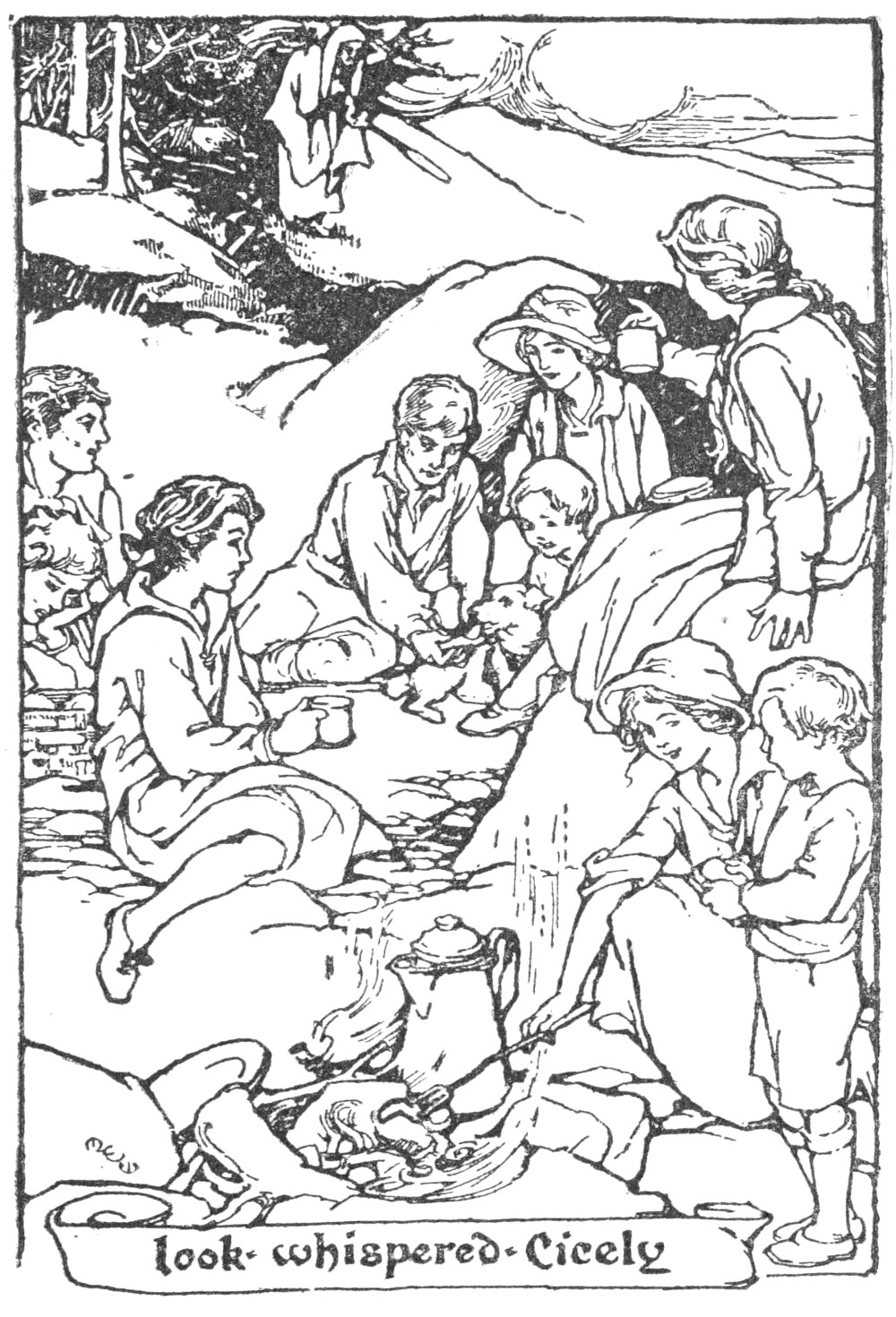
look whispered Cicely.
“You wanted to see an Indian,” whispered
Hugh, “Well, here she is!” Everybody sat
quite still, while the old crone came close to
the group.
“How!” she said at last in a low grunt.
“Good day,” answered Tante pleasantly.
“We are picnicking, as you see, in this pretty
place.”
“Heard war-whoop,” said the hag sullenly.
“Came to see who is on the land of my
fathers.” Her look was a challenge. The
party exchanged glances. Here was a strange
sequel to their talk!
“My father was Chief,” the old woman
drew herself up with dignity. “But I am all
there is left of my tribe. All this land was
ours,” she waved her paddle, apparently indicating
the whole shore of the bay. “The
white men took it from us. Now I have to
get grass for baskets where I can. That is
all for me to do.”
“Have you baskets to sell?” asked Tante
gently.
“Not here,” said the squaw. “But I make
them. Sometimes.”
“Well, if you will bring some to us we
would like to buy,” said Tante.
“Mother!” Hugh tried to catch Tante’s
eyes with a warning shake of his head. But
the old woman answered Tante quickly.
“Yes. I will come. Next week. You live
over there?” she pointed in the right direction.
“I know.” She turned upon the young
men with a sudden snarl. “Why you make
war-whoop? Eh?”
Dick stammered. “Oh—just for fun!” he
said. There was a black look in the old
woman’s eyes and she muttered something
below her breath. When as suddenly she
turned to go. Just then Freddie had an inspiring
thought.
“Beverly is an Indian, too!” he cried,
pointing at the girl. “Pocahontas was her
grandmother.”
“Hush!” Dick jerked Freddie into silence.
“Pocahontas?” the old squaw repeated the
name and eyed Beverly strangely. “My name
Sal Seguin.” They could not tell whether
or not she understood what Freddie had said.
Beverly herself had nothing to say.
“Ugh!” grunted the squaw at last. “White
Indian? Ugh!” Whether in disgust or
pleasure, she shook her head once at Beverly.
Then without another word she disappeared
up the bank.
“Well, you young monkey!” said Hugh to
his little brother, “you did make a hit, didn’t
you?”
“I didn’t mind,” said Beverly. “Why
should I? I will buy some baskets of the
poor old thing when she comes.” But Hugh
looked troubled. “I’m sorry she is coming
to Round Robin, Mother!” he said. “I don’t
like the old party’s looks. She doesn’t resemble
Beverly in the least!” and he made a low
bow to the Southerner.
“I’ve seen her before,” said Victor unexpectedly.
“Once, when I was picking strawberries
away over on the mountain. And once
when I landed to take a look at the boat-house
of Idlewild. She was prowling about there.”
“I’ll tell Uncle Eph,” said Nelly. “He
won’t like that.”
“Is she your grandmother, Beverly?” suddenly
asked Eddie, who was much confused
by the previous remark of his twin.
“Will she join the Round Robin?” questioned
Freddie. At that there was a roar of
laughter. But Hugh capped the laugh with
a surprise.
“You girls needn’t laugh so hard,” said he.
“For once Freddie has said something not
altogether foolish. Some of the Indians had
a Round Robin of their own—a ‘get together.’
The very first League of Nations was American
after all! The Five Nations of the Iroquois
were just that.”
“It has taken the world a good while to
catch up with those savages!” sighed Tante.
As the Togo chug-chugged noisily home
over the waves that afternoon, the girls spied
a birch canoe creeping silently along the
shore, propelled by experienced hands. And
the canoe was filled with bundles of green.
“I guess old Hoky-Poky had a profitable
day,” chuckled Dick.
“Well, so have we, in spite of clams,”
laughed Nancy. “Don’t you think so, Anne?”
“It has been very pleasant,” said Anne with
reserve as she stepped ashore. “But that old
woman made me nervous!”