SOME ACCOUNT OF THE TRANS-SIBERIAN
RAILWAY, AND THE GOLD-MINING
INDUSTRY OF ASIATIC RUSSIA
BY
ROBERT L. JEFFERSON
AUTHOR OF “A WHEEL TO MOSCOW,” “ACROSS SIBERIA ON A
BICYCLE,” ETC.
ILLUSTRATED
LONDON
SAMPSON LOW, MARSTON & COMPANY
LIMITED
St. Dunstan’s House
Fetter Lane, Fleet Street, E.C.
1897
To
JOHN KEMP STARLEY, ESQ.
Dear Mr. Starley,
Appreciating the practical and
sympathetic interest which you have for
some years taken in Russian affairs, I
venture to dedicate this volume of mine—“Roughing
it in Siberia”—to you, as a
small token of my esteem.
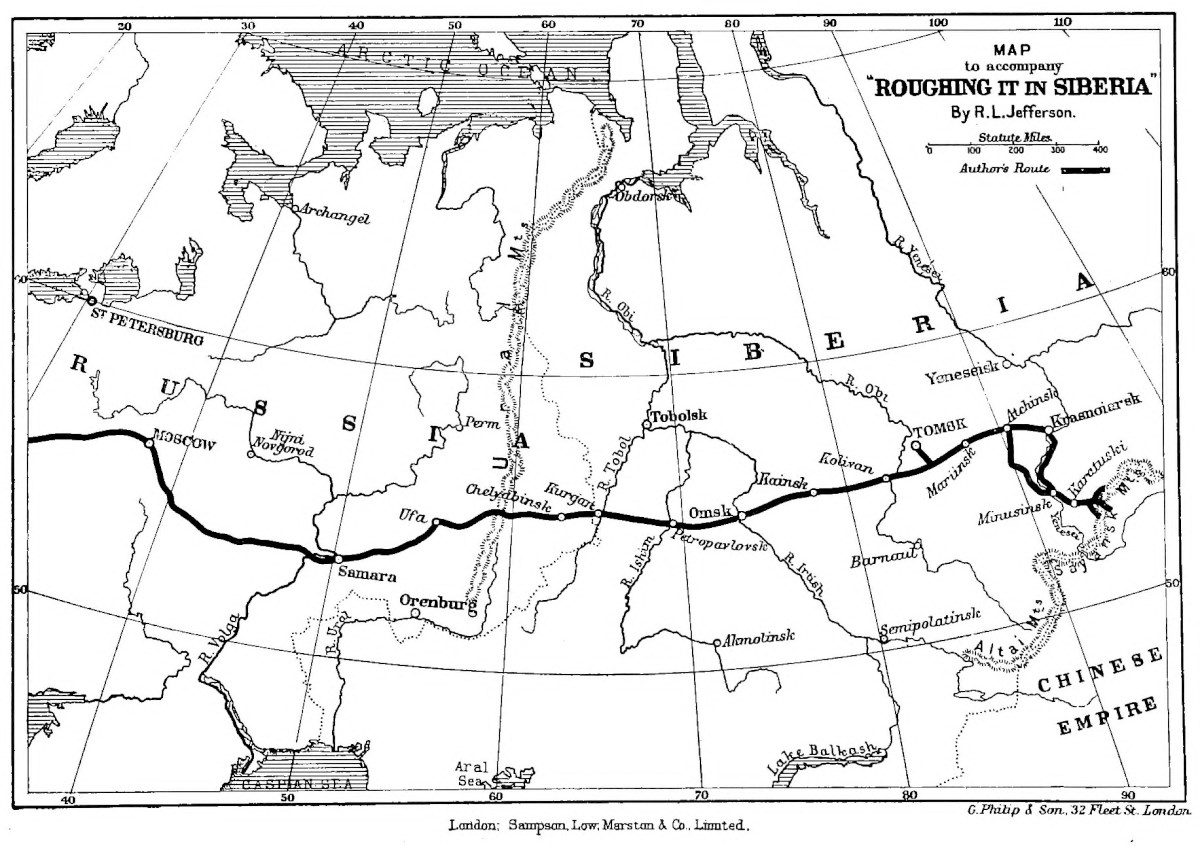
MAP
to accompany
“ROUGHING IT IN SIBERIA”
By R.L. Jefferson.
(click image to enlarge)
ROUGHING IT IN SIBERIA
CHAPTER I.
THE FIRST DAY IN ASIA.
The short winter day was waning when the
Chelabinsk train, seven days out of Moscow,
sluggishly passed the big stone erected in a
defile in the centre of the Ural mountain range,
and which marked the geographical boundary
of Europe and Asia. Since yesterday, when
we had left the level plains of Eastern Europe
for the uplands of the Urals, the pace had
been tantalizingly miserable. Some people
say that man can get accustomed to anything,
but it absorbs an enormous amount of patience
in getting accustomed to Russian railway
travelling; the further eastward one goes,
the slower becomes the pace, the longer the
stoppages at insignificant stations, and the
greater the demonstration—beating of tin cans,
blowing of whistles, and ringing of bells—which
accompanies each arrival and departure. But
now, with Europe behind, the whole wealth of
Asia before one, combined with the uncertainty
of the unknown, and which was backed up
by popular prejudice and travellers’ romantic
tales, the thinking man has food for reflection,
and much of it.
We were rounding curves, sharp ones too,
on a badly ballasted track, that caused the
heavy Russian cars to oscillate alarmingly,
notwithstanding the crawl at which we were
proceeding. The views to be obtained from
the carriage windows were superb, in spite of
the wintry aspect which everything bore.
It was January—time of deep snow, frozen
rivers, and biting atmosphere—everything
around (except the interior of the car) was
wintry to the last degree. Snow piled up in
great drifts on the sharp spurs of the mountain-side;
the branches of the melancholy birches
bowing down with the weight of their snowy
covering; icicles hanging in the crevices of
the rocks, where, in summer, splashed a mountain
cascade. Deep below us, in a narrow
gorge, lay the tortuous course of a fast-flowing
river, but now frozen to its very bed, and
its surface cut and streaked by the runners
of many sledges. Now and again we could
catch a glimpse of some woodman’s hut
perched up on the hillside—a veritable house
of snow, and as cold and bleak-looking as
any one could think to see.
Hurtling violently around the corner, we pass
a level-crossing, where stands a caravan of
patient horses waiting to cross, with white
frost hard on their shaggy coats, and icicles
from their eyes and nostrils; a sheepskin-clad
moujik, with fur hat over eyes and ears, and
feet encased in huge felt boots, complacently
puffing at a stunted papiros. Here, too, an
old woman comes out to flag the train—a
woman who looks, from the amount of heavy
clothing she wears, more like an animated beer
barrel than a human being, and on whose
stolid visage is nothing except an expression
of tremendous importance at the position she
occupies in the service of His Imperial Majesty
Czar Nicholas the Second.
Darkness fell; my three companions were
asleep. The conductor came and inserted in
glass boxes at each end of the long car two
diminutive candle-ends, the wicks of which
he lighted laboriously. He looked at the
thermometer to see how far off roasting we
were, and then, after gazing superciliously
around, left us. The heat in the car was
fearful, beads of perspiration stood out on the
faces of my sleeping companions, and yet this
is only the Russian way of doing things.
The Réaumur glass outside showed thirty-six
degrees below freezing-point; inside, the heat
was sufficient to almost roast one. And thus
for seven days had we sat and lounged,
talked and read, and stewed gradually, with
no greater diversion than the rush for the
buffet at each station, an occasional row with
some blustering traveller who would hustle us
for places, or the periodical breaking down of
the locomotive, which event occurred about
once a day on an average.
It was impossible to read, for the light in
the car was so dim that one could scarcely see
a couple of yards away. The train jolted and
groaned and jarred, the candles flickered and
guttered, people in the adjoining berths snored,
a child was wailing dismally at the other end
of the carriage; the heat became more intolerable,
and I thanked Heaven when, two
hours after darkness had fallen, the creaking
of brakes and the distant ringing of bells
announced our immediate arrival at Chelabinsk—the
terminus of the European system of the
Russian State Railways.
The arrival of a train at a Russian station is
attended with an amount of excitement which
it is hard to associate with the usually stolid
Russian. Particularly is this so in Eastern
Russia, where railways are new and interesting.
As the train slowly steams in, the assembled
mob of sightseers and officials raise shouts of
welcome—at least they seem to be. A man
hard by the ticket-office performs a terrific
tintinabulation on a large suspended bell.
All the conductors blow whistles, while the
locomotive syren goes off in spasmodic squealings.
Slowly, but with many jerks and much
grinding, the train comes to a standstill. But
the passengers are not allowed to descend all
at once. First of all the engine-driver must
get off and shake hands with the first half-dozen
men that happen to be hanging about
near, no doubt receiving in return a sort of
congratulatory address to the effect that he
has got so far safely. Half a dozen gaily
caparisoned policemen, in red hats with white
cockades, and armed to the teeth with revolvers
and swords, parade up and salute gravely. All
the conductors get off—there seems to be
quite a crowd of them. All salute a red-hatted,
despotic-looking individual, who is gazing
about with tremendous scorn and indifference,
as if this sort of thing was very boring,
although ten to one his heart is thumping
with pride and excitement; for he is the
stationmaster, salary one hundred pounds a-year,
princely for him, indeed. This individual,
on thoroughly satisfying himself that
beyond the possibility of the remotest doubt
the train is really there, raises his hand as if
he were about to pronounce a benediction, and
instantly there belches from the heart of the
mob a smaller mob of much-bewhiskered men
in white aprons. These are the porters.
These gentlemen throw themselves upon the
train in a frenzy of hurry; tear open the
doors, push, scramble, and fall over each
other in their endeavours to get in first, and
ultimately disappear from view. The crowd
outside grows silent in expectancy; but the
racket which proceeds from inside the train
tells eloquently that the porters are doing their
fell work. The cars now begin to disgorge
boxes and men, bundles and women, baskets
and babies, everything mixed up, everybody
talking. The crowd outside parts, and the
crowd just out slides over the slippery platform
in a hard mass to the buffet doors. These
always open outwards, and are generally just
wide enough for a thin man to get in sideways.
Then the crush commences. You are in the
middle of the crowd with a corner of a box in
your ear and four men standing on your feet.
You worm and edge your way out of reach of
the box and run your chest against the side of
a kettle, blacker than the blackest hat, and
which is tied around the neck of an evil-smelling
moujik in front of you. Somehow
the door gets open; the janitor inside scuttles,
in order to prevent being swept off his feet.
In we squeeze, and find ourselves in a long
white-washed apartment, heated to a suffocating
degree.
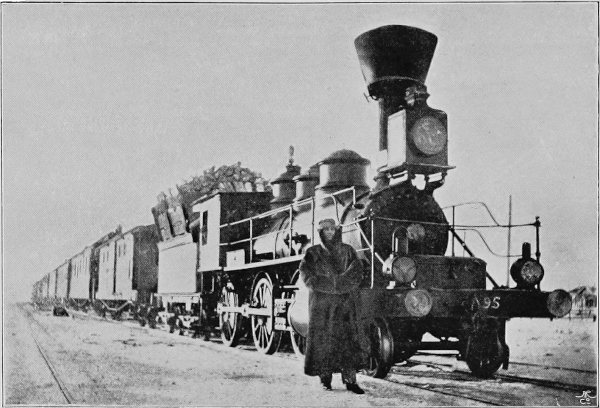
A TRAIN ON THE TRANS-SIBERIAN RAILWAY.
Down the centre of the apartment runs a
long table covered with glasses, plate, and
cutlery. Over on one side is a long bar,
covered with smaller glasses and large bottles,
mostly containing vodki, as well as at least
half a hundred dishes of the hors d’œuvre
style—sardines, bits of sausage, sprats,
caviare, sliced cucumber, pickled mushrooms,
artful dabs of cheese, raw radishes, smoked
herring, and such like. For the nonce the
crowd ignores the long table, equally so
a kitchen-like arrangement in the corner
where steams a heterogeneous mass of cutlets
and “Russian” beef-steaks, and which is
presided over by a couple of marvellously
clean-looking men who are rigged out à la
chef. Vodki is the lodestone of the arrived
passengers. Each man gulps down a small
glass of the fiery liquid, seizes a piece of
fish, or sausage, or cheese, or whatever he may
fancy or may be handy, and subsides to the big
table, chewing vigorously. Energetic waiters
pounce upon him, lay before him a big plate
of the universal “stche,” or cabbage soup, over
which our Russian hangs his head and commences
ladling away, apparently oblivious to
its boiling heat or the feelings of the people
around. The tables fill up. Great slabs of
brown meat, floating in fat, are distributed with
rapidity, and which are with equal rapidity
demolished. Manners are delightfully absent.
People jostle, growl, and gulp; smoke papiros
and puff the smoke in each other’s faces; or
make the most disgusting noises with their
mouths. At last, having got through several
pounds of meat and fat, and drunk about six
to eight glasses of lemon-coloured hot water,
which is called tea, per man, the crowd
lounges around in contentment, and waits
patiently for the bell to announce the probable
departure of the train—which may be anything
in the region of one hour to four, or while there
is a bit of food in the buffet uneaten.
What a relief to get out of such an evil-smelling
mob and the heat and general
nauseating surroundings, and, wrapt warmly in
furs, to promenade the ice-covered platform!
They have unscrewed the engine from the
cars, and it has disappeared into the blackness
of night on a search for wood and water.
At one end of the platform the third and
fourth class passengers, peasants of the
humblest order, are huddled together—sitting
or lying, some asleep, some laughing boisterously—a
group of girls in their midst crooning
forth a wailing song to the accompaniment
of a harmonica, the national musical instrument
of the Russian moujik. Over to the
left, twinkling lights denote the town of
Chelabinsk. Eastward all is black, save for
the blinking of a signal light a mile away.
That is the road to Siberia, and here is the
commencement of the Trans-Siberian Railway.
CHAPTER II.
RUSSIA’S COLONIZATION SCHEME.
I haven’t yet introduced you to my companions.
Thomas Gaskell, citizen of the United
States of America, short, fair, a little bit bald,
with a record of having travelled through the
whole of Asia from end to end, and still only
twenty-eight years of age. John Scawell,
British subject, tall, dark, reserved, and just
fresh from Western Australia, India, and the
Transvaal. Evan Asprey, also British subject
and also slightly bald, medium height, fair
and good to keep close to, as he had already
spent five years in Siberia, and was the only
one amongst us who understood clearly more
than twenty words of Russian. Here we
were, then, at the commencement of Siberia,
and bound to one of the wildest regions of
that wild country—the Syansk Mountains
on the Chinese frontier. Our mission was
one entirely of peace, although the customs
officials at the Russian frontier had confiscated
Scawell’s Mannlicher rifle and Webley
revolver, and might have done the same
with my Smith and Wesson, if I hadn’t had
it up my sleeve at the time. We were
going out just to see what Siberia was like.
Half pleasure, half business. People at home
thought Siberia was a land of promise. The
Trans-Siberian Railway was opening the
country. Germans with a loose eye for business
had announced their intention of looking
up Asiatic Russia. Being English, we wanted
to get in also—if not the first, at least in
the van.
The station at Chelabinsk was not a cheerful
place to spend six hours in—for that was
the amount of time which had to lapse ere
the train bound for Kreveschokovo on the
banks of the river Obi was billed to leave.
Gratuitous information concerning the Trans-Siberian
Railway was freely offered by fellow-passengers,
and we began to fear the worst.
Tales about three hours’ stoppages at small
stations; half a day here and a day there.
No bridges over the Obi and Chulim rivers;
so that the monotonous train journey should
be relieved by a little sledging. An affable
man is the Russian traveller, and a cheerful
liar. The Russian for “I know” and “I don’t
know” are so nearly alike that only a Russian
can tell the difference, and maybe this is why
he would rather tell an untruth than confess
ignorance. Beneath his affability, however,
the observer can easily detect a purpose. His
soul-absorbing desire is to know who and what
you are, where from, where going to, and
what you are going to do. What do you think
of Russia? How old are you? Will England
let Russia have Constantinople? How many
millions of roubles have you got? Have you
seen absolutely the finest city, and the finest
street in the world—St. Petersburg and the
Nevsky Prospect respectively? If one is wise
he will be frank. But the torrent of reiterated
questions at every fresh acquaintance becomes
boring after a bit, and oftentimes we preferred
to keep in our bunks in the train rather than
be compelled to go over the jargon of stereotyped
replies in the buffet. English is almost
unknown in this region of the Urals; next to
Russian, German seems the language most
freely spoken. Military officers and functionaries
of upper rank know French, but English
we never heard spoken in all our railway
journey from Moscow. I think that sometimes
we were looked upon as curiosities, if
one might judge from the number of glances
and finger points directed towards us, and
the oft-repeated word “Anglichiny,” or
“Englishman,” when circumstances compelled
us to declare our nationality. But I must
say that though they were inquisitive we were
invariably treated with respect by our fellow-travellers.
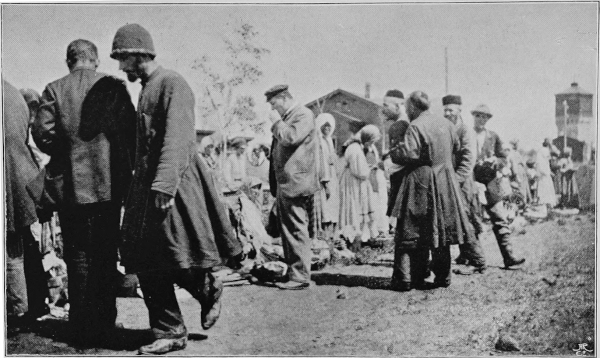
EMIGRANTS AT CHELABINSK.
But on one occasion, three overbearing
Russian functionaries, who are revered as
Chinovniks, tried to take advantage of our
slim knowledge of things Siberian. The
Russian cars, I might say, by way of preface,
are built on the side-corridor principle;
each coupé is designed to hold four persons—two
on racks, which are formed by lifting up
the back of each seat and securing them by
means of iron outswinging tee-pieces, and two
on the main seats themselves. We had
liberally bribed our porter to get us a complete
coupé, but it was while we were partaking of a
last glass of tea in the buffet that the three
Chinovniks referred to, being probably dissatisfied
with their own quarters, removed our
baggage and installed themselves in our
places. One of us had slipped out of the
buffet to see that nothing was being stolen,
and brought back the dismal news. There
was scant hope of our getting justice, but
we awaited our opportunity. Thinking themselves
safe, the Chinovniks could not resist
the fascination of tea-drinking, and their
departure was a signal for a combined attack
on their baggage, its removal, and the replacement
of our own. The Chinovniks returned
as the train was on the point of leaving.
They glared at us. We gazed blandly back.
They spoke loudly and long to us. We replied
by unrolling our blankets and pillows
and preparing for slumber. They raved at
us; but we only looked at them with mild
reproach. They fetched the conductor, who,
after listening to their tale, which was shouted
with three voices in his two ears, addressed
a question to us, which to three of the four,
at any rate, was as incomprehensible as
Afghan or Volapuk. We could only fall back
upon our standard saviour, and that was
to cry simultaneously, “Neo panimio paa
Ruski!”—“I don’t understand Russian!”
The conductor shrugged his shoulders and
looked inquiringly at the Chinovniks. The
Chinovniks raised their voices in their great
ire, and then the conductor did absolutely the
wisest thing he could, and that was to leave
the car. The Chinovniks were nonplussed,
vocal persuasion had utterly failed to move
us; forcible was entirely out of the question
for a Russian, and so they had to leave us.
This little incident may serve as some illustration
of the Russian character. I have seen
two men in a car, one at each end, quarrelling
in the most terrible manner, hurling invectives
at each other and boiling over with rage, but
never getting one inch nearer one to the
other. A tenth of the inducement would be
enough for a free fight in England.
It was in the early hours before the Siberian
train crawled slowly out of Chelabinsk station
and commenced to bump miserably over the
badly laid road. The boy-stoker at the stove
end of the car commenced his infernal work,
and in half an hour the temperature was something
abominable. The heat was bad enough,
but as the car contained some twenty-four passengers,
and all possessed a large number of
damp furs, in all conditions of cleanliness, and
possessing all varieties of odour, the atmosphere
was one almost unbearable. The worst of
it is, that the passengers abhor ventilation
of the slightest degree. In the roof of the car
there is a ventilator, but it is always tightly
closed. The windows are double and immovable;
the doors at each end are double, one
being closed before the other is opened; and
thus, day in and day out, scarcely a breath of
fresh air can enter the carriage. Inside we
sweated and gasped for breath; the instant
we alighted at a station our hair, moustache,
beard, and eyelashes would become covered
with hard white frost, and the exhalations from
our lungs would be converted into fine snow.
When morning came, and we arose from our
uncomfortable couch, it was to find the train
jolting slowly over a level stretch of country;
quite uncultivated, and with here and there
a melancholy clump of stunted birch trees.
We were on the edge of the great Tartar
steppe, which stretched north and south for
thousands of miles, and which is bounded on
the east by the Irtish River, from whose banks
stretches eastward Siberia’s longest steppe—the
Baraba, home of the Khirghiz hordes.
The Urals were completely out of sight, and we
had the not very cheerful prospect of a fifteen-hundred-mile
journey over an absolute desert.
Seen in the summer, the steppe lands are by
no means displeasing, although their monotony
is trying. Instead of the inevitable snow
which now stretched in all its glaring whiteness
before us, the steppe is a carpet of variegated
bloom. The grass is stunted; not nearly as
long as that of the American prairie, this
probably owing to the fact that much of the
water in the plains is strongly impregnated
with alkali. These steppes are, with the
exception of the vast plains of perpetually
frozen ground adjacent to the arctic circle,
the most unpopulated part of all Siberia.
Beyond the few miserable villages which occur
every thirty or forty miles, there is no sign
of life except the occasional kibitka of the
nomadic Khirghiz. North or south of the
high-road the steppe goes uninterruptedly for
many hundreds of miles, roadless, treeless, not
a landmark to guide one, swampy, sandy,
and unprofitable. Under its snowy shroud the
steppe looks better.
Late in the day we arrived at Kurgan, a
tolerably large town, with the railway station
miles away from the nearest house. Unwilling
to take the bread out of the mouths of the
horse-breeding populace of Siberia all at once,
it would seem that the Russian Government
has purposely fixed the stations of the Siberian
railroad as far away from the towns as possible,
in order to give the great army of drosky-drivers
a chance. Kurgan was interesting
as being the first point where we saw the
debarkation of outward-bound emigrants.
Emigration to Siberia is now going on very
vigorously, and not before it is wanted, for the
population of Russia, European and Asiatic, is
very disproportionate. The nomadic tribes
of Siberia, such as the Bashkires, Khirghiz,
Tungus, Buriats, Votiaks, Kamchakdales, and
Samoyedes scarcely count, so small are their
numbers in comparison to the millions of acres
comprising Asiatic Russia. The official computation
of the population being (including
both Russians and aborigines) one man to
every five square miles. The first cause of the
extremely slow progress in populating Siberia
may be set down to its distance and inaccessibility
from the congested districts of Russia.
The only means of reaching its heart, up till
the commencement of the Trans-Siberian
Railway work, being by the lonely tarantass or
the occasional steamers plying the tortuous
waterways of the Irtish and Obi systems.
The Siberian railway, however, promises to
considerably alter this state of things—combined
with the startling facts that Southern
Russia is rapidly getting overcrowded.
Another stumbling-block to the rapid development
of Siberia hitherto has been the great
prejudice existing against it throughout
European Russia, a prejudice which may be
said to be far greater than that among
foreigners. For many years Siberia has been
the dumping-ground for criminals of the worst
class. It has been held up as a Bastille-like
threat to every Muscovite. Mothers have for
ages quieted their noisy children with, “Hush!
or I will send you to Siberia!” And thus every
man who goes to Siberia, voluntarily or otherwise,
is looked upon as an exile. Although
the want of communication may be set down
as the first, the chief cause undoubtedly exists
in Siberia having been made a penal colony.
It is said that the great famine of 1890-1
which spread throughout Southern Russia,
turned the eyes of the Government Siberia-wards
as a possible outlet for surplus population.
The late Czar had ever taken a kindly
interest in his Asiatic possessions, and it was
the dream of his life to see Siberia developed
to its fullest extent. The wish was commendable,
but the means were lacking. It was in
order to see with imperial eyes what Siberia
was that the present Czar (then Czarevitch)
took his memorable journey across the steppes
and mountains from the Pacific coast, and
then came Alexander’s famous ukase: “Let
there be a railway built across Siberia—the
shortest way possible.” The Czarevitch was
then in Vladivostock, the Russian Pacific port.
A telegram from St. Petersburg bade him
remain there and await the corner-stone, which
was to be laid in that town as the foundation-piece
of what will, in the course of a few years,
rank as the monumental railway enterprise of
the nineteenth century. Alexander, right up
to his death, cherished his colonization scheme,
and the heritage he left his son has been
energetically pushed forward.
Some assert that the idea which dominated
the Siberian railway scheme was that of
strategy. While there may exist the strategical
undercurrent, no one who has passed over
the line from end to end as far as it is constructed
can be oblivious to the fact that at
present, at any rate, one of the principal objects
of the railway is the transportation of emigrants
to the fertile valleys of Central Siberia. The
train-bound traveller passes train load after
train load of outward-bound emigrants. At
the principal stations of Chelabinsk, Kurgan,
Omsk, Kainsk, and Atchinsk, emigrants by the
hundreds are detrained, and may be seen encamped
by the roadside awaiting their further
transportation north, south, or east. The
numbers are evidence complete that the attractions
offered by the Government outweigh
entirely prejudice and the discomfort of a long
journey.
The principle underlying Russia’s colonization
scheme is similar to England’s policy with
regard to Canada, only that the means are
easier and the efforts and influence more
energetic and widespread. The agents of the
Government are sent to the most thickly
populated or distressed portion of European
Russia, and there the desirability of emigrating
to Siberia is impressed upon the more industrious
of the peasantry, who, in Russia itself,
can scarcely make ends meet. Neer-do-wells are
not catered for, but the Russian Government
offers inducements to the willing, and at the
same time fixes a nominal fare to Siberia, in
order to keep out the absolute drones. This fare
is fixed at the rate of one-twentieth of a penny
per verst; and thus it is possible for a peasant
to travel, say, three thousand versts (two
thousand miles) for the moderate sum of six
roubles (13s. 3d.). From Southern Russia this
would land the emigrant in the heart of
Siberia.
On arrival at his destination, the colonist is
given a free grant of land, ten deseteens in
area, which equals about twenty-seven acres
English. He has permission to cut enough
wood to build his house and fencing and to
provide him with fuel for one year. Thus,
with a clear start, and providing the peasant
is industrious and frugal, there is every opportunity
for him of not only being able to feed
and clothe himself and his family warmly and
cleanly, but of making a small profit out of
agricultural pursuits. For purposes of comparison,
it may be as well to state that in
Russia itself the peasant is allowed only four
deseteens of land, but, as the price of
agriculture is abnormally low, it is next door
to impossible for him to make ends meet,
inasmuch as the rude agricultural instruments
he uses, and the entire absence of artificial
fertilization, in a few years impoverishes his
property to such an extent that it is hopeless.
With the increased acreage in Siberia, a better
climate, and a richer soil, his chances are
enhanced, while a powerful factor is that agricultural
prices all round rank from fifty to a
hundred per cent. higher than in European
Russia. Of course such prices will not last
for ever, but as Siberia, minerally and commercially,
is far richer than Russia itself, the
peasant is bound to come in for some of the
reflected prosperity.
The Westerner might perhaps take exception
to the manner in which the emigrants
are transported to Siberia. I confess it came
upon me at first with a shock. The emigrants’
train is simply one of cattle trucks, each car
being marked on the side for “forty men or
eight horses.” There are no seats or lights
provided, and into each of these pens forty
men, women, and children have to herd over a
dreary railway journey of fourteen or fifteen
days. They have to provide their own food,
but at every station a large samovar is kept
boiling in order to provide them with hot
water for their tea. At the points of detrainment
the emigrants are compelled to camp on
the steppe or on the mountain-side until
provision is made for them to proceed to the
land apportioned off to their use. The filth,
the rags, the utter woe-begone aspect of the
Russian emigrant is something inconceivable
to the European, but then it must be remembered
that the Russian moujik is used to
roughing it all his life, and to hog, forty a
time, in a cattle truck, or to sleep by the camp
fire, with no more covering than the sky, is
no very great hardship for him.
It must be gratifying to the Russian
Government that the privileges offered to the
peasant have been keenly appreciated, and the
difficulty which now exists is to get the land
ready for the overwhelming tide of colonists
flowing into Siberia. In 1896 alone nearly a
quarter of a million peasants left Russia for
Siberia. At that time neither the railway
nor the colonizing department could cope
with the rush, and the Emperor was compelled
to issue the ukase commanding the
officials of the various Siberian Governments
to drop all other State work and devote,
for the time being, their efforts to the colonization
movement. For a time things were in
rather a chaotic state, and a large number of
emigrants, finding no land ready for them,
returned to Russia.
Anticipating my journey a little, I had at
Omsk a long and interesting conversation with
one of the head officials of the Colonization
Department. He was on his way to Turkestan,
there to confer with the officials regarding the
colonization of that valuable and practically
un-Russianized possession. He assured me
that the rush for Siberia had not only
completely astonished the authorities, but was
rather startling in the fact that it threatened
to deplete portions of Russia of labour. The
Russian peasant is of such a simple disposition
that he is apt to think the inducements offered
him are the means to a comparative paradise.
Thus many of the emigrants have suffered
sore disappointment, and, partly from this and
from home-sickness, have returned to Russia.
The Government is, however, grappling manfully
with the task that it has set itself, and
it will take but a few short years to even up
the disproportionate population of Russia considerably.
One fact cannot be overlooked, and
that is that the Trans-Siberian Railway, apart
from its political and commercial significance,
is likely to be handed down to posterity as
the means by which the riches of the great
white Czar were brought to the thresholds of
his people.
CHAPTER III.
ARRIVAL AT OMSK.
From Kurgan to Omsk the railroad track
passes over a wilderness of snow—a dead
level, absolutely devoid of interest. It was
a relief even to see at long intervals a group
of wooden huts, huddling close together, as if
for warmth, in that biting cold; the thin blue
smoke curling from their several apologies for
chimneys, and the glint of the sunlight on the
double windows. Melancholy these villages
looked, cut off from the entire world as they
must have been before the locomotive came
snorting its way along. One pleasing feature,
or picturesque feature, I might say, was the
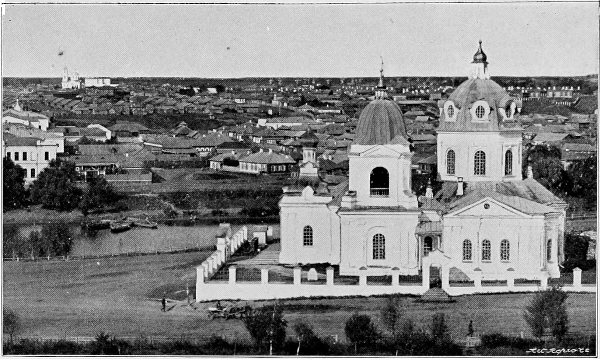
inevitable round domed church which reared
its height above the ramshackle shingle roofs.
Green and white these churches were, with a
golden cross perched on the highest dome,
and which shines and glitters for miles after
the huddle beneath has merged with the snow
and disappeared from vision. No matter how
small and miserable the village, no matter
how poverty-stricken its inhabitants, the
church was ever there, ever resplendent, and
apparently opulent.
One fact always strikes the traveller in
Russia, and that is the overpowering influence
of the Church. Densely ignorant as he is, the
average moujik’s religious devotion is little
better than slavish. One wonders whence
comes the money to build and to keep up
such magnificent ecclesiastical edifices which
predominate everywhere throughout the
Russian Empire, and only close inquiry and
persistent observation can reveal the truth.
From high class to low the first duty of the
Russian is to his religion. In every house,
from the finest mansion to the humblest hut,
the gilded ikon hangs in the corner, before
which the devout Catholic prostrates himself
twenty, and perhaps thirty, times a day.
Before every piece of bread he eats, before
every glass of vodki he drinks, he will cross
himself and murmur his prayers. I do not
fear contradiction when I say that every
believer in the Russo-Græco faith wears
underneath his shirt, attached to a string or
chain, around his neck, a metal cross, put on
when he was a child and worn till death, and
even until his body has crumbled to the earth
in which it lies. On the large stations of the
Russian railways there is always a chapel
with its glittering altar, its ikons and its
burning candles, where services are held
daily.
The Church seems to stand even before the
Czar, though it must be said the Czar comes
in a very good second. Great as is the State
aid, the help of the people is undoubtedly the
mainspring of the Church’s revenue. Time
after time I have had it brought to my notice
that however improvident the moujik may be
in his domestic life, his death will furnish the
pretext for lifting the slab of the stove to see
how much money he has been able to accumulate
in his lifetime for his beloved faith. His
blind devotion to the Church is nearly equalled
by his discipline as a soldier, and without
wishing to detract from his character as a man,
I must say that, so far as my observation goes,
these very qualities, if qualities they can be
called, shows how little removed from a mere
animal he is. As a Russian, body and soul he
belongs to the Church. As soon as he dons
the brown jacket of the soldier, body and soul
he belongs to the Czar. It is inconceivable to
the Westerner that men could withstand the
hardships and yet retain such cheerfulness
and such patriotism as do the Russians. Iron
discipline, which would make the educated
and better civilized soldier mutiny or desert in
a week, he submits to with equanimity. Kind
words he knows not; ill fed, ill clothed,
wretchedly housed, and with seldom or never
a kopeck in his pouch, yet he maintains even
gaiety in his desolate life. This utter abasement
of the man is very difficult to realize,
it is so essentially Russian that none but one
who has seen it can fully comprehend its
significance.
An officer of cavalry once told me a little
story concerning the discipline and devotion
to duty of the Russian peasant. The scene
was at Cronstadt, the island fortress off St.
Petersburg, where three officers, respectively
English, German, and Russian, were discussing
the merits of their men. Each maintained his
was the better disciplined, and on the argument
growing hot the Russian proposed a test.
They repaired to one of the batteries, and
there the English and German officers each
ordered up one of their men, as the Russian
did one of his common soldiers. These men
drew up in line before their captains.
The English officer pointed to the port, below
which the rocks lay some hundreds of feet.
“Attention! Walk out of that port!” he
cried in a voice of command.
The man stepped forward, white as a sheet,
but hesitated.
“What good am I doing my country by
this?” he asked huskily.
“Stand back,” said the officer.
The German officer motioned to his man.
“Walk out of that port!” he commanded.
The German stepped forward, he too hesitated,
and glanced appealingly at his commander.
“Will you keep my mother and father,
sir, if I do it?”
“Stand back,” said the officer.
The Russian officer motioned to his man.
“Walk out of that port!”
The man was livid, but he stepped forward
briskly; as he did so he raised his eyes and
made the sign of the cross, the next second
he would have precipitated himself on the
rocks below, had not the officer’s iron grip
restrained him.
This tale was told me with great unction, as
illustrative of the superior discipline of the
Russian soldier; but I did not care to offend
my friend by giving voice to my opinion that
the demeanour of the English and the German
soldiers illustrated that fact which has so often
been emphasized in warfare, that an intelligent
preservation of one’s life is far better for the
cause than blindly throwing that life away.
Bump, bump, bump; rattle, rattle, rattle;
on hurtled the train, morning merged into
afternoon, and the grey shadows which heralded
night came stealing over the steppe. Darkness
black and heavy enveloped us. Once
more we made up our crude beds, and settled
for the night. Peterpavlovsk we reached in
the middle of the night, and where we sleepily
alighted for something to eat, and participated
for the hundredth time in the rude scramble
which ever accompanied that procedure. Back
to bed again, and sometimes sleep, helped
thereto by a concert of gurgling snores, tobacco
smoke, and odours of vodki. Morning broke,
and for all the difference in our surroundings
we might as well have been where we were
the day before. Grubby, weary, and profoundly
sick of each other’s company, since
we had told every story we knew, and had
long since comfortably settled the affairs of
the world in long-continued argument, waiting
patiently, till afternoon, when we should reach
our first Siberian city, Omsk.
Our literature was long since exhausted.
It was useless to play cards, as one man had
constituted himself treasurer, possessed all the
money, and it seemed a hollow mockery to
borrow under such circumstances; everybody
voted chess a bore, dominoes childish, while
our only musical instrument—a Jew’s harp—had
long since lost its soothing influence. We
could only glare at each other and grumble,
find fault with everything, and say what
ought to be done and what we would do if
only——
“Omsk!” The silver-embroidered conductor
punched another little hole in our
much-perforated ticket, pocketed his tip, and
left us to scramble our baggage together.
And even this was a delight. We were to
stay over two days in Omsk, and those two
days were to be a welcome relief from the
seemingly never-ending train journey. Soon
we came in sight of the Irtish, one of those
magnificent rivers which Siberia abounds in,
but now silent and still under its thick coating
of ice. The train rattled over the high iron
bridge which spanned this noble waterway,
and ten minutes later drew up at Omsk
station.
I mention the word “station” advisedly,
because, as in duty bound, the Russian engineers
had put it as far away from the town as
they conveniently could—this time they had
managed it by exactly three versts, and no
doubt considered they had achieved a triumph.
What the idea is in calling a station Omsk,
when Omsk is two miles away, yet remains to
be explained. Nobody that I have asked has
been able to give me a satisfactory answer.
Whether they expect the town to grow out
towards the station, or whether it is out of
sheer and simple cussedness, I do not know; I
fancy it is the latter.
On the station steps we held a levee with
half a hundred isvostchiks, who wanted to drive
us to town. Honour there may be amongst
thieves, but there is certainly very little
amongst Siberian isvostchiks. The manner
in which they fought and scrambled with each
other in order to get hold of our baggage was
highly diverting. They implored us singly
and wholly to follow them. Each man held
out such inducements that the brain fairly
reeled.
“Come with my little horse, dear barins;
it is the fastest trotter in Siberia, it is a
beautiful dove, and goes like the wind.”
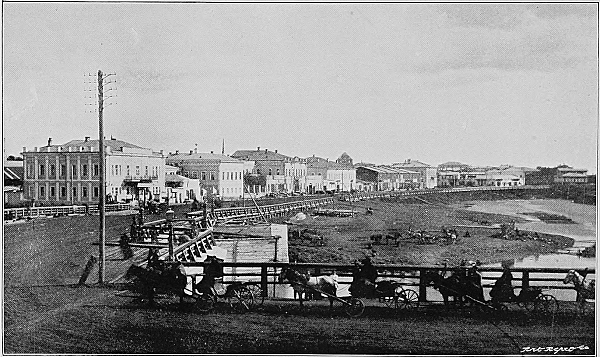
OMSK.
“Bah! Do not believe him, barins; he is
a liar. His horse is covered with ulcers, and
may drop down dead before you go a verst.
Come with me, barins. Here you are, a lovely
sledge, just painted, but quite dry, and
splendid cushions. Think how much money I
have spent on that sledge.”
“No, barins, none of these children know
the way to Omsk. I am the only one who
knows the nearest and the best road. Take
any of them you will, and they will go the
longest way and over a miserable road, which
will bump you to pieces, perhaps throw you
out and break your neck, and then what will
you do?”
And amid all this flood of eloquence,
smothered in furs and loaded down with
baggage, we were jostled and pinched and
pulled until a white-aproned porter rescued us
and took us to the sledge he had selected.
Then all the voices died away in a long-drawn
sigh; envious looks were bestowed upon the
favoured one, who gathered up his reins, gave
vent to a sort of war-whoop, fell rather than
got upon the sledge, and away we went at a
mad gallop down the narrow roadway, scattering
the snow right and left, and swinging
from side to side in the most perilous manner
imaginable.
It took us all our time to hang on, the while
that the fierce rush through the bitterly cold
air made breathing difficult; tears forced from
the eyes by the cold instantly congealed;
nostrils, too, became closed with ice; moustaches
and beards hard lumps of hoar frost.
With a cold which it is impossible to register
on a Fahrenheit glass we didn’t, I am sorry
to say, appreciate the novelty of this breakneck
ride as we ought to have done. In less
than a quarter of an hour we passed through
the gates of the city and stampeded like fury
down several wide streets, bordered on either
side by one-story frame houses, and ultimately
pulled up with a jerk, which flung us in a
heap at the bottom of the sledge, before
a low, mean-looking wooden house which a
dilapidated signboard announced to be the
“Grand Hotel Moscow.”
CHAPTER IV.
A MOST PALATIAL HOTEL!
The Grand Hotel Moscow, in the good city of
Omsk, was grand in name only, and we had
only to step inside its portals to realize to the
fullest extent that at length we were in Asia.
Bad as had been the generality of hotels in
European Russia, they seemed like palaces
beside this ramshackle affair which was dignified
by the name of hotel. A few broken and
wretchedly dirty stone steps led us into a
white-washed passage, which was flanked on
either side by low doorways leading to the
six bedrooms—all the “hostinitca” possessed.
Scawell barked his shin badly by falling over
the brick which, suspended on a rope over a
pulley, kept the inner door of the passage
closed. Gaskell gave vent to an American
expression when he tripped over a long stretch
of dirty canvas which was lying, as a sort of
apology for a carpet, down the length of the
corridor.
The proprietor of the hotel received us with
the glare of avarice in his grey eyes. We bargained
with him at length for merely the favour
of a shelter; for that was all we could expect.
He gave us a room for the outrageous charge
of four roubles (eight shillings and sixpence),
and that was thirty per cent. below his original
demand. A lovely room it was too! Two
rickety, broken-backed chairs, a small square
table, and a truckle bed, on which reposed a
filthy and suspicious-looking mattress, formed
its sole furniture. The floor was carpetless
save for a canvas strip by the door. The
usual domestic utensils were absent; there was
not even a washstand. There was no lock
on the door; the windows were immovable;
the walls were of beams laid one on top of
another, with the interstices filled with moss
and hay to keep out the draught. A delectable
hotel this, but in nowise worse than the
majority of such places throughout the whole
of Siberia.
In case my readers may think I am over-painting
this description, it may be as well to
explain the why and wherefore of this seemingly
barbaric state of things. In the first
place, up to the commencement of the Siberian
railway, as I have explained in a previous
chapter, the only means of communication
with interior Siberia was by means of horses.
Such enormous distances had to be covered
between towns that, in order to accommodate
the large number of travellers, the Government
erected, on the great high-road which pierces
the heart of Siberia, stations at intervals of
twenty-five to thirty miles. At these stations
horses could be hired at rates set down on a
Government schedule, but beyond this and
the shelter afforded nothing was provided. It
was thus necessary at the outset of the system
for the traveller to provide everything requisite
for the journey himself. In addition to his
luggage, the wise Siberian traveller carried
his bed, bed-clothing, food, and, in short, everything
that he might require, rendering himself
absolutely independent of hospitality on the
way. On his arrival at a post-station, he
asked for, and wanted nothing but the samovar,
or machine for boiling water, with which he
made his tea. The charge for the samovar is
ten kopecks, which equals twopence-halfpenny.
No charge whatever was or is made for the
use of the post-house. If one, therefore, excluded
the cost of horses, the traveller’s outlay
was wonderfully small.
As the towns contained the post-stations as
well as the villages, and as the traveller came
provided with everything he wanted, it may
be readily inferred that the chances of a hotel
succeeding are very small, inasmuch as the
average Russian is parsimonious, even at the
expense of his personal comfort. With, however,
the opening of the country by means of
the railway, it stands to reason that a new
class of travellers will spring up, and thus
better accommodation may be provided. The
demand for this better accommodation must
come from the foreigners, for the Russians
themselves are sticklers for custom and habit,
and the finest hotel erected for their use would
meet but mean patronage at their hands.
Thus it was that the accommodation we
received at Omsk was of such a wretched
character. Unfortunately we were not so
versed in things Russian as the Russians
themselves, and our inquiry for four beds was
met with a stare of astonishment. We did
not press the matter, however, after one of us
had made an inspection of the mattress which
had already been provided. We thought it
safer to sleep on our rugs on the floor.
And so it was in this city of Omsk, capital
of the Government of Omsk, a military
garrison, the residence of a general governor,
four Englishmen could get no better dinner
than hard-boiled eggs, a tin of sardines, and
black bread, to be washed down with tea, out
of glasses, and made from the steaming samovar.
Of course, had we been of the usual run of
travellers, that it to say functionaries, we
should have probably possessed papers which
would have admitted us to some Government
residence. Being, however, only Englishmen,
we had to put up with what we could get.
And as the time wore on, our love of the
place did not intensify. We did not mind the
blackbeetles so much as the animals which
dropped from the ceiling in order to disturb
our slumbers. I think we were all pretty
hardened members, but the vermin of that
room rather got the best of us. Yet this hotel
should not be singled out as a speciality in that
direction. Conversation on the subject once
elicited a tale from a fellow-traveller who, as
well as carrying his bedstead with him took
four saucers and a can of kerosene. On fixing
up his bed for the night, his invariable custom
was to fit the legs of the bed one into each
saucer and to fill the said saucer with kerosene—the
suggestion being that nothing alive would
pass the kerosene without being asphixiated.
But even that, said our traveller, did not
keep him out of trouble, for these things of
life, with a sagacity which one would hardly
credit in so small an insect, would make a
detour by getting up the wall, on to the ceiling,
and then, having accurately poised, drop
down upon the victim—no doubt to his extreme
discomfort. A painful and disagreeable
subject this, and one which I shall not allude
to again.
Our ablutions in the morning were performed
in what will, no doubt, be considered a highly
original manner. Having conceived the idea
that the removal of at least one layer of grime
from our hands and faces would not prejudice
our case in Omsk, the difficulty was to find how
this was to be accomplished. Judicious inquiries
revealed the fact that at the end of the
corridor the proprietor of the hotel had
provided an arrangement for the convenience
of those who were so fastidious as to desire to
wash. This arrangement was nothing more
or less than a brazen bowl, about the size of a
small kettle, which was nailed on the wall. A
knob protruded from the bottom of the bowl
which, on being jerked up vigorously, let
forth a few drops of water on the hands; and
so with drops so obtained we managed with
extreme economy to get through the mockery
of a wash. The waste and the drips went on
our knees and splashed around generally, but
as nobody cavilled we were content. Having
primed ourselves on eggs, bread, and tea, we
felt fit to do the town; so, after getting into
our felt boots and our furs, we sallied forth.
Omsk is the second city of Western Siberia,
and its population, excluding the large proportion
of Khirghiz, has been variously estimated
at between twenty and thirty thousand.
It is a trading centre, for here the steamers
from Tiumen and Tobolsk call, and a large
quantity of merchandize is landed or shipped.
European goods come through Moscow, to
Nijni Novgorod by rail, are shipped then on
the Volga and Kama to Perm, by train again
through Ekaterinburg to Tiumen, and by
steamer once more on the Toura, Tobol, and
Irtish to find destination at Omsk, whence
they are distributed to the outlying towns and
villages of the great Baraba steppe. It has in
its time been a very prosperous town, and for
many years the shopkeepers, cut off from
direct competition, have made enormous profits
and amassed huge fortunes. The merchants, in
fact, form the only society of the city. All
seem opulent; and no wonder, when one considers
the prices which are asked for even the
common necessaries of life. There is a shadow,
however, looming over the fortunes of the
Omsk merchants, and that is the Trans-Siberian
Railway. None realize this better than the
merchants themselves, who see that in a few
years they will have to face something which
they have heard of but never experienced—competition
with the outside world. It is
said that the community of Omsk was bitterly
opposed to the railway passing through the
city, “You will ruin our trade,” they cried
as with one voice; but the decree of the
Emperor had gone forth, and through Omsk
went the railway. Ultimately, of course, the
city will benefit enormously by being in touch
with Europe, but narrow-minded and short-sighted
as is the Siberian, it is hard to convince
him of this at the present time.
The internal opposition to the Trans-Siberian
Railway was widespread, and at Tomsk—one
of the most important cities of Siberia—the
representations made were so strong that the
course of the line (which I am led to
understand was originally planned to take in
that city) was altered, and passed in a straight
line some sixty miles south. The citizens of
Tomsk, however, speedily realized the terrible
blunder they had made in isolating themselves
from the civilizing trading influence of the iron
road. The tide of trade flowing into Siberia
passed by Tomsk and ebbed into Krasnoiarsk,
five hundred miles further on. Tomsk was
stranded, and the doom of the city almost
sealed. Representations were made, and a
branch line was constructed to connect with
the main road; but even this will not repay
the initial mistake, and people who ought to
know assert that Tomsk, which was once,
next to Irkutsk, the most important city in
all Siberia, must by force of circumstances
sink into insignificance.
But reverting to Omsk, I do not think that
it was the opinion of any one of the four of us
that it was the most agreeable place to spend
any length of time in. A city of wide streets,
handsome churches, big Government buildings,
and a multitude of frame houses. The
governor’s palace and the military academy are
perhaps the finest edifices apart from the
cathedral and the churches, which are always
the most handsome buildings of any Russian
centre. I had the pleasure of an interview
with M. Boulanger, a French gentleman of
culture who was head of the academy. He
confessed that it was like a ray of sunlight from
his beloved France to speak to one who knew
his land, for he had lived in Omsk for thirty-five
years. I gazed upon him in astonishment.
Thirty-five years in Omsk! That dump of
houses in the middle of a wilderness! With a
seven months’ cruel winter! Out of touch with
the world! But time had worked its charm,
no doubt; he had resigned himself. He spoke
feelingly, though, of the land of his birth—for
who, be he native or alien, can do aught
but love the fair land of France?—and I, being
fresh comparatively from the Western lands,
could not but sympathize with him in that
resignation.
CHAPTER V.
ACROSS THE STEPPE.
But uninteresting as Omsk appeared as a
town, it is unique in being the extreme northward
point where migrate the wandering tribes
of Khirghiz Cossacks. The term Cossack
seems to be very little understood outside
Siberia or Russia. One is prone to associate
it with a soldier, but Cossacks in Russia
simply means a tribe that receives special
concessions from the Czar for services
rendered or likely to be rendered. The Don,
Ural, and Khirghiz Cossacks are exempt from
certain points of taxation by reason of the
military ability of the male members of the
tribe. The Khirghiz, for instance, are born
soldiers and born horsemen. They look with
no uncertain disdain on the Russian moujik,
who, poor fellow, is taxed up to his eyes, and
who is but a foot soldier when conscription
claims him for its own. The Cossack of the
Khirghiz steppe is a servant of the Czar
possessing such privileges that make him independent
of the Russian altogether.
Some few Khirghiz there are who have
settled in the various towns of South-Western
Siberia—at Akmolinsk, Semipalatinsk, and at
Omsk—but the great bulk of the tribe is
nomadic. The steppe, which extend northwards
for thousands of miles into the regions
of Turkestan, forms their home. They move
their “kibitkas,” or tents, about from place to
place, pay no rent, know nothing of taxation,
ignore the Russian language, worship Mahomet,
live by the gun, and have a good time
generally. As a conquered race it appears to
me they are exceptionally fortunate; but the
Czar, with his far-seeing eye, knows their
worth. In time of war and trouble no soldier
of the empire is likely to serve him so well as
this fierce and warlike horseman.
Next to the Buriats, the Khirghiz are,
perhaps, the most interesting of Siberian
nomads. The Buriats are Buddhists or
Shamists; the Khirghiz are Mohammedans.
So far as my observation goes, I do not think
that they possess the mosques as do the
Tartars, but nevertheless they are fervent
followers of the Prophet. The vast steppe is
their home. They are rarely or never seen in
the mountains, but on the steppe, that vast
melancholy plain, with its stunted grass and
its far-reaching horizon, they live, multiply,
and die; their only business, beyond the hope
of fighting, being in the breeding of horses,
which they sell at ridiculously small prices
either to the Government or to Siberian
traders.
During my stay in Omsk I had occasion to
visit a Khirghiz encampment, and although I
had been told I should find them an exceedingly
ill-tempered and ill-favoured crowd, I
must confess that the reception I received was
one which rather prejudiced me in their
favour. It was a kibitka on the steppe; three
or four tents made of rough canvas supported
on birch poles, and with a corral outside for
innumerable horses, all hobbled by the hind
leg. The tent itself, black and unprepossessing
on the outside, was a revelation inside.
Gimcrack and gaudy perhaps, but nevertheless
picturesque. I can only compare it to the
interior of a canvas circus—cut down to small
proportions, but of the same shape and
possessing much of its gaudiness. Latticework,
painted a brilliant red, blue, or pink,
surrounded the sides. Shields of various
colours were hung on the walls, together with
festoons of antidiluvian weapons in the shape
of knives, arrows, bows, clubs, long swords,
and old guns. The floor of the kibitka was
covered with the foliage of the fir tree, and in
the centre a little raised platform formed the
table of the inhabitants.
I went to this kibitka under escort, and was
glad to find that at least one of the tribe was
able to speak to me, in spite of the short stock
of Russian I possessed. Amiable as he was,
yet I detected in the sunken black eye of this
nomad the fire of a latent warlike spirit, which
needed very little to arouse, and which would
make him a formidable antagonist.
The Khirghiz are essentially horsemen, and
in the streets of Omsk one never sees a Cossack
but what he is riding. What they do, how
they live, what is their ambition,—all alike
seems more or less wrapped in mystery. The
Russian population ignore them, and in return
the Cossack ignores the Russian. It is the
bayonet of the conscript, however, which keeps
them in their place; and it is very rare that
they do anything against law and order.
Every year the governor of the province will
go amongst them, and from the number of
their tribe will select one who shall be the
headman, and responsible for the doings of
his flock for the time being.
Strangely enough the Russians seemed ever
willing to warn us against the Cossacks. They
are thieves, murderers, anything you like,
according to the Siberian, but when one considers
that the Khirghiz Cossacks are merely
a conquered race, and that seventy-five per
cent. of the Russian population of Siberia
consists of convicts, exiled for all sorts of
crimes, one is apt to think and compare.
In a former journey through Siberia I had
closer acquaintance with the Khirghiz than
many men have had the opportunity of. I
had slept in their tents, I had drunk their
“koumiss,” and had eaten with them from the
same pot, but never once did I have occasion
to complain of their treatment.
We were getting tired of the Grand Hotel
Moscow. There was nothing about it which
was attractive enough for us to prolong our
stay within its shelter. As soon as our business
had been completed it was the train again.
Back over that dreary road to the station; the
same old familiar buffet; the same white-aproned
porters; the same officious soldier-policeman,
ceremonious conductors, and all-important
engine-drivers; the same slow-moving
cars; the same heat and smell and
general discomfort of those miserable coupés.
Our next important point was Tomsk, one
of the most celebrated of Siberian cities, and
to reach which we had to pass over the full
length of the Baraba steppe. We started at
night, and the next morning found us out
on the great white plain. The snow was
deeper here, and the occasional long grass
which we had seen on the Tartar steppe was
absent. Nothing, look which way we would,
was there to relieve the eye. A white plain,
a circular horizon—the perspective so deceiving
that we seemed ever to be at the bottom of
a basin, and ever toiling upward.
We had two days of this, with nothing to
relieve its drear monotony but the occasional
halt at a wayside station. As we progressed
further eastward, so things generally became
more humble and more primitive. The stations
dwindled down in size and in importance.
The cockaded soldier gave way to a slouching
policeman in rusty top boots, brown overcoat,
battered sword, and dirty peaked cap. Our
stoppages became longer—from minutes they
went into half-hours and half-hours into hours.
Nobody cared, we drifted on entirely at the
mercy of the man who drove us, and, I must
say, getting gradually habituated to Siberian
ideas. Hurry is a thing not to be dreamt of.
We would pull up at a station, which consisted
of no platform and but a small hut combining
both telegraph-office and sleeping quarters.
Food, too, began to get scarce; but the inevitable
sardine, and the equally inevitable tea
were always to be had. Now and again, at
some larger village station, we would almost
shout for joy when an unexpected and long-since-despised
edible would be placed ostentatiously
before us. Cabbage soup, for instance,
that nauseating compound which in Russia we
had loathed. Now we swallowed it with relish,
and smacked our lips in satisfaction. Vodki,
too, which we had shuddered at in Russia,
we were gradually beginning to think was
not such bad stuff after all. Our little party,
I perceived, were adopting Siberian manners
to an alarming extent. It was the Siberian
custom to always take a nip of vodki before
eating, but we, being superior foreigners, had
ignored this habit. I do not know who started
it, but long before we reached Tomsk it was
a settled custom amongst us to take that
nip of vodki, and sometimes even to indulge
in the grimace after swallowing which was
orthodox amongst Siberians.
We got careless, we took little trouble now
about our beds and our general comfort. Now
and again we forgot to wash, and went around
dirty, just as other Siberians did. Our boots
had not been blackened for weeks, neither had
our clothes been brushed, nor had our toilet
arrangements been properly supervised. It
was hard work to shave on such a rattling
train as that, and those who sported the razor
in their travelling trunks left it there for days
together. It was not exactly wearisome, it
was a something which was indescribable, a
feeling that prompted a desire to go to sleep
for at least three weeks on end and wake up
at the end of the journey; but there was no
Rip Van Winkle amongst us, and, although we
did put in an enormous amount of time in
somnolent attitude, Nature was not to be
thwarted, and many hours had to be spent in
loafing around and in conversational reiteration.
With what avidity we pounced upon anything
which would disturb the even tenor of
our way! I verily believe that a railway
accident would have been welcome; and, once,
something very near this did happen, although
beyond giving us food for talk and a little
healthy exercise, nothing more serious happened.
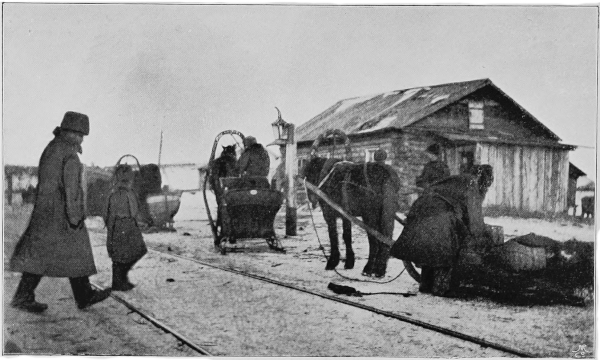
A STATION ON THE SIBERIAN RAILWAY.
Bang out in the middle of the steppe, miles
from anywhere, the train one day brought up
suddenly, and stuck there for three hours.
As there was only one train a day, it was
hardly possible that we had been side tracked,
waiting for a Siberian “Flying Scotchman”
to come along. None of our Russian passengers
ventured to inquire the cause of the train’s
inertion, neither did the conductor, who
periodically passed through the train with
a face about as intelligible as a sphinx,
volunteer any information on the subject.
Gaskell and I, however, descended, walked
along the line to the engine, and discovered
that the tank had burst and the water was
cheerfully washing away the track. The
engineer was complacently leaning against the
buffers smoking papiros, his fireman was
asleep in the cab of the tender, nobody else
was about, and the whole situation was so
truly sublime that, being in the condition to
laugh at anything, we both laughed heartily.
The engine had broken down, that was
clear. How were we going to get on? The
engineer didn’t know, and apparently didn’t
care. Had anything been done? The engineer
thought that somebody had walked along the
line to the next station, fifteen versts (ten
miles) away, and would telegraph for a new
engine. Did he know when a new engine
would come? He hadn’t the slightest idea.
To-day or to-morrow? It was possible, one
or the other.
Back in the car we tackled the conductor,
and he, too, evinced as much interest in the
proceedings as an ordinary sheep does when it
goes to the slaughter-stool. The opportunity
for a walk, however, was too great, and so, in
high spirits, Gaskell and I set off and walked
that fifteen versts to the next station. The
line ran dead straight across the steppe, and
when we had traversed ten versts we looked
back and saw the train still standing there, a
tiny black mass on the shining metals, with
as much life about it as would appear in a
prison.
Our energy, however, was rewarded by
forestalling the occupants of the train in regard
to the buffet arrangements. The stationmaster
had prepared quite a decent dinner,
and he alone, of those concerned in the matter,
seemed to be perturbed at the train’s delay.
We had a very good time in the selection of
the best dishes to be had, and on being assured
that there was no possible hope of the train
arriving that night, we curled ourselves up
on benches and slept the sleep of the well
satisfied.
Next morning the train rolled up, and
hungry and cursing passengers descended and
raided the buffet like so many wild beasts.
The over-bearing spirit of the Russian came to
the front in all its intensity. They jostled
and pushed each other without a word of
apology, but rather with a growl of resentment
and aggression. And yet not one of all that
crowd had been able to shake off the laziness
inherited from centuries of lazy progenitors
and to tramp the ten miles in order to secure
a little food and comfort.
CHAPTER VI.
IN THE OBI VALLEY.
Three days after leaving Omsk, the train
drew up at the rather important station of
Kreveschokovo. It was important as a station,
because here was the first check in our train
journey from the Hook of Holland. We had
arrived, as a matter of fact, at the end of the
railway metals which lay in one continuous
line from the most western part of Europe
right to the banks of the Obi River. The
bridge had not yet been completed over this
colossal water highway, and in order to resume
our train journey it was necessary to take
sledges from the station of Kreveschokovo,
across the river to the station of Ob.
I think that everybody was more or less
glad that the bridge was not completed. To
ride in a sledge, after being cooped up in the
overheated train, was a bit of a change, at any
rate, and I must confess that we four Englishmen
jumped at the chance.
We had reached the end of the steppe, and
before us now lay mountainous country, and
the difficulties which the engineers of the
Trans-Siberian Railway had experienced were
evident on all hands. The Obi at this point
was some two miles wide, and a bridge over
such a distance as that was no mean task.
The railway, we understood, was completed
almost as far as Kansk, nearly a thousand
miles further on; but in spite of all the haste
of the Russian engineers, the Obi bridge was
yet far from completion.
In the gathering twilight of an early
February afternoon we stood out on a bluff
overlooking the frozen river and surveyed the
workings of what must rank as a monumental
engineering enterprise. The Obi bridge is
built on the suspension plan on high tiers,
and is simply a network of girders and
stanchions, great earthworks running up
from the level plain on either side to a
considerable height.
We alighted, and the kind Russian officials
left us to shift for ourselves with regard to
transportation across the river. We got out
our baggage, which was immediately distributed
by energetic porters in various and
inaccessible portions of the station, and then
wandered out to find something in the shape
of a sledge which would carry us to the
station of Ob, seven miles away. Unfortunately
for our plan, the whole of the passengers
of the Siberian train were on the same tack,
and knowing Russian better than we, managed
at any rate to get hold of the best isvostchiks
who ply for hire. Ultimately we were able
to secure a basket-work arrangement, tied on
a couple of runners, and which was supposed
to be drawn by a pair of horses, the size of
which, in comparison to the size of the vehicle,
was rather ludicrous. Whether it is the cold,
or whether it is the terribly hard work which
Siberian horses undergo, I don’t know, but I
am safe in saying that the average Siberian
horse is not much larger than an English
donkey. There was, of course, the usual long
and interesting bargaining encounter with the
driver of the vehicle. From five roubles we
got down to two at length, bundled in our
baggage, pushed our way through the crowd
of harpies who had looked at the whole
proceedings and wanted tipping for so doing,
and set off.
Down a little road past the station at a
mad gallop; swish! round the corner, and out
over a level plateau. We banged against tree
stumps which stuck out through the snow,
cannoned against fence corners protecting
some agricultural property, until, with a whirl
and a clatter, we dashed down a short slope
and were out on the river.
Before us lay the white expanse of ice, but
all hummocky and broken. It is difficult to
describe the appearance of that frozen river.
Instead of a smooth level plain of ice, as one
would expect to see, the whole surface was
one jumbled mass of broken ice, which seemed
as if at the very moment of its breaking, it
had been arrested by King Frost and frozen
solid. Great lumps, ten to fifteen feet high
and four to five feet in thickness, towered
above us; smaller pieces hung on to the larger
by mere strips, and through this wilderness of
congealation, a narrow road had been formed
for the passage of vehicles. Over this road
we galloped at a terrific pace, bumping and
scrunching, whirling and swishing, the drosky
clattering from side to side, now on one
runner, now on the other, and all our traps
jerking about like peas in a frying-pan, while
we, poor unfortunate mortals, hung on by one
hand, and with the other hand endeavoured
to smother the mouth in order to warm the
air for the lungs. A few minutes of this
brought us into the centre of the river, where
the ice was clearer, and a level plain stretched
before us. It was a sublime sight then to see
that noble river so silent and still, and it was
something to realize the marvellous work of
Nature in having secured the means to that
end.
On again, with the light fading away
behind us and the greyness of night creeping
up ahead. Through the jagged ice once more,
until, with a whoop and a halloo, we scuttled
over a narrow stretch where the water oozed
and spirted between a crack; then up the
bank at a mad scramble, to disappear in a
miniature forest, to whirl around at a breakneck
speed on the edge of an embankment,
and to clatter into the station yard at Ob with
smoking horses, excited driver, and bruised
bodies we, but pleased nevertheless.
The station at Ob is singular from the fact
that previous to the Trans-Siberian Railway
passing that way the region was a complete
wilderness. Four years ago, when the railway
reached that far, houses began to spring
up with marvellous rapidity, and at the
present time it is difficult to buy a plot of land
in the vicinity of the station. Nor is this
all. Recognizing that the Trans-Siberian Railway
is bound to bring a large number of
travellers from the East, who will probably in
the summer make use of the great steamboat
highway of the Obi system, hotels and
magazines have been opened in anticipation
of that traffic. All this was very surprising
to us in face of the extreme apathy which
seemed to obtain in every other part of
Siberia so far. But the houses in Ob, although
constructed of wood, and the magazines and
hotels built on the orthodox Russian principle,
were at any rate superior looking to those we
had seen thus far.
Next day we arrived at the small station of
Tigre. It was called Tigre because “tigre”
is Russian for “forest.” This little station
was bang in the midst of the most impenetrable
forest I had ever set eyes on. It lay, in fact,
in the centre of a clearing—in the centre of a
pit, it seemed, for the great black trunks of
the pines went up all around and left only a
circular space of blue sky visible. When the
engine whistled the noise echoed and re-echoed
through the still forest. When we looked
around, what was there to see? We might as
well have been dumped out of a balloon in
the middle of an uninhabited land, only that
the railway gave the lie direct. A small hut
representing the station, a side-track with a
few waggons, a glimpse of a house amongst the
trees, a forlorn-looking engine-shed away up
the line, and that was all—all except that
bewildering mass of trees packed so closely
together that it seemed as if one could scarcely
put one’s arm between each trunk—sombre,
still, and awe-inspiring. And here, in this
inspiriting place, we had to wait no less than
nine hours for the train to take us to Tomsk!
Tigre is the junction of the Tomsk railroad,
and I have already mentioned the fact that
the main line in its neglect of Tomsk has left
that town very much stranded. It seems,
too, that the Government, resenting the independence
of the great Siberian city, has
put as many obstacles in the way of travellers
thereto as it possibly can. To wait nine
hours in a station like Tigre was the sort of
thing sufficient to make a man’s blood boil—that
is if anything could boil in a temperature
of thirty-six below zero, Réaumur.
The Krasnoiarsk train departed. We
watched it as it drew slowly out of the station
and disappeared in the forest, sparks flying from
the funnel of its engine and a wealth of smoke
mingling with the snow which covered the
tree-tops. There were only a few of us bound
for Tomsk—seven, as a matter of fact—and we
made four of them. Three were Chinovniks,
very much uniformed and very supercilious.
There was a buffet of insignificant proportions
attached to the station, and in this we did our
best to while the time away. It was a hard
matter, and an experience well to be forgotten,
for, with true Russian perversity, the Tomsk
train was got ready to start just about the
time when we were all in the middle of
slumber.
Our natural ill humour was not reduced upon
finding that the Tomsk train contained no
first-class coupés. Some one explained that up
to the present the Tomsk section had received
no first-class carriages from the works; so,
although we possessed first-class tickets, we
were forced to put up with the miserable
accommodation provided by some old time-worn
cars, which by some chance or other had
managed to get so far.
The Tomsk section of the Siberian Railway,
being, as it was, a something apart from the
great enterprise, was if anything worse than
the main line itself. It was miserably laid,
and the jerks and joltings which we experienced
on that ninety-versts ride did not altogether
inspire us with confidence. We slept on bare
boards in third-class compartments, because
the second-class cushions, after an hour or two’s
experience, became altogether too suspicious for
longer stay. So we groaned through the night
and woke stiff and bruised, unrefreshed and
ill tempered. On we hurtled, at the excessive
pace of eight miles an hour, seemingly never
coming to the end. Day broke, and passed,
and afternoon and its darkness came again.
Ninety versts were all we had to do, but what
with hours spent at wayside stations, which
seemed to have no more importance than one
hut could show, we got through time grandly,
and, just when it was too late for anything,
pulled up at Tomsk.
The usual ceremonial, the usual clanging of
bells, blowing of whistles, general excitement,
and we descended to shake hands with each
other on the fact of having arrived in the very
centre of Siberia.
CHAPTER VII.
IMPRESSIONS OF TOMSK.
Our arrival at Tomsk was signalized by the
greatest cold which we had experienced so
far. The Réaumur glass showed more than
forty degrees of frost, and in this bitter atmosphere
it seemed impossible to keep up one’s
circulation. In the miserable drosky which took
us from the station to the town we became so
numbed that on arrival at the portals of the
hotel it was with difficulty that we could
dismount. Gaskell was unfortunate enough to
get one of his hands frost-bitten, and the thawing
of that member was accompanied by pain
so intense that he almost screamed in agony.
Nor was the hotel at which we were forced
to put up conducive to comfort. There is in
Tomsk one very good hotel, called the Europa,
but unfortunately we were unable to obtain
apartments here, and were forced to seek
shelter in a hostinitca, which was, to say the
least, decidedly third class—inferior, in fact,
to the accommodation which we had received
at Omsk.
Bad as was the bedroom accommodation and
the general eating arrangements, the hardened
traveller could perhaps put up with them,
but what was worse than all was the shocking
sanitary arrangements of the place—a state
of things, however, which is pretty general in
Siberian houses. The stench of that hotel was
something abominable, a stench carried on
the hot air which crowded and filtered into
every corner and crevice of the place. All
the windows were tightly closed, being constructed
on the double plan, with cotton wool
in between, in order to preclude the possibility
of a particle of air entering one’s chamber.
To sleep in such an atmosphere was out of the
question, and we got out of the difficulty by
breaking a couple of panes of glass in the
window and tying a piece of sacking over the
orifice. That hole in the window, viewed
from outside, was something like the funnel
of a steamer, the hot air rushing out in clouds
of steam to be immediately converted into fine
snow. But even this novel means of ventilation
did not rid us of the smell, which permeated
everything from the door of the hotel
to the tiniest room or passage.
TOMSK.
The red-shirted and long-haired individual
who acted as proprietor and servant combined,
intimated that it was quite impossible to get
anything to eat. The samovar we could have
with pleasure, but of food the only thing in
that direction which it was possible to obtain
would be black bread. Our supply of provisions
being exhausted, and being in a town
of some thirty thousand inhabitants, black
bread was not the sort of thing to satisfy four
hungry Englishmen; so I wandered forth,
chartered a drosky, and drove down to the
market-place, or bazaar, which turned out to
be a big square surrounded by rows of dismal
wooden huts in the last stages of decrepitude.
Afar off, over a wooden bridge which
spanned the bed of a small river, I could see
blinking electric lights, and marvelled considerably.
Here was a town which sported one of the
greatest inventions of the age, and yet four
travellers, willing to pay anything in reason
for decent accommodation, could get no better
than that of which I have spoken, and no better
food offered than black bread! Most of the
magazines were closed. A few skin-clad
moujiks, muffled up to the eyes, shuffled along
in their huge felt boots, and a few horses
hobbled at the heel, looked forlorn and
miserable by the huge scales which marked
the centre of the bazaar.
My driver, on learning my mission, drove
me to a magazine, which fortunately was open,
and here I was able to purchase a couple of
dozen eggs, frozen as solid as stones, a loaf or
two of white bread, a box of sardines, and some
sweets. The manner in which the eggs were
thrown into the bottom of the drosky was a
touching tribute to the severity of the Siberian
winter.
By dismal candlelight, seated on rough
wooden chairs around a rougher table, with the
steaming samovar in the centre, we made our
meal. Such luxuries as plates or knives we
knew not. We carved our bread with a bowie;
we held our eggs in our hands, and consumed
the contents, not by the use of a spoon, but by
jerking all that would come out into our
mouths, then breaking the shell and sucking
away what remained attached to the skin.
For four of us the proprietor had found one
spoon, so the bread-cutting bowie served also
to stir up our tea. We started on eggs, made
a second course of sardines, and had sweets
for dessert. Only our perennial good temper
made the meal enjoyable. It was not so much
that what we had was not satisfying, but the
great fact that here we were in a town, one of
the richest in Siberia, and one of the most
populous, and that it was impossible to get
better fare than this.
No wonder that Siberia is looked upon by
the traveller with abhorrence. Apart from its
inhabitants, no one can say that Siberia is not
a land of beauty, plenty, and promise; but it is
the nature of its inhabitants which make it
the terrible place it is. The independence, the
filth, and general want of comfort which
characterize every effort of the community
serve to make a visit to any Siberian centre a
thing to be remembered for many years, and
an experience not desirable to repeat.
Yet Tomsk is not without its attractions.
It is divided into two towns, the upper and
the lower; the latter being on the banks of
the Tom, and the former on the brow of the
high cliffs which divide the river into two
sections. There are some very fine buildings
in the city, notably the Military Academy,
the Government Mining Laboratory, the
governor’s residence, the theatre, and half a
dozen magnificent churches. The main street
is built on the side of a hill, east to west, but
the mean character of the houses and magazines
on either side, as well as the dilapidated and
broken wooden pavement outside them, turns
what would be a magnificent avenue into one
by no means pleasing to the eye. At night
the electric light casts a white glare upon this
huddle of houses, and serves to show the
unwary pedestrian the pitfalls in the road and
the pavement. What this town is like in
summer, when the hot sun beats down upon its
unpaved roads and serves to accentuate its
predominant smell, it is not difficult to realize.
Happily for the health of the Tomskite, there
is an eight-months’ winter, and to this almost
perpetual time of frost I certainly think that
much of the good health of the Siberian is due.
I have travelled in many lands, but I must
place it on record that for absolute neglect of
the most elementary stages of sanitation the
Siberian authorities surpass the efforts of all
others I have seen.
Prior to the establishment of the Trans-Siberian
Railroad, Tomsk, being situated at
the very centre of Siberia, became the entrepôt
for the general commerce of the country.
Westward, the magnificent water system of
the Obi put the traveller in touch with
Tobolsk, Tiumen, and the Trans-Ural Railway
to Europe. Tomsk was, and still is, the
biggest debarking point for European goods.
Here, too, are centred some of the great tea
magazines, and the residences of several
millionaire gold-miners and merchants. Its
society is distinctly that of the trading classes.
Rich men abound—made rich by the profits
of monopoly, but with that monopoly steadily
slipping at the present time from their grasp.
The gold-miners are, perhaps, the most
influential, inasmuch as the industry of gold-mining
in Siberia is one in which the Government
takes an active interest. They are
represented in Tomsk by many of the leading
gold-miners of the country, notably M.
Siberikoff, one of the richest men in all
Siberia, and who has done much towards the
improvement of the city. In 1888 he
founded the University, the first one, I
believe, in the whole of Siberia, and to which,
at the present day, students journey from all
parts of Siberia in order to complete their
education.
While in Tomsk I had the opportunity of
visiting one of these millionaire gold-miners,
a man whom popular repute said was one of
the richest in Tomsk. He possessed, at any
rate, the largest and most sumptuously
furnished private residence, and was said to be
extremely hospitable. And yet this man
could with difficulty sign his own name.
Forty years ago he had been an ordinary gold-washer
in the Semipalatinsk Mountains. That
was in the days when gold was found by the
handful, when there was very little competition,
less Government supervision, and plenty
of opportunities for stealing. From a moujik
the particular gold-miner I am speaking of
became a renter of Government land, and in
the course of the next twenty years amassed
nearly a million roubles. He purchased
houses and land freely in Tomsk, and ultimately
became, as I have hinted, one of the
wealthiest men in the community.
It is the custom in Siberia when paying a
visit, even if it be at ten o’clock in the
morning, to go in evening dress. To neglect
this is to offer one of the greatest insults you
can to the Siberian. Excuses avail nothing;
it is a case of being in a land where such a
thing is necessary, and if you are unprovided
with the customary black coat that is entirely
your look out, and by far the best thing to do
is to decline the invitation. Fortunately, I
was aware of this custom, and had brought
with me the necessary costume, and I made
the visit at midday.
My host received me with considerable
enthusiasm, but although accustomed somewhat
to Siberian manners, it was with difficulty
that I could repress my repugnance of him.
He was unshaven, dirty, and the rusty black
clothes which he wore fitted him as a sack
would a broomstick. He smoked papiros,
spat, and made horrible noises with his nose.
He invited me to drink vodki, which I did.
It was his custom to take a glass, swallow its
contents, and then eructate noisily; in which
performance he was aided and abetted by
several of the male members of the family and
some visitors.
Dinner in the house of a wealthy Siberian
is a peculiar custom. There is no formal
sitting down, to be waited upon as with
us of the western world. The apartment
into which I was ushered was large, bare,
and uncomfortable. An enormous piano
occupied one corner; chairs were scattered
around on the polished floor; the walls were
whitewashed, but without a picture or other
ornamentation to relieve their bareness; a
great stove, which occupied another corner,
sent out radiating waves of heat. Down one
side of the room ran a long table, decked out
with glasses, bottles, plates, knives and forks,
and many and varied articles of food in the
way of canned goods. This table was faced
by three smaller ones, covered with red baize,
and around which, in the intervals of eating
and drinking, our host’s party would assemble
to throw dice or play cards. The Siberian
luncheon or dinner occupies hours. You sit
around and take a hand at cards or form one
in a dice party. Ten minutes elapse, the host
comes round, pats each one of his guests on
the shoulder, and at the same time flicks his
third finger against his neck. This is the
Siberian invitation for a drink. The crowd
collects around the table, each takes a glass
filled with vodki, or with some one or other of
the many mysterious compounds which go
under the name of Siberian liqueurs, tosses it
off, makes a grimace, sometimes the sign of
the cross, gulps down a bit of bread and
sardine, and wanders back to the card-table.
In another ten minutes a huge sturgeon,
smoking hot, is brought in on a dish. The
host comes round again, again pats shoulders,
but this time moves his jaws convulsively, as
if in the action of eating. Up rises the crowd
once more, in order to make a combined attack
upon the sturgeon with finger or with fork,
washing down toothsome morsels with more
vodki. Back again to card-playing, and up
again to eat or drink—so the day wears on.
Conversation is not very brilliant or long sustained.
There is a moody, dissatisfied air about
everybody—a general, as it seemed to me,
want of confidence in one’s neighbour—which
makes the whole meeting oppressive, so much
so that I was glad when the time for departure
came, and I was able to get out into the street.
At that moment it is necessary again to
observe Siberian customs, this being to shake
the hand of the host, the hostess, and everybody
who has got any connection with the
house, and to thank them for the food you
have had; to declare that it is the finest food
you have eaten in all your life, that you
have never tasted such vodki, and that, as
long as you live, you will remember the
hospitality you have received. Mine host
hurries to help you into your shouba; but you
must on no account let him do that, as it
would imply that you have not had enough
to eat to make you strong enough for that
particular office. You gently ward him off
and laugh idiotically; he insists, and you
insist, until ultimately you manage to get into
your furs, shake hands again, cross yourself
before the ikon on the wall, bundle down the
steps into the yard, where dogs snarl around
your legs, open the big gate, and emerge
into the street.
The ceremony of Siberian hospitality is
almost ludicrous, viewed of course from the
light of things at home. It is impossible for
the Westerner to feel comfortable, and I have
it on the authority of a French gentleman
who has lived in Tomsk for fifteen years, and
is compelled by his position to move about
considerably in the so-called society of the
place, that he cannot get himself to enjoy the
various functions at which he is always an
honoured guest.
While in Tomsk, it was my privilege and
good fortune to make the acquaintance of M.
Shostok, the chief of the Mining Department
of Central Siberia, and who probably ranks,
next to the General Governor himself, as the
most important personage in all Tomsk. I
found M. Shostok an extremely agreeable and
cultured gentleman, who had travelled much,
and was keenly alive to the shortcomings of
the Siberian populace. His particular department
was one which required a tremendous
amount of work, for he was the receiver of all
the gold and other precious metals mined in
the provinces of Tomsk, Atchinsk, Semipalatinsk,
Minusinsk, and Yeneiseik, a district
covering many thousands of square miles, and
including in its area all the richest gold mines
north of the Altai range.
At Tomsk the gold is received, assayed, and
smelted, its actual value, less 3 per cent, or
5 per cent., according to the district, being
credited to the miner on a six month’s acceptance.
The average amount of gold received
yearly by the Tomsk laboratory amounts to
some hundreds of poods, the latest statistics
showing 170 poods in 1891, being 7.15 per
cent. of the production of the whole country.
Eastern Siberia, of which the receiving depôt
is Irkutsk, produces far more gold, 1510
poods being the receipts in 1891—63.32 per
cent. of the production of the whole country.
Considering that Western Siberia is for the
main part comparatively flat, the production
is looked upon as extremely encouraging,
although Eastern Siberia offers greater scope
to the capitalist and to the foreign miner.
So far, owing to lack of information concerning
the country, and to the universal
suspicion attaching to enterprises in Russia,
combined with the formidable red-tapeism of
the Russian Government, very few foreigners
have attempted gold-mining in Siberia; although,
from the little that I have learnt of
it, I can see that it is as safe, if not safer, to
work for gold in that country than in others
where the Government itself is not the
protecting agent. One thing, however, must be
borne in mind: in order to pose as a successful
miner in Siberia it is necessary first of all to
clearly understand the conditions implied by
the Government, and to have a complete
knowledge of the language and the customs
of the people; for the pitfalls are many, and
the Russian Government is not the sort of one
to excuse mistakes.
Thanks to M. Shostok’s kindness, I was
taken into the laboratory, and shown into the
safety vaults, where was stored something like
two hundred poods of smelted gold. The
deep dungeons of mediæval history may be
compared to the safety vaults at the Tomsk
laboratory. Subterranean passages, guarded
by heavily armed soldiers; ponderous iron
gates and doors; keys a foot long; rusty
hinges, bolts; and all that sort of thing. Four
soldiers took us into the store-room, where
three enormous iron safes let into the walls
glared at us. The locks of these safes were
sealed with wax, of which M. Shostok alone
possessed the seal. This wax was broken,
the safe door unlocked, and there, reposing
on shelves, lay bars of the dull yellow metal,
representing some millions of roubles and the
work of thousands of men for many months.
I had the opportunity of trying to carry as
much gold as I could lift, and it was surprising
to me what a small quantity it seemed, and
yet it would have been sufficient to have made
my Siberian journey distinctly remunerative—if
I had been allowed the further opportunity
of getting away with it. But there were too
many soldiers about; far too many revolvers,
guns, swords, big gates, ponderous locks, and
such things as that, to permit feelings of
cupidity even in sight of such wealth. I went
out as poor as I entered, except from an
intellectual point of view, and proceeded to
the smelting-room, where I saw tiny pellets
of gold extracted from masses of baser mineral;
saw the smallest and most sensitive balance I
have ever had the luck to look upon. This
balance was so true that a piece of paper was
weighed against so many hairs. I afterwards
wrote my name on the paper in pencil, and
the weight of my signature was clearly shown.
A word now as to the investment of foreign
capital in the Siberian gold-mining industry.
In England, at any rate, there is, or seems to
be, an idea prevalent that before any one can
undertake mining enterprise of any sort in
Siberia, it is necessary to get a concession from
the Russian Government. This is entirely
erroneous. All that is necessary is that the
intending prospector or purchaser of land
shall be rated a good citizen of his particular
country. He should possess a paper from his
consul or ambassador which gives him that
honour. The presentation of this paper, at
Tomsk or Irkutsk, to the Minister of Mines
will secure for him a Russian privilege-paper,
which gives him the right for as long as he
lives to prospect for gold or other precious
metals in any part of Siberia. He can either
break fresh ground or rent or buy existing
mines, for the terms of the contract are these:
All the gold he obtains must be handed over
to the Government. He must obey in every
particular the rules laid down by the Mining
Department as to the conduct of his affairs.
He is not allowed to have more than five versts
of gold-bearing land in any one spot (this in
order to give other people a chance). But the
Government, it seems to me, in this particular
makes one rule and another to obviate it.
Thus, although he may not possess more than
five versts of land, his son may possess the
next five versts, his mother the next, and all
his uncles, aunts, sisters, brothers, grandfathers,
and grandmothers can go on at five versts a
time consecutively, or as long as the money
holds out or there is land available.
The penalties for breaking any of the rules
of the Mining Department are very severe. It
is forbidden to sink a shaft more than ten feet
deep without the presence of a Government
inspector. Every piece of gold obtained from
the workings must be carefully weighed in
the presence of the Cossack provided by the
Government, duly sealed, and its weight,
value, and venue entered into a gold book.
If any mistake be made in the entry, the
miner is subject to a fine of twenty-five
roubles for every error, and in this particular
the signatures of the mining engineer and the
mine owner must be attached to the book
plain and unvarnished, the slightest flourish
or tailpiece to the signature costing twenty-five
roubles. Here, again, the Russian system
of making one rule to upset another comes in;
for all that is necessary to get back the money
expended in fines, is to write a letter to the
Minister of Mines pleading for pardon, and
I believe that this pardon is very rarely
withheld.
The gold obtained from the mines must be
sent at periods of not more than three months
from each other to the laboratory. If any of
the gold should be lost in transit, the Government
will shut down the mine until that gold
or its equivalent value is found. Again, if
more than two strikes occur amongst the
workmen in one year the Government may
exercise its right to close the workings. If
one of the workmen be killed by defective
machinery, or even in brawling, the works are
stopped.
Little things like these may not tend to
encourage foreign capital, more especially
when above all there exists that autocratic
right, which the Emperor reserves, to present
you with your passport without explanation
or reason, and to give you twenty-four hours
notice to leave the country.
So much for the general principles of gold-mining
in Siberia. Of the actual detail work
of that industry I shall have more to say later
on, when, in contact with the rough gold-miners
of the Syansk Mountains, I had
practical experience of the hunt for that noble
metal which has caused some happiness and
untold misery for mankind in general.
CHAPTER VIII.
THE END OF THE RAILWAY.
Eastward from Tomsk the Trans-Siberian
Railway passes through a country of mountainous
aspect. The foothills between the Obi
River and Tomsk itself develop into mountain
ranges, up which the road-bed of the railway
is taken by many tortuous windings to the
very top. As an engineering feat, the railway
engineers have to be commended for the
enterprise as a whole, but the shocking manner
in which the line itself is laid will always
preclude any decent pace being attained on its
metals. Instead of cuttings or tunnelings, the
whole line from Tigre to Krasnoiarsk is but a
series of sharp curves. Rather than tunnel or
cut through a bluff of insignificant proportions,
the banking will be carried around in zigzag
fashion, only to meet another bluff not a
quarter of a mile away, which needs further
curves.
Haste is shown in every feature of this
section of the Siberian railroad. At the outset
of the enterprise it was estimated that Irkutsk
would be reached by the end of 1897; but
while the laying of the road over the flat
steppes from Chelabinsk to the Obi River
offered no insuperable difficulties to the engineer,
the mountains which had to be traversed
further on had been looked upon with too
optimistic an eye, and the consequence is
that, in order to avoid borings or cuttings, the
line has been carried many miles out of its
way, at a cost far exceeding that which would
have covered a properly laid and properly
engineered road-bed.
I had conversations with several engineers
on this subject, but I must confess that what I
heard came rather as a shock to my ideas of
Russian State enterprise. “You see,” said one,
“that we are engaged to lay this railroad.
It is to be finished all the way in about three
years’ time; after that what are we going to
do?” In other words, the suggestion was that
it would be foolish to kill the goose which
laid the golden eggs. And in corroboration
of this I have heard many suggestions from
influential people in Siberia that the construction
of the railway has from its very
commencement been one vast scheme of
bribery, corruption, and general mismanagement.
Accidents to the first trains to run
over new sections have been numerous. On
one new piece of road between Marinsk and
Atchinsk the first engine to travel over
the road disappeared bodily through the
ballast into a small river below, necessitating
a delay of several months for repairs and
another excuse for extra pay. Still, all along
that line there are signs of prosperity. The
peasantry, heretofore employed in agricultural
pursuits or the breeding of horses, are employed
at wages which to them seem fabulous. Prices
have gone up all round, and everybody seems
more or less independent—and cheeky at that.
Short-sighted, perhaps, for in a few years,
when the construction of the line shall be
completed, they will have to go back to their
old pursuits, with less chance of making those
pursuits remunerative.
A day and a half after leaving Tomsk the
train arrived at the banks of the Chulim River,
rather a small stream when compared to the
Obi, Tom, or Irtish, but still broad enough to
make two of the River Thames at London
Bridge. A novel experience awaited us here,
and one which we had not bargained for. As
on the Obi, the bridge was not finished—in
fact, only a couple of spans had been completed.
The Russian engineer, however, did not do
here what he did at Kreveschokovo. Instead
of landing us out of the train to take sledges
across the river, he made use of Nature’s
bridge, and that was the ice itself. A quarter
of a mile from the river the rails diverted
from the main road, and continued down the
slope, and so on across the ice to the Atchinsk
side. The whole thing was so unexpected
and so novel that each one of us four gasped
in astonishment. How deep the river was
we did not know; and whether the ice was
thick enough to bear the several hundreds of
tons of locomotive and fifteen heavy carriages
was another problem. Anyway, we were all
glad when, as the train drew slowly up on the
bank of the river, the conductor came up and
requested us to descend and walk to the other
side—cheerfully remarking that if the train
went through only he, his fellow-conductors,
and the engine-drivers would be drowned.
We descended. A cheerless waste of ice
stretched before us; beyond, over the river,
we could see the glint of the sun on the
brazen dome of a church in Atchinsk, with
the twilight gathering in its greyness behind.
The half-finished bridge stood out on our
right, gaunt and spidery, and nothing around
us but the eternal white of the snow.
Out came the passengers, a nondescript and
heterogeneous crowd, smothered in furs, and
all looking like gigantic bales of wool. Down
the bank and out on to the ice of the river
we went; moujiks jabbering, Chinovniks
hustling through the crowd, and we, more
interested than any, slowly progressing in
order to see the effect the train would have
in its passage across the ice. A whistle
sounded, then another, and yet another. The
engine snorted, puffed, snorted again, puffed
three or four times and got up way slowly,
drew to the shelving bank and laboriously
descended on to the ice. There was a distinct
crunch as it did so, and another crunch when
the first car rolled on; but gradually the whole
train descended, and, at a pace not exceeding
five miles an hour, moved across the frozen
surface. As it passed us we felt the ice quiver,
and heard innumerable cracks, like the reports
of pistols in the distance; but the train got
across the centre safely, spurted when near
the bank, climbed up, and was on terra firma
again.
As a novel piece of railway engineering,
I think the passage of the Chulim River
deserves commendation. Naturally it was
impossible to nail the ties to the ice, but the
Russian engineer had obviated this difficulty
by freezing them on, and kept them frozen
on by continual douches of water which was
brought in buckets from a hole in the ice.
I do not know the exact weight of that train,
but it must have been considerably heavier
than an ordinary English train, inasmuch as
the carriages are built on a much more solid
plan than our own. What struck me more
than anything was the indifference which all
the passengers, except ourselves, displayed in
the affair. The taciturnity and nonchalance
of the Russian becomes almost exasperating
at times. Here, in face of what was distinctly
a novel piece of railway travelling, there was
no one with the exception of our four selves
to pass a word of commendation, condemnation,
or admiration of the feat.
Five minutes later we rolled into Atchinsk,
where three mortal hours were spent in a
station which was, metaphorically speaking,
little larger than a bandbox, and not half so
comfortable.
Through the night on we went, toiling over
mountain passes, through deep glens, or in
and out gigantic forest glades, but with that
eternal snow everywhere, with nothing around
us which was inspiring or inspiriting. No
moon, but with glinting stars that shed a
pale light down upon a melancholy and
deserted country. Morning broke, still we
clattered on, but thankful that we were
nearing our journey’s end. In a few hours
we should reach Krasnoiarsk, and there the
Trans-Siberian Railway would end, and we
should have to resort to the primitive method
of locomotion which Siberians have known
for hundreds of years, and which they still
cling fondly to—the tarantass sledge.
In the early morning we were descending the
slopes of the mountain range towards the valley
of the Yenesei. Our train, in spite of the
indifferently laid road, got up something like
a speed at times, although I must admit the
effect was not one to inspire confidence.
Round narrow curves and over trestle bridges,
high embankments, and across deep, sullen
gorges, down which latter the very snow
looked black and forbidding. It was a great
time, then, when the conductor came and intimated
that in one hour we should arrive at
our journey’s end. We commenced packing
our traps with feverish haste; unpacked them
again when we found that we wanted something;
packed them up, and unpacked, in a
delightful mood, engendered by the thoughts
of something fresh in store. At length we
descended into the valley of the Yenesei, and
soon observed, from the end windows of the
corridor carriages, the little white town of
Krasnoiarsk away in the distance.
At the station we repeated our experience of
Tomsk—with one stupefying alteration. This
was the presentation of a hotel card by a dirty
looking individual who said, in broken German,
that he was an interpreter. Could it be possible
that here, right out in the wilds of Siberia,
we had struck some sort of civilization? An
interpreter! We questioned him eagerly.
What sort of hotel was it that he owed allegiance
to?—meanwhile that clamorous drosky
drivers, crowding around us, expatiated at
length upon the merits of their particular horses.
More sledging and more bumping over the
frost-bound roads. The station, as in duty
bound, was three miles from the town, and a
brisk drive of half an hour landed us into its
main street.
I must confess, however, that my impressions
upon arrival were considerably better
than they had been on landing at Tomsk.
Krasnoiarsk is smaller, but it is much cleaner,
and its situation is one which cannot fail to
elicit admiration. The tall mountains rear up
all around it, and in the narrow cleft on a low
belt of land, past which the broad and majestic
Yenesei has its course, Krasnoiarsk lies. With
the exception of the one opening in the cliffs
the town is entirely sheltered; thus it was not
surprising to find the snow not nearly so deep
as we had found it in other parts of Siberia—in
fact, on several parts of the high street we
found our sledges running on the brown
earth of the roadway—while the atmosphere
was distinctly warmer than we had experienced
so far.
The hotel which we put up at was attached
to the post-station, a long low building, but
surprisingly clean and well ordered in comparison
with other Siberian hotels which we
had stayed at. We even found, when on a
voyage of discovery, a billiard-table in the
basement, and great was our amazement
thereat. The proprietor of the hotel, who was
a Jew of the most Hebrew cast of countenance
possible to conceive, busied himself to a great
extent. He got us food in an incredibly short
space of time, he did all that he could to assist
us in our difficulties, and he did something
more—and that was to ingratiate himself into
our favour of his race.
It is freely stated that Krasnoiarsk will
become in the space of a few short years the
most important city in all Siberia. At the
present time it is, like Tomsk, a town of
merchants and gold-miners. It is something
more—it is a penal settlement. About eighty
per cent. of the population of Krasnoiarsk consists
of exiles, and these include not only the
very lowest class of the peasantry, but some
of the wealthiest and most influential men of
the town. In Siberia it holds something of
a black name on account of its enormous
percentage of exiled criminals, and I have
heard it said that, so great is the bond between
exile and exile, that the inhabitant who is a
native-born Siberian, and not the descendant
of a convict, is not only tabooed from the so-called
society of the town, but has a very bad
time in commercial matters. I give the following
story for what it is worth, but it is related
that a certain merchant of Krasnoiarsk found
such difficulty in doing business with the
inhabitants, in view of that bond of sympathy
existing between the exiles, that he determined
to become one of their class. To this end
he journeyed to St. Petersburg, committed a
crime, and was sent to Siberia in chains. After
doing a short term of imprisonment in the
Alexandrovsk prison at Irkutsk, he journeyed
back to Krasnoiarsk, recommenced his business,
and got on famously. Lie or no lie, I
saw enough in my little stay in this penal
settlement to convince me that, however little
honour there may be amongst thieves, there
is a great deal of sympathy.
KRASNOIARSK FROM THE RIVER.
To Englishmen Krasnoiarsk will be interesting
from the fact that it is the point of
debarkation for English steamers. A few
years ago Captain Wiggins, an explorer of
Northern seas, conceived the idea of forcing
the passage of the Kara Sea to the mouth of
the Yenesei River, and then to proceed by
stream over a thousand miles to Krasnoiarsk.
After many fruitless attempts he succeeded in
his object, and to his success was due the
formation of the Siberian Trading Syndicate.
The Russian Government was approached, and
in order to encourage foreign enterprise in
Siberia a special concession was given to the
English syndicate, which allowed them to carry
goods viâ the Kara Sea and the Yenesei River
into the heart of Siberia, free of duty. At the
time, it was predicted that nothing could stop
the gigantic success of the enterprise, but
bungling at home and an ignorance of the
requirements of the Siberian trader led to complications
and vicissitudes. Goods were sent
out which were of no earthly use to the
Siberians. Ships came along loaded to the
very decks with goods which are to this day
lying rotting or rusting on the banks of the
Yenesei. Much money was lost, but considerable
experience gained. The company was
reconstructed again and again; but, hard on
the heels of the enterprise, came the Trans-Siberian
Railway, and whatever chances the
Kara Sea route to Siberia may have had in
the past, it is difficult to reconcile its success
in the future with the construction of
railway communication from the Baltic to the
Pacific.
In this Siberian enterprise the name of Mr.
Leyland Popham, a well-known London
financier, stands out prominently. He has
spent many thousands of pounds in the
development of his hobby, and it is to be
regretted that with special and unheard of
concessions to foreigners in Siberia his enterprise
should not have borne better fruit. It
only exemplifies, however, the difficulty which
all foreigners must experience in trading with a
country so different in every respect to Europe.
The conditions of Siberia, it should always
be remembered, are diametrically opposed to
those of the Western states; but it is a difficult
matter to convince the stay-at-homes of this
fact, that they are not dealing with a civilized
country, but one which is even more barbarous
and primitive than the most barbarous and
primitive of the British colonies. It is a
country where prejudice ranks above everything,
and where it is almost impossible to
convince. The Siberian is not the sort of man
who will accept for gospel truth, by means of
an advertisement, that such and such a
pick, or such and such a machine, are better
than the implements which his grandfather
used. What he wants you to do is to go
there, demonstrate by actual working that
your instrument is better than his, and then
he will buy. This feeling has contributed
more to the failure of foreign enterprise in
Russia than many people are prone to admit.
Krasnoiarsk is also famous in connection
with the Chinese tea trade. The tea traffic of
Russia, as my readers are perhaps aware, is
one of enormous proportions, and the Chinese
tea which travels overland from the fertile
valleys south of the Great Wall, over the Gobi
Desert, through Urga, Kiakta, and Irkutsk, is
handled in its commercial sense by the great
tea-merchants of Krasnoiarsk. Most of this
traffic occurs during the winter, when the
frozen roads offer greater facilities for travel
than during summer, when mud, sand, and
deep dust makes travelling on the post-roads
an extremely difficult undertaking. From the
time when the snow fairly settles on the high-road,
some time in October, until the break
up in April, the whole road over the desert
south of Lake Baikal, and the Yeneseik
Mountains, is one line of tea caravans. It is
sent in its original bales by the Chinese grower,
but in Krasnoiarsk is redistributed to the
various centres of the Empire. Many men
have made fortunes out of the tea trade,
which soon became almost a monopoly, and
how this came about forms the subject of an
interesting story.
Some forty years ago a certain merchant in
Krasnoiarsk, who handled an enormous amount
of Chinese tea, conceived the rather novel idea,
at least to Siberians, of insuring his caravans.
This was in the time when escaped prisoners,
brigands, cut-throats, and general desperadoes
thronged the high-road between Irkutsk and
Krasnoiarsk, and as the caravans, each one
consisting of some forty to fifty sledges, were
in the charge of only two men to each caravan,
there was considerable danger of not only
losing the tea but also the horses. Our wily
tea-trader, however, went even one better than
the insurance scheme could give him. He
actually employed thieves to stop his own
caravans and steal his own tea. The stolen
tea the hired thieves brought along to him by
a circuitous route, and was sold by him sub
rosâ, while he pocketed the insurance indemnity
which the then guileless companies paid up
with a liberal hand. By such methods as
these, this particular tea-trader grew up in
affluence, and, being in a land where swindling
was only part and parcel of the general condition
of things, when the bubble burst things
were hushed up, and he went on his career
smilingly, a rich man and an independent.
Being an exile, however, and forbidden to
leave Siberia for life, his wealth availed him
little, for it could not be spent beyond the
confines of his home. Still, the exercise of
his capital was so great that in the few years
of his trading he had been able to crush all
formidable opposition, and could not only
supply all markets of Siberia and European
Russia at a cheaper rate than any other trader,
but he was able to purchase from the Chinese
grower a class of tea which could not be
rivalled. Whether the Government was reluctant
to make a scandal of his pecadilloes, or
preferred to let things slide in consideration
of the excellent tea with which this trader
supplied the community it is difficult to say,
but it only constitutes one of those peculiarities
of Russian customs which are for ever
offering problems to he who cares to think.
CHAPTER IX.
KRASNOIARSK.
We had now arrived at the terminus of the
Trans-Siberian Railway—the terminus so far as
the early spring of 1897 was concerned. The
road, we understood, would be completed as
far as Kansk by May, to Nijniudinsk by the
autumn, and to Irkutsk, the capital of Siberia,
by the spring of 1898. Our journey from
Krasnoiarsk was due south, towards the Syansk
Mountains, and in order to cover the eight
hundred odd miles which separated us from
our goal, we had perforce to fall back upon
the original Siberian method of locomotion,
the troika sledge.
Pausing here, as we did, for several days, in
order to complete our arrangements for that
long and tedious journey, it may not be out of
place to present a few facts with regard to the
construction of the great Siberian railroad, an
enterprise which is bound in future years to
become a very important factor in the
commerce of Asia. There are many political
writers who assert that the great scheme
covering the idea of a railway across Siberia
was one of strategy. Considering the wealth
of her Asiatic provinces, the Pacific littoral,
and the Chinese border, and which have ever
been poorly protected, and in the hope of
bringing her Asiatic possessions into closer
touch with Europe, Russia had looked at the
matter in a calm and far-seeing light.
Russians themselves, however, argue otherwise.
They say that the main idea which
dominated the scheme was commercial enterprise.
For very many years, while Siberia
has been growing in richness, and has supplied
the mother-country with most of its commercial
products, that country has been, even to
Russians themselves, a land of mystery. It
was the late Emperor Alexander’s idea to
construct the line—he was an imperialist if
ever one sat upon the throne of Russia. His
predecessors, however, if they had not shamefully
neglected their Asiatic possessions, had
at least treated them with indifference.
Siberia has supplied for many years the finest
furs to Moscow and St. Petersburg, the imperial
coffers have been loaded with Siberian
gold, and the finest stones have been sent
from Siberia to Russia. There was the great
Chinese tea trade passing through its heart,
there was a demand all over that vast country
for European goods, and yet there was no
better means of sending them, or of bringing
goods from Siberia itself, than by way of
cumbersome and completely out-of-date caravans
such as had toiled across those plains
back in the dark ages.
The scheme of the Siberian railroad was
one which recent political movements have
had the effect of altering considerably.
Starting from Chelabinsk, the line goes
straight across the Tartar and Barabinski
steppes, through the towns of Kurgan,
Petropavlovsk, Omsk, Kainsk, to Kreveschokovo,
crossing the important rivers of the
Tobol, Ishim, and Irtish on its road. This
section of the line is no less than 1320
versts long. I have already alluded to the
reason why the railway, instead of describing
a northerly course and taking in the town
of Tomsk, went straight ahead to Atchinsk
and Krasnoiarsk. After crossing the Obi, the
line is continued to Atchinsk, 551 versts
further on, crossing the rivers Tom and
Chulim; then to Krasnoiarsk, another 169
versts; and after that Irkutsk, 1005 versts
from the last-named town. So far, and in
spite of the rather mountainous country
between the Obi River and Lake Baikal, the
laying of the line, it was considered, would
not offer many difficulties to the engineer.
The further project is to continue the line
round the southern shore of the Baikal as
far as Mysofsk, but here it is estimated
tremendous difficulties will have to be encountered,
for the line is to pass along a
valley which is frequently inundated, and
will necessitate the building of huge embankments.
The valley of the Irkut is to be
followed as far as the slopes of the Sirkisinsk
Mountains, where it is to pass through the
first tunnel constructed. In fact, the whole of
that portion of the line running around the
Baikal offers tremendous difficulties to the
engineer—marshy grounds, hard rock, and
numerous rushing streams having to be
encountered. From here the line, according
to the original plan, was to follow the course
of the Selenga, which river it was to cross
on a trestle bridge. Thence through a country
of extreme mountainous character, including
the Yablonoi chain, to the watershed of the
Lena and Amoor, the course of the railway
was one which only the most scientific railway
engineers in the world would care to
tackle. Nearing Stretinsk the line would be
close to the Chinese border, which it was to
follow closely, by the banks of the Amoor
and the Ussuri, until it emerged from the
mountains on to the coast and terminated at
Vladivostock.
The railway was commenced at both ends,
and the Vladivostock station was the first to
be completed. A glance at the map will
show that from Vladivostock the railway had to
take an extreme northward course, in order
to follow the Manchurian border, and at the
time many of those interested in the enterprise
looked longingly at that portion of Manchuria
which alone obstructed a straight run across
a flat and easily engineered country from
Stretinsk to the coast. The Chino-Japanese
War, and the political complications with
Russia which occurred afterwards, came, for
the latter country at any rate, at a most
opportune time, and the result now is that
the railway, instead of going to Vladivostock,
as was the original intention, will now depart
from the course at first laid down, and will
cut into Manchuria and drive a straight
course down to the Pacific coast at Port
Arthur.
The save which will be effected in this later
development of the Trans-Siberian Railway
plan can only be appreciated when it is said
that the original line from Stretinsk to
Vladivostock would offer almost precisely
similar difficulties to the engineer as those
which the constructors of the Union Pacific
Railroad met with, and that the new project
involves nothing more terrible than laying
the line on what is practically a hard, sandy
desert. On top of this political stratagem
comes the important fact that by cutting
right into the heart of Chinese tributary states
the Trans-Siberian Railway must and will
absorb the bulk of the Chinese tea trade.
As an instance of what this tea trade really
means, it is as well to mention that while the
greater portion of it heretofore has been carried
by camel caravan across the Gobi Desert and
through the heart of Siberia to Russia, enterprising
traders have found that even a cheaper
way to get tea into Russia has been to ship
at Shanghai, and then by the Colombo, Suez,
and Mediterranean route into the English
Channel, trans-ship from here into the steamers
for the Arctic seas, and thence by the Kara
Sea route down into the centre of Siberia
through the Yenesei River to Krasnoiarsk.
From end to end the line will be about
seven thousand versts—4666 miles—but the
construction of the main line itself does not
complete the whole enterprise, which will be
further increased by the development of the
river traffic, in order to bring towns far inland
in direct steamboat communication with the
railway. Wharves and quays are to be built,
branch lines sent out, and, in fact, as time
progresses, the whole scheme is one ambitious
enough to bring all the most important towns
in Siberia into direct railway communication
with the Western world. Of the colonization
value of the railway I have already spoken.
Siberia as a country is far richer agriculturally,
and in many other respects, than is European
Russia, and although it will take time to convince
the somewhat slothful Russian that Siberia
is not all so black as it has been painted, the
outlook is one decidedly of promise. As an
earnest of the Government’s endeavours to
popularize this land so little known, foreign
traders and travellers are offered privileges
which one would scarcely dream of in connection
with a country which heretofore has seemed
unapproachable. For travellers, as a matter of
fact, the Siberian Railway will offer many
advantages. The zone system of railway
travelling, which originated in Hungary, is in
force throughout Russia, and at the present
time it is possible to buy a first-class railway
ticket at the port of Riga, on the Baltic coast,
to Krasnoiarsk, right in the centre of Siberia,
for the sum of £5 15s. This price is in such
violent contrast to the excessive charges for
horses under the older system of Siberian
travelling that it surely cannot fail to have a
very great effect upon the passenger traffic of
Siberia in future years.
Having now done with the railway, we four
exiles had perforce to turn our attention and
our thoughts towards horses and sledges. The
first thing to do was to buy sledges, and the
next to hire horses. We had been told that,
owing to the competition offered by the railway,
we should find sledges cheap, especially
in Krasnoiarsk. A decent sledge, new, will
cost anything from two hundred to three
hundred roubles; but this was not anything
like the price which we intended to pay.
Realizing the fact that we were foreigners,
with but a scanty knowledge of Russian, we
were prepared to be fleeced a bit; but thanks
to the good offices of our Jewish landlord, we
got through the ordeal of sledge-buying to our
complete satisfaction. The landlord knew a
man who had a sledge to sell. I saw his little
eyes twinkle with cupidity when we broached
the subject of sledge-buying to him. He
asked how much we were prepared to spend
on the sledges. I casually mentioned twenty-five
roubles. He raised his hands in horror.
Twenty-five roubles! Why, that would not purchase
the runners! But we had a scheme which
brought him to the business-like point, and
that was to offer him a commission on the
purchase, provided we were present, so that he
should have no chance of making any ulterior
arrangement with the seller. We arranged
the commission on a sliding scale, so based that
for every rouble he saved us so many more
kopecks commission for him. Being shrewd,
he saw the force of our argument, and I must
say that in the subsequent proceedings he
behaved as honestly as we could desire.
We drove down to his friend, where, under
a shed, the sledge for sale was frozen hard and
fast to the ground. We called forth the proprietor
and demanded its price.
“A hundred roubles.”
Our Jewish friend spat vigorously on the
ground, called the other a moujik and a thief
and several other hard names.
“A hundred roubles! Preposterous!” The
foreigners would not dream of paying more
than ten. There were plenty of other sledges
in the town: and, in fact, if he did not want
to sell, why the Jew himself, in commiseration
for the foreigners, would lend them his own
sledges!
This brought the proprietor down to seventy-five
roubles. More spitting and more ejaculations
on the part of the Jew.
At a signal we all walked towards the
gate and our drosky. The proprietor ambled
after us.
“Fifty roubles, then,” said he.
“Fifteen roubles!” said the Jew.
“It is the only sledge I have,” cried the
other, raising both his hands in mock supplication.
“If you take it from me I shall have to
walk, for I must go to Irkutsk next week.
There, there, it is a lovely sledge. Look at
the runners, sound and bright as on the day
they were put in. The body of the sledge too,
roomy and comfortable; two gentlemen can
sleep here day and night, if they wish. Come
now, forty-five roubles.”
“Twenty roubles,” cried the Jew, with his
foot on the step of the drosky.
“Bah!” cried the other, “you would rob me.
Go your way.”
He slammed the gate at us, and we all
made as if to get into the drosky. But the
Jew, however, motioned to us to wait for a
moment; and then the gate opened, and the
hairy face of the sledge-proprietor appeared.
“Forty roubles,” he cried in a sort of half
howl.
“Twenty-five,” responded the Jew.
“Not a kopeck less,” said the owner.
“Then drive on, isvostchik,” commanded
the Jew.
The isvostchik struck the horse with the
end of his reins; but the gate of the moujik’s
hut opened, and out the sledge-proprietor
dashed.
“Thirty-five roubles.”
“Twenty-six.”
“Bah! you would rob me; say thirty.”
“Not a kopeck more than twenty-seven.”
“Twenty-seven, very well; but I must have
ten kopecks for vodki.”
Out of the drosky we bundled again into
the yard; inspected the sledge, paid twenty-seven
roubles for it, and ten kopecks for vodki;
found the first three men we could in the
street, and gave them a few kopecks to run
the sledge round to the hotel, and the bargain
was completed.
Another sledge was purchased with precisely
similar proceedings, but I must confess
that the whole business, irrespective of the
undoubted fact that our Jewish friend pocketed
a good round sum on the deal, turned out much
cheaper than we had expected.
The next thing was to purchase our store
of provisions, which was to last something
like seven days; for during our passage of the
Yenesei River as far as Minusinsk, the villages
would be few and far between, and even in
these villages the traveller would fare badly
if he wanted food. The main post-road to
Minusinsk was from Atchinsk, but the river
road, we had been told, was vastly preferable
to the post-road, in spite of the discomfort
which would be experienced in having to
travel long distances between villages. Nor
could we have the assistance of the Government
post-horses, and should have to rely
upon what horses we could hire along the
route in order to forward our journey. Why
we had been advised to take the river route I
cannot tell. I can only say that as it turned
out it was a hundred per cent. dearer, two
days slower, and a hundred times more uncomfortable
than if we had taken the regular
post-road through Atchinsk. But this fact
was not brought home to us until the return
journey was made and the regular method of
communication resorted to.
The packing of a sledge is a task which
only the experienced Siberian traveller should
undertake. The body of the vehicle almost
touches the ground, and it is in the body that
all the stores are placed; careful packing with
hay and straw, canvas and rope, ensuring a
certain amount of rigidity. The goods are
packed as nearly level as possible, and on the
top are thrown heaps of straw, then the
pillows, rugs, and furs of the traveller, who,
poor fellow, is compelled, owing to the general
flatness of the vehicle, to assume, during the
whole of his journey, a more or less recumbent
attitude. At the first set off, and when,
smothered in our furs, we laid down in our
sledges, everything seemed very jolly and
comfortable, and I am sure we all looked
forward with much avidity to our long sledge
ride. It was after two days of it, however,
when, what with the packages shifting and
our cramped positions, we began to feel that,
wretched as had been the accommodation of
the Siberian railroad trains, one could at least
move about in them with some degree of
freedom.
It was afternoon before we were prepared to
start on the first stage of the journey. The
nearest village was fifty versts away, and a
Krasnoiarsk moujik had guaranteed to take
us there for the sum of eight roubles per sledge.
Hours after the time appointed, he turned up
with his six horses, a douga with its jangling
bells hanging over each shoulder, a bottle of
vodki under his arm, and a wooden pipe tucked
between his teeth. Night was already falling,
and we were anxious to be off, as we had no
desire to have the first stage of our sledging
accomplished in the dark. The leisurely
manner in which this particular yemshik went
about his business exasperated us, and it was
already dark before we were able to scramble
in, tuck ourselves in our furs, shake hands
with the hotel proprietor, and give the signal
to start.
THE YENESEI RAPIDS—SUMMER.
And the start was made. The yemshik
cracked his knout, gave vent to a piercing
scream, followed it up by a whoop, and then
the horses dashed forward as if they were
pursued by demons. We went out of the yard
of the hotel in a sort of a side slide, which
brought us up against a wooden lamp-post on
the opposite side of the road with a tremendous
jerk. Then down the road we careered;
helter-skelter, bells jangling, and yemshiks
shouting. Round a turn, under a wooden
archway, erected to commemorate the visit
of the Czarevitch; and then, with a plunge
and a vision of flying snow from horses’ feet,
a cloud of steam from horses’ nostrils, and
with a sort of hold-on-or-be-thrown-out feeling
permeating us, we went down the slope of the
river-bank, out upon the glassy ice, with the
whole broad expanse of the frozen Yenesei
before us.
CHAPTER X.
DOWN THE YENESEI.
Night had already come on, but away behind
us we could see the few pale lemon-coloured
rays betokening the departure of the sun to
other climes. Before us the river stretched,
a great white mass with a low horizon and
a mist beyond. We had got into a narrow
cleft of the roadway, which zig-zagged in and
out of gaunt pieces of ice, still and ghostly in
the gloom.
Like the surface of the Obi, that of the
Yenesei was all broken, jagged, and ragged,
and the wonder was to me, as we passed swiftly
over the bed of snow which concealed the
ice beneath, how, in the first instance, the
Siberian yemshiks had been able to make a
passage over such a tumbled surface. The
roadway was extremely rough, and we had
not long been travelling before we began to
feel how uneven was our bed, and how sharp
were the corners of the boxes and bundles
which made that up, comfortable indeed as it
had seemed at the moment of setting out.
But there was a solemnity about it all which
could not fail to make the experience one to
inspire thought. The front of the sledge was
open, but, in spite of the still air which reigned
around, the speed of the horses caused a
draught which sent quite a cutting wind in
our faces, to leave congealations of frost on
eyebrows, eyelashes, and beards. Wrapped
up almost to our eyes in furs, and with such
an amount of rugs on top of us that it was
quite impossible to move, we did not, at least
for the first hour or so, feel the cold. But
how cold it was one could realize when looking
out, with blinking eyes, at the expanse beyond;
or, closer in, to the yemshik, whose burly figure
was limned against the white and yet whose
clothing was covered with hairs of frost; or
upon the horses at the side, whose backs and
whose legs were white. Beyond the jangle
of those douga bells, beyond the crack of the
yemshik’s knout, beyond the occasional wailing
cry which he gave vent to in order to encourage
his willing steeds, or beyond the
crunch of the runners on the snow, or the
patter of the hoofs when the snow was left
for some expanse of bare ice, there was no
sound to be heard. Dimly to the right and
the left we could see the banks of the river,
simply mounds rising above the surface. And
thus on we went; the horses ever at a gallop,
the yemshik sitting on one side of the sledge,
feet dangling almost beneath the runners,
whip trailing idly in the snow, head bowed,
and face smothered in his sheepskin pelisse.
Nothing to break the monotony of it all,
unless it were sleep. Behind us every now
and again, when some turn in the roadway
brought us round, we could hear the tinkle
of the bells of our companions’ troika.
Occasionally, as if only to break the awful
solitude which seemed to fill the very air, one
or the other of us would shout, and shout
back; occasions which called forth no resentment
on the part of the yemshik, in spite of
the fact that every shout made the horses go
faster.
What a ride that was! My companion
Gaskell sought slumber; but I, filled with the
mood of reflection, could only sit and gaze
upon—what? the nothingness around me! To
listen to the musical clanging of the bells,
to the hoof-beats of the horses, and to wonder
what in the name of Heaven the yemshik was
talking about.
For he had a peculiar way, this yemshik.
The little I could catch of his talk referred to
doves and pigs. He would address the starboard
horse in the most affectionate terms,
and a second later would bring his long knout
with a swishing crack above the head of the
beast to port, and hurl terrible invectives at
it; meanwhile that the equine representative
in the centre went along with great swinging
strides, loaded down, as it seemed, with the
great douga, and undoubtedly deafened with
the noise of the bells around his ears.
Minutes went into hours, but there was no
cessation in the pace; there was no alteration
in the surroundings, unless it was that with
the advent of the stars things became clearer
and more distinct. Thus I could see on either
side the greenish blue ice which stood up
like points of rock all around us, and I could
more distinctly perceive the rugged banks of
the river which now began to tower on either
side. Once, when we had travelled some two
hours out of Krasnoiarsk, we burst suddenly
on a plain of ice uncovered by snow, and
over whose clear surface the horses scrambled
at a mad pace, and the runners swished as a
fast steamer would through water. Passing
over such a surface as this could be compared
to nothing so much as riding in a boat, for
the ice beneath was black, and glittered like
still water. But we were soon over that
expanse, swept clean as it had been by blustering
winds, and in among the hummocky ice
again, on the bed of snow; ever tearing
onward, the yemshik ever talking, the whip
occasionally cracking, a periodical shout from
our comrades, a far-off tinkle of the bells of
their sledge, and the more clamorous tones
of our own.
Three hours of this, and I saw the driver
making a bee-line for the bank. As he
approached nearer and nearer, he urged his
horses to faster pace, stood up on the seat,
shouted and gesticulated as a madman would;
while his little horses tugged and strained at
the traces, galloping like fury all the time,
clouds of steam pouring from their nostrils and
rising above their heads, and with every hair
upon their bodies coated with white ice. The
bank was reached, a short sharp clatter over
the bare ice by the side, and then up the slope
at a swinging pace, round the corner, and,
almost before I knew it, we had passed a house,
another, and then another, all black and sombre
in this darkness. One more corner, and we
swung into a street; not a light to be seen,
not a sign of life; still on at that wild gallop,
until, with a jerk and a huge side-slip, we
pulled up before a small hut, which, to say the
least, looked anything but hospitable.
“First station,” cried the yemshik, as he
laboriously descended from his seat and went
round to pick the ice from the nostrils of his
horses. “First station, barins. Please go in
and have the samovar.”
Out we bundled. The second troika had
arrived, and out they bundled. We asked each
other what we all thought about it, and the
general verdict was one of approval. Novelty
is a great thing, and while variety is the spice
of life, how could any one grumble, spite of
hard corners and that biting cold?
The moujik’s hut which we were bidden to
enter was graced with one of the smallest
doorways I have ever seen. It was certainly
not more than four feet high. There was
much banging of heads in order to get through,
more banging in ascending a short flight of
wooden stairs which led us into a small
corridor, unlighted, but smelling very badly.
By diligent groping, one of us managed to
find the handle of a door, which door, owing
to the enormous amount of padding on its
edges, persistently refused to open until two
of us had exerted our strength upon it, although
it was no bigger than the one which gave
entrance to the passage.
A burst of light and a cloud of steam
preceded our entrance. Bending low we
entered the single room of the moujik, a room
not more than six feet high, and which poor
Scawell, who was tall enough to be a Lifeguardsman,
found to be particularly inconvenient.
It was a veritable moujik’s apartment, and one
which was so truly Russian that it deserves
more than passing description.
As we entered, it was to perceive on one
side a huge brick stove, which gave off a
fierce heat, and upon the top of which the
lord and master of the house reposed in slumber.
A bench, in no wise dissimilar to the tap-room
benches of the English public-house, occupied
another side. Depending from the ceiling
upon the end of a long birch pole was a
curious arrangement, which, upon closer inspection,
turned out to be a cradle. This was
simply a shallow wooden dish, supported at
each end by string, terminating in a knot tied
upon the end of a rope, which in turn was
attached to the birch pole. Little curtains
hung on the rope and surrounded the peacefully
sleeping infant in the dish, the limber
pole above giving this primitive cradle a gentle
motion, highly calculated to soothe the slumber
of the moujik’s baby.
But the heat—pouf! it was terrible. Coming
in as we had from that piercing cold right into
a perfect hothouse, our beards and eyelashes
thawed in a moment, and the water streamed
down our faces. There was a smell of furs and
skins, which did not improve the atmosphere.
A little old woman was sleeping on the bench
in one corner; a younger woman, in short red
petticoat, a red shawl around her head, and a
thin cotton blouse open at the front and
exposing her whole bust, and with bare feet,
had busied herself on our entry. Without
signal or asking she had put some pieces of
paper and sticks in the samovar and was
engaged in lighting it.
Such is the way of the Siberian traveller.
This was no post-station—it was simply a
peasant’s hut; but it was the custom of
travellers to enter unannounced, uninvited,
any house in a village and demand accommodation.
It was while consuming the contents of the
samovar, and some food which we had brought
with us, that our yemshik, who by some
manner of means had got rid of the thick
coating of ice which covered his features on
our arrival, entered, and, after laboriously
crossing himself before the small ikon in the
corner of the hut, requested to know if it was
the wish of their excellencies to proceed to the
next stage that night, or to remain until day
broke. Anxious to get on, we plumped for
proceeding without delay; and the yemshik
departed in his search for horses.
We now began to see the folly of not
having taken the main post-road, for it was
some three hours before six horses could be
found in that village to take us on to the
next stage; even then it was only by paying
exorbitant prices, and after much harangue
with half a dozen sturdy and extremely vociferous
moujiks, who crowded heavily into the
chamber, that we were able to get horses at all.
Looking back at that scene—that tiny, low-pitched
room; my lord of the house slumbering
comfortably on top of the stove; the bare
floor; those walls constructed of unplaned
tree-trunks; the tiny windows; the bench
with its ornament of a steaming samovar; the
swinging cradle, and the general primitiveness
of everything—it is hard to realize it all
occurred so short a time ago. The remembrance
comes vivid of the patient, yet indescribable
look of the woman, her wondering
eyes at our, to her, incomprehensible tongue.
But with the discomfort of it all worn off by
the swift hand of time, one comes to almost
appreciate its primeval originality.
We paid a few kopecks for the accommodation
we had had. The yemshik received his
roubles and a few kopecks besides, which is
humorously called “tea money” in Siberia,
although it is safe to say it is always spent in
vodki. Then off we went again.
A fleeting vision of village huts; down the
bank and out upon the river once more; a
different yemshik, but with precisely similar
methods and mannerisms as characterized our
first. Another three hours of it, during which
I tried to snatch a little sleep; only to be
awakened at intervals when the runners of
the sledge would strike some obstruction, and
force the corner of some more than particularly
hard box into my ribs. Well into the night
the second stage was reached; more horses
procured, then on we went again, obtaining
spells of sleep of ten minutes to a quarter of
an hour’s duration, and thus we managed to
get through the night. But, as the grey
morning began to creep over the hilltops
ahead of us, it was cold, weary, and sore that
we were. In spite of our heavy clothing it
had been an utter impossibility to keep out
the cold, for it attacked us in all directions,
and it was only by liberal doses of cognac
that we seemed to manage to keep our circulation
going at all.
It was a sublime sight to see the sun rise
over the frosted peaks ahead, while the
hummocky ice around assumed all the colours
of the rainbow. As the sun’s rays became
stronger, they tinged in glowing colours the
hillsides, which now reared themselves up
from the very banks of the river. We could
perceive great stalactites of ice depending from
rocks, and which were, in summer, cascades.
The huge pieces of ice which crowded in on
all sides of us, forming the surface of the
river, at times assumed enormous proportions
and most grotesque designs. Sometimes they
would tower right above, or would appear as
mounds; piece piled upon piece until they
looked like small pyramids. The banks, too,
were heaped with these broken lumps, not one
of them less than three to four feet in thickness.
When the sun finally burst over the
hilltops it was a magnificent spectacle which
met our gaze down that wide river, all
hemmed in as it was by beetling rocks. One
could realize then what this river was in
summer; a great rushing waterway, passing
through scenery majestic in its grandeur, but
now with its water held tight and immovable
in the grasp of the ice king.
CHAPTER XI.
AN EXCITING ADVENTURE.
For two days and nights we travelled thus,
and, as we progressed up the river towards
the mountain ranges, the scenery around
became extremely grand and wild, the banks
occasionally crowding into a narrow gorge,
with the cliff-sides of black slate and sandstone
rearing themselves up in perpendicular
walls for many hundreds of feet. Villages
became few and far between, and more primitive,
so that occasionally we were compelled to
remain in some woodman’s hut for hours at
a stretch, awaiting as patiently as possible the
arrival of fresh horses. Nor did the surface
of the river road improve, for the traffic
became less and the track frequently ran
through virgin snow. Four days out of
Krasnoiarsk the cliffs on either side of the
river road subsided, and we passed into the
steppe of Minusinsk. This steppe is one of
the most peculiar in Siberia, situated as it is
at the bottom of a circle of huge mountains,
through which the Yenesei runs.
It was while traversing this region that we
experienced a sensational incident which served
considerably to break the monotony of the
journey. At a small village, some one
hundred miles north of Minusinsk, we had
chartered six sorry-looking steeds to drag us
on to the next stage. It was a case of taking
them or nothing, and, to add to the difficulties
of the situation, the yemshik who was to drive
the first troika, containing Gaskell and myself,
was hopelessly drunk at the start. The
horses, it was clear, had been wretchedly kept,
two of them being nothing but skin and bone;
still, we had seen some wretched specimens of
equine prowess so far, and did not pass much
comment.
It was night when we started—a night so
black that the darkness could almost be felt.
The driver, maudling and hiccoughing, had
been helped to his perch by some of the
villagers, and we set off along the narrow
roadway at the usual gallop, which, however,
owing to the inferiority of the horses, soon
dwindled down into a mere shuffle through
the snow. We had gone to sleep, and it must
have been some hours after our departure
from the village when Gaskell awakened me
and said he thought something was the
matter.
Looking out through the tarpaulin of the
sledge, we could see nothing but blackness
around, with the exception of the thin light
thrown up from the snow. The sledge was at
a standstill, and our shouts to the yemshik
brought forth no response.
Where were our companions?
I bundled out of the sledge, feeling at the
same time so numbed that it was with difficulty
I could move. I shouted when I got
out, in the hope of attracting our companions;
but no response came. I felt along the sledge,
thinking that perhaps the driver, drunk, had
gone to sleep and allowed his horses to
wander, and as I went, sunk up to my knees
in the deep fleecy snow.
The driver’s perch was empty; and just
then I stumbled over one of the horses, which
was lying buried up to its neck in the snow.
Gaskell joined me, and at once the full horror
of our situation burst upon us. It was clear
that the driver had fallen from his seat, and
that the horses, left to themselves, had
wandered off the track at their own sweet
will.
We had in the sledge a bicycle lantern
which had been brought with us from England.
This we lit, and by its feeble light took in as
much as we could of the situation. The
runners of the sledge were completely buried
in deep snow; the horses were likewise stuck
fast; and a closer inspection showed one of
them to be dead—literally frozen to death.
How were we to get out of the difficulty?
Gaskell suggested shouting for our companions:
but that was little use. The second troika had
probably gone straight ahead on the track, and
we had no means of knowing how far off it we
were, and there was no telling how soon the
other horses, sorry animals that they were,
would survive the piercing cold and their
inertion.
A glance at the watch showed us that it
was three o’clock, and another five hours must
elapse before dawn would appear. What to
do was at first difficult to decide. To wander
off in search of assistance was not to be
thought of, as we had no means of telling in
which direction the horses had wandered—whether
to the north or the south bank of the
river. We made a short circuit of the sledge,
but nowhere could we find traces of ice. To
go forward seemed impossible, and yet to
remain as we were was equally risky. Food
and drink we had with us, fortunately; but
with no means of knowing where we were, it
was impossible to tell how long it might be
before we could get succour.
There was, however, just one way out of
the difficulty, and that was to retrace on the
marks made by the sledge runners, if that
could be done with two horses. This was the
plan decided upon. We cut the dead horse
adrift, and, using some of the spare rope as
whips, we stood on either side of the living,
and lashed them until our arms ached. The
poor beasts were nearly succumbing. They
lay flat on their stomachs, nibbling at the
snow, and our kicks and blows for a time
seemed to have no more effect upon them
than if they were made of wood. At length,
however, we succeeded in getting them to
move. We helped by pushing the sledge, and
gradually got it round into the track. Then,
step by step, with much floundering and many
falls, we began to retrace our way. All this in
a pitch darkness, in a raw cold that pierced us,
and in momentary expectation of one or the
other or both the horses dropping dead.
An hour of this sort of work brought us to
the river-bank, and here we were so exhausted
that we were compelled to rest a few moments,
while the horses, with drooping heads and
trembling frames, looked fit to fall. To have
arrived at the river was at any rate something
of a blessing, but how to get on the road
again was another difficulty; for on the river
surface we could trace no sign of the sledge
runners, while the jagged pieces of ice which
stuck up all around made forward progress
look impossible. The only way out of it was
for one of us to go across the river in order to
discover the road.
This duty Gaskell took on. He carried the
lantern with him, and I was to show the
whereabouts of the sledge after his departure
by signals with lighted matches. He disappeared
into the darkness, but the occasional
flash of his lantern as he crawled over the
hummocks showed me in his direction. Across
the river he went, the spark of light growing
fainter and fainter as he progressed, ultimately
disappearing altogether, and I was left alone
in that vast solitude, in the middle of the
night, with no sound but the heavy breathing
of my two exhausted horses or the just faintly
perceptible rumble of the river beneath the ice.
Five minutes, ten minutes passed, and then
a shout was wafted to my waiting ears on
the cold air. I shouted in reply, and saw the
faint glint of Gaskell’s light away in the
distance. He was coming round by a circuitous
route, and in a quarter of an hour
rejoined me, with the welcome intelligence
that by following the bank of the river for a
short distance a gap in the hummocks led to
the road.
The work it was to get those poor tired
horses to start again! It was useless to show
mercy, for it was clear that they could not
last out much longer. Our compass told us
which was the direction to follow, and once
having gained the track we set off as hard as
we could get the horses to go, both of us on
the seat, alternately shouting and whipping.
What relief we both experienced when,
around a bend in the river, we saw a sparkle
of light away up on the left bank! I got
out the bicycle lantern, lit it, and waved it in
the air. Then on the faint breeze came the
sound of a cry. Some one was evidently
looking out for us, and we urged our horses
to their topmost pace. Another shout, and
yet another, and presently we distinguished
the voices of Scawell and Asprey. Ten
minutes later we struggled up the bank of
the river almost into the arms of our comrades,
who had been anxiously awaiting our
arrival.
ON THE YENESEI—SUMMER.
Judge of our astonishment when we learned
that they had had an almost similar experience
to our own. They had been travelling behind
us, and not four versts out of the village from
which we had started one of their side horses
dropped dead, was cut away, and the journey
resumed with the two remaining horses. But
their sledge being heavy they could not travel
at more than a walking pace, and their anxiety
can be imagined when, on arrival at the
village, they found that we were absent and
nothing had been heard of us. In this part
of the country, where murder and robbery are
of frequent occurrence, all sorts of surmises
and conjectures may be aroused; but, safe out
of the difficulty, we had no mood now but to
give our first thoughts to the fate of the
yemshik. It was obvious that the poor fellow
must have dropped asleep and fallen off his
box. Where and when it was impossible to
say, and his fate seemed as good as sealed,
for in that terrible cold, hardened Siberian
though he might be, he could scarcely survive
the inevitable.
One thing was remarkable, and that was
the indifference which the villagers and his
brother yemshik displayed regarding his fate.
We were anxious to organize a search-party,
but none of them evinced any great willingness
to enter upon the expedition. He would be
sure to turn up, they said; why bother? If
he had liked to make a beast of himself and
fall from his sledge, that was surely his look
out! No self-respecting yemshik ought to do
such a thing as that. Our arguments had
little avail, and, I confess it with shame, none
of us four felt called upon to undertake the
task on our own responsibility, even if we
had horses with which to perform the task.
Life is cheap in Siberia! We had already
heard so much of men being frozen to death,
of murders, and of general carelessness in
regard to human life, that even we, I fancy,
were growing somewhat callous, and we did
what Nature called for first, and that was to
sleep. We were awake with daylight, prepared
to continue our travelling, when our inquiries
regarding the fate of the yemshik revealed the
fact that a couple of men had gone down the
road in order to find him; and we were
fain to leave the matter at that.
Fresh horses being engaged, we resumed
our journey, and that night galloped into the
town of Minusinsk, the last township north
of the Chinese border. There was no inn or
hotel at Minusinsk, but our yemshik had a
friend whose practice it was to put up travellers
for the night; so we drove immediately to the
house, in order to obtain its shelter and comfort,
however poor that might be. To our delight
the house turned out to be superior, if anything,
to the hotels which we had seen so far
in Siberia. It was at least roomy and clean,
and was kept by a Livland exile, who spoke
German. We had the experience of a meal
of cutlets and white bread, washed down with
a flagon of red Caucasian wine. What matter
if we did sleep on the bare boards, or that the
only illumination we had was by means of
candles which wanted perpetual snuffing! To
what we had been accustomed during the
past few days on the river, the exile’s house
in Minusinsk was a veritable palace. We
slept, and slept soundly; awoke and had our
samovar, more white bread, and some eggs.
We made a tour of the town, our exit into
the street being signalized by the appearance
of a Chinaman on the opposite side removing
the shutters of a tea-house. It was a glimpse
of the Oriental which had a significance for
us—a hint that we were close upon the borders
of another land. Bad as were the Russian
facias to decipher, they were easy compared
to the numerous hieroglyphics in Chinese
which we now occasionally stumbled across in
our perambulations of Minusinsk.
There was not much to be seen in the town.
It was a mere huddle of one-story frame-houses,
with a rather fine church and a
barracks—for Minusinsk was the depôt for
the Cossacks used in the control of the Altai
gold-mining system. There was a bank also,
merely a hut in itself, but sufficient for our
purposes, and here we changed some of our
big paper money into small silver pieces, for
south of Minusinsk we were to go into a
country which was almost uninhabited.
As an illustration of the manner in which
the Russian officials keep watch over all
strangers in the vast dominions of the Czar,
it was interesting to find that we had been
expected. Our return from the ramble found
the chief of police in our apartment, attended
by a couple of Cossacks of most formidable
dimensions. He knew all our names, knew
where we had come from, and where we were
going. He signed our passports; urbanely
drank tea and vodki with us, shook hands on
his departure, and wished us the best of luck.
An incident like this was very instructive
as to the manner in which the eye of the
law is fixed upon the foreigner in autocratic
Russia.
CHAPTER XII.
NEARING THE CHINESE FRONTIER.
At Minusinsk we were to leave the Yenesei,
and continue our journey to the Syansk
Mountains over the foothills, which now intervened
between the Chinese border. Beyond
one or two villages at decidedly long intervals,
we could look forward to nothing in the shape
of accommodation until we reached Karatuski,
a village of rather larger dimensions than the
majority, and which was the last Siberian
habitation before the frontier. From Minusinsk
to Karatuski, there was no semblance
of a road, merely a track formed in the snow
by the telegas of the gold-miners going to or
returning from the mines. Southward from
Minusinsk the whole country was gold-bearing,
and Karatuski itself was the head-quarters of
the goldmasters during the summer operations.
After a day’s rest in Minusinsk we once
more resumed our journey, our way being
over the barren uplands which were ever
rising towards the mountain range. Very
little incident marked our progress during
the first day’s journey, and on the second we
came in sight of the ragged spurs of the
mountains which mark the Chinese frontier.
At midday on that day we had reached,
after a long toilsome drag up-hill, the top of
one of the foothills, and the scene round us
was one truly magnificent. To the north the
whole snow-covered country lay stretched
like a panorama. To the south tumbled
hills dwindled away in the distance, and,
then, above them, with peaks glittering and
glinting in the sunlight, rose the cones of the
Altai range. To the east more mountains, all
peaked, shaggy, and uneven. They were hills
and mountains such as are seen in no part
of the world except Asia. There were no
bluffs or rounded domes, but sheer heaps of
rocks pointing up to the sky like reversed
stalactites.
On the evening of the third day we passed
through a narrow gorge on the ice of a small
river, and ultimately came to Karatuski.
Here we were met by several Siberian gold-miners,
who had been expecting our arrival,
and who were, even so early in the year,
making their preparations for the forthcoming
season’s work. Karatuski was but a village,
still we had no difficulty in finding fairly
comfortable quarters in a moujik’s house, and
as our stay in the village was to be of some
days, during which we had to buy provisions
and engage men for our expedition in the
mountains, we made no bones about engaging
two houses in which to get as much comfort
as it was possible during the time.
MINUSINSK.
On the very day of our arrival, and while
we were doing full justice to our first meal,
we were besieged by quite a crowd of peasants
who came to be engaged. Somehow the
rumour had gone forth that foreigners were
coming into the country, and would require
labourers. Whether the peasants thought that
they were likely to get better pay or better
treatment from the foreigners, I do not know,
but anyway they came in their hundreds,
and not even our oft-repeated refusals to
have anything to do with them until next
day would rid us of them. Some assured
us that they had walked forty or fifty versts
from neighbouring mines on the chance of
being engaged, and one interesting party,
consisting of nearly two dozen Livlanders,
who all spoke German, and were all convicts,
begged and prayed of us to engage them.
Our interview with some of these worthies
threw some sidelights upon Siberian gold-mining,
for ninety per cent. of the workers at
the mines, it appeared, were of the criminal
class.
At Tomsk we had been very careful to
make inquiries as to the class of workmen to
be obtained in the Minusinsk district, and
had been assured that no criminals were sent
to the gold-mining districts. The contrary
we found was the case, for out of over two
hundred men who presented themselves to us
not one per cent. bore the passport of a free
man; but had, instead, the police certificate
which detailed the crime and the sentence of
the holder. It is interesting to record that
we engaged six men, the most likely-looking
and the most intelligent of the mob, and that
each one of them had been banished for life
to Siberia for no less a crime than violent
murder. The most intelligent of the lot
was a German Livlander, name, August
Schultz, who had committed two murders,
one in Courland and one in Siberia, and
enjoyed a wife who had distinguished herself
by beating out the brains of a former husband
with a hatchet. We engaged Schultz as our
interpreter, and his wife as our cook, although
mentally resolving at the time that it would
be necessary to keep a loose eye on the doings
of our employés.
When one of the gold-masters came to assist
us in getting the police permission for these
men to travel with us, his horror at the discovery
of the sort of people we had engaged
was something most interesting to witness.
“If you had searched all Siberia,” said he,
“you could not have found six worse desperadoes
than those you have got. Why did
you not come to me and let me get you
different men?”
“But they are the most likely-looking of
the lot who came for engagement!”
“That I agree; I have had one or two of
them working for me, and they have been
amongst the best, until they broke loose and
started fighting. These men, realizing that
they have to remain in Siberia, and always as
the meanest of workmen, care nothing for
their lives; but you are responsible for them,
and if one kills the other you will have to pay
the bill. However, I wish you the best of
luck.”
As events turned out, we had nothing to
complain of with regard to our men. We
paid them liberally, and they appreciated the
fact, and it was a spectacle to behold when,
after giving them hand-money for their engagement,
they simultaneously flopped down on
their knees and severally kissed our boots.
According to them we were all “excellencies,”
and they paraded the little village to the
envy and chagrin of the rest of the crowd
who had come on the chance of being engaged.
Our first duty was to proceed to a gold-mine
some three or four versts north of the
frontier. Our papers, brought from Moscow,
duly viséd and passed in Tomsk, had to be
laid before the local mining inspector at
Karatuski, and it was then that we began to
realize what red-tapeism in Russia means. I
had already received from the Minister of
Mines a personal concession which gave me
the right to explore for gold in the whole of
Siberia, either to rent or buy existing mines
or to prospect for new ground. Our object in
first of all looking over a mine already in
existence was to get an idea of the manner
in which the Siberian works for the precious
metal. Two of us were experts from Western
Australian and South African gold-fields, and
one of us had practical experience of Siberian
mining on the Amoor River. From Western
Australia and South Africa to the Syansk
Mountains is a far cry, and customs and
methods were naturally expected to be very
diverse. Having deposited our papers, it was
my pleasant duty to sign a formidable-looking
document which bound me responsible for the
lives of the seven human beings in our employ.
I then signed another paper guaranteeing that
I would not sink a shaft more than so many
feet deep, that I would never allow any
brawling or strikes, that I would not encroach
upon another man’s land, that I would faithfully
keep a record of every particle of gold
from wheresoever obtained while prospecting,
and a dozen or more similar documents which
tied our little party hand and foot to the
Government, each document having to be
stamped, sealed, tied up with red tape, signed
by half a dozen functionaries, and so on, until
we all became heartily sick of the whole proceedings.
They gave us a gold-book in which
was to be entered most accurately every piece
of gold obtained, how much earth was dug
out in order to obtain it, its weight, nature,
and consistency. I must admit, however,
that while all these rules and regulations looked
bewildering in their formidability, the Russians
did their very best to impress upon us the
necessity of following them to the letter.
While in Karatuski, it may not be out of
place to give a little idea of how some of the
rich Siberian gold-miners spend their time
during their self-imposed exile in this bleak
and inhospitable region. Karatuski is simply
a village, and the dwellings composing it,
although at least a dozen of them are owned
by rich miners, are nothing more than mere
log houses. In honour of our visit we received
many invitations to parties and to dinners,
and here the ludicrousness of Siberian customs
came once more very much to the fore.
Imagine a log house in a village of less than
a thousand inhabitants. Imagine a room the
walls of which are composed of beams laid one
on the other, the floor bare boards, a rough
table in the centre, and scarcely any more
ornamentation. Imagine, on top of this, a
dinner-party given in the middle of the day
and everybody in evening dress! The stiffness
and formality were really embarrassing at
times. Most of the miners, rich men though
they were, were of the commonest type of
Russians, uncultured either in manners or
education. Their very riches seemed to press
upon them like a load. They had some idea
that it was necessary to be hospitable, but
they had not the experience or the knowledge
which would tell them how to go about it.
On several of our visits I noticed many side-glances
of suspicion, as to whether or not we
were criticizing them. Their intentions were
good; they did the best they could for us
according to their light, and we appreciated
that sentiment above everything. It was impossible,
however, not to realize how farcical
the whole thing was. There was nothing
homely about it, nothing that would tend to
make a man feel as a guest should amongst
friends; and, above all, it was impossible for
us to talk much with them, on account of our
limited knowledge of the language. Neither
could we enter upon the drinking bouts which
were so frequent; nor take part in those
solemn card-parties which extended far into
the night.
KARATUSKI.
For the Siberian there is but little excitement
or amusement than that afforded by cards. In
every house that we went to in Karatuski, at
least those possessed by the miners, there were
the inevitable card-tables, their solemn-faced
ring of players, the heaps of paper money at
each man’s elbow, the eternal shuffle and click
of the cards. High stakes are the rule. Gold-mining
in any country can hardly be set down
as a commercial enterprise, and in Siberia least
of all. Men who were peasants a few years
ago find themselves millionaires to-day, are
overwhelmed by their wealth, and in cards seek
a relaxation from the monotony of their lives.
I have it on good authority that several of the
richest men in Siberia have lost their whole
fortune in one night’s play, have started work
again, and in a few years have made another
only to be spent once more at the card-table.
One of our hosts related quite frankly, and
with a smile on his face, that in three nights
he lost two hundred thousand roubles. Certainly
one of the most peculiar aspects about
it is that in the matter of playing it was the
millionaire gold-miner who lost and invariably
the Government functionary who won.
It was common sight for us in our various
visits to see the staff, mere clerks, of the
mining inspectors, the honoured guests of the
establishment. Most of these men receive
from the Government not more than seventy-five
roubles a month, but that little oval
cockade in their caps and their shoulder straps
which make them Chinovniks, have an awe-inspiring
effect upon the average Russian. I
have seen such clerks playing for stakes of a
thousand roubles upwards, and a close observation
has shown me how little they lose. One
is apt to cogitate, then, on the possibility of a
good proportion of the miners’ losses not being
quite unintentional.
In order to proceed to our destination, it
was necessary to abandon our big sledges at
Karatuski, and to take smaller sledges, each
drawn by one horse, for the rest of the journey.
These sledges, as well as the horses which
were to take us to the mountains, had to be
purchased. The former were merely tiny
basket arrangements fixed on a couple of
runners, and were about as ramshackle as one
could possibly conceive. The track over the
mountains being an extremely narrow one, it
would be quite impossible to take the larger
and wider sledges. The purchase of fifteen
horses and fifteen sledges, which were to form
our caravan—one man to each sledge, and
three sledges to contain our provisions—was
naturally an expensive undertaking in such
a place as Karatuski. I have no doubt that
we were cheated right royally, but that could
not be helped under the circumstances.
Our first day’s journey was to be one of
eighty versts along the course of the River
Armeul, one of the tributaries of the Yenesei.
At eighty versts from Karatuski, the miners
of the district had erected a hut for the shelter
of those making their way to and from the
mines, and at every succeeding eighty versts
a similar hut had been placed, these being all
maintained by the miners, who contributed a
certain amount per year for their maintenance.
On the morning of a day late in January,
our preparations being all complete—the
baggage-sledges packed, the men all together,
the horses in their sledges, and everything
ready for our two hundred miles’ drive to
the mine—we set out. Each man had to
drive, but as the roadway was one cut through
the deep snow, the question of getting off the
road was not one to be concerned about, as
right or left of the track the snow was ten to
twelve feet deep, and impossible to get through.
The whole population of the village turned out
to see us off. There was much cracking of
whips, shouting, and other to-do as the caravan
moved slowly up the hill, rounded the corner,
and in a few moments was out of sight of
Karatuski, with nothing but the glaring white
uplands ahead.
CHAPTER XIII.
IN THE SYANSK MOUNTAINS.
For some distance our way led over a few
short hills to the banks of the Armeul, our
progress being characterized from the very
start by frequent upsets. I can only describe
the roadway, if roadway it can be called, as
one of the most villainous I had ever seen.
The method of making it was indeed primitive,
for instead of selecting a circuitous route, in
order to avoid bad places, it went dead ahead,
and in doing so, yawning gaps occurred, down
which our sledges fell, almost on top of the
horses, and with jerks and creakings which
threatened to dismember every vehicle. The
horses slithered down the slopes, struggled
and squirmed up the other side, and could
only be kept going at times by much whipping
and fierce shouting.
Nearing the Armeul, we came out on the
crest of a small hill which bordered the river,
and here an amusing, although somewhat
serious, incident befell our party. The runners
of previous passing sledges had cut a deep
groove in the snow, and so long as we kept
in this groove all was well. Arrived on the
slope, Gaskell’s horse, infuriated at the frequent
whippings he had received, plunged heavily
sideways, the runners of the sledge got out of
the groove, and in a second the whole lot—sledge,
horse, and driver—went rolling down
the snow in one confused heap towards the
river. As chance would have it, the edge of
the river was bare of ice, where the border
had been broken away by water-carriers.
Into this the horse fell with a tremendous
splash, dragging with him the sledge, and
sunk in about eight feet of water. For a time
it was impossible for us to do anything to
assist our companion, who, fortunately, had
been thrown clear of the sledge, and was stuck
fast up to his armpits in the soft snow. When
we did reach him, it was gratifying to find
that no bones were broken, and we quickly
hauled him back on to the roadway. With
the sledge and horse, however, matters were
more difficult, for the former had got fixed
under the ice, and the horse, with the instinct
of self-preservation, just showed his nose
above water. There was much lugging and
hauling, shouting and halloaing, on the part
of our men to get the poor animal out, and
ultimately a success was made of the effort.
But the sledge was smashed quite beyond
repair, and perforce we had to abandon it.
Room had to be made for Gaskell, therefore,
and this was accomplished by half emptying
one of the baggage-sledges, panniering the
baggage on the spare horse’s back.
Right once more, we continued our journey,
all of us considerably more careful now, and
ultimately we got down on to the ice, and felt
safer. The little river Armeul was not more
than a furlong wide, and wound tortuously
through gaps in the hillsides. In summer it
was simply a torrent, and going up-stream
was simply going up-hill, for we were to
follow its course right up into the mountains.
We went along at a jog-trot, varied by spells
of walking, and so the day passed. Night
came on, and with the blinking stars we endeavoured
to get a little sleep; but this we
speedily realized was quite out of the question,
for the fearful bumps and jolts which were
occasioned by the deep holes in the road made
it a difficult matter to hang on, let alone to
repose. In that faint starlight it was a weird
proceeding to be travelling over this uneven
surface; to dimly see your horse suddenly
disappear before your eyes, and then to feel
yourself sink down as if you were going into
the bowels of the earth, only to be brought
up with a crash at the bottom of the hole,
sufficient to shake every bone in your body.
Then, the next second, up would go the horse
on the other side of the hole, struggling,
kicking, and straining, with snow flying from its
hoofs in all directions, and with you, hanging
on to the reins with the tenacity born of the
love of self-preservation, nearly falling out of
the back of the sledge. Well into the night
we rounded a huge cliff, which, towering up,
blotted out the firmament, and left only a
small circle of the dark blue sky, and sighted,
away ahead, a light winking solemnly. Simultaneously
we all raised a shout, for it was the
light of the hut of the first stage, and even
the horses, after their eighty versts’ toilsome
pull, seemed to recognize it. Pace was put
on, and in a few minutes our caravan drew up
at the side of the river, before the hut.
Now we were roughing it with a vengeance.
The hut was a small affair, built of logs and
mud, its roof of twigs and hay, and with no
vestige of comfort within. It was simply a
shelter, but we were glad of that. After the
horses had been unhitched and hobbled, one of
our men started a roaring fire with some fuel
which we had brought with us, and which was
made outside in the open. An iron tripod was
erected, kettles and saucepans hung over, and
we prepared for our meal. The custodian of
the hut, a decrepit old man, smothered in the
filthiest sheepskins that ever I clapped my
eyes on, busied himself on our behalf. It was
easy to see the pleasure which animated this
poor old fellow, who for days, and sometimes a
week at a stretch, never saw a human face, and
who had no more chance of getting food than
was given him by the miners going to or
coming from the mines, or by the fish he could
catch through a hole made in the ice.
Cold as it was, the fire outside the hut was
warm enough for anything. Some of our men,
intent on not doing things by halves, had disappeared
in the forest with their hatchets, and
presently we heard the clump, clump, of the
steel against the tree-trunks, and soon we had
whole trees blazing and crackling on the river-bank,
while the light cast up by this huge
bonfire spread red and white across the frozen
river to light up with its lambent glare the
façade of the cliffs on the opposite bank. It
was a wild-looking crowd we made, seated
around on the hay bags, with feet almost in
the crackling embers, furs still on, and eating
almost ravenously the soup which had been
prepared in the huge saucepan. How delicious
it was, although it was eaten out of rough
wooden bowls, with no cutlery save our
hunting-knives, and with our fingers as forks!
What matter if we licked our fingers, if we
gnawed the bones, or were even guilty of
wiping our mouths on our sleeves! Pocket-handkerchiefs
had been given the go-by some
time before, and this part of Siberia was no
place for ceremony. We ate, and we drank
heartily, meanwhile that the fire blazed, and
roared, and lit up in fantastic light and shadow
the motley crowd around it.
The hut would not hold more than four,
but, unfortunately for our peace, it was alive
with vermin. We brought in plenty of straw
and hay from the sledges and spread it on the
earth floor, and then, wrapping ourselves in
our shoubas, sought sleep. For our employés
there were the sledges, and in these they slept.
It was still dark when Schultz awoke us
and intimated that it would be better to get
on. A glance at our watches showed that it
was 6 a.m., and though we would fain have
had more sleep, the necessity of the case knew
no delay. The second stage threatened to be
even more difficult than the first, for we were
informed in several places the ice of the river
was broken owing to the water passing away
underneath, and there would be much trouble
in order to get through to the next hut, eighty
versts away. I must confess that when I
staggered out of the hut in the bitter cold air,
I felt anything but happy or cheerful. The
romance of the thing was all right, and the
experience one to be always remembered. Its
actuality, however, was the sort of thing to
make a man cross or even despondent. Outside,
the fire had dwindled down to a few
glowing embers and wreaths of smoke; the
stars had gone out, and a faint mist was in the
atmosphere. I stood there for a moment, and
as I did so heard two or three long-drawn
howls. Dogs, I thought. I asked Schultz,
who was by my side, what it was.
“Vulka,” he said, and at the time I did not
know that he meant wolves.
We shambled off in the darkness, Schultz
leading the way with a lantern, and soon the
hut, distinguished alone from the darkness by
the tiny fire in front of it, grew fainter and
fainter to our vision as we progressed, and
soon a bend in the river obliterated it entirely,
and we plunged on into the darkness. Day
came imperceptibly—the grey creeping over
the hill-tops ahead of us and gradually suffusing
the horizon. Then a few glints of gold on
the very tops of the mountains, the reflection
of which shed roseate hues upon smaller and
more insignificant hilltops. This glowing
light, heralding the arrival of the sun, caused
the mountain crests to assume most grotesque
shapes. One stood out like a gigantic frog,
another was like a man’s face, a third was like
an alligator, and so on. With the rising sun
the mist cleared off, and we were able to
traverse the ice at a better pace. But soon
the road became next door to impassable.
Here and there the river ice had broken in,
and the water, freezing again, left but a thin
coating, which was quite insufficient to bear
the weight of our caravan. This necessitated
the dragging, one by one, of the sledges
over the hummocky ice, or up on the pathway
which was here and there formed on the river-bank,
where the cliffs did not run sheer. At
midday we encamped on a small plateau by
the side of the river, built our fire, made more
soup and more tea. It was cheerful, at any
rate, to note the good humour which characterized
all our men. No matter how difficult
was the passage of the ice, they all went at it
like bricks, and when one way failed they tried
another. Schultz, a gigantic fellow of six feet
four, or thereabouts, was ever to the fore,
hauling and tugging, or with his huge pick
breaking away the impeding ice ahead.
To record the details of our journey forward
would be but reiteration. Thoroughly exhausted,
we arrived at our second stage late in
the afternoon, and put in eight hours’ good
solid sleep. On the third day we arrived at
the headwaters of the Armeul, where the river
was only a few feet wide, and where the springs
feeding it burst from the rock, but now hung
masses of huge icicles. There was a pathway
through the forest to the eastward, and over
this we had to go to our destination. This pathway
had been formed by the miners cutting
their way through with the hatchet. The trees
were so close together that, although it was day
when we entered, once inside the wood, things
were almost as black as night. Now and again,
as we progressed, we caught sight of animals
flitting about the underwood of the forest, but
with all the nonsense about wolves knocked
out of us by travel, we gave them no heed, save
for an occasional rifle-shot which Scawell sent
after them.
On the afternoon of the fourth day we
arrived at the top of the first range of mountains,
and below us lay a deep valley through
which the tiny stream known as the River
Isinsoul wound its course, and upon whose
banks was the property which formed our
destination. Right ahead of us, towering up
almost perpendicularly, rose the final range of
the Syansk Mountains, the barrier between
Russia and China, and now not more than five
miles away.
Our descent into the valley was rapid and
exciting. The road was every bit as bad as
it had been on the river, and was, moreover,
precipitous. Horses stumbled, fell, and rolled
over into the snow. Once I was shot out of
the sledge, and my feet, catching in the reins,
I was dragged along a considerable distance
before my horse could be stopped. Scarcely
a minute after my accident, Asprey was thrown
violently out, and his head, striking a projecting
tree-trunk, he was knocked nearly insensible.
A little later one of the baggage-sledges
overturned, and we had the glorious spectacle
of our goods and chattels flying in all directions
down the hill.
GOLD-MINING APPARATUS ON THE UPPER YENESEI.
Passing through the fringe of the forest we
came out upon the slopes of the valley, and
now could clearly see, on the banks of the river
below us, traces of the work of man in the
shape of huts and long aqueducts, but all
covered in snow and silent as the grave. At
length we were fairly down in the bed of the
valley and making our way along the course
of the Isinsoul, hoping to reach our destination
before darkness fairly set in. What a shout
we gave when, just as the sun was sinking
over the mountains to our back, Schultz announced
that we had reached the edge of the
property! Huge mounds of earth, the tailings
of the washeries, but covered in deep snow,
lay scattered all around. A few dismantled
huts, some heaps of logs here and there, the
traces of an abandoned washery, all looking
desolate and forlorn underneath their snowy
covering. Three versts more and we came in
sight of some huts away up on the hillside,
which we learned were to form our head-quarters
for the next two or three weeks. A
man came out of one of the huts and waved
his hand. Schultz responded with a whoop
that would have done credit to a North-American
Indian, and the horses, scenting rest,
sprung bravely forward. On we rattled and
creaked, jerked and bumped, until with a
simultaneous sigh of most intense satisfaction
we drew up before the sluice-house of the
mine. Our destination at last, after five and
a half weeks’ almost continual travelling from
England!
CHAPTER XIV.
SIBERIAN GOLD-MINING.
It is not my intention to go into very intricate
details regarding gold-mining in Siberia, but
would rather give a few personal observations
of what is undoubtedly a very interesting
phase of Asiatic life, inasmuch as gold-mining
in that country is very different to what it is
in any other part of the world. The Minusinsk
district, in which we were now located,
though not by any means the richest in
Siberia (that distinction being held by the
mines of the Lena district, in the province of
Yakutsk), is nevertheless looked upon as an
extremely promising province. The richness
of the Lena district is considerably counterbalanced
by the high price of provisions,
labour, and material there, and its inaccessibility.
The Minusinsk district, on the other
hand is the most remarkable in all Siberia for
its cheapness, while transportation is fifty per
cent. lower than on the Lena watershed.
From Krasnoiarsk, where the trunk line of the
Siberian Railway passes, there is steamboat
communication in the summer with Minusinsk
itself, and, as I have already said, the gold-bearing
district extends from there southwards
to Chinese territory.
The majority of the mine-owners in the
district were, I found, of very humble origin,
and it may be said, with the exception of one
man, Kuznetsoff, not one works on a large
scale, while the majority have started without
initial capital whatever. The consequence of
this is that the works are generally of a mean
character. Machinery is of the most primitive
order, and what there is is so badly and unscientifically
made that in all cases some
twenty per cent., and in many cases fifty per
cent., of fine gold is lost. Hydraulicing is
quite unknown, and the chemical process has
never been tried thoroughly, the nearest
approach to it being the fixing, on some of
the Kuznetsoff mines, of amalgamating plates
in the sluices.
Most of the mine-owners, being without
initial capital, are forced at the onset to resort
to tribute work, which is done by men who
provide their own food, tools, and houses, and
erect their own washeries. These men are
given so many “archines” of land to work,
and the gold obtained they sell to the mine-owner
for from three to four roubles per
“zolotnik” (about one-seventh of an ounce,
Troy), the miner re-selling the gold to the
Government at its current value, the price of
the zolotnik varying from four and a half to
five roubles. But the damage which is done
to the property by tribute labour is enormous.
The men work in gangs of three or four,
burrow and scratch like rabbits here and there,
and dump their tailings wherever it is most
convenient to do so (frequently on new
ground); so that before the whole of the mine
can be worked out, the virgin alluvial has to
be got out from under tons of débris. This
improvidence on the part of the tribute workers
naturally ruins mine after mine. The men
are content to get a zolotnik per man per
day, and in order to obtain this erect fast
sluices, and put over an enormous amount of
alluvial so as to get the big pieces, complacently
letting the fine gold escape. One of the mines
we saw during our stay had been worked for
some forty years mainly by tribute labour,
and the consequence was that although the
property was by no means worked out (it
extended some three and a half miles up a
rich valley) it was impossible to make a profit
out of it on account of the thousands of tons
of tailings which encumbered the remaining
portions of unworked ground. And this is no
single instance. The Mining Department is
continually hammering away at the mine-owners
to exercise more system in their
work, hinting broadly that not only are they
losing themselves but that the Government
suffers.
I have already said that the machinery used
is of a primitive character. The tribute
workers use the box-sluice, or “Long Tom.”
This is a wooden structure from twenty to
thirty feet long, tapering from two feet at its
top to one foot at the bottom. It is generally
erected on the level of the stream, and, as
most of the tributaries of the Yenesei have a
very rapid current, the drop is pretty acute.
There are no riffles or cross-pieces in the
sluices to catch the fine gold, but an iron plate
pierced with half-inch holes is set at the end,
and through these holes the gold drops by its
own weight into a shallower undercurrent
sluice, where a slow stream of water carries
away the lighter sand and leaves the gold
exposed. The “Long Tom” constructed by
the Siberians is, however, so unscientifically
made that it would be hopeless to expect it to
catch all the gold.
The machine of the mine-owner is a more
elaborate, but at the same time far from ideal
structure. The sluice-house is built up over
the stream, and usually contains three wide
box-sluices, dropping one into the other, the
last one being riffled with one or two bars.
The length of the run would not be more, on
the average, than forty feet, while the angle
is such that the water flows in a perfect swirl
from start to finish. At the back of the house,
and above the sluice-boxes, an iron cylinder,
pierced with half to three-quarter inch holes,
is erected on a wooden axle. The cylinder
tapers from one end to the other, and at its
largest end a shoot is erected, under which the
carts, which carry away the big boulders, can
be backed. The cylinder is revolved by water
power, carried along an aqueduct which varies
in length according to the fall of the stream.
Into the cylinder at its smaller end the
auriferous sands are pitched, water at the
same time being conducted upon it by pipes
along the axle, and thus the whole mass is
churned up. The boulders and stones which
will not pass through the holes gradually roll
down the declivity of the drum to its larger
end, and thence into the shoot, while through
the holes the fine sands containing the precious
dust fall into the sluices below. At the shoot
end, the collectors of the boulders carefully
examine the stones for the presence of any
nuggets; but, as a general rule, the wealth of the
alluvial consists in the small pieces which pass
through the holes. If the sluices were longer,
and the angle so arranged that the water flowed
smoothly and evenly over them, there would
not be much to object to in this system, but
the miners acknowledge that fully twenty per
cent. of fine gold escapes into the tailings,
without endeavouring in the slightest to
remedy the defect. Amalgamating plates, or
even a judicious use of mercury, would prevent
much of this loss, but these appliances are
almost entirely ignored.
It is the very cheapness of labour and
material in the Minusinsk gold region which
is accountable for the absence of modern mining
machinery, and the unscientific method of
washing. In nineteen cases out of twenty the
present gold-miners have been washers, who,
having at some time or other hit upon an
unclaimed gold-bearing spot, have applied to
the Mining Department for permission to work
it. Instead of getting capital they have invited
tribute workers to extract the gold, until,
after a few years of rigid economy they have
saved enough money to erect a machine and
can continue the work by ordinary labour.
Meanwhile, the value of the mine has been
woefully depreciated by the methods of the
tribute workers.
The alluvial deposits of the Minusinsk
district do not vary to any great extent in
richness; the average being generally under
one ounce to the ton. This is, compared
with alluvial working in Australia, Africa,
and California, rather poor, but the cheapness
of everything must be taken into consideration
as a big set-off. Men cost in the
winter twelve to fifteen roubles (25s. to 31s.)
per month, and in the summer eighteen to
twenty roubles (38s. to 42s. 6d.) per month.
Wood is abundant, and costs nothing except
the labour of cutting it. Provisions are likewise
very cheap; bread, meat, eggs, hay, and
such like necessities being cheaper in the
Minusinsk valley than in any other part of
Siberia.
Mining material and provisions are generally
carried from the townships to the mines
during the winter, so that the ice on the rivers
can be taken advantage of. The cost of transport
is twenty-five kopecks (6½d.) per pood
per 100 miles. The pood equals 36 lbs. 6 ozs.
English. The Minusinsk mining region covers
about three hundred square miles, so that an
approximate estimate of the cost of transport
can be made.
One of the great features about the district
is its great suitability for hydraulic working.
Water is everywhere abundant, and the cost of
erecting a modern hydraulicing plant would
be undoubtedly very much cheaper than in
any other gold district. The alluvial deposits
are eminently suited for such work, and where
virgin ground is touched, all things being
equal, hydraulicing ought to increase the profits
on the Russian methods by twenty-five to
thirty per cent. For purposes of comparison,
the Russian gold-seeker looks to a profit of
twenty-five per cent. on whatever small capital
expended. With labour-saving machinery,
and the ability to tackle five or six times as
much stuff in the summer as under the Russian
system, it stands to reason that the initial
cost of machinery would soon be wiped out
and the increased percentage of profit obtained.
To show how arduous the Russian method
of working is, there is one mine in the Minusinsk
valley which has been worked for upwards of
thirty years. The claim is three miles long
by a quarter of a mile wide. During the
thirty years an average of thirty men per year
have been employed in gold washing, and the
mine has already yielded gold to the value of
about £400,000. Even after thirty years, yet
one-third of the claim is virgin soil. With
hydraulicing methods, and with no more men
employed, the mine could have been exhausted
in two or three summers.
There is no working for quartz gold in the
Minusinsk region, and but very little in any
other part of Siberia. There are quartz deposits,
and the alluvial strata shows indication
of the proximity of reefs. Want of capital,
want of machinery, and lack of enterprise
have, however, prevented the exploitation of
this profitable branch of the gold-mining industry
so far.
We were very much struck to find the
enormous number of mines the owners of which
were most anxious to get rid of them, although
their gold-books showed that even under
primitive conditions the various properties were
showing handsome profit. It was strange to
interview sheep-skin clad moujiks who had rich
mines to sell, and who could not work them
themselves simply by reason of their lack of
capital or their ignorance as to the right way
to go about the work. Fancy prices were
asked at first, only to come down to an “old
song,” when we evinced no anxiety to buy.
Most of the worst features of gold-mining in
any part of the world are to be seen in Siberia.
Stealing and murder are of frequent occurrence,
in spite of the large number of Cossacks which
are employed to keep law and order. One
great grievance of the miners in the Syansk
Mountains is the stealing propensity on the
part of the workmen, and the open dishonesty
which one owner shows to the other. For
instance, an owner will give his tribute workers,
say, three and a half roubles per zolotnik of
gold obtained. The tribute worker, however,
hands over only a portion of what he finds,
reserving the remainder for sale to a neighbouring
miner, who will probably pay him four and
a half roubles for it. Thus many of the miners
prefer to work on the tribute system instead of
getting an ordinary wage. Even the paid
labourer steals his master’s gold, to sell it to
some neighbouring miner; but as each owner
adopts precisely the same methods, and the
utmost secrecy has to be maintained, duplicity
is rampant all over the fields.
Various prices were asked for mines, from
50,000 roubles down to 20 roubles. Another
plan freely offered is to rent an existing mine
with option of purchase, the rent demanded by
the owner varying from 200 to 300 half-imperials
per pood of gold obtained. The
half-imperial is 7½ roubles paper currency, and
equals approximately 16s. The value of a
pood of ligature gold ranges from £1700 to
£2200, the general average value being about
£2000.
On the whole, while the Russian mine-owner
may make, what is to him, a fortune out of
gold-mining, the general prospect for foreign
capital in the Syansk Mountains is not a very
alluring one if the workings are continued on
Russian ideas. There is plenty of gold in the
district, but an enormous quantity of alluvial
has to be moved before it can be won, and
while this removal yields a profit to the
Russian owner, that profit would perhaps be
wiped out if on top of the ordinary expenses
such as those to which the Russian miner is
subjected are placed director’s big fees, large
salaries for engineers, and other expenses which
are generally incidental to British gold-mining
companies. The men who have made fortunes
in Siberia are the owners who have in the first
instance taken an active part in the working,
and have generally superintended the business
themselves. The overseers, engineers, and such-like
officials work for salaries which would not
buy the clothes of similar individuals in
Western Australia or South Africa. One of
the mines we visited, belonging to the Kuznetsoff
group, had a responsible manager at a
salary of 1500 roubles (£160) per annum.
It would, however, be in buying groups of
mines, and by working with enormous numbers
of men and with the most modern machinery,
hydraulicing, or otherwise, that the Siberian
gold-fields might be made to pan out as profitable
and with far less risk than that usually
experienced in the hunt for the precious metal
in other countries. To work on a small scale
one must adopt the Siberian methods, and the
foreigner’s chance of doing this at a profit
is not enhanced by the fact that he is likely
to be cheated and robbed far more than his
Russian compeer.
TRIBUTE WORKERS IN THE SYANSK GOLD-MINES.
CHAPTER XV.
LIFE AT THE MINE.
Although somewhat rough and primitive, our
quarters at the mine were by no means
uncomfortable. There were in all four log
houses, tolerably large, two of which were for
the workmen, and the other two for ourselves.
Of course there was not the slightest attempt
in the way of luxury; rough wooden walls,
dirt floors, hard benches for beds, a board
resting on a tree-stump for a table, and an
iron stove, with several feet of piping, as our
heating accommodation. A little ingenuity on
our part, however, soon rigged up things in
businesslike fashion. Some roughly made
shelves were requisitioned, and with other
boarding and the assistance of Schultz we
made a tiny office, and spread around our books
in ostentatious display. We made up our beds
with the spare clothing we possessed, and that
was ample. We provided a tablecloth out of
a huge towel which was fished from the bottom
of Asprey’s trunk, and we decorated the walls
with various pictures cut from old comic
papers. We got one of the men to go into
the forest and bring us several armsful of fir
foliage, and thus, after an hour or two’s hard
work was done we had succeeded in completely
altering the appearance of the interior of our
quarters, and to its general improvement.
It was a sight to see the manner in which our
men hogged in together in one hut. Instead
of doing the slightest in the way of improving
their situation, they simply laid around on
the floor, as closely as possible to each other,
in order to get warmth, and covered with their
sheepskins. By the regulations laid down by
the Mining Department we had to allow each
man so many poods of meat per week, so many
candles each, tea, butter, and cabbage. We
had brought with us three frozen oxen, four
sheep, and forty poods of cabbage, and the task
of weighing out the various portions to each
man was by no means a light one, which, as it
devolved upon me, I speedily found. As well
as providing the men with food, we had to
supply them with certain portions of clothing,
should they require them, writing off against
their wages the cost of such articles. It is
astonishing how minutely the Russian Government
goes into these matters, providing a
schedule of prices which shows how much a
pair of boots or articles of clothing must be
charged the workmen. If nothing else, the
authorities fully protect the peasants from
extortion on the part of the mine-owner.
For several days we did little else but get
things shipshape. Wood had to be cut in
order to provide firing. Several of the men
were kept hard at work cutting pathways
through the deep snow down to the river-bed.
The stream, as a matter of fact, was solid ice
nearly to the bottom, and only near the sluice-house,
where the channel had been cut deep,
could we find much water. Our first endeavour
was to discover whether or not in the tailings,
which had been idly thrown away after nearly
thirty years of washing, there was sufficient
gold to warrant its exploitation on European
plans. To the reader it may seem rather
incongruous that we should have to conduct
an inspection as this in such weather; but
time was pressing. Whatever was done in the
district had to be finished before the ice broke.
If this occurred, the transportation of men and
provisions from Minusinsk to the gold-fields
would be delayed until the summer roads were
ready, which, by the way, rarely happened
before the beginning of July.
It is not my intention to weary the reader
with a detailed description of our work, conducted
as it was under such difficulties of
weather and with but scant assistance from
the local officials. The statements which were
made by one and the other were so conflicting
that the greatest care had to be exercised,
while we had not been long in the district
before we found that the gentle art of “salting”
was not entirely unknown to the apparently
guileless Siberian. What freezing work it was
to be from daybreak to sundown on the banks
of the river, pan-washing the pay dirt, which
had to be got out from under tons of ice and
snow, and dug out bit by bit with light steel
picks! We commenced at the bottom of the
mine, and worked gradually up by burrowing
in through the snow to the scene of summer
operations, and there only to find the earth
frozen as hard as granite, necessitating
occasional blasting and much hard and unprofitable
labour.
The particular mine we were on, during the
whole course of its existence, had been mismanaged
to a terrible degree. It had been
worked for the most part by tribute labour,
and, in consequence, the richest parts of it
were encumbered with tons of débris which
would all have to be removed before the virgin
alluvial could be got out. Frequently we had
to work with snowshoes on, for some portions
of the mine, where drifts had occurred, were
under ten to fifteen feet of light snow. Snowshoeing
at the best of times is a laborious
undertaking, but to work with them on is a
feat which requires some patience and a
tolerable amount of agility.
One of our little experiences of snowshoeing
was amusing, as well as being somewhat uncomfortable.
Desiring a sample from the head
of the mine, I had gone out with Gaskell and
two of the men. The men were loaded up
with picks, bags, shovels, and other mining
paraphernalia, and, being more expert on the
“skis” than we, soon outstripped us. It took
us nearly an hour to do a little over a mile,
for, what with frequent falling, our progress
was one of labour and confusion. Snowshoes
have a happy knack of sliding away from you
when you least expect them, so that you come
down with a thump on your back, and bury
yourself up to the armpits in snow. No
matter how you struggle, it is impossible to
get up again, for the long shoes prevent that.
The only thing is to unstrap the shoes, kneel
on them, gradually insert one foot and then
the other into the straps, and then by an
equilibristic effort assume the perpendicular.
The slightest want of balance and over you
go again. The snow affords no foothold, for
you sink into it the moment the shoes
are off.
The spot from which we desired the sample
was reckoned to be one of the richest portions
of the mine. It was a tunnel cut into the
river-side, but which was now completely
covered with snow, so much so, in fact, that
we could not even see the entrance. Our
men, Merkoff and Nikeveroff, set to work
spading out the snow, and gradually got to
the tunnel entrance. Merkoff was in advance
of his companion when, with a suddenness
which made us gasp with astonishment, he
disappeared completely from sight. Where
he had gone none of us knew. The snow
before us showed no trace of his disappearance,
for there was no hole. Presently, however,
we saw a hand come up through the snow and
wave about frantically. In another second
the whole bank on which we were standing,
gave way with a rush, and down we went,
snowshoes, picks, shovels, bags, candles, and
everything in one confused heap, sliding and
slipping some twenty or thirty feet below the
level.
It was some time before we sorted ourselves
out and got over the shock of our descent.
We then found ourselves in a narrow gallery
supported by beams, and which ran for some
considerable distance into the earth. For a
minute or two we could only sit and laugh,
for our entrance of the tunnel had been highly
successful if somewhat precipitous. The floor
of the gallery was covered with ice, formed
by the oozing of water through the bank, and
for some time it was impossible to get at the
alluvial owing to the excessive hardness of
the ice flooring, which we were compelled to
break with hammers. Strangely enough,
although we had all got down so cleverly,
none of us gave a thought as to how we were
to get back. The samples obtained, this
difficulty at once presented itself, and we
could only gaze at each other blankly.
We were twenty or twenty-five feet below
the level of the snow, and it was a matter of
impossibility to think of climbing to the top
of that fleecy substance. There was only one
thing to do, and that was to batten the snow
as hard as possible and to get up inch by inch
to the surface. This was a long and laborious
undertaking, and occupied us well into the
afternoon, but ultimately Merkoff reached the
top, and, his snowshoes having been thrown
after him, he was able to stand up. Then
the samples, by aid of rope, we got up, and
eventually we all managed to get out of the
hole.
The next thing to do was to get the samples
back to the camp, a distance of a mile. Each
was as much as one man could carry, provided
that the roadway was hard. The weight of
one, however, on Merkoff’s back, sent the
snowshoes so deep that it was impossible for
him to move. We tried various ways, but
none succeeded until it was decided to form
a temporary sledge of the snowshoes, and for
one of the men to drag the bags in this manner
to the camp. At the time we did not think,
when we gave up the shoes so cheerfully and
sat down in the snow in order to prevent going
in deeper, how we were ourselves going to get
back to the camp. We formed the sledge by
tying the shoes together, then fixed the bags
and tools on top of them, and away went
Merkoff, with Nikeveroff behind, crawling on
his hands and knees, and giving the improvised
sledge an occasional push. Gaskell and I
attempted to walk. We might as well have
tried walking on the sea. Every effort landed
us deeper in the snow. There was only one
way and that was to go down on all fours and
wriggle along as best we could. Only then
could we make progress by carefully beating
down the snow as we went, to put the whole
length of the arm down in one place, and drag
the body after with a squirming motion.
That mile was one of the hardest miles I have
ever travelled, for darkness was falling when
we came in sight of the huts. In spite of the
cold, we were sweating with the labour, and
to add insult to injury, our companions came
down on the bank and howled with laughter
as we progressed inch by inch along the surface
of the snow.
A little incident like this will give some
idea of the difficulties under which we worked.
Another stumbling-block was the inability to
wash the pay-dirt with ordinary water. Close
by the sluice-house we had a huge iron cauldron
suspended over a roaring fire. One man was
kept continually employed dumping in snow,
while another was ladling out buckets of hot
water. The process was then to dump so
many poods of earth on the wash-table and to
break it up by continual basting with hot
water. The washer (who stood on the table,
and with his rake or wooden shovel kept the
mass in motion) frequently got frozen to the
wood, in spite of the fact that the water which
flowed around his feet had only a few seconds
before been thrown boiling hot on the dirt.
During our stay we were able to make
several little excursions to neighbouring mines,
and with the exception of one or two we found
a shocking want of system everywhere. In
the best-conducted gold-fields the disposal of
the tailings is always a matter of grave
moment, but in Siberia it is one of the least
considerations until it is too late, and the
property is ruined. There is, however, some
hope that the future may be better, for the St.
Petersburg Department, being now brought
into closer contract with Siberia by means of
the railroad, intends to formulate a better
system of inspection, which, provided Siberian
miners will only endeavour to look at matters
in a broader spirit, should increase the revenue
considerably.
A pleasing feature in connection with mining
in Siberia is made by the little courtesies
which one owner extends to the other. Thus
we were continually receiving invitations to
dinner at some mine or the other, and would
drive over in our sledges to be welcomed
literally with open arms by the rough but
hospitable miners, to be kissed on both cheeks,
and to be liberally supplied with everything
the owner possessed in an eating way. Very
pleasant indeed were these little functions, for,
out of touch of anything like civilization, the
grotesque customs which obtain in the towns
of “dress” went to the winds, and the Siberian
appeared for what he really was. There was
perhaps a little bit too much drinking, and
at times a want of manners which jarred
unpleasantly, still one could not help but
appreciate the hospitality which was extended
to us, rough as it was. It was gratifying on
those evenings after we had gone through the
long dinner which is invariably the rule in
Russian houses, to sit around and listen to the
harmonica and to watch, between the puffs of
our cigarette smoke, some big-booted miner
going through that extraordinary dance made
famous by the Little Russians. Considering
what a clumsy, heavy, and ungainly lot the
Russians generally are, one can scarcely
associate them with the graceful mazurka, a
dance of which they are passionately fond and
perform creditably.
These visits of ours to neighbouring mines
tended much to take away the monotony of
our three weeks’ stay in the mountains, and
we had the pleasure, too, of receiving in our
own camp the mine-owners who would pay us
return visits. They had a happy way, some
of them, of bringing whole cargoes of vodki,
cigarettes, meat, vegetables, and, in short,
everything deemed necessary for the occasion.
Every man would lend his hand at the culinary
arrangements; songs and dances interspersing
various items of the menu; while, to add to our
enjoyment, our own men would range up
outside the hut and sing with lusty voice one
of those peculiar national songs, the cadence
of which once heard can never be forgotten.
CHAPTER XVI.
A TRIP INTO CHINA.
With the frontier of China so close, what was
more natural than that the desire should
spring up within me to penetrate, at any rate
a little way, into that mysterious country?
So far as I knew, and could gather, no
European had yet crossed those mountain
ranges into the valley of the Upper Yenesei,
which runs between the Syansk range and the
eastern slopes of the Altai.
OUR CAMP IN THE MOUNTAINS.
The delimitation of the boundary-line
between Russia and China is one of those
ludicrous things which only the wily Muscovite
knows so well how to manage. Maps showed
the boundary to run along the tops of the
Syansk range, yet when I asked where was
the actual frontier-line, not a man in the
Minusinsk valley could tell me. Amongst
the officials the idea of a frontier seemed to
be a huge joke, and, penetrating deeper into
the subject, the solution of the mystery was
simply this: that the southern slopes of the
Syansk Mountains were as rich in gold as the
northern, with the additional qualification
that they were less exposed to the rigour of
the winter, and that the Russians coveted the
district. In consequence of this, and mainly
owing to the lax attitude of the Chinese
Government, Siberian miners had penetrated
beyond the geographical frontier, had opened
mines, and were in quite a flourishing condition.
The Russian officials meanwhile
“winking the other eye,” and accepting the
gold from the miners just as if it had been
obtained from mines well within the border.
Not only that, but enterprising miners had
conceived the idea of penetrating even further
towards the Altai range, which is well within
Chinese territory; but owing to the treachery
of some busybody the news of their programme
reached official ears in Pekin. Complaints
were lodged at St. Petersburg, and the
diplomatic shuffle began.
Said the Russian, “Where is the frontier?
If you know it to be at the top of the Syansk
Mountains, why did you not prevent Russians
from coming over into your country and
operating?”
Said the Chinaman, “North-Western China
is practically uninhabited. We cannot keep
officials all along that frontier to prevent your
people coming in!”
Said the Russian, “Well, what are you
going to do? Our people have been there,
have established themselves, and it would be
a shame to oust them now. Suppose we
arrange it this way. Let them go on working
just as they are, and we will promise that no
more Russians shall open mines in your
country.”
To this Pekin agreed. No surveillance was
or is kept, and the consequence is that
gradually, but nevertheless surely, the Russian
is creeping into North-Western China. On
the very top of the Syansk Mountains, and
quite half a mile over the boundary line, as
marked geographically, I have myself seen no
less than five shafts sunk at spots which are
supposed to lead to quartz veins.
The ludicrousness of the situation is shown
by the fact that the officials of the Russian
Government are well aware of the whole
business, as it is necessary that before a man
can prospect he must lay before the Department
exact details as to the locality in which
he intends to operate.
Having some interest in geography, I made
some searching inquiries into this matter,
but, as I have hinted, everywhere I was met
with evasive replies. One of the chief officials
whom I met, said, in so many words, that the
frontier was where you could not find a
Russian, and then burst into a hearty laugh.
Beneath this supposed nonchalance, however,
it is easy to detect the trace of Imperial
designs. “It is absurd,” said one official, “to
call the top of the range the frontier. The
natural boundary is of course, the Yenesei
River, which, as you see, after winding through
the mountains, curves round in a semicircle
to the mountains again.” Then, emphatically,
“It must be Russian.”
Again, I had an interesting conversation
with a Russian official on the subject of the
railway. The Mongolian map was spread
before us, and I traced from memory the
course the line would take over the north-eastern
Gobi. “Do you think you will have
difficulty with the natives in this province?”
I asked. My official friend simply winked.
“If we do,” said he, “we have plenty of
Cossacks to keep them in order; and if the
Cossacks are once in they won’t come out very
soon. And,” continued he airily, “of course
that part of the country north of the line
must eventually become Russian.”
Recent events tend considerably to corroborate
these statements. One very singular
fact about the matter is that the maps issued
by the Russian Government to the officials close
to the border do not show a single trace of
the frontier-line. At present there is nothing
to stop the slow but steady creeping of the
Russian grey coats into Chinese Mongolia all
along the frontier from west to east.
It was in order to find out more about this
frontier business that I planned a little excursion
to China, being aided and abetted by
Scawell, who also had desires in that direction.
We started out early one morning with one
sledge, and with Schultz as our driver. For
some distance the snow had been kept hard,
and a decent road took us up the mountain-side.
After an hour or two, however, the way
got very precipitous, and perforce we had to
abandon the sledge and continue our journey
on snowshoes. Halfway up the mountain-side
we passed though a dense forest, which
obliterated, for the time being, all view of the
surrounding country, and where it was terribly
hard work pushing our snowshoes through the
undergrowth which stuck out here and there
through the deep snow. At length we got
through the forest, and came out on the
edge of a bluff which overlooked the whole
surrounding country. The sight was one
which no pen can describe.
Below us to the northward lay Siberia, a
tumbled, mountainous country, which seemed
to lie at our very feet—jagged masses of rock
sticking out, cones of huge hills far below us,
all silent, and white, and ghostly. Afar off
we could just dimly see, by the aid of our
field-glasses, the huts which formed our camp;
beyond that, hills upon hills, clothed with
fir, or pine, or birch, undulating away into
space. To the south was a different scene,
for here the mountains sloped away gently
to a plain, and, singularly enough, here and
there, instead of the great mass of white
which was everywhere on the Siberian side,
we detected patches of green and brown.
We were some six thousand feet above the
sea-level, and fleecy clouds at times swept
around us, obliterating on one hand or the
other the magnificent views which, as we
stood, we drank in with keen enjoyment.
Our descent of the southern slopes of the
Syansk was rapid and exciting. Only those
who have travelled on snowshoes can realize
what it means to go slithering down a slope
with absolutely no prospect of stopping yourself
except by falling backwards heavily. I am
sorry to say, occasionally, and quite unintentionally,
we did stop ourselves, and by this
method. It had taken us the best part of a
day to get up the northern heights. It took
us less than an hour to get down three
thousand feet on the southern side. To our
surprise we found here not more than a few
inches of snow, and we were safe in taking off
our snowshoes in order to continue our journey,
trailing them behind us in order to leave a
mark in the snow which would show our
direction for the return journey. Before us
stretched almost a level plain, but, tapering
away off to the right, we could dimly discern
the blue tops of the Altai Mountains, in the
intervening distance being occasional clumps
of trees of much the same character as those
on the Siberian side. Progressing on, we now
and again came to patches of brown earth
or grass with no more snow on them than
might be seen in England at midsummer.
This complete transition from the terrible cold,
snow, and ice on the other side of the
mountains was a revelation to us. The very
air was warmer—in fact, it seemed as if in
the space of a few hours we had jumped from
the middle of an Arctic winter into spring.
We doffed our fur caps and pelisses, carrying
them over our shoulders, and weighty they
seemed now, for the walking brought the
sweat out.
We had paused by the side of a stream which
was brawling away merrily, as innocent of ice
as ever one could conceive, and, while sitting
on its bank, partaking of a nip of spirit,
Scawell espied, away across the plain, a tiny
wreath of smoke curling upwards. Our first
thought was that this probably came from one
of the Russian mines which we had heard of,
and so, anxious to see how the operations were
being conducted, we immediately set out
towards it.
An hour’s stiff walk brought the smoke much
nearer, and we were able to see that instead of
a mine we were coming upon an encampment
of some sort. Through our field-glasses we
could see several black tents, and around them
some strange animals, which in the distance we
could not make out, although it was clear they
were neither horses nor oxen. Another half-hour
and we were within hailing distance
of the encampment, and saw that instead of
Russians we had fallen in with some of the
natives of the province, the aboriginal Syots.
The strange animals, we now perceived, were
reindeer. We held a little council of war as
to what to do, and the outcome of it was to go
on and see all we could.
Strange-looking beings appeared before their
tents, shouting excitedly as we approached.
They were attired in the most grotesque
fashion, huge skins forming one garment from
head to foot. Their faces were of the true
Mongolian type, and far more hideous than the
Chinese. The eyes were big, oblique to a degree,
cheek bones very high, and the skin almost
black. One of these individuals came running
towards us and addressed us in Russian, and
the words, “Morjna kopeet saable, koreshee
saable,” gave us a hint. We had heard that
the Syots are sable-hunters, and what they
had said was a request to know if we had come
to buy good sables. With nothing else to do,
under the circumstances, we assented, and
entered the encampment. One of the men,
the chief evidently, conducted us to a tent
which we entered with the gravity and
solemnity due to the occasion. The tent was
a primitive affair—merely undressed skins
stretched over a few poles which tapered up
to a point like the tepee of the red man.
There was nothing inside except a few skins
scattered over the earth of one corner, and
which probably formed the resting-place of
the inhabitant.
Our host, in broken Russian, made references
to tobacco, tea, sugar, and gunpowder. Had
we brought them? He had magnificent sables
he would give in exchange—all the time that
we, in the first novelty of our discovery,
scarcely realized what it all meant. It was
not long before we were surrounded by some
twenty to thirty Syots, the dirtiest, ugliest
crowd of humanity which it has ever been my
lot to see. They looked at us curiously,
evidently perceiving that we were not the same
sort of Russians to which they had been
accustomed. Their bewilderment at our intrusion
became greater when it dawned upon
them how little we knew of the Russian
language, and I really began to fear that our
hospitable reception would not end so peacefully
as might have been anticipated at the
outset. Scawell was for making tracks and
getting out of it, and I, seconding his motion,
rose to leave, but the chief bade us be reseated,
and brought for our inspection some fifty skins,
which even the unpractised eye could detect
as being magnificent specimens of the sable.
Had we got any tobacco, tea, gunpowder, or
shot? Scawell had some cartridges, but these
were useless for the weapons used by the Syots.
They brought forward for our inspection one
of the most unearthly looking guns, surely,
that man has ever constructed. It was an
arrangement consisting of a long piece of iron
piping, plugged up at one end and fastened to
the apex of a tripod; the tube had a hole bored
about three inches from the plugged end, and
this formed the touch-hole. Inquiries elicited
the information that this is the usual instrument
employed by the Syots in their capture
of sables. How tenderly they caressed
Scawell’s Mannlicher! what wondering eyes
they cast upon its mechanism! while my
revolver astonished them. They could not conceive
that so small a weapon could have such
deadly effect as I told them. They asked us
who we were and where we had come from;
but, think of it, ye Englishmen, these Syots
knew of but two people—Mongolian and
Russian!
Out there on the Chinese plain we sat in a
tent endeavouring to explain to a crowd of
swarthy aborigines that there was another
country in the world called England, and that
the whole of the earth’s inhabitants did not
consist entirely of Chinamen and Russians. It
was interesting to hear from the lips of a Mongolian
nomad his ideas of things in general. He
had heard, he said, that afar off there lived a
being called the “Ruski Imperator,” who knew
everything and could see everything. I asked
the chief about the Emperor of China, but he
looked in wonderment upon me, and it was
clear he had never heard of him. I mentioned
the name “Li Hung Chang,” but again there
was no recognition. How far-reaching and
how omniscient must be the power of a king,
therefore, who, like the Czar of Russia, could
be known to a man who has never heard of
the existence of a king of his own country!
Fortunately, I had brought with me several
handsful of cigarettes, and these I distributed
amongst the crowd, telling them at the same
time that if they cared to come over the
mountains to our encampment I would purchase
their sables from them. Of money they
knew nothing, but I elicted that an ordinary
sable was worth half a brick of tea, which
would weigh something about half a pound.
A handful of gunpowder and a handful of
small shot would be its equivalent, and that
the Russian traders never gave more. When
one considers that in Moscow and St. Petersburg
a single sable skin of good quality
will fetch £10 to £15 sterling, the fur-traders
of Siberia must be doing a rather lucrative
business.
We were anxious to get back, for there was
not much daylight remaining, and impressed
this upon our hosts, who good naturedly
suggested that we should ride some of the
reindeer back to the mountains—an offer which
we gladly fell in with, as the tramp to the
slopes was over three miles. I have ridden
some curious animals in my time, but the
reindeer with its long, shambling stride is
something peculiar. One has to keep a sharp
look out for his horns, which he occasionally
throws back with a sweep sufficient to knock
your head off if you are not careful. It was
not a very enjoyable ride, I must admit,
encumbered as we were with our snowshoes
and our heavy pelisses, and we were glad when
the slopes of the mountain had been reached
and we were able to dismount and thank our
strange conductors for their courtesy.
At sunset we scrambled to the top of the
Syansk again, and commenced our descent into
the snow and ice of Siberia. It was then
that we fully realized the great change between
these two climes. On went our pelts, our
gloves, and our fur caps; then slither, slither,
slither, we careered through the forest; down
and down until we came out into the open
again, and discovered our faithful Schultz
comfortably asleep in the sledge and our poor
horse, which had somehow got out of the track,
buried up to its neck in the snow. Night had
fallen when we reached the camp, well pleased
with our day’s excursion; for, if it yielded
nothing else, it had given us an insight into
the character of a people whose very existence
is perhaps unknown to Europe.
A GOLD-MINE ON THE TOP OF THE SYANSK MOUNTAINS.
CHAPTER XVII.
LOOKING WESTWARD.
For the next two weeks matters went on
smoothly at our encampment. Days spent in
labour, and evenings relieved by reading or
the occasional visit from some neighbouring
miner. How the world was getting on we
had not the slightest idea, for, since leaving
Moscow, we had received no word from those
at home. We were now eagerly looking
forward to the time when we should receive
the first batch of correspondence. Arrangements
had been made to forward our post
from Minusinsk by horseback, and when, on
the eventful morning, the news was brought
up to our hut that the postboy was seen
approaching, the excitement amongst us all
was great. We almost fell upon the bundles
of letters and newspapers which the faithful
messenger had brought, sent work to the winds
for the rest of that day, neglected our meals,
and did nothing but devour the intelligence
which cold print conveyed.
Signs were not wanting that it would not
be very long before the break up of the
winter would come about. The sun was daily
getting warmer, and here and there the ice
and snow were melting. The postboy told us
that the River Armeul was thawing rapidly,
and that if it was our intention to get back
to Minusinsk on the winter road it would be
necessary to speedily bring our operations
to a close. There was, indeed, but little to
detain us. Our expedition had been practically
completed, and we needed now only
the visit of the mining inspector to relieve us
of the responsibility of our present position by
handing over to him the enormous number of
books and papers with which it had been
necessary to burden ourselves in order to
undertake our project.
Gaskell and I were to return straight to
England, but Scawell and Asprey had other
fish to fry, as they were to go further eastward
into the provinces of Northern Manchuria. As
the time approached for our departure our
eagerness to be off became chronic. Visions
of other lands and other peoples, of more
cheerful surroundings, were ever before us—anything,
now, to get out of this dreary waste
of snow which for more than three months
had enveloped us.
Our camp was the scene of some mild excitement
when one day the Government inspector,
attended by several servants and a whole
string of horses, arrived. It was a great to-do,
for he was an important-looking personage,
very much epauletted and be-buttoned and
extremely officious. His first duty was the
inspection of our gold-book, and, as bad luck
would have it, a couple of trivial mistakes had
crept in, and within half an hour of the
inspector’s arrival we had to pay out fifty
roubles as fines. It was a scene, too, later on
in the day, when we called up our men for
their pay and gave them their discharge.
Criminals of the worst class though they were,
we had got to like our little staff, and I think
they in return reciprocated the feeling.
Several of the men had made tremendous
inroads on their wages in the matter of
purchases of vodki and clothing, and one
cheerful individual, after his sheet had been
reckoned up, owed us a bit, although he
humorously remarked that our chances of
getting it were rather remote.
This was our last night in camp. On the
morrow we were to depart on our westward
journey, and to signalize the event our men
got up an impromptu concert, which lasted
well into the small hours, meanwhile that
they drank themselves into a maudlin state.
Morning broke—just the same sort of
morning as we had experienced during the
whole time we had been in Siberia—cloudless,
brilliant, white. Our little caravan was
already ranged up outside the hut. The
mining inspector was there to see us off.
Asprey and Scawell had risen betimes, and had
loaded us with messages to friends at home.
It was a break indeed to part with those two
good fellows who had been our boon companions
for so many weeks in this cheerless
land. The Siberians, I think, wondered why
it was that we did not fall on each other’s
necks and kiss each other rapturously, as is
the custom there. “You English have cold
blood,” said Schultz, “that you can part with
your comrades like this!” For a hurried shake
of the hand, “Good-bye, old boy, and good
luck,” was all. We ambled out of the camp,
and then down the narrow pathway through
the property. At the bend of the river we
surmounted a small hill and looked back.
Asprey and Scawell were on the roof of the
hut, waving their scarves at us. The sound
of a pistol-shot reached our ears. It was the
parting salute, and we fired our revolvers in
reply. Then we passed the brow and went
down the great dip towards the Armeul, and
we saw no more of our camp in the mountains,
or of our comrades.
It took us five days to reach Karatuski,
for it was now late in March, and the ice on
the Armeul was breaking up right and left,
rendering our passage one of extreme danger
and difficulty. How welcome that little
village seemed after the roughing-it we had
experienced in the mountains! A man’s
appreciation of comfort depends considerably
on where he has come from, and though
Karatuski might be voted one of the most
miserable spots on the face of the earth by
he just fresh from Europe, it was a veritable
city of plenty to us now.
From Karatuski to Minusinsk, and from
Minusinsk to Atchinsk, with galloping horses
night and day; for every morning saw the
snow getting less and the great Yenesei cracking
on all sides. Once, in the night, while
travelling up the river, the ice broke under
us, and we lost one of our horses. Only the
fact that we were on the side, and not in
the centre, of the river saved us from complete
destruction. How welcome was the
sound of the locomotive’s whistle at the station
of Atchinsk! and again when, as the cars
rolled slowly in, what a link they seemed with
the civilization of the West!
Day succeeded night and night succeeded
day with us ever journeying westward.
Familiar now were the names of the stations—Tigre,
Kreveschokovo, Kainsk, Omsk, Kurgan,
Chelabinsk. Only drifts of snow now in the
mountain passes; buds to be seen on wayside
trees; everything betokening the rapid
approach of the Asiatic summer. Late one
evening Gaskell awakened me from the nap
into which I had fallen. The train was slowly
grinding through a defile in the Ural Mountains.
He looked at his watch. “In three
minutes,” said he, “we shall be in Europe.”
The minutes slowly ticked off, and then, rounding
a bend, the sluggish train passed slowly
the stone monument which separates Europe
from Asia.
There is nothing more of moment to tell in
connection with our journey to the Syansk
Mountains. With the exception, probably, of
the Captain Wiggins’ expedition, we constituted,
I think, the first English party to enter
Siberia in order to inquire into the commercial
resources of that vast country. The general
impressions created by our visit I have endeavoured
to set down as clearly as possible, and
at a time when considerable attention is being
directed towards Asiatic Russia it is possible
they may be of some value. Travellers to
Siberia hitherto have mainly consisted of
those who have travelled through the country
with the express desire of writing a book, and
have confined themselves principally to the
standard questions of the day; in which
prisons, exiles, wolves, and bears form no inconsiderable
part. The lasting impression
which Siberia has upon me is that, while it is
undoubtedly a land of promise, yet some few
years must elapse before Europe can be brought
into direct commercial contact with it. Anxious
as the Government is to promote trade in
Siberia, the distance and the primitiveness
of the country will do much to delay matters;
while, so far as Englishmen are concerned, the
autocratic laws of the great White Czar can
never be palatable. That there exists in Siberia
a big field for the investment of foreign capital
goes without saying, but whether Englishmen
will grasp the opportunity is another matter.
Ten years may see Siberia a far different country
to what it is at the present time, and in this
connection nothing will have tended more to
remove the mystery and gloom of that great
country than that magnificent State enterprise—the
Trans-Siberian Railroad.