"Hast committed a crime, and think'st thou to escape?
Alas, my father!"—Old Play.
"Evil deeds do not die," and the handsome young
man stretched out in an easy chair by the fire raised
his curly black head and gazed into the farthest
corner of the comfortably furnished room as if challenging
a denial of this statement.
No one contradicted him, for he was alone, and
with a slightly satirical smile he went on. "One
fellow sows the seeds, and another has to reap them—no,
you don't reap seeds, you reap what springs
up. Deadly plants, we will say, nightshades and that
sort of thing; and the surprised and inoffensive descendants
of sinful sires have to drop their ordinary
occupations and seize reaping-hooks to clean out
these things that shoot up in their paths. Here am
I, for example, a comparatively harmless product of
the nineteenth century, confronted with a upas-tree
planted by my great-grandfather of the eighteenth,—just
one hundred and forty years ago. It was certainly
very heedless in the old boy," and he smiled
again and stared indolently at the leaping flames in
the grate.
The fire was of wood,—sections of young trees
cut small and laid crosswise,—and from their slender
stems escaping gases choked and sputtered angrily.
"I am burning miniature trees," drawled the young
man; "by the way, they seem to be assisting in my
soliloquy. Perhaps they know this little secret," and
with sudden animation he put out his hand and rang
the bell beside him.
A colored boy appeared. "Henry," said the
young man, "where did you get this wood?"
"I got it out of a schooner, sir, down on one of
the wharves."
"What port did the schooner hail from?"
"From Novy Scoshy, sir."
"Were the crew Acadiens?"
"What, sir?"
"Were there any French sailors on her?"
"Yes, sir, I guess so. I heard 'em jabbering some
queer kind of talk."
"Listen to the wood in that fire,—what does it
say to you?"
Henry grinned broadly. "It sounds like as if it
was laughing at me, sir."
"You think so? That will do."
The boy closed the door softly and went away, and
the young man murmured, "Just what I thought.
They do know. Now, Acadien treelets, gasping your
last to throw a gleam of brightness into my lazy life,
tell me, is anything worth while? If there had
been a curse laid on your ancestors in the forest,
would you devote your last five minutes to lifting
it?"
The angry gasping and sobbing in the fire had
died away. Two of the topmost billets of wood
rolled gently over and emitted a soft muttering.
"You would, eh?" said the young man, with a
sweet, subtle smile. "You would spend your last
breath for the good of your race. You have left
some saplings behind you in the forest. You hope
that they will be happy, and should I, a human
being, be less disinterested than you?"
"Vesper," said a sudden voice, from the doorway,
"are you talking to yourself?"
The young man deliberately turned his head. The
better to observe the action of the sticks of wood,
and to catch their last dying murmurs, he had leaned
forward, and sat with his hands on his knees. Now
he got up, drew a chair to the fire for his mother,
then sank back into his own.
"I do not like to hear you talking to yourself,"
she went on, in a querulous, birdlike voice, "it seems
like the habit of an old man or a crazy person."
"One likes sometimes to have a little confidential
conversation, my mother."
"You always were secretive and unlike other
people," she said, in acute maternal satisfaction and
appreciation. "Of all the boys on the hill there was
none as clever as you in keeping his own counsel."
"So you think, but remember that I happened to
be your son," he said, protestingly.
"Others have remarked it. Even your teachers
said they could never make you out," and her caressing
glance swept tenderly over his dark curly head,
his pallid face, and slender figure.
His satirical yet affectionate eyes met hers, then
he looked at the fire. "Mother, it is getting hot in
Boston."
"Hot, Vesper?" and she stretched out one little
white hand towards the fireplace.
"This is an exceptional day. The wind is easterly
and raw, and it is raining. Remember what
perfect weather we have had. It is the first of
June; it ought to be getting warm."
"I do not wish to leave Boston until the last of
the month," said the little lady, decidedly, "unless,—unless,"
and she wistfully surveyed him, "it is better
for your health to go away."
"Suppose, before we go to the White Mountains, I
take a trial trip by myself, just to see if I can get on
without coddling?"
"I could not think of allowing you to go away
alone," she said, with a shake of her white head.
"It would seriously endanger your health."
"I should like to go," he said, shortly. "I am
better now."
He had made up his mind to leave her, and, after
a brief struggle with herself, during which she
clasped her hands painfully on her lap, the little
lady yielded with a good grace. "Where do you
wish to go?"
"I have not decided. Do you know anything
about Nova Scotia?"
"I know where it is, on the map," she said, doubtfully.
"I once had a housemaid from there. She
was a very good girl."
"Perhaps I will take a run over there."
"I have never been to Nova Scotia," she said,
gently.
"If it is anything of a place, I will take you some
other time. I don't know anything about the hotels
now."
"But you, Vesper," she said, anxiously, "you will
suffer more than I would."
"Then I shall not stay."
"How long will you be gone?"
"I do not know,—mother, your expression is that
of a concerned hen whose chicken is about to have
its first run. I have been away from you before."
"Not since you have been ill so much," and she
sighed, heavily. "Vesper, I wish you had a wife to
go with you."
"Really,—another woman to run after me with
pill-boxes and medicine-bottles. No, thank you."
Her face cleared. She did not wish him to get
married, and he knew it. Slightly moving his dark
head back and forth against the cushions of his
chair, he averted his eyes from the widow's garments
that she wore. He never looked at them
without feeling a shock of sympathy for her, although
her loss in parting from a kind and tender husband
had not been equal to his in losing a father who had
been an almost perfect being to him. His mother
still had him,—the son who was the light of her
frail little life,—and he had her, and he loved her
with a kind, indulgent, filial affection, and with sympathy
for her many frailties; but, when his heart
cried out for his departed father, he quietly absented
himself from her. And that father—that good,
honorable, level-headed man—had ended his life by
committing suicide. He had never understood it.
It was a most bitter and stinging mystery to him
even now, and he glanced at the box of dusty, faded
letters on the floor beside him.
"Vesper," said Mrs. Nimmo, "do you find anything
interesting among those letters of your
father?"
"Not my father's. There is not one of his among
them. Indeed, I think he never could have opened
this box. Did you ever know of his doing so?"
"I cannot tell. They have been up in the attic
ever since I was married. He examined some of
the boxes, then he asked you to do it. He was
always busy, too busy. He worked himself to
death," and a tear fell on her black dress.
"I wish now that I had done as he requested,"
said the young man, gravely. "There are some
questions that I should have asked him. Do you
remember ever hearing him say anything about the
death of my great-grandfather?"
She reflected a minute. "It seems to me that I
have. He was the first of your father's family to
come to this country. There is a faint recollection
in my mind of having heard that he—well, he died
in some sudden way," and she stopped in confusion.
"It comes back to me now," said Vesper. "Was
he not the old man who got out of bed, when his
nurse was in the next room, and put a pistol to
his head?"
"I daresay," said his mother, slowly. "Of course
it was temporary insanity."
"Of course."
"Why do you ask?" she went on, curiously.
"Do you find his name among the old documents?"
Vesper understood her better than to make too
great a mystery of a thing that he wished to conceal.
"Yes, there is a letter from him."
"I should like to read it," she said, fussily fumbling
at her waist for her spectacle-case.
Vesper indifferently turned his head towards her.
"It is very long."
Her enthusiasm died away, and she sank back in
her rocking-chair.
"My great-grandfather shot himself, and my
grandfather was lost at sea," pursued the young
man, dreamily.
"Yes," she said, reluctantly; then she added, "my
people all die in bed."
"His ship caught on fire."
She shuddered. "Yes; no one escaped."
"All burnt up, probably; and if they took to
their boats they must have died of starvation, for
they were never heard of."
They were both silent, and the same thought was
in their minds. Was this very cool and calm young
man, sitting staring into the fire, to end his days in
the violent manner peculiar to the rugged members
of his father's family, or was he to die according to
the sober and methodical rule of the peaceful members
of his mother's house?
Out of the depths of a quick maternal agony she
exclaimed, "You are more like me than your father."
Her son gave her an assenting and affectionate
glance, though he knew that she knew he was not at
all like her. He even began to fancy, in a curious
introspective fashion, whether he should have cared
at all for this little white-haired lady if he had happened
to have had another woman for a mother.
The thought amused him, then he felt rebuked, and,
leaning over, he took one of the white hands on her
lap and kissed it gently.
"We should really investigate our family histories
in this country more than we do," he said. "I wish
that I had questioned my father about his ancestors.
I know almost nothing of them. Mother," he went
on, presently, "have you ever heard of the expulsion
of the Acadiens?" and bending over the sticks of
wood neatly laid beside him, he picked up one and
gazed at a little excrescence in the bark which bore
some resemblance to a human face.
"Oh, yes," she replied, with gentle rebuke, "do
you not remember that I used to know Mr. Longfellow?"
Vesper slowly, and almost caressingly, submitted
the stick of wood to the leaping embrace of the
flames that rose up to catch it. "What is your opinion
of his poem 'Evangeline?'"
"It was a pretty thing,—very pretty and very
sad. I remember crying over it when it came
out."
"You never heard that our family had any connection
with the expulsion?"
"No, Vesper, we are not French."
"No, we certainly are not," and he relapsed into
silence.
"I think I will run over to Nova Scotia, next
week," he said, when she presently got up to leave
the room. "Will you let Henry find out about
steamers and trains?"
"Yes, if you think you must go," she said, wistfully.
"I daresay the steamer would be easier for
you."
"The steamer then let it be."
"And if you must go I will have to look over your
clothes. It will be cool there, like Maine, I fancy.
You must take warm things," and she glided from
the room.
"I wish you would not bother about them," he
said; "they are all right." But she did not hear
him.
"The glossing words of reason and of song,
To tell of hate and virtue to defend,
May never set the bitter deed aright,
Nor satisfy the ages with the wrong."
J. F. Herbin.
"Now let me read this effusion of my thoughtless
grandparent once more," said Vesper, and he took
the top paper from the box and ran over its contents
in a murmuring voice.
I, John Matthew Nimmo, a Scotchman, born in Glasgow, at
present a dying man, in the town of Halifax, Nova Scotia, leave
this last message for my son Thomas Nimmo, now voyaging
on the high seas.
My son Thomas, by the will of God, you, my only child, are
abroad at this time of great disease and distress with me. My
eyes will be closed in death ere you return, and I am forced to
commit to paper the words I would fain have spoken with living
voice to you.
You, my son, have known me as a hard and stern man. By
the grace of God my heart is now humbled and like that of a
little child. My son, my son, by the infinite mercies of our
Saviour, let me supplicate you not to leave repentance to a
dying bed. On the first day of the last week, I, being stricken
down with paralysis, lay here on my couch. The room was
quiet; I was alone. Suddenly I heard a great noise, and the
weeping and wailing of women and children, and the groans of
men. Then a heavy bell began to toll, and a light as of a
bright fire sprang up against my wall.
I entered into a great swoon, in which I seemed to be a
young man again,—a stout and hearty man, a high liver, a
proud swearer. I had on my uniform; there was a sword in
my hand. I trod the deck of my stout ship, the Confidence. I
heard the plash of waves against the sides, and I lifted my
haughty eyes to heaven; I was afraid of none, no not the
ruler of the universe.
Down under the planks that my foot pressed were prisoners,
to wit, the Acadiens, that we were carrying to the port of Boston.
What mattered their sufferings to me? I did not think
of them. I called for a bottle of wine, and looked again over
the sea, and wished for a fair wind so that we might the sooner
enter our prisoners at the port of Boston, and make merry with
our friends.
My son, as I, in my swoon, contemplated my former self, it
is not in the power of mortal man to convey to you my awful
scorn of what I then was,—my gross desires, my carnal wishes.
I was no better than the beasts of the fields.
After a time, as I trod the deck, a young Acadien was
brought before me. My officers said that he had been endeavouring
to stir up a mutiny among the prisoners, and had
urged them to make themselves masters of the ship and to cast
us into the sea.
I called him a Papist dog. I asked him whether he wished
to be thrown to the fishes. I could speak no French, but he
knew somewhat of English, and he answered me proudly. He
stretched out his hand to the smoking village of Grand Pré
that we were leaving. He called to heaven for a judgment to
be sent down on the English for their cruelty.
I struck him to the deck. He could not rise. I thought he
would not; but in a brief space of time he was dead, the last
words on his lips a curse on me and my children, and a wish
that in our dying moments we might suffer some of the torments
he was then enduring. I had his body rolled into the
sea, and I forgot him, my son. In the unrighteous work to
which I had put my hand in the persecution of the French, a
death more or less was a circumstance to be forgotten.
I was then a young man, and in all the years that have intervened
I have been oblivious of him. The hand of the Lord has
been laid upon me; I have been despoiled of my goods;
nothing that I have done has prospered; and yet I give you my
solemn word I never, until now, in these days of dying, have
reflected that a curse has been upon me and will descend to
you, my son, and to your sons after you.
Therefore, I leave this solemn request. Methinks I shall
not lie easy in my narrow bed until that some of my
descendants have made restitution to the seed of the Frenchman.
I bethink me that he was one Le Noir, called the Fiery
Frenchman of Grand Pré, from a birthmark on his face, but of
his baptismal name I am ignorant. That he was a married man
I well know, for one cause of his complaint was that he had
been separated from his wife and child, which thing was not
of my doing, but by the orders of Governor Lawrence, who commanded
the men and the women to be embarked apart. But
seek them not in the city of Boston, my son, nor in that of
Philadelphia, where his young wife was carried, but come back
to this old Acadien land, whither the refugees are now tending.
Ah me! it seems that I am yet a young man, that he is still
alive,—the man whom I killed. Alas! I am old and about to
die, but, my son, by the love and compassion of God, let me
entreat you to carry out the wishes of your father. Seek the
family of the Frenchman; make restitution, even to the half
of your goods, or you will have no prosperity in this world nor
any happiness in the world to come. If you are unable to
carry out this, my last wish, let this letter be handed to your
children. Eschew riotous living, and fold in your heart my
saying, that the forcible dispossession of the Acadien people
from their land and properties was an unrighteous and unholy
act, brought about chiefly by the lust of hatred and
greed on the part of that iniquitous man, Governor Lawrence,
of this province, and his counsellors.
May God have mercy on my soul. Your father, soon to be
a clod of clay,
John Matthew Nimmo.
Halifax, May 9, 1800.
With a slight shudder Vesper dropped the letter
back in the box and wiped the dust from his fingers.
"Unhappy old man,—there is not the slightest evidence
that his callous son Thomas paid any heed to
his exhortations. I can imagine the contempt with
which he would throw this letter aside; he would
probably remark that his father had lost his mind.
And yet was it a superstition about altering the fortunes
of the family that made him shortly after exchange
his father's grant of land in Nova Scotia for
one in this State?" and he picked up another
faded document, this one of parchment and containing
a record of the transfer of certain estates in the
vicinity of the town of Boston to Thomas Nimmo,
removing from Halifax, Nova Scotia, to the State of
Massachusetts.
"Then Thomas got burnt for despising the commands
of his father; but my poor sire,—where
does his guilt come in? He did not know of the
existence of this letter,—that I could swear, for
with his kind heart and streak of romance he would
have looked up this Acadien ghost and laid it. If I
were also romantic, I should say it killed him. As
it is, I shall stick to my present opinion that he killed
himself by overwork.
"Now, shall I be cynical and let this thing go, or
shall I, like a knight of the Middle Ages, or an adventurous
fool of the present, set out in quest of the
seed of the Fiery Frenchman? Ciel! I have already
decided. It is a floating feather to pursue, an occupation
just serious enough for my convalescent state.
En route, then, for Acadie," and he closed his eyes
and sank into a reverie, which was, after the lapse of
an hour, interrupted by the entrance of the colored
boy with a handful of papers.
"Good boy, Henry," said his master, approvingly.
"Mis' Nimmo, she tole me to hurry," said the
boy, with a flash of his resplendent ivories, "'cause
she never like you to wait for nothing. So I jus' run
down to Washington Street."
Vesper smiled, and took up one of the folders.
"H'm, Evangeline route. The Nova Scotians are
smart enough to make capital out of the poem—Henry,
come rub my left ankle, there is some rheumatism
in it. What is this? 'The Dominion Atlantic
Railway have now completed their magnificent
system to the Hub of the Universe by placing on the
route between it and Nova Scotia a steamship named
after one of the heirs-presumptive of the British
throne.' Henry, where is the Hub of the Universe?"
Henry looked up from the hearth-rug. "I dunno,
sir; ain't it heaven?"
"It ought to be," said the young man; and he
went on, "'This steamship is a dream of beauty,
with the lines of an exquisite yacht. Her appointments
are as perfect as taste and science can suggest,
in music-room, dining-room, smoking-room,
parlor, staterooms, bathrooms, and all other apartments.
The cabinet work is in solid walnut and oak,
the softened light falling through domes and panels
of stained glass, the upholstery is in figured and
other velvets, the tapestries are of silk. There is a
perfect cuisine, and a union of comfort and luxury
throughout.'"
The young man laid down the folder. "How
would you like to go to sea in that royal craft,
Henry?"
"It sounds fine," said the boy, smacking his lips.
"No mention is made of seasickness, nor of going
to the bottom. A pity it would be to waste all that
finery on the fishes—don't rub quite so hard. Let
me see," and he took up the folder again. "What
days does she leave? Go to-morrow to the office,
Henry, and engage the most comfortable stateroom
on this bit of magnificence for next Thursday."
"For this is in the land of Acadie,
The fairest place of all the earth and sea."
J. F. H.
It is always amusing to be among a crowd of people
on the Lewis Wharf, in Boston, when a steamer is
about to leave for the neighboring province of Nova
Scotia. The provincials are so slow, so deliberate,
so determined not to be hurried. The Americans
are so brisk, so expeditious, so bewildering in the
multitude of things they will accomplish in the briefest
possible space of time. They surround the
provincials, they attempt to hurry them, to infuse a
little more life into their exercises of volition, to convince
them that a busy wharf is not the place to
weigh arguments for or against a proposed course of
action, yet the provincials will not be hurried; they
stop to plan, consider, deliberate, and decide, and in
the end they arrive at satisfactory conclusions without
one hundredth part of the worry and vexation of
soul which shortens the lives of their more nervous
cousins, the Americans.
At noon, on the Thursday following his decision
to go to Nova Scotia, Vesper Nimmo stood on the
deck of the Royal Edward, a smile on his handsome
face,—a shrewd smile, that deepened and broadened
whenever he looked towards the place where stood
his mother, with a fluffy white shawl wrapped around
her throat, and the faithful Henry for a bodyguard.
Express wagons, piled high with towers of Babel
in the shape of trunks that shook and quivered and
threatened to fall on unsuspecting heads, rattled
down and discharged their contents on the already
congested wharf, where intending passengers, escorting
friends, custom officials, and wharf men were
talking, gesticulating, admonishing, and escaping
death in varied forms, such as by crushing, falling,
squeezing, deaths by exhaustion, by kicks from nervous
horse legs, or by fright from being swept into
the convenient black pool of the harbor.
However, scorning the danger, the crowd talked
and jabbered on, until, finally, the last bit of freight,
the last bit of luggage, was on board. A signal was
given, the ambulance drew back,—the dark and
mournful wagon from which, alas, at nearly every
steamer's trip, a long, light box is taken, in which one
Canadian is going home quite still and mute.
A swarm of stewards from the steamer descended
upon their quarry, the passengers, and a separation
was made between the sheep and the foolish goats,
in the company's eyes, who would not be persuaded
to seek the fair Canadian pastures. Carefully the
stewards herded and guarded their giddy sheep to
the steamer, often turning back to recover one skipping
behind for a last parley with the goats. At
last they were all up the gangway, the gorgeous
ship swung her princely nose to the stream, and
Vesper Nimmo felt himself really off for Nova
Scotia.
He waved an adieu to his mother, then drew
back to avoid an onset of stolid, red-cheeked Canadian
sheep and lambs, who pressed towards the railing,
some with damp handkerchiefs at their eyes,
others cheerfully exhorting the goats to write soon.
His eye fell on a delicate slip of a girl, with consumption
written all over her shaking form; and,
swinging on his heel, he went to stroll about the
decks, and watch, with proud and passionate concealed
emotion, the yellow receding dome of the
State House. He had been brought up in the
shadow of that ægis. It was almost as sacred to
him as the blue sky above, and not until he could
no longer see it did he allow his eyes to wander
over other points of interest of the historic harbor.
How many times his sturdy New England forefathers
had dropped their hoes to man the ships
that sailed over these blue waters, to hew down
the Agag of Acadie! What a bloodthirsty set they
were in those days! Indians, English, French,—how
they harried, and worried, and bit, and tore at
each other!
He thoughtfully smoothed the little silky mustache
that adorned his upper lip, and murmured,
"Thank heaven, I go on a more peaceful errand."
Once out of the harbor, and feeling the white
deck beneath his feet gracefully dipping to meet
the swell of the ocean, he found a seat and drew
a guide-book from his pocket. Of ancient Acadie
he knew something, but of this modern Acadie he
had, strange to say, felt no curiosity, although it lay
at his very doors, until he had discovered the letter
of his great-grandfather.
The day was warm and sunshiny. It was the
third of June, and for some time he sat quietly
reading and bathed in golden light. Then across
his calm, peaceful state of content, stole a feeling
scarcely to be described, and so faint that it was
barely perceptible. He was not quite happy. The
balm had gone from the air; the spirit of the writer,
who so eloquently described the lure of the Acadien
land, no longer communed with his. He read on,
knowing what was coming, yet resolved not to yield
until he was absolutely forced to do so.
In half an hour he had flung down his book, and
was in his stateroom, face downward, his window
wide open, his body gently swaying to and fro with
the motion of the steamer, the salt air deliciously
lapping his ears, the back of his neck, and his hands,
but unable to get at his face, obstinately buried in
the pillow.
"Sick, sir?" inquired a brisk voice, with a delicate
note of suggestion.
Vesper uncovered one eye, and growled, "No,—shut
that door."
The steward disappeared, and did not return for
some hours, while Vesper's whole sensitive system
passed into a painless agony, the only movement he
made being to turn himself over on his back, where
he lay, apparently calm and happy, and serenely
staring at the white ceiling of his dainty cell.
"Can I do anything for you, sir?" asked the
steward's voice once more.
Vesper, who would not have spoken if he had
been offered the Royal Edward full of gold pieces,
did not even roll an eyeball at him, but kept on
gravely staring upward.
"Your collar's choking you, sir," said the man,
coming forward; and he deftly slipped a stud from
its place and laid it on the wash-stand. "Shall I
take off your boots?"
Vesper submitted to having his boots withdrawn,
and his feet covered, with as much indifference as if
they belonged to some other man, and continued to
spend the rest of the day and the night in the same
state of passivity. Towards morning he had a vague
wish to know the time, but it did not occur to him,
any more than it would have occurred to a stone
image, to put up his hand to the watch in his breast
pocket.
Daylight came, then sunlight streaming into his
room, and cheery sounds of voices without, but he
did not stir. Not until the thrill of contact with the
land went through the steamer did he spring to his
feet, like a man restored to consciousness by galvanic
action. He was the first passenger to reach the
wharf, and the steward, who watched him going,
remarked sarcastically that he was glad to see "that
'ere dead man come to life."
Vesper was himself again when his feet touched
the shore. He looked about him, saw the bright
little town of Yarmouth, black rocks, a blue harbor,
and a glorious sky. His contemplation of the landscape
over, he reflected that he was faint from hunger.
He turned his back on the steamer, where his
fellow passengers had recently breakfasted at fine
tables spread under a ceiling of milky white and
gold, and hurried to a modest eating-house near by
from which a savory smell of broiled steak and fried
potatoes floated out on the morning air.
He entered it, and after a hasty wash and brush-up
ate his breakfast with frantic appetite. He now
felt that he had received a new lease of life, and buttoning
his collar up around his neck, for the temperature
was some degrees lower than that of his native
city, he hurried back to the wharf, where the passengers
and the customs men were quarrelling as if they
had been enemies for life.
With ingratiating and politic calmness he pointed
out his trunk and bicycle, assured the suspicious
official that although he was an American he was
honest and had nothing to sell and nothing dutiable
in the former, and that he had not the slightest
objection to paying the thirty per cent deposit required
on the latter; then, a prey to inward laughter
at the enlivening spectacle of open trunks and red
faces, he proceeded to the railway station, looking
about him for other signs that he was in a foreign
country.
Nova Scotia was very like Maine so far. Here
were the Maine houses, the Maine trees and rocks,
even the Maine wild flowers by the side of the road.
He thoughtfully boarded the train, scrutinized the
comfortable parlor-car, and, after the lapse of half an
hour, decided that he was not in Maine, for, if he had
been, the train would certainly have started.
As he was making this reflection, a dapper individual,
in light trousers, a shiny hat, and with the indescribable
air of being a travelling salesman, entered
the car where Vesper sat in solitary grandeur.
Vesper slightly inclined his head, and the stranger,
dropping a neat leather bag in the seat next him,
observed, "We had a good passage."
"Very good," replied Vesper.
"Nobody sick," pursued the dapper individual,
taking off his hat, brushing it, and carefully replacing
it on his head.
"I should think not," returned Vesper; then he
consulted his watch. "We are late in starting."
"We're always late," observed the newcomer,
tartly. "This is your first trip down here?"
Vesper, with the reluctance of his countrymen to
admit that they have done or are doing something
for the first time, did not contradict his statement.
"I've been coming to this province for ten years,"
said his companion. "I represent Stone and Warrior."
Vesper knew Stone and Warrior's huge dry-goods
establishment, and had due respect for the opinion of
one of their travellers.
"And when we start we don't go," said the dry-goods
man. "This train doesn't dare show its nose
in Halifax before six o'clock, so she's just got to put
in the time somewhere. Later in the season they'll
clap on the Flying Bluenose, which makes them
think they're flying through the air, because she
spurts and gets in two hours earlier. How far are
you going?"
"I don't know; possibly to Grand Pré."
"A pretty country there, but no big farms,—kitchen-gardening
compared with ours."
"That is where the French used to be."
"Yes, but there ain't one there now. The most
of the French in the province are down here."
Vesper let his surprised eyes wander out through
the car window.
"Pretty soon we'll begin to run through the woods.
There'll be a shanty or two, a few decent houses and
a station here and there, and you'd think we were
miles from nowhere, but at the same time we're running
abreast of a village thirty-five miles long."
"That is a good length."
"The houses are strung along the shores of this
Bay," continued the salesman, leaning over and tapping
the map spread on Vesper's knee. "The Bay
is forty miles long."
"Why didn't they build the railway where the
village is?"
"That's Nova Scotia," said the salesman, drily.
"Because the people were there, they put the railroad
through the woods. They beat the Dutch."
"Can't they make money?"
"Like the mischief, if they want to," and the salesman
settled back in his seat and put his hands in his
pockets. "It makes me smile to hear people talking
about these green Nova Scotians. They'll jump
ahead of you in a bargain as quick as a New Yorker
when they give their minds to it. But I'll add 'em
up in one word,—they don't care."
Vesper did not reply, and, after a minute's pause
his companion went on, with waxing indignation.
"They ought to have been born in the cannibal isles,
every man Jack of 'em, where they could sit outdoors
all day and pick up cocoanuts or eat each
other. Upon my life, you can stand in the middle
of Halifax, which is their capital city, and shy a stone
at half a dozen banks and the post-office, and look
down and see grass growing between the bricks at
your feet."
"Very unprogressive," murmured Vesper.
The salesman relented. "But I've got some good
chums there, and I must say they've got a lot of soft
soap,—more than we have."
"That is, better manners?"
"Exactly; but"—and he once more hardened his
heart against the Nova Scotians,—"they've got more
time than we have. There ain't so many of 'em.
Look at our Boston women at a bargain-counter,—you've
got a lot of curtains at four dollars a pair.
You can't sell 'em. You run 'em up to six dollars
and advertise, 'Great drop on ten-dollar curtains.'
The women rush to get 'em. How much time have
they to be polite? About as much as a pack of
wolves."
"What is the population of Halifax?" asked
Vesper.
"About forty thousand," said the salesman, lolling
his head on the back of the seat, and running his
sentences as glibly from his lips as if he were reciting
a lesson, "and a sly, sleepy old place it is, with
lots of money in it, and people pretending they are
poor. Suburbs fine, but the city dirty from the soft
coal they burn. A board fence around every lot you
could spread a handkerchief on,—so afraid neighbors
will see into their back yards. If they'd knock down
their fences, pick up a little of the trash in the streets,
and limit the size of their hotel keys, they'd get on."
"Are there any French people there?"
The salesman was not interested in the French.
"No," he said, "not that I ever heard of. They
could make lots of money there," he went on, with
enthusiasm, "if they'd wake up. You know there's
an English garrison, and our girls like the military;
but these blamed provincials, though they've got a
big pot of jam, won't do anything to draw our rich
flies, not even as much as to put up a bathing-house.
They don't care a continental.
"There's a hotel beyond Halifax where a big
excursion from New York used to go every year.
Last year the manager said, 'If you don't clean up
your old hotel, and put a decent boat on the lake,
you'll never see me again.' The hotel proprietor
said, 'I guess this house is clean enough for us, and
we haven't been spilt out of the boat yet, and you
and your excursion can go to Jericho.' So the
excursion goes to Jericho now, and the hotel man
gets more time for sleep."
"Have you ever been in this French village?"
asked Vesper.
"No," and the salesman stifled a yawn. "I only
call at the principal towns, where the big stores are.
Good Lord! I wish those stick-in-the-muds would
come up from the wharf. If I knew how to run an
engine I'd be off without 'em," and he strolled to the
car door. "It's as quiet as death down there. The
passengers must have chopped up the train-hands
and thrown 'em in the water. If my wife made up
her mind to move to this province, I'd die in ten
days, for I'd have so much time to think over my
sins. Glory hallelujah, here they come!" and he
returned to his seat. "The whole tribe of 'em, edging
along as if they were a funeral procession and we
were the corpses on ahead. We're off," he said,
jocularly, to Vesper, and he kicked out his little
dapper legs, stuck his ticket in the front of his shiny
hat, and sank into a seat, where he was soon asleep.
Vesper was rather out of his reckoning. It had
not occurred to him, in spite of Longfellow's assurance
about naught but tradition remaining of the
beautiful village of Grand Pré, that no French were
really to be found there. Now, according to the
salesman, he should look for the Acadiens in this
part of the province. However, if the French village
was thirty-five miles long there was no hurry
about leaving the train, and he settled back and
watched his fellow passengers leisurely climbing the
steps. Among those who entered the parlor-car was
a stout, gentlemanly man, gesticulating earnestly,
although his hands were full of parcels, and turning
every instant to look with a quick, bright eye into
the face of his companion, who was a priest.
The priest left him shortly after they entered the
car, and the stout man sat down and unfolded a newspaper
on which the name and place of publication—L'Évangéline,
Journal Hebdomadaire, Weymouth—met
Vesper's eye with grateful familiarity. The
title was, of course, a pathetic reminder of the poem.
Weymouth, and he glanced at his map, was in the
line of villages along the bay.
The gentleman for a time read the paper intently.
Then his nervous hands flung it down, and Vesper,
leaning over, politely asked if he would lend it to
him.
It was handed to him with a bow, and the young
American was soon deep in its contents. It had
been founded in the interests of the Acadiens of the
Maritime Provinces, he read in fluent modern French,
which greatly surprised him, as he had expected to be
confronted by some curious patois concocted by this
remnant of a foreign race isolated so long among the
English. He read every word of the paper,—the
cards of professional men, the advertisements of
shopkeepers, the remarks on agriculture, the editorials
on Canadian politics, the local news, and the
story by a Parisian novelist. Finally he returned
L'Évangéline to its owner, whose quick eyes were
looking him all over in mingled curiosity and gratification,
which at last culminated in the remark that it
was a fine morning.
Vesper, with slow, quiet emphasis, which always
imparted weight and importance to his words, assented
to this, with the qualification that it was
chilly.
"It is never very warm here until the end of
June," said the stout gentleman, with a courteous
gesture, "but I find this weather most agreeable for
wheeling. I am shortly to leave the train and take
to my bicycle for the remainder of my journey."
Vesper asked him whether there was a good road
along the shores of the Bay.
"The best in the province, but I regret to say
that the roads to it from the stations are cut up by
heavy teaming."
"And the hotels,—are they good?"
"According to the guide-books there are none in
Frenchtown," said the gentleman, with lively sarcasm.
"I know of one or two where one can be
comfortable. Here, for instance," and one of his
facile hands indicated a modest advertisement in
L'Évangéline.
Sleeping Water Inn. This inn, well patronized in the past,
is still the rendezvous for tourists, bicyclists, etc. The house
is airy, and the table is good. A trustworthy teamster is always
at the train to carry trunks and valises to the inn. Rose de
Forêt, Proprietress.
Vesper looked up, to find his neighbor smiling involuntarily.
"Pardon me," he said, with contrition,
"I am thinking that you would find the house satisfactory."
"It is kept by a woman?"
"Yes," said the stranger, with preternatural
gravity; "Rose à Charlitte."
Vesper said nothing, and his face was rarely an
index of his thoughts, yet the stranger, knowing in
some indefinable way that he wished for further
information, continued. "On the Bay, the friendly
fashion prevails of using only the first name. Rose
à Charlitte is rarely called Madame de Forêt."
Vesper saw that some special interest attached to
the proprietress of the Acadien inn, yet did not see
his way clear to find out what it was. His new acquaintance,
however, had a relish for his subject of
conversation, and pursued it with satisfaction. "She
is very remarkable, and makes money, yet I hope that
fate will intervene to preserve her from a life which
is, perhaps, too public for a woman of her stamp.
A rich uncle, one Auguste Le Noir, whose beautiful
home among orange and fig trees on the Bayou Vermillon
in Louisiana I visited last year, may perhaps
rescue her. Not that she does anything at all out of
the way," he added, hastily, "but she is beautiful and
young."
Vesper repressed a slight start at the mention of
the name Le Noir, then asked calmly if it was a common
one among the Acadiens.
The Le Noirs and Le Blancs, the gentleman assured
him, were as plentiful as blackberries, while as
to Melançons, there were eighty families of them on
the Bay. "This has given rise to the curious house-that-Jack-built
system of naming," he said. "There is
Jean à Jacques Melançon, which is Jean, the son of
Jacques,—Jean à Basile, Jean à David, and sometimes
Jean à Martin à Conrade à Benoit Melançon,
but"—and he checked himself quickly—"I am,
perhaps, wearying you with all this?" He was as a
man anxious, yet hesitating, to impart information,
and Vesper hastened to assure him that he was
deeply interested in the Acadiens.
The cloud swept from the face of the vivacious
gentleman. "You gratify me. The old prejudice
against my countrymen still lingers in this province
in the shape of indifference. I rarely discuss them
unless I know my listener."
"Have I the pleasure of addressing an Acadien?"
asked Vesper.
"I have the honor to be one," said the stout gentleman,
and his face flushed like that of a girl.
Vesper gave him a quick glance. This was the
first Acadien that he had ever seen, and he was
about as far removed from the typical Acadien that
he had pictured to himself as a man could be. This
man was a gentleman. He had expected to find the
Acadiens, after all the trials they had gone through
in their dispossession of property and wanderings
by sea and land, degenerated into a despoiled and
poverty-stricken remnant of peasantry. Curiously
gratified by the discovery that here was one who had
not gone under in the stress of war and persecution,
he remarked that his companion was probably well-informed
on the subject of the expulsion of his countrymen
from this province.
"The expulsion,—ah!" said the gentleman, in a
repressed voice. Then, unable to proceed, he made
a helpless gesture and turned his face towards the
window.
The younger man thought that there were tears in
his eyes, and forbore to speak.
"One mentions it so calmly nowadays," said the
Acadien, presently, looking at him. "There is no
passion, no resentment, yet it is a living flame in the
breast of every true Acadien, and this is the reason,—it
is a tragedy that is yet championed. It is commonly
believed that the deportation of the Acadiens
was a necessity brought about by their stubbornness."
"That is the view I have always taken of it," said
Vesper, mildly. "I have never looked into the subject
exhaustively, but my conclusion from desultory
reading has been that the Acadiens were an obstinate
set of people who dictated terms to the English,
which, as a conquered race, they should not have
done, and they got transported for it."
"Then let me beg you, my dear sir, to search into
the matter. If you happen to visit the Sleeping
Water Inn, ask for Agapit Le Noir. He is an enthusiast
on the subject, and will inform you; and if at
any time you find yourself in our beautiful city of
Halifax, may I not beg the pleasure of a call? I
shall be happy to lay before you some historical
records of our race," and he offered Vesper a card
on which was engraved, Dr. Bernardin Arseneau,
Barrington Street, Halifax.
Vesper took the card, thanked him, and said,
"Shall I find any of the descendants of the settlers
of Grand Pré among the Acadiens on this Bay?"
"Many, many of them. When the French first
came to Nova Scotia, they naturally selected the
richest portions of the province. At the expulsion
these farms were seized. When, through incredible
hardships, they came struggling back to this country
that they so much loved, they could not believe that
their lands would not be restored to them. Many of
them trudged on foot to fertile Grand Pré, to Port
Royal, and other places. They looked in amazement
at the settlers who had taken their homes. You
know who they were?"
"No, I do not," said Vesper.
"They were your own countrymen, my dear sir,
if, as I rightly judge, you come from the United
States. They came to this country, and found waiting
for them the fertile fields whose owners had been
seized, imprisoned, tortured, and carried to foreign
countries, some years before. Such is the justice of
the world. For their portion the returned Acadiens
received this strip of forest on the Bay Saint-Mary.
You will see what they have made of it," and, with a
smile at once friendly and sad, the stout gentleman
left the train and descended to a little station at
which they had just pulled up.
"Montrez-moi votre menu et je vous montrerai mon cœur."
A few minutes later, the train had again entered
the forest, and Vesper, who had a passion for trees
and ranked them with human beings in his affections,
allowed the mystery and charm of these foreigners
to steal over him. In dignified silence and
reserve the tall pines seemed to draw back from the
rude contact of the passing train. The more assertive
firs and spruces stood still, while the slender
hackmatacks, most beautiful of all the trees of the
wood, writhed and shook with fright, nervously tossing
their tremulous arms and tasselled heads, and
breathing long odoriferous sighs that floated after,
but did not at all touch the sympathies of the roaring
monster from the outer world who so often desecrated
their solitude.
Vesper's delicate nostrils dilated as the spicy odors
saluted them, and he thought, with tenderness, of
the home trees that he loved, the elms of the Common
and those of the square where he had been
born. How many times he had encircled them with
admiring footsteps, noting the individual characteristics
of each tree, and giving to each one a separate
place in his heart. Just for an instant he regretted
that for to-night he could not lie down in their
shadow. Then he turned irritably to the salesman,
who was stretching and shaking out his legs, and
performing other calisthenic exploits as accompaniments
of waking.
"Haven't we come to Great Scott yet?" he asked,
getting up, and sauntering to Vesper's window.
Vesper consulted his folder. Among the French
names he could discover nothing like this, unless it
was Grosses Coques, so called, his guide-book told
him, because the Acadiens had discovered enormous
clams there.
The salesman settled the question by dabbing at
the name with his fat forefinger. "Confound these
French names, and thank the Lord they're beginning
to give them up. This Sleeping Water we're
coming to used to be L'Eau Dormante. If I had my
way, I'd string up on these pines every fellow that
spoke a word of this gibberish. That would cure
'em. Why can't they have one language, as we
do?"
"How would you like to talk French?" asked
Vesper, quietly.
The little man laughed shrewdly, and not unkindly.
"Every man to his liking. I guess it's
best not to fight too much."
"I get off here," said Vesper, gathering up his
papers.
"Happy you,—you won't have to wait for all of
Evangeline's heifers to step off the track between
here and Halifax."
Vesper nodded to him, and, swinging himself from
the car, went to find the conductor.
There was ample time to get that gentlemanly
official's consent to have his wheel and trunk put
off at this station, instead of at Grand Pré, and
ample time for Vesper to give a long look at the
names in the line of cars, which were, successively,
Basil the Blacksmith, Benedict the Father, René
the Notary, and Gabriel the Lover, before the
locomotive snuffed its nostrils and, panting and
heaving, started off to trail its romantic appendages
through the country of Evangeline.
When the train had disappeared, Vesper looked
about him. He was no longer in the heart of the
forest. An open country and scattering houses appeared
in the distance, and here he could distinctly
feel a mischievous breeze from the Bay that playfully
ruffled his hair, and tossed back the violets at his
feet every time that they bent over to look at their
own sweet faces in the black, mirror-like pool of
water set in a mossy bed beside them.
He stooped and picked one of the wistful purple
blossoms, then stepped up on the platform of the
gabled station-house. Inside the kitchen, a woman,
sitting with her back to the passing trains, was
spinning, and at the same time rocking a cradle,
while near the door stood an individual who, to
Vesper's secret amusement, might have posed either
as a member of the human species, or as one of the
class aves.
He had many times seen the fellows of this white-haired,
smooth-faced old man, in the Southern States
in the shape of cardinal-birds. Those resplendent
creatures in the male sex are usually clothed in gay
red jackets. This male's plumage was also red, but,
unlike the cardinal-birds, it had a trimming of pearl
buttons and white lace. The bird's high and conical
crest was expressed in the man by a pointed red
cap. The bird is nondescript as to the legs,—so
also was the man; and the loud and musical note
of the Southern songster was reproduced in the
fife-like tones of the Acadien, when he presently
spoke.
He was an official, and carried in his hand a locked
bag containing her Majesty's mail for her Acadien
subjects of the Bay. Vesper had seen the mail-carriers
along the route, tossing their bags to the passing
train, and receiving others in return, but none
as gorgeous as this one, and he was wondering
why the gentle-faced septuagenarian made himself so
peculiar, when he was addressed in a sweet, high
voice.
"Sir," said the bird-man, in French,—for was he
not Emmanuel Victor De la Rive, lineal descendant
of a French marquis who had married a queen's
maid of honor, and had subsequently bequeathed
his bones and his large family of children to his
adored Acadie?—"Sir, is it possible that you are
a guest for the inn?"
"It is possible," said Vesper, gravely.
"Alas!" said the old man, turning to the dark-eyed
woman, who had left her cradle and spinning-wheel,
"is it not always so? When Rose à Charlitte
does not send, there are arrivals. When she
does, there are not. She will be in despair. Sir,
shall I have the honor of taking you over in my
road-cart?"
"I have a wheel," said Vesper, pointing to the
bicycle, leaning disconsolately against his trunk.
The black-eyed woman immediately put out her
hand for his checks.
"Then may I have the honor of showing you the
way?" said Monsieur De la Rive, bowing before Vesper
as if he were a divinity. "There are sides of
the road which it is well to avoid."
"I shall be most happy to avail myself of your
offer."
"I will send the trunk over," said the station
woman. "There is a constant going that way."
Vesper thanked her, and left the station in the
wake of the cardinal-bird, who sat perched on his
narrow seat as easily as if it were a branch of a tree,
turning his crested head at frequent intervals to look
anxiously at the mail-bag which, for reasons best
known to himself, he carried slung to a nail in the
back of his cart.
At frequent intervals, too, he piped shrill and
sweet remarks to Vesper. "Courage; the road will
soon improve. It is the ox-teams that cut it up.
They load schooners in the Bay. Here at last is a
good spot. Monsieur can mount now. Beware of
the sharp stones. All the bones of the earth stick
up in places. Does monsieur intend to stay long
in Sleeping Water? Was it monsieur that Rose à
Charlitte expected when she drove through the pouring
rain to the station, two days since? What did
he say in the letter that he sent yesterday in explanation
of his change of plans? Did monsieur come
from Halifax, or Boston? Did he know Mrs. de la
Rive, laundress, of Cambridge Street? Had he
samples of candy or tobacco in that big box of his?
How much did he charge a pound for his best peppermints?"
Vesper, fully occupied with keeping his wheel out
of the ruts in the road, and in maintaining a safe distance
from the cart, which pressed him sore if he
went ahead and waited for him if he dallied behind,
answered "yes" and "no" at random, until at length
he had involved himself in such a maze of contradictions
that Monsieur de la Rive felt himself forced to
pull up his brown pony and remonstrate.
"But it is impossible, monsieur, that you should
have seen Mrs. de la Rive, who has been dying for
weeks, dancing at the wedding of the daughter of her
step-uncle, the baker, and yet you say 'yes' when I
remark that she was not there."
The stop and the remonstrance were so birdlike
and so quick, that Vesper, taken aback, fell off his
wheel and broke his cyclometer.
He picked himself out of the dust, swearing under
his breath, and Monsieur de la Rive, being a gentleman,
and seeing that this quiet young stranger was
disinclined for conversation, suddenly whipped up his
pony and sped madly on ahead, the tails of his red
coat streaming out behind him, the tip of his pointed
cap fluttering and nodding over his thick white locks
of hair.
After the lapse of a few minutes, Vesper had
recovered his composure, and was looking calmly
about him. The road was better now, and they
were nearing the Bay, that lay shimmering and shining
like a great sea-serpent coiled between purple
hills. He did not know what Grand Pré was like,
and was therefore unaware of the extent of the
Acadiens' loss in being driven from it; but this was
by no means a barren country. On either side of
him were fairly prosperous farms, each one with a
light painted wooden house, around which clustered
usually a group of children, presided over by a
mother, who, as the mail-driver dashed by, would
appear in the doorway, thrusting forth her matronly
face, often partly shrouded by a black handkerchief.
These black handkerchiefs, la cape Normande of
old France, were almost universal on the heads of
women and girls. He could see them in the fields
and up and down the roads. They and the vivacious
sound of the French tongue gave the foreign touch
to his surroundings, which he found, but for these
reminders, might once again have been those of an
out-of-the-way district in some New England State.
He noticed, with regret, that the forest had all
been swept away. The Acadiens, in their zeal for
farming, had wielded their axes so successfully that
scarcely a tree had been left between the station
and the Bay. Here and there stood a lonely guardian
angel, in the shape of a solitary pine, hovering
over some Acadien roof-tree, and turning a melancholy
face towards its brothers of the forest,—rugged
giants primeval, now prostrate and forlorn,
and being trailed slowly along towards the waiting
schooners in the Bay.
The most of these fallen giants were loaded on
rough carts drawn by pairs of sleek and well-kept
oxen who were yoked by the horns. The carts were
covered with mud from the bad roads of the forest,
and muddy also were the boots of the stalwart
Acadien drivers, who walked beside the oxen, whip
in hand, and turned frankly curious faces towards the
stranger who flashed by their slow-moving teams on
his shining wheel.
The road was now better, and Vesper quickly
attained to the top of the last hill between the station
and the Bay.
Ah! now the fields did not appear bare, the houses
naked, the whole country wind-swept and cold, for
the wide, regal, magnificent Bay lay spread out before
him. It was no longer a thread of light, a sea-serpent
shining in the distance, but a great, broad, beautiful
basin, on whose placid bosom all the Acadien,
New England, and Nova Scotian fleets might float
with never a jostle between any of their ships.
A fire of admiration kindled in his calm eyes, and
he allowed himself to glide rapidly down the hill
towards this brilliant blue sweep of water, along
whose nearer shores stretched, as far as his gaze
could reach, the curious dotted line of the French
village.
The country had become flat, as flat as Holland,
and the fields rolled down into the water in the
softest, most exquisite shades of green, according
to the different kinds of grass or grain flourishing
along the shores. The houses were placed among
the fields, some close together, some far apart, all,
however, but a stone's throw from the water's edge,
as if the Acadiens, fearful of another expulsion, held
themselves always in readiness to step into the procession
of boats and schooners moored almost in
their dooryards.
At the point where Vesper found himself threatened
with precipitation into the Bay, they struck the
village line. Here, at the corner, was the general
shop and post-office of Sleeping Water. The cardinal-bird
fluttered his mail-bag in among the loafers
at the door, saw the shopkeeper catch it, then,
swelling out his vermilion breast with importance,
he nimbly took the corner with one wheel in the air
and pulled up before the largest, whitest house on the
street, and flourished a flaming wing in the direction
of a swinging sign,—"The Sleeping Water Inn."
Vesper, biting his lip to restrain a smile, rounded
the corner after him, and leisurely stepped from his
wheel in front of the house.
"Ring, sir, and enter," piped the bird, then, wishing
him bonne chance (good luck), he flew away.
Vesper pulled the bell, and, as no one answered
his summons, he sauntered through the open door
into the hall.
So this was an Acadien house,—and he had
expected a log hut. He could command a view
from where he stood of a staircase, a smoking-room,
and a parlor,—all clean, cool, and comfortably furnished,
and having easy chairs, muslin curtains,
books, and pictures.
He smiled to himself, murmured "I wonder where
the dining-room is? These flies will probably know,"
and followed a prosperous-looking swarm sailing
through the hall to a distant doorway.
A table, covered by a snowy cloth and set ready
for a meal, stood before him. He walked around it,
rapped on a door, behind which he heard a murmur
of voices, and was immediately favored with a sight
of an Acadien kitchen.
This one happened to be large, lofty, and of a
grateful irregularity in shape. The ceiling was as
white as snow, and a delicate blue and cream paper
adorned the walls. The floor was of hard wood and
partly covered with brightly colored mats, made by
the skilful fingers of Acadien women. There were
several windows and doors, and two pantries, but no
fireplace. An enormous Boston cooking range took
its place. Every cover on it glistened with blacking,
every bit of nickel plating was polished to the last
degree, and, as if to show that this model stove
could not possibly be malevolent enough to throw
out impurities in the way of soot and ashes, there
stood beside it a tall clothes-horse full of white
ironed clothes hung up to air.
But the most remarkable thing in this exquisitely
clean kitchen was the mistress of the inn,—tall,
willowy Mrs. Rose à Charlitte, who stood confronting
the newcomer with a dish-cover in one hand and
a clean napkin in the other, her pretty oval face
flushed from some sacrifice she had been offering up
on her huge Moloch of a stove.
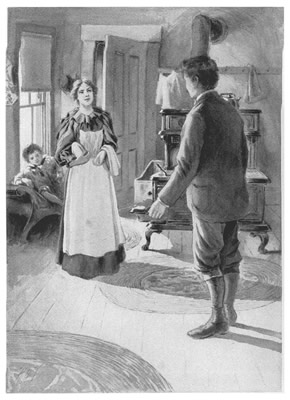
"ROSE À CHARLITTE STOOD CONFRONTING THE
NEWCOMER."
"Can you give me some lunch?" asked Vesper,
and he wondered whether he should find a descendant
of the Fiery Frenchman in this placid beauty,
whose limpid blue eyes, girlish, innocent gaze, and
thick braid of hair, with the little confusion of curls
on the forehead, reminded him rather of a Gretchen
or a Marguerite of the stage.
"But yes," said Mrs. Rose à Charlitte, in uncertain
yet pretty English, and her gentle and demure
glance scrutinized him with some shrewdness and
accurate guessing as to his attainments and station
in life.
"Can you give it to me soon?" he asked.
"I can give it soon," she replied, and as she spoke
she made an almost imperceptible motion of her
head in the direction of the neat maid-servant behind
her, who at once flew out to the garden for
fresh vegetables, while, with her foot, which was
almost as slender as her hand, Mrs. Rose à Charlitte
pulled out a damper in the stove that at once caused
a still more urgent draft to animate the glowing
wood inside.
"Can you let me have a room?" pursued Vesper.
"Yes, sir," said Mrs. Rose, and she turned to
the third occupant of the kitchen, a pale child with
a flowerlike face and large, serious eyes, who sat with
folded hands in a little chair. "Narcisse," she said,
in French, "wilt thou go and show the judge's
room?"
The child, without taking his fascinated gaze
from Vesper, responded, in a sweet, drawling voice,
"Ou-a-a-y, ma ma-r-re" (yes, my mother). Then,
rising, he trotted slowly through the dining-room
and up the staircase to a hall above, where he gravely
threw open the door of a good-sized chamber, whose
chief ornament was a huge white bed.
"Why do you call this the judge's room?" asked
Vesper, in French.
The child answered him in unintelligible childish
speech, that made the young man observe him intently.
"I believe you look like me, you black
lily," he said, at last.
There was, indeed, a resemblance between their
two heads. Both had pale, inscrutable faces, dark
eyes, and curls like midnight clustering over their
white foreheads. Both were serious, grave, and
reserved in expression. The child stared up at
Vesper, then, seizing one of his hands, he patted it
gently with his tiny fingers. They were friends.
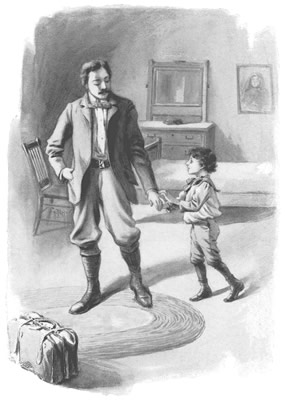
"THEY WERE FRIENDS."
Vesper allowed the child to hold his hand until he
plunged his head into a basin of cold water. Then,
with water dripping from his face, he paused to
examine a towel before he would press it against his
sensitive skin. It was fine and perfectly clean, and,
with a satisfied air, he murmured: "So far, Doctor
Arseneau has not led me astray."
The child waited patiently until the stranger had
smoothed down his black curls, then, stretching out
a hand, he mutely invited him to descend to the
parlor.
Upon arriving there, he modestly withdrew to a
corner, after pointing out a collection of photographs
on the table. Vesper made a pretence of examining
them until the entrance of his landlady with the
announcement that his lunch was served.
She shyly set before him a plate of soup, and a
dish which she called a little ragoût, "not as good as
the ragoûts of Boston, and yet eatable."
"How do you know that I am from Boston?"
asked Vesper.
"I do not know," she murmured, with a quick
blush. "Monsieur is from Halifax, I thought. He
seems English. I speak of Boston because it was
there that I learned to cook."
Vesper said nothing, but his silence seemed to
invite a further explanation, and she went on, modestly:
"When I received news that my husband had
died of yellow fever in the West Indies, neighbors
said, 'What will you do?' My stepmother said,
'Come home;' but I answered, 'No; a child that has
left its father's roof does not return. I will keep
hotel. My house is of size. I will go to Boston and
learn to cook better than I know.' So I went, and
stayed one week."
"That was a short time to learn cooking," observed
Vesper, politely.
"I did not study. I bought cuisine books. I went
to grand hotels and regarded the tables and tasted
the dishes. If I now had more money, I would do
similar," and she anxiously surveyed her modest
table and the aristocratic young man seated at it;
"but not many people come, and the money lacks.
However, our Lord knows that I wish to educate
my child. Strangers will come when he is older.
"And," she went on, after a time, with mingled
reluctance and honesty, "I must not hide from you
that I have already in the bank two hundred dollars.
It is not much; not so much as the Gautreaus, who
have six hundred, and Agapit, who has four, yet it is
a starting."
Vesper slightly wrinkled his forehead, and Mrs.
Rose, fearful that her cooking displeased him, for he
had scarcely tasted the ragoût and had put aside
a roast chicken, hastened to exclaim, "That pudding
is but overheated, and I did wrong to place it before
you. Despise it if you care, and it will please the
hens."
"It is a very good pudding," said Vesper, composedly,
and he proceeded to finish it.
"Here is a custard which is quite fresh," said his
landlady, feverishly, "and bananas, and oranges, and
some coffee."
"Thank you. No cream—may I ask why you
call that room you put me in the judge's room?"
"Because we have court near by, every year. The
judge who comes exists in that room. It is a most
stirabout time, for many witnesses and lawyers come.
Perhaps monsieur passed the court-house and saw
a lady looking through the bars?"
"No, I did not. Who is the lady?"
"A naughty one, who sold liquor. She had no
license, she could not pay her fine, therefore she
must look through those iron bars," and Mrs. Rose
à Charlitte shuddered.
Vesper looked interested, and presently she went
on: "But Clothilde Dubois has some mercies,—one
rocking-chair, her own feather bed, some dainties to
eat, and many friends to visit and talk through the
bars."
"Is there much drinking among the Acadiens on
this Bay?" asked Vesper.
"They do not drink at all," she said, stoutly.
"Really,—then you never see a drunken man?"
"I never see a drunken man," rejoined his pretty
hostess.
"Then I suppose there are no fights."
"There are no fights among Acadiens. They are
good people. They go to mass and vespers on Sunday.
They listen to their good priests. In the evening
one amuses oneself, and on Monday we rise early
to work. There are no dances, no fights."
Vesper's meditative glance wandered through the
window to a square of grass outside, where some little
girls in pink cotton dresses were playing croquet.
He was drinking his coffee and watching their graceful
behavior, when his attention was recalled to the
room by hearing Mrs. Rose à Charlitte say to her
child, "There, Narcisse, is a morsel for thy trees."
The little boy had come from the corner where he
had sat like a patient mouse, and, with some excitement,
was heaping a plate with the food that Vesper
had rejected.
"Not so fast, little one," said his mother, with an
apologetic glance at the stranger. "Take these
plates to the pantry, it will be better."
"Ah, but they will have a good dinner to-day,"
said the child. "I will give most to the French
willows, my mother. In the morning it will all
be gone."
"But, my treasure, it is the dogs that get it, not
the trees."
"No, my mother," he drawled, "you do not know.
In the night the long branches stretch out their
arms; they sweep it up," and he clasped his tiny
hands in ecstasy.
Vesper's curiosity was aroused, although he had
not understood half that the child had said. "Does
he like trees?" he asked.
Rose à Charlitte made a puzzled gesture. "Sir, to
him the trees, the flowers, the grass, are quite alive.
He will not play croquet with those dear little girls
lest his shoes hurt the grass. If I would allow, he
would take all the food from the house and lay under
the trees and the flowers. He often cries at night,
for he says the hollyhocks and sunflowers are hungry,
because they are tall and lean. He suffers terribly
to see the big spruces and pines cut down and
dragged to the shore. The doctor says he should go
away for awhile, but it is a puzzle, for I cannot
endure to have him leave me."
Vesper gave more attention than he yet had done
to the perusal of the child's sensitive yet strangely
composed face. Then he glanced at the mother.
Did she understand him?
She did. In her deep blue eyes he could readily
perceive the quick flash of maternal love and sympathy
whenever her boy spoke to her. She was
young, too, extremely young, to have the care of
rearing a child. She must have been married in her
cradle, and with that thought in mind he said, "Do
Acadien women marry at an early age?"
"Not more so than the English," said Mrs. Rose,
with a shrug of her graceful, sloping shoulders,
"though I was but young,—but seventeen. But
my husband wished it so. He had built this house.
He had been long ready for marriage," and she
glanced at the wall behind Vesper.
The young man turned around. Just behind
him hung the enlarged photograph of a man of
middle age,—a man who must have been many
years older than his young wife, and whose death
had, evidently, not left a permanent blank in her
affections.
In a naïve, innocent way she imparted a few more
particulars to Vesper with regard to her late husband,
and, as he rose from the table, she followed him
to the parlor and said, gently, "Perhaps monsieur
will register."
Vesper sat down before the visitors' book on the
table, and, taking up a pen, wrote, "Vesper L.
Nimmo, The Evening News, Boston."
After he had pressed the blotting-paper on his
words, and pushed the book from him, his landlady
stretched out her hand in childlike curiosity. "Vesper,"
she said,—"that name is beautiful; it is in a
hymn to the blessed virgin; but Evening News,—surely
it means not a journal?"
Vesper assured her that it did.
The young French widow's face fell. She gazed
at him with a sudden and inexplicable change of
expression, in which there was something of regret,
something of reproach. "Il faut que je m'en aille"
(I must go away), she murmured, reverting to her
native language, and she swiftly withdrew.
Vesper lifted his level eyebrows and languidly
strolled out to the veranda. "The Acadienne evidently
entertains some prejudice against newspaper
men. If my dear father were here he would immediately
proceed, in his inimitable way, to clear it from
her mind. As for me, I am not sufficiently interested,"
and he listlessly stretched himself out on a
veranda settle.
"Monsieur," said a little voice, in deliberate
French, "will you tell me a story about a tree?"
Vesper understood Narcisse this time, and, taking
him on his knee, he pointed to the wooded hills across
the Bay and related a wonderful tale of a city beyond
the sun where the trees were not obliged to stand
still in the earth from morning till night, but could
walk about and visit men and women, who were their
brothers and sisters, and sometimes the young trees
would stoop down and play with the children.
"The music of our life is keyed
To moods that sweep athwart the soul;
The strain will oft in gladness roll,
Or die in sobs and tears at need;
But sad or gay, 'tis ever true
That, e'en as flowers from light take hue,
The key is of our mood the deed."
Aminta. Cornelius O'Brien,
Archbishop of Halifax.
After Mrs. Rose à Charlitte left Vesper she
passed through the kitchen, and, ascending an open
stairway leading to regions above, was soon at the door
of the highest room in the house.
Away up there, sitting at a large table drawn up
to the window which commanded an extensive view
of the Bay, sat a sturdy, black-haired young man.
As Mrs. Rose entered the room she glanced about
approvingly—for she was a model housekeeper—at
the neatly arranged books and papers on tables
and shelves, and then said, regretfully, and in French,
"There is another of them."
"Of them,—of whom?" said the young man,
peevishly, and in the same language.
"Of the foolish ones who write," continued Mrs.
Rose, with gentle mischief; "who waste much time
in scribbling."
"There are people whose brains are continually
stewing over cooking-stoves," said the young man,
scornfully; "they are incapable of rising higher."
"La, la, Agapit," she said, good-naturedly. "Do
not be angry with thy cousin. I came to warn thee
lest thou shouldst talk freely to him and afterward
be sorry."
The young man threw his pen on the table, pushed
back his chair, and, springing to his feet, began to pace
excitedly up and down the room, gesticulating eagerly
as he talked.
"When fine weather comes," he exclaimed, "strangers
flock to the Bay. We are glad to see them,—all
but these abominable idiots. Therefore when
they arrive let the frost come, let us have hail, wind,
and snow to drive them home, that we may enjoy
peace."
"But unfortunately in June we have fine weather,"
said Mrs. Rose.
"I will insult him," said her black-haired cousin,
wildly. "I will drive him from the house," and he
stood on tiptoe and glared in her face.
"No, no; thou wilt do nothing of the sort, Agapit."
"I will," he said, distractedly. "I will, I will, I will."
"Agapit," said the young woman, firmly, "if it
were not for the strangers I should have only crusts
for my child, not good bread and butter, therefore
calm thyself. Thou must be civil to this stranger."
"I will not," he said, sullenly.
Mrs. Rose à Charlitte's temper gave way. "Pack
up thy clothes," she said, angrily; "there is no living
with thee,—thou art so disagreeable. Take thy old
trash, thy papers so old and dusty, and leave my house.
Thou wilt make me starve,—my child will not be
educated. Go,—I cast thee off."
Agapit became calm as he contemplated her wrathful,
beautiful face. "Thou art like all women," he said,
composedly, "a little excitable at times. I am a
man, therefore I understand thee," and pushing back
his coat he stuck his thumbs in the armholes and majestically
resumed his walk about the room.
"Come now, cease thy crying," he went on, uneasily,
after a time, when Rose, who had thrown herself into
a chair and had covered her face with her hands, did
not look at him. "I shall not leave thee, Rose."
"He is very distinguished," she sobbed, "very
polite, and his finger nails are as white as thy bedspread.
He is quite a gentleman; why does he write
for those wicked journals?"
"Thou hast been talking to him, Rose," said her
cousin, suspiciously, stopping short and fixing her with
a fiery glance; "with thy usual innocence thou hast
told him all that thou dost know and ever wilt know."
Rose shuddered, and withdrew her hands from her
eyes. "I told him nothing, not a word."
"Thou didst not tell him of thy wish to educate
thy boy, of thy two hundred dollars in the bank,
of thy husband, who teased thy stepmother till she
married thee to him, nor of me, for example?" and
his voice rose excitedly.
His cousin was quite composed now. "I told him
nothing," she repeated, firmly.
"If thou didst do so," he continued, threateningly,
"it will all come out in a newspaper,—'Melting
Innocence of an Acadien Landlady. She Tells a
Reporter in Five Minutes the Story of Her Life.'"
"It will not appear," said Mrs. Rose, hastily.
"He is a worthy young man, and handsome, too.
There is not on the Bay a handsomer young man.
I will ask him to write nothing, and he will listen
to me."
"Oh, thou false one," cried the young man, half
in vexation, half in perplexity. "I wish that thou
wert a child,—I would shake thee till thy teeth
chattered!"
Mrs. Rose ran from the room. "He is a pig, an
imbecile, and he terrifies me so that I tell what is
not true. What will Father Duvair say to me? I
will rise at six to-morrow, and go to confession."
Vesper went early to bed that night, and slept
soundly until early the next morning, when he
opened his eyes to a vision of hazy green fields, a
wide sheet of tremulous water, and a quiet, damp
road, bordered by silent houses. He sprang from
his bed, and went to the open window. The sun
was just coming from behind a bank of clouds. He
watched the Bay lighting up under its rays, the green
fields brightening, the moisture evaporating; then
hastily throwing on his clothes, he went down-stairs,
unlatched the front door, and hurried across the road
into a hay-field, where the newly cut grass, dripping
with moisture, wet his slippered but stockingless
feet.
Down by the rocks he saw a small bathing-house.
He slipped off his clothes, and, clad only in a thin
bathing-suit, stood shivering for an instant at the
edge of the water. "It will be frightfully cold," he
muttered. "Dare I—yes, I do," and he plunged
boldly into the deliciously salt waves, and swam to
and fro, until he was glowing from head to foot.
As he was hurrying up to the inn, a few minutes
later, he saw, coming down the road, a small two-wheeled
cart, in which was seated Mrs. Rose à Charlitte.
She was driving a white pony, and she sat
demure, charming, with an air of penitence about
her, and wearing the mourning garb of Acadien
women,—a plain black dress, a black shawl, and a
black silk handkerchief, drawn hood-wise over her
flaxen mop of hair and tied under her chin.
The young man surveyed her approvingly. She
seemed to belong naturally to the cool, sweet dampness
of the morning, and he guessed correctly that
she had been to early mass in the white church
whose steeple he could see in the distance. He was
amused with the shy, embarrassed "Bon jour"
(good morning) that she gave him as she passed, and
murmuring, "The shadow of The Evening News is
still upon her," he went to his room, and made his
toilet for breakfast.
An hour later, a loud bell rang through the house,
and Vesper, in making his way to the dining-room,
met a reserved, sulky-faced young man in the hall,
who bowed coolly and stepped aside for him to
pass.
"H'm, Agapit LeNoir," reflected Vesper, darting
a critical glance at him. "The Acadien who was to
unbosom himself to me. He does not look as if he
would enjoy the process," and he took his seat at the
table, where Mrs. Rose à Charlitte, grown strangely
quiet, served his breakfast in an almost unbroken
silence.
Vesper thoughtfully poured some of the thick
yellow cream on his porridge, and enjoyably dallied
over it, but when his landlady would have set before
him a dish of smoking hot potatoes and beefsteak,
he said, "I do not care for anything further."
Rose à Charlitte drew back in undisguised concern.
"But you have eaten nothing. Agapit has
taken twice as much as this."
"That is the young man I met just now?"
"Yes, he is my cousin; very kind to me. His
parents are dead, and he was brought up by my stepmother.
He is so clever, so clever! It is truly
strange what he knows. His uncle, who was a
priest, left him many papers, and all day, when
Agapit does not work, he sits and writes or reads.
Some day he will be a learned man—"
Rose paused abruptly. In her regret at the
stranger's want of appetite she was forgetting that
she had resolved to have no further conversation
with him, and in sudden confusion she made the
excuse that she wished to see her child, and melted
away like a snowflake, in the direction of the kitchen,
where Vesper had just heard Narcisse's sweet voice
asking permission to talk to the Englishman from
Boston.
The young American wandered out to the stable.
Two Acadiens were there, asking Agapit for the
loan of a set of harness. At Vesper's approach they
continued their conversation in French, although he
had distinctly heard them speaking excellent English
before he joined them.
These men were employing an almost new language
to him. This was not the French of L'Évangéline,
of Doctor Arseneau, nor of Rose à Charlitte.
Nor was it patois such as he had heard in France,
and which would have been unintelligible to him.
This must be the true Acadien dialect, and he listened
with pleasure to the softening and sweetening
of some syllables and the sharpening and ruining of
others. They were saying ung houmme, for a man.
This was not unmusical; neither was persounne, for
nobody; but the ang sound so freely interspersing
their sentences was detestable; as was also the reckless
introduction of English phrases, such as "all
right," "you bet," "how queer," "too proud,"
"funny," "steam-cars," and many others.
Their conversation for some time left the stable,
then it returned along the line of discussion of a
glossy black horse that stood in one of the stalls.
"Ce cheval est de bounne harage" (this horse is
well-bred), said one of the Acadiens, admiringly, and
Vesper's thoughts ran back to a word in the Latin
grammar of his boyhood. Hara, a pen or stable.
De bonne race, a modern Frenchman would be likely
to say. Probably these men were speaking the language
brought by their ancestors to Acadie; without
doubt they were. On this Bay would be presented
to him the curious spectacle of the descendants of
a number of people lifted bodily out of France, and
preserving in their adopted country the tongue that
had been lost to the motherland. In France the
language had drifted. Here the Acadiens were
using the same syllables that had hung on the lips of
kings, courtiers, poets, and wits of three and four
hundred years ago.
With keen interest, for he had a passion for the
study of languages, he carefully analyzed each sentence
that he heard, until, fearing that his attitude
might seem impertinent to the Acadiens, he strolled
away.
His feet naturally turned in the direction of the
corner, the most lively spot in Sleeping Water. In
the blacksmith's shop a short, stout young Acadien
with light hair, blue eyes, and a dirty face and arms,
was striking the red-hot tip of a pickax with ringing
blows. He nodded civilly enough to Vesper when
he joined the knot of men who stood about the wide
door watching him, but no one else spoke to him.
A farmer was waiting to have a pair of cream
white oxen shod, a stable-keeper, from another part
of la ville française, was impatiently chafing and
fretting over the amount of time required to mend
his sulky wheel, and conversing with him were two
well-dressed young men, who appeared to be Acadiens
from abroad spending their holidays at home.
Vesper's arrival had the effect of dispersing the
little group. The stable-man moved away to his
sulky, as if he preferred the vicinity of his roan
horse, who gazed at him so benevolently, to that of
Vesper, who surveyed him so indifferently. The
farmer entered the shop and sat down on a box in
a dark corner, while the Acadien young men, after
cold glances at the newcomer, moved away to the
post-office.
After a time Vesper remembered that he must
have some Canadian stamps, and followed them.
Outside the shop five or six teams were lined up.
They were on their way to the wharf below, and
were loaded with more of the enormous trees that
he had seen the day before. Probably their sturdy
strength, hoarded through long years in Acadien
forests, would be devoted to the support of some
warehouse or mansion in his native Puritan city,
whose founders had called so loudly for the destruction
of the French.
Vesper cast a regretful glance in the direction of
the trees, and entered the little shop, whose well-stocked
shelves were full of rolls of cotton and
flannel, and boxes of groceries, confectionery, and
stationery. The drivers of the ox-teams were inside,
doing their shopping. They were somewhat rougher
in appearance than the inhabitants of Sleeping Water,
and were louder and noisier in their conversation.
Vesper saw a young Acadien whisper a few words
to one of them, and the teamster in return scowled
fiercely at him, and muttered something about "a
goddam Yankee."
The young American stared coolly at him, and,
going up to the counter, purchased his stamps from
a fat man in shirt-sleeves, who served him with exquisite
and distant courtesy. Then, leaving the
shop, he shrugged his shoulders, and went back
the way he had come, murmuring, in amused curiosity,
"I must solve this mystery of The Evening
News. My friend Agapit is infecting all who come
within the circle of his influence."
He walked on past the inn, staring with interest
at the houses bordering the road. A few were very
small, a few very old. He could mark the transition
of a family in some cases from their larval state
in a low, gray, caterpillar-like house of one story to
a gay-winged butterfly home of two or three stories.
However, on the whole, the dwellings were nearly
all of the same size,—there were no sharp distinctions
between rich and poor. He saw no peasants,
no pampered landlords. These Acadiens all seemed
to be small farmers, and all were on an equality.
The creaking of an approaching team caught his
attention. It was drawn by a pair of magnificent red
oxen, groomed as carefully as if they had been
horses, and beside them walked an old man, who was
holding an ejaculatory conversation with them in
English; for the Acadiens of the Bay Saint-Mary
always address their oxen and horses as if they belonged
to the English race.
"I wonder whether this worthy man in homespun
has been informed that I am a kind of leper," reflected
Vesper, as he uttered a somewhat guarded "Bon
jour."
"Bon jour," said the old man, delightedly, and he
halted and admonished his companions to do the
same.
"Il fait beau" (it is a fine day), pursued Vesper,
cautiously.
"Oui, mais je crais qu'il va mouiller" (yes, but I
think it is going to rain), said the Acadien, with gentle
affability; then he went on, apologetically, and in
English, "I do not speak the good French."
"It is the best of French," said Vesper, "for it is
old."
"And you," continued the old man, not to be outdone
in courtesy, "you speak like the sisters of St.
Joseph who once called at my house. Their words
were like round pebbles dropping from their mouths."
Vesper smoothed his mustache, and glanced
kindly at his aged companion, who proceeded to ask
him whether he was staying at the inn. "Ah, it is
a good inn," he went on, "and Rose à Charlitte is
très-smart, très-smart. Perhaps you do not understand
my English," he added, when Vesper did not
reply to him.
"On the contrary, I find that you speak admirably."
"You are kind," said the old man, shaking his
head, "but my English langwidge is spiled since my
daughter went to Bostons, for I talk to no one. She
married an Irish boy; he is a nusser."
"An usher,—in a theatre?"
"No, sir, in a cross-spittal. He nusses sick people,
and gets two dollars a day."
"Oh, indeed."
"Do you come from Bostons?" asked the old
man.
"Yes, I do."
"And do you know my daughter?"
"What is her name?"
The Acadien reflected for some time, then said it
was MacCraw, whereupon Vesper assured him that
he had never had the pleasure of meeting her.
"Is your trade an easy one?" asked the old man,
wistfully.
"No; very hard."
"You are then a farmer."
"No; I wish I were. My trade is taking care of
my health."
The Acadien examined him from head to foot.
"Your face is beautifuller than a woman's, but you
are poorly built."
Vesper drew up his straight and slender figure.
He was not surprised that it did not come up to the
Acadien's standard of manly beauty.
"Let us shake hands lest we never meet again,"
said the old man, so gently, so kindly, and with so
much benevolence, that Vesper responded, warmly,
"I hope to see you some other time."
"Perhaps you will call. We are but poor, yet if it
would please you—"
"I shall be most happy. Where do you live?"
"Near the low down brook, way off there. Demand
Antoine à Joe Rimbaut," and, smiling and
nodding farewell, the old man moved on.
"A good heart," said Vesper, looking after him.
"Caw, caw," said a solemn voice at his elbow.
He turned around. One of the blackest of crows
sat on a garden fence that surrounded a neat pink
cottage. The cottage was itself smothered in lilacs,
whose fragrant blossoms were in their prime, although
the Boston lilacs had long since faded and
died.
"Do not be afraid, sir," said a woman in the inevitable
handkerchief, who jumped up from a flower bed
that she was weeding, "he is quite tame."
"Un corbeau apprivoisé" (a tame crow), said Vesper,
lifting his cap.
"Un corbeau privé, we say," she replied, shyly.
"You speak the good French, like the priests out of
France."
She was not a very young woman, nor was she
very pretty, but she was delightfully modest and
retiring in her manner, and Vesper, leaning against
the fence, assured her that he feared the Acadiens
were lacking in a proper appreciation of their ability
to speak their own language.
After a time he looked over the fields behind her
cottage, and asked the name of a church crowning
a hill in the distance.
"It is the Saulnierville church," she replied, "but
you must not walk so far. You will stay to dinner?"
While Vesper was politely declining her invitation,
a Frenchman with a long, pointed nose, and
bright, sharp eyes, came around the corner of the
house.
"He is my husband," said the woman. "Edouard,
this gentleman speaks the good French."
The Acadien warmly seconded the invitation of
his wife that Vesper should stay to dinner, but he
escaped from them with smiling thanks and a promise
to come another day.
"They never saw me before, and they asked me
to stay to dinner. That is true hospitality,—they
have not been infected. I will make my way back
to the inn, and interview that sulky beggar."
"Glad of a quarrel straight I clap the door;
Sir, let me see you and your works no more."
Pope.
At twelve o'clock Mrs. Rose à Charlitte was
standing in her cold pantry deftly putting a cap
of icing on a rich rounded loaf of cake, when she
heard a question asked, in Vesper's smooth neutral
tones, "Where is madame?"
She stepped into the kitchen, and found that he
was interrogating her servant Célina.
"I should like to speak to that young man I saw
this morning," he said, when he saw her.
"He has gone out, monsieur," she replied, after a
moment's hesitation.
"Which is his room?"
"The one by the smoking-room," she answered,
with a deep blush.
Vesper's white teeth gleamed through his dark
mustache, and, seeing that he was laughing at her,
she grew confused, and hung her head.
"Can I get to it by this staircase?" asked Vesper,
exposing her petty deceit. "I think I can by going
up to the roof, and dropping down."
Mrs. Rose lifted her head long enough to flash
him a scrutinizing glance. Then, becoming sensible
of the determination of purpose under his
indifference of manner, she said, in scarcely audible
tones, "I will show you."
"I have only a simple question to ask him," said
Vesper, reassuringly, as he followed her towards the
staircase.
"Agapit is quick like lightning," she said, over her
shoulder, "but his heart is good. He helps to keep
our grandmother, who spends her days in bed."
"That is exemplary. I would be the last one to
hurt the feelings of the prop of an aged person,"
murmured Vesper.
Rose à Charlitte was not satisfied. She unwillingly
mounted the stairs, and pointed out the door
of her cousin's room, then withdrew to the next one,
and listened anxiously in case there might be some
disturbance between the young men. There was
none; so, after a time, she went down-stairs.
Agapit, at Vesper's entrance, abruptly pushed
back his chair from the table and, rising, presented
a red and angry face to his visitor.
"I have interrupted you, I fear," said Vesper,
smoothly. "I will not detain you long. I merely
wish to ask a question."
"Will you sit down?" said Agapit, sulkily, and he
forced himself to offer the most comfortable chair in
the room to his caller.
Vesper did not seat himself until he saw that
Agapit was prepared to follow his example. Then
he looked into the black eyes of the Acadien, which
were like two of the deep, dark pools in the forest,
and said, "A matter of business has brought me to
this Bay. I may have some inquiries to make, in
which I would find myself hampered by any prejudice
among persons I might choose to question. I
fancy that some of the people here look on me
with suspicion. I am quite unaware of having given
offence in any way. Possibly you can explain,—I
am not bent on an explanation, you understand.
If you choose to offer one, I shall be glad to
listen."
He spoke listlessly, tapping on the table with his
fingers, and allowing his eyes to wander around
the room, rather than to remain fixed on Agapit's
face.
The young Acadien could scarcely restrain a torrent
of words until Vesper had finished speaking.
"Since you ask, I will explain,—yes, I will not
be silent. We are not rude here,—oh, no. We
are too kind to strangers. Vipers have crept in
among us. They have stolen heat and warmth
from our bosoms"—he paused, choking with rage.
"And you have reason to suppose that I may
prove a viper?" asked Vesper, indolently.
"Yes, you also are one. You come here, we
receive you. You depart, you laugh in your sleeve,—a
newspaper comes. We see it all. The meek
and patient Acadiens are once more held up to be a
laughing-stock."
Vesper wrinkled his level eyebrows. "Perhaps
you will characterize this viperish conduct?"
Agapit calmed himself slightly. "Wait but an
instant. Control your curiosity, and I will give you
something to read," and he went on his knees, and
rummaged among some loose papers in an open box.
"Look at it," he said, at last, springing up and
handing his caller a newspaper; "read, and possibly
you will understand."
Vesper's quick eye ran over the sheet that he
held up. "This is a New York weekly paper.
Yes, I know it well. What is there here that
concerns you?"
"Look, look here," said Agapit, tapping a column
in the paper with an impatient gesture. "Read the
nonsense, the drivel, the insanity of the thing—"
"Ah,—'Among the Acadiens, Quaintness Unrivalled,
Archaic Forms of Speech, A Dance and
a Wedding, The Spirit of Evangeline, Humorous
Traits, If You Wish a Good Laugh Go Among
Them!'"
"She laughed in print, she screamed in black ink!"
exclaimed Agapit. "The silly one,—the witch."
"Who was she,—this lady viper?" asked Vesper,
briefly.
"She was a woman—a newspaper woman. She
spent a summer among us. She gloomed about the
beach with a shawl on her shoulders; a small dog
followed her. She laid in bed. She read novels,
and then," he continued, with rising voice, "she returned
home, she wrote this detestability about us."
"Why need you care?" said Vesper, coolly.
"She had to reel off a certain amount of copy.
All correspondents have to do so. She only touched
up things a little to make lively reading."
"Not touching up, but manufacturing," retorted
Agapit, with blazing eyes. "She had nothing to go
on, nothing—nothing—nothing. We are just like
other people," and he ruffled his coal-black hair with
both his hands, and looked at his caller fiercely.
"Do you not find us so?"
"Not exactly," said Vesper, so dispassionately
and calmly, and with such statuesque repose of
manner, that he seemed rather to breathe the words
than to form them with his lips.
"And you will express that in your paper. You
will not tell the truth. My countrymen will never
have justice,—never, never. They are always misrepresented,
always."
"What a firebrand!" reflected Vesper, and he
surveyed, with some animation, the inflamed, suspicious
face of the Frenchman.
"You also will caricature us," pursued Agapit;
"others have done so, why should not you?"
Vesper's lips parted. He was on the point of
imparting to Agapit the story of his great-grandfather's
letter. Then he closed them. Why should
he be browbeaten into communicating his private
affairs to a stranger?
"Thank you," he said, and he rose to leave the
room. "I am obliged for the information you have
given me."
Agapit's face darkened; he would dearly love to
secure a promise of good behavior from this stranger,
who was so non-committal, so reserved, and yet so
strangely attractive.
"See," he said, grandly, and flinging his hand in
the direction of his books and papers. "To an
honest man, really interested in my people, I would
be pleased to give information. I have many documents,
many books."
"Ah, you take an interest in this sort of thing,"
said Vesper.
"An interest—I should die without my books
and papers; they are my life."
"And yet you were cut out for a farmer," thought
Vesper, as he surveyed Agapit's sturdy frame. "I
suppose you have the details of the expulsion at
your fingers' ends," he said, aloud.
"Ah, the expulsion," muttered Agapit, turning
deathly pale, "the abominable, damnable expulsion!"
"Your feelings run high on the subject," murmured
Vesper.
"It suffocates me, it chokes me, when I reflect
how it was brought about. You know, of course,
that in the eighteenth century there flourished a
devil,—no, not a devil," contemptuously. "What is
that for a word? Devil, devil,—it is so common
that there is no badness in it. Even the women say,
'Poor devil, I pity him.' Say, rather, there was a
god of infamy, the blackest, the basest, the most
infernal of created beings that our Lord ever permitted
to pollute this earth—"
For a minute he became incoherent, then he
caught his breath. "This demon, this arch-fiend,
the misbegotten Lawrence that your historian Parkman
sets himself to whitewash—"
"I know of Parkman," said Vesper, coldly, "he
was once a neighbor of ours."
"Was he!" exclaimed Agapit, in a paroxysm of
excitement. "A fine neighbor, a worthy man! Parkman,—the
New England story-teller, the traducer,
who was too careless to set himself to the task of
investigating records."
Vesper was not prepared to hear any abuse of his
countryman, and, turning on his heel, he left the
room, while Agapit, furious to think that, unasked,
he had been betrayed into furnishing a newspaper
correspondent with some crumbs of information that
might possibly be dished up in appetizing form for
the delectation of American readers, slammed the
door behind him, and went back to his writing.
"I found the fullest summer here
Between these sloping meadow-hills and yon;
And came all beauty then, from dawn to dawn,
Whether the tide was veiled or flowing clear."
J. F. H.
Three days later, Vesper had only two friends in
Sleeping Water,—that is, only two open friends.
He knew he had a secret one in Mrs. Rose à Charlitte,
who waited on him with the air of a sorrowing
saint.
The open friends were the child Narcisse, and
Emmanuel Victor de la Rive, the mail-driver. Rose
could not keep her child away from the handsome
stranger. Narcisse had fallen into a passionate
adoration for him, and even in his dreams prattled of
the Englishman from Boston.
On the third night of Vesper's stay in Sleeping
Water a violent thunder-storm arose. Lying in his
bed and watching the weird lighting up of the Bay
under the vivid discharges of electricity, he heard a
fumbling at his door-knob, and, upon unlocking the
door, discovered Narcisse, pale and seraphic, in a
long white nightgown, and with beads of distress
on his forehead.
"Mr. Englishman," he said to Vesper, who now
understood his childish lingo, "I come to you, for
my mother sleeps soundly, and she cannot tell me
when she wakes,—the trees and the flowers, are
they not in a terrible fright?" and, holding up his
gown with one hand, he went swiftly to the window,
and pointed out towards the willows, writhing and
twisting in the wind, and the gentle flowers laid low
on the earth.
A yellow glare lighted up the room, a terrible peal
of thunder shook the house, but the child did not
quail, and stood waiting for an answer to his question.
"Come here," said Vesper, calmly, "and I will
explain to you that the thunder does not hurt them,
and that they have a way of bending before the
blast."
Narcisse immediately drew his pink heels up over
the side of Vesper's bed. He was unspeakably
soothed by the merest word of this stranger, in
whose nervous sensitiveness and reserve he found a
spirit more congenial to his own than in that of his
physically perfect mother.
Vesper talked to him for some time, and the child
at last fell asleep, his tiny hand clasping a scapulary
on his breast, his pretty lips murmuring to the picture
on it, "Good St. Joseph, Mr. Englishman says
that only a few of the trees and flowers are hurt by
the storm. Watch over the little willows and the
small lilies while I sleep, and do not let them be
harmed."
Vesper at first patiently and kindly endured the
pressure of the curly head laid on his arm. He would
like to have a beautiful child like this for his own.
Then thoughts of his childhood began to steal over
him. He remembered climbing into his father's bed,
gazing worshipfully into his face, and stroking his
handsome head.
"O God, my father!" he muttered, "I have lost
him," and, unable to endure the presence of the
child, he softly waked him. "Go back to your
mother, Narcisse. She may miss you."
The child sleepily obeyed him, and went to continue
his dreams by his mother's side, while Vesper
lay awake until the morning, a prey to recollections
at once tender and painful.
Vesper's second friend, the mail-driver, never
failed to call on him every morning. If one could
put a stamp on a letter it was permissible at any
point on the route to call, "Arrête-toi" (stop), to the
crimson flying bird. If one could not stamp a letter,
it was illegal to detain him.
Vesper never had, however, to call "Arrête-toi."
Of his own accord Emmanuel Victor de la Rive,
upon arriving before the inn, would fling the reins
over his pony's back, and spring nimbly out. He
was sure to find Vesper lolling on the seat under the
willows, or lying in the hammock, with Narcisse
somewhere near, whereupon he would seat himself
for a few minutes, and in his own courteous and
curious way would ask various and sundry questions
of this stranger, who had fascinated him almost as
completely as he had Narcisse.
On the morning after the thunder-storm he had
fallen into an admiration of Vesper's beautiful white
teeth. Were they all his own, and not artificial?
With such teeth he could marry any woman. He
was a bachelor now, was he not? Did he always
intend to remain one? How much longer would he
stay in Sleeping Water? And Vesper, parrying his
questions with his usual skill, sent him away with his
ears full of polite sentences that, when he came to
analyze them, conveyed not a single item of information
to his surprised brain.
However, he felt no resentment towards Vesper.
His admiration rose superior to any rebuffs. It even
soared above the warning intimations he received
from many Acadiens to the effect that he was laying
himself open to hostile criticism by his intercourse
with the enemy within the camp.
Vesper was amused by him, and on this particular
morning, after he left, he lay back in the hammock,
his mind enjoyably dwelling on the characteristics of
the volatile Acadien.
Narcisse, who stood beside him in the centre
of the bare spot on the lawn, by the hammock, in
vain begged for a story, and at last, losing patience,
knelt down and put his head to the ground. The
Englishman had told him that each grass-blade came
up from the earth with a tale on the tip of its quivering
tongue, and that all might hear who bent an ear
to listen. Narcisse wished to get news of the storm
in the night, and really fancied that the grass-blades
told him it had prevailed in the bowels of the earth.
He sprang up to impart the news to Vesper, and
Agapit, who was passing down the lane by the house
to the street, scowled, disapprovingly, at the pretty,
wagging head and animated gestures.
Vesper gazed after him, and paid no attention to
Narcisse. "I wonder," he murmured, languidly,
"what spell holds me in the neighborhood of this
Acadien demagogue who has turned his following
against me. It must be the Bay," and in a trance
of pleasure he surveyed its sparkling surface.
Always beautiful,—never the same. Was ever
another sheet of water so wholly charming, was
ever another occupation so fitted for unstrung nerves
as this placid watching of its varying humors and
tumults?
This morning it was like crystal. A fleet of small
boats was dancing out to the deep sea fishing-grounds,
and three brown-sailed schooners were
gliding up the Bay to mysterious waters unknown
to him. As soon as he grew stronger, he must follow
them up to the rolling country and the fertile
fields beyond Sleeping Water. Just now the mere
thought of leaving the inn filled him with nervous
apprehension, and he started painfully and irritably
as the sharp clang of the dinner-bell rang out through
the open windows of the house.
Followed by Narcisse, he sauntered to the table,
where he caused Rose à Charlitte's heart a succession
of pangs and anxieties.
"He does not like my cooking; he eats nothing,"
she said, mournfully, to Agapit, who was taking
a substantial dinner at the kitchen table.
"I wish that he would go away," said Agapit, "I
hate his insolent face."
"But he is not insolent," said Rose, pleadingly.
"It is only that he does not care for us; he is likely
rich, and we are but poor."
"Do many millionaires come to thy quiet inn?"
asked Agapit, ironically.
Rose reluctantly admitted that, so far, her patrons
had not been people of wealth.
"He is probably a beggar," said Agapit. "He
has paid thee nothing yet. I dare say he has only
old clothes in that trunk of his. Perhaps he was
forced to leave his home. He intends to spend the
rest of his life here."
"If he would work," said Rose, timidly, "he
could earn his board. If thou goest away, I shall
need a man for the stable."
"Look at his white hands," said Agapit, "he is
lazy,—and dost thou think I would leave thee with
that young sprig? His character may be of the
worst. What do we know of him?" and he tramped
out to the stable, while Mrs. Rose confusedly withdrew
to her pantry.
An hour later, while Agapit was grooming Toochune,
the thoroughbred black horse that was the
wonder of the Bay, Narcisse came and stood in the
stable door, and for a long time silently watched
him.
Then he heaved a small sigh. He was thinking
neither of the horse nor of Agapit, and said, wistfully,
"The Englishman from Boston sleeps as well as my
mother. I have tried to wake him, but I cannot."
Agapit paid no attention to him, but the matter
was weighing on the child's mind, and after a time
he continued, "His face is very white, as white as
the breast of the ducks."
"His face is always white," growled Agapit.
Narcisse went away, and sat patiently down by the
hammock, while Agapit, who kept an eye on him
despite himself, took occasion a little later to go to
the garden, ostensibly to mend a hole in the fence,
in reality to peer through the willows at Vesper.
What he saw caused him to drop his knife, and
go to the well, where Célina was drawing a bucket
of water.
"The Englishman has fainted," he said, and he
took the bucket from her. Célina ran after him, and
watched him thrust Narcisse aside and dash a handful
of water in Vesper's marble, immobile face.
Narcisse raised one of his tiny fists and struck
Agapit a smart blow, and, in spite of their concern
for the Englishman, both the grown people turned
and stared in surprise at him. For the first time
they saw the sweet-tempered child in a rage.
"Go away," he said, in a choking voice, "you
shall not hurt him."
"Hush, little rabbit," said the young man. "I
try to do him good. Christophe! Christophe!" and
he hailed an Acadien who was passing along the
road. "Come assist me to carry the Englishman
into the house. This is something worse than a
faint."
"Dull days had hung like curtained mysteries,
And nights were weary with the starless skies.
At once came life, and fire, and joys untold,
And promises for violets to unfold;
And every breeze had shreds of melodies,
So faint and sweet."
J. F. Herbin.
One midnight, three weeks later, when perfect
silence and darkness brooded over Sleeping Water,
and the only lights burning were the stars up aloft,
and two lamps in two windows of the inn, Vesper
opened his eyes and looked about him.
He saw for some dreamy moments only a swimming
curtain of black, with a few familiar objects
picked out against the gloom. He could distinguish
his trunk sailing to and fro, a remembered mirror
before which he had brushed his hair, a book in a
well-known binding, and a lamp with a soft yellow
globe, that immediately took him to a certain restaurant
in Paris, and made him fancy that he was
dining under the yellow lights in its ceiling.
Where was he,—in what country had he been having
this long, dreamless sleep? And by dint of much
brain racking, which bathed his whole body in a profuse
perspiration, he at length retraced his steps
back into his life, and decided that he was in the
last place that he remembered before he fell into
this disembodied-spirit condition of mind,—his room
in the Sleeping Water Inn.
There was the open window, through which he
had so often listened to the soothing murmur of the
sea; there were the easy chairs, the chest of drawers,
the little table, that, as he remembered it last, was
not covered with medicine-bottles. The child's cot
was a wholly new object. Had the landlady's little
boy been sharing his quarters? What was his
name? Ah, yes, Narcisse,—and what had they
called the sulky Acadien who had hung about the
house, and who now sat reading in a rocking-chair
by the table?
Agapit—that was it; but why was he here in his
room? Some one had been ill. "I am that person,"
suddenly drifted into his tortured mind. "I
have been very ill; perhaps I am going to die."
But the thought caused him no uneasiness, no
regret; he was conscious only of an indescribably
acute and nervous torture as his weary eyes glued
themselves to the unconscious face of his watcher.
Agapit would soon lift his head, would stare at
him, would utter some exclamation; and, in mute,
frantic expectation, Vesper waited for the start and
the exclamation. If they did come he felt that they
would kill him; if they did not, he felt that nothing
less than a sudden and immediate felling to the floor
of his companion would satisfy the demands of his
insane and frantic agitation.
Fortunately Agapit soon turned his anxious face
towards the bed. He did not start, he did not exclaim:
he had been too well drilled for that; but a
quick, quiet rapture fell upon him that was expressed
only by the trembling of his finger tips.
The young American had come out of the death-like
unconsciousness of past days and nights; he
now had a chance to recover; but while a thanksgiving
to the mother of angels was trembling on his
lips, his patient surveyed him in an ecstasy of irritation
and weakness that found expression in hysterical
laughter.
Agapit was alarmed. He had never heard Vesper
laugh in health. He had rarely smiled. Possibly he
might be calmed by the offer of something to eat,
and, picking up a bowl of jelly, he approached the
bed.
Vesper made a supreme effort, slightly moved his
head from the descending spoon, and uttered the
worst expression that he could summon from his
limited vocabulary of abuse of former days.
Agapit drew back, and resignedly put the jelly on
the table. "He remembers the past," he reflected,
with hanging head.
Vesper did not remember the past; he was conscious
of no resentment. He was possessed only of
a wild desire to be rid of this man, whose presence
inflamed him to the verge of madness.
After sorrowfully surveying him, while retreating
further and further from his inarticulate expressions
of rage, Agapit stepped into the hall. In a few
minutes he returned with Rose, who looked pale
and weary, as if she, too, were a watcher by a sick-bed.
She glanced quickly at Vesper, suppressed a
smile when he made a face at Agapit, and signed
to the latter to leave the room.
Vesper became calm. Instead of sitting down
beside him, or staring at him, she had gone to the
window, and stood with folded hands, looking out
into the night. After some time she went to the
table, took up a bottle, and, carefully examining it,
poured a few drops into a spoon.
Vesper took the liquid from her, with no sense of
irritation; then, as she quickly turned away, he felt
himself sinking down, down, through his bed, through
the floor, through the crust of the earth, into regions
of infinite space, from which he had come back to
the world for a time.
The next time he waked up, Agapit was again
with him. The former pantomime would have been
repeated if Agapit had not at once precipitated
himself from the room, and sent Rose to take his
place.
This time she smiled at Vesper, and made an effort
to retain his attention, even going so far as to
leave the room and reënter with a wan effigy of
Narcisse in her arms,—a pale and puny thing that
stared languidly at him, and attempted to kiss his
hand.
Vesper tried to speak to the child, lost himself in
the attempt, then roused his slumbering fancy once
more and breathed a question to Mrs. Rose,—"My
mother?"
"Your mother is well, and is here," murmured his
landlady. "You shall see her soon."
Vesper's periods of slumber after this were not of
so long duration, and one warm and delicious afternoon,
when the sunlight was streaming in and flooding
his bed, he opened his eyes on a frail, happy
figure fluttering about the room. "Ah, mother,"
he said, calmly, "you are here."
She flew to the bed, she hovered over him, embraced
him, turned away, came back to him, and
finally, rigidly clasping her hands to ensure self-control,
sat down beside him.
At first she would not talk, the doctor would not
permit it; but after some days her tongue was allowed
to take its course freely and uninterruptedly.
"My dear boy, what a horrible fright you gave
me! Your letters came every day for a week, then
they stopped. I waited two days, thinking you had
gone to some other place, then I telegraphed. You
were ill. You can imagine how I hurried here,
with Henry to take care of me. And what do you
think I found? Such a curious state of affairs.
Do you know that these Acadiens hated you at
first?"
"Yes, I remember that."
"But when you fell ill, that young man, Agapit,
installed himself as your nurse. They spoke of getting
a Sister of Charity, but had some scruples,
thinking you might not like it, as you are a Protestant.
Mrs. de Forêt closed her inn; she would
receive no guests, lest they might disturb you.
She and her cousin nursed you. They got an
English doctor to drive twelve miles every day,—they
thought you would prefer him to a French
one. Then her little boy fell ill; he said the
young man Agapit had hurt you. They thought
he would die, for he had brain fever. He called
all the time for you, and when he had lucid intervals,
they could only convince him you were not dead
by bringing him in, and putting him in this cot.
Really, it was a most deplorable state of affairs.
But the charming part is that they thought you
were a pauper. When I arrived, they were thunderstruck.
They had not opened your trunk, which
you left locked, though they said they would have
done so if I had not come, for they feared you might
die, and they wanted to get the addresses of your
friends, and every morning, my dear boy, for three
days after you were taken ill, you started up at nine
o'clock, the time that queer, red postman used to
come,—and wrote a letter to me."
Mrs. Nimmo paused, hid her face in her hands,
and burst into tears. "It almost broke my heart
when I heard it,—to think of you rousing yourself
every day from your semi-unconsciousness to write
to your mother. I cannot forgive myself for letting
you go away without me."
"Why did they not write from here to you?"
asked Vesper.
"They did not know I was your mother. I don't
think they looked at the address of the letters you
had sent. They thought you were poor, and an
adventurer."
"Why did they not write to The Evening News?"
"My dear boy, they were doing everything possible
for you, and they would have written in
time."
"You have, of course, told them that they shall
suffer no loss by all this?"
"Yes, yes; but they seem almost ashamed to
take money from me. That charming landlady says,
'If I were rich I would pay all, myself.' Vesper, she
is a wonderful woman."
"Is she?" he said, languidly.
"I never saw any one like her. My darling, how
do you feel? Mayn't I give you some wine? I feel
as if I had got you back from the grave, I can never
be sufficiently thankful. The doctor says you may
be carried out-of-doors in a week, if you keep on
improving, as you are sure to do. The air here
seems to suit you perfectly. You would never have
been ill if you had not been run down when you
came. That young man Agapit is making a stretcher
to carry you. He is terribly ashamed of his dislike
for you, and he fairly worships you now."
"I suppose you went through my trunk," said
Vesper, in faint, indulgent tones.
"Well, yes," said Mrs. Nimmo, reluctantly. "I
thought, perhaps, there might be something to be
attended to."
"And you read my great-grandfather's letter?"
"Yes,—I will tell you exactly what I did. I
found the key the second day I came, and I opened
the trunk. When I discovered that old yellow letter,
I knew it was something important. I read it, and
of course recognized that you had come here in
search of the Fiery Frenchman's children. However,
I did not think you would like me to tell these
Acadiens that, so I merely said, 'How you have misunderstood
my son! He came here to do good to
some of your people. He is looking for the descendants
of a poor unhappy man. My son has money,
and would help you.'"
Vesper tried to keep back the little crease of
amusement forming itself about his wasted lips. He
had rarely seen his mother so happy and so excited.
She prattled on, watching him sharply to see the
effect of her words, and hovering over him like a
kind little mother-bird. In some way she reminded
him curiously enough of Emmanuel de la Rive.
"I simply told them how good you are, and how
you hate to have a fuss made over you. The young
Acadien man actually writhed, and Mrs. de Forêt
cried like a baby. Then they said, 'Oh, why did
he put the name of a paper after his name?' 'How
cruel in you to say that!' I replied to them. 'He
does that because it reminds him of his dead father,
whom he adored. My husband was editor and proprietor
of the paper, and my son owns a part of it.'
You should have seen the young Acadien. He put
his head down on his arms, then he lifted it, and
said, 'But does your son not write?' 'Write!' I
exclaimed, indignantly, 'he hates writing. To me,
his own mother, he only sends half a dozen lines.
He never wrote a newspaper article in his life.'
They would have been utterly overcome if I had not
praised them for their disinterestedness in taking
care of you in spite of their prejudice against you.
Vesper, they will do anything for you now; and
that exquisite child,—it is just like a romance that
he should have fallen ill because you did."
"Is he better?"
"Almost well. They often bring him in when
you are asleep. I daresay it would amuse you to
have him sit on your bed for awhile."
Vesper was silent, and, after a time, his mother
ran on: "This French district is delightfully unique.
I never was in such an out-of-the-world place except
in Europe. I feel as if I had been moved back into
a former century, when I see those women going
about in their black handkerchiefs. I sit at the
window and watch them going by,—I should never
weary of them."
Vesper said nothing, but he reflected affectionately
and acutely that in a fortnight his appreciative
but fickle mother would be longing for the rustle of
silks, the flutter of laces, and the hum of fashionable
conversation on a veranda, which was her idea of an
enjoyable summer existence.
"Long have I lingered where the marshlands are,
Oft hearing in the murmur of the tide
The past, alive again and at my side,
With unrelenting power and hateful war."
J. F. H.
"There goes the priest of the parish in his
buggy," said Mrs. Nimmo. "He must have a sick
call."
She sat on a garden chair, crocheting a white
shawl and watching the passers-by on the road.
"And there are some Sisters of Charity from one
of the convents and an old Indian with a load of baskets
is begging from them—Don't you want to
look at these bicyclists, Vesper? One, two, three,
four, five, six. They are from Boston, I know, by
the square collars on their jerseys. The Nova Scotians
do not dress in that way."
Vesper gave only a partial though pleased attention
to his mother, who had picked up an astonishing
amount of neighborhood news, and as he lay on a
rug at her feet, with his hat pulled over his brows,
his mind soared up to the blue sky above him. During
his illness he had always seemed to be sinking
down into blackness and desolation. With returning
health and decreased nervousness his soul mounted
upward, and he would lie for hours at a time bathed
in a delicious reverie and dreaming of "a nest
among the stars."
"And there is the blacksmith from the corner,"
continued Mrs. Nimmo, "who comes here so often
to borrow things that a blacksmith is commonly supposed
to have. Yesterday he wanted a hammer.
'Not a hammer,' said Célina to me, 'but a wife.'"
Vesper's brain immediately turned an abrupt somersault
in a descent from the sky to earth. "What
did you say, mother?"
"Merely that the blacksmith wishes to marry our
landlady. It will be an excellent match for her.
Don't you think so?"
"In some respects,—yes."
"She is too young, and too handsome, to remain a
widow. Célina says that she has had a great many
admirers, but she has never seemed to fancy any one
but the blacksmith. She went for a drive with him
last Sunday evening. You know that is the time
young Acadiens call on the girls they admire. You
see them walking by, or driving in their buggies. If
a girl's fiancé did not call on her that evening she
would throw him over—There she is now with
your beef tea," and Mrs. Nimmo admiringly watched
Rose coming from the kitchen and carefully guarding
a dainty china cup in her hand.
Vesper got up and took it from her. "Don't you
think it is nonsense for me to be drinking this every
morning?" he asked.
Rose looked up at him as he stood, tall, keen-eyed,
interested, and waiting for her answer. "What does
madame, your mother, say?" she asked, indicating
Mrs. Nimmo, by a pretty gesture.
"His mother says," remarked Mrs. Nimmo, indulgently,
"that her son should take any dose, no matter
how disagreeable, if it has for its object the good of
his health."
Vesper glanced sharply at her, then poured the
last few drops of his tea on the ground.
"Ah," said Mrs. Rose, anxiously, "I feared that I
had not put in enough salt. Now I know."
"It was perfect," said Vesper. "I am only offering
a libation to those pansies," and he inclined his dark
head towards Narcisse, who was seated cross-legged
in the hammock.
Rose took the cup, smiled innocently and angelically
on her child and the young man and his mother,
and returned to the house.
Agapit presently came hurrying by the fence.
"Ah, that is good!" he exclaimed, when he saw
Vesper sauntering to and fro; "do you not think you
could essay a walk to the wharf?"
"Yes," said Vesper, while his mother anxiously
looked up from her work.
"Then come,—let me have the honor of escorting
you," and Agapit showed his big white teeth in an
ecstatic smile.
Vesper extended a hand to Narcisse, and, lifting
his cap to his mother, went slowly down the lane to
the road.
Agapit could scarcely contain his delight. He
grinned broadly at every one they met, tried to accommodate
his pace to Vesper's, kept forgetting and
striding ahead, and finally, cramming his hands in his
pockets, fell behind and muttered, "I feel as if I had
known you a hundred years."
"You didn't feel that way six weeks ago," said
Vesper, good-humoredly.
"I blush for it,—I am ashamed, but can you blame
me? Since days of long ago, Acadiens have been so
much maligned. You do not find that we are worse
than others?"
"Well, I think you would have been a pretty
ticklish fellow to have handled at the time of the
expulsion."
"Our dear Lord knew better than to bring me
into the world then," said Agapit, naïvely. "I
should have urged the Acadiens to take up arms.
There were enough of them to kill those devilish
English."
"Do all the Acadiens hate the English as much as
you do?"
"I hate the English?" cried Agapit. "How
grossly you deceive yourself!"
"What do you mean then by that strong language?"
Agapit threw himself into an excited attitude.
"Let you dare—you youthful, proud young republic,—to
insult our Canadian flag. You would see where
stands Agapit LeNoir! England is the greatest
nation in the world," and proudly swelling out his
breast, he swept his glance over the majestic Bay
before them.
"Yes, barring the United States of America."
"I cannot quarrel with you," said Agapit, and the
fire left his glance, and moisture came to his eyes.
"Let us each hold to our own opinion."
"And suppose insults not forthcoming,—give
me some further explanation meantime."
"My quarrel is not with the great-minded," said
Agapit, earnestly, "the eagerly anxious-for-peace
Englishmen in years gone by, who reinforced the
kings and queens of England. No,—I impeach
the low-born upstarts and their colonial accomplices.
Do you know, can you imagine, that the diabolical
scheme of the expulsion of the Acadiens was conceived
by a barber, and carried into decapitation by
a house painter?"
"Not possible," murmured Vesper.
"Yes, possible,—let me find you a seat. I shall
not forgive myself if I weary you, and those women
will kill me."
They had reached the wharf, and Agapit pointed
to a pile of boards against the wooden breastwork
that kept the waves from dashing over in times of
storm.
"That infamous letter is always like a scroll of
fire before me," he exclaimed, pacing restlessly to
and fro before Vesper and the child. "In it the
once barber and footman, Craggs, who was then
secretary of state, wrote to the governor of Nova
Scotia: 'I see you do not get the better of the
Acadiens. It is singular that those people should
have preferred to lose their goods rather than be
exposed to fight against their brethren. This sentimentality
is stupid.' Ah, let it be stupid!"
exclaimed Agapit, breaking off. "Let us once
more have an expulsion. The Acadiens will go,
they will suffer, they will die, before they give up
sentimentality."
"Hear, hear!" observed Vesper.
Agapit surveyed him with a glowing eye. "Listen
to further words from this solemn official, this barber
secretary: 'These people are evidently too much
attached to their fellow countrymen and to their
religion ever to make true Englishmen.' Of what
are true Englishmen made, Mr. Englishman from
Boston?"
"Of poor Frenchmen, according to the barber."
"Now hear more courtly language from the
honorable Craggs: 'It must be avowed that your
position is deucedly critical. It was very difficult
to prevent them from departing after having left
the bargain to their choice—'"
"What does he mean by that?" asked Vesper.
"Call to your memory the terms of the treaty of
Utrecht."
"I don't remember a word of it,—bear in mind,
my friend, that I am not an Acadien, and this question
does not possess for me the moving interest it
does for you. I only know Longfellow's 'Evangeline,'—which,
until lately, has always seemed to me
to be a pretty myth dressed up to please the public,
and make money for the author,—some magazine
articles, and Parkman, my favorite historian, whom
you, nevertheless, seem to dislike."
Agapit dropped on a block of wood, and rocked
himself to and fro, as if in distress. "I will not
characterize Parkman, since he is your countryman;
but I would dearly love—I would truly admire to
say what I think of him. Now as to the treaty of
Utrecht; think just a moment, and you will remember
that it transferred the Acadiens as the subjects
of Louis XIV. of France to the good Queen Anne
of England."
Vesper, instead of puzzling his brain with historical
reminiscences, immediately began to make
preparations for physical comfort, and stretched
himself out on the pile of boards, with his arm for
a pillow.
"Do not sleep, but conversate," said Agapit,
eagerly. "It is cool here, you possibly would get
cold if you shut your eyes. I will change this matter
of talk,—there is one I would fain introduce."
Vesper, in inward diversion, found that a new
solemnity had taken possession of the young Acadien.
He looked unutterable things at the Bay,
indescribable things at the sky, and mysterious
things at the cook of the schooner, who had just
thrust his head through a window in his caboose.
At last he gave expression to his emotion.
"Would this not be a fitting time to talk of the
wonderful letter of which madame, your mother,
hinted?"
Vesper, without a word, drew a folded paper from
his pocket, and handed it to him.
Agapit took it reverently, swayed back and forth
while devouring its contents, then, unable to restrain
himself, sprang up, and walked, or rather ran, to and
fro while perusing it a second time.
At last he came to a dead halt, and breathing
hard, and with eyes aflame, ejaculated, "Thank you,
a thousand, thousand time for showing me this precious
letter." Then pressing it to his breast, he disappeared
entirely from Vesper's range of vision.
After a time he came back. Some of his excitement
had gone from his head through his heels, and
he sank heavily on a block of wood.
"You do not know, you cannot tell," he said,
"what this letter means to us."
"What does it mean?"
"It means—I do not know that I can say the
word, but I will try—cor-rob-oration."
"Explain a little further, will you?"
"In the past all was for the English. Now records
are being discovered, old documents are coming
to light. The guilty colonial authorities suppressed
them. Now these records declare for the Acadiens."
"So—this letter, being from one on the opposite
side, is valuable."
"It is like a diamond unearthed," said Agapit,
turning it over; "but,"—in sudden curiosity,—"this
is a copy mutilated, for the name of the captain
is not here. From whom did you have it, if I
am permitted to ask?"
"From the great-grandson of the old fellow mentioned."
"And he does not wish his name known?"
"Well, naturally one does not care to shout the
sins of one's ancestors."
"The noble young man, the dear young man,"
said Agapit, warmly. "He will atone for the sins
of his fathers."
"Not particularly noble, only business-like."
"And has he much money, that he wishes to aid
this family of Acadiens?"
"No, not much. His father's family never succeeded
in making money and keeping it. His mother
is rich."
"I should like to see him," exclaimed Agapit,
and his black eyes flashed over Vesper's composed
features. "I should love him for his sensitive
heart."
"There is nothing very interesting about him,"
said Vesper. "A sick, used-up creature."
"Ah,—he is delicate."
"Yes, and without courage. He is a college man
and would have chosen a profession if his health had
not broken down."
"I pity him from my heart; I send good wishes
to his sick-bed," said Agapit, in a passion of enthusiasm.
"I will pray to our Lord to raise him."
"Can you give him any assistance?" asked Vesper,
nodding towards the letter.
"I do not know; I cannot tell. There are many
LeNoirs. But I will go over my papers; I will sit
up at night, as I now do some writing for the post-office.
You know I am poor, and obliged to work.
I must pay Rose for my board. I will not depend
on a woman."
Vesper half lifted his drooping eyelids. "What
are you going to make of yourself?"
"I wish to study law. I save money for a period
in a university."
"How old are you?"
"Twenty-three."
"Your cousin looks about that age."
"She is twenty-four,—a year older; and you,—may
I ask your age?"
"Guess."
Agapit studied his face. "You are twenty-six."
"No."
"I daresay we are both younger than Rose," said
Agapit, ingenuously, "and she has less sense than
either."
"Did your ancestors come from the south of
France?" asked Vesper, abruptly.
"Not the LeNoirs; but my mother's family was
from Provence. Why do you ask?"
"You are like a Frenchman of the south."
"I know that I am impetuous," pursued Agapit.
"Rose says that I resemble the tea-kettle. I boil
and bubble all the time that I am not asleep, and"—uneasily—"she
also says that I speak too hastily of
women; that I do not esteem them as clever as they
are. What do you think?"
Vesper laughed quickly. "Southerners all have
a slight contempt for women. However, they are
frank about it. Is there one thought agitating your
bosom that you do not express?"
"No; most unfortunately. It chagrins me that
I speak everything. I feel, and often speak before I
feel, but what can one do? It is my nature. Rose
also follows her nature. She is beautiful, but she
studies nothing, absolutely nothing, but the science
of cooking."
"Without which philosophers would go mad from
indigestion."
"Yes; she was born to cook and to obey. Let
her keep her position, and not say, 'Agapit, thou
must do so and so,' as she sometimes will, if I am not
rocky with her."
"Rocky?" queried Vesper.
"Firmy, firm," said Agapit, in confusion. "The
words twist in my mind, unless my blood is hot,
when I speak better. Will you not correct me?
Upon going out in the world I do not wish to be
laughed."
"To be laughed at," said his new friend. "Don't
worry yourself. You speak well enough, and will
improve."
Agapit grew pale with emotion. "Ah, but we
shall miss you when you go! There has been no
Englishman here that we so liked. I hope that you
will be long in finding the descendants of the Fiery
Frenchman."
"Perhaps I shall find some of them in you and
your cousin," said Vesper.
"Ah, if you could, what joy! what bliss!—but
I fear it is not so. Our forefathers were not of
Grand Pré."
Vesper relapsed into silence, only occasionally
rousing himself to answer some of Agapit's restless
torrent of remarks about the ancient letter. At last
he grew tired, and, sitting up, laid a caressing hand
on the head of Narcisse, who was playing with some
shells beside him. "Come, little one, we must
return to the house."
On the way back they met the blacksmith. Agapit
snickered gleefully, "All the world supposes that he
is making the velvet paw to Rose."
"She drives with him," said Vesper, indifferently.
"Yes, but to obtain news of her sister who flouts
him. She is down the Bay, and Rose receives news
of her. She will no longer drive with him if she
hears this gossip."
"Why should she not?"
"I do not know, but she will not. Possibly because
she is no coquette."
"She will probably marry some one."
"She cannot," muttered Agapit, and he fell into
a quiet rage, and out of it again in the duration of a
few seconds. Then he resumed a light-hearted conversation
with Vesper, who averted his curious eyes
from him.
"And Nature hath remembered, for a trace
Of calm Acadien life yet holds command,
Where, undisturbed, the rustling willows stand,
And the curved grass, telling the breeze's pace."
J. F. H.
Mrs. Rose à Charlitte served her dinner in the
middle of the day. The six o'clock meal she called
supper.
With feminine insight she noticed, at supper, on a
day a week later, that her guest was more quiet than
usual, and even dull in humor.
Agapit, who was nearly always in high spirits, and
always very much absorbed in himself, came bustling
in,—sobered down for one minute to cross himself,
and reverently repeat a bénédicité, then launched into
a voluble and enjoyable conversation on the subject
of which he never tired,—his beloved countrymen,
the Acadiens.
Rose withdrew to the innermost recesses of her
pantry. "Do you know these little berries?" she
asked, coming back, and setting a glass dish, full of a
thick, whitish preserve, before Vesper.
"No," he said, absently, "what are they?"
"They are poudabre, or capillaire,—waxen berries
that grow deep in the woods. They hide their little
selves under leaves, yet the children find them.
They are expensive, and we do not buy many, yet
perhaps you will find them excellent."
"They are delicious," said Vesper, tasting them.
"Give me also some," said Agapit, with pretended
jealousy. "It is not often that we are favored with
poudabre."
"There are yours beside your plate," said Rose,
mischievously; "you have, if anything, more than
Mr. Nimmo."
She very seldom mentioned Vesper's name. It
sounded foreign on her lips, and he usually liked to
hear her. This evening he paid no attention to her,
and, with a trace of disappointment in her manner,
she went away to the kitchen.
After Vesper left the table she came back.
"Agapit, the young man is dull."
"I assure thee," said Agapit, in French, and very
dictatorially, "he is as gay as he usually is."
"He is never gay, but this evening he is
troubled."
Agapit grew uneasy. "Dost thou think he will
again become ill?"
Rose's brilliant face became pale. "I trust not.
Ah, that would be terrible!"
"Possibly he thinks of something. Where is his
mother?"
"Above, in her room. Some books came from
Boston in a box, and she reads. Go to him, Agapit;
talk not of the dear dead, but of the living. Seek
not to find out in what his dullness consists, and
do not say abrupt things, but gentle. Remember all
the kind sayings that thou knowest about women.
Say that they are constant if they truly love. They
do not forget."
Agapit's fingers remained motionless in the bowl
of the big pipe that he was filling with tobacco.
"Ma foi, but thou art eloquent. What has come
over thee?"
"Nothing, nothing," she said, hurriedly, "I only
wonder whether he thinks of his fiancée."
"How dost thou know he has a fiancée?"
"I do not know, I guess. Surely, so handsome
a young man must belong already to some woman."
"Ah,—probably. Rose, I am glad that thou
hast never been a coquette."
"And why should I be one?" she asked, wonderingly.
"Why, thou hast ways,—sly ways, like most
women, and thou art meek and gentle, else why do
men run after thee, thou little bleating lamb?"
Rose made him no answer beyond a shrug of her
shoulders.
"But thou wilt not marry. Is it not so?" he continued,
with tremulous eagerness. "It is better for
thee to remain single and guard thy child."
She looked up at him wistfully, then, as solemnly
as if she were taking a vow, she murmured, "I do
not know all things, but I think I shall never
marry."
Agapit could scarcely contain his delight. He
laid a hand on her shoulder, and exclaimed, "My
good little cousin!" Then he lighted his pipe and
smoked in ecstatic silence.
Rose occupied herself with clearing the things
from the table, until a sudden thought struck Agapit.
"Leave all that for Célina. Let us take a
drive, you and I and the little one. Thou hast been
much in the house lately."
"But Mr. Nimmo—will it be kind to leave him?"
"He can come if he will, but thou must also ask
madame. Go then, while I harness Toochune."
"I am not ready," said Rose, shrinking back.
"Ready!" laughed Agapit. "I will make thee
ready," and he pulled her shawl and handkerchief
from a peg near the kitchen door.
"I had the intention of wearing my hat," faltered
Rose.
"Absurdity! keep it for mass, and save thy
money. Go ask the young man, while I am at the
stable."
Rose meekly put on the shawl and the handkerchief,
and went to the front of the house.
Vesper stood in the doorway, his hands clasped
behind his back. She could only see his curly head,
a bit of his cheek, and the tip of his mustache. At
the sound of her light step he turned around, and his
face brightened.
"Look at the sunset," he said, kindly, when she
stood in embarrassment before him. "It is remarkable."
It was indeed remarkable. A blood-red sun was
shouldering his way in and out of a wide dull mass
of gray cloud that was unrelieved by a single fleck
of color.
Rose looked at the sky, and Vesper looked at her,
and thought of a grieving Madonna. She had been
so gay and cheerful lately. What had happened to
call that expression of divine tenderness and sympathy
to her face? He had never seen her so ethereal
and so spiritually beautiful, not even when she was
bending over his sick-bed. What a rest and a pleasure
to weary eyes she was, in her black artistic garments,
and how pure was the oval of her face, how
becoming the touch of brownness on the fair skin.
The silk handkerchief knotted under her chin and
pulled hood-wise over the shock of flaxen hair combed
up from the forehead, which two or three little
curls caressed daintily, gave the finishing touch of
quaintness and out-of-the-worldness to her appearance.
"You are feeling slightly blue this evening, are
you not?" he asked.
"Blue,—that means one's thoughts are black?"
said Rose, bringing her glance back to him.
"Yes."
"Then I am a very little blue," she said, frankly.
"This inn is like the world to me. When those
about me are sad, I, too, am sad. Sometimes I
grieve when strangers go,—for days in advance I
have a weight at heart. When they leave, I shut
myself in my room. For others I do not care."
"And are you melancholy this evening because
you are thinking that my mother and I must soon
leave?"
Her eyes filled with tears. "No; I did not think
of that, but I do now."
"Then what was wrong with you?"
"Nothing, since you are again cheerful," she said,
in tones so doleful that Vesper burst into one of his
rare laughs, and Rose, laughing with him, brushed
the tears from her face.
"There was something running in my mind that
made me feel gloomy," he said, after a short silence.
"It has been haunting me all day."
Her eager glance was a prayer to him to share the
cause of his unhappiness with her, and he recited, in
a low, penetrating voice, the lines:
"Mon Dieu, pour fuir la mort n'est-il aucun moyen?
Quoi? Dans un jour peut-être immobile et glacé....
Aujourd'hui avenir, le monde, la pensée
Et puis, demain, ... plus rien."
Rose had never heard anything like this, and she
was troubled, and turned her blue eyes to the sky,
where a trailing white cloud was soaring above the
dark cloud-bank below. "It is like a soul going up
to our Lord," she murmured, reverently.
Vesper would not shock her further with his heterodoxy.
"Forget what I said," he went on, lightly,
"and let me beg you never to put anything on your
head but that handkerchief. You Acadien women
wear it with such an air."
"But it is because we know how to tie it. Look,—this
is how the Italian women in Boston carry those
colored ones," and, pulling the piece of silk from her
head, she arranged it in severe lines about her face.
"A decided difference," Vesper was saying, when
Agapit came around the corner of the house, driving
Toochune, who was attached to a shining dog-cart.
"Are you going with us?" he called out.
"I have not yet been asked."
"Thou naughty Rose," exclaimed Agapit; but she
had already hurried up-stairs to invite Mrs. Nimmo
to accompany them. "Madame, your mother, prefers
to read," she said, when she came back, "therefore
Narcisse will come."
"Mount beside me," said Agapit to Vesper;
"Rose and Narcisse will sit in the background."
"No," said Vesper, and he calmly assisted Rose
to the front seat, then extended a hand to swing
Narcisse up beside her. The child, however, clung
to him, and Vesper was obliged to take him in the
back seat, where he sat nodding his head and looking
like a big perfumed flower in his drooping hat
and picturesque pink trousers.
"You smile," said Agapit, who had suddenly
twisted his head around.
"I always do," said Vesper, "for the space of five
minutes after getting into this cart."
"But why?"
"Well—an amusing contrast presents itself to
my mind."
"And the contrast, what is it?"
"I am driving with a modern Evangeline, who is
not the owner of the rough cart that I would have
fancied her in, a few weeks ago, but of a trap that
would be an ornament to Commonwealth Avenue."
"Am I the modern Evangeline?" said Agapit, in
his breakneck fashion.
"To my mind she was embodied in the person of
your cousin," and Vesper bowed in a sidewise fashion
towards his landlady.
Rose crimsoned with pleasure. "But do you think
I am like Evangeline,—she was so dark, so beautiful?"
"You are passable, Rose, passable," interjected
Agapit, "but you lack the passion, the fortitude of
the heroine of Mr. Nimmo's immortal countryman,
whom all Acadiens venerate. Alas! only the poets
and story-tellers have been true to Acadie. It is the
historians who lie."
"Why do you think your cousin is lacking in passion
and fortitude?" asked Vesper, who had either
lost his gloomy thoughts, or had completely subdued
them, and had become unusually vivacious.
"She has never loved,—she cannot. Rose, did
you love your husband as I did la belle Marguerite?"
"My husband was older,—he was as a father,"
stammered Rose. "Certainly I did not tear my
hair, I did not beat my foot on the ground when he
died, as you did when la belle married the miller."
"Have you ever loved any man?" pursued Agapit,
unmercifully.
"Oh, shut up, Agapit," muttered Vesper; "don't
bully a woman."
Agapit turned to stare at him,—not angrily, but
rather as if he had discovered something new and
peculiar in the shape of young manhood. "Hear
what she always says when young men, and often old
men, drive up and say, 'Rose à Charlitte, will you
marry me?' She says, 'Love,—it is all nonsense.
You make all that.' Is it not so, Rose?"
"Yes," she replied, almost inaudibly; "I have
said it."
"You make all that," repeated Agapit, triumphantly.
"They can rave and cry,—they can say,
'My heart is breaking;' and she responds, 'Love,—there
is no such thing. You make all that.' And
yet you call her an Evangeline, a martyr of love who
laid her life on its holy altar."
Rose was goaded into a response, and turned a
flushed and puzzled face to her cousin. "Agapit, I
will explain that lately I do not care to say 'You
make all that.' I comprehend—possibly because
the blacksmith talks so much to me of his wish
towards my sister—that one does not make love.
It is something that grows slowly, in the breast, like
a flower. Therefore, do not say that I am of ice or
stone."
"But you do not care to marry,—you just come
from telling me so."
"Yes; I am not for marriage," she said, modestly,
"yet do not say that I understand not. It is a
beautiful thing to love."
"It is," said Agapit, "yet do not think of it, since
thou dost not care for a husband. Let thy thoughts
run on thy cooking. Thou wert born for that. I
think that thou must have arrived in this world with
a little stew-pan in thy hand, a tasting fork hanging
at thy girdle. Do not wish to be an Evangeline or to
read books. Figure to yourself, Mr. Nimmo,"—and
he turned his head to the back seat,—"that last
night she came to my room, she begged me for an English
book,—she who says often to Narcisse, 'I will
shake thee, my little one, if thou usest English words.'
She says now that she wishes to learn,—she finds
herself forgetful of many things that she learned in the
convent. I said, 'Go to bed, thou silly fool. Thy
eyes are burning and have black rings around them
the color of thy stove,' and she whimpered like a
baby."
"Your cousin is an egotist, Mrs. Rose," said Vesper,
over his shoulder. "I will lend you some
books."
"Agapit is as a brother," she replied, simply.
"I have been a good brother to thee," he said, "and
I will never forget thee; not even when I go out into
the world. Some day I will send for thee to live with
me and my wife."
"Perhaps thy wife will not let me," she said, demurely.
"Then she may leave me; I detest women who
will not obey."
For some time the cousins chattered on and endeavored
to snatch a glimpse, in "time's long and
dark prospective glass," of Agapit's future wife, while
Vesper listened to them with as much indulgence
as if they had been two children. He was just endeavoring
to fathom the rationale of their curious
interchange of thou and you, when Agapit said, "If it
is agreeable to you, we will drive back in the woods
to the Concession. We have a cousin who is ill there,—see,
here we pass the station," and he pointed his
whip at the gabled roof near them.
The wheels of the dog-cart rolled smoothly over
the iron rails, and they entered upon a road bordered
by sturdy evergreens that emitted a deliciously resinous
odor and occasioned Mrs. Rose to murmur,
reverently, "It is like mass; for from trees like these
the altar boys get the gum for incense."
Wild gooseberry and raspberry bushes lined the
roadside, and under their fruit-laden branches grew
many wild flowers. A man who stopped Agapit to
address a few remarks to him gathered a handful of
berries and a few sprays of wild roses and tossed them
in Narcisse's lap.
The child uttered a polite, "Merci, monsieur"
(thank you, sir), then silently spread the flowers and
berries on the lap rug and allowed tears from his
beautiful eyes to drop on them.
Vesper took some of the berries in his hand, and
carefully explained to the sorrowing Narcisse that the
sensitive shrubs did not shiver when their clothes
were stripped from them and their hats pulled off.
They were rather shaking their sides in laughter that
they could give pleasure to so good and gentle a boy.
And the flowers that bowed so meekly when one
wished to behead them, were trembling with delight
to think that they should be carried, for even a short
time, by one who loved them so well.
Narcisse at last was comforted, and, drying his
tears, he soberly ate the berries, and presented the
roses to his mother in a brilliant nosegay, keeping
only one that he lovingly fastened in his neck, where
it could brush against his cheek.
Soon they were among the clearings in the forest.
Back of every farm stood grim trees in serried rows,
like soldiers about to close in on the gaps made in
their ranks by the diligent hands of the Acadien
farmers. The trees looked inexorable, but the farmers
were more so. Here in the backwoods so quiet
and still, so favorable for farming, the forest must go
as it had gone near the shore.
About every farmhouse, men and women were
engaged in driving in cows, tying up horses, shutting
up poultry, feeding pigs, and performing the hundred
and one duties that fall to the lot of a farmer's family.
Everywhere were children. Each farmer seemed to
have a quiver full of these quiet, well-behaved little
creatures, who gazed shyly and curiously at the dog-cart
as it went driving by.
When they came to a brawling, noisy river, having
on its banks a saw-mill deserted for the night, Agapit
exclaimed, "We are at last arrived!"
Close to the mill was a low, old-fashioned house,
situated in the midst of an extensive apple orchard
in which the fruit was already taking on size and
color.
"They picked four hundred barrels from it last
year," said Agapit, "our cousins, the Kessys, who live
here. They are rich, but very simple," and springing
out, he tied Toochune's head to the gatepost. "Now
let us enter," he said, and he ushered Vesper into a
small, dull room where an old woman of gigantic
stature sat smoking by an open fireplace.
Another tall woman, with soft black eyes, and
wearing on her breast a medal of the congregation
of St. Anne, took Rose away to the sick-room, while
Agapit led Vesper and Narcisse to the fireplace.
"Cousin grandmother, will you not tell this gentleman
of the commencement of the Bay?"
The old woman, who was nearly sightless, took
her pipe from her mouth, and turned her white head.
"Does he speak French?"
"Yes, yes," said Agapit, joyfully.
A light came into her face,—a light that Vesper
noticed always came into the faces of Acadiens, no
matter how fluent their English, if he addressed
them in their mother tongue.
"I was born en haut de la Baie" (up the Bay),
she began, softly.
"Further than Sleeping Water,—towards Digby,"
said Agapit, in an undertone.
"Near Bleury," she continued, "where there were
only eight families. In the morning my mother
would look out at the neighbors' chimneys; where
she saw smoke she would send me, saying, 'Go, child,
and borrow fire.' Ah! those were hard days. We
had no roads. We walked over the beach fifteen
miles to Pointe à l'Eglise to hear mass sung by the
good Abbé.
"There were plenty of fish, plenty of moose, but
not so many boats in those days. The hardships
were great, so great that the weak died. Now when
my daughter sits and plays on the organ, I think of
it. David Kessy, my father, was very big. Once
our wagon, loaded with twenty bushels of potatoes,
stuck in the mud. He put his shoulder against it
and lifted it. Nowadays we would rig a jack, but
my father was strong, so strong that he took insults,
though he trembled, for he knew a blow from his
hand would kill a man."
The Acadienne paused, and fell into a gentle reverie,
from which Agapit, who was stepping nimbly in
and out of the room with jelly and other delicacies
that he had brought for the invalid, soon roused
her.
"Tell him about the derangement, cousin grandmother,"
he vociferated in her ear, "and the march
from Annapolis."
"Below me winds the river to the sea,
On whose brown slope stood wailing, homeless maids;
Stood exiled sons; unsheltered hoary heads;
And sires and mothers dumb in agony.
The awful glare of burning homes, where free
And happy late they dwelt, breaks on the shades,
Encompassing the sailing fleet; then fades,
With tumbling roof, upon the night-bound sea.
How deep is hope in sorrow sunk! How harsh
The stranger voice; and loud the hopeless wail!
Then silence came to dwell; the tide fell low;
The embers died. On the deserted marsh,
Where grain and grass stirred only to the gale,
The moose unchased dare cross the Gaspereau."
J. F. Herbin.
An extraordinary change came over the aged
woman at Agapit's words. Some color crept to her
withered cheeks. She straightened herself, and, no
longer leaning on her cane, said, in a loud, firm voice,
to Vesper, "The Acadiens were not all stolen from
Annapolis at the derangement. Did you think they
were?"
"I don't know that I ever thought about it,
madame," he said, courteously; "but I should like
to know."
"About fifty families ran to the wood," she said,
with mournful vivacity; "they spent the winter
there; I have heard the old people talk of it when
I was young. They would sit by the fire and cry.
I would try not to cry, but the tears would come.
They said their good homes were burnt. Only at
night could they revisit them, lest soldiers would
catch them. They dug their vegetables from the
ground. They also got one cow and carried her
back. Ah, she was a treasure! There was one
man among them who was only half French, and
they feared him, so they watched. One day he went
out of the woods,—the men took their guns and
followed. Soon he returned, fifty soldiers marching
behind him. 'Halt!' cried the Acadiens. They
fired, they killed, and the rest of the soldiers ran.
'Discharge me! discharge me!' cried the man, whom
they had caught. 'Yes, we will discharge you,' they
said, and they put his back against a tree, and once
more they fired, but very sadly. At the end of the
winter some families went away in ships, but the
Comeaus, Thibaudeaus, and Melançons said, 'We
cannot leave Acadie; we will find a quiet place.' So
they began a march, and one could trace them by
the graves they dug. I will not tell you all, for why
should you be sad? I will say that the Indians
were good, but sometimes the food went, and they
had to boil their moccasins. One woman, who had
a young baby, got very weak. They lifted her up,
they shook the pea-straw stuffing from the sack she
lay on, and found her a handful of peas, which they
boiled, and she got better.
"They went on and on, they crossed streams, and
carried the little ones, until they came here to the
Bay,—to Grosses Coques,—where they found big
clams, and the tired women said, 'Here is food; let
us stay.'
"The men cut a big pine and hollowed a boat, in
which they went to the head of the Bay for the cow
they had left there. They threw her down, tied her
legs, and brought her to Grosses Coques. Little by
little they carried also other things to the Bay, and
made themselves homes.
"Then the families grew, and now they cover all
the Bay. Do you understand now about the march
from Annapolis?"
"Thank you, yes," said Vesper, much moved
by the sight of tears trickling down her faded
face.
"What reason did the old people give for this expulsion
from their homes?"
"Always the same, always, always," said Madame
Kessy, with energy. "They would not take the
oath, because the English would not put in it that they
need not fight against the French."
"But now you are happy under English rule?"
"Yes, now,—but the past? What can make up
for the weeping of the old people?"
Nothing could, and Vesper hastened to introduce
a new subject of conversation. "I have heard much
about the good Abbé that you speak of. Did you
ever see him?"
"See him,—ah, sir, he was an angel of God, on
this Bay, and he a gentleman out of France. We
were all his children, even the poor Indians, whom
he gathered around him and taught our holy religion,
till their fine voices would ring over the Bay, in hymns
to the ever blessed Virgin. He denied himself, he
paid our doctors' bills, even to twenty pounds at a
time,—ah, there was mourning when he died.
When my bans were published in church the good
Abbé rode no more on horseback along the Bay.
He lay a corpse, and I could scarcely hold up my
head to be married."
"In speaking of those old days," said Vesper,
"can you call to mind ever hearing of a LeNoir of
Grand Pré called the Fiery Frenchman?"
"Of Etex LeNoir," cried the old woman, in trumpet
tones, "of the martyr who shamed an Englishman,
and was murdered by him?"
"Yes, that is the man."
"I have heard of him often, often. The old ones
spoke of it to me. His heart was broken,—the
captain, who was more cruel than Winslow, called
him a papist dog, and struck him down, and the
sailors threw him into the sea. He laid a curse on
the wicked captain, but I cannot remember his name."
"Did you ever hear anything of the wife and child
of Etex LeNoir?"
"No," she said, absently, "there was only the
husband Etex that I had heard of. Would not his
wife come back to the Bay? I do not know," and
she relapsed into the dullness from which her temporary
excitement had roused her.
"He was called the Fiery Frenchman," she muttered,
presently, but so low that Vesper had to lean
forward to hear her. "The old ones said that there
was a mark like flame on his forehead, and he was
like fire himself."
"Agapit, is it not time that we embark?" said
Rose, gliding from an inner room. "It will soon be
dark."
Agapit sprang up. Vesper shook hands with Madame
Kessy and her daughter, and politely assured
them, in answer to their urgent request, that he would
be sure to call again, then took his seat in the dog-cart,
where in company with his new friends he was
soon bowling quickly over a bit of smooth and newly
repaired road.
Away ahead, under the trees, they soon heard
snatches of a lively song, and presently two young
men staggered into view supporting each other, and
having much difficulty in keeping to their side of the
road.
Agapit, with angry mutterings, drove furiously by
the young men, with his head well in the air, although
they saluted him as their dear cousin from the Bay.
Rose did not speak, but she hung her head, and
Vesper knew that she was blushing to the tips of the
white ears inside her black handkerchief.
No one ventured a remark until they reached a
place where four roads met, when Agapit ejaculated,
desperately, "The devil is also here!"
Vesper turned around. The sun had gone down,
the twilight was nearly over, but he possessed keen
sight and could plainly discover against the dull blue
evening sky the figures of a number of men and
boys, some of whom were balancing themselves on
the top of a zigzag fence, while others stood with
hands in their pockets,—all vociferously laughing
and jeering at a man who staggered to and fro in
their midst with clenched fists, and light shirt-sleeves
spotted with red.
"This is abominable," said Agapit, in a rage, and
he was about to lay his whip on Toochune's back
when Vesper suggested mildly that he was in danger
of running down some of his countrymen.
Agapit pulled up the horse with a jerk, and Rose
immediately sprang to the road and ran up to the
young man, who had plainly been fighting and was
about to fight again.
Vesper slipped from his seat and stood by the
wheel.
"Do not follow her," exclaimed Agapit; "they
will not hurt her. They would beat you."
"I know it."
"She is my cousin, thou impatient one," pursued
Agapit, irritably. "I would not allow her to be
insulted."
"I know that, too," said Vesper, calmly, and he
watched the young men springing off the fences and
hurrying up to Rose, who had taken the pugilist by
the hand.
"Isidore," she said, sorrowfully, and as unaffectedly
as if they had been alone, "hast thou been
fighting again?"
"It is her second cousin," growled Agapit; "that
is why she interferes."
"Écoute-moi, écoute-moi, Rose" (listen to me),
stammered the young man in the blood-stained shirt.
"They all set upon me. I was about to be massacred.
I struck out but a little, and I got some taps
here and there. I was drunk at first, but I am not
very drunk now."
"Poor Isidore, I will take thee home; come with
me."
The crowd of men and boys set up a roar. They
were quarrelsome and mischievous, and had not yet
got their fill of rowdyism.
"Va-t'ang, va-t'ang" (go away), "Rose à Charlitte.
We want no women here. Go home about thy business.
If Big Fists wishes to fight, we will fight."
Among all the noisy, discordant voices this was the
only insulting one, and Rose turned and fixed her
mild gaze on the offender, who was one of the oldest
men present, and the chief mischief-maker of the
neighborhood. "But it is not well for all to fight
one man," she said, gently.
"We fight one by one. Isidore is big,—he has
never enough. Go away, or there will yet be a
bigger row," and he added a sentence of gross
abuse.
Vesper made a step forward, but Isidore, the
young bully, who was of immense height and
breadth, and a son of the old Acadienne that they
had just quitted, was before him.
"You wish to fight, my friends," he said, jocularly;
"here, take this," and, lifting his big foot, he
quickly upset the offender, and kicked him towards
some men in the crowd who were also relatives of
Rose.
One of them sprang forward, and, with his dark
face alight with glee at the chance to avenge the
affront offered to his kinswoman, at once proceeded
to beat the offender calmly and systematically, and
to roll him under the fence.
Rose, in great distress, attempted to go to his
rescue, but the young giant threw his arm around
her. "This is only fun, my cousin. Thou must not
spoil everything. Come, I will return with thee."
"Nâni" (no), cried Agapit, furiously, "thou wilt
not. Fit company art thou for strangers!"
Isidore stared confusedly at him, while Vesper
settled the question by inviting him in the back seat
and installing Rose beside him. Then he held out
his arms to Narcisse, who had been watching the
disturbance with drowsy interest, fearful only that
the Englishman from Boston might leave him to take
a hand in it.
As soon as Vesper mounted the seat beside him,
Agapit jerked the reins, and set off at a rapid pace;
so rapid that Vesper at first caught only snatches of
the dialogue carried on behind him, that was tearful
on the part of Rose, and meek on that of Isidore.
Soon Agapit sobered down, and Rose's words
could be distinguished. "My cousin, how canst
thou? Think only of thy mother and thy wife;
and the good priest,—suppose he had come!"
"Then thou wouldst have seen running like that
of foxes," replied Isidore, in good-natured, semi-interested
tones.
"Thou wast not born a drunkard. When sober
thou art good, but there could not be a worse man
when drunk. Such a pile of cursing words to go up
to the sky,—and such a volley of fisting. Ah, how
thou wast wounding Christ!"
Isidore held on tightly, for Agapit was still driving
fast, and uttered an inaudible reply.
"Tell me where thou didst get that liquor," said
Rose.
"It was a stolen cask, my cousin."
"Isidore!"
"But I did not steal it. It came from thy charming
Bay. Thou didst not know that, shortly ago,
a captain sailed to Sleeping Water with five casks of
rum. He hired a man from the Concession to help
him hide them, but the man stole one cask. Imagine
the rage of the captain, but he could not prosecute,
for it was smuggled. Since then we have fun
occasionally."
"Who is that bad man? If I knew where was his
cask, I would take a little nail and make a hole in
it."
"Rose, couldst thou expect me to tell thee?"
"Yes," she said, warmly. Then, remembering
that she had been talking English to his French,
she suddenly relapsed into low, swift sentences in
her own tongue, which Vesper could not understand.
He caught their import, however. She was still
inveighing against the sin of drunkenness and was
begging him to reform, and her voice did not flag
until they reached his home, where his wife—a
young woman with magnificent eyes and a straight,
queenly figure—stood by the gate.
"Bon soir (good evening), Claudine," called out
Agapit. "We have brought home Isidore, who,
hearing that a distinguished stranger was about to
pass through the Concession, thoughtfully put himself
on exhibition at the four roads. You had better
keep him at home until La Guerrière goes back
to Saint Pierre."
"It was La Guerrière that brought the liquor,"
said Rose, suddenly, to Isidore.
He did not contradict her, and she said, firmly,
"Never shall that captain darken my doors again."
The young Acadien beauty gave Vesper a fleeting
glance, then she said, bitterly, "It should rather be
Saint Judas, for from there the evil one sends stuff
to torture us women—Here enter," and half scornfully,
half affectionately, she extended a hand to her
huge husband, who was making a wavering effort to
reach the gateway.
He clung to her as if she had been an anchor, and
when she asked him what had happened to his shirt
he stuttered, regretfully, "Torn, Claudine,—torn
again."
"How many times should one mend a shirt?" she
asked, turning her big blazing eyes on Rose.
"Charlitte never became drunk," said Rose, in a
plaintive voice, "but I have mended the shirts of
my brothers at least a hundred times."
"Then I have but one more time," said the youthful
Madame Kessy. "After that I shall throw it in
the fire. Go into the house, my husband. I was a
fool to have married thee," she added, under her
breath.
Isidore stood tottering on his feet, and regarded
her with tipsy gravity. "And thou shalt come with
me, my pretty one, and make me a hot supper and
sing me a song."
"I will not do that. Thou canst eat cold bread,
and I will sing thee a song with my tongue that
will not please thee."
"The priest married us," said Isidore, doggedly,
and in momentary sobriety he stalked to the place
where she stood, picked her up, and, putting her under
his arm, carried her into the house, she meanwhile
protesting and laughing hysterically while she shrieked
out something to Rose about the loan of a sleeve
pattern.
"Yes, yes, I understand," called Rose, "the big
sleeve, with many folds; I will send it. Make thy
husband his supper and come soon to see me."
"Rose," said Agapit, severely, as they drove away,
"is it a good thing to make light of that curse of
curses?"
"To make light of it! Mon Dieu, you do not
understand. It is men who make women laugh even
when their hearts are breaking."
Agapit did not reply, and, as they were about to
enter a thick wood, he passed the reins to Vesper and
got out to light the lamps.
While he was fidgeting with them, Rose moved
around so that she could look into the front seat.
"Your child is all right," said Vesper, gazing down
at the head laid confidingly against his arm. "He
is sound asleep,—not a bit alarmed by that fuss."
"It does not frighten him when human beings cry
out. He only sorrows for things that have no voices,
and he is always right when with you. It is not that;
I wish to ask you—to ask you to forgive me."
"For what?"
"But you know—I told you what was not true."
"Do not speak of it. It was a mere bagatelle."
"It is not a bagatelle to make untruths," she said,
wearily, "but I often do it,—most readily when I
am frightened. But you did not frighten me."
Vesper did not reply except by a reassuring glance,
which in her preoccupation she lost, and, catching her
breath, she went on, "I think so often of a sentence
from an Englishman that the sisters of a convent
used to say to us,—it is about the little lies as well
as the big ones that come from the pit."
"Do you mean Ruskin?" said Vesper, curiously,
"when he speaks of 'one falsity as harmless, and
another as slight, and another as unintended,—cast
them all aside; they may be light and accidental, but
they are ugly soot from the smoke of the pit for all
that?'"
"Yes, yes, it is that,—will you write it for me?—and
remember," she continued, hurriedly, as she saw
Agapit preparing to reënter the cart, "that I did not
say what I did to make a fine tale, but for my people
whom I love. You were a stranger, and I supposed
you would linger but a day and then proceed, and it
is hard for me to say that the Acadiens are no better
than the English,—that they will get drunk and
fight. I did not imagine that you would see them,
yet I should not have told the story," and with her
flaxen head drooping on her breast she turned away
from him.
"When is lying justifiable?" asked Vesper of
Agapit.
The young Acadien plunged into a long argument
that lasted until they reached the top of the hill overlooking
Sleeping Water. Then he paused, and as he
once more saw above him the wide expanse of sky to
which he was accustomed, and knew that before him
lay the Bay, wide, open, and free, he drew a long
breath.
"Ah, but I am glad to arrive home. When I go
to the woods it is as if a large window through which
I had been taking in the whole world had been
closed."
No one replied to him, and he soon swung them
around the corner and up to the inn door. Rose
led her sleepy boy into the kitchen, where bright
lights were burning, and where the maid Célina
seemed to be entertaining callers. Vesper took the
lantern and followed Agapit to the stable.
"Is it a habit of yours to give your hotel guests
drives?" he asked, hanging the lantern on a hook
and assisting Agapit in unbuckling straps.
"Yes, whenever it pleases us. Many, also, hire
our horse and pony. You see that we have no common
horse in Toochune."
"Yes, I know he is a thoroughbred."
"Rose, of course, could not buy such an animal.
He was a gift from her uncle in Louisiana. He also
sent her this dog-cart and her organ. He is rich,
very rich. He went South as a boy, and was adopted
by an old farmer; Rose is the daughter of his favorite
sister, and I tell her that she will inherit from
him, for his wife is dead and he is alone, but she
says not to count on what one does not know."
Vesper had already been favored with these items
of information by his mother, so he said nothing,
and assisted Agapit in his task of making long-legged
Toochune comfortable for the night. Having finished,
and being rewarded by a grateful glance from
the animal's lustrous eyes, they both went to the
pump outside and washed their hands.
"It is too fine for the house," said Agapit. "Are
you too fatigued to walk? If agreeable I will take
you to Sleeping Water River, where you have not
yet been, and tell you how it accumulated its name.
There is no one inside," he continued, as Vesper
cast a glance at the kitchen windows, "but the
miller and his wife, in whom I no longer take pleasure,
and the mail-driver who tells so long stories."
"So long that you have no chance."
"Exactly," said Agapit, fumbling in his pocket.
"See what I bought to-day of a travelling merchant.
Four cigars for ten cents. Two for you, and two
for me. Shall we smoke them?"
Vesper took the cigars, slipped them in his
pocket, and brought out one of his own, then with
Agapit took the road leading back from the village
to the river.
"Pools and shadows merge
Beneath the branches, where the rushes lean
And stumble prone; and sad along the verge
The marsh-hen totters. Strange the branches play
Above the snake-roots in the dark and wet,
Adown the hueless trunks, this summer day.
Strange things the willows whisper."
J. F. H.
"There is a story among the old people," said
Agapit, "that a band of Acadiens, who evaded the
English at the time of the expulsion, sailed into this
Bay in a schooner. They anchored opposite Sleeping
Water, and some of the men came ashore in a boat.
Not knowing that an English ship lay up yonder,
hidden by a point of land, they pressed back into
the woods towards Sleeping Water Lake. Some of
the English, also, were on their way to this lake, for
it is historic. The Acadiens found traces of them
and turned towards the shore, but the English pursued
over the marshes by the river, which at last
the Acadiens must cross. They threw aside their
guns and jumped in, and, as one head rose after
another, the English, standing on the bank, shot
until all but one were killed. This one was a Le
Blanc, a descendant of René Le Blanc, that one reads
of in 'Evangeline.' Rising up on the bank, he found
himself alone. Figure the anguish of his heart,—his
brothers and friends were dead. He would
never see them again, and he turned and stretched
out a hand in a supreme adieu. The English, who
would not trouble to swim, fired at him, and called,
'Go to sleep with your comrades in the river.'
"'They sleep,' he cried, 'but they will rise again
in their children,' and, quite untouched by their fire,
he ran to his boat, and, reaching the ship, set sail
to New Brunswick; and in later years his children
and the children of the murdered ones came back to
the Bay, and began to call the river Sleeping Water,
and, in time, the lake, which was Queen Anne's Lake,
was also changed to Sleeping Water Lake."
"And the soldiers?"
"Ah! you look for vengeance, but does vengeance
always come? Remember the Persian distich:
"'They came, conquered, and burned,
Pillaged, murdered, and went.'"
"I do not understand this question thoroughly,"
said Vesper, with irritation, "yet from your conversation
it seems not so barbarous a thing that the Acadiens
should have been transported as that those who
remained should have been so persecuted."
"Now is your time to read 'Richard.' I have long
been waiting for your health to be restored, for it is
exciting."
"That is the Acadien historian you have spoken
of?"
"Yes; and when you read him you will understand
my joy at the venerable letter you showed me. You
will see why we blame the guilty Lawrence and his
colleagues, and not England herself, for the wickedness
wrought her French children."
Vesper smoked out his cigar in silence. They had
left the village street some distance behind them, and
were now walking along a flat, narrow road, having a
thick, hedge-like border of tangled bushes and wild
flowers that were agitated by a gentle breeze, and
waved out a sweet, faint perfume on the night air.
On either side of them were low, grassy marshes,
screened by clumps of green.
"We are arrived at last," said Agapit, pausing on
a rustic bridge that spanned the road; "and down
there," he went on, in a choking voice, "is where the
bones of my countrymen lie."
Vesper leaned over the railing. What a sluggish,
silent, stealthy river! He could perceive no flow in
its reluctant waters. A few willows, natives, not
French ones, swayed above it, and close to its edge
grew the tall grasses, rustling and whispering together
as if imparting guilty secrets concerning the waters
below.
"Which way does it go?" murmured Vesper; but
Agapit did not hear him, for he was eagerly muttering:
"A hateful river,—I never see a bird drink
from it, there are no fishes in it, the lilies will not
grow here, and the children fall in and are drowned; and,
though it has often been sounded, they can find
no bottom to it."
Vesper stared below in silence, only making an involuntary
movement when his companion's cap fell
off and struck the face of the dull black mirror presented
to them.
"Let it go," exclaimed Agapit, with a shudder.
"Poor as I am, I would not wear it now. It is
tainted," and flinging back the dark locks from
his forehead, he turned his face towards the shore.
"No, I will talk no more about the Acadiens," he
said, when Vesper tried to get him to enter upon his
favorite theme, "for, though you are polite, I fear I
shall weary you; we will speak of other things."
The night was a perfect one, and for an hour the
two young men walked up and down the quiet road
before the inn, talking at first of the fishing that was
over, and the hunting that would in a few weeks begin.
Vesper would have enjoyed seeking big game in
the backwoods, if his health had permitted, and he
listened with suppressed eagerness to Agapit's account
of a moose hunt. The world of sport disposed
of, their conversation drifted to literature, to science
and art in general,—to women and love affairs, and
Agapit rambled on excitedly and delightedly, while
Vesper, contenting himself with the briefest of rejoinders,
extracted an acute and amused interest
from the entirely novel and out-of-the-way opinions
presented to him.
"Ah! but I enjoy this," said Agapit, at last; "it is
the fault of my countrymen that they do not read
enough and study,—their sole fault. I meet with
so few who will discuss, yet I must not detain you.
Come in, come in, and I will give you my 'Richard.'
Begin not to read him to-night, for you could not
sleep. I believe," and he raised his brown, flushed
face to the stars above, "that he has done justice to
the Acadien people; but remember, we do not complain
now. We are faithful to our sovereign and to
our country,—as faithful as you are to your Union.
The smart of the past is over. We ask only that the
world may believe that the Acadiens were loyal and
consistent, and that we do not wish for reparation
from England except, perhaps—" and he hesitated
and looked down at the shabby sleeve of his coat,
while tears filled his eyes. "Mon Dieu! I will not
speak of the pitiful economies that I am obliged to
practise to educate myself. And there are other
young men more poor. If the colonial government
would give us some help, I would go to college; for
now I hesitate lest I should save my money for my
family. If the good lands that were taken from us
were now ours, we should be rich—"
Vesper liked the young Acadien best in his quiet
moods. "Don't worry," he said, consolingly; "something
will turn up. Get me that book, will you?"
Vesper paused for an instant when he entered his
room. On a table by his bed was placed a tray, covered
by a napkin. Lifting the napkin, he discovered
a wing of cold chicken with jelly, thin slices of bread
and butter, and a covered pitcher of chocolate.
He poured himself out a cup of the chocolate, and
murmuring, "Here's to the Lady of the Sleeping
Water Inn," seized one of the two volumes that
Agapit had given him, and, throwing himself into an
easy chair, began to read.
One by one the hours slipped away, but he did
not move in his chair, except to put out a hand at
regular intervals and turn a leaf. Shortly before
daybreak a chill wind blew up the Bay, and came
floating in the window. He threw down the book,
rose slowly to his feet, and looked about him in a
dreamy way. He had been transported to a previous
century and to another atmosphere than this peaceful
one.
He shivered sensitively, and, going to the window,
closed it, and stood gazing at the faint flush in the
sky. "O God! it is true," he muttered, drearily,
"we are sent into this world to enact hell. Goethe
understood that. And what a hell of long years was
enacted on these shores!"
"The devils," he went on, in youthful, generous
indignation; "they had no pity, not even after
years of suffering on the part of their victims."
His eyes smarted, his head ached. He put his
hand to his eyes, and, when it came away wet, he
curled his lip. He had not shed tears since he was
a boy.
Then he threw himself on his bed, and thoughts
of his father mingled with those of the Acadiens.
An invincible melancholy took possession of him,
and burying his face in his arms, he lay for a long
time with his whole frame quivering in emotion.
"Sait-on où l'on va?"
"What a sleeper, what a lover of his bed!" exclaimed
Agapit, the next morning, as he rapped vigorously
on Vesper's door. "Is he never going to
rise?"
"What do you want?" said a voice from within.
"I, Agapit, latest and warmest of your friends,
apologize for disturbing you, but am forced to ask a
question."
"Come in; the door is not locked."
Agapit thrust his head in. "Did you sit late
reading my books?"
Vesper lifted his closely cropped curly head from
the pillow. "Yes."
"And did not your heart stir with pity for the
unfortunate Acadiens?"
"I found the history interesting."
"I wept over it at my first reading,—I gnashed
my teeth; but come,—will you not go to the picnic
with us? All the Bay is going, as the two former
days of it were dull."
"I had forgotten it. Does my mother wish to
go?"
"Madame, your mother, is already prepared. See
from your window, she talks to the mail-driver, who
never tires of her adorable French. Do you know,
this morning he came herding down the road three
shy children, who were triplets. She was charmed,
having never seen more than twins."
Vesper raised himself on his elbow and glanced
through the window at Monsieur de la Rive, who,
with his bright wings folded close to his sides, was
cheeping voluble remarks to Mrs. Nimmo.
"All right, I will go," he said.
Agapit hurried down-stairs, and Vesper began to
dress himself in a leisurely way, stopping frequently
to go to the window and gaze dreamily out at the
Bay.
Soon Rose came to the kitchen door to feed her
hens. She looked so lovely, as she stood with her
resplendent head in a blaze of sunlight, that Vesper's
fingers paused in the act of fastening his necktie, and
he stood still to watch her.
Presently the mail-driver went streaking down the
road in fiery flight, and Mrs. Nimmo, seeing Rose
alone, came tripping towards her. To her son, who
understood her perfectly, there were visible in Mrs.
Nimmo's manner some sure and certain signs of an
inward disturbance. Rose, however, perceived nothing,
and continued feeding her hens with her usual
grace and composure.
"Are you not going to the picnic?" asked Mrs.
Nimmo, and her eye ran over the simple cotton
gown that Rose always wore in the morning.
"Yes, madame, but first I do my work."
"You will be glad to see your friends there,—and
your family?"
"Ah, yes, madame,—it is such a pleasure."
"I should like to see your sister, Perside."
"I will present her, madame; she will be
honored."
"And it is she that the blacksmith is going to
marry? Do you know," and Mrs. Nimmo laughed
tremulously, "I have been thinking all the time that
it was you."
"Now I get at the cause of your discontent,"
soliloquized Vesper, above, "my poor little mother."
Rose surveyed her companion in astonishment: "I
thought all the Bay knew."
"But I am not the Bay," said Mrs. Nimmo, with
attempted playfulness; "I am Boston."
A shadow crossed Rose's face. "Yes, madame, I
know. I might have told you, but I did not think;
and you are delicate,—you would not ask."
"No, I am not delicate," said Mrs. Nimmo, honestly.
"I am inclined to be curious, or interested in
other people, we will say,—I think you are very
kind to be making matrimonial plans for other young
women, and not to think of yourself."
"Madame?"
"You do not know that long word. It means
pertaining to marriage."
"Ah! marriage, I understand that. But, lately, I
resolve not to marry," and Rose turned her deep
blue eyes, in which there was not a trace of craft or
deceit, on her nervously apprehensive interlocutor,
while Vesper murmured in the window above, "She
is absolutely guileless, my mother; cast out of your
mind that vague and formless suspicion."
Mrs. Nimmo, however, preferred to keep the suspicion,
and not only to keep it, but to foster the
stealthy creeping thing until it had taken on the
rudiments of organized reflection.
"Some young people do not care for marriage,"
she said, after a long pause. "My son never has."
"May the Lord forgive you for that," ejaculated
her son, piously. Then he listened for Rose's
response, which was given with deep respect and
humility. "He is devoted to you, madame. It is
pleasant to see a son thus."
"He is a dear boy, and it would kill me if he were
to leave me. I am glad that you appreciate him, and
that he has found this place so interesting. We shall
hate to leave here."
"Must you go soon, madame?"
"Pretty soon, I think; as soon as my son finishes
this quest of his. You know it is very quiet here.
You like it because it is your home, but we, of
course, are accustomed to a different life."
"I know that, madame," said Rose, sadly, "and it
will seem yet more quiet when we do not see you.
I dread the long days."
"I daresay we may come back sometime. My
son likes to revisit favorite spots, and the strong air
of the Bay certainly agrees wonderfully with him.
He is sleeping like a baby this morning. I must go
now and see if he is up. Thank you for speaking so
frankly to me about yourself. Do you know, I believe
you agree with me,"—and Mrs. Nimmo leaned
confidentially towards her,—"that it is a perfectly
wicked thing for a widow to marry again," and she
tripped away, folding about her the white shawl she
always wore.
Rose gazed after her retreating form with a face
that was, for a time, wholly mystified.
By degrees, her expression became clearer.
"Good heavens! she understands," muttered Vesper;
"now let us see if there will be any resentment."
There was none. A vivid, agonized blush overspread
Rose's cheeks. She let the last remnant of
food slip to the expectant hens from her two hands,
that suddenly went out in a gesture of acute distress;
but the glance that she bestowed on Mrs.
Nimmo, who was just vanishing around the corner of
the house, was one of saintly magnanimity, with not
a trace of pride or rebellion in it.
Vesper shrugged his shoulders and left the window.
"Strange that the best of women will worry
each other," and philosophically proceeding with his
toilet, he shortly after went down-stairs.
After a breakfast that was not scanty, as his
breakfasts had been before his illness, but one that
was comprehensive and eaten with good appetite, he
made his way to the parlor, where his mother was
sitting among a number of vivacious Acadiens.
Rose, slim and elegant in a new black gown, and
having on her head a small straw hat, with a dotted
veil drawn neatly over her pink cheeks and mass of
light hair, was receiving other young men and women
who were arriving, while Agapit, burly, and almost
handsome in his Sunday suit of black serge, was
bustling about, and, immediately pouncing upon
Vesper, introduced him to each member of the
party.
The young American did not care to talk. He
returned to the doorway, and, loitering there, amused
himself by comparing the Acadiens who had remained
at home with those who had gone out into
the world.
The latter were dressed more gaily; they had
more assurance, and, in nearly every case, less charm
of manner than the former. There was Rose's aunt,—white-haired
Madame Pitre. She was like a
sweet and demure little owl in her hood-like handkerchief
and plain gown. Amandine, her daughter who
had never left the Bay, was a second little owl;
but the sisters Diane and Lucie, factory girls from
Worcester, were overdressed birds of paradise, in
their rustling silk blouses, big plumed hats, and self-conscious
manners.
"Here, at last, is the wagon," cried Agapit, running
to the door, as a huge, six-seated vehicle, drawn
by four horses, appeared. He made haste to assist
his friends and relatives into it, then, darting to
Vesper, who stood on the veranda, exclaimed, "The
most honorable seat beside me is for madame, your
mother."
"Do you care to go?" asked Vesper, addressing
her.
"I should like to go to the picnic, but could you
not drive me?"
"But certainly he can," exclaimed Agapit. "Toochune
is in the stable. Possibly this big wagon
would be noisy for madame. I will go and harness."
"You will do nothing of the kind," said Vesper,
laying a detaining hand on his shoulder. "You go
on. We will follow."
Agapit nodded gaily, and sprang to the box, while
Rose bent her flushed face over Narcisse, who set up
a sudden wail of despair. "He is coming, my child.
Thou knowest he does not break his promises."
Narcisse raised his fist as if to strike her; he was
in a fury at being restrained, and, although ordinarily
a shy child, he was at present utterly regardless of
the strangers about him.
"Stop, stop, Agapit!" cried Diane; "he will cast
himself over the wheel!"
Agapit pulled up the horses, and Vesper, hearing
the disturbance, and knowing the cause, came sauntering
after the wagon, with a broad smile on his face.
He became grave, however, when he saw Rose's
pained expression. "I think it better not to yield,"
she said, in a low voice. "Calm thyself, Narcisse,
thou shalt not get out."
"I will," gasped the child. "You are a bad
mother. The Englishman may run away if I leave
him. You know he is going."
"Let me have him for a minute," said Vesper.
"I will talk to him," and, reaching out his arms, he
took the child from the blacksmith, who swung him
over the side of the wagon.
"Come get a drink of water," said the young
American, good-humoredly. "Your little face is as
red as a turkey-cock's."
Narcisse pressed his hot forehead to Vesper's
cheek, and meekly allowed himself to be carried into
the house.
"Now don't be a baby," said Vesper, putting him
on the kitchen sink, and holding a glass of water to
his lips; "I am coming after you in half an hour."
"Will you not run away?"
"No," said Vesper, "I will not."
Narcisse gave him a searching look. "I believe
you; but my mother once said to me that I should
have a ball, and she did not give it."
"What is it that the Englishman has done to the
child?" whispered Madame Pitre to her neighbor,
when Vesper brought back the quiet and composed
Narcisse and handed him to his mother. "It is like
magic."
"It is rather that the child needs a father," replied
the young Acadienne addressed. "Rose should
marry."
"I wish the Englishman was poor," muttered
Madame Pitre, "and also Acadien; but he does not
think of Rose, and Acadiens do not marry out of
their race."
Vesper watched them out of sight, and then he
found that Agapit had spoken truly when he said
that all the Bay was going to the picnic. Célina's
mother, a brown-faced, vigorous old woman who was
to take charge of the inn for the day, was the only
person to be seen, and he therefore went himself
to the stable and harnessed Toochune to the dog-cart.
Célina's mother admiringly watched the dog-cart
joining the procession of bicycles, buggies, two-wheeled
carts, and big family wagons going down
the Bay, and fancied that its occupants must be
extremely happy.
Mrs. Nimmo, however, was not happy, and nothing
distracted her attention from her own teasing
thoughts. She listened abstractedly to the merry
chatter of French in the air, and gazed disconsolately
at the gloriously sunny Bay, where a few distant
schooner sails stood up sharp against the sky
like the white wings of birds.
At last she sighed heavily, and said, in a plaintive
voice, "Vesper, are you not getting tired of Sleeping
Water?"
He flicked his whip at a fly that was torturing
Toochune, then said, calmly, "No, I am not."
"I never saw you so interested in a place," she
observed, with a fretful side glance. "The travelling
agents and loquacious peasants never seem to bore
you."
"But I do not talk to the agents, and I do not
find the others loquacious; neither would I call them
peasants."
"It doesn't matter what you call them. They are
all beneath you."
Vesper looked meditatively across the Bay at a
zigzag, woolly trail of smoke made by a steamer that
was going back and forth in a distressed way, as if
unable to find the narrow passage that led to the Bay
of Fundy.
"The Checkertons have gone to the White Mountains,"
said Mrs. Nimmo, in a vexed tone, as if the
thought gave her no pleasure. "I should like to
join them there."
"Very well, we can leave here to-morrow."
Her face brightened. "But your business?"
"I can send some one to look after it, or Agapit
would attend to it."
"And you would not need to come back?"
"Not necessarily. I might do so, however."
"In the event of some of the LeNoirs being
found?"
"In the event of my not being able to exist without—the
Bay."
"Give me the Charles River," said Mrs. Nimmo,
hastily. "It is worth fifty Bays."
"To me also," said Vesper; "but there is one
family here that I should like to transplant to the
banks of the Charles."
Mrs. Nimmo did not speak until they had passed
through long Comeauville and longer Saulnierville,
and were entering peaceful Meteghan River with its
quietly flowing stream and grassy meadows. Then
having partly subdued the first shock of having a
horror of such magnitude presented to her, she
murmured, "Are you sure that you know your
own mind?"
"Quite sure, mother," he said, earnestly and affectionately;
"but now, as always, my first duty is to
you."
Tears sprang to her eyes, and ran quietly down
her cheeks. "When you lay ill," she said, in a
repressed voice, "I sat by you. I prayed to God
to spare your life. I vowed that I would do anything
to please you, yet, now that you are well, I
cannot bear the idea of giving you up to another
woman."
Vesper looked over his shoulder, then guided
Toochune up by one of the gay gardens before
the never-ending row of houses in order to allow a
hay-wagon to pass them. When they were again in
the middle of the road, he said, "I, too, had serious
thoughts when I was ill, but you know how difficult
it is for me to speak of the things nearest my heart."
"I know that you are a good son," she said, passionately.
"You would give up the woman of your
choice for my sake, but I would not allow it, for it
would make you hate me,—I have seen so much
trouble in families where mothers have opposed their
sons' marriages. It does no good, and then—I do
not want you to be a lonely old man when I'm gone."
"Mother," he said, protestingly.
"How did it happen?" she asked, suddenly composing
herself, and dabbing at her face with her
handkerchief.
Vesper's face grew pale, and, after a short hesitation,
he said, dreamily, "I scarcely know. She
has become mixed up with my life in an imperceptible
way, and there is an inexpressible something
about her that I have never found in any other
woman."
Mrs. Nimmo struggled with a dozen conflicting
thoughts. Then she sighed, miserably, "Have you
asked her to marry you?"
"No."
"But you will?"
"I do not know," he said, reluctantly. "I have
nothing planned. I wish to tell you, to save misunderstandings."
"She has some crotchet against marriage,—she
told me so this morning. Do you know what
it is?"
"I can guess."
Mrs. Nimmo pondered a minute. "She has fallen
in love with you," she said at last, "and because she
thinks you will not marry her, she will have no other
man."
"I think you scarcely understand her. She does
not understand herself."
Mrs. Nimmo uttered a soft, "Nonsense!" under
her breath.
"Suppose we drop the matter for a time," said
Vesper, in acute sensitiveness. "It is in an incipient
state as yet."
"I know you better than to suppose that it will
remain incipient," said his mother, despairingly.
"You never give anything up. But, as you say,
we had better not talk any more about it. It has
given me a terrible shock, and I will need time to
get over it,—I thank you for telling me, however,"
and she silently directed her attention to the distant
red cathedral spire, and the white houses of Meteghan,—the
place where the picnic was being held.
They caught up with the big wagon just before it
reached a large brown building, surrounded by a
garden and pleasure-grounds, and situated some
distance from the road. This was the convent,
and Vesper knew that, within its quiet walls, Rose
had received the education that had added to her
native grace the gentle savoir faire that reminded
him of convent-bred girls that he had met abroad,
and that made her seem more like the denizen of
a city than the mistress of a little country inn.
In front of the convent the road was almost
blocked by vehicles. Rows of horses stood with
their heads tied to its garden fence, and bicycles
by the dozen were ranged in the shadow of its
big trees. Across the road from it a green field
had been surrounded by a hedge of young spruce
trees, and from this enclosure sounds of music and
merrymaking could be heard. A continual stream
of people kept pouring in at the entrance-gate, without,
however, making much diminution in the crowd
outside.
Agapit requested his passengers to alight, then,
accompanied by one of the young men of his party,
who took charge of Vesper's horse, he drove to a
near stable. Five minutes later he returned, and
found his companions drawn up together watching
Acadien boys and girls flock into the saloon of a
travelling photographer.
"There is now no time for picture-taking," he
vociferated; "come, let us enter. See, I have tickets,"
and he proudly marshalled his small army up to
the gate, and entered the picnic grounds at their
head.
They found Vesper and his mother inside. This
ecclesiastical fair going on under the convent walls,
and almost in the shadow of the red cathedral, reminded
them of the fairs of history. Here, as there,
no policemen were needed among the throngs of
buyers and sellers, who strolled around and around
the grassy enclosure, and examined the wares exhibited
in verdant booths. Good order was ensured by
the presence of several priests, who were greeted
with courtesy and reverence by all. Agapit, who
was a devout Catholic, stood with his hat in his hand
until his own parish priest had passed; then his eyes
fell on the essentially modern and central object in
the fair grounds,—a huge merry-go-round from Boston,
with brightly painted blue seats, to which a load
of Acadien children clung in an ecstasy of delight, as
they felt themselves being madly whirled through the
air.
"Let us all ride!" he exclaimed. "Come, showman,
give us the next turn."
The wheezing, panting engine stopped, and they
all mounted, even Madame Pitre, who shivered with
delicious apprehension, and Mrs. Nimmo, who whispered
in her son's ear, "I never did such a thing
before, but in Acadie one must do as the Acadiens do."
Vesper sat down beside her, and took the slightly
dubious Narcisse on his knee, holding him closely
when an expression of fear flitted over his delicate
features, and encouraging him to sit upright when
at last he became more bold.
"Another turn," shouted Agapit, when the music
ceased, and they were again stationary. The whistle
blew, and they all set out again; but no one wished
to attempt a third round, and, giddily stumbling over
each other, they dismounted and with laughing
remarks wandered to another part of the grounds,
where dancing was going on in two spruce arbors.
"It is necessary for all to join," he proclaimed, at
the top of his voice, but his best persuasions failed
to induce either Rose or Vesper to step into the
arbors, where two young Acadiens sat perched up in
two corners, and gleefully tuned their fiddles.
"She will not dance, because she wishes to make
herself singular," reflected Mrs. Nimmo, bitterly, and
Vesper, who felt the unspoken thought as keenly as
if it had been uttered, moved a step nearer Rose,
who modestly stood apart from them.
Agapit flung down his money,—ten cents apiece
for each dance,—and, ordering his associates to
choose their partners, signed to the fiddlers to begin.
Mrs. Nimmo forgot Rose for a time, as she watched
the dancers. The girls were shy and demure; the
young men danced lustily, and with great spirit,
emphasizing the first note of each bar by a stamp on
the floor, and beating a kind of tattoo with one foot,
when not taking part in the quadrille.
"Do you have only square dances?" she asked
Madame Pitre, when a second and a third quadrille
were succeeded by a fourth.
"Yes," said the Acadienne, gravely. "There is no
sin in a quadrille. There is in a waltz."
"Come seek the lunch-tables," said Agapit, presently
bursting out on them, and mopping his perspiring
face with his handkerchief. "Most ambrosial
dainties are known to the cooks of this parish."
"The fresh salt breezes mingle with the smell
Of clover fields and ripened hay beside;
And Nature, musing, happy and serene,
Hath here for willing man her sweetest spell."
J. F. H.
After lunch, the Sleeping Water party separated.
The Pitres found some old friends from up the Bay.
Agapit wandered away with some young men, and
Vesper, lazily declining to saunter with them, stood
leaning against a tree behind a bench on which his
mother and Rose were seated.
The latter received and exchanged numerous
greetings with her acquaintances who passed by,
sometimes detaining them for an introduction to
Mrs. Nimmo, who was making a supreme effort
to be gracious and agreeable to the woman that the
fates had apparently destined to be her daughter-in-law.
Vesper looked on, well pleased. "Why do you not
introduce me?" he said, mischievously, while his
mother's attention was occupied with two Acadien
girls.
Rose gave him a troubled glance. She took no
pleasure in his presence now,—his mother had
spoiled all that, and, although naturally simple and unaffected,
she was now tortured by self-consciousness.
"I think that you do not care," she said, in a low
voice.
Vesper did not pursue the subject. "Have all
Acadien women gentle manners?" he asked, with
a glance at the pair of shy, retiring ones talking to
his mother.
A far-away look came into Rose's eyes, and she
replied, with more composure: "The Abbé Casgrain
says—he who wrote 'A Pilgrimage to the Land of
Evangeline'—that over all Acadiens hangs a quietness
and melancholy that come from the troubles of
long ago; but Agapit does not find it so."
"What does Agapit say?"
"He finds," and Rose drew her slight figure up
proudly, "that we are born to good manners. It
was the best blood of France that settled Acadie.
Did our forefathers come here poor? No, they
brought much money. They built fine houses of
stone, not wood; Grand Pré was a very fine village.
They also built châteaux. Then, after scatteration,
we became poor; but can we not keep our good
manners?"
Vesper was much diverted by the glance with
which his mother, having bowed farewell to her new
acquaintances, suddenly favored Rose. There was
pride in it,—pride in the beauty and distinction of
the woman beside her who was scarcely more than a
girl; yet there was also in her glance a jealousy and
aversion that could not yet be overcome. Time alone
could effect this; and smothering a sigh, Vesper lifted
his head towards Narcisse, who had crawled from his
shoulder to a most uncomfortable seat on the lower
limb of a pine-tree, where, however, he professed to
be most comfortable, and sat with his head against
the rough bark as delightedly as if it were the softest
of cushions.
"I am quite right," said Narcisse, in English,
which language he was learning with astonishing
rapidity, and Vesper again turned his attention to
the picturesque, constantly changing groups of people.
He liked best the brown and wrinkled old faces
belonging to farmers and their wives who were enjoying
a well-earned holiday. The young men in gray
suits, he heard Rose telling his mother, were sailors
from up the Bay, whose schooners had arrived just in
time for them to throw themselves on their wheels
and come to the picnic. The smooth-faced girls in
blue, with pink handkerchiefs on their heads, were
from a settlement back in the woods. The dark-eyed
maidens in sailor hats, who looked like a troop of
young Evangelines, were the six demoiselles Aucoin,
the daughters of a lawyer in Meteghan, and the tall
lady in blue was an Acadienne from New York, who
brought her family every summer to her old home on
the Bay.
"And that tall priest in the distance," said Rose,
"is the father in whose parish we are. Once he was
a colonel in the army of France."
"There is something military in his figure," murmured
Mrs. Nimmo.
"He was born among the Acadiens in France.
They did not need him to ministrate, so when he became
a priest he journeyed here," continued Rose,
hurriedly, for the piercing eyes of the kindly-faced
ecclesiastic had sought out Vesper and his mother,
and he was approaching them with an uplifted hat.
Rose got up and said, in a fluttering voice, "May
I present you, Father La Croix, to Mrs. Nimmo, and
also her son?"
The priest bowed gracefully, and begged to assure
madame and her son that their fame had already preceded
them, and that he was deeply grateful to them
for honoring his picnic with their presence.
"I suppose there are not many English people
here to-day," said Mrs. Nimmo, smiling amiably,
while Vesper contented himself with a silent bow.
Father La Croix gazed about the crowd, now
greatly augmented. "As far as I can see, madame,
you and your son are the only English that we have
the pleasure of entertaining. You are now in the
heart of the French district of Clare."
"And yet I hear a good deal of English spoken."
Father La Croix smiled. "We all understand it,
and you see here a good many young people employed
in the States, who are home for their holidays."
"And I suppose we are the only Protestants here,"
continued Mrs. Nimmo.
"The only ones,—you are also alone in the parish
of Sleeping Water. If at any time a sense of isolation
should prey upon madame and her son—"
He did not finish his sentence except by another
smile of infinite amusement, and a slight withdrawal
of his firm lips from his set of remarkably white
teeth.
Rose was disturbed. Vesper noticed that the
mention of the word Protestant at any time sent her
into a transport of uneasiness. She was terrified lest
a word might be said to wound his feelings or those
of his mother.
"Monsieur le curé is jesting, Madame de Forêt,"
he said, reassuringly. "He is quite willing that we
should remain heretics."
Rose's face cleared, and Vesper said to the priest,
"Are there any old people here to-day who would
be inclined to talk about the early settlers?"
"Yes, and they would be flattered,—up behind
the lunch-tables is a knot of old men exchanging
reminiscences of early days. May I have the pleasure
of introducing you to them?"
"I shall be gratified if you will do so," and both
men lifted their hats to Mrs. Nimmo and Rose, and
then disappeared among the crowd.
Narcisse immediately demanded to be taken from
the tree, and, upon reaching the ground, burst into
tears. "Look, my mother,—I did not see before."
Rose followed the direction of his pointing finger.
He pretended to have just discovered that under the
feet of this changeful assemblage were millions of
crushed and suffering grass-blades.
Rose exchanged a glance with Mrs. Nimmo. This
was a stroke of childish diplomacy. He wished to
follow Vesper.
"Show him something to distract his attention,"
whispered the elder woman. "I will go talk to
Madame Pitre."
"See, Narcisse, this little revolver," said Rose,
leading him up to a big wheel of fortune, before
which a dozen men sat holding numbered sticks in
their hands. "When the wheel stops, some men
lose, others gain."
"I see only the grass-blades," wailed Narcisse.
"My mother, does it hurt them to be trampled on?"
"No, my child; see, they fly back again. I have
even heard that it made them grow."
"Let us walk where there is no grass," said Narcisse,
passionately, and, drawing her along with him,
he went obliviously past the fruit and candy booths,
and the spread tables, to a little knoll where sat three
old men on rugs.
Vesper lay stretched on the grass before them,
and, catching sight of Narcisse, who was approaching
so boldly, and his mother, who was holding back so
shyly, he craved permission from the old men to seat
them on one of the rugs.
The permission was gladly given, and Rose shook
hands with the three old men, whom she knew well.
Two of them were brothers, from Meteghan, the other
was a cousin, from up the Bay, whom they rarely
saw. The brothers were slim, well-made, dapper old
men; the cousin was a fat, jolly farmer, dressed in
homespun.
"I can tell you one of olden times," said this
latter, in a thick, syrupy voice, "better dan dat last."
"Suppose we have it then," said Vesper.
"Dere was Pierre Belliveau,—Pierre aged dwenty-one
and a half at de drama of 1755. His fadder was
made prisoner. Pierre, he run to de fores' wid four,—firs'
Cyprian Gautreau and de tree brudders,
Joseph dit Coudgeau, Charlitte dit Le Fort—"
"Is that where the husband of Madame de Forêt
got his name?" interrupted Vesper, indicating his
landlady by a gesture.
"Yes," said the old man, "it is a name of long
ago,—besides Charlitte was Bonaventure, an' dese
five men suffered horrible, mos' horrible, for winter
came on, an' dey was all de time hungry w'en dey
wasn't eatin', an' dey had to roam by night like dogs,
to pick up w'at dey could. But dey live till de spring,
an' dey wander like de wile beasties roun' de fores'
of Beauséjour, an' dey was well watched by de English.
If dey had been shot, dis man would not be
talkin' to you, for Bonaventure was my ancessor on
my modder's side. On a day w'en dey come to Tintamarre—you
know de great ma'sh of Tintamarre?"
"No; I never heard of it."
"Well, it big ma'sh in Westmoreland County.
One day dey come dere, an' dey perceive not far
from dem a goêlette,—a schooner. De sea was low,
an' all de men in de schooner atten' de return of de
tide, for dey was high an' dry. Dose five Acadiens
look at dat schooner, den dey w'isper,—den dey
wander, as perchance, near dat schooner. De cap'en
look at dem like a happy wile beas', 'cause he was
sent from Port Royal to catch the runawoods. He
call out, he invite dose Acadiens, he say, 'Come on,
we make you no harm,' an' dey go, meek like sheep;
soon de sea mount, de cap'en shout, 'Raise de
anchor,' but Pierre said, 'We mus' go ashore.' 'Trow
dose Romans in la cale,' say dat bad man. La cale
c'est—"
"In the hold," supplied the two other eager old
men, in a breath.
"Yes, in de hole,—but tink you dey went? No;
Charlitte he was big, he had de force of five men, he
look at Pierre. Pierre he shout, 'Fesse, Charlitte,'
and Charlitte he snatch a bar from de deck, he bang
it on de head of de Englishman an' massacre him.
'Debarrass us of anoder,' cried Pierre. Charlitte he
raise his bar again,—an' still anoder, an' tree Englishmen
lay on de deck. Only de cap'en remain, an' a
sailor very big,—mos' as big as Charlitte. De cap'en
was consternate, yet he made a sign of de han'. De
sailor jump on Pierre an' try to pitch him in de hole.
Tink you Charlitte let him go? No; he runs, he
chucks dat sailor in de sea. Den de cap'en falls on
his knees. 'Spare me de life an' I will spare you de
lives.' 'Spare us de lives!' said Pierre, 'did you spare
de lives of dose unhappy ones of Port Royal whom
you sen' to exile? No; an' you would carry us to
Halifax to de cruel English. Dat is how you spare.
Where are our mudders an' fadders, our brudders an'
sisters? You carry dem to a way-off shore w'ere dey
cry mos' all de time. We shall see dem never. Recommen'
your soul to God.' Den after a little he say
very low, 'Charlitte fesse,' again. An' Charlitte he
fesse, an' dey brush de han' over de eyes an' lower dat
cap'en in de sea.
"Den Pierre, who was fine sailor, run de schooner
up to Petitcodiac. Later on, de son of Bonaventure
come to dis Bay, an' his daughter was my mudder."
When the old man finished speaking, a shudder ran
over the little group, and Vesper gazed thoughtfully
at the lively scene beyond them. This was a dearly
bought picnic. These quiet old men, gentle Mrs.
Rose, the prattling children, the vivacious young men
and women, were all descendants of ancestors who had
with tears and blood sought a resting-place for their
children. He longed to hear more of their exploits,
and he was just about to prefer a request when little
Narcisse, who had been listening with parted lips,
leaned forward and patted the old man's boot. "Tell
Narcisse yet another story with trees in it."
The fat old man nodded his head. "I know anodder
of a Belliveau, dis one Charles. He was a carpenter
an' he made ships from trees. At de great
derangement de English hole him prisoner at Port
Royal. One of de ships to take away de Acadiens
had broke her mas' in a tempes'. Charles he make
anodder, and w'en he finish dat mas' he ask his pay.
One refuse him dat. Den de mas' will fall,' he say.
'I done someting to it.' De cap'en hurry to give him
de price, an' Charlie he say, 'It all right.' W'en dey
embark de prisoners dey put Charles on dat schooner.
Dey soon leave de war-ship dat go wid dem, but de
cap'en of de war-ship he say to de cap'en of de schooner,
'Take care, my fren', you got some good sailors 'mong
dose Acadiens.' De cap'en of de schooner laugh. He
was like dose trees, Narcisse, dat is rooted so strong
dey tink dat no ting can never upset dem. He still let
dose Acadiens come on deck,—six, seven at a times,
cause de hole pretty foul, an' dey might die. One day,
w'en de order was given, 'Go down, you Acadiens,
an' come up seven odder,' de firs' lot dey open de
hatch, den spring on de bridge. Dey garrotte de
cap'en and crew, an' Charles go to turn de schooner.
De cap'en call, 'Dat gran' mas' is weak,—you go
for to break it.' 'Liar,' shouted Charles, 'dis is I dat
make it.' Dose Acadiens mount de River St. John,—I
don' know what dey did wid dose English. I
hope dey kill 'em," he added, mildly.
"Père Baudouin," said Rose, bending forward, "this
is an Englishman from Boston."
"I know," said the old man; "he is good English,
dose were bad."
Vesper smiled, and asked him whether he had ever
heard of the Fiery Frenchman of Grand Pré.
The old man considered carefully and consulted
with his cousins. Neither of them had ever heard of
such a person. There were so many Acadiens, they
said, in an explanatory way, so many different bands,
so many scattering groups journeying homeward. But
they would inquire.
"Here comes Father La Croix," said Rose, softly;
"will you not ask him to help you?"
"You are very kind to be so much interested in
this search of mine," said Vesper, in a low voice.
Rose's lip trembled, and avoiding his glance, she
kept her eyes fixed steadily on the ex-colonel and
present priest, who was expressing a courteous
hope that Vesper had obtained the information he
wished.
"Not yet," said Vesper, "though I am greatly indebted
to these gentlemen," and he turned to thank
the old men.
"I know of your mission," said Father La Croix,
"and if you will favor me with some details, perhaps
I can help you."
Vesper walked to and fro on the grass with him
for some minutes, and then watched him threading
his way in and out among the groups of his parishioners
and their guests until at last he mounted the
band-stand, and extended his hand over the crowd.
He did not utter a word, yet there was almost
instantaneous silence. The merry-go-round stopped,
the dancers paused, and a hush fell on all present.
"My dear people," he said, "it rejoices me to see so
many of you here to-day, and to know that you are
enjoying yourselves. Let us be thankful to God for
the fine weather. I am here to request you to do me
a favor. You all have old people in your homes,—you
hear them talking of the great expulsion. I
wish you to ask these old ones whether they remember
a certain Etex LeNoir, called the Fiery Frenchman
of Grand Pré. He, too, was carried away, but never
reached his destination, having died on the ship Confidence,
but his wife and child probably arrived in Philadelphia.
Find out, if you can, the fate of this widow
and her child,—whether they died in a foreign land,
or whether she succeeded in coming back to Acadie,—and
bring the information to me."
He descended the steps, and Vesper hastened to
thank him warmly for his interest.
"It may result in nothing," said the priest, "yet
there is an immense amount of information stored up
among the Acadiens on this Bay; I do not at all despair
of finding this family," and he took a kindly
leave of Vesper, after directing him where to find his
mother.
"But this is terrible," said Rose, trying to restrain
the ardent Narcisse, who was dragging her towards
his beloved Englishman. "My child, thy mother
will be forced to whip thee."
Vesper at that moment turned around, and his keen
glance sought her out. "Why do you struggle with
him?" he asked, coming to meet them.
"But I cannot have him tease you."
"He does not tease me," and in quiet sympathy
Vesper endeavored to restore peace to her troubled
mind. She, most beautiful flower of all this show,
and most deserving of joy and comfort, had been unhappy
and ill at ease ever since they entered the
gates. The lingering, furtive glances of several young
Acadiens were unheeded by her. Her only thought
was to reach her home and be away from this bustle
and excitement, and it was his mother who had
wrought this change in her; and in sharp regret,
Vesper surveyed the little lady, who, apparently in
the most amiable of moods, was sitting chatting to
an Acadien matron to whom Father La Croix had
introduced her.
A slight scuffle in a clump of green bushes beside
them distracted his attention from her. A pleading
exclamation from a manly voice was followed by an
eloquent silence, a brisk sound like a slap, or a box
on the ears, and a laugh from a girl, with a threatening,
"Tu me paicras ça" (Thou shalt pay me for that).
Vesper laughed too. There was something so irresistibly
comical in the man's second exclamation of
dismayed surprise.
"It is Perside," said Rose, wearily. "How can
she be so gay, in so public a place?"
"Serves the blacksmith right, for trying to kiss
her," said Vesper.
"Perside," said Rose, rebukingly, and thrusting her
head through the verdant screen, "come and be presented
to Mrs. Nimmo."
Perside came forward. She was a laughing, piquant
beauty, smaller and more self-conscious than Rose.
With admirable composure she dismissed her blacksmith-fiancé,
and followed her sister.
Mrs. Nimmo had been receiving a flattering amount
of attention, and was holding quite a small court of
Acadien women about her. Among them was Rose's
stepmother. Vesper had not met her before, and he
gazed at her calm, statuesque, almost severe profile,
under the dark handkerchief. Her hands, worn by
honest toil, and folded in her lap, were unmistakable
signs of a long and hard struggle with poverty.
Yet her smile was gentleness and sweetness itself,
when she returned Vesper's salutation. A poor farm,
many cares, many children,—he knew her history,
for Rose had told him of her mother's death during
Perside's infancy, and the great kindness of the
young woman who had married their father and had
brought up not only his children, but also the motherless
Agapit.
With a filial courtesy that won the admiration of
the Acadiens, among whom respect for parents is
earnestly inculcated, Vesper asked his mother if she
wished him to take her home.
"If you are quite ready to leave," she replied,
getting up and drawing her wrap about her.
The Acadien women uttered their regrets that
madame should leave so soon. But would she not
come to visit them in their own homes?
"You are very kind," she said, graciously, "but we
leave soon,—possibly in two days," and her inquiring
eyes rested on her son, who gravely inclined his head
in assent.
There was a chorus of farewells and requests that
madame would, at some future time, visit the Bay,
and Mrs. Nimmo, bowing her acknowledgments, and
singling out Perside for a specially approving glance,
took her son's arm and was about to move away when
he said, "If you do not object, we will take the child
with us. He is tired, and is wearing out his mother."
Mrs. Nimmo could afford to be magnanimous, as
they were so soon to go away, and might possibly
shake off all connection with this place. Therefore
she favored the pale and suffering Rose with a compassionate
glance, and extended an inviting hand to
the impetuous boy, who, however, disdained it and ran
to Vesper.
"But why are they going?" cried Agapit, hurrying
up to Rose, as she stood gazing after the retreating
Nimmos. "Did you tell them of the fireworks, and
the concert, and the French play; also that there
would be a moon to return by?"
"Madame was weary."
"Come thou then with me. I enjoy myself so
much. My shirt is wet on my back from the dancing.
It is hot like a hay field—what, thou wilt not?
Rose, why art thou so dull to-day?"
She tried to compose herself, to banish the heartrending
look of sorrow from her face, but she was not
skilled in the art of concealing her emotions, and the
effort was a vain one.
"Rose!" said her cousin, in sudden dismay. "Rose—Rose!"
"What is the matter with thee?" she asked,
alarmed in her turn by his strange agitation.
"Hush,—walk aside with me. Now tell me, what
is this?"
"Narcisse has been a trouble," began Rose, hurriedly;
then she calmed herself. "I will not deceive
thee,—it is not Narcisse, though he has worried me.
Agapit, I wish to go home."
"I will send thee; but be quiet, speak not above
thy breath. Tell me, has this Englishman—"
"The Englishman has done nothing," said Rose,
brokenly, "except that in two days he goes back to
the world."
"And dost thou care? Stop, let me see thy face.
Rose, thou art like a sister to me. My poor one, my
dear cousin, do not cry. Come, where is thy dignity,
thy pride? Remember that Acadien women do not
give their hearts; they must be begged."
"I remember," she said, resolutely. "I will be
strong. Fear not, Agapit, and let us return. The
women will be staring."
She brushed her hand over her face, then by a determined
effort of will summoned back her lost composure,
and with a firm, light step rejoined the group
that they had just left.
"Mon Dieu!" muttered Agapit, "my pleasure is
gone, and I was lately so happy. I thought of this
nightmare, and yet I did not imagine it would come.
I might have known,—he is so calm, so cool, so
handsome. That kind charms women and men too,
for I also love him, yet I must give him up. Rose,
my sister, thou must not go home early. I must
keep thee here and suffer with thee, for, until the
Englishman leaves, thou must be kept from him as a
little bunch of tow from a slow fire. Does he already
love thee? May the holy saints forbid—yes—no,
I cannot tell. He is inscrutable. If he does, I
think it not. If he does not, I think it so."
"I had found out a sweet green spot,
Where a lily was blooming fair;
The din of the city disturbed it not;
But the spirit that shades the quiet cot
With its wings of love was there.
"I found that lily's bloom
When the day was dark and chill;
It smiled like a star in a misty gloom,
And it sent abroad a sweet perfume,
Which is floating around me still."
Percival.
More than twenty miles beyond Sleeping Water is
a curious church built of cobblestones.
Many years ago, the devoted priest of this parish
resolved that his flock must have a new church, and
yet how were they to obtain one without money? He
pondered over the problem for some time, and at last
he arrived at a satisfactory solution. Would his parishioners
give time and labor, if he supplied the
material for construction?
They would,—and he pointed to the stones on
the beach. The Bay already supplied them with
meat and drink, they were now to obtain a place of
worship from it. They worked with a will, and in a
short time their church went up like the temple of
old, without the aid of alien labor.
Vesper, on the day after the picnic, had announced
his intention of visiting this church, and Agapit, in
unconcealed disapproval and slight vexation, stood
watching him clean his wheel, preparatory to setting
out on the road down the Bay.
He would be sure to overtake Rose, who had
shortly before left the inn with Narcisse. She had
had a terrible scene with the child relative to the
approaching departure of the American, and Agapit
himself had advised her to take him to her stepmother.
He wished now that he had not done so,
he wished that he could prevent Vesper from going
after her,—he almost wished that this quiet, imperturbable
young man had never come to the Bay.
"And yet, why should I do that?" he reflected,
penitently. "Does not good come when one works
from honest motives, though bad only is at first
apparent? Though we suffer now, we may yet be
happy," and, casting a long, reluctant look at the
taciturn young American, he rose from his comfortable
seat and went up-stairs. He was tired, out of
sorts, and irresistibly sleepy, having been up all night
examining the old documents left by his uncle, the
priest, in the hope of finding something relating to
the Fiery Frenchman, for he was now as anxious to
conclude Vesper's mission to the Bay as he had formerly
been to prolong it.
With a quiet step he crept past the darkened room
where Mrs. Nimmo, after worrying her son by her
insistence on doing her own packing, had been
obliged to retire, in a high state of irritation, and
with a raging headache.
He hoped that the poor lady would be able to
travel by the morrow; her son would be, there was
no doubt of that. How well and strong he seemed
now, how immeasurably he had gained in physical
well-being since coming to the Bay.
"For that we should be thankful," said Agapit, in
sincere admiration and regard, as he stood by his
window and watched Vesper spinning down the road.
"He goes so cool, so careless, like those soldiers
who went to battle with a rose between their lips, and
I do not dare to warn, to question, lest I bring on
what I would keep back. But do thou, my cousin
Rose, not linger on the way. It would be better for
thee to bite a piece from thy little tongue than to
have words with this handsome stranger whom I fear
thou lovest. Now to work again, and then, if there
is time, half an hour's sleep before supper, for my
eyelids flag strangely."
Agapit sat down before the table bestrewn with
papers, while Vesper went swiftly over the road until
he reached the picnic ground of the day before, now
restored to its former quietness as a grazing place for
cows. Of all the cheerful show there was left only
the big merry-go-round, that was being packed in an
enormous wagon drawn by four pairs of oxen.
"What are you going to do with it?" asked Vesper,
springing off his wheel, and addressing the
Acadiens at work.
"We take it to a parish farther down the Bay,
where there is to be yet another picnic," said one
of them.
"How much did they make yesterday?" pursued
Vesper.
"Six hundred dollars, and only four hundred the
day before, and three the first, for you remember
those days were partly rainy."
"And some people say that you Acadiens are
poor."
The man grinned. "There were many people
here, many things. This wooden darling," and
he pointed to the dismembered merry-go-round,
"earned one dollar and twenty cents every five
minutes. We need much for our churches," and he
jerked his thumb towards the red cathedral. "The
plaster falls, it must be restored. Do you go far,
sir?"
Vesper mentioned his destination.
All the Acadiens on the Bay knew him and took a
friendly interest in his movements, and the man
advised him to take in the Cave of the Bears, that
was also a show-place for strangers. "It is three
miles farther, where there is a bite in the shore, and
the bluff is high. You will know it by two yellow
houses, like twins. Descend there, and you will see
a troop of ugly bears quite still about a cave. The
Indians of this coast say that their great man,
Glooscap, in days before the French came, once sat
in the cave to rest. Some hungry bears came to eat
him, but he stretched out a pine-tree that he carried
and they were turned to stone."
Vesper thanked him, and went on. When he
reached the sudden and picturesque cove in the Bay,
his attention was caught, not so much by its beauty,
as by the presence of the inn pony, who neighed a
joyful welcome, and impatiently jerked back and
forth the road-cart to which he was attached.
Vesper glanced sharply at the yellow houses.
Perhaps Rose was making a call in one of them.
Then he stroked the pony, who playfully nipped his
coat sleeve, and, after propping his wheel against a
stump, ran nimbly down a grassy road, where a goat
was soberly feeding among lobster-traps and drawn-up
boats.
He crossed the strip of sand in the semicircular
inlet, and there before him were the bears,—ugly
brown rocks with coats of slippery seaweed, their
grinning heads turned towards the mouth of a black
cavern in the lower part of the bluff, their staring
eye-sockets fixed on the dainty woman's figure inside,
as if they would fain devour her.
Rose sat with her face to the sea, her head against
the damp rock wall,—her whole attitude one of
abandonment and mournful despair.
Vesper began to hurry towards her, but, catching
sight of Narcisse, he stopped.
The child, with a face convulsed and tear-stained,
was angrily seizing stones from the beach to fling them
against the most lifelike bear of all,—a grotesque,
hideous creature, that appeared to be shouldering his
way from the water in order to plunge into the cave.
"Dost thou mock me?" exclaimed Narcisse, furiously.
"I will strike thee yet again, thou hateful
thing. Thou shalt not come on shore to eat my
mother and the Englishman," and he dashed a yet
larger stone against it.
"Narcisse," said Vesper.
The child turned quickly. Then his trouble was
forgotten, and stumbling and slipping over the seaweed,
but at last attaining his goal, he flung his
small unhappy self against Vesper's breast. "I love
you, I love you,—gros comme la grange à Pinot"
(as much as Pinot's barn),—"yet my mother carried
me away. Take me with you, Mr. Englishman.
Narcisse is very sick without you."
In maternal alarm Rose sprang up at her child's
first shriek. Then she sank back, pale and confused,
for Vesper's eye was upon her, although apparently
he was engaged only in fondling the little curly head,
and in allowing the child to stroke his face and dive
into his pockets, to pull out his watch, and indulge
in the fond and foolish familiarities permitted to a
child by a loving father.
"Go to her, Narcisse," said Vesper, presently, and
the small boy ran into the cave. "My mother, my
mother!" he cried, in an ecstasy; and he wagged his
curly head as if he would shake it from his body.
"The Englishman returns to you and to me,—he
will stay away only a short time. Come, get up, get
up. Let us go back to the inn. I am to go no more
to my grandmother. Is it not so?" and he anxiously
gazed at Vesper, who was slowly approaching.
Vesper did not speak, neither did Rose. What
was the matter with these grown people that they
stared so stupidly at each other?
"Have you a headache, Mr. Englishman?" he
asked, with abrupt childish anxiety, as he noticed
a sudden and unusual wave of color sweeping over
his friend's face. "And you, my mother,—why do
you hang your head? Give only the Englishman
your hand and he will lift you from the rock. He is
strong, very strong,—he carries me over the rough
places."
"Will you give me your hand, Rose?"
She started back, with a heart-broken gesture.
"But you are imbecile, my darling mother!" cried
Narcisse, throwing himself on her in terror. "The
Englishman will become angry,—he will leave us.
Give him your hand, and let us go from this place,"
and, resolutely seizing her fluttering fingers in his
own soft ones, he directed them to Vesper's strong,
true clasp.
"Go stone the bears again, Narcisse," said the
young man, with a strange quiver in his voice. "I
will talk to your mother about going back to the inn.
See, she is not well;" for Rose had bowed her weary
head on her arm.
"Yes, talk to her," said the child, "that is good,
and, above all, do not let her hand go. She runs
from me sometimes, the little naughty mother," and,
with affected roguishness that, however, concealed a
certain anxiety, he put his head on one side, and
stared affectionately at her as he left the cave.
He had gone some distance, and Vesper had
already whispered a few words in Rose's ear, when
he returned and stared again at them. "Will you
tell me only one little story, Mr. Englishman?"
"About what, you small bother?"
"About bears, big brown bears, not gentle trees."
"There was once a sick bear," said the young man,
"and he went all about the world, but could not
get well until he found a quiet spot, where a gentle
lady cured him."
"And then—"
"The lady had a cub," said Vesper, suddenly
catching him in his arms and taking him out to
the strip of sand, "a fascinating cub that the bear—I
mean the man—adored."
Narcisse laughed gleefully, snatched Vesper's cap
and set off with it, fell into a pool of water and was
rescued, and set to the task of taking off his shoes
and stockings and drying them in the sun, while
Vesper went back to Rose, who still sat like a person
in acute distress of body and mind.
"I was sudden,—I startled you," he murmured.
She made a dissenting gesture, but did not
speak.
"Will you look at me, Rose?" he said, softly;
"just once."
"But I am afraid," fluttered from her pale lips.
"When I gaze into your eyes it is hard—"
He stood over her in such quiet, breathless sympathy
that presently she looked up, thinking he was
gone.
His glance caught and held hers. She got up,
allowed him to take her hands and press them to his
lips, and to place on her head the hat that had fallen
to the ground.
"I will say nothing more now," he murmured,
"you are shocked and upset. We had better go
home."
"Come and be presented to Mrs. Nimmo," suddenly
said a saucy, laughing voice.
Rose started nervously. Her sister Perside had
caught sight of them,—teasing, yet considerate Perside,
since she had bestowed only one glance on the
lovers, and had then gone sauntering past the mouth
of the cave, out to the wide array of black rocks
beyond them. She carried a hooked stick over her
shoulder, and a tin pail in her hand, and sometimes
she looked back at a second girl, similarly equipped,
who was running down the grassy road after her.
Nothing could have made Rose more quickly recover
herself. "It is not the time of perigee,—you
will find nothing," she called after Perside; then she
added to Vesper, in a low, shy voice, "She seeks lobsters.
She danced so much at the picnic that she
was too tired to go home, and had to stay here with
cousins."
"Times and seasons do not matter for some
things," returned Perside, gaily, over her shoulder;
"one has the fun."
Narcisse stopped digging his bare toes in the sand
and shrieked, delightedly, "Aunt Perside, aunt Perside,
do you know the Englishman returns to my
mother and me? He will never leave us, and I am
not to go to my grandmother." Then, fearful that
his assertions had been too strong, he averted his
gaze from the two approaching people, and fixed it
on the blazing sun.
"Will you promise not to make a scene when I
leave to-morrow?" said Vesper.
Narcisse blinked at him, his eyes full of spots and
wheels and revolving lights. He was silly with joy,
and gurgled deep down in his little throat. "Let me
kiss your hand, as you kissed my mother's. It is a
pretty sight."
"Will you be a good boy when I leave to-morrow,"
said Vesper again.
"But why should I cry if you return?" cried the
child, excitedly flinging a handful of sand at his boots.
"Narcisse will never again be bad," and rolling over
and over, and kicking his pink heels in glee, he forced
Vesper and Rose to retire to a respectful distance.
They stood watching him for some time, and, as
they watched, Rose's tortured face grew calm, and a
spark of the divine passion animating her lover's face
came into her deep blue eyes. She had no right to
break the tender, sensitive little heart given so
strangely to this stranger. She would forget Agapit
and his warnings; she would forget the proud women
of her race, who would not wed a stranger, and one
of another creed; she would also forget the nervous,
jealous mother who would keep her son from all
women.
"You have asked me for myself," she said, impulsively
stretching out her hands to him, "for myself
and my child. We are yours."
Vesper bent down, and pressed her cool fingers
against his burning cheeks. She smiled at him, even
laughed gleefully, and passed her hands over his head
in a playful caress; then, with her former expression
of exaltation and virginal modesty and shyness, she
ran up the grassy road, and paused at the top to
look back at him, as he toiled up with Narcisse.
She was vivacious and merry now,—he had never
seen her just so before. In an instant,—a breath,—with
her surrender to him, she had seemed to drop
her load of care, that usually made her youthful face
so grave and sweet beyond her years. He would
like to see her cheerful and laughing—thoughtless
even; and murmuring endearing epithets under his
breath, he assisted her into the cart, placed the reins
in her hands, tucked Narcisse in by her side, and,
surreptitiously lifting a fold of her dress to his face,
murmured, "Au revoir, my sweet saint."
Then, stroking his mustache to conceal from the
yellow houses his proud smile of ownership, he
watched the upright pose of the light head, and the
contorted appearance of the dark one that was twisted
over a little shoulder as long as the cart was in sight.
He forgot all about the church, and, going back to
the beach, he lay for a long time sunning himself on
the sand, and plunged in a delicious reverie. Then,
mounting his wheel, he returned to the inn.
Agapit was running excitedly to and fro on the
veranda. "Come, make haste," he cried, as he
caught sight of him in the distance. "Extremely
strange things have happened—Let me assist you
with that wheel,—a malediction on it, these bicycles
go always where one does not expect. There is news
of the Fiery Frenchman. I found something, also
Father La Croix."
"This is interesting," said Vesper, good-naturedly,
as he folded his arms, and lounged against one of the
veranda posts.
"I was delving among my uncle's papers. I had
precipitately come on the name of LeNoir,—Etex,
the son of Raphael, who was a wealthy bourgeois of
Calais, and emigrated to Grand Pré. He was dead
when the expulsion came, and of his two sons one,
Gabriel LeNoir, escaped up the St. John River, and
that Gabriel was my ancestor, and that of Rose;
therefore, most astonishingly to me, we are related
to this family whom you have sought," and Agapit
wound up with a flourish of his hands and his heels.
"I am glad of this," said Vesper, in a deeply gratified
voice.
"But more remains. I was shouting over my
discovery, when Father La Croix came. I ran, I
descended,—the good man presented his compliments
to madame and you. Several of his people
went to him this morning. They had questioned
the old ones. He wrote what they said, and here
it is. See—the son of the murdered Etex was
Samson. His mother landed in Philadelphia. In
griping poverty the boy grew up. He went to
Boston. He joined the Acadiens who marched the
five hundred miles through the woods to Acadie.
He arrived at the Baie Chaleur, where he married
a Comeau. He had many children, but his eldest,
Jean, is he in whom you will interest yourself, as in
the direct line."
"And what of Jean?" asked Vesper, when Agapit
stopped to catch his breath.
Agapit pointed to the Bay. "He lies over Digby
Neck, in the Bay of Fundy, but his only child is on
this Bay."
"A boy or a girl?"
"A devil," cried Agapit, in a burst of grief, "a
little devil."
"Love is the perfect sum
Of all delight!
I have no other choice
Either for pen or voice
To sing or write."
"Why is the descendant of the Fiery Frenchman
a devil?" asked Vesper.
"Because she has no heart. They have taken
from her her race, her religion. Her mother, who
had some Indian blood, was also wild. She would
not sweep her kitchen floor. She went to sea with
her husband, and when she was drowned with him,
her sister, who is also gay, took the child."
"What do you mean by gay?"
"I mean like hawks. They go here and there,—they
love the woods. They do not keep neat
houses, and yet they are full of strange ambitions.
They change their names. They are not so much
like the English as we are, yet they pretend to have
no French blood. Sometimes I visit them, for the
uncle of the child—Claude à Sucre—is worthy,
but his wife I detestate. She has no bones of purpose;
she is like a flabby sunfish."
"Where do they live?"
"Up the Bay,—near Bleury."
"And do you think there is nothing I can do for
this little renegade?"
"Nothing?" cried Agapit. "You can do everything.
It is the opportunity of your life. You so
wise, so generous, so understanding the Acadiens.
You have in your power to make born again the
whole family through the child. They are superstitious.
They will respect the claim of the dead.
Come to the garden to talk, for there are strangers
approaching."
Vesper shivered. He was not altogether happy
over the discovery of the lost link connecting him
with the far-back tragedy in which his great-grandfather
had been involved. However, he suppressed
all signs of emotion, and, following Agapit to the
lawn, he walked to and fro, listening attentively to
the explanations and information showered upon him.
When Rose came to the door to ring the supper-bell,
both young men paused. She thought they had been
speaking of her, and blushed divinely.
Agapit, with an alarmed expression, turned to his
companion, who smiled quietly, and was just about
to address him, when a lad came running up to them.
"Agapit, come quickly,—old miser Lefroy is dying,
and would make his will. He calls for thee."
"Return,—say that I will come," exclaimed Agapit,
waving his hand; then he looked at Vesper.
"One word only, why does Rose look so strangely?"
"Rose has promised to be my wife."
Agapit groaned, flung himself away a few steps,
then came back. "Say no more to her till you see
me. How could you—and yet you do her honor.
I cannot blame you," and with a farewell glance, in
which there was a curious blending of despair and
gratified pride, he ran after the boy.
Vesper went up-stairs to his mother, who announced
herself no better, and begged only that she
might not be disturbed. He accordingly descended
to the dining-room and took his place at the table.
Rose was quietly moving to and fro with a heightened
color. She was glad that Agapit was away,—it
was more agreeable to her to have only one lord
and master present; yet, sensitively alive to the idiosyncrasies
of this new one, she feared that he was
disapproving of her unusual number of guests.
He, however, nobly suppressed his disapproval, and
even talked pleasantly of recent political happenings
in his own country with some travelling agents who
happened to be some of his own fellow citizens.
"Ah, it is a wonderful thing, this love," she said
to herself, as she went to the kitchen for a fresh supply
of coffee; "it makes one more anxious to please,
and to think less of oneself. Mr. Nimmo wishes
to aid me,—and yet, though he is so kind, he slightly
wrinkles his beautiful eyebrows when I place dishes
on the table. He does not like me to serve. He
would have me sit by him; some day I shall do so;"
and, overcome by the confused bliss of the thought,
she retired behind the pantry door, where the curious
Célina found her with her face buried in her hands,
and in quick, feminine intuition at once guessed her
secret.
There were many dishes to wash after supper, and
Vesper, who was keeping an eye on the kitchen, inwardly
applauded Célina, who, instead of running to
the door as she usually did to exchange pleasantries
with waiting friends and admirers, accomplished her
tasks with surprising celerity. In the brief space of
three-quarters of an hour she was ready to go out,
and after donning a fresh blouse and a clean apron,
and coquettishly tying a handkerchief on her head,
she went to the lawn, where she would play croquet
and gossip with her friends until the stars came out.
Vesper left the smokers on the veranda and the
chattering women in the parlor, and sauntered
through the quiet dining-room and kitchen. Rose
was nowhere in sight, but her pet kitten, that followed
her from morning till night, was mewing at the door
of a small room used as a laundry.
Vesper cautiously looked in. The supple young
back of his sweetheart was bent over a wash-tub.
"Rose," he exclaimed, "what are you doing?"
She turned a blushing face over her shoulder.
"Only a little washing—a very little. The washerwoman
forgot."
Vesper walked around the tub.
"It was such a pleasure," she stammered. "I did
not know that you would wish to talk to me till perhaps
later on."
Her slender hands gripped a white garment affectionately,
and partly lifted it from the soap-suds.
Vesper, peering in the tub, discovered that it was one
of the white jerseys that he wore bicycling, and,
gently taking it from her, he dropped it out of sight
in the foam.
"But it is of wool,—it will shrink," she said, anxiously.
He laughed, dried her white arms on his handkerchief,
and begged her to sit down on a bench beside him.
She shyly drew back and, pulling down her sleeves,
seated herself on a stool opposite.
"Rose," he said, seriously, "do you know how to
flirt?"
Her beautiful lips parted, and she laughed in a
gleeful, wholehearted way that reminded him of Narcisse.
"I think that it would be possible to learn,"
she said, demurely.
Vesper did not offer to teach her. He fell into an
intoxicated silence, and sat musing on this, the purest
and sweetest passion of his life. What had she done—this
simple Acadien woman—to fill his heart with
such profound happiness? A light from the window
behind her shone around her flaxen head, and reminded
him of the luminous halos surrounding the
heads of her favorite saints. Since the ecstatic
dreams of boyhood he had experienced nothing like
this,—and yet this dream was more extended, more
spiritual and less earthly than those, for infinite
worlds of happiness now unfolded themselves to his
vision, and endless possibilities and responsibilities
stretched out before him. This woman's life would
be given fearlessly into his hands, and also the life of
her child. He, Vesper Nimmo, almost a broken link
in humanity's chain, would become once more a part
in the glorious whole.
Rose, enraptured with this intellectual love-making,
sat watching every varying emotion playing over her
lover's face. How different he was from Charlitte,—ah,
poor Charlitte!—and she shuddered. He was so
rough, so careless. He had been like a good-natured
bear that wished a plaything. He had not loved her
as gently, as tenderly as this man did.
"Rose," asked Vesper, suddenly, "what is the
matter with Agapit?"
"I do not know," she said, and her face grew
troubled. "Perhaps he is angry that I have told
a story, for I said I would not marry."
"Why should he not wish you to marry?"
Again she said that she did not know.
"Will you marry me in six weeks?"
"I will marry when you wish," she replied, with
dignity, "yet I beg you to think well of it. My little
boy is in his bed, and when I no longer see him, I
doubt. There are so few things that I know. If I
go to your dear country, that you love so much, you
may drop your head in shame,—notwithstanding
what you have said, I give you up if you wish."
"Womanlike, you must inject a drop of bitterness
into the only full cup of happiness ever lifted to your
lips. Let us suppose, however, that you are right.
My people are certainly not as your people. Shall
we part now,—shall I go away to-morrow, and never
see you again?"
Rose stared blindly at him.
"Are you willing for me to go?" he asked,
quietly.
His motive in suggesting the parting was the not
unworthy one of a lover who longs for an open expression
of affection from one dear to him, yet he was
shocked at the signs of Rose's suppressed passion
and inarticulate terror. She did not start from her
seat, she did not throw herself in his inviting arms,
and beg him to stay with her. No; the terrified blue
eyes were lowered meekly to the floor, and, in scarcely
audible accents, she murmured, "What seems right
to you must be done."
"Rose,—I shall never leave you."
"I feel that I have reached up to heaven, and
plucked out a very bright star," she stammered, with
white lips, "and yet here it is," and trying to conceal
her agony, she opened her clenched and quivering
hand, as if to restore something to him.
He went down on his knees before her. "You
are a princess among your people, Rose. Keep the
star,—it is but a poor ornament for you," and seizing
her suffering hands, he clasped them to his breast.
"Listen, till I tell you my reasons for not leaving
the woman who has given me my life and inspired
me with hope for the future."
Rose listened, and grew pale at his eloquent words,
and still more eloquent pauses.
After some time, a gentle, melancholy smile came
creeping to her face; a smile that seemed to reflect
past suffering rather than present joy. "It is like
pain," she said, and she timidly laid a finger on his
dark head, "this great joy. I have had so many
terrors,—I have loved you so long, I find, and I
thought you would die."
Vesper felt that his veins had been filled with some
glowing elixir of earthly and heavenly delight. How
adorable she was,—how unique, with her modesty,
her shyness, her restrained eagerness. Surely he
had found the one peerless woman in the world.
"Talk to me more about yourself and your feelings,"
he entreated.
"I have longed to tell you," she murmured, "that
you have taught me what it is,—this love; and also
that one does not make it, for it is life or death, and
therefore can only come from the Lord. When you
speak, your words are so agreeable that they are like
rain on dusty ground. I feel that you are quite
admirable," and, interrupting herself, she bent over
to gently kiss his cheek as he still knelt before
her.
"Continue, Rose," he said, shutting his eyes in
an ecstasy.
"I speak freely," she said, "because I feel that I
can trust you without fear, and always, always love and
serve you till you are quite, quite old. I also understand
you. Formerly I did not. You say that I am
like a princess. Ah, not so much as you. You are
altogether like a prince. You had the air of being
contented; I did not know your thoughts. Now I can
look into your beautiful white soul. You hide nothing
from me. No, do not put your face down. You
are a very, very good man. I do not think that there
can be any one so good."
Vesper looked up, and laid a finger across the
sweet, praising mouth.
"Let us talk of your mother," said Rose. "Since
I love you, I love her more; but she does not like
me equally."
"But she will, my ingenuous darling. I have
talked to her twice. She is quite reconciled, but it
will take time for her to act a mother's part. You
will have patience?"
Rose wrinkled her delicate brows. "I put myself
in her place,—ah, how hard for her! Let me fancy
you my son. How could I give you up? And yet
it would be wrong for her to take you from one who
can make you more happy; is it not so?"
Vesper sprang to his feet. "Yes, Rose; it is
you and I against the world,—one heart, one soul;
it is wonderful, and a great mystery," and clasping
his hands behind him, he walked to and fro along the
narrow room.
Rose, with a transfigured face, watched him, and
hung on every word falling from his lips, as he spoke
of his plans for the future, his disappointed hopes
and broken aspirations of the past. It did not occur
to either of them, so absorbed were they with each
other, to glance at the small window overlooking the
dooryard, where an eager face came and went at
intervals.
Sometimes the face was angry; sometimes sorrowful.
Sometimes a clenched fist was raised between it
and the glass as if at an imaginary enemy. The unfortunate
watcher, in great perplexity of mind, was
going through every gesture in the pantomime of
distress.
The lovers, unmindful of him, continued their conversation,
and the suffering Agapit continued to
suffer.
Vesper talked and walked on, occasionally stopping
to listen to a remark from Rose, or to bend over her
in an adoring, respectful attitude while he bestowed a
caress or received a shy and affectionate one from
her.
"It is sinful,—I should interrupt," groaned Agapit,
"yet it would be cruel. They are in paradise. Ah,
dear blessed Virgin,—mother of suffering hearts,—have
pity on them, for they are both noble, both good;"
and he dashed his hand across his eyes to hide the
sight of the beautiful head held as tenderly between
the hands of the handsome stranger as if it were indeed
a fragile, full-blown rose.
"They take leave," he muttered; "I will look no
more,—it is a sacrilege," and he rushed into the house
by another door.
The croquet players called to him from the lawn.
He could hear the click of the balls and the merry
voices as he passed, but he paid no heed to them.
Only in the dining-room did he stay his hasty steps.
There, in front of the picture of Rose's husband, he
paused with uplifted arm.
"Scoundrel!" he muttered, furiously; then striking
his fist through the glass, he shattered the portrait,
from the small twinkling eyes to its good-natured, sensuous
mouth.
"Ah, tragedy of lusty life! How oft
Some high emprise a soul divinely grips,
But as it crests, fate's undertow despoils!"
Theodore H. Rand.
Mrs. Nimmo was better the next morning, and, rising
betimes, gave her son an early audience in her
room.
"You need not tell me anything," she said, with
a searching glance at him. "It is all arranged between
you and the Acadien woman. I know,—you
cannot stave off these things. I will be good, Vesper,
only give me time,—give me time, and let us have no
explanations. You can tell her that you have not
spoken to me, and she will not expect me to gush."
Her voice died away in a pitiful quaver, and Vesper
quietly, but with intense affection, kissed the cold
cheek she offered him.
"Go away," she said, pushing him from her, "or I
shall break down, and I want my strength for the
journey."
Vesper went down-stairs, his eyes running before
him for the sweet presence of Rose. She was not in
the dining-room, and with suppressed disappointment
he looked curiously at Célina, who was red-eyed and
doleful, and requested her to take his mother's breakfast
up-stairs. Then, with a disagreeable premonition
of trouble, he turned his attention to Agapit, whose
face had turned a sickly yellow and who was toying
abstractedly with his food. He appeared to be ill,
and, refusing to talk, waited silently for Vesper to finish
his breakfast.
"Will you come to the smoking-room?" he then
said; and being answered by a silent nod, he preceded
Vesper to that room and carefully closed the door.
"Now give me your hand," he said, tragically, "for
I am going to make you angry, and perhaps you will
never again clasp mine in friendship."
"Get out," said Vesper, peevishly. "I detest melodrama,—and
say quickly what you have to say. We
have only an hour before the train leaves."
"My speech can be made in a short time," said
Agapit, solemnly. "Your farewell of Sleeping Water
to-day must be eternal."
"Don't be a fool, Agapit, but go look for a rope for
my mother's trunk; she has lost the straps."
"If I found a rope it would be to hang myself,"
said Agapit, desperately. "Never was I so unhappy,
never, never."
"What is wrong with you?"
"I am desolated over your engagement to my cousin.
We thank you for the honor, but we decline it."
"Indeed! as the engagement does not include you,
I must own that I will take my dismissal only from
your cousin."
"Look at me,—do I seem like one in play? God
knows I do not wish to torment you. All night I
walked my floor, and Rose,—unhappy Rose! I shudder
when I think how she passed the black hours
after my cruel revealings."
"What have you said to Rose?" asked Vesper, in a
fury. "You forget that she now belongs to me."
"She belongs to no one but our Lord," said
Agapit, in an agony. "You cannot have her, though
the thought makes my heart bleed for you."
Vesper's face flushed. "If you will let it stop
bleeding long enough to be coherent, I shall be
obliged to you."
"Oh, do not be angry with me,—let me tell you
now that I love you for your kindness to my people.
You came among us,—you, an Englishman. You did
not despise us. You offer my cousin your hand, and
it breaks our hearts to refuse it, but she cannot marry
you. She sends you that message,—'You must go
away and forget me. Marry another woman if you
so care. I must give you up.' These are her words
as she stood pale and cold."
Vesper seated himself on the edge of the big table
in the centre of the room. Very deliberately he took
out his watch and laid it beside him. So intense was
the stillness of the room, so nervously sensitive and
unstrung was Agapit by his night's vigil, that he
started at the rattling of the chain on the polished
surface.
"I give you five minutes," said Vesper, "to explain
your attitude towards your cousin, on the subject
of her marriage. As I understand the matter,
you were an orphan brought up by her father. Of
late years you arrogate the place of a brother.
Your decisions are supreme. You announce now that
she is not to marry. You have some little knowledge
of me. Do you fancy that I will be put off by any of
your trumpery fancies?"
"No, no," said Agapit, wildly. "I know you better,—you
have a will of steel. But can you not trust
me? I say an impediment exists. It is like a mountain.
You cannot get over it, you cannot get around
it; it would pain you to know, and I cannot tell it.
Go quietly away therefore."
Vesper was excessively angry. With his love for
Rose had grown a certain jealousy of Agapit, whose
influence over her had been unbounded. Yet he
controlled himself, and said, coldly, "There are other
ways of getting past a mountain."
"By flying?" said Agapit, eagerly.
"No,—tunnelling. Tell me now how long this
obstacle has existed?"
"It would be more agreeable to me not to answer
questions."
"I daresay, but I shall stay here until you do."
"Then, it is one year," said Agapit, reluctantly.
"It has, therefore, not arisen since I came?"
"Oh, no, a thousand times no."
"It is a question of religion?"
"No, it is not," said Agapit, indignantly; "we are
not in the Middle Ages."
"It seems to me that we are; does Rose's priest
know?"
"Yes, but not through her."
"Through you,—at confession?"
"Yes, but he would die rather than break the seal
of confession."
"Of course. Does any one here but you
know?"
"Oh, no, no; only myself, and Rose's uncle, and
one other."
"It has something to do with her first marriage,"
said Vesper, sharply. "Did she promise her husband
not to marry again?"
Agapit would not answer him.
"You are putting me off with some silly bugbear,"
said Vesper, contemptuously.
"A bugbear! holy mother of angels, it is a question
of the honor of our race. But for that, I would
tell you."
"You do not wish her to marry me because I am
an American."
"I would be proud to have her marry an American,"
said Agapit, vehemently.
"I shall not waste more time on you," said Vesper,
disdainfully. "Rose will explain."
"You must not go to her," said Agapit, blocking
his way. "She is in a strange state. I fear for her
reason."
"You do," muttered Vesper, "and you try to keep
me from her?"
Agapit stood obstinately pressing his back against
the door.
"You want her for yourself," said Vesper, suddenly
striking him a smart blow across the face.
The Acadien sprang forward, his burly frame
trembled, his hot breath enveloped Vesper's face as
he stood angrily regarding him. Then he turned on
his heel, and pressed his handkerchief to his bleeding
lips.
"I will not strike you," he mumbled, "for you
do not understand. I, too, have loved and been
unhappy."
The glance that he threw over his shoulder was
so humble, so forgiving, that Vesper's heart was
touched.
"I ask your pardon, Agapit,—you have worried
me out of my senses," and he warmly clasped the
hand that the Acadien extended to him.
"Come," said Agapit, with an adorable smile.
"Follow me. You have a generous heart. You
shall see your Rose."
Agapit knocked softly at his cousin's door, then, on
receiving permission, entered with a reverent step.
Vesper had never been in this little white chamber
before. One comprehensive glance he bestowed on
it, then his eyes came back to Rose, who had, he
knew without being told, spent the whole night on
her knees before the niche in the wall, where stood a
pale statuette of the Virgin.
This was a Rose he did not know, and one whose
frozen beauty struck a deadly chill to his heart. He
had lost her,—he knew it before she opened her lips.
She seemed not older, but younger. The look on her
face he had seen on the faces of dead children; the
blood had been frightened from her very lips. What
was it that had given her this deadly shock? He
was more than ever determined to know, and, subduing
every emotion but that of stern curiosity, he stood
expectant.
"You insisted on an adieu," she murmured, painfully.
"I am coming back in a week," said Vesper, stubbornly.
The hand that held her prayer-book trembled.
"You have told him that he must not return?"
and she turned to Agapit, and lifted her flaxen eyebrows,
that seemed almost dark against the unearthly
pallor of her skin.
"Yes," he said, with a gusty sigh. "I have told
him, but he does not heed me."
"It is for the honor of our race," she said to Vesper.
"Rose," he said, keenly, "do you think I will give
you up?"
Her white lips quivered. "You must go; it is
wrong for me even to see you."
Vesper stared at Agapit, and seeing that he was
determined not to leave the room, he turned his back
squarely on him. "Rose," he said, in a low voice,
"Rose."
The saint died in her, the woman awoke. Little
by little the color crept back to her face. Her ears,
her lips, her cheeks, and brow were suffused with the
faint, delicate hue of the flower whose name she bore.
A passionate light sprang into her blue eyes.
"Agapit," she murmured, "Agapit," yet her glance
did not leave Vesper's face, "can we not tell him?"
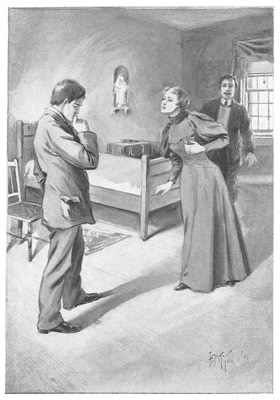
"'AGAPIT,' SHE MURMURED, 'CAN WE NOT TELL HIM?'"
"Shall we be unfaithful to our race?" said her
cousin, inexorably.
"What is our race?" she asked, wildly. "There are
the Acadiens, there are also the Americans,—the
one Lord makes all. Agapit, permit that we tell
him."
"Think of your oath, Rose."
"My oath—my oath—and did I not also swear
to love him? I told him only yesterday, and now I
must give him up forever, and cause him pain.
Agapit, you shall tell him. He must not go away
angry. Ah, my cousin, my cousin," and, evading
Vesper, she stretched out the prayer-book, "by our
holy religion, I beg that you have pity. Tell him,
tell him,—I shall never see him again. It will kill
me if he goes angry from me."
There were tears of agony in her eyes, and Agapit
faltered as he surveyed her.
"We are to be alone here all the years," she said,
"you and I. It will be a sin even to think of the
past. Let us have no thought to start with as sad as
this, that we let one so dear go out in the world
blaming us."
"Well, then," said Agapit, sullenly, "I surrender.
Tell you this stranger; let him have part in an unusual
shame of our people."
"I tell him!" and she drew back, hurt and startled.
"No, Agapit, that confession comes better from thee.
Adieu, adieu," and she turned, in a paroxysm of
tenderness, to Vesper, and in her anguish burst into
her native language. "After this minute, I must
put thee far from my thoughts,—thou, so good, so
kind, that I had hoped to walk with through life.
But purgatory does not last forever; the blessed
saints also suffered. After we die, perhaps—" and
she buried her face in her hands, and wept violently.
"But do not thou remember," she said at last,
checking her tears. "Go out into the world and find
another, better wife. I release thee, go, go—"
Vesper said nothing, but he gave Agapit a terrible
glance, and that young man, although biting his lip
and scowling fiercely, discreetly stepped into the
hall.
For half a minute Rose lay unresistingly in Vesper's
arms, then she gently forced him from the room,
and with a low and bitter cry, "For this I must
atone," she opened her prayer-book, and again
dropped on her knees.
Once more the two young men found themselves
in the smoking-room.
"Now, what is it?" asked Vesper, sternly.
Agapit hung his head. In accents of deepest
shame he murmured, "Charlitte yet lives."
"Charlitte—what, Rose's husband?"
A miserable nod from Agapit answered his question.
"It is rumor," stammered Vesper; "it cannot be.
You said that he was dead."
"He has been seen,—the miserable man lives with
another woman."
Vesper had received the worst blow of his life, yet
his black eyes fixed themselves steadily on Agapit's
face. "What proof have you?"
Agapit stumbled through some brief sentences.
"An Acadien—Michel Amireau—came home to die.
He was a sailor. He had seen Charlitte in New
Orleans. He had changed his name, yet Michel
knew him, and went to the uncle of Rose, on the
Bayou Vermilion. The uncle promised to watch
him. That is why he is so kind to Rose, this good
uncle, and sends her so much. But Charlitte goes
no more to sea, but lives with this woman. He is
happy; such a devil should die."
Vesper was stunned and bewildered, yet his mind
had never worked more clearly. "Does any other
person know?" he asked, sharply.
"No one; Michel would not tell, and he is dead."
Vesper leaned on a chair-back, and convulsively
clasped his fingers until every drop of blood seemed
to have left them. "Why did he leave Rose?"
"Who can tell?" said Agapit, drearily. "Rose
is beautiful; this other woman unbeautiful and older,
much older. But Charlitte was always gross like a
pig,—but good-natured. Rose was too fine, too
spiritual. She smiled at him, she did not drink, nor
dance, nor laugh loudly. These are the women he
likes."
"How old is he?"
"Not old,—fifty, perhaps. If our Lord would
only let him die! But those men live forever. He
is strong, very strong."
"Would Rose consent to a divorce?"
"A divorce! Mon Dieu, she is a good Catholic."
Vesper sank into a chair and dropped his head on
his hand. Hot, rebellious thoughts leaped into his
heart. Yesterday he had been so happy; to-day—
"My friend," said Agapit, softly, "do not give
way."
His words stung Vesper as if they had been an
insult.
"I am not giving way," he said, fiercely. "I am
trying to find a way out of this diabolical scrape."
"But surely there is only one road to follow."
Vesper said nothing, but his eyes were blazing,
and Agapit recoiled from him with a look of terror.
"You surely would not influence one who loves
you to do anything wrong?"
"Rose is mine," said Vesper, grimly.
"But she is married to Charlitte."
"To a dastardly villain,—she must separate from
him."
"But she cannot."
"She will if I ask her," and Vesper started up, as
if he were about to seek her.
"Stop but an instant," and Agapit pressed both
hands to his forehead with a gesture of bewilderment.
"Let me say over some things first to you. Think
of what you have done here,—you, so quiet, so
strong,—so pretending not to be good, and yet
very good. You have led Rose as a grown one leads
a child. Before you came I did not revere her as I
do at present. She is now so careful, she will not
speak even the least of untruths; she wishes to improve
herself,—to be more fitted for the company of
the blessed in heaven."
Vesper made some inarticulate sound in his throat,
and Agapit went on hurriedly. "Women are weak,
men are imperious; she may, perhaps, do anything
you say, but is it not well to think over exactly what
one would tell her? She is in trouble now, but soon
she will recover and look about her. She will see all
the world equally so. There are good priests with
sore hearts, also holy women, but they serve God.
All the world cannot marry. Marriage, what is it?—a
little living together,—a separation. There is also
a holy union of hearts. We can live for God, you,
and I, and Rose, but for a time is it not best that we
do not see each other?"
Again Vesper did not reply except by a convulsive
movement of his shoulders, and an impatient drumming
on the table with his fingers.
"Dear young man, whom I so much admire," said
Agapit, leaning across towards him, "I have confidence
in you. You, who think so much of the honor
of your race,—you who shielded the name of your
ancestor lest dishonor should come on it, I trust you
fully. You will, some day when it seems good to
you, find out this child who has cast off her race; and
now go,—the door is open, seek Rose if you will.
You will say nothing unworthy to her. You know
love, the greatest of things, but you also know duty,
the sublimest."
His voice died away, and Vesper still preserved a
dogged silence. At last, however, his struggle with
himself was over, and in a harsh, rough voice, utterly
unlike his usual one, he looked up and said, "Have
we time to catch the train?"
"By driving fast," said Agapit, mildly, "we may.
Possibly the train is late also."
"Make haste then," said Vesper, and he hurried
to his mother, whose voice he heard in the hall.
Agapit fairly ran to the stable, and as he ran he
muttered, "We are all very young,—the old ones
say that trouble cuts into the hearts of youth. Let
us pray our Lord for old age."
"L'homme s'agite, Dieu le mène."
Mrs. Nimmo was a very unhappy woman. She
had never before had a trouble equal to this trouble,
and, as she sat at the long window in the bedroom of
her absent son, she drearily felt that it was eating
the heart and spirit out of her.
Vesper was away, and she had refused to share his
unhappy wanderings, for she knew that he did not
wish her to do so. Very calmly and coldly he had
told her that his engagement to Rose à Charlitte was
over. He assigned no cause for it, and Mrs. Nimmo,
in her desperation, earnestly wished that he had
never heard of the Acadiens, that Rose à Charlitte
had never been born, and that the little peninsula of
Nova Scotia had never been traced on the surface
of the globe.
It was a lovely evening of late summer. The
square in which she lived was cool and quiet, for
very few of its inhabitants had come back from their
summer excursions. Away in the distance, beyond
the leafy common, she could hear the subdued roar
of the city, but on the brick pavements about her
there was scarcely a footfall.
The window at which she sat faced the south. In
winter her son's room was flooded with sunlight, but
in summer the branching elm outside put forth a
kindly screen of leaves to shield it from the too
oppressive heat. Her glance wandered between the
delicate lace curtains, swaying to and fro, to this old
elm that seemed a member of her family. How
much her son loved it,—and with an indulgent
thought of Vesper's passion for the natives of the
outdoor world, a disagreeable recollection of the
Acadien woman's child leaped into her mind.
How absurdly fond of trees and flowers he had
been, and what a fanciful, unnatural child he was,
altogether. She had never liked him, and he had
never liked her, and she wrinkled her brows at the
distasteful remembrance of him.
A knock at the half-open door distracted her attention,
and, languidly turning her head, she said, "What
is it, Henry?"
"It's a young woman, Mis' Nimmo," replied that
ever alert and demure colored boy, "what sometimes
brings you photographs. She come in a hack with a
girl."
"Let her come up. She may leave the girl
below."
"I guess that girl ain't a girl, Mis' Nimmo,—she
looks mighty like a boy. She's the symbol of the
little feller in the French place I took you to."
Mrs. Nimmo gave him a rebuking glance. "Let
the girl remain down-stairs."
"Madame," said a sudden voice, "this is now Boston,—where
is the Englishman?"
Mrs. Nimmo started from her chair. Here was
the French child himself, standing calmly before her
in the twilight, his small body habited in ridiculous
and disfiguring girl's clothes, his cropped curly head
and white face appearing above an absurd kind of
grayish yellow cloak.
"Narcisse!" she ejaculated.
"Madame," said the faint yet determined little
voice, "is the Englishman in his house?"
Mrs. Nimmo's glance fell upon Henry, who was
standing open-mouthed and grotesque, and with a
gesture she sent him from the room.
Narcisse, exhausted yet eager, had started on a
tour of investigation about the room, holding up with
one hand the girl's trappings, which considerably
hampered his movements, and clutching something
to his breast with the other. He had found the
house of the Englishman and his mother, and by sure
tokens he recognized his recent presence in this very
room. Here were his books, his gloves, his cap, and,
best of all, another picture of him; and, with a cry of
delight, he dropped on a footstool before a full-length
portrait of the man he adored. Here he would rest:
his search was ended; and meekly surveying Mrs.
Nimmo, he murmured, "Could Narcisse have a glass
of milk?"
Mrs. Nimmo's emotions at present all seemed to
belong to the order of the intense. She had never
before been so troubled; she had never before been
so bewildered. What did the presence of this child
under her roof mean? Was his mother anywhere
near? Surely not,—Rose would never clothe her
comely child in those shabby garments of the other
sex.
She turned her puzzled face to the doorway, and
found an answer to her questions in the presence of
an anxious-faced young woman there, who said, apologetically,
"He got away from me; he's been like a
wild thing to get here. Do you know him?"
"Know him? Yes, I have seen him before."
The anxious-faced young woman breathed a sigh
of relief. "I thought, maybe, I'd been taken in. I
was just closing up the studio, an hour ago, when two
men came up the stairs with this little fellow wrapped
in an old coat. They said they were from a schooner
called the Nancy Jane, down at one of the wharves,
and they picked up this boy in a drifting boat on the
Bay Saint-Mary two days ago. They said he was
frightened half out of his senses, and was holding
on to that photo in his hand,—show the lady,
dear."
Narcisse, whose tired head was nodding sleepily
on his breast, paid no attention to her request, so she
gently withdrew one of his hands from under his
cloak and exhibited in it a torn and stained photograph
of Vesper.
Mrs. Nimmo caught her breath, and attempted to
take it from him, but he quickly roused himself, and,
placing it beneath him, rolled over on the floor, and,
with a farewell glance at the portrait above, fell
sound asleep.
"He's beat out," said the anxious-faced young
woman. "I'm glad I've got him to friends. The
sailors were awful glad to get rid of him. They kind
of thought he was a French child from Nova Scotia,
but they hadn't time to run back with him, for they
had to hurry here with their cargo, and then he held
on to the photo and said he wanted to be taken to
that young man. The sailors saw our address on it,
but they sort of misdoubted we wouldn't keep him.
However, I thought I'd take him off their hands, for
he was frightened to death they would carry him
back to their vessel, though I guess they was kind
enough to him. I gave them back their coat, and
borrowed some things from the woman who takes
care of our studio. I forgot to say the boy had only
a night-dress on when they found him."
Mrs. Nimmo mechanically felt in her pocket for
her purse. "They didn't say anything about a
woman being with him?"
"No, ma'am; he wouldn't talk to them much, but
they said it was likely a child's trick of getting in a
boat and setting himself loose."
"Would you—would you care to keep him until
he is sent for?" faltered Mrs. Nimmo.
"I—oh, no, I couldn't. I've only a room in a
lodging-house. I'd be afraid of something happening
to him, for I'm out all day. I offered him something
to eat, but he wouldn't take it—oh, thank you,
ma'am, I didn't spend all that. I guess I'll have to
go. Does he come from down East?"
"Yes, he is French. My son visited his house
this summer, and used to pet him a good deal."
The young woman cast a glance of veiled admiration
at the portrait. "And the little one ran away
to find him. Quite a story. He's cute, too," and,
airily patting Narcisse's curly head, she took her
leave of Mrs. Nimmo, and made her way down-stairs.
A good many strange happenings came into her daily
life in this large city, and this was not one of the
strangest.
Mrs. Nimmo sat still and stared at Narcisse. Rose
had probably not been in the boat with him,—had
probably not been drowned. He had apparently
run away from home, and the first thing to do was
to communicate with his mother, who would be
frantic with anxiety about him. She therefore wrote
out a telegram to Rose, "Your boy is with me, and
safe and well," and ringing for Henry, she bade him
send it as quickly as possible.
Then she sank again into profound meditation.
The child had come to see Vesper. Had she better
not let him know about it? If she applied the principles
of sound reasoning to the case, she certainly
should do so. It might also be politic. Perhaps it
would bring him home to her, and, sighing heavily,
she wrote another telegram.
In the meantime Narcisse did not awake. He lay
still, enjoying the heavy slumber of exhaustion and
content. He was in the house of his beloved Englishman;
all would now be well.
He did not know that, after a time, his trustful
confidence awoke the mother spirit in the woman
watching him. The child for a time was wholly
in her care. No other person in this vast city was
interested in him. No one cared for him. A strange,
long-unknown feeling fluttered about her breast, and
memories of her past youth awoke. She had also
once been a child. She had been lonely and terrified,
and suffered childish agonies not to be revealed
until years of maturity. They were mostly
agonies about trifles,—still, she had suffered. She
pictured to herself the despair and anger of the boy
upon finding that Vesper did not return to Sleeping
Water as he had promised to do. With his little
white face in a snarl, he would enter the boat and
set himself adrift, to face sufferings of fright and
loneliness of which in his petted childhood he could
have had no conception. And yet what courage.
She could see that he was exhausted, yet there had
been no whining, no complaining; he had attained
his object and he was satisfied. He was really like
her own boy, and, with a proud, motherly smile, she
gazed alternately from the curly head on the carpet
to the curly one in the portrait.
The external resemblance, too, was indeed remarkable,
and now the thought did not displease her,
although it had invariably done so in Sleeping
Water, when she had heard it frequently and naïvely
commented on by the Acadiens.
Well, the child had thrown himself on her protection,—he
should not repent it; and, summoning a
housemaid, she sent her in search of some of Vesper's
long-unused clothing, and then together they
slipped the disfiguring girl's dress from Narcisse's
shapely body, and put on him a long white nightrobe.
He drowsily opened his eyes as they were lifting
him into Vesper's bed, saw that the photograph was
still in his possession, and that a familiar face was
bending over him, then, sweetly murmuring "Bon
soir" (good night), he again slipped into the land of
dreams.
Several times during the night Mrs. Nimmo stole
into her son's room, and drew the white sheet from
the black head half buried in the pillow. Once she
kissed him, and this time she went back to her bed
with a lighter heart, and was soon asleep herself.
She was having a prolonged nap the next morning
when something caused her suddenly to open her eyes.
Just for an instant she fancied herself a happy young
wife again, her husband by her side, their adored child
paying them an early morning call. Then the dream
was over. This was the little foreign boy who was
sitting curled up on the foot of her bed, nibbling
hungrily at a handful of biscuits.
"I came, madame, because those others I do not
know," and he pointed towards the floor, to indicate
her servants. "Has your son, the Englishman, yet
arrived?"
"No," she said, gently.
"Your skin is white," said Narcisse, approvingly;
"that is good; I do not like that man."
"But you have seen colored people on the Bay,—you
must not dislike Henry. My husband brought
him here as a boy to wait on my son. I can never
give him up."
"He is amiable," said Narcisse, diplomatically.
"He gave me these," and he extended his biscuits.
They were carrying on their conversation in
French, for only with Vesper did Narcisse care to
speak English. Perfectly aware, in his acute childish
intelligence, that he was, for a time, entirely dependent
on "madame," whom, up to this, he had
been jealous of, and had positively disliked, he was
keeping on her a watchful and roguish eye. Mrs.
Nimmo, meanwhile, was interested and amused, but
would make no overtures to him.
"Is your bed as soft as mine, madame?" he said,
politely.
"I do not know; I never slept in that one."
Narcisse drew a corner of her silk coverlet over
his feet. "Narcisse was very sick yesterday."
"I do not wonder," said his hostess.
"Your son said that he would return, but he did
not."
"My son has other things to think of, little boy."
Mrs. Nimmo's manner was one that would have
checked confidences in an ordinary child. It made
Narcisse more eager to justify himself. "Why does
my mother cry every night?" he asked, suddenly.
"How can I tell?" answered Mrs. Nimmo, peevishly.
"I hear a noise in the night, like trees in a storm,"
said Narcisse, tragically, and, drawing himself up, he
fetched a tremendous sigh from the pit of his little
stomach; "then I put up my hand so,"—and leaning
over, he placed three fingers on Mrs. Nimmo's eyelids,—"and
my mother's face is quite wet, like
leaves in the rain."
Mrs. Nimmo did not reply, and he went on with
alarming abruptness. "She cries for the Englishman.
I also cried, and one night I got out of bed.
It was very fine; there was the night sun in the
sky,—you know, madame, there is a night sun and
a day sun—"
"Yes, I know."
"I went creeping, creeping to the wharf like a fly
on a tree. I was not afraid, for I carried your son in
my hand, and he says only babies cry when they are
alone."
"And then,—" said Mrs. Nimmo.
"Oh, the beautiful stone!" cried Narcisse, his
volatile fancy attracted by a sparkling ring on Mrs.
Nimmo's finger.
She sighed, and allowed him to handle it for a
moment. "I have just put it on again, little boy.
I have been in mourning for the last two years.
Tell me about your going to the boat."
"There is nothing to tell," said Narcisse; "it was
a very little boat."
"Whose boat was it?"
"The blacksmith's."
"How did you get it off from the wharf?"
"Like this," and bending over, he began to
fumble with the strings of her nightcap, tying and
untying until he tickled her throat and made her
laugh irresistibly and push him away. "There was
no knife," he said, "or I would have cut it."
"But you did wrong to take the blacksmith's
boat."
Narcisse's face flushed, yet he was too happy to
become annoyed with her. "When the Englishman
is there, I am good, and my mother does not cry.
Let him go back with me."
"And what shall I do?"
Narcisse was plainly embarrassed. At last he
said, earnestly, "Remain, madame, with the black
man, who will take care of you. When does the
Englishman arrive?"
"I do not know; run away now, I want to
dress."
"You have here a fine bathroom," said Narcisse,
sauntering across the room to an open door. "When
am I to have my bath?"
"Does your mother give you one every day?"
"Yes, madame, at night, before I go to bed. Do
you not know the screen in our room, and the little
tub, and the dish with the soap that smells so nice?
I must scour myself hard in order to be clean."
"I am glad to hear that. I will send a tub to
your room."
"But I like this, madame."
"Come, come," she said, peremptorily, "run away.
No one bathes in my tub but myself."
Narcisse had a passion for dabbling in water, and
he found this dainty bathroom irresistible. "I hate
you, madame," he said, flushing angrily, and stamping
his foot at her. "I hate you."
Mrs. Nimmo looked admiringly past the child at
his reflection in her cheval glass. What a beauty he
was, as he stood furiously regarding her, his sweet,
proud face convulsed, his little body trembling inside
his white gown! In his recklessness he had forgotten
to be polite to her, and she liked him the better for it.
"You are a naughty boy," she said, indulgently.
"I cannot have you in my room if you talk like
that."
Without a word Narcisse went to her dressing-table,
picked up his precious photograph that he had
left propped against a silver-backed brush, and turned
to leave her, when she said, curiously, "Why did you
tear that picture if you think so much of it?"
Narcisse immediately fell into a state of pitiable
confusion, and, hanging his head, remained speechless.
"If you will say you are sorry for being rude, I
will give you another one," she said, and in a luxury
of delight at playing with this little soul, she raised
herself on her arm and held out a hand to him.
Narcisse drew back his lips at her as if he had
been a small dog. "Madame," he faltered, tapping
his teeth, "these did it, but I stopped them."
"What do you mean?" said Mrs. Nimmo, and a
horrible suspicion entered her mind.
"Narcisse was hungry—in the boat—" stammered
the boy. "He nibbled but a little of the
picture. He could not bite the Englishman long."
Mrs. Nimmo shuddered. She had never been hungry
in her life. "Come here, you poor child. You
shall have a bath in my room as soon as I finish.
Give me a kiss."
Narcisse's sensitive spirit immediately became
bathed with light. "Shall I kiss you as your son
the Englishman kissed my mother?"
"Yes," said Mrs. Nimmo, bravely, and she held
out her arms.
"But you must not do so," said Narcisse, drawing
back. "You must now cry, and hide your face like
this,"—and his slender, supple fingers guided her
head into a distressed position,—"and when I approach,
you must wave your hands."
"Did your mother do that?" asked Mrs. Nimmo,
eagerly.
"Yes,—and your son lifted her hand like this,"
and Narcisse bent a graceful knee before her.
"Did she not throw her arms around his neck and
cling to him?" inquired the lady, in an excess of
jealous curiosity.
"No, she ran from us up the bank."
"Your mother is a wicked woman to cause my son
pain," said Mrs. Nimmo, in indignant and rapid
French.
"My mother is not wicked," said Narcisse, vehemently.
"I wish to see her. I do not like you."
They were on the verge of another disagreement,
and Mrs. Nimmo, with a soothing caress, hurried
him from the room. What a curious boy he was!
And as she dressed herself she sometimes smiled and
sometimes frowned at her reflection in the glass, but
the light in her eyes was always a happy one, and
there was an unusual color in her cheeks.
"Here is our dearest theme where skies are blue and brightest,
To sing a single song in places that love it best;
Freighting the happy breeze when snowy clouds are lightest;
Making a song to cease not when the singer is dumb in rest."
"Here is our dearest theme where skies are blue and brightest,
To sing a single song in places that love it best;
Freighting the happy breeze when snowy clouds are lightest;
Making a song to cease not when the singer is dumb in rest."
J. F. H.
Away up the Bay, past Sleeping Water and Church
Point, past historic Piau's Isle and Belliveau's Cove
and the lovely Sissiboo River, past Weymouth and
the Barrens, and other villages stretched out along
this highroad, between Yarmouth and Digby, is
Bleury,—beautiful Bleury, which is the final outpost
in the long-extended line of Acadien villages.
Beyond this, the Bay—what there is of it, for it
soon ends this side of Digby—is English.
But beautiful Bleury, which rejoices in a high bluff,
a richly wooded shore, swelling hills, and an altogether
firmer, bolder outlook than flat Sleeping Water, is
not wholly French. Some of its inhabitants are
English. Here the English tide meets the French
tide, and, swelling up the Bay and back in the woods,
they overrun the land, and form curious contrasts
and results, unknown and unfelt in the purely Acadien
districts nearer the sea.
In Bleury there is one schoolhouse common to
both races, and on a certain afternoon, three weeks
after little Narcisse's adventurous voyage in search
of the Englishman, the children were tumultuously
pouring out from it. Instinctively they formed
themselves into four distinct groups. The groups at
last resolved themselves into four processions, two
going up the road, two down. The French children
took one side of the road, the English the other, and
each procession kept severely to its own place.
Heading the rows of English children who went
up the Bay was a red-haired girl of some twelve summers,
whose fiery head gleamed like a torch, held at
the head of the procession. As far as the coloring
of her skin was concerned, and the exquisite shading
of her velvety brown eyes, and the shape of her
slightly upturned nose, she might have been English.
But her eager gestures, her vivacity, her swiftness
and lightness of manner, marked her as a stranger
and an alien among the English children by whom
she was surrounded.
This was Bidiane LeNoir, Agapit's little renegade,
and just now she was highly indignant over a matter
of offended pride. A French girl had taken a place
above her in a class, and also, secure in the fortress
of the schoolroom, had made a detestable face at
her.
"I hate them,—those Frenchies," she cried, casting
a glance of defiance at the Acadien children
meekly filing along beyond her. "I sha'n't walk
beside 'em. Go on, you ——," and she added an
offensive epithet.
The dark-faced, shy Acadiens trotted soberly on,
swinging their books and lunch-baskets in their
hands. They would not go out of their way to seek
a quarrel.
"Run," said Bidiane, imperiously.
The little Acadiens would not run, they preferred
to walk, and Bidiane furiously called to her adherents,
"Let's sing mass."
This was the deepest insult that could be offered
to the children across the road. Sometimes in their
childish quarrels aprons and jackets were torn, and
faces were slapped, but no bodily injury ever equalled
in indignity that put upon the Catholic children when
their religion was ridiculed.
However, they did not retaliate, but their faces
became gloomy, and they immediately quickened
their steps.
"Holler louder," Bidiane exhorted her followers,
and she broke into a howling "Pax vobiscum," while
a boy at her elbow groaned, "Et cum spiritu tuo,"
and the remainder of the children screamed in an
irreverent chorus, that ran all up and down the scale,
"Gloria tibi Domine."
The Acadien children fled now, some of them with
fingers in their ears, others casting bewildered looks
of horror, as if expecting to see the earth open and
swallow up their sacrilegious tormentors, who stood
shrieking with delight at the success of their efforts
to rid themselves of their undesired companions.
"Shut up," said Bidiane, suddenly, and at once the
laughter was stilled. There was a stranger in their
midst. He had come gliding among them on one of
the bright shining wheels that went up and down
the Bay in such large numbers. Before Bidiane had
spoken he had dismounted, and his quick eye was
surveying them with a glance like lightning.
The children stared silently at him. Ridicule cuts
sharply into the heart of a child, and a sound whipping
inflicted on every girl and boy present would
not have impressed on them the burden of their
iniquity as did the fine sarcasm and disdainful
amusement with which this handsome stranger regarded
them.
One by one they dropped away, and Bidiane only
remained rooted to the spot by some magic incomprehensible
to her.
"Your name is Bidiane LeNoir," he said, quietly.
"It ain't," she said, doggedly; "it's Biddy Ann
Black."
"Really,—and there are no LeNoirs about here,
nor Corbineaus?"
"Down the Bay are LeNoirs and Corbineaus,"
said the little girl, defiantly; then she burst out with
a question, "You ain't the Englishman from Boston?"
"I am."
"Gosh!" she said, in profound astonishment; then
she lowered her eyes, and traced a serpent in the
dust with her great toe. All up and down the Bay
had flashed the news of this wonderful stranger who
had come to Sleeping Water in quest of an heir or
heiress to some vast fortune. The heir had been
found in the person of herself,—small, red-haired
Biddy Ann Black, and it had been firmly believed
among her fellow playmates that at any moment the
prince might appear in a golden chariot and whisk
her away with him to realms of bliss, where she
would live in a gorgeous palace and eat cakes and
sweetmeats all day long, sailing at intervals in a boat
of her own over a bay of transcendent loveliness, in
which she would catch codfish as big as whales.
This story had been believed until very recently,
when it had somewhat died away by reason of the
non-appearance of the prince.
Now he had arrived, and Bidiane's untrained mind
and her little wild beast heart were in a tumult. She
felt that he did not approve of her, and she loved
and hated him in a breath. He was smooth, and
dignified, and sleek, like a priest. He was dark, too,
like the French people, and she scowled fiercely. He
would see that her cotton gown was soiled; why had
she not worn a clean one to-day, and also put on her
shoes? Would he really want her to go away with
him? She would not do so; and a lump arose in
her throat, and with a passionate emotion that she
did not understand she gazed across the Bay towards
the purple hills of Digby Neck.
Vesper, perfectly aware of what was passing in her
mind, waited for her to recover herself. "I would
like to see your uncle and aunt," he said, at last.
"Will you take me to them?"
She responded by a gesture in the affirmative, and,
still with eyes bent obstinately on the ground, led the
way towards a low brown house situated in a hollow
between two hills, and surrounded by a grove of tall
French poplars, whose ancestors had been nourished
by the sweet waters of the Seine.
Vesper's time was limited, and he was anxious to
gain the confidence of the little maid, if possible, but
she would not talk to him.
"Do you like cocoanuts?" he said, presently, on
seeing in the distance a negro approaching, with a
load of this foreign fruit, that he had probably obtained
from some schooner.
"You bet," said Bidiane, briefly.
Vesper stopped the negro, and bought as many
nuts at five cents apiece as he and Bidiane could
carry. Then, trying to make her smile by balancing
one on the saddle of his wheel, he walked slowly
beside her.
Bidiane solemnly watched him. She would not
talk, she would not smile, but she cheerfully dropped
her load when one of his cocoanuts rolled in the
ditch, and, at the expense of a scratched face from
an inquisitive rose-bush that bent over to see what
she was doing, she restored it to him.
"Your cheek is bleeding," said Vesper.
"No odds," she remarked, with Indian-like fortitude,
and she preceded him into a grassy dooryard,
that was pervaded by a powerful smell of frying
doughnuts.
Mirabelle Marie, her fat, good-natured young aunt,
stood in the kitchen doorway with a fork in her hand,
and seeing that the stranger was English, she beamed
a joyous, hearty welcome on him.
"Good day, sir; you'll stop to supper? That's
right. Shove your wheel ag'in that fence, and come
right in. Biddy, git the creamer from the well and
give the genl'man a glass of milk. You won't?—All
right, sir, walk into the settin'-room. What!
you'd rather set under the trees? All right. My
man's up in the barn, fussin' with a sick cow that's
lost her cud. He's puttin' a rind of bacon on her
horns. What d'ye say, Biddy?"—this latter in an
undertone to the little girl, who was pulling at her
dress. "This is the Englishman from Boston—sakerjé!"
and, dropping her fork, she wiped her
hands on her dress and darted out to offer Vesper
still more effusive expressions of hospitality.
He smiled amiably on her, and presently she returned
to the kitchen, silly and distracted in appearance,
and telling Bidiane that she felt like a hen with
her head cut off. The stranger who was to do so
much for them had come. She could have prostrated
herself in the dust before him. "Scoot,
Biddy, scoot," she exclaimed; "borry meat of some
kind. Go to the Maxwells or to the Whites. Tell
'em he's come, and we've got nothin' but fish and
salt pork, and they know the English hate that like
pizen. And git a junk of butter with only a mite of
salt in it. Mine's salted heavy for the market. And
skip to the store and ask 'em to score us for a pound
of cheese and some fancy crackers."
Bidiane ran away, and, as she ran, her ill humor
left her, and she felt herself to be a very important
personage. Vivaciously and swiftly she exclaimed,
"He's come!" to several children whom she met,
and with a keen and exquisite sense of pleasure
looked back to see them standing open-mouthed in
the road, impressed in a most gratifying way by the
news communicated.
In the meantime Mirabelle Marie began to make
frantic and ludicrous preparations to set a superfine
meal before the stranger, who was now entitled to a
double share of honor. In her extreme haste everything
went wrong. She upset her pot of lard; the
cat and dog got at her plate of doughnuts, and stole
half of them; the hot biscuits that she hastily mixed
burnt to a cinder, and the jar of preserved berries
that she opened proved to have been employing
their leisure time in the cellar by fermenting most
viciously.
However, she did not lose her temper, and, as
she was not a woman to be cast down by trifles,
she seated herself in a rocking-chair, fanned herself
vigorously with her apron, and laughed spasmodically.
Bidiane found her there on her return. The little
girl possessed a keener sense of propriety than her
careless relative; she was also more moody and variable,
and immediately falling into a rage, she conveyed
some plain truths to Mirabelle Marie, in
inelegant language.
The woman continued to laugh, and to stare
through the window at Vesper, who sat motionless
under the trees. One arm was thrown over the
back of his seat, and his handsome head was turned
away from the house.
"Poor calf," said Mirabelle Marie, "he looks down
the Bay; he is a very divil for good looks. Rose à
Charlitte is one big fool."
"We shall have only slops for supper," said
Bidiane, in a fury, and swearing under her breath
at her.
Mirabelle Marie at this bestirred herself, and tried
to evolve a meal from the ruin of her hopes, and the
fresh supply of food that her niece had obtained.
The little girl meantime found a clean cloth, and
spread it on the table. She carefully arranged on it
their heavy white dishes and substantial knives and
spoons. Then she blew a horn, which made Claude
à Sucre, her strapping great uncle, suddenly loom
against the horizon, in the direction of the barn.
He came to the house, and was about to ask a
question, but closed his mouth when he saw the
stranger in the yard.
"Go change," said Bidiane, pouncing upon him.
Claude knew what she meant, and glanced resignedly
from his homespun suit to her resolved
face. There was no appeal, so he went to his bedroom
to don his Sunday garments. He had not
without merit gained his nickname of Sugar Claude;
for he was, if possible, more easy-going than his
wife.
Bidiane next attacked her aunt, whose face was
the color of fire, from bending over the stove. "Go
put on clean duds; these are dirty."
"Go yourself, you little cat," said Mirabelle Marie,
shaking her mountain of flesh with a good-natured
laugh.
"I'm going—I ain't as dirty as you, anyway—and
take off those sneaks."
Mirabelle Marie stuck out one of the flat feet
encased in rubber-soled shoes. "My land! if I do,
I'll go barefoot."
Bidiane subsided and went to the door to look for
her two boy cousins. Where were they? She
shaded her eyes with her two brown hands, and
her gaze swept the land and the water. Where
were those boys? Were they back in the pasture,
or down by the river, or playing in the barn,
or out in the boat? A small schooner beating up
the Bay caught her eye. That was Johnny Maxwell's
schooner. She knew it by the three-cornered
patch on the mainsail. And in Captain Johnny's
pockets, when he came from Boston, were always
candy, nuts, and raisins,—and the young Maxwells
were of a generous disposition, and the whole neighborhood
knew it. Her cousins would be on the
wharf below the house, awaiting his arrival. Well,
they should come to supper first; and, like a bird of
prey, she swooped down the road upon her victims,
and, catching them firmly by the shoulders, marched
them up to the house.
"Her mouth was ever agape,
Her ears were ever ajar;
If you wanted to find a sweeter fool,
You shouldn't have come this far."
—Old Song.
When the meal was at last prepared, and the
whole family were assembled in the sitting-room,
where the table had been drawn from the kitchen,
they took a united view of Vesper's back; then
Claude à Sucre was sent to escort him to the
house.
With a rapturous face Mirabelle Marie surveyed
the steaming dish of soupe à la patate (potato soup),
the mound of buttered toast, the wedge of tough
fried steak, the strips of raw dried codfish, the pink
cake, and fancy biscuits. Surely the stranger would
be impressed by the magnificence of this display, and
she glanced wonderingly at Bidiane, whose eyes were
lowered to the floor. The little girl had enjoyed advantages
superior to her own, in that she mingled
freely in English society, where she herself—Mirabelle
Marie—was strangely shunned. Could it be
that she was ashamed of this board? Certainly she
could never have seen anything much grander; and,
swelling with gratified pride and ambition, the mistress
of the household seated herself behind her
portly teapot, from which vantage-ground she
beamed, huge and silly, like a full-grown moon
upon the occupants of the table.
Her guest was not hungry, apparently, for he
scarcely touched the dishes that she pressed upon
him. However, he responded so gracefully and
with such well-bred composure to her exhortations
that he should eat his fill, for there was more in the
cellar, that she was far from resenting his lack of
appetite. He was certainly a "boss young man;"
and as she sat, delicious visions swam through her
brain of new implements for the farm, a new barn,
perhaps, new furniture for the house, with possibly an
organ, a spick and span wagon, and a horse, or even
a pair, and the eventual establishment of her two
sons in Boston,—the El Dorado of her imagination,—where
they would become prosperous merchants,
and make heaps of gold for their mother to spend.
In her excitement she began to put her food in her
mouth with both hands, until reminded that she was
flying in the face of English etiquette by a vigorous
kick administered under the table by Bidiane.
Vesper, with an effort, called back his painful wandering
thoughts, which had indeed gone down the
Bay, and concentrated them upon this picturesquely
untidy family. This was an entirely different establishment
from that of the Sleeping Water Inn. Fortunately
there was no grossness, no clownishness of
behavior, which would have irreparably offended
his fastidious taste. They were simply uncultured,
scrambling, and even interesting with the background
of this old homestead, which was one of the most ancient
that he had seen on the Bay, and which had
probably been built by some of the early settlers.
While he was quietly making his observations, the
family finished their meal, and seeing that they were
waiting for him to give the signal for leaving the
table, he politely rose and stepped behind his chair.
Mirabelle Marie scurried to her feet and pushed
the table against the wall. Then the whole family
sat down in a semicircle facing a large open fireplace
heaped high with the accumulated rubbish of the
summer, and breathlessly waited for the stranger to
tell them of his place of birth, the amount of his fortune,
his future expectations and hopes, his intentions
with regard to Bidiane, and of various and sundry
other matters that might come in during the course
of their conversation.
Vesper, with his usual objection to having any
course of action mapped out for him, sat gazing imperturbably
at them. He was really sorry for Mirabelle
Marie, who was plainly bursting with eagerness.
Her husband was more reserved, yet he, too, was
suffering from suppressed curiosity, and timidly and
wistfully handled his pipe, that he longed to and yet
did not dare to smoke.
His two small boys sat dangling their legs from
seats that were uncomfortably high for them. They
were typical Acadien children,—shy, elusive, and
retreating within themselves in the presence of
strangers; and if, by chance, Vesper caught a
stealthy glance from one of them, the little fellow
immediately averted his glossy head, as if afraid that
the calm eyes of the stranger might lay bare the
inmost secrets of his youthful soul.
Bidiane was the most interesting of the group.
She was evidently a born manager and the ruling
spirit in the household, for he could see that they all
stood in awe of her. She must possess some force of
will to enable her to subdue her natural eagerness and
vivacity, so as to appear sober and reserved. His
presence was evidently a constraint to the little red-haired
witch, and he could scarcely have understood
her character, if Agapit had not supplied him with a
key to it.
Young as she was, she acutely appreciated the
racial differences about her. There were two worlds
in her mind,—French and English. The careless
predilections of her aunt had become fierce prejudices
with her, and, at present, although she was
proud to have an Englishman under their roof, she
was at the same time tortured by the contrast that
she knew he must find between the humble home of
her relatives and the more prosperous surroundings
of the English people with whom he was accustomed
to mingle.
"She is a clever little imp," Agapit had said,
"and wise beyond her years."
Vesper, when his unobtrusive examination of her
small resolved face was over, glanced about the low,
square room in which they sat. The sun was just
leaving it. The family would soon be thinking of
going to bed. All around the room were other rooms
evidently used as sleeping apartments, for through a
half-open door he saw an unmade bed, and he knew,
from the construction of the house, that there was no
upper story.
After a time the silence became oppressive, and
Mirabelle Marie, seeing that the stranger would not
entertain her, set herself to the task of entertaining
him, and with an ingratiating and insinuating smile
informed him that the biggest liar on the Bay lived
in Bleury.
"His name's Bill," she said, "Blowin' Bill Duckfoot,
an' the boys git 'round him an' say, 'Give us a
yarn.' He says, 'Well, give me a chaw of 'baccy,' then
he starts off. 'Onct when I went to sea'—he's
never bin off the Bay, you know—'it blowed as hard
as it could for ten days. Then it blowed ten times
harder. We had to lash the cook to the mast.'
'What did you do when you wanted grub?' says the
boys. 'Oh, we unlashed him for awhile,' says Bill.
'One day the schooner cracked from stern to stem.
Cap'en and men begun to holler and says we was
goin' to the bottom.' 'Cheer up,' says Bill, 'I'll fix a
way.' So he got 'em to lash the anchor chains
'roun' the schooner, an' that hold 'em together till
they got to Boston, and there was nothin' too good
for Bill. It was cousin Duckfoot, an' brother Duckfoot,
and good frien' Duckfoot, and lots of treatin'."
Vesper in suppressed astonishment surveyed Mirabelle
Marie, who, at the conclusion of her story, burst
into a fit of such hearty laughter that she seemed to
be threatened there and then with a fit of apoplexy.
Her face grew purple, tears ran down her cheeks, and
through eyes that had become mere slits in her face
she looked at Claude, who too was convulsed with
amusement, at her two small boys, who giggled behind
their hands, and at Bidiane, who only smiled sarcastically.
Vesper at once summoned an expression of interest
to his face, and Mirabelle Marie, encouraged by it,
caught her breath with an explosive sound, wiped the
tears from her eyes, and at once continued. "Here's
another daisy one. 'Onct,' says Bill, 'all han's was
lost 'cept me an' a nigger. I went to the stern as
cap'en, and he to the bow as deck-han'. A big wave
struck the schooner, and when we righted, wasn't the
nigger at stern as cap'en, an' I was at bow as deck-han'!'"
While Vesper was waiting for the conclusion of the
story, a burst of joyous cachinnation assured him that
it had already come. Mirabelle Marie was again rocking
herself to and fro in immoderate delight, her
head at each dip forward nearly touching her knees,
while her husband was slapping his side vigorously.
Vesper laughed himself. Truly there were many
different orders of mind in the universe. He saw
nothing amusing in the reported exploits of the liar
Duckfoot. They also would not have brought a smile
to the face of his beautiful Rose, yet the Corbineaus,
or Watercrows, as they translated their name in order
to make themselves appear English, found these
stories irresistibly comical. It was a blessing for
them that they did so, otherwise the whole realm of
humor might be lost to them; and he was going off
in a dreamy speculation with regard to their other
mental proclivities, when he was roused by another
story from his hostess.
"Duckfoot is a mason by trade, an' onct he built a
chimbley for a woman. 'Make a good draught,' says
she. 'You bet,' says he, an' he built his chimbley an'
runs away; as he runs he looks back, an' there was
the woman's duds that was hangin' by the fire goin'
up the chimbley. He had built such a draught that
nothin' could stay in the kitchen, so she had to go
down on her knees an' beg him to change it."
"To beg him to change it," vociferated Claude, and
he soundly smacked his unresisting knee. "Oh,
Lord, 'ow funny!" and he roared with laughter so
stimulating that he forgot his fear of Vesper and Bidiane,
and, boldly lighting his pipe, put it between his
lips.
Mirabelle Marie, whose flow of eloquence it was
difficult to check, related several other tales of Duckfoot
Bill. Many times, before the railway in this
township of Clare had been built, he had told them of
his uncle, who had, he said, a magnificent residence
in Louisiana, with a park full of valuable animals called
skunks. These animals he had never fully described,
and they were consequently enveloped in a cloud of
admiration and mystery, until a horde of them came
with the railroad to the Bay, when the credulous
Acadiens learned for themselves what they really
were.
During the recital of this tale, Bidiane's face went
from disapproval to disgust, and at last, diving under
the table, she seized a basket and went to work vigorously,
as if the occupation of her fingers would ease
the perturbation of her mind.
Vesper watched her closely. She was picking out
the threads of old cotton and woollen garments that
had been cut into small pieces. These threads would
be washed, laid out on the grass to dry, and then be
carded, and spun, and woven over again, according to
a thrifty custom of the Acadiens, and made into
bedcovers, stockings, and cloth. The child must
possess some industry, for this work—"pickings," as
it was called—was usually done by the women. In
brooding silence the little girl listened to Mirabelle
Marie's final tale of Duckfoot Bill, whose wife called
out to him, one day, from the yard, that there was a
flock of wild geese passing over the house. Without
troubling to go out, he merely discharged his gun up
the chimney beside which he sat, and the ramrod, carelessly
being left in, killed a certain number of geese.
"How many do you guess that ramrod run
through?"
Vesper good-naturedly guessed two.
"No,—seven," she shrieked; "they was strung
in a row like dried apples," and she burst into fresh
peals of laughter, until suddenly plunged into the
calmness of despair by a few words from Bidiane,
who leaned over and whispered angrily to her.
Mirabelle Marie trembled, and gazed at the
stranger. Was it true,—did he wish to commend
her to a less pleasant place than Bleury for teasing
him with these entrancing stories?
She could gather nothing from his face; so she
entered tremulously into a new subject of conversation,
and, pointing to Claude's long legs, assured
him that his heavy woollen stockings had been made
entirely by Bidiane. "She's smart,—as smart as
a steel trap," said the aunt. "She can catch the
sheeps, hold 'em down, shear the wool, an' spin
it."
Bidiane immediately pushed her basket under
the table with so fiery and resentful a glance that
the unfortunate Mirabelle Marie relapsed into silence.
"Have you ever gone to sea?" asked Vesper, of
the silently smoking Claude.
"Yessir, we mos' all goes to sea when we's
young."
"Onct he was wrecked," interrupted his wife.
"Yessir, I was. Off Arichat we got on a ledge.
We thump up an' down. We was all on deck but
the cook. The cap'en sends me to the galley for
'im. 'E come up, we go ashore, an' the schooner
go to pieces."
"Tell him about the mouse," said Bidiane, abruptly.
"The mouse?—oh, yess, when I go for the cook
I find 'im in the corner, a big stick in his 'and. I
dunno 'ow 'e stan'. 'Is stove was upside down, an'
there was an awful wariwarie" (racket). "'E seem
not to think of danger. ''Ist,' says 'e. 'Don' mek
a noise,—I wan' to kill that mouse.'"
Vesper laughed at this, and Mirabelle Marie's face
cleared.
"Tell the Englishman who was the cap'en of
yous," she said, impulsively, and she resolutely
turned her back on Bidiane's terrific
frown.
"Well, 'e was smart," said Claude, apologetically.
"'E always get on though 'e not know much. One
day when 'e fus' wen' to sea 'is wife says, 'All the
cap'ens' wives talk about their charts, an' you ain't
gut none. I buy one.' So she wen' to Yarmouth,
an' buy 'im a chart. She also buy some of that
shiny cloth for kitchen table w'at 'as blue scrawly
lines like writin' on it. The cap'en leave the nex'
mornin' before she was up, an' 'e takes with 'im the
oilcloth instid of the chart, an' 'e 'angs it in 'is
cabin; 'e didn't know no differ. 'E never could
write,—that man. He mek always a pictur of 'is
men when 'e wan' to write the fish they ketch.
But 'e was smart, very smart. 'E mek also money.
Onct 'e was passenger on a schooner that smacks
ag'in a steamer in a fog. All 'an's scuttle, 'cause
that mek a big scare. They forgit 'im. 'E wake;
'e find 'imself lonely. Was 'e frightful? Oh, no; 'e
can't work sails, but 'e steer that schooner to Boston,
an' claim salvage."
"Tell also the name of the cap'en," said Mirabelle
Marie.
Claude moved uneasily in his chair, and would not
speak.
"What was it?" asked Vesper.
"It was Crispin," said Mirabelle Marie, solemnly.
"Crispin, the brother of Charlitte."
Vesper calmly took a cigarette from his pocket,
and lighted it.
"It is a nice place down the Bay," said Mirabelle
Marie, uneasily.
"Very nice," responded her guest.
"Rose à Charlitte has a good name," she continued,
"a very good name."
Vesper fingered his cigarette, and gazed blankly
at her.
"They speak good French there," she said.
Her husband and Bidiane stared at her. They
had never heard such a sentiment from her lips
before. However, they were accustomed to her
ways, and they soon got over their surprise.
"Do you not speak French?" asked Vesper.
Mrs. Watercrow shrugged her shoulders. "It is
no good. We are all English about here. How
can one be French? Way back, when we went to
mass, the priest was always botherin'—'Talk French
to your young ones. Don't let them forgit the way
the old people talked.' One day I come home and
says to my biggest boy, 'Va ramasser des écopeaux'"
(Go pick up some chips). "He snarl at me, 'Do you
mean potatoes?' He didn't like it."
"Did he not understand you?" asked Vesper.
"Naw, naw," said Claude, bitterly. "We 'ave
French nebbors, but our young ones don' play with.
They don' know French. My wife she speak it
w'en we don' want 'em to know w'at we say."
"You always like French," said his wife, contemptuously.
"I guess you gut somethin' French
inside you."
Claude, for some reason or other, probably because,
usually without an advocate, he now knew that he
had one in Vesper, was roused to unusual animation.
He snatched his pipe from his mouth and said,
warmly, "It's me 'art that's French, an' sometimes
it's sore. I speak not much, but I think often we
are fools. Do the Eenglish like us? No, only a
few come with us; they grin 'cause we put off our
French speakin' like an ole coat. A man say to me
one day, 'You 'ave nothin'. You do not go to mass,
you preten' to be Protestan', w'en you not brought
up to it. You big fool, you don' know w'at it is.
If you was dyin' to-morrer you'd sen' for the
priest.'"
Mirabelle Marie opened her eyes wide at her husband's
eloquence.
He was not yet through. "An' our children, they
are silly with it. They donno' w'at they are. All
day Sunday they play; sometimes they say cuss
words. I say, 'Do it not,' 'an' they ast me w'y. I
cannot tell. They are not French, they are not
Eenglish. They 'ave no religion. I donno' w'ere
they go w'en they die."
Mirabelle Marie boldly determined to make confidences
to the Englishman in her turn.
"The English have loads of money. I wish I
could go to Boston. I could make it there,—yes,
lots of it."
Claude was not to be put down. "I like our own
langwidge, oh, yes," he said, sadly. "W'en I was
a leetle boy I wen' to school. All was Eenglish.
They put in my 'and an Eenglish book. I'd lef my
mother, I was stoopid. I thought all the children's
teeth was broke, 'cause they spoke so strange.
Never will I forgit my firs' day in school. W'y do
they teach Eenglish to the French? The words was
like fish 'ooks in my flesh."
"Would you be willing to send that little girl
down the Bay to a French convent?" said Vesper,
waving his cigarette towards Bidiane.
"We can't pay that," said Mirabelle Marie,
eagerly.
"But I would."
While she was nodding her head complacently
over this, the first of the favors to be showered on
them, Claude said, slowly, "Down the Bay is like a
bad, bad place to my children; they do not wish to
go, not even to ride. They go towards Digby.
Biddy Ann would not go to the convent,—would
she, Biddy?"
The little girl threw up her head angrily. "I
hate Frenchtown, and that black spider, Agapit
LeNoir."
Claude's face darkened, and his wife chuckled.
Surely now there would be nothing left for the
Englishman to do but to transplant them all to
Boston.
"Would you not go?" asked Vesper, addressing
Bidiane.
"Not a damn step," said the girl, in a fury, and,
violently pushing back her chair, she rushed from the
room. If this young man wished to make a French
girl of her, he might go on his way. She would have
nothing to do with him. And with a rebellious and
angry heart at this traitor to his race, as she regarded
him, she climbed up a ladder in the kitchen that led
to a sure hiding-place under the roof.
Her aunt clutched her head in despair. Bidiane
would ruin everything. "She's all eaten up to go to
Boston," she gasped.
"I am not a rich man," said Vesper, coldly. "I
don't feel able at present to propose anything further
for her than to give her a year or two in a convent."
Mirabelle Marie gaped speechlessly at him. In one
crashing ruin her new barn, and farming implements,
the wagon and horses, and trunks full of fine clothes
fell into the abyss of lost hopes. The prince had not
the long purse that she supposed he would have. And
yet such was her good-nature that, when she recovered
from the shock, she regarded him just as kindly
and as admiringly as before, and if he had been in the
twinkling of an eye reduced to want she would have
been the first to relieve him, and give what aid she
could. Nothing could destroy her deep-rooted and
extravagant admiration for the English race.
Her fascinated glance followed him as he got up
and sauntered to the open door.
"You'll stop all night?" she said, hospitably,
shuffling after him. "We have one good bed, with
many feathers."
He did not hear her, for in a state of extreme
boredom, and slight absent-mindedness, he had
stepped out under the poplars.
"Better leave 'im alone, I guess," said Claude;
then he slipped off his coat. "I'll go milk."
"An' I'll make up the bed," said his wife; and
taking the hairpins out of the switch that Bidiane
had made her attach to her own thick lump of hair,
she laid it on the shelf by the clock, and allowed her
own brown wave to stream freely down her back.
Then she unfastened her corsets, which she did not
dare to take off, as no woman in Bleury who did
not wear that article of dress tightly enfolding her
chest and waist was considered to have reached
the acme of respectability. However, she could for
a time allow them to gape slightly apart, and having
by this proceeding added much to her comfort, she
entered one of the small rooms near by.
Vesper meanwhile walked slowly towards the gate,
while Bidiane watched him through a loophole in the
roof. His body only was in Bleury; his heart was
in Sleeping Water. Step by step he was following
Rose about her daily duties. He knew just at what
time of day her slender feet carried her to the stable,
to the duck-yard, to the hen-house. He knew the
exact hour that she entered her kitchen in the morning,
and went from it to the pantry. He could see
her beautiful face at the cool pantry window, as she
stood mixing various dishes, and occasionally glancing
at the passers-by on the road. Sometimes she sang
gently to herself, "Rose of the cross, thou mystic
flower," or "Dear angel ever at my side," or some
of the Latin hymns to the Virgin.
At this present moment her tasks would all be
done. If there were guests who desired her presence,
she might be seated with them in the little parlor.
If there were none, she was probably alone in her
room. Of what was she thinking? The blood
surged to his face, there was a beating in his ears,
and he raised his suffering glance to the sky. "O
God! now I know why I suffered when my father
died. It was to prepare me for this."
Then his mind went back to Rose. Had she succeeded
in driving his image from her pure mind and
imagination? Alas! he feared not,—he would like
to know. He had heard nothing of her since leaving
Sleeping Water. Agapit had written once, but he
had not mentioned her.
This inaction was horrible,—this place wearied
him insufferably. He glanced towards his wheel, and
a sentence from one of Agapit's books came into his
mind. It contained the advice of an old monk to a
penitent, "My son, when in grievous temptation from
trouble of the mind, engage violently in some exercise
of the body."
He was a swift rider, and there was no need for
him to linger longer here. These people were painfully
subservient. If at any time anything came
into his mind to be done for the little girl, they would
readily agree to it; that is, if the small tigress concurred;
at present there was nothing to be done for
her.
He laid his hand on his bicycle and went towards
the house again. There was no one to be seen, so
he hurried up to the rickety barn where Claude sat
on a milking-stool, trying to keep his long legs out
of the way of a frisky cow.
The Frenchman was overcome with stolid dismay
when Vesper briefly bade him good-by, and going
to the barn door, he stared regretfully after him.
Mirabelle Marie, in blissful unconsciousness of the
sudden departure, went on with her bed-making, but
Bidiane, through the crack in the roof, saw him go,
and in childish contradiction of spirit shed tears of
anger and disappointment at the sight.
"How reads the riddle of our life,
That mortals seek immortal joy,
That pleasures here so quickly cloy,
And hearts are e'en with yearnings rife?
That love's bright morn no midday knows,
And darkness comes ere even's close,
And fondest hopes bear seeds of strife.
"Let fools deride; Faith's God-girt breast
Their puny shafts can turn aside,
And mock with these their sin-born pride.
Our souls were made for God the Best;
'Tis He alone can satisfy
Their every want, can still each cry;
In Him alone shall they find rest."
Cornelius O'Brien, Archbishop of Halifax.
The night was one of velvety softness, and the
stars, as if suspecting his mission, blinked delicately
and discreetly down upon him, while Vesper, who
knew every step of the way, went speeding down the
Bay with a wildly beating heart.
Several Acadiens recognized him as he swept past
them on the road, but he did not stop to parley with
them, for he wished to reach Yarmouth as soon as
possible. His brain was tortured, and it seemed to
him that, at every revolution of his wheels, a swift,
subtle temptation assaulted him more insidiously and
more fiercely. He would pass right by the Sleeping
Water Inn. Why should he not pause there for a
few minutes and make some arrangement with Rose
about Narcisse, who was still in Boston? He certainly
had a duty to perform towards the child. Would
it not be foolish for him to pass by the mother's door
without speaking to her of him? What harm could
there be in a conversation of five minutes' duration?
His head throbbed, his muscles contracted. Only
this afternoon he had been firm, as firm as a rock.
He had sternly resolved not to see her again, not to
write to her, not to meet her, not to send her a message,
unless he should hear that she had been released
from the bond of her marriage. What had come over
him now? He was as weak as a child. He had better
stop and think the matter over; and he sprang
from his wheel and threw himself down on a grassy
bank, covered with broad leaves that concealed the
dead and withered flowers of the summer.
Somewhere in the darkness behind him was lonely
Piau's Isle, where several of the Acadien forefathers
of the Bay lay buried. What courage and powers of
endurance they had possessed! They had bravely
borne their burdens, lived their day, and were now at
rest. Some day,—in a few years, perhaps,—he,
too, would be a handful of dust, and he, too, would
leave a record behind him; what would his record
be?
He bit his lip and set his teeth savagely. He was
a fool and a coward. He would not go to Sleeping
Water, but would immediately turn his back on
temptation, and go to Weymouth. He could stay
at a hotel there all night, and take the train in the
morning.
The soft air caressed his weary head; for a long
time he lay staring up at the stars through the interlaced
branches of an apple-tree over him, then he
slowly rose. His face was towards the head of the
Bay; he no longer looked towards Sleeping Water,
but for a minute he stood irresolutely, and in that
brief space of time his good resolution was irrevocably
lost.
Some girls were going to a merrymaking, and, as
they went, they laughed gaily and continuously.
One of them had clear, silvery tones like those of
Rose. The color again surged to his face, the
blood flew madly through his veins. He must see
her, if only for an instant; and, hesitating no longer,
he turned and went careering swiftly through the
darkness.
A short time later he had reached the inn. There
was a light in Rose's window. She must have gone
to bed. Célina only was in the kitchen, and, with a
hasty glance at her, he walked to the stable.
A terrible quacking in the duck-yard advised him
who was there, and he was further assured by hearing
an irritable voice exclaim, "If fowls were hatched
dumb, there would not be this distracting tumult!"
Agapit was after a duck. It fell to his lot to do
the killing for the household, and it was so great a
trial to his kind heart that, if the other members of
the family had due warning, they usually, at such
times, shut themselves up to be out of reach of his
lamentable outcries when he was confronted by a
protesting chicken, an innocent lamb, a tumultuous
pig, or a trusting calf.
Just now he emerged from the yard, holding a
sleepy drake by the wing.
"Miséricorde!" he exclaimed, when he almost ran
into Vesper, "who is it? You—you?" and he
peered at him through the darkness.
"Yes, it is I."
"Confiding fool," said Agapit, impatiently tossing
the drake back among his startled comrades, "I will
save thy neck once more."
Vesper marked the emphasis. "I am on my way
to Yarmouth," he said, calmly, "and I have stopped
to see your cousin about Narcisse."
"Ah!—he is well, I trust."
"He is better than when he was here."
"His mother has gone to bed."
"I will wait, then, until the morning."
"Ah!" said Agapit again; then he laughed recklessly
and seized Vesper's hand. "I cannot pretend.
You see that I am rejoiced to have you again with
us."
"I, too, am glad to be here."
"But you will not stay?"
"Oh, no, Agapit—you know me better than
that."
Vesper's tone was confident, yet Agapit looked
anxiously at him through the gathering gloom. "It
would be better for Rose not to see you."
"Agapit—we are not babies."
"No, you are worse,—it is well said that only our
Lord loves lovers. No other would have patience."
Vesper held his straight figure a little straighter,
and his manner warned the young Acadien to be
careful of what he said, but he dashed on, "Words
are brave; actions are braver."
"How is Madame de Forêt?" asked Vesper,
shortly.
"What do you expect—joyous, riotous health?
Reflect only that she has been completely overthrown
about her child. I hope that madame, your mother,
is well."
"She has not been in such good health for years.
She is greatly entertained by Narcisse," and Vesper
smiled at some reminiscence.
"It is one of the most charming of nights," said
Agapit, insinuatingly. "Toochune would be glad to
have a harness on his back. We could fly over the
road to Yarmouth. It would be more agreeable than
travelling by day."
"Thank you, Agapit—I do not wish to go
to-night."
"Oh, you self-willed one—you Lucifer!" said
Agapit, wildly. "You dare-all, you conquer-all!
Take care that you are not trapped."
"Come, show me a room," said Vesper, who was
secretly gratified with the irrepressible delight of the
Acadien in again seeing him,—a delight that could
not be conquered by his anxiety.
"This evening the house is again full," said Agapit.
"Rose is quite wearied; come softly up-stairs.
I can give you but the small apartment next her
own, but you must not rise early in the morning, and
seek an interview with her."
Two angry red spots immediately appeared in
Vesper's cheeks, and he stared haughtily at him.
Agapit snapped his fingers. "I trust you not
that much, though if you had not come back, my
confidence would have reached to eternity. You are
unfortunately too nobly human,—why were you not
divine? But I must not reproach. Have I not too
been a lover? You are capable of all, even of talking
through the wall with your beloved. You should
have stayed away, you should have stayed away!"
and, grumbling and shaking his head, he ushered
his guest up-stairs, and into a tiny and exquisitely
clean room, that contained only a bed, a table, a
wash-stand, and one chair.
Agapit motioned Vesper to the chair, and sprawled
himself half over the foot of the bed, half out the
open window, while he talked to his companion,
whose manner had a new and caressing charm
that attracted him even more irresistibly than his
former cool and somewhat careless one had done.
"Ah, why is life so?" he at last exclaimed,
springing up, with a sigh. "Under all is such
sadness. Your presence gives such joy. Why
should it be denied us?"
Vesper stared at his shoes to hide the nervous
tears that sprang to his eyes.
Agapit immediately averted his sorrowful glance.
"You are not angry with me for my free speech?"
"Good heavens, no!" said Vesper, irritably turning
his back on him, "but I would thank you to
leave me."
"Good night," said the Acadien, softly. "May
the blessed Virgin give you peace. Remember that
I love you, for I prophesy that we on the morrow
shall quarrel," and with this cheerful assurance
he gently closed the door, and went to the next
room.
Rose threw open the door to him, and Agapit,
though he was prepared for any change in her,
yet for an instant could not conceal his astonishment.
Where was her pallor,—her weariness?
Gone, like the mists of the morning before the
glory of the sun. Her face was delicately colored,
her blue eyes were flooded with the most exquisite
and tender light that he had ever seen in them.
She had heard her lover's step, and Agapit dejectedly
reflected that he should have even more trouble
with her than with Vesper.
"Surely, I am to see him to-night?" she murmured.
"Surely not," growled Agapit. "For what do
you wish to see him?"
"Agapit,—should not a mother hear of her little
one?"
"Is it for that only you wish to see him?"
"For that,—also for other things. Is he changed,
Agapit? Has his face grown more pale?"
Agapit broke into vigorous French. "He is more
foolish than ever, that I assure thee. Such a simpleton,
and thou lovest him!"
"If he is a fool, then there are no wise men in
the world; but thou art only teasing. Ah, Agapit,
dear Agapit," and she clasped her hands, and extended
them towards him. "Tell me only what he
says of Narcisse."
"He is well; he will tell thee in the morning of a
plan he has. Go now to bed,—and Rose, to-morrow
be sensible, be wise. Thou wert so noteworthy
these three weeks ago, what has come to thee
now?"
"Agapit, thou dost remember thy mother a very
little, is it not so?"
"Yes, yes."
"Thou couldst part from her; but suppose she
came back from the dead. Suppose thou couldst
hear her voice in the hall, what wouldst thou do?"
"I would run to greet her," he said, rashly. "I
would be mad with pleasure."
"That man was as one dead," she said, with an
eloquent gesture towards the next room. "I did
not think of seeing him again. How can I cease
from joy?"
"Give me thy promise," he said, abruptly, "not
to see him without me. Otherwise, thou mayst be
prowling in the morning, when I oversleep myself,
and thou wilt talk about me to this charming
stranger."
"Agapit," she said, in amazement, "wouldst thou
insult me?"
"No, little rabbit,—I would only prevent thee
from insulting me."
"It is like jailorizing. I shall not be a naughty
child in a cell."
"But thou wilt," he said, with determination.
"Give me thy promise."
Rose became indignant, and Agapit, who was
watching her keenly, stepped inside her room, lest
he should be overheard. "Rose," he said, swiftly,
and with a deep, indrawn breath, "have I not been
a brother to thee?"
"Yes, yes,—until now."
"Now, most of all,—some day thou wilt feel it.
Would I do anything to injure thee? I tell thee
thou art like a weak child now. Have I not been in
love? Do not I know that for a time one's blood
burns, and one is mad?"
"But what do you fear?" she asked, proudly,
drawing back from him.
"I fear nothing, little goose," he exclaimed, catching
her by the wrist, "for I take precautions. I have
talked to this young man,—do not I also esteem
him? I tell thee, as I told him,—he is capable of
all, and when thou seest him, a word, a look, and he
will insist upon thy leaving thy husband to go with
him."
"Agapit, I am furious with thee. Would I do a
wrong thing?"
"Not of thyself; but think, Rose, thou art weak
and nervous. Thy strength has been tried; when
thou seest thy lover thou wilt be like a silly sheep.
Trust me,—when thy father, on his dying bed,
pointed to thee, I knew his meaning. Did not I say
'Yes, yes, I will take care of her, for she is beautiful,
and men are wicked.'"
"But thou didst let me marry Charlitte," she said,
with a stifled cry.
Agapit was crushed by her accusation. He made
a despairing gesture. "I have expected this, but,
Rose, I was younger. I did not know the hearts of
women. We thought it well,—your stepmother and
I. He begged for thee, and we did not dream—young
girls sometimes do well to settle. He seemed
a wise man—"
"Forgive me," cried Rose, wildly, and suddenly
pushing him towards the door, "and go away. I will
not talk to Mr. Nimmo without thee."
"Some day thou wilt thank me," said Agapit. "It
is common to reproach those who favor us. Left
alone, thou wouldst rise early in the morning,—thy
handsome Vesper would whisper in thy ear, and I,
rising, might find thee convinced that there is nothing
for thee but to submit to the sacrilege of a divorce."
Rose was not touched by his wistful tones. Her
pretty fingers even assisted him gently from the
room, and, philosophically shrugging his shoulders,
he went to bed.
Rose, left alone, pressed her empty arms and palpitating
heart against the bare walls of the next
room. "You are good and noble,—you would do
nothing wrong. That wicked Agapit, he thinks evil
of thee—" and, with other fond and foolish words,
she stood mutely caressing the wall until fatigue
overpowered her, when she undressed and crept into
her lonely bed.
Agapit, who possessed a warm heart, an ardent
imagination, and a lively regard for the other sex,
was at present without a love-affair of his own, and
his mind was therefore free to dwell on the troubles
of Rose and Vesper. All night long he dreamed of
lovers. They haunted him, tortured him with their
griefs, misunderstandings, and afflictions, and, rather
glad than sorry to awake from his disturbed sleep, he
lifted his shaggy head from the pillow early in the
morning and, vehemently shaking it, muttered, "The
devil himself is in those who make love."
Then, with his protective instinct keenly alive, he
sprang up and went to the window, where he saw
something that made him again mutter a reference to
the evil one. His window was directly over that of
his cousin, and although it was but daybreak, she was
up and dressed, and leaning from it to look at Vesper,
who stood on the grass below. They were not
carrying on a conversation; she was true to the letter
of her promise, but this mute, unspoken dialogue
was infinitely more dangerous.
Agapit groaned, and surveyed Vesper's glowing
face. Who would dream that he, so dignified, would
condescend to this? Was it arranged through the
wall, or did he walk under her window and think
of her until his influence drew her from her bed? "I
also have done such things," he muttered; "possibly
I may again, therefore I must be merciful."
Vesper at this instant caught sight of his dishevelled
head. Rose also looked up, and Agapit
retreated in dismay at the sound of their stifled
but irresistible laughter.
"Ah, you do not cry all the time," he ejaculated,
in confusion; then he made haste to attire himself
and to call for Rose, who demurely went down-stairs
with him and greeted Vesper with quiet and loving
reserve.
The two young men went with her to the kitchen,
where she touched a match to the fire. While it was
burning she sat down and talked to them, or, rather,
they talked to her. The question was what to do
with Narcisse.
"Madame de Forêt," said Vesper, softly, "I will
tell you what I have already told your cousin. I returned
home unexpectedly a fortnight ago, having in
the interval missed a telegram from my mother, telling
me that your boy was in Boston. When I
reached my own door, I saw to my surprise the child
of—of—"
"Of the woman you love," thought Agapit, grimly.
"Your child," continued Vesper, in some confusion,
"who was kneeling on the pavement before our
house. He had dug a hole in the narrow circle of
earth left around the tree, and he was thrusting porridge
and cream down it, while the sparrows on the
branches above watched him with interest. Here in
Sleeping Water we had about stopped that feeding of
the trees; but my mother, I found, indulged him in
everything. He was glad to see me, and I—I had
dreaded the solitude of my home, and I quickly discovered
that it had been banished by his presence.
He has effected a transformation in my mother, and
she wishes me to beg you that we may keep him for
a time."
Agapit had never before heard Vesper speak at
such length. He himself was silent, and waited for
some expression of opinion from Rose.
She turned to him. "You remember what our
doctor says when he looks over my little one,—that
he is weak, and the air of the Bay is too strong
for him?"
"The doctors in Boston also say it," responded
Vesper. "Mrs. Nimmo has taken him to them."
Rose flashed a glance of inexpressible gratitude at
Vesper.
"You wish him to remain in Boston?" said
Agapit.
"Yes, yes,—if they will be so kind, and if it
is right that we allow that they keep him for a
time."
Agapit reflected a minute. Could Rose endure
the double blow of a separation from her child and
from her lover? Yes, he knew her well enough to
understand that, although her mother heart and her
woman's heart would be torn, she would, after the
first sharp pang was over, cheerfully endure any
torture in order to contribute to the welfare of the
two beings that she loved best on earth. Narcisse
would be benefited physically by the separation,
Vesper would be benefited mentally. He knew, in
addition, that a haunting dread of Charlitte possessed
her. Although he was a fickle, unfaithful
man, the paternal instinct might some day awake
in him, and he would return and demand his child.
Agapit would not himself be surprised to see him
reappear at any time in Sleeping Water, therefore
he said, shortly, "It is a good plan."
"We can at least try it," said Vesper. "I will
report how it works."
"And while he is with you, you will have some
instruction in his own religion given him?" said
Rose, timidly.
"You need not mention that," said Vesper; "it
goes without saying."
Rose took a crucifix from her breast and handed
it to him. "You will give him that from his
mother," she said, with trembling lips.
Vesper held it in his hand for a minute, then he
silently put it in his pocket.
There was a long pause, broken at last by Agapit,
who said, "Will you get the breakfast, Rose? Mr.
Nimmo assured me that he wished to start at once.
Is it not so?"
"Yes," said Vesper, shortly.
Rose got up and went to the pantry.
"Will you put the things on this table?" said
Vesper. "And will not you and Agapit have
breakfast with me?"
Rose nodded her head, and, with a breaking heart,
she went to and fro, her feet touching the hardwood
floor and the rugs as noiselessly as if there had been
a death in the house.
The two young men sat and stared at the stove
or out the windows. Agapit was anathematizing
Vesper for returning to settle a matter that could
have been arranged by writing, and Vesper was
alternately in a dumb fury with Agapit for not
leaving him alone with Rose, or in a state of extravagant
laudation because he did not do so. What
a watch-dog he was,—what a sure guardian to leave
over his beautiful sweetheart!
Dispirited and without appetite, the three at last
assembled around the table. Rose choked over every
morsel that she ate, until, unable longer to endure
the trial, she left the table, and contented herself
with waiting upon them.
Vesper was famished, having eaten so little the
evening before, yet he turned away from the toast
and coffee and chops that Rose set before him.
"I will go now; Agapit, come to the gate with
me. I want to speak to you."
Rose started violently. It seemed to her that her
whole agitated, overwrought soul had gone out to
her lover in a shriek of despair, yet she had not
uttered a sound.
Vesper could not endure the agony of her eyes.
"Rose," he said, stretching out his hands to her,
"will you do as I wish?"
"No," said Agapit, stepping between them.
"Rose," said Vesper, caressingly, "shall I go to
see Charlitte?"
"Yes, yes," she moaned, desperately, and sinking
to a chair, she dropped her swimming head on the
table.
"No," said Agapit, again, "you shall not break
God's laws. Rose is married to Charlitte."
Vesper tried to pass him, to assist Rose, who was
half fainting, but Agapit's burly form was immovable,
and the furious young American lifted his arm
to strike him.
"Nâni," said Agapit, tossing his arm in the air,
"two blows from no man for me," and he promptly
knocked Vesper down.
Rose, shocked and terrified, instantly recovered.
She ran to her fallen hero, bent over him with fond
and distracted words, and when he struggled to his
feet, and with a red and furious face would have
flown at Agapit, she restrained him, by clinging to
his arm.
"Dear fools," said Agapit, "I would have saved
you this humbling, but you would not listen. It is
now time to part. The doctor comes up the road."
Vesper made a superhuman effort at self-control,
and passed his hand over his eyes, to clear away the
mists of passion. Then he looked through the
kitchen window. The doctor was indeed driving up
to the inn.
"Good-by, Rose," he exclaimed, "and do you,
Agapit," and he surveyed the Acadien in bitter
resentment, "treat Charlitte as you have treated me,
if he comes for her."
Even in her despair Rose reflected that they were
parting in anger.
"Vesper, Vesper,—most darling of men," she
cried, wildly, detaining him, "shake hands, at least."
"I will not," he muttered, then he gently put her
from him, and flung himself from the room.
"One does not forget those things," said Agapit,
gloomily, and he followed her out-of-doors.
Vesper, staggering so that he could hardly mount
his wheel, was just about to leave the yard. Rose
clung to the doorpost, and watched him; then she
ran to the gate.
Down, down the Bay he went; farther, farther,
always from her. First the two shining wheels disappeared,
then his straight blue back, then the curly
head with the little cap. She had lost him,—perhaps
forever; and this time she fainted in earnest,
and Agapit carried her to the kitchen, where the
English doctor, who had been the one to attend
Vesper, stood, with a shrewd and pitying look on
his weather-beaten face.