RORAIMA AND
BRITISH GUIANA WITH A GLANCE AT BERMUDA, THE WEST INDIES,
AND THE SPANISH MAIN.
BY J. W. BODDAM-WHETHAM, AUTHOR OF
‘PEARLS OF THE PACIFIC,’ ‘ACROSS CENTRAL AMERICA,’ ETC.
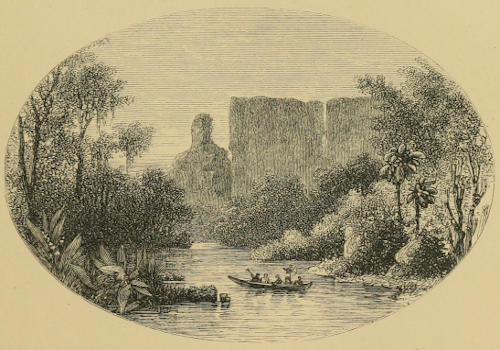
VIEW ON THE CURIPUNG RIVER.
LONDON: HURST AND BLACKETT, PUBLISHERS, 13 GREAT MARLBOROUGH STREET.
1879.
All Rights reserved.
PREFACE.
“Will no one explore Roraima, and bring us
back the tidings which it has been waiting
these thousands of years to give us? One of the
greatest marvels and mysteries of the earth lies on the
outskirt of one of our own colonies—only not within
British territory because the frontier line has been
bent in at the spot, on purpose, it would seem, to
shut it out—and we leave the mystery unsolved, the
marvel uncared for.”
The above words, together with a general outline of
the wonders to be explored, appeared in a number of
the “Spectator” for April, 1877, and aroused my interest
to such a degree that I thought by day and
dreamt by night of Roraima.
After reading Mr Brown’s delightful book on British
Guiana—which was referred to in the article from
which I have quoted—I made up my mind to visit
that colony, with the hope of at all events seeing
Roraima and exploring its floral treasures, even if I
should be unable to make its ascent.
The summit, Mr Brown says, is inaccessible, except
by means of balloons. “According to the traditions
of the Indians,” says Sir Robert Schomburgh, “the
summits of the flat-topped gigantic sandstone walls,
which never can be reached by human beings, contain
large lakes, full of remarkable fish-like dolphins, and
continually encircled by gigantic white eagles—their
eternal warders.”
Full then, of curiosity, with a great longing to become
better acquainted with this mysterious region,
I arranged my plans so as to arrive in Demerara about
January, paying a flying visit on my way to Bermuda
viâ New York, and so on through the West Indies to
Guiana. Fortune favoured me, inasmuch as on my
arrival at Georgetown, Demerara, I found that the
Colonial government was about to send an expedition
to Roraima, for the purpose of trying to reach the top
of that mountain. With great kindness, the authorities
permitted me to accompany it, and I cannot let
this occasion pass without expressing my sincere thanks
for the opportunity thus afforded me of visiting the
interior of British Guiana.
The following rough record of my journey is but a
poor return for the many attentions shown me, but it
may add its mite in attracting the notice of travellers
to a country not often visited for pleasure.
J.W.B.W.
CONTENTS.
CHAPTER I.
OUTWARD BOUND—THE ‘CANIMA’—A ROUGH VOYAGE—FIRST
VIEW OF BERMUDA—COASTING—IRELAND ISLE—COMMISSIONERS’
HOUSE—THE SOUND—HAMILTON—LANDING—AN INDIA-RUBBER
TREE—A BILL OF FARE—THE REGISTER—HAMILTON
HOTEL—PAPAWS—A SUGGESTION
A WHITE TOWN—A CEDAR AVENUE—THE “DUCKING-STOOL”—SEA
ENCROACHMENTS—FERN PITS—SPANISH POINT—FAIRY-LAND—THE
ISLAND ROAD—AMUSEMENTS—A PAPER HUNT—REEFS—SEA
CUCUMBERS—THE SOUTH WIND—SAND-HILLS—BOILERS—ARCHITECTURE—MUSEUM—A
RARE SPIDER
ST. THOMAS—FORTS—BOATMEN—DIVERS—HOTEL DU COMMERCE—MAIN
STREET—STABLE COMPANIONS—AMAZONS—A NEGRO
POLITICIAN—DANISH RULE—A SORRY SIGHT—JUSTICE IN
THE VIRGIN GROUP—A DAY’S DOINGS—KRUMM BAY—CHA-CHAS—AN
OCEAN PAWNBROKER’S—LANDSLIP—ALOE—A CURE FOR
LUNG DISEASES—UP THE MOUNTAIN
TO SANTA CRUZ—BASSIN—A DOG-HOUSE—FRUIT STEALING—“THIBET”
TREES—GREEN HERONS—PRETTY SCENERY—WEST
END—SANTA CRUZ v. ST. THOMAS—CENTRAL ROAD—STEAM
PLOUGH—A CENTRAL FACTORY—OPPOSITION—WAGES—CHILDREN—HOME
AGAIN—RE-EMBARKATION—OFFICIAL DELAY
A GALA DAY—COSTUMES—CINQ-CLOUS—BATTERIE D’ESNOTY—A
CASSAVA FARM—PANDEMONIUM—PREPARATION OF CASSAVA—A
“CATCH”—COUNTRY SCENES—FRESH ATMOSPHERE—A
STORM—RAINBOWS—FOREST SCENES—TROPICAL VEGETATION—NOON-DAY
HALT
A CURIO HUNTER—FORT DE FRANCE—BATHS OF DIDIER—DIAMOND
ROCK—FLYING-FISH TRADE—BARBADOES—CARLISLE BAY—HOAD’S—TRAFALGAR
SQUARE—THE ICE-HOUSE—ST. ANN’S—SCOTLAND—CONFEDERATION—COAST
OF TOBAGO—BIRDS OF
TOBAGO—FAUNA OF THE WEST INDIES
TO TRINIDAD—BOCA DE MONOS—GULF OF PARIA—PORT OF SPAIN—SAVANNA—BOTANIC
GARDENS—A HINDOO VILLAGE—STAPLES—A
CACAO PLANTATION—THE BLUE BASIN—FALLS OF MARACAS—THE
PITCH LAKE—START FOR THE ORINOCO
THE “HEROE DE ABRIL”—APPROACHING THE ORINOCO—MOUTHS
OF THE ORINOCO—THE MACAREO CHANNEL—MACAWS—WATER
LABYRINTHS—GUARANOS—INDIAN CAMP—TROUPIALS—BARRANCAS—LITTLE
VENICE—LAS TABLAS—CARATAL GOLD MINES—VENEZUELA—THE
CARONI—ROCKS OF PORPHYRY—CIUDAD
BOLIVAR—PIEDRA MEDIO—ANGOSTURA BITTERS—UPPER ORINOCO—FEATHER
HAMMOCKS
TO THE ESSEQUIBO—BARTICA GROVE—THE PENAL SETTLEMENT—CUYUNI
RIVER—EL DORADO—RALEIGH’S CREDULITY—TENT
BOATS—CAMP IN SHED—CARIA ISLAND—AN ARCHIPELAGO—KOSTERBROKE
FALLS—ASCENT OF CATARACTS—WARIMAMBO
RAPIDS—MORA—A NEW YEAST
A NEW HOUR—MARABUNTAS—SINKING OF THE BURA—ROCK FORMATIONS—ARA
HUMMING-BIRD—FALLS OF YANINZAEC—JABIRU—CABUNI
RIVER—SHOOTING FISH WITH ARROWS—PACU—AN
INDIAN CAMP—GREEN-HEART BREAD—INDIAN LIFE—A
PAIWORIE FEAST—DUCKLARS—CURRI-CURRIS—SUN BITTERNS
THE BUSH-MASTER—LABARRI—CAMOODI—WOOD ANTS—TURESIE—A
PACU HUNT—CASHEW TREE—WOODSKINS—PIRAI—SINGING
FISH—INDIAN DANCE—BEADS—FASHION—A RIVER BEND—VIEW
OF HILLS—SNIPE—INDIAN MYTHOLOGY—WANT A DOG—TABLE
MOUNTAINS—MERUME RIVER—COURSE OF THE MAZARUNI
A FISH HUNT ON LAND—STINGRAYS—THE “CARIBISCE”—TABLE
MOUNTAINS—A RIVER GOD—DESERTED VILLAGES—CURIPUNG
RIVER—INDIAN ENCAMPMENT—INDIAN SUPERSTITION—THE
“PEAIMAN”—DURAQUA—EATING CUSTOMS—ARRIVAL OF LANCEMAN—TRIANGLE
OF MOUNTAINS—MACREBAH FALLS—START
ACROSS COUNTRY
A “DACANA-BALLI”—STRANGE ROCKS—A ROOT PATH—INDIAN
SUPERSTITION—THE CRY OF A LOST SOUL—NEW CARRIERS—A
FEATHERED COSTUME—CURIOUS TREES—COCK OF THE ROCKS—CAMP
ON THE LAMUNG—A BOA-CONSTRICTOR—STENAPARU RIVER—THE
CARIAPU—A BURNING TREE—THE MAZARUNI—CAPTAIN
DAVID—PICTURESQUE CAMP
AMATEUR BARBERS—AN INDIAN EXQUISITE—MOUTH OF THE CAKO—CAMP
ON VENEZUELAN TERRITORY—TRUMPETERS—MOUNT
CAROUTA—REASON FOR ASCENDING THE CAKO—MARIMA—INDIAN
GUIDE—GLIMPSE OF RORAIMA—THE ARUPARU CREEK—COTINGAS—SAVANNA
INDIANS—A WATER LABYRINTH—AMUSING
SCENES—END OF NAVIGATION
OLD GRANNY’S DESCRIPTION OF THE PATH TO
RORAIMA—TREE-BRIDGES—MONKEY-POTS—BUSH-ROPES—CASHEW
COTTAGE—SAVANNA
INDIANS—MAZARUNI—MAGNIFICENT PALMS—BIXA
ORELLANA—COTENGA RIVER—FALLS OF OOKOOTAWIK—VILLAGE
OF MENAPARUTI—MARIKA RIVER—THE SORCERER
AGAIN
SAVANNA—RORAIMA AT LAST—APPEARANCE OF THE MOUNTAIN—WATERFALLS—HEAD
OF THE QUATING—TRIBUTARIES OF THE
AMAZON AND THE ESSEQUIBO—KUKENAM—ITS FALL AND RIVER—THE
“PEAIMAN” AGAIN—FALLS OF EKIBIAPU—A CELEBRATION
CLUSIAS—A MELASTOMA—FOREST TREES—FRESH CAMP—A FLORAL
TREASURY—BRAZILIAN MOUNTAINS—A COLOUR SYMPHONY—RORAIMA’S
EASTERN WALL—NO MEANS OF ASCENT—GOAT-SUCKERS—SOUTHERN
WALL OF RORAIMA—FALL OF KAMAIBA—KUKENAM
FALLS—WESTERN SIDE OF RORAIMA—REASONS FOR
RETURNING HOME—SAVANNA FIRE—A STORM
INDIAN VISITORS—A REWARD TO ASCEND RORAIMA—LAST VIEW
OF RORAIMA—HOW TO ASCEND RORAIMA—MENAPARUTI—A
HUNTING PARTY—CASSIREE—INDIAN PASTIMES—RUMOURS OF
WAR—AMARYLLIS—QUATING RIVER—CASHEW COTTAGE AGAIN—THE
ARAPARU—FALSE ALARMS—OLD FRIENDS
A PAINFUL WALK—BIRD’S NEST FERNS—DOWN THE CURIPUNG—VOICES
OF THE NIGHT—AN INDIAN FAMILY—A QUICK JOURNEY—SHOOTING
THE FALLS—TIMBER SHOOTS IN CANADA—A LOST
CHANNEL—ANTICIPATIONS OF A FEAST—CAPSIZE—A SWIM FOR
LIFE—TEBUCU FALLS—HOME AGAIN
FROM SOURCE TO SEA—END OF THE DROUGHT—D’URBAN—A RACE
MEETING—ENTHUSIASTIC COLOURED FOLK—ROYAL MAIL
STEAMERS—VENEZUELANS—CARIBE—CARUPANO—CUMANA—AN
EARTHQUAKE CENTRE—BARCELONA—LLANURAS—LLANERO—PLAINS—LA
SILLA
VIEW OF LA GUAIRA—PROJECTS IN VENEZUELA—LANDING—INDIAN
PATH TO CARACAS—BRILLIANT BEETLES—VIEW FROM CERRO DE
AVILA—DESCENT TO CITY—CLIMATE—AN EARTHQUAKE ALARM—SAD
ASPECT OF THE CITY—MYSTERIOUS POWER OF THE MOON—PERIHELION
AND PESTILENCE
EL PASEO—HISTORICAL RENOWN—RESERVOIRS—VIEW OF CARACAS—RIVERS
OF PARADISE—COMPARED WITH MEXICO—PLAZA
DE BOLIVAR—STATUE OF THE LIBERATOR—ENTRY INTO
CARACAS—FUNERAL CORTEGE—A NATION’S GRATITUDE
THE LEGISLATIVE PALACE—A COMPLIMENT TO THE CAPITOL AT
WASHINGTON—PLAZA DE GUZMAN BLANCO—THE UNIVERSITY—SAN
FELIPE—REMINISCENCES OF HUMBOLDT—A STRANGE
DISEASE—PROJECTS IN VENEZUELA—EARTHQUAKE AT CUA—THE
LEGISLATURE—LEAVE FOR LA GUAIRA
CARRIAGE ROAD BETWEEN CARACAS AND LA GUAIRA—THE “COW-TREE”—A
VENEZUELAN SUCCESS—FRENCH MAIL STEAMER—LEAVE
LA GUAIRA—PUERTO CABELLO—GOLFO TRISTE—MILITARY
HISTORY—CURACOA—GULF OF MARACAIBO—SAVANILLA—EMERALD
MINES—CLOUDS OF BUTTERFLIES—LEAVE SAVANILLA
TREASURES OF THE DEEP—THE SAN PEDRO ALCANTARA—MARGARITA—SEEKING
LOST TREASURE—OCEAN MINING—NAVY BAY,
COLON—INTER-OCEANIC COMMUNICATION—GOMARA’S PROJECT—NELSON’S
SCHEME—THE NICARAGUA ROUTE—THE ACANTI-TUPISI
ROUTE—INTERNATIONAL COMMISSION
COLON—DEPARTURE—COLUMBUS AND MR. ASPINWALL—RAILWAY
ACROSS ISTHMUS—SCENES ON THE ISTHMUS—TELEGRAPH POSTS—HOLY
GHOST ORCHID—PANAMA HATS—PARADISE—MOUNT
ANCON—PACIFIC MAIL STEAMER—ON THE WHARF AT PANAMA—PANAMA
FROM THE SEA—LAST LOOKS
OUTWARD BOUND—THE ‘CANIMA’—A ROUGH VOYAGE—FIRST
VIEW OF BERMUDA—COASTING—IRELAND ISLE—COMMISSIONERS’
HOUSE—THE SOUND—HAMILTON—LANDING—AN INDIA-RUBBER
TREE—A BILL OF FARE—THE REGISTER—HAMILTON
HOTEL—PAPAWS—A SUGGESTION.
“Under the eaves of a southern sky,
Where the cloud roof bends to the ocean floor
Hid in lonely seas, the Bermoothes lie—
An emerald cluster that Neptune bore
Away from the covetous earth god’s sight,
And placed in a setting of sapphire light.”
“Well, if we are going to a warmer temperature
than this, few of us will return,”
was the remark made by one of the passengers
on board the little steamer ‘Canima,’ which was
rolling heavily in a perfectly smooth sea, past Staten
Island on her way from New York to Bermuda. It
was the month of November, but the sun was as hot
and the sky as brassy as though it had been August.
On shore we could see preparations being made for
cricket, lawn-tennis, and archery; and there were we
bound for a semi-tropical climate. It was one of
those days with which the clerk of the weather favours
New York in early spring, and sometimes even when
the Indian summer is supposed to have ended.
I have said that the vessel rolled heavily, even in a
smooth sea, and we were naturally anxious to know
what she would do in rough weather; some thought
that she would turn over altogether, others, that she
would regain her equilibrium and keep it, but this latter
idea was soon proved to be a fallacy, as the wretched
ship had no more centre of gravity than a cherub.
Hardly had we entered the open sea when a change
in the weather occurred. The sky was overcast, the
waves assumed a threatening aspect, a cold drizzle set
in, and general discomfort prevailed.
How gay and lively the scene on deck was when
we started! how dull and quiet it suddenly became!
just as I was imitating the example of the rest of the
passengers by retreating to my cabin, an old gentleman
who had made the passage to Bermuda thirty-two
times spoke to me of
“The old green glamour of the glancing sea.”
As I did not feel much inclined to listen to poetry,
I merely remarked that I thought Lucretius was right
when he declared that “the sea was meant to be looked
at from shore,” and then withdrew.
A less enjoyable voyage could not be imagined,
and what with a head wind, rainy weather, the gulf-stream
in a state of extra-roughness, and French-Canadian
stewards, whose dirty appearance made the
greasy food less appetising, if possible, than it otherwise
would have been, a more ghostly, half-starved
lot of travellers never arrived at their destination.
How many lines of steamers there are whose owners
trade on the old Sanscrit proverb which they might
adopt as their motto, “The river is crossed, and the
bridge is forgotten.”
Fortunately the passage only lasted four days, the
advertised time being seventy-two hours; and glad
indeed were we when we had passed through the
narrow reef-channel, and were coasting along the
western side of the main island of the Bermudas, and
within the formidable chain of breakers which surrounds
them.
The first view of the island is disappointing, as the
low hills have a barren and desolate appearance, and
the plain white cottages which are dotted about here
and there stand in bare, uncultivated spots. Lower
down, however, as we approach the central portion,
the face of the island brightens. Old acquaintances
of Bermuda point out the position of Harrington
Sound, which they declare—and rightly as we afterwards
thought—to be the most lovely part of the
island; but from the vessel all we can see is a narrow
inlet which one could almost jump across. The long
lines of roofs which sparkle so in the sun on the hill
yonder are the barracks, and the red coats of the soldiers
make pleasant bits of colour, which contrast well with
the gleaming sand and the deep green cedar-nooks in
which the white houses nestle.
Farther on we pass Government House and the
signal station, from which the arrival of the steamer
has long been signalled; then Clarence Hill—Admiralty
House—is left behind, and we round Spanish
Point, with Ireland and other islands forming a semi-circle
on our right. On Ireland Island is to be seen
as everybody knows, the famous floating dock which
was towed from England in 1869. At another time,
this would probably have been the centre of attraction,
but the eyes of our sea-worn passengers were directed
to a fine large building well situated at the extremity of
that island. “What a splendid hotel!” said one, and
“How delightfully cool it must be there!” said another.
It proved to be the “Commissioner’s House,” now used
as military quarters.
The history of this building is rather singular. A
certain Treasury clerk was appointed “Commissioner”
in charge of the dockyard, and, not being satisfied with
the house given him to occupy, received permission
from the Home Government to spend £12,000 in
building a new one. This concession appears to have
turned his head, for the house gradually assumed the
dimensions of a palace; marble chimney-pieces were
erected, and stabling built for a dozen horses, and this
in a country where fire-places were hardly necessary,
and where, at that time, horses were useless. Marble
baths and other trifles ran up the bill to over £60,000.
The gentleman for whom this expense was incurred
never occupied the house, as he went mad, and the
office of “Commissioner” was soon dispensed with.
Whilst an old resident was telling us this story, we
had entered the Great Sound, and we found ourselves
in a pretty land-locked harbour, on whose wonderfully
clear blue water floated numerous fairy islets—a scene
which reminded us of the words of Moore:
“The morn was lovely, every wave was still
When the first perfume of a cedar-hill
Sweetly awakened us, and with smiling charms
The fairy harbour wooed us to its arms.”
Through these green islands we wound our way carefully,
one channel being particularly narrow and dangerous.
Beneath its transparent waters we could distinguish
an old cannon; and then a sudden turn brought
us into the pretty port of Hamilton, where we dropped
anchor close to the shore. But being on shore and
only near it are very different things, and it seemed
hours to us hungry mortals before the vessel was
gradually dragged to within forty feet of the quay.
Nearer we could not get, on account of a shallow.
Now to land in boats appeared too ridiculous for
such a short distance, but no other means were visible. A
bridge lowered by a crane would have landed us all in
a few minutes, but there was no appearance of such a
thing. Old-fashioned Bermuda wanted no new-fangled
notions, so we had to abide our time and wait until a
bridge had been manufactured in the following way:
Ropes were thrown from the vessel and fastened to the
outer ends of long beams, which were hauled on board,
their other extremities resting on shore. Then a
number of grinning darkies strided these beams, and
lashed cross-bars to them; planks were laid on the
frame, and over these we walked on to the quay.
There were only two passengers besides myself for
the Hamilton Hotel, and these were a very charming
old lady and her son—a young physician from Boston—who
had been advised to spend the winter abroad.
A short walk brought us to the hotel, a good-sized,
comfortable building, commanding a fine view of the
harbour and port of the town. On our way up, we
passed a splendid specimen of the india-rubber tree,
whose luxuriant growth almost hid the broad veranda’d
cottage behind it. Speaking of this tree, Mark Twain
says that, when he saw it, it was “out of season, possibly
as there were no shoes on it, nor suspenders, nor
anything a person would properly expect to find there.”
This tree was the first sign of tropical vegetation that
we had seen, which fact had rather surprised us, as on
the cover of a “bill of fare,” which had been shown to
us in New York, was a picture of the Hamilton Hotel,
with an avenue of palms and bananas leading up to it.
The fine palms—mountain cabbage—we afterwards
discovered about half-a-mile off, and not even within
sight of the hotel. But one cannot expect to find
everything one sees, even on a bill of fare. We were
informed by the clerk that we were the first visitors of
the season. “But somebody else is here,” said I,
pointing to a solitary name in the visitor’s register.
“Oh,” said he, “that’s me;” and forthwith assigned
us our rooms.
And now let me say a word about this hotel, which
is notorious for having prevented many strangers from
visiting Bermuda, and others who would have liked to
return, from coming back. The rooms are simply but
comfortably furnished, the situation is good, and the
grounds might be very prettily laid out. The whole
cause of discontent with the hotel has hitherto—that
is, up to the winter of 1877-78—been with the
management. The house had been leased to an
American, a pleasant, agreeable person, but without the
least idea of managing an hotel. People did not come
to Bermuda for third-rate American hotel dinners, but
there they got them, until they could stand it no longer.
It was useless to speak to the manager; no redress was
obtainable. Everything was served at once; an
armada of little white dishes was placed before you,
in one a dry cutlet, in another a few dried pellets of
fried potatoes, peas like buckshot, boiled potatoes like
cannon-balls; here an inch of tough chicken, there a
slice of beef, baked until all its proper juices had been
extracted; heavy pumpkin pies, tea and coffee quite
undrinkable, butter that no one could touch; such,
with but little variation, were the component parts of
the three meals. Even the provisions of Nature were
not made as available as they might have been. In
the garden were two or three fine papaw trees, whose
insipid green fruit was sometimes given to us as a
delicious West-Indian preserve. It is said that the
leaves of this tree, if rubbed on a bull’s hide, would
immediately convert it into tender beefsteak; now
our meat was always of the toughest description.
Day after day I used to see my two friends, fresh
from their home in Boston, rise from the table without
having touched anything, and I felt quite ashamed of
our English colony. Had the proprietor been English,
I think I should have run away. As it was, we limited
our visit to a fortnight instead of a month, the doctor
accompanying me to the West Indies, whilst his mother
returned home.
It seems a pity that quiet Bermuda should not attract
more visitors—Americans especially—than it does. A
well-kept hotel there would be very welcome to many
who now winter in Florida or Nassau (Bahamas).
The island is more interesting than either of those
places, and equally picturesque; and I have no doubt
that visitors, when they left, would carry away as
pleasant recollections as they would probably leave
behind.
CHAPTER II.
A WHITE TOWN—A CEDAR AVENUE—THE “DUCKING-STOOL”—SEA
ENCROACHMENTS—FERN PITS—SPANISH POINT—FAIRY-LAND—THE
ISLAND ROAD—AMUSEMENTS—A PAPER HUNT—REEFS—SEA
CUCUMBERS—THE SOUTH WIND—SAND-HILLS—BOILERS—ARCHITECTURE—MUSEUM—A
RARE SPIDER.
“Pleasant it was when the woods were green,
And the winds were soft and low,
To lie amid some sylvan scene,
Where the long drooping boughs between,
Shadows dark and sunlight sheen
Alternate come and go.”
LONGFELLOW.
When you first look out of your window over
the town, you imagine that there has been
a slight snow-storm, so gleaming white are the roofs
of all the houses. But you soon learn that, owing to
the absence of springs and streams, the roofs are white-washed,
and kept scrupulously clean, as the rain-water
is thence conducted into cisterns, from which it is drawn
for use.
The roads are white, the houses are whiter, and the
roofs are whitest; but what would otherwise be an
unpleasant glare is modified by the foliage, which half
conceals the houses, and by the green Venetian blinds,
which shade all the windows.
Nearly every house has a garden, and passion-flowers,
morning glory, and other vines creep up the
pillars and over the piazzas in great profusion and
brilliancy. “Pride of India” trees border the sides of
the streets, but these fail to give the delicious shade
which is obtained under the cedar avenue which lies
on one side of the small public gardens. Here you
can stroll in the heat of the day, protected from the sun
by a green roof, and surrounded by roses,[1] heliotropes,
lilies, great beds of geraniums, pomegranates, gorgeous
blossoms of hybiscus, gladioli, and all sorts of lovely
creepers. Then when the sun’s rays have lost some of
their power, you can prolong your walk along the
winding road, past the pretty country church of Pembroke,
and leaving Mount Langton (Government
House) on your right, behold at the bottom of a shady
lane spreadeth a golden network, like a veil of gauze,
stretching far and wide. That is the sea, and in a
short half-hour you have crossed this part of the island.
Better still is it to come here in the morning, and
after a plunge in the deep blue water, sit on the “ducking
stool,” and meditate on the feelings of the poor
wretches who, in days gone by, suffered the water
punishment for witchcraft, sorcery, and other imaginary
offences. A notice prohibits bathing on Government
grounds, but down below the steep rocks there are
plenty of nooks and hollows, sand-carpeted and as
private as your own chamber. For myself, I never
could make out where the Government property began
or where it ended.
On this north shore a delicious breeze tempers the
heat of the sun, and it is enjoyment enough to look at
and listen to the sea, to watch the men collecting the
seaweed for their land, or to read, and consequently
fall asleep. No one will disturb you; there are no
tramps in Bermuda, and your watch will still be going,
even should you sleep for hours. To return to town
two different ways are open to you; both are along the
same sea-shore road, but lie in opposite directions; the
one leads to the north-east, until you branch off to the
right past the barracks; the other—and the one we
will take—runs south-west towards Admiralty House
and Spanish Point. All along this road you cannot
help noticing the encroachment of the sea, and you
wonder how long it will be before the road on which
you are walking becomes the edge of a craggy wall for
the waves to beat against and undermine. Here truly
does—
“The hungry ocean gain
Advantage on the kingdom of the shore.”
The hollowness of Bermuda is very remarkable, and
in many places the cavernous ground gives forth very
musical sounds when struck.
As we proceed on our walk, we see but few signs of
cultivation; here and there are strips of garden
running up into the ubiquitous cedar bush, but most
of the land is used for grazing, and very indifferent
grazing, too. One peculiarity amongst the four-footed
animals is that they are nearly all black and white;
another is that they are all tethered; everything seems
at anchor in Bermuda, cattle, goats, pigs, donkeys, even
the hens are not at liberty. Occasionally one passes a
deep well, originally dug out for the purpose of obtaining
fresh water, but entirely lined with the lovely
maiden-hair fern. This delicate species gives a special
charm to the island, as it grows luxuriously on the
walls and rocks, in caves and hollows, and drapes the
numerous land-pits with its graceful fronds. Where
the fern declines to grow, there the “life-plant”
flourishes, and quickly covers up the bare places with
its deep green, fleshy leaves. Of such vitality is this
weed that a single leaf, if plucked and pinned to the
wall, will live and send out shoots from its edges with
perfect indifference as to its changed abode.
At Spanish Point the view across to Ireland Island
is very picturesque, and one perfect horse-shoe bay,
with white sandy shore, lingers a long time in the
memory, not only on account of the peaceful scene of
which it forms a part, but also for its own exquisite
form. Near by is Fairy-land, well named, for it really
is one of the most charming spots in Bermuda. The
sea here runs far up into the island, forming a lake,
with bays, islets, caves, isthmuses, and peninsulas.
Just above one of the green bights stands a little nest
called “Honeymoon Cottage,” a gem of a place, where
many a happy pair have passed the first week or two
of their new life. The hall-door steps lead down
to the bathing house, which, when I visited it, contained
only one little shoe, but that worthy of Amphitrite
herself.
Leaving beautiful Undercliff, our road now turns
more inland, sometimes crossing a little hill, and sometimes
running through a swamp with high reeds and
flags, and with its edges planted with potatoes and tomatoes.
Now it curves through a grove, anon it winds
past home-like cottages, whose black occupants grin
with delight at seeing a stranger, curtsey, and wish him
a pleasant walk; then once more the sea is in view,
pretty gardens line the road, life and activity betoken
the neighbourhood of the wharf, and you are again in
Hamilton. Have you enjoyed your walk? I must
not ask whether you have a good appetite for dinner!
There is no doubt that the scenery of Bermuda
improves on acquaintance. At first sight the visitor
will probably be disappointed with the flat appearance
of the island and the apparently few possibilities for
the picturesque. But in a very short time he will
discover that it is all hill and dale, on a minute scale,
it is true, as the highest elevation hardly exceeds two
hundred and fifty feet—but varied and even romantic.
Take, for instance, the view from the Barrack Hill.
Everywhere the coastland seems broken up in the
most capricious manner. Deep bays, narrow promontories,
and an infinite number of islands give to
the sea the appearance of a series of silver lakes, which
shine in the sun like the fragments of a broken mirror.
The undulating country is clothed with cedar-bush,
whose grey green is relieved here and there by the
brilliant flush of the pink oleander and the white perpendicular
walls of a stone quarry. Afar off a lighthouse
is pictured against the sky, near at hand is a
white fort, and a church spire shows itself above the
trees. But it is the beauty of the sea rather than of the
land that here takes the first place in one’s affections;
and in after-time it is the memory of the molten silver
sea and its green islands that clings to one longest;
“Wherever you wander the sea is in sight,
With its changeable turquoise green and blue,
And its strange transparence of limpid light.
You can watch the work that the Nereids do
Down, down, where their purple fans unfurl,
Planting their coral and sowing their pearl.”
Those who are familiar with the scenery of Puget
Sound, or of Vancouver’s Island, will recognise, I
think, many points of similarity with that of Bermuda.
The dense forests are wanting in the latter, but from
a bird’s-eye view the resemblance is striking. Above
all there is the same air of absolute quiet and a subdued
wildness characteristic of the two places. Certainly
Bermuda is a quiet land; so still a place, it
seemed to me, I had never been in before. You are
perpetually wondering why the church bells are not
ringing for service, and I have heard people ask, “Did
you hear the dog barking yesterday?” But life here
is by no means dull, a more friendly, hospitable, and
fun-loving people you would not find, and what with
military theatricals, croquet, cricket, lawn tennis, boating
parties, and other amusements, time glides away
very quickly.
There is little or no game on the island—one bevy
of quails being the extent of my observations—but,
as an Englishman must hunt or shoot something, a
“paper-hunt” has been established. It may not be as
exciting as fox-hunting, but, in a climate where you
must take things easily, it affords capital exercise. The
Bermudian foxes—or rather the Judases, as they carry
the bag—are generally men from the garrison, and,
with the thermometer 75 deg. in the shade, and 110 deg.
or more in the sun, they have no easy task in giving a
good run. Spectators are always invited to view “the
finish” at some previously selected spot, and there refreshments
of all kinds are served, making a very
agreeable finale to an amusing day. A severe critic
might remark that the hurdles and other obstacles
placed near “the finish,” were hardly worthy of the
excessive ardour displayed in overcoming them, but he
must remember that it perhaps makes up for a slight
falling off where the jumps were more formidable. It
is not only in Bermuda that the presence of a certain
pair of bright eyes has driven many a Nimrod to deeds
of heroism in the matter of hedges and ditches that
otherwise would have been neglected.
For boating the Bermuda waters offer great facilities,
and, if you want to see how near to the wind’s eye it is
possible to go, you cannot do better than hire one of
the native sailing-boats—one masted and flush-decked—when
there is a stiff breeze. You may get rather
wet, but you will spin along at a glorious rate, and you
certainly will admire the workmanlike way in which
your crew—a man and a boy—manage the rakish
craft.
Then, in calm weather it is delightful to pay a visit
to the reefs and gather for yourself the brain corals and
“sea-whips,” specimens of which fishermen have
brought to the hotel for sale. In these water-gardens
may be seen all sorts of many-hued plants; crinoids
like palm trees, gorgonias, mosses, sea-feathers, coral
like creeping vines, sea-cucumbers,[2] and coloured weeds
waving to and fro over the brilliant fish. On bright,
sunny days, when the blue water sparkles, you may,
perhaps, in fancy, hear snatches of low music and gay
tones of laughter gurgling up from below, but, when it is
dull and gloomy, the sounds will be of sorrow, telling
secrets dire and tales of woe, wrung from restless spirits
buried amid wreck and ruin beneath the flood that
sweeps over those cruel, beautiful coral rocks.
We had heard so much of the disagreeable effects of
the south wind, which generates so much moisture that
everything is quickly covered with green mould, and a
general clammy feeling prevails, that we were continually
running round the corner of the hotel to note
the direction of the wind by the flag at the signal
station. As we were constantly expecting it—the south
wind—the natural consequence was that it never came,
and we were very grateful. I think it was a Frenchman
who remarked that nothing happens except the
unexpected, and I have found this true in many cases.
For instance, when travelling in the tropics, if you are
continually on the look-out for snakes, you will rarely
meet them, and we all know that the best way to keep
off the rain is to carry an umbrella. The climate of
Bermuda is said to be capricious, but during our stay—a
short one certainly—we found the temperature very
pleasant, the thermometer seldom rising over 73 deg.,
and frequently a fire towards evening was very comfortable.
Small as Bermuda is—as the five principal islands
connected by ferries and bridges only form a chain
about twenty-four miles in length, and with a breadth
varying from a few hundred yards to about two miles—it
yet contains many points of interest. The splendid
lighthouse on Gibb’s Hill is worth a visit for itself, and
for the fine view to be obtained from it; the fortifications,
too, which, together with the natural barriers,
are gradually making a second Gibraltar, must be inspected.
The Paget Hills on the eastern shore show
how the drifting sand is elevating the land, and probably
increasing it as fast as the western waves are
washing it away. Unfortunately, this overwhelming
mass of sand is steadily advancing over the cultivated
land, and has already buried one cottage, whose chimney
alone is visible above the surrounding whiteness. It
is merely a matter of taste which is preferable—to be
washed away or to be buried alive.
Near the beach, at the foot of these hills, may be
seen, at low water, great circular masses of rock,
hollowed out like huge cauldrons. Similar ones occur
at intervals round the islands, and are by no means the
least interesting of the Bermudian curiosities.[3]
However entertaining the country and seaside may
be, there is very little in the town of Hamilton worth
noticing. With the exception of Trinity Church, the
buildings are insignificant. The “Public Building”
stands in an ill-tended garden and presents no inducement
to the young Bermudian to prepare himself for
the Legislature. But, perhaps, there will soon be no
young white Bermudians, as the youths of these islands
find the United States better adapted for their speedy
advancement in life.
I had hoped to find in the museum a specimen of a
certain spider, concerning which an ancient chronicler of
Bermuda has said: “They are of a very large size, but
withal beautifully coloured, and look as if they were
adorned with pearl and gold. Their webs are in colour
and substance a perfect raw silk, and so strongly woven
that, running from tree to tree, like so many snares,
small birds are sometimes caught in them.” The
Museum consisted of a few South-Sea Island shells,
some coral, some moth-eaten skins, three bottles of
alcohol containing marine specimens, two butterflies,
and no spider. I had a better ungathered collection of
insects in my own room at the hotel. I must return
there and see if I can find a mother-of-pearl spider.
CHAPTER III.
BERMUDIAN ROADS—NIGHT BLOOMING CACTUS—A NATURAL CURIOSITY—EXPORTS
AND IMPORTS—THE COLOURED NATIVE—HARRINGTON
SOUND—DEVIL’S HEAD—NEPTUNE’S GROTTO—A
SALT-WATER FOUNTAIN—A DIABOLICAL PLOT—THE CALABASH—MEMENTOES
OF TOM MOORE—WALSINGHAM—THE CAUSEWAY—A
NEW FEATURE IN CULTIVATION—ST. GEORGE’S.
We have not half exhausted the beauties of the
neighbourhood, but, in case your patience
should be at an end, please step into the carriage which
is to take us to St. George’s, at the other end of the
island, whence we are to embark for the West Indies,
and let us look about us on the way.
Three roads lead to our destination; we will take
the middle one, which joins the ocean drive near
Harrington Sound. Splendid roads these are, too!
Bermuda may well be proud of them. Altogether
there are more than a hundred miles of broad, white,
smooth road. Sometimes the road-bed is so deeply
hewn out of the white coral rock that Lilliputian canyons
are formed with fern-hung walls, and capped with aloe
or cactus. Several varieties of the latter plant grow in
the islands, and a magnificent specimen of the night-blooming
cereus grandiflora is to be seen in the small
garden behind the Yacht Club in Hamilton. It runs
in wild profusion over trees, walls, and bushes, and
when in blossom is covered with hundreds of pale
flowers, whose delicious perfume is quite overpowering.
It may be inconvenient, perhaps, to visit it at the proper
time—midnight—but it is necessary, as in the morning
beauty and perfume have gone.
Dazzlingly white, but, fortunately, not dusty, is the
road as we leave the snowy houses behind us, but soon
we enter a stretch of cool forest. Here a deeper silence
reigns than even on the sunny hill we have ascended,
a melodious silence too, for the sweet note of the blue
bird and the soft chirp of the “chick of the village”
do not break the quiet, but rather adds to it. A
crimson cardinal gives a rare flush to the grey cedar,
and pretty little ground-doves sit perfectly unconcerned
by the roadside as we drive past. Prospect is soon
reached, and then we descend, again skirting a large
morass, edged with cedars, mangrove, and palmetto.
We see a new church, which makes a strong contrast
with the old ruined one that stands farther on, near
some really fine cedars.
Here we halt for a moment to inspect a natural
curiosity, namely, a very ancient cedar, lofty and
hollow, and in whose dead trunk is growing a young
one, the green head of which appears high up, amid
the dead branches of the old one. Patches of cultivated
land with their great hedges of oleander were as common
here as everywhere else, but, besides the usual tomato,
onion, and potato, we saw for the first time that friend
of our childhood—the farinaceous arrowroot. Could
we do less than greet it with a friendly nod as we
drove along? Alas! even the cultivation of this
diminishes year by year; everything has to give
way to onions and tomatoes—consequently, the
supply of other vegetables, cereals, and fruits is
extremely limited. With such a fertile soil the exports
might almost equal the imports in value, but
I am afraid to say how many times the latter exceed
the former at present. No one would expect a black
man to work more than he is absolutely obliged,
and certainly in Bermuda he who can avoid doing
anything makes the best of his opportunities. Possibly
his nature is allied to that of the surrounding coral
formations, and he becomes a sort of human coral-polyp,
whose only labour of life is to get a little food
and to eat it; the rest he leaves to nature. Well,
who can blame him? he seems very happy and
contented, he sends his children to school, he is very
polite, and, if he is poor, poverty does not harm him,
and he is content.
Look at that merry group in the doorway of that
tumble-down old building! All smile at the strangers,
and the mother who has been plaiting away at some
palmetto work—which by the way is not half so fine
and pretty here as in Florida—leaves it, to gather
some magnificent roses we have stopped to admire.
But surely an earthquake has shattered this little
village; roofless cottages, mouldering walls, gardens
in which papaws, prickly pears, and lantanas form a
perfect jungle, everything has the appearance of
some such catastrophe. No, these ruins are the land
fragments of what was once an important harbour,
and the splendid sheet of water before us is Harrington
Sound. Very beautiful is this lake—as it may be
called—which at its junction with the sea is crossed
by a bridge a few yards in length, and only visible
when approached quite close; for it lies at the foot
of a circle of green hills, surrounded by cavernous
shores, and with islands dotting its green transparent
waters.
Taking the road to the right we pass some pretty
cottages, one of which has such a tremendous portico,
that we are reminded of the donkey that tried to convert
itself into a deer by attaching antlers to its head.
Then we arrive at the Devil’s Hole. Across the water
the Devil’s Head rises up, its perpendicular cliff looking
quite grand in miniature; there the tropic-bird
builds its nest in perfect security in some inaccessible
position. What the devil has to do with either place
I cannot say; both names seem singularly inappropriate,
and for the former “Neptune’s Grotto” is more
suitable, and just as easy to pronounce.
There is frequently, I believe, a good deal of
difficulty in finding the proprietor of the pool in
question, but at the time of our visit he was standing
at the wooden door, and informed us we had come
at a good time, as he was just going to feed the fish.
Entering, we found ourselves in a pretty circular
grotto, lined with shrubs, ferns, and creepers. Steps,
cut out of the rock, led down to a deep pool of the
clearest salt water, in which were a number of great
fish called “groupers,” gazing up with the most
expectant look—if a fish-eye can be expressive—and
evidently aware that feeding time was at hand. And
how they did eat! there was no dainty nibbling, no
coquettish trifling, a huge mouth opened and the
morsel was gone. “What does that great fellow
weigh?” “Oh, about two shillings,” replied the
proprietor, whose idea of weight was a marketable
one, “and those angels will average one and sixpence
apiece.” Well, those angels were worth it,
their exquisite azure hue vied with the wonderfully
tinted water, and, what with gold streakings, waving
plume-like fins, and really beautiful eyes, they well
deserved their name. If some clever soul could
discover a preparation for preserving the natural hues
of fish, what a benefactor he would be! At present,
the alcoholic collections of our Museums form a
ghastly contrast with the brilliant birds and insects
which surround them.
“While blazing breast of humming-bird and Io’s stiffened wing,
Are just as bright as when they flew their earliest voyage in spring;
While speckled snake and spotted pard their markings still display—
Though he who once embalm’d them both himself be turned to clay—
The scaly tribe a different doom awaits—scarce reach’d the shore
Those rainbow hues are fading fast till all their beauty’s o’er.”
Right learnedly, and with the tongue of a gourmet,
did our fisherman discuss the habits and qualities of
the various fish that swim in Bermudian waters. Cow-fish,
porgies, hamlets, hog, grunts, bream, and many
others; a few he pointed out to us, amongst them a
squirrel with large eyes, of a blood-red colour and
peculiar shape; then he landed a “grunt,” which
gave vent to sounds that would shame a veritable
porker. This natural aquarium is connected with
the sea by an underground passage, consequently the
water is always fresh; formerly, we were told, it was
a cavern, but the roof had fallen in.
On emerging, we see eastward the pretty house and
grounds belonging to the American Consul. In his
garden is a salt-water fountain, in the basin of which
we, during a former visit, had seen many strange fish,
and also some good specimens of the sea-horse. On
that occasion we had been told of the terrible plot
concocted in these Islands by a Dr. Blackburn, for
introducing the yellow fever into the Northern part
of the United States, by sending thither boxes of
infected clothing. Fortunately—and I believe chiefly
through the instrumentality of our host—the plot was
discovered in time to prevent the shipment, and a
terrible calamity was probably averted. The worthy
Consul does not confine his attention to fish alone,
and his system of banana culture might be profitably
adopted in many other parts of the Island.
Continuing our drive round the Sound, we are more
and more impressed with its attractions; the apple-green
water below us, the rocky inlets with white sandy
edges, here and there a stretch of shingle or a wooden
promontory, and, beyond, the blue sea with the foam
on its distant reefs, form a lovely picture, and we are
sorry when a turn in the road has shut us out from
such a wealth of colour.
Our next halting-place is at a farm house, near
which stands Moore’s “calabash tree,”[4] beneath whose
shade the poet composed his verses, and wove his
amatory couplets addressed to “Nea, the Rose of
the Isles.” The tree lives still, in spite of the severe
hacking it has received from tourists, whose carved
names are continually blurred out by time and the
hands of their successors. Even the seat under it
is the object of much curiosity, and as each new one
is placed in its proper position it is carried off piecemeal
by enthusiastic admirers, who must have a bit
of the chair the poet sat in. I never see the ravages
made by relic hunters, or the desecration of historical
places, without thinking of a certain tourist to whom an
Italian monk was showing a consecrated lamp, which had
never gone out during five centuries. Giving the flame
a decisive puff, he remarked, with cool complacency,
“Well, I guess it’s out now.” A few gourds are still left
hanging from the topmost boughs of the tree, but the
sable attendant will not allow any of these to be knocked
down, so you must be satisfied with the one presented
to you by the proprietor of the land at your departure.
It may come from Moore’s tree, but gourds are deceptive
and much alike.
A short walk through tangled wild-wood leads to
some limestone caves, which were also frequented by
the poet. They differ little from other cavernous
formations; there are vaulted arches, halls and aisles,
gem-studded cornices, and upright columns; here there
is a sheet of water so clear that the guide has
to tell you that it is water; there, oozing stalactites
embellish a Gothic temple, but the effect of brilliant
crystallization is marred by the smoke of the rushes
which light up the gloom of the interior. The visit
is a scrambling one, but still worth accomplishing.
Shortly after leaving Walsingham we cross the
causeway which connects the main island with St.
George’s; on our right, is the magnificent Castle
Harbour, with numerous islands; on our left, a land-locked
sound, with cranes and other birds fishing on
the shallows and among the mangrove bushes, whilst
in front, lying in the hollow of a curve under a hill,
are the white houses of the town. Rapidly we drive
along the fine causeway, the waves now and then
almost dashing over us, so near is the sea; then, after
crossing a drawbridge, we are soon among cottages
and gardens. Here we see again potato fields and
patches of cultivated ground, apparently planted with
black bottles. These black bottles are quite a feature
in Bermudian cultivation during the sowing season;
they are not planted in the hope of their ever becoming
quarts or magnums, or even of their being refilled
by nature with their original contents, but, having
held the seed, they merely indicate the amount
sown.
A quaint old town is St. George’s, with its high
stone walls and winding alleys. So narrow are the
streets that, if two carriages met in one of them, it
is difficult to imagine what would happen, as they
could not pass, and certainly could not turn back;
but two carriages in St. George’s on the same day
would be an exceptional event. The whole place has
the appearance of having been cut out of a single
block of white limestone, rather than being built of
bricks of that material. It is not in many places that
a man can build his house from stone out of his own
quarry, on his own premises, but he can in Bermuda.
With a hand-saw he cuts out the soft stone, and the
blocks then harden by exposure to the air.
The numerous square cuttings in the hill-sides and
along the roads form a feature in the scenery, and by
no means an unpleasing one, as the new are snowy
white, and the old are generally draped with green
bushes and creepers. Walls are built of the same
material, and then receive, as the houses do, a coating
of whitewash, which hides the seams and joinings, thus
presenting a solid white mass. Over these walls, you
see broad plantain leaves and flaming poinsettias;
orange, lemon, and palm trees are more numerous
here at St. George’s than at Hamilton, and the
tropical aspect of the town extends to its inhabitants.
Of labour there is little or no sign, and what
there is of life is hardly worth mentioning.
As St. George’s is a garrison town—two regiments
being considered necessary for the safety of Bermuda—it
is probably gayer than when we saw it, which was
in hot noonday, when all slept except one black
man, who was shaving a white man under the shade
of a tree in the square.
That evening the ‘Beta,’ from Halifax, left with
us for the West Indies. Summer isles, in spite of that
abused hotel, I would gladly revisit you; I carry away
nought but a remembrance of white cottages and
gardens, green islands, billowy masses of oleander,
cedar hills, and coral rocks, and, above all, of a shining
lake-like sea, as calm and restful as the happy homes
which it surrounds.
CHAPTER IV.
ST. THOMAS—FORTS—BOATMEN—DIVERS—HOTEL DU COMMERCE—MAIN
STREET—STABLE COMPANIONS—AMAZONS—A NEGRO
POLITICIAN—DANISH RULE—A SORRY SIGHT—JUSTICE IN
THE VIRGIN GROUP—A DAY’S DOINGS—KRUMM BAY—CHA-CHAS—AN
OCEAN PAWNBROKER’S—LANDSLIP—ALOE—A CURE FOR
LUNG DISEASES—UP THE MOUNTAIN.
Had the passengers on board the comfortable
‘Beta’ been as poetical as Childe Harold was
when in his clumsy brig he sang:
“Four days are sped, but with the fifth anon
New shores descried make every bosom gay,”
they might have said something less prosy than
“Thank goodness, there’s land!” when, precisely on
the fifth morning after leaving Bermuda, a vision as of
misty clouds grew out of the sea! Then, as the yellow
flush of dawn cleared the prospect, substance was given
to the hazy outlines, and as the sun rose, touching
the rugged peaks with gold and purple, the island of
St. Thomas lay revealed before them.
As the vessel entered the spacious harbour and
dropped anchor at some distance from shore, we
thought we had seldom looked at a prettier scene. In
front is a high, abrupt mountain range, from which
three rounded spurs run down to the sea, and on these
hills stands the town. On the right, a low, wooded
savanna sweeps up to the hills which encircle the bay,
whose mirror-like surface reflects the rocks and islands
which close the entrance and almost join the promontory
on our left. But it is the rich colouring that
forms the striking part of the view. After demure
Bermuda, with its white and grey-green, the bright red
roofs and white, green, yellow, and blue houses are
almost dazzling. There, clinging to the side of the
hill, is a cluster of freshly painted cottages, looking
very gaudy in the strong sunlight; nearer at hand are
a few low houses, whose once brilliant roofs are now
changed by time and weather to a golden russet-red
highly picturesque.
The height of the dark mountains gives a diminutive
appearance to the buildings, so that you imagine you
are looking at a Dutch toy village—or rather three
villages. This idea is enhanced by the toy fort which,
with bastion, battlements, and barbican, is strongly
suggestive of cake ornamentation. Commanding this
Danish fortress are the two strongholds of those old
pirates called Bluebeard and Blackbeard, which look
feudal, and only want a few of Mr. James’s horsemen
slowly winding up the narrow causeway to be quite
romantic. Over the trees of the toy public garden,
which lies close to the landing, is seen a Moorish-looking
structure, which proves to be the hotel, and gives promise
of coolness and comfort, which I need hardly say
is not realised. Behold, then, bright, cheerful little
dwellings, with a prevailing hue of russet, perched on
hills and nestling in the intervening valleys, amid
tropical trees and flowering shrubs, forming the centre
of a combination of mountain, sea, and island that is
very pleasing, especially when seen in the soft golden
light shining through the pearly grey mist of the rain
storms which often sweep over the island—and such is
St. Thomas.
The change of scenery from Bermuda is not greater
than that of manners. There is no quaker-like simplicity
in St. Thomas; noise and clamour prevail.
Hardly has the anchor touched the bottom before the
ship is surrounded with dozens of boats, manned by
sturdy negroes, anxious to take passengers ashore.
Here we find among the boatmen the same names as
those borne by Egyptian donkeys at Cairo and Alexandria—Derby
winners, heroes of popular songs, &c.
“Champagne Charlie” urges his cognomen as a
special reason for your patronage, whilst another,
blacker than the blackest of imps, claims the stranger’s
old acquaintance with “Remember Snowball, massa,
last time you here!”
Just as we stepped into our boat, a young Canadian
on board, who had been assiduously fishing ever since
we arrived, and without success, suddenly called out
that he had a bite, and triumphantly pulled up his line,
to which a bottle had been attached by one of the
little urchins when diving for coppers. This little incident
reminded one of our party of the tricks which
Antony and Cleopatra used to play each other by
the aid of divers. In the play Charmian says to
Cleopatra:
“’Twas merry when
You wagered on your angling; when your diver
Did hang a salt fish on his hook, which he
With fervency drew up.”
“And thus history repeats herself,” said somebody else,
as we landed on the wharf.
The inhabitants of St. Thomas are apt to boast of
their Hôtel du Commerce, and to inform the stranger
that it is the best in the West Indies; all I can say is
that out of the few I saw, it was by far the worst. It
was kept by a Spanish family, each member of which
was master, and each cared less than the other for the
comfort of the guests. The beds were bad, the mosquito
nets were full of holes, there was not a comfortable
chair or table in any bedroom, dirt and uncleanliness
prevailed everywhere; clean linen was at a discount,
and the cook evidently thought that wretched food was
compensated for by the fine, broad verandah in which
it was eaten. My friend, the doctor, was so overcome
by the heat and discomfort that he determined to return
to Boston by the first steamer, which was not due,
however, for nearly a fortnight. As mine, also, was
not expected until about the same time, we determined
to make the best of it, and try to enjoy ourselves. On
looking back, we afterwards found that our enjoyment
principally consisted in going from the reading-room
to the club, and from the club back to the reading-room.
It was too hot to sit down, and we found it
necessary to keep moving in order to get a little air.
Main Street, which runs along the sea, is the only
level piece of ground in St. Thomas; beyond that all
is up-hill; it is here, therefore, that you see life in its
busiest and idlest aspect. The shops and stores are
prepossessing neither in their exterior nor in their interior.
Straw hats, ready-made clothes, tawdry trifles,
and provisions predominate; there is nothing to tempt
you, nothing strange to invite a purchaser. But in the
street itself it is more amusing; look at that stately
woman in flowing white, with the bright turban, on
which is poised a tray of cakes—she is a Haytian;
those children sitting on the doorstep, and dressed in
the suit they were born in, are evidently natives; here
comes a white horse, with a brilliant red saddle-cloth,
followed closely by a sheep; is there a circus
coming? No; the patriarchal rider is only Mr. So-and-So,
and it is the fashion in many parts of the West
Indies for sheep to accompany horses. They say it is
healthy for sheep to live in the stables with horses, and
they get so attached to one another that, out-of-doors,
the former will not leave the latter as long as they can
keep up with them.
Now groups of women pass; surely they are real
Amazons! Jet black, and wearing only very short
skirts, a twist of hemp round their heads, and with
their woolly hair plaited in horns, or crowned with a
half cocoa-nut by way of bonnet, they shout and sing
like frantic Mœnads. They are coalers returning from
their hard day’s labour in the harbour. It is not in
St. Thomas where “men must work and women must
weep.” That old negro who is declaiming with such
vehemence in front of the hotel is a great admirer of
Lord Beaconsfield, learns all his speeches by heart, and
goes about reciting them. It is pleasant to observe
this tribute of admiration to our great Minister, however
odd the expression of it may be. English, French,
German, Dutch, Creoles, all sorts of nationalities, are
met with here, but of Danes, to whom the island belongs,
there is a very limited supply. As for the
Danish language, it is the only one not heard.
Of Danish rule the casual visitor can, of course, say
very little. He sees clean, well-ordered streets, and
evidences of continual improvements, sanitary and
otherwise, although he cannot help thinking that the
great open sewer, crossed by a bridge in Main Street,
and down which, in the rainy season, come avalanches
of dead cats, tin cans, and other despised articles, might
be made less conspicuous, and answer its purpose
equally well. He sees, also, a chain-gang on some
public works, and the pitiful sight of women working
with the male convicts; but the unfortunate creatures
seem to care less about it than the spectator, and with
a jaunty air shoulder their spade or pickaxe, and sing to
a chain accompaniment.
The visitor to the island will probably hear—for at
St. Thomas, as elsewhere:
“There is a lust in man no charm can tame,
Of loudly publishing his neighbour’s shame—”
of the strange administration of justice (by the way, do
we not, in our own neighbouring island of Tortola,
present the strange spectacle of a president who himself
combines the three functions of judge, prosecutor,
and judge of appeal?), of harmless idlers being picked
up by the police and exiled to the small island of St.
John’s, there to tend sheep and cattle; of theft being
far more severely punished than murder, and of the
general incapacity of the government. But the proverbial
“grain of salt” must be taken with the tales,
and I think the stranger will allow that things are carried
on much the same as elsewhere; that harmony
exists in spite of inharmonious elements, and that St.
Thomas is not so bad as he had been led to expect.
The days here are monotonous, but variety cannot
be expected in so circumscribed an area. In the early
morning, just as you are about to drop off to sleep,
after an intensely hot night, varied with earthquakes,
and passed probably in opening and closing the
shutters of your room—closing them against the
driving rain, and opening them to get some air—the
gun fires, and if that fails to waken you thoroughly,
the negroes hold such a jubilee under your window
that sleep is quite impossible.[5] A sudden screaming
and wild vociferation makes you spring out of bed
fearing an earthquake, but it is only the old black
women having a “talk,” or merely wishing each other
“good morning.” Then the men indulge in angry
abuse, gesticulate madly, and just as you expect to see
a knife plunged into somebody’s bosom, the chief disputant
walks off, singing the “Sweet by-and-by.”
There was no quarrel! You then go to bed again;
but immediately bread and coffee are brought, and, as
early rising is infectious, you go through the agony of
dressing when, as Sydney Smith says, you would rather
“take off your flesh and sit in your bones.” St.
Thomas is one of those places where, as the Irishman
said, it is never cooler—it may be hotter, but it is never
cooler. However, that is at last accomplished, and
then comes a terrible gap of time until breakfast.
There is little to explore, and ferns and shells are soon
exhausted, so you ramble up Main Street, visit the
much-enduring consul, or make one of the coterie in
the grand réunions held in some store, where the affairs
of the world are settled.
At last comes breakfast, which is dinner without
soup, and where quantity tries to make up for quality.
“Such breakfast, such beginning of the day
Is more than half the whole;”
and very fortunate it is that such is the case, as until
the heat of the sun has decreased there is not much inducement
for exercise. By that time dinner is ready,
and soon after—as early hours are the rule—you retire
to your room, to turn out the centipedes, which are of
enormous size in St. Thomas, from under your pillow,
and the mosquitos from out of the netting. Then you
perspire all night. And so passes hotel-life when there
are no dinner-parties, nor theatricals, nor excursions to
break its monotony.
One morning we took a boat to visit a very curious
place called “Krumm Bay.” It was intensely hot, but
“Admiral Nelson” pulled away merrily across the
harbour, past the western suburb of the town, and in
among the islands and creeks, which in olden times
afforded good retreats for pirates. Here Blackbeard
was wont to retire after some filibustering expedition
and take in fresh supplies of wines and provisions. A
fishing boat sailed by, in which was an enormous Jew-fish,
at which the “Admiral” pulled a very long face,
and explained to us that, whenever a Jew-fish was
caught, some one of high position in St. Thomas was
sure to die, or perhaps was already dead. Strangely
enough, next morning we noticed that all the flags
were at half-mast, and heard that news had just arrived
of the death in England of the head of one of the
chief firms in the island.
The islets around were covered with thick under-bush,
out of which tall flowering aloes shot up like
telegraph poles, but on the mainland cacti predominated,
with here and there masses of creamy blossoms of the
fragrant Frangipani. I am at a loss to know how the
latter plant gained its name, as its scent is by no means
the same as that extracted from flowers by the great
Roman alchemist Frangipani, and which as “a perfumed
powder in a velvet bag,” with
“——a cast of
Odours rare—of orris mixed with spice
Sandal and violet, with musk and rose
Combined in due proportion,”
was considered a wonderful cure for the plague. High
up on the arid soil rose a giant cereus, with arms like
candelabra; lower down were the round prickly forms
of the echinocactus, looking like small hedge-hogs; then
there were numbers of the melocactus, which they here
call the Pope’s head, and which finds a ready sale among
the shipping. We had noticed dépôts for shells and
cacti at the other extremity of the town, and probably
these are the only exports from the island. Those
large trees near the water are manchineel, whose fruit is
deadly poison to all but crabs, who esteem it highly.
These crabs are themselves considered a delicacy, but
are generally kept for a week, and thoroughly purged
before being eaten.
But who are those light-complexioned men in that
crazy canoe? The Admiral smiles disdainfully as he
informs us that they are only “Cha-Chas,” who live on
the outskirts of the town, and employ themselves in
fishing. We afterwards visited one of their little
colonies, and found an industrious people—natives of
small adjacent islands—living in huts made of the tin
plates cut from kerosene cans and biscuit cases, looking
not unlike extra large sardine-boxes, and as closely
packed. There they raised some fruit and vegetables,
plaited straw, and made ornaments of tamarind seeds.
At the bottom of a deep bay, we found the object
of our visit, viz., an establishment for wrecks. Here,
lying on the beach and stowed away under long sheds,
were fragments of all sorts of vessels and their fittings.
Long masts lay near rusty boilers, paddle-wheels were
mixed with broken screws; a deck cabin half concealed
a ship’s boat; anchors, helms, poops, sterns,
funnels, beams, all the makings of a ship were there,
and a large workshop showed where the useless was
made good, and the broken repaired. It was not a
working-day, and the only sign of life was a large and
hungry dog, whose appearance did not render a landing
very inviting. We had, therefore, to be satisfied with
an exterior view of this marine pawn-shop, where
Neptune had got rid of some of his worthless lumber,
perhaps only to retake it when it had once more been
made serviceable.
And now, before taking leave of St. Thomas, let us
ascend to the top of the hill above the town, and risk
a hot walk for the sake of the fresh air and view.
After passing the theatre, where a black troupe had
lately performed “Macbeth,” the road winds up and
up, past cottages hanging like bird-cages to the hill-sides,
and only waiting for a landslip to precipitate
them into the valley—in fact, one house that now
stands close to the town originally stood far up on a
hill, but in 1877 it was carried down entire to its present
position, after an earthquake, followed by a landslip—and
soon we were high above the red tiled roofs.
The vegetation is of the scrub order, and among the
low bushes fly the repulsive “black witches,” uttering
rich but melancholy notes. The yellow flowers of the
“cedar bush” sprinkle the mountain-side, and a species
of bitter aloe is common; from the latter an old black
woman of the town makes a decoction which is positively
declared to be a certain cure for lung disease.
The fleshy leaves contain a jelly-like pulp; this, after
being extracted, is washed seven times in pure water,
and beaten up with eggs and milk. To effect a cure,
seven wine-glasses of it must be drunk. In Mexico I
have frequently seen the same medicine used, and have
heard wonderful stories of its power, but there the
number seven is not included in the recipe.
Continuing up the path, we do not see much animal
life; occasionally a lizard runs across, or we meet a few
natives bringing down sugar-cane, and each carrying a
“sour-sop”—a large green fruit, with pulp-like cotton-wool—or,
perchance, a little donkey clatters down, so
loaded with grass that nothing can be seen of it except
the little hoofs.
The view from the summit is fine and contrasting.
On one side, far below, lies the busy town, with its
picturesque towers and harbour filled with shipping.
On the other, a silent waste of water, broken up into
fantastic bays and inlets, and with rocky islands
scattered over its face.
On the town side, hardly any cultivation is visible,
but on the other are long strips of cane-lands and
patches of garden, groups of fruit-trees, and grazing
pastures.
In the west, rises Porto Rico; in the south, the dim
outlines of Santa Cruz are visible, and between the two,
like a ship under press of canvas, appears Caraval, or
Sail Rock, with its forked peak, white-shining in the
sun.
To the east, lie the Virgin Islands in the midst of
the “Grande Rue des Vierges,” as the blue waters which
surround them are called. But we have not much
time to admire the scene, already the rose-pink in the
west is changing to gold, a metallic lustre dances on
the water, the Virgin group is fading in the purple
distance, and we must descend to the steaming town.
As we approach, a sound of music floats up to us,
and we hear children’s voices singing a Christmas carol.
Can this really be December? To-morrow we will
go to Santa Cruz.
CHAPTER V.
TO SANTA CRUZ—BASSIN—A DOG-HOUSE—FRUIT STEALING—“THIBET”
TREES—GREEN HERONS—PRETTY SCENERY—WEST
END—SANTA CRUZ v. ST. THOMAS—CENTRAL ROAD—STEAM
PLOUGH—A CENTRAL FACTORY—OPPOSITION—WAGES—CHILDREN—HOME
AGAIN—RE-EMBARKATION—OFFICIAL DELAY.
Santa Cruz is situated about forty miles south
of St. Thomas. To reach it, it is necessary to
take the Government mail-schooner, which makes the
passage generally in about six hours, though, with contrary
winds, it has been known to take days, and
even weeks. Nine o’clock in the evening was the
hour for sailing, and precisely at that time we stepped
on board. “Passports, gentlemen!” was the greeting
we received. “What! passports to go from one
Danish island to another!” We had none, so it was
finally settled that we should pay the price of them—thirty-two
cents. each—to the Commissioner of
Police, who was expected on board to see his mother-in-law
off. Ten o’clock came, and no sign of either
Commissioner or his mother-in-law. The breeze was
falling, and we began to doubt whether we should be
able to get outside the harbour, but at half-past ten
they appeared, and in a few minutes we were beating
out.
When we gained the open sea, the north-east trade
wind blew fresh and strong, so that by four a.m. next
morning we had passed through the narrow reef-passage,
and had anchored in a picturesque bay at the
fort of Bassin (Christianstœd), the capital of the
island. The scene differed widely from that of St.
Thomas. From the white beach backwards, acres of
sugar-cane extended over the level land and swept up
over the undulating hills and across to the mountain
background in a waving mass of green, broken here
and there by long lines of cocoa-nut palms, windmills,
the white buildings of the planters, and the cottages
of their labourers.
The town looked antiquated, but clean, and with
ample foliage. Originally, the island was covered
with forest, but the French burnt it, and now it appears
like one vast sugar plantation. But the loss of its
forests may prove in time the ruin of the island.
Formerly its rain-fall was abundant, and its productiveness
enormous. Now years of drought follow in quick
succession, and it is said that the barren belt beginning
at the sea-beach in parts of the island is annually
spreading inland. Ruin is following closely in the
path of the forest destroyer.
In former years Bassin was a place of great resort,
but now visitors are scarce, and the wretched building
near the wharf, although it still bears the name of
hotel, is closed and receives no guests. We had
been recommended to take rooms at the Widow
Brady’s. This we did, and had no cause to regret
it. The widow herself met us before we reached her
house. It was only a short distance, but, before we had
accomplished it, we knew all the gossip of the island,
the sugar prospect, the history of the poor deceased,
and had received a general sketch of past events, with
a few prophetic remarks concerning the future. A
refreshing bath made up for a sleepless night on the
schooner, whose night accommodation—unless you
preferred to stifle below—consisted of a few rabbit-hutches,
or dog-houses, as they are called, with a
mattress spread on the floor. After our bath we started
on a tour of inspection.
It did not require many minutes to find out that the
sleepy old town was not a success as regards its buildings,
and that Santa Cruz rum was its chief article of
commerce, but its gardens and trees were delightful.
There were sapodillas, fine, lofty trees, with clusters
of leaves and brown fruit, avocados, trees of the mess-apple,
sour-sop, and other insipid fruits; then there
were mangoes, tamarinds, and guava bushes, overrun
with bright convolvuluses, and still more brilliant
ipomæas; roses, jessamine, and honeysuckle grew
most luxuriantly, but they were overmatched in profusion,
if not in fragrance, by the Mexican wreath
plant, with pretty pink flowers like clusters of coral,
and by the quiscualis, whose sweet jessamine-like
flowers—white, pink, and red on the same stalk—peeped
out in hundreds from their glossy green hiding
places.
A pleasing feature in this island is the number of
good roads which run in all directions. On one of
these we drove over to Friderichstœd, or West End,
as it is called. I do not know why the latter name
should be used, but I suppose for the same reason that
Christianstœd is called Bassin, and Charlotte Amalia,
St. Thomas. During the drive, we saw to perfection
that system of cultivation which commencing in this
island continues all through the West Indies, with the
exception now of Trinidad,—namely, the systematic
neglect of all other products for one, and that one—sugar.
There comes a drought, a deluge, or a blight,
and great is the outcry of planters, who have nothing
else to fall back upon. Here, outside the town, even
the fruit trees had been cut down, because, as long as
fruit is on a tree, the labourers instead of working will
lie down and pick and eat. The same complaint
exists everywhere against the fruit-loving workmen,
whether native or imported, and it is said that the
only way of stopping the evil is the ruthless cutting
down of the trees.
Our road ran through a sea of cane, or an occasional
acre of Guinea grass in different stages of ripeness,
crossed at intervals by long rows of cocoa-nut
palms, whose beauty was diminished by a blight
which seems to have prevailed in all the West
Indian Islands. Fortunately, it had not touched the
mountain-cabbage palms, which rose straight and
majestic, and with the greenest of plums, beside their
faded brethren. These trees, although beautiful to
look at, did not afford much shade, and as the sun
was intensely hot, it was a relief occasionally to rest
under the “Thibet,” whose long brown pods made
a strange rustling sound as they were shaken by the
breeze. The branches and mimosa-like leaves of
this tree make nutritious food for cattle, and it is
therefore especially valuable in dry seasons. Now
the planters were especially jubilant, as there had been
an abundant fall of rain, and the prospect of good
crops was cheering, after six or seven bad years.
Rivulets trickled past us, and in the marshy ground
small green herons peered at us inquiringly or plunged
their bills into the soft earth.
As we approached the western side the scenery
improved; high hills rose up on either side, and
below us ran a mountain stream in a dell rich with
mango and bread-fruit[6] trees, and gaily decked with
heliconias, yellow cedar bush, and the crimson flowers
of the “Pride of Barbadoes.” On the high points of
land, windmills stretch out their long arms, or, armless,
resembled Martello towers guarding the cane valleys
beneath. In the valleys, the smoke issuing from the
tall chimneys showed that sugar-making was in progress,
and at one of the plantations the owner kindly
asked us in. Here they were ploughing, or placing
the cane slips on the ridges ready for planting, there
they were hoeing, and in another place, cutting the ripe
cane or carrying it to the mill. The various processes
were shown and explained to us, and then our host
refreshed us with cane juice in different stages, from
“sling,” which was served in large jugs, to the material
beverage—rum—which, as real old Santa Cruz, was
drunk as a liqueur. We both agreed afterwards, that
“sling” was the most unpleasant beverage we had
ever tasted. The dwelling house was well situated for
business and pleasure, as from one window the owner
could overlook his workpeople on the plantation, and
from the other he often shot the little Santa Cruz deer,
which abound in the low underbrush of the uncultivated
parts.
After a short visit we took our leave, and continued
our drive. At length, the hills were left behind, and
before us lay a flat rich country—cane-laden of
course—stretching to the sea. In the fine roadstead,
only two or three vessels lay at anchor, and we at
once exclaimed that surely this ought to be the
converging point for trade with the West Indies;
that instead of the small town of Friderichstœd there
were capabilities for a city. We were ignorant
perhaps, but we could not understand what advantages
St. Thomas possessed over this pretty island.
True, its geographical position is not equal to that
of St. Thomas, but the very few extra hours taken to
reach it would be compensated for by its superior land
facilities and its healthiness. Possibly, shipowners and
merchants at home may say, what is health in comparison
with three hours’ extra fuel? but those who
live out here, and those who travel in ships, may
reverse the saying. Would hurricanes in the commodious
roadstead be more dangerous than in the
harbour of St. Thomas? Well! in 1867, a tidal
wave at the latter place destroyed an immense amount
of property and lives, and swamped the shipping, and
to the present time particular prayers are offered in
the churches at the beginning and end of the hurricane
season. It is said that, in a sanitary point of
view, St. Thomas is very different from what it
was years ago, but of the two islands we certainly
preferred Santa Cruz.
Towards evening, after we had paid a very pleasant
visit to Major M—, one of the principal planters in the
Island—we drove back to Bassin by the central road,
which was straight and flat in comparison with that of
the morning. As before, cane and palms surrounded
us, but many of the cocoa-nut trees had been robbed
of their beauty and were headless; and, as the fresh
breeze swept over the land, their bent shafts resembled
the bare poles of a stricken ship scudding along
through a waving green sea. At the corners of the
different plantations by the roadside, were small white-domed
buildings like Eastern sepulchres; these were
watch houses, necessary to prevent stray passers-by
from cutting the juicy cane. A steam plough next
claimed our attention, and after that a Moravian[7]
Church; then darkness closed in, and before long
we were home again.
Another of our drives was to the new “Central
Factory,” about which Santa Cruz was then very
much disturbed and divided into two factions. By
a “Central Factory,” the functions of the cane producer
and the sugar-maker are divided, just as those
of the wheat farmer and the miller. All the planter
has to do is to grow the cane and take it when cut to
the nearest dépôt belonging to the “Central Factory,”
and then his duty is finished.
The complaints against the one being erected in this
island were many; among them, it was said that the
Government—it was a Government project—had forced
the planters into joining the Company, most of the
estates being in debt to the Government, owing to a
series of bad years; that the planters had their own
machinery and could make larger profits by manufacturing
sugar themselves; that there was not enough
sugar on the island to make so large a factory pay;
that small farms and sub-lettings would spring up
among the black population (which was already fast
superseding the white), which would withdraw labour
from the large estates and deteriorate agriculture. The
“piping” was also objected to; miles of this had been
laid down to convey the juice from the five dépôts to
the Central House; up hill and down hill ran this
piping, and its opponents declared that the means
(pressure) adopted for its utility could never succeed.
Nor was the price to be paid by the Company, viz.,
the value of five and a half pounds of sugar for one
hundred pounds of cane, considered sufficient, and
altogether so disheartened were the opponents that
some of them who had one hundred shares in the
Factory, and had paid up a half, were ready to give
away the remaining fifty to anyone who would take
them up. Whether the project has proved successful
or not, I have never heard. To our eyes, the chief
drawback seemed to be in the great cost of the
buildings and machinery, which were on a far
too magnificent a scale for the small island.
A cause of failure in the West India Islands has
been the superabundance of central factories; where
one would have been sufficient for the neighbourhood,
three and four have been erected, to the detriment
of all.[8] In Martinique, for example, there are no
less than thirteen, and out of these only six are profitable.
Wages in Santa Cruz could not be considered
excessive, the average for the negro labourers being
ten cents per diem, with bread, sugar, and rum thrown
in. But poverty was not noticeable, as it was at St.
Thomas, and the number of plump, healthy-looking
children was remarkable; when we wanted some
memento to take away with us, and asked if they
made nothing peculiar to the island, the answer might
have been that given by an old lady at Martinique to
a similar question:—“Rien que les enfants, Monsieur,
en voulez-vous?”
The vast preponderance of the black population
over the white ought to be a subject of deep consideration
to the island planters, and to us it appeared,
from the rumours of discontent and negro outbreaks,
that the very existence of the white property-owners was
in danger.[9] Home we went by the beach, where the
fresh-smelling seaweed lay in great banks, and near us
was a wonderfully bright colouring of green, blue, and
yellow, as the still water lay over deep or shallow
shoals, enclosed within circling coral reef, white with
the foaming waves of the blue-black sea beyond.
When we re-embarked on the schooner for St.
Thomas, we were delayed for more than three hours,
which we knew would seriously imperil our chances of
getting anything to eat on our arrival at the hotel.
This time the delay was caused by the mail, and when
it did arrive it consisted of one skinny bag, apparently
containing one letter. Fresh passports to take us back!
truly there must be “something rotten in the state of
Denmark.” We lost our dinner by just half-an-hour,
but were compensated in some degree by the arrival of
our respective steamers, which were to sail on the
following day. We had therefore to forego the pleasures
of a shark hunt,[10] which had been arranged for
us, and in a few hours the doctor was on his way to
America, and I was bound South.
The meeting of the steamers at St. Thomas brings
together a varied company, and those on board
the ‘Tiber’ formed no exception to the rule, clergymen,
colonial officials, military officers, planters, engineers,
commercial travellers, tourists, only a few of
each denomination certainly, but those few all the
more prepared to enjoy sea-life by having superior
cabin accommodation.
Passengers just from England were of course well-acquainted
with one another after a two weeks’ voyage,
and of the others even the most frigid had thawed out
before we passed Saba. Strange little island! only a
volcanic cone rising directly from the water. We
glided by so close that we seemed to hear the lap of
the waves as they gently kissed its rocky base, but no
harbour, no habitation was visible. It must be an
active volcano, for near the summit a faint blue smoke
curled upwards and joined the floating clouds. No;
that smoke is raised by human hands, for the crater
out of which it ascends is the home of a small colony.
A mixed population of Dutch and negroes live there,
raise fruit and vegetables, and build boats it is said,
though timber must be getting scarce in spite of the
trees that we see edging the crater’s rim.
Some years previously I had visited a crater colony
in beautiful Apolima—one of the South Sea Islands;
there the whole of the interior had sunk, and we
paddled through a narrow opening into a lovely bay,
on whose bank stood the village. But here there was
no ingress, save by a rocky staircase leading to the
interior. I should much like to have gained an
insight into the life of the inhabitants, who may,
indeed, be said to “live with a volcano under their
feet,” but time and opportunity were wanting, and in
a very short time we had lost sight of the green nest
in rough and rugged Saba.
Then another volcanic island, St. Eustatius, appeared.
The northern end is broken and rocky, with here and
there a ravine filled with trees, then a stretch of land
leading up to the crater. Unlike its sister isle, it is
the outside which is green and cultivated, and houses
dot the scene. It is picturesque, and, before we are
tired of looking at it, it fades like a dissolving view,
and, ere the accompanying music has had time to change
from a Dutch to an English tune, we are coasting along
St. Kitts.
Now we begin to realize the fact that we are in the
West Indies. The long promontory, which slopes up
to the chain of hills intersecting the island, is fresh and
green with sugar-cane; tall factory-chimneys and
planters’ houses are scattered about, and the soft beauty
of the cultivated land contrasts with the bold mountain
heights which shoot up in culminating masses towards
the centre.
Near the shore stands a lonely rock, huge and
precipitous as if flung from the summit of Mount
Misery, which, in the distant background, towers
above it to a height of nearly 4,000 feet. Brimstone
Hill, as this imposing pile of igneous rock is called, is
accessible only from one side; formerly it was the seat
of the garrison and was fortified, the fortifications being
still visible.
Further on, a shapely mount, flat-tipped and wooded,
raises itself above a black ravine cut deep into the
lower hills, which are cultivated in many parts to their
tops. A white cloud floats across the volcanic chasm
over which Mount Misery frowns, leaving the summit
crag bare and distinct, and, for the first time since we
entered the West Indies, atmosphere lends its charm to
perspective.
Hitherto the clearness of the atmosphere had
brought the island views strangely close, without a
distance, and with a monotone of tint most unpaintable,
but here there was cloud and mist enough to have
satisfied Corot himself. It was pleasant to feel that
there was a beyond that we could clothe with our own
fanciful colours, and that our gaze did not enfold the
entire landscape.
Basseterre, the capital, where we stopped for an hour,
looked very bright and sunny. Red roofs, peering out
of thick green foliage, a gleam of white among the palm
trees, and a picturesque church-tower, formed the foreground
to a valley of rustling cane, extending the circle
of hills, whose links are here of a less elevation than in
the other parts of the chain. To us, it looked a quiet,
fertile little place, and, no doubt, uncommonly dull.
Of its native products we only saw some very good
white grapes, and some very indifferent cigars which
were brought for sale. St. Kitts is the only one of the
Leeward[11] Islands that can be said to pay its way; the
others seem to retrograde year by year. Now, however,
that the constitution of the islands has been
changed to the Crown Colony system, an improvement
may be expected, and the same progress looked forward
to as in the Windward group.
From Basseterre, the hill chain runs in a south-easterly
direction in a series of low ridges covered with
scrub mimosa, dwindling away until they reach the
“Narrows,” as the two-mile stretch of sea is called which
separates Nevis from St. Kitts. A shallow dangerous
passage is this, full of shoals and hidden reefs, and
almost in its midst rises a sharp triangular rock.
Across the “Narrows,” a long low plain slopes up
to a single cone, whose summit for ever sleeps in mist
and clouds. Much bush covers the lower lands, but
windmills here and there show that some cultivation is
carried on, and light-green patches of cane are seen
divided by rows of cocoa-nut palms, which, in their
blighted state, alas! have more the appearance of
feather dusters. A dreamy-looking little island is this
Nevis, whose chief interest to a stranger lies in the
fact that here Nelson lived after his marriage with Mrs.
Nisbet for a few quiet years.
We sped along swiftly past the graceful southern
slope of old “Ben”—as the volcanic cone might be
called—but he would not deign to lift his fleecy cap
to us, the shifty clouds merely paling or growing
blacker, until they were lost to view. The steep and
picturesque “Redondo” next claimed our attention.
It is only a cavernous rock rising out of the waves, and
sea-birds are its sole inhabitants. From it the eye
wanders off to the more distant island of Montserrat,
whose bold headland stands out in relief against the
thickly wooded gorges which traverse the broken uplands.
In the centre, a three-headed mountain range,
like a crouching Cerberus, guards the fruitful lemon
groves and plantations that lie far below. How pleasant
it would be to spend a few days on each of these
West Indian islands! to visit their souffrières, their
mountain forests, their wild hills, and their cultivated
estates! but, at present, to set one’s foot on land
necessitates a two weeks’ sojourn. Such being the
case, and with Roraima ever beckoning me on, I had
determined to halt only at Martinique and Trinidad
before reaching British Guiana, and therefore glimpses—sometimes
near and sometimes far—were all I could
expect of the Antilles.
It was night before we reached Antigua, but a full
moon rendered the coast scene as clear as day, and
added romantic effect to the lovely harbour. A bay
within a bay, a semi-circle of wooded hills and ravines,
a few white houses, lava cliffs which almost meet at
the narrow entrance, and a rampart-crowned rock were
the principal points in the picture. The basin in
which the vessel lay moored by hawsers seemed but
another sky, the stars scarcely quivering in the still
deep water; and, as the moon’s rays silvered the sharp-leaved
aloes, or touched with a bright gleam the angled
fort, here softening the rough-edged tufa, and there
defining more clearly the outlines of the palm groups,
the whole scene wore a delightful aspect of unreality,
which was heightened by the extreme quiet, broken
only by an occasional plash of oars.
From Antigua we crossed over to Guadeloupe, whose
broad and irregular heights were hidden by clouds; as
it was night when we coasted along, we saw little except
cliffs, green pasture land, and ravines leading up into
the heart of the mountains. Next morning we sighted
Mariegalante, far away on our port side, and then, in
broad daylight, for several hours, beautiful Dominica
sat to us for her picture. Up to this time the various
island scenes had been pretty, but could not have been
called grand, but now the first glance raised our expectations
to a high pitch. Nor were we disappointed, for a
more lovely island, a finer combination of grandeur and
quiet beauty, could hardly be found in the West
Indies.
Towards the north, the waves beat against a rock-bound
shore, above which rise wooded hills, increasing
in size until they join the seamed and contorted mountains.
Here, in a retired village, dwell the Carib Indians,
once the owners of the island. Reduced to a few score
in numbers, these relics of a great tribe live peacefully
under their own king, intermarry, hold but little intercourse
with strangers, and seldom appear in the capital,
Roseau, except now and then to sell their beautifully
woven basket-work. On the western side, along
which we coast, the sea-board extends further back;
there is not much cultivation, but in the bush clearings
are a few cane-fields, and beyond, out of the green sloping
lawns, spring many hills, some bare and craggy,
others cultivated to the summit. Behind, rise the great
mountains in a thousand fantastic shapes, here buried
in forest, there frowning black and barren over some tree-filled
gorge. Everywhere there is a romantic mingling
of hill and valley, mountain and gorge. Lifting clouds
reveal wooded eminences crowning steep precipices,
from whose feet the green sward stretches down in
waves to the white beach, and, as the silver veil floats
higher and higher, still loftier ridges are unbared,
where the pale green of the sugar-cane is plainly distinguished
against the dark setting of the forest background.
So high and steep are the hills on which
many of these cane-fields are perched that the crop,
when cut, has to be let down in bundles by ropes.
At Roseau, where we stopped for an hour, we were
gladdened by the sight of a river in which many washerwomen
were at work. The scene was very pleasing;
in the midst of palms and verdure, stood a pretty
church and old grey and white houses with deep verandahs;
on the right was Government House, with
diminutive fortifications, on the left, the land rolled up
in cultivated terraces, and a magnificent ravine behind
the town ran deep into the cloud-capped mountains.
If Dominica is celebrated for anything, it is for its
frogs, some of which are of enormous size. A curry
of frogs’ legs is a very delicate dish, and we were in
great hopes that some grenouilles would have been
brought on board alive, but they only brought the
large crapauds, stuffed and varnished. A basketful of
them, together with some huge beetles, was quickly
disposed of, but a promised cargo of live ones never
arrived. Roseau appeared to be an interesting place to
pass a few days in, but we were assured by those who
knew, that the accommodation was bad in the extreme,
that there were no roads in the island, that it was difficult
to obtain riding animals, and that, if we wanted
to carry away a pleasant memory of our English isle,
we had better be contented with its view from the sea.
So we sail on. Still the same fair scenery; mountains
gathered up “like a woven garment, and shaken
into deep falling folds,” here a velvet slope, there a
gigantic rib, sharp but forest-covered, or a bare perpendicular
cliff with its feet bathed by the sea. Now a
farm nestling in some winding glen, overshadowed by
brown-red rocks tipped with cane, and again a narrow
fissure feathered with evergreen foliage, and opening
into a deep bowl full of close and thick vegetation.
Clouds rest on the mountain sides, or hanging above
cast fitful shadows on upland and valley; a hundred
varying shades give colour to the landscape, and, over
all, the blue sky, in perfect harmony with the green
tints of earth, blends with the sparkling sea into one
bright frame for the beautiful island.
The land ends abruptly in a mass of grey rock,
sparsely clad, which juts out into the sea. On its summit
stands a cross. Passing this corner, we see palm-covered
slopes and gentle depressions, then a high
needle-like cone with perpendicular sides rising from
the ocean, and, beyond, the southern extremity of the
central mountain range. Soon after, Dominica fades
from us in mist and rain.
CHAPTER VII.
MARTINIQUE—ST. PIERRE—MUSCULAR FEMALES—FEVER—GRANDE
RUE—TAMARIND AVENUE—SAVANNA—SKETCHING FROM NATURE—BOTANICAL
GARDENS—MOUNTAIN CABBAGE PALM—THE
GREAT TROPICAL FALLACY—WATERFALL—THE LAKE—MUSEUM—A
FORSAKEN GARDEN—TO MORNE ROUGE—COUNTRY LIFE—THE
CALVARY.
“Here the pilgrim may behold
How the bended cocoa waves
When at eve and morn a breeze
Blows to and from the Carib seas,
How the lush banana leaves
From their braided trunk unfold;
How the mango wears its gold,
And the sceptred aloe’s bloom
Glorifies it for the tomb.”
The above lines, appropriate enough for any West
India isle, yet for me associate themselves with
Martinique more than with any other. It may be because
I lingered long enough to know that island better
than the rest, or it may be because the remembrance
of a certain ride across the rich country—a ride ever
memorable as the most beautiful I had ever enjoyed,
and which must be described later on—abides with me
as a practical lesson in botany by nature herself.
It was late in the afternoon when we anchored off
St. Pierre—the chief town in Martinique. The character
of the island had not seemed quite so broken and
romantic as Dominica, there was more low table-land
and more cultivation, but the mountain range, with its
grand pitons looking out over the clouds, gave promise
to the expectant imagination of many beautiful scenes.
From the roadstead, we saw in front of us houses
thickly massed together and extending round the bay.
Close behind the town, on the eastern side, rose a
precipitous hill, crowned with waving sugar-cane, and
its deep-wooded side dotted with white villas. Towards
the north, a broad ravine, through which a river ran,
divided the town into two parts, and beyond rose the
soft uplands, green with cane, and stretching to the
delicately coloured hills which reached the high mountains
in the background. On our right, the coast line
was varied with rock, hill, and valley, and on one summit
a large white statue stood out conspicuously against the
green foliage; on our left, the palm-fringed shore, with
here a solitary house, and there a little white village,
ran northwards in a gently undulating line.
On landing at St. Pierre the traveller finds himself
the object of a popular demonstration; he is assailed
by a swarm of stalwart women, some of whom dispossess
him of his book, umbrella, or whatever he may
be carrying, whilst others, after a short fight among
themselves, seize on the luggage, toss great portmanteaus
and boxes on to their heads with the greatest
of ease, and amid shouts of laughter rush off with loud
cries, “A la douane! à la douane!” It is useless to
protest that you want to carry such and such a thing
yourself, you may recapture it for a second, but it is
lost again; everything goes aloft on female heads and
shoulders, and to avoid a similar fate yourself you
follow in the wake of the flying Amazons and arrive
at the Custom House. Then a strict inspection ensues,
after which the luggage is remounted and a procession
is formed to the hotel.
We—one other passenger and myself—had been
advised to go to the Hôtel des Bains, so when
our porters said of course “les Messieurs” were going
to the “Hôtel Micas,” we answered of course not.
Eventually we made out from the extraordinary Creole
patois, that the former hotel was closed, and that its proprietor
had opened the latter. We soon arrived there,
and it looked clean and comfortable, but the landlord
was “désolé,” there was not a single vacant room;
“would the gentlemen be satisfied with a billiard table
for to-night, then to-morrow——?” This offer was
declined, and finally we found rooms in the Hôtel du
Commerce, a place of very second-rate pretensions, but
with a very obliging proprietor.
The first few days of my sojourn in this “Faubourg
St. Germain of the tropics”—as the French love to call
it—were certainly depressing. The heat was great,
the food very indifferent, and the rain almost incessant.
Much stress has been laid on the streams of clear,
crystal water which here run through the streets. I
should call them gutters, and, after one has seen the
use to which they are put—the houses being entirely
free from what we consider the most necessary requirements—the
crystal romance is dissipated. Fortunately,
owing to the slope of the streets and the ample supply
of water which is brought down through fine aqueducts
from the mountains, the flow is swift, and thus
the gutters are kept pretty clean. Otherwise, the
town of St. Pierre would be unbearable, as even now
it rivals Cologne in the number of its smells. Under
such conditions, it is not surprising that the stranger
feels the effects of an “acclimatizing fever,” as they
here designate it.
Morning after morning I awoke dull, listless, and
tired, and with all sorts of pains and aches in my limbs,
but as the day advanced health returned and fever was
forgotten.
St. Pierre is not a cheerful town even on its sunniest
days; the streets are narrow, with side-walks of infinitesimal
dimensions, the old stone houses, with heavy
outside shutters, are gloomy and comfortless, no bright
verandahs attract the eye, and the roofs are dingy with
moss-covered tiles. But the outskirts are more attractive,
and the road to the Botanical Gardens particularly
so. Passing up the Grande Rue towards the north,
we see shops and stores filled with gay-coloured
foulards, straw hats, finery of all sorts, and an excess
of gold ornaments. On the left is the Batterie
d’Esnoty, with a few seats under the shady trees, and
affording a fine view over the sea. Farther on, some
fine mangoes overshadow a heavy fountain, and soon
our road turns off eastward before reaching the bridges
which cross the intersecting river. We follow its
left bank under a beautiful avenue of tamarinds, whilst
on our right is the Savanna or public park. And here
commences picturesque Martinique. Down below in
the wide rocky ravine flows the brawling stream, alive
with dusky “blanchisseuses,” whose methodical beat
on the smooth stones with the clothes they are
washing, keeps time with their patois songs. White
houses rise in tiers over the opposite bank, their
gardens filled with many bright flowers, and crowning
all are clusters of palms and ceiba groves. Across the
Savanna rises the mountain screen that shades the town;
its steep side a perfect network of hanging vines. Here
and there a mango has gained a precarious footing, its
dark green dome contrasting well with the crimson
blaze of a neighbouring Bois Immortelle;[12] and these lofty
trees look like out-stretched arms on which is hung a
close-textured mantle of flowering creepers. Far up, at
the head of the cultivated river-valley, rise the mountains,
whose dark gorges, veiled by almost constant
mist, are arched by the most brilliant rainbows.
In a few steps after leaving the Savanna, the Botanic
Gardens are gained. At the time of my first visit the
road outside was lined with cadets from the French
training ship “Flore,” who were sketching a handsome
Traveller’s Tree—Ravenala speciosa—which grew
near the entrance. A crowd of little urchins hovered
about them, and it was very amusing to hear their
outspoken opinions on the efforts of the different
artists, who worked away with perfect composure.
Several times afterwards I met the young scholars
eagerly acquiring, under able tuition, that most desirable
accomplishment—sketching from nature.
The Botanical Gardens are delightfully situated in a
wide ravine through which a stream flows. Terraces
have been cut out of the sides, and winding walks and
avenues lead to pretty scenes and charming outlooks.
Art here has done much in laying out the grounds and
forming the various rills, fountains, and waterfalls, but
nature has supplied a very beautiful site. Particularly
beautiful is one avenue of “Palmistes Royals,”[13]
whose perfectly straight grey stems, ending in a light
green shaft and crowned with a leafy diadem of dark
green spreading leaves, form an aisle of living Corinthian
pillars, seventy or eighty feet in height. This
magnificent species of palm reminds me of an article
which appeared in the June number of “Belgravia,”
1878, entitled “The Great Tropical Fallacy.” In it the
writer declares that “waving sugar-cane, graceful
bamboos, spreading tree ferns, magnificent palms, &c.,
may be found at Kew, but not in the tropics.”
He also says “a true fern can scarcely be seen through
the foul mouldering fronds that cling around its musty
stem.”
The amusing article certainly would dispel “The
Great Tropical Fallacy,” if it was true, but it can only
have been written as a joke, as the writer adds that he
has “lived for years in the tropics, but never yet
beheld an alligator, an iguana, a toucan, or an antelope
in their wild state. Scorpions do not occur.” It is an
undoubted fact that these creatures—with the exception
of scorpions—do not frequent the streets of towns or
villages, nor are they much addicted to highway travelling,
but had the writer ever visited “the bush,” or
walked in the “country,” I think he would have hesitated
before making such a statement, that is, supposing
he has the full use of his eyesight and has lived
where these animals exist.
As regards the palm, it is true that cocoa-nut trees,
especially when blighted, are not very imposing; but
there are many other splendid species, and to depreciate
the mountain cabbage-palms is to be guilty of high
treason against the princes of the forest. They are
simply wonderful. To admire them it is not necessary
to be a pantheist, or one of those to whom a forest is a
cathedral, each tree a missionary, and every flying
creature a sacred spirit; one who bows down at the
sight of a daisy or buttercup, and kneels before an oak
as the wild Indian does before his ceiba. For these
palms are so matchless in grace, so simple and yet so
stately, that they lend an indescribable air of dignity to
any spot where they may chance to grow.
To return to the garden. Leaving the palm avenue
one comes suddenly upon a beautiful waterfall rushing
down a steep rock amidst a mass of hanging grasses,
ferns, and waving cannas. A little way below it runs
into the heart of a garden-wilderness rich with bamboos,
plantains, thickets of tangled vines, and fragrant
coffee trees. Here shrubs and trees are more cultivated
than flowers, but the former with their brilliant blossoms
save the place from the monotonous effect of a too
prevailing green. Gloxinias and primulas are scattered
over the sloping banks, and overhead are interlaced the
branches of various trees. The bright flowers of the
“Flamboyant,”[14] form a red canopy which vies in richness
with the large crimson blossoms of the mountain
rose.[15] Here may be seen South Sea Island bread-fruit,
cinnamon from Ceylon, and sandal-wood from the
Marquesas. That tree with bunches of wax-like and
pear-shaped fruit is a Eugenia;[16] its trunk is a perfect
fernery, and its branches are hung with parasites.
Next to a stilted pandanus rises a tall “poui” with
saffron flowers, and beyond are the long white trumpets
of a datura. Close at hand is the much prized persimmon
of Japan, having a wood like ebony, and a
reddish-yellow fruit. The ground is everywhere strewn
with the red beads of an erythrina, and occasionally
the large uneatable fruit of a species of inga comes
down with a thump, that a passer by, if hit, would not
soon forget.
Perhaps the prettiest spot in the garden is a small
lake fed by a slender fall, whose water trickles down a
moss-covered rock through ferns and drooping grasses.
The three tiny islets are fringed with arums, heliconias,
and bamboos, amongst which are scattered dark glossy
green and gold-marbled crotons, purple dracœnas, and
crimson hybiscus blossoms. In the centre of each
stands a “Traveller’s Tree,” like a gigantic fan, surrounded
with a few flowering shrubs and graceful
plantains. But here as elsewhere, there is an air of
neglect, the shady walks are full of weeds, the stone
seats under the trees are damp and green, a broken
canoe half full of water lies on the yielding bank, the
few remaining tree labels are illegible, and, in a word,
the gardens are not tended as they deserve. Their
charm seems to have vanished with their novelty, as
they are seldom visited by the inhabitants, and the
funds granted for their maintenance are insufficient.
Within the grounds there is a building which contains
a small natural history museum, and the native
products form a very interesting collection. There is
also an interior nursery-garden, where some delicate
orchids and rare exotics are reared.
A primitive people these French Creoles must be,
as a printed notice strictly prohibits bathing in the
small fountains in this inside garden. Unhappily the
people appear disinclined even to walk in the pleasant
grounds, and the casual visitor feels that a time may
come when the few labourers will be withdrawn and a
“Forsaken Garden” realised:
“Not a flower to be prest of the foot that falls not;
As the heart of a dead man the seed plots are dry;
From the thicket of thorns when the nightingale calls not,
One of the pleasantest drives from St. Pierre is to
Morne Rouge. The village is situated high up in
the hills, and near it and cut out of a rocky wall is a
celebrated grotto dedicated to “Our Lady of Lourdes.”
Morne Rouge is one of the localities which the negroes
say is at certain seasons visited by the celebrated
Dominican Friar, Père Labat, who arrived in Martinique
in 1693. He is said to appear in the guise of a
lambent flame.
The road thither passes the Botanical Gardens, and
for some distance is lined with country houses standing
in pretty grounds. It was in one of these villas that
the Empress Joséphine was born. The hedges and
banks are covered with blue flowers of the “ipomæa”
and the buff-coloured “thumbergia,” whose dark
brown eye attracts the attention of numerous humming
birds.
The houses for the most part look cool, but comfortless
and devoid of privacy. The foliage of the
tall trees shades them, but the bare trunks leave an
uninterrupted view into the interior. Here, one sees
Madame in a very airy costume enjoying her early
coffee; there, Monsieur in his dressing-gown lounges
on a long cane chair.
Grass is conspicuous by its absence, but rich and
gaudy flowers are in abundance. Tall yuccas guard
the entrance, and the lavender spikes of the
“petrœa” cluster over the verandahs. Many varieties
of “dracœna” are scattered about, their slender stems
and bending blades contrasting well with the showy
hybiscus and the bright green bananas. In each
garden one sees a tall clavija, like a giant papau,
and with panicles of the fragrant white flowers
beloved by Creoles. Thick stone walls surround
some of the villas, but tropical nature heeds no such
barriers. Creepers of every hue fling themselves over,
then catching the hanging air-roots scramble up to the
tree-tops and mingle their blossoms with those of their
more lofty brethren. Among the numerous trees with
hanging pods, the “rosary bean”[18] is very prominent,
as the curled and split pod displays the bright red
seeds within. Gradually the houses are left behind,
and the road becomes more steep and winding. The
high banks are thickly carpeted with begonias, both
pink and white. From a neighbouring hill a high
waterfall—caused by a deflected stream—descends and
turns the wheel of a sugar-mill situated at its foot.
At last we reach the village of Morne Rouge. A
long straggling street with pretty cottages and gardens.
From trellis-work hang great granadillas, fruit which
is only palatable when cunningly compounded with
sugar, ice, and wine. The life around is simple, but
full of colour, and picturesque. Old women spin in
the doorways. Mothers, with bright kerchiefs round
their heads, watch their children playing in the road.
The children themselves, often only dressed in a plain
suit of gold earrings, have fresh, happy faces, brighter
and ruddier by far than those in the hot town below.
Round the fountain are groups of girls with water-jars
poised on their heads, and in the bright sunshine each
touch of red and blue in their dress shines out clearly
and effectively. From this fountain a beautiful view
is obtained seaward, but from the higher Calvary there
is a more extended landscape. The prayer-stations
leading to the chapel stand between hybiscus hedges,
and are surrounded with roses, lilies, azaleas, and
palms. The little shrines contained terra cotta representations
of the Passion, but the protecting glass
was broken and the figures were defaced. Within
them green lizards played at hide and seek, and
humming birds searched the flower-offerings that had
been thrust through the torn grating.
The view from the top is worth the climb. On one
side a mass of undulating hills sweeps off to the sea;
through the intervening pasture land a winding stream
threads its way, and here and there a cottage is seen
half buried in clumps of palms and bamboos, and with
its cane patch or banana grove. The lofty “pitons”
form the background. Below us lies the village, and
extending westward towards St. Pierre are cane-covered
hills, fertile valleys, and a broad cultivated
plain, squared like a chess-board by the dividing
palm rows. Beyond rises the glittering blue sea far
into the sky, white sails catch the sunbeams, and nearer
is the dark line of anchored ships. On rare occasions—one
of which favoured me—rounded masses of
fleecy clouds of intense brilliancy float over land and
sea, and pour down such a flood of light that the
panorama is illuminated. The white glare is almost
painful, but the strong sea-breeze soon drives the
wandering rain-heralds back to the mountains, where
they wreathe themselves round the higher peaks and
lie like snow-drifts in the hollows between the summits.
And thus the scene changes from sunshine to
shade, from rest to storm, and from light to darkness,
each a life-phase typical in itself, but not more
significant than the solemn Calvary above us in its
bright frame of green trees and flowers.
CHAPTER VIII.
A GALA DAY—COSTUMES—CINQ-CLOUS—BATTERIE D’ESNOTY—A
CASSAVA FARM—PANDEMONIUM—PREPARATION OF CASSAVA—A
“CATCH”—COUNTRY SCENES—FRESH ATMOSPHERE—A
STORM—RAINBOWS—FOREST SCENES—TROPICAL VEGETATION—NOON-DAY
HALT.
On Sundays and gala days St. Pierre brightens up.
The band plays in the Savanna, and thither
the inhabitants flock. In the matter of carriages and
horses, Rotten Row would certainly outvie this favourite
drive, but in brilliancy of colour the latter would carry
the day. On ordinary occasions the Creole woman is
content with a simple long-flowing dress of light
material, but on state occasions her costume is bright
and picturesque. Then you see a bewildering display
of silk or satin skirts, short enough not to hide a
daintily shod foot; embroidered bodices and gauzy
scarfs, a profusion of necklaces and bracelets, all of
plain gold—for precious stones are never worn—and
jaunty turbans ornamented with gold pins and brooches.
But the most striking as well as the commonest feature
in the national costume of Martinique is the quaint
earrings—cinq-clous. These consist of five gold tubes
welded together at the sides into a circular form, not
unlike the barrels of a revolver, and vary in size from
the dimensions of a toy pistol to those of a full grown
Colt’s. Many girls carry their entire future in their
ears.
Those splendid beds of tulips were not in the
Savanna when we last passed through! As we
approach, we see they are not composed of flowers,
but are merely gorgeous head-dresses. Another trait,
and a charming one too, of Martinique costume. Here
you see no dyed feathers, or artificial flowers and fruits,
decorating the flashy hats and bonnets so dear to the
negro soul. Bright coloured foulards, twisted into
various pyramidal, circular, and oval shapes, crown
every head with rainbow hues. There are ten
different ways of tying these kerchiefs, and the
initiated can tell by the twist whence the wearer comes.
Near the band is a motley group. Two or three old
negresses dressed in flowered chintz, and with trimly
turned head-dresses gossip over the last scandal;
slowly sweeping along comes a majestic creature, her
long white dress hitched up on one side and displaying
a foot neatly blacked by nature; in that family coach
are some white Creole ladies with charming faces, and
tastefully dressed in the latest Parisian fashion, while
the youngsters who force their bouquets on them are
habited in little else than “native” worth. The excitement
is of the mildest kind, but enjoyment is universal.
Here and there some little maidens dance to the music,
boys run races, the elders give the prizes, handsome
carriages and wretched fiacres continue their monotonous
round, and meeting is so perpetual that everybody
smiles at everybody else, till at length the sun goes
down. Then the vehicles are turned towards home,
dandies prance off on their rocking horses, old ladies
put up their umbrellas against the dew, peasants take
off their shoes preparatory to their homeward tramp,
and very soon the Savanna is deserted.
Wonderfully clear are the nights in Martinique.
You see distinct shadows, and on looking up for the
moon you find they are cast by a star (Venus probably)
shining with a radiance of most remarkable power.
From the Batterie d’Esnoty you look down on a
sparkling sea in which every vessel stands out distinctly.
You can almost count the piles of merchandise
and barrels on the wharf. It is so quiet that you
can catch the words of the song that the black crew
are singing as they pull to shore from some outlying
ship, and their strange rising and falling to each stroke
is plainly visible. Suddenly a hideous bray rings out
close beside you. It comes from one of three buglers
who make this their starting point, and in turn repeat
the discordant sounds until they reach their distant
barracks. This is the Martinique tattoo. The
stranger in St. Pierre will notice the quantity of thin
white cakes about the size of a cart wheel. These are
made from cassava[19] which here, as in many of the
islands, and in parts of South America, affords the chief
sustenance of the poorer classes.
We drove out one day to a farm to witness its
manufacture. We soon came to fields covered with
the plant, which grows to a height of about four feet.
In appearance it is a slender-knotted grey stem, with
branches at the top from which spring red stalks of
broad digitated leaves. The root, which is cylindrical
and about a foot long, is a deadly poison in its natural
state, but by a simple process it is converted into
nutritious food. As we approached the wattled shed
in which it was being prepared, we heard sounds of a
veritable pandemonium. On looking in, we saw thirty
or forty jet black Africans stripped to the skin and
furiously grating the white roots against a rough board,
the meal falling into great tubs.
The exertion was apparently immense, as they
steamed with perspiration, and, as if the fumes of the
poison got into their heads, they would every now and
then utter yells or bound into the air. To this wild
scene there was a musical accompaniment. The instruments
consisted of tom-toms, pipes, chac-chacs, and
long bamboos, struck by pieces of wood, and a strange
concern made of cane-work, from which issued a
grating sound by drawing a stick quickly up and down.
Music from such sources was not likely to be of a high
order, but it was conscientiously gone through at all
events. All that lungs could blow was blown; all that
fists could do to break a drum skin was done. White,
eyes rolled, black lips blew, and black fists struck.
The “grater” sounded worse than the grating, and the
monotonous chant of one of the performers was more
horrible than the howls of the workers. Never had I
heard a like “charivari.” “Ils ont de la couleur,” said
the pleased proprietor, as he rubbed his hand and
glanced at the rapidly filling tubs. The next operation
is to get rid of the poisonous juices. Here, as the
factory was on a large scale, the meal was put into a
great sort of oven and the poison extracted by heat or
pressure. But the usual mode, and the one invariably
applied by the Indians of Guiana, where in after-days I
many a time witnessed the operation, is as follows:
A long plaited tube—matapi—made of a certain reed is
filled with the grated meal; its upper end is
fastened to a beam so that its lower end, which possesses
a loop-hole, hangs a few feet from the ground.
A pole is then passed through the loop and the shorter
end firmly fixed so that the longer, when pressed down,
serves as a lever; the elastic tube presses the meal
together, and the poisonous juice escapes through the
interstices. The flour is then dried and sifted. When
required for use, a handful is baked over a fire on a flat
plate, and in a few minutes “cassava bread,” resembling
an enormous oatmeal cake, is ready. If required for
a journey, it is thoroughly dried in the sun until it
is as hard as a nail, and will then last for months; if
not properly dried, it quickly gets mouldy and uneatable.
Cassiripe, which is the extracted poison-juice of
cassava, is the foundation of the well-known “pepper
pot,” which is an “olla podrida” of meat and peppers
cooked in an earthen pot, and always on hand in the
West Indies. Fortunately, the deleterious principle of
the juice is so volatile that it is entirely dissipated by
heat, and it then becomes a wholesome seasoning;
and thus the good is extracted from the evil in this
strange blending of life and death, as exhibited in the
cassava root.
That evening, before we reached home, we witnessed
a scene of excitement. As we drove along the sea-shore
there was a sudden rush of people to the beach,
boats were pushed hurriedly out, men jumped into the
water and swam out, women waded up to their knees
and ran back again, and children did their best to get
drowned. Presently, a series of long nets formed a
semi-circle and enclosed a large shoal of sardines
which had been the cause of the uproar. Gradually
the nets were drawn in, and so large was the haul that
in a few minutes five boats were filled with the little
silvery fish. Buckets, barrels, baskets, and cans were
then put into requisition, and, even after every article
from the neighbouring cottages that could hold a fish
had done its duty, there were still sardines enough left
on the beach to have stocked a market.
Next morning I started for a ride across the island
to Trinité, a distance of about thirty miles. The
scenery on the road had been so extolled that I
attributed enthusiastic descriptions of it to patriotism,
and was prepared for a disappointment. When I
returned, I acknowledged it was the most beautiful
ride I had ever taken, and one whose like I should
probably never see again.
It was dawn when my mule drew up at the hotel
door, and we were soon clattering over the rough
cobble stones which pave the narrow streets. We
passed the Promenade, which was deserted by all
save a solitary sentry, who slept in his box under the
Palace of the Archbishop, and then the road commenced
to wind up the hill under whose shadow the
town lay, dark and quiet. Before we reached the top
it was broad daylight, the great crimson blossoms of
the hybiscus and the fragile bells of the abutilon,
which we had left sleeping below, were now unfolded,
and the white flowers of the night cereus and of the
ipomæa, had already drooped and faded. For some
distance beyond the summit the road is walled in with
sugar-cane, then bends inwards towards the mountains
by a gentle acclivity. Here and there, one passes a
little cabaret de ferme, where the market people are
drinking coffee, or, more probably, rum.
Down in the valley lie cottages and farms, and the
hill-sides are flecked with groups of trees, whose light
and dark green foliage is very conspicuous. Fine
mango trees are dotted about here and there, and
fringing rocky heights, or clustered in hollows, are
aloes in various stages of their growth; some fully
flowered and rapidly collapsing, others whose tall
stalks are covered with fresh blooms, and more still
whose rich green expanding heart is suggestive of
a thyrsus—“thro’ the blooms of a garland the point
of a spear.”
On approaching a small and picturesque village, cane
culture is superseded by cassava, and the country becomes
more rugged and grander. Cottages are perched
upon jutting cliffs, and immediately above the road
is situated a delightfully quaint old church, which is
reached by a flight of rough stone steps. Near this, a
large wooden cross overlooks the valley. The view
looking west is lovely. Afar off is the bright blue
sea, to which extend the mountain arms and the undulating
hill spurs. The valleys between are partly
tilled and partly bush-covered, and the few houses
stand in garden patches high up on the hill slopes.
Through the central valley a twisting thread of green,
darker than the surrounding foliage, marks the course
of a stream, and clumps of trees of a similar contrasting
hue, above and around us, show where orange groves
and mangoes lie amid the paler green of cane fields
and bananas. Behind rise the forest-clad peaks of
the mountains, through which runs the road to
Trinité.
Up to this point we had enjoyed a very beautiful
morning. Here spring was in the air, and we had
left hot summer below. There was such fulness of
life in the cool air that all nature seemed affected by
it. The flowers looked brighter, the birds sang
sweeter, and even the running water seemed to tinkle
with a more silvery sound than in the valleys.
A simple circumstance, but one that impressed me
very vividly, occurred as I was looking over the blue
shadowed valley. An old peasant woman, very brown
and wrinkled, laid a bunch of flowers on the cross, and
as she knelt at its foot an oriole flew on to one of its
arms and poured forth such a trill that it seemed as if
the bird-voice was carrying aloft her mumbled prayers.
When she entered the church a few minutes later, tears
were in her eyes, but she looked so happy that I am
sure the bird had not sung in vain. The romance of
the little episode was injured by an unsentimental goat
who completely demolished the flower-offering, and
then tried to butt some children who had done nothing
to offend it. They, however, did not seem to mind
it, and laughed merrily at the antics of the creature.
These children’s voices were just what was wanted to
give a charming finish to the bright picture. What
the flowers were to the garden, the stream to the
valley, the birds to the air, and the sun’s rays to
all, were the happy child-tones to the surrounding
scene, gladdening everything in accord with each,
and freshening with rippling music the fragrant uplands:
“Ah, what would the world be to us
If the children came no more?
We should dread the desert behind us
More than the dark before.”
I had hardly whispered these lines to my mule before
the last two words sounded ominous. The animal
showed signs of uneasiness which could not be
attributed to the verse; for among his many faults
a mule cannot be accused of sentimentality, and he
cares as little for poetry as he does for a stick. He
is so stubborn and self-willed, and yet carries it off with
such a nonchalant air, that there is no way of knowing
what may be passing in his mind, except by watching
his restless ears. Fortunately, these appendages are so
expressive—more so in fact than some human faces—that
they explain his feelings and foretell his movements.
On this occasion they were suddenly pointed
straight forward, and as suddenly laid limp on his
neck, then pricked again.
The air grew hot and still, a black mist was descending
on us from the now hidden mountains, and it
was plain that a heavy storm was about to break. On
looking round, I saw a hand beckoning to me from a
door, and in a few minutes my mule was under cover,
and I found myself in a clean room drinking coffee
with the kind hostess. Then the rain came down in
torrents, and held me prisoner for some time. Here
I saw one of those terrible snakes known as the
“Fer-de-lance,” which had been killed not long before
on the road to Trinité by the old lady’s husband, who
had preserved it in a jar of spirits.
At the first lull we started again, and soon reached
a stream spanned by a stone bridge of a single arch.
This we crossed, and in a few minutes entered the
forest ravine. Turning in the saddle, I was dazzled
by a brilliant rainbow, which in a broad band struck
the bridge at a right angle. It was so close that I
could not resist the novelty of riding back into the
middle of it. Then it danced off up the deep bed of
the river, and before I re-entered the forest it had
formed a bow, stretching across the mountain sides
like a grand triumphal arch. A last look from the
wooded portals revealed a bright blue sky and the
sun shining over the lowlands, whilst around us the
rain still fell, and through the dripping branches of the
trees that met overhead only dull grey clouds were
visible. Here commenced a series of mountain pictures
in bewildering variety. For almost all the rest of the
journey the path runs up and down hill, with a deep
ravine sometimes on one hand and sometimes on the
other. Through the ravine runs a stream, on the other
side of which the mountain rises in a grand and almost
perpendicular wall. On the near side the path is
edged with banks which slope away to the higher
hills, and diversified with glens and hollows, and an
occasional overhanging rock.
The vegetation is of the most luxuriant description,
as numerous waterfalls descend from both the mountain
sides, here crossing the path in a broad stream,
and there trickling down in a slender thread, which
loses itself in thick ferns and grasses. Each turn in
the road presents some new combination of rock, tree,
and falling water. You emerge from an avenue of
bamboos, to enter another arched over by the fronds
of magnificent tree-ferns. The latter grow everywhere;
you look up at their rough fibrous stems,
and you look down into their very hearts. The banks
are covered with begonias and primulas; above these
rise the dark green blades of plantains, or dark green
heliconias, with their red and yellow flowers. Then
come the great forest trees, such as the locust,
the angelim, the bois violon (fiddle wood), the
bois immortelle, &c. Of begonias I counted four
varieties, one of which was sweet-scented. For some
time I searched, wondering whence the delicious
fragrance—very like that of the lily of the valley—came.
I had never heard of a sweet-scented begonia, but at
last I discovered one, and gathered a large bunch of
the delicious blossoms. The flowers of this variety
were very small and of a pink colour, but the elephant-eared
leaves were as large as those of much finer
flowering species. I regret much that I did not
endeavour to transplant some specimens, as I have
since heard that a scented begonia is unknown. The
extraordinary wealth of tropical vegetation was such
that, in spite of heavy rain, I constantly stood for many
minutes lost in astonishment. And there was no questioning
the down-pour; sometimes a perfect stream
would enter the sensitive ears of the mule, and the
poor animal would actually squeal and kick, and then
droop, until he presented a spectacle of abject misery.
Thoughts of fever hovered about me, but I had a
change of clothes in my saddle-bags, and even without
it I doubt whether I could have hastened my steps,
so fascinating was the scenery.
Our progress had been so slow that it was noon
before little more than half the distance had been
accomplished. Then a certain spot offered such
irresistible attractions for a halt that I picketed old
Solomon—as the mule had been named—under a
hanging rock, and lunched. There could not have
been a prettier place, with its rich banks of flowers,
feathery bamboos, and silvery fall, trickling down
through a fernery of frail, shivering beauty. Across
the wild ravine rose a perpendicular mass of black
rock, hung with long waving grasses and tufts of
green. Large trees clung to its side where there was,
apparently, no root-hold, and their branches were
loaded with orchids and red-spiked bromelias.
The only sounds were the pattering of the raindrops
and the murmur of the rapids below, which
foamed over the rough stones that were hidden by
the fringing arums, bamboos, and branching ferns.
Suddenly a whirring sound broke the silence, and
I immediately saw a “Purple Carib”[20] humming-bird,
hovering over a flowering vine. It was the first time
I had ever seen one of this beautiful species alive, and
he seemed determined I should not forget him. After
every plunge into a flower, he retired to a favourite
branch and preened his velvet black feathers and shook
his wings, until their metallic green and the deep
purple of the throat flashed again and again. His
resting-place was a magnolia tree—numbers of which
line this woodland path—and the dark, shining wet
leaves formed a lovely frame for the dainty oiseau-mouche.
He looked like a living gem, set in green
enamel, and diamond sprays. I saw no other birds,
and the silent woods raised in me a fancy to pull the
long bell-ropes hanging from the trees, and thus set
the forest chiming. I did so, and got nothing but a
shower bath; and the falling leaves and sticks stilled
for a moment the melancholy croak of the frogs, in
their perpetual lament for the departed Indian race,
“Ca-rib, Ca-rib.” Then I saddled Solomon, and we
resumed our journey.
There is little more to describe. Everywhere
beautiful scenes, and blending of loveliness and
grandeur. Sometimes from the overhanging cliffs
a landslip, caused by the heavy rains, rendered the
path—which, with a very little trouble, might be
made good enough for a carriage—almost impassable;
otherwise, the road is remarkably easy and free from
obstructions.
The finest view remains for the last. When the
highest point to which the road ascends is reached, a
narrow ridge, with a deep ravine on each side, commands
a magnificent prospect over Trinité to the
sea. Near by are rocky gorges, mountain peaks, and
half-hidden glades. The rank vegetation forms green
vistas above the descending terraces, and through
them shines the deep blue water, out of which rise
the bold outlines of Dominica on one side, and St.
Lucia on the other. That these islands are visible,
I only know from hearsay, as mist and clouds enshrouded
so much of the landscape that I could only
form an idea of what its beauty would be on a clear
day. In rain I went to Trinité and in rain I returned.
No feeling of ill-will towards the weather was felt by
me, but rather one of gratitude, as, had it not been
for the rain, I might never have torn myself from
those enchanted grounds. It was my last and
pleasantest excursion in Martinique.
CHAPTER IX.
A CURIO HUNTER—FORT DE FRANCE—BATHS OF DIDIER—DIAMOND
ROCK—FLYING-FISH TRADE—BARBADOES—CARLISLE BAY—HOAD’S—TRAFALGAR
SQUARE—THE ICE-HOUSE—ST. ANN’S—SCOTLAND—CONFEDERATION—COAST
OF TOBAGO—BIRDS OF
TOBAGO—FAUNA OF THE WEST INDIES.
“Yeo-ho, boys, ho, yeo-ho,” rang out merrily
from the crew, and before the last notes of
“Nancy Lee” had died away, the ‘Eider’ was slowly
steaming from Martinique on her way to Barbadoes.
A slight delay had been occasioned by the prolonged
absence of one of the passengers who was an enthusiastic
curiosity hunter, and who, having rifled the other
islands and bought up all the frogs and beetles at
Dominica, had gone on shore to buy Eau de Cologne,
dolls in native costume, and the various liqueurs for
which Martinique is celebrated.
Soon we pass Fort de France—the Fort Royal of
Imperial days—which is nominally the capital of
Martinique, though far inferior in size and population
to St. Pierre. A small steamer runs daily between
the two places, and Fort de France is well worth a
visit. The fine harbour and the pretty town, backed
by the great Piton, are more thoroughly tropical in
their surroundings than is St. Pierre. In the neighbourhood
are some picturesque walks, and the “Baths
of Didier,” where there are some mineral springs, is a
very favourite resort. In the outskirts dwell a few of
the Carib Indians, who occupy themselves with their
peculiar basket work. It is a quiet little town, but
gains an air of industry and life from the freighted
wharfs and the busy dockyard with its spacious
floating dock.
From the deck of the ‘Eider’ all eyes are centered
on a steep island pyramid, which rises out of the
water to a height of about five hundred and fifty
feet. This is the celebrated “Diamond Rock,” whose
history forms a memorable page in the annals of the
West Indies, where nearly every link in the chain of
the Antilles has been the scene of England’s naval
warfare.
The well-known story may be briefly related as
follows. In 1804, the English admiral determined
to prevent the escape of French ships, which hitherto
had baffled him by running between this rock and the
opposite Diamond Point into Fort Royal harbour.
The deep water that surrounded the almost perpendicular
rock permitted an anchorage within a few
feet of its side. The admiral therefore laid his ship,
the ‘Centaur,’ close alongside, and performed the
surprising feat of hoisting heavy guns from the top-sail
yard-arm, and mounting them on the summit of
this improvised fortress. Here Captain Morris was
established, with men, ammunition, water, and provisions,
and the rock was recognised at the Admiralty,
as His Majesty’s ship ‘Diamond Rock.’ For months
the gallant captain and his crew defied the exertions of
the French to dislodge them, destroying their merchant
vessels and gun-boats, and harassing them to desperation.
Finally, want of water and ammunition necessitated
a surrender, and the rock-ship was once more
untenanted.
On approaching Barbadoes, it is surprising to see
the vast shoals of flying-fish. Like flights of silver
arrows they shoot over the water on all sides, and
just as you are beginning to think they must be birds,
down they drop into the waves. No wonder that the
catching of them is a trade in that island, and that
flying-fish in Barbadoes is the staff of life—and a very
delicious one. No time is lost in their pursuit, nets
surround them by day, and at night, by means of an
attractive lantern, they fly against the outspread sail
and fall victims by the hundred.
After Martinique and Dominica, the appearance of
Barbadoes is flat, and tame. One misses the central
hill range, which is so marked a feature in the other
islands. The wide-stretching fields of bright green
cane, and the windmills, recall Santa Cruz. Like that
island, Barbadoes, when discovered by the Portuguese
in the early part of the sixteenth century, was covered
with thick forest. From many of the trees hung the
beard-like Tillandsia, whence arose the island’s name.
In the present day there is no forest, and the one little
wood, with its boiling spring, is reckoned among the
“lions” of Barbadoes.
But if the island is devoid of great physical beauty,
it is interesting, as being the most ancient colony in
the British Empire, one also that has never changed
hands, and the only one which thrives—or shall I
say has thriven—without foreign labour.
From Carlisle Bay, the harbour of Bridgetown,
which is the capital of the island, the view is one
of bright colour. One sees gleaming sands broken
on by blue water, and edged with deep green
avicennias, with here and there a bending cocoa-nut
palm. From the busy wharfs white houses extend
back into the country to a limestone ridge, and to
the undulating hills which are covered with sugar-cane
and dotted with lines of palms, leading to the planters’
houses. White roads wind through the green fields,
and a church tower peeps over the shady trees; a
windmill rises above a cluster of cottages, and near by
is the tall smoking chimney of a sugar factory. There
are no clouds in the intensely blue sky to cast their
shadows, and the breeze rushes across the cane slopes
in white green waves. On all, the sun pours down
with a pitiless glare, and its strong light brings to full
view the finished cultivation and well-to-do aspect of
the island.
“Passengers for Bimshire all aboard,” was the cry,
as the ship’s cutter pulled for the shore, thus disappointing
the clamorous native crews of several
expected fees. Presently we landed in Bimshire—as
Barbadoes is sometimes called—and were at once
surrounded by an agitated crowd of “Bims,” both
black and white. As there are no hotels—properly
so-called—our luggage was carried to “Hoad’s,” the
best boarding house; and after escaping numerous
blind beggars who pursued us from the wharf, we
were soon ensconced in clean lodgings. Here we
found small but comfortable rooms, good food—flying-fish
served in two or three different forms
being particularly tempting—and indifferent bathing
accommodation.
After Martinique, where there are no mosquitoes,
one looks disconsolately at the stuffy nettings, and
cannot help wondering why the detestable insects
should patronize the English islands and not the
French. The Barbadian mosquito is of an exceptionally
dissipated disposition, as it keeps up its revels far
into the morning, and with the heat increases the
misery of the late as well as of the early riser.
As may be expected in an island whose population
averages a thousand to the square mile, Bridgetown
swarms with negroes, whose high-pitched voices and
incessant “talk” effectually relieve the streets of any
air of dulness. The town is not imposing. Its architectural
features are collected in Trafalgar Square,
where are situated the Government Buildings. Their
style, though striking, is a marvellous blending of
Gothic and Venetian architecture, mixed with bow
windows and Moorish arches, and as much out of
keeping with the adjacent Cathedral as the National
Gallery in London is with its neighbouring Church of
St. Martin. The statue of Nelson, which stands in
the centre of the square, cannot be considered as complimentary
to the great admiral, and in its present
condition fairly represents “the triumph of Nature
over Art.” Shops, stores, and warehouses are good
and thriving, and, last but not least, there is an
excellent tea-house, which is an institution peculiar
to the West Indies. It vies with the club as a
place of resort, contains a restaurant, and a well-kept
bar, provides the latest papers, and disseminates the
freshest news.
In the matter of ice, which is of no small importance
in hot climates, the English are ahead of the French.
Here it is admitted free, I believe, of duty, whilst in
Martinique it is heavily taxed and monopolized.
Most of the white inhabitants live in the suburbs
of the town, and in a drive one passes many pretty
villas and pleasant gardens. The roads leading to
them are lined with negro huts and cabins, shaded by
flowering trees, and now and then surrounded by an
ill-tended garden plot. On some of these abodes we
noticed hanging-boards, on which quaint greetings had
been written; one of these bore the words, “A mery
Krismas and a hapy New ear to everybody;” on
another was printed, “Welcum home 1 and
all.”
Towards evening carriages wend their way past the
seaside villages of Hastings and Worthing, or, when
the band plays at St. Ann’s, stop there to listen to it.
The latter appeared to me to be the most agreeable
place in or around Bridgetown. The barracks are
situated there, and fronting them is a fine savanna,
surrounded by shady avenues. Here there is the
race course, the cricket ground, a ball court, theatre,
and opportunity for the various amusements which
relieve the monotony of life in the tropics, and which,
fortunately, are always to be found where England
has established her garrisons. I should have liked to
have visited “Scotland,” as the northern part of the
island is called, for it is said to be picturesque and
interesting, but time would not permit. Mount
Hillaby, which has the highest elevation, is not quite
1200 feet in height, but the scenery is bold and
mountainous, though of course on a small scale.
About twelve miles from Bridgetown is Codrington
College, and above it, near the edge of a cliff, stands
the old St. John’s Church, celebrated for containing in
its churchyard the tomb of a Palæologus, supposed to
be the last descendant of the Christian Emperors of
Greece.
At the time of my visit, the island was somewhat
excited over impending Government changes, and the
“storm in a tea cup,” raised by the late Governor,
Mr. Pope Hennessy, had not subsided. The scheme
of confederating it with Tobago, St. Lucia, St. Vincent,
and Grenada met with strong opposition. The Leeward
Confederation had not proved a success, and the
Barbadians objected to having the Windward group
joined to them in the same way. Very conservative
in their manners and customs, the white inhabitants
look with no friendly eye on change and innovation;
but I have heard it said, by some whose opinion was
valuable, that the Crown Colony system would eventually
prove the saving of the island. There were
rumours too of fresh negro disturbances; provision
grounds were pillaged daily, and the already incredibly
conceited blacks were growing more and more pretentious.
No other negro can come up to a Barbadian
in impudence. If in any of the other islands you meet
or hear of a case of peculiar insolence, the offender is
sure to be a Barbadian. “You do not like me,” says
the deservedly-rebuked servant, “find one more bettar,”
and then walks off.
In Barbadoes, you hear that only the worst negroes
leave the island, as their love for it is so great that
few can be induced to emigrate, in spite of small
wages. In time, however, even the most home-loving
may find himself compelled to agree with the African
philosopher, who, when asked what he thought of
freedom, replied, “Well, sir, freedom is a mighty fine
thing, but I can’t eat freedom, and I can’t wear freedom,
and now I’se got to export myself.” Two days
were all that were allowed us in Barbadoes, and then
the steamer arrived to carry us to Tobago and
Trinidad.
On approaching Tobago from the north, the island
presents a mass of high hills, terminating in abrupt
precipices. Heavy forests clothe the central ridge
and the hill spurs which spring from it. There is
hardly a break in the luxuriant vegetation, and except
here and there, where a patch in the valleys or on the
hill sides has been cleared for cultivation, not a single
bare spot is to be seen. We skirt the small island
of Little Tobago, the haunt of boobies and tropic
birds, and then come in sight of a pretty estate on
the mainland, which greatly brightens the wild and
gloomy scenery. Soon we round a point, and anchor
in Scarborough Bay.
On the right rises a hill, crowned by the
dismantled fort of St. George. Below it, and
forming the central feature, lies a cluster of grey, steep-roofed
houses, grouped on a low conical hill which
slopes towards the water, and ends in a steep bank
fringed with bamboos.
On the left, cane-fields extend from the shore far
back over the undulating land to the hill-range, which
curves round in a southerly direction towards a long,
low promontory, called Sandy Point. Government
House is prettily situated on the rising ground at
some distance behind the town, but there is nothing
of the slightest interest to induce a passenger to land
for the short time during the exchange of mails. For
a longer stay, that is if you have a friend’s house
to go to, Tobago is very interesting, both to the
geologist and naturalist.
Up to the present, over one hundred and thirty
different species of birds have been discovered there,
among which a “Penlope” is peculiar to the island,
and is known as the Tobago pheasant. A bird-seller,
who came on board, had some fine skins of trogons,
jacamars, humming-birds, manakins, and others. It
is to be hoped that the bird laws which have been
wisely established in Trinidad will be adopted in
Tobago, as at present the bird-killers from the
former island gain their supplies from the latter.
A curious circumstance in connection with the
fauna of the West Indies is the number of species
of birds, animals, and reptiles peculiar to certain
islands, and those islands actually within sight of
others. For instance, the Santa Cruz deer is distinct
from the deer of St. Vincent or Tobago. The frogs
of Dominica and the snakes of Martinique differ
from those found elsewhere. The “Imperial Parrot”[21]
from Dominica, is unknown in the other islands.
Regarding humming-birds, Wallace says that “the
West Indian islands possess fifteen distinct species,
belonging to eight different genera, and these are so
unlike any found on the continent that five of these
genera are peculiar to the Antilles.”
The cave-haunting Guacharos are found in Trinidad,
as well as on the mainland of South America, but
they have not reached the more northerly islands. It
may be that the isolation of species is not so in reality,
but owes its apparent existence to a want of knowledge,
as the recesses of many of the densely wooded
islands have still to be explored.
It was with no regret that we left Tobago, as the
heat was intense, and we could sympathize with a
certain officer, who, when quartered here, was once
found sitting in his tub, uttering the most vehement
denunciations, with the invariable refrain, “D—
Columbus, confound the fellow! why did he discover
this rascally island?”
CHAPTER X.
TO TRINIDAD—BOCA DE MONOS—GULF OF PARIA—PORT OF SPAIN—SAVANNA—BOTANIC
GARDENS—A HINDOO VILLAGE—STAPLES—A
CACAO PLANTATION—THE BLUE BASIN—FALLS OF MARACAS—THE
PITCH LAKE—START FOR THE ORINOCO.
AS Tobago and Trinidad are little more than
eighteen miles apart where nearest, we were
soon coasting down the latter island. The scenery was
bold and picturesque, and the richly clad mountains
were of a deep green, flushed in spots, with the
crimson canopies of the “bois immortelle.” Fertile
valleys gently opened to the sea, which here dashed
angrily against the caverned limestone walls, and
there rippled to the feet of the cocoa-nut palms
which encircled the bays.
On reaching the “Boca de Monos”—monkey’s
mouth—the mountains of Cumaná on the mainland
of South America loomed up before us. Stretching
far out into the sea, these mountains resemble islands
similar to those which form the different entrances to
the Gulf of Paria, and so near do they appear that
it is hard to believe that they are really part of the
mainland. As so often happens, whether travelling
by sea, lake, or river, the finest scenery is sure to
present itself at dinner time. I regret to say that, in
our case, enthusiasm was damped by the thought that
the soup was getting cold, and that probably the
“pepper-pot” would be finished before we got through
the “mouth.” The scene was striking, as must be
the case where wild woodland, reaching to the water,
and bold mountain cliffs combine with steeply rising
islands, fringed with palms and mangroves, and
covered with a thick vegetation wherever a plant
can cling. As if the passage was not narrow enough,
a rocky islet, tufted with cactus and draped with
euphorbias and cistus, stood in the way; but we
slipped past it, and soon sailed into the broad gulf.
On we went, past wooded islets crowned with white
houses, to which the Trinidadians retire in hot weather,
and at last anchored off Port of Spain at a long
distance from shore.
The view from the water can hardly be called
picturesque, the flat shores stretching on either side
of the town in a long line hardly above the level of
the sea. But the town itself is prettily situated in a
profusion of foliage trees and feathery palms, which
half conceal the white houses and graceful church
towers. Higher up lies a green savanna, with the
handsome “Queen’s House” on its outskirts, and
close behind rise the forest hills of Montserrat.
At a short distance from the wharf, the main street
is entered. A broad shady avenue runs up its centre,
terminating with the mosque-like Roman Catholic
Cathedral. Half way up, a break in the avenue is
caused by Marine Square, with a fountain in the
middle, and two of its angles occupied by boarding-houses.
The nearest of these is known as Emma
Clark’s, and is supposed to have the best accommodation
in the town. Here, we accordingly entered, and
were received by the hostess, a Creole lady, of ultra
Junoesque proportions, and of renowned verbosity.
Good-tempered beyond measure when not annoyed,
but terrible in her wrath when aroused. I shall never
forget her sublime indignation and torrent of words
once, when one of her guests had the temerity to ask
for an extra pillow. He did not get it, nor did he
even repeat the request. Altogether, Miss Emma did
not treat us so badly. Certainly, some people did say
that her food, though good, was very limited as to
quantity, that the wine and beer she supplied were execrable,
that the solitary bath-room might have been kept
cleaner, and that the apartments might have contained a
little more furniture. But then somebody is always sure
to grumble about something, and those who were not
satisfied had the option of leaving—only there was nowhere
else to go. What a benefit it would be to travellers,
and probably to the entire West Indies, if the Government—Home
or Colonial—were to erect suitable hotels
in the different islands, and lease them to competent
persons who would render a sojourn among them
more attractive than at present!
The town of Port of Spain is not very interesting.
Stores and shops are good, and Brunswick Square is
adorned with a handsome cathedral and a curious old
Government building. Beyond the latter are the new
Court Houses, of massive and striking design, and
large and expensive enough to satisfy the requirements
of the entire West Indies. It is a handsome
town, and with that all has been said. Its chief
features, irrespective of Emma Clark, are buzzards[22]
and smells. Of the birds there are an immense
number; they line the roofs of the houses, perch on
the fountains and wade in the basins, blink at you
from the trees, and refuse to get out of your way
in the streets. Alive, the noisome creatures sweep
close to your face when you look from a verandah;
and dead, they greet your nostrils in your walk, as
they generally choose the centre of a road as a
suitable place to expire, and where they fall, there
they lie.
In smells, Port of Spain vies with St. Pierre. Our
rooms were sometimes unbearable from the odour of
salt fish, raw onions, potatoes, and coffee, which
ascended from the provision stores underneath, and
equalled in intensity the fumes from the small courtyard
in which a cow, goats, pigs, a sheep, puppies,
naked black children, and parrots wandered at liberty.
Often did we exclaim with Mrs. Partington, “How
flagrant it is!” Perhaps these odours account for the
number of chemists’ and druggists’ shops that exist in
Port of Spain. But the outskirts of the town are
fresh and bright. Pretty houses and lovely gardens
line the approaches to the park-like savanna. The
only blot on the fair scene, is an unsightly building—originally
erected for the Duke of Edinburgh—which
stands in a conspicuous position, unrelieved by a tree
or flower.
On approaching Queen’s House, which is situated
in the Botanical Gardens, the eye rests on, what to me,
was the most charming sight in or around Port of
Spain. Grand clumps of the most magnificent
bamboos here line the roadside. Splendid ceibas,
tamarinds, and samans are dotted about close by, but
to my mind, could not compare with the bamboos,
whose feathery arches and drooping boughs seemed
like a “forest fit to fringe fairy land.” The gardens
disappointed me, perhaps from over-expectation.
Unlike those of Martinique, nature has not here
granted a picturesque situation. Art has only partially
succeeded in rendering the grounds attractive. There
are many beautiful varieties of palms, deep-green nutmeg
groves, towering erythrinas, ceibas, and various
rare shrubs and trees, but there is something wanting
to make up an effective whole. The gardens are of
small extent and are deficient in any leading feature
of special interest. There are no fountains, no pieces
of water, no falls, no rockeries, and the only flower-garden
proper is a small one under the windows of
Queen’s House. Great care and attention are bestowed
on the gardens, and in the nurseries I saw some rare
orchids, luxuriant ferns, and many species of begonias,
caladiums, and morantas. I was also shown some
Liberian coffee trees, whose berries were far larger
than the common. Formerly, there was a small
Zoological collection here, but that is of the
past.
The drive round the savanna in the cool evening
is a very pleasant one. Here a black game of cricket
is going on, amid much laughter and noise; there a
white one is being conducted, in a very sedate and
orderly fashion. Near the ugly Prince’s building
is a croquet lawn, and close to the opposite Grand
Stand an impromptu race has been organized. Moon-eyed
Chinese trot along, with a basket of vegetables
slung at one end of a long bamboo and a bundle of
clean clothes at the other. Delicate-looking cattle are
being led to water by still more delicate-looking
Indian coolies, and scattered over the grass are brilliant
patches of colour, caused by the gay robes of Hindoo
women, whose arms and ancles, heavily hung with
bangles, glitter brightly as they milk soft-eyed cows,
to the music of laughing babies riding astride their
hips.
Coolie immigration from India has been very
successful in Trinidad and Demerara, and speaks
well for the system of labour which has been adopted
in those places. And, certainly, the coolies have no
cause for complaint. From the time they leave India
until they return there—that is if they choose to
return—every suitable provision is made for their
comfort. Unlike the Chinese, whose only object is
to make money and get back to the Celestial Empire
as soon as possible, the Indian coolies become attached
to their new home, and in Trinidad a great number—nearly
three thousand—have obtained grants of land
instead of “return” passages, and have settled down
as colonists. Many of them possess sugar estates,
and one owns several good race-horses.
Hindoo villages are seen in many parts of the
island, and near Port of Spain, on the road to St.
James’s Barracks, is a coolie village, so oriental in
its character, even to its native priests, charmers, and
prayer-house, that, if an aeronaut suddenly descended
there, he might readily imagine himself near
Calcutta.
From the moment a stranger sets foot in Trinidad,
he recognises that he is in a flourishing island; and the
more he sees and hears of it, the more convinced does he
become of its prosperous future. In the large and busy
town, he can form some estimate of its resources, but,
when he visits the interior and more distant regions,
the fertility of the soil speaks for itself. To use one
of Jerrold’s witticisms, the land is so fertile “that, if
you tickle it with a hoe, it smiles with a flower.”
Though sugar is the chief produce, there are other
staples to which Trinidad directs her attention in a
greater degree every year. The chief of these is
cacao, which is a product continually increasing in
value, and which is admirably adapted to the soil.
Apart from the ease with which it is cultivated and
prepared, a cacao plantation is a very desirable one,
on account of its beauty. It has none of the
monotonous stretches of a sugar plantation, as cacao
has to be protected from the sun.
In some picturesque valley, or on undulating
slopes, with a forest background, and probably with
a glorious sea view from a neighbouring hill, you
see a dwarf forest whose trees are about the size of
apple-trees, and on whose stems and red-brown
branches grow hundreds of pods like great golden
lemons. Through this forest, run rows of “bois
immortelles”—Madres del cacao—tall, elm-like trees,
with bright flame-coloured canopies which afford a
complete shade. On an eminence stands the white
house of the planter, and near it a few rustic cottages
and provision grounds; there is no tall smoking
chimney, no din of machinery, no mingling of negro
and molasses, all is cool and quiet, and you feel that,
out of the few agricultural pursuits in the tropics,
that of cacao-growing, must be the pleasantest.
Around Port of Spain the absence of bird life
makes a sad void in nature; one misses the humming-birds,
which in Martinique dart from every shrub,
and even visit the balcony-flowers in the town. Even
at a distance inland, it is only occasionally that the
yellow “sucriers” are met with, or that the amusing,
glossy brown “trembleurs” are seen bowing and
scraping to one another in their usual polite fashion,
but in some other islands these birds are very
common. The “Wild Birds’ Protection Ordinance,”
which was passed in 1875, has hardly had time to
bear fruit as yet, but before long the feathered tribe
may once again abound. Especially rare is that most
beautiful of all humming-birds, the “Tufted Coquette,”—Lophornis
ornatus—and once the species was as
numerous as the “Ruby-crested,”[23] the “Savanna
Sapphire,”[24] and the “Snowy-throated Emeralds,”[25]
which are still abundant in Trinidad. Some lovely
specimens of the above-named were offered me for
sale, and I doubt whether I could have refused them,
even without the assurance that they all came from
the “Main.” I must have made a mistake in thinking
that the “Snowy-throated Emerald” was peculiar to
Trinidad!
From Port of Spain there are many delightful
excursions to be made. There is the Blue Basin, at
the head of the Diegomartin Valley, and above it is
the Signal Station, from whence the land and coast
views are very beautiful. Then there is the celebrated
Maracas waterfall, the road to which affords an opportunity
of seeing the most picturesque plain, forest, and
river scenery in the island. Besides the mud volcanoes,
there is also that natural phenomenon, the Pitch Lake
of La Brea. A weird, uncanny, intensely hot locality
is that in which this strange lagoon is situated. The
lake itself, which is nearly three miles in circumference,
is surrounded by wood and jungle, growing luxuriantly
from the pitchy soil. Out of the black sea rise little
green oases covered with flowering shrubs, and occasionally
lines of grass streak the surface. In the
asphalte, which is hard in some places and soft and
sticky in others, are numerous cracks and channels,
often filled with clear brown water. Here and there
a massive tree trunk or tapering pole protrudes through
the pitch, like the hull and masts of some wrecked
vessel sinking gradually out of sight.
Charles Kingsley has already fully described the
sights and wonders of Trinidad, and since “At Last”
was written the face of the country has little altered.
Civilization of late has progressed, a railroad and
coast steamers now connect different parts of the
island, plantations have increased in number, and
trade is augmenting annually. But Trinidad is
still in its infancy, as by far the greater part of the
island is still unreclaimed and unopened forest.
When Trinidad is traversed by proper roads, it is
hardly too much to say that her prosperity will out-rival
that of Jamaica in her palmiest days. On this
subject a good authority has recently said:
“Unfortunately, the same conditions of soil, &c.,
which render Trinidad a very productive country,
make the construction of roads, which are essential
to the prosperity and advancement of a country, very
difficult and expensive, and the peculiar conditions of
the colonial community allow of little interest being
manifested in the well-being of the island, beyond the
immediate concerns of the moment. Thus it is that
our highways, such as they are, are mostly very narrow,
devoid of footwalks, and for many weary miles without
a single tree which might afford shelter to man or
beast, who are thus exposed to the fierce rays of a
blazing tropical sun, the direct effects of which are
heightened by the scarcely less pernicious ones of
reflection and radiation from all the surfaces around.
The correction of these and other evils can hardly be
expected, unless there should arise a spirit of
enlightened public feeling which at the present time
does not exhibit itself.”
Let us hope that the writer is too severe on the
community of Trinidad, and that the road-making
difficulty will soon be overcome. I ought to add
that in the neighbourhood of the capital the roads
are remarkably good, but glaring.
From Trinidad I proceeded to Demerara, and there
found, as I stated in the preface, that the Government
was about to send an expedition to Roraima, and with
great kindness allowed me to accompany it. As it
was not to start until the end of February, I determined
to return to Trinidad, and from thence ascend
the Orinoco. In the next chapter I must describe
that trip.
CHAPTER XI.
THE “HEROE DE ABRIL”—APPROACHING THE ORINOCO—MOUTHS
OF THE ORINOCO—THE MACAREO CHANNEL—MACAWS—WATER
LABYRINTHS—GUARANOS—INDIAN CAMP—TROUPIALS—BARRANCAS—LITTLE
VENICE—LAS TABLAS—CARATAL GOLD MINES—VENEZUELA—THE
CARONI—ROCKS OF PORPHYRY—CIUDAD
BOLIVAR—PIEDRA MEDIO—ANGOSTURA BITTERS—UPPER ORINOCO—FEATHER
HAMMOCKS.
Before a traveller can ascend the Orinoco, it is
necessary—or said to be necessary by the
steam-ship company—to obtain a passport. It is, I
believe, quite unnecessary, but as the salary of
Venezuelan officials depends in a great measure on
perquisites, it is an act of charity to purchase your
passport from the consul at Trinidad. This is the
first of the many blows which go far to destroy the
romance of the great river. At least we—my companion
being a master from the college at Barbadoes—had
an idea that the Orinoco must be a romantic river,
for had not Raleigh cruised about it in search of
golden palaces and of El Dorado!
We obtained our passports and tickets, and at the
hour of sailing were informed that our vessel—the
“Heroe de Abril”—was in the hands of the sheriff and
could not leave. The following day, however, we
received notice to be on board at a certain hour, as
the steamer was to be allowed to depart on this occasion
only. The owners chuckled over this, as, owing
to defective boilers, neither she nor any of the passengers
were expected to return at all. The “Heroe”
proved to be an old Hudson River tug-boat, with
sufficiently comfortable cabins on its upper deck,
whilst its lower deck was open and crowded with
second-class passengers who slung their hammocks
wherever they could find space. Nearly all on board
were bound for the gold mines of Caratal, and a very
motley crowd it was.
Regarding the food and service, I will merely say
that both were of the worst possible description.
Those who had made the trip before had brought
their own provisions, and were kind enough to share
them with the novices. Without this aid, it is doubtful
whether some of the passengers would have arrived
at their journey’s end.
It was late at night when we left Trinidad, so that
early the following morning we found that we had
crossed the Gulf of Paria, passed through the “Serpent’s
Mouth,” and were approaching the gruel-like water of
the Orinoco. On either side, but many miles apart,
stretched two long, low lines of trees, which extended
from the equally low coast line in front. To all
appearance it was a deep ocean bay, but the colour
of the water and the fact that there was no longer any
heaving of the lead, told us that we had crossed the
bar and had entered the Macareo channel of the
Orinoco. Of the numerous other mouths which
form the enormous delta of this river, but two are
used by vessels, and of these two the “Boca de
Navios” has fifteen or sixteen feet of water on the
bar, while the “Pedernales” has barely six feet.
On nearing the mainland, we saw numerous islands
covered with bush and shrubs, and on one, which
looked like a floating mass of weeds that might be
swept away by the waves caused by our paddle-wheels,
an Indian fisherman had established himself. Two
sloping sticks covered with leaves formed his shelter,
which was half concealed from the prying eyes of fish
and birds by a wide-meshed net. A little bark canoe
showed that, in case of inundation, means of escape
were at hand. Gradually the channel mouth narrowed,
and the dense mangrove thickets which line the banks
became more and more conspicuous. It is chiefly to
these ever-extending mangroves that the great delta of
the Orinoco owes its development. The twisted and
matted roots stem the tide, retain the soil, and gradually
raise the surface. Year by year the mangrove increases
its dominions, and, judging from its present wide extent,
it seems that ere long the smaller delta mouths will be
choked.
All we saw was a low but vast expanse of
bright green foliage. At one spot the mangroves
appeared to be mingled with large bushes of hybiscus,
covered with enormous crimson blossoms. Suddenly
the blossoms took wing, and we recognized a flock of
scarlet ibises. At length, we were fairly in the river
channel, with a width across of less than a quarter of
a mile. Various shrubs were now mixed with the
mangroves, and at some distance from the banks tall
clumps of trees, with masses of creepers, fringed the
outlying lakes and open swamps. From these arose
clouds of wild-fowl, which, after a look at the steamer,
returned to their feeding-grounds, or in endless strings
took long flights to more distant solitudes. There was
no scarcity of birds here; there were geese, ducks of
various sorts, bitterns, spoonbills, crested pheasants,
herons, egrets, water-turkeys, and many specimens
of the huge tantalus.
After a time the vegetation assumed a forest aspect,
and we entered a palm region. Here we were greeted
by the harsh cries of the blue and yellow macaws,
which in numberless pairs flew overhead, and in flocks
rose screaming from lofty trees. The scenery was very
tropical, and we began to think that perhaps a trip up
the Orinoco was not the mistake that it was said to be
by a gentleman on board, who had made the voyage
before. Palms predominated, but there were also
splendid trees, from whose branches the hanging
creepers formed a perfect wall. Here and there these
green curtains lifted, and disclosed an aquatic maze
threading its way deep into the wild forest. The
monotonous green was varied with white-plumed
ingas, crimson poivreas, and yellow bauhinias, which
overhung the arums, the thick-veined caladiums, and
the bamboo-like grasses growing on the banks. White
egrets stalked along, tortoises flopped into the water
from the branches, water-turkeys dived and always
came up just ahead of us, and solemn cranes with one
eye on the stream and the other on a fish, did not
stir from their one-legged position as we puffed past
them.
Only on the beautiful little Ocklawaha River in
Florida, have I seen such lovely vistas as here penetrate
the recesses of the border forests; each one, in fact,
was a tropical Ocklawaha. Once, on turning a bend in
the channel, we came suddenly upon a canoe whose
occupants had not time to disappear in the side
labyrinths, as they had done previously. It was
evidently a family party of Guaraños or Kirishana
Indians. The poor creatures looked terribly frightened,
and the trembling women turned their faces towards
the forest. Such modesty was hardly to be wondered
at, seeing that the only clothing of any description
that one of them had on was a baby, which she hastily
caught up and wore as an impromptu apron.
It was with no small interest that we gazed at these
few members of an almost extinct tribe, whose home
is—or used to be—for the greater part of the year
in the tree tops. For this Delta, which is always wet,
is for several months inundated. The swampy soil is
then many feet under water, and, therefore, high up in
the trees, the Indians build their houses. If it was on
account of its freedom that they selected such an unpropitious
spot for habitation, they chose well and were
certainly safe from intrusion, as none but an Indian
could thread in his canoe the water-paths of the
dismal forest. But probably their choice was determined
by the extraordinary abundance of a certain
palm called the “Mauritia” or “Ite.”[26] This has been
well named arbol de la vida, for it supplies the Indians
with food, drink, clothing, habitation, canoes, and
hunting and fishing implements. Food is made from
the scaly fruit, which resembles pine cones hanging in
clusters, and also from the soft pithy substance contained
in the trunk; the two are treated like cassava
and mixed into a cake of the consistency of sago and
called “yaruma.” From the juice of the flower-spathes
toddy is made, and from the sheaths at their base
sandals and girdles are manufactured. Hammocks,
nets, and lines are woven from the fibres, canoes are
fashioned out of the trunks, and bows and arrows
from the leaf-stems.
Besides these necessaries of life, some luxuries are
also supplied, as from the pith of the large arm of the
leaf, split longitudinally, a sail is made for canoes, and
by raising the fibres of the arm and placing a bridge
under them, a rude kind of musical instrument is formed.
To make their domiciles, four suitable palm trees are
selected, notches are cut, and beams, stretched from
trunk to trunk, are lashed together with fibre. A
layer of mud, which hardens and is capable of bearing
a fire, is then spread over the flooring, a roof of trees
is added, and the dwelling is complete.
Whether these Indians still take to the trees in
the wet season, or whether they find more comfortable
lodgings on the ground, I know not. Higher
up the river we passed one or two small Indian settlements,
where the huts, pitched on elevated ground,
consisted merely of a thatched roof supported by poles,
but whether the inhabitants were Guaraños or not we
could not say. They were better dressed than our
old friends, as each individual was provided with fully
six inches of cotton girdle. But their attire did not
prove that they were not Guaraños, as it may be that
they only put on their Sunday best on the approach
of the steamer. Nature has admirably assisted these
beings in their hiding propensities, as the reddish
brown colour of their skins assimilates with that of
the bush stems and tree trunks, among which they
conceal themselves. In one place where we had seen
a canoe enter, we saw a camp with hammocks slung
and fire burning, but not a trace of the occupants,
although they were probably looking at us from out
of the bushes a very short distance away. They
must have been close, as the canoe was there and
empty.
It is not surprising that these timid savages consider
everyone who does not belong to their own tribe as
their natural enemy. At a “wooding” station where
we had stopped, a canoe hovered about for some time
but would not approach. At last, just as we were starting,
it came alongside, and we found that it contained
several cages of black and yellow troupials. The owners
would not come on board, and could not be induced
to hand up their birds for inspection until they had
received payment, and then they paddled hurriedly
away. On inquiry, I heard that the ship’s company
(Venezuelans) made a good deal of money by the sale
of these beautiful birds in Trinidad and other places,
and it had been the practice to obtain them from
the Indians and delay payment until it was too late.
Thus the unfortunate natives lost their birds and
their money.
Besides the sight of an occasional Indian, we had
no other excitement. Once in the night the steamer
came to a halt owing to a thick fog, and at another
time a loud crash preceded the stoppage of the
engine; loud cries of “Has the boiler burst?” came
from different parts, in various languages, but we
had only run ashore, and soon steamed off
again.
On the morning of the third day after leaving
Trinidad, we arrived at Barrancas, where the mouths
of the Orinoco separate. We did not anchor, but
sent off the mails in a small boat to the little town
which stands on the left bank of the main river, and
then proceeded on our way. Here the scenery changed
completely. The forest had disappeared, there were
no more palms, no bright creepers, even the mangroves
were absent. Macaws, parrots, troupials, all were left
behind, and we looked over a river some miles in
width, with sandy banks and low, dry, unprepossessing
hills in the distance. It was a barren, desolate
scene, and even a great, lean heron sitting on a
withered branch, with his long neck sunk between
his shoulders, seemed to think that life with such
surroundings was not worth fishing for. We were
certainly in Venezuela, but “Little Venice,” with
its water lanes and streets, lay behind us.
After several hours of slow steaming we arrived
at Las Tablas, which is the nearest port to the mines
of Caratal. It was a dreary-looking place, consisting
of a few houses and one large tree. No one was
allowed to disembark as there is no Custom House,
consequently passengers for the mines have to proceed
on to Ciudad Bolivar and wait there some days, until
the steamer returns to Las Tablas. Thus, for want of
a Custom House, passengers, as well as goods, have to
travel nearly two hundred miles out of their way.
The mines of Caratal are taking a very conspicuous
position among the gold mines of the world, and
already there are over 4,000 British subjects—mostly
natives of the West Indies—at work there.
Strange to say, we have no representative at Bolivar.
Some years ago our Consul was dismissed by the
President in the most arbitrary manner, and no notice
was taken of the insult, neither was the office refilled.
The need of a representative is very great in a country
where the authorities are in the habit of raising troops
to suppress perpetual insurrections, and where they
seize on anyone without regard to nationality. I
have heard it hinted that, were the boundaries of
Venezuela and British Guiana properly assigned, it
would be found that the valuable mines of Caratal
belong to the latter. This, however, is by no means
the opinion of Venezuelans, and as these boundaries have
been of late under much discussion, I have appended
the translation of some official reports which have
lately been published on the subject in Carácas. The
Venezuelan idea of the correct boundary line—that
of the Essequibo—is so different from our own, that
a perusal of the papers may be interesting.
Close to Las Tablas the Caroni joins the Orinoco,
and a curious effect is produced by the differently
coloured waters running together for a long distance
without mingling. This was the farthest point
reached by Raleigh in his search for El Dorado
in 1595, when, finding that his men were discouraged
and nothing was to be gained by remaining, he
returned to England. From Las Tablas upwards,
the scenery was almost identical with that from
Barrancas. Here and there on the banks stood a
cottage and plantation, beyond stretched wide plains
edged by green slopes and woods, which imparted a
brighter aspect. Soundings were continually taken,
and in many places there was barely sufficient depth
of water to carry us over. From the waste of waters
rose numerous islets of porphyry as smooth as glass,
and which, being covered with a crust of oxide of
manganese, sparkled in the sun and formed remarkable
objects in the scene. Sand-banks were frequent,
and on one a brig bound for New York lay stranded,
and had been there two weeks, owing to the captain’s
refusal to pay a steam-tug from Ciudad Bolivar the
enormous sum demanded for towing her off. As
she was in the same position when we returned, it
is probable she remained there until the rising of the
river in the wet season.
Animal life was reduced to a few cranes and some
enormous alligators, which basked on the sand in utter
indifference to the noisy anathemas heaped on them
by the black crew, who yelled again whenever they
caught sight of the scaly bodies.
On the day after leaving Las Tablas, we anchored
off Ciudad Bolivar, the capital of Guayana, which is
the largest state in the Republic of Venezuela. The
town was built in 1764, by Mendoza, who named it
Santo Tomas de la Nueva Guayana, which was afterwards
changed to “Angostura,” and then to its present
one, Ciudad Bolivar. Angostura—the Narrows—was
a very appropriate name, as here the Orinoco,
whose breadth above and below averages about two
miles and a half, contracts to less than half a mile. In
the middle of the river stands a famous rock, called
“La Piedra del Medio,” which serves as a metre to
gauge the rise and fall of the flood, which at its
highest rises no less than sixty feet above its summer
level. As our visit was during the dry season we
had to land in a boat, struggle over a sandy beach,
and then clamber up a high bank, whereas in the
wet season you step from the vessel on to the
Alameda.
From the river the town looks picturesque, as it
is situated on a conical hill, with the houses rising in
tiers and crowned by the cathedral. The streets are
narrow and steep, with the exception of the principal
one, which skirts the river, and which is partly shaded
by a double row of fine spreading trees called “mamon.”
The most prominent building is the market-place,
which stands on a rocky eminence overhanging the
river.
After a strict inspection of our luggage at the
Custom House, we went to the only hotel in the
town which the two Germans who keep it call
“the Club.” Here we found clean rooms without
furniture of any kind, but the proprietor promised to
give us canvas cots, and, if possible, two chairs. We
were glad to sit down to breakfast after our long fast
on board the “Heroe,” but alas! the food was almost
as bad as that on the steamer, and, as we were informed
that it was impossible to cook any dish without garlic,
we had to live chiefly on bread during our stay. Some
claret that we ordered was so bad that we sent for
another and much more expensive brand; finding it
equally bad we complained to the servant, who laughingly
informed us that it all came out of the same
cask.
A more uninteresting town than Ciudad Bolivar
it is impossible to imagine. In half-an-hour you
can see the whole of it, including the cathedral, a
bronze statue of “the Liberator”—Bolivar—and a
very tall pillar with a small bust of Guzman Blanco—the
late President—on the top of it. The cemetery
contains the monument of the first Dr. Siegert, of
“Angostura Bitters” celebrity, and, when you have
seen that and the two above-mentioned statues, you
have seen the “lions” of Ciudad Bolivar. Apropos of
“Angostura Bitters,” the manufactory is no longer
carried on here owing to its exorbitant taxation
by the Government, but has been removed to
Trinidad.
Near the cemetery are the barracks, and these are
buildings worthy of their occupants. We were told
that the soldiers collected here were not good specimens
of the Venezuelan Army, and we hoped not. In
Carácas I afterwards saw some troops that were well
equipped and presented a soldier-like appearance. But
here half-starved, ill-clad, of a wretched physique, in
height averaging about five feet, and with miserable
arms and accoutrements, the troops that we beheld
presented a sorry spectacle. Their pay is hardly
worth mentioning, but they are fortunate when they
receive it. This circumstance reminded me of a
distribution of pay that once occurred in a certain
town in the United States.
A number of Pinte Indians had been brought in
to take part in a 4th of July procession, and after
the parade each man received a dollar. It had been
customary to hand over the entire amount to their
chief—Captain Bob—for distribution, but the fact had
become known that coin did not readily leave his
grasp. The captain observed this new method of
paying with more complacency than was anticipated.
He was out-generaled, but not beaten. Being a great
poker player he took his men to one of his favourite
haunts, and before sunset had cleared his entire army
out of the last cent.
From the pitiful condition of the troops when we
saw them, it was difficult to imagine what the state
of the private soldiers must have been in 1822, when
hundreds of officers were seen begging from house
to house in the streets of Carácas. Even as late as
1862, the army was in want of the necessaries of life.
It is not from a lack of generals that the troops are
uncared for and ill-disciplined, for the supply is unlimited.
Two boatmen, who once rowed us over
from Ciudad Bolivar to the opposite shore to visit
a cattle ranch, were both generals. The butcher who
supplied the hotel was a general, and, if his military
tactics were as good as those he exhibited in his
steady resolve not to furnish good meat, he ought
to have been a success. But in Venezuela it is not
necessary either to be, or to have been a soldier, to
become a general. The title is distributed indiscriminately,
and sent about like a bouquet of flowers
or a box of cigars, with the compliments of so and
so. A late aspirant for the Presidency intimated
that he would abolish this distinction, by making
everybody a general. Needless to say he lost his
election. In more recent times, did not the son of
Prince Bismarck lose his nomination to the Reichstag
by a premature declaration of his policy?
At Carácas, one day, I was looking over a book
called Cervantes y la Crítica, by Urdaneta. In it was
a list of subscribers to the volume, and out of four
hundred names I counted two hundred and seventy-eight
generals, and all the rest were doctors. Well
might the Irishman exclaim in Venezuela, as he did
upon his arrival in the United States, “What a divil
of a battle has been fought near here, where all the
privates were kilt!”
Finding so little to see or do in Ciudad Bolivar,
we were anxious to ascend the Upper Orinoco, but
heard to our dismay that the small steamer “Nutrias”
no longer went up the river. We therefore had to
pass a week in the town until the “Heroe” returned
to Trinidad. Formerly, the trade with the Upper
Orinoco was very considerable, and four steamers
used to ply on the river, bringing down coffee,
indigo, hides, cotton, &c. Revolutions have destroyed
that, and now almost the only trade is with the mines
of Caratal. Now and then large Indian canoes from
the Rio Negro descend the river, bringing birds,
hammocks, and curiosities, which they exchange for
necessaries, and then return. Some of their feather
and grass hammocks that we saw were marvels of
skill, and must have been highly remunerative to the
merchants, who demanded from one hundred to one
hundred and fifty dollars apiece, having probably
obtained them for ten or twelve dollars worth of
goods.
It was excessively hot during our stay, but fortunately
a dry heat, and there were no mosquitoes,
although a lagoon on one side of the town gave
promise of an abundant supply. In the wet season
the heat is almost unbearable. As our hotel was
close to the river—in fact, just outside the door was
the hull of a vessel which had been left there high
and dry when the water fell—we generally had a good
breeze, and the verandah was the coolest place in the
town. Few of the other houses possessed verandahs,
as in Ciudad Bolivar the roof is the favourite family
resort in the evening. Some of the roofs are prettily
laid out with flowers and shrubs, and there the ladies
sit and talk, receive visitors, promenade, and enjoy
any breath of air that may relieve the stifling heat.
Ciudad Bolivar used to be a very hospitable town,
but that was in the good old days when Señor Dalle
Costa was President of Guayana, and there seemed a
fair chance of good government. Then there was
a good deal of amusement; travellers, English officers
from Trinidad, and others were gladly welcomed and
entertained, puma and jaguar hunts were organized,
and a trip up the Orinoco was a great pleasure. Now
trade is depressed, the town is woefully dull, and I
doubt whether any traveller would visit Ciudad
Bolivar for pleasure a second time. Whether the
community—which numbers 7,000 or 8,000 souls—is
an intellectual one I do not know, but I do know
that I was unable to obtain a book in any language
or of any description—except grammars—at any store
or shop in the town. After a long search in stores
that contained a little of everything, from pomatum
to ship’s cables, I was told that I might find some
books at the chemist’s. His stock consisted of a
few grammars, very useful in their way, but hardly
entertaining enough to wile away the hot hours. It
must be remembered that this was in the capital
of the largest State in Venezuela, a republic whose
area is larger than that of France, Spain, and Portugal
taken together.
Trinidad is very little better off for books than
Ciudad Bolivar, as the only bookseller there has very
few works except an old collection of volumes of
Tauchnitz—an edition, by the way, which I think
is “particularly requested not to be introduced into
English colonies.” A collector of coins might visit
Ciudad Bolivar with advantage, as a more miscellaneous
currency could not be found. Not only do you receive
in change coins from every country in the world, but
also chips of silver and blocks of copper that would
be utterly valueless anywhere else. The scenery
around the town was flat and tame, but it acquired
a charm from the great river and the wonderful
transparency of the atmosphere.
From the Calvary behind the town, easy of access,
but fruitful in rattlesnakes, the eye embraced a vast
extent of country. For the most part it is covered
with thick chaparro, with here and there an undulating
line which marks the course of a rivulet. Dotted
about are what look like specks of pasture, but which,
when approached, prove to be wide savannas, which
afford grazing for countless cattle. Dark masses of
trees show where virgin forests lie, and on the verge
of the horizon the hills rise, looking pink and purple
in the brilliant sunlight. The environs are dry and
uncultivated. A few Indian huts and cottages
with plantain patches are all that are to be seen.
Every evening we used to go to the old fort near
the market and watch the sunset, and the last we saw
surpassed in colouring any that I have ever witnessed.
We looked up the river towards the west, and were
fairly dazzled by the rich lights in sky and water.
An arch of dead gold spanned a dip in the distant
purple hills; below it was a crimson disc, and above
a clear blue expanse. Radiating from this arc were
bars of distinct shades, which shone for a few seconds
and melted into a sheet of yellow and rose. The light
was continuous from the sky far down the river, where
it touched with pink the great cross on the black rock
“del Medio.” Turning from the rainbow-tinted
water to the north-east we looked down the river,
and, though a rose flush still tinged the horizon, the
broad flood flashed like burnished steel as the rays of
a full moon fell directly upon it. After the glare of
the sunset, the change was as sudden as from noon
to midnight. But gradually the eye became accustomed
to the chastened silvery light as it touched the
dark green foliage and brought into clear relief the
houses and cottages on the bank, and, when once
more we turned towards the west, it was there where
the seeming darkness rested. Only for a moment
though, and then we discerned a beautiful olive-green
horizon, which gradually faded in the clear silver
moonlight. For sharp, decided colouring, we had
seen nothing like it, and in spite of our anxiety to
leave Ciudad Bolivar we regretted that we should not
witness one more sunset there.
Before we left our rocky standpoint, a loud exclamation
from some bathers below us drew our attention
to a black object floating down the stream. It proved
to be an alligator, who would, doubtless, have made
short work of anyone who ventured beyond the
shallow pools that bordered the river. When the
river is high, it is not an unfrequent occurrence to see
one of these monsters in the very street. Waterton
says: “One Sunday evening some years ago, as I was
walking with Don Felipe de Yriarte, Governor of
Angostura, on the banks of the Orinoco: ‘Stop here
a moment or two, Don Carlos,’ said he to me, ‘while
I recount a sad accident. One fine evening last year
the people of Angostura were sauntering up and down
in the Alameda. I was within twenty yards of this
place, when I saw a large cayman rush out of the river,
seize a man and carry him down before anybody had
it in his power to assist him. The screams of the poor
fellow were terrible as the cayman was running off with
him. He plunged into the river with his prey; we
instantly lost sight of him, and never saw or heard of
him more.’”
Humboldt also saw an alligator seize an Indian by
the leg, while pushing his boat ashore, in the lagoon
behind the town. He was dragged into deep water,
and his cries collected a crowd, who saw him search for
his knife. Not finding it, he seized the reptile by the
head and pressed his fingers into his eyes. But the
creature held on and disappeared with the unfortunate
Indian.
Our descent of the Orinoco was as uneventful as
our ascent. The only change was a substitution of
cattle for our former second-class passengers. Freight,
human and mercantile, was discharged at Las Tablas;
we were stopped by frogs and impeded by shallows,
but the boiler did not burst, thanks to the untiring
watchfulness of the Scotch engineer, and we arrived
safely at Trinidad. Soon afterwards I proceeded to
Demerara.
CHAPTER XII.
TO GEORGETOWN—FIRST IMPRESSIONS—BATHS—A DROUGHT—STREET
SCENES—AN OIL PAINTING—VICTORIA REGIA—THE
CANNON-BALL TREE—SWIZZLES—A PROVISION OF NATURE—DIGNITY
BALLS—CALLING CRABS—FOUR EYES—KISKIDIS—FEATHER
TRADE—COLOURED SUGAR—A VERSATILE AMERICAN—DEMERARA
CRYSTALS—PHYSALIA—OFF TO RORAIMA.
A dark thread stretching across the horizon, only
a faint streak, which thickened into a fringed
skein as the tops of cocoa-nut trees came in view, told
us that we were in sight of British Guiana.[27] Soon the
blue water assumed the hue and consistency of pea-soup,
as we approached the mouth of the Demerara
river. A pilot came on board, but for six hours we
had to await the pleasure of the tide before crossing
the shallow bar that guards the entrance to the
river.
The first impression on beholding Demerara is that
a wave of moderate proportions would submerge the
country. You see no background, no hill or rising
land, nothing but a thin coast line of avicennia and
mangrove bushes, above which rise cocoa-nut palms
and high chimneys. Presently you discover that there
is land behind the coast line, as beyond a fine sea-wall
on the left you can see the barracks, fine spacious
buildings with deep verandahs, and several white
houses. A fort is passed, and a goodly array of shipping
at anchor in the river, and lying alongside the
wharfs, betokens a busy town. Groups of royal
palms, spires, and steeples rise up in the rear of large
warehouses and go-downs that line the bank, and before
the vessel anchors you recognize the fact that
Georgetown is the first and most promising town in or
near the West Indies.
We anchored in the river, but now the steamers run
alongside a wharf, which is a comfort that cannot be
too highly estimated. A hundred voices greeted us
on landing, with offers to convey our luggage to the
hotel, and “Kerridge, sir, kerridge,” resounded on all
sides. Not only were there “kerridges” of different
descriptions, but there was actually a “hansom” in
waiting. Had it not been for the numerous black
faces, we might have landed on the coast of England,
but, then again, the numerous bangled women and
turbaned men suggested India.
We were quickly driven to the new “Tower”
Hotel, which looked clean and comfortable, but not
a room was vacant. In Georgetown, house-rent is so
exorbitant that many resident bachelors, and occasionally
families, live together at the hotels; consequently,
strangers often find accommodation unobtainable or
indifferent.
Across the road was the “Kaieteur Hotel,” a large,
rambling, wooden structure, but with the prestige of
antiquity, and kept by Captain Holly, the American
consul at Barbadoes. Here we found rooms, and the
worthy proprietor did his best to make us comfortable,
but it must be allowed that, with all his kindness and
attention, he had not then attained the art of keeping
a good hotel. But as the two I have mentioned are
by far the best hotels in the West Indies, allowances
must be made for a few short-comings. There is one
item though for which no allowance ought to be made,
and in the tropics it is a most important one. In the
matter of baths and bath rooms the hotels and boarding
houses in the West Indies are disgracefully negligent.
At St. Thomas, to reach the cobwebby and
tarantula-occupied bath room, it is necessary to descend
a flight of dirty stone steps and to pick your
way across a courtyard which is never swept, and
which is a repository for old boots, rags, banana skins,
and fowls. At Martinique there were no bath rooms
in my hotel, and I had to hire a tub; I was told that
even in the best hotels—the Hôtel Micas—there were
no baths. At Barbadoes, one very small shower-bath
taken on the bare bricks did duty for the whole
establishment at Hoad’s. At Trinidad, a green, slimy
tank into which fresh water ran, but which was never
emptied or cleaned, was the sole bathing accommodation
for Miss Emma Clark, her boarders, and servants.
And here at the “Kaieteur,” the two bath rooms—one
on each floor—were not fit for sculleries, a use by the way
to which they were frequently put. Their size was
such that they barely held a small tub, and it was
difficult to stand upright in them; as for a chair, there
was not room for one, and, what with the intense heat
and the want of space, I have frequently seen people
come out of the wretched hole streaming with perspiration
after their bath. The supply of water, too,
was very limited, as in Demerara rain water alone is
used, and when we arrived there the long continued
drought had nearly emptied the tanks.
The average rain-fall in Demerara is estimated by
feet instead of inches; but last year (1877) had been
very dry, and now the absence of rain in the usual
short wet season—December, January, and February—had
already created more loss to the planters, and as it
was too late to expect rain before May, a water famine
was anticipated. It used to be positively asserted that
the year was divided into two wet and two dry seasons
in British Guiana, but it is gradually dawning on the
public mind that no uniformity in weather ever did, or
can exist, and that, though the climate remains, the
weather changes.
Georgetown is a handsome, well-built town, with
broad streets, avenues, excellent stores, and shops of
all descriptions, and with a lively, well to-do air that
is as invigorating as the heat is depressing. In the
streets, besides the white race, you meet sharp-featured
Madrassees, Hindoos of various castes, Parsees,
Nubians, and half-breeds. Stepping timidly along
may also be seen two or three “bucks,” as the natives
from the interior are called, dressed—if dressed at
all—in a motley suit of old clothes, and only anxious
to sell or exchange their parrots and hammocks, and
then return to their wilds. From a merchant’s store
filled with European goods, you step into a little shop
redolent of the East, and stocked with bangles and
silver ornaments worked by their Cingalese proprietor.
There stands a Portuguese Jew, ready to fleece the
first “buck” whom he can entice into his cheap
general-store, and here sits stolid John Chinaman,
with his pigtail wreathed round his head, keeping
guard over his home-made cigars.
The Government Building is a large, fine-looking
structure, the numerous churches are graceful and
picturesque, and everywhere there is a home look
about the town, without pretension, that is very
attractive. The reading-room is cool and very comfortable,
the library well managed, and the museum in
the same building is likely, under the care of Mr. Im
Thurm, the new curator, to become a very valuable
acquisition to the colony. Under his superintendence,
a very interesting exhibition of native produce and industry
had been held previous to my arrival, and I
was sorry to have missed it.
It has been said that hospitality is on the wane in
the West Indies; well, if that of Demerara may be
taken as an example, may it always be on the wane!
A kinder, more hospitable community I never met. It
seems to be the object of the residents to make a
stranger’s sojourn among them as home-like and agreeable
as they can. Some one once remarked, and it has
been the fashion to repeat, that the French alone in the
West Indies make the land of their adoption their
home, and that the English make it merely a place
of business, from which they hasten at the earliest
opportunity. This may be so, for the English of all
others are a home-loving race, and “the old country”
is more, I think, to them than “fatherland” to the
Germans, or “notre pays” to the French. But, whilst
they are in exile, they, at any rate in Demerara, surround
themselves as far as possible with home comforts
and home reminiscences, and infuse something of the
far off country sweetness into the inner circle of their
lives. No heart—no, not even a Savoyard’s—feels
expatriation so deeply as an Englishman’s, and none,
save those whose lot has been to sojourn far from
home, can imagine the intense longing to see again
the native shores. Do you remember that old poem
called “The Home Fever: A reminiscence of the West
Indies?”—the first verse is—
“We sat alone in a trellised bower,
And gazed o’er the darkening deep,
And the holy calm of that twilight hour
Came over our hearts like sleep,
And we dreamed of the banks and the bonny braes
That have gladdened our hearts in childhood’s days.”
and the last,
“Oh! talk of spring to the trampled flower,
Of light to the fallen star;
Of glory, to those who, in danger’s hour,
Lie cold in the field of war;
But ye mock the exile’s heart when ye tell
Of aught save the home where it pines to dwell.”
It will be asked, where do these good people of
Georgetown dwell?
Opposite the “Kaieteur” hotel is the Club, which is
the pleasantest resort in the town, as it receives the full
benefit of the trade wind, which on certain occasions
by-the-bye wafts other zephyrs than those fresh from
the beautiful hybiscus hedge in front, and is much frequented
by its members. Stretching far away from
this club towards the sea-wall is Main Street, and there
and in the neighbouring parallel one the principal houses
of Georgetown are situated. Main Street is broad
and picturesque; a series of wide trenches[28] with green
sloping banks divides it, and on each side runs a fine
road. The residences which line it are all detached,
and of various styles of architecture, from a three-storied
edifice with towers and cupola to a low wide-spreading
structure with but one floor above the basement. But
all are built for coolness as well as comfort, and their
wide shady verandahs are the favourite resorts of the
family. Many of the gardens are brilliant masses of
colour, resembling a rich oil-painting, rather than a
delicate water-colour of those of European lands. The
tints are so gorgeous and heavy; there are bushes of
the crimson hybiscus, scarlet cordias, flaming poinsettias,
trailing corallitas, the bright flowers of the bois
immortelle, the drooping clusters of the red quiscualis,
the vermilion blossoms of the flamboyant, all vying in
splendour with saffron petrœas, deep blue convolvuluses,
abutilons, and the white trumpets of the datura. In
one garden I remember seeing a resplendent mass of
Bougainvilleas, and on a neighbouring tree some equally
showy blossoms of a magnificent crimson orchid—Cattleya
superba; between them crept pale clusters of
English honeysuckle, not a bit abashed by their grand
neighbours, but rather exulting in the fragrance denied
to their bright-coloured companions.
Marbled crotons and purple dracœnas are tipped
by strange-looking papaws, whose wax-like blossoms
grow direct from the trunks and branches, and above
these tower shade-trees and tall palms. Very conspicuous
are the royal palms, standing either singly or
in groups, and near them bend the cocoa-nut trees, as
if in acknowledgment of the superior majesty of their
kings. Besides the houses, some pretty churches, half-hidden
in trees, give a finish to this the most picturesque
street in Georgetown.
In the adjacent street are also some neat houses, and
on one side of it are the Public Gardens with the small
but ever hospitable Government House opposite. In
the gardens are some specimens of the Victoria Regia—the
lily which was discovered by Sir Robert Schomburg
on the Berbice river—but in size they are not
to be compared with some in other parts of Demerara;
for instance on one of the plantations, Leonora, is a
plant whose leaves are over six feet in diameter, and
strong enough to bear the weight of an average-sized
man when a board has been placed across to distribute
the weight properly. There is also a fine cannon-ball
tree,[29] under whose shade the weary traveller may
experience sensations similar to those of Damocles, as
the huge fruit, which is as big as a twenty-pound shot
and nearly as heavy, seems always ready to fall from
its slender hanging stem. The gardens are not very
interesting, but afford a pleasant playground for
children, and a delicious gossiping ground for their attendant
nurses.
Let me now recall the usual daily routine in Georgetown.
A little before six o’clock tea and toast; after
that I never knew for certain what anyone did up
to breakfast at half-past nine, probably because my
time till then was entirely taken up in getting a bath,
dressing, and trying to keep cool. I believe though
that business was the occupation. As for riding or
early walking exercise, I saw none of it, but then again
that may have been through my own dilatoriness,
although I doubt it. Breakfast was a very substantial
meal, too substantial in fact at the “Kaieteur,” and not
tempting enough for a hot climate.
Long before the traveller reaches Demerara, he will
have discovered that no meal in the West Indies is
without salt-fish from Newfoundland; that and pepper-pot
are standard works. Good fresh fish in Georgetown
is something of a rarity—at least it was with us
at the hotel—and when Jew fish is in the market a
bell-man goes round proclaiming the fact and the price
per pound. The flesh is coarse, but appreciated by
the poorer class when it is cheap. Housekeepers also
complain of the scarcity of good meat, and certainly
the beefsteaks and mutton chops furnished to us were
poor.
After breakfast, business is attended to with decreasing
energy up to luncheon, and then dies a natural
death in the course of the afternoon. About five
p.m. all the world—with the exception of the steady
whist and euchre players at the club—takes an airing.
Those who have carriages drive out to the sea-wall,
which is the promenade, and those who have not walk
there. Nursery maids take their charges to the public
gardens, coolies lead out cows and oxen to graze, black
boys exercise their masters’ dogs, horsemen ride out
to the race-course, and unfortunate cripples—chiefly
Chinese—in all stages of terrible disease, come forth and
beg. A late dinner, followed probably by some delightful
music—as Georgetown boasts of a very excellent
Philharmonic Society—winds up the day.
I must not forget to add that it is just possible that
its interludes have been filled up by a certain institution
of Demerara known as “swizzles.” Most cities and
towns have some small peculiarity, for which they are
as well remembered as for their greater. Demerara
and swizzles are inseparably connected in my mind.
The exact recipe for a swizzle I cannot give, although
I have seen it concocted not unfrequently; but it is a
deliciously cold drink, of a delicate pink colour, and
when lashed into a foam by the revolutions of a peculiar
instrument called the swizzle-stick, and imbibed out
of a thin glass, it makes a very pretty drink. By a
wonderful provision of Nature the tree which furnishes
the pronged stick, without which the beverage
would lose much of its charm, grows abundantly in
Guiana. The exact time for indulging in a swizzle
has not been clearly defined, but as a general rule in
Demerara it is accepted whenever offered. It is taken
in the morning to ward off the effect of chill, before
breakfast to give a tone to the system, in the middle of
the day to fortify against the heat, in the afternoon as
a suitable finale to luncheon, and again as a stimulant
to euchre, and a solace for your losses. Before dinner
it acts as an appetizer, and it is said that when taken
before going to bed it assists slumber. And very frequently
in Georgetown anything to induce sleep would
be welcome, as the incessant “dignity” balls of the
negroes are fatal to slumber. The noisier they are,
the better they are enjoyed, and a lull of a few minutes
only gives fresh energy to subsequent demonstrations.
Verily the coloured folk give a literal interpretation of
their own proverb, that “what you lose in de jig, you
gain in de reel.”
Even the guttural notes of the frogs, of which there
are an extraordinary number in the trenches, are preferable
to the negro discord. When Bacchus was
rowed along the Styx he could not have been greeted
with a more varied frog’s chorus than that which day
and night salutes the inhabitants of Georgetown.
“Awnk, awnk, awnk,” roars the bass, “week, week,
week,” pipes the tenor, “cru, cru, cru,” screams the
soprano, and then the full choir joins in a refrain which
swells and falls with the breeze. One quaint little
fellow has a peculiarly sweet note, so exactly like a
whistle that I have frequently stopped in my walk and
turned to see who it was that wanted to attract my
attention. Just as plentiful and more amusing are the
crabs which frequent the dykes and mud flats around
the town. The “calling crabs”[30] are especially entertaining,
as they wave and beckon with their great claw,
and then scurry away at the least attempt to approach
them. Often in their fright they miss their holes,
then in despair place themselves in fighting attitude,
and dare you to the attack. Another common and
very hideous creature is the little fish known as “Four
Eyes,”[31] which takes amusement in shooting along the
water and stranding itself at every opportunity.
The feathered tribe are not strongly represented
around Georgetown, but, as a “Birds’ Protection
Ordinance” has lately been passed in Guiana as well as
in Trinidad, they may have a chance of multiplying.
The commonest bird is a species of flycatcher called
“Qu’est-ce qu’il dit,” which are the exact words it
utters; it is pretty and sociable, and its querulous notes
are heard from many a tree and house top. It will be
interesting to learn after a lapse of time whether the
bird-law has tended to the increase of birds in towns
and settlements. Of bright-plumaged birds the humming-birds
alone frequent habitations, and it will be
chiefly their increasing numbers that will tell the tale.
The brilliant family of chatterers, the troupials, the
cocks-of-the-rock, the trogons, toucans, the tanagers,
fire-birds,[32] macaws, manakins, and other gay denizens
of Guiana live so far from the haunts of white men
that any increase in their numbers can only be
assumed.
It is singular to note the constant development of
the feather trade; the day is long past when every
fine gentleman, king and commoner, decked himself
with plumes, but now, when fashion requires them for
ladies alone, the demand is far greater. Forests,
mountains, and swamps in all parts of the world are
ransacked to supply the dealers, and probably, not
before the last bird becomes as extinct as the dodo, will
the mania for feathers have died out. And it cannot
be denied that the plumage of birds makes a most
beautiful adornment, and, though in dress, a head here,
a wing there, and a bit of the breast somewhere else, is
not the most advantageous mode of showing off the
glistening beauties, yet even the dismembered parts
shine with matchless and inimitable tints. In the
present day there is little that cannot be imitated;
artificial flowers, stones, plants, fruit, fish, and human
limbs are so skilfully fashioned as sometimes to deceive
the sharpest eye. It has been said, too, that glass eyes
have been made so perfectly that even the wearers
themselves cannot see through the deception. But
birds and their nests defy imitation.
A short time before my arrival in Georgetown, the
community had been much amused by the advent of a
series of commissioners who had come from the United
States to inquire into the manufacture of “coloured”
sugar. Some cargoes of this sugar had been detained
at the custom-house in one of the American ports, under
the impression that the sugar had been “artificially”
coloured, thereby avoiding the high duties on light
sugars.
Duly furnished with Government credentials, they
came, saw, and departed, fully convinced, I believe, that
the “coloured” sugar outcry was what is vulgarly called
a mare’s nest. One of the commissioners—a very
pleasant young fellow—on finding, when he arrived,
that he had been forestalled by others, wisely relinquished
his sugar researches, and instead established the first
telephone in British Guiana between Georgetown and
Berbice. The last I heard of him was that he was
about to be appointed consul either in British, French,
or Dutch Guiana. The versatility of the true American
is indeed wonderful.
Sugar-making has been so often described that I
must refrain from giving an account of a visit to a
Demerara plantation, much as I should have liked it.
It must suffice to say that there you see the latest improvements
in machinery, the latest scientific appliances
for vacuum pans, centrifugals,[33] &c., and in fact sugar
manufacture on a grand scale.
You also see a veritable “little Holland,” as water
forms the boundaries of estates, and by water the produce
is transported to the mills. Dams and canals intersect
the estates, and the navigation system is complete. You
see, too, how the welfare of the coolie is attended to,
his hospital, his home, his provision grounds, and how
much better off in every way he is than in his native
land. I once saw a coolie vessel arrive in Georgetown,
and though her passengers wept and embraced the
captain and officers in their sorrow at having to leave,
yet they looked very lean and emaciated in comparison
with those I afterwards saw working on the estates.
The ships which bring them over are well regulated,
and as comfortable as circumstances will admit, but the
voyage is trying for a non-sea-going race. One of the
mates, in answer to a question, told me they were “a
docile, uncomplaining lot, but dirty, as they were always
using water.”
The visitor to a Demerara plantation is sure of a
hearty welcome, that is always fresh and invigorating,
however hot the day or tame the scenery may be. And
even in the scenery there is always something interesting
besides sugar, some strange fruit-bearing tree, some
flower or bird, and the cane-laden boats, with a brightly
clad figure among the green blades, are always picturesque.
The country is flat certainly—the only hill I ever found
about Georgetown was on the cricket ground—but it
is not monotonous if one chooses to look about and
enjoy it. Even the muddy river has its attractions, as
the last time I crossed it after a visit to a plantation it
was covered with hundreds of Portuguese men-of-war[34]
whose large air sacks and vertical crests shone resplendently
in every shade of purple and blue.
I must not conclude this sketch of social Demerara
without alluding to a certain distribution of the
government of the colony which, I believe, is peculiar
to British Guiana. Besides the Governor, there is what
is called a Court of Policy, and also the Combined
Court, which consists of the members of the Court
of Policy together with six financial representatives
chosen by the people for two years. The Court
of Policy is composed of ten members, five of them
being Government officers, and five elected from the
college of Keizers or Electors. This college is a body
of seven members chosen for life by the inhabitants
who possess the suffrage, for which an annual income
of six hundred dollars qualifies. The Court of Policy
carries on the general legislative business, whilst taxation
and expenditure are in the power of the Combined Court.
Every member of the Combined Court has an equal
vote, and also the power of rejecting, if he thinks proper,
a bill passed by the majority. Thus Kings, Lords, and
Commons rule in Demerara, and to their enterprise and
liberality I owe my visit to Roraima.
Mr. McTurk a Government official, who was experienced
in bush life, and possessed of qualifications
well suited to the purpose, had been commissioned by
the Governor to superintend the expedition, and towards
the end of February I received intimation to join him
at the settlement near the junction of the Cuyuni and
Mazaruni rivers, where he awaited me with his boats.
CHAPTER XIII.
TO THE ESSEQUIBO—BARTICA GROVE—THE PENAL SETTLEMENT—CUYUNI
RIVER—EL DORADO—RALEIGH’S CREDULITY—TENT
BOATS—CAMP IN SHED—CARIA ISLAND—AN ARCHIPELAGO—KOSTERBROKE
FALLS—ASCENT OF CATARACTS—WARIMAMBO
RAPIDS—MORA—A NEW YEAST.
Early on the morning of the 23rd of February
the steamer, which was to take me part of the
way to the settlement, started from Georgetown. The
wharf—or stelling, as the wooden pier is called—presented
an animated scene as the fruit-boats were being
unloaded, and the vast quantities of pine-apples and
mangoes, especially of the latter, were surprising;
some of the canoes were actually overflowing with
the golden fruit, and were weighed down to the water’s
edge. Mangoes form no inconsiderable item in the
food of the blacks of Demerara.
We were soon clear of the native and foreign craft,
quitted the Demerara river and proceeded in a north-westerly
direction towards the Essequibo. To the mouth
of that river from Georgetown is only about five and
twenty miles, and so in spite of one or two delays at
different landing-places on the west coast, it was not
long before we found ourselves in a vast island-dotted
expanse that suggested a lake rather than a river. From
one side of the mainland to the other, the embouchure
of the Essequibo is seventeen or eighteen miles in width,
and is divided into four separate channels by islets and
sandy shoals.
At Wahenaam, one of the largest of these islands,
we changed steamers, as from that point a smaller one
alone runs up to the settlement, fifty miles further on.
Then we were fairly in the Essequibo River, whose
breadth here is about eight miles. Of the mainland,
we could only see now and then the fringing line of
courida[35] bushes and the chimneys belonging to the
plantations, but the island scenery was pretty and
varying. In places the luxuriant vegetation had been
cleared and plantain farms were seen extending far
back into the surrounding bush, with a few tumble-down
but picturesque huts in the foreground. These
farms are chiefly owned by Portuguese, who make considerable
profit out of them. Here and there in the
open spaces were ovens for burning charcoal, and
their proprietors—Chinese—were busily employed cutting
down trees or planting rice and other vegetable
products.
Mingled with the bamboos and larger trees were
several varieties of palms, of which the most prominent
were the Mauritias—Ite—easily recognised by the
bunches of red fruit, and the dead drooping fronds
which give an untidy aspect to the useful tree. There
were also specimens of the jagua and numberless fan
palms,[36] whose leaves furnish a sort of wax, but the
most graceful of all were the manicoles, very straight
and slim, and rising to a height of about forty feet.
At last, after some hours, the monotonous green of
the land scenery was broken by a narrow promontory,
on which stands the small village of Bartica Grove,
which is situated at the junction of the Essequibo and
the Mazaruni. This little settlement is a favourite
resort of the Indians from the interior, who come down
to trade with the few Portuguese who live there.
Besides the latter there are but few whites, the greater
number of inhabitants being river-men, who, as their
name implies, pass their lives in navigating the waters,
their principal occupation being in carrying timber
from the various wood-cutting locations. They are
a strange race, a mixture of Dutch, Indian, and negro
descent, and though skilful and hard-working in their
own vocation, yet possess in a marked degree, it is
said, the attributes of the half-breed, i.e., all the vices
of civilization and none of the virtues of the savage.
Leaving the Grove on our left, we proceeded up the
Mazaruni, and in half-an-hour arrived at the settlement.
The view here is fresh and charming. On land the
rising ground is planted with mango, palms, and shade
trees, behind which are seen the neat prison buildings—for
it is a Penal Settlement—and the houses of the
Superintendent and other officers. Across the river
some houses are situated on the bank, and also on the
cleared sloping forest land, which is diversified with
pasture and huge granite boulders. Below, at Bartica
Grove, the mighty stream of the Essequibo is joined
by that of the Mazaruni, and higher up there is
another meeting of the waters, as there the Mazaruni
is joined by the magnificent Cuyuni, whose mouth is
nearly a mile in width.
About thirty miles up the Cuyuni is an abandoned
gold mine, the sole spot in Sir Walter Raleigh’s “El
Dorado” where gold has up to the present been discovered,
and even here in such small quantities that
the working of it did not pay. Since the days of
Raleigh, Guiana has earned a fictitious fame, chiefly
through the extraordinary stories set abroad by that
adventurer. Historians differ regarding Sir Walter’s
own belief in the existence of “El Dorado,” but
it seems probable from his writings that he was
capable of believing anything. For instance, he says,
“A similar people were said to live in Guiana, on the
banks of the Caora; this may be thought a fable, yet
for my own part I am resolved it is true, because every
child in the province of Arromaia affirms all the same;
they are called Ewaipanomi, and are reported to have
their eyes in their shoulders and their mouths in the
middle of their breasts, and that a long train of hair
groweth backwards between the shoulders.” Again,
in speaking of the supposed city of El Dorado, he
says that, “for greatness, riches, and the excellent
seat, it far exceeded any city in the world, and founded
on an inland sea two hundred leagues long, like unto
the Mare Caspium.”
The historian Hume says: “So ridiculous are the
tales which he tells of the Inca’s chimerical empire in
the midst of Guiana; the rich city of El Dorado or
Manoa, two days journey in length, and shining with
gold and silver; the old Peruvian prophecies in favour
of the English, who, he says, were expressly named as
the deliverers of that country long before any European
had even touched there; the Amazons, or republic of
women; and in general, the vast and incredible riches
which he saw on that continent, where nobody has yet
found any treasures!”
As regards the Amazons and the Ewaipanomi,
there are plenty of civilized Indians who still assert
the existence of a wonderful race of beings who inhabit
certain portions of Upper Guiana, which as yet have
been untrodden by white men. Concerning the golden
city on the inland sea, it is not improbable that the
origin of the romance arose from the fact that the low
alluvial lands around Lake Parima were inundated
every year to such an extent that the natives navigated
the forests in their canoes. The chief of a certain
tribe who inhabited this locality, is said to have indulged
in the luxury of a golden shower-bath every
morning, that is, he powdered himself with a glittering
but valueless substance called golden sand, which
is merely iron ore in minute particles. Hence his
cognomen, El Dorado, or the Golden Man. His palace
was found to be a natural grotto, the walls of which
were formed of micaceous rock that shone with a
yellow metallic glitter. It may be that the glittering
mica, derived from the granite which is prevalent in
Guiana, deluded Raleigh into the belief that it was
gold, for he says, when speaking of a ledge of “white
sparre or flint,” that he endeavoured to break it by all
the means that he could, “because there appeared on
the outside some small grains of gold ... of which
kind of white stone (wherein gold is engendered),
we saw divers hills in every part of Guiana wherein we
travelled.”
To return to the settlement. Immediately on landing
I was met by McTurk, who, in spite of the day
being far advanced, wisely determined to start at once;
and so, throwing aside those trammels of civilization,
coat, collar, and waistcoat, we stepped into our boats
and were ready for our trip of two or three months
into the interior. Two ordinary-sized boats—or
bateaus, as they are called—and a strong well-built
canoe composed the fleet. In colour they had been
respectively painted red, white, and blue, and each was
named after a certain species of frog; the largest was
the “Bura-buraloo,” the next was the “Adaba,” and
the canoe was the “Akoora.” The crew consisted of
fifteen civilized Indians—Arawaak and Acawais—good
and tried men, most of whom had been on short expeditions
with McTurk, and who therefore understood
his ways and were aware that when he said a thing he
meant it, that faithfulness and good conduct would be
rewarded, and laziness and bad behaviour as surely
punished. They nearly all understood a little English,
but they preferred a sort of “pigeon” English peculiar
to McTurk, and which always reminded me of a stage
Dutchman’s language. The strongest and most intelligent
Indian in each boat is the captain, who, seated in
the stern, uses his paddle to direct the course. Next
to him in rank is the bowman, who has to keep a sharp
look out for rocks and shoals.
Each boat was laden with provisions,[37] which were
limited as far as possible to absolute necessaries, as
after leaving the boats we knew that the difficulties of
transportation would be very great. In addition, there
was our own clothing—a very slender supply—guns,
ammunition, trading articles, pots and pans, &c.,
everything, certainly, reduced to a minimum, but
nevertheless, forming sufficiently heavy loads.
Before starting, I cast longing eyes at two or three
luxurious tent-boats, provided with awnings, lockers,
and curtains, all of which were denied us; but before
many days I recognised the superiority of our own, as the
long drought had shallowed the river, and it would have
been impossible for the deep tent-boats to have ascended
some of the cataracts. Taking our seats in the centre
of our respective boats, McTurk gave the word, and
in an hour the strong paddles of our crews had placed
a considerable distance between us and the settlement,
and we were really on the way to Roraima. At one
time we feared that our start would prove inauspicious,
as the strong wind blowing up the river raised such
waves that once or twice we were almost swamped,
but gradually we gained the opposite coast, and
under the lee of the land entered comparatively
smooth water.
Owing to the lateness of our departure we soon had
to camp, and spying an old shed near the water’s edge,
we landed, slung up our hammocks, and there passed
the night. To a traveller, I know of no cheaper luxury
than a hammock. On a former long journey through
the tropics I had burdened myself with a folding bed,
thinking from very slight experience that to sleep in a
hammock would be impossible. But now I discovered
that a well-slung hammock, in which you have placed
yourself diagonally, not parallel, so that your head and
feet are too elevated, is a very delightful place of rest.
By day a pleasant lounge, by night a clean bed even in
dirty hovels, unscalable by insects, light and compact,
easily put up and easily taken down, a hammock becomes
an indispensable companion, especially dear when travelling
in countries where even the most necessary articles
have to be limited. We could hardly have selected a more
likely spot for those pests of Guiana, namely, vampires
and jiggers. The former frequent the clearings around
sheds and houses, and in the dead of night when all
are asleep—they never pay their visits as long as even
one person in a party is awake—they fasten on an
exposed toe or some part of the foot and cup the
sleeper, who awakes faint and exhausted. Horses and
cattle suffer equally from their attacks, and fowls frequently
drop dead from their perches, their life blood
drained to the very last drop. As a provision against
these unpleasant visitors I had provided myself with a
long double blanket, so that under no circumstances
could a forgetful toe exhibit itself outside its covering.
A jigger (Pulex penetrans), as everyone knows, is
a toe-loving creature, and makes its nest under the nails,
and, if allowed, lays its eggs. As they swarm in every
deserted hut and in every old Indian shed, and in sand,
it is impossible to avoid them; morning and evening a
strict examination of the feet by a competent Indian is
absolutely necessary when travelling in the interior. In
spite of great care and watchfulness on our part a
search was seldom unrewarded, but we never approached
the number once collected by Sir Robert Schomburgh,
of whom it is related that a negress once extracted
eighty-three from his feet at one sitting.
But, notwithstanding jiggers and vampires, the
nights on the Mazaruni are always enjoyable because
there are no mosquitoes; in many parts of Guiana,
especially on the Pomeroon River, these plagues are
so bad that cattle have been driven wild by them, and
are always obliged to be shut up at night in mosquito-proof
sheds; there, also, a mosquito net is invariably
included in the agreement between master and labourer.
Here we were free from them, and a patent hammock
mosquito netting that had been given me by a kind
friend in Georgetown was devoted to other uses.
Next morning we made an early start, and soon
passed Coria island, on which a Dutch fort once
stood, and the last that we saw of civilization was the
little mission-house of St. Edward’s, picturesquely
situated on the opposite bank of the mainland.
Above this point we entered that labyrinth of islands
which, together with the innumerable rapids and
cataracts, form the chief features of the Mazaruni River
for nearly one hundred miles. Only one of our crew
had ever ascended the river before, and, as he did not
appear to remember much about it, we determined to
keep to the main channel, as being the safest, out of
the numerous ones into which it was divided. This
was no easy matter, as, on account of the lowness of the
water, and the great breadth—between three and four
miles—of the river, it was often very difficult to decide
which was the main channel, and sometimes we found
our passage barred by shallows and had to return and
seek another.
We ascended two rapids, and then came to the rather
steep falls of Kosterbroke. A sad interest is attached
to this place, as it was here that in 1863 seven young
men lost their lives. A pleasure party, consisting of
visitors from Trinidad and others who had been
engaged in a cricket match at Georgetown, visited the
settlement and ascended the Mazaruni as far as these
rapids; whilst descending them, the tent-boat capsized
and seven of its occupants were drowned. Report
says that a midshipman, who formed one of the party,
was swept away and given up for lost, but was discovered
later on sitting on a rock in mid channel,
drying a five-pound note in the sun.
The ascent of these cataracts affords a very lively
and exciting scene. All hands, except the steersman,
leave the boat, a long stout hawser is fastened to her
bow, and by sheer strength she is hauled up through
the rushing waters. Some of the crew wade by the
side of the boat, to keep her from the rocks, others
swim or dive across from adjacent points to where the
best purchase can be secured, and the rest, holding the
rope, pull with might and main straight up the current.
A charming variety exists in these rapids; sometimes
they may be ascended by taking advantage of the
different currents and paddling with great power
diagonally across the channel; others have short but
steep falls, and others again extend for a long distance
in a series of steep inclines, whilst the volume of
pouring water in a few is so great that boats have to
be carried round them overland. At the Warimambo
Rapids, which we reached soon after passing Kosterbroke,
we had to unload the boats and make a portage
of about two hundred yards. A lot of negro woodcutters,
who sat grinning at us on the rocky banks,
informed us that it would be impossible for us to haul
the boat up those rapids, but our men worked splendidly,
and in about two hours we had loaded the boats
and were off again.
The river here presented an extraordinary appearance
from its great breadth and the innumerable rocks
which cropped up in every direction. Many of these
rocks were covered with the pretty pink flower of
some water-plant. The islands and the low mainland
were covered with virgin forest, whose intense green
was relieved at intervals by the blazing crimson spikes
of the kara-kara[38] or the various tinted canopies of
the giant moras. The mora[39] may be termed the
oak of the tropical forests of Guiana, as it far exceeds
other trees in dimensions; its lofty wide-spreading
branches, with glossy foliage changing from purple to
red, add a distinctive charm to the scenery, but a
deceptive one, as frequently we would exclaim. “At
last there is some rising ground,” which on approach
proved to be only two or three moras towering above
the rest of the forest trees. Besides the moras, we
were continually passing many varieties of the valuable
timber with which Guiana is so plentifully supplied.
Now a green-heart[40] or a splendid purple-heart, occasionally
a “letter-wood” tree and numerous “ballis,”
such as mora balli—balli meaning wood, and when
attached to a word signifies akin to: itaballi, hubaballi,
silverballi, &c.[41]
McTurk from practical experience in superintending
Government wood-cutting was quite an authority
on timber, and cast many longing eyes on grand trunks
that would have squared from twenty to twenty-eight
inches, with a length of from seventy to eighty feet.
Overhanging the river, were also many shrubs of the
“mahoe,”[42] whose bright yellow flowers contrasted
with climbing purple petrœas and crimson passion-flowers.
But the bright colours were mere islets in
the surrounding sea of green, and it was necessary to
observe closely in order to note the varying forms of
vegetable life.
After the Warimambo, we came almost immediately
on some very steep rapids, but which fortunately had
sufficient depth of water to allow of the boats being
hauled up without unloading. Here one of the crew
nearly lost his life, as he was swept off his feet by
the strong current, and only just caught the rope in
time to save himself from being carried over a
dangerous eddy, in which, as he was a weak swimmer,
he would probably have been sucked under and
drowned. He attributed his safety to the strictness
with which the Indians had observed the proper respect
due to a trogon that had flown over our heads in the
morning; they have a superstition that, if on setting
out on a journey they should turn their backs to
this species of birds, ill luck will surely follow.
That evening we camped under some fine green-hearts
that grew on the banks, which were here
higher than we had hitherto seen. At this period
camping was a very short business with us, as
owing to the prevailing fine weather no shelter
was necessary. On landing, some of the crew collected
fire-wood and the cook prepared his provisions;
two or three cut away the underbrush and
slung up our hammocks on suitable trees apart from
the others, and after they had hung their own the
camp was finished. As McTurk had been unable to
obtain at Georgetown a cook who was willing to work
and carry loads like the other men, we were entirely
at the mercy of the Indians, whose ideas of cookery
were of the most primitive description. To them their
rations of salt fish, rice, and fat bacon were luxuries,
and a small alligator they considered a prize, but
McTurk and I often agreed that our very plain fare
would have been improved by even moderate cooking.
Of canned meats and relishes, we had to be very
sparing, but of flour we had an unlimited supply.
But here again we failed in having any means of rendering
the flour palatable, although it perforce formed
the chief item of our meals. It was prepared in two
ways; in the first, the flour was kneaded into a
cake of dough, roasted on the embers and called
a “bake;” in the second it was kneaded into a ball
of dough, boiled in a pot and called a “dumpling;”
under either name it was equally leathery and indigestible,
and only with butter, of which we had a very
small supply, and brown sugar, was it possible to eat it.
Later on in our journey we made a slight improvement
in the bakes and dumplings by adding some of
“Eno’s Fruit Salt,” which had been recommended to
us as containing valuable properties for a cooling
drink in case of fever, thereby causing the flour to
rise and the cakes to become lighter. It was certainly
a novel baking-powder, but it succeeded. In future
years should a traveller discover one of these “bakes”
on the banks of the river, he will be puzzled about its
origin, and will probably conclude that it is the fossil
remains of some extinct species of shell-fish.
The crew took it in turns to cook for themselves,
whilst the smartest of them became our own particular
“chef,” and a strong active young fellow, called
“Charlie,” acted as our trenchman. Charlie could turn
his hand to anything, from building a house to making
a basket, and was always ready and willing; he and
his duplicate, Sammy, were the ones who worked
hardest in and out of the water; they carried the
heaviest loads, they shot the most game, were most
skilful in raising shelters, and were the two who were
never ill. Sometimes in the night a rain storm would
come on, and Charlie was always ready with tarpaulins
to stretch over our hammocks.
The nights were usually warm, but the mornings
were chilly, and an early plunge into the river was
like a warm bath, so great was the difference between
the temperature of the air and water. And those
morning and evening swims in the clear brown water—brown
from the colouring matter of the wallaba[43]
trees—of the broad Mazaruni were delightful, especially
when contrasted with the tiny bucketful and the
narrow bath-room of the hotel at Georgetown!
CHAPTER XIV.
A NEW HOUR—MARABUNTAS—SINKING OF THE BURA—ROCK FORMATIONS—ARA
HUMMING-BIRD—FALLS OF YANINZAEC—JABIRU—CABUNI
RIVER—SHOOTING FISH WITH ARROWS—PACU—AN
INDIAN CAMP—GREEN-HEART BREAD—INDIAN LIFE—A
PAIWORIE FEAST—DUCKLARS—CURRI-CURRIS—SUN BITTERNS.
“Thirteen o’clock,” was the extraordinary
and invariable announcement with which
McTurk roused the slumbering Indians at daybreak.
The origin of such an unwonted hour has always been
wrapped in mystery to me, but it sufficed that the men
understood it, and, a few minutes after the cry had
resounded through the camp, coffee was ready, hammocks
taken down, boats loaded, and we commenced
another day of river travel. Our nights under the
purple-hearts had been cool and pleasant, and had prepared
us for a day which turned out to be one of
incessant falls and rapids. The crews were hardly ever
out of the water, and the sun poured down with
such power that even the well-tanned backs of the
Indians were scorched and blistered.
Between the wooded islands acres of rock rose two
or three feet above the water, revealing the most curious
formations and indentations, varying in size and shape
from perfectly rounded bullet moulds to smooth oval
cauldrons. About half-past ten we stopped for
breakfast, and whilst it was being prepared I wandered
around the island with my gun in search of game, but
found nothing. I was not quite unrewarded however,
as on passing under a low-hanging bough I received a
sharp and painful nip, as if a pair of red hot pincers had
taken a piece of flesh out of my back. At first I
thought a snake must have stung me, but to my relief
on looking back I saw it must have been done by a
“marabunta,” whose nest was hanging near.
The sting of these Guiana wasps is extremely painful,
and it was predicted that fever would probably set
in; although it caused a good deal of inflammation, however,
I was none the worse, but avoided marabunta nests
in future. When paddling, the Indians were continually
annoyed by large bumble-bees, which buzzed about
their heads, and sometimes followed the boats for more
than a mile; I do not know what attracted them, but
as they did not trouble me I could afford to laugh
at the frantic efforts of the men to drive them
off.
That evening we camped on the left bank of the
mainland near a creek, whose cold stream was very
refreshing after the warm river water we had been
drinking. Here McTurk and some of the crew suffered
from slight feverish attacks, but a good dose of quinine
set them up again, and next morning they were ready
to proceed. On this day we met with an accident
which might have occasioned a very serious loss. Two
of the boats had been hauled safely up a long rapid,
down which the water was rushing with great velocity,
but the large one—the Bura-buraloo—was struck by a
wave and commenced to sink; the crew, instead of
slackening the rope, held on, and only loosened it when
it was too late, as the boat drifted a short way down
and sank. Fortunately it was not deep, and in less
time than it takes to relate we had reached her, and
rapidly unloading conveyed her contents to the neighbouring
rocks. Then commenced such a drying as
probably had never been witnessed on the Mazaruni
before. Tarpaulins were laid, and the wet rice, soaked
biscuit, and drowned peas spread over them.
The flour was not much damaged, as the water had
made a cake round the inside of the barrel which kept
the rest dry. The greatest loss we sustained was in the
brown sugar, as not more than half was saved, and
that in a semi-liquid state. This was a misfortune, as
the Indians were intensely fond of sugar, and it formed
part of their daily rations; indeed without it their
wretchedly made coffee would have been barely drinkable.
Knives, forks, and spoons were swept away, and
had I not had a small travelling case with another set
we should have been badly off. Our guns, clothes, and
hammocks happened to be in the boat, and all were in
a sad plight, but the sun shone so hot and strong that,
though it drove us from the rocks to the shade of an
island, everything gradually dried, and after a detention
of about four hours we were enabled to proceed. Our
camping ground that night was near some rocks whose
formation was more extraordinary than that of any we
had hitherto seen, resembling the bones of mammoths,
and the fossil teeth and jaws of gigantic animals of the
old world.
The following day, after ascending a few rapids and
traversing the wide stretches of almost still water that
lay between them, we stopped for breakfast at a pretty
spot where a dry water course between two islands
formed a dark cool lane, overhung by the meeting
branches. Wandering up this I disturbed a beautiful
Ara humming-bird,[44] which I recognised by its two
long tail feathers, and the flash of red and golden green.
He flew from a dead tree—which had been split down
the middle, probably by some wandering Indians to
obtain honey, as I found the glutinous remnants of an
enormous comb—and then returned to it, but I could
not catch another glimpse of him, although I searched
long and ardently, as I was anxious to obtain a specimen
of this gorgeous little creature.
Near this place we shot some fine macaws, whose
long scarlet and blue tail feathers were quickly made
into head-dresses by the crew. With the exception of
parrots and cranes, we had not seen up to the present
time a great variety of birds; the most numerous were
orioles, trogons, and toucans. The latter were a never-failing
source of amusement, as, with slow and jerky
flight like that of a woodpecker, the ungainly birds
crossed and recrossed the river, uttering their monotonous
cry, “Tucáno, tucáno.” The commonest of
this species was the large one called by the Indians
“bouradi,” whose enormous bill is of the most brilliant
and variegated tints of red, yellow, blue, and black.
The crested cassique[45] was another common bird, and
the only one which uttered musical sounds; it was very
delightful to hear one of them pouring forth his
rich and ventriloquial notes, and with raised crest and
outspread golden tail singing love-songs to his mate as
she swung in her aerial hammock.
Some of the pouch nests of these birds that we saw
must have been nearly three feet in length, and, as they
are invariably suspended from the ends of most slender
boughs, they are safe from the rapacious maws of
monkeys and other marauders. As a further precaution
against danger, it is said that they always build
on trees where the dreaded marabuntas have
their nests, and in return for the protection thus afforded
feed their young on the larvæ of their patron insects.
We were now approaching what we had heard were
the most formidable cataracts in the river, namely,
those of Yaninzaec, and hardly had we with difficulty
dragged the boats up one set of rapids before we heard
a roar of water that betokened a great fall. A turn in
the river then brought us in full view of a most picturesque
scene. Forming a crescent were five separate
cataracts, fifteen or twenty feet in height, and divided
from one another by wooded islets. The river rushed
with great force over the rocky barriers, and the foam
flakes were carried past us in large white masses, or
before reaching us were caught in the back eddies and
lay like snow-banks under the green bushes.
When we first appeared, a great jabiru[46]—or negro
cap, as it is sometimes called on account of its black
head and neck—was stalking about under the falls; and
above, on a ledge of rock overhung by the golden flowers
of the cedar-bush, three white egrets stood and looked
in amazement at our unexpected intrusion, then gathering
up their long legs flapped off to a distant tree.
After a lengthened investigation as to how we could
reach the top of the falls, we discovered the Indian
“portage;” so, after landing, we unloaded the boats,
carried the baggage over the rocks for a distance of
about one hundred yards, and then camped. That
night I was awakened by the patter, patter of heavy
rain on the leaves overhead, and discovered that
McTurk—who always provided for my comfort
before he thought of his own—had stretched the only
available tarpaulin over my hammock, and that he
himself was crouching under a tree trunk trying to
keep his hammock dry. On these journeys a dry
hammock is of the utmost importance, as, if it once
gets wet, it takes a long time to dry, and fever is the
inevitable result of sleeping in a damp one.
The rain forced us to commence our day’s work
even earlier than usual, and so by seven o’clock we
had carried the boats over the “portage” on our
shoulders, had loaded them, and were again wading
through the rapids above the falls of Yaninzaec.
Shortly afterwards we passed on our left the Cabuni
River, which here empties itself into the Mazaruni,
and then another baggage portage became necessary.
Then two more cataracts were overcome, and on the
following day we arrived at a fine stretch of river
comparatively free from rapids. On that day we
were gladdened by the first sight of hills, but still the
scenery remained tame and monotonous. Only here
and there was the all-pervading green, stained by the
young dark-crimson leaves of the wallaba trees, and
but for the slim matapolo palms scattered in places, and
the hot sun, we might have been anywhere rather than
in the tropics.
Only when we landed and on penetrating the forest
could we appreciate the strange forms and luxuriant
growth of the tropical vegetation. Then we saw the
great moras and Bertholletias strangled in the folds of
some gigantic creeper, and with their branches laden
with arums and the curiously indented leaves of the
pothos family; twisted bush-ropes and lianes of all descriptions
linked the trees together and chained them to
the earth, and while the ground was free from heavy
growth, a chaos of intermingling plants and foliage
formed a dense canopy overhead. In many places on
the river, and especially near the rapids, we had seen
the dams which the roving Indians had made for the
purpose of catching fish, but we had not seen any of
the natives; now, however, we knew that we were at
last approaching them, for on the rocks around one of
the dams we discovered some freshly beaten hai-arí
roots which had been used for poisoning the water.
Fishing with poison is a favourite method with the
Indians, as they thereby obtain the greatest quantity of
fish with the least possible exertion. Dams are built
on the rocky ledges with loose stones, and with spaces
left open for the fish to enter; the roots of the hai-arí—a
leguminous creeper—are beaten on the rocks
with heavy clubs until they are in shreds, which are
then soaked in water; the yellow acrid juice thus
obtained is finally poured into the ponds after the inlets
have been stopped. In a few minutes the fish appear
on the surface, floating aimlessly about as if intoxicated,
and are either shot with arrows, or knocked on
the head with clubs. Enormous numbers are sometimes
killed in this manner. The flesh of the fish so
destroyed, receives no more deleterious qualities than
does that of the forest game which the natives shoot
with arrows poisoned with the deadly “wourali.” For
preservation, a barbecue is erected, and the fish are
smoked over a fire.
In the open river, other means have to be adopted
for obtaining fish, and the usual method is with the
bow and arrow. Indians are not only wonderfully
quick in seeing fish, but also possess great skill in
shooting them, and, when it is remembered that
allowance has to be made for refraction, the resistance
of the water, and the movements of the fish, it is surprising
how successful some of them are. McTurk,
who was no mean performer himself with the bow,
told me of most extraordinary shots that he had
witnessed. Amongst our crew we had no very
brilliant marksmen, and we had to depend in a great
measure for our supplies on the Indians whom we
chanced to meet. Seven or eight different kinds of
arrows are used, and each has its own particular name.
One of the most curious has its iron or bone point
only slightly fixed to the shaft, and to it is attached a
long string which is neatly wound round the stem.
When the fish is hit the point detaches itself, the
line runs off, the floating arrow shows the position
of the fish, and the Indian at once gives
chase. All the arrows are very long, some that
we used being between five and six feet in length,
and made from the stem of a certain reed.[47]
Several delicately flavoured fish are found in the
Mazaruni, but the most delicious of all is the pacu,[48]
which feeds on a species of lacis that grows abundantly
near falls and rapids. They are very shy, but their
red gold colour renders them easily discernible in the
clear pools. Owing to the extent of water-poisoning
which had preceded our ascent of the river, we had
only obtained one of these fish, but now, as we were
approaching the Indian camp, we hoped to obtain a
good supply of both fresh and smoked.
Suddenly we espied a solitary Indian paddling with
might and main to get away from us; we gave chase,
but in his light woodskin he speedily distanced us.
Then at the end of a long stretch of river we saw
what appeared to be a line of animals swimming across.
It proved to be a string of canoes, whose occupants,
frightened at the appearance of the white men’s boats,
had left their fishing ground and were making all
haste to their camp. This we soon reached, and found
about twenty men, women, and children squatting on
the rocks like brown monkeys, and evidently very
nervous about the strangers. They proved to be
Acawais, and could certainly not be complimented
on their good looks. They were short of stature,
had olive complexions, and hair like a black mop.
The women added to their charms by a few pot-hooks
tattooed into the corners of the mouth, and by staining
their limbs with blue stripes, which at a distance gave
the idea of tight-fitting drawers. But their dress was
strictly one of imagination, a few square inches of bead
apron—queyou—taking the place of the old original
cestus. The men were attired in the buck-skin
suits in which they were born, with some pieces
of straw in their nose and ears, and instead of
a bead apron they wore a strip of calico called a
“lap.”
The poor things looked very thin and half-starved,
and we learn that owing to the drought the cassava
crop had been a poor one, and they had been reduced
to eating a wretched sort of bread made from the
grated nuts of the green-heart, and now had descended
the river on a fishing expedition. Moore in one of
his poems asks:
“Know you what ’midst such fertile scenes
That awful voice of famine means?”
To such a question these Indians might answer “yes.”
A more improvident race does not exist; as long as
they can satisfy their immediate wants they are content.
They seldom live on the banks of the large
rivers, but build their huts—two or three of which
often constitute a village—near some retired creek.
There they plant a little cassava, and when that is
exhausted they pack their household goods on their
backs, and, as they express it, “walk” i.e., they wander
about wherever fancy leads them, pitching their camp
sometimes for a day, and sometimes for weeks in one
place. In an indolent fashion they will hunt and fish,
and, when they have no game, live on wild berries;
occasionally when they have anything to sell they will
paddle leisurely down to the Settlements and paddle
back in the same easy manner. Time is no object to
them, except when a paiworie[49] feast and dance are on
the tapis. To be present on such an occasion they
will travel great distances, in an incredibly short time,
they will ascend and descend rivers, cross mountains,
penetrate forests, and die from exhaustion rather than
forego the effort necessary to obtain a drink of
paiworie. Our friends had no fresh fish, but we
obtained a few dried pacu, averaging five or six pounds
each, and some fish arrows, of which we were in want,
in exchange for fish-hooks and a little salt. Indians
are very fond of salt, and as they can only obtain it
in trade it forms a good article of barter.
We did not camp that evening until we had placed
some distance between ourselves and the natives, as,
when the latter think that anything is to be obtained
from white men, they will follow and keep near them
as long as they can, although the direction may be the
opposite to that in which they themselves were originally
travelling.
The next day the river was freer than usual from
rapids, and we were enabled to replenish our larder,
which up to the present had been sadly deficient in
fresh meat. Some golden red howling monkeys—baboons
the men called them—were our first acquisition,
and the chase they gave us through the forest,
though very amusing, covered us with garrapatas—large
ticks—and the equally annoying bête rouge.
The latter insect is of a bright scarlet, and so small as
hardly to be distinguished, but it causes great irritation,
and if the skin is scratched it ulcerates, and like all
other sores and wounds in the tropics is difficult to
heal. Then we shot two young alligators each about
three feet in length; it was strange that although on
the Mazaruni we saw several baby alligators, yet we
never saw any large ones. Of game birds we bagged
a paui, curassow,[50] and two maroudis, a species
of wild turkey. The Indians say that the maroudi
obtained its bare red throat by swallowing a fire-stick
which it mistook for a glow-worm.
Two sorts of water-birds, were very plentiful, namely:
ducklars[51] and curri-curris.[52] We did not often fire
at the former, unless we were very badly off for
fresh meat, as, irrespective of their ability to carry off
an incredible amount of the largest shot, they are fishy,
ill-flavoured birds. But the curri-curris, so called from
their peculiar cry, are by no means to be despised,
and probably being aware of their eatable properties
generally disappeared into the thick bush, just out of
range. These birds are of an olive and bronze colour,
feed snipe-like on worms, and have a heavy flight,
similar to that of an owl.
Sometimes we startled a little sun-bittern, and occasionally
we crept near enough to watch him in his motions
whilst fascinating an insect; then his body
would writhe and twist, his slender neck undulating
like a serpent’s folds, but all the time with head quiet
and eye steadily fixed on his victim; finally there was a
quick darting movement, and there was no more insect.
Our day’s sport was brought to a conclusion by spearing
a very large electric eel. It was Saturday night,
and according to custom McTurk’s cry of “Grog-oh”
speedily brought the crew to receive their weekly glass—dose
they called it—of brandy, and this well-earned
medicine infused such life into their tired bodies that
we were kept awake for a long time by the monotonous
strains of an old fiddle with which they were
“making dance.”
The next day we remained in our camp below
Turesie cataract, and as somebody shot a deer, and
somebody else a maroudi, we had a grand Sunday
dinner consisting of:
Soup.
Macaw.
Fish.
Smoked pacu and Electric eel.
Side Dishes.
Curried monkey, Maroudi à la Turesie.
Joint.
Haunch of Venison.
Bakes.
Dumplings, Sea biscuit.
Coffee and Eno’s Fruit Salt ad lib.
CHAPTER XV.
THE BUSH-MASTER—LABARRI—CAMOODI—WOOD ANTS—TURESIE—A
PACU HUNT—CASHEW TREE—WOODSKINS—PIRAI—SINGING
FISH—INDIAN DANCE—BEADS—FASHION—A RIVER BEND—VIEW
OF HILLS—SNIPE—INDIAN MYTHOLOGY—WANT A DOG—TABLE
MOUNTAINS—MERUME RIVER—COURSE OF THE MAZARUNI.
Towards midnight I was aroused by a low
rustling sound in the bushes; as I
glanced around, my eye fell on an old mora tree just
opposite, and at the foot of my hammock, there on
the grey trunk I plainly saw the shadow of a
snake’s head and neck. From its position, there could
be no doubt that it was close beside me, and almost
over my head, its body being half hidden by the
branches of one of the trees in which it was coiled.
As I watched, the head and neck moved towards me
and drew back in slow undulating movements, the
forked tongue shot out and seemed almost to touch
me. I did not dare to move, and hardly to breathe,
as the reptile seemed only waiting for my slightest
motion in order to strike. The minutes that I lay
there with my eyes fixed on the horrid shadow seemed
like hours; all sorts of thoughts passed across my
brain; had I the nightmare? could the curried monkey
have disagreed with me? I was wet with perspiration
and at last could stand it no longer, but,
slowly disentangling my feet from the blanket,
threw myself forward and sprang to the ground.
Seizing my gun, I pointed it to where the snake must
have been, but there was no appearance of one, and a
careful search revealed nothing. Then I went to bed
again, and there in front of me, on the tree, was the
same writhing form and shooting tongue. I put up
hand, and its shadow almost grasped the neck of the
creature; then I raised myself, and looking up saw my
enemy. A projecting twig and a few leaves gently
swayed by the breeze were all that remained of my
snake, but the shadow they cast was so exactly that
of a serpent that when I pointed it out to McTurk he
fully believed for a moment that it was one.
The forests of Guiana are well furnished with everything
that a traveller can want in the shape of beast
or insect, and in snakes they are especially prolific. Of
these, the “bush-master”[53] is the most dreaded, and
as its name implies, is lord of the woods. In colour it
is as brilliant as its bite is venomous. The “labarri”[54]
is equally poisonous, but is not so aggressive as the
“bush-master.” The “camoodi”—a boa-constrictor—is
the largest of all the snakes, and the stories of their
enormous size and strength would be incredible to any
one who had not travelled in Guiana. A gentleman
in Georgetown solemnly assured me that once when he
was out shooting in the interior, with a party of seven
others, they stopped to rest after a long walk and all
sat down on a falling trunk; all at once it began to
move, and what they had imagined to be the trunk of
a tree proved to be an immense “camoodi,” which
glided slowly into the forest without being fired at by
any of the amazed spectators. The “water-camoodi”[55]
is even larger and more dangerous than the land
species.
It was destined that our night after the shadow-snake
incident should not pass wholly destitute of the
pleasures of camp life, as, on putting on my hat before
starting, I found that it was wreathed round and round
with the clay tunnels of the wood-ant, thousands of
which had taken advantage of its position, at the foot
of a tree, to erect on it their covered ways before they
climbed up aloft. Charlie was highly amused at the
appearance of the hat, but soon rid it of its inhabitants
by holding it over a fire.
After ascending the falls of Turesie we noticed a
long reed performing strange evolutions in the water;
this the Indians knew to be an arrow with a pacu
at the end of it, which had been shot and then lost
by a native. We at once gave chase, and a most
amusing hunt followed. Whenever we approached
it, one of the crew plunged into the river, and
immediately the arrow disappeared to come up again
fifty yards off in another direction. This was repeated
until the poor fish was tired out and at last landed.
Another excitement was in store for us, as hardly had
the pacu been caught before we saw in the distance a
deer swimming across the river. Away went the three
boats in full cry, but the light canoe soon led the chase,
and it was a pretty sight to see her shoot through the
water amidst a shower of rainbows raised by the
splendidly sweeping paddles. Now she gains on the
deer, no, the animal will reach the shore; to shoot
would be useless, as the body would sink; now he
flags, as the distance he has already swum is great,
the “Akoora” flies through the water, the crew are
near enough to hear the panting of the victim, and the
next minute is his last. He proved to be a fine young
buck, and was a great acquisition to our stores. I am
afraid I did not want him to escape, until he had been
captured; but I did then, it seemed so hard that he
should have chosen the moment of our arrival for his
swim.
Soon after our deer chase we saw a splendid cashew[56]
tree loaded with purple-red fruit. This was a treat not
to be neglected, and so in a quarter of an hour the tree
was down and stripped. The fruit was tart, but extremely
refreshing and of a pleasant flavour. Near
this place I took a shot at a parrot, and brought him
down so little hurt that by the evening he had quite
recovered his spirits, and in two days was perfectly
tame. He became a great pet, and, as he called himself
“Pourri,” we christened him so. Later on, when one
of the boats was sent back to the settlement, he accompanied
it, and there I found him well and happy on my
return.
The river now was freer from impediments than it
had been hitherto; the islands were fewer, and occasionally
we were in sight of both banks. Owing to
its shallowness, sandbanks were numerous, and we
frequently were obliged to get out of the boats and
push and lift them over. We camped that evening in
sight of a range of hills near the Issano river. An
Indian who had been following us at a distance in his
woodskin,[57] since the previous day, here came up to
us. He was skinny and shy, but as berries and cashews
had of late formed his chief support, hunger overcame
his timidity, and he was thankful for some venison.
A few matches pleased him highly, as he had never
seen any before, and the small fire which was burning
in his boat must have been a continued source of
trouble, as if it went out, the relighting of it was a
laborious process.
Before sunrise next morning we were afloat on a
beautiful clear expanse of water, with a white sandy
beach under the trees on both sides. A silvery haze
lay over the silent river, and the western hills were
seen as if through a filmy veil. As the sun rose, the
silver changed to gold in a flood of light that touched
the hill crests, and then pouring over the strange,
peaceful land, cast rare tints and shades among the
drooping trees and into the forest depths. Our
painted boats were quite in accord with the bright
scene, and the gay feather ornaments of the crews
and the gleam of the paddles were strikingly effective.
The sky was of a frosty blue, unrelieved by a single
cloud.
Near where we stopped for breakfast was an Indian
shed—banaboo—and there we found numerous jaws
of the pirai, and we were thankful that in our
morning bath we had escaped these voracious fish.
The pirai[58] is not large, but its jaws are so strong
and teeth so sharp that it can take off a finger or
a toe at a bite. It will attack anything, even an
alligator, and ducks and geese seldom have any feet
where this species of fish exists, but a man bathing is
an object of peculiar attraction to it. Its flesh is coarse
and bony, but the Indians eat it.
Several times that day our attention was directed to
a peculiar humming noise, like the distant burr of
machinery in motion, proceeding from the water over
which we passed. McTurk and the Indians, who had
heard similar sounds on the Pomeroon and other rivers,
said that they were uttered by singing fish. That it
was fish-music there was no doubt, as the nearer we
placed our ears to the water the more distinct were the
sounds, and on dropping a stone they ceased for a
moment and then recommenced. The tone was by
no means inharmonious, and resembled the hum of a
busy city heard from a high church steeple, or the voice
of Saint Francis reading prayers to the fish, to which
they were repeating the responses.
As we approached the Teboco hills, one of our
Acawais said that he had an uncle who lived in a
village not far from the river, and asked permission to
visit him. This was readily granted by McTurk,
and on finding the landing we all went ashore, and
the Indian, quickly dressing himself in a clean shirt
and an old hat, evidently with the intention of
astonishing the natives and showing them what
civilization had done for him, started off with two
companions on a two-mile walk through the forest.
On the high bank near where we had landed we found
an old shed, and near it, not in it, as it probably contained
a rich entomological collection, we prepared
breakfast, and then awaited the arrival of the absentees.
After a delay of nearly three hours our Indians
arrived, and they were quickly followed by the
strangest procession I have ever seen. Along the
narrow forest path, which led from the clearing in
which we were seated, stalked in single file, noiselessly
and solemnly, the whole of the inhabitants from
the Indian village. There were only twelve or thirteen
altogether, men, women, and children, but their slow
march and the long intervals between each gave
magnitude to their number. As they arrived they
touched our hands, and then retired to a short
distance, the children trying to hide themselves behind
their mothers, but with little success. It was
with the utmost difficulty that we could refrain from
loud bursts of laughter, so utterly ridiculous was the
appearance of the natives. The men were short, but
stoutly proportioned, and wore the customary “lap”
and bright feathers in their hair. A few had little
patches of white fluff stuck about their faces, and all
were freshly painted. Their heads were got up in a
very elaborate style; the parting of their long black
hair was dyed vermillion, and a Vandyck pattern of
the same brilliant colour ran round the forehead.
Through the nose and ears of each were passed yellow
straws or strips of wood, those of the ear resting on
that of the nose, and giving a most humorous expression
to their pathetic countenances. Some carried a
blow-pipe, others a bow and arrows. In addition to
their bead aprons, the women wore broad armlets and
anklets of beads, and their bodies and limbs were
stained and painted in stripes with crimson “arnotto”[59]
and blue black “lana.”[60] They were tall in proportion
to the men and had well-turned limbs, but in
features were coarse and plain.
We were anxious to secure the services of a man
who was acquainted with the river and its tributaries;
so, selecting the strongest, we found he was willing to
accompany us, and at once sent his son for his hammock.
In the interval, the ladies and gentlemen entertained us
with a dance. Placing their hands on each other’s
shoulders, they formed into line, and advanced and
retreated in a kind of jig. As there were only two
or three steps in it, it became monotonous to all but
the dancers, who continued their amusement until the
arrival of the hammock. The wife of our late acquisition
then bitterly lamented the departure of her
husband, and seemed inclined to accompany us herself,
but as there was no room for her we had to
decline her offer; then she burst into tears and would
not be comforted. As a last resource we produced
some beads, and immediately tears were dried and the
mourning wife was changed to a merry coquette, whose
only anxiety was concerning the colour of the ornaments.
Shakespeare says:—
“Win her with gifts, if she respects not words,
Dumb jewels often in their silent kind,
More than quiet words, do move a woman’s mind.”
Fashion reigns in the wilds of Guiana as it does in the
regions of civilization, and it is of no small importance
to a traveller that his negotia—beads, knives, &c.,—should
be of the proper colour, shape, or description.
We christened our new hand “Mazaruni,” not
because his name was William—he said he had been
called William during a visit he had paid to the settlement—but
because we already had most of the common
Christian names among our crew. Paiworie and fresh
cassava had been the cause of our delay in the first
instance, and a bowl of that unpleasant beverage was
brought for the entertainment of our Indians, who
thoroughly enjoyed it. Two woodskins, containing
friends of Mazaruni, accompanied us as far as the
Teboco hills, and there left us, as our course was
deflected due south for some distance. This part of
the river was very pretty, as from each bank numerous
points ran out, all thickly wooded with trees of various
shades. Before we reached the southern extremity of
this river-bend we obtained a beautiful view of the
Karanang Hills, and beyond them, to the south, we saw
in the far distance a high table-mountain, and behind
that again a lofty peak, dim and hazy, but standing out
in clear outline against the pale blue of the evening
sky. This sugar-loaf peak was said by Mazaruni to
be that of Illuie, but on our return another native
who was with us gave it a different name.[61] After
passing the mouth of the Semang River on our left,
we rounded the Teboco promontory by ascending the
pretty falls of Teboco, and continued on our way in a
northerly direction. That evening we camped, during
a rain storm, on the left bank of the Mazaruni, opposite
the Karanang River. Next day we varied our game-bag
by shooting some snipe, and the numerous fresh
tracks of tapirs gave us hopes of obtaining large game,
but a small accourie[62] was the only four-footed creature
we got. This little rodent figures prominently in Indian
mythology.
One of the legends runs thus; the inhabitants
of the sky once peeped through a hole that they had
been told not to approach, and on looking down saw
another world. They therefore cut down long bush-ropes
and let themselves down. After wandering about
they became frightened and began to ascend the ladder,
but an old lady of too ample proportions stuck in the
hole, and, during the fighting and scrambling that
ensued the rope broke and many had to remain on
earth. Then, as they had no provisions they became
very lean, but noticing that the accourie was always
plump they set the woodpecker to watch its feeding
ground. But the woodpecker betrayed himself by his
tapping. Then the alligator was told to watch, and he
found out, but came back and told a lie, so they cut
out his tongue.[63] Then the rat was sent off, but he
never returned and the people starved. They wandered
off and left a little child behind, and when they returned
after a long time, having lived on berries, they
found the child alive and well, and surrounded by
Indian corn cobs that the accourie had fed it with.
Then the child followed the accourie after its next
visit and discovered the maize field, and the people
were saved. In gratitude, they kill and eat the
delicate little animal whenever they have the opportunity.
In their tradition of the Deluge, maize takes the
place of the olive branch. They say that only one
man was saved in his canoe, and when he sent out a
rat to discover land, it brought back a head of Indian
corn. The Caribs, in their account of the Creation,
say that the Great Spirit sat on a mora tree, and picking
off pieces of the bark threw them into the stream,
and they became different animals. Then the Great
Spirit—Makanaima—made a large mould, and out of
this fresh, clean clay, the white man stepped. After
it got a little dirty the Indian was formed, and the
Spirit being called away on business for a long period
the mould became black and unclean, and out of it
walked the negro. All the Indian tribes of Guiana—Acawais,
Arawaaks, Arecunas, Warraus, Macusis,
&c.—rank themselves far higher than the negro race,
and the Caribs consider themselves the first of the
tribes, calling themselves “the” people, and their
language “the” language.
Ever since our departure we had regretted that we had
brought no dog with us, as without one it was almost
impossible to drive the labba[64] or the great pig-like
water haas[65] from their lair amongst the reeds and
moco-mocos[66] that lined the banks. The labba and
tapir being nocturnal in their habits were hardly ever
seen by us, and it was only occasionally that we
chanced to see the day-feeding animals. We frequently
tried to buy an Indian dog from the natives,
but they invariably declined to part with them.
After leaving Teboco, we encountered no more falls
or rapids of any importance, having up to that time
ascended about thirty and gained an elevation above
the sea of about two hundred feet. Continuing our
northerly course, we saw towards the north-west
a long table mountain known as the Comaka,
which was much broken and very jagged at the
northern extremity. On our left was the precipitous
hill of Tamanua, wooded far up its sides and then presenting
a massive face of rock, seamed and scarred
in places with ravines and crevices. Over the strange
mountain crests rain clouds continually came and went,
and storms which never failed to deluge us in their
progress hurried past on their way to the hill regions.
At last from north our direction changed to west,
and after about six miles of this westerly course we
arrived at the mouth of the Merumé river. Twenty
miles to the south lay the Merumé mountains, in
which the Mazaruni has its source. The course of
this river is a very singular one, completely enclosing
a great area of country, with the exception of the
narrow strip of land, twenty miles in breadth, between
its source and the mouth of the Merumé.[67]
It had been our intention to ascend the Merumé as
far as possible, then, striking across the mountains,
to cross the head waters of the Mazaruni, and reaching
the Oweang river, down which we could travel in
woodskins, again meet the Mazaruni in its course
westward. Owing to the shallowness of the Merumé,
we found it would be impossible to ascend that river
in our boats, and there were no woodskins to be
obtained. We therefore determined to continue our
course up the Mazaruni, until we reached the Curipung
river, which our new hand, Mazaruni, assured
us would have a sufficient depth of water as far as the
commencement of the overland path. Within three
days we expected to arrive at the mouth of the
Curipung.
CHAPTER XVI.
A FISH HUNT ON LAND—STINGRAYS—THE “CARIBISCE”—TABLE
MOUNTAINS—A RIVER GOD—DESERTED VILLAGES—CURIPUNG
RIVER—INDIAN ENCAMPMENT—INDIAN SUPERSTITION—THE
“PEAIMAN”—DURAQUA—EATING CUSTOMS—ARRIVAL OF LANCEMAN—TRIANGLE
OF MOUNTAINS—MACREBAH FALLS—START
ACROSS COUNTRY.
It has been well said that mountains are privileges,
blessings; Ararats whereon the dove of thought
may alight when weary of the deluge around. And
truly after the level country we had been traversing,
it was an unutterable relief to gaze on the strange
forms and picturesque colouring of the cliffs and crags
that rose up around us. Though in height they did
not approach the sublime order of mountains, yet their
forest slopes, broken with clefts and chasms, and their
perpendicular flat-topped walls, streaked here with
clinging shrubs, and there glistening with falling
water, were more suggestive of the wonderful land
changes, yet more mysterious than the rounded and
lofty forms of some grand Sierras. They resembled
Cyclopean monuments scattered through the graveyard
of a universe.
On the day after passing the Merumé river, we
saw two natives carrying some large fish; as soon
as they caught sight of us, they took to their heels
and fled over the sandbank on which they had
been walking towards the bush. As we were in
want of fish we called to them, but the more we called
the faster they ran. Then Mazaruni gave evidence of
his value, as with a grunt of indignation at the silly
fear of his countrymen, he jumped into the water and
speeded after the fugitives. It was a most laughable
chase and won eventually by Mazaruni, who returned
triumphantly with his heavily-weighted captives.
They gladly sold us two of their pacus, but would
not part with more, as they required them for their
own camp, which was pitched somewhere up the
Cabeparu creek, near which we were. Shortly afterwards,
we captured two more pacus that had lately been
shot, and they afforded us a more amusing hunt than
even those of the previous week.
On account of the number of electric eels and stingrays
it was dangerous work jumping carelessly out of
the boat, and in the last hunt one of the crew touched
a ray with his foot but fortunately without receiving
any injury. In appearance a ray is rather like a frying-pan,
and its lance-like tail, fringed with a series of barbs,
is a most terrible weapon. The wound it inflicts causes
great agony and is always followed by severe inflammation.
It frequents shallows, where it lies half buried
in the sand, and its yellow colour renders it difficult
to distinguish. The flesh is eatable, when you can get
nothing else, and we speared many of them with a
bayonet fastened to a long pole, or shot them with
arrows. Some were of enormous size and defied both
arrow and spear.
The next day we met a party of Indian hunters dressed
in the costume of the chase, i.e., in feathers, and armed
blow-pipes and bows, but they had no game. We
found out from them where we could obtain a certain
liane called “mamurie,” which we were in search of
in order to make “quakes” for our overland journey.
We therefore camped early that day on the left bank
of the river, and the men were sent into the woods to
look for the required vine. As we ascended the river
from Teboco, we had noticed in some distant hills a
remarkable rocky peak which is called “the Caribisce,”
from the legend stating that it is an Indian hunter who
was turned into stone for daring to ascend the mountain.
To-day from our camp, we saw in the direction
from which we had come, east, another curious peak
rising like a gigantic thimble from a flat table-mountain.
The name of this is Sororieng, i.e., Swallow’s
Nest, and it is an object of much dread to the superstitious
Indians. Not far from it was the rugged outline
of Ishagua, and far away in the south-west we saw the
misty range of the Curipung mountains.
We had chosen a pretty spot for the camp, where
on the high bank big moras and solemn ceibas cast a
pleasant shade over rocky pools, deep and clear, in
which small and large fish played near the surface.
Among them McTurk thought he recognized a
lucanani[68] and fished zealously for a couple of hours,
but without success. I suggested that perhaps the fish
saw him; he was dressed in scarlet flannel knickerbockers,
and in his Scotch cap he wore the macaw’s tail
feathers, that even the greediest fish could hardly have
mistaken for a fly—at all events we got no lucanani
that day. But the fisherman was delightfully picturesque.
Then we strolled through the dark forest, where
great butterflies, with wings whose outer side was of a
dull brown, whilst the under part was of metallic blue,
flapped heavily along. Blue morphos, too, of a most
lustrous sheen glanced here and there, and danced
through the foliage like the will-o-the-wisp. Besides these
there were not many other species, some pretty
swallow-tails and heliconias being the chief representatives
of the diurnal lepidoptera.[69]
Under the fallen trees were several species of
brilliant beetles, and occasionally a great golden green
buprestis[70] whizzed past us. This beetle is very
common, and its wings are used by the Indians for
armlets and anklets. The few flowering plants that
we saw were yellow; an oncidium, the mahoe, cedar-bush,
ginger-wort, and other cannas, all were yellow.
The prettiest leaf was that of a crimson-veined caladium,
the bulb of which had probably been dropped by
an Indian on his way through the forest. The natives
are fond of this plant, often bringing it back with
them from their journeys to the settlement and using
it medicinally. When the crew returned they
brought a good supply of “mamurie,” and in addition
one had a large land-tortoise, another had some toucans,
whilst a third had seen some wonderful animal or other,
but of course had no gun with him. The rest of the
day was spent in basket-making.
Just before sun-down the noisy monkeys commence
their usual chorus; cranes and egrets betook themselves
to their resting places; macaws and parrots crossed the
river, uttering their harsh good-nights, and were
answered by “pourri,” who had not forgotten when
they, too, wended their evening flight over the waters;
and finally, with a rush of wings and with weird minor
cries, the green ibises—curri-curris—flew by and disappeared
in the gloom—
“And far away in the twilight sky
We heard them singing a lessening cry,
Farther and farther till out of sight,
And we stood alone in the silent night.”
When we left next morning, the Giant’s Thimble was
just touched by the rising sun, and after we had
crossed a fine reach of river, we had a fresh mountain
view. In the distance it looked like a single mountain,
much broken and castellated in the centre, and with
table ends. Mazaruni informed us that the central
position was called Tapusing and the flat Aricanna;
so probably they were two mountains, one standing in
front of the other.
Soon afterwards we passed a peculiar rock in the
middle of the river, somewhat resembling a human
figure; the Indians thought it was a river god watching
for pacu. Strange rock formations had been
the rule rather than the exception in all parts of the
river, and owing to its unusual shallowness, we had
been able to notice the action of the water on the
various developments, such as granite, porphyry, green
stone, gneiss, &c., below the ordinary low-water mark.
Hitherto we had seen no Indian village on the banks
of the river, although we had passed the sites of several
deserted settlements, which were easily to be recognized
by the forest-clearing and the new growth of bush.
To day we were glad when Mazaruni told us that we
were approaching the village of Masanassa, and soon,
on the left bank of the river and opposite a small
island, we saw a number of woodskins and evident signs
of habitation. Long before we reached the landing we
had been descried by the natives, who flocked to see us
and escorted us to the principal house, which stood on a
high bank, with a neat approach of flowering shrubs,
plantains, ochro, peppers, papaws, cotton, and fruit
trees. The house was merely a large shed with wattled
walls. From the beams were suspended twenty-five
hammocks, so that it was evident that three or four
families occupied the same house. In the centre were
two large paiworie troughs, and scattered about the
floor, or resting on a platform overhead, were the various
cassava-making implements, calabashes, tastefully
fretted “pegalls”—covered baskets in which the women
keep their paints and knick-knacks—quaint, low
stools, parrots, accouries, and a few snarling dogs.
In appearance and dress the inhabitants were the
same as we had before seen, only the men had put on
their finest and largest necklaces, made of the teeth of
monkeys and peccaries, and of wild-boars’ tusks. To
some of these necklaces were attached long cords with
tassels of toucans’ breasts, and various bird-skins.
Some of the women were engaged in chewing cassava,
whilst others were occupied in the pleasanter employment
of cotton-spinning and hammock-weaving. The
villagers were not particularly enthusiastic in their
reception of us, and one man, with a fierce countenance
horribly painted in red, lay in his hammock in an open
shed outside the house, and scowled ferociously at our
intrusion, but it was plain that his enmity arose from a
too copious indulgence in paiworie. The chief of the
house was named Lanceman, and though his knowledge
of speaking English only amounted to “yes,” yet
he understood a few words, and seemed an intelligent
man. To his care McTurk confided the baggage—tin
boxes, &c.,—that would be troublesome to carry
during our overland journey, and also sufficient provisions
to last us on our return from his house to the
settlement. He also promised to accompany us himself
to Roraima, and on the following day to bring to
our camp, on the Curipung, as many men as were
willing to assist us as carriers.
In two hours after we left we arrived at the Curipung
River, in whose broad mouth the water had
shrunk to one narrow channel, just deep enough to
admit our boats. Just above, however, it widened out
into a stream of about fifty yards in width, and on its
left bank we camped. On the other side of this creek,
and bordering the Mazaruni, was a large stretch of
white sand, and on its edge a number of Indians, who
had come down on a fish-poisoning excursion, were
encamped. Above all other localities, an Indian is
fond of an open, sandy beach whereon to pass the
night. In the ground he sticks a few poles from
which to suspend his hammock, and if the weather is
rainy, a few palm leaves form a sufficient shelter.
There in the open, away from the dark, shadowy forest,
he feels secure from the stealthy approach of the dreaded
“kanaima;”[71] the magic rattle of the “peaiman”[72]
has less terror for him when unaccompanied by the
weird rustling of the waving branches; and there even
the wild hooting of the “didi”[73] is bereft of that intensity
with which it pierces the gloomy depths of the
surrounding woodland. It is strange that the superstitious
fear of these Indians, who are bred in the forest
and hills, should be chiefly based on natural forms and
sounds. Certain rocks they will never point at with a
finger, although your attention may be drawn to them
by an inclination of the head. Some rocks they will
not even look at, and others again they beat with green
boughs. Common bird-cries become spirit-voices.
Any place that is difficult of access, or little known,
is invariably tenanted by huge snakes or horrible four-footed
animals. Otters are transformed into mermaids,
and water-tigers inhabit the deep pools and caves
of their rivers. Yet with all their superstition, I
doubt whether any of them would object to set out on
a journey on a Friday, or whether any would place
faith in “lucky numbers,” and I am sure none would
refuse to join a dinner party of thirteen.
We passed a whole day at our camp on the Curipung,
and completed as many “quakes” as we could
out of the material, in all numbering forty-two,
each capable of holding about fifty-five or sixty
pounds. Here we shot a “great mâam,”[74] whose
flesh proved superior to anything we had tasted.
The anatomy of this bird is peculiar, as it may be said
to be nearly all breast; the flesh before cooking is of a
light green, and when cooked is white and delicate. In
size it is about the same as a pheasant, and its shrill
plaintive whistle, which gradually increases in volume,
is a never-failing forest-sound both night and morning.
There is another but smaller bird of the same species.
We also bagged two or three “duraquauras”[75]—partridges—which
were almost as good on the table
as the “mâam.” The notes of this bird, from which
it takes its name, are usually the first heard in the
morning and frequently before dawn.
In spite of repeated assurances from Lanceman that
he and his Indians would be ready to accompany us
early on the following morning, they failed to appear
at the appointed time. Some of the natives from the
sandbank encampment were willing to join us, so we
accepted their services and loaded one of their woodskins,
so as to lighten our own boats, and then started.
Soon after we left the river widened considerably,
but became so shallow that for over an hour we had
to walk and drag the boats, and even the woodskin.
Then it became deeper, and maintained an average
breadth of sixty or seventy yards. The banks were
thickly clothed with a jungle growth, above which
locust and cork-trees reared themselves. Here and
there a great Brownea,[76] with brilliant red flowers or
fiery legumes, stretched out, Briareus-like, a hundred
arms wreathed with deeply cut arums and parasitical
plants, and over the water drooped the feathery foliage
of an amherstiæ, with beautiful rose-tinged flowers
having long crimson stamens. Sport was easier to be
obtained here than on the large river, and we had
plenty of amusement spearing rays and shooting sun-bitterns,
hanuras,[77] white egrets, and sometimes a
beautiful Quaak heron.[78] The latter is a very graceful
bird with plumy crest, and curly neck and breast
feathers of a lovely lavender colour. Nothing was
wasted, for most of our civilized Indians found no
flesh amiss, and apparently enjoyed the leg of a heron
as much as they did the breast of a mâam. But two
of our Acawais would not eat the delicious pacu,
although they did not refuse the ray, or the electric-eel.
In North America, too, the Comanche Indians
will not eat fish that have scales, but are fond of those
that have none.
The different tribes of Guiana have various ideas
regarding what food is fit and what food is unfit to be
eaten. For instance, the Caribs will not touch large
fish, nor will they eat pork. The Macusi consider the
flesh of cattle unclean, but do not object to that of
peccary and wild boar. The Warraees think roast dog
a great delicacy, therein resembling the Cheyennes of
North America. On this river we missed the little silver
fish running swiftly over the top of the water, the bats
that flew out of every dead tree near the water’s edge
as we passed, and even the bumble bees that had been
our constant companions on the Mazaruni. But their
place was supplied by sociable king-fishers, many of
which kept in our society for hours, awaiting our
approach on some bare bough, and then skimming
over the water just ahead of us. Ducklars, too, and
curri-curris stood less on ceremony, and scarcely waited
for an invitation to dinner. We stopped for breakfast
near a village—two houses—where fifteen or twenty
people assembled to look at us. A successful wild-pig
hunt had just provided them with a quantity of meat,
a small portion of which we wished to purchase.
They, however, declined to part with any of it, unless
we gave in return a much larger supply of salt than we
could afford; so we had to go without it. “Gentle
hospitality,” quoth the Sanscrit sage, “dwelleth not in
palaces. Rather seeking, shall ye find her in the tent
of the desert.” Before we left, a woodskin, containing
Lanceman and six other Indians caught us up, and we
proceeded together.
The river scenery was now more picturesque, and
mountain forms, with outlines ever changing as we
moved, gathered round us. Our course was so winding
that sometimes the same mountain appeared on
one side of us and sometimes on the other. Towards
evening we obtained a very pretty view. Beyond
where the river narrowed a little, two mountains stood
almost together, the nearer—Wattaparu—flat-topped,
and with bare, perpendicular walls, loomed up grandly
and in striking contrast with the other—Aricanna—whose
rounded base was crowned with a curious
pinnacle, the whole being thickly wooded from top to
bottom. The one was all shining silver-grey, the other
of a rich purple bloom. But with the mountains had
come the rain, and it was as much as we could do by
perpetual bailing to keep the boats above water. At
length we camped on a sandbank, and for the first
time since we left Georgetown built a house.
As we might now expect constant rains, in all our
future camps the building of a shelter was our first
care. The huts were necessarily substantial, in order to
sustain the weight of our hammocks. Four stout
forked poles were worked into the ground, and formed
the corner posts; these were connected by strong poles,
and in the centre of the narrower ends of the parallelogram
two more thick forked poles were erected high
enough for the tarpaulins, which were thrown over the
connecting beam to form a sloping ceiling. All the
fastenings were made with bush-rope, which was as
pliable as cord. Rafters placed across the connecting
side-beams formed a dry platform in wet weather for
the “quakes,” guns, &c. After a little practice, it was
astonishing how quickly the shelter was set up. In
spite of our house the night was not a pleasant one,
as owing to our exposed situation the rain beat in terribly
through the open sides. It passed though, and
before daybreak the tarpaulins were down and
the boats reloaded. The course of the river was more
tortuous than on the preceding day, and it seemed as
if we should never reach the other side of Wattaparu,
so frequently did we pass and repass it. In some places
fallen trees obstructed our passage, and these had to be
cut away; and in others enormous boulders, formed
of coarse conglomerate and diorite rising from the
bed of the river, gave us but scanty space to squeeze
through.
At last we reached a mountain triangle. In front
was Wairinu, a splendid table-mountain with bold perpendicular
wall, and castellated like some gigantic fortification
of the most perfect stone masonry. On our
left was Pacaru, surmounted by a high cone and with
massive slabs of rock jutting out from its side. On
the right rose Wuruima with its outline similar to
Pacaru. Everywhere there was a beautiful blending
of rock and forest, the rocks varying from red overhanging
buttresses to grey perpendicular heights,
furred at intervals with shrubs, and the forest which
covered every available spot with dark green foliage
was brightened in places with a few patches of colour,
and the lighter tints of palm and wild plantain leaves.
On reaching the Seroun creek, near which the Indian
path leads across the country, we found the water too
shallow for an ascent, so crossing to the right bank of
the Curipung, we camped on some high ground below
the falls of Macrebah. Nowhere had we found so
picturesque a camping ground. Under the trees was a
broad beach of the whitest sand, at whose foot ran the
dark river, foam-flecked from the beautiful falls over
which the water rushed in three successive cataracts,
flanked and broken by enormous boulders. Mountains
surrounded the little valley through which the river
flowed, and their wonderful precipices and curious
forms were a never failing source of attraction. As this
was the terminus of our river travel in boats, we soon
set to work filling and weighing the “quakes;” the
weight assigned to each man being forty-five pounds of
provisions, which together with his own bundle and a few
et ceteras altogether amounted to about sixty pounds,
no inconsiderable weight to carry, when the temperature
and the difficulties of the route are considered.
For our future progress McTurk arranged the following
plan. All the hands, except two, who were unwell
and were to be left at Macrebah in charge of the
boats, were to take part in the overland journey to
where we rejoined the Mazaruni. Then all the
original crew, except six of the best men, were to return
to Macrebah, and with the two sick ones make the
home journey to the settlements in two of the boats.
The other boat, “the Adaba,” was to be left on a
raised platform, which was built under the trees, to
take us back on our return from Roraima. As we
had forty-two quakes and only twenty-two men to
carry them, Lanceman started off in a woodskin to a
neighbouring Arecuna village, to try and get more.
He succeeded in obtaining five, so we saw that we should
be compelled to make short daily journeys, and after
each to send back relays of men to bring on the extra
quakes.
Our preparations occupied us for a day and a half,
during which time our Indians also cut a short track
through the woods from the opposite bank of the
river to join the Seroun path, thereby avoiding a tedious
and rock-encumbered walk up the shallow creek.
As it would require two trips to remove all our
baggage to the first day’s halting place, McTurk
started early in the morning with the intention of
sending back the necessary number of men for the
remaining quakes on the following day. I remained
behind, so as to superintend the departure of the second
detachment, and guard against any unnecessary delay.
CHAPTER XVII.
A “DACANA-BALLI”—STRANGE ROCKS—A ROOT PATH—INDIAN
SUPERSTITION—THE CRY OF A LOST SOUL—NEW CARRIERS—A
FEATHERED COSTUME—CURIOUS TREES—COCK OF THE ROCKS—CAMP
ON THE LAMUNG—A BOA-CONSTRICTOR—STENAPARU RIVER—THE
CARIAPU—A BURNING TREE—THE MAZARUNI—CAPTAIN
DAVID—PICTURESQUE CAMP.
It was a dismal morning when McTurk set out on
his tedious march; the rain fell in torrents, and I
congratulated myself on being under shelter, and hoped
that by the morrow the weather would have cleared.
At intervals during the day the rain ceased, and I was
able to ramble about the falls, where there were many
botanical treasures in the various agaves, yuccas, and
ferns. Wherever a gleam of light shone across the
forest border, there the little sun-hairs—as the
humming-birds are well named by the Aztecs—darted
among the blossoms, and often poised themselves
for a minute at a time close to my face, as if
wondering to what class of vegetable I belonged.
Under our house was a fine dacana-balli tree,
whose large white blossoms lay strewn on the ground,
and weighted the green foliage like a snow-fall; in the
forks and on the branches were some orchids and pretty
pink and white euphorbias, and amongst these flowers,
also, humming-birds loved to revel. In the white sand
were numerous tracks of wild animals that daily came
from the forest to drink, but none ever appeared when
I was on watch. Towards evening the atmosphere had
cleared, so that I anticipated fine weather, but one of
the Indians said it would surely rain again, as the
toucans cried so loudly. The birds were weather-wise,
as in the night the rain recommenced, and when the
carriers arrived next day it was still pouring. There
was no time to be lost, so after the men had breakfasted
we set off.
After crossing the river, the first part of our journey
was to ascend the slopes of the Seroun mountains. As
soon as we joined the old path above the creek, difficulties
commenced. The narrow trail wound in and out,
and up and down, and over and under enormous masses
of conglomerate rock, whose smooth and shapely sides,
rising perpendicularly for sixty or seventy feet, were
crowned by grasses and ferns. Under some of these
were flowers and green branches that had been offered
to the rock spirits by the superstitious natives; others,
with their overhanging crags, formed natural shelters
which had served for a night’s resting-place to the less
timorous Indians. Between these boulders were deep
pits, which were hard to avoid, and into which a false
step would have given a drop of thirty or forty feet.
Over rocks and streams, and through quagmires, we
made our varied way, and at last caught sight of the
Curipung River above Macrebah, far below us. Soon
after we reached the top of the hill range, having
ascended nearly one thousand feet. Here the path
ran through a level forest, but, instead of by boulders,
the walking was henceforth made exceedingly fatiguing
by the countless roots which composed the track. No
ground was to be seen; it was simply a network of
roots from which all earth had been washed away, and
which varied in size from a sharp thin blade that cut
like a knife, to a rounded, full-sized limb, over which
you slipped, with every probability of straining your
ancle even if you did not break your leg. I wore a
pair of moderately-sized shooting boots, but to my unaccustomed
soles the proceeding was most painful; a
pilgrimage on peas to Rome would have been nothing
in comparison. The resemblance to a pilgrimage was
rendered all the more striking by the perpetual tolling
of the bell-birds,[79] which in spite of the pouring rain
uttered their wonderful notes from every part of the
forest. Sometimes the ringing sounds produced by
these birds resemble “quâ-ting,” at other times you
hear a drawling “kóng, kóng, kóng” at intervals, and
then the full notes “kóng-kày.” In each case, the last
syllable is a note higher than the first, and the tone is
more that of an anvil when struck by a hammer than
that of a bell. The sounds are remarkably clear and
resonant.
The campanero is pure white—strange colour for a
tropical bird—and from its forehead extends a long
tube which it can inflate at pleasure, and which is
covered with small white, downy feathers. Its belfry
is generally the topmost dead bough of some lofty tree,
and even if in spite of its ventriloquial notes you have discovered
its whereabouts, yet its colour renders it extremely
difficult to distinguish. Our Indians, and others that we
met, did not object to shoot one occasionally, but in
Brazil the campanero is greatly dreaded, as its toll is
believed to be the cry of a soul condemned to perpetual
torments. The American poet Whittier has made this
belief the subject of one of his poems, entitled
THE CRY OF A LOST SOUL.
“In that black forest, where, when day is done,
With a serpent’s stillness glides the Amazon,
Darkly from sunset to the rising sun,
A cry as of the pained heart of the wood,
The long despairing moan of solitude,
And darkness and the absence of all good,
Startles the traveller with a sound so drear,
So full of hopeless agony and fear.
His heart stands still and listens with his ear;
The guide, as if he heard a dead-bell toll,
Starts, drops his oar against the gunwale’s thole,
Crosses himself and whispers ‘A lost soul!’
No, Señor, not a bird, I know it well,
It is the pained soul of some infidel,
Or cursed heretic that cries from hell.
Poor fool! with hope still mocking his despair,
He wanders shrieking on the midnight air,
For human pity and for Christian prayer.”
After six or seven hours of the weariest walking we
arrived drenched to the skin—by the way it does not
take much to wet the Indians to the skin—at our camp.
There I found McTurk footsore, but energetic as usual,
and happy in the addition of a few more Indian carriers
who were “on the walk,” and willing to accompany us.
The chief of the party was an old fellow with streaming
black hair and of fierce aspect. He did not know
his proper name, but produced a small package in the
folds of which was a card with “Isaac” written on it.
As there was already one Isaac in our party, we
christened the new man “the Pirate.” Among his
most cherished treasures was a large parcel, which he
opened with much ceremony. It contained five or six
other palm leaf packets, from the last of which he drew
a printed tract in the Acawai language, which he had
obtained from one of the missions near the coast. The
tract was composed of a few prayers and Bible extracts,
which he requested McTurk to read aloud. It was a
curious scene; a few fires threw a glare over the dark
forest outside, and clustered round the shelter, under
which we lay in our hammocks, were the Indians
listening with the deepest attention to the reading, and
now and then repeating to each other in a low tone
some word that was better understood than the rest.
The Pirate, although he could not read, knew many
of the lines by heart, and made an admirable clerk,
although I much doubt whether his knowledge was
more than that of a parrot. Our friend lived on the
Cako River, and together with the rest of his party
was on his way down the Mazaruni to sell birds and
hammocks. Thinking that on our arrival at the Cako
the assistance of these men in obtaining woodskins
might be valuable, we easily induced them by the
promise of food and a few knives, &c., to retrace their
footsteps, and aid us in carrying our quakes.
When we started next morning it was still raining,
but the ludicrous appearance of the Pirate made us forget
all discomfort. On his head, shoulders, back, and
perched all over his quake were a number of parrots;
we saw nothing of the man but his legs, he was literally
clothed with parrots. These birds were not in the least
alarmed at the brown-skinned Indians, but whenever
McTurk or myself approached they uttered their harsh
cries, and whilst some in terror ran their claws deep
into the poor man’s flesh, others fluttered off into
the bush and caused much loss of time before being
recaptured.
Our path differed but little from that of the preceding
day; we hardly ever touched the ground, but
limped painfully over the matted roots. We continually
crossed small streams and creeks, whose water ran
fresh and sparkling over the stony beds, except when
we were hot and thirsty, and then it generally lay in
tepid, stagnant pools among the rocky basins. These
Indian paths are not always easy to follow, so little do
they vary in appearance from the surrounding bush.
The original picking out of such a path must have been
of considerable difficulty, as in the dense forest there
are few landmarks to steer by, nothing in fact but the
sun. A track once made, however, even by a single
Indian, is easily recognized by the sharp-eyed natives,
to whom a broken twig, or a scratched root, tells the
story of a previous traveller. So exactly do they follow
the narrow trail—always in single file—that often for
miles the very footsteps of the explorer are trodden by
his successors. I think paiworie has much to do with
the generally true direction of these paths, as if you were
to place a trough of that liquor on one side of a trackless
forest twenty miles in breadth, and an Indian on
the other, the two would meet in a very short space of
time.
The vegetation which surrounded us was not of a
very interesting nature, as the soil was often poor and
stony, and frequently covered with a carpet of selaginella
or other lycopods. A pretty little dark blue and white
gloxinia was very abundant, and in swampy places grew
yellow lilies and various cannas. The dakama trees
strewed the ground in every direction with their brown
nuts, of the size of an orange, and having a pink and
white core. These are uneatable, and it was only occasionally
that we found the delicious Souari nuts, whose
finely grained kernel rivals the most delicate almond.
Besides the buttressed forms of the bombaceæ, there
were strange-looking trees whose trunks were made up
of a number of thick stems joined together at a height
of ten or twelve feet from the ground. One that I
measured had eight separate supports, and above where
they united the trunk had a circumference of over
twenty-five feet. We saw no game birds, although
we sometimes heard the drumming of a “pani”—curasson—or
the shrill notes of a mâam. In addition
to the tolling of the bell-birds, we frequently recognized
the harsh peacock cry of the “cock of the
rocks”—Pipra rupicola—and near one of their dancing
places we shot three specimens. The colour of the
Guiana species in the male differs from that of Ecuador
and Peru in being much lighter; instead of crimson
it is a splendid orange on the body, and the wing
feathers are brown instead of black and silver grey.
The short square tail is ringed with reddish yellow,
and the orange crescent-shaped feathers placed on the
head like a cocked hat are edged with black.
In Australia the bower-birds—Chlamydoderæ—build
their galleries and cabins, and in New Guinea the
gardener-bird[80] not only builds a house but also arranges
pleasure-grounds around it, and here in Guiana the
“cock of the rocks” has his dancing place. The spot
chosen is a mossy level, which is cleared of stones and
sticks, and surrounded by low bushes. The assembled
birds form a circle, and presently an old cock walks into
the ring and with spreading tail performs a series of
steps, which from the Indian account of them must vary
from those of a stately minuet to those of the “Perfect
Cure.” When he is tired, he receives the applause of
the hen-birds and retires, another taking his place.
Some of their upward leaps are said to be astonishing,
and are repeated in rapid succession until the bird is exhausted.
It is during these antics that the natives shoot
them or capture them alive, as so absorbed are both
the spectators and the performers that they pay no
attention to the stealthy approach of the Indian. In
captivity these delicate birds soon languish, and out of
two that I sent home from Georgetown, one died on
the passage, and the other only lived about a month in
spite of great care and attention. The dancing grounds
of the “cocks of the rock” are unadorned with flowers,
fruit or shells; as long as they are smooth and free
from stones, the birds are satisfied and apparently
believe that their own bright plumage is a sufficient
ornamentation, and that they can afford to turn their
attention to the study of graceful accomplishments.
Also among the birds of Paradise, the beautiful plumaged
species do not construct bowers or gardens, a
gift which is possessed only by their more intellectual
but less ornamental brethren.
We camped after our second day’s tramp near a
stream called the Lamung, and at once sent back to the
old camp a sufficient number of men to bring on the
remaining quakes the following day. The good temper
and cheerfulness with which all the carriers, and
especially the new contingent, performed their double
journeys was really remarkable; and, though these forest
journeys were to most a natural part of their lives, yet
we could not help feeling sorry for the great but
unavoidable labour. We remained in camp all next
day, but sent forward a number of quakes, the
carriers returning, so that the entire number might
be ready to depart with all the remaining baggage
when we again set out. Besides the palm-leaf covering
of each individual quake, those that were sent forward
or left behind were ranged by the side of the
path on poles, and well protected from the weather by
broad leaves and branches. Naturally they formed
very conspicuous objects, and though they must
continually have been noticed by several parties of
Indians that passed on their way to the Curipung River,
yet nothing was ever touched or in any way disturbed.
In one of our rambles around the camp we killed a
beautifully marked boa-constrictor, about nine feet in
length and very thick. Another disagreeable visitor
we had was an enormous hairy monkey-spider (araña
monos) six inches long and with two formidable nippers
like a bird’s talons. On touching it with a stick it
threw itself back into a fighting attitude, clashed its
nippers and twined its long legs about the wood in its
efforts to break it. We saw no wild beasts, but the
Indians reported having seen a large tiger,[81] which
walked slowly along the path in front of them, close
to the camp, and disappeared in the bushes. One of
them had a gun, but he was too frightened to fire.
A circumstance, trivial in itself, here very nearly put
an end to my journey. Charlie, whose zeal had outrun
his discretion, in drying my boots had placed them
so near the fire that they were roasted; consequently
when I put them on the following morning, they
literally came to pieces in my hands, and during the
day the heel of one of them dropped off. As I knew
that without them it would be impossible for me to
reach Roraima, for with our limited luggage one pair
of thin canvas shoes was all I had besides, my future
occupation whenever we arrived at our camping ground
was that of a cobbler. McTurk and Charlie first of
all cunningly re-attached the heel, and ever afterwards
I managed by the aid of string and bush-rope to keep
the different parts together. So carefully did I nurse
and mend them, that they actually brought me back to
Macrebah, which was as far as necessary, but the
anxiety caused by so simple an accident can hardly be
imagined.
During that day we shot a pani, for which we were
duly thankful, as good fresh meat had of late been
very scarce. Game was not plentiful, and as McTurk
was extremely anxious to complete the expedition as
quickly as possible—as the men were paid by the day—we
wasted but little time in looking for it. In
many parts the bush growth was ill adapted for game
of any sort, and in the likely places, though we heard
panis and duraquaras, yet we could not get a shot at
them. Seldom had the truth of the old proverb “a bird
in the hand, &c.,” been more forcibly presented to us.
We passed through one very pretty silvan scene,
where the path came out on to an open mossy glade
surrounded by a perfect circle of grand old trees,
whose grey buttressed trunks contrasted vividly with
the green-robed stems of the slender plants in the
background. In other lands it might have been a
temple grove dedicated to the old Druid worship, and
Hellenic belief would have peopled it with Dryads and
Oreads, but to the Indian mind no dancing fay or
wood-nymph would step from the opening trees, and
only the terrible Didi could inhabit the mysterious
circle. Soon afterwards we crossed the Stenaparu
River, and then commenced a very steep ascent,
which we climbed by the aid of rocks and roots.
When we reached the summit we were at an elevation
of 2,600 feet above the sea, and the forest plateau extended
for miles before us. The fatiguing ascent had
made us very thirsty, and from passing Indians we heard
that we should not find water for a long time. The sight
of several “swizzle-stick” trees added to our thirst, and
recalled the iced pepper-punches and cooling drinks of
Georgetown. At length, after passing a branch path
on our right which led to Camarang, on the Upper
Mazaruni, we arrived at the brink of a great precipice.
At first it was difficult to imagine how we were to
descend, but by following a zig-zag trail, and aided by
bushes and stony juttings, we gained a ravine about
700 feet below, through which flowed a delicious
stream. From here the path ran along the mountain
side, and though we should have been glad to halt,
the absence of water prevented our doing so. At
length we saw a few Manicole palms, a sure sign of
the vicinity of water, and in a few minutes we found
a small rivulet, where we erected our house.
The night was wet and stormy, and when we started
next morning in the rain, one of the Indians who was
lame and feverish had to be left behind, with the
understanding that he was to overtake us with the
rest of the party, who had gone back for the extra
quakes. On this day the path gave signs of being
almost untravelled, and in many places we had to
search diligently before we could pick up the lost
thread. By continually bending a twig here and
slashing a branch there, we left sure indications of
our line of travel for those who were behind, but in
order that all should overtake us, we shortened our
arduous day’s march over hill and creek, and camped
near a stream called Cariapu, i.e., mora. From the
father of an Indian family encamped near, we found
that we had followed an unused trail, but that by
retracing our steps for a short distance we should be
able with his assistance to strike the new path, which
would bring us to the Mazaruni by the middle of the
next day. Our party was now at three different
points, but as our new friends had of course established
themselves beside us, we formed a small though
very picturesque camp, under the fine moras from
which the stream took its name.
As the rain never ceased to pour, one of the men
thought he would improve the occasion by setting
fire to a gigantic mora, whose trunk was hollow
throughout. From the inclination of the tree, we
thought that in the event of its falling the direction
would be away from the camp. Still, as it looked
dangerous, McTurk gave orders that the fire which,
apparently, grew less and less, should not be relighted,
and after our usual game of euchre we stretched ourselves
in our hammocks quite ready for a good night’s
rest. Before midnight there was a cry that the tree
was falling, and springing up we found that the
draught had so fanned the flames that the entire tree
was ablaze, sheets of fire and smoke rushing from all
the apertures, and from the very summit. It was a
magnificent sight, but from that moment sleep was
banished, as had the mora fallen towards us, we should
inevitably have been crushed. As the rain fell in
torrents we could not change our shelter, so we had
to pass the rest of the night staring at the burning
tree, and ready at a moment’s notice to rush to a
place of safety.
Dawn found us still watching, but the mora had not
fallen, and as far as we know never did fall; still it
had caused us to pass a very uncomfortable night.
When we departed the rain ceased, but the dripping
bushes supplied us with abundant moisture, and we
soon forgot that the storm was over. The new path
was but little better than the old one, and was very
intricate, now crossing swamps, or running over steep
hills, and now making us wade through creeks, or
traverse a slippery bog for fifty or sixty yards.
Snakes were plentiful, but two duraquaras were the
only birds we obtained. Owing to our anxiety to
reach the big river, this last day’s journey, although
the shortest, seemed longer than any previous one, but
at length we arrived at a dry creek called the Asimaparu,
and after following its muddy bed for a short
time we again found ourselves on the banks of the
Mazaruni. We had left it flowing east, at an elevation
of less than 200 feet above the sea; here it was
flowing north, at an elevation of 1,300 feet. On the
high bank we made a clearing, cut down the trees that
intercepted our view of the river, and built the usual
shed. Before night the Pirate, Lanceman, Mazaruni,
and the rest of the Indians had all arrived with the
baggage, and the tired party enjoyed a well-earned
rest.
The next day our original crew, with the exception
of the six best men, set off on their return journey to
Macrebah on their way home, accompanied by the
other Indians, with the exception of Lanceman,
Mazaruni, and two Arecunas, who remained with
us. In order to send news of our progress to our
friends at Georgetown, McTurk loaded an empty
cartridge shell with the letter he had written, the
novel envelope ensuring its arrival in a clean and dry
state, if ever it reached its destination. The Pirate
went away in a canoe to obtain woodskins for us
from the Indians who live near the mouth of the
Cako, from which we were only a few hours distant;
but long before he returned our arrival had been discovered
by natives whilst passing up and down the
river, and we soon received a number of visitors.
When the Pirate returned, he brought with him the
chief inhabitant of that part of the river. He called
himself Captain David, and having once been to the
coast, understood yes and no, wore a shirt and an old
black hat, had only two wives, and considered himself
a white man. He graciously accepted a cigarette, and
after critically examining our baggage promised to
send woodskins on the following day to take us to
the Cako, from which river we had determined to
find our way across country to Roraima. He himself
had never been to Roraima, and thought we were
insane for wishing to go there, but said that perhaps
he might find somebody who could guide us. Owing
to the influx of visitors, who as a matter of course
established themselves in close proximity to us, our
narrow camping limits were inconveniently crowded.
But want of space was atoned for by the picturesque
scene, which, when darkness fell, was very curious.
Our own white-roofed habitation overlooked the silent
river, and behind it were slung the twenty red[82] hammocks
of the Indians, some under palm-leaf shelters,
some covered with broad uranias, and others merely
suspended from tree to tree. Here and there little
fires were scattered about—as Indians are particularly
fond of sleeping close to or over a fire—and from one
nook a burning lump of the hyawa[83] resin sent up a
fragrant smoke. Through the dark background of
trees the fire-beetles flitted, and the occasional nocturnal
forest-sounds only rendered the silence more complete.
Once a loud rustling overhead brought some of the
Indians to their feet, but it was only caused by a species
of the harmless lemur, and the camp was soon wrapped
in sleep.
CHAPTER XVIII.
AMATEUR BARBERS—AN INDIAN EXQUISITE—MOUTH OF THE CAKO—CAMP
ON VENEZUELAN TERRITORY—TRUMPETERS—MOUNT
CAROUTA—REASON FOR ASCENDING THE CAKO—MARIMA—INDIAN
GUIDE—GLIMPSE OF RORAIMA—THE ARUPARU CREEK—COTINGAS—SAVANNA
INDIANS—A WATER LABYRINTH—AMUSING
SCENES—END OF NAVIGATION.
As the Captain did not arrive at the appointed
time with the woodskins, we amused ourselves
with some amateur hair-cutting, which so delighted
the natives that many of them insisted on being shorn of
their long black tresses. These they carefully gathered,
and after wrapping them in leaves buried in some
retired part of the forest, so that no Kanaima should
get hold of them and exercise his incantations to the
destruction of their late owner. Here we discovered
that Mazaruni, who was extremely plain, was excessively
conceited, and was never tired of gazing at
himself in a small hand-glass, and arranging the straw
ornaments in his nose and ears in what he considered
the most becoming fashion. Whenever a woodskin
appeared in which there were any ladies, he would
immediately retire to his hammock and change his
dress, i.e., take out the old straws and insert new ones,
carefully placing them at the proper angle. Then with
a few fresh touches of blue and vermillion he brightened
himself up, and felt that he was a dandy of the first
water. By the time the barber’s duties were completed
the Captain arrived with his woodskins, which were
quickly loaded, and we proceeded up the river.
Stepping into a woodskin for the first time is a
delicate undertaking. If the foot is placed on one side
a capsize ensues, and in the exact centre the bark bends
so that the feeling is that you are trusting yourself to
a sheet of brown paper. The only safety is in stepping
in lightly and quickly, and at once sitting down in the
bottom of the boat, breathing only when you are
perfectly balanced in the middle of it. A little practice,
however, soon gives confidence, and you are able to
use your gun as well as in an ordinary-sized craft.
The paddlers sit one at each end, the man in the bows
having to keep a sharp look out for rocks or snags,
which would pierce or upset the frail shell in a moment.
In about three hours we reached the mouth of the
Cako, and looking up that river saw in the distance
a fine table-mountain called Carotipu. We found the
Cako to be a fine river, about one hundred yards in
width, and with moderately high banks. We ascended a
short distance, and then camped on the left bank—the
Venezuelan[84] side—in order to be free from several
Indian parties who had erected their “banaboos” on
the opposite shore. But our precaution was of no
avail, as when we were comfortably settled and had
cleared the bush around, over came the Indians and
quietly established themselves in our midst. One or
two of the women had pleasing countenances, but
their striped and too sturdy limbs and sack-like
forms entirely destroyed the first impression of feminine
beauty. I think it was Alphonse Karr who
said, “La nature a fait la femelle, et la civilization
a fait la femme!”
Most of the men were powerfully made, but their
painted and unintelligent faces were not improved by
the black pellets which, according to custom, they all
held between their lips. This vegetable pellet—I do
not know what it is composed of—is the Indian substitute
for the betel-nut of the Malays, the cocoa-leaf of
the South Americans, the opium of the Chinese,
the tobacco of Europeans, and in outward appearance
is not an improvement on any of them. When the
natives heard that we wished to buy provisions, they
brought us all they could, but it only amounted to a
small quantity of cassava bread, a few pumpkins, and
three or four roots of sweet cassava.[85] The latter not
being poisonous require no special preparation, and
when the roots are roasted they are very palatable.
Our next object was to buy some woodskins, as the
owner of those that had brought us from the Mazaruni
did not wish to part with them. On the day
after our arrival five were offered to us, and these we
purchased for four small flasks of powder. As ten
shillings was not much to give for five boats, we
promised the natives that on our return they should
receive them back again.
Powder is eagerly sought by the Indians, as many
of them have long single-barrel guns—buck-guns they
are called in Demerara—that they have obtained in
trade, and their opportunities of getting ammunition
are exceedingly limited! They are very fond of fire-arms,
and our breech-loaders were a never-ending
source of wonder to them. Of late, we had heard
the most appalling sounds issuing from the forest;
sometimes they resembled the bellowing of a cow who
had lost her calf, and at others were like the howls
of a wild animal. At last one of the perpetrators was
shot, and it proved to be a small bird known in Guiana
as the “calf bird,” which has a bald head and
plumage of an olive colour.
McTurk told me that these birds are common on
the Pomeroon River, and that once a newly arrived
Englishman, who had been out shooting one day, returned
in haste to camp, with the intelligence that he
had heard such a terrific bellowing and roaring that he
was certain a band of tigers were fighting with some
other animals. McTurk and others hastened to the
scene, and shot three calf-birds. Considering that it
comes from a bird, the noise is certainly the most
astounding I have ever listened to. We shot some
trumpeter[86] birds, which also make a very peculiar
sound. They live in flocks, run swiftly over the
ground, and look like a number of diminutive ostriches.
They are graceful creatures, with long velvety necks,
beautiful blue and purple breast-feathers, and back and
wings of a silver grey. The Indians call them Waracabas,
from a fanciful resemblance in their notes to
the cry of the Waracaba tigers, which hunt in packs.
Having spent nearly two days in camp, with the
vain hope of securing a guide to Roraima, we determined
to start early on the following morning. The
natives promised to bring more cassava on the morrow
if we could only wait another day, but with an Indian
the morrow is as indefinite a period as “mañana” with
the Spaniards, or “bookra” with the Arabs. The five
woodskins—the two largest each containing three
persons, and the smaller, two—were loaded down to
the water’s edge when we set out, but we soon reached
Captain David’s house, and there we left the three
quakes of provisions for our return journey. The
course of the river was pretty and very winding, continually
opening out fresh views of distant mountains.
We rounded the northern extremity of Mount Carouta
which was thickly wooded, except under its high
central dome, where the precipitous rock was quite
bare. Nearly all the mountains that we had hitherto
seen, were extremely precipitous on the northern and
eastern faces, but on the western side there were
generally patches of heavy forest even where, to the
eye, it looked most perpendicular. We hoped that
Roraima would present the same forest growth, and by
ascending the Cako River we thought we might arrive
opposite the western slope of the mountain.
We knew little about the course of the river, as no
information could be obtained from the Indians, and
we were probably the first white men who had ever
ascended it. As it was probable that the river rose in
the mountain range near Roraima, we intended to
follow it as far as we could, and then strike off across
country. From what Captain David told us, we were
much afraid that owing to the scant population along
the river banks we should be unable to find a guide.
Still we determined to push on, and in the event of
failure, to return to the mouth of the Cako and make
another attempt to reach Roraima by the Cukuie River.
After passing Carouta, we saw in our front the flat-topped
mountain of Ibropu, and soon after we camped
on the right bank of the river, opposite a path leading
to Camarang, on the Mazaruni. We erected our shed
on a high jutting promontory above a white sand beach,
and after unloading the woodskins carried the quakes
up the bank. It was fortunate we did not leave them
below, as in the morning there was no sand to be seen;
the river had risen, and the beach was covered to a
depth of three or four feet. As we approached
Ibropu, we caught sight of a fine waterfall that descended
from its eastern slope, and the stream which
it formed entered the Cako near a very pretty
island. Here, two fine Muscovy[87] ducks flew over our
heads, and, as they ran the gauntlet, each boat in
succession greeted them with a volley, but unsuccessfully.
Shortly afterwards, I discovered five more
swimming near the shore, and by dint of quiet
paddling and taking advantage of a bushy point we
crept within range, and with two barrels I bagged
four of them. They were very large and heavy birds,
differing from the tame Muscovy only in having less
coral about the bill. They are difficult to approach,
and though we frequently saw them alight on the
high trees, and from afar distinguished them by their
white wing-coverts, yet by the end of the day we had
only obtained six. It is said that these ducks build
their nests on lofty trees, and, when the young ones are
sufficiently grown, the parents carry them down to the
swamps to educate them. Those we shot were uncommonly
tough, but duck and pumpkin were such rare
delicacies that, had the former been of cast-iron, I
think we should have enjoyed them.
We passed along the east side of Ibropu, then the
ever-winding river turned south, and we saw a high
table-mountain which we fancied must be Roraima,
but the view was only for a moment, and then a veil
of clouds concealed it. Afterwards we found out that
the mountain we had seen was Marima, which is
situated to the north-east of Roraima. We paddled
along fine stretches of river, here getting a snipe, there
a duck, and sometimes a curri-curri, and at last camped
on the left bank. Before it was dark we heard the
sound of a horn blown lustily from the river, and
soon a woodskin appeared containing a man, woman,
and child. It turned out that they lived near Roraima,
and having heard from Captain David that we wanted
a guide had hastened after us. The man’s name was
Abraham, which was about the only common biblical
name that we had not encountered among our various
crews at some time or other. He declined to camp
with us, but preferred going farther on, as he said that
close by was the cave of a celebrated “water-māmā,”
near whom it was dangerous to sleep.
The Indians firmly believe in the reality of these
mermaids, or “water-māmās,” as they are called in
Dutch Creole; and where they are supposed to have
their caves or nests, there great danger awaits the
traveller. Some are related to be extremely beautiful
and possessing long golden hair—like the Lorelei—and
whoever casts his eye on them is seized with madness,
jumps into the deep water, and never returns. Others
are hideous, snakes being twined about them, and with
their long white talons they drag boats under the water
and devour their occupants. On the Orinoco and
Amazon similar creatures are supposed to exist, but
these are capable of drawing their prey into their
mouths at a distance of a hundred yards. In order
to avoid such a calamity, the natives always blow a
horn before entering a creek or lagoon in which one of
these monsters may be living; if it happens to be there,
it will immediately answer the horn and thus give
warning to the intruder.
When we awoke in the morning it seemed as if the
“water-māmā” had indeed bewitched us. The river,
which on the previous night flowed quietly beneath the
bank on which we were encamped, had disappeared.
The woodskins were high and dry on a ledge of rocks
that extended for some distance up and down the bed
of the stream. There, on the other side of the rocky
plateau we discovered the lost river, which had fallen
three feet during the night, and had lost nearly the
same volume of water that it had gained after the
recent rains. About a mile farther on we found
Abraham waiting anxiously for us, and glad that we
had survived the perils of the night. On this day we
caught some beautiful views of Roraima whenever the
clouds lifted, and towards noon we left the Cako and
turned into a broad creek on its right bank called the
Aruparu. By so doing we feared—as eventually
proved to be the case—that we should not reach
Roraima from its western flank, but as our guide
assured us that it was the only way he knew of, we
thought it best to follow his advice.
The creek scenery was pretty, but monotonous; the
clay banks were clothed with thick bush, with here
and there masses of yellow blossoms and the pink
tassels of the Brownea. There were also many shrubs
known as the “witê,” whose long velvet pods contain
beans covered with a very sweet but insipid pulp. A
drawback in picking them was that every pull brought
down showers of stinging ants, which, as well as parrots,
are very fond of that fruit. Sometimes we passed an
Indian banaboo that had lately been occupied, and at
others the new jungle growth showed where a small
village had once existed. At the mouths of the smaller
streams, which flowed into the creek, there was generally
a barricade of sticks and poles made by the natives for
securing fish, but most of the streams were dry and the
barricades of ancient date. In the mud and sand were
endless tracks of tapirs and the “water-haas”—capybara—and
occasionally a splash and rustle told where we
had disturbed one of the latter, but we were seldom
near enough for a shot.
Ducklars were very numerous, and as we turned
each corner, there they would be sitting in rows on the
branches of fallen trees awaiting our approach; then
a dive and an ungainly flutter to start them, and away
they would go to the next bend in the river. But
after the Muscovy ducks the men looked with disdain
on the fishy ducklar, and those that were shot that day
remained uneaten. On many subsequent occasions they
looked back with regret on the despised and wasted
ducklars. Now and then we heard the “kwet-kwet”
of the beautiful scarlet cotinga, and once the brilliant
but harsh-voiced pompadour[88] flew across in front
of us. Not seldom the narrowing stream was over-arched
by the bending trees, and under their dark
shadows the splendid blue morphos and still more
lovely butterflies of a sparkling violet hue floated
lazily. At one place where the forest seemed clearer
we ascended the bank, and were gratified by the sight
of a savanna, which with a diversity of wood and hill
stretched off to some distant mountains.
Owing to the muddy nature of the banks and
the thick bush, it was late that night before we
could find a camping ground, but at last we came to a
spot where some Indians had already erected their
sheds. They were wild-looking creatures, hideously
painted and stained, and the hair of the men was
longer than that of the women. They were stalwart
and tall, and had come from their homes in the savanna
country to this fashionable watering-place for fishing
and bathing. They shook their heads and groaned
when they heard that we were going to Roraima, and
recommended us to turn back and not act foolishly.
An amusing incident occurred here. Our primitive
acquaintances kept us awake for some time with their
monotonous sing-song talk, and shortly after I had
dropped asleep McTurk awoke me with the intelligence
that he was going to have his bath, as day was
breaking. I got up at once, as it appeared to be
getting light, and we bathed and dressed, and sat in
our hammocks waiting coffee. After some time day did
not appear to advance much, and to our astonishment
we saw the moon slowly rising over the trees. In our
anxiety to make an early start we had mistaken moonrise
for daybreak, and had got up at about half-past
twelve a.m.
Hitherto the creek had been free from all impediments
and was deep enough to float large boats, but
soon after we left our sleeping quarters the ominous
stroke of an axe told us that Abraham was cutting a
passage through a fallen tree. For the rest of the day
our journey was like going in a canoe through a forest
that had been cut down and left. Here, a great tree
trunk permitted the passage of the woodskins underneath,
but without their loads; there, an enormous
limb necessitated the unloading and lifting over of
the boats; in some places a sunken log had sufficient
water flowing over it to float the woodskins, but only
after their contents had been discharged; in others an
opening had to be cut through tangled branches and
stems. We were never in the boats for five minutes
at a time; it was a perpetual jumping in and out,
loading and unloading, lifting and hauling, pushing
and carrying, cutting and squeezing. Frequently, the
arch formed by the overhanging trunk seemed high
enough to allow the woodskin and its contents to
pass under, but when well in the centre a jam would
occur, and we would find ourselves crouching in the
bottom of the boat unable to move hand or foot, and
water rapidly coming in over the sides. It was most
amusing, and I never enjoyed a good laugh at McTurk’s
expense without immediately finding myself in a similar
position. The great strain on the woodskins caused
two of them to split, and only by rapidly conducting
them to shore did we save them from sinking. By
filling the cracks with bark, linen, and paper, they were
soon made serviceable again.
The windings of the creek were extraordinary; often
after following a southerly direction for a mile or more,
we would turn north for the same distance, and come
out on the other side of the narrow promontory
only a few yards from where we had started. The
same thing would be repeated east and west, and the
patient stream seemed never tired of twisting itself into
a hundred folds and then untwisting.
Just before dark, we arrived at a place past which
it would be impossible to proceed, and Abraham informed
us that we had reached the end of the creek
journey. So we landed and built our house.
CHAPTER XIX.
OLD GRANNY’S DESCRIPTION OF THE PATH TO
RORAIMA—TREE-BRIDGES—MONKEY-POTS—BUSH-ROPES—CASHEW
COTTAGE—SAVANNA
INDIANS—MAZARUNI—MAGNIFICENT PALMS—BIXA
ORELLANA—COTENGA RIVER—FALLS OF OOKOOTAWIK—VILLAGE
OF MENAPARUTI—MARIKA RIVER—THE SORCERER AGAIN.
About half a mile higher up the creek lived
Abraham’s mother, and there we intended to
leave sufficient provisions for our return journey and
whatever articles we could not carry with us.
Our first care on the day following our arrival was
to hide the woodskins in the forest, so that they should
not be appropriated by any passing Indians. Then we
followed a trail through the bush which brought us to
the hut. A very old lady with long white hair received
us, and began to moan and beat her breast wildly.
We asked what she was doing, and discovered that she
was relating the difficulties of the path to Roraima.
Over level country she travelled smoothly and in low
tones, but when she came to the mountains that had
to be crossed, then her voice rose, she shrunk to the
ground, raised herself on tip-toes, waved her arms,
struck her chest, uttered strange cries, and the higher
and steeper the mountain the louder and shriller became
her screams.
Already our superstitious carriers had lent too ready
an ear to the terrors of Roraima as depicted by the son,
and now the mother seemed disposed to add her store
of legends and tales of witchcraft for general information.
We therefore arranged our quakes as quickly as
possible, rethatched her crazy shed so as to preserve
from the weather the numerous articles we deposited
on fresh rafters and were ready to start. Before we
left she made the entire party blow three times on her
back for good luck, but whether the luck was for her
or for us we never found out. It was an odd farewell,
but as it pleased old granny—as we called her—we
were content.
Our path did not differ much from that of our previous
foot-journey, but the creeks and streams were
more numerous and the crossings often extremely difficult.
Our bare-footed and trained carriers walked
easily enough over the narrowest logs, but for us, with
boots and weighed down with gun, bag and cartridges,
it was different. Generally the water was too deep to
wade through, and the only way of crossing was by
means of a slippery trunk as narrow as a tight-rope, and
many feet above the stream. Sometimes when the
slender bridge was suspended at an angle, the crossing
was more dangerous than amusing, as a fall would probably
have been on to the sharp snags and branches
that threw their points out of the deep pools underneath.
As in our former walk, the ground was covered
with dark blue gloxinias and a pretty creeping plant
whose glossy leaves were delicately veined with pink;
near the streams grew cannas and thick masses of the
umberilla grass[89] varied with soft-textured marantas.
Palms were more plentiful than before, and we saw
varieties that we had not previously met with. We saw
also the curious “monkey-pot” tree[90] with its strange
bowl-shaped fruit and wooden covers. Purple-heart
and the crab-oil tree[91] were not uncommon and strange
nuts constantly fell around us.
Many of the bush-rope forms were very curious,
differing in size and shape from a boot-lace to a ship’s
cable. Here, like the strangling serpents of Laocoon,
they hold a great tree in their huge folds, and there a
delicate vine had formed a complete network around
some forest giant until it was as helpless as a fly in a
spider’s web. Very terrible are these lace-like parasites
which cling at first in their helplessness to some lordly
trunk and then slowly extend their treacherous embrace
until their support is shut up in a living grave.
The poor tree dies, and its destroyers live and thrive on
the dead body of their benefactor. Few flowers relieve
the monotony of these dark forests, and it is strange
that here, where birds have such brilliant plumage,
flowers should be almost unnoticeable. Nor do they
atone by perfume for their want of colour, as with the
exception of a faint breath of vanilla, or of the fragrant
blossoms of a lecythes, no odour of flowers greets the
senses.
The forest was not dull, as besides the tolling bell-birds,
numerous kites and hawks added their harsh
cries; nearer at hand little humming-birds were perpetually
lisping “tweek-tweek” or a gay fire-bird
calling out “quark.”
Once we heard a flute-bird,[92] whose mellow ventriloquial
notes were of wonderful sweetness, and as they
floated around the sound was that of an Æolian harp
struck by the wind on the tree tops. The exquisite
tone reminded me of the “Siffleur montagne,” which I
once heard singing in the woods of Martinique. But
in the forest all birds’ sounds are pleasing, and even the
harsh-throated parrots and macaws are pleasant to
listen to. What does the bell-bird say when he tolls
out “quiâ-ting” or the pompadour cotinga when he
screams “wallababa” or the duraquara when he greets
the dawn with his own name? Something surely, and
though we cannot understand it, it is clear to the initiated.
Those two parrots holding such confidential intercourse
must understand one another, and that touching
monologue of the flute-bird cannot be uttered in vain!
Forest music must be, like Tzigane music, without laws
and dogmas, and though subtle and mystic, yet distinct
and easily comprehended by those who utter it.
After some hours of steady walking, during which
we had been gradually ascending, we arrived at a small
clearing in the centre of which stood a circular house,
thatched and wattled. A fine cashew tree shadowed it,
and in a twinkling we were enjoying the refreshing
fruit which an agile Indian who had climbed up, shook
down for us. Cashew Cottage was unoccupied, the
family being in town or at some watering place, or
more probably “on the walk.” Abraham conducted
us to a point which was a little way off the path, but
from which we obtained a fine mountain view.
We were facing the west, and close in our front ran
the Marima[93] range, sloping and forest-clad for the
greater part, but towards its southern extremity was
an enormous square pile of sheer rock without even a
shrub on its smooth sides. Behind this and in the far
blue distance another perpendicular wall of rock was
just visible; this was the northern end of Roraima.
Stretching far away to the north were other mountains,
the most conspicuous of which were the dome-shaped
Serāpi and the flat-topped Ilotipu. As far as the eye
could reach the violet tinted ranges rose one above the
other, and threading its way between them we could
trace the course of the Cako River. As usual Roraima
only showed itself for a moment, for the white clouds
fell slowly down and hid its sharp profile. Then we
resumed our journey, whose direction was now towards
the south-eastern end of Marima.
From Cashew Cottage two paths branched off into
the forest. Abraham chose the one to the right, and
in about four hours we emerged on to a high savanna
plateau. In the centre of it were two conical huts, old
and deserted. Close to them lay several large troughs
hollowed out of tree trunks, but whether they had
originally been intended for canoes or to hold paiworie
we could not determine. Not far from here we built
our shelter, as Abraham said that a stream ran through
the forest below us. When we sought it we found it
was dry, but as McTurk was unwell and feverish,
owing to the numerous cuts, bruises, and sores gained
during our hard tramps, we thought it better to remain
where we were and send back for water to the nearest
brook.
From the savanna we had a fine view all round. On
one side were the Marima mountains, and a picturesque
fall which proved to be the head waters of the Aruparu;
and on the other, from the foot of a steep precipice, a
broad valley bounded by wooded hills extended far
away to the east in one unbroken surface of foliage.
In the evening a party of Indians arrived. They
were on their way to the Mazaruni, but some of them
agreed to accompany us, and others said that if we
waited for a day they would bring us some cassava
from their home in the forest. We therefore promised
to wait, and early next morning despatched three men
to bring some more quakes of flour from old Granny’s
house. Like other Indians we had met and questioned,
these people beat their breasts and uttered various cries
when they told us of the mountains to be crossed, and
added their testimony to the spirits of Roraima.
Besides cassava, they brought us some cobs of Indian
corn and green plantains, which we paid for in small
silver coins, as they said if ever they went to the coast
they should require money. They were an inquisitive
set, and our clothes and shoes astonished them beyond
measure. I admit that at that time my boots certainly
were curiosities. When we went to perform our ablutions
in the rain water that the troughs held, we were
always followed by a squad of sight-seers who had
never seen soap or sponges, and who stood at a
distance and laughed.
At this period Mazaruni was in his glory, for besides
Sarah—Abraham’s wife—three more women were
added to our party by the arrival of the new comers,
and as they carried burdens as well as the men, he
was always on hand to assist them in any difficult
places. And the difficulties were many, for we found
that the hardest part of our journey was before us.
Directly after leaving camp the path descended through
the forest, over the usual terrible but unavoidable roots,
and in the course of time we arrived at the Owtaro River,
which we crossed just above a splendid set of falls
that were precipitated over a rocky wall, between
two hundred and three hundred feet in depth, into the
valley below.
Soon afterwards we reached the foot of the Opuima
Mountain,[94] and commenced an ascent which fully
accounted for the breast-beating and wild outcries of the
natives. By root-ladders and with the aid of trees, which
were themselves clinging with difficulty to the precipitous
side, we slowly wended our way to the top. The
ascent seemed interminable, and from sheer exhaustion
I was frequently on the point of throwing away my
gun and cartridges. At length the struggle was over,
and we sat down on the summit to await the arrival
of the plucky carriers. I should not have been at all
surprised if none of them had reached the top, as I am
certain that with the same weight they carried I should
have been totally unable to make the ascent. But
they all arrived safely, not quite so light-hearted as
when they started, but ready to proceed after a short
rest. In many places the ground seemed covered with
snow, from the whiteness of a pretty lichen[95] which
was specked here and there with a yellow flower
growing from the end of a long stalk.
On the hill slopes were many magnificent palms, one
species of which was finer even than the royal palm.
The shapely stems were of great height, and the beautiful
fronds were over twenty feet in length. McTurk
had never seen the species before, but probably it is
the Ceroxylon Andicola, which is found high up on
the Andes. Scattered about at their feet were delicate
ferns whose tiny pinnules quivered at the least breath,
whilst the huge fronds above them were unmoved by
the passing breeze. It was a rare treat to behold these
two singularly contrasting examples of the most exquisite
grace and beauty known in the botanical kingdom.
Here were also shrubs of the Bixa orellana,
whose seeds furnish the “arnotto” paint so much used
by the Indians.
At length we came to the Cotinga River, or, as the
natives call it, the Quiâ-ting. It is curious that both
the English and Indian name of this river should have
reference to the bell-bird, although it is common in the
locality. Here the stream is deep and about thirty-five
yards broad, and a canoe which we fortunately discovered
took us over in relays. On the opposite side was an
unoccupied shed and a provision ground, which gave
evidence that the desertion of the house was only
temporary. Here were some blocks of red jasper of
a very smooth and delicate grain.
On re-entering the forest, our path ran parallel to
the river, but at some distance from it. Presently a
bend in the river brought us to the side of a very
pretty fall, where the water swept over a long and
deep dyke, whose stones were as smooth and regular
as if chiselled by hand. The name of the fall was
Ookootawik, and there we intended to camp, but
Abraham assured us that a large village was very
near. So on we went, terribly fagged and tired,
and at last reached a scene of desolation. In North
America a similar scene would be called a “windrow,”
for the appearance was that of a forest overturned by a
whirlwind or tempest. Tree lay piled on tree, the
roots of one interlaced with the branches of another;
there were ladders of trunks stepping up and up, and
topped by the gnarled branches of some great tree,
which seemed to have been whirled down from a height
and to have lodged there. Many were black and
charred, and others snow-white and barkless, throwing
up their scraggy arms like skeletons. Of course all
signs of a path had vanished, and over this forest wreck
we had to scramble and pick our way, trusting to the
horn of Abraham for the right direction.
Horn-blowing was a very useful accomplishment of
our guide, as it kept us straight and frightened away
the various evil spirits, from a water-māmā to a wood-demon.
Another stretch of forest and then we came out
on to a savanna, across which we saw the dome of
Waëtipu—the sun mountain. Four hours after
Abraham had told us the great village was close
at hand we arrived there. The first house that we
came to belonged to the head of the village; he seemed
highly delighted to see us, said his name was Captain
Sam, that he had been to Georgetown, that his house
and everything in it was at our disposal, but that we
would be more comfortable in the stranger’s house,
which was on the other side of the savanna. Thither
we hastened, and found a very large, lofty, and well
built open shed, and we were soon more comfortably
housed than we had been since our departure. Around
us were a few more houses, but they all had wattled
walls, and none looked so cool and clean as ours.
Close by, at the foot of a sugar-loaf hill, flowed the
Quáting, and never was bath more enjoyed than ours
that night in its cool, clear water. The name of the
village was Menaparuti, and numbered probably about
fifty souls.
Next morning we only waited long enough to buy
some cassava, and then started off again. On clear
days Roraima is in view from the village, but the
morning was wet, and clouds covered all the mountains.
We commenced with a short but very steep ascent,
and after following a wretched path came to a mountain
called Marikamura. Then we had a climb which,
in length, far surpassed that of the previous day; the
rocky steps were steeper, the root-ladders longer, the
trunks which here and there formed the path more
slippery, and the ascent altogether more fatiguing.
About half way up we met an unpleasant-looking
Indian who informed us that he was a great “peaiman,”
and the spirit which he possessed ordered us
not to go to Roraima. The mountain, he said, was
guarded by an enormous “camoodi,” which could
entwine a hundred people in its folds. He himself
had once approached its den, and had seen demons
running about as numerous as quails. We asked him
if they would be good broiled on toast, and though
he did not understand, he made an angry gesture and
soon disappeared. The tale of this monster carried
us back to old classical days, when the famous python
hindered the march of Regulus.
From the summit we descended a considerable distance,
and at length camped on the right bank of the
Marika River. This was a pretty stream, the water
foaming here among great boulders, and there flowing
dark and smoothly over slabs of stone. The high
banks were clothed with helianthus and cannas, and
some beautiful ferns threw a green mantle of the most
delicate point-lace over the moist earth. Away from
the streams the soil was stony and poor, and the trees,
instead of taking root, balanced themselves by great
buttresses and numerous stilted stems of the most
fantastic forms.
In the course of the day we had crossed many little
savannas, strewn with small hard pebbles, which so hurt
the feet of our Indians that most of them were compelled
to make and wear bark sandals. On these
savannas grew a very peculiar grass which bore a strong
resemblance to miniature mops, as from the top of each
stem fell a thick crop of hairy fibres. There was also
a very pretty flowering grass, like a half-opened snowdrop,
with its white outer petals extended to a long
pale green point.
A wet evening made us retire early to our hammocks,
and soon after, a few shrill cries were heard issuing
from the forest, and presently with hair streaming
wildly and shaking a rattle, the old sorcerer, whom we
had met on the mountain, passed hurriedly along the
path towards Roraima. He looked neither to the right
nor left, and quickly disappeared in the gloom. Then
Abraham once more dilated on rock spirits and sorcery
to the timorous Indians, and the night passed slowly
away in storm and rain.
CHAPTER XX.
SAVANNA—RORAIMA AT LAST—APPEARANCE OF THE MOUNTAIN—WATERFALLS—HEAD
OF THE QUATING—TRIBUTARIES OF THE
AMAZON AND THE ESSEQUIBO—KUKENAM—ITS FALL AND RIVER—THE
“PEAIMAN” AGAIN—FALLS OF EKIBIAPU—A CELEBRATION.
The sun was fiercely bright when, after an early
start from our camp on the Marika, our
straggling party issued one by one from the dark,
shady forest on to an open savanna. A glad shout
from the foremost announced that our goal was in sight.
Hastening up an intercepting hill we looked down on
an undulating savanna country, streaked here and
there with forest belts. On our right towards the
north were the craggy heights of Marima; on our left,
beyond the terraced side of Waëtipu, the table-land
faded away in the silver-blue mountains of Brazil; and
in front of us, at the distance of a few miles, “walled
round with rocks as an inland island,” stood Roraima.[96]
At the foot of the mountain the hilly ground lay in
patches of yellow stony savanna, and dark strips of
woodland rising in elevation as they approached its base.
Then came a deep forest-clad ravine whose farther side
sloped steeply up to a distance of about three thousand
feet, and springing directly out of this sea of green rose
a perpendicular wall of red rock, fifteen hundred feet in
height. Hardly a shrub broke the sheer descent of the
shining cliff; scarcely a line of verdure marked where
clinging grasses had gained a footing on its smooth face.
The south-eastern corner was slightly rounded, and its
tower-like appearance increased its general resemblance
to a Titanic fortification a few miles in length, rising
from a forest glacis.
The glancing rays of the sun struck the red sandstone
layers which shone like glass, and stood out in
bold and bright relief above their green base. A fly
could hardly have rested on the slippery slabs, and this
was the mountain we had come so far to scale! The
level summit-line was backed by forest trees, which to
us appeared like bushes, and from their feet, like skeins
of floss silk swaying in the wind, three waterfalls
descended and were lost in the woods below. But
towards the northern end of the mountain, a magnificent
cascade, whose lip seemed to be below the summit,
sprang in a broad silvery arch right down into the
green depths, barely touching the rocky wall in its
descent. This is the source of the Cotinga River, or as
the Indians call it Quáting-yama, i.e., head of the
Quáting. Eventually this river falls into the Amazon
after mingling with the Rio Branco and Rio Negro.
Still farther north was another fall whose waters formed
one of the principal tributaries of the Cako River.
To the north-east of the mountain, and close to it,
was a miniature Roraima, and towards its south-western
extremity was another mural precipice, apparently just
as impregnable. The mountain was Kukenam, and
from our position it seemed to be part of Roraima, but
afterwards we found that they were separated by a wide
and wooded valley. From this mountain, too, a
splendid waterfall makes a clear leap of fifteen hundred
feet before it disappears in the green wilderness at its
base. It issues from the forest as the Kukenam River,
and after joining the Yuruarti, which also rises in the
Kukenam mountain, forms the Caroni River, which flows
into the Orinoco below Ciudad Bolivar. Thus this
extraordinary group of mountains becomes the watershed
of some of the tributaries of three great rivers,
viz.; the Amazon, the Orinoco and the Essequibo.
No wonder that the Indians named it “the ever-fruitful
mother of streams.” No wonder, too, that such a
spirit-dreading race should regard the weird and
mysterious mountain with an awe which might almost
be called reverential, were it not entirely inspired by
fear. They believe that the magic circle which encompasses
their “red-rocked night mountain,” cannot
be approached without danger, that he who enters it
will never return, and that the demon-guarded sanctuary
on the summit will never be gazed on by mortal eyes.
It is impossible to behold these smoothly chiselled
mountains without wondering how they have been
shaped and moulded by Nature into their present uniformity
of feature. It could not have been by fire, as
no trace of volcanic action exists in them. Were it
possible that the present equatorial regions had passed
through a glacial period, one would think that by the
polishing and grooving of glaciers alone could the
planed and sculptured rocks have attained their massive
and perpendicular outlines. But it is supposed
that South America, in ages long past, was divided
into island groups, indicated as Wallace says, “by the
great area and low elevation of the alluvial plains of
the Orinoco and Amazon. A subsidence of less than
two thousand feet would convert the highlands of
Guiana and Brazil into islands separated by a shallow
strait from the Andes.”
Hence it must be that the action of water has carved
the island sides into smooth perpendicular walls. For
my own part, the idea would cling to me that in the
untold past the surrounding region was a high plateau
which by earthquakes and convulsions had been so
shattered and broken that nothing was left in its original
position save these mountain-monuments that lie
scattered over its surface. It is also a matter of no
little surprise that in a country of almost perpetual rain
and moisture, which usually tend to produce rounded
and broken hills and mountains, the predominating
features should be the perpendicular cliffs and plateaus
of dry and arid climes.
Our first full view of Roraima did not last long, for
thick fleecy clouds gradually rolled over its flat top,
and then slowly unfolded themselves down the red
sides until they rested on the green slopes, presenting
the appearance of a carefully spread damask table-cloth.
Near where we had halted, we found the “peaiman”
looking very disconsolate under the shelter of leaves.
For a consideration, he offered to charm away the evil
spirits that would beset us, and declared that without
his assistance we should be unable to cross the river
that we saw below us. Not desiring his society, we
declined his aid and continued our walk.
In an hour we reached the river, and crossed it just
above some fine falls where it was about forty yards
in breadth. The water was not deep, but its red sandstone
bed was as slippery as the smoothest ice, so that
it required much caution to avoid falling, and being
swept over the cataract, which was between forty and
fifty feet in height. Where the river was dry, a curious
appearance was presented by the sandstone which lay
in perfectly even blocks like large red bricks. Abraham
said that the name of the river—Eki-biapu—was
derived from these singular slabs which are supposed
to resemble the stones on which cassava is baked.
In the savanna, on the other side of the stream, we
erected our shed, a neighbouring grove supplying poles
and the necessary fire-wood.
We celebrated our arrival by a grand clothes-washing,
Charlie being chief washer-man, whilst I did the
ironing by placing the articles between flat-stones and
sitting on them. The day was finished by a grand
banquet, consisting of rice, “Worcestershire” sauce,
and “bakes.” In bumpers of sparkling “Eno’s Fruit
Salt,” we drank to the successful issue of our undertaking,
and retired soberly to our hammocks for our
first night’s rest under the shadow of Roraima.
CHAPTER XXI.
CLUSIAS—A MELASTOMA—FOREST TREES—FRESH CAMP—A FLORAL
TREASURY—BRAZILIAN MOUNTAINS—A COLOUR SYMPHONY—RORAIMA’S
EASTERN WALL—NO MEANS OF ASCENT—GOAT-SUCKERS—SOUTHERN
WALL OF RORAIMA—FALL OF KAMAIBA—KUKENAM
FALLS—WESTERN SIDE OF RORAIMA—REASONS FOR
RETURNING HOME—SAVANNA FIRE—A STORM.
From the ridge above our camp, we saw a long
tongue of savanna running up through the
forest belt, almost to a level with the base of the mountain
wall. To this clear spot we bent our footsteps,
taking with us provisions for three days, and leaving
all the men except two in camp. To avoid the wooded
ravines, we followed the undulating savanna for a long
distance in a south-westerly direction. The path was
well trodden and distinct, but there were no signs of
habitations, and, indeed, the arid appearance of the
country gave but little promise of support. The exceptional
drought which prevailed in the lowlands of
Guiana prevailed also in the mountains, and no water
flowed over the beds of many of the rivulets that we
were constantly crossing. Wherever streams ran, the
hollows and ravines were clothed with a bright green
foliage; beautiful ferns grew on the banks, and among
them was a grand species, which, in growth, resembled
the sago palm. There were clusias too with pure
wax-like flowers, and innumerable trees of a species of
Melastomacea, whose large white blossoms unfold
themselves with a rare tinge of pink which fades as
day advances.
In the larger forest belts, the trees were chiefly of
the chinchonea[97] and laurus; but their pale flowers
were varied with yellow gomphias and crimson befarias.
Slender palms and quaint cecropias added
their beauty to the woodland edges, and the rough-leafed
curatella mingled with the fragile mimosas.
Over the savannas large kites hovered, and occasionally
small parrots flew from one grove to another;
white-throated swallows, of a reddish brown colour,
dashed here and there, and a few long-tailed fly-catchers[98]
balanced themselves on the thin stems of a
rubus whose berries we often found very refreshing.
I recognised some old friends, too, in meadow larks,[99]
with their pretty black horse-shoe marked throats.
But birds were not numerous, with the exception of a
little brown species like a linnet which was continually
rising from under our feet, and settling again a few
yards off. In the wooded dells and ravines were
pigeons, and from the thick bush came the unceasing
frog-like croaks of the fringed chatterer.
On all parts of the savanna were dotted pyramid-shaped
ant-hills, many of which had been freshly torn
open by the great ant-eaters.[100] These curious animals
as well as the smaller tamanduas are very common in
Guiana, though on account of their nocturnal habits
they are not often met with in the day time. They are
slow clumsy creatures, peaceable and harmless, but
formidable when attacked, as their hug is almost as
deadly as that of a grisly bear. Their skin will
resist the bite of a dog; but the snout is their weak
point, as a sharp blow on it from a stick will kill them.
When an ant-eater throws itself back and extends
its powerful claws, it will seize the first object within
reach and hold on to it, so they are often killed by
throwing some article into their embrace, and then
tapping them on the proboscis. The tongue of the
animal is very long and round, and can be lubricated
at pleasure from two large glands below the roots;
when with its strong claws it has opened an ant-hill,
it thrusts in its tongue which sweeps around and is
quickly covered with the insects which must, one would
think, be swallowed in enormous quantities to afford
sustenance for so large a body. The wonderful mechanism
of an ant-eater’s tongue calls forcibly to mind
the extraordinary muscular flexibility of all tongues,
from that of a giraffe, or snake, or bird to our own.
The tongue is so familiar an organ that we are apt
to overlook its varied offices, and its power and motion.
At last we turned off the Indian path, and soon
reached a delicious mountain stream which flowed at
the foot of the slopes, directly below Roraima. A
thick grove on the other side of the rivulet formed a
sheltered nook, and as the position seemed an admirable
one from which to attempt an ascent, McTurk sent
back one of the men with instructions to move camp
to the present site. We then continued our climb
towards the south-eastern extremity of the mountain.
The higher we mounted, the more tedious became the
walking, owing to the boulders and débris which lay
hidden under the long grass. Sometimes a ravine had
to be crossed, or our way pushed through a narrow
belt of woodland.
On all sides were flowering shrubs and trees whose
blossoms were not only brilliant but extremely fragrant.
A more sweet-scented region than that around
Roraima cannot be found. Eugenias, aromatic lantanas,
ericas, genipas, a species of salvia, gesnerias and many
other plants were as abundant on the mountain-savanna
as the bignonias and passion-flowers which draped the
forests.
After copious rains this district would be a perfect
El Dorado for botanists. Even after the drought
which had preceded our visit there were still many rare
blossoms to be seen, and, though often faded or withering,
we could form from them some idea of the floral
wealth of Roraima. There were orchids, too, both
tree and terrestrial, and of the latter a lovely crimson
cleistes[101] bore off the palm. Wherever it was damp
panicles of golden oncidiums drooped from the tree
branches, but they as well as the odontoglots and epidendrons
were dead or dying. One species—a Stanhopea[102]—seemed
to set the dry weather at defiance, and
its dark purple cup and bright green petals always
looked as fresh as though they had been watered daily.
At length we arrived at a point almost on a level
with the perpendicular wall of Roraima, but with a vast
forest-clad gulf intervening. It had been evident to us
from the first that our best method of proceeding
would be to choose from one of these open savanna
ridges any point in the straight-cut rock that appeared
at all practicable for an ascent, and then by the aid of
a compass to make our way direct to that spot across
the wooded ravine. We afterwards found that the
passage of this deep and precipitous ravine presented
difficulties which were second only to those of the wall
itself. The north wind swept so keenly over our
elevated position that we were glad to seek shelter for
a time under one of the great black boulders that lay
around.
Our climb had made us thirsty, but we had to content
ourselves with the water contained in the sheath
bases of the leaves of the wild pines,[103] which grew in
great numbers on the surrounding trees. These
natural reservoirs contained a good supply of rain-water,
but it was very old and full of insects.
Looking back over the country we had traversed, we
saw a picturesque landscape of mountain and plain.
Far below, the undulating yellow savanna was pierced
at intervals by tongues of green forest; beyond, a
few silver flashes marked where a stream ran through
a narrow valley, and on its left towards the east rose
the Sun mountain—Waëtipu—in a series of wooded
terraces, and with its southern extremity crowned by a
high sugar-loaf. From here, far away to the south,
stretched a chain of blue hills with flickering spaces of
shadowed sunlight between them, and on the edge of
the horizon towered the great table mountains of
Brazil, which, like colossal monoliths, contrasted with
the peaks and domes of the adjacent ranges in Guiana.
The scene was by no means grand but acquired a certain
charm from the variety of colour diffused by the
western sun. The arid savannas which had seemed so
barren and dreary were now tinted with a soft green
paling to silver-grey; the purple film of distance, which
we knew was only the parched foliage of some forest
belt, was streaked with golden lines, and the hard red
rock shingle over which we had painfully trudged,
gleamed and sparkled like early dew. Colour brightened
the landscape, but life was wanting. No bird
sang, no hut was visible, no wreath of smoke curled
up from wood or plain, no moving object caught the
eye as far as it could reach. Cows in the green valley
by the river, a goat clambering about the rocks, or
even an Indian banaboo would have relieved the loneliness
of the picture. Once we thought we could distinguish
a cluster of huts in a distant vale, but the
sweeping shadows hindered any close observation.
From the open country we turned to the giant
fortress which rose sternly above us. The contrast
was sharp and decided. From the heights on which
we stood, the wide-stretching savanna land seemed a
grassy country over which a good horse could galop,
jumping with ease the narrow forest belts which intersected
the plains like hedges. But nothing less than a
winged Pegasus could expect to attain the summit of
the bare red wall that raised itself for hundreds and
hundreds of feet, unrelieved by aught save a few tangled
bushes and tasselled bunches of some wild grasses.
Carefully we scanned every ledge and crevice, seeking
some practicable spot to which we might direct our
steps on the morrow. At the southern extremity of
the eastern side, which we were facing, a ravine near a
rounded tower-like rock, draped with grass and lichens,
which recalled to my mind the Metella Tomb of the
Roman Campagna on a gigantic scale, gave better promise
of a foot-hold than anywhere else. But a closer
examination showed that this fissure only separated the
rounded mass, at about two-thirds of its height, from
the rest of the mountain which then rose as perpendicular
as in other places.
The following day when we resumed our explorations
the results were similar. Near one of the falls
an angle in the rock, and a fringe of shrubs running
up for some distance along a deep crack, held out
hopes of a practicable ascent, but they vanished in a
plumb-line of wall without ridge or chink. Upon the
elevated ridges we were not troubled by animal life,
as besides a large rattlesnake, which one of the men
killed, we found nothing except two goat-suckers’ nests,
each containing a young one. But down on the
savanna we were so plagued by a small black fly
that life was almost insupportable. These insects
attacked the eyes and ears, and bit severely, leaving
a bright red mark with a black centre. Even the
Indians were obliged, when in camp, to sit all day
surrounded by dense volumes of smoke.
It was therefore with no regret that, after finding
the ascent of the eastern side of Roraima impracticable,
we left camp one day with hammocks and provisions—the
latter now unfortunately reduced to little except
flour, of which we had far too much—with the intention
of exploring the south side. The nights were
very cold, as the thermometer generally fell below 60
degs., but the days were intensely hot, and in walking
over the open savannas we were much blistered by
the sun, a circumstance which rendered the incessant
attacks of the black flies more aggravating. As we
crossed over the ridges, before turning towards the
mountain, we passed a very pretty tree-filled hollow
with precipitous sides and very deep. At one end of
this chasm a fine stream emerged from underground,
and after falling over the rocks in a picturesque cascade,
wound round the base of the cliff and disappeared
through a narrow outlet.
To reach an open point suitable for a survey, we
passed over ground very similar to that on the eastern
flank. There were the same steep spurs, the same
widths of jungle, and the same black boulders, grass-covered
and so slippery that the greatest caution was
necessary in placing the feet, for a sprained ancle or a
broken leg would have been of serious consequence in
these wilds. At last we stood above the great ravine
that surrounds the mountain, and commanded a near
view of the southern wall. This side of Roraima is,
if possible, even more precipitous than the eastern.
The outline is similar, except in the centre, where it
is wonderfully turreted and shaped with battlements.
Here and there enormous black slabs appear to be let
into the red stone as smoothly as if by hand, and in
other spots quaint mosaic patterns can be traced.
There were no waterfalls from the summit, but in
three or four places the dark shiny lines showed where
water had only recently ceased to flow. A fine cascade
issued from the forest slope near the smooth western
extremity, but we could not tell whence the water
came. This we imagined must be the second fall of
the Kamaiba, mentioned by Schomburgh as having a
breadth of seventy yards. Although when we saw it
we estimated its width at barely that number of feet,
yet its diminished size could readily be accounted for
by the exceptionally dry season.
From this point we had a splendid view of the
eastern side of Kukenam, which projects beyond, and
runs up parallel with the western flank of Roraima.
Its steep wall, though seemingly perpendicular, did not
present the same inaccessible front that Roraima did.
North of its great waterfall, we could trace ledges
covered with trees and bush, which to us seemed
contiguous and continuous enough to reach the top.
But Roraima was our goal, not Kukenam, and even to
reach its base across the broad, dense forest valley that
intervened, would have been the work of days. These
southern slopes are actually more prolific in floral
treasures than the eastern. The great fantastic black
rocks which lie scattered about in infinite variety, are
all clothed with agaves, cactuses, bromelias, gesnerias,
mosses, and orchids. Every step reveals some new
charm, every breath of air seems laden with a fresh
sweetness; now it is the delicate fragrance of a yellow
melastoma, and now the heavier odour of a chocolate-tinted
odontoglot.
The soil on the southern side of Roraima was more
moist than on the eastern, the plants were brighter, and
the blossoms more abundant. In one place, which in
our excursions we continually had to cross, there was
a broad swamp, which was the last thing we expected
to find on such elevated ground, traversed apparently
by no stream. Here, grew a beautiful utricularia with
dark blue flowers, a nepenthes, and various cœlogynes.
There were also numerous sobralias,[104] but none were
in flower, which was a great disappointment to us, as
Schomburgh has pronounced this variety of orchidea to
be the most fragrant and beautiful of its class. Near
this swamp and hovering over the bell-blossoms of a
thibaudia[105] we saw the only humming-bird that we
met with in the locality; from the quick glance we
obtained of it we could see it was not one of a very
brilliant species, the plumage being of a reddish bronze.
It was always a relief to emerge on to this flowery
marsh from the thick forest entanglement of the craggy
ravine, and one day, after repeated failures to trace out
the smallest likelihood of a possible ascent, we sat down
on a rock near its edge, and agreed that the southern
flank of Roraima was as impracticable as the eastern.
One thickly-bushed crevice near the south-western end
had cheered us with a prospect of success, but alas!
between the wooded ledges were impassable walls of
sheer rock, which neither man nor monkey could
ascend. At another place the bush connection up to
a certain point was only interfered with by an overhanging
slab, but that projection was an insuperable
impediment. Gradually the conviction was forced
upon us that the Indians were right, and that Roraima
was impregnable. That the north side, even if it were
approachable through the wide-stretching primeval
forest, was impossible of ascent we had no doubt,
on account of the stupendous wall of rock we had
seen—though at a distance—from Cashew Cottage.
So now it only remained for us to see what we could
of the western side. Of this flank we could only get
glimpses by retiring towards Kukenam, and from
savanna hills obtaining our view up the dividing
valley.
Owing to the clouds which almost incessantly filled
this gorge, it was seldom that we could enjoy a satisfactory
view, but what we did see only convinced us
that the western side was a repetition of the others.
To thoroughly examine that side of the mountain,
it would have been necessary to make a journey
round Kukenam, with the hope of finding high, open
ridges, from which we could have made a close inspection.
But this would have been a work of many days,
and, as we felt, a fruitless labour. Irrespective of my
expressed opinion—when asked by McTurk—of the
futility of further efforts to ascend Roraima, I was
influenced by two other unexpressed considerations.
One of these was my firm conviction that my unfortunate
boots would not stand a longer sojourn in the
neighbourhood, and I did not wish to pass the rest of
my days in the wilds of Guiana, and the other a
desire for something to eat. For the fact was that our
provisions had run short; rice, bacon, coffee, sugar,
mouldy biscuits, all had vanished except several great
quakes of mildewed flour, and it was beyond human
nature to return to camp day after day, hungry and
tired, and sit down with any enjoyment to cold water
and “bakes” or dumplings. In theory the carrying
of a great quantity of flour may have been good, as I
suppose—although I am by no means certain of it—it
would have warded off actual starvation, but in practice
it was bad. May future visitors to Roraima take
plenty of flour, but also may they take other things
to render it eatable!
On the day after our last view of the western wall
we turned our steps homeward, that is to the camp
under the eastern slopes, where our Indians awaited
us. Before dark, we arrived at a circular hut which
stood alone on the top of a barren hill. It was
deserted, so we took up our quarters in it for the
night. As daylight faded, the mountain fortress
loomed more and more mysterious; the battlements
were touched with a light rose colour, and the clear-cut
summit was sharply defined against the purple sky.
For a short time the mists rolled away, and this great
“sermon in stone” stood out in vivid, faultless accuracy,
all the more impressive from the perfect stillness of the
scene. Then darkness fell; but presently the moon
arose, and lo! the recent rich colouring gave place to
a fretwork of pure frosted silver. The edges of the
woods and the pencilled lines of the delicate foliage
were burnished with the soft rays, and then, indeed,
Roraima looked weird and solemn.
We were destined to see the mountain under many
aspects, as whilst the clouds were enveloping it for the
night, a pink reflection in them made us look for the
cause. Then we saw that all the country to the south
and east was illuminated by fire. We knew that
probably the savanna grass around our camp had been
set on fire by the Indians, but had the design and
direction been arranged by an experienced pyrotechnist
the effect could not have been finer. As if by art, the
flames kept in accord with the hill outlines, here rising
in long lines one above the other, and there encircling
the oval peaks as with coronets of fire. The exhibition
did not last long, for a storm, whose approach had been
signalled by a few thunder-claps, broke with great
fury and a deluge of rain descended. It continued all
night, and we were very thankful that we had a roof—although
a leaky one—over us.
Next morning the face of the country had changed,
the parched appearance had disappeared, and all was
green and fresh. The great Kukenam Fall, which of
late had been growing more and more attenuated was
now a splendid body of water, and three or four fine
cataracts dashed down the side of Roraima where previously
there had only been the faintest indications of
moisture.
On our way back to camp, rivulets whose thread of
water we had before stepped over, were so swollen that
we were forced to wade through them, and in one or two
cases we had to seek a place where a ford was possible.
Our Indians were rejoiced to see us back again, as they
had not expected that the mountain-demons would
allow us to return. They were very glad to hear that
on the following day we should prepare for our departure
towards home. During our absence, they had
transformed an open shelter into a picturesque little
house with door and walls formed of palm leaves; a
similar one, but made entirely of boughs, gave them a
comfortable lodging. Thus warmly housed, our last
nights at Roraima were pleasanter than the previous
ones, and the smoke-filled apartment proved a successful
remedy for the poisonous flies.
CHAPTER XXII.
INDIAN VISITORS—A REWARD TO ASCEND RORAIMA—LAST VIEW
OF RORAIMA—HOW TO ASCEND RORAIMA—MENAPARUTI—A
HUNTING PARTY—CASSIREE—INDIAN PASTIMES—RUMOURS OF
WAR—AMARYLLIS—QUATING RIVER—CASHEW COTTAGE AGAIN—THE
ARAPARU—FALSE ALARMS—OLD FRIENDS.
When engaged in repacking our diminished
baggage, we were visited by a hunting party
of Arecuna Indians. They were taller and fiercer looking
than our Acawais who shrunk timidly away, and it was
with difficulty that we could induce our own Arecunas
to approach the strangers and interpret their language.
Their long black hair was cut short and combed over
the forehead, and the part thus “banged” was painted
red. Their feet and knees were also painted red, and
their faces were striped. Some of them wore cross
pieces of steel wire as a lip ornament, and one was contented
with a couple of common pins crossed in the
same way. The chief wore a peculiar bell-shaped and
tasselled ornament in his under lip, which he gave to
me in exchange for two or three charges of powder.
For his necklace of teeth I offered him a very good
hunting knife; this he declined, but intimated his
willingness to part with it for an old cutlass whose
value was about one-third of the knife.
McTurk offered them two guns if they would show
us how to reach the top of Roraima, but they beat
their breasts, grunted, and with wild gesticulations
declared that there was no way of ascending to the
summit of the cloud mountain. If they had known
of any way, the promise of a gun would certainly have
induced them to point it out. The chief had a miserable
“buck” gun, but the rest carried only bows and arrows
and blow-pipes.[106] The only bird they had shot was a
duraquara which they had obtained near their own
village, that was a few miles off in the savannas
towards the east. We had noticed a few deer tracks,
and once McTurk had seen a large animal cross slowly
over an opening in the high ridge on Roraima, but he
was unable to make out what it was. But game was
scarce, and the Indians said they could not get any
before we left next day, but they would return to their
village and meet us on our journey with vegetables and
cassava.
True to their appointment, we found them waiting
near our former camp at Eki-biapu Falls, but the provisions
they brought only consisted of some old
cassava as hard as rock, and a few unripe plantains.
We had started before sunrise in order, if possible, to
reach the village of Menaparuti on the same night; it
was a long march, but with our lightened loads we
hoped to accomplish it. Before entering the forest we
turned for a last full view of Roraima. “Parting
looks,” says the old Welsh proverb, “are magnifiers of
beauty,” and to us the grand red walls looked more
perpendicular, stiller, and more solemn than ever.
Against the pure blue sky the sharp outlines of the
softly-coloured mountain stood out in perfect relief, and
the atmosphere was so clear that we fancied we could
hear the roar of the falls. What messages were those
waters carrying to earth? They alone knew the secret
of Roraima, but their language, like that of the birds, is
understood only by themselves. They could tell what
we had vainly tried to find out, for we most assuredly
failed to tear the veil from the head of this mysterious
Sphinx. We were disappointed—who would not be?—at
the time. But we did not regret those Roraima
days; to others, perhaps, we had apparently laboured
fruitlessly; but not to ourselves, for we had learnt far
more by Nature’s lessons than can be taught by books,
had witnessed scenes that well repaid some weariness of
body, and had so enjoyed them that the spell of the
mountains lingered long after we had left them. It is
far from an unpleasant reflection to think that there are
still a few unvisited spots in the world, and as the
summit of Roraima is one of them, it may be that
before long the fascination of travel will induce some
toil-loving mortal to again attempt its exploration.
If I have dwelt too long on the various points of our
journey, it has been with the idea that a knowledge of
the difficulties to be overcome and the assistance to be
gained en route may be of use to future travellers. I
do not think it possible to make the ascent of Roraima
except by a balloon, and the novelty of such an
exploring tour would give additional zest to the undertaking.
And now let me atone for my tiresome details by a
quick journey home. We reached the village of
Menaparuti late at night, after a very long day’s walk,
and once more slung our hammocks in the fine open
shed. Here we rested a day in order to obtain a supply
of cassava, which the villagers prepared for us in
abundance. They had no fresh meat, so a hunting
party went off to the woods in search of game. All
they brought back was a small mâam, and a large
striped coatimundi,[107] whose flesh was so pungent that it
completely spoilt the bird which was cooking in the
same pot. The favourite beverage among the inhabitants
was a disagreeable-looking compound called
cassiree; it was of a pink colour, and being prepared
in the same way as paiworie it was highly appreciated
by our men.
We were much amused by a number of village
children who used continually to pass our house on
their way to the river. Slowly, in single file, they
marched past, the tallest leading, and the sizes
diminishing until the last was not the height of his
bow. They never smiled, and were so grave that they
impressed one with the idea that they were little old
men starting on some dangerous expedition. Once we
followed them, and directly the small troop was out of
sight of the houses, its members changed immediately
into children. They shouted and laughed, pushed
each other into the river, jumped into their tiny canoes
and raced one against the other, swam about and were
as happy as schoolboys on a half holiday. After their
fun had lasted some time they all crossed the river,
resumed their solemn air, and disappeared in single file
up a forest path on a shooting foray. About an hour
afterwards they returned triumphantly, dragging another
coatimundi which the little imps had managed to kill,
probably with a poisoned arrow.
From childhood to old age male Indians are seldom
without a bow or a blow-pipe in their hands, peccaries,
pumas, and panis falling as easy a prey to the man as
toucans, pigeons, and small birds to the boy. To get
food is their principal object in life. They have few
pastimes, but enjoy a dance, or the “ha-ha” game.[108]
In some tribes, when a youth wishes to show his courage
and powers of endurance of pain, he is shaken up by
his friends in a bag filled with Monouri[109] ants, which
are the most dangerous of their kind, the sting of one
being sufficient to cause fever. This is almost their
only amusement. I do not think they were much
impressed with the intellectual recreations of the white
men, as when McTurk and I were playing our usual
evening euchre, they could not understand the object
of throwing down pieces of painted paper only to
pick them up again. They thought the picture-cards
were wonderful, and that they were the portraits of
foreigners.
We obtained a good many teeth necklaces from them,
as they were inclined to sell anything they possessed
for powder or knives, but they had no other curiosities
worth the trouble of carrying. There was great competition
amongst the women as to who should dispose
of the most cassava; in fact they brought a great deal
more than we could take, and much of what we did
pack soon became mouldy and uneatable, in consequence
of insufficient sun-drying.
The evening before we left, some natives from the
Mazaruni spread a report that we were to be attacked
and killed by the Cako Indians, as soon as we reached
that river. We paid no attention to the rumour, but
our men were evidently much disturbed. We thought
it highly improbable that the timid and peaceful people
we had seen should suddenly become hostile; still the
idea of an ambushed river and poisoned arrows was
not a pleasant one. It was just possible that traders in
Venezuela, hearing of our expedition, and being ignorant
of its import, had instigated the Indians to take offensive
action, but it was very improbable, and we soon forgot
all about it.
Before dawn we were up and away, and ere the last
house in the village had disappeared, we heard the
crowing of a cock. Had we heard it sooner what a
dinner we might have had! Indians never eat eggs or
poultry, and only keep hens as pets. On leaving the
savanna, Abraham conducted us by a different path from
that by which we had come, stating that it was a much
shorter one, but he had not known of it before. In an
old cassava field, there were some beautiful golden red
blossoms of an amaryllis, evidently a garden-flower
run wild.
We crossed the Quáting much higher up than previously,
near a small village called Nimapi. It was a
pretty place, the houses being perched on the side of
the high hill on the left bank of the river, and
surrounded with plantains and fruit trees. There were
also a few huts on the right bank, and as in one of
them there was a trough of paiworie, we had to sentinel
the door until the last man had crossed in the cranky
canoe which we used as a ferry-boat. From this
village commenced an ascent which equalled, if it did
not surpass, in steepness any that we had accomplished.
The damp and slippery ground made it all the more
difficult, but in time we reached the summit. The
path afterwards branched into our old one near the
Opuima mountain, which we descended in wonderfully
quick time. So long and rapid was that day’s march
that we slept that night at Cashew Cottage, having
made the distance in half the time that we had previously
taken.
A large family party was assembled at the cottage,
and from them we received the intelligence that three
of our woodskins had been taken from their hiding
place. This was worse news than the other, and when
about the middle of the next day we arrived at old
Granny’s, a man was at once despatched to find out the
truth. He returned with the joyful intelligence that
all the woodskins were perfectly safe. Several parties
of Indians had stopped at the old lady’s hut during our
absence, but nothing that we had left had been
touched, and the rice and coffee were very acceptable
to us.
After the late rain, the water in the Aruparu creek
was deeper and our descent was not so much impeded
as our ascent had been. On the way down, we replenished
our larder with a fine water-haas, which was as
large as an ordinary pig. At last we arrived at the
house of Captain Sam on the Cako River, and there
found that the story of the attack was an entire fabrication,
probably invented to induce us to remain longer
at the village, or to proceed by another—the Cukuie—route.
Then again we entered the Mazaruni River and
landed at our former camp. Our old friend the Pirate,
who was cruising about in his canoe, came to bid us
farewell, and in his charge we left the woodskins to be
returned to their owners.
Before starting on our last walk through the forest,
we saw a woodskin approaching, its paddles being plied
vigorously by a man and a woman. Mazaruni, at the
prospect of another conquest, immediately began to
adorn himself, and as the boat drew near, our amusement
was great at recognizing old Granny and her son,
Abraham, whom we had left at their home on the
Aruparu creek. The paddles, under the strength of the
skinny arms of the old lady, swept the water as powerfully
as did those of her robust son, and she did not
appear to mind in the least the physical exertion for
which we pitied her. Indian women, although well
treated by their husbands, are so accustomed from their
girlhood to the exercise of physical endurance that
what we consider must be a sad strain on their powers
is but a second nature to them even in old age.
Our friends had brought with them much of the
flour and salt, and some of the various articles that we
had given them, and intended to proceed farther down
the river on a trading expedition. We gently blew on
the old lady’s back for good luck, and with a farewell
to Abraham set off through the dark forest.
CHAPTER XXIII.
A PAINFUL WALK—BIRD’S NEST FERNS—DOWN THE CURIPUNG—VOICES
OF THE NIGHT—AN INDIAN FAMILY—A QUICK JOURNEY—SHOOTING
THE FALLS—TIMBER SHOOTS IN CANADA—A LOST
CHANNEL—ANTICIPATIONS OF A FEAST—CAPSIZE—A SWIM FOR
LIFE—TEBUCU FALLS—HOME AGAIN.
In order to reach Macrebah before our hands and
feet were quite worn out, we determined to waste
no time but to proceed by forced marches. Poor
McTurk, in addition to injured limbs and feverish
attacks, was worse off as regards foot covering than I
was, as he was reduced to three pair of india-rubber
shoes, which he wore one over the other on account of
the holes.
With our thin soles, the sharp-ribbed roots made our
movements as delicate as walking over eggs, and it was
very ludicrous but rather painful to find ourselves now
on one leg and now on the other, vainly endeavouring
to escape the knobs and pointed projections which thrust
themselves against our bruised feet. I could not help
thinking of the grasshopper when he said to the bee;
“There’s a time to be sad,
And a time to be glad,
A time both for working and stopping;
For men to make money,
For you to make honey,
And for me to do nothing but hopping.”
During this walk we saw for the first time the great
“bird’s nest” fern, adapted for the purpose its name
implies. Numbers of these plants grew on the trunks
and low branches of the trees, and in many instances
they had been made the nesting places of ground-doves.
No other species of bird occupied them, but we invariably
discovered one or two eggs of the dove, and in one instance
the mother allowed us to look at her as she sat
on her nest.
Concerning the rest of our foot-journey, it suffices to
say that in three days we arrived at Macrebah and
there found our boat, the Adaba, all safe. My wonderful
boots would certainly not have lasted another day;
but I had no further need of them, and in gratitude I
hung them to a high pole driven into the sand, and
after tracing underneath the well-known words
“Whoever dare these boots displace
Must meet Bombastes face to face!”
I abandoned them as an offering to the Spirit of
Macrebah Falls.
The large dacana balli, which we had left covered
with white flowers, had now fruited, and the great green
nuts fell heavily to the ground. The Curipung River
was but little affected by the recent rain, and its claret
coloured water reflected the white sand in as clear a
purple as when we first saw it. Here we rested for a
day and dismissed all the Indian carriers, with the
exception of our own six, who formed the crew of the
Adaba, and Lanceman and Mazaruni, who accompanied
us, when we departed, in a woodskin. “Master will
no take boot,” said Charlie with a mischievous grin, as
he pointed to the two skeletons swinging near the
water’s edge, when we started.
A long day’s journey brought us down to the
Mazaruni River. There was little current in the creek,
and in some places so little water that there was scarcely
sufficient to moisten the throats of the disconsolate
herons which, like lone fishermen, moodily gazed at the
shallow stream from the pebbly shore.
The sun was just setting when we arrived at the
mouth of the creek, and never before had the scenery
of the great river appeared to us so picturesque as it
did then. The black water stretched away north and
south-east to the wooded hills, whose sides were first a
rose colour, then crimson, then purple. Above the
dark forest, across the river, a golden green haze expanded
itself up and up until it touched the pink and
pearl clouds in the east. The sharp promontories of
silver sand sparkled as they caught the expiring rays,
and stood out so clearly that even on the most distant
could be seen the shadowy forms of the egrets or
cranes. Then, as the colours all faded into a slowly
darkening purple, a mysterious silence prevailed; the
cries of the monkeys ceased, the toucans had called
“tucáno” for the last time, and the ibises no longer
screamed “curri-curri” as they flapped by. The sombre
jungle grew blacker, the sky clearer and the thin
vapour which stole up from the water’s edge crept along
the forest-crest and spread a film over more distant
objects. Then on noiseless wing the night-hawks
floated past looking like great butterflies, bats skimmed
through the forest openings, and fire-beetles suddenly
started into life.
Presently the breeze brought faint sounds from the
river, a frog croaked, again we heard the fog-horn
notes of the howling monkeys, and then the “brief
twilight in which southern suns fall asleep” was over.
When the full moon rose, the scene might have been
in Greenland. The river changed to a sheet of silver-blue
ice, the vapour-clad trees sparkled like dew, the
sky and stars were brilliantly clear, and the great sandbank
was a drift of the purest snow. On this white
bank some travelling Indians had encamped, and their
dark figures stood out in as bold relief as those of
Esquimaux on a snow-field. The illusion was heightened
by the sleigh-like appearance of a woodskin
which had been drawn up from the water, and at
whose side three dogs were lying asleep.
The night sounds which issue from the forests of
Guiana are singularly strange and weird. Whether on
broad river, narrow creek, or out in the lonely woods,
the traveller is greeted with unearthly sounds that
utterly banish sleep. Scarcely had we ensconced ourselves
in our hammocks, which had been slung to the
trees bordering the sandbank, when the “voices of the
night” broke forth. First, the night-jar ran down its
scale “ha, ha-ha, ha-ha-ha,” each note lower than the
preceding, and each the acme of the most hopeless
sorrow. The utter misery told in this bird’s voice
must be heard to be believed. Next a mâam uttered
its shrill plaintive whistle, whose volume increased
until the whole forest resounded with it. Then, as if
a warning to the noisy reveller, a loud rattle, like that
of a night-watchman, sounded close by. This was the
music of a night-hawk. Immediately after came the
melancholy cries of a pigeon, like a human voice calling
for aid. These sounds were hushed by the dismal
wail of a sloth, which, in its turn, gave place to a series
of sharp clucks like those of a hen, and which were
produced by some winged creature of darkness. After
a moment’s stillness a stealthy rustle in the leaves betokened
the neighbourhood of a snake or lizard, and,
farther off, a breaking branch told where a larger animal
was pushing its way.
These sounds continued until nearly midnight, that
hour when, as Cotton says:
“The goblin now the fool alarms,
Hags meet to mumble o’er their charms;
The nightmare rides the dreaming ass,
And fairies trip it o’er the grass.”
Suddenly the Indians commenced to whisper, for
even their sleep had been aroused by the wild screeching
of the terrible didi, whose dreaded notes ended
in a prolonged and mournful crowing. This unearthly
sound seemed to be the climax, and soon the real
silence of the night settled down.
“Now night it was, and everything on earth had won the grace
Of quiet sleep; the woods had rest, the wildered waters’ face;
It was the tide when stars roll on amid their courses due,
And all the tilth is hushed, and beasts and birds of many a hue,
And all that is in waters wide, and what the waste doth keep,
In thicket rough, amid the hush of night-tide, lay asleep.”
For three or four hours the silence lasted, only
broken occasionally, and for a few minutes at a time,
by the moan of a jaguar, or the fierce snappings of the
small hunting tigers on the track of some peccaries,
or of the night-loving tapir. Before dawn the concert
was renewed; the monkeys howled, the mâams
whistled piercingly, the honoquas and duraquaras gave
endless repetitions of their own name, and with the
first streak of daylight the parrots chattered from the
tree tops. Day broke, and the camp was again alive.
Bird cries are imitated to perfection by Indians, and
we not unfrequently obtained a pani, or a duraquara,
by such means. At night they would note the position
of the roosting bird by its notes, and then in the
early morn proceed in its direction, attract it by their
imitative cries and shoot it.
Amongst the Indians encamped on the sandbank
was a family which was on its way to Georgetown,
with hammocks and birds for sale. We christened
its members the Cowenaros, i.e., cocks of the rock, as
they had a fine specimen of the bird in their possession.
They were good-looking people, and as the
father was the only one who had ever visited the coast,
there was considerable excitement with the younger
members, especially on the part of Miss Cowenaro,
who was going to celebrate her débût into society by
a new dress—the first she had ever worn. By some
means she had obtained some pink calico, and out of
it she had manufactured an extraordinary robe which
she was always trying on, or, perhaps, accustoming
herself to wear. At any rate, on our way down the
river we never arrived near a prominent rock without
seeing the young lady perched on the top of it, and
evidently lost in admiration of herself.
After leaving Lanceman’s house at Menaparuti where
we found all that we had left, the rain, which we could
see by the heightened river had been falling heavily
in the mountains, burst upon us. The fine weather
which had favoured us for so unexpected a length of
time, broke up and rain set in. Sometimes the squalls
were so severe that the waves almost swamped our
boat, and the woodskins, containing Lanceman and
Mazaruni, who accompanied us to the Settlement,
were only saved by a quick run to shore.
Our journey up the river had by no means been a
slow one, in spite of the delays at the cataracts and
rapids, but now with the swift current in our favour
and the speed with which we shot the falls, up which
we had toiled wearily on foot, our progress was extremely
quick. Shooting the falls was splendidly
exciting, and not unaccompanied by danger. I had
once employed a spare afternoon in Ottawa by accompanying
the rafts in their descent of the “timber
shoots,” and great amusement it was, but devoid of
the inspiring element of danger. There the descent
was swift but smooth, steerage was unnecessary, and
no impediment barred the narrow, wall-edged current.
Here it was different, conflicting currents seethed in
all directions, broken rocks and half-hidden projections
cropped up all around, and nothing but the
strong arm and steady eye of both the man at the prow
and the man in the stern could save the boat from
being dashed to pieces.
To those unaccustomed to it—as I was—the novel
sensation of fall shooting is delightful. Choosing the
long smooth tongue of water which indicates the safest
passage, the words “Give way all!” are spoken, and
though the paddles work with intense vigour, and
the foaming water is pouring madly at your side, the
boat seems to stand still; the rocky walls rush up to
you, the waves dash at you instead of from you, the
roar increases, the drop looks perpendicular, and
still you are apparently not moving; there is a plunge,
a wave or two shipped perhaps, and the next moment
the boat is floating quietly in the smooth back-water
below the falls. Sometimes the difficulties of the descent
are much increased by the twists and turns which
have to be made in the very middle of the fall itself.
Our Indians, who had been rather nervous at the first
few cataracts, soon recovered their self-possession, and
were so elated at their skill that once or twice their
valour almost overcame their discretion.
When we reached the Falls of Yaninzaec, the rising
water had so altered the appearance of the river that
we could no longer recognize our old landmarks. In
the island labyrinth we lost the channel which led to
the “portage,” and it was in vain that we tried to
regain it. All our efforts only brought us to one or
other of the great falls, a safe descent of which could
no more be accomplished than that of Niagara. Darkness
at last came on, and we had to encamp on a small
island.
Next morning we were fortunately discovered by
the two woodskins—containing Lanceman and the
Cowenaros—and under their guidance we reached the
portage; passing on our way a curious rock called
“the Cabuni”—near the mouth of the river of that
name. After carrying the boat over the portage, and
reloading it, it was McTurk’s intention to proceed a
short way down the river and camp early, so as to
replenish our larder with fresh meat. It was many
days since we had tasted meat, and our appetites told
us that game would be very desirable.
“I shoot and eat one pani,” said Sammy.
“Pani!” said Charlie indignantly. “I eat one
maipurie myself.”
Now as a pani is nearly as large as a turkey, and as
a maipurie, i.e., tapir, is about the size of a small
donkey, the speakers must, indeed, have been hungry.
For ourselves we had arranged quite a little banquet
with the remnant of the provisions that had been left
at Lanceman’s house. There was a tin of mullagatawny
soup, a pot of marmalade, a tin of biscuits, and
besides a bottle of brandy which we had been treasuring
for weeks, there was still a small supply of Seidlitz
Powders, which had of late superseded Eno’s Fruit
Salt on occasions of great jollification. In order the
better to enjoy our intended repast, we had refrained
from breakfast on that day, but “l’homme propose,
Dieu dispose.”
Having safely descended several cataracts after
leaving Yaninzaec, we saw in the distance a pleasant
spot for camping, and from the same direction heard
a great howling of monkeys which promised sport.
We rapidly approached a fall, the roar of whose waters
seemed unnecessarily loud. This we descended, but
a sharp turn that had been hidden by a high rock
revealed another and steeper fall, which it would be
madness to attempt to shoot. But it was too late, no
power could stop us; we were already in the long
swift current which swept down to the deep drop.
“Give way!” shouted McTurk, as a glance showed
that there was no chance of escape except by the mere
possibility of speed; then there was a sweep of paddles,
a plunge, a wild swirl of waters, wave after wave
rushed over us, and the boat went down. The whole
affair had happened so quickly that, almost before I
could realise it, I found myself under water and powerless
to rise to the surface, as my legs seemed to be
entangled in something—probably the framework of
the awning we had lately put up as a shelter from the
rain. The idea flashed through me that this surely
could not be the end of my long looked for Roraima
expedition, and giving a great struggle up I came to
the surface.
The first thing I saw was the Adaba, bottom upwards,
floating down the river, and McTurk and two
of the crew clinging to her. I soon reached them,
and in about thirty minutes, by gently guiding our
support towards a rocky island, our feet touched the
ground. Higher up the river, in a different direction,
we saw that what we thought were the remaining four
of the Indian crew, standing on another rocky islet.
Almost immediately afterwards the woodskins appeared;
having descended on the opposite side of the river,
where there was a moderately easy passage unknown
to us. They at once unloaded, and pushed out into
the river to try and save whatever happened to be
floating.
Suddenly the cry was raised “Where is Charlie?”
Then we saw that only three men stood on the far rock,
and that what we had at first taken for a figure was
only a barrel. We never saw him again. Sammy,
who sat next to him in the bow, said he saw him
spring clean out of the boat before she went down,
and strike out for land. No cry was heard; we on the
boat thought he was with those on the barrel, and they
thought he was with us. As he was a very strong
swimmer, we could only suppose that he had been
sucked down by the terrible undercurrent, or that he
had been dashed against a rock. It was very, very sad,
and for a time we could not believe that he was really
drowned. For the rest of that day and next morning
we searched long and carefully in the hopes of recovering
the body, but uselessly. The Indians said
that two years ago three natives were drowned in the
same place, and their bodies were never found. The
poor fellow had only been married a month before we
left Georgetown, and among the crew were two of his
wife’s brothers. One of these had a very narrow
escape as he was not a good swimmer, and was
just sinking when he caught at a pillow floating
by, which supported him until he reached the flour
barrel that saved the other two. Everything was lost,
with the exception of a few hammocks and a tin
canister of mine, which, besides Indian curiosities,
fortunately contained shirts and other clothes. For
the crew had divested themselves of everything when
in the water, and not one of their bundles was picked
up. Guns, ammunition, field-glasses, provisions, plants,
boxes of clothes, in fact almost everything we had, and
alas! a human life—the only thing that could never be
replaced—all lay in the deep water under the falls of
Tebucu.[110]
When we continued our journey, we took Lanceman
as a guide to guard against any future catastrophe,
and no other accident occurred, with the exception of a
hole which was knocked into the side of the boat whilst
being let down a fall by means of ropes. From the
woodskins we had received paddles to replace those
we had lost, and urged on by hunger we made rapid
progress, and at last issued from the island-dotted river
into the large lake-like expanse of water near the
junction of the Cuyuni.
After we had passed the neat houses of the Caribs,
the island church came in view, cottages appeared,
people with clothes on were seen walking about, there
were ducks and geese, and the different signs of civilization.
We soon rounded Palmer’s Point, and after a
tremendous squall of rain and wind, arrived at the
Settlement, where we received a hearty welcome from
the Superintendent and his family. And thus ended
our expedition to Roraima, a journey which we had
accomplished in a little more than two months.
CHAPTER XXIV.
FROM SOURCE TO SEA—END OF THE DROUGHT—D’URBAN—A RACE
MEETING—ENTHUSIASTIC COLOURED FOLK—ROYAL MAIL
STEAMERS—VENEZUELANS—CARIBE—CARUPANO—CUMANA—AN
EARTHQUAKE CENTRE—BARCELONA—LLANURAS—LLANERO—PLAINS—LA SILLA.
When, on our way back to Georgetown, we
saw the waters of the Mazaruni mingling
with those of the Essequibo, it was like parting with a
human friend whose career we had watched until its
close. We had seen it, or its great tributaries, at its
birth, spring from its cradle in the broken mountain
tops into the green valley below, and in that one great
leap for life rush blindly into the big world that lay
before it. Not an easy-going, quiet life—not a gentle,
cared for one, but a life from first almost to last of
strife and battle. Occasionally, in its school days,
checked and restrained, and forced into channels that
it spurns, only to dash more impetuously than ever
against the rocks and crags that beset its path. Sometimes
its smooth, shining, face rippled only with a smile,
and the tremulous music of its voice as it flows softly
over its pebbles, tell of peace and rest, but such expressions
are but minutes compared with the years of its
more troubled life. Not until its youth and middle
age are long past, does this turbulent river exert its
powers for the benefit of mankind. Wearied with
strife, it now sweeps on with deep and silent current,
bearing contentedly on its bosom the joys and sorrows
of others, and rendering fruitful the land through which
it courses. Older and older it grows, but persevering
to the end, until at last it slips away from us, and the
course of the tired river is ended in the grey sea.
At Georgetown, we heard that the drought had continued
until very recently, and had caused much suffering
among the poorer classes. The public tanks had
run dry, and water brought from a long distance was
sold in the streets by the bucket. But now the long
looked for rain had come, much to the satisfaction of
everybody—even of the planters—and as an old black
lady said, “It was indeed a cause of great ‘tank’-fulness.”
With the rains had also come the annual
visitation of “hard-backs,” great beetle-like insects,
that flocked in myriads to the gas-light, and literally
enveloped tables and chairs in a coat of living mail.
We arrived just in time for the races, and for the
two days they lasted the town presented an unwonted
scene of excitement. The road to the d’Urban race-course
was alive with a laughing, pushing crowd of
various nationalities, in holiday garb. Vehicles of all
descriptions, heavily weighted, plodded to the course,
or empty rattled back at full speed, eager for another
load. The days were hot but the distance short, and
the broad road lined with pretty gardens and cottages,
half hidden in green shrubbery, formed a pleasant and
animated drive. Some of the buildings, too, were
worthy of notice, especially the handsome Roman
Catholic Cathedral, the Orphan Asylum, and the
Almshouses. A gateway and avenue of palms
marked the entrance to a wide-spreading grass-land,
round which the course ran. A dividing road led up
to the circular grand-stand, which was not a very
picturesque building, as its architecture was something
between that of an umbrella and a band stand; but it
was cool and suitable to the occasion. The surroundings
differed but little from those of most race-courses;
tents, booths, sheds, and structures of more or less pretension,
varying from the well carpentered stand, admission
to which was four “bits”—a bit in Guiana is
fourpence—to the slender structure composed of a few
boards and a roof of leaves, where the entrance fee was
theoretically a “bit” but practically nothing.
Of the races themselves there is not much to be said.
As nearly every event—as was expected—was won not
only by the same stable, but also by the same horse,
the meeting could hardly be termed an exciting one.
To stimulate competition and to avoid disappointment,
a certain gallant major entered his carriage horses, but
as I do not think they ever got round the track, their
entries were not altogether a success. Still the intention
was laudable, and if others had been equally public-spirited,
the racing would have been far from tame.
The winning horses were undeniably good, and were
the love of sport as widely diffused as cane, the Georgetown
race-meetings would compare favourably with
those of any colony. At present the inhabitants object
to an annual presentation of cups, plates, stakes, and
purses to one stable, but as long as the races are kept
up, it must continue until enterprise claims a division.
To the coloured population the races were a source
of unmixed enjoyment. From the rude Barbadian to
the peaceable Mongol, all were bent on a day’s diversion.
When the inevitable dog ran down the track, they
howled and screamed with delight, and when the horse of
the mounted policeman ran away with its rider, joined in
the race, and came in a good third, the enthusiasm was
unbounded. After each race the crowd was permitted to
rush into the space hitherto kept clear in front of the
judge’s stand. Then as many as could approach swarmed
round the box, eagerly demanding a piece of paper with
the name of the winner written on it. The numbers
posted up were nothing to them, they had probably seen
a wide difference between the first and second horses, but
nothing could satisfy them except a written statement;
a “bit” depended on the result, and oral testimony
was valueless. Such laughter and shrieking would
follow! Those who had lost would try to defer payment
until the next race was over, and those who had won
would loudly demand their money. Angry gesticulations
would succeed to wordy warfare, and just as a
free fight seemed inevitable, the band would strike up
and the whole crowd, without exception, would
commence to dance. Then, until the course was again
cleared, nothing would be visible but a mass of parti-coloured
heads bobbing up and down.
With the exception of the brilliant head-dresses,
white predominated too much in dress for much effect,
but here and there might be seen Indian coolies in
cardinal red or mazarine blue, and others who had not
been afraid to risk the union of green, orange, pink
and purple. But from above, one saw only the bright
turbans and twisted handkerchiefs keeping time to the
music, and it was very amusing to witness the transformation
when, during a passing shower, the animated
poppies were replaced by a dense mass of dancing
umbrellas. No drunkennness nor any unpleasant
incident marred the enjoyment of the meeting, and not
until the roses of the setting sun had all faded, did the
merry crowd wend its way back to the duties of every-day
life.
Very soon after the race meeting I took leave of kind
and hospitable Georgetown, and proceeded to Trinidad
on my way to Carácas. A few days after our arrival
in Port of Spain, I heard that the French mail-steamer
“Cacique” was about to sail for La Guaira, and so
instead of waiting for the monthly English mail-boat, I
secured my ticket by the former and hastened on
board at the appointed hour.
As the “Cacique” lay at anchor about two miles from
the wharf, and besides a heavy surf running, the rain
poured in torrents, the little open boat that conveyed
two or three of the passengers—myself included—was
almost swamped, and we were thoroughly soaked before
reaching the steamer. After the well-appointed vessels
of the Royal Mail, with their disciplined crews, admirable
attendance, and officers who spare no pains to
make their passengers as comfortable as possible, it was
with some dismay that we saw the little tub in which
we were to continue our voyage. A closer inspection
was not more cheering as the cabin accommodation was
wretched, and the tiny upper deck unpleasantly
crowded. I must add that this was not one of the
regular French Mail-steamers, but only an inter-colonial
vessel running between Martinique, Trinidad, and La
Guaira.
Our fellow-passengers were nearly all Venezuelans;
the ladies were extremely pretty and graceful, but a
little over-dressed for a sea-voyage, and not being good
sailors they soon presented a very dishevelled appearance.
The men, as usual dreadfully vociferous, in
their shouting, stamping, and gesticulations reminded
me of my late friends the Arecuna Indians. They
mean nothing, it is merely their mode of emphasizing
their expressions, and though they shake their fists in
each other’s faces, and contradict one another flatly, no
insult is intended or received as such. They all wore
long black coats, tall hats and high-heeled boots, a
dress which they thought quite appropriate to the
deck of a ship. Fortunately, except for the invalids,
there was no necessity to go below, as all the meals—and
very good they were—were served on deck, which
also answered for sleeping quarters. In the matter of
ice, there was not much on board, and no one was
allowed any except the captain. I once drew his
attention to that fact, but he only shrugged his
shoulders.
It was dark when we left the Gulf of Paria and
sailed through the Dragon’s Mouth, and then turned
west towards the mountains of Cumaná. Next
morning we found ourselves at some distance from
shore, but moving parallel with the Venezuelan coast,
which looked high, grey and arid. After passing
Caribe there were a few signs of habitation; stretches
of white sandy beach were backed by groves of palms,
and in the bright green wooded ravines, which intersected
the cactus-covered hills, a hacienda peeped out
here and there.
Our first halt was at Carupano, which is said to be a
rapidly progressing town. There is certainly room for
improvement. In the centre of the bay rises a high
rock covered with different species of cereus, and on it
stands a lighthouse. On the beach is the custom-house,
and a collection of low yellow mud huts surrounded
by brown rocks and bare hills. The town
itself is situated farther back, and a river flowing
through the neighbouring palm groves gives a fresher
aspect to that part of the withered scene. Like most
ports on this coast, it is excessively hot and unhealthy.
Early next morning we entered the Gulf of Cariaco
and anchored off Cumaná the capital of the State of
that name. Here, as at Carupano, the town is situated
at some distance from the coast, and at the foot of a
brown hill crowned by an old fort. Between us and
it is a broad sandy plain, dotted over with mud huts
of the most unprepossessing appearance. There is
little to interest the spectator in the arid scenery,
except its colouring, and that is of the brightest and
most varied description. The intense light, the excessive
radiance of the sun, and the clearness of the
atmosphere—Cumaná is comparatively healthy—produce
an astonishing effect of colour that would not be
possible if vegetation predominated.
Here and there glistening points of white sand run
out into the water, and behind them are undulating
grey hills which end abruptly in low walls of red rock.
Through the yellow plain the Manzanares winds its
way from the town, and its banks are covered with a
growth of dark green verdure. The hill of San
Antonio above the town looks white and shining.
Nearer to us, a long promontory is covered with a
broad belt of palms, among which some red-roofed
houses are seen. Beyond, across the gulf, is a red,
rocky shore, which fades away in a russet brown; and
over the coast-range, which is almost crimson in its rich
tints, rise the purple peaks of distant mountains. Sky
and sea are of the purest blue, and the snowy sails of
the fishing boats, that skim over the latter, are only
matched in whiteness by the gossamer shreds of cloud
that float above. To what extent modern conveniences
are carried in the capital we could not tell, but the
canoes that brought us Muscat grapes were only hollowed
tree-trunks, and the vehicles on shore that conveyed
passengers to the town were donkey-carts.
From the number of nets which we observed, it was
evident that fishing was the chief occupation, and the
continuous strings of pelicans showed that there was an
abundance of food. These ungainly birds were a great
amusement to us as we basked in the intense heat of
the powerful sun. Sometimes they flew past in long
lines on heavy wing, with their long necks doubled
over their backs, and with no other thought than that of
regulating their movements with those of their leader.
At others, they approached singly or in pairs, each one
attending to its own business. Here one falls like a
bullet, but diagonally, and disappears under the water.
In a second it re-appears, and disgorging the fish from
its capacious pouch swallows it whole. That one must
have missed his aim, as he sits gazing with an air of
astonishment, as if such a thing was impossible; and his
mate who alights behind him and slides along the water
to his side, reproves him with a look as comical as
it is expressive. The graceful man-of-war “hawks”
appeared to be much more expert than the pelicans,
and though they did not dive so frequently, yet they
seldom missed their fish.
Around Cumaná the dry plains and barren rocks,
the stunted vegetation, the roofless walls and shattered
buildings are suggestive of the earthquakes and tidal
waves which have desolated this as well as other parts
of this region of South America. Only now is the
town recovering from the shock of 1854, which in
twenty seconds reduced it to a heap of ruins.
After leaving Curnaná the scenery was more picturesque.
Deep bays ran in between rocky headlands, at
whose feet were islets as white as if they had been
salted. Crags and bare hills, varied with tree-clad
promontories, and dainty little coves full of the bluest
water and rimmed with the whitest sand. After threading
our way through various islands, we passed between
El Morro and the craggy islet of Borracha, and cast
anchor opposite Barcelona, another State capital. The
place was not attractive, and I was glad to be able to
answer no when a Venezuelan asked me if I was not
going to visit the great English paper-manufactory
which is established in the town.
The district is interesting, for here commence the
great “llanuras” which stretch away to the Orinoco,
and whose inhabitants are veritable free children of the
desert. The “Llanero” will not live in towns, and is
only happy when with his horse for a companion he
roams over the boundless grassy plains tending his
cattle. Brave, hardy, athletic, and eminently patriotic,
the “Llanero” is a power in the land, and has played
an important part in the establishment of national
independence.
Inexpressibly sombre was the vast brown savanna
extending to the purple horizon, relieved only at
intervals by a few hills or a flat-topped mountain.
Even the sea seemed to have caught the cheerless tint
of the land, and instead of sparkling blue, we tossed
in dull water of a leaden grey. By degrees the level
shore gave place to undulating ground, this to rounded
hills, and the hills to a mountain range, above which
towered La Silla, one of the highest peaks—in the
State of Bolivar—of the northern Cordillera of the
Andes.[111] Then we knew we were approaching La
Guaira.
CHAPTER XXV.
VIEW OF LA GUAIRA—PROJECTS IN VENEZUELA—LANDING—INDIAN
PATH TO CARACAS—BRILLIANT BEETLES—VIEW FROM CERRO DE
AVILA—DESCENT TO CITY—CLIMATE—AN EARTHQUAKE ALARM—SAD
ASPECT OF THE CITY—MYSTERIOUS POWER OF THE MOON—PERIHELION
AND PESTILENCE.
Viewed from the open roadstead where vessels
anchor, La Guaira is picturesque. Almost
from the very edge of the water the land begins to
rise, so that the houses, with the exception of those
that line the curved shore, are perched on the various
spurs and knolls in a gradually ascending scale. The
depth of the little town is only a few hundred yards,
and straight up behind it rises the rocky wall of the
Cerro de Avila, which terminates in the peaks of
Naiguatá and La Silla. The height of the former is
8,800 feet above the level of the sea. On the right,
the cliffs which shut in the town end in an abrupt
white promontory, enclosing a low stretch of cultivated
ground dotted with palm groves and strips of forest;
and on the left the coast range extends away, casting
down long spurs and spits of palm-covered land which
shoot out far into the sea. On all sides there is a
blending of green hills, rugged and barren precipices,
cactus-clad rocks, fertile plains, and white houses.
To the right of the town may be traced the carriage
road to Carácas, which after endless zig-zags disappears
round a mountain corner. Of the mule or Indian path
to the same place nothing can be seen, except the general
direction indicated by a steep ravine which cuts into
the face of the Silla immediately behind the town. Near
this ravine, at a height of about fifteen hundred feet, a
fort holds a commanding position, and a battery on
the shore completes the defence—such as it is—of La
Guaira. Landing here is effected with considerable
difficulty, owing to the tremendous swell, against which
there is no protection.
Many projects have been formed to convert this
roadstead into a port, but like all other good intentions
in Venezuela, they remain projects. For some years a
small breakwater has been in course of construction,
but the sea demolishes it as fast as it is made. Lighters
are used for the conveyance of passengers from the
vessels, and from one of these we were jerked on to the
jetty dripping like river-gods, as the wave which had
carried us on its crest to the landing was followed by
another which broke over the boat. A capsize in
these waters would probably be fatal, owing to the
number of sharks which here lie in wait for victims.
Not long ago a young negro was bathing near the
jetty and was attacked by a shark, which snapped off
his right hand. He did not lose his presence of mind,
but by beating the water with his left arm hoped to
frighten away the monster. But he was again attacked,
and before the boat which had put off from shore to
his assistance reached him, his left hand had been cut
off. The shark was harpooned and captured, and on
opening the stomach of the animal, there were the two
little black hands. The boy recovered, and now earns
a living by showing his hands, which he has preserved
in spirits, to compassionate strangers. If the sea-sharks
are bad, the land-sharks are equally so, and it requires
an hour’s hard bargaining to have your luggage carried
from the Custom House to the hotel—a distance of a
hundred yards—even for the exorbitant sum laid down
in the official tariff.
The Hotel Delfino is in keeping with the wretched
town, and rather than sleep there I determined to start
at once to Carácas. Having made arrangements that
my heavy luggage should arrive there early next morning
by coach, I hired a mule for three pesos—dollars—and
set off for the capital by the famed Indian path.
The distance from La Guaira to Carácas by the new
coach-road is over twenty miles, and as the crow flies
about nine, but then the great Silla has to be crossed.
At the end of a narrow ill-paved street we reached the
ravine, down in whose depths several swarthy washerwomen
were dabbling in about two inches of water,
which was all that remained of the usual mountain
torrent. This we followed for a short distance, and
then turned off to the right, up an excessively steep
and stony path.
From the fort, the view over the town and the
neighbouring village of Maquetia towards Cape Blanco
was charming, and it was a relief to have left behind the
insufferably hot streets. I do not think my steed was
accustomed to extend his walks farther than this fort,
as henceforth my time was fully occupied in persuading
him to move. Before starting I had remarked to his
owner that he hardly seemed up to my weight, but the
reply was that, in spite of his appearance, he had many
good points and his indomitable spirit atoned for all
imperfections. His points certainly were numerous,
but unfortunately they were all physical, as a more
angular creature I had never seen—in fact he was all
points, and I soon discovered that his indomitable
spirit was unquestionable. After repeated efforts to
make the saddle stay in its proper place, I at last
fastened the girths so tightly that I was sure nothing
could move it. In this endeavour I had been aided
by the animal, who very kindly, as I thought, drew
himself into the smallest possible compass. Hardly
was I again seated when he commenced to swell, and in
a second the girths were in shreds and the saddle and its
occupant slid to the ground. In Guiana, tapirs are said
to rid themselves of boa-constrictors in the same
manner. With the assistance of cord and boot-laces
I managed to patch up the broken tackle, but my
future progress was necessarily very slow.
The path was ever winding up and up, and pretty
scenes were continually opening. Here was a bold rock
sparsely covered with prickly pears or magueys, and
there in a deep ravine, through which a mountain
torrent ran in many leaps and falls, the light green
plantain fields were ruffled by the breeze into
waves of frosted silver. Plantations of coffee and
bananas fringed the path, and at the hill corners,
where the ground fell steeply to the valley below,
were perched the owners’ houses, with their clean white
walled drying grounds, which looked like little forts.
Over the large gateway of one of these, which was particularly
neat and flourishing, was the inscription.
“Rio Grande,” Señʳ. Pacheco, 1877. The proprietor,
or perhaps the superintendent, was sunning himself
on the doorstep, whilst his old wife improved the
opportunity by a searching examination of his
head.
From the back of his rancho there was a delightful
view looking towards the sea. On all sides the forest
was gradually giving place to cultivation, and even the
steepest of the rocky angles were in many places blackened
by the destroying fire. Occasionally, where the
woods were thick brilliant cotingas flew in and out, and
amongst the coffee trees glossy green jacamars darted
about like giant humming-birds. There were only a
few bright butterflies, but a great variety of gorgeous
beetles. Some of the latter were of great size, and
most of wonderfully metallic hue. Others were of
satiny green with black spots, silvery white with red
lines, black with crimson bands, brown with yellow
bands; there were blues, greens and velvety browns,
all touched with rich bronze, and as different in shape
as in colour. Here was one clouded like a goat-sucker,
there another in maroon velvet ornamented
with black hieroglyphics, some with antennæ three
inches in length, others with only a horn.[112]
Afterwards in Carácas I had an opportunity of
inspecting a private collection of Coleoptera, and I was
astonished at the amazing variety of species belonging
to Venezuela, and their extraordinary shapes and
strange proportions:
“Their shape would make them, had they bulk and size,
More hideous foes than fancy can devise,
With helmet heads and dragon scales adorned,
The mighty myriads, now securely scorned,
Would mock the majesty of man’s high birth,
Despise his bulwarks, and unpeople earth.”
The only four-legged animals that we saw were small
donkeys, so laden that the legs and ears were the only
parts visible, and their great bulk made it a difficult
matter to avoid collision.
At last we reached the top of the ridge of Avila, on
one side of which were ravines and cultivated slopes
and hill spurs trending away to the blue sea, and on
the other rounded hill-spurs that half concealed the
city of Carácas, which was situated in the valley below.
The south-western limit of the valley was bounded by
the strangest range of hills ever seen; hundreds of
sharp skeleton ribs formed the base, and these were of
all shades of brown, green, yellow, and red. Above
them rose the grey and arid slopes, cut into endless
clefts and chasms, and over their summit range after
range of mountain stretched away to the horizon.
Soon we left the Indian path, and descended by the
old military road, half-paved, steep, and winding towards
the city. The descent seemed almost as long as
the ascent, and I began to wonder how so low an elevation—for
Carácas is less than 3,000 feet above the
level of the sea—could possess a climate which has
been designated that of “perpetual spring.”
When we entered the city limits it was night, as
instead of the usual four hours, our journey had
occupied nearly eight. Trusting to my mule to find
its way to its stable in the hotel, for none of the few
people who were still abroad could give me any
direction, we at last arrived opposite a spacious building,
the Legislative Palace, which was surrounded
with sleeping soldiers. There they lay in companies
and detachments across the roads, on the side walks,
and under the porticoes. Could a revolution have
suddenly broken out? Strange that they should not
have known anything about it at La Guaira! A sentry
opposed my progress by pointing his musket at me,
but the mule was in a hurry for the first time, and
could not stop. Soon after it walked through an open
gateway on the opposite side of the Palace, and I found
myself in the courtyard of the hotel. There I heard
that there was no revolution at present, but the military
and most of the inhabitants slept out of doors, for fear
of another earthquake similar to that which a few days
previously had destroyed the neighbouring town of
Cúa.
For a Spanish American city the Hôtel Saint Amand
had fair accommodation and good living. The former
was limited, as the best rooms were occupied by the
English Minister, but to partake of the latter all the
non-resident inhabitants of the town and the members
of the Legislature used to assemble. Still there was
plenty of room for improvement in the establishment,
and the new hotel which is about to be built will
probably supersede the old one.
From the accounts I had heard of Carácas, I had
expected to find a bracing atmosphere after the heat of
Guiana, but I was doomed to be disappointed. From
the time I arrived until I left, neither the days nor the
nights were enjoyable. No breeze tempered the heat,
the air was dull and heavy, the sun was as hot as at
La Guaira—which is said to be one of the hottest
places in the world—and the general feeling was one
of depression. Of course, I was told, it was an exceptional
season, that the heat was unusual, and that the
oldest inhabitant—that unfailing encyclopedia of dates
and events—could not remember such weather. Where
can one go in the present day without finding exceptional
weather, and changes that are always astonishing
to the oldest inhabitant?
After leaving Bermuda—and, indeed, whilst we were
there—we had met with nothing but exceptional seasons.
At St. Thomas it was said to be exceptionally
cool with the thermometer at 89.° At Martinique such
rain had never been known. At Trinidad it was extraordinarily
dry. In Demerara there was an unheard of
drought, and here in Carácas weather-prophets foretold
dire phenomena from the unusual state of the atmosphere
and its unwonted sultriness.
Since the destruction of Cúa—of which I shall speak
in another chapter—the alarm had increased in Carácas;
nor, after two severe shocks on the 13th, was it at all
diminished by a printed warning issued on the 15th of
April by Señor Briceño, a scientific gentleman of the
city, who had made the study of earthquakes one of
his principal pursuits. In it he wrote to this effect:
“Be watchful! humanity compels me to place the
inhabitants of Carácas on their guard, for I believe
there are causes for fear, and the situation is alarming.”
He then showed how in former earthquakes the shocks
corresponded with the different phases of the moon,
and affirmed that “it was much to be feared that at
full moon on Wednesday the 17th of the month
(April), at 1° 29´ 0´´ at night, a tremendous shock would
be experienced.” It was in vain that men of great
scientific attainments refuted the arguments of Señor
Briceño, in vain that they asserted that all the combined
intellect of the world could not foretell earthquakes,
and that regarding such phenomena nothing
could be affirmed and nothing denied, a panic had
seized the people of Carácas, which increased as the
prophesied time approached. To have turned a river
with a book, or have stayed an avalanche with a wise
saying, would have been as easy as to have stemmed
the tide of the general alarm by scientific discussion.
It was Holy Week, but for fear of a catastrophe the
religious ceremonies did not take place, and the churches
were closed. The weather was damp and changeable.
A painful silence reigned in the deserted streets, and
scarcely a house gave signs of being inhabited. An
immense number of people had left the city and gone
into the country, taking their household effects with
them. Carriages and conveyances of all sorts demanded
exorbitant prices for transportation, and received
them. The great square—La Plaza Bolivar—was
like an encampment. From its trees hundreds of
hammocks were suspended, its avenues and gardens
were covered with picturesque tents, its benches and
seats were turned into couches, and every available spot
was occupied with camp bedsteads, canvas stretchers,
or sofas. To avoid a similar fate to that which befell
a regiment of 800 soldiers who perished in the great
earthquake of 1812, when Carácas was destroyed, all
the military had left their barracks and slept in the
open air. The other plazas, and even the Calvario,
presented a similar appearance to that of the principal
square.
To add to the sad scene which the city presented,
the neighbouring heights and woods were on fire, and
the heavy smoke thickened the dense atmospheric
vapours. The day previous to the expected fatality
passed slowly and mournfully away. As night advanced,
anxiety increased. It was intensely still, the
only sounds were those of coughing and crying children,
and the moans of frightened women. One o’clock
sounded from the cathedral, and then the quarter.
Heads appeared at tent doors, pale faces grew paler,
watches were examined, there was an extraordinary air
of expectancy, and people only listened. The clock
struck the half hour. Everyone breathed again, a
confused murmur arose simultaneously, the name of
Briceño was received with jeers and laughter, some
women fainted and others fell into hysterics now that
the tension was removed, and the panic was over.
None, except the experienced, can appreciate the intense
dread inspired by earthquakes; some may say they are
too accustomed to them to care for them, but it is not
those who live in South America, where the terrible
shocks level houses, villages, and towns in a few
seconds.
In 1812, there was a roar as of cannon firing, then
a silence; this was followed by a tremulous motion,
which increased until the ground seemed to roll in great
waves, and in a moment the city of Carácas was in ruins
and 12,000 people perished. Of late years there have
been an extraordinary number of tidal waves, devastating
storms, and earthquakes in Peru, Chili, and Ecuador;
the direction of the convulsions has been more and more
northerly, and since the destruction of Cúcuta in 1874
the north of South America has been widely shaken.
The wise men of the south have paid much attention
to the causes of these convulsions of nature, and numerous
theories have been indulged in. By some they
have been attributed to luni-solar attraction, by others
to the transits of Venus and Mercury, to comets, and
to different electric influences. Quite lately, a sensation
has been created in Europe by the prediction that we
are rapidly approaching one of the most pestilential
periods of the earth’s history. And why? Because in
1880, or soon after, the perihelia of the four great
planets—Jupiter, Uranus, Saturn, and Neptune—will
be coincident. The theory is that, when one or more
of the largest planets is nearest the sun, the temperature
and condition of our atmosphere are so disturbed as to
cause injurious vicissitudes, terrible rains, and prolonged
droughts &c., resulting in the destruction of crops
and pestilence among human beings and domestic
animals. Soon, for the first time in 2,000 years,
four planets are to be against us, and we are warned
that every living thing will be put to a severe and
trying ordeal.
Various prophets have arisen who have foretold the
advent of great convulsions within certain dates, but I
think the Caraqueñan astronomer alone has been bold
enough to predict the destruction of a city by an earthquake,
at a given hour and minute, taking for his
data the changes of the moon. It is strange that, for
so long a period, a mysterious power should have been
attributed to the cold, peaceful moon, or its phases.
Superstition has assigned to it great influence over
health, over the weather, over the tides, over the
ascent of sap in trees, over vegetation, &c., and we
all know how dangerous it is said to be to sleep with
the moon’s rays falling on the face. Eminent men of
science have declared that these ideas have no foundation
whatever, and that neither theoretically nor practically
have they ever been proved true in the smallest
particle. Yet on account of their antiquity and the
firm hold they have established on public belief, it is
probable they will exist for a much longer time yet.
Regarding the periods at which earthquakes occur,
Humboldt has said that, if it were possible to notice
the daily state of the earth’s superficies, one would soon
be convinced that the earth was always being shaken at
some point or other. For the inhabitants of Venezuela,
it is an alarming fact that the intervals of time between
the great earthquakes are growing less and less. In
1766, a great earthquake occurred at Carácas, and in
1812, Carácas was totally destroyed, as were Cumaná
in 1853, Tocuyo in 1868, Cúenta in 1874, and Cúa in
1878.
CHAPTER XXVI.
EL PASEO—HISTORICAL RENOWN—RESERVOIRS—VIEW OF CARACAS—RIVERS
OF PARADISE—COMPARED WITH MEXICO—PLAZA
DE BOLIVAR—STATUE OF THE LIBERATOR—ENTRY INTO
CARACAS—FUNERAL CORTEGE—A NATION’S GRATITUDE.
For a view of Carácas and its neighbourhood, no
better point can be chosen than the summit of
the “Calvario,” or, as it is now called, the “Paseo-Guzman
Blanco.” The hill lies to the west of the city,
and has been changed from a barren waste into a
very pretty garden, with winding carriage-drive and
walks. It has an historical renown, as it was here that
the old Indian rulers of the country made their last
fight against the Spanish invaders, and from its summit,
where now stands the statue of the late President, the
Cacique Paramaconi defied to single combat the leader
of the Spanish host.
On the side nearest to the town the slopes are laid
out with flower-beds, rockeries, fountains and miniature
cascades. The shrubs and plants are of hot, temperate
and cold climes; there are lichens and ferns, lilies, sunflowers,
two or three kinds of hybiscus, gardenias,
dahlias, verbenas, sago palms, roses, heliotropes,
lantanas, honeysuckles, and various brilliant creepers.
In the centre of the beds on the summit were two
magnificent clusters of one of the commonest yet
showiest orchids—Cattleya mossix—in Venezuela. The
large flowers were of a rich rose colour and the lip
delicately spotted; in each cluster I counted over two
hundred blossoms, and they formed most attractive
centre-pieces. Near by are the reservoirs which supply
the city with water from the river Macarao. They
are cut out of the solid rock and are of fine proportions;
the distributing pipes are of iron, but it seems a
mistake that the aqueduct itself should have been made
by open trench-work instead of by piping.
From our elevation, Carácas looks like all other
Spanish American towns; low houses with brown and
red roofs, among which stand out conspicuously numerous
cupolas, domes, spires, towers and the white façades
of the churches. The city divides the valley of Chacao
into two parts, that towards the east looking fresh
and green with coffee and sugar plantations, thick
groves and forest; and the other, towards the south-west,
fertile and cultivated but without the rich woodland
which marks the opposite side. Winding about
through rows of poplars and willows, the river Guaire
flows through the valley in a south-easterly direction,
being joined in its course by three little streams called
respectively El Caroata, El Catuche, and El Anauco.
These three streams divide the town into four parts
and have broad, deep beds, but in the dry season would
hardly rank above gutters; yet a national writer,
taking them, I suppose at the flood, has recognised
in them—together with El Guaire—the four rivers of
Paradise, and taking into consideration its climate of
perpetual spring, has compared the situation of Carácas
to that of Eden.
Still, small as these streams may be, their green
banks clothed with orange, quince and avocata trees
with here and there plantain, or sugar and coffee
estates, give a bright smiling aspect to the valley which
contrasts with the arid range of the southern hills.
The northern sierra, with its domed Silla, is also
barren and grim for a considerable portion of its lower
half, but above it is crowned with fine trees and foliage.
I tried hard to be impressed with the scenery so highly
praised by Humboldt, but I failed. Perhaps it was
because I could not shake off the remembrance of
another valley view, viz: that of Mexico from the hill
of Chapultepec, which I had seen the previous year.
In the two panoramas, there were just sufficient points
of resemblance to cause a comparison. The green
plain, the poplar rows, the magueys, the weeping
willows, the cypresses, the ruined habitations, the white
city and the mountain frame were in both pictures, but
the view of modern Carácas was only a diminutive
shadow that faded almost out of sight with the memory
of the Mexican landscape. In the latter, everything
is on so magnificent a scale, and all is enshrouded in
the glamour of history.
From Chapultepec, with its giant cypresses and sad
associations, the eye wanders over the garden, villages,
cultivated-fields and swamps, avenues of poplars, and
great aqueducts to the city itself, with its innumerable
churches and convents. Beyond it sparkles a silver
lake and canal, and the whole is enclosed by lofty
mountains, above which tower the snow-covered heights
of Popocatapetl and Iztaccihuatl, the volcanic guardians
of the city of Montezuma. Though externally Carácas
presents a similar appearance to other Spanish American
towns, yet internally it is far brighter and more cheerful.
Its streets, which intersect one another at right
angles, are broad and clean, the houses are well-built,
the merchants’ stores and the shop-windows are quite
attractive, and what with flowers, fountains and
statues, the Paris of South America—as the inhabitants
love to call their little town—at certain seasons looks
gay and animated.
In the centre of the city is the chief Plaza—Plaza
de Bolivar—which is flanked by the Cathedral, the
President’s or the Yellow House (Casa amarilla) as it
is called out of compliment to the White House at
Washington, the Archbishop’s Palace, and the usual
collection of small shops and “palperias” that abound
in all plazas. The trees and flowers are carefully
tended, and the benches and chairs are not only
numerous, but, strange to say, comfortable. When
there is no moon the Plaza is well lighted by pretty
clusters of oil-lamps. Once the city was lighted by
gas, but the company—like other Venezuelan projects—failed,
and now oil is used.
The middle of the Plaza is occupied by a magnificent
equestrian statue of Simon Bolivar the Liberator.
It is a work of art that must be deemed fully worthy
of the great man, even by his most ardent admirers.
An unprejudiced observer might ask whether the man
was worthy of the statue. It is doubtful whether the
true life and character of Bolivar will be known or at
least acknowledged. I have lately read his memoirs
by General Holstein, who was chief of the Staff of the
President Liberator, and with whom he claims great
intimacy. The author here says, “The dominant traits
in the character of General Bolivar are ambition, vanity,
thirst for absolute, undivided power, and profound
dissimulation.... Paez was heard to tell Bolivar,
after the action at Villa del Cura, that he would move
off his own troops and act no more with him in
command; adding, ‘I never lost a battle wherein I
acted by myself, or in a separate command, and I have
always been defeated when acting in concert with you
and under your orders.’ ... To these brave men
(here a number of men are named) Colombia and
Bolivar himself owe the expulsion of the Spaniards,
and the salvation of the country, if their present expulsion
may be called so. The brightest deeds of all
these Generals were performed in the absence of
Bolivar. Abroad they were attributed to his military
skill and heroism, while in fact he was a fugitive a
thousand miles from the scenes of their bravery, and
never dreaming of their successes.... General
Bolivar, moreover, has never in person commanded a
regiment, nor four soldiers. He has never made a
charge of cavalry, nor with a bayonet. On the
contrary, he has ever been careful to keep himself out
of danger.... Bolivar has several times offered his
resignation, but never unless he knew beforehand that
no one would dare appear in favour of accepting it.... The
great mass of the people are ignorant,
bigoted and rude, to a degree not easily conceived by
one educated in almost any Protestant country. Hence
it is that Bolivar’s speeches, proclamations, promises,
conversations, are thought of so highly. These people,
once getting a notion into their heads, keep it fast.
They think Bolivar a great man, and believe that his
monstrous faults are in fact the faults of others, because
he tells them so.”
Colonel Hippisly in his “Narrative of the Expedition
to the Rivers Orinoco and Apure, in South America,”
says:—
“Bolivar would ape the great man. He aspires to
be a second Bonaparte in South America, without possessing
a single talent for the duties of the field or the
cabinet.... He has neither talents nor abilities for
a general, and especially for a commander-in-chief.... Tactics,
movements, and manœuvres are as unknown
to him as to the lowest of his troops. All idea of
regularity, system, or the common routine of an army,
or even a regiment, he is totally unacquainted with.
Hence arises all the disasters he meets, the defeats he
suffers, and his constant obligations to retreat whenever
opposed to the foe.”
Certainly his life was one of extraordinary vicissitudes;
he was perpetually flying from, or returning to, his
country. At one moment an outcast, at the next
making a glorious entry into Carácas. In reference to
one of these returns the author I first quoted, says:—
“The entry of General Bolivar into Carácas (August
4th, 1813) was the most gratifying event of his whole
military career. But here I cannot omit to mention
a singular and characteristic trait of that vanity
of which I have already spoken. Previous to his entry
into Carácas, a kind of triumphal car was prepared,
like that which the Roman consuls used on returning
from a campaign after an important victory. Theirs
was drawn by horses; but Bolivar’s car was drawn by
twelve fine young ladies, very elegantly dressed in
white, adorned with the national colours, and all
selected from the first families in Carácas. They drew
him in about half-an-hour from the entrance of the
city to his residence; he standing on the car, bareheaded
and in full uniform, with a small wand of
command in his hand. To do this was surely extraordinary
on their part; to suffer it was surely much
more so on his. Many thousands were eye-witnesses
of the scene.”
The same year Bolivar was again a fugitive. Once
more, in December 1842, the inhabitants of Carácas
flocked in immense throngs with banners, pennants,
oriflammes, and trophies of war, to do honour to
Bolivar. But this time it was a funeral procession, as
the remains of the Liberator were being brought for
interment in the city. In a poem on Simon Bolivar,
Whittier has written:—
“How died that victor? In the field with banners o’er him thrown,
With trumpets to his falling ear, by charging squadrons blown,
With scattered foemen flying fast and fearfully before him,
With shouts of triumph swelling round, and brave men bending o’er him?
Not on his fields of victory, nor in his council hall,
The worn and sorrowful leader hears the inevitable call,
Alone he perished in the land he saved from slavery’s ban,
Maligned, and doubted, and denied, a broken-hearted man.”
But the question naturally arises, how is it possible
that Bolivar should have liberated his country, and
preserved in himself the supreme power, without
superior talents? To this General Holstein replies:—“If
by ‘liberating his country’ it be meant that he has
given his country a free government, I answer, that he
has not done so. If it be meant that he has
driven out the Spaniards, I answer that he has
done little, or nothing, towards this; far less,
certainly, than the meanest of the subordinate chieftains.
To the question, how he can have retained his
power without superior talents, I answer, in the first
place, that the reputation of superior talents goes a
great way.... The stupid management of the
Spanish authorities has facilitated all the operations of
the patriots. The grievous faults of Bolivar and some
of his generals have been exceeded by those of his
adversaries. It is not strange, therefore, that Bolivar
should have been able to do all that he has done with
very limited talents.”
A late writer on Venezuela—Señor Miguel Tejera—has
thus summed up the character of Bolivar.
“Bold and fortunate as Alexander, a patriot like
Hannibal, brave and clement like Cæsar, a great
captain and profound statesman like Napoleon,
honourable as Washington, a sublime poet, a versatile
orator, such was Bolivar, who united in his own mind
all the vast multiplicity of the elements of genius.
His glory will shine in the heaven of history, not as a
meteor that passes and is lost in the bosom of space,
but as a heavenly body whose radiance is ever increasing.”
Between two such extremes of blame and praise as
those I have quoted, a middle line may perhaps give a
true estimate of the character of the Liberator; and,
though his fame may not have been spotless, though
he may have been neither a great warrior nor a statesman,
yet he was a patriot, and above all, successful.
Alive, he was by turns a demi-god and an impostor;
dead, his beautiful monument in the Cathedral of
Carácas testifies to the reverence of the nation.
CHAPTER XXVII.
THE LEGISLATIVE PALACE—A COMPLIMENT TO THE CAPITOL AT
WASHINGTON—PLAZA DE GUZMAN BLANCO—THE UNIVERSITY—SAN
FELIPE—REMINISCENCES OF HUMBOLDT—A STRANGE
DISEASE—PROJECTS IN VENEZUELA—EARTHQUAKE AT CUA—THE
LEGISLATURE—LEAVE FOR LA GUAIRA.
From the Plaza Bolivar you pass at once into
the square where stands the Legislative Palace.
This edifice of Doric architecture is graceful and imposing,
but does not impress one with the idea of the
necessary solidity in so earthquaky a country. A
handsome court with a large fountain (fine as regards
its material, but feeble in its water-jets) divides it into
two parts, one of which is surmounted by a huge
dome—another compliment to the city of Washington—that
will probably fall at the first severe shock.
The most solid portions of the building are the iron
pillars of the corridors which came from England.
The history of the building of this edifice is singular.
The original site was occupied by the Convent of La
Concepcion. One morning the convent was missing;
it had been swept away during the night by the order
of the President, and already hundreds of workmen
were busily engaged erecting a new structure. Such
were the activity and enthusiasm displayed in this work,
that within ninety days the Chambers destined for the
Legislature were ready for occupation. Whenever one
of the numerous arches was finished, the event was
celebrated with music and fireworks, and when the last
sound of the hammer was heard, previous to its occupation,
the occasion was made one of general rejoicing.
A pretty little garden plaza runs down one of the sides
of the Palace, and in the centre is another equestrian
statue of heroic proportions, which has been raised in
honour of Guzman Blanco, “the illustrious American
and Regenerator of Venezuela,” who built the palace
and the aqueduct. I do not think his successor, General
Alcántara, the present President, has built anything, but,
if he would introduce ice into the Paris of South
America, a niche might be found for him in the
Temple of Fame.
On the opposite side of the little garden, and running
parallel with the Palace, stands the University and the
Museum, both of which have a modern rococo façade
in semi-gothic style, that contrasts strangely with the
arched cloisters and great stone patios in the interior
of the ancient building. The exterior decoration is
perhaps too suggestive of the educational system that
is carried on inside. Yet in spite of teaching a somewhat
superficial character, public instruction received
a great impetus during the Presidency of Guzman
Blanco, and the great increase in the number of schools
and scholars promises favourably for the progress of
this Republic, whose chief city has earned from some
writers the cognomen of the “American Athens.” It
must be admitted that the Museum is not a credit to
the city; its eminent director—Dr. Ernst—has laboured
long and arduously in its cause, and has hitherto vainly
implored the Government to support the institution.
Promises are made, but only to be broken, projects are
inaugurated, but never carried out; and at present there
can be no better example of a “whited sepulchre” than
the Museum of Carácas.
With the exception of the cathedral, none of the
numerous churches offer much interest to a visitor.
That of San Felipe Neri is a fine edifice, and its exterior
presents a curious appearance on account of the numerous
cupolas which adorn it. Already four generations
have contributed largely towards its completion, and it
is still unfinished.
One day when wandering near the Pantheon I passed
through an ancient doorway, and found myself in a
little wilderness, in which stood ruined walls and rooms
open to the sky. Trees thrust themselves through the
broken pavement, moss and grasses grew on the fissured
stones, vines twisted themselves about the empty
window spaces, and lizards and butterflies were the
only living creatures to be seen. It resembled many
other of the fragments that alone recall the terrible
earthquake of 1812, but it possessed a special interest,
for it was once the home of Humboldt when he visited
Carácas in 1800. Another relic of Humboldt is to be
seen in the market-place, where, on a brick pillar, stands
a sun-dial which he is said to have erected, although
the inscribed date (1803) hardly corresponds with the
time of his visit. The market differed in no particular
from the usual Spanish American market. The geography
of arrangement was just the same; stalls with
imported goods, calicoes, cloths, hardware, &c.; then
cordage, baskets, and native manufactures; then fruit
and vegetables, poultry in eel-pot cages, and turkeys
tied by the leg. Last of all, the meat-market. Here
and there were some small parrots, cardinals, and
mocking-birds, but not a specimen of the lovely
“siete colores,”[113] a bird I was very anxious to obtain.
On the Orinoco I was told I should be able to obtain
them at Carácas, here they said I should only find
them on the Orinoco. There was very little beauty
and a great amount of ugliness amongst the market
women; a few pensive Indians, with their mahogany
babes slung across their backs, carrying off the palm in
both instances. The most curious sight, and at the
same time the most repulsive, was that of a negro
who was literally covered with large round knobs from
head to foot. I was told the name of the terrible
disease, but have forgotten it.
To gain an idea of the celebrated Caraqueñan beauty,
neither the market, nor even the Plaza Bolivar on
band nights, must be visited. On Sundays it is the
rude fashion for the youth of Carácas to congregate
round the door of the favourite church, near the
University, and there to feast their eyes on the lovely
figures that have been attending mass. That it is
worth their while to do so is evident from the never-failing
throng of admirers. The prevailing type of
beauty has very distinct characteristics. The expression
of the face is spirituelle, and, in colour, white as
alabaster, but tinged with a healthy glow. The eyes
are dark and lustrous as the hair, and the teeth perfect.
But occasionally one sees types similar to the “rubias”
or “morenas” of Mexico; the former with gold
or auburn hair and soft eyes of the deepest blue, and
the latter with delicate olive complexion, black, poetic
eyes, and brown-black hair. These beauties are by no
means numerous, and beauty tinted by nature is rare,
but altogether I do not think anyone could deny
that the women of Carácas are worthy of their reputation.
The environs of the town are neither picturesque
nor interesting; the roads are unshaded and dusty,
that to Sabana Grande—a favourite drive—particularly
so. On the way there, and just within the city limits,
may be seen another of Venezuela’s failures. This
time it is a railway, which was intended to connect
Carácas with Petaré. The station is there, and a short
distance of grass-covered rails, but they, together with
a broken engine and a mouldy carriage, alone represent
the projected means of communication. Harbour improvements,
railroads, gas and ice companies, and all
advances in civilization seem to fail in Venezuela;
nothing succeeds except revolutions and statues. And
yet the lemon—which those in authority call country—is
squeezed to the last drop!
Near the station is a plantation—La Guiana—whose
owner must have been disgusted with the repeated
failures of the city, as over his gateway is inscribed
the legend,[114] “Dost thou love liberty? then live in
the country.” Beyond Petaré is the curious Cave of
Encantado, which contains bats, stalactites, quaint rock
formations, and the usual accessories of a well-appointed
cavern. In the valley of the Tuy are some pretty
villages, and as it was there that the severest shocks
of the late earthquake had been felt, it was of more
interest than usual. In the neighbourhood of Cúa,
and for some miles before reaching that town by the
Charayave road, the signs of desolation were especially
apparent. Houses in ruins, fallen church towers,
tottering walls, and deep chasms in the earth, all
betokened the excessive violence of the earthquake.
For days previous to the great catastrophe of the
12th of April, the inhabitants of Cúa had suffered
from the intense heat. The air was heavy with a
yellow vapour, and chairs and pieces of furniture felt
as if they had been exposed to the sun. Slight shocks
were continually felt, and repeated detonations like
distant musketry shots were heard. On the 12th
the church bells were agitated by a movement, a low,
rumbling sound, as of thunder, brought the frightened
people from their houses, then all was quiet again.
Sand of a leaden colour burst up from the streets
and patios. Hours of complete calm ensued, and it
was anticipated that the worst was over. At 8.40
p.m. Cúa was a pretty, flourishing town; at 8.41
it, was a cemetery. From east to west ran the earthquake
wave, and this was instantly followed by perpendicular
oscillations which left no house standing.
There was no time for escape, and beneath the ruins
four hundred people were buried. Very few who
were indoors at the moment of the shock were saved.
The wife of one of the principal merchants was standing
near her doorway, when suddenly she saw the walls
open, and she was buried beneath the débris; she was not
crushed, however, as a great quantity of tobacco and
piles of skins prevented the mass from touching her.
With her freed hand she saved herself from suffocation,
and all through that terrible night she heard the groans
of her husband who was buried near her. He died,
but she was dug out alive.
Three days later a soldier, who was passing a ruin,
heard a small voice call out “I am hungry.” Search
was made, and in an aperture formed by three large
stones was found a child, the only one saved out of a
large household. A singular circumstance occurred in
one of the houses whose owner had for many years
been accustomed to prepare and decorate the sacred
image of the Tomb, which was carried in procession
during Holy Week. This casket was in one of the
largest rooms, when two of the walls fell outwards
leaving the ceiling poised in equilibrium by a single
beam. In this position it remained until the image
was removed in safety, and shortly afterwards another
shock dislodged it.
At daybreak, when the disinterment of those who had
been overwhelmed commenced, the most heartrending
scenes were witnessed. Mothers sought children only
to find disfigured corpses; husbands discovered their
dead wives pressing their babies in their arms. In many
cases features could not be recognised, for fire had
completed the work commenced by the falling habitations.
Some lives were taken away in sleep, others
when employed in various occupations. Here a
hammock formed a shroud, and there an open book
lay by the side of its reader. For days after the
destruction of the town, shocks of earthquakes were
felt and subterraneous rumblings heard, but at length
these died out, and a troubled peace rested with the
survivors of unhappy Cúa.
Perhaps I visited Carácas at an unfortunate time,
but it certainly seemed to me to be the most stupid
town I had ever seen. There was very little to see,
and no amusements of any kind, unless a weekly lottery
and the continual firing of rockets can be classed as
such. Of the latter, the people were never
tired, and day and night they were thus commemorating
some civil or religious event. The perpetual
hissing and explosions reminded me of the conversation
once held by Ferdinand, King of Spain, and a Mexican
courtier, when the news had arrived of a successful
revolution.
“What do you suppose the Mexicans will be doing
now?” said the King.
“Letting off rockets, your Majesty.”
“Well—I wonder what they are doing now in
Mexico?” said the King in the afternoon.
“Letting off rockets, your Majesty.”
“What will your countrymen be doing at this time?”
said the King in the evening.
“Letting off rockets, your Majesty.”
Day after day I attended the demure and uninteresting
debates of the Legislature, and once witnessed the
official presentation of the new American Minister to
the President. This ceremony, which took place in
the handsome state-room of the palace, was brilliantly
attended by the élite of Carácas, and was simply but
imposingly conducted. The Minister was an agreeable,
well-read gentleman but, unfortunately, neither he nor
any of his family understood a single word of Spanish,
and of all towns Carácas is the least entertaining for a
foreigner who does not speak the language. I think
that, after arriving, they never ceased to regret that they
had left their home in the valley of the Mississippi.
To a very dry manner the Minister added great quaintness
and humour of expression, and his society made
a very pleasant change in the dulness of the hotel life.
He was fond of exaggerating his natural American
intonation and quaint pronunciation, and when with
grave and rather pompous air he slowly uttered his
long carefully worded sentences, the effect was irresistibly
comic. “My young English friend,” he said one
day to me, in the course of conversation, “we look upon
your best men as Americans; John Bright, Cobden,
Dickens and Gladstone: they air Americans. Our
recent visitor, the Emperor of Brazil, ought to be an
American, he had quite an outfit of intelligence, and,
Sir, if Dom Pedro would come over to the States and
settle, mind—I say and settle, we would make a
senator of him.”
On another occasion he said, “Sir, you air a traveller,
if you’ve been to Florida you air a traveller; out of a
thousand people you may meet not five have visited
Florida; and even in the great American nation, which
stretches from the Atlantic to the Pacific and from 49°
north to the confines of Mexico, though ten may have
been to Paris hardly one will have seen Florida. Sir,
you air a traveller.”
My only regret in leaving Carácas was bidding
good-bye to my kind-hearted friend. It had been my
intention to proceed overland to Valencia and Puerto
Cabello from Carácas for the purpose of seeing the
beautiful lake and some of the most fertile parts of
Venezuela. As the steamers which touch at the different
ports only remain a few hours, and are liable to arrive
twenty-fours before or after their appointed time, it is
necessary for passengers to anticipate them. Not wishing
to remain on the coast longer than I could avoid,
I had timed my departure from Carácas so as to catch
the French Mail at Puerto Cabello, allowing myself
four days for the journey. Inland travel is very limited,
the charge for carriages or mules is most exorbitant.
After much trouble I at last hired some animals at a
price which ought to have bought them and the guide.
However, as they did not appear at the appointed
time, I suppose their owner repented his bargain, and
as it would have been too late to seek others, I was
obliged to return to La Guaira.
CHAPTER XXVIII.
CARRIAGE ROAD BETWEEN CARACAS AND LA GUAIRA—THE “COW-TREE”—A
VENEZUELAN SUCCESS—FRENCH MAIL STEAMER—LEAVE
LA GUAIRA—PUERTO CABELLO—GOLFO TRISTE—MILITARY
HISTORY—CURACOA—GULF OF MARACAIBO—SAVANILLA—EMERALD
MINES—CLOUDS OF BUTTERFLIES—LEAVE SAVANILLA.
In the dry season the carriage-road between Carácas
and La Guaira is by no means a pleasant one.
The ricketty old coaches which perform the journey
have leather flaps instead of windows; if these are
down you are stifled with the heat, and if they are
open you are suffocated with dust. On account of the
bad springs and deep ruts, you are little better than an
animated shuttle-cock for a great part of the drive,
and the exercise you undergo is of the most severe
description.
The scenery is wild and romantic, but when I passed
through it was dry and barren. Only here and there,
in the deep valley on the left, were there patches of
green and cultivated spots, whilst the hills on the right
were rugged and aloe-clad. For the first two hours we
wound up the hill-side, and then commenced a long
zig-zag descent. Every now and then we had to halt,
to allow the numerous pack-trains of donkeys and
oxen to pass, the poor animals toiling painfully in
such clouds of dust that breathing must have been
difficult.
Not far from the station where we changed horses,
I left the road to visit a cow-tree[115]—Palo de vaca. It
was about eighty feet in height with long, thick leaves
of a deep, shining green. The milk, which is said to
be wholesome, is thick and glutinous and of a yellower
tinge than that of a cow. A few of these wooden
cows would be valuable acquisitions in many grassless
regions, but I do not think any attempt to acclimatize
them has ever been made.
The first view of La Guaira and the coast recalls
the “Corniche” road. Below lie green fields edged
with palms, groves, and white cottages standing in
gardens; and beyond the clustering houses of the town
the land runs out in numberless promontories into the
blue sea. Truly this is a land of projects and projections!
On the right and above rise steep mountains
specked with the white flowers of the Frangipanni,
and its ravines green with coffee plantations, mangoes
and bananas. A glimpse of white houses, and the Fort
of San Carlos perched above the Quebrada de Tipe,
add to the picturesque element of the scene. At the
pretty little village of Maiquetia they were firing off
rockets, as they had not yet finished the celebration of
a great event in Venezuela, viz., the completion during
the past week of a single-line tramway, connecting the
village with La Guaira, a distance of about a mile.
And thus the contemplated railroad between the coast
and the capital has ended in a one-horse car with a
mile run, and even that enterprise will probably have
failed in a few months. By the advice of the agent I
arrived in La Guaira one day before the French mail
steamer was due; as a natural consequence it was a day
late. Those three days I will pass over in silence, so
utterly wretched were they on account of the heat, the
bad hotel, and the squalid town.
When at last the steamer arrived, the port-captain
kept the passengers waiting on the wharf for about
three hours before he would allow the boats to take
them off. The first remark that greeted us on board
was from the afore-mentioned agent.
“Show your permits, please.”
“I have no permit,” I replied.
“Monsieur,” said the Agent, “must be good enough
to return to land, and get a permit from the port-captain.”
“You must really excuse me,” I remonstrated, “it
is too far to return, and when I bought my ticket I
ought to have been informed that it was necessary to
obtain a permit.”
“The steamer cannot leave until you have received
your permit,” insisted the agent.
“Then the steamer must remain,” I said coolly.
A whispered conference between the agent and his
myrmidon now ensued.
“If Monsieur will not leave, the captain will be appealed
to,” resumed the agent.
“Appeal to the captain,” was my calm but firm
rejoinder.
“Monsieur must go at once,” said the agent with
firmness, a decision which his myrmidon seemed ready
to applaud.
“Monsieur will not go,” replied the passenger with
equal firmness, which was greeted with applause by the
other passengers.
“Once for all, will Monsieur leave?” exclaimed the
agent, now furious.
“Once for all, he will not,” I replied, rather angrily.
At this moment another delinquent came on board
without a permit, and as I turned on my heel to look
after my baggage I heard, “Monsieur must be good
enough, &c.” Whether this one returned to shore I
do not know; if he did, he must have lost his passage,
as a few minutes afterwards the anchor was lifted and
we were off.
In the saloon I heard an animated discussion between
the new passengers and the stewards. I think the port-captain
and the head-steward must have had an arrangement
between them, not to allow the passengers to
come on board until after dinner. Dinner was over,
and we were refused anything to eat until tea time.
Now, as none of us had dined, we were hungry and
did not wish to wait for another three hours. Expostulation
was useless, so I sought the captain, and as
he was just going to dinner, he requested me to join
him, and I fared extremely well. The others, who
would not go to the fountain-head, growled angrily
until tea-time. I never had been glad to get on board
ship before, but after the land heat and the utter
impossibility of procuring anything cold to drink,
the sea breeze and ice were both refreshing.
The steamer was a fine vessel, built to carry the
countless hordes who were expected to visit the Paris
Exhibition, viâ Panama. On no mail-steamer have
I ever seen better attendance or such good living.
The cooking was perfection, and the viands were
just suited to the tropics. Abundance of cool salads—that
of the cabbage-palm being particularly well
made—delicious bread and coffee, really good butter,
appetizing dishes, and very fair white and red wines,
ad lib., were items on the daily bill of fare not often
found on board ship. The price of the passage was undoubtedly
high, but so it was with the other lines of
steamers that touched at these ports.
Close along shore we glided past the green plains
around Maiquetia and the white cape, beneath which
sat a row of pelicans with the most solemn physiognomies.
The high coast range was broken and ribbed,
deep ravines backed stretches of white sand, and the
only signs of habitation were in the few canoes which
floated near the shore. The next day we were still
in view of the mountains of Ocumare, and soon
sighted Puerto Cabello. From a distance the town
appeared to be far inland, but mingled with towers
and red roofs were the tall masts of vessels. Low,
bush-covered islets and white sandy beaches, on which
the surf broke heavily, lay between us and the town.
We rounded a long point of land, and saw the Golfo
Triste curving away to the north; then we entered
the strangest little harbour in the world. Passing
close alongside an island fort and lighthouse, we
gradually drifted into a deep, narrow channel, and
were soon moored to the wharf. This inside bay
affords admirable shelter for shipping, but it is small,
and the islets and mangrove banks on its eastern
limits seem to indicate a gradual shallowing of its still
waters. It is like a small swampy lake protected from
the sea by sand-bars, rocks, and bushes. The town is
quaint and pretty; palms, minarets, and pagoda-like
towers giving it an oriental aspect. The high mountain
background is crowned by two peaks, the “Tetas
de Hilaria,” and on the hill of the “Vigia” is an old
and useless fort. To the east is Fort Mirador del
Solano, on which vast sums have been spent, and
which now, when nearly completed, is discovered to
be of no use whatever.
Up in the mountains is the picturesque village of
San Estéban, famed for its feather flowers, and also as
a health resort for the fevered dwellers on the coast.
In the olden days, when Puerto Cabello was the refuge
for pirates, smugglers, and criminals, it was considered
the most unhealthy spot in northern South America; the
terrible “vómito negro” devastated the region. It has
always maintained its bad reputation with the outside
world, but in reality it is comparatively salubrious at
the present day. Its military history eclipses that of
other Venezuelan towns, as in 1743 it was attacked by
an English fleet, which was repulsed with great loss,
and in 1824 its capture by Generals Padilla and
Paez ended the war of emancipation. Since then it
has undergone three sieges. Altogether, Puerto
Cabello and its environs are interesting, but the heat
is too great to render a prolonged sojourn enjoyable.
Soon after leaving, we sighted the Dutch island of
Curaçoa, which, during the revolution, had been the
head-quarters of the Spaniards, as, although its people
were with the patriots, yet the Government and the
rich merchants were in favour of Spain. As we proceeded,
the high mainland grew fainter, and presently
we crossed the entrance of the deep gulf of Maracaïbo.
Then great rocks of a ghostly whiteness started up
near the ship’s course, and long reaches of sand
bordered the yellow green sea which surged heavily
on the hot coast of Colombia. The land scenery
was flat and sombre; the coast hills dwindled away
to a vanishing point, and grey savannas reached to
the horizon. It was dull and sad-looking and intensely
hot, too hot, apparently, for the traditional dolphins
which, on the previous day, had never ceased racing
with the steamer, and had entertained us by the
marvellous unanimity with which long lines of them
would appear and disappear, taking their graceful
leaps like trained steeplechasers who had disposed of
their riders, but were still determined to complete
the course.
Forty hours after leaving Puerto Cabello we reached
Savanilla, and anchored in a large bay at a great distance
from shore, where we could see only a few
cottages and a lighthouse, standing in an amphitheatre
of undulating green hills. It had been my intention
to disembark here and proceed up the Magdalena
River to Bogotá, but when the little tug came alongside
to take passengers for Barranquilla, I heard that
the river was too low at present even for the small
steamers that run on it. This was a great disappointment,
as I had been anxious to visit the emerald mines
of Muzo, not only for the sake of seeing the mines
themselves, but in order to obtain some specimens of
the rare “Morpho Cyprio.” Afterwards, at Panama, I
saw two of these wonderful butterflies, and was not
astonished at the belief of the miners of Muzo that
the splendid insects feed on the emeralds, and so obtain
their brilliant hue. Anything more exquisite than the
colour and sheen it is impossible to imagine. Unfortunately
for me their owner appreciated them as highly
as I did, and though I was by no means illiberal in
my offer, I could not tempt him to part with one of
them.
Whilst we were at Savanilla great swarms of a single
species of butterfly—Danaidæ—hovered over the vessel,
and many of them rested on the deck and rigging.
They appeared to be outward bound, and flew north-east
in delicate clouds. As there was no breeze to
blow them from the land, it must have been their own
wish to migrate. If their destination was one of the
islands, I am afraid the poor emigrants never could
have reached it, as before we left Savanilla a strong
north-easterly wind sprang up, against which they
could not have sailed onwards. The heavens were
already sprinkled with silver stars when we steamed
out of the bay; and where only a few minutes before,
in the direction of our course, there had been a bank
of rainbow-coloured clouds, there was now only a pale
silvery vapour that gradually diffused itself over land
and sea.
CHAPTER XXIX.
TREASURES OF THE DEEP—THE SAN PEDRO ALCANTARA—MARGARITA—SEEKING
LOST TREASURE—OCEAN MINING-NAVY BAY,
COLON—INTER-OCEANIC COMMUNICATION—GOMARA’S PROJECT—NELSON’S
SCHEME—THE NICARAGUA ROUTE—THE ACANTI-TUPISI
ROUTE—INTERNATIONAL COMMISSION.
The dream of Clarence has occupied the waking
thoughts of many since Shakespeare’s time, and
in the West Indies, as well as off our own coast, it has
been the ambition of treasure-hunters to find the
Spanish gold which here and there paves the sea.
Near Carthagena we passed a vessel engaged on a
diving expedition, and not far from Cumaná we had
seen another ship, which was said to be in search of
the vast treasure sunk in the San Pedro Alcántara.
The history of this unfortunate vessel is an interesting
one. In 1815, Ferdinand VIII. of Spain, dispatched
from Cadiz a number of transports with men, money,
and provisions, for the supply of the fleet, which was
then stationed in the Caribbean Sea. These ships
sailed under the convoy of the San Pedro Alcántara,
a three-decked line of battle-ship mounting seventy-four
guns. On board were 1,400 soldiers, under the
command of General Morillo, and in the treasure-chests
were between three and four million dollars. When
the San Pedro Alcántara arrived at La Guaira, the
revolution had so far progressed that the Spanish
citizens of that town and of Carácas, fearing the
loss of their personal property, transferred their gold
and jewels to the man-of-war. This act was soon
imitated by the convents and churches of Venezuela,
and the vessel was laden with an immense treasure of
jewels, gold and silver altar plate, valuable pictures,
coin, and costly ornaments. The jewelled tiara of
the Virgin of Guadaloupe, which was sent from
Valencia, was alone of almost priceless value.
From La Guaira the San Pedro Alcántara sailed up
the coast to the island of Margarita—now known as
Nueva Esparta—where the troops disembarked and
defeated the Venezuelan forces stationed there. The
brave Margaritans, who, during the War of Independence,
proved themselves to be as truly patriotic
as the Llaneros, retired to the hills and inaugurated
a guerilla warfare which harassed the Spaniards beyond
measure. Still their towns were open to attack, and
Asuncion, Pampatar, Norte, and others, were sacked
and destroyed by the invaders. Thus the wealth of
the San Pedro was again added to, and, as there was
much treasure in these towns, it is supposed that little
was saved from the sudden descent of the conquerors.
After the plundering of the last town, orders were
received that the San Pedro should sail at once to
Cumaná. To celebrate their successes a grand revel
was held on board one night; casks of wine and
spirits were broached, and success to the ensuing expedition
was so eagerly drunk that it is doubtful
whether there was a single sober man in the vessel.
Then arose an alarm of fire. How the fire originated
is unknown, but it speedily reached a cask of brandy,
which burst, and the deck was instantly deluged with
liquid fire. The flames were soon darting through the
hatchways and lapping the sails, and so quickly did the
conflagration spread that nothing could have checked
it, even if sober men had tried to stem the danger.
As it was, the wild mob, mad with drink and fear,
thought only of flight. With difficulty the boats were
lowered, and men sought to reach them, either by
jumping into them from the deck, or battling with each
other in the water to clutch their sides. Of the few
boats that there were, all except one were either capsized
or stove in.
In the meantime the fire made its way to the
powder-magazine. Suddenly a tremendous explosion
rent the air, a lucid light hung for a moment over the
doomed vessel, and the air was filled with mangled
corpses and fragments of the ship. The after-half of
the San Pedro Alcántara had been blown to pieces, and
the forward half quickly sank beneath the waves.
Over a thousand men perished in the fire and ocean
on that night. The magazine had been situated beneath
the strong chambers wherein were stored the
Spanish treasure-chests, the riches of the people and
churches of Venezuela and the plunder of the towns.
All was now scattered and buried in the sea.
In a paper describing this disaster, it is said that
in 1816 an American Captain visited the scene of the
wreck, one mile from the island of Cuagua, and succeeded
in securing about 30,000 dollars in silver.
Again in 1845 a company was organized in Baltimore
for the purpose of seeking the lost treasure. The
remnant of the wreck was easily found, but owing
to the lack of proper diving apparatus the attempt
proved a failure. A few months later the same company
sent out another expedition. This search was
prosecuted under an agreement with the government
of Venezuela. During the first three months quantities
of copper, huge rusty anchors and guns, were
dragged up, but only about 1,500 dollars in silver coin
were recovered. The search had been confined to the
immediate vicinity of the sunken wreck, and the divers
became so dissatisfied by the ill results of their labour
that they refused to continue unless those in charge of
the explorations would test the theory they formed,
which was that the force of the explosion had hurled
the treasure-chests some distance away from the spot
where the ship went down. They were humoured, and
the vessel was anchored in another place. The first
time the diving bell went down on the new ground,
750 dollars were picked up in two hours, and this success
continued so well that in six months about 200,000
dollars in silver had been recovered. Then the major
portion of the divers and crew having surreptitiously
possessed themselves of such portions of the treasure
as they could secrete, stole a boat and set sail for La
Guaira. The remainder of the party returned to
Baltimore, having been unable to pursue the exploration
for want of divers.
In 1849 another American barque recovered several
thousand dollars in silver, but how much is not known,
as the Captain suddenly hauled his anchor on board
and set sail for the Horn, bound for the new El Dorado
on the Pacific coast. In 1856, 28,000 dollars were
recovered, and, in 1858, 30,000 more. In April, 1877,
a Captain Folingsby went to Venezuela to obtain permission
from the government to search for the lost
millions, and effected a contract whereby, in consideration
of the payment of five per cent on all sums he
might recover, he was granted the exclusive right to
drag, dredge, and dive for the sunken treasures of the San
Pedro Alcántara for the period of six years. Armed
with this contract, Captain Folingsby organized an expedition
for the thorough and exhaustive exploration of
all the ocean bed over which the treasure might have
been scattered by the explosion of the ship. He has
had extensive experience as a diver, and having been in
the employ of the Baltimore company in 1845 and
1846 in their searches, is thoroughly familiar with the
ground on which he is to work. He believes that the
strong boxes which held the gold, jewels, and church
plate were not burst by the explosion, but simply tossed
away to a greater distance than seekers have hitherto
deemed it worth while to go from the wreck. No
gold has as yet been found, but simply silver, and
this he accepts as evidence of the correctness of his
theory. He thinks that he can go over all the ground
in about eight months. His dredges and drags are of
the most approved patterns, fitted with special appliances
such as chair-nettings, to let sand escape, but to
hold everything else. As 500,000 dollars are about
all that have hitherto been recovered, he has the hope
of finding at least four or five millions and, with every
requisite that knowledge and unrestricted capital can
supply, he confidently expects to achieve success. As
he was to sail from New York early in 1878, the vessel
we saw near Cumaná must have been his. With that
idea we cordially wished a prosperous finale to the
ocean-mining of the enterprising Captain.
From Savanilla onwards to Panama the little we saw
of the coast was uninteresting. We were seldom near
enough to appreciate the colour-chords on beach, hill
and savanna, and the sombre monotone of the land
seemed but an extension of the yellow green sea. The
nights were calm and beautiful, and as we sailed on and
on through the great star-chamber, the vessel appeared
to plunge through a sea of fire. Long gleams of blue,
green and purple crested the waves that were only raised
by the vessel’s bow, and the teeming phosphorescent life
made the starry waters more brilliant even than the sky.
But pleasant as the nights were, the French Mail Company
interfered with our entire enjoyment of them, by a
silly order which forbade passengers to take their
pillows on deck. They might sleep there if they
chose—and everyone did choose—but under no circumstances
were pillows allowed. Various were the
devices made use of to disguise the forbidden articles,
but those who indulged in them were generally awakened
by a polite reminder from one of the officers or
stewards that the pillows must be taken below. Then
the different ruses had to be repeated. The pillow-prohibition
was the only fault that could be found with
this comfortable vessel.
Our little voyage along the Spanish Main had been
slow and deliberate, but as the old Spanish proverb
says “step by step goes a long way,” and at last we
entered a pretty horse-shoe bay surrounded by low
misty hills, and were presently moored alongside one of
the fine wharfs at Colon. Here we were at the narrowest
point of that narrow isthmus, to cross which by
water has been a problem to the great nations of the
world for three centuries and a half. The project of
connecting the Atlantic and Pacific Oceans by a canal
is a scheme of such vast commercial importance that it
may be interesting to take a rapid glance at a few of
the numerous surveys made with a view to inter-oceanic
communication. As early as 1513 the Spanish explorers
believed in the existence of a narrow strait leading
across to the Pacific. In the following year, the
Spanish Government gave a secret order for the preparation
of a coast-chart to determine whether such a
strait really existed. In the hope of finding such a
passage, Cortez sent out his expeditions and prepared a
map of the Gulf of Mexico, which he sent to Spain
in 1524. Then the European Powers explored and
searched the whole coast-line of the New World, and
at length realized the fact that from Colon the continent
extended uninterruptedly north and south.
Just as the Suez Canal is only an enlargement of the
plan conceived and executed by the Pharaohs 4,000
years ago, so the Panama or Darien route, when completed,
will be the practical result of a project contemplated
as far back as three centuries and a half.
In 1551, a Spaniard of the name of Gomara proposed
that a canal should be constructed to connect the oceans,
and suggested three of the same routes that have been
under the consideration of modern engineers. “It is
true,” said the proud Castilian, “that mountains obstruct
the passes, but if there are mountains there are also
hands; let but the resolve be made, and there will be
no want of means; the Indies, to which the passage
will be made, will supply them. To a King of Spain,
with the wealth of the Indies at his command, when
the object to be attained is the spice trade, what is
possible is easy.” But soon Spain fell from her high
estate, religious intolerance benumbed her energies, and
the project of the canal became at last a mere legend.
In 1780 the Nicaragua route was first projected, and
Captain—afterwards Lord—Nelson conveyed a force
of 2,000 men to San Juan de Nicaragua for the conquest
of the country, and in one of his despatches said,
“In order to give facility to the great object of Government,
I intend to possess the great lake of Nicaragua,
which at the present may be looked upon as the inland
Gibraltar of Spanish America. As it commands
the only water-pass between the oceans, its situation
must ever render it a principal port to ensure passage
to the Southern Ocean, and by our possession of it
Spanish America is severed in two.” The expedition
was a failure, however, and nothing came of Nelson’s
project.
In 1814, the Spanish Cortes decreed the opening of
a canal, but the matter was deferred and the decree
never executed. In 1825, after the Central American
States had secured their independence, they asked the
co-operation of the United States in constructing a
canal. In 1828, the King of the Netherlands proposed
to undertake the work, and sent over General
Verveer with instructions to build the canal. The
General found Central America engaged in one of its
regular half-yearly revolutions, and the matter was
deferred until 1830, when the revolution in his own
country put an end to the plans. In 1836, Mr. John
Bailey made some preliminary surveys for a route
across Nicaragua, which were brought to a close by the
dissolution of the “Confederation of the Centre.” In
1850, under appointment from the Atlantic and Pacific
Ship-canal Company, Mr. Childs, of Philadelphia, began
a survey on the Pacific side, and after examining several
routes chose the line which terminated in Brito Harbour,
giving very strong reasons against the Lake Managua
route, which have been confirmed by every subsequent
survey. British capitalists were interested in this
route, and would have adopted Mr. Child’s plans if
favourable arrangements could have been made with
Nicaragua. But the Nicaraguan Government finally
killed the scheme, as far as British capital was concerned,
by demanding twenty-five per cent of profits.
In 1873, President Grant appointed an Inter-oceanic
Canal Commission, to examine the various proposed
routes and report on the most feasible. The Commission
considered the following surveys: the Isthmus of
Tehuantepec; the Nicaragua route, viâ Lake Nicaragua;
the Isthmus of Panama; the San Bias and Chepo
route; the Caledonian and North routes; the Caledonian
and Sucubti route; the Cacarica and Tuyra
route; the Atrato and Truando route; and the Atrato-Napip
route. The Commission unanimously reported
that the Nicaragua route possessed, both for construction
and maintenance of a canal, greater advantages,
and offered fewer difficulties from engineering, commercial,
and economic points of view, than any one
of the routes shown by surveys to be practicable. This
route, beginning on the Atlantic side, at or near Greytown,
would run by canal to the San Juan River, thence
following its left bank to the mouth of the San Carlos
River, at which point navigation of the San Juan
begins, and by the aid of three short canals of an
aggregate length of three and a half miles reach
Lake Nicaragua. Thence across the lake and through
the valleys of the Rio del Medio and the Rio
Grande to what is known as the Port of Brito, on
the Pacific coast. No doubt exists as to the entire
practicability of constructing this canal, the cost of
which, with all the necessary adjuncts—locks 400 feet
in length and 26 feet depth of water—may be set down
as at least twenty million pounds sterling.
The last survey of the several routes has very lately
been completed by Lieutenant-Commander Wyse of
the French Navy. After an exhaustive survey, he
judges that the best route for a canal is what he
describes as the Acanti-Tupisa route. This starts from
the Gulf of Darien on the Atlantic side, following the
Atrato River for a short distance and passing through
the valley of the Tupisa to the Tuyra River, which
flows into the Gulf of San Miguel. Commander
Wyse has proposed that M. de Lesseps should be
President of an International Commission that shall
assemble before long to examine the different lines
that have been surveyed, and to select whichever will
be, in their judgment, the easiest and most desirable
to construct. It is probable that the choice of routes
will rest between the Acanti-Tupisa and that of
Nicaragua, but when work will actually be commenced
on either is doubtful. Before the Atlantic and Pacific
join hands across the Isthmus another century may
elapse, and the problem propounded four hundred
and fifty years before may still be unsolved.
CHAPTER XXX.
COLON—DEPARTURE—COLUMBUS AND MR. ASPINWALL—RAILWAY
ACROSS ISTHMUS—SCENES ON THE ISTHMUS—TELEGRAPH POSTS—HOLY
GHOST ORCHID—PANAMA HATS—PARADISE—MOUNT
ANCON—PACIFIC MAIL STEAMER—ON THE WHARF AT PANAMA—PANAMA
FROM THE SEA—LAST LOOKS.
From the sea Colon had looked pretty and
mysterious; gauzy vapours floated over the
town, and all we could see were the outlines of palms,
a few roofs, and behind the surrounding forest the dim
shadows of the distant hills. We landed, and with the
vanished mists all romance disappeared. We stepped
from the shelter of the roofed wharf, and in the dirty,
decayed village that lay before us beheld Colon, or the
city of Aspinwall as it is called by the Americans.
The principal street runs along the shore, and its
shambling frame-houses with verandahs and balconies
are of the most tumble-down description. Drinking
saloons predominate, and the various stores and shops
are stocked with a miscellaneous assortment of goods,
such as shells, calico, coral, toilet articles, parrots, hats,
pale ale, boots, oranges, bananas, and ready-made clothing.
The untidy tenement houses, the dirty lanes, the
swamps, and the apparent effort to make life in the
tropics as uncomfortable as possible, give an impression
of squalid poverty. Nor are the inhabitants unsuited
to their dwellings; from the sallow German Jew
who dispenses iced drinks across a dirty counter, to
the slippered negro who beats a gong at meal time
in front of a wretched eating-house, all are unkempt
and unclean. The officials and their houses are too
few in number to counteract the general atmosphere
of unpicturesque decay, and both they and their well-appointed
offices render the native unsightliness more
conspicuous by contrast.
After arriving in Colon the principal aim is to get
away as soon as possible. “Thank goodness it isn’t
a full stop,” was remarked by a perspiring passenger,
whose extreme heat must account for the want of
brilliancy in his joke. The Panama Railroad Company
facilitates this object by starting a train for Panama as
soon as the passengers’ luggage has arrived from the
steamer. As the main street is the terminus of the
railway, the entire population assembles to bid farewell
to their only source of income. Then may be
seen a motley crowd, each member of which is endeavouring
to extract some coin or other from the
pockets of their late guests. Black porters appear
at the last moment with some trifling article that they
have taken care their employer should forget; jet-black
Africans, Jamaica negroes, half-castes, yellow
Peruvians, naked children, both black and brown, all
endeavour to sell some article or other, either cakes,
fruit and sweetmeats, or fans, coral, and smoking-caps
of palm-fibre. Nor are the passengers themselves of
less varied nationalities, as the steamers from New
York and St. Thomas have brought emigrants, business
men, pleasure-seekers, fortune-hunters, and travellers
from all parts of the world.
Here is an entire German family, from the grandmother
to the baby in arms, and not one of them
can speak other language than their own; there are
some Mexicans carrying on a rapid conversation in
mixed French, English, and Spanish, with the negro
fruit-sellers, and those five ladies, who have paid such
a tender adieu to the captain of the American Mail
Steamer, are tourists—probably you will learn that
they are not travelling viâ Panama on account of its
cheapness, but for the sake of the sea-voyage. Then
there are several commercial travellers, each of whom
thinks it correct to wear one of the fibre smoking-caps
and chaff the crowd in “h-less” English. Those
rosy-cheeked damsels, with flower-decked hats and
general gaudy aspect, are Irish servant-girls who have
left New York to seek a fortune in San Francisco.
On leaving the wharf I had passed two of these
maidens, who were looking at the beautiful statue—the
only beautiful thing in Colon—of Columbus and
the Indian. Said one to the other, “Sure an’ its
Mr. Aspinwall himself, the man who built the
town.”
At last, amid a faint cheer, or rather a hoot of derision,
the train moves slowly off, and we pass almost
at once from the so-called civilization into the primeval
forest. Perhaps we were a very ignorant set of passengers,
but strange to say none of us—and some had
crossed the Isthmus before—knew to whom the railroad
or the land belonged. Some said both land and
road belonged to England, others to America, and a
few that both belonged to Colombia, who leased it to
the United States. Afterwards we found out that the
Panama Railway is American, by contract with the
Government of New Granada,[116] to whom the land
belongs.
With the history of the survey, and the building of
the road, the world is familiar from the time when in
1850, “two American citizens leapt, axe in hand,
from a native canoe upon a wild and desolate island,
(Manzanilla), their retinue consisting of half-a-dozen
Indians, who clear the path with rude knives,” up to
the 27th of January, 1855, when, “at midnight in
darkness and rain, the last rail was laid, and on the
following day a locomotive passed from ocean to
ocean.” The undertaking was intrepid, the expense
enormous, and the loss of life tremendous. Pestilential
vapours, reptiles, poisonous insects, fevers, incessant
rains, working waist deep in water, insufficient food
and shelter, all combined to sweep off thousands of the
labourers. Americans, English, Irish, French, Germans,
Austrians, natives of India, South America and the
West Indies fell victims to the malarious climate, but
misery and suffering seems to have fallen most heavily
on the Chinese. Of these, one thousand had been
brought to the Isthmus by the Company, and though
as much care as was possible was taken with their
health and comfort, yet before a month had elapsed
almost the whole of them became affected with a
suicidal tendency, and scores ended their existence by
their own hands. The memory of these sad details
throws a shadow over the interesting journey of forty-seven
miles from ocean to ocean, where each advancing
step has only been gained by the sacrifice of a human
life.
The traveller will gain some idea of the deadly
swamps directly the train has crossed the artificial
isthmus—(for Colon is situated on the little island of
Manzanilla)—which connects the island with the mainland.
Dense mangrove thickets border the waters,
both of the sea and swamp, the stems of those near the
sea being loaded with clusters of small oysters. White
egrets and an occasional roseate spoon-bill grace the
banks with their presence, and the black forbidding
water of the marshes is redeemed by the starry crinums
and aquatic plants which grow in great luxuriance.
After passing Mount Hope, where the cemetery of
Colon is situated, we are deep in the forest jungle.
Cassias, pleromas, and all kinds of feathery-leaved
shrubs mingle with giant cedros, ceibas, and locusts,
and all are knitted together by the purple convolvulus,
or by the chains of some thick-stemmed liane. Most
conspicuous are the palms with their crimson clusters
of fruit hanging like tassels below the green crown,
and the red and yellow blossoms of the helianthus.
Fleet-winged heliconias dart among the shrubs at the
forest edge, and in the shady glades, which sometimes
break the monotony of the jungle, silver-blue morphos
and yellow and orange pieridæ flit heavily along. Now
and then a flock of parroquets wheels rapidly in the
air, or a black and yellow troupial pipes from a high
tree top, but birds are not numerous, with the exception
of the ugly “black witches,”[117] that treat the
passing train with the utmost contempt. To those
who have been accustomed to travel through tropical
forests only, after toilsome journeys on foot or on mule-back,
it is an agreeable sensation to glide—although
there certainly is a good deal of jolting—swiftly
through the luxuriant vegetation in a comfortable
railway carriage. And yet it was strange, in the trip
I have been speaking of, to witness the indifference
with which most of the passengers viewed the many
pretty scenes. Some did not see them at all, but
played whist during the whole journey, others slept,
and not a few improved the occasion by deliberately
drawing up the wooden blinds, so that nothing outside
should disturb their attention whilst they read. “Look
at the grave-stones!” screamed one of the passengers,
who hitherto had been impervious to the novel scenery.
When the information was gently broken to her that
the small stone-like columns were not grave-stones,
but merely pillars to support the wires of the telegraph,[118]
she was quite disappointed.
Near the stream called the Mindee, we saw patches
of cultivated ground, and perched on the high knolls
were a few picturesque wattled and thatched cottages,
with clumps of bananas, mango-trees and palms.
Gradually the ground became less swampy, and by the
time we reached Gatun Station, situated on the eastern
bank of the Chagres River, had given place to dry
savanna land that stretched to the hill range. Almost
immediately after leaving the station we crossed the
Rio Gatun, and again entered a region of swamp and
jungle. On the left rose the twin peaks known as the
“Lion” and the “Tiger,” conical in shape and clad
with thick forest. And thus we sped on through an
ever-changing scene; from marsh and swamp we passed
to plain and forest hills, and from the silence of the
wilderness to the life and cheerfulness of the little
settlements that dot the road.
Here was a swamp covered with pretty aquatic plants,
then a stream almost hidden by overhanging bamboos,
then forest trees laden with orchids, and from whose
branches the pendent nests of the orioles swayed to and
fro, or a narrow country-lane walled in by petrœa and
convolvuli so dense and of such shapely growth that they
appeared like old ruins over which time had thrown
a mantle of verdure. One view of the Chagres River,
which we crossed near Barbacoas over a fine wrought
iron bridge, was very charming. There were wide
stretches of meadow-land with cattle farms, and in the
broad stream which curved off to the undulating hills
cows stood knee-deep, and under the high banks groups
of women wearing flowers in their black hair were
hard at work clothes-washing. It formed a pretty
picture in the happy blending of wild forest and rural
scenery. At a native village, composed of three rows
of picturesque huts, standing in an open glade surrounded
by palm trees, we found much needed
refreshments, as breakfast that morning had been small
and early.
All the inhabitants vied with each other in their
efforts to secure customers, yet though the competition
was great, fixed prices prevailed. There was a rare
mixture of home and foreign productions; Bass’s ale,
claret, sardines, biscuits and potted meats were carried
by some, whilst others bore trays of bread, cakes, native
sweetmeats, pine-apples, oranges, inga pods, mangoes,
and other fruits. Here was a little urchin with a
bottle of milk, and there was another with hard-boiled
eggs and neat little packets of pepper and salt. The
chief trade was in eggs, and though they were not sold
“four for a dollar” as in the ante-railroad days, yet the
charge was sufficiently remunerative. Probably, the
sellers agreed with the dairy-woman who said that a
smaller price than that at which she sold her eggs
“would not pay for the wear and tear of the hen.”
Old travellers shook their heads ominously at the
quantity of mangoes, starapples, and granadillas that
were consumed, and hints of Panama fever were thrown
out; but the novel fruits here, and the magnificent
Guayaquil white pine-apples that afterwards tempted
us at Panama seemed to be irresistible. The latter
were not mere consolidated lumps of sugar and water
like the West Indian pine, but equalled in flavour, and
in size surpassed, those of our hot-houses. It was a
miracle that no one was harmed by the fruit-consumption,
as everybody appeared to follow the example
of Artemus Ward, who “took no thought as to his
food; if he liked things he ate them, and then let
them fight it out among themselves.” Some bulbs of the
beautiful orchid[119] known as the “Holy Ghost,” on
account of the marvellous image of the dove that rests
within the exquisite flower-cap, were for sale, but none
of the plants were in bloom, as they seldom blossom
before July. They are numerous on the Isthmus, and
grow luxuriantly on the decayed trunks that abound
in the hot, damp, low-lying grounds.
Some of the natives wore straw hats of a crimson
tint, which colour is extracted from the leaves of a vine
called “china.” As yet but little attention has been
paid to this dye as an article of commerce, but it must
be of considerable value, as neither sun nor rain alters
the colour which is said to be permanent. The vine
grows abundantly in the hill districts, and sheds its
leaves annually. Such a dye would be vastly superior
to those so-called “fast” colours, whose only “fastness”
consists in their tendency to run. The hats themselves
were coarse and very unlike the famed “Panama,”
specimens of which were only to be seen on the heads
of some of the passengers from the West Indies.
Although the plant—Carludovica palmata—from whose
young unexpanded leaves the “Panama hats”[120] are
made, grows on the Isthmus, yet the manufacture is
confined to Moyobamba, on the banks of the Amazon,
Guayaquil, and the Indian villages of Peru.
After leaving the refreshment-station the grade
makes a gentle ascent until the summit—260 feet above
sea level—is reached, and then we descend the
Pacific slope. Here the scenery is bolder than previously,
but the vegetation is as luxuriant as ever.
Quickly we rush through cuttings and across rocky spurs,
the Rio Grande winding through the forest maze below
us; the pretty valley of Paraiso, enclosed in high conical
hills, is passed, then once more we enter alternate
stretches of swamp and cultivated savanna land.
We see meadows and cottages lying at the base of
Mount Ancon, from whose summit Balboa, in 1513,
saw the Pacific, and thus proved the fallacy of the
belief in which Columbus died, that the New World was
part of India and China. Then groups of huts,
chiefly composed of flattened tin cans and shingles,
came in view, and beyond them rose the Cathedral
towers and the red roofs of Panama. Through the
groves of cocoa-nut palms we caught sight of the glittering
sea, and in a few minutes we entered a commodious
station close to the wharf, where a tug lies ready
to take passengers to the ocean steamer bound for
California.
From Panama I had intended to visit Quito, and to
descend the Amazon, but on account of ill-health I
was advised to postpone that journey for a time, and
to hasten to a colder climate. Of the town I, therefore,
saw but little, and after a short ramble went
on board the Pacific mail-steamer. Regarding the
vessel, I will only say that she was very comfortable,
and the food and attendance were very bad, and the ice
and liquor supply grossly insufficient. The poor
table was ascribed to the cheap rate of passage-money
from New York to San Francisco, but when I pointed
out that the Company reimbursed themselves by
exorbitant coasting charges—a first-class ticket from
Colon to San Francisco costing several dollars more
than the entire passage money from New York to San
Francisco—a shrug of the shoulders was the only
answer. It is a misfortune for travellers that the
Pacific Mail Steamers have no competitors on this
line.
It might be imagined that in the great central hive
of commerce, the old features of Panama would have
been replaced by those of more modern date. But
it is not so. Once leave the bustling wharf and freight-depôt,
loaded with coffee, cacao, ivory nuts, pearl
shells, india-rubber, ores, hides, woods, balsams, quina
bales, sarsaparilla, wool, and other products collected
from the two great continents, and pass through the
quiet lanes into the narrow streets of the town, and the
active life of the present is forgotten in the all-pervading
memories of the past. It is like passing from the
busy work-shops of the stone-cutters into the quiet
shadows of the adjoining cemetery. Convent ruins,
voiceless bell-towers, grass-grown walls, broken arches
and fallen pillars, all tell of the departed glory of
Panama. Mellow time-stains have tinged alike the
carved stone-work and the rich mouldings of the plaster
façades, and over the crumbling edifices and through
the window-piercings, passion-flowers and luxuriant
creepers twist and twine in the wildest confusion.
During my short ramble, I rested for a moment on
the ancient ramparts with their old-fashioned sentry
towers, at whose feet lay the waters of the Pacific; so
still and glaring in the intense heat, and reflecting so
many colours from the pink-brown walls and high
tiled roofs that it resembled a sea of old Bohemian
glass. The hot sun had caused the streets and walks
to be deserted, and the only signs of life were the
swinging hammocks in the heavy balconies, and the
turkey-buzzards,[121] which with out-stretched wings
sunned themselves on every roof and steeple. The
natives of Panama have an odd legend, which accounts
for the absence of feathers on the head and neck of
these birds—gallinazos, as they call them. It is said that
after the deluge, Noah, when opening the door of the
ark, thought it well to give a word of advice to the released
animals. “My children,” said he, “when you
see a man coming towards you and stooping down, go
away from him; he is getting a stone to throw at you.”
“Very good,” said the gallinazo, “but what if he has
one already in his pocket?” Noah was taken aback
at this, but finally decided that in future the gallinazo
should be born bald in token of its remarkable
sagacity.
And now, before bidding farewell to the reader who
may have glanced through these pages, let me record
one more scene. Our vessel lay at anchor far out in
the bay, as owing to the reef and the great rise and fall
of the tide—between twelve and twenty feet—no ships
of heavy tonnage can anchor within two miles of the
wharf. Close to us were the pretty green islands of
Perico and Flamenco, and through a quivering haze,
which gave additional charm to the lovely panorama,
we saw the bold and rocky promontory on which
stands the city of Panama. Behind it rose the volcanic
peak Ancon, crowned by a signal-station—La Vigia—forming
the centre of the coronet of undulating hills
that encircle the land. On either side were glimpses
of white beach, palm groves and valleys, and away to
the south-east, in a tangled wilderness of forest and
brush-work, a solitary tower—at least we were told it
was a tower—marked the site of the “ancient city of
Panama.” In the surrounding silver-green haze the
town stood out like a dainty mosaic, whose tints of
red, pearl, and brown flashed brightly in the warm sunlight.
And in harmony with the tender beauty of the
scene was the stillness which rested on all around;
save the creaking of the anchor which was being
weighed, and the distant notes of a song from some
shore-returning boat, no other sound broke the silence.
Suddenly, some startled birds flew shrieking overhead,
the water lost its sparkle and the colours faded;
a rush of footsteps forward made us look to windward
for the cause. Close to us, and rapidly approaching,
was a long white line of foam which was driven along
under a dense curtain of mist and rain. In a second
the squall struck the vessel; the awning which the crew
had hurried forward to save was torn to shreds, with a
loud crash one of the ship’s-boats was dashed against
the hurricane deck, and for a moment the ship quivered
and careened over from the extraordinary force of
the wind. As quickly as it came, so quickly it passed,
but the land was hidden from view by the grey mist,
and before it had dispersed we had steamed out into
the open sea, and Panama was soon left far behind.
APPENDIX.
NATIONAL BOUNDARIES WITH
BRITISH GUIANA.
Articles Published in “La Opinion Nacional,” by
the Lawyer, Francisco J. Marmol.
Official Edition.
Carácas: National Printing Office.
1878.
(Translation.)
APPENDIX.
The tracing of territorial limits has always been considered
of the highest importance, not only because
it determines and consolidates rights which constitute
the welfare of the present, but also because it frees nations
from conflicts in the future.
Guided by such considerations, we propose seriously to call
the attention of our National Government towards the establishment
(fixing) of our boundaries with British Guiana, as we
consider that survey of the greatest public interest and of the
highest transcendency. The importance of the territory of
the State of Guiana, under the diverse phases that it may be
considered, is beyond all doubt and discussion. It notably
attracted attention since the times of the Spanish Government,
and since then by the frequent invasions and controversies
about boundaries, between Spaniards, Dutchmen, and Englishmen.
Our Republic began to fix, with marked interest, its consideration
upon that territory since 1841, in consequence of the
deeds of Schomburgh upon the Barima, always in pursuit of
the great mouth of the Orinoco. Those deeds gave rise to
the preliminaries of a Boundary Treaty, initiated in London
in 1841, and which did not merit the approval of our Government.
When in 1857, we found ourselves managing the
Government of the Province of Guiana, we had occasion to
confront new and more exaggerated pretensions consummated
by the Governor of Demerara, at the time when the discovery
of the mines of Tupuquen powerfully attracted public attention.
It even got to be officially maintained that those auriferous
lands were within the limits of British Guiana; and in so false
an idea, expeditions were authorized and exploring licenses
granted to Engineers, who might carry them out in the name
of the Government of Great Britain. We opposed ourselves
vigorously to all this in fulfilment of our official duty; we
maintained the exclusive right of the Republic over those
lands, in controversy with the English Vice-Consul, and we
gave a documentary account of everything to our National
Government.
Such a number of acts reveals undoubtedly the marked
tendency of our neighbours for those regions, to invade progressively
our territory, induced to it without doubt by the
indecision of our boundary lines, and the easy and frequent
communication between both territories. There are later acts
of noteworthy significance, and we believe it is our duty to
place them clearly before public consideration, and very specially
before the National Government, for the purpose of
inspiring the profound conviction of the importance of the
demarcation about which we are discoursing.
In the vicinity of the river Amacuro—a navigable and important
affluent of the Orinoco, which empties to the west of
Barima—there exists an Indian village belonging to the district
Curiapo, Department of Zea. On taking our last census, in
1874, some British subjects from Demerara, who trade with
those Indians, claimed the non-incorporation of that village in
the census of the Republic, with the pretext that it is under
the jurisdiction of the Government of Demerara. Fortunately
our Commissioner for taking the census energetically opposed
that design, and the Indian village was incorporated in it. Still
further: an Indian (of the tribes of the Moroco, a river which
undoubtedly belongs to us, as it rises and empties in our territory)
having committed a murder, was taken to Demerara to
be judged. The defendant’s lawyer demurred on the ground
of the incompetency of that tribunal, because the crime had
been committed in Venezuelan territory, and to that nation
belonged also the indictment. The controversy being carried
to the superior tribunals, it was declared that there was competency
to continue the suit, because the territory as well as
the accused were under the jurisdiction of the English nationality,
and this opinion was printed in the official newspaper of
Demerara.
The acts which we have already narrated and others still
which we omit, not to be prolix, demonstrate the great necessity
of fixing definitely on boundary lines with the neighbouring
British Guiana. The want of that demarcation, the
proximity of the territories, and their easy and frequent communication
by diverse ways are the causes why they continue
slowly, but progressively, to invade us; an invasion that may
be perfected by the great distance of our capital cities, and
without the public authorities being able to be warned. For
example, by the Yuruari, an affluent of the Cuyuni, which
runs navigably close up to Tupuquen. By the Batonamo, an
affluent of the same river, and which is situated in the neighbourhood
of Tumeremo. By the road of the Palmar seeking
the waters of the channels of the Toro, which communicate
interiorily with those of the eastern Delta of our Orinoco till
they descend to the currents of the Moroco.
Still further and of graver consideration. There exists the
tradition of a land communication between the mouths of the
Essequibo and the interior of our Guiana—a communication
which is not at all unlikely, since it is well known that the
sources of the Pumaron and of the Moroco descend from the
hill country of Imataca, which penetrates considerably into
our Guiana territory. The facility of such communications
being allowed, and the proper industrial interests of both territories,
the consequences of an unsettled state of boundary are
as obvious as grave, and worthy of consideration by the high
national powers. It should be known and kept well in remembrance
that there exists a constant and frequent commercial
traffic between the English establishments of Demerara and
the interior of our channels of the eastern Delta of the Orinoco,
that the Indian inhabitants of these districts are found
provided with all kinds of goods for their clothing, with powder
and arms for their hunting, effects which they obtain either
from the English colonists who come to trade with them,
or get for themselves when travelling to Demerara; that
some of these traders fix their residence among our Indians, and
come to establish families. And what will be the result of that
proceeding in no distant time? that in lands situated on the
banks of our rivers, tributaries of the Orinoco, populations will
be formed whose instincts, whose interests will not be those of
Venezuela; a prediction that is not exaggerated if we bear in
mind the ignorance and simple disposition of those Indians, and
the little interest with which past governments have unfortunately
regarded the immense advantages and the vast future of
that territory.
Grave, very grave conflicts will arise for the Republic the
day in which these Indians, ours to day, influenced by whatever
suggestions, become inclined to invoke British Nationality.
We understand that the English language is no longer unknown
to many of those Indians. We do not exaggerate upon
vain hypotheses. It is indisputable that our boundaries extend
beyond the Essequibo. Such was the insurmountable domination
of Spain, such is ours as their legitimate successors.
Every occupation from the western bank of the Essequibo
towards the mouths of the Orinoco has not been, neither is it
in fact, anything but an occupation always opposed by Spain,
never accepted by us, and which no legitimate right can consolidate.
Well then, if by occupying, in fact, part of the
western banks of the Essequibo and of the mouths of the Pumaron,
they aspire to the domination of those rivers and the
territory which they occupy, will there be no foundation for
believing that when that occupation is consummated upon the
interior tributaries of the Orinoco, the same pretensions will
be unfolded?
Nobody at present disputes with the Republic the exclusive
domination over that river which involves the vastest and
grandest future. The day in which it must be divided with
any other nation, it will decline under all its aspects, principally
if we treat with a foreign power with institutions contrary
to ours. Its internal and external security will be in a great
measure compromised, the first military line of its defence exposed.
Under a commercial aspect it seems superfluous,
writing in Venezuela, to call to mind the advantages of the
navigation of the Orinoco. It will be sufficient to consider
it from the western confines of our territory, serving as a base
to the future prosperity of these districts, and carrying its waters
to the provident Casiquiari to open a way for us to the regions
of the Amazon. To descend then in its course to receive from
the territory of Granada powerful affluents like the Meta, the
Arauca and others that put us in communication with the industrious
States of Colombia, so effectually helping to the
prosperity of both nations. Later, by its right bank to promote
with astonishing facility the industrial and mercantile development
of the extensive State Guiana—one might say maritime
at the same time as continental—very fecund in natural wealth.
By the left bank, and by numerous affluents that form an
immense network of water communications, to foment the
agricultural and commercial growth of important States to the
South and West of the Republic—Apure, Guárico, Zamora,
Portuguesa Cojedes y Záchira. Afterwards to run over the
Eastern States where all its banks have easy and secure ports,
with navigable tributaries that penetrate extensively into those
same States running over immense belts as suitable for agriculture
as for stock-raising. Then to descend majestically to the
ocean by an infinity of canals that fertilize the fruitful lands of
its beautiful Delta.
Such is in a general way the course of the Orinoco, such is
that immense water-way of four hundred leagues of navigation,
whose exclusive domination the Republic must never share
with any other nation. And it is not that we are partisans of
that selfish and retrograde policy that Rosas maintained in
Buenos Ayres, nor that we aspire for our Orinoco, to the restrictions
which Brazil maintains over the Amazon. No, ours
are other designs. What we do not want, is that our territory
upon that river should be invaded as by alluvion, slowly but
surely, for the want of a settlement by boundaries.
What we do not want is that on those banks populations
should be encouraged that may have another spirit, other interests
and other tendencies that are not essentially Venezuelan.
What we do want is that no nation may be able to allege
any right, of whatsoever nature it may be, over the banks of
that river that may disturb our exclusive domination, and give
rise sooner or later to questions about territorial limits, nor
about any regulations restrictive of our free traffic and commerce
like those which disturbed Paraguay and the Argentine
Republic—whose inhabitants live on the banks of the La Plata—and
which served as a pretext for a prolonged as well as a
disastrous and bloody war. We wish that our maritime ports,
like our interior rivers, may be open as they are to all the nations
of the world, as becomes a civilized people; but we wish
also above all that the territory of the Republic may remain
integral, and that its rights may be properly respected.
Entering now into the question of boundaries, we maintain
the following conclusions:—First: Our limits extend beyond
the Essequibo up to the limits of French Guiana. Second:
Spain, as the first discoverer and first occupier, and of whose
rights we are the legitimate successors, always maintained her
boundary lines beyond that river. Third: The occupation in
fact, first by the Dutch and afterwards by the English does
not give a right to the exclusive domination of the Essequibo.
Fourth: The Dutch possessions never went beyond Cape
Nassau. Fifth: The boundaries proposed by the British Minister
must be rejected as invasory of our Guiana territory.
For greater clearness let us invert the order of these propositions.
That Spain, as the first occupant, always maintained
her boundaries beyond the Essequibo, in spite of the Dutch
possession, which it always considered but as an occupation in
fact, different documents of indisputable authority evidently
prove. In the general map of the province of Cumaná sent to
Spain by the Governor Don José Dibuja in 1761, and which
was properly approved, it said that the province of Guiana is
bounded on the East by all the coast in which are found situated
the Dutch colonies of Essequibo, Berbice, Demerara,
Corentin and Surinam; from which it is clearly deduced that
Spain considered these possessions as Dutch colonies established
on territory belonging to her. So certain is this, that on tracing
in the same map the Southern boundaries, it says: by the
South the dominions of the very faithful King of Brazil. Here
exists a true acknowledgment of territorial domination which
does not occur with the Dutch possessions.
With such boundaries was erected the province of Guiana
by Royal Decree, June 4, 1762, under the command of Don
Joaquin Moreno de Mendoza. In proof of this right, always
maintained by Spain, may be cited the Royal Decree of
May 5, 1768, confirming the arrangement that the Upper and
Lower Orinoco and Rio Negro should remain in charge of the
Governor of the province of Guiana, in which is given, as the
Eastern boundary of this province, the Atlantic Ocean. It
may also be adduced, in proof of the assertion, that we are
maintaining the Royal Decree of September 19, 1777, describing
the boundaries of the province of Guiana incorporated
already, as was also Upper and Lower Orinoco. In it is also
given as the Eastern limit, the Atlantic Ocean. From these
antecedents, deduced from official and authentic documents, the
truth of what we have stated is evidenced, that Spain, as discoverer
and first occupant, maintained her boundaries beyond
the Essequibo, and did not consider the Dutch possessions
but as an occupation in fact. Such was undoubtedly the character
of the Dutch colonies to which we are referring.
Two acts came afterwards to modify that occupation. The
Treaty of Munster, ratified in 1648, and that of Aranjuez in
1791. By the first, Philip IV. recognised the sovereignty and
independence of the Netherlands, and agreed that the high
contracting parties should remain in possession of the countries,
forts and factories which they occupied in the East and West
Indies. By the second, bases and conditions were established
for the extradition of the deserters and fugitives in the American
colonies. These agreements considered in the light of
the principles of the Law of Nations, it cannot be put in
doubt that Spain recognised the possession of the Dutch colonies,
since, in regard to them, she undertook to treat with
Holland as one power with another. However, if this is true,
if that possession was recognized, it is also true that Holland,
by virtue of those very treaties, was subject to the common
condition of conterminous and subordinate nations, in consequence
of the established rules and prescriptions of the Law of
Nations for the territorial division between bordering nations.
It is not in accordance with the principles of that Law,
neither has it ever been so, nor will it ever be, that the occupation
of the mouth of rivers in undivided territories between
conterminous nations, should confer any right for acquiring
the exclusive domination of those rivers, or of the territories
which surround them. Such a principle would be equivalent
to a justification of the invasions, and to proclaiming the right
of force as a legitimate title to territorial property. The Law
of Nations prescribes the contrary. It establishes that for the
demarcation of boundaries between nations who are joint
holders, natural boundaries are to be preferred, such as rivers,
mountain chains, &c., and that if those rivers have great volumes
of water, each one of the contiguous nations has the domination
over the half of the breadth of the river, or all the bank
which it occupies. Such are the conditions of the Essequibo.
The territories of our Guiana and of British Guiana are
naturally of curved boundaries. So that even raising the
right of Holland to the height of that of Spain, which is ours,
there is no kind of reason whatever for the supremacy which is
claimed over the Essequibo. In almost all its course we dwell
on the bank, and it may be said to rise in our territory. We
have then, at least, an indisputable right to the domination of
one half of its width and to its free navigation. The doctrine
that we have explained is so generally acknowledged and
accepted that we think ourselves that we can dispense with
the production of the authorities on which it is supported. It
is among those points on which there is no divergence in the
Law of Nations. The occupation in fact, then, first by the
Dutch, and lately by the English, does not give any right to
the exclusive domination which is claimed over the Essequibo.
That the Dutch possessions never passed beyond Cape Nassau,
and that Spain repulsed with force every invasion toward the
Orinoco, among other and conclusive proofs, the Royal
Order of October 1st, 1780, clearly demonstrates. In it instructions
are given to Don José F. Inciarte to destroy a fort
which the Dutch had constructed on the right bank of the
Moroco. Incontrovertible as is the right of the Republic to
maintain its boundary beyond the Essequibo, it cannot forego
that line without exposing itself to grave perturbations in future.
Every other demarcation compromises the integrity of our
territory which should be defended on its Eastern flank with the
basin of that river. The demarcation proposed by the British
Minister since 1841, offers the gravest difficulties besides injustice.
First.—Leaving out the Essequibo, it begins in the Moroco,
and comes to compromise, in great part, the course of the
Cuyuni. It should be borne in mind, as of the highest importance
in the fixing of our boundaries with British Guiana, to
preserve entire the course of the Moroco and of the Cuyuni,
which belong to us exclusively, as they rise and empty in our
territory. The first serves as boundary to our Eastern Delta
of the Orinoco, it communicates with all its channels, is
of extraordinary importance to the internal security of the Republic,
and may serve as a vehicle of clandestine commerce.
The second runs extensively into the mainland of our Guiana,
and navigable rivers that encircle its interior are tributaries to
it. To permit part of its course as a boundary would be the
same as to permit foreign navigation in our Guiana territory.
Second.—The mountain ranges and the rivers to which the
alluded demarcation refers not being fixed astronomically, it
is exposed to further invasions and exaggerated pretensions that
may compromise the tranquillity of the Republic.
Third.—The English possessions which may be established
on this side of the Essequibo will open a passage to the North
in order to be on the banks of the Orinoco, and then will arise
complications of immeasurable magnitude. They must then
reject the limits proposed by the British Ministry as invasive
of our territory. Our general conclusion then may be formulated
in the following terms: The question of boundaries
between ourselves and Great Britain is reduced purely to a
question of fact, viz. Up to where did the Dutch establishments,
recognized by Spain, extend? and whose domination
was transmitted to Great Britain by her treaty with the Sovereign
of the Netherlands in 1814; setting out from the principle
that our interior limits, founded on authentic documents,
extended beyond the Essequibo up to the borders of French
Guiana.
Some will say that we have lost time, that England is a
powerful nation, of eminent rank among the Powers of Europe,
and will not abdicate her claims upon the Essequibo, and on
the territory of Guiana to which she aspires. No, we reply,
the question is not of cannons or of squadrons; it is of International
Right, of principles consecrated by eyes before which
all civilized peoples of the world bow respectfully. Nor do
we believe that Great Britain, whose historical precedents in
the splendours of our Independence, give her titles to our consideration
and high esteem, and who boasts of her respect and
importance to the other nations, would found the solution of
her boundaries with us on the preponderance of her force.
But if, unfortunately, it should be so, we are in possession of
indirect and legitimate means to make the rights which with
such evident justice we maintain, be respected.
The importance of the demarcation of our limits with British
Guiana brings us again to the arena of discussion. Supported
by official documents of absolute authenticity, we have proved
the most important of our conclusions in our former explanation;
that Spain, as the discoverer and first occupier, had
always maintained her boundaries beyond the Essequibo, that
she had repelled with force every invasion from the banks of
that river toward the Orinoco. We reproduce now those
documents entire, no longer to prove an argument, but to
demonstrate that the question of our boundaries with Great
Britain is not situated—nor ought to be—in the region of controversies,
but in that of consummated acts.
Let us enter into the matter. Among those authentic documents,
two, above others, surpass, and are of the highest
transcendency, if they be not decisive. The instruction of
the Intendente-General of Venezuela to people the province
of Guiana, and the exploration of the Eastern Delta of the
Orinoco by virtue of that very instruction; documents corroborated
by the authority of the Sovereign of Spain, who was
then the Sovereign of that territory; documents that are in
the fullest harmony and consequence, and are completed the
one by the other.
Respecting the first, it is to be observed that, with indisputable
right, Spain made her limits beyond the Essequibo up to the
frontier of French Guiana. As regards the second, it is evidently
proved that the Dutch possessions occupied, in that
epoch, only the banks of the rivers near the sea, without penetrating
far into the interior of the country. We will occupy
ourselves later, in this same writing, with the legitimate consequences
that emanate from those acts authentically proved.
We think also of the highest importance the exploration of
the Eastern part of the Lower Orinoco, carried out by the
Spanish engineer, Felipe de Inciarte, and more important still
the Royal approbation of March 9th, 1780, which gives to
that instruction, to those traced boundaries, to that exploration,
the seal of the national sovereignty which indisputably Spain
was competent to do in those times in which those acts were
consummated, and it conferred on them irrevocable authority
within and without the Peninsular dominions.
One of the most important results of the commission confided
to Inciarte is that exploration of the Eastern Delta of
the Orinoco in which were comprehended the Barima, the
Guaima, the Moroco, and the Pumaron the latter is designed
under the authority of Bauruma. The exploration of the
rivers is an act of authority of national sovereignty; so the
Law of Nations has recognized it. Spain exercised that right
exclusively over that territory and over those rivers without
any kind of obstacle, and without the participation of any other
nationality. We may then allege in all time the exercise of
that right with certain and indubitable success in the question
of boundaries, with Great Britain principally, as she has not
desisted in her claims over the Barima. However, let us raise
the question to its true height. Let us fix it in its proper
place, analyzing at length the documents adduced, in order to
give it its genuine significance. From this analysis will result,
undoubtedly constituted on a solid foundation, the right of
Spain, which is our own.
The instruction of the Intendente-General of Venezuela—in
order to occupy in the province of Guiana, for its object, for
the genius and character of its dispositions by the faculties with
which that functionary was invested, and by the Royal approbation
which it received in 1780—is not after all anything else
than a Government order to occupy a territory in the possession
of Spain; and as a consequence of the occupation which
was ordered, the boundaries of that territory were traced. Let
us demonstrate this. The instruction says: “The commissioners
shall try to occupy said lands, as belonging to Spain, their first
discoverer, and not ceded afterwards nor occupied at the time
by any other Power, nor have they any title for it—advancing
in the occupation by the eastern side as much as may be possible
until they reach French Guiana.” And what were those lands
which the Intendente of Venezuela was commanded to occupy
as belonging to Spain? The Intendente had surveyed them
before. “At the back of the Essequibo and other Dutch possessions,
running east up to French Guiana and south up to the
river Amazon is situated the territory, unoccupied on this part,
and only occupied by Pagan Indians and a large number of
fugitive negroes, slaves of the Dutch, and also from the plantations
of Guiana.”
The Intendente of Venezuela speaking from Carácas, says that
the phrase, “at the back of the Essequibo” means “beyond
the Essequibo.” Here then in the clearest manner, in the most
explicit way, is the authority of the Spanish sovereign fixing his
national limits, with just and unimpeachable titles, in land of
his own. Every nation has a right to trace the boundaries of
the territory which it occupies, and it is the duty of the other
nations to respect these boundaries, as long as they are not
disputed by others with better titles. That Spain was sovereign
of the territory which now belongs to us in Guiana, and that
she had the right to trace its boundary lines, are asseverations
placed beyond all doubt and controversy. We should rather
say they are true acts consummated. And in truth, it would
be superfluous, except for the claims of Great Britain, to open
a discussion to sustain the titles of Spain in the disputed territory,
after that for more than three centuries they were recognized
by all the Powers of Europe; after having been
recognized by Holland—the very one from whom England
derived her right—in public treaties like those of Munster and
Aranjuez; after having been recognized also in public treaties
by Portugal, the only Power of Europe that could have been
able, as discoverer, to compete with Spain in the regions of
Guiana, but that never dared, respecting those agreements, to
overpass the boundaries of what now constitutes French Guiana.
To discuss the titles of Spain after they have been solemnly
recognised by England herself in the Treaty of Utrecht!
And no one less than Great Britain has a right to dispute territories
acquired by Spain with the title of discoverer and first
occupant, she that has made use of these same titles and same
rights. If not, what right had she—Great Britain—to cede
to the North Americans by the Treaty of 1783, in which she
recognised their independence, the territory which constituted
the primitive Confederation of the North? No other right
except that of discoverer and first occupier. And why deny
to Spain, and to us now, her legitimate successors, equal rights
to those which Great Britain has exercised by public treaties.
Returning again to the document which we are analyzing,
we find in it, by explicit acts, the exercise of the public power,
by means of a magistrate, who, with full conscience of the
rights of the Sovereign whom he represents, orders the occupation
of Spanish Guiana, and traces its boundary lines.
Paragraph II.—“The Commissioners shall endeavour to
occupy said lands, as belonging to Spain, their first discoverer,
and not ceded afterwards, nor occupied at this time by any
power, neither have they any title for it.”
Paragraph I.—“The principal and greatest importance of
this business being, not to work uselessly the securing the
said boundaries of the said Province of Guiana, that begins on
the Eastern part of it at a point where the Orinoco empties
into the sea, called Barlovento, on the border of the Dutch
colony of Essequibo.”
Paragraph XXX.—“The principal object is the occupation
and security of the boundaries of the Province of Guiana,
on the East of Essequibo and French Guiana.”
Such Government acts, sanctioned by the authority of the
Sovereign of Spain, give to this document the character of a
direct and unimpeachable proof in the question of boundaries
that we are elucidating. And will Great Britain be able to
present documents of equal nature and with equal titles? Has
she presented them up to now?
As a result of the preparations of the Intendente-General
of Venezuela, they proceeded to the exploration of the lower
Delta of the Orinoco. The official Report of Inciarte which
contains it, is an important document of high significance under
various aspects. In the first place, it confirms the idea which
the instructions of the Intendente give in respect to the nature
and true position of the Dutch colonies in the times to which it
refers—1779—situated on the banks of the rivers near the sea,
and without penetrating far into the interior of the country.
Inciarte explored all the territory embraced between the Orinoco
and the Essequibo, and finds no establishments, nor
buildings of any kind with the exception of the small fort of
Moroco, whose insignificant nature he describes, and that he
was ordered to destroy it by express order of the King of
Spain.
And where is the act of our national sovereignty in virtue
of which we may have abdicated the right that we have to the
immense extent of territory which extends from the Essequibo
to French Guiana? Who has marked for us the limits of
those possessions? Who has marked those boundaries? Great
Britain, intercepting us by means of the Essequibo. And still
more is claimed; they deny us all share in that river, and
limits are proposed invasive of our territory. And we must not
cede any more. It is not just, neither politic nor convenient.
Every foreign invasion on this side of the Essequibo ruins our
territory. The British possessions which might commence on
that flank, increasing themselves towards the North, would
become part of the banks of the Orinoco; while advancing
towards the south, they have a speedy way to the auriferous
zone of our interior. Lord Aberdeen well understood this
when he proposed to our Minister in London—Fortique—according
to official data that we have before us, that the
English Government would cede territory in Barima, provided
that of Venezuela would yield on the Cuyuni. That Great
Britain ought not to consider herself exclusive mistress of the
Essequibo, she herself has said in the most solemn and explicit
manner.
There exists in our Ministry of Foreign Relations a communication
which she made by means of the public Minister, in
1840, of the commission which she had given to Schomburgh
to explore the Essequibo, and mark its limits. Certainly Great
Britain would not have made such a communication if she had
considered herself possessed of the exclusive predominance
which she now claims over the Essequibo. Neither is the
object conceived of informing our Government of the establishment
of their boundaries on that river, if they did not consider
the Republic joint possessors of its waters. That communication
involves an explicit acknowledgment of our right. The
vacillation of Great Britain certainly contradicts her claims over
Guiana. Before the exploration of Schomburgh, she communicates
officially to our Government, giving public testimony
that she considered the Republic joint holder in the waters of
the Essequibo. But after the exploration, and when the intelligent
English engineer had, without doubt, revealed the
immense advantages of that water-way, by its prolonged extension,
by its numerous affluents, by its ramifications that extend
to the Amazon, then they deny us all right in the Essequibo,
and they propose to us boundaries which extravagantly invade
our Guiana territory.
We wish now to enter into a new kind of argument, either
for greater clearness of our right, or to reply to some observations
which have already been made on the part of the Government
of Great Britain, and others that may be made in future.
The explanation of our Plenipotentiary Fortique in London;
the demarcations of Codazzi; the records of those eminent
men, Messrs. Yones and Baralt; the diplomatic notes addressed
to the British Government by our Minister of Foreign Relations
in November 1876, so full of abundant reasoning on
behalf of our right; the statistics of Guiana published in 1876,
and the annual statistics of 1877; in all these explanations and
official data, the Essequibo is presented as the absolute Eastern
limit of our territory with British Guiana. We believe that
that boundary, so expressed, diminishes the territorial right of
the Republic, and we are going to explain ourselves. The
records of Messrs. Yones and Baralt, like the observations of
Codazzi, which served as a base to our Plenipotentiary Fortique,
for his explanation before the British Cabinet, and the
said official data, rest on two foundations to which we do not
lend the merit or the force which have been attributed to them.
The opinions of geographers and historians, and the demarcation
of the Missions were made by the Government of Spain.
However valuable may be the opinions of wise men, of historians
and geographers, they have no authority whatever where
national boundaries are treated of, which are but legitimate
acts of the Sovereigns in use of their natural prerogatives; so
that in the present question, every opinion, however authorised
it may be considered, is ineffectual and unable to exist
before the Royal decrees of the King of Spain, which, drawing
the boundary lines in Guiana places them beyond the Essequibo
up to the borders of French Guiana. No asseveration,
whatever its nature may be, can oppose itself to the authority
of the official documents that we have analyzed.
The demarcation of the Missions has no more strength.
Guided by its intentions of occupying their dominions, and
of widening the civilization and culture of the Indians,
Spain continued, in the course of time, to mark out Mission
districts which it subordinated to the different religious orders;
but such demarcation was made within its territory and national
boundaries, it was an eternal economic act, purely
administrative, and had no other object but order and regularity
in the service of the Missions. And it is certain that the
demarcation carried out in Venezuela was ordered by the Governor
of Cumaná, in agreement with the “padres” in charge
of the Mission, who had to make their residence in Guiana.
There is then no truth, no reason for confounding the demarcation
of Missions with the national boundaries of Spain. From
that confusion of boundaries, which we oppose, it would be
reasonably deduced that Spain did not possess in Venezuela
any other territory than that marked out by its Missions; an
assertion very far from the truth, and which fails in every legal
and rational foundation. Such an assertion leads us evidently
to the maintenance of the theory which establishes that the
material occupation of the whole of the territory of a nation is
necessary in order to found exclusive domination over it, or it
may be right of property. Such a theory that recognises, as a
principle, only an erroneous idea about the nature of the
possession which serves as a title to acquire, by the Law of
Nations, cannot be sustained, cannot be accepted, without
confusing and shaking the territorial domination of all nations,
because none of them occupies materially all the territory which
they have declared in their possession. That theory, inadmissible
under all aspects, would be extremely disastrous to all
the nationalities of South America.
More than this—Great Britain can produce no argument
favourable to her right as emanating from the explanations and
data to which we have referred. Of whatsoever nature may
have been the asseverations of our Minister-Plenipotentiary
Fortique in London, they are null, and of no value, since
our Government denied its approbation to the preliminaries of
the boundary treaty initiated by him, and they cannot be the
object of any reasonable pretension. As regards Codazzi, it is
certain that Lord Aberdeen replied to Señor Fortique, in a
diplomatic note, denying the Essequibo for the dividing line,
and supporting himself on the demarcation of Codazzi, that
presents the Moroco. Such an agreement has no value whatever.
The map of Codazzi is not an official map. There is
no act of competent authority which declares it such; on the
contrary, our Government has lately rejected claims from the
Government of New Granada for possessions on the bank of
the Orinoco, founded on his demarcation. Great Britain cannot
constitute an exception.
The records and official data to which reference has been
made, are opinions of citizens and public functionaries which
in nowise compromise, or diminish, the rights of the Republic.
It is certainly strange that our Government, being in possession
of the documents that we have analyzed—the Instruction of
the Intendente of Venezuela, and the Exploration of the
Delta—it being allowed that Messrs. Baralt and Fortique refer
to them, they should have been presented to demonstrate our
boundaries by the Essequibo, when they prove most abundantly
that they extended beyond that river. There not existing then
any act of our National Sovereignty which defines our boundaries
with Great Britain in detriment of what we are sustaining,
the rights of the Republic continue to have unalterable force.
We have demonstrated that since 1810, we find ourselves
in legal possession of the territory which constituted the ancient
Captaincy-General of Venezuela with its legitimate boundaries,
and it was only in 1814 that Great Britain obtained possession
of some Dutch colonies which the Sovereign of the Netherlands
transmitted. Well, what were the boundaries of that
transmission? What the boundary lines traced by Holland in
the ceded territory? None, because Holland herself was
without them. Her possession was only in fact. She only
held in Guiana what Spain, the discoverer and first occupier,
had seen fit to permit her. And for that reason, with the
good faith which ought to distinguish nations in their treaties,
in the Third Article in which she ceded to Great Britain some
of her colonies in Guiana, she does not mark out any kind of
boundaries whatever. It is to be noticed that that treaty was
an agreement between Holland and Great Britain, without the
intervention of Spain; that it establishes bonds and obligations
between the contracting parties, but in no way can it bind
Spain, that no longer legally possessed that territory, nor her
legitimate successors, in all that may prejudice them.
We have founded our right to the territory which constituted
the ancient Captaincy-General of Venezuela on the “uti
possidetis” of 1810. We are going to make clear that right
beyond all controversy. Nobody has ever put in doubt, not
only in Venezuela, but in all the sections of South America,
that by virtue of the political transformation that gave rise to
our new nationalities, these were substituted respectively for
the territorial Seignory of Spain in all her former dominions.
Brazil herself, in spite of the diversity of her institutions, has
recognized that principle, and could not proceed differently
without grave inconsequence, because, in short, what other
right did the new empire represent but the one proceeding from
the old kingdom of Portugal? If she has maintained controversies
about boundaries with adjacent nations, it has not
been in denial of the principle cited, but rather confirming it,
for having believed herself helped to rights which she could
enforce before Spain herself by virtue of old treaties. Our
succession to the seignorial rights of Spain in all the territory of
the ancient Captaincy-General of Venezuela was constant
prescription, and an infallible arrangement of all our constituent
bodies-politic, even in the midst of our great struggle for
independence.
The Liberator, in incorporating the Province of Guiana in
1817 with the territory conquered by the Republican arms,
traced its boundaries after the tenor of the Royal Decrees of
Spain which he expressly mentions. The first Congress
assembled in Angostura, which sanctioned the Fundamental
Law of Colombia, established in its Second Article: “Its territory
shall be that embraced in the old Captaincy-General of
Venezuela and the Vice-royalty of the new kingdom of Granada.”
The “Constituyente” of Cúcuta in 1821, ratifies the
former Fundamental Law by that of July 12th, whose Fifth
Article reads: “The territory of the Republic of Colombia
will be comprehended within the limits of the old Captaincy-General
of Venezuela and the Vice-royalty and Captaincy-General
of the new kingdom of Granada, but the assignment
of its exact boundaries will be reserved for a more opportune
occasion.”
The same “Constituyente” sanctioned, at last, the Constitution
of the New Colombian nationality, and ratified the
former prescriptions in its Articles 6th and 7th.—7th. “The
towns of the said extension still under the Spanish yoke, at
whatever time they may free themselves, will form part of the
Republic with rights and representation equal to all the others
that compose it.”
6th.—“The territory of Colombia is the same that comprised
the old Vice-royalty of New Granada and the Captaincy-General
of Venezuela.” As is seen from Article 7, the right
sanctioned by the “Constituyente” of Colombia referred not
only to the towns that had already gained their independence
and liberty, but also to all those that remained under the rule
of the Spanish Government. It was not only to the territory
of which the founders of our nationality were already in possession,
but also to all that which they believed themselves to
have the right to possess.
Venezuela, which separated from the Colombian Union, and
constituted her nationality independently, in 1830, sanctioned
the same right in her fundamental agreement. Article 5th.
“The territory of Venezuela comprehends that which, before
the political transformation of 1810, was denominated the
Captaincy-General of Venezuela.” And this canon has been
essentially reproduced in all the Constitutions that afterwards
have been given to the Republic. In that of 1857, 1858 and
1864. “Article 3rd. The territory of Venezuela comprises
all that before the political transformation of 1810, was denominated
the Captaincy, &c., &c.”
Such is the canon which has reproduced itself in all our
fundamental institutions since the birth of our nationality, in
the glorious splendours of Colombia; the same which is found
sanctioned in all the Constitutions of our sister Republics.
Its appearance as constant as universal has elevated it to a
dogma of the Public International Law of South America. It
could not happen in any other way, because the existence of
such a precept is not a creation of that public right, but a natural
and legitimate consequence of the political transformation
which the different sections that constitute the dominion of
Spain have experienced. In truth, political forms are variable,
are purely accidental, in conformity with the times; at
the wish of the radical sovereignty of the people; yet those
same people, in society congregated, have by the Law of
Nations the eminent domination of the territory which they
occupy with the demarcations which they have assigned to
them for their special use.
Such is, in short, the radical foundation of the “uti possidetis”
of 1810. The existence of that right, as far as we are
concerned, is solemnly sanctioned by the public treaty with
Spain upon recognition of our Independence.
“Article I. In consequence of this renouncement and
cession, His Christian Majesty recognizes as a free Sovereign
and Independent Nation, the Republic of Venezuela, composed
of the provinces and territories expressed in its Constitution,
and other later laws, viz.: Margarita, Guiana,
Cumará, Barcelona, Carácas.”
Separation being made of the renouncement and transfer of
rights on the part of Spain, which are but diplomatic formulæ
that do not embody any modification of the treaty, the truths
which in it appear as a relief, are, the recognition of our Independence,
the legitimate succession of our right in the right
of Spain, and that the territory of the old Captaincy-General
of Venezuela came to constitute that of the Republic of the
same name, traced out in its Constitution and in its laws.
Such understanding Spain has lately confirmed by an act of
her own, extremely solemn. A controversy being raised by
the Netherlands about the ownership of the island of Aves,
the Court of Spain was designated as arbitrator by the contending
parties, and in 1865 declared that the said island
belonged to Venezuela in right and possession, basing its decision
especially on the fact that all the islands of the Caribbean
sea, among which is found the aforesaid—were discovered
by Spain, and on Venezuela being established with the territory
of the old Captaincy-General of Carácas, she had succeeded
to Spain in all her territorial rights.
There exists a public act emanating from our Government
which we judge worthy of being commemorated in this writing,
because it strikes the heart of the question which we
are sustaining. About the middle of 1822, Señor J. Rafael
Ravenga was accredited as Plenipotentiary to His Britannic
Majesty, and in the instructions sent by the Secretary of
Foreign Relations is found the following paragraph:—
“May I be permitted, however, to call your attention
particularly to Article 2nd of the projected treaty about
boundaries. Agree as exactly as may be possible about fixing
the dividing line of both territories, according to the last
treaties with Spain and Holland. The colonists of Demerara
and Berbice have usurped a great portion of land, which
according to them belongs to us, from the side of the river
Essequibo. It is absolutely necessary that said colonists either
put themselves under the protection and obedience of our laws,
or that they retire to their former possessions. In short, the
necessary time will be given them, as is set forth in the project.”[122]
The conscientiousness of the Government of Colombia—which
was ours then—expressed in the preceding instructions,
has two important phases; the usurpation of our territory on
the Essequibo by English colonists, such as exists now, and
the possession of the uti possidetis of 1810, which is nothing
else than the guaranteeing of our rights in the treaties
celebrated between Holland and Spain, and to which the
Colombian minutes refer.
Again, in order to carry to the highest evidence the demonstration
of our right in the present question we will say that
Great Britain has virtually recognized the uti possidetis of
1810, in public Convention in the Treaty of 1783, in which
it recognized the independence of the United States of the
North. Let us prove it. The Articles 1st and 2nd of that
Treaty are the following:
“Article 1st.—His Britannic Majesty recognizes as free, sovereign,
and independent the States of New Hampshire, Massachusetts,
Rhode Island, &c., agreeing to recognize them as such,
and renouncing for himself, his heirs, and successors all claim
against the rights of their government and territory.
“Article 2nd.—In order to avoid all discussions and differences
that may arise in future about the question of the
boundaries of the said United States, it is declared and agreed
that those shall be the following, namely, from the North-west
angle of Nova Scotia, &c.”
Well then; what difference exists between those articles
and those of our treaty with Spain upon the identical object
of recognizing our independence, which we have reproduced?
Essentially none. In one, as much as in the other, the
national sovereignty of a people is recognized that proclaims
its independence and effects it. In the one, as much as in
the other, the right which it has as a sovereign nation to all
the territory which they occupied as colonies is recognized.
And what else is the uti possidetis of 1810? On what
principle of the Law of Nations, on what practice of civilized
nations will Great Britain be able to found the difference
which she claims, between the national sovereignty of the
United States and the national sovereignty of the people of
Venezuela? No difference exists which can be founded on
reason, and if any could be adduced it would undoubtedly be
in our favour, because no chain of former subordination linked
us to the government of Great Britain.
From the mass of reasoning which we have brought forward,
we can deduce the following conclusions. 1st.—Spain, as a
sovereign nation, traced the boundaries which belonged to her
in Guiana. 2nd.—On establishing herself, the Republic of
Venezuela succeeded Spain in the domination and ownership
of that territory, under its legitimate boundaries, either by
virtue of the uti possidetis of 1810—recognized by all
the nationalities of South America—or as a national prerogative
of its national sovereignty. 3rd.—Great Britain
has no right to annul the legitimate exercise of two national
sovereignties. 4th.—As a European Power, possessor of
territory on our continent, she is incorporated in the great
family of nationalities of South America, and has no right to
violate a principle recognized and sanctioned by all other
nationalities, as that of the uti possidetis of 1810.
From these affirmations that we have deduced from authentic
official documents, and from indisputable principles of the Law
of Nations, we may conclude definitely that the question of our
boundaries with Great Britain does not present, in its solution,
such grave difficulties as we supposed. That it should not be
placed in the region of controversies but in the district of accomplished
facts, allowing that Spain of whom we are the
legitimate successors, traced its boundaries. That by the
priority of our right, and the nature and origin of the titles
that confirm it, we are rather in the position to grant concessions
than under the necessity of accepting conditions which it
may be wished to impose upon us. Above all, we wish to
inspire the profound conviction, as a result of this writing,
which is extremely important to the Republic, viz., the necessity
of a speedy solution of this controversy, that its delay
prejudices immensely its gravest and most transcendental
interests in various respects. Thus, it betters the conditions
of Great Britain; time, our silence and indifference give
margin that they may effect invasions, which are afterwards
alleged as accomplished facts, as bases of acquired rights,
which is the formula hitherto adopted. Lord Aberdeen well
judged it so, when in a diplomatic note he said to our Plenipotentiary
Fortique, in London, that he did not understand the
interest of Venezuela in the urgency of the question of boundaries,
and that he should be satisfied that things should remain
as before.
Our Government has officially addressed that of Great
Britain proposing a speedy solution of the controversy. We
understand that no satisfactory answer has been given, and it
is probable that it will not be given, because, thus, it suits the
interests of Great Britain. We think that it would be convenient
to reiterate that effort in explicit and peremptory
terms, by proposing the arbitration of a third Power, in case
of negation to a direct convention. We have all the data
sufficient to accept, without any kind of fear, an absolute decision;
and as far as principles are concerned, all of them are
also in favour of our right.
Lifting the question to its highest, it will be understood
easily that these interests are not purely Venezuelan. The
position of the Orinoco in the hands of a friendly power, that
fraternizes in institutions, is a question eminently American
and of the highest transcendency. The day in which this is
not so, the day in which a European Power of political institutions
adverse to ours dominates on the Orinoco, or
makes its influence felt as a possessor on its banks, and in
any other respect with the water communication of that river,
with the Amazon, or the numerous navigable affluents of
either, then not only the political and commercial interests
of Venezuela would be in a great measure compromised, but
also those of New Granada, Ecuador, Peru, and Bolivia, and
even those of Brazil herself. Under these circumstances, the
navigation of the Orinoco may become a grave international
question of South America. (Here, follow a few paragraphs
relating to the ruptured intercourse between Colombia and
Venezuela, which I omit.)
In continuation:—We offered to discuss the demarcation proposed
by the British Government. We are going to comply
with that promise as a summary of our former observations.
At once we maintain that that demarcation is inadmissible,
because it compromises and prejudices in the highest degree
the interests of the Republic, in the present and in the future.
In short, every dividing line between us and British Guiana
that is not in the Essequibo, ruins the territory of the Republic.
In the first place it is extremely difficult to fix that dividing
line, making it correspond with mountain chains and rivers of
the second class, geographically unknown; to trace meridians
in unexplored and perhaps unexplorable lands without
exposing our territory to new invasions and dangerous controversies,
and of uncertain success, which have always to be
sustained with powerful nations accustomed to impose their
will by using force. The Essequibo being free and only
under British domination, our territory may be invaded and
dominated with impunity. It being allowed that that river
communicates by means of the channels of the Orinoco,
which are difficult to be watched and guarded, so also it communicates
with our territory of the Amazon by its upper part.
These ways of communication would be free, rapid, and
without power of being restricted, as long as the Essequibo
remains under the exclusive domination of Great Britain.
The demarcation proposed by the British Minister is the
following:—
“A line that should go from the mouth of the Moroco to
the point at which the river Barama unites with the Guaima;
thence by the Barama up the stream as far as the Aunama,
which would be ascended up to the place where this stream
approaches nearest to the Acarabici, and following this river
to its confluence with the Cuyuni; then continuing by this
last up stream till it arrives at the high lands in contact with
the Roraima range, in which are divided the waters that
flow into the Essequibo from those which run into the Rio
Blanco.”
This line has inconveniences and most prejudicial disadvantages
for the Republic. As is seen, it begins at the mouth of
the Moroco, it runs by insignificant rivers, almost geographically
unknown, and mountain-chains of the same kind, till it arrives
at the waters of the Cuyuni; it follows then the course of this
river up to the Roraima range.[123] The explanation of that line
is the following; as a point of departure and continuation
it takes the secondary mountain ranges and rivers of our
continent, subject to controversies and invasions, till it arrives
at the Cuyuni, an affluent of the Essequibo, which belongs to
us integrally: it runs all its course, attaching great part of the
territory of our State Guiana, up to the Roraima range, where
rises our Caroni. That is to say, England marks herself
boundaries within our territory, imprisoning us within a line
of circumvallation from the ocean up to the sources of one
of our most important interior rivers. And with what right
can Great Britain claim from us the abrogation of incontrovertible
principles of the universal Law of Nations? Even
laying aside our original titles from Spain, which prove,
evidently, that our interior boundaries passed beyond the
Essequibo up to the borders of French Guiana, even laying
aside, we say, those titles which we have analyzed over-abundantly,
England has no right to take possession of the
Essequibo and to declare it her exclusive property.
It is an invariable law and constant practice of the Law of
Nations that in order to divide nations, possessors of common
territories, the rivers and mountain ranges of consideration and
importance are preferred as boundaries. In these conditions is
found the Essequibo, which is a natural curved boundary
between us and British Guiana. And what right has Great
Britain not only to declare that the Essequibo is her exclusive
property, but also to pass beyond its banks and penetrate into
our territory and leave her boundaries? It is also an invariable
law of the Law of Nations that when a broad river divides
the territories of two conterminous nations, each one of them
has a right to the domination of the half of that river in all
the bank which it occupies. And with what right can Great
Britain claim from us the abrogation of that incontrovertible
prescription of the Universal Law of Nations? Besides the
line which we have traced and which was proposed by Great
Britain, there was also the dishonourable condition that Venezuela
should engage herself not to alienate that territory to
any other foreign power.
The Government of Great Britain well understood the
importance of that territory under diverse phases, and that
it would not suit for it to pass into the power of a nation
that might be able to repel force by force with equal advantages
and conditions. Guided by the design of putting
an end to this question of boundaries, our Government Council,
in 1844, submitted for discussion a proposal for a dividing line
that should be offered to Great Britain. It humoured sufficiently
the exactions of Great Britain, but that dividing line
was not so onerous as that which had been proposed by that
nation. It began at the mouth of Moroco, following the
course of that river up to its source. Thence it drew a
meridian, which crossing the Cuyuni went up to the Pacaraima
range, which divides the waters of the Essequibo from
those of the Rio Blanco. If not so prejudicial as that proposed
by Great Britain, it compromises, in a great measure, the
gravest transcendental interests of the Republic in the present
as much as in the future. All that may be cut off from the
Essequibo, as our eastern boundary with British Guiana, is
to ruin the territory of the Republic; it is to cause that
British subjects, that the foreigner may travel and navigate
through our territory without our being able to impede it.
Having the exclusive domination of the Essequibo, they have
the free navigation of that river and of its most important
affluents, which penetrate extensively into our territory, and
among others the Cuyuni and the Mazaruni.
Besides this, the nation has already given forth its judgment,
has already expressed its will respecting the territorial rights
by that flank in the most solemn manner, and it is not possible
to contradict itself without great indignity, besides grave prejudices,
under different respects and considerations.
The 1st Article of our Boundary Treaty with Brazil, in its
3rd division, speaks thus:—“The line will continue through
the most elevated points of the Pacaraima range, so that the
waters which go to the Rio Blanco may remain belonging to
Brazil, and those which run to the Essequibo, Cuyuni, and
Caroni to Venezuela, up to where the territories of the two
States reach on their eastern part.” From this boundary
convention with Brazil, the only nation that could dispute
with us original titles in Guiana, is deduced that the Republic
stretches its territorial dominion on the south as far as the
Pacaraima range, a continuation of the Parima and which
divides the waters of the Rio Blanco from those which run
to the Essequibo; that it has declared and maintained its
dominion over that territory, and over the Essequibo and its
affluents in those regions, and, what is more important, that
it is bounded on the east by Brazil. Comparing this demarcation
with Brazil with the line proposed by the English Government,
it results that the latter is going to terminate in the
Roraima range, which is in the interior of our State Guiana,
and which is a ramification of that of Pacaraima. In short
this line with our Brazilian division comes to form an immense
angle in our Guiana territory. If it is cut off then from the
Essequibo the following absurdities result, in which grave prejudice
and national indignity dispute the palm.
1st.—That we lose not only the territory that belongs to
us, from the Essequibo to the boundaries of French Guiana,
but that comprehended to the east between that river and the
line proposed by Great Britain, which amounts to a multitude
of square leagues.
2nd.—This nation taking possession of the Essequibo, she
bounds herself in fact and divides us from Brazil, by which
we are bounded on the east according to the public treaty
with that nation.
There is then in the usurpation of the Essequibo, a usurpation
of territory and a usurpation of national sovereignty.
We terminate these articles, recommending as we have
already done in several places, the importance of putting, as
soon as possible, an end to the question of our boundaries with
Great Britain, and the necessity and justice of maintaining
the Essequibo as the limit of our concessions, as the natural
boundary of our territory, as much by the original authentic
titles which we have from Spain as by the principles of the
Law of Nations, which we have discussed and analyzed in these
writings.
Francisco J. Marmol.
Carácas, February 18th, 1878.
(Here follow copies of the original documents from which
these arguments have been deduced, but it is unnecessary to
reproduce them, as their substance is contained in the above
writings.—J.W.B.W.)
THE END.
London: Printed by A. Schulze, 13 Poland Street.
RORAIMA AND BRITISH GUIANA
BY J.W. Boddam-Whetham
Author’s Route in Blue
Transcriber’s Note: The map is clickable for a larger version.
London: Hurst & Blackett.
Stanford’s Geogr. Establ., London.
FOOTNOTES — MESSRS. HURST AND BLACKETT’S LIST OF NEW WORKS. — THE NEW AND POPULAR NOVELS. PUBLISHED BY HURST & BLACKETT. — HURST & BLACKETT’S STANDARD LIBRARY OF CHEAP EDITIONS OF POPULAR MODERN WORKS,
[1] Some magnificent roses are grown near Hamilton, and one gentleman
informed me that he had over two hundred varieties thriving luxuriantly;
not the over-blooming, straggling plants, whose blossoms are coarse, ill-shaped,
and of faded colour, so often seen in hot climates, but beautiful
bright roses with thick petals and rare symmetry of outline.
[2] A curious circumstance about these creatures is that nearly every
individual harbours in his stomach a large parasitical fish, that lies at ease
and feeds upon whatever comes in its way.
[3] In appearance these gigantic pots and cauldrons are similar to the
large basin-shaped, or funnel-like holes made ages ago by the glacier on
the sandstone ridge in the “Glacier garden of Lucerne,” Switzerland. But
there, lying at the bottom of the basins are the colossal balls, which once
as hard blocks of stone had slipped through the icy fissures, and had then
been rolled and twisted about by the action of water rushing down upon
them until the deep holes were made. The Bermudian boilers appear
rather to have been built up than hollowed out.
[5] Just before our arrival a case occurred in which a little urchin was
sent on a similar expedition, his only offence apparently being that of
running about the streets in a shirt which only extended as far as his
breast-bone, and consequently was not regulation.
[6] The bread-fruit naturally recalls the “Mutiny of the Bounty,” as it
was for the purpose of introducing that tree into the West Indies that
Bligh was sent to Tahiti in 1788. On the failure of that expedition he
again set out for Tahiti in 1792, obtained his trees, and landed a number
safely at St. Vincent. But in these islands it is not the grand tree which
in the South Seas affords the chief sustenance of life, and the degenerated
fruit is left untouched even by the negro.
[7] The Moravians here, as elsewhere, have schools judiciously administered,
and these zealous people are still worthy of Cowper’s eulogy when
he said,
“Fir’d with a zeal peculiar, they defy
The rage and rigour of a polar sky,
And plant successfully sweet Sharon’s rose
On burning plains, and in eternal snows.”
[8] Among the important improvements, the factory intended to burn
coal for fuel, thus saving the waste cane which it was customary to use
for that purpose, for manure.
[9] Since the above was written news has arrived of a negro insurrection,
and the destruction of nearly every sugar plantation on the island.
[10] A favourite amusement in St. Thomas; a dead horse is towed out
behind a boat, and the greedy monsters, eagerly fastening on it, are then
harpooned.
[11] Leeward Islands consist of Dominica, Antigua, Montserrat, Nevis,
and St. Kitt’s. Windward Islands consist of Barbadoes, St. Vincent,
St. Lucia, Grenada, and Tobago.
[13] Oreodoxa oleracea; called the mountain-cabbage because within the
central spike lies concealed the cabbage, composed of white longitudinal
flakes forming a crisp compact body. When cut up into thin ribands and
boiled, it is served as a vegetable with meat. As all palm trees possess
this eatable spike, it is hard to tell why this species should in particular
be called the “cabbage.”
[27] This, the largest of our colonies in the West Indies, and the only one
in South America, comprises the three counties of Demerara, Essequibo
and Berbice, which derive their names from the three principal rivers which
border them. Georgetown, the capital, and seat of Government, has a
population of 37,000 inhabitants, whilst the total population of the colony
approaches 240,000. The coast line of British Guiana on the Atlantic
is about 280 miles in length, and in breadth the country varies from 200
to 450 miles, the total area being estimated at 76,000 square miles. Its
boundaries inland may be said to be Venezuela, Brazil, and Dutch Guiana,
but the precise limits of the two former are still undetermined. Cultivation
is restricted to a long narrow strip of the coast and along the banks
of the rivers for a few miles. The whole of the cultivated area is under
80,000 acres, and the greater part of that is in sugar cane alone.
[28] As there is no natural fall of water, these open trenches, which are
seen everywhere in the country as well as town, are necessary to carry off
surface water to prevent flooding in the wet season. By sluice-gates the
town trenches can be flooded when required.
[33] Centrifugals are open round boxes of metal, pierced like gauze.
These are whisked round and round at a tremendous speed, and the
molasses flying out through the gauze leave the sugar white and dry.
[37] Provisions intended to last for three months. Six barrels of flour, one
and a half boxes of cod fish; three bags of brown rice; three barrels of
ship’s biscuit; one hundred and forty pounds of bacon; seventy-five
pounds of coffee; one barrel of sugar; one case of brandy; fifty pounds
of onions; twelve gallons of split peas. Also a small quantity of canned
provisions.
[49] Paiworie is a drink made from cassava bread, which is prepared in
the same disgusting way, viz.: by chewing, as is the “kava” of the
islanders of the South Seas. When a drinking feast is at hand the women
are occupied for several days in chewing cassava, which with the addition
of hot water gradually fills an enormous wooden trough, shaped like
a canoe, and capable of containing a hundred and fifty gallons. On
the appointed day, the invited guests dressed in their best feathers and
decorated with teeth and beads in the latest styles, assemble round the
trough. A preliminary song and dance are indulged in, then the calabashes
are dipped into the intoxicating beverage, and the orgie commences.
It does not finish until the paiworie is exhausted, or not a soul is left with
a leg to stand upon. The scenes incident to such a performance need no
description.
[57] A woodskin is constructed out of a single piece of bark of a tree—generally
the purple-heart. After the bark has been removed from the
wood it is kept open by cross sticks, and the extremities are supported on
beams so as to raise those parts. A more cranky affair cannot be imagined,
and even to step into one required the greatest care; and if upset it sinks
instantly, owing to the great specific gravity of the bark, which is hardly
one-eighth of an inch in thickness. Its great advantage is that it can
float where no boat or canoe could possibly pass. Some of the large ones
will carry six or seven persons and their effects.
[61] We found it very difficult to determine with any exactness the names
of mountains and falls, not only on account of the names themselves, but
also from the Indian habit of slurring over the last syllables. Then again
different tribes have different names for localities, and not unfrequently
the various parts of mountains and even of rapids are called by various
denominations. By constant repetition we approached as nearly as we
could to the names uttered.
[63] The Indians to the present day do not recognise in the alligator that
shapeless fleshy mass, which is incapable of extension, as a tongue.
Herodotus, too, who was a keen observer of the crocodile, repeats the
idea that it is tongueless, and for that reason was regarded by the
Egyptians as an emblem of mystery.
[67] In speaking of the course of the Mazaruni, Mr. Barrington Brown
in his “Geology of British Guiana,” says that it rises in the “Merumé
mountains, part of the Pacaraima group, at a height of 2,400 feet above
the sea, near the 60th degree of west longitude; it runs eastward for some
miles, curving round to the south in 68° 8´ 30´´ west longitude, and
5° 34´ 23´´ north latitude, and descends to a level of 2,000 feet. From
this it flows in a tortuous course in a west-north-west direction to the Cako
river mouth, in 60° 44´ west and 5° 47´ 11´´ north, being joined on the
way by numerous large tributaries, and descending by a set of high falls
at Chi-chi to a level of 1,400 feet above the sea. Flowing smoothly along
at this altitude in a north-north-west direction to Sericoeng, it is precipitated
down a succession of lofty falls, occupying a distance of eight
miles to a level of 500 feet. Passing along at this level with a north-north-east
course, it plunges over two more sets of falls to a height of
150 feet, and, emerging from the sandstone mountains in 6° 26´ 14´´ north
latitude, turns suddenly to the east-north-east for a distance of 105 miles
to Teboco cataract, passing on the way near the foot of the Merumé mountains,
20 miles to the northward of its source.”
[68] The “lucanani,” or sun-fish, so called from a golden ring in its tail,
weighs five or six pounds, and its flesh is by many preferred to that of the
pacu. A peculiarity in the habits of this fish is that, when the young—which
always swim near the mother—are in danger, the mother opens
her mouth and they all rush in.
[69] During our journey the principal butterflies that we noticed were as
follows:—
“Morpho Adonis,” of the most brilliant azure blue.
“Urania Leilus,” with black velvet ground and golden green bands of
a silky lustre, and black tail.
“Marius Thetis,” tawny, with narrow black lines.
“Erycina Octavius,” dark bands and crimson spots, long black tail
with crimson patch.
“Papilio Æneas,” velvet black wings, with red patch in middle of
hinder wing, upper wings with large green spot.
“Papilio Sinon,” black wings with pale green bands.
“Callidryas Eubule,” surface of wings a fine yellow.
“Vanessa Amathea,” dark brown surface, with broad band of deep
red across centre of wings, which are edged with white spots.
“Heliconia Cynisca,” surface deep black, red at base of upper wings,
under wings with red stripes.
[80] “Amblyornis inornata.” Dr. Beccari, the well-known Italian
naturalist, in describing the home of this species of paradise-bird says:
“Directly in front of its cabin is a level space occupying a superficies
about as large as that of the structure itself, which has a diameter of about
a metre. It is a small lawn of soft moss, all transported thither, kept
smooth and clean and free from grass, weeds, stones, and other objects not
in harmony with its design. Over this graceful green carpet are scattered
flowers and fruit of brilliant colours in such a manner that they really
present the appearance of an elegant little garden. After these objects
have been exposed for some time, and have lost their freshness, they are
taken from their abode and thrown away, and are replaced by others.”
[84] I use the expression “Venezuelan side” because of our own idea of the
national boundaries, but the Venezuelans claim as theirs the territory
stretching east as far as the Essequibo river, and south to Brazil almost to
the River Parima.
[93] I have adhered to the spelling of Roraima as laid down by Sir R.
Schomburgh and Mr. Barrington Brown, but the natives certainly pronounce
the “ai” in the same way that they pronounce the i in
Marima, i.e. Mareema. It may be, as in other cases, that different
tribes have different pronunciations of the same name.
[94] Most of these so-called mountains are little more than high hill ranges,
but their excessive steepness and the difficult nature of the ascent render
them far from despicable.
[106] Waterton, in speaking of the blow-pipe says that this extraordinary
tube of death is, perhaps, one of the greatest natural curiosities of Guiana.
The amazingly long reed of which it is composed grows hollow without
knot or joint. This is called the Ourah. Being of itself too slender to
answer the end of a blow-pipe, a species of Palma is used as a case in
which they put the Ourah. This outer case is called Samourah. The
arrow—poisoned—is from nine to ten inches in length.
[108] The “ha-ha” is a wicker shield, with which the opponents try to push
each other down.
[109] The Monouri ant is used by the Indians as one of the ingredients in
preparing the deadly Wourali poison.
[110] The names of these and the other falls marked in the map were given
to us by Lanceman, who claimed familiarity with all of them.
[111] In the mountainous district of Mérida—another of the States of Venezuela—the
Sierra Nevada peak attains an altitude of nearly 14,000 feet
above the sea.
[112] Amongst the few coleoptera that I recognised were those of the
curious genus Brentus and the giant Prionus. There were also brilliant
silver green Curculios, golden green and coppery Buprestidæ, steel blue
Scarabœi glossed with purple, and a few specimens of Phaucus lancifer,
whose golden body was tinged with green and violet.
[116] Mr. Otis says: “Among the most important concessions by the terms
of this contract was one guaranteeing that all public lands lying on the
line of the road were to be used gratuitously by the Company, also a gift
of 250,000 acres of land, to be selected by the grantees from any public
lands on the Isthmus. Two ports, one on the Atlantic and the other
on the Pacific (which were to be the termini of the road) were to be free
ports; and the privilege was granted of establishing such tolls as the Company
might think proper. The contract was to continue in force for forty-nine
years, subject to the right of New Granada to take possession of the
road at the expiration of twenty years after its completion, on payment of
five millions of dollars; on the expiration of thirty years on payment of four
millions; and at the expiration of forty years on payment of two millions.
Three per cent was to be paid to the New Granada government upon all
dividends declared. The entire work was to be completed within eight
years.”
[118] Owing to the rapid decay of the wooden poles which were formerly
used, the chief engineer (Colonel Totten) conceived the idea of moulding
a support of concrete. A small scantling of pitch pine was placed upright
and surrounded by a jointed wooden mould, fifteen inches in diameter
at base, tapering to about eight inches at the top and sunk into the earth
sufficiently for support; this was filled with concrete. When the mould
was removed, it was found firm and strong and well adapted to the purpose,
being perfectly weather and insect proof. These posts have the
appearance of hewn stone.
[120] The author of “Three Years in Chili,” says, “The grass of which
they—Panama hats—are made is found chiefly in the neighbouring province
of San Cristoval. They can be braided only in the night or early in
the morning, as the heat in the day-time renders the grass brittle. It
takes a native about three months to braid one of the finest quality, and
I saw some hats which looked like fine linen, and are valued at fifty dollars
apiece even here.”
[122] “Historical Record upon the Boundaries between the Republic of
Colombia and the Empire of Brazil,” By José M. Quijano Otero.
[123] It seems to have slipped the notice both of the proposers and those
to whom it was proposed, that by no possible means could a line following
the Cuyuni river reach the Roraima range or anywhere near it.—J.W.B.W.
13, Great Marlborough Street.
ROYAL WINDSOR. By W. Hepworth Dixon.Second Edition. Volumes I. and II. Demy 8vo. 30s. To be
completed in 2 more volumes.
CONTENTS OF VOLS. I AND II.—Castle Hill, Norman Keep, First King’s House,
Lion Heart, Kingless Windsor, Windsor Won, Geoffrey Plantagenet, Windsor
Lost, The Fallen Deputy, The Queen Mother, Maud de Braose, The Barons’
War, Second King’s House, Edward of Carnarvon, Perot de Gaveston, Isabel
de France, Edward of Windsor, Crecy, Patron Saints, St. George, Society of
St. George, Lady Salisbury, David King of Scots, Third King’s House, Ballad
Windsor, The Fair Countess, Richard of Bordeaux, Court Parties, Royal Favourites,
Rehearsing for Windsor, In the Great Hall, Simon de Burley, Radcote
Bridge, A Feast of Death, Geoffrey Chaucer, At Winchester Tower, St. George’s
Chapel, The Little Queen, At Windsor, Duchess Philippote, The Windsor Plot,
Bolingbroke, Court of Chivalry, Wager of Battle, Deserted Little Queen, Captive
Little Queen, A New Year’s Plot, Night of the Kings, Exit Little Queen, Dona
Juana, Constance of York, The Norman Tower, The Legal Heir, Prince Hal,
The Devil’s Tower, In Captivity Captive, Attempt at Rescue, Agincourt, Kaiser
Sigismund, The Witch Queen, Sweet Kate, The Maid of Honour, Lady Jane,
Henry of Windsor, Richard of York, Two Duchesses, York and Lancaster,
Union of the Roses.
“‘Royal Windsor’ follows in the same lines as ‘Her Majesty’s Tower,’ and aims
at weaving a series of popular sketches of striking events which centre round
Windsor Castle. Mr. Dixon makes everything vivid and picturesque. Those who
liked ‘Her Majesty’s Tower’ will find these volumes equally pleasant reading.”—Athenæum.
“A truly fine and interesting book. It is a valuable contribution to English
history; worthy of Mr. Dixon’s fame, worthy of its grand subject.”—Morning Post.
“Mr. Dixon has supplied us with a highly entertaining book. ‘Royal Windsor’
is eminently a popular work, bristling with anecdotes and amusing sketches of
historical characters. It is carefully written, and is exceedingly pleasant reading.
The story is brightly told; not a dull page can be found. Mr. Dixon is to be congratulated
on having put so much information into so agreeable a shape.”—Examiner.
“These volumes will quickly find favour with the widest and most inclusive circle
of readers. From the first days of Norman Windsor to the Plantagenet period Mr.
Dixon tells the story of this famous castle in his own picturesque, bright, and vigorous
way.”—Daily Telegraph.
“Mr. Hepworth Dixon has found a congenial subject in ‘Royal Windsor.’ His
exploration of the Tower of London for a similar purpose, and the curious and careful
researches which his study of that fatal fortress occasioned, had furnished him
with an abundance and variety of materials for his present monograph on an
ancient keep and palace of the English Monarchy. Under the sanction of the Queen,
he has enjoyed exceptional opportunities of most searching and complete investigation
of the Royal House and every other part of Windsor Castle, in and out, above
ground and below ground.”—Daily News.
“‘Royal Windsor’ is a worthy companion to ‘Her Majesty’s Tower.’ It brings
before the reader with no less fidelity the splendid pageants of history, and it gives
an animated series of tableaux, the characters in which are so life-like that they
seem again to pass in very flesh and blood before our eyes.”—Sunday Times.
“In ‘Royal Windsor’ Mr. Dixon has found a subject most rich in opportunities
for the gorgeous word-painting and the dramatic power of which he has unquestionable
command. The Royal dwelling in its various phases—Saxon hunting-lodge,
Norman keep, and Palace-Castle, altered, enriched, and added to by king
after king—supplies in vulgar phrase the peg on which to hang the storied chronicle
of the kings and captives who all these years have tenanted its walls. The work
is pre-eminently one for the general public.”—Graphic.
A LEGACY: Being the Life and Remains of John
Martin, Schoolmaster and Poet. Written and Edited by the
Author of “John Halifax.” 2 vols. crown 8vo. With Portrait. 21s.
“This is, in many respects, a remarkable book. It records the life, work, aspirations,
and death of a schoolmaster and poet, of lowly birth but high-strung and
ambitious soul. His writings brim with vivid thought, keen analysis of feeling,
touches of poetic sentiment, and trenchant criticism of men and books, expressed
in scholarly language.”—Guardian.
“Mrs. Craik has related a beautiful and pathetic story—a story of faith and
courage and untiring energy on the part of a young and gifted man, who might
under other circumstances have won a place in literature. The story is one worth
reading.”—Pall Mall Gazette.
“In these volumes a well-known novelist presents us with a history so touching,
so marvellous, and so simple, as no invention could produce. Few more pathetic
or more instructive volumes have fallen in our way.”—Morning Post.
“We strongly recommend our readers to procure this charming book, not only
because it is a gem of beautiful writing, showing the finished style and graceful
heart of the talented authoress, but because the subject matter in itself is of
absorbing interest.”—Church Review.
A YOUNG SQUIRE OF THE SEVENTEENTH
CENTURY, from the Papers of Christopher Jeaffreson, of Dullingham
House, Cambridgeshire. Edited by John Cordy Jeaffreson,
Author of “A Book about Doctors,” &c. 2 vols. crown 8vo. 21s.
“Two volumes of very attractive matter:—letters which illustrate agriculture,
commerce, war, love, and social manners, accounts of passing public events, and
details which are not to be found in the Gazettes, and which come with singular
freshness from private letters.”—Athenæum.
“Two agreeable and important volumes. They deserve to be placed on library
shelves with Pepys, Evelyn, and Reresby.”—Notes and Queries.
“In the interests of history a publication such as the present is of almost incalculable
value. Every historical student ought to make himself acquainted
with these two very delightful volumes.”—Morning Post.
HISTORY OF ENGLISH HUMOUR. By the
Rev. A. G. L’Estrange, Author of “The Life of the Rev. W.
Harness,” &c. 2 vols. crown 8vo. 21s.
“This work contains a large and varied amount of information. It is impossible
to give any idea of the wealth of anecdote and epigram in its pages, and for anything
like a proper appreciation of its value we must refer our readers to the book
itself.”—John Bull.
“This work gives evidence of a vast deal of industry and study of the subject,
and is distinguished by considerable analytical power, and contains many pleasant
anecdotes.”—Morning Post.
“A book of the highest mark and character. The literary man, the antiquarian,
and the historian will combine in pronouncing it worthy of admission into every
well-selected library.”—Messenger.
MY LIFE, from 1815 to 1819. By Charles Loftus,
formerly of the Royal Navy, late of the Coldstream Guards.
Author of “My Youth by Sea and Land.” 2 vols. crown 8vo. 21s.
“The praise which the Athenæum gave to the first portion of Major Loftus’s work,
may be fairly awarded to the second. These reminiscences are pleasantly told.
There is a cheeriness about them which communicates itself to the reader.”—Athenæum.
“A thoroughly interesting and readable book, which we heartily recommend as
one of the most characteristic autobiographies we ever read.”—Standard.
THE THEATRE FRANÇAIS IN THE REIGN
OF LOUIS XV. By Alexander Baillie Cochrane, M.P. 1 vol.
demy 8vo. 15s.
CONVERSATIONS with M. Thiers, M. Guizot,
and other Distinguished Persons, during the Second Empire. By
the Late Nassau W. Senior. Edited by his Daughter, M. C. M.
Simpson. 2 vols. demy 8vo. 30s.
Among other persons whose conversations are recorded in these volumes are
King Leopold; the Duc de Broglie; Lord Cowley; Counts Arrivabene, Corcelle,
Daru, Flahault, Kergolay, Montalembert; Generals Lamoricière and
Chrzanowski; Sir Henry Ellis; Messieurs Ampère, Beaumont, Blanchard,
Bouffet, Auguste Chevalier, Victor Cousin, De Witt, Duchâtel, Ducpetiaux,
Dumon, Dussard, Duvergier de Hauranne, Léon Faucher, Frère-Orban, Grimblot,
Guizot, Lafitte, Labaume, Lamartine, Lanjuinais, Mallac, Manin, Mérimée,
Mignet, Jules Mohl, Montanelli, Odillon-Barrot, Quêtelet, Rémusat, Rogier,
Rivet, Rossini, Horace Say, Thiers, Trouvé-Chauvel, Villemain, Wolowski;
Mesdames Circourt, Cornu, Ristori, &c.
“This new series of Mr. Senior’s ‘Conversations’ has been for some years past
known in manuscript to his more intimate friends, and it has always been felt that
no former series would prove more valuable or important. Mr. Senior had a social
position which gave him admission into the best literary and political circles of
Paris. He was a cultivated and sensible man, who knew how to take full advantage
of such an opening. And above all, he had by long practice so trained his
memory as to enable it to recall all the substance, and often the words, of the long
conversations which he was always holding. These conversations he wrote down
with a surprising accuracy, and then handed the manuscript to his friends, that
they might correct or modify his report of what they had said. This book thus
contains the opinions of eminent men given in the freedom of conversation, and
afterwards carefully revised. Of their value there cannot be a question. The book
is one of permanent historical interest. There is scarcely a page without some
memorable statement by some memorable man. Politics and society and literature—the
three great interests that make up life—are all discussed in turn, and there is
no discussion which is unproductive of weighty thought or striking fact.”—Athenæum.
“The present selection of Mr. Senior’s Journals, edited with remarkable skill
and judgment by Mrs. Simpson, is extraordinarily full and interesting. Although
the unreserved and original communications of Thiers are especially fascinating,
the book would be abundantly interesting if it consisted only of the reports of
conversations with Guizot, Montalembert, Cousin, Lamartine, and other persons of
celebrity and eminence.”—Saturday Review.
“These conversations extend from the year 1852 to 1860, and will be found to
refer to some of the most interesting public events of our time—the Revolution of
1848, the Crimean War, the French Alliance, the attempt on the life of Louis Napoleon,
the Indian Mutiny, and the Italian campaign of 1859. Besides these great
public occurrences of European celebrity, we have many very curious and piquant
anecdotes of a private character, and expressions of opinion on men and things by
persons of eminence. All that is said in these volumes of France, England, and
Russia, is as interesting now as when it was first uttered.”—Standard.
“The two new volumes of the late Mr. Nassau Senior’s most interesting conversations
give us the ideas of some eminent foreign statesmen on the Eastern Question.
They embrace the eventful years from 1852 to 1860, during which Mr. Senior
paid prolonged visits to Paris, and conversed on the most confidential terms with
some of the shrewdest men of the time. They set forth the opinions of those who
had the best means of informing themselves on Russian objects and English interests.
They abound, besides, in most interesting details as to the personal character
of the Emperor Nicholas and his successor; as to the relations of Russia and
Austria; as to the social condition and resources of the two empires; as to the considerations
that govern their policy, and their respective capabilities as fighting
Powers.”—Blackwood’s Magazine.
HISTORY OF TWO QUEENS: CATHARINE
OF ARAGON and ANNE BOLEYN. By W. Hepworth Dixon.
Second Edition. Vols. 1 & 2. Demy 8vo. 30s.
“In two handsome volumes Mr. Dixon here gives us the first instalment of a
new historical work on a most attractive subject. The book is in many respects a
favourable specimen of Mr. Dixon’s powers. It is the most painstaking and
elaborate that he has yet written.... On the whole, we may say that the book
is one which will sustain the reputation of its author as a writer of great power
and versatility, that it gives a new aspect to many an old subject, and presents in
a very striking light some of the most recent discoveries in English history.”—Athenæum.
“In these volumes the author exhibits in a signal manner his special powers
and finest endowments. It is obvious that the historian has been at especial pains
to justify his reputation, to strengthen his hold upon the learned, and also to
extend his sway over the many who prize an attractive style and interesting narrative
more highly than laborious research and philosophic insight.”—Morning Post.
“The thanks of all students of English history are due to Mr. Hepworth Dixon
for his clever and original work, ‘History of two Queens.’ The book is a valuable
contribution to English history. The author has consulted a number of original
sources of information—in particular the archives at Simancas, Alcala, and Venice.
Mr. Dixon is a skilful writer. His style, singularly vivid, graphic, and dramatic—is
alive with human and artistic interest. Some of the incidental descriptions
reach a very high level of picturesque power.”—Daily News.
VOLS. III. & IV. of the HISTORY OF TWO
QUEENS: CATHARINE OF ARAGON and ANNE BOLEYN.
By W. Hepworth Dixon. Second Edition. Demy 8vo. Price 30s.
Completing the Work.
“These concluding volumes of Mr. Dixon’s ‘History of two Queens’ will be perused
with keen interest by thousands of readers. Whilst no less valuable to the
student, they will be far more enthralling to the general reader than the earlier
half of the history. Every page of what may be termed Anne Boleyn’s story affords
a happy illustration of the author’s vivid and picturesque style. The work should
be found in every library.”—Post.
“Mr. Dixon has pre-eminently the art of interesting his readers. He has produced
a narrative of considerable value, conceived in a spirit of fairness, and
written with power and picturesque effect.”—Daily News.
HISTORY OF WILLIAM PENN, Founder of
Pennsylvania. By W. Hepworth Dixon. A New Library Edition.
1 vol. demy 8vo, with Portrait. 12s.
“Mr. Dixon’s ‘William Penn’ is, perhaps, the best of his books. He has now revised
and issued it with the addition of much fresh matter. It is now offered in a
sumptuous volume, matching with Mr. Dixon’s recent books, to a new generation of
readers, who will thank Mr. Dixon for his interesting and instructive memoir of
one of the worthies of England.”—Examiner.
FREE RUSSIA. By W. Hepworth Dixon.Third
Edition. 2 vols. 8vo, with Coloured Illustrations. 30s.
“Mr. Dixon’s book will be certain not only to interest but to please its readers
and it deserves to do so. It contains a great deal that is worthy of attention, and
is likely to produce a very useful effect.”—Saturday Review.
THE SWITZERS. By W. Hepworth Dixon.Third Edition. 1 vol. demy 8vo. 15s.
“A lively, interesting, and altogether novel book on Switzerland. It is full of
valuable information on social, political, and ecclesiastical questions, and, like all
Mr. Dixon’s books, is eminently readable.”—Daily News.
MEMOIRS OF GEORGIANA, LADY CHATTERTON;
With some Passages from Her Diary. By E. Heneage
Dering. 1 vol. demy 8vo. 15s.
Among other persons mentioned in this work are Lords Lansdowne, Brougham,
Macaulay, Lytton, Houghton; Messrs. Wilberforce, Wordsworth, Hallam,
Rogers, Moore, Sydney Smith, Landor, Lockhart, Fonblanque, Warburton,
Harness, Chantrey; Count Montalembert, Dr. Ullathorne, Dr. Newman,
Joanna Baillie, Lady Gifford, Lady Cork, Mrs. Somerville, Mrs. Norton, &c.
“Lady Chatterton’s Diary gives a sketch of society during a well known but
ever-interesting period. Mr. Dering may be congratulated on having furnished a
graceful epilogue to the story of an interesting life.”—Athenæum.
“In this work we have the pleasant picture of a literary artist and an amiable
lady, and some interesting anecdotes which give value to the volume.”—John Bull.
“In this agreeable volume Mr. Dering has succeeded in bringing before us in
vivid colours the portrait of a very remarkable, talented, and excellent lady. Her
Diary is full of charming reminiscences.”—The Tablet.
HISTORIC CHATEAUX: Blois, Fontainebleau,
Vincennes. By Alexander Baillie Cochrane, M.P. 1 vol. 8vo. 15s.
“A very interesting volume.”—Times.
“A lively and agreeable book, full of action and colour.”—Athenæum.
“This book is bright, pleasant reading.”—British Quarterly Review.
“A most valuable addition to the historical works of the time. It is full of life
and colour.”—Morning Post.
“A well executed book by a polished and vigorous writer.”—The World.
THE SEA OF MOUNTAINS:An Account of
Lord Dufferin’s Tour through British Columbia in 1876. By
Molyneux St. John. 2 vols, crown 8vo. With Portrait of Lord
Dufferin. 21s.
“Mr. St. John has given us in these pages a record of all that was seen and done
in a very successful visit. His book is instructive, and it should be interesting to
the general reader.”—Times.
“Mr. St. John is a shrewd and lively writer. The reader will find ample variety
in his book, which is well worth perusal.”—Pall Mall Gazette.
“These volumes are amusing, interesting, and even valuable. They give us a
very clear idea of the great quarrel between British Columbia and the Dominion
of Canada; and they contain a full report of Lord Dufferin’s great speech at
Victoria. Then there are some graphic sketches of social life and scenery, and
some entertaining stories.”—Spectator.
A MAN OF OTHER DAYS: Recollections of the
Marquis de Beauregard. Edited, from the French, by Charlotte
M. Yonge, Author of “The Heir of Redclyffe,” &c. 2 vols. 21s.
“The ‘man of former times’ whose biography is now introduced to our notice,
will be remembered by all who have read the correspondence of Count Joseph de
Maistre. A Savoyard by birth, M. Costa de Beauregard lived long enough to see
the last years of the Monarchy, the Revolution, and the early promise of General
Bonaparte. The opening chapters of the work introduce us to Paris society at the
time when it was perhaps the most brilliant; and it is amusing to accompany our
hero to Mme. Geoffrin’s salon, where Marmontel, Rochefoucauld, Greuze, Diderot,
Cochin, and many others, discourse literature, art, and philosophy. Sent off to
Paris for the purpose of finishing his education by mixing with all the choice
spirits of the day, young Costa writes home brilliant descriptions of the sights he
has seen and the company to which he has been introduced. The variety of scenes
described in these pleasant memoirs, the historical personages crowded on the
canvas, and the account of the noble struggle of Savoy against the French Republic,
give to the whole work a dramatic interest which derives additional charm
from the character of the Marquis himself—a character in which high principle,
genuine wit, and patriotism are happily blended together.”—Saturday Review.
VOLS. I. & II. OF HER MAJESTY’S TOWER.
By W. HEPWORTH DIXON. DEDICATED BY EXPRESS
PERMISSION TO THE QUEEN. Sixth Edition. 8vo. 30s.
From the Times:—“All the civilized world—English, Continental, and American—takes
an interest in the Tower of London. The Tower is the stage
upon which has been enacted some of the grandest dramas and saddest tragedies
in our national annals. If, in imagination, we take our stand on those time-worn
walls, and let century after century flit past us, we shall see in due succession the
majority of the most famous men and lovely women of England in the olden time.
We shall see them jesting, jousting, love-making, plotting, and then anon, perhaps,
commending their souls to God in the presence of a hideous masked figure,
bearing an axe in his hands. It is such pictures as these that Mr. Dixon, with
considerable skill as an historical limner, has set before us in these volumes. Mr.
Dixon dashes off the scenes of Tower history with great spirit. His descriptions
are given with such terseness and vigour that we should spoil them by any attempt
at condensation. In conclusion, we may congratulate the author on this work. Both
volumes are decidedly attractive, and throw much light on our national history.”
VOLS. III. & IV. of HER MAJESTY’S TOWER.
By W. HEPWORTH DIXON. DEDICATED BY EXPRESS
PERMISSION TO THE QUEEN. Completing the Work. Third
Edition. Demy 8vo. 30s.
“These volumes are two galleries of richly painted portraits of the noblest
men and most brilliant women, besides others, commemorated by English
history. The grand old Royal Keep, palace and prison by turns, is revivified in
these volumes, which close the narrative, extending from the era of Sir John Eliot,
who saw Raleigh die in Palace Yard, to that of Thistlewood, the last prisoner immured
in the Tower. Few works are given to us, in these days, so abundant in
originality and research as Mr. Dixon’s.”—Standard.
RECOLLECTIONS of COLONEL DE GONNEVILLE.
Edited from the French by Charlotte M. Yonge,
Author of the “Heir of Redclyffe,” &c. 2 vols. crown 8vo. 21s.
“This very interesting memoir brings us within the presence of Napoleon I.,
and some of the chiefs who upheld the fortunes of the First Empire, and its
anecdotes about that extraordinary man are evidently genuine and very characteristic.
It introduces us to the inner life and real state of the Grand Army, and
lays bare the causes of its strength and weakness. The work discloses a variety
of details of interest connected with Napoleon’s escape from Elba, the Hundred
Days, the Bourbon Restoration, and the Revolution of July, 1830. We have dwelt
at length on this instructive record of the experiences of a memorable age, and
can commend it cordially to our readers.”—The Times.
MY YOUTH, BY SEA AND LAND, from 1809 to
1816. By Charles Loftus, formerly of the Royal Navy,
late of the Coldstream Guards. 2 vols. crown 8vo. 21s.
“It was a happy thought that impelled Major Loftus to give us these reminiscences
of ‘the old war,’ which still retains so strong a hold on our sympathies.
Every word from an intelligent actor in these stirring scenes is now valuable.
Major Loftus played the part allotted to him with honour and ability, and he
relates the story of his sea life with spirit and vigour. Some of his sea stories are
as laughable as anything in ‘Peter Simple,’ while many of his adventures on
shore remind us of Charles Lever in his freshest days. During his sea life
Major Loftus became acquainted with many distinguished persons. Besides the
Duke of Wellington, the Prince Regent, and William IV., he was brought into
personal relation with the allied Sovereigns, the Duc D’Angoulême, Lord William
Bentinck, and Sir Hudson Lowe. A more genial, pleasant, wholesome book we
have not often read.”—Standard.
CELEBRITIES I HAVE KNOWN. By Lord
William Pitt Lennox. Second Series. 2 volumes demy 8vo. 30s.
Among other persons mentioned in the Second Series of this work are—The
Princess Charlotte and Prince Leopold; the Dukes of Wellington and Beaufort;
the Earls of Durham and Carlisle; Lords Byron, Clyde, Adolphus Fitzclarence,
and Cockburn; Sirs Walter Scott, G. Wombwell, A. Barnard, John
Elley, Sidney, Harry, and C. F. Smith; Count D’Orsay; Dr. Dodd; Messrs.
Thomas Moore, Theodore Hook, Leigh Hunt, Jordan, James, Horace, and
Albert Smith, Beazley, Tattersall, Hudson, Ude, George Colman, The Kembles,
G. F. Cooke, Charles Young, Edmund and Charles Kean, Yates, Harley; Miss
Foote; Mrs. Nisbet; Mesdames Catalani, Grassini, Rachel, &c.
“This new series of Lord William Lennox’s reminiscences is fully as entertaining
as the preceding one. Lord William makes good use of an excellent memory,
and he writes easily and pleasantly.”—Pall Mall Gazette.
“One of the best books of the season. Pleasant anecdotes, exciting episodes, smart
sayings, witticisms, and repartees are to be found on every page.”—Court Journal.
COACHING; With Anecdotes of the Road. By
Lord William Pitt Lennox, Author of “Celebrities I have
Known,” &c. Dedicated to His Grace the Duke of Beaufort,
K.G., President, and the Members of the Coaching
Club. 1 vol. demy 8vo. 15s.
“Lord William’s book is genial, discursive, and gossipy. We are indebted to the
author’s personal recollections for some lively stories, and pleasant sketches of
some of the more famous dragsmen. Nor does Lord William by any means limit
himself to the English roads, and English coaches. Bianconi’s Irish cars, the continental
diligences, with anecdotes of His Grace of Wellington, when Lord William
was acting as his aide-de-camp during the occupation of Paris, with many other
matters more or less germane to his subject, are all brought in more or less
naturally. Altogether his volume, with the variety of its contents, will be found
pleasant reading.”—Pall Mall Gazette.
LIFE OF MOSCHELES;with Selections from
his diaries and correspondence. By His Wife.
2 vols. large post 8vo, with Portrait. 24s.
“This life of Moscheles will be a valuable book of reference for the musical historian,
for the contents extend over a period of threescore years, commencing with
1794, and ending at 1870. We need scarcely state that all the portions of Moscheles’
diary which refer to his intercourse with Beethoven, Hummel, Weber, Czerny,
Spontini, Rossini, Auber, Halévy, Schumann, Cherubini, Spohr, Mendelssohn, F.
David, Chopin, J. B. Cramer, Clementi, John Field, Habeneck, Hauptmann, Kalkbrenner,
Kiesewetter, C. Klingemann, Lablache, Dragonetti, Sontag, Persiani,
Malibran, Paganini, Rachel, Ronzi de Begnis, De Beriot, Ernst, Donzelli, Cinti-Damoreau,
Chelard, Bochsa, Laporte, Charles Kemble, Paton (Mrs. Wood),
Schröder-Devrient, Mrs. Siddons, Sir H. Bishop, Sir G. Smart, Staudigl, Thalberg,
Berlioz, Velluti, C. Young, Balfe, Braham, and many other artists of note in their
time, will recall a flood of recollections. It was a delicate task for Madame Moscheles
to select from the diaries in reference to living persons, but her extracts have
been judiciously made. Moscheles writes fairly of what is called the ‘Music of the
Future’ and its disciples, and his judgments on Herr Wagner, Dr. Liszt, Rubenstein,
Dr. von Bülow, Litolff, &c., whether as composers or executants, are in a
liberal spirit. He recognizes cheerfully the talents of our native artists, Sir Sterndale
Bennett, Mr. Macfarren, Madame Arabella Goddard, Mr. John Barnett, Mr.
Hullah, Mrs. Shaw, Mr. A. Sullivan, &c. The celebrities with whom Moscheles
came in contact include Sir Walter Scott, Sir Robert Peel, the late Duke of Cambridge,
the Bunsens, Louis Philippe, Napoleon the Third, Humboldt, Henry Heine,
Thomas More, Count Nesselrode, the Duchess of Orleans, Prof. Wolf, &c. Indeed,
the two volumes are full of amusing anecdotes.”—Athenæum.
WORDS OF HOPE AND COMFORT TO
THOSE IN SORROW. Dedicated by Permission to The Queen.
Fourth Edition. 1 vol. small 4to, 5s. bound.
“These letters, the work of a pure and devout spirit, deserve to find many
readers. They are greatly superior to the average of what is called religious
literature.”—Athenæum.
“The writer of the tenderly-conceived letters in this volume was Mrs. Julius
Hare, a sister of Mr. Maurice. They are instinct with the devout submissiveness
and fine sympathy which we associate with the name of Maurice; but in her there
is added a winningness of tact, and sometimes, too, a directness of language, which
we hardly find even in the brother. The letters were privately printed and circulated,
and were found to be the source of much comfort, which they cannot fail
to afford now to a wide circle. A sweetly-conceived memorial poem, bearing
the well-known initials, ‘E. H. P.’, gives a very faithful outline of the life.”—British
Quarterly Review.
“This touching and most comforting work is dedicated to The Queen, who took
a gracious interest in its first appearance, when printed for private circulation, and
found comfort in its pages, and has now commanded its publication, that the
world in general may profit by it. A more practical and heart-stirring appeal to
the afflicted we have never examined.”—Standard.
“These letters are exceptionally graceful and touching, and may be read with
profit”—Graphic.
OUR BISHOPS AND DEANS. By the Rev. F.
Arnold, B.A., late of Christ Church, Oxford. 2 vols. 8vo. 30s.
“This work is good in conception and cleverly executed, and as thoroughly
honest and earnest as it is interesting and able. The style is original, the thought
vigorous, the information wide, and the portrait-painting artistic.”—John Bull.
LIFE of the RT. HON. SPENCER PERCEVAL;
Including His Correspondence. By His Grandson, Spencer Walpole.
2 vols. 8vo, with Portrait. 30s.
“Mr. Walpole’s work reflects credit not only on his industry in compiling an
important biography from authentic material, but also on his eloquence, power of
interpreting political change, and general literary address. The biography will take
rank in our literature, both as a faithful reflection of the statesman and his period,
as also for its philosophic, logical, and dramatic completeness.”—Morning Post.
MY YEAR IN AN INDIAN FORT. By Mrs.
Guthrie. 2 vols, crown 8vo. With Illustrations. 21s.
“Written with intelligence and ability.”—Pall Mall Gazette.
“A pleasantly written book. Mrs. Guthrie appears to have enjoyed her visit to
the Fort of Belgaum, in the Deccan, immensely. Those who know India, and
those who do not, may read her work with pleasure and profit.”—Standard.
“Mrs. Guthrie’s charming book affords a truthful and agreeable picture of an
English lady’s life in India.”—Globe.
ACROSS CENTRAL AMERICA. By J. W. Boddam-Whetham,
Author of “Pearls of the Pacific,” &c. 8vo, with
Illustrations. 15s.
“Mr. Boddam-Whetham writes easily and agreeably.”—Pall Mall Gazette.
“Mr. Whetham’s new volume contains the story of his journey by land and
river from San José de Guatemala to Carmen on the Mexican Gulf. This journey
is so interesting in many ways, that Mr. Whetham’s sprightly work may fairly
rank as one of those rarer books of travel which tell us something that is really
new and quite worth telling. It has enabled him to present us with some charming
pictures of a curious country.”—Graphic.
“A bright and lively account of interesting travel. We have not met anywhere
a truer picture of Central American scenery and surroundings.”—Globe.
THROUGH FRANCE AND BELGIUM, BY
RIVER AND CANAL, IN THE STEAM YACHT “YTENE.”
By W. J. C. Moens, R.V.Y.C. 1 vol. 8vo. With Illustrations. 15s.
“This book is pleasantly written, the descriptions of the scenery and objects of
interest are fresh and lively, and are interspersed with entertaining anecdote. Mr.
Moens gives very valuable information to his yachting readers.”—Sporting Gazette.
A BOOK ABOUT THE TABLE. By J. C.
Jeaffreson. 2 vols. 8vo. 30s.
“This book is readable and amusing from first to last. No one ought to be
without it. Racy anecdotes coruscate on every page.”—Morning Post.
COSITAS ESPANOLAS;or, Every-day Life in
Spain. By Mrs. Harvey, of Ickwell-Bury, Author of “Turkish
Harems and Circassian Homes.” Second Edition. 1 vol. 8vo. 15s.
RAMBLES in ISTRIA, DALMATIA, and MONTENEGRO.
By R. H. R. 1 vol. 8vo. 14s.
PEARLS OF THE PACIFIC. By J. W. Boddam-Whetham.
1 vol. Demy 8vo, with 8 Illustrations. 15s.
“The literary merits of Mr. Whetham’s work are of a very high order. His
descriptions are vivid, the comments upon what he saw judicious, and there is an
occasional dash of humour and of pathos which stirs our sympathies.”—Athenæum.
NOTES OF TRAVEL IN SOUTH AFRICA.
By C. J. Andersson, Author of “Lake Ngami,” &c. Edited by
L. Lloyd, Author of “Field Sports of the North.” 1 volume
demy 8vo. With Portrait of the Author. 15s. bound.
WILD LIFE IN FLORIDA; With a Visit to Cuba.
By Captain F. T. Townshend, F.R.G.S., 2nd Life Guards. 1 vol.
8vo, with Map and Illustrations. 15s.
SPAIN AND THE SPANIARDS. By Azamat
Batuk. 2 vols. crown 8vo. 21s.
TURKISH HAREMS & CIRCASSIAN HOMES.
By Mrs. Harvey, of Ickwell-Bury. 8vo. Second Edition. 15s.
MEMOIRS OF QUEEN HORTENSE, MOTHER
OF NAPOLEON III. Cheaper Edition, in 1 vol. 6s.
“A biography of the beautiful and unhappy Queen, more satisfactory than any we
have yet met with.”—Daily News.
RECOLLECTIONS OF SOCIETY IN FRANCE
AND ENGLAND. By Lady Clementina Davies. 2nd Edition. 2v.
“Two charming volumes, full of the most interesting matter.”—Post.
ON THE WING; A Southern Flight. By the
Hon. Mrs. Alfred Montgomery. 1 vol. 8vo. 14s.
THE EXILES AT ST. GERMAINS. By the
Author of “The Ladye Shakerley.” 1 vol. 7s. 6d. bound.
THE LAST OF HER LINE. By the Author of
“St. Olave’s,” &c. 3 vols.
THE GRAHAMS OF INVERMOY. By M. C.
Stirling, Author of “A True Man,” &c. 3 vols.
PAUL FABER, SURGEON. By George MacDonald,
LL.D., Author of “David Elginbrod,” “Robert Falconer,”
“Alec Forbes,” &c. 3 vols.
“A powerful story. It is impossible to do justice to its lofty purpose and its rare
merits in the limits of a review.”—John Bull.
“In ‘Paul Faber’ Dr. Mac Donald adds to his high reputation. The plot is deeply
interesting, the characters are life-like, and the incidents remarkably striking.”—Court
Journal.
KELVERDALE. By the Earl of Desart. 3 vols.
“Lord Desart’s book is agreeable and amusing. It is a spirited novel, pleasantly
written, and full of clever pictures of the society of to-day, evidently sketched from
life.”—Morning Post.
“Lord Desart lays bare the impostures of the various classes of society with unsparing
directness and with a good deal of humour.”—Athenæum.
A YOUNG MAN’S FANCY. By Mrs. Forrester,
Author of “Viva,” “Mignon,” &c. Second Edition. 3 vols.
“We hail with pleasure another novel from the pen of Mrs. Forrester. Her book
has all the natural interest and tact which distinguish a work of a clever woman.”—Court
Journal.
“These volumes are brightly written, and are of varied interest.”—John Bull.
LOVE LOYAL. By Mary C. Rowsell. 3 vols.
A BROKEN FAITH. By Iza Duffus-Hardy,
Author of “Only a Love-Story,” “Glencairn,” &c. 3 vols.
“An exceedingly interesting story, of considerable power. Miss Hardy is to be
congratulated on having added to her reputation by this fascinating and clever
novel.”—Morning Post.
“A well-written story, with occasional touches of effective humour. The plot is
well imagined and well worked out.”—Academy.
MICHELLE AND LITTLE JACK. By Frances
Martin, Author of “The Life of Angélique Arnauld.” 1 vol. 10s. 6d.
“These stories are masterpieces. The stamp of genius is apparent in every
page.”—Examiner.
“Far above the average of novels in literary merit, greatly above in moral tone
and purpose, and equal in interest to any novel of the season, is the volume which
contains the tales of Michelle and Little Jack.”—John Bull.
A TRUE MARRIAGE. By Emily Spender, Author
of “Restored,” “Son and Heir,” &c. 3 vols.
“A thoroughly pleasant and satisfactory book. It is a genuine story of human
concerns and interests such as are met with in the world of every-day experience,
rather than in the world of fancy or of fiction.”—Athenæum.
“A very pleasant and clever novel.”—Post.
UNDER TEMPTATION. By the Author of “Ursula’s
Love Story,” “Beautiful Edith,” &c. 3 vols.
“An extremely clever story, remarkably well told.”—Morning Post.
MRS. GREY’S REMINISCENCES. By Lady
Blake, Author of “Claude,” “Ruth Maxwell,” &c. 3 vols.
“A satisfactory, amusing, and attractive book.”—Examiner.
THE PRIMROSE PATH. By Mrs. Oliphant,
Author of “Chronicles of Carlingford,” &c. 3 vols.
“Mrs. Oliphant’s last novel has merits which will recommend it to the general
public, and it should be hailed with something like enthusiasm by all who happen
to have, like Sir Ludovic Leslie, ‘a warm heart for Fife.’ A prettier Scotch story
it would be hard to find, and the refinement of its humour and picturesqueness of
its descriptive setting cannot fail to be appreciated. There is not a character
without individuality from one end of the book to the other.”—Athenæum.
A CHEQUERED LIFE. By Mrs. Day, Author of
“From Birth to Bridal,” &c. 3 vols.
“A genuine story, of well sustained interest”—Spectator.
“We have seldom seen a more taking novel, or one that better commands the
attention and interest of its reader.”—Post.
WOOD ANEMONE. By Mrs. Randolph, Author
of “Gentianella,” “Wild Hyacinth,” &c. 3 vols.
“A charming novel. The characters are natural and life-like. It is written in
Mrs. Randolph’s very best manner.”—John Bull.
MARGERY TRAVERS. By Miss Bewicke, Author
of “Onwards, but Whither?” &c. 3 vols.
“An excellent novel: fresh, interesting, and entertaining.”—Sunday Times.
THE BUBBLE REPUTATION. By Katharine
King, Author of “The Queen of the Regiment,” &c. 3 vols.
“Miss King is favourably known as the author of several novels of a more or
less military character. ‘The Bubble Reputation’ is quite equal to its predecessors.
The plot is ingenious, and the interest sustained to the last.”—Athenæum.
HATHERCOURT RECTORY. By Mrs. Molesworth
(Ennis Graham), Author of “The Cuckoo Clock,” &c. Second
Edition. 3 vols.
“We have read ‘Hathercourt Rectory’ with not a little pleasure. The tone of
the book is healthy throughout.”—Saturday Review.
RUBY GREY. By W. Hepworth Dixon. Third
Edition. 3 vols.
“This novel is one which everyone fond of an exciting story, with a good deal
of human interest in it, should read, and upon which it is pleasant to congratulate
the author.”—Morning Post.
HIS LAST STAKE. By Shirley Smith, Author
of “All for Herself,” &c. 3 vols.
“An extremely interesting story, written in a style much above the average of
contemporary works of fiction. An excellent novel, abounding throughout with
striking episodes. It is well worth reading.”—Morning Post.
BROTHER GABRIEL. By M. Betham-Edwards,
Author of “Kitty,” “Bridget,” &c. 3 vols.
“This book may be read with pleasure. It is carefully written, and contains very
pleasant sketches of character.”—Academy.
CALEB BOOTH’S CLERK. By Mrs. G. Linnæus
Banks, Author of “The Manchester Man,” &c. 3 vols.
“This book is written with power and is a capital story, which we found it
difficult to lay down.”—Spectator.
Under the Especial Patronage of Her Majesty.
Published annually, in One Vol., royal 8vo, with the Arms beautifully
engraved, handsomely bound, with gilt edges, price 31s. 6d.
LODGE’S PEERAGE
AND BARONETAGE, CORRECTED BY THE NOBILITY.
THE FORTY-EIGHTH EDITION FOR 1879 IS NOW READY.
Lodge’s Peerage and Baronetage is acknowledged to be the most
complete, as well as the most elegant, work of the kind. As an established
and authentic authority on all questions respecting the family
histories, honours, and connections of the titled aristocracy, no work has
ever stood so high. It is published under the especial patronage of Her
Majesty, and is annually corrected throughout, from the personal communications
of the Nobility. It is the only work of its class in which, the
type being kept constantly standing, every correction is made in its proper
place to the date of publication, an advantage which gives it supremacy
over all its competitors. Independently of its full and authentic information
respecting the existing Peers and Baronets of the realm, the most
sedulous attention is given in its pages to the collateral branches of the
various noble families, and the names of many thousand individuals are
introduced, which do not appear in other records of the titled classes. For
its authority, correctness, and facility of arrangement, and the beauty of
its typography and binding, the work is justly entitled to the place it
occupies on the tables of Her Majesty and the Nobility.
LIST OF THE PRINCIPAL CONTENTS.
Historical View of the Peerage.
Parliamentary Roll of the House of Lords.
English, Scotch, and Irish Peers, in their
orders of Precedence.
Alphabetical List of Peers of Great Britain
and the United Kingdom, holding superior
rank in the Scotch or Irish Peerage.
Alphabetical list of Scotch and Irish Peers,
holding superior titles in the Peerage of
Great Britain and the United Kingdom.
A Collective list of Peers, in their order of
Precedence.
Table of Precedency among Men.
Table of Precedency among Women.
The Queen and the Royal Family.
Peers of the Blood Royal.
The Peerage, alphabetically arranged.
Families of such Extinct Peers as have left
Widows or Issue.
Alphabetical List of the Surnames of all the
Peers.
The Archbishops and Bishops of England,
Ireland, and the Colonies.
The Baronetage alphabetically arranged.
Alphabetical List of Surnames assumed by
members of Noble Families.
Alphabetical List of the Second Titles of
Peers, usually borne by their Eldest
Sons.
Alphabetical Index to the Daughters of
Dukes, Marquises, and Earls, who, having
married Commoners, retain the title
of Lady before their own Christian and
their Husband’s Surnames.
Alphabetical Index to the Daughters of
Viscounts and Barons, who, having
married Commoners, are styled Honourable
Mrs.; and, in case of the husband
being a Baronet or Knight, Honourable
Lady.
Mottoes alphabetically arranged and translated.
“This work is the most perfect and elaborate record of the living and recently deceased
members of the Peerage of the Three Kingdoms as it stands at this day. It is
a most useful publication. We are happy to bear testimony to the fact that scrupulous
accuracy is a distinguishing feature of this book.”—Times.
“Lodge’s Peerage must supersede all other works of the kind, for two reasons: first, it
is on a better plan; and secondly, it is better executed. We can safely pronounce it to be
the readiest, the most useful, and exactest of modern works on the subject.”—Spectator.
“A work of great value. It is the most faithful record we possess of the aristocracy
of the day.”—Post.
“The best existing, and, we believe, the best possible Peerage. It is the standard
authority on the subject.”—Standard.
ILLUSTRATED BY SIR J. GILBERT, MILLAIS, HUNT, LEECH, FOSTER,
POYNTER, TENNIEL, SANDYS, HUGHES, SAMBOURNE, &C.
Each in a Single Volume, elegantly printed, bound, and illustrated, price 5s.
1. SAM SLICK’S NATURE AND HUMAN NATURE.
“The first volume of Messrs. Hurst and Blackett’s Standard Library of Cheap Editions
forms a very good beginning to what will doubtless be a very successful undertaking.
‘Nature and Human Nature’ is one of the best of Sam Slick’s witty and humorous
productions, and is well entitled to the large circulation which it cannot fail to obtain
in its present convenient and cheap shape. The volume combines with the great recommendations
of a clear, bold type, and good paper, the lesser but attractive merits of
being well illustrated and elegantly bound.”—Post.
2. JOHN HALIFAX, GENTLEMAN.
“This is a very good and a very interesting work. It is designed to trace the career
from boyhood to age of a perfect man—a Christian gentleman; and it abounds in incident
both well and highly wrought. Throughout it is conceived in a high spirit, and
written with great ability. This cheap and handsome new edition is worthy to pass
freely from hand to hand as a gift book in many households.”—Examiner.
3. THE CRESCENT AND THE CROSS.
BY ELIOT WARBURTON.
“Independent of its value as an original narrative, and its useful and interesting
information, this work is remarkable for the colouring power and play of fancy with
which its descriptions are enlivened. Among its greatest and most lasting charms is
its reverent and serious spirit.”—Quarterly Review.
4. NATHALIE. By JULIA KAVANAGH.
“‘Nathalie’ is Miss Kavanagh’s best imaginative effort. Its manner is gracious and
attractive. Its matter is good. A sentiment, a tenderness, are commanded by her
which are as individual as they are elegant.”—Athenæum.
5. A WOMAN’S THOUGHTS ABOUT WOMEN.
BY THE AUTHOR OF “JOHN HALIFAX, GENTLEMAN.”
“A book of sound counsel. It is one of the most sensible works of its kind, well-written,
true-hearted, and altogether practical. Whoever wishes to give advice to a
young lady may thank the author for means of doing so.”—Examiner.
6. ADAM GRAEME. By MRS. OLIPHANT.
“A story awakening genuine emotions of interest and delight by its admirable pictures
of Scottish life and scenery. The author sets before us the essential attributes of
Christian virtue, with a delicacy, power, and truth which can hardly be surpassed.”—Post.
7. SAM SLICK’S WISE SAWS AND MODERN
INSTANCES.
“The reputation of this book will stand as long as that of Scott’s or Bulwer’s Novels.
Its remarkable originality and happy descriptions of American life still continue the
subject of universal admiration.”—Messenger.
8. CARDINAL WISEMAN’S RECOLLECTIONS OF
THE LAST FOUR POPES.
“A picturesque book on Rome and its ecclesiastical sovereigns, by an eloquent Roman
Catholic. Cardinal Wiseman has treated a special subject with so much geniality, that
his recollections will excite no ill-feeling in those who are most conscientiously opposed
to every idea of human infallibility represented in Papal domination.”—Athenæum.
9. A LIFE FOR A LIFE.
BY THE AUTHOR OF “JOHN HALIFAX, GENTLEMAN.”
“In ‘A Life for a Life’ the author is fortunate in a good subject, and has produced a
work of strong effect.”—Athenæum.
10. THE OLD COURT SUBURB. By LEIGH HUNT.
“A delightful book, that will be welcome to all readers, and most welcome to those
who have a love for the best kinds of reading.”—Examiner.
11. MARGARET AND HER BRIDESMAIDS.
“We recommend all who are in search of a fascinating novel to read this work for
themselves. They will find it well worth their while. There are a freshness and originality
about it quite charming.”—Athenæum.
12. THE OLD JUDGE. By SAM SLICK.
“The publications included in this Library have all been of good quality; many give
information while they entertain, and of that class the book before us is a specimen.
The manner in which the Cheap Editions forming the series is produced, deserves
especial mention. The paper and print are unexceptionable; there is a steel engraving
in each volume, and the outsides of them will satisfy the purchaser who likes to see
books in handsome uniform.”—Examiner.
13. DARIEN. By ELIOT WARBURTON.
“This last production of the author of ‘The Crescent and the Cross’ has the same
elements of a very wide popularity. It will please its thousands.”—Globe.
14. FAMILY ROMANCE.
BY SIR BERNARD BURKE, ULSTER KING OF ARMS.
“It were impossible to praise too highly this most interesting book.”—Standard.
15. THE LAIRD OF NORLAW. By MRS. OLIPHANT.
“The ‘Laird of Norlaw’ fully sustains the author’s high reputation.”—Sunday Times.
16. THE ENGLISHWOMAN IN ITALY.
“Mrs. Gretton’s book is interesting, and full of opportune instruction.”—Times.
17. NOTHING NEW.
BY THE AUTHOR OF “JOHN HALIFAX, GENTLEMAN.”
“‘Nothing New’ displays all those superior merits which have made ‘John Halifax’
one of the most popular works of the day.”—Post.
18. FREER’S LIFE OF JEANNE D’ALBRET.
“Nothing can be more interesting than Miss Freer’s story of the life of Jeanne
D’Albret, and the narrative is as trustworthy as it is attractive.”—Post.
19. THE VALLEY OF A HUNDRED FIRES.
BY THE AUTHOR OF “MARGARET AND HER BRIDESMAIDS.”
“If asked to classify this work, we should give it a place between ‘John Halifax’ and
‘The Caxtons.’”—Standard.
20. THE ROMANCE OF THE FORUM.
BY PETER BURKE, SERGEANT AT LAW.
“A work of singular interest, which can never fail to charm.”—Illustrated News.
21. ADELE. By JULIA KAVANAGH.
“‘Adele’ is the best work we have read by Miss Kavanagh; it is a charming story
full of delicate character-painting.”—Athenæum.
22. STUDIES FROM LIFE.
BY THE AUTHOR OF “JOHN HALIFAX, GENTLEMAN.”
“These ‘Studies from Life’ are remarkable for graphic power and observation. The
book will not diminish the reputation of the accomplished author.”—Saturday Review.
23. GRANDMOTHER’S MONEY.
“We commend ‘Grandmother’s Money’ to readers in search of a good novel. The
characters are true to human nature, and the story is interesting.”—Athenæum.
24. A BOOK ABOUT DOCTORS.
BY J. C. JEAFFRESON.
“A delightful book.”—Athenæum. “A book to be read and re-read; fit for the study
as well as the drawing-room table and the circulating library.”—Lancet.
25. NO CHURCH.
“We advise all who have the opportunity to read this book.”—Athenæum.
26. MISTRESS AND MAID.
BY THE AUTHOR OF “JOHN HALIFAX, GENTLEMAN.”
“A good wholesome book, gracefully written, and as pleasant to read as it is instructive.”—Athenæum.
“A charming tale charmingly told.”—Standard.
27. LOST AND SAVED. By HON. MRS. NORTON.
“‘Lost and Saved’ will be read with eager interest. It is a vigorous novel.”—Times.
“A novel of rare excellence. It is Mrs. Norton’s best prose work.”—Examiner.
28. LES MISERABLES. By VICTOR HUGO.
AUTHORISED COPYRIGHT ENGLISH TRANSLATION.
“The merits of ‘Les Miserables’ do not merely consist in the conception of it as a
whole; it abounds with details of unequalled beauty. M. Victor Hugo has stamped upon
every page the hall-mark of genius.”—Quarterly Review.
29. BARBARA’S HISTORY. By AMELIA B. EDWARDS.
“It is not often that we light upon a novel of so much merit and interest as ‘Barbara’s
History.’ It is a work conspicuous for taste and literary culture. It is a very graceful
and charming book, with a well-managed story, clearly-cut characters, and sentiments
expressed with an exquisite elocution. It is a book which the world will like.”—Times.
30. LIFE OF THE REV. EDWARD IRVING.
BY MRS. OLIPHANT.
“A good book on a most interesting theme.”—Times.
“A truly interesting and most affecting memoir. Irving’s Life ought to have a niche
in every gallery of religious biography. There are few lives that will be fuller of instruction,
interest, and consolation.”—Saturday Review.
31. ST. OLAVE’S.
“This charming novel is the work of one who possesses a great talent for writing, as
well as experience and knowledge of the world.”—Athenæum.
32. SAM SLICK’S AMERICAN HUMOUR.
“Dip where you will into this lottery of fun, you are sure to draw out a prize.”—Post.
33. CHRISTIAN’S MISTAKE.
BY THE AUTHOR OF “JOHN HALIFAX, GENTLEMAN.”
“A more charming story has rarely been written. Even if tried by the standard of
the Archbishop of York, we should expect that even he would pronounce ‘Christian’s
Mistake’ a novel without a fault.”—Times.
34. ALEC FORBES OF HOWGLEN.
BY GEORGE MAC DONALD, LL.D.
“No account of this story would give any idea of the profound interest that pervades
the work from the first page to the last.”—Athenæum.
35. AGNES. By MRS. OLIPHANT.
“‘Agnes’ is a novel superior to any of Mrs. Oliphant’s former works.”—Athenæum.
“A story whose pathetic beauty will appeal irresistibly to all readers.”—Post.
36. A NOBLE LIFE.
BY THE AUTHOR OF “JOHN HALIFAX, GENTLEMAN.”
“This is one of those pleasant tales in which the author of ‘John Halifax’ speaks
out of a generous heart the purest truths of life.”—Examiner.
37. NEW AMERICA. By HEPWORTH DIXON.
“A very interesting book. Mr. Dixon has written thoughtfully and well.”—Times.
“We recommend every one who feels any interest in human nature to read Mr.
Dixon’s very interesting book.”—Saturday Review.
38. ROBERT FALCONER.
BY GEORGE MAC DONALD, LL.D.
“‘Robert Falconer’ is a work brimful of life and humour and of the deepest human
interest. It is a book to be returned to again and again for the deep and searching
knowledge it evinces of human thoughts and feelings.”—Athenæum.
39. THE WOMAN’S KINGDOM.
BY THE AUTHOR OF “JOHN HALIFAX, GENTLEMAN.”
“‘The Woman’s Kingdom’ sustains the author’s reputation as a writer of the
purest and noblest kind of domestic stories.”—Athenæum.
40. ANNALS OF AN EVENTFUL LIFE.
BY GEORGE WEBBE DASENT, D.C.L.
“A racy, well-written, and original novel. The interest never flags. The whole
work sparkles with wit and humour.”—Quarterly Review.
41. DAVID ELGINBROD. By GEORGE MAC DONALD.
“The work of a man of genius. It will attract the highest class of readers.”—Times.
42. A BRAVE LADY.
BY THE AUTHOR OF “JOHN HALIFAX, GENTLEMAN.”
“A very good novel; a thoughtful, well-written book, showing a tender sympathy
with human nature, and permeated by a pure and noble spirit.”—Examiner.
43. HANNAH.
BY THE AUTHOR OF “JOHN HALIFAX, GENTLEMAN.”
“A very pleasant, healthy story, well and artistically told. The book is sure of a
wide circle of readers. The character of Hannah is one of rare beauty.”—Standard.
44. SAM SLICK’S AMERICANS AT HOME.
“This is one of the most amusing books that we ever read.”—Standard.
45. THE UNKIND WORD.
BY THE AUTHOR OF “JOHN HALIFAX, GENTLEMAN.”
“The author of ‘John Halifax’ has written many fascinating stories, but we can
call to mind nothing from her pen that has a more enduring charm than the graceful
sketches in this work.”—United Service Magazine.
46. A ROSE IN JUNE. By MRS. OLIPHANT.
“‘A Rose in June’ is as pretty as its title. The story is one of the best and most
touching which we owe to the industry and talent of Mrs. Oliphant, and may hold its
own with even ‘The Chronicles of Carlingford.’”—Times.
47. MY LITTLE LADY. By E. F. POYNTER.
“There is a great deal of fascination about this book. The author writes in a clear,
unaffected style; she has a decided gift for depicting character, while the descriptions
of scenery convey a distinct pictorial impression to the reader.”—Times.
48. PHŒBE, JUNIOR. By MRS. OLIPHANT.
“This novel shows great knowledge of human nature. The interest goes on
growing to the end. Phœbe is excellently drawn.”—Times.
49. LIFE OF MARIE ANTOINETTE.
BY PROFESSOR CHARLES DUKE YONGE.
“A work of remarkable merit and interest, which will, we doubt not, become the
most popular English history of Marie Antoinette.”—Spectator.
“This book is well written, and of thrilling interest.”—Academy.