The cover image was created by the transcriber and is placed in the public domain.
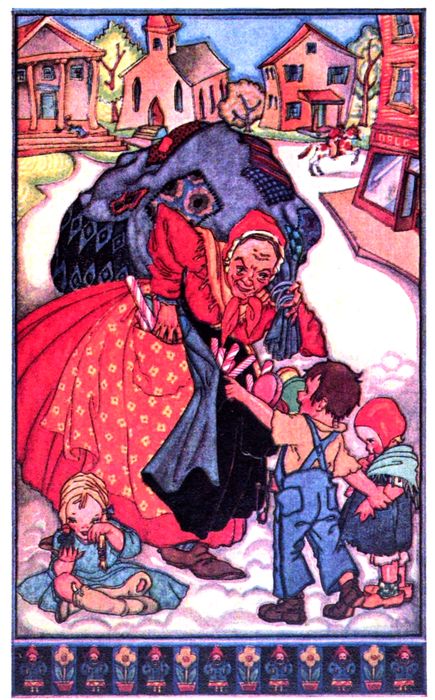
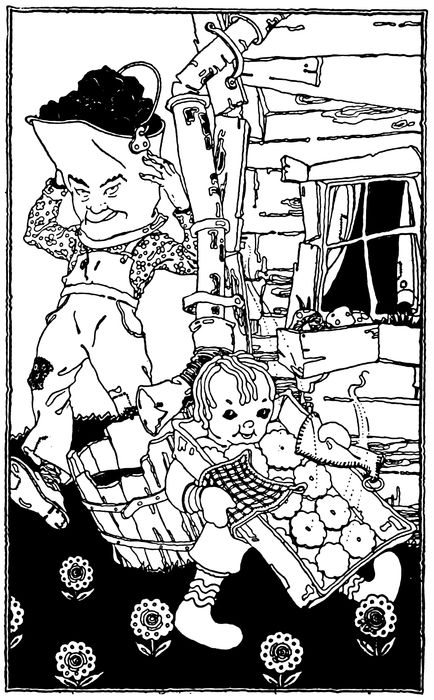
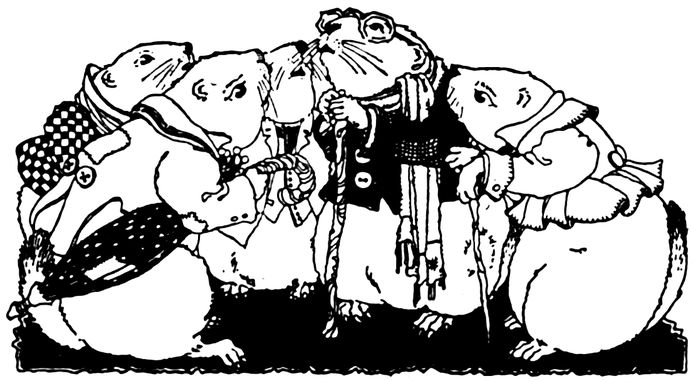
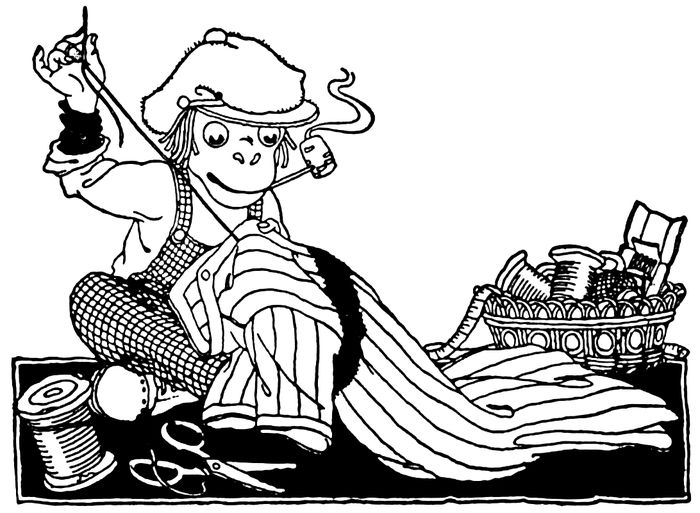
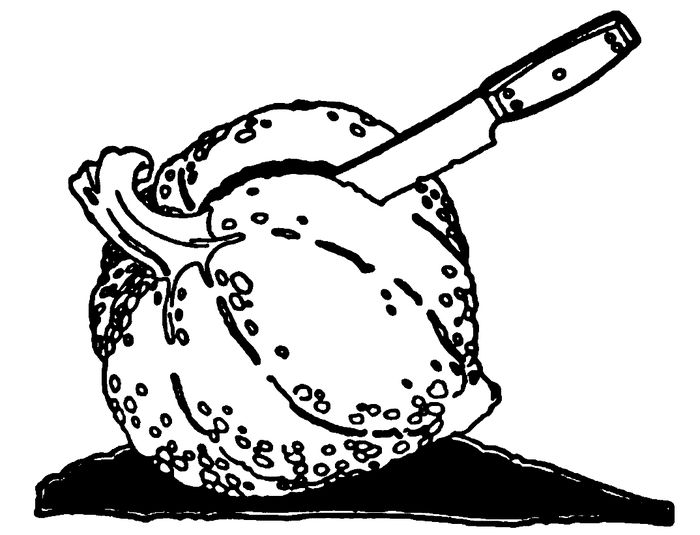
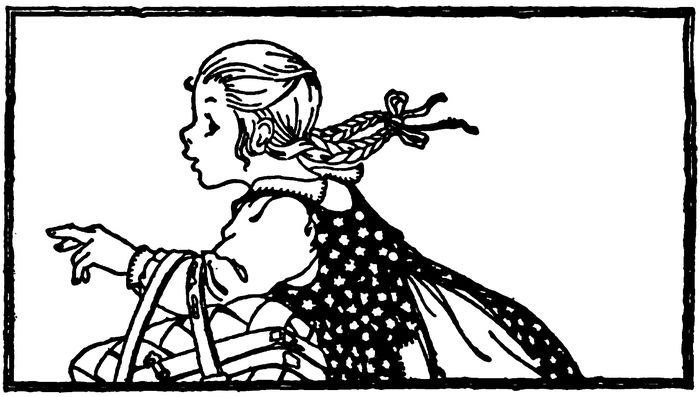
Rag Bag Mammy brings out candy with red and white stripes wrapped around it
BY
CARL SANDBURG
Author of “Rootabaga Stories,” “Slabs of the Sunburnt West,” “Smoke and Steel,” “Chicago Poems,” “Cornhuskers”
ILLUSTRATIONS AND DECORATIONS
BY
MAUD AND MISKA PETERSHAM
NEW YORK
HARCOURT, BRACE AND COMPANY
COPYRIGHT, 1923, BY
HARCOURT, BRACE AND COMPANY, INC.
PRINTED IN THE U. S. A. BY
THE QUINN & BODEN COMPANY
RAHWAY, N. J.
In compliance with current copyright law, LBS Archival Products produced this replacement volume on paper that meets the ANSI Standard Z39.48–1984 to replace the irreparably deteriorated original.
1992
♾™
To Three Illinois Pigeons
CONTENTS
v
1.
Two Stories Told by the Potato Face Blind Man
The Skyscraper to the Moon and How the Green Rat with the Rheumatism Ran a Thousand Miles Twice
1. Two Stories Told by the Potato Face Blind Man. — The Skyscraper to the Moon and How the Green Rat with the Rheumatism Ran a Thousand Miles Twice — Slipfoot and How He Nearly Always Never Gets What He Goes After
1
People:
Blixie Bimber
Blixie Bimber’s Mother
The Potato Face Blind Man
A Green Rat with the Rheumatism
Bricklayers
Mortar Men
Riveters
A Skyscraper
Slipfoot
A Stairway to the Moon
A Trapeze
3
Blixie Bimber’s mother was chopping hash.
And the hatchet broke. So Blixie started
downtown with fifteen cents to buy a new hash
hatchet for chopping hash.
Downtown she peeped around the corner
next nearest the postoffice where the Potato
Face Blind Man sat with his accordion. And
the old man had his legs crossed, one foot on
the sidewalk, the other foot up in the air.
4The foot up in the air had a green rat sitting
on it, tying the old man’s shoestrings in
knots and double knots. Whenever the old
man’s foot wiggled and wriggled the green
rat wiggled and wriggled.
The tail of the rat wrapped five wraps
around the shoe and then fastened and tied
like a package.
On the back of the green rat was a long
white swipe from the end of the nose to the
end of the tail. Two little white swipes stuck
up over the eyelashes. And five short thick
swipes of white played pussy-wants-a-corner
back of the ears and along the ribs of the
green rat.
They were talking, the old man and the
green rat, talking about alligators and why
the alligators keep their baby shoes locked up
in trunks over the winter time—and why the
rats in the moon lock their mittens in ice
boxes.
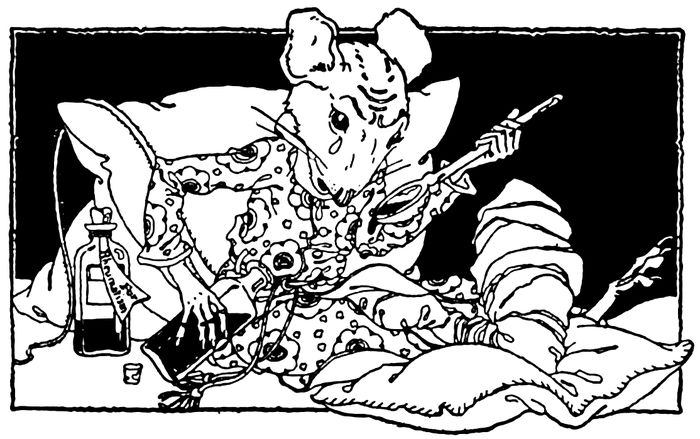
“I had the rheumatism last summer a year
5ago,” said the rat. “I had the rheumatism so
bad I ran a thousand miles south and west till
I came to the Egg Towns and stopped in the
Village of Eggs Up.”
“So?” quizzed the Potato Face.
“There in the Village of Eggs Up, they
asked me, ‘Do you know how to stop the moon
moving?’ I answered them, ‘Yes, I know
how—a baby alligator told me—but I told
the baby alligator I wouldn’t tell.’
“Many years ago there in that Village of
Eggs Up they started making a skyscraper to
go up till it reached the moon. They said,
‘We will step in the elevator and go up to the
roof and sit on the roof and eat supper on the
moon.’
“The bricklayers and the mortar men and
the iron riveters and the wheelbarrowers and
the plasterers went higher and higher making
that skyscraper, till at last they were half way
up to the moon, saying to each other while they
6worked, ‘We will step in the elevator and go
up to the roof and sit on the roof and eat
supper on the moon.’
“Yes, they were halfway up to the moon.
And that night looking at the moon they saw
it move and they said to each other, ‘We must
stop the moon moving,’ and they said later,
‘We don’t know how to stop the moon moving.’
“And the bricklayers and the mortar men
and the iron riveters and the wheelbarrowers
and the plasterers said to each other, ‘If we
go on now and make this skyscraper it will
miss the moon and we will never go up in the
elevator and sit on the roof and eat supper on
the moon.’
“So they took the skyscraper down and
started making it over again, aiming it straight
at the moon again. And one night standing
looking at the moon they saw it move and they
said to each other, ‘We must stop the moon
moving,’ saying later to each other, ‘We don’t
know how to stop the moon moving.’
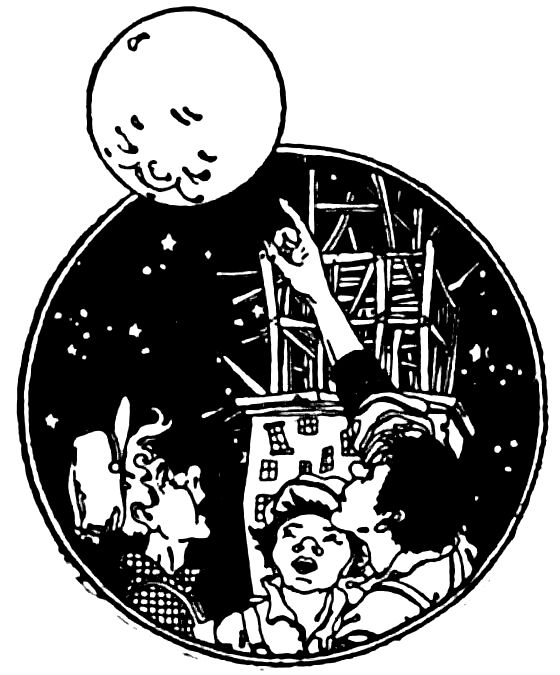
7“And now they stand in the streets at night
there in the Village of Eggs Up, stretching
their necks looking at the moon, and asking
each other, ‘Why does the moon move and
how can we stop the moon moving?’
“Whenever I saw them standing there
stretching their necks looking at the moon, I
had a zig-zag ache in my left hind foot and
I wanted to tell them what the baby alligator
told me, the secret of how to stop the moon
moving. One night that ache zig-zagged me
so—way inside my left hind foot—it zig-zagged
so I ran home here a thousand miles.”
The Potato Face Blind Man wriggled his
shoe—and the green rat wriggled—and the
long white swipe from the end of the nose to
the end of the tail of the green rat wriggled.
“Is your rheumatism better?” the old man
asked.
The rat answered, “Any rheumatism is
better if you run a thousand miles twice.”
8And Blixie Bimber going home with the
fifteen cent hash hatchet for her mother to
chop hash, Blixie said to herself, “It is a large
morning to be thoughtful about.”
9
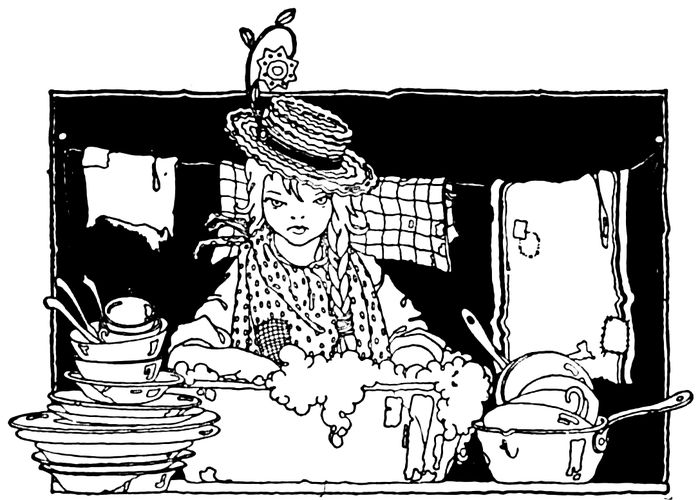
Blixie Bimber flipped out of the kitchen
one morning, first saying good-by to the dish-pan,
good-by to the dish-rag, good-by to the
dish-towel for wiping dishes.
Under one arm she put a basket of peonies
she picked, under the other arm she put a
basket of jonquils she picked.
Then she flipped away up the street and
downtown where she put the baskets of peonies
10and jonquils one on each side of the Potato
Face Blind Man.
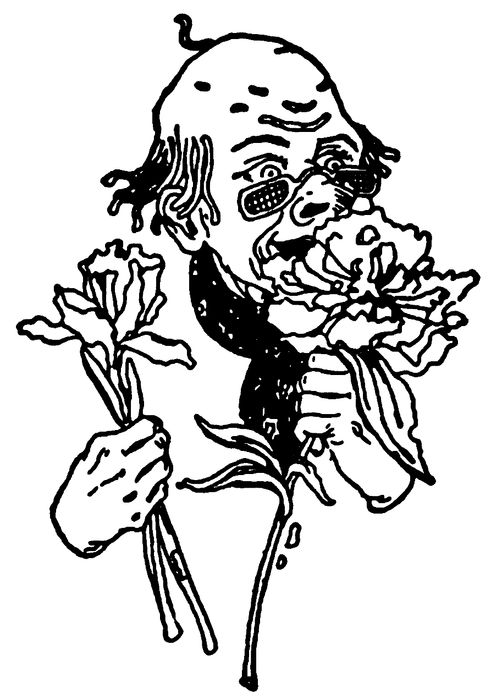
“I picked the pink and lavender peonies
and I picked the yellow jonquils for you to
be smelling one on each side of you this fine
early summer morning,” she said to the Potato
Face. “Have you seen anybody good to
see lately?”
“Slipfoot was here this morning,” said the
old man.
“And who is Slipfoot?” asked Blixie.
“I don’t know. He says to me, ‘I got a foot
always slips. I used to wash windows—and
my foot slips. I used to be king of the collar
buttons, king of a million dollars—and my
foot slips. I used to be king of the peanuts,
king of a million dollars again. I used to be
king of the oyster cans, selling a million cans
a day. I used to be king of the peanut sacks,
selling ten million sacks a day. And every
time I was a king my foot slips. Every time
I had a million dollars my foot slips. Every
time I went high and put my foot higher my
foot slips. Somebody gave me a slipfoot. I
always slip.’”
11
On the last step of the stairway my foot slips
13“So you call him Slipfoot?” asked Blixie.
“Yes,” said the old man.
“Has he been here before?”
“Yes, he was here a year ago, saying, ‘I
marry a woman and she runs away. I run
after her—and my foot slips. I always get
what I want—and then my foot slips.’
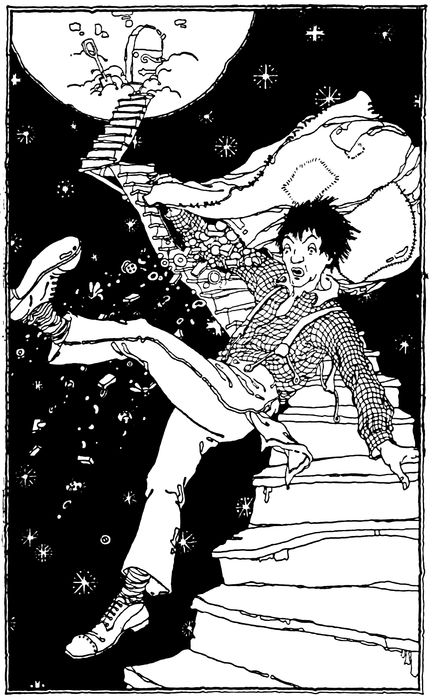
“I ran up a stairway to the moon one night.
I shoveled a big sack full of little gold beans,
little gold bricks, little gold bugs, on the moon
and I ran down the stairway from the moon.
On the last step of the stairway, my foot slips—and
all the little gold beans, all the little
gold bricks, all the little gold bugs, spill out
and spill away. When I get down the stairway
I am holding the sack and the sack holds
nothing. I am all right always till my foot
slips.
“I jump on a trapeze and I go swinging,
14swinging, swinging out where I am going to
take hold of the rainbow and bring it down
where we can look at it close. And I hang by
my feet on the trapeze and I am swinging out
where I am just ready to take hold of the
rainbow and bring it down. Then my foot
slips.”
“What is the matter with Slipfoot?” asks
Blixie.
“He asks me that same question,” answered
the Potato Face Blind Man. “He asks me
that every time he comes here. I tell him all
he needs is to get his slipfoot fixed so it won’t
slip. Then he’ll be all right.”
“I understand you,” said Blixie. “You
make it easy. You always make it easy. And
before I run away will you promise me to
smell of the pink and lavender peonies and the
yellow jonquils all day to-day?”
“I promise,” said the Potato Face. “Promises
are easy. I like promises.”
“So do I,” said the little girl, “It’s promises
15pushing me back home to the dish-pan,
the dish-rag, and the dish-towel for wiping
dishes.”
“Look out you don’t get a slipfoot,” warned
the old man as the girl flipped up the street
going home.
2. Two Stories About Bugs and Eggs. — Many, Many Weddings in One Corner House — Shush Shush, the Big Buff Banty Hen Who Laid an Egg in the Postmaster’s Hat
17
People:
Little Bugs
Big Bugs
The Rag Doll
The Broom Handle
Hammer and Nails
The Hot Cookie Pan
The Ice Tongs
The Coal Bucket
The Bushel Basket
Jack Knife
Kindling Wood
Splinters
Shush Shush
The Postmaster
The Hardware Man
The Policeman
The Postmaster’s Hat
A Buff Banty Egg
19
There was a corner house with corners
every way it looked. And up in the corners
were bugs with little bug houses, bug doors to
open, bug windows to look out of.
In the summer time if the evening was cool
or in the winter time if the evening was warm,
they played games—bugs-up, bugs-down, run-bugs-run,
beans-bugs-beans.
This corner house was the place the Rag
20Doll and the Broom Handle came to after
their wedding. This was the same time those
old people, Hammer and Nails, moved into
the corner house with all the little Hammers
and all the little Nails.
So there they were, the young couple, the
Rag Doll and the Broom Handle, and that old
family, Hammer and Nails, and up in the
corners among the eave troughs and the roof
shingles, the bugs with little bug houses, bug
doors to open, bug windows to look out of, and
bug games—bugs-up, bugs-down, run-bugs-run,
or beans-bugs-beans.
Around the corner of the house every Saturday
morning came the Hot Cookie Pan with
a pan of hot cookies for Sunday, Monday,
Tuesday, Wednesday and the rest of the week.
The Ice Tongs came with ice, the Coal
Bucket came with coal, the Potato Sack came
with potatoes. And the Bushel Basket was
always going or coming and saying under his
breath, “Bushels, bushels, bushels.”
21
The Hot Cookie Pan came with a pan of hot cookies and the Coal Bucket with coal
23One day the bugs in the little bug houses
opened the bug doors and looked out of the bug
windows and said to each other, “They are
washing their shirts and sewing on buttons—there
is going to be a wedding.”
And the next day the bugs said, “They are
going to have a wedding and a wedding breakfast
for Jack Knife and Kindling Wood. They
are asking everybody in the kitchen, the cellar,
and the back yard, to come.”
The wedding day came. The people came.
From all over the kitchen, the cellar, the back
yard, they came. The Rag Doll and the
Broom Handle were there. Hammer and
Nails and all the little Hammers and all the
little Nails were there. The Ice Tongs, the
Coal Bucket, the Potato Sack, were all there—and
the Bushel Basket going and coming
and saying under his breath, “Bushels, bushels,
bushels.” And, of course, the Hot Cookie
Pan was there hopping up and down with hot
cookies.
24So Jack Knife and Kindling Wood began
living in the corner house. A child came.
They named her Splinters. And the Hot
Cookie Pan and Splinters met and kissed each
other and sat together in cozy corners close to
each other.
And the bugs high up in the corners in the
little bug houses, they opened the bug doors,
looked out of the bug windows and said, “They
are washing their shirts and sewing on buttons,
there is a wedding again—the Hot Cookie
Pan and Splinters.”
And now they have many, many children,
the Hot Cookie Pan and Splinters. Their
children have gone all over the world and
everybody knows them.
“Whenever you find a splinter or a sliver or
a shiny little shaving of wood in a hot cookie,”
the bugs in the little bug houses say, “whenever
you find a splinter or a sliver or a shiny
little shaving of wood in a hot cookie, it is the
child of the Hot Cookie Pan and the girl
25named Splinters, the daughter of Jack Knife
and Kindling Wood, who grew up and married
the Hot Cookie Pan.”
And sometimes if a little bug asks a big bug
a queer, quivvical, quizzical question hard to
answer, the big bug opens a bug door, looks
out of a bug window and says to the little bug,
“If you don’t believe what we tell you, go and
ask Hammer and Nails or any of the little
Hammers and Nails. Then run and listen to
the Bushel Basket going and coming and
saying under his breath, ‘Bushels, bushels,
bushels.’”
27
Shush Shush was a big buff banty hen. She
lived in a coop. Sometimes she marched out
of the coop and went away and laid eggs. But
always she came back to the coop.
And whenever she went to the front
door and laid an egg in the door-bell, she
rang the bell once for one egg, twice for
28two eggs, and a dozen rings for a dozen eggs.
Once Shush Shush went into the house of
the Sniggers family and laid an egg in the
piano. Another time she climbed up in the
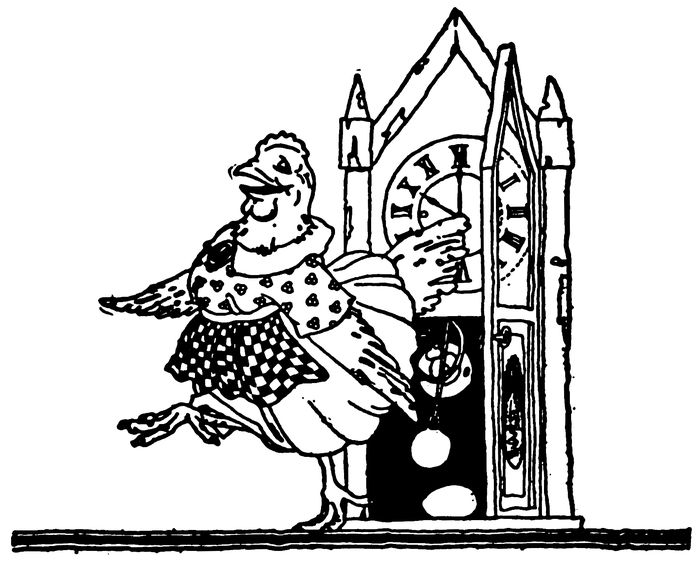
clock and laid an egg in the clock. But always
she came back to the coop.
One summer morning Shush Shush marched
out through the front gate, up to the next
corner and the next, till she came to the postoffice.
There she walked into the office of the
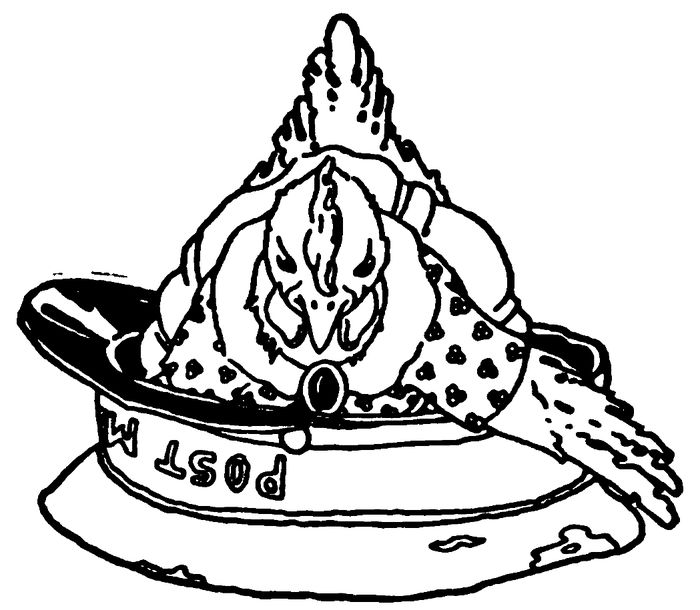
postmaster and laid an egg in the postmaster’s
hat.
The postmaster put on his hat, went to the
hardware store and bought a keg of nails. He
took off his hat and the egg dropped into the
keg of nails.
The hardware man picked up the egg, put
it in his hat, and went out to speak to a policeman.
He took off his hat, speaking to the
policeman, and the egg dropped on the sidewalk.
The policeman picked up the egg and put
29it in his police hat. The postmaster came
past; the policeman took off his police hat and
the egg dropped down on the sidewalk.
The postmaster said, “I lost that egg, it is
my egg,” picked it up, put it in his postmaster’s
hat, and forgot all about having an
egg in his hat.
Then the postmaster, a long tall man, came
to the door of the postoffice, a short small
door. And the postmaster didn’t stoop low,
didn’t bend under, so he bumped his hat and
his head on the top of the doorway. And the
egg broke and ran down over his face and
neck.
And long before that happened, Shush Shush
was home in her coop, standing in the door
saying, “It is a big day for me because I laid
one of my big buff banty eggs in the postmaster’s
hat.”
There Shush Shush stays, living in a coop.
Sometimes she marches out of the coop and
goes away and lays eggs in pianos, clocks,
30hats. But she always comes back to the coop.
And whenever she goes to the front door
and lays an egg in the door-bell, she rings the
bell once for one egg, twice for two eggs, and
a dozen rings for a dozen eggs.
3. Five Stories About Hatrack the Horse, Six Pigeons, Three Wild Babylonian Baboons, Six Umbrellas, Bozo the Button Buster. — How Rag Bag Mammy Kept Her Secret While the Wind Blew Away the Village of Hat Pins — How Six Pigeons Came Back to Hatrack the Horse After Many Accidents and Six Telegrams — How the Three Wild Babylonian Baboons Went Away in the Rain Eating Bread and Butter — How Six Umbrellas Took Off Their Straw Hats to Show Respect to the One Big Umbrella — How Bozo the Button Buster Busted All His Buttons When a Mouse Came
31
People:
Hatrack the Horse
Peter Potato Blossom Wishes
Rag Bag Mammy
Gimmes
Wiffle the Chick
Chickamauga
Chattanooga
Chattahoochee
Blue Mist
Bubbles
Wednesday Evening in the Twilight and the Gloaming
Telegrams
The Three Wild Babylonian Baboons
Three Umbrellas
The Night Policeman
Six Umbrellas
The Big Umbrella
Straw Hats
Dippy the Wisp
Bozo the Button Buster
A Mouse
Deep Red Roses
The Beans Are Burning
Sweeter Than the Bees Humming
33
There was a horse-face man in the Village
of Cream Puffs. People called him Hatrack
the Horse.
The skin stretched tight over his bones.
Once a little girl said, “His eyes look like
lightning bugs lighting up the summer night
coming out of two little doors.”
When Hatrack the Horse took off his hat
he reached his hand around behind and hung
the hat on a shoulder bone sticking out.
34When he wanted to put on his hat he
reached his hand around and took it off from
where it was hanging on the shoulder bone
sticking out behind.
One summer Hatrack said to Peter Potato
Blossom Wishes, “I am going away up north
and west in the Rootabaga Country to see the
towns different from each other. Then I will
come back east as far as I went west, and south
as far as I went north, till I am back again
where my little pal, Peter Potato Blossom
Wishes, lives in the Village of Cream Puffs.”
So he went away, going north and west and
coming back east and south till he was back
again in his home town, sitting on the front
steps of his little red shanty, fixing a kite to fly.
“Are you glad to come back?” asked Peter.
“Yes, this is home, this is the only place
where I know how the winds act up so I can
talk to them when I fly a kite.”
“Tell me what you saw and how you listened
35and if they handed you any nice packages.”
“They handed me packages, all right, all
right,” said Hatrack the Horse.
“Away far to the west I came to the Village
of Hat Pins,” he went on. “It is the place
where they make all the hat pins for the hats
to be pinned on in the Rootabaga Country.
They asked me about the Village of Cream
Puffs and how the winds are here because the
winds here blow so many hats off that the Village
of Hat Pins sells more hat pins to the
people here than anywhere else.
“There is an old woman in the Village of
Hat Pins. She walks across the town and
around the town every morning and every
afternoon. On her back is a big rag bag. She
never takes anything out of the rag bag. She
never puts anything in. That is, nobody ever
sees her put anything in or take anything out.
She has never opened the rag bag telling people
to take a look and see what is in it. She sleeps
36with the rag bag for a pillow. So it is always
with her and nobody looks into it unless she
lets them. And she never lets them.
“Her name? Everybody calls her Rag Bag
Mammy. She wears aprons with big pockets.
And though she never speaks to big grown-up
people she is always glad to meet little growing
people, boys and girls. And especially, most
of all, she likes to meet boys and girls who say,
‘Gimme’ (once, like that) or ‘Gimme, gimme’
(twice, like that) or ‘Gimme, gimme, gimme’
(three times) or ‘Gimme, gimme, gimme,
gimme, gimme, gimme’ (more times than we
can count). She likes to meet the gimmes
because she digs into her pockets and brings
out square chocolate drops and round chocolate
drops and chocolate drops shaped like a half
moon, barber pole candy with red and white
stripes wrapped around it, all day suckers so
long they last not only all day but all this week
and all next week, and different kinds of jackstones,
some that say chink-chink on the sidewalks
37and some that say teentsy-weentsy chink-chink
when they all bunch together on the
sidewalk. And sometimes if one of the
gimmes is crying and feeling bad she gives the
gimme a doll only as big as a child’s hand but
the doll can say the alphabet and sing little
Chinese Assyrian songs.
“Of course,” said Hatrack the Horse, reaching
his hand around to see if his hat was
hanging on behind, “of course, you have to
have sharp ears and listen close-up and be nice
when you are listening, if you are going to
hear a doll say the alphabet and sing little
Chinese Assyrian songs.”
“I could hear them,” said Peter Potato
Blossom Wishes. “I am a nice listener. I
could hear those dolls sing the little Chinese
Assyrian songs.”
“I believe you, little pal of mine,” said
Hatrack. “I know you have the ears and you
know how to put your ears so you hear.”
“Of course, every morning and every afternoon
38when Rag Bag Mammy walks across the
town and around the town in the Village of
Hat Pins, people ask her what is in the rag
bag on her back. And she answers, ‘It is a nice
day we are having,’ or ‘I think the rain will
stop when it stops raining, don’t you?’ Then
if they ask again and beg and plead, ‘What is
in the rag bag? What is in the rag bag?’ she
tells them, ‘When the wind blows away the
Village of Hat Pins and blows it so far away
it never comes back, then—then, then, then—I
will tell you what is in the rag bag.’”
“One day the wind came along and blew the
Village of Hat Pins loose, and after blowing
it loose, carried it high off in the sky. And
the people were saying to each other, ‘Well,
now we are going to hear Rag Bag Mammy
tell us what is in the rag bag.’
“And the wind kept blowing, carrying the
Village of Hat Pins higher and farther and
farther and higher. And when at last it went
away so high it came to a white cloud, the hat
39pins in the village all stuck out and fastened
the village to the cloud so the wind couldn’t
blow it any farther.
“And—after a while they pulled the hatpins
out of the cloud—and the village dropped
back right down where it was before.
“And Rag Bag Mammy goes every morning
and every afternoon with the rag bag on
her back across and around the town. And
sometimes people say to her, ‘The next time
the wind blows us away—the next time the
wind will blow us so far there won’t be any
cloud to fasten hat pins in—and you will have
to tell us what is in the rag bag.’ And Rag
Bag Mammy just answers, ‘Yes, yes—yes—yes,’
and goes on her way looking for the next
boy or girl to say, ‘Gimme’ (once, like that)
or ‘Gimme, gimme’ (twice, like that) or
‘Gimme, gimme, gimme, gimme, gimme’
(more times than we can count).
“And if a child is crying she digs into her
pockets and pulls out the doll that says the
40alphabet and sings little Chinese Assyrian
songs.”
“And,” said Peter Potato Blossom Wishes,
“you have to listen close up with your ears and
be nice when you are listening.”
“In the Village of Hat Pins that the wind
nearly blew away forever,” said Hatrack the
Horse.
And Peter Potato Blossom Wishes skipped
away down from the little red shanty, skipped
down the street, and then began walking slow
saying to herself, “I love Hatrack the Horse
like a grand uncle—his eyes look like lightning
bugs lighting up the summer night coming
out of two little doors.”
41
Six crooked ladders stood against the front
of the shanty where Hatrack the Horse lived.
Yellow roses all on fire were climbing up
and down the ladders, up and down and crossways.
And leaning out on both sides from the
crooked ladders were vines of yellow roses,
leaning, curving, nearly falling.
Hatrack the Horse was waiting. This was
the morning Wiffle the Chick was coming.
42“Sit here on the cracker box and listen,” he
said to her when she came; “listen and you
will hear the roses saying, ‘This is climbing
time for all yellow roses and climbing time is
the time to climb; how did we ever learn to
climb only by climbing? Listen and you will
hear—st..th..st..th..st..th..it is the feet
of the yellow roses climbing up and down and
leaning out and curving and nearly falling
..st..th..st..th..’”
So Wiffle the Chick sat there, early in the
summer, enjoying herself, sitting on a cracker
box, listening to the yellow roses climb around
the six crooked ladders.
Hatrack the Horse came out. On his
shoulders were two pigeons, on his hands two
pigeons. And he reached his hand around
behind his back where his hat was hanging
and he opened the hat and showed Wiffle the
Chick two pigeons in the hat.
“They are lovely pigeons to look at and their
43eyes are full of lessons to learn,” said Wiffle
the Chick. “Maybe you will tell me why you
have their feet wrapped in bandages, hospital
liniment bandages full of hospital liniment
smells? Why do you put soft mittens on the
feet of these pigeons so lovely to look at?”
“They came back yesterday, they came back
home,” was the answer. “They came back
limping on their feet with the toes turned in
so far they nearly turned backward. When
they put their bleeding feet in my hands one
by one each one, it was like each one was writing
his name in my hand with red ink.”
“Did you know they were coming?” asked
Wiffle.
“Every day the last six days I get a telegram,
six telegrams from six pigeons—and at
last they come home. And ever since they
come home they are telling me they come because
they love Hatrack the Horse and the
yellow climbing roses climbing over the six
crooked ladders.”
44“Did you name your pigeons with names?”
asked Wiffle.
“These three, the sandy and golden brown,
all named themselves by where they came
from. This is Chickamauga, here is Chattanooga,
and this is Chattahoochee. And the
other three all got their names from me when
I was feeling high and easy. This is Blue
Mist, here is Bubbles, and last of all take a
look at Wednesday Evening in the Twilight
and the Gloaming.”
“Do you always call her Wednesday Evening
in the Twilight and the Gloaming?”
“Not when I am making coffee for breakfast.
If I am making coffee for breakfast
then I just call her Wednesday Evening.”
“Didn’t you tie the mittens on her feet extra
special nice?”
“Yes—she is an extra special nice pigeon.
She cries for pity when she wants pity. And
she shuts her eyes when she doesn’t want to
look at you. And if you look deep in her eyes
45when her eyes are open you will see lights
there exactly like the lights on the pastures
and the meadows when the mist is drifting on
a Wednesday evening just between the twilight
and the gloaming.
“A week ago yesterday they all went away.
And they won’t tell why they went away.
Somebody clipped their wings, cut off their
flying feathers so they couldn’t fly—and they
won’t tell why. They were six hundred miles
from home—but they won’t tell how they
counted the six hundred miles. A hundred
miles a day they walked, six hundred miles in
a week, and they sent a telegram to me every
day, one writing a telegram one day and another
writing a telegram the next day—all the
time walking a hundred miles a day with their
toes turned in like pigeon toes turn in. Do
you wonder they needed bandages, hospital
liniment bandages on their feet—and soft
mittens?”
“Show me the telegrams they sent you, one
46every day, for six days while they were walking
six hundred miles on their pigeon toes.”
So Hatrack the Horse got the six telegrams.
The reading on the telegrams was like this:
1. “Feet are as good as wings if you have
to. Chickamauga.”
2. “If you love to go somewhere it is easy
to walk. Chattanooga.”
3. “In the night sleeping you forget
whether you have wings or feet or neither.
Chattahoochee.”
4. “What are toes for if they don’t point
to what you want? Blue Mist.”
5. “Anybody can walk hundreds of miles
putting one foot ahead of the other.
Bubbles.”
6. “Pity me. Far is far. Near is near.
And there is no place like home when the
yellow roses climb up the ladders and sing in
the early summer. Pity me. Wednesday
Evening in the Twilight and the
Gloaming.”
47“Did they have any accidents going six hundred
miles walking with their little pigeon
toes turned in?” asked Wiffle.
“Once they had an accident,” said Hatrack,
with Chattahoochee standing in his hat,
Chickamauga on his right shoulder, Chattanooga
on his left, and holding Blue Mist and
Bubbles on his wrists. “They came to an old
wooden bridge. Chattahoochee and Wednesday
Evening both cried out, ‘The bridge will
fall if we all walk on it the same time!’ But
they were all six already on the bridge and
the bridge began sagging and tumbled them all
into the river. But it was good for them all
to have a footbath for their feet, Wednesday
Evening explained.”
“I got a suspicion you like Wednesday
Evening in the Twilight and the Gloaming
best of all,” spoke up Wiffle.
“Well, Wednesday Evening was the only
one I noticed making any mention of the yellow
roses in her telegram,” Hatrack the
48Horse explained, as he picked up Wednesday
Evening and reached her around and put her
to perch on the shoulder bone on his back.
Then the old man and the girl sat on the
cracker box saying nothing, only listening to
the yellow roses all on fire with early summer
climbing up the crooked ladders, up and down
and crossways, some of them leaning out and
curving and nearly falling.
49
One morning when Hatrack the Horse
went away from his shanty, he put three umbrellas
in the corner next to the front door.
His pointing finger pointed at the three
umbrellas as he said, “If the three wild
Babylonian Baboons come sneaking up to this
50shanty and sneaking through the door and
sneaking through the house, then all you three
umbrellas open up like it was raining, jump
straight at the baboons and fasten your handles
in their hands. Then, all three of you stay
open as if it was raining—and hold those
handles in the hands of the baboons and never
let go till I come.”
Hatrack the Horse went away. The three
umbrellas stood in the corner next to the front
door. And when the umbrellas listened they
could hear the three wild Babylonian Baboons
sneaking up to the shanty. Soon the baboons,
all hairy all over, bangs down their foreheads,
came sneaking through the door. Just as they
were sneaking through the door they took off
their hats to show they were getting ready to
sneak through the house.
Then the three umbrellas in the corner
opened up as if it was raining; they jumped
straight at the three wild Babylonian Baboons;
51and they fastened their handles tight in the
hands of the baboons and wouldn’t let go.
So there were the three wild Babylonian
Baboons, each with a hat in his left hand, and
an open umbrella in his right hand.
When Hatrack the Horse came home he
came, quiet. He opened the front door, quiet.
Then he looked around inside the house, quiet.
In the corner where he had stood the three
umbrellas, he saw the three wild Babylonian
Baboons on the floor, sleeping, with umbrellas
over their faces.
“The umbrellas were so big they couldn’t
get through the door,” said Hatrack the
Horse. For a long time he stood looking at
the bangs hanging down the foreheads of the
baboons while they were sleeping. He took a
comb and combed the bangs down the foreheads
of the baboons. He went to the cupboard
and spread bread and butter. He took
the hats out of the left hands of the baboons
52and put the hats on their heads. He put a
piece of bread and butter in the hand of each
baboon.
After that he snipped each one across the
nose with his finger (snippety-snip! just like
that). They opened their eyes and stood up.
Then he loosened the umbrella handles from
their right hands and led them to the door.
They all looked out. It was raining.
“Now you can go,” he told the baboons.
And they all walked out of the front door, and
they seemed to be snickering and hiding the
snickers.
The last he saw of them they were walking
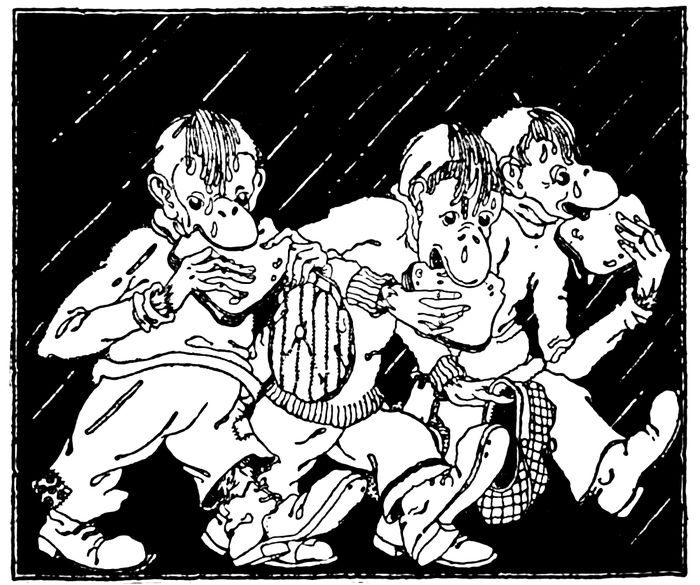
away in the rain eating bread and butter.
And they took off their hats so the rain ran
down and slid off on the bangs of their foreheads.
Hatrack the Horse turned to the umbrellas
and said, “We know how to make a surprise
party when we get a visit from the Babylonian
53Baboons with their bangs falling down their
foreheads—don’t we?”
That is what happened, as Hatrack the
Horse told it to the night policeman in the
Village of Cream Puffs.
55
Wherever Dippy the Wisp went she was
always changing hats. She carried two hat
boxes with big picture hats on her right arm.
And she carried two hat boxes with big picture
hats on her left arm. And she changed from
56green and gold hats to purple and gray hats
and then back to green and gold whenever she
felt like it.
Now the hill that runs down from the
shanty of Hatrack the Horse toward the Village
of Cream Puffs is a long, long hill. And
one morning the old man sat watching and
away down at the bottom of the long, long
hill he saw four hat boxes. Somebody was
coming to call on him. And he knew it was
Dippy the Wisp.
The hat boxes came up the hill. He saw
them stop once, stop twice, stop more times.
So he knew Dippy the Wisp was changing
hats, changing from green and gold to purple
and gray and then back to green and gold.
When at last she got to the top of the hill
and came to the shanty of Hatrack the Horse,
she said to him, “Make up a story and tell me.
Make up the story about umbrellas. You have
traveled all over the Rootabaga Country, you
have seen so many umbrellas, and such wonderful
57umbrellas. Make me up a big elegant
story about umbrellas.”
So Hatrack the Horse took his hat off his
head, reached around and hung it on one of
the shoulder bones sticking out behind on his
back. And the old man looked with a faraway
look down the long, long hill running
from his shanty toward the Village of Cream
Puffs. Then he told her this story:
One summer afternoon I came home and
found all the umbrellas sitting in the kitchen,
with straw hats on, telling each other who
they are.
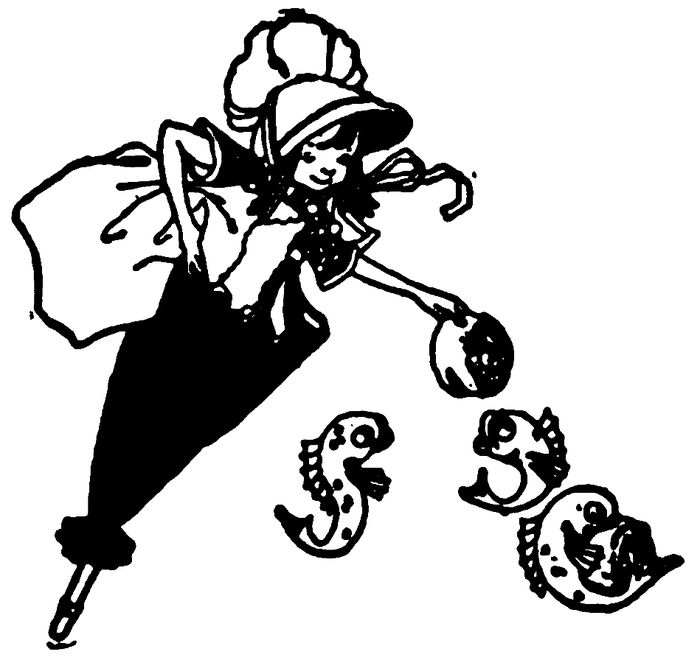
The umbrella that feeds the fishes fresh
buns every morning stood up and said, “I am
the umbrella that feeds the fishes fresh buns
every morning.”
The umbrella that fixes the clocks free of
charge stood up and said, “I am the umbrella
that fixes the clocks free of charge.”
The umbrella that peels the potatoes with a
58pencil and makes a pink ink with the peelings,
stood up and said, “I am the umbrella that
peels the potatoes with a pencil and makes a
pink ink with the peelings.”
The umbrella that eats the rats with pepper
and salt and a clean napkin every morning,
stood up and said, “I am the umbrella that
eats the rats with pepper and salt and a clean
napkin every morning.”
The umbrella that washes the dishes with a
wiper and wipes the dishes with a washer
every morning stood up and said, “I am the
umbrella that washes the dishes with a wiper
and wipes the dishes with a washer every
morning.”
The umbrella that covers the chimney with
a dish-pan before it rains stood up and said, “I
am the umbrella that covers the chimney with
a dish-pan before it rains.”
The umbrella that runs to the corner to get
corners for the handkerchiefs stood up and
59said, “I am the umbrella that runs to the
corner to get corners for the handkerchiefs.”
Now while the umbrellas are all sitting in
the kitchen with their straw hats on telling
each other who they are, there comes a big
black stranger of an umbrella, walking into
the kitchen without opening the door, walking
in without knocking, without asking anybody,
without telling anybody beforehand.
“Since we are telling each other who we
are,” said the stranger, “since we are telling
each other who we are, I am going to tell you
who I am.
“I am the umbrella that holds up the sky.
I am the umbrella the rain comes through. I
am the umbrella that tells the sky when to
begin raining and when to stop raining.
“I am the umbrella that goes to pieces when
the wind blows and then puts itself together
again when the wind goes down. I am the
first umbrella, the last umbrella, the one and
60only umbrella all other umbrellas are named
after, first, last and always.”
When the stranger finished this speech telling
who he was and where he came from, all
the other umbrellas sat still for a little while,
to be respectful.
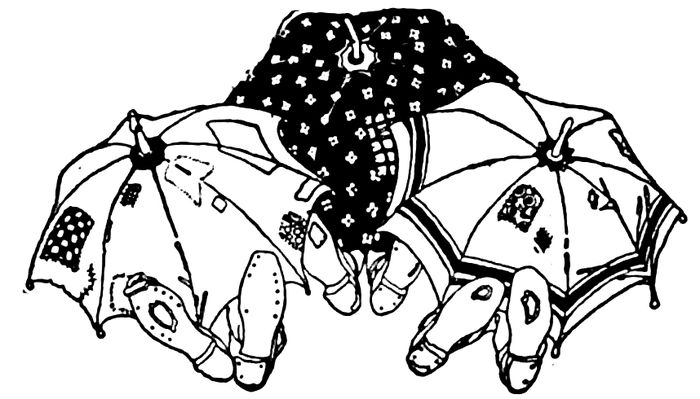
Then they all got up, took off their straw
hats, walked up to the stranger and laid those
straw hats at his feet. They wanted to show
him they had respect for him. Then they all
walked out, first the umbrella that feeds the
fishes fresh buns every morning, then the
umbrella that fixes the clocks free of charge,
then the umbrella that peels the potatoes with
a pencil and makes pink ink with the peelings,
then the umbrella that eats the rats with
pepper and salt and a clean napkin, then the
umbrella that washes the dishes with a wiper
and wipes the dishes with a washer, then the
umbrella that covers the chimney with a dish-pan
before it rains, then the umbrella that
61runs to the corner to get corners for the handkerchiefs.
They all laid their straw hats at
the feet of the stranger because he came without
knocking or telling anybody beforehand
and because he said he is the umbrella that
holds up the sky, that big umbrella the rain
goes through first of all, the first and the last
umbrella.
That was the way Hatrack the Horse finished
his story for Dippy the Wisp. She was
changing hats, getting ready to go.
The old man put his loose bony arms around
her and kissed her for a good-by. And she
put her little dimpled arms around his neck
and kissed him for a good-by.
And the last he saw of her that day she was
walking far away down at the bottom of the
long, long hill that stretches from Hatrack’s
shanty toward the Village of Cream Puffs.
And twice going down the long hill she
62stopped and changed hats, opening and shutting
the hat boxes, and changing hats from
green and gold to purple and gray and back
to green and gold.
63
One summer evening the stars in the summer
sky seemed to be moving with fishes, cats
and rabbits.
It was that summer evening three girls
came to the shanty of Hatrack the Horse.
He asked each one, “What is your name?”
And they answered, first, “Me? My name is
Deep Red Roses”; second, “Me? My name
is The Beans are Burning”; and last of all,
“Me? My name is Sweeter Than the Bees
Humming.”
64And the old man fastened a yellow rose for
luck in the hair of each one and said, “You
ought to be home now.”
“After you tell us a story,” they reminded
him.
“I can only tell you a sad story all mixed
up to-night,” he reminded them, “because all
day to-day I have been thinking about Bozo
the Button Buster.”
“Tell us about Bozo the Button Buster,”
said the girls, feeling in their hair and fixing
the yellow roses.
The old man sat down on the front steps.
His eyes swept away off toward a corner of
the sky heavy with mist where it seemed to be
moving with firetails, fishes, cats, and rabbits
of slow changing stars.
“Bozo had buttons all over him,” said the
old man, “the buttons on Bozo fitted so tight,
and there were so many buttons, that sometimes
when he took his lungs full of new wind to go
65on talking a button would bust loose and fly
into the face of whoever he was speaking to.
Sometimes when he took new wind into his
lungs two buttons would bust loose and fly into
the faces of two people he was speaking to.
“So people said, ‘Isn’t it queer how buttons
fly loose when Bozo fills his lungs with wind
to go on speaking?’ After a while everybody
called him Bozo the Button Buster.
“Now, you must understand, Bozo was different
from other people. He had a string
tied to him. It was a long string hanging
down with a knot in the end. He used to
say, ‘Sometimes I forget where I am; then I
feel for the string tied to me, and I follow the
string to where it is tied to me; then I know
where I am again.’
“Sometimes when Bozo was speaking and a
button busted loose, he would ask, ‘Was that
a mouse? Was that a mouse?’ And sometimes
he said to people, ‘I’ll talk with you—if
you haven’t got a mouse in your pocket.’
66“The last day Bozo ever came to the Village
of Cream Puffs, he stood on the public
square and he was all covered with buttons,
more buttons than ever before, and all the buttons
fitting tight, and five, six buttons busting
loose and flying into the air whenever he took
his lungs full of wind to go on speaking.
“‘When the sky began to fall who was it
ran out and held up the sky?’ he sang out.
‘It was me, it was me ran out and held up the
sky when the sky began to fall.’
“‘When the blue came off the sky, where
did they get the blue to put on the sky to make
it blue again? It was me, it was me picked
the bluebirds and the blue pigeons to get the
blue to fix the sky.’
“‘When it rains now it rains umbrellas first
so everybody has an umbrella for the rain
afterward. Who fixed that? I did—Bozo
the Button Buster.’
“‘Who took the rainbow off the sky and put
it back again in a hurry? That was me.’
67
The mouse bit the knot and cut it loose
69“‘Who turned all the barns upside down
and then put them right side up again? I did
that.’
“‘Who took the salt out of the sea and put
it back again? Who took the fishes out of the
sea and put them back again? That was me.’
“‘Who started the catfish fighting the cats?
Who made the slippery elms slippery? Who
made the King of the Broken Bottles a wanderer
wandering over the world mumbling,
“Easy, easy”? Who opened the windows of
the stars and threw fishes, cats and rabbits all
over the frames of the sky? I did, I did,
I did.’
“All the time Bozo kept on speaking the
buttons kept on busting because he had to stop
so often to fill his lungs with new wind to go
on speaking. The public square was filled
with piles of buttons that kept busting off
from Bozo the Button Buster that day.
“And at last a mouse came, a sneaking, slippery,
quick little mouse. He ran with a flash
70to the string tied to Bozo, the long string hanging
down with a knot in the end. He bit the
knot and cut it loose. He slit the string with
his teeth as Bozo cried, ‘Ai! Ai! Ai!’
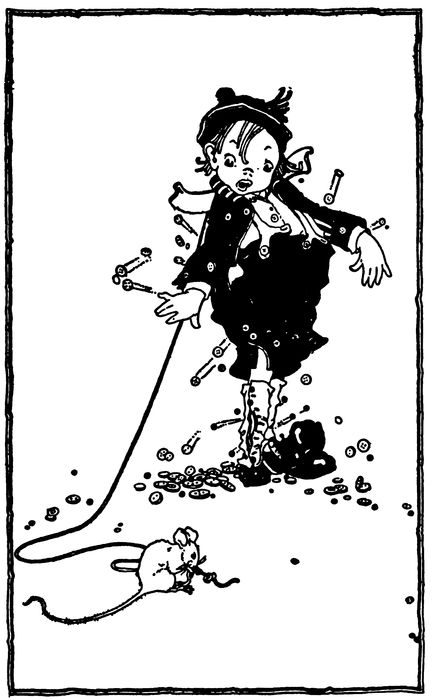
“The last of all the buttons busted loose off
Bozo. The clothes fell off. The people came
up to see what was happening to Bozo. There
was nothing in the clothes. The man inside
the clothes was gone. All that was left was
buttons and a few clothes.
“Since then whenever it rains umbrellas
first so everybody has an umbrella for the rain
afterward, or if the sky looks like it is falling,
or if a barn turns upside down, or if the King
of the Broken Bottles comes along mumbling
‘Easy, easy,’ or if firetails, fishes, cats and rabbits
come on the sky in the night, or if a button
busts loose and flies into somebody’s face, people
remember Bozo the Button Buster.”
When the three girls started home, each one
71said to Hatrack the Horse, “It looks dark and
lonesome on the prairie, but you put a yellow
rose in my hair for luck—and I won’t be
scared after I get home.”
4. Two Stories About Four Boys Who Had Different Dreams. — How Googler and Gaggler, the Two Christmas Babies, Came Home with Monkey Wrenches — 1 — 2 — How Johnny the Wham Sleeps in Money All the Time and Joe the Wimp Shines and Sees Things
73
People:
Googler
Gaggler
Twins
The Family Doctor
The Father of the Twins
The Mother of the Twins
Pen Wipers and Pencil Sharpeners
Smokestacks and Monkey Wrenches
Monkey Faces on the Monkey Wrenches
Left-Handed Monkey Wrenches
Potato Face Blind Man
Ax Me No Questions
Johnny the Wham
Joe the Wimp
Grasshoppers
Thousand Dollar Bills
Brass Doors
Lizzie Lazarus
75
Two babies came one night in snowstorm
weather, came to a tar paper shack on a cinder
patch next the railroad yards on the edge of
the Village of Liver-and-Onions.
The family doctor came that night, came
with a bird of a spizz car throwing a big spotlight
of a headlight through the snow of the
snowstorm on the prairie.
“Twins,” said the doctor. “Twins,” said
76the father and mother. And the wind as it
shook the tar paper shack and shook the doors
and the padlocks on the doors of the tar paper
shack, the wind seemed to be howling softly,
“Twins, twins.”
Six days and Christmas Eve came. The
mother of the twins lit two candles, two little
two-for-a-nickel candles in each little window.
And the mother handed the father the twins
and said, “Here are your Christmas presents.”
The father took the two baby boys and laughed,
“Twice times twice is twice.”
The two little two-for-a-nickel candles sputtered
in each little window that Christmas
Eve, and at last sputtered and went out, leaving
the prairies dark and lonesome. The
father and the mother of the twins sat by the
window, each one holding a baby.
Every once in a while they changed babies
so as to hold a different twin. And every time
they changed they laughed at each other,
“Twice times twice is twice.”
77One baby was called Googler, the other
Gaggler. The two boys grew up, and hair
came on their bald red heads. Their ears, wet
behind, got dry. They learned how to pull on
their stockings and shoes and tie their shoestrings.
They learned at last how to take a
handkerchief and hold it open and blow their
noses.
Their father looked at them growing up
and said, “I think you’ll make a couple of
peanut-wagon men pouring hot butter into
popcorn sacks.”
The family doctor saw the rashes and the
itches and the measles and the whooping cough
come along one year and another. He saw the
husky Googler and the husky Gaggler throw
off the rashes and the itches and the measles
and the whooping cough. And the family
doctor said, “They will go far and see much,
and they will never be any good for sitting
with the sitters and knitting with the knitters.”
Googler and Gaggler grew up and turned
78handsprings going to school in short pants,
whistling with school books under their arms.
They went barefooted and got stickers in their
hair and teased cats and killed snakes and
climbed apple trees and threw clubs up walnut
trees and chewed slippery ellum. They
stubbed their toes and cut their feet on broken
bottles and went swimming in brickyard ponds
and came home with their backs sunburnt so
the skin peeled off. And before they went to
bed every night they stood on their heads and
turned flip-flops.
One morning early in spring the young
frogs were shooting silver spears of little new
songs up into the sky. Strips of fresh young
grass were beginning to flick the hills and spot
the prairie with flicks and spots of new green.
On that morning, Googler and Gaggler went
to school with fun and danger and dreams in
their eyes.
They came home that day and told their
mother, “There is a war between the pen
79wipers and the pencil sharpeners. Millions of
pen wipers and millions of pencil sharpeners
are marching against each other, marching
and singing, Hayfoot, strawfoot, bellyful o’
bean soup. The pen wipers and the pencil
sharpeners, millions and millions, are marching
with drums, drumming, Ta rum, ta rum, ta
rum tum tum. The pen wipers say, No matter
how many million ink spots it costs and no
matter how many million pencil sharpeners
we kill, we are going to kill and kill till the
last of the pencil sharpeners is killed. The
pencil sharpeners say, No matter how many
million shavings it costs, no matter how many
million pen wipers we kill, we are going to
kill and kill till the last of the pen wipers is
killed.”
The mother of Googler and Gaggler listened,
her hands folded, her thumbs under her
chin, her eyes watching the fun and the danger
and the dreams in the eyes of the two boys.
And she said, “Me, oh, my—but those pen
80wipers and pencil sharpeners hate each other.”
And she turned her eyes toward the flicks and
spots of new green grass coming on the hills
and the prairie, and she let her ears listen to
the young frogs shooting silver spears of little
songs up into the sky that day.
And she told her two boys, “Pick up your
feet now and run. Go to the grass, go to the
new green grass. Go to the young frogs and
ask them why they are shooting songs up into
the sky this early spring day. Pick up your
feet now and run.”
At last Googler and Gaggler were big boys,
big enough to pick the stickers out of each
other’s hair, big enough to pick up their feet
and run away from anybody who chased them.
81
They went to sleep on top of the wagon
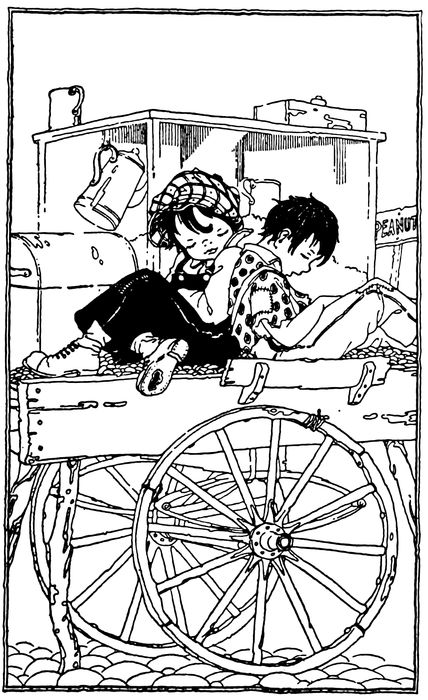
83One night they turned flip-flops and handsprings
and climbed up on top of a peanut
wagon where a man was pouring hot butter
into popcorn sacks. They went to sleep on top
of the wagon. Googler dreamed of teasing
cats, killing snakes, climbing apple trees and
stealing apples. Gaggler dreamed of swimming
in brickyard ponds and coming home
with his back sunburnt so the skin peeled
off.
They woke up with heavy gunnysacks in
their arms. They climbed off the wagon and
started home to their father and mother lugging
the heavy gunnysacks on their backs.
And they told their father and mother:
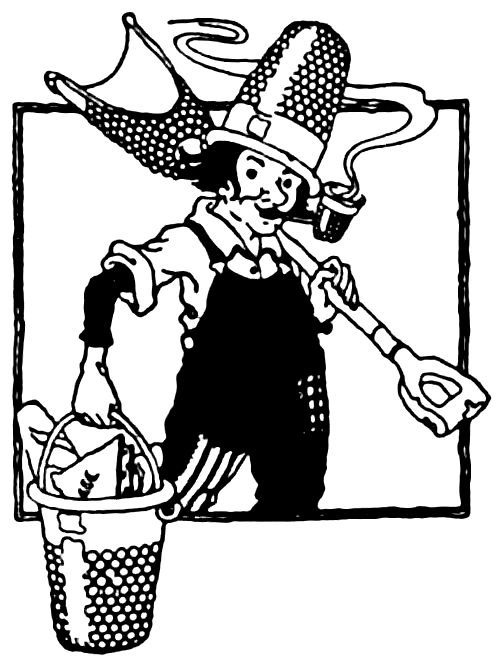
“We ran away to the Thimble Country
where the people wear thimble hats, where
the women wash dishes in thimble dishpans,
where the men go to work with thimble
shovels.
“We saw a war, the left-handed people
against the right-handed. And the smokestacks
did all the fighting. They all had
monkey wrenches and they tried to wrench
each other to pieces. And they had monkey
84faces on the monkey wrenches—to scare each
other.
“All the time they were fighting the
Thimble people sat looking on, the thimble
women with thimble dishpans, the thimble
men with thimble shovels. They waved handkerchiefs
to each other, some left-hand handkerchiefs,
and some right-hand handkerchiefs.
They sat looking till the smokestacks with
their monkey wrenches wrenched each other
all to pieces.”
Then Googler and Gaggler opened the
heavy gunnysacks. “Here,” they said, “here
is a left-handed monkey wrench, here is a
right-handed monkey wrench. And here is a
monkey wrench with a monkey face on the
handle—to scare with.”
Now the father and mother of Googler and
Gaggler wonder how they will end up. The
family doctor keeps on saying, “They will go
far and see much but they will never sit with
the sitters and knit with the knitters.” And
85sometimes when their father looks at them, he
says what he said the Christmas Eve when the
two-for-a-nickel candles stood two by two in
the windows, “Twice times twice is twice.”
87
Once the Potato Face Blind Man began
talking about arithmetic and geography, where
numbers come from and why we add and subtract
before we multiply, when the first fractions
and decimal points were invented, who
gave the rivers their names, and why some
rivers have short names slipping off the tongue
easy as whistling, and why other rivers have
long names wearing the stub ends off lead
pencils.
88The girl, Ax Me No Questions, asked the
old man if boys always stay in the home towns
where they are born and grow up, or whether
boys pack their packsacks and go away somewhere
else after they grow up. This question
started the old man telling about Johnny the
Wham and Joe the Wimp and things he remembered
about them:
Johnny the Wham and Joe the Wimp are
two boys who used to live here in the Village
of Liver-and-Onions before they went away.
They grew up here, carving their initials,
J. W., on wishbones and peanuts and wheelbarrows.
And if anybody found a wishbone
or a peanut or a wheelbarrow with the initials,
J. W., carved on it, he didn’t know whether
it was Johnny the Wham or Joe the Wimp.
They met on summer days, put their hands
in their pockets and traded each other grasshoppers
learning to say yes and no. One kick
and a spit meant yes. Two kicks and a spit
89meant no. One two three, four five six of a
kick and a spit meant the grasshopper was
counting and learning numbers.
They promised what they were going to
do after they went away from the village.
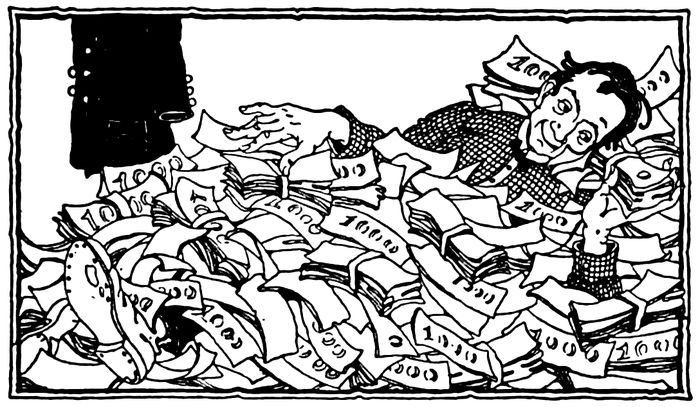
Johnny the Wham said, “I am going to sleep
in money up to my knees with thousand dollar
bills all over me for a blanket.” Joe the
Wimp said, “I am going to see things and
shine, and I am going to shine and see
things.”
They went away. They did what they
said. They went up into the grasshopper
country near the Village of Eggs Over where
the grasshoppers were eating the corn in the
fields without counting how much. They
stayed in those fields till those grasshoppers
learned to say yes and no and learned to count.
One kick and a spit meant yes. Two kicks and
a spit meant no. One two three, four five six
meant the grasshoppers were counting and
learning numbers. The grasshoppers, after
90that, eating ears of corn in the fields, were
counting how many and how much.
To-day Johnny the Wham sleeps in a room
full of money in the big bank in the Village
of Eggs Over. The room where he sleeps is
the room where they keep the thousand dollar
bills. He walks in thousand dollar bills up to
his knees at night before he goes to bed on the
floor. A bundle of thousand dollar bills is his
pillow. He covers himself like a man in a
haystack or a strawstack, with thousand dollar
bills. The paper money is piled around him
in armfuls and sticks up and stands out around
him the same as hay or straw.
And Lizzie Lazarus, who talked with him
in the Village of Eggs Over last week, she says
Johnny the Wham told her, “There is music
in thousand dollar bills. Before I go to sleep
at night and when I wake up in the morning,
I listen to their music. They whisper and cry,
they sing little oh-me, oh-my songs as they
wriggle and rustle next to each other. A few
91with dirty faces, with torn ears, with patches
and finger and thumb prints on their faces,
they cry and whisper so it hurts to hear them.
And often they shake all over, laughing.
“I heard one dirty thousand dollar bill say to
another spotted with patches and thumb prints,
‘They kiss us welcome when we come, they
kiss us sweet good-by when we go.’
“They cry and whisper and laugh about
things and special things and extra extra special
things—pigeons, ponies, pigs, special pigeons,
ponies, pigs, extra extra special pigeons, ponies,
pigs—cats, pups, monkeys, big bags of cats,
pups, monkeys, extra extra big bags of special
cats, pups, monkeys—jewelry, ice cream, bananas,
pie, hats, shoes, shirts, dust pans, rat
traps, coffee cups, handkerchiefs, safety pins—diamonds,
bottles and big front doors with
bells on—they cry and whisper and laugh
about these things—and it never hurts unless
the dirty thousand dollar bills with torn ears
and patches on their faces say to each other,
92‘They kiss us welcome when we come, they
kiss us sweet good-by when we go.’”
The old Potato Face sat saying nothing. He
fooled a little with the accordion keys as if
trying to make up a tune for the words, “They
kiss us welcome when we come, they kiss us
sweet good-by when we go.”
Ax Me No Questions looked at him with a
soft look and said softly, “Now maybe you’ll
tell about Joe the Wimp.” And he told her:
Joe the Wimp shines the doors in front of
the bank. The doors are brass, and Joe the
Wimp stands with rags and ashes and chamois
skin keeping the brass shining.
“The brass shines slick and shows everything
on the street like a looking glass,” he told
Lizzie Lazarus last week. “If pigeons, ponies,
pigs, come past, or cats, pups, monkeys, or
jewelry, ice cream, bananas, pie, hats, shoes,
shirts, dust pans, rat traps, coffee cups, handkerchiefs,
93safety pins, or diamonds, bottles,
and big front doors with bells on, Joe the
Wimp sees them in the brass.
“I rub on the brass doors, and things begin
to jump into my hands out of the shine of
the brass. Faces, chimneys, elephants, yellow
humming birds, and blue cornflowers, where I
have seen grasshoppers sleeping two by two
and two by two, they all come to the shine of
the brass on the doors when I ask them to. If
you shine brass hard, and wish as hard as the
brass wishes, and keep on shining and wishing,
then always things come jumping into your
hands out of the shine of the brass.”
“So you see,” said the Potato Face Blind
Man to Ax Me No Questions, “sometimes the
promises boys make when they go away come
true afterward.”
“They got what they asked for—now will
they keep it or leave it?” said Ax Me.
“Only the grasshoppers can answer that,”
94was the old man’s reply. “The grasshoppers
are older. They know more about jumps.
And especially grasshoppers that say yes and
no and count one two three, four five six.”
And he sat saying nothing, fooling with the
accordion keys as if trying to make up a tune
for the words, “They kiss us welcome when
we come, they kiss us sweet good-by when
we go.”
5. Two Stories Told by the Potato Face Blind Man About Two Girls with Red Hearts. — How Deep Red Roses Goes Back and Forth Between the Clock and the Looking Glass — How Pink Peony Sent Spuds, the Ballplayer, Up to Pick Four Moons
95
People:
Blixie Bimber
The Potato Face Blind Man
Shoulder Straps
High High Over
Six Bits
Deep Red Roses
A Clock
A Looking Glass
Baggage
Pink Peony
Spuds the Ballplayer
Four Moon
Peacocks
Frogs
Oranges
Yellow Silk Handkerchiefs
97
One morning when big white clouds were
shouldering each other’s shoulders, rolling on
the rollers of a big blue sky, Blixie Bimber
came along where the Potato Face Blind Man
sat shining the brass bickerjiggers on his
accordion.
“Do you like to shine up the brass bickerjiggers?”
asked Blixie.
98“Yes,” he answered. “One time a long time
ago the brass bickerjiggers were gold, but they
stole the gold away when I wasn’t looking.”
He blinked the eyelids over his eyeballs
and said, “I thank them because they took
gold they wanted. Brass feels good to my
fingers the same as gold.” And he went on
shining up the brass bickerjiggers on the
accordion, humming a little line of an old
song, “To-morrow will never catch up with
yesterday because yesterday started sooner.”
“Seems like a nice morning with the sun
spilling bushels of sunshine,” he said to Blixie,
who answered, “Big white clouds are shouldering
each other’s shoulders rolling on the rollers
of a big blue sky.”
“Seems like it’s April all over again,” he
murmured, almost like he wasn’t talking at all.
“Seems just that way—April all over
again,” murmured Blixie, almost like she
wasn’t talking at all.
99So they began drifting, the old man drifting
his way, the girl drifting her way, till he
drifted into a story. And the story he told
was like this and in these words:
“Deep Red Roses was a lovely girl with
blue skylights like the blue skylights of early
April in her eyes. And her lips reminded
people of deep red roses waiting in the cool of
the summer evening.
“She met Shoulder Straps one day when she
was young yet. He promised her. And she
promised him. But he went away. One of
the long wars between two short wars took
him. In a far away country, then, he married
another girl. And he didn’t come back to
Deep Red Roses.
“Next came High High Over, one day
when she was young yet. A dancer he was,
going from one city to another city to dance,
spending his afternoons and evenings and late
100nights dancing, and sleeping in the morning
till noon. And when he promised she promised.
But he went away to another city and
after that another city. And he married one
woman and then another woman. Every year
there came a new story about one of the new
wives of High High Over, the dancer. And
while she was young yet, Deep Red Roses
forgot all about her promise and the promise
of High High Over, the dancer who ran away
from her.
“Six Bits was the next to come along. And
he was not a soldier nor a dancer nor anything
special. He was a careless man, changing from
one job to another, changing from paperhanging
to plastering, from fixing shingle
roofs where the shingles were ripped to opening
cans with can openers.
“Six Bits gave Deep Red Roses his promise
and she gave him her promise. But he was
always late keeping his promise. When the
101wedding was to be Tuesday he didn’t come till
Wednesday. If it was Friday he came Saturday.
And there wasn’t any wedding.
“So Deep Red Roses said to herself, ‘I am
going away and learn, I am going away and
talk with the wives of High High Over, the
dancer, and maybe if I go far enough I will
find the wife of Shoulder Straps, the soldier—and
maybe the wives of the men who promised
me will tell me how to keep promises kept.’
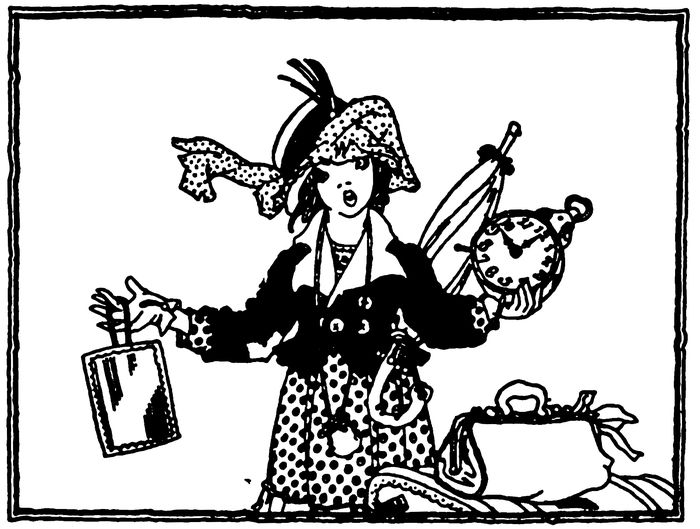
“She packed her baggage till her baggage
was packed so full there was room for only one
more thing. So she had to decide whether to
put a clock or whether to put a looking glass
in her baggage.
“‘My head tells me to carry the clock so I
can always tell if I am early or late,’ she said
to herself. ‘But my heart tells me to carry a
looking glass so I can look at my face and tell
if I am getting older or younger.’
“At last she decides to take the clock and
102leave the looking glass—because her head
says so. She starts away. She goes through
the door, she is out of the house, she goes to
the street, she starts up the street.
“Then her heart tells her to go back and
change the clock for the looking glass. She
goes back up the street, through the door, into
the house, into her room. Now she stands in
front of the clock and the looking glass saying,
‘To-night I sleep home here one more night,
and to-morrow morning I decide again.’
“And now every morning Deep Red Roses
decides with her head to take the clock. She
takes the clock and starts away and then comes
back because her heart decides she must have
the looking glass.
“If you go to her house this morning you
will see her standing in the doorway with blue
skylights like the blue sky of early April in
her eyes, and lips that remind you of deep red
roses in the cool of the evening in summer.
103You will see her leave the doorway and go out
of the gate with the clock in her hands. Then
if you wait you will see her come back through
the gate, into the door, back to her room
where she puts down the clock and takes up
the looking glass.
“After that she decides to wait until to-morrow
morning to decide again what to decide.
Her head tells her one thing, her heart
tells her another. Between the two she stays
home. Sometimes she looks at her face in the
looking glass and says to herself, ‘I am young
yet and while I am young I am going to do
my own deciding.’”
Blixie Bimber fingered the end of her chin
with her little finger and said, “It is a strange
story. It has a stab in it. It would hurt me
if I couldn’t look up at the big white clouds
shouldering their shoulders, rolling on the
rollers of the big blue sky.”
104“It is a good story to tell when April is here
all over again—and I am shining up the brass
bickerjiggers on my accordion,” said the Potato
Face Blind Man.
105
Early one summer evening the moon was
hanging in the tree-tops. There was a lisp of
leaves. And the soft shine of the moon sifting
down seemed to have something to say to
the lisp of the leaves.
The girl named Blixie Bimber came that
particular summer evening to the corner
where the Potato Face Blind Man sat with
his accordion. She came walking slow and
thoughtful to where he was sitting in the
106evening shadows. And she told him about the
summer moon in the tree-tops, the lisp of the
leaves, and the shine of the moon trying to tell
something to the lisp of the leaves.
The old man leaned back, fumbled the
keys of his accordion, and said it loosened up
things he remembered far back.
“On an evening like this, every tree has a
moon all of its own for itself—if you climb
up in a thousand trees this evening you can
pick a thousand moons,” the old man murmured.
“You remind me to-night about secrets
swimming deep in me.”
And after hesitating a little—and thinking
a little—and then hesitating some more—the
old man started and told this story:
There was a girl I used to know, one time,
named Pink Peony. She was a girl with
cheeks and lips the peonies talked about.
When she passed a bush of peonies, some of
107the flowers would whisper, “She is lovelier
than we are.” And the other peonies would
answer in a whisper, “It must be so, it ... must ... be ... so.”
Now there was a ballplayer named Spuds,
came one night to take her riding, out to a
valley where the peacocks always cry before it
rains, where the frogs always gamble with the
golden dice after midnight.
And out in that valley they came to a tall
tree shooting spraggly to the sky. And high
up in the spraggly shoots, where the lisp of
the leaves whispers, there a moon had drifted
down and was caught in the branches.
“Spuds, climb up and pick that moon for
me,” Pink Peony sang reckless. And the ballplayer
jumped out of the car, climbed up the
tall tree, up and up till he was high and far in
the spraggly branches where the moon had
drifted down and was caught.
Climbing down, he handed the girl a silver
108hat full of peach-color pearls. She laid it on
the back seat of the car where it would be
safe. And they drove on.
They came to another tall tree shooting
spraggly to the sky. And high up the moon
was caught.
“Pick that one, Spuds,” Peony sang reckless
again. And when he came climbing down he
handed her a circle of gold with a blood-color
autumn leaf. And they put it on the back seat
of the car where it would be safe. Then they
drove on.
“Spuds, you are good to me,” said Pink
Peony, when he climbed another tree shooting
spraggly high in the sky, and came down with
a brass pansy sprinkled with two rainbows, for
her. She put it on the back seat where it
would be safe. And they drove on.
One time more Spuds climbed up and
came down with what he picked, up where
the moon was caught in the high spraggly
branches. “An Egyptian collar frozen in
109diamond cobwebs, for you,” he said. “You
are a dear, Spuds,” she said, reckless, with a
look into his eyes. She laid the Egyptian collar
frozen in diamond cobwebs on the back
seat of the car where it would be safe—and
they drove on.
They listened a while, they stopped the car
and listened a longer while, to the frogs
gambling with golden dice after midnight.
And when at last they heard the peacocks
crying, they knew it was going to rain. So
they drove home.
And while the peacocks were crying, and
just before they started home, they looked in
the back seat of the car at the silver hat full
of peach-color pearls, the circle of gold with
a blood-color autumn leaf, the brass pansy
sprinkled with two rainbows, the Egyptian
collar frozen in diamond cobwebs.
Driving home, the spray of a violet dawn
was on the east sky. And it was nearly daylight
when they drove up to the front door of
110Pink Peony’s home. She ran into the house
to get a basket to carry the presents in. She
came running out of the house with a basket
to carry the presents in.
She looked in the back seat; she felt with
her hands and fingers all over the back seat.
In the back seat she could find only four
oranges. They opened the oranges and in each
orange they found a yellow silk handkerchief.
To-day, if you go to the house where Pink
Peony and Spuds are living, you will find four
children playing there, each with a yellow
silk handkerchief tied around the neck in a
mystic slip knot.
Each child has a moon face and a moon
name. And sometimes their father and mother
pile them all into a car and they ride out to
the valley where the peacocks always cry
before it rains—and where the frogs always
gamble with golden dice after midnight.
And what they look longest at is a summer
moon hanging in the tree-tops, when there is
111a lisp of leaves, and the shine of the moon and
the lisp of the leaves seem to be telling each
other something.
So the Potato Face came to a finish with his
story. Blixie Bimber kissed him good-night
on the nose, saying, “You loosened up beautiful
to-night.”
6. Three Stories About Moonlight, Pigeons, Bees, Egypt, Jesse James, Spanish Onions, the Queen of the Cracked Heads, the King of the Paper Sacks. — How Dippy the Wisp and Slip Me Liz Came in the Moonshine Where the Potato Face Blind Man Sat with His Accordion — How Hot Balloons and His Pigeon Daughters Crossed Over into the Rootabaga Country — How Two Sweetheart Dippies Sat in the Moonlight on a Lumber Yard Fence and Heard About the Sooners and the Boomers
113
People:
Dippy the Wisp
Slip Me Liz
The Potato Face Blind Man
Egypt
Jesse James
Spanish Onions
The Queen of the Cracked Heads
The King of the Paper Sacks
The Queen of the Empty Hats
Hot Balloons
A Snoox
A Gringo
Sweetheart Dippies
Nail-eating Rats
Sooners
Boomers
More People:
Cracked Heads
Clock-eating Goats
Baby Alligators
Pink and Purple Peanuts
Empty Hats
Bats, Cats, Rats
Rag Pickers, Rag Handlers
Squirrels, Fish, Baboons, Black Cats
A Steel Car, an Air Car
Gophers
115
The sky shook a rain down one Saturday
night over the people, the postoffice, and the
peanut-stand in the Village of Liver-and-Onions.
And after the rain, the sky shook loose a
moon so a moonshine came with gold on the
rainpools.
116And a west wind came out of the west sky
and shook the moonshine gold on the tops of the
rainpools.
Dippy the Wisp and Slip Me Liz came, two
tough pony girls, two limber prairie girls, in
the moonshine humming little humpty dumpty
songs.
They came to the postoffice corner where
the Potato Face Blind Man sat hugging his
accordion, wondering what was next and who
and why.
He was saying to himself, “Who was it told
me the rats on the moon in the middle of the
winter lock their mittens in ice boxes?”
And just then Dippy the Wisp and Slip Me
Liz came flipping along saying, “It is a misty
moisty evening in the moonshine, isn’t it?”
And he answered, “The moon is a round
gold door with silver transoms to-night.
Bumble bees and honey bees are chasing each
other over the gold door of the moon and up
over the silver transoms.”
117Dippy the Wisp took out a bee-bag, took
bees out of the bee-bag, balanced the bees on
her thumb, humming a humpty dumpty song.
And Slip Me Liz, looking on, joined in on the
humpty dumpty song. And, of course, the
bees began buzzing and buzzing their bee
humpty dumpty song.
“Have you fastened names on them?” asked
the Potato Face.
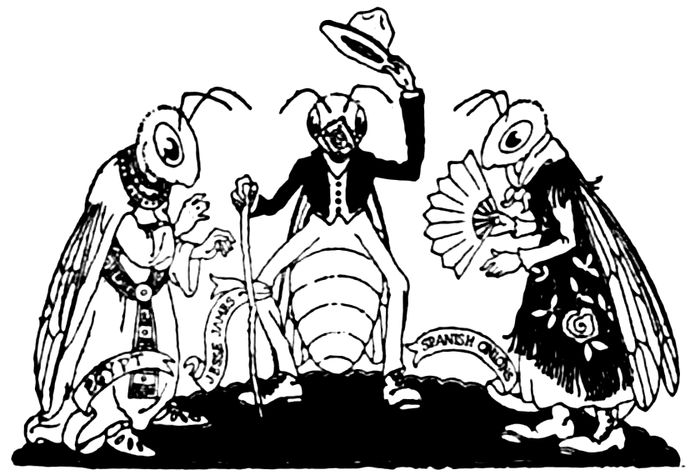
“These three on my thumb, these three special
blue-violet bees, I put their names on silk
white ribbons and tied the ribbons to their
knees. This is Egypt—she has inkwells in her
ears. This is Jesse James—he puts postage
stamps on his nose. This is Spanish Onions—she
likes pearl-color handkerchiefs around her
yellow neck.”
“Bees belong in bee-bags, but these are different,”
the old man murmured.
“Runaway bees, these are,” Dippy the Wisp
went on. “They buzz away, they come buzzing
118back, buzzing home, buzzing secrets,
syllables, snitches.
“To-day Egypt came buzzing home with
her inkwells in her ears. And Egypt buzzed,
‘I flew and flew and I buzzed and buzzed far,
far away, till I came where I met the Queen
of the Cracked Heads with her head all
cracked. And she took me by the foot and
took me to the palace of the Cracked Heads
with their heads all cracked.
“‘The palace was full of goats walking up
and down the stairs, sliding on the banisters
eating bingety bing clocks. Before he bites
the clock and chews and swallows and eats the
bingety bing clock, I noticed, each goat winds
up the clock and fixes it to go off bling bling
bingety bing, after he eats it down. I noticed
that. And the fat, fat, puffy goats, the fat,
fat, waddly goats, had extra clocks hung on
their horns—and the clocks, tired of waiting,
spoke to each other in the bingety bing clock
talk. I noticed that too.
119
She was sitting on a ladder feeding baby clocks to the baby alligators
121“‘I stayed all morning and I saw them feed
the big goats big hunks and the little goats
little hunks and the big clocks big bings and
the little clocks little bings. At last in the
afternoon, the queen of the Cracked Heads
came with her cracked head to say good-by to
me. She was sitting on a ladder feeding baby
clocks to baby alligators, winding the clocks
and fixing the bingety bings, so after the baby
alligators swallowed the clocks, I heard them
singing bling bling bingety bing.
“‘And the Queen was reading the alphabet
to the littlest of the baby alligators—and they
were saying the alligator A B C while she was
saying the A B C of the Cracked Heads. At
last she said good-by to me, good-by and come
again soon, good-by and stay longer next time.’
“‘When I went out of the door all the baby
alligators climbed up the ladder and bingety
blinged good-by to me. I buzzed home fast
because I was lonesome. I am so, so glad to
be home again.’”
122The Potato Face looked up and said, “This
is nice as the rats on the moon in the middle
of the winter locking their mittens in the ice
box. Tell us next about that blue-violet
bumblebee, Jesse James.”
“Jesse James,” said Dippy the Wisp, “Jesse
James came buzzing home with a postage
stamp on his nose. And Jesse James buzzed,
‘I flew and I flew and buzzed and buzzed far,
far away till I came where I met the King of
the Paper Sacks who lives in a palace of paper
sacks. I went inside the palace expecting to
see paper sacks everywhere. But instead of
paper sacks the palace was full of pink and
purple peanuts walking up and down the
stairs washing their faces, stitching handkerchiefs.’
“‘In the evening all the pink and purple
peanuts put on their overshoes and make paper
sacks. The King of the Paper Sacks walks
around and around among them saying, “If
123anybody asks you who I am tell them I am the
King of the Paper Sacks.” And one little
peanut flipped up one time in the King’s face
and asked, “Say it again—who do you think
you are?” And it made the King so bitter in
his feelings he reached out his hand and with
a sweep and a swoop he swept fifty pink and
purple peanuts into a paper sack and cried out,
“A nickel a sack, a nickel a sack.” And he
threw them into a trash pile of tin cans.
“‘When I went away he shook hands with
me and said, “Good-by, Jesse James, you old
buzzer, if anybody asks you tell them you saw
the King of the Paper Sacks where he lives.”
“‘When I went away from the palace, the
doors and the window sills, the corners of the
roofs and the eave troughs where the rain runs
off, they were all full of pink and purple peanuts
standing in their overshoes washing their
faces, stitching handkerchiefs, calling good-by
to me, good-by and come again, good-by and
124stay longer next time. Then I came buzzing
home because I was lonesome. And I am so,
so glad to be home again.’”
The Potato Face looked up again and said,
“It is a misty moisty evening in the moonshine.
Now tell us about that blue-violet
honeybee, Spanish Onions.”
And Dippy the Wisp tied a slipknot in the
pearl-color handkerchief around the yellow
neck of Spanish Onions and said, “Spanish
Onions came buzzing back home with her face
dirty and scared and she told us, ‘I flew and
flew and I buzzed and buzzed till I came
where I met the Queen of the Empty Hats.
She took me by the foot and took me across
the City of the Empty Hats, saying under her
breath, “There is a screw loose somewhere,
there is a leak in the tank.” Fat rats, fat bats,
fat cats, came along under empty hats and the
Queen always said under her breath, “There
is a screw loose somewhere, there is a leak in
the tank.” In the houses, on the street, riding
125on the rattlers and the razz cars, the only
people were hats, empty hats. When the fat
rats changed hats with the fat bats, the hats
were empty. When the fat bats changed those
hats with the fat cats, the hats were empty. I
took off my hat and saw it was empty. I began
to feel like an empty hat myself. I got scared.
I jumped loose from the Queen of the Empty
Hats and buzzed back home fast. I am so, so
glad to be home again.’”
The Potato Face sat hugging his accordion.
He looked up and said, “Put the bees back in
the bee-bag—they buzz too many secrets, syllables
and snitches.”
“What do you expect when the moon is a
gold door with silver transoms?” asked Slip
Me Liz.
“Yes,” said Dippy the Wisp. “What do
you expect when the bumblebees and the
honeybees are chasing each other over the
gold door of the moon and up over the silver
transoms?”
126And the two tough pony girls, the two
limber prairie girls, went away humming a
little humpty dumpty song across the moonshine
gold on the tops of the rainpools.
127
Hot Balloons was a man who lived all alone
among people who sell slips, flips, flicks and
chicks by the dozen, by the box, by the box
car job lot, back and forth to each other.
Hot Balloons used to open the window in
the morning and say to the rag pickers and the
rag handlers, “Far, far away the pigeons are
calling; far, far away the white wings are
dipping in the blue, in the sky blue.”
128And the rag pickers and the rag handlers
looked up from their rag bags and said, “Far,
far away the rags are flying; far, far away the
rags are whistling in the wind, in the sky
wind.”
Now two pigeons came walking up to the
door, the door knob and the door bell under
the window of Hot Balloons. One of the
pigeons rang the bell. The other pigeon,
too, stepped up to the bell and gave it a
ring.
Then they waited, tying the shoe strings on
their shoes and the bonnet strings under their
chins, while they waited.
Hot Balloons opened the door. And they
flew into his hands, one pigeon apiece in each
of his hands, flipping and fluttering their
wings, calling, “Ka loo, ka loo, ka lo, ka lo,”
leaving a letter in his hands and then flying
away fast.
129
One of the pigeons rang the bell
131Hot Balloons stepped out on the front steps
to read the letter where the light was good in
the daylight because it was so early in the
morning. The letter was on paper scribbled
over in pigeon foot blue handwriting with
many secrets and syllables.
After Hot Balloons read the letter, he said
to himself, “I wonder if those two pigeons are
my two runaway daughters, Dippy the Wisp
and Slip Me Liz. When they ran away they
said they would cross the Shampoo river and
go away into the Rootabaga country to live.
And I have heard it is a law of the Rootabaga
country whenever a girl crosses the Shampoo
river to come back where she used to be, she
changes into a pigeon—and she stays a pigeon
till she crosses back over the Shampoo river
into the Rootabaga country again.”
And he shaded his eyes with his hands and
looked far, far away in the blue, in the sky
blue. And by looking long and hard he saw
far, far away in the sky blue, the two white
pigeons dipping their wings in the blue, flying
fast, circling and circling higher and higher,
132toward the Shampoo river, toward the Rootabaga
country.
“I wonder, I guess, I think so,” he said to
himself, “I wonder, I think so, it must be
those two pigeons are my two runaway daughters,
my two girls, Dippy the Wisp and Slip
Me Liz.”
He took out the letter and read it again
right side up, upside down, back and forth.
“It is the first time I ever read pigeon foot
blue handwriting,” he said to himself. And
the way he read the letter, it said to him:
Daddy, daddy, daddy, come home to us in the
Rootabaga country where the pigeons call ka loo,
ka loo, ka lo, ka lo, where the squirrels carry ladders
and the wildcats ask riddles and the fish jump out of
the rivers and speak to the frying pans, where the
baboons take care of the babies and the black cats
come and go in orange and gold stockings, where the
birds wear rose and purple hats on Monday afternoons
up in the skylights in the evening.
(Signed) Dippy the Wisp,
Slip Me Liz.
133And reading the letter a second time, Hot
Balloons said to himself, “No wonder it is
scribbled over the paper in pigeon foot blue
handwriting. No wonder it is full of secrets
and syllables.”
So he jumped into a shirt and a necktie, he
jumped into a hat and a vest, and he jumped
into a steel car, starting with a snizz and a
snoof till it began running smooth and even
as a catfoot.
“I will ride to the Shampoo river faster
than two pigeons fly,” he said. “I will be
there.”
Which he was. He got there before the
two pigeons. But it was no use. For the rain
and the rainstorm was working—and the rain
and the rainstorm tore down and took and
washed away the steel bridge over the Shampoo
river.
“Now there is only an air bridge to cross
on, and a steel car drops down, falls off, falls
through, if it runs on an air bridge,” he said.
134So he was all alone with the rain and the
rainstorm all around him—and far as he could
see by shading his eyes and looking, there was
only the rain and the rainstorm across the river—and
the air bridge.
While he waited for the rain and the rainstorm
to go down, two pigeons came flying
into his hands, one apiece into each hand, flipping
and fluttering their wings and calling,
“Ka loo, ka loo, ka lo, ka lo.” And he could
tell by the way they began tying the shoestrings
on their shoes and the bonnet strings
under their chins, they were the same two
pigeons ringing the door bell that morning.
They wrote on his thumb-nails in pigeon
foot blue handwriting, and he read their handwriting
asking him why he didn’t cross over
the Shampoo river. And he explained, “There
is only an air bridge to cross on. A steel car
drops down, falls off, falls through, if it runs
on an air bridge. Change my steel car to an
air car. Then I can cross the air bridge.”
135The pigeons flipped and fluttered, dipped
their wings and called, “Ka loo, ka loo, ka lo,
ka lo.” And they scribbled their pigeon feet
on his thumb-nail—telling him to wait. So
the pigeons went flying across the Shampoo
river.
They came back with a basket. In the
basket was a snoox and a gringo. And the
snoox and the gringo took hammers, jacks,
flanges, nuts, screws, bearings, ball bearings,
axles, axle grease, ax handles, spits, spitters,
spitballs and spitfires, and worked.
“It’s a hot job,” said the snoox to the
gringo. “I’ll say it’s a hot job,” said the
gringo answering the snoox.
“We’ll give this one the merry razoo,” said
the snoox to the gringo, working overtime and
double time. “Yes, we’ll put her to the
cleaners and shoot her into high,” said the
gringo, answering the snoox, working overtime
and double time.
They changed the steel to air, made an air136car out of the steel car, put Hot Balloons and
the two pigeons into the air car and drove the
air car across the air bridge.
And nowadays when people talk about it in
the Rootabaga country, they say, “The snoox
and the gringo drove the air car across the air
bridge clean and cool as a whistle in the wind.
As soon as the car got off the bridge and over
into the Rootabaga country, the two pigeons
changed in a flash. And Hot Balloons saw
they were his two daughters, his two runaway
girls, Dippy the Wisp and Slip Me Liz, standing
and smiling at him and looking fresh and
free as two fresh fish in a free river, fresh and
free as two fresh bimbos in a bamboo tree.”
He kissed them both, two long kisses, and
while he was kissing them the snoox and the
gringo worked double time and overtime and
changed the air car back into a steel car.
And Dippy the Wisp and Slip Me Liz
rode in that car—starting with a snizz and a
snoof till it began running smooth and even as
137a catfoot—showing their father, Hot Balloons,
where the squirrels carry ladders and the wildcats
ask riddles and the fish jump out of the
rivers and speak to the frying pans, where the
baboons take care of the babies and the black
cats come and go in orange and gold stockings,
where the birds wear rose and purple hats on
Monday afternoons up in the skylights in the
evening.
And often on a Saturday night or a New
Year Eve or a Christmas morning, Hot Balloons
remembers back how things used to be,
and he tells his two girls about the rag pickers
and the rag handlers back among the people
who sell slips, flips, flicks, and chicks, by the
dozen, by the box, by the box car job lot, back
and forth to each other.
139
Not so very far and not so very near the
Village of Liver-and-Onions is a dippy little
town where dippy people used to live.
And it was long, long ago the sweetheart
dippies stood in their windows and watched
the dips of the star dippers in the dip of the
sky.
It was the dippies who took the running wild
oleander and the cunning wild rambler rose
140and kept them so the running wild winters let
them alone.
“It is easy to be a dippy ... among the
dippies ... isn’t it?” the sweetheart dippies
whispered to each other, sitting in the leaf
shadows of the oleander, the rambler rose.
The name of this dippy town came by accident.
The name of the town is Thumbs Up
and it used to be named Thumbs Down and
expects to change its name back and forth
between Thumbs Up and Thumbs Down.
The running wild oleanders and the running
wild rambler roses grow there over the big
lumber yards where all the old lumber goes.
The dippies and the dippy sweethearts go
out there to those lumber yards and sit on the
fence moonlight nights and look at the lumber.
The rusty nails in the lumber get rustier
and rustier till they drop out. And whenever
they drop out there is always a rat standing
under to take the nail in his teeth and chew
the nail and eat it.
141For this is the place the nail-eating rats
come to from all over the Rootabaga country.
Father rats and mother rats send the young
rats there to eat nails and get stronger.
If a young rat comes back from a trip to
the lumber yards in Thumbs Up and he meets
another young rat going to those lumber
yards, they say to each other, “Where have
you been?” “To Thumbs Up.” “And how
do you feel?” “Hard as nails.”
Now one night two of the dippies, a sweetheart
boy and girl, went out to the big lumber
yards and sat on the fence and looked at the
lumber and the running wild oleanders and the
running wild rambler roses.
And they saw two big rusty nails, getting
rustier and rustier, drop out of the lumber
and drop into the teeth of two young
rats.
And the two young rats sat up on their tails
there in the moonlight under the oleanders,
under the roses, and one of the young rats told
142the other young rat a story he made up out of
his head.
Chewing on the big rusty nail and then
swallowing, telling more of the story after
swallowing and before beginning to chew the
nail again, this is the story he told—and this
is the story the two dippies, the two sweethearts
sitting on the fence in the moonlight,
heard:
Far away where the sky drops down, and
the sunsets open doors for the nights to come
through—where the running winds meet,
change faces and come back—there is a
prairie where the green grass grows all
around.
And on that prairie the gophers, the black
and brown-striped ground squirrels, sit with
their backs straight up, sitting on their soft
paddy tails, sitting in the spring song murmur
of the south wind, saying to each other, “This
is the prairie and the prairie belongs to us.”
143Now far back in the long time, the gophers
came there, chasing each other, playing the-green-grass-grew-all-around,
playing cross tag,
hop tag, skip tag, billy-be-tag, billy-be-it.
The razorback hogs came then, eating pignuts,
potatoes, paw paws, pumpkins. The wild
horse, the buffalo, came. The moose, with
spraggly branches of antlers spreading out
over his head, the moose came—and the fox,
the wolf.
The gophers flipped a quick flip-flop back
into their gopher holes when the fox, the wolf,
came. And the fox, the wolf, stood at the
holes and said, “You look like rats, you run
like rats, you are rats, rats with stripes. Bah!
you are only rats. Bah!”
It was the first time anybody said “Bah!”
to the gophers. They sat in a circle with
their noses up asking, “What does this ‘Bah!’
mean?” And an old timer, with his hair falling
off in patches, with the stripes on his soft
paddy tail patched with patches, this old
144timer of a gopher said, “‘Bah!’ speaks more
than it means whenever it is spoken.”
Then the sooners and the boomers came,
saying “Bah!” and saying it many new ways,
till the fox, the wolf, the moose, the wild
horse, the buffalo, the razorback hog picked
up their feet and ran away without looking
back.
The sooners and boomers began making
houses, sod houses, log, lumber, plaster-and-lath
houses, stone, brick, steel houses, but most
of the houses were lumber with nails to hold
the lumber together to keep the rain off and
push the wind back and hold the blizzards
outside.
In the beginning the sooners and boomers
told stories, spoke jokes, made songs, with their
arms on each other’s shoulders. They dug
wells, helping each other get water. They
built chimneys together helping each other let
the smoke out of their houses. And every year
the day before Thanksgiving they went in
145cahoots with their post hole diggers and dug
all the post holes for a year to come. That
was in the morning. In the afternoon they
took each other’s cistern cleaners and cleaned
all the cisterns for a year to come. And the
next day on Thanksgiving they split turkey
wishbones and thanked each other they had all
the post holes dug and all the cisterns cleaned
for a year to come.
If the boomers had to have broom corn to
make brooms the sooners came saying, “Here
is your broom corn.” If the sooners had to
have a gallon of molasses, the boomers came
saying, “Here is your gallon of molasses.”
They handed each other big duck eggs to
fry, big goose eggs to boil, purple pigeon eggs
for Easter breakfast. Wagon loads of buff
banty eggs went back and forth between the
sooners and boomers. And they took big hayracks
full of buff banty hens and traded them
for hayracks full of buff banty roosters.
And one time at a picnic, one summer afternoon,
146the sooners gave the boomers a thousand
golden ice tongs with hearts and hands carved
on the handles. And the boomers gave the
sooners a thousand silver wheelbarrows with
hearts and hands carved on the handles.
Then came pigs, pigs, pigs, and more pigs.
And the sooners and boomers said the pigs had
to be painted. There was a war to decide
whether the pigs should be painted pink or
green. Pink won.
The next war was to decide whether the
pigs should be painted checks or stripes.
Checks won. The next war after that was
to decide whether the checks should be painted
pink or green. Green won.
Then came the longest war of all, up till
that time. And this war decided the pigs
should be painted both pink and green, both
checks and stripes.
They rested then. But it was only a short
rest. For then came the war to decide whether
peach pickers must pick peaches on Tuesday
147mornings or on Saturday afternoons. Tuesday
mornings won. This was a short war. Then
came a long war—to decide whether telegraph
pole climbers must eat onions at noon with
spoons, or whether dishwashers must keep their
money in pig’s ears with padlocks pinched on
with pincers.
So the wars went on. Between wars they
called each other goofs and snoofs, grave robbers,
pickpockets, porch climbers, pie thieves,
pie face mutts, bums, big bums, big greasy
bums, dummies, mummies, rummies, sneezicks,
bohunks, wops, snorkies, ditch diggers, peanuts,
fatheads, sapheads, pinheads, pickle faces,
horse thieves, rubbernecks, big pieces of cheese,
big bags of wind, snabs, scabs, and dirty sniveling
snitches. Sometimes when they got tired
of calling each other names they scratched in
the air with their fingers and made faces with
their tongues out twisted like pretzels.
After a while, it seemed, there was no corn,
no broom corn, no brooms, not even teeny
148sweepings of corn or broom corn or brooms.
And there were no duck eggs to fry, goose eggs
to boil, no buff banty eggs, no buff banty hens,
no buff banty roosters, no wagons for wagon
loads of buff banty eggs, no hayracks for hayrack
loads of buff banty hens and buff banty
roosters.
And the thousand golden ice tongs the
sooners gave the boomers, and the thousand
silver wheelbarrows the boomers gave the
sooners, both with hearts and hands carved on
the handles, they were long ago broken up in
one of the early wars deciding pigs must be
painted both pink and green with both checks
and stripes.
And now, at last, there were no more pigs
to paint either pink or green or with checks or
stripes. The pigs, pigs, pigs, were gone.
So the sooners and boomers all got lost in
the wars or they screwed wooden legs on their
stump legs and walked away to bigger, bigger
prairies or they started away for the rivers and
149mountains, stopping always to count how many
fleas there were in any bunch of fleas they met.
If you see anybody who stops to count the fleas
in a bunch of fleas, that is a sign he is either
a sooner or a boomer.
So again the gophers, the black and brown
striped ground squirrels, sit with their backs
straight up, sitting on their soft paddy tails,
sitting in the spring song murmur of the south
wind, saying, “This is the prairie and the
prairie belongs to us.”
Far away to-day where the sky drops down
and the sunsets open doors for the nights
to come through—where the running winds
meet, change faces and come back—there the
gophers are playing the-green-grass-grew-all-around,
playing cross tag, skip tag, hop tag,
billy-be-tag, billy-be-it. And sometimes they
sit in a circle and ask, “What does this ‘Bah!’
mean?” And an old timer answers, “‘Bah!’
speaks more than it means whenever it is
spoken.”
150That was the story the young rat under the
oleanders, under the roses, told the other young
rat, while the two sweetheart dippies sat on
the fence in the moonlight looking at the
lumber and listening.
The young rat who told the story hardly
got started eating the nail he was chewing,
while the young rat that did the listening
chewed up and swallowed down a whole nail.
As the two dippies on the fence looked at
the running wild oleander and the running
wild rambler roses over the lumber in the
moonlight, they said to each other, “It’s easy
to be a dippy ... among the dippies ...
isn’t it?” And they climbed down from the
fence and went home in the moonlight.
7. Two Stories Out of the Tall Grass. — The Haystack Cricket and How Things Are Different Up in the Moon Towns — Why the Big Ball Game Between Hot Grounders and the Grand Standers Was a Hot Game
151
People:
John Jack Johannes Hummadummaduffer
Feed Box
Eva Evelyn Evangeline Hummadummaduffer
Sky Blue
The Harvest Moon
A Haystack Cricket
Baby Moon
Half Moon
Silver Moon
Doorbells, Chimneys, Cellars
The Night Policeman in the Village of Cream Puffs
Butter Fingers
Three Strikes
Cub Ballplayers
153
There is an old man with wrinkles like
wrinkled leather on his face living among the
cornfields on the rolling prairie near the
Shampoo river.
His name is John Jack Johannes Hummadummaduffer.
His cronies and the people
who know him call him Feed Box.
His daughter is a cornfield girl with hair
154shining the way cornsilk shines when the corn
is ripe in the fall time. The tassels of cornsilk
hang down and blow in the wind with a
rusty dark gold, and they seem to get mixed
with her hair. Her name is Eva Evelyn
Evangeline Hummadummaduffer. And her
chums and the people who know her call her
Sky Blue.
The eleventh month, November, comes
every year to the corn belt on that rolling
prairie. The wagons bring the corn from the
fields in the harvest days and the cracks in the
corncribs shine with the yellow and gold of
the corn.
The harvest moon comes, too. They say it
stacks sheaves of the November gold moonshine
into gold corn shocks on the sky. So
they say.
On those mornings in November that time
of the year, the old man they call Feed Box
sits where the sun shines against the boards of
a corncrib.
155The girl they call Sky Blue, even though
her name is Eva Evelyn Evangeline Hummadummaduffer,
she comes along one November
morning. Her father is sitting in the sun with
his back against a corncrib. And he tells her
he always sits there every year listening to the
mice in the cornfields getting ready to move
into the big farmhouse.
“When the frost comes and the corn is
husked and put in the corncribs, the fields are
cleaned and the cold nights come. Papa
mouse and mama mouse tell the little ones it
is time to sneak into the cellar and the garret
and the attic of the farmhouse,” said Feed
Box to Sky Blue.
“I am listening,” she said, “and I can
hear the papa mouse and the mama mouse
telling the little ones how they will find rags
and paper and wool and splinters and shavings
and hair, and they will make warm nests for
the winter in the big farmhouse—if no kits,
cats nor kittycats get them.”
156The old man, Feed Box, rubbed his back
and his shoulders against the boards of the
corncrib and washed his hands almost as if he
might be washing them in the gold of the
autumn sunshine. Then he told this happening:
This time of the year, when the mouse in
the fields whispers so I can hear him, I remember
one November when I was a boy.
One night in November when the harvest
moon was shining and stacking gold cornshocks
in the sky, I got lost. Instead of going
home I was going away from home. And the
next day and the next night instead of going
home I was going away from home.
That second night I came to a haystack
where a yellow and gold cricket was singing.
And he was singing the same songs the crickets
sing in the haystacks back home where the
Hummadummaduffers raise hay and corn, in
the corn belt near the Shampoo river.
157And he told me, this cricket did, he told me
when he listened soft if everything was still in
the grass and the sky, he could hear golden
crickets singing in the cornshocks the harvest
moon had stacked in the sky.
I went to sleep listening to the singing of
the yellow and gold crickets in that haystack.
It was early in the morning, long before daylight,
I guess, the two of us went on a trip
away from the haystack.
We took a trip. The yellow and gold
cricket led the way. “It is the call of the
harvest moon,” he said to me in a singing
whisper. “We are going up to the moon towns
where the harvest moon stacks the cornshocks
on the sky.”
We came to a little valley in the sky. And
the harvest moon had slipped three little towns
into that valley, three little towns named Half
Moon, Baby Moon, and Silver Moon.
In the town of Half Moon they look out of
the doors and come in at the windows. So
158they have taken all the doorbells off the doors
and put them on the windows. Whenever we
rang a door-bell we went to a window.
In the town of Baby Moon they had windows
on the chimneys so the smoke can look
out of the window and see the weather before
it comes out over the top of the chimney. And
whenever the chimneys get tired of being stuck
up on the top of the roof, the chimneys climb
down and dance in the cellar. We saw five
chimneys climb down and join hands and
bump heads and dance a laughing chimney
dance.
In the town of Silver Moon the cellars are
not satisfied. They say to each other, “We are
tired of being under, always under.” So the
cellars slip out from being under, always
under. They slip out and climb up on top of
the roof.
And that was all we saw up among the
moon towns of Half Moon, Baby Moon and
Silver Moon. We had to get back to the haystack
159so as to get up in the morning after our
night sleep.
“This time of the year I always remember
that November,” said the old man, Feed Box,
to his daughter, Sky Blue.
And Sky Blue said, “I am going to sleep in
a haystack sometime in November just to see
if a yellow and gold cricket will come with a
singing whisper and take me on a trip to where
the doorbells are on the windows and the
chimneys climb down and dance.”
The old man murmured, “Don’t forget the
cellars tired of being under, always under.”
161
Up near the Village of Cream Puffs is a
string of ball towns hiding in the tall grass.
Passengers in the railroad trains look out of the
windows and the tall grass stands up so they
can’t see the ball towns. But the ball towns
are there and the tall grass is full of pitchers,
catchers, basemen, fielders, short stops, sluggers,
southpaws and backstops. They play
162ball till dark and after dark they talk ball.
The big fast ballplayers in the Rootabaga
Country all come from these ball towns in the
tall grass.
The towns used to have names like names
in books. But now the names are all like ball
talk: Knock the Cover Off, Home Plate,
Chest Protector, Grand Stand, Nine Innings,
Three Balls and Two Strikes, Bases Full and
Two Out, Big League, Bush League, Hot
Grounder, Out Drop, Bee Liner, Muffs and
Pick Ups, Slide Kelly Slide, Paste It On the
Nose.
Now the Night Policeman in the Village
of Cream Puffs stopped in at the Cigar Store
one night and a gang of cub ballplayers
loafing and talking ball talk asked him if there
was anything in the wind. And he told them
this happening:
“I was sitting on the front steps of the postoffice
163last night thinking how many letters get
lost and how many letters never get answered.
A ballplayer came along with a package and
said his name was Butter Fingers and he was
the heavy hitter, the hard slugger, for the
Grand Stand ball team playing a championship
game the day before with the Hot Grounders
ball team. He came to the Village of Cream
Puffs the day before the game, found a snoox
and a gringo and got the snoox and the gringo
to make him a home run shirt. Wearing a
home run shirt, he told me, you knock a home
run every time you come to bat. He said he
knocked a home run every time he came to bat,
and it was his home runs won the game for
the Grand Standers. He was carrying a
package and said the home run shirt was in the
package and he was taking it back to the
snoox and the gringo because he promised he
wouldn’t keep it, and it belonged to the snoox
and the gringo and they only rented it to him
164for the championship game. The last I saw
of him he was hot-footing it pitty-pat pitty-pat
up the street with the package.
“Well, I just said tra-la-loo to Butter
Fingers when along comes another ballplayer.
He had a package too, and he said his name
was Three Strikes, and he was the left-handed
southpaw pitcher for the Hot Grounders team
the day before playing a game against the
Grand Stand team. He said he knew unless
he put over some classy pitching the game was
lost and everything was goose eggs. So he
came to the Village of Cream Puffs the day
before the game, found a snoox and a gringo
and got the snoox and the gringo to make him
a spitball shirt. A spitball looks easy, he told
me, but it has smoke and whiskers and nobody
can touch it. He said he handed the Grand
Standers a line of inshoots close to their chins
and they never got to first base. Three Strikes
was carrying a package and he said the spitball
165shirt was in the package, and he was taking
it back to the snoox and the gringo because he
promised he wouldn’t keep it and it belonged
to the snoox and the gringo and they only
rented it to him. The last I saw of him he
was hot-footing it pitty-pat pitty-pat up the
street with a package.”
The gang of cub ballplayers in the Cigar
Store asked the Night Policeman, “Who won
the game? Was it the Grand Standers or the
Hot Grounders took the gravvy?”
“You can search me for the answer,” he
told the boys. “If the snoox and the gringo
come past the postoffice to-night when I sit on
the front steps wondering how so many letters
get lost and how so many never get answered,
I will ask the snoox and the gringo and if they
tell me to-night I’ll tell you to-morrow night.”
And ever since then when they talk ball talk
in the ball towns hiding in the tall grass they
166say the only sure way to win a ball game is to
have a pitcher with a spitball shirt and over
that a home run shirt, both made by a snoox
and a gringo.
8. Two Stories Out of Oklahoma and Nebraska. — The Huckabuck Family and How They Raised Pop Corn in Nebraska and Quit and Came Back — Yang Yang and Hoo Hoo, or the Song of the Left Foot of the Shadow of the Goose in Oklahoma
167
People:
Jonas Jonas Huckabuck
Mama Mama Huckabuck
Pony Pony Huckabuck
A Yellow Squash
A Silver Buckle
A Chinese Silver Slipper Buckle
Pop Corn
Yang Yang
Hoo Hoo
Their Mother
The Shadow of the Goose
The Left Foot of the Shadow of the Goose
An Oklahoma Home
169
Jonas Jonas Huckabuck was a farmer in
Nebraska with a wife, Mama Mama Huckabuck,
and a daughter, Pony Pony Huckabuck.
“Your father gave you two names the same
in front,” people had said to him.
And he answered, “Yes, two names are
easier to remember. If you call me by my
first name Jonas and I don’t hear you then
170when you call me by my second name Jonas
maybe I will.
“And,” he went on, “I call my pony-face
girl Pony Pony because if she doesn’t hear me
the first time she always does the second.”
And so they lived on a farm where they
raised pop corn, these three, Jonas Jonas
Huckabuck, his wife, Mama Mama Huckabuck,
and their pony-face daughter, Pony
Pony Huckabuck.
After they harvested the crop one year they
had the barns, the cribs, the sheds, the shacks,
and all the cracks and corners of the farm, all
filled with pop corn.
“We came out to Nebraska to raise pop
corn,” said Jonas Jonas, “and I guess we got
nearly enough pop corn this year for the pop
corn poppers and all the friends and relations
of all the pop corn poppers in these United
States.”
171
She carried the squash into the kitchen
173And this was the year Pony Pony was going
to bake her first squash pie all by herself. In
one corner of the corn crib, all covered over
with pop corn, she had a secret, a big round
squash, a fat yellow squash, a rich squash all
spotted with spots of gold.
She carried the squash into the kitchen, took
a long sharp shining knife, and then she cut
the squash in the middle till she had two
big half squashes. And inside just like outside
it was rich yellow spotted with spots of
gold.
And there was a shine of silver. And Pony
Pony wondered why silver should be in a
squash. She picked and plunged with her
fingers till she pulled it out.
“It’s a buckle,” she said, “a silver buckle,
a Chinese silver slipper buckle.”
She ran with it to her father and said,
“Look what I found when I cut open the
golden yellow squash spotted with gold spots—it
is a Chinese silver slipper buckle.”
“It means our luck is going to change, and
we don’t know whether it will be good luck
174or bad luck,” said Jonas Jonas to his daughter,
Pony Pony Huckabuck.
Then she ran with it to her mother and said,
“Look what I found when I cut open the
yellow squash spotted with spots of gold—it is
a Chinese silver slipper buckle.”
“It means our luck is going to change, and
we don’t know whether it will be good luck
or bad luck,” said Mama Mama Huckabuck.
And that night a fire started in the barns,
crib, sheds, shacks, cracks, and corners, where
the pop corn harvest was kept. All night long
the pop corn popped. In the morning the
ground all around the farm house and the barn
was covered with white pop corn so it looked
like a heavy fall of snow.
All the next day the fire kept on and the
pop corn popped till it was up to the shoulders
of Pony Pony when she tried to walk from
the house to the barn. And that night in all
the barns, cribs, sheds, shacks, cracks and
175corners of the farm, the pop corn went on
popping.
In the morning when Jonas Jonas Huckabuck
looked out of the upstairs window he saw
the pop corn popping and coming higher and
higher. It was nearly up to the window. Before
evening and dark of that day, Jonas
Jonas Huckabuck, and his wife Mama Mama
Huckabuck, and their daughter Pony Pony
Huckabuck, all went away from the farm
saying, “We came to Nebraska to raise pop
corn, but this is too much. We will not come
back till the wind blows away the pop corn.
We will not come back till we get a sign and
a signal.”
They went to Oskaloosa, Iowa. And the
next year Pony Pony Huckabuck was very
proud because when she stood on the sidewalks
in the street she could see her father sitting
high on the seat of a coal wagon, driving two
big spanking horses hitched with shining brass
harness in front of the coal wagon. And
176though Pony Pony and Jonas Jonas were
proud, very proud all that year, there never
came a sign, a signal.
The next year again was a proud year,
exactly as proud a year as they spent in Oskaloosa.
They went to Paducah, Kentucky, to
Defiance, Ohio; Peoria, Illinois; Indianapolis,
Indiana; Walla Walla, Washington. And in
all these places Pony Pony Huckabuck saw her
father, Jonas Jonas Huckabuck, standing in
rubber boots deep down in a ditch with a shining
steel shovel shoveling yellow clay and
black mud from down in the ditch high and
high up over his shoulders. And though it
was a proud year they got no sign, no signal.
The next year came. It was the proudest
of all. This was the year Jonas Jonas Huckabuck
and his family lived in Elgin, Illinois,
and Jonas Jonas was watchman in a watch
factory watching the watches.
“I know where you have been,” Mama
Mama Huckabuck would say of an evening to
177Pony Pony Huckabuck. “You have been
down to the watch factory watching your
father watch the watches.”
“Yes,” said Pony Pony. “Yes, and this
evening when I was watching father watch
the watches in the watch factory, I looked
over my left shoulder and I saw a policeman
with a star and brass buttons and he was
watching me to see if I was watching father
watch the watches in the watch factory.”
It was a proud year. Pony Pony saved her
money. Thanksgiving came. Pony Pony
said, “I am going to get a squash to make a
squash pie.” She hunted from one grocery
to another; she kept her eyes on the farm
wagons coming into Elgin with squashes.
She found what she wanted, the yellow
squash spotted with gold spots. She took it
home, cut it open, and saw the inside was like
the outside, all rich yellow spotted with gold
spots.
There was a shine like silver. She picked
178and plunged with her fingers and pulled and
pulled till at last she pulled out the shine of
silver.
“It’s a sign; it is a signal,” she said. “It is
a buckle, a slipper buckle, a Chinese silver
slipper buckle. It is the mate to the other
buckle. Our luck is going to change. Yoo
hoo! Yoo hoo!”
She told her father and mother about the
buckle. They went back to the farm in Nebraska.
The wind by this time had been blowing
and blowing for three years, and all the pop
corn was blown away.
“Now we are going to be farmers again,”
said Jonas Jonas Huckabuck to Mama Mama
Huckabuck and to Pony Pony Huckabuck.
“And we are going to raise cabbages, beets
and turnips; we are going to raise squash,
rutabaga, pumpkins and peppers for pickling.
We are going to raise wheat, oats, barley, rye.
We are going to raise corn such as Indian corn
and kaffir corn—but we are not going to raise
179any pop corn for the pop corn poppers to be
popping.”
And the pony-face daughter, Pony Pony
Huckabuck, was proud because she had on
new black slippers, and around her ankles,
holding the slippers on the left foot and the
right foot, she had two buckles, silver buckles,
Chinese silver slipper buckles. They were
mates.
Sometimes on Thanksgiving Day and Christmas
and New Year’s, she tells her friends to
be careful when they open a squash.
“Squashes make your luck change good to
bad and bad to good,” says Pony Pony.
181
Yang Yang and Hoo Hoo were two girls
who used to live in Battle Ax, Michigan,
before they moved to Wagon Wheel Gap,
Colorado, and back to Broken Doors, Ohio,
and then over to Open Windows, Iowa, and at
last down to Alfalfa Clover, Oklahoma, where
they say, “Our Oklahoma home is in Oklahoma.”
One summer morning Yang Yang and Hoo
182Hoo woke up saying to each other, “Our
Oklahoma home is in Oklahoma.” And it
was that morning the shadow of a goose flew
in at the open window, just over the bed where
Yang Yang and Hoo Hoo slept with their eyes
shut all night and woke with their eyes open
in the morning.
The shadow of the goose fluttered a while
along the ceiling, flickered a while along the
wall, and then after one more flutter and
flicker put itself on the wall like a picture of
a goose put there to look at, only it was a living
picture—and it made its neck stretch in a
curve and then stretch straight.
“Yang yang,” cried Yang Yang. “Yang
yang.”
“Hoo hoo,” sang Hoo Hoo. “Hoo hoo.”
And while Hoo Hoo kept on calling a soft,
low coaxing hoo hoo, Yang Yang kept on crying
a hard, noisy nagging yang yang till everybody
in the house upstairs and down and everybody
183in the neighbor houses heard her yang-yanging.
The shadow of the goose lifted its left wing
a little, lifted its right foot a little, got up on
its goose legs, and walked around and around
in a circle on its goose feet. And every time
it walked around in a circle it came back to
the same place it started from, with its left
foot or right foot in the same foot spot it
started from. Then it stayed there in the same
place like a picture put there to look at, only it
was a living picture with its neck sometimes
sticking up straight in the air and sometimes
bending in a long curving bend.
Yang Yang threw the bed covers off, slid
out of bed and ran downstairs yang-yanging
for her mother. But Hoo Hoo sat up in bed
laughing, counting her pink toes to see if there
were ten pink toes the same as the morning
before. And while she was counting her pink
toes she looked out of the corners of her eyes
at the shadow of the goose on the wall.
184And again the shadow of the goose lifted its
left wing a little, lifted its right foot a little,
got up on its goose legs, and walked around
and around in a circle on its goose feet. And
every time it walked around in a circle it came
back to the same place it started from, with its
left foot or right foot back in the same foot
spot it started from. Then it stayed there in
the same place where it put itself on the wall
like a picture to look at, only it was a living
picture with its neck sticking up straight in the
air and then changing so its neck was bending
in a long curving bend.
And all the time little Hoo Hoo was sitting
up in bed counting her pink toes and looking
out of the corners of her eyes at the shadow
of the goose.
By and by little Hoo Hoo said, “Good morning—hoo
hoo for you—and hoo hoo again,
I was looking at the window when you came
in. I saw you put yourself on the wall like a
picture. I saw you begin to walk and come
185back where you started from with your neck
sticking straight up and your neck bending in a
bend. I give you good morning. I blow a
hoo hoo to you. I blow two of a hoo hoo to
you.”
Then the shadow of a goose, as if to answer
good morning, and as if to answer what Hoo
Hoo meant by saying, “I blow two of a hoo
hoo to you,” stretched its neck sticking up
straight and long, longer than any time yet,
and then bended its neck in more of a bend
than any time yet.
And all the time Hoo Hoo was sitting in
bed feeling of her toes with her fingers to see
if she had one toe for every finger, and to see
if she had one pink little toe to match her one
pink little finger, and to see if she had one fat
flat big toe to match her one fat flat thumb.
Then when the room was all quiet the
shadow of the goose lifted its left foot and
began singing—singing just as the shadow of
a goose always sings—with the left foot—very
186softly with the left foot—so softly you must
listen with the softest little listeners you have
deep inside your ears.
And this was the song, this was the old-time,
old-fashioned left foot song the shadow
of the goose sang for Hoo Hoo:
Be a yang yang if you want to.
Be a hoo hoo if you want to.
The yang yangs always yang in the morning.
The hoo hoos always hoo in the morning.
Early in the morning the putters sit putting,
Putting on your nose, putting on your ears,
Putting in your eyes and the lashes on your eyes,
Putting on the chins of your chinny chin chins.
And after singing the left foot song the
shadow of the goose walked around in a long
circle, came back where it started from,
stopped and stood still with the proud standstill
of a goose, and then stretched its neck
sticking up straight and long, longer than any
time yet, and then bended its neck bent and
187twisted in longer bends than any time yet.
Then the shadow took itself off the wall,
fluttered and flickered along the ceiling and
over the bed, flew out of the window and was
gone, leaving Hoo Hoo all alone sitting up in
bed counting her pink toes.
Out of the corners of her eyes she looked up
at the wall of the room, at the place where the
shadow of the goose put itself like a picture.
And there she saw a shadow spot. She looked
and saw it was a left foot, the same left foot
that had been singing the left foot song.
Soon Yang Yang came yang-yanging into
the room holding to her mother’s apron. Hoo
Hoo told her mother all the happenings that
happened. The mother wouldn’t believe it.
Then Hoo Hoo pointed up to the wall, to the
left foot, the shadow spot left behind by the
shadow of the goose when it took itself off the
wall.
And now when Yang Yang and Hoo Hoo
sleep all night with their eyes shut and wake
188up in the morning with their eyes open, sometimes
they say, “Our Oklahoma home is in
Oklahoma,” and sometimes they sing:
Be a yang yang and yang yang if you want to.
Be a hoo hoo and hoo hoo if you want to.
9. One Story About Big People Now and Little People Long Ago. — How a Skyscraper and a Railroad Train Got Picked Up and Carried Away from Pig’s Eye Valley Far in the Pickax Mountains
189
People:
Peter Potato Blossom Wishes
Three Whispering Cats
Hannah
Hannah More
Susquehannah
Hoom Slimmer
191
Peter Potato Blossom Wishes sat with her
three cats, Hannah, Hannah More, and Susquehannah,
one spring morning.
She was asking different kinds of questions
of the three cats. But she always got the same
answers no matter what she asked them.
They were whispering cats. Hannah was a
yes-yes cat and always whispered yes-yes and
nothing else. Hannah More was a no-no cat
and always whispered no-no and nothing else.
And Susquehannah was a stuttering cat and
192whispered halfway between yes and no, always
hesitating and nothing else.
“The bye-low is whistling his bye-low and
bye-low again,” Peter said to herself with a
murmur. “It is spring in the tall timbers and
over the soft black lands. The hoo hoo and
the biddywiddies come north to make a home
again. The booblow blossoms put their cool
white lips out into the blue mist. Every way
I point my ears there is a bye-low whistling his
bye-low and bye-low again. The spring in the
timbers and black lands calls to the spring
aching in my heart.”
Now the three whispering cats heard what
Peter Potato Blossom Wishes was murmuring
to herself about the spring heartache.
And Hannah, the yes-yes cat, answered yes-yes.
Hannah More, the no-no cat, answered
no-no. And Susquehannah, the stuttering cat,
hesitated halfway between yes-yes and no-no.
And Peter rubbed their fur the right way,
scratched them softly between the ears, and
193murmured to herself, “It is a don’t-care morning—I
don’t care.”
And that morning her heart gave a hoist
and a hist when she saw a speck of a blackbird
spot far and high in the sky. Coming nearer
it hummed, zoomed, hong whonged ... shut
off the hong whong ... stop-locked and
drop-locked ... and came down on the
ground like a big easy bird with big wings
stopped.
Hoom Slimmer slid out, wiped his hands on
the oil rags, put a smear of axle grease on
Peter’s chin, kissed her on the nose, patted her
ears two pats—and then they went into the
house and had a late breakfast which was her
second breakfast and his first.
“I flew till I came to Pig’s Eye Valley in
the Pickax Mountains,” Hoom Slimmer told
her. “The pickax pigs there run digging with
their pickax feet and their pickax snouts.
They are lean, long-legged pigs with pockets
all over, fat pocket ears ahead and fat pocket
194tails behind, and the pockets full of rusty dust.
They dip their noses in their pockets, sniff
their noses full of rusty dust, and sneeze the
rusty dust in each other’s wrinkly, wriggly,
wraggly faces.
“I took out a buzz shovel and scraper,
pushed on the buzzer, and watched it dig and
scrape out a city. The houses came to my
ankles. The factories came to my knees. The
top of the roof of the highest skyscraper came
up to my nose.
“A spider ran out of a cellar. A book fell
out of his mouth. It broke into rusty dust
when I took hold of it. One page I saved.
The reading on it said millions of people had
read the book and millions more would
read it.”
Hoom Slimmer reached into a pocket. He
took out in his hand a railroad train with an
engine hooked on ahead, and a smoking car,
coaches and sleeping cars hooked on behind.
“I cleaned it nice for you, Peter,” he said.
195“But the pickax pigs sneezed rusty dust on it.
Put it in your handkerchief.”
“And now,” he went on, “I will wrap off
the wrappers on the skyscraper.... Look at
it!... It is thirty stories high. On top is
a flagpole for a flag to go up. Halfway down
is a clock, with the hands gone. On the first
floor is a restaurant with signs, ‘Watch Your
Hats and Overcoats.’ Here is the office of the
building, with a sign on the wall, ‘Be Brief.’
Here the elevators ran up and down in a
hurry. On doors are signs, bankers, doctors,
lawyers, life insurance, fire insurance, steam
hoist and operating engineers, bridge and
structural iron and steel construction engineers,
stocks, bonds, securities, architects, writers, detectives,
window cleaners, jewelry, diamonds,
cloaks, suits, shirts, sox, silk, wool, cotton,
lumber, brick, sand, corn, oats, wheat, paper,
ink, pencils, knives, guns, land, oil, coal, one
door with a big sign, ‘We Buy and Sell Anything,’
another door, ‘We Fix Anything,’ and
196more doors, ‘None Such,’ ‘The World’s Finest,’
‘The Best in the World,’ ‘Oldest Establishment
in the World,’ ‘The World’s Greatest,’
‘None Greater,’ ‘Greatest in the World,’
‘Greatest Ever Known.’”
And Hoom Slimmer put his arms around
the skyscraper, lifted it on his shoulder, and
carried it upstairs where Peter Potato Blossom
said to put it, in a corner of her sleeping room.
And she took out of her handkerchief the railroad
train with the engine hooked on ahead
and the smoking car, coaches and sleeping
cars, hooked on behind. And she put the railroad
train just next to the bottom floor of the
skyscraper so people on the train could step off
the train and step right into the skyscraper.
“Little railroad trains and little skyscrapers
are just as big for little people as big railroad
trains and big skyscrapers are for big people—is
it not such?” she asked Hoom Slimmer.
And for an answer he gave her a looking
glass half as long as her little finger and said,
197“The women in that skyscraper used to look
at themselves from head to foot in that looking
glass.”
Then Peter sang out like a spring bird song,
“Now we are going to forget the pickax pigs
sneezing rusty dust, and the Pig’s Eye Valley
and the Pickax Mountains. We are going
out where the bye-low is whistling his bye-low
and bye-low again, where it is spring in the tall
timbers and over the soft black lands, where the
hoo hoo and the biddywiddies come north to
make a home again and the booblow blossoms
put their cool white lips out into the blue mist.”
And they sat under a tree where the early
green of spring crooned in the black branches,
and they could hear Hannah, Hannah More
and Susquehannah, whispering yes-yes, no-no,
and a hesitating stutter halfway between yes-yes,
and no-no, always hesitating.
10. Three Stories About the Letter X and How It Got into the Alphabet. — Pig Wisps — Kiss Me — Blue Silver
199
People:
An Oyster King
Shovel Ears
Pig Wisps
The Men Who Change the Alphabets
A River Lumber King
Kiss Me
Flax Eyes
Wildcats
A Rich Man
Blue Silver
Her Playmates, Singing
There are six hundred different stories told in the
Rootabaga Country about the first time the letter X
got into the alphabet and how and why it was. The
author has chosen three (3) of the shortest and
strangest of those stories and they are told in the
next and following pages.
201
There was an oyster king far in the south
who knew how to open oysters and pick out
the pearls.
He grew rich and all kinds of money came
rolling in on him because he was a great
oyster opener and knew how to pick out the
pearls.
The son of this oyster king was named
Shovel Ears. And it was hard for him to
remember.
“He knows how to open oysters but he forgets
to pick out the pearls,” said the father of
Shovel Ears.
202“He is learning to remember worse and
worse and to forget better and better,” said the
father of Shovel Ears.
Now in that same place far in the south was
a little girl with two braids of hair twisted
down her back and a face saying, “Here we
come—where from?”
And her mother called her Pig Wisps.
Twice a week Pig Wisps ran to the butcher
shop for a soup bone. Before starting she
crossed her fingers and then the whole way to
the butcher shop kept her fingers crossed.
If she met any playmates and they asked her
to stop and play cross-tag or jackstones or all-around-the-mulberry-bush
or the-green-grass-grew-all-around
or drop-the-handkerchief, she
told them, “My fingers are crossed and I am
running to the butcher shop for a soup bone.”
One morning running to the butcher shop
she bumped into a big queer boy and bumped
him flat on the sidewalk.
203“Did you look where you were running?”
she asked him.
“I forgot again,” said Shovel Ears. “I remember
worse and worse. I forget better and
better.”
“Cross your fingers like this,” said Pig
Wisps, showing him how.
He ran to the butcher shop with her, watching
her keep her fingers crossed till the butcher
gave her the soup bone.
“After I get it then the soup bone reminds
me to go home with it,” she told him. “But
until I get the soup bone I keep my fingers
crossed.”
Shovel Ears went to his father and began
helping his father open oysters. And Shovel
Ears kept his fingers crossed to remind him to
pick out the pearls.
He picked a hundred buckets of pearls the
first day and brought his father the longest
slippery, shining rope of pearls ever seen in
that oyster country.
204“How do you do it?” his father asked.
“It is the crossed fingers—like this,” said
Shovel Ears, crossing his fingers like the letter
X. “This is the way to remember better and
forget worse.”
It was then the oyster king went and told
the men who change the alphabets just what
happened.
When the men who change the alphabets
heard just what happened, they decided to
put in a new letter, the letter X, near the
end of the alphabet, the sign of the crossed
fingers.
On the wedding day of Pig Wisps and
Shovel Ears, the men who change the alphabets
all came to the wedding, with their
fingers crossed.
Pig Wisps and Shovel Ears stood up to be
married. They crossed their fingers. They
told each other other they would remember
their promises.
205And Pig Wisps had two ropes of pearls
twisted down her back and a sweet young face
saying, “Here we come—where from?”
207
Many years ago when pigs climbed chimneys
and chased cats up into the trees, away back,
so they say, there was a lumber king who lived
in a river city with many wildcats in the timbers
near by.
And the lumber king said, “I am losing my
hair and my teeth and I am tired of many
things; my only joy is a daughter who is a
dancing shaft of light on the ax handles of
morning.”
She was quick and wild, the lumber king’s
daughter. She had never kissed. Not her
mother nor father nor any sweetheart ever had
208a love print from her lips. Proud she was.
They called her Kiss Me.
She didn’t like that name, Kiss Me. They
never called her that when she was listening.
If she happened to be listening they called her
Find Me, Lose Me, Get Me. They never
mentioned kisses because they knew she would
run away and be what her father called her,
“a dancing shaft of light on the ax handles
of morning.”
But—when she was not listening they asked,
“Where is Kiss Me to-day?” Or they would
say, “Every morning Kiss Me gets more beautiful—I
wonder if she will ever in her young
life get a kiss from a man good enough to
kiss her.”
One day Kiss Me was lost. She went out
on a horse with a gun to hunt wildcats in the
timbers near by. Since the day before, she
was gone. All night she was out in a snowstorm
with a horse and a gun hunting wildcats. And the storm of the blowing snow was
coming worse on the second day.
209
Out into the snowstorm Flax Eyes rode that day
211It was then the lumber king called in a
long, loose, young man with a leather face and
hay in his hair. And the king said, “Flax
Eyes, you are the laziest careless man in the
river lumber country—go out in the snowstorm
now, among the wildcats, where Kiss Me is
fighting for her life—and save her.”
“I am the hero. I am the man who knows
how. I am the man who has been waiting for
this chance,” said Flax Eyes.
On a horse, with a gun, out into the snowstorm
Flax Eyes rode that day. Far, far away
he rode to where Kiss Me, the quick wild Kiss
Me, was standing with her back against a big
rock fighting off the wildcats.
In that country the snowstorms make the
wildcats wilder—and Kiss Me was tired of
shooting wildcats, tired of fighting in the
snow, nearly ready to give up and let the wildcats
have her.
212Then Flax Eyes came. The wildcats
jumped at him, and he threw them off.
More wildcats came, jumping straight at his
face. He took hold of those wildcats by the
necks and threw them over the big rock, up
into the trees, away into the snow and the
wind.
At last he took all the wildcats one by one
and threw them so far they couldn’t come
back. He put Kiss Me on her horse, rode
back to the lumber king and said lazy and
careless, “This is us.”
The lumber king saw the face of Flax
Eyes was all covered with cross marks like the
letter X. And the lumber king saw the wildcats
had torn the shirt off Flax Eyes and on
the skin of his chest, shoulders, arms, were the
cross marks of the wildcats’ claws, cross marks
like the letter X.
So the king went to the men who change
the alphabets and they put the cross marks of
the wildcats’ claws, for a new letter, the letter
213X, near the end of the alphabet. And at the
wedding of Kiss Me and Flax Eyes, the men
who change the alphabets came with wildcat
claws crossed like the letter X.
215
Long ago when the years were dark and the
black rains used to come with strong winds and
blow the front porches off houses, and pick
chimneys off houses, and blow them onto other
houses, long ago when people had understanding
about rain and wind, there was a rich man
with a daughter he loved better than anything
else in the world.
And one night when the black rain came
with a strong wind blowing off front porches
and picking off chimneys, the daughter of the
rich man fell asleep into a deep sleep.
In the morning they couldn’t wake her.
216The black rain with the strong wind kept up
all that day while she kept on sleeping in a
deep sleep.
Men and women with music and flowers
came in, boys and girls, her playmates, came
in—singing songs and calling her name. And
she went on sleeping.
All the time her arms were crossed on her
breast, the left arm crossing the right arm
like a letter X.
Two days more, five days, six, seven days
went by—and all the time the black rain with
a strong wind blowing—and the daughter of
the rich man never woke up to listen to the
music nor to smell the flowers nor to hear her
playmates singing songs and calling her name.
She stayed sleeping in a deep sleep—with
her arms crossed on her breast—the left arm
crossing the right arm like a letter X.
So they made a long silver box, just long
enough to reach from her head to her feet.
And they put on her a blue silver dress and
217a blue silver band around her forehead and
blue silver shoes on her feet.
There were soft blue silk and silver sleeves
to cover her left arm and her right arm—the
two arms crossed on her breast like the letter
X.
They took the silver box and carried it to
a corner of the garden where she used to go
to look at blue lilacs and climbing blue morning
glories in patches of silver lights.
Among the old leaves of blue lilacs and
morning glories they dug a place for the silver
box to be laid in.
And men and women with music and flowers
stood by the silver box, and her old playmates,
singing songs she used to sing—and calling her
name.
When it was all over and they all went away
they remembered one thing most of all.
And that was her arms in the soft silk and
blue silver sleeves, the left arm crossing over
the right arm like the letter X.
218Somebody went to the king of the country
and told him how it all happened, how the
black rains with a strong wind came, the deep
sleep, the singing playmates, the silver box—and
the soft silk and blue silver sleeves on the
left arm crossing the right arm like the
letter X.
Before that there never was a letter X in
the alphabet. It was then the king said, “We
shall put the crossed arms in the alphabet;
we shall have a new letter called X, so everybody
will understand a funeral is beautiful if
there are young singing playmates.”
TRANSCRIBER’S NOTES
Silently corrected typographical errors and variations in spelling.
Archaic, non-standard, and uncertain spellings retained as printed.