I. The Italians.
There are four great movements which moulded the political
intellectual and moral life of other European countries without
leaving their impress on Italy. Feudalism and scholasticism took less
hold there than in Germany England or France; the spirit of chivalry
never touched the Italian, and Puritanism, of course, left him
scatheless. Feudalism had little affinity with a people democratic to
the core, scholasticism had little attraction for the most open-minded
and the least didactic nation on earth, and neither the chivalry of
the Frank nor the Puritanism of the Anglo-Saxon awoke echoes in a
people whose self-interestedness and lack of the sense of personal
responsibility are only equalled by the absence of all illusions, and
whose hatred of shams is as radical as their freedom from hypocrisy.
Compared with the non-Latin peoples the lines of Italian development
have been intellectual rather than on the side of character and
conduct. The intellect of Italy has constantly spread a banquet
before the spirit of Europe, as the beauty of the land from north to
south has offered a feast of material beauty to every generation.
Italian quickness in appropriating an idea is matched by Italian
open-mindedness; you never meet in Italy the wall of thick-headed
self-righteous prejudice—that array of pre-judgments which an Italian
has aptly called idols—which the Englishman never fails to brandish
when confronted by a new idea. Perhaps it is the fact that the
Italians are the least prejudiced people on the face of the earth
which makes living in their country delightful to Northerners. Some of
our countrymen have certainly reason to be pleased that this is so;
but the Italian illimitable tolerance of the foibles and
eccentricities of others does not mean that they acquit us of bad
manners and provincialism.
Italian intellect, the familiarity with and the play of ideas in the
Italian, is not the same thing as a lofty idealism; and when a Dane
recently wrote that the Italians possess the highest humanistic
qualities and therefore are also nearer the supernatural than other
people, he made, I think, this mistake. He confused ideas with
idealism. The Italian gift par excellence is le sens très vif des
réalités,[4] a vivid hold on the real; and this realism is the source
at once of their qualities and their defects. The Italian has only one
use for an idea, he must see it as it is. Hence he strips everything,
tears away its drapery, exposes it to the garish pitiless light of
fact. There is nothing which deserves in itself and always
reverence—for him a spade is a spade, a fiasco a fiasco, a corpse a
corpse. There is none of that prevenient idealism which in the north
draws a veil over the crudities of sense, and helps to illuminate the
half-truths they reveal. It is easy to see that such a quality as this
is intellectually valuable, but morally disastrous. The special
loveliness of the nature formed in the north is the persuasion that
there are things one is not to see, not to hear. That northern
"custody of the senses" which is not an ascetical exercise, but an
inner illumination thrown upon them.
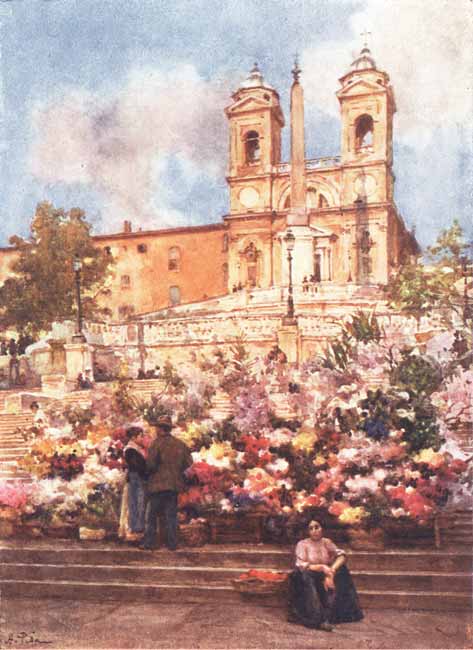
THE "SPANISH STEPS," PIAZZA DI SPAGNA
Erected for the Romans at the expense of a Frenchman in the eighteenth
century. The Piazza takes its name from the Spanish Embassy to the
Vatican which has its residence here. At the Sacred Heart Convent
attached to the church of the Trinità de' Monti, at the top of the
steps, generations of girls of Roman families have been educated. The
Egyptian obelisk came from the gardens of Sallust and was placed here
by Pius VI. See page 141.
The intellectual limitation "thus far shalt thou go and no farther,"
which the Englishman willingly imposes on himself, is impossible to
the Italian, whose moral qualities have to reckon with the
intellectual liberty which is proper to his genius. The passionate
love of intellectual truth for its own sake is one of these moral
qualities, and the people who do not possess it inevitably contract
certain moral defects. These are not the defects of the Italian; he is
not a hypocrite in his moral relations, not a snob in social concerns,
not a prig in matters of intellect, and has no faculty for the
mystical self-deceptions of the Northerner. His complete democracy of
sentiment is shown in many pleasant ways. It is difficult for the
average Englishman to imagine that rank should make no difference, to
understand the dignified and simple relations which subsist between
classes in Italy. A man in a good coat is not ashamed to be seen
talking with a friend in fustian; people of entirely different walks
in life may be seen buttonholing each other; and a Roman prince arm
in arm with a man of the lower bourgeoisie is no infrequent spectacle.
"We are all people of consideration in this house," said a Roman to
me—"on the floor below there is a Senator, upstairs there is a
teacher of languages, and I am a shopkeeper." Sovereignty too, in
spite of the heavy etiquette of the House of Savoy, is democratic in
Italy. The King does not live in inaccessible penetralia, and the
man of the people when he comes across the man to whom he invariably
refers as sua maestà will speak his mind to him. King Humbert
assisted at the inauguration of Bocconi's big shop in the Corso and
congratulated him on this new piece of commercial enterprise in the
city; which is as though King Edward VII. should pay an inaugural
visit to Whiteley's. Queen Margaret has always attended some Sunday
lectures given in Rome by the association for the higher education of
women—no Englishman could have imagined Queen Victoria attending,
say, a university extension lecture at Bedford College. The Latin
believes much more than we do in the principle of authority, and cares
infinitely less about its representatives.
Italian civilisation is imperialistic and social, not individualistic.
There is a greater sense of public decorum (as distinguished, however,
from private decency) than among us, and more sacrifice of the
individual to the society. One consequence of this is that there is
less of that eccentricity, which is the individualism of the poorly
endowed, less personal initiative, less enterprise, and nothing of
that spirit of adventure which is the Anglo-Saxon's romance. The
Italian would always, in spite of loud complainings to a just heaven,
rather "bear the ills he has than fly to others that he knows not of."
Just now it is the fashion in Italy to regard the "individualism" of
modern Italians as the reason for their failure to co-operate. But a
want of cohesion (mental and moral) is mistaken for individualism. It
is certain that the Englishman is an "individualist" yet he achieves
everything by co-operation; it is certain that he possesses that
sign-manual of individualism—initiative, and certain that the Italian
does not. Italy is not suffering from an orgy of individualism in her
people but from an orgy of egotism—which is quite a different matter.
It is a fact worth noting that every nation believes its own family
life to be the purest and most solid. The truth is that family life
plays a more important part in Italy than in England, and Latin
parents everywhere sacrifice themselves more for their children than
we do. So strong is the blood tie that it has been said that there is
nothing at the back of the Italian character but the love of family.
Children make far more difference in the life of an Italian than in
the life of an Englishman; and when love and devotion and obedience
are required of them, they have already seen in their parents as in a
mirror how life and personal comfort and personal ambition can be
squandered for love. An English parent can leave all he has away from
his children, and he frequently leaves the elder provided for and the
younger not provided for at all. A Latin parent cannot do this, and it
is a signal witness to the sense of obligation towards those they
bring into the world which subsists among the Latin races.
If the blood tie is strong in Italy, friendship is very rare. As in
the family relations so here it is the lack of marked individualism
which is the determinant. It requires little effort to come up to the
family standard; such effort, too, while it may lead to
self-repression seldom brings about self-development. To come up to
the standard of your peers outside the home requires on the contrary
an exercise of all the individual powers; and friendship belongs to
the individualistic peoples, those who prize personal rather than
tribal and family character; to a people with no moral indolence, with
the initiative and the power to become something on their own account,
and to stand by themselves. The one "provincialism" of the Italian
is—perhaps—his suspicion of all who stand without the blood tie: the
adventurous spirit of the Anglo-Saxon which has colonised three
continents has led him to a very different estimate of reliance on and
co-operation with his fellow-men, and the capacity for genuine
friendship outside the blood tie may claim to have always acted as an
anti-barbaric note in Anglo-Saxon civilisation.
The Italians have another strongly distinctive feature. They are a
more passionate but a less sentimental people than we. I suppose the
Germans are the most sentimental people of Europe, and we come next.
But in Italy the Englishman is not credited with sentiment. According
to the Italian press, for example, he has "the patriotism of the pound
sterling." For my part I regard the Italian as the least sentimental
man in Europe; we, on the contrary, both as individuals and as crowds,
are governed by our sentimentality. The whole British middle class
would make war to-morrow to satisfy a sentimentalism which the Latin
peoples regard as exclusively their own. Those who recollect that the
reception accorded to Garibaldi put into the shade the entry into
London of the bride of our future King, ought not to accuse the
English of lack of disinterested sentiment. The Italians have the
sentiment of the beautiful the grandiose and the fit—but they are the
last people in the world to be put out of their course by a scruple or
an élan. On the other hand there is a real sense in which the
Englishman is devoid of a quality which is allied to the Latin
graciousness. England shows a want of pride in and sentiment towards
dependencies like the Channel Islands or Ireland which we should not
find in France or Italy. She forgets, neglects, has no grip, and takes
no hold on the imagination. Other nations have exploited their
colonies and dependencies and the British suzerain is not appealed to
in vain for protection under his flag—but something lacks, and so it
comes about that the foreigner frequently likes our justice but not
ourselves.
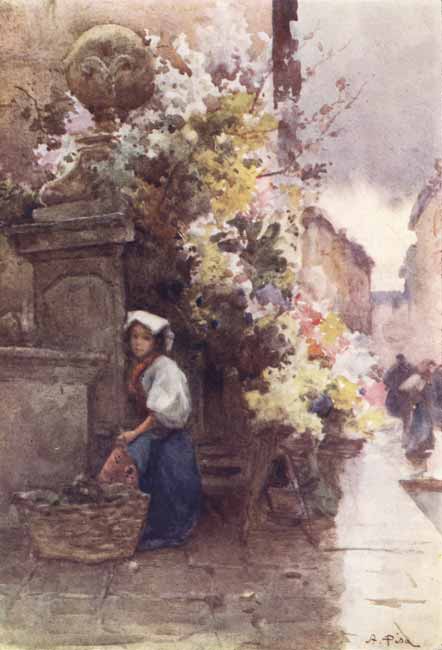
AT THE FOOT OF THE SPANISH STEPS, PIAZZA DI SPAGNA, ON
A WET DAY
That sentiment which comes of a certain noble graciousness in peoples
is shown in other ways in Italy. It is a moving thing to see the sons
bear the coffin of father or mother, to see men of all classes
follow the dead on foot; and then there is the Latin gracious
treatment of birthdays and anniversaries, the Latin power of making a
fête, of "fêteing you," surrounding you with the feeling that you are
of importance for the moment, that content is really reigning round
you; the many ways in which the sentiments of piety to the hearth and
piety to the dead are expressed; the power of handling life lightly
and of expressing feeling appropriately.
The Italian though he is not so "intense," in the slang sense, as we,
and gives way to less emotional sentiment, is far more impressionable.
On the other hand he is not ashamed to betray emotion, or to speak of
his agitazione; and it will astonish the Englishman to be told that
although the Italian is so quick of feeling that one may think he is
at the death grip with a man in the street to whom he is only
narrating his unexpected meeting with a relative from the country, he
studiously avoids those sentimental "scenes" which are so dear to the
Anglo-Saxon. The hot-blooded Italian speaks of the "furor
francese"—that unmatched capacity for summing the intellectual
points of a case and exhausting its emotional possibilities in one
lightning moment,—and it is a fact that they judge the French people
to be far more mobile and inconstant than themselves.
In common with other Latins, they have more vanity than we, but less
self-consciousness, more simplicity, and none of that mauvaise honte
which betrays that the Englishman has not got his emotions under
control. But there is in the best Englishman an excellent sort of
simplicity which frees him from attending to the personal point
which is always present to the Italian whether he is dealing with
matters public or private. On the other hand the Italians are
completely free of the French bête noir, chauvinisme. And they
have another great moral superiority: in America every one brags on
his own account; in England we plump for national brag—there is a
howling blast of the national trumpet always chilling the air round an
Englishman. But the Italians do not brag; they have, indeed, no reason
at all to act as parvenus. Their scepticism applies to themselves
even more than to others, and no people are so ready for
self-depreciation. According to them A, B, and C—the other nations of
the earth—can accomplish this or that, while "un italiano non è
buono a niente." In nothing, I believe, would Italians achieve
greater distinction than in medicine, where a distinguished tradition
of the art of healing goes hand in hand not only with the intellectual
gifts of the people, but with an unrivalled delicacy of intuition. In
no country are there better doctors, men armed at all points with the
science of their age; yet as an Italian has remarked "Among us the
physician counts as less than nothing while in France he takes rank as
a scientific authority."
The Italian and the Irishman are the only amiable men in Europe—we
must go as far as Japan to find their equals. Both people have the
desire to please—or is it a mark of ancient breeding?—the
self-effacement, the courteous absence of self-assertion so difficult
to the Englishman. The Italian will offer you the reins of his horses,
and any and all of those privileges and advantages which the English
owner regards as inalienably his. The traditional hospitality of cold
climates is indeed nowhere greater than in England, but there is no
more entirely hospitable host than the Italian when he admits you to
his house.
Nowhere are crowds so good-natured or so well-behaved. Yet the
Italians complain louder than any other people, and have not French
buoyancy in the troubles and tragedies of life. Who will believe it if
we add that they have an admirable patience? The Englishman makes his
holiday miserable by his indignation if the train is late, if some one
steps on his toes, if he has to wait an hour while his dinner is
cooking. The Italian takes all these things as part of the day's work
or play, and finds his amusement in them besides. That is another
great distinction—he cares for life for its own sake. The Englishman
cares for it for some end he has in view, and the end may be noble or
mean. With quicker sympathy and much quicker response than ours, they
are a less kindly people; and what is it in the Italians that allows
you to find them all at once in undress, the veneer gone, and the raw
material left? The Englishman would find it hard, too, to understand a
certain terrible outsideness, something callous and pitiless in the
uneducated Italian: self-interest looms too large, and an apparent
want of power of self-sacrifice—outside the blood tie—I take to be
the great moral weakness of the Italian character.
We shall already have understood that the Italian does not wait to be
told these things by others—he is the first to judge himself; he has
no illusions. In England we are fond of throwing a veil over our
national defects or of calling them by some fine name, but the Italian
of all ranks has put the defects of his qualities over and over again
in the crucible of his terrible love of reality with its quick
perception of shams; and to understand the defects of Italians one has
only to read their own masterly appreciations of national character.
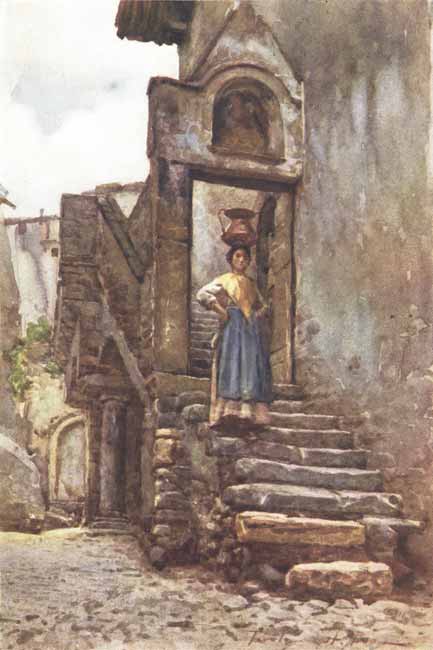
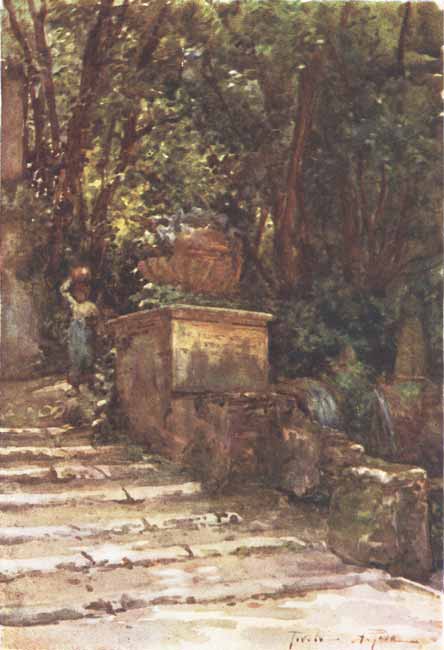
ROMAN PEASANT CARRYING COPPER WATER POT
The Italian race is, I believe, prepotent in mixed marriages. In
marriages between German and Italian or English and Italian the child
shares indeed some of the mental characteristics of Angle or Teuton,
but the personality is an Italian personality. This prepotence of
the Latin people I take to be the effect of what some one has called
"a great temperament"—the one quality which we may be quite sure has
belonged to every remarkable man. Of all the great races the men of
modern Germany leave least trace of themselves. It is noteworthy that
the instances of mixed marriages are nearly all instances of women of
the English German and American races intermarrying with Italian men;
but whichever way it is, it remains as true of Italy as of France that
"the ménage is always in the country of the Latin partner."
The Italians say: "inglese italianizzato diavolo incarnato," and
this is also true of Americans and may be true of Teutons. Two Italian
girls who spent a season in London described to me their attempts to
imitate what they called "lo stiff," the stiff reserved manner of
the Englishman of breeding. They failed, it seems, woefully, for they
could not acquire "lo stiff" and they lost their own pretty manners.
So it is with the Anglo-Saxon in Italy. We have not their finesse,
or the mental and temperamental qualities which balance their moral
defects; the Englishman adopts these with interest and his national
virtues are shed like a garment. It is therefore perhaps fortunate
that Italian women give Englishmen small encouragement to turn
themselves into diavoli incarnati; for it must be recorded that the
English and American wife in Italy runs no such risk: she remains
herself, the national character does not wear off like a poor veneer,
she does not outrage native susceptibilities without acquiring native
graces, and distinguished women of our race have for the past two
hundred years brought their native virtues to Italy while adopting
Italian causes with an enthusiasm which did not yield even to that of
Italians themselves. In Rome the English wife of General La Marmora,
the two Talbots who became Gwendoline Borghese and Mary Doria, the
American wife of Garibaldi, and the Scotch wife of the triumvir
Aurelio Saffi (still alive), all played a conspicuous Italian rôle.
There are more people with great temperaments among the Latin races
than among ourselves; and as it is "plenty of temperament" which is
wanted for the creations of art it is not difficult to understand why
the Italians are artistic and we are not. And the Italians are a
people of artists. In England where one man in a thousand may possess
the artistic temperament it is difficult to realise the keen
observation, the appreciation of technique for its own sake, the
intuitive way of gauging and grouping the data of the senses, the
balance and proportion implied in a race where one man in ten judges
as an artist. Wagner expresses, in a letter to Boïto, his admiration
of the Italian attitude to art—the open-mindedness and delicate
feeling in artistic questions which make him "understand again," after
a visit there, "the matchlessly productive spirit to which the new
world owes all its art since the Renaissance." When Edward VII.
visited Rome the Times and other English newspapers compared the
consummate yet simple scheme of decoration with the tasteless and
meaningless banner and bunting displays which London witnesses on
similar occasions. The love of beauty—the Greek horror of
deformity—is so strong with this people that its imperatives take
precedence of moral considerations—of pity, delicacy, kindliness. The
uneducated Italian shows his instinctive disgust at what is ugly or
horrible and, as we have seen, no prevenient idealism checks the
impulse.
It is an important truth that Italians learn from the outside and that
Northern peoples get from without only what they bring from within;
that Italians have, perhaps, as little ethical awareness as they have
signal and abiding æsthetical awareness. But that uninterrupted
vision of reality which has relegated moral vision to the second place
has bestowed on Europe not what is crude and naked and bare, but
another mode of seeing, of feeling, of being—one of the great modes
of human expression—art. This people who have been called "prodigals
of themselves" have been so prodigal of their gifts that the hand
which stripped the veil from the objects of sense is also the hand
which clothed them, returning them to us with the crudity gone,
replaced with new meaning, by new vision—expressed for ever in higher
terms. The ruthless vision which saw so much, and suffered no
illusion, saw also something which we did not see; and revealing to us
what lay beyond our sight held up a mirror in which the real looks
back at us as the ideal.
The imagination of the Kelt, said Matthew Arnold, "with its
passionate, turbulent, indomitable reaction against the despotism of
fact" has never succeeded in producing a masterpiece of art. Here we
have a clue to the truth—which the Greek had already taught us—that
interpretation is not left only to the peoples whose vision is
turned inwards; that when, for such, the external seems bared of all
meaning, the realist may restore it to us with the new vision in it.
II. The Romans.
In no European country has the secular conflict between race and race,
province and province, been keener than in Italy—Lombards, Venetians,
Tuscans, Romans, and Neapolitans have formed not only politically but
morally antagonistic communities; and Italy has yet to create that
moral unity which is no more a tradition of her past than is the civil
unity she has already achieved.
Nowhere, during the era of the Risorgimento, was this antagonism
more keenly felt than in Rome and by the Romans who have always
divided the inhabitants of that "geographical expression," Italy, into
"Romans" and "Italians." To this day the difficulties of moral union
are fed by the incompatibilities and the jealousies of "north" and
"south." To the warm Southerner, Lombards and Piedmontese are a nation
of shopkeepers; to the Northerner, the Neapolitan, the Calabrese, and
the Sicilian are as brilliant impossible and mediæval Irishmen.
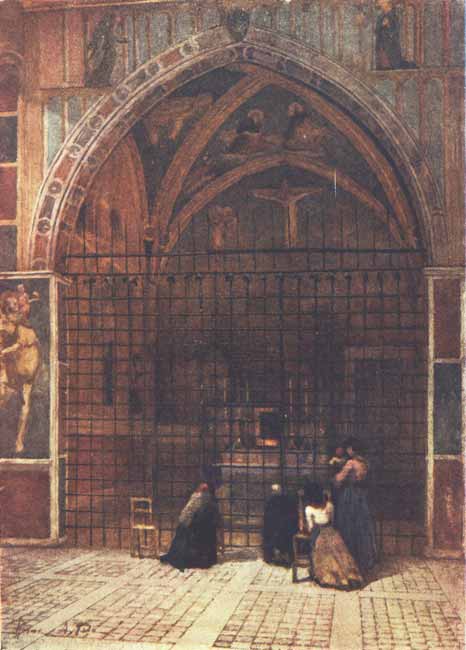
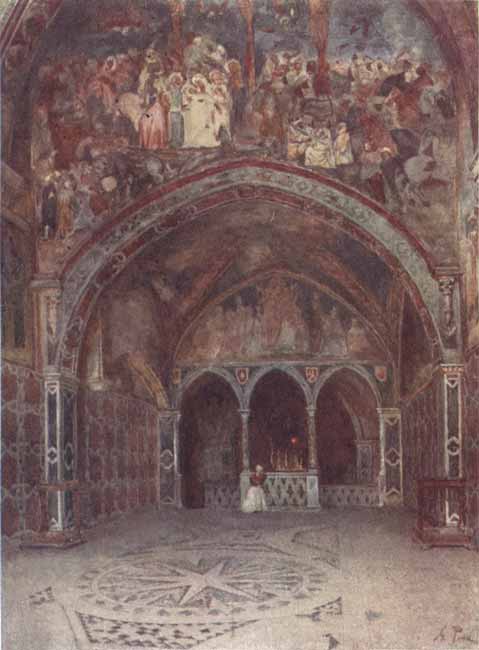
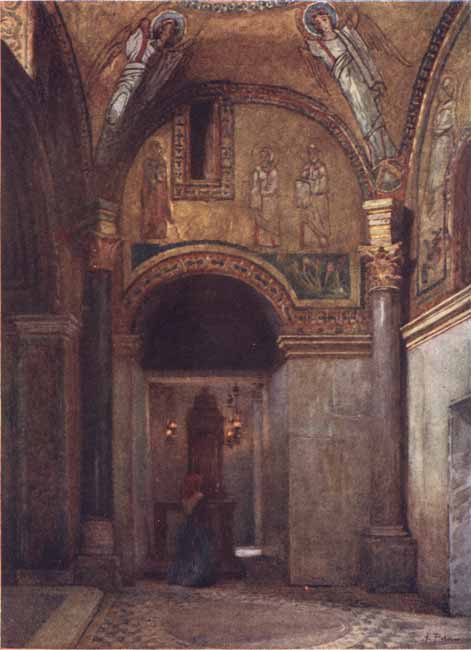
CHAPEL OF THE PASSION IN THE CHURCH OF SAN CLEMENTE
The church, which is in the street leading from the Lateran to the
Colosseum, belongs to the Irish Dominicans.
Midway between these two, neither north nor south, stands and always
has stood the Roman: by sympathy, proclivity, and geographical
position a little more south than north; but by history achievement
and tradition independent of either. Florence represents the fine
flower of the Italian spirit, the South its poetry, Venice and the
North its civil greatness. What is notable everywhere is an
incomparable productiveness in all activities of the human intellect,
all fineness of the human spirit. But Rome has not produced. After
that one act of creation, the Roman polity, Rome has been sterile; its
function has been not to create but to criticise. Like the great
Church which has developed within its borders, Rome has been the
lawgiver, the critic of other men's gifts, but has laid no
claim—when once we cede her initial gift of an infallible
magisterium—to charismata. And so the Roman possesses in its
highest terms the gift of criterion. Some witty person—a Frenchman
of course—said that England was an island and every Englishman was an
island; and so we may say that Rome was arbiter of the world and every
Roman possesses that keen vivid abounding gift of arbitrament.
Rome therefore is not Italy for taste, art, delicacies of sentiment,
for the great creations of the intellect the spirit and the
imagination—Rome is the ancient mistress of the world; and the rôle
the function and the influence of Rome must all be viewed in relation
to her gift of infallible criterion, of world dominance.
The Roman of to-day not only lives in the city of the Roman who gave
laws to the known world, he thinks his thoughts and to a great extent
lives his life. He is the result of the grandiose memories of the past
playing upon such a temperament as his. He lives surrounded by vague
memories, understanding that it was something exceedingly great which
fell, leaving him in the midst of these ruins. And the Roman has a
supreme indifference—he looks upon every event with the same
tolerance, the same sentiment of Emerson's "fine Oxford gentleman"
that "there is nothing new and nothing true, and no matter." One
procession passes him by to honour Giordano Bruno, victim of
theological bigotry; another passes to the Vatican to render homage to
the power which crushed Bruno: the Roman looks out upon both with the
same eyes, the same indifferent dignity. "The Roman apathy," say some;
but others call it a superiority, Roman largeness of outlook, the
Roman freedom from what is petty and intolerant.
Who are the modern Roman people? Are they the genuine survivors of the
rulers of the world? That there has been an immense influx of alien
blood since the fifth century is certain. The incredible depletion of
the Roman population in some periods was repaired by immigration from
other parts of Italy; but Roman characteristics at the present day are
too well marked to allow us to suppose that Rome has been at any time
swamped by foreign admixture, or that the persistence of these
characteristics can be accounted for merely by the continuity of Roman
civilisation and the Roman milieu. The Romans of to-day, therefore,
are the same people as the Romans of the great epoch—but with a
difference. They are Romans with the energy sapped out; with the power
of self-sacrifice for a public good gone, and with it the power to
impose themselves on the nations, on their fellows. Romans with no
heroes and no martyrs.
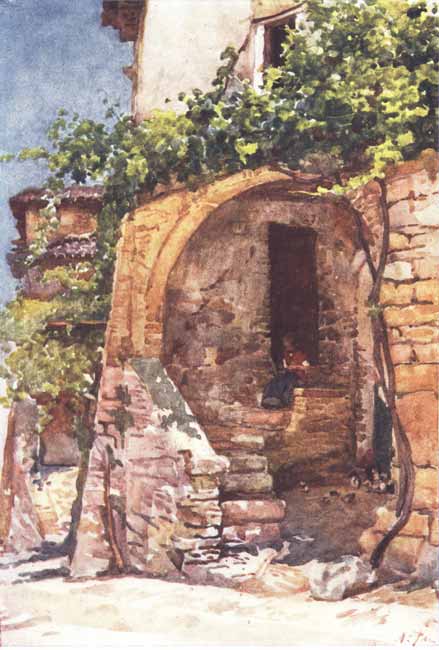
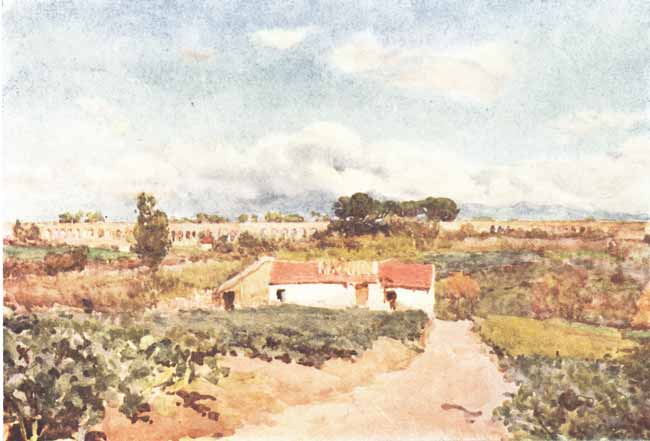
A RUSTIC DWELLING IN THE ROMAN CAMPAGNA
Nowhere, in fact, can the Italian character be seen so unspoiled as in
Rome, where fewer outside influences and neither education nor social
polish have conspired to modify the characteristics of the nation who
were once the buontemponi of Europe. The people of classic Rome had
always been men of a certain roughness, whose heroic qualities were
formed at the expense of delicacy of sentiment. This rudeness of
mind, of sentiment, of taste showed itself in every part of the Roman
life. While Athenians watched the tragedies of Sophocles in theatres
which could only hold a select audience, the Romans crowded into huge
amphitheatres where a hundred thousand men and women gloated over the
sufferings of sentient creatures—animals or men, it made no
difference; the same hideous "practical jokes," as Walter Pater notes,
being impartially meted out to both. Centuries after Athens met to
applaud the periods of Pericles, the Roman ladies were turning down
their thumbs that they might be sated with the spectacle of the last
agony of the vanquished in the arena. The refined symposia of Greece
became in Rome barbaric banquetings where the guests prolonged the
pleasures of the table by vomiting what they had already eaten. The
stern self-repression, the admirable power of devotion in a public
cause, the contempt of pleasure and of life, the animus lucis
contemptor of the early Republic, were qualities which did not
descend to the Romans of the Empire.
The Roman Type
Not only Roman characteristics but the Roman type also have descended.
The large round massive Roman head still contrasts with the narrow
pointed head of the Tuscan. The type still admired in women is the
tipo giunonico, the type of Juno and of the Roman matron—large
massive and imposing. The Roman has a ruddy fresh complexion, the
swarthy southern skin being comparatively rare; he has black hair, is
burly and tends to obesity. His expression is tranquil and contented,
and Signor Aristide Gabelli in his essay on Rome and the Romans bids
us observe that the type has improved, that we no longer see the hard,
bitter, threatening expression of the busts in the Capitol and
Vatican, the prominent jaw and cheek bones have been softened; and the
Roman of the city, at any rate, wears a more genial and humane
expression than his classic ancestor. At a church function, among the
Roman peasants—though I fear the type was more frequent in the
"eighties"—one may see a face which might serve as the model for
Jove, for a Roman poet or philosopher. It is such a face as could
never be met with even among the best specimens of our peasantry.
Muffled in his great fur-collared cloak, dirty and ragged, with eyes
which seem to look from a soul that harbours every noble aspiration,
our old peasant who can certainly neither read nor write, is probably
cogitating why Checco refused to give him the wine at three sous the
measure, or whether he would have done better to put the franc the
forastiero gave him into shoes, instead of following Peppe's
suggestion as to lottery numbers. So much for the wonders which an old
civilisation can confer without any effort or any preparation.
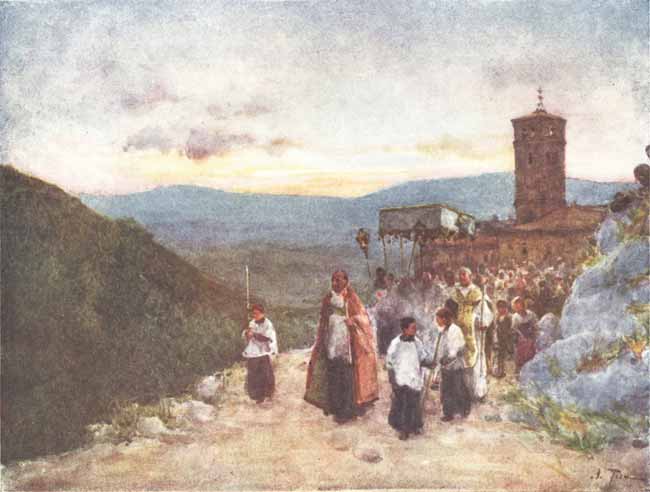
PROCESSION WITH THE HOST AT SUBIACO
Many assert that the Trasteverini are the only lineal descendants of
the Romans. The legend is that Trastevere was colonised by the Greeks
brought by Aeneas, and the Greco-Roman type may frequently be seen
there in absolute perfection—women of the people having the
classic features and the noble bearing of empresses. They are a more
robust race than the Romans on the other side of the Tiber, the black
hair of the women is still more luxuriant, the character more
passionate and vindictive, the language coarser, the reputation of the
women not so fair.
In common with all Italians the Romans are more graceful than English
men and women. The simple dignity and grace of the pose and carriage,
with no stiffness or awkwardness, makes it easy to distinguish an
Italian among Englishmen Germans or Americans whether he is sitting or
standing. They have the small Latin bones and small hands and feet;
the foot, however, is flatter than ours, and every one from the
children to the soldiers drags his feet along the ground. But the walk
is so unstilted that Italians form a natural procession, whereas a
procession in England is achieved with much difficulty and is not
really pleasing to the eye when it is achieved. Have you ever noticed
the mesquin gesture—the fear to let himself go which is so closely
allied to the knowledge that he cannot do it gracefully—with which
one commonplace Englishman bids good-bye to another? You will see
nothing like this in Italy. The ample Roman gesture—that Italian
gesture of reassurance which seems to the Englishman quite
sacerdotal—is the property of every one; and a woman of the people
will hail an omnibus with the classic gesture that her ancestor might
have used when bidding Olympian Jove stay his thunderbolt.
The Italians have the Latin eye and eyebrow; one never sees the
unmodelled elementary eye, with its gaze bon enfant, of our younger
civilisation. Naturally resonant, the voices of Italians are in all
classes harsh and unmodulated; and there is no better evidence of the
general ignorance in Rome than the uneducated speaking voices which
make it impossible to distinguish a princess from a peasant at her
prayers. The possession of a strong natural organ, quite untutored, is
here joined to the Roman love of noise and racket; and the result is
that the people scream at each other as if they were deaf, and you can
only be sorry they are not also mute. It is an odd thing to hear the
deep bass voice of some of the women alternating with the high thin
tenor of many of the men; one may often mistake in this way the sex of
unseen speakers. The deep voices of the women remind one that the
contralto, and even the contro tenore, have been cultivated con
amore in Italy: on the other hand a labourer in the fields or your
servant-man in the kitchen region can be heard singing in high
falsetto like a girl. What one will never hear in Italy are the
affected speaking voices cultivated by Englishmen: the Italian does
not "put on side" either in his voice or his manners, and nothing is
more noticeable perhaps on one's return to England than the absurdly
affected voice of the men.
There is no Roman dialect in the sense in which there is a Venetian a
Piedmontese and a Neapolitan dialect—habitually spoken by all classes
among themselves. The Romanesco spoken in Rome by the people is a
debased Italian, not a real dialect. The purest Italian is, as we all
know, spoken in Tuscany, where there is no dialect, and the best
pronunciation is the Roman. Hence the proverb: "The Tuscan language in
the Roman mouth," Lingua toscana in bocca romana.
The Roman's Character
The pride of the Roman is his chief characteristic; it keeps him from
some of the pettinesses of his neighbours and is occasionally the idol
to which self-interest is sacrificed. But the same people who are too
proud to work are not too proud to beg. This kind of pride, indeed, is
to be found a little everywhere in Italy, and I have known a
distinguished Italian with a starving family who would consent to give
lessons in "Italian literature" but not in "Italian grammar." In
France where there is the maximum of self-respect this kind of pride
is unknown. The Roman pride, however, is consistent with hearty ways
and with great frankness and sincerity of nature. The Roman, indeed,
is not only famous for his bad language, but for his out-spokenness in
all directions: he tells you just what he thinks of you, and will by
no means conceal his own humble origin when he becomes a great man; he
will not insist that his ancestor was a count or at least a baron as
an Italian from another province might do. But the Roman pride is a
disease; it clamours for its own license and respects no one else's
liberty; it plays into the hands of the Latin lawlessness, and the
Roman spirit of revolt has tormented the popes ever since Constantine
deserted the capital of the West. The Roman resents what he calls
prepotenza, but a self-disciplined law-abiding people can hardly
understand the stupid prepotenza say of the cabmen in Rome—a
majority of whom are Romans. The Roman lad or the Roman man takes it
into his head to make a bee-line in your direction, to walk over that
particular piece of road or pavement, and the feeble sense of
righteous indignation he possesses is only kindled if you attempt to
thwart him. The satyr-like—half-childish, half-malignant—cult of the
dispetto, the miserable pleasure taken in deliberately
inconveniencing you, are so many proofs of an undisciplined
nature—and where shall we see so many undisciplined faces as in
Rome?—albeit that here it masquerades as the just orgoglio of a
people descended from gods and heroes. "Non me lo dica, perchè io
sono romano" (Do not say it to me, for I am a Roman), is a warning
phrase repeated in perfect good faith, as who should say: "Do not
provoke this son of a god."
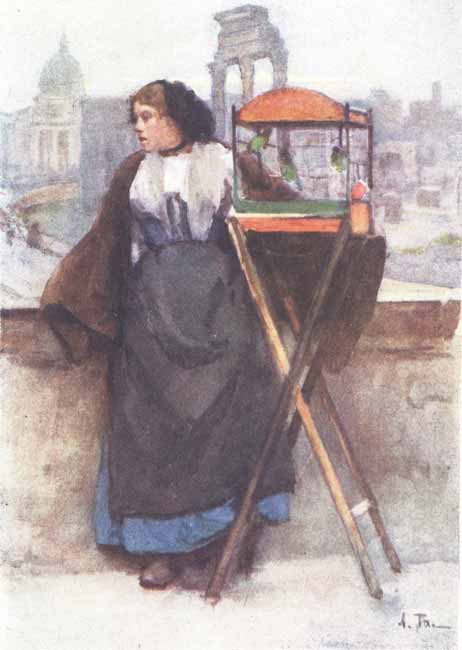
GIRL SELLING BIRDS IN THE VIA DEL CAMPIDOGLIO
The Forum in the background. The road marks the old Clivus
Capitolinus. See page 30.
The Roman's most pleasing characteristic is his genuineness; that, and
a certain magnanimity, a certain nobleness of mind. The Roman has no
"jesuitry," and he will not say behind your back what he dare not say
to your face. In contrast to other Italians is his roughness—a legacy
of old Rome—a rudeness of spirit which is a curious compound of pride
in the past, of age-long absence of mental cultivation—of a moral
quality, brutal sincerity, and of a mental quality, a terrific
realism. They are also, perhaps, the best hearted people in Italy;
and a dear old Roman friend used to declare that the Romans and the
English were the kindest hearted people in the world.
Intellectually, no people in Italy have more talent: it is a key which
opens many doors to say that the Roman is talented but not cultured.
There is no real culture in any class, but there is a facility
unmatched even in this land of natural gifts. The one exception to the
general ignorance which exists by the side of an extraordinary
quickness is an interesting one: every Roman is an archaeologist; to
be unable to take your part in an archaeological discussion would be
to write yourself down as an impossible ignoramus. On this subject
every Roman is alert, and I was present when the foundations for the
first houses which now lead to Porta Salara were being dug, and a
marble relief was found which the workmen at once told me was "the
rape of Lucretia." Imagine a bricklayer in London proffering a similar
observation! With the general ignorance there is also in the upper
class a widespread intellectual apathy; many of the Roman aristocracy
have never visited the Palatine, and when it was suggested to a young
Roman that she had never seen the Capitol, she answered: "Oh yes, I
saw it the day I was married." Part of the Capitol buildings are the
registry offices of Rome where the obligatory civil marriage takes
place. The drive on the Pincio, which is not larger than the tract
of the park from Hyde Park corner to the Marble Arch, satisfies the
most exacting ambition; and the fussy foreigner who spends his time
in museums and galleries is regarded as a harmless and well-meaning
lunatic.
Every human being is the product of contrasts; but the Roman is more
so than other men: to explain, not what he is, but what he is not we
have, I think, only to look at the contradictions, the inconsequence
of a character which in the expressive Italian phrase is
sconclusionato, it comes to no conclusion. For the Roman though he
is turbulent is easily led; he is at once obstinate and teachable; he
is not fin but he throws a terrible light on all things; without
being "finto" (feigned) he puts self-interest first. He is both
ingenuous and suspicious; to his overweening pride he joins
considerable diffidence; and the tongue which babbles of his personal
affairs is the tongue of a man who has a profound distrust of his
neighbour.
A fine critic with a child's simplicity, he is sceptical and
superstitious, credulous and incredulous, seeing the works of the
oracle but allowing it to deceive him. Joined to his indifference is a
faculty for staking his all on some absurd punctilio: his interest in
ideas is greater than in many parts of Italy, his ambitions and
pleasures more materialist. The changes which the Roman has witnessed
in unchanging Rome are met in himself by changeableness and fickleness
of purpose, though the conception of the majestic, the grandiose, the
eternal is always there. What are we to say of a people who can unite
the pettiest spite with a magnanimous tolerance?
The denizen of the eternal city is proverbially campanilista, which
may be translated "attached to the village pump"; and while on the
other hand he has a sense of public decorum unequalled in Europe, the
blasé Roman fritters time and talents in petty preoccupations, in
distractions which are neither dignified nor stately, and eats and
gambles to show his distrust of human effort in general, of all human
achievement since the incomparable days when his heroes walked the
earth.
The Roman does not merge in you, and he no longer imposes himself on
you. He is not free of obsequiousness; and such customs as the
baciamano (hand-kissing) are said to derive from the fact that the
Romans have been "the hosts of Europe" and have learnt to depend on
its bounty. A readier explanation is certainly afforded in that aspect
of Catholic Christianity which has always encouraged personal
humiliations and servilism in the inferior clergy and the laity: but
perhaps the real explanation is to be found in the fact that the
present day Roman is the descendant of the Empire, not of the
Republic, and Christianity, as we know, easily adopted as its own the
servilisms of the later Empire, with those Byzantine proclivities for
despotism and adulation which at last led the independent Roman to
burn his incense before the "genius" of the most infamous of the
Caesars.
The Romans and the "Italians"
It is said that the Roman belittles things, that he is an easy
despiser. Perhaps the gift of criterion nourished among the
grandeurs of classical and Christian Rome is a sorry preparation for
enthusiasm over the sights to be seen in other men's cities. The fact
too that his pride sometimes forbids his stooping to means which
ensure the success of his "Italian" brother who comes fortune-seeking
to Rome, joined to his sincerity and hatred of humbug are, he thinks,
the reasons why as a rule he is cordially detested by other Italians.
The "clericals" have another explanation; the Romans are hated,
according to them, because they would take no part in the doings which
led to the union of Italy and the invasion of Rome. We may give a
little weight to all these reasons and yet understand that the Roman
is disliked on other counts. His pride, so think other Italians, is
altogether too immoderate for his achievements; and when they entered
Rome they found a people devoid of the mental and moral qualities
which make fine manners—a certain amount of self-forgetting and
graciousness of mind.
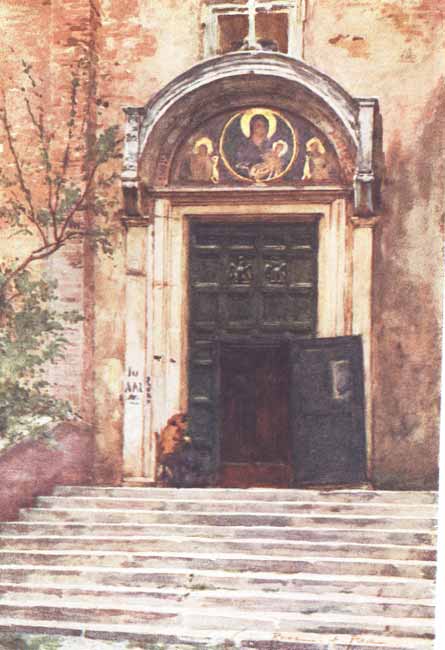
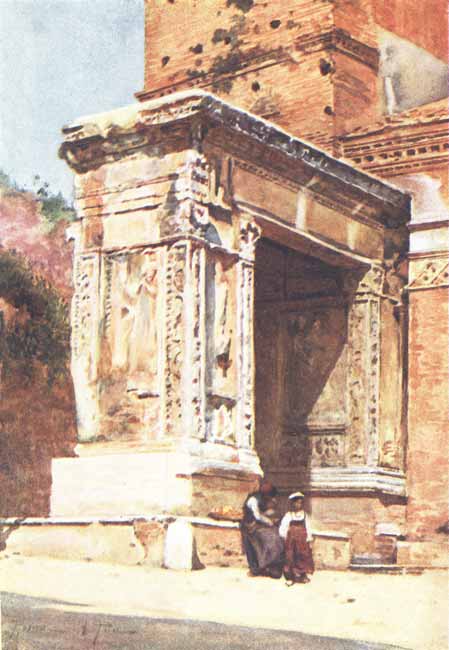
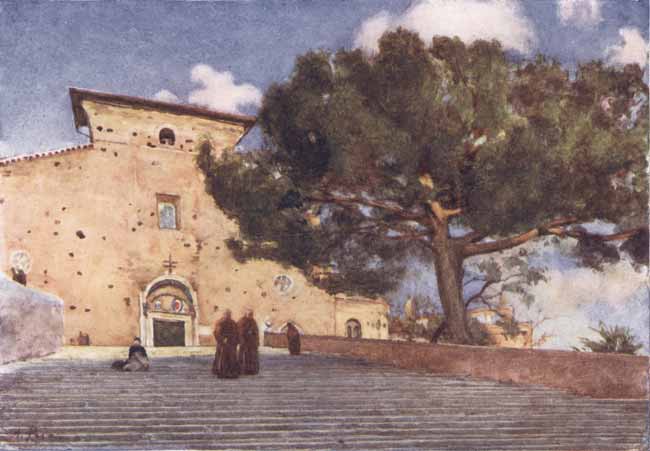
ENTRANCE TO ARA COELI FROM THE FORUM
The ever-open door of the popular Franciscan Church on the Capitol
hill, which became in the middle ages the centre of the civic life of
the Roman people. See pages 6, 57.
After "the Italians" entered the city, these provincial animosities
waxed fast and furious. Men from the north were dubbed buzzuri,
Neapolitans got nicknamed cafoni, and to this day a residence of
twenty or thirty years does not preserve the hapless "forestiere"
and his family from such epithets as buzzuri and villani if they
presume to come to words with "a Roman of Rome." On the other hand
"the Italians" returned these compliments with interest: the Romans
were unlicked cubs, maleaucati, lazy, ignorant—the proud tetragram
S.P.Q.R. was rendered by the Neapolitans Sono Porci Questi Romani
"these Romans are pigs"; while the Roman, finding in the Neapolitan
a man still dirtier than himself, retorted that the "Neapolitans' sky
is beautiful, and it is clean, because they can't reach it" ("Il cielo
di Napoli è bello, ed è pulito, perchè non arrivano a sporcarlo").
At the same time it is an indubitable fact that Italians who live
among the Romans come to prefer them to their other compatriots; and I
have heard this preference expressed by people so far apart as an
educated Piedmontese and an uneducated Calabrese. Perhaps they learn
from the Romans tolerance, the smallness of small things, and the
greatness of great ones. Perhaps they realise that the Roman has
learnt with an admirable patience and teachableness the new lessons
that have been put before him. Thrown from easy circumstances into the
vortex of the struggling life of the new capital—overtaxed and
underfed—he has suffered as much as the newcomers for a political
change which he demanded less loudly than they; and it is to his fair
credit that a revolution has taken place in Rome without bloodshed,
without violence, without undue bitterness, and that the element of
crime and lawlessness has not been supplied by him. The Roman is not a
hero, and not a saint, but neither is he a Camorrista and mafioso
like the men of the South, nor a teppista[5] like the men of the
North.
Roman Customs and Roman Satire
The customs of the Romans have been depicted by the inimitable art of
Pinelli, their ways of thinking and feeling by Belli in his sonnets
and in the modern sonnets of Pascarella. Here the satire, the
cynicism, the rude intellect, the ignorance, the self-interest, meet
us in every picture.
Nothing and nobody have ever escaped the Roman satire, which turns
everything into ridicule and burlesque. From the end of the fifteenth
century the torso called after the tailor Pasquino, and the statue of
Marforio kept up a running fire of wit and mockery. When Pope Sixtus
V. who was of the humblest origin made his sisters countesses, Pasquin
appeared in a dirty shirt. Asked by Marforio the reason, he replied
the next day, "Perchè la mia lavandaia è diventata contessa,"
"because my washerwoman has become a countess." Pius VI. encumbered
Rome with inscriptions recording his "munificence"; when bread became
dear Pasquin seized the occasion to exhibit a tiny loaf with the
legend munificentia Pii Sexti; and when Urban VIII. died the
following epitaph alluding to the bees in his coat of arms, recorded
his nepotism:
How well he fed his bees
How ill he fed his sheep.
All this is very unlike the ideas held by some Catholics who cry
"outrage" at the least criticism, and would consider the jests of
Pasquin and Marforio sufficient to keep the Pope a prisoner in the
Vatican. The popes thought differently; and preserved what face they
could under the stinging satire of the Romans.
Pasquin gave place to the capo-comico Cassandrino, who was
delighting every class in Rome at Palazzo Fiano in the Corso when the
Italians broke upon the scene.
It must be remembered that the Roman would never accept servile
occupations; the industries he chose were perforce those which
required no plant and no capital, but also those which left him
independent—such were the making of Roman pearls and mosaics,
watchmaking, the favourite crafts of butcher, tanner, and carter, or
the river industries of fisherman, boatman, and wharf porter. The most
picturesque of his amusements were the dance, the mandoline, the lute,
the song and serenade, and that improvisation for which he was always
famous. One may still see the tarantella danced on the "Spanish
steps" in May by the artists' models, dressed in the old Roman costume
which persisted till Napoleonic times—the half Spanish dress of the
girls and the short velvet jacket, feathered hat, and knee-breeches of
the youths.
When the Roman railway was built, things were conducted in truly
homely fashion; the train which was timed to leave at 10.30 was still
in the station at 11. When at length it got under way, it might be
put back again to land two peasants who had got into the wrong train.
If you fumed and fretted, you were told to remember how long the
journey would have taken before the day of railways. The Roman indeed
had then and has now no sense of time—least of all has he learnt the
proverb which he supposes is ever on the lips of our countrymen
"times is money." If you enquire of a Roman the hour of mass he
replies "About ten, or half-past, or eleven—thereabouts." The
shopkeeper, the waiter in a café, used to take no notice whatever of
you when you entered his premises; he continued tranquilly to read his
paper or finish his cigar, and only marvelled that there could in your
opinion be any reason sufficiently urgent to warrant your disturbing
these occupations. The Roman's time is as eternal as his city, and one
of the lessons he has yet to learn is its value for other things than
money-making. No one answers a letter; your lawyer or your banker
think themselves as unobliged to satisfy your curiosity as to the fate
of your cheque or your business as the butcher and the baker. The
Roman learns on his moral side, but remains so obtuse on the material
side as to be a perpetual illustration of the reputation he has for
strong-headedness, for "putting Trajan's column in his head," and
refusing to budge like a mule. The Romans indeed are haunted by the
past, and they are perhaps the people of Europe who have least grip on
the present.
It is in their folklore, the popular rhymes and tales, the customs and
amusements of the people, that we realise that no loyalty or
reverence can exist by the side of that passion for laying bare; and
understand the coarseness which waits on the wide-eyed gaze of the
Roman, unsparing and gross, because it is the result of what Ricasoli
has called "the real poverty of the poor"—a moral poverty. The Roman
goes to see some tight-rope dancers and describes the treat it was for
him:
Above all there's the great pleasure of the height,
For if any one of them were to fall,
Nothing in the world could save him.
He goes to the play. This is his impression of the tragedy:
The last act when he kills himself and her
I can tell you was just satisfying
(M' ha proprio soddisfatto).
Or take his summary of the problems life presents:
... a sto paese tutto er busilli
Sta ner magnà allo scrocco e ddì orazione.
"The whole difficulty in this life is how to eat without paying
for it, and to get your prayers said."
But the scene may change, and the same Roman is called upon to go
forth into the campagna with the beneficent confraternità dell'
Orazione e Morte in search of the body of some victim of violence. He
is found pancia all' aria and brought back to his family; but amidst
the keen observation of all that happens, of the situation, there is
not a pitiful or generous sentiment; the scenes suggest nothing of
interest but the faithful gross record of purely external
impressions. Yet these men have trudged along the heavy roads, up and
down, stumbling and struggling through the dark night to perform the
act of pity which teaches them, apparently, so little.
Tragedy, comedy, a funeral, a marriage, the visit to your dead, the
game of hazard, the incidents of an assassination, all these things
come under the same clear, coarse, unintimate, unloving observation of
a people who hold, wisely enough, that "L'occhi so' fatti pe'
guardà"—the eyes are made for looking—but who care as little how
they look as they trouble to select what shall be looked upon.
"Che bella giornata; che peccato che non s' impicchi nessuno" is the
traditional greeting to a fine day, repeated even now with a modern
humorous sense of its ghastliness. "What a fine day! what a pity no
one is going to be hanged!" And the Roman's liking for distraction and
noise is not sated even when he goes to bed. Before 1870 serenaders
waked, and charmed, the sleeping city; but the Roman who is supposed
to have been "killed between a policeman and official red tape," still
reminds us that he is not so very dead after all, or that the guardia
"non s' è fatto viva," for he now roars down the thoroughfares in the
small hours of the night, thus procuring for himself the pleasure of
disturbing you—a form of recreation with which even the police have
too much sympathy to interfere. For the Roman tolerates other men's
lawlessness but has no respect for their liberty.
The "Coltello" and Crime
As with children who cannot "play the game," his games of chance
degenerate into quarrelling and killing. The terrible habit of
carrying, stowed away in a pocket at the back of the trousers, or up
the sleeve, what the Romans call "the instrument" gives them a ready
means of converting hot blood into hot deed. The coltello used to
be, and still is at times, the favourite gift of a girl to her
lover—to have used it with deadly effect is in her eyes a necessary
sign of prowess, and to feel it always ready is in his sight the
welcome earnest of power to assert his virility. Italian crime is
committed in hot blood; sudden rage or "love" supply the motive, and
there is very little of the premeditated cold-blooded crime of which
Dickens gives us an example in the details of Nancy's murder in
Oliver Twist. The worst crimes of violence, however, are brought
about from motives so futile as to seem incredible when they are
mirrored in some ghastly assassination. It is enough to disagree with
your comrade, to win a litre of wine from him, to refuse to withstand
the police—to find yourself on the way to Sant' Antonio or the
Consolazione with three inches of steel in your stomach, nay not
unfrequently in your back. Primitive, terrible, childish, barbaric,
this love of blood, this power of "seeing red" in a quarrel, has made
the Italian the bravo of Europe, and makes the total of Italian
homicides at the present day exceed those in England, Germany,
Belgium, France, and Austria put together. Ninety-five homicides for
every million of the population contrast in Italy with six for every
million in England. In the time of the Venetian pope Clement XIII., in
the middle of the eighteenth century, the proportion of homicides in
Rome was twenty-five times higher than this.
Is the Italian more cruel, more brutal, more wanton than his fellows?
To the first two questions I should answer No, to the last, Yes. The
cruelties of the French Revolution, the coarse brutalities of England
even down to the century just passed, the horrors recently revealed in
the German army, would at no time have found their counterpart in
Italy. But the Italian—the Roman—is wanton, he is an egoist who
sates his impulses without any reference at all to the other people
and the other interests involved. He is wanton, for he lacks the sense
of personal responsibility; wanton, for he carries on life and
government with no regard to justice. The Italian is a child of
nature, a combination of his own two conceptions of "faun"-like
irresponsible grace and "satyr"-like animality; an undisciplined
creature living in the conditions of modern civilisation. But although
the Italians are a vital people, a people alert on the side of the
self-protecting instincts, and with the egoism of the vital
temperament, they are not an inhumane people: they have in abundance
the imaginative sympathy which instructs and softens, and if they lack
the sense of justice they are in some ways more merciful than we.
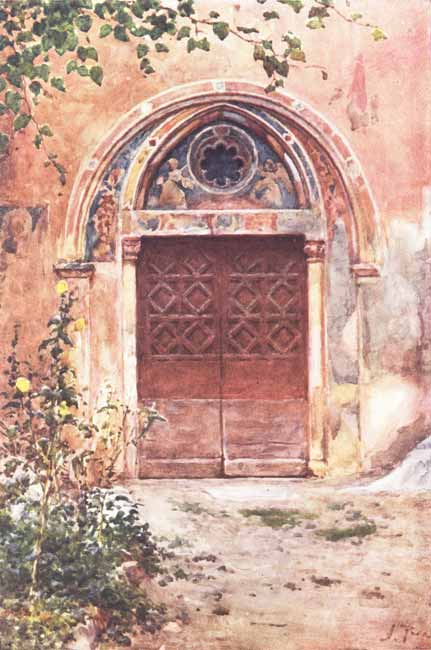
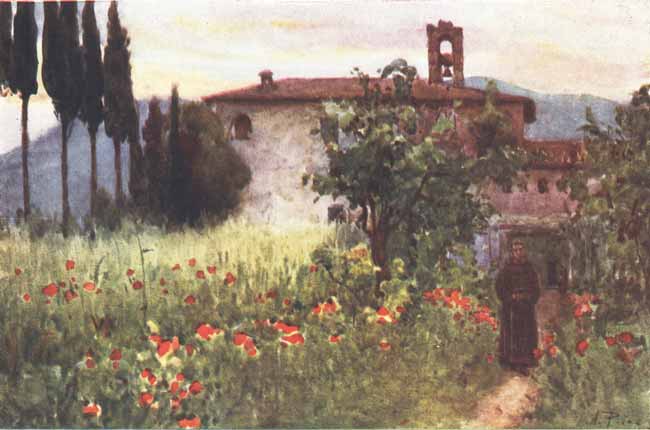
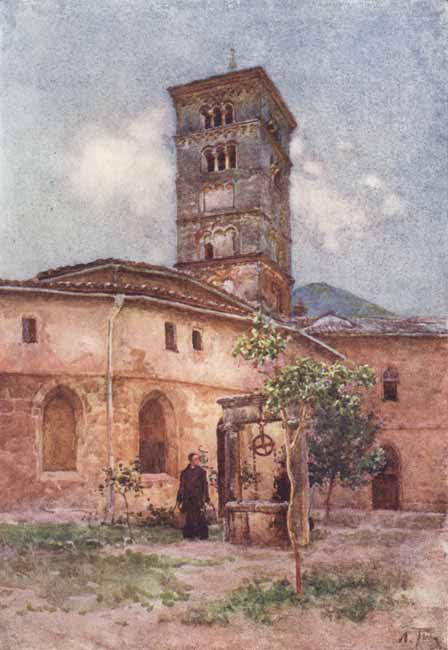
DOORWAY OF THE MONASTERY OF S. BENEDICT (SAGRO SPECO)
AT SUBIACO
See interleaf, pages 82 and 86.
No one can understand the disposition of the Italian in any part of
the peninsula who does not appreciate in it a certain
mildness—something expressed by the Italian mitezza but not by
our English meekness—which preserves him from excesses from which
other peoples are not free. The Romans of antiquity boasted no such
sentiments; from that cruel period there has come down to us one story
of humanity—the humanity of a dog; the compassion shown by a dog for
one of a group of victims executed in the neighbouring Mamertine
prison, and callously thrown out upon the steps of the highway of
civilisation—the Roman Forum. But as a population the Romans of the
modern city are not cruel.
If you look in upon the Roman as he watches the public torture of
prisoners in the first part of last century you will have the story in
brief of his irresponsibility, his unstrenuous attitude towards all
such matters. He shrieks with delight at the writhings of the victims,
but will shout with pleasure if one of them succeeds in making good
his escape. Little has been done to instruct the spirit of the
ignorant Roman, yet few such scenes of repulsive cruelty to animals as
Naples and Florence present are to be laid at his door; and the best
of the population need fear no competitors in human and merciful
sentiment. What the country cries out for is for these better
sentiments to have the force of a public opinion—a civilising agent
as yet completely absent in Italy. No force in the country helps the
Italian to that "self-reverence" the lack of which Mrs. Barrett
Browning discerned in him. Nowhere in Europe is callousness to human
life so great;[6] nowhere in Europe, writes an enlightened Italian
priest, is there so much cruelty to animals as here; yet so
unaccustomed are the people to that best form of moral
education—moral suasion—a gradual civilising of spirit, that they
are incapable of putting two and two together, and still urge the
ignorant argument that if you inculcate humanity to animals while
there is so much to be done for men, you are somehow wronging the
latter; they suggest, apparently, that by kicking a dog you are
somehow helping a baby. It is to be hoped that the thesis of the
priest above quoted, that the protection of animals is a real means of
education, may be accepted boldly by the better clergy now that Leo.
XIII. has called such protection altamente umano e cristiano.
Visitors are outraged by the disgusting cruelties which even the
children in Italy are the first to practise, and no amount of
sophistry will make them believe that such conduct is decent in the
superior animal. That secular Italy will be obliged to take up the
subject is certain, and one hopes that then the clergy will return to
the simpler spontaneous religious feeling of the country—marred by
scholastic dogmas—which gave a patron saint to the lesser creation,
and which still places in every stable and cattle-shed of Umbria the
image of "S. Antony, protector of animals."
Law and Justice
Those who know what it is to feel "righteous indignation" must suffer
in a country where justice is not understood and not appreciated by
any one. The Italians still know how to make laws, and legislation
here is ahead not only of the sentiment of the country but of the laws
of most European peoples—what they have forgotten is how to
administer them. It is no exaggeration to say that at present Italian
tribunals exist for the sake of the criminal; absurd "extenuating
circumstances," which can hardly be taken seriously, are always
forthcoming, and as a distinguished Italian declared in the Senate the
guilty man here must indeed be an unfortunate wretch (un povero
disgraziato) if he cannot manage to escape a condemnation. In place
of the inexorable penalty which would alone meet the case in a land
where lawlessness has prescriptive rights and where capital punishment
does not exist, there is a pleasing uncertainty about all penalties.
With a poor sense of humour as conspicuous as the poor sense of
justice, a bench of judges will gravely listen to a succession of
false witnesses, vulgar perjurers, mere play-actors, who spring up
hydra-headed in support of every villain or rascal, be the matter a
murder or an affair of two francs.
The terrorisation exercised by the knife and the vendetta has caused
the Roman for centuries to enter into a shell of reserve; if an
assassination takes place—in broad daylight or in the dark, it does
not matter—no one sees it; the guardia arrives round the corner in
time to make the "legal verifications" as soon as the misdeed is
safely accomplished, and if the victim shrieked first neither he nor
any one else happened to hear it. The desire to live in peace, seeing
nothing, hearing nothing, making no enemies, has affected a whole
people—with the result that the protected person is the malefactor.
The more audacious he is, the more he affects in the city the
allures of the brigand, the more successful he will be in evading
the law, in gaining the support rendered by the silence or the false
witness of all who encounter him. The people, writes Aristide Gabelli,
"seek by silence and dissimulation their own safety rather than the
public safety at their own proper peril." The consequence is, of
course, that there is not the least co-operation with the law. The
Roman, indeed, feels humiliated by the necessity for seeking its aid;
government and law are abhorrent to him, and he alludes to the former
as "questo porco di governo"—if you are unable to defend yourself
the alternative is not the arm of the law but to stop at home.
The police service of Rome includes three corps—the carabineers, who
hunt in couples, in three-cornered hat and cloak and sword; the
municipal guard who wear a cocked hat, with cocks' feathers on feast
days, and a black uniform turned up with orange; the Guardie di
Pubblica Sicurezza, in black piped with blue, and a capote. These
last, called questurini because they depend from the Questura, are
disliked by all Romans who call them "avanzi di galera," gaolbirds
and assassins. As a matter of fact it is difficult to find men of
civil condition to enter the corps; such work is eminently distasteful
to a Roman, and "set a thief to catch a thief" is the principle on
which he supposes the governo acts.
Crispi tried to form one police force for the city; at present if you
apply to a guardia di P.S. your business is sure to concern the
absent municipal guard, while the carabineers do nothing but support
each other in the arduous task of standing at street corners watching
the follies of men, criminals and victims.[7] To the municipal
guard—the popular force, called pizzardoni—is entrusted the
maintenance of decency and order in the city, and they often brave the
wrath of their fellow citizens in its accomplishment. All matters not
connected with municipal legislation pertain to the State police, who
arrest thieves and act in criminal affairs. Soldiers, too, have
certain civil duties; they are frequently called upon to act as
police, they are called out to help if a house falls down, to form the
cordon in case of a fire, and may in certain circumstances arrest a
malefactor.
The soldiers form the most respectable and the only disciplined part
of the male population in a city like Rome. One often sees, of course,
battalions of men from all the Italian provinces, youths of twenty
just enrolled, and among them there is seldom a vicious face. For
these are the mothers' sons, and they compare very favourably with our
"Tommies." The same cannot be said of the other youths who throng the
city. Perhaps seven-tenths of the crime is committed by lads in their
teens and early twenties; I have heard a Senator declare that there
are boys of twelve in the prisons who are already perfetti
criminali; and surely nowhere in Europe are boys and youths worse
trained. The most appalling phenomenon, however, is the existence of a
degraded type, of all and every age, usually belonging to the
decently-clothed classes, whose outrages on decency were described by
an Italian in a Roman newspaper as "enough to sicken the coarsest
navvy." These practices, according to some old Romans, are one of the
results of the French occupation, but such an explanation of
occurrences which are to be met with nowhere else in Europe or out of
it, must be taken with all reserve. Gaolbirds like these molest women
with impunity; and the amor proprio of the vile nature awakes just
in time to heap further outrage when this molestation is resented.
Women have always been hustled in the Roman streets, and as Italian
ladies are only now beginning to walk unaccompanied, the foreign
visitors bear the brunt of the amiable practice still in vogue of not
moving on the narrow pavements, but leaving the lady to take the
gutter. Such conduct from men to women contrasts strangely with the
courtesy so often extended even to beggars; and a woman of the people,
a servant or a porteress, will invite the beggar who is interrupting
your conversation to desist, with such phrases as: "Move aside a
little; Do me this pleasure."
Courtship and Marriage
It will be astonishing to many, no doubt, to hear that courtship in
Italy is a prosaic affair. Of passion there is plenty and to spare,
but the tragic element does not enter every day, and then no sentiment
comes in to disturb matters. After the first etiquette of the
situation is over, and the letters vowing that you have il paradiso
nel cuor—which are duly discounted by the peasant fiancée—have
been written, things run uneventfully enough. A young Abruzzese
servant—from the most saving population of Italy—became enthusiastic
when recounting the virtues of his proposed bride to his mistress,
which culminated with: "Signorina mia, è piena di biancheria"—"she
is full of house linen."
There is among all Italian women more dignity in their relations with
men than there is among English women. The Italian woman has a noble
reticence, a power of self-protection, which imposes itself on lover
and husband. She is not accustomed, as we are in modern times, to
walking abroad unaccompanied, and there is no doubt that here the
Englishwoman shows a self-respecting demeanour which is everywhere
recognised as entitling her to all the respect she feels for herself.
What I speak of is the Italian woman's attitude towards the man to
whom she is engaged or married, in comparison with the Englishwoman's.
The former will not serve her husband as an English or German frau
will; nor, before marriage, will she lay herself out to keep the man
at any cost as the English girl of the servant class will do. Here
Italian self-respect is greater than English. The Roman woman of the
lowest class habitually displays this personal dignity and reticence
in the streets; and nowhere in Rome will you see such scenes as are
to be witnessed on any bank holiday at a seaside place in England, on
Saturday evenings in London, or in country towns after dark, among men
and women of the lower middle class.
The Italian woman will avoid scandal to herself and hers at whatever
cost; she will suffer any deprivation or loss to compass this, to keep
her trouble from the eyes of the curious world. There is none of that
vulgarity of soul—consummated in modern times among Anglo-Saxon
peoples—which hastens to wash dirty linen in public. This is one
reason why divorce is so distasteful in Italy, and especially to the
women, who would one and all suffer individually in order to bind the
man, to preserve the family and its honour, in preference to the
enjoyment of the personal freedom which the looser bond implies.
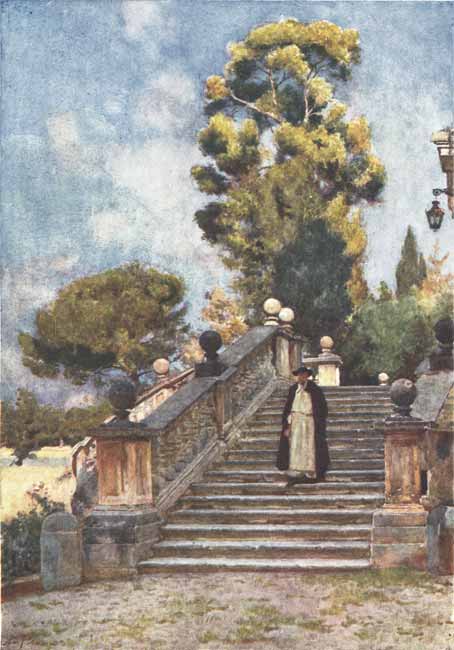
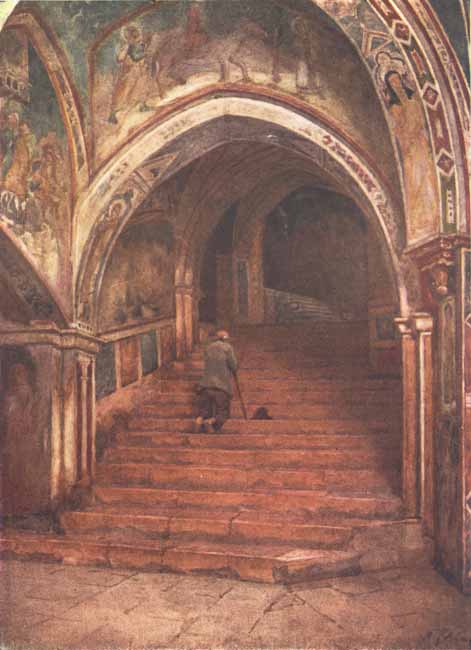
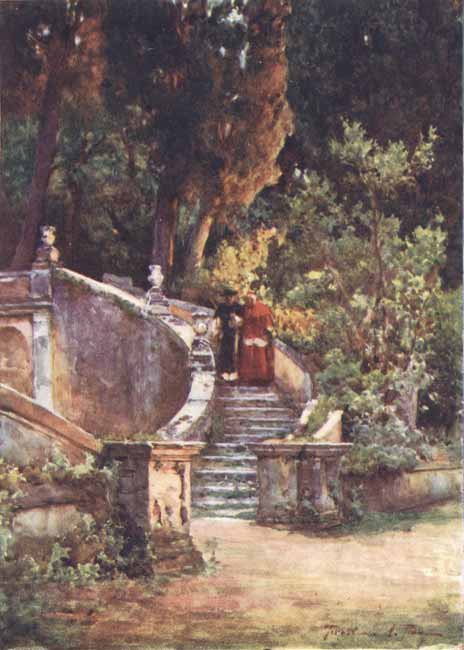
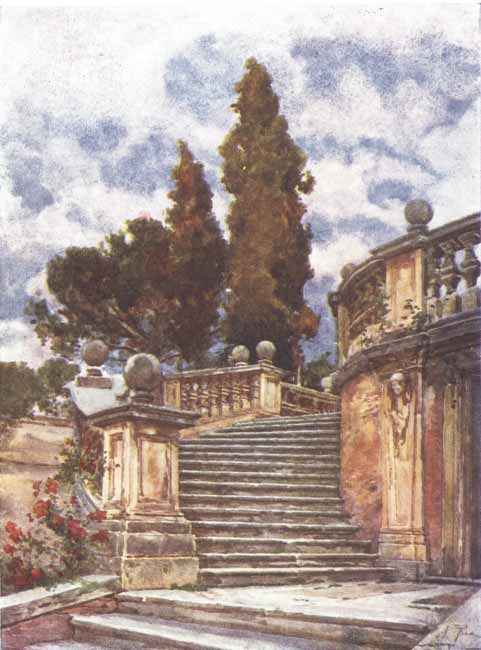
STEPS OF THE DOMINICAN NUNS' CHURCH OF SS. DOMENICO AND
SISTO
This and the church of Santa Caterina da Siena form a Dominican corner
of Rome on a spur of the Quirinal. The garden of Palazzo Aldobrandini
is seen in the background. See pages 6, 171.
A traditional characteristic of the Roman is that he has always given
a fairer share of life to women than other Italians. Since the day
when Romulus called the Roman curiae after the thirty Sabine women
who had thrown themselves into the breach for the Romans, and
conferred on them special privileges, the Roman woman has played a
dignified part in the life of the city. As priestesses the vestals
possessed privileges shared by none but the emperor; and the idea of
the Roman matron, the wife not "in the hand" of her husband, was a
Roman contribution to social ethics two thousand years before the idea
occurred to Englishmen. There is nothing that antiquity has handed
down to us more dignified than the seated female figures in Roman
museums. These views of women ceased, naturally enough, when Rome
which had been the greatest political became the greatest clerical
city in the world; but the Roman tradition was handed on in the
Italian universities outside Rome, which admitted women five hundred
years before they were allowed to share in the benefits of those
colleges of Cambridge and Oxford which their money and influence had
done so much to endow.
The women of the people still, however, enjoy in Rome "an almost
unlimited liberty." The Roman man shares his recreations with his
wife, and the wife-kicking which is such a plague spot in the life of
the common people in England, is not one of them. English fair-play to
women is indeed merely a matter of class; it has never penetrated to
the lower strata, and in the English middle as in the English lower
class the men are still "the lords of creation." This conjugal
relation in fact remains a bulwark of a certain coarseness which no
one can deny to the Englishman, and which is registered in the
Italian's firm opinion that English wives are bought and sold in open
market. In other parts of Italy, however, in Calabria and the Abruzzi
(even Piedmont is conspicuous for want of gallantry), the wife is
regarded simply as a chattel, and the brutal husband aims his blow at
his wife's face in order that the neighbours may recognise il segno
del marito. The sufficient explanation è suo (it is his own) is the
same which will be given you if a youth maltreats a dog; and in both
cases the moral quality of the argument is as ignoble as it can be.
Socially, the talents of the Romans are not higher than our own. The
Italian people have not the social gifts which are the privilegium
of their Latin neighbour. On the society of ancient Rome was
superimposed clerical Rome—a city where the sex which makes society
was nowhere, where the pezzo grosso in every drawing-room was a
Roman cardinal, not a great lady; and there can be little doubt that
this has not proved a civilising influence on the Roman. But in
natural gifts of disposition the Italian greatly excels us; and in no
English gathering can the charm be approached which Italians will
impart to an alfresco party, an impromptu festa—often including a
great mixture of classes—when the simplicity, the unfailing good
humour, and the successful efforts to please are a lesson to the
Englishman. The Italians by gathering together make a natural festa,
as by walking they make a natural procession—something that is
graceful and unselfconscious, absolutely simple without missing
stateliness.
The Romans and Art
The art history of Rome is as distinct from that of the rest of Italy
as is its social, its religious, or its political history. We look in
vain to Rome for a first-rate picture, a first-rate poem, even—with
the exception of Palestrina—for a first-rate composer.[8] The fatal
facility which hampers all Italians, who can achieve with little
labour what less gifted peoples travail to attain, meets in the Roman
that curious inconclusiveness, that strange universal sterility, which
begins with the character itself. Nevertheless the Roman has not
failed to give us what it is his function to give—he has always been
a fine-art critic; every great thing has come before him, and of all
he has been an incorruptible judge, seldom deceived, using all the
powers of finezza, of ridicule, of satire, and of fine judgment at
his command, to raise or to create a standard of fine work. If there
is one art which may be said to be not only the gift of Italy but to
have remained Italian, it is singing; and here the Roman has kept in
the forefront both as critic and executant. The Italian really loves
a voice—the Englishman loves the sentimental rendering of a theme;
and the criterion of vocal sound which the Italian possesses, he
finds, perhaps, in his own throat. "Roman throats and chests must, in
some particular way, be differently constructed from those of other
people" wrote Walter Pater; and the resonant voices of Italians may be
due to the absence of the protruding German and English chin which
captures and muffles so many of our vocal tones.
The classical Roman had no taste: we wonder to-day that the Roman,
dazzled with rich marbles, should adopt the expedient of painted
columns in a scheme of decoration; but he did the same in the house of
Germanicus on the Palatine. That there is a distinction between taste
and artistic sensibility there can be no doubt whatever, and it is
equally true that the former is often mistaken for the latter. The
subject is an interesting one; but here we can only record the two
facts—that the Roman all through the centuries has been a sensitive
to artistic impressions, and a fine judge of the arts, and that he has
never possessed that gift of a certain refinement of sentiment—taste.
After all that has been said of the Romans, it is sad to have to
record that it will soon be difficult to find genuine Roman families.
The old "Romano de Roma"—the man whose ancestors, like himself,
were born all' ombra del Cupolone, under the shadow of the great
cupola—is disappearing, giving place to more successful, more
industrious, and 'cuter men—preserving up to the last moment of his
life those habits and customs which cause him and his house to suggest
Noah and his ark to the more modern Italian; but also learning up to
the last hour of his life new ideas, such as must also have importuned
the patriarch and his family when the waters receded leaving him and
the ark high and dry on Ararat, and the daughters of men began to
weave their toils round the sons of God.
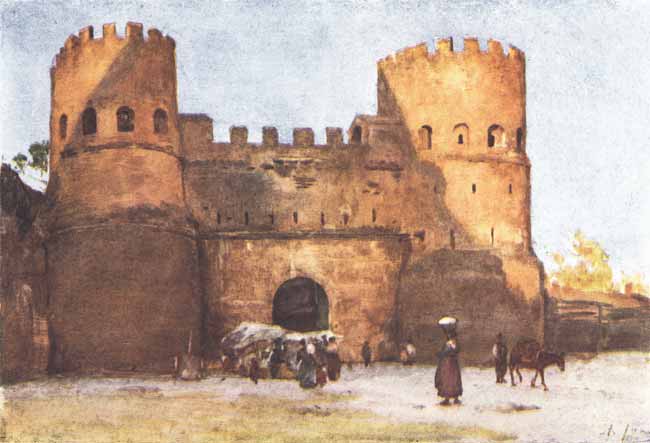
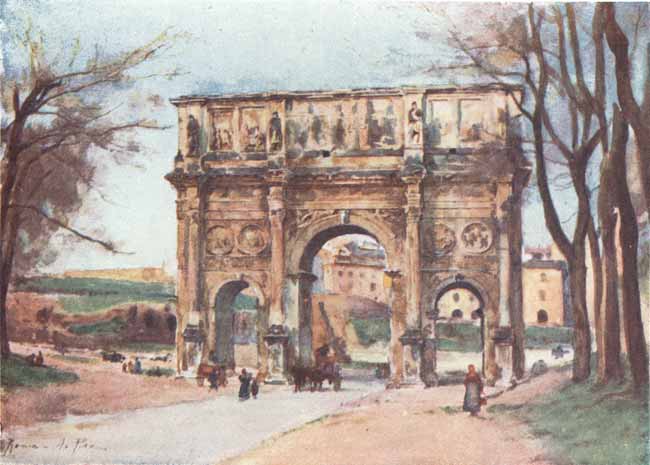
PORTA SAN PAOLO
Gate in the Aurelian wall rebuilt by Belisarius. This is the gate of
the Ostian Way leading to the basilica of S. Paul's—one of the seven
great pilgrimage churches—of which the Kings of England were
Protectors.