THE fact that nearly all true Romanies
have two surnames—one by which they
are known to the gorgio, the other by
which all genuine gypsies know them—will,
unless given due consideration, be somewhat
puzzling to those whose knowledge of the
gypsies is but slight. Regarded cursorily, such
an arrangement would appear to possess no
advantage, but upon consideration it will be
obvious that to a seclusive, suspicious and suspected
people, the ability to converse—not only
in the language of the country in which they
dwell, but also—in a tongue which is practically
unknown outside their own race, is likely to
stand them in good stead, more especially if the
proper names in the secret tongue bear no resemblance
to their equivalents in the language
of the country; and it cannot be doubted that
many a tight corner has been negotiated, and
many a man has escaped punishment,—deserved
or otherwise,—simply because warning or other
timely information has been conveyed in the
secret language to those concerned.
The following case in point was related to me
by the principal gypsy actor in the incident:—
A gay mush (policeman) “collared” him on
one occasion when he was with some relatives.
Desiring to apprise a certain gypsy family of
this occurrence and to give them information
that would put them upon the alert, and, being
in the circumstances obliged to speak openly,
he said in Romany to his brother who was near,
all that was necessary for his purpose, including,
of course, the name of the family. This conveyed
nothing to the policeman, who was evidently
nonplussed as he said roughly to his
prisoner,—“Now, young man, we don’t want
any of your back slang,” an observation which,
instead of impressing his hearers with his perspicacity
as it was evidently intended to do,
informed them that he was utterly ignorant of
the Romany tongue, and, not only this, but that
he was not sufficiently astute to keep the knowledge
of his ignorance to himself; had it been
possible, however, for the officer to have heard
even the English surname of the family implicated,
his suspicions would have been at once
aroused, but he had scarcely disappeared from
the scene when a child was despatched hotfoot
with the message to the camp of the family
involved.
In passing, it may be remarked that gypsy
children are extraordinarily cute in business of
this nature. When important news has to be
carried, the words “Plastra lesti” addressed to
them by their parents make them scuttle along
like hares, and sharp, indeed, will be the eyes or
ears of the rural policeman who either sees or
hears anything of the youngsters until after
their message has been delivered, for they will
run barefoot on the inner side of a hedge, lie
concealed amongst herbage, take a short cut
here, another there, through a stream, or anything
else if such a course will save time and
enable them to get to their destination quickly
and secretly.
To return to the subject of the two names:—
It is worth noting that it is usually the surname
only which is rendered into Romany; for
instance, Fezenta Cooper in English will in the
gypsy tongue be Fezenta Vardomescro, Clara
Stanley will be Clara Beshaley, and so on.
The surnames hereunder are among the best
known of the principal Romany families:—
Barney, Stanley, Smith, Pidgley, Cooper,
Hughes, Wells, Lee, Shaw, Deighton, Saunders,
Lovell, White, Ayres, Loversedge, Rickman,
Brazil, Bull, Churen, Doe, Fenner, Harris, Buckland,
Lakey, Lamb, Sherred, Black, Willett,
Taylor, Bosswel, Boswell, Allen, Carew, Corrie,
Glover, Buckley, Bosvil, Loveridge, James.
Scotch surnames:—
Young, Ruthven, Blythe, Fleckie, Gordon,
Faa.
Many of the Christian names are very curious,
as is evidenced by the following lists, which
might, of course, be greatly extended, but the
names given indicate the widely differing sources
drawn upon by the gypsies:—
Male.—Panuel, Sylvester, Wester, Jobey,
Soner, Euri, Jasper, Samson, Bendigo, Noel,
Daniel, Liberty, Freedom, Noah, Nelson, Franny,
Rodney, Larry.
Female.—Sinfai, Fenella, Shuri, Laura, Ivy,
Mona, Fezenta, Videy, Dōsha, Rhona, Rawnie,
Zillah, Leander.
One or two, it may be noted, are of Biblical
derivation, for the source of some others we
must go to the gypsies’ land of origin, and so on.
While it is outside the scope of the present work
to go deeply into the origin of names, a few
suggestions as to the possible derivation of one
or two may not be uninteresting.
Take, for example, the not altogether unpleasing
name of Dōsha; what does it mean?
It seems likely that it is derived from the Romany
word Dusta or Dosta, meaning plenty or enough,
or it may have some connection with Dosh—evil.
Again, Rhona very closely resembles the
Hindustani word Ronā, to weep, and it is quite
conceivable that it may have been first bestowed
as a name under circumstances which
gave cause for weeping. The name Shuri, too,
is almost identical with the gypsy word churi—knife,
and it is possible that knives may have
had something to do with the first use of this
name as well as the surname Churen.
Doubtless many recognized names, or portions
of names among the gypsies, result from
the persistence of nicknames, thus a clumsy or
greedy person may be called baulo (pig), a
touchy, irritable fellow hotchi (hedgehog), such
nicknames becoming in course of time agglomerated
with the real names, or in some cases
superseding them.
Romany people assert that persons of gentle
birth bearing the same surnames as themselves,
obtained those names in the first place from the
gypsies, the possibility that the reverse obtains
seeming never to occur to them.
They may, however, justly accuse the gorgio
of appropriating and putting to pretty general
use as cant expressions, several words from their
language; for instance, the gypsy word “chavo”
has been altered to “shaver” and is in common
use to designate a child; pal, signifying brother,
mush, man, are frequently used. Turning to a
modern dictionary for the signification of the
word “chum” we find it given as “an intimate
friend,—etymology unknown.” Now, as the
gypsy word, choom, signifies a kiss, and the
Sanscrit, chumb, has the same meaning and is
perhaps somewhat nearer to our word, it will
not be unreasonable to consider our word
“chum” adapted from the Romany, and to be
the term for a friend whom one kisses.
The gypsy is usually proud of the family
name, and, far from railing at Providence for
decreeing a gypsy’s lot for him, he invests the
part with a certain dignity, which his dislike of
the gorgio helps him to sustain; in fact, I
know of more than one Romany family whose
members consider it derogatory to execute work
“to order.” The following incident very well
describes their attitude in this respect:—
A lady, who was aware that I had had intercourse
with the gypsies for many years, came
to me in great trouble and explained that she
had ordered a dozen baskets to be made by a
gypsy named W—— H——, and although he
knew she urgently needed them for a bazaar he
had not supplied even one of them,—she considered
him very foolish to refuse work which
would amount to twelve shillings, but the fact
remained that no baskets had come her way
and she had come to me seeking a solution of the
difficulty. I endeavoured to explain the affair
without giving offence, but the actual reason
why the man refused to do the work was, that
the lady, who had a somewhat exalted idea of
her own social standing and general importance,
had ordered this man—who considered himself,
in some ways at least, her superior—to do the
work; she had undoubtedly given the order
with the very best of intentions, but obviously
the gypsy’s insight had shown him that she—the
lady—felt she was abasing herself by holding
intercourse with him, the outcast, and, while
giving her credit for some sort of a desire to do
good, he would give relief to his wounded pride
by spitting on the ground in her direction after
she had left.
Some little time later, I required two or three
of these baskets for presents, so I looked up this
same W—— H—— and asked if he would be
good enough to make a few for me, at the same
time telling him he could make them just when
he pleased and bring them along as completed,
the result being that I received several baskets
in one week, and later, I had to tell him to stop
or I would have more baskets than friends.
These little incidents,—simple enough in themselves,—throw
a good deal of light on a particular
aspect of the relations of Romany and gorgio.
The gypsy has his inherited propensities and
aversions, and traditional usages; as these have
remained practically unchanged for centuries,
it is, to say the least of it, unreasonable to expect
him to change suddenly and conform to
standards of thought and action set up by those
whom he regards with antipathy. To the law
of the land, he perforce submits, but all attempt
to force him into the social or commercial moulds
of modern civilization may be likened to the
forcing of a highly elastic substance into a confined
space, it will remain there only under
pressure, the removal of which may result in its
flying out into the face of its would-be moulder.
The gypsy, in common with all other subjects
of the realm, has no choice but to submit to the
law of the land, and so long as the laws which
especially affect him are just, this is as it should be;
unfortunately, however, it would appear that the
administration of these laws,—perhaps I should
say, the direct application of them to gypsy life,
is in too many cases left to officials who detest
the people, have an exaggerated idea of their
office, and who therefore delight to enforce the
letter of the law rather than to grant such grace
as the law would permit, or, at least, such as
humanity demands.
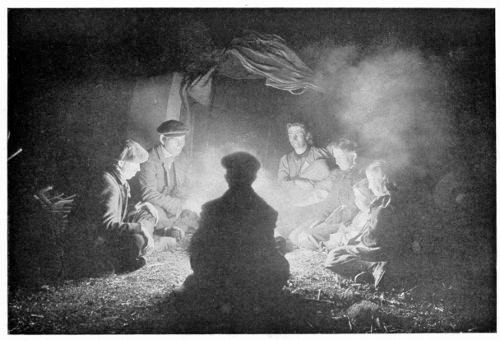
One terribly cold day in winter saw me at the
camp of some of my gypsy friends, where I
expected to hear the usual sounds of merriment,
but on this occasion, a strange quietness which
I did not understand seemed to be brooding
over the place.
“Is there anything wrong?” I asked.
“Yes,” said one. “Mrs. S—— ’s little ‘un’s
dyin’; she’s camped just over there in the lee
o’ them bushes,—go over, I’m sure she’ll be
glad to see you.”
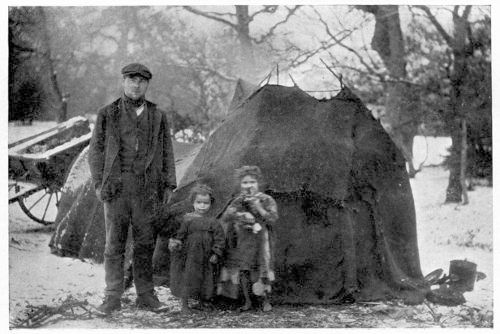
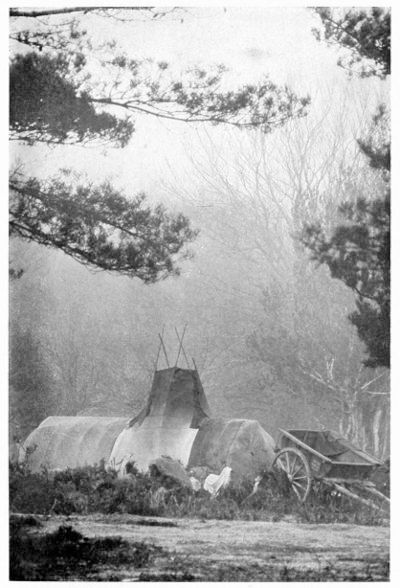
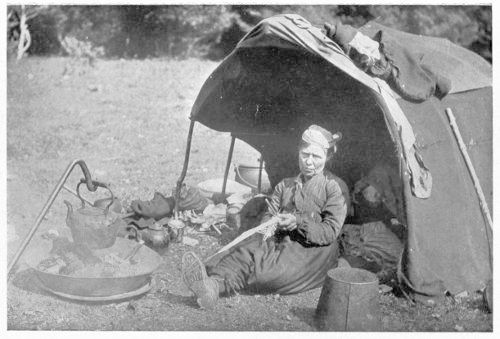
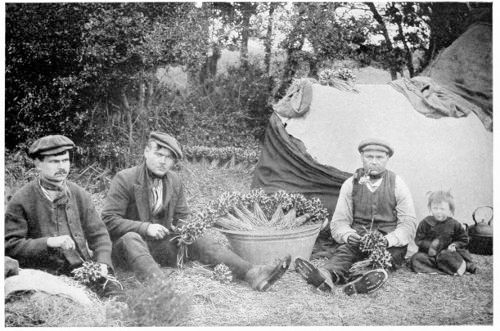
WINTER.
Acting upon the suggestion I went in the
direction indicated, feeling, however, that under
the circumstances the Missioner would be of
more service. Having reached the tent, I was
invited to enter as it was “more comfortable
inside.”
It is true that under cover of the tent, in which
a small fire was burning, the piercing wind was
not quite so biting, but—“more comfortable!”—just
think of it! What an elastic term
“comfort” is if it may be applied to such conditions,
while a bedroom in winter with a
thermometer at 45° to 50° Fahrenheit will be
described as “horribly cold and uncomfortable.”
Truly, the world is what we make it. Try for a
moment to imagine the scene:—
At the far end of the tent, on a bed composed
of dead bracken and old clothes, lay a little child,
her wan but pretty face telling that the end of
the struggle in which she was being worsted was
not far off, and it was only too evident that the
little sufferer had made her last appearance at
the camp fire, where she, like many another, had
loved to listen to the old world songs, or to the
lively airs coaxed from an ancient fiddle by her
brother, who claimed to be a boshomengro.
As I sat with the parents in the smoky tent
it seemed to me impossible that the child could
live through the morrow. But, what of that!
the law could have nothing to do with children
dying, peacefully or otherwise, for had it not
decreed that gypsies should be allowed to encamp
only in certain places and only for a very
short time before being required to move on.
The next morning a keeper appeared on the scene,
and although the time allowed by law had
barely expired, and the circumstances were
explained to him, he peremptorily ordered the
striking of the camp.
There could be no mistake as to his attitude
in the matter: “the law empowered him to
make these miserable people move on and
he was not going to be cheated out of a job he
would enjoy, not he; what would it matter if
the brat did die, it was only a gypsy kid.”
Although it was the season of sodden earth
and stinging rain, the tent was perforce shifted
to be pitched elsewhere, and meanwhile, the
little inmate passed beyond the power and petty
tyranny of callous keepers.
And what of the keeper?
For the present we must needs be content
with the assurance that—“Whatsoever a man
soweth, that shall he also reap.”
There are, of course, keepers and keepers,
many being very good fellows, doing their work
conscientiously, keeping the golden rule in sight,
and far be it from me to say anything that may
be construed as a disparagement of them in
toto, but I cannot, with justice to my gypsy
friends, refrain from presenting a faithful word
picture of the original of the incident recorded:—
He is a creature who ostensibly thanks God he
is not as other men, who, by means of carefully
displayed sanctimony, artful planning, and
cunning sneak work, manages to retain the good
opinion of superiors in office who do not see, and
will not believe in his double-dealing, although
the gypsies, without exception, know beyond
question that his life is a tissue of frauds; and
wild game, for which they occasionally risk their
liberty rather than starvation, is constantly
being illicitly taken by him and disposed of
wholesale.
It is scarcely possible for the gypsy at his
worst to be so despicable a creature.
The gypsy professes to hate the gorgio and small
wonder if he lives up to his profession; it is,
however, refreshing to find he has a warm
corner in his heart for suffering humanity outside
his own race. Some Romany folk, well
known to me, who in the way of worldly goods
possess practically nothing, and are at times
without common necessaries, befriended a lad
whom they found in rags and in a pitiable state
of hunger and dirt. They fed and cleaned the
boy, clothed him by contributing—one a coat,
another an old pair of trousers and so on, kept
him for a time until he was presentable, then did
their best to give him a start in life by procuring
work for him. A veritable fulfilling of the
behest to—“Give, hoping for nothing again.”
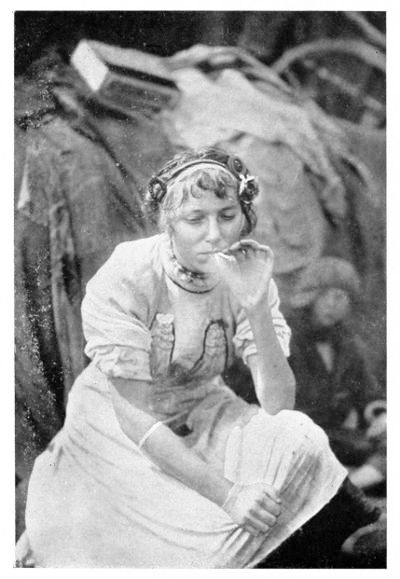
Even a casual acquaintance with the Romanies
will reveal the fact that in common with their
Oriental relatives, gypsy women and girls are
very fond of finery and personal adornment, and
many of them may be found wearing valuable
ear-rings, finger rings and other jewellery. One
old writer, I note, roundly condemns this practice
among them and endeavours to substantiate
his remarks by quoting the exhortation of the
apostle Peter:—
“Whose adorning let it not be that outward
adorning of plaiting of the hair, and the wearing
of gold, or of putting on of apparel.”
Let us look at the matter fairly. We may
presume the gypsies derive a certain pleasure in
wearing such finery and jewellery as they can
command, and we may safely give them credit
for obtaining them honestly; indeed, most of
their articles of jewellery are heirlooms, and are,
of course, valued much beyond their intrinsic
worth. Who then has any right whatever to
interfere with their use of these things, or to
dictate whether they should, or should not wear
them?
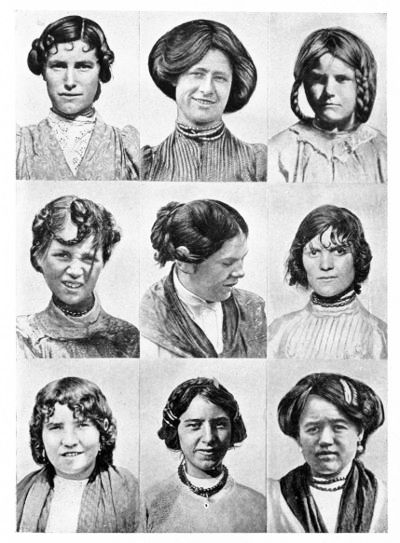
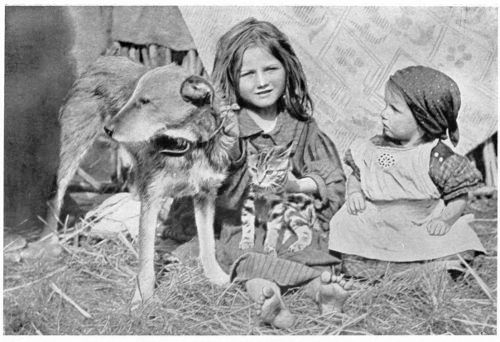
The gypsy also dresses her hair in a particular
manner because her ancestors so dressed theirs,
because too she knows perfectly well what suits
her; moreover, she has not the least desire to
dress or appear as a gorgio, and to suggest to a
gypsy that she should adopt the ways of Gentiles
in these respects is nothing short of an insult.
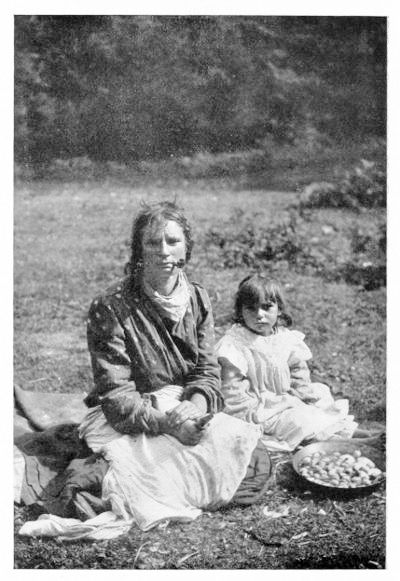
True gypsies are a most exclusive race, but
there have been numerous intermarriages with
Gentiles, and even at a single fair or other gypsy
gathering a discriminating observer will soon discover
almost as many social grades as in a non-gypsy
community, and several degrees of racial
admixture; at the top of the scale, Romanies of
interesting personality, at the bottom, Chorodies,
“low, wandering outcasts,” with little or no
gypsy blood in their veins, and whose hair has
been described as reminiscent of the material of
which cheap mops are composed, and whose
habits are disgustingly dirty. Unfortunately for
the reputation of the real gypsy, many people
who have not thought it worth while to look into
the matter, are unaware that these differences
exist, and consequently class all together as
“gypsies.” The language of the Chorodies is a
conglomeration of Romany, bad English and
slang, differing widely from the “gentle
Romany” of the true gypsy.
I have said that gypsies are exclusive,—this
is especially noticeable in the way the Romany
tongue is kept secret by them. It is scarcely
ever displayed, although it may be occasionally
used in public for strategic reasons; even a
knowledge of it will be denied by them when
interrogated by one who appears inquisitive; it
is nevertheless spoken, little or much by thousands
in England to-day.
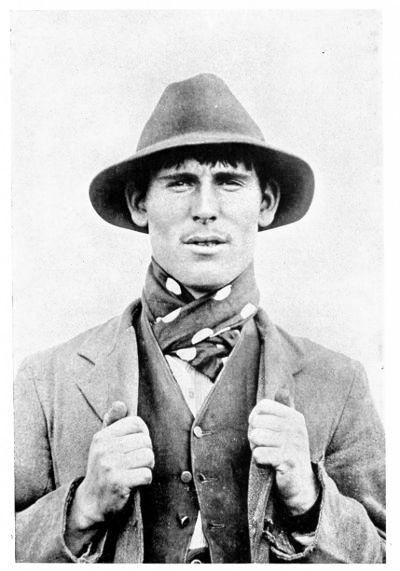
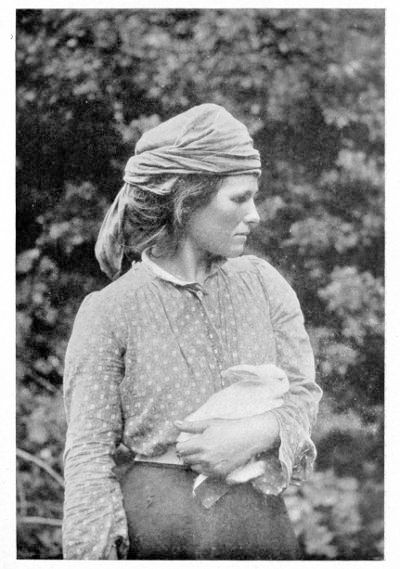
It is a curious but indisputable fact that
among true gypsies as well as Romany half-breeds,
the Oriental characteristics—black hair,
dark eyes, swarthy skin, peculiar cast of features,
and lithe body—are usually much more evident
in the women than in the men, in girls than boys.
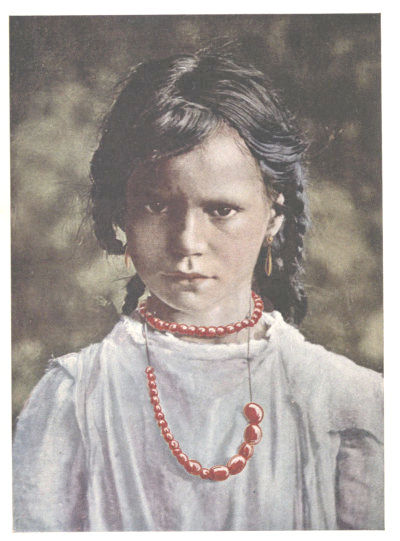
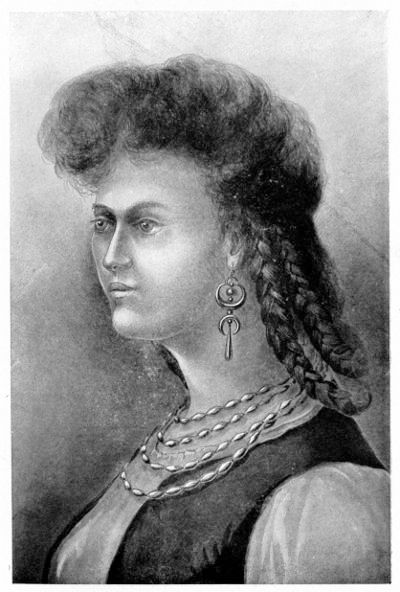
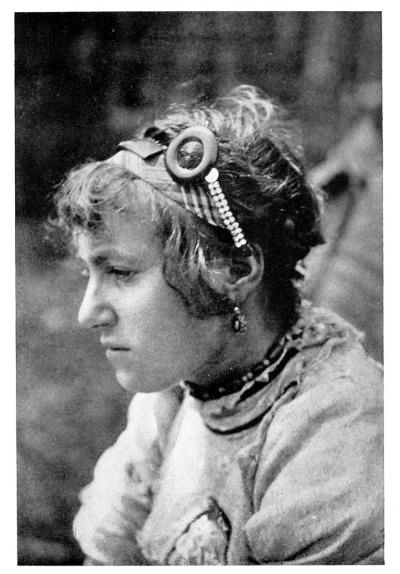
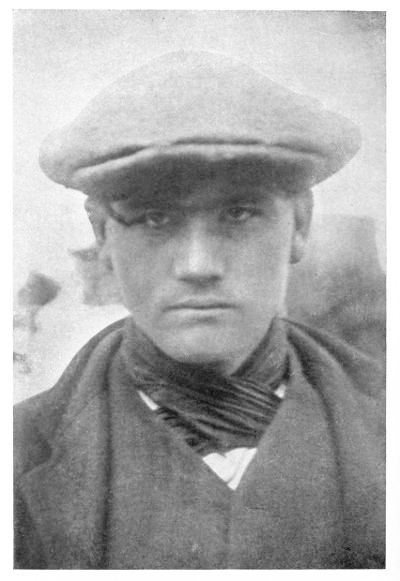
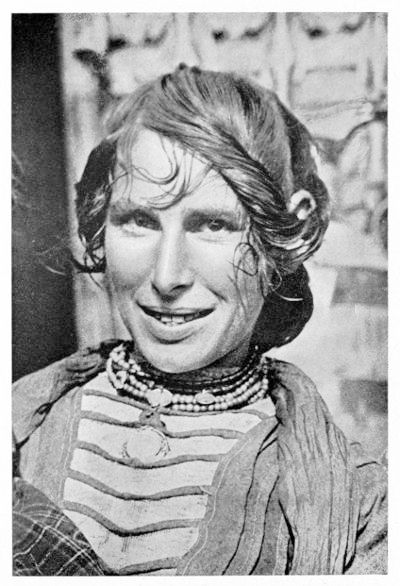
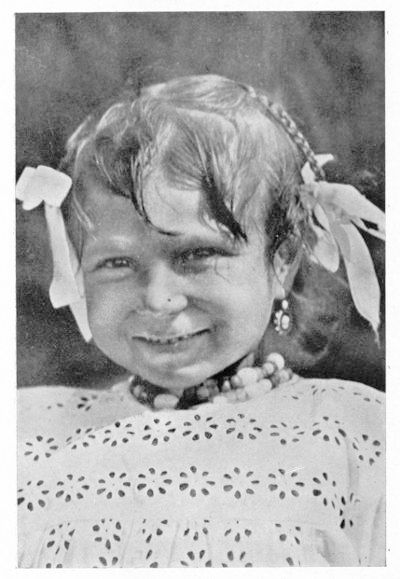
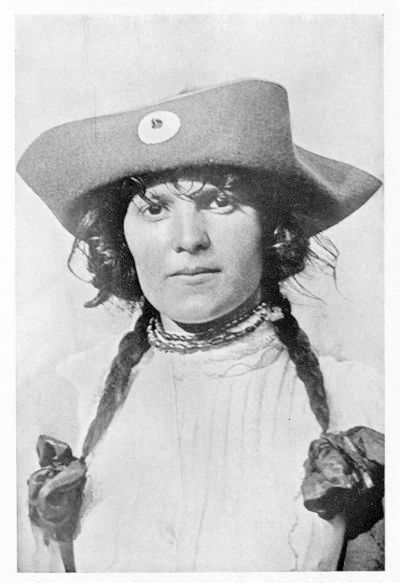
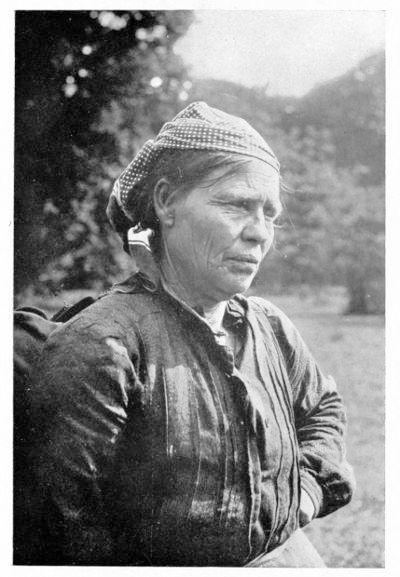
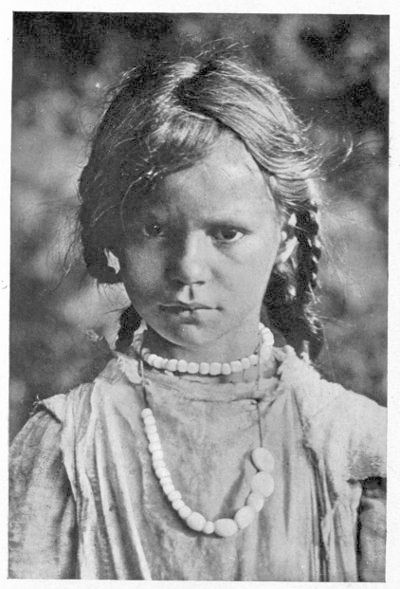
A good type of English gypsy girl is Dōsha
(see Frontispiece), whose portrait exhibits all
these peculiarities most distinctly; the facial
angle, the carriage of the head, even the angle
of the body, and, one might almost say, the
“hang” of the clothes, are Oriental.
“DŌSHA.”
There is, too, something extraordinarily mystical
about the eyes, and no great exercise of the
imagination is needed to enable one to credit
their possessor with occult powers. The directness
and fixity of gaze are such as haunt one and
render it easy to understand how for centuries
gypsies have been regarded as endowed with
strange gifts. At the present time, such a
belief is to a great extent pooh-poohed,—ostensibly
so, at least,—but until we of the West
have arrived at a vastly greater knowledge than
we now possess, of telepathy, hypnotism and
allied sciences, it will be well that we restrain our
dogmatism and altogether withhold our sneers
in matters occult. It does not necessarily follow
that we should place reliance on such gypsy arts
as fortune telling, neither can it, on the other
hand, be denied that there is in this, and their
implied power of clairvoyance, a fundamental
something we do not understand.
The practice of fortune telling is condemned
as heathenish, and abuse is hurled at both the
gypsy who pretends to read the future and the
superstitious person who is imposed upon. The
lopsidedness of the public in the matter would
be amusing were it not for the very different
way the gypsy has of looking at these things.
I do not for a moment advocate a return to
the old order which allowed swindlers to victimize
right and left, but from the gypsy standpoint it
appears to be scarcely playing the “game” for
an announcement to be allowed to appear on
the bills of a church bazaar that “a real gypsy
prophetess” or a palmist has been engaged, who
will read the future, etc., at sixpence, half a
crown, or what not, per person, for the benefit
of the fund, which results in the improvised tent
or cavern of the gypsy having quite a stream of
visitors who “don’t believe in this sort of thing,
but it’s for such a good object, you know, dear,”
and the fund eventually benefits by a substantial
amount, to the gratification of the reverend
principal, who may be also a magistrate and
dispenser of justice, and it is quite possible that
he may on the day following feel it to be his duty
to assist in putting down the fortune telling
imposture and may send a gypsy to prison for
doing—with a better excuse for it—the self-same
thing that he countenanced, and he will,
moreover, probably deliver a homily to Mary
Jane, who had been foolish enough to put silver
into the hand of the gypsy with the hope of
learning something of a future that is veiled from
priest and parlourmaid alike.
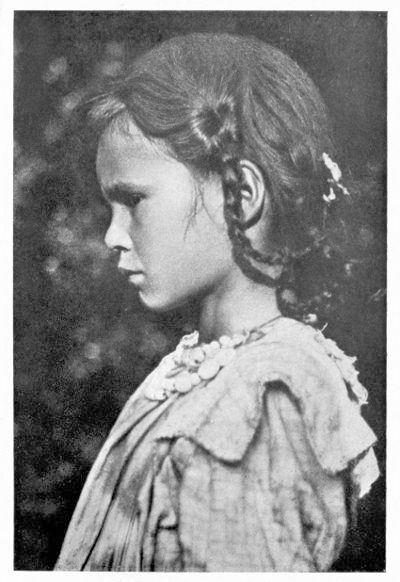
“DŌSHA.”
Although fortune telling is now illegal in this
country it is still practised sub rosa. Until
comparatively recently, however, it was quite
a lucrative profession to adepts, and more than
one third-rate exponent has mournfully confessed
to me that in the good old times “we used
to make a tidy bit o’ money dukkerin.”
One of the most celebrated of successful
fortune tellers of recent times was perhaps Lucy
Lee, who pursued her profession for something
over twenty-six years. Her business headquarters
were at The Devil’s Dyke, near Brighton.
She did not, however, reside there permanently,
but—latterly at least—journeyed to and from
Brighton daily in a small carriage. She probably
amassed a considerable sum of money, for in
addition to the numerous people of rank and
note she could count among her clientèle, Devil’s
Dyke had annually its thousands of visitors, of
whom a goodly proportion doubtless left silver
in the hand of the soothsayer—in the orthodox
manner. Of her oracular pronouncements I
have no personal knowledge. If I recollect
aright, she was wearing, on the last occasion of
my seeing her, a cloak of brilliant red edged
with white, a black silk or satin dress, a white
apron, and upon her head a red handkerchief.
She maintained that past events in one’s life as
well as the future are mapped out on the hand;
she told fortunes also by means of cards. Gypsies
are very keen observers, and those fortune
tellers among them who pretend to something
beyond pure guesswork, undoubtedly find the
searching examination of a face quite as suggestive
as a study of the hand; moreover, they do
not omit to gaze intently into the tell-tale eyes
of the person seeking information and are consequently
able to make certain deductions upon
which to base their shrewd guesses, and as these
may be delivered in ambiguous terms they are
frequently near enough to the facts to impress or
satisfy the applicant.
Gypsies have ever been prone to make capital
out of the artlessness, culpable weaknesses, and
avarice of a section of mankind.
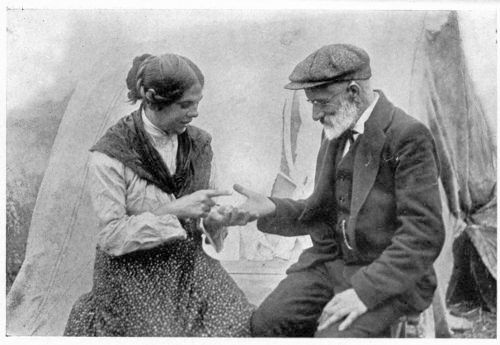
“Adroit the line of palmistry to trace.”
xxxxxxxxxxxxxxxxxxxxxxxxxxxxLeyden
The confidence trick in a great variety of forms
has in the past been worked by them with considerable
success, female domestics being perhaps
their especial victims, but well-to-do people have
by no means escaped their wiles. A trick, having
innumerable variants, and which, in days gone
by, had a very long and successful run,—perhaps
it is still going,—was played upon those who
believed gypsies to be the possessors of mystical
powers; it consisted in the superstitious dupe
being induced to believe that a sum of money
enclosed in a packet and handed to the gypsy in
order that she might for a small sum repeat over
it certain unintelligible words, would become
doubled in quantity and value a certain time
after it had been returned to the owner and had
been hidden in accordance with the gypsy’s
directions. It is, perhaps, scarcely necessary
to add that the gypsy either gave instructions
for the hiding of the money in some place
accessible to herself, or she acquired it by
abstraction or substitution before returning the
packet to the credulous owner, the result in any
case being the same,—the gypsy got the money
and was not to be found when the date given
for the consummation of the spell arrived.
Numerous accounts of similar frauds exist,
many possibly having some foundation in fact,
while others may be set down as purposely distorted
facts, or as fabrications specially devised
for fostering ill-feeling against the gypsies, or
for justifying, as far as possible, the tyrannical
measures taken to exterminate them.
Looking back upon the harsh treatment meted
out to the gypsies in former times, one can
imagine the undercurrent of fear which prompted
it, a fear bred of the superstitious beliefs of the
times and kept alive by the outlandish appearance,
seclusive habits, strange customs and
secret tongue of the Romanies, items which, even
to this day, are reckoned against them by the
ignorant and superstitious. It is therefore difficult,
if not impossible to find unbiassed accounts
either of gypsy crime or petty frauds at almost
any period in their history.
Generally speaking, the term “gypsies” in
newspaper reports of police cases is a misnomer,
the persons implicated being mostly Chorodies,
who, with very few exceptions, have no blood-relationship
with Romany people, neither have
they much in common beside a similarity in their
mode of life. The disparity is especially noticeable
in the respective women, for Romany
women have always been noted for their handsome
features, and in instances where the mother
has not the usual regularity and beauty of
feature, her children are frequently exceedingly
pretty; we cannot, however, say so much for
the Chorodies, for, to quote the description of
them by a well-known writer,—“their complexion,
when not obscured with grime, is rather
fair than dark, evincing that their origin is low,
swinish Saxon, and not gentle Romany.” Written
many years ago, this is true to-day, and it is
these people principally who bring discredit to
the gypsy name. Occasionally among these
people I have seen families upon whom the unenviable
epithet of Hinditymengre, or Filthy
people, has been bestowed,—these are Irish
vagrants, but, like George Borrow, I fail to see
that they are dirtier than Chorodies generally,
indeed I can scarcely imagine it to be possible.
There is really no occasion for such dirty habits,
as they have the same opportunities for their
ablutions and equal facilities for general cleanliness
as the Romanies.
Gypsies are ardent lovers of music, and have
wonderfully retentive memories; some among
them—notably Hungarians—have attained
eminence as composers, and in our own land
one may find really good Romany performers
on the violin, harp, cornet, etc., although from
lack of education gypsy music is more frequently
of the country ball or dancing booth order.
A genius for dancing would appear to be
inherited by the Romany chi, as most of the
girls, even the veriest children, revel in it, while
many of the young women are most graceful
exponents of the “poetry of motion” and not
only cultivate the art as a source of income, but
in their exuberant health and spirits, seemingly
indulge in it from sheer inability to restrain
themselves; certainly some of their dances appear
to be such as only a gypsy, with her physique
and temperament, can accomplish, but in this
respect the palm would probably be awarded to
the gypsies of Spain.
Pliant of body and lithe of limb is the gypsy,
but it is a grave mistake—and one which many
benevolent people have made—to suppose that
he has no strength of mind, and that he will
readily accommodate himself to forms and conditions
of life which are diametrically opposed to
those in which he was nurtured, and which for
centuries have characterized his race.
Self-reliant, resourceful, versatile he is, but
his temperament is not plastic, and attempts to
induce gypsies to break away from their mode
of life, to live in houses and to become what may
be termed normal citizens,—although made with
the very best of intentions,—have either failed
altogether, or have succeeded only in spoiling
a decent gypsy or two to add to our slum population.
A Londoner loves the sights, smells and
sounds of the city,—the open road, moorland
and forest are desolation to him; the Romany
chal stifles amongst houses, suffocates under a
roof, the rush and noises of the city distract him,
its smells are as poison, and he turns with
indescribable relief to the forest glade, the open
heath,—his very nature demands them,—they
are his breath of life.
“But,” argues our philanthropist, “he would
in time become accustomed to the town or village,
and surely it would be for his ultimate good?”
Would it?
I may return to the subject later, meanwhile
the following facts, replying indirectly to the
question, are suggestive:—
Those who know practically nothing of the
gypsy character are confident in the possibility
of gradually weaning them from the nomadic
life, and of inducing them to settle down to the
cottage, and the workaday existence of the
respectable labourer or artisan.
On the other hand:—
Those who have gained intimate knowledge
of the race by long and friendly intercourse with
its people, and are consequently able to see and
feel with them and to understand their inbred
love of a life of freedom in touch with Nature,
cannot dissociate the idea of sacrilege from any
thought of “improving” out of existence all
that to the gypsy—really counts.
In some parts of the Continent gypsy children
go naked for some years, but in our own country—possibly
owing partly to changeability of
climate—clothes are almost invariably worn,
but often they are of the scantiest description.
I have seen the children running barefoot in the
snow, their bodies being protected only by one
thin garment, but as they are subjected to such
Spartan treatment from infancy, they do not,
apparently, suffer as would house-dwellers under
similar conditions.
Much ingenuity is sometimes displayed by the
poorer families in adapting for their own use
clothes which have been given to them.
The following incident, the principals in which
are well known to me, is an amusing case in
point:—
A gentleman gave a pair of his trousers to a
gypsy. A week or so later, when out walking, he
saw a small gypsy boy coming towards him, and
“there seemed,” said he when relating the
occurrence to me, “something very familiar about
this boy’s dress, which at first puzzled me considerably,
but afterwards, as the boy came
nearer, I saw that he had made a complete suit
from my old trousers; a little had been cut from
the legs, the pockets had been turned inside out
and the ends cut open, so that by getting into
the garment and thrusting his arms through the
pockets,—as sleeves,—he secured a sort of combination
suit, trousers and coat in one; he had
reduced the opening at the top by tying pieces
of string from button to button, and to complete
the garment and separate what I may perhaps
call the blouse part from the trousers portion,
he had tied a piece of cord around his waist.”
Now the boy was small and thin and the gentleman
to whom the trousers had belonged was of
somewhat ample proportions, therefore the appearance
of the boy, it is perhaps needless to
add, was more ludicrous than can be well described,
reminding one of the account given by
Gypsy Smith of his first pair of trousers, which
prompted inquiries as to whether he was going
or coming, at what time the balloon was going
up, and so on.
Ingenuity of a different type was shown by a
gypsy who desired to attend the funeral of a
relative and made the occasion an excuse for
borrowing from a householder of my acquaintance
a pair of black trousers to wear during the
ceremony; his pretext of wishing to borrow the
trousers, and for one day only, showed the
diplomat, for he must have felt sure that if he
could but get the trousers the owner would not
trouble him to return them.
Gypsies do not forget acts of kindness to their
folk, neither are they ungrateful, but will often
endeavour to make some little return for sympathetic
help extended to them. In connection
with this I note as a curious psychological fact,
that they will occasionally pilfer in order to
present the proceeds of the theft to a benefactor,
as a tangible proof of gratitude.
Upon one occasion a young fellow offered me
some fine plums in return for a slight service I
had rendered, all the circumstances pointing to
his having stolen the fruit for the purpose on his
way to see me.
We may then take it that pilfering from a
gorgio is reckoned a venial offence,—a trifling
matter, but failure to show proper appreciation
of services rendered is considered “low down”
behaviour and unworthy of a self-respecting
gypsy.
In the field of scientific invention, it seems
that the gypsy is not very likely to become a
shining light, but that he nevertheless possesses
considerable ingenuity in certain directions is
shown by his turning to good account apparently
useless native material in the manufacture of
useful, ornamental and curious articles, and his
brain is also fairly fertile in the way of dodges
that will, now and again, yield a few pence. One
of such dodges—evincing considerable astuteness,
and some little knowledge of domestic
economy on the part of its originator—was
brought under my observation by a small gypsy
boy asking if I would not “please buy one?”
at the same time opening the lid of an old chocolate
box and exposing to view a number of
oddly shaped, flattish cakes differing slightly in
size, each being about one and a half inches by
one inch, and half-inch in thickness, all being
curiously veined or marbled in drabs and browns
and emitting a rather pleasant odour. At first,
I was a good deal puzzled as to their composition,
and was not helped much by the information
volunteered by the boy, that they were for
“keepin’ the morf away an’ takin’ iney mole
outcher close.” This done into English would
read—“keeping the moth away and removing
iron-mould from your clothes.” A brief examination
of the contents of the box enabled me to see
through the fraud.
The little cakes had been prepared by breaking
off projecting pieces from the deeply furrowed
bark of the cluster pine, these had been shaved
and bevelled with a knife until the pattern
formed by the layers was sufficiently pronounced,
and afterwards smoothed with sandpaper, so
that unless one touched them he might easily mistake
them for variegated tablets of soap; a few
drops of scent—sprinkled probably from a
penny bottle of synthetic “Eau de Lavande”—had
completed the process of manufacture. I
may add that as the boy had not been furnished
with directions for use, he could not state how
many penny pieces would be required to keep
the “morf” away from a given space, nor how
long the spell would last; with respect to the
“iney mole,” one would expect an intensification
rather than a diminution of the stain from the
use of such an eradicator.
Most of my readers have probably seen, or,
may possess, examples of work in wood or other
material which has been built up within globes
or bottles of water, the whole having been
passed in and put together through a comparatively
small neck or other aperture.
Such work has at all times been beloved of
sailors, but gypsies are occasionally found who
make this class of “ornament.”
Two examples I have seen remind me of
another instance of gypsy shrewdness. A gypsy
boy, aged about thirteen, called at my house
one morning with some bottles of water which
also contained specimens of woodwork for sale;
these were a sort of emblematical Calvary, each
bottle containing one tall and two shorter
crosses, two spears at back, a hammer and three
nails in front, all of which were cut from wood
and were inserted in a cruciform foot also composed
of deal, the three crosses being decorated
by the favourite angle-notching that is reminiscent
of a boy’s first pocket-knife.
The sum of sixpence was asked for each bottle
with its contents.
I purchased one of them and thought I had
seen the last of the lad, but in the afternoon he
appeared with another bottle exactly like those
he had previously brought, excepting that
between the two spears a ladder had been fitted.
It was described as a much better one than those
he had brought in the morning, and he added
that as I had already bought one he would let
me have it for ninepence. Although I failed to
appreciate the implied favour, I made a second
purchase.
It will be noticed that the boy did not bring
the better article first, or he would certainly
have sold but one at ninepence instead of disposing
of two for fifteen pence, also that he did not
offer terms for exchanging the inferior for the
better article, but sold a second.
The manufacture of just this class of article
is not one of the common occupations of gypsies,
and it is possible, as this family came from the
neighbourhood of Cardiff, that the locality,
together with occasional contact with sailors,
may have suggested it to them as a help in their
struggle to live.
Another way of turning an “honest” penny,
practised occasionally by both gypsy and tramp,
is the making of artificial flowers from turnips.
Turnips may be usually acquired pretty easily,
and the competent artist, by deftly using a
pocket knife, converts them into most attractive
and really deceptive imitations of flowers.
I am not sure if the imitation of any particular
species is aimed at, but the kind usually produced
may be described as midway between a white
water lily and a rose; these flowers are generally
left “plain turnip,” but I have seen them
splashed with crimson, or occasionally dyed
entirely with cochineal or aniline solution.
A flower is usually offered arranged as a button-hole
or bouquet, a twig being inserted as a stem
and a few leaves added; those of laurel and thuja
lobbi are favourites as they are always to be
“pinched” en route; moreover, the odour of
the thuja neutralizes any vegetable-like smell of
the flower.
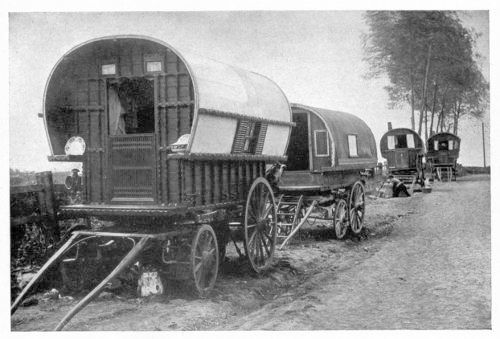
A large proportion of the articles hawked
around by gypsy vans at the present time are
not of gypsy manufacture, as machine-made tinware
and other goods yield a greater profit; individual
tent-dwelling hawkers, however, still
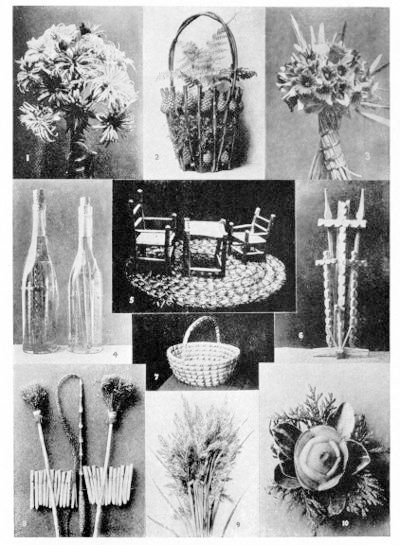
carry a fair variety of home-made stuff, such as
clothes-pegs, toys, grass mats and baskets, meat
skewers, wire flower-baskets, etc.
I was recently at a country fair which attracted
the usual gypsy proprietors of shows, stalls and
the like, and amongst them I got into conversation
with an old man of sixty to seventy years
of age. He was a man of more than the average
intelligence of his class and had at one time been
a travelling photographer.
“Yes,” said he in reply to a question of mine,
“I made a good bit of money photographing at
one time, but there isn’t much to be done at it
now, I’ve still got my cameras and lenses and
things in the van, but I never use them.”
“But things are slack in the pleasure line
during all the winter months, aren’t they?”
I inquired.
“Yes,” he replied, “it’s as much as most of
us do in the summer to make enough to carry
us through, but d’ye know,” he continued in a
confidential manner, “there’s a good living to
be got, and could be got by a lot of our people if
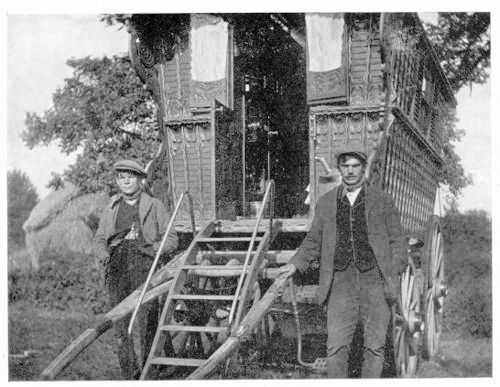
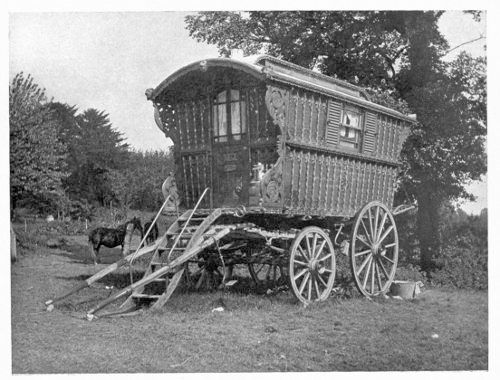
they’d only go into it. I’m too old to start
afresh now, but any man with a livin’ wagon, as
could work at tinkering, furniture repairing and
china riveting, do a bit of photography when it
came along, and wouldn’t turn up his nose at
stray odd jobs such as putting in window-sash
lines, seeing to paraffin lamps and the like, and
travelled around the out-of-the-way places, what
you’d call remote districts, would make sure of
a good living all the year round. Mind you, it
would be a hard life,—it couldn’t be much
harder than some of us have at this game,—but
it would pay, and there’s many a gypsy with
ability to do it—only he don’t.”
In the early days of photography the arrival
of the Photographic Van, otherwise “Saloon,”
for its periodical stay in the village or town, was
eagerly awaited as the only opportunity to have
a “likeness taken” for, perhaps, months. In
some of the home counties certainly, and in
others possibly, the only professional portrait
photographers doing work at popular prices were,
at one time, the Romany operator-proprietors of
these travelling portrait saloons, and most excellent
work was turned out too. I have in my
possession family portraits taken upwards of
half a century ago by these gypsy artists, which
would put to shame similar work but ten years old.
One of these, taken in 1858 on glass, blacked
at the back, framed in what is known as a “mat
and preserver,” fitted into the well-known plush-lined
wood case, is in a condition as absolutely
fresh and perfect as on the day it was taken, and
was the work of a typical Tachey Romany, a man
of fine physique and handsome features, who
travelled Hertfordshire and adjoining counties.
Another Romany production is a portrait
taken in 1864 by a man travelling Bedfordshire,
Cambridgeshire, etc. It is a carte de visite
portrait on the old albumenized paper, and is
first-rate work, its rich purple tones being as
fresh and strong as when just finished.
Doubtless, there are to-day many treasured
portraits—all there is left to recall the features of
loved ones—which are the work of gypsy artists
who travelled the country at the time when
photography was still young and few other
opportunities existed of obtaining photographic
portraits.