How constantly experience....
 OW constantly experience reminds us that in the overwhelming presence
of outstanding natural scenery, world events and great men, we are apt
to completely lose sight of equally beautiful, though perhaps less
magnificent scenery, events only a little less momentous and of many
men, who except for the tedious bugbear of comparison, would be great in
our sight, being truly great in themselves.
Personally our eyes were thus opened only a few summers ago at Saint
Anne de Beaupré. For weeks our attention had been completely absorbed by
the beautiful Basilica, its surrounding grounds, monasteries and
convents. We desired above all to see a miracle, and to this end haunted
the quaint church, stepping in to the beautiful garden whenever
inclination suggested. Again and again we strolled along the
hill-climbing woodsy road of “The Stations of the Cross”, the spreading
maple trees overhead, the river in a flowing vista before.
Most of all we were interested in the pilgrims, individually no less
than in the pilgrimages as a whole. At Saint Anne’s it is the pilgrim
who furnishes a fascinating round of human interest, against a
background of the church aglow with festive lighting from hundreds of
electric bulbs, and the glowing, beckoning, flickering flame of
thousands of red and green votive candles.
Then, one morning, something prompted us to turn our wandering footsteps
toward the opposite end of the town away from the church. And there, in
a plain old workshop, we experienced our awakening, the miracle we had
been waiting to see—a miracle in Art rather than in healing. And yet,
are not the two one?
As we climbed the road up the hill past Madame Giguere’s Pension, we
were at once surprised and attracted by a life-sized figure of Napoleon
Bonaparte occupying one of the roofs ahead.
Napoleon Bonaparte in Saint Anne de Beaupré? Can greater contrast be
imagined than the realism of Napoleon and the realm of the spiritual out
of which we had just emerged? Yet it was no mirage. There he stood,
life-sized. After a moment of doubt we knew it must be some woodcarver’s
“Sign”. For we recognized at sight that this “Napoleon” was some old
“Figurehead” from a ship, “stranded here” as it were in this Old-World
village of French Canada.
We could scarcely wait to meet the old Carver. Already we imagined him
old. And—charming.
The figurehead proclaimed that he belonged heart and soul to the age of
the sailing-ship. Therefore, we knew beforehand that we should find as
the French say, Un Caractere. So we hurried and turned in down some
steps and knocked at the door of the old shop.
In answer, there came to the door a little, almost aesthetic-looking old
man with a sweet smile and an equally sweet voice. He stood a moment
looking at us and at our camera, entering as if by intuition into our
enthusiasm. Then he bade us, in a charming manner, combination of the
sweetness of old age and courteous French, “Entrez, entrez!”
That was our first glimpse of Louis Jobin, whom we have since come to
regard as “The Dean of Canadian Religious-figure Wood-carvers”—a man
possessed of so sweet and simple a nature that he approaches easily and
naturally, the carving of Christ on the Cross.
The little shop in its simplicity is just the place one might expect to
find Jobin working in. Everything in it falls behind its master—not a
single offending note. There is a wooden thumb to hold his hat.
Everywhere on the walls bits of carving—models and patterns—an old
trumpet, a cherub’s head, an angel’s wing. On the floor the old stove
for heating, the tool-bench and the figure or figures on which he
happens to be at work.
Jobin found for us one chair and that curious movable bench with legs
resembling a colt’s, known in the trades as a “carpenter’s horse”. I sat
the “horse” and never has one carried me into more enchanted country.
Jobin made us feel at home at once, continuing his work and chatting at
the same time. There is about the man and his shop a sweet restful
spirit of repose, as if no vaulting ambition had ever here o’erleaped
itself to fall on the other side.
I cannot recall all that we talked about that first morning. I remember
it rather as the occasion on which Jobin invited us to come in again
whenever we felt inclined. It lingers as the morning on which we
discovered that now rare nook “a woodcarver’s studio”.
It is no little thing to have such a door open to one in these days of
hurry—a little shop full of the spell of Holy Figures, here and there,
and about the door.
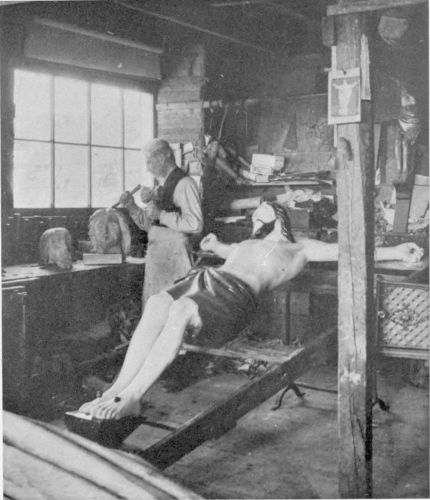
M. LOUIS JOBIN IN HIS WORK-SHOP.
The acquaintance with Jobin has now extended over several summers and in
that time we have learned from this old Canadian woodcarver’s lips many
a legend of the Saints, legends that have none of the usual
cut-and-dried wording of a book as they are told by this old man of
Quebec, but all the vitality and realism which only one having working
knowledge of them for a lifetime can give.
Monsieur Jobin, in point of years far up in the seventies, gives Saint
Raymond as his birthplace but says that he spent much of his boyhood at
Point aux Trembles above Quebec.
His answer to an inquiry if he carved or whittled much when a youngster,
proved him a man of humour. “O, oui! I cut up all my father’s firewood
into something or other.” Smiling at the recollection of those days he
paused and raised himself chisel in hand. “There was a good deal of wood
in my figures then. Their bodies were—what you call?—clumsy.”
“Clumsy?” “Yes?”
But these early attempts were evidently of sufficient merit to determine
his parents as to a trade for him. They apprenticed Louis to the
woodcarver’s trade under M. Francois Xavier Berlingeret, a master carver
of the city, of the generation before Jobin, so that Jobin represents in
direct line a century of Canadian wood-carving. Jobin served three
years. “Religious figures?” we inquired. “Oh, no. All sorts of carving
with M’sieu Berlingeret. Some religious figures too, but in those days
it was mostly ‘figureheads’.” Big wooden ships were everywhere.
“You know the figurehead?” He seemed very happy when we answered
affirmatively. As his mind turned back to those days there came into his
eye all the light and fire of an artist recalling some old masterpiece.
* * * *
His apprenticeship to Monsieur Berlingeret over, Jobin set out for New
York “to finish”. In New York he worked for a year with Mr. Bolton,
“John Bolton, an Englishman located at St. John Street, Battery Place”.
The mere mention of those New York days recalls to mind old haunts and
famous old “figureheads” and carvers of Gotham. It was all “downtown” in
those days,—“Battery Place” and “Castle Garden”. Then naturally
followed talk of this carver and that, of this and that old sea-rover
among the wind-jammers coming in and sailing out of New York fifty years
ago.
It requires little imagination for us to be able to see this young
French-Canadian artist in wood passing from one to another of these
ships, searching with his artist’s eye for fine specimens of the
figurehead-carver’s art on the bows. It was in reality like a morning
spent in a Cosmopolitan Gallery wherein the work of artists from many
lands appeared—here, a Scotchman, there a Dane, here a Norwegian, there
a Nova Scotian. And when the latter, it was like happening suddenly upon
“an old friend from home”.
When the year in New York ended, back came Jobin to Montreal. And from
that day to this he has never left Canada but has given every day of his
life-work to her. Canada reared him and with the exception of that brief
year in New York she can claim him and his work.
It is somewhat in the nature of a revelation that there should have
been, and that there continues to be, enough trade and demand for wooden
figures to have kept this old carver busy for a lifetime. Woodcarving is
one of the oldest Arts under the sun and the fact that woodcarving is so
widely appreciated in Canada and the United States that a few of these
old artists are in their shops every day regularly, keeping steadily at
the bench from morning until night, every day of the working week, year
in and year out, reveals a phase of the national life and taste which
cannot but fill many, who deemed the day of the wooden figure a thing of
the past, with surprise.
But, for affirmation, there is the venerable figure of Louis Jobin
bending over an angel—a tiny gouge in his old fingers slithering
lightly here and there, “bringing out” just a little more each time the
spirit, which, when all is finished, speaks out to the forgetfulness of
the medium.
The regularity with which orders come in, no less than the air of the
shop itself, gives one even stronger assurance that when Jobin has
passed to the Land o’ the Leal his mantle will fall to many a successor,
provided the carver of the coming generation puts out work up to the
standard of this old artist of Saint Anne’s.
Jobin belongs to a long line of woodcarvers whose genius has given the
wooden figure a sure niche in the heart of Canada as long as there shall
be saint or legend left.
The establishment of Jobin in Montreal after his return from New York
extended over a period of five or six years. Making figureheads there
for Captain McNeil, he recalls that one was the “Chief Angus”.
With a sweep of the arm, Jobin makes you see that proud hull—those
royal-yards sweeping down the Saint Lawrence under the leadership of
the spirited figure of the old Chief on the bow, leading one of the clan
to victory on the high seas, and the ports of the world. Then the
Frenchman speaks, and he recalls the figures of an “Avoçat”, for a
gentleman of the legal profession. He recalls that it stood opposite the
Court House on the Rue Notre Dame in Montreal. No doubt many an old
Montrealler recalls this landmark of Notre Dame.
Jobin’s work in Montreal lasted as long as sails on the high seas
created a demand for figureheads, and as long as the Red Indian with his
calumet idled the day outside the Tobacconist shops. But steam blasted
the growth and life of sails, and paper signs and bill-boards did away
with the Indians except in Old Quebec city where the Red Man is still to
be seen on Saint Jean Street.
Only then, in the lean years that followed these changes, did Jobin move
to Quebec—the home-city of sacred “figures”, and begin what turned out
to be his forte and life-work,—the carving of religious figures.
He tells how he had a shop first in Quebec City. But from Quebec out to
the quiet shop in the little town of Saint Anne de Beaupré was for a man
of Jobin’s feeling a short and natural step. At last his barque had come
from the busy marts of the New York waterfront into this quiet little
haven, whose main street has at one end this little shop and at the
other la Basilica, Mecca of a continent.
Every evening at the close of the day’s work the striking figure of the
old carver may be seen on the street of Saint Anne’s wending his way to
Benediction. And, however numerous the pilgrims, his is one of the
figures to be remembered—a benediction in its sweet humility.
Jobin has been an indefatigable worker. In his day the number of figures
carved by his hand is almost incredible. The very mechanical part must
have occupied more than a lifetime of a man less talented and sure of
every stroke. He talked of one figure after another so rapidly that
track of all could not be kept. Yet not one of his figures seen could in
any sense of the word be termed “mechanical”; rather, he was able to
work quickly because his every stroke ran true.
There is, of course, a difference in his work, depending on the ultimate
position to be occupied by the figure. Those to stand out of doors on an
eminence, or on the roof of some church to be viewed from a distance,
are executed in big broad touches of the chisel. Detail would be lost if
indeed it did not spoil in such instances. But the figure to stand in
some church, and to be closely approached by a supplicant, lacks nothing
in detail of line that would express the fine nature and understanding
of the saint that is symbolized.
All of Jobin’s work, whether Saint or otherwise, has about it a
distinctly individual touch, so that once you are familiar with his work
you are able to see a figure for the first time and say at once whether
it is a Jobin or not.
Since our first acquaintance with Monsieur we have happened on many a
“figure” of his. And nothing affords us greater pleasure than to come on
one at some unexpected place and moment. These we recall to Monsieur on
the occasion of a next visit. And how it delights the old man to hear of
these, his “art-children”, whom he never expected to hear from more.
It pleased him that we should recognize the Province of Quebec as his
Gallery and go along her highways and byways with an eye open for his
figures.
It was during one of these conversations that he let fall that he carved
the figure of “The Blessed Virgin” on the top of Trinity Cap on the
far-famed Saguenay. Jobin gives the dimensions as twenty-five feet in
height and says that around the head of “Mary” he carved twelve stars.
He carved it in 1880 or just forty-two years ago, long before many who
now view it were born. Many have wondered why the figure on this cape,
twin with Cape Eternity on this scenic river of eastern Canada? Here is
the reason from the carver’s lips. A gentleman out driving was in a
run-away accident. The carriage was thrown over a very steep cliff but
almost by a miracle he was pitched to safety as the voiture went down.
He wished to erect a memento of his wonderful escape and as the accident
had been over a cliff, he conceived the idea of having an heroic figure
of the Blessed Virgin erected on the beautiful and beetling Cap Trinité.
From the Blessed Virgin to Neptune seems indeed a far call. Yet it was
mention of this figure which recalled to Jobin’s memory that about the
same time he did this he also carved the figure of Neptune to stand on
the old hotel of that name on Mountain-Hill Street near South Matelot,
in Quebec.
The student of history, abroad in Quebec, is familiar with the old
carved-wood figure of General Wolfe, now sacredly preserved, after an
escapade to the West Indies, in the library of the Historical Society of
Quebec. But few there be who know that Jobin carved the substitute which
fills in the niche in the old house on the street corner, and that it is
thanks to Jobin that Wolfe still mounts guard on the corner of Rue Saint
Jean. A new interest must cling to this old scarlet-coated figure of the
General whose romantic boat-ride down the river to attack the city in
the rear gave Quebec to the Empire. It is said that a condition of an
old will provides that a figure of Wolfe must always stand in this niche
in the old house facing the street, so that the passing world may never
forget how much it owes to Wolfe.
Jobin’s work of carving sacred figures either for use in churches, in
cemeteries, in church or monastery gardens, or as crosses and calvaires
by the roadside, has been deeply appreciated. For some churches he has
carved practically every figure in use.
For l’eglise at Saint Henri, he says he has carved as many as thirty-two
figures in all; for the church at Riviere de Loup, seventeen; for the
church at Saint Foye, three—the Blessed Virgin, Christ on the Cross and
The Sacred Heart.
As Jobin told of the Saint Foye “figures” he rasped the wood of a new
figure growing under his hand. He paused in his work as he recalled
“That church was burned, but my figures they....” No word completed the
sentence but the rasp went up in a dramatic sweep to indicate the high
standing figures escaping the flames.
Of the roadside calvaires carved by Jobin, one at Beaumont is a good
example. Another stands at Visitation. The latter is a new one erected
last summer.
Although much of Jobin’s work is bought in the Province of Quebec,
orders are constantly coming to the old carver of Saint Anne’s from
other parts of Canada. And many a figure in the United States attests to
his skill as woodcarver.
It is one of the interesting incidents of the Jobin figures that, before
sending them out in the world, they are taken down to the Basilica to be
“blessed”.
We have seen a pious pilgrim kiss the hand of one of these waiting
figures,—taking it for one of the regular figures of the Basilica
garden. This incident is a tribute to the quality of soul attained by
Jobin in his work.
Luck indeed attends the pilgrim to Saint Anne’s who happens there at the
“Blessing” of one of these figures. For picturesqueness in ceremony it
has few equals—the figure on the grass under the trees, the priest in
his robe, holy-water in hand, generously be-sprinkling, as it were, this
Soul of the Woods.
The Basilica garden at Saint Anne’s is rich in Jobin “figures”. The
large gilded figure that stood on the roof was, however, not one of his,
though the little Saint Anne in the old church, he says, is.
Last winter he was at work on a new figure for the fountain in the yard
to be given to Saint Anne’s by a wealthy American.
The weather has always stood in the way of the popularity of the wooden
figure. Jobin now sheathes his figures that are to stand in the open.
If some such measure had only been used in early days, how much richer
in figures would Canada be. Many of her old-timers, some of them brought
over from France by early pioneers have been completely lost through
wind and weather.
Wealthy societies and churches with a taste for gold often have had
Jobin completely overlay the entire figure with gold-leaf. Mr. Jobin’s
nephew is the shop’s operator in laying on the leaf. This too is a most
interesting process, and the little shop offers as it were “a double
bill” on the mornings when in addition to Jobin carving, the nephew is
also at work gilding a finished angel or saint.
Part of the charm of mornings in the Jobin shop is the almost constantly
changing subjects on which he is at work. Sometimes he chisels away on a
Saint Anne, sometimes on the face or flowing robes of the blessed
Vierge; at other times a triumphant angel with a trumpet, or a
petitioning angel with folded wings, humbly kneeling.
One morning we dropped in to find him at work on an heroic-sized
Christ-figure on the Cross. It was like coming on the old carver at his
devotions. An holy silence pervaded the little shop. We dropped into the
chair and upon the horse as silently as into a pew in church. Jobin
carved by inspiration. No model stood in sight. Further, this old man of
three-score, carved as one who has seen the Master very close and feels
no need of outward suggestion. So the Old Masters must have painted, one
thinks.
After a while, Jobin, resting, talked a little, quite easily. Then he
began to work again continuing to speak now and then. The chisel gouged
lightly back and forth and then with one of his worn hands he brushed
away the shavings and critically eyed his work on the Face, to see if it
told in its lines, so far as wood, or paint or marble, can, its Love,
its wonderful Patience and its Strength.
As we sat watching in the quiet of that old shop, it was impossible to
tell which spoke the more directly, the Figure as it slowly came to
perfection or the childlike figure of the old Master-Carver bending so
gently over the image of the Lord.
Not one, but several mornings, we came to watch. And as we watched and
listened to the quiet voice of this old Quebec-carver, now nearing the
end, it was in our heart to wish that all Canada could step over the
threshold to witness this strange scene, wherein one of her forest trees
in the hand of one of her talented sons, is metamorphosed from a tree
into the Figure of the Saviour of the World.