HERCULES was the son of Jupiter by Alcmena, wife of Amphitryon, king
of Thebes, and is said to have been born in that city about 1280 years
before the Christian era. During his infancy Juno sent two serpents to
kill him in his cradle, but the undaunted child grasping one in either
hand, immediately strangled them both. As he grew up, he discovered an
uncommon degree of vigor both of body and of mind. Nor were his
extraordinary endowments neglected; for his education was intrusted to
the greatest masters. The tasks imposed on him by Eurystheus, on account
of the danger and difficulty which attended their execution, received
the name of the Labors of Hercules, and are commonly reckoned,
(at least the most material of them) to have been twelve.
The first was his engagement with Cleonæan lion, which furious
animal, it is said, fell from the orb of the moon by Juno's direction,
and was invunerable. It infested the woods between Phlius and Cleōne,
and committed uncommon ravages. The hero attacked it both with his
arrows and club, but in vain, till, perceiving his error, he tore
asunder its jaws with his hands.
The second labor was his conquest of the Lernæan hydra, a formidable
serpent or monster which harbored in the fens of Lerna, and infected the
region of Argos with his poisonous exhalations. This seems to have been
one of the most difficult tasks in which Hercules was ever engaged. The
number of heads assigned the hydra is various; some give him seven, some
nine, others fifty, and Ovid an hundred; but all authors agree that when
one was cut off, another sprung forth in its place, unless the wound was
immediately cauterized. Hercules, not
discouraged, attacked him, and having ordered Iŏlas, his friend and
companion, to cut down wood sufficient for fire-brands, he no sooner had
cut off a head than he applied these brands to the wounds; by which
means searing them up, he obtained a complete victory.
The third labor was to bring alive to Eurystheus an enormous wild
boar which ravaged the forest of Erymanthus in Arcadia, and had been
sent to Phocis by Diāna to punish Ænēas, for neglecting her sacrifices.
Hercules brought him bound to Eurystheus. There is nothing descriptive
of this exploit in any of the Roman poets.
The fourth labor was the capture of the Mænalæan stag. Eurystheus,
after repeated proofs of the strength and valor of Hercules, resolved to
try his agility, and commanded him to take a wild stag that frequented
mount Mænălus, which had brazen feet and golden horns. As this animal
was sacred to Diāna, Hercules durst not wound him; but though it were no
easy matter to run him down, yet this, after pursuing him on foot for a
year, the hero at last effected.
The fifth labor of Hercules consisted in killing the Stymphalĭdes,
birds so called from frequenting the lake Stymphālis in Arcadia, which
preyed upon human flesh, having wings, beaks, and talons of iron. Some
say Hercules destroyed these birds with his arrows, others that Pallas
sent him brazen rattles, made by Vulcan, the sound of which so terrified
them, that they took shelter in the island of Aretia. There are authors
who suppose these birds called Stymphalĭdes, to have been a gang of
desperate banditti who had their haunts near the lake Stymphālis.
The sixth labor was his cleansing the stable of Augeas. This Augeas,
king of Elis, had a stable intolerable from the stench occasioned by the
filth it contained, which may be readily imagined from the fact that it
sheltered three thousand oxen, and had not been cleansed for thirty
years. This place Eurystheus ordered Hercules to clear in one day, and
Augeas promised, if he performed the task, to give him a tenth part of
the cattle. Hercules, by turning the course of the river Alphēus through
the stable, executed his design, which Augeas seeing, refused to fulfil
his promise. The hero, to punish his perfidy, slew Augeas with his
arrows, and gave his kingdom to his son Phyleus, who abhorred his
father's treachery.
The seventh labor was the capture of the Cretan
bull. Minos, king of Crete, having acquired the
dominion of the Grecian seas, paid no greater honor to Neptune than to
the other gods, wherefore the deity, in resentment of this ingratitude,
sent a bull, which breathed fire from his nostrils, to destroy the
people of Crete. Hercules took this furious animal, and brought him to
Eurystheus, who, because the bull was sacred, let him loose into the
country of Marathon, where he was afterwards slain by Theseus.
The eighth labor of Hercules, was the killing of Diomēdes and his
horses. That infamous tyrant was king of Thrace, and son of Mars and
Cyrēne. Among other things he is said to have driven in his war-chariot
four furious horses, which, to render the more impetuous, he used to
feed on the flesh and blood of his subjects. Hercules is said to have
freed the world from this barbarous prince, and to have killed both him
and his horses, as is signified in some drawings, and said expressly by
some of the poets. Some report that the tyrant was given by Hercules as
a prey to his own horses.
The ninth labor of Hercules was his combat with Geryon, king of
Spain. Geryon is generally represented with three bodies agreeable to
the expressions used of him by the poets, and sometimes with three
heads. He had a breed of oxen of a purple color, (which devoured all
strangers cast to them) guarded by a dog with two heads, a dragon with
seven, besides a very watchful and severe keeper. Hercules, however,
killed the monarch and all his guards, and carried the oxen to Gades,
whence he brought them to Eurystheus. Some mythologists explain this
fable by saying that Geryon was king of three islands, now called
Majorca, Minorca, and Ivica, on which account he was fabled to be triple
bodied and headed.
The tenth labor of Hercules was his conquest of Hippolyte queen of
the Amazons. His eleventh labor consisted in dragging Cerebus from the
infernal regions into day. The twelfth and last was killing the serpent,
and gaining the golden fruit in the gardens of the Hesperides.
Hercules, after his conquests in Spain, having made himself famous in
the country of the Celtæ or Gauls, is said to have there founded a large
and populous city, which he called Alesia. His favorite wife was
Dejanira, whose jealousy most fatally occasioned his death. Hercules
having subdued Œchalia and killed Eurytus the king, carried off the fair
Iŏle, his daughter, with whom Dejanira
suspecting him to be in love, sent him the garment of
Nessus, the Centaur, as a remedy to recover his affections; this
garment, however, having been pierced with an arrow dipped in the blood
of the Lernæan hydra, whilst worn by Nessus, contracted a poison from
his blood incurable by art. No sooner, therefore, was it put on by
Hercules than he was seized with a delirious fever, attended with the
most excruciating torments. Unable to support his pains, he retired to
mount Œta, where, raising a pile, and setting it on fire, he threw
himself upon it, and was consumed in the flames, after having killed in
his phrenzy Lycus his friend. His arrows he bequeathed to Philoctētes,
who interred his remains.
After his death he was deified by his father Jupiter. Diōdorus
Siculus relates that he was no sooner ranked amongst the gods than Juno,
who had so violently persecuted him whilst on earth, adopted him for her
son, and loved him with the tenderness of a mother. Hercules was
afterwards married to Hebe, goddess of youth, his half sister, with all
the splendor of a celestial wedding; but he refused the honor which
Jupiter designed him, of being ranked with the twelve gods, alleging
there was no vacancy; and that it would be unreasonable to degrade any
other god for the purpose of admitting him.
Both the Greeks and Romans honored him as a god, and as such erected
to him temples. His victims were bulls and lambs, on account of his
preserving the flocks from wolves; that is, delivering men from tyrants
and robbers. He was worshipped by the ancient Latins under the name of
Dius, or Divus Fidius, that is, the guarantee or protector of faith
promised or sworn. They had a custom of calling this deity to witness by
a sort of oath expressed in these terms, Me Dius Fidius! that is,
so help me the god Fidius! or Hercules.
PERSEUS was the son of Jupiter and Danăe, daughter of Acrisius king
of Argos. When Perseus was grown up, Polydectes, who was enamored of his
mother, finding him an obstacle to their union, contrived to send him on
an exploit, which he hoped would be fatal to him. This was to bring him
the head of Medūsa, one of the Gorgons. In his expedition Perseus was
favored by the gods; Mercury equipped him with a scymetar, and the wings
from his heels; Pallas lent him a shield which reflected objects like a
mirror; and Pluto granted him his helmet, which rendered him invisible.
In this manner he flew to Tartessus in Spain,
where, directed by the reflection of Medūsa in
his mirror, he cut off her head, and brought it to Pallas. From the
blood arose the winged horse Pegăsus.
After this the hero passed into Mauritania, where repairing to the
court of Atlas, that monarch ordered him to retire, with menaces, in
case of disobedience; but Perseus, presenting his shield, with the
dreadful head of Medūsa, changed him into the mountain which still bears
his name. In his return to Greece he visited Ethiopia, mounted on
Pegăsus, and delivered Andromĕda, daughter of Cepheus, (who was exposed
on a rock of that coast to be devoured by a monster of the deep) on
condition he might make her his wife: but Phineas, her uncle, sought to
prevent him, by attempting, with a party, to carry off the bride. The
attempt, notwithstanding, was rendered abortive; for the hero, by
showing them the head of the Gorgon, at once turned them to stone.
Perseus having completed these exploits, was desirous of revisiting
home, and accordingly set off for that purpose with his wife and his
mother. Arriving on the coast of Peloponnesus, and learning that
Teutamias, king of Larissa, was then celebrating games in honor of his
father, Perseus, wishing to exhibit his skill at the quoit, of which he
has been deemed the inventor, resolved to go thither. In this contest,
however, he was so unfortunate as to kill Acrisius, the father of his
mother, who, on the report that Perseus was returning to the place of
his nativity, had fled to the court of Teutamias his friend, to avoid
the denunciation of the oracle, which had induced him to exercise such
cruelty on his offspring. At what time Perseus died is unknown; but all
agree that divine honors were paid him. He had statues at Mycēnæ and in
Seriphos. A temple was erected to him in Athens, and an altar in it
consecrated to Dictys.
Pl. 8.
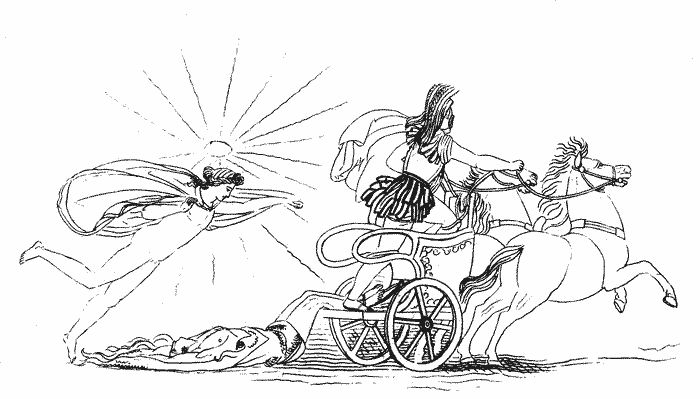
ACHILLES was the offspring of a goddess. Thetis bore him to Peleus,
king of Thessaly, and was so fond of him, that she charged herself with
his education. By day she fed him with ambrosia, and by night covered
him with celestial fire, to render him immortal. She also dipped him in
the waters of Styx, by which his whole body became invulnerable, except
that part of his heel by which she held him. He was afterwards committed
to the care of Chiron the Centaur, who fed him with honey, and the
marrow of lions and wild boars; whence he obtained that strength of body
and greatness of soul which qualified him for martial toil.
When the Greeks undertook the siege of
Troy, Calchas the diviner, and priest of Apollo, foretold that the city
should not be taken without the help of Achilles. Thetis, his mother,
who knew that Achilles, if he went to the siege of Troy, would never
return, clothed him in female apparel, and concealed him among the
maidens at the court of Lycomēdes, king of the island of Scyros. But
this stratagem proved ineffectual; for Calchas having informed the
Greeks where Achilles lay in disguise, they sent Ulysses to the court of
Lycomēdes, where, under the appearance of a merchant, he was introduced
to the king's daughters, and while they were studiously intent on
viewing his toys, Achilles employed himself in examining an helmet,
which the cunning politician had thrown in his way.
Achilles thus detected, was prevailed on to go to Troy, after Thetis
had furnished him with impenetrable armor made by Vulcan. Thither he led
the troops of Thessaly, in fifty ships, and distinguished himself by a
number of heroic actions; but being disgusted with Agamemnon for the
loss of Briseis, he retired from the camp, and resolved to have no
further concern in the war. In this resolution he continued inexorable,
till news was brought him that Hector had killed his friend Patrōclus;
to avenge his death he not only slew Hector, but fastened the corpse to
his chariot, dragged it round the walls of Troy, offered many
indignities to it, and sold it at last to Priam his father.
Authors are much divided on the manner of Achilles' death; some
relate that he was slain by Apollo, or that this god enabled Paris to
kill him, by directing the arrow to his heel, the only part in which he
was vulnerable. Others again say, that Paris murdered him treacherously,
in the temple of Apollo, whilst treating about his marriage with
Polyxĕna, daughter to king Priam.
Though this tradition concerning his death be commonly received, yet
Homer plainly enough insinuates that Achilles died fighting for his
country, and represents the Greeks as maintaining a bloody battle about
his body, which lasted a whole day. Achilles having been lamented by
Thetis, the Nereids, and the Muses, was buried on the promontory of
Sigæum; and after Troy was captured, the Greeks endeavored to appease
his manes by sacrificing Polyxĕna, on his tomb, as his ghost had
requested.
The oracle at Dodōna decreed him divine honors, and ordered annual
victims to be offered at the place of his
sepulture. In pursuance of this, the
Thessalians brought hither yearly two bulls, one black, the other white,
crowned with wreaths of flowers, and water from the river Sperchius. It
is said that Alexander, seeing his tomb, honored it by placing a crown
upon it, at the same time crying out “that Achilles was happy in having,
during his life, such a friend as Patrōclus, and after his death, a poet
like Homer.”
ATLAS was son of Japĕtus and Clymĕne, and brother of Prometheus,
according to most authors; or, as others relate, son of Japĕtus by Asia,
daughter of Oceănus. He had many children. Of his sons, the most famous
were Hespĕrus (whom some call his brother) and Hyas. By his wife Pleione
he had seven daughters, who went by the general names of Atlantĭdes, or
Pleiădes; and by his wife Æthra he had also seven other daughters, who
bore the common appellation of the Hyădes.
According to Hygīnus, Atlas having assisted the giants in their war
against Jupiter, was doomed by the victorious god, as a punishment, to
sustain the weight of the heavens. Ovid, however, represents him as a
powerful and wealthy monarch, proprietor of the gardens of the
Hesperĭdes, which bore golden fruit; but that being warned by the oracle
of Themis that he should suffer some great injury from a son of Jupiter,
he strictly forbade all foreigners access to his presence. Perseus,
however, having the courage to appear before him, was ordered to retire,
with strong menaces in case of disobedience; but the hero presenting his
shield, with the dreadful head of Medūsa, turned him into the mountain
which still bears his name.
The Abbé la Pluche has given a very clear and ingenious explication
of this fable. Of all nations the Egyptians had, with the greatest
assiduity, cultivated astronomy. To point out the difficulties attending
the study of this science, they represented it by an image bearing a
globe or sphere on its back, which they called Atlas, a word
signifying great toil or labor; but the word also signifying
support, the Phœnicians, led by the representation, took it in this
sense, and in their voyages to Mauritania, seeing the high mountains of
that country covered with snow, and losing their tops in the clouds,
gave them the name of Atlas, and thus produced the fable by which the
symbol of astronomy used among the Egyptians became a Mauritanian king,
transformed into a mountain, whose head supports the heavens.
The rest of the fable is equally obvious
to explanation. The annual inundations of the Nile obliged the Egyptians
to be very exact in observing the motions of the heavenly bodies. The
Hyades, or Huades, took their name from the figure V, which they form in
the head of Taurus. The Pleiades were a remarkable constellation and of
great use to the Egyptians in regulating the seasons: hence they became
the daughters of Atlas; and Orion, who arose just as they set, was
called their lover.
By the golden apples that grew in the gardens of the Hesperides, the
Phœnicians expressed the rich and beneficial commerce they had in the
Mediterranean, which being carried on during three months only of the
year, gave rise to the fable of the Hesperian sisters. The most usual
way of representing Atlas, among the ancient artists, was as supporting
a globe; for the old poets commonly refer to this attitude in speaking
of him.
PROMETHEUS was son of Japĕtus, but it is doubtful whether his mother
were Asia, or Themis. Having incurred the displeasure of Jupiter, either
for stealing some of the celestial fire, or for forming a man of clay,
Jupiter, in resentment, commanded Vulcan to make a woman of clay, which,
when finished, was introduced into the assembly of the gods, each of
whom bestowed on her some additional charm or perfection. Venus gave her
beauty, Pallas wisdom, Juno riches, Mercury taught her eloquence, and
Apollo music. From all these accomplishments she was styled Pandōra,
that is, loaded with gifts and accomplishments, and was the first of her
sex.
Jupiter, to complete his designs, presented her a box, in which he
had enclosed age, disease, war, famine, pestilence, discord, envy,
calumny, and, in short, all the evils and vices with which he intended
to afflict the world. Thus equipped, Pandōra was sent to Prometheus,
who, being on his guard against the mischief designed him, declined
accepting the box; but Epimetheus, his brother, though forewarned of the
danger, had less resolution; for, being enamored of the beauty of
Pandōra, he married her, and opened the fatal treasure, when immediately
flew abroad the contents, which soon overspread the world, hope only
remaining at the bottom.
Prometheus escaping the evil which the god designed him, and Jupiter
not being appeased, Mercury and Vulcan were despatched by him to seize
Prometheus, and chain him on Mount Caucasus, where a vulture, the
offspring of Typhon and Echidna, was commissioned to prey upon his
liver, which, that his torment might be endless, was constantly renewed
by night in proportion to its increase by day; but the vulture being
soon destroyed by Hercules, Prometheus was released. Others say, that
Jupiter restored Prometheus to freedom, for discovering the conspiracy
of Saturn, his father, and dissuading his intended marriage with
Thetis.
Nicander, to this fable, offers an additional one. He tells us, that
when mankind had received the fire from Prometheus, some ungrateful men
discovered the theft to Jupiter, who rewarded them with the gift of
perpetual youth. This present they put on the back of an ass, which
stopping at a fountain to quench his thirst, was prevented by a
water-snake which would not suffer him to drink till he gave him his
burden; hence the serpent renews his youth upon changing his skin.
Prometheus was esteemed the inventor of many useful arts. He made man
of the mixture and temperament of all the elements, gave him strength of
body, vigor of mind, and the peculiar qualities of all creatures, as the
craft of the fox, the courage of the lion, &c. He had an altar in the
academy of Athens in common with Vulcan and Pallas. In his statues he
holds a sceptre in the right hand.
Several explanations have been given of this fable. Prometheus, whose
name is derived from a Greek word, signifying foresight and providence,
was conspicuous for that quality; and because he reduced mankind, before
rude and savage, to a state of culture and improvement, he was feigned
to have made them from clay: being a diligent observer of the motions of
the heavenly bodies from Mount Caucasus, it was fabled that he was
chained there: having discovered the method of striking fire from the
flint, or perhaps, the nature of lightning, it was pretended that he
stole fire from the gods: and, because he applied himself to study with
intenseness, they imagined that a vulture preyed continually on his
liver.
There is another solution of this fable, analogous to the preceding.
According to Pliny, Prometheus was the first who instituted sacrifices.
Being expelled his dominions by Jupiter, he fled to Scythia, where he
retired to Mount Caucasus, either to make astronomical calculations or
to indulge his melancholy for the loss of his dominions, which
occasioned the fable of the vulture or eagle feeding
on his liver. As he was the first inventor of
forging metals by fire, he was said to have stolen that element from
heaven; and, as the first introduction of agriculture and navigation had
been ascribed to him, he was celebrated as forming a living man from an
inanimate substance.
AMPHION, king of Thebes, son of Jupiter and Antiŏpe, was instructed
in the use of the lyre by Mercury, and became so great a proficient,
that he is reported to have built the walls of Thebes by the power of
his harmony, which caused the listening stones to ascend voluntarily. He
married Niŏbe, daughter of Tantălus, whose insult to Diāna occasioned
the loss of their children by the arrows of Apollo and Diāna. The
unhappy father, attempting to revenge himself by the destruction of the
temple of Apollo, was punished with the loss of his sight and skill, and
thrown into the infernal regions.
ORPHEUS, son of Apollo by the Muse Calliŏpe, was born in Thrace, and
resided near Mount Rhodŏpe, where he married Eurydice, a princess of
that country. Aristæus, a neighboring prince, fell desperately in love
with her, but she flying from his violence, was killed by the bite of a
serpent. Her disconsolate husband was so affected at his loss, that he
descended by the way of Tænărus to hell, in order to recover his beloved
wife. As music and poetry were to Orpheus hereditary talents, he exerted
them so powerfully in the infernal regions, that Pluto and Proserpine,
touched with compassion, restored to him his consort on condition that
he should not look back upon her till they came to the light of the
world. His impatience, however, prevailing, he broke the condition, and
lost Eurydice forever.
Whilst Orpheus was among the shades, he sang the praises of all the
gods but Bacchus, whom he accidentally omitted; to revenge this affront,
Bacchus inspired the Mænădes, his priestesses, with such fury, that they
tore Orpheus to pieces, and scattered his limbs about the fields. His
head was cast into the river Hebrus, and (together with his harp) was
carried by the tide to Lesbos, where it afterwards delivered oracles.
The harp, with seven strings, representing the seven planets, which had
been given him by Apollo, was taken up into heaven, and graced with nine
stars by the nine Muses. Orpheus himself was changed into a swan. He
left a son called Methon, who founded in Thrace a city of his own
name.
It is certain that Orpheus may be placed
as the earliest poet of Greece, where he first introduced astronomy,
divinity, music and poetry; all which he had learned in Egypt. He
introduced also the rites of Bacchus, which from him were called
Orphica. He was a person of most consummate knowledge, and the wisest,
as well as the most diligent scholar of Linus.
If we search for the origin of this fable, we must again have
recourse to Egypt, the mother-country of fiction. In July, when the sun
entered Leo, the Nile overflowed all the plains. To denote the public
joy at seeing the inundation rise to its due height, the Egyptians
exhibited a youth playing on the lyre, or the sistrum, and sitting by a
tame lion. When the waters did not increase as they should, the Horus
was represented stretched on the back of a lion, as dead. This symbol
they called Oreph, or Orpheus, (from oreph, the back part of the
head) to signify that agriculture was then quite unseasonable and
dormant.
The songs with which the people amused themselves during this period
of inactivity, for want of exercise, were called the hymns of Orpheus;
and as husbandry revived immediately after, it gave rise to the fable of
Orpheus's returning from hell. The Isis placed near this Horus, they
called Eurydice, (from eri, a lion,
and daca, tamed, is formed
Eridica, Eurydice, or the lion tamed, i.e. the
violence of the inundation overcome), and as the Greeks took all these
figures in the literal, not in the emblematical sense, they made
Eurydice the wife of Orpheus.
OSIRIS, son of Jupiter and Niŏbe, was king of the Argives many years;
but, being instigated by the desire of glory, he left his kingdom to his
brother Ægiălus, and went into Egypt, in search of a new name and
kingdom there. The Egyptians were not so much overcome by the valor of
Osīris, as obliged to him for his kindness towards them. Having
conferred the greatest benefits on his subjects, by civilizing their
manners, and instructing them in husbandry and other useful arts, he
made the necessary disposition of his affairs, committed the regency to
Isis, and set out with a body of forces in order to civilize the rest of
mankind. This he performed more by the power of persuasion, and the
soothing arts of music and poetry, than by the terror of his arms.
In his absence, Typhœus, the giant, whom historians call the brother
of Osīris, formed a conspiracy to dethrone
him; for which end, at the return of Osīris
into Egypt, he invited him to a feast, at the conclusion of which a
chest of exquisite workmanship was brought in, and offered to him who,
when laid down in it, should be found to fit it the best. Osīris, not
suspecting a trick to be played him, got into the chest, and the cover
being immediately shut upon him, this good but unfortunate prince was
thus thrown into the Nile.
When the news of this transaction reached Coptus, where Isis his wife
then was, she cut her hair, and in deep mourning went every where in
search of the dead body. This was at length discovered, and concealed by
her at Butus; but Typhœus, while hunting by moonlight, having found it
there, tore it into many pieces, which he scattered abroad. Isis then
traversed the lakes and watery places in a boat made of
the papyrus, seeking the mangled parts of Osīris, and where she
found any, there she buried them; hence the many tombs ascribed to
Osīris.
Plutarch seems evidently to prove that the Egyptians worshipped the
Sun under the name of Osīris. His reasons are: 1. Because the images of
Osīris were always clothed in a shining garment, to represent the rays
and light of the sun. 2. In their hymns, composed in honor of Osīris,
they prayed to him who reposes himself in the bosom of the sun. 3. After
the autumnal equinox, they celebrated a feast called, The
disappearing of Osīris, by which is plainly meant the absence and
distance of the sun. 4. In the month of November they led a cow seven
times round the temple of Osīris, intimating thereby, that in seven
months the sun would return to the summer solstice.
He is represented sitting upon a throne, crowned with a mitre full of
small orbs, to intimate his superiority over all the globe. The gourd
upon the mitre implies his action and influence upon moisture, which,
and the Nile particularly, was termed by the Egyptians, the efflux of
Osīris. The lower part of his habit is made up of descending rays, and
his body is surrounded with orbs. His right hand is extended in a
commanding attitude, and his left holds a thyrsus or staff of the
papyrus, pointing out the principle of humidity, and the fertility
thence flowing, under his direction.
ÆSCULAPIUS. The name of Æsculapius, whom the Greeks called Ασκληπιος,
appears to have been foreign, and derived from the oriental languages.
Being honored as a god in Phœnicia and Egypt, his worship passed into
Greece, and was established, first at Epidaurus, a
city of Peloponnesus, bordering on the sea, where, probably, some
colonies first settled; a circumstance sufficient for the Greeks to give
out that this god was a native of Greece.
Not to mention all we are told of his parents, it will be enough to
observe, that the opinion generally received in Greece, made him the son
of Apollo by Corōnis, daughter of Phlegyas; and indeed the Messenians,
who consulted the oracle of Delphi to know where Æsculapius was born,
and of what parents, were told by the oracle, or more properly Apollo,
that he himself was his father; that Corōnis was his mother, and that
their son was born at Epidaurus.
Phlegyas, the most warlike man of his age, having gone into
Peloponnesus under pretence of travelling, but, in truth, to spy into
the condition of the country, carried his daughter Corōnis thither, who,
to conceal her situation from her father, went to Epidaurus: there she
was delivered of a son, whom she exposed upon a mountain, called to this
day Mount Titthion, or of the breast; but before this adventure,
Myrthion, from the myrtles that grew upon it.
The reason of this change of name was, that the child, having been
here abandoned, was suckled by one of those goats of the mountain, which
the dog of Aristhĕnes the goat-herd guarded. When Aristhĕnes came to
review his flock, he found a she-goat and his dog missing, and going in
search of them discovered the child. Upon approaching to lift him from
the earth, he perceived his head encircled with fiery rays, which made
him believe the child to be of divine origin.
As Κορωνη in the Greek language signifies a crow, hence another fable
arose importing, as we see in Lucian, that Æsculapius had sprung from an
egg of a bird, under the figure of a serpent. Whatever these fictions
may mean, Æsculapius being removed from the mount on which he was
exposed, was nursed by Trigo or Trigone, who was probably the wife of
the goat-herd that found him; and when he was capable of improving by
Chiron, Phlegyas (to whom he had doubtless been returned) put him under
the Centaur's tuition.
Being of a quick and lively genius, he made such progress as soon to
become not only a great physician, but at length to be reckoned the god
and inventor of medicine; though the Greeks, not very consistent in the
history of those early ages, gave to Apis, son of Phoroneus, the glory
of having discovered the healing art. Æsculapius
accompanied Jason in his expedition to Colchis,
and in his medical capacity was of great service to the Argonauts.
Within a short time after his death he was deified, and received divine
honors: some add, that he formed the celestial sign, Serpentarius.
As the Greeks always carried the encomiums of their great men beyond
the truth, they feigned that Æsculapius was so expert in medicine, as
not only to cure the sick, but even to raise the dead. Ovid says he did
this by Hippolĭtus, and Julian says the same of Tyndărus: that Pluto
cited him before the tribunal of Jupiter, and complained that his empire
was considerably diminished and in danger of becoming desolate, from the
cures Æsculapius performed; so that Jupiter in wrath slew Æsculapius
with a thunder-bolt; to which they added that Apollo, enraged at the
death of his son, killed the Cyclops who forged Jupiter's thunder-bolts:
a fiction which obviously signifies only, that Æsculapius had carried
his art very far, and that he cured diseases believed to be
desperate.
Æsculapius is always represented under the figure of a grave old man
wrapped up in a cloak, having sometimes upon his head
the calăthus of Serāpis, with a staff in his hand, which is
commonly wreathed about with a serpent; sometimes again with a serpent
in one hand, and a patĕra in the other; sometimes leaning upon a
pillar, round which a serpent also twines. The cock, a bird consecrated
to this god, whose vigilance represents that quality which physicians
ought to have, is sometimes at the feet of his statues. Socrates, we
know, when dying, said to those who stood around him in his last
moments, “We owe a cock to Æsculapius; give it without delay.”
ULYSSES, king of Ithăca, was the son of Laertes, or Laertius and
Anticlēa. His wife Penelŏpe, daughter of Icarius brother of Tyndărus
king of Sparta, was highly famed for her prudence and virtue; and being
unwilling that the Trojan war should part them, Ulysses to avoid the
expedition, pretended to be mad, and not only joined different beasts to
the same plough, but sowed also the furrows with salt.
Palamēdes, however, suspecting the frenzy to be assumed, threw
Telemachus, then an infant, in the way of the plough, to try if his
father would alter its course. This stratagem succeeded; for when
Ulysses came to the child he turned off from the spot, in consequence of
which Palamēdes compelled him to take part in the war. He
accordingly sailed with twelve ships, and was
signally serviceable to the Greeks.
To him the capture of Troy is chiefly to be ascribed, since by him
the obstacles were removed, which had so long prevented it. For as
Ulysses himself was detected by Palamēdes, so he in his turn detected
Achilles, who, to avoid engaging in the same war, had concealed himself
in the habits of a woman, at the court of Lycomēdes, king of Scyros.
Ulysses there discovered him, and as it had been foretold that without
Achilles Troy could not be taken, thence drew him to the siege.
He also obtained the arrows of Hercules, from Philoctētes, and
carried off that hero from the scene of his retreat. He brought away
also the ashes of Laomĕdon, which were preserved in Troy on the Scœan
gate. By him the Palladium was stolen from the same city; Rhesus, king
of Thrace, killed, and his horses taken before they had drank of the
Xanthus. These exploits involved in them the destiny of Troy; for had
the Trojans preserved them, their city could never have been
conquered.
Ulysses contended afterwards with Telamonian Ajax, the stoutest of
all the Grecians, except Achilles, for the arms of that hero, which were
awarded to him by the judges, who were won by the charms of his
eloquence. His other enterprises before Troy were numerous and
brilliant, and are particularly related in the Iliad. When Ulysses
departed for Greece, he sailed backwards and forwards for twenty years,
contrary winds and severe weather opposing his return to Ithăca.
During this period, he extinguished, with a firebrand, the eye of
Polyphēmus; then sailing to Æolia, he obtained from Æŏlus all the winds
which were contrary to him, and put them into leathern bags; his
companions, however, believing these bags to be full of money, entered
into a plot to rob him, and accordingly, when they came on the coast of
Ithăca, untied the bags, upon which the wind rushing out, he was again
blown back to Æolia.
When Circe had turned his companions into swine and other brutes, he
first fortified himself against her charms with the herb Moly, an
antidote Mercury had given him; and then rushing into her cave with his
drawn sword, compelled her to restore his associates to their original
shape.
He is said to have gone down into hell, to know his future fortune,
from the prophet Tiresias. When he
sailed to the islands of the Sirens, he stopped
the ears of his companions, and bound himself with strong ropes to the
ship's mast, that he might secure himself against the snares into which,
by their charming voices, passengers were habitually allured. Lastly,
after his ship was wrecked, he escaped by swimming, and came naked and
alone, to the port of Phæacia, in the island of Corcyra, where Nausicăa,
daughter of king Alcinŏus, found him in a profound sleep, into which he
was thrown by the indulgence of Minerva.
When his companions were found, and his ship refitted, he bent his
course toward Ithăca, where arriving, and having put on the habit of a
beggar, he went to his neatherds, with whom he found his son Telemachus,
and with them went home in disguise. After having received several
affronts from the suitors of Penelŏpe, with the assistance of his son
Telemachus and the neatherds, to whom he had discovered himself, he
killed Antinŏus, and the other princes who were competitors for her
favor. After reigning some time, he resigned the government of his
kingdom to Telemachus.
CASTOR and POLLUX were the twin sons of Jupiter and Leda. These
brothers entered into an inviolable friendship, and when they grew up,
cleared the Archipelago of pirates, on which account they were esteemed
deities of the sea, and accordingly were invoked by mariners in
tempests. They went with the other noble youths of Greece in the
expedition to Colchis, in search of the golden fleece, and on all
occasions signalized themselves by their courage.
In this expedition Pollux slew Amycus, son of Neptune, and king of
Bebrycia, who had challenged all the Argonauts to box with him. This
victory, and that which he gained afterwards at the Olympic games which
Hercules celebrated in Elis, caused him to be considered the hero and
patron of wrestlers, while his brother Castor distinguished himself in
the race, and in the management of horses.
Cicero relates a wonderful judgment which happened to one Scopas, who
had spoken disrespectfully of these divinities: he was crushed to death
by the fall of a chamber, whilst Simonĭdes, who was in the same room,
was rescued from the danger, being called out a little before, by two
persons unknown, supposed to be Castor and Pollux.
The Greek and Roman histories are full of the miraculous appearance
of these brethren; particularly we are told they were seen fighting upon
two white horses, at the head of the Roman army, in the battle between
the Romans and Latins, near the lake Regillus, and brought the news of
the decisive victory of Paulus Æmilius to Rome, the very day it was
obtained.
Frequent representations of these deities occur on ancient monuments,
and particularly on consular medals. They are exhibited together, each
having a helmet, out of which issues a flame, and each a pike in one
hand, and in the other a horse held by the bridle: sometimes they are
represented as two beautiful youths, completely armed, and riding on
white horses, with stars over their helmets.
AJAX, son of Telămon, king of Salămis, by Beribœa, was, next to
Achilles, the most valiant among the Greeks at the seige of Troy. He
commanded the troops of Salămis in that expedition, and performed the
various heroic actions mentioned by Homer, and Ovid, in the speech of
Ajax contending for the armor of Achilles. This armor, however, being
adjudged to his competitor Ulysses, his disappointment so enraged him,
that he immediately became mad, and rushed furiously upon a flock of
sheep, imagining he was killing those who had offended him: but at
length perceiving his mistake, he became still more furious, and stabbed
himself with the fatal sword he had received from Hector, with whom he
had fought. Ajax resembled Achilles in several respects; like him he was
violent, and impatient of contradiction; and, like him, invulnerable in
every part of the body except one.
He has been charged with impiety; not that he denied the gods a very
extensive power, but he imagined that, as the greatest cowards might
conquer through their assistance, there was no glory in conquering by
such aids; and scorned to owe his victory to aught but his own prowess.
Accordingly, we are told that when he was setting out for Troy, his
father recommended him always to join the assistance of the gods to his
own valor; to which Ajax replied, that cowards themselves were often
victorious by such helps, but for his own part he would make no reliance
of the kind, being assured he should be able to conquer without.
It is further added, upon the head of his irreligion, that to
Minerva, who once offered him her advice, he replied with indignation:
“Trouble not yourself about my conduct; of that I shall give a good
account; you have nothing to do but reserve your favor and assistance
for the other Greeks.” Another time she offered to guide
his chariot in the battle, but he would not
suffer her. Nay, he even defaced the owl, her favorite bird, which was
engraven on his shield, lest that figure should be considered as an act
of reverence to Minerva, and hence as indicating distrust in
himself.
Homer, however, does not represent him in this light, for though he
does not pray to Jupiter himself when he prepares to engage the valiant
Hector, yet he desires others to pray for him, either in a low voice,
lest the Trojans should hear, or louder if they pleased; for, says he, I
fear no person in the world.
The poets give to Ajax the same commendation that the holy scripture
gives to king Saul, with regard to his stature. He has been the subject
of several tragedies, as well in Greek as Latin; and it is related that
the famous comedian, Æsop, refused to act that part. The Greeks paid
great honor to him after his death, and erected to him a noble monument
upon the promontory of Rhœteum, which was one of those Alexander desired
to see and honor.
JASON was son of Æson, king of Thessaly, and Alcimĕde. He was an
infant when Pelias, his uncle, who was left his guardian, sought to
destroy him; but being, to avoid the danger, conveyed by his relations
to a cave, he was there instructed by Chiron in the art of physic;
whence he took the name of Jason, or the healer, his former name being
Diomēdes. Arriving at years of maturity, he returned to his uncle, who,
probably with no favorable intention to Jason, inspired him with the
notion of the Colchian expedition and agreeably flattered his ambition
with the hopes of acquiring the golden fleece.
Jason having resolved on the voyage, built a vessel at Iolchos in
Thessaly, for the expedition, under the inspection, of Argos, a famous
workman, which, from him, was called Argo: it was said to have been
executed by the advice of Pallas, who pointed out a tree in the Dodonæan
forest for a mast, which was vocal, and had the gift of prophecy.
The fame of the vessel, the largest that had ever been heard of, but
particularly the design itself, soon induced the bravest and most
distinguished youths of Greece to become adventurers in it, and brought
together about fifty of the most accomplished young persons of the age
to accompany Jason in this expedition; authors, however, are not agreed
on the precise names or numbers of the Argonauts; some state them to
have been forty-nine; others more, and amongst them several were of
divine origin.
On his arrival at Colchis he repaired to
the court of Æētes, from whom he demanded the golden fleece. The monarch
acceded to his request, provided he could overcome the difficulties
which lay in his way, and which appeared not easily surmountable; these
were bulls with brazen feet, whose nostrils breathed fire, and a dragon
which guarded the fleece. The teeth of the latter, when killed, Jason
was enjoined to sow, and, after they had sprung up into armed men, to
destroy them.
Though success attended the enterprise, it was less owing to valor,
than to the assistance of Medēa, daughter of Æētes, who, by her
enchantments, laid asleep the dragon, taught Jason to subdue the bulls,
and when he had obtained the prize, accompanied him in the night time,
unknown to her brother.
The return of the Argonauts is variously related; some contend it was
by the track in which they came, and say that the brother of Medēa
pursued them as far as the Adriatic, and was overcome by Jason; which
occasioned the story that his sister had cut him in pieces, and strewed
his limbs in the way, that her father, from solicitude to collect them,
might be delayed in the pursuit.


