One who is aware of values which he regards as a hundredfold more
precious than the wellbeing of the "fatherland," of society, of the
kinships of blood and race, values which stand above fatherlands
and races, international values, such a man would prove himself
hypocrite should he try to play the patriot. It is a degradation of
mankind to encourage national hatred, to admire it, or to extol it.
Nietzsche, Vorreden Material im Nachlass.
La vocation ne peut être connue et prouvée que par le sacrifice que
fait le savant et l'artiste de son repos et son bien-être pour
suivre sa vocation.
Letter de Tolstoi a Romain Rolland.
4, Octobre, 1887.
THE events of August 2, 1914, broke Europe into fragments. Therewith
collapsed the faith which the brothers in the spirit, Jean Christophe
and Olivier, had been building with their lives. A great heritage was
cast aside. The idea of human brotherhood, once sacred, was buried
contemptuously by the grave-diggers of all the lands at war, buried
among the million corpses of the slain.
Romain Rolland was faced by an unparalleled responsibility. He had
presented the problems in imaginative form. Now they had come up for
solution as terrible realities. Faith in Europe, the faith which he had
committed to the care of Jean Christophe, had no protector, no advocate,
at a time when it was more than ever necessary to raise its standard
against the storm. Well did the poet know that a truth remains naught
but a half-truth while it exists merely in verbal formulation. It is in
action that a thought becomes genuinely alive. A faith proves itself
real in the form of a public confession.
In Jean Christophe, Romain Rolland had delivered his message to this
fated hour. To make the confession a live thing, he had to give
something more, himself. The time had come for him to do what Jean
Christophe had done for Olivier's son. He must guard the sacred flame;
he must fulfil what his hero had prophetically foreshadowed. The way in
which Rolland fulfilled this obligation has become for us all an
imperishable example of spiritual heroism, which moves us even more
strongly than we were moved by his written words. We saw his life and
personality taking the form of an actually living conviction. We saw
how, with the whole power of his name, and with all the energy of his
artistic temperament, he took his stand against multitudinous
adversaries in his own land and in other countries, his gaze fixed upon
the heaven of his faith.
Rolland had never failed to recognize that in a time of widespread
illusion it would be difficult to hold fast to his convictions, however
self-evident they might seem. But, as he wrote to a French friend in
September, 1914, "We do not choose our own duties. Duty forces itself
upon us. Mine is, with the aid of those who share my ideas, to save from
the deluge the last vestiges of the European spirit.... Mankind demands
of us that those who love their fellows should take a firm stand, and
should even fight, if needs must, against those they love."
For five years we have watched the heroism of this fight, pursuing its
own course amid the warring of the nations. We have watched the miracle
of one man's keeping his senses amid the frenzied millions, of one man's
remaining free amid the universal slavery of public opinion. We have
watched love at war with hate, the European at war with the patriots,
conscience at war with the world. Throughout this long and bloody
night, when we were often ready to perish from despair at the
meaninglessness of nature, the one thing which has consoled us and
sustained us has been the recognition that the mighty forces which were
able to crush towns and annihilate empires, were powerless against an
isolated individual possessed of the will and the courage to be free.
Those who deemed themselves the victors over millions, were to find that
there was one thing which they could not master, a free conscience.
Vain, therefore, was their triumph, when they buried the crucified
thought of Europe. True faith works miracles. Jean Christophe had burst
the bonds of death, had risen again in the living form of his own
creator.
WE do not detract from the moral services of Romain Rolland, but we may
perhaps excuse to some extent his opponents, when we insist that Rolland
had excelled all contemporary imaginative writers in the profundity of
his preparatory studies of war and its problems. If to-day, in
retrospect, we contemplate his writings, we marvel to note how, from the
very first and throughout a long period of years, they combined to build
up, as it were, a colossal pyramid, culminating in the point upon which
the lightnings of war were to be discharged. For twenty years, the
author's thought, his whole creative activity, had been unintermittently
concentrated upon the contradictions between spirit and force, between
freedom and the fatherland, between victory and defeat. Through a
hundred variations he had pursued the same fundamental theme, treating
it dramatically, epically, and in manifold other ways. There is hardly a
problem relevant to this question which is not touched upon by
Christophe and Olivier, by Aërt and by the Girondists, in their
discussions. Intellectually regarded, Rolland's writings are a
maneuvering ground for all the incentives to war. He thus had his
conclusions already drawn when others were beginning an attempt to come
to terms with events. As historian, he had described the perpetual
recurrence of war's typical accompaniments, had discussed the psychology
of mass suggestion, and had shown the effects of wartime mentality upon
the individual. As moralist and as citizen of the world, he had long ere
this formulated his creed. We may say, in fact, that Rolland's mind had
been in a sense immunized against the illusions of the crowd and against
infection by prevalent falsehoods.
Not by chance does an artist decide which problems he will consider. The
dramatist does not make a "lucky selection" of his theme. The musician
does not "discover" a beautiful melody, but already has it within him.
It is not the artist who creates the problems, but the problems which
create the artist; just as it is not the prophet who makes his prophecy,
but the foresight which creates the prophet. The artist's choice is
always pre-ordained. The man who has foreseen the essential problem of a
whole civilization, of a disastrous epoch, must of necessity, in the
decisive hour, play a leading part. He only who had contemplated the
coming European war as an abyss towards which the mad hunt of recent
decades, making light of every warning, had been speeding, only such a
one could command his soul, could refrain from joining the bacchanalian
rout, could listen unmoved to the throbbing of the war drums. Who but
such a man could stand upright in the greatest storm of illusion the
world has ever known?
Thus it came to pass that not merely during the first hour of the war
was Rolland in opposition to other writers and artists of the day. This
opposition dated from the very inception of his career, and hence for
twenty years he had been a solitary. The reason why the contrast between
his outlook and that of his generation had not hitherto been
conspicuous, the reason why the cleavage was not disclosed until the
actual outbreak of war, lies in this, that Rolland's divergence was a
matter not so much of mood as of character. Before the apocalyptic year,
almost all persons of artistic temperament had recognized quite as
definitely as Rolland had recognized that a fratricidal struggle between
Europeans would be a crime, would disgrace civilization. With few
exceptions, they were pacifists. It would be more correct to say that
with few exceptions they believed themselves to be pacifists. For
pacifism does not simply mean, to be a friend to peace, but to be a
worker in the cause of peace, an
εἱρηνοποιὁς, as the New
Testament has it. Pacifism signifies the activity of an effective will
to peace, not merely the love of an easy life and a preference for
repose. It signifies struggle; and like every struggle it demands, in
the hour of danger, self-sacrifice and heroism. Now these "pacifists" we
have just been considering had merely a sentimental fondness for peace;
they were friendly towards peace, just as they were friendly towards
ideas of social equality, towards philanthropy, towards the abolition of
capital punishment. Such faith as they possessed was a faith devoid of
passion. They wore their opinions as they wore their clothing, and when
the time of trial came they were ready to exchange their pacifist ethic
for the ethic of the war-makers, were ready to don a national uniform in
matters of opinion. At bottom, they knew the right just as well as
Rolland, but they had not the courage of their opinions. Goethe's saying
to Eckermann applies to them with deadly force. "All the evils of modern
literature are due to lack of character in individual investigators and
writers."
Thus Rolland did not stand alone in his knowledge, which was shared by
many intellectuals and statesmen. But in his case, all his knowledge was
tinged with religious fervor; his beliefs were a living faith; his
thoughts were actions. He was unique among imaginative writers for the
splendid vigor with which he remained true to his ideals when all others
were deserting the standard; for the way in which he defended the
European spirit against the raging armies of the sometime European
intellectuals now turned patriots. Fighting as he had fought from youth
upwards on behalf of the invisible against the world of reality, he
displayed, as a foil to the heroism of the trenches, a higher heroism
still. While the soldiers were manifesting the heroism of blood, Rolland
manifested the heroism of the spirit, and showed the glorious spectacle
of one who was able, amid the intoxication of the war-maddened masses,
to maintain the sobriety and freedom of an unclouded mind.
AT the outbreak of the war, Romain Rolland was in Vevey, a small and
ancient city on the lake of Geneva. With few exceptions he spent his
summers in Switzerland, the country in which some of his best literary
work had been accomplished. In Switzerland, where the nations join
fraternal hands to form a state, where Jean Christophe had heralded
European unity, Rolland received the news of the world disaster.
Of a sudden it seemed as if his whole life had become meaningless. Vain
had been his exhortations, vain the twenty years of ardent endeavor. He
had feared this disaster since early boyhood. He had made Olivier cry in
torment of soul: "I dread war so greatly, I have dreaded it for so long.
It has been a nightmare to me, and it poisoned my childhood's days."
Now, what he had prophetically anticipated had become a terrible reality
for hundreds of millions of human beings. The agony of the hour was
nowise diminished because he had foreseen its coming to be inevitable.
On the contrary, while others hastened to deaden their senses with the
opium of false conceptions of duty and with the hashish dreams of
victory, Rolland's pitiless sobriety enabled him to look far out into
the future. On August 3rd he wrote in his diary: "I feel at the end of
my resources. I wish I were dead. It is horrible to live when men have
gone mad, horrible to witness the collapse of civilization. This
European war is the greatest catastrophe in the history of many
centuries, the overthrow of our dearest hopes of human brotherhood." A
few days later, in still greater despair, he penned the following entry:
"My distress is so colossal an accumulation of distresses that I can
scarcely breathe. The ravaging of France, the fate of my friends, their
deaths, their wounds. The grief at all this suffering, the heartrending
sympathetic anguish with the millions of sufferers. I feel a moral
death-struggle as I look on at this mad humanity which is offering up
its most precious possessions, its energies, its genius, its ardors of
heroic devotion, which is sacrificing all these things to the murderous
and stupid idols of war. I am heartbroken at the absence of any divine
message, any divine spirit, any moral leadership, which might upbuild
the City of God when the carnage is at an end. The futility of my whole
life has reached its climax. If I could but sleep, never to reawaken."
Frequently, in this torment of mind, he desired to return to France; but
he knew that he could be of no use there. In youth, undersized and
delicate, he had been unfit for military service. Now, hard upon fifty
years of age, he would obviously be of even less account. The merest
semblance of helping in the war would have been repugnant to his
conscience, for his acceptance of Tolstoi's teaching had made his
convictions steadfast. He knew that it was incumbent upon him to defend
France, but to do so in another sense than that of the combatants and
that of the intellectuals clamorous with hate. "A great nation," he
wrote more than a year later, in the preface to Au-dessus de la mêlée,
"has not only its frontiers to protect; it must also protect its good
sense. It must protect itself from the hallucinations, injustices, and
follies which war lets loose. To each his part. To the armies, the
protection of the soil of their native land. To the thinkers, the
defense of its thought.... The spirit is by no means the most
insignificant part of a people's patrimony." In these opening days of
misery, it was not yet clear to him whether and how he would be called
upon to speak. Yet he knew that if and when he did speak, he would take
up his parable on behalf of intellectual freedom and supranational
justice.
But justice must have freedom of outlook. Nowhere except in a neutral
country could the observer listen to all voices, make acquaintance with
all opinions. From such a country alone could he secure a view above the
smoke of the battle-field, above the mist of falsehood, above the poison
gas of hatred. Here he could retain freedom of judgment and freedom of
speech. In Jean Christophe, he had shown the dangerous power of mass
suggestion. "Under its influence," he had written, "in every country the
firmest intelligences felt their most cherished convictions melting
away." No one knew better than Rolland "the spiritual contagion, the
all-pervading insanity, of collective thought." Knowing these things so
well, he wished all the more to remain free from them, to shun the
intoxication of the crowd, to avoid the risk of having to follow any
other leadership than that of his conscience. He had merely to turn to
his own writings. He could read there the words of Olivier: "I love
France, but I cannot for the sake of France kill my soul or betray my
conscience. This would indeed be to betray my country. How can I hate
when I feel no hatred? How can I truthfully act the comedy of hate?" Or,
again, he could read this memorable confession: "I will not hate. I will
be just even to my enemies. Amid all the stresses of passion, I wish to
keep my vision clear, that I may understand everything and thus be able
to love everything." Only in freedom, only in independence of spirit,
can the artist aid his nation. Thus alone can he serve his generation,
thus alone can he serve humanity. Loyalty to truth is loyalty to the
fatherland.
What had befallen through chance was now confirmed by deliberate choice.
During the five years of the war Romain Rolland remained in Switzerland,
Europe's heart; remained there that he might fulfil his task, "de dire
ce qui est juste et humain." Here, where the breezes blow freely from
all other lands, and whence a voice could pass freely across all the
frontiers, here where no fetters were imposed upon speech, he followed
the call of his invisible duty. Close at hand the endless waves of blood
and hatred emanating from the frenzy of war were foaming against the
frontiers of the cantonal state. But throughout the storm, the magnetic
needle of one intelligence continued to point unerringly towards the
immutable pole of life—to point towards love.
IN Rolland's view it was the artist's duty to serve his fatherland by
conscientious service to all mankind, to play his part in the struggle
by waging war against the suffering the war was causing and against the
thousandfold torments entailed by the war. He rejected the idea of
absolute aloofness. "An artist has no right to hold aloof while he is
still able to help others." But this aid, this participation, must not
take the form of fostering the murderous hatred which already animated
the millions. The aim must be to unite the millions further, where
unseen ties already existed, in their infinite suffering. He therefore
took his part in the ranks of the helpers, not weapon in hand, but
following the example of Walt Whitman, who, during the American Civil
War, served as hospital assistant.
Hardly had the first blows been struck when cries of anguish from all
lands began to be heard in Switzerland. Thousands who were without news
of fathers, husbands, and sons in the battlefields, stretched despairing
arms into the void. By hundreds, by thousands, by tens of thousands,
letters and telegrams poured into the little House of the Red Cross in
Geneva, the only international rallying point that still remained.
Isolated, like stormy petrels, came the first inquiries for missing
relatives; then these inquiries themselves became a storm. The letters
arrived in sackfuls. Nothing had been prepared for dealing with such an
inundation of misery. The Red Cross had no space, no organization, no
system, and above all no helpers.
Romain Rolland was one of the first to offer personal assistance. The
Musée Rath was quickly made available for the purposes of the Red Cross.
In one of the small wooden cubicles, among hundreds of girls, women, and
students, Rolland sat for more than eighteen months, engaged each day
for from six to eight hours side by side with the head of the
undertaking, Dr. Ferrière, to whose genius for organization myriads owe
it that the period of suspense was shortened. Here Rolland filed
letters, wrote letters, performed an abundance of detail work, seemingly
of little importance. But how momentous was every word to the
individuals whom he could help, for in this vast universe each suffering
individual is mainly concerned about his own particular grain of
unhappiness. Countless persons to-day, unaware of the fact, have to
thank the great writer for news of their lost relatives. A rough stool,
a small table of unpolished deal, the turmoil of typewriters, the bustle
of human beings questioning, calling one to another, hastening to and
fro—such was Romain Rolland's battlefield in this campaign against the
afflictions of the war. Here, while other authors and intellectuals were
doing their utmost to foster mutual hatred, he endeavored to promote
reconciliation, to alleviate the torment of a fraction among the
countless sufferers by such consolation as the circumstances rendered
possible. He neither desired, nor occupied, a leading position in the
work of the Red Cross; but, like so many other nameless assistants, he
devoted himself to the daily task of promoting the interchange of news.
His deeds were inconspicuous, and are therefore all the more memorable.
When he was allotted the Nobel peace prize, he refused to retain the
money for his own use, and devoted the whole sum to the mitigation of
the miseries of Europe, that he might suit the action to the word, the
word to the action. Ecce homo! Ecce poeta!
NO one had been more perfectly forearmed than Romain Rolland. The
closing chapters of Jean Christophe foretell the coming mass illusion.
Never for a moment had he entertained the vain hope of certain idealists
that the fact (or semblance) of civilization, that the increase of human
kindliness which we owe to two millenniums of Christianity, would make a
future war, comparatively humane. Too well did he know as historian that
in the initial outbursts of war passion the veneer of civilization and
Christianity would be rubbed off; that in all nations alike the naked
bestiality of human beings would be disclosed; that the smell of the
shed blood would reduce them all to the level of wild beasts. He did not
conceal from himself that this strange halitus is able to dull and to
confuse even the gentlest, the kindliest, the most intelligent of souls.
The rending asunder of ancient friendships, the sudden solidarity among
persons most opposed in temperament now eager to abase themselves before
the idol of the fatherland, the total disappearance of conscientious
conviction at the first breath of the actualities of war—in Jean
Christophe these things were written no less plainly than when of old
the fingers of the hand wrote upon the palace wall in Babylon.
Nevertheless, even this prophetic soul had underestimated the cruel
reality. During the opening days of the war, Rolland was horrified to
note how all previous wars were being eclipsed in the atrocity of the
struggle, in its material and spiritual brutality, in its extent, and in
the intensity of its passion. All possible anticipations had been
outdone. Although for thousands of years, by twos or variously allied,
the peoples of Europe had almost unceasingly been warring one with
another, never before had their mutual hatreds, as manifested in word
and deed, risen to such a pitch as in this twentieth century after the
birth of Christ. Never before in the history of mankind did hatred
extend so widely through the populations; never did it rage so fiercely
among the intellectuals; never before was oil pumped into the flames as
it was now pumped from innumerable fountains and tubes of the spirit,
from the canals of the newspapers, from the retorts of the professors.
All evil instincts were fostered among the masses. The whole world of
feeling, the whole world of thought, became militarized. The loathsome
organization for the dealing of death by material weapons was yet more
loathsomely reflected in the organization of national telegraphic
bureaus to scatter lies like sparks over land and sea. For the first
time, science, poetry, art, and philosophy became no less subservient to
war than mechanical ingenuity was subservient. In the pulpits and
professorial chairs, in the research laboratories, in the editorial
offices and in the authors' studies, all energies were concentrated as
by an invisible system upon the generation and diffusion of hatred. The
seer's apocalyptic warnings were surpassed.
A deluge of hatred and blood such as even the blood-drenched soil of
Europe had never known, flowed from land to land. Romain Rolland knew
that a lost world, a corrupt generation, cannot be saved from its
illusions. A world conflagration cannot be extinguished by a word,
cannot be quelled by the efforts of naked human hands. The only possible
endeavor was to prevent others adding fuel to the flames, and with the
lash of scorn and contempt to deter as far as might be those who were
engaged in such criminal undertakings. It might be possible, too, to
build an ark wherein what was intellectually precious in this suicidal
generation might be saved from the deluge, might be made available for
those of a future day when the waters of hatred should have subsided. A
sign might be uplifted, round which the faithful could rally, building a
temple of unity amid, and yet high above, the battlefields.
Among the detestable organizations of the general staffs, mechanical
ingenuity, lying, and hatred, Rolland dreamed of establishing another
organization, a fellowship of the free spirits of Europe. The leading
imaginative writers, the leading men of science, were to constitute the
ark he desired; they were to be the sustainers of justice in these days
of injustice and falsehood. While the masses, deceived by words, were
raging against one another in blind fury, the artists, the writers, the
men of science, of Germany, France, and England, who for centuries had
been coöperating for discoveries, advances, ideals, could combine to
form a tribunal of the spirit which, with scientific earnestness, should
devote itself to extirpating the falsehoods that were keeping their
respective peoples apart. Transcending nationality, they could hold
intercourse on a higher plane. For it was Rolland's most cherished hope
that the great artists and great investigators would refuse to identify
themselves with the crime of the war, would refrain from abandoning
their freedom of conscience and from entrenching themselves behind a
facile "my country, right or wrong." With few exceptions, intellectuals
had for centuries recognized the repulsiveness of war. More than a
thousand years earlier, when China was threatened by ambitious Mongols,
Li Tai Peh had exclaimed: "Accursed be war! Accursed the work of
weapons! The sage has nothing to do with these follies." The contention
that the sage has naught to do with such follies seems to rise like an
unenunciated refrain from all the utterances of western men of learning
since Europe began to have a common life. In Latin letters (for Latin,
the medium of intercourse, was likewise the symbol of supranational
fellowship), the great humanists whose respective countries were at war
exchanged their regrets, and offered mutual philosophical solace against
the murderous illusions of their less instructed fellows. Herder was
speaking for the learned Germans of the eighteenth century when he
wrote: "For fatherland to engage in a bloody struggle with fatherland is
the most preposterous, barbarism." Goethe, Byron, Voltaire, and
Rousseau, were at one in their contempt for the purposeless butcheries
of war. To-day, in Rolland's view, the leading intellectuals, the great
scientific investigators whose minds would perforce remain unclouded,
the most humane among the imaginative writers, could join in a
fellowship whose members would renounce the errors of their respective
nations. He did not, indeed, venture to hope that there would be a very
large number of persons whose souls would remain free from the passions
of the time. But spiritual force is not based upon numbers; its laws are
not those of armies. In this field, Goethe's saying is applicable:
"Everything great, and everything most worth having comes from a
minority. It cannot be supposed that reason will ever become popular.
Passion and sentiment may be popularized, the reason will always remain
a privilege of the few." This minority, however, may acquire authority
through spiritual force. Above all, it may constitute a bulwark against
falsehood. If men of light and leading, free men of all nationalities,
were to meet somewhere, in Switzerland perhaps, to make common cause
against every injustice, by whomever committed, a sanctuary would at
length be established, an asylum for truth which was now everywhere
bound and gagged. Europe would have a span of soil for home; mankind
would have a spark of hope. Holding mutual converse, these best of men
could enlighten one another; and the reciprocal illumination on the part
of such unprejudiced persons could not fail to diffuse its light over
the world.
Such was the mood in which Rolland took up his pen for the first time
after the outbreak of war. He wrote an open letter to Hauptmann, to the
author whom among Germans he chiefly honored for goodness and
humaneness. Within the same hour he wrote to Verhaeren, Germany's
bitterest foe. Rolland thus stretched forth both his hands, rightward
and leftward, in the hope that he could bring his two correspondents
together, so that at least within the domain of pure spirit there might
be a first essay towards spiritual reconciliation, what time upon the
battlefields the machine-guns with their infernal clatter were mowing
down the sons of France, Germany, Belgium, Britain, Austria-Hungary, and
Russia.
ROMAIN ROLLAND had never been personally acquainted with Gerhart
Hauptmann. He was familiar with the German's writings, and admired their
passionate participation in all that is human, loved them for the
goodness with which the individual figures are intentionally
characterized. On a visit to Berlin, he had called at Hauptmann's house,
but the playwright was away. The two had never before exchanged letters.
Nevertheless, Rolland decided to address Hauptmann as a representative
German author, as writer of Die Weber and as creator of many other
figures typifying suffering. He wrote on August 29, 1914, the day on
which a telegram issued by Wolff's agency, ludicrously exaggerating in
pursuit of the policy of "frightfulness," had announced that "the old
town of Louvain, rich in works of art, exists no more to-day." An
outburst of indignation was assuredly justified, but Rolland endeavored
to exhibit the utmost self-control. He began as follows: "I am not,
Gerhart Hauptmann, one of those Frenchmen who regard Germany as a nation
of barbarians. I know the intellectual and moral greatness of your
mighty race. I know all that I owe to the thinkers of Old Germany; and
even now, at this hour, I recall the example and the words of our
Goethe—for he belongs to the whole of humanity—repudiating all
national hatreds and preserving the calmness of his soul on those
heights 'where we feel the happiness and the misfortunes of other
peoples as our own.'" He goes on with a pathetic self-consciousness for
the first time noticeable in the work of this most modest of writers.
Recognizing his mission, he lifts his voice above the controversies of
the moment. "I have labored all my life to bring together the minds of
our two nations; and the atrocities of this impious war in which, to the
ruin of European civilization, they are involved, will never lead me to
soil my spirit with hatred."
Now Rolland sounds a more impassioned note. He does not hold Germany
responsible for the war. "War springs from the weakness and stupidity of
nations." He ignores political questions, but protests vehemently
against the destruction of works of art, asking Hauptmann and his
countrymen, "Are you the grandchildren of Goethe or of Attila?"
Proceeding more quietly, he implores Hauptmann to refrain from any
attempt to justify such things. "In the name of our Europe, of which you
have hitherto been one of the most illustrious champions, in the name of
that civilization for which the greatest of men have striven all down
the ages, in the name of the very honor of your Germanic race, Gerhart
Hauptmann, I adjure you, I challenge you, you and the intellectuals of
Germany, among whom I reckon so many friends, to protest with the
utmost energy against this crime which will otherwise recoil upon
yourselves." Rolland's hope was that the Germans would, like himself,
refuse to condone the excesses of the war-makers, would refuse to accept
the war as a fatality. He hoped for a public protest from across the
Rhine. Rolland was not aware that at this time no one in Germany had or
could have any inkling of the true political situation. He was not aware
that such a public protest as he desired was quite impossible.
Gerhart Hauptmann's answer struck a fiercer note than Rolland's letter.
Instead of complying with the Frenchman's plea, instead of repudiating
the German militarist policy of frightfulness, he attempted, with
sinister enthusiasm, to justify that policy. Accepting the maxim, "war
is war," he, somewhat prematurely, defended the right of the stronger.
"The weak naturally have recourse to vituperation." He declared the
report of the destruction of Louvain to be false. It was, he said, a
matter of life or death for Germany that the German troops should effect
"their peaceful passage" through Belgium. He referred to the
pronouncements of the general staff, and quoted, as the highest
authority for truth, the words of "the Emperor himself."
Therewith the controversy passed from the spiritual to the political
plane. Rolland, embittered in his turn, rejected the views of Hauptmann,
who was lending his moral authority to the support of Schlieffen's
aggressive theories. Hauptmann, declared Rolland, was "accepting
responsibility for the crimes of those who wield authority." Instead of
promoting harmony, the correspondence was fostering discord. In reality
the two had no common ground for discussion. The attempt was ill-timed,
passion still ran too high; the mists of prevalent falsehood still
obscured vision on both sides. The waters of the flood continued to
rise, the infinite deluge of hatred and error. Brethren were as yet
unable to recognize one another in the darkness.
HAVING written to Gerhart Hauptmann, the German, Rolland almost
simultaneously addressed himself to Emile Verhaeren, the Belgian, who
had been an enthusiast for European unity, but had now become one of
Germany's bitterest foes. Perhaps no one is better entitled than the
present writer to bear witness that Verhaeren's hostility to Germany was
a new thing. As long as peace lasted, the Belgian poet had known no
other ideal than that of international brotherhood, had detested nothing
more heartily than he detested international discord. Shortly before the
war, in his preface to Henri Guilbeaux's anthology of German poetry,
Verhaeren had spoken of "the ardor of the nations," which, he said, "in
defiance of that other passion which tends to make them quarrel,
inclines them towards mutual love." The German invasion of Belgium
taught him to hate. His verses, which had hitherto been odes to creative
force, were henceforward dithyrambs in favor of hostility.
Rolland had sent Verhaeren a copy of his protest against the destruction
of Louvain and the bombardment of Rheims cathedral. Concurring in this
protest, Verhaeren wrote: "Sadness and hatred overpower me. The latter
feeling is new in my experience. I cannot rid myself of it, although I
am one of those who have always regarded hatred as a base sentiment.
Such love as I can give in this hour is reserved for my country, or
rather for the heap of ashes to which Belgium has been reduced."
Rolland's answer ran as follows: "Rid yourself of hatred. Neither you
nor we should give way to it. Let us guard against hatred even more than
we guard against our enemies! You will see at a later date that the
tragedy is more terrible than people can realize while it is actually
being played.... So stupendous is this European drama that we have no
right to make human beings responsible for it. It is a convulsion of
nature.... Let us build an ark as did those who were threatened with the
deluge. Thus we can save what is left of humanity." Without acrimony,
Verhaeren rejected this adjuration. He deliberately chose to remain
inspired with hatred, little as he liked the feeling. In La Belgique
sanglante, he declared that hatred brought a certain solace, although,
dedicating his work "to the man I once was," he manifested his yearning
for the revival of his former sentiment that the world was a
comprehensive whole. Vainly did Rolland return to the charge in a
touching letter: "Greatly, indeed, must you have suffered, to be able to
hate. But I am confident that in your case such a feeling cannot long
endure, for souls like yours would perish in this atmosphere. Justice
must be done, but it is not a demand of justice that a whole people
should be held responsible for the crimes of a few hundred individuals.
Were there but one just man in Israel, you would have no right to pass
judgment upon all Israel. Surely it is impossible for you to doubt that
many in Germany and Austria, oppressed and gagged, continue to suffer
and struggle.... Thousands of innocent persons are being everywhere
sacrificed to the crimes of politics! Napoleon was not far wrong when he
said: 'Politics are for us what fate was for the ancients.' Never was
the destiny of classical days more cruel. Let us refuse, Verhaeren, to
make common cause with this destiny. Let us take our stand beside the
oppressed, beside all the oppressed, wherever they may dwell. I
recognize only two nations on earth, that of those who suffer, and that
of those who cause the suffering."
Verhaeren, however, was unmoved. He answered as follows: "If I hate, it
is because what I saw, felt, and heard, is hateful.... I admit that I
cannot be just, now that I am filled with sadness and burn with anger. I
am not simply standing near the fire, but am actually amid the flames,
so that I suffer and weep. I can no otherwise." He remained loyal to
hatred, and indeed loyal to the hatred-for-hate of Romain Rolland's
Olivier. Notwithstanding this grave divergence of view between Verhaeren
and Rolland, the two men continued on terms of friendship and mutual
respect. Even in the preface he contributed to Loyson's inflammatory
book, Êtes-vous neutre devant le crime, Verhaeren distinguished
between the person and the cause. He was unable, he said, "to espouse
Rolland's error," but he would not repudiate his friendship for
Rolland. Indeed, he desired to emphasize its existence, seeing that in
France it was already "dangerous to love Romain Rolland."
In this correspondence, as in that with Hauptmann, two strong passions
seemed to clash; but the opponents in reality remained out of touch.
Here, likewise, the appeal was fruitless. Practically the whole world
was given over to hatred, including even the noblest creative artists,
and the finest among the sons of men.
AS on so many previous occasions in his life of action, this man of
inviolable faith had issued to the world an appeal for fellowship, and
had issued it once more in vain. The writers, the men of science, the
philosophers, the artists, all took the side of the country to which
they happened to belong; the Germans spoke for Germany, the Frenchmen
for France, the Englishmen for England. No one would espouse the
universal cause; no one would rise superior to the device, my country
right or wrong. In every land, among those of every nation, there were
to be found plenty of enthusiastic advocates, persons willing blindly to
justify all their country's doings, including its errors and its crimes,
to excuse these errors and crimes upon the plea of necessity. There was
only one land, the land common to them all, Europe, motherland of all
the fatherlands, which found no advocate, no defender. There was only
one idea, the most self-evident to a Christian world, which found no
spokesman—the idea of ideas, humanity.
During these days, Rolland may well have recalled sacred memories of the
time when Leo Tolstoi's letter came to give him a mission in life.
Tolstoi had stood alone in the utterance of his celebrated outcry, "I
can no longer keep silence." At that time his country was at war. He
arose to defend the invisible rights of human beings, uttering a protest
against the command that men should murder their brothers. Now his voice
was no longer heard; his place was empty; the conscience of mankind was
dumb. To Rolland, the consequent silence, the terrible silence of the
free spirit amid the hurly-burly of the slaves, seemed more hateful than
the roar of the cannon. Those to whom he had appealed for help had
refused to answer the call. The ultimate truth, the truth of conscience,
had no organized fellowship to sustain it. No one would aid him in the
struggle for the freedom of the European soul, the struggle of truth
against falsehood, the struggle of human lovingkindness against frenzied
hate. Rolland once again was alone with his faith, more alone than
during the bitterest years of solitude.
But Rolland has never been one to resign himself to loneliness. In youth
he had already felt that those who are passive while wrong is being done
are as criminal as the very wrongdoer. "Ceux qui subissent le mal sont
aussi criminels que ceux qui le font." Upon the poet, above all, it
seemed to him incumbent to find words for thought, and to vivify the
words by action. It is not enough to write ornamental comments upon the
history of one's time. The poet must be part of the very being of his
time, must fight to make his ideas realize themselves in action. "The
elite of the intellect constitutes an aristocracy which would fain
replace the aristocracy of birth. But the aristocracy of intellect is
apt to forget that the aristocracy of birth won its privileges with
blood. For hundreds of years men have listened to the words of wisdom,
but seldom have they seen a sage offering himself up to the sacrifice.
If we would inspire others with faith we must show that our own faith is
real. Mere words do not suffice." Fame is a sword as well as a laurel
crown. Faith imposes obligations. One who had made Jean Christophe utter
the gospel of a free conscience, could not, when the world had fashioned
his cross, play the part of Peter denying the Lord. He must take up his
apostolate, be ready should need arise to face martyrdom. Thus, while
almost all the artists of the day, in their "passion d'abdiquer," in
their mad desire to shout with the crowd, were not merely extolling
force and victory as the masters of the hour, but were actually
maintaining that force was the very meaning of civilization, that
victory was the vital energy of the world, Rolland stood forth against
them all, proclaiming the might of the incorruptible conscience. "Force
is always hateful to me," wrote Rolland to Jouve in this decisive hour.
"If the world cannot get on without force, it still behooves me to
refrain from making terms with force. I must uphold an opposing
principle, one which will invalidate the principle of force. Each must
play his own part; each must obey his own inward monitor." He did not
fail to recognize the titanic nature of the struggle into which he was
entering, but the words he had written in youth still resounded in his
memory. "Our first duty is to be great, and to defend greatness on
earth."
Just as in those earlier days, when he had wished by means of his dramas
to restore faith to his nation, when he had set up the images of the
heroes as examples to a petty time, when throughout a decade of quiet
effort he had summoned the people towards love and freedom, so now,
Rolland set to work alone. He had no party, no newspaper, no influence.
He had nothing but his passionate enthusiasm, and that indomitable
courage to which the forlorn hope makes an irresistible appeal. Alone he
began his onslaught upon the illusions of the multitude, when the
European conscience, hunted with scorn and hatred from all countries and
all hearts, had taken sanctuary in his heart.
THE struggle had to be waged by means of newspaper articles. Since
Rolland was attacking prevalent falsehoods, and their public expression
in the form of lying phrases, he had perforce to fight them upon their
own ground. But the vigor of his ideas, the breath of freedom they
conveyed, and the authority of the author's name, made of these
articles, manifestoes which spoke to the whole of Europe and aroused a
spiritual conflagration. Like electric sparks given off from invisible
wires, their energy was liberated in all directions, leading here to
terrible explosions of hatred, throwing there a brilliant light into the
depths of conscience, in every case producing cordial excitement in its
contrasted forms of indignation and enthusiasm. Never before, perhaps,
did newspaper articles exercise so stupendous an influence, at once
inflammatory and purifying, as was exercised by these two dozen appeals
and manifestoes issued in a time of enslavement and confusion by a
lonely man whose spirit was free and whose intellect remained unclouded.
From the artistic point of view the essays naturally suffer by
comparison with Rolland's other writings, carefully considered and
fully elaborated. Addressed to the widest possible public, but
simultaneously hampered by consideration for the censorship (seeing that
to Rolland it was all important that the articles published in the
"Journal de Genève" should be reproduced in the French press), the
ideas had to be presented with meticulous care and yet at the same time
to be hastily produced. We find in these writings marvelous and
ever-memorable cries of suffering, sublime passages of indignation and
appeal. But they are a discharge of passion, so that their stylistic
merits vary much. Often, too, they relate to casual incidents. Their
essential value lies in their ethical bearing, and here they are of
incomparable merit. In relation to Rolland's previous work we find that
they display, as it were, a new rhythm. They are characterized by the
emotion of one who is aware that he is addressing an audience of many
millions. The author was no longer speaking as an isolated individual.
For the first time he felt himself to be the public advocate of the
invisible Europe.
Will those of a later generation, to whom the essays have been made
available in the volumes Au-dessus de la mêlée and Les précurseurs,
be able to understand what they signified to the contemporary world at
the time of their publication in the newspapers? The magnitude of a
force cannot be measured without taking the resistance into account; the
significance of an action cannot be understood without reckoning up the
sacrifices it has entailed. To understand the ethical import, the heroic
character, of these manifestoes, we must recall to mind the frenzy of
the opening year of the war, the spiritual infection which was
devastating Europe, turning the whole continent into a madhouse. It has
already become difficult to realize the mental state of those days. We
have to remember that maxims which now seem commonplace, as for instance
the contention that we must not hold all the individuals of a nation
responsible for the outbreak of a war, were then positively criminal,
that to utter them was a punishable offense. We must remember that
Au-dessus de la mêlée, whose trend already seems to us a matter of
course, was officially denounced, that its author was ostracised, and
that for a considerable period the circulation of the essays was
forbidden in France, while numerous pamphlets attacking them secured
wide circulation. In connection with these articles we must always evoke
the atmospheric environment, must remember the silence of their appeal
amid a vastly spiritual silence. To-day, readers are apt to think that
Rolland merely uttered self-evident truths, so that we recall
Schopenhauer's memorable saying: "On earth, truth is allotted no more
than a brief triumph between two long epochs, in one of which it is
scouted as paradoxical, while in the other it is despised as
commonplace." To-day, for the moment at any rate, we may have entered
into a period, when many of Rolland's utterances are accounted
commonplace because, since he wrote, they have become the small change
of thousands of other writers. Yet there was a day when each of these
words seemed to cut like a whip-lash. The excitement they aroused gives
us the historic measure of the need that they should be spoken. The
wrath of Rolland's opponents, of which the only remaining record is a
pile of pamphlets, bears witness to the heroism of him who was the first
to take his stand "above the battle." Let us not forget that it was then
the crime of crimes, "de dire ce qui est juste et humain." Men were
still so drunken with the fumes of the first bloodshed that they would
have been fain, as Rolland himself has phrased it, "to crucify Christ
once again should he have risen; to crucify him for saying, Love one
another."
ON September 22, 1914, the essay Au-dessus de la mêlée was published
in "Le Journal de Genève." After the preliminary skirmish with Gerhart
Hauptmann, came this declaration of war against hatred, this foundation
stone of the invisible European church. The title, "Above the Battle,"
has become at once a watchword and a term of abuse; but amid the
discordant quarrels of the factions, the essay was the first utterance
to sound a clear note of imperturbable justice, bringing solace to
thousands.
It is animated by a strange and tragical emotion, resonant of the hour
when countless myriads were bleeding and dying, and among them many of
Rolland's intimate friends. It is the outpouring of a riven heart, the
heart of one who would fain move others, breathing as it does the heroic
determination to try conclusions with a world that has fallen a prey to
madness. It opens with an ode to the youthful fighters. "O young men
that shed your blood for the thirsty earth with so generous a joy! O
heroism of the world! What a harvest for destruction to reap under this
splendid summer sun! Young men of all nations, brought into conflict by
a common ideal, ... all of you, marching to your deaths, are dear to
me.... Those years of skepticism and gay frivolity in which we in
France grew up are avenged in you.... Conquerors or conquered, quick or
dead, rejoice!" But after this ode to the faithful, to those who believe
themselves to be discharging their highest duty, Rolland turns to
consider the intellectual leaders of the nations, and apostrophises them
thus: "For what are you squandering them, these living riches, these
treasures of heroism entrusted to your hands? What ideal have you held
up to the devotion of these youths so eager to sacrifice themselves?
Mutual slaughter! A European war!" He accuses the leaders of taking
cowardly refuge behind an idol they term fate. Those who understood
their responsibilities so ill that they failed to prevent the war,
inflame and poison it now that it has begun. A terrible picture. In all
countries, everything becomes involved in the torrent; among all
peoples, there is the same ecstasy for that which is destroying them.
"For it is not racial passion alone which is hurling millions of men
blindly one against another.... All the forces of the spirit, of reason,
of faith, of poetry, and of science, all have placed themselves at the
disposal of the armies in every state. There is not one among the
leaders of thought in each country who does not proclaim that the cause
of his people is the cause of God, the cause of liberty and of human
progress." He mockingly alludes to the preposterous duels between
philosophers and men of science; and to the failure of what professed to
be the two great internationalist forces of the age, Christianity and
socialism, to stand aloof from the fray. "It would seem, then, that
love of our country can flourish only through the hatred of other
countries and the massacre of those who sacrifice themselves in defense
of them. There is in this theory a ferocious absurdity, a Neronian
dilettantism, which revolts me to the very depths of my being. No! Love
of my country does not demand that I should hate and slay those noble
and faithful souls who also love theirs, but rather that I should honor
them and seek to unite with them for our common good." After some
further discussion of the attitude of Christians and of socialists
towards the war, he continues: "There was no reason for war between the
western nations; French, English, and German, we are all brothers and do
not hate one another. The war-preaching press is envenomed by a
minority, a minority vitally interested in the diffusion of hatred; but
our peoples, I know, ask for peace and liberty, and for that alone." It
was a scandal, therefore, that at the outbreak of the war the
intellectual leaders should have allowed the purity of their thought to
be besmirched. It was monstrous that intelligence should permit itself
to be enslaved by the passions of a puerile and absurd policy of race.
Never should we forget, in the war now being waged, the essential unity
of all our fatherlands. "Humanity is a symphony of great collective
souls. He who cannot understand it and love it until he has destroyed a
part of its elements, is a barbarian.... For the finer spirits of
Europe, there are two dwelling places: our earthly fatherland, and the
City of God. Of the one we are the guests, of the other the builders....
It is our duty to build the walls of this city ever higher and
stronger, that it may dominate the injustice and the hatred of the
nations. Then shall we have a refuge wherein the brotherly and free
spirits from out all the world may assemble." This faith in a lofty
ideal soars like a sea-mew over the ocean of blood. Rolland is well
aware how little hope there is that his words can make themselves
audible above the clamor of thirty million warriors. "I know that such
thoughts have little chance of being heard to-day. I do not speak to
convince. I speak only to solace my conscience. And I know that at the
same time I shall solace the hearts of thousands of others who, in all
lands, cannot and dare not speak for themselves." As ever, he is on the
side of the weak, on the side of the minority. His voice grows stronger,
for he knows that he is speaking for the silent multitude.
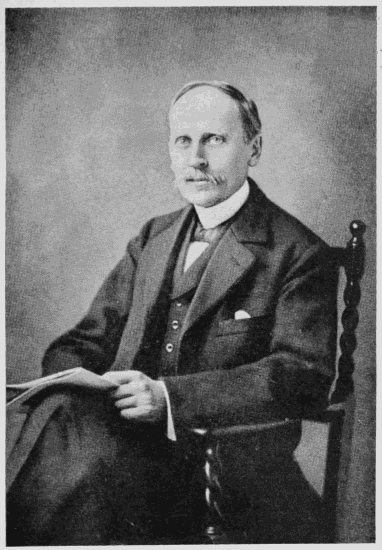 Romain Rolland at the time of writing Above the
Battle
Romain Rolland at the time of writing Above the
Battle
THE essay Au-dessus de la mêlée was the first stroke of the woodman's
axe in the overgrown forest of hatred; thereupon, a roaring echo
thundered from all sides, reverberating reluctantly in the newspapers.
Undismayed, Rolland resolutely continued his work. He wished to cut a
clearing into which a few sunbeams of reason might shine through the
gloomy and suffocating atmosphere. His next essays aimed at illuminating
an open space of such a character. Especially notable were Inter Arma
Caritas (October 30, 1914); Les idoles (December 4, 1914); Notre
prochain l'ennemi (March 15, 1915); Le meutre des élites (June 14,
1915). These were attempts to give a voice to the silent. "Let us help
the victims! It is true that we cannot do very much. In the everlasting
struggle between good and evil, the balance is unequal. We require a
century for the upbuilding of that which a day destroys. Nevertheless,
the frenzy lasts no more than a day, and the patient labor of
reconstruction is our daily bread. This work goes on even during an hour
when the world is perishing around us."
The poet had at length come to understand his task. It is useless to
attack the war directly. Reason can effect nothing against the elemental
forces. But he regards it as his predestined duty to combat throughout
the war everything that the passions of men lead them to undertake for
the deliberate increase of horror, to combat the spiritual poison of the
war. The most atrocious feature of the present struggle, one which
distinguishes it from all previous wars, is this deliberate poisoning.
That which in earlier days was accepted with simple resignation as a
disastrous visitation like the plague, was now presented in a heroic
light, as a sign of "the grandeur of the age." An ethic of force, an
ethic of destruction, was being preached. The mass struggle of the
nations was being purposely inflamed to become the mass hatred of
individuals. Rolland, therefore, was not, as many have supposed,
attacking the war; he was attacking the ideology of the war, the
artificial idolization of brutality. As far as the individual was
concerned, he attacked the readiness to accept a collective morality
constructed solely for the duration of the war; he attacked the
surrender of conscience in face of the prevailing universalization of
falsehood; he attacked the suspension of inner freedom which was
advocated until the war should be over.
His words, therefore, are not directed against the masses, not against
the peoples. These know not what they do; they are deceived; they are
dumb driven cattle. The diffusion of lying has made it easy for them to
hate. "Il est si commode de haïr sans comprendre." The fault lies with
the inciters, with the manufacturers of lies, with the intellectuals.
They are guilty, seven times guilty, because, thanks to their education
and experience, they cannot fail to know the truth which nevertheless
they repudiate; because from weakness, and in many cases from
calculation, they have surrendered to the current of uninstructed
opinion, instead of using their authority to deflect this current into
better channels. Of set purpose, instead of defending the ideals they
formerly espoused, the ideals of humanity and international unity, they
have revived the ideas of the Spartans and of the Homeric heroes, which
have as little place in our time as have spears and plate-armor in these
days of machine-gun warfare. Heretofore, to the great spirits of all
time, hatred has seemed a base and contemptible accompaniment of war.
The thoughtful among the non-combatants put it away from them with
loathing; the warriors rejected the sentiment upon grounds of chivalry.
Now, hatred is not merely supported with all the arguments of logic,
science, and poesy; but is actually, in defiance of gospel teaching,
raised to a place among the moral duties, so that every one who resists
the feeling of collective hatred is branded as a traitor. Against these
enemies of the free spirit, Rolland takes up his parable: "Not only have
they done nothing to lessen reciprocal misunderstanding; not only have
they done nothing to limit the diffusion of hate; on the contrary, with
few exceptions, they have done everything in their power to make hatred
more widespread and more venomous. In large part, this war is their war.
By their murderous ideologies they have led thousands astray. With
criminal self-confidence, unteachable in their arrogance, they have
driven millions to death, sacrificing their fellows to the phantoms
which they, the intellectuals, have created." The persons to whom blame
attaches are those who know, or who might have known; but who, from
sloth, cowardice, or weakness, from desire for fame or for some other
personal advantage, have given themselves over to lying.
The hatred breathed by the intellectuals was a falsehood. Had it been a
truth, had it been a genuine passion, those who were inspired with this
feeling would have ceased talking and would themselves have taken up
arms. Most people are moved either by hatred or by love, not by abstract
ideas. For this reason, the attempt to sow dissension among millions of
unknown individuals, the attempt to "perpetuate" hatred, was a crime
against the spirit rather than against the flesh. It was a deliberate
falsification to include leaders and led, drivers and driven, in a
single category; to generalize Germany as an integral object for hatred.
We must join one fellowship or the other, that of the truthtellers or
that of the liars, that of the men of conscience or that of the men of
phrase. Just as in Jean Christophe, Rolland, in order to show forth
the universally human fellowship, had distinguished between the true
France and the false, between the old Germany and the new; so now in
wartime did he draw attention to the ominous resemblance between the war
fanatics in both camps, and to the heroic isolation of those who were
above the battle in all the belligerent lands. Thus did he endeavor to
fulfill Tolstoi's dictum, that it is the function of the imaginative
writer to strengthen the ties that bind men together. In Rolland's
comedy Liluli, the "cerveaux enchaînés," dressed in various national
uniforms, dance the same Indian war-dance under the lash of Patriotism,
the negro slave-driver. There is a terrible resemblance between the
German professors and those of the Sorbonne. All of them turn the same
logical somersaults; all join in the same chorus of hate.
But the fellowship to which Rolland wishes to draw our attention, is the
fellowship of solace. It is true that the humanizing forces are not so
well organized as the forces of destruction. Free opinion is gagged,
whereas falsehood bellows through the megaphones of the press. Truth has
to be sought out with painful labor, for the state makes it its business
to hide truth. Nevertheless, those who search perseveringly can discover
truth among all nations and among all races. In these essays, Rolland
gives many examples, drawn equally from French and from German sources,
showing that even in the trenches, nay, that especially in the trenches,
thousands upon thousands are animated with brotherly feelings. He
publishes letters from German soldiers, side by side with letters from
French soldiers, all couched in the same phraseology of human
friendliness. He tells of the women's organizations for helping the
enemy, and shows that amid the cruelty of arms the same lovingkindness
is displayed on both sides. He publishes poems from either camp, poems
which exhale a common sentiment. Just as in his Vie des hommes
illustres he had wished to show the sufferers of the world that they
were not alone, but that the greatest minds of all epochs were with
them, so now does he attempt to convince those who amid the general
madness are apt to regard themselves as outcasts because they do not
share the fire and fury of the newspapers and the professors, that they
have everywhere silent brothers of the spirit. Once more, as of old, he
wishes to unite the invisible community of the free. "I feel the same
joy when I find the fragile and valiant flowers of human pity piercing
the icy crust of hatred that covers Europe, as we feel in these chilly
March days when we see the first flowers appear above the soil. They
show that the warmth of life persists below the surface, and that soon
nothing will prevent its rising again." Undismayed he continues on his
"humble pélérinage," endeavoring "to discover, beneath the ruins, the
hearts of those who have remained faithful to the old ideal of human
brotherhood. What a melancholy joy it is to come to their aid." For the
sake of this consolation, for the sake of this hope, he gives a new
significance even to war, which he has hated and dreaded from early
childhood. "To war we owe one painful benefit, in that it has served to
bring together those of all nations who refuse to share the prevailing
sentiments of national hatred. It has steeled their energies, has
inspired them with an indefatigable will. How mistaken are those who
imagine that the ideas of human brotherhood have been stifled.... Not
for a moment do I doubt the coming unity of the European fellowship.
That unity will be realized. The war is but its baptism of blood."
Thus does the good Samaritan, the healer of souls, endeavor to bring to
the despairing that hope which is the bread of life. Perchance Rolland
speaks with a confidence that runs somewhat in advance of his innermost
convictions. But he only who realized the intense yearnings of the
innumerable persons who at that date were imprisoned in their respective
fatherlands, barred in the cages of the censorships, he alone can
realize the value to such poor captives of Rolland's manifestoes of
faith, words free from hatred, bringing at length a message of
brotherhood.
FROM the first, Rolland knew perfectly well that in a time when party
feeling runs high, no task can be more ungrateful than that of one who
advocates impartiality. "The combatants are to-day united in one thing
only, in their hatred for those who refuse to join in any hymn of hate.
Whoever does not share the common delirium, is suspect. And nowadays,
when justice cannot spare the time for thorough investigation, every
suspect is considered tantamount to a traitor. He who undertakes in
wartime to defend peace on earth, must realize that he is staking his
faith, his name, his tranquillity, his repute, and even his friendships.
But of what value would be a conviction on behalf of which a man would
take no risks?" Rolland was likewise aware that the most dangerous of
all positions is that between the fronts, but this certainty of danger
was but a tonic to his conscience. "If it be really needful, as the
proverb assures us, to prepare for war in time of peace, it is no less
needful to prepare for peace in time of war. In my view, the latter role
is assigned to those who stand outside the struggle, and whose mental
life has brought them into unusually close contact with the world-all. I
speak of the members of that little lay church, of those who have been
exceptionally well able to maintain their faith in the unity of human
thought, of those for whom all men are sons of the same father. If it
should chance that we are reviled for holding this conviction, the
reviling is in truth an honor to us, and we may be satisfied to know
that we shall earn the approbation of posterity."
It is plain that Rolland is forearmed against opposition. Nevertheless,
the fierceness of the onslaughts exceeded all expectation. The first
rumblings of the storm came from Germany. The passage in the Letter to
Gerhart Hauptmann, "are you the sons of Goethe or of Attila," and
similar utterances, aroused angry echoes. A dozen or so professors and
scribblers hastened to "chastise" French arrogance. In the columns of
"Die Deutsche Rundschau," a narrow-minded pangerman disclosed the
great secret that under the mask of neutrality Jean Christophe had
been a most dangerous French attack upon the German spirit.
French champions were no less eager to enter the lists as soon as the
publication of the essay Au-dessus de la mêlée was reported. Difficult
as it seems to realize the fact to-day, the French newspapers were
forbidden to reprint this manifesto, but fragments became known to the
public in the attacks wherein Rolland was pilloried as an antipatriot.
Professors at the Sorbonne and historians of renown did not shrink from
leveling such accusations. Soon the campaign was systematized. Newspaper
articles were followed by pamphlets, and ultimately by a large volume
from the pen of a carpet hero. This book was furnished with a thousand
proofs, with photographs, and quotations; it was a complete dossier,
avowedly intended to supply materials for a prosecution. There was no
lack of the basest calumnies. It was asserted that since the beginning
of the war Rolland had joined the German society "Neues Vaterland"; that
he was a contributor to German newspapers; that his American publisher
was a German agent. In one pamphlet he was accused of deliberately
falsifying dates. Yet more incriminatory charges could be read between
the lines. With the exception of a few newspapers of advanced tendencies
and comparatively small circulation, the whole of the French press
combined to boycott Rolland. Not one of the Parisian journals ventured
to publish a reply to the charges. A professor triumphantly announced:
"Cet auteur ne se lit plus en France." His former associates withdrew in
alarm from the tainted member of the flock. One of his oldest friends,
the "ami de la première heure," to whom Rolland had dedicated an earlier
work, deserted at this decisive hour, and canceled the publication of a
book upon Rolland which was already in type. The French government
likewise began to watch Rolland closely, dispatching agents to collect
"materials." A number of "defeatist" trails were obviously aimed in part
at Rolland, whose essay was publicly stigmatized as "abominable" by
Lieutenant Mornet, the tiger of these prosecutions. Nothing but the
authority of his name, the inviolability of his public life, and the
fact that he was a lonely fighter (this making it impossible to show
that he had any suspect associations), frustrated the well-prepared plan
to put Rolland in the dock among adventurers and petty spies.
All this lunacy is incomprehensible unless we reconstruct the
forcing-house atmosphere of that year. It is difficult to-day, even from
a study of all the pamphlets and books bearing on the question, to grasp
the way in which Rolland's fellow-countrymen had become convinced that
he was an antipatriot. From his own writings, it is impossible for the
most fanciful brain to extract the ingredients for a "cas Rolland." From
a study of his own writings alone it is impossible to understand the
frenzy felt by all the intellectuals of France towards this lonely
exile, who tranquilly and with a full sense of responsibility continued
to develop his ideas.
In the eyes of the patriots, Rolland's first crime was that he openly
discussed the moral problems of the war. "On ne discute pas la patrie."
The first axiom of war ethics is that those who cannot or will not shout
with the crowd must hold their peace. Soldiers must never be taught to
think; they must only be incited to hate. A lie which promotes
enthusiasm is worth more in wartime than the best of truths. In
imitation of the principles of the Catholic church, reflection, doubt,
is deemed a crime against the infallible dogma of the fatherland. It was
enough that Rolland should wish to turn things over in his mind, instead
of unquestioningly affirming the current political theses. Thereby he
abandoned the "attitude française"; thereby he was stamped as "neutre."
In those days "neutre" was a good rime to "traître."
Rolland's second crime was that he desired to be just to all mankind,
that he continued to regard the enemy as human beings, that among them
he distinguished between guilty and not guilty, that he had as much
compassion for German sufferers as for French, that he did not hesitate
to refer to the Germans as brothers. The dogma of patriotism prescribed
that for the duration of the war the feelings of humanitarianism should
be stifled. Justice should be put away on the top shelf, to keep company
there, until victory had been secured, with the divine command, Thou
shalt not kill. One of the pamphlets against Rolland bears as its motto,
"Pendant une guerre tout ce qu'on donne de l'amour à l'humanité, on le
vole à la patrie"—though it must be observed that from the outlook of
those who share Rolland's views, the order of the terms might well be
inverted.
The third crime, the offense which seemed most unpardonable of all, and
the one most dangerous to the state, was that Rolland refused to regard
a military victory as likely to furnish the elixir of morality, to
promote spiritual regeneration, to bring justice upon earth. Rolland's
sin lay in holding that a just and bloodless peace, a complete
reconciliation, a fraternal union of the European nations, would be more
fruitful of blessing than an enforced peace, which could only sow the
dragon's teeth of hatred and of new wars. In France at this date, those
who wished to fight the war to a finish, to fight until the enemy had
been utterly crushed, coined the term "defeatist" for those who desired
peace to be based upon a reasonable understanding. Thus was paralleled
the German terminology, which spoke of "Flaumachern" (slackers) and of
"Schmachfriede" (shameful peace). Rolland, who had devoted the whole of
his life to the elucidation of moral laws higher than those of force,
was stigmatized as one who would poison the morale of the armies, as
"l'initiateur du défaitisme." To the militarists, he seemed to be the
last representative of "dying Renanism," to be the center of a moral
power, and for this reason they endeavored to represent his ideas as
nonsensical, to depict him as a Frenchman who desired the defeat of
France. Yet his words stood unchallenged: "I wish France to be loved. I
wish France to be victorious, not through force; not solely through
right (even that would be too harsh); but through the superiority of a
great heart. I wish that France were strong enough to fight without
hatred; strong enough to regard even those whom she must strike down, as
her brothers, as erring brothers, to whom she must extend her fullest
sympathy as soon as she has put it beyond their power to injure her."
Rolland made no attempt to answer even the most calumnious of attacks.
He quietly let the invectives pass, knowing that the thought which he
felt himself commissioned to announce, was inviolable and imperishable.
Never had he fought men, but only ideas. The hostile ideas, in this
case, had long since been answered by the figures of his own creation.
They had been answered by Olivier, the free Frenchman who hated hatred;
by Faber, the Girondist, to whom conscience stood higher than the
arguments of the patriots; by Adam Lux, who compassionately asked his
fanatical opponent, "N'es tu pas fatigué de ta baine"; by Teulier, and
by all the great characters through whom during more than two decades he
had been giving expression to his outlook upon the struggle of the day.
He was unperturbed at standing alone against almost the entire nation.
He recalled Chamfort's saying, "There are times when public opinion is
the worst of all possible opinions." The immeasurable wrath, the
hysterical frenzy of his opponents, confirmed his conviction that he was
right, for he felt that their clamor for force betrayed their sense of
the weakness of their own arguments. Smilingly he contemplated their
artificially inflamed anger, addressing them in the words of his own
Clerambault: "You say that yours is the better way? The only good way?
Very well, take your own path, and leave me to take mine. I make no
attempt to compel you to follow me. I merely show you which way I am
going. What are you so excited about? Perhaps at the bottom of your
hearts you are afraid that my way is the right one?"
AS soon as he had uttered his first words, a void formed round this
brave man. As Verhaeren finely phrased it, he positively loved to
encounter danger, whereas most people shun danger. His oldest friends,
those who had known his writings and his character from youth upwards,
left him in the lurch; prudent folk quietly turned their backs on him;
newspaper editors and publishers refused him hospitality. For the
moment, Rolland seemed to be alone. But, as he had written in Jean
Christophe, "A great soul is never alone. Abandoned by friends, such a
one makes new friends, and surrounds himself with a circle of that
affection of which he is himself full."
Necessity, the touchstone of conscience, had deprived him of friends,
but had also brought him friends. It is true that their voices were
hardly audible amid the clangor of the opponents. The war-makers had
control of all the channels of publicity. They roared hatred through the
megaphones of the press. Friends could do no more than give expression
to a few cautious words in such petty periodicals as could slip through
the meshes of the censorship. Enemies formed a compact mass, flowing to
the attack in a huge wave (whose waters were ultimately to be dispersed
in the morass of oblivion); his friends crystallized slowly and secretly
around his ideas, but they were steadfast. His enemies were a regiment
advancing fiercely to the attack at the word of command; his friends
were a fellowship, working tranquilly, and united only through love.
The friends in Paris had the hardest task. It was barely possible for
them to communicate with him openly. Half of their letters to him and
half of his replies were lost on the frontier. As from a beleaguered
fortress, they hailed the liberator, the man who was freely proclaiming
to the world the ideals which they were forbidden to utter. Their only
possible way of defending their ideas was to defend the man. In
Rolland's own fatherland, Amédée Dunois, Fernand Desprès, Georges Pioch,
Renaitour, Rouanet, Jacques Mesnil, Gaston Thiesson, Marcel Martinet,
and Sévérine, boldly championed him against calumny. A valiant woman,
Marcelle Capy, raised the standard, naming her book Une voix de femme
dans la mêlée. Separated from him by the blood-stained sea, they looked
towards him as towards a distant lighthouse upon the rock, and showed
their brothers the signal of hope.
In Geneva there formed round him a group of young writers, disciples and
friends, winning strength from his strength. P. J. Jouve author of Vous
êtes des hommes and Danse des morts, glowing with anger and with love
of goodness, suffering intensely at witnessing the injustice of the
world, Olivier redivivus, gave expression in his poems to his hatred for
force. René Arcos, who like Jouve had realized all the horror of war
and who hated war no less intensely, had a clearer comprehension of the
dramatic moment, was more thoughtful than Jouve, but equally simple and
kindhearted. Arcos extolled the European ideal; Charles Baudouin the
ideal of eternal goodness. Franz Masereel, the Belgian artist, developed
his humanist plaint in a series of magnificent woodcuts. Guilbeaux,
zealot for the social revolution, ever ready to fight like a gamecock
against authority, founded his monthly review "demain," which was a
faithful representative of the European spirit for a time, until it
succumbed because of its passion for the Russian revolution. Charles
Baudouin founded the monthly review, "Le Carmel," providing a city of
refuge for the persecuted European spirit, and a platform upon which the
poets and imaginative writers of all lands could assemble under the
banner of humanity. Jean Debrit in "La Feuille" combated the
partisanship of the Latin Swiss press and attacked the war. Claude de
Maguet founded "Les Tablettes," which, through the boldness of its
contributors and through the drawings of Masereel, became the most
vigorous periodical in Switzerland. A little oasis of independence came
into existence, and hither the breezes from all quarters wafted
greetings from the distance. Here alone was it possible to breathe a
European air.
The most remarkable feature of this circle was that, thanks to Rolland,
enemy brethren were not excluded from spiritual fellowship. Whereas
everywhere else people were infected with the hysteria of mass hatred
or were terrified lest they should expose themselves to suspicion, and
therefore avoided their sometime intimates of enemy countries like the
pestilence should they chance to meet them in the streets of some
neutral city, at a time when relatives were afraid to exchange letters
of enquiry regarding the life or death of those of their own blood,
Rolland would not for a moment deny his German friends. Never, indeed,
had he shown more love to those among them who remained faithful, at an
epoch when to love them was dangerous. He made himself known to them in
public, and wrote to them freely. His words concerning these friendships
will never be forgotten: "Yes, I have German friends; just as I have
French, English, and Italian friends; just as I have friends among the
members of every race. They are my wealth, which I am proud of, and
which I seek to preserve. If a man has been so fortunate as to encounter
loyal souls, persons with whom he can share his most intimate thoughts,
persons with whom he is connected by brotherly ties, these ties are
sacred, and the hour of trial is the last of hours in which they should
be rent asunder. How cowardly would be the refusal to recognize these
friends, in deference to the impudent demand of a public opinion which
has no rights over our feelings.... How painful, how tragical, these
friendships are at such a moment, the letters will show when they are
published. But it is precisely by means of such friendships that we can
defend ourselves against hatred, more murderous than war, for it poisons
the wounds of war, and harms the hater equally with the object of
hate."
Immeasurable is the debt which friends and numberless unseen companions
in adversity owe to Rolland for his brave and free attitude. He set an
example to all those who, though they shared his sentiments, were
isolated in obscurity, and who needed some such point of crystallization
before their thoughts and feelings could be consolidated. It was above
all for those who were not yet sure of themselves that this archetypal
personality provided so splendid a stimulus. Rolland's steadfastness put
younger men to shame. In his company we were stronger, freer, more
genuine, more unprejudiced. Human loving kindness, transfigured by his
ardor, radiated like a flame. What bound us together was not that we
chanced to think alike, but a passionate exaltation, which often became
a positive fanaticism for brotherhood. We foregathered in defiance of
public opinion and in defiance of the laws of the belligerent states,
exchanging confidences without reserve; our comradeship exposed us to
all sorts of suspicions; these things served but to draw us closer
together, and in many memorable hours we felt with a veritable
intoxication the unprecedented quality of our friendship. We were but a
couple of dozen who thus came together in Switzerland; Frenchmen,
Germans, Russians, Austrians, and Italians. We few were the only ones
among the hundreds of millions who could look one another in the face
without hatred, exchanging our innermost thoughts. This little troop
was all that then constituted Europe. Our unity, a grain of dust in the
storm which was raging through the world, was perhaps the seed of the
coming fraternity. How strong, how happy, how grateful did we often
feel. For without Rolland, without the genius of his friendship, without
the connecting link constituted by his disposition, we should never have
attained to freedom and security. Each of us loved him in a different
way, and all of us regarded him with equal veneration. To the French, he
was the purest spiritual expression of their homeland; to us, he was the
wonderful counterpart of the best in our own world. In this circle that
formed round Rolland there was the sense of fellowship which has always
characterized a religious community in the making. The hostility between
our respective nations, and the consciousness of danger, fired our
friendship to the pitch of exaggeration; while the example of the
bravest and freest man we had ever known, brought out all that was best
in us. When we were near him, we felt ourselves to be in the heart of
true Europe. Whoever was able to know Rolland's inmost essence,
acquired, as in the ancient saga, new energy for the wrestle with brute
force.
ALL that Rolland gave in those days to his friends and collaborators of
the European fellowship, all that he gave by his immediate proximity,
was but a part of his nature. For beyond these personal limits, he
diffused a consolidating and helpful influence. Whoever turned to him
with a question, an anxiety, a distress, or a suggestion, received an
answer. In hundreds upon hundreds of letters he spread the message of
brotherhood, splendidly fulfilling the vow he had made a quarter of a
century earlier, at the time when Tolstoi's letter had brought him
spiritual healing. In Rolland's self there had come to life, not only
Jean Christophe the believer, but likewise Leo Tolstoi, the great
consoler.
Unknown to the world, he shouldered a stupendous burden during the five
years of the war. For whoever found himself in revolt against the time
and in conflict with the prevailing miasma of falsehood, whoever needed
counsel in a matter of conscience, whoever wanted aid, knew where he
could turn for what he sought. Who else in Europe inspired such
confidence? The unknown friends of Jean Christophe, the nameless
brothers of Olivier, hidden in out-of-the-way parts, knowing no one to
whom they could whisper their doubts—in whom could they better confide
than in this man who had first brought them tidings of goodness? They
sent him requests, submitted proposals, disclosed the turmoil of their
consciences. Soldiers wrote to him from the trenches; mothers penned
letters to him in secret. Many of the writers did not venture to give
their names, merely wishing to send a message of sympathy and to
inscribe themselves citizens of that invisible "republic of free souls"
which the author of Jean Christophe had founded amid the warring
nations. Rolland accepted the infinite labor of being the centralizing
point and administrator of all these distresses and plaints, of being
the recipient of all these confessions, of being the consoler of a world
divided against itself. Wherever there was a stirring of European, of
universally human sentiment, Rolland did his best to receive and sustain
it; he was the crossways towards which all these roads converged. At the
same time he was continuously in communication with leading
representatives of the European faith, with those of all lands who had
remained loyal to the free spirit. He studied the periodicals of the day
for messages of reconciliation. Wherever a man or a work was devoted to
the reconsolidation of Europe, Rolland's help was ready.
These hundreds and thousands of letters combine to form an ethical
achievement such as has not been paralleled by any previous writer. They
brought happiness to countless solitary souls, strength to the wavering,
hope to the despairing. Never was the poet's mission more nobly
fulfilled. Considered as works of art, these letters, many of which have
already been published, are among the finest and maturest of Rolland's
literary creations. To bring solace is the most intimate purpose of his
art. Here, when speaking as man to man he can give himself without
stint, he displays a rhythmical energy, an ardor of lovingkindness,
which makes many of the letters rank with the loveliest poems of our
time. The sensitive modesty which often makes him reserved in
conversation, was no longer a hindrance. The letters are frank
confessions, wherein his free spirit converses freely with its fellows,
disclosing the author's goodness, his passionate emotion. That which is
so generously poured forth for the benefit of unknown correspondents, is
the most intimate essence of his nature. Like Colas Breugnon he can say:
"Voilà mon plus beau travail: les âmes que j'ai sculptées."
DURING these years, many people, young for the most part, came to
Rolland for advice in matters of conscience. They asked whether, seeing
that their convictions were opposed to war, they ought to refuse
military service, in accordance with the teaching of Tolstoi, and
following the example of the conscientious objectors; or whether they
should obey the biblical precept, Resist not evil. They enquired whether
they should take an open stand against the injustices committed by their
country, or whether they should endure in silence. Others besought
spiritual counsel in their troubles of conscience. All who came seemed
to imagine that they were coming to one who possessed a maxim, a fixed
principle concerning conduct in relation to the war, a wonder-working
moral elixir which he could dispense in suitable doses.
To all these enquiries Rolland returned the same answer: "Follow your
conscience. Seek out your own truth and realize it. There is no
ready-made truth, no rigid formula, which one person can hand over to
another. Each must create truth for himself, according to his own
model. There is no other rule of moral conduct than that a man should
seek his own light and should be guided by it even against the world. He
who lays down his arms and accepts imprisonment, does rightly when he
follows the inner light, and is not prompted by vanity or by simple
imitativeness. He likewise is right, who takes up arms with no intention
to use them in earnest, who thus cheats the state that he may propagate
his ideal and save his inner freedom—provided always he acts in
accordance with his own nature." Rolland declared that the one essential
was that a man should believe in his own faith. He approved the patriot
desirous of dying for his country, and he approved the anarchist who
claimed freedom from all governmental authority. There was no other
maxim than that of faith in one's own faith. The only man who did wrong,
the only man who acted falsely, was he who allowed himself to be swept
away by another's ideals, he who, influenced by the intoxication of the
crowd, performed actions which conflicted with his own nature. A typical
instance was that of Ludwig Frank, the socialist, the advocate of a
Franco-German understanding, who, deciding to serve his party instead of
serving his own ideal, volunteered at the outbreak of the war, and died
for the ideals of his opponent, for the ideals of militarism.
There is but one truth, such was Rolland's answer to all. The only truth
is that which a man finds within himself and recognizes as his very own.
Any other would-be truth is self-deception. What appears to be egoism,
serves humanity. "He who would be useful to others, must above all
remain free. Even love avails nothing, if the one who loves be a slave."
Death for the fatherland is worthless unless he who sacrifices himself
believes in his fatherland as in a god. To evade military service is
cowardice in one who lacks courage to proclaim himself a sanspatrie.
There are no true ideas other than those which spring from inner
experience; there are no deeds worth doing other than those which are
the outcome of fully responsible reflection. He who would serve mankind,
must not blindly obey the arguments of a stranger. We cannot regard as a
moral act anything which is done simply through imitativeness, or in
consequence of another's persuasion, or (as almost universally under
modern war stresses) through the suggestive influence of mass illusion.
"A man's first duty is to be himself, to remain himself, at the cost of
self-sacrifice."
Rolland did not fail to recognize the difficulty, the rarity, of such
free acts. He recalled Emerson's saying: "Nothing is more rare in any
man, than an act of his own." But was not the unfree, untrue thinking of
the masses, the inertia of the mass conscience, the prime cause of our
present troubles? Would the war between European brethren have ever
broken out if every townsman, every countryman, every artist, had looked
within to enquire whether the mines of Morocco and the swamps of Albania
were truly precious to him? Would there have been a war if every one had
asked himself whether he really hated his brothers across the frontier
as vehemently as the newspapers and the professional politicians would
have him believe? The herd instinct, the pattering of others' arguments,
a blind enthusiasm on behalf of sentiments that were never truly felt,
could alone render such a catastrophe possible. Nothing but the freedom
of the largest possible number of individuals can save us from the
recurrence of such a tragedy; nothing can save us but that conscience
should be an individual and not a collective affair. That which each one
recognizes to be true and good for himself, is true and good for
mankind. "What the world needs before all to-day is free souls and
strong characters. For to-day all paths seem to lead to an accentuation
of herd life. We see a passive subordination to the church, the
intolerant traditionalism of the fatherlands, socialist dreams of a
despotic unity.... Mankind needs men who can show that the very persons
who love mankind can, whenever necessary, declare war against the
collective impulse."
Rolland therefore refuses to act as authority for others. He demands
that every one should recognize the supreme authority of his own
conscience. Truth cannot be taught; it must be lived. He who thinks
clearly, and having done so acts freely, produces conviction, not by
words but by his nature. Rolland has been able to help an entire
generation, because from the height of his loneliness he has shown the
world how a man makes an idea live for all time by loyalty to that which
he has recognized as truth. Rolland's counsel was not word but deed; it
was the moral simplicity of his own example.
ROLLAND'S life was now in touch with the life of the whole world. It
radiated influence in all directions. Yet how lonely was this man during
the five years of voluntary exile. He dwelt apart at Villeneuve by the
lake of Geneva. His little room resembled that in which he had lived in
Paris. Here, too, were piles of books and pamphlets; here was a plain
deal table; here was a piano, the companion of his hours of relaxation.
His days, and often his nights were spent at work. He seldom went for a
walk, and rarely received a visitor, for his friends were cut off from
him, and even his parents and his sister could only get across the
frontier about once a year. But the worst feature of this loneliness was
that it was loneliness in a glass house. He was continually spied upon:
his least words were listened for by eavesdroppers; provocative agents
sought him out, proclaiming themselves revolutionists and sympathizers.
Every letter was read before it reached him; every word he spoke over
the telephone was recorded; every interview was kept under observation.
Romain Rolland in his glass prison-house was the captive of unseen
powers.
 Rolland's Mother
It seems hardly credible to-day that during the last two years of the
war Romain Rolland, to whose words the world is now eager to listen,
should have had no facility for expressing his ideas in the newspapers,
no publisher for his books, no possibility of printing anything beyond
an occasional review article. His homeland had repudiated him; he was
the "fuoruscito" of the middle ages, was placed under a ban. The more
unmistakably he proclaimed his spiritual independence, the less did he
find himself regarded as a welcome guest in Switzerland. He was
surrounded by an atmosphere of secret suspicion. By degrees, open
attacks had been replaced by a more dangerous form of persecution. A
gloomy silence was established around his name and works. His earlier
companions had more and more withdrawn from him. Many of the new
friendships had been dissolved, for the younger men in especial were
devoting their interest to political questions instead of to things of
the spirit. The more stormy the outside world, the more oppressive the
stillness of Rolland's existence. He had no wife as helpmate. What to
him was the best of all companionship, the companionship of his own
writings, was now unattainable, for he had no freedom of publication in
France. His country was closed to him, his place of refuge was beset
with a hundred eyes. Most homeless among the homeless, he lived, as his
beloved Beethoven had said, "in the air," lived in the realm of the
ideal, in invisible Europe. Nothing shows better the energy of his
living goodness than that he was no whit embittered by his experience,
and that the ordeal has served but to strengthen his faith. For this
utter solitude among men was a true fellowship with mankind.
THERE was, however, one companion with whom Rolland could hold converse
daily—his inner consciousness. Day by day, from the outbreak of the
war, Rolland recorded his sentiments, his secret thoughts, and the
messages he received from afar. His very silence was an impassioned
conversation with the time spirit. During these years, volume was added
to volume, until by the end of the war, they totaled no less than
twenty-seven. When he was able to return to France, he naturally
hesitated to take this confidential document to a land where the censors
would have a legal right to study every detail of his private thoughts.
He has shown a page here and there to intimate friends, but the whole
remains as a legacy to posterity, for those who will be able to
contemplate the tragedy of our days with purer and more dispassionate
views.
It is impossible for us to do more than surmise the real nature of this
document, but our feelings suggest to us that it must be a spiritual
history of the epoch, and one of incomparable value. Rolland's best and
freest thoughts come to him when he is writing. His most inspired
moments are those when he is most personal. Consequently, just as the
letters taken in their entirety may be regarded as artistically superior
to the published essays, so beyond question his diary must be a human
document supplying a most admirable and pure-minded commentary upon the
war. Only to the children of a later day will it become plain that what
Rolland so ably showed in the case of Beethoven and the other heroes,
applies with equal force to himself. They will learn at what a cost of
personal disillusionment his message of hope and confidence was
delivered to the world; they will learn that an idealism which brought
help to thousands, and which wiseacres have often derided as trivial and
commonplace, sprang from the darkest abysses of suffering and
loneliness, and was rendered possible solely by the heroism of a soul in
travail. All that has been disclosed to us is the fact of his faith.
These manuscript volumes contain a record of the ransom with which that
faith was purchased, of the payments demanded from day to day by the
inexorable creditor we name Life.
ROLLAND opened his campaign against hatred almost immediately after the
war began. For more than a year he continued to deliver his message in
opposition to the frenzied screams of rancor arising from all lands. His
efforts proved futile. The war-current rose yet higher, the stream being
fed by new and ever new blood flowing from innocent victims. Again and
again some additional country became involved in the carnage. At length,
as the clamor still grew louder, Rolland paused for a moment to take
breath. He felt that it would be madness were he to continue the attempt
to outcry the cries of so many madmen.
After the publication of Au-dessus de la mêlée, Rolland withdrew from
public participation in the controversies with which the essays had been
concerned. He had spoken his word; he had sown the wind and had reaped
the whirlwind. He was neither weary in well-doing nor was he weak in
faith, but he realized that it was useless to speak to a world which
would not listen. In truth he had lost the sublime illusion with which
he had been animated at the outset, the belief that men desire reason
and truth. To his intelligence now grown clearer it was plain that men
dread truth more than anything else in the world. He began, therefore,
to settle accounts with his own mind by writing a satirical romance, and
by other imaginative creations, while continuing his vast private
correspondence. Thus for a time he was out of the hurly-burly. But after
a year of silence, when the crimson flood continued to swell, and when
falsehood was raging more furiously than ever, he felt it his duty to
reopen the campaign. "We must repeat the truth again and again," said
Goethe to Schermann, "for the error with which truth has to contend is
continually being repreached, not by individuals, but by the mass."
There was so much loneliness in the world that it had become necessary
to form new ties. Signs of discontent and revolt in the various lands
were more plentiful. More numerous, too, were the brave men in active
revolt against the fate which was being forced on them. Rolland felt
that it was incumbent upon him to give what support he could to these
dispersed fighters, and to inspirit them for the struggle.
In the first essay of the new series, La route en lacets qui monte,
Rolland explained the position he had reached in December, 1916. He
wrote: "If I have kept silence for a year, it is not because the faith
to which I gave expression in Above the Battle has been shaken (it
stands firmer than ever); but I am well assured that it is useless to
speak to him who will not hearken. Facts alone will speak, with tragical
insistence; facts alone will be able to penetrate the thick wall of
obstinacy, pride, and falsehood with which men have surrounded their
minds because they do not wish to see the light. But we, as between
brothers of all the nations; as between those who have known how to
defend their moral freedom, their reason, and their faith in human
solidarity; as between minds which continue to hope amid silence,
oppression, and grief—we do well to exchange, as this year draws to a
close, words of affection and solace. We must convince one another that
during the blood-drenched night the light is still burning, that it
never has been and never will be extinguished. In the abyss of suffering
into which Europe is plunged, those who wield the pen must be careful
never to add an additional pang to the mass of pangs already endured,
and never to pour new reasons for hatred into the burning flood of hate.
Two ways remain open for those rare free spirits which, athwart the
mountain of crimes and follies, are endeavoring to break a trail for
others, to find for themselves an egress. Some are courageously
attempting in their respective lands to make their fellow-countrymen
aware of their own faults.... My task is different, for it is to remind
the hostile brethren of Europe, not of their worst aspects but of their
best, to recall to them reasons for hoping that there will one day be a
wiser and more loving humanity."
The essays of the new series appeared, for the most part, in various
minor reviews, seeing that the more influential and widely circulated
periodicals had long since closed their columns to Rolland's pen. When
we study them as a whole, in the collective volume entitled Les
précurseurs, we realize that they emit a new tone. Anger has been
replaced by intense compassion, this corresponding to the change which
had taken place at the fighting front. In all the armies, during the
third year of the war, the fanatical impetus of the opening phases had
vanished, and the men were now animated by a tranquil but stubborn
sentiment of duty. Rolland is perhaps even more impassioned and more
revolutionary in his outlook, and yet the essays are characterized by
greater gentleness than of old. What he writes is no longer at grips
with the war, but seems to soar above the war. His gaze is fixed upon
the distance; his mind ranges down the centuries in search of like
experiences; looking for consolation, he endeavors to discover a meaning
in the meaningless. He recurs to the idea of Goethe, that human progress
is effected by a spiral ascent. At a higher level men return to a point
only a little above the old. Evolution and reversion go hand in hand.
Thus he attempts to show that even at this tragical hour we can discern
intimations of a better day.
The essays comprising Les précurseurs no longer attack adverse
opinions and the war. They merely draw our attention to the existence in
all countries of persons who are fighting for a very different ideal, to
the existence of those heralds of spiritual unity whom Nietzsche speaks
of as "the pathfinders of the European soul." It is too late to hope for
anything from the masses. In the address Aux peuples assassinés, he
has nothing but pity for the millions, for those who, with no will of
their own, must be the mute instruments of others' aims, for those
whose sacrifice has no other meaning than the beauty of self-sacrifice.
His hope now turns exclusively towards the elite, towards the few who
have remained free. These can bring salvation to the world by splendid
spiritual imagery wherein all truth is mirrored. For the nonce, indeed,
their activities seem unavailing, but their labors remain as a permanent
record of their omnipresence. Rolland provides masterly analyses of the
work of such contemporary writers; he adds silhouettes from earlier
times; and he gives a portrait of Tolstoi, the great apostle of the
doctrine of human freedom, with an account of the Russian teacher's
views on war.
To the same series of writings, although it is not included in the
volume Les précurseurs, belongs Rolland's study dated April 15, 1918,
entitled Empédocle d'Agrigente et l'âge de la haine. The great sage of
classical Greece, to whom Rolland at the age of twenty had dedicated his
first drama, now brings comfort to the man of riper years. Rolland shows
that two and a half millenniums ago a poet writing during an epoch of
carnage had recognized that the world was characterized by "an eternal
oscillation from hatred to love, and from love to hatred"; that history
invariably witnesses a whole era of struggle and hatred, and that as
inevitably as the succession of the seasons there ensues a period of
happier days. With a broad descriptive sweep, he indicates that from the
time of the Sicilian philosopher to our own the wise men of all ages
have known the truth, but have been powerless to cope with the madness
of the world. Truth, nevertheless, passes down forever from hand to
hand, being thus imperishable and indestructible.
Even across these years of resignation there shines a gentle light of
hope, though manifest only to those who have eyes to see, only to those
who can lift their gaze above their own troubles to contemplate the
infinite.
DURING these five years, the ethicist, the philanthropist, the European,
had been speaking to the nations, but the poet had apparently been dumb.
To many it may seem strange that Rolland's first imaginative work to be
written since 1914, a work completed before the end of the war, should
have been a farcical comedy, Liluli. Yet this lightness of mood sprang
from the uttermost abysses of sorrow. Rolland, stricken to the soul when
contemplating his powerlessness against the insanity of the world,
turned to irony as a means of abreaction—to employ a term introduced by
the psychoanalysts. From the pole of repressed emotion, the electric
spark flashes across into the field of laughter. And here, as in all
Rolland's works, the author's essential purpose is to free himself from
the tyranny of a sensation. Pain grows to laughter, laughter to
bitterness, so that in contrapuntal fashion the ego may be helped to
maintain its equipoise against the heaviness of the time. When wrath
remains powerless, the spirit of mockery is still in being, and can be
shot like a fire-arrow across the darkening world.
Liluli is the satirical counterpart to an unwritten tragedy, or
rather to the tragedy which Rolland did not need to write, since the
world was living it. The satire produces the impression of having
become, in course of composition, more bitter, more sarcastic, almost
more cynical, than the author had originally designed. We feel that the
time spirit intervened to make it more pungent, more stinging, more
pitiless. At the culminating point, a scene penned in the summer of
1917, we behold the two friends who are misled by Liluli, the
mischievous goddess of illusion (for her name signifies "l'illusion"),
wrestling to their mutual destruction. In these two princes of fable,
there recurs Rolland's earlier symbolism of Olivier and Jean Christophe.
France and Germany here encounter one another, both hastening blindly
forward under the leadership of the same illusion. The two nations fight
on the bridge of reconciliation which in earlier days they had built
across the abyss dividing them. In the conditions then prevailing, so
pure a note of lyrical mourning could not be sustained. As its creation
progressed, the comedy became more incisive, more pointed, more
farcical. Everything that Rolland contemplated around him, diplomacy,
the intellectuals, the war poets (presented here in the ludicrous form
of dancing dervishes), those who pay lip-service to pacifism, the idols
of fraternity, liberty, God himself, is distorted by his tearful eyes to
seem grotesques and caricatures. All the madness of the world is
fiercely limned in an outburst of derisive rage. Everything is, as it
were, dissolved and decomposed in the acrid menstruum of mockery; and
finally mockery itself, the spirit of crazy laughter, feels the
scourge. Polichinelle, the dialectician of the piece, the rationalist in
cap and bells, is reasonable to excess; his laughter is cowardly, being
a mask for inaction. When he encounters Truth in fetters (Truth being
the one figure in the comedy presented with touching seriousness in all
her tragical beauty), Polichinelle, though he loves her, does not dare
to take his stand by her side. In this pitiable world, even the sage is
a coward; and in the strongest passage of the satire, Rolland's own
intense feeling breaks forth against the one who knows but will not bear
testimony. "You can laugh," exclaims Truth; "you can mock; but you do it
furtively like a schoolboy. Like your forebears, the great
Polichinelles, like Erasmus and Voltaire, the masters of free irony and
of laughter, you are prudent, prudent in the extreme. Your great mouth
is closed to hide your smiles.... Laugh away! Laugh your fill! Split
your sides with laughter at the lies you catch in your nets; you will
never catch Truth.... You will be alone with your laughter in the void.
Then you will call upon me, but I shall not answer, for I shall be
gagged.... When will there come the great and victorious laughter, the
roar of laughter which will set me free?"
In this comedy we do not find any such great, victorious, and liberating
laughter. Rolland's bitterness was too profound for that mood to be
possible. The play breathes nothing but tragical irony, as a defense
against the intensity of the author's own emotions. Although the new
work maintains the rhythm of Colas Breugnon, with its vibrant rhymes,
and although in Liluli as in Colas Breugnon there is a strain of
raillery, nevertheless this satire of the war period, a tragi-comedy of
chaos, contrasts strikingly with the work that deals with the happy days
of "la douce France." In the earlier book, the cheerfulness springs from
a full heart, but the humor of the later work arises from a heart
overfull. In Colas Breugnon we find the geniality, the joviality, of a
broad laugh; in Liluli the humor is ironical, bitter, breathing a
fierce irreverence for all that exists. A world full of noble dreams and
kindly visions has been destroyed, and the ruins of this perished world
are heaped between the old France of Colas Breugnon and the new France
of Liluli. Vainly does the farce move on to madder and ever madder
caprioles; vainly does the wit leap and o'erleap itself. The sadness of
the underlying sentiment continually brings us back with a thud to the
blood-stained earth. There is nothing else written by him during the
war, no impassioned appeal, no tragical adjuration, which, to my
feeling, betrays with such intensity Romain Rolland's personal suffering
throughout those years, as does this comedy with its wild bursts of
laughter, its expression of the author's self-enforced mood of bitter
irony.
LILULI, the tragi-comedy, was an outcry, a groan, a painful burst of
mockery; it was an elementary gesture of reaction against suffering that
was almost physical. But the author's serious, tranquil, and enduring
settlement of accounts with the times is his novel, Clerambault,
l'histoire d'une conscience libre pendant la guerre, which was slowly
brought to completion in the space of four years. It is not
autobiography, but a transcription of Rolland's ideas. Like Jean
Christophe, it is simultaneously the biography of an imaginary
personality and a comprehensive picture of the age. Matter is here
collected that is elsewhere dispersed in manifestoes and letters.
Artistically, it is the subterranean link between Rolland's manifold
activities. Amid the hindrances imposed by his public duties, and amid
the difficulties deriving from other outward circumstances, the author
built the work upwards out of the depths of sorrow to the heights of
consolation. It was not completed until the war was over, when Rolland
had returned to Paris in the summer of 1920.
Just as little as Jean Christophe can Clerambault properly be termed
a novel. It is something less than a novel, and at the same time a
great deal more. It describes the development, not of a man, but of an
idea. As in Jean Christophe, so here, we have a philosophy presented,
but not as something ready-made, complete, a finished datum. In company
with a human being, we rise stage by stage from error and weakness
towards clarity. In a sense it is a religious book, the history of a
conversion, of an illumination. It is a modern legend of the saints in
the form of the life history of a simple citizen. In a word, as the
sub-title phrases it, we have here the story of a conscience. The
ultimate significance of the book is freedom, the attainment of
self-knowledge, but raised to the heroic plane inasmuch as knowledge
becomes action. The scene is played in the intimate recesses of a man's
nature, where he is alone with truth. In the new book, therefore, there
is no countertype, as Olivier was the countertype to Jean Christophe;
nor do we find in Clerambault what was in truth the countertype of
Jean Christophe, external life. Clerambault's countertype,
Clerambault's antagonist, is himself; is the old, the earlier, the weak
Clerambault; is the Clerambault with whom the new, the knowing, the true
man has to wrestle, whom the new Clerambault has to overcome. The hero's
heroism is not displayed, as was that of Jean Christophe, in a struggle
with the forces of the visible world. Clerambault's war is waged in the
invisible realm of thought.
At the outset, therefore, Rolland designed to call the book "un
roman-méditation." It was to have been entitled "L'un contre tous," this
being an adaptation of La Boëtie's title Contr'un. The proposed name
was, however, ultimately abandoned for fear of misunderstanding. The
spiritual character of the new work recalls a long-forgotten tradition,
the meditations of the old French moralists, the sixteenth century
stoics who during a time of war-madness endeavored in besieged Paris to
maintain their intellectual serenity by engaging in Platonic dialogues.
The war itself, however, was not to be the theme, for the free soul does
not strive with the elements. The author's intention was to discuss the
spiritual accompaniments of this war, for these to Rolland seemed as
tragical as the destruction of millions of men. His concern was the
destruction of the individual soul in the deluge produced by the
overflowing of the mass soul. He wished to show how strenuous an effort
must be made by any one who would escape from the tyranny of the herd
instinct; to display the hateful enslavement of individuals by the
revengeful, jealous, and authoritarian mentality of the crowd; to depict
the terrific efforts which a man must make if he would avoid being
sucked into the maelstrom of epidemic falsehood. He hoped to make it
clear that what appears to be the simplest thing in the world is in
reality the most difficult of tasks in these epochs of excessive
solidarity, namely, for a man to remain what he really is, and not to
become that which the levelling forces of the world, the fatherland, or
some other artificial community, would fain make of him.
Romain Rolland deliberately refrained from casting his hero in a heroic
mold, the treatment thus differing from what he had chosen in the case
of Jean Christophe. Agenor Clerambault is an inconspicuous figure, a
quiet fellow of little account, an author of no particular note, one of
those persons whose literary work succeeds in pleasing a complaisant
generation, though it has no significance for posterity. He has the
nebulous idealism of mediocre minds; he hymns the praises of perpetual
peace and international conciliation. His own tepid goodness makes him
believe that nature is good, is man's wellwisher, desiring to lead
mankind gently onward towards a more beautiful future. Life does not
torment him with problems, and he therefore extols life amid the
tranquil comforts of his bourgeois existence. Blessed with a kindly and
somewhat simple-minded wife, and with two children, a son and a
daughter, he may be considered a modern Theocritus wearing the ribbon of
the Legion of Honor, singing the joyful present and the still more
joyful future of our ancient cosmos.
The quiet suburban household is suddenly struck as by a thunderbolt with
the news of the outbreak of war. Clerambault takes the train to Paris;
and no sooner is he sprinkled with spray from the hot waves of
enthusiasm, than all his ideals of international amity and perpetual
peace vanish into thin air. He returns home a fanatic, oozing hate, and
steaming with phrases. Under the influence of the tremendous storm he
begins to sound his lyre: Theocritus has become Pindar, a war poet.
Rolland gives a marvelously vivid description of something every one of
us has witnessed, showing how Clerambault, like all persons of average
nature, really takes a delight in horrors, however unwilling he may be
to admit it even to himself. He is rejuvenated, his life seems to move
on wings; the enthusiasm of the masses stirs the almost extinguished
flame of enthusiasm in his own breast; he is fired by the national fire;
he is physically and mentally refreshed by the new atmosphere. Like so
many other mediocrities, he secures in these days his greatest literary
triumph. His war songs, precisely because they give such vigorous
expression to the sentiments of the man in the street, become a national
property. Fame and public favor are showered upon him, so that (at this
time when millions of his fellows are perishing) he feels well,
self-confident, alive as never before.
His pride is increased, his joy of life accentuated, when his son Maxime
leaves for the front filled with martial ardor. His first thought, a few
months later, when the young man comes home on leave, is that Maxime
should retail to him all the ecstasies of war. Strangely enough,
however, the young soldier, whose eyes still burn with the sights he has
seen, is unresponsive. Not wishing to mortify his father, he does not
positively attempt to silence the latter's paeans, but for his part, he
maintains silence. For days this muteness stands between them, and the
father is unable to solve the riddle. He feels dumbly that his son is
concealing something. But shame binds both their tongues. On the last
day of the furlough, Maxime suddenly pulls himself together, and begins,
"Father, are you quite sure ...?" But the question remains unfinished,
utterance is choked. Still silent, the young man returns to the
realities of war.
A few days later there is a fresh offensive. Maxime is reported missing.
Soon his father learns that he is dead. Now Clerambault gropes for the
meaning of those last words behind the silence, and is tormented by the
thought of what was left unspoken. He locks himself into his room, and
for the first time he is alone with his conscience. He begins to
question himself in search of the truth, and throughout the long night
he communes with his soul as he traverses the road to Damascus. Piece by
piece he tears away the wrapping of lies with which he has enveloped
himself, until he stands naked before his own criticism. Prejudices have
eaten deep into his skin, so that the blood flows as he plucks them from
him. They must all be surrendered; the prejudice of the fatherland, the
prejudice of the herd, must go; in the end he recognizes that one thing
only is true, one thing only sacred, life. A fever of enquiry consumes
him; the old Adam perishes in the flame; when the day dawns he is a new
man.
He knows the truth now, and wishes to strengthen his own faith. He goes
to some of his fellows and talks to them. Most of them do not understand
him. Others refuse to understand him. Some, however, among whom Perrotin
the academician is notable, are yet more alarming. They know the truth.
To their penetrating vision the nature of the popular idols has long
been plain. But they are cautious folk. They compress their lips and
smile at one another like the augurs of ancient Rome. Like Buddha, they
take refuge in Nirvana, looking down calmly upon the madness of the
world, tranquilly seated upon their pedestals of stone. Clerambault
calls to mind that other Indian saint, who took a solemn vow that he
would not withdraw from the world until he had delivered mankind from
suffering. The truth still glows too fiercely within him; he feels as if
it would stifle him as it strives to gush forth in volcanic eruption.
Once again he plunges into the solitude of a wakeful night. Men's words
have sounded empty. He listens to his conscience, and it speaks with the
voice of his son. Truth knocks at the door of his soul, and he opens to
truth. In this lonely night Clerambault begins to speak to his fellows;
no longer to individuals, but to all mankind. For the first time the man
of letters becomes aware of the poet's true mission, his responsibility
for all persons and for everything. He knows that he is beginning a new
war, he who alone must wage war for all. But the consciousness of truth
is with him, his heroism has begun.
"Forgive us, ye Dead," the dialogue of the country with its children, is
published. At first no one heeds the pamphlet. But after a time it
arouses public animosity. A storm of indignation bursts upon
Clerambault, threatening to lay his life in ruins. Friends forsake him.
Envy, which had long been crouching for a spring, now sends whole
regiments to the attack. Ambitious colleagues seize the opportunity of
proclaiming their patriotism in contrast with his deplorable sentiments.
Worst of all for Clerambault in that his innocent wife and daughter
have to suffer on his account. They do not upbraid him, but he feels as
if he had aimed a shaft against them. He who has hitherto sunned himself
in the warmth of family life and has enjoyed the comforts of modest
fame, is now absolutely alone.
Nevertheless he continues on his course, although these stations of the
cross become harder and harder. Rolland shows how Clerambault finds new
friends, only to discover that they too fail to understand him. How his
words are mutilated, his ideas misapplied. How he is overwhelmed to
learn that his fellows, those whom he wishes to help, have no desire for
truth, but are nourished by falsehood; that they are continually in
search, not of freedom, but of some new form of slavery. (In these
wonderful passages the reader is again and again reminded of
Dostoievsky's Grand Inquisitor.) He perseveres in his pilgrimage even
when he has lost faith in his power to help his fellow men, for this is
no longer his goal. He passes men by, marching onward towards the
unseen, towards truth; his love for truth exposing him ever more
pitilessly to the hatred of men. By degrees he becomes entangled in a
net of calumnies; his troubles develop into a "Clerambault affair"; at
length a prosecution is initiated. The state has recognized its enemy in
the free man. But while the case is still in progress, the "defeatist"
meets his fate from the pistol bullet of a fanatic. Clerambault's end
recalls the opening of the world catastrophe with the assassination of
Jaurès.
Never has the tragedy of conscience been more simply and more
poignantly depicted than in this account of the martyrdom of an average
man. Rolland's ripe spiritual powers, his magical faculty for combining
mastery with the human touch, are here at their highest. Never was his
outlook over the world so extensive, never was the view so serene, as
from this last summit. And yet, though we are thus led upwards to the
consideration of the ultimate problems of the spirit, we start from the
plain of everyday life. It is the soul of a commonplace man, the soul it
might seem of a weakling, which moves through this long passion. Herein
lies the marvel of the moral solace which the book conveys. Rolland was
the first to recognize the defect of his previous writings, considered
as means of helping the average man. In the heroic biographies, heroism
is displayed only by those in whom the heroic soul is inborn, only by
those whose flight is winged with genius. In Jean Christophe, the
moral victory is a triumph of native energy. But in Clerambault we are
shown that even the weakling, even the mediocre man, every one of us,
can be stronger than the whole world if he have but the will. It is open
to every man to be true, open to every man to win spiritual freedom, if
he be at one with his conscience, and if he regard this fellowship with
his conscience as of greater value than fellowship with men and with the
age. For each man there is always time, for each man there is always
opportunity, to become master of realities. Aërt, the first of Rolland's
heroes to show himself greater than fate, speaks for us all when he
says: "It is never too late to be free!"
FOR five years Romain Rolland was at war with the madness of the times.
At length the fiery chains were loosened from the racked body of Europe.
The war was over, the armistice had been signed. Men were no longer
murdering one another; but their evil passions, their hate, continued.
Romain Rolland's prophetic insight celebrated a mournful triumph. His
distrust of victory, his reiterated warnings that conquerors are
merciless, were more than justified by the revengeful reality. "Victory
in arms is disastrous to the ideal of an unselfish humanity. Men find it
extraordinarily difficult to remain gentle in the hour of triumph."
These forecasts were terribly fulfilled. Forgotten were all the fine
words anent the victory of freedom and right. The Versailles conference
devoted itself to the installation of a new regime of force and to the
humiliation of a defeated enemy. What the idealism of simpletons had
expected to be the end of all wars, proved, as the true idealists who
look beyond men towards ideas had foreseen, the seed of fresh hatred and
renewed acts of violence.
Once again, at the eleventh hour, Rolland raised his voice in an
address to the man whom sanguine persons then regarded as the last
representative of idealism, as the advocate of perfect justice. Woodrow
Wilson, when he landed in Europe, was received by the exultant cries of
millions. But the historian is aware "that universal history is but a
succession of proofs that the conqueror invariably grows arrogant and
thus plants the seed of new wars." Rolland felt that there was never
greater need for a policy that should be moral, not militarist, that
should be constructive, not destructive. The citizen of the world, the
man who had endeavored to free the war from the stigma of hate, now
tried to perform the same service on behalf of the peace. The European
addressed the American in moving terms: "You alone, Monsieur le
Président, among all those whose dread duty it now is to guide the
policy of the nations, you alone enjoy world-wide moral authority. You
inspire universal confidence. Answer the appeal of these passionate
hopes! Take the hands which are stretched forth, help them to clasp one
another.... Should this mediator fail to appear, the human masses,
disarrayed and unbalanced, will almost inevitably break forth into
excesses. The common people will welter in bloody chaos, while the
parties of traditional order will fly to bloody reaction.... Heir of
George Washington and Abraham Lincoln, take up the cause, not of a
party, not of a single people, but of all! Summon the representatives of
the peoples to the Congress of Mankind! Preside over it with the full
authority which you hold in virtue of your lofty moral consciousness
and in virtue of the great future of America! Speak, speak to all! The
world hungers for a voice which will overleap the frontiers of nations
and of classes. Be the arbiter of the free peoples! Thus may the future
hail you by the name of Reconciler!"
The prophet's voice was drowned by the clamors for revenge. Bismarckism
triumphed. Literally fulfilled was the prophecy that the peace would be
as inhuman as the war had been. Humanity could find no abiding place
among men. When the regeneration of Europe might have been begun, the
sinister spirit of conquest continued to prevail. "There are no victors,
but only vanquished."
DESPITE all disillusionments, Romain Rolland, the indomitable, continued
his addresses to the ultimate court of appeal, to the spirit of
fellowship. On the day when peace was signed, June 26, 1919, he
published in "L'Humanité" a manifesto composed by himself and
subscribed by sympathizers of all nationalities. In a world falling to
ruin, it was to be the cornerstone of the invisible temple, the refuge
of the disillusioned. With masterly touch Rolland sums up the past, and
displays it as a warning to the future. He issues a clarion call.
"Brain workers, comrades, scattered throughout the world, kept apart for
five years by the armies, the censorship, and the mutual hatred of the
warring nations, now that barriers are falling and frontiers are being
reopened, we issue to you a call to reconstitute our brotherly union,
and to make of it a new union more firmly founded and more strongly
built than that which previously existed.
"The war has disordered our ranks. Most of the intellectuals placed
their science, their art, their reason, at the service of the
governments. We do not wish to formulate any accusations, to launch any
reproaches. We know the weakness of the individual mind and the
elemental strength of great collective currents. The latter, in a
moment, swept the former away, for nothing had been prepared to help in
the work of resistance. Let this experience, at least, be a lesson to us
for the future!
"First of all, let us point out the disasters that have resulted from
the almost complete abdication of intelligence throughout the world, and
from its voluntary enslavement to the unchained forces. Thinkers,
artists, have added an incalculable quantity of envenomed hate to the
plague which devours the flesh and the spirit of Europe. In the arsenal
of their knowledge, their memory, their imagination, they have sought
reasons for hatred, reasons old and new, reasons historical, scientific,
logical, and poetical. They have labored to destroy mutual understanding
and mutual love among men. So doing, they have disfigured, defiled,
debased, degraded, Thought, of which they were the representatives. They
have made it an instrument of the passions; and (unwittingly, perchance)
they have made it a tool of the selfish interests of a political or
social clique, of a state, a country, or a class. Now, when, from the
fierce conflict in which the nations have been at grips, the victors and
the vanquished emerge equally stricken, impoverished, and at the bottom
of their hearts (though they will not admit it) utterly ashamed of their
access of mania—now, Thought, which has been entangled in their
struggles, emerges, like them, fallen from her high estate.
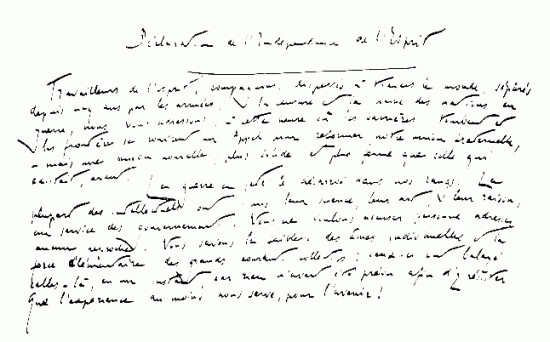
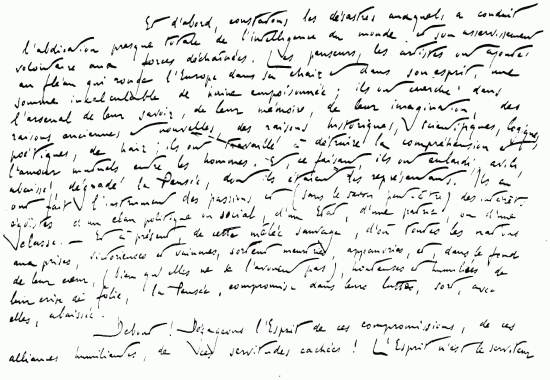
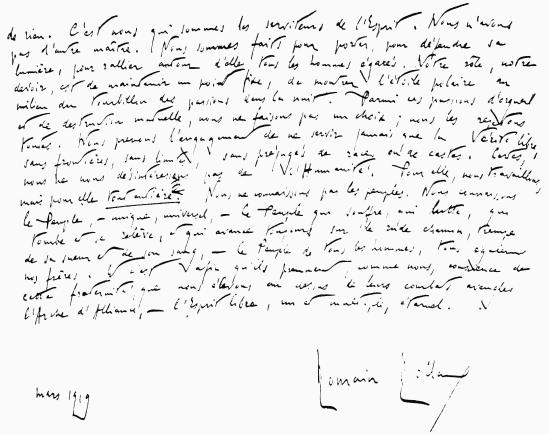 Original manuscript of The Declaration of the
Independence of the Mind
Original manuscript of The Declaration of the
Independence of the Mind
"Arise! Let us free the mind from these compromises, from these unworthy
alliances, from these veiled slaveries! Mind is no one's servitor. It is
we who are the servitors of mind. We have no other master. We exist to
bear its light, to defend its light, to rally round it all the strayed
sheep of mankind. Our role, our duty, is to be a center of stability, to
point out the pole star, amid the whirlwind of passions in the night.
Among these passions of pride and mutual destruction, we make no choice;
we reject them all. Truth only do we honor; truth that is free,
frontierless, limitless; truth that knows naught of the prejudices of
race or caste. Not that we lack interest in humanity. For humanity we
work; but for humanity as a whole. We know nothing of peoples. We know
the People, unique and universal; the People which suffers, which
struggles, which falls and rises to its feet once more, and which
continues to advance along the rough road drenched with its sweat and
its blood; the People, all men, all alike our brothers. In order that
they may, like ourselves, realize this brotherhood, we raise above their
blind struggles the Ark of the Covenant—Mind, which is free, one and
manifold, eternal."
Many hundreds of persons have signed this manifesto, for leading spirits
in every land accept the message and make it their own. The invisible
republic of the spirit, the universal fatherland, has been established
among the races and among the nations. Its frontiers are open to all who
wish to dwell therein; its only law is that of brotherhood; its only
enemies are hatred and arrogance between nations. Whoever makes his
home within this invisible realm becomes a citizen of the world. He is
the heir, not of one people but of all peoples. Henceforward he is an
indweller in all tongues and in all countries, in the universal past and
the universal future.
STRANGE has been the rhythm of this man's life, surging again and again
in passionate waves against the time, sinking once more into the abyss
of disappointment, but never failing to rise on the crest of faith
renewed. Once again we see Romain Rolland as prototype of those who are
magnificent in defeat. Not one of his ideals, not one of his wishes, not
one of his dreams, has been realized. Might has triumphed over right,
force over spirit, men over humanity.
Yet never has his struggle been grander, and never has his existence
been more indispensable, than during recent years; for it is his
apostolate alone which has saved the gospel of crucified Europe; and
furthermore he has rescued for us another faith, that of the imaginative
writer as the spiritual leader, the moral spokesman of his own nation
and of all nations. This man of letters has preserved us from what would
have been an imperishable shame, had there been no one in our days to
testify against the lunacy of murder and hatred. To him we owe it that
even during the fiercest storm in history the sacred fire of brotherhood
was never extinguished. The world of the spirit has no concern with the
deceptive force of numbers. In that realm, one individual can outweigh a
multitude. For an idea never glows so brightly as in the mind of the
solitary thinker; and in the darkest hour we were able to draw
consolation from the signal example of this poet. One great man who
remains human can for ever and for all men rescue our faith in
humanity.
WORKS BY ROMAIN ROLLAND
I
CRITICAL STUDIES
Les origines du théâtre lyrique moderne. (Histoire de l'opéra en Europe
avant Lully et Scarlatti.) Fontemoing, Paris, 1895.
Cur ars picturae apud Italos XVI saeculi deciderit Fontemoing, Paris,
1895.
Millet. Duckworth, London, 1902 (has appeared in English translation
only).
Vie de Beethoven. (Vie des hommes illustres.) Cahiers de la quinzaine,
série IV, No. 10, Paris, 1903; Hachette, Paris, 1907; another edition
with woodcuts by Perrichon, J. P. Laurens, P. A. Laurens, and Perrichon,
published by Edouard Pelletan, Paris, 1909.
Le Théâtre du Peuple. Cahiers de la quinzaine, série V, No. 4, Paris,
1903; Hachette, Paris, 1908; enlarged edition, Hachette, Paris, 1913;
Ollendorff, Paris, 1920.
Paris als Musikstadt. Marquardt, Berlin, 1905 (has appeared in German
translation only).
La vie de Michel-Ange. (Vie des hommes illustres.) Cahiers de la
quinzaine, série VII, No. 18; série VIII, No. 2, Paris, 1906; Hachette,
Paris, 1907. Another edition in Les maîtres de l'art series, Librairie
de l'art, ancien et moderne, Plon, Paris, 1905.
Musiciens d'autrefois, Hachette, Paris, 1908. 1. L'opéra avant l'opéra.
2. Le premier opèra joué à Paris: L'Orféo de Luigi Rossi. 3. Notes sur
Lully. 4. Gluck. 5. Grétry. 6. Mozart.
Musiciens d'aujourd'hui, Hachette, Paris, 1908. 1. Berlioz. 2. Wagner:
Siegfried; Tristan. 3. Saint-Saëns. 4. Vincent d'Indy. 5. Richard
Strauss. 6. Hugo Wolf. 7. Don Lorenzo Perosi 8. Musique française et
musique allemande. 9. Pelléas et Mélisande. 10. Le renouveau: esquisse
du movement musical à Paris depuis 1870.
Paul Dupin. Mercure musical. S. J. M. 15/12, 1908.
Haendel. (Les maîtres de la musique.) Alcan, Paris, 1910.
Vie de Tolstoi. (Vie des hommes illustres.) Hachette, Paris, 1911.
L'humble vie héroique. Pensées choisies et précédées d'une introduction
par Alphonse Séché. Sansot, Paris, 1912.
Empédocle d' Agrigente. Le Carmel, Geneva, 1917; La maison française
d'art et edition, Paris, 1918.
Voyage musical aux pays du passe. With woodcuts by D. Glans. Edouard
Joseph, Paris, 1919; Hachette, Paris, 1920.
Ecole des Hates Etudes Socials (1900-1910). Alcan, Paris, 1910.
II
POLITICAL STUDIES
Au-dessus de la mêlée. Ollendorff, Paris, 1915.
Les précurseurs. L'Humanité, Paris, 1919.
Aux peuples assassinés. Jeunesses Socialistes Romandes, La
Chaux-de-Fonds, 1917; Ollendorff, Paris, 1920.
Aux peuples assassinés (under the title: Civilisation). Privately
printed, Paris, 1918.
Aux peuples assassinés. As frontispiece a wood-engraving by Frans
Masereel. Restricted circulation. Ollendorff, Paris, 1920.
III
NOVELS
Jean-Christophe. 15 parts 1904-1912. Cahiers de la quinzaine, Série V,
Nos. 9 and 10; Série VI, No. 8; Série VIII, Nos. 4, 6, 9; Série IX, Nos.
13, 14, 15; Série X, Nos. 9, 10; Série XI, Nos. 7, 8; Série XIII, Nos.
5, 6; Série XIV, Nos. 2, 3; Paris, 1904 et seq.
Jean-Christophe. 10 vols. 1. L'aube. 2. Le matin. 3. L'adolescent 4 La
révolte. (1904-1907.)
Jean-Christophe à Paris. 1. La foire sur la place. 2. Antoinette. 3.
Dans la maison. (1908-1910.)
Jean-Christophe. La fin du voyage. 1. Les amies. 2. Le buisson ardent 3.
La nouvelle journée. (1910-1912.) Ollendorff, Paris.
Colas Breugnon. Ollendorff, Paris, 1918.
Pierre et Luce. Le Sablier, Geneva, 1920; Ollendorff, Paris, 1920.
Clerambault. Ollendorff, Paris, 1920.
IV
PREFACES
Introduction to Une lettre inédite de Tolstoi, Cahiers de la quinzaine,
Série III, No. 9, Paris, 1902.
Haendel et le Messie. (Preface to Le Messie de G. F. Haendel by Félix
Raugel.) Dépôt de la Société coöpérative des compositeurs de musique,
Paris, 1912.
Stendhal et la musique. (Preface to La vie de Haydn in the complete
edition of Stendhal's works.) Champion, Paris, 1913.
Preface to Celles qui travaillent by Simone Bodève, Ollendorff, Paris,
1913.
Preface to Une voix de femme dans la mêlée by Marcelle Capy, Ollendorff,
Paris, 1916.
Anthologie des poètes contre la guerre. Le Sablier, Genera, 1920.
V
DRAMAS
Saint Louis. (5 acts.) Revue de Paris, March-April, 1897.
Aërt. (3 acts.) Revue de l'art dramatique, Paris, 1898.
Les loups. (3 acts.) Georges Bellais, Paris, 1898.
Le triomphe de la raison. (3 acts.) Revue de l'art dramatique, Paris,
1899.
Danton. (3 acts.) Revue de l'art dramatique, Paris, 1900; Cahiers de la
quinzaine, Série II, No. 6, 1901.
Le quatorze juillet. (3 acts.) Cahiers de la quinzaine, Série III, No.
11, Paris, 1902.
Le temps viendra. (3 acts.) Cahiers de la quinzaine, Série IV, No. 14,
Paris, 1903; Ollendorff, Paris, 1920.
Les trois amoureuses. (3 acts.) Revue de l'art dramatique, Paris, 1904.
La Montespan. (3 acts.) Revue de l'art dramatique, Paris, 1904.
Théâtre de la Révolution. Les loups. Danton. Le quatorze juillet.
Hachette, Paris, 1909 (now transferred to Ollendorff).
Les tragédies de la foi. Saint Louis. Aërt. Le triomphe de la raison.
Hachette, Paris, 1909 (now transferred to Ollendorff).
Liluli (with woodcuts by Frans Masereel). Le Sablier, Geneva, 1919;
Ollendorff, Paris, 1920.
TRANSLATIONS
English
Millet. Translated by Clementina Black. Duckworth, London, 1902.
Beethoven. Translated by F. Rothwell. Drane, London, 1907.
Beethoven. Translated by Constance Hull. With a brief analysis of the
sonatas, symphonies, and the quartets, by A. Eaglefield Hull, and 24
musical illustrations and 4 plates and an introduction by Edward
Carpenter. Kegan Paul, Trench, Trubner, London, 1917.
The Life of Michael Angelo. Translated by Frederic Lees. Heinemann,
London, 1912.
Tolstoy. Translated by Bernard Miall. Fisher Unwin, London, 1911.
Some Musicians of former Days. Translated by Mary Blaiklock. Kegan Paul,
Trench, Trubner, London, 1915.
Handel. Translated by A. Eaglefield Hull. Kegan Paul, Trench, Trubner,
London, 1916.
Musicians of To-day. Translated by Mary Blaiklock. Kegan Paul, Trench,
Trubner, London, 1915.
The People's Theater. Translated by Barrett H. Clark. Holt, New York,
1918; C. Allen & Unwin, London, 1919.
Go to the Ant. (Reflections on reading Auguste Sorel.) Translated by De
Kay. Atlantic Monthly, May, 1919, New York.
Above the Battlefield. With an introduction by G. Lowes Dickinson,
Bowes, Cambridge, 1914.
Above the Battlefield. With an introduction by Rev. Richards Roberts, M.
A. Friends' Peace Committee, London, 1915.
Above the Battle. Translated by C. K. Ogden. G. Allen & Unwin, London,
1916.
The Idols. Translated by C. K. Ogden. With a letter by R. Rolland to
Dr. van Eeden on the rights of small nations. Bowes, Cambridge, 1915.
The Forerunners. Translated by Eden & Cedar Paul. G. Allen & Unwin,
London, 1920; Harcourt, Brace, U. S. A., 1920.
The Fourteenth of July and Danton: two plays of the French Revolution.
Translated with a preface by Barrett H. Clarke. Holt, New York, 1918; G.
Allen & Unwin, London, 1919.
Liluli. The Nation, London, Sept 20 to Nov. 29, 1919; Boni & Liveright,
New York, 1920.
Jean Christophe. Translated by Gilbert Cannan. Heinemann, London,
1910-1913; Holt, New York, 1911-1913.
Colas Breugnon. Translated by K. Miller. Holt, New York, 1919.
Clerambault. Translated by K. Miller. Holt, New York. 1921.
German
Beethoven. Translated by L. Langnese-Hug. Rascher, Zurich, 1917.
Michelangelo. Translated by W. Herzog. Rütten & Loenig, Frankfort, 1918.
Michelangelo. Rascher, Zurich, 1919.
Tolstoi. Translated by W. Herzog. Rütten & Loenig, Frankfort, 1920.
Den hingeschlachteten Völkern, translated by Stefan Zweig. Rascher,
Zurich, 1918.
Au-dessus de la mêlée. Rütten & Loening, Frankfort.
Les précurseurs. Rütten & Loeing, Frankfort, 1920.
Johann Christof. Translated by Otto & Erna Grautoff. Rütten & Loening,
Frankfort, 1912-1918.
Meister Breugnon. Translated by Otto & Etna Grautoff. Rütten & Loening,
Frankfort, 1919.
Clerambault. Translated by Stefan Zweig. Rütten & Loening, Frankfort,
1920.
Die Wölfe. Translated by W. Herzog. Müller, Munich, 1914.
Danton. Translated by Lucy von Jacobi and W. Herzog. Müller, Munich,
1919.
Die Zeit wird kommen. Translated by Stefan Zweig. "Die Zwölf Bücher,"
Tal, Vienna, 1920.
Spanish
Vie de Beethoven. Translated by J. R. Jimenez, à la Residentia de
Estudiantes de Madrid, 1914.
Au-dessus de la mêlée. Delgado & Santonja, Madrid, 1916.
Jean-Christophe. Translated by Toro y Gomez. Ollendorff, Paris-Madrid,
1905-1910.
Colas Breugnon. Agence de Librairie, Madrid, 1919.
Italian
Au-dessus de la mêlée. Avanti, Milan, 1916.
Aux peuples assassinés. Translated by Monanni with drawings by Frans
Masereel. Libreria Internationale, Zurich, 1917.
Jean-Christophe. Translated by Cesare Alessandri. Sonzogno, Milan, 1920.
Vie de Michel-Ange. Translated by Maria Venti Felice le Monnier,
Florence. [In the press.]
Russian
Théâtre de la Révolution. Translated by Joseph Goldenberg, St.
Petersburg. 1909.
Théâtre du Peuple. Translated by Joseph Goldenberg. St. Petersburg.
1909.
Empédocle d'Agrigente. [In the press.]
Jean-Christophe. Unauthorized translation in 4 vols. Vetcherni Zvon,
Moscow, 1912.
Jean-Christophe. Authorized translation by M. Tchlenoff.
Danish
Vie de Beethoven. Branner, Copenhagen, 1915.
Tolstoi. Branner, Copenhagen, 1917.
Musiciens d'aujourd'hui. Denmark & Norway, 1917.
Au-dessus de la mêlée. Lios, Copenhagen, 1916.
Jean-Christophe. Hagerup, Copenhagen, 1916.
Colas Breugnon. Denmark & Norway; Norstedt, Stockholm, 1917.
Czech
Vie de Michel-Ange. Translated by M. Kalassova. Prague, 1912.
Danton. 1920.
Polish
Vie de Beethoven. Jacewski, Warsaw, 1913.
Jean-Christophe. Translated by Edwige Sienkiewicz. Vols.
I & II, Bibljoteka Sfinska, Warsaw, 1910; the remaining vols., Maski,
Cracow, 1917-19—.
Swedish
Vie de Beethoven. Translated by Mrs. Akermann, Norstedt, Stockholm.
1915.
Vie de Michelange. Translated by Mrs. Akermann, Norstedt, Stockholm.
1916.
Vie de Tolstoi. Translated by Mrs. Akermann, Norstedt, Stockholm. 1916.
Händel. Translated by Mrs. Akermann, Norstedt, Stockholm. 1916.
Millet. Translated by Mrs. Akermann, Norstedt, Stockholm. 1916.
Musiciens d'aujourd'hui. Translated by Mrs. Akermann, Norstedt,
Stockholm. 1917.
Musiciens d'autrefois. Translated by Mrs. Akermann, Norstedt, Stockholm.
1917.
Voyage musical au pays du passé. Translated by Mrs. Akermann, Norstedt,
Stockholm. 1920.
Au-dessus de la mêleé. Translated by Mrs. Akermann, Norstedt, Stockholm.
1915.
Les précurseurs. Translated by Mrs. Akermann, Norstedt, Stockholm. 1920.
Théâtre de la Révolution. Translated by Mrs. Akermann, Bonnier,
Stockholm. 1917.
Tragédies de la foi. Translated by Mrs. Akermann, Bonnier, Stockholm.
1917.
Le temps viendra. Translated by Mrs. Akermann, Norstedt, Stockholm.
Liluli. Translated by Mrs. Akermann, Bonnier, Stockholm. 1920.
Jean-Christophe. Translated by Mrs. Akermann, Bonnier, Stockholm.
1913-1917.
Colas Breugnon. Translated by Mrs. Akermann, Norstedt, Stockholm. 1919.
Clerambault In course of preparation. Bonnier, Stockholm.
Dutch
Vie de Beethoven, Simon, Amsterdam, 1913.
Jean-Christophe. Brusse, Rotterdam, 1915.
L'aube. Special edition, W. F. J. Tjeenk Willink, Zwolle, 1916.
Colas Breugnon. Meulenhoff, Amsterdam, 1919.
Japanese
Tolstoi Seichi Naruse, Tokyo, 1916. And many other unauthorized
translations.
Greek
Beethoven. Translated by Niramos. 1920.
WORKS ON ROMAIN ROLLAND
French
Jean Bonnerot. Romain Rolland (Extraits de ses œuvres avec
introduction biographique), Cahiers du Centre, Nevers, 1909.
Lucien Maury. Figures littéraires. Perrin, 1911.
J. H. Retinger. Histoire de la littérature française du romantisme à
nos jours. B. Grasset, 1911.
Jules Bertaut. Les romanciers du nouveau siècle. Sansot, 1912.
Paul Seippel. Romain Rolland, l'homme et l'œuvre. Ollendorff, 1913.
Marc Elder. Romain Rolland. Paris, 1914
Robert Dreyfus. Maîtres contemporains. (Péguy, Claudel, Suarès, Romain
Rolland.) Paris, 1914.
Daniel Halévy. Quelques nouveaux maîtres. Cahiers du Centre. Figuière,
1914.
G. Dwelshauvers. Romain Rolland. Vue caractéristique de l'homme et de
l'œuvre. Ed. de la Belgique artistique et littéraire, Brussels, 1913
or 1914.
Paul Souday. Les drames philosophiques de Romain Rolland. Emile Paul,
Paris, 1914.
Max Hochstätter. Essai sur l'œuvre de Romain Rolland. Fischbacher,
Paris; Georg & Co., Geneva, 1914.
Henri Guilbeaux. Pour Romain Rolland. Jeheber, Geneva, 1915.
Massis. Romain Rolland contre la France. Floury, Paris, 1915.
P. H. Loyson. Etes-vous neutre devant le crime? Payot, Paris and
Lausanne, 1916.
Renaitour et Loyson. Dans la mêlée. Ed. du Bonnet Rouge, 1916.
Isabelle Debran. M. Romain Rolland initiateur du défaitisme.
(Introduction de Diodore.) Geneva, 1918.
Jacques Servance. Réponse à Mme. Isabelle Debran. Comité d'initiative
en faveur d'une paix durable, Neuchâtel, 1916.
Charles Baudouin, Romain Rolland calomnié. Le Carmel, Geneva, 1918.
Daniel Halévy. Charles Péguy et les Cahiers de la Quinzaine. Payot,
Paris, 1918 et seq.
Paul Colin. Romain Rolland, Bruxelles, 1920.
P. J. Jouve. Romain Rolland vivant, Ollendorff, 1920.
Other Languages
Otto Grautoff. Romain Rolland, Frankfurt, 1914.
Winifred Stephens. French Novelists of To-day. Second series. J. Lane,
London and New York, 1915.
Albert L. Guerard. Five Masters of French Romance. Scribner, New York,
1916.
Dr. J. Ziegler. Romain Rolland in "Johann Christof," über Juden und
Judentum. v. Dr. Ziegler, Rabbiner in Karlsbad. Vienna, 1918.
Agnes Darmesteter. Twentieth Century French Writers. London, 1919.
Blumenfeld. Etude sur Romain Rolland, en langue yiddisch. Cahiers de
littérature et d'art. Paris, 1920.
Albert Schinz. French Literature of the War. Appleton, New York, 1920.
Pedro Cesare Dominici. De Lutecia, Arte y Critica. Ollendorff, Madrid.
Papini. Studii di Romain Rolland. Florence, 1916.
F. F. Curtis. Die literarischen Wegbereiter des neuen Frankreichs.
Kiepenheuer, Potsdam, 1920.
Walter Küchler. Vier Vorträge über R. Rolland, Henri Barbusse, Fritz
v. Unruh. Würzburg, 1919.
Music Connected With Romain Rolland's Writings
Paul Dupin. Jean-Christophe. (Trois pièces pour piano.)
1. L'oncle Gottfried (dialogue avec Christophe).
2. Méditation sur un passage du "Matin."
3. Berceuse de Louisa. Chant du Pélerin (piano et chant). Paroles de
Paul Gerhardt Ed. Demets, Paris, 1907.
Paul Dupin. Jean-Christophe. (Suite pour quatuor à cordes.)
1. La mort de l'oncle Gottfried.
2. Bienvenue au petit Ed. Senart et Roudanez, Paris, 1908.
Paul Dupin. Pastorale, Sabine. 1. Dans le Jardinet. Piano et quatuor.
Transcription pour piano et violon. Ed. Senart et Roudanez, Paris, 1908.
Albert Doyen. Le Triomphe de la Liberté. (Scène finale du Quatorze
Juillet). Prix de la ville de Paris, 1913. (Soli, Orchestre et Choeurs.)
Ed. A. Leduc, Paris.
Above the Battle, 266, 290, 291, 293-6, 297, 305, 329.
Abbesse de Jouarre, l', 125.
Aërt, 66, 73, 77-8, 83-5, 87, 112.
Aërt, 77-8, 83-5, 121, 125, 161, 198, 244, 260, 347.
Antoinette, in Jean Christophe, 4, 165, 175, 212, 224.
Arcos, René, 312, 313.
Art, love of, and love of mankind, 20;
epic quality in Rolland's, 63-66, 67 ff;
moral force in Rolland's, 63 ff;
Tolstoi's views on, 18-20;
universality of, 26.
Au-dessus de la mêlée, see Above the Battle.
Aux peuples assassinés, 332.
Bach, Friedemann, 173.
Bach, Johann Sebastian, 173, 245.
Ballades françaises, 250.
Balzac, 64, 65, 169, 177, 250.
Barrès, Maurice, 59, 62.
Baudouin, Charles, 313.
Beethoven, 50, 137 ff, 140-3, 150.
Beethoven, 10, 18, 19, 40, 45, 67, 104, 140-143, 144, 145, 147, 148, 151, 161, 163, 172, 174, 175, 182, 245, 252, 325, 328;
festival, 35, influence of, on Rolland's childhood, 5 ff;
Jean Christophe's resemblance to, 173.
Beginnings of Opera, The, 34.
Belgique sanglante, la, 282.
Berlioz, 10, 150.
Bibliography, 357 ff.
Biographies, heroic, 133-53;
unwritten, 150-3.
Bonn, 35, 140, 141.
Brahms, 174.
Bréal, Michel, 35.
Breugnon, Colas, in Colas Breugnon, 241-53, 319;
spiritual kinship of, with Jean Christophe, 244-48;
see Colas Breugnon.
Brunetière, 16.
Burckhardt, Jakob, 16.
Byron, 275.
"Cahiers de la quinzaine," 20, 40, 43, 50, 143.
Caligula, 73.
"Carmel, le," 313.
Carnot, 99.
Claes, in Aërt, 87.
Clamecy, birthplace of Rolland, 3, 4, 99.
Claudel, Paul, 89, 44, 59.
Clerambault, l'histoire d'une conscience libre pendant la guerre, 339-347.
Clerambault, Agenor, in Clerambault, 310, 339-347.
Clerambault, Maxime, 343 ff.
Clifford, General, in A Day Will Come, 120, 121, 125.
Colas Breugnon, 241-253, 337;
as an artistic production, 249-51;
gauloiseries in, 249-51;
origin of, 241-43.
Comédie Française, 71, 74.
Conscience, story of, in Clerambault, 339-47;
see Freedom of conscience.
Corneille, 91, 92.
Couthon, 99.
Credo quia verum, 16, 17.
Corinne, in Jean Christophe, 211.
Cycles, of Rolland, 67-71.
D'Alembert, 87.
Danse des morts, 312.
Danton, 41, 101, 106-9, 113, 117.
Danton, 99, 106-9, 113, 126.
Debrit, Jean, 313.
Debussy, 35, 175.
Declaration of the independence of the mind, 351-354.
Decsey, Ernest, 174.
Defeat, significance of, in Rolland's philosophy of life, 61, 62, 83 ff, 110 ff, 134 ff, 139.
"Defeatism," 297-303.
De Maguet, Claude, 313.
"Demain," 313.
Deprès, Suzanne, 175.
Desmoulins, 126.
Desprès, Fernand, 312.
Deutscher Musiker in Paris, Ein, 174.
"Deutsche Rundschau, Die," 305.
Don Carlos, 101.
Dostoievsky, 2, 346.
Doyen, 105.
D'Oyron, in The Wolves, 114.
Drama, and the masses, see People's Theater;
erotic vs. political, 127 ff;
Drama of the Revolution, 69, 70, 86-99, 100-18.
Dramatic writings, of Rolland, 25, 32, 39, 41, 57-130;
craftsmanship of, 127-130;
cycles, 67-71;
Drama of the Revolution, 100-130;
People's Theater, 85-130;
poems, 28;
tragedies of faith, 76-85;
unknown cycle, 71-75.
Drames philosophiques, 125.
Dreyfus affair, 38, 39, 106, 115, 119, 133.
Dunois, Amédée, 312.
Duse, Eleanore, 175.
Empédocle d'Agrigente et l'âge de la haine, 72, 333 ff.
Etes-vous neutre devant le crime, 283.
Faber, in Le triomphe de la raison, 111, 114, 309.
Faith, in Rolland's philosophy of life, 77-79, 81 ff, 166-71, 244 ff;
tragedies of, 76-85.
Fellowship, of free spirits, during the war, 273 ff, 311-316: 351, 354.
Fêtes de Beethoven, les, 141.
"Feuille, la," 313.
Flaubert, 37, 58, 80, 177.
Forerunners, The, 290, 339-334
Fort, Paul, 250.
Fourteenth of July, The, 101-2, 103-5, 109.
France, after 1870, 57;
picture of, in Jean Christophe, 211-216
France, Anatole, 58, 84, 169.
Frank, César, 175.
Frank, Ludwig, 321.
Freedom, of conscience, 287 ff, 257-9, 119, 274, 285-8, 298 ff, 320 ff, 339-47;
vs. the fatherland, see The Triumph of Reason.
French literature, state of, after 1870, 37, 58 ff.
French Revolution, 68, 98 ff, 100-120, 121, 122;
see Drama of theRevolution;
also People's Theater. French stage, after 1870, 86-89.
Galeries des femmes de Shakespeare, 6.
Gamache, in Jean Christophe, 175.
"Gauloiseries," 250.
Generations, conflicting ideas of the 229-234.
Geneva, during the Great War, 268 ff.
Germany, picture of, in Jean Christophe, 217-220.
Girondists, in The Triumph of Reason, 110 ff, 121, 129, 169, 260.
Gli Baglioni, 73, 74.
Gluck, 173, 175, 212.
Goethe, 64, 72, 97, 118, 150, 155, 169, 175, 177, 180, 211, 184, 193, 219, 230, 263, 275, 278, 305, 330, 332.
Gottfried, in Jean Christophe, 204.
Grautoff, 166, 168.
Grazia, in Jean Christophe, 175, 200-202, 205.
Greatness, will to, in Rolland's philosophy, 63.
Great War, The, 1, 65, 257-355, 253, 264 ff, 339-347.
Greek tragedy, method of, 128 ff
Grüne Heinrich, Der, 169.
Guilbeaux, Henri, 281, 313.
Haendel, 34.
Handel, 150, 173, 175, 245.
Hatred Holland's campaign against, 297-304;
Verhaeren's attitude of, during the war, 281-4.
Hauptmann, 92, 276;
Rolland's controversy with, 277-280.
Hardy, Thomas, 64.
Hassler in Jean Christophe, 174, 204.
Hebbel, 73, 123.
Hecht, in Jean Christophe, 175.
Heroes of suffering, 133-153.
Heroic biographies, 133-153.
Herzen, 26.
Historical drama, see People's Theater.
History, and the People's Theater, 95 ff;
Rolland's conception of, 95 ff;
sense of, in early writings, 32.
Hoche, General, 150.
Hölderlin, 73.
Hugot, in The Triumph of Reason, 63, 111, 114.
Hugo, Victor, 37, 64, 92, 121.
Idoles les, 299.
"Iliad of the French People," see People's Theater.
Illusions perdues, les, 65.
Inter Arma Caritas, 297.
Iphigenia, 118.
Italy, picture of, in Jean Christophe, 221-3.
Idealism, in Rolland's philosophy, 60 ff, 85, 123, 166-71;
characterization of Germany, 211-216;
of Italy, 222.
Internationalism, 207-10, 255, 285-8, 351-4;
see Above the Battle;
Fellowship, of free spirits;
Hatred, Rolland's campaign against
Ibsen, 126 ff.
Italy, Rolland's sojourn in, 23-28, 71.
Jaurès, 13, 41, 109, 346.
Jean Christophe, 18, 30, 36, 49, 65, 70, 130, 143, 157-237, 165, 257, 300, 305, 311, 318, 339, 340;
as an educational romance, 166-71;
characters of, 172-5;
enigma of creative work, 181-7;
France, picture of, in, 211-16;
generations, conflicting ideas of, in 229-34;
Germany, picture of, in, 217-220;
Italy, picture of, in 221-3;
Jews, the, in, 224-8;
message of, 157-159;
music, form and content of, 177-80;
origin of 162-5;
writing of, 43-44, 162-5.
Jean Christophe, 26, 31, 38, 40, 42, 43, 49, 50, 65, 68, 76, 97, 153, 157-237, 241, 246, 257, 258, 260, 317, 336, 340, 342;
and Grazia, 200-1;
and his fellow men, 203-6;
and his generation, 229-36;
and the nations, 207-10;
apostle of force, 189 ff;
as the artist and creator, 188-94;
character of, 172-75;
contrast to Olivier, 195 ff.
Jouve, 287, 312, 313.
Justice, problem of, considered by Rolland in Dreyfus case, 39;
vs. the fatherland, see The Wolves.
Kaufmann, Emil, 174.
Keller, Gottfried, 169, 177.
Kleist, 73, 92.
Kohn, Sylvain, in Jean Christophe, 212, 224.
Krafft, Jean Christophe, see Jean Christophe.
Language, as obstacle to internationalism, 229 ff.
Lazare, Bernard, 39, 143.
Lebens Abend einer Idealistin, Der, 27, 73.
Légende de Saint Julien l'Hospitalier, 80.
Letters, of Rolland, during war, 317-19.
Lévy-Coeur, in Jean Christophe, 175, 205, 224.
Le 14 Juillet, see Fourteenth of July, The.
Liberty, characterization of France, 211-16.
Life of Michael Angelo, The, 40, 144-46.
Life of Timolien, 131.
Liluli, 300, 335-338, 339.
Loups, les, see The Wolves.
Lux, Adams, 101, 111, 112, 309.
Lyceum of Louis the Great, 8.
Madame Bovary, 64.
Mahler, Gustave, 35, 175.
Mannheim, Judith, in Jean Christophe, 226.
Marat, 101.
Martinet, Marcel, 312.
Masereel, Franz, 313.
Maupassant, 13, 37, 58, 64, 91.
Mazzini, 26, 150, 151, 222.
Meistersinger, Die, 92.
Mesnil, Jacques, 312.
Meunier, 87.
Meutre des élites, le, 297.
Meyerbeer, 212.
Michelangelo, 67, 71, 144-6, 147, 148, 151, 161, 182, 245.
Michelet, 13.
Millet, 87, 50.
Mirbeau, 85.
Molière, 92.
Monod Gabriel, 13, 16, 26, 73.
Mon Oncle Benjamin, 3.
Montespan, la, 73, 119.
Mooch, in Jean Christophe, 224.
Moreas, 175.
Mornet, Lieutenant, 306.
Mounet-Sully, 74.
Mozart, 5, 173.
Music, early influence of, on Rolland, 4;
form and content in Jean Christophe, 177-80;
part of Rolland's drama, 104 ff;
Rolland's love of, 47;
Rolland's philosophy of, 132-3;
Tolstoi's stigmatization of 19.
Musiciens d'autrefois, 34, 35, 183.
Nationalistic school of writers 59, 60, 62.
Nationalism, 208 ff; 217-20, 225, 226.
Naturalism, 15.
"Neues Vaterland," 306.
Nietzsche, 2, 26, 37, 162, 174, 177, 217-20, 255, 332.
Niobé, 73, 74.
Nobel peace prize, 270.
Normal School, 10, 11, 12-17, 13, 14, 23, 29, 32, 162.
Notre prochain l'ennemi, 297.
Novalis, 169.
Offenbach, 212.
Olivier, in Jean Christophe, 61, 68, 76, 78, 84, 176, 179, 195-9, 200, 201, 205, 214 ff, 220, 224, 225, 233, 244, 246, 257, 260, 264, 267, 283, 309, 318, 336 340.
Olivier, Georges, in Jean Christophe, 233.
Offiziere, Die, 85.
Oration on Shakespeare, 72.
Orfeo, 33.
Origines du théâtre lyrique moderne, les, 32, 183.
Orsino, 72, 74.
Oudon, Françoise, in Jean Christophe, 75.
Pacifism, 262 ff.
Paine, Thomas 9, 7, 150.
Parsifal, 30, 31, 62, 191.
Péguy, Charles, 14, 20, 38, 39, 59, 115, 143.
People's Theater, The, 41, 65, 133, 68, 88, 94-97.
Philippe, Charles Louis, 44, 91.
Philosophy of life, of Rolland, see Art of Rolland;
Conscience;
Defeat, significance of;
Faith;
Freedom of Conscience;
Greatness will to;
Hatred, campaign against;
Idealism;
Internationalism;
Justice;
Struggle, element of;
Suffering, significance of.
Picquart, 39, 115.
Perrotin, in Clerambault, 344.
Pioch, Georges, 312.
Polichinelle, in Liluli, 337.
Précurseurs, les, see The Forerunners.
Prêtre de Nemi, le, 125.
Prinz von Homburg, Der, 92.
Provenzale, Francesco, 34.
Quesnel, in Les Loups, 114.
Racine, 91, 92.
Räuber, Die, 92.
Red Cross, in Switzerland, 268 ff, 269 ff.
Renaissance, 24, 25, 68, 71.
Renaitour, 312.
Renan, 12, 13, 25, 37, 125 ff, 176, 196, 214, 309.
"Revue de l'art dramatique," 35, 88.
"Revue de Paris," 25, 141.
Robespierre, 99, 101, 108, 113, 117, 126.
Rolland, Madeleine, 3.
Rolland, Romain, academic life of, in Paris, 32-35, 42;
adolescence
of, 3-11;
ancestry of, 3;
and his epoch, 57-62;
and the European spirit, 52, 53;
appeal to President Wilson, 348-50;
as embodiment of European spirit, 52-3;
art of, 63-6;
at Paris, 32-5, 36;
attitude of, during the war, 257-355;
campaign of, against hatred 297-303;
childhood of, 3-7;
controversy of, with Hauptmann, 277-80;
correspondence of, with Verhaeren 281-4;
cycles of 67-75;
diary of, during the war, 327-28;
drama of the revolution, 100-30;
dramatic writings, 25, 28, 57, 130;
Dreyfus case, 38-47;
fame, 49, 50, 51, 48;
father of, 6;
friendships, 13-15, 25, 26-28, 311-316;
heroic biographies, 133-153;
humanitarianism of, 307 ff;
idealism of, 60 ff;
influence of, during the war, 320-326, 355-6;
influence of Tolstoi on, 19-22;
Jean Christophe, 157-237;
letters of, during the war, 317-319;
marriage of, 35, 41, 73, 134;
mass suggestion in writings of, 261, 266, 329-47;
mother of, 3, 27;
newspaper writing of 289-292;
opponents of, during the war, 304-10;
portrait of, 46, 47;
rôle of, in fellowship of free spirits during the war, 273 ff;
Rome, 23, 28;
schooling of 5-17;
seclusion, 43, 44, 45-7, 48-49, 324;
significance of life work, 2;
tragedies of faith, 76-85;
unwritten biographies, 150-153.
Rossi, Ernesto, 24.
Rossi, Luigi, 33.
Rostand, 117.
Rouanet, 312.
Rousseau, 275.
Roussin, in Jean Christophe, 176.
Route en lacets qui monte, la, 330.
St. Christophe, 157.
Saint-Just, pseud., 39, 84, 101, 108, 113, 126.
Saint Louis, 77-8, 80-82, 83, 125, 244.
Salviati, 24.
Suarès, André, 14, 15, 39.
Scarlatti, Alessandro, 34.
Schermann, 330.
Scheurer, Kestner, 39, 115.
Schiller, 73, 86, 87, 90, 92, 95, 97, 100-1, 123, 155, 193, 196.
Schubert, 175, 180.
Schulz, Prof. in Jean Christophe, 174, 204.
Seippel, Paul, 50, 165, 172.
Sévérine, 312.
Shakespeare, 5, 6, 10, 14, 15, 18, 23, 24, 15, 64, 69, 72, 92, 100, 123, 125, 150.
Sidonie, in Jean Christophe, 213.
Siege de Mantoue, le, 73.
Sorbonne, 32, 33.
Souvenirs d'enfance et de jeunesse, 12.
Spinoza, 10, 13, 18.
Stendhal, 169, 177.
Strauss, Hugo, 35.
Strindberg, 2, 126 ff.
Struggle, element of, in Rolland's philosophy, 222, 246 ff.
Suffering, significance of, in Rolland's philosophy, 133-136, 181-7, 188-94; 204 ff;
heroes of 133-53.
Switzerland, refuge of Rolland during the war, 264-7.
"Tablettes, les," 313.
Tasso, 118.
Teulier, in The Wolves, 114, 115, 121, 310.
Théâtre du peuple, le, see People's Theatre.
Thiesson, Gaston, 312.
Tillier, Claude, 3.
Tolstoi, 18, 20, 21, 23, 15, 24, 53, 60, 64, 67, 82, 86, 87, 90, 92, 94, 135, 138, 147-149, 151, 161, 165, 170, 175, 176, 182, 204, 245, 255, 265, 300, 317, 320, 333.
To the Undying Antigone, 27.
Tragédies de la foi, les, see Tragedies of Faith.
Tragedies of Faith, 69, 76-83, 76.
"Tribunal of the spirit," see Fellowship.
Triumph of Reason, The, 63, 101, 102, 113, 114, 119.
Trois Amoureuses, les, 173.
Truth, in Liluli, 337.
Unknown dramatic cycle, 71-75.
Verhaeren, 44, 77, 175, 276, 311;
Rolland's correspondence with, 281-84.
Vie de Beethoven, see Beethoven.
Vie de Tolstoi, see Tolstoi.
Vie de Michel-Ange, la, see Life of Michael Angelo, The.
Vie des hommes illustres, 301.
Von Kerich, Frau, in Jean Christophe, 173, 204.
Von Meysenbug, Malwida, 26, 27, 28, 29, 29-31, 73, 150, 162.
Von Unruh, Fritz, 85.
Vorreden Material im Nachlass, 255.
Vous êtes des hommes, 312.
Wagner, 2, 9, 10, 14, 26, 29, 30, 31, 37, 64, 92, 162, 174, 212.
Wahrheit und Dichtung, 175.
War and Peace, 64, 170.
War, dominant theme in Rolland's plays, 28;
of the generations, 229-234;
in Rolland's writings, 260 ff.
Weber, Die, 92, 277.
Weil, in Jean Christophe, 224.
What is to be Done? 18.
Wilhelm Meister, 155, 168.
William the Silent, 66.
Wilson, President, 348-50.
Wolf, Hugo, 35, 150, 174.
Wolff's news agency, 277.
Wolves, The, 39, 101, 102, 113, 114.
Zola, 15, 58, 85, 87, 39, 91, 115, 177.


