Palazzo Rusticucci, Rome, March 16, 1899.
Letters from Maine and New Hampshire give accounts of dreadful freshets
and blizzards. We read them with some surprise, and then go up to the
terrace and pick our pansies and violets. We have some fine spirea and
lilacs coming on fast! The wall flowers are already in bloom, and the
roses make occasional little gifts, but it is far too early for these
dear ones to give their perfect blossoms. Rose week—rose madness—in
Rome comes at the end of April.
The strangest thing about life in Rome is that you not only do as the
Romans do, but end by thinking as the Romans think, feeling as the
Romans feel! Take, for example, the feeling most of the foreign
residents have about the evil eye, the malocchio or jettatura, as it
is indifferently called. I never knew an Italian who did not hold to
this superstition more or less. Americans who have lived long in Rome
either reluctantly admit that “there does seem to be something in it,”
or if they are Roman born, quietly accept it as one of those things in
heaven and earth that philosophy fails to take account of. In some
things the Italian is free from superstition compared with the Celt or
the Scot: for instance, the fear of ghosts or spirits is so rare that I
have never met with it; on the other hand, the belief in the value of
dreams as guides to action is deep rooted and widespread. The dreambook
in some families is hardly second in importance to the book of prayer.
The Italian’s eminently practical nature makes him utilize his dreams in
“playing the lotto,” as the buying of lottery tickets is called. To
dream of certain things indicates that you will be lucky and should
play. The choice of the number is the chief preoccupation of the
hardened lottery player. It is decided by the oddest chance,—the number
on a banknote which one has lost and found again, the number of a cab
which has brought one home from some delightful festivity. The number
must always be associated with something lucky. I remember in Venice
once calling on a friend who lives in a noble old palace on the Canale
Grande. The pali, the dark posts rising out of the green water for
the mooring of gondolas, bear the heraldic colors of the owner of the
palace, and the doge’s cap, showing that the family gave a doge to
Venice. Stepping from my gondola to the water-worn marble stair, I was
helped by one of the servants, an old man with the suave, sympathetic
manners that make the Italians the best servants in the world. I put him
down as a majordomo of the old school whom my friends probably had taken
over with the palace, the library, and the historic murder that goes
with them. I had brought some flowers, which he insisted upon carrying.
He led the way across a square courtyard to an outer stairway with a
wonderful carved marble balustrade, lions rampant at the top and bottom.
Suddenly he stopped and whispered to me:
“Signora,—a thousand excuses for the liberty,—but will you have the
inexpressible gentility to tell me your age?”
The question was so startling that he got the right answer before my
inevitable counter-question, “Why do you wish to know?” which he
pretended not to hear, drowned in a flood of gratitude.
“You have conferred an immense benefit on me. The signora is expecting
you.”
He had my wrap off and the drawing-room door open in a twinkling. That
was not fair play; he had his answer: I would have mine. I put my
question to his mistress. She laughed indulgently.
“Beppino is up to his old tricks. I told him this morning I was
expecting a lady he did not know; he was on the lookout for you. When a
stranger comes to the house for the first time it is the greatest
possible luck to play in the lotto the figures which make up his age.”
Our servants all play regularly, sometimes winning small sums, always
imagining that they will win the quaterno. The lottery and the Monte
di pietà—somehow one associates them together—are now under
government control, as they were formerly under the control of the
Church. It is assumed as a foregone conclusion that men will gamble,
that men will pawn their goods; therefore it is expedient that these
inevitable concomitants of city life should be administered by the
government, in order that the accruing profits should return to the
people by helping to pay the expenses of their government. The lottery
always appears to me like a tax offered to the citizens in the form of a
gilded pill.
The Monte di pietà seems to be a really beneficent institution; it is
well administered, the percentage charged on the money loaned being as
low as is practicable. Poor old Nena’s coral earrings and gold beads
live there chronically, only appearing upon her small person
periodically on “feast” days. Several times webs of fine linen,
silverware, and other household furnishings have been offered me at so
low a price by one of our clients (we use the old Roman term for the
army of hangers-on which has grown up about us) that I feared to buy
them lest I should be purchasing stolen goods. On investigation I found
the woman’s business was to buy unredeemed pledges at the regular sales
of the Monte, and to hawk them about to private customers. After that I
had not the heart to buy anything she offered, it seemed like building
our house of the driftwood of despair. The Monte is a huge gray palace
occupying a whole square behind the Palazzo Santacroce. Over the main
entrance hangs a life-sized crucifix. The institution was founded in the
year 1539 and has been in operation ever since.
The evolution of Christian out of pagan Rome is not more interesting
than the evolution still going on of Rome the modern capital out of that
picturesque, mediæval Rome of the “forties,” which my mother has
described to me so vividly that it is as if I myself had seen it.
Since we have been here, the old meek horse-cars have been taken off,
and horrible “electrics” whiz by our door and stop at the corner of the
Piazza of St. Peter’s. And—even worse, I am almost afraid to write it
to you—we have a telephone!
A telephone in the Eternal City! In the beginning I was as much shocked
by the idea as you can be. The first conversation over the wire consoled
me. Ice-chests, electric cars, and telephones only bring home more
strongly the feeling that life in Rome is modern, mediæval, and pagan,
all at the same time; it is all here in strata, like the rubbish Signor
Boni is excavating from the Roman Forum. When you first come here you
assume that you must burrow about in ruins and prowl in museums to get
back to the days of Numa Pompilius or Mark Antony. It is not necessary;
you only have to live, and the common happenings of daily life—yes,
even the trolley car and your bicycle—carry you back in turn to the
Dark Ages, to the early Christians, even to prehistoric Rome!
The day our telephone was installed I was called by the ding-a-ling of
the bell, and “centrale” put me in communication, not only with our
friend, Mrs. Z——, but with the Rome of Horace and the witch Canidia as
well.
“Can you come to dinner next Monday?” Mrs. Z—— began.
“We will come with leaps and shrieks of joy.”
“Wait; do not accept till you hear who else is coming. We are giving the
dinner in honor of M. de Gooch.”
“So much the better. We like to meet distinguished Frenchmen.”
“You are sure you do not mind meeting this particular Frenchman?”
“Why in the name of common sense should we mind?”
“Well, you know what they say about him?”
“Yes.”
“And you are not afraid? I am positively grateful to you. We are having
the hardest time to fill the eight places at the table.”
“What particular variety of heathen are you inviting?”
“American.”
That afternoon we had a visit from an American gentleman, a friend of
ours and of the Z——’s.
“Shall we meet next Monday at the Z——’s dinner?” I asked in the
course of conversation.
“No, they were good enough to invite me, but I got out of it.”
I stared at him—he is one of the Z——’s greatest friends.
“Yes, the fact is I will not go where I have to meet that man.”
“You? you believe that M. de Gooch has the evil eye?”
“It is all very well for you to look scornful! Just wait a little. I
used to take your point of view, but so many uncomfortable things
happened that I now avoid the man like the plague.”
“What sort of uncomfortable things?”
“We were once at a hotel in Naples. The first time that person—it is
not well to mention his name—came into the dining-room, a waiter
stumbled and dropped a tray full of valuable Venetian glass; every piece
was smashed: the second time, the big chandelier fell down from the
ceiling. That evening the proprietor begged this person to leave the
hotel, said all the other guests would go if he did not, as it was
evident he had the malocchio. Basta! let us speak of other things.”
After the visitor left I went up to the terrace to feed the goldfish.
Pompilia was on her knees digging around the roots of the big
honeysuckle. I looked at Soracte, beloved of Horace. Soracte looked at
me.
“Pompilia, do you know any one who has the malocchio?” She turned
pale, scrambled to her feet, and made the sign against witchcraft with
the first and fourth finger.
“Signora mia, che pavra mi ha fatto (What a fright you gave me)!” She
reflected a moment: “You remember the carbonaro who used to bring the
charcoal every Saturday? I told you he cheated us; you discharged him.
It was not true, he gave good measure. I do not wish to harm him, but
every time he came into the kitchen some disgrazia happened. The soup
was burned, the milk curdled, or the salt got into the ice-cream.”
“Do you believe the carbonaro wished to injure us? Did he desire to
bring misfortune?”
“It is his misfortune to bring misfortune,” Pompilia reluctantly
explained; “one may even be sorry for him, but one spits as one passes
him, and makes the corni (horns) with the hand behind the back to
avert the jettatura. Ma, Signora mia, per carità, parliamo d’altre
cose (For charity’s sake, let us talk of other things)! Observe this
noble tulip, the first to bloom of those Hollandish bulbs we set out in
the autumn.” She feels the flowers to be hers quite as much as ours, as
indeed they are, she is so faithful in caring for them.
We put on all our war-paint for the Z——’s party; so did the other
guests. It was one of the best dinners I have seen in Rome. Everybody
seemed on their mettle to make it go off well. It was put through with
unlimited conversational fireworks and champagne. De Gooch thawed out as
I have never known him to do before; he is usually congealed by the
chilly atmosphere which he, poor man, brings with him. I asked Mr.
Z—— how he accounted for the evil stories. He said:
“Some enemy, who spreads the reports, takes this dreadful way to destroy
him!”
The dinner was so merry that the coming of the coffee instead of being a
relief was a surprise. M. de Gooch after a moment’s hesitation refused
the cup offered him.
“I am rather proud of my coffee, change your mind and try a little,”
said Mrs. Z——.
I was sitting on the other side of De Gooch, and heard him say in a low
voice,—
“Are you sure of your cook?”
“Perfectly; he is a Piedmontese, he has been with us ten years, his
coffee may be trusted.”
Do you know what that meant? It meant that De Gooch is afraid of being
poisoned, that poison is most commonly administered in coffee or
chocolate, vide the Roman idiom, “Ha bevuto una tazza di cioccolata
(He has drunk a cup of chocolate).” I asked Mr. Z—— if he believed
anybody wanted to murder De Gooch. He said:
“I do not believe him in more danger of poison than of a lightning
stroke. It is not wonderful, however, that he thinks he is.”
“Is not the malocchio very like the voodoo?” I asked.
“It is a horse of the same color. Both came out of darkest Africa, whose
shadows fall across the broad earth.”
I take back every word I ever said against missionaries!
Poisoning, like other sins, has two degrees, the mortal and the venial.
If M. de Gooch is in no danger from the mortal, we, according to Nena
and Pompilia, were in danger of the venial not so long ago. During a
short absence of Pompilia’s we had a foreign cook, and parted with her
not on the best terms. The day after she left Pompilia returned, coming
to me in the course of the morning with a long list of groceries; those
staples, farina, Parmegiano, and caffé, headed the memorandum.
“But we cannot have used up five kilos of coffee. It is impossible that
we are out of flour and Parmesan cheese; we bought them only three days
ago.”
You see I am getting on, I now manage—though it is highly disapproved
of by the powers that be—to lay in a few groceries, which I buy at the
Unione Militare—government stores like the Army and Navy Stores in
London.
“When I returned this morning, there was not a crumb in the house,” said
Pompilia. Nena was appealed to.
“Nena, what about the Parmegiano, the farina, and the caffé you
bought the other day?”
“Signora, I was obliged to throw them all into the immondezza
(garbage).”
“But why?”
“Signora! I say nothing. That black Tedesca, when she left, did not wish
us others well, nor even your signorial selves. I did what I did for the
best.” She looked at Pompilia for confirmation. The cook shook her
handsome head.
“With respect, Nena has done right. I would neither have served on your
table, nor allowed another to touch any food that black German had in
her hands. What bad thing may she not have mixed with it?”
I suppose I looked annoyed at the thought of the good food wasted; they
both eyed me judicially, but firmly.
“Remember, Madama, that you commanded me three times before I would take
that blessed order to the Unione,” Nena urged. “I myself knew it was a
waste of money to buy those groceries when the German was leaving so
soon. You asked me the first time Monday, on the stairs; I told you that
the shop shut early on account of a festa; you asked me again Tuesday,
upon the terrace (you were potting the large acanthus at the time) if I
had been to the Unione; I told you that my rheumatism was too bad for
me to walk so far. You told me for the third time Wednesday, in this
very room, in the presence of the Tedesca, to buy those things! I ask
you, was it possible for me to longer disobey, especially as the Tedesca
heard you give the order?”
Nena is perfectly honest in deed, if not in word; I would trust her with
uncounted money. This was no comedy, such as they often play for my
benefit; I felt the reality of it.
“What sort of bad thing do you mean? Poison?” I blurted out with the
coarse Anglo-Saxon instinct of calling a spade a spade. Such brusqueness
hurts the subtler Latin nature. “Signora! I make no charges. I would not
say poison, no, but something that might make one very ill for a day or
for an hour; how do I know?”
They got away as soon as they could; we have not spoken of the matter
since. The next time I was at the Vatican I dropped into the Sala
Borgia, and took a good look at the charming portrait of Lucrezia
Borgia, by Pinturicchio, filled with a realizing sense that the Rome of
the Borgias was not so far away from my Rome as I had formerly supposed.
It is hard for us to realize the deadly significance to an Italian of
the suggestion that one may have the evil eye. I was walking one day
with a young American girl to whom I had been unfolding some of the
tragedies I have known connected with the superstition. She took it all
lightly and joyously, after the manner of her kind; and later during our
walk, when a saucy, tormenting beggar pursued us, she made the sign of
the corni as I had described it to her, shaking the hand slightly,
with the first and fourth finger extended. Then the beggar became
convulsed with anger and seemed almost beside herself, shrieking out
such a torrent of abuse that we were glad to jump into a cab and fly
from the wrath to come. The poor creature was not to be blamed: she knew
that once the shadow of suspicion falls, it means social
excommunication, banishment outside the pale of whatever society one
belongs to—a thing, like illness or death, as much to be dreaded by the
pauper as by the Pope. Many people, by the way, believed that Pius IX
had the evil eye, and made the sign of the corni behind hat or fan as
they received his benediction in front of St. Peter’s. The Romans
generally are not supposed to be as superstitious as the Neapolitans. In
Naples most people wear, as a charm, a little hand of gold, coral, or
mother of pearl, with the fingers in the attitude to avert evil. Even
the horses wear horns upon their harnesses! Some of our Roman friends
are not without faith in the efficacy of horns. One day, when my painter
had occasion to go behind the big canvases in his studio, he found that
an artist who had dropped in during his absence had drawn horns with a
bit of charcoal all over the backs of his pictures. Later, when the work
was finished and the Queen came to the studio to see it, the friend
claimed some of the credit for the royal visit.
“You owe all your luck to my horns,” he said, half in fun, half in
earnest.
June 24, 1899.
Last night was St. John’s eve. I gave Pompilia and Filomena a holiday,
meaning to take the opportunity to get rid, with Nena’s aid, of some of
the year’s accumulation of worn-out kitchen utensils. Pompilia is very
obstinate about giving up such things; she must have had
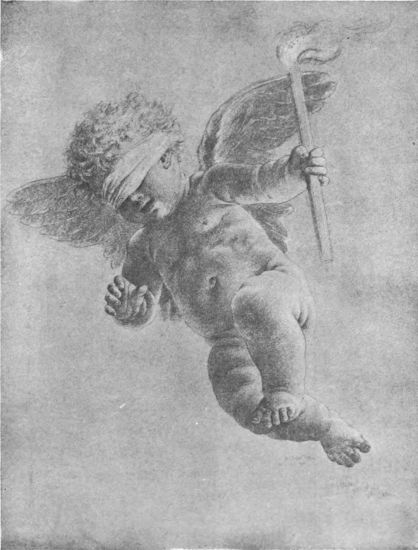
A Lost Love
From a red chalk drawing in the Collection of Mr. Thomas W. Lawson
Copyright, 1900, by John Elliott.
From a Copley Print. Copyright, 1901, by Curtis & Cameron, Publishers,
Boston.
a rag-and-bottle man for an ancestor. Nena, who sells every conceivable
bit of trash I give her, aids and abets me in these acts of
insubordination. She was not in her usual spirits. I heard her scolding
the little Jew boy who brought home an old terra-cotta cinerary urn we
had bought in the morning from his mother Sora Giulia.
“What dirty robaccia do you bring into this clean house?” she demanded
in her gruff sailor’s voice.
“Cosa ne so io? the signori bought it to-day. I heard my father say it
once contained the ashes of a soldier of the Pretorian guard.”
“What guard?”
“Of the old time, a hundred years ago, maybe; they were like the
carabinieri.”
Nena took the urn, grumbling under her breath, “Li mortacci tuoi (Your
miserable dead)!”
“Hein? what did you say?”
“Va a mori ammazzato (Go and die killed)!” She slammed the door upon
him.
A minute later she brought the urn into the den and put it carefully
down on the table where I was writing. “That rascally boy of Sora
Giulia’s brought this home.”
“You formerly were friendly with Sora Giulia.”
She wiped her eyes with a little red wrinkled hand that trembled;
something troubled her seriously.
“What has happened? tell me frankly.”
She began to cry openly: “Miché (the cat) has been gone three days; he
will never return. I shall not again see that dear animal!”
“Miché will come back; perhaps he has had a fight, as he did once
before.”
“No, no, Signora! then he was only absent one night, after the manner of
cats. No, era troppo bello, era troppo bello (he was too beautiful),”
she wailed. I suppose I looked as puzzled as I felt, for she broke into
impassioned explanations. “He was too beautiful, he was fat and tender
as well; quelli maladetti Ebrei (those cursed Jews) have killed him to
make one of their accursed feasts; they have doubtless already eaten
him; povera bestia, era troppo bello!”
To console her I proposed that we get to work on the business before us.
In a closet on the stairs, of which Nena has a duplicate key, Pompilia
had locked up empty green wicker ricotta baskets, marmalade bottles,
petroleum cans, a pair of discarded brooms, and other such rubbish.
“Can you sell the petroleum cans?”
“Ma certo, I get a paulo (ten cents apiece) for them. The poor use
them for flower pots and for many other things.”
“And these old brooms, can you get anything for them?”
“The brooms I shall not sell. It would offend the scoparo, who is my
friend and has a family to support; but as we happen to be in need of
them, I will, with your permission, take these brooms home.”
“All the articles in this closet are yours, and welcome, on condition
you take them away this evening. It is known to you that if Pompilia
were here she would never let them go.”
“You have reason, Signora; I will go immediately, taking with me all I
can carry and returning for the rest.”
After she left I went up to the terrace for the sunset. The swallows
were swooping low overhead; the smell of the gardenias would have been
overpowering indoors; the passion flower vine was in full bloom, the
oleanders ablaze with tender pink blossoms the same color as the sky. As
I was mooning about, leaning on the parapet and watching the blue fade
out of Peter’s dome, I became aware of a hubbub in the street below.
There were cries of “Una strega, una strega (A witch, a witch),”
“Scacciala, scacciala (Chase her, chase her),” hoots of derision,
screams of laughter.
“How she runs! Brava vecchiarella (Good for you, old woman)!”
“Viliacchi (Cowards)!”
The noise grew nearer, the crowd seemed to be stopping at our portone.
“Che te possono scanna (May you be slaughtered)!” The deep bass voice
was familiar. I leaned over the parapet just in time to see Nena, a tiny
figure, with two brooms over her shoulder, turn and hurl defiance at her
tormentors, in the front rank of whom I recognized the little Jew boy.
“Guastate (May you waste away)! “With this true witch’s curse Nena
managed to shut the door of the big portone in the faces of her
pursuers. I ran and opened the old green door of the apartment to let
her in.
“What in the name of the apostles has happened?”
Nena was trembling with passion.
“Ah, that Hebrew Jew! I will punish him yet. He led the others on,
saying I was a witch. Truly, Signora, it was not a happy chance that
made you give me those brooms to take home this particular evening, the
night on which the ignorant and superstitious believe that the witches
ride. In every other house in the Borgo a dish of salt and a broom are
placed outside the window, that the witches may be averted from entering
and fly away on the broomstick. Doubtless Pompilia saved these brooms
for that object—but, as you know, I am not superstitious, I don’t
believe such stuff. To take me for a witch, me!”
Nena cannot be more than four feet seven inches high; she has a rough
gray head, sharp black eyes, and a long nose. She wears a queer,
old-fashioned three-cornered shawl over her stooping shoulders, her feet
swim about in a pair of my old boots. There was, I confess, some excuse
for the jest!
St. John’s eve! Witch’s night! In order that no harm may befall one, it
is safest to sit up all night. To sit up all night alone, or in the
company of one’s family, is rather cold comfort; so the sociable Romans
spend the night in one vast nocturnal picnic. We left home at ten
o’clock; in the Piazza Scossa Cavalli we found every cab gone except the
gobbo’s (hunchback’s). This was great luck, to be driven by the
gobbo, all the more as it was by chance; if we had engaged him
beforehand, it would not have counted. As soon as we started J. sneezed.
“Salute, Signore (Your health, sir,—the equivalent of ‘Bless you’),”
said the gobbo. This meant more luck. By the time we reached the Via
Merulana the gobbo’s white horse—a white horse is lucky—dropped into
a walk. The crowd of cabs was so great that from there on to the Piazza
San Giovanni we were obliged to move at a snail’s pace.
“Volete spigo, Signori?” cried a vendor, thrusting a bunch of lavender
into the cab.
“Bisogna prenderla, Signori,” said the gobbo; “you must buy lavender
for yourself, for me, even for my poor beast. It is the rule to wear
lavender on St. John’s eve.” We bought lavender for the party, the white
horse included.
A little farther on another vendor stopped us.
“How is this?” he said gravely; “you are without red carnations; that is
not well.”
“He is right, Signori,” said the gobbo; “we must wear red carnations
as well as lavender.”
We bought enough red carnations for an army.
“What do the lavender and the carnations signify?”
“Who knows, Signora? it is the custom to wear them. One says it brings
buona fortuna, another that it keeps the witches away; it is well to
be on the safe side.”
As the cab came to a dead stop for a moment outside a trattoria, a
saucy boy sprang on the step and asked for a soldo to buy a dish of
snails.
“Do not refuse,” said the gobbo; “he is a good boy; it is the custom
on the eve of San Giovanni to eat snails and polenta, as you may see
for yourselves.”
Over the door of the trattoria hung an illuminated transparency: on
one side was a picture of a large snail, on the other a witch riding a
broomstick.
“Aglo, Aglo (Garlic). Who wants aglo? There is nothing so good
against the fascino (fascination) as aglo!”
We bought a pair of long-stemmed garlic blossoms, in shape not unlike
the classic thyrsus.
“Campanelle, campanelle, who wants the campanelle? The witches fly
away at the sound of these marvellous campanelle.”
Everybody but ourselves had apparently already bought campanelle; all
the people in the carriages and on the sidewalk carried these small
terra-cotta bells, which they rang violently at each other and at the
witches. The bells were of two sizes.
“Buy a large one for yourself, Signore, and a small one for the lady,”
counselled the gobbo.
“And one for you and one for the mare?”
“Naturally. The animal cannot well spare a hand to ring her
campanello, so we will tie it about her neck.”
Peacock feathers were next offered; the gobbo was prejudiced against
them and advised us not to buy them. There seems to be a divided feeling
about peacocks’ feathers; some people hold that they bring bad luck,
others that they avert it.
We left the carriage at the piazza, which was lined with booths,
illuminated with flaring torches. These stalls extend quite a distance
down the Via Appia Nuova, outside Porta San Giovanni. Some displayed the
classic bush, from the earliest time the sign of the wine shop. Outside
one of the most important booths hung a large painted head of the wine
god crowned with leaves, bearing the words, “A Baccho.” At some stalls
fried pancakes and gnocchi di patate were sold. Gnocchi is one of
the delicious Roman dishes. It is made of potatoes and corn meal,
bewitched together into miniature oval croquettes, and served with a
rich sauce of tomato conserve and Parmesan cheese; truly a dish fit for
the gods. Near the gnocchi booth was a stall hung with evergreens,
where a man in white linen clothes and cap stood beside an enormous
roasted hog, brandishing a huge knife.
“Majale arosto—ah che bel majale (Roast pig—oh, what a beautiful
pig).”
At some of the stands toys and dolls were sold. I was kept away from
certain of these, as J. said the toys were shockingly indecent; those I
saw were ordinary every-day toys which the elders bought for the
children. When one goes to the festa of San Giovanni one takes the
whole family along,—grandmothers, grandfathers, babies, and all. The
noisy people were all gathered together in the piazza and the Via Appia
Nuova; the quieter sort were scattered about in groups on the outskirts
of the crowd. On the right-hand side, at a little distance from the
Church of St. John Lateran, there is a hillside with ancient ilex trees.
This dark hillside was dotted with torches and candles, each the centre
of a knot of people. We soon left the turmoil in the neighborhood of
the booths, and strayed about among the quieter folks. Under a dark
gnarled tree a group of people had made themselves comfortable. On the
trunk above their heads two long garlic stalks were nailed crosswise to
avert evil. Directly below the cross sat a lovely young woman suckling a
large baby; it must have been eighteen months old. Beside her an aged
woman held in her lap a four-year-old child whose chubby hands were
stretched out to touch the nursling; in the shadow behind stood a grave
bearded man. The huckster’s cart that had brought them was drawn up near
by, the donkey could be dimly seen munching a bundle of hay.
“Behold Mary and the Child, St. Elizabeth and St. John, with the good
St. Joseph taking care of them all,” said Vincenzo, who had seen us and
followed us up from the piazza. As we stood entranced before this living
Holy Family the moon rose full and yellow over the dark hillside; for a
moment we saw it behind the head of that young mother like a halo. It
was a group worthy the pencil of Raphael.
“Che belli fanciulli (What beautiful children),” I said to Vincenzo.
St. Elizabeth, hearing the innocent words, caught the little St. John
behind her, scowling and muttering angrily at me.
“Come away, quickly,” said Vincenzo, urging me down the hill; “don’t you
know that you must never praise a child in that way of all times on the
night of San Giovanni!”
“It is time to go home,” said J. I begged a few minutes’ grace, for just
at that moment a heavy car hung with laurel garlands drawn by milk-white
oxen with gilded horns creaked into the piazza. The car was filled with
young men in costume singing to the music of guitar and mandolin. They
were all masked; from the trappings of the car and their cultivated
voices we fancied them to be persons of some distinction.
A high tenor voice pierced the babel of sound: “Sei la Rosa piu bella
che c’è (Thou art the most beautiful rose that is)!”
It was near midnight: the fun was growing fast and furious. J., who from
the first had objected to the expedition, backed up by Vincenzo, now
declared that it was impossible for me to stay longer. An unwilling
Cinderella, I was torn away on the stroke of twelve. “It is not a seemly
revel,” I was told; “dreadful things happen, respectable people do not
stay after midnight.” To me it was all a wonderful revelation; I was in
pagan Rome, where Bacchus and Vesta were worshipped, where Italy’s
spoiled children, the Roman populace, took their pleasure, as they have
done with little change ever since Rome was, since “step bread” was
distributed gratis on the steps of the Capitol, and the costly games of
the Colosseum kept them amused and pacific!
Till broad daylight I heard the people coming home ringing their little
terra-cotta bells, singing sntches of the song of the evening: “Sei la
Rosa piu bella che c’è.” As I look back at that riot of youth and age,
where the faces of faun and satyr leered at nymph and dryad, the whole
pagan scene is sweetened and purified by that vision of the Holy
Family.