Entered, according to Act of Congress, in the year 1855, by
PHILLIPS, SAMPSON & CO.,
In the Clerk’s Office of the District Court of the District of Massachusetts.
PREFACE.
The main design in view, in the discussions
which are offered to the juvenile world, under
the title of The Rollo Philosophy, relates
rather to their effect upon the little reader’s
habits of thinking, reasoning, and observation,
than to the additions they may make to his stock
of knowledge. The benefit which the author
intends that the reader shall derive from them,
is an influence on the cast of his intellectual
character, which is receiving its permanent form
during the years to which these writings are
adapted.
The acquisition of knowledge, however, though
in this case a secondary, is by no means an
unimportant object; and the discussion of the
several topics proceeds accordingly, with regularity,
upon a certain system of classification.
This classification is based upon the more obvious
external properties and relations of matter,
and less upon those, which, though they are
more extensive and general in their nature, and,
therefore, more suitable, in a strictly scientific
point of view, for the foundations of a system,
are less apparent, and require higher powers of
generalization and abstraction, and are, therefore,
less in accordance with the genius and
spirit of the Rollo philosophy.
As teachers have, in some cases, done the
author the honor to introduce some of the preceding
works of this class into their schools, as
reading books, &c., considerable reference has
been had to this, in the form and manner of the
discussion, and questions have been added to
facilitate the use of the books in cases where
parents or teachers may make the reading of
them a regular exercise of instruction.
CONTENTS. — CHAPTER I. SLOW COMBUSTION. — QUESTIONS.
The way in which it happened that Rollo’s
father first began to explain to him something
about the nature of fire, was this: It
was one evening early in the autumn. Dorothy
was going away to visit one of her
friends, and Rollo was waiting for Jonas to
come out, and see the fire-flies, or lightning-bugs,
as he called them, which were flying
about the yard. But Jonas did not come as
soon as Rollo had expected, and so he went
into the kitchen to see what had become of
him. He found that, as Dorothy was rather
late for her visit, and still had her kitchen
fire to cover up, Jonas was just offering to
cover it up for her, so that she could go at
once without any further delay. So Rollo
came in, and stood by the kitchen hearth to
see Jonas cover up the fire.
The fire had nearly burned out, but it
had left quite a large bed of embers, and a
few coals among them. Jonas took the
long-handled iron shovel, which belonged to
the kitchen fire, and with it he drew forward
all these coals and embers, so as to
leave the back part of the hearth bare.
Then he took the tongs, and with the tongs
he gathered out from the hot ashes all the
coals which he could find among the ashes,
and put them back upon the bare place
which he had made upon the hearth. He
spread them evenly over it in a row against
the back of the chimney.
“What are you going to do, Jonas?” said
Rollo.
“I am going to cover up a stick of wood,”
replied Jonas.
So Jonas opened a small door which led
to a little wood closet by the side of the fire,
and took out a short stick of wood, flat on
one side and round on the other. It was a
stick which was round first, but Jonas had
split it in two. It was part of a great
branch of a tree, large enough to make a
good log, only Jonas saw that it would split
easily, and so he had split it in two. The
other half of it was still in the wood closet.
“This is just the stick,” said Jonas.
“Why?” asked Rollo.
“Why, the lower side is flat,” said Jonas,
“to lie upon the coals, and the top is round,
so that I can cover it all up the easier.”
So Jonas laid the stick down, with the
flat side against the coals, and the round
side outwards. Then with the great shovel
he began to shovel the ashes and embers
back over it. He put all the hot embers
in first, and then the ashes, and he tried to
cover up the stick entirely; but there was
not quite ashes enough. One of the ends
remained out.
“There, Jonas,” said Rollo, “now come.”
“No,” said Jonas, “I must cover the
stick all up.”
“O, that little end won’t do any harm,”
said Rollo.
“Yes,” said Jonas, “because, when the
stick burns down, that place would make a
hole, and let too much air in.”
“Don’t you want any air to get in?” said
Rollo.
“Very little,” said Jonas. “I want a
very slow combustion to go on until to-morrow
morning, and then there will be a
good bed of coals for Dorothy.”
“I don’t see why you take so much pains
to cover up a stick of wood,” said Rollo.
“You might light a fire with your tinder-box.”
“But it takes a great deal longer to make
a good fire with a tinder-box, than when
we have a good bed of coals.”
“Then take a friction match,” said Rollo.
“I can light a friction match in half a
minute.”
“You can light the match, but not build
a fire. It takes a long time with a match
light to get heat enough to set large sticks
of wood on fire; but, with a bed of burning
coals, we can do it very soon.”
“You might have some sticks and shavings
for kindling,” said Rollo, “and they
will burn quick.”
“Yes,” said Jonas, “but it is more trouble
to prepare sticks and shavings every night,
than it is to cover up a stick of wood.”
While Jonas had been saying these things,
he had taken more ashes from the ash-hole,
and had covered the stick over entirely.
He then put away the shovel, and was
brushing up the hearth, when Rollo, after
standing a moment, as if in thought, said,—
“Jonas, what do you mean by combustion?”
“Did I say combustion?” rejoined Jonas.
“Yes, you said you wanted slow combustion.”
“Well, I meant burning. I want the
wood to burn slowly all night.”
“Then why did not you say burning,”
said Rollo, “so that I could understand
you. I don’t see where you get all your
learned words. I suppose it is out of some
of your books.”
“Yes,” said Jonas, “they call it combustion
in the books that I read, but I don’t
know exactly why. I think there must
be some difference between combustion and
burning, but I don’t know exactly what it
is.”
“I mean to ask my father,” said Rollo.
“But do you expect that that stick of
wood will burn, Jonas?” continued Rollo,
after a moment’s pause.
“Yes,” said Jonas, “it will burn slowly.
A little air will get through the ashes so as
just to keep it burning slowly. It is very
dry.”
“Suppose that there could not any air
get through at all?” said Rollo.
“Why, then,” said Jonas, “it couldn’t
burn at all. It would go out. Sometimes
I have buried up a fire so deep in ashes that
it has gone out, and then I find nothing but
black coals there in the morning, when I
rake it open. That’s the way they make
charcoal.”
“How?” said Rollo.
But Jonas had no opportunity to answer
this question then, for they were just going
out into the yard when Rollo asked it, and
the attention of both the boys was attracted
to the fire-flies. They, however, soon had
looked at the fire-flies as much as they
wished. Rollo tried to catch one, but he
could not. He would see a flash at a little
distance from him, and he would run to the
place with his cap in the air; but, by the time
that he got there, the fire-fly would of course
have gone on to another place, though Rollo
could not tell where, without waiting to see
him flash again. Then he had to run again;
but before he got to this second place the
fire-fly would be gone again. One of the
fire-flies led him a zigzag chase, in this way,
all around the yard, and finally flashed at
last just over the garden fence, so that
Rollo gave up in despair.
In the meantime, Jonas had gone to the
barn; and now Rollo went to see what had
become of him. He found him shutting
the doors up for the night, and then they
both came back towards the house, and sat
down upon the edge of the platform, under
the piazza, and Rollo asked Jonas to tell
him how they made charcoal.
“Why, they only bury up wood, as I did
my log, lightly, so that enough air can get
in, until it is burnt through; and then
they cover it up tight, so that no air can
get in, and so it goes out; and when it is
all cold, they open it, and find the heap is
all black coals.”
“How big a heap do they make?” asked
Rollo.
“O, they make a very large heap, sometimes,”
said Jonas; “as big as this.” So
Jonas rose from his seat, and marked out a
circle in the yard with a stick, which he
had in his hand, in order to show Rollo how
large a heap they make, when they pile up
wood for a charcoal bed.
“And how high do they make it?” asked
Rollo.
“As high as that” said Jonas; and he
reached his stick up in the air as high as he
could, to show Rollo how high the heap
was.
“That must take a great deal of wood,”
said Rollo.
“Yes,” said Jonas, “and when it is turned
into charcoal, they get a great many loads
of it.”
“How do they get ashes enough to cover
it up?” asked Rollo.
“O, they don’t cover it with ashes,” said
Jonas; “they cover it with turf.”
“With turf?” repeated Rollo.
“Yes,” said Jonas, “turf is the best thing
to cover the heap with. If they had ashes,
it would be very troublesome to put it on,
and then it would be sliding down, and
letting the fire break out. But they cut
square pieces of turf, and cover the heap
all over with them, very tight, and so only
just air enough gets in to keep the fire
slowly burning.”
“Slow combustion?” said Rollo.
“Yes, slow combustion,” said Jonas.
“How do you set it on fire?” asked Rollo.
“I believe they leave a hole in the middle,”
said Jonas, “from the top down to
the bottom, and then they put the fire down
there.”
“I wonder if I couldn’t make a charcoal
bed,” said Rollo.
“Yes,” replied Jonas, “you might make
a little one, I suppose.”
“How should I do it?” asked Rollo.
“Why, you might take some dry wood
from the shed, and wheel it down the lane,
and through the gate into the pasture.
Then you might take a spade, and cut up
some turf, though that would be rather
hard work for you.”
“I wish you would cut the turf for me,”
said Rollo.
“Well,” said Jonas, “perhaps I will.
Then you must hollow out a little place in
the bare spot I make by taking up the turf,
and make your pile of wood there, leaving
a hole in the middle.”
“How can I leave a hole?” asked Rollo.
“Why, you can take three short pieces
of board, as long as you intend the height
of your pile to be, and stand them up on
the ground, so as to leave a three-cornered
space between them, and then pile your
wood around the three boards.”
“So I can,” said Rollo.
“Your wood must be small,” continued
Jonas, “or else you can’t pile it very snugly
in a small pile. You had better take small
round sticks, and saw them short, and lean
them up against your boards all around,
and so make a snug pile. After the pile is
ready, you must bank up a little against
the bottom of your heap with the loose
earth, and then begin to put on the turf.
But that will be a nice business.”
“Why?” asked Rollo.
“Because you must fit them carefully all
around; and, as the heap will be round,
and will grow smaller towards the top,
square pieces of turf will not fit. You will
have to cut them into shape with a knife.
You can get an old knife to cut them with,
and so fit them together. But you must fit
them together well, or the air will get in,
and your heap of wood will blaze up, and
so it will be spoiled for charcoal.”
“I can make it tight,” said Rollo, “I
know. I’ll shave away the sides of every
turf, till it fits its place exactly.”
“There must be some air,” said Jonas,
“or else the wood will not burn at all. You
must leave a few holes around at the bottom,
to let a little air in, then you can plug some
of them up, if you find the fire burns too
fast.”
“Well,” said Rollo, “I mean to make
some charcoal some day. I’ll get my cousin
James to come and help me. I’ll begin to
saw up some wood for it to-morrow.
“But, then, Jonas,” he continued, after a
moment’s pause, “what good will the charcoal
do me when I get it made?”
“O, I don’t know,” said Jonas; “I wasn’t
thinking of your getting any good from the
charcoal. All the advantage would be, the
pleasure of making it.”
“Isn’t there anything I can do with it,”
said Rollo, “when I get it made? What is
charcoal good for?”
“It makes a very hot fire. They use it
when they want a great heat. Blacksmiths
use it in their forges.”
“I wish I had a little forge,” said Rollo.
“They use it to make gunpowder, too,”
said Jonas.
“How?” said Rollo.
“Why, they take some charcoal, and
some sulphur, and some saltpetre, and
pound it up together, and it makes gunpowder.”
“That’s what I’ll do with my charcoal,”
said Rollo, jumping up from his seat. “I’ll
make some gunpowder. I’ll ask my mother
to give me some sulphur and saltpetre, and
I’ll make some gunpowder.”
What was the condition of the fire, on the evening
when it was left to Jonas to cover up? Describe the
arrangements which he made for covering up the fire.
What was the shape of the stick of wood? Why was
this form convenient for the purpose? What plan did
Rollo propose, instead of covering up the fire? What
objection did Jonas make to this plan? What term
did Jonas use to designate the process which would go
forward, during the night, under the ashes? What did
he say that combustion meant? Would any air at all
be necessary for the slow combustion? How was the
necessary air to get access to the wood? Why could
not Rollo catch the fire-flies? How did Jonas describe
the process of making charcoal? What did he say
were the uses of charcoal? To which of these uses
did Rollo intend to put his charcoal, if he should succeed
in making any?
CHAPTER II. LAMP-LIGHTING. — QUESTIONS.
Rollo did not think to ask his father the
reason why the philosophers use such learned
language, or, as he expressed it, such hard
words, for several days. Perhaps he never
would have thought of it again, if his father
had not happened to use the word combustible
one evening, which reminded him of the
term combustion, which Jonas had used.
The occasion on which his father used the
word was this,—
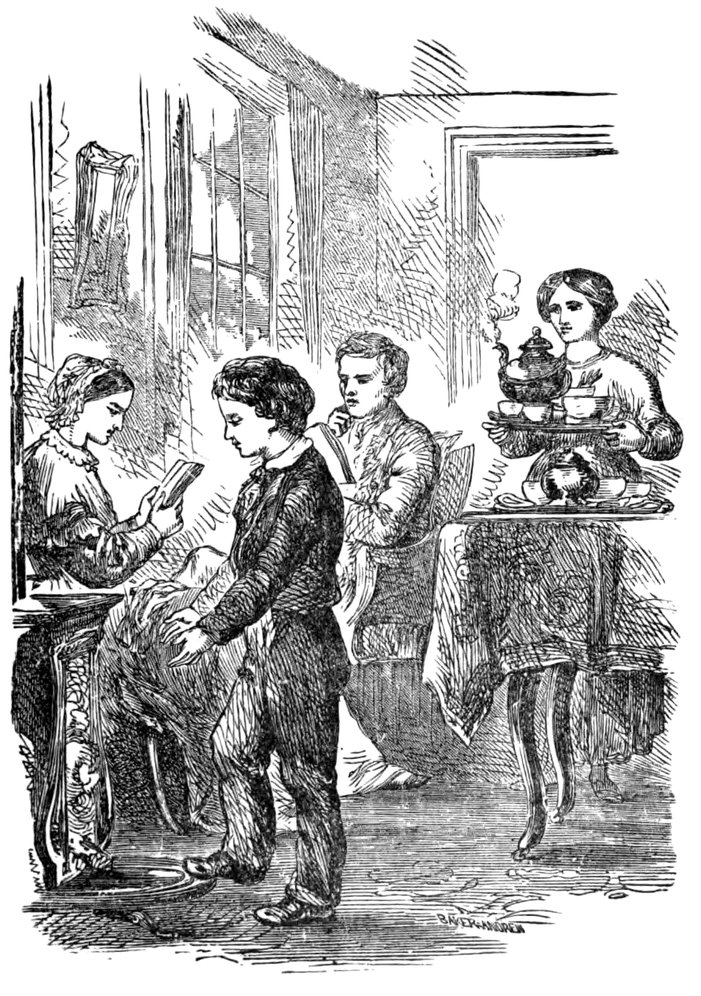
One evening, Rollo’s mother was trying to
light a little lamp, to go into her bedroom
for something that she wanted. There were,
usually, in a little vase upon the mantel-piece,
some lamp-lighters, which were long,
slender rolls of paper, that Rollo had rolled
up for this purpose. They were kept in
this vase upon the mantel-piece in order to
be always ready for use. But the vase was
now empty. The last lamp-lighter had been
used; and so Rollo’s mother folded up a
small piece of paper, and attempted to light
the little lamp, which she was going to carry
into the bedroom, with that.
But the wick would not take fire, and
Rollo saw that, while his mother was continuing
her efforts to make it burn, the
flame of the paper was gradually creeping
up nearer and nearer to her fingers. At
last, finding that there would soon be danger
of burning her fingers, she walked across
the room towards a window which was open,
still endeavoring to light the lamp. But it
was all in vain. She reached the window
just in time to throw the end of the paper
out, and save her fingers from being burned.
“Why won’t it light?” said Rollo.
Rollo’s father was sitting upon the sofa,
taking his rest after the labors of the day;
and when he saw that the lamp failed of
being lighted, he said,—
“You will have to get a longer lamp-lighter,
unless you have got some spirits of
turpentine to put upon the wick.”
“Spirits of turpentine?” repeated Rollo.
“Yes,” said his father. “In hotels, where
they have a great many lamps to light, they
have a little bottle of spirits of turpentine
with a wire running down into it; and,
when they take out the wire, a little drop of
the spirits of turpentine hangs to the end of
it, and they touch this to the wick, and then
it will light very quick.”
“Why, sir?” asked Rollo.
“Because spirits of turpentine is very
combustible, or rather inflammable.”
“That means it will burn very easily, I
suppose,” said Rollo.
“Yes,” replied his father.
“That makes me think of something Jonas
said, which I was going to ask you,”
said Rollo. “He said that, in books, burning
was always called combustion, and I told
him I meant to ask you why they couldn’t
as well call it burning.”
“I don’t think that Jonas said exactly
that,” said his father.
“Yes, sir, he did,” replied Rollo; “at
least, I understood him so.”
“It is true, no doubt,” added his father,
“that, in philosophical books, philosophical
terms are very often used, instead of the
common language which we ordinarily employ.”
“Why are they, father?” said Rollo. “I
think the common words are a great deal
easier to understand.”
“Yes,” said his father, “but they are not
precise in their signification. They are
vague and ambiguous, and so philosophers,
when they wish to speak accurately, employ
other terms, which have an exact signification.”
Rollo looked perplexed. He did not understand
at all what his father meant. In
the meantime, his mother had brought a
fresh bundle of lamp-lighters from the closet,
and had lighted her lamp with one of them,
and was just going away. As she was going
out, however, she said to her husband,—
“Please to wait a minute, until I come
back, for I should like to hear what you are
going to say.”
“Well,” said he; “and you, Rollo, may
come and sit down by me, and I will explain
it to you when mother comes back.”
So Rollo came and took a seat on the sofa
by the side of his father, saying,—
“Father, I wish you would have a bottle
of spirits of turpentine for us to light our
lamps by.”
“It is not of much advantage in a family,”
said his father, “where the lamps are lighted
in various parts of the house, and only a few
in all to be lighted. But where there are a
great many, it is quite a saving of time to
have a little spirits of turpentine to tip the
wicks with. In an illumination they always
touch the wicks so, and by that means they
can light up suddenly.”
“But, father, why will the wick light any
quicker?”
“Why, different substances take fire at
different temperatures. For instance, if you
were to put a little heap of sulphur, and
another little heap of sawdust, on a shovel
together, and put them over a fire, so as to
heat them both equally, the sulphur would
take fire very soon, but the sawdust would
not until the shovel was very nearly red hot.
So if you were to put oil in a little kettle
over the fire, and spirits of turpentine in
another kettle, and have the fire the same
under both, the spirits of turpentine would
inflame long before the oil. There is a
great difference in different substances, in
regard to the temperature at which they
inflame.”
“What do you mean by temperature, father?”
said Rollo.
“Why, heat,” said his father.
“Then why don’t you say heat?” said
Rollo.
His father laughed.
“What are you laughing at, father?” said
Rollo.
“Why, that’s the same question that you
asked me at first, and I promised to wait till
mother came before I explained it. So we
will wait until she comes.”
They did not have to wait long, for Rollo’s
mother soon returned; and she put out her
lamp by means of a little extinguisher which
was attached to the stem of the lamp itself.
Then she sat down at the table, by the light
of a great lamp which was burning upon it,
and took out her work.
Rollo’s father then repeated to her what
he had just been telling Rollo, namely, that
different substances took fire at different degrees
of heat; and he said that it would be
a very interesting experiment to take a long
iron bar, and put a small quantity of several
different substances upon it, in a row, and
then heat the bar gradually, from end to end
all alike, until it was very hot, and so see in
what order the various substances would
take fire.
“I would have,” said he, “phosphorus,
sulphur, sawdust, charcoal, saltpetre, oil,—we
should have to make a little hollow in
the iron for the oil,—alcohol, spirits of turpentine,
and perhaps other things. The
phosphorus would take fire first, I suppose,
and then perhaps the sulphur, and others in
succession.”
“Well, father,” said Rollo, “I wish you
would. I should like to see the experiment
very much.”
“No,” said his father, “I cannot actually
try such an experiment as that. I could not
get such a bar very conveniently; and, if I
had the bar and all the substances, I could
not heat the bar exactly equally. It could
not be done very well, except in a chemical
laboratory. But it would be a very pretty
experiment, if it could be performed.”
“Is there a very great difference,” said
Rollo’s mother, “in the degree of heat necessary
to set fire to these different things?”
“Yes,” said Mr. Holiday, “I believe the
difference is very great. Phosphorus inflames
below the heat of boiling water, but it takes
almost a red heat to set wood on fire. And
iron will not take fire till it is white hot.”
“Iron?” said Rollo, with surprise.
“Yes,” said his father, “iron will take fire
and burn as well as wood, if you heat it hot
enough.”
“I never knew that,” said Rollo.
“The ends of the tongs and of the andirons
do not burn,” said his father, “simply because
the fire is never hot enough to set such
a large piece of iron on fire. But if we heat
the end of a bar of iron very hot indeed in a
furnace, it will take fire and burn; and so,
if we take a very minute piece of iron, as big
as the point of a pin, a common fire would
be sufficient to heat that hot enough to set
it on fire.”
“Well, father,” said Rollo, “let us try it.”
“If we had some iron filings, we might
sprinkle them in the fire, or even in the flame
of a lamp, and they would burn.”
“I wish I had some filings,” said Rollo.
“Yes,” said his father, “they burn beautifully.”
“How can I get some?” asked Rollo.
“You can get some at a blacksmith’s
shop,” said his father. “The filings commonly
accumulate behind the vice, and you
can get plenty of them there. The next
time you go by a blacksmith’s shop, you had
better go in and ask him to give you some.”
“Well,” said Rollo, “so I will.”
“And now do you understand,” said his
father, “why it is that you can light a lamp
more easily when there is a little spirits of
turpentine on the wick?”
“Yes, sir,” said Rollo. “The spirits of
turpentine need not get so hot before it
catches fire, and so you don’t have to hold
the lamp-lighter so long, and burn your fingers.”
“Will oil always take fire when it gets to
a certain degree of heat?” asked Rollo’s
mother.
“Yes,” said his father, “I suppose so.”
“And yet,” said she, “the lamp seems to
take fire much more easily at some times,
than at others.”
“Yes,” said Mr. Holiday, “that is true.
If the wick is cut square across, and rises
up only a very little way above the tube, it
is very difficult to light it, because the tube
itself and the oil below keep the upper end
of the wick cool. It is very hard to heat it,
in that case, hot enough to set it on fire.
But if the wick projects considerably out of
the tube, then it is out of the way of the
cooling influence of the metal, and you can
heat the upper end more easily.”
“I never thought of that,” said Rollo.
“That is the operation of it,” said his
father. “And if you push the wick open a
little, so as to separate some of the fibres of
it from the rest, then it will take fire more
easily still; because the small part which is
separated, is more easily heated up to the
necessary point, than it was when it was
closely in contact with the rest, and so kept
cool by it. That is the reason why a thin
shaving takes fire so much more easily than
the outside of a large piece of wood. The
outside of a large piece is kept cool by the
parts of the wood behind it, which touch it,
while the shaving is heated through very
soon.”
“I didn’t know that before,” said Rollo.
“In the cities,” continued his father,
“the lamp-lighters, that trim and light the
street lamps, always cut the wick off, when
they trim the lamps, in a slanting direction,
so as to leave a point of the wick projecting
up on one side. This point will light very
easily, for it stands by itself, somewhat
apart from the rest, and so is not kept cool
by the rest of the wick. Then, when they
put in their great, blazing torch, it heats
this point to the degree necessary to inflame
the oil very easily.
“There is one thing more I want to tell
you, and that will be all I have to say about
lamps to-night; and that is, to explain to
you the philosophy of putting them out.
You must understand that two things are
necessary to carry on combustion or burning.
First, there must be air; and secondly,
the body burning must be kept above a certain
degree of heat. Now, if you either
suddenly shut off the air from the substance
that is burning, or suddenly cool the substance,
it will go out. For instance, the
wick,—you have to heat it to a certain
degree before it will take fire. Now, if,
after it is burning, you suddenly cool it
below that degree, it will go out; or if you
shut out the air from it, then it will go out;
for it cannot burn unless it continues hot,
and unless it continues to have a supply
of air.
“Now, when we blow out a lamp, we
stop the burning by cooling it. The cool
air which we blow against it, suddenly
cools the upper end of the wick below the
point of combustion, and so it goes out.
On the other hand, when we put it out by
an extinguisher, we stop the burning by
means of shutting out the air. Either mode
will stop the combustion.”
“And how is it when we put on water?”
asked Rollo’s mother.
“Why, that is somewhat different from
either,” said Mr. Holiday, “or rather it is
both combined. There is something very
curious in the operation of water upon fire;
that I must explain some other day, for now
it is time for Rollo to go to bed.”
What was the difficulty in lighting the lamp, as
described in the beginning of this chapter? What
method did Mr. Holiday say was sometimes adopted in
hotels to make the lamps light quick? Why would
this make them light more easily? What question did
Rollo ask his father in respect to the use of philosophical
language? Why did not his father answer the
question immediately? Do all substances take fire at
the same temperature? What substances take fire
with the least degree of heat? What experiment did
Mr. Holiday describe which he said would show this
very distinctly? Why could not he perform this experiment?
Will iron burn? Why do not bars of iron
burn in a common fire? How did Mr. Holiday propose
to show that iron would burn? How did he propose
that Rollo should get some iron filings?
CHAPTER III. BURNING IRON. — QUESTIONS.
When Rollo went out into the kitchen
that evening to get his safety lamp,—the
one which he usually took to go to bed,—he
found Jonas sitting at the kitchen table
reading; and while he was lighting his lamp,
he asked Jonas if he would not get him
some iron filings the next time he went
near any blacksmith’s shop. Jonas asked
him what he wanted of iron filings, and he
said he wanted them to burn. He then
repeated to him what his father had said in
respect to the combustibility of iron.
“I can make iron filings enough for that
experiment in five minutes,” said Jonas.
“How?” said Rollo.
“With a file,” replied Jonas.
“Well,” said Rollo; and without waiting
to hear anything further, he ran back to the
parlor to ask his mother to let him sit up
long enough to see Jonas make a few iron
filings to try the experiment.
“Won’t it do as well to-morrow morning?”
asked his mother.
“The scintillations will look brighter in
the evening,” said Mr. Holiday.
“Very well, then,” added his mother, “go,
and, if Jonas succeeds in his experiment,
ask him to send some filings in to us.”
So Rollo went out to find Jonas again.
Jonas was gone. Dorothy said that he had
gone after a file. In a few minutes he
returned, with a file in one hand, and a
large iron spike in the other.
“What is the spike for?” asked Rollo.
“Only for a piece of iron to file,” replied
Jonas. So saying, he took a small piece
of paper out of a drawer, and laid it upon
the table. Then he rested one end of the
spike upon the paper, and, holding the
other end in his hand, he filed it several
times in such a way, that the filings fell
down upon the paper.
“What fine filings!” said Rollo.
“Yes,” said Jonas; “the file is almost
worn out, and it does not cut very well.”
Rollo looked upon the paper. There were
quite a number of small, black points upon
it like grains of very fine sand. Jonas then
took up the paper carefully by the two sides,
bending the two sides upward at the same
time, to keep the filings in the middle of
the paper. In this way he raised the paper
above the lamp, which was upon the table
before him, and then holding it in an inclined
position, he let the sand slide down
into the flame of the lamp. To Rollo’s surprise
and delight, it produced a column of
sparkles rising up from the flame, which
were of the greatest brilliancy and beauty.
“Yes,” said Rollo, “they burn, they burn
most beautifully. File me some more, Jonas,
and let me carry them in and show them to
my mother.”
Jonas accordingly filed some more filings,
and Rollo went in with them very eagerly,
to show to his mother.
“Just look,” said Rollo; and so saying,
he held the paper over the lamp in such a
manner as to let the filings slide down into
the flame just as Jonas had done. The
experiment succeeded perfectly well, as it
had done before.
“So you see that it will burn,” said Mr.
Holiday, “if you heat it hot enough.”
“If you make it small enough, you mean,”
said Rollo.
“I suppose the smallness of the particles
is of no consequence,” replied his father,
“excepting to make it easier to heat them.”
“Why, father,” said Rollo, “I might put
the end of a knitting-needle in the lamp,
and I don’t see why it wouldn’t become as
hot as one of the iron filings.”
“Because,” said his father, “a part of the
heat would be conveyed away through the
knitting-needle towards your hand, and that
would keep the end which was in the flame
cooler.”
“Would it, sir,” asked Rollo.
“Yes,” said his father. “The heat moves
off very fast in such a case. You know, if
you take a pin between your fingers, and
hold the head of it in the lamp, the heat
will almost immediately move along the
metal, so as to heat the end that you are
holding, and burn you.”
“Yes, sir,” said Rollo; “I have got burned
so, very often.”
“And of course much more heat would be
conveyed away when the metal was as thick
as a knitting-needle.”
“Well, father,” said Rollo, “suppose a
piece of the knitting-needle was broken off,
and made so small that it could all be in
the flame; then would it burn?”
“How could you keep it there?” asked
his father.
“Why—I don’t know,” said Rollo, hesitating.
“Couldn’t we contrive some way
to keep it there?”
“I don’t know of any way.”
“Couldn’t we put it on the end of the
wick?” asked Rollo.
“Yes,” said his father, “perhaps we
might; but then the end of the wick is
cool, and that would cool it.”
“O, father,” said Rollo, in a tone of great
surprise, “the end of the wick cool, when it
is right in the middle of the blaze!”
“I mean,” replied his father, “that it is
cool compared with the heat necessary for
inflaming the iron. It would feel very hot
to your fingers, I have no doubt, for it is
filled with boiling oil. But then even the
heat of boiling oil is less than that necessary
to inflame iron; and so the contact of the
wick with such a piece of iron as you propose,
would keep it cool, or rather keep it
from getting hot enough to take fire.”
“Suppose there was any way,” said Rollo’s
mother, “of suspending a piece of iron
as large as the end of a knitting-needle in
the lamp; do you think it would take fire?”
“No,” said Mr. Holiday, “I don’t think
it would be heated hot enough. For some
reason or other, I don’t understand exactly
what, a large piece of iron cannot be heated
very hot in a small fire, even if the fire entirely
covers it. I don’t think that any
fragment of iron much larger than one of
Jonas’s filings could be heated in a lamp so
as to take fire. But it could be heated hot
enough in a forge. The end of the iron
which a blacksmith heats is often in a state
of combustion when he takes it out of the
fire.”
“There, now, father,” said Rollo, “you
have not explained to me yet about combustion
and burning.”
“No,” said his father; “we had almost
forgotten that. I will explain it now. It
will only take a few minutes. Let me see—I
began to tell you didn’t I?”
“Yes, sir,” said Rollo; “but I couldn’t
understand very well.”
“I was telling you that the language
which we use in common conversation is
not precise. It is often ambiguous.”
“What does that mean, sir?” said Rollo.
“Why, language is ambiguous when it
has two meanings,” said his father. “For
instance, the word burning is used in conversation
to express two or three very different
things. If you put your finger upon hot
iron, you say you have burned it. Burn,
in that case, is the name of a painful feeling.
But if you say you burned a piece of
paper, you mean that you put it into the fire,
and allowed it to be consumed. In that
case, burning, instead of being the name of
a painful feeling, is the name of a peculiar
process by which the paper is consumed and
destroyed. Thus the word burn is used to
denote two very different effects. In fact, it
is used in other senses besides these.”
“What others, sir?” asked Rollo.
“Why, when we say that a little girl was
out in the sun, and burned her face and
neck, we do not mean that her face and
neck were consumed, or that they felt a
painful sensation,—but that the skin was
reddened by the sun’s heat. So, when we
say that the grass was all burned up in the
drought, we mean that it was dried and
withered. Thus burned and burning are
used to denote a great variety of effects
produced by heat, which effects are very
different from each other in their nature.
So that, you see, when we are going to speak
philosophically of that peculiar process by
which bodies are actually consumed by fire,
it becomes necessary to have some term to
denote that process alone, and not all the
other kinds of burning. Now, the word the
philosophers use for this purpose is combustion.
The burning of a stick of wood
upon the fire is combustion, but the burning
of your finger against a hot iron is not combustion,
and the burning of bricks in a brick
kiln is not combustion.”
“Nor the burning of the grass in the
drought,” said Rollo.
“No,” said his father. “Thus you see
that combustion is a term of precise and definite
meaning; it denotes a particular process,
and that alone. But burning is a
vague and ambiguous term; it has a great
many meanings, or, rather, it stands for a
great many different effects, very much unlike
in their character. In fact, they seem
to be alike in no respect, except that they
are all produced by heat.”
“Yes, father,” said Rollo, “I understand.”
“Sometimes,” added his father, “the
word used in common life doesn’t mean
enough, instead of meaning too much. For
example, there is the word freeze. What is
the meaning of the word freeze?”
“Why, it means,” said Rollo,—“freeze?—it
means—water turning into ice.”
“Yes,” replied his father; “when water
is cooled below a certain point, it becomes
solid. It is just so with lead. Melted lead,
when it is cooled below a certain point, becomes
solid. The hardening of the melted
lead into solid lead, and the hardening of
water into ice, as they cool, seem to be phenomena
of precisely the same character, and
yet the word freeze applies only to one.
We say the water freezes, but we can’t say
the lead freezes.”
“Why not, sir?” asked Rollo.
“Because it is not the customary use of
the word. If we use the terms of common
life, we must use them as they are customarily
used, or we shall not be understood.
Freezing, therefore, will not answer to express
all cases of the hardening of a liquid
by cold, because that is a term which is only
applied to a few of the cases. Now, philosophers
want a term which will apply to all
the cases of the same kind.”
“And what is their word?” asked Rollo.
“Congelation,” replied his father.
“Congelation?” repeated Rollo.
“Yes,” said his father. “When water
becomes ice, the philosophers say it congeals.
So when lead hardens in cooling, they say
it congeals. Different substances congeal at
very different degrees of heat. If we had
melted iron and melted lead, equally hot,
and let them cool together, the iron would
congeal first; and if they continued cooling,
by and by the lead would congeal. Water
would remain liquid long after lead would
congeal; but if it was placed where it
would grow colder and colder, the temperature
would at last reach the point where
water would congeal too. But whatever
the liquid is, and whatever the point is at
which it changes from a liquid to a solid
form, it is called congealing.”
“And the word freezing, then, is only
used in respect to water,” said Rollo’s
mother.
“Why, yes,” said Mr. Holiday; “we
speak of other things freezing beside water;
but it is only such things as become solid
under great degrees of cold. We say ink
freezes, and oil, and if it were cold enough
to freeze brandy, or mercury, we should say
they were frozen. But substances that
harden when they are not very cold, as lead
or wax, are not said to freeze.”
“Thus you observe,” continued Rollo’s
father, “in common language words are not
used in a precise and definite manner. Their
meaning is determined by the outward and
visible effects that we see, and not by the
real nature of the causes. Thus a great
many different effects are called burning,
in common language, because they are all
effects produced in various ways by heat.
But the terms used by philosophers are definite
and precise, each one being confined to
one specific process or phenomenon.”
“Father,” said Rollo, “I want to see the
iron filings burn again, and I am going out
to ask Jonas to file a few more.”
“Very well,” said his father.
So Rollo went out to get Jonas to make
him some more filings, and Jonas did so.
Presently Rollo returned bringing the paper
in very carefully, with the filings upon it.
He put them down upon the table, and his
father contrived, by bending the paper in
different directions, to gather all the filings
together into the middle of it, and then, with
the point of his penknife, he took up a few
of the filings at a time, and let them drop
upon the flame of the lamp. The burning
of the filings produced, as before, the most
brilliant scintillations.
“What bright sparkles!” said Rollo.
“Yes, it is very inflammable indeed,” said
his mother.
Here Mr. Holiday dropped more filings
upon the flame, from the point of his knife.
“Does inflammable mean,” continued his
mother, “that a thing takes fire easily, or
that it burns with a great flame when it does
take fire?”
“I don’t know,” said Mr. Holiday; “I
never thought of that distinction. Some
things take fire very easily, but don’t make
a great flame. There’s sulphur, for instance;
it takes fire before it gets very hot, but it
burns with a very small and faint flame.”
“Let us try it, father,” said Rollo.
“We can’t try it very well, because there
is no fire. I suppose the fire in the kitchen
is covered up. But if there was a fire, and
we were to put a little sulphur upon a shovel,
and a small piece of paper by the side of it,
and hold them over the fire, we should find
that the sulphur would take fire before the
paper would even begin to be scorched; but
it would make only a very small blue flame.
The paper would not take fire nearly as
easily; but we should find that when it did
take fire, it would make a much larger and
brighter flame.”
“I wish you would try it, father,” said
Rollo; “you can uncover the coals in the
kitchen, and find fire enough.”
“Well,” said his father, “I will.”
His father accordingly rose from his seat,
and asked Rollo to go into the kitchen, and
get the shovel, and bring it to the medicine
closet. While Rollo was getting the shovel,
his father went to the closet, and took down
a little jar half filled with sulphur. When
Rollo brought him the shovel, he took out a
little of the sulphur upon the point of his
knife, and laid it upon the shovel. He also
took a small piece of paper, and laid it upon
the shovel by the side of the sulphur. Rollo
then led the way to the kitchen, followed by
his father with the shovel, and his mother
came behind.
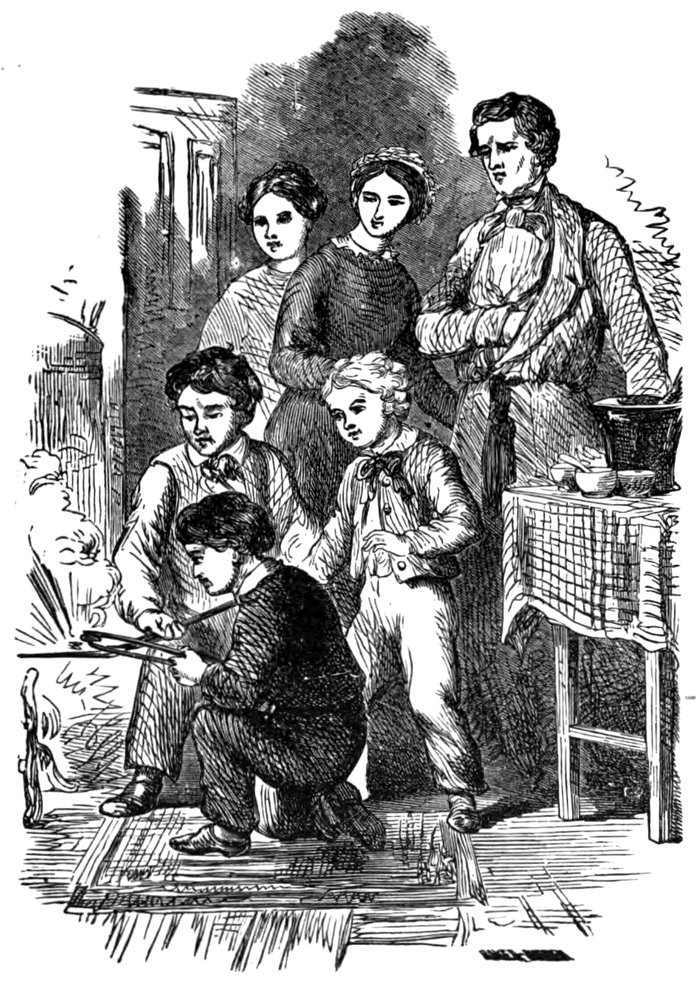
They opened the coals a little, and placed
the shovel upon them. Jonas and Dorothy
looked on with great interest, wondering
what they were going to do. The sulphur
began to melt almost immediately after the
shovel was placed upon the coals; and, in a
very short time, Rollo observed a faint blue
spot on the place where the sulphur had been
lying.
“There,” said his father, “see what a
small flame.”
“Yes,” said Rollo; “it is nothing but a
little blue spot.”
“And the paper is just as whole and white
as ever it was.”
“Let us wait till the paper gets hot enough
to burn.”
“I don’t think it would ever get hot
enough to burn,” replied his father, “over
such a fire as that. I must light it in the
lamp.” So he waited a few minutes until
the sulphur was entirely consumed, for he
said that he did not wish to have any of the
fumes get into the room; and then he
dropped the paper off from the shovel down
upon the hearth, and Rollo picked it up.
His father lighted it in the lamp, and then
placed it upon the shovel to see it burn, in
order that Rollo might compare the magnitude
of the flame which was produced with
that of the sulphur. Of course, such a small
piece of paper did not make a large flame,
but it was four or five times as large as that
produced by the sulphur.
“Now the question is,” said Mr. Holiday,
“which is most inflammable,—the sulphur,
because it inflames most easily, or the paper,
because it makes the greatest flame when it
does take fire?”
“I should think the paper,” said Rollo.
“There is alcohol,” said Mr. Holiday,
“which takes fire very easily, but it burns
with a very pale and light flame. Oil must
be heated much hotter before it will burn;
but, when it does burn, it gives a large and
bright flame; so that oil is good for lamps,
it gives so much light when it burns.
“Spirits of turpentine,” continued Mr.
Holiday, “inflames easily, and burns brightly
too. So does phosphorus.”
“What is phosphorus?” said Rollo.
“Why, it is a substance that burns very
easily. It looks like wax, but it burns very
easily, and with a very bright flame indeed.
It takes fire before it is as hot as boiling
water.”
“I wish I had some phosphorus,” said
Rollo.
“They keep it at the apothecaries, sometimes,”
said his father.
“I wish you’d buy a little, father,” said
Rollo, “and bring it home, and let me see
it burn. Does it cost much?”
“I don’t know,” said his father, “how
much it costs. Only it is troublesome to
keep it. It must be kept under water.”
“Why, sir?” said Rollo.
“To keep it from taking fire. Even the
sun shining upon it would heat it hot enough
to set it on fire.”
“O father!” said Rollo.
“Yes,” said his father; “and so, for safety,
they make it in the shape of sticks, and keep
it in a phial filled with water.”
“Well, father,” said Rollo, “I wish you
would get a little in a phial, and let me put
a piece of it upon a paper in the sun, and
let me see it catch fire.”
“I’ll think of it,” said his father, “next
time I go into town. But phosphorus, you
see, is certainly very inflammable, because it
takes fire very easily, and burns brightly too.
But I don’t know which would be said to
be most inflammable, sulphur or resin; for
instance, sulphur inflames the quickest, but
resin will make altogether the greatest
blaze.”
“I should think the resin,” said Rollo.
“We can’t tell by reasoning about it,”
said his father; “it depends on the usage of
the word. We will go into the other room,
and look in the dictionary.”
So saying, they all went into the parlor
again, and looked into the dictionary, to
learn the precise meaning of the word, inflammable.
The definition given was, “easily
kindled into a flame.”
“Then,” said Mr. Holiday, “if this definition
is correct, the sulphur and the alcohol
are most inflammable, because they are most
easily kindled.”
Just then the clock struck, and Rollo’s
mother said,—
“Why, Rollo, it is half an hour past your
bedtime.”
So Rollo bade his father and mother good
night, and went out into the kitchen once
more to get his safety-lamp, to go to bed.
He stopped, however, a moment, as he was
going out of the door, to say,—
“Now, father, be sure and not forget to
buy me some phosphorus.”
What did Jonas say when Rollo told him about burning
the iron filings? How did he make the filings? Did
the experiment of burning them succeed? Why will
not a large piece of iron burn in the flame of a lamp?
What did Mr. Holiday say to Rollo’s proposal to hold
the end of a knitting-needle in the lamp? Why will
not the terms that are employed in common conversation
answer for philosophical use? What is the meaning
of ambiguous? What are the different meanings of the
word burn? What is the difference between the words
freeze and congeal in respect to the extent of their meaning?
What question did Rollo’s mother ask in respect
to the meaning of the word inflammable? What did Mr.
Holiday say? What experiment did he perform to
illustrate the two meanings? How was the question at
last decided?
CHAPTER IV. FIRE IN THE PASTURE. — QUESTIONS.
A few days after Rollo’s father gave him
the instructions on the subject of combustion
which are contained in the last chapter,
Rollo saw Jonas going across the yard about
the middle of the afternoon, with a lantern
in his hand. Of course Rollo called out to
him with the usual question in such cases,—
“Where are you going, Jonas?”
“I’m going out into the pasture to set
some heaps on fire.”
“Well,” said Rollo, “and I’ll go too.”
Rollo ran into the parlor to ask his mother
if he might go too. He happened to meet
his father just coming in at the front door.
He accordingly asked him instead.
“Yes,” said his father, “but I’m rather
afraid to have the heaps set on fire this afternoon.
I am afraid that the fire will run.”
“Run?” repeated Rollo.
“Yes,” replied his father. “Tell Jonas
he must be very careful not to let the fire
get away from him.”
Rollo ran off in pursuit of Jonas. When
he got to the back yard again, he saw Jonas
going down the lane almost out of sight.
“Jonas!” said Rollo, calling out as loud
as he could, “Jo—nas!”
So saying, he ran off after him. He clambered
over the great gate which led into the
lane, because he thought that he could climb
over it quicker than open it. As soon as he
reached the ground on the other side, he ran
on, calling out,—
“Jonas! Jonas!”
But Jonas did not seem to hear him. At
any rate he did not stop. On the contrary,
Rollo was himself stopped, by hearing a
voice behind him, as if near the house,
calling,—
“Rollo! Rollo!”
Rollo turned to see who it was. It was
his cousin James, who was running towards
him with all speed. Rollo waited for him
to come up. James tried to open the gate,
but could not.
“Climb over,” said Rollo.
So James climbed over, and soon reached
the place where Rollo was standing, and the
two boys walked on together. James said
that he had come to play with Rollo that
afternoon. Rollo said that he was very glad,
and he told James that he and Jonas were
going to make some fires in the pasture.
The heaps which Jonas was going to set
on fire, were heaps of decayed wood, consisting
of old stumps, logs, and roots, and other
rubbish which he had gathered up from the
ground and piled up in the pasture some
weeks before. By being left in heaps, so
that the sun and air had free access to them,
they had become thoroughly dry, and were
all ready to burn with a touch. There were
not a great many of the heaps, for it was
only a small part of the pasture which had
such logs and stumps left in it. The place
was on the side of a deep dell, with a brook
flowing through the middle of it at the bottom.
Rollo and James crossed the brook
upon a log, and then ascended the steep side
of the hill, among the heaps which Jonas
was burning.
Jonas had set two heaps on fire and was
just putting a burning brand into the third
heap. Rollo and James wanted Jonas to let
them set the heaps on fire. He told them
that they might; and the boys accordingly
went to work, taking brands from the heaps
which were already burning, and carrying
them to the others. The heaps were not
only very dry, but quite hot, on account of
the influence of the rays of the sun beating
upon them; and, besides this, there was a
fresh breeze blowing, which made the fires
burn up very fiercely. The fires which had
been first made soon became so hot, that the
boys could not get near them to take any
brands from them.
Thus they went along from heap to heap,
setting them on fire, only Jonas succeeded
in setting them on fire much faster than
James and Rollo. Jonas looked around at
them at one time, and he found them endeavoring
to kindle a fire at a large heap
which had been built up around a tall stump.
The stump was twice as high as Rollo’s
head. Rollo and James were kneeling
down upon the ground, and blowing the
end of the brand, by which they were trying
to kindle the fire. But they did not
succeed. Instead of that, the wind blew the
smoke into their faces.
“Make the fire on the windward side,”
said Jonas.
“Which is the windward side?” said
James.
“The side that the wind blows against,”
replied Jonas.
“Yes,” said Rollo, speaking to James,
“we have got our fire on the wrong side.
Let us move it round to the other side, and
the wind will blow it for us.”
So they took up their brands, and put
them upon the other side of the heap. The
wind fanned them a little, but did not
make them blaze.
“Just put some dry pieces on,” said
Jonas, “and leave them. As soon as they
get heated a little, they’ll blaze.”
The boys followed Jonas’s direction, and,
after putting a few dry pieces upon the
smoking brands, they left this heap, and
went to another; though they had first to
go back to one which was on fire, and get
some more brands.
“How do you set them on fire so fast,
Jonas?” said Rollo.
“Why, I don’t stop to watch them,” said
Jonas, “to see them burn. I put a brand
down upon the windy side of the heap, and
then cover it with dry pieces, and leave it,
and let it burn up in its own time. It will
burn as soon as it has time to get heated.”
“Yes, James,” said Rollo; “my father
explained it to me. When wood gets heated
above a certain point of heat, it takes fire.
Sulphur takes fire before it gets heated so
hot.”
“O Jonas,” said Rollo, “why didn’t you
pile up this heap?”
Rollo had come to a place where there
was a long log lying upon the ground,
broken to pieces and decayed, and near it
several fragments of roots and stumps scattered
around.
“O, come away, come away from there,
Rollo,” said Jonas; “there is a wasp’s nest
there.”
Rollo and James ran off back towards
Jonas.
“A wasp’s nest?” said James.
“Yes,” said Jonas. “I began to pile up
that wood, and heard a buzzing under the
log; and I looked down, and saw some
wasps buzzing about a hole. We must
burn up the wasp’s nest.”
“Well,” said Rollo, “come and do it
now.”
Jonas was coming to burn up the wasp’s
nest; but, as he was passing along towards
it, his attention was suddenly arrested at
seeing that the flames from one of the fires
were beginning to spread rapidly upon the
ground. There was quite a large circle in
the grass, which had been burned over and
blackened, and, at the outer edges of it, the
flames were still spreading rapidly,—driven
by the wind.
“Look! look!” said Jonas; “our fire is
running.”
“Yes,” said James; “it is burning up all
the grass.”
Jonas ran to the edge of the circle, and
began trampling upon the flames, to put
them out. The flames were very light, for
the grass was thin, and so the fire was easily
extinguished at any one spot; but, while
Jonas was putting it out in one place, it was
spreading in another, and he could not put
it out so perfectly but that it would flame
up and begin to spread again when he went
to another place. James and Rollo stood
by somewhat frightened, and not knowing
what to do.
“We must get some water,” said Rollo,
“from the brook. I’ll go and get a pail.”
“No, a watering-pot,” said James, “a
watering-pot will be best. Let’s go and get
a watering-pot.”
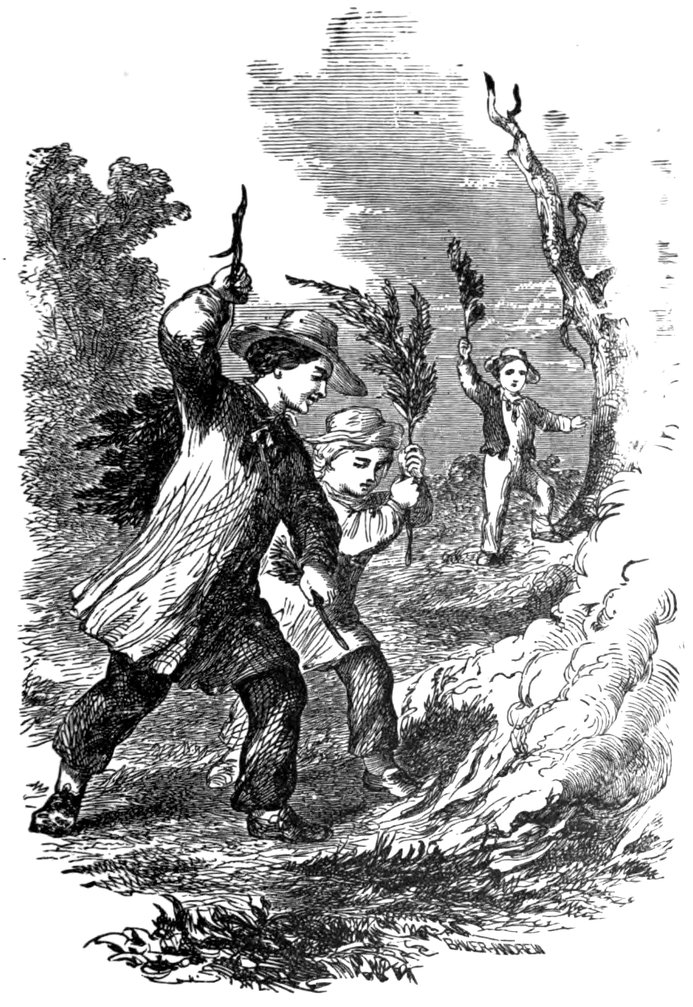
“No,” said Jonas; “we must whip it out
with bushes. I’ll cut some bushes. Come
down here with me.”
So Jonas ran down to the bank of the
brook, where there were a number of low
fir-trees growing. Now, the leaves of the
fir-tree are very small and slender, but they
stand very thick upon the branches, so that
they make a very thick and heavy foliage.
Jonas cut off a branch of the fir-tree, and
gave it to Rollo. Then he cut off another
for James, and another larger for himself;
and, armed with these, the boys hastened
back to the fire.
They began to whip and brush the little
line of flame, and they found that they could
put it out very easily. Every blow which
Jonas struck, extinguished a line of the fire
as long as his branch. Rollo and James
threshed the ground with great vigor, too,
and they put out a great deal of the fire. In
fact, they soon extinguished all the flames
which were creeping up the side of the hill
from this first fire, except at one end, where
it had got into some thistles, which Jonas
had mowed down some time before, and
which were now lying upon the ground dry
and warm, and so thick that they made
quite a hot fire. Rollo was whipping upon
these thistles, when Jonas said,—
“Stop, Rollo; it is of no use to whip such
a hot fire as that; it is only wasting your
strength.”
“Then we can’t stop it,” said Rollo.
“Yes,” said Jonas; “wait until it has
gone over the thistles, and burned them up,
and then it will come to the thin grass
beyond, and there we can whip it out.”
So the boys stopped to rest while the
thistles were burning, surveying, in the
meantime, the large space which had been
burned over, and which looked scorched
and blackened.
“Now, all that grass is spoiled,” said
Rollo.
“O, no,” said Jonas; “it hasn’t hurt the
grass. It has only burned the dry tops and
the weeds. The roots of the grass are all
safe, and the ashes left by the fire will make
them grow all the better next summer.”
“Then, Jonas, let’s burn the ground all
over.”
“No,” said Jonas; “if so large a surface
gets on fire, we can’t stop it, till it runs into
the fence, and sets that on fire,—or else gets
over into the other field.”
So saying, Jonas pointed to a large level
field or pasture over the fence, where the
grass and weeds were much higher than
where they were. The grass and weeds in
this other field extended back some distance
to a piece of woods; and Jonas said that, if
the fire got into the woods, he could not tell
how far it would go, or what mischief it
would do. “So you see we must be sure and
not let the fire get away from us,” said he.
Just then, Jonas saw that the fire was beginning
to spread from another of the heaps;
and he went to it to watch it. He said he
was going to let it run a little way before he
put it out, for he knew that if a piece of the
ground around the heap was once burned
over, the fire would not spread again from the
heap.
So he waited, and, when the circle from
that heap had become as large as he wished,
he and the boys whipped it out; and then
they went back to the first fire, which was
now getting beyond the thistles, so that they
whipped that out too. Rollo and James felt
much relieved, now that they perceived that,
by the aid of their fir-branches, they had the
fires so entirely under their control.
About this time, Rollo saw his father coming
through the trees, on the other side of
the brook. His father had been a little
afraid that Jonas would get into difficulty
with his fires, and had come out to see. He
found, however, that Jonas knew how to
manage the business. He took a branch,
and began to help the three boys whip the
fires, as fast as they spread beyond the limits
which they concluded to allow them.
“I didn’t know that the grass would burn
so before,” said Rollo.
“It will not,” said his father, “unless it is
both hot and windy. This is an illustration
of what I explained to you the other day.
When grass is heated above a certain point
it takes fire. Now, when one blade of grass
is burning, it does not usually produce heat
enough to raise the next one to such a degree
of heat that it will take fire; but this afternoon
it will; for now the heat of one little
tuft burning is enough to heat the next one
sufficiently to cause it to take fire, because
it is already partly heated by the sun.”
“And the wind helps,” said Rollo.
“Yes,” replied his father, “the wind
helps in two ways. It blows up the grass
that is burning, and makes a greater fire of
it, and then it blows the hot air and flame
against the grass next to it. Thus it makes
the heat greater, and at the same time
drives it against the fresh grass. I presume
this fire would not spread at all if there
was no wind. You see, in fact, that it does
not spread much in any direction, except
where the wind blows it.”
“And if there was a wind, and yet the
grass was not hot, would it spread then?”
“No,” said his father, “I presume not.
For instance, in the evening, when the
ground and grass are cool, I don’t think
the fire would run on the ground. That is,
I don’t think the heat of one row of blades
would heat the next row enough to make
them take fire, unless they were partly
heated by the sun beforehand.”
“I should like to try it some windy evening,”
said Rollo.
“There would be the dew in the evening
also, which would tend to prevent the fire’s
running.”
By this time, all the heaps had been set
on fire, and the circle of fire which spread
out from each one had been whipped out;
so that there was now not much danger
that the fire would spread, and Mr. Holiday
went away. Jonas, however, said that he
must stay and watch the heaps, and Rollo
and James concluded to stay with him.
But, after a short time, they became tired
of poking the embers; and so Rollo proposed
to James to go with him, and help
him make some charcoal.
“I have learned how they make charcoal,”
said Rollo.
“Well,” said James, “I’ll go; but what
good will charcoal do us?”
“Why, we can make gunpowder out of
it,” said Rollo.
“Well,” said James, “I should like to
make some gunpowder very much.”
So the boys went away towards the house,
to get the wood to make their charcoal.
What objection did Mr. Holiday make at first, to having
the heaps set on fire? How was Rollo arrested
when he was in pursuit of Jonas? What were the
heaps composed of which Jonas was going to set on
fire? In what condition were they in respect to inflammability?
Was there anything besides their dryness
which made them particularly inflammable at this time?
Describe Rollo’s attempt to set a heap on fire. What
course did Jonas pursue? Describe the appearances
exhibited when the fire began to run. How did Rollo’s
father explain to the boys the causes which made the
fire run in the grass that afternoon more than at any
other time? Describe the mode which Jonas adopted
to stop the progress of the fire in the grass. Did he
always stop it as soon as it first began to run? Why
not?
CHAPTER V. THEORY AND PRACTICE. — QUESTIONS.
There is a great difference between understanding
theoretically how a thing is
done, and being able actually to do it; for,
in practice, various difficulties are apt to
occur, which are not foreseen by one who
knows only the theory. Rollo and James
found this to be the case, in their efforts to
make charcoal. Rollo felt very confident
that he understood the whole process perfectly,
and that he should find no difficulty
whatever in carrying it through successfully.
He was not aware how many difficulties
occur in the practical execution of
what appears beforehand to be attended
with no difficulty at all.
“Are you sure you can make charcoal?”
said James.
“Yes,” said Rollo, “I know I can. Jonas
told me everything which I must do. First,
we must get some short sticks of wood.”
He and James went to the shed, and
selected some pieces of wood, which Rollo
said would be suitable for their charcoal
bed. He put them into a small saw-horse,
which Jonas had made for him to saw wood
in, and without much difficulty he sawed a
sufficient quantity. James put the sticks
into Rollo’s little wheelbarrow as fast as
they were sawed. It was not very long
before the wheelbarrow was filled nearly
full.
“Come, Rollo,” said James; “here is
enough.”
“No,” said Rollo; “let us fill the wheelbarrow
full.”
“Why, Rollo,” said James, “you’ve got
enough already to make a barrel of gunpowder.”
“O, it won’t all come into gunpowder,”
said Rollo; “some of the wood will burn
up, I expect. You see we are going to have
slow combustion.”
“Slow what?” said James.
“Slow combustion,” replied Rollo; “don’t
you know what combustion means?”
“No,” said James.
“It means burning; that is, one kind of
burning. You see there are a great many
kinds of burning. Combustion is when it
burns all up. If you put your finger in the
fire and burn it, it doesn’t burn up, does
it?”
“I suppose it would, if I held it in long
enough,” said James.
“Yes,” said Rollo—“but,——there, I
think we’ve got enough now. If you’ll
be wheeling it along, I’ll go and get some
fire.”
So James wheeled the wheelbarrow along
towards the gate, and Rollo went into the
house after some fire. He found that the
lantern was not there, for Jonas had carried
it into the pasture; and as Dorothy said
that it would not be safe for him to carry
any coals out, on such a windy day, he took
some matches of the kind that take fire by
being rubbed against any thing hard, and
went along after James.
Rollo had intended to ask Jonas to cut
him some turf, to cover his charcoal bed
with; but he had not done it yet, and so
he got a spade to carry along with him,
thinking that he and James could cut the
turf themselves. The spade was rather
heavy to carry, and so he took hold of the
handle, and dragged it along, letting the
blade trail upon the ground. He overtook
James at the great gate.
They passed through the gate, and went
on, James trundling the wheelbarrow, and
Rollo following him with the spade. At
last, they came to the place where Rollo had
determined to have his charcoal bed. It
was a smooth piece of grass ground, a short
distance beyond the garden, and so far from
any fence that there was no danger of setting
the fences on fire. It was, in fact, a
very suitable place. Rollo had selected it
with great discretion.
“And now,” said Rollo, “the first thing
is to dig up some turf. We want some
large pieces of turf.”
“What for?” said James.
“Why, to cover up our charcoal with.”
“What do you want to cover it up for?”
said James. “Besides, I should think you
would want to make it, before you cover it
up.”
“Why, that is the way we make it,” said
Rollo; “we have to cover the wood up
with turf.”
“O, the wood,” said James, “you said
the charcoal.”
“No, the wood,” replied Rollo; “we want
to cover up the wood.”
“Then it won’t burn,” said James, “if
you cover it all up with turf.”
“Yes,” replied Rollo; “it will burn very
slowly. We don’t want it to burn fast.
That is the very reason why we cover it up
with turf, to keep it from burning fast.”
“I should think it would be best to pour
a little water on it,” said James, “if it was
burning too fast.”
“No,” said Rollo; “we must cover it up
with turf. Jonas said so. And I must cut
it.”
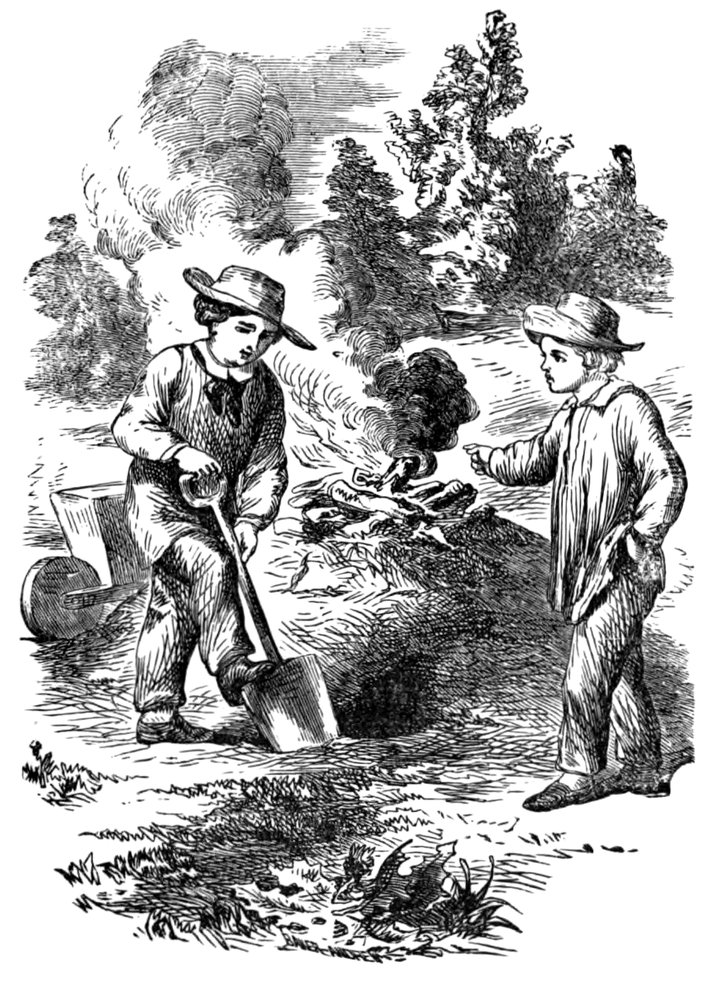
So Rollo began to cut turf with his spade.
He found it, however, very hard. It is very
hard work to cut turf. After he had cut a
square place out, it was very difficult to
crowd the spade under it, so as to get the
piece of turf out. He, however, succeeded
in cutting one piece; and then the next
was easier. After working patiently for
about a quarter of an hour, stopping occasionally
to rest, and to wish that Jonas
would come and finish cutting the turf for
him, he succeeded in laying bare a spot of
ground large enough for his coal bed; and,
on looking at the pieces of turf which he
had got off, he could not but hope that they
might possibly be enough to cover his wood
with. At any rate, he thought he would
try it; for he could cut more, he said, if at
last he found that he should want more.
He therefore began to pile up his wood in
the spot left bare by the removal of the
turf.
“We must leave a hole down in the middle,”
said he to James, “to put the fire in.
I ought to have had some boards for it.”
Rollo wanted James to go up to the
house, and get some short boards; but
James said that he did not know where he
could find any, and finally Rollo concluded
to make the hole as well as he could by
leaving a space, in piling the wood. He
succeeded pretty well in doing this. In
fact, he piled his heap very well, making it
compact and snug, and rounding it up on the
top as Jonas had directed, so that it could
be easily covered with the turf.
“Now,” said Rollo, “we will cover it up.
You hand me the pieces of turf, James, and
I will put them on.”
James handed Rollo one large piece of
turf, and Rollo placed it against the side of
his heap of wood. He then brought him a
second, and Rollo attempted to place it next
to the first, but it did not fit very well.
“There now,” said Rollo, “I haven’t got
any knife.”
“What do you want a knife for?” asked
James.
“To cut off some of this turf, and make
it fit into its place.”
“Must you make it fit exactly?” asked
James.
“Yes,” said Rollo; “so Jonas said. But
I can cut it with the spade.”
So Rollo laid down the piece of turf upon
the ground, and attempted to cut away one
side of it with the spade. He could not do
it very well. He was not strong enough to
do it with one blow, and, in striking down
the spade upon it repeatedly, he could not
always hit the same place; and so he mangled
the edge, and bruised it to pieces.
However, it fitted better than it did before,
though there was still an interstice left, at
the lower corner, between the two pieces of
turf and the ground.
“It doesn’t fit exactly,” said Rollo; “but
no matter. There must some air get in.”
He placed the other pieces of turf in a
row around the heap. After he had gone
all around, there were some left, but not
enough to cover the top over. They, however,
covered it as well as they could, and
then Rollo said he would kindle the fire and
put it in; and then, while it was getting a
burning, he would cut some more turf, and
finish covering it.
They had some difficulty in getting fire.
In the first place, the match would not light.
Rollo did not see any thing to rub it upon
but the handle of the spade, and that was so
smooth and glossy, from long use, that it did
not produce friction enough to inflame the
match. Finally, James rubbed one of the
matches upon the side of the wheelbarrow,
and that lighted it; but then they had no
kindling ready, and, of course, as the large
sticks of wood could not be lighted by a
match, James, after holding it until it was
just ready to burn his fingers, threw it down.
Then Rollo did what he ought to have done
before. He collected together some leaves
and dried grass, and splinters of wood, which
he found lying about, so as to have some
combustibles ready when the next match
should be lighted. By this means they soon
had a little fire at a short distance from the
heap of wood which they had prepared for
their charcoal bed.
As soon as their fire began to burn, they
attempted to move it into the hole in the
middle of the heap of wood. They took
off the little sticks and chips from the fire,
which were blazing at one end, and dropped
them one by one into the hole.
“I don’t believe the fire will burn down
in that hole,” said James.
“Yes it will,” replied Rollo. “That’s
the way they always set the charcoal beds
on fire.”
But, notwithstanding Rollo’s confidence,
the chips and sticks, though they had burned
very freely while in the open air above, did
not appear at all inclined to burn in the
hole. One reason was, that the boys did
not wait long enough for them to get well
heated. The ends which were together
were on fire, it is true; but the other ends
were cold, and the heap of wood was cold,
so that every little brand, though it was
blazing when the boys took it off the fire,
was at once chilled below the point at which
combustion continues as soon as it was
dropped into the hole. Consequently, after
they had dropped all the pieces in, they saw
nothing but smoke come out, and even the
smoke grew dim.
“It is all going out,” said James.
“We must make a bigger fire,” said Rollo.
“I wish I had a pair of tongs here to take
out the old sticks, and then we would make
a bigger fire.”
But Rollo had no tongs; and so he was
obliged to take down his pile in part, in
order to get the dead brands out of the middle
of it. Then they built another little fire.
They waited for this until it was much hotter;
and so they succeeded at last in
getting a little fire to burn in the middle of
their heap of wood.
“As soon as it begins to burn pretty well,”
said Rollo, “I must cover it all up with
sods.”
“Then that will put it all out,” said
James, “I know.”
“No,” said Rollo; “it will only make it
burn slow.”
“I think it will put it all out,” replied
James.
Rollo himself had some misgivings whether
his wood would really burn very well, when
all covered up with turf, and he thought
that at any rate he would let it get well on
fire before he put the turf on. In the mean
time, he took the spade, and began to cut
the turf, to have it ready.
He found it now very hard to cut the
turf,—both because he was tired of cutting
it, and also because he had now to begin in
a new place, as his woodpile covered the
place which he had taken the turf off from
before. It is always harder to cut the first
turf than it is those that come afterwards.
Rollo succeeded in getting one or two
more pieces, and as soon as the heap of wood
seemed to be pretty well on fire, he put
these pieces on over the top; but they were
not enough to cover it, and as the fire increased,
the flames came up more and more
from the spaces left uncovered.
“O dear me!” said Rollo. “I can’t cut
the turf fast enough to cover it.”
So Rollo began to shovel up the earth
from the place which he had made bare by
taking off the turf, and to throw it upon the
fire. This had an immediate effect in suppressing
the flames which were breaking out;
and by continuing to throw on earth, he at
length got the fire fairly subdued. The
earth did not cover the heap. It slid down
among the interstices of the wood, and
smothered the fire, so that pretty soon Rollo
thought that the fire was burning slowly
enough to make charcoal.
“If we had some water in a watering-pot,
that would be better,” said James.
“So it would,” said Rollo.
“Then we could make the fire burn just
as slowly as we pleased,” said James.
“Yes,” said Rollo; “let us go and get a
watering-pot. We can get back before it
burns up again.”
“Well,” said James; “and we’ll carry up
the wheelbarrow and the spade.”
So Rollo took the wheelbarrow, and James
the spade, and they walked along towards
the house, talking about what they should
do with their gunpowder when they had got
it made. They came at length to a narrow
place in the walk, where James walked on
before, Rollo following him with the wheelbarrow.
Rollo trundled the wheelbarrow
along very close to James’s heels, and so
James, to avoid it, ran on. Rollo followed,
pursuing him, and so James, to escape, ran
off upon the grass, to get out of Rollo’s way.
But Rollo still followed him, both boys
making the air resound with shouts of
laughter, until, at length, James, finding that
he was still pursued, turned around, and
planted the blade of the spade upon the
ground, just before the wheel of the wheelbarrow.
The wheel ran up against it, and
was stopped, and thus James was protected.
The boys amused themselves in this way
for some time, entirely forgetting about their
watering-pot. After satisfying themselves,
however, with this fun, they began to move
along towards the house. They found
Rollo’s little watering-pot, and they carried
it to the pump to fill it with water. They
got into a great frolic at the pump, too.
James would hold the watering-pot, while
Rollo pumped, and then, when it was full he
made believe try to sprinkle Rollo, to pay
him, as he said, for running over him with
his wheelbarrow. Rollo would run off
around the yard, and James after him, holding
up the watering-pot, with the spout elevated,
ready to discharge a shower of water
upon him, if he could only get near. When
he got pretty near, he would tip up the
watering-pot, and out would pour the water
in a great number of curving jets, which
spouted out towards Rollo, as he ran. When
the water from the watering-pot was exhausted
by this operation, they would go
back to the pump, and fill it again. In the
mean time, the wood of their charcoal bed
was all burning away.
It was an hour, in fact, before they got
back to the charcoal bed; and when they
reached it, it was a mere bed of embers and
ashes. The combustion, instead of having
been slow, had gone on with great violence
and rapidity, and the wood was entirely consumed.
Rollo and James looked upon it for
a few minutes in silence.
“We’ll put it out now, at any rate,” said
Rollo; and he took the watering-pot out of
James’s hand, and began to pour the water
upon the burning bed before him. It made
a great hissing and steaming; and, when
he had done, the boys had before them
plenty of hot mud, made of ashes and water,
but no charcoal.
What preparations did James and Rollo make for
their charcoal bed? Did they find it difficult or easy
to cut the turf? How did they arrange the wood?
Did Rollo begin right to cover the wood with turf?
What was the first difficulty which he encountered?
What tool would have been best for cutting the turf
into the right form? What tool did Rollo attempt to
use instead? What was the difficulty in the operation
of it? What plan was at length proposed for checking
the combustion, instead of putting on a tight covering
of turf? Why did they leave their work and go to the
house? What detained them on this expedition? In
what condition did they find the charcoal bed on their
return?
CHAPTER VI. GUNPOWDER. — QUESTIONS.
When Rollo and James went home it
was nearly tea-time, and they found Jonas
just coming from the pasture. They told
him of the ill success of their experiment in
charcoal-making, with countenances expressive
of great disappointment and chagrin.
“It is no matter,” said Jonas; “you have
had your afternoon’s amusement, and that’s
all you want, isn’t it?”
“No, indeed,” said Rollo; “by no means.”
“Why, what else do you want?” asked
Jonas.
“Why, we want some gunpowder,” said
James. “We are going to make our charcoal
into gunpowder.”
“You needn’t have made a charcoal bed
for that,” said Jonas. “You can get all the
charcoal you want to make gunpowder with,
out of the kitchen fire.”
“The kitchen fire!” said Rollo.
“Yes,” replied Jonas. “You can pick
up plenty of little black coals in the corners.”
“Will they do?” asked James.
“Yes,” said Jonas; “why not?”
“I didn’t know that they were charcoal,”
rejoined James.
“Yes,” said Jonas.
“And will you help us make our gunpowder?”
asked Rollo.
“Why, it is rather a dangerous business,”
said Jonas.
“Why, we will be very careful, you know,
Jonas, not to get blown up,” said Rollo.
“O, I’m not afraid of getting blown up
with any gunpowder you can make. That
wasn’t the kind of danger I was thinking of.”
“What danger then?” said Rollo.
“Why, danger of getting the sulphur on
your clothes, and smutting your face with
the charcoal.”
“Why, Jonas,” replied Rollo, “if we get
the sulphur on our clothes, we will brush it
off again; and, as to the smutting, we won’t
touch the charcoal to our faces.”
“It is very difficult,” replied Jonas, “to
have any thing to do with charcoal, without
getting blacked with it. You can hardly
look at it without crocking your face.”
“O Jonas,” said James, “I could, I
know.”
“Then, besides,” continued Jonas, “you
can’t brush the sulphur off your clothes. If
you once get it on, some of it will stay, and
your clothes will always smell of sulphur
whenever you come near a fire. I don’t
think that your mother would be willing
that you should have any thing to do with
sulphur and charcoal.”
“I mean to ask her,” said Rollo.
Rollo went in to ask his mother, but he
found that tea was ready, and so he and
James went in and took their places at the
tea-table. When the boys proposed their
plan of making gunpowder, they found
Rollo’s mother, as Jonas had supposed, quite
averse to any such operations. However,
when his father came in and heard their
conversation on the subject, he said that he
would take charge of the business, and then
his mother would have no objection.
“Well, sir,” said Rollo, “I’m glad of
that; for perhaps Jonas wouldn’t know
how to make it.”
“He can prepare the materials, at any
rate,” said his father. “So, after tea, you
may go out and ask him to get three tea-cups,
and to put about three or four tablespoonfuls
of sulphur in one, and of saltpetre
in another, and charcoal in another. Only
the saltpetre and the charcoal must be pulverized.”
“Pulverized?” said Rollo; “what do you
mean by that?”
“Why, powdered,—that is, pounded up
very fine.”
“How shall he pound them?” said Rollo.
“In the iron mortar,” said his mother.
“Dorothy will give it to him.”
“And when they are all ready,” continued
Rollo’s father, “come and tell me.”
Accordingly, immediately after tea, Rollo
and James went out to give Jonas the
directions about preparing the materials.
Dorothy gave Jonas the mortar. She also
brought out three tea-cups, and put them
upon the kitchen table. Jonas picked up
from the corner of the fireplace a few small
coals, and put them into the mortar and
then, took up the pestle.
“O, more,” said Rollo; “we want more
than that.”
“Yes,” said Jonas; “but we must take a
little at a time.”
“Why?” asked Rollo.
“Because,” replied Jonas, “if I put much
into the mortar at once, I can’t make it fine.
I must only have a little, and then the pestle
and the bottom of the mortar come close
together, and so it grinds up the smallest
pieces.”
When Jonas had pounded up the charcoal
which he had put in at first, he poured the
black powder out into one of the tea-cups,
and then put in more charcoal, which he powdered
as before. He proceeded in this way
until he had filled one of the tea-cups nearly
half full. He then washed out the mortar,
and put it down to the fire to dry. Then
he took a glass jar, which Dorothy had
brought him from the closet, and which was
nearly full of a substance which looked like
salt, and poured some of it into the mortar.
“Is that the saltpetre?” said Rollo.
“Yes,” replied Jonas.
“It looks like salt,” said Rollo.
“Yes,” rejoined Jonas, “and tastes a little
like salt.”
Rollo and James both wanted to taste a
little of the saltpetre, and they did. In the
mean time, Jonas had poured some of it into
the mortar, and was grinding it up with his
pestle; and, when Rollo asked him where
saltpetre came from, and what it was for,
Jonas said he did not know any thing at all
about it, and went on pounding and grinding
with his pestle.
Dorothy now brought out another jar,
containing sulphur; and as soon as Jonas
had finished pulverizing his saltpetre, and
had put it all into its cup, he poured out
some of the sulphur into the third cup.
The jars and the mortar were now put
away, and Jonas got two sheets of wrapping-paper,
and put upon the table, for he said he
thought it probable that they might want
some, in trying the powder.
“I expect your father will want a pair of
scales, too,” said Jonas.
“What for?” asked Rollo.
“To weigh out the materials,” replied
Jonas. “I don’t know what the proportions
are; but I suppose that they must be mixed
in right proportions.”
“What are the right proportions?” asked
Rollo.
“I don’t know,” said Jonas, “but I suppose
your father will know.”
“Well,” said Rollo, “I’ll go and call
him.”
So Rollo went in, and told his father
that they were all ready. He found his
father at the library looking at a large book.
“Come, father,” said Rollo.
“Seventy-five parts of saltpetre,” said his
father, reading out of his great book, and
appearing not to pay any attention to what
Rollo said,—“seventy-five parts of saltpetre,
eleven and a half of sulphur, and thirteen
and a half of charcoal. Seventy-five
to eleven, that is, about seven to one. Say,
six times as much saltpetre as of each of
the other two. That will be near enough.”
“Come, father,” said Rollo again; “we’re
all ready.”
“Yes,” said his father, “I’ll come.”
Rollo returned into the kitchen, and his
father followed him. His mother came, too,
for she wanted to see them make the gunpowder.
Jonas asked Mr. Holiday if he
should want a pair of scales.
“No,” said he, “we can guess at the proportions
near enough. We can’t expect to
make very good gunpowder.”
“Why not, sir?” said Rollo; “the things
are all good that we are going to make
it of.”
“Very likely,” said his father; “but we
cannot make them fine enough,—nor mix
them intimately.”
“Why, father,” said Rollo, “Jonas has
made them very fine indeed.”
“Yes, I have no doubt that he has pulverized
them as well as it can be done in a
mortar. But it is not possible to make
them as fine in that way as they do in the
powder-mills. Then, to mix them properly,
they ought to be wet and ground together
a long time. We can’t stop to do that.
“And now, first,” he continued, “I want
you all to observe how these various materials
will burn by themselves, and then see
how differently they will burn together.”
Mr. Holiday then took up a coal of fire,
and put it upon the shovel; and he asked
Jonas to hold it for him in the fireplace,
under the throat of the chimney, so that
the smoke and fumes might not come out
into the room. He then took from the cup
which had the sulphur in it, a little of the
sulphur upon the point of his knife, and
laid it down gently upon the coal of fire.
It burned with a very small and faint blue
flame. It burned very slowly, and the flame
continued for some time; but the flame was
not much bigger than the sulphur itself
which caused it.
He then tried the same experiment with
the saltpetre. The effect was very different,
though in this case there was scarcely any
flame. It made a little faint flash, accompanied
with a slight crackling sound. Then
he tried the charcoal, but it did not appear
to burn at all. It lay in a little black heap
upon the burning coal, just as Mr. Holiday
put it on. After a time, however, it began
to grow red upon the under side, and finally
became red throughout; and then it could
hardly be distinguished in appearance from
the coal which it was lying upon.
“So you see,” said Mr. Holiday, “that
these three ingredients are not very combustible
by themselves; at least, they burn
very quietly, and with very little flame.
Now, we will mix them together. We want
a tea-spoon Dorothy.”
Dorothy brought a tea-spoon.
“And the mortar. I can mix them better
in the mortar.”
So Dorothy brought the mortar, too. Mr.
Holiday measured out six tea-spoonfuls of
saltpetre from the cup which contained that
ingredient, and put it into the mortar.
“There must be about six times as much
saltpetre as sulphur and charcoal,” said he.
“That is not exact, but it will be near
enough, I presume. Now, I will put in one
tea-spoonful of sulphur and one of charcoal.
I suppose, however, I ought to go by the
weight, and not by bulk.”
“What do you mean by that, sir?” said
James.
“Why, it ought to be six times as much
saltpetre by weight, and not by measure.
It wouldn’t take six tea-spoonfuls of saltpetre
to weigh six times as much as one tea-spoonful
of sulphur, I presume; for I should
think saltpetre is much heavier. I suppose
saltpetre is heavier than either sulphur or
charcoal. So I will put in two tea-spoonfuls
of sulphur, and two of charcoal, to make
up for their lightness.”
“I should think it would be better to
weigh them,” said Rollo.
“Yes, it would be rather better, but it
would take more time, and we will see how
our gunpowder burns without being exact
in the proportions; and if it does not succeed,
then perhaps I will try again, and
weigh out the ingredients, and see if it
makes the gunpowder any better.”
While saying this, Mr. Holiday had been
gently rubbing and mixing the powders in
the mortar. He said he must rub them
gently, for, as the pestle and mortar were
both of iron, if he rubbed hard, he might
possibly set his gunpowder on fire.
“O father,” said Rollo, “I don’t believe
it would take fire by just rubbing in a mortar.”
“No,” said his father, “I don’t think it
would, myself; but it might, possibly. I
have heard of powder-mills taking fire by
the friction of the mills in grinding the powder,—though
I don’t suppose it would be
possible to set fire to any such powder as
we can make, by rubbing it in a mortar.
Still it is well to be on the safe side.”
After Mr. Holiday had mixed the compound
sufficiently, he poured it out of the
mortar upon the sheet of brown paper which
Jonas had prepared.
“Is that gunpowder?” said Rollo, in a
tone of incredulity.
“I think it is somewhat doubtful myself,”
replied his father.
“It does not look like gunpowder,” said
Rollo’s mother.
This was true. The substance before
them was different in its appearance from
gunpowder in two respects. It was not
grained like gunpowder, but was fine and
impalpable, like dust. Then it was of a
lighter color. Mixing so much saltpetre,
which was white, with the charcoal and sulphur,
prevented its being so dark as common
gunpowder. At least, Mr. Holiday
thought that this was the reason, and he
suspected that, in some way or other, he had
got too much of the saltpetre in his composition.
At any rate, the powder looked like
nothing but a heap of gray dust.
“The proof of the pudding is the taste,”
said he; “so we’ll try it.”
He accordingly took up about half a tea-spoonful
of the gunpowder, and put it upon
the shovel, and he asked Jonas to hold it in
the fireplace, so that, if it did burn, the
smoke might go up chimney. Rollo wanted
to touch it, and his father gave him leave.
So he took up a small coal of fire with the
tongs, and touched the top of the little heap.
To their great pleasure and surprise, it
blazed up suddenly and violently.
“Yes,” said Rollo, “it’s gunpowder! It’s
real gunpowder, I do believe!”
“Let me touch some of it,” said James.
Mr. Holiday put another half tea-spoonful
upon the shovel and let James touch it. It
flamed up like real gunpowder, just as before.
“The great peculiarity of gunpowder,”
said Mr. Holiday, “is, that it burns without
air. Other combustibles, when shut up in
a confined space, will not burn. If they are
set on fire previously, they go out when
they are closely shut up from the air. But
gunpowder burns the more violently the
more closely it is shut up. There seems to
be something in some of the ingredients
which takes the place of air; so that, when
people drill a hole in a solid rock, and pour
gunpowder down to the very bottom of it,
in a place where nothing else would burn,
and then ram down pounded bricks into the
top of the hole, so that no air can get in, if
they get fire to the gunpowder, it will burn
there more fiercely than any where, and
tear the rock to pieces.”
“How do they get the fire down?” asked
Rollo.
“They put a wire in,” replied his father,
“before they put in the bricks; and then
when the bricks are pounded in hard, they
draw up the wire, and that leaves a little
hole extending down to the powder. Then
they pour fresh powder into the hole, and
put shavings on the top, and then set the
shavings on fire, and run away.”
“I should like to see them blow up a
rock,” said Rollo.
“We must make an artificial rock for
our gunpowder,” replied his father, “and
see if our powder will burst it. I’ll try, if
you will go into the other room, and get
the ball of twine out of the drawer.”
While Rollo was gone after the ball of
twine, his father took a piece of strong
wrapping-paper, which Jonas got for him,
and, bending it around over his hand in a peculiar
manner, he formed it into a conical sort
of cup, into which he poured the gunpowder
which he had made. This paper cup
was pointed at the bottom, growing larger
and larger upwards. He then folded over
the upper part, so as to enclose the powder
completely; and, when Rollo brought the
twine, he began to wind the twine around
it, as if he was going to tie it up. Rollo
and James expected that he was going
pretty soon to cut off the string, and tie it;
but instead of that, he went on winding it
up like a ball. After he had carried the
string round a number of times, he began
to wind it tighter and tighter, taking care,
however, always not to pass the twine over
the little tip or apex of the cone. By this
means, in a short time the whole paper was
covered in every part with the twine except
the apex, which remained exposed.
“There,” said he, when he had finished,
“I have enclosed the powder now in this
ball, and confined it tight. We can imagine
this to be a rock. The air cannot get at it.
If it burns at all, it must burn by means of
its internal composition. Now we will go
out and set it on fire. Jonas must get a
short board and a few shavings.”
While Jonas was gone after the board and
shavings, Mr. Holiday made a little more
gunpowder in the mortar for priming, as he
said. When it was ready, they went out to
the door, where they found Jonas with a
board, and a little basket of shavings.
Mr. Holiday put the board down upon the
ground at a little distance from the door.
Then he placed his wound parcel of gunpowder
upon the board, with the tip down.
With his penknife he made a little opening
into the gunpowder at the tip, so that a little
of it came out upon the board. He then
poured his priming down at the same place,
and laid the shavings carefully upon it. He
finally folded up a paper, and lighted it in
the house, and came up cautiously and
lighted the shavings. The others all stood
upon the piazza looking on, and Mr. Holiday
himself, as soon as he saw the shavings began
to burn, retreated to the same place of
security. The shavings burned slowly for
some time. The flame approached nearer
and nearer to the charge; for a minute, the
flame seemed to come from the very apex
of the cone, and Rollo had just come to the
conclusion that the powder would not go
off, when suddenly there was a flash and a
great puff of smoke, and immediately after
a loud explosion. The children ran to the
spot and found that the ball in which the
gunpowder had been enveloped, was torn
all to pieces, and the fragments of the twine
were slowly burning.
Why was Rollo particularly sorry that he failed in
making the charcoal? What did Jonas tell him?
What dangers did Jonas anticipate in his making gunpowder?
What did his father say to his request? What
preliminary arrangements were made? What is the
meaning of pulverize? Of impalpable? How did Jonas
pulverize the charcoal? How did Rollo find his father
employed, when he went to call him? What did his
father say that the proportions were? Did he attempt
to be exact? Did he suppose that the parts ought to be
measured by bulk or by weight? Which did he think
was the heaviest of the materials? How did he make
allowance for this? What was the success of the experiment?
How did their gunpowder differ from real
gunpowder in appearance? In what respect does gunpowder
differ from other highly combustible substances?
How did Mr. Holiday confine his gunpowder, to
show whether it had the property of burning without a
supply of air?
CHAPTER VII. THE ALARM. — QUESTIONS.
After the explosion, James said that it
was time for him to go home. It was about
sundown. Rollo said that he would go
home with him to keep him company, if his
mother would let him. She had no objection,
and Rollo and James went away together.
Rollo went with James to the door of the
house where James lived, and then, bidding
him good night, he left him, and began to
return. When he had got about half way
home, he saw a lady and a gentleman coming
along the road. As he approached
nearer to them, he found that it was his
father and mother, taking a walk. Rollo
joined them. They said, however, that
they had walked far enough, and so in a
few minutes they turned round, and went
towards home.
“Didn’t our gunpowder go pretty well,
father?” said Rollo.
“Yes,” replied his father, “better than
I expected it would, without being more
accurate in our proportions.”
“It was a very good experiment, I think,”
said Rollo.
“Yes,” replied his father, “it was a good
experiment, and it will prove useful to you,
if it impresses upon your mind the nature
of that property of gunpowder on which its
power depends; namely, that its combustion
is within itself. It doesn’t need the outward
air.”
“Yes, sir,” said Rollo.
“There are other things that are more
inflammable than gunpowder; that is, they
will take fire more easily, and make a
greater flame; but they cannot burn unless
they have air. There is phosphorus, for example;
it will take fire a great deal more
easily than gunpowder, and I believe it will
make a greater flame; but it must have air,
and it can’t burn any faster than fresh air
can get to it.”
“Then phosphorus will take fire easier
than gunpowder,” said Rollo’s mother.
“Yes,” said Mr. Holiday; “that is, with
a less degree of heat. I presume that, if I
were to rub phosphorus in a mortar, it
would almost certainly take fire. These
friction matches are made of some composition
of phosphorus, and the heat of
rubbing the end upon a board is enough to
set the composition on fire. But gunpowder
would not burn by being rubbed so. But
still, though less heat is required to inflame
phosphorus than gunpowder, still air is
necessary for the phosphorus, and it is not
necessary for gunpowder; so that gunpowder
will burn in confined places when
phosphorus will not.
“Suppose, for instance,” continued Mr.
Holiday, “that we had a barrel of phosphorus
and a barrel of gunpowder, both open
at the top, and were to set them on fire.
The gunpowder would burn at once from
the top to the bottom at a single flash,
without any help from the outward air.
The phosphorus would take fire on the top,
and burn down gradually, as fast as the air
could come to the flame. It would burn
very fast and furiously, and I think it likely
it would make, in all, a greater flame than
the gunpowder. But then it would burn
gradually and only as fast as it could get a
supply of fresh air; so that if, while it was
burning, men were to come and cover it all
over with wet blankets, so as to keep away
the air, it would smother it, and put it all
out.”
“The water of the wet blankets would
put it out,” said Rollo.
“No,” said his father; “it would be the
same with any thing dry, if it would keep
out the air. I presume, if a great quantity
of dry sand was poured over it, it would
put it out. But wet blankets or dry sand
put over a barrel of gunpowder, even if we
could have time to do it, would have no
effect at all in stopping the burning; for
the burning is not dependent upon the outward
air at all; the combustion is entirely
within itself; that is the essential peculiarity
of gunpowder, on which all its powers
depend.”
“I don’t see why it should burst open
what it is confined in, after all,” said Rollo’s
mother.
“Nor I,” said Rollo. “I should think it
might burn up, without tearing things to
pieces.”
“I don’t know myself,” replied Mr. Holiday,
“exactly why it has such an expansive
force. I’ll look in some book, when I get
home, and see if I can find an explanation
of it. But, at any rate, you see the difference
in the manner of its burning. Now,
there is wood, for example; it burns by
degrees, as fast as the fresh air can come to
it. When you put a stick of wood upon
the fire, if it is dry and warm, and the fire
is hot, first the outside takes fire. This
burns because the air can get access to it.
But the inside does not burn at all. If we
were to take a stick off the fire, after it had
been burning for half an hour, and saw it
in two, we should find the middle as sound
and solid as ever.”
“Should we sir?” said Rollo; “I should
expect to find it all black coals.”
“No,” replied his father. “The blackness
only extends in a very little distance;
and the wood within is not burned any faster
than the outside gets burned off out of the
way, so as to let the air come to the inner
layers, one after another.
“And there is a very curious contrivance
in nature,” continued Mr. Holiday, “for
supplying the fire all the time with fresh
air.”
“What is it?” asked Rollo’s mother.
“Why, air is so constituted, that heat
swells it, and makes it lighter; so that the
air that is next to the outer layer of the
wood, when the wood first begins to burn,
becomes heated, and swells, and so, growing
lighter, it immediately rises and goes out of
the way, and a new supply of good, fresh
air comes in to take its place. By the time
that this is no longer good to promote the
burning, it gets heated and rises; and so,
there is a constant stream of hot air, that
has passed through the fire, rising, and fresh
air coming in to take its place. That is the
reason, Rollo, why we have chimneys in a
house. A chimney is nothing but an opening
over a fire, so that the air can rise up
through it as fast as it passes through the
fire, and all the smoke and sparks pass
up too.”
“I thought a chimney was only to let the
smoke up,” said Rollo.
“No,” replied his father, “that is not all,
by any means. If a fire made no smoke, it
would still be almost as necessary as it is
now to have a chimney. In fact, some fires
do not make any smoke; some kinds of coal,
dug out of the ground, do not make any
smoke, and charcoal fires do not make any
smoke; but still it is always necessary in
such cases to have chimneys.
“Because,” he continued, “you must understand,
that air gets changed in passing
through a fire, so that it will not answer
afterwards either to breathe, or to make a
fire burn again; and therefore there must
be some way for it to escape, not only out
of the way of the fire, but also out of the
room where people want to live and breathe.
There is always such a stream of air rising
up from every fire, great or small, even from
a lamp.”
“Why, father, is a lamp a fire?” said
Rollo.
“Certainly,” said his father, “it is a small
fire made by burning oil on the top of a
wick, and the hot air rises in a constant
stream above it. So in a room, if there was
no chimney over the fire, all the air that had
passed through the fire, and become heated,
would ascend to the top of the room. I saw
the proof of this once, in a very singular
manner.”
“How was it, sir?” said Rollo.
“It was one day when I was travelling.
It was in the winter. I came to a hotel
and was going up stairs to my room just
before dinner. When I got to the head of
the stairs, and was about going along the
passage-way to my room, I saw, a little way
before me, a door open, which led into
another room; and there was a thick stream
of white smoke, pouring out in the most
beautiful manner, at the upper part of the
door, and falling up to the ceiling.”
“Falling up!” said Rollo.
“Yes,” said his father. “It looked precisely
like a little waterfall, falling up.
There was no smoke at all coming out,
except close to the top of the door; and, as
soon as it got out, it went up to the ceiling
of the entry, and from that it spread all
around like water. It was very beautiful,
but I had not time to stop to admire it, for
I presumed that the room was on fire.”
“And did you cry fire?” said Rollo.
“No,” replied his father. “It is never
best to call out for help, unless you are
sure you need it. My room was very near.
I remembered that my pitcher was full of
water in my wash-stand. I ran and got the
pitcher, and went into the room which the
smoke was coming from. I saw a great
blazing by the side of the fireplace.”
“And did you run and pour your water
on?” said Rollo.
“No,” replied Mr. Holiday; “I didn’t
pour it on, for in that case a great deal of it
would have all run down upon the floor, and
been wasted. I went up to the place, and
put my hand into the pitcher, and began to
sprinkle the water on as fast as I could, and
it put the fire right out at once.”
“What was it that was burning?” asked
Rollo.
“A basket of chips,” replied his father.
“A basket of chips!” repeated Rollo.
“Yes,” replied his father. “It seems that
the man who occupied that room had gone
out without taking down his fire, and he
had left a small basket, with a few chips in
the bottom of it, near the corner. Now,
while he was gone, one of the sticks of
wood had burned off, and the two ends outside
of the andirons, not having been burned
at all, were heavy; and so the ends of the
stick fell over, one on one side and the
other on the other. The stick which fell
over towards the basket, threw a coal against
it and set it on fire; and the basket, being
very dry and thin, burned very fast.
Scarcely any thing of the size makes a
greater blaze, than a basket, for it is thin,
and of such a form that the air can get to
it on both sides.”
“That was a narrow escape,” said Rollo.
“Yes,” replied his father, “I think it
was.”
“And I expect the landlord thanked you
for saving his house from burning up,” said
Rollo.
“On the contrary,” replied his father, “I
had a scolding.”
“A scolding!” exclaimed Rollo.
“Yes,” replied his father; “I stepped out
into the entry, and asked the chamber-maid
who was there, if she would go and ask the
landlord to come up into that room. When
he came, I pointed to the wet and blackened
ruins of the basket, and said,—
“‘We came very near having a fire, sir.’”
“And what did he say?” asked Rollo.
“Why, he thought that it was my room,
and he was quite angry, and began to scold
me for being so careless as to leave that
basket so near the fire.”
“And what did you say?” asked Rollo.
“Nothing,” replied his father.
“Nothing!” exclaimed Rollo.
“No, I did not say any thing at all. I
listened to hear all that he had to say, and
then I went away to my room.”
“Why didn’t you tell him?” said Rollo.
“I thought I would let him find out in
his own way,” replied his father.
“And did he find out?” said Rollo.
“Yes,” replied his father. “He came to
me after dinner, and made a very humble
apology. He told me that he was very
sorry for what he had said, but that he supposed
that that was my room.”
“And what did you tell him?” asked
Rollo.
“I told him it was of no consequence,—and
that a man who allowed himself to condemn
before he made inquiry, must expect
to fall into some mistakes.”
Under what circumstances did Rollo find himself taking
a walk with his father and mother? What did Rollo’s
father say was the peculiar and essential property of gunpowder?
Which is more inflammable, phosphorus or gunpowder?
How did Mr. Holiday illustrate this? What
did Mr. Holiday say about the expansive force of burning
gunpowder? By what process are fresh supplies of
air furnished to fires? Why does the air which has once
passed through the fire rise? What is a chimney for?
Would a chimney be necessary if a fire made no smoke?
Relate the incident which occurred to Mr. Holiday at the
tavern. What example of prudence and presence of
mind is furnished by this case? What example of hasty
judgment? What example of patient forbearance?
CHAPTER VIII. RADIATION AND CONDUCTION. — QUESTIONS.
There are two ways by which the heat
or the warmth of one body passes off to the
other bodies around it. One is called radiation,
the other conduction. Rollo learned
the meaning of these terms, and the distinction
between them, under the following circumstances:—
One pleasant morning, late in the autumn,
Rollo’s father said that he was going away
on some business, about fifteen miles, and he
told Rollo’s mother that, if she would like to
take a ride, he should be very glad to have
her go too. She said that she should like to
go very much, and she proposed that Rollo
should go with them. Mr. Holiday had no
objection to this arrangement, and accordingly
Jonas was ordered to put both horses into
the carryall, and bring it up to the front
door.
“And, on the whole, Jonas,” said Mr.
Holiday, “you may go with us too, and that
will relieve me of all care of the horses.”
There were two seats to the carryall.
Rollo sat with Jonas on the front seat, and
his father and mother behind. They had a
very pleasant ride in the forenoon, but at
noon it looked rather cloudy, as if it might
be going to rain. Rollo said he was afraid
that it would rain before they should get
home.
“No matter for that,” said Jonas.
“Why, then we shall get wet,” said Rollo.
“No matter for that,” said Jonas.
They were detained longer than they had
expected to be at the place where Mr. Holiday
had his business to do, so that it was
rather late when they set out on their return
home. After they had rode about an hour,
it looked still more like rain, and at length,
Rollo felt a little drop upon his cheek. He
said, in a complaining tone,—
“There, Jonas, it is going to rain, for it
begins to sprinkle now.”
“Rollo,” said Jonas, “when it rains, the
best way is to let it rain; for there is no
knowing what good may come of it.”
“I don’t think any good can come to us,”
said Rollo, “to be out in this storm, and
night coming on. I should think that you
might drive faster.”
Jonas was driving pretty fast, and the
rattling of the wheels made so much noise,
that Rollo’s father and mother did not hear
what he and Jonas were saying. Nor did
Rollo hear the conversation in which his
father and mother were engaged. They
were, in fact, discussing the expediency of
not attempting to get home that evening,
but of stopping, instead, at a little village a
few miles before them. As it was growing
cold and late, and as there was every appearance
of an approaching storm, they concluded
to do this; and so, to Rollo’s surprise,
when they came into the village, his
father said to Jonas,—
“Jonas, you may drive up to this hotel on
the right; we are going to stop here for the
night.”
Jonas and Rollo were both glad to hear
this. Jonas drove up to the door, and Rollo
and his father and mother were soon transferred
from their places in the carryall,
which were beginning to be cold, and cheerless,
and uncomfortable, to a pleasant little
parlor, with a bright fire in the fireplace,
and a table in the middle of the room spread
for tea.
Now, it happened that, in this little parlor,
the fire was made in what might be
called a fireplace-stove, that is, a stove made
in the form of a fireplace. It stood out
upon the hearth, and from the top of it a
stove pipe ascended towards the top of the
room, and there passed back into the chimney.
The fire was not built in this room until
the party which was to occupy it arrived,
but the room became warm very quick.
Rollo was surprised that the room became
warm so quick, and his father said that such
an arrangement as that, namely, a stove
standing out upon the hearth, with a pipe
above, warmed a room very quickly; and
one reason was, that it operated by conduction
as well as by radiation, whereas a fire
in a common fireplace could only warm the
room by radiation. Then Rollo wanted to
know what conduction and radiation meant.
His father explained them to him while
they were waiting for the tea to be brought
in.
“There are two ways by which heat
moves,” said his father. “One way is by
shooting swiftly through the air like light.
Hold your hand up before the fire.”
So Rollo held his hand up before the fire
as his father had directed.
“Do you feel the warmth of the fire upon
your hand?”
“Yes, sir,” said Rollo.
“The heat comes from the fire to your
hand very swiftly through the air, and
makes your hand feel warm.”
“How do you know it comes so swift,
sir?” said Rollo.
“I will show you,” said his father.
So his father looked about the room, and
he saw a large book lying upon a table between
the windows. He got the book, and
brought it to the fire.
“Now,” said he, “I will hold the book
between your hand and the fire. Then the
heat cannot come to your hand.”
So Mr. Holiday held the book between
Rollo’s hand and the fire, and Rollo said
that he could not feel the heat.
“Now,” said his father, “I will take the
book away suddenly, and we will observe
what will be the effect. If the heat moves
slowly through the air, it will be some time
before you begin to feel the warmth; but
if it shoots through to your hand quick, you
will feel it immediately.”
So saying, Mr. Holiday suddenly withdrew
the book.
“Yes, sir,” said Rollo; “I feel it immediately.”
Rollo’s father then told him to go back
from the fire as far as he could go, and still
feel the heat upon his hand, and then he interposed
the book between the fire and his
hand just as before. Rollo still found that
he could feel the heat from the fire instantly,
after his father took the book away.
“Now, that is radiation,” said Mr. Holiday.
“Radiation?” replied Rollo.
“Yes,” said his father. “Heat radiates
from a fire, in all directions, through the air.
Heat radiates, too, from all bodies that are
hot, or warmer than the air around them.
Go and hold your hand near the stove pipe,
and see if you can feel the heat radiating
from the stove.”
Rollo did so. He said he could feel the
heat very plainly, though he had to hold his
hand nearer than was necessary when he
was feeling the heat of the fire.
“Yes,” said his father; “that is because
the pipe is not so hot as the fire. If the
pipe was as hot as the fire, it would be red
hot, and then you could feel the radiation
as far as you do that of the fire. However,
there is some radiation, though the pipe is
not very hot. There is always radiation
when the thing is warmer than the air
around it. There is radiation from your
face.”
Here Rollo put his hand up towards his
face, to try whether he could feel the radiation.
“You can’t feel it very well with your
hand,” said his father, “because your hand
is warm, and so that radiates too. But if
you hold your hand up very near to your
face, perhaps you will feel both to be
warmer, for your hand will radiate to your
face, and your face will radiate to your
hand.”
Rollo then put his hand up very near to
his cheek, and, after holding it there a minute,
he said that he perceived that it felt
warm.
“At any rate,” said his father, “you understand
what radiation is. The heat that
comes from the sun is radiated.”
“Yes, father,” said Rollo, “I understand
what radiation is; now tell me about conduction.”
“Very well,” said his father; “suppose
you had an iron crowbar here, and should
put one end into the fire, among the burning
coals, and let it remain there while you took
hold of the other end with your hand. Now,
the heat would gradually extend along the
bar, from the hot end in the fire towards
your hand, through the substance of the
iron.”
“Would it, sir?” said Rollo.
“Yes,” replied his father; “so that at last
the end in your hand would begin to feel
hot. Did you never try it with a pin in the
lamp?”
“Yes, sir,” said Rollo; “if I hold a pin
in the lamp, it burns my fingers.”
“The heat,” said his father, “is conducted
along through the pin to your fingers. There
is a radiation from the lamp at the same time,
but the radiation is not enough to burn you
at that distance. That is, if you hold your
finger near the lamp, as near as the length
of a pin, you would feel the warmth produced
by the radiation of the heat through
the air, but it would not be enough to burn
you. But when you take a pin, and put
one end into the flame, it conducts off a
great deal more heat than will come by radiation,
and your fingers are burned. But
then it takes more time for the heat to come
along the pin, than for it to come through
the air. Thus, in that case, the heat that is
radiated comes very quick, though there is
but little that comes; while that which is
conducted comes slowly, but in a great
quantity.”
“It burns me pretty quick, father,” said
Rollo.
“Yes,” replied his father, “because the
pin is very short. But if it was a knitting-needle,
or an iron rod longer still, it would
take some time for the heat to pass from
one end to the other. Heat moves quickly
by radiation, and slowly by conduction.
“Now, if you should go to the stove,”
continued Mr. Holiday, “and put your hand
upon it, you would burn it by conduction;
that is, the heat would be conducted through
the iron to your hand. But if you should
hold your hand before the fire so near that
the heat would come from the coals through
the air to it, burning you, then you burn
your hand by radiation.
“But you must understand,” continued
his father, “that there may be conduction
from air, as well as from iron. If you come
into a room which is very warm,—that is,
where all the air in it is very warm, although
the fire may be gone out,—then the warmth
you feel comes to your face and hands by
conduction from the air which touches your
face and hands, just as your hand would be
burned by touching the iron that is hot.
But if you come into a room where the air
is not very warm, but where there is a great
blazing fire, then you feel warmed by radiation.
Do you understand this?”
“Yes, sir,” said Rollo. “I believe I do.”
“I will ask you some questions then, and
see if you can answer them. When we
toast bread, is the heat applied by radiation
or conduction?”
“By——radiation, sir,” said Rollo.
“Yes; when we bake bread in an oven,
is it by radiation or conduction?”
“By conduction,” said Rollo.
“Yes,” said his father, “because you perceive
that the fire has all been taken out
from the oven, and the bread is baked by
the heat of the air which surrounds it. I
don’t know but that there may be also some
radiation from the sides of the oven, which
are very hot; but no doubt a great deal of
the heat is conveyed to the bread by conduction.
“When things are boiled, is the heat applied
by radiation or conduction?” said his
father.
“By conduction from the water,” said
Rollo.
“Yes; and when they are roasted?”
“By radiation,” replied Rollo.
“Very well,” rejoined his father. “I
believe you understand the distinction very
well. Some other time, I will tell you more
about both radiation and conduction. But
now I see the tea is coming in.”
Rollo looked around, and saw a girl coming
in, bringing a waiter with two tea-pots upon
it, and a plate of toast covered with a bright
cover, and some other things. She put
them all upon the table, and then said to
Mr. Holiday,—
“Your tea is ready, sir.”
So Rollo and his father and mother took
their places at the tea-table to eat their supper.
Nothing more was said on the subject,
until, just before they rose from the table,
Rollo happened to think that his father had
said, at first, that a stove like the one in
that room warmed the room both by radiation
and conduction, and he asked his father
how that was.
“In the first place,” replied his father,
“it warms the room by radiation just like
any other fire, as you observed by holding
your hand before it. But then it also
warms the air in the room by conduction, in
this way; the heat of the fire heats the iron
of the stove and of the pipe. The heat is
conducted through the iron to the outside,
and there some of it radiates, and the rest is
conducted into the air which happens to
touch it. Exactly as if you put your hand
against the stove pipe, the heat is conducted
through to your hand. So it is conducted
to the air, which touches the pipe. This air
becomes heated, and swells, and so grows
light, and rises out of the way, and more
cold air comes in to the stove pipe, and gets
heated in the same way by conduction. So
the air is continually coming up against the
stove and pipe at all parts, and it gets
heated by conduction, and then rises and
floats away over the room, and thus helps
warm the room. But in a common fireplace
all the heat which is conducted off goes
back among the bricks of the chimney, and
does not help warm the room. If we had a
light tuft of down or cotton, and were to
put it near the pipe, perhaps it would be
carried up to the top of the room, by the
current of air which is heated by conduction
of the pipe.”
“I wish I had a tuft to try it,” said Rollo.
“It would be a very good experiment.”
Rollo had no tuft, but he had that evening
an opportunity to witness the effect of the
ascending current of heated air, in a way
which he did not anticipate; for, after tea,
they had the table out, for Rollo’s father to
do some writing, while his mother sat in a
rocking-chair near, reading. Rollo wanted
to write, and so his father let him have a
pen and ink. He said that he would write
a little note to his cousin Lucy. It was a
very small note, on a little piece of paper,
and when he had written down one side, he
undertook to dry what he had written by
means of the radiation from the lamp, and
accordingly held up his paper very near the
flame of the lamp, upon one side. The
writing, however, did not seem to dry very
fast, and in changing the position of it, he
held it over the flame, though so high that
he thought that there was no danger of
burning it. But the current of heated air
which rises upward from a fire, even so
small a fire as the flame of a lamp, is hotter,
and rises higher, than most children would
suppose. At any rate, before Rollo was
aware of the danger, his note was on fire,
and he was obliged to turn around suddenly,
and throw his paper upon the hearth, to
escape burning his fingers.
In what two ways is heat conveyed from one body to
another? Relate the circumstances which led Rollo
and his father and mother to spend the night at a tavern.
What sort of a stove did they find in the little
parlor? What is radiation of heat? How did Mr.
Holiday demonstrate it to Rollo? How did he prove
that heat passes swiftly when it is radiated? How did
Mr. Holiday explain and illustrate conduction? By
which mode is the greatest quantity of heat conveyed?
Which communicates heat most rapidly? What were
some of the questions which Mr. Holiday put to Rollo
to ascertain whether he understood the distinction?
What incident occurred to Rollo in the evening?
CHAPTER IX. RADIATION. — QUESTIONS.
When Rollo awoke the next morning, he
found that the storm was over, and he was
very glad to see that there was a prospect
of a pleasant ride home. He heard a sound
as of voices in the yard, under the window
of the chamber where he slept. He looked
out, and saw a large yard near the stables,
with a pump upon one side of it. Before
the pump was a large trough, nearly full of
water. At one end of the trough there was
a cow drinking. Jonas was coming from
one of the stables leading a horse. He was
going to let him drink. There was a boy
at the pump, at work pumping water, to
keep the trough full while the animals were
drinking.
“I mean to go down there,” said Rollo
to himself.
He accordingly finished dressing himself
as soon as he could, and went down into
the yard.
“Let me pump,” said Rollo to the boy.
“Well,” said the boy, “and I’ll go and
be putting down the hay.”
So the boy left Rollo at the pump, and
went off towards the stable.
“What does he mean by putting down
the hay?” said Rollo to Jonas. For Jonas
had by this time come to the trough, and
his horse was beginning to drink.
“You pump too fast, Rollo,” said Jonas;
“you make the trough run over.”
“Well,” said Rollo, “and does that do
any hurt?”
“No,” replied Jonas, “only it exhausts
your strength to no purpose, and by and by
you’ll be tired, and can’t pump at all.”
“Then I’ll pump slower,” said Rollo.
So Rollo began to pump more slowly.
Presently the cow went away, and two oxen
came, one after the other, from the barn.
The boy had let them out. Rollo went on
talking with Jonas, pumping very slowly indeed,
so that he did not supply water as fast
as the animals drank it. The surface of the
water in the trough began to subside, and
then Jonas called upon Rollo to pump faster.
“O dear me, Jonas!” said Rollo; “you are
very hard to be suited.”
“Yes,” replied Jonas, “I am. If a boy
undertakes to do any thing, I want him to
do it right,—and that is hard. There are
two wrong ways to do a thing, and one right
way. First you pump too fast, and then too
slow; whereas I want you to pump just
right.”
“And how should I pump?” said Rollo.
“Why, I want you to have the pumping
and the drinking exactly in equilibrium.”
“In equilibrium?” repeated Rollo.
“Yes,” replied Jonas; “that is, you must
supply water from the pump just as fast as
the horse and the oxen drink it, and so keep
it at the same level in the trough. Thus
you’ll keep the supply and the consumption
in equilibrium.”
“Well,” said Rollo. So he pumped a
little faster, until he got the trough nearly
full, and then he noticed the point on the
inside of the trough where the surface of the
water stood. When he found that the water
was rising above that point, he relaxed his
efforts a little until it sank again; and when
he found that it was falling below, he
pumped harder. Thus he contrived to keep
the supply very nearly equal to the consumption.
It was pretty cold that morning, and, after
Rollo had pumped for some time, his hands
became cold. So he went into the house.
He found his father and mother in the little
parlor where they had been the evening
before. There was a good fire in the stove,
and Rollo held his hands up before it, and
warmed them by the radiation. The breakfast-table
was set, and before long a girl
came in bringing in the breakfast. Among
the other things was a little copper tea-kettle,
with a heater to set it upon, in order
to keep the water hot. The heater was
made in this way: There was a sort of
pan of planished tin, large enough for the
tea-kettle to be set into it. In the middle of
this pan was a round cavity, with a bottom
and sides of sheet iron, and there was a piece
of cast iron, about half an inch thick, made
to fit into this cavity. This piece of cast
iron was to be heated in the fire, and then
put into its place with the tongs, and then
the tea-kettle was to be put over it, in the
pan, in such a manner that the bottom of the
tea-kettle rested upon the top of the heater.
Rollo was very much interested in this
apparatus. It was placed upon a corner of
the table, near the waiter, and Rollo’s attention
was first attracted to it by observing
that the tea-kettle continued to boil a little
on the table. He could not think what
made it boil; and, as they were about sitting
down to the table, his father began to explain
it to him.
“The heater, you observe,” said he to
Rollo, “furnishes heat to the tea-kettle by
conduction, to supply the waste by radiation.”
“What, sir?” said Rollo. He did not
understand his father very well.
“Why, the tea-kettle loses its heat by
radiation principally, and the heater supplies
it by conduction, and so one restores what is
lost by the other.”
“I don’t understand it, exactly,” said
Rollo.
“Well,” said his father, “I’ll explain it to
you presently, alter we have taken our seats
at the table.”
Accordingly, when they were all seated at
the table, Rollo asked his father about the
operation of the heater and the tea-kettle.
“Well,” replied his father, “I will explain
it to you. It is a very good apparatus to
illustrate the subject. The tea-kettle is a
radiator, and the heater is a conductor, and
so they show both modes of conveying
heat.
“For,” continued his father, “as the sides
of the tea-kettle do not come in contact with
any thing but the air, they do not conduct
away the heat much; for the air does not
take heat easily by conduction. But the
tea-kettle radiates heat continually. If you
put your hand near it, you will feel the heat
passing off into the air all around.”
Here Rollo, who was seated not very far
from the tea-kettle, put out his hand towards
it to feel the radiation.
“The tea-kettle would conduct away the
heat very fast, if there was any thing touching
it all around, which would take heat
easily by conduction.”
“How fast?” said Rollo.
“Why, if you were to put your hands to
it, clasping it all around, the heat would be
conducted very fast into your hand, and you
would be burned. Your hands would receive
the heat readily by conduction, but
the air does not.
“And the tea-kettle,” continued his father,
“does not radiate the heat very fast, because
it is a bad radiator. It is made so on purpose.”
“What do you mean by a bad radiator,
father?” asked Rollo.
“Why, all white, and bright, and polished
surfaces radiate very little,—and all dark,
and dull, and rough surfaces radiate very
fast. So the bright surfaces are called bad
radiators, and those that are of dark color
and dull, are called good radiators. A bright
tea-pot, made of metal, is a bad radiator, and
that makes a good tea-pot.”
Rollo laughed.
“Its being so bright prevents its radiating
the heat of the water within it very fast
away, and so the water keeps hot longer.
But a stove pipe, which is of dark color, and
not polished, is a good radiator. They make
them so on purpose. A stove pipe made of
some bright metal would look a great deal
better, but it would not warm the room so
well.”
“But, father,” said Rollo, “this copper
tea-kettle isn’t white, nor very bright.”
“No,” said his father, “it is not very
bright: but the surface is polished, you see,
somewhat, and this prevents its radiating
much. Still it radiates more of the heat
than it would if it was of silver, and polished
as bright as possible. But a common
iron tea-kettle, black upon the outside,
would radiate heat much faster than this
one.
“There is another thing for you to understand
and remember,” continued his
father; “and that is, that those substances
which radiate heat best, also receive heat by
radiation the best.”
“I don’t know exactly what you mean by
receiving heat by radiation, sir,” said Rollo.
“Suppose,” said his father, “that we were
to cut out a square piece of sheet iron, such
as the stove pipe is made of, as large as the
palm of my hand, and also a piece of silver,
like that which a tea-pot is sometimes made
of, and have it polished as perfectly as possible.
Suppose, then, that we were to carry
both of these out, and lay them down in
the sun. Or suppose we hold them up before
the fire, so that they would receive the
radiation from the fire. Now the iron plate
would receive the rays of heat more rapidly
than the other, and become hot the soonest.”
“Would it, sir?” said Rollo.
“Yes,” replied his father; “or, if you
were to lay them down in the sun out of
doors, the effect would be the same.”
“I wish we had such pieces to try it,”
said Rollo.
“Did not you ever observe how cold
bright brass andirons are, long after the fire
has been built in the fireplace?”
“I have,” said Rollo’s mother.
“So have I, sir,” said Rollo.
“It is because they are polished, and so
are neither good to radiate nor to receive
radiation. There is another way by which
the same principle is illustrated in the
spring of the year, when the snow is melting
away. Every little leaf, or stick, or insect,
that happens to light upon the snow,
soon sinks down.”
“Yes, sir,” said Rollo, “the bees do.
Last spring, when I went out in the pasture
on the crust one morning, I found a great
many bees all down at the bottom of little
holes in the snow. I couldn’t think how
they happened to get into those little
holes.”
“The holes were made by the heat of the
sun,” said his father, “after the bee fell.
The bee is of dark color, and his body receives
the radiation of the sun much better
than the snow, which is polished.”
“The snow polished?” said Rollo.
“Yes,” said his father. “The snow is
composed of flakes, and the flakes of a great
number of little needle-like crystals, and
all these crystals are polished, so that they
do not radiate well, nor receive radiation
well. Therefore the heat of the sun has not
much effect upon a pure snow bank. But
the body of the bee is a good radiator, and
also a good receiver of radiation. So it gets
warm, and that melts the snow under it, and
then it sinks down, so that after a time it
gets down to the bottom of a little pit,
which it has made itself.”
“That’s very curious,” said Rollo.
“Yes,” said his father; “and it is so with
every little stick, or sprig, or dry leaf, which
happens to fall upon the snow. You could
see the effect more distinctly still, if you
were to put a bright piece of tin, and a piece
of sheet iron, like stove pipe of the same
size, upon the snow in the sun. The iron
would receive the radiation, and get warm,
and would sink down in the snow, but the
tin would not receive the radiation.”
“Wouldn’t it receive any at all?” asked
Rollo.
“Yes,” replied his father, “it would receive
some, I’ve no doubt, but perhaps not
more than the snow itself would on each
side of it; and so the snow that was all
around it would melt away as fast as that
which was under it, and thus would not
make any pit or depression in the snow, as
the black iron would.”
“But I have observed,” said Rollo’s
mother, “that, in the spring of the year,
wherever there are chips or shavings upon
the snow, in the yard, it does not melt
away under them, as fast as it does in other
places.”
“Yes, father,” said Rollo, “and hay too.
Last year, there was some hay left at the
post where Jonas tied the horse; and, after
the snow was all gone from the rest of the
yard, I raked that hay away, and I found a
great deal of ice under it.”
“Yes,” said his father, “I’ve no doubt of
it. That depends upon another principle.
But we shall not have time to talk about
that now; I will tell you about it after we
get into the carryall.”
In fact, they had by this time nearly finished
their breakfast; and so, after a few
minutes more, they rose from the table, and
Rollo went out to tell Jonas that they should
be ready to go whenever the horses were
harnessed. In about fifteen minutes, Jonas
drove up to the door, and they got into the
carryall and set out for home.
What did Rollo observe in the yard when he looked
out the window the next morning? What were the difficulties
in Rollo’s pumping? What apparatus attracted
Rollo’s attention at the breakfast-table? Describe its
construction. How did Mr. Holiday explain the operation
of it? What sort of surfaces radiate fast? What
sort of surfaces radiate slowly? What examples did
Mr. Holiday mention to illustrate this? Describe the
appearances on the snow in the spring of the year, which
were mentioned by Rollo.
CHAPTER X. CONDUCTION. — QUESTIONS.
Very soon after Jonas had driven out of
the village, Mr. Holiday went on with his
explanation. Rollo sat, as before, upon the
front seat; but, by turning a little in his
seat, he could hear what his father said very
well.
“Let us see,” said his father; “where did
we leave off?”
“About the chips,” said Rollo’s mother.
“And the hay,” said Rollo.
“Yes,” said his father. “We’ll take the
case of the hay. Should you think, from
what I told you, that hay would be a good
or bad radiator?”
“Good,” said Rollo.
“Why?” asked his father.
“Because,” replied Rollo, “it is not bright
and polished.”
“Right,” said his father. “And should
you think that it would be a good or a bad
receiver of radiation?”
“Good,” replied Rollo again.
“Yes,” added his father, “because all
those surfaces which are good radiators, are
good receivers of radiation.”
“Only,” said Rollo, “the snow doesn’t
melt under it. It all turns to ice.”
“True,” said his father. “How thick
was the hay in the place that you refer to?
that is, how much was there, and how
thick a covering did it make upon the
ground?”
“Not very thick,” replied Rollo.
“An inch?” asked his father.
“O, yes, sir, more than an inch.” Here
Rollo held his two hands at a little distance
apart, in order to show his father how thick
the covering of hay was. It might have
been three or four inches, though it is not
probable that Rollo’s recollection of it was
very exact.
“Very well,” said his father; “we will
call it three inches. Now, you must remember
that the sun shines only upon the
upper surface of the hay, and, if it is ever so
good a receiver of radiation, it is only the
upper surface that can be warmed by the
direct rays. In order to melt the snow, the
hay has not only got to receive the heat
from the sun by radiation on the upper surface,
but it has also got to convey it down
through this space of three inches by conduction.
Now a substance may be a very
good radiator, and a very good receiver of
radiation, while it is a very bad conductor.
And this is the case exactly with hay. It
receives radiation very well, and so the top
gets warm under the rays of the sun; but
it conducts very slowly, and so the bottom
keeps cool, although the top is warm. So,
you see, a single blade of hay, laid upon the
snow under the rays of the sun, would make
the snow melt the faster; but a layer of it
three inches thick would keep it from melting.
A layer of two feet thick would perhaps
keep it from melting all summer.”
“Why, father,” said Rollo, “I should
think it would make it warmer.”
“No,” said his father; “it would keep
the warmth from getting to it, because it is
a slow conductor. If any thing already
warm is covered up in hay, it keeps it from
getting cool; if any thing already cool is
covered up, it keeps it from getting warm.”
“What things are good conductors?”
asked Rollo’s mother.
“The metals,” said his father, “are the
best.”
“If they are polished?” asked Rollo.
“Whether they are polished or not,” replied
his father. “I do not know that that
makes any difference. Because, you see, in
being conducted, the heat moves through
the middle of the body, and not along its
surface so much; and I don’t know that
the character of the surface is of much
importance. Some metals conduct better
than others. The philosophers have a curious
kind of an instrument to show the
different conducting powers of different
substances.”
“What is it, father?” said Rollo.
“Why, they have a small iron plate——”
“Round?” asked Rollo.
“No, square,” replied his father.
“I thought plates were always round,”
said Rollo.
“No,” replied his father; “a plate, in
philosophical language, is any flat and comparatively
thin piece of metal, or other such
substance, whatever its shape may be. This
plate that I was speaking of is square, or
oblong,—I believe it is oblong,—and it is
about as large as my hand, and perhaps half
an inch thick.
“In this plate,” continued his father,
“there are drilled a number of little holes.”
“How many, sir?” asked Rollo.
“Why, perhaps eight,” said his father.
“They are in a row, running along the middle
of the plate. The holes are about a
quarter of an inch in diameter.”
“How much is that?” asked Rollo.
“Why, I should think a common lead
pencil might be a quarter of an inch in diameter.
The holes are of such a size that
you could just put a lead pencil in before it
is cut.”
“Are the holes bored entirely through the
plate?” asked Rollo’s mother.
“No,” replied his father, “a little more
than half through.”
“Then,” continued he, “they have a
number of little rods made of different substances,—such
substances as they wish to
try, in respect to their conducting power.
One is made of brass, one of iron, one of
glass, one of wood, &c., and these are fitted
into the holes. That is, one end of each rod
is made just large enough to go into its hole
and take out, and yet not be loose in it.
“The upper ends of these rods are hollowed
out a little, so as to form small cavities
or cups, to put some phosphorus into.”
“What is that for?” asked Rollo.
“I’ll tell you,” said his father. “When
they are going to use the instrument, they
put all the rods into their sockets, and a
little bit of phosphorus into the top of each
one, in the cavity. Each piece of phosphorus
is about as big as the head of a pin.
Now, when these rods are all arranged in
this way, the whole apparatus is put upon
some hot place, where the whole plate will
be heated alike, as, for example, upon the
top of a stove. The heat from the stove is
conducted into the iron plate; from the
iron plate it is conducted into the ends of
the rods which are in the sockets; thence
it is conducted up the rods towards the
phosphorus at the tops of them, only it goes
up much more slowly through some than
through others. And we can tell which rod
conducts the heat the most rapidly, for the
phosphorus upon the top of that rod will
be the first to take fire.”
“Will the phosphorus take fire?” said
Rollo.
“Yes,” replied his father. “If the stove
is pretty hot, enough heat will be conducted
up the rods to set the phosphorus on
fire. It will look as if the tops of the rods
were getting on fire. First one will blaze
up, and then another, and then another,
according as the rods convey the heat up
more or less readily. Perhaps the phosphorus
upon the top of the glass or wooden
rod will not take fire at all.”
“I should think,” said Rollo, “that the
heat would get up some time or other, if it
went up ever so slowly.”
“No,” said his father, “for some of the
heat is conveyed off into the air, up and
down the sides of the rods; and so, if the
rods are very long, or if they are very bad
conductors, they would radiate the heat
from their sides so fast that not enough
would get up to the top to set the phosphorus
on fire.”
“What is the slowest conductor of heat?”
said Rollo.
“The air is a very slow conductor,” replied
his father, “if we can only keep it
still. So is wood. A heap of shavings is a
very slow conductor, because it consists of
wood and air together.”
“How is that?” said Rollo.
“Why, the little interstices between the
shavings are all filled with air; and the
heat, in passing through, has to go through
the thickness of a shaving first, and then
through a small space of air; then through
another shaving, and then a little more air;
and so it works its way along very slowly,
and with great difficulty. Therefore, if any
thing is covered with shavings, heat neither
gets into it nor out of it very easily. It is
the same with hay.”
“Only the blades of hay are not wood,”
said Rollo.
“Not exactly,” replied his father, “and
yet they are very near it. The fibres of the
stems of grass are very similar to the fibres
of wood. At any rate, they are both slow
conductors; so that hay, like shavings, will
keep the heat from coming away from any
thing that is hot, and from getting into any
thing that is cool.”
“It is very strange,” said Rollo, “that
the same thing should be good to keep
things hot, and to keep them cool too.”
“I don’t know,” said his father, “that it is
very strange, if we consider how it operates.
It keeps the heat from passing either way.
Hay has no warmth in itself. If you put
hay about your feet when you are riding,
it will keep them warm, because the warmth
is in your feet already, and the hay keeps
it from going away. On the other hand, if
you put hay around a lump of ice, it will
keep it cool, because the ice cannot melt
unless some heat gets into it from the sun
and air, and the hay impedes the progress
of the heat in going in, as well as in coming
out. It is just so with furs or blankets.
They don’t make things warm. They only
keep them from getting cold.”
“But, father,” said Rollo, “if my feet
were very cold, and I were to wrap them
up in blankets, wouldn’t it make them grow
warm?”
“Yes,” said his father, “they would grow
warm, but not because of any warmth in
the blankets. The warmth would be produced
in your body by the blood, and the
blankets would keep it from escaping. That
is all. Blankets and furs would be the best
things to put up ice in, to keep it cool.
They keep the heat from going off from
our bodies, and so, in the same way, they
would keep heat from going in from the
sun and air to the ice.”
“Why don’t they keep ice so, then?”
said Rollo.
“Because it would be very expensive.
Shavings, and tan, and such things, will do
nearly as well, and they are a great deal
cheaper. Branches of trees would do very
well, if the leaves were on. Once I heard
of a boy who made an ice-nest, that kept
the ice all summer.”
“How did he do it, sir?” said Jonas.
“Why, he found a little hollow on the
north side of a hill, and he covered the bottom
of it with hemlock branches a foot
thick. Then he piled up square blocks of
ice upon the branches till he made a pyramid
of ice as high as his head, and as large
on the bottom as a large table. Then he
heaped up straw and shavings all around it
till the ice was covered very thick. He
also contrived to put some sheets of bark
over it, to keep the rain off; and thus he
kept his ice nearly all summer.”
“I should like to try it,” said Jonas.
“It would be better for you to make a
little building,” said Mr. Holiday; “that
would be much more convenient to get
into. You would only have to make the
walls double, and fill the space between
with tan, or shavings, or straw, or any other
substance like that, to keep the heat out.”
“Let us do it, Jonas,” said Rollo. “I
should like a little ice-house very much.”
Rollo’s mother said that she wished Jonas
would; so it was settled that he was to try
and see if he could make an ice-house.
What phenomenon that Rollo had observed was it
that Mr. Holiday was going to explain when they were
seated in the carryall? Did they conclude that hay
would be a good or bad radiator?—a good or bad receiver
of radiation? How, then, did Mr. Holiday account
for the snow and ice melting so slowly under it?
What was the object of the philosophical instrument
constructed? What are some of the best conductors of
heat? What substances are slow conductors? Describe
the plan which the boy devised for keeping ice
all summer.
CHAPTER XI. THE RIDE HOME. — QUESTIONS.
After the conversation recorded in the
foregoing chapter, the party in the carryall
rode on for some time in silence. They
were going towards the east, and the morning
sun shone very pleasantly upon them,
so that it was not cold riding. The air had
been frosty early in the morning, but the
rays of the sun brought so much warmth
with them that they enjoyed their ride very
much. After some time, Rollo’s father began
to speak again of the conductive powers
of different substances, thus:—
“I think it probable that the fibres of
wool and of fur are better non-conductors
of heat than the fibres of wood, and grass,
and straw, and other vegetable substances.”
Rollo did not at first understand what his
father meant by non-conductors. He had
not heard him use that term before. So he
asked him what it meant. His father told
him that, as people often wanted to employ
substances which would not easily conduct
heat, they had frequent occasion to use a
word adapted to denote such substances as
were suitable to such a purpose, and that
non-conductors was the term which was so
used.
“There are two reasons,” said he, “why
I think it probable that the fibres of the
covering of animals are better non-conductors—that
is, that they conduct heat more
slowly—than vegetable fibres. I should
like to have you tell me whether you think
they are satisfactory.”
“Well, sir,” said Rollo, “if you will tell
us what the reasons are.”
“First, tell me of all the substances that
you can think of which are composed of
animal fibres.”
“Fur,” said Rollo, “and wool.”
“And hair,” said his mother.
“Yes,” said his father, “and woollen cloth,
and blankets, and carpets, and flannel, are
made of such animal fibres. Now, can you
tell me of any substances which are composed
of vegetable fibres?”
“Hay,” said Rollo; and then he paused.
He could not think of any others.
“Cotton,” said his father, “and flax.
They are vegetable fibres; and cotton cloth,
and linen, and paper, are fabrics made
of vegetable fibres. Now, there are two
reasons which make me think that the animal
fibres are better non-conductors than
the vegetable. One is, that they are expressly
intended for non-conductors, and
therefore would probably be so formed as
most perfectly to answer their design.
“For you see,” continued Mr. Holiday,
“that the wool, and the fur, and the hair, of
animals is generally intended as a covering
to protect them from the cold. That is, it
is intended to keep the heat of the body
from passing off, and being wasted in the
air. Therefore they must be non-conductors
of heat, in order to answer this design.
Now, we find that everything in nature is
admirably adapted to answer its design, and
therefore we should expect that these substances,
which are expressly intended to
confine heat, would be the best non-conductors
of heat in nature. That is one
reason.”
“I think it is a very good reason,” said
Rollo’s mother.
“So do I,” said Rollo.
“The other reason is this,” continued Mr.
Holiday. “All the substances made of the
vegetable fibres feel colder to the touch in
cold weather than those made of animal
fibres. For example, suppose you were to
go, in a very cold night, into a room where
there was no fire, and put one hand into a
bed between the sheets, and the other between
the blankets,—which would feel the
coldest?”
“The sheets,” said Rollo, “a great deal.”
“And the reason why they would feel
coldest must be,” said Mr. Holiday, “that
they conduct away the heat from your hand
the fastest, which shows that they are better
conductors of heat. If you were to put
your hand upon iron in such a room, it
would feel colder still, because the iron is a
better conductor of heat than the vegetable
fibres which the sheet is manufactured from.
“In the same manner,” continued Mr.
Holiday, “a bare wooden floor feels colder
than one with a carpet upon it. Now, in
the case of a bare floor, it is vegetable fibre
which conveys away the heat, and in the
carpet, if it is a woollen carpet, it is animal
fibre. But a stone floor would feel colder
than a wooden one.”
“A painted floor is very cold,” said
Rollo’s mother.
“Yes,” said Mr. Holiday; “paint is made
of some metallic preparation generally,
which is a better conductor than wood.
All the metals are much better conductors
than wood. That is the reason why they
have wooden handles to tea-pots and other
such vessels, because a handle of metal
would conduct so much heat from the hot
water to the hand, that we could not hold it.”
“Yes, sir,” said Rollo; “and the handle
to the little tea-kettle at the tavern was a
wooden one. I did not know what it was
for.”
“It was to keep the heat from coming to
your hand when you pour out the water.
If the handle had been of copper, it would
have been necessary to have a non-conductor
to put around it, to keep the heat from coming
out of the handle.”
“I never heard of such a thing,” said
Rollo.
“Haven’t you?” said his father. “They
make them sometimes, and it is a very ingenious
contrivance.”
“How do they make them?” said Rollo.
“They make them of some substance
formed of animal fibre,” said his father,
“because that makes the best non-conductor.
The article, when ready, can be put
upon any handle which is likely to get hot,
and, being a non-conductor, it stops the heat
from coming from the handle to your hand.
You can take up any hot thing by means of
it,—unless it is hot enough to burn the
animal fibre of which the non-conductor is
composed.”
“I wish that I could see one,” said Rollo.
“Well,” said his father, “you can, when
you get home. Dorothy has got one, I dare
say.”
“Dorothy!” repeated Rollo.
“Yes,” said his father. “She calls it a
holder.”
“O, a holder,” said Rollo. “I did not
know you meant a holder.”
“Why, a holder is a non-conductor made
of animal fibre, and intended only to stop
the passage of the heat from the iron handle
to your hand.”
“I thought it was only to keep our hands
from touching the handle.”
“No,” said his father, “for an iron holder
would do that; but an iron holder would
soon get hot, and be of no use. That is, an
iron holder would allow the heat to pass
across very soon to your hand. It must be
a non-conducting holder.
“And now,” continued Mr. Holiday, “you
understand fully the philosophy of the copper
tea-kettle. The iron heater was the
reservoir of heat. As it was a good conductor,
it conveyed the heat rapidly into
the bottom of the tea-kettle, and so into the
water. The water, being a good conductor,
conveyed the heat to the sides of the tea-kettle,
but they were made bright and polished,
so that they should not radiate it fast
into the air. Still, however, they radiated
the heat considerably; but the waste was
supplied by fresh heat from the heater. At
first, the heat came faster from the heater
than it was radiated from the sides of the
kettle, and so the water was made to boil.
But gradually the heater became less hot,
and so did not conduct heat so fast into
the bottom of the tea-kettle,—until, at
length, there was a time when the supply
was just equal to the waste; that is, the
heat was conducted in just as fast as it was
dissipated by radiation, and the temperature
was kept at the same point.”
“That was something like my pumping,
Jonas,” said Rollo.
Jonas nodded his head, but did not speak,
as he did not wish to interrupt Mr. Holiday.
“At length,” he continued, “the supply
by conduction became less than the radiation,
and so the water began to cool, and
probably, when we left the table, the water
had cooled considerably below the boiling
point. I think it likely it would have been
better to have made the heater of some other
substance than iron,—something that is not
so good a conductor.”
“Why, sir?” asked Rollo.
“Because,” said Mr. Holiday, “in that
case it would not have communicated its
heat so fast, and so the supply would have
lasted longer. The iron is so good a conductor,
that at first it poured its heat up
through the bottom of the tea-kettle in such
quantities as to make the water boil. This
was more than was wanted, and the heat at
first was wasted. In consequence of this,
after a time it became too cool, and did not
heat the water enough. Now, if it had
been made of something which was not a
good conductor, it would have parted with
its heat more slowly at first, and so the heat
would have lasted longer.”
“Yes, sir,” said Rollo; “and what would
have been good?”
“Soapstone is a very good non-conductor,”
said Mr. Holiday. “But then, perhaps
soapstone would have got bruised and broken
by constant use, and by heating and
cooling. It isn’t a very hard kind of stone.
I think it probable that iron is, on the
whole, the best.”
Rollo learned nothing more on the subject
of heat during this ride, for very soon
after this they began to draw towards home.
After they had arrived, and the horses had
been taken care of, he and Jonas went to
look about for a good place to build the
proposed ice-house.
What two classes of non-conductors were the subjects
of conversation on the ride home? Name some examples
of animal fibres; of vegetable fibres. Name some
examples of fabrics composed of animal fibres; of
vegetable fibres. Which class of substances did Mr.
Holiday suppose were best non-conductors? What was
the first reason which he gave?—the second reason?
What did Mr. Holiday say, further, in respect to the
operation of the heater? What was the point of analogy
between the operation of the heater and Rollo’s
pumping? What was the objection to iron as the
material for the heater? What other substance did
Mr. Holiday suggest? What objection to soapstone
did he think of?
CHAPTER XII. THE CONFLAGRATION. — QUESTIONS.
One night, some months after the occurrences
related in the last few chapters, Rollo
had an opportunity of witnessing with Jonas
a great conflagration in the city. This incident
may very properly be described in this
volume, which relates to the phenomena of
fire.
Jonas and Rollo had gone to the city on
some business for Mr. Holiday. Jonas’s
orders were to return that night if he could
get through with his business; if not, to
wait until the next day. It happened that
he could not get through with his business,
for the man whom he wished to see was not
at home. They said he would be at home
that night, and that Jonas could see him
early the next morning. So they had to
spend the night in the city. They took a
walk in the evening, doing some errands,
and looking at the curious things in the shop
windows; and at last they went back to the
hotel, and retired to bed. Jonas had engaged
a room for himself very near Rollo’s
room.
Rollo did not go to sleep for some time,
his mind being somewhat excited by the
novelty of the scenes which he had been
witnessing, and by the strange place in
which he was now trying to go to sleep.
At length, however, he got asleep, and
dreamed that he was buying a large and
beautiful rocking-horse for Nathan, at one
of the toy-shops in the city,—and was just
mounting the rocking-horse to take a little
ride himself, when his visions were disturbed
by hearing some strange, confused,
and terrifying sounds. He started up and
listened. There seemed to be a great sound
in the street, and a bright light was flashing
and moving upon the wall over his head.
He also heard a noise at the door of his
room; and, before he had time to consider
what all this disturbance meant, he heard
Jonas’s voice, saying in a gentle tone,—
“Rollo.”
“What?” said Rollo, eagerly.
“Don’t be frightened. It’s only a fire.”
“A fire! where?” said Rollo.
“I don’t know where it is,” replied Jonas.
Rollo listened a moment, and he could
hear the city bells ringing in very mournful
and alarming tones, some near, and some at
a distance. There was one belonging to a
church nearly opposite to the hotel, which
sounded very loud and near. The flashing
light upon the wall moved gradually along
the room, and then disappeared; and soon
after another came in on the opposite side,
and moved along the wall in the same manner.
Rollo could hear the sound of a great
uproar in the street below, consisting of
confused but loud and hoarse voices, the
heavy rattling of wheels, and a bell which
sounded in a very peculiar manner as it
moved along the street, as if it was rung by
being jolted and jarred.
Rollo and Jonas went to the window to
look out. It was a dark and cloudy night,
and the window was very high from the
street, as Rollo’s room was in one of the
upper stories of the house. Still they could
look down upon the street below, and see
that it was filled with a torrent of men,
moving along in a hurried manner, the
whole mass being illuminated by great
torches which some of the men carried in
their hands. They were dragging along a
fire engine, which thundered over the pavement
as they ran, in the most terrifying
manner.
“Let’s go and see the fire,” said Rollo.
“Well,” said Jonas, “we might; only
perhaps there may not be any fire. Perhaps
it is only an alarm.”
“No matter,” said Rollo; “let us go and
see the alarm.”
Rollo knew that to witness the scene of
noise and excitement in the street, would
interest him very much, even if there was
no house on fire.
“Well,” said Jonas, “dress yourself as
quick as you can, and I’ll come in again
when I’m ready.”
Jonas accordingly went out, and finished
making his preparations, and then returned.
He required Rollo to put on his great-coat,
for he said there would be danger of taking
cold in standing still in the chill evening
air, to look at the fire if they should find
one. When they were ready, they hurried
down stairs.
The street seemed to be nearly still when
they left Rollo’s room; but, when they
issued from the hotel, and stepped out upon
the sidewalk, they heard the sound of noise
and uproar approaching again. They looked
in the direction from which the sound came,
and saw a great torch coming along the
street, which flamed, and flashed, and illuminated
the pavements and the buildings
on each side of it. It was followed by a
long, double line of men and boys, with
other torches and lights at intervals, pulling
upon a rope; and farther behind they heard
a very heavy, lumbering sound of wheels,
and a sort of confused roar of voices mingling
with it. It was another fire engine.
It approached with great rapidity, and a
crowd of men and boys attended and followed
it, so large as to fill the street full;
and, brushing rudely by Jonas and Rollo on
the sidewalk, they filled the air with their
loud but hoarse and hollow shouts. “Ahead
with her! ahead with her!”
Rollo could not see the engine, for the
street was perfectly filled, while it passed,
with a dense crowd of men and boys, all
running along by its side. Rollo thought
that some of them would certainly get run
over.
“We’ll go a little slower,” said Jonas,
“till the engine gets by, and then we shall
have more room.”
“No,” said Rollo, “let’s keep up. I
want to see where they will go.”
“Well,” said Jonas,——“O, there’s the
fire.”
Rollo looked forward where Jonas pointed.
He saw, through the opening between some
tall buildings before them, a faint light in
the sky. He saw it however only for a few
moments; for, as they passed on, the towering
walls of the city buildings intervened
again, and hid it from their view.
Pretty soon, however, at a turn of the
street they came in view of the light again;
and now it looked much brighter than before.
It spread upwards, in fact, and illuminated
a considerable part of the sky. The
sight of the light appeared to animate the
engine-men, for they began to run on faster
than before, the heavy lumbering of the
wheels, and the shouts of, “Ahead with
her!” sounding louder than ever. Opposite
to where Rollo and Jonas were, there
was a light, tossing and dancing upon the
top of a tall pole, representing the number
ten in figures of fire.
“O Jonas,” said Rollo, “look at that
ten.”
“Yes,” said Jonas, “that is the number
of the engine.”
“How can they make such fiery figures?”
“Why, they put the lamp in a glass lantern,
and they paint the glass black, all except
a place left bare, of the shape of the
figure which they wish to have, and so the
light shines through where the glass is not
painted, and that makes the figures of fire.”
Just then Rollo heard sounds of new uproar
and confusion approaching by another
street. He looked in the direction, and saw
an engine coming with its long lines of men
and its great crowds, its torches and its
thundering sounds. The great mass seemed
to be coming on with prodigious momentum.
They were coming down into the
street where they were, and Rollo thought
that they would certainly run over No. 10.
When they approached the junction of the
streets, and saw that the street which they
were coming into was already filled up with
another engine and the crowds about it, they
did not stop, but kept rushing on, and swept
around the corner directly into the crowd,
where all became mixed and mingled together,
making confusion worse confounded. The
crowd became so dense that Rollo and Jonas
could not have got along at all, were it not
that the crowd itself was moving on; and so
every body that was among them was necessarily
borne onwards too.
Just then Rollo heard a very loud and
hoarse voice calling out, “Hold on, No. 10!
Hold on, No. 10!”
“What’s that?” said Rollo.
“That’s a man with a speaking-trumpet,”
said Jonas.
“What does he mean by hold on?”
“He means stop,” replied Jonas. “He
wants No. 10 engine to stop here.”
The cry of the engineer, “Hold on, No.
10!” was repeated and reechoed by a great
many other voices in the crowd, though it
was mingled and confounded with many
other noises, such as the rumbling of the
wheels upon the pavement, the dinging of
the engine bells, and shouts and outcries
from a hundred voices. At last, however,
the men and boys attached to No. 10 seemed
to understand that they were to “hold on;”
and, accordingly, the engine gradually came
to a stand, while the other, which was No. 6,
as Rollo learned from a bright figure 6
which he saw tossing about in the air over
the heads of those who were drawing it,
moved on.
The men about No. 10 took out some long
handles, which were secured by the side of
the engine, and passed them through some
iron rings, fitted to receive them; and then
they all took hold, ten or fifteen men on each
side ready to work the engine. Presently
the order was given in the same hoarse and
hollow voice from the speaking-trumpet,
“Play away, No. 10!” and immediately the
men began to work the long handles up
and down, with quick and heavy strokes.
“Why, Jonas,” said Rollo, “what are they
doing?”
“They are working this engine,” said
Jonas.
“What for?” said Rollo; “they are not
near the fire.”
“I suppose there is a reservoir near here,”
said Jonas, “and they are driving the water
from it along towards some engine that is
near the fire.”
“How does the water go?” said Rollo.
“In a hose,” said Jonas.
“What is a hose?” asked Rollo.
“It is a long leather pipe or tube. Come
out this way, and we shall find it, I suppose,
lying along the street.”
So the boys pushed their way along beyond
the engine, and presently the fire itself
burst upon their view in all its glory. It
was a store,—one of the stores of a block
which extended along the whole street. The
front was of brick, and the walls between
the different stores of the block were also of
brick, so that nothing but the inside and the
roof could burn. But the whole interior of
the building was on fire, the flames issuing
from the windows, and rising in a great,
bright, roaring pyramid above the roof, far
up into the dark sky. The whole street,
except exactly opposite to the fire, where it
was too hot for persons to stand, was filled
with men whose faces, which were all turned
towards the fire, were so brightly illuminated
by the light, that Rollo could see them
more distinctly than if it had been day.
From the midst of a dense crowd just beyond
the fire, Rollo saw a slender white thread of
water mounting up in a beautiful curve, and
falling over upon the flames. It was the jet
from an engine; but it seemed to produce
no effect upon the flame whatever.
“There is the hose,” said Jonas, suddenly.
Rollo turned away from the fire to look at
the hose which Jonas pointed out to him,
lying upon the pavement. There were a
great many persons coming and going, so
that he could not see very well; but he perceived
a long pipe of leather lying along the
street, in a serpentine direction, and swelled
out with the water which the engine was
driving through it, as if it was just ready to
burst.
“It looks like a snake,” said Rollo.
“Yes, and it hisses like a snake too,”
replied Jonas.
Rollo listened, and he could just hear a
hissing sound mingling with all the other
noises. He stepped out into the street to see
how the hissing sound was produced.
They found that at one of the joints of
the hose there was a little leak, and the water
spouted from it in a stream, which, though
it was very small and slender, mounted as
high as Rollo’s head. The light from the
fire shone so brightly upon this part of the
street that Rollo could see the operation
very distinctly.
Jonas thought that it was not very safe
for them to remain in the midst of the road
much longer; so they went back to the sidewalk,
and then began to move along towards
the fire. The crowd was so dense that they
could not get along very well; but at last
they came to a place where they got up
upon some steps, where they could see pretty
well, only that Rollo was not tall enough.
There were many others standing upon the
steps, and Rollo could not see very well over
their shoulders. There was, however, a pretty
high stone post at the top of the flight of
steps, and very near the house, where Jonas
thought that perhaps Rollo could sit, if he
could get him up there. Rollo was afraid
that the place was not wide enough, for
there was a ball upon the post, and he could
only sit upon that part of the top of the post
which was upon one side of the ball.
However, Rollo was so desirous of seeing
them put out the fire, that he concluded to
try, and so Jonas helped him climb up. He
found the place a better one than he had expected.
He clasped one hand around the
ball, and he rested the other upon Jonas’s
shoulder and by this means he found that he
had a firm and comfortable seat; and the
fire, with all the operations connected with
it, were in full view before him.
Just as he got established in his seat, he
saw a stream from another engine beginning
to issue from its pipe, and to rise up towards
the building. The man who held the pipe
stood upon the top of the engine, and he
held it in such a way as to direct it towards
one of the upper windows. Rollo could see
the red flame through the window, as the
shutter had been burned, and all the glass
had fallen away; and, now and then, a
great puff of flame would come out, when
any momentary change in the wind drove
the fire in that direction. The stream of
water went directly in at the window. At
first, it produced very little effect; but
presently he observed that it began to deaden
the redness of the fire just within the
window. Rollo thought that this engine
was far more powerful than the one which he
had noticed before. That still continued to
play around behind the building. Rollo occasionally
got a glimpse of other jets, coming
from engines which were standing on that
side. Sometimes these jets came away over
the top of the building, and Rollo could see
them broken into drops as their force was
spent, but still shooting forward through
the flames in regular pulsations, produced
by the successive strokes of the engines from
which they came.
By all these means, the fire was soon
perceptibly diminished. The window into
which the engine was playing soon ceased
to look red at all; and presently Rollo saw
a tall ladder rising slowly above the heads
of the crowd. The lower end of it was
nearly under the window, which he had
been noticing, while the other end extended
almost across the street, and slowly rose.
Rollo was expecting every moment to see
it fall back upon the heads of the people
who were under it; but it did not. It
ascended slowly and steadily, until the
upper end passed over, and fell against
the building, a little above the window.
In a moment, a man appeared at the foot,
climbing up the rounds laboriously, as if he
was carrying up a burden which made him
mount with difficulty. Rollo saw, pretty
soon, that he had an engine pipe in his
hands; and presently he observed that it
was the same man whom he had seen before,
holding the pipe of the engine, and directing
the stream into the window. The man
ascended slowly, dragging up the pipe, and
the hose which was attached to the bottom
of it, until, at length, when the hose became
so long that he could not lift it any farther,
another man took hold below, and presently
another; and at last there were four men
at different parts of the ladder, all lifting
up the hose.
When the man at the top got the pipe
up opposite to the window, he pointed it in,
and then Rollo could see him looking down,
and gesticulating very violently to those
below. He seemed to be calling out to
them; but there was so much noise that
Rollo could not hear what he said. However,
presently the man turned around towards
the building again, and seemed to be
attending to his pipe, and Rollo could see
that the water was spouting through it very
furiously into the building.
By this time, the fire had been so much
deadened, by the various jets of water which
had been poured upon it from all sides, that
the flames no longer ascended above the
roof, but, instead of flame, there was a tall
column of dense white smoke, illuminated
by the embers which still glowed below.
Rollo and Jonas remained nearly half an
hour, watching the progress of the extinguishing
of the fire; and then, as Rollo
began to feel his seat somewhat uncomfortable,
they returned together to the hotel.
Rollo said he wondered that the other buildings
did not take fire; but Jonas told him
that bricks were a pretty good non-conductor
of heat, and that, if the walls which
divided such a block were of proper thickness,
one store was often burned out of the
block, without setting fire to the adjoining
buildings.
Under what circumstances did Rollo first hear the
alarm of fire? What did he observe in the street when
he looked out the window? What is a reservoir?
How was the water conveyed from the reservoir to the
vicinity of the fire? Describe the successive steps of
the process by which the fire was extinguished. What
did Jonas say in regard to the reason why the fire was
not communicated to the other buildings of the block?
CHAPTER XIII. THE FIRE IN THE WOODS. — QUESTIONS.
When Rollo and Jonas reached home the
next day, Rollo gave Dorothy an account of
the conflagration which they had witnessed
in the city.
Dorothy did not appear quite so much
interested in his narrative as Rollo had expected.
There are, in fact, a great many
scenes which it is very interesting to witness,
but which it is very uninteresting to hear
described. This is a distinction which a
great many travellers, older and more experienced
than Rollo, are apt to forget. Or
rather it is one that they do not understand
at all. They attempt to describe to their
friends scenes of grandeur or sublimity which
impressed their minds very strongly when
they witnessed them, and are surprised to
find that they cannot make a similar impression
upon others by means of the description.
Besides, Rollo’s account was confused and
indistinct. It is possible to create a strong
impression upon the mind by a description
of a storm, or of a conflagration, or of any
other grand scene. But, then, the description
must be given skilfully. It must be clear
and distinct, and the several circumstances
which contributed most to the production
of the general effect, must be presented
fully to the mind, and in a regular and
proper manner. This Rollo failed to do.
He was not experienced in the description
of complicated scenes.
Accordingly, when he got through with
his narrative, and perceived that Dorothy
did not enter at all into the enthusiasm with
which he related it, he paused a moment,
and then said,—
“Did you ever see a fire in a great city,
Dorothy?”
“No,” said Dorothy.
“Well, it is a very grand sight, I can
assure you,” said Rollo. “I don’t believe
you ever saw such a grand sight, in your
life.”
“Yes, I have,” said Dorothy.
“What?” asked Rollo.
“A fire in the woods,” replied Dorothy.
“O Dorothy!” said Rollo; “a fire in the
woods is nothing at all, compared to a fire
in a city. I know, because Jonas and I
have built fires in the woods a hundred
times.”
“O, I don’t mean your little bonfires,”
replied Dorothy. “I mean great fires, when
the woods are burning themselves, for miles
and miles all around.”
“Do the woods get on fire like that?”
asked Rollo.
“Yes,” replied Dorothy. “I remember
one fire, in the woods, when I was a little
girl, that came very near burning my father’s
house. I was quite a little girl.”
“How old?” asked Rollo.
“About seven years,” said Dorothy. “It
was when my father lived in his log-house
in the square opening.”
“What do you mean by that?” asked
Rollo.
“Why, my father made his cut-down
square. There were just five acres.”
“What is a cut-down?” asked Rollo.
“The piece where he cut down the trees,”
said Dorothy, “to make a clearing. First
they fall the trees, and then it is called a
cut-down. They let the trees lie all summer,
until they get perfectly dry, and then they
set them on fire, and burn them. When my
father had got his five-acre piece cleared, he
built a log-house upon it, and there we lived.
The opening was full of stumps, and the
woods were all around it, the stems of the
trees standing up thick and close together,
like a wall. We could not see out of the
opening any where, except a little way down
the road.”
“And did you live there all alone?”
asked Rollo.
“O, no,” said Dorothy; “there were my
father and mother, and my brother; only
my father and brother used to be away
almost all the time, at work.”
“Well,” said Rollo, “tell me about the
fire.”
“Why, the first that we knew of it, was,
that I saw one day a great white smoke
rolling up over the tops of the trees, to the
north of our house. I asked my mother to
come and look at it, and she did. She said
she guessed that John Williams was burning
off his piece.”
“Who was John Williams?” asked Rollo.
“Why, he was one of our neighbors. He
lived about two miles off, and had been
falling a piece of woods that spring, for a
crop of wheat.
“I watched the smoke for some time,”
continued Dorothy, “and at length it grew
smaller and smaller, and finally I could see
nothing but a haze. But, that night, I went
out, about nine o’clock, to see if my chickens
were all safe,—for there were some foxes
about at that time,—and I saw that the sky
looked red in that direction; so I knew that
the fire had not all gone out.”
“Was that the time,” interrupted Rollo,
“when you had your hen-coop in a stump?”
“Why? did I ever tell you about that?”
asked Dorothy.
“Yes,” replied Rollo, “you told me about
your hen’s laying her eggs in an old hollow
stump; and then your brother made a coop
there, for the chickens.”
“Yes,” rejoined Dorothy, “that was at
the same time. The next morning, I saw
the smoke coming up again. It was not so
thick as it had been the day before, when
the fire first began to burn; but it seemed
to spread over a larger space.”
“Had the fire got into the woods?”
asked Rollo.
“Yes,” replied Dorothy. “My father
told us, when he got home that day to dinner,
that John Williams had let his fire get
away from him, and that it had got into a
fine growth of sugar maples, and was making
sad work.
“My mother asked him if there was not
any danger that it would get over to our
land; but my father said no, not unless the
wind should come in strong from the northward.
But he said he thought there would
be a shower that afternoon, and that would
put it out.”
“And was there a shower?” asked Rollo.
“Yes,” replied Dorothy; “only the cloud
brought more wind than rain, and so it
fanned up the fire more than it extinguished
it. The rain, in fact, only sprinkled the tops
of the trees, leaving all the dry logs, stumps,
leaves, and branches, which lay about upon
the ground, as dry as ever. After the shower,
there was a good fresh breeze all the
evening; and about nine o’clock that evening,
when we went to bed, the whole sky
in that quarter was of a burning red, as if
the heavens were on fire.”
“I should have thought you would have
been afraid to go to bed,” said Rollo.
“No,” said Dorothy; “for the wind went
down about nine o’clock, and, though the
fire looked very bright, my father said it
would not spread any more.”
“How did it look the next morning?”
asked Rollo.
“It only looked smoky,” replied Dorothy.
“In fact, we never could see any light in
the daytime; nothing but smoke. When
there was a wind, the smoke increased; and
then, if night came on, the sky looked
bright and glowing; but if there was not
any wind, the fire seemed to die away.
Once I thought it was all out.”
“And wasn’t it?” asked Rollo.
“No,” replied Dorothy; “my father said
that nothing but a good rain would put it
out.”
“Why did not your father go,” asked
Rollo, “and put it out with some buckets
of water?”
“Buckets of water, child!” said Dorothy;
“do you suppose that you can put out
a fire in the woods with buckets of water?”
“Why, no,” said Rollo, “I suppose not.
But they could put it out with such engines
as we saw in the city; I know they could.”
“You know a great many things that I
don’t,” said Dorothy. “However, we did
not have any engines, and so there was
nothing to do but to wait for rain. But it
happened to be a dry time just then, and
there was not any rain for a week; and so
the fire continued, sometimes burning up
bright, and sometimes dying away, but all
the time drawing gradually nearer to our
house.
“At last, one night it got so near that
my father said that he did not know but
that he ought to sit up and keep watch;
but the wind shifted before bedtime, and
blew it off in another direction, and so he
went to bed.
“But about midnight I heard a great
noise, which waked me up. I opened my
eyes, and looked around, and I saw a great
light shining through the cracks.”
“What cracks?” asked Rollo.
“Why, the cracks between the slabs.”
“Where were the slabs?” asked Rollo.
“Why, the upper part of the house was
made of slabs, and there were cracks between
them, where I could see out.”
“I should think the wind and rain would
come in,” said Rollo.
“Yes,” replied Dorothy; “so they did,
when it was stormy, but not enough to do
any harm, because I could always move my
bed away from the side where the wind
blew; only in the winter the snow used to
blow away in to my bed, wherever I put it.
But that did not do any harm, because the
snow would shake all off again.”
“Was not there any window in your
chamber?” asked Rollo.
“Why, it was not a chamber exactly,”
replied Dorothy; “we called it a loft.
There was a window left in one end, but
that was fastened up by a board. So I
could only see the lights through the
cracks.”
“What was the noise that you heard?”
asked Rollo.
“It was the noise that my father made
calling up my brother, and running out.
Then, besides, there was a great roaring and
crackling of the flames. I got up, and
dressed myself, and ran down stairs, and I
found the woods all on fire close by our
house.”
“Why, I thought your house was in the
middle of the opening,” said Rollo.
“No,” replied Dorothy; “it was upon
one side of the opening,—pretty near the
woods. There was a brush fence running
along at the edge of the woods, and a log
fence leading from the brush fence to our
barnyard. The brush fence was all on fire,
and it was blazing up very high, and beyond
it, in the woods, the ground was covered
in every direction with heaps of logs,
and branches, and old trees, all on fire, and
burning furiously. The air was full of
smoke and sparks, and the wind was driving
them directly towards our house and
barn.
“Just then I heard behind me a great
crackling, which burst out very loud and suddenly.
I looked to see what it was, and I
found that the fire had got into the top of a
great hemlock-tree, and it was blazing away
from the top to the bottom of it. But I
had no time to stand looking at it, for my
father told me to go and get some water at
the spring, and then to watch, and look all
about the yard, and if I saw the fire catching
any where to put it out.”
“Why did not he do that himself?”
asked Rollo.
“O, he had to go,” replied Dorothy,
“and pull the log fence to pieces; for the
fire was creeping along the log fence towards
our barn. The barn was full of hay, which
my father had got in only a few weeks before,
and there was a great haystack in the
barnyard besides; and if these should get
on fire, the house would probably go too,
for the house was very near.”
“And did they get on fire?” asked
Rollo.
“No,” replied Dorothy; “my father
pulled away the log fence, and then the fire
could not get to the house and barn in any
way except by sparks through the air. And
to keep the sparks from catching on the
roof, he got up upon the barn, and my
brother got upon the house; and then my
mother brought them water from the spring.
So they wet the roofs all over. Once a
spark lighted on the haystack, and set it on
fire; but my father saw it smoking, and he
came down quick from the barn, and carried
the ladder to the haystack, and climbed
up, and put it out with his pail of water.
There was another spark, too, which caught
upon the chips in the yard, near the woodpile;
and I put that out.”
“How long did you have to stay?” asked
Rollo.
“O, till the morning,” said Dorothy,
“and then the wind died all away. And in
the course of that day, there came on a rain
storm, and it put the fires out. But when
I first came out to see it that night, I can
tell you the sight was very terrible.”
“Yes,” said Rollo. “I think it must have
been as terrible as the fire in the city.”
“It was very lonesome too,” said Dorothy;
“only us four fighting such a great
fire.”
“What should you have done,” asked
Rollo, “if your house had taken fire, and
got burned down?”
“O, my father would have built us a
camp, and we should have lived in that until
he could have time to build us another
house. But then I don’t know what we
should have done for hay all the next winter
for our oxen and cows. Father was much
more afraid for the barn than for the house.”
“O Dorothy!” said Rollo. “Why, there
was all the furniture in the house, and that
would have been burned up.”
“No,” replied Dorothy, “there was not
much furniture; and what there was we
could have got out while the house was
burning. The hay was the great thing—the
winter’s stock of hay.”
And thus ended Dorothy’s account of the
fire in the woods.
To whom did Rollo attempt to describe the fire which
he had witnessed in the city? How did he succeed
in the description? What was the difficulty? What
scene did Dorothy attempt to describe to Rollo? What
is a cut-down? In what sort of a place did her father
live when the fire in the woods occurred? How did the
fire first take? What was its progress the first day?
What appearances did it present to Dorothy? How did
they hope that it would be extinguished? Describe
what took place on the night when the fire reached the
clearing.
TRANSCRIBER’S NOTES
Silently corrected typographical errors and variations in spelling.
Archaic, non-standard, and uncertain spellings retained as printed.