When play time came the next day, Rollo ran after Nathan to show him his
beetle and wedges, and to get him to go out and see him ‘split’ with
them. Nathan trotted along after him, very much pleased.
Rollo had his beetle in one hand, and his two wedges in the other, and,
as he walked along, he looked over his shoulder towards Nathan, who was
following him, and talked to him by the way, explaining to him something
about his beetle and wedges.
“You see I am going to split, Thanny. I am going to split some kindling
wood for Dorothy. I shall put my wedges into the wood, and then drive
them in with my beetle, and that will make the wood split open more and
more; and perhaps I will let you split a little, Thanny.”
By this time Rollo had got out to the shed, and he put his beetle and
wedges down upon the floor, while he went away
to get some boards to split. There were some old boards behind the barn,
which Jonas told him were to be split up to burn, and from these he
chose one, which was not very long, and dragged it to the shed. He
placed this upon the saw-horse, and then sawed off a piece from one end,
about as long as he thought it would be well to have the sticks of
kindling wood. After he had sawed off one piece, he was going to split
it up, but then he reflected that it would be more systematic and
workmanlike to finish his sawing first. So he sawed off another, and
another piece, until the board was all sawed up into short pieces. He
placed these together neatly in a pile, and then taking one of them, he
sat down upon the floor, with Thanny, and prepared to try his beetle and
wedges.
“Now,” said Rollo, “I think I must have a knife,—some old knife or
other,—to make a little place to drive my wedge in. Thanny, why can’t
you go and ask Dorothy to let me have a knife? Come, that’s a good boy.”
So Nathan got up off of the floor, where he had been sitting by Rollo’s
side, and
went in for a knife. In a few minutes he came out, and asked Rollo if a
broken one would do. He had brought out a broken knife. The handle was
whole and strong, but the blade was broken in two, about in the middle.
“Why, yes,” said Rollo, taking the knife and looking at it, “I believe
that will do.
“Yes,” he continued, “I shall like this better, for I can keep this all
the time, with my wedges. And besides, I believe that I can drive it
better.”
So Rollo held the edge of the knife to the end of the board, and then
drove it in a little way, with his little beetle. This made a small
opening or cleft in the angle or edge of the board at one end. Then he
began to drive in his wooden wedge, telling Nathan to look carefully and
see when it began to split. Nathan stood near him, stooping down, with
his hands upon his knees, and looking on with great attention.
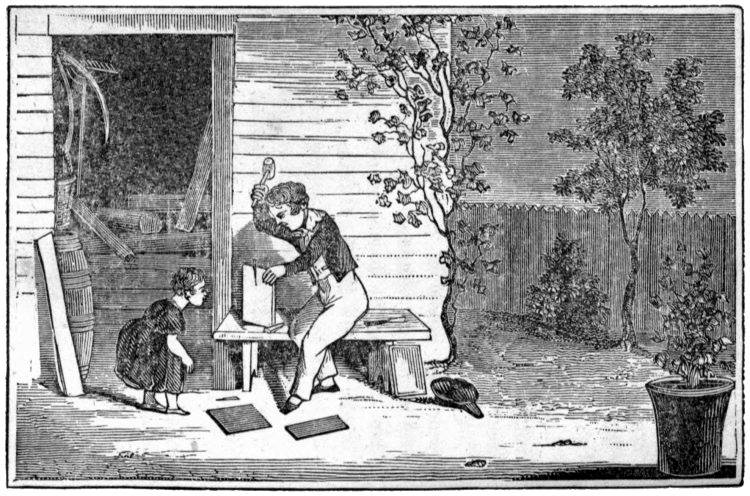
Rollo drove in his wedge, and it proceeded admirably. The wood soon
began to crack, and the crack gradually extended almost to the end of
the board. When he had driven it in pretty far, he told Nathan to see
how he
was going to manage with his second wedge. He was now very glad that he
had followed Jonas’s advice, and made the second wedge before trying the
first. He inserted the second wedge in the crack, and drove it in. This
forced the wood open more, and loosened the first wedge, so that he
could easily get it out again, and very soon the board was split
entirely in two. Nathan was very much delighted with the whole
operation.
In the same manner, Rollo split two or three other pieces off from his
board, and then Nathan wanted him to let him split one. Rollo was at
first somewhat unwilling to let his little beetle go out of his hand at
all, he was so interested in using it; but considering that it would
give Nathan a good deal of pleasure, he concluded to let him try it
once.
“I will start it for you, Thanny,” said he. And he accordingly made a
small cleft by driving in his knife; and then he inserted the wedge, and
drove that in too, just far enough to start the crack, and enable the
wood to retain the wedge. Nathan then took the beetle, and pounded away.
He found that he could not strike such heavy blows as Rollo could, and
yet the wedge gradually penetrated farther and farther, and the crack
opened wider and wider, to Nathan’s great delight. Rollo was himself
gratified to see how much his little brother was pleased with his beetle
and wedges. When the first wedge was driven fully in, he handed him the
other, and showed him how to insert that into the crack made by the
first wedge, at a little distance from it. Nathan then drove in the
second wedge, and this soon finished the work, for it split the piece
off entirely, and Nathan took it up, and looked at it, very much pleased
at what he had done.
“Now,” said Rollo, “give me the beetle again.”
“No,” said Nathan, “I want to split some more.”
“O, no,” said Rollo, in a tone of good-humored expostulation; “no; it is
my beetle and wedge. I let you have it to split one stick off; but now
you ought to let me have it again, immediately.”
“No,” said Nathan, “I want to split some more.”
Rollo took up the two wedges, and would not let Nathan have them, and
Nathan held the beetle away behind him so that Rollo should not have
that. Thus they seemed to be in inextricable difficulty. Rollo did not
know what to do.
“Nathan,” said he, at length, after a pause, “give me my beetle.”
“No,” said Nathan, “I want to split.”
“O, dear me!” said Rollo, with a sigh.
At first, he thought that he would take the beetle away from Nathan by
force; but he reflected in a moment that this would be wrong, and so
finally he concluded to go and state the case to his mother.
So he rose, and began to walk away, saying,
“Well, Nathan, I mean to go and tell mother, that you won’t let me have
my beetle.”
Then Nathan, whose conscience secretly reproved him for what he was
doing, pulled the beetle round from behind him, and threw it down upon
the floor, where Rollo had been sitting. This was wrong. It was a very
ill-natured way of giving it up. If he was satisfied that he was wrong,
he ought to
have handed it to Rollo pleasantly. Instead of that, he threw it down,
with a sullen look, and sat still.
Then Rollo, thinking that it was now no longer necessary to go and
trouble his mother with the difficulty, began to return. As he came
back, he said, in a kind and soothing tone,
“Now, you are a good boy, Nathan. That is right—to give me back my
beetle. Now I will let you split again, some time.”
But Rollo was mistaken in supposing that Nathan was a good boy. Boys are
not good until their hearts are right. When a child has something
which he ought not to have, it is not enough for him to throw it down
upon the floor, sullenly, because he is afraid to have his father or
mother told that he has got it. He ought to give it up pleasantly, and
feel that it is right that he should do so. If Nathan had said to
himself, “I ought not to keep this beetle, for it is not mine—it is
Rollo’s; he made it, and he has been kind enough to lend it to me, and
now I ought to be willing to give it back to him pleasantly again;” and
then had given it to him with a pleasant countenance,—that would have
been really being a good boy. But to throw it down in a pet, because he
was afraid to have Rollo complain to his mother, was very far from being
like a good boy.
However, it was very kind in Rollo to speak soothingly and pleasantly to
Nathan; though, if he had reflected how much goodness depends upon the
state of the heart, he would not have supposed that Nathan was yet a
good boy. In fact, when he saw that Rollo was coming back again, and was
not going to his mother, after standing still, looking quite sullen for
a moment, he suddenly stooped down, seized Rollo’s knife, and ran off
with it out into the yard.
Rollo instantly pursued him, calling out, “Nathan! bring back my knife;
Nathan! Nathan! give me my knife.”
Nathan, however, ran on, though Rollo ran the fastest, and was rapidly
overtaking him; and just at the instant before he reached him, Nathan’s
foot tripped; he fell, and as he threw forward his hands to try to save
himself, they came down upon the ground, and his forehead struck the
corner of the knife blade. He immediately screamed out
with pain and terror. Dorothy, alarmed by his cries, came out, took him
up in her arms, and carried him into the house.
She took him to the table, and began to bathe the wounded forehead in
cold water. This was what she always did when the children got cut or
scratched, or hurt in any such way. It prevents inflammation. She saw
that Nathan was not hurt much, though he continued to cry very loud. His
crying was, however, partly from pain, and partly from vexation.
In a few minutes, Rollo’s mother came down stairs to see what was the
matter. Rollo thought that his mother might suppose that he had hurt
Nathan, and so he began to explain at once how it happened. But his
mother held up her hand to him, as a signal for him to be silent. She
knew that it was then no time to ascertain the facts.
She came up and looked at Nathan’s forehead a moment, and she saw that
it was not much hurt. Besides, she knew, by the sound of Nathan’s cries,
that they did not proceed from much pain. She therefore said to him,
gently,
“Stop crying, Nathan!”
Now Nathan knew that his mother did not tell him not to cry, except when
she was sure that he could control himself if he chose to do so; and he
also knew that she punished him if he did not obey. So he began
immediately to repress his sobs and cries, and very soon became still.
She then put a small plaster, of some sort, upon his forehead, and then
carried him up stairs and laid him on the bed.
“There,” said she, “Thanny, lie still there a little while, till your
forehead has done aching, and you get pleasant again; then you may get
up, and come to me.”
Then she went to her work again, and Rollo came and stood by her side,
and told her the whole story.
“Nathan did wrong,” said she; “but it would have been better for you not
to have run after him.”
“Why, mother,” said Rollo, “he was running away with my knife; and I
can’t split at all without my knife. One thing I know,—I shall not let
him split any more with my beetle and wedges.”
“That would be one way to treat him,”
said his mother; “but there is another thing you might do, if you
chose.”
“What, mother?” asked Rollo.
“Why, make him a beetle and wedge, for his own.”
“Why, mother!” said Rollo, with surprise.
“Yes,” said she. “You might make him one. Think how pleased he would be
with it. Then he could sit down with you, and you could both be
splitting together.”
“But, seems to me, mother, that that would be rewarding him for being a
naughty boy.”
“It would be so, if you were to make him a beetle and wedge, because he
was a bad boy; but I proposed that you should make it for another
reason, that is, to please him.”
“But perhaps he would think I did it because he ran away with my
knife,” said Rollo.
“I don’t think there is any danger that he would imagine that you did it
as a reward for that,” replied his mother.
Here Rollo paused a moment. He did
not feel quite ready to undertake to make Nathan a beetle and wedges;
but he did not know exactly how to reply to his mother’s reasoning. At
length he said, in a timid and hesitating voice,
“But, mother, it seems to me that it would be better to punish Nathan,
rather than reward him, or do any thing which would seem like rewarding
him for acting so.”
“That may be true,” said his mother. “And it is true, also, that if you
should refuse to let him split wood any more with your wedges, it would
be punishing him; while, on the other hand, if you should make him a
little beetle and wedge of his own, it would be forgiving him. Now I do
not say that he ought not to be punished; but which do you think is
your duty towards him,—you, yourself, being only another child, a few
years older than he,—to punish or to forgive?”
“Why,—to forgive,—I suppose,” said Rollo, rather doubtfully.
“I am rather inclined to that opinion, myself,” said his mother: “but
you can do just as you please.”
Rollo remained some minutes about his
mother’s chair, not knowing exactly what to do or say next. He sat down
upon the floor, and began to play with some shreds of cloth which were
lying there. Presently, he looked up and said,
“Mother, what was the reason why you would not let me tell you what was
the matter with Nathan in the kitchen?”
“Because,” said she, “he was crying then, and it is no time to learn how
an injury happened, during the excitement of the moment. If you find
Nathan crying out in the yard, for instance, and try to get him to tell
you how he got hurt, you only make him cry the more. Get him quiet
first, and then learn the story afterwards.
“Then, besides the difficulty of his speaking intelligibly,” she
continued, “at such a time, boys are very strongly tempted to
misrepresent the facts, during the excitement of the first moments. They
are very likely to be a little vexed or angry, and, under the influence
of those feelings, not to give a correct and honest account. So that it
is always best to put off inquiries till the trouble is all over.”
Here Nathan came into the room. His forehead had ceased to give him
pain, and so he had clambered down from the bed where his mother had
placed him, and now came into the room, looking quiet and calm, though
still not very happy.
Rollo went to him, and said, “Come, Nathan, now we will go down stairs
to play again.” And he began to lead him down stairs. As they walked
along, Rollo said,
“I am going to make you a beetle and wedge for your own, Nathan, and
then you and I can split together: only, it is not a reward, you must
understand. It was wrong for you to keep my beetle, and run away with my
knife, and you are sorry you did so, an’t you, Nathan?”
“Yes,” said Nathan.
“And you won’t do so any more, will you, Nathan?”
“No,” said Nathan, “I won’t do so any more.”
Whether Nathan was really sorry for what he had done, or whether he only
said so because Rollo was going to make him a beetle, is very doubtful;
though it is not impossible that he was a little sorry.
Rollo went down into the shed again with Nathan; and while he was at
work making the new beetle and wedge, he let Nathan use his. The first
piece of board had been split up; so he laid another one before Nathan,
and gave him his beetle and wedges and knife, and then went away out to
the barn to get some more wood for wedges, and an auger.
When he came back, he found Nathan standing at the shed door, with the
little beetle in his hand, waiting for him. As Nathan saw Rollo coming,
he called to him, saying,
“Come, Rollo, come and help me; the board won’t split.”
“What is the matter with it?” said Rollo.
“I don’t know,” said Nathan, “only it won’t split.”
So Rollo went in to see. He found that Nathan had gone to work wrong.
Instead of trying to drive the wedge into the end of the board, so as
to split it along the grain, he had made the cleft with the knife in
the side of the board, and was attempting to
drive it in there, as if he supposed he could split the board across
the grain.
“Why, Nathan,” said Rollo, “that isn’t right. You can’t split it
across.”
Then he put the wedge into the end, where it ought to be put, and set
Nathan to driving it. Now it began to split at once; though Nathan
could not see why the board should not split one way as well as the
other.
Rollo himself did not understand it very well. Nathan asked him why it
would not split the other way, and he said that that was across the
grain. But when Nathan asked him what he meant by grain, he could not
tell.
He took up the wood and examined it, and observed little lines and
ridges, running along in the direction in which it would split; but at
the ends of the board, where it had been sawed across the grain, it was
rough. He determined to ask Jonas about it, or his father.
He then went to work, and made the wedges and a little beetle for
Nathan. He made Nathan’s beetle smaller than his own,
because Nathan was not strong enough to strike hard with such a heavy
beetle. He did not get it done in season to use that day; but, the next
day, he and Nathan sat down upon the shed floor, and spent an hour in
splitting up the boards. They split them all up into good, fine kindling
wood. Then they piled the pieces up in a neat pile, and then brought
Dorothy out to see them.
Dorothy seemed very much pleased, and promised the boys that, the next
time she baked pies, she would kindle the fire in the oven with their
kindling wood, and then she would bake them each a little apple
turnover.
That evening, just before Rollo went to bed, he asked Jonas if he could
tell him why boards would only split along the grain.
“Yes,” said Jonas, “I think I can tell you. But do you know what the
grain is?”
“No,” said Rollo, “I don’t know any thing about it.”
“You know that boards are made from the stems of tall trees.”
“Yes,” said Rollo.
“Well, now when trees are growing, there are little channels running up
and down from the roots to the branches.”
“What are they for?” said Rollo.
“They are for the sap. The sap flows up and down in them. But then there
are no channels across from one side of the tree to the other, because
there is no sap to go across. The sap all has to go up from the roots to
the branches; and so the channels must all be up and down the tree.
“Now,” continued Jonas, “when they cut down the tree, the trunk will
split easily, up and down, the way the channels and fibres all go; but
it won’t split easily across. And just so, when they saw it up into
boards, the boards will all split lengthwise, from end to end, for this
is the way the channels and fibres all lie; but it won’t split across,
for that would be across all the fibres, and the wood is made very
strong in that direction, and it is well it is so.”
“Why?” said Rollo.
“Because, if trees would split across, as easily as they do up and down,
the first good
wind would blow down all the forests in the world.”
“O, Jonas!” exclaimed Rollo, “all the forests in the world?”
“Yes,” replied Jonas, “if the wind blew all over the world.”
Table of Contents