The morning after Rollo had finished the letter to Jenny, as recorded in
the last chapter, his uncle George told him at breakfast time that he
might amuse himself that day in any way he pleased.
"I shall be busy writing," said Mr. George, "nearly all the morning. It
is such a still and quiet place here that I think I had better stay and
finish up my writing. Besides, it must be an economical place, I think,
and we can stay here a day cheaper than we can farther up the river, at
the large towns."
"Shall we come to the large towns soon?" asked Rollo.
"Yes," replied his uncle. "This deep gorge only continues fifteen or
twenty miles farther, and then we come out into open country, and to the
region of large towns. You see there is no occasion for any other towns
in this part of the Rhine than villages of vinedressers, except here
and there a little city where a branch river comes in."
"Well," said Rollo, "I shall be glad when we get out. But I will go down
to the shore, and play about there for a while."
Accordingly, as soon as Rollo had finished his breakfast, he went down
to the shore.
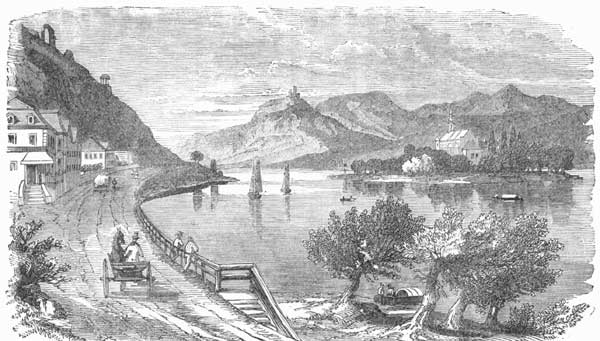
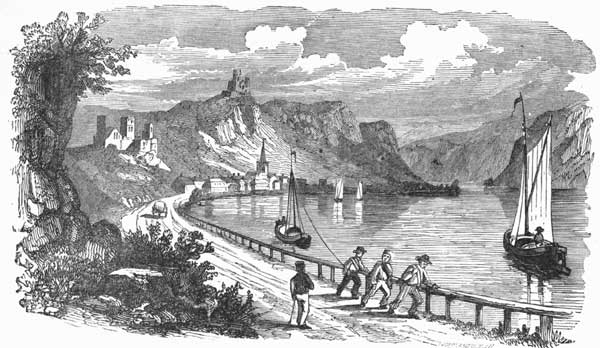
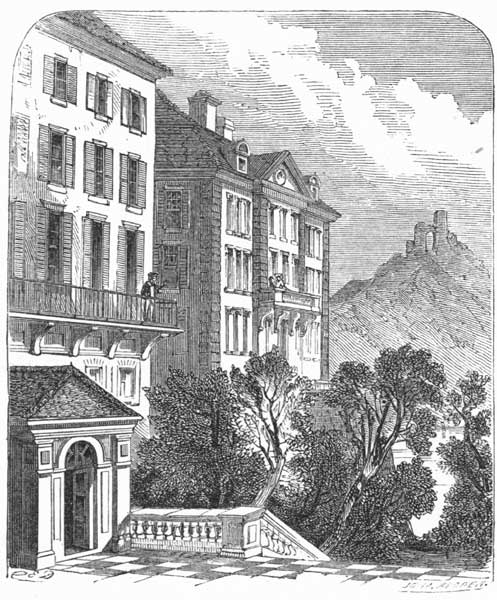
The hotel faced the river, though there was a road outside of it,
between it and the water. From the outer edge of the road there was a
steep slope, leading down to the water's edge. This slope was paved with
stones, to prevent the earth from being washed away by the water in
times of flood. Here and there along this slope were steps leading down
to the water. At the foot of these steps were boats, and opposite to
them, in the road, there were boatmen standing in groups here and there,
ready to take any body across the river that wished to go.
Rollo went down to the shore, and took his seat on the upper step of one
of the stairways, and began to look about him over the water. There were
two other boys sitting near by; but Rollo could not talk to them, for
they knew only German.
Presently one of the boatmen came up to him, and pointing to a boat,
asked him a question. Rollo did not understand what the man said, but
he supposed that he was asking him if he did not wish for a boat. So
Rollo said Nein, and the man went away.
There was a village across the river, in full view from where Rollo sat.
This village consisted of a row of white stone houses facing the river,
and extending along the margin of it, at the foot of the mountains.
There seemed to be just room for them between the mountains and the
shore. Among the houses was to be seen, here and there, the spire of an
antique church, or an old tower, or a ruined wall. After sitting quietly
on the steps until he had seen two steamers go down, and a fleet of
canal boats from Holland towed up, Rollo took it into his head that it
might be a good plan for him to go across the river. So he went in to
ask his uncle George if he thought it would be safe for him to go.
"You will take a boatman?" said Mr. George.
"Yes," said Rollo.
"And how long shall you wish to be gone?"
"About an hour," said Rollo.
"Very well," said Mr. George, "you may go."
So Rollo went down to the shore again, and as he now began to look at
the boats as if he wished to get into one of them, a man came to him
again, and asked him the same question. Rollo said Ja. So the man went
down to his boat, and drew it up to the lowest step of the stairs where
Rollo was standing. Rollo got in, and taking his seat, pointed over to
the other side of the river. The man then pushed off. The current was,
however, very swift, and so the boatman poled the boat far up the stream
before he would venture to put out into it; and then he was carried down
a great way in going across.
When they reached the landing on the opposite shore, Rollo asked the
man, "How much?" He knew what the German was for how much. The man said,
"Two groschen." So Rollo took the two groschen from his pocket and paid
him. Two groschen are about five cents.
Rollo walked about in the village where he had landed for nearly half an
hour; and then, taking another boat on that side, he returned as he had
come. On his way back he saw a great raft coming down. He immediately
conceived the idea of taking a little sail on that raft, down the river.
He wanted to see "how it would seem" to be on such an immense raft, and
how the men managed it. So he went in to propose the plan to his uncle
George. He said that he should like to go down the river a little way on
the raft, and then walk back.
"Yes," said Mr. George, "or you might come up in the next steamer."
"So I might," said Rollo.
"I have no objection," said Mr. George.
"How far down may I go?" said Rollo.
"Why, you had better not go more than ten or fifteen miles," said Mr.
George, "for the raft goes slowly,—probably not more than two or three
miles an hour,—and it would take you four or five hours, perhaps, to go
down ten miles. You would, however, come back quick in the steamer. Go
down stairs and consider the subject carefully, and form your plan
complete. Consider how you will manage to get on board the raft, and to
get off again; and where you will stop to take the steamer, and when you
will get home; and when you have planned it all completely, come to me
again."
So Rollo went down, and after making various inquiries and calculations,
he returned in about ten minutes to Mr. George, with the following plan.
"The waiter tells me," said he, "that the captain of the raft will take
me down as far as I want to go, and set me ashore any where, in his
boat, for two or three groschen, and that one of the boatmen here will
take me out to the raft, when she comes by, for two groschen. A good
place for me to stop would be Boppard, which is about ten or twelve
miles below here. The raft will get there about two o'clock. Then there
will be a steamer coming along by there at three, which will bring up
here at four, just about dinner time. The waiter says that he will go
out with me to the raft, and explain it all to the captain, because the
captain would not understand me, as he only knows German."
"Very well," said Mr. George. "That's a very good plan. Only I advise
you to make a bargain with the captain to put you ashore any where you
like. Because you know you may get tired before you have gone so far as
ten miles.
"In fact," continued Mr. George, "I would not say any thing about the
distance that you wish to go to the captain. Just make a bargain with
him to let you go aboard his raft for a little while, and to send you
ashore whenever you wish to go."
"Yes," said Rollo, "I will; that will be the best plan. But I am sure
that I shall want to go as far as ten miles."
So Rollo went to his trunk, and began to unlock it in a hurried manner;
and when he had opened it, he put his hand down into it at the left hand
corner, on the front side, which was the place where he always kept his
fishing line.
"What are you looking for?" said Mr. George.
"My fishing line," replied Rollo; "is not that a good plan?"
"Yes," said Mr. George, "an excellent plan."
Rollo had no very definite idea of being able to fish while on the raft,
but there was a sort of instinct which prompted him always to take his
fishing line whenever he went on any excursion whatever that was
connected with the water. Mr. George had a pretty definite idea that he
would not be able to fish; but still he thought it a good plan for
Rollo to take the line, for he observed that to have a fishing line in
his pocket, on such occasions, was always a source of pleasure to a boy,
even if he did not use it at all.
Rollo, having found his fishing line, shut and locked his trunk, and ran
down stairs.
As soon as he had gone, Mr. George rose and rang the bell.
Very soon the waiter came to the door.
"This young gentleman who is with me," said Mr. George, "wishes to go on
board this raft, and sail down the river a little way."
"Yes, sir," said the waiter. "Rudolf is arranging it for him."
"Very well," said Mr. George. "And now I wish to have you send a
commissioner secretly to accompany him. The commissioner is to remain on
the raft as long as Rollo does, and leave it when he leaves it, and
keep in sight of him all the time till he gets home, so as to see that
he does not get into any difficulty."
"Yes, sir," said the waiter.
"But let the commissioner understand that he is not to let Rollo know
any thing about his having any charge over him, nor to communicate with
him in any way, unless some emergency should arise requiring him to
interpose."
"Yes, sir," said the waiter, "I will explain it to him."
"And choose a good-natured and careful man to send," continued Mr.
George; "one that speaks French."
"Yes, sir," replied the waiter; and so saying, he disappeared, leaving
Mr. George to go on with his writing.
In the mean time Rollo had gone down to the shore with the waiter
Rudolf, and was standing there near a boat which was drawn up at the
foot of the landing stairs, watching the raft, which was now getting
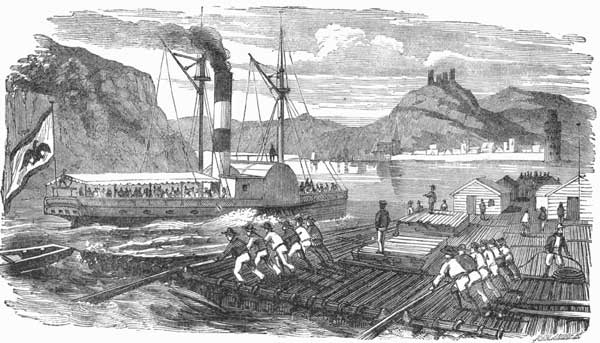
pretty near. There was a great company of men at each end of the raft.
Rollo could see those at the lowest end the plainest. They were standing
in rows near the end of the raft, and every six of them had an oar.
There were eight or ten of these oars, all projecting forward, from the
front end of the raft, and the raftsmen, by working them, seemed to be
endeavoring to row that end of the raft out farther into the stream. It
was the same at the farther end of the raft. There was a similar number
of oarsmen there, and of oars, only those projected behind, just as the
others did before. There were no oars at all along the sides of the
raft.
The fact is, that these monstrous rafts are always allowed to float down
by the current, the men not attempting to hasten them on their way by
rowing. All that they attempt to do by their labor is to keep the
immense and unwieldy mass in the middle of the stream. Thus they only
need oars at the two ends, and the working of them only tends to row the
raft sidewise, as it were. Sometimes they have to row the ends from left
to right, and sometimes from right to left, according as the current
tends to drift the raft towards the left or the right bank of the river.
Rollo did not understand this at first, and accordingly, when he first
saw these rafts coming with a dense crowd of men at each end, rowing
vigorously, while there was not a single oar to be seen, nor even any
place for an oar along the sides, he was very much surprised at the
spectacle. He thought that the men at the back end of the raft were
sculling; but what those at the forward end were doing he could not
imagine. When, however, he came to consider the case, he saw what the
explanation must be, and so he understood the subject perfectly.
At length, when Rollo saw that the forward end of the raft, in its
progress down the river, had come nearly opposite to the place where he
was standing, he got into the boat, and the boatman rowed him out to the
raft. As soon as they reached the raft Rollo stepped out upon the boards
and logs. The top of the raft made a very good and smooth floor, being
covered with boards, and it was high and dry above the water. Rollo
looked down into the interstices, and saw that that part of the raft
which was under water was formed of logs and timbers of very large size,
placed close together side by side, with a layer above crossing the
layer below. The whole was then covered with a flooring of boards, so
close and continuous that Rollo had to look for some time before he
could find any openings where he could look down and see how the raft
was constructed.
In the middle of the raft were several houses. The houses were made of
boards, and were of the plainest and simplest construction. Around the
doors of these houses several women were sitting wherever they could
find shady places. Some were knitting and some were sewing. There were
several children there too, amusing themselves in various ways. One was
skipping a rope. Rudolf conducted Rollo up to one of these families, and
told the women that he was an American boy, who was travelling with his
uncle on the Rhine, and seeing this raft going by, had a curiosity to
come on board of it. The women looked very much pleased when they heard
this. Some of them had friends in America, and others were thinking of
going themselves with their husbands; and they immediately began to talk
very volubly to Rollo, and to ask him questions. But as they spoke
German, Rollo could not understand what they said.
In the mean time the waiter had gone away to speak to the captain of the
raft, and to make arrangements for having Rollo put ashore when he had
sailed long enough upon it. The captain was walking to and fro, upon a
raised platform, near the middle of the raft. This platform I will
describe presently. In a few minutes the man returned.
"The captain gives you a good welcome," said he, "and says he wishes he
could talk English, for he wants to ask you a great many questions about
America. He says you may stay on the raft as long as you please, and
when you wish to go ashore, you have only to go and get on board one of
the boats, and that will be a signal. He will soon see you there, and
will send a man to row you to the shore."
Rollo liked this plan very much. So Rudolf, having arranged every thing,
wished Rollo a "good voyage," and went off in the boat as he came.
Thus Rollo was left alone, as it were, upon the raft; and for a moment
he felt a little appalled at the idea of going down through such a dark
and gloomy gorge as the bed of the river here presented to view, on such
a strange conveyance, and surrounded with so wild and savage a horde of
men as the raftsmen were,—especially since, as he supposed, there was
not a human being on board with whom he could exchange a word of
conversation. It is true the commissioner whom his uncle George had sent
was on the raft. He had come out in the same boat with Rollo, and had
remained when the boat went back to the shore. But Rollo had not noticed
him particularly. He observed, it is true, that two men came with him to
the raft, and that only one returned; but he thought it probable that
the other might be going down the river a little way, or perhaps that he
belonged to the raft. He had not the least idea that the man had come to
take charge of him, and so he felt as if he were entirely alone in
the new and strange scene to which he found himself so suddenly
transferred.
There were, however, so many things to attract his attention that at
first he had no time to think much of his loneliness. There was a fire
burning at a certain part of the raft, not far from the door of one of
the houses, and he went to see it. As soon as he reached it, the mystery
in respect to the means of having a fire on such a structure, without
setting the boards and timbers on fire, was at once solved. Rollo found
that the fire was built upon a hearth of sand. There was a large box,
about four feet square and a foot deep, which box was filled with sand,
and the fire was built in the middle of it. It seemed to Rollo that this
was a very easy way to make a fireplace, especially as the sand seemed
to be of a very common kind, such as the raftsmen had probably shovelled
up somewhere on the shore of the river.
"The very next time I build a raft," said Rollo, "I will have a fire on
it in exactly that way."
There was a sort of barricade or screen built up on two sides of this
fire, to keep the wind from blowing the flame and the heat away from the
kettle that was hung over it. This screen was made of short boards,
nailed to three posts, that were placed in such a manner as to make,
when the boards were nailed to them, two short fences, at right angles
to each other, or like two sides of a high box. The corner of this
screen was turned towards the wind, and thus the fire was sheltered. A
pole passed across from one of the posts to the other, and the kettle
was hung upon the pole.
After examining this fireplace Rollo went to look at the platform where
the captain had his station. This platform was about six feet high and
ten feet long; and it was just wide enough for the captain to walk to
and fro upon it. There was a flight of steps leading up to this platform
from the floor of the raft, and a little railing on each side of it, to
keep the captain from falling off while he was walking there.
The object of having this platform raised in this way, was to give the
captain a more commanding position, so as not only to enable him to
survey the whole of the raft, and observe how every thing was going on
upon it, but also to give him a good view of the river below, so that he
might watch the currents, and see how the raft was drifting, and give
the necessary orders for working it one way or the other, as might be
required in order to keep it in the middle of the stream.
Then Rollo went to the forward end of the raft to see the raftsmen row.
The oars were of monstrous size, as you might well suppose to be the
case from the fact that each of them required six men to work it. These
six men all stood in a row along the handle of the oar, which seemed to
be as large as a small mast. They all pressed down upon the handle of
the oar so as to raise the blade out of the water, and then walked along
over the floor of the raft quite a considerable distance. At last they
stopped, and lifting up their hands, they allowed the blade of the oar
to go down into the water. Then they turned, and began to push the oar
with their hands the other way. The outside men had to reach up very
high, for as the oar was very long, and the blade was now necessarily in
the water, the end of the handle was raised quite high in the air. The
men, accordingly, that were nearest the end of the oar, were obliged to
hold their hands up high, in order to reach it; and they all walked
along very deliberately, like a platoon of soldiers, pushing the oar
before them as they advanced. And as each of the other six oars had a
similar platoon marching with it to and fro, and as all acted in
concert, and kept time with each other in their motions, the whole
operation had quite the appearance of a military manœuvre. Rollo
watched it for some time with great satisfaction.
After this Rollo walked up and down the raft two or three times, and
then his attention was attracted by a steamer going by. The steamer cut
her way through the water with great speed, and the waves made by her
paddle wheels dashed up against the margin of the raft as if it had been
along shore.
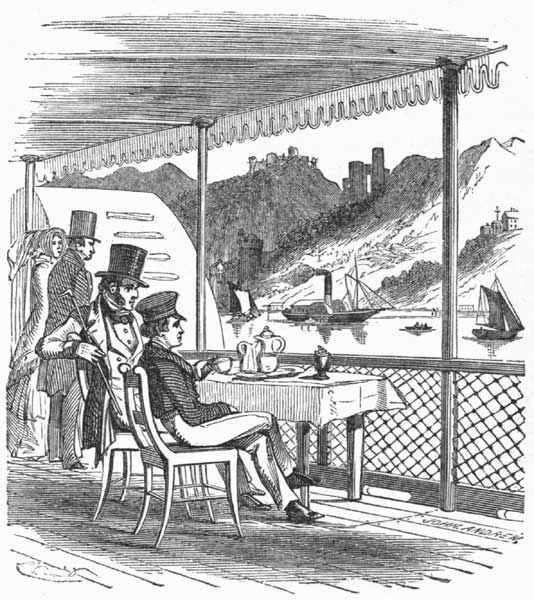
There was a great number of tourists on board the steamer. Rollo could
see them very distinctly sitting under the awning on the deck. Some were
standing by the railing and examining the raft by means of their spy
glasses or opera glasses. Others were seated at tables, eating late
breakfasts, in little parties by themselves. The boat glided by very
swiftly, however, and soon Rollo could see nothing of her but the stern,
and the foaming wake which her paddle wheels left behind them in the
water.
As soon as the steamboat had gone by, Rollo began to feel a slight sense
of loneliness on the raft, which feeling was increased by the sombre
aspect of the scenery around him. The river was closely shut in by
mountains on both sides, and between them the raft seemed to be drifting
slowly down into a dark and gloomy gorge, which, though it might have
seemed simply sublime to a pleasant party viewing it together from the
cheerful deck of a steamer, or from a comfortable carriage on the banks,
was well fitted to awaken an emotion of awe and terror in the mind of a
boy like Rollo, floating down into it helplessly on an enormous raft,
with a hundred men, looking more like brigands than any thing else,
marching solemnly to and fro at either end of it, working prodigious
oars, with incessant toil, to prevent its being carried upon the rocks
and dashed to pieces. In fact, Rollo began soon to wish that he was safe
on shore again.
"I am very thankful," said he to himself, "that I made a bargain with
the captain to put me ashore whenever I wished to go. I don't believe
that I shall wish to go more than half way to Boppard."
So saying, Rollo looked anxiously down the river. The mountains looked
more and more dark and gloomy, and they appeared to shut in before him
in such a manner that he could not see how it could be possible for such
an immense raft to twist its way through between them.
"I don't believe I shall wish to go more than a quarter of the way to
Boppard," said he.
Two or three minutes afterwards, on looking back, he saw the town of St.
Goar, where he had embarked, gradually disappearing behind a wooded
promontory which was slowly coming in the way, and cutting it off from
view.
 ROLLO ON THE RAFT.
"In fact," said Rollo to himself, "since I am not going all the way to
Boppard, I had better not go much farther; for I shall have to walk
back, as the steamer does not stop this side of Boppard. Besides, I have
seen all that there is on the raft already, and there is no use in
staying on it any longer."
So he concluded to go at once to the boat, according to the arrangement
which he had made with the captain. He was afraid that he might have to
wait some time before the captain would see him; but he did not. The
captain saw him immediately, and sent a man to row him ashore. Two men
came, in fact, the commissioner being one of them. But Rollo did not pay
any particular attention to this circumstance. He did not even observe
that it was the same man that had come on board with him. Rollo could
not talk to the oarsman on the way, but on landing he gave him a little
money,—about what he thought was proper,—and then went up into the
road with a view to go home. The commissioner, in order not to awaken
any suspicions in Rollo's mind that he was following him, turned away as
soon as he landed, and walked along the tow path down the stream.
Rollo went slowly home. He had not been more than half an hour on the
raft, and had not gone down the stream more than a mile; so that in
three quarters of an hour after he had left his uncle at the hotel he
found himself drawing near to it again, on his return.
He felt a little ashamed to get back so soon. So he thought that he
would not go in at once and report himself to his uncle, but would go
down on the bank of the river, and see if he could find a place to fish
a little while, until some little time should have elapsed, so as to
give to the period of his absence a tolerably respectable duration.
"Uncle George will laugh at me," said he to himself, "if he sees me come
home so soon."
So Rollo went down to the quay, and taking out his fishing line, he
began to make arrangements for fishing. He did not, however, feel quite
at his ease. There seemed to be something a little like artifice in thus
prolonging his absence in order to make his uncle think that he had gone
farther down the river than he had been. It was not being quite honest,
he thought.
"After all," said he to himself, "I'll go and tell uncle George now. I
shall have a better time fishing if I do. If he chooses to laugh at me,
he may. If he is going to do it, I should like to have it over."
So he went into the hotel, and advanced somewhat timidly to the door of
the room where he had left his uncle writing. He opened the door, and
looking in, said,—
"Uncle George! I've got back."
Mr. George did not seem at all surprised, but looking up a moment from
his writing, he smiled, and said,—
"Ah! I'm glad to see you safe back again. It is rather lonesome here
without you. Did you have a pleasant voyage?"
"Yes," said Rollo, "very pleasant. Only I did not go very far. I got
them to put me ashore about a mile below here."
"That was right," said Mr. George. "You did exactly as I should have
done myself. In fact you can see all you wish to see on such a raft in
half an hour."
"Yes," said Rollo, "I found that I could."
"And I am very glad that you came to tell me," said Mr. George, "as soon
as you came home."
So Rollo, quite relieved in mind, went down stairs again, and returning
to the quay, he resumed his fishing.