The four years of the great war have witnessed two astounding
facts, namely, the recrudescence of an ancient barbarism and the
world-wide application of the ideals of Christianity. During
these momentous times the frontiers of barbarism and of civilization
were clearly marked. The greater part of the world declared
its position and took sides with one or other of the contestants.
The whole world was either for or against, either friend or foe
to, the essential principles of a Christian civilization.
It was no accident that the torch of the Hun and the Cross
of the Christ should meet again on the old historic battle-ground
between the Somme and the Rhine, and especially at the Marne.
We thank God in victory’s hour that the Cross of the Christ is
again triumphant, and we trust the torch of the Hun is extinguished
forever. Autocracy’s serpent head has been crushed
beneath the heel of a militant democracy. That bruised heel
is our reminder of the cost of victory. It staggers the imagination
to state in terms of manhood, materials, and money the
price we have paid to make a world safe for democracy.
The eyes of a world have been opened. Men have thought
of Calvary, the price the Son of God paid to redeem the wayward,
wicked world. Men through their Calvary have come to
understand the message of Christ’s Cross—that all men are of
equal value in the sight of humanity’s God, and therefore are
entitled to equal privileges in the world he has made for their
happiness. Out from the shambles of these war-torn years
there has come forth, slowly and certainly, with ever-increasing
clearness, the shining form of the ideal supreme, the truth triumphant,
the principle of full, free, absolute soul-liberty.
As the thirsty caravan turns to the springs, as the mariner
turns to his compass in the darkest night, so the war-weary
world—all parts of it, both that of friend and that of foe—looks
beseechingly to America and to the ideal of which she is the
great exemplar. From her shores there went forth an army
which under God turned the tide against barbarism and made
possible the final victory for civilization. That army was composed
of men whose fathers represented every nation under
heaven. Some who received the highest honor for distinguished
service were born under the very flags they sought to overthrow.
It was humanity’s army, dominated by ideals distinctly American,
which fought, not for military glory, not for hellish hatred, not
for selfish gain, but as the crusaders of a new order, of an international
fraternity.
The distinctive feature of America’s greatness is not her boundless
wealth, not her limitless resources, not her inimitable versatility.
It is the ideal which she has inherited from her fathers.
That ideal, in the forefront of the world’s thought today, had
its yesterday of suffering and of sacrifice.
It is timely in the hour of democracy’s triumph to turn our
thoughts toward the genesis of soul-liberty in America. Today
millions of men espouse her sacred cause. In the dawn of
American history, in the early colonial times, a misunderstood,
maligned, and persecuted refugee, Roger Williams, stood almost
alone as her defender. Driven from motherland and from adopted
home, he found among the savages of the wilderness a place
where he could live out his principles of soul-liberty and grant
freely to others what he desired for himself. He has been rightly
called “The First American,” because he was the first to actualize
in a commonwealth the distinctively American principle of freedom
for mind and body and soul.
Roger Williams was not the discoverer of the principle of soul-liberty.
What Jesus did and said was the torch of truth destined
to illumine the whole world. His death on the cross was the
voice of God in eloquent terms, telling us that all men were
equal sharers in his love and entitled to equal opportunities and
privileges in the world which he had made for man’s well-being.
Christ taught clearly that men should not force others to belief in
him or to Christian conduct, nor destroy those who failed to follow
his teachings as they saw them.
For centuries faithful witnesses kept alive in the world these
precious truths. In fact, for a millennium the name Anabaptist
or Baptist was synonymous with soul-liberty. Baptists on the
Continent and in England sowed broadcast these seeds which led
to a glorious harvest in the new world. After the death of Roger
Williams the Baptists in the colonies continued the work so
nobly begun by him. In the face of bitterest persecution they
labored for a century before the much-desired principle of soul-liberty
was interwoven into our National Constitution and protected
by the First Amendment.
Our Western Hemisphere represents two types of civilization.
The Rio Grande is the dividing line between a civilization which
is Baptist in its distinctive and essential character and one which
is non-Baptist. To the north we see what the democracy of the
soul can do when associated with the democracy of political
rights. To the south we see but the twilight of civilization, a
place where there is political democracy in name, but where it is
rendered powerless because the mind and soul do not enjoy full
freedom. It is the difference between religious democracy and
religious autocracy. To the north the Bible is loved, it is studied
freely, and its principles are followed. It is a land where the
Bible is unchained and where the prevailing religions are of a
church without a bishop in a land without a king. To the south
the Bible is practically suppressed, its study is discouraged, and
its truths go unheeded.
Europe, thou art looking across the seas to America. Look
to all three Americas. Political democracy is universal in North,
Central, and South America. Ask thyself the question, Why is
the civilization of the north so attractive? It is because Religious
Liberty is married to Political Liberty. Dost thou want our
blessedness? Then see to it that thy new-born democracies and
thine ancient ones have complete soul-liberty. Give the Bible a
chance to bless thy stricken lands. Let the truths from God’s
book do their revolutionary work for thee as they have for God’s
liberty land on this side of the sea.
Religious liberty has unchained the Bible, scattered the darkness
of superstition, flooded our continent with light and blessing.
It has toppled selfish autocrats from their thrones, it has unlocked
the shackles from the feet of millions who were living in spiritual
and physical slavery. Religious liberty opens the doors and lets
God’s sunlight of truth enter to warm and bless the world.
To Roger Williams and the historic Baptist denomination we
turn for the story of the genesis and growth of this great blessing
in America. There is an effort, in evidence in the secular
and religious press of America, and, in some sections, in many of
our public schools, to rob both Williams and the Baptists of their
crown of glory. In certain quarters both Protestants and Catholics
are attributing the honor of giving birth to religious liberty
to communions which centuries ago persecuted our Baptist forefathers
unto banishment and death.
The early American Colonies can be divided into three classes.
One class included those who sought for uniformity in religion.
Exile and death were resorted to to make that religious uniformity
possible. Baptists were martyred in Massachusetts and
Virginia. Another class included those who granted a toleration
to other Christian religions, but who denied political privileges
to Jews, infidels, or Unitarians. Maryland and Pennsylvania,
although far advanced from the persecuting spirit of some of the
colonies, belong to this second class. There was another class,
represented at first by the smallest of the colonies, little Baptist
Rhode Island, which gave full, absolute, religious liberty. No
political privilege was dependent on religious belief. The attitude
of the early colonists to the Jews is the acid test of their
claim to priority as the advocates of soul-liberty in America.
Hebrew scholars and statesmen do not hesitate to give their
tribute of honor to Roger Williams and the Baptists. The Hon.
Oscar S. Straus, twice American Ambassador to Turkey, Secretary
of Labor and Commerce in the late President Roosevelt’s
Cabinet, and President of the League to Enforce Peace, said on
January 13, 1919, on the eve of sailing for Europe and the Peace
Conference:
If I were asked to select from all the great men who have left their
impress upon this continent from the days that the Puritan Pilgrims
set foot on Plymouth Rock, until the time when only a few days ago
we laid to rest the greatest American in our generation—Theodore Roosevelt;
if I were asked whom to hold before the American people and the
world to typify the American spirit of fairness, of freedom, of liberty
in Church and State, I would without any hesitation select that great
prophet who established the first political community on the basis of a
free Church in a free State, the great and immortal Roger Williams....
He became a Baptist, or as they were then called, Anabaptist, because
to his spirit and ideals the Baptist faith approached nearer than any
other—a community and a church which is famous for never having
stained its hands with the blood of persecutors.
I
THE APOSTLE OF SOUL-LIBERTY
That body-killing, soul-killing, state-killing doctrine of not permitting
but persecuting all other consciences and ways of worship but his own in
the civil state.... Whole nations and generations of men have been
forced (though unregenerate and unrepentant) to pretend and assume
the name of Jesus Christ, which only belongs, according to the institution
of the Lord Jesus, to truly regenerate and repentant souls. Secondly,
that all others dissenting from them, whether Jews or Gentiles, their countrymen
especially (for strangers have a liberty), have not been permitted
civil habitation in this world with them, but have been distressed and
persecuted by them.—Roger Williams’ Estimate of Religious Persecution.
The principle of religious liberty did not assert itself, save in one
instance, at once that American colonization was begun. For the most
part, the founders of these colonies came to this country imbued with
the ideas concerning the relations between government and religion, which
had been universal in Europe.... This makes the attitude of our American
exception, Roger Williams, the more striking and significant. More
than one hundred years in advance of his time, he denied the entire
theory and practice of the past.—Sanford Cobb.
Roger Williams advocated the complete separation of Church and
State, at a time when there was no historical example of such separation.—Newman.
A GOVERNMENT of the people, formed by the people for
the people, with Church and State completely separate,
and with political privileges not dependent on religious
belief, was organized and maintained successfully for the first
time in Christendom in Rhode Island, the smallest of the American
Colonies. Its inspiration and founder was Roger Williams,
the apostle of soul-liberty. Because he was the first asserter of
the principle which has since been recognized as the distinctive
character of our national greatness, he has been called “The
First American.”
Little is known of the personal appearance of Roger Williams.
His contemporaries describe him as a man of “no ordinary
parts,” with “a never-failing sweetness of temper and unquestioned
piety.” They also said he was a man of “unyielding
tenacity of purpose, a man who could grasp a principle in all its
bearings and who could incorporate it in a social compact.”
“He was no crude, unlearned agitator, but a scholar and thinker.”
Governor Bradford speaks of him as “having many precious
parts.” Governor Winthrop refers to him as “a godly minister.”
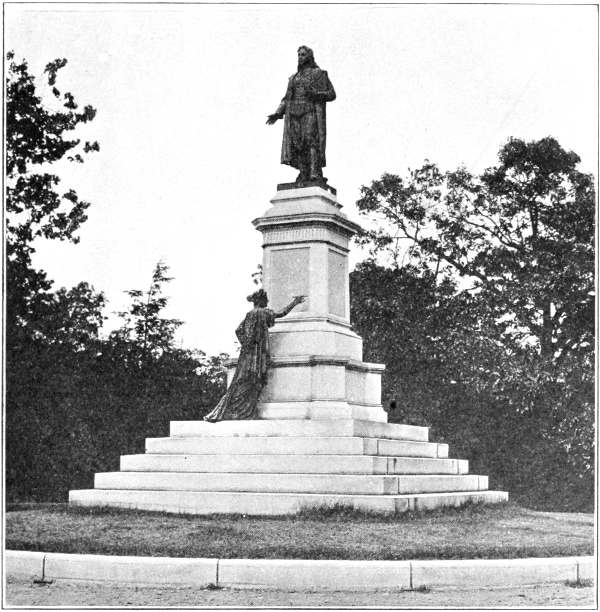
The artist’s conception, based upon these characteristics, is
best expressed by a monument in Roger Williams Park, Providence,
R. I. It is the work of Franklin Simmons, and was erected
by the city of Providence in 1877. In a beautiful park of over
four hundred acres with hills and drives and lakes, surrounded
by trees and shrubbery, and on land originally purchased from
the Indians by Williams, the illustrious pioneer of a new order
is seen in heroic form. He seems to be looking out over the
very colony he formed. In his hand he holds a volume, entitled
“Soul-Liberty, 1636,” a title which has since become synonymous
with his name. History is seen writing “1636,” the birth year
of soul-liberty in America. She continues to write with increasing
appreciation of the far-reaching influence of this illustrious hero
of religious and political democracy.
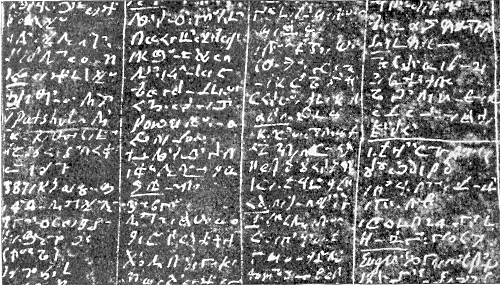
Copy of Shorthand Found on Fly-leaf of Roger Williams’
Indian Bible
For many years scholars thought that Roger Williams was
born at the close of the sixteenth century at Gwinear, Cornwall,
England. Now it is generally believed that he was born in London,
England, in the opening years of the seventeenth century.
He had two brothers and a sister. His father was a tailor.
About this time Timothy Bright and Peter Bales introduced into
England a new method of writing which was called “shorthand.”
The boy Roger Williams learned it and visited the famous Star
Chamber to put it into practice. The judge noticed the lad and
inspected his work. To his amazement, the record was complete
and accurate. This judge, Sir Edward Coke, the most
distinguished lawyer and jurist of his day, immediately took an
interest in the lad, and became his patron, securing for Williams
admission to the Charterhouse School. This was the school
where John Wesley, Thackeray, Addison, and others were educated.
He was admitted as a pensioner, in June, 1621. Later,
through Coke’s influence, he was admitted to Pembroke College,
Cambridge, in June, 1623. He was graduated with the degree
of bachelor of arts in 1627, and the year following was admitted
to holy orders. About this time he was disappointed in a love
affair, the lady of his choice being Jane Whalley. He sought
permission of her aunt, Lady Barrington, to marry her. When
refused, he wrote a striking letter in which he predicted for
Lady Barrington a very unhappy hereafter unless she repented.
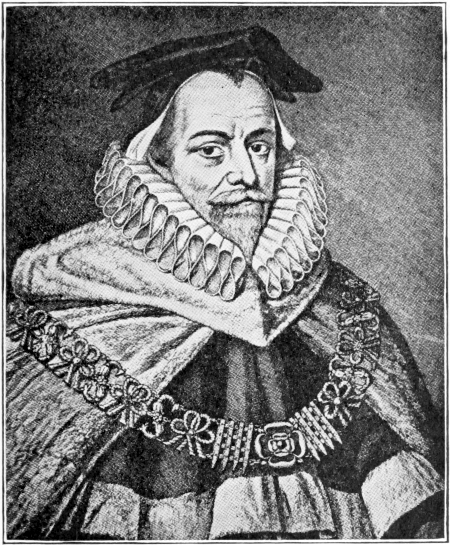
Sir Edward Coke
Courtesy of “Providence Magazine”
In 1629, we find him at High Laves, Essex, not far from
Chelmesford, where Thomas Hooker, later the founder of Hartford
Colony, was minister. Here he also met John Cotton.
Men’s views at that time were changing. The people of the
Established Church were divided into three classes. One stood
by the Established Order in all things; another class of Puritans
sought to stay by the Church, but aimed to purify the movement;
the third class was for absolute separation. Williams, with
hundreds of others, was disturbed. The anger of Lady Barrington
and the suspicions of Archbishop Laud started a persecution
which drove him out of England. He said:
I was persecuted in and out of my father’s house. Truly it was
as bitter as death to me when Bishop Laud pursued me out of the land,
and my conscience was persuaded against the national church, and ceremonies
and bishops.... I say, it was as bitter as death to me when
I rode Windsor way to take ship at Bristol.
Many years later he wrote:
He (God) knows what gains and preferments I have refused in universities,
city, country, and court in old England, and something in New
England, to keep my soul undefiled in this point and not to act with a
doubting conscience.
Before leaving England, he was married. The only information
we have in regard to his wife, up to that time, is that her name
was Mary Warned. They sailed on the ship Lyon, from Bristol,
England, December 1, 1630. After a tempestuous journey of
sixty-six days they arrived off Nantasket, February 5, 1631.
Judge Durfee speaks thus of this flight:
He was obliged to fly or dissemble his convictions, and for him, as
for all noblest natures, a life of transparent truthfulness was alone an
instinct and a necessity. This absolute sincerity is the key to his character,
as it was always the mainspring of his conduct. It was this
which led him to reject indignantly the compromises with his conscience
which from time to time were proposed to him. It was this which impelled
him when he discovered a truth to proclaim it, when he detected
an error to expose it, when he saw an evil, to try and remedy it, and
when he could do a good, even to his enemies, to do it.
Upon his arrival in Boston he was invited to become the teacher
in the Boston church, succeeding Mr. Wilson who was about
to return to England. To his surprise, he discovered that the
Boston church was a church unseparated from the Established
Church of England, and he felt conscientiously bound to decline
their invitation. The Boston people, who believed their church
to be the “most glorious on earth,” were astonished at his refusal.
Williams would not act as their teacher unless they publicly
repented of their relation to the Established Order. It
was perfectly natural that a soul with convictions, such as Williams
possessed, should desire to be absolutely separated from
the Established Order. One incident from many will show the
spirit of the Established Church in England toward those within
its ranks who had become Puritan, let alone Separatist. Neal, in
his “History of the Puritans,” tells, of Doctor Leighton’s persecution
in England. He was arrested by Archbishop Laud and
the following sentence was passed upon him: That he be
committed to the prison of the Fleet for life, and pay a fine of ten thousand
pounds; that the High Commission should degrade him from his
ministry, and that he should be brought to the pillory at Westminster,
while the court was sitting and be publicly whipped; after whipping be
set upon the pillory a convenient time, and have one of his ears cut off,
one side of his nose split, and be branded in the face with a double S. S.
for a sower of sedition: that then he should be carried back to prison,
and after a few days be pilloryed a second time in Cheapside, and have
the other side of his nose split, and his other ear cut off and then be
shut up in close prison for the rest of his life.
In the district in which Roger Williams lived this sentence was
carried out in all its hellish cruelty just prior to Williams’
banishment from England. Do we blame the exile Williams
for repudiating the movement which at that hour was so wicked
in its persecutions? He meant to have a sea between him and
a thing so hateful. John Cotton said that Williams looked upon
himself as one who “had received a clearer illumination and
apprehension of the state of Christ’s kingdom, and of the purity
of church communion, than all Christendom besides.” Cotton
Mather said that Williams had “a windmill in his head.” Well
for America that such a windmill was there and that he was a
prophet with clear visions of truth.
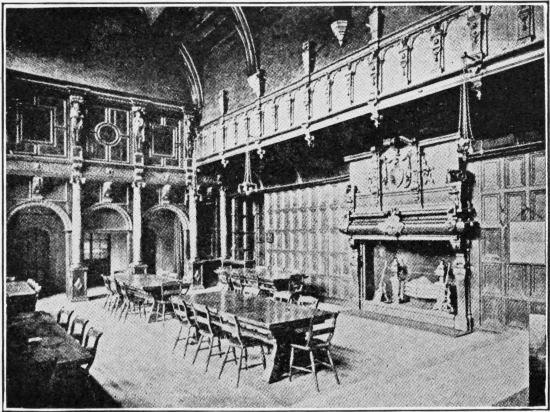
Charterhouse School
Courtesy of “Providence Magazine”
After refusing the Boston church, Roger Williams was invited
by the Salem church to be assistant to Mr. Skelton, their
aged teacher. He accepted their invitation and became Teacher,
April 12, 1631. The General Court in Boston remonstrated with
the Salem church. The persecution of this court led doubtless
to his retirement from Salem at the close of that summer.
He left the Massachusetts Bay Colony and became assistant
to Ralph Smith, the pastor at Plymouth. The Plymouth people,
being strict Separatists, were more congenial company, since
they had withdrawn from the Established Order to form a church
after the pattern of the Primitive Church model. Williams remained
in Plymouth for about two years. Governor Bradford
soon detected his advanced positions, relative to separation of
Church and State, but considered it “questionable judgment.”
He praised his qualities as a minister, writing thus of him:
His teaching, well approved, for þe benefit whereof I still bless God,
and am thankful to him, even for his sharpest admonitions and reproofs,
so far as they agreed with truth.
Governor Winthrop, with Mr. Wilson, teacher of the Boston
church, visited Plymouth at this time.
They were very kindly treated and feasted every day at several houses.
On the Lord’s Day, there was a sacrament which they did partake in;
and, in the afternoon, Mr. Roger Williams (according to their custom)
propounded a question, to which the Pastor, Mr. Smith, spoke briefly;
then Mr. Williams prophesied; and after the Governor of Plymouth
spoke to the question. Then the elder (Mr. William Brewster) desired
the Governor of Massachusetts and Mr. Wilson to speak to it, which they
did. When this was ended, the deacon, Mr. Fuller, put the congregation
in mind of their duty of contribution; whereupon the Governor and all
the rest went down to the deacon’s seat, and put into the box and then
returned.
Williams came in contact with the Indians who visited Plymouth
from time to time, and gained the confidence of Massasoit, the
father of the famous Philip. He studied their language and
cultivated their friendship. He writes in one of his letters,
“My soul’s desire was to do the natives good!” Near the
close of his life he referred to this early experience: “God was
pleased to give me a painful patient spirit, to lodge with them
in their filthy smoke, to gain their tongue.” Surely the Providence
of God was thus preparing the way for the founding of a
new colony, to be made possible through these very Indians who
had implicit confidence in this man of God.
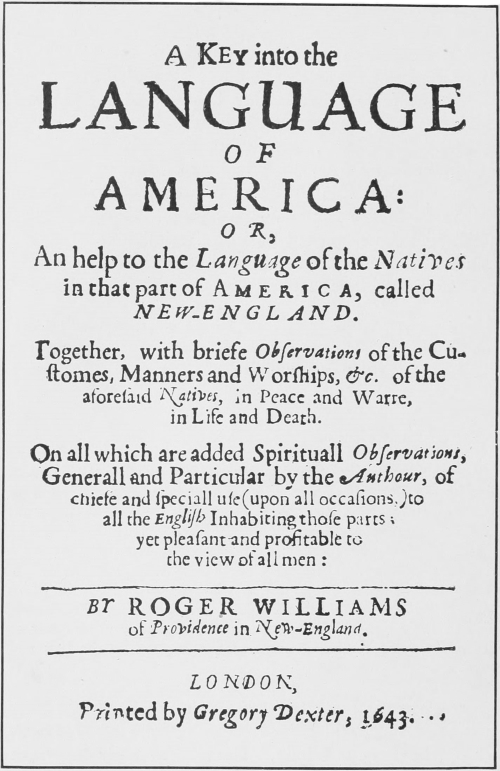
A Key into the
LANGUAGE
OF
AMERICA:
OR,
An help to the Language of the Natives
in that part of America, called
NEW-ENGLAND.
Together, with briefe Observations of the Customes,
Manners and Worships, &c. of the
aforesaid Natives, in Peace and Warre,
in Life and Death.
On all which are added Spirituall Observations,
Generall and Particular by the Authour, of
chiefe and speciall use (upon all occasions,) to
all the English Inhabiting those parts;
yet pleasant and profitable to
the view of all men:
BY ROGER WILLIAMS
of Providence in New-England.
LONDON,
Printed by Gregory Dexter, 1643.
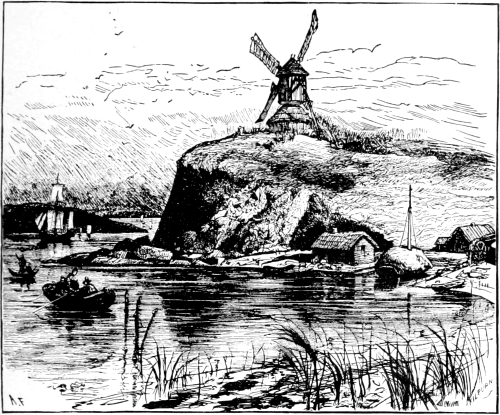
Boston, 1632
From an old print
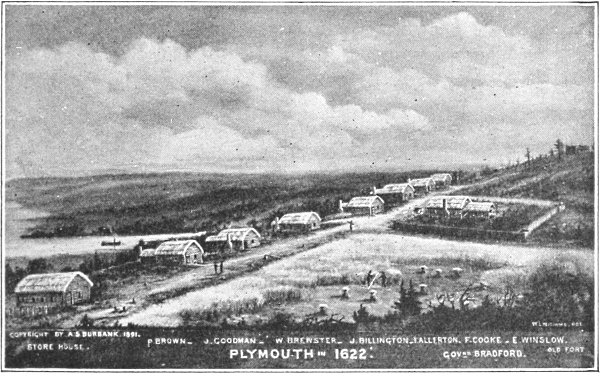
The Fort and Chapel on the Hill Where Roger Williams Preached
Used by permission of A. S. Burbank, Plymouth, Mass.
Williams was Pauline in his self-supporting ministry. He
wrote: “At Plymouth I spake on the Lord’s Day and week days
and worked hard at my hoe for my bread (and so afterward at
Salem until I found them to be an unseparated people).” His
ministry made friends and foes. His foes feared he would run
the same course of Anabaptist behavior as did John Smith, the
Se-Baptist, at Amsterdam. Early in August his first child was
born, and was named Mary after her mother. Later in the same
month, he became for a second time the assistant to Mr. Skelton,
at Salem. A number of choice spirits, who had been attracted
to his ministry, went with him. He requested a letter of dismission
from the Plymouth church to unite with the Salem
church. This was granted, but with a caution as to his advanced
views. To advocate the separation of Church and State
placed a man at that time with the “Anabaptists,” as this was
considered their great distinctive doctrine.
He commenced his labors at Salem under this cloud and also
with the General Court in Boston very suspicious of his work.
Already there was the distant rumbling of a storm which would
eventually drive him into exile.
The ministers of the Bay Colony, from the churches of Boston,
Newtowne (Cambridge), Watertown, Roxbury, Dorchester,
Salem, and elsewhere, were accustomed to meet for discussion
and common interest. Roger Williams feared that this might lead
to a presbytery or superintendency, to the prejudice of local
church liberty. He loathed everything which might make for
intolerance.
In December, 1633, he forwarded to the governor and his
assistants a document which he had prepared at Plymouth, in
which he disputed their right to have the land by the king’s grant.
Williams claimed, “they have no title except they compounded
with the natives.” He also accused King James of telling a lie
in claiming to be “the first Christian prince to discover this
new land.” This treatise had never been published or made
public. Its appearance now terrified the governor and the assistants,
for at that very time they were holding the possession to
their colony on a charter originally given for a different purpose.
It had been granted in England to a trading company, and its
transfer was questionable. They feared the king might withdraw
it. This treatise of Williams would be considered treason
by the king. They met on December twenty-seventh and counseled
with Williams. Seeing the grave danger to the colony, he
agreed to give evidence of loyalty. Today we do not question
the ethical correctness of the advanced position held by Williams.
It was not long before this pioneer of soul-liberty raised a new
question concerning “the propriety of administering an oath,
which is an act of worship, to either the unwilling or the unregenerate.”
Williams’ position was peculiarly obnoxious to the
magistrates who were then on the point of testing the loyalty
of the colonists by administering an oath of allegiance which was
to be, in reality, allegiance to the colony instead of to the king.
The Court was called to discuss the new objection to its policy.
Mr. Cotton informs us that the position was so well defended
by Williams that “it threatened the court with serious embarrassment.”
The people supported Williams’ position, and
the court was compelled to desist. On the death of Skelton, in
August, 1634, the Salem church installed Roger Williams as their
teacher. This act gave great offense to the General Court in
Boston. Williams commenced anew his agitation against the
right to own land by the king’s patent. The Salem church and
Williams were both cited to appear before the General Court,
July 18, 1635, to answer complaints made against them.
The elders gave their opinion:
He who would obstinately maintain such opinions (whereby a church
might run into heresy, apostasy, or tyranny, and yet the civil Magistrates
may not intermeddle) ought to be removed, and that the other churches
ought to request the Magistrates so to do.
The church and the pastor were notified “to consider the matter
until the next General Court, and then to recant, or expect the
court to take some final action.” At this same court, the Salem
people petitioned for a title to some land at Marblehead Neck,
which was theirs, as they believed, by a just claim. The court
refused even to consider this claim, “until there shall be time
to test more fully the quality of your allegiance to the power
which you desire should be interposed on your behalf.” Professor
Knowles says:
Here is a candid avowal that justice was refused to Salem, on the
question of civil right, as a punishment for the conduct of church and
pastor. A volume could not more forcibly illustrate the danger of a
connection between the civil and ecclesiastical power.
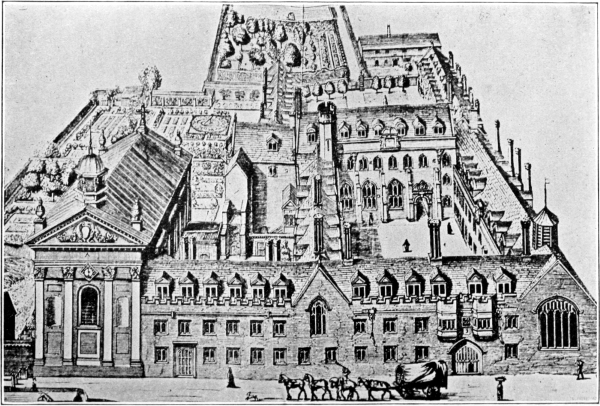
Pembroke College
Reduced from Loggan’s print, taken about 1688
Teacher and people at Salem were indignant, and a letter
was addressed to the churches of the colony in protest against
such injustice. The churches were asked to admonish the magistrates
and deputies within their membership. These churches
refused or neglected to do this. In some cases the letters never
came before the church. Williams then called on his own church
to withdraw communion with such churches. It declined to
do this, and he withdrew from the Salem church, preaching his
last sermon, August 19, 1635. Here was a repetition of the
first conflict. Straus writes:
Here stood the one church already condemned, with sentence suspended
over it. Against it were arrayed the aggregate power of the colony—its
nine churches, the priests, and the magistrates. What could the Salem
church and community do, threatened with disfranchisement, its deputies
excluded from the General Court, and its petition for land to which it
was entitled, denied? Dragooned into submission it had to abandon its
persecuted minister to struggle alone against the united power of Church
and State. To deny Williams the merit of devotion to a principle in
this contest, wherein there was no alternative but retraction or banishment,
is to belie history in order to justify bigotry, and to convert martyrdom
into wrong-headed obstinacy. This is exactly what Cotton sought
to do in his version of the controversy given ten years later in order to
vindicate himself and his church brethren from the stigma of their acts in
the eyes of a more enlightened public opinion in England. Williams pursued
no half-hearted or half-way measures. He stood unshaken upon the
firm ground of his convictions, and declared to the Salem church that he
could no longer commune with them, thereby entirely separating himself
from them and them from him.
He went so far as to refuse to commune with his own wife in
the new communion which he formed in his own home, until she
would completely withdraw from the Salem church.
The time for the next General Court drew near. The Salem
church letter and Williams’ withdrawal from his church made
his foes determined to crush him. They had thoughts of putting
him to death.
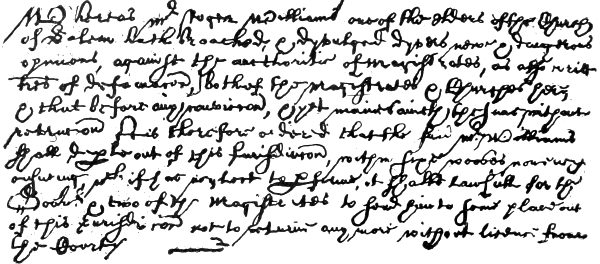
1635.
3rd Sept.
Whereas Mr. Roger Williams, one of the elders of the church of Salem, hath broached and divulged dyvers newe
and dangerous opinions against the aucthorite of magistrates, as also with others of defamcon, both of the magistrates
and churches here, and that before any conviccon, and yet maintaineth the same without retraccon, it is therefore
ordered, that the said Mr. Williams shall depte out of this jurisdiccon within sixe weekes nowe nexte ensueing, wch
if hee neglect to pforme, it shall be lawfull for the Gouv’r and two of the magistrates to send him to some place out
of this jurisdiccon, not to returne any more without licence from the Court.
Fac-simile from Original Records of the Order for the Banishment
of Roger Williams.
The General Court convened in the rude meeting-house of the
church in Newtowne (Cambridge), on the corner of Dunster
and Mill Streets. Williams maintained his positions. He was
asked if he desired a month to reflect and then come and argue
the matter before them. He declined, choosing “to dispute presently.”
Thomas Hooker, minister at Newtowne, was appointed
to argue with him on the spot, to make him see his errors.
Williams’ positions had a “rockie strength” and he was ready,
“not only to be bound and banished, but to die also in New
England; as for the most holy truths of God in Christ Jesus.”
He would not recant. So the Court met the following day,
Friday, October 9, 1635, and passed the following sentence:
Whereas Mr. Roger Williams, one of the elders of the church of Salem,
hath broached and divulged dyvers newe and dangerous opinions against
the aucthorite of magistrates, as also with letters of defamcon, both of the
magistrates and churches here, and that before any conviccon, and yet
maintaineth the same without retraccon,
it is therefore ordered, that the said Mr. Williams shall depte out of this
jurisdiccon within sixe weekes nowe nexte ensueing, wch if hee neglect to
pforme, it shall be lawfull for the Gouv’r and two of the magistrates to
send him to some place out of this jurisdiccon, not to returne any more
without licence from the Court.
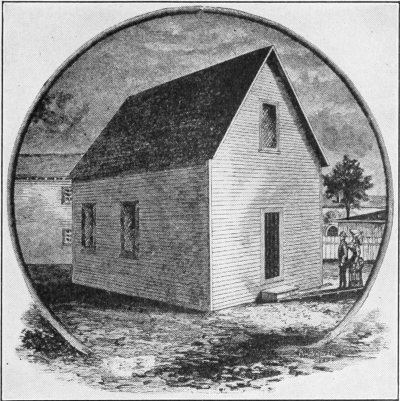
Original Church at Salem, Mass.
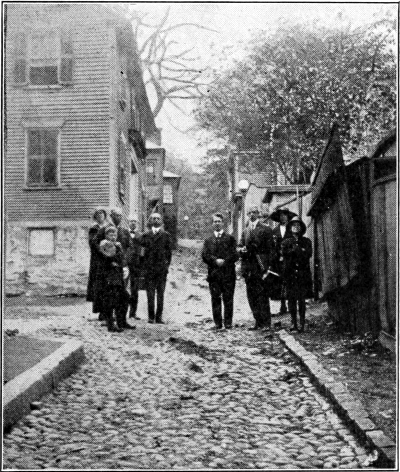
Site of Home of Roger Williams in Providence, R. I.
Although Williams had withdrawn from the church at Salem,
yet his character was such that the town was indignant at this
decree of the court. About this time, his second child was born.
Like the prophets of old, he gave the child a significant name, calling
her “Freeborn.” Mr. Williams’ health at this time was far
from being robust. A stay of sentence was therefore granted,
and he was to be allowed to remain until the following spring.
He did not refrain from advocating his opinions, and soon the
authorities heard of meetings in his house at Salem and of twenty
who were prepared to go with him to found a new colony at the
head of the Narragansett Bay. At its January meeting, the Court
decided to send him to England at once in a ship then about to
return. He was cited to appear in Boston, but reported inability
due to his impaired health. They then sent a pinnace for him
by sea. Being forewarned, he fled to the wilderness in the depths
of which, for fourteen weeks, he suffered the hardships of a New
England winter.
******
The original Roger Williams Church is still preserved at
Salem. The first church in the first town of the Massachusetts
Bay Colony was at the corner of Washington and Essex Streets.
There is a brick structure there now and a marble tablet marks
it as the site of the first church in the Massachusetts Bay Colony.
On another tablet, is the inscription:
The frame of the first Meeting House in which the civil affairs of the
Colony were transacted, is preserved and now stands in the rear of Plummer
Hall.
Plummer Hall is on Essex Street not very far from the First
Church. In the rear is the Roger Williams Church, a small building,
measuring twenty feet long by seventeen wide by twelve high
at its posts. Originally it had a gallery over the door at the
entrance and a minister’s seat in the opposite corner. On the
wall opposite to the entrance is a list of its succession of pastors
and the years of their service:
| Francis Higginson |
1629-1630 |
|
| Samuel Skelton |
1629-1634 |
|
| Roger Williams |
1631-1635 |
|
| Hugh Peters |
1636-1641 |
etc., etc. |
It could accommodate about one hundred people. There were
only forty families in Salem in 1632. There were only six
houses, besides that of Governor Endicott, when Higginson arrived
in 1629. Here in this ancient meeting-house Roger Williams
preached those truths which led to his banishment. From
its pulpit came, clearly stated, the ideals that millions have since
accepted. The glory of the Sistine Chapel in Rome, or the
Royal Sancte Chapella, of Paris, can never equal the glory
of this crude edifice, the cradle of religious liberty in the New
World.
The Roger Williams Home at Salem is still preserved. It
is better known as “the Witch House” because it was occupied
by Judge Carwin, one of the judges connected with the tragedy
of 1692. It stands at the western corner of Essex and North
Streets. It was built by the founder of Rhode Island and was
at that time second only to the Governor’s home. Though it has
been altered and repaired, the original rooms in this building
are as follows: The eastern room on the first floor, 18 × 21½,
and the room directly over it, 20 × 21½; the western room on
the first floor, 16½ × 18, and the room over it, 16½ × 20. The
chimney is 8 × 12. The part of the house which retains its
original appearance is the projecting corner of the western part,
fronting on Essex Street. Roger Williams mortgaged this house,
“for supplies,” to establish the colony at Providence.
Mr. Upham, in his report to the Essex Institution, says of
this wonderful house:
Here, within these very walls, lived, two hundred and fifty years ago,
that remarkable and truly heroic man, who, in his devotion to the principle
of free conscience, and liberty of belief, untrammeled by civil power,
penetrated in midwinter in the depths of an unknown wilderness to seek
a new home, a home which he could find only among savages, whose
respect for the benevolence and truthfulness of his character made them,
then and ever afterward, his constant friends. From this spacious and
pleasant mansion, he fled through the deep snows of a New England
forest, leaving his wife and young children to the care of Providence,
whose silent “voice” through the conscience, was his only support and
guide. The State which he founded may ever look back with a just
pride upon the history of Roger Williams.
II
THE FOUNDING OF PROVIDENCE
A community on the unheard-of principles of absolute religious liberty
combined with perfect civil democracy.—Professor Mason.
Thus for the first time in history a form of government was adopted
which drew a clear and unmistakable line between the temporal and the
spiritual power, and a community came into being which was an anomaly
among the nations.—Prof. J. L. Diman.
No one principle of political or social or religious policy lies nearer the
base of American institutions and has done more to shape our career
than this principle inherited from Rhode Island, and it may be asserted
that the future of America was in a large measure determined by that
General Court which summoned Roger Williams to answer for “divers
new and dangerous opinions,” and his banishment became a pivotal act
in universal history.—Prof. Alonzo Williams.
In summing up the history of the struggle for religious liberty it may
be said that papal bulls and Protestant creeds have favored tyranny.
Theologians of the sixteenth century and philosophers of the seventeenth,
Descartes, Spinoza, and Hobbes, favored the State churches. It was
bitter experience of persecution that led jurists, and statesmen of Holland
and France, in face of the opposition of theologians and philosophers, to
enforce the toleration of dissent. While there was toleration in Holland
and France, there was, for the first time, in the history of the world in
any commonwealth, liberty and equality and separation of Church and
State in Rhode Island.—W. W. Evarts, in “The Long Road to Freedom
of Worship.”
In the code of laws established by them, we read for the first time since
Christianity ascended the throne of the Cæsars, the declaration that conscience
should be free and men should not be punished for worshiping
God in the way they were persuaded he requires.—Judge Story.
ROGER WILLIAMS left Salem on or about January 15,
1636, making the journey alone through the forests. With
a pocket compass, and a sun-dial to tell the hours, he set
out, probably taking the road to Boston for some distance.
Nearing Boston, presumably at Saugus, he went west for a while
and then straight south until he reached the home of Massasoit,
the Wampanoag sachem, at Mount Hope, near Bristol. The
ground was covered with snow, and he must have suffered sorely
on this journey of eighty or ninety miles. Thirty-five years
later in a letter to Major Mason, he refers to this experience:
First, when I was unkindly and unchristianly, as I believe, driven from
my house and land, and wife and children (in the midst of a New
England winter, now about thirty-five years past), at Salem, that ever-honored
Governor, Mr. Winthrop, privately wrote me to steer my course
to Narragansett Bay and the Indians, for many high and public ends,
encouraging me, from the freeness of the place from any English claims
or patents. I took his prudent notion as a hint and voice from God, and
waving all other thoughts and notions, I steered my course from Salem
(though in winter snow, which I feel yet) unto those parts wherein I
may say “Peniel”; that is, I have seen the face of God.
He also wrote: “I was sorely tossed for one fourteen weeks,
in a bitter winter season, not knowing what bread or bed did
mean!” In his old age he exclaimed, “I bear to this day in my
body the effects of that winter’s exposure.” In one of his books
he refers to “hardships of sea and land in a banished condition.”
The precious relics of this flight are the sun-dial and compass,
now in the possession of the Rhode Island Historical Society.
Williams finally reached Seekonk Cove, about the twenty-third
of April. The spot was at Manton’s Neck, near the cove,
where there was a good spring of water. Here he was joined by
four companions, his wife, and two children. “I gave leave to
William Harris, then poor and destitute,” said Williams, “to
come along in my company. I consented to John Smith, miller
at Dorchester (banished also), to go with me, and, at John
Smith’s desire, to a poor young fellow, Francis Wickes, as also
a lad of Richard Waterman’s.” The latter was doubtless Thomas
Angell. Joshua Verein came later. Some historians think that
others joined them at the Seekonk before they were compelled
to leave. Here they remained for two months. After providing
rude shelters and sowing seeds, they received a warning to move
on. “I received a letter,” said Williams,
from my ancient friend, Mr. Winslow, the Governor of Plymouth, professing
his own and others’ love for me, yet lovingly advising me, since
I was fallen into the edge of their bounds, and they were loathe to
displease the Bay, to remove to the other side of the water, and there,
he said, I had the country free before me, and might be free as themselves,
and we should be loving neighbors together.
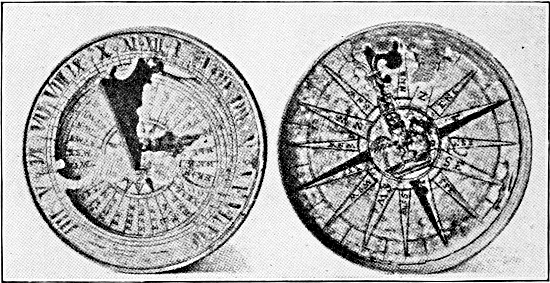
Sun-dial and Compass Used by Roger Williams in His Flight
Courtesy of “Providence Magazine”
His removal cost him the “loss of a harvest that year.” Historians
are agreed that about the end of June he left Seekonk.
The two hundred and fiftieth anniversary was celebrated, June
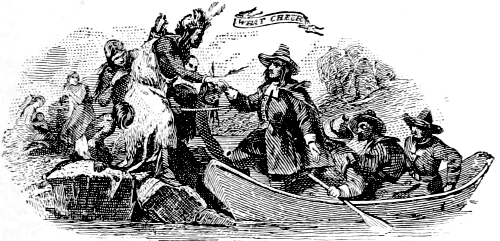
23 and 24, 1886. Embarking in a crude Indian canoe, Williams
and his companions, six in all, crossed over the river to a little
cove on the west side, where they were halted by a party of
Indians, with the friendly interrogation, “What cheer?” Here
the party landed on a rock which has been known ever since as
“What Cheer Rock.” The cove is now filled and the rock covered
from sight. A suitable monument has been erected over the
rock. It is in an open park space at the corner of Roger and
Williams Streets, Providence. A piece of this rock is preserved
at the First Baptist Church of Providence, and another has recently
been placed in cross form in the lobby floor of the new
Central Baptist Church of the same city. It is hoped that a piece
of this rock will be worked into the National Baptist Memorial
in our country’s capital.
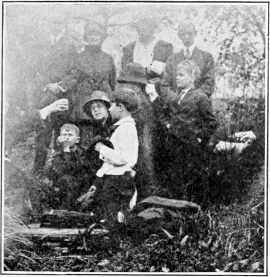
Spring at the Seekonk Settlement
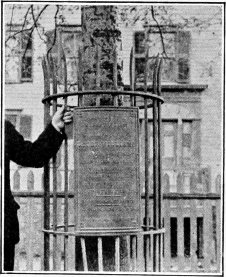
Tablet Marking Seekonk Site
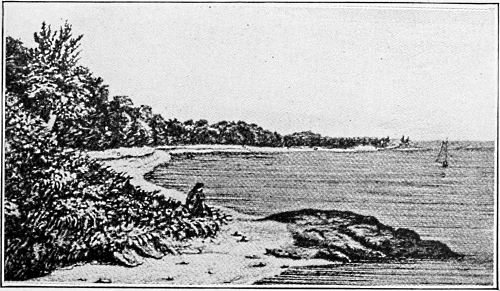
What Cheer Rock. Landing-place of Roger Williams
After friendly salutations with the Indians, they reembarked
and made their way down the river around the headland of
Tockwotten and past Indian and Fox points, where they reached
the mouth of the Moshassuck River. Rowing up this beautiful
stream, then bordered on either side with a dense forest, they
landed on the east side of the river, where there was an inviting
spring. Here, on the ascending slopes of the hill, they commenced
a new settlement, which Williams called “Providence,”
in gratitude to God’s merciful Providence to them in their distress.
Later, when they spread out in larger numbers and in
all directions from this place, it was called “Providence Plantations.”
They prepared shelters for their families, probably wigwams
made of poles covered with hemlock boughs and forest
leaves. We can in imagination see them climb the hill to a
point where Prospect Street now runs, to enjoy a wider view of
their new territory.
From that height of almost two hundred feet they saw to the
westward, through openings in the forest, the cove at the head
of the great salt river with broad sandy beaches on the eastern
and northern shores and salt marshes bordering the western
and southern. From the north the sparkling waters of the
Moshassuck River came leaping over the falls as it emptied itself
into the estuary at its mouth. Bordering this stream was a
valley of beauty and fertility. The clear waters of the Woonasquatucket
threaded their way from the west through another
fertile valley. Between these rivers and also southward (of the
Woonasquatucket) was a sandy plateau, covered with pine forests
stretching to the Indian town of Mashapaug on the southwest
and Pawtuxet Valley to the south. Between the edge of the tidal
flow and the open waters of the great salt river there was a
salt marsh dotted with islands, beyond which rose the bold peak
of Weybosset Hill. Down the river to the south they saw the
steep hills of Sassafras and Field’s Point, beyond which could
be seen the lower bay and its forest-covered shores and islands.
The eastern slope of the hill stretched a mile toward the shore
of the Seekonk. To the northeast the view was cut off by a
higher eminence covered with oak and pine. In all directions,
save that of the bay itself, the farther distances were lost in an
indistinguishable maze of forest-crowned heights. At the feet
of the spectators was the place of their immediate settlement,
where the western slope of the hill gradually diminished in
height toward the south. At its lowest extremity, Fox Point
projected into the bay. This slope was covered with a growth
of oak and hickory.
A Purchased Possession
Roger Williams differed from the ordinary colonists of his age,
who held that the Indian, being heathen, had no real ownership
of the land. It belonged to the Christians who might first
claim it by right of discovery. Williams, who “always aimed to
do the Indians only good,” recognized Indian ownership and
secured his colony from them by purchase. Here among them
he first sought to apply his doctrine of soul-liberty. To him they
were humans with equal rights and privileges. He bitterly
fought the Puritan position that the pagan heathen had no property
rights which the Christian, with his superior culture, was
bound to respect. Roger Williams insisted that the land should
be purchased from the Indians, the original owners. He gained
the lasting respect of the Indian and the undying animosity of
the Puritan for holding to ideals which have since come to be
recognized as American. He thus laid the foundation for the
belief in America that the weaker and smaller powers have rights
which the greater powers must respect, a belief which led us into
the recent great war. While this principle is receiving world-wide
application, let us not forget that Roger Williams was the
pioneer of international justice in America, if not in the world.
The land viewed from the top of the hill was owned by five
distinct Indian tribes. The Narragansetts dominated over all the
lands now occupied by Rhode Island, and ruled over all other
lesser tribes in this territory. In the northern part of this State,
the Nipmucs lived in the place now occupied by Smithfield,
Glocester, and Burrilville. On the southern seacoast border
dwelt the Niantics. Part of the Wampanoag tribe dwelt in
Cumberland and extended to the western side of the river which
we now call the Blackstone. The Pequots lived in Connecticut
Colony. Indian government was monarchial, and became extinct
with the slaughter of the last of the line of rulers or sachems
in the massacre of July 2, 1676. Canonicus was the ruling sachem
when the English first came. As he grew old he needed an
assistant and his nephew, Miantonomo, was appointed. Miantonomo
worked well with the elder chief. He never succeeded
to the position of ruling chief, being murdered in 1643. Roger
Williams secured his land from these sachems. Williams wrote
in 1661 as follows:
I was the procurer of the purchase, not by monies, nor payments, the
natives being so shy and jealous, that monies could not do it, but by that
language, acquaintance, and favor with the natives and other advantages
which it pleased God to give me, and also bore the charges and venture
of all the gratuities which I gave to the great Sachems and natives
round about us, and lay engaged for a loving and peaceable neighborhood
with, to my great charge and travel.
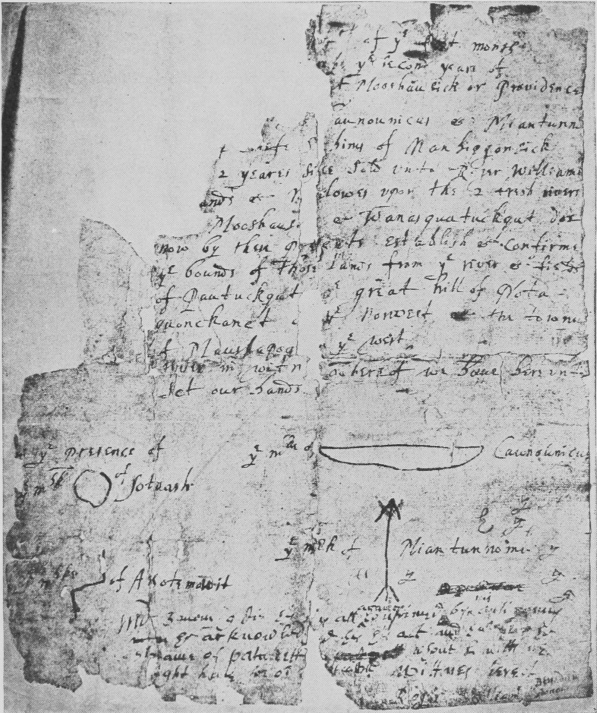
Original Deed of Providence from the Indians
He found Indian gifts very costly. Presents were made frequently.
He allowed the Indians to use his pinnace and shallop
at command, transporting and lodging fifty at his home at a
time. He never denied them any lawful thing. Canonicus had
freely what he desired from Roger Williams’ trading-post at
Narragansett. William Harris stated in 1677 that Roger Williams
had paid thus one hundred and sixty pounds ($800) for
Providence and Pawtucket.
Mr. Williams generously admitted the first twelve proprietors
of the Providence Purchase to an equal share with himself, without
exacting any remuneration. The thirty pounds which he
received were paid by succeeding settlers, at the rate of thirty
shillings each. This was not a payment for the land but what
he called “a loving gratuity.” Straus says:
He might have been like William Penn, the proprietor of his colony,
after having secured it by patent from the rulers in England, and thus
have exercised a control over its government and enriched himself and
family. But this was not his purpose, nor was it directly or remotely
the cause for which he suffered banishment and misery. Principle—not
profit; liberty—not power; conviction—not ambition, were his impelling
motives which he consistently maintained, theoretically and practically
then, and at all times.
Williams’ own words were:
I desired it might be for a shelter for persons distressed for conscience.
I then considering the conditions of divers of my distressed countrymen,
I communicated my said purchase unto my loving friends (whom he
names) who desired to take shelter with me.
He afterward purchased, jointly with Governor Winthrop, the
Island of Prudence from Canonicus. He also purchased, a little
later, the small islands of Patience and Hope, afterward selling
his interest in them to help pay his expenses to England on
business for the colony.
Following is a true copy of the Original Deed of Land for
Providence from Canonicus and Miantonomo:
At Nanhiggansick, the 24th of the first month, commonly called March,
in the second year of the Plantations of Plantings at Mooshausick or
Providence. Memorandum that we Caunaunicus and Meauntunomo, the
two chief sachems of Nanhiggansick, having two years since sold unto
Roger Williams, the lands and meadows upon the two fresh rivers, called
Mooshausick and Wanasquatucket, do now by these presents, establish and
confirm the bounds of those lands, from the river and fields at Pawtucket,
the great hill of Neotackonkonutt, on the northwest, and the town of
Mashapauge on the west. As also in consideration of the many kindnesses
and services he hath continually done for us, both with our friends of
Massachusetts, as also at Quinickicutt and Apaum, or Plymouth, we do
now freely give unto him all the land from those rivers reaching to
Pawtuxet River, as also the grass and meadows upon the said Pawtuxet
River. In witness whereof we have hereunto set our hands.
In the presence of
The Mark * of Setash,
The Mark * of Assotenewit,
The Mark * of Caunaunicus,
The Mark * of Meauntunomo.
This original deed is preserved, as a precious relic, in the City
Hall at Providence.
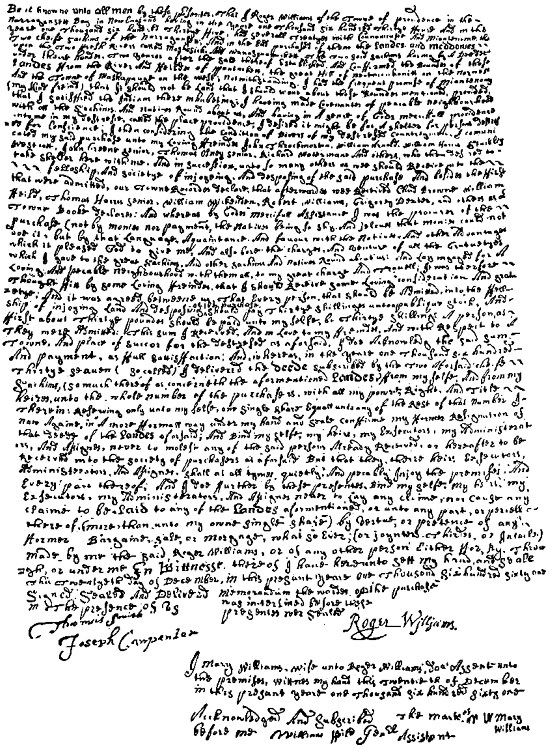
Williams’ Letter of Transference to His Loving Friends
Early Experiences in Providence
The Providence planters soon built their crude homes. The
Indian name of the plantation was Notaquonchanet. In their
early records of Providence this name is spelt in at least forty-two
different forms. Other settlers came and swelled their
numbers. The original six were bound together by a compact.
It was verbal, or if written, the copy has been lost. When new
settlers came and Wickes and Angell had reached majority, a
copy of the original agreement was drawn up and signed by those
not included in the first compact. Williams was familiar with
the great compact signed in the Mayflower by the Pilgrims and
probably it suggested to his mind the need of one in Providence.
This Providence Compact is as follows:
We, whose names are hereunder written, being desirous to inhabit in
the town of Providence, do promise to submit ourselves in active or
passive obedience, to all such orders or agreements as shall be made for
the public good of the body, in an orderly way, by the major consent of
the present inhabitants, masters of families, incorporated together into
a township, and such others whom they shall admit unto the same, ONLY
IN CIVIL THINGS.
Edmund J. Carpenter says of this Compact:
A compact of government, which in its terms, must be regarded as the
most remarkable political document theretofore executed, not even excepting
the Magna Charta. It was a document which placed a government,
formed by the people, solely in the control of the civil arm. It
gave the first example of a pure democracy, from which all ecclesiastical
power was eliminated. It was the first enunciation of a great principle,
which years later, formed the corner-stone of the great republic. It
was the act of a statesman fully a century in advance of his time.
At the west entrance to the street railroad tunnel in Providence
a bronze tablet commemorates the fact that there in the open
air the first town meetings were held.
Roger Williams’ house was opposite the spring, forty-eight
feet to the east of the present Main Street and four feet north
of Howland Street. Next, to the north of his residence, was the
house and lot of Joshua Verein. North of this was Richard
Scott’s. The first house south of Williams’ was that of John
Throckmorton and, beyond, that of William Harris. At first
the struggle for existence was hard, more so because of the loss
of the crops planted at Seekonk. Governor Winslow, of Plymouth,
conscious of the wrong Plymouth Colony had done to
Williams, visited the little settlement that first summer and left
a gift of gold with Mrs. Williams. In the spring and summer
of the following year, new houses were built along the street.
The new settlers brought money with them, and Williams enlisted
outside capital to help develop the colony.
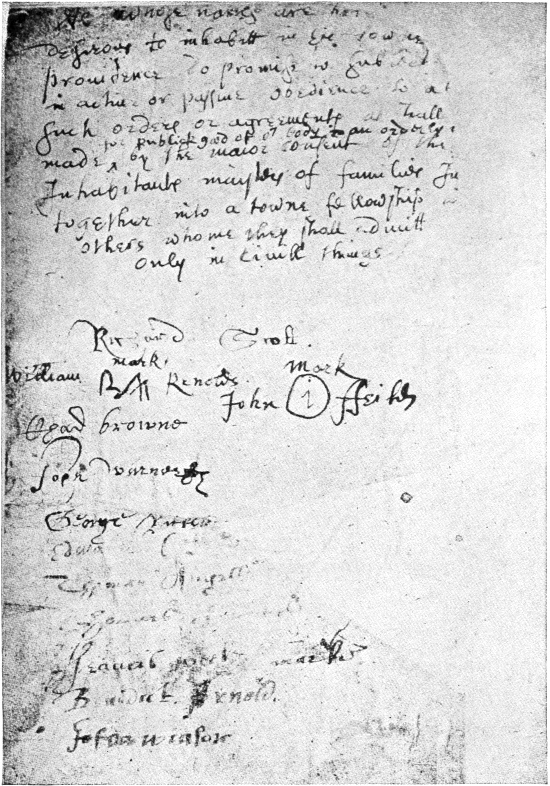
The Original Providence “Compact”
Drawn up by the men of Providence, August 20, 1638, and now contained in the
City Hall. One of the most valuable documents in existence, under which Williams
and his companions promised to subject themselves in active and passive obedience,
but “Only in Civil Things.”
“You must look to the Magna Charta, for another such epoch-making decree,
for these, with the Declaration and the Emancipation Proclamation, are the four great
dynamic forces of American Freedom.”—R. B. Burchard.
Courtesy of “Providence Magazine,” October, 1915
The number of town lots increased. The land lay between
the present Main Street and Hope Street. Each lot was of equal
width and ran eastward. Eventually there were one hundred and
two of these lots extending from Mile End Brook, which enters
the river a little north of Fox Point, to Harrington’s Lane, now
the dividing line between Providence and North Providence.
Meeting and Power Streets were the dividing streets in those
early days. In addition to the home lot, each proprietor had an
“out six-acre lot” assigned to him. Williams’ “out lot” was at
“What Cheer Rock.”
The Threatened Indian Trouble
Williams, although suffering from Puritan persecution, had
an opportunity that first year of doing good to his persecutors.
He became the savior of all the New England Colonies. The
Pequot Indians planned the annihilation of the English. Williams,
hearing of this, did his utmost to break up an Indian league,
and kept the Narragansetts from joining the Pequots and
Mohicans. He describes this experience in the following statement:
The Lord helped me immediately to put my life into my hands, and
scarce acquainting my wife, to ship alone, in a poor canoe, and to cut
through a stormy wind, with great seas, every minute in hazard of life,
to the sachem’s house. Three days and nights my business forced me
to lodge and mix with the bloody Pequod ambassadors, whose hands
and arms, methought, reeked with the blood of my countrymen, murdered
and massacred by them on the Connecticut River, and from whom I could
not but nightly look for their bloody knives at my own throat also. God
wondrously preserved me, and helped me to break the Pequod’s negotiation
and design; and to make and finish, by many travels and charges, the
English league with the Narragansetts and Mohegans against the Pequods.
As a result of this, the tribe of Pequots was obliterated completely
and a danger hanging over all the colonies was removed.
The Indian villages of southern New England were composed
at times of as many as fifty houses or wigwams. Most of these
wigwams were shaped like the half of an orange, with the flat
or cut surface down. They were ten to twelve feet in diameter
and could accommodate two families. Other houses were like
the half of a stovepipe cut lengthwise, twenty to thirty feet long,
and accommodated from two families in the summertime to
fifty in the winter, when the people crowded together for the
sake of warmth. The council-chamber was often as long as one
hundred feet with a width of thirty feet. It was used only for
councils. A fortified stockade in the center of the village was
made of logs set into the ground. Such was the shelter afforded
Williams when he fled from Salem, and such was the place when
he met the Indian sachems in council seeking to avert the massacre
of the whites. In these villages he preached the everlasting
gospel of the Son of God. He had the constant confidence of
Indian sachems because he applied to them the principle of soul-liberty
which he sought to practise among the whites.
In the autumn of 1638, Roger Williams’ third child and first
son was born and named “Providence.” He was the first white
male child born in this colony. In the year 1639-1640 the town
grew and felt the need of a system of town government. On
July 23, 1640, an organization was decided upon in which they
vested the care of the general interests of the town in five “disposers”
or arbitrators. The people retained the right to appeal
from the “disposers” to the general town meeting. They were
careful to provide that as “formerly hath been the liberties of
the town, so still to hold for the liberty of conscience.”
In 1638 a settlement had been made at Portsmouth on Rhode
Island. John Clarke and Mrs. Ann Hutchinson were the leaders
of this new band who were looking for a place where they might
have religious freedom, which was denied them at Boston. They
went first to New Hampshire, but, finding it too cold there, turned
to the south. By the friendly assistance of Mr. Williams, they
secured from Canonicus and Miantonomo, for a consideration of
forty fathoms of white beads, Aquidneck and other islands in
Narragansett Bay. The natives residing on the island itself
were induced to remove for a consideration of ten coats and
twenty hoes. The new settlers chose Mr. Coddington to be their
judge and united in a covenant with each other and with their
God. They made Mr. Coddington their governor in 1640.
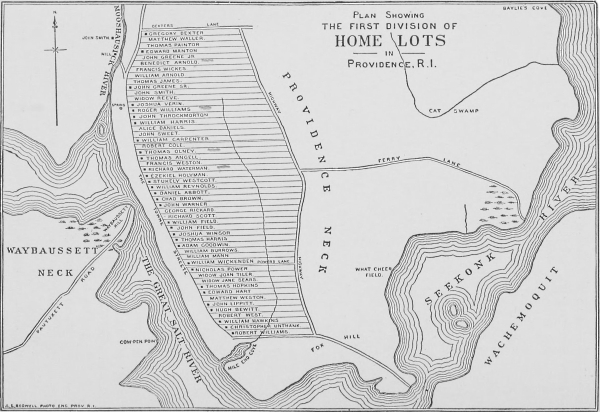
Plan Showing
THE FIRST DIVISION OF
HOME LOTS
IN
Providence, R.I.
About this same time a number of Providence people settled
in Pawtuxet, four miles south of Providence in territory ceded
to Williams. Warwick and Shawomet were settled by Samuel
Gorton and his friends. Gorton was a strange character who
did not find things congenial for him at Boston, Plymouth, and
Newport in turn. Roger Williams, however, gave him shelter
in Providence. Finally he went to Pawtuxet and later to
Shawomet, for which he paid four fathoms of wampum to the
Indians. At once Boston Colony claimed that Shawomet was
under their jurisdiction. Gorton and his associates refused to
come to Boston at the bidding of the authorities. Forty soldiers
came to Shawomet and seized Gorton and ten of his friends and
imprisoned them in Boston. They were tried for their lives,
escaping only by two votes. They were then imprisoned in the
various towns. Each one was compelled to wear a chain fast
bolted around his legs. If they spoke to any person, other than
an officer of the Church or of the State, they were to be put to
death. They were kept at labor that winter and then banished in
the spring. Gorton escaped to England and secured an order
from the Earl of Warwick and the Commissioners of the Colonies
requiring Massachusetts not to molest the settlers at Shawomet.
Thereafter Gorton and his friends occupied their lands in peace.
Gorton wrote his side of the question in “Simplicities Defence,”
in which he referred to his persecutors as “That Servant
so Imperious in his Master’s Absence Revived.” This is another
indictment against the persecuting Puritans by one who found
shelter in the Baptist colony of Rhode Island.
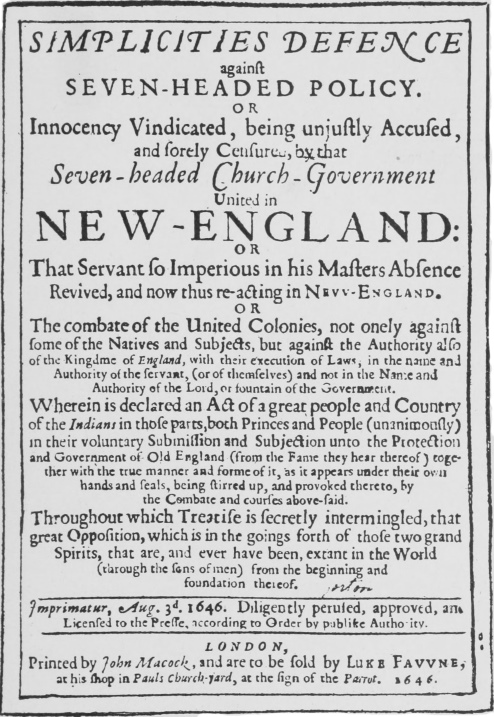
SIMPLICITIES DEFENCE
against
SEVEN-HEADED POLICY.
OR
Innocency Vindicated, being unjustly Accused,
and sorely Censured, by that
Seven-headed Church-Government
United in
NEW-ENGLAND:
OR
That Servant so Imperious in his Masters Absence
Revived, and now thus re-acting in New-England.
OR
The combate of the United Colonies, not onely against
some of the Natives and Subjects, but against the Authority also
of the Kingdme of England, with their execution of Laws, in the name and
Authority of the servant, (or of themselves) and not in the Name and
Authority of the Lord, or fountain of the Government.
Wherein is declared an Act of a great people and Country
of the Indians in those parts, both Princes and People (unanimously)
in their voluntary Submission and Subjection unto the Protection
and Government of Old England (from the Fame they hear thereof) together
with the true manner and forme of it, as it appears under their own
hands and seals, being stirred up, and provoked thereto, by
the Combate and courses above-said.
Throughout which Treatise is secretly intermingled, that
great Opposition, which is in the goings forth of those two grand
Spirits, that are and ever have been, extant in the World
(through the sons of men) from the beginning and
foundation thereof.
Imprimatur, Aug. 3ᵈ. 1646. Diligently perused, approved, and
Licensed to the Presse, according to Order by publike Authority.
LONDON,
Printed by John Macock, and are to be sold by Luke Favvne,
at his shop in Pauls Church-yard, at the sign of the Parrot. 1646.
The Story of the First Charter
As the colony grew, it was found necessary that there should
be some vested authority which would command respect from the
neighbors. Notwithstanding what Williams had done for the
Plymouth and Massachusetts Bay colonies in connection with
the Pequot War, and the personal friendships he had with the
governors, they would not consider that he or his had any separate
colony rights whatever. He had been their Joseph driven
from home and country by hostile brethren. In exile, he became
the savior of his brethren from a dreadful massacre by the Indians.
Nevertheless, Plymouth claimed jurisdiction over all the
plantations in Narragansett Bay, and Massachusetts claimed it
over Providence, Pawtuxet, and Shawomet. The Dutch had
formed a trading-post at Dutch Island and elsewhere and could
strike a blow at the colony at any time. Out of these conditions
grew the demand for a charter. Roger Williams, at a great
personal sacrifice, went to England from Manhattan, now New
York City, because the two colonies to the north forbade his
departure from their ports.
Arriving in England, he found the country in the midst of
the great Civil War. King Charles was powerless because Parliament
controlled the realm. Parliament had placed colonial
interest in charge of a committee of which the Earl of Warwick
was chairman or “Governor in Chief, and Lord High Admiral
of the Colonies.” From this council a charter was granted,
March 17, 1644. The colony was incorporated as “Providence
Plantations” and embraced the territory now covered by the State
of Rhode Island. There was granted to the inhabitants of
Providence, Portsmouth, and Newport, a
free and absolute charter of incorporation ... together with full power
and authority to govern themselves and such others as shall hereafter
inhabit within any part of said tract of land by such form of civil government
as by the voluntary consent of all or the greatest part of them
shall be found most serviceable to their estate and condition, etc.
Upon the return of Williams, the inhabitants of Providence,
learning of his approach, came out in fourteen canoes to meet
him at the Seekonk. They traveled over the historic course which
he had traveled six years before when he was an exile. Now
in triumph they escorted their beloved leader to home and native
town. A picture of his return with the charter, by Grant, is on
the walls of the Court House at Providence.
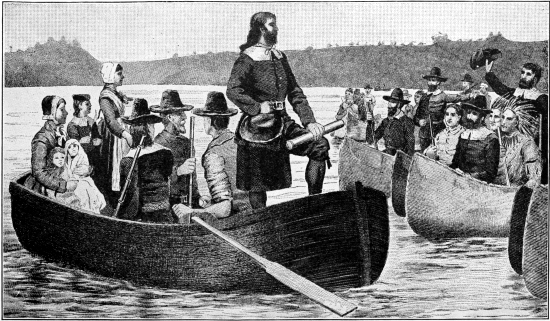
The Arrival of Roger Williams with the Charter
The earliest published work of Mr. Williams is entitled,
A Key into the Language of America: or, an help to the Language
of the Natives in that part of America, called New-England. Together,
with briefe Observations of the Customes, Manners and Worships, etc.
of the aforesaid Natives, in Peace and Warre, in Life and Death. On
all which are added Spirituall Observations, Generall and Particular by
the Authour, of chiefe and speciall use (upon all occasions) to all the
English Inhabiting those parts; yet pleasant and profitable to the view of
all men: By Roger Williams of Providence in New-England. London,
Printed by Gregory Dexter, 1643.
It was written at sea, en route to England, in the summer of
1643. Copies of the original edition are in the Bodleian Library,
at Oxford, the British Museum, also in the Library of the Massachusetts
Historical Society, Harvard College, Brown University,
and the American Antiquarian Society at Worcester. It
comprises two hundred and sixteen small duodecimo pages, including
preface and table.
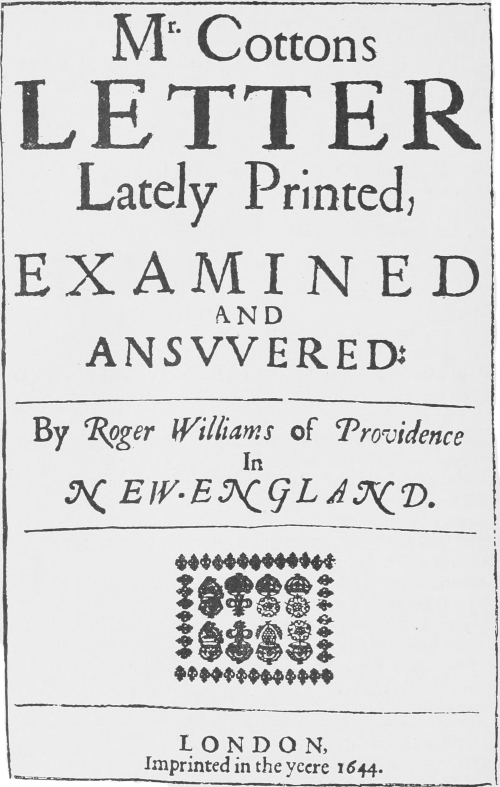
The second published work of Roger Williams is entitled,
“Mr. Cottons Letter Lately Printed, Examined and Answered.
By Roger Williams of Providence, in New-England. London,
Imprinted in the Yeere 1644.” Mr. Cotton had sought to “take
off the edge of Censure from himself”—that he was no procurer
of the sorrow which came to Williams in his flight and exile.
It is a small quarto of forty-seven pages, preceded by an address
of two pages. The letter referred to was written by John Cotton,
and was published in London, 1643. The author vindicated the
act of the magistrates in banishing Roger Williams from Massachusetts.
He denies that he himself had any agency in it. It
consists of thirteen small quarto pages. Good copies of both the
Letter and the reply are in the Library of Brown University.
Two copies of the reply are in England, one in the British
Museum, the other in Bodleian Library. A mutilated copy of
the reply is also in the Library of Yale College.
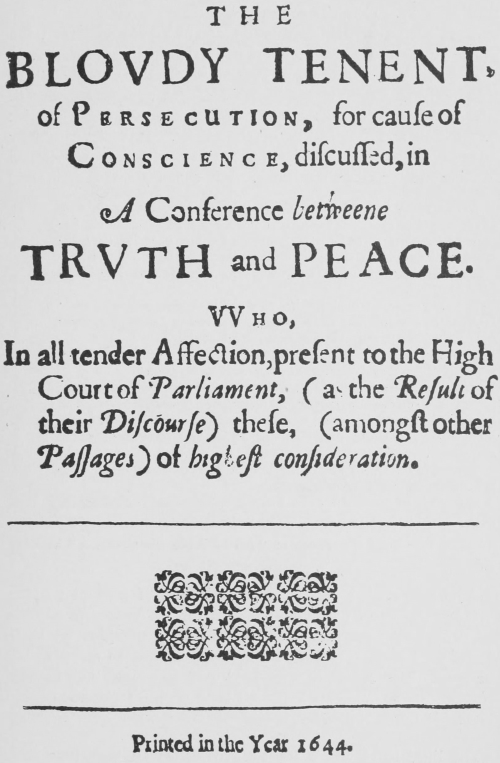
Roger Williams wrote also, when in England, securing the
Charter for Rhode Island, a work entitled, “The Bloudy Tenent,
of Persecution for cause of Conscience, discussed.” It is considered
the best written of all his works. These discussions were
prepared in London,
for publike view, in charge of roomes and corners, yea, sometimes in
variety of strange houses, sometimes in the fields, in the midst of travel,
where he hath been forced to gather and scatter his loose thoughts and
papers.
It is written in an animated style and has the adornment of beautiful
imagery. Original copies are rare, eight only are known
to exist, one in the British Museum, one in Bodleian Library, one
in Brown University Library, one in Harvard College Library.
Mʳ Cottons
LETTER
Lately Printed,
EXAMINED
AND
ANSVVERED:
By Roger Williams of Providence
In
New·England.
LONDON,
Imprinted in the yeere 1644.
THE
BLOVDY TENENT,
of Persecution, for cause of
Conscience, discussed, in
A Conference betweene
TRVTH and PEACE.
Who,
In all tender Affection, present to the High
Court of Parliament, (as the Result of
their Discourse) these, (amongst other
Passages) of highest consideration.
Printed in the Year 1644.
This work is based on a Baptist publication, entitled “An
Humble Supplication to the King’s Majesty, as it was presented
1620.” This latter was a clear and concise argument against
persecution and for liberty of conscience. It was written by
Murton, or some other London Baptist, who was imprisoned
in Newgate for conscience sake. His confinement was so rigid
that he was denied pen, paper, and ink. A friend in London
sent him sheets of paper, as stoppers for the bottles containing
his daily allowance of milk. He wrote his thoughts on these
sheets with milk, returning them to his friends as stoppers for
the empty bottles. They were held to the fire and thus became
legible. Roger Williams based his book on the argument of this
“Humble Supplication.”
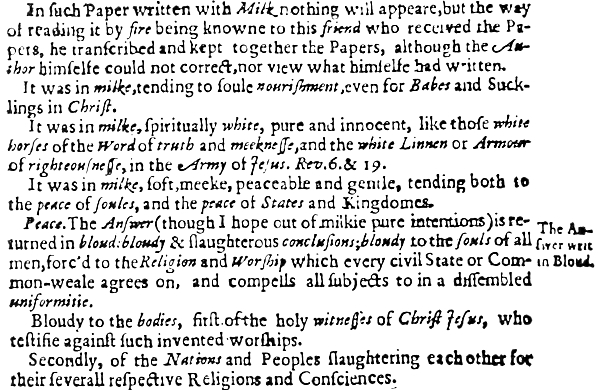
In such Paper written with Milk nothing will appeare, but the way
of reading it by fire being knowne to this friend who received the Papers,
he transcribed and kept together the Papers, although the Author
himselfe could not correct, nor view what himselfe had written.
It was in milke, tending to soule nourishment, even for Babes and Sucklings
in Christ.
It was in milke, spiritually white, pure and innocent, like those white
horses of the Word of truth and meeknesse, and the white Linnen or Armour
of rightousnesse, in the Army of Jesus. Rev. 6. & 19.
It was in milke, soft, meeke, peaceable and gentle, tending both to
the peace of soules, and the peace of States and Kingdomes.
The Answer
writ
in Bloud.
Peace. The Answer (though I hope out of milkie pure intentions) is returned
in bloud: bloudy & slaughterous conclusions; bloudy to the souls of all
men, forc’d to the Religion and Worship which every civil State or Common-weale
agrees on, and compells all subjects to in a dissembled
uniformitie.
Bloudy to the bodies, first of the holy witnesses of Christ Jesus, who
testifie against such invented worships.
Secondly, of the Nations and Peoples slaughtering each other for
their severall respective Religions and Consciences.
Roger Williams’ Reference to “An Humble Supplication” in His
“Bloudy Tenent”
******
The little band which settled Providence on that June day,
1636, had grown into a large town. With other towns they
suffered the same injustice from neighboring colonies. The
assembly in Newport, September 19, 1642, which intrusted the
work of securing a charter to Williams, was in reality fusing
together these separate groups, which had a common enemy and
common principles, into a State. The Town of Providence, a
great monument to Roger Williams, must now give way to the
State of Rhode Island, which was destined to become a still
larger monument to the ideals of this great exponent of civil and
religious liberty, “a liberty which does not permit license in civil
matters in contempt of law and order.”
III
THE HISTORIC CUSTODIANS OF
SOUL-LIBERTY
Roger Williams must forever rank as one of the great epoch-makers
of the world, and to him impartial historians accord the honor of
being the first democrat. It was not until his expulsion from Salem Colony
that he became a Baptist, but the evidence is indisputable that he had
long been a Baptist at heart. He had spent much time among the Baptists
in England and was familiar with their doctrines and writings.
No sooner had Williams set foot in America than he found himself in
conflict with the authorities, both civil and religious.—S. Z. Batten, in
“The Christian State.”
There is not a confession of faith, nor a creed, framed by any of
the Reformers, which does not give the magistrate a coercive power in
religion, and almost every one at the same time curses the resisting
Baptists.—E. B. Underhill, in “Struggles and Triumphs.”
Godly princes may lawfully issue edicts for compelling obstinate and
rebellious persons to worship the true God and to maintain the unity of
the faith.—Calvin.
Democracy, I do not conceyve that ever God did ordeyne as a fit
government eyther for Church or Commonwealth.... As for monarchy and
aristocracy, they are both of them clearly approved, and directed in
Scripture.—John Cotton.
It is said that Men ought to have Liberty of their Conscience, and that
it is Persecution to debar them of it; I can stand amazed than reply
to this: It is an astonishment to think that the brains of men should be
parboiled in such impious ignorance.—Rev. Nathaniel Ward, Lawyer
Divine, of Ipswich, who drew up the first legal code for Massachusetts
Bay Colony.
ROGER WILLIAMS, both minister and citizen, probably
led the Providence planters in their religious activities.
He was neither identified with the Established Church of
England, nor in sympathy with the intolerance of the new established
order at Boston and Salem, or even the one at Plymouth.
He was a Separatist of the most pronounced type, and that was
exactly the accredited Baptist position. He was one with the
Baptists in his ideas concerning a complete separation from the
State Church of England, one with them in the absolute separation
of Church and State, one with them in insisting upon a
regenerate church-membership. So according to the logic of
the situation he turned to the Baptist movement. He may have
been instructed as to their position by Mrs. Scott (the sister of
the Antinomian, Mrs. Ann Hutchinson), who came to Providence
shortly before the baptism of Williams. Roger Williams had
been accused of tendencies toward the Anabaptists while in
Plymouth, Salem, and Boston. Before he met Mrs. Scott, however,
he held the Baptist positions of the time. It is not unlikely
that she, being an intelligent Baptist, showed Williams the remarkable
similarity between his position and that of the Baptists.
Some time before March, 1639, Williams was baptized.
In the absence of a Baptist minister, Ezekiel Holliman, an exile
from Salem, baptized Roger Williams, who in turn baptized
Mr. Holliman and some ten others. Like the disciple band of
old the Baptist movement in Providence and America commenced
with a band of twelve disciples. Their names are as
follows: Roger Williams, Ezekiel Holliman, William Arnold (?),[1]
William Harris, Stukely Westcott, John Green, Richard Waterman,
Thomas James, Robert Cole, William Carpenter (?),
Francis Weston, and Thomas Olney. Thus was organized the
First Baptist Church in America.
Great was the consternation in Salem when news reached there
of the baptism of Williams and others who had been members of
their church. The Puritan church took action at once. The letter
announcing to the church at Dorchester the exclusion of the
offenders is interesting:
Reverend and dearly beloved in the Lord:
We thought it our bounden duty to acquaint you with the names of
such persons, as have had the great censure passed upon them, in this
our church, with the reasons thereof, beseeching you in the Lord, not
only to read their names in public to yours, but also to give us the like
notice of any dealt with in like manner by you, so that we may walk
toward them accordingly, for some of us here have had communion
ignorantly with some of other churches. 2 Thess. 3:14. We can do no
less than have such noted as disobey the truth.
Roger Williams and his wife, John Throckmorton and his wife, Thomas
Olney and his wife, Stukely Westcott and his wife, Mary Holliman,
Widow Reeves.
These wholly refused to hear the church, denying it, and all the churches
in the Bay, to be true churches, and (except two) are all rebaptized.
After some time Roger Williams left the Baptist church he
had organized in Providence. Because of this fact many have
asked the question, “Was Roger Williams after all a Baptist?”
His life-story reveals the fact that he held the Baptist views
before he left Plymouth. Elder Brewster detected the Baptist
heresy in his teaching to the people of the Pilgrim colony and
warned the leaders of the Bay Colony of this tendency to “Anabaptistery.”
Williams’ ministry in the Bay Colony reveals the
fact that he was against everything which was related to the
Episcopacy or that might even lead to a “presbytery.” He refused
to minister to the Boston church because it was related
to the Episcopal State Church of England. He also questioned
the propriety of the ministers’ conference in New England, for
fear they might establish a presbytery which would rob the local
church of its congregational privileges. His whole life in America
was universally true to the accepted Baptist position relative
to church polity.
At the time of Williams’ baptism, English Baptists were
agitated in regard to the proper administrators of Christian baptism.
Many crossed to the Continent and were baptized by ministers
in Holland. Williams was soon troubled also in regard to
the same question. Was he properly baptized? That was the
question which confronted him. He would not juggle with
his conscience. He knew of no Baptist minister or baptized
believer ordained to the ministry in America when he was baptized.
His own baptism was by an unbaptized person. He made
diligent study of the question and could not satisfy his mind
that there was a real succession of proper administrators. In
the awful decline of the church he was convinced that the sacred
succession had been broken. He believed that either that succession
must be in existence, or God must raise up a new “apostolate,”
to commence again the sacred succession. True to principle,
he felt he must withdraw from the church at Providence.
In the years which followed nothing which he said or did ever
changed the facts that he was the first recognized pastor of the
first Baptist church that was organized in America, that he was
the first known case in America of a believer being immersed
upon profession of faith into the fellowship of a local Baptist
church, and that he was the organizer of the first Baptist church
in America.
In the years which followed his separation from the church at
Providence, he left no uncertainty as to his Baptist views on
every question save that of the proper administrator of baptism
and its kindred subject of ordination. In all other views he
was a loyal Baptist until his death. In his day, the Baptists
were divided into two recognized divisions, namely, Particular
and General Baptists. Dr. Henry M. King, of Providence, one
of the successors of Roger Williams in the pastorate of the
Providence church, describes Roger Williams as a “High-church
Baptist.”
The late Reuben A. Guild, for many years librarian of Brown
University Library, and a thorough student of the original sources
of information, writes thus of Roger Williams in his history of
Brown University:
In regard to the other great doctrines held by the Baptists, liberty of
conscience, or soul-liberty, the entire separation of Church and State,
the supreme headship of Christ in all spiritual matters, regeneration
through the agency of the Holy Spirit, and a hearty belief in the Bible as
God’s divinely inspired and miraculously preserved word and the all-sufficient
rule for faith and practice, he was throughout life a sincere
believer in them all and an earnest advocate of them, as his letters and
published works abundantly show.
In Williams’ book, “Christenings make not Christians,” we
have the most radical Baptist teaching in regard to the errors of
infant sprinkling. He attacked the very foundation of the pedobaptists.
He insisted that only the regeneration of the heart,
through the ministry of the Holy Spirit, could make any person
a Christian.
He believed that believers’ immersion is the New Testament
baptism. In a letter to Governor Winthrop, dated December 10,
1649, he writes:
Mr. John Clarke hath been here lately and hath dipped them. I
believe their practice comes nearer the practice of our great Founder,
Jesus Christ, than any other practices of religion do.
In his debate with Fox, he writes thus, eleven years prior to his
death:
That gallant and heavenly and fundamental principle of the true matter
of a Christian congregation, flock or society, namely, actual believers, true
disciples and converts, such as can give an account of how the grace of
God hath appeared unto them.
We should think of Roger Williams as a man chosen of God
to be champion of a great distinctive Baptist doctrine held by
the Baptists centuries prior to his day and taught by the Baptists
after his time until it was made an essential part of our
national Constitution. Released from pastoral duties, Roger Williams
gave himself completely to the task of establishing and
guarding the sacred fires of soul-liberty which he had kindled in
Rhode Island. For this sacred cause he sacrificed his comfortable
home at Salem and devoted the earnings of a lifetime
in trips to England to secure parliamentary protection for the
colony when envious neighbors on all sides were coveting his
purchased possessions. He sacrificed his opportunity to become
wealthy and died a poor man. All honor to John Clarke, physician
and pastor at Newport, for the splendid cooperation which
he gave to Williams. They were comrades, not rivals for fame
in those days. They were happy in life and should not be made
enemies in death. Their names should be linked together as
the pioneers and perfecters of soul-liberty in Rhode Island.
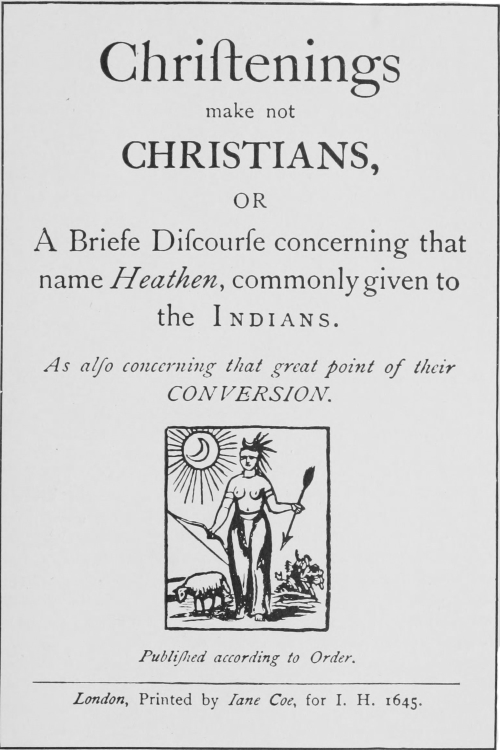
Christenings
make not
CHRISTIANS,
OR
A Briefe Discourse concerning that
name Heathen, commonly given to
the Indians.
As also concerning that great point of their
CONVERSION.
Published according to Order.
London, Printed by Iane Coe, for I. H. 1645.
The History of the First Baptist Church
The early Providence Baptists met at first in a grove under
the trees. In inclement weather they would meet in private
homes. They adopted no articles of faith, and to this day the
First Church of Providence has been without a formal creed or
covenant. For sixty years the church founded by Roger Williams
had no house of worship. Pardon Tillinghast, its sixth pastor,
built them a house of worship in 1700 and deeded it to the
Society in 1711. It stood on the corner of North Main and
Smith Streets. A larger church, forty feet square, built in 1726,
succeeded this first edifice. The present edifice was built in
1775, and was dedicated “for the worship of Almighty God
and to hold commencements in.” It cost $35,000, a part of which
was raised by a lottery, authorized by the State. The building
was designed by Joseph Brown and James Sumner, who used
as a model Gibb’s church in London, St. Martin-in-the-Fields.
It is recognized as one of the finest examples of colonial architecture
in America.
It has a beautiful interior. The upper gallery at the west end
was originally set apart for slaves and colored people. It was
removed to give place for the pipe-organ in 1832. The same
year the old-fashioned square pews were exchanged for the
present ones; the lofty pulpit and sounding-board were taken
down. The beautiful crystal chandelier, imported from England
in 1792 was lighted for the first time when Hope Brown, daughter
of Nicholas Brown, was married to Thomas Poynton Ives.
It was the bride’s gift to the church.
The bell in the tower weighs two thousand five hundred pounds,
and bore originally this inscription:
For freedom of conscience the town was first planted;
Persuasion, not force, was used by the people;
This church is the eldest, and has not recanted,
Enjoying and granting bell, temple, and steeple.
It has been cracked three times and recast in this country. It
now bears the date of the origin of the church, and the name
of Roger Williams, “its first pastor and the first asserter of
liberty of conscience.” The bell is rung at sunrise, at midday,
and at nine o’clock as in the days of old.
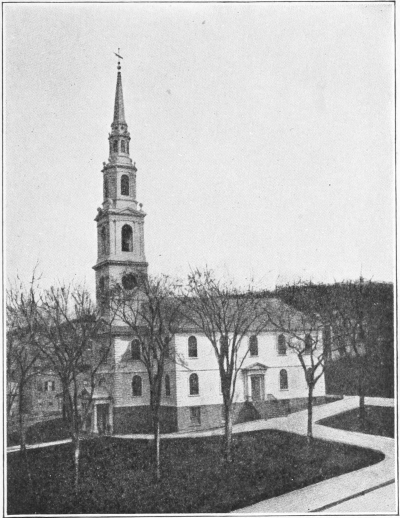
First Baptist Church of Providence
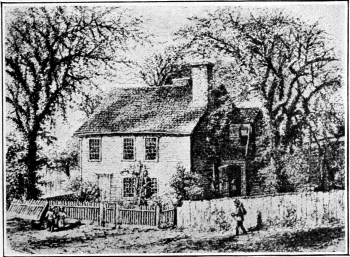
Roger Mowry’s “Ordinarie.” Built 1653,
Demolished 1900
In the vestries are pictures of many of the former leaders of
this historic church. In the hallway, in a glass case, is a piece
of the original “What Cheer Rock,” the landing-place of Williams.
At the entrance to the church a bronze tablet commemorates
the fact that the First Baptist Church of Providence was the
first Baptist church established in America and that Roger Williams
was its first pastor.
The present organization, known as the First Baptist Church
of Providence, has every valid reason for claiming to be the
true successor of the original church, organized before 1639,
by Roger Williams. In the Rhode Island Baptist State Annual
the date of the church’s organization is given as 1638. A committee
appointed by the church, when reporting, on March 16,
1899, the reasons for claiming that the present organization is
the true successor of the first Baptist church organized in America,
quoted in defense of this position the following writers:
Arnold, “History of Rhode Island”; Caldwell, “History of the
First Baptist Church”; Guild, “History of Brown University
and Manning”; Prof. Geo. P. Fisher, of Yale, “In Colonial
Era”; Cramp, “Baptist History”; Dexter, “As to Roger Williams”;
Morgan Edwards, “Materials for a History of Baptists
in Rhode Island.” In the following fall this report was also
presented to the Warren Association and was ordered printed in
the Minutes of the Association.
In the “Historical Catalogue” of this church, a book prepared
by a committee consisting of Rev. H. M. King, D. D.,
Pres. W. H. P. Faunce, Prof. Wm. C. Poland, and others, a
committee familiar with the original sources of information, we
find Roger Williams listed as the first member in its list of members
and as the first pastor in its list of pastors. The bronze
tablet in front of the present meeting-house and the inscription
on the bell both state that Roger Williams was the first pastor.
Roger Williams’ Ideal, a Distinctive Baptist Principle
We have already noted the fact that Roger Williams was accused
of Anabaptist tendencies. The Baptists, or Anabaptists,
throughout the ages have stood for the most advanced principles
of Protestantism. They existed long before Luther. Many
historians claim for them a historic continuity from the days of
the early Christians. Their principles—democracy of the local
church, sovereignty of the Lord Jesus Christ, and the authority
of the Scriptures—have been perpetuated by local distinct bodies
rather than by the historic continuity of a general denomination
with a common name and a common governing body.
The Master, in the parable of the Tares, taught the principle
advocated by the Baptists and by Roger Williams. The field is
the world; the good seed, the children of the kingdom; the tares
are the evil-doers. Wheat and tares should be allowed to grow
together in the world (not in the church) until the end of the
age, when the angels, the reapers of God, will gather them together
for reward or punishment. Force must never be used to
make disciples for Christ.
In the early Christian centuries, the church longed for liberty
to live for Christ and preach his gospel. Ten great general persecutions
were launched by the Roman emperors to crush the
church. The promise that the gates of hell would not prevail
against it was realized. The Edict of Milan, issued in 313, by
Constantine and Licinius, joint emperors, gave the church an opportunity
to grow and prosper and it was soon in the lead throughout
the Roman Empire. Then the church turned persecutor
and put to death those who differed from the ruling order, which
now had lost its democratic ideals. When the Montanists, the
Donatists, the Paulicians, the Albigenses, and the Waldenses in
turn resisted the evil tendencies and assumptions of a corrupt
church, they were persecuted with a fierceness greater than that
formerly waged by the pagans against the church. The principle
of religious liberty was almost lost. It became the far-off dream
of idealists. These dreamers were usually called Anabaptists.
At first they were dissenters from Roman Catholicism, but afterward
they were also dissenters from the dominant forms of Protestantism.
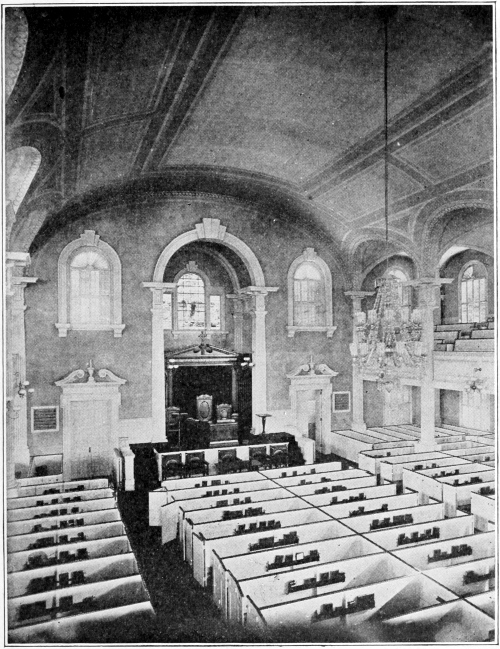
Interior of First Baptist Church, Providence
The Protestant Reformation was a case of arrested development.
It was like the exodus from the Egyptian bondage.
There was a long lingering in the wilderness before the day
dawned with full religious liberty. Henry Melville King says:
The absolute supremacy of the word of God, the spiritual nature of the
Christian church, the Christian ordinances for believing souls, the divorce
of Church and State, full, unrestricted religious freedom for every man,
these essential truths of the gospel of Christ found no room at the inn
of the sixteenth century, and were thrust aside into the manger ... the
inn was not open for it, but the manger was. The principle of religious
liberty did not fail to get born.
The Anabaptists of Europe kept alive the ideals of religious
liberty. They sought to carry out the principles of the Protestant
Reformation to its scriptural and logical conclusion. Many,
called by this name, had little in common with the movement
which now bears the Baptist name. The actions of the fanatics
under Münzer have been cited since Williams’ day as an argument
against his principles. Münzer, who “never submitted to,
nor administered rebaptism, who persisted in baptizing infants,
and who sought to set up the kingdom of Christ by carnal warfare,
was not correctly classed.” Cornelius, Roman Catholic historian
of the Münzer uprising, shows that the Anabaptists repudiated
the actions of this fanatic.
The only crime of which they (the Baptists) were accused as a body
by their contemporaries, and which is substantiated by evidence, the crime
for which they were inhumanly persecuted by Catholics and Protestants
alike, and for which they went cheerfully and in large numbers to death
by drowning or the stake, was the crime of advocating soul-liberty.
They claimed the right to interpret the Scriptures for themselves. They
demanded freedom of faith and worship for all men. They apprehended
the sublime doctrine of civil and religious liberty, and they were the
only men who did apprehend it.
Most of the creeds and confessions of the Reformation gave
to the magistrate a coercive power in religion, and included a
curse for the despised Baptists. Luther, in the early years of his
Reformation work, said:
No one can command or ought to command the soul except God, who
alone can show it the way to heaven. It is futile and impossible to command,
or by force to compel any man’s belief. Heresy is a spiritual
thing, which no iron can hew down, no fire burn, no water drown...
Whenever the temporal power presumes to legislate for the soul, it
encroaches.
Luther, when he was successful, turned his back upon this noble
utterance and compromised with error. He stopped short of
full victory and failed to secure the “full splendor of a complete
triumph.” He wrote differently in after days:
Since it is not good that in one parish the people should be exposed to
contradictory preaching, he (the magistrate) should order to be silent
whatever does not consist with the Scriptures.
Thus the civil ruler was made the final judge of truth and given
power to suppress what he would condemn. This was a case
of tyranny changing hands. Luther wrote to Menius and Myconius
in 1530:
I am pleased that you intend to publish a book against the Anabaptists
as soon as possible. Since they are not only blasphemous but also seditious
men, let the sword exercise its rights over them, for it is the will of
God, that he shall have judgment who resisteth the power.
Melanchthon, in a letter to the Diet at Hamburg, in 1537, advised
death by the sword to all who professed Anabaptist views.
Zwingli, the Swiss Reformer, whose statue in Zurich pictures
him with a Bible in his right hand and a sword in his left, also
persecuted the Baptists. On January 5, 1527, Felix Mantz became
the first Swiss Anabaptist martyr by drowning at Zurich.
This was a hideous parody of his belief in believers’ baptism by
immersion. Heinrich Bullinger, in his book against the Anabaptists,
specifies thirteen distinct sects among the Anabaptists.
He mentions twenty-five points of agreement among them, including
the following:
That secular authority has no concern with religious belief; that the
Christian resists no evil and therefore needs no law-courts; nor should
ever make use of the tribunals; that Christians do not kill or punish
with imprisonment or the sword, but only with exclusion from the body
of believers; that no man should be compelled by force to believe,
nor should any be slain on account of his faith; that Christians do not
resist, and hence do not go to war; that Christians may not swear;
that all oaths are sinful; that infant baptism is of the pope and devil;
that rebaptism, or better, adult baptism, is the only true Christian baptism.
In 1527, the Swiss Anabaptists issued a confession of faith at
Schaffhausen. Its writer was Michael Sattler, an ex-monk who
was martyred that same year. It was the first confession “in
which Christian men claimed absolute religious freedom for
themselves, and guaranteed absolute religious freedom to others.”
This Baptist movement was the target of Protestant and Catholic
persecution alike and its brave, spiritual men and women were
driven to the martyr’s crown or to exile. Many fled to Holland.
The torch of truth, the advanced ideas which they had
received from the Waldensians and other pre-Reformation movements,
were handed over to the Anabaptists of Holland. These
increased in number rapidly under the toleration afforded them in
that country. Menno Simons, a Roman priest, set to thinking by
the martyrdoms about him, espoused their cause and doctrines.
Baptized at the age of forty-four, he fled to Holland, where he
became the leader of a host, which afterward bore his name,
being called Mennonites. Charles V persecuted these Baptists,
and fully fifty thousand were martyred. They were not exterminated,
however, for God, as in other days, preserved a remnant
to pass the torch of religious liberty on to others.
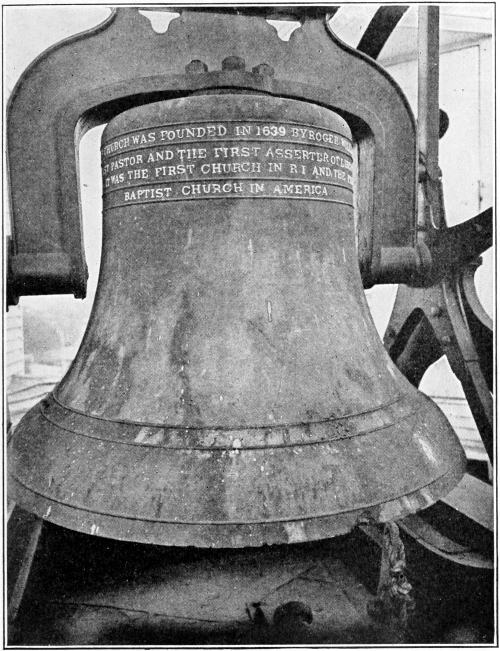
Bell of First Baptist Church, Providence
Baptist refugees from Holland crossed over to England.
Henry VIII, when he made himself head of the Church, ordered
their arrest and banishment from the kingdom, “on pain to
suffer death, if they abide, and be apprehended and taken.” The
fires of Smithfield and the inquisition of the Protestants could
not crush this movement destined of God, at a later date, to
change the world. Considered an obnoxious sect in the reigns
of Edward VI, Mary, and Elizabeth, they carried on their meetings
secretly. They were an industrious class of skilled mechanics
and introduced into England that which afterward gave that
nation its commercial and manufacturing supremacy. The English
passed a law that each foreign workman should take and
train one English apprentice. As a result, fifty thousand English
lads were trained, not only mechanically, but also in the
principles of these Dutch Anabaptists. This spiritual training
led to the Puritan revolution in England and to the greater
movement across the seas. Each of these Dutch Baptist churches
was a republic in itself, independent with its popularly elected
officers, deacons, and elders. They held, as a cardinal doctrine,
the separation of Church and State. From the sections in which
these Dutch Anabaptists lived came fully fifty per cent of the
early colonists to the New World. Fourteen English towns, in
which they formed a large proportion of the population, are
duplicated by New England towns of the same name. From
the same district Cromwell recruited his invincible Ironsides.
Back of all that was good and noble in the settlements at Plymouth
and Boston and in Connecticut was the leaven of the Dutch Baptists
in that part of England from which these early colonists
came.
Robert Browne, who is the reputed founder of English Congregationalism,
advocated his peculiar views after dwelling for
some time in a Dutch Anabaptist community. Here he promulgated
his ideas. A part of his congregation fled to Middleburg,
a Baptist stronghold. After two years he quarreled
with these folks and returned to England, where he became
reconciled to the Established Church and for forty years afterward
administered to an Established Church parish. The Baptist
principle, however, had been stamped upon the few years
of his ministry when he started a new order.
At the close of the sixteenth century most of the Anabaptists
in England were Dutch. Slowly, however, English Baptists were
coming into existence, and they soon formed themselves into
small groups. Browne did not go so far as the Baptists, but in
church government he took their New Testament position. As
far as is known, the first definite English Baptist church was
organized in London in 1611, with Thomas Helwys as pastor.
The members had been exiles in Holland and were baptized there
by Rev. John Smith, the famous Se-Baptist, formerly a Church
of England clergyman.
This English Baptist church formulated a confession which
contains the first declaration of faith to include, as the teaching
of Christ, the absolute separation of Church and State.
The magistrate by virtue of his office, is not to meddle with religion
or matters of conscience, nor to compel men to this or that form of
religion or doctrine; but to leave the Christian religion free to every
man’s conscience.
Prof. Mason says:
It was, in short, from their little dingy meeting-house, somewhere
in old London, that there flashed out, first in England, the absolute doctrine
of religious liberty.
These of whom mention has just been made, were called General
Baptists.
In 1644, the Particular Baptists issued a confession, equally
explicit and clear. Religious liberty to them was the right, and
good citizenship the duty, of every Christian man. Their historic
confession, a confession of seven associated churches, was
the first declaration, in England or in Christendom, by a body
of associated churches on the question of absolute religious liberty.
Many of these Baptists were imprisoned.
Many denominations which today favor religious liberty, were
opposed to it in those days of Baptist persecution. For example,
the Presbyterian ministers of Lancashire declared, “A toleration
would be putting a sword in a madman’s hands, a cup of
poison into the hand of a child, a letting loose of madmen with
firebrands in their hands, etc.” The Presbyterians, then, would
gladly have been a national church. The Puritans of the Bay
Colony had no higher thought than a theocracy for themselves.
To insure uniformity of worship in their colony they resorted
to whippings, banishments, fines, and hangings. The Pilgrim
Fathers were farther advanced, but historians fail to find that
they had a higher ideal than to secure a freedom to worship God
for themselves. They certainly never dreamed of extending
an equal freedom to all who differed from them in religious
opinions. John Robinson, the renowned pastor of the Pilgrims,
defended earnestly the use of the magistrate’s power “to punish
religious actions, he (the magistrate) being the preserver of
both tables, and so to punish all breaches of both.”
By Protestants, with the exception of the Baptists, full religious
toleration and liberty was feared and hated. The most advanced
were far from the Baptist position. This explains the bitterness
of the persecution against Roger Williams and the Baptists. In
fact, Roger Williams was so far in advance of his age, and that
in common with the noble host of martyred Baptists, that he
seemed dwarfed in the distance. The future even more than the
present time will enable us to value his and their worth.
IV
SOUL-LIBERTY AT HOME IN A
COMMONWEALTH
It is his unique title to preeminence and fame that he was the first to
found an absolutely free church in an absolutely free State, and Rhode
Island and Providence Plantations remain a monument of his sagacity
and daring and penetration, a center from which the light of soul-liberty
has radiated far and wide till it has flooded a whole continent, and
shines with concentrated splendor in the constellation of States which
now form the great Western Republic.—J. Gregory, a British writer on
Puritanism.
Against the somber background of early New England, two figures
stand above the rest—John Winthrop and Roger Williams. The first—astute,
reactionary, stern—represented Moses and the law. The second—spontaneous,
adaptable, forgiving—represented Christ and the individual.
It is needless to say with which lay the promise and the dawn.—I. B.
Richman.
He was the first man in modern Christendom to establish civil government
on the doctrine of the liberty of conscience, the equality of opinions
before the law, and in its defence he was the harbinger of Milton, the
precursor and the superior of Jeremy Taylor.... Let then the name
of Roger Williams be preserved in universal history as one who advanced
moral and political science, and made himself a benefactor of his race.—George
Bancroft, in “History of the United States.”
In the seventeenth century there was no place but the wilderness for
such a John the Baptist of the distant future as Roger Williams. He
did not belong among the diplomatic builders of churches, like Cotton, or
the political founders of States, like Winthrop. He was but a babbler
to his own time, but the prophetic voice rings clear and far, and ever
clearer as the ages go on.—Edward Eggleston, in “The Beginners of a
Nation.”
PORTSMOUTH, Newport, and Rhode Island, with common
interests and ideals, were protected and throve under
the original charter granted in 1644. Charles I was surrendered
to the Parliamentary forces in January, 1647. The
colony, therefore, felt strong to act under the Parliamentary
charter granted them. A general assembly of the people was
called, and the charter was adopted. Shawomet, settled by the
Gortonists, had also received a charter from the same source
and, in honor of Warwick, their protector, they changed the name
of their town to Warwick. They were admitted also to the
General Assembly. The first meeting of the Assembly declared
that the form of government in Providence Plantations was
“democratical,” that is to say, “government held by the free and
voluntary consent of all or of the greater part of the free inhabitants.”
The seal of the colony was an anchor. The executive
branch of the government was vested in a president of the
colony and four assistants, one from each town. These officers,
elected by the General Assembly, had no part in legislation. The
Assembly at that time was not composed of delegates, but included
all the freemen of the colony. Each town had a court
of commissioners composed of six members. These four town
courts combined became a General Court of Trials, having to
do with the weightier offenses, and also acted as a Court of
Appeals from the town courts. There was also a general treasurer,
a general recorder, a general sergeant, and later a general
solicitor.
A code of laws was drawn up. One, the Statute of Archery,
shows the isolation of this colony. It required that every man
between seventeen and seventy should keep a bow and four
arrows. Fathers should furnish each of their sons, between the
ages of seven and seventeen, with “a bow, two arrows, and a
shaft, and to bring them up to shooting.” This was done because
the colony could not get gunpowder for firearms, since the other
colonies refused to sell them any, or allow it to be exported
through their posts to them.
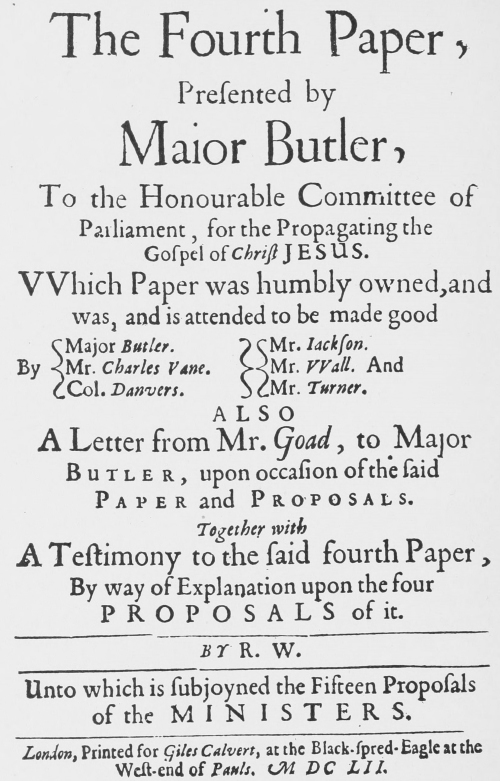
The Fourth Paper,
Presented by
Maior Butler,
To the Honourable Committee of
Parliament, for the Propagating the
Gospel of Christ JESUS.
VVhich Paper was humbly owned, and
was, and is attended to be made good
{ Major Butler. } { Mr. Jackson.
By { Mr. Charles Vane. } { Mr. VVall. And
{ Col. Danvers. } { Mr. Turner.
ALSO
A Letter from Mr. Goad, to Major
Butler, upon occasion of the said
Paper and Proposals.
Together with
A Testimony to the said fourth Paper,
By way or Explanation upon the four
PROPOSALS of it.
BY R. W.
Unto which is subjoyned the Fifteen Proposals
of the MINISTERS.
London, Printed for Giles Calvert, at the Black-spred-Eagle at the
West-end of Pauls. M DC LII.
Roger Williams’ Second Visit to England
The ambitious designs of Coddington in seeking to divide
the colony were such that Williams and Clarke were obliged to
go to England in 1651. Coddington had secured a charter making
him governor for life of Rhode Island, then the richest portion
of the State. Williams and Clarke in 1652 secured an
order-in-council nullifying Coddington’s commission. Williams
remained in England until the summer of 1654 and labored there
for the interests of the colony and also for the general benefit
of all oppressed people, including the Jews. In his appeal to
the Parliament, found as a comment in the tract entitled “Butler’s
Fourth Paper,” an original copy of which is in the John Carter
Brown Library, at Providence, he says:
Oh, that it would please the Father of Spirits to affect the heart of
Parliament with such a merciful sense of the Soul-Bars and Yokes which
our fathers have laid upon the neck of this nation, and at last to proclaim
a true and absolute Soul-Freedom to all the people of the land
impartially, so that no person be forced to pray nor pay, otherwise than
as his Soul believeth and consenteth.
He plead especially that permission be granted the Jews “to live
freely and peaceably amongst them.”
He was on intimate terms with Milton, to whom he read
and from whom he received instruction in certain languages. He
also was associated with Sir Henry Vane. Returning to his
colony in 1654, he at once exercised his influence in smoothing
out its many and varied difficulties.
During this second visit to England he issued three publications.
John Cotton had written a reply to the “Bloody Tenent,”
publishing it in London, in 1647. It had the following title:
The Bloudy Tenent, washed, and made white in the bloud of the Lambe:
being discussed and discharged of bloud-guiltinesse by just Defence.
Roger Williams in 1652 printed his rejoinder to Cotton’s book.
Its title is descriptive of its contents:
The Bloody Tenent yet More Bloody: by Mr Cottons endevour to wash
it white in the Blood of the Lambe; of whose precious Blood, spilt in
the Blood of his Servants; and of the blood of Millions spilt in former
and later Wars for Conscience sake, that Most Bloody Tenent of Persecution
for cause of Conscience, upon a second Tryal, is found now more
apparently and more notoriously guilty, etc., etc. By R. Williams of Providence
in New-England. London, Printed for Giles Calvert, and are to be
sold at the black-spread-Eagle, at the West-end of Pauls, 1652.
It is a small quarto of three hundred and seventy-three pages.
Two copies are in the Library of Brown University, one, a
presentation copy from Williams to his friend, Dr. John Clarke,
of Newport.
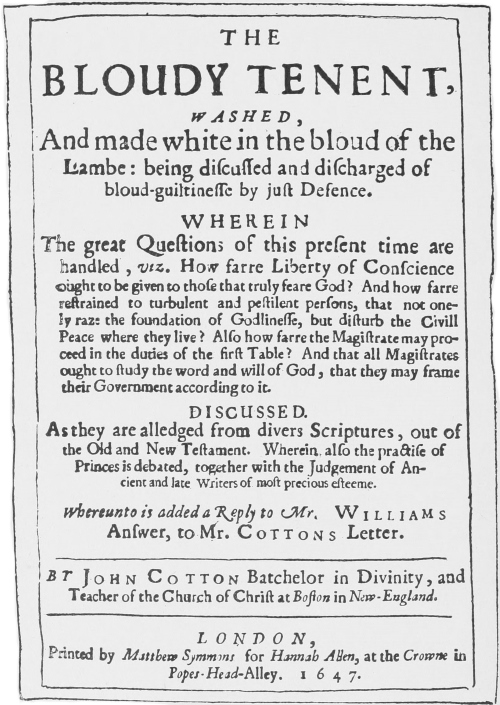
THE
BLOUDY TENENT,
WASHED,
And made white in the bloud of the
Lambe: being discussed and discharged of
bloud-guiltinesse by just Defence.
WHEREIN
The great Questions of this present time are
handled, viz. How farre Liberty of Conscience
ought to be given to those that truly feare God? And how farre
restrained to turbulent and pestilent persons, that not onely
raze the foundation of Godlinesse, but disturb the Civill
Peace where they live? Also how farre the Magistrate may proceed
in the duties of the first Table? And that all Magistrates
ought to study the word and will of God, that they may frame
their Government according to it.
DISCUSSED.
As they are alledged from divers Scriptures, out of
the Old and New Testament. Wherein also the practise of
Princes is debated, together with the Judgement of Ancient
and late Writers of most precious esteeme.
Whereunto is added a Reply to Mr. Williams
Answer, to Mr. Cottons Letter.
BY John Cotton Batchelor in Divinity, and
Teacher of the Church of Christ at Boston in New-England.
LONDON,
Printed by Matthew Symmons for Hannah Allen, at the Crowne in
Popes-Head-Alley. 1647.
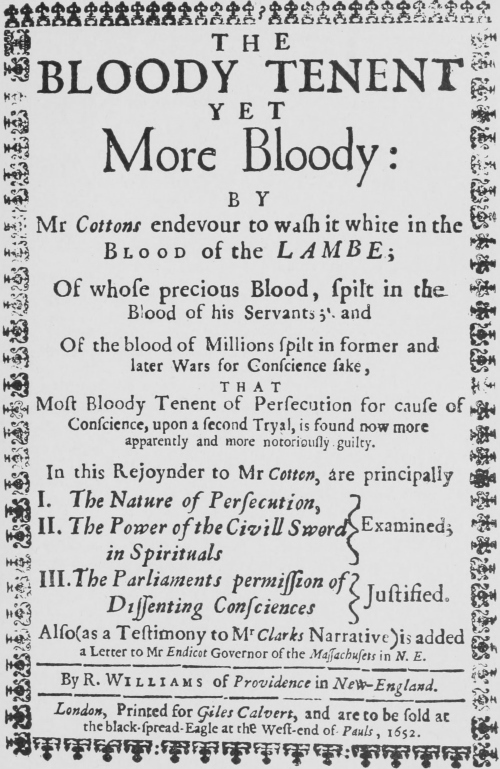
THE
BLOODY TENENT
YET
More Bloody:
BY
Mr Cottons endevour to wash it white in the
Blood of the LAMBE;
Of whose precious Blood, spilt in the
Blood of his Servants; and
Of the blood of Millions spilt in former and
later Wars for Conscience sake,
THAT
Most Bloody Tenent of Persecution for cause of
Conscience, upon a second Tryal, is found now more
apparently and more notoriously guilty.
In this Rejoynder to Mr Cotton, are principally
I. The Nature of Persecution, }Examined;
II. The Power of the Civill Sword }
in Spirituals }
III. The Parliaments permission of } Justified.
Dissenting Consciences }
Also (as a Testimony to Mʳ Clarks Narrative) is added
a Letter to Mr Endicot Governor of the Massachusets in N. E.
By R. Williams of Providence in New-England.
London, Printed for Giles Calvert, and are to be sold at
the black-spread-Eagle at the West-end of Pauls, 1652.
Roger Williams published his fifth work in 1652. It was a
pamphlet of forty-four small quarto pages, entitled:
The Hireling Ministry None of Christs, or A Discourse touching the
Propagating the Gospel of Christ Jesus. Humbly Presented to such Pious
and Honourable Hands, whom the present Debate thereof concerns. By
Roger Williams, of Providence, in New England. London Printed in the
second Moneth, 1652.
The purpose of this work was to oppose a legal establishment of
religion, and the compulsory support of the clergy. An original
copy is in the Library of Brown University, two copies are in
the American Antiquarian Society Library at Worcester, and one
in the John Carter Brown Library, Providence, R. I.
The same year he issued a pamphlet entitled:
Experiments of Spiritual Life & Health, And their Preservatives, In
which the weakest Child of God may get Assurance of his Spirituall Life
and Blessednesse, and the Strongest may finde proportionable Discoveries
of his Christian Growth, and the means of it. By Roger Williams of
Providence in New-England. London, Printed, in the Second Month, 1652.
This book is in the form of a letter addressed to his wife, upon
her recovery from a dangerous sickness. A limited edition was
published, comprising sixty small quarto pages. For years no
original copy has been found. There is an original copy now in
the John Carter Brown Library at Providence, R. I.
The
Hireling Ministry
None of
CHRISTS,
OR
A Discourse touching the Propagating
the Gospel of Christ
Jesus.
Humbly Presented to such Pious
and Honourable Hands, whom
the present Debate thereof concerns.
By ROGER WILLIAMS, of Providence
in New England.
London Printed in the second
Moneth, 1652.
EXPERIMENTS
OF
Spiritual Life & Health,
And their
PRESERVATIVES
In which the Weakest Child of God may
get Assurance of his Spirituall Life
and Blessednesse
And the Strongest may finde proportionable Discoveries
of his Christian Growth, and the means of it.
By Roger Williams of Providence in
New-England.
London, Printed, in the Second Month,
1652.
From time to time local difficulties arose in the various towns.
Ambitious men, seeking their personal welfare, rather than the
public weal, disturbed the serenity of the colony. Certain settlers
at Pawtuxet sought to be part of the Bay Colony; Coddington,
at Newport, desired to be governor for life of the Islands of
Rhode Island and Conanicut. Two rival assemblies were organized
at Newport and Providence. Roger Williams used his influence
and greatly helped to solve the vexing problems. A
new colony, with a new and revolutionary ideal, was being born,
and the birth-throes were great, owing to the fact that they were
pioneers in this work of building a democracy. They had no
illustrious precedent to follow. It is a marvel that their difficulties
were not more and greater.
In 1656, the United Colonies urged the Providence Colony to
banish all Quakers from their realm. They replied that “FREEDOM
of Conscience is the ground of our charter, and it shall be
maintained.” In 1658, the United Colonies threatened the Providence
Colony with exclusion from all intercourse or trade with
all the rest of the colonies, if they did not banish the Quakers.
Meanwhile the Bay Colony was unrelenting in its persecution of
the Quakers. Some were banished, and a few were put to
death.
In September, 1658, Cromwell died. His son Richard succeeded
him, and after a short time retired. Charles II ascended
the English throne in June, 1660. Immediately all acts of the
Parliament under Cromwell were repealed, and Providence Plantations
lost its charter. The Massachusetts Bay and Connecticut
colonies immediately asserted anew their claims for the territory
about the Narragansett Bay. Dr. John Clarke, of Newport, was
in England representing the claims of the Providence Colony,
and, in 1663, secured for it a new royal charter. The old Colony
of Providence Plantations ceased to exist. The new colony was
called “Rhode Island and Providence Plantations.” The charter
defined the bounds of the colony, gave it freedom in all religious
matters, a system of government, a power to organize
courts and to enforce their decisions, power to raise a standing
army of defense, and other essential things. The new seal of
the colony was “Rhode Island and Providence Plantations” with
an anchor and the word, “Hope,” above it.
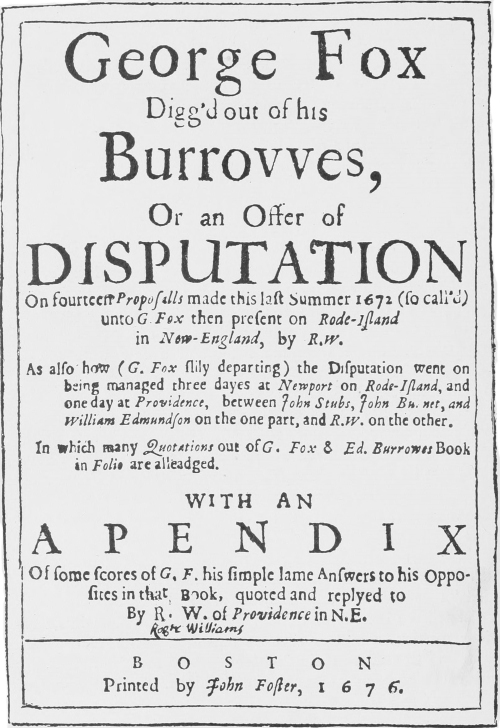
George Fox
Digg’d out of his
Burrovves,
Or an Offer of
DISPUTATION
On fourteen Proposalls made this last Summer 1672 (so call’d)
unto G. Fox then present on Rode-Island
in New-England, by R.W.
As also how (G. Fox slily departing) the Disputation went on
being managed three dayes at Newport on Rode-Island, and
one day at Providence, between John Stubs, John Burnet, and
William Edmundson on the one part, and R.W. on the other.
In which many Quotations out of G. Fox & Ed. Barrowes Book
in Folio are alleadged.
WITH AN
APENDIX
Of some scores of G. F. his simple lame Answers to his Opposites
in that Book, quoted and replyed to
By R. W. of Providence in N.E.
Roger Williams
BOSTON
Printed by John Foster, 1676.
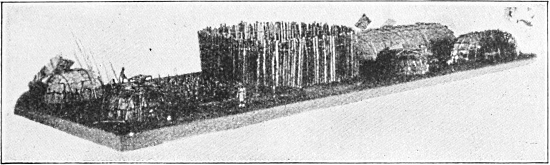
The Model of a Southern New England Indian Village
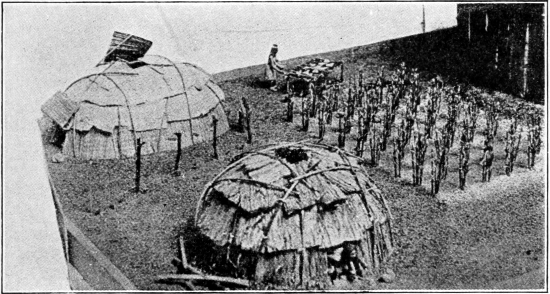
Oval House of Birch Bark and Mats Corn-field
Women Smoking Fish
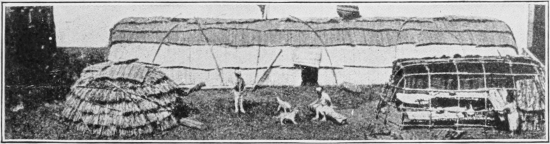
Round House of Grass Long Council Chamber Making a Long House
Indian Men Feeding Dogs
Models of Indian Village in Roger Williams Park Museum
Courtesy of “Providence Magazine”
Roger Williams protected the Quakers by granting them in
his colony a shelter from persecutions. However, he was never
friendly to their peculiar tenets and assailed them in debates
and pamphlets. When George Fox, their founder, was in America
in 1672, Williams challenged him to a debate. A delay in
getting the challenge to Fox, who had sailed for England, did
not leave the debate unaccepted. Three Rhode Island Quakers
undertook the task. Roger Williams rowed the thirty miles to
Newport and for three days debated with all the characteristic
bitterness of debates of that period. They adjourned to complete
the debate at Providence. Williams is seen in the worst light
here and has been greatly criticized for the strong language he
used in opposing these Quakers. We should never forget that
the Puritans went far beyond strong language, in persecuting
some to death and in exiling others. Both sides claimed a victory
in the debate, which was perpetuated in pamphlets, issued
at its completion. Williams wrote one, entitled, “George Fox
Digg’d out of his Burrowes.” Fox replied with one, entitled, “A
New-England Fire-Brand Quenched.” Fox’s book is a quarto of
489 pages. Williams’ book, a small quarto of 327 pages, was
printed in Boston, 1676. The only original copy known to exist
is the one in the Library of Harvard College.
Roger Williams wrote many letters, the originals of which
were widely scattered. Many of these have been collected and
printed in a volume by the Rhode Island Historical Society. In
one of these letters, to Governor Bradford, of Boston, he refers
to a collection of discourses which he had reduced to writing.
These sermons, with treatises written prior to his banishment,
are probably lost forever.
King Philip’s War
Canonicus died, June 4, 1647. Massasoit died in 1660, leaving
two sons, Wamsutta and Metacon, or as they were nicknamed
by the English, Alexander and Philip. The former succeeded his
father. On a return from Plymouth Alexander died suddenly,
and Philip suspected that he was poisoned. This, however, was
not the fact. The Narragansetts had not forgotten the death
or murder of Miantonomo, and the Indians generally felt that
the English were gradually crowding them out of their own
domains. Philip took advantage of this feeling and organized a
war which had for its object the complete extermination of all
the English settlements. This war, opening in Plymouth, 1675,
lasted more than a year. Twelve out of the ninety New England
towns were completely destroyed and forty others were the scene
of fire and slaughter. A thousand strong men lost their lives in
addition to a large number of helpless women and children who
were tomahawked. Rhode Island, for the first time, was exposed
to the hostile attacks of the Indians. Many of the inhabitants,
fearing the impending disaster, had joined the army
of attack against the Indians. In retaliation for this, Providence
was attacked, and twenty-nine houses were burned. One of
them contained the town records, part of which were saved by
being thrown into a pond, from which they were afterward recovered.
When the Indians appeared on the heights above Providence,
Roger Williams, unarmed, went out to counsel with them.
He urged them to stop the warfare, telling them that the English
king would come to the assistance of the colonists and, with
greater numbers, overpower the Indians. They replied:
Let them come, we are ready for them. But as for you, Brother
Williams, you are a good man, you have been kind to us many years, not
a hair of your head shall be touched.
He returned to a house which had been converted into a fort. It
was not touched, but the town otherwise was destroyed. Most
of the citizens of the mainland fled to Rhode Island and Newport.
The doom of the Indians was sounded, the war was put down,
and the leaders were captured or slain. Immediately after the
war the work of rebuilding commenced. Houses were built
larger and more substantially.
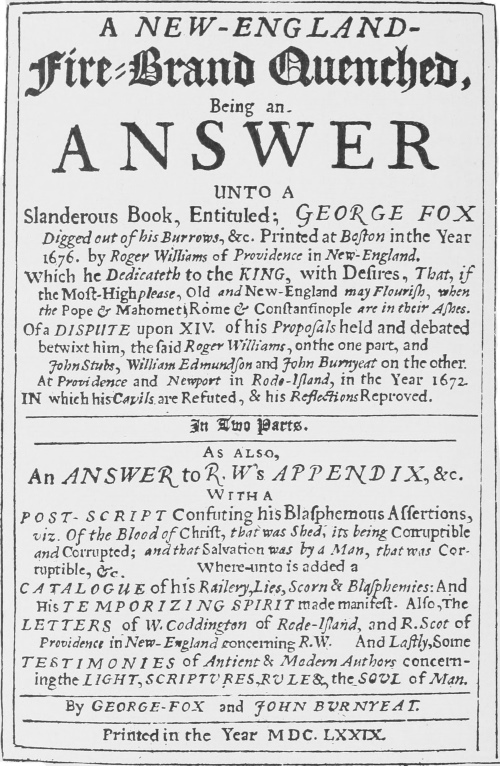
A NEW-ENGLAND-
Fire-Brand Quenched,
Being an
ANSWER
UNTO A
Slanderous Book, Entituled; GEORGE FOX
Digged out of his Burrows, &c. Printed at Boston in the Year
1676, by Roger Williams of Providence in New-England.
Which he Dedicateth to the KING, with Desires, That, if
the Most-High please, Old and New-England may Flourish, when
the Pope & Mahomet, Rome & Constantinople are in their Ashes.
Of a DISPUTE upon XIV. of his Proposals held and debated
betwixt him, the said Roger Williams, on the one part, and
John Stubs, William Edmundson and John Burnyeat on the other.
At Providence and Newport in Rode-Island, in the Year 1672.
IN which his Cavils are Refuted, & his Reflections Reproved.
In Two Parts.
As also,
An ANSWER to R. W’s APPENDIX, &c.
With a
POST-SCRIPT Confuting his Blasphemous Assertions,
viz. Of the Blood of Christ, that was Shed, its being Corruptible
and Corrupted; and that Salvation was by a Man, that was Corruptible,
&c. Where-unto is added a
CATALOGUE of his Railery, Lies, Scorn & Blasphemies: And
His TEMPORIZING SPIRIT made manifest. Also, The
LETTERS of W. Coddington of Rode-Island, and R. Scot of
Providence in New-England concerning R.W. And Lastly, Some
TESTIMONIES of Antient & Modern Authors concerning
the LIGHT, SCRIPTURES, RULE &, the SOUL of Man.
By GEORGE FOX and JOHN BURNYEAT.
Printed in the Year MDC. LXXIX.
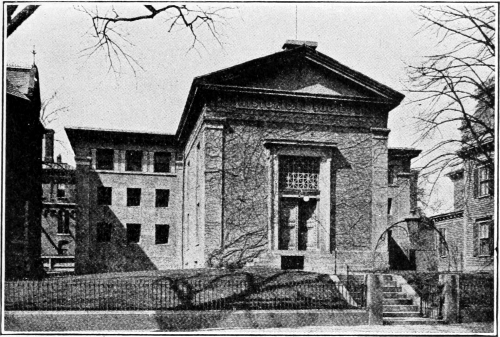
Rhode Island Historical Society Museum
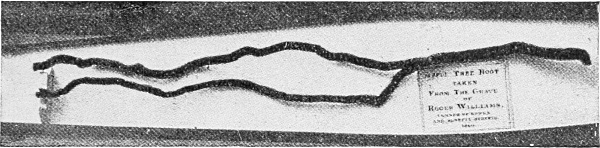
Apple Tree Root from the Grave of Roger Williams
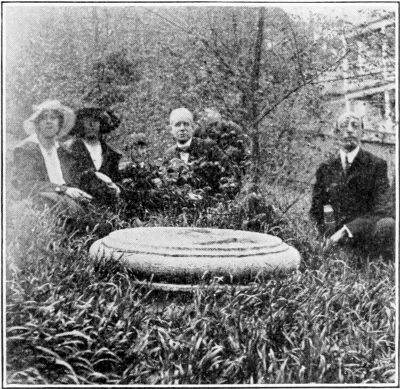
Grave of Roger Williams
Roger Williams for many years had a trading-place, where
he did business with the Indians. This store was near the present
village of Wickford. His profits, he tells us, were five hundred
dollars a year. The foundations of this old building are still
intact, with a new superstructure over them. Late in life he
made monthly preaching visits to this place. When too old to
do this, he planned the publication of his sermons for the natives.
Roger Williams was the original missionary to the North American
Indians, antedating the illustrious Eliot by thirteen years.
Williams’ Indian Bible is in the John Hay Library, Providence,
R. I.
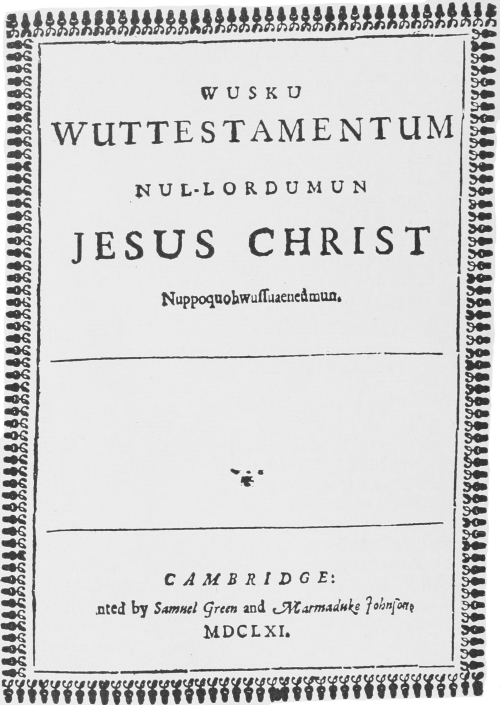
New Testament Title-page of Roger Williams’ Indian Bible
WUSKU
WUTTESTAMENTUM
NULLORDUMUN
JESUS CHRIST
Nuppoquohwussuaeneumun.
CAMBRIDGE:
Printed by Samuel Green and Marmaduke Johnson,
MDCLXI.
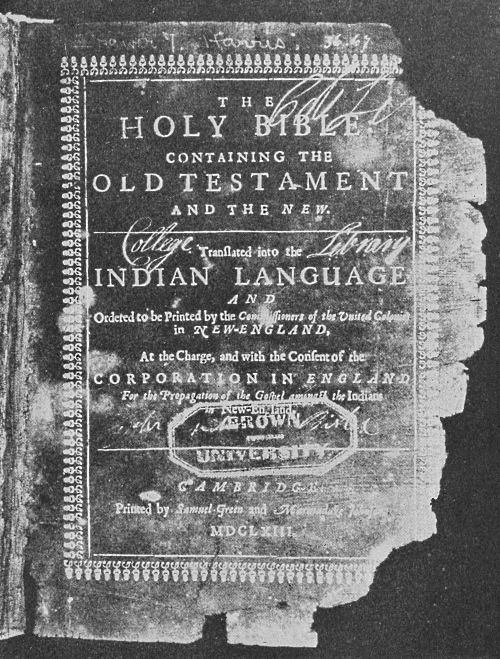
Indian Bible Used by Roger Williams, the Pioneer Missionary to the
American Indians
THE
HOLY BIBLE:
CONTAINING THE
OLD TESTAMENT
AND THE NEW.
Translated into the
INDIAN LANGUAGE
AND
Ordered to be Printed by Commissioners of the United Colonies
in NEW-ENGLAND,
At the Charge, and with the Consent of the
CORPORATION IN ENGLAND
For the Propagation of the Gospel amongst the Indians
in New-England.
CAMBRIDGE.
Printed by Samuel Green and Marmaduke Johnson.
MDCLXIII.
In 1683, Roger Williams died. All the inhabitants of Providence
turned out to honor his memory. The coffin was carried
on the shoulders of his friends, and his earthly remains were
laid to rest on his own property, on the slope of the hill east
of his residence and the spring. An apple tree grew above the
grave. The roots drew from the remains their nourishment and
followed the shape of the skeleton and the legs. Today these
same roots are preserved in the Rhode Island Historical Society’s
collection. Reuben A. Guild describes this in the following
manner:
Still further up the hill among the trees of his orchard, was the family
burial ground. Crossing Benefit Street and passing into the rear of the
house of the late Sullivan Dorr, a few feet from the stable door, is the original
grave of Roger Williams. It is covered by a finished cap of a heavy
stone pillar. Here for nearly two hundred years slept the remains of the
Apostle of Religious Liberty. In March, 1860, the grave was opened, and
the dust, for that was all that remained of the mortal body, was carefully
placed in an urn and deposited in Mr. Randall’s family tomb in the
North Burial Ground. Mrs. Williams’ grave was also visited, and a lock
of braided hair was all that was discovered. At the bottom of Roger
Williams’ grave the root of an apple tree had turned out of its way to
enter in at the head. Following the position of the body to the thighs,
it had turned, now divided, to follow each leg to the feet, tender
fibers shooting out in various directions.
Roger Williams died a poor man. His interest in the needy
and distressed had kept him constantly poor. Ambition formed
no part of his personal life. His ambitions were for the larger
group of distressed souls. A prophet is rarely appreciated in
his own age by his contemporaries. Posterity, in later days,
usually discovers the greatness and genius of the man and the
ideal he realized. Today that ideal is the secret of America’s
greatness and one that has given her distinction among the
nations. Shortly before Williams’ death there was a discussion
relative to dividing up the common lands. Williams wrote to
the Town of Providence a plea, which is characteristic of the
spirit of the man:
For all experience tells us that public peace and love is better than
abundance of corn and cattle. I have only one motion and petition which
I earnestly pray the town to lay to heart, as ever they look for a blessing
from God upon the town, on your families, your corn and cattle, and
your children after you; it is this, that after you have got over the
black brook of some soul bondage yourself, you tear not down the bridge
after you, by leaving no small pittance for distressed souls that may come
after you.
V
FROM SOUL-LIBERTY TO ABSOLUTE
CIVIL LIBERTY
Rhode Island’s Gift
Last of the thirteen, smallest of them all,
What canst thou bring to this world’s festival,
Where all thy sisters come with pride and power,
And bring each one a princess’ generous dower
Of gold and gems, and fruits and precious woods,
And joyous tribute of their costly goods?
What can we bring? No outward show of gain,
No pomp of state; we bring the sons of men!
Bring gold, fair sisters, yellow gold,
And gems, and all that’s fair and fine,
And heap them all, the new, the old,
Before our country’s stately shrine.
Bring hardihood from north and east,
Bring beauty from the south and west,
Bring valor to adorn the feast,
Bring all that has withstood time’s test.
We grudge you not the riches rare,
We grudge you not your acres broad,
We bring you for our noble share
The liberty to worship God.
—Caroline Hazard, Poem read on “Rhode Island Day” at World’s
Columbian Exposition, Chicago, October 5, 1893.
THE ideal of democracy grew in all the New England colonies
and led eventually to the American Revolution and the establishment
of the United States of America. Rhode Island,
however, in the century prior to the Revolution, had never
given up her advocacy of soul-liberty, and thus the Revolution
was to her a greater struggle than to the other colonies. This
distinct feature will be seen in a study of the real successors of
Roger Williams, in the struggle for religious liberty. Therefore
it is interesting to note some of the outstanding events in the
history of Rhode Island and Providence Plantations, previous to
the Revolutionary War.
In June, 1700, a lot was set aside for a training-ground, a
burial-ground, and other public uses. Thus originated the North
Burial Ground, the first public burial-ground in the colony. Before
this each family had buried on its own land. Not until
1760, when Benefit Street was laid through the burial-grounds of
many of the citizens, including the land where Roger Williams
first settled, did they come to use in a general way this North
Burial Ground. Then many bodies were removed to the new
place for burial.
The second house of worship to be erected in the colony, in
1704, was the Friends’ Meeting House, in what is now Lincoln.
It is still standing, although with an extensive addition. The
Friends’ Meeting House in Providence was erected about the
same time. The First Congregational Church was organized in
1720, a meeting-house being erected in 1723. It was on the
site of the present county court-house. In 1722, the Episcopalians
erected their first church building. It was called King’s Church,
and was on the site of the present St. John’s Church on North
Main Street. In 1798, the Methodists organized their first
church, building their first meeting-house in 1816 at the corner
of Aborn and Washington Streets. The Roman Catholics commenced
their work in 1827, meeting in Mechanics’ Hall, afterward
in the old Town House. From the very start no discouragement
was given to any church to organize in Rhode Island.
During this same period of time Baptists were hindered in other
colonies.
In 1660, the proprietors of the colony ordered the setting aside
of one hundred acres of upland and six of meadows to be reserved
for the maintenance of a school. In 1696, a piece of land
on Dexter Lane, or Stamper’s Hill, was set apart for a school.
This schoolhouse was built about the year 1697, about fifty feet
north of Olney Street, on the east side of Stamper’s Street. It
was used for about fifty years. The schoolmaster probably received
all of his compensation from the scholars. A lot on the
end of the Court House Parade was left for a school building.
The first reference to a school house on this lot is found in the
town records for 1752. The town leased this schoolhouse to a
schoolmaster. In 1769, the first free school was established on
King’s Street, now Meeting Street. This building is used now as
a fresh-air school.
Brown University
As early as 1762 a movement was instituted by James Manning
of Scotch Plains, New Jersey, to establish in Rhode Island a
university on the broad basis of religious freedom, but under the
special care of the Baptists. A charter, to be presented to the
General Assembly in 1763, was prepared by Rev. Ezra Stiles, a
Congregational minister at Newport. When the document was
ready for presentation, it was noticed that the governing power
was to be given to a presbyterian body. That occasioned postponement.
A charter was granted, however, in February, 1764,
under the name of “The Trustees and Fellows of the College or
University in the English Colony of Rhode Island and Providence
Plantations in New England in America.” The corporation was
given power to change its name. It organized with James Manning
as president. Active teaching work was commenced at
Warren in 1766. The founding of this university was an event
touching not only the life of Rhode Island, but of the whole
country. As a Baptist movement, it was first proposed by Morgan
Edwards in 1762, at the Philadelphia Baptist Association. James
Manning came from the little church at Scotch Plains, New Jersey,
and from a Baptist Association to the only place in America,
at that time, where a Baptist university could be established.
The Baptists desired the controlling power, but not the whole
power of administration, in order to preserve their great principle
of religious freedom. According to the original charter,
twenty-two of the thirty-six trustees were to be Baptists, five
Quakers, four Congregationalists, and five Episcopalians. Of
the twelve fellows, eight were to be Baptist, the rest indefinitely
of any or all denominations. The following extract shows the
Baptist ideal:
into this liberal and catholic institution shall never be admitted any
religious tests, but, on the contrary, all the members hereof, shall forever
enjoy full, free, absolute, and uninterrupted liberty of conscience; and
that the places of professors, tutors, and all other officers, the President
alone excepted, shall be free and open for all denominations of Protestants,
and the youths of all religious denominations shall and may be
admitted to the equal advantages, emoluments, and honors of the university;
and that the sectarian differences shall not make any part of the
public and classical instructions.
Its early history is interesting. There was but one student
during its first year, the Rev. William Rogers, of Newport, then
fourteen years old. In 1767, four new students enrolled. The
first years of the college were spent at Warren, where Dr. James
Manning, the president, was the acting pastor of a Baptist church
recently organized. In 1769, the first class of seven was ready
for graduation and the first commencement was held on September
7, 1769.
The various towns of the colony contended earnestly to have
the college permanently located with them. Newport considered
that her large gifts to the college were sufficient to give her the
preference. Providence, being a stronger center for the Baptists,
won, and, in 1770, the college was moved to that city. The old
brick schoolhouse, near the foot of Meeting Street, was the first
building used by the college. The students boarded in private
families at a dollar and a quarter a week. The building committee
soon selected a better location for the school and a better
place for housing the student body. Morgan Edwards said of
the site finally selected:
Commanding a prospect of the Town of Providence below, of the
Narragansett Bay and Island and of an extensive country, variegated with
hills and dales, woods and plains.... Surely this spot was made for a
seat of the Muses.
The first building, one sufficient for the needs of the college for
the following fifty years, was University Hall, modeled after
Nassau Hall of Princeton. The upper two stories were added
after the Revolutionary war. For six years, during that great
struggle, the hall was used as barracks and hospital for the combined
American and French troops. In 1775, the present First
Baptist Church Meeting House was erected, “for the public
worship of Almighty God and to hold commencements in.”
Since 1775 until the present time, with the exceptions of the years
1804 and 1832, this church has been used for the commencement
exercises. On its platform illustrious students have received
their degrees and have gone forth to bless the world. The
presidents of Brown University, seated in the James Manning
chair, have presided at the commencements in the historic Baptist
Meeting House, and have given public honor to men who in
turn have honored the university and city. George Washington
received the honorary degree of LL. D. in 1790. Among her illustrious
graduates none is greater than Adoniram Judson, our
pioneer American and Baptist foreign missionary.
Doctor Manning died in 1791, and was buried in the North
Burial Ground. The corporation voted that same year,
That the children of the Jews may be admitted into this institution
and entirely enjoy the freedom of their own religion, without any constraint
or imposition whatever.
The name of the college was changed from Rhode Island to
Brown University, in 1804, in honor of Nicholas Brown, whose
liberal gifts to the college were much appreciated. He was a
trustee and in his lifetime gave about $100,000 to the college. In
1821 the increasing number of students made another building
imperative, and Nicholas Brown gave this needed structure, Hope
College, as a gift to the institution.
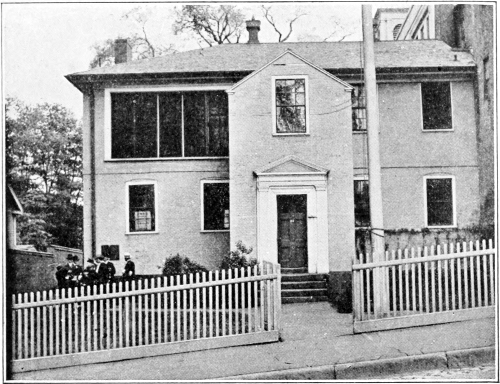
Original Home of Brown University, in Providence, R. I.
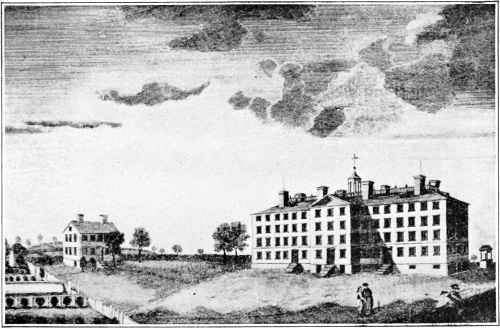
Brown University in Early Nineteenth Century
The second president of Brown University was Jonathan
Maxcy, who served from 1792 until 1802. In these ten years
two hundred and twenty-seven were graduated, sixty-six claiming
law as their profession, and fifty-six entering the ministry.
Asa Messer was the third president, serving from 1802 until his
resignation in 1826. His membership was in the First Baptist
Church, but his views, after 1815, were Unitarian. Acts of
vandalism, such as breaking into the library, beating down the
pulpit, and breaking windows, were such that he took it as a
protest against his position and finally resigned.
The next president was Francis Wayland. He completely
reorganized the University. He introduced the elective system,
and offered several practical courses. The college grounds were
laid out. Two new buildings were erected. Manning Hall, a gift
of Nicholas Brown, and named in honor of the first president,
was built in 1840. In this Doric structure the library found a
home on the first floor and the chapel on the second. Rhode
Island Hall was erected shortly afterward, $10,000 being raised
by Rhode Island men and women, and the balance of $12,500
being largely the gift of Nicholas Brown. Doctor Wayland’s
presidency came to an end by his death in 1855. He was buried
in North Burial Ground. Following him came Barnes Sears,
Alexis Gaswell, Ezekiel Gilman Robinson, Elisha Benjamin Andrews,
and the present president, W. H. P. Faunce, since June,
1899. Today the college has more than a thousand students,
about thirty buildings, and an endowment of more than four
million dollars. Brown University was the pioneer of the hundreds
of schools, colleges, and universities which the Baptists
were destined to have in the years that followed. These are not
limited to one State, but are scattered all over our country.
Pilgrims to Providence, the birthplace of religious liberty in
America, should not fail to visit those buildings which contain
sacred relics of the long and hard struggle for soul-liberty and
political freedom in America.
The present million-dollar City Hall, at the west end of Exchange
Place, in Providence, was erected in the period 1874 to
1878. In the office of the Recorder of Deeds can be seen “the
original deeds” from the Indian chiefs to Roger Williams in
1636, also his letter transferring to his loving friends, “a share
of the new territory.” The original Compact of Government
is here also, and there is a bust of Roger Williams over the entrance.
The Old State House, situated on Benefit Street, is a building
which can well vie with Faneuil Hall in Boston and Independence
Hall in Philadelphia as a “Cradle of Liberty.” Built
in 1763, it was originally occupied by the Rhode Island Colonial
Assembly, who here on May 4, 1776, two months previous to the
Declaration of Independence, in Philadelphia, adopted the famous
act renouncing allegiance to Great Britain. This fact is commemorated
by a bronze tablet and also by an annual commemoration
in all the public schools of Providence.
The New State House, or “Marble Palace,” on the crest of
Capitol Hill, completed in 1902 at a cost of $3,200,000, is built
of white Georgia marble, and has for a distinguishing feature
one of the few marble domes existing in the world. This inscription
is on the south front of the Capitol:
To hold forth a lively experiment, that a most flourishing civil state may
stand and best be maintained, with full Liberty in Religious Concernments.
On the north side, we read,
Providence Plantations, Founded by Roger Williams, 1636, Providence,
Portsmouth, Newport, incorporated by Parliament, 1643, Rhode Island,
Providence Plantations, obtained Royal Charter 1663. In General Assembly
declared a Sovereign State, May 4th, 1776.
The inscription around the interior of the dome is a Latin quotation
from Tacitus. Translated it is:
Rare felicity of the times when it is permitted to think as you like, and
say what you think.
In the State Chamber is Gilbert Stuart’s rare full-length portrait
of General Washington. In the Secretary of State’s office is the
original charter, granted in 1663, under which the colony and
State were governed until 1843. In a subbasement there is a
collection of State historical exhibits, originally collected for the
Jamestown Exposition. On the dome of the State House there
is a colossal bronze statue of “Independent Man, or the Genius
of Religious Liberty,” designed by Brewster.
The Court House is on the corner of Benefit and College
Streets. In its corridor there is a historical painting by C. F.
Grant, picturing “The return of Roger Williams with the first
charter for the Colony in 1644.”
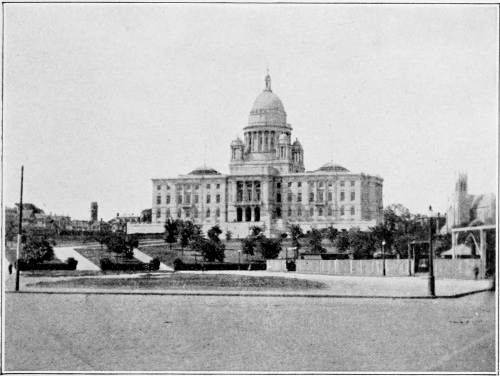
Capitol Building in Providence, Where the Charter is Kept
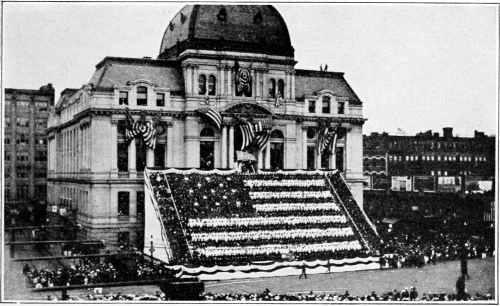
City Hall, Providence, Where the Compact, Indian Deed, and
Letter of Transference are Kept
Rhode Island in the Revolutionary War
Rhode Island was the first to strike a blow for civil liberty
as she was the first in the struggle for religious liberty. She was
last, however, to adopt the Constitution of the United States.
She hesitated to surrender to the federal government the liberties
enjoyed under her charter, the most liberal ever granted to a
colony. She has a right to be proud of her record, before, during,
and after the Revolutionary war. E. Benjamin Andrews opened
his case for Rhode Island’s recognition with these words:
States are great or small according to their miles, and as the little birth
town of the Christ, Bethlehem, in the land of Judah, was not least among
the princes of Judah, so Rhode Island, diminutive as she is physically, is
far from least among the princely Constituents of this republic.
The history of Rhode Island proves that the best compatriot
political liberty ever had was absolute religious liberty.
Rhode Island was the first to strike the name of king from
the charter of her liberties, thus becoming the first sovereign independent
State in all the New World.
Rhode Island was the first to recommend the permanent establishment
of a Continental Congress, in town meeting assembled,
May 17, 1774, and in General Assembly, June 15, 1774, she appointed
Samuel Ward and Ezek Hopkins her first delegates
thereto.
Rhode Island was also the first, by overt act, to renounce
allegiance to George III of England. She was first to instruct
her officers to disregard the Stamp Act and to ensure them indemnity
for so doing. In 1765, she explicitly declared that in herself
alone was vested the right of local taxation.
Rhode Island was first to fire a gun against the dominion of
England. The first blood of the Revolutionary war was spilt in
Narragansett Bay. Lexington was fought April 19, 1775; the
Boston Tea Party was on December 16, 1773; Providence men,
after perfecting their plans at the Sabin Tavern, Planet and
South Main Streets, rowed down the river, and on June 10, 1772,
sent up the Gaspee in flames.
On July 19, 1769, the men of Newport sunk His Majesty’s
sloop, Liberty. Rhode Island was the first to establish an American
navy. She gave the command to Abraham Whipple, who
forthwith captured the first war prize (the tender of the frigate
Rose, then off Newport). After the war of independence was
under way, Rhode Island was the first to recommend and urge
upon Congress the establishment of a Continental navy. Congress
chose a Rhode Islander to work out the plans. Ezek
Hopkins, a Providence man, was appointed commander-in-chief.
Three-fourths of all the officers were from Rhode Island. These
men were the vikings of the American Revolution. Ezek Hopkins’
home is still preserved on Admiral Street. There is a monument
to him at his grave in Hopkins Square, corner Branch Avenue
and Charles Street.
In proportion to her size none of the other States can compare
with Rhode Island in the amount given to the Continental loan.
Her citizens, unlocking their purses, freely furnished the sinews
of war. She contributed seven times as much as South Carolina,
whose population was three times as large; one and a half times
as much as Maryland, whose population was four times as
great; twice as much as Virginia, with a population eight times
larger.
Rhode Island contributed proportionately her share of men to
the great struggle. Rhode Island men were in every great battle
under Washington. Rhode Island has been greatly criticized
for not quickly adopting the Constitution. She was the last to
adopt it. Her conception of religious and civic liberty in combination
was such that she was not willing to lose easily the
liberty which she had obtained for herself and which she freely
advocated for others. Her part in the great struggle was so
great that her motive for delay in adopting the Constitution
should never be questioned. Her ideal of liberty, unique to Rhode
Island then, is the generally accepted one now throughout America
and back of every great politicial reform in lands beyond our
borders.
Ex-Governor Russell Brown, on Rhode Island Day at the
World’s Columbian Exposition, said:
The history of our State is a birthright which neither lands nor gold
can buy, for full as it is of stirring and passionate events, there is not an
incident in our annals that can bring the scarlet of shame to the cheek
of civilized man. Roger Williams the first settler, the thrice-exiled friend
of the weak and oppressed, by his revolt against Puritan intolerance and
his sacrifice for soul liberty, baptized Rhode Island’s early days with glory
sufficient for any State.
VI
THE TORCH-BEARERS OF THE IDEAL
OF ROGER WILLIAMS UNTIL LIBERTY
ENLIGHTENED THE WORLD
I believe all our Baptist ministers in town, except two, and most of our
brethren in the country were on the side of the Americans in the late
dispute.... To this hour we believe that the independence of America
will, for a while, secure the liberty of this country, but if that continent
had been reduced, Britain would not have long been free.—Doctor
Rippon, of London, England, to President Manning, of Rhode Island
College, written in 1784.
Nor need any one dream that Jefferson and Madison could have carried
this measure by their genius and influence. They were opposed by many
men whose transcendent services, or unequalled oratory, or wealth, position,
financial interests, or intense prejudices would have enabled them
easily to resist their unsupported assaults. Like a couple of first-class
engineers on a tender with a train attached, but no locomotive, would
Jefferson and Madison have appeared without the Baptists. They furnished
the locomotive for these skilled engineers which drew the train
of religious liberty through every persecuting enactment in the penal
code of Virginia.—Wm. Cathcart, D. D., in “The Baptists and the American
Revolution.”
The Baptists were the first and only religious denomination that struck
for independence from Great Britain, and the first and only one that
made a move for religious liberty before independence was declared....
Of those who took part in the struggle for religious liberty, the Baptists
were the only denomination that maintained a consistent record and held
out without wavering until the end—until every vestige of the old establishment
had been obliterated by the sale of the glebes.—Dr. Charles
James, in “Documentary History of the Struggle for Religious Liberty
in Virginia.”
WE have seen the early struggles of Roger Williams. We
have seen the halo of glory which clusters about the State
he founded. We have seen his place in the plans of a
Divine providence. We have also seen his place in the procession
of heroes who held aloft the torch of religious and soul-liberty
throughout the ages. When by death, he was compelled
to drop that torch, others took it up and continued the procession
until the first amendment to our National Constitution became a
fact of history. The Baptists led the historic movement in all
the colonies which stood for this principle of “Religious Liberty.”
Oscar S. Straus says:
The Baptists ... had a much more enlightened and advanced view:
they held that Christianity should propagate itself by its own spiritual
force; that the civil government was entirely apart and distinct and
should have no control over conscience, or power to inflict punishment
for spiritual censures.
Professor Gervinus, professor at Heidelberg, Germany, about
the year 1850, published a work, in which he referred to Williams
and his ideal:
Roger Williams urged an entire liberty of conscience in Massachusetts.
He was obliged to fly from the country, and in 1636 he founded
a small new society in Rhode Island upon the principles of entire liberty
of conscience. It was prophesied that the democratic attempts to obtain
a general elective franchise and entire religious liberty would be of short
duration. But these institutions have spread from that petty state over
the whole union. They superseded the aristocratic commencements of
Carolina and New York, the High-church part of Virginia, the theocracy
in Massachusetts, and the monarchy throughout America; they have given
laws to one quarter of the globe; and, dreaded for their moral influence,
they stand in the background of every democratic struggle in Europe.
For the publication of such sentiments, Professor Gervinus was
tried at Mannheim and sentenced to four months’ imprisonment
and to have his books publicly burned.
Back of political progress there must be spiritual strength.
Back of the final victory of religious liberty in America there
was not only the glorious example of Rhode Island as a political
demonstration but the persistent propagation of the ideals in all
the States. This was chiefly the task of the Baptists, many of
whose churches could trace their origin to settlers from Rhode
Island.
During the Colonial period, the laws of Massachusetts and
Virginia relating to soul-liberty were most severe; those in
Maryland and Pennsylvania, the most lenient, outside of Rhode
Island.
Order banishing the Founders of the First Baptist Church in Boston.
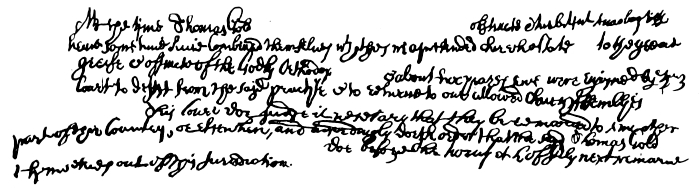
1644.
Nov. 13.
Whereas Thomas Gold (and others) obstinate and turbulent Annabaptists, have some time since combined themselves wh others in a pretended
church estate xxxxx to the great griefe and offence of the godly orthodox xxxxxxxx and about two years since were enjoyned by this Court to
desist from said practise and to returne to our allowed Church Assemblies, xxxxxx this Court doe judge it necessary that they be removed to
some other part of this country or elsewhere: and accordingly doeth order that (they) doe before the twentieth of July next remove themselves
out of this jurisdiccon.
In Massachusetts the Baptist sentiment did not die out with
the banishment of Roger Williams. In 1640, Rev. Mr. Chauncey
advocated the immersion of believers and also of infants. Later
President Dunster, of Cambridge College, went further and denounced
the whole system of infant baptism. About the same
time, Lady Moody, of Lynn, denied infant baptism. In 1644, a
poor man by the name of Painter, reaching the same conclusion,
refused to have his child baptized. The court interfered and
the man was tied up and whipped. On November 13, 1644, two
months after Williams arrived in Boston, en route to Providence,
with the charter, the Massachusetts Bay Colony passed a law
against the Baptists, in which they were described as “The incendiaries
of commonwealths, the troublers of churches.” They
ordered that all who “openly condemn or oppose the baptizing of
infants shall be sentenced to banishment.” The General Court
issued an order in 1644 banishing the founders of the Boston
Baptist Church. In 1651, Obadiah Holmes, John Clarke, and
John Crandall came to Lynn, Massachusetts, from Newport,
Rhode Island. They were holding a service in Mr. Witter’s
house, about two miles out from Lynn. Mr. Clarke was preaching
from Revelation 3:10. The service was broken up by the
arrival of two constables, who, with clamorous tongues, interrupted
the discourse and arrested the preachers. The prisoners
were held in Lynn until the morning, when they were taken to
the Boston prison. Two weeks later, they were sentenced to
pay heavy fines. The fines of Clarke and Crandall were paid by
friends. Holmes refused any assistance in paying his fine of
thirty pounds and was publicly whipped with thirty lashes from
a three-corded whip. Thirteen others, who sympathized with
these brethren, were arrested and were ordered to pay a fine of
forty shillings each or take ten lashes. John Hazel, an old man
from Rehoboth, was whipped and died a few days afterward.
Clarke published the story of this incident in “Ill Newes from
New-England”—an original copy is in the John Carter Brown
Library, Providence, R. I. Cotton was the religious leader in
Boston, back of this persecution. In 1680 the doors of the Baptist
meeting-house in Boston were nailed up by the authorities.
Finally the Baptists in Boston won some freedom, which, however,
was denied to other Baptist churches throughout the State.
Isaac Backus was the leader among the Massachusetts Baptists
for soul-liberty. With President Manning, he appealed to the
Massachusetts delegates at the Continental Congress to provide
in the Constitution for separation of Church and State. John
Adams replied to them: “They might as well turn the heavenly
bodies out of their annual and diurnal courses as to expect they
would give up their establishment.” This spirit of opposition was
continued until 1833, in which year the last vestige of oppressive
religious intolerance was removed from the statute-books of
Massachusetts.
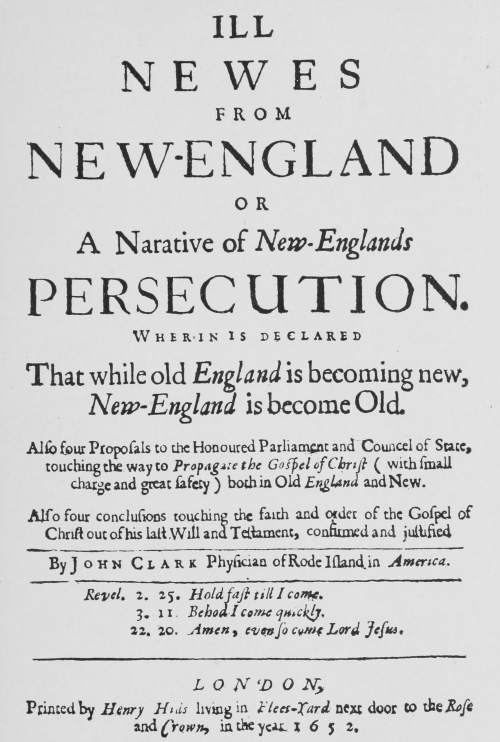
ILL
NEWES
FROM
NEW-ENGLAND
OR
A Narative of New-Englands
PERSECUTION.
Wherein is declared
That while old England is becoming new,
New-England is become Old.
Also four Proposals to the Honoured Parliament and Councel of State,
touching the way to Propagate the Gospel of Christ (with small
charge and great safety) both in Old England and New.
Also four conclusions touching the faith and order of the Gospel of
Christ out of his last Will and Testament, confirmed and justified
By John Clark Physician of Rode Island in America.
Revel. 2. 25. Hold fast till I come.
3. 11. Behold I come quickly.
22. 20. Amen, even so come Lord Jesus.
LONDON,
Printed by Henry Hills living in Fleet-Yard next door to the Rose
and Crown, in the year 1652.
In Virginia, the opposition to the Baptist movement was bitter
and unrelenting. The early settlers of Virginia left England,
when their church, the Established Church of England, had won
a complete victory over all other persuasions. The Virginians
sought to duplicate in the new land the spirit of the victors across
the sea and make religion uniform in their colony. Laws were
passed against popish recusants as early as 1643. Other laws
were passed by their assembly between the years 1659 and 1663
against those who failed to have their children baptized. The
Quakers especially found these laws most severe. The early Baptists
of Virginia were of the common people; their ministers
were illiterate; and for a while they escaped notice. The first
imprisonment of Baptists was in the county of Spottsylvania,
Va., June 4, 1768. Three Baptists, John Waller, Lewis Craig,
and James Childs, with others, were arrested for disturbing the
peace. (There was no law against preaching.) The opposing
lawyer in the court-room made this charge:
May it please your worships, these men are great disturbers of the
peace; they cannot meet a man on the road, but they ram a text of
Scripture down his throat.
Mr. Waller so defended himself and his brethren that their
enemies were somewhat puzzled to know how to proceed against
them. They offered to release them on promise to refrain from
preaching in the county for a year and a day. The defendants
refused the offer and were sent to prison. Other Baptist ministers
were arrested, and soon thirty were under arrest. The
prisons became Baptist pulpits, and multitudes gathered around
them to hear the preachers. Their opponents engaged drummers
to drown the preaching; high enclosures were in some
cases erected before prison windows, and suffocating materials
were burned near the prisons. Baptists from the beginning
were unremitting in their struggle to secure religious liberty.
They secured the support of Patrick Henry, a member of the
Established Church, but a firm friend of all who stood for liberty,
civil and religious. He helped the Baptists to win the complete
victory.
The Baptist cause was destined to have a more congenial atmosphere
in Pennsylvania when we remember that William
Penn, its illustrious founder, had an English Baptist father and
a Dutch mother, undoubtedly of Anabaptist descent. He received
his charter in 1681, forty-five years after Roger Williams’
banishment from Massachusetts. Penn possessed broad and
liberal ideas and was opposed to any church establishment. He
provided
that all persons who confess and acknowledge the Almighty and Eternal
God to be the Creator, Upholder, and Ruler of the world, ... should in
no ways be molested, nor compelled to frequent or maintain any religious
worship.
Yet only those confessing faith in Jesus Christ could become
freemen in Penn’s domain. The separate Quakers in the colony
of Pennsylvania were arrested, fined, and imprisoned for dissent.
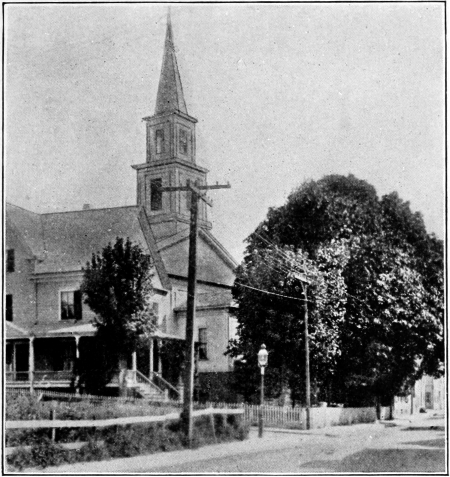
John Clarke Memorial
First Baptist Church of Newport, R. I.
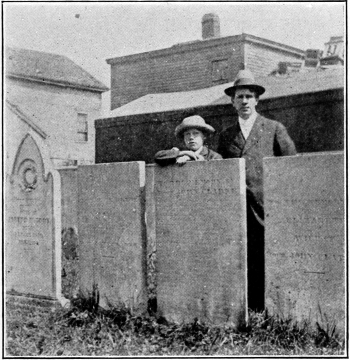
Grave of John Clarke
The first company of Baptists in this colony came from Rhode
Island. William Dugan came there in 1684, three years after
Penn received his charter. He settled at Cold Spring, in Bucks
County. The first church in Philadelphia was founded by John
Holmes in 1686. The first meeting-place was at the corner of
Second and Chestnut Streets.
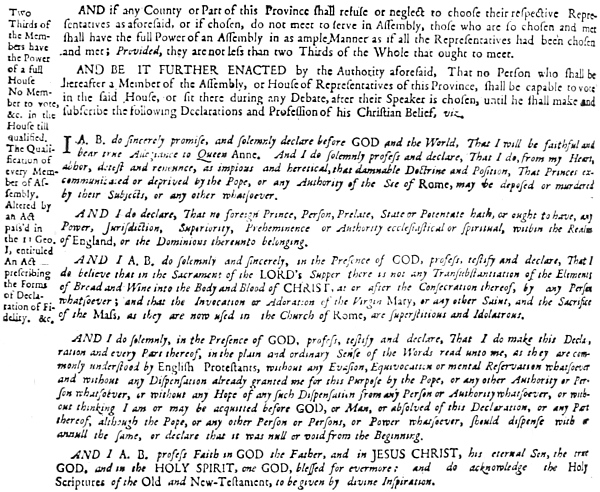
Two Thirds of the Members have the Power of a full House.
No Member to vote &c. in the House till qualified. The Qualification
of every Member of Assembly.
Altered by an Act pass’d in the II Geo. I, entitled An Act—prescribing
the Forms of Declaration of Fidelity. &c.
AND if any County or Part of this Province shall refuse or neglect to choose their respective Representatives
as aforesaid, or if chosen, do not meet to serve in Assembly, those who are so chosen and met
shall have the full Power of an Assembly in as ample Manner as if all the Representatives had been chosen
and met; Provided, they are not less than two Thirds of the Whole that ought to meet.
AND BE IT FURTHER ENACTED by the Authority aforesaid, That no Person who shall be
hereafter a Member of the Assembly, or House of Representatives of this Province, shall be capable to vote
in the said House, or sit there during any Debate, after their Speaker is chosen, until he shall make and
subscribe the following Declarations and Profession his Belief, viz.,
I A. B. do sincerely promise, and solemnly declare before GOD and the World, That I will be faithful and
bear true Allegiance to Queen Anne. And I do solemnly profess and declare. That I do, from my Heart,
abbor, detest and renounce as impious and heretical, that damnable Doctrine and Position, That Princes excommunicated
or deprived by the Pope, or any Authority of the See of Rome, may be deposed or murdered
by their Subjects, or any other whatsoever.
AND I do declare, That no foreign Prince, Person, Prelate, State or Potentate hath, or ought to have, any
Power, Jurisdiction, Superiority, Preeminence or Authority ecclesiastical or spiritual, within the Realm
of England, or the Dominions thereunto belonging.
AND I A. B. do solemnly and sincerely, in the Presence of GOD, profess, testify and declare, That I
do believe that in the Sacrament of the LORD’s Supper there is not any Transubstantiation of the Elements
of Bread and Wine into the Body and Blood of CHRIST, at or after the Consecration thereof, by any Person
whatsoever; and that the Invocation or Adoration of the Virgin Mary, or any other Saint, and the Sacrifice
of the Mass, as they are now used in the Church of Rome, are superstitions and Idolatrous.
AND I do solemnly, in the Presence of GOD, profess, testify and declare. That I do make this Declaration
and every Part thereof, in the plain and ordinary Sense of the Words read unto me, as they are commonly
understood by English Protestants, without any Evasion, Equivocation or mental Reservation whatsoever
and without any Dispensation already granted me for this Purpose by the Pope, or any other Authority or Person
whatsoever, or without any Hope of any such Dispensation from any Person or Authority whatsoever, or without
thinking I am or may be acquitted before GOD, or Man, or absolved of this Declaration, or any Part
thereof, although the Pope, or any other Person or Persons, or Power whatsoever, should dispense with or
annull the same, or declare that it was null or void from the Beginning.
AND I A. B. profess Faith in GOD the Father, and in JESUS CHRIST, his eternal Son, the true
GOD, and in the HOLY SPIRIT, one GOD, blessed for evermore; and do acknowledge the Holy
Scriptures of the Old and New-Testament, to be given by divine Inspiration.
The Law in William Penn’s Colony.
No Absolute Soul-liberty in Pennsylvania in Those Days.
Lord Baltimore, the Roman Catholic proprietor of Maryland,
was far in advance of his Church. He came to the New World
to secure religious liberty for himself and his friends. The Maryland
Act of Toleration, issued in 1649, provided that
Blasphemy against God, and a denial of the Trinity should be punished
with death and confiscation of lands and goods, and blasphemy against
the Virgin Mary should first be punished by a fine of five pounds, and
if persisted in, by a forfeiture of all possessions and banishment from
the colony.
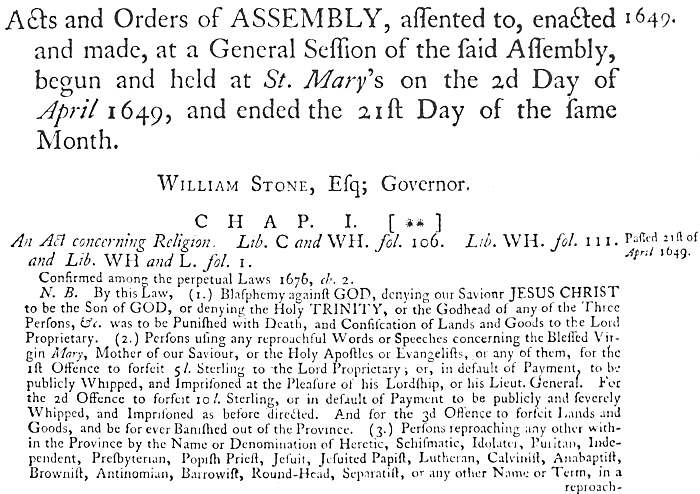
1649.
Acts and Orders of ASSEMBLY, assented to, enacted
and made, at a General Session of the said Assembly,
begun and held at St. Mary’s on the 2d Day of
April 1649, and ended the 21st Day of the same
Month.
William Stone, Esq; Governor.
CHAP. I.
Passed 21st of
April 1649.
An Act concerning Religion. Lib. C and WH. fol. 106. Lib. WH. fol. 111.
and Lib. WH and L. fol. 1.
Confirmed among the perpetual Laws 1676, ch. 2.
N. B. By this Law, (1.) Blasphemy against GOD, denying our Saviour JESUS CHRIST
to be the Son of GOD, or denying the Holy TRINITY, or the Godhead of any of the Three
Persons, &c. was to be Punished with Death, and Confiscation of Lands and Goods to the Lord
Proprietary. (2.) Persons using any reproachful Words or Speeches concerning the Blessed Virgin
Mary, Mother of our Saviour, or the Holy Apostles or Evangelists, or any of them, for the
1st Offence to forfeit 5l. Sterling to the Lord Proprietary; or, in default of Payment, to be
publicly Whipped, and Imprisoned at the Pleasure of his Lordship, or his Lieut. General. For
the 2d Offence to forfeit 10l. Sterling, or in default of Payment to be publicly and severely
Whipped, and Imprisoned as before directed. And for the 3d Offence to forfeit Lands and
Goods, and be for ever Banished out of the Province. (3.) Persons reproaching any other within
the Province by the Name or Denomination of Heretic, Schismatic, Idolater, Puritan, Independent,
Presbyterian, Popish Priest, Jesuit, Jesuited Papist, Lutheran, Calvinist, Anabaptist,
Brownist, Antinomian, Barrowist, Round-Head, Separatist, or any other Name or Term in a
reproach-
The Law Concerning Religious Toleration in Maryland Colony.
It is not Religious Liberty.
The Baptist church at Chestnut Ridge was formed in 1742 by
Henry Sator, a layman of the General Baptist order, who had
recently come from England. He invited Baptist ministers to
preach in his house. They soon gathered a congregation; proselytes
were gained, and a church organized. This church appealed
to the governor and was taken under the protection of the toleration
laws.
94. Capitall Laws.
1.
Dut. 13. 6, 10.
Dut. 17. 2, 6
Ex. 22. 20.
P. 14.
S. 1.
If any man after legall conviction shall have or worship
any other god, but the lord god, he shall be put to death.
2.
Ex. 22. 18.
Lev. 20. 27.
Dut. 18. 10.
S. 2.
If any man or woeman be a witch, (that is hath or consulteth
with a familiar spirit,) They shall be put to death.
3.
Lev. 24. 15, 16.
S. 3.
If any man shall Blaspheme the name of god, the father,
Sonne or Holie ghost, with direct, expresse, presumptuous
or high handed blasphemie, or shall curse god in the like
manner, he shall be put to death.
Puritan-Religious-Liberty!
Facsimile of original laws. From “Body of Liberties.” First legal code for the
government of the Bay Colony. Drawn up by Rev. Nathaniel Ward, Lawyer-divine
of Ipswich.
The Final Victory in the Long Struggle
Two Baptist organizations in close sympathy with each other
contributed much toward the final victory. They made appeals
to their immediate constituency and also to the larger following
of all Baptists and other lovers of religious liberty. These were
the Warren Association in New England, and the General Committee
in Virginia. Each had a committee of grievances. The
Baptists were nobly assisted by Presbyterians and Quakers in
the final stages of the great conflict. Isaac Backus wrote his
immortal work on “A History of New England, with Especial
Reference to the Baptists.” He drafted appeals for the Association
and for the committee on grievances to the General Assembly,
published addresses on religious liberty, and inserted
advertisements in leading papers. He believed that partial history
and false statements regarding Baptist history and doctrines
should be removed by scattering impartial and true knowledge.
He was a Baptist giant and had his share in forming
sentiment, which eventually made religious intoleration impossible
in America.
Isaac Backus, with President Manning, of Brown University,
then Rhode Island College, went to Philadelphia and with Quakers
and others appealed to John Adams and other Massachusetts
delegates in Carpenter Hall, Philadelphia. These advocates of
soul-liberty took the position that to pay taxes to support a
church clergy in which they did not believe was as much a
wrong as to pay taxes for a government in which they had no
representation. It was not the paltry tax of fourpence a man
that the colonists in Massachusetts rebelled against. It was
the principle that was back of paying the pence which they
opposed. They were greatly amazed when John Adams told
them that their own colony, Massachusetts, had “the most mild
and equitable establishment of religion that was known in the
world.”
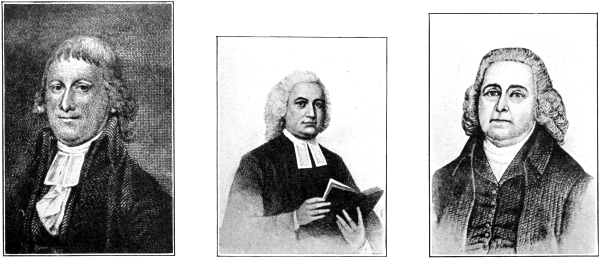
William Rogers James Manning Isaac Backus
These men were all connected with the opening of the first Baptist college in America. James Manning was the first president; Isaac Backus,
a member of the original board of trustees; William Rogers, the first student.
The Virginia Baptists, through their General Convention, organized
in 1784, united the efforts of the Baptists there and in
New England for the final phases of the war against religious
tyranny. For four years they had worked for liberty in their
State laws and had won a complete victory. Then, in 1788, they
turned to the national issue. The Federal Constitution had provided
in Article VI, “No religious Test shall ever be required
as a qualification to any Office or public Trust under the United
States.” This did not satisfy the Baptists, because religious
tests might be imposed for other purposes than those specified.
In a noble letter, drafted by John Leland, a Baptist minister,
they appealed to Washington. They paid a high compliment to
his achievements and then stated their grievance, closing with
these words:
If religious liberty is rather insecure in the Constitution the administration
will certainly prevent all oppression, for a Washington will
preside. Should the horrid evils that have been so pestiferous in Asia
and Europe, faction, ambition, war, perfidy, fraud, and persecution for
conscience sake, ever approach the borders of our happy nation, may the
name and administration of our beloved President, like the radiant
source of day, scatter all the dark clouds from the American hemisphere.
Washington replied that his ideals were the same, assuring them
of this, in the following words:
No one would be more zealous than myself to establish effectual barriers
against the horrors of spiritual tyranny and every species of religious
persecution.
He complimented the Baptists and said that they
have been, throughout America, uniformly and almost unanimously, the
firm friends to civil liberty, and the persevering promoters of our glorious
revolution.
His assurance was not empty words. In a short time James
Madison, with the President’s approval, submitted certain amendments.
Article VI was superseded by the First Amendment to
the Constitution, which specified:
Congress shall make no law respecting an establishment of religion, or
prohibiting the free exercise thereof; or abridging freedom of speech, or
of the press; or the right of the people peaceably to assemble, and to
petition the Government for a redress of grievances.
Thus the long fight was won in America, and now people generally
appreciate the importance of the victory gained. Rhode
Island may have hesitated to accept the imperfect Constitution,
with its lack of assurance for complete religious liberty. In this
connection we should not forget that Massachusetts and Connecticut
were the last to ratify the First Amendment.
VII
THE WORLD-WIDE INFLUENCE OF
ROGER WILLIAMS’ IDEAL
“The world must be made safe for democracy. Its peace must be
planted upon trusted foundations of political liberty.”—President Wilson’s
War Message to Congress, 1917.
Till the war-drum throbb’d no longer, and the battle-flags were furl’d
In the Parliament of man, the Federation of the world.
There the common sense of most shall hold a fretful realm in awe,
And the kindly earth shall slumber, lapt in universal law.
—Alfred Tennyson.
A day will come when bullets and bombs shall be replaced by ballots,
by the universal suffrages of the people, by the sacred arbitrament of a
great Sovereign Senate.... A day will come when we shall face those
two immense groups, the United States of America and the United States
of Europe, in face of each other, extending hand to hand over the ocean,
exchanging their products, their commerce, their industry, their art, their
genius clearing the earth, colonizing deserts, and ameliorating creation
under the eye of the Creator. To you, I appeal, French, English, Germans,
Russians, Slavs, Europeans, Americans, what have we to do to
hasten the coming of the great day? Love one another.—Victor Hugo.
I asked him (Premier Lloyd George) what message he would send to
American Baptists. Quick as a flash, he turned and said: “Tell them
that it is Baptist principles that we are fighting for in this great struggle.
All that Baptists count dear is at stake in this issue.”—Lloyd George to
George Coleman, President, Northern Baptist Convention. From the
latter’s speech at Atlantic City, N. J., May, 1918.
ROGER Williams, as a man of vision, was experimenting
with a new idealism. His ideas, now generally accepted,
have made absolute religious liberty, with its complete
separation of Church and State, an idea almost synonymous with
the name of the United States of America. That lonely man, in
the smallest of the colonies, set the pace for the other twelve
original commonwealths and established a national pattern for the
forty-eight States in the present Union. Our cup of blessing has
overflowed, and today the whole world is awaking to the blessings
in store for them if they partake of the same privileges.
“Mankind has pursued liberty over mountain and across valley,”
writes Pres. E. Y. Mullins,
by land and by sea, through fire and through flood, since the first man
caught a glimpse of liberty’s white robes leading on to victory. The love
of victory is now a volcanic fire which breaks out into revolution and
consumes and destroys the ancient fabrics of government, and now it is
a tide of life which rolls across the face of nations, causing them to burst
into the beauty and fragrance of a new springtime. The spirit of liberty
in its quest for the goal of its desire has sounded all the notes in the
gamut of human experience, from the minor notes of abject despair to
the ringing pæan of victory over every foe.
The Baptist churches of America, the torch-bearers of religious
or soul-liberty, have grown from the one church which
Williams founded in Providence into a mighty host. From twelve
members in one church organization in 1639 that denomination
has grown in America until today, according to the latest government
statistics, it has the largest membership of any Protestant
denomination in America, 7,236,650. Its one preacher has become
a great host of 39,734, serving 53,133 churches. Instead
of one college with one student in 1764, it now has 463 schools
in America, with 68,513 students. Instead of one lone missionary
to the Indians, it now has a large army of missionaries in the
home and foreign fields.
Doctor Masters, Secretary of Publicity of the Home Mission
Board of the Southern Baptist Convention, in tabulating the
figures from the preliminary statistics furnished by the United
States Census Department, calls our attention to the fact that
the approximate Baptist population of America, including members
and other adherents, is twenty-two millions. The Baptists are
thus in the lead of every denomination, Catholic or Protestant, in
America; our net gain for ten years is the greatest of all denominations,
28 per cent, compared with 10.8 per cent of the
Roman Catholics. He gives the comparative strength of Romanists
and evangelicals in America as eighty million evangelicals to
15,700,000 Roman Catholics.
Before the days of the great war, Pres. E. Y. Mullins, with
prophetic vision wrote:
We are approaching the Baptist age of the world, because we are
approaching the age of the triumph of democracy. Like a vine growing
in the darkness of some deep cavern, and slowly stretching itself toward
the dim light shining in through the distant mouth of the cavern, so
has humanity slowly crept on toward freedom. The mighty hordes of
the Asiatic and European world, weary and sad yet courageous and resolute,
are hastening forward with unresting feet toward the gates of
destiny. Toward those gates these hundreds of years the Baptists have
been pointing, and today in the foremost files of time they lead the way.
As humanity enters they will shout with the full knowledge that God
in Christ has led all the way.... And the goal of human progress shall
be realized in an eternal society wherein absolute democracy is joined
to absolute monarchy, God the Father being the monarch, and his people
a vast family of free children.
True political liberty is the child of religious liberty. It must
look to freedom of the soul as a child does to its mother for birth,
protection, and provision. Political anarchy is the usual result
of a people seeking full liberty by ignoring or neglecting the support
which religion brings to man’s moral nature. It is a long
road to political liberty, but it is a road which has run parallel
with religious liberty. It is interesting to note the Americanization
of the world. There were few democracies when our Republic
was born. Our victory over tyranny was an inspiration to
oppressed peoples. The French followed shortly afterward.
Wherever Napoleon went, he held aloft the banner of equality
and liberty. He granted the latter under a form of government
by which he became emperor. After almost a century, France
gained both. Napoleon’s exile to St. Helena did not usher in
a restoration of the older European order. National sovereignty
and constitutional government were the constituent parts of a
liberty the people would not be denied in almost all the countries
of Europe. In Italy, Charles Albert, King of Savoy, Sardinia,
and Piedmont, gave his people a constitutional form of government.
Though opposed by the papal States and Austria, this
movement grew until, under King Emmanuel, Cavour, and Garibaldi,
all Italy was united and free. Denmark followed in 1849,
Greece in 1866, and Spain the following year. The Christians of
the Balkan Peninsula revolted from the Turks in 1875, and were
recognized a power by the greater powers and were given a
constitutional government. In 1910 Portugal banished royalty
and welcomed democracy. Russia, in 1917, threw off the shackles
of autocracy for those of anarchy. When she awakes from her
delirium she will doubtless see the true light and follow it.
The Americanization of Asia is moving rapidly forward. In
1852 Commodore Perry—by a strange providence from Rhode
Island—forced open the door into Japan. The shoguns, masters
for centuries, lost their power. Then the Mikado for twenty
years took their autocratic powers to himself but was compelled
after that to give his people a liberal constitutional form of government.
The Chinese nation, hoary with age, entered the list
of democracies in 1911, becoming the United States of China.
The Shah of Persia, after a broken promise which brought on a
revolution, gave his people, in 1906, a constitutional form of
government. The Young Turks in 1909, after compelling Abdul
Hamid II to abdicate, placed Mohammed V on the throne as his
successor. Prior to the Great War they had what is at least
an approach to the newer constitutional ideals of the modern
world.
The lands to the south of us have their struggle toward the
same desired goal. The Republic of Mexico needs a religious
and educational preparation which will largely solve, among that
unassimilated conglomeration of Indians, negroes, and mestizos,
the problem of stable government. Let the religious leaders of
Mexico, who have tried for centuries with their religious autocratic
systems, give way for a single generation to the evangelical
churches with their democratic idealisms and the unchained
Bible, and then revolutions and immorality will fade away, and
the land, so desolated in recent years, will blossom like the rose.
When Napoleon defeated the monarchs of Europe and their
system, he shook the confidence of the people of Central and
South America in their absent monarchs across the seas. South
American nations followed one by one into the class of democracies.
Central American States also broke away from their
European masters. These lands need the open Bible of the evangelical
Christian churches more than our battleships and marines.
When superstition is banished by the light which radiates from
the Bible, then the republics to the south of us will vie with
us in advancement and prosperity.
Absolute monarchy is doomed in Europe and throughout the
world. The sword unsheathed by America must not rest in its
scabbard until democracy is safe in the world and the world is
made safe for democracy. Belgium outraged, France desecrated,
Great Britain drained, Russia bleeding slowly to death, and all
Europe a shambles, may find in the ideals of Roger Williams
healing for their wounds and health for the coming years.
Due honor should be given to every colony builder of the New
World. Great were their suffering and sacrifices.
All praise to others of the vanguard then,
To Spain, to France, to Baltimore and Penn.
To Jesuit, Quaker, Puritan, and Priest,
Their toils be crowned, their honors be increased.
Give praise to others early come or late,
For love and labor on our ship of state.
By faith the Pilgrims left old England, and sojourned in Holland
as in a strange country. By faith they trusted their all to
God and the Mayflower. By faith they endured the hardships
of that first winter and founded their colony in which they sought
to honor God according to the truth as they saw it. All honor
to the faith of our Pilgrim Fathers.
In hope the Puritans left their native land, seeking not a separation
from the mother Church but rather purification of the
Established Order. In hope they founded Salem and Boston and
other towns about the Massachusetts Bay. In hope they laid
strong the foundations which afterward led to the victories of
Lexington and Bunker Hill. All honor to the Puritan builders
of a great commonwealth, the New America.
Through charity Roger Williams fled into the depths of snowy
forests and crossed frozen streams, to form among savage tribes
a new colony where no man would be denied political privileges
because of religious belief. Through charity he forgave those
who exiled him and at the risk of his own life saved Puritan
and Pilgrim from an impending Indian massacre. Through
charity he shared his purchased possessions gratuitously with
others. Through charity he formed the immortal compact binding
men together “only in civil things.” Through charity he
sacrificed his humble patrimony, his home at Salem, and the
earnings of his lifetime to safeguard and protect the colony he
had founded for the joys of others. Through charity he extended
for the first time in our national history a loving welcome
to men of all beliefs into the new fraternity of human hearts
founded for human helpfulness.
Roger Williams possessed the faith of the Pilgrim and the
hope of the Puritan. Faith and hope getteth, but charity giveth.
Roger Williams possessed the charity of Christ. He followed
in the footsteps of his Master along a pathway of pain. Like the
Man of Galilee, in the olive orchard and vine-clad garden, and on
the bleak skull-shaped hill without the walls of Jerusalem, his
humble servant, the man of Providence, had his Gethsemane and
Golgotha in the frozen forests and on the snow-clad hills under
the wintry skies of New England.
Aye, call it holy ground,
The soil where first they trod,
They left unstained what there they found,
Freedom to worship God.
And now in these United States of America, there abideth
the faith of the Pilgrim, the hope of the Puritan, and the charity
of Roger Williams; but the greatest of these is charity.
STUDY OUTLINE OF THE LIFE AND TIMES OF ROGER WILLIAMS
I
Roger Williams and His Times
1. Rise and Development of English Puritanism: Reformation
in England, from Wyclif to Henry VIII. Reformation under
Henry VIII, Edward VI, and Elizabeth. Influence of the Marian
exiles. Rise of English Puritanism. Influence and mission of
Thomas Cartwright and Robert Browne. Growth of Presbyterianism
and independency. Origin of British Baptists (in Wales
and England).
2. Contemporaneous Colonial Settlements: The Plymouth Pilgrims.
The Dorchester Adventurers. Naumkeag settlers. Endicott
Company at Salem. Winthrop Company at Boston. Connecticut
settlers. Early Dutch and Virginia settlements. (Study
idealism, origin, vitality of each.)
3. Indian Predecessors of Roger Williams and Puritans: Tribal
settlements, their ideas, customs, and moral status. Ideas of soul-liberty
among the Indians. Priority of Williams’ Indian missionary
work. Labors of Eliot and others.
II
Roger Williams, His Life and Achievements
1. Life Prior to Exile from England, 1602-1629: His birth and
education. Religious ferment in England. His love affairs, marriage,
and exile.
2. In New England Prior to Settlement in Providence, 1629-1636:
Experiences in Boston, Salem, Plymouth, the wilderness,
and Seekonk.
3. Providence Plantations Prior to First Charter, 1636-1644:
Arrival. Reception by Indians. First deeds to property. Baptism.
Early government. Indian troubles. Neighbors at Pawtuxet,
Warwick, Portsmouth, and Blackstone. Williams’ first
visit to England. First charter. Indian trading-post near Wickford.
His first writings.
4. Providence under the First Charter, 1644-1663: Growth of
colony. Indian difficulties. Coddington’s claims. Opposition
from the United Colonies. Williams’ second visit to England.
His writings. Work of his colaborer, John Clarke, of Newport, in
securing second charter.
5. Growth, Destruction, and Rebuilding of Providence, 1663-1676:
General pre-Indian War prosperity. The Quakers. The
debate and Williams’ writings. Indian War with King Philip.
Reconstruction.
6. Closing Days and Death of Roger Williams: Official position.
Retirement and death. Burial. Later removal of dust.
7. Providence after the Death of its Founder: Commercially,
religiously, educationally, and politically. Its glorious share in the
Revolutionary War. Its glory among the brotherhood of States.
Growth of its ideal throughout the world.
III
The Evolution of the Roger Williams Ideal of Soul-liberty
1. Prior to Days of Williams: The pioneers, the predecessors
of Williams, and the continuity of the struggle for soul-liberty
among the early Christians. The work of the Anabaptists or Baptists
in the Dark Ages in northern Italy, Switzerland, Germany,
Holland, and England and Wales. Study their published confessions
on the subject of soul-liberty.
2. Contemporaries of Roger Williams: The General and Particular
Baptists of England. A consideration of the ideals of toleration,
liberty of conscience, and absolute soul-liberty in the settlements
of Pennsylvania, Maryland, Virginia, Massachusetts Bay
Colony, Connecticut; and the Indian’s position also. Compare all
these with the peculiar position of Roger Williams.
3. Successors of Roger Williams: The American Baptists.
Study especially the Warren Baptist Association with its committee
on grievances. Study the work of the Philadelphia Baptist
Convention. Study also the work of the Baptists in other
States. Cooperation of Quakers, Presbyterians, and others.
IV
The World-wide Influence of Roger Williams’ Ideal
Political democracy, a fruit of religious liberty. The onward
march of democracy in America, Europe, Asia, and South America.
The world war and the world-wide struggle for democracy.
Present status of the world as to religious liberty and as to political
democracy. (Take a map and indicate the same.)
A SELECTED BIBLIOGRAPHY
Biographies:
Backus, “History of New England.” (First history in which Williams’
life-story is told at length.)
Knowles, “Memoir of Roger Williams.”
Gammell, “Life of Roger Williams.”
Elton, “Life of Roger Williams.”
Straus, “Roger Williams, Pioneer of Religious Liberty.”
Carpenter, “Roger Williams, A Political Pioneer.”
Hall, “Roger Williams.”
Original Documents:
“Complete Writings of Roger Williams,” Narragansett Club Publications.
Bradford, “The Bradford History.”
Winthrop, “History of the Puritans.”
Chapin, “Documentary History of Rhode Island.”
Early Colonial Records.
Early Records of the Town of Providence. Vols. III, IV, V, VIII.
Cotton, “Magnalia.”
General Histories:
Arnold, “History of Rhode Island.”
Staples, “Annals of Providence.”
Greene, “Providence Plantations for 250 Years.”
Richman, “Rhode Island, Its Making and its Meaning.”
Evolution of Soul-liberty:
King, “Religious Liberty.”
Ivimey, “History of English Baptists.”
General Baptist Church Histories, by Benedict, Armitage, Newman,
Cathcart, Vedder, etc.
Mullins, “Axioms of Religion.”
Historic Spots:
Guild, “Footprints of Roger Williams.”
Hopkins, “The Home Lots of the Early Settlers.”
State of Rhode Island, “Report of Committee on Marking of Historic
Sites in Rhode Island.”
Rider, “Lands of Rhode Island as They Were Known to Canonicus.”
Fiction:
Butterworth, “In the Days of Massasoit.”
Hall, “The Golden Arrow.”
Durfee, the epic poem, “What Cheer.”
Other Books and Pamphlets:
H. M. King, “Baptism of Roger Williams,” “Summer Visit of Three
Rhode Islanders,” “The Mother Church,” “The True Roger Williams,”
“Life of John Miles,” “Historical Catalog of First Baptist
Church.”
Kimball, “Providence in Colonial Times.”
Dexter, “As to Roger Williams’ Banishment.”
Burrage, “Why Was Roger Williams Banished?”
Merriman, “Pilgrim, Puritan, and Roger Williams.”
Dorr, “The Planting and Growth of Providence.”
Burgess, “Reconciliation of Government with Liberty.”
Eaton, “Roger Williams, the Founder of Providence.”
Durfee, “Complete Works of Job Durfee.”
Backus Historical Society, “Elements in Baptist Development.”
Notable Addresses:
Z. Allan, “Memorial of Roger Williams.”
W. H. P. Faunce, “Roger Williams and His Doctrine of Soul Liberty.”
Mowry, “Concerning Roger Williams.”
Durfee, “Oration on 250th Anniversary.”
Rabbi A. Simon, “Thanksgiving Address on Roger Williams.”
Diman, “Address at Unveiling of Statue of Roger Williams at Roger
Williams Park.”
Proceedings in Congress on Receiving the Roger Williams Statue.
AN ITINERARY FOR A HISTORIC PILGRIMAGE
I
Places of Interest Outside of Rhode Island
In England: Charterhouse School. Pembroke College, Cambridge.
In America: Salem: Site of First Meeting House. The original old
First Church. The Original Roger Williams House (The Witch House).
Plymouth: Coles Hill. The Burial Hill. Harbor. The Meresteads.
Boston and Vicinity: Original Bradford History in State House. Site of
Meeting House where trial took place (Dunster and Meeting Streets,
Cambridge). Site of old First Church.
New York City: Roger Williams’ Watch, in Fraunce’s Tavern.
II
Places of Interest in Rhode Island
In Providence: Study a map of the original Home Lots in relation
to the present streets of Providence. (Hopkins, “Home Lots,” is good.)
Capitol Building: The Original Charter from Charles II. The Original
Portsmouth Compact in Secretary of State’s Office.
Court House: Grant’s picture of Landing of Williams.
City Hall: Original Deeds from the Indians. Williams’ Letter of transference.
Original Compact of Providence Settlers.
Civic Center: Symbolical Statuary on Post Office Building. Civic
Center is probably the site of Williams’ baptism.
The Rhode Island Historical Society’s Building: The Apple Tree Roots
from Grave of Williams, his Compass, etc.
John Hay Library: Copy of Roger Williams’ Indian Bible.
John Carter Brown Library: Original Copies of Williams’ books and
letters.
Brown University.
Site of Town Meetings at Entrance to Tunnel.
First Baptist Church: The Bell. Specimen from What Cheer Rock
in Lobby. Pictures of Pastors, etc.
Pardon Tillinghast’s Grave, Benefit Street near Transit.
What Cheer Rock, Roger and Williams Streets.
Sabin Tavern, South Main Street and Transit, Where Gaspee Plot was
hatched.
Old School House on Meeting Street Opposite to this, Site of First
Post Office.
Old State House, where First Declaration of Independence was signed.
Site of Spring, 244 North Main Street.
Site of Roger Williams House, North Main and Alamo Streets.
Grave of Roger Williams, rear of Stable, 108 Benefit Street.
North Burial Ground: Canonicus Rock. Randall Tomb. (Removal Place
for Dust of Williams.) Graves of Manning and Wayland. Memorial to
Chad Brown.
Hopkins Square: Grave and Monument to Admiral Hopkins, Charles
Street and Branch Avenue. The Home of Admiral Hopkins on Admiral
Street.
Roger Williams Park: Statue of Williams. Museum with Indian Relics
and Model of Indian Village.
Out from Providence: Fort Independence Site at Field’s Point. Gaspee
Point beyond. Drum Rock, Apponaug. Grave of Ezekiel Holliman,
Shawomet. Site of Williams’ Trading-post, Wickford. Indian Soapstone
Quarry, Johnston. Barrington, R. I. Pierce’s Fight, Central Falls.
Sites at Newport: Town of Portsmouth on Island. Site of Governor
Bull’s House. First Baptist Church. Graves of Clarke and of Coddington.
Old Houses: Gilbert Stuart’s House, North Kingston. Nathanael Greene’s
House, Cumberland. Reynolds’ House (Headquarters of Lafayette), Bristol.
Prescott’s Headquarters, Portsmouth. Stephen Hopkins’ House,
Hopkins Street, Providence.
Transcriber’s Notes:
Variations in spelling and hyphenation are retained.
Perceived typographical errors have been changed.
Repetative chapter headings have been removed.