Although the corporal talked rapidly,
he did not neglect his supper, and by
the time he reached this point in his story his
second supply of bread and meat was all gone.
He handed back the empty plate, rested his
gun across his knees where it would be handy
in case of emergency, and drew from one of
the pockets of his ragged blouse something
that looked like a small bundle of brown
wrapping paper.
"Yes, they concluded they'd better sign,"
said he, with a laugh, "and here are their
paroles. At first the lady of the house, who
was disposed to be impudent and sassy until
one of the rebs cautioned her that it might be
worse for them if she didn't keep still, declared
that she had nothing at all in the way
of writing materials; but when one of the
Johnnies told her, with some impatience, that
if she didn't hand them out we'd be likely
to go through her shanty, she produced the
stump of a pencil and some paper that was so
rough I could scarcely write on it; but I made
it do, and, would you believe it, one of my
boys had to witness their signatures, for there
wasn't one of the six rebels who could write
his name. Of course we disarmed and dismounted
them, and stood among the bushes
in the front yard and saw them make tracks
in the direction of Camp Pinckney; but the
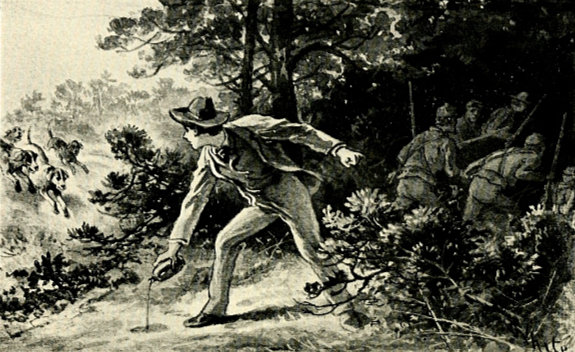
hounds were put on our trail, all the same,
and the next day they pressed us so close that
we had to shoot some of the leading ones.
And what surprised us was that those dogs
would not attempt to follow our trail across
a piece of wet ground. They would take a
circle around it and pick up our trail again on
the other side where the ground was dry."
"They'll do it every time," said Ned.
"And it isn't a part of their training, either.
That's the way they hunt deer and foxes, and
it is something they pick up themselves without
any teaching."
"Well, it's pretty bright in the dogs, I
must say, and we were sorry to shoot them,
but there was no help for it. First and last
we must have killed half or two-thirds of the
pack, but they have been strongly reinforced;
for, judging by the yelping we heard to-day,
there are more hounds on our trail now than
there were at the start."
"You were very fortunate in being able to
keep out of their way," said Mrs. Griffin,
"and I don't see how you managed it."
"I don't either, madam; but somehow we
did it. We can't keep it up much longer,
however, for we are nearly exhausted, and I
wish from the bottom of my heart that we
were in sight of those gunboats at this minute.
But we'll get there in due time, and we'll not
go empty-handed. We made an important
capture this afternoon, and perhaps have saved
our scouts and gunboats, as well as the Union
people in the settlement, some trouble. It's a
fortunate thing for him that we didn't know
what he was when we first caught sight of
him; but as he was in full uniform we supposed
he was a soldier and treated him accordingly."
"And—and what was he?" faltered Ned,
while his mother looked anxious and bent
forward in her chair to catch the corporal's
answer. Something told them that they were
about to hear bad news.
"A miserable Home Guard and a captain
besides," replied the soldier. "Of course
after he surrendered we couldn't shoot him
down in cold blood, as his kind would have
served us if we had chanced to fall into their
power, but we'll put him where he'll not fight
any more gunboats for one while, I bet you."
"How and where did you capture him?"
was Ned's next question. It wasn't the one
that trembled on his tongue, but it was as near
as he could get to it.
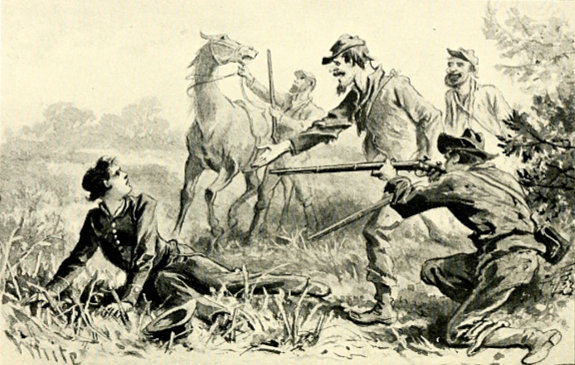
"Why, we had been wading for two miles
in a little bayou that brought us through a
cornfield to the river side of the road, and at
last we hid in a grove of evergreens from
which we could command a view in all directions.
We stayed there for an hour, listening
to the faint baying of the hounds in the
timber on the other side of the road, and never
once dreaming that anybody would come near
us, when to our surprise we saw a gate open,
and a single horseman ride down the lane that
led straight to our place of concealment. I
tell you we were scared, for we expected to
see the dogs and all our pursuers come through
the gate after him, but he stopped to put up
the bars and then came on alone; and when
he approached nearer we saw that he could
not be one of the men we were looking for,
because his horse was fresh and clean, and
didn't have the splashed legs and body he
would if he had been chasing us through the
swamp for three days and more. We saw,
too, that he and his horse were at outs about
something, for every once in a while he would
pound the animal with his whip as if he were
very mad at him; and the last time he tried
it, which he did when he was within less than
a hundred feet of our hiding-place, the horse
jumped and threw him as slick as you please,
and I was glad of it. That was the time we
rushed out and took him in."
"Did he tell you his name?" inquired Ned,
and the words seemed to force themselves out
against his will.
"Yes, he did; and we think it strange that
General Williams hasn't abolished him and put
a stop to his doings long ago. But none of us
ever heard the name of Captain Randolph before.
You know him, I suppose?"
"Certainly, I do; and I know that, so far as
fighting is concerned, he is the most harmless
man in the country. Did he tell you that his
company had defeated some of your cavalry
and been in action with the gunboats?"
"He certainly did tell us just that," replied
the corporal; and Ned and his mother thought
he looked at them rather sharply.
"Well, there wasn't a word of truth in it,"
said the young overseer stoutly. He began to
have a vague idea that he was injuring himself
in the estimation of these two Federals by
standing up for Tom Randolph, but he had
gone too far to back out. He knew that Tom
would not have uttered a word in his defence
if their situations had been reversed, but that
made no difference to Ned Griffin, who in few
words gave the corporal a full history of
Tom's military exploits. The occasional raids
through the settlement that Captain Randolph
had made at the head of his company Ned did
not regard as military business, for their sole
purpose was to intimidate Union men and increase
Tom's importance; so he said nothing
about them.
"If you are as strongly in favor of the Old
Flag as I have been led to believe, I don't see
what your object is in saying a good word for
this Home Guard," said the corporal when
Ned ceased speaking.
"Wouldn't you say a word for an old
acquaintance of yours if you saw him in
trouble, no matter whether he was your friend
or not?" asked Ned in reply. "If you will
give me time I can prove that I have told you
nothing but the truth, and that Tom has deceived
you from beginning to end."
"What do you suppose his object was in
doing it?"
"He always does it every chance he gets.
He knows he will never win a reputation by
deeds of arms, and so he tries to win it with
his mouth. He never did you Yankees the
least harm, and he never will."
"Don't you think we have been here long
enough, Charley?" Ben asked of his non-commissioned
officer; and he answered the
question himself by getting upon his feet as
if he were making ready to leave. He was
plainly the more suspicious of the two, and
showed in various ways that he didn't have
much of an opinion of one who had so friendly
a feeling for a Home Guard.
"We've been here too long," replied the
corporal. "Our friends down there in the
woods will think we are lost or have been
gobbled up. May we trespass still further
on your good-nature by asking for a bite
for our absent comrades?"
"Lucindy, fill up the biggest basket you
can find in the house," said Ned. "And Ben,
if you will sit down a minute I will get shoes
and stockings for you."
"And have you anything in the way of
bedding?" inquired Mrs. Griffin. "The
nights are cool, if the days are sultry."
No, they didn't have a thing except their
guns and the dilapidated garments they stood
in; and a blanket or two, if Mrs. Griffin could
spare them, would protect them from the mosquitos
if nothing more; for of course it would
be dangerous for them to build a smudge until
they knew positively that their pursuers had
been left behind. Ben was profuse in his
thanks, and suggested that No. 9's would be
about the right size for him; and Ned went
among the darkeys to find them, for he wore
nothing larger than 6's, and couldn't boast of
an extra pair of them. While he was gone
his mother saw the basket filled and the
blankets made into a bundle, and also found
opportunity to say a word for Tom Randolph.
"What do you intend to do with him?"
she asked.
"Turn him over to the provost marshal and
have him sent North," was the answer.
"If you do that you will kill his mother,
and punish a man who is as innocent of any
military achievements as I am," said Mrs.
Griffin. "You must not think that I am a
friend of his—how can I be when he tried his
best to have my son conscripted? Why can
you not parole him and let him go?"
"We didn't parole those six rebels for fun,
or because we thought the parole was binding,"
said the corporal with a smile, "but
simply to delay them until we could get a
start. If we turn Randolph loose, it will be
out of gratitude to you and your son."
"Better knock him in the head," growled
Ben.
"Don't mind him," said the corporal, seeing
that Mrs. Griffin was shocked by the
words. "Ben is down on all Home Guards
because he saw one of them shoot his chum."
"But Tom Randolph was in no way to
blame for that," answered the lady. "And I
know that Rodney Gray would insist upon
his release if he were here. Promise me that
you will let him go; and when you are ready to
start for the river, Ned shall take you there
by the shortest and easiest course."
The corporal opened his lips to reply that
he did not think it best to make any promises
until he could consult the rest of his party,
but before he could utter a word an incident
happened that brought him and Ben to their
feet in a twinkling, and drove all the color
from Mrs. Griffin's face, leaving it as white as
a sheet. First there was a terrific and sudden
outburst of yelps and growls from the small
army of coon dogs that found a home on
the plantation, and then answering yelps and
deep-toned bays came from the direction of
the front bars, mingled with the shouts of
command and the sharp cracking of riding-whips.
There was a second's oppressive
silence, and a strange voice called out:
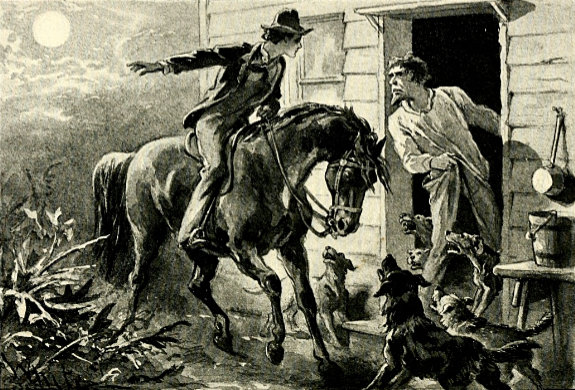
"Hal-lo, the house!"
"Coming, sir! Get out, you whelps!"
shouted Ned Griffin's voice in reply; and presently
the frightened inmates of the house heard
him running around the corner toward the bars.
The corporal and his comrade, who stood with
their guns in readiness, seemingly as much at
their ease as they had been while sitting
quietly in their chairs eating the bread and
meat that had been provided for them, looked
inquiringly at Mrs. Griffin.
"They are strangers and have hounds with
them," said the latter, in a terrified whisper.
"I fear the worst, but Ned will do what he
can."
"I certainly hope he will keep them out
of the house," answered the corporal calmly,
"for if he don't, some of them will never see
the sun rise again."
Ned Griffin, who had had no trouble at all
in inducing one of the field hands to hand over
a pair of stockings and his best shoes for the
benefit of the bare-footed soldier in the house,
was almost ready to drop when he heard that
racket at the front bars, but he answered the
hail without an instant's hesitation, tossing
the stockings and shoes into the nearest bush,
and ran to the road, knowing that he would
meet a party of Confederate soldiers and a
pack of "nigger" dogs when he got there;
but did the soldiers know or suspect that the
men of whom they were in pursuit had sought
aid and comfort in that house?
"They can't know it or suspect it, unless
somebody has betrayed us; and if that has
happened it is all up with Ned Griffin,"
thought the young overseer; and when he
reached the bars and caught sight of the party
on the other side, he did not feign surprise,
but said, as any other honest, hospitable
boy would have done: "Alight and hitch.
I knew it was you the minute I heard
the music of your hounds. Did you catch
them?"
"No," replied one of the men, who wore
some sort of insignia on his collar to show
that he was an officer. "They gave us the
slip about eleven o'clock this morning, and we
haven't been able to find their tracks since.
But we——"
"Say!" interrupted Ned suddenly.
"Please don't let your big hounds come over
the fence and eat up my pups. I need them
to catch wild hogs with next winter."
That was very true, but it was not the reason
Ned did not want the hounds to come inside the
yard. He was afraid that some of them might
go foraging on their own hook; and if they
wandered around to the back door in search
of something to eat, they could not help striking
the trail the two escaped prisoners made
when they entered the house. They would be
sure to recognize it on the instant and give
tongue, and then there would be trouble
indeed; for Ben and the corporal would fight
till they dropped before they would be recaptured.
And then what would be done to him
and his mother for feeding and trying to conceal
them? But the hounds were thrashed
and scolded back into the road and the officer
continued:
"We will get the start of them to-morrow.
If they are in this neighborhood they will stay
here, for we are going to place ourselves between
them and the river. But we were well
fed and rested at a house three miles back, so
we'll not alight, thank you. Are we on the
road to Mooreville? That's what I called you
out for."
"Keep straight ahead, and you can't miss
it," said Ned. "And if you want to go
toward the Mississippi, take the first right-hand
road. But look out for the Yanks. I
haven't seen any of their critter fellers, but
there may be some between here and Baton
Rouge."
"If we run on to them before we know it,
it will be our fault, won't it? Good-night.
Forward, trot, gallop!"
The young overseer, feeling as if a mountain
had been removed from his shoulders,
stood leaning on the bars until the sound of
the horses' feet had died away in the distance,
and then he settled himself into a comfortable
position, drew a long breath, and waited fifteen
minutes longer in order to make sure that the
rebels had really gone on toward Mooreville.
While he was waiting Cæsar came up, expecting
to receive a good scolding, and perhaps
something worse, for neglect of duty.
"Sho's you live, Marse Ned, I watch and
wait wid all my eyes and ears, and dey slip
along de road and up to de bars 'fore I knowed
it," he said earnestly. "You know ole
Cæsar aint going to sleep wid two Yankees in
de house and rebels all around."
"That's all right. I was out of doors, and
didn't know they were at the bars until they
hailed. Now, stay right here and see that
they don't steal a march on us. If you hear
the slightest sound down the road Mooreville
way, slip into the house and let me know it."
Ned went back to the bushes where he left
the stockings and shoes, and when he carried
them into the house he found no one there
except his mother, who was plying her needle
as if nothing had happened. The two fugitives
had disappeared, and there was not a
darkey to be seen.
"Open that door and you will find them,"
said Mrs. Griffin, when Ned stopped and
looked all around. "They thought they
would rather fight it out downstairs than
in the garret, for they would have a better
chance to run."
"They can't go any farther to-night, for
their pursuers are riding hard to get between
them and the river, and may send the hounds
into the woods at any time. And I am glad
of it," whispered Ned. "I'd like to keep
them until I can go for Rodney. Perhaps he
can do something for Tom Randolph. Why,
mother, did you ever hear of such a lunatic?
If he gets out of this scrape I don't think he'll
ever let his tongue bring him into another."
Ned pushed open the door, and the two
escaped prisoners came out. In few words
they were made acquainted with the result of
the interview that had taken place at the bars,
and Ned and his mother did not wonder that
it had a depressing effect upon them. After
racing through the almost impassable woods
and swamps until they were ready to drop
with fatigue, it certainly was disheartening
to know that the enemy had come so close to
them when they imagined themselves safe for
the night. They decided that they had better
return to their companions at once and talk
the situation over with them.
"All right," said Ned. "I will go with
you, for I want to see what Tom Randolph
has to say for himself. If you will take my
advice, you will stay pretty close about this
plantation until you have seen Rodney Gray.
He can do more for you than almost anybody
else in these parts, and if you get into trouble
you'll find it so."
The blankets and the basket of provisions
were brought from the room in which they
had been hastily concealed, and the fugitives
lingered a moment to shake hands with Mrs.
Griffin and tell her how grateful they were
for the generous treatment they had received
at her hands and her son's.
"There is one way in which you can show
it," replied Ned's mother, "and that is by releasing
your prisoner."
"But, madam, we have no right to do it,"
said Ben, who was inclined to put more faith
in Tom's story of his exploits than he did
in Ned's. It was natural, under the circumstances,
for him to believe that Ned's regard
for the truth was not so strong as his desire to
shield an old acquaintance. "We are bound
to take him before our colonel and state the
case to him; and if he has a mind to let him
go—why, all right."
"Haven't you the same right to release
Tom Randolph that you had to release Rodney
Gray and his friend?" inquired Mrs.
Griffin. "You did not think it necessary to
take them before an officer?"
"Perhaps I did stretch my authority just
a little," said the corporal, coming to Ben's
assistance. "But almost any non-com., who
wanted to be half white, would have done the
same thing. Rodney and Graham had discharges
in their pockets, while this man Randolph
holds a commission as captain of Home
Guards at this minute. But we'll tell the
boys what you have done for us, Mrs. Griffin,
and let them decide the matter. I hope it
may be our good fortune to meet again under
pleasanter circumstances. Good-night."
Ned led the way from the house and along
the lane that ran through the negro quarter to
the woods, in which the corporal's two comrades
and their prisoner were impatiently
awaiting their return. They moved silently
and without exchanging a word above a
whisper, but the dark-skinned inmates of the
cabins seemed to be on the watch. One door
after another was softly opened, and suppressed
voices, that were rendered husky by
emotion, cheered them with such expressions
as:
"Lawd bress Marse Linkum's sojer boys!
Youse boun' to whop de rebels, honey; I
know you is, kase Ise praying for you free
times a day, like Dan'l in de lion's den."
"I certainly hope you'll not get into any
trouble through what you have done for us
to-night," said hard-hearted Ben, who was
moved in spite of himself by these expressions
of sympathy.
"So far as I know, our blacks are all loyal,"
answered Ned, "but it won't do to trust some
negroes too far, any more than it will do to
trust some white people; and when we are
in the presence of Tom Randolph I wish you
would be careful not to——"
He stopped suddenly, but it was too late.
He had committed himself. As he afterward
told his friend Rodney, he came near ruining
everything before he thought what he was
doing.
"There you have it!" exclaimed Ben
angrily. "Why do you try to befriend that
man Randolph, when you dare not trust him
for fear that he will set your rebel neighbors
against you? He shall never go free with my
consent, and that is a word with a bark on it."
"Or are you afraid that he will get his
Home Guards together and burn you out, to
pay you for what you have done for us Yankees?"
said the corporal. "I don't believe
there's a Home Guard in the world that will
do to tie to, and I think the best thing we can
do is to hold fast to that fellow. If he's done us
half the damage he says he has, he is a prize."
Ned's common sense told him that words
would not rectify the big mistake he had
made, so he dropped Tom Randolph, entirely,
and talked of the hounds and the risk his Yankee
friends would incur if they tried to make
their way to the Mississippi through the comparatively
open country that lay before them.
There were not woods enough to conceal their
movements; the people along the route were
mostly rebels, and they could hardly help
meeting someone who would put their pursuers
on their track if he saw half a chance.
What they needed more than anything else
during the rest of their journey was a guide
known to be a good Confederate, but friendly
enough to Yanks to help them out of trouble
if they got into it. The two fugitives did not
think they were likely to fall into such trouble
as Ned hinted at, but the next day they were
obliged to confess that he knew what he was
talking about.
By this time they had reached the fence that
ran across the end of the lane and shut it off
from the woods, and there Ben and the corporal
stopped as if expecting something. It
came presently in the shape of the challenge
given in low tones:
"Who comes there?"
"Friends with the countersign," replied the
corporal.
"Halt, friends. Advance one with the
countersign, and have your head blown off if
you don't give it right," continued the voice;
and although the words seemed to be spoken
in a jest, Ben and Ned remained by the fence
while the corporal climbed over it and disappeared
in the bushes. A moment afterward
he called to them to come on, and when Ned
joined him he knew that he was in the presence
of the other two fugitives and Tom Randolph.
It was made plain to him at once that
Tom had sent the corporal and his comrade to
the house with the assurance that they would
find Union people there and plenty to eat, for
Tom said:
"Did you find Griffin?"
"They not only found me, but brought me
here to see you," said Ned, answering for
himself, and working his way slowly through
the dark in the direction from which Tom's
voice came. "And I am sorry to find you in
this fix."
Captain Randolph may have borne up
bravely enough while he was alone with his
captors, but the sound of a familiar voice and
the warm grasp of Ned's hand unnerved him
completely. He drew the young overseer to
a seat on a log beside him, rested his head
against his shoulder, and shook as if he had
the ague; but whether it was with fear, or
with the violence of the struggle he was making
to keep up the character he had so foolishly
assumed, Ned could not tell. There had
been a time when Tom Randolph would have
been ashamed to rest his head against an
overseer's shoulder; but he was pretty well
humbled now. It was at this juncture that
Ned was allowed a few minutes' talk with
Tom, the soldiers being busy with their own
affairs—two of them in describing what had
happened at the house, and the others in disposing
of the contents of the provision basket.
"Tom," said Ned, "you never told these
Yankees that you had whipped their cavalry
and fought the gunboats."
"Yes, I did," answered the captive; and
the overseer was not much surprised to notice
that his voice was choked with sobs. "I took
them for brave men, and thought they would
extend a brave man's treatment to me if they
knew me to be a loyal soldier of the Confederacy."
"Well, do you know that you have got
yourself in a scrape that may end in your
being sent to a Northern prison?"
"Oh, don't tell me that," gasped Tom.
"That's what they have been threatening me
with, and you must make them let me go.
You can do it, for you are known to be Union,
and my father will reward you beyond——"
"And you are not a loyal soldier of the
Confederacy," continued Ned, who wasn't befriending
Tom in the hope of making anything
out of it. "You are nothing but a
Home Guard; and these men have reason to
hate Home Guards."
"I know it," groaned Tom. "But am I to
blame for anything those Pearl River heathen
did to them? You are my only hope, Ned,
and you'll have to get me out of this. You
must."
"There's no must about it. I have said
everything I could, and so has mother. Your
only hope is Rodney Gray."
"Then send for him," said Tom nervously.
"Send for him at once, and say that if he will
stand by me now, he can command me and my
father ever afterward. I wish the men who
are responsible for this war were here in my
place and sentenced to be shot at sunrise. I
have been deceived and badgered ever since
I sided with the Confederacy; I've stuck by
her through thick and thin, while those who
deserted her at the first sign of disaster are
hail-fellows well met with the Yanks in Baton
Rouge, and live on the best the land affords.
They have salt and tea and coffee in their
houses, and white flour; and we have none.
You must help me out, Ned."
Tom Randolph continued to talk in this
rambling way until the corporal interrupted
him with:
"Well, boys, we have decided to stay here
to-night."
"And will you let Griffin go for Rodney
Gray the first thing in the morning?" exclaimed
Tom.
"Griffin isn't a prisoner, and can go and
come as he likes," replied the non-commissioned
officer indifferently. "It's a matter
that concerns you more than it does us. If
Griffin has a mind to go or send for Rodney
Gray, we shall be glad to see him."
"These are the Yanks who captured Rodney
and Graham while they were on their way
home," whispered Ned. "That's why I say
that Rodney can help you if anybody can."
Then, without giving Tom a chance to express
his surprise, he said aloud: "What's the use,
Yanks, of staying here all night in the dark
and cold? If you will come to the quarter,
I will give you a tight cabin and a bright fire
to cheer you up."
The offer was a tempting one to men situated
as they were, but after a short consultation
with his comrades the corporal thought
they had better not accept it; they would
feel safer and sleep more soundly right there
in the woods. Then Ned suggested that they
should wrap themselves in the blankets and
get what rest they could while he stood guard,
and to his surprise and Tom Randolph's unbouded
delight, the proposition was accepted
without an instant's hesitation. To keep up
appearances Tom took the blanket that was
passed to him and rolled himself up in it; but
he had no intention of going to sleep. He had
another idea in his head, and it was just about
as foolish as his notion of trying to pass himself
off for a soldier when he was nothing but
a Home Guard.
"Good-night, Johnny; and many thanks
for that grub and this warm blanket," said
one of the escaped prisoners who had not
spoken before.
"Good-night, Yank, and welcome," replied
Ned. "But I am not a Johnny."
"And neither am I a Yank," said the
soldier. "I came from Michigan. But good-night."
After that silence reigned in that dark, lonesome
camp for the space of half an hour. The
soldiers were weary and sank into a deep
slumber almost as soon as they had adjusted
their blankets to suit them; but Tom Randolph
was wide awake. He curbed his impatience
until the heavy breathing of his captors
told him that they were in a state of unconsciousness,
and then said cautiously:
"Ned, Ned! Have you got a gun?"
"No. What do I want of a gun?" was the
answer.
"Where are they?"
"Wrapped up in the blankets with the
soldiers, most likely."
"Well, say, Ned; look here," whispered
Tom coaxingly.
"It's no use, for I can't do it," replied Ned,
who knew what the captive was about to say.
"You don't show your usual good sense in
asking it of me, either."
"But you could drop asleep, couldn't you,
and let me crawl away?"
"I could, but I won't. I'm not going to
get myself into a scrape by going back on
these Yanks. They'd shoot me."
"But you might go with me," suggested
Tom, who was almost ready to shed tears again.
"And leave Mr. Gray's property to be destroyed?"
demanded Ned. "I said I'd keep
guard, and I've got to do it."
"Well, you have been weighed and found
wanting," said Tom desperately. "I know
just what you are now, but I was foolish
enough to think you were a friend of mine."
"You didn't think anything of the sort.
You knew better," said Ned; and after that
he relapsed into silence. He had proved that
he was ready to assist Tom in any way he
could, but he wasn't going to arouse Ben's
rage and the corporal's by permitting him to
steal away in the darkness. It was the most
senseless proposition he had ever heard of, and
he was glad that Tom did not trouble him with
it again. The latter lay so quiet that his
guard thought he was asleep, but he wasn't.
He was trying to think up some way to get
even with Ned.
Although the overseer was not at all drowsy,
the exciting events of the last few hours having
banished slumber, he passed a dreary
night on his log, leaning against a tree, and
listening for the first far-off baying of the
hounds, which would announce that the pursuit
had been renewed. But the hours dragged
themselves away without disturbance of any
kind, and at daylight the corporal threw off
his blanket and sat up. He felt like a new man
after his refreshing sleep, and that was what
all his comrades said when they were aroused.
Then a short consultation was held, and Ned
posted off to the house with the empty basket.
It was full of eatables when he returned an
hour later, to learn that during his absence the
fugitives had decided that Tom Randolph's
story was more worthy of belief than his own.
"It doesn't stand to reason that a man
would tell such damaging things about himself
just for fun," said the corporal, who
spoke for all his companions. "He was as
defiant as you please when we captured him,
and I believe——"
"But I told you a pack of lies; I did indeed,"
cried Tom, hiding his face in his hands.
"We don't believe it," answered the soldier.
"Your weakening is all put on, because
you have learned that it isn't such a funny
thing to be a prisoner as you thought it was.
And even if you did lie to us, you are a Home
Guard, and that is against you. If you
haven't done any mean things it's because you
haven't had the chance."
To Tom Randolph's rage and disgust Ned
did not try to combat this decision. He simply
said:
"All right; just as you say. Keep a stiff
upper lip, Tom, and I will go and get Rodney."
This was the substance of the story that Ned
Griffin told while he was sitting in Mrs. Gray's
dining room on the morning of which we have
spoken. Of course he did not tell it exactly
as we have tried to, but he told enough to give
his auditors a clear idea of what had happened
on his plantation the night before. They
heard him through without interruption, and
when his narrative was ended they settled
back in their chairs and looked at one another.
There was one thought uppermost in their
minds: those escaped prisoners deserved their
freedom after working so hard for it, even if
they were Lincoln hirelings; and Rodney must
see them safe to the river. As to Tom Randolph—they
did not waste much sympathy on
him, but they were sorry for his mother. Tom
took just such chances as these when he put
on his gray uniform.