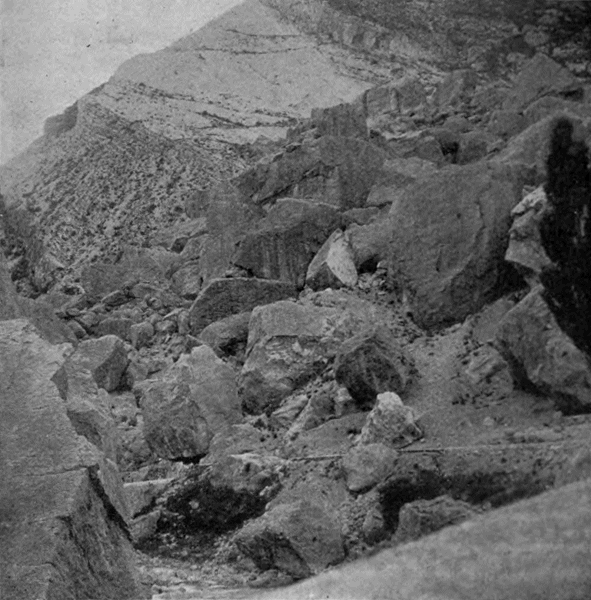
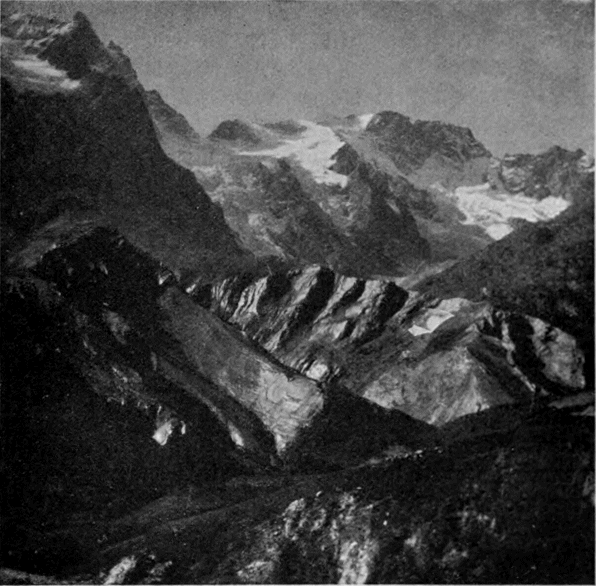
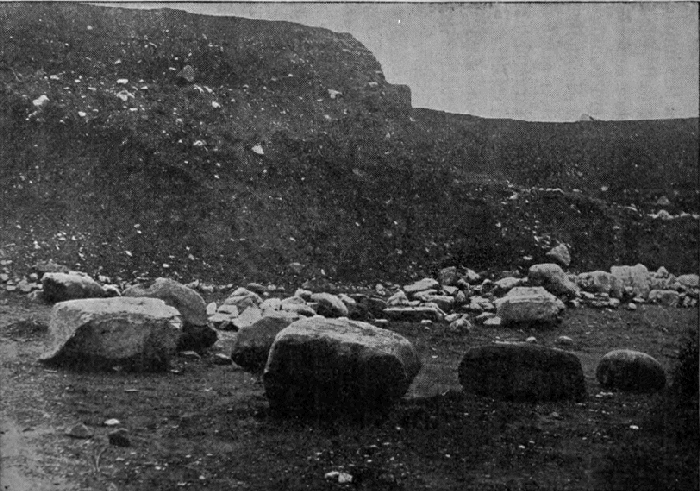
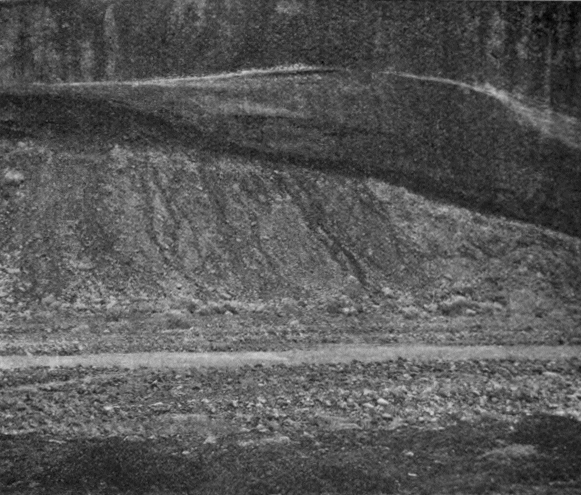
The term Limestone covers, by common consent,
rocks consisting mainly of calcium carbonate.
Dolomite (properly Dolomite-rock), in which half
or nearly half the molecules consist of magnesium
carbonate, is, however, generally included. The
convenience of limestones as building materials has
given them a world-wide interest. Their stratified
and jointed structure appealed to the early Egyptian
architect, when he sought blocks for his pyramids.
The ease with which limestones could be carved,
combined with a reasonable resistance to decay,
gave them a pre-eminence with the designers of
our rich cathedrals. The Romans found in the
stained and altered varieties colour-schemes for
basilicas and baths, and their luxurious taste in
limestone has been inherited by the modern builders
of hotels.
The rock suffers, however, from its solubility in
water containing even a mild acid. In the gases
dissolved by rain-water from the atmosphere, carbon
dioxide assumes a far larger proportion than that
which it possesses in the air itself. The surface of
limestone slabs becomes in consequence pitted and
corroded by every rain that falls. The sulphuric
acid in the air of modern coal-consuming cities is,
however, still more deadly in its action. J. A. Howe,
in his recent work on building stones, is of opinion
that limestone is unsuitable for towns. Limestones
may broadly be recognised by their solubility in cold
dilute acids, with brisk evolution of carbon dioxide.
Dolomitic varieties require hot acid.
Limestones divide themselves into types produced
by chemical precipitation and those due to the
accumulation of the hard parts of organisms; but in
many of the latter types chemical precipitation also
plays a part. Organic action, moreover, frequently
promotes the deposition of the chemical types.
Detrital limestones, that is, limestones formed
from the debris of older ones, are comparatively
unimportant. They occur in certain zones of the
Chalk and of the Carboniferous Limestone in our
islands, and record the breaking up in shallow water
of beds that had already become consolidated. The
Miocene Nagelfluh conglomerates of the north side
of the Swiss Alps are often formed of pebbles of the
far older Mesozoic limestones. Similar conglomerates,
cemented by calcium carbonate, are now being formed
in the river-beds of the limestone karstland of
Hercegovina. Limestone, however, as a rule goes
to pieces before the buffetings sustained by mixed
rocks on a shore. Even if it survives for a time in
gravels, percolating waters ultimately dissolve it, and
only a porous skeleton, formed of its impurities,
remains.
Though calcium carbonate is far less soluble than
calcium sulphate, large quantities are carried invisibly,
owing to the presence of carbon dioxide, in river
waters, and thus accumulate in inland seas that have
no outlet except by evaporation. Here Calcareous
Tufa may be deposited as a crust upon the shores
and on the growing islets, as the water shrinks away,
and before the more soluble gypsum and rock-salt
can separate out. Hot springs of volcanic origin,
like the Sprudel of Karlsbad in Bohemia, may
deposit calcium carbonate as the water cools and
is relieved from pressure. At Karlsbad, little grains
of granite, or of the minerals of granite, serve as
centres, and encrusting layers are formed round
them, until pea-like bodies are produced. These
become cemented together, giving rise to the well-known
freshwater pisolitic limestone or roestone.
On the shores of the Great Salt Lake of Utah,
calcareous tufa occurs also in the form of grains
resembling little eggs. These are the oolitic grains
that were first known as constituents of fossil limestones.
The calcium carbonate of oolitic grains at
Karlsbad, from the Great Salt Lake, and from the
sea, is deposited in a form that gives the reaction of
aragonite when boiled in cobalt nitrate. A. Lacroix,
however, finds that the material at Karlsbad has a
specific gravity lower even than that of calcite, and
that its double refraction is also distinctly weaker.
He has called this form of calcium carbonate
"ktypeite."
Travertine is a tufa laid down on twigs and other
vegetation, where springs emerge laden with calcium
carbonate. In a massive form, it builds tufa-basins,
as in the Mammoth Hot Springs of the Yellowstone
Park. Both here and at Karlsbad, it appears that
vegetation of humble type, multiplying under warm
conditions, materially assists the deposit by withdrawing
carbon dioxide from the water. The unstable
calcium bicarbonate is thus converted into the
carbonate, which is thrown down as a quickly increasing
crust.
Among the limestone regions of the Dinaric Alps,
calcareous tufas or travertines, laid down by ordinary
streams, form massive beds that tend to choke the
hollows of the hills. The basin of Jajce in Bosnia is
thus partially filled up, and the town is built on
materials brought in solution from the mountains.
The modern waters are still adding to this deposit,
and Fr. Katzer[4] has pointed out that the falls of the
Pliva are prevented from cutting their way down to
the level of the Vrbas ravine, into which they plunge,
by the mass of tufa which they build up in their own
course.
Another type of limestone deposited from solution
is of considerable interest in arid lands, or lands with
only a seasonal rainfall. Where evaporation goes on
steadily at the surface, while water is brought up by
capillary action from below, calcium carbonate may
form a cement to the soil, or to the crumbling rock
near the surface, and a solid calc-tufa may arise by
continued transference of matter in solution from
lower levels. In the Cape of Good Hope such
formations are conspicuous[5].
In a careful series of experiments, G. Linck[6]
showed in 1903 that sea-water at 17° C. can only
hold ·0191 per cent. of calcium carbonate in solution.
Though this quantity is not realised in the open
ocean, yet near shores rivers may bring down an
excess. The Thames, though flowing for a long
distance over a limestone area, contains only ·0116
per cent. of calcium carbonate; but springs traversing
limestone often carry ·03 per cent., or ten times as
much as that found in ordinary seas. Hence a
precipitation of calcium carbonate from the bicarbonate
state may take place not far from land.
The mineral deposited is calcite in temperate climates
and aragonite under warm tropical conditions. That
such a precipitation actually occurs is proved by the
massive grey limestones, containing modern shells,
which have been recorded for our islands from the
sea-floor off the Isle of Man and off the coast of Mayo.
In the case of the Irish Channel, the excess of calcium
carbonate may be supplied by springs rising through
the glacial gravels, which contain abundant pebbles
of limestone.
Ammonium carbonate, again, derived from the
decay of organisms, or sodium carbonate, will precipitate
calcium carbonate as aragonite from the
calcium sulphate and chloride, but not from the
calcium bicarbonate, of salt water. Films of aragonite
are at present accumulating by this process on the
floor of the Black Sea, and marine oolitic grains, also
consisting of aragonite, are produced by the same
reaction.
In the case of oolitic grains, deposition is no doubt
helped by evaporation, since they seem to arise in
shallow waters. The Oolitic Limestones that have
proved so admirable as building stones, whether from
the quarries of Caen or Portland, are cemented representatives
of the loose deposits formed in modern
tropical seas. De la Beche long ago compared their
grains with those from West Indian coral-reefs.
These small egg-like bodies develop round fragments
of foraminiferal and other shells, round the ossicles
of echinoderms, and round broken bits of coral. At
first they have the general form of the nucleus; but,
as they are rolled by the waves during their growth,
they become more and more spheroidal as they
enlarge. Boring algæ make tubular passages in them,
and these have led to the view that algæ of thread-like
form actually originate oolitic structure. Doelter,
Linck, and others conclude, with much reason, that
the mode of deposition is inorganic. When the grains
are unusually large, they are often flattened and
irregular, as in the marine Pisolites or Pea-grits.
For building purposes, the fine-grained oolites
without large fossils are much sought after, since
they can be trimmed equally in any desired direction.
Before leaving the question of the inorganic deposition
of limestone, we may note that R. A. Daly[7]
has suggested that the pre-Cambrian and early Cambrian
limestones were entirely products of chemical
precipitation. He believes that the continental
areas were at first relatively small, and that the
abundance of decaying soft-bodied organisms on
the sea-floor led to a continuous precipitation of such
calcium carbonate as was available. Hence the ocean
was limeless, and it was only when continental land
became more extended that a sufficient quantity of
lime salts was brought in by rivers to counterbalance
that thrown down by ammonium carbonate and
sodium carbonate on the sea-floor. Daly urges that,
on this account, the earlier organisms could not form
calcareous shells or skeletons, and he also believes
that pre-Cambrian and Cambrian limestones, even
when unaltered, show no signs of having originated
from fragmental organic remains. Linck's researches
(p. 17) show that limestones thus precipitated must
have originally consisted of aragonite.
These limestones present an immense variety,
according to the nature of the originating organisms,
and the amount of foreign material brought down
into the water where they accumulated. The calcareous
remains of Chara may form a white deposit
on the floors of freshwater lakes. The part played
by calcareous algæ in the formation of marine limestones
has long been recognised; but the detailed
exploration in 1904 of the atoll of Funafuti in the
Pacific showed that Halimeda may be responsible for
a considerable portion of an ordinary "coral-reef."
Lithothamnium occurs in immense quantities, associated
with molluscan remains, near many shores, and
forms a large part of the material of the raised
beaches in Spitsbergen.
Animal, not vegetable, activity, however, is responsible
for the majority of our limestones, and the
humbler organisms, by reason of their abundance,
play a prominent part in rock-formation. Analogies
between the Globigerina-ooze of deep waters and the
groundwork of the soft white limestone known as
Chalk have been freely pointed out. Early in the
nineteenth century, Ehrenberg, in a series of researches
with the microscope, proved the organic
origin of the compact ground of marine limestones.
The occurrence of foraminifera from the shore outwards
to truly oceanic waters provides a fine-grained
calcareous material which forms deposits at very
various depths. The milioline types, often with a
surface like that of glazed porcelain, are common in
the sandy beds formed near a coast. Few rocks are
more fascinating under the microscope than those in
which such types are seen in section, associated with
detrital grains of quartz, washed down from the land,
and perhaps with bright green grains of the marine
mineral, glauconite. In Ireland white chalks occur,
speckled throughout with glauconite, which looks
dark in the rock-mass, but which reveals its green
tint when streaked out by the hammer. When
formed still farther from land, pure chalk arises from
the consolidation of foraminiferal ooze, and the
probable depth in which it accumulated must be
judged from the nature of the associated organisms.
A white limestone may, however, arise in a comparatively
shallow sea, where the rivers bring down little
solid matter from the land. A coast formed of pure
limestone, with clear streams flowing from a land of
similar rock behind, may allow of the development of
pure limestone on its shores. It is generally agreed
that the Upper Chalk of the British Isles and of
northern France was laid down in water one thousand
fathoms or more in depth; yet the corresponding
white limestone of northern Ireland in places follows
rapidly on conglomeratic and glauconitic deposits,
and seems to owe its purity to the comparative
absence of rain and rivers on the highland of crystalline
rocks which stretched westward from its shore.
There are two epochs of the earth's history in
which foraminifera were remarkable for their size as
well as their abundance. The first gave us the grey
Fusulina limestone of Upper Carboniferous times,
when this spindle-shaped shell spread freely from the
United States through the arctic regions to the east
of Asia. The second gave us, in the Eocene period,
the great beds formed of Nummulites and Orbitoides,
which we meet with in Europe on the Lake of Thun,
but which are far more important in Lower Egypt.
The disc-like forms of the nummulites in the white
limestone of the Pyramids are familiar to hundreds
of travellers, and forms are recorded up to four and
a half inches across.
The foraminiferal origin of many compact limestones
can often be appreciated on smooth surfaces
with a pocket-lens. The older examples have
commonly become stained and darkened, and
crystallisation of calcite throughout the ground
has in part destroyed the original organic structures.
This tendency to crystallise affects even the
larger fossils, and brachiopods and molluscs have
sometimes disappeared from our Carboniferous limestones,
without the intervention of "metamorphic"
heat or pressure. In most limestones older than the
Eocene period, the shells and other fossils, such as
corals, that were originally formed of aragonite have
passed into the calcite state, without the destruction
of their characteristic shapes. Shells, however, have
been found still preserved as aragonite in beds as old
as the Jurassic period[8].
The lamellibranchs, the ordinary bivalves, came
into prominence as limestone-builders with the
Carboniferous period, and are now rivalled by the
univalve gastropods, which displayed no widespread
activity until Eocene times. The most massive existing
shell, however, is a lamellibranch, the giant
Tridacna of Australian seas, a single valve of which
may weigh 250 lbs. The cephalopods, though lying
far nearer to the crown of molluscan development,
became important from the Silurian Orthoceras onwards,
and nautiloids of various forms are common
fossils in the Carboniferous limestone. Their large
size attracts attention from our present point of view.
The cephalopods, however, swell the bulk of many
limestones, not by the thickness of their shells, but
through their chambered character, which has prevented
complete infilling of the shell, and which thus
allows of cavities in the mass.
This is notably the case with the ammonites, which
contribute so largely to Jurassic limestones. Crystalline
calcite has often been deposited by infiltration
on the septa and on the inner layer of the shell, thus
reducing the hollow spaces. The massive calcite
guards of the belemnites form a considerable part
of many limestones.
Even freshwater lakes possess molluscan deposits,
producing a white limestone of their own. Where
streams flow over pure pre-existing limestone, there
is no alluvial mud to choke the basins. In the hard
lake-waters, gastropods such as Limnæa and Planorbis,
and a few bivalves, can then flourish freely, and a
"shell-marl" accumulates at the bottom, unmixed
with sediment. Limestone of this type is conspicuous
in hollows in the Dinaric Alps, which were
once occupied by lakes, and is often found beneath
peat in the limestone lowland of central Ireland.
In older days, two groups of organisms, now
relatively unimportant, had a powerful place. The
brachiopods, including in early Palæozoic times an
interesting series of thin shells largely composed of
calcium phosphate, were for long the predominant
shell-bearing organisms. The stout Spiriferidæ and
the well-known Productus giganteus of the Carboniferous
period illustrate their dominance. The group
became much restricted in variety in Jurassic times;
but even then Terebratula and Rhynchonella occurred
so abundantly that they now fall out of many rock-faces
like pebbles from a loose conglomerate.
The sea-lilies have similarly lost their place as
limestone-builders, though their "ossicles," notably
from their stems, furnish crinoidal or "encrinital"
masses from Silurian to Carboniferous times. The
broken portions of their stems, resembling tubes of
tobacco-pipes, are conspicuous when they are weathered
out on rock-surfaces or revealed in polished slabs of
marble. The fact that each joint or ossicle, as is the
universal case in the echinodermata, consists of a
single crystal of calcite causes the fragments to break
with the characteristic cleavage of that mineral. The
smooth glancing surfaces thus seen on fractured
specimens readily call attention to them in a rock.
Those humble colonial organisms, the compound
corals, have so special a place as limestone-formers
that they have been reserved for more detailed treatment.
The accumulation of their skeletons, and the
fact that they may form large continuous masses by
their very mode of growth, promotes the formation
of solid rock at an unusual rate. Von Richthofen
long ago pointed out how foraminifera and other
drifted material became caught in the interstices of
coral, producing even a stratified structure in the
hollows of a reef; and subsequent research has shown
the composite character of reefs in various portions
of the tropic seas. Calcareous algæ as already remarked,
and the massive and often encrusting
skeletons of hydrozoa, such as Millepora, are freely
associated with the products of true corals.
Charles Darwin, in his famous theory of the formation
of atolls and barrier-reefs, showed how, in
a subsiding area, corals might keep pace with the
downward movement. Hence reefs might arise of
great vertical thickness, although the polypes themselves
could flourish only in the upper twenty fathoms
or so of water. This conclusion, which appears
strictly logical, has met with much opposition from
Karl Semper, Alexander Agassiz, and Sir John
Murray. Murray in particular urges the importance
of banks of calcareous organisms in building up
platforms on which corals may ultimately dwell.
The extension of reefs outward into deep water has
been attributed to the rolling down of wave-worn
coral debris over submarine mountain-slopes. From
this point of view, an apparently thick atoll may be
formed as a comparatively thin mass of limestone
at the summit of a volcanic cone that fails to reach
the sea-level.
The opponents of the view that thick coral-limestones
are formed at the present day in the
Pacific have been unwilling to accept the results even
of the deep boring in the atoll of Funafuti[9], which
penetrated materials like those of the superficial
layers of the reef to a depth of 1114 feet. They have
also refused to see in the huge dolomitic rocks of
Tyrol the remains of Triassic reefs four thousand
feet in thickness. None the less, most geologists
regard the Funafuti boring as a strong support for
Darwin's contention. Whatever may be proved as
to the origin of this or that atoll at the present day,
it is clear that the possibility of subsidence leads us
to expect considerable coral-limestones among our
ancient rocks. The same problem arises wherever
we have a rich molluscan fauna continuously represented
in two or three thousand feet of limestone, or
where we find shore-deposits of any kind accumulated
to an unusual thickness. Darwin, at the end of the
fifth chapter of his work on "The structure and distribution
of Coral-Reefs," gives a vivid account of the
features that would appear in a section of an atoll
that has grown large through subsidence of its
inorganic floor, and he emphasises the occurrence
of conglomerates of broken coral-rock on the outer
zone. The stratification of material by wave-action
in this zone, and the horizontal deposition of finer
material in the lagoon, would give to the dissected
mass a general sedimentary aspect. Darwin concluded
that the ring of solid coral, the true reef,
might be denuded away during an epoch of elevation,
and that only stratified portions might remain. He
does not seem to have discussed the contemporaneous
deposition of pelagic material from foraminiferal and
other sources against the outer surface of the reef
whereby an interlocking of two facies of limestone
might arise.
These features, together with those predicted by
Darwin, have been recognised by von Richthofen and
Mojsisovics in the Tyrol dolomites, and have afforded
Austrian geologists good evidence that large parts of
these limestones originated as coral-reefs. Faulting,
however, has undoubtedly taken place in this region,
producing here and there a subsidence of the limestone
blocks among the surrounding more normal
sediments. Rothpletz, Ogilvie Gordon[10], and other
critics of von Richthofen's view have seen in this
faulting the cause of the abrupt change from a facies
of massive dolomite to one of normal sedimentation
on the same horizontal level. They have also urged
that shell-banks may accumulate locally so as to
simulate reefs by their contrast with their surroundings,
while the change to dolomite has obliterated
their original features (see p. 30). It cannot be
denied, however, that coral-reefs and their associated
detrital deposits must exercise a very important
influence in the formation of solid limestone.
Even small knots and local groups of compound
corals are seen in ordinary limestones to serve as
a mesh in which other organic remains have become
entrapped. The ease with which the aragonite of
their skeletons becomes silicified causes them often
to stand out on weathered surfaces with all the
delicacy of structure displayed upon a modern reef.
Where limestones and shales are associated
together, a "knoll structure" may be found, the
limestone occurring in masses of a somewhat hemispherical
form, with the shales fitted against and
round them. In some cases this may be due to the
local distribution of patches of growing coral on the
old sea-floor; but in other cases the structure has
arisen from compression and brecciation of the strata,
the original beds of limestone becoming broken up
and the more yielding beds flowing round them.
This structure is well seen on a small scale in many
"crush-conglomerates," where the limestone appears
as knots and eyes, resembling pebbles. Yet near
at hand the true bedding may be traced, bands of
limestone alternating with shale, and a few cross-joints
indicating the possibility of a separation of the
limestone into blocks. These blocks become rounded
in the general rock-flow; but Gardiner and Reynolds[11]
suggest solution by infiltering water as an explanation
of certain remarkable examples studied by them.
A certain amount of magnesium carbonate is
present in the skeletons of some marine organisms.
This has been shown both by Forchammer and
Walther[911]. A foraminifer, Nubecularia novorossica,
has been found with 26 per cent. of magnesium
carbonate, and a serpula with 7·64 per cent.;
alcyonarian corals contain up to 9·32 per cent.,
while calcareous algæ, such as Lithothamnium and
Halimeda, contain about 12 per cent.[12]. The magnesium
salt is not, however, here combined with
calcium carbonate to form the mineral dolomite;
none the less it is clear that such organisms introduce
magnesium in appreciable quantities into the constitution
of marine limestones.
Marine limestones are very commonly "dolomitised."
Dolomite, the joint carbonate, CaMg(CO3)2,
contains 54·35 per cent. of calcium carbonate and
45·65 per cent. of magnesium carbonate, or carbon
dioxide 47·8, lime 30·4, and magnesia 21·8. Its
specific gravity is 2·85.
The occurrence of dolomite in intimate association
with calcite has been proved by E. W. Skeats[13] in
the case of modern coral-reefs, and the secondary
deposition of the mineral has been made clear. The
skeletons of the corals themselves may now consist
of dolomite, while calcite has crystallised in their
interstices, or remains as part of the original infilling
of mud. The presence of dolomite in reefs has, of
course, long been known, having been observed by
J. D. Dana in 1849, and it has been realised that,
by prolonged alteration, masses of Dolomite Rock
become built up[14].
Commonly, the process produces a Dolomitic
Limestone, in which calcium carbonate is still in
excess of the 54 per cent. which is present in the
mineral dolomite.
The alteration of the original limestone is, however,
sufficiently profound. The ready crystallisation
of dolomite as rhombohedra destroys the organic
structure, and traces of corals or molluscan shells
disappear from great thicknesses of rock. It is
uncertain whether the process of dolomitisation
proceeds most rapidly in the evaporating waters of
the lagoons, or, as Pfaff believes, at considerable
depths, where the pressure may reach 100 atmospheres.
Magnesium carbonate, as we shall note
later, may be removed from dolomite in solution
under pressure at a greater rate than calcium
carbonate. If this occurs in sea-water, it would
seem to militate against the production of dolomite
in the lower levels of a reef.
The magnesium required for dolomitisation is
derived from the magnesium sulphate and chloride
of sea-water, calcium being removed during the change.
C. Klement in particular urges that a concentrated
solution of sodium chloride at 60° C. assists the process
in the case of magnesium sulphate. Aragonite, the
material of coral skeletons and of most molluscan
shells, is more susceptible than calcite. The temperature
of Klement's experiments may be realised in
lagoons or between tide-marks, and Doelter suggests
that the element of time in nature may allow the
reaction to take place at lower temperatures.
The intimate structure of modern dolomitic limestone,
as exhibited in coral-reefs, satisfies us that
many older or fossil dolomites were formed from
marine calcareous deposits while these were still
accumulating. In other cases we must admit that
the dolomite has developed in the neighbourhood of
joints after the consolidation of the rock. The view
that dolomitisation results from the mere removal of
calcium, the magnesium originally present in organic
skeletons becoming thus more concentrated, is not
borne out by recent observations.
Skeats[15] has carefully compared the dolomite-rocks
of Tyrol with the materials of recent coral-reefs. In
both there is a striking absence of detritus of inorganic
origin, and his work goes far to show that the much-discussed
Alpine dolomites were formed under conditions
which occur in the neighbourhood of existing
reefs. This, however, does not solve the question as
to whether we are dealing in Tyrol with fossil coral-reefs,
or with the calcareous type of ordinary marine sediments,
which might undergo the same kind of
alteration. While Skeats finds in two dolomites from
recent reefs 43 per cent. of magnesium carbonate,
the substitution seems usually to terminate when
40 per cent. has been introduced. In Tyrol, however,
the process has gone so far as to give rise to true
dolomites, with 45·65 of magnesium carbonate.
The dolomites of the Jurassic series in north
Bavaria are massive rocks almost devoid of fossils,
traversed by shrinkage cracks, and associated with
richly fossiliferous stratified limestones. The relations
of these two types of rock are those of coral-reefs to
the bedded deposits on their flanks, and the dolomite
seems to merge horizontally into the stratified series.
As in Tyrol, fossils and corals are rare in the bosses
of dolomite, but the structural evidence is strongly
in favour of their having originated as steeply sided
reefs.
The dolomitic facies of the Carboniferous limestone
in our islands is an example of the second type of
origin. The dolomite here frequently occurs in
irregular veins and patches. The introduction of
iron carbonate with the magnesium salt stains the
dolomite brown on exposure to oxidation, and its
limits are thus clearly seen in the general blue-grey
mass. The dolomitisation has evidently proceeded
from joint-surfaces inwards. It is often sufficiently
thorough to obliterate all traces of fossils, and the
shrinkage accompanying the chemical change has
produced numerous cavities, in which calcite has
subsequently crystallised. An expansion takes place
when aragonite is altered into dolomite, unless more
of the calcium carbonate is removed than is necessary
to give place to the magnesium carbonate introduced.
In the change from calcite, with a density of 2·72, to
dolomite, with a density of 2·85, there is, on the other
hand, a shrinkage of 4·56 per cent. Where the alteration,
then, takes place while the aragonite organisms
still remain as aragonite, and not as calcite, an expansion
rather than a contraction should occur in the
substance of a reef; but when an old limestone, in
which all the calcium carbonate is present as calcite,
becomes dolomitised, a considerable shrinkage will
occur, and rifts and hollows may remain obvious.
Very few dolomites, except those found in association
with rock-salt and other products of the evaporation
of lagoons, can now be attributed to direct
chemical deposition from the sea.
Daly[7] has argued that the first Palæozoic and
the pre-Cambrian dolomites were formed by precipitation,
since the calcium salts in those early days were
completely removed from the sea-water. Ammonium
carbonate, though effective in precipitating the
calcium salts, does not act on those of magnesium
until the calcium salts have been brought down.
But, under the conditions postulated for the river-waters
that reached the sea from the earliest continental
lands, conditions involving the presence of
only small quantities of salts of calcium, the decay of
organisms on the sea-floor might lead to a deposition
of all the magnesium salts, following on those of
calcium, both coming down in the form of carbonates.
The experimental work of Pfaff[16] should be
considered in connexion with Daly's suggestions,
since means are there indicated whereby basic
magnesium carbonate, precipitated from sea-water,
may associate itself with calcium carbonate to form
dolomite; shallow-water conditions, with concentration
by evaporation, are required.
Daly compares analyses of river-waters now
running over pre-Cambrian rocks with analyses of
pre-Cambrian limestones, and the ratio of the carbonates
of magnesium and calcium is shown to be the
same in both series.
From what we have said, it now seems probable
that the great majority of dolomitic limestones owe
their magnesium to substitution from without. Direct
precipitation of dolomite has, however, been invoked
to account for several cases of Permian age, such as
the Magnesian Limestone of the county of Durham.
Near Sunderland, this rock is greatly modified,
containing ball-like and other concretions, associated
with frequent cavities. Traces of the original bedding
remain, running through the concretions, and marine
fossils are abundant. Conybeare and Phillips, so far
back as 1822, stated that the nodules were devoid of
magnesia, though formed in a magnesian rock. In
spite of this, these objects long appeared as dolomite
in collections. E. J. Garwood[17] showed conclusively
that they resulted from the concentration of calcium
carbonate in a concretionary form. The process
whereby a dolomite may thus revert towards the
ordinary limestone condition, with removal of
magnesium in most cases, has been styled "dedolomitisation."
Water containing calcium sulphate
after passing through a dolomite is found to carry
magnesium sulphate by a chemical exchange. Skeats[18],
moreover, points out that, under a pressure of five
atmospheres the magnesium carbonate of dolomite
becomes more soluble than the calcium carbonate in
fresh water containing carbon dioxide. The ordinary
relations are thus reversed under pressure, and a
cause of dedolomitisation may be indicated.
Under the influence of contact-action from igneous
rocks, dolomite may separate into calcium
carbonate, magnesium oxide, and carbon dioxide. The
magnesium oxide takes up water and yields the
flaky colourless mineral brucite. Where silica is
present, either as an impurity in the dolomite, or
introduced from an invading siliceous magma,
magnesium and calcium silicates may be built up[19].
Olivine thus arises, and, on becoming hydrated and
passing into serpentine, stains the rock in various
shades of green. The calcium carbonate crystallises
as a ground of granular calcite, and the whole mass
becomes a handsome Ophicalcite, or serpentinous
marble. The famous rock of Connemara, used in
polished slabs, has arisen through contact with
intrusive diorite.
Dolomitic limestones are liable to decay rapidly
in towns, owing to the formation of magnesium
sulphate, which, as shown above, is even more soluble
in water than is the accompanying calcium sulphate.
In the country, the crystals of dolomite resist ordinary
weathering by the carbon dioxide of the rain-water
better than those of calcite; and the rock thus
becomes loosened through the loss of one constituent,
and crumbles into a dolomite sand[20]. Compact
dolomites, however, have furnished some excellent
building-stones for country use, since here the more
resisting mineral forms the bulk of the rock.
The Phosphatic Limestones are commercially
even more important. Tricalcium orthophosphate,
derived, perhaps, in the first instance from the decay
of bones of fishes and the excreta known as coprolites,
tends to become aggregated in certain limestones, as
in the chalk of Mons in Belgium and of Taplow in
Buckinghamshire. The phosphate replaces foraminiferal
and other shells, and frequently forms
internal casts of fossils. In the latter case, it has
replaced the calcareous mud that first occupied the
shells. The observations of the "Challenger"
expedition show that concretionary calcium phosphate
is forming among the calcareous and glauconitic
oozes of existing oceans, nodular masses collecting,
in which foraminiferal shells are united and even
replaced by calcium phosphate. Where deposits of
guano are formed by sea-birds on surfaces of coral
limestone, as at Christmas Island to the south of Java
and at Sombrero in the Windward Islands, calcium
phosphate becomes washed downwards and replaces
part of the calcium carbonate of the rock. The
resulting phosphatic limestone is quarried on a
commercial scale, and the very existence of Christmas
Island is said to be threatened by the energy of
excavators. The "phosphorites du Quercy," well
known to agriculturists in France, are accumulations
in hollows and fissures of Jurassic limestone, and are
associated with the bones of fossil mammals. But in
this and in other cases there is much doubt as to
whether the phosphate is derived from the bones, or
is locally concentrated, with other impurities, such
as sand and clay, through solution of the adjacent
limestone.
The most common substance that replaces calcium
carbonate in limestones is silica, in the form of Flint.
The nodules of this material, white on the outside
and richly black within, mark bands of stratification
in the Cretaceous chalk, and are among the best
known materials in south-east England. Their
fantastic forms have given rise to many speculations.
Sometimes, however, when fractured, they are clearly
seen to include the remains of fossil sponges. The
sponges may be represented merely as hollow casts;
but there is abundant evidence in other cases that
they belong to genera which secreted skeletons of
amorphous (non-crystalline) silica during life.
The nodular flint has collected round the sponge,
while the sponge itself has often disappeared.
G. J. Hinde[21] has shown how readily the spicules of
siliceous sponges go into solution. Even at the
bottom of existing seas they become rounded at the
ends, while their canals become enlarged. In some
fossil instances, they are replaced by calcite.
W. J. Sollas[22], emphasising this point, remarks that
"it may be taken as an almost invariable rule that
the replacement of organic silica by calcite is always
accompanied by a subsequent deposition of the
silica in some form or other." This subsequent
deposition is frequently at the expense of calcite in
some other part of the rock. The solid flint is a
replacement of the limestone in which it occurs.
The pocket-lens will often show traces of sponge-spicules,
as dull little rods, in the translucent substance
of a flint. But the microscope shows that the
mass of the flint has the structure of the limestone
in which it lies. The foraminifera and other small
structural features of the original rock are perfectly
preserved in chalcedonic (that is, minutely crystalline)
silica. Larger fossils, such as thick molluscan shells
and the tests of sea-urchins, may escape alteration,
while the chalk mud, the original ooze, with which
they are infilled has become completely silicified.
This explains the internal moulds of fossils in brown
oxidised flint that are found in gravel-pits on the
surface of the Chalk, and also the tubular hollows,
representing stems of crinoids, that often occur in
flint from the Carboniferous Limestone. In the latter
case, the fossil remained calcareous while the ground
became silicified, and the fossil was removed by
subsequent solution.
Where great thicknesses of strata, as may happen
in the Carboniferous Limestone, have become thus
silicified, it may be presumed that siliceous skeletons
were unusually abundant in the mass. But, as
L. Cayeux[23] observes, such skeletons may be in one
case entirely removed, and in another represented by
massive flints; in yet another case, the silica may
remain disseminated through the rock. The irregularity
of its segregation is shown by the growth of
flints in branching or hook-like forms, running from
one bed to another in a limestone.
Oolitic limestones and the skeletons of corals,
both having been originally made of aragonite, are
often replaced by flint, forming conclusive instances,
appreciable by the naked eye, of the secondary origin
of this form of silica. Traces of diatoms are comparatively
rare, though they probably contributed to
the silicification of the freshwater Calcaire de la Brie
of the Paris basin. Radiolaria, however, have now
been well recognised as flint-formers, even in dark
"cherts" of Silurian age. Radiolarian cherts have
been taken as an indication that the beds in which
they occur were formed in oceanic depths.
It is difficult to determine the stage in the history
of a rock at which silicification has set in. As
A. Jukes-Browne[24] remarks, solution of the silica
skeletons may be accelerated by pressure, i.e. by the
depth of water in which the bed accumulated. Yet,
in comparison with the calcareous shells of foraminifera,
radiolarian and diatomaceous remains are only
slowly soluble, and are found in the deepest spots
reached by soundings. H. B. Guppy[25], on the
other hand, has observed silicification of modern
corals in reefs in the Fijis, and believes that the
process went on during the elevation of the area,
when waters containing silica became concentrated,
and parts of the mass were exposed to evaporation.
The instability of the non-crystalline siliceous
skeletons in geological time makes it probable that
a rock cannot long retain them when buried among
other strata in the earth.
It is clear that there is no support for the view,
current from the time of James Hutton onwards, that
nodular flints are formed by matter in hot solutions
entering pre-existing cavities in limestone rocks.
But there must be cases where the silicification of
limestone has arisen through its penetration by hot
springs. The presence of tabular flint in joints of
the Chalk shows that water has imported silica along
easy lines of passage from some other portion of the
rock. Just as stems of trees become replaced by
chalcedonic silica, so may beds of limestone be
converted into flint, especially in volcanic areas.
A. W. Rogers[26] records that recent limestones formed
in the Cape province by the evaporation of ascending
waters have already become silicified. These flinty
rocks have been found in the Kalahari Desert and
elsewhere, though not south of the Orange River;
the chemical change is probably due to the character
of local water rather than to temperature. Yet
it is remarkable how, in the vast majority of instances,
the partial or complete silicification of a
limestone may be traced to an intermediate resting
stage of the silica in the form of skeletons of
the vegetable diatoms or the animal sponges or
radiolarians.
The decay of flint itself, by the removal of part of
its substance in solution, is the cause of the white
surface on specimens from the Chalk, and of the
crumbling white residues found in certain gravels.
This process has been fully discussed by J. W. Judd,
who believes that the material removed is silica in
the opaline condition[27].
Limestones in the field are characterised by joints
which traverse considerable thicknesses of strata,
until some shaly bed is met with, in which earth-stresses
cannot set up such continuous planes of
fracture. Since the conditions of deposition may
remain constant for a long time in open seas, and
since stratification cannot be obvious until these
conditions change, limestones may have a massive
character that is exceptional among sedimentary
rocks. In some cases, however, where muddy rivers
in times of flood have brought in detritus from the
land, rapid and no doubt seasonal alternations of shale
and limestone may be observed.
The Chalk of north-western Europe remains
typically soft, lending itself to cliff-formation along
the coast, where landslides are frequent through
undercutting from below. Were it not for the
development of flints along stratification-planes, it
would be impossible at a distance to detect any
bedded structure in the rock. Its representatives in
eastern France, in the north zone of the Alps, or in
the central Apennines, are compressed into far more
resisting masses, and rear themselves as terraced
crags and sheer rock-walls, in which the structure
due to vertical joints is paramount. The English
Chalk weathers into round-backed downs, clothed
with thin grass, and hollowed into combes by streams
that have long ago run dry. The soil owes hardly
anything but its abundant flints to the white limestone
rock on which it lies. Residual clays and
sands derived from the breaking up of later beds
allow of cultivation here and there, and beechwoods
flourish even on the crests of the high downs. But
water sinks freely into the ground, and may so far
saturate the mass as to appear again in wet seasons
in hollows of the surface as temporary springs or
"bournes." When deep wells are sunk and pumping
is begun, it is found that the supply varies greatly in
different spots under seemingly uniform conditions.
Even in so permeable a mass, there are waterways
where maximum flow occurs. Channels where water
soaks in from above, or weak places in the roofs of
underground watercourses, become marked at the
surface by sinkings known as swallow-holes. These
increase in size with time, and are abandoned to the
growth of scrub and trees.
Among more consolidated limestones, as we have
hinted, the joints are effective in promoting bold rock-scenery.
The absorptive power of the rock, rather
than its hardness, prevents it from being washed
away. Water that might round the edges of escarpments
and send down taluses to modify the slopes
sinks into the ground and works out passages by
solution. On level surfaces, the solubility of limestone
in water charged with carbon dioxide from the
atmosphere is apparent by the formation of pitted
hollows, with edges between them that grow sharper
until they are worn through. Where a rain-drop first
secures a resting-place, its successors deepen the
little hollow. Water lies in this after every shower,
working its way gently downwards. In time the rock
may seem bored into as if prepared for blasting; the
holes unite to form vertical grooves, and the surface
is cut deeply into fantastic forms.
The face of the rock, formed by weathering on a
valley-side or towards the sea, or occurring on any
mass that is being cut back and reduced by denudation,
is likely to be vertical, or at any rate perpendicular
to the bedding. The form of the surfaces
of the beds is perpetuated by their fairly uniform
lowering through solution. The result is that stratification
surfaces and planes perpendicular to them
control in a very marked degree the scenery of limestone
lands (Fig. 1).
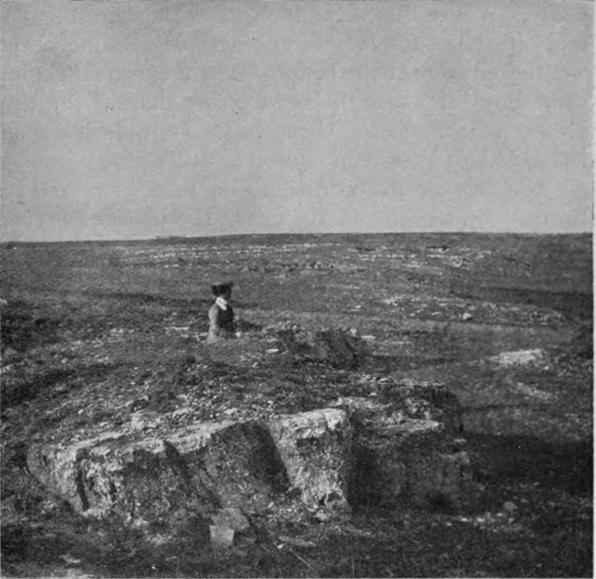
Fig. 1. Surface of Limestone Plateau. Causse du Larzac,
Aveyron, France.
Where the beds are level, with occasional partings
of a slightly different composition, the country will
develop terraces, like those of the Burren in northern
Clare. Where they are folded, as in the Juras, scarps
and dip-slopes follow one another picturesquely, the
weathered edge of the bed, the true escarpment, being
sometimes at an angle as steep as that of the dip.
Hence a false effect of sharp peaks is produced, when
these "edges" are seen end on at a distance.
The terrace-structure may be seen in miniature
forms upon a rocky shore, where the blocks loosened
from the escarpments of the successive beds are
carried away by the waves. Frost-action is powerful
in larger instances, and sends down huge blocks upon
the lower terraces. A combination of shale bands
and massive limestones, especially with a dip outward
from the highland, leads to destructive landslips,
since the sloping surface of shale is lubricated
by water that passes through the limestone (see
Fig. 9). Outward slips of the coast are thus common
in Antrim, and have been extensive near Axmouth,
two regions where chalk rests upon Liassic clays.
Broken ground, then, occurs freely under limestone
scarps, and the falling blocks often prevent the growth
of trees. The freshness of the rock-face above and of
the talus below calls attention to spots where denudation
is most active. Differences in the constitution
of the beds are indicated by differences of the slope
formed by denudation on the rocky walls. The huge
cañons of Arizona afford effective illustrations.
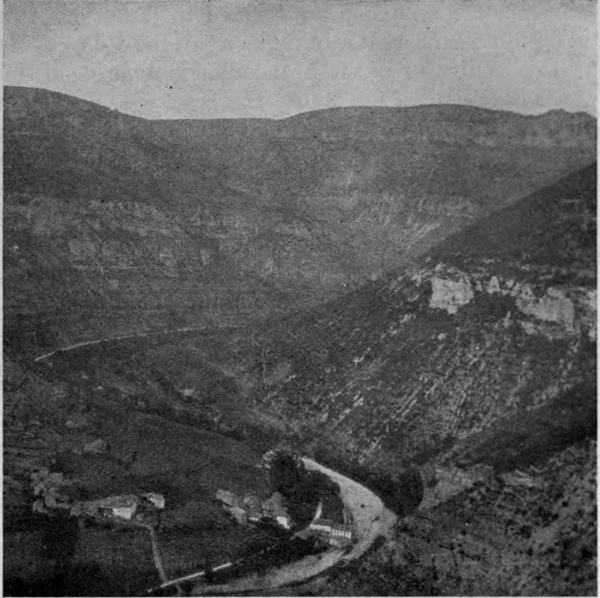
Fig. 2. Ravine in Limestone. Cañon of the Dourbie,
Aveyron, France.
These cañons owe much of their character to the
presence of vertically jointed limestone. The small
rainfall of the region has allowed the rivers to deepen
their channels ahead of the wearing back of the walls.
Yet even where valleys are widened by rain and other
atmospheric agents, those formed in limestone will
maintain the character of ravines. In the valley-sides
of Derbyshire, or of the Franconian plateau, or of the
Arve near Sallanches, where the crags rise a mile or
more above the stream, we see how cañon-cutting is
assisted by the joints in limestone. The ravine of the
Dourbie, east of Millau in Aveyron, in the romantic
region of the Causses, is a winding gorge two thousand
feet in depth (Fig. 2). That of the Tarn, a little to
the north, has only recently been penetrated by a
road, cut out for the most part in a vertical rock-wall.
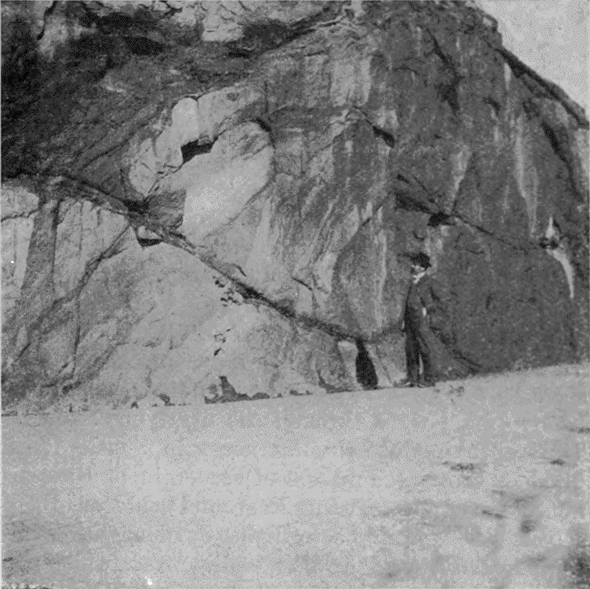
When we observe, especially from the stream itself,
the details of these sheer valley-sides excavated
in limestone, we again and again detect evidences of
solution. High above the present water-level, the
rocks are rounded, and are often undercut, so that
they overhang (Fig. 3). In Millersdale in Derbyshire,
above grass-grown taluses, the surface is still smooth
to the hand, and we can picture the water swirling
against it, and washing it away, as it does now in the
bottom of the grim ravines of Carniola. It has been
suggested, indeed, that some limestone cañons represent
underground waterways, the roofs of which
have fallen in. This may be true of the fine gorge of
Cheddar, and in some cases is proved by the existence
of rock-arches bridging across the hollow of the stream.
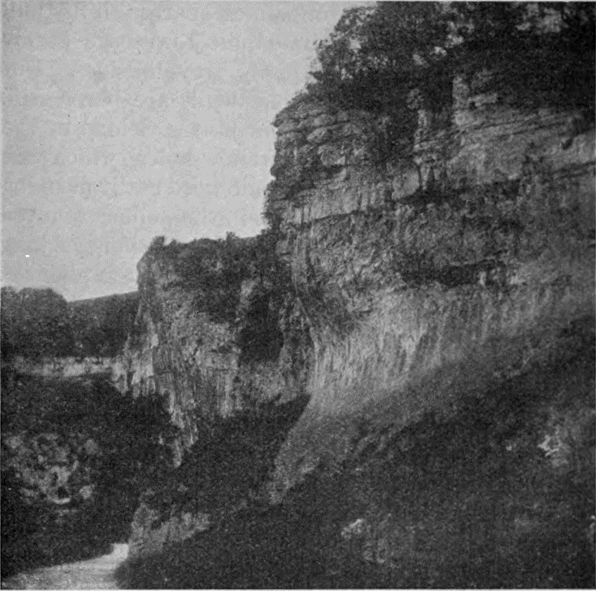
Fig. 3. Waterworn Cliff of Limestone. Ravine of
Millersdale, Derbyshire.
The characters of an unmitigated limestone region
are best seen when we travel east of the Adriatic.
Here what have been styled the karst landscapes
become prominent, and may be followed through the
Greek isles to the Levant. Something of the kind is
realised in the terraced lands between the Rhône and
the upper reaches of the Durance; lavender bushes
form dull-green spots on almost barren hills, and
the grey walls of old stone-built towns are barely
distinguishable against equally grey hillsides. But
towards Trieste the limestone lands are barer still.
The small amount of insoluble matter yielded by the
rock may accumulate in swallow-holes, which are
here called "dolinas," a Slavonic word really meaning
valleys. This residue appears in the dolinas as a red
clayey earth, the "terra rossa" of the Italian-speaking
Dalmatian coast. But on the surface of the plateaus
it is washed or blown away as soon as it is extracted
from the limestone. A. Grund[28] has suggested that
the frequency of frost-action in more northern areas
allows surfaces of limestone to be cumbered with
loose blocks among which soil-patches may gather;
hence we do not find karst-features on the plateaus
of central Bavaria, Champagne, or the Cotteswold
Hills. Something approaching to a karst appears in
the wind-swept levels of southern Galway and of
Clare, and exposure to strong winds has probably
a good deal to do with the origin of the Causses and
the Illyrian karstlands. At the same time, the amount
of impurity in the limestone must strongly influence
the resulting landscape. The noble woods in the
limestone hollows of southern Ireland are rendered
possible by the clay soils derived from the limestone,
as much as by the sheltered nature of the ground.
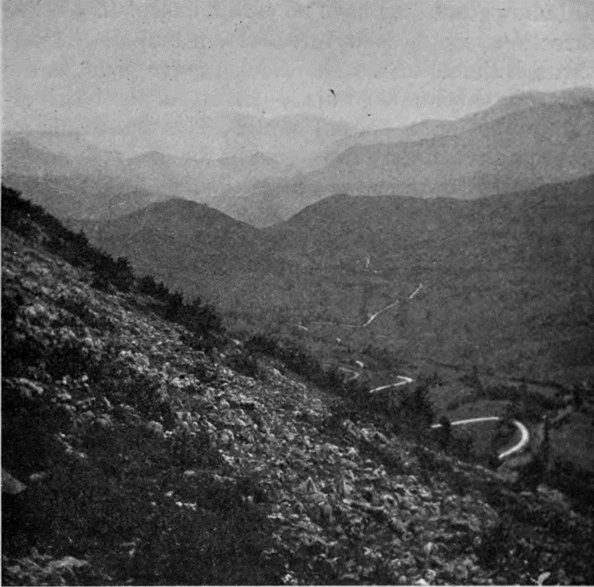
Fig. 4. Limestone Country Dissected by Ravines.
Karstland of Hercegovina, from the Maklen Pass.
In typical karstlands, water sinks in, and emerges
again on low ground, where the surface-forms cut the
level of the subterranean water-table. Streams that
manage to hold their own for a time on the uplands
often disappear into the clefts. Marshes may occur
in hollows, but may have no outlet, except in vertical
directions, upwards by evaporation and downwards
through the dolinas. The dolinas correspond, as the
Slavonic shepherds so aptly perceived, to the river-valleys
of more normal areas. The landscape of
flowing streams has to be sought for in a mysterious
underworld, of which we can gain only a few glimpses.
What we know is largely due to explorers of singular
enterprise and resource, notably E. A. Martel and
the "spelæologists" whom he has inspired.
A view over the plateau of Hercegovina shows us
how deep gorges, rather than ordinary river-valleys,
are prevalent where important streams run across
a karstland (Fig. 4). The roads are carried, where
possible, along the ravines, and the country possesses
a double life, that of the broad uplands, where tanks
have to be made to preserve the water, and that along
the commercial highways, four or five thousand feet
below. Even beside the rivers there is a sense of
desolation in the barren whiteness of the rocks.
The sunlight strikes on the wall of some theatre of
the limestone, carved out in old times by a side-swirl
of the stream, and the hollow glares like a white
furnace in the hills. The river in summer shrinks
among broad stony reaches, to which thin-flanked
sheep are driven for a scanty pasture. Its clear
green water gives no promise of alluvium for its
banks. Limestone, even in temperate Europe, may
create the features of a desert land.
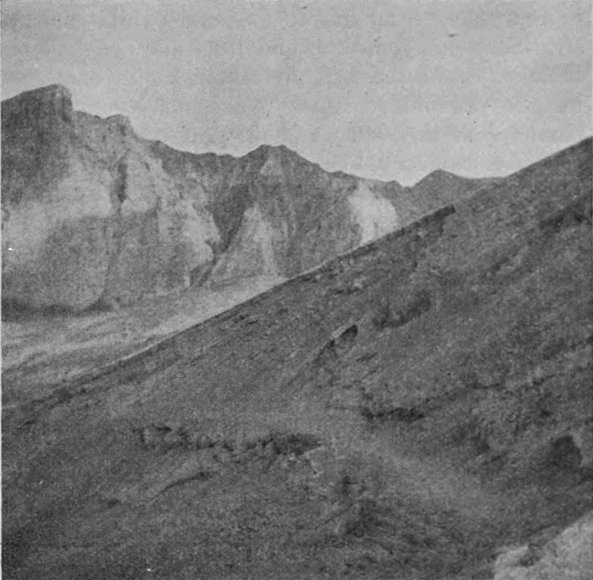
The most extraordinary rock-scenery in Europe
is due to limestone in the dolomitic state. It is not
clear if the crags and pinnacles of Tyrol are caused
by the change from calcium carbonate into dolomite,
whereby a granular mass has arisen, weathering freely
along its vertical joints. It may well be that these
compact limestones have developed an exceptionally
jointed structure under earth-stresses, and that
faulting has intensified their tendency to break up
into fort-like blocks. Stratified masses of more
normal Rhætic limestones often provide a terraced
structure near the mountain-crests; but in thousands
of feet of underlying dolomite vertical clefts prevail
entirely over planes of bedding. If, as is extremely
probable, these dolomite-rocks arose from the composite
masses that we style coral-reefs, stratification
was none the less a marked feature as their limestone
grew in thickness. This structure is still plainly
visible; but the joints have been widened, and the
mass is cut up into stupendous pinnacles and dominating
towers. The Drei Zinnen near Landro, the
deeply notched wall of the Langkofel and the
Plattkofel, rising four thousand feet above a grassy
upland of normal Lower Triassic strata, and the
overhanging crests of the Sett Sass above Buchenstein,
are types of a country where dolomite is
pre-eminent, and where the zone of steep rock-weathering
is marked by the most fantastic forms.
Any limestone the markings or colour of which
render it suitable for ornamental purposes passes as
a Marble. "Fossil marbles" are often mere grey
limestones, in which the stems of crinoids, or the
curved sections of shells, or the radiating patterns
due to corals, please the eye with their variety
on a polished surface. The Purbeck Marble that
was so much used as a grey foil to the massive
white columns of cathedrals throughout England is
simply a freshwater limestone, of no great merit
as a building stone, crowded with the shells of
Paludina. The black marbles are limestones coloured
by one or two per cent. of carbon, derived from the
decay of organisms, and white shells may stand out
in them conspicuously, in contrast with the ground.
The red marbles of Plymouth and of Cork have
become iron-stained, and at the same time secondary
crystallisation has destroyed many of their original
features. In Little Island, near Cork city, earth-movements
have crushed the mass, which in consequence
shows signs of solid flow. The breaking of
a crystalline limestone under such stresses furnishes
us with many handsome marble Breccias. The abrupt
juxtaposition of angular masses of various colours,
torn from beds originally distinct, renders some of
these rocks almost too startling for the decoration
of rooms of moderate size.
There seems no such thing in nature as amorphous
carbonate of lime, and all limestones are therefore
formed of crystalline particles; but the further
crystallisation of this material produces a true
marble, in which all traces of fossils may be lost.
Heat and pressure underground probably facilitate
this change, since even soft chalk is converted by
igneous dykes into granular marble. But where
the pressure is accompanied by the possibility of
movement, the shearing action breaks down the
grains, and a more delicate structure results.
We have already seen (p. 35) how dolomite may
undergo striking mineral changes through advanced
metamorphic action. Lime-garnets, wollastonite, diopside,
and other silicates similarly develop in
ordinary limestones exposed to the intrusion of an
igneous magma. The extreme changes in such rocks
will be described when amphibolites are dealt with.