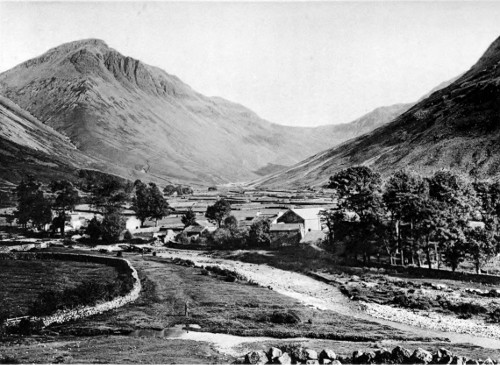
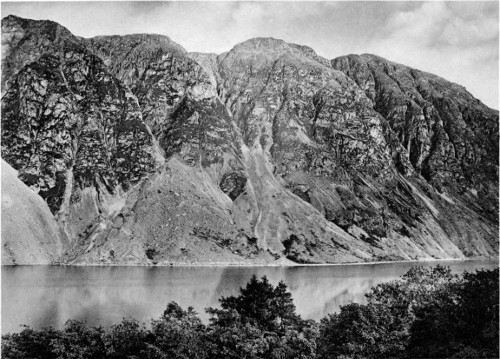
Mosedale is closed in by Yewbarrow, Red Pike,
Pillar, Looking Stead, and Kirkfell. These form a
noble amphitheatre of dark mountains, a cordon
through which it is not easy to break. Between the
last two hills we can effect the passage of the Black Sail
over into Ennerdale, which passes down behind the
Pillar to the north-west. A more direct route to
Ennerdale is by Wind Yatt (or Windy Gap), a pass
2,400 feet high, between the Pillar and the Red Pike.
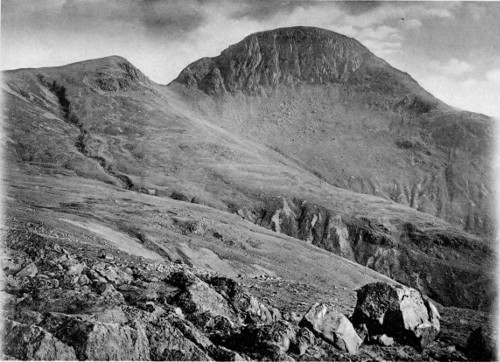
On the northern or Ennerdale side of the Pillar mountain
is the famous Rock, beloved of climbers great and
small. It springs up vertically from the steep fellside,
with a north face like a cathedral-front 500 feet high.
From the summit of the fell a descent of 400 feet of
steep rock and scree will bring us to the nearest part
of the crag. From the Liza River at the bottom of
the valley we have 1,100 feet of grass and scree to
tackle before reaching the lowest buttresses that
support the great wall.
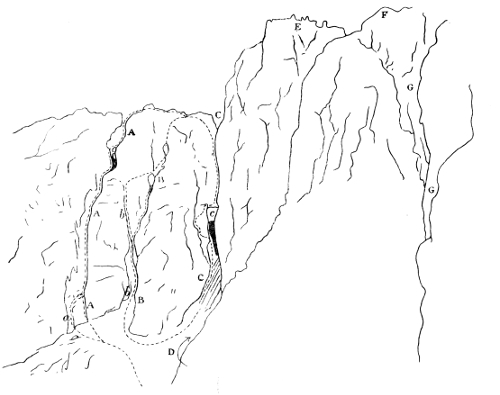
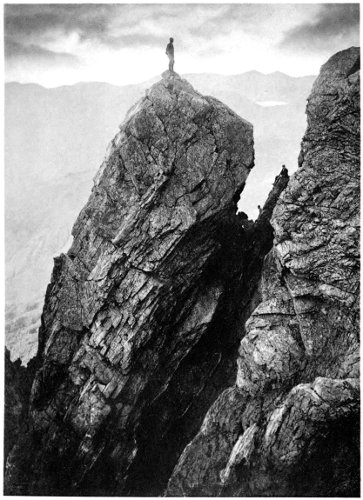
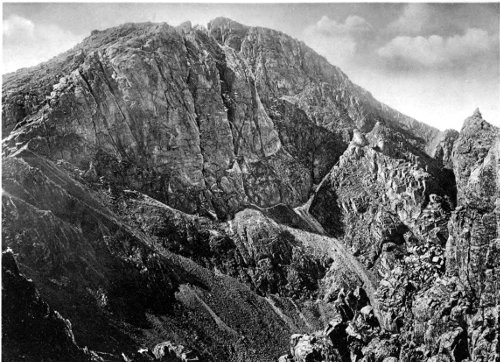
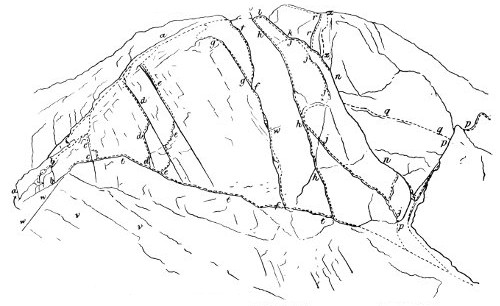
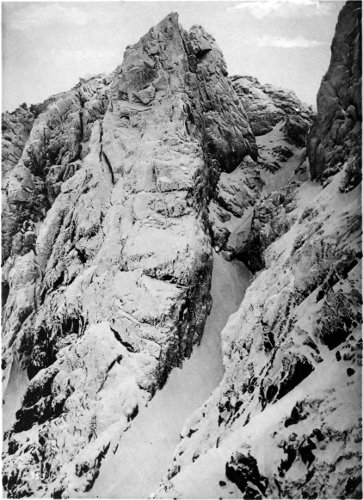
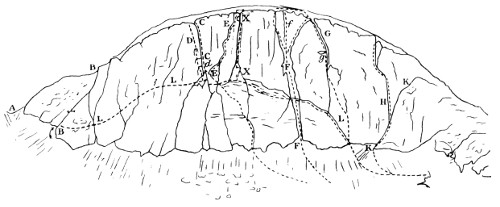
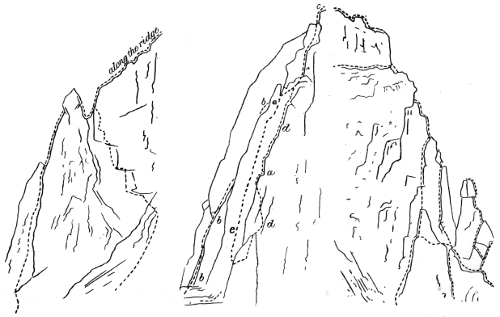
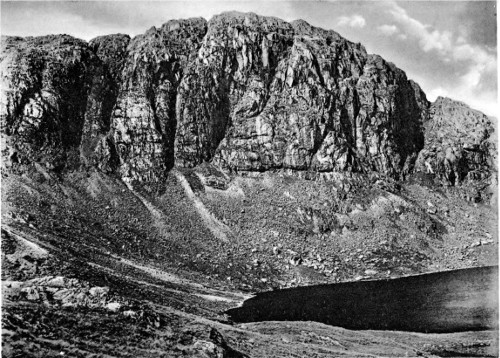
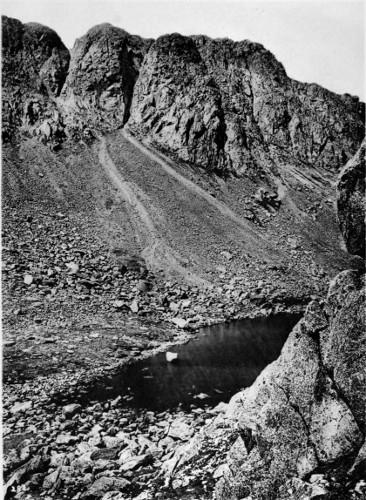
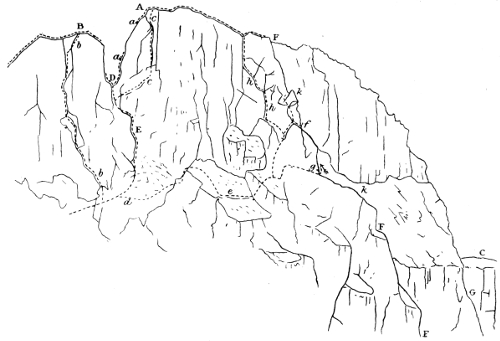
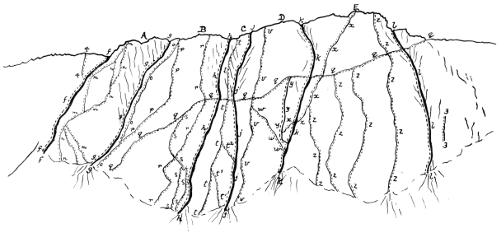
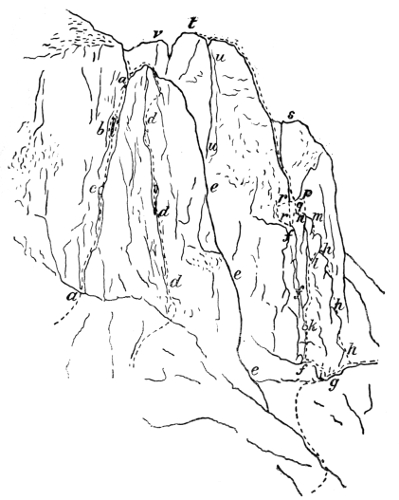
PLATE IX.
PILLAR ROCK, NORTH SIDE (p. 271).
The High Man is about 550 feet above the Nose.
G. P. Abraham & Sons, Photos
Keswick
a Shamrock Gully.
b Great Pitch in a.
c Great Bridge.
d Shamrock Chimney.
e Walker’s Gully.
f Savage Gully.
g The Nose.
h Easy route, North Climb.
k Cave Pitch.
l Stomach-traverse.
m Split-block.
n The Strid.
p The Hand-traverse.
q The Buttress-route.
r The Ordinary route.
s The Low Man.
t The High Man.
u The Great Chimney.
v Pisgah.
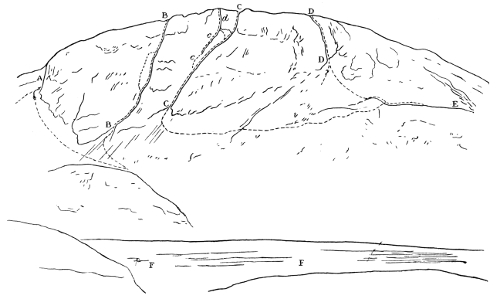
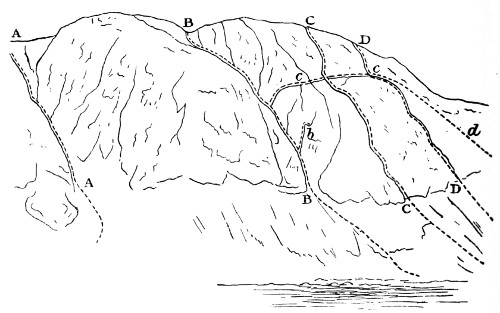
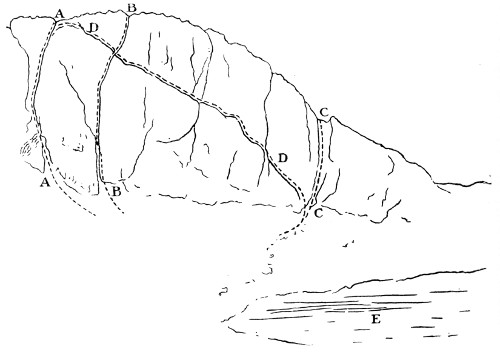
From below, the precipice is seen to be divided into
two parts by a long, black chimney. This is Walker’s
Gully, named after the young man who fell there in
1883. Its head is the point of convergence of sundry
lines of scree from the upper fell. It suggests a
funnel cut down along its centre-line, and scree
frequently slides down the sides of the funnel and
into the gully. This no doubt is the chief reason
why Walker’s Gully has never been climbed until
recently, when snow and frost diminished the risk
from this cause. It would prove difficult under any
conditions, and the risk of a battery of stones from
above is too heavy a handicap for the cautious
climber.
The Pillar Rock itself is on the right of the gully,
in our view from below. The crag on the left is
considerably lower, and in fact scarcely rises high
enough over the head of the gully to be visible from
above. But from the east it presents an imposing
appearance. Its outline partly suppresses that of
the higher crag beyond, partly combines with it,
audit is often mistaken for the actual Pillar Rock.
Hence the name Sham-rock by which it has been
known since 1882. It is a mere walk to reach the
summit from the Pillar Fell. The climbing on
the Shamrock is not quite so good as that on the
neighbouring crag, but it cannot well be neglected.
On the eastern side is the well-known Shamrock
Gully, a magnificent looking cleft in the rocks, finishing
with a huge V-shaped notch at the summit. A
natural arch spans the gully half-way up, and
an obstacle some few feet higher makes a pitch of
unusual severity—‘one of the stiffest pitches in all
Cumberland.’ It was first climbed by Mr. Geoffrey
Hastings’ party in March, 1887, when a bank of
snow below the pitch gave a little help. In December,
1890, the climb was repeated by a party with the
same leader, without the aid of snow, and since that
date various ascents have been made with and without
snow. Among others a new route over the
obstacle was effected in December, 1896, by the
writer and three friends. It is probable that the
pitch turns back fifty per cent. of the people who
essay to climb it.
On the same eastern face, a few yards further
away to the north, is the Shamrock Chimney, a thin
crack running somewhat irregularly upwards to the
summit ridge. The credit of the first ascent belongs
to Mr. John Robinson, whose keen eye and sound
judgment made the ascent an accomplished fact, on
September 23, 1894, within a few days of his discovery
of the chimney. Shortly afterwards Robinson
showed me the route, and I was convinced at once
that in difficulty and extreme interest it was far
superior to the Shamrock Gully, and equal to the best
climbing on the Pillar Rock. The third ascent was
made by Dr. Lawrence in April, 1895. Not many
parties have been up it as yet, and I am hoping that
the full account of its details here supplied will
tempt others to attack it.
I have said that the Pillar Rock lies to the right
of Walker’s Gully when viewed from below. It is
bounded on the other or western side by a broad
hollow in the fell, down which a slender stream flows
without any abrupt change of level till the foot of the
precipice is reached. There the ‘Great’ waterfall
disturbs the even tenor of its way, and is said to
offer a formidable obstruction to our approach of the
west face from below.
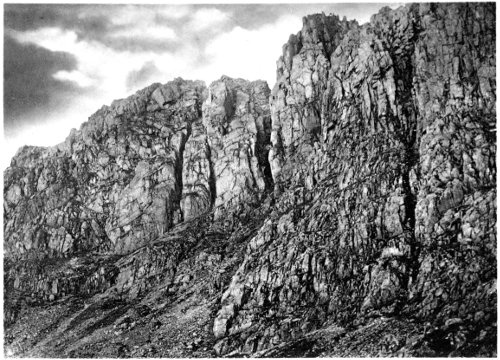
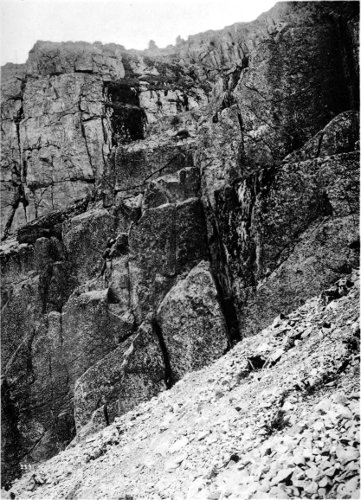
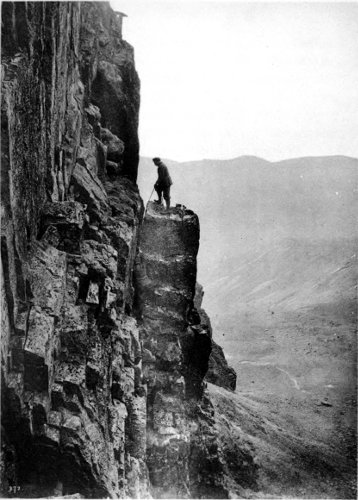
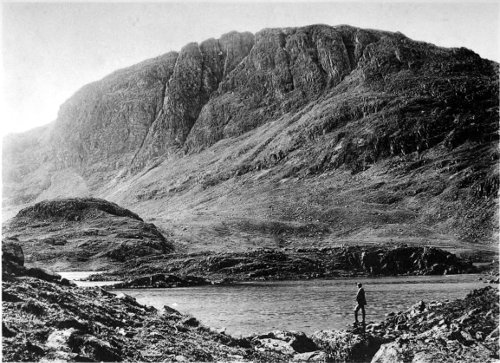
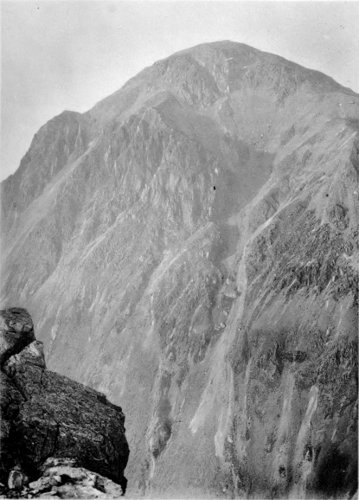
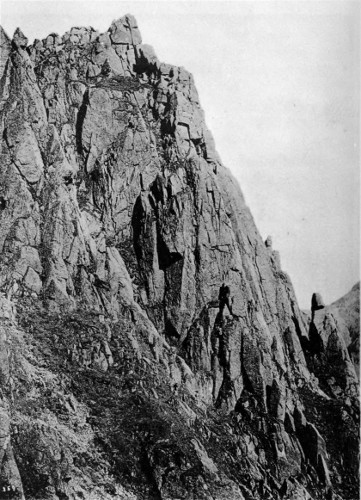
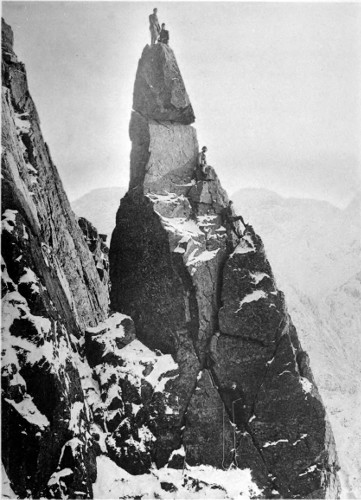
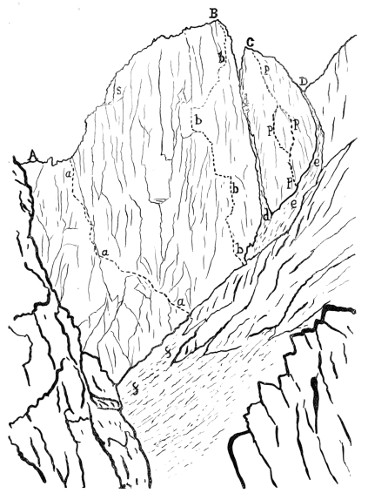
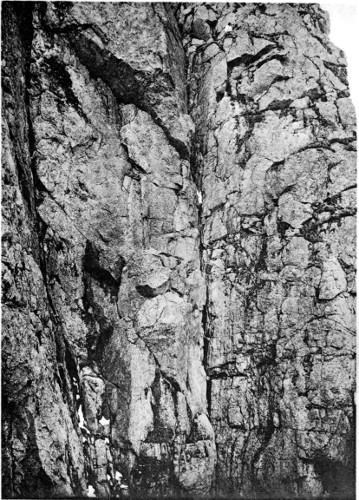
G. P. Abraham & Sons, Photos
Keswick
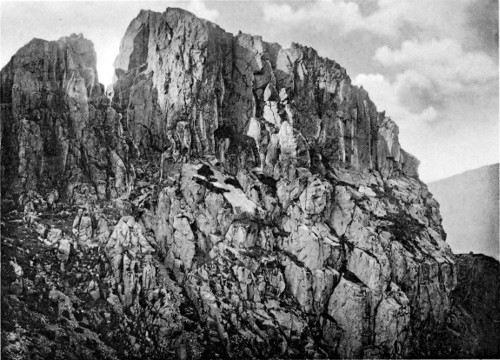
THE EAST FACE OF THE PILLAR ROCK
From the Shamrock side we can get the best
idea of the shape of the Rock. We have first the
Pisgah rising out of the upper fellside, a pinnacle
easily accessible and only forty or fifty feet high.
Then to the right comes the actual Pillar Rock, the
‘High Man,’ separated from Pisgah by a narrow
vertical cleft, the ‘Jordan,’ that renders the ascent
from Pisgah almost an impossibility. At the Jordan
two gullies meet; one up the east side, short and
easy, the other up the west side, longer and more
difficult.
The outline of the rock is marked by a notch to
the right of the summit, where the Great Chimney
finishes, and a little further northwards it shows a
sudden drop to the level of the Low Man, the
immense buttress that from below hides the true
summit altogether. A cairn has been erected on the
top of this buttress, and the outline to the right of
this falls in one vertical drop of 400 feet to the
foot of the rock. This is the great north wall. It
is supported at the base by a minor buttress, the
‘Nose,’ that stretches across the full width of the
north wall, and along the top of which, immediately
below the precipice, an easy terrace takes us across
to the Great Waterfall from a point near the foot
of Walker’s Gully. From the eastern end of the
traverse rises the Savage Gully, a well-marked cleft
with sundry branches, reaching to the top of the
Low Man.
On the western side the rock appears much more
formidable. The chimney up to the Jordan looks
black, and its crest is overhanging. The wall of the
High Man itself is built up with long slabs of smooth
rock, broken only by the smallest grass ledges, and
its difficulties appear to increase near the summit.
This side of the Low Man looks as inaccessible as
the great north wall. Nevertheless a series of short
gullies starting from the foot of the High Man lead
obliquely up towards the left and offer a very easy
route to the southern end of the Low Man, whence
to the summit the climbing is but moderately
difficult.
The best ways of reaching the Pillar Rock are
given in full detail by Mr. Haskett Smith. It will
here be sufficient to remark that from Wastdale the
usual course followed is to ascend by the path
towards Black Sail Pass until about ten minutes
beyond Gatherstone Beck, then to make for the
ridge on the left leading over Looking Stead and up
to the summit of Pillar Fell. Thence a descent of
450 feet in a northerly direction brings us to the Pillar
Rock. Sometimes Mosedale is followed straight up,
and the steep slope climbed that leads to Windy
Gap. Thence the ridge to the right takes us in
twenty minutes of easy going to the summit of the
Pillar Fell. Both these routes involve an unnecessary
ascent of 450 feet, and the ‘High-Level Route’ was
designed to avoid this waste of time and energy.
Looking Stead is reached as before from Gatherstone
Beck, and the wire fence followed up for a few
minutes as far as the head of Green Cove. Here a
cairn marks the spot where a rough path starts down
the cove. We descend only fifty feet or so, and then
turn round to the left and skirt along the north-east
side of the fell. It is unsafe to attempt the traverse
for the first time in a mist, but with clear weather
the various cairns that mark successive points on the
route can be easily discerned, and a half-hour’s walk
brings us to the wide scree gully running down by
the eastern side of the Shamrock. To reach the foot
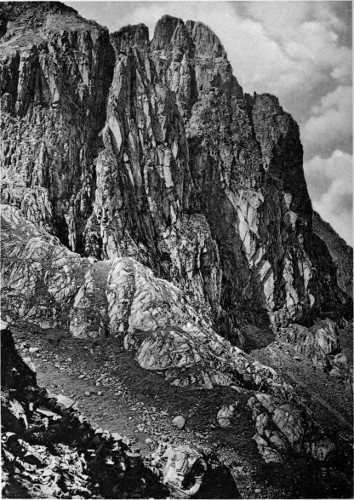
of the Pillar Rock is a simple matter. The photograph
facing page 271 was taken across this scree,
and it will be seen that the route down to the
Nose is only a walk round the foot of the Shamrock.
A broad, sloping corridor in the lee of a
steep rock-wall further up the fellside, enables us
to steer clear of the Shamrock cliffs and to reach
their head without any hand-and-foot scrambling.
Thence across the scree descending to Walker’s
Gully we see Pisgah and the High Man, and with
care we can now make the traverse to the foot of
the Jordan Gully. There we are in a position
to start any of the ordinary short climbs on the
Pillar Rock. The west route can be reached by turning
Pisgah on the left and descending the west scree
for 300 feet. The long climbs up the north face
are started from the Nose.
The Pillar Rock was first climbed by an Ennerdale
cooper named Atkinson, who in 1826 ascended by
the west side. The ‘slab-and-notch’ route on the
east side, starting from the upper screes above
Walker’s Gully, was devised by Messrs. Conybeare
and A. J. Butler in 1863, though it would seem that
the same side was successfully attacked a year or
two before. Matthew Barnes, a Keswick guide, found
a route across the eastern face to the Low Man, and
thence back along the summit ridge to the highest
point. He was climbing with Mr. Graves, of Manchester.
Mr. W. P. Haskett Smith found in 1882 a
direct way up to the High Man from the Jordan, and
a second route straight up the wall a few yards to
the east of the first. Two years later he reached the
summit by a particularly hazardous course still further
to the east, passing up close to the buttress whose
lower end marks the start of the ‘slab-and-notch’
route. In the same year he made the first ascent by the
Great Chimney on the east side. Mr. Haskett Smith
named the first three routes the ‘West Jordan,’ the
‘Central Jordan,’ and the ‘East Jordan’ climbs
respectively; the latter route is never undertaken,
and the other two are often termed the ‘Left
Pisgah’ and ‘Right Pisgah.’
For many years Mr. Haskett Smith made visits to
the north face, endeavouring to reach the summit of
the Low Man from the easy ledge at its foot. On
the right his course was limited by the almost seamless
wall of rock that gives the Pillar Rock its appearance
of hopeless inaccessibility from Ennerdale.
On the left the Savage Gully cut off all chance of
traversing to the eastern side of the rock. The space
between was strictly limited, and it narrowed as he
climbed higher. Within thirty feet of an easy scree
gully that obviously led to the summit of the Low
Man, the only available course had dwindled down to
a slender rib of rock in a dangerously exposed
situation, much too risky to attack without guarantee
of its feasibility.
In 1891 this climber, with Messrs. Hastings and
Slingsby, succeeded at last in finding a way of descending
into the Savage Gully at that point. Their leader
then mounted its left wall and worked easily across
to the foot of the scree gully. The others followed,
and the ‘long climb’ up the Pillar Rock became an
accomplished fact. No published detailed description
of the route is known to the writer.
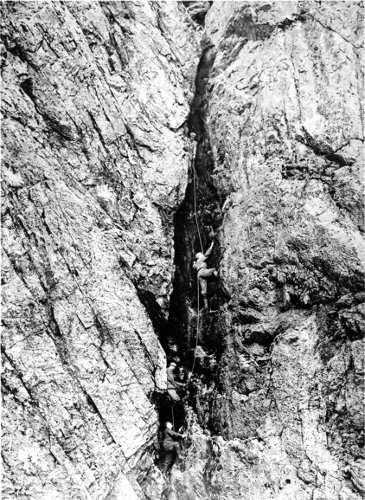
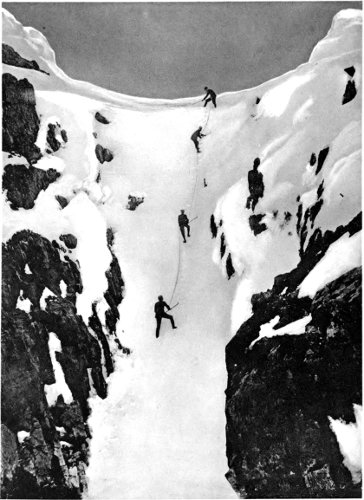
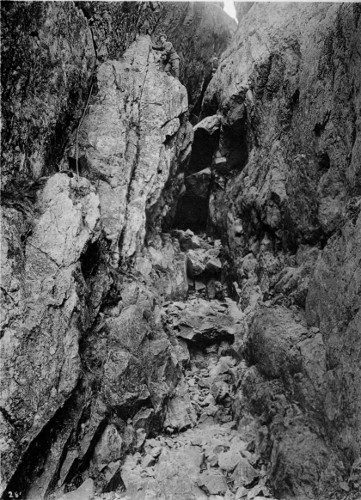
Shamrock Gully.—This is rather an unpleasant
climb for those who dislike loose stones. The bed
of the gully is very steep and narrow. It is followed
straight up the centre, by using horizontal shelves on
either side that now and again flake off in a most
unexpected way. Extreme care is necessary on the
part of the leader, for his followers cannot avoid any
fragments that he may dislodge. The climbing is
otherwise easy, and very little distance should exist
between the separate members of the party.
Half-way up the gully the bridge is passed, high
above our heads when no snow is about, but
occasionally completely blocked by heavy drifts.
Next the bed of the gully runs up into a little cave,
formed by the huge jammed stone that presents the
only genuine obstacle in the ascent.
The block is long and narrow. It leaves just
enough room on each side, between the walls of the
gully, for a thin chimney. That on the right is very
difficult to enter but comparatively easy to follow up.
The other is designed differently; it leads the climber
by a temptingly easy beginning into a position
twenty-five feet up, that will in many cases pound
him most distressingly, and his descent will be
uncommonly awkward. Hence it is that the right-hand
chimney was for nine years the only course
adopted.
The process of backing-up is, as a rule, safe,
though fatiguing. In the case of the Shamrock
pitch, the leader will never find his attitudinising
comfortable. If he starts from the shoulders of a
companion, he can at any rate enter the chimney;
but its walls are undercut, and he needs all his
strength to brace himself firmly between them. A
little higher and there is risk of jamming too well.
Twenty feet up he has to turn towards the block and
work up over a shelf on to the scree above the pitch.
It is not easy for his companions to follow on, even
with the aid of the rope.
The left-hand route was climbed in winter.
Sundry weak holds were frozen into position, but
the rounded top of the great block was glazed completely,
and the finish was of great difficulty. Dr.
Collier had told me that he thought the upper
portion just possible, and our party of December,
1896, decided to try it. I started up the first
twenty feet and then found the glaze of ice too
heavy for further advance. It was not very difficult
to traverse out of the chimney into a wider gully on
the left; but after rising a few feet in this, the great
smooth slabs in front completely barred the way,
and I attempted to return to the chimney. This
could not be effected, and hitching the rope over two
small excrescences on the wall I climbed down the
retaining ridge and rejoined my companions. This
was very unsatisfactory, though I was glad enough
to be in safety again. We had a long discussion
about the pitch, and referred to many engineering
principles. At last I suggested that the lightest
member of the party, weighing not more than nine
stones, should take the lead, and that I should follow
on closely as far as the difficult spot. There I proposed
to brace firmly in the chimney and thrust him
straight up to the frozen grass above. He looked
at me apologetically and said that he would go up
if I insisted on it, but would rather hear of some
different plan that deprived him of the honour of
leading. Then a bold but heavy man spoke up and
volunteered to take his place. It was my turn to
decline, and we felt completely at a loss. At last
I went up again to the turning-point of the previous
venture, and for the sake of safety threaded my
rope through two or three jammed stones in the
chimney. Then followed the longest member close
behind me, likewise threading his rope. I climbed
on to his head—it had been tested many times
before—and then got him to steady my left foot on
a frozen hold half a yard higher. An ice-axe was
then passed up from the cave, and the pick rammed
hard into the frozen grass above the boulder. The
handle then offered enough stay to enable me to
pull up over the smooth icy surface of the boulder,
and the pitch was conquered. I cut steps up the
snow to a safe place for belaying the others, and
they then followed singly on a long rope. The rest
of the gully was simple walking.
Shamrock Chimney.—This is shown very
clearly in the photograph facing page 271, as a series
of vertical pitches almost in a single straight line
from top to bottom of the Shamrock. We take to
the first set of easy rocks on the north side of the
great gully, and for about 160 feet climb over
irregularly disposed crags interspersed with grass.
These are usually wet and slippery, and they finish
at the extreme south end of the grassy terrace
crossing the Shamrock face.
We keep straight up and enter the lower extremity
of a narrow chimney thirty feet high. Its
two pitches are scarcely separated, and require careful
climbing up to the narrow cavern on the next
grassy ledge. The first real difficulty now lies in
front. Ten feet of steep smooth rock are to be
climbed before we can enter the foot of the next
chimney, and the leader will do well to accept a
shoulder-up and a lift with an axe in tackling this
wall. It is practically impossible in icy weather.
The chimney is easy enough, with plenty of jammed
stones for a distance of twenty-five feet; but it then
dwindles down to nothing, and a very exposed bit of
work follows for the leader, who has to crawl up
some six or eight feet of rock without any respectable
holds. This brings him to another small cavern
just sufficiently large for him to take breath and
recover his strength. He cannot see his party below,
and in manipulating the rope for the second man he
will need to shout his directions. Then follow a
short traverse to the right, and an upward scramble
over more broken ground to an interesting splayed-out
chimney.
Thence a steep grass slope takes us up to an open
gully with a great overhanging boulder. It may be
passed straight over or by a through route, and we
are then at the end of the chimney climbing. A
turn to the right leads to a splendid ridge that runs
to the top of the Shamrock, and offers a finish as
charming as that of the Scawfell Pinnacle from the
Low Man. The work is over when a perched flat-topped
stone is mounted; and then we walk to the
summit of the Shamrock and down by easy ledges
to the screes above Walker’s Gully.
Pillar Rock, Jordan Climbs.—Very easy
scrambling from the upper fell will bring the climber
to the summit of Pisgah. There is a short chimney
on the east side that leads to the same spot; it is
easy to enter, but the exit at the top is very stiff.
The view of the near wall of the High Man is interesting,
and there is ample opportunity for studying
the two direct climbs before descending to the gap.
They are both difficult, but the rocks are so much
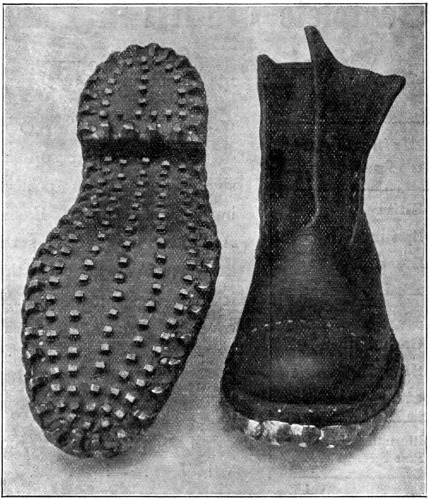
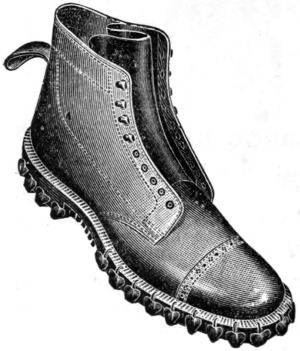
scratched by nailed boots that the difficulty does
not consist in finding the way up. It is generally
supposed to be impossible to descend into the gap
from Pisgah, but inspection will show that there is
a series of small ledges a little to the west, down
which a safe passage can be effected. The Left
Pisgah route starts up at once from the col. The
holds are only moderately good for the first thirty
feet, and fail to give satisfaction when wet or icy.
Next it is possible to force the body into a narrow
crack, and for a little while the climber can cease his
strugglings and rest himself. Above this the rock is
more broken and the holds are better. A thin leaf
of rock is crossed and a downward view obtained of
the Right Pisgah final chimney. Then the slope is
eased off, and the cairn on the High Man is but a
couple of yards away.
The Right Pisgah route is generally started low
down the East Jordan Gully. This offers pleasant
hand-and-foot work, but no difficulty whatever up to
the Jordan. But before reaching the gap a square
recess on the right is entered, and then a passage is
made over smooth rocks to a clean-cut right-angled
corner forty feet high on the south-east side of the
High Man. It is just possible to traverse round
from the Jordan to the top of the square recess, and
so up over the slabs to the corner, but the variation
is not worth much.
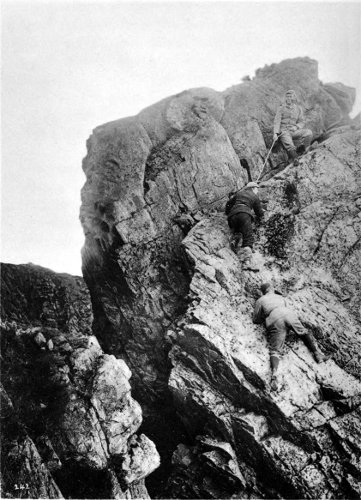
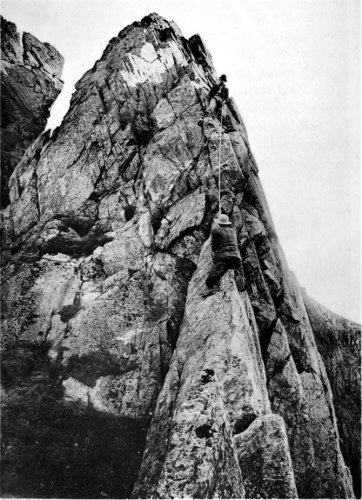
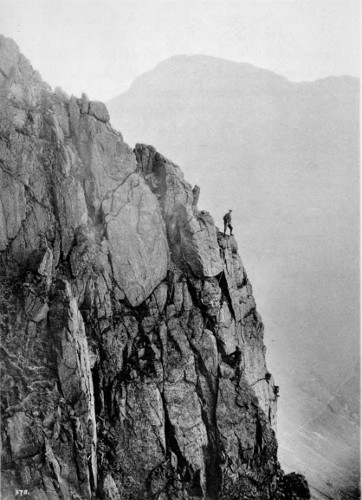
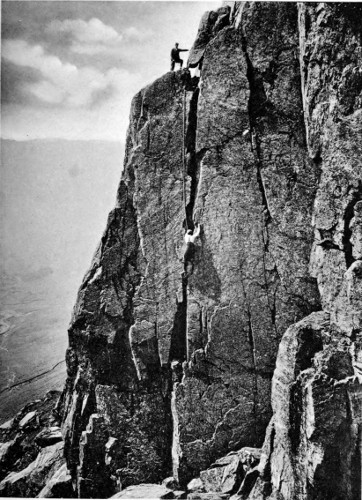
G. P. Abraham & Sons, Photos
Keswick
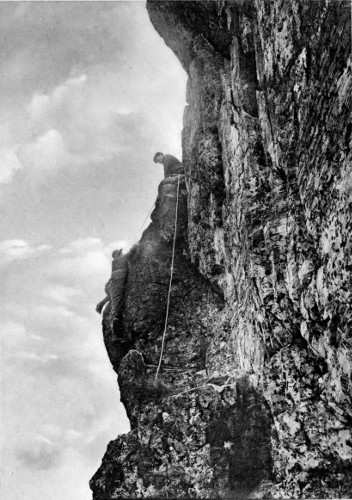
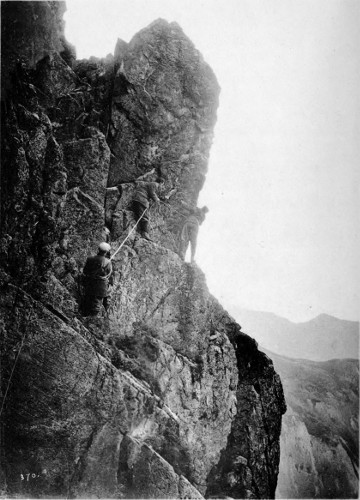
“Round the Notch”—Pillar Rock. East Side
(Face page 267)
The crack climb that now starts straight up the
corner is one of the neatest things on the Pillar
Rock. The right wall is used for steadying purposes
when, half-way up, a jammed stone makes it necessary
to emerge from the crack. Some of the holds
have splintered away during the last few years, but
there are yet enough to satisfy one’s needs. The
finish is a splendid pull up with the arms on to the
leaf of rock already referred to at the top of the
Left Pisgah climb.
Slab and Notch route.—The upper part of
the Great Chimney offers no difficulty to the climber.
Its southern boundary is a long narrow buttress
called the ‘Curtain,’ stretching from the top of
Walker’s Gully, to the summit of the High Man.
Viewed in profile from the Pillar Fell, the Curtain
shows three distinct notches two-thirds of the way
up; they are about thirty feet above a slab set at an
angle of thirty degrees, and attainable by rough
scrambling from the foot of the East Jordan Gully.
The easy route passes along this slab, directly
upwards to the middle notch and thence round the
Curtain to the bed of the Great Chimney. The walk
along the slab is to some people a critical undertaking,
for a slip would have very serious consequences.
A thin crack on the line of march makes the course
safer, unless ice or snow have filled it up, but it is
not an unusual sight to see men tackling the walk on
all-fours. The Curtain may be crossed at the lowest
notch, the ‘Ledge,’ by good firm rocks, and the Great
Chimney entered on the other side. Formerly it was
the usual course to reach the bed of the chimney
at the lower part of the steep grass by what was
called the ‘Eight-foot Drop.’ But there is no need to
drop at all; an easy traverse from either the Notch
or the Ledge brings the climber above the steep
grass, and virtually at the end of his cragwork. The
chimney finishes with scree, and lands the climber
within a few feet of the cairn on his left.
Variations on the East Face.—It is possible
to make a way straight up the Great Chimney from
its foot, joining the easy route about a hundred feet
up. Haskett Smith took this course in 1884, commencing
the climb on the stepped buttresses of the
Curtain. Since then the rock has had time to loosen
a little, and climbers very rarely enter the chimney
that way.
The Pendlebury traverse is an excellent variation
of the ordinary route, a popular scramble first indicated
by Professor R. Pendlebury, of Cambridge.
From the slab the way lies straight up to the notch in
the Curtain, and then along a horizontal ledge in its
south face as far as the corner where it meets the
High Man. Thence up the corner is straightforward
chimney-work, and on emergence at the top the cairn
will be visible close at hand on the left.
The traverse looks difficult until it is closely
approached, when it will be found that handholds
abound on the wall, and that the ledge is perfectly
firm and continuous across the whole width of the
Curtain.
The chimney in the corner of the south side of
the Curtain can be entered much lower down. From
the slab a way lies straight up into it, but the grass
holds are not particularly pleasant if wet, and the
first thirty feet are severe.
From the head of Walker’s Gully a way may be
found to the Low Man, below the immense slabs that
crown the north-east buttresses. It is best to climb
the Shamrock first and prospect the route. Sheep
occasionally manage to get across, and the Old Wall
was built many years ago to prevent their passage, but
it is now ruined. Sometimes, ignoring Badminton,
they still venture across without a rope, and their
weaker members are liable to get crag-bound.
Climbers can tell many tales of famished sheep found
in appalling situations on the Pillar Rock. They are
too weak to resist the slipping on of a rope, and are
simply hauled or slung out of every difficulty till a
safe pasturage is reached.
The West Climb.—This was the route first
discovered. It is much longer than any of the ways
on the south or east side, and possesses but few
interesting details. It is more popular as a descent
than as an ascent.
It is seemingly impossible to climb directly up the
west wall of the High Man, but in the walk down the
west screes it will be noticed that the rocks of the
Low Man are more broken, and that several short
scree gullies sloping upwards to the left mark a
rough route straight towards the Low Man cairn.
The course is best examined from a distance, across
the great western gully; it lies as close to the High
Man as is possible without undertaking anything but
gully scrambling. Not infrequently climbers find
themselves astray on narrow grassy ledges too much
to the right. I experienced the same thing myself
when first attempting to find the way up, and found
the ascent by no means so easy as report had
credited the west climb.
From the level of the Low Man the way lies very
nearly along the sky-line to the highest point. The
High Man is struck at the end of a square corner
in the rock, and there is some excellent work for the
arms during the next thirty feet of ascent.
It is easier to turn over slightly to the east side,
and up by the great jagged boulders on the crest of
the ridge. The Slingsby crack is a short but rather
stiff variation a little on the right or western side of
this route and is particularly interesting. Formerly
a loose block at its upper end gave the climber an
occasional scare, but there is nothing unsafe now in
the form of detached boulders, and the ridge can be
followed with confidence to the High Man cairn.
Nail marks are strongly in evidence all through the
crag-work; the leader should not attempt the route
if snow or rain prevents their recognition, unless he
is already perfectly acquainted with the way.
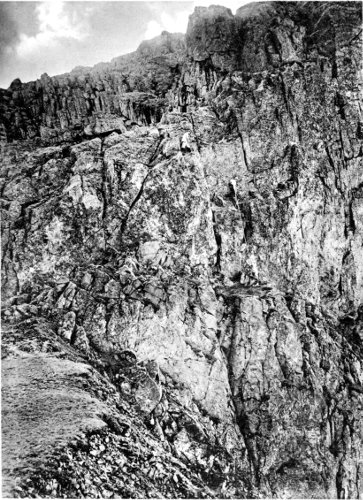
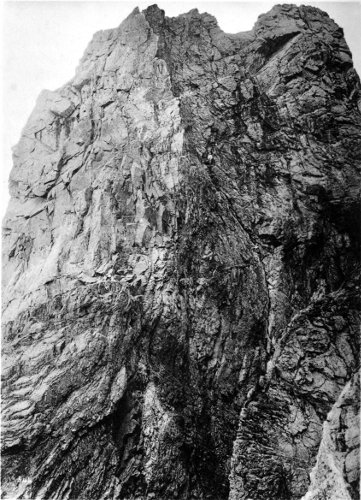
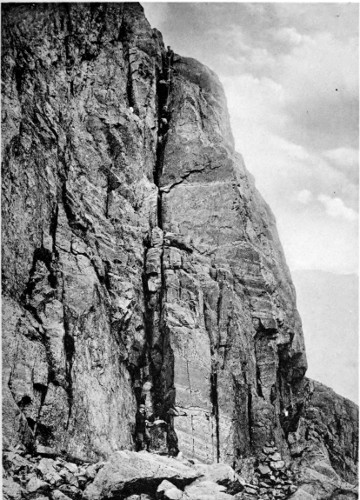
G. P. Abraham & Sons, Photos
Keswick
THE NORTH FACE OF THE PILLAR ROCK
The North Climb.—For several months after
the first ascent it was difficult to learn anything of
the details of the route up the Ennerdale face of the
Pillar Rock. The only way was to persuade some one
who had been up to take the lead and act as guide;
for a complicated course that had taken Haskett
Smith eight or nine years to work out was not likely
to be mastered easily by any one who had not made
a special study of the north face.
My own chance came in the summer of 1893.
Mr. John Robinson called for me at Buttermere one
fine afternoon, and took me off to Ennerdale with
another friend, Mr. F. W. Hill. We left the village at
two o’clock, and were back again after a successful
ascent by eight in the evening; whence it may be
inferred that Buttermere is as good a starting-point
for the Pillar Rock as Wastdale or Seatoller.
Our guide led us rapidly by the shortest route
over Scarth Gap, and across Ennerdale to the foot
of the Pillar Rock. Then a fifty-feet length of rope
made its first appearance; it had been hidden in a
bag during our walk, lest we should alarm the folks
about Gatesgarth. We tied ourselves up, and made
for the eastern end of the terrace across the Nose.
Robinson then started along the terrace, and in
a few yards scrambled up to a shelf on the left, five or
six feet high, which gave us easy access to the lower
portion of the Savage Gully. This latter has never
been climbed along its whole length. If the gully
were moderately easy, the north climb would be far
less complex. But for a great portion of its length
the side walls are at right angles to each other; the
corner is nearly vertical, and the only resting places
are diminutive, grass-grown ledges placed too far
apart for any safe employment of the rope. The right
wall of the gully forms part of a conspicuous buttress
on the north face, whose western side is much more
broken and less dangerous to ascend.
The route that was being shown us lay along the
Savage Gully for about sixty feet, then across to the
west side of the buttress and up a vertical branch
gully with sundry small chimneys in it. Higher up,
we were told, it would be necessary to round a cliff
still further to the right, by means of the Stomach
traverse, to render further ascent possible. We objected
to the inelegant name, but were too far advanced
to hesitate on the score of a faulty title. Above the
traverse our climbing would be easier, until the course
returned to the Savage Gully again. That was to
be our mauvais pas, and after settling it the scramble
to the Low Man, and thence to the highest cairn,
would be scarcely more than a walk.
So spoke our guide, and having delivered himself
at some length, with an occasional appropriate
anecdote thrown in, he concentrated his attention
on the small pitch that marked our point of arrival
at the Savage Gully. It was a wall seven feet
high with indifferent grassholds at the top, and in
scrambling up care was needed to avoid dislodging
loose stones near the edge. It was then easy to
clamber into a small cave somewhat to the left, and
out again by a twisted tunnel at the back. Thence
Robinson worked upwards over broken ground for a
few yards, until the point was reached where we
were to leave the gully. The direct route looked
feasible for some distance ahead, but there was no
questioning the fact of its severity, and we had not
come out that day for exploration.
A divergence was made along an easy traverse
towards the right, to a short and narrow chimney
that already bore traces of many previous struggles.
Wherever the rocks were clean and free from scree,
we could plainly see the scratches of nailed boots
along the route. It was here that we were rounding
the great buttress of Savage Gully, and after a little
rough-ledge work we arrived at a square corner with
a grassy floor. Straight up from this floor a cleft
offered safe passage. It was plentifully supplied with
holds, though some discrimination was necessary in
selecting the firmest. The climbing was delightful,
and zest was given to it by the magnificent situation.
The corner was not so deeply impressed in the
buttress as to prevent our recognition of the vastness
of the cliff we were slowly ascending. The view
downwards just included the little grass platform,
and beyond that the wild and steep fellside at the
foot of the precipice, already some hundreds of feet
below us.
We kept up the direct route so long as we were
able. Then the cleft in the corner suddenly dwindled
down into the thinnest of cracks, and it was obvious
that a change of tactics would be necessary. The
left wall was faultlessly smooth. The right for the
most part looked just as inaccessible. The grass
ledge on which we were standing really seemed to
suggest finality, the end of our upward progress, and
I turned to Robinson inquiringly with the impression
that some wonderful engineering process with the
rope was now to be explained to us. We knew that
such was necessary on the climb, and were prepared
by the situation to see its application immediately.
But the solution of the difficulty was of the
simplest character. A few feet from the corner the
smooth right wall was split by a single crack that
passed up at an angle of perhaps thirty degrees and
terminated at a notch that broke the clean-cut outline
of the rock facing us. From the notch it certainly
seemed as though nothing could be done further,
even if we got so far. Nevertheless, we were assured
that when once we were there all doubts would
vanish, and we should have the easiest hundred feet
of scrambling in the whole day’s expedition. The
crack was the famous Stomach traverse; it was
reached as long ago as 1884 by Haskett Smith in
his early exploration of the north face; and the
name, which had only recently been given to it, was
intended to show how the passage was supposed
to be tackled. One of Willink’s illustrations in
the Badminton, showing an intrepid cragsman
crawling along a ledge from left to right, is
sometimes criticised as an exaggeration of the
difficulties that rock-climbers have to overcome.
This traverse before us was not so easy as the one
so cleverly depicted by the artist. It sloped upwards,
and the ledge was not wide enough for the
whole body. We were in no sense precariously
placed, for the cleft enabled us to wedge with
security; but the right half of the body was outside
the leaf of rock on which we hung, and the
right leg found no support on the vertical wall.
Some twenty feet of wriggling brought us each in
turn to the critical corner, and there to our amazement
we had merely to get up and walk away. The
wall we had passed was the last obstacle separating
us from a long stretch of steep grass chimneys and
broken rocks. These extend from the Nose at the
foot of the crags up to the final difficulty, now only
a hundred feet above us, and offer the easier route
up the north face. Our own course by the Savage
Gully was by far the more entertaining one, and
under most conditions decidedly safer than the
other.
From the notch we could either walk straight up
to the cave-pitch in the corner now facing us, or
work easily round a rib of rock on the right and
join the other route. We chose the former, and
found the pitch decidedly stiff, the main trouble
being to get satisfaction out of the diminutive
hand-holds on the upper surface of the top boulder.
However, it was time to be thankful for small
mercies, and confidence carried us up safely.
A party coming up the easy way would start from
the terrace on the Nose, close to its highest point.
Their route would be quite straightforward, though
occasionally the question as to the safest movement
might introduce a slight digression. The great wall
of the Low Man on their right limits in the most
definite manner all westerly climbing, and their only
trouble would be in negotiating two narrow chimneys
and some of the grass ledges, where the tufts are
unpleasantly loose and the slopes very slippery. The
fact is that this way is not much to be recommended;
until it joins the other there is little merit to justify
the variation. If parties are certain they can finish
the second half of the ascent, they can assuredly
climb the lower portion via the Savage Gully and
the Stomach traverse.
We halted for a moment above our cave-pitch and
looked around at the crags. From a distant survey,
such as that indicated in the photograph facing page
271, it is impossible to realize that so large an open
space of easy ground can exist on the north face.
But our opportunity for advance was strictly confined
to one direction. Further westwards we could not
go; the great wall was unassailable. To the east we
could have perhaps traversed away until progress
was barred by the narrow branch of the Savage
Gully, which we had utilized lower down. The
northerly direction of course led down the easy
route, and the southerly pointed to an uncompromising
extension of the great wall towards the
Savage Gully.
We were led straight up the small scree to the
split block, a huge boulder at the foot of the wall.
The leader disappeared into a deep crack, and after
a few moments appeared at the top of the block,
having mounted by a secondary fissure that cut into
the left portion of the boulder. The movement was
quite unexpected, and Hill and I were rather startled
at the aspect of things from the summit of the split
block. It stood at the top of the narrow branch of
the Savage Gully already referred to, and the view
vertically down this branch was calculated to make
us hesitate before taking the next step.
This was the Strid. Close up against the wall
that blocked the head of the gully, a long stride was
to be taken across to a narrow ‘mantelshelf’ on the
other side. There was no difficulty in the step, but
the consequences of any slip were so obvious that
we were not surprised to learn how respectfully the
Strid is usually regarded. The mantelshelf led us
along under the wall for a few yards, and an upper
ledge was mounted. We were now close to the
Savage Gully again, and Robinson prepared to be
let down into it on the rope. We were adopting the
tactics of Haskett Smith’s party in the first ascent.
Robinson was to climb down the wall of the gully
by means of an irregular crack twenty-five feet long,
using the rope to steady himself during the descent.
At the foot of the crack he would be able to step
into the bed of the gully, and thence, after mounting
it for a few feet, effect an easy passage up the
opposite side. He was then to unrope, and Hill was
to let me down in the same way, there being plenty
of friction between the rope and the rocks to enable
him to hold my weight in case of a slip. When
safely landed in the gully, I was to take the rope up
to Robinson and wait the issue of events.
These went off without a hitch. The crack was
difficult, though not impossible for one man to
descend alone; but I am convinced that a man
attempting the climb single-handed would be
running great risk if he proceeded without some
sort of belaying with a rope. The little story is well
known of the youth who could not understand why
he as third and last man of his party had to be left
behind on the ledge; he had examined the crack
and was certain he could climb down safely without
support from above. Nay more, he insisted on
demonstrating the fact, and when three-quarters of
the way to the bed of the gully his feet slipped and
his handholds failed. Luckily the others were able
to prevent a serious fall, and the young man’s ‘climbing
down’ was strictly metaphorical.
Robinson then rapidly swarmed up to the left of
the gully, and, after mounting forty feet, traversed to
the right into a long scree-shoot that ended abruptly
some twenty-five feet vertically above our solitary
companion on the ledge. Upwards the scree led
straight to the summit level of the Low Man, and
two of us were of course in a position to attain this
point in a couple of minutes. But there was the
third, to manipulate, and Robinson proceeded to take
out a short, spare rope from his sack and expound
the method of using the ‘stirrup.’
He tied a loop on to one end of his spare rope,
large enough for a foot to be comfortably slipped
therein, and flung that end down to Hill. I operated
with the other rope, sending an end down for Hill to
tie round his waist in the usual manner. The object
of the process was to get the third man up with the
least expenditure of energy on our part; in fact, to
make Hill do all his own lifting. The wall was not
so complicated in design as to render it impossible
to haul him straight up like a bale of goods. But
neither he nor I had till then seen an application
of the stirrup-rope, and we had come out to be
educated. There are many places where the method
is well worth employing.
The operations commenced by Hill’s fixing a foot
in the stirrup and lifting it a couple of feet as
Robinson hauled up his rope. Then, with Robinson
simply holding on firmly, Hill straightened himself
on the stirrup, using it as a foothold, while I
pulled up the couple of feet of slack in the waist-rope.
Next it was my turn to hold hard as Hill
raised his stirrup foot, and then Robinson’s to keep
the foot firm while Hill lifted himself on to it. These
two moves were repeated again and again alternately.
All through the process the ropes were held as free
from slack as possible, any upward movement of
Hill’s engaged foot or body being responded to
promptly by Robinson or myself respectively. It
will be perceived, if the description is as clear as I
want it to be, that all the actual lifting of Hill’s
weight he managed himself during the straightening-out
on the stirrup, and that we others were at most
called upon to hold only his weight. Even this
much stress on our hands we could avoid by partial
belaying, though in that particular spot there were
no entirely suitable projecting rocks that could be
utilized as belaying-pins.
Bit by bit Hill worked up the wall, till at last his
head and shoulders appeared over the rounded coping
at our feet, and he scrambled on to the scree. Then
we all sat down and Robinson told us tales about that
particular locality. Among others he gave us one to
emphasize the practical lesson we had just been having
on the use of the stirrup-rope. A famous climber,
indeed he was sometime president of the Alpine
Club, and in a vague, traditional sort of way years
before he had fallen some hundreds of feet down a
vertical gully hard by, without coming to any harm
except that of finding his name ever afterwards
associated with the gully; well, this famous climber
was coming up that same wall by means of the
stirrup-rope, and the zealous operatives above more
than responded to his slightest movements. He
lifted his foot a few inches, they hauled up the
stirrup-rope a few yards, and anticipating that he
might find the alternations a little laborious, proceeded
to pull him up by sheer strength of goodwill.
Thus his attached foot appeared first over the edge,
and the remainder of his person followed in some
confusion. So, at any rate, the story went.
Sitting as we were with our faces towards Buttermere,
the great wall bore away to the left, and our
scree gully marked its eastern limit. A horizontal
crack extended for several feet across the wall,
starting from the top of the pitch below us. Only
its end could be seen, but by carefully working
down to the corner on the left, and looking across
the face, we could see the way it cut clean into the
rock. This was the notorious hand-traverse, by
which it was just possible to reach our scree gully
from the ledge below without the preliminary descent
into the Savage Gully.
A few minutes’ halt and we continued our course.
There was no doubt or difficulty in reaching the
Low Man, and thence following the ridge to the
junction with the West Climb. A quarter of an
hour saw us at the High Man cairn, and another
five minutes at the foot of the Central Jordan. The
ropes were stowed away again in the sack, and
Robinson rapidly strode across the screes and down
the corridor behind the Shamrock. In a phenomenally
short time we were crossing the Liza stream,
and, without being allowed to halt, a bee-line was
drawn for us over to Scarth Gap by our untiring
leader. Luckily for his followers, the name of this
pass, which is sometimes called Scarf Gap, reminded
him of a very good story concerning another famous
climber who went to an evening party without a
dress-tie. We were told the story and recovered
breath sufficiently to continue our journey to Buttermere.
I wish now that I had not been so fatigued,
so that I might have remembered the whole anecdote
and given it here in all detail.
The Hand-Traverse.—Nearly two years after
the ascent described in the previous section, Dr.
Collier showed me a way of avoiding the Savage
Gully in the North Climb by following a direct
route to the upper screes. The plan is to work to
the extreme east corner of the ledge that succeeds
the ‘mantelshelf,’ and when a narrow overhanging
chimney is reached, to swarm up the steep buttress
on its left. It looks particularly dangerous, but there
is an excellent hold for the hands just round the corner
of the buttress, and when the first three feet of ascent
are accomplished the rest feels comparatively easy.
On the same occasion we each in turn ventured
on the hand-traverse from above. The place has
already been referred to; it was known for some
time that the crack could be reached from the
terrace below, and Mr. Solly showed in 1891 that it
could be followed to its left-hand extremity at the
scree gully. It is so named because the climber
hangs by his hands, with no footholds at all for the
greater part of its length, and traverses across the
face by sheer strength of his arms. Collier and I
were well satisfied concerning the security of the
crack itself. We went to the further end and back
again, without coming across any place where the
holds were treacherous. They were probably more
satisfying to the grip than an ordinary horizontal
bar, on account of the acute edge of the rock.
On the other hand, we had no opportunity of trying
the ascent from the terrace, which promised to be
rather fatiguing for the arms, and which might
render them useless for the traverse itself.
On Whit Monday, 1896, a chance came for
tackling the pitch in this new way. It had been
successfully accomplished once, and twice had the
climber’s strength of grip failed him when half-way
across. So, at any rate, we learnt by hearsay at
Wastdale. Perhaps it ought to be added that in
one case it was the leader of the party who fell off,
and the rope saved him in a manner scarcely short
of miraculous; in the other case the rope was held
from the scree gully, and the climber only swung
out on it. Our Whitsuntide party were willing that
I should try, and carefully measured out just a
sufficiency of rope for me to reach the crack. Then
two of them stood together at the western extremity
of the terrace, and shouldered me up the first bad
bit. There was every reason to be quick, as resting-places
were absent where the strain on the arms
could be eased. In twenty-five feet I reached the
crack and halted for a moment on a scanty foothold
before trusting to the ledge. Then came the swing
off and a hasty sliding of the hands along the sharp
edge. The first bit was about eight feet long; then
that particular crack terminated abruptly in the
wall, and another, two feet higher, continued across
in the same easterly direction. The lift of the body
up to the second crack was trying, but beyond this
critical point the movement was horizontal. It was
somewhat clumsy—the scraping of the body along
the rough surface of the rock, with the legs held
clear; but my sole thought was to reach the end of
the traverse twelve feet away, and no consideration
of style was entertained. In a very short time,
though it seemed far too long, the end of the wall
was attained, and it only remained to drag myself
up to the scree.
The rest of the party preferred to mount the
buttress by Collier’s route indicated in a previous
paragraph. I think the hand-traverse has not been
attempted since, and it is perhaps just as well. It
is scarcely less than suicidal to try conclusions with
this variation unless the climber has full confidence
in his strength of grip, and unless he has already
tested his powers of endurance of long-continued
strain in the arms. But with the leader of the party
already at the head of the pitch, no matter which
way he got there, it involves no serious risk for the
others to follow by this route. The last on the rope
had better come up over the buttress.