For the time England and France were at peace.
No need now for weapons of warfare, so Fulton set
aside his plan for submarine torpedo-boats and
began to devote his attention to an idea of greater
importance,—the invention of a steamboat.
The thought was not new to him for he had
pondered over it since 1793 when he had submitted
a description of an original model to Lord Stanhope.
Now he bent all his energies to the task and commenced
a series of new experiments.
He made many sketches of engines, paddles and
boats. Some are yet in existence, notably one
made June 5th, 1802. It bears a pen-drawing of a
steamboat, with side paddle-wheels, a forward
smokestack, a covered cabin amidships, with upper
deck occupied by imaginary passengers, a pointed
bow and a square stern,—not in reality the shape
of the later product of his skill, but a fanciful
sketch of the form then in mind. How far ahead
his imagination darted, in time and space, may be
seen from the inscription, “The Steamboat from
New York to Albany in 12 hours.” It was a brave
prediction!
In 1804, when General Armstrong was appointed
Minister to France, he lived in the house formerly
occupied by Joel Barlow; and upon the walls of
Fulton’s room he found, plans of steamboats
sketched, as a panorama. Even then the thought
had so taken possession of Fulton’s mind that
he lived with it day and night.
By this time Fulton was recognized by thoughtful
men as a power to be considered. At Barlow’s
hospitable home Fulton enjoyed the opportunity
of making friends among prominent men; and
during 1801 there arrived in Paris, as Minister
Plenipotentiary of the United States, Chancellor
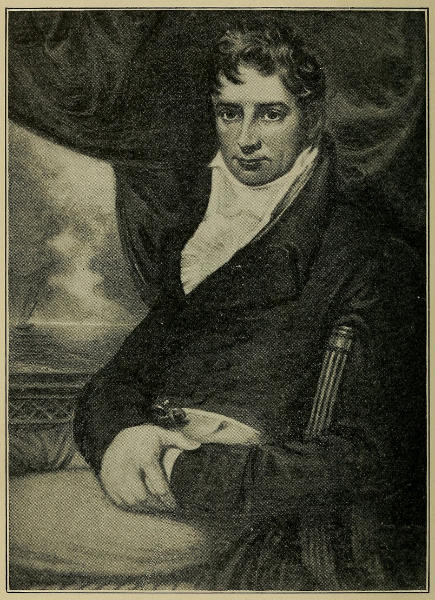
Robert R. Livingston, a noted American statesman
and lawyer. The meeting between Fulton and
Livingston, at Barlow’s table, proved important.
Mr. Livingston’s keen intellect had already recognized
the importance of providing boats with steam
power. Indeed, he himself had experimented in
the matter, and had caused an Act to be passed by
the Legislature in 1798 granting to himself “the
exclusive right and privilege of navigating all kinds
of boats which might be propelled by the force of
steam or fire, on all waters of the state of New
York, for the term of twenty years from the passage
of the Act; upon consideration that he should
within a twelve-month build such a boat, the mean
of whose progress should not be less than four
miles an hour.”
The Act was passed but Livingston’s steamboat
was not a success. The trial boat, of thirty tons’
burden, built by the Chancellor’s orders by an
Englishman named Nesbit, near Tivoli on the
Hudson, failed to run! When the Chancellor
met Robert Fulton, this clean-cut, energetic young
countryman who had built a much-talked-of
submarine torpedo-boat recognized by Napoleon,
he thought, “Here is the clever man whom I am
seeking!” It is characteristic of great men to
notice the mental worth of others and enlist it in
their cause, whatever it may be. And Livingston
quickly learned the rare capacity of Fulton.
There could have been no stronger combination
than the partnership of these two men, formally
enacted at Paris, in October, 1802. The original
agreement is signed “Robert R. Livingston of the
state of New York, and Robert Fulton of the state
of Pennsylvania.”
Fulton’s part of the contract was:
1st: To build a boat one hundred and twenty feet
long, eight feet wide, to draw fifteen inches of
water, to navigate the Hudson River between New
York and Albany, at a speed of eight miles an hour
and to carry sixty passengers, allowing two hundred
pounds’ weight per passenger.
2d: To secure a patent, in the name of Robert
Fulton; to deposit every necessary drawing, model
and specification, and the patent property when
granted was to be divided in value into one hundred
shares, half of which should be owned by each
partner, and all profits equally shared.
3d: To go to England to construct an experimental
boat,—if possible borrowing an engine,—the
cost of such boat, five hundred pounds English
currency, to be provided by Livingston. If the
boat failed of success, Fulton was to repay half
the sum with seven per cent interest added; if it
succeeded, Fulton was to go to America, obtain a
patent, and build a boat; his “reasonable expenses”
to be part of the general expense.
The contract continued as follows:
4th: When the work is finished, either partner
may dispose of, or sell, any number of shares less
than forty, but the purchasers, or shareholders,
are to have no vote in the management of the
business. All extensions to be paid from revenue
received, and the profits equally divided twice a
year.
5th: The partnership is to continue while the
patent lasts, that is, fourteen years, or as long a
term as it extends; at its close, all boats, warehouses
and other property to belong to the shareholders.
6th: If Fulton or Livingston die before the
termination of the patent, each heir or assign, holding
twenty shares, shall become an active partner
with power to act.
7th: Livingston reserves the right to withdraw
from the partnership any time after his five hundred
pounds have been spent in the first experiment, but
is to be considered a partner until he sends notice
in writing to Fulton.
It is evident that the document was drawn by
Livingston, who certainly made a good bargain.
The sole responsibility he took upon himself was
the investment of five hundred pounds—twenty-five
hundred dollars—with a return of one-half
the amount, plus seven per cent interest, if Fulton
failed to provide the invention. On the other
hand, he was entitled to receive dividends as long
as the patent rights could be extended, if the invention
proved, as it did, financially productive.
For practical reasons, Fulton decided to build his
trial boat in Paris, instead of going over to England.
This decision was probably made when he found
that he could borrow, or rent, an engine. Fulton
had to consider expense, for he had spent the money
he received from the Panorama upon his torpedo-boats;
and his active mind conceived such vast
schemes that they seemed too costly to all his
friends, except Barlow; at times, even he advised
against too great ventures. On July 26th he
prudently wrote as follows:
“My project would be that you pass directly over to
England silent and steady, make Chapman construct an
engine of 12 inches, while you are building a boat of proportionate
size. Make the experiments on that scale all
quiet and quick. If it answers, put the machinery on board
a vessel and go directly to New York, (ordering another
engine as large as you please to follow you) then secure your
patent and begin your operation, first small and then large.
I think I will find you the funds without any noise for the
first operation in England and if it promises well you will
get as many funds and friends in America as you want.
I should suggest a small operation first, for several reasons;
it can be made without noise; you can easier find funds for
a small experiment,” etc.
After the contract was signed there was no
hesitation on the part of Fulton; he plunged at
once into the task he had anticipated for many
years. As early as 1793 he had written to his friend
Lord Stanhope, giving his first thoughts on the
subject,—one part of his long letter will be enough
to quote here; it is of special interest because it
shows that Fulton looked to nature to suggest a
practical plan:
“In June, ’93 I begun the experiments on the steamship;
my first design was to imitate the spring in the tail of
a Salmon—for this purpose I supposed a large bow to be
wound up by the steam engine and the collected force,
attached to the end of a paddle—to be let off which would
urge the vessel forward.”
This accords with an old newspaper clipping
which states that “the first rough model of a
steamboat made by Fulton in New York was cut
out of a shingle, shaped like a mackerel, with the
paddles placed further in front than behind, like
the fins of a fish.”
Of course these “natural propellers” gave ideas
to the inventor; he noticed that a fish with round,
unbroken tail is a slow swimmer, while those which
have deeply indented tails, like the mackerel,
can make far greater speed in swimming.
Fulton experimented for nine years before finding
the best method; he did not stumble upon the
plan, but patiently worked it out, learning through
each successive test—all noted and recorded,—the
correct ratio to establish between the size of
the boat and the power of the machinery.
During the early spring the boat was finished
and looked so promising that Livingston wrote to
friends in America to enact an extension to himself
and Fulton, jointly, for the exclusive right to
operate steamboats on the waters of New York
State for twenty years, provided the boat could be
produced within two years. Later this time was
extended.
Success seemed certain to both Fulton and
Livingston. The strange boat was launched upon
the river Seine; the borrowed engine of eight-horse
power was installed; the copper boiler was
in place,—and the partners, disregarding the
jeering remarks of ignorant bystanders, were
hopeful and happy in anticipation of the trial trip
which was set for an early date.
Naturally, the new invention was talked over by
the wise men of the city who wandered to the dockyard
to view the queer-looking boat. It is said
that Prince Tallyrand, during a dinner at Mr.
Barlow’s home, sat beside Robert Fulton and was
charmed by his pleasant manner. Fulton’s topic
of conversation—we can imagine his pleasure in
the subject—was his invention of the steamboat
upon which he was then at work; and his hope that
the submarine torpedo-boat would end all naval
warfare and bring universal peace. The Prince
listened politely but later confessed his sadness in
realizing that the agreeable young American was
mad or he would not devote his time to such impossible
schemes! To many Fulton’s dream
seemed utterly vain.
This idea gained strength by the disaster which
befell the steamboat just before the time set for
her trial trip. She was completed; and Fulton,
too excited to sleep although wearied by long
labor, restlessly awaited the day to dawn when he
could prove her success. During the night a great
storm broke over Paris; the rain fell in torrents
accompanied by heavy winds. At daybreak Fulton
was aroused by a breathless messenger whose
anxious face and haste betokened bad news. He
was the watchman in charge of the precious invention.
He rushed into Fulton’s bedroom, with the
exclamation:
“Oh, sir, the boat has broken in pieces and gone
to the bottom of the river!”
Fulton arose in dismay, hastily dressed, and
rushed to the scene. The news was all too true!
The boat, too weak in structure to bear the heavy
machinery, buffeted by the high waves and heavy
winds, had broken in the middle, depositing the
valuable engine and other machinery in the river.
Nothing was in sight above the water!
Fulton later confessed to a dismay never felt at
any other time. Many a man, at this point,
would have given up the whole project in despair.
But this crisis of apparent failure was the moment
for Fulton’s strength of character to assert itself.
After months of labor the borrowed engine and
Mr. Livingston’s money seemed forever lost.
But Fulton set himself to the task of making the
best of this disappointment. He wasted not a
moment in vain regret, but without going back to
his home for breakfast, he began, with his own
hands, to try and rescue the boat. For twenty-four
hours he worked, without food or rest, until—wet
and weary but triumphant—he recovered
the machinery and engine. They were found to
be little hurt, although the boat itself was a total
wreck. But, alas, Fulton paid a heavy penalty
for over-taxing his strength; for a permanent
weakness of the lungs, from which he never fully
recovered, resulted from the exposure and long
struggle in the water to save his precious invention.
At no moment in his life did he display such fine
courage as at this time of apparent failure.
Fulton immediately began to build another
boat, in which he placed the recovered machinery.
By the month of July he was again ready to show
his friends and the French scientists the working-power
of his invention.
Mr. Fulner Skipwith was then our Consul-General
in Paris. He was interested in the idea
of steam navigation, and during the preceding
year had sent a letter of inquiry regarding it to
Robert Fulton, who gladly answered his questions.
Mr. Skipwith had married in Paris, while Fulton
was busy with his torpedo experiments on the
French coast, and the Consul-General’s first child
was born during the spring of 1803. This accounts
for the merry letter of invitation which
Fulton sent him on July 24th.
Mr. Skipwith;
My dear Friend,
You have experienced all the anxiety of a fond father on
a child’s coming into the world. So have I. Your little
cherub, now plump as a partridge, advances to the perfection
of her nature and each day presents some new charm.
I wish mine may do the same. Some weeks hence, when you
will be sitting in one corner of the room and Mrs. Skipwith
in the other learning the little creature to walk, the first
unsteady step will scarcely balance the tottering frame;
but you will have the pleasing perspective of seeing it grow
to a steady walk and then to dancing. I wish mine may do
the same. My “boy,” who is all bones and corners, just
like his daddy and whose birth has given me much uneasiness,
or rather, anxiety,—is just learning to walk and
I hope in time he will be an active runner. I therefore have
the honour to invite you and the ladies to see his first movements
on Monday next from 6 till 9 in the evening between
the Barriere des Bons Hommes and the steam-engine.
May our children, my friend, be an honour to their country
and a comfort to the grey hairs of their doting parents.
Yours,
R. Fulton.
You see Fulton considered his boat as a son, as
dear and as promising!
This second time the boat did not disappoint
him. In the presence of the invited guests, it moved
successfully forth from the dock and steamed its
way along the river, receiving the applause and
admiration of the group of friends assembled by
Fulton and Livingston. A public trial followed
about two weeks later and a newspaper of the day
described it so fully that a translation is here
printed:
On the 9th of August, 1803, a trial was made of a new
invention and its complete and brilliant success should
have important consequences upon the commerce and
internal navigation of France. During the past two or
three months there has been seen at the end of the quay
Chaillot, a boat of curious appearance, equipped with two
large wheels, mounted on an axle like a chariot, while behind
these wheels was a kind of large stove with a pipe, as if
there were some kind of a small fire engine intended to
operate the wheels of the boat. Several weeks ago some
evil-minded persons threw this structure down. The builder,
having repaired this damage, received, the day before
yesterday, a most flattering reward for his labour and
talent.
At six o’clock in the evening, aided by only three persons,
he put his boat in motion, with two other boats in tow behind
it, and for an hour and a half he afforded the curious spectacle
of a boat moved by wheels like a chariot, these wheels
being provided with paddles or flat plates, and being moved
by a fire engine.
In following it along the quay, the speed against the
current of the Seine appeared to us about that of a rapid
pedestrian, while in going down-stream it was more rapid;
it was manœuvred with facility, turning to the right and
left, came to anchor, started again, and passed by the
swimming-school.
One of the boats took to the quay a number of savants
… who will make a report which will give to this discovery
all the praise which it deserves; for this mechanism
applied to our rivers, the Seine, the Loire, and the Rhone,
should result most advantageously to our internal navigation.
The tows of barges which now require four months
to come from Nantes to Paris, would arrive promptly in
10 to 15 days. The author of this brilliant invention is
Monsieur Fulton, an American and a celebrated mechanician.
Napoleon’s watchful eye was upon Fulton for he
wrote on July 21st to the Councillor of State in the
Department of the Marine as follows:
“I have just read the project of Citizen Fulton
which you have sent me much too late in that it
may change the face of the world. However that
may be, I desire you immediately to confide its
examination to a commission of members chosen
by you from among the different classes of the
Institute. It is here that learned Europe would
seek for judges to solve the question under consideration.
As soon as the report is made it will
be sent to you and you will forward it to me. Try
and let the whole matter be determined within a
week as I am impatient.”
We may be sure that Fulton welcomed the questions
of these learned men, and sent them “an
invitation to see the experiment of a boat ascending
the stream by means of a steam engine,” as their
records show. He had previously made an offer
to Napoleon to convey his troops to England for
an attack, saying:
“The sea which separates you from your enemy gives
him an immense advantage over you. Aided in turn by the
winds and the tempests he defies you from his inaccessible
island. I have it in my power to cause this obstacle which
protects him to disappear. In spite of all his fleets and in
any weather I can transport your armies to his territory in a
few hours, without fear of the tempests and without depending
upon the winds. I am prepared to submit my plans.”
No wonder Napoleon was impatient to learn
more about Fulton and willingly admitted that his
invention might “change the face of the world.”
Bignon, the French historian, wrote in 1829 that
had Napoleon listened to Fulton this important
letter might have changed the history of Europe.
He supposes that had there existed a single steamboat
in France at that time, the workshops would
have immediately been busied in ‘multiplying
the original.’ In a few years one or two hundred
steamships, towing behind them transports filled
with soldiers, would have been ready with their
leader for the boldest of enterprises. Bignon
declared that the men and the times alike were
ready for the novelty. England would have been
forced to submit to the terms of peace laid down
by France. “Thus may the fate of nations depend
upon a new idea; thus nature conceals within her
bosom many unknown forces of which a single
one is sufficient to change the destiny of the
world.”
But Napoleon did not embrace the opportunity.
His secretary said that when he presented Fulton’s
memorial to him he exclaimed disdainfully,
“Bah! Away with your visionists!”
And Bignon, who took the trouble later to talk
with the members of Napoleon’s commission, said
that they excused their lack of appreciation by the
statement that Fulton’s plan was accompanied by a
number of “foolish ideas” which obscured their
view of the great underlying truth. “Put not your
trust in scientists,” exclaims Bignon, in the light
of Fulton’s success.
However, Lord Acton, the English authority
upon this period of the world’s history, when asked
what event he considered of greatest importance
in the 19th century, replied, “The sinking of Fulton’s
boat on the Seine,” meaning that accident
alone turned Napoleon from its acceptance.
The words of several historians prove that the
sunny day when Fulton’s steamboat voyaged back
and forth upon the waters of the Seine, riding in
triumph over the hidden wreck of its ill-fated predecessor,
was really a great moment in French
history!
Fulton was master of its movement and supremely
happy in his accomplishment. He saw, with
unshaken faith, as it is easy for us to see to-day,
in a review of the history of the past century, that
his twice-built boat on the river Seine was the forerunner
of all the gigantic fleets of steamboats
which now ride upon the waters of the world.