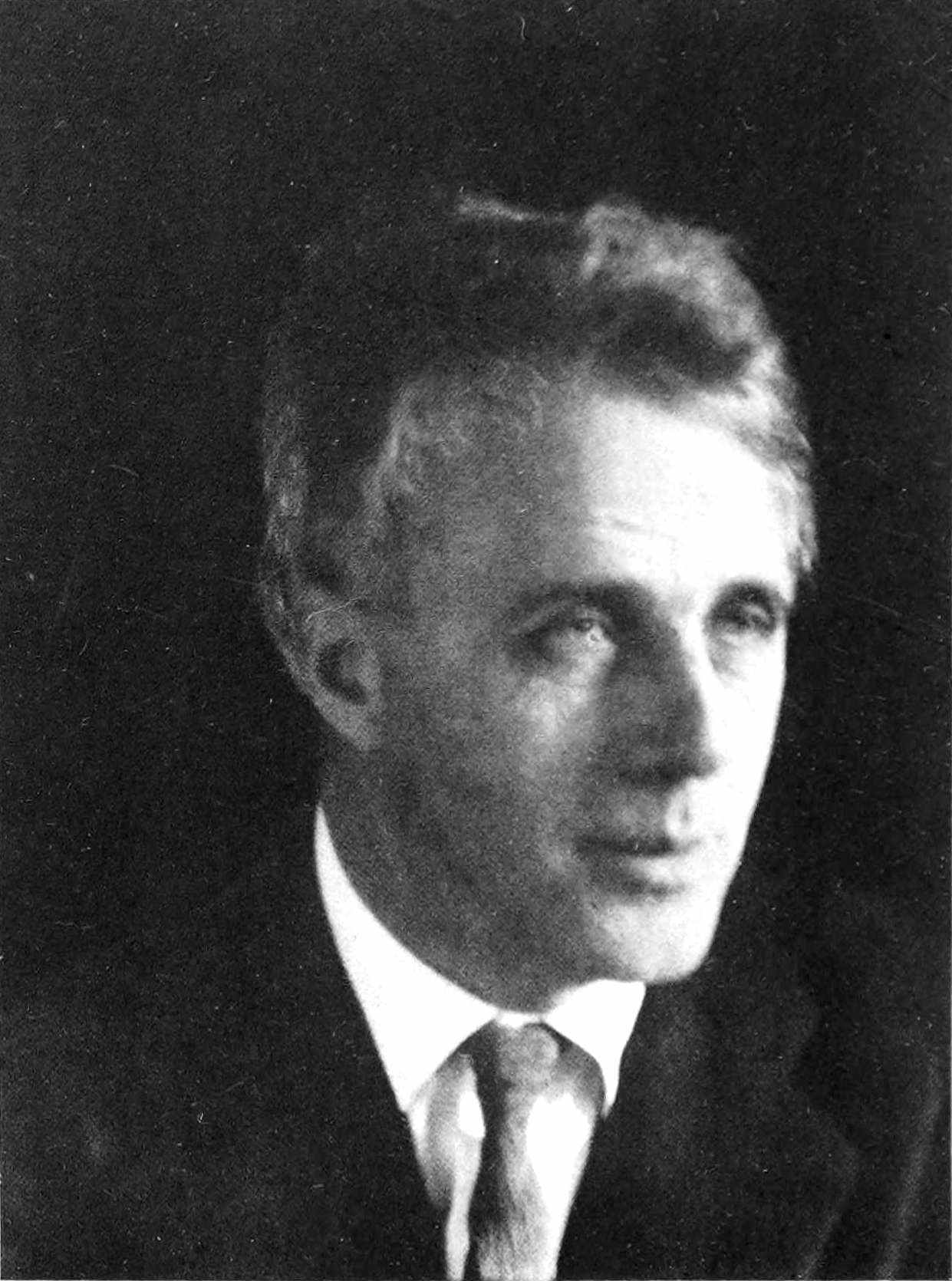
I. “THE GENERATIONS OF MEN”
“But don’t you think we sometimes make too much
Of the old stock? What counts is the ideals
And those will bear some keeping still about.”
New England is our association with the
name of Frost, and we are no doubt surprised
when told that it is a Scandinavian name.
Yet there are today many persons in Denmark
who hearing this sound uttered behind their backs
would turn with that sudden interest aroused by
the unexpected pronouncing of one’s name. Certain
of the remote ancestors of these Danish
Frosts may have roved into England in the ninth
century A.D., or it may have been Saxons bearing
the name of Forst, which is the Saxon form
of Frost, who invaded England in the fifth century
A.D. and founded the line of English Frosts.
In either case, the Frosts were settled there
before the Norman Conquest and the name had
begun to accrete sturdy Anglo-Saxon associations
about its slightly harsh sound.
In 1135 Henry Frost, the probable ancestor of
the American progenitor of one line of Frosts,[1]
founded the Hospital of the Brothers of St. John
the Evangelist at Cambridge, England, and this
foundation became in 1509 St. John’s College,
for which reason it is said that “Henry Frost
ought never to be forgot, who gave birth to so
noted a seat of religion, and afterwards to
one of the most renouned seats of learning in
Europe.”
The son of Henry Frost bore the name of the
subject of this Study and wore a coat of arms
which reads like a prophetic curio of the poetry
of his namesake. “Argent. A chevron azure
between two thistles slipped in chief, and a hind’s
head erased in base proper. Crest: a grey squirrel
sejant, semée of estoiles sable, collared and
chained or, and holding between the paws a hazel
branch fructed also proper.”
Until the early seventeenth century the Frost
family spread deeper and deeper into the sub-soil
of English life. Then came the migrations of
the Puritans, crowded by unfavorable forces at
home and drawn from afar by the promises of
New England. In an old piece of writing one
can read:
“Nicholas, Marride Bertha Cadwalla,
Jan’y 1630 ffrom Tavistock, Devon
Bertha Cadwalla, Borne ffeb’y ye 14th, 1610
Aprill Arrived in
Sailed for America June, 1634, in ye year
In ye Shipp Wulfrana, Alwin Wellborn, Master
ffrom Plimouth, Devon.”
It was this Nicholas Frost who founded the
line of which Robert Frost is a representative of
the ninth generation. In the interval New England
incorporated itself into the tissue, blood and
bone of these “generations of men” ultimately to
become song from the lips of Robert Frost.
The history of the early generations of this
line is threaded into the history of certain old
villages in Maine—Kittery, Eliot, Wells, York—located
close to the present New Hampshire border,
and today there is an inscription on Ambush
Rock where Major Charles Frost was slain,
Frost’s Hill is still known as such, and the Frost
Garrison House, erected in 1733, is the only garrison
house that remains in Old Kittery. Everett
S. Stackpole, the patient chronicler of Old Kittery
and Her Families, hints that a little mythological
moss may have gathered about the early Frost
settlers, and believes that Nicholas Frost was on
the coast of Maine as early as 1632. He surmises
that he returned to Tiverton, Devonshire,
England, collected his wife and two sons, John
and Charles, and came back to America in 1634.
Nicholas Frost appears to have landed at
Little Harbor, now Rye, New Hampshire, and
to have lived there for at least a year, since there
is record of a daughter Anna being born there
in April, 1635. Within the next two years he
removed to the head of Sturgeon Creek, in what
is now Eliot, Maine, where he made his home
until his death in 1663.
His vicissitudes and achievements were of a
typical pioneer character. He acquired a fairly
large acreage of land, served as one of the first
selectmen of Kittery, signed with his son a petition
to Oliver Cromwell (signed with his mark,
a combination of N and F, for this ancestor of a
distinguished poet was illiterate), and lost his
wife and fifteen year old daughter, Anna, to the
Indians. It is said that they were captured on
July 4, 1650 “and taken to a camp at the mouth
of Sturgeon Creek. Nicholas and his son Charles
were at York at the time, and on their return
attempted to rescue them but were unsuccessful;
Charles, however, killed a chief and a brave.
The next day Charles, his father and some of the
neighbors went back to the camp but were too
late. The camp was deserted, only the bodies of
Bertha and Anna were found there. They were
buried near the old Garrison.”[2] Stackpole finds
some of the details of this story scarcely credible,
but it seems clearly a fact that Bertha Frost and
her daughter were killed by the Indians.
Charles Frost, already mentioned several times
in this narrative, became locally celebrated and
until North of Boston was imported from England
in 1915 was probably the most famous of
the American Frosts.
He was noted as an Indian fighter, and bitterly
hated by his foes who finally killed him from an
ambush on July 4, 1697. The hatred of the Indians
for him went to greater lengths: they
opened his grave the night after the burial and
carried the body to the top of Frost’s hill where
it was suspended upon a stake. The reason for
this vengeance lay in an incident that occurred in
September, 1676, following the close of King
Philip’s War, an incident that is sometimes described
in the colonial and border war histories
of our early settlers.
The Pennacooks, some of the neighboring Abenakis,
and a number of “strange Indians” (alleged
to be King Philip’s men) assembled, having been
given an express pledge of safety, at Dover, New
Hampshire, for a friendly conference with the
whites. A sham fight was instituted and using
this as a pretext the whites seized four hundred
Indians. Of these three hundred were sent to
Boston where a few were hanged and the rest sold
into slavery. It is said that Major Waldron and
Captain (later Major) Frost joined this stratagem
with reluctance, but the Indians held them
responsible for what they reasonably deemed an
atrocious and treacherous deed, bided their time
and killed Major Waldron thirteen years later
and Major Frost twenty-one years after, causing
one Joseph Storer in Wells to write: “It hath
pleased God to take a way; Major Frost, the
Indians waylad him Last Sabbath day as he was
cominge whom from meeting at night; and killed
him and John Heards wife and Denes Downing
... it is a Great Loss to the Whole Province;
and Espesely to his fameley ... mistress Frost
is very full of sory; and all her Children.”
His death is said to have been the last English
blood shed in New England in King William’s
War and inspired a memento in verse which runs:
The last of that grand triumvirate,
Unflinching martyrs of a common fate,
Waldron and Plaisted and Frost, these three,
The flower of New England chivalry.
The descendants of this component of the
flower of New England chivalry occupied themselves
in divers ways but kept their home-roots
within a radius of fifty miles of Portsmouth, New
Hampshire. His son, the Hon. John Frost, married
a sister of Sir William Pepperell who captured
Louisburg in 1745 and himself served His
Majesty for a time as Commander of the man-of-war
Edward. Later he became a merchant of
Newcastle, New Hampshire, and a member of
the Governor’s Council. His son, William, was
also a merchant of Newcastle, but apparently not
as conspicuous as his grandfather or father. The
line recovers its warlike tinge in his son, Lieutenant
William Frost, an officer in the Continental
Army during the American Revolution and
a resident of Andover, Massachusetts. The sixth
generation gives us Samuel Abbot Frost, who remained
in New Hampshire most of his life and
was the father of four children, among them
William Prescott Frost, the grandfather of
Robert, who moved to Lawrence, Massachusetts.
For a time William Prescott Frost aspired to
be a well-dressed young blood, but New England
thrift and respectability erased these fashionable
yearnings and he became instead a saver of the
margins of his income and a local pillar of respectability.
He wrested a competency from his
job as overseer in a Lawrence mill and was naturally
somewhat baffled by the drifting and poetic
tendencies of his young grandson, probably never
more than when he proposed to Robert, then aged
eighteen, that he should take one year to try out
his poetry and then, if that did not meet with
success, why, there were plenty of other worthy
pursuits. The reply was: “Give me twenty
years!” And it was to be exactly twenty years
before A Boy’s Will was published in London.
But for all his respectability there was a liberal
vein in William Prescott Frost: otherwise he
could not have tolerated the notions and conduct
of his wife. For she was one of the earliest
feminists in America. This lady, remembered as
one whose stateliness was enhanced by an habitual
nodding of the head as if with dignified resentment
against the ascendency of the male, decided
one day that house-work was not exclusively the
business of women and called for a division of
household tasks. And her husband acquiesced, so
that, turn and turn about, one performed the
services of the establishment whilst the other enjoyed
leisure.
This couple had a son and a daughter, and
named the boy William Prescott after the father.
He was sent to Harvard, the first of the line to
receive college training, and it was hoped that
he would become a lawyer, a hope that his grandparents
later cherished for Robert Frost. But
William Prescott Frost, Jr., revolted against
what seven generations of Frosts had assisted in
forming: he revolted so strongly against New
England that his flight ended only when he
reached San Francisco.
But before recording that grimly energetic
career, a pause is due, since “what counts is the
ideals and those will bear some keeping still
about,” to ask concerning the congruity of Robert
Frost with his ancestry. What is noticeable first
of all in this stock is its closeness to the soil. It
was given, not to wandering, but to settling, to
making a sturdy fight with local conditions, to
seeing matters through on the terms of the environment.
That environment happened to be,
in its wider sense, successively colonial America,
the consolidation and growth of the United
States, and the beginnings of the industrial era.
In a smaller sense, it was New England and the
family is dyed in the older qualities of both
America and its small northeastern corner—hardihood,
resistance, decency and kinship to the
soil, to mention a few. One is tempted to make
a second generalization. The way the Frosts
trod was the middle road. In their family there
is no touch of the eccentric or extravagant or
fanatic. They were church-going, but not zealots
of puritanism. They served in the army and
navy when occasion pressed, but they were not
soldiers of fortune. They were small business
men and local officeholders, but made no unusual
motions in either rôle. What stands out seems
to be a temperamental conservatism, adapting
itself to changes in history and environment, but
never reactionary or radical—until we come upon
a variant in the father of Robert Frost. But
Robert Frost is heir to the progressive conservatism
and the closeness to the locality of the forebears
of his father.
II. “ONCE BY THE PACIFIC”
Shortly after the Civil War an immigrant
ship from Scotland was coming up the
Schuylkill River. It had taken weeks to cross
the Atlantic and now it was close enough to be
gaily bombarded by peaches thrown from the
shore. The passengers caught the strange fruit
in their hands and learned to eat it and the taste
was welcome after so protracted a spell of ship’s
provisions.
There was a fifteen year old girl passenger
from Edinburgh who did not take part in the pastime.
She came of a lowland Scotch family, a
family of seafarers: her father, a sea captain, had
been lost at sea and so also had her brother.
Bred to patience, she now sat quietly watching.
But one of the men came over and dropped the
peach he had caught into her lap. “You should
eat it,” he explained, and she replied, gazing at
the fruit, “It’s too bonnie to eat.”
This Scotch girl was on her way to Columbus,
Ohio, to live with an uncle in business there. A
few years later she came to Lewiston, Pennsylvania,
to teach school. And here it was that
Isabelle Moody encountered William Prescott
Frost, Jr., on his rebound from New England.
Young Frost had his eye on other projects of
ambition, but for the time he too was a school
teacher in Lewiston. They were married, and the
husband went on to San Francisco to work on a
Democratic newspaper, the Bulletin. A little
later he wrote his wife that the windows of the
newspaper office had been shot out but he was
unharmed. The paper had, it seems, printed
derogatory statements about some stock and
those who were interested in it had resorted
to gun play. Into this smoldering and sometimes
violent community Isabelle Moody followed her
husband and there on March 26, 1875, a son,
christened Robert Lee Frost, was born.
The christening tells the story of the father’s
political sympathies. Too young to fight in the
Civil War, the boy had been an intense copperhead
and had meditated on somehow slipping
South to join the Confederates. Now he was a
States’ Rights man and once he showed Robert a
map of the United States and divided it into five
nations into which he predicted the country would
sometime split.
The father liked San Francisco. He liked the
spirit of plunging which diffused through the
community and he was himself always playing
the stock market. He liked to spend money liberally.
And he liked the threat of grimness
which one experienced by simply observing that
men wore revolvers with the frequency New
Yorkers today wear sticks.
One Sunday afternoon Robert and several
other children were permitted to walk along the
beach with his father and a few associates. A
bottle was found and stopped up and tossed into
the waves. Out came the revolvers of all the men
and they fired at the floating target. It was no
more uncommon than throwing stones.
One Christmas Eve Robert, his sister and his
mother returned to their house quite late. They
were about to prepare for bed when his mother
asked Robert if he had locked the door. He
answered that he had, but it at once became indisputable
that he had not, for the door was
heard to open without benefit of key and someone,
to their consternation, entered. Mrs. Frost
rushed her children into a room, locked its door,
shooed them under a table, and extracted a revolver
from a drawer. “I’ll shoot if you come
further!” she spoke with a quaver. There was
no answer, and she repeated her threat. Then
Mr. Frost’s laugh was heard, relieving a tension
that was likely often to seize San Franciscans of
that period.
On the Fourth of July the plunging editor
broke loose. It was his day and it was neither
safe nor sane. An old fashioned celebrator, he
made the greatest racket possible, set fire to outhouses
and destroyed minor properties. He went
to the limit on political celebrations, too. In
politics or the stock market he would soon make
a lucky stroke if he played hard enough. Then
after success had burgeoned, he would take care
of that consumption that threatened him. He
would take a trip to “the Islands”; that is, to
Hawaii, the favored resort of that time for consumptives.
In the meantime he drank liquor to
keep up his pace, he drank warm blood at the
stockyards to alleviate the disease, and he did all
the celebrating possible when his party triumphed.
Robert was a celebrant too, riding, costumed, on
floats in the big parades or trudging in torchlight
processions until he was sent home to bed from
weariness.
But the political ambitions yielded only small
fruits. Mr. Frost did go as a delegate to one
Democratic National Convention and he was city
campaign manager in 1884 when Cleveland was
elected President. He was defeated, however,
when he ran for election as tax collector of San
Francisco. In that campaign the boy Robert was
his constant companion—his job was to visit the
saloons with his father’s campaign cards and
to impale these on the ceiling by flinging upwards
a card with a tack through it and a silver dollar
beneath the tack which worked as a sort of flying
mallet—and this, one fancies, remains to this day
the most active participation in politics of Robert
Frost.
In 1885 consumption won the contest for the
body of William Prescott Frost and silenced its
teeming hopes and plans, its explosive moods and
tense restraints. His wife who had suffered for
weeks at a time from his gloomy silences and his
son who had suffered from his grim severities
mourned for him—and found that his extravagance
had led to letting his insurance lapse. It
was necessary to return to the New England the
dead man had hated, to seek refuge with Robert’s
grandparents in Lawrence.
So the little boy relinquished the tiny chicken
farm he had started in the backyard at San Francisco
and on the long ride sat beside his surviving
parent, both sunk in memories of the grim dignity
of the deceased, he who had never worn anything
but a top hat, who had always been drily
polite without the least ingratiation, and yet had
been pathetic, too, since he had been terrible to
himself. If anything planted tragedy in Robert
Frost, it must have been, one surmises, the vision
of his father, friend on the one hand of Buckley,
the notorious blind boss of San Francisco, and on
the other of Henry George with whom for a brief
time he managed a single tax newspaper.
Perhaps from his father he acquired a certain
recklessness of temperament, less extreme, but
discernible in the drifting ways of his life: his
father was energetically imprudent and the world,
one knows, judges the son gently imprudent in
the affairs of practical living. But the presence
of the mother is also implied in the poetry. Her
Scotch blood, transmitted, courses perhaps in the
canny good sense, in the slightly oblique humor,
and above all in the thriftiness of the poetic productions.
She was herself an occasional versifier
and reviewed books for her husband’s newspaper.
In religion she was a Swedenborgian, and these
facts are sufficient to suggest that she probably
awakened an emotional area in her son that the
father left untouched, that area that was later
to fructify into a new contribution to American
poetry.
III. “A BOY’S WILL”
Robert and his sister had been trained by
their father to no love of New England.
Circumstance, however, had now deposited them
among the despised children of this section, and
for the first time they saw pennies. They made
up a little game. First, they would hold up a
nickel and say, “San Francisco!” Then they
would exhibit a penny and scornfully pronounce,
“Boston!” But this childish snobbism soon vanished
as they became more at home in the East.
Robert received the usual schooling and in
high school clearly outstripped his class. He
was apparently in full possession of valedictorian
honors as graduation neared when a rival
emerged coming rapidly forward from a lower
class. The rival was a Lawrence girl, a descendant
of the Whites of Acton who fought at Concord
and of Peregrine White on the Mayflower.
Elinor White was completing her high school
course in two and a half years, thus catching up
with Robert’s class, and when the averages were
computed it was found that she had tied him for
the honor of valedictorian. It was decided, nevertheless,
that Robert Frost should deliver the address,
while on the graduation program the names
of Elinor Miriam White and Robert Frost should
appear together as holders of the office. This
happened to forecast the future, for the boy and
girl, already friends, were married in October of
1895 and their names have ever since been joined
in a union of singular idyllic beauty.
Another courtship was developing during the
same phase of Robert Frost’s life which was also
to ripen into a lifelong devotion, and that was
the courting of the Muse of Poetry. Before he
left San Francisco, he had begun a serial story.
It concerned the doings of a lost and forgotten
tribe living in a ravine no one of the outside world
knew about. After he came east, he continued
this serial from time to time, filling in the details
of scenery and inhabitants.
Here we strike a master-image, one that constantly
recurs in Frost’s life, for aside from the
varieties of it to be found in his poems—for example,
in such lines as “Me for the hills where I
don’t have to choose” and the first two stanzas
of Into My Own—the poet has confessed that
often he puts himself to sleep by dreaming of this
inaccessible and sometimes happy tribe defending
its canyon. One hopes that this recurrent and
dominant image will not be subjected to the ingenious
but suspect leaps to conclusions of the
psycho-analysts. Better far the slower method of
the behaviorist who is in closer accord with the
commonsense of man which tells us that we do not
thoroughly know people until we have seen them
in many situations over a lengthy span of seasons.
When fourteen Robert Frost began to open
books with a new zest. Hitherto he had been
content to have his mother read to him and his
favorite story had been Tom Brown’s School
Days which characteristically he had never finished—because
he could not bear the thought
that he had completed the tale. But now he
adventured for himself among books. He read
with eager responsiveness all of William Cullen
Bryant and Edgar Allan Poe. He went on to
Shelley’s Alastor and Keats’ Endymion but found
them too much at the time for his interests and
resources. Edward Rowland Sill and his Emersonianism
was better adapted to his requirements,
and Frost still preserves a mild respect for this
obscured Connecticut poet who in his day carried
the fruitage of New England culture to the far
West.
The following year at the age of fifteen Frost
was himself trying out his hand at writing verse,
and two years later composed My Butterfly which
is one of the pieces in A Boy’s Will and the earliest
poem he has kept. The first stanza is quoted
not only to reveal its superiority to the poetry of
adolescence at large but to explain what followed
its publication.
Thine emulous fond flowers are dead, too,
And the daft sun-assaulter, he
That frighted thee so oft, is fled or dead:
Save only me
(Nor is it sad to thee!)
There is none left to mourn thee in the fields.
The tentative submission of My Butterfly to
the Independent had brought a prompt note of
acceptance and a check for fifteen dollars. It
happened that William Hays Ward, the editor,
was a devout student of Sidney Lanier, a fact that
explains his liking for the musical dexterity of this
poem, but though he printed some of the subsequent
poems Frost mailed him, he never liked
another as well. They were not in the Lanier
vein, and that was where a young poet should be
working. But Frost was obdurate then as now
in these concerns, and Ward gave him up.
So at seventeen Robert Frost was looking very
much like the Frost of today. He was dipping
into literature apparently without system but
really reading for his own purposes as a nascent
poet. He was assimilating New England and
coming close to an essence of its oldest settlers
in a girl who was to prove an ideal helpmate
through the years of unrecognition that lay ahead.
He was displaying literary talent well above the
merely good for those of his years. And he was
showing a certain “set” character and pertinacity
in finding out his own direction in poetry. William
Hays Ward tried to divert him and failed.
Twenty odd years later in London Ezra Pound
at once recognized this “set-ness” and did not try
to instigate any changes.
IV. “THE ROAD NOT TAKEN”
From 1892 to 1900 life offered Robert Frost
a variety of prospective roads to travel. He
refused them all after short reflection and continued
to be drawn toward the road he had
already peered at as a youth in high school. It
was the road on which he should have Love and
Poetry as presiding deities.
At the age of twenty he married Elinor White.
Her father was a retired Universalist clergyman
and she had attended a Universalist college, St.
Lawrence University. But in deference to the
faith of Robert Frost’s mother, they were married
by a Swedenborgian minister.
Robert, too, had been away to college in 1892.
It was Dartmouth: he went at his grandfather’s
behest: and he stayed only a few months. Interests
in him were beginning to ripen and somehow
the college did not touch these interests. That
was all, and quietly he withdrew to become for a
time a bobbin boy in a Lawrence mill.
But he had no ambition to work up in a mill.
That, like college, was a road not taken. In his
pocket he carried a volume of Shakespeare which
he read during rest intervals in the mill.
Somewhat restless, undecided and drifting
those days were for him, and perhaps they are
best symbolized by a brief tramping tour which
he made down South.
His mother was taking pupils in her little
school in Lawrence and Robert instructed there
for a while in Latin. Previously he had had
a spell of making shoes. Finally, he was the
reporter-editor of the Lawrence Sentinel, a
weekly paper. Reporting, however, was against
his temperament. One had to be active to get
the news, active and prying into the reticences of
people. Robert Frost, respecting his own reticences,
respected those of others, and the occupation
was extremely distasteful. More to his liking
was a germinal “column” he inaugurated, one
into which he could insert vignettes he had written:
the picture of a ragged child coal-picker in
a railroad yard, the picture of the stray eagle
who lit on the top of the American flag-pole of
the Lawrence Post Office until some hours later it
was shot down to Frost’s indignation.
Marriage did not precipitate the problem of
making a living. Making a living merely continued
to be a sort of hazy actuality about which
eventually something would be done. But as
another preparatory step to meeting this problem,
Robert again tried college, again backed up
by his uncomprehending but sympathetic grandfather.
This time it was Harvard in the year
1897, and in the same class was another poet
whose work Frost was to like years later but
whom he did not know at the time. The other
poet was Wallace Stevens.
Frost picked up something for himself during
the two years he stayed at Harvard. He improved
his acquaintance with Latin and Greek
and particularly enjoyed reading Greek with a
young instructor named Babbitt who later went
to Trinity College. The ancient classics were
much to his liking and it was about this time
that he found in Virgil’s Eclogues and Georgics
the nourishment his emotional constitution most
craved. Philosophy lured him in a general way
as it continues to lure him. Santayana gave a
course which he recalls with pleasure in the
“golden speech” and the “deliberate speed, majestic
instancy” of the exposition of this brilliant
thinker.
But despite all this, college could not hold him
to the end. There was a man in Windham, New
Hampshire, he had known in the interval between
Dartmouth and Harvard, a man named Charley
Hall, whose speech had a racy commonness, and
the stimulus of this man’s talks was greater than
the correct speech of college instructors. On the
basis of this homely, shrewd and living talk, could
not poetry be written by a good listener? Frost
deserted academic halls for his own peculiar university,
a life close to the soil among soil-tinged
folk, listening to their turns of thought and feeling
and phrase.
Journalism, handicraft, teaching, factory work,
college, all were to be roads not taken, and in
1900 his grandfather was still pondering, perhaps
more than Robert, on what was to be the career
of his grandson.
V. “NEW HAMPSHIRE”
Grandfather Frost reached a decision
that to American poetry at any rate
was fortunate. With $1800 he purchased a farm
at Derry, New Hampshire, for his grandson and
thither Robert Frost transported his family in
1900. The family now numbered four: a son,
Eliot, had been born in 1896, and a daughter,
Lesley, in 1899. Eliot, however, died in the
middle of 1900.
Derry, which is in the southeastern corner of
New Hampshire almost on a line northward from
Lawrence to Kingston, New Hampshire, an old
birthplace of Frost’s ancestors, was apparently
the right locality for the nurturing of Robert
Frost’s bents. Like a true New England village
it had its academy, Pinkerton Academy, standing
on a hill with Derry Village spread out below it.
A mile away from that was the comparatively
recent “Depot” where most of the five thousand
inhabitants lived. But there was a breakage of
character between the village proper and the
“Depot.” The latter was developing, rapidly of
course, along the lines of present-day industrial
New England: it had several shoe factories and
foretold in its little way a new and confused order
of society. But Derry Village was then very
much as it had been in 1880. Its families were
conservative and regarded their religion and inherited
culture very stolidly, entrenched in the
feeling that twenty or thirty years ago the satisfactory
elevation in religious thought and education
had been achieved and now required only
maintenance. It had its local small scale industries,
founded upon Yankee inventiveness, particularly
the Chase mill, a woodworking plant which
among other specialties turned out in large quantities
the wooden tags that nurserymen employ
to identify their stock.
All this was right for Robert Frost: a settled
rooted community, its life persisting in the presence
of an enveloping alien and noisy industrialism
which has not yet succeeded in totally
smothering its vitality, and the academy on the
hill as a sign, however inadequate, that culture
should keep conservatism a little worried about
the large questions of life lest conservatism fall
into complacency. “I believe in tradition and
accident and a bit of an idea bothering tradition,”
Frost once remarked years after the Derry period,
and Derry itself appears to have been a
living pattern of this traditionalism affected by
accident and ideas.
Frost’s small farm was a couple of miles “down
the turnpike.” Like scores of other farms in
Rockingham county it was a farm out of which
even a very experienced farmer would have had
difficulty in extracting a living. For Frost it was
a downhill dogged battle. The unprolific character
of the soil was unfairly aided in its resistance
to success on the tiller’s part by the hay-fever
which attacked Frost in the middle of
August each year and made him wretched for
two months. In addition, it was the child-bearing
and rearing phase of his married life. A son,
Carol, born in 1902, a daughter, Irma, in 1903,
and another daughter, Marjorie, in 1905 naturally
increased the strain of his struggle.[3] In
spite of all that, there was a good deal of play,
too: botanizing, making wood paths, inducting
the children into outdoor life. His farming
neighbors, probably correctly, did not approve of
Frost’s methods (he could be caught milking the
cows at ten at night in order to sleep later in the
morning) and the end of this venture came in
1905 when he drove up to the butcher’s to make
further purchases on credit. The fattish butcher
came brusquely out on the porch of his store,
cocked an appraising eye at Frost’s horse and inquired,
none too delicately, if anyone had a lien
on it. Then Frost, with four children, a rundown
farm, and a bundle of unpublished poems (including
Black Cottage which he had just written)
on his hands, decided to apply for a position at
Pinkerton Academy.
If the farm had not grudgingly yielded him a
living, it had done something else; it had toughened
his respect for nature, it had disciplined him
by its immalleability to aught but extremely hard
labor. It put, in short, a fibrous quality in his
living which has been expressed in the poetry.
It was almost literally with a poem that Robert
Frost secured his position at Pinkerton. The incident
was this: he had been invited to read a
poem before the Men’s Club of the Central
Congregational Church at Derry. The reading
aroused the interest of the Pinkerton trustees,
among them, John C. Chase, the head of the mill;
and the pastor of the church, Reverend Charles
Merriam, used his influence in crystallizing this
interest into an offer. And so Robert Frost came
to worry and modify the traditional state of
affairs at Pinkerton Academy during the years
1906 to 1911.
The reports of eye-witnesses have a superior
validity in biography as well as in courts of law,
and the author of this study is grateful to Mr.
John Bartlett of Boulder, Colorado, for the privilege
of utilizing portions of his letter on this period
in Robert Frost’s life. Mr. Bartlett wrote:
“I joined the class of 1910 in the fall of 1907,
being rated then as a member of the Junior Middle
Class. Pinkerton had a student body of one
hundred and twenty or thereabouts, and its equipment
consisted of a modern brick building on a
hill-top and facing to the east, and a little lower
on the hill the ‘old academy’ of wood, well preserved
and painted white.
“There were several fine old teachers, excellent
representatives of the school that believed
that thoroughness and hard work were the beginning
and the conclusion of the educational process.
Great store was set by Latin which was taught
by George W. Bingham, the stern and aged principal,
and by Greek in which Mary Parsons,
maiden member of a distinguished Derry Village
(and New Hampshire, too) family, gave
instruction.
“The faculty was true to the good old Pinkerton
tradition. The Academy had been founded
in the first years of the nineteenth century and
dedicated to the development of cultured Christian
character. Old rules governing the student
body were still in effect. Card playing, for example,
was forbidden, and for a boy to escort
a girl to and from an entertainment was still
a technical violation of ‘requirements.’ There
were compulsory study hours and compulsory attendance
at church. Students must be in their
homes at seven p.m. and not leave thereafter
except on Friday evening when grace was extended
to ten p.m. and Sunday evening when the
students were expected to attend church services.
Once a week the principal called the roll of the
assembled student body and each student reported
his record of the week, thus: ‘All the requirements,’
‘One exception, excused,’ ‘Two exceptions.’
“Most of the students came from homes within
a radius of fifteen miles. A great many were
from farm families, while Derry ‘Depot’ sent the
children of factory workers. An Academy-owned
dormitory housed the majority of the few boarding
students.
“I am sure that when I entered the Academy
there was much faculty hostility to Frost, and
even among the older students there was some
also. I recall that the submission to Frost as
the English teacher of all prepared papers in an
inter-class debate between Junior Middlers and
Seniors was objected to by the Senior team, a
grossly offensive act meriting disciplinary rebuke,
but such did not follow. And I believe that there
were certain members of the faculty who had
toward the new English teacher almost a personal
animosity.
“Frost came as the representative of new
things, and there was collision. He did not arrive
at the Academy in time to participate in the
morning chapel exercises; he had no classroom;
he defied the Pinkerton tradition in the informality
of his presence and the free-and-easy way
he handled his classes. The fact that he had no
college degree would, for a portion of the faculty,
keep him forever outside the circle. He was
younger than nearly all the others. A dozen
things made him an ‘outsider.’ He looked it and
acted it.
“The old order of things at Pinkerton went
quickly. A new principal, Ernest L. Silver (later
principal of the New Hampshire State Normal
School), came in 1909. There were new teachers
and new subjects—agriculture, domestic science,
and this and that. Pinkerton in brief time was
doing a lot of catching up. I believe that Frost’s
success with his English classes had a great deal
to do with the rapidity and completeness of this
change.
“No greater departure from traditional Pinkerton
teaching methods could be conceived than
those of Robert Frost. A boy of sixteen or seventeen
isn’t aware in respect to much of a teacher’s
pedagogy beyond knowing whether it pleases
him or not. But, looking back, I believe I know
the first great difference between Frost and the
other teachers. He had far greater interest in
the individual student. He had a way of manifesting
this, of asking questions and of making
observations in a few words, all the while getting
closer to the boy in question. It was not a
professional self-conscious thing, but a desire
from Frost’s heart to get closer and learn more.
“A new member of one of his classes, I had
handed in a single short theme. Late one afternoon
as a group of boys were passing a football
about on the athletic field, Frost came up. He
was a frequent figure on the athletic field and
sometimes he would take off his coat and ‘make
a bluff,’ as the boys put it, at playing. This afternoon
he happened to come near me. He asked
several questions concerning the Pawtuckaway
Mountains where the ‘Devil’s Den’ about which
I had written was located. I answered them awkwardly:
I was a shy boy. In a matter-of-fact way
he observed that I was a fellow who had ideas.
“That was all there was to the conversation,
for a spinning ball came my way, but I can still
see Frost and the fall mud and the football bucking
machine and the boys on that afternoon. He
seemed to show in this conversation several hundred
times the interest in me that other teachers
had.
“He really had this interest, I am sure, and it
was not directed toward me alone, but toward all
his students. He asked them personal questions,
drew them out.
“In those days Frost was always asking questions
of people. Not the mechanical questions of
politeness, but questions that would get at things
Frost was interested in ... and he was interested
in a great deal. If we took a winter walk
toward Londonderry and met a logging team,
which stopped as we came abreast, there would
be a conversation right there. Frost would have
the teamster talking about logging things and
horses and wood roads and such matters. He
talked with his students in somewhat the same
way. There was always something to be learned
from these New Englanders, and Frost learned it.
“And he was interested in the boy’s problems
of individuality. Seemingly, he could like any
sort of boy. He might not win a boy in the first
few months of his contact with him, but nearly
always he won him in the end.
“The most excited boy over an English paper
I ever saw was Dave Griffith, the athlete of ’10,
a magnificent halfback and sprinter. He had
written on a sport subject and had earned commendation
from Frost. Breaking the study hour
rule of the dormitory, Dave stealthily went from
room to room to announce grandly his accomplishment.
Dave had a haughty disregard for
scholastic honors in general (few of which he
ever received), but he knew when he had something
to be proud of.
“We had a boarding student in the Junior
class, Arthur Eastman, who was neither among
the scholars on one hand nor the athletes on the
other. Arthur suddenly was famous for a four-line
stanza which Frost was commending to his
classes. I believe the boy never again wrote a
verse which was praised. On the other hand, one
of the older students who turned out verse with
great abundance and prided himself on his ability
received no approval whatever. The school knew
that Frost considered this student’s verse of no
merit.
“Frost’s English classes were always ‘easy’
classes. Frost had none of the taskmaster’s attitude,
yet his classes did a great deal of work and
covered fully as much ground as any ordinary
class. Any feeling for literature displayed by a
student was cultivated: any talent for writing was
nursed along. A few in each class were gradually
developed who could always be counted on for
lively discussion. Very frequently departures
from the regular routine were made. Often,
for example, Frost, slumped down in his chair,
would read to the class. And every time a new
Critic was out, Frost would discuss it with his
classes.
“The Critic was the student publication, and
it was better than it had been for many years
before Frost’s engagement. He let the boys and
girls run it largely themselves: faculty supervision
of it was much less than formerly. There was a
good deal of comradeship between Frost and the
Critic staff. Unconventional things occurred ...
the Critic files may contain at least one poem the
distinguished authorship of which is not generally
known. I believe the Critic sometimes contained,
because of his ‘hands off’ policy, things
that he would not have passed for publication.
But he knew that his policy was right and held
to it.
“He was philosophical, too, when one of the
honor members of the Senior class, given liberty
in connection with his Commencement essay not
in keeping with Pinkerton practice, read a paper
at Graduation which was a wretched failure.
This boy had not been required to submit his
essay for faculty approval. And he messed the
job, actually writing the final paragraphs two
hours before he was due on the platform. Frost
remarked later, ‘It sounded as though you had
read one book or article and then written your
essay.’ That was all that was ever said between
us, and it was enough! Frost had divined the
fact.
“Out of the English classes came during those
years several plays coached by Frost. In one
year I remember we had Marlowe’s Dr. Faustus,
Milton’s Comus and Yeats’ The Land of Heart’s
Desire. The plays were a success on both sides
of the footlights. Frost liked to have his fun as
much as any of the students, and the rehearsals
brought us all together in a fine way. These
plays were a new thing at Pinkerton. The Academy
had presented several of Shakespeare’s plays
since the century came in but no cognizance of
other drama had been taken.
“In 1909 the state began to be interested in
Frost’s classes. He talked at conventions, booked
by Henry Morrison, the New Hampshire State
Superintendent. And from time to time educators
visited our classes. These convention talks
were ordeals, and Frost always came back from
them in a condition of exhaustion. Once he made
an experiment before a talk given at Exeter, I
believe. He put sharp pebbles in his shoes and
walked about for hours, painfully, hoping that
physical pain would alleviate the mental torture
he was in. But it didn’t!
“The student body was with him one hundred
per cent as the fall term of 1909 opened. There
was a new order of things in the school and Frost
was recognized as a big figure.
“I do not recall just when it was that Frost first
wrote a formula, famous with his classes, upon a
Pinkerton blackboard. He put forward the following
kinds of matter used for literary purposes:
Uncommon in experience—uncommon in writing.
Common in experience—common in writing.
Uncommon in experience—common in writing.
Common in experience—uncommon in writing.
The last was the kind of material to search for,
he told us.
“We celebrated a football victory over our
rival school, Sanborn Seminary, in November,
1909, with a supper provided by the new domestic
science department. Frost was the hit of the
evening with a string of verses he put on the
blackboard. This was one:
In the days of Captain John,
Sanborn Sem had nothing on,
Pinkerton, Pinkerton.
“A few of the boys spent considerable time
with Frost out of school hours. I remember a
walk over the turnpike to Manchester twelve
miles away in the late afternoon, an hour spent
in a bookstore, an oyster stew, and then a ride
home on the electric railway. Our conversation
on walks touched books only now and then. They
might include reminiscences of Frost’s early life,
discussion of school affairs, aspects of farm life
in New Hampshire, some current news happening
of importance, and nearly anything else. If
in passing a farmhouse the aroma of fried doughnuts
came out to us, Frost might propose that we
buy some. Down around the corner we might
encounter a fern he hadn’t seen since he was last
in the Lake Willoughby region. And if darkness
overtook us and it was a favorable night for observation,
Frost would be sure to take at least
five minutes to study the heavens and attempt to
start our astronomical education.
“There was always an abundance of conversation,
but almost never any argument. Frost
never argued. He knew what he knew, and never
had any interest in arguing about it. In the same
way he was always willing to let others think what
they wanted to think.
“He had a Woodrow Wilson sense of loyalty.
I never knew a person who was more sensitive to
slights, rebuffs and acts of unfriendliness than
Frost or who seemed to carry the scar of them
longer, and I have never met one whose loyalty
was more thoroughly of the lasting kind.
“I remember how I came back to Derry late in
1910, having left college ‘between two days,’ defeated
and defiant, meeting disapproval and condemnation.
I was a boy getting hit by life and
receiving no friendly overtures when I needed
them most. Frost heard I was back and walked
miles to see me and take me over the country
roads for a talk. I remember how a few months
later he speeded me on my way to British Columbia
with a handshake and a look in the eye.
There was a book at that parting, Chesterton’s
Heretics. I read it three times on the way out.
I remember letter after letter as I sought a way
to fit in at Vancouver, and the frequent letters
as I finally started in newspaper work. Letters
all about me, my problems. That was what
friendship meant to Robert Frost, help to the
maximum when a boy needed it.”
One year after John Bartlett graduated, the
teacher who had impressed him so strongly also
left Pinkerton. The principal, Mr. Silver, had
been appointed head of the New Hampshire
State Normal School at Plymouth, New Hampshire,
and as often happens in such cases he
wished to take the pick of his faculty with him.
Frost went to Plymouth for the school year 1911–1912,
and while there formed a friendship with
a teacher in the high school, Sidney Cox, now
assistant professor of English at Dartmouth and
editor of various texts. Professor Cox has furnished
certain notes on his memory of this year
which, like those of Mr. Bartlett, merit first hand
presentation and thanks.
“I met Robert Frost,” says Professor Cox, “in
the fall of 1911 at a Normal School dance where
both of us were against the wall. The next day
he came to the high school to ask me to go for
a walk. I went, and when I reached home I had
felt from that one talk, as I had never done before,
what the real nature of poetry is. Scales
had been gently lifted off my eyes. After that
came many walks, and long casual whole-souled
talks. Mr. Frost had no congenial colleagues
with whom to walk, and for both of us it was the
first, and as it turned out, the only year in
Plymouth.
“I found that Mr. Frost was having exciting
times teaching psychology, that he wasn’t following
any chart, but improvising his own courses,
and having the girls read real books. He made
me interested in Plato’s Republic and Rousseau’s
Emile when he was in the midst of them with one
of his classes. He sometimes mentioned a student
who seemed exceptional, but he didn’t suppose
he was making any great discoveries.
“Perhaps it was on the walk at the end of
which Mr. Frost treated me at the drug store to
the delectable beverage of white grape juice that
he first made me realize the absurdity of letting
students write compositions on the adventures of
a penny, and gave me a realizing sense of the distinction
between unconditioned speculation and
creative imagination. He didn’t put it in any such
deadly abstract terms as that. He told me that
at Derry he had directed his students to write
about what was ‘common to experience but uncommon
to expression.’
“Sometimes we talked incidentally about things
I was likely to take up in class. I remember his
praising Matthew Arnold’s Sohrab and Rustum,
and critically admiring the craftsmanship in Mark
Twain’s The Jumping Frog, Stevenson’s The Bottle
Imp, Hawthorne’s Mr. Higginbotham’s Catastrophe,
and H. G. Wells’ The Country of the
Blind. He invariably made me see something
new. I first learned of Whitman from him, and
at the same time found out that he was what I
should formerly have considered objectionable
and, without the point being formulated, that it
wouldn’t do to dismiss him because my taboo was
infringed.
“One particularly beautiful snowy walk took
us through an evergreen aisle for miles, down to
the Interval and so to the turnpike from Boston.
On the way up that state road to Plymouth I
remember something started us talking about sex
behavior and instruction in sex hygiene. Mr.
Frost was skeptical about the latter and said he
thought perhaps reading Shakespeare was more
likely to avert catastrophe than any amount of
scientific talk. Another time I told him about the
jumpiness and over-earnestness of one of the
woman teachers in high school who boarded
where I did, and I was permanently convinced
of the wisdom of his remark that what she needed
was an emotional education through poetry. He
was always interested in people and never spoke
of anyone slightingly. On the other hand, he was
keenly aware of shams and stupidities, and he was
not tender toward them.
“Besides the walks, there were a number of
unqualifiedly delightful evenings at his home in
the little white house, which he shared with the
temporarily bachelor principal. His was a poor
man’s living room, but there was a bookcase with
a lot of attractive books, many of them thin volumes
of poetry,—I remember his drawing my
attention to the exquisite Mosher books,—and
there were two or three comfortable chairs. On
such evenings the children went to bed and we
older ones got comfortable, and Mr. Frost read
aloud, or we talked. I suppose two of my favorite
plays will always be Arms and the Man by
Shaw and the Playboy of the Western World by
Synge because of hearing Mr. Frost read them.
I don’t know anyone who can do the Irish so well.
One evening he read from Mr. Dooley.
“He had supervised a triumphant production
of one of Sheridan’s plays at Derry, and he
scorned the notion that good things were too exacting
for school children. The State Superintendent
had discovered that he was the best of
the English teachers under his administration
soon after Mr. Frost had been invited away from
his farm. And the Principal of Pinkerton had
found that he was wrong in assuming that this
teacher was hardly the man to address a farmers’
institute. Regardless of the effort it was to overcome
his nervousness before a crowd, Mr. Frost
had showed that he had something to say, and
could say it well. He took a sly pleasure in surprising
people who automatically underrated him
because he didn’t have a college degree.
“In early spring Mr. Frost, the principal of
the Normal School, one of my fellow teachers in
the high school and I went a little way north to
a farm for a week-end. Our host and hostess
seemed rather flashy and hard people, New Yorkers
I think they were. The woman was particularly
metallic and thick, like a successful vaudeville
performer; and I was much impressed with
the considerateness and attention with which Mr.
Frost kept up a two-sided conversation with her.
They agreed, I remember, on admiring the New
York skyline from the harbor. We talked until
late that night, and the next morning after breakfast
we walked over the snow to a large maple
sugar camp. The religious and other metaphorical
use of the lamb has always, since that time,
been affected by the memory of Mr. Frost’s waving
his hand back and forth within an inch of the
eyes of the lady’s cosset, and pointing out that it
never batted its eyes. I was unaccountably downcast
on the way back to Plymouth and mentioned
my mood. Mr. Frost commented, ‘It’s well to
have all kinds of feelings, for it’s all kinds of a
world.’
“Not long after that I had to assume the duties
of baseball coach, and Mr. Frost’s lifelong interest
in baseball helped me. He often talked of
players and teams, and once he taught me how to
work the short throw to shortstop when there
were runners on first and third, and so catch the
man stealing home. He was interested in tennis,
too, and taught me very clearly what he had
recently learned about three different cuts to use
in serving.
“I think his one time of attendance at church
in Plymouth was so disturbing to his sensibilities
that he had a religious motive for staying away.”
It is clear from the notes of these two friends
that this was the crystallizing period in Robert
Frost’s life. He became during it certain of what
he knew as a youth and as a matter of fact a great
deal of his published verse was written during
these years. He had formulated his central article
for his private ars poetica—to give an
uncommon expression to what was common in
experience—and he was not to deviate from that
in his future course. By adhering to this, he was
very soon after the year at Plymouth destined to
be discovered and recognized by the literary public,
but essentially the rest of his life has been a
prolongation of the Derry-Plymouth phase. The
enthusiasm of his friends, Sidney Cox and John
Bartlett, when multiplied to the enthusiasms of
critics, poets and readers at large did not, that is
to say, alter his habits or his aims or his quality.
He has continued to do a little farming, some
teaching and some writing just as he did between
1900 and 1912.
VI. “PAN WITH US”
“Pan came out of the woods one day.”
It is difficult to overestimate the aridity of the
minds and feelings of poetry editors in the
United States during those years when Robert
Frost was writing and teaching and farming in
New Hampshire. Not by his own wish did he
remain practically unpublished, for once a year
at least he made up packets of his verses and sent
them to the editors of Scribner’s, Century, the
Atlantic Monthly and one or two others. Almost
uniformly they came back: the few exceptions
were the Forum and Youth’s Companion whose
editor, Mark de Wolfe Howe, stretched a point
or two of his editorial policy to include them.
But the market for poetry was extremely limited,
and the story of the insensibility of those who
ruled the market has already been sufficiently
told. Yet looking back, one still is mildly surprised
that their taste did not welcome Robert
Frost’s work. It was fresh work, but yet not too
far beyond their canons, not like the verses of
Ezra Pound, for instance, who had impetuously
denounced Hamilton Wright Mabie and voyaged
to Spain.
Certainly, Frost was not a persistent and resourceful
salesman for his poems, and perhaps
the fault lay partly in him for his lateness in
publication.
No wonder poets sometimes have to seem
So much more business-like than business men.
Their wares are so much harder to get rid of.
Occasionally, he admits, he looked at the poetry
printed in the magazines, felt distaste for its
mediocrity and lack of tang, and felt likewise
jealousy and envy of the author because after all
he had been published. Yet his own pride prevented
him from making any energetic plan for
breaking through the editorial attitude toward his
scripts.
After the year at Plymouth he concluded that
it was to be “now or never” with him so far as
the Muse was concerned. The ten year conditions
on his farm had elapsed and he succeeded
in selling it. Now he would set aside the next
three or four years for complete devotion to
poetry. But where?
John Bartlett was getting on well at Vancouver,
B. C., and in September, 1912, planned
to marry a Pinkerton girl out there. Frost hesitated
between going to Vancouver and going to
England, and corresponded with his former student
on the problem. But in August he wrote
that it was to be England for him. A letter about
the cost of living from the British Consul in New
York and certain talk in the family about living
under a thatched roof had decided the matter:
he would spend his free time abroad. So he
sailed in September, 1912, and, as has been noted
before, Harriet Monroe’s Poetry: A Magazine
of Verse first appeared in October, 1912. Frost
left his country just one month before the event
which is usually taken as the beginning of a new,
more enlivened and more extensive interest in
contemporary American verse, and he stepped
into England during a particularly hopeful and
exciting season in the arts.
England just before the war of 1914–1918 was
full of idealistic movements and a new era seemed
about to open its buds. There was an upper
crust of writers—Shaw, Wells, Bennett, Conrad,
Hudson, Carpenter, Galsworthy, Chesterton,
Cunninghame Grahame, Max Beerbohm—that
was distinguished enough or respected enough to
make it worth while to continue their work or
to resist it or to try to supplant them. There
were coming up such figures as D. H. Lawrence,
Compton Mackenzie, and Gilbert Cannan for
Henry James to cast a keenly appraising eye
upon. There were at least two brilliantly edited
reviews—Ford Madox Hueffer’s (now Ford)
English Review and A. R. Orage’s The New Age—which
sought for new work and instigated new
literary developments. There were the Irishmen
across their Channel working up a little re-birth
on their own. Ezra Pound was everywhere,
fighting, initiating, infusing fresh vitality into
poetry and poetry discussions. Wyndham Lewis
was breaking bonds in painting and prose. Imagism
and vorticism, the Bloomsbury groupings
and the reactionary schools, all made the scene
stirring and great things were expected. Then
the war crashed in and the fragility of all the
movements became sooner or later apparent.
But that was two years after Frost arrived.
At first Frost was not aware of this metropolitan
ferment. He repaired to T. P.’s Weekly
which conducted a department of country walks
and inquired for quiet places in the countryside
where he wished to live. The conductor of this
department was an ex-policeman (and therefore
as becomes a London “bobbie” intelligent in giving
directions) and Frost took a fancy to him.
On his advice he settled in the little suburban
town of Beaconsfield in Buckinghamshire.
One night Frost sat before his fire spreading
out before him his poems and reading them over.
As was his custom, a certain number were discarded.
Of those that remained he pondered on
making a selection that might form some sort of
coherent book. He shuffled through them, arranged
and rearranged, and gradually A Boy’s
Will came to birth. He had a book of manuscript
but no publisher in mind.
In this pass he recalled his friend, the ex-policeman,
and determined to ask his advice on a publisher
for poetry! The former policeman was
equal to the call. He suggested Elkin Matthews,
but said that as a rule he required subsidized
manuscripts. Frost objected to that, and his
counsellor brought up the name of David Nutt.
This appealed to Frost: he remembered that
David Nutt had been Henley’s publisher: and
thither he went one afternoon only to be told that
he could not see David Nutt that day, but if he
called the next day he would be able to do so.
Coming at the time directed, he was ushered into
a private office for an interview with a lady in
dark clothes who informed him she would speak
for David Nutt. Later he learned that David
Nutt had been deceased for several years, and
the lady was his widow, but at this time the whole
proceeding impressed him as mysterious.
Three days afterward he received a letter stating
that the firm of David Nutt would publish
A Boy’s Will. The long period of twenty years
of frustrated publication was almost closed, and
the first drops of the exhilaration England was
to give him had touched his lips.
More were to follow presently. Walking in
London one day he noticed that Harold Munro’s
Poetry Book Shop was opening its doors that very
evening with a reception and reading. Although
uninvited, he walked in with the crowd that night
and sat on the stairs during the festivities. A
man sitting below remarked, “I see by your
shoes you are an American,” and introduced himself
as F. S. Flint. Frost confided to him his
engagement in writing poetry, and Flint asked if
he knew his countryman, Ezra Pound. Frost
had never heard of Pound and was promptly cautioned
not to betray that fact to Pound himself.
Flint must have spoken to Pound about the
new arrival, for shortly there came to Frost’s
suburban home a post card bearing an address,
the name of Ezra Pound, and beneath it: “At
home sometimes.”
Some months later Frost called at Pound’s
address and happened to find him at home.
Piqued at first because Frost had been so leisurely
in responding to his card, Pound soon warmed to
his rugged caller with the boyish face and when
he learned that possibly proof sheets of A Boy’s
Will might now be secured at David Nutt’s he
insisted on going at once to the office. The proof
sheets were ready, and the pair returned to
Pound’s studio. Frost was directed to occupy
himself in some way while Pound turned immediately
to reading the poems. Satisfied that here
was sound poetry, Pound then dismissed his guest
with the remark that he had a review to write,
and in a short time the first salutation to A Boy’s
Will appeared in type over the distinguished
name of Ezra Pound.
A Boy’s Will was received quickly and warmly
by the literary press: the general tenor can be felt
from a quotation from the notice in the Academy.
It said: “We have read every line with the amazement
and delight which are too seldom evoked by
books of modern verse.” The poetry-reading
public was lured.
Pound had a new “find” and he began to take
Frost here and there to luncheons, studios and
parties, and among the most delightful of the last
were the Tuesday evenings at T. E. Hulme’s.
Frost was pleased and interested, but did not
change his stripe.
All the time his capital was decreasing, for
although he was now a “success”[4] in a moderate
way, he never succeeded in winning any royalty
statements from David Nutt. A Boy’s Will had
appeared in 1913 and the following year the same
firm gladly brought out North of Boston which
was greeted by the Times Literary Supplement
with the statement that “poetry burns up out of
it, as when a faint wind breathes upon smoldering
embers,” and there were more buyers. But only
a success of estimation for Frost. To eke out his
capital, he fell back upon farming and in the
winter of 1914 leased a small farm called Little
Iddens near Leadbury in Gloucestershire. His
near neighbors were Wilfrid Wilson Gibson and
Lascelles Abercrombie.
Gibson enjoyed joshing Frost about America.
It appeared that Gibson’s poetry aroused various
people in America to write him letters of gratitude
that sometimes began, “Dear Bro.,” and
proceeded to give other signs in orthography and
grammar of semi-literacy and raw taste. Frost
himself now received his first letter from an
American admirer. It was on stationery of high
quality from a farm in Stowe, Vermont, called
Four Winds Farm. The neat script merely informed
him that the writer and her mother had
enjoyed his poetry, and the signature was that of
a lady named Holt. It was a publisher’s wife,
though Frost did not suspect the fact. But the
letter did enable him to return triumphantly Gibson’s
joshing: he displayed it to him as an example
of the way farmer’s wives wrote in America as
well as evidence of the kind of people who read
his books.
Gibson has commemorated this delightful time
in a poem entitled The Golden Room printed
some time ago in the Atlantic Monthly, and for
the sake of the picture the first two stanzas may
well be quoted here.
Do you remember the still summer evening
When in the cosy cream-washed living-room
Of the Old Nailshop we all talked and laughed—
Our neighbors from the Gallows, Catherine
And Lascelles Abercrombie; Rupert Brooke;
Elinor and Robert Frost, living awhile
At Little Iddens, who’d brought over with them
Helen and Edward Thomas? In the lamplight
We talked and laughed, but for the most part listened
While Robert Frost kept on and on and on
In his slow New England fashion for our delight,
Holding us with shrewd turns and racy quips,
And the rare twinkle of his grave blue eyes.
We sat there in the lamplight while the day
Died from rose-latticed casements, and the plovers
Called over the low meadows till the owls
Answered them from the elms; we sat and talked—
Now a quick flash from Abercrombie, now
A murmured dry half-heard aside from Thomas,
Now a clear, laughing word from Brooke, and then
Again Frost’s rich and ripe philosophy
That had the body and tang of good draught-cider
And poured as clear a stream.
Meanwhile the war was increasing its diabolical
momentum and the arts in England were
going under. Poets went to the front instead of
to studios and review offices, and among them
was Edward Thomas with whom Frost formed
his most congenial friendship on English soil.
Thomas had been a critic and author of several
biographical studies and travel books. Frost
fanned the critic’s hitherto latent talent for writing
poetry to a quiet blaze and the outcome was
the volume, Poems, by Thomas in 1917, a volume
that was gratefully dedicated to Robert Frost.
Thomas was killed on Easter Monday in 1917
and Frost has commemorated both the poetry
and his friend.
You went to meet the shell’s embrace of fire
On Vimy Ridge; and when you fell that day
The war seemed over more for you than me,
But now for me than you—the other way.
Two years before the death of Thomas, in March
of 1915, Frost had left England for America,
bringing with him the fifteen year old son of his
friend.
He had gone through years of non-recognition:
in a foreign land he had been exhilarated with a
modest success and the sympathetic praise of fellow
poets: all had been engulfed in the horror
and sadness of the greatest war in our history:
and now Frost faced again the uncertainties of
America. There was a surprise awaiting him.
VII. “INTO MY OWN”
Passing down a side street in New York as
he came away from the steamer which had
brought him back from England, Robert Frost’s
eyes saw propped on a stand a magazine he had
never heard of. From curiosity he purchased it
at once: it was called The New Republic. Inside
he came upon a page appreciation of North of
Boston which was signed by Amy Lowell. But
more arresting still, the book appeared to be published
by Henry Holt and Co. An American
publisher! He did not know he had one. This
seemed a good omen, and the following day Frost
called on the Holt company.
Yes, they had imported the sheets for three
hundred bound copies from David Nutt, and this
small order had been very quickly exhausted.
Now they would like to publish North of Boston
and A Boy’s Will themselves, but David Nutt had
reserved all rights. It soon appeared, though,
that David Nutt had violated the agreement, and
Henry Holt won the legal right to bring out
Frost’s books in America. In quick succession
they published North of Boston and A Boy’s Will
within that year, 1915.
Rapid sales followed. North of Boston eventually
ran around twenty thousand copies, and
the other books have done well, considering the
market for poetry, though not nearly so well as
the first.[5] The critics were exuberant: among
them was Edward Garnett who contributed an
influential article on Frost, since included in Friday
Nights, to the Atlantic Monthly. Furthermore,
public taste for a time appeared to have
crystallized about such work as Frost’s. The
hour was right, for there was ripening a new
interest in contemporary American verse: the
critics were enthusiastic: and the character of
Frost’s writing, at once novel and conservative,
pleased all camps. A great many people agreed
with Edward Garnett’s opinions: “It seemed to
me that this poet was destined to take a permanent
place in American literature.... Surely a
genuine New England voice, whatever be its literary
debt to old-world English ancestry.”
Recognition, long deferred, now heaped itself
upon the quiet poet. A chapter in Amy Lowell’s
Tendencies in Modern American Poetry was
given over to him and his work, Louis Untermeyer
wrote a chapter on his verse in A New Era
in American Poetry, Llewellyn Jones did likewise
in First Impressions, Clement Wood in
Poets of America, and it very shortly came to
pass that no survey of the poetry of our decades
was complete without a considerable discussion
of this author. Waldo Frank in Our America
introduced his passage on Frost by saying: “The
poetry of Frost is of that excellent sort which it
is hard to catalogue. It is lyrical. It is dramatic,
since his books are—as he says—‘of people.’ It
is philosophic, since the tales he tells trace conscious
lines about the boundaries of life. Fully,
it is poetry—and of New England.”
Frost found himself an advisory board member
of the Seven Arts in 1916 and 1917, that gallant
venture in behalf of our national arts directed
by Waldo Frank, Van Wyck Brooks and James
Oppenheim. And in the file of the Seven Arts
there rests The Way Out, the one published play
by Frost. Truly, he had scarcely tapped and all
the doors of literary America suddenly opened
to him.
He had come into his own, so far as eminence
counts. In 1916 he was Phi Beta Kappa poet at
one of the colleges he had neglected to graduate
from, and he read at Harvard for the occasion
the poem called The Axe-Helve. Since then there
has been a shower of honors. In the early part
of 1922 he was elected an honorary member of
the International P.E.N. Club in the company of
Thomas Hardy, Anatole France, Romain Rolland,
Selma Lagerlof, and others of western world
fame. This international honor was seconded in
the same year by the local action of the Women’s
Clubs of Vermont in conferring on him the title
of Poet Laureate of that state. Very quickly, too,
his work has been incorporated in the English
literature courses of foreign universities: at the
Sorbonne study of Robert Frost’s books is a requirement
in the English teacher’s course and
from the University of Montpellier, Jean Catel
has written, “We are going to study Frost as a
poet together with such recognized writers as
Shakespeare, Milton, Thackeray, etc.” Lately
critical estimates of his poetry have appeared in
Italy.
But Robert Frost was not to be hurried.
Mountain Interval came out in 1916 and absorbed
most of the balance of his unpublished
poems. Then a wait until 1923 when a Selected
Poems was brought out, and then New Hampshire,
the first new book in seven years. It is now
four years since New Hampshire and Frost is still
unwilling to release another collection. “In a
year or two I suppose I’ll have another book
ready,” he says.
The tables have been changed since Derry
days, but he continues the pattern. Therefore, in
1915 he purchased a farm on a hill just outside of
Franconia, New Hampshire. In 1920 he moved
to Vermont where he had purchased a large farm
at South Shaftsbury in the district presided over
by that ardent Vermonter, Dorothy Canfield.
He is still the farmer and poet. And teacher,
too, for that element in him retains its energy.
From 1916 to 1919 he was a member of the
faculty of Amherst College, this poet without a
scholarly eminence in the orthodox sense, without
a college diploma even (though now he holds
honorary degrees from three institutions of
higher learning), but he was encouraged to conduct
classes in literature and philosophy in his
own freehand way. In teaching literature he assumed
that the conspicuous landmarks would be
seen in other courses. He could therefore ramble
in the lesser known regions of good writing,
dwelling always in his informal presentation on
the enjoyment of books and slyly encouraging
honesty of initiative in writing.
Then President Burton of the University of
Michigan called Frost to fill the new Fellowship
in the Arts which he established in 1921. The
appointment was for one year, but was extended
to two, at the close of which Robert Bridges, the
British Poet Laureate, was appointed Fellow for
the following year. But in 1925, so welcome had
Frost been on the Michigan campus, he was called
back to Ann Arbor to hold a life fellowship in
poetry founded entirely for him.
It was not long, however, before the magnetic
pull of New England soil and the fact that two
of his children had made their homes in the east
drew him away from the attractive post at Michigan.
He resigned and came back to the ruggedly
lyrical Green Mountains of Vermont in 1926,
with the plan of distributing his “teaching” efforts
among several colleges.
Thus during the academic year, 1926–1927,
Frost was “boarded around” by the various colleges
who competed for his residence on the
campus. He traveled about, to Wesleyan University
for two weeks, to Amherst for ten, to
Michigan for a few weeks, to Dartmouth for a
visit, and so on, mingling in each place with
students and faculty, giving lectures and readings,
consulting with literary aspirants, imparting a
fresh emotional quality to the collegiate routine
that is too usually strange to it. But it is unlikely
that he will “tramp about” so much in another
year, as Amherst claims his presence (Frost does
his teaching by simply being what he is) for an
entire term during the next collegiate year.
Imagine that you have been invited to be the
guest of Robert Frost for a few days. Let the
place be Amherst. He is staying there for a
month or two in a house rented from a professor
now on his sabbatical year. As you alight from
your taxicab late in the afternoon, a well filled
out man of good height steps on to the porch, and
you are aware that the note this waiting personality
strikes is quiet yet vivid. A large boned
rugged frame, a strong neck, and poised on its
full column a head so modeled that it gives the
strength of the body a lyrical accentuation. This
head has been described as a faun’s and the eyes
and mouth are sometimes said to have an elfin
quality, and indeed it is true that one might think
of faunishness and sly flitting elves in glancing at
it. That is fanciful, though, and not really in
correspondence with the sensitivity, the fluent
gravity, the friendly lines of the countenance now
welcoming you. The words and manner are
simple: there is a trace of shyness which attests
that the simplicity is not an affectation and yet
there is also ease.
You enter and Mrs. Frost, quiet, sweet, intelligent
and devoted, greets you. Talk begins, dinner
is served. Mr. Frost has been out of touch
with the centers of literary life. He asks questions,
about the Dial, about William Carlos
Williams, about that and this eddy in the literature
of the day. Patently, he is out of it, he
doesn’t follow the magazines and supplements
and current books with any assiduity, apparently
he prefers to hear—in country fashion—from the
lips of the people he meets what is going on.
After coffee, you settle down in the living room
for a long evening’s talk, you playing alternately
the crisp rôle of questioner and the respectful one
of listener, and Frost “in his dry, sly, halting
way,” as Elizabeth Shepley Sergeant puts it in
her vivid portrait of Frost, talks and ruminates,
tells stories, offers critical notes, and speculates.
The speculative note in his conversation is important,
for it signifies that the growing ends of
his mind and feelings still carry him on. There
is no impending death here of sensibility or
thinking, no dogmatism, in short, that closes off
further possibilities of enlarging his experience.
Perhaps he speaks of his Indian-fighting ancestor,
Major Charles Frost, and how for years
he looked on him with a little disapproval as a
black sheep in the family whom other people honored
for his treacherous conduct at the Indian
conference. Frost, you perceive, sympathizes
with the Indians: he doesn’t like unfair play.
But lately he has learned that Major Frost objected
to the stratagem and entered into it with
great reluctance: he is glad to think a little better
of the early settler.
He drifts into reminiscence of San Francisco
days and that grim father of his. Sometimes his
father would give him some change and commission
him to bring back cigarettes. But on one
awful occasion the quarter slipped from his hand
as he was running to the store and fell into one
of the cracks of the board sidewalk then the prevalent
style in San Francisco. In vain did his
small hands try to recover it, and passersby were
able to do no better. Frantic, he went to the
store, fearfully explained he had dropped his
money, and begged for a package of cigarettes.
Laughter from the clerk and the men standing
about. Nothing to do but return home in trepidation
and tell his mother. Father was working
in his study and by now no doubt impatient for
a smoke. His mother also stood in fear of father’s
anger, but in the present case she decided
that Robert must go in and tell of the loss. Only
first let them pray, mother and son, that Robert
should be let off easily. Then Robert went in
and reported. His father glanced up for a moment
from something he was writing, said
brusquely, “Never mind,” and turned back to
complete his sentence.
There was something deep between Frost and
his father. The man was mentally alert: he had
stood second in his class at Harvard and he had
been an associate of Henry George. He was ambitious,
as his political activity reveals. And he
was, despite his consumption, strenuous, engaging
in long swims and once in a six day walking race
with the champion, Dan O’Leary. He won that,
too. O’Leary had sworn that he could give him
a liberal handicap and then walk him down.
When O’Leary failed to do so, he claimed that
Frost’s father had violated walking rules, but
afterwards he became his friend. But above all—and
this is the really deep bond—his father
seems to have planted tragedy into his son’s view
of the world: so deeply did he do this that to this
day his father’s character excites a species of
awesome regard in the son.
And now, in reply to a question, Frost is speaking
of school days in Lawrence, of first adventures
in reading poets, of meeting Elinor White
who tied him for scholarship honors. And he
points out how his grandfather, according to his
light, loyally stood by him, how he sent him twice
to college, backed him patiently in various endeavors
to make a living, and finally gave him a
farm—which he didn’t succeed in managing expertly.
“Never earned a cent, save from and
through verse. But for my first twenty years at
it I earned a total of two hundred dollars,”[6] he
remarks without bitterness.
The poem that he read before the Men’s Club
of the Central Congregational Church at Derry,
the poem that was so instrumental in landing for
him his job at Pinkerton Academy, was, he tells
you, The Tuft of Flowers in A Boy’s Will,
“Yes,” he says with a smile to interpret the remark,
“The Tuft of Flowers got me my first real
job. Whole family owe their life to this poem
and they’d better believe it.”[7] The Black Cottage,
The House-Keeper, and The Death of the
Hired Man all date, he goes on to inform you,
from 1905 before he joined the Pinkerton faculty,
and he adds that “Virgil’s Eclogues may have
had something to do with them.... I first
heard the voice from a printed page in a Virgilian
Eclogue and Hamlet.”[7]
The talk shifts the scene to London ... the
fooleries of Skipwith Cannéll and Ezra Pound
... the jiu jitsu demonstration Pound made on
Frost’s person in a restaurant..... Pound and
Frost invited to luncheon by two ladies, Pound
disgusted by their shallow flow of talk on art,
Pound rising, knocking his chair over as he did
so, saying haughtily, “I leave these ladies to you,”
departing to Frost’s consternation.... Pound’s
challenge to Lascelles Abercrombie to fight a duel
on the score that Abercrombie’s articles were a
public offense—and the amusing aftermath.
We return to America and Frost tells how
editors now snatched for the opportunity to print
the poems which previously for many years had
been vainly offered to their magazines. And you
lead him on to tell how liberal the colleges have
been in their attitude toward his way of conducting
classes—a curious chapter in modern education.
Frost goes on to speak of the people he knows:
of Lincoln MacVeagh and Alfred Harcourt when
they worked at Holt’s, of Carl Sandburg’s work
and Louis Untermeyer’s visits, of a professor at
Amherst he admires because “he loves the classics
and he is a field scientist.” He expresses his
doubts of the “bunko-sciences” (mostly sociological
and psychological in character). He
tells of a night spent with Paul Elmer More at
Princeton. He inserts somewhere one of Padraic
Colum’s Irish stories. He relates an experience
at Vassar College. He supplied his audience with
broadsheets on which were printed several of the
poems he would read during his lecture. At the
close of the talk the roomful of girls avalanched
upon him to autograph the broadsheets. After
that he no longer considered it a good idea to
furnish his audiences with the poems he intended
to recite.
The family is mentioned. His son, Carol, and
one daughter, Irma, are married: the oldest
daughter, Lesley, runs a book-shop in Pittsfield
but now she is going around the world, managing
a bookstall on the liner: Marjorie has not been
well for some time.
It is past two now. One studies Frost’s face
in the lamplight. His “skin and his rebellious
hair have now a fine harmony of tone, ‘the grey of
the moss of walls,’ a young and living greyness
that, like a delicate lichen, softens without hiding
the hard and eternal shape of the rock beneath.”[8]
And while one studies him, he is perhaps telling
you of the friendship that existed between him
and Thomas Bird Mosher. Mosher early picked
out one of Frost’s poems for affection and printed
it in his catalogue, and Frost saw him every so
often, saw the sad decline of this epicure who
drolly mourned the loss of his sense of taste and
in desperation had beefsteaks specially sent from
Boston to Portland and specially prepared by the
best cooks he could engage only to find them tasteless
for him. But never to the end, Frost reminds
you, did Mosher lose his fine taste for the blue
china poetry of the nineties. Or perhaps he tells
you of Aroldo Du Chêne who sculpted his
head, or of J. J. Lankes whose woodcuts so
appropriately join in mood with the text of New
Hampshire. Frost had admired the feeling for
New England landscape Lankes had revealed in
some woodcuts reproduced in the Masses and
the Liberator. And Lankes had admired Frost’s
poetry and illustrated several of the poems for
his own enjoyment. Then poet and artist were
brought together by Carl Van Doren, then an
editor of the Century, in a fortunate collaboration
for which each, unknown to the other, was
already prepared.
Somehow the talk shifts again. “I believe,”
Frost is saying, “in what the Greeks called synecdoche:
the philosophy of the part for the whole;
touching the hem of the goddess. All that an
artist needs is samples. Enough success to know
what money is like; enough love to know what
women are like.”[9] Nature, he explains, does not
complete things. She is chaotic. Man must
finish and he does so by making a garden and
building a wall. That garden is art. Wallace
Stevens, he says, has made a formal garden with
his poetry.
[10]“One of the real American poets of yesterday,”
he goes on to say, “was Longfellow. No,
I am not being sarcastic. I mean it. It is the
fashion nowadays to make fun of him. I come
across this pose and attitude with people I meet
socially, with men and women I meet in the classrooms
of colleges. They laugh at his gentleness,
at his lack of worldliness, at his detachment from
the world and the meaning thereof. When and
where has it been written that a poet must be a
club-swinging warrior, a teller of barroom tales,
a participant of unspeakable experiences? That,
today, apparently is the stamp of poetic integrity.
I hear people speak of men who are writing today,
and their eyes light up with a deep glow
of satisfaction when they can mention some
putrid bit of gossip about them. ‘He writes
such lovely things,’ they say, and in the next
breath add, half worshipfully, ‘He leads such
a terrible life.’ I can’t see it. I can’t see that
a man must needs have his feet plowing through
unhealthy mud in order to appreciate more
fully the glowing splendor of the clouds. I can’t
see that a man must fill his soul with sick and
miserable experiences, self-imposed and self-inflicted,
and greatly enjoyed, before he can sit
down and write a lyric of strange and compelling
beauty. Inspiration doesn’t lie in the mud; it
lies in the clean and wholesome life of the ordinary
man. Maybe I am wrong. Maybe there
is something wrong with me. Maybe I haven’t
the power to feel, to appreciate and live the extremes
of dank living and beautiful inspiration.
“Men have told me, and perhaps they are
right, that I have no ‘straddle.’ That is the
term they use. I have no straddle. That means
that I cannot spread out far enough to live in filth
and write in the treetops. I can’t. Perhaps it is
because I am so ordinary. I like the middle way,
as I like to talk to the man who walks the middle
way with me. I have given thought to this business
of straddling, and there’s always seemed to
me to be something wrong with it, something
tricky. I see a man riding two horses, one foot
on the back of one horse, one foot on the other.
One horse pulls one way, the other a second. His
straddle is wide. Heaven help him, but it seems
to me that before long it’s going to hurt him.
It isn’t the natural way, the normal way, the
powerful way to ride. It’s a trick.
“I am an ordinary man, I guess. That’s what’s
the trouble with me. I like my school and I like
my farm and I like people. Just ordinary, you
see.”
He pauses. “What I have said,” he reflects,
“sounds a little too moral. My point always is
that a poet may live as vile a life as he pleases,
but then his poetry ought to be of a vile beauty.
I hate dis-integrity. I hope I have some range in
the appreciation of beauty. I can see it all the
way from exquisite through homely and mean
even to vile. What I am unsympathetic with is a
wide discrepancy between life and art.”
The college clock strikes three. It is Frost’s
usual bedtime. Tomorrow he will be up around
eleven, a student or two will call with some writings
for him to read, at one o’clock we are to be
driven to a farm house for a “real New England
luncheon,” later there will be a walk.
“Frost,” Waldo Frank has remarked, “is not
only a beautiful poet. He is a beautiful person.”
VIII. “A SENSIBILITIST”
“I’m what is called a sensibilitist,
Or otherwise an environmentalist.”
The poetry of Robert Frost is of one piece
with his life and even with his physical appearance.
Like the latter, it makes the impression
of solid substance from which mounts a lyric
flame whose light confers meaning on the mass.
And it resembles his life in that the extraordinary
in the shape of event or experience is usually quite
absent: the materials are restricted and common.
“Common in experience: uncommon in
writing” is the true formula for practically all of
Frost’s poetry.
Whence arises his distinction in expression?
The answer must first be made in terms of sensibility.
The art of Robert Frost is built upon the
foundation of observation: it is the poetry of
observation, an emotional response, lyrical,
dramatic, humorous, tragic, to what he has seen
and heard.
When I see birches bend to left and right
Across the lines of straighter, darker trees,
I like to think some boy’s been swinging them.
But swinging doesn’t bend them down to stay.
Ice storms do that. Often you must have seen them
Loaded with ice a sunny winter morning
After a rain. They click upon themselves
As the breeze rises, and turn many-colored
As the stir cracks and crazes their enamel.
This is the type of sheer observation that abounds
in Frost’s works, and one reads line after line that
requires no help for vividness from specially constructed
images or even from simile and metaphor
which are in their turn composed of other
definitely observed things.
The temperament of Frost, as befits an observer,
is passive and plastic, and his impressionability
depends in the first place for its intensity
upon the keenness of his ear and his eye. In fact,
his style can almost be entirely explained by saying
that he is a remarkably close listener and a
very sharp see-er.
Take his versification. What is it but a disciplined
and ingrained habit of listening to the
tones of speech in New England from the time
he was fascinated by Charley Hall’s talk back in
Windham to the present? The poems, although
they adhere to the molds of blank verse and
rhymed lyrics, are “talk poems.” The feat has
been that of conforming living speech to metrical
forms by taking advantage of the flexibility inherent
in all metrical forms, so that Llewellyn
Jones, a conservative student of versification, is
right when he says:
“Technically, it is the outstanding feature of all
Mr. Frost’s verse that he makes it speak in human
tones. He has never written a line of free verse
that does not scan—if the reader knows how to
scan English verse as it should be scanned and
not as Latin or Greek verse should be scanned.
The reason some people have thought Mr.
Frost’s verse very licentiate and why others have
said that he writes free verse is because he subordinates
his metrical pattern to the cadences of
human speech. His metrical ictus is always there
but it is not always emphasized, and he is never
afraid to let a logical or word accent come in a
weak place metrically. His verse is at the opposite
pole from that of Swinburne, who gallops
to an anapaestic tune in a manner which is quite
alien to human speech. On the other hand: ‘I
shan’t be gone long.—You come too’ is pure and
unadulterated human speech which just happens
to fit into the metrical scheme of the poem. Only,
such a thing ‘just happens’ so often in Mr. Frost’s
work that we know that it does not just happen
at all but is the work of an exceptionally sensitive
and gifted poet. And indeed Mr. Frost is so
sure of the natural speech-tones in his work that
he says that no one who reads his verse naturally
can read it wrong. But on the other hand those
who read it with a preconceived notion in their
minds of how a verse should scan often find it a
little difficult.”
Frost himself settled the matter when he said
to Miss Sergeant:
“They call me a dialect poet.... Not so
you’d notice it. It was never my aim to keep to
any special speech unliterary, vernacular or slang.
I lay down no law to myself there. What I have
been after from the first, consciously and unconsciously,
is tones of voice. I’ve wanted to write
down certain brute throat noises so that no one
could miss them in my sentences. I have been
guilty of speaking of sentences as a mere notation
for indicating them. I have counted on
doubling the meaning of my sentences with them.
They have been my observation and my subject
matter.
“I know what I want to do most. I don’t
do it often enough. In The Runaway I added the
moral at the end just for the pleasure of the aggrieved
tone of voice. There are high spots in
respect of vocal image in Blueberries:
There had been some berries—but those were all gone.
He didn’t say where they had been. He went on:
‘I’m sure—I’m sure—as polite as could be.’”
It is plain to see why Frost calls himself an
“anti-vocabularian,” for the speech materials he
attends to are limited in number of words. But
there is a gain here: the right limitation of vocabulary
will produce honesty of vocabulary, will
insure, that is, some personal content in experience
for the words one employs, and this matching
of vocabulary and personal experience gives
force.
If Frost’s ear gives a natural life to his verse,
his eye gives it a clarity, a definiteness, a firmness
of outline that produces a strong feeling of
actuality. Edward Garnett in his essay on Frost
lifted out from his better known poems a number
of images and held them toward the reader
for inspection of their purity and hardness. We
may take a recently published poem, Once by the
Pacific,[11] with the same purpose in mind, the more
so as this poem lies on Frost’s usual plane of excellence
and is not quite among his best.
The shattered water made a misty din,
Great waves looked over others coming in,
And thought of doing something to the shore
That water never did to land before.
The clouds were low and hairy in the skies
Like locks blown forward in the gleam of eyes.
You could not tell, and yet it looked as if
The sand was lucky in being backed by cliff,
The cliff in being backed by continent.
It looked as if a night of dark intent
Was coming, and not only a night, an age.
Someone had better be prepared for rage.
There would be more than ocean water broken
Before God’s last Put out the light was spoken.
Here we see rows of waves growing taller as
we gaze out from the shore, and beyond above
the fitfully glowing horizon the strands of clouds
disordered by the wind. (“Great waves looked
over others coming in.... The clouds were
low and hairy Like locks blown forward in the
gleam of eyes.”) Already the scene is massive,
and we are being prepared for the introduction of
a cosmic word in the last line. The rest of the
poem is devoted to heightening this anticipatory
mood. We stand on the sand which is backed
by a cliff which is backed by a continent: thus the
scale of the struggle is enlarged to huge dimensions.
The falling darkness of one night is
similarly magnified: “not only a night, an age.”
And then the poem is ready to leave its symbolic
frame altogether in the last two lines. “There
would be more than ocean water broken Before
God’s last Put out the light was spoken.”
It is this simplicity and coherence of imagery
that creates the concreteness of Frost’s vision.
At the same time, grandiose though the theme is,
the language is utterly like talk: the waves
“thought of doing something to the shore that
water never did to land before ... you could
not tell, and yet it looked as if the sand was
lucky” ... God will say, “Put out the light.”
If Frost is thus faithful in the use of his own
eyes and his own ears, it follows, since they cannot
be universal in scope, that he will write about
his own locality. He will be obliged to be American,
New England, indigenous, to be an “environmentalist,”
to do things with the “native touch”
Edward Garnett spoke of, because the very process
of his writing poetry commits him to it.
But this is not all the story. The third conspicuous
element in his style is his sense of situation,
his sense of drama. This, too, has been
often illustrated by the critics of Frost, and Edward
Garnett has quoted in connection with it one
of Goethe’s offhand remarks: “A lively feeling of
situations and an aptitude to describe them makes
the poet.” Frost has qualified in this way many
times—in The Death of the Hired Man, in Fear,
in The Witch of Coos, among many others. And
he has given us one “straight” example of drama
in the one act play, A Way Out, printed in the
Seven Arts.
The scene is “a bachelor’s kitchen bedroom in
a farmhouse with a table spread for supper.
Someone rattles the door-latch from outside. Asa
Gorrill, in loose slippers, shuffles directly to the
door and unbolts it. A stranger opens the door
for himself and walks in” and takes a survey.
“Huh,” he says. “So this is what it’s like. Seems
to me you lock up early. What you afraid of?”
And Asa replies in a piping drawl: “’Fraid of
nothing, because I ain’t got nothing—nothing’t
anybody wants.”
The situation has taken form at once: Asa Gorrill,
the queer hermit, on the defensive, and the
intruder, hurried, rudely questioning and commanding,
mysterious. The dialog quickly develops
both the characters and the situation. The
stranger investigates the room and the old man’s
means as though perhaps his motive might be
robbery—in case his suspicion of miserly hoardings
finds evidence to go upon. He hints of violent
action, of a necessity for hurry. He is aggressive,
reckless, a factory hand in some sort
of trouble. Asa trembles, wishes he were off,
doesn’t dare to resist, unwillingly answers the
questions that build up a picture of his daily life—when
he goes to market and what for, how he carries
in his logs, what he believes in, what his history
has been.
Then the stranger reveals he has committed
a murder and is in flight. He was seen once during
the day by a wagonload of women. He insists
on donning some of the hermit’s extra
clothes and mimicking his behavior. The proposal
is apparently that he hide here in the house
and take turns with the hermit in “stretching his
legs” abroad.
Dressed to resemble the old man, the murderer
then drags Asa round and round in a game to
get themselves dizzy. “And then when we’re
down,” he says, “I want you should wait till you
can see straight before you speak and try to tell
which is which and which is t’other.”
This is the high dramatic moment of the play
as they fall moaning from their whirling and each
accuses the other of the crime. The weak old
man faints from terror in the excitement, the
stranger clubs him with his fist and drags him out.
The room is empty for a time.
A posse calls and the sham hermit fools it. Its
members pass on. It is “a way out.”
It will be noted that this play has both literary
and theatrical form. The two are not the same:
for instance, Eugene O’Neill, generally rated the
best American playwright, often fails to produce
a coincidence of what is visually effective with
what is psychologically and dramatically determined.
That Frost has done; the form stands
up on the printed page as well as on the boards:
the psychological springs of action are revealed:
the writing is terse and necessary.
Needless to say, these elements of his style—the
gift for tones of voice, the aptitude for concrete
images, and the sense of the dramatic—would
not suffice if they did not give rise to full-bodied,
vital and corresponding emotions. Robert
Frost is the type—the pure poet. The outline of
his life has shown that he has all of the poet’s
traditional impracticality, though in his case there
is no indulgence in utopian flights. Now, on the
basis of his poems, we can add that he is emotionally
centered, and the world is to him predominantly
a source of emotion. It is his sensibility,
and not ideas and his actions, that mostly
strikes at his emotions, and the result is song inspired
by natural objects which include, of course,
people. Yet though his poetry is clearly not cerebral,
neither is it thumpingly emotional. His
personal make-up gives it its flavor—the humor
and slyness, the sense of rural retreat, the friendliness.
But to his intelligence goes the credit for
its economy and restraint, its solidity and subtlety,
for its bounding lines. Frost knows sufficiently
what he is about in writing poetry to compose his
own ars poetica.
“Imagery and after-imagery are about all there
is to poetry. Synecdoche and synecdoche—My
motto is that something must be left to God.
“In making a poem you have no right to think
of anything but the subject matter. After making
it, no right to boast of anything but the form.
“A poem must at least be as good as the prose
it might have been. A poem is a box with a set
or assortment of sentences that just fit together
to fill it. You are rhyming sentences and phrases,
not just words. They must go into it as unchanged
in size and shape as the words.
“A straight crookedness is most to be desired in
a stick or a line. Or a crooked straightness. An
absolutely abandoned zig-zag that goes straight
to the mark.
“Sometimes I have my doubts of words altogether
and I ask myself what is the place of them.
They are worse than nothing unless they can do
something, unless they amount to deeds as in
ultimatums or battle-cries. They must be flat
and final like the show-down in poker, from which
there is no appeal. My definition of poetry (if
I were forced to give one) would be this: words
that have become deeds.
“All poetry is a reproduction of the tones of
actual speech.
“There are two types of realists: the one who
offers a good deal of dirt with his potato to show
that it is a real one, and the one who is satisfied
with the potato brushed clean. I’m inclined to
be the second kind. To me, the thing that art
does for life is to clean it, to strip it to form.
“A poem begins with a lump in the throat; a
home-sickness or a love-sickness. It is a reaching-out
toward expression; an effort to find fulfilment.
A complete poem is one where an emotion has
found its thought and the thought has found the
words.
“........ the lines of a good helve
Were native to the grain before the knife
Expressed them, and its curves were no false curves
Put on it from without. And there its strength lay
For the hard work.”
IX. “AGAINST THE WORLD IN GENERAL”
How about being a good Greek, for instance?
That course, they tell me, isn’t offered this year.
Some readers,[12] no doubt, were surprised
when the poet told them in his last book,
New Hampshire:
I may as well confess myself the author
Of several books against the world in general.
There had been no protest, no satire, no revolt
to be noticed in his poetry. On the contrary, here
was quietude, good humor and a certain manly
acceptance of circumstance. Yet this author who
never whines, who never seems savagely to resent
the present state of affairs, this author considers
himself to have been writing against the
world in general! The surprise was salutary, for
the shock directed attention to the implications
of Frost’s confession, the implications of his
poetry in toto, and a study of these implications
will lead to the quite sudden realization that the
purest classical poet of America today is Robert
Frost.
With Frost in the field as a classicist, T. S.
Eliot and Ezra Pound, conspicuous rivals for the
title, begin to look like something else. Eliot’s
poetry, for example, has romantic elements: his
sentimental melancholy and wistfulness, the
dandyism and obfuscation that cut him off from
a more general appeal. Pound likewise seems to
be hewing no closer to a norm of thought, feeling
and conduct: he does not appear to be making
a bridge from the special to the general experience,
to be achieving the “grandeur of generality”:
he is given up to the irritations and discomforts
of a sensitive person. Yet a romanticist
tinge does not make a romanticist and au fond
Eliot and Pound are nearer to classicism than
they are to romanticism. Still there is an important
difference in kind between them and
Robert Frost.
It is this: Pound and Eliot are in the main
loyal to the principle of authority, whereas Frost
depends entirely upon personal discovery. Pound
and Eliot give allegiance to literary tradition as
a governing body, seeking only to produce work
that, while molded by tradition, still has sufficient
novelty of conception and style to alter
somewhat the existing body of letters. Frost is
unconcerned with such a theory of dictatorship,
adjustment and modification: he does not set up
a literary authority to serve. Like the intelligent
Greek, he is simply by nature rather positive,
critical and experimental. If he manifests the
classical virtues, if he achieves a nature, an imitation
of it, a probability and a decorum which can
suggest those cultivated by the classical world, it
is because he has discovered them in, through and
by his own direct experience. In comparison
with him, Eliot and Pound appear formalistic,
and the distinction between them and Frost is the
distinction between neo-classicism and classicism.
It is important to see that the classicism of
Robert Frost has been evolved in a simplified
world, the world of the New England farmer.
Such a farmer has a settled routine of living dependent
upon the seasons. He leads a village life
in which most of the human factors at work have
the appearance of being tangible and measurable.
The intricacies of commerce and industry, the
distress wrought by machines, the flow of vast
crowds, the diversity of appeals of a great city,
do not reach him. Churches are what they were,
intellectual currents do not disturb, and science,
arch-upsetter of former values, finds no opening
to intrude. Frost tells of a hugger-mugger
farmer who burnt his house in order to buy a
telescope with the insurance money. He gazed
with an unspoiled wonder at the heavens. But
for science at large the attitude is indifference.
“You hear those hound-dogs sing on Moosilauke?
Well, they remind me of the hue and cry
We’ve heard against the Mid-Victorians
And never rightly understood till Bryan
Retired from politics and joined the chorus.
The matter with the Mid-Victorians
Seems to have been a man named John L. Darwin.”
“Go ’long,” I said to him, he to his horse.
In Frost’s New England then many of the complex
tormenting questions that have arisen since
the small city and agrarian communities of old
Greece have been lopped away from the problem
of living.
“Me for the hills where I don’t have to choose.”
With this simplified world given, Frost has
built his art, as was pointed out in the preceding
chapter, upon the foundation of observation, and
it is by positive and critical observation of things
conceived as discrete that Frost has discovered
his Nature.
The end reached by observation as a method,
whether it is a poet or a scientist who employs it,
is dualism,—that is, a set of axioms and laws
founded on distinctions. The distinctions are
based on appearances and both they and appearances
are treated as reasonably final data. Of
course, something inscrutable remains beyond,
“something must be left to God,” as Frost says,
but the fundamental truth or error of dualism
is not plumbed. At any rate, whether or not the
real world is dualistic, certainly the apparent
world is.
So in Frost’s poetry we are consistently struck
by his acceptance of the dualistic world and his
actual contentment with his lot of joy and love
“dashed with pain and weariness and fault.”
Nature we feel as a sort of friendly antagonist,
dangerously strong sometimes, but on the whole
a fair opponent. In combat with her one cannot
laze or cheat: but honest struggle brings fair
returns. Especially is the line between Nature
and Man always present in Frost’s mind, though
never insisted upon. For example, he spends no
time dilating on the aloofness or indifference of
nature to man. Such a poem as The Need for
Being Versed in Country Things illustrates very
well the sense of demarcation between man and
nature which Frost preserves, his acceptance of
nature as lovely and fair, and his awareness of her
unconcern for man’s disasters. In this poem we
hear of the burning of a farmhouse and the decay
of its barn. The birds nest in the latter.
Yet for them the lilac renewed its leaf,
And the aged elm, though touched with fire;
And the dry pump flung up an awkward arm;
And the fence post carried a strand of wire.
For them there was really nothing sad.
But though they rejoiced in the nest they kept,
One had to be versed in country things
Not to believe the phoebes wept.
Frost’s poetry contains no taint of the “pathetic
fallacy” of the romanticist which in these days is
almost sufficient ground for suspecting Frost’s
classical tendencies.
The man that Frost treats is situated in a
tamed wilderness and is disciplined by it. In New
Hampshire the mountains are not high enough,
there is nothing extravagant or unduly wild about
nature, nor are the people of Frost’s poems
grandiose or expansive. Their bodies have been
contracted and hardened by sweating toil, their
emotions are rock-like, and their minds achieve a
good dogged horse sense.
For art’s sake one could wish them worse
Rather than better. How are we to write
The Russian novel in America
As long as life goes so unterribly?
There is the pinch from which our only outcry
In literature to date is heard to come.
We get what little misery we can
Out of not having cause for misery.
It makes the guild of novel writers sick
To be expected to be Dostoievskis
On nothing worse than too much luck and comfort.
It’s Pollyanna now or death.
This, then, is the new freedom we hear tell of;
And very sensible. No state can build
A literature that shall at once be sound
And sad on a foundation of well-being.
Out of a settled social framework, an honest
necessary struggle for existence, and a fair
amount of well-being, something like a representative
man can emerge. There are balances
and checks to trim down his uniqueness while at
the same time there is permitted a moderate scope
for his emotional and reflective life. In such a
state the acquisitive impulse gets no favoring head
start and instead of haste we find reticence and
deliberation characteristic.
Thus Frost discovers what Professor Irving
Babbitt would call a sound model for imitation.
Professor Babbitt has labored to show that imitation
as the ancients understood it was a fresh and
imaginative process. It is just so with Robert
Frost. His choice of words, his rhymes, always
escape the commonplace: we are awakened by
the exact perceptions of a new discoverer. But
the more important point is that this stirring-up is
followed by a conviction of the naturalness or the
obviousness of Frost’s statements. Why, we
murmur, has this not been said before? Again
we are repeating Poe’s useful test question for the
workings of the imagination.
One cannot be certain just what content the
term, the imagination, contains today. Modern
psychology has cleared away some of the rank
underbrush which has cluttered our view of the
imagination, though it has planted other bushes
to confuse us at the same time: but at least we
habitually distinguish imagination from fancy.
Perhaps by pure imagination we mean something
not far from a total sweeping flash-like view
taken by a human being at unusual moments. At
any rate Frost’s imagination is based on the view
of a man who is using more of his equipment than
most of the moderns do. The meaning is simply
that Frost does not seem to write almost exclusively
from one of three centers,—from the
intellect or the emotions or the instinctive center,—but
from a sort of rude partnership of all three.
The conditions of his erstwhile livelihood (farming)
brought into at least partially coördinated
play his body and his emotions, and in addition
he is capable of thought. In this growth he is
again a parallel, though distant, to the ancient
writers, and gives a start to the speculation as to
how far the conditions of modern mechanized
life throw into disuse portions of the necessary
equipment of a fully aware human being. Certainly,
Frost’s lines give one more of an impression
that a whole man is writing them than do the
sharply intellectualized or bubbling emotional
lines of most of his contemporaries.
The moot interpretation in the doctrine of
imitation has always been the meaning to be attached
to universals. One may rightly be skeptical
as to the coincidence of the views of the
idealists with the original meaning of Aristotle.
But whether Aristotle is interpreted idealistically
or not, Frost’s use of universals arising from a
welter of particulars is covered in the minimum
definition that could be offered. His poems,
Mending Wall and The Grindstone, are prime
examples: in these poems the particulars are vividly
and concretely seen and they can stand the
most rigid literal interpretation. Yet no less present
and vivid in them is a wider significance or
rather there are wider significances. Thus, among
other things conveyed in The Grindstone, we are
deeply aware that a sense of the inertia of nature
has been induced. We are aware of the aching
strain of making nature malleable and the tear
and wear made on the straining human being by
time. For readers of Frost it is not necessary to
add that this creation of universal significance is
accomplished directly without an atom of didacticism.
Although the doctrines of nature and imitation
as exemplified in the works of Robert Frost
have been so briefly dwelt upon, does it seem
requisite to develop the contiguous statement that
Frost is an observer of the law of probability and
the law of measure or proportion or decorum?
It is simply stating an easily recognizable fact
which any reader may verify by going through
Frost’s writings that it is the probable sequence
and not the improbable but possible sequence that
he develops. He is a poet of the customary in
man and nature, not the exploiter of the remarkably
arresting and wonderful. Nor does his feeling
for decorous proportion require argument beyond
saying that he does not commit the mistake
of the neo-classicists who have been properly accused
by Professor Babbitt of confusing the language
of the nobility with the nobility of language.
Frost’s people are humble, but they speak
a language and utter feelings appropriate to
them: they are restrained by conventions which
are inherently worthy of respect, and the result
is decorum in the true sense.
The study of these considerations should explain
why Frost declares that he has written
several books against the world in general. For
since Rousseau romanticism has been in the ascendency.
A new conception of nature as impulse
and temperament has supplanted the old
nature as a strict model, a “return to nature” has
come to mean “letting one’s self go.” For imitation
has been substituted the self-expression of
the spontaneous original genius, for the law of
probabilities has been exchanged the law of wonderful
possibilities, and for decorum we have the
doctrine of expansiveness. Science has abetted
the growth of naturalistic emotionalism, and
neither humanism nor religion has been able to
stop the tide of writing designed for the expression
of uniqueness rather than of generality.
Against this efflorescence of the interior world,
the neo-classicists have striven in vain, for their
position does not rest solidly enough upon experience
and personal discovery. They have been
debilitated by the blight of Scaliger’s rhetorical
question, why imitate nature when Virgil is a second
nature?
Frost however quietly takes his place beside
the antique Greeks and against the modern world.
He proves that a species of classicism resting on
personal discovery is still possible.
Pictorially, Frost’s apartness from contemporary
currents is striking.... He came on our
literary scene, this intensified and intelligent and
subtilized “ordinary man,” in very queer company.
There was Carl Sandburg with his love
of the blur, his dreamy slothfulness, his drifting
impressionism, there was Vachel Lindsay, sentimental,
picturesque and declamatory, there was
Amy Lowell, shallow and decorative, there was
Edgar Lee Masters, protestant and disillusioned,
and these were the poetic vanguard of Frost’s
generation. In the novel Theodore Dreiser was
working up a public appetite for naturalism, and
Sherwood Anderson, recoiling in disgust from
American business life, was starting toward his
present trust in objectless wandering and instinctive
laughter. Romantics all, and so were the
new critics, J. E. Spingarn with his gusty estheticism,
H. L. Mencken, braying out his prejudices,
and Van Wyck Brooks with his humanitarian
approach. Frost came on with this troop, and
they hailed him as a brother. He was contemporary
with them in age and public appearance,
and a mistake was made: it was taken for granted
that he belonged in attitude and spirit and general
aim to the so-called “new poetry.”
Today the Middle Generation is beginning to
recede whereas Robert Frost emerges more and
more and as a poet differing at the root in substance,
craft and direction from the romantic
movement of the last decade. Where is his kinship
in America? Not with that other New England
poet of parts, Edwin Arlington Robinson,
for Robinson exemplifies a withering and retrospective
New England and Frost exemplifies the
New England that is still sturdily alive. No, it is
rather in the Eldest Generation in American letters
that one finds a similar temper and approach
to Frost’s. One imagines that the elder critics,
Paul Elmer More and Irving Babbitt, casting
skeptical eyes over our literary life today, might
single out Frost and say: “Here is a poet who has
not succumbed to the ‘law for thing’: here is a
poet who has not bleached himself with neo-classical
dogma: here is a poet who sings afresh
in the great classical tradition.”
Ultimately More and Babbitt diverge, as More
seeks to sustain the religious tradition of classicism
and Babbitt to revitalize the humanistic
tradition. It is the latter tradition that includes
Robert Frost.
For speaking in terms of psychology rather
than of literature, what distinguishes Frost is
simply good sense. Good sense avoids extremes
both in what it denies and in what it accepts. It
does not, for instance, deny the bulky evidence of
the senses and the man of good sense, therefore,
will not accept the lies of idealism. The external
world he will try to see and feel and otherwise
sense as clearly and tangibly as he can: “the fact
is the sweetest dream that labor knows.” At the
same time the man of good sense will not in his
acceptance of the practical instinctive fact as such
fly to an extremely narrow materialism and
atheism. Something inscrutable and ordering
very likely remains: there are overtones in the
observer of the fact that he cannot ignore. Thus,
he neither denies God nor the world: he accepts
the latter as demonstrated and the former as
probable or at least possible.
What he does trust is his own experience (having
good sense he knows that there is nothing else
to trust) and his own experience happens in
Frost’s case to be mediatory in character. Being
intelligent, being deeply emotional, being obliged
to make terms with practical life, the man of good
sense casts up a rough balance of the three aspects
of his life and travels, so far as he is permitted
so to do, in the center of the highway.
A fair-minded description of a poet ought to be
in itself a placement and therefore a criticism of
that poet. If Frost’s qualities pertain to good
sense, we must not expect him to write on the religious
level. In The Trial By Existence, one of
the poems in A Boy’s Will, he took up a religious
theme, the gathering in heaven of the souls ready
for birth, “the trial by existence named, the obscuration
upon earth,” and the conclusion reached
is sensible. As Llewellyn Jones has stated it, it is
“a recognition that suffering is always in terms
of what we are, not an alien something hitting
us by chance from without but somehow or other
implicit in our very constitution.” But The Trial
By Existence is exceptional in theme and treatment
in all of Frost’s range.
Nor must we expect from Frost that rarest and
most difficult of virtues that goes by the prosaic
name of commonsense. Commonsense is a community
of judgments, intellectual, emotional and
practical, upon life. It is an exact balance demanding
the utmost strenuousness to achieve and
the perfection and harmony of our faculties.
Good sense is a gift: commonsense must be deliberately
arrived at, as witness the efforts of
Socrates.
There are certain all-important questions which
only the greatest literature raises and attempts to
answer, and these questions it is not appropriate
to ask of every poet. Frost makes no pretense
of great inclusiveness and great profundities.
The canniness of good sense forbids such rash
over-reachings of one’s self. But what we have
always a right to demand is that the poet should
be skilled in his craft, alive in his sensibility, and
at least sensible in his conclusions. Robert Frost
is all of these, and to those questions that it is
proper to ask of him, those questions, that is, that
are covered in his own experience, he returns
always an answer in true currency equal to the
demand.
His comprehensive answer is the natural (not
romantic and not religious) vision of life, and it
is natural in the sense that it is fitting to man as
he is. “The poetry of a true real natural vision
of life,” said Goethe, “demands descriptive
power of the highest degree, rendering a poet’s
pictures so life-like that they become actualities
to every reader,” and that is what Robert Frost,
man of good sense and fine sensibility, has succeeded
in writing, and for that he will be treasured
in what we hope, against many odds at
present, will be the long and noble course of
American literature.
APPENDIX A Selected British Opinion on Robert Frost
The following quotations are taken from a
little leaflet distributed by David Nutt. Historically,
the leaflet is interesting for showing the
quick captivation of English critics by North of
Boston. But more than that, the English writers
appear to have succeeded better in stating the
emotional character of Frost’s verse than the
Americans who have undertaken the same task.—G.
B. M.
... A unique type of eclogue, homely, racy,
and touched by a spirit that might, under other
circumstances, have made pure lyric on the one
hand or drama on the other. Within the space
of a hundred lines or so of blank verse it
would be hard to compress more rural character
and relevant scenery; impossible, perhaps, to do
so with less sense of compression and more lightness,
unity and breadth. The language ranges
from a never vulgar colloquialism to brief moments
of heightened and intense simplicity.
There are moments when the plain language and
lack of violence make the unaffected verses look
like prose, except that the sentences, if spoken
aloud, are most felicitously true in rhythm to the
emotion. Only at the end of the best pieces, such
as The Death of the Hired Man, Home Burial,
The Black Cottage, and The Wood Pile, do we
realize that they are masterpieces of deep and
mysterious tenderness.—The English Review.
... To start with, Mr. Frost is an American
poet who noticeably stands out against tradition....
We find very little of the traditional
manner of poetry in Mr. Frost’s work; scarcely
anything, indeed, save a peculiar adaption, in
his usual form, of the pattern of blank verse....
It elaborates simile and metaphor scarcely
more than good conversation does. It is apt
to treat the familiar images and acts of ordinary
life much as poetry is usually inclined to
treat words—to put them, that is to say, into such
positions of relationship that some unexpected
virtue comes out of them; it is, in fact, poetry
composed, as far as possible, in a language of
things.... We have heard a great deal
lately of the desirability of getting back again
into touch with the living vigors of speech. This
usually means matters of vocabulary and idiom;
and Mr. Frost certainly makes a racy use of New
England vernacular. But he goes further; he
seems trying to capture and hold within metrical
patterns the very tones of speech—the rise and
fall, the stressed pauses and little hurries, of
spoken language. The kind of metrical modulation
to which we are most accustomed—the
modulations intended for decorations or purely
esthetic expressiveness—will scarcely be found in
his verses. But, instead, we have some novel inflections
of metre which can only be designed to
reproduce in verse form the actual shape of the
sound of whole sentences. As a matter of technique,
the attempt is extraordinarily interesting....
Naturally, this technical preoccupation bears
strongly on the general form of Mr. Frost’s
poetry. He uses almost entirely dialogue or
soliloquy; he must have somebody talking. We
might call these poems psychological idylls.
Within their downright knowledge, their vivid
observation, and (more important) their rich enjoyment
of all kinds of practical life, within their
careful rendering into metre of customary speech,
the impulse is always psychological—to set up,
in some significant attitude, a character or a conflict
of characters. The ability to do this can
turn a situation which is not very interesting at
first into something attractive, as when a rather
protracted discourse of two distant relations on
genealogy gradually merges into a shy, charming
conversation of lovers; or, in a more striking instance,
when the rambling speech of an overtasked
farmer’s wife works up into a dreadful
suggestion of inherited lunacy. If, as we have
said, we cannot quarrel with this deliberate
method of exposition, it can scarcely be questioned
that Mr. Frost is at his best when he can
dispense with these structural preliminaries as in
the admirable soliloquy of a farmer mending his
wall, or in the exquisite comedy of the professor
sharing his bedroom with a talkative newspaper-agent,
or in the stark, formidable tragedy called
Home Burial. Though it is difficult to state absolutely
the essential quality of Mr. Frost’s
poetry, it is not difficult to suggest a comparison.
When poetry changes by development rather than
by rebellion, it is likely to return on itself. Poetry
in Mr. Frost exhibits almost the identical desires
and impulses we see in the “bucolic” poems of
Theocritus.—The Nation.
... There is such a thing as vers libre,
which is an excellent instrument for rendering the
actual rhythm of speech. I am not in the least
suggesting that Mr. Frost should write vers libre;
I am only saying that it seems queer that he does
not. There was Whitman—But Mr. Frost’s
achievement is much finer, much more near the
ground, and much more national, in the true
sense, than anything that Whitman gave the
world. I guess he is afraid of the liberty of vers
libre; to shackle himself probably throws him into
the right frame of mind. It is another form of
the New England conscience.... He does
give you a very excellent, a very poetic, a very
real sense of his meadows and woods and rocks
and berries, and of night and of showers and of
wildnesses—of an America that really matters
far more than the land of endless trickery, make-believe,
and lying and empty loquacity. That is
the face that—Heaven knows why!—America
seems to like to present to these parts of the
world; but those are the least desirable features.
Anyhow, Mr. Frost has called in on us to redress
the balance of that particular New World....
He is not a remains of English culture grown
provincial and negligible. He is not, in fact, a
sentimentalist. Not to be a sentimentalist is to
be already half-way towards being a poet—and
Mr. Frost goes the other half-way as well, though
to describe what that other half is beats me. Here
is the little poem—rhymed for a change—in
which, as it were, he proffers his invitation to read
North of Boston.
I’m going out to clean the pasture spring;
I’ll only stop to rake the leaves away—
And wait to watch the water clear, I may;
I shan’t be gone long—You come too.
I’m going out to fetch the little calf
That’s standing by the mother. It’s so young
He totters when she licks it with her tongue.
I shan’t be gone long—You come too.
Why is that beautiful and friendly and touching
and all sorts of things? I don’t know. I suppose,
just because Mr. Frost is a poet.—Ford Madox
Hueffer in The Outlook.
This is an original book which will raise the
thrilling question, What is poetry?... Few
that read it through will have been as much
astonished by any American since Whitman....
He has trusted his conviction that a man
will not easily write better than he speaks when
some matter has touched him deeply.... In
his first book, A Boy’s Will, there is this piece,
entitled Mowing:—
There was never a sound beside the wood but one,
And that was my long scythe whispering to the ground.
What was it it whispered? I knew not well myself:
Perhaps it was something about the heat of the sun,
Something, perhaps, about the lack of sound,—
And that was why it whispered and did not speak.
It was no dream of the gift of idle hours,
Or easy gold at the hand of fay or elf:
Anything more than the truth would have seemed too weak
To the earnest love that laid the swale in rows,
Not without feeble-pointed spikes of flowers
(Pale orchises), and scared a bright green snake.
The fact is the sweetest dream that labor knows.
My long scythe whispered and left the hay to make.
Those last six lines do more to define Mr. Frost
than anything I can say. He never will have
“easy gold at the hand of fay or elf”: he can
make fact “the sweetest dream.” Naturally,
then, when his writing crystallizes, it is often in
a terse, plain phrase, such as the proverb, “Good
fences make good neighbors,” or—
Three foggy mornings and one rainy day
Will rot the best birch fence a man can build;
From the time when one is sick to death,
One is alone, and he dies more alone;
or
Pressed into service means pressed out of shape.
But even this kind of characteristic detail is
very much less important than the main result,
which is a richly homely thing beyond the grasp
of any power except poetry. It is a beautiful
achievement, and I think a unique one, as perfectly
Mr. Frost’s own as his vocabulary, the ordinary
English speech of a man accustomed to
poetry and philosophy, more colloquial and idiomatic
than the ordinary man dares to use even in
a letter, almost entirely lacking the emphatic
hackneyed forms of journalists and other rhetoricians,
and possessing a kind of healthy,
natural delicacy like Wordsworth’s, or at least
Shelley’s, rather than that of Keats’.—Edward
Thomas in The New Weekly.
In its quiet and unsensational way, Mr. Robert
Frost’s North of Boston is the most challenging
book of verse that has been published for some
time.... Mr. Frost has turned the living
speech of men and women into poetry....
To me it seems that Home Burial and The Fear
are the most absolute achievements in the book;
but that may only be because they come nearest
to the kind of thing I wish to see done in poetry;
and the other pieces in the book all contain notable
qualities, and qualities which have been too
long absent from English verse. Mr. Frost has
a keen, humorous sense of character....
Tales that might be mere anecdotes in the hands
of another poet take on a universal significance,
because of their native veracity and truth to local
character.—Wilfrid Wilson Gibson in The Bookman.
APPENDIX B Bibliographical — Books by Robert Frost — Principal Essays on Robert Frost
A Boy’s Will. London: David Nutt. 1913
North of Boston. London: David Nutt. 1914
North of Boston. New York: Henry Holt. 1914
A Boy’s Will. New York: Henry Holt. 1915
Mountain Interval. New York: Henry Holt. 1916
Selected Poems. New York: Henry Holt. 1923
New Hampshire. New York: Henry Holt. 1923
Amy Lowell: Robert Frost in Tendencies in
Modern American Poetry.
Waldo Frank: pages 158–162 in Our America.
Louis Untermeyer: Robert Frost in A New Era
in American Poetry.
Edward Garnett: Robert Frost in Friday Nights.
Clement Wood: Robert Frost in Poets of
America.
Llewellyn Jones: Robert Frost in First Impressions.
Elizabeth Shepley Sergeant: Robert Frost in
Fire Under the Andes.
Percy H. Boynton: Robert Frost in English Journal,
Oct., 1922.
G. R. Elliott: The Neighborliness of Robert
Frost in the Nation, vol. cix, p. 713–715.
Carl Van Doren: Quintessence and Subsoil in the
Century, February, 1923.
John Freeman: Frost in the London Mercury,
vol. xiii, pages 176–187.
Charles Cestre: Amy Lowell, Robert Frost and
Edwin Arlington Robinson in Johns Hopkins
Alumni Magazine, vol. xiv, pages 363–388.
Jean Catel: La Poesie americaine d’aujourd’hui
in the Mercure de France, March 15, 1920.
Albert Feuillerat: Robert Frost in Revue des
Deux Mondes, tome xvii, pages 185–210.
APPENDIX C Robert Frost on Education
The following extracts are from a talk which
Robert Frost gave at Wesleyan University in
December, 1926. They were taken down in
shorthand by a reporter for the New Student and
thus preserve the exact verbal flavor of Frost’s
conversation as well as the best direct statement
of his educational aim that I have encountered.—G.
B. M.
“The freedom I’d like to give is the freedom
I’d like to have. That is much harder than anything
else in the world to get—it’s the freedom of
my material. You might define a school boy as
one who could recite to you, if you started him
talking, everything he read last night, in the order
in which he read it. That’s a school boy. That’s
just the opposite of what I mean by a free person.
The person who has the freedom of his material
is the person who puts two and two together,
and the two and two are anywhere out of space
and time, and brought together. One little thing
mentioned, perhaps, reminds him of something
he couldn’t have thought of for twenty years.
That’s the kind of talk I’d rather give.
“I’d rather be perfectly free of my material—reach
down here in time and off there in space,
and here’s my two and two put together. Here’s
my idea, my thought. That’s the freedom I’d like
to give.
“It depends so much on the disconnection of
things. There’s too much sequence and logic all
the time, of reciting what we learned over night.
There’s an attempt in the honor courses to get
toward what I mean. I don’t know what the
honor courses will do toward it.
“I think what I’m after is free meditation. I
don’t think anybody gets to it when he’s in anybody’s
company—only when his soul’s alone. I
do it when I wake up in the morning, when I’m
starting an idea, and restarting. Sleep is probably
a symbol of the interruption, the disconnection
that I want in life. Your whole life can be
so logical that it seems to me like a ball of hairs
in the stomach of an angora cat. It should be
broken up and interrupted, and then be brought
together by likeness, free likeness.
“You might ask me this question: how am I
going to find time? I would so run a course by
self-withdrawal. I would begin a course by being
very present, and then slowly disappear. A sort
of vanishing act. I’d rather melt away just as I
stood there, and leave a fellow more and more
alone, and let him feel deserted, like a baby in
a room alone.
“I know a good story, with a man’s name. I
don’t mind using names. A fellow named Conrad
Aiken, one of our very best poets, though not
one of our most read, was once told in school to
interpret something from some French dramatist.
He went home and got so much interested in doing
it that he didn’t come back to class for three
weeks, but by that time he had the whole play
done in verse. He was sent to the office, on the
matter of cuts. He ran away on that. He came
back afterwards to please an uncle, he told me.
We always pleased our uncles. Is that freedom
to do more than you ought to? He’d done more
than a man might be asked to do in his whole
college course. If a man did that for me, I’d
give him A in every course.”