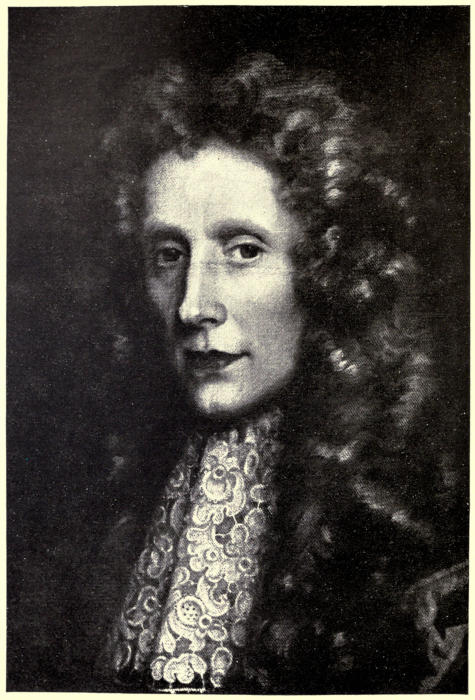
From a painting by Kerseboom, in the rooms of the Royal
Society.
ROBERT BOYLE
A BIOGRAPHY
BY
FLORA MASSON
LONDON
CONSTABLE & COMPANY LTD.
1914
Richard Clay & Sons, Limited, BRUNSWICK STREET, STAMFORD STREET, S.E.,
AND BUNGAY, SUFFOLK.
ACKNOWLEDGMENTS
For permission to quote from the Lismore Papers
(as edited by Grosart, 10 vols.), I have to acknowledge
my indebtedness to the Duke of Devonshire.
I have also to thank Lady Verney for allowing me
to quote from the Verney Memoirs, and Sir William
Ramsay for permission to quote from his Presidential
Address delivered to the British Association for the
Advancement of Science, Portsmouth 1911. To
the kindness of Sir Archibald Geikie I owe the
permission to reproduce the portrait of Robert Boyle
in possession of the Royal Society of London.
I remember with special gratitude the kind counsel
given me, in the last months of his life, by the late
Professor Edward Dowden.
My thanks are due, for advice and help, to Miss
Elizabeth Dowden, Mr. Richard Bagwell, Mr. Irvine
Masson, Mrs. Millar, Mrs. Townshend, and Mr.
James Penrose.
I gratefully acknowledge the unfailing courtesy
and helpfulness of the Librarians of the Edinburgh
Public Library, the Signet Library, the University
Library, and the Library of the Royal Society of
Edinburgh.
“... Not needlessly to confound the herald with the historian, and
begin a relation with a pedigree....”—Robert Boyle’sPhilaretus.
“My wife, God ever be praised, was about 3 of the
clock in thafternoon of this day, the sign in gemini,
libra, Safely delivered of her seaventh son at Lismoor:
God bless him, for his name is Robert Boyle.”[1]
So runs the entry, under the date January 25, 1626
(7), in the private diary of the great Earl of Cork,
a manuscript preserved at Lismore to this day.
When he wrote those words, the Earl was already
a man of sixty, who, after forty strenuous years, was
nearing the zenith of his great fortunes. The Countess—his
second wife—was twenty years younger:
she had been just seventeen when he married her,
and he a widower of thirty-seven. They had been
married three-and-twenty years, and in those three-and-twenty
years, at one or other of their roughly
splendid Irish homes, seven daughters and seven sons
had been born to them.
Their earliest home had been the College house of
Youghal, “re-edified” to suit the Earl’s requirements;
but in these later years they were used to
divide their time travelling in state, with coaches and
horses and a mounted retinue, between Youghal and
the town house in Dublin and this other house of
Lismore, already “one of the noblest seats in the
province of Munster.”[2] And the Earl was still busy
“re-edifying” this also,—building stables and coach-houses,
pigeon-houses and slaughter-houses, storing
the fishponds in his park with young carp and tench
from Amsterdam, and “compassing” his orchards and
terraced gardens with a huge turreted wall,—when
this fourteenth child, the “Robyn” that was to prove
the greatest of all his children, was born at Lismore.
The story of how Mr. Richard Boyle became the
great Earl of Cork is one of the most brilliant
romances of the British Peerage. It has been often
told, nowhere more graphically than by the Earl
himself, in his brief True Remembrances.[3] So triumphant
and so circumstantial, indeed, are the Earl’s
“Remembrances,” that many generations of ordinary-minded
people have made the mistake of thinking
they cannot possibly be true. Only of recent years,
since, in fact, the Earl’s own letters and the Earl’s own
private diary, kept to within a few days of his death,
have been given to the world under the title of the
Lismore Papers, has the cloud of incredulity rolled
aside; and the character of this man stands out to-day
in its integrity, to use his own words, “as cleer as
the son at high noon.”[4]
It is the character of a great Englishman, one of
Elizabeth’s soldier-statesmen and merchant-adventurers:
a man typically Elizabethan in his virtues and
his faults, though he was to live far into the unhappy
reign of Charles I. Passionately Protestant, passionately
Royalist, a fine blend of the astute and the
ingenuous, with strong family affections, splendid
ambitions and schemes of statecraft, he was relentless
in his prejudices and enmities, indomitably self-sufficient,
and with as much vitality in his little finger
as may be found in a whole parliamentary Bench to-day.
He raised himself from “very inconsiderable
beginnings” to be one of the greatest subjects of the
realm, one of the greatest Englishmen of his day.
He had been born at Canterbury, the second son
of the second son of a country squire—one of the
Boyles of Herefordshire. His father had migrated
into Kent, married a daughter of Robert Naylor of
Canterbury, and settled at Preston, near Faversham.
Here, when Richard was ten years old, his father
died, leaving his widow to bring up her family of
two daughters and three sons on a modest income as
best she could. Mrs. Boyle had managed very well.
The eldest son, John, and Richard, the second, were
sent to the King’s School, Canterbury, and from there
(Richard with a scholarship) to Bennet College,
Cambridge.[5] John Boyle duly took Orders, while
Richard, the cleverer younger brother, went up to
London to study law. At one-and-twenty he seems
to have been settled in chambers in the Middle
Temple, clerk to Sir Richard Manwood, Chief Baron
of the Exchequer. At his mother’s death (Roger
Boyle and Joan Naylor his wife were buried in Preston
Parish Church), Richard Boyle decided that he would
never “raise a fortune” in the Middle Temple, and
must “travel into foreign kingdoms,” and “gain learning,
knowledge, and experience abroad in the world.”
And the foreign kingdom toward which he turned
his strenuous young face was Ireland: Ireland in the
reign of Elizabeth, in the year of the Armada. It
was five-and-twenty years since the Irish chieftain
Shan O’Neil had presented himself at Elizabeth’s
Court, to be gazed at by peers and ambassadors and
bishops as if he were “some wild animal of the
desert.”[6] Shan O’Neil had stalked into the Queen’s
presence, “his saffron mantle sweeping round and
round him, his hair curling on his back and clipped
short below the eyes, which gleamed under it with a
grey lustre, burning fierce and cruel.”[7] And behind
him were his bare-headed, fair-haired Galloglasse,
clad in their shirts of mail and wolfskins, with their
short, broad battle-axes in their hands. The chieftain
had flung himself upon his face before the Queen with
protestations of loyalty and fair intention; and all
those five-and-twenty years the attitude of Ireland had
been one of submission and protestation, flanked and
backed by wolfskins, shirts of mail and battle-axes.
The Desmond Rebellion had been quelled amid
horrors. It was still a “savadge nation”[8] this,
to which Mr. Richard Boyle was setting forth: an
Ireland of primeval forests and papal churchlands,
of vivid pastures and peel towers and untamed Erse-speaking
tribes. With its ores and timber, its grasslands
and salmon-fishing, its fine ports, and, above
all, its proximity to Elizabethan England, it was a
land teeming with industrial possibilities; but it
bristled and whispered with race-hatred and creed-hatred,
with persecution and conspiracy. This
was the Ireland that was being eagerly peopled
and exploited and parcelled out by Elizabethan
Englishmen.
And so, on Midsummer Eve 1588, another clever
young man arrived in Dublin. He had twenty-seven
pounds and three shillings[9] in his possession, and on
his wrist and finger he wore the two “tokens” left
him by his dead Kentish mother—the gold bracelet
on his wrist, worth about £10, and the diamond ring
on his finger, the “happy, lucky and fortunate
stone” that was to stay there till his death, and be
left an heirloom to his son’s son and successive
generations of the great Boyle family.
The Earl never forgot the accoutrements and the
various suits of clothes with which he started in
life when, at two-and-twenty, he shut the door of
his chambers in the Middle Temple behind him:
“A taffety doublet cut with and upon taffety; a
pair of black velvet breeches laced, a new Milan
fustian suit, laced and cut upon taffety, two cloaks,
competent linen and necessaries, with my rapier and
dagger.” And he must have carried letters of introduction
also, which procured the young lawyer
employment and influential friends; for Mr. Richard
Boyle was very soon launched on Dublin society,
and was on friendly terms with at least two men who
hailed from his own county of Kent, Sir Edward
Moore, of Mellifont, in Meath, and Sir Anthony St.
Leger, who was living in Dublin. It is more than
possible that he met also at this time the poet
Spenser; for Dublin must have been Spenser’s headquarters
since 1580, when he came over to Ireland
as Secretary to the Lord Deputy. Spenser, who it
is believed had been through all the horrors of the
Desmond Rebellion, was, in 1588, after having held
various appointments, leaving Dublin to take up his
bachelor abode at Kilcolman, a peel tower abandoned
by the Desmonds and assigned, with some thousands
of acres around it, to this English poet-politician,
already known as the author of the Shepheard’s
Calendar. At Kilcolman, in this peel tower in a
wild wooded glen among the Galtee Hills, about
thirty miles south of Limerick, Sir Walter Raleigh
came to stay with Spenser when he too was in Ireland,
inspecting the vast Irish estates that had been assigned
to him. It was there they read their poems
aloud to each other, and that Raleigh persuaded
Spenser to go back with him to London, together to
offer their poems to the Queen. During the first
year or two, therefore, of Boyle’s sojourn in Ireland,
while he was working his way into the notice of
Englishmen of influence there, Spenser was in
London, being lionised as the Poet of Poets, the
author of the first three books of the Faerie Queene.
When Spenser returned to Ireland with a royal
pension as Clerk to the Council of the Province
of Munster, Richard Boyle was already clerk, or
deputy, to the “Escheator General,” busy adjusting
the claims of the Crown to “escheated” Irish lands
and titles—travelling about, and making enemies
of all people who did not get exactly what they
wanted out of the Escheator or the Escheator’s
clerk. Both Boyle’s sisters had joined him in Ireland,
and both were soon to marry husbands there;
and somewhere about this time his cousin, Elizabeth
Boyle, daughter of James Boyle, of the Greyfriars in
Hereford, was in Ireland, and the poet Spenser, back
from his London visit, the literary hero of the hour,
met and fell in love with Boyle’s cousin Elizabeth.
She is the lady of the Amoretti and Epithalamium;
“my beautifullest bride,” with the “sunshyny face,”
and the “long, loose, yellow locks lyke golden wyre,”
whose name the poet-lover was to trace in the yellow
Irish sands, and of whom he sang so proudly—
“Tell me, ye merchants’ daughters, did you see
So fayre a creature in your town before, ...?”
They were married in the Cathedral of Cork in the
summer of 1594. A few months later, Spenser
turned his face Londonwards again, taking with him
presumably his English wife, and certainly the other
three books of his Faerie Queene. He was to return
to Ireland once again.
In 1595, a year after Spenser’s marriage to
Elizabeth Boyle, Mr. Richard Boyle married a
young Limerick lady, Joan Apsley, one of the two
daughters and co-heirs of Mr. William Apsley, a
member of the Council of Munster. Joan Apsley’s
five hundred a year in Irish lands, “so goodly and
commodious a soyle,”[10] was to be the foundation of
Mr. Boyle’s fortunes. She left it all to him when
she died, at Mallow, “in travail with her first child,”
and was buried in Buttevant Church with her little
stillborn son in her arms.
After his wife’s death, Richard Boyle, now a landowner
and a man of some importance in Munster,
had his time full fighting his personal enemies.
There were powerful men among them, and by his
own account they “all joined together, by their lies,
complaining against me to Queen Elizabeth.” It
was impossible, they said, he could have advanced so
rapidly by honest means. They accordingly accused
him of embezzlement and forgery, and, because some
of his wife’s relations were well-known Catholics,
they accused him—staunch Protestant as he was—of
acquiring lands with Spanish gold, of harbouring
priests, and being himself a papist in disguise. They
even accused him of stealing a horse. For a time he
was actually kept in a Dublin prison, and when by a
kind of fluke he found the prison doors opened to
him, and was intending to “take shipping,” and to
“justify” himself before the Queen in London, the
General Rebellion of Munster broke out. In the
debacle, Mr. Richard Boyle—his wife’s lands wasted
and his moneys gone—did manage to escape to
England. And so did the poet Spenser—Spenser,
marked of the rebels, the author not only of the
Faerie Queene, but of the View of the Present State of
Ireland. Why did Spenser ever return to Ireland
to undertake the duties of Sheriff of Cork? Spenser
and his wife and children were at Kilcolman when
the Rebellion broke out. They fled for their lives;
and the old peel tower of the Desmonds was burnt
to the ground. One of their babies, Ben Jonson
told Drummond of Hawthornden, was left behind,
and perished in the flames.
Spenser was to die in poverty in London, to be
buried near to Chaucer in Westminster Abbey, the
poet-mourners flinging their pens into his grave.
Spenser’s wife—Mr. Richard Boyle’s cousin—was to
live on in Ireland, to bring up her children (her son
Peregrine was the “Joy of her Life”) and to marry
yet twice again. Twice her great kinsman saw his
cousin’s hand “given in marriage.” She had her
compensations in life—but there never was another
Epithalamium.
Arrived in London, Mr. Richard Boyle, through
the friendly offices of Anthony Bacon, whom he had
known at Cambridge, was presented to the new Lord
Deputy, the Earl of Essex, then just starting for
Ireland. Queen Elizabeth may have had her
reasons for clapping Mr. Boyle so unceremoniously
into the gate-house of the Tower just as he was
thinking of going back to his old Chambers in the
Middle Temple. It is possible she was waiting for
her new Deputy’s reports from Ireland. In due
time Richard Boyle was fetched before her, and
he did “justify” himself to his Sovereign. Her
splendid royal words were burnt in upon his memory
to the last day of his life:[11]—
“By God’s death, these are but inventions against
this young man.” And again: “We find him to be
a man fit to be employed by ourselves.”
Boyle was received at Court, and when he was
sent back to Ireland it was as Clerk to the Council
of Munster, the very post that Spenser had held.
He bought Sir Walter Raleigh’s ship, the Pilgrim,
freighted her with victuals and ammunition, sailed in
her, “by long seas” to Carrickfoyle, and took up
his new work under the splendid Presidentship of
Sir George Carew. His wife’s lands were recovered:
“Richard Boyle of Galbaly in the County of Limerick,
Gent.,” waited on Carew through all the siege of Kinsale,
and was employed by him to carry the news of
victory to the Queen in London. There he was the
guest of Sir Robert Cecil, “then principal secretary,”
in his house in the Strand, and was taken by Cecil
next morning to Court, and into the bedchamber of
her Majesty, “who remembered me, calling me by
name, and giving me her hand to kiss.”[12]
Quickly back in Ireland, Richard Boyle became
the Lord President’s right hand in all his strenuous
services to the Crown: in later years one of the few
literary treasures in the great Earl’s “studdie” was
the copy of Carew’s Hibernia Pacata given him by
his Chief. It was Carew who sent him in 1602 to
London, furnished with letters to Cecil and to Sir
Walter Raleigh, recommending him as a fit purchaser
of the Raleigh Estates in Ireland. The thousands of
acres in the counties of Cork and Waterford known
as the “Raleigh-Desmond Estates” were then and
there, in London, bought from Sir Walter Raleigh
“at a very low rate.” In Richard Boyle’s hands, the
waste lands that to Raleigh had been a source of
anxiety and money loss were to become the best
“settled” and most prosperous territory in Ireland,
and a source of wealth and power to him who made
them so. For Richard Boyle was not only a great
landowner, he was a shrewd man of business, a
capitalist and a large employer of labour. It was,
says Grosart, “his perseverance and governing
faculty and concentrated energy that transformed
bleak mountain and creation-old fallow moor
and quaking bog into hives of population and
industry.”[13]
Sir George Carew went a step further. He
“dealt very nobly and fatherlike” with Mr. Boyle
in recommending him to marry again. And the
lady whom Carew had in view for his protégé was
Katharine Fenton, the seventeen-year-old daughter
of Sir Geoffrey Fenton, the wise and enlightened
Secretary of State. There is a pretty tradition
handed down in the Boyle family—the Earl’s own
daughter used to tell it—that Mr. Boyle first met his
second wife when he was a very young man newly
arrived in Dublin. Calling one day on business at
Sir Geoffrey Fenton’s house, and waiting in an ante-room
till the great man should be disengaged, Mr.
Boyle had “entertained himself” with a pretty child
in her nurse’s arms; and when Sir Geoffrey at last
appeared and apologised for having kept his visitor
waiting, the young man “pleasantly told him he had
been courting a young lady for his wife.” This
must have been in 1588. The marriage took place
fifteen years later, and a great deal had happened in
the interval. Joan Apsley and her baby were buried
in Buttevant Church, and “Richard Boyle of Galbaly
in the County of Limerick, Gent.” had purchased the
vast Raleigh Estates. In July 1603 he was a wealthy
widower of thirty-seven, and Katharine Fenton was
seventeen.
“I never demanded any marriage portion with her,
neither promise of any, it not being in my consideration;
yet her father, after my marriage, gave me
one thousand pounds[14] in gold with her. But this
gift of his daughter to me I must ever thankfully
acknowledge as the crown of all my blessings; for
she was a most religious, virtuous, loving, and
obedient wife to me all the days of her life, and the
mother of all my hopeful children.”[15]
Elizabeth was dead, and James I reigned in her
stead. Sir George Carew—the new Lord Deputy—had
conferred a knighthood on Mr. Boyle on his
wedding day. Two years later he was made Privy
Councillor for the Province of Munster, and thenceforward
there was to be no stop nor hitch in the
upbuilding of his great fortunes. In 1612, after
another visit to London and an audience of King
James, he found himself Privy Councillor of State
for the Kingdom of Ireland. He was created Lord
Boyle, Baron of Youghal, in 1616, and Viscount
of Dungarvan and Earl of Cork in 1620. His
home life had run parallel with his public services.
“My Howses,” “My deare Wife,” “the Children,”
“my Famullye,” fill an important place in the Earl’s
life and diary and letters; while the wife’s few little
epistolary efforts to her husband have only one
beginning: he was to her always “My owne goode
Selfe.”
Robert Boyle speaks of his mother’s “free and
noble spirit”—which, he adds, “had a handsome
mansion to reside in”—and of her “kindness and
sweet carriage to her own.”[16] The hopeful children
came quickly. Roger, the first, born at Youghal in
1606, was sent at seven years old to England, at first
to his uncle John, then Dr. John Boyle, a prebendary
of Lichfield, and a year later to his mother’s
relatives, the Brownes, of Sayes Court, Deptford.
There was an excellent day-school at Deptford, to
which Roger Boyle was sent; and a rather pathetic
little figure he must have cut, going to and from
school, with “shining morning face” in his baize
gown trimmed with fur.[17] On high days and
holidays he wore an ash-coloured satin doublet and
cloak, trimmed with squirrel fur, and a ruff round his
little neck; and his baby sword was scarfed in green.
Mrs. Townshend, in her Life of the Great Earl,
points out that the child wore out five pairs of
shoes in a year, and that his book of French verbs
cost sixpence. He was to die at Deptford, after
a very short illness, when he was only nine years old.
The Brownes were terribly distressed, and did everything
they could. Mrs. Browne moved him into
her own chamber, and nursed him in motherly
fashion. His Uncle John was sent for, and sat by
the little fellow’s bed till he died. The physician
and apothecary came from London by boat and
administered a “cordial powder of unicornes’ horns,”
and other weird “phisicks.” “Little Hodge” was
very patient, and said his prayers of his own accord;
and after he was dead Mrs. Browne found that in
his little purse, which he called his “stock” (he
must have been very like his father in some ways),
there was still more than forty shillings unspent.
All these details, and many more, were sent in letters
to the parents at Youghal, and to the grandparents,
Sir Geoffrey and Lady Fenton, in Dublin, after
“my jewel Hodge,” as the grandfather used to call
him, was buried in Deptford Parish Church.
There were by this time four daughters, born
in succession: Alice, Sarah, Lettice, and Joan; a
second son, Richard, born at Youghal in 1612; and
a fifth daughter, Katharine, who was a baby in arms
when “little Hodge” died. A few months after his
death came Geoffrey; and then Dorothy in 1617,
and Lewis two years later. Another boy was born
in 1621 and christened Roger; Francis and
Mary followed in 1623 and 1624; and then came
the fourteenth child, “my seaventh son”, and the
Earl made that memorable entry in his diary at
Lismore: “God bless him, for his name is Robert
Boyle.”
CHAPTER II AN IRISH CHILDHOOD
“He would ever reckon it amongst the chief misfortunes of his life
that he did never know her that gave it him.”—Robert Boyle’sPhilaretus.
A fortnight later, there was a christening in
the private chapel at Lismore. The Earl’s chaplain
and cousin, Mr. Robert Naylor, officiated, and a
large house-party gathered for the event. Lady
Castlehaven, who was to be the child’s godmother,
arrived with her family and retinue just in time, and
the godfathers were Lord Digby and Sir Francis
Slingsby. Lord Digby was living in the house as a
newly made son-in-law, and the boy was to be
named Robert after him.
The Earl’s large family of “hopeful children”
were already growing up and scattering when this
fourteenth baby made its appearance among them.
Alice, the eldest daughter, at nineteen, had been for
some years the wife of young David Barry, the
“Barrymore” who had been brought up in the
family almost like one of the Earl’s sons. Sarah, the
second, at a tender age, had been transferred to the
care of the Earl’s old friend, Lady Moore, at Mellifont,
and was married, on the same day as her sister
Alice, to Lady Moore’s son. He died very soon
afterwards; and Sarah, at seventeen, had been a little
widow for three years, living again under her father’s
roof; and on the Christmas Day before Robert Boyle’s
birth, Sarah had been married a second time—to
Robert, Lord Digby, in her father’s chapel at Lismore.
Lettice, the third daughter, had been intended for
Lady Castlehaven’s son, but the young man’s religious
views were “not conformable”; and she and
her sister Joan were accordingly kept at home, with
a London season in view. “Dick,” the now eldest
son and heir, already “my Lord Dungarvan,” was
at home, being mildly tutored by the Earl’s chaplain,
and living in a boy’s paradise of saddle-horses
and “faier goshawks,” with an “eyrie of falcons” and
occasional “fatt bucks” and “junkettings”; but little
Katharine, who came next, had been sent away
into England to Lady Beaumont—at Coleorton in
Leicestershire—mother of Sapcott Beaumont, the
little girl’s prospective husband. Geoffrey, who
would have been ten years old when Robert was
born, had died as a baby. Tradition says he tumbled
into a well in the Earl’s Walk in Youghal; but the
Earl’s diary, in mentioning the death, makes no reference
to the well. Dorothy, now nine years old, was
already destined for Arthur Loftus, Sir Adam Loftus’s
son; and in the autumn before Robert’s birth she had
been fetched away to be brought up in the Loftus
family at Rathfarnham. Francis and Mary were quite
young children in the nursery; and now Robert, the
fourteenth baby, as soon as he “was able without
danger to support the incommodities of a remove,”
was to be carried away from Lismore in the arms of
his “Country Nurse.”[18] The Earl, so Robert Boyle
says, had a “perfect aversion to the habit of bringing
up children so nice and tenderly that a hot sun or
a good shower of rain as much endangers them as if
they were made of butter or of sugar.” Lady Cork’s
opinions do not seem to have been asked; perhaps,
in those three-and-twenty years, she had taught herself
to think, if not to feel, in unison with her “owne
goode selfe.” And so Robert Boyle, like his brothers
and sisters, was to be reared during those first months
of his life by a foster-mother, and owing to the
movements of his family at this time was to be left
with her longer than he would perhaps otherwise
have been. He was to be rocked in an Irish cradle,
or rather nursed, Irish fashion, in a “pendulous
satchell” instead of a cradle, with a slit for the
baby’s head to look out of.[19] By slow degrees, this
boy, born amid all the pomp and seventeenth-century
splendour of his father’s mansions, was to be inured
to “a coarse but cleanly diet,” and to what he afterwards
so characteristically described as “the passions
of the air.” They gave him, he says, “so vigorous a
complexion” that ‘hardships’ were made easy to him
by ‘custom,’ while the delights and conveniences of
ease were endeared to him by their ‘rarity.’
Happy months of babyhood, lulled in a cottage
mother’s arms, or suspended, between sleeping and
waking, in that fascinating medium that was to
become afterwards his life-study! Wise little head
of Robert Boyle, looking out of that slit in the
“pendulous satchell,” baby-observer of the firelight,
and the sunlight and the shadows, enjoying, without
theory, as he swung in it, the “spring of the air”!
And meantime the baby’s family was preparing for a
season in London.
The House of Lismore was still being “re-edified”
during the months that followed the birth of
“Robyn.” The gardens and terraces were being laid
out; the orchard wall was still building. Dick, the
eldest son, and Arthur Loftus, the destined son-in-law,
had been allowed to go to Dublin for the
horse-races, with allowance for “wyne and extraordinaryes,”
“horse-meat,” “small sums,” and “idle
expenses.” The Earl liked to give presents: each
New Year in his diary is a record of presents given
and received; and while he seems to have kept the
laced shirts and nightcaps made for him by his
daughters, he had a habit of handing on the more
costly gifts to other people. He was at this time
tipping his musicians at Lismore, and commissioning
his trusty emissary, Sir John Leeke, to buy smock-petticoats
for Lady Cork and her mother Lady
Fenton, who, since Sir Geoffrey’s death, had made
her home for the most part with her daughter and
her great son-in-law. And the Earl had given his
married daughters a breeding mare apiece—each mare
“with a colt at her feet,” while braces of bucks
and saddle-hackneys had been dispersed among
various friends. His daughter Sarah’s (Lady Digby’s)
first child—a great event in the family—was born at
Lismore in October; and towards the end of 1627,
with the London visit in view, the Earl dispatched
a footman with letters into England. Early in the
spring of 1628, Sarah, with her lord and baby, left
Lismore; in April, Mary Boyle was fetched away to
be brought up under Lady Clayton’s charge at Cork;
Lady Fenton also left Lismore; and little Francis
was carried off to Youghal by Sir Lawrence Parson’s
lady. As the visit to England drew nearer, the
Earl made his last will and testament—in duplicate.
“Thone” copy was to be locked up in his great iron
chest at Lismore, which was fitted with three keys,
to be left with three trusted kinsmen, who were to
add to the chest the Earl’s moneys as they accumulated;
and “thother” copy was to be carried by the
Earl himself into England.
On April 21st a great cavalcade—the Earl and his
wife, with their two daughters, Lettice and Joan,
and the rest of their party and retinue—set out for
Youghal, where on May 7th they took shipping
(a captain had been hired to “wafte them over”)
and reached London on May 16th;—not without
adventures, for they were chased by a Dunkirker of
300 tons, and though the family escaped, the footmen
and horses following in another barque were
taken and carried off to sea.
That London season of 1628, when Charles I
was the young King of England! What a busy,
self-important, gratifying time it was, and what an
amount of feeing and tipping and social engineering
was requisite to carry it through! The Earl was
received by the Duke of Buckingham and presented
to the King. He engaged a steward for his household,
and rented my Lord Grandison’s house in
Channell Row, Westminster.[20] In June Lady Cork
and her daughters were presented to the Queen, who
kissed them all most graciously. Mr. Perkins, the
London tailor, a very well-known man among the
aristocracy as “the jerkin-maker of St. Martin’s”, was
sent for to receive his orders. The Earl must have had
his mind fully occupied and his purse-strings loose;
for there were at least two troublesome lawsuits
going on at this time about his Irish estates and
industries, and he was employing the great Glanville
as his legal adviser. But nothing seems to have
interfered with the somewhat stodgy gaieties of that
London season of 1628. And in preparation there
were purchases of upholstery and table-linen in
Cheapside; of “wares” for the ladies of the family,
in Lombard Street; velvet, cloth of gold, and what-not.
How different all this from the old-young life in
the shabby chambers in the Middle Temple, or the
weeks spent in the Gate-house, waiting to be called
before Queen Elizabeth! But the great self-made
man had not forgotten the old days. He had always
given a helping hand to his own kith and kin:
Ireland was sprinkled with his “cozens.” His
brother John, the poor parson of Lichfield, had the
good fortune to at least die Bishop of Cork. And
now, on this visit to London, the Earl had no intention
of neglecting his “cozen,” the lawyer Naylor of
Gray’s Inn, or his “cozen” the vintner Croone of
the King’s Head Tavern in Fleet Street.[21]
The Earl of Bedford had offered his house of
Northall for the autumn; and visits were paid in state,
with coaches and horses, to the Bedford family
and to the Earl’s old Chief, Carew. Carew, now
Earl of Totness, lived at Nonsuch, near Epsom,
the wonderful house of Henry VIII’s reign, set
in its park of elms and walnuts, with its gilded
and timbered outside, ornamented with figures of
stucco, and paintings by Rubens and Holbein.[22]
Little wonder, in the circumstances, that the Earl of
Cork’s coachmen and footmen all demanded new
liveries.
In August the whole family removed to Northall,
and later in the year they visited Lord and Lady
Digby at Coleshill in Warwickshire, and Lady Beaumont
at Coleorton in Leicestershire. Here the match
between “Katy” and Sapcott Beaumont was broken
off, the money arrangements not satisfying the Earl,
and Katy was handed over to Lady Digby’s charge.
While the Cork cavalcade were moving about from
one great house to another, there came the news of
the murder of Buckingham at Portsmouth; but this
tragic event did not interfere with a visit to Oxford
in September. The party that set out from
Coleshill, on September 1st, included Lady Digby,
whose second baby was born inconveniently the
day after their arrival in Oxford, in the house of
Dr. Weston, Lady Cork’s uncle, in Christchurch.
“Dick” was now at Christchurch, with Arthur
Loftus and the young Earl of Kildare; and Lettice
and Joan both met their fates during this visit,
Lettice marrying, very soon after, George Goring,
handsome, plausible, dissolute and cold; while Joan was
promised to the wild young “Faerie Earle” of Kildare.
Back in London, after taking Eton on the way, the
Earl of Cork and his wife and daughters made a little
pilgrimage. They all rode to “my Uncle Browne’s
to Deptford,” and visited little Roger’s grave in
Deptford parish church. They “viewed” the
monument that the Earl had set up there, and for
which the “Tombe-maker” had sent in his bill. And
the Earl was so pleased with it that he employed the
same man to make “a faier alabaster tombe” over
the grave of his parents, in the parish church of
Preston in Kent.
As the year drew to a close, the Earl’s moneys
from his furnaces, forges, ironworks, “tobackoe
farms” and what-not, were added to the great iron
chest at Lismore; and Christmas and New Year gifts
were showered among his English friends. A
manuscript Bible was sent to Dr. Weston for Christchurch
Library; “cane-apples” (variously described
as the Arbutus and the Espalier apples) and pickled
scallops from Ireland, to other friends; “a rare lyttle
book” to the Earl of Arundel, and usquebaugh to the
Earl of Suffolk. Sir Edmund Verney’s new butler
from Ireland came in for the Earl’s own scarlet
doublet with hose and cloak, while the Archbishop
of Canterbury[23] accepted a “ronlett of usquebaugh”
and a piece of black frieze for a cassock.
And then the Earl made an ominous entry in his
diary: “I gave Dr. Moor £5 and Dr. Gifford 20s.
for visiting my wife in her sickness”; and “my wife’s
phisick” is an item in the Earl’s accounts. But they
spent the early spring at Langley Park near Windsor,
and in April were back again in Channell Row, where
on April 15th Lady Cork’s fifteenth child—a little
girl—was born. In June they removed to Lord
Warwick’s house in Lincoln’s Inn; and in October
1629—the baby Margaret being left behind them
with her nurse and maid—they were back in
Ireland again.
The return journey had been made with even more
pomp and ceremony than the setting forth eighteen
months before. For one of the King’s ships, the
Ninth Whelp—one of the fleet of “Lion Whelps,”
built at Deptford—was at the last moment put at
their disposal to “wafte them over.” Lord Cork
distributed presents among the ship’s company, and
gave the captain at parting a magnificent pair of
fringed and embroidered gloves, to which Lady
Cork added a black silk night-cap, wrought with gold.
The men, horses and luggage, followed safely in two
barques—no Dunkirker being sighted on the way.
Before the Earl left Ireland, he and the Lord
Chancellor[24] had not been on the best of terms. But
now, fresh from the civilisation of the Metropolis,
and with all the reflected glory of a crossing in the
Ninth Whelp, the Earl, by the King’s desire, made
up his quarrel with the Chancellor. Both were
sworn Lords Justices for the joint government of
Ireland in the absence of a Deputy; and both resolved
to “join really in the King’s Service”—a
resolution which they were, for a little while, to
keep. Meantime, Mr. Perkins, “my London Tailor,”
had sent over to Dublin an enormous trunk of magnificent
wearing-apparel, and a very long bill; and
the retiring Lord Deputy[25] delivered up the King’s
Sword and government of Ireland to the Lord Chancellor
and the Earl.
This was in October 1629. On the 16th of February
following, 1630, Lady Cork died at Dublin.[26]
It had “pleased my mercifull God for my manifold
syns ... to translate out of this mortall world to his
gloriows kingdome of heaven the sowle of my
deerest deer wife....”
The baby Peggie—ten months old—was still in
England; and the ex-baby Robyn, reared by his
country nurse, was just three years old. Had the
lady of the “free and noble spirit,” in those short
months spent in Dublin, between October and February,
been able to see Robyn again—to hold him in
her arms a little moment—before she died?
For a year or two after Lady Cork’s death, the
Earl was very busy with the government of Ireland
and the management of his own family and estates;
and his migrations were for a time to be only from
his Dublin town house to the Council Chamber and
Great Hall of Dublin Castle. Lady Cork had been
buried with solemn ceremonial in the Chancel of
St. Patrick’s Church, in the same tomb with her grandfather
the Lord Chancellor Weston and her father
Sir Geoffrey Fenton, Secretary of State. The business
connected with “my deer wive’s ffunerals”
occupied the Earl for some time; and a splendid
black marble monument was in course of erection in
the upper end of the chancel of St. Patrick’s. Meantime
the widower was surrounded by his children;—the
Barrymores and their children, and Lady Digby
with her comfortable husband, while Lettice Goring,
with or without George Goring, was always coming
to and fro from England. Poor Lady Lettice Goring
was not a happy woman. She had nearly died of
smallpox when she was thirteen, and perhaps on this
account her education had been woefully neglected.
There was a certain amount of cleverness in her of a
small-natured type; but she was childless, delicate,
and discontented, with a continual “plaint.” Her
younger sister, Katherine, was of a very different
nature. Handsome, intelligent, and high-spirited, by
far the finest character of all the Earl’s daughters,
Katherine, now that her engagement to Sapcott Beaumont
had been broken off, was at sixteen quickly
affianced and married to Arthur Jones, Lord Ranelagh’s
son, and carried off to Athlone Castle, a gloomy
old Norman castle in Roscommon;—with how small
a chance of happiness in life she fortunately did not
know.
The two boys, Lewis and Roger—Lord Kynalmeaky
and Lord Broghill—were fetched to Dublin
and entered at Trinity College; and Joan was married
to the Earl of Kildare as soon as that young nobleman
returned to Ireland in company with her brother
Dick. The baby Peggie was brought from England
with her nurse and maid; and sometime in 1631 the
two youngest boys, Francis and Robert, were brought
home; and “my children,” their little black satin
doublets, and “Mownsier,” their French tutor, began
to find a place in the Earl’s diary. It was then, too,
that the Earl began to make those settlements, the
first of many, in various counties, on “Robyn”,
and that a son of one of the Earl’s own old servants
was engaged “to attend Robert Boyle.” The minute
philosopher, at five years old, had his own valet.
Anxieties and triumphs jostled each other in the
Dublin town house. Lady Fenton did not long survive
her daughter, and a great cavalcade, headed by the
Earl and his sons and sons-in-law, rode to her funeral
at Youghal. In November 1631 the Earl was
made High Treasurer of Ireland[27]; that winter, in
leisure hours, he must have written his True Remembrances,
the manuscript of which was finished and
“commended to posterity” in June 1632—just after
the Earl, the Lord Chancellor, and the young Earl of
Kildare, had been given the Freedom of the City of
Dublin. Early in that year, Dorothy had married
Arthur Loftus and settled down at Rathfarnham,
and that same summer Dick, “my Lord Dungarvan,”
in company with Mr. Fry his tutor, set off on his
foreign travels. Dungarvan’s marriage with the
daughter and heiress of Lord Clifford was already on
the tapis. Lord and Lady Clifford lived at Skipton,
in Yorkshire; Dungarvan was to be received in
audience by King Charles, and to take Yorkshire on
his way abroad; and “thaffair,” so dear to the Earl’s
heart, was very soon to bring him home again. A
husband was to be found for Peggie, now that she was
three years old; and the Lord Chancellor and the
Lord Primate were to have long confabulations with
the Earl on this important matter. Kynalmeaky was
already proving himself an anxious, brilliant young
spendthrift, and was to be sent to sea in the Ninth
Whelp to learn “navigacon” and “the mathematiques”
from that same Captain who wore the fringed
gloves and embroidered night-cap. The sons-in-law
were a trial. George Goring was continually borrowing,
Kildare perpetually losing at dice and cards.
He “battered and abused” with marrow-bones the
Earl’s best silver trenchers, and then won £5 from his
father-in-law for “discovering” to him the culprit!
Lord Barrymore, after living eighteen months with
his wife and all his family under the Earl’s roof, went
back to Castle Lyons without so much as saying
thank-you. As for the household staff, the “servant
trouble” existed then as now. That Christmas of 1632
one of the Earl’s scullerymen “did most unfortunately
by jesting with his knife run my undercook into
the belly whereof he instantly died in my house in
Dublin”—a most unpleasant domestic episode; and
it happened at the very moment when the splendid
black marble tomb in St Patrick’s had been finished
and paid for!
But all this was as nothing to the griefs of the next
few months; the premature birth of Lady Digby’s
baby under the Earl’s roof, the hurried christening
before it died, and the death of the young mother,—that
little Sarah who, a widow at seventeen, had been
married to Lord Digby, the Earl’s most comfortable
son-in-law, on the Christmas Day before Robyn
was born.[28]
It was a dark summer, the summer of 1633, in
the Dublin town house; and the Earl and his children
were still in the first days of their mourning,
when Wentworth, the new Lord Deputy, arrived in
Dublin: A most cursed man to all Ireland, wrote the
Earl in his diary, and to me in particular.
The story of Wentworth’s government of Ireland, a
government “hardly paralleled in the annals of
pro-consulship,”[29] has given material for many books;
but through all the chapters there runs the underplot
of Wentworth’s personal relations with the Earl of
Cork. From the first moment, on that July morning,
1633, when the Earl—the Lord High Treasurer—set
out in his coach to meet the Lord Deputy and his
suite “walking on foot towards the cytty”—a wall
of enmity had stood up between these two great men.
There is no more human reading than the private
diary record of those uneasy years that followed; and
unconsciously, by mere enumeration of daily incidents,
the Earl has made his own character and the
character of Wentworth stand out as clearly as if
they were both alive and facing each other in a
Parliament of to-day. There is the character of the
strenuous old Elizabethan Protestant, with its angles
and its softnesses, the man of sixty-seven, who for
five-and-forty years had been the man on the spot.
Royalist to the backbone, he had served in Ireland
three sovereigns in succession. It was the country of
his adoption. To a great extent, he felt he had made
it what it was; and now, in yielding up the sword
and government to Wentworth, he was proudly
satisfied that Ireland was being yielded up in
“generall peac and plenty.”
And there is the character of Wentworth, the man
who had come—who had been sent—to rule; the
much younger man, of more recent education and
more cultivated tastes, of a different code of living.
But he was as obstinately masterful, and his energy
and insolence were that of manhood’s prime. He,
too, was there to do the King’s service, none the less
fervently that he had been, not so long before, a leader
of the popular party in the English Parliament, and
had only recently, so to speak, crossed the floor of
the House. Already, in that dark head of his were
schemes and purposes undreamed of in the old Earl’s
homely philosophy. They were to be unfolded in
those confidential letters to Laud—great schemes,
known afterwards as his “policy of Thorough,” his
government of all men by “Reward and Punishment.”
But in the meantime, with all outward
deference and ceremonial, the Earl of Cork hated
Wentworth and his government in advance, and
Wentworth regarded the Earl of Cork with personal
dislike, for he knew him to be the most important
man in Ireland—a man who would not be subservient;
a man in the Lord Deputy’s path.
So the diary tells its own story: the story of the
troublous official life of the Council Chamber and of
Wentworth’s Irish Parliaments; the story of Wentworth’s
sharp pursuit of the Earl’s titles to his Irish
lands; and the story of the private life in the Earl’s
Dublin house, with its social duties and family
anxieties. Wentworth had married his third wife
privately, in England, a year after the death of his
second wife, and not long before his departure for
Ireland. She had been sent over to Dublin six
months before him, to live rather mysteriously in
Dublin Castle, under her own unmarried name—as
“Mistress Rhodes.” But immediately on Wentworth’s
arrival, her identity was revealed: the
Lords Justices were duly presented to the Lord
Deputy’s lady, and permitted to salute her with a
kiss. And the diary records kind visits, and return
visits, between the Castle and the Earl of Cork’s
Dublin town house; little card-parties at the Castle,
when the Chancellor and the Treasurer both lost sums
of money to the Lord Deputy; games of “Mawe,”[30]
also for money, and private theatricals acted by the
Lord Deputy’s gentlemen. The old Earl sat through
a tragedy, on one occasion, which he found “tragicall”
indeed, because there was no time to have any
supper. And then, but six months after Wentworth’s
arrival, there came the first hint of the trouble about
Lady Cork’s black marble tomb in St Patrick’s.
Mr. Bagwell has pointed out[31] how, to the old
Elizabethan, whose “Protestantism was not of the
Laudian type,” there was nothing amiss in the fact of
a Communion-table standing detached in the middle of
the Church. The Earl, in erecting his monument, had
indeed improved the Chancel of St. Patrick’s, which
had been earthen-floored, and often in wet weather
“overflown.” He had raised it, with three stone
steps and a pavement of hewn stones, “whereon,”
the Earl wrote to Laud, “the communion-table now
stands very dry and gracefully.” Laud himself had
found it hard to interfere, in the face of general
opinion supported by two Archbishops.[32] But Wentworth
was obdurate, and the King himself was
appealed to. It was considered a scandal that the
Cork tomb should remain “sett in the place where
the high altar anciently stood.”[33] In the end, the great
black marble monument was taken down, stone by
stone; and in March 1635 Wentworth was able to
write to Laud: “The Earl of Cork’s tomb is now
quite removed. How he means to dispose of it I
know not; but up it is put in boxes, as if it were
marchpanes or banqueting stuffs, going down to the
christening of my young master in the country.”
The reference to “my young master” is evidently
to Lady Kildare’s baby, whose birth—and the fact
that it was a boy—was the event of the moment in
the Cork household: indeed, the old Earl had a bet
on with Sir James Erskine, on the subject. In
November 1635 the tomb had been re-erected where
it now stands, in the south side of the Choir, and
outwardly, at least, after a long struggle, the matter
was ended. Lord Cork knew nothing of that sneer
in Wentworth’s letter to Laud about the marchpanes
and the banqueting stuffs; and when Wentworth
arrived at the Earl’s house one evening in December
1635—he was rather fond of dropping in unexpectedly—and
joined the Earl and his family at supper,
the diary records that the Lord Deputy “very nobly
and neighbourlyke satt down and took part of my
super without any addicon.” But between July 1633
and that December evening of 1635, many things had
happened in the Cork family.
The captain of the Ninth Whelp had been obliged to
report that Lewis, my Lord Kynalmeaky, had run
badly into debt at Bristol. Dungarvan had been recalled,
and sent to England with his tutor, about
“thaffair” of his marriage with Mrs. Elizabeth
Clifford. George Goring had been assisted with
money to buy a troop of horse; and “our colonel”—and
poor Lettice after him—had sailed for the
Netherlands, and soon settled at The Hague. Little
Peggie, her prospective jointure and husband provided,
had been put meanwhile, with Mary, under
the care of Sir Randall and Lady Clayton at Cork;
and Mr. Perkins, the London tailor, had sent the Earl
his new Parliament robes of brocaded satin and cloth
of gold. Dorothy Loftus’s first baby had been born at
Rathfarnham, and Katherine Jones’s first baby at Athlone
Castle. Both were girls; hence, that wager of
the Earl’s that his daughter Kildare’s next baby would
be a boy. The Earl of Kildare, with his dice and
cards, had been causing everybody anxiety; and there
was a quarrel about family property going on between
the Digby and Offaley family and the “Faerie Earle.”
Wentworth had interfered, and in the autumn of
1634 Kildare, having taking offence, had “stolen
privately on shipboard,” leaving his wife and children
and a household of about sixty persons “without
means or monies.” The delinquent was very soon
to come home again; but late in 1634 the old Earl
had broken up the Kildare establishment and settled
his daughter and her children in his own newly
built house at Maynooth, riding there with her, and
dining with her “for the first time in the new
parlour”, and sending her two fat oxen “to begin
her housekeeping there.”
Dick, “my Lord Dungarvan,” on the other hand,
had been proving himself a very satisfactory son:
not very clever, perhaps, but eminently good-natured
and sensible. He had acquitted himself admirably
in England, writing comfortable letters to his father,
who was much gratified to hear that his boy had
taken part in the Royal Masque. It must have been
the great Royal Masque in Whitehall, on Shrove
Tuesday night, February 18th, 1634: the Cælum
Britannicum, which followed on the still greater
Masque of the Inns of Court. The words were by
the poet Carew, the music by Henry Lawes, who had
set Milton’s Comus; and the scenery was by Inigo
Jones. The King himself and fourteen of his chief
nobles were the Masquers, and the juvenile parts
were taken by ten young lords and noblemen’s sons.
No wonder that the old Earl was proud of “Dick”.
And Dungarvan had made such good progress with
his wooing that in July a pretty little letter, neatly
wax-sealed on floss-silk, had come to the Earl of Cork,
beginning: “My Lord,—Now I have the honour
to be your daughter.” In September 1634 the indefatigable
Ninth Whelp brought Dungarvan and his
bride to Ireland. The Earl met them at their landing,
and drove them back in triumph—three coaches
full—to his town house in Dublin. All the available
members of the family, little Robert Boyle included,
were gathered to welcome the new sister-in-law. It
was a great alliance, in which Wentworth himself,
by marriage a kinsman of the Cliffords, had lent a
hand. For the time being, it was to draw the Lord
Deputy into the circle of the Earl’s family, though
the personal relations between the Deputy and the
Earl were to become even more strained.
CHAPTER III SCHOOLDAYS AT ETON
“Where the Provost at that time was Sir Henry Wotton, a person
that was not only a fine gentleman himself, but very well skilled in
the art of making others so.”—Robert Boyle’sPhilaretus.
In December 1634, after nearly seven years’ absence,
the Earl of Cork and his family returned to the
House of Lismore. They had not been gathered
there, as a family, since the April of 1628, when the
Earl and his wife and daughters set out on their
journey to London. But Parliament was adjourned,
and Dungarvan and his wife were with them, and
everything pointed to their spending Christmas in
their home of homes: “And there, God willing, wee
intend,” wrote the Earl the day before they left Dublin
to Lady Clifford at Skipton Castle in Yorkshire—“to
keep a merry Christmas among our neighbors, and
to eate to the noble family of Skipton in fatt does and
Carps, and to drinke your healthe in the best wyne
wee can gett....” His new daughter-in-law, he
says, “looks, and likes Ireland, very well.” She was
every day winning the affection and respect of the
“best sort of people”—her husband’s and her father-in-law’s
most of all. Incidentally—for he was treading
on delicate ground owing to the family connection
between Wentworth and the Cliffords—the Earl
mentions that he is being “sharply persued” in his
Majesty’s Court of the Star Chamber about his titles
to the college and lands of Youghal; and he is only
sorry that “this attempt” should be made upon him
just at the time of his daughter-in-law’s arrival in
Ireland.
It is not two hundred miles by rail from Dublin
to Lismore; but in those days travelling was slow
and difficult; and the Cork cavalcade—the family
coach and the gay company of horsemen surrounding
it—were four days upon the road. Robert Boyle
never forgot that eventful journey.[34] The English
daughter-in-law and her attendant lady, and the old
Earl and all his five sons, were of the party, the
youngest, Robert, not eight years old. Each night
they “lay” at hospitable houses on the road, and all
went well till, on the fourth day after passing Clonmell,
as they were crossing the “Four Miles Water”,
their coach was overturned in mid-stream. Robyn
remembered every detail of the adventure: how he
had been left sitting alone in the coach, “with only
a post-boy,” and how one of his father’s gentlemen,
“very well horsed,” recognising the danger, rode
alongside and insisted on carrying the little fellow—very
unwilling to leave the apparent safety of the inside
of the coach—in his arms over the rapid water;
how the water proved so much swifter and deeper than
anybody had imagined that horses and riders were
“violently hurried down the stream,” and the unloaded
and empty coach was quickly overturned.
The coach horses struggled till they broke their
harnesses, and with difficulty saved themselves by
swimming.
So much for the memory of a little sensitive eight-year-old.
The Earl’s diary record is brief and to the
point. His coach was “overthrown”, his horses
were “in danger of drowning”, but they all, God be
praised, arrived safely at Lismore, and the journey
had cost him £24.
Christmas was kept at Lismore, and the last two
days of the old year at Castle Lyons, where the Earl’s
son-in-law, Barrymore, feasted them most liberally.
He could scarcely have done less, after that eighteen-months’
visit to the Earl’s town house in Dublin.
And so this year ended.
With the New Year 1635 came the Claytons from
Cork, bringing Mary and little Peggie on a visit to
their father. A week or two later the Earl went
back alone to Dublin for the last session of Parliament,
leaving Dungarvan and his wife to keep house
at Lismore; and the four boys—Kynalmeaky, Broghill,
Frank and little Robyn—were all left under the
charge of their tutor, Mr. Wilkinson, who was also
the Earl’s chaplain.
It was a severe winter: the very day after the
Earl set out from Lismore there began to fall at Clonmell
“the greatest snow that ever any man now
living did see in Ireland.” The House of Lismore
must have stood, very white and quiet, looking down
over the precipice into the swirling Blackwater below
it. All about it, white and silent too, lay the gardens
and orchards, the fishponds and park lands, and the
wooded wildernesses; and the mountains beyond
were hidden in falling snows. The roads could not
have been easy riding between Clonmell and Dublin,
but the Earl and his servants reached Dublin in
safety, and he sent back by Dungarvan’s man “two
new books of Logick” for the versatile Kynalmeaky’s
further education.
Kildare had come back to Dublin also, and not
too soon; for he and his young wife were to make
up their differences over a little grave. Early in
March their eldest little girl died under the Earl’s
roof in Dublin; and a few days later Lady Kildare’s
boy was born—the “young master” of Wentworth’s
vindictive letter to Laud.
But spring was at hand, and the Lismore orchards
were in blossom. The Earl was busy buying more
lands and manors to be settled on Robyn, and writing
to his English friends about a “ffrench gent” to accompany
his sons Kynalmeaky and Broghill as “governour”
on their foreign travels. Great sheet-winged
hawks, also, were brought “to fflye for our sports”;
and in July Lord Clifford and his suite arrived from
Yorkshire on a visit to Lismore. The Earl of Cork
was in his element. A great hunting-party had been
arranged, and the huntsmen filled the lodge in the
park. Dungarvan and his wife—Lord Clifford’s
daughter and heiress—the Barrymores, and Katharine
and Arthur Jones, were all gathered at Lismore.
Lord Clifford was to see this Munster home at its
very best; its terraces and rose-gardens aflame with
colour, its orchards heavy with fruit, its pigeon-houses
and watermills and fishponds and the great
turreted walls—all the “re-edifications” in fact, that
had been the work of years. And the seventeenth-century
interior must have been as imposing; for
there was furniture of crimson velvet, fringed with
silver, and furniture of black and scarlet velvet brocade.
The walls were hung with tapestry, the floors were
spread with Turkey rugs. There were high-backed
chairs and low-backed chairs, and Indian embroideries,
and “long cushions” for the embrasured
window-seats. The Earl’s hospitable tables were
furnished with fish, beef, venison, and huge all-containing
pies—to be washed down by Bordeaux
wine, usquebagh, and aqua vitæ; and they groaned
also beneath their burden of silver;—flagons and
trenchers, “covered salts,” “costerns,” kettles and
ladles of silver and silver gilt; while the “ewers and
basons” in the bedrooms were of silver, the great
gilded beds hung with scarlet cloth and silver lace
and the ceilings of the children’s nursery and the
Earl’s “studdie” were of “fretwork”—their walls
of “Spanish white”.
Katharine and Arthur Jones went back to Athlone
early in September. The hunting-party was dispersed,
and the House of Lismore was emptying
again. It must have been on one of those autumn
days before Katharine left Lismore that there
happened the little “foolish” incident about Robyn
and the plums: an incident which the elder sister
would tell, long afterwards, when Robert Boyle
had made his world-wide reputation, and she and
he were growing old together in the house in
Pall Mall.[35]
Dungarvan’s wife had already made a special pet
of Francis, who was indeed a lovable and happy-tempered
boy. But it was Robyn who was his sister
Kate’s favourite. She seems to have felt a special
tenderness for this little fellow with a little independent
character of his own, so different from all
his brothers: a little fellow with a stutter, attributed
by his family to his habit of mimicking some children
with whom he had been allowed to play; a little
fellow who was “studious” at eight years old, and so
hopelessly and tactlessly truthful that the old Earl—fond
old disciplinarian that he was—had never been
able to “find him in a lie in all his life.”
And so with the plums. Lady Dungarvan, in
delicate health, was being petted by all the family;
and Katharine Jones had given “strict orders” that
the fruit of a certain plum tree in the Lismore garden
should be preserved for Lady Dungarvan’s use.
Robyn had gone into the garden, and, “ignoring the
prohibition,” had been eating the plums. And when
his sister Kate taxed him, “by way of aggravation,”
with having eaten “half a dozen plums,”—“Nay,
truly, sister,” answered he simply to her, “I have eaten
half a score.”[36]
Mr. Wilkinson and a certain “Mownsier” had
between them taught Robyn to speak some French
and Latin and to write a fair hand; and now that he
was in his ninth year, and Frank twelve years old,
they were to be sent to Eton. The Earl had been in
correspondence for some time with his old friend Sir
Henry Wotton, not only about this matter, but about
a “governour” who should take Kynalmeaky and
Broghill abroad. Accordingly on September 9,
1635, a few days after their sister Katharine and
Arthur Jones had left Lismore, Francis and Robert,
with Carew their personal servant, under the charge
of the Earl’s own confidential servant, Mr. Thomas
Badnedge, left Lismore for Youghal, there to embark
for England, “to be schooled and bredd at Eaton.”
Badnedge was to carry the purse, with £50 in it,
and if he wanted any more was to draw upon
Mr. Burlamachy, the Lord Mayor of London. And
the Earl gave the boys at parting £3 between them:
“the great God of Heaven”, he wrote in his diary,
“bless, guyde and protect them!”
It was not till September 24 that the little party
actually sailed from Youghal, for they waited a whole
week for a wind, and then they were “beat back
again” by a storm. But at last, “though the
Irish coasts were then sufficiently infested with Turkish
gallies,” they reached Bristol in safety, having
touched at Ilfracombe and Minehead on the way.
There was a short stay “to repose and refresh themselves”
at Bristol, and then their journey was
“shaped” direct for Eton College. It was of course
a journey by coach-roads; and their first sight of
English scenery was in late September.
They arrived at Eton on October 2; and Mr.
Badnedge delivered the two boys safely into the
charge of Sir Henry Wotton. Their “tuicon” was
to be undertaken by Mr. John Harrison, the “chief
schoolmaster.”
Shortly after their arrival, Francis penned a little
letter to his father, the Earl of “Korke,” to be carried
back to Ireland by one of their escort. He
began on bended knees with hearty prayers, and went
on to say that he had no news to tell except some
things he had observed on his travels, but these he
would leave the bearer of his letter to narrate, “in
regard I am incited by my school exercise.” Sir
“Hary Wutton” had been very kind to them,
entertaining them the first day of their arrival at his
own table. He had also put at their disposal “a
chamber of his owne with a bedd furnished afore
our own wilbe furnished.” The young lords at Eton
had also been most friendly, especially the Earl of
Peterborough’s son, with whom Frank and Robyn
were, for the present, to dine and sup. And there
was a postscript to say that Mr. Badnedge had been
very kind “in all our travels,” and had sent them a
supply of linen from London after their arrival, for
which they were “much bound to him.”
A few days later Mr. John Harrison, the “chief
schoolmaster,” also wrote to the Earl of Cork, a
letter concise, dignified, and satisfactory.
He confirmed the arrival at Eton of the Earl’s two
sons, “whoe, as they indured their journeye both by
sea and land, beyond what a man would expect from
such little ones so, since their arrival, the place
seemed to be suiting them wonderfully well”. He
tells the Earl that “Mr. Provost” had been so kind
as to put the boys under his care, and lets the Earl
know, in parenthesis, that he, John Harrison, is at
present the “Rector” of the school: “I will carefully
see them supplyed with such things as their
occasions in the colledge shall require, and endeavour
to sett them forward in learninge the best I can.”
But it was from Carew,[37] the boys’ personal servant,
that the Earl was to hear all about everything.
Carew’s first letter touched lightly on the “long and
tedious navigation and great travels by land,” and
went straight to the subject of subjects—“my two
young masters.” They had been there only a few
days, but they were “very well beloved for their
civill and transparent carriage towards all sorts, and
specially my sweet Mr. Robert, who gained the love
of all.” Sir Henry Wotton had been “much taken
with him for his discourse of Ireland and of his
travails, and he admired that he would observe or
take notice of those things that he discoursed off.”
Then followed an account of Sir Henry Wotton’s
kind reception of the boys, and the lending of his
furnished chamber till their own should be ready:
“We injoy it yett,” says Carew, “which is a great
favor.” The boys had dined several times already
with Sir Henry Wotton. They were very “jocond”,
although they showed a “studious desire”, and they
had “very carefull and reverend masters.” There
is just a hint of home-sickness, a longing for the
sight of the old Earl and the brothers and sisters and
the roughly splendid Irish life; but Carew quickly
goes on to tell the “Order of the Colledge,” especially
“touching my young masters’ essence.” The boys
dine in hall, with the rest of the boarders;[38] and
the Earl of Northampton’s four sons, and the two
sons of the Earl of Peterborough, with other
“Knights’ sons” are at the same table. “They sitt
permiscously—noe observing of place or qualitie”;
and at night they supped in their own rooms, Mr.
Francis and Mr. Robert supping with the Earl of
Peterborough’s sons, providing, of course, their own
commons. Carew mentions the “fasting nights”
and the fact that the College allows no meat to be
cooked on Fridays or Saturdays; and he hints that
the College commissariat requires a good deal of
supplementing. Master Robert is too busy with
his lessons to write a letter, but sends his love and
duty: “They are upp every morning at half an
hour afore 6, and soe to scoole to prayers.”
Sir Henry Wotton, the Provost of Eton[39] of that
day, was nearing the end of his eventful, chequered
life when Robert Boyle, not yet nine years old,
came under his care. He was indeed a contemporary
of the old Earl, and a Kentish man as
well—one of a fine old Kentish stock; but no two
men could have been more unlike. He had taken
his B.A. at Oxford, and with a slender purse set out
on his seven years’ wanderings in European cities,
the very same year in which Mr. Richard Boyle had
turned the lucky ring on his finger and landed on
Irish shores. But that had been forty-seven years
before—back in the mists; and the years between
those youthful wanderings and this pleasant old age
in the Provost’s lodging at Eton had been years of
risky secret missions and ill-paid political intrigue.
He had been private secretary to Essex in London,
private correspondent abroad, Ambassador at Venice.
In those years, many a fine intellect with big ambitions
had gone under. Sir Henry had come off
better than many, in spite of his slender means and
an undeniable weakness for libraries and laboratories
and picture galleries in the intervals of diplomacy.
It was he who had been sent by the Duke of
Tuscany on the secret mission to Edinburgh to
tell James VI that he was going to be poisoned,
and to carry with him the little packet of Italian
antidotes, not known at that time in the Scottish
pharmacopœia. He had stayed three months with
the Scottish King; and no wonder that when James
ascended the throne of England Sir Henry Wotton
was one of the men then in London whom the King
desired to see. He was a favourite at Court; and
his lifelong homage to the Princess Elizabeth, the
unhappy Queen of Bohemia, is well known.[40]
He had risen to great things, and might have
risen to greater still if it had not been for one
brilliant Latin epigram written in an album. Even
King James, with pleasant memories of a packet of
antidotes and a most delightful guest in Stirling
Castle, found it hard to forgive the Latin epigram—“a
merriment,” poor Wotton had called it—written
in an album in an indiscreet moment many
years before, and officiously forwarded from Augsburg
to the Court of London: “An Ambassador is
an honest man sent to lie abroad for the good of his
country.” It is said to have ruined Sir Henry
Wotton’s diplomatic chances; and when, after some
other missions, he came home in 1624, it was as a
penniless man still, with plans of literary work and a
sufficient stock of memories grave and gay. He
had consorted with princes and statesmen, with
artists, men of science, and men of letters. He had
worked for Essex and known Raleigh, and Francis
Bacon was his cousin. Among his friends abroad
he had counted Beza, Casaubon, Arminius and
Kepler. He had watched Kepler at work in his
laboratory, and he had supplied Bacon with facts.
And when Bacon sent him three copies of his
Novum Organum when it first appeared, Sir Henry
sent one of the copies to Kepler.
When Thomas Murray died, and Sir Henry Wotton
was selected, out of many candidates, for the Provostship
of Eton, he was so poor that he was obliged to
borrow money to enable him to settle down there.
King James would have granted him a dispensation,
but he preferred to conform to the rule that the
Provost of Eton must be a man in Holy Orders.
He had been duly ordained deacon, and, being a
man of liberal views, had steered “a middle way
between Calvinism and Arminianism.”[41]
When the two young sons of the Earl of Cork
arrived at Eton, Sir Henry Wotton had been Provost
for ten years, and Eton could scarcely imagine itself
without him. With a royal pension in addition
to his Provostship, and assisted by a strong staff of
Fellows of the College—the learned Hales, John
Harrison and the rest—he was taking life easily, in
the evening of his days, among his books and curios,
his Italian pictures, and those manuscripts—biographies
of Donne and Luther, and the History of
England,—which he always meant to finish and
never did. He was not quite so active as when he
had first come among them with his new views of
teaching, and had put up the picture of Venice, where
he had lived so long as Ambassador, and had hung on
the wooden pillars of the lower schools his “choicely
drawn” portraits of Greek and Latin orators and
poets and historians, for the little Eton boys to gaze
at with round English eyes; but his familiar figure
was still a daily presence, coming and going
amongst them in his furred and embroidered
gown, “dropping some choyce Greek or Latin
apophthegm” for the benefit of the youngsters
in class. He was still a “constant cherisher”
of schoolboyhood, taking the “hopeful youths”
into his own especial care, having them at his
own hospitable table, picking out the plodding
boys and the boys of genius, and himself teaching
best in his own memorable talk. He liked to
indulge in reminiscences of Italy—“that delicat
Piece of the Worlde”; and he sometimes looked
wistfully Londonwards, though in his gentle, deprecatory
way he spoke of it, especially in
November, as a “fumie citie.” In his last years
he nursed hopes that he might succeed to the mastership
of the Savoy; meantime, from his Provost’s
Lodging, he could look across the “meandering
Thames and sweete meadows,”[42] to the great pile
of Windsor Castle in its “antient magnificence”;
and he read and ruminated and smoked—he smoked
a little too much, according to his friend Izaak
Walton—and counted his “idle hours not idly
spent” when he could sit quietly fishing with Izaak
Walton in the river-bend above the shooting fields,
then, as now, known as Black Pots. When Robert
Boyle went to Eton in 1635, to be an Eton boy
meant not only being “grounded in learning” by
such men as Hales and Harrison, but being “schooled
and bred” under the daily influence of this soft, rich,
delightful personality.
The two boys were known in the school as Boyle
A and Boyle I: Robert was Boyle I. According to
Carew, they must have grown with astonishing
rapidity during their first months at Eton. Mr.
Francis was not only tall, but “very proportionable
in his limbs,” and grew daily liker to his brother,
Lord Dungarvan. He was not so fond of his books
as “my most honoured and affectionate Mr. Robert,
who was as good at his lessons as boys double his age.”
An usher, “a careful man”, was helping them with
their lessons, and Carew was keeping an eye on the
usher. Versions and dictamens in French and Latin
filled their time, and Carew could not persuade them
to “affect the Irish,” though Robert seems to have
shown a faint, intermittent interest in that language.[43]
As for Mr. Robert, he was “very fatt, and very
jovial, and pleasantly merry, and of ye rarest memory
that I ever knew. He prefers Learninge afore all
other virtues and pleasures. The Provost does admire
him for his excellent genius.” They had acted a
play in the College, and Robert had been among those
chosen to take part in it. “He came uppon ye
stage,” wrote Carew, exultant, to the Earl of Cork;
“he had but a mute part, but for the gesture of his
body and the order of his pace, he did bravely.”
The little fellow was not yet nine years old, and
his stutter must have made it highly desirable that
the part should be “mute”; but “Mr. Provost” had
already made choice of a “very sufficient man” to
teach both the boys to play the viol and to sing, and
also to “helpe my Master Robert’s defect in pronontiation.”
Carew was afraid the study of music,
which “elevats the spirits,” might hinder their more
serious lessons; though up to that time the conduct
of both boys had been exemplary. They had said
their prayers regularly and been equally polite to
everybody, and were very neat in their “aparelling,
kembing, and washing.” The elder brother had
been laid up with “a cowld that he tooke in the
scoole,” which Carew attributed entirely to the fact
that he had outgrown his clothes; and Mr. Perkins,
the London tailor, had been “mighty backward” in
sending their new suits. Even with a bad cold,
Frank was his usual pleasant, merry self; and when
Mr. Provost, according to his custom, prescribed
“a little phisique,” the boy drank it cheerfully to
the last drop—and “rejected it immediately after.”
Sir Henry Wotton wrote himself to the Earl, describing
the whole episode with an accuracy of detail
worthy of Kepler’s laboratory.
Meantime, Sir Henry himself had assured the Earl that
the “spiritay Robyn’s” voice and pronunciation had
been taken in hand by the Master of the Choristers.
Robyn also had caught cold that first winter at Eton.
He had “taken a conceit against his breakfast, being
alwaies curious of his meat, and so going fasting to
church.” But on this occasion, such was the spiritay
Robyn’s popularity, that the whole College seems to
have risen in protest against Mr. Provost’s prescription
of “a little phisique.” And Robert recovered without
it, and “continued still increasing in virtues.”
It is somewhat surprising that the younger brother
should have been the favourite, for it was Francis
Boyle who had the “quick, apprehensive wit,” and
whose delight was in hunting and horsemanship; and
it was Robyn who dissuaded him, exhorting his elder
brother to learning in his youth, “for,” says he,
“there can be nothing more profitable and honourable.”
With his “fayre amiable countenance,” this
child of nine, according to the ebullient Carew, was
“wise, discreet, learned and devout; and not such
devotion as is accustomed in children, but withall in
Sincerity he honours God and prefers Him in all his
actions.”[44]
It is very certain that the spiritay Robyn was not
fond of games. There is no enthusiasm for active
sports in his Philaretus, not even of a certain sport
that the boys engaged in on winter evenings in the
hall, for which every recent comer was obliged to
“find the candles”; and a very expensive time for
candles it was, according to Carew. But Mr. Robert
learnt to “play on music and to sing”, and “to talk
Latin he has very much affected.” And it speaks very
well for both Frank and Robyn that, their tastes
being so unlike, they remained such excellent friends.
“Never since they arrived,” according to Carew, had
two ill words passed between them; which he thought
was rare to see, “specially when the younger exceeds
the elder in some qualities.” Some of the noble
brothers in the College were continually quarrelling;
but “the peace of God is with my masters.” It had
been noticed even at the Fellows’ table: “Never were
sweeter and civiller gents seen in the Colledge than
Mr. Boyles.” The only thing in which they do not
seem to have excelled was in letter-writing. Master
Frank could not write to the Earl because his hand
shook; and Master Robyn could not write because
he had hurt his thumb.
And so winter and spring passed, and the summer
came, and with it “breaking-time” at Eton. Mr.
Provost, Mr. Harrison, and everybody else went
away. The two boys, and Carew with them, spent
their holidays with their sister Lettice in Sussex. It
could not have been a cheerful visit, though Carew
assured the Earl that there was “nothing wanting to
afford a good and pleasant entertainment if my
honourable Lady had not been visited with her continuall
guest, griefe and melancholy.” So extremely
melancholy was the Lady Lettice Goring during this
visit that it made the two boys “cry often to looke
upon her.” And yet they must have made a pretty
pair to gladden the eyes of an invalid woman. For
Mr. Perkins, the London tailor, had sent them some
fine new clothes—little shirts with laced bands and
cuffs, two scarlet suits without coats, and two cloth-of-silver
doublets.
Robert Boyle’s own recollections of Eton were
written a good many years after he left it. He
always remembered with gratitude the kindness of
Mr. John Harrison, in whose house, in that chamber
that was so long in furnishing, the two boys lived—except
for some holidays at “breaking-time,” usually
spent in Sussex—from October 1635 to November
1638.
From the very beginning John Harrison must have
recognised that in “Boyle I” he had no ordinary boy
to deal with. He saw a “spiritay” little fellow, with
a fair, amiable countenance, a slight stammer, which
the child did his best to amend, and the unstudied
civilities of manner of a little prince. According to
Boyle himself, Mr. Harrison saw “some aptness and
much willingness” in him to learn; and this chief
schoolmaster resolved to teach his pupil by “all
the gentlest ways of encouragement.” He began by
often dispensing with his attendance at school in
ordinary school hours, and taking the trouble to
teach him “privately and familiarly in his own
chamber.”
“He would often, as it were, cloy him with fruit
and sweetmeats, and those little dainties that age is
greedy of, that by preventing the want, he might
lessen both his value and desire of them. He would
sometimes give him, unasked, play-days, and oft bestow
upon him such balls and tops and other implements
of idleness as he had taken away from others that had
unduly used them. He would sometimes commend
others before him to rouse his emulation, and oftentimes
give him commendations before others to engage
his endeavours to deserve them. Not to be tedious,
he was careful to instruct him in such an affable,
kind, and gentle way, that he easily prevailed with
him to consider studying not so much as a duty of
obedience to his superiors, but as a way to purchase
for himself a most delightsome and invaluable
good.”[45]
All which means that Mr. Harrison was making
a very interesting experiment, and that his system
happened to succeed in the case of Robert Boyle.
The boy learned his “scholar’s task” very easily; and
his spare hours were spent so absorbedly over the
books he was reading that Mr. Harrison was sometimes
obliged to “force him out to play.” And
what were the books that were read with such zest?
It was, Robert Boyle says, the accidental perusal of
Quintus Curtius that first made him in love with
“other than pedantick books”; and in after life he
used to assert that he owed more to Quintus Curtius
than ever Alexander did: that he had gained more
from the history of Alexander’s conquests than ever
Alexander had done from the conquests themselves.[46]
His other recollections of his Eton schooldays are for
the most part of accidents that happened to him there.
He was not so good a horseman as his brother Frank.
Once he fell from his horse, and the animal trod so
near to his throat as to make a hole in his neckband,
“which he long after preserved for a remembrance.”
Another time his nag took fright as he was riding
through a town, and reared upright on his hinder
feet against a wall; and the boy just saved himself by
slipping off. Yet a third time he nearly met his
death by a “potion” given him “by an apothecary’s
error”; and it is interesting, in the light of what
happened and did not happen in Boyle’s later life,
to hear that “this accident made him long after
apprehend more from the physicians than the disease,
and was possibly the occasion that made him afterwards
so inquisitively apply himself to the study of
physick, that he might have the less need of them
that profess it.”[47] The fourth and last of this almost
Pauline enumeration of disasters was the falling, one
evening, of the greater part of the wall of the boys’
bedroom in Mr. Harrison’s house. The two brothers
had gone early to their room; Robyn was already
tucked into the big four-post bed, with its “feather
bedd, boulster, and two pillows,” and the curtains of
“blew perpetuana with lace and frenge”,[48] and Frank
was talking with some other boys round the fire
when, without a moment’s warning, the wall of the
room fell in, the ceiling with it, carrying bed,
chairs, books and furniture from the room above. A
bigger boy rescued Frank from the debris and dust,
the chair in which he had been sitting broken to
pieces, and his clothes torn off his back; and Robyn,
the future chemist, peeping from the blew-perpetuana
curtains, remembered to wrap his head in the sheet,
so that it might serve “as a strainer, through which
none but the purer air could find a passage.”
It is observable that there is no mention of any
of those accidents in the letters to the Earl of Cork
from either the Provost or the boys’ personal servant,
Carew. Perhaps it was as well that the Earl, much
harassed at home, should not be told everything that
was happening at Eton. As it was, he knew too
much. Some go-between—Mr. Perkins, the tailor,
or somebody equally officious—must have told the
Earl in what manner Carew—“poor unmeriting
me”, as Carew called himself in one of his fascinating
letters to the Earl—had been utilising his
idle hours by the meandering Thames. Frank and
Robyn, and Carew with them, were spending their
holidays with Lady Lettice Goring, when one morning
Sir Henry Wotton, sitting in his study at Eton,
received a letter from the Earl of Cork. The contents
came as a thunderbolt. “Truly, my good
Lord,” Sir Henry Wotton wrote back to the Earl,
“I was shaken with such an amazement at the first
percussion thereof, that, till a second perusal, I was
doubtfull whether I had readd aright.” For everybody
in the college was so persuaded of young Mr.
Carew’s discretion and temper and zeal in his charge,
and “whole carriadge of himself,” that it would be
“harde to stamp us with any new impression.”
However, Mr. Provost had somewhat reluctantly
put away his pipe and “bestowed a Daye in a little
Inquisitiveness.” And he had found that the Earl,
in Dublin, was quite right; that between Carew
and a certain “yonge Mayed, dawghter to our
under baker—” and Mr. Provost could not but own
that she was pretty—there had passed certain civil,
not to say amorous, language. The old Provost was
evidently disposed to look leniently on this particular
foolish pair. Had he not himself once, in his youth,
written a little poem which began—
However, Sir Henry told the Earl he was going to
talk to Carew on his return from Sussex, and warn
him how careful, in his position, he ought to be;
and he would write again to the Earl after seeing
Carew. But, in the meantime he wished to reserve
judgment: “For truely theare can not be a more
tender attendant about youre sweete children.”
And after all news travelled slowly. Those little
love passages were already six months old: “Tyme
enough, I dare swere”—wrote the old diplomatist,
sitting alone in his study, with his Titian and his
Bassanos looking down upon him—“to refrigerat
more love than was ever betweene them.”
CHAPTER IV THE MANOR OF STALBRIDGE
“... He would very often steal away from all company, and
spend four or five hours alone in the fields, and think at random:
making his delighted imagination the busy scene where some
romance or other was daily acted.”—Robert Boyle’sPhilaretus.
After the boys went to Eton, the Earl had very
unpleasant things to think about. Wentworth was
pressing him hard. It is true that the little dinner-parties
and card-parties and private theatricals at
the Castle were going on as if there were no Star
Chamber behind them. In January 1636 the Lord
Deputy was inviting himself to supper at the Earl’s
Dublin house, and bringing Lady Wentworth with
him. Lady Dungarvan’s baby was born in March, a
“ffair daughter”, to be christened Frances, and to
figure in the old Earl’s diary as “lyttle ffranck”;
and the Lord Deputy himself stood sponsor, though
he had just lost his own little son, and the Dungarvan
christening had been postponed till the
Wentworth baby had been buried. But the Lord
Deputy’s “sharp pursuit” of men was going on all
the same. In February, before the death of Wentworth’s
child and the Dungarvan christening, Lord
Mountmorris had been degraded from the office
of Vice-Treasurer, “tried by a Commission and
sentenced to be shot, for no other crime than a
sneer” against Wentworth’s government.[50] The
sentence was not to be carried out; but it became
every day more evident that “whatever man of
whatever rank” opposed Wentworth, or even spoke
disrespectfully of his policy, “that man he pursued to
punishment like a sleuth-hound”.[51]
At the beginning of that year, the Earl of Cork
had made his “Great Conveighance,” by which he
entailed all his lands upon his five sons. Wentworth
had taken exception to the conveyance of some of
these lands to the Earl’s eldest son, Lord Dungarvan;
and in February a “sharp and large discourse” had
taken place between the Lord Deputy and the Earl.
In April the Star Chamber Bill against the Earl,
dealing with his titles to the churchlands of Youghal,
was still under discussion; and Wentworth was now
pressing for the payment of money, by way of
ransom, which was at first to be £30,000, but was
afterwards reduced to £15,000.
The Earl was still asserting his right to his lands,
and unwilling to compound—no-one had ever heard
the Earl of Cork, he said, “enclyned to offer anything.”
Things were at this pass when at the end
of April Lady Dungarvan, six weeks after her baby’s
birth, fell sick; and the next day, “the smallpockes
brake owt uppon her.” On that very day, under
pressure from his friends and from his son Dungarvan,
who went down on his knees before his father,
the Earl of Cork gave way. Very unwillingly, on
May 2, he agreed to pay the £15,000 “for the King’s
use,” and for his own “redemption out of Court”—though
his “Innocencie and Intigritie” he declared,
writing in his own private diary, were “as cleer as
the son at high noon.” The old Royalist, even
then, believed that if his King only knew how undeservedly
the mighty fine had him imposed, “he
would not accept a penny of it.” The Earl was hard
hit, though his great Conveyance was at last signed
and sealed, and he could talk of drinking a cup of
sack “to wash away the care of a big debt.”[52] It is
comforting to note that he had meantime cash in
hand not only to tip Archie Armstrong, the King’s
Jester, who seems to have passed through Dublin,
but to pay for two knitted silk waistcoats for his
own “somer wearings.”
While all this was going on, Kynalmeaky and
Broghill were enjoying what the Earl called their
“peregrination.” A tutor had been found to accompany
them on their foreign travels; a M. Marcombes,
highly recommended to the Earl by Sir Henry
Wotton, as a man “borne for your purpose.” Sir
Henry wrote from London, where he had been
spending a week or two, and was returning next
day “to my poore Cell agayne at Eton”;[53] but he
gave the Earl a careful account of Marcombes,
whom he had seen in London. He was “by birthe
French; native in the Province of Auvergne; bredd
seaven years in Geneve, verie sounde in Religion, and
well conversant with Religious Men. Furnished
with good literature and languages, espetially with
Italian, which he speaketh as promptly as his owne.
And wilbe a good guide for your Sonns in that
delicat Piece of the Worlde. He seemeth of himself
neither of a lumpish nor of a light composition,
but of a well-fixed meane.”
M. Marcombes had already won golden opinions
in the family of Lord Middlesex, a former Lord
Mayor of London; and was well known to the then
Lord Mayor, Mr. Burlamachy, who also wrote to
the Earl about him. And Mr. Perkins, the tailor,
seems to have put in a word; for there had been a
meeting in the “fumie citie” between Sir Henry
Wotton and M. Marcombes and Mr. Perkins, at
which Sir Henry had found the French tutor’s
conversation “very apposite and sweet.”
So in the early spring of 1636 Kynalmeaky and
Broghill, with their governor M. Marcombes, had
set out from Dublin on their foreign travels, stopping
long enough in London to kiss the King’s and
Queen’s hands, and obtain the royal licence and passport
to travel; and they took letters also to Sir
Henry Wotton at Eton, and to Frank and Robyn,
and poor unmeriting Carew.
The Earl of Cork himself, in the early stages of
his struggle with Wentworth, had thought of going
to London, to “justify himself” once again, as he
had done when he was a young man, and Elizabeth
was Queen. But he was no longer a young man,
and Charles I was not Queen Elizabeth, and the
Lord Deputy, when he found it out, had objected
strongly to the Earl’s little plan. On the contrary,
the Lord Deputy had gone to England himself, in
the summer of 1636; and though Sir Henry Wotton
was under “a kind of hovering conceypt” that the
Earl of Cork was coming over, and there was even a
rumour that he was to be offered the Lord Chancellorship
of England, the old Earl was to remain for
two more years in Ireland. He was busy as usual,
moving about, on assize and other duties, between
Dublin and Lismore and Cork; paving the terrace
at Lismore with hewn stones, dedicating the free
schools and almshouses there, setting up an old servant
in Dublin in a “tobacko” business, and paying
Mr. Perkins’s bill for those little scarlet suits and
cloth-of-silver doublets that Frank and Robyn were
wearing in their Whitsuntide holidays. Sir Henry
Wotton was able to tell the Earl that Lady Lettice
would see Frank in better health and strength than
he had been in either kingdom before, while Robert
would “entertayne her with his pretie conceptions,
now a greate deale more smoothely than he was
wonte.”
The Earl had not given up his English project;
on the contrary, it was to mature into the purchase
of a little bit of England for his very own; and his
choice had fallen on a “capitall howse, demesne, and
lands” in Dorsetshire. Accordingly in the autumn
of 1636 he bought the Manor of Stalbridge, and sent
over a steward, Thomas Cross, to take possession.
At Stalbridge the Earl would be a near neighbour of
the Earl of Bristol—his son-in-law Digby’s uncle—at
Sherborne Castle.
The year 1636 had been a trying year; and one of
the first expenses in the New Year 1637 was a fee to
Mr. Jacob Longe, of Kinsale, “my Jerman physician,”
for plaisters and prescriptions, “to stay the encrease of
the dead palsy which hath seized uppon all the right
side of my boddy (God helpe me) £5.” And though
the returns for the year shewed a “Lardge Revenew,”
and the diary record for the year ended in a note of
triumph, with a triple “Amen, Amen, Amen,” there
was yet sorrow in store that no revenue, however
large, could avert. For Peggie, the Earl’s youngest
daughter, was ill. The Earl had paid £5 to Mr.
Higgins, the Lismore doctor, to give her “phisick,
which he never did”; and either because of this,
or in spite of this, Little Peggie did not get well.
She died in June 1637, in Lady Clayton’s house in
Cork, where she and Mary had lived all this time
together. The Lady Margaret Boyle, youngest
daughter of the Earl of Cork—eight years old when
she died—was buried in the family tomb at Youghal.
It was not till Midsummer 1638, when the last
instalment of the mighty fine had been paid, that the
Earl began his preparations for a prolonged visit to
England. He revoked all other wills, and again
made a last will and testament; and at the end of
July he actually set out for England, taking with
him his daughter Mary, Lord and Lady Barrymore,
and several of the grandchildren.
The parting was a sad one between Mary Boyle
and Lady Clayton, who had just lost her husband,
and, a childless woman herself, had been a real mother
to “Moll” and “Peggie.” But the Earl had a
grand marriage in view for his daughter Mary; and
he had yet to discover that Lady Mary had a will of
her own: that of all his daughters it was she who
had inherited his own indomitable pride. Hitherto,
she had been a child, brought up away from him; to
be gladdened from time to time by a happy visit or a
New Year’s gift. But even these are indications of
the little lady’s tastes and character. It was to Mary
the Earl gave the “ffether of diamonds and rubies that
was my wive’s,” long before he could have known how
defiantly she would toss that little head of hers.
She must have been a fair horsewoman already at
nine years old; for it was to her that the Earl sent
the dead mother’s saddle and saddle-cloth of green
velvet, laced and fringed with silver and green silk;
and it is certain she inherited the Earl’s love of fine
dressing, from the choice of various small gowns of
figured satins and rich stuffs of scarlet dye. Of
even more significance is the old Earl’s gift of Sir
Philip Sidney’s Arcadia, “To my daughter, Mary
Boyle,” when this imperious young creature was only
twelve years old. Do little girls of twelve read Sir
Philip Sidney’s Arcadia to-day? There was to
come a moment when, if the Earl had ever read it
himself, he must have heard in “Moll’s” voice, as
she answered him, some echo of Sidney’s teaching—
“... but a soule hath his life
Which is held in loue: loue it is hath ioynd
Life to this our Soule.”
After the usual delays at starting, the Ninth Whelp
made a good passage; and the Earl and his party
reached Bristol safely on Saturday August 4. As
usual, presents were dispensed to the ship’s captain
and company, together with what remained of a
hogshead of claret wine. Next day, Sunday, the
whole family went obediently to church; and on
Monday morning, leaving the others to follow with
the servants and luggage, the old Earl, riding a
borrowed horse, set off by himself to find his way to
Stalbridge.[54]
A wonderful peace and stillness falls on the Dorsetshire
uplands at evening after a long, hot summer
day. Up hill and down dale and up hill again go
the Dorsetshire lanes, between their tangled hedges,
through a country of undulating woods and downs
and soft green pastures. The lark sings, high up,
invisible: a far-away, sleepy cock-crow or faint bark
of sheepdog breaks the silence; the grazing cattle
bend their brown heads in the fields.
The Earl was in England again, the land of his
birth. It was perhaps not altogether a prosperous
and satisfied England, in August 1638. The heavy
hand of taxation was on even these pastoral uplands.
The heart of England was throbbing with political
unrest. But on that evening, at least, there could
have been only the lark’s ecstasy, and the sweet smell
of wild thyme and woodsmoke in the air. Ireland,
the distressful country of his adoption, lay behind the
old man, and with it the memories of fifty strenuous
years;—all that was hardest and proudest and tenderest
in a lifetime.
Lord and Lady Dungarvan were already at
Stalbridge with “lyttle ffrancke.” There was
another baby-daughter now, but it had apparently
been left at Salisbury House, in London. Dungarvan
had ridden some six miles upon the road to meet his
father. It was still daylight when, riding together—the
old man must have been pretty stiff in the saddle,
for he had ridden nearly sixty miles that day—they
came in sight of the Elizabethan manor standing
among elms and chestnut trees, surrounded by park
lands and hayfields and orchards: “My owne house
of Stalbridge in Dorcetshier; this being the firste
tyme that ever I sawe the place.”[55]
After this, the movements of the Earl and his
family read rather like a Court Circular. Not much
is heard of the life that must have been going on in
the little town itself, with its Church and market
Cross; but the mere presence of this great Irish
family among them must, by the laws of supply and
demand, have wrought many changes in the little
market town. The Earl paid his love and service
to his neighbour and kinsman, the Earl of Bristol,
at Sherborne Castle, and the Earl and Countess
of Bristol, with all their house-party, immediately
returned the visit; after which the whole family at
the Manor were “feasted” for two days at Sherborne
Castle. The Earl of Cork and his house-party rode
to “the Bathe”, and return visits were received at
Stalbridge from friends at “the Bathe”. And a week
or two later the Earl, attended by Dungarvan and
Barrymore, rode to London, and was graciously
received by the King and “all the Lords at
Whitehall.” The King praised the Earl’s government
of Ireland, and the Archbishop of Canterbury
was particularly friendly.
Lady Barrymore and Lady Dungarvan had between
them undertaken to ease the Earl from the “trowble
of hows-keeping,” and for this purpose were allowed
£50 a week, and more when they wanted it; and
the cellars and larders at Stalbridge were replenished
from time to time with gifts. A ton of claret wine
and six gallons of aqua vitæ arrived as a New Year’s
gift from Munster, and “veary fatt does” from
English friends; while among his assets the Earl
counted, besides the produce of his Stalbridge lands
and woods, the twenty stalled oxen, the powdered
beef, the bacon and salted salmon that were sent
from his Irish estates.
Thomas Cross, his steward, became “seneschal”;—perhaps
there was a seneschal at Sherborne Castle;
and there was a Clerk of the Kitchen and a large staff
of household servants, men and women, and a long
list of rules for the management of the household
drawn up and signed by the Earl himself.[56] And of
course the “re-edification” of the Manor House
began at once. There was water to be carried in
leaden pipes; new furniture to hasten home from
the London upholsterer, who dwelt at the sign of
the Grasshopper; a red embroidered bed, a tawny
velvet carpet, couch and chairs. There was a new
coach to buy, and the paths and terraces at Stalbridge
were to be stone paved exactly like the paths and
terraces at Sherborne Castle. Stairs with a stone
balustrade, and carved stone chimney-pieces were to be
added to the Manor;—one at least carved with the
Earl’s coat of arms “compleate,” and reaching nearly
to the ceiling, “fair and graceful in all respects.”
There was a limekiln to build, and pit coal to
procure and cane apples[57] to be planted in the orchard.
But charity only began at home; and in this case it
did not prevent a subscription being sent—“a myte”
of £100—to help the Archbishop of Canterbury in
his scheme of “re-edifying Pawle’s Church in
London.”
Meantime, all the Earl’s daughters and sons-in-law,
except Dorothy and Arthur Loftus, who remained in
Ireland, seem to have found their way, separately or
together, to the Manor of Stalbridge; while grandchildren,
nieces and nephews and even “cozens” were
welcomed under its roof. The Dungarvans made
their headquarters there, and the Barrymores, and
the little Lady Mary, who was now fourteen, and
to be considered a grown-up young lady, with an
allowance of £100 a year “to fynde herself.” And
they were presently joined by the Kildares, and
Katharine and Arthur Jones. Even the plaintive
Lettice and her lord stayed for some time under the
Earl’s roof.[58] And in March 1639, after an absence
of three years, Kynalmeaky and Broghill, with M.
Marcombes, returned from their “peregrination”.
They found Frank and Robyn already at Stalbridge,
though not in the great house itself. For their
father had taken the boys away from Eton on his
return journey from London in November 1638,
and since then they had been boarded out with the
Rev. Mr. Dowch at the Parsonage, scarcely “above
twice a musket-shot” distant from their father’s
house. Their three years at Eton had cost, “for
diett, tutaradge and aparell,” exactly £914 3s. 9d.
When the Earl of Cork visited Eton and took his
two boys away, Sir Henry Wotton must have been
already ill. Since his return after the summer
breaking-time of 1638 the old Provost had suffered
from a feverish distemper, which was to prove the
beginning of the end.[59]
It is possible that during the Provost’s illness extra
duties had fallen on Mr. Harrison, the Rector; in
any case the two boys had been removed from the
care of their “old courteous schoolmaster,” and
handed over to “a new, rigid fellow;” and things
were not going quite so happily for them at Eton as
heretofore. Moreover, poor Carew, the romance of
the underbaker’s daughter nipped in the bud, had,
from overmuch fondness for cards and dice, come
utterly to grief.
It was during this last year of Robert Boyle’s
schooldays—in the April of 1638, before Sir Henry
Wotton’s illness, and while all was going on as usual
at Eton—that Mr. Provost had entertained at his
hospitable table a guest whose life was to be strangely
linked in after years with that of some members of
the great Boyle family. This was John Milton,
then a young poet, living with his father at Horton—not
far from Eton—and just about to set out on his
Italian journey.[60] Was Robert Boyle one of the
“hopeful youths” selected by the Provost to dine at
his table that day when Milton dined there? And
did Robert Boyle listen to the talk that went on at
table between Milton and his friend, the learned
Hales, and Sir Henry Wotton? It was very pleasant
talk. When Milton returned to Horton he ventured
to send the Provost a little letter of thanks and a
copy of his Comus as a parting gift; and Sir Henry
sent his own footboy post-haste to Horton, to catch
Milton before he started, with a pretty letter of
acknowledgment and an introduction to the British
Agent in Venice. It is noteworthy that the advice
Sir Henry Wotton gave to Milton, and the advice he
always gave to his own pupils when they were setting
out on a career of diplomacy abroad, showed that,
while the old man had not forgotten his experience of
the Augsburg album, his kindly cynicism remained
unchanged. I pensiori stretti, was the advice he
handed on in his charming letter to Milton,—ed il
viso sciolto; while to all young Etonians travelling
in diplomacy he used to say, Always tell the truth;
for you will never be believed.
It is hard to say how much Robert Boyle may
have owed to the guidance and talk of Sir Henry
Wotton. Boyle remembered him as a fine gentleman
who possessed the art of making others so; and
it was John Harrison’s methods of teaching that had
impressed the boy. Yet it must not be forgotten
that the Provost’s tastes were not only literary and
scholarly; that he had not only surrounded himself
with a library of books that Robert Boyle in his boyhood
must have envied—Sir Henry Wotton was of a
scientific turn of mind: he was fond of experimenting.
Ever since the days when he had watched
Kepler at work in his laboratory and supplied his
cousin Lord Bacon with facts, he had been accustomed
to occupy himself, in more or less dilletante
fashion, with such little experiments as the distilling
of medicinal herbs and the measurement of time by
allowing water to pass through a filter, drop by drop;
and it was Sir Henry Wotton whom Izaak Walton
consulted about the preparation of “seductive-smelling
oils” in the catching of little fishes. And who
could it have been, in that last year that Robyn spent
at Eton, who lent him the books that “meeting in
him with a restless fancy” gave his thoughts such a
“latitude of roving”? Robyn had been away from
school on a visit to London, and there had fallen ill
of a “tertian ague”, and had been sent back to Eton
to see if good air and diet might not do more for him
than all “the Queen’s and other doctors’ remedies”
had done. His own phrase[61] is that “to divert his
melancholy they made him read the State Adventures
of Amadis de Gaule, and other fabulous and wandering
stories.” Who was the “they” at Eton? It could
not have been the “new, rigid fellow”. Amadis
de Gaule may have been part of Mr. John Harrison’s
system of education, but one would like to believe
that Sir Henry Wotton had some hand in fashioning
Robert Boyle—that his whole library was open to the
boy, not only the books of romance and adventure
in it that gave Robyn’s thoughts such a “latitude of
roving.” One would like to believe that the torch
was indeed passed on from Kepler’s laboratory, and by
the study of one of those three copies of Bacon’s
Novum Organum, into the hands of England’s first
great experimental chemist.
Be that as it may, Sir Henry Wotton was already ill
when Frank and Robyn were removed from Eton in
November 1638; and it was Mr. Harrison who duly
sent after them to Stalbridge the furniture of their
chamber—the blew perpetuana curtains and all the
other things so carefully inventoried by poor Carew.
And Carew himself no longer served his sweet young
masters: he had been succeeded by a manservant
with the suggestive name of Rydowt, who appears to
have been a married man, and was accommodated
with a little cottage of his own at Stalbridge, with
a garden which the Earl planted with “cane apples”
from Ireland. The boys were to live and learn their
lessons with Mr. Dowch at the Parsonage; and that
“old divine” was very soon to discover that Robyn
had not learnt much Latin at Eton after all, and
“with great care and civility” to proceed to read
with him the Latin poets as well as the Latin prose-writers.
And while the Earl gave Frank a horse of
his own, and knew him to be happy and gallant in
the saddle, it was Robyn who was the old Earl’s
Benjamin, most loved of all his sons. The family
saw a likeness in Robyn to his father—a likeness both
in body and mind. It is difficult to credit the Earl
of Cork with any of his youngest son’s habit of
“unemployed pensiviness,” but there must have been
something in Robyn when he was quite a little
fellow—a quiet self-reliance—that impressed the old
Earl strangely. Robyn was only twelve years old;
he had as yet shown none of the traits of character
that the Earl so “severely disrelished” in some of
his sons and sons-in-law. And so, when he gave
Frank the horse, the Earl listened perhaps with some
wonderment to Robyn’s “pretie conceptions” in excellent
language, spoken still not quite smoothly; and
he was content to let the boy wander as he liked.
He gave his Benjamin the keys of his orchard, not
afraid to leave him in a very paradise of unplucked
apples, “thinking at random.”
CHAPTER V THE HOUSE OF THE SAVOY
“You shall have all this winter att the Savoy, in Sʳ. Tho. Stafford’s
howse, the greatest familie that will be in London (I pray God the
ould man houlds out).”—Letter from Sir John Leeke to Sir Edmund
Verney, 1639: Verney Memoirs, vol. i.
The Earl’s gift of a horse to his son Frank had
been made at a psychological moment. For Frank,
at sixteen, was not over robust, and Robyn, not
much more than twelve, was scarcely fitted to defend
his King and Country; and they must have just
watched their three elder brothers, Dungarvan, Kynalmeaky
and Broghill, ride off in great spirits from
Stalbridge to join the King at Newcastle or York.
War was in the air, and rumours of war; and Stalbridge
Manor and Sherborne Castle, and the villages
of Dorsetshire and all the great families in England,
were astir, as day by day and week by week the
troops of English horse and foot were moving northwards
to engage against what the old Earl turned off
so lightly in his diary as the “Covenanting, rebelleows
Skots.”
In January 1639 a circular letter had been sent
out in King Charles’ name to all the English
nobility, asking them to state how far and in what
manner they were ready to assist the Scottish Expedition;
and week by week, according to their means
and their political inclinations, the English nobles—Laudians
and Puritans alike—had been sending in
their answers: £1000, and twenty horse; twenty
horse and attendance in person or by substitute;
£1000 in lieu of horse; £500 and twelve horse;
and so on.[62] And some gave willingly, and some
gave grudgingly, and some evaded promising to give
anything; and one or two were brave enough to
refuse—and to give their reasons why. Even at
Court there was “much contrarity”; it was a case
of “soe many men soe many opinions.”[63] Wentworth,
over in Ireland, had written offering his King £2000,
and if necessary more to his “uttermost farthing”.
And the Earl of Cork, at Stalbridge, had not done
badly either, though he seems to have had his reservations
about this levying of money and troops.
His neighbour, the Earl of Bristol, at Sherborne, was
one of those who had evaded promising anything in
the meantime.
But in February and March Dungarvan and Barrymore
had been in London, and just at this time
also Kynalmeaky and Broghill had arrived back in
London with M. Marcombes. During this visit to
London Dungarvan had been led into an undertaking to
serve his King in the Scottish Expedition: a rash
undertaking, made without his father’s “privitie”;
“an unadvised engagement” is the Earl’s comment
in his diary. But all the same the Earl supplied his
son and heir with £3000 to raise and arm a troop of
a hundred horse—a magnificent subscription, which
at the time caused much talk at the Court of Whitehall.
Lord Barrymore, at the same time, had been
commissioned by the King to hurry across to Ireland
with letters to Wentworth, and to “raise and press”
a thousand Irishmen, foot-soldiers, into the King’s
service against the Scots.
The very day that Barrymore set out for Ireland
on this mission the Earl of Bristol left Sherborne for
the rendezvous at York. A day or two later King
Charles himself set out from London on his journey
northwards, and in April, Kynalmeaky and Broghill
were being fitted out with arms and saddles and
“armors of prooff”, in order to accompany their
brother Dungarvan. In the beginning of May,
Dungarvan’s wagons and carriages began their
journey from Stalbridge; and on May 9 the Earl’s
three sons, Dungarvan, Kynalmeaky, and Broghill,
rode out of Stalbridge with Dungarvan’s troop of
one hundred horse. Three of his five sons! “God,
I beseech him,” wrote the Earl in his diary, “restore
them safe, happy, and victorious, to my comfort.”
It was then that he gave Frank a horse for his very
own, and that the small philosopher was allowed to
pocket the orchard keys. And the family at the
Manor settled down to wait for news of their soldiers—so
slow of coming in those old days. The ladies
and the children were left behind in the care of
the old Earl, M. Marcombes, and Mr. Dowch, the
parson.
There were a good many ladies at the Manor
during the summer of 1639. A bevy of daughters
had gathered about the old Earl, and were “exceeding
welcome unto” him. And it is not to be
supposed that it was by any means a doleful household
while the men of the family were away. For
the women of the Boyle family, whatever their
education had or had not been, were every whit as
clever by nature as the men: “Believe it,” wrote the
family friend, Sir John Leeke, to Sir Edmund
Verney, about the ladies of the Boyle family, “Ould
Corke could not begett nothing foolish.” Lady
Dungarvan, his daughter-in-law, and his daughters
Lady Barrymore, Lady Lettice Goring, Lady Katharine
Jones and the little Lady Mary Boyle, were all at
Stalbridge at this time, together with several of the
grandchildren and all the “retinues.” And in
picturing this family gathering it is strange to
remember that at least three of these noble women
must have been marked by the scourge of the smallpox.
Lady Dungarvan had never been beautiful;
and her recent attack of smallpox, however it may
have altered her pleasant face, had not left her any
less cheerful and good-natured than when she first
came a bride amongst them, and won, by her charming
person and manner, the liking of the “best sort
of people” in Ireland. It was a charm that was to
outlive her youth: “A very fine-speaking lady,”
wrote Samuel Pepys of her many years later; “and
a good woman, but old, and not handsome; but a
brave woman.” And so overcome was Mr. Pepys
by his first sight and salutation of this noble lady at
Burlington House that he managed to set his periwig
afire in the candle that was brought for the sealing
of a letter.[64]
Lady Barrymore had also suffered severely from
smallpox soon after her child-marriage, and at the same
time with her sister Lettice. This illness, and the
subsequent disappointments of life, had left Lettice
Goring a querulous invalid. She was shockingly
illiterate, and she was small-minded, though she
was not a stupid woman. But Lady Barrymore
seems to have kept all her charms—not the least of
them her “brave hart”. She was clever, very
political and chatty; “very energetic and capable,
very amusing and very lovable.”[65] And then there
was Lady Katharine—wife of Arthur Jones;—the
one of all the Earl’s daughters with the finest
intellect, the finest character, and, according to
report, the most beautiful face. Weighed down as
she was by a miserable marriage, she was to rise
above all the trials of life, to be remembered by later
generations as “Milton’s Friend,” the “Incomparable
Lady Ranelagh”, the “dearest, dearest, dearest
sister” of Robert Boyle. “A more brave wench or
a Braver Spiritt you have not often mett withall,”
Sir John Leeke wrote of her in the summer of 1639;
“she hath a memory that will hear a sermon and
goe home and penn itt after dinner verbatim. I
know not how she will appeare in England, but she
is most accounted of at Dublin.”
Sir John Leeke, who had married Sir Edmund
Verney’s half-sister, was related also to the Barrymore
family, and lived with his wife and children in
a house on the Castle Lyons estates. It was Lady
Barrymore who figured in his delightful letters
as “My deare Mustris”, and “the worthiest of
woemen”. But it was Katharine Jones, and the
sorrow that looked out of her sweet face, that had
won all his chivalrous devotion. “My pretious
Katharine”, he wrote, “is somewhat decayed from
the sweetest face I ever saw (and surely I have seen
good ones).”
The little Katy—who might have married young
Sapcott Beaumont, and so become one of a family
known afterwards for its generous patronage of art
and literature, the family so kind to the Poet
Wordsworth—had been given, at fifteen, to “honest
Arthur Jones”, who would some day be Viscount
Ranelagh. Her marriage portion had been duly paid
down, as per agreement, at Strongbow’s tomb in
Christchurch, Dublin, on Midsummer Day 1631.
She had been carried off to Athlone Castle; and
though she had since lived a good deal under her
father’s roof, and had evidently always been a special
object of her own family’s care and affection, she
had, none the less, ever since her marriage-day, been
in legal bondage to a man who was a gambler and
a churl. In this summer of 1639, the old Earl,
writing to Lord Ranelagh, the father of Arthur
Jones, was begging him rather pathetically not to
insist on his son’s return to Ireland, but to allow
Katharine and Arthur to spend the winter together
in the House of the Savoy: “They shalbe both
lodged and dyeted in my house and hartily welcome.”
He seems to have hoped that a winter in London
might improve Arthur Jones, “now that he hath
given over immoderate play in Corners.”[66] But if
the Earl was determined, for his favourite daughter’s
sake, to make the best of a miserable business, Sir
John Leeke in his letter to Sir Edmund Verney
was more outspoken. “She is keapte and long hath
bine by the foulest churl in the worlde,” he wrote:
“he hath only one virtue that he seldome cometh
sober to bedd....”[67]
It is scarcely to be wondered at if the youngest of
this bevy of sisters, the little Lady Mary Boyle,
looked dubiously on the thing called Husband, as
she saw it in one or two types of brother-in-law that
presented themselves to her girlish scrutiny. With
her own horses, her own handsome allowance, and a
great deal of her own way, this little lady of fourteen
was not disposed to “change her condition.” The
stormy romance of her life was to come all too soon;
but in the meantime the Beauty was still sleeping.
In three of her sisters’ marriages, she could have seen
little of that “Heart Exchange” of which we may
imagine her to have been reading in her volume of
Sir Philip Sidney’s Arcadia—an opinionative little
lady, probably in a scarlet gown, on some sequestered
seat in the manor garden.
“My true-love has my heart, and I have his,
By just exchange one for the other given.”
Not of George Goring, handsome, plausible,
dissolute and cold; nor of Kildare, who deserted wife
and children and pawned the family silver; nor of
Arthur Jones, who played immoderately in corners,
and habitually went tipsy to bed, could it ever have
been said by any woman, however wifely and
compliant—
“His heart in me keeps me and him in one,
My heart in him his thoughts and senses guides.”
No: Mary Boyle, at fourteen, was not disposed
to change her condition; and so it was with a ready-made
aversion to matrimony that, in the summer of
1639, she received Mr. James Hamilton,[68] son and
heir of Lord Clandeboye, who arrived by paternal
invitation at the Manor of Stalbridge. The Earl of
Cork and Lord Clandeboye had been for some time
in correspondence about this alliance; and Mr. James
Hamilton, immediately on his return from his foreign
travels, which had included “a general survey” of
Italy and France, had sent his own man to Stalbridge
with letters heralding his arrival, and had followed a
day or two later, travelling in some state, with his
tutor and other attendants. There seems to have
been no fault to find with the young man. According
to Lord Clandeboye, his son was “a hater of vice, and
a Lover of Noble partes, and of vertuous industries”;
but all the same Mary Boyle expressed, in no measured
terms, “a very high averseness and contradicon” to
her father’s commands. She would have nothing to
say to this suitor for her little fourteen-year-old
hand; and with much chagrin the Earl was obliged
to write in his diary, “being refused in marriadge
by my unrewly daughter Mary, he departed my
hows the second of September to the Bathe.”
But between May and September many things of
importance had happened at the Manor of Stalbridge.
The Scottish engagement had come quickly to an
end. It was May 9 when Dungarvan and his two
brothers had left Stalbridge; and from time to time
letters had been coming to the old Earl from his
sons in camp near Berwick. But on Midsummer
Day, about two o’clock in the morning, Broghill had
clattered into the courtyard of the Manor, having
ridden post-haste from the camp to bring his father
the first happy news of the “Honourable Peace”
concluded with the Scots. It was, of course, but a
“seeming settlement,” and of short duration: the
beginning, indeed, and not the end of civil war.
But Dungarvan’s troop of horse was disbanded, and,
according to the Earl’s diary, the English army was
dissolved before poor Barrymore landed out of Ireland
with his “yrish regiment of 1000 foot.” In July,
George Goring joined his Lady at the Manor, and
they left together for “the Bathe”. Dungarvan and
his brothers were back at Stalbridge, and the King
and Queen were in London again. And early in
August, Sir Thomas and Lady Stafford arrived on a
visit to the Earl of Cork; and the diary records “my
Lady Stafford and I conferred privately between ourselves
towching our children, and concluded.”
This private conference in the Stalbridge parlour
decided the fate of the sweet-spirited Frank. My
Lady Stafford, when she married the Earl’s “trew
friend,” Sir Thomas Stafford, gentleman usher to the
Queen,[69] was the widow of Sir Robert Killigrew of
Hanworth in Middlesex, and the mother of several
Killigrew children. One of them was the notorious
Tom Killigrew, page of honour to Charles I, court
wit, playwright, and boon-companion of Charles II;
and another was the little Mistress Elizabeth Killigrew,
“both young and handsome,”[70] and at this time one
of the Queen’s maids of honour. And now Francis
Boyle was to marry Elizabeth Killigrew.
It ought to be said that the old Earl, in the Stalbridge
parlour conference, “held it fitter” that a
contract, rather than a marriage, should be arranged;
and that it was the King himself who intervened,
approving of the plan of foreign travel, but adding:
“We conceave that a compleate and perfect marriage
wilbe most convenient & honorable for all parties.”[71]
It was precisely at this juncture that Mr. James
Hamilton arrived upon the scene; and it was just
two days later, as the family coaches were in readiness
to drive the whole house-party to Sherborne
Castle, to “kill a Buck” and dine with the Earl and
Countess of Bristol, that Katharine Jones’s third baby
made its premature appearance in the family circle.
“But my daughter shall never be one of his Majestye’s
Auditors,” said the good-natured old Earl,
“since she can keepe her reckoninge noe better.”
And he recalled how her sister Digby had served
him the same way during that long-ago visit to
Oxford.
It must have been a trying time at the Manor,
with match-making, and buck-killing, and babies,
and “re-edifications” all mixed up together in most
admired disorder. But everybody behaved beautifully
in the circumstances. Lady Stafford stood sponsor
at the baby’s hurried christening, and afterwards
presented the Earl of Cork with a “lyttle glass bottle
of Spiritt of Amber for curing the palsy”; which
looks as if Frank’s marriage-negotiations, and the
baby’s birth, and the unruly Mary’s “averseness and
contradicon” had altogether been a little too much
for the old man.
By September, however, the guests were all gone,
and the Earl was receiving letters from the King and
Queen, expressing their “several wishes” for the
marriage of Frank and the little maid of honour.
And accordingly on September 19, Frank and Robert,
under the charge of M. Marcombes, and with forty
shillings each for pocket-money, were dispatched to
London, on a visit to Sir Thomas and Lady Stafford.
Frank, God bless him! was at sixteen to “make his
addresses to the Lady,” while Robert Boyle, in his
thirteenth year, looked on and philosophised.[72]
The old Earl had given Frank a letter, to be
delivered into Lady Stafford’s hands—
“I do now send this bearer to offer his service unto
you, and to be commanded and governed by you.”
It is a touching letter. The old man was obeying
his King’s commands, but he was full of fatherly
anxiety; proud, fond and dubious. He intended
to spare neither care nor charge in giving Frank a
noble breeding in foreign kingdoms; he would have
preferred a contract; the boy’s extreme youth, his
further education, the difficulty of sending him back
after his marriage “to be governed by a tutor”,
were all in the old man’s mind as he wrote; and he
begged the prospective mother-in-law also to take
them into consideration: “ffor I send him unto you
as a silken Thrid to be wrought into what samples you
please either flower or weed, and to be knotted or
untyed as god shalbe pleased to put into your noble
hart. Yet, in my best understanding, a good and
sure contract is as bynding as a marriage, espetially
when all intenc̃ons are reall, as myne are, and ever
shalbe; which are accompanied with a strong assurance
that this childe of myne will prove religious,
honest, and just, though he be modest and somewhat
over bashfull.... What he is, is with himself and
yours....”
Early in October, the Manor of Stalbridge was
dismantled, and the Earl of Cork, with the rest of his
family and retinue, set out in state for London. Sir
Thomas Stafford had arranged to lend his old friend
his House of the Savoy for the winter, “bravely
furnished in all things except linen and plate,” which
were being brought from Stalbridge.
Lady Barrymore and Lady Katharine Jones “with
their Lords and Children” were to be lodged in the
adjacent houses, but were to take their meals with the
Earl their father in the Savoy;[73] and, as the Lady
Mary expressed it many years later, “when we were
once settled there, my father, living extraordinarily
high, drew a very great resort thither.”[74]
Now that Kynalmeaky and Broghill were out of
leading strings, their “Governour” was transferred to
the two younger boys; and it was arranged that as
soon as Frank and Mrs. Betty Killigrew were united
in the bonds of matrimony, M. Marcombes was to
carry both the boys off on their “peregrination”.
Sir Henry Wotton had hinted at some such scheme
when he told the Earl that Marcombes was “borne
for your purpose”; and indeed M. Marcombes—the
guide and teacher of Robert Boyle from his thirteenth
to his eighteenth year—was a remarkable
man. “He was a man”—wrote Robert Boyle in
later years—“whose garb, his mien and outside, had
very much of his nation, having been divers years a
traveller and a soldier. He was well-fashioned, and
very well knew what belonged to a gentleman....
Scholarship he wanted not, having in his greener years
been a professed student in Divinity; but he was
much less read in books than men, and hated pedantry
as much as any of the seven deadly sins.”
Before company, the governor was “always very
civil to his pupils, apt to eclipse their failings, and
set off their good qualities to the best advantage;”
but in his private conversation he was cynically
disposed, and “a very nice critic both of words and
men.” His worst quality seems to have been his
“choler”; and Robyn soon learned that to avoid
“clashing” with his governor he must manage to
keep his own quick young temper in submission.
This was the man with whom, all the summer of
1639, Robert Boyle had read the Universal History
in Latin, and carried on “a familiar kind of conversation”
in French. And this was the man in whose
charge Frank and Robyn were to set off on their
travels when Frank’s wedding was over. They were
to go to Geneva, where Broghill and Kynalmeaky had
been before them, where there was now a Madame
Marcombes in readiness to receive them.[75] For during
his previous peregrinations in France and Switzerland
with Kynalmeaky and Broghill, Marcombes, quite
unknown to the Earl, had met and married his wife.
She was a Parisian lady, of good civic connexions,
and she was an excellent housewife. Marcombes had
actually run away from Kynalmeaky and Broghill for
a day or two to tie the nuptial knot. The Earl had
at first been angry, but had forgiven Marcombes;
indeed the charge of Kynalmeaky and Broghill was
not an easy one; perhaps the Earl realised that
Marcombes, under the circumstances, required a
besseres Ich; and, in any case, Marcombes would have
been difficult to replace. For he was—he says it
himself—“an honest and Carefull man”; and he told
the Earl in plain words while he was acting as
governor to Kynalmeaky and Broghill that the title
of governor was but “a vaine name, specially when
those yt a man has under his Charge have kept so
long Companie with hunters and players, and soe
many Gentlemen that will humour them in anything
and will let them know their Greatnesse, as my young
Lords have been used in Ireland.”[76]
Marcombes had found no fault with my Lord
Broghill: “I may assure your Lordship yt you shall
have both honour and comfort in him.... Every
one yt knows him Loves him and speakes well of
him and without any compliment”; but Kynalmeaky,
the brilliant young libertine, though “a young Lord
of many good parts,” loved his pleasures too well.
“I looke at home very narrowly to his drinking and
abroad to his borrowing”, Marcombes had reported
to the Earl. Moreover, both the boys had had smallpox
in Genoa; but he had brought them both safely
back to Stalbridge in time to join their brother
Dungarvan’s troop of horse in the Scottish engagement;
and it must have been with a sigh of relief
that he turned his attention to the two younger boys,
Frank and Robyn.
On the 24th of October, Francis Boyle was
married to Mrs. Elizabeth Killigrew, in the King’s
Chapel of Whitehall. The King gave the lady away
with his own hand, and a royal feast in Court was
made for the young couple. The King and Queen
were both present; and the old Earl and three of
his daughters (probably Lady Barrymore, Lady
Katharine Jones, and Lady Mary Boyle) sat at the
royal table, “amongst all the great Lords and
Ladies.” The King himself “took the bride out to
dance....”
And four days later, “to render this joy as short
as it was great,”[77] Frank was packed off to France
with Robyn and M. Marcombes. Having kissed
their Majesties’ hands, the boys took a “differing
farewell of all their friends.” The bridegroom was
“exceedingly afflicted” to have to leave his little
new-made wife; but the spiritay Robyn was on
tip-toe of excitement at the thought of foreign
travel and adventure. On October 28, 1639, they
set out with their governor and two French servants
from the House of the Savoy. So far the sweet-spirited
Frank had done everything that was expected
of him; but there was a scene at parting. For the
bride was to be left behind in the Savoy under the
Earl of Cork’s care, with the unruly Lady Mary as her
“chamber-fellow.” And so unwilling was Frank to
tear himself away that the old Earl was incensed;
and Frank, in those last troubled moments of leave-taking,
forgot to buckle on his sword—the sword, as
well as the lady, was left behind!
CHAPTER VI ROBYN GOES ABROAD
O ye windes of God, blesse ye the Lord: praise him and magnifie him for ever.
...
O ye fire and heat, blesse ye the Lord: praise him and magnifie him for ever.
...
O ye ice and snow, blesse ye the Lord: praise him and magnifie him for ever.
...
O ye lightnings and clouds, blesse ye the Lord: praise him and magnifie him for ever.
...
O ye Children of men, blesse ye the Lord: praise him and magnifie him for ever.
Benedicite omnia opera: Black Letter Prayer Book of 1636.
The little party—five in all—Francis and Robert,
and M. Marcombes, with their two French servants,
“took post for Rye in Sussex; and there, though
the sea was rather rough, they hired a ship,” and
“a prosperous puff of wind did safely, by next
morning, blow them into France.”[78] They were a
day and night at sea, and “a little tossed att night”;
they had escaped the perils of the deep and of “yᵉ
Donkirks”; and after stopping for a short refreshment
at Dieppe, they set off towards Rouen and
Paris.[79] They enjoyed the company of several
French gentlemen on the road, of which they were
glad; for a robbery had been “freshly committed
in a wood” between Rouen and Paris, through
which the travellers would be obliged to pass by
night. Marcombes sensibly observed that the very
next day after the robbery would be the very safest
time to ride through the wood; and accordingly
they continued their journey. At Rouen, Robyn
was fascinated by the great floating bridge, which
rose and fell with the tide water; and in one of his
“pretty conceits,” such as had so amused Sir Henry
Wotton at Eton, the boy compared this bridge at
Rouen to the “vain amorists of outward greatnesse,
whose spirits resent” (i.e. rise and fall with) “all the
flouds and ebbs of that fortune it is built on.”
And this so soon after Frank’s gay wedding in
Whitehall!
Arrived in Paris on November 4, unmolested by
brigands on their journey, Marcombes and the two
boys spent some days in “that vast chaos of a city,”
where they were shown most of the “varieties,”
and met several English friends—among them one
whom M. Marcombes heartily disliked, Frank’s new
brother-in-law, Tom Killigrew, with the honeyed
tongue, brother of the little bride who had been left
behind in the House of the Savoy. They also called
on the English Ambassador; but the great event
of their visit to Paris has been described in Marcombes’s
first letter to the Earl.[80]
Mr. Francis, he says, had been so troubled at the
moment of his departure from the Savoy on account
of his father’s anger against him, that he had quite
forgotten where he had put his own sword and the
case of pistols which the Earl had given the boys;
and Marcombes had been obliged, when they arrived
at Paris, to buy them “a kaise of pistolles a piece”,
not only because of the dangerous state of the roads
in France (witness the robbery freshly committed in
a wood), but because it was “yᵉ mode” in France
for every gentleman to ride with pistols; and people
would “Laugh att” the Earl’s hopeful sons if they
were without them. A sword also had been bought
for Mr. Francis, and “when Mr. Robert saw it he
did so earnestly desire me to buy him one, because
his was out of fashion, that I could not refuse him
that small request.”
They left Paris, with their new swords and pistols,
a little company, “all well-horsed,” numbering some
twenty altogether, and including two delightful
“Polonian” Princes, who were “Princes by virtue
and education as well as birth.” It was a nine days’
journey to Lyons, and on the way they rested,
among other places, at Moulins, which the future
experimentalist remembered for its “fine tweezes.”
But romance was at this time nearer to the boy’s
heart than chemistry; their way had lain through
a part of the French Arcadia, “the pleasant Pays de
Forest, where the Marquis d’Urfé had laid the scene
of the adventures and amours of that Astrea with
whom so many gallants are still in love, long after
both his and her decease.”[81]
Lyons itself, where they stayed for a time, seemed
to Robert Boyle “a town of great resort and trading,
but fitter for the residence of merchants than of
gentlemen.” They crossed the mountains that had
formerly belonged to the Duke of Savoy, but were
now in the territory of the French king, and they
saw the Rhone in its narrowest part, between the
rocks, “where it is no such large stride to stand on
both his banks”; and after three days’ journey
from Lyons, they reached Geneva, a little Commonwealth
whose quick and steady prosperity under the
“reformed religion” had made it the theme “not
only of discourse but of some degree of wonder.”
There, for nearly two years, the boys were to board
with M. Marcombes and his wife and family, and
to find themselves in a little ready-made circle of
friends; for Barrymore and Kynalmeaky had been
there together, and boarded at the Villa Diodati.
Philip Burlamachy, the former Lord Mayor of
London, who did so much business with the Earl of
Cork, and who, it will be remembered, had recommended
Marcombes to the Earl, belonged to Geneva,
and was related by marriage to the Diodati family
there; and Mr. Diodato Diodati, the banker, and
Dr. John Diodati, the famous Italian Protestant
preacher, were among the chief Genevan residents.
“The church government,” wrote John Evelyn
about Geneva, only a year or two later, “is
severely Presbyterian, after the discipline of Calvin
and Beza, who set it up; but nothing so rigid
as either our Scots or English sectaries of that
denomination.”
Geneva was, as Marcombes had pointed out to the
Earl when he took the boys there, not only a very
convenient place for himself—for his home and
family were there—but “by reason of the pure air
and the notable Strangers always passing through it,
and the conveniences for all kinds of Learning there, a
very good place for the two boys to be educated in.”
They would be among those who though “farr
from puritanisme” were very orthodox and religious
men, and they would be in no danger from conversation
with “Jesuits, friars, priests, or any persons ill-affected
to their religion, king or state.” In a word,
Frank and Robyn were to be bred in a commonwealth
of educated toleration; and its fine influences
were to remain with Robert Boyle—who lived there
a little longer than his brother—all through his life.
From time to time, Marcombes wrote comfortable
letters to the Earl in London. Supplies of money
had, so far, come regularly; but as yet no letters had
arrived from the Earl of Cork, who was, as will be
seen later, beset by family cares and public anxieties.
Marcombes and the boys had settled down to regular
lessons at set hours. The lessons were to include
rhetoric and logic, arithmetic and Euclid, geography,
the doctrine of the spheres and globe, and fortification.
They were to take lessons with a fencing-master
and a dancing-master, and they played
at mall and tennis—this last a sport that Robert
Boyle “ever passionately loved.” And they read
together in a “voluminous but excellent work”
called Le Monde; but above all Robyn, if not Frank,
was indulged in the reading of romances, which not
only “extreamely diverted” him, but also taught
him French. And as they talked no English, but
“all and allwayes French,” Robert became very soon
“perfect” in the French tongue, while Frank could
“express himself in all companies.”[82]
Marcombes was evidently very proud of having a
second batch of the Earl of Cork’s sons put under
his care; and Frank and Robyn proved pupils more
to his taste than Kynalmeaky and Broghill had been.
For one thing, they had come to him fresh from
school; and he found the very young bridegroom
and the younger philosopher, “noble, virtuous, discreet
and disciplinable.” “I think”, he wrote to the
Earl, “I neede not much Rhetorike for to persuade
your Lordship that Mr. Robert Loves his booke with
all his heart.” And Robert also danced extremely
well; and so anxious was he to excel in fencing, that
the good-natured Marcombes was “almost afraid yᵗ
he should have left a quarell unperfect in England.”
As for Frank, he was taking to his lessons with a
“facilitie and passion” that surprised Marcombes,
seeing that the boy had “tasted a little drope of yᵉ
Libertinage of yᵉ Court.” Francis had been well
provided with clothes in London; but Master
Robert had been furnished in Geneva with a complete
black satin suit, the cloak lined with plush;
and Marcombes gave the boys every month “a piece
yᵉ value of very neare two pounds sterlings for their
passe time.”
That first winter in Geneva was an exceptionally
cold one, and a great deal of snow had fallen “on
yᵉ grounde.” The Governour’s letters to the Earl
reported the boys to be growing apace. Mr.
Francis’s legs and arms were considerably bigger
than when he left England. The mountain air and
the dancing and fencing were doing both boys
good, though Mr. Robert still preferred sitting by
himself, “with some book of history or other”—the
romances are not mentioned—and required some
persuasion “to playe at tennisse and to goe about.”
He was, however, in excellent health. “I never
saw him handsomer,” wrote Marcombes to the Earl;
“for although he growes so much, yet he is very fatt
and his cheeks as red as vermilion.” The frosty air
had brought them “to such a stomacke that your
Lordship should take a great pleasure to see them feed.
“I doe not give them Daintys,” he wrote: “but I
assure your Lordship that they have allwayes good
bred and Good wine, good beef and mouton, thrice a
week, good capons and good fish, constantly disches
of fruit and a Good piece of cheese: all kind of
cleane linen twice and thrice a weeke, and a Constant
fire in their chamber, where they have a good
bedd for them and another for their men.”
Marcombes describes in detail the order of their
days in the Genevan household. Every morning
during their first months in Geneva he taught them
rhetoric and Latin; and after dinner they read two
chapters of the Old Testament—with “expositions”
from Marcombes on those points they did not understand;
and before supper they read Roman history
in French, and repeated “yᵉ catechisme of Calvin
with yᵉ most orthodox exposition” of difficult
points; and after supper they read two chapters
of the New Testament. And they said their prayers
morning and evening, and twice a week they went to
church. “There is, my Lord,” ended Marcombes,
with a little flourish of self-satisfaction, “a Compendium
of our employment!”
But all these months no answers to their various
letters had come from the Earl in London. They
had left London on October 28, and it was apparently
the middle of February before the boys heard
from their father; and then two packets of his long-expected
letters, both written in January, arrived
together. The formal, reverential little letters which
the boys were in the habit of penning to the Earl
were letters chiefly remarkable for their beginnings and
endings. They usually began “My most honoured
Lord and Father,” and ended with some such peroration,
as “with my dayly prayers to God for your
Lordship’s long life, health and happiness, and with
the desire to be esteemed all my life, My Lord, your
most dutiful and obedient Son and humblest Servant.”
A modern reader would scarcely credit, from such
a peroration, the existence of a deep natural affection;
and there was certainly not the kind of untrammelled
love of the modern child for the modern parent. And
yet the ornate solemnity of these little seventeenth-century
letters only cloaked the tender humanity beneath.
It was but a literary form; and under it, in
spite of the foster-parentage of babyhood, the subservience
of youth, and the rigour of parental authority,
the strong human love was there in the seventeenth
century as now. When the long-expected packets
arrived at M. Marcombes’s house in Geneva, and the
boys gathered about their governour to receive their
father’s letters, so overjoyed and excited was the
“Spiritay Robyn” that his hesitation of speech—which
had almost disappeared—returned in full
force; and for some minutes he stammered and
stuttered so atrociously that Frank and Marcombes
could scarcely understand what he was saying, and
had much ado to “forbeare Laughing.”
And what was the Earl’s news? Much had been
happening in London, both inside and outside the
House of the Savoy, since October 1639; but evidently
only an abridged edition reached Marcombes
and the boys in Geneva.
Lady Barrymore had been very ill, but was
recovering. Lady Dungarvan,[83] whose second little
girl had died at Salisbury House, in London, before
the boys left London, had a little son at last;
but “lyttle Franck,” the Dublin-born daughter, remained
the old Earl’s pet. The heir was born on
November 17 in the House of the Savoy, and
christened in the Savoy Chapel by the name of
“Charles,” the King himself standing sponsor, while
the Countess of Salisbury was godmother, and the
other godfather was the Marquis of Hamilton. But
the great news of all was the news of Kynalmeaky’s
marriage—a very splendid marriage it had been—with
the Lady Elizabeth Fielding, one of the ladies of
the Queen’s privy chamber, and daughter of the Earl
and Countess of Denbigh. Their other daughter
was married to the Marquis of Hamilton, and the
Countess of Denbigh herself was a sister of the King’s
favourite, the murdered Buckingham.
The marriage of Lord Kynalmeaky and the Lady
Elizabeth Fielding had been arranged under royal
auspices. The King had dowered the lady, and the
wedding, like Frank’s, had been in the Royal Chapel
of Whitehall. The King had given away the bride,
and “put about her neck” the Queen’s gift of a rich
pearl necklace, “worth £1500.” There was much
revelling, dancing and feasting afterwards, and the
King and Queen “did the young couple all honour
and grace.” The Earl of Cork, always a strange
mixture of generosity and thrift, had supplied £100
for Kynalmeaky’s wedding garments, and lent him
“my son Franck’s wedding shoes” for the occasion.
Broghill also was to be married. “Your friend
Broghill,” the Earl wrote to Marcombes, “is in a fair
way of being married to Mrs. Harrison, one of the
Queen’s maids of honour, about whom a difference
happened yesterday between Mr. Thomas Howard,
the Earl of Berkshire’s son and him, which brought
them into the field; but thanks be to God, Broghill
came home without any hurt, and the other gentleman
was not much harmed; and now they have
clashed swords together they are grown good friends.
I think in my next I shall advise you that my
daughter Mary is nobly married, and that in the
spring I shall send her husband to keep company with
my sons in Geneva.”[84]
The old Earl, when he wrote to Marcombes in
January 1640, did not guess the sequels to these two
little romances. For though the wedding clothes
were making, Broghill was never to marry Mrs.
Harrison, whom he, like many other gallants, had
“passionately loved.” On the contrary, it was Mr.
Thomas Howard, “not much harmed,” who was to
be the happy man; and the lady whom Broghill was
presently to marry was the Lady Margaret Howard,
the beautiful daughter of the Earl and Countess of
Suffolk, and a cousin of Mr. Thomas Howard. The
two young men had clashed swords to some purpose;
but Lord Broghill’s marriage with Lady Margaret
Howard comes into another chapter.
Nobody exactly knows who was the noble suitor
that was to marry Mary Boyle and be packed off to
Geneva like a schoolboy immediately afterwards.
For Mary Boyle had once more expressed her “very
high averseness and contradicon” to the Earl’s counsels
and commands. She had again refused Mr.
James Hamilton, though all her brothers and sisters and
several of her brothers-in-law, and all her best friends—poor
little unruly Mary!—“did entreat and persuade,”
and the old Earl “did command.” Vanquished
for once, the Earl of Cork had been in treaty with
more than one other youthful suitor for Mary’s
hand. But Mary Boyle has told her own story.[85]
“Living so much at my ease,” she says, “I was
unwilling to change my condition.” After Frank’s
marriage, his wife Betty lived with the Earl in the
House of the Savoy, where she and Mary Boyle
became close friends and “chamber fellows.” Betty
obtained “a great and ruling power” over Mary,
“inticing her to spend” (as she did) “her time
in seeing and reading plays and romances, and in
exquisite and curious dressing.” Betty Boyle had
many of the young gallants of the Court at her beck
and call, and one of them was Mr. Charles Rich,
second son of the Earl of Warwick. Charles Rich
was “a very cheerful and handsome, well-bred and
fashioned person, and being good company, was very
acceptable to us all, and so became very intimate in
our house, visiting us almost every day.” Charles
Rich also had been in love with Mrs. Harrison, but
not so deeply as to prevent his acting as Mr. Thomas
Howard’s second in the duel; and after that for a
time he had considered it only civil to absent himself
from the House of the Savoy. When he did come
again it was to transfer his attentions to the Lady
Mary; and Frank’s wife played go-between. “A
most diligent gallant to me,” says Mary of Charles
Rich, many long years after their forbidden love-making
and runaway marriage; “applying himself,
when there were no other beholders in the room but
my sister, to me; but if any other person came in
he took no more than ordinary notice of me.”
And every night when Mary laid her little unruly
head upon the pillow she resolved that Charles Rich
must be given his dismissal, and that Betty must be
told never again to mention him to her as a husband.
And somehow every morning it seemed impossible to
carry out her resolution; and she made her toilet,
and put on her most exquisite and curious dress,
and looked the proud and charming little lady that
she was.
But Marcombes and the boys in Geneva knew
nothing of all this; and for that matter neither as yet
did the old Earl. The noble suitor about whom he
was in treaty when he wrote to Geneva was certainly
not Charles Rich—who was only a second son, “with
£1300 or £1400 a year at the most”; and who, if
he dared to pay his court to the Earl of Cork’s
youngest daughter, must do it clandestinely with the
connivance of Betty Boyle.
The spring and summer of 1640 passed uneventfully
in the Marcombes household. Spring and
summer in Geneva; the peaceful little Calvinist
town, basking under a hot sun and a blue sky; the
bluer waters of the Lake with the big-winged boats
upon it; the vivid greens of the middle distances,
and the far-away mountain-peaks white with the
everlasting snows! And the lessons went on as usual,
the boys giving their governour “all yᵉ satisfaction
of yᵉ worlde”.... “I would I was as able to
teache as Mr. Robert is able to conceave and to
Learne.” It is true that the witty and wicked Tom
Killigrew came down on them from Paris, and
favoured them with a little of his “sweet and delectable
conversation”; but Marcombes told the Earl
that he did not think Mr. Killigrew would stay long
in Geneva, “which perhaps will be yᵉ better for
your Sons.” When he did depart, he left with Marcombes
a fine watch and some ruby buttons to be
sent to his sister Betty in London. And the little
household settled down again—rhetoric and logic to
be succeeded by mathematics, history and geography,
the chief points of religion, and more dancing-lessons.
Mr. Francis was learning to vault. He and Marcombes
had received the Sacrament at five o’clock on
Easter morning; but Mr. Robert would not receive
it, “excusing himself upon his yonge age,” though
Marcombes assured the Earl he did not abstain “for
want of good instruction upon yᵉ matter.” In June
they had gone a little jaunt into the Savoy country.
“We were two days abroad,” wrote Marcombes to
the Earl, “and were never so merry in our lives.”
But were the boys so merry? Frank, influenced
perhaps by Tom Killigrew and the letters which
came from his little wife at home, was beginning to
be restive, and begging his father to allow them to
go on into Italy, and so be the sooner home again.
And Robert Boyle?
It was in the very heat of that summer of 1640
that there happened to Robert Boyle “an accident
which he always used to mention as the considerablest
of his whole life.”
“To frame a right apprehension of this,” he says
in his Philaretus, “you must understand that though
his inclinations were ever virtuous, and his life free
from scandal and inoffensive, yet had the piety he
was master of already so diverted him from aspiring
unto more, that Christ, who long had lain asleep in
his conscience (as he once did in the ship) must now,
as then, be waked by a storm.”[86]
About the dead of night, after a long, hot summer
day, he had suddenly wakened to find himself in the
midst of one of those thunderstorms so indescribably
grand and terrible among the Alps. He “thought
the earth would owe an ague to the air,” and every
clap was both preceded and attended with flashes of
lightning so frequent and so dazzling that he began
to imagine them “the sallies of that fire that must
consume the world.”[87]
The winds almost drowned the noise of the
thunder. The rains almost quenched the flashes of
lightning. The Day of Judgment seemed at hand;
and the consideration of his “unpreparedness to
welcome it, and the hideousness of being surprised
by it in an unfit condition,” made the boy “resolve
and vow that if his fears were that night disappointed,
all his further additions to his life should
be more religiously and watchfully employed. The
morning came, and a serener cloudless sky returned,
when he ratified his determination so solemnly that
from that day he dated his conversion; renewing,
now he was past danger, the vow he had made
whilst he believed himself to be in it.”
Afterwards, Robyn blushed to remember that the
vow had been made only in fear; but he comforted
himself by thinking that “the more deliberate consecration
of himself to piety had been made when
the earth and sky had regained their equanimity,
and with no less motive than that of its own
excellence.” The hour of terror had been also the
hour of realisation. This trembling child, already a
student of Nature, had begun amidst the winds and
lightnings to realise dimly the existence of Elemental
Mysteries which made the whole world tremble too.
And yet, did not even these atmospheric exacerbations
flash and thunder out the command to praise
Him and magnify Him for ever? Were not the
deepest, most terrible of Elemental Mysteries but
part of a Universal Benedicite?
CHAPTER VII THE DEBACLE
“But (as when in summer we take up our grass-horses into the
stable, and give them store of oats, it is a sign that we mean to travel
them) our Philaretus, soon after he had received this new strength,
found a new weight to support.”—Robert Boyle’sPhilaretus.
In the spring of 1641, some months after the
thunderstorm episode, Marcombes bought horses,
and they set out on a three weeks’ tour in the
neighbouring country. The Earl had not yet given
his permission for the Italian tour, and Francis and
Robert had been sixteen months at their lessons,
and were beginning to long for a holiday. Riding
and walking, they visited Chambéry, Aix, and
Grenoble, and then found their way into “the wild
mountains where the first and chiefest of the
Carthusian Abbies does stand seated.” Robyn’s
“conversion” by the thunderstorm appears to have
been quite unknown to Frank and Marcombes:
they had no conception of the thoughts that were
churning in the boy’s head.
It was the Devil, so Robert Boyle says in his
Philaretus, who, taking advantage of the deep raving
melancholy of the place, and the pictures and stories
to be found in the Monastery of Bruno,[88] the Father
of the Order, tempted him with “such hideous
thoughts and such distracting doubts of some of the
fundamentals of Christianity, that, though his looks
did little betray his thoughts, nothing but the forbiddenness
of self-dispatch hindered his acting it.”
It was more probably an acute attack of home-sickness,
following on a prolonged diet of “yᵉ
catechisme of Calvin”; but it was remembered, by
this sensitive boy, as a very real temptation. He
wrote to his father when they returned to Geneva,
mentioning the little tour only as one “wherein we
have had some pleasure mingled with some paines.”
It was a sad little letter: “Your Lordship seems,”
says Robyn, “to be angry with my brother and I.”
They had not written often, or fully enough; and
letters that are all beginnings and endings do not tell
much. Marcombes, on the other hand, wrote ebulliently
to the Earl. He never forgot to sing the
praises of his pupils—Robyn, especially, was semper
idem, and “Capable of all good things”; while the
nature and disposition of both boys were “as good
and sweete as any in the worlde.”
On their return to Geneva, they had found letters
from the Earl, giving them leave to travel into Italy;
and during the summer of 1641 the boys were
“fincing”, and “dansing”, and learning Italian, and
holding their heads well and their bodies straight, and
Mr. Francis was now taller than my Lord Dungarvan,
while as for Mr. Robert, he was “an Eale”, tall for
his age, and big proportionably. They rose betimes,
loved to ride abroad, and always came home with “a
very good stomacke.” And as Marcombes assured the
Earl that they went regularly to church, and in
private also “sarved God very religiously”, it may be
supposed that the months of “tedious perplexity”, of
which Robert Boyle speaks in his Philaretus and of
which Marcombes and Frank knew nothing, were
drawing to a close. There came a day, indeed, when
Robyn no longer excused himself from receiving the
Sacrament by reason of his “yonge age.” It
pleased God, he says, one day that he had taken
the Sacrament to restore to him “the withdrawn
sense of his favour.”
Although the Earl of Cork had given his permission,
he was very dubious about the wisdom of the
Italian journey.
“For,” wrote the Earl in London to Marcombes
in Geneva, “we have lately had a popish priest hanged,
drawn and quartered; and a many moe in prison which
I think wilbe brought to the like cloudy end, for that
they did not depart the Kingdome by the prefixed
date lymited by the late statute.”
The Earl’s friends in London, “suspecting revenge,”
had advised him against the Italian journey, and drawn
horrible pictures of an Inquisition worse than death.
But the old man was anxious to satisfy the boys’
desires, and really wanted them to learn Italian, and
to see “all those brave Universities, States, Cities,
Churches, and other remarkeable things”[89] which
only Italy could show them. And so they were to
go; but Marcombes was to take great care of them,
and to remember that the Earl was entrusting “these
my Jewells” to him in a strange country.
In preparation for Italy, Madame Marcombes was
making for them all kinds of new linen; and
Marcombes bought for them three suits of clothes
apiece, and they were to have more when they
reached Florence—“where I doe intend to keep
them a coach, God willing.”
Marcombes was anxious that the Earl should
obtain for them a letter (in Latin) from the King,
“to all Kings, Princes, Magistrates,” etc., in which
Marcombes himself should be named “by name and
surname.” And they ought also, he said, to have a
special licence from the King to allow them to travel
in Rome, “least your Lordship or your sons should
be questioned hereafter.” The Genevan household
were up in arms against Tom Killigrew, who had
gone home and reported, most untruly, that
Marcombes was keeping the boys short of clothes
and pocket money.
In July 1641 Robyn wrote again to his father. The
Earl seems to have been still angry with “my brother
and I”:—“My most honoured Lord and father, I
desire with passion and without any question to go
into Italy, but I protest unto your Lordship that I
doe not desire it half so much as to heare from your
Lp; for the three moneths (or Thereabouts) that we
have been deprived of that sweet communication seem
to me 3 long Ages, and would to god that the interruption
of that pleasing commerce may proceede from
your private and publique employments.”
Marcombes also had written to the Earl of Cork.
He dared not be so bold, he said, as to beg for some
news of “yᵉ affaires of yᵉ Island.” They, in Geneva,
had heard of Strafford’s death, “yᵉ catastrophe of yᵉ
last Deputy of Ireland”; but they did not know who
was his successor,[90] or what had become of the Archbishop
of Canterbury, and of “yᵉ armys both of
England and Scotland.” In Geneva, by the grace
of God, they were enjoying a profound peace: “yᵉ
storme having been driving another way.”
It was September 1641 when the boys and their
governour, all “well horsed”, bade good-bye to
Madame and the children, and set off on their
long-talked-of Italian journey. Once more they
crossed the “hideous mountains”; they saw the source
of the Rhine “but a brook,” and came down in the
valley of Valtollina, a little earthly paradise abounding
“with all that Ceres and Bacchus are able to
present.”
Robert Boyle always remembered standing on the
spot where the little town of Piur, “once esteemed
for its deliciousness,” had about a quarter of a century
before been suddenly submerged and buried so deep
that “no after search by digging has ever prevailed to
reach it.” And still among the Alps, but surrounded
by higher mountains, “where store of crystal is
digged,” and which “like perpetual penitents do all
the year wear white,” the boy found himself, for the
first time in his life, above the clouds. He never
forgot how, as they descended la Montagna di
Morbegno, he looked down on the clouds that
darkened the middle of the mountain below them,
while he and his companions were above, in “clear
serenity.”
From the Grisons they passed into Venetian territory
and the vast and delicious plains of Lombardy,
through Bergamo, Brescia, Verona, Vincenza and
Padua, to Venice, Bologna, Ferrara and Florence.
They were very young; and their “peregrination”
must not be compared in the matter of sightseeing
and adventure with John Evelyn’s tour taken
over much the same ground—only the reverse
way—a year or two later. At Florence they sold
their horses, and settled down for the winter of
1641-2; and there they resumed their lessons,
Italian chiefly and “modern history”; and Robyn
read the Lives of the Old Philosophers, and became so
enamoured of the Stoics that he insisted on “enduring
a long fit of the toothache with great unconcernedness.”[91]
In all his journeys, he had carried his
pet books with him. Frank laughed at his younger
brother’s inveterate habit of reading as he walked—“if
they were upon the road, and walking down a
hill, or in a rough way, he would read all the way;
and when they came at night to their inn, he would
still be studying till supper, and frequently propose
such difficulties as he met with, to his governour.”[92]
While they were wintering at Florence, Galileo
died “within a league of it.” They never saw him;
but they read and heard a great deal about the
“paradoxes of the great Star Gazer”; and Robert
carried away with him from Italy an undying
memory of the attitude of the Romish Church to
scientific discovery. Galileo’s paradoxes had been
“confuted” by a decree from Rome, “perhaps because
they could not be so otherwise”; and the
Pope had shown himself “loth to have the stability
of that earth questioned, in which he had established
his kingdom.” It was in Florence that Robert Boyle
heard the story told of the friars who reproached
Galileo with his blindness, telling him it was “a
just punishment of heaven”, and of the sightless
astronomer’s memorable answer: “He had the satisfaction
of not being blind till he had seen in heaven
what never mortal eyes beheld before.” In Florence,
Marcombes and his pupils lodged in the same house
with some “Jewish Rabbins,” from whom Robyn
learned a great deal about pre-Christian “arguments
and tenets.” Frank, perhaps, was more interested in
the carnaval, and the ducal tilts, and the gentlemen’s
balls, to which both the brothers were invited. And
Marcombes took good care of the Earl’s “jewells”,
though they were allowed to look open-eyed upon
all the vice, as well as the splendour, of seventeenth-century
Italy: “the impudent nakedness of vice”
Robert called it then and afterwards. He had never
found, he used to say, “any such sermons against the
things he then saw as they were against themselves.”[93]
In March 1642 they were in Rome, where it was
thought safest for Robert to pass for a Frenchman.
English Protestants were at the moment especially
unpopular, and Master Robyn was less willing than
his brother Frank to “do at Rome as the Romans do.”
Rome itself indeed seems to have disappointed the
young Puritan. After all his studies in Latin history
and literature, it was a disappointment to find Rome
dominated, not by victorious legions, but by what
he called “present superstition.” He found Modern
Popes where the Ancient Cæsars should have been,
and “Barberine bees flying as high as did the Roman
Eagle.” It was a come-down, certainly; but the
little party did a good deal of sightseeing of the
simple kind; and they saw the Pope and his Cardinals
in chapel, and Robyn’s observant eyes watched a
young churchman after the service “upon his knees
carefully with his feet sweep into his handkerchief”
the dust that had been consecrated by his Holiness’s
feet. Robert Boyle did not gather up any dust; but
he obtained and read the Latin and Tuscan poems
written by this same Pope. “A poet he was,” was
Robyn’s verdict of Pope Urban VIII; a poet—and
some other things besides.
To escape the heat of Rome they returned to
Florence, by Perugia and Pistoia, and thence by the
river Arno to Pisa and Livorno. From Livorno
they coasted in a felucca, drawing up their boat on
shore every night and sleeping in some Mediterranean
townlet, to Genoa; and so, travelling by
slow degrees, by Monaco, Mentone, Nice and
Antibes, they reached Marseilles in May 1642.
At Marseilles, they expected to find letters from
the Earl of Cork, and bills of exchange to carry
them on to Paris. Hitherto, though difficulties of
transit had now and then arisen, their quarterly
allowance had been punctually sent. The Earl had
allowed them £500 a year in Geneva, and £1000 a
year while they were in Italy; and the money had
always come to hand, thanks to the combined activities
of Mr. Perkins the tailor, Mr. Philip Burlamachy,
a certain Mr. Castell, “merchant stranger,” who
travelled between England and Geneva, and, last but
not least, Mr. Diodato Diodati, the Genevan banker.
Once or twice while they were in Italy letters had
come from home, and they knew vaguely that
sinister things had been happening there. And
Frank and Betty wrote to each other: Betty was
begging Frank to come back to her, and even
threatening to come to him; and so terror-struck was
Marcombes at the bare suggestion that he was looking
“very narrowly” after poor Frank. He had of late
been keeping Frank very short of money, lest he
might do “I doe not kgnow what.”
And then at Marseilles, even while they were idly
waiting for their bills of exchange and watching
the French King’s galleys put to sea with about two
thousand slaves tugging at the oars, there came to
Francis and Robyn, and to Marcombes too, for that
matter, a rude awakening.
“Ye affaires of ye Island” had been going from
bad to worse. Wentworth’s tragic end was almost
an old story in May 1642, so quickly had events
been hurrying on. He had got his earldom at last,
in January 1640. For one little year he was indeed
Earl of Strafford and Lord Lieutenant of Ireland;
he had headed the loan to King Charles for the
expenses of the second “Bishops’” War. Strafford
was in the King’s Cabinet, and the Earl of Cork
had been made a Privy Councillor. On April 13,
1640, the “Short Parliament” had met, and it had
been dissolved on May 5—“the doleful Tuesday,
when the Parliament was dissolved before any Act
was passed.”[94] The Earl and his family were back at
Stalbridge in July; and now it was Broghill’s turn
to raise “a Hundred Horse for Scotland,” and
Kynalmeaky and Barrymore and George Goring were
all bound for the North in the second “Bishops’
War”. But by November the war was over, and the
Parliament (that was to be the Long Parliament) had
met. On November 11, Strafford was impeached and
called to the Bar of the House on his knees (“I sitting
in my place covered,” wrote the Earl of Cork in his
diary); and on November 25 Strafford was in the
Tower. All through the London winter of 1640,
and right on into the spring of 1641, Strafford
and Strafford’s trial filled the minds of all men,
not in London only, but throughout England, Scotland
and Ireland. During those fateful months, the
diary gives one or two vivid glimpses of the Earl’s
old enemy. There is no description of the scenes in
the Houses, or the trial itself in Westminster Hall;
the grim pageant of Lords and Commons; the plates
of meat and bottles of drink being handed from
mouth to mouth; the royalties in their little trellissed
rooms; the King apart, “anxiously taking notes”;
the ladies also, moved by pity, with paper, pens and
ink before them, “discoursing upon the grounds of
law and state”[95]. None of these things finds a place
in the diary. The Earl’s old eyes were fixed upon
Strafford, and Strafford only: Strafford on his knees
before the Bar, with his six attendant lawyers;
Strafford bringing his answer—his “18 skins of parchment,
close-written”—into the House of Peers;
Strafford attempting, in his own defence, to “blemish”
the Earl of Cork with “accusations....”[96]
It was a grim time. And yet, such is human life,
while Strafford was in the Tower and the Committee
of the Commons preparing his indictment, all London
was talking of my Lord Broghill’s brilliant marriage
with the Lady Margaret Howard, daughter of the late
Earl of Suffolk, in “the Lord Daubigne’s house in
Queenes street covent garden.”[97]
“At Charing Cross hard by the way
Where we (thou knowst) do sell our hay,
There is a house with stairs....”
There is no description of Broghill’s wedding from
the Earl of Cork’s pen; but Sir John Suckling has
left a very graphic account of it in his “Ballad upon
a Wedding,” which, it is said, was hawked about
the London streets at the time.[98]
The bridegroom, “pestilent fine,” walked on before
all the rest:—London had not forgotten the duel with
Mr. Thomas Howard.
“But wot you what? the youth was going
To make an end of all his wooing.”
And the bride was a beautiful creature: the blush
on her cheek was like a Catharine pear—“the side
that’s next the sun”; while her red underlip looked
as if “some bee had stung it newly.”
“Her finger was so small the ring,
Would not stay on which they did bring,
...
Her feet beneath her petticoat,
Like little mice, stole in and out
As if they feared the light.”
This was the bride for whom Broghill had forgotten
Mrs. Harrison and the duel in which nobody
was hurt. This was the beautiful “Lady Pegg,”
who was to prove herself a woman “beautiful in her
person, very moderate in her expences, and plain in
her garb; serious and decent in her behaviour, careful
in her family, and tender of her lord”[99]—nay,
more, in Broghill’s after-life it is easy to see that he
had not only a brave helpmeet, but a clever one.
Robert Boyle himself has called her the “great support,
ornament, and comfort of her Family.”[100]
The old Earl was in his place when, after many
long debates and “sevral heerings”, Strafford was
sentenced to death—only eleven voices of all the
Lords declaring “not content”; and on May 12
Strafford—to whom the King had pledged his word
that not a hair of his head should be touched—was
beheaded on Tower Hill. “As he well deserved” is the
brief comment in the Earl of Cork’s diary.
And what had the Earl’s young daughter, the “unrewly
Mary,” been doing? She and Frank’s wife,
Betty, having spent the summer at Stalbridge with the
Earl and his customary house-party, were now back
in town, staying with Lady Dungarvan in her house in
Long Acre. Betty had taken the measles, and Mary
had promptly followed suit; and they had both been
packed off to another house in Holborn. Charles
Rich had shown such anxiety about Mary that the
family’s suspicions were at last aroused; and Betty’s
mamma, very much afraid of the Earl of Cork, had
threatened to tell everything, “and in a great heat
and passion did that very night do it.”[101] Betty in the
meantime contrived to give the lovers one more
chance. Charles Rich went down on his knees
before the convalescent Mary, and remained in that
attitude for two hours, while Betty kept guard at the
door; and “so handsome did he express his passion”
that Mary at last said “yes.” The very next day
Broghill—himself a married man—carried his little
sister off in disgrace to a very small house near
Hampton Court which belonged to Betty’s sister,
Mrs. Katharine Killigrew; and there for weeks
Mary lived in exile, Charles Rich riding down daily
to see her. His father, the Earl of Warwick, and
Lord Goring interceded with the old autocrat, and
at last their combined influence carried the day
The Earl saw, “and was civil to,” Mr. Charles Rich,
and Mary’s portion was to be £7000. It was now
Mary who went down on her knees before her father,
begging for his pardon. The old man upbraided
her, shed some tears, and told her to marry Charles
Rich as soon as she liked.
It might be supposed that this was enough, but
no;—Mary Boyle at sixteen had been “always a great
enemy to a public marriage.” She much preferred
running away. Charles Rich was quite willing, and
the young people were privately married on July 21,
1641, in the little parish church of Shepperton, near
Hampton Court. And a few days later, Mary’s
elder sister, the Lady Katharine Jones, too kind and
too wise to be angry with so rare a thing as a love-match,
especially when the wedding was over, accompanied
the young couple in her carriage to the Earl of
Warwick’s house of Leeze in Essex, and handed them
over to the care of that patriarchal family.[102]
Some of the Cork family,—the Barrymores, and
Kynalmeaky, without his wife,—seem to have been
already in Ireland in the autumn of 1641; and the
Earl of Cork was making his own preparations to
return to Lismore. He had been buying six black
horses and harnesses for his new light travelling coach,
a sedan chair lined with carnation velvet, and a
“horslytter,” with two black stone coach-horses.
August is a hot month for “feasting” in any case,
and the summer of 1641 had been particularly hot,
and the plague and smallpox were rife in London;
but in August the old Earl had entertained at his
Cousin Croone’s at the Nag’s Head Tavern in Cheapside
all the Lords, Knights, and Gentlemen of the
Committees of both Houses of Parliament for Ireland;
and a few days later, Cousin Croone, at the Nag’s
Head, had “feasted” his great kinsman the Earl of
Cork.
During those last months also the Earl had been
busy settling his affairs: there was the purchase of
Marston Bigot in Somersetshire for Broghill and his
wife, and the purchase of the smaller Devonshire
estate of Annarye, and the settling of Stalbridge on
Robert, his Benjamin. There was the paying of
debts and bonds and jointure moneys, and the packing,
locking, sealing and lettering of “yron chestes”
and “lyttle trunckes” and “lyttle boxes,” to be left
behind in the care of various trusted friends. Among
them were boxes of deeds and writings for Frank,
to be left with Betty’s stepfather, Sir Thomas
Stafford; and at least two other boxes, “fast sealed”,
for Robert, one of them to be left with the Earl’s
friend, Lord Edward Howard of Escrick, and the
other, containing duplicates, with the Earl’s own
cousin, Peter Naylor, the lawyer, of New Inn.
Stalbridge was to belong to Robert after the Earl’s
death, besides the Irish lands already settled on him,
and a house specially built for him at Fermoy.
And the old man had set his match-making old heart
on a splendid marriage for Robyn—with the Lady
Ann Howard, the very young daughter of Lord
Edward Howard of Escrick, first cousin of “Lady
Pegg.” One of the Earl’s last rides in England was
with his son Dungarvan to Hatfield to take leave of
the Salisbury family; and there also he saw “my
Robyn’s yonge Mrs.,” to whom on this occasion the
Earl presented “a small gold ring with a diamond.”
The last visit of all was to Leeze in Essex—carried
there in Charles Rich’s own coach—to bid good-bye
to the beloved “unrewly Mary”. The last of the
Earl’s many gifts in England appears to have been
to an “infirme cozyn” of his own—a welcome gift
from one old man to another—“a pott of Sir Walter
Raleigh’s tobackoe.”[103]
There were a good many leavetakings with English
friends and kinsfolk between London and Stalbridge,
and an almost royal progress from Stalbridge by
Marston Bigot—where he held a “Court”—to the
coast. Lady Kynalmeaky had been persuaded to
accompany her father-in-law to Ireland, and Broghill
and his wife crossed with them. The Dungarvans
were, apparently, to follow shortly after. Youghal
was reached on October 17, and a day or two later
the Earl and his family were at the House of Lismore
again.
The old biographers give a picturesque account of
a great banquet at Castle Lyons in honour of the
Earl’s home-coming. They tell how, while Lord
Barrymore was feasting his guests, the old Earl was
called out of the banqueting hall to see a messenger,
who, in a few breathless, horror-stricken words,
brought him tidings of the bloody outbreak of
rebellion in Munster. A week or two later Lord
Barrymore—the only one of the old Irish nobility
to remain absolutely loyal to the Protestant cause—was
buying ordnance for the defence of Castle Lyons.
Lismore was being strengthened and stored with
ordnance, carbynes, muskets, Gascoigne wines and
aqua vitæ. Gunpowder and match were being bought
in large quantities, money was being paid out on
every hand—the Earl was “maintaining” everything
and everybody—and money was getting ominously
scarce. In December, Lady Kynalmeaky left Ireland
for the Hague, and Kynalmeaky took over the charge
of Bandonbridge, with a troop of horse and 500
foot, “all English Protestants.” In January 1642,
Broghill was defending Lismore with a troop of
horse and 200 “good shot.” He was a dependable
son: “My lord,” he wrote to his father, “fear
nothing for Lismore, for if it be lost it shall be with
the life of him that begs your lordship’s blessing,
and stiles him, my lord, your lordship’s most humble,
most obliged, and most dutiful son and servant,
Broghill.” The old Earl himself had undertaken to
hold Youghal, to keep the command of that harbour,
and to “preserve that towne”; and he was never to
leave it. The sheet-lead on the “tarras” of the old
college was to be torn up to make “case-shott” for
his ordnance. Pikes, muskets, halberds and “brownbills”—everything
in the shape of a weapon—were
collected from Devonshire and Dorsetshire and
everywhere else, and the “Mortall Sowe” was to
play a great part in the defence of Bandonbridge and
Lismore. Dungarvan, at the head of 1200 foot, was
with the Lord President.[104] The Protestant ladies
had left, or were leaving, for England or the Hague;
but Dungarvan’s wife and Broghill’s wife stayed as
long as possible on the spot.[105]
It was from Lismore—just before the Earl was
sent to defend Youghal—that he negotiated the bills
of exchange to be sent through Perkins, the London
tailor, to Marcombes: the quarterly allowance of
£250 for the three months from March 1 to June 1,
1642. And it was from Youghal, on March 9, that
he sent the letter—one of the finest and saddest
appeals ever written by a father to his children—that
was to greet Marcombes and the boys on their
arrival at Marseilles.[106]
It is a long letter. The Earl had received their
news from Florence, and was glad to hear of their
health and proficiency; but the thought of them,
and how hereafter they were to subsist, was most
grievous unto him—
“And now or never,” he wrote to Marcombes, “is
the tyme for you to give yourself honour, and to
make me and them your faithfull friends for ever
hereafter. Necessitie compells me to make you and
them know the dangerous and poore estate whereunto,
by God’s providence, I am at this instant
reduced.”
An account of the outbreak and course of the
Rebellion follows; of Dungarvan’s and Kynalmeaky’s
and Broghill’s doings, and of the Earl’s own position
in Youghal. It was a case of about “200,000 in
armes and rebellion against a poor handful of British
Protestants.”
He tells Marcombes how in January he had scraped
together with much difficulty—by selling of plate—the
£250 for their quarterly allowance, and made
it over to be paid by Mr. Perkins to Mr. Castell.
So far he had punctually supplied them—“which
longer to doe I am no waies able.” The £250,
when they should receive it, must be husbanded
carefully, and employed to bring both boys home
again. They must land at Dublin, Cork, or
Youghal. If they cannot do this, they must go
to Holland and serve under the Prince of Orange.
They must, in any case, manage to maintain themselves:
“for with inward greefe of soul I write
this truth unto you that I am no longer able to
supply them ... but as I am compelled in my
age to doe, so must they in their younger yeares
com̃end themselves....
“But if they serve God and be carefull and discreet
in their carridge, God will bless and provide
for them as hitherto he hath done for me, who
began in the raising of my fortune by good endeavours;
without any assistance of parents and
friends....” And he knows Marcombes is too
generous to leave the boys, “my two yong Sonnes
that are soe deere unto me,” till he can see them
safely shipped for Ireland or “well entred in
the warres of Holland”—as they may desire and
Marcombes advise.
This, then, was the letter that Marcombes and the
two boys received at Marseilles. It was then May,
and the letter was dated March 9; it was already
two months old. They must have looked blankly
at each other. How were they to carry out the
Earl’s wishes? How were they both, without
money, to make their way home? No bill of
exchange had reached them: Mr. Perkins, the London
tailor, had played them false.
It seems to have been arranged between them
that Frank, the elder brother, who at nineteen
would be of some use at his father’s side, should,
with Marcombes’s assistance, make his way as quickly
as he could to Ireland and to Youghal. There is
no mention of Betty in this moment of decision.
Marcombes was evidently able to scrape together
enough money out of what they still had to carry
one of the boys home—and it was to be Frank.
And Robyn? Robyn at fifteen was an “Eale”
still. Had Marcombes sometimes exaggerated, in
his letters to the Earl, Robyn’s stature and strength?
The sequel will show. Poor Carew, in the Eton
days, and Marcombes himself, wrote of Robyn as a
boy of sedentary habits, and a little “thicke.” If
the truth must be told, there was not much of the
soldier in Robert Boyle. He was the student,
thinker, dreamer; and he knew himself to be
unqualified, at fifteen, “to be received among the
troops.” And, without money, it was quite impossible
to provide himself with the necessary
“equipage.”
Apparently they all three—Marcombes, Frank, and
Robyn—went on as far as Lyons; and there it
seems likely they parted: Frank in the saddle, his
horse’s head turned towards Ireland, and Robyn
and Marcombes returning in deep melancholy to
Geneva. There Robyn was to wait for further
orders—to employ his time in learning to make
“an honourable living.” It is all told in his sad
little letter, written from Lyons to the Earl at
Youghal: a letter which may have been carried
to Ireland in Frank’s pocket.
“My most honoured Lord and Father, Having
according to your Lordship’s order and directions
seriously pondered and considered the present estate
of our affairs, we have not thought it expedient for
divers reasons that my Brother will tell your Lordship
by word of mouth that I should goe into
Holland; for besides that I am already weary and
broken with a long journey of above eight hundred
miles, I am as yet too weake to undertake so
long a voyage in a strange country, where when
I arrive I know nobody and have little hope by
reason of my youth to be received among the
troops....” He explains that the money had
not come; but M. Marcombes had offered to keep
him at Geneva till they should hear further from the
Earl, “or till it pleased God to change the face of
the affaires”; and Robyn had gratefully accepted
this offer. He hoped to fit himself to defend his
religion, King, and country, “according to my little
power....
“... If your Lordship hath need of me in
Ireland, I beseech your Lordship to acquaint me
therewith and to believe that I have never beene
taught to abandon my parents in adversity, but that
there and in all other places I will always strive to
shew myself an obedient sonne....”
Frank, he said, was ready to take horse to “goe
towards Ireland, to secoure your Lordship according
to his power,” and would carry all their news. And
Robert ends his letter—
“I most humbly take my leave, commending your
Lordship and him and us all unto the protection of
Almighty God, beseeching your Lordship to believe
that whatsoever misery or affliction it pleaseth God
to send me I will never doe the least action unworthy
of the honor that I have to be, my Lord, your
Lordship’s most dutiful and obedient son, Robert
Boyle.”[107]
Dr. Grosart, in editing the Lismore papers, found
the original letter much damaged, a large piece of
it having been torn away in the breaking of the seal.
The Earl had evidently torn it open hastily in his
anxiety to know what “my Robyn” was going to
do. Whether or no Frank delivered the letter into
his father’s hands, Frank was certainly quickly back
in Ireland, and very much on the spot. By August 1
Robyn had received a letter from Frank, full of
enthusiasm for Kynalmeaky’s conduct at home.
For Kynalmeaky was in his element at last. “I
have left Sleeping in ye afternoone,” wrote Kynalmeaky
to his old father in Youghal. The son who
had shown “all the faults a prodigall inordinate
young man can have, which if he take not up in
tyme will be his ruine and the breaking of my
hart”, was redeeming himself. Kynalmeaky’s wife
(the Earl of Cork always called her “my deare deare
daughter-in-law”) had not been able to live with
her husband; even the younger brothers must long
ago have known what Kynalmeaky was. And now
Frank had written to tell Robyn in Geneva that
Kynalmeaky was acting like a hero. And Robyn,
so far away from home, had written off on August 1
a little letter of tender admiration to this elder
brother, who had set them every bad example and
yet had kept such a place in their hearts. On the
margin of this letter Robyn added a little boyish
postscript—only to say he could not express in words
what he was feeling, and ending with “Adieu,
Dearest Lewis, idle Cosin. Bon Anné, Bon Solé, bon
Vespré. Adieue a Di vous commande.”
Did Kynalmeaky ever have this letter? It was
dated from Geneva, Aug. 1, and it was endorsed
by the Earl of Cork himself, “from my sonn Robert
to his brother Kynal. Rec. 13 Oct.” Had it been
sent to the Earl, with Kynalmeaky’s papers—or had
it indeed come too late? For the battle of Liscarrol
had been fought on Sept. 3. The Earl’s loyal son-in-law,
Lord Barrymore, and all the Earl’s sons
except Robert, fought in that battle.[108] And at the
Battle of Liscarrol Kynalmeaky was killed; killed on
his horse, by a musket-shot through the head. It
was Frank—the “sweet-spirited Frank,” fresh from
the fencing and dancing and vaulting lessons in
Geneva and Italy—who, “carrying himself with
undaunted resolution,” rescued his brother’s body
and horse, and kept troop and foot together.
The old man did not know then which of these
two sons to be proudest of. It was a grim satisfaction
to the Earl, after all that had passed, when “Kynal”
had been buried in Lismore Church, to sit down and
make that entry in his diary: “Six of the rebell
ensignes were carried to his widdoe.”[109]
Robyn was to hear from his father once or twice
after that. The Earl held out brave hopes of being
able to procure some “office” for his boy “at his
coming over.” And he sent his own “choice
dun mare” to Lismore, with orders that it was to
be “kept and drest carefully” for Robyn, when God
should send him home again. And when Broghill’s
wife, “Lady Pegg,” was at last obliged to return to
England, the old Earl gave her a commission to buy
for him a ring “besett rownd with diamonds,” and
to present it, from him, to her fair young cousin
the little Lady Ann Howard, whom he thought
of always, even in those dark days, as “my Robyn’s
yonge Mrs.”
There is something Shakespearean in the mood
in which this old fighter lived his last months
and drew his last breath. Shut up in Youghal,
“preserving” that town for his King, his sons away
fighting, his daughters and grandchildren scattered,
Kynalmeaky and Barrymore dead, and poor Lettice
dying,[110] his lands despoiled, his fortune vanished, he
was still the great Earl of Cork, the head of a great
family, the old man of action and experience, the
Elizabethan soldier-statesman to whom the younger
men, statesmen and kinsmen alike, turned in this
hour of extremity, and not in vain. There is nothing
stronger or more human of its kind, or more
characteristic of the man, than the positively last
will and testament made by himself in Youghal
so late as November 1642, ten months before his
death.[111]
The end came, nobody knows exactly when, but
about the very time of the signing of the truce
at Sigginstown, in the middle of September 1643,
“from infirmities incident to old age, and the want
of rest and quiet.”
He was buried in the great tomb at Youghal.
All his life he had believed in three things: in
God’s Providence, his own integrity of purpose, and
the righteousness of a Cause. And in the debacle—in
his and Ireland’s darkest moment, when the clouds
hung low over his native land and the land of his
adoption—his belief in these three things remained
unmoved.
Shakespeare has told us how Faith and Uncertainty
go hand in hand—
“If it be now, ’tis not to come; if it be not to
come, it will be now: if it be not now, yet it will
come....”
CHAPTER VIII IN ENGLAND AGAIN
“And though his boiling youth did often very earnestly solicit to
be employed in those culpable delights that are useful[112] in and seem so
proper for that season, and have repentance adjourned till old age,
yet did its importunities meet ever with denials, Philaretus ever esteeming
that piety was to be embraced not so much to gain heaven, as
to serve God with....”—Robert Boyle’sPhilaretus.
In the summer of 1644, a slim, sunburnt, foreign-looking
youth came back into the London he had left
when he was quite a little fellow, nearly five years
before. Even now, he was not yet eighteen, and he
was still an “Eale”. None of his family expected
his return; he had little or no money in his purse,
and but vague ideas as to what he was going to do
next.
How things had changed! Where were the
King and Queen, whose hands Frank and he had
kissed? And the gay Court that had clustered about
them? And his Father! There was no “Great
Earl of Cork” any more; no “greatest family in all
London,” living “extraordinarily high,” in the House
of the Savoy; no child weddings in the royal chapel
at Whitehall. What had become of Frank’s wedding
shoes, that had been lent afterwards to poor Kynalmeaky?
There can have been little but troops, and talk of
troops, on the dusty summer roads, as Robert Boyle
came towards London; and the quick, hot jargon of
names and phrases that was in all men’s mouths—the
political idiom of the moment—must have been doubly
difficult to understand by the boy who had so long
been living in studious exile, speaking “all and
allwayes French,” and breathing an atmosphere of
profound peace—“the storme having been driving
another way.”
As he neared London, Robyn’s thoughts must
have been still with the Marcombes household, till
so recently his home, and the little circle of learned
and pleasant Genevan friends whom he had left behind
him. For Marcombes had more than fulfilled
his trust. No remittances had come to Robert Boyle
since the old Earl wrote that letter to Marcombes in
March 1642. The boy had been running up a big
debt, of money and gratitude alike, to his governour:
“As for me,” he had written to his brother Kynalmeaky
about Marcombes (the old letter is scarcely
decipherable in parts), “he hath so much obliged me
the ... despaire of ever being able to desingage
myselfe of so many and so greate ... that I have unto
him.”[113]
And when at last, eight or nine months after the
Earl’s death, Robyn, chafing in his idleness and exile,
made up his mind to break from his surroundings and
find his way home somehow, Marcombes had used
his own interest in Geneva to “take up” for his
pupil “some slight jewels at a reasonable rate,” by
the sale of which, from place to place, the boy
might pay his way back to London.
And now he was there; and the life of the little
Swiss University town lay behind him, too recent to
be forgotten: the life of a “well-fortified city,” with
the great Gothic fabric of a Cathedral in its midst,
on one of whose four cannon-mounted turrets there
stood “a continual Sentinel.” It was a Cathedral, of
course, no longer. It was there that the celebrated
Dr. John Diodati, and the brilliant young Professor
Morice better known as Alexander Morus, “poet
and chief professor of the University,” discoursed
eloquently after the discipline of Calvin and Beza.[114]
Dr. Diodati preached on Thursdays in Italian to his
Italian Protestant Congregation, and on Sundays in
French, with his hat on, after the “French mode.”
Dr. Diodati lived at the Villa Diodati, on the south
bank of the lake, two miles out of the city: the old
Bishop’s Palace was now the prison. The University
was a “faire structure,” with its class-rooms, its hall,
and its excellent library. And Divines and Professors,
in their gowns and caps and hats, flitted about the
wooden-arcaded streets. There was an “aboundance
of bookesellers”; and good screwed guns and Geneva
watches, pewter and cutlery, were to be bought; and
amongst the hoary relics of Julius Cæsar and a pagan
Rome there stood the Town Hall, with the Cross
Keys, and the City Motto: Post Tenebras Lux.[115]
The only Campus Martius that Robyn had ever
known had been the fields outside Geneva, where
every Sunday after the evening devotions the young
townsmen were allowed to exercise their arms, practising
diligently with the gun and the long and cross
bows, for prizes of pewter plates and dishes. Robert
Boyle had brought his bows and arrows back with
him to London. He must have practised with the
rest, as John Evelyn did two years later, on that
peaceful Champs de Mars, and played with the rest
on its “noble Pall Mall.” He had known the
gardens of rare tulips and other choice flowers outside
the earthen fortifications, and he must have seen
Geneva also in its sterner moods. For that same
“Mars’ Field” was the place of public execution;
and in Geneva there was then no hospitality of extradition-law.
Capital crime in other countries was
capital crime there. Fugitives from other countries
were put to death in the sunshine of that spacious
field; and for the Genevans, by Genevan law, adultery
was death.[116]
But Geneva and its Mars’ Field lay behind him.
And in front? Robert Boyle must have heard
something of what had been happening at home.
Accounts had reached him from time to time of the
“dreadful confusion of affairs” in England, Ireland
and Scotland. During those last two years in Geneva
he must have heard all kinds of rumours of the
struggle that was going on between the Parliament
and the Crown, between the Prelates and the Presbyterians.
His friends in Geneva must have talked of
the Solemn League and Covenant, and the Great
Assembly of Divines that was meeting in Westminster;
and of Archbishop Laud, then still alive,
still in prison, his trial still deferred.
But it takes seeing to realise civil war. When
Robyn arrived in England it was to find a kingdom
in arms against itself, a nation divided into two
great opposing armies; husbands and wives taking
different sides, fathers and sons in opposite camps,
brother against brother. The king’s headquarters
were at Oxford; Prince Rupert with his Royalist
army was in Lancashire. York was defended by the
Marquis of Newcastle against the combined Parliamentarian
forces under Manchester, Fairfax and
Cromwell. Robert Boyle had arrived in England
almost on the eve of the battle of Marston Moor.
And what to do? There was only one thing at
this moment that the great Earl’s Benjamin could
think of doing. He was no soldier, this dreamy
youth, with his books and his bows and arrows; but
force of heredity—a kind of force of inertia—would
have carried him into the Royalist camp. His
brothers were all soldiers; though it is doubtful if
he knew, when he came home, where they were
and what they were doing. The very politics of the
various members of this scattered family, the “sides”
they were taking in the quick march of political
events, must have been a puzzle to him. And so it
was Robert Boyle’s intention to join the army, where
he told himself he would find, besides his brothers,
“the excellent King himself, divers eminent divines,
and many worthy persons of several ranks.” But he
knew also that “the generality of those he would
have been obliged to converse with were very debauched,
and apt, as well as inclinable, to make
others so.”
If Robert Boyle had joined the King’s army! It
is difficult to think of him in “armor of prooff,” and
quite impossible to picture him as a laughing Cavalier.
He disliked “customary swearing”; he drank water;
he did not smoke; he dearly loved to point a moral;
and he never adorned a tale. It is certain no officers’
mess would have endured him for ten minutes, in the
rôle either of sceptical chymist or of Christian virtuoso.
And what would have become of the Invisible
College, and the Royal Society?
But, fortunately for them, for him, and for posterity,
it was to be ordered otherwise. It happened that
his sister Katherine, now, since the death of her
father-in-law,[117] Lady Ranelagh, was in the summer
of 1644 actually living in London, and “it was by
an accident” that Robyn found her out; an accident
to which he used afterwards to ascribe “a good part
of his future happiness.”
In later years, when Robert Boyle was giving
Bishop Burnet some of the facts of his life for an
intended biography, he did not mention what the
“accident” was. Perhaps, so soon after the Restoration,
he had still reason to be discreet in the use of
names; for Lady Ranelagh, in the summer of 1644,
was very much among the Parliamentarians.
In the light of after events, one or two possibilities
suggest themselves, if it be forgivable in anything
concerning an experimental chemist to indulge in
speculation. Marcombes must surely have furnished
Robyn with letters to persons in London who would
be of practical help to the boy on his arrival. Who
were they? Mr. Perkins the tailor had proved
perfidious, and was out of the question. There
were Peter Naylor, the lawyer-cousin in New Inn,
and Cousin Croone of the Nag’s Head, and Philip
Burlamachy, once Lord Mayor, with whom the old
Earl had done so much business, and who was also a
relation of the Diodati family, Dr. John Diodati’s
wife being a Burlamachy. But it could scarcely be
called an accident if in a business call on any of these
Robyn had obtained his sister’s address. It must
have been some chance meeting with, or news of,
her in some unexpected quarter.
Other men there were to whom the boy may well
have carried letters from Marcombes or his Genevan
friends. There was Dr. Theodore Diodati, the
London physician—brother of Dr. John in Geneva,—who
knew a great many people in London; and
there was Samuel Hartlib, the naturalised German,
the merchant-philanthropist who knew everybody
and whom everybody knew. And there was Milton
himself, a friend of the Diodati family in Geneva,
and a friend also of Dr. Theodore Diodati and Mr.
Hartlib. Dr. Theodore Diodati lived in the parish
of St. Bartholomew the Less, not far from Milton’s
house in Aldersgate Street, and Hartlib was living
in Duke’s Place, Aldgate. He was a man with many
hobbies and interests, and a large correspondence.
He conducted, in fact, “a general news agency,”
and must have been as well known in Geneva as in
London from his connexion with Durie and the great
project of a union of all the Protestant Churches of
Europe, and for his friendship with Comenius, and
his active part in the scheme which the English
Parliament was then itself taking up of a reform,
on Baconian lines, of the English Universities and
Public Schools. It is certain that Hartlib was one
of Robert Boyle’s earliest friends in London; that
Hartlib and Milton were intimate, and that Milton
had first addressed his Tract on Education to
Hartlib. And it is difficult to believe that Milton
was unknown—by name at least—to Robert Boyle.
For Milton had been in Geneva in the summer of
1639, just before Frank and Robyn went there.
Milton’s great friend Charles Diodati was the son
of Dr. Theodore in London and the nephew of Dr.
John of Geneva; and when Milton passed through
Geneva on his way home from his Italian tour Dr.
John had been very hospitable to him. Milton had
been an honoured guest at the Villa Diodati, and it
is supposed that he heard there the news of Charles
Diodati’s death. Even if Robyn had not met Milton at
Sir Henry Wotton’s table when Milton dined at Eton,
he may well have heard in Geneva all about Charles
Diodati and John Milton, and the Epitaphium
Damonis—the Latin poem that Milton wrote on his
return home, in memory of his dead friend. And it
is probable he knew of Comus, acted by the Bridgewater
family, and of Lycidas also, and Milton’s
friendship for Edward King, the brilliant young
Irishman, whose relatives in Ireland must have been
well known to the Boyle family. Robyn may well
have read the Epitaphium Damonis in the Villa Diodati;
and in the house of the Italian teacher and refugee,
Count Cerdogni, he may have looked through the
famous autograph album in which Milton had
written the words (of which Robyn would certainly
have approved)—
“If Vertue feeble were,
Heaven itself would stoop to her.”
It is not so certain that Milton’s prose would have
pleased the boy;—the church-politics, the anti-episcopal
pamphlets, and the divorce tract that had recently
been the topic of conversation in London. There is
no trace of a personal friendship between Milton and
Robert Boyle. Their paths constantly crossed, but
they were to walk apart. Boyle deplored religious
controversy, and did not sympathise with the sects
and sectaries. And yet it is here that the possibility of
the “accident” comes in. For Lady Ranelagh was
a very progressive Puritan, whose interests were
already bound up with the Parliamentarian Party
and its reforms. She must have known Milton well
personally or by reputation at this time, and she
can have had no bad opinion of him or his prose-writings,
or she would not have sent, as she did, her
own nephew, young Lord Barrymore, to be one of
Milton’s pupils. Barrymore, only four years younger
than Robert Boyle, was one of Milton’s resident
pupils when, in September 1645, Milton removed
from Aldersgate Street into a larger house in Barbican
with the purpose of being able to board a larger
number of boys. Lady Ranelagh was later on to
send her own boy, Dick Jones, to be taught by
Milton; her friendship for Milton was to endure
through many troublous years; in his own words
she stood “in place of all kith and kin”[118] to him in
his blindness and solitude; and her good offices seem
not to have stopped even there. May it have been
through this Diodati-Milton-Hartlib connexion that
Robert Boyle and his sister Ranelagh were brought
together?
But London was not so large a place in 1644.
Cousin Croone was presumably still at the Nag’s
Head in Cheapside, and people met in Cheapside in
those days. Had not Dr. John Diodati himself, on
his one visit to London in 1627, run up against the
very man he most wanted to meet—Mr. Bedell,
afterwards the Bishop—in Cheapside? Whatever
the “accident” was, Lady Ranelagh received her
young brother with open arms. Her address in that
summer of 1644 still remains uncertain, though not
long afterwards she seems to have been living in the
house in the Old Mall which was to be her home to
the end of her life.[119] It may have been in Pall Mall
that Robyn came knocking at his sister’s door. Lord
Ranelagh—he had taken his seat in the House of
Peers in February 1644—was probably in Ireland, for
there is no mention of him as one of the family
circle at this time; and the husband and wife, as the
years went on, had lived more and more apart.
Lord Ranelagh, who had run through his own and
his wife’s money, lived in Ireland, and Lady Ranelagh
in London. She was in the receipt, for some reason
unexplained, of a pension from Government of £4
a week, and was otherwise helped by the members of
her own family.
For nearly five months, Robert Boyle lived with
his sister and her young children,[120] and a strongly
Parliamentarian sister-in-law—wife of a member of
the House of Commons.[121] And Mary, “my Lady
Molkin,” as Robyn calls her, now Charles Rich’s
wife, and daughter-in-law of the great Earl of Warwick,
was not far off, whether at Warwick House in
Holborn, or at “delicious Leeze” in Essex. Mary
had had her troubles, since her romantic marriage
three years before. She had lost her first baby, a
little girl, when it was “one year and a quarter old,”[122]
and her second child, a boy, had been born just at the
dark time of the old Earl’s death. Charles Rich had
kept back the bad news till his young wife was “up
again.”[123]
In his sister’s house, Robert Boyle found himself in
the very thick of the Parliamentarian interests. She
was still a young woman—only thirty—and a very
clever woman, highly educated for her time, and
popular by reason of her “universal affability.” In
her house, Robyn came to know, as real friends,
“some of the great men of that Party, which was
then growing, and soon after victorious.”[124] Her
house was, in fact, even then, a rendezvous of the
Parliamentarian Party. And what a vehemently
interesting time it was, in London! Both Houses
were sitting: the Westminster Assembly was busy
with the new Directory of Worship and the new
frame of Church Government. In September, Essex
was beaten by the King’s forces in Cornwall; and
Manchester and Cromwell were back in London from
the north. During the last weeks of Robert Boyle’s
sojourn under his sister’s roof, the talk must have
been all of, if not with, Manchester and Cromwell,
and of Cromwell’s “Toleration Order” and the
abolition of the use of the Prayer Book. In October
the King was moving back to Oxford, and there was
fought the second battle of Newbury. And now the
thoughts of the Parliament men were veering round
from Church Government to Army Reform; and
towards the end of that year, the talk was of Cromwell’s
“Self-denying Ordinance” and the great
changes it would carry with it; and of the new
modelling of the Army—the “new noddle” as the
scoffers called it. And all the time Hartlib, in Aldgate,
was immersed in his social and educational
schemes; and Milton, in Aldersgate Street, was teaching
his boys and writing his second divorce tract and
his Areopagitica; and all the time Laud was lying in
the Tower, his trial dragging wearily on. What did
Robert Boyle think of it all after the profound peace
of Geneva?
Whatever was in his thoughts at this time—and it
is very certain Robert Boyle had no intention of giving
up the Book of Common Prayer, or any book he might
wish to keep—there was no more talk of joining the
King’s Army; and when at last, towards the end of
the year, the state of the roads south-west of London
permitted it, it was under a Parliamentarian escort
that the young Squire found his way into Dorsetshire,
to take possession of his own Manor of Stalbridge.
Through his sister’s influence with her Parliamentarian
friends, Robyn had got “early protection for his
English and Irish estates.”
Even with this protection, there were difficulties in
front of him. There must have been a sadness about
his solitary return to the Manor, empty except for
the child-memories of five years before. The fair
chimney-pieces and carved balustrades, the beautiful
rose-coloured furniture “hastened home” for those
great house-parties of 1639—must have talked to him
of a chapter of his life wiped out for ever. What
things had happened there! There was the arrival
of Mary’s suitor, and Mary’s high averseness and
contradiction, and the young man’s discomfiture and
departure to the Bath: Mary was the same imperious
little woman now, as then; she now had a “high
averseness” to Charles Rich’s “engaging in the wars.”
Here poor Lettice had drooped and complained, and
George Goring, with his wounded leg, had limped
up and down stairs. Then there was the “private
discourse” in the Stalbridge parlour, that had settled
poor Frank’s fate: Betty had refused to live with the
old Earl after Mary’s marriage, and had gone her own
way; she was now, nominally with the Staffords, at
The Hague, the gay little courtier that she was, a
Killigrew all over!... There were the paths where
Mr. Dowch had discoursed Latin Syntax, and where
Robyn had first come to know the cheerful and
choleric Marcombes, as they talked in “familiar
French” about all the European cities they were
going to see. Through these gates Frank and Robyn
had come “home” after the years at Eton—the
“blew-perpetuana” curtains following duly. Through
these gates, he and Frank and Marcombes had passed,
on that memorable journey to London, where Frank
was to “make his addresses” to Betty in the Savoy.
All round him lay the fields where he had dreamed, and
the orchards of which he had been so proud to possess
the keys. And it was all his own, now—all empty
and neglected: “my own ruined cottage in the
country”:[125] a depressing place for a boy of eighteen
to return alone to. One of the first events of the new
year, 1645, the news of which could have reached
Stalbridge was the execution of Laud on Tower Hill.
Nobody could have been very glad to see Robert
Boyle come back again; least of all Tom Murray,
whom the old Earl had left in charge, and who
proved himself to have been, during his reign there,
as untrustworthy as Mr. Perkins the London tailor.
“The roguery of Tom Murray” was one of the first
difficulties that faced the young squire.
Two other pieces of business, however, could have
admitted of no delay. Marcombes was to be repaid;
and partly to that end, apparently, in August
1645, as soon as Robert Boyle could put his hands
on some of his own money, he set out from Stalbridge,
“the necessities of my affairs,” as he explained
in a letter to his brother Broghill, “calling
me away (according to the leave the Parliament has
given me) into France.”[126] By August 1645, the New
Model had done extraordinary things. In the spring,
Cromwell and Waller had been in the west of
England. Naseby had been fought in June, and the
King’s private correspondence taken and published.
In July, George Goring had been badly beaten in
the west; Bath had surrendered on July 30. Was
Robert Boyle still at Stalbridge on August 15, when
Sherborne Castle was stormed and battered—Sherborne
Castle, where the old Earl and his sons had
killed that buck and dined the very day that Lady
Ranelagh’s baby had been born? Probably not. It
was probably wise that he should absent himself,
“according to the leave the Parliament had given
him.” At any rate, he was well away from English
shores again when on September 10 there came
“the splendid success of the storming of Bristol.”[127]
It is not known if Robert Boyle went so far as
Geneva, or whether he actually saw his old governour
again; but in any case his visit was a brief one.
His business was done, and he was back in London
before the end of that year, staying with Lady
Ranelagh, and able to attend to the other business
that remained to be done—if indeed it had not been
done before he left Stalbridge in August.
There were, it will be remembered, certain deeds in
a sealed box left by the old Earl in the hands of Mr.
Peter Naylor of New Inn. But they were duplicates.
The originals had been left with Lord
Howard of Escrick, the father of “My Robyn’s
yonge Mrs.” and the uncle of Broghill’s wife, Lady
Pegg. They embodied the old Earl’s last effort in
family match-making; a fitting match for the
youngest son of the great Earl of Cork, which would
further unite the families of Cecil, Howard, and
Boyle; already intermarried, as Broghill’s wife was a
niece of Lord Edward Howard, Lady Salisbury his
sister, and Lady Dungarvan’s mother a Cecil. The
old Earl had done his very best for his Benjamin.
And it is a mistake to suppose it probable that the
children had never met. They may very well have
made shy advances to one another during those
weeks in the autumn of 1639 when Frank and
Robyn were in London, just before Frank’s wedding.
The House of the Savoy and Salisbury House were
very near each other; the families were often together;
and little Ann Howard—her mother dead—was often
with Lady Salisbury. The two children may even
have made a pretty and much-admired pair at Frank’s
wedding in Whitehall, and hence may have come
the old Earl’s confident “My Robyn’s yonge Mrs.”
But there it had ended: the children, if they met
then, had never seen each other since; and in five
years they had both grown up. It was in 1642
that the old Earl commissioned Lady Pegg to carry
to her little cousin the ring “besett rownd with
diamonds”; but now it was 1645, and many things had
happened. The vast Irish estates had been devastated
in the Rebellion. Dorsetshire had been scourged by
civil war; and Robyn had come back penniless and
foreign-looking from Geneva, and was returning to
his “ruined cottage in the country” to examine and
administer his disordered affairs as best he could.
A boy of eighteen, Robert Boyle had come back
heart-whole. Evelyn has left it on record that there
were very few fair ladies in Geneva, when he and
Captain Wray[128] and the poet Waller stopped there on
their homeward journey, in 1646. “This towne,”
wrote Evelyn, “is not much celebrated for beautifull
women, for even at this distance from the Alps the
gentlewomen have something full throats; but our
Captain Wray ... fell so mightily in love with
one of Mons. Saladine’s[129] daughters that with much
persuasion he could not be persuaded to think on
his journey into France.” Robert Boyle had not
fallen in love with any of M. Saladine’s daughters;
and his views on the subject of marriage would
scarcely have been understood by Captain Wray.
“Marriage,” wrote Robert Boyle from Stalbridge
when he was scarcely twenty, “is not a bare present,
but a legal exchange of hearts;—and the same contract
that gives you right to another’s, ties you to
look upon your own as another’s goods, and too surely
made over to remain any longer in your gift.”
Curiously enough, “my Robyn’s yonge Mrs.” had
already come, by an even shorter process of reasoning,
to the same conclusion.
The Lady Ann Howard was a particular girl-friend
of Anne Murray[130]—a daughter of that Murray
who had been Provost of Eton before Sir Henry
Wotton. Lady Ann Howard often stayed with the
widowed Mrs. Murray and her daughter in their
house in St. Martin’s Lane; and during the summer
months of 1644 the two girls were constantly together
at the house of Anne Murray’s elder sister, Lady
Newton, at Charlton in Kent. It was a house
surrounded by a garden with quiet walks in it. Lord
Howard of Escrick’s eldest son, brother of “My
Robyn’s yonge Mrs.,” was often there, for he was
in love with Anne Murray; and Mr. Charles
Howard—a young cousin of the Howards—was
often there too, for he was in love with his cousin,
Lady Ann. Anne Murray has left a pretty description
of the love-making that went on in that garden.
They called it amour in those days, and they were all
ridiculously young. Lord Howard of Escrick, the
father, was a Parliamentarian, and at this time very
busy as one of the ten Lords who were lay members
of the Westminster Assembly; but he was not too
busy to come and fetch away his son and daughter
when he heard what was going on. The four young
people had been very happy in that garden. Anne
Murray has described how once Charles Howard
took his fair cousin by the hand, and “led her into
another walke, and left him and I together.” “Him”
was Lord Howard of Escrick’s son and heir, who
straightway proposed to “I.” But Anne Murray
was not allowed to say “yes”; her mother shut her
up, and she was fed on bread and water. With the
Lady Ann and Charles Howard it was quite different.
The boy-cousin can have had no reason to
conceal his feelings, unless indeed it were the prior
claim of the absent Robyn. Charles Howard’s brilliant
career may be read in any Peerage. He was a
soldier and a man of parts at sixteen. He was to
serve Cromwell and to become one of Cromwell’s
Lords, and to be created Earl of Carlisle at the
coronation of Charles II. He was the “finest gentleman”;
and he won his cousin Ann, who was “My
Robyn’s yonge Mrs.”
Robert Boyle also seems to have acted his part
as became “a very parfit gentle knight” and the old
Earl’s Benjamin. There can be little doubt that a
passage in an undated letter from Lady Ranelagh to
her brother belongs to this period, and ends, for
him, the episode. “You are now,” she says, “very
near the hour wherein your mistress is, by giving
herself to another, to set you at liberty from all the
appearances you have put on of being a lover; which,
though they cost you some pains and use of art, were
easier, because they were but appearances.”[131]
The Howard cousins, Mr. Charles Howard and
the Lady Ann, must have been married very shortly
after, if not before, Robert Boyle returned from his
flying visit to France at the end of 1645. The box
of deeds left with Lord Howard of Escrick must
have come back into Robyn’s hands. The little lady
was to pass out of his life almost before she can
be said to have entered it. Twenty years afterwards
the Lady Ann was still a young woman, though she
was the mother of grown-up children, when Mr.
Pepys made the entry in his diary: “I to church:
and in our pew there sat a great lady, whom I afterwards
understood to be my Lady Carlisle, a very fine
woman indeed in person.”
CHAPTER IX THE DEARE SQUIRE
“... When a Navigator suddenly spies an unknown Vessel afar
off, before he has hail’d her, he can scarcely, if at all, conclude what
he shall learn by her, and he may from a Ship that he finds perhaps
on some remoter coast of Africa, or the Indies, meet with Informations
concerning his own Country and affairs; And thus sometimes a little
Flower may point us to the Sun, and by casting our eyes down to our
feet, we may in the water see those Stars that shine in the Firmament
or highest visible Heaven.”—Robert Boyle: Occasional Reflections
on Several Subjects.
It was in March 1646 that Robert Boyle once
more set out from London to ride into Dorsetshire.
The Manor of Stalbridge was to be his home for
the next five or six years.
What fate had overtaken the Earl’s choice dun
mare that waited at Lismore for Robyn’s home-coming?
The old order had changed; and it was
on a borrowed courser, “none of the freest of his
legs,” that Robert Boyle made the journey. Lord
Broghill was with him, and they had the company
of a States-Messenger, who was travelling the same
way. The account of their long ride, by Farnham
and Winchester and over Salisbury Plain is a little
romance in itself.[132] The war was drawing to an end.
The King was again at Oxford:—it was not long
before his escape, in disguise, to the Scots at Newcastle.
The new-modelled Army had very nearly
completed its work of conquest in the south-west.
The Cavaliers were out between Egham and Farnham,
but the travellers dodged them.[133] Farnham
was deserted—“all the townsmen having gone to
oppose the King’s Army.” Robert Boyle almost
lost himself in meditation, “invited by the coolness
of the evening and the freshness of the garden,” in
which he walked up and down waiting for his
supper. The travellers supped, and retired quietly
to bed; and it was not till the dead of night that
they were roused by a thundering at the chamber
door. Robyn slept in his clothes and stockings:
“my usual night-posture when I travel.” He produced
his bilboa from under his pillow, and a pistol
from one of his holsters; his bows and arrows were
not far off. But it turned out to be only the town-constable
with a group of musketeers, in search of
somebody else. “Away went my gentleman,”
wrote Robyn gaily to his sister, “in prosecution of
his search; and I even took my bows and arrows
and went to sleep.”
They dined next day at Winchester, and lay that
night at Salisbury; and there Robyn overtook his
trunks, which had been sent on in front of him. In
the middle of Salisbury Plain they were surrounded
by a party of horse, who would have searched them
for “Malignant Letters” such as “use to be about
the King’s Picture in a Yellow-Boy.”[134] But the
States-Messenger carried them safely through, and
they rode on, past weary troops of foot, “poor
pressed countrymen,” goaded on by the party of
horse. “Amongst them,” wrote Robert Boyle, “I
saw one poor rogue, lacqueyed by his wife, and
carrying a child upon his shoulders.” Even then, as
now, “new models” leave much to be desired.
In spite of his bilboa and pistols, Robert Boyle
hated the sight of war. “Good God!” he wrote,
“that reasonable creatures, that call themselves
Christians too, should delight in such an unnatural
thing as war, where cruelty at least becomes
necessity....”
He reached Stalbridge in safety; but the weather
had broken, and was wretchedly cold. “We all
suspect the almanac-maker of a mistake in setting
down March instead of January.” The bad weather
kept him indoors, and was “so drooping that it dulls
me to all kinds of useful study.” Even his country
neighbours were prevented from making their usual
“visitations.” Robert Boyle was depressed: Stalbridge
was not so lively as London. “My stay
here,” he says, “God willing, shall not be long.”
There were still troops in the neighbourhood, and
the plague had “begun to revive again”; there had
been cases at Bristol, and at Yeovil, only six miles
off. Dorsetshire was suffering from “fits of the
Committee”;[135] and at the Manor itself there were
many calls on the Squire’s slender purse. This had
for the time been replenished by one of his brothers;
and he was going to cut down some of his wood, to
repay the loan. He was arranging to make “my
brother’s sixty trees bear him some golden fruit”;
but this was to be done by instalments—one third
at May Day next. And meantime he was trying to
settle down to his “standish and books”; but even
writing did not come easily. “My Ethics,” he
wrote to his sister (of a little treatise he had begun,
one of his first literary attempts), “go very slowly
on.”[136]
And the days must have passed slowly too. “I
am grown so perfect a villager, and live so removed,”
runs a letter to Lady Ranelagh, “not only from the
roads, but from the very by-paths of intelligence,
that to entertain you with our country discourse,
would have extremely puzzled me, since your
children have not the rickets nor the measles.”[137]
He was feeling the difficulties of his position, in
being one of a family so important to both political
parties. “I have been forced to observe a very
great caution and exact evenness in my carriage,
since I saw you last,” he wrote to Marcombes in
Geneva; “it being absolutely necessary for the
preservation of a person whom the unfortunate
situation of his fortune made obnoxious to the
injuries of both parties and the protection of neither.”
And his money matters were still in disorder, as
indeed were everybody else’s. Out of his Irish
estates he had not received “the worth of a
farthing.”
The roguery of Tom Murray at Stalbridge,
however, had had one good result: it had obliged
Robyn to make “further discoveries into æconomical
knowledge” than he would otherwise have done.
He had turned Tom Murray away, “to let him
know that I could do my business very well without
him”; and then, towards the end of 1646, Tom
Murray was to be taken back: “Having attained to
a knowledge of my own small fortune beyond the
possibility of being cheated, I am likely to make use
of him again, to show my father’s servants that I
wish no hurt to the man, but to the knave.”
In October 1646, Robert Boyle was back on a visit
to London, perhaps to see the great Essex buried “in
kingly state.” On that day, the solemn pageant just
over, he sat down to write a letter—a wonderful letter
for a boy not yet twenty—to Marcombes in Geneva.
He wrote of the long procession of four hundred
officers, “not one so low as a captain,” the House of
Peers, the House of Commons, the City-Fathers,
and the Assembly of Divines, that had followed Essex
to the grave. But to Robert Boyle the “pageants
of sorrow” had “eaten up the reality”; the “care
of the blaze” had “diverted men from mourning.”[138]
His letter to his old governour gives a vivid
picture of the political conditions of the time. In
England there was “not one Malignant garrison
untaken”; in Wales “but two or three rocky places
held out for the King.” The Scots were about to
deliver up their garrisons and return into their own
country, the Parliament having agreed to compound
with them for all their arrears. A sum of £300,000
had been agreed upon, but “the first payment is yet
in debate.” The King was still at Newcastle, “both
discontenting and discontented”; and the Scots would
be obliged to make up their minds how to “dispose
of his person,” which the Houses had “voted to
remain in the disposition of both Houses of Parliament.”
People were flattering themselves with hopes
of a speedy settlement of things, but Robert Boyle
was not so hopeful. He has, he says, “always looked
upon Sin as the chief incendiary of this war”; and
yet, “by careful experience,” he has observed that
the war has “only multiplied and heightened those
sins to which it owes its being.” And his simile
is characteristic: “As water and ice,” he adds,
“which by a reciprocal generation beget one
another.”
In Ireland the state of things was no more hopeful
than nearer home. The news of Lord Ormonde’s
peace must have reached Geneva; but Robert Boyle
explains carefully to Marcombes the respective attitudes
of the three parties;—the Protestant English
proper; the “mere natives,” who hoped by rebellion
“to exchange the Throne of England for St. Peter’s
Chair,” or “to shake off the English yoke for that
of some Catholic foreign prince”; and, thirdly, the
Catholic Lords of the English Pale—“so we call
the counties about Dublin”—who are “by manners
and inclination Irish, though English by descent.”
In Inchiquin’s absence from Munster, Broghill,
Governor of Youghal, had been left in full command.[139]
Robyn is very proud of Broghill, not only as a gallant
soldier, but as “none of the least wits of the time.”
Broghill had come to England to appeal for troops
and supplies for Munster;[140] but Parliament was so
slow in granting them that “the physic will not get
thither before the patient be dead.”
And then Robert Boyle gives Marcombes a piece
of his mind about the sects and sectaries:—
“The Presbyterian Government is at last settled
(though I can scarce think it will prove long lived)
after the great opposition of many, and to their no
less dislike.” But many people had begun to think
it was high time to “put a restraint upon the spreading
impostures of the sectaries,” who had made
London their general rendezvous. The City “entertains
at present no less than 200 several opinions in
point of religion.” Some have been “digged out
of the graves,” where they had been long condemned
to lie buried; others have been “newly fashioned in
the forge of their own brains”; most are but “new
editions of old errors.”
“If the truth be anywhere to be found,” wrote
the young philosopher, “it is here sought so many
several ways that one or other must needs light upon
it.” But he speaks with respect of that kind of tolerance
that tries to see even in impostures “glimpses
and manifestations of obscure or formerly concealed
truths,” and that would not “aggravate very venial
errors into dangerous and damnable heresies.”
“The Parliament is now upon an ordinance for
the punishment of many of these supposed errors;
but since their belief of their contrary truths is confessedly
a work of divine revelation, why a man
should be hanged because it has not yet pleased
God to give him his Spirit, I confess I am yet to
understand....”
After this the letter goes off into domestic and
personal matters. Robert Boyle had been in company
with the Archbishop of Armagh[141]—“our Irish St.
Austin”[142]—and had been telling him of Marcombes’s
French translation of a sermon of the Archbishop’s,
“The Mystery of the Incarnation.” “He seemed
very willing that you should publish it, upon the
assurance I gave him of the fidelity of its translation.”
Lady Ranelagh and Broghill were anxious to find
Marcombes some more pupils; but all the great
families of England were at present “standing at a
gaze.” Whether peace or war be the outcome of
events, “it is probable that a good many of them
will make visits to foreign climates.”[143]
Robyn himself had seen a variety of fortune since
he and his governour had parted: “plenty and want,
danger and safety, sickness and health, trouble and
ease.” He had actually once been a prisoner in
London, “on some groundless suspicion,” but had
quickly got off with advantage. At Stalbridge he
was pursuing his studies by fits and starts. “Divers
little essays, both in prose and verse, I have taken
the pains to scribble upon several subjects”; and as
soon as he can “lick them into some less imperfect
shape” he will send some of the “least bad” to
Marcombes in Geneva. He tells Marcombes about his
study of ethics, and his desire to “call them down
from the brain into the breast, and from the school
to the house”; and he mentions his little treatise
that goes on so slowly.
“The other humane studies I apply myself to are
natural philosophy, the mechanics, and husbandry,
according to the principles of our new philosophical
college, that values no knowledge but as it hath a
tendency to use.” And he begs Marcombes to inquire
for him into the “ways of husbandry” practised
about Geneva; “and when you intend for
England, to bring along with you what good receipts
or good books of any of those subjects you can procure,
which will make you extremely welcome to
our invisible college.”
The “Invisible College,” the embryo of the Royal
Society of London, was then already in existence.
Since some time in 1645, a little club composed of a
few “worthy persons inquisitive into natural philosophy”
had been holding its weekly meetings; sometimes
in the lodging of the physician, Dr. Jonathan
Goddard, in Wood Street, Cheapside; sometimes at a
“convenient place” in Cheapside itself,—in fact, the
Bull’s Head Tavern; and sometimes in Gresham College,
near by. Its originator was Theodore Haak, who,
like Hartlib, was a naturalised German; and among
its first members were Dr. John Wallis, clerk to the
Westminster Assembly; Dr. Wilkins, afterwards
Warden of Wadham College, Oxford, and brother-in-law
of Oliver Cromwell; Foster, the professor of
astronomy at Gresham College; the young William
Petty; Dr. Goddard himself; and one or two other
“doctors in physic” more or less well known in
London. They had their telescopes and microscopes
and their attendant apothecaries, etc.; and, “precluding
theology and state-affairs,” they wandered at will
among the sciences,—the physics and chemics, and
mechanics and magnetics,—“as then cultivated at
home and abroad.” Hartlib was from the very first
connected with this club: “The Invisible College
of his imagination seems to have been that enlarged
future association of all earnest spirits for the prosecution
of real and fruitful knowledge of which this
club might be the symbol and promise.”[144]
His early letters to Robert Boyle at Stalbridge are
full of the subjects under discussion. And there is
no doubt that it was to a great extent the fascination
of these weekly meetings in Wood Street, and the
company he met there, that drew Robert Boyle so
often to London and kept him in London as long as
he could manage to stay there.
“I have been every day these two months,” he
wrote to his friend Francis Tallents, in February
1647,[145] “upon visiting my own ruined cottage in the
country; but it is such a labyrinth, this London, that all
my diligence could never yet find a way out on’t ...
the best on’t is, that the corner-stones of the invisible,
or as they term themselves, the philosophical college,
do now and then honour me with their company
... men of so capacious and searching spirits, that
school-philosophy is but the lowest region of their
knowledge; and yet, though ambitious to lead the
way to any generous design, of so humble and tractable
a genius, as they disdain not to be directed to
the meanest, so he can but plead reason for his
opinion; persons that endeavour to put narrow-mindedness
out of countenance by the practice of so
extensive a charity that it reaches unto everything
called man, and nothing less than a universal goodwill
can content it. And indeed they are so apprehensive
of the want of good employment, that they
take the whole body of mankind for their care.”
And he concludes his panegyric with the recital
of their chiefest fault, “which is very incident to
almost all good things; and that is, that there is not
enough of them.”
The London outside this pleasant coterie was not
so congenial to Robert Boyle. Above all, the sects
and sectaries were his abomination. They were
coming over from Amsterdam like so many bills of
exchange; they were like “diurnals,” eagerly read,
and then in a day or two torn up as not worth
keeping. They were “mushrooms of last night’s
coming up.” “If any man have lost his religion,”
he wrote, “let him repair to London, and I’ll warrant
him he shall find it: I had almost said too, and if
any man has a religion, let him but come hither now,
and he shall go near to lose it.... For my part, I
shall always pray God to give us the unity of the Spirit
in the bond of peace....”[146]
One immediate outcome of these club meetings in
Wood Street was a little scheme, evidently aided
and abetted by Lady Ranelagh, which filled all
Robyn’s thoughts on his return to Stalbridge in the
spring of 1647. He was going to set up a laboratory
of his own, in the empty manor-house. It was a
scheme not easy to carry out in those days; and his
first efforts were to result in dire failure. “That
great earthen furnace,” he wrote to Lady Ranelagh,
“whose conveying hither has taken up so much of
my care, and concerning which I made bold very
lately to trouble you, since I last did so, has been
brought to my hands crumbled into as many pieces
as we into sects; and all the fine experiments and
castles in the air I had built upon its safe arrival have
felt the fate of its foundation. Well, I see I am
not designed to the finding out the philosopher’s
stone, I have been so unlucky in my first attempts
at chemistry. My limbecks, recipients, and other
glasses have escaped indeed the misfortune of their
incendiary, but are now, through the miscarriage of
that grand implement of Vulcan, as useless to me
as good parts to salvation without the fire of zeal.
Seriously, Madam, after all the pains I have taken,
and the precautions I have used, to prevent this
furnace the disasters of its predecessors, to have it
transported a thousand miles by land that I may after
all this receive it broken, is a defeat that nothing
could recompense, but that rare lesson it teaches me,
how brittle that happiness is that we build upon
earth.”[147]
These words breathe the first hint of a melancholy
in Robert Boyle’s life, the causes of which—though
he did his best to conceal and conquer them—are
not far to seek.
As early as 1646, when he was not yet twenty,
there comes into his letters the note of physical
suffering. Like many scholars and thinkers, Robert
Boyle was very sensitive about physical pain, and the
chances of infection and disease. As a boy at Eton,
it will be remembered, the “potion” held more than
ordinary terrors for the spiritay Robyn. Perhaps he
had heard about little Hodge, who had died at Deptford,
after so dutifully swallowing the powder of
unicorns’ horns. But even if not, he must have seen
the same thing happening all about him; he must
have known well enough that medical treatment in
his day was steeped in the optimism of blackest
ignorance. The plasters and powders and potions
and purges with which the Faculty “wrought” so
boldly on every disease, and the weird and melodramatic
endings which were their usual results, had
given Robyn “a perfect aversion to all physick.”
He believed that, in most cases, it “did but exasperate
the disease.” Had not he seen “life itself almost
disgorged together with a potion”? It was his own
childish experiences that inclined this experimentalist,
all his life, to “apprehend more from the
physician than the disease,” and set him to apply
himself to the study of physic “that he might have
the less need of them that profess it.” And so,
though he was to count among his friends of the
Philosophical College and elsewhere the most learned
and eminent physicians of his time, and as he grew
older came to trusting very humbly and gratefully to
the skill of more than one of them, Robert Boyle’s
tendency, all through life, was to simplify medical
treatment, and as far as possible to doctor himself
with the aid of an intelligent and obedient
“apothecary.”
If he had known that he was to live till he was
sixty-five, and that the five-and-forty years that lay
before him were to be years of more or less invalidism
and suffering! But the long future was veiled; at
twenty, the months in front of him were all-important.
And he must have known as early as 1646 that
his attacks of pain and “ague fits” were caused by
the existence of renal calculus—the “gravel of the
kidneys” of his day. He knew of it when he wrote
the letter to Hartlib (a fellow sufferer) in which he
gratefully thanks good Mrs. Hartlib for a “receipt”
or “sanative remedy,” which she had sent him in
one of her husband’s letters, against a disease that
Robyn calls “so cruel in its tortures and so fatal in
its catastrophe.”[148]
Stalbridge, with this fact realised, was no longer
the home of glad possibilities it may at first have
promised to be; which the old Earl, in leaving it to
his Benjamin, had certainly intended it to be. But
Robert Boyle was making the best of it. “As for
me,” he wrote to Hartlib—“during my confinement
to this melancholy solitude, I often divert myself at
leisure moments in trying such experiments as the unfurnishedness
of the place and the present distractedness
of my mind will permit me.” Friends and neighbours
came about him; these were certain “young
knights” and young Churchmen and “travellers out
of France,” who appear under fancy names in his
Reflections: Eusebius, “a Dr. of Divinity,” Eugenius
and Genorio, “Travellers and fine Gentlemen,” and
Lindamor, “a learned youth, both well born and
well bred.” If they were not actually his guests at
Stalbridge, Robyn “took pleasure to imagine” them
to “be present with me at the occasion”; and poetic
licence has suggested that Lindamor may have been
Robyn himself, in some of his moods, though he
still figures in some of them as Philaretus and
speaks in others of them of “Mr. Boyle”—even
while he is using also the first personal pronoun. The
Earl of Bristol’s family at Sherborne Castle were
pleasant neighbours, and the family of Sir Thomas
Mallet, at Poynington—Sir Thomas and his Lady,
and Mr. John Mallet their son, and the young lady
whom John Mallet was to marry—“the fair young
lady you are happy in,” as Robert Boyle called her.
Robyn’s own family—scattered and busy as they
were—came to see him sometimes. He says himself
that his sister, Lady Ranelagh, was “almost always
with him during his sickness”;[149] and his brother
Frank seems to have been a welcome and cheerful
guest at Stalbridge; while Robyn himself rode over
now and then to Marston Bigot, when “dear Broghill”
and Lady Pegg were there. But his laboratory
and his “standish” and books, and especially his correspondence
with Hartlib in London, were a great
resource. It was at this time that he was writing
the little essays he spoke of to Marcombes. Among
them was his Free Discourse against Customary
Swearing, which in manuscript pleased his relations,
and was dedicated to his sister Kildare.[150] And it was
then also that he was writing his Occasional Reflections
upon Several Subjects, which so delighted
Lady Ranelagh.[151] They afford many glimpses into
Robert Boyle’s life during the years spent at Stalbridge.
He is to be seen in them as the young
Squire of gentle, studious tastes and simple habits,
sitting, book in hand, over the slow-burning wood
fire in the parlour with the carved stone chimney-piece
“fair and graceful in all respects”; or riding
his horse along the up-and-down-hill Dorset lanes;
angling by the side of a stream, or walking in his
own meadows, with his spaniel at his heels: philosophising
as he goes; observing all things always;
dreaming, perhaps, a little too—within bounds. The
very titles of his Reflections are an epitome of the
life of those Stalbridge days. The spaniel is a constant
companion, in weal and woe:—
Upon my Spaniel’s carefulness not to lose me in a
Strange place, and Upon his manner of giving Meat to
his Dogg, are two of these Reflections.[152]
There is nothing very original in Robert Boyle’s
method of feeding a dog, except that it carries with
it his inevitable moral conclusions; but the youthful
essay hands down the picture of master and dog to
posterity:—
“For but observe this Dogg. I hold him out
meat, and my inviting Voice loudly encourages and
invites him to take it. ’Tis held indeed higher than
he can leap, and yet, if he leap not at it, I do not
give it him; but if he do, I let it fall half-way into
his mouth.”
Spaniels have fetched their masters’ gloves from
time immemorial; but none quite so graphically as
Robert Boyle’s:—[153]
“How importunate is he to be imployed about
bringing me this glove! And with what Clamours
and how many fawnings does he court me to fling it
him! I never saw him so eager for a piece of Meat
as I find him for a Glove. And yet he knows it is no
Food for him, nor is it Hunger that creates his Longings
for it; for now I have cast it him, he does
nothing else with it but (with a kind of Pride to be
sent for it, and a satisfaction which his glad gestures
make appear so great, that the very use of Speech
would not enable him to express it better) brings it
me back again....”
In the mere names of these Reflections may be
traced the manner in which he spent his days:
Upon distilling the Spirit of Roses in a Limbick: Upon
two very miserable Beggars begging together by the Highway:
Upon the Sight of a Windmill standing still: Upon
his Coaches being stopt in a narrow Lane: Upon the
Sight of a fair Milkmaid Singing to her Cow:[154]Upon
Talking to an Echo: Upon a Child that Cri’d for the
Stars;—in which last are quoted Waller’s lines—
“Thus in a starry night fond children cry
For the rich spangles which adorn the sky.”
One of the Reflections, Upon the Eating of Oysters,
possesses a secondary interest: it is supposed to have
suggested to Swift his Gulliver’s Travels. Like
others of the Reflections, it is written in the form of
conversation between Eugenius and Lindamor.[155]
“Eug.—You put me in mind of a fancy of your
Friend Mr. Boyle, who was saying, that he had
thoughts of making a short Romantick story, where
the Scene should be laid in some Island of the
Southern Ocean, govern’d by some such rational
Laws and Customs as those of Utopia or the New
Atlantis, and in the Country he would introduce an
Observing Native, that upon his return home from
his Travels made in Europe should give an account
of our Countries and manners under feign’d Names,
and frequently intimate in his Relations (or in his
Answers to Questions that should be made him)
the reasons of his wondring to find our Customs
so extravagant, and differing from those of his
Country....”
The Reflections show Robert Boyle as he lived
and thought and felt; as he rose early on a “fair
morning,” and looked up at the “variously coloured
clouds,” and listened to the lark’s song overhead; as
he picked up a horse-shoe, watched boys at their
games, or tried a prismatical or triangular glass; as
he fished with a “counterfeit fly” along the river-banks,
or let the fish run away with the more
homely bait; as he looked at his own shadow cast
in the face of a pool, or his own face in a looking-glass
with a rich frame. What an opportunity was the
magnetical needle of a sundial, or the use of a burning-glass,
or the drinking of water out of the brims of
one’s own hat! What food for reflection was a syrup
made of violets, or a glow-worm included in a crystal
viol! What thoughts fluttered about the tail of a
paper kite flown on a windy day, or about a lanthorn
and candle carried by on a dark and windy night!
And Robert Boyle did once shoot something, as may
be seen from the title of one particular Reflection:
“Killing a Crow (out of a window) in a
Hog’s trough, and immediately tracing the ensuing
Reflection with a Pen made of one of his
Quills....”
Very early in his life there was, alas! the least
touch of the valetudinary about the “deare Squire.”
It was not all fair mornings and larks and roses.
One section of his little book of essays is devoted
to “the accidents of an ague,” and deals with the
invasion, the hot and cold fits, the letting of blood,
the taking of physick, the syrups and other sweet
things sent by the doctor, the want of sleep, the
telling of the strokes of an ill-going clock in the
night, the thief in the candle, the danger of death,
the fear of relapse; and at the end, when Robyn
is his own man again—the “reviewing and tacking
together the several bills filed up in the Apothecary’s
Shop.”
In the summer of 1647, Robert Boyle had been
ill; but in the autumn he paid some visits among
his relations, and early in 1648 he went to Holland,
“partly to visit the country,” and partly to help
his brother Frank conduct his brilliant wife home
from The Hague—a mission that must have required
all Frank’s sweetness of spirit and all Robyn’s
philosophy. In the summer of 1648, Robert Boyle
was again in London;—this time, Lady Ranelagh had
taken rooms for him in St. James’s.
CHAPTER X A KIND OF ELYSIUM
“This blessed plot, this Earth, this Realme, this England,
This Nurse, this teeming wombe of Royall Kings,
Fear’d by their breed and famous for their birth,
Renowned for their deeds, as farre from home,
For Christian seruice, and true Chiualrie,
As is the sepulcher in stubborne Iury
Of the World’s ransome, blessed Marie’s Sonne.
This Land of such deere soules, this deere-deere Land,
Deere for her reputation through the world....”
Shakespeare’s Richard the Second (First Folio, 1623).
Shakespeare was a little out of date in the summer
of 1648, when Robert Boyle came to town from
Stalbridge to the lodging in St. James’s taken for
him by his sister Ranelagh. “This England” was
then still in the throes of civil war; was, in fact, at
the moment plunged in what is known as the Second
Civil War.[156] When Robert Boyle arrived in town,
everybody was talking of the risings in the English
counties (Dorsetshire itself among them), and the
revolt of the fleet off the Kentish coast. The King
was in the Isle of Wight: since Robert Boyle had
written his letter to Marcombes in October 1646, the
King had been bandied about from the Scots to
the English, from the Parliament to the Army, from
Holmby House to Hampton Court; and now, having
escaped into the Isle of Wight only to find himself
virtually a prisoner in Carisbrooke Castle, he was
yet in secret negotiation with Ormonde in France,
and with Hamilton and the Royalists in Scotland.
Just at this time, “in spite of Argyle and the
Scottish Clergy”, a Royalist army was marching
into England. The Queen and Prince and the
Royalist Court at St. Germains were on tip-toe of
expectation; while the young Duke of York had
escaped from London abroad, disguised in girl’s
clothes.[157] Ormonde was with the Court in France,
and Inchiquin in Ireland had declared himself a
Royalist. There had been also successive Royalist
risings in Wales and in the English counties. Of
the Parliamentary Party, Lambert was in the
north, Cromwell in Wales; and Fairfax and Ireton—the
Kentish rising crushed—were now besieging
Colchester.
And what was Robert Boyle doing during this
London visit? After all, London was in the circumstances
the most civilised place to be in. Robert
Boyle was listening to the Earl of Warwick’s very
full account “from his own mouth” of his recent
negotiations with the rebellious fleet;—the Earl of
Warwick, who was Mary Boyle’s father-in-law. And
then, when the Earl of Warwick himself was hurrying
off to Portsmouth to deal with the “disobedient ships”
there, Robert Boyle was supping quietly with the
ladies of the Warwick family at Warwick House
in Holborn, and hearing from them all the latest
gossip about the Essex rising, and the behaviour of
his brother-in-law Charles Rich. By their account,
Charles Rich had been the “grand agitator in this
Essex business.” And the young Squire was much
amused to hear also that the newly chosen Admiral
of the revolting ships was none other than one
Kemb, a minister,—“a mad, witty fellow,” Robert
Boyle calls him, “whom I have often been very
merry with, his wife being sister to the honest
red-nosed blade that waits now on me.”[158]
Times had changed, indeed, since England was the
royal throne of Kings, another Eden, and a demi-paradise.
No doubt the Invisibles met as usual
in Wood Street, and Robert Boyle was often in congenial
company with Hartlib and the others there or
at Gresham College. Young Lord Barrymore was no
longer with Milton in the Barbican. Milton had
given up his school, and he and his wife and their
one little girl were living in High Holborn—very
near to Warwick House—and Milton was now leading
a literary life, but keenly watching the doings of
Parliament and Army; it was some months before
he was made Secretary of Foreign Tongues to the
Council of State. The young philosopher in St. James’s,
who had his own ideals, was watching them too, as
keenly; though exactly how Robert Boyle felt about
the trend of events it is very difficult to guess. His
“exact evenness of carriage” never deserted him: to
use his own words, “The point of a mariner’s needle
shows its inclination to the Pole both by its wavering
and rest.” Royalists, Parliament-men, Army-men,
Churchmen, Presbyterians, and Independents,—he
was in the midst of them all, bound to many of them
by ties of friendship and kinship, but steadfastly going
his own way. If he was in the company of Mary’s
father-in-law, the Earl of Warwick, he was also in
Archbishop Usher’s study, listening to a very different
kind of exposition, and he was writing affectionately
to “dear Broghill” in his difficult position in
Munster. If he spoke of “Our Masters” at Westminster,
he spoke also of “Our Brethren” across the
Borders. On the whole, like Milton in Holborn,
but from quite another standpoint, Robert Boyle
seems to have fixed, if not his faith, his expectations,
upon the New Model. “Victory,” he wrote, “is as
obedient as the very Parliament to the Army.”[159]
And meantime Lady Ranelagh was doing her best
to push her young brother’s literary interests, and
make his London visit a pleasant one. She had been
showing one of his manuscripts to her friend the
Countess of Monmouth. The Countess was the
daughter of an old acquaintance of the Earl of Cork,
Lionel Cranfield, the clever merchant-adventurer,
Lord Mayor of London, High Treasurer, and first,
Earl of Middlesex. It may be remembered that
Marcombes had been tutor in the Middlesex family
before he took Kynalmeaky and Broghill abroad.
The Countess had read and liked the manuscript, and
had sent the young Squire a flattering message and
invitation in a note to his sister Ranelagh. And it
was with more than ordinary pleasure that Robert
Boyle sat down to indite his little letter of reply, a
model of seventeenth-century epistolary homage, to
the Countess of Monmouth at Moore Park—
“Madam,” so runs the letter: “in your ladyship’s
(imparted to me by my sister Ranelagh) I find myself
so confounded with civilities, that if she that
blessed me with the sight of your letter had not (for
her own discharge) exacted of me this acknowledgment
of my having seen it, I must confess I should
scarce have ventured to return a verbal answer,
deterred by the impossibility of writing without
wronging a resentment[160] which I can express as little
as I deserved the praises and the favours that have
produced it.”
And so on. The Countess had suggested the
publication of his pamphlet. But she did more:
she had invited the young Squire to pay a visit to
Moore Park, and to bring his manuscript in his
pocket—
“As for my pamphlet, Madam, had it expected the
glory of entertaining you, it should certainly have
appeared in a less careless dress ... yet my just
sense of the smallness of the accession the Press can
be to the honour of your ladyship’s perusal makes me
decline its publication. And as that paper cannot
have either a higher applause or nobler end than the
being liked and practised at Moore Park, so if it have
either anyway diverted your ladyship, or had the least
influence upon my lord, I have reached my desires
and gone beyond my hopes. However, Madam,
I am richly rewarded for writing such a book by
being enjoyned to fetch it where you are. So welcome
a command is very unlikely to be disobeyed; but my
obedience, Madam, must be paid to the order, not the
motive. The fetching of my book may be one effect
of my remove, but not the errand of it; for sure,
Madam, your modesty cannot be so injurious, both
to yourself and me, as to persuade you that any
inferior (that is, other) motive can be looked upon
by me as an invitation to a journey which will bless
me with so great a happiness as that of your ladyship’s
conversation, and give me the opportunity of assuring
you, better than my present haste and my disorder
will now permit me, in how transcendent a degree
I am, Madam, your Ladyship’s humble and obliged
servant, Robert Boyle.”
It was a particularly cold, wet July[161]; the confusions
of the country seemed to have infected the
very air; and those people who were “wont to
make fires, not against winter but against cold,” had
“generally displac’d the florid and the verdant Ornaments
in their chimneys,” where “Vulcan” was
more proper than “Flora.”[162]
But it must be taken for granted that the sun
shone out one day, not long after the folding and
dispatching of this letter to the Countess; and that
Robert Boyle and his horse did find their way by
the old coach-road from London into Hertfordshire.
And when they came to the little town of Rickmansworth,
lying sleepily in the valley, clustered about
the huge Church in its midst, horse and rider must
have turned upwards to the left, under spreading
oak-trees. The “common way” still runs upwards
through the Park.
For Moore Park, that once belonged to Shakespeare’s
Earl of Pembroke, “stands on the side of a
hill; but not very steep.” Sir William Temple has
described it, as it was in that day, when the Monmouth
family owned it, “the sweetest place, I think,
that I have ever seen in my life, either before or
since, at home or abroad.” The length of the house
lay upon the breadth of the garden. The great
parlour, where the Countess would receive her guest,
opened on the middle of a terraced gravel-walk, set
with standard laurels, which looked like orange-trees
out of bloom. There were fountains and statues
and summer-houses in that garden—“the perfectest
figure of a garden”—and shady cloisters, upon arches
of stone, clustered over with vines. And beyond lay
a wilderness, which was always in the shade. Robert
Boyle must have been a happy man that day, as he
alighted before those portals with his manuscript in
his pocket.
Henry Cary, second Earl of Monmouth, was a
Royalist peer: his younger brother, Thomas Cary,
was the faithful groom of the bedchamber to
Charles I. They were sons of the old Robert—the
man who, the moment Queen Elizabeth was dead,
had started on his record ride from London to Edinburgh
to be the first to tell James VI that he was
King of England. The first Earl and his Countess—a
Trevanion—lay buried in Rickmansworth Church;
and the second Earl and his Countess were, at the
time of Robert Boyle’s visit, living quietly at Moore
Park, the Earl having of late withdrawn into retirement
among his books and manuscripts.[163] For he
was a scholar, skilled in modern languages, and a
writer—though not one of his manuscripts remains.
And he and the Countess were still passionately
mourning the death of Lionel, their elder son and
heir, who had fallen in the battle of Marston Moor.
The second son was married, in London[164]; and the
family at Moore Park must have consisted entirely
of daughters, though the eldest daughter had been
married for some years to Mary Boyle’s rejected
suitor, Mr. James Hamilton.[165] Mr. Hamilton had
married the Lady Anne Cary a few weeks after the
Lady Mary Boyle’s runaway marriage with Charles
Rich. But not any of the other daughters at Moore
Park—and there was a bevy of them—were married,
or to be married, for many years to come; which,
in those days of early marriages, is a matter for some
wonder, especially as it is known, on Evelyn’s
authority, that one at least of these daughters was
“beautifull and ingenious.”[166]
However pleasant the visit to Moore Park may
have been, it was soon over. Early in August Robert
Boyle was staying with his sister Mary at the Earl
of Warwick’s house of Leeze, in Essex, and there
finishing his treatise on “Seraphick Love.” It purported
to be written “by one young gentleman to
another”—to that Lindamor, in fact, the “learned
youth both well-born and well-bred,” who makes the
fourth of the little quartet in the Reflections. The
manuscript was handed, “almost sheet by sheet,” as
it was written, to the enthusiastic Mary; and then,
having been, after the fashion of the day, circulated
among a favoured few, it was laid carefully by,
among the young Squire’s other papers. And in
September he was back again at Stalbridge.
The last months of that fateful year must have
been, in many a quiet English manor, the most dismal
and depressing ever lived through. In his seclusion,
with pen and ink, limbecks and recipients, Robert
Boyle was to employ the months as best he could.
To his Manor, set among its autumn orchards,
reached by its stone-paved way between rows of
elm-trees, there must have come from week to week,
by friend or messenger or weekly news-sheet, the
straggling tidings of those events that one after the
other were hurrying the Sovereign to his doom.
The second civil war had been trampled out;
Cromwell’s great battle of Preston had been fought
and Hamilton taken prisoner, while Robert Boyle
was still at “delicious Leeze,” perfecting his treatise
on “Seraphick Love.” And before he left Leeze
there had come the news of the surrender of Colchester
to Fairfax, and the shooting of the two
Royalist leaders. In September the Parliamentary
Commissioners were in the Isle of Wight; and
through the shortening days of October and November
even Dorsetshire and its “bye-paths of intelligence”
must have been stirred by the doings of
Parliament, the “high and fierce” debate that
followed the Army Remonstrance, and the coup d’état
of the King’s abduction from the Isle of Wight
to the melancholy Hurst Castle on the Hampshire
mainland. And then—Fairfax was at Whitehall;
the Army was in possession of London.
December came, and with it the last grim struggle
of Parliament and Army for the disposition of the
person of the Sovereign. The King was brought to
Windsor; and, Christmas over, Lords and Commons
were in the last hand-grips. The King’s trial had
begun: the trial of “Charles Stuart, King of England,”
in Westminster Hall, where Strafford had been tried
and sentenced seven years before. How soon did
the news of the King’s sentence reach the Manor of
Stalbridge? “This Court doth adjudge that the said
Charles Stuart, as a Tyrant, Traitor, Murderer and
Public Enemy, shall be put to death by the severing
of his head from his body.”
How soon did Robert Boyle hear the details of
those last weeks and days and hours, with all the
little traits, so kingly and so human, as the unhappy
royal delinquent blindly approached his doom? How
soon did some pale-faced horseman bring the news
to Stalbridge of that last scene of all?—the King
walking in procession through the Park, from St.
James’s to Whitehall; his stepping out of that
Whitehall window on to the scaffold hung with
black; the block and axe, and men in black masks;
the companies of horse and foot below in the street;
and from Charing Cross on the one side to Westminster
Abbey on the other, the close-packed crowds
of the populace, waiting....
“The axe descended, severing the head from the
body at one blow. There was a vast shudder through
the mob, and then a universal groan.”[167]
Lord Broghill had given up his post in Munster
under the Parliament; and he and Lady Broghill
and their young children were living quietly at
Marston Bigot. There Broghill amused himself by
writing his Parthenissa; and there, in the spring of
1649, Robert Boyle paid a visit to his brother and
Lady Pegg. He, too, was busy with his manuscripts,
and in pleasant enough correspondence with the
Invisibles in London. But in August he was at Bath.
A letter to Lady Ranelagh, dated from Bath, August
2, “late at night,” was written in by no means a
light-hearted vein. His “native disposition” had
made him shy, he said, of disclosing his afflictions
where he could not expect their redress. He was
“too proud to seek a relief in the being thought to
need it.” Moreover, he had been ill again, of
“a quotidian ague.” His manuscript on “Public
Spiritedness” had been laid aside, and his “vulcanian
feats” abandoned.
“The melancholy which some have been pleased
to misrepresent to you as the cause of my distempers
is certainly much more the effect of them.” He
had only just arrived at Bath, having been carried
there on a litter; and there he was intending to stay
till he could leave it on horseback. The physicians
had led him to hope he might be able to crawl to
London before very long.
But the end of August found him back in his
laboratory among the orchards—not very pleasantly
occupied in “drawing,” for his own use, “a quintessence
of wormwood.” He had been too much
occupied of late even to write to his sister Ranelagh.
There is in his letter the least little suggestion that
the events of this last year—personal, it may be, as
well as political—had kept even this brother and
sister apart; but it was for the time only.
“For Vulcan,” he wrote, “has so transported and
bewitched me, that, as the delights I taste in it make
me fancy my laboratory a kind of Elysium, so as if
the threshold of it possessed the quality the poets
ascribed to that Lethe their fictions made men taste
of before their entrance into those seats of bliss, I
there forget my standish and my books, and almost
all things, but the unchangeable resolution I have
made of continuing till death, Sister, your
“A Monarch may command my Life or Fortune but not my
opinion: I cannot command this myself; it arises only from the
Nature of the Thing I judge of.”—Robert Boyle.
“... A general chemical council, not far from Charing Cross,
sits often, and hath so behaved itself hitherto, that things seem now
to hasten towards some settlement.... They are about an universal
laboratory, to be erected after such a manner as may redound, not
only to the good of this island, but also to the health and wealth of
all mankind.”—Samuel HartlibtoRobert Boyle, May 1654.
Lord Broghill had laid aside his Parthenissa. The
story goes that in the autumn of 1649 he was
meditating, under cover of a course of treatment for
the gout, a visit to Spa, which would take him into
the neighbourhood of the “royal orphan”; and
one account, at least, of how Cromwell intercepted
Broghill in London is too picturesque to be discarded.
Nobody—so runs the story—was in the secret of
Broghill’s little plan except his wife, Lady Pegg,
and perhaps his sister Ranelagh, at whose house, in
the Old Mall, Broghill arrived on a certain day in
the dusk, with only four servants in attendance, to
take leave of her before setting out on his journey
to Spa.
“My Lord came, and was no sooner housed but
heard a voice ask for my Lord Broghill: he thereupon
charged his faithful sister with treachery; but
her protestation of being innocent tempered him.”
The messenger proved to be a “sightly Lieutenant,”
sent by the Lord General to know when and where
he might interview Broghill; and, after a good deal
of parleying, a meeting was arranged for early next
morning in St. James’s Garden. Cromwell was
there first, with a group of his officers about him,
and Broghill soon learnt that his correspondence
with the “royal orphan” was discovered, and that
he must make his choice. “The dilemma is short,”
Cromwell is reported to have said; “if you go with
me in this expedition to reduce the Irish rebels, you
may live, otherwise you certainly die.”[169]
Whatever the details, the fact remains that Broghill
accepted Cromwell’s offer, and returned to Ireland
with some sort of understanding that, while he would
serve Cromwell and the cause of Protestantism under
the Parliament, he was not to be required to fight
against any but the Irish.[170] Accordingly, in December
1649, “dear Broghill” was in Ireland again, and
Robert Boyle was writing to congratulate him on a
brilliant series of successes at Kinsale, Cork, Bandon
and Youghal. “And truly that which most endears
your acquisitions to me is that they have cost you so
little blood.”[171] Cromwell had known his man; a
veritable son of the old soldier-statesman, whose name
was alive yet in Munster. There could have been
no Rebellion in Ireland, said Cromwell, if every
county had contained an Earl of Cork.
Other members of the Boyle family were back in
Ireland. The eldest brother, Dungarvan, now Earl
of Cork, the good-natured head of the family, and
his no less good-natured Countess were living at
Lismore or in Dublin. Frank and “black Betty,” as
Robert Boyle had dubbed the little sister-in-law, were
living near Castle Lyons; and there also was Lady
Barrymore, whose “wild boy,” so lately Milton’s
pupil in the Barbican, was now a very young married
man. To his mother’s discomfiture, and sorely
against her wishes, young Barrymore had married
another of the fascinating Killigrews; and the same
batch of Irish letters that carried Robert Boyle’s
congratulations to Broghill took also a very wise
letter, written from London, to his eldest sister, Lady
Barrymore.[172] He had known nothing about the
marriage till it was over.
“Without pretending to excuse or extenuate what
is past, having minded you that there is a difference
betwixt seasonable and just, I shall venture only
to represent to you that the question is not now
whether or no the marriage be a thing fit to be done,
but how it is to be suffered; and that as the best
gamesters have not the privilege of choosing their
own cards, but their skill consists in well playing the
game that is dealt them, so the discreetest persons
are not allowed the choice of conditions and events,
but their wisdom consists in making the best of
those accidents that Providence is pleased to dispense
them.” And he reminds his sister that, as she has
declared openly for the Royalist party, the mediation
of a “crowned intercessor” in this matter is not to
be disregarded. Moreover, some of her nearest friends,
“though they think the match very unhappy, think
it unfit the married pair should be so.”[173]
The letter heralds Robert Boyle’s own arrival in
Ireland on a visit to his sister at Castle Lyons, and
to the various family homes in Munster. His Irish
estates were certainly calling for his attention; but
the visit was to be postponed. Broghill’s diplomatic
victories were but the beginning of bloody warfare.
Broghill was to serve Cromwell through the whole
of the war with Ireland, in a series of brilliant
engagements. “A’ Broghill! A’ Broghill!” was the
battle-cry that led on his men; and he narrowly
escaped with his life in the last engagement of all—his
victory at Knockbrack. Broghill was the man
aimed at. “Kill the fellow in the gold-laced coat!”
the Irish soldiers shouted to each other. But Broghill
was not killed, though “my boldest horse,” he wrote,
“being twice wounded, became so fearful that he
was turned to the coach.”[174]
In the summer of 1650 Robert Boyle was still at
Stalbridge, writing on May Day to thank Hartlib
for his gossip about Utopia and Breda:[175] “my inclinations
as much concerning me in Republicâ Literariâ
as my fortune can do in Republicâ Anglicanâ. Nor
am I idle, though my thoughts only are not at
present useless to the advancement of learning; for
I can sometimes make shift to snatch from the importunity
of my affairs leisure to trace such plans and
frame such models, etc., as, if my Irish fortune will
afford me quarries and woods to draw competent
materials from to construct after them, will fit me to
build a pretty house in Athens, where I may live to
philosophy and Mr. Hartlib.”
At this time, Ireland and Athens were equally
remote. Was there an attraction, other than the
Invisibles, that still kept Robert Boyle within reach
of London? Many years afterwards—after Robert
Boyle was dead—his old friend John Evelyn, writing
about him to Dr. Wotton said: “Tho’ amongst all his
experiments he never made that of the maried life,
yet I have been told he courted a beautifull and
ingenious daughter of Carew,[176] Earl of Monmouth, to
which is owing the birth of his Seraphick Love.”
Was this, indeed, the love-story of Robert Boyle’s
life? If so, it was lived through between the years
1648 and 1650. As early as the cold January of 1648,
at Stalbridge, on the very day he came of age, in
some moment of depression or decision, the boy
had made a little sacrifice to Vulcan: he had
resolutely burned most of the verses, “amorous,
merry and devout” that he had written in idle
moments, and laid away “uncommunicated.”[177] Then,
when spring came, and the Stalbridge orchards were
white with blossom, he had set off on his visit to
London, and taken up his abode in those rooms in
St. James’s that had been engaged for him by his
sister Ranelagh. Early in June, he was writing to
his friend Mrs. Hussey—presumably a Dorsetshire
friend and neighbour—a letter full of political gossip,
written the very day after he had supped with the ladies
at Warwick House. But how does the letter end?
“But, Madam, since I began to write this letter,
I had unexpectedly the happiness of a long conversation
with the fair lady, that people are pleased to
think my mistress; and truly, Madam, though I am
as far from being in love as most that are so are from
being wise, yet my haste makes me gladly embrace
the old excuse of
‘Then to speak sense
Were an offence’
to extenuate my having hitherto written so dully,
and my concluding so abruptly; for whilst this
amorous rapture does possess, I neither could write
sense without being injurious to my passion, nor can
any longer continue to write nonsense, without some
violation of that profound respect which is due to
you from, and vowed you by, Madam, your ladyship’s
most faithful and most humble servant.”
If the fair lady who talked so delightfully, were
indeed a “beautifull and ingenious daughter” of the
Earl of Monmouth, Robert Boyle’s love-story goes
into a nutshell. For just a month later came the
Countess of Monmouth’s letter to Lady Ranelagh,
which so confounded the young squire with its
civilities, and contained the invitation to Moore
Park. The two young people had already met, and
been attracted to one another: the lady’s name had
been already spoken of among their mutual friends as
that of a possible bride for the young Squire; Lady
Ranelagh, at whose house, it is probable, they had first
met, and who was certainly anxious to see Robyn
with a wife of his own at Stalbridge, had been in
private conclave with Lady Monmouth; and the
Countess herself, the mother of a bevy of daughters,
was disposed to look kindly on the young Squire, in
spite of his Geneva-bred philosophy, and his not very
robust health. For he was the youngest son of a
very great family; cultured, amiable, virtuous—and
likely to be a moderately rich man, when once his
Irish affairs could be put in order. But there was
the Earl of Monmouth to deal with; a Churchman,
and passionately Royalist. There is a sentence in
Robyn’s letter to the Countess which carries with it
a suggestion that she, rather than the Earl, was
interested in the young suitor: “If,” he says, of
his precious manuscript, which she had asked him to
bring to Moore Park, “it have either any way diverted
your Ladyship, or had the least influence upon my Lord,
I have reached my desires and gone beyond my
hopes.” Did the Earl of Monmouth look unfavourably
upon the young Puritan, or desire to extract
from him promises—a statement about his religious
and political convictions—which Robert
Boyle was unwilling to make? And the fair lady
herself—what amount of say had she in the matter?
If Robyn had joined the King’s Army would he have
won his Hermione?[178] In his Seraphick Love, he speaks
of Hermione’s “cold usage.” It is quite possible
that this beautiful and ingenious daughter of the
Monmouth family may have merely looked shyly
on Robert Boyle, his manuscript treatises and his
little valetudinary ways; but it is also possible that,
young as she was—she can scarcely have been more
than seventeen—she was a girl not only of strong
hereditary feelings, brought up a strict Churchwoman
and Royalist, but of spirit and conviction—a character
as firm as Robert Boyle’s itself. The Martyrdom of
Theodora and of Didymus, Robert Boyle’s quaint and
powerful prose romance—of which only the second
part was ever published, and that not until 1687—was
written in his early youth, and even more than
his Seraphick Love seems as if it may hold the internal
evidence of his own love-story. If Seraphick Love
speaks of a woman’s “cold usage” the story of
Theodora and Didymus explains it. The character
of Theodora is worth studying, if this is indeed
Robert Boyle’s ideal of womanhood. It is the
character of a woman young and beautiful, who is
not only an uncommonly good talker, but “declares
her aversion for marriage.” Her reasons are given
to her friend Irene, who has “solicited favour for
Didymus.”
“Marriage,” says Theodora, “is one of the most
important Things of Life; and though I esteem it
a mean Notion of Happiness to think that one
Person can make either of them the Portion of
another, yet Discretion, as well as Sincerity and
Chastity, oblige a woman to have a great deal of
Care of that which concerns the Term of her Life;
and a Woman that designs to behave herself like a
Wife, ought to take care in a Choice she can make
but once, and not carelessly to enter on a Voyage
where Shipwracks are so frequent, though she be
offered a fine ship to make it in. But since my
dear Irene takes this opportunity to know more of
my Thoughts than I should disclose to any other
Person, I must tell her that were I at my own
disposal, and should be willing to make such a
Change as I have always been averse to, Didymus’s
Virtues and Services would influence me more than
the Advantages of Titles, Riches or Dignities of his
Rivals could. But dear Irene, the times are such,
and my Circumstances too, that it would be very
extravagant for me to engage myself further in the
World. For a Christian cannot think to be happy,
whilst the Church is miserable, and perplexed with
outward Calamities.... When I think,” proceeds
Theodora, “of the Church’s Desolation, and that I
should not only be content to be a Spectator, but
an Actor in the Tragedy, I cannot relish the Complements
of a Lover, nor hope for Contentment,
except from a Place above the reach of Persecution.
And these Sentiments,” says she, “are warranted by
the Apostle, who Discouraged Women that were
free, in much less troublesome times, from entering
into a Marriage State....”
And which of the bevy of Monmouth daughters
was it that would not marry Robert Boyle?—“a
beautifull and ingenious daughter,” says Evelyn;
that is all that is known of her. Anne, the eldest,
had in 1648 been some years married to James
Hamilton, Earl of Clanbrassil; and of the six other
daughters born to the Earl and Countess of Monmouth,
only three seemed to have reached maturity—Elizabeth,
Mary and Martha—of whom Elizabeth
must have been seventeen in 1648. These
three, with the Countess, his widow, were left
in the Earl’s will—dated July 1659—his co-heirs.
They were then all three unmarried; the Earl their
father left some of the property under certain conditions
relating to their being, as he quaintly expressed
it, “in my life preferred in marriage or
otherwise dead.” It was not till some years after
the Earl of Monmouth’s death that Mary and
Martha married—Mary becoming the second wife
of the Earl of Desmond and Martha the second
wife of the Earl of Middleton. Elizabeth died in
December 1676, and was buried a few months
before the Countess of Monmouth, her mother, in
Rickmansworth Church. The inscription on the
stone over her grave is not an ordinary one—
Sacred to the Memory
of yᵉ Right Honᵇˡᵉ yᵉ Lady Elizabeth
Cary one of yᵉ Davghters & Co-heirs
of the Right Honᵇˡᵉ Henry
Lord Cary Baron of Leppington
and Earle of Monmovth. Shee
dyed the 14ᵗʰ day of December in
the year of ovr Lord 1676 & in
the 46ᵗʰ year of her age having
livd all her time vnmarried bvt
now expecting A joyfvll Resvrrecᵗⁱᵒⁿ
and to be joynd to her onely
Spouse and Saviour Jesvs Christ,
lies here interd near the said
Earle her Father.
Was this the heroine of Boyle’s love story—the
Hermione whose “cold usage” sent him to write his
Seraphick Love at Leeze?—the woman whose views
on a Marriage State found their way into his
Martyrdom of Theodora and of Didymus? It will probably
never be known. Whoever the lady, whatever
the reason, the affair seems to have been, in modern
parlance, “off” before the end of 1648. And yet,
a whole year later, in December 1649, Robert Boyle
was in London again, scorching his wings at the
flame.
“I know Frank will endeavour to persuade you,”
he wrote to his sister Barrymore, “that it is the
thing called Love that keeps me here”; and to
Lord Broghill, at the same date, “My next shall
give you an account of my transactions, my studies,
and my amours; of the latter of which black Betty
will tell you as many lies as circumstances; but hope
you know too well what she is and whence she comes
not to take all her stories for fictions....”
Some strong attraction, then, in or near London,
there undoubtedly was, and Robert Boyle’s family
knew of it; but all their thrusts were successfully
parried in what Sir Henry Wotton had called
Robyn’s “pretty conceits.” In company Robert
Boyle was to “prate” with “pure raillery” of
“matrimony and amours.” He was to pity those
who “dote on red and white.” He never could
deplore the lover who “by losing his mistress recovers
himself.” He was to declare that he had “never
known the infelicities of love except by others’ sufferings”;
to write exultantly about “this untamed
heart.” He had, he said, so seldom seen a happy
marriage, that he did not wonder “our Lawgivers
should make marriage indesolvable to make it
lasting.” Marriage was “a Lottery, in which there
are many blanks to one prize.” And yet Robyn was
as sensitive as he was proud. Not in company which
prated of “matrimony and amours,” he had his own
ideal. Love to him remained “the Noblest Passion
of the Mind”; and at twenty-one he acknowledged
the existence of “a peculiar unrivaled sort of Love,
which constitutes the Conjugal Affections.” Lady
Ranelagh, frustrated in one attempt, might go on
hoping. “If you are in the west,” she wrote at a
later date to this incorrigible brother, “let me beseech
you to present my humble service to my two
Lady Bristols, and wish you would disappoint Frank[179]
by bringing a wife of your own to Stalbridge, a
business I must still mind you of, though you give
me cause to doubt you will as hardly pardon me those
few words as the rest of the trouble given you here by
your K. R.”
But there was to be no other fair lady in Robyn’s
letters or in Robyn’s life—no lady whose conversational
powers ever again produced in him an “amorous
rapture.” He returned to his “kind of Elysium,”
and the lethal chamber of chemical research. And
when once a rumour reached his relatives in Ireland
that he was actually married, and his nephew Barrymore’s
wife[180] was foremost in her congratulations, there
was a touch of the philosopher-uncle in Robert
Boyle’s superlatively polite reply. “Alas! The little
gentleman and I,” he assured her, “are still at the
old defiance.”
Not till 1652, after Cromwell’s campaign was
over, and the war in Ireland nearly at an end, did
Robert Boyle revisit the land of his birth. And
then he did not like it. “I must sadly confess,” he
wrote, in very evident dejection, to his Dorsetshire
friend, John Mallett, “that the perpetual hurry I
live in, my frequent journeys, and the necessary
trouble of endeavouring to settle my long-neglected
and disjointed fortune, has left me very little time to
converse with any book save the Bible, and scarce
allowed me time to sew together some loose sheets
that contain my thoughts about the Scriptures.”
It must have been with a strange conflict of feelings
that he found himself at last in Youghal, standing
before the tomb of his great father, on the very
scene of the old Earl’s last struggle in the Protestant
and Royalist cause. He wandered about the house
and gardens of Lismore once again, and found this
home of his childhood, in his father’s day “one of
the noblest seats and greatest ornaments of the
province of Munster,” now “ruined by the sad fate
of war.”[181] The fortunes of the Boyle family were at
this time at their lowest ebb, and everywhere that
he went he was in the track of the brutalities of war;
the very bloodstains of those last engagements could
scarcely have been dried; the severed head and limbs
must still have been sticking on the poles. “About
the years 1652 and 1653 ... the plague and famine
had swept away whole counties, that a man might
travel twenty or thirty miles and not see a living
creature, either man, beast, or bird, they being either
all dead, or had quit those desolate places.” And in
the mountains so greatly had the number of wolves
increased, that rewards were being offered for wolves’
heads.[182]
But already, under Cromwell’s powerful lord-lieutenancy,
and with Fleetwood as head of the Irish
Government, the work of settlement and transplantation
had been begun. It was in part, perhaps, the
work of transplantation in Connaught—for Robert
Boyle had lands there as well as in Munster—that
called him to Ireland in 1652. He was back in
London, on a flying visit, in the autumn of 1653,
just between Cromwell’s dismissal of the Rump and
the sitting of the Barebones Parliament; when, in
fact, “This House” was “to be let—now unfurnished.”[183]
But he was in Ireland again a month or two
before Cromwell’s Protectorate was proclaimed in
London, and living in Dublin through the winter of
1653-4. William Petty, his fellow-Invisible, was
also there, and Benjamin Worsley, the old Army
surgeon, a great friend of Hartlib and of the Boyle
family. Petty had been appointed by Ireton physician-general
to the Army, and was doing wonderful
things in organisation, amongst other things saving
the Government several hundreds a year in their
drug department alone. Worsley, a delightful man
in his way, full of the most astonishing scientific
projects for the benefit of seventeenth-century science,
had been appointed surveyor-general, to take in hand
the land-survey necessary in the process of transplantation.
In Petty’s opinion Worsley was a bit of a
quack, whose “mountain-bellied conceptions” ended
usually in “abortive mice”; and when Worsley
began his survey Petty thought it could be better
and quicker done, and said so. The Government
backed Petty, in whom they had got hold of a
man of extraordinary genius and energy; and while
Worsley was kept on as surveyor-general, Petty was
allowed to contract to do the work of land-survey
in thirteen months, importing skilled labour and
London-made instruments.[184] And meantime, Robert
Boyle, under Petty’s guidance, was working quietly
in an anatomical laboratory in Dublin. Petty, in his
outspoken way, had written to Boyle while Boyle was
on his flying visit to London in 1653. Petty and
Robert Boyle’s own relations in Dublin were at this
time a little anxious about Boyle’s health and spirits;
and urged by the relatives, Petty had written in the
character of physician and friend, offering Boyle some
sound advice. He wrote to “dissuade” him from
“some things which my lord of Cork, my lord of
Broghill, and some others of your friends think prejudicial
to you; one of which is your continual reading.”
Too much reading, Petty thought, “weakens
the brain,” which weakness “causeth defluxions” and
these “hurt the lungs.” In Petty’s opinion Boyle,
who knew so much already, could get but little
advantage from the constant study of books. Warming
with his subject, Petty adventures a little more
advice.
“The next disease you labour under is your
apprehension of many diseases, and a continual fear
that you are always inclining, or falling into, one or
other.” He reminds Boyle how “this is incident
to all that begin the study of diseases”; how “inward
causes” may produce “different outward
signs,” and those “little rules of prognostication,
found in our books, need not always be so religiously
believed.” And even if people do fall ill, do they not
also sometimes get well again? “Why may not a
man as easily recover of a disease, without much
care, as fall into it?” And then, to wind up with:
“The last indictment that I lay against you is,
practising upon yourself with medicaments (though
specifics) not sufficiently tried by those that administer
or advise them.”
Physician as he was, Petty did not put his faith
in “medicaments”—witness his savings in the Army
drug department. “There is a conceit current in
the world,” he told Robert Boyle, “that a medicament
may be physic and physician alike.” What a
mistake!
“Recommendations of medicaments do not make
them useful, but do only incite me to make them
so by endeavouring experimentally to find out the
virtues and application of them.” And it is a hard
matter to discover their true virtues. “As I weep
to consider,” says Petty, “so I dread to use them,
without my utmost endeavour first employed to
that purpose.”
It is a manly, outspoken letter, though it may
have seemed a little caustic at the time. And it had
its effect. Robert Boyle came back to Dublin to
work, under Petty’s direction, at anatomical dissection—and
possibly to read less. He was still ailing,
still dejected, still longing to be back in London;
but, “that I may not live wholly useless,” he wrote
to Mr. Clodius, Hartlib’s doctor son-in-law in London,
“or altogether a stranger in the study of Nature,
since I want glasses and furnaces to make a chemical
analysis of inanimate bodies, I am exercising myself
in making anatomical dissections of living animals,
wherein (being assisted by your father-in-law’s ingenious
friend, Dr. Petty (our General’s Physician))
I have satisfied myself of the circulation of the
blood and the (freshly discovered and hardly discoverable)
receptaculi chyli, made by the confluence
of the venæ lacteæ, and have seen (especially in the
dissections of fishes) more of the variety and contrivances
of Nature and the majesty and wisdom of
her Author than all the books I ever read in my life
could give me convincing notions of.” While he is
kept a prisoner in Ireland, he says, he will be
delighted if there is anything he can do to help
Clodius in an anatomical way; if there is anything
“wherein my knives may give you any satisfaction,
I shall be very proud to employ them to so elevated
an end.” Meantime he was doing as Clodius had
asked him—looking into the “mineral advantages
of Ireland.” But “in this illiterate country, I find
all men so perfect strangers to matters of that nature,
that my inquiries have been as fruitless as diligent.”
He can hear nothing about antimony mines; “but
for iron I may be able to give you a good account
of it, and to bring you over of the ore, my
eldest brother having upon his land an iron-work
that now yields him a good revenue, and I having
upon my own land an iron-mine, to which, before
the wars, belonged a (since ruined) work, which I
have thoughts of resetting up. I am likewise told
(but how truly I know not yet) of a little silver-mine
lying in some land of mine; and very lately
in a place which belongs to a brother of mine they
have found silver ore very rich, for, being tried, it is
estimated (as he tells me that means to deal for it)
at between thirty and forty pounds a ton; but
whether or no this be a mine of proportionable
value we do not yet know. I was yesterday with
an officer of the Army who farms a silver-mine for
the State, who hath promised me what assistance he
can in my mineral inquiries, and told me that a
metallist and refiner whom he extolled with superlative
elogies assured him that there was no country
in Europe so rich in mines as Ireland, had but the
inhabitants the industry to seek them, and the skill
to know them.”
But Robert Boyle was impatient to leave Ireland.
“I live here in a barbarous country,” he told Clodius
in this letter, “where chemical spirits are so misunderstood,
and chemical instruments so unprocurable,
that it is hard to have any hermetic thoughts
in it and impossible to bring them to experiment.”
In the autumn of 1654 he was back in England.
In the previous year, during his flying visit to
London, he had talked with Dr. Wilkins, of Wadham,
about Oxford, and had probably ridden down to
Oxford to see what it was like. Stalbridge was all
very well, but it was removed from the by-paths of
intelligence; somehow, since his illnesses, there was
a sadness over its orchards which Vulcan himself
could not dispel. London was a fascinating labyrinth
of interests, but in Oxford he believed he could
“live to philosophy.” Oxford was to be his Athens.
Thither, already, some of the Invisibles had migrated
from London. For it was no longer the old Royalist
Oxford, where the sunburnt boy with the bow and
arrows had once thought of joining the King’s
Army. It was Oxford six years after the Parliament’s
Visitation and Purgation; Oxford after the
imposition of the Covenant. The old Heads had
conformed or been summarily ejected, the new
Heads were Commonwealth men; and Cromwell
himself was Chancellor. It was an Oxford where
the use of the Liturgy was not openly permitted.
And yet, “speech is thrall, but thocht is free,” says
the old Scottish proverb. At Oxford a man could
still fast quietly, if he was so minded, for forty-one
hours, without being sent down for it.[185] At Oxford
one might still study philosophy, and mathematics,
and Oriental languages unimpeded. And there was
the Bodleian. Oxford was indeed “the only place
in England where, at that time, Mr. Boyle could
have lived with much satisfaction to himself.”[186]
His horse would carry him between Oxford and
London at any time: each night, on the road, he
might lie under some hospitable roof of friend or
relative, in mansions set in shady parks, amid flower-gardens
and fishponds. And once in London, his
sister Ranelagh’s door in the Old Mall was always
open to him. And Gresham College, and Mr.
Hartlib, and Mr. Clodius, and the rest of the Invisibles
would receive him with ecstasy. The Hartlib family
had moved to Charing Cross; and Hartlib and his
“very chemical son” were excessively happy in
their new abode.
“As for us, poor earthworms, we are crawling in
my house about our quondam back-kitchen, whereof
my son hath made a goodly laboratory; yea, such a
one, as men (who have had the favour and privilege
to see or be admitted into it) affirm they have never
seen the like for its several advantages and commodiousnesses.
It hath been employed days and
nights with no small success, God be praised, these
many weeks together.”[187]
London was labyrinthine: there was an undeniable
fascination about Hartlib’s quondam back-kitchen;
but Oxford beckoned. And so, at the age
of twenty-seven, Robert Boyle went to Oxford; a
student always, already known as a scholar and
philosopher, one of the chief of the Invisibles,—a
ready-made Don.
CHAPTER XII OXFORD: A LEARNED JUNTO
“... I see no cause to despair that, whether or no my writings
be protected, the truths they hold forth will in time, in spite of
opposition, establish themselves in the minds of men, as the circulation
of the blood, and other, formerly much contested, truths have
already done. My humour has naturally made me too careful not
to offend those I dissent from, to make it necessary for any man to
be my adversary upon the account of personal injuries or provocations.
And as for any whom either judgment or envy may invite
to contend, that the things I have communicated to the world
deserved not so much applause as they have had the luck to be entertained
with; that shall make no quarrel betwixt us: for perhaps I
am myself as much of that mind as he; and however I shall not
scruple to profess myself one of those who is more desirous to spend
his time usefully, than to have the glory of leaving nothing that was
ever written against himself unanswered; and who is more solicitous
to pursue the ways of discovering truth than to have it thought that
he never was so much subject to human frailties as to miss it.”—Robert
Boyle: Preface to A Defence of the Doctrine touching the
Spring and Weight of the Air.
Several of the original Philosophical Society had
migrated to Oxford before Robert Boyle joined them
there. Dr. Wilkins had been appointed Warden of
Wadham at the Visitation and Purgation of the University
in 1648; Dr. Wallis, at the same time,
had been made Savilian Professor of Geometry; and
Dr. Goddard, of Wood Street celebrity, had become
Warden of Merton. Robert Boyle does not seem
to have been in Oxford during the Encænia in July
1654. There is, at least, no mention of him in
Evelyn’s description of “the civilities of Oxford”
during that happy week; and the friendship between
Boyle and Evelyn, that was to last “neare fourty
yeares,” was not to begin till a little later. But
Evelyn has described Oxford society exactly as it
was when Robert Boyle entered it.
Mr. and Mrs. Evelyn arrived in Oxford “on the
eve of the Act,”[188] and next day, after midday dinner,
“the Proctor opened the Act at St. Marie’s (according
to custome) and the Prevaricators their drollery.
Then the Doctors disputed. We supp’d at Wadham
College.” On Sunday, Dr. French, Canon of Christ
Church, the preacher at St. Mary’s, had his little
fling at the Philosophers. “True wisdom,” he said,
“was not to be had in the books of the Philosophers,
but in the Scriptures alone.” He based his observations
on a text from St. Matthew xii. 42: “And,
behold, a greater than Solomon is here.” On Sunday
afternoon the famous Independent, Dr. Owen, now
“Cromwell’s Vice-Chancellor,” preached a wonderful
sermon, “perstringing Episcopacy”—a sermon that
Evelyn and some others present must have found
particularly trying to listen to. They dined that day
with Dr. Seth Ward, who had been one of the
“Prevaricators” himself, when he was at Cambridge,
and was so alarmingly witty on the occasion that he
nearly lost his degree. And at night they supped in
Balliol College Hall—Evelyn’s own college.
On Monday they sat through the whole Act in
St. Mary’s;[189]—the long speeches of the Proctors,
Vice-Chancellors and Professors, and the creation of
Doctors “by the cap, ring, kisse,” etc. The Inceptor[190]
made a most excellent oration, “abating his
Presbyterian animosities which he could not withhold.”
And after all this paraphernalia “there were
but 4 in Theologie and 3 in Medicine,” which was
thought not bad, “the times considered.” And
again there was a magnificent supper with Evelyn’s
“dear and excellent friend,” Dr. Wilkins of Wadham.
Happy days, two hundred and sixty years ago!
There was music at All Souls, “voices and theorbos,”
performed by “ingenious scholars.” And
Dr. Barlow, the learned Librarian,[191] took them over
the Bodleian, and showed them all the treasures, including
the 800-years-old manuscript of the Venerable
Bede. The Divinity School vied with the Physical
and Anatomical School in entertaining the visitors;
and, at St. John’s, the Library was almost eclipsed by
poor Laud’s gift of mathematical instruments, and by
“2 skeletons, finely cleaned and put together.” New
College Chapel, much to Evelyn’s satisfaction, was
still in statu quo, “notwithstanding the scrupulosities
of the times”; and at Christ Church they saw the
“Office of Henry VIII,” the gift of Cardinal
Wolsey, with its wonderful miniatures and gilding,
and the famous painted windows of the Cathedral,
now “much abused.” In Magdalen Chapel, everything
was in its “pontificall order,” except that the
Altar had been “turn’d table-wise;” and there the
famous musician, Mr. Gibbon, kindly played to them
upon the double organ. The Physick garden was
visited, “where the sensitive plant was shewed
us for a greate wonder.” Canes, olives and rhubarb
grew there, “but no extraordinary curiosities, besides
very good fruit, which, when the ladys had tasted,
we return’d in our coach to our lodgings.”
And the Encænia festivities wound up with midday
dinner at Wadham. “We all din’d at that most
obliging and universally-curious Dr. Wilkins’s at
Wadham College.” There, after dinner, they were
shown the Warden’s new transparent beehives, from
which the honey could be drawn without destroying
the bees, and Evelyn was presented with an empty
hive to carry back with him to his own garden at
Deptford. Mr. Christopher Wren, that “prodigious
young scholar,” that “miracle of a youth,” was of
the company; and everybody wandered at will among
Dr. Wilkins’s scientific and mechanical curiosities,
conic sections, magnets, thermometers, “way-wisers,”[192]
and all the rest, in the upper rooms and gallery of
the Warden’s lodging.
The Warden, it may be observed, was still a
bachelor: it was not till two years later that he
married Cromwell’s sister. At the time of Mr. and
Mrs. Evelyn’s visit to Oxford, that lady was still
Mrs. French, wife of the worthy Canon of Christ
Church, who had preached on the text, “Behold, a
greater than Solomon is here!”
This, then, was the Oxford of 1654 that was to
welcome Robert Boyle. He had evidently been there,
looking about him, during his flying visit from Ireland
in 1653; and Lady Ranelagh—an experimentalist too
in her own way—had gone to Oxford afterwards to
inspect the lodgings selected by her brother.[193]
“My Brother,
“It has pleased God to bring us safe to
Oxford, and I am lodged at Mr. Crosse’s, with design
to be able to give you from experience an account
which is the warmer room; and indeed I am satisfied
with neither of them, as to that point, because the
doors are placed so just by the chimnies, that if you
have the benefit of the fire you must venture having
the inconvenience of the wind, which yet may be
helped in either by a folding skreen; and then I
think that which looks into the garden will be the
more comfortable, though he have near hanged, and
intends to matt, that you lay in before. You are
here much desired, and I could wish you here as
soon as you can: for I think you would have both
more liberty and more conversation than where you
are, and both these will be necessary, both for your
health and usefulness.”
Mr. Crosse was an apothecary, and his house was
in the High Street, adjoining University College.
He seems to have been recommended to Boyle as a
convenient landlord, not only on account of Boyle’s
own fickle health, but as one who might be useful to
him in laboratory work. He was a staunch Churchman,
and a particular friend of John Fell, the son
of the famous old Royalist Dean of Christ Church,
who had been ejected at the Visitation of 1648.
Many scenes have been enacted in Christ Church
quadrangle, but none more melodramatic than the
ejection of Mrs. Fell and her family after the Dean
himself had been carried off in custody to London.
Mr. and Mrs. Evelyn must have shaken their heads
indeed if they were shown the identical spot in the
Quad where Mrs. Fell and her lady friends had been
deposited, having chosen to be forcibly carried out,
rather than voluntarily walk out, of the Deanery.
John Fell, the son, a student of Christ Church, had
been ejected too, but he lived on in Oxford; and one
of his sisters married Dr. Willis, the physician, who
set up in practice in a house in Merton Street,
opposite to Merton College. In a room in this
house, thanks to John Fell and his brother-in-law
Dr. Willis, with one or two more strong Churchmen,
the Services of the Church were to be privately maintained
through all the years of the Commonwealth.
Did Robert Boyle, Geneva-bred, make one of the
little semi-forbidden congregation of men and women
that gathered in Dr. Willis’s house for service and
Communion? It is doubtful. Boyle’s own letter
to John Durie, written in 1647, speaks his mind on
denominational differences.[194]
“It has long been,” he says, “as well my wonder
as my grief, to see such comparatively petty differences
in judgement make such wide breaches and
vast divisions in affection. It is strange that men
should rather be quarrelling for a few trifling opinions,
wherein they dissent, than to embrace one another
for those many fundamental truths wherein they
agree. For my own part, in some two or three and
forty months that I spent in the very town of Geneva,
as I never found that people discontented with their
own Church government (the gallingness of whose
yoke is the grand scarecrow that frights us here) so
could I never observe in it any such transcendent
excellency as could oblige me either to bolt Heaven
against, or open Newgate for, all those that believe
they may be saved under another....”
Evelyn, who knew Robert Boyle intimately for
nearly forty years, was of opinion that he “held
the same free thoughts,” in matters of religion and
religious discipline, “which he had of Philosophy.”
He practised Christianity “without noise, dispute,
or determining.” He owned no master in religion
but the Divine Author of it; and, what is more,
he owned “no religion but primitive, no rule but
Scripture, no law but right reason; for the rest
allways conformable to the present settlement, without
any sort of singularity.”[195]
Only once is Robert Boyle known to have been
persuaded to enter a conventicle. Curiosity led him,
on one occasion, to Sir Henry Vane’s house, to hear
the great man preach “in a large thronged room a
long sermon.”[196] The text was from Daniel xii. 2:
“And many of them that sleep in the dust of the
earth shall awake, some to everlasting life, and some
to shame and everlasting contempt.” Looking, from
a modern point of view, to the possibilities of such a
text on the Resurrection, it is a little disappointing to
learn that Mr. Boyle stood up at the end of Sir Henry
Vane’s discourse and submitted, in his gentlest Oxford
manner, that the preacher had suffered the meaning
to “evaporate into Allegory.” Sir Henry Vane was
at this time at the very height of his authority in the
State; and Robert Boyle, telling the story to Sir Peter
Pett, explained that Sir Henry’s congregation that
day was composed of “dependants on him, and
expectants from him,” who would never have
dreamed of questioning his interpretations of Scripture,
whatsoever they might have been. “But I,”
said Boyle, “having no little awes of that kind upon
me, thought myself bound to enter the lists with
him as I did, that the sense of the Scriptures might
not be depraved.”
According to Birch, Sir Henry Vane had the last
word. He had recognised in his critic the celebrated
Mr. Robert Boyle; and when Mr. Boyle sat down,
Sir Henry assured him and the rest of his audience
that he had only intended his remarks on the words
of Daniel to be in the way of occasional reflections.[197]
But there was another little congregation, which
met in an upper room in Oxford; a room in the
house of the obliging and universally curious Dr.
Wilkins of Wadham. This was the weekly meeting
of the Invisibles; the “learned Junto,” as Evelyn
has dubbed them; a society which may be described
as non-militant and non-party, and was certainly non-sectarian—the
Oxford branch of the original Invisible
or Philosophical College, begun in London in 1645,
before Wilkins and Wallis and Goddard removed to
Oxford. The Oxford branch kept up a regular
correspondence with the London Society; and after
a time, when Wilkins forsook Oxford for Cambridge,
the weekly meetings of the Invisibles were transferred
from Wadham to Robert Boyle’s own rooms.
And what a brilliant little “learned Junto” it was,
in spite of the scrupulosities of the times! There
was Wilkins himself, an Oxford man by birth, son
of the Oxford goldsmith with the “very mechanicall
hands” and a head that “ran much on perpetuall
motion.” Wilkins was a man of about forty, “lustie,
strong-groune, well-sett and broad-shouldered.” His
manners were courteous, as became a man who had
been Chaplain to Charles I’s nephew, the Prince
Palatine, elder brother of Prince Rupert. A Parliament-man
himself, Wilkins had taken the Covenant
and the Wardenship of Wadham, and his Theological
Degree. Under his tolerant rule, Wadham was
flourishing, still patronised by some of the great
“Malignant” families of England: Dr. Wilkins’s
cheerful tolerance was greasing all wheels. And
meanwhile the Warden himself was the life and
spirit of the New Philosophy at Oxford—known,
not only for his universal curiosity and irresistible
manners, but as a writer of books. Had he not, as
early as 1638, when still quite a young man, attempted
to prove that the Moon might be a habitable world?
And had he not, to a third edition, added the bold
hypothesis, that the Moon might one day be reached
“by volitation”? And in 1640 he had propounded
in print the probability that this Earth itself was a
planet. Clearly, the Warden was before his time;
and many things besides the consciences of young
cavalier-manhood were safe in his keeping.
And then there was Dr. Wallis, the mathematician,
since 1649 Savilian Professor of Geometry. Wallis
was about thirty-eight; a man of “moderate principles,”
robust and energetic, with a serene temper
that was “not easily ruffled,” but all the same a man
who could hit out from the shoulder when he wanted
to; as he did when he carried on his famous controversy
with Dr. Hobbes. Wallis, as a believer in
the New Philosophy, was to be among the first men
to “maintain the circulation of the blood.” But the
particular feat which had made Wallis’s fortune, some
years before he went to Oxford, was a feat in “cryptologie.”
In December 1642 he was private chaplain
to a great family in London; and one evening at
supper a cypher letter had arrived, which brought
important political news. The Chaplain, in two
hours, succeeded in deciphering it; and after that he
seems to have become “cryptologist-in-chief” to the
Parliamentarian Army: he is said to have had the
deciphering of the King’s private correspondence
taken at the battle of Naseby. He held successive
City livings, was Secretary to the Westminster
Assembly, and one of the founders of the Invisible
Society. And in 1649—a married man, then—he
went to Oxford as Savilian Professor of Geometry
and one of the most vigorous of the “learned Junto.”
Dr. Goddard of Wood Street was another of them.
He was a Deptford man, son of a ship-builder; in
1654 a man of about thirty-seven. He had been a
student at Oxford, but had left it to study medicine
abroad; and on his return he had taken his medical
degrees at Cambridge. Since 1646 he had been in
London, a Fellow of the College of Physicians, living
in Wood Street, where he entertained the Invisibles
and manufactured his arcana—the famous “Goddard’s
drops” among them—in his own private laboratory.
As Cromwell’s physician, he had been with Cromwell
in the Irish and Scottish campaigns and in Cromwell’s
severe illness in Edinburgh; and on his return
with him to London, after the battle of Worcester,
he had been appointed Warden of Merton.
And living just opposite to Merton College was
the Oxford-bred Willis, with his strong royalist and
episcopal sympathies, son-in-law of the stubborn old
Dean of Christ Church and the lady who had been
deposited in the quadrangle. Willis was a greater
man in his own profession than the inventor of
“Goddard’s drops.” A firm believer in the New
Philosophy, he was to dissect many brains: a little
bit of our cerebral geography is still known as the
“Circle of Willis.” He is the man who discovered
diabetes mellitus, and he may be called our first
specialist in diseases of the nervous system.
These, with the “miracle of a youth” Christopher
Wren, then Fellow of All Souls, and Seth Ward,
the dangerously witty Savilian Professor of Astronomy,
who lodged in the chamber over the gateway of Wadham,
formed the “learned Junto” that welcomed
Robert Boyle to Oxford. But the Librarian of the
Bodleian, Dr. Barlow,[198] must not be forgotten, though
he was not an Invisible, and not at all in favour of
the New Philosophy. Boyle, like many men of his
time, was a student of divinity as well as of science;
and he had come to Oxford partly, perhaps, on
account of the Orientalists there. For he was studying
Hebrew, Greek, Chaldee and Syriac, so as to be
able to read the Scriptures for himself. He had
learnt by himself, he says, “as much Greek and
Hebrew as sufficed to read the Old and New Testaments,”
merely that he might do so in the Hebrew
and Greek, and thereby free himself from the necessity
of relying on a translation. And “a Chaldee grammar
I likewise took the pains of learning, to be able to
understand that part of Daniel, and those few other
portions of Scripture that were written in that tongue;
and I have added a Syriac grammar purely to be able
one day to read the divine discourses of our Saviour
in His own language.” And he quotes the “known
saying”—
Accordingly the Orientalists in Oxford—men like
Pococke, Hyde and Clarke—were to be among his
new friends; but perhaps the most intimate of all
was Dr. Barlow of the Bodleian. Barlow, logician and
casuist, the man who saw both sides—to our modern
ideas a bit of a trimmer—was yet “a man of prodigious
learning and proportionall memory.” He
knew exactly “what the fathers, schoolmen and
casuists had said upon any question of divinity or
case of conscience”;[200] and with all his accomplishments,
and in spite of his limitations, he was a
delightful companion—“very communicative of his
knowledge”—and Robert Boyle liked him.
One other man there was, a mere boy in 1654, but
in a way, perhaps, the most notable of them all: a
little deformed man, with a pale, sharp, clever face,
and lank dark hair that hung about his eyes; a man
with a stooping figure and a quick step; a queer
little solitary man who ate little and slept less, and
worked restlessly and incessantly; a man, even in
those young days, of a melancholy, jealous temper,
warped by ill-health. This was Robert Hooke, who
had come to Oxford in 1653, when he was eighteen,
as servitor or chorister of Christ Church. He was
the sickly, gifted son of a country parson,[201] and, too
delicate to learn lessons, had used his little brain and
fingers to make toy-ships that would sail, toy-guns
that would go off, and toy-clocks that would go
on. Then, for a time, he was with Dr. Busby at
Westminster School; and at Christ Church his
restless genius brought him to the notice of the
Invisibles. Dr. Wilkins, with his pet dream of an
excursion to the Moon, must have been pleased to find
a young man who could work out “thirty ways of
flying.” With Seth Ward’s help, Hooke studied
mathematics and astronomy; and he worked for
Willis in Willis’s own laboratory. It was Willis who
recommended him to Boyle; and when Boyle set up
a laboratory at Oxford, Hooke became Boyle’s
personal assistant. “Boyle’s Law”[202] and “Hooke’s
Law”[203] go together in the Handbooks of Physical
Science. The air-pump, the Machina Boyleana, invented
for his own purposes by Robert Boyle, was
“perfected” for him by Hooke. “Mr. Hooke,”
wrote Boyle in the Introduction to his Spring of the
Air,[204] “was with me when I had these things under
consideration.” The years spent working for and
with Robert Boyle were perhaps the happiest in
Hooke’s life. His chatty letters to Boyle, after the
two parted company and Hooke became Curator of
the Royal Society, show real affection and trust.
They begin “Ever honoured Sir,” and end “Your
Honour’s most affectionate, most faithful, and most
humble Servant.”
But these things were not the work of a day or
a year. The air-pump was only the beginning, to
enable its inventor to make a “just theory of the
air.” By this he “demonstrated its elasticity” and
“that property alone was a means to find out
abundance more.”[205] Boyle’s first publication, New
Experiments, physico-mechanical, touching the Spring of
the Air and its Effects, made for the most part in a new
Pneumatical Engine, was printed at Oxford, 1660.[206]
The dedicatory letter to his nephew, the young Lord
Dungarvan, is dated from Beaconsfield, December 20,
1659—where, in all probability, Boyle was spending
Christmas with his friend Edmund Waller, the Poet,
at his house, Hall Barn. The book was attacked
by Franciscus Linus and by Hobbes; and Boyle
answered his “objectors” in the Defence of the
Doctrine touching the Spring and Weight of the Air,
published 1662, answering more especially Franciscus
Linus, as Dr. Wallis had taken Hobbes in hand.
Do people who are not scientifically employed ever
realise the absorbing, baffling, fascinating work that
goes on inside a chemical or a physical laboratory?
The “painful patience in delays,” the “faithfulness
in little things,” the flash of success, the hard wall
of “negative result”? Who but the “Scepticall
Chymist” himself understands the Spirit of his
Research?
“But it is scarce one day (or hour in the day) or
night,” wrote Hartlib to Boyle, in 1659, “but my
soul is crying out—
“‘Phosphore! redde diem; quid gaudia nostra moraris.
It was in this spirit that Robert Boyle worked
in his Oxford laboratory, through the years of the
Protectorate and on to the coming of Charles II.
Slowly and laboriously, and very gently, careful not
to offend those from whom he dissented, he amassed
and examined evidences that were to break down the
old mistaken notions of the Greek and mediæval
philosophy, and to build up—a very little way, perhaps,
but on a new and sure foundation—the mighty
structure of physical and chemical science. Its
golden keys were to be handed over to Isaac Newton
and Dalton, and a long and brilliant line of workers
in experimental science. What if Robert Boyle, in
the seventeenth century, spoke of phosphorus as
“nocte-luca” and of gaseous elasticity as “spring of
the air?” Dr. Wilkins, of Wadham, was only then
preparing his treatise on a Real Character.[208] As
early as 1647, Boyle himself, then only twenty,
wrote to Hartlib: “If the design of the Real
Character take effect, it will in good part make
amends to mankind for what their pride lost them at
the tower of Babel.”[209] But even Dr. Wilkins’s Real
Character would scarcely have been the vocabulary
of to-day. Boyle’s Law, in whatever words he expressed
it, remains incontrovertible.[210] What if he just
missed the discovery of Hydrogen after actually
collecting it in a receiver? The oversights of science
are the inevitable dear companions of research.
What if, after giving to science the definition of an
element, as distinguished from a mixture or compound,
he could not go further, with the means
then at hand, by suggesting any one substance as
elementary? None the less, he had realised and
stated a great natural fact, founding thereby a new
era in science. The “Elements” of the Ancients,
that had terrified him in childhood, were to be
broken up; their secrets were to be extorted from
them, for the good of mankind. There is an echo
of the old Genevan thunderstorm, and the older
Benedicite, in Boerhaave’s eulogium of Boyle—“to
him we owe the secrets of fire, air, water, animals,
vegetables and frosts”; but in modern times, and
in modern terms, Robert Boyle has had his
recognition—
“In the days of the early Greeks, the word ‘element’
was applied rather to denote a property of matter
than one of its constituents. Thus, when a substance
was said to contain fire, air, water, and earth (of which
terms a childish game, doubtless once played by all
of us, is a relic), it probably meant that they partook
of the nature of the so-called elements. Inflammability
showed the presence of concealed fire; the
escape of ‘airs’ when some substances are heated or
when vegetable or animal matter is distilled, no doubt
led to the idea that these airs were imprisoned in the
matters from which they escaped; and hardness and
permanence were ascribed to the presence of earth,
while liquidity and fusibility were properties conveyed
by the presence of concealed water. At a
later date the ‘Spagyrics’ added three ‘hypostatical
principles’ to the quadrilateral; these were ‘salt,’
‘sulphur,’ and ‘mercury.’ The first conveyed solubility,
and fixedness in fire; the second, inflammability,
and the third, the power which some
substances manifest of producing a liquid, generally
termed ‘phlegm,’ on application of heat, or of
themselves being converted into the liquid state by
fusion.
“It was Robert Boyle, in his Skeptical Chymist,
who first controverted these ancient and medieval
notions, and who gave to the word ‘element’ the
meaning that it now possesses—the constituent of a
compound.”[211]
So the truths that Robert Boyle’s writings held
forth have, in spite of opposition, established themselves,
as he himself believed they would establish
themselves, in the minds of men.
CHAPTER XIII POLITICS AND PHILOSOPHY
“Died that arch rebell Oliver Cromwell, cal’d Protector.”—Evelyn’sDiary, Sept. 3, 1658.
“And if the common charity allowed to dead men be exercised
towards him, in burying his faults in the grave with himself, and
keeping alive the memory of his virtues and great aims and actions,
he will be allowed to have his place amongst the worthiest of men,
... I doubt his loss will be a growing affliction upon these nations,
and that we shall learn to value him more by missing him—a perverseness
of our nature that teaches us, in every condition wherein
we are, therewith to be discontent, by undervaluing what we have,
and overvaluing what we have lost. I confess his performances
reached not the making good of his professions; but I doubt his
performances may go beyond the professions of those who may come
after him.”—Lady Ranelagh to Lord Broghill, from Youghal,
Sept. 17, 1658.
“O human glory vain! O death! O wings!
O worthless world! O transitory things!
Yet dwelt that greatness in his shape decayed
That still, though dead, greater than death he laid,
And in his altered face you something feign
That threatens Death he yet will live again.”
Andrew Marvell, “A Poem upon the Death
of his Late Highness the Lord Protector.”
“My Lady Molkin,” Charles Rich’s wife, now
lived almost always at delicious Leeze. For Mary
had long ago become devout, and was surrounded by
the Earl of Warwick’s chaplains. The story of her
conversion has been told by herself.[212] When she was
scarcely more than one-and-twenty, her little son,
her only child—“which I then doated on with
great fondness”—had fallen dangerously ill. In her
agony of mind, Mary, like her brother Robyn in
the thunderstorm, had made a vow to God. If he
would restore her child to her, she would become “a
new creature.” The little boy recovered, and Mary
“began to find in myselfe a greate desire to go into
the country, which I never remember before to have
had, thinking it allways the saddest thing that could
be when we were to remove.” It was indeed a great
change for the little lady who had lived in “constant
crowds of company” ever since she had left
the care of Lady Clayton in Cork. Even after her
marriage with Charles Rich and her separation from
Frank’s frivolous little wife Betty, Mary had remained
“stedfastly set against being a Puritan.” But after
hearing the great Usher preach “against Plays,” she
had given up going to see them acted, and her sister
Ranelagh had encouraged her in her new course of
life. Moreover, Dr. Walker, the household chaplain
at Leeze, had preached “very awakingly and warmly”;
and though some of the Warwick family were inclined
to laugh at her, Mary pursued her own way, stealing
from them into the wilderness at Leeze, and keeping
to her quiet life of reading, meditation, and prayer.
She was, however, at Warwick House in Holborn
towards the end of 1648, after Robert Boyle had
finished writing his Seraphick Love at Leeze; and in
Holborn Mary fell ill of the smallpox. Lady Ranelagh
was then at her house in Pall Mall. She had
been fortunate enough to escape smallpox, but she
was not afraid to sit with her little sister, who had
been isolated in Warwick House. The great Dr.
Wright was in attendance—“Cromwell’s Physician,”
the man afterwards chosen by the Council to be
sent, with Dr. Bates and an apothecary, to consult
with Dr. Goddard when Cromwell was so ill in
Edinburgh. Mary was scarcely convalescent when
the news was brought to her sick-room of “that
barbarous and unheard-of wicked action of beheading
Charles I.”[213]
A year or two later, while Robert Boyle was in
Ireland, Mary fell ill again; this time “strangely
and extremely ill” at delicious Leeze. Poor Charles
Rich once more sent post-haste for Lady Ranelagh,
who set out from London the very next morning.
She found My Lady Molkin in an extraordinary
condition, to all appearances well enough, but, “her
disease lying more in stupidness than pain,” she was
“no more joyed” to see her sister. It was “a
mortifying encounter”; Mary was “the carcase of
a friend,” her “soul gone as to any rational use she
had of it”; her “kindness was dead.”
Nerves were little understood in those days. The
Essex doctor diagnosed Mary’s illness as “a spice of
the palsy.” The Warwick family talked of “fumes
of the spleen.” Dr. Wright held a more modern
opinion, which he confided to Lady Ranelagh; but
he agreed with the opinion of the country doctor
that the disease was “very inward and hidden”; and
Lady Ranelagh wrote to her brother Robert in Ireland
that they were “all going blindfold towards a cure.”[214]
Charles Rich and Mary’s mother-in-law had been
“very obligingly careful of, and kind to, her”; and
as soon as Mary was well enough Lady Ranelagh
carried her off to London, where, under her sister’s
care and Dr. Wright’s, she was once more restored to
health. Lady Ranelagh was, in Mary’s own words,
“the most useful and best friend for soul and body
that ever any person, I think, had.”[215]
Somebody else thought so too. In 1655 Lady
Ranelagh had known Milton for ten years. For the
last six years Milton had been Latin Secretary to the
Council of State; and he was now living in the
“pretty garden house” in Petty France, Westminster,
next door to my Lord Scudamore, and not far from
Lady Ranelagh’s house in the Old Mall. If only as
the great Republican pamphleteer, one of the chief
State officials under the Protectorate, Milton was a
very eminent and important man, visited by many
“persons of quality” besides Lady Ranelagh, and by
all the learned foreigners of note who passed through
London. Some of the old Hartlib-Durie circle of
the Aldersgate and Barbican days, with Milton’s
pupils, Henry Lawrence and Cyriack Skinner,
came about Milton almost daily; and among his more
recent friends was the Agent for Bremen, Mr.
Henry Oldenburg. Durie himself, who was Keeper
of the library at St. James’s, was a near neighbour.
Milton’s wife, poor Mary Powell, and their little
son had been about three years dead; and the
widower had been left with three little girls, the
youngest but a month or two old at the mother’s
death. In 1655 they were nine, seven, and three
years old, and were being brought up, in strange,
motherless fashion, in the house in Petty France;
while Milton himself, with the help of readers and
amanuenses, pursued his work for the Council through
all the difficulties of his blindness. For Milton was
now quite blind.[216]
It was to visit this Milton—the Latin Secretary,
blind among his books—that Lady Ranelagh used so
frequently to knock at the door of the pretty garden-house
in Petty France. Her boy, Dick Jones, who
was now fifteen, had, like his cousin young Lord
Barrymore, been one of Milton’s pupils, and was
probably at this very time taking his private lessons
with Mr. Milton in preparation for a year at Oxford—to
be followed by a foreign tour—with Henry
Oldenburg as his tutor. And Lady Ranelagh herself,
fired, perhaps, by her brother Robert’s study of
Oriental languages, and under Milton’s influence, was
taking lessons in Hebrew of a Scottish divine who
lodged in Holborn.
A year later—some time in October 1656—Dick
Jones and Henry Oldenburg were settled at Oxford,
where Dick’s cousins, the Earl of Cork’s two sons,
were already at the University,[217] with their tutor,
Peter du Moulin, in attendance on them; and all
five were basking in the personality of the virtuoso-uncle,
Mr. Robert Boyle. Henry Oldenburg and
Peter du Moulin were both to become protégés of
Robert Boyle.[218] Henry Oldenburg especially was
to link himself with the Invisibles and the future
Royal Society; and it was probably in the Oxford
laboratory that Henry Oldenburg won Robert Boyle’s
admiration, and that Dick Jones first learned to
dabble in experimental science and earned for himself
his uncle’s sobriquet, “Pyrophilus.”[219]
Meantime, Henry Oldenburg and Dick Jones had
kept up a correspondence with Mr. Milton in London,
and Milton had written kindly to his “well-beloved
Richard.” Milton’s letters to Dick Jones are in Latin,
and there is more than a touch of the pedagogue in
their tone. It seems likely, in the light of after events,
that the brilliant Dick had already caused his mother
some uneasiness of mind, and that she hoped much
from this year at Oxford, with her brother Robert
Boyle as mentor, before Dick and Henry Oldenburg
set out on their foreign tour. In October 1656
Lady Ranelagh was herself in Oxford: she had taken
it on her way to Ireland, whither she was bound on
a long visit, with her daughters, servants, and eight
horses.[220] And she had brought with her to Oxford
a letter from Mr. Milton to her son Dick. The
blind secretary, left behind in London, was missing
Lady Ranelagh’s frequent kindly knock at the door
of the garden-house in Petty France—
“And now your most excellent mother,” Milton
wrote to Dick Jones at Oxford, “on her way to
Ireland, whose departure ought to be a matter of no
ordinary regret to both of us (for to me also she has
stood in the place of all kith and kin), carries you
this letter herself.”
As a matter of fact Milton must have been
thinking of his own domestic affairs when he wrote
to Dick Jones, for he was to marry his second wife,
Katharine Woodcock, shortly after Lady Ranelagh’s
departure. But the words “to me also” carry a
special meaning; for Lord Ranelagh, between whom
and his wife there had long been estrangement, can
have taken little part in his son’s upbringing. The
mother had been left to bring up her children—to
stand for them, as for Milton, in the place of “all
kith and kin.” And, after all, Dick was not a good
boy—he was but the son of his father.[221]
Lord Broghill had been quartered lately in Edinburgh.
He had remained in Ireland for some time
after Cromwell had re-conquered it. He had sat in
Cromwell’s Parliament of 1654 as Member for Cork,
and he was Member for Cork and Edinburgh in the
Parliament of 1656. In 1655 he had been appointed
President of Council (Head of the Civil Establishment
of the new Government in Scotland), with his
headquarters in Edinburgh; and according to
Baillie he was more popular in Scotland than “all
the English that ever were among us.” But the
Scottish atmosphere was not to Broghill’s liking, and
in 1657 he was back in London, where he was to
prove himself one of the most energetic of Cromwell’s
supporters in the last stage of the Protectorate.
His philosopher-brother, all this time, had held
himself studiously aloof from political parties and
“affairs.” Cromwell was approaching his zenith
when Robert Boyle went to Oxford. The great
warship, newly built in the spring of 1655—a ship
of 1000 tons burthen, carrying 96 brass guns—had
for the figurehead in her prow Oliver on horseback,
trampling six nations underfoot. Scot, Irishman,
Dutchman, Frenchman, Spaniard, and Englishman,
in their several national garbs, lay under his horse’s
hoofs. “A Fame,” wrote Evelyn in his Diary, after
inspecting the ship as she lay in the dock, “held a
laurel over his insulting head: the word, God with
us.”
Poor Evelyn, bereft of his Church services, lamenting
that there was “no more notice taken of Christmas
Day in our Churches,” smuggling a Clergyman
into his house at Deptford to administer the Sacrament,
or stealing up to receive it in Dr. Wild’s lodging in
Fleet Street, could yet not resist going to look at
the new warship in the dock; to hear Dr. Wilkins
preach before the Lord Mayor in St. Paul’s, a very
common-sense sermon on the superiority of obedience
to sacrifice; to stare at the proud and melancholy
Quakers who were hunger-striking in prison; and
even to peep into Whitehall itself, now “very
glorious and well-furnished” for the Protector. It
was no doubt Evelyn’s many-sidedness that made life
bearable in what to him was “a dangerous and
treacherous time.” Ships and prisons and persecuted
clergy, rare jewels, miniatures, “achates and intalias,”
carved wood, other people’s houses and
gardens and picture-galleries, the “incomparable
pieces” that he loved to look at, and the incomparable
performances of violin and theorbo and human voice
that he loved to listen to—these were the things that
made Evelyn happy, and his Diary so fascinating.
Above all, perhaps, his passion was for “curiosities.”
He was almost as “universally curious” as Dr.
Wilkins of Wadham himself. Those were red-letter
days when he could examine a clock, whose sole
balance was a crystal ball sliding on parallel wires,
or a Terrella, showing all the magnetical deviations, or
an elixir, or a perspective, or a way-wiser, or the
charring of sea-coal; or when he had a glimpse into
the “elaboratory” of an aristocratic friend, or a
gossip about all and sundry with worthy Mr.
Hartlib or Dr. Wilkins himself. It may have been
Wilkins or it may have been Hartlib who, in the
spring of 1656, brought Boyle and Evelyn together.[222]
The good Hartlib was a friend of both. Robert
Boyle was then in London; but whether or no to
hear Wilkins’s sermon in St. Paul’s on the Superiority
of Conformity to Sacrifice, is not recorded. In April,
at any rate, the acquaintance between Evelyn and
Boyle had begun, and Boyle and Wilkins were guests
at a little dinner-party given by Evelyn at Sayes
Court. It was then that Evelyn presented Wilkins
with his “rare burning-glass,” in return, probably,
for the beehive that Wilkins had given him during
that visit to Oxford in 1654. And after dinner, the
little company adjourned to look at Colonel Blount’s
“new-invented plows.”
The friendship so pleasantly begun was to last for
nearly forty years. It is to be remembered that
Robert Boyle’s mother and Mrs. Evelyn’s family[223]
were related; that Sayes Court had belonged to the
Brownes, and had come to Evelyn through his wife;
and that little Hodge, Robert Boyle’s eldest brother,
had many years before died at Sayes Court, and
been buried in Deptford Church. Boyle and Evelyn
were men of very different natures; but they had
memories, sympathies, and friends in common.
Their intercourse soon grew “reciprocal and familiar”;
and it is to Evelyn we owe the finest and most
intimate description that exists of Robert Boyle.[224]
Boyle was to return to Experimental Philosophy at
Oxford, where the lion and the lamb proverbially lay
down together then as now;—the lion, as it has
been wittily said, sometimes with the lamb in its
inside. And Evelyn and his family at Sayes Court
were to live on as pleasantly as possible, “the times
considered.”
In 1657 the Protectorate was in its last stage. In
June, Cromwell was “his Highness,” a monarch in
arbitrariness and splendour, with all the formalities of
purple velvet, Bible, sword, and sceptre—everything,
indeed, except the Crown, and a good many things
that the Crown itself might not have had. Lord
Broghill, back in London, and one of Cromwell’s
House of Lords, had been one of the prime movers
in the Petition and Advice, which pressed Cromwell to
accept the Kingship; and report says, that when that
failed, Broghill’s “well-armed head” was filled with
an even bolder project, an alliance between Cromwell’s
youngest daughter Frances and Charles II. This,
too, came to nothing; and in November 1657
Cromwell’s daughter Frances was married to the old
Earl of Warwick’s grandson, son of Charles Rich’s
elder brother. This boy died in the sickly spring
of 1658, four months after his wedding; and
the old Earl of Warwick’s death in April left
Charles Rich heir-presumptive to the Earldom of
Warwick.
The winter of 1657-8 had been, according to
Evelyn, the severest winter that any man alive had
known in England. “The crowes feete were frozen
to their prey, Islands of ice inclos’d both fish and
fowl frozen....” It was on Christmas Day that
Mr. and Mrs. Evelyn went into London to receive
the Communion in Exeter Chapel, and that the
Chapel was surrounded by soldiers and the communicants
surprised and taken prisoners—the soldiers’
muskets pointed at them as they knelt before the
Altar. The Evelyns were allowed to go home; and
a month after this memorable Communion, in January
1658, they lost their little prodigy of an eldest son—just
five years old—who died of a quartan ague.
“Such a child I never saw: For such a child I blesse
God in whose bosome he is!” He was buried in
Deptford Church; and a week or two later their
youngest child followed him, “after 7 weeks languishing
at nurse, breeding teeth, and ending in a
dropsie.” The season was still very cold and sickly,
and in May a public Fast was ordered “to avert
an epidemical sicknesse, very mortal this Spring.”
But in spite of the Fast, June came in with an extraordinary
storm of hail and rain, “the season as cold
as winter, the wind Northerly nere 6 moneths.” It
may have been in consequence of this epidemic,
following on an unhealthy winter, that Hartlib was
even more than usually curious about the ingredients
of certain arcana—or medical “secrets” as he always
called them. He mentioned one, in particular, in a
letter to Robert Boyle, dated February 2, 1658.
Hartlib himself had been a sufferer from the
“extremity of the frosty weather.”
It appears from Hartlib’s letter to Boyle that
Mr. Milton had in his possession a “secret” which
Hartlib, and apparently Boyle also, was at this time
anxious to obtain. “I shall not be wanting,” wrote
Hartlib to Boyle, “to obtain that secret which hath
been imparted to Mr. Milton. It may be the public
gentleman, that sent it unto him, will let me have a
copy, in case the other should not come off readily
with the communication of it. But if yours[225] would
ask it from Mr. Milton, I am confident he would
not deny it.”
If by “yours” Hartlib meant Lady Ranelagh, that
lady was still in Ireland, on difficult domestic business
of her own, and far away from the garden-house in
Petty France; and Dick Jones and Henry Oldenburg
were on their “peregrination” abroad. Whether or
no Mr. Milton was induced to part with his prescription
remains unrelated. Hartlib’s letter to Boyle
was written on February 2, and only a few days later
Milton’s second wife died—the baby girl she had
borne him in October was to live on into March.
That spring, in his darkness and solitude, Milton’s
mind was turning once more to his scheme of a
Paradise Lost. It was not exactly a time for Mr.
Hartlib to trouble him about a prescription.
The news of Cromwell’s illness fell like a thunderbolt
on the nation. The people about him had
known that all through that cold, unhealthy summer
of 1658 the burdens of State, heavy as they were,
were not for Cromwell so hard to bear as the sight
of a much-loved daughter’s sufferings. The Cromwell
family were gathered round Lady Claypole’s
couch when she died at Hampton Court on August 6.
Cromwell himself was ill, even then, though for
another fortnight his illness was as much as possible
concealed, and he was able intermittently to attend to
State business, and on some days even to show himself,
riding with his Life Guards in the Park at Hampton
Court. On August 21 it became known that the
Protector was very ill of an ague, which his Physicians
called a “bastard tertian”; but on the 24th they
were able to remove their patient from Hampton
Court to Whitehall, where again, between the ague-fits,
till August 28, the Iron Man transacted public
business. On that day the fits of ague changed their
character; the “bastard tertian” had changed to
“double tertian”—with two very exhausting ague-fits
in the twenty-four hours: His Highness’s strength
was failing. Next day, Sunday the 29th, prayers
were offered up in the Churches.
“And then came that extraordinary Monday
(August 30, 1658) which lovers of coincidence have
taken care to remember as the day of most tremendous
hurricane that ever blew over London and England.
From morning to night the wind raged and howled,
emptying the streets, unroofing houses, tearing up
trees in the parks, foundering ships at sea, and taking
even Flanders and the coasts of France within its
angry whirl. The storm was felt, within England,
as far as Lincolnshire, where, in the vicinity of an
old manor house, a boy of fifteen years of age, named
Isaac Newton, was turning it to account, as he afterwards
remembered, by jumping first with the wind,
and then against it, and computing its force by the
difference of the distances....”[226]
Cromwell died on September 3, and the news had
reached Ireland by September 17. On September 17
Lady Ranelagh, in Youghal, wrote the long letter to
her brother Lord Broghill, an extract from which
stands at the head of this chapter. The man who
a few days before “shooke all Europe by his fame
and forces” was dead; and with his death the face
of British history was changed. In Cromwell Lady
Ranelagh herself had lost a generous and powerful
friend; and in the last part of her letter she reverts,
sadly enough, to what she calls “the penny half-penny
of my own particular.” For Cromwell had
helped her not only with her Irish estates, but with
her recalcitrant husband. “His now Highness,”
she says of Richard Cromwell, “seems not to me
so proper a person to summon my lord[227] or to deal
with him in such an affair as his father did, from
whose authority and severety against such practices
as my lord’s are, I thought the utmost would be done
that either persuasions or advice would have effected
upon my lord ... soe, as there being little hopes
left of bringing him to reason either here or there,
I thinke my present work is to seeke a maintenance
for me and my children without him.”
She had consented, she says, some time before,
to “retyre” among her own friends from “my
lord’s oppressions”; and she can now “remove
lightly”, not having much wealth to gather together.
Owing to “the unreasonableness of my lord” her
children “are neither like to be preferred in marriage
nor prepared for the narrow condition their father’s
obstinacy condemns them to live in.” She wishes
people to know that “I left not my lord upon
humour, but necessety, and that in soe doing I
sought privacy and submitted to scarsety than persued
a croud or designed aboundance to myselfe.”[228]
The friendship between Boyle and Evelyn was
at this time ripening in letters—letters about books,
and the shapes of fruits, and recipes for varnish, and
many other things—which passed between Evelyn
at Sayes Court, and Boyle at Oxford. In one of
these letters[229] Evelyn imparted to Boyle his pet
scheme of a resident “philosophic mathematic
college,” to be built some five-and-twenty miles
out of London, where “some gentlemen whose
geniuses are greatly suitable might form themselves
into a Society,” and live “somewhat after the manner
of Carthusians.” Evelyn had planned it out to the
smallest detail—the thirty or forty acres of land to
be acquired, with “tall wood” and upland pasture,
“sweetly irrigated.” The house itself was to be
a “goodly pavilion” containing gallery, refectory,
library, withdrawing-room, kitchen, larders, service-rooms
and what-not, all “well and nobly furnished”;
and opposite to the house “towards the wood” was
to be erected a “pretty chapel” and “six apartments
or cells for members of the Society.” And then
Evelyn, prince of gardeners, goes on to describe the
“elaboratory” in the grounds, with “a repository
for rarities and things of nature”; the aviary, dove-house,
physic-garden, kitchen-garden, plantation
of orchard fruit, stalls for one or two horses, and
conservatory for tender plants. The philosophers
were to be allowed to play at bowls and chess,
and walk—presumably two and two—in the garden
paths. And Mrs. Evelyn, paragon of wives, had
cheerfully consented to go and live there, and allow
her husband to be a Carthusian, while she, located
apparently in solitary glory in the Pavilion, reigned
over the refectory and the domestic staff. This
last was to consist of “a chaplain well qualified,”
an “ancient woman to dress the meat,” a man to
buy provisions and keep the garden and stable, and
a boy to run about doing everything else.
Robert Boyle must have smiled as he read
Evelyn’s enthusiastic letter, culminating in its
pseudo-Carthusian Orders—
“At six in summer prayers in chapel. To
study till half-an-hour after eleven. Dinner in the
refectory till one. Retire till four. Then called
to conversation (if the weather invite) abroad, else
in the refectory. This never omitted but in case
of sickness. Prayers at seven. To bed at nine. In
the winter the same, with some abatements for the
hours; because the nights are tedious, and the
evening’s conversation more agreeable. This in
the refectory. All Play interdicted, sans bowls,
chess, etc. Everyone to cultivate his own garden.
One month in spring a course in the elaboratory
on vegetables, etc. In the winter a month on
other experiments. Every man to have a key of
the elaboratory, pavilion, library, repository, etc.
Weekly fast. Communion once every fortnight, or
month, at least. No stranger to be easily admitted
to visit any of the Society, but upon certain days
weekly, and that only after dinner.... Every
Thursday shall be a music-meeting at conversation
hours....”
And once a week every philosopher was to
“render a public account of his studies,” and every
man was to wear “a decent habit or uniform”;
and, oh bliss! “one month in the year may be
spent in London, or any of the Universities, or in
a perambulation for the public benefit.” How the
Philosophers would prance!
This was on September 3, 1659, the first anniversary
of Cromwell’s death. A week or two later, Evelyn
wrote again.[230] He had been reading Boyle’s Seraphick
Love, probably in manuscript, since it did not appear
in print till 1660. The “incomparable book”
seemed to Evelyn to have been “indicted with a
pen snatched from the wing of a seraphim.” “I
extremely loved you before,” he wrote, “but my
heart is infinitely knit to you now.” And yet,
the pity of it! There is a cry of appeal in poor
Evelyn’s letter to his friend, and there is no further
mention of any Carthusian College. The little cells,
and the chess, and the bowls, and the philosophers
walking two and two along the garden paths are
for the moment forgotten; and in their places
comes a shadowy procession of fair and virtuous
women—
“What think you, Sir, of Alceste, that ran into
the funeral pile of her husband? The goodness
of Aemilia, the chastity of Lucretia, the faith of
Furia, of Portia?... Take away this love, and
the whole earth is but a desert!”
As for St. Paul’s remarks, Evelyn thinks very
little of them; they were all very well for an
itinerant apostle in a time of persecution, but “he
confesses he had no command from the Lord.”
And what pious and studious wives some of
the philosophers have had! Take, for example,
Pudentilla, who “held the lamp to her husband’s
lucubrations.” And good Madame Grotius, and
others; while, not to go abroad, in London itself,
“the committee-chambers, the parliament-lobby,[231] are
sad but evident testimonies of the patience, and the
address, the love, and the constancy of those gentle
creatures....”
Is there no hope that Mr. Boyle may relent, and
realise that if Love be virtuous it is seraphic? At
least he may remember that in paradise, and in the
ark, “there were but couples there, and every
creature was in love.”
Manuscript copies of Seraphick Love were evidently
in circulation. A pirated and incorrect copy had
been offered for sale to a London stationer, who had
communicated with Mr. Boyle; and Boyle, who
had long refused, was persuaded at last to publish
it himself. It may have been in proof-form that
Evelyn, in September 1659, read the little treatise—written
eleven years before by a very sad young man
at delicious Leeze. Eleven years had not altered Mr.
Boyle’s convictions; and Seraphick Love was to be
one of the most notable, if the least characteristic,
publications of the “Annus Mirabilis.”[232]
Meantime the year 1659 was to be memorable to
another branch of the Boyle family. On May 30,
Charles Rich’s elder brother, who had so recently
succeeded to the earldom, died; and Charles Rich
and my Lady Molkin found themselves Earl and
Countess of Warwick. Five days before, Richard
Cromwell had abdicated. The months of Richard’s
Protectorate had been, as all the world knows,
months of dire confusion. With one man’s death,
the whole fabric of a great Republic had crumbled
into dust. Lady Ranelagh came back to her house
in the Mall to find a very different London from the
London she had left three years before. “The
nation,” Evelyn has recorded in his Diary, “was in
extreame confusion and unsettl’d, between the Armies
and the Sectaries.” “Several Pretenders and Parties,”
he wrote, “strive for the Government: all anarchy
and confusion; Lord, have mercy on us!”[233]
As long as it was possible, Lord Broghill seems to
have supported Richard’s protectorate;[234] but before
Richard’s abdication Broghill and Coote were back
in Ireland, and Broghill in command of Munster and
Coote in Connaught were both working for Charles
II’s return. Early in 1660, Monk in England and
Coote and Broghill in Ireland were in communication
with the Royal Orphan. Broghill’s letter to Charles
was carried to Breda by the sweet-spirited Frank:
it is said to have been in Charles’s hands before
Monk’s emissary had done his work.[235] Broghill’s
proposal, however, that Charles should land in
Ireland proved superfluous. Monk’s offers were
eagerly accepted. Sir Edward Montagu—afterwards
Earl of Sandwich—was sent to The Hague to
bring back Charles II; and on May 8, 1660, “after
a most bloudy and unreasonable rebellion of neere
20 years,”[236] Charles II was proclaimed in London.
On May 29, he was there. Amid the blare of
trumpets, 20,000 horse and foot brandished their
swords and shouted aloud for joy. The pavements
were strewn with flowers, the bells of the City rang
out, the fountains poured out wine among the people.
Ladies leaned over the windows and balconies: the
Lords and Gentlemen made a brave show in their
rich velvets and cloth of gold. “I stood,” says
Evelyn, “in the Strand, and beheld it, and bless’d
God!”[237]
CHAPTER XIV THE RESTORATION AND THE ROYAL SOCIETY
“Thence to Whitehall; where, in the Duke’s chamber, the King
come and stayed an hour or two laughing at Sir W. Petty, who was
there about his boate,[238] and at Gresham College in general; at which
poor Petty was, I perceive, at some loss, but did argue discreetly,
and bear the unreasonable follies of the King’s objections and other
bystanders with great discretion; and offered to take oddes against
the King’s best boates, but the King would not lay, but cried him
down with words only. Gresham College he mightily laughed at,
for spending time in weighing of ayre, and doing nothing else since
they sat.”—Pepys’sDiary, February 1, 1664.
“Bacon, like Moses, led us forth at last,
The barren wilderness he past,
Did on the very border stand
Of the blest promis’d Land,
And from the Mountains-top of his Exalted Wit
Saw it himself and shew’d us it.
But life did never to one man allow
Time to discover Worlds and Conquer too:
...
For who on things remote can fix his sight
That’s always in a Triumph or a Fight?”
Lines to the Royal Society,
by Abraham Cowley.
(Prefixed to the History of the Royal Society
of London, by Thos. Sprat, 1667.)
Two of the Boyle brothers were among the
recipients of King’s Honours at the Restoration:
the old Earl would have been proud of his sons.
“Dear Broghill,” who, with each shake of the
political kaleidoscope, showed himself like a bright
central bit of glass, about which the smaller pieces
fell together into a new combination,—was created
Earl of Orrery, with a brilliant career of soldier-politician
and dramatist before him. As President
of Munster, and one of the Lords Justices of Ireland,
he was to make his headquarters at Charleville, with
frequent visits to England. And the sweet-spirited
Frank, the boy hero of Liscarrol, became Viscount
Shannon, and a Privy Councillor. Not much is
known of Frank’s after life, except that he lived
and brought up his family on his Irish estate at
Shannon Park. He seems, following the example set
by his literary brothers, to have ventured, at least
once, into print.[239] His wife, the “black Betty” of
the letters, is better known to posterity than her
husband, for she is remembered not only as
Viscountess Shannon, the mother of Frank’s children,
but as the brilliant sister of Tom Killigrew, the wit
and profligate, and as the mother of one of Charles
II’s natural daughters.[240]
The fortunes of the Royalist elder brother, Lord
Cork, who had been diligently nursing the family
fortunes through the Protectorate, were now so far
reinstated that he was able to do for Charles II what
the Great Earl had done for Charles I. He assisted
an impecunious king with sums of money; and in
recognition of his services he was, in 1663, to be
created Earl of Burlington in the English Peerage.
Presently, the great town house—Burlington House
in Piccadilly—was being built, next door to the
Lord Chancellor’s.[241] The families of Cork and
Clarendon were to be further united by the marriage
of Lord Clarendon’s son and Lord Burlington’s
daughter; and another daughter was to marry Lord
Hinchinbroke, son of the Earl of Sandwich, who, as
Admiral of the Fleet (with Pepys as his secretary),
had brought Charles back from The Hague. The
prosperous and good-natured Earl of Burlington,
treading softly with his compeers in the Matted
Gallery at Whitehall, or making one of the group of
courtiers about my Lord Duke in his Chamber, was
of all the Cork family the likest to the great Earl
in his ingenuous love of comfort and display. He
thoroughly enjoyed his position as head of the
family. It is told of him that, sailing down the
Thames in some gay barge-load of noble company,
he would never forget to raise his hat when he came
in sight of Deptford Church. “Have I not reason?”
he would say; and he would tell how there, in
Deptford Church, little Hodge, the first-born, lay
buried, and how by this child’s death, so many years
before, he, Richard Boyle, the second son, had come
to be Earl of Cork. Lady Ranelagh, back from
Ireland, had her reservations about the luxurious
living at “my brother Corke’s.” “Alas!” she
wrote to Robert Boyle, not long before the Restoration,
“the Entertainment of Lords, Ladies, and
Reasonable Creatures are yet several things, to the
great grief of your K. R.”[242]
But the Earl and his Countess had always been
popular people. After the Restoration, when their
daughter Anne married young Lord Hinchinbroke,
the Earl of Sandwich’s son, Lady Sandwich’s gratification
in this alliance knew no bounds: “They are
very good condition, wise and chearfull people,” she
wrote just after the wedding. “She” (the bride)
“hath a very fine free kind way of writing soe
have they all, something Mr. Boiles styll.”[243] And
poor Pepys, much hurt by not having received
“a favour” after the Hinchinbroke wedding, was
mollified when he met my Lord of Burlington at
Whitehall; for Lord Burlington, “first by hearing
the Duke of York call me by my name did come to
me and with great respect take notice of me and my
relation to my Lord Sandwich, and express great
kindness to me.” And not long after this little
interview Pepys was at Burlington House, burning
his periwig in the candle out of sheer nervousness.
Little wonder; for he had just seen for the first
time and saluted my Lady Burlington—the Lady
Dungarvan of the old Dublin days, for whom the
plums on the Lismore plum tree had been kept
when she was expecting her first baby.[244] “A very
fine-speaking lady, and a good woman,” says Pepys;
“but old and not handsome, but a brave woman.”
He was to see more of her daughter, young Lady
Hinchinbroke. “I cannot say she is a beauty, nor
ugly,” wrote the truthful Pepys; but he had saluted
her too, and she had been “mighty civil” on the
occasion; a very good-humoured young niece, this
of Robert Boyle’s, “a lover of books and pictures and
of good understanding.” In honour of the young
couple, Mr. and Mrs. Pepys ventured on a little
dinner-party, which Pepys had “much in his head”
till it was successfully over, and for which he purchased
his new “pewter sesterne.” The dinner was
good and plentiful, and the company mighty merry.
“Most of the discourse,” Pepys adds naïvely, “was of
my Lord Sandwich and his family, as being all of us
of the family.”[245]
Burlington—Orrery—Shannon. Robert Boyle, in
Oxford, was, of all the great Earl’s sons surviving, to
remain “Mr. Boyle”—a virtuoso and an “Honourable
Person.” He could have been a peer, he could
have been a bishop, he could have been Provost of
Eton. It is said he repeatedly refused a peerage.
He certainly, not long after the Restoration, declined
to take Orders with a view to a Bishopric. “He
was treated with great civility and respect,” says
Birch, “by the King as well as by the Earl of
Southampton, Lord High Treasurer, and the Earl
of Clarendon, Lord Chancellor of England.” But to
Robert Boyle the heirdom of a great family was
“but a glittering kind of slavery,” and “titular
greatness” seemed to him “an impediment to the
knowledge of many retired truths.”[246] He believed
that the less he participated in the patrimonies of
the Church the more influence he should have in
things religious. And besides—as he explained in
after years to Bishop Burnet—he had felt “no inward
motion to it by the Holy Ghost.” For the
same reason he would not be Provost of Eton. How
little Sir Henry Wotton, sitting on the bank by
Black Pots in the company of Izaak Walton, could
have foreseen that the “Spiritay Robyn” would one
day be asked to be his successor as Provost of Eton!
Robert Boyle had chosen his way of life: he desired
to be free to pursue knowledge for the good of mankind
in the service of God. He would not fetter
himself by tests and oaths; he could not alter his
character. He had, as he himself expresses it, “a
great (and perhaps peculiar) tenderness in point of
oaths.”[247] And so there is no record of him in the
Matted Gallery, no glimpse of him in lawn sleeves,
or with diamond hatband among the Courtiers, or
among the nice critics of the Restoration Drama,
who no longer cared for Shakespeare: “I saw
Hamlet Prince of Denmark played,” says Evelyn,[248]
“but now the old plays begin to disgust this refined
age, since his Majesties being so long abroad.” It
is extremely doubtful if Robert Boyle ever witnessed
a performance of “dear Broghill’s” Mustapha, even
when Betterton and Ianthe took the chief parts, and
the King and Lady Castlemaine, and “pretty witty
Nell” were there to see it.[249]
Glimpses of Robert Boyle there are, however, in
those first years of the Restoration. Up to the very
end of 1659 he had been living in Oxford, making
the journey by coach now and then between
Oxford and the London of his tastes. He was busy
with his air-pump and his laboratory experiments
and the publication of his Seraphick Love, and he was
in correspondence with Dick Jones and Henry
Oldenberg in Paris, and with Evelyn and Hartlib in
London. “Your most noble letter,” writes Hartlib
to Boyle at Oxford; but Boyle’s letters of this date
to Hartlib do not seem to be extant. Hartlib’s to
Boyle were full of all sorts of gossip, home and
foreign, and political even more than scientific. For
Hartlib, in his old character of universal newsagent,
was still able to pick up little bits of information at
Westminster and in the City; and he sent Boyle
a good deal of gossip about the intrigues and factions
of those last months of anarchy under Monk’s
dictatorship; about Bradshaw’s death, and the movements
of Lambert, Desborough, Fleetwood, Vane,
and Monk himself; and the mysterious person of
whom he wrote as “C. S.,” over the water. And
when “C. S.” was actually back in London and the
Restoration was a fait accompli, Robert Boyle and his
air-pump were in London also, both to be received
with open arms by the Invisibles, and especially by
Evelyn and the good Hartlib, now old and ill, and
very poor, since his pension under a Commonwealth
Government had stopped.
“I went to Chelsey to visit Mr. Boyle,” writes
Evelyn,[250] “and see his pneumatic engine perform
divers experiments.” And, “To visite Mr. Boyle in
Chelsey, and saw divers effects of the Eolipile for
weighing aire.”[251]
But, meantime, the weeks and months that followed
immediately on the Restoration—weeks and
months occupied with the passage of the Indemnity
Bill through the Convention Parliament and with
the trial of the Regicides—must have been a painful
time for Robert Boyle and for his sister Ranelagh.
Lord Broghill, Cromwell’s right-hand man in Ireland
and in Scotland, was, it is true, safe, and to come
off with honours; but some other people—old family
friends and political comrades—were not so happily
placed. Robert Boyle had held aloof from sectaries
and armies, though some of his best friendships had
been among the Puritans; but Lady Ranelagh,
whose house ever since the early days of the Long
Parliament had been a rendezvous of the Parliamentarian
Party, and whose personal sympathies and
fortunes had been bound up with Cromwell’s Protectorate,
must have followed with a heavy heart the
deliberations of the Houses which were to determine
the fates of many political and personal friends. The
Regicides: why, in the last ten years England and
Ireland had been governed by Regicides! Some of
them, it is true, were beyond reach. Cromwell—chief
graves; but there were to be a great many exceptions
to the Bill of Indemnity and Oblivion. There
were those who were to be excepted as actual
“Regicides”; and those who were to be excepted
as “Non-regicides,” and those classed as “miscellaneous
exceptions.” There were men to be excepted
“absolutely”—which meant their execution; and
men to be excepted “non-capitally,” which meant
everything but execution; and men to be excepted
“for incapacitation only,” which meant a lifelong
obscurity. There were men who had absconded,
and men who had remained on the spot; men who
had pleaded and extenuated, and men who steadfastly
maintained the righteousness of their acts. How
was it to fare with all and each of these? What
was to be the fate of Richard Cromwell, so lately
“his now Highness,” and Henry Cromwell, the
broadminded and melancholy young Lord Lieutenant
of Ireland—poor Henry, who had been in love with
Dorothy Osborne, who was in love with Sir William
Temple? And what was to become of Cromwell’s
widow—“Old Noll’s wife,” the Londoners called
her now: the voice of the people had strangely
changed its tone. And the great men of the Party—so
many of whom had been among Lady Ranelagh’s
personal friends—how was it to fare with Lambert,
Ludlow, St. John, Fleetwood, Haselrig, Lenthall,
Whitlocke, Vane, Desborough, Pennington, Thurloe,
and President Lawrence? Henry Lawrence, the
President’s son, had been young Lord Barrymore’s
friend ever since they were pupils together with
Milton, in the Barbican. And Henry Lawrence was
still one of Milton’s disciples—a constant visitor to
the garden-house in Petty France. And young Lord
Barrymore’s second wife was a Lawrence—Martha
Lawrence. How is it possible to unravel the cruel
intricacies of civil war?[252] And what would be done
with Goodwin and Hugh Peters, and the blind
Milton himself, whose Eikonoklastes and Pro Populo
Defensio were by order of the House—issued within
a week or two after the Restoration—to be burnt by
the hands of the common hangman?
Hangings, drawings and quarterings were not
extraordinary events in those days; but it would be
interesting to know how the sentence pronounced
on Major-General Harrison—first sentenced of the
Regicides—affected so humane and sensitive a man
as Robert Boyle. His sister Ranelagh, woman as she
was, had more of the old soldier-earl in her composition,
and perhaps, like her Elizabethan father, looked
upon such a death as an inevitable “cloudy end.”
“... The Court doth award that you ... be
drawn upon a hurdle to the place of execution and
there you shall be hanged by the neck, and, being
alive, shall be cut down and ... your entrails to be
taken out of your body, and, you living, the same to
be burnt before your eyes, and your head to be cut
off, your body to be divided into four quarters, and
head and quarters to be disposed of at the pleasure
of the King’s Majesty; and the Lord have mercy
upon your soul!”[253]
Was Boyle weighing the air with his Eolipile on
October 13 when Pepys set off to Charing Cross
to see Major-General Harrison hanged, drawn, and
quartered? “Which was done there, he looking as
cheerful as any man could do in that condition.”[254]
But in that hungry crowd Pepys could scarcely have
been near enough to hear Harrison’s last words,
which sometimes seem to echo in Charing Cross to
this day: “He hath covered my head many times
in the day of battle. By God I have leaped over a
wall; by God I have run through a troop; and by
my God I will go through this death, and He will
make it easy to me.... Now unto thy hands,
O Lord Jesus, I commit my Spirit....”
Nor could Mr. Pepys have seen Harrison strike
out at the hangman half-way through the horrible,
bloody work.
Mr. Evelyn did not go out purposely to see any of
the executions of the Regicides;[255] but on the 17th he
chanced to meet “their quarters, mangl’d and cutt and
reeking, as they were brought from the gallows in
baskets on the hurdle. O the miraculous Providence
of God!”[256]
But what of Milton all this time—the blind
Republican, to whom Lady Ranelagh had been more
than all kith and kin? Had Boyle and Hartlib
ever got from Mr. Milton that prescription they so
much wanted?
Milton’s escape from punishment at the Restoration
is one of the puzzles of English history. How
was it effected—by what combination of political
influences—who, in fact, pulled the wires? Parliament
has always been very clever in engineering itself,
more or less constitutionally, out of its own tight
corners; but there has never been a cleverer piece of
parliamentary engineering than the way in which
Milton was brought off at the Restoration. When,
after Cromwell’s death, Lady Ranelagh returned from
Ireland to her house in the Mall, Milton was still
living, almost a neighbour, in his garden-house in
Petty France; still in correspondence with her boy
Dick Jones and his tutor Oldenburg, in Paris; still
Latin Secretary to the Council, with Andrew Marvell
as his loyal assistant; and the uneasy dawn of the
New Year 1660 had found him, despondent but undaunted,
still fighting hard, by tract-warfare, for a
doomed Republic. Milton the Pamphleteer and
Lambert the General are to be remembered together
as the last two opponents of the Restoration. But
in March, after Milton’s printed exhortations to the
Council and to Monk himself, the blind secretary
had been discharged from his office, and an order
issued for the arrest of Milton’s publisher. And on
May 7—the very day before Charles II was proclaimed
in London—Milton had disappeared from
the garden-house in Petty France. Nobody knows
what had been done about his children, or whose
friendly hand guided the blind man’s steps into his
hiding-place. “In the house of a friend in Bartholomew
Close”—a narrow passage, entered from West
Smithfield under an archway that was very old even
in Milton’s day[257]—Milton was to lie concealed for
more than three months. His case and Goodwin’s[258]
came up together before the House on June 16, and
it was ordered that their books were to be called in
and burnt, and that the men themselves were to be
“forthwith sent for in custody.” But both men
were in hiding, and somehow it was August 13 before
the two names came up again; and at that moment
the Indemnity Bill was hanging in mid-air between
the Lords and Commons. Neither of the two men
had been found; and though the Proclamation calling
in all copies of their books for burning by the
hangman was then duly placarded all over London,
there was no further order for the arrest of the two
men themselves. On August 28 the Indemnity Bill
had passed both Houses; on August 29 it had
received the King’s assent, the Act of Indemnity
and Oblivion was on the Statute Book, and there was
no mention of Milton in it from first to last. Goodwin’s
name appeared; he was incapacitated for life for any
public trust. But of Milton, the Republican pamphleteer,
Cromwell’s Latin secretary, who had done
so incalculably much more, nothing—his name had
somehow dropped out. Milton was saved—“to the
surprise of all people,” says Bishop Burnet.[259]
If Milton had been hanged with the Regicides at
Charing Cross, or carted to Tyburn! And more
than once during the passage of the Bill it seemed
possible that it might be so. As it was, with the
passing of this Act of Oblivion, and the emerging of
a blind Puritan into the murky sunshine of the old
London streets, Milton drops out of the story of
Lady Ranelagh and the Boyle family. For a little
while after the passing of the Act (his hiding-place
having apparently been discovered) he seems to have
been detained in custody by the Sergeant-at-Arms.
Perhaps he was safer so. His offending tracts were
duly burnt; his regicide comrades were duly hanged,
drawn and quartered; and in December Milton was
at large. Staunch friends he had had; Andrew
Marvell was perhaps bravest and most indefatigable
of them all; but it must have required more powerful
influence than Marvell’s and Davenant’s to save
John Milton. Had Lady Ranelagh done him one
more service greater than all before? Had she enlisted
the interest of her powerful brother Broghill,
and of such Privy Councillors as she knew best—men
like Sandwich and Manchester, and Annesley[260] and
Morrice, and the old Lord Goring, poor Lettice’s
father-in-law,[261] and the young Charles Howard, who
had married “Robyn’s yonge Mrs.” and was going
to be first Earl of Carlisle? Had Lady Ranelagh’s
silken strings reached the little private Junto about
the King himself—Hyde, and Ormonde, and Southampton?
One remembers that Mr. Boyle had been
“treated with great civility and respect by the King,
as well as by the Earl of Southampton, Lord High
Treasurer, and the Earl of Clarendon, Lord Chancellor
of England.” And it is good to think that the
Boyle family—perhaps Boyle himself, whose memories
went back to the Milton of Comus and Eton,
the Milton of the Epitaphium Damonis and the Villa
Diodati in Geneva, may have had a hand in saving
Milton, the blind Republican,—to write Paradise
Lost. But if to any of them, it was certainly to
Lady Ranelagh that Milton owed his life and freedom.
There is no record of any further visits from Lady
Ranelagh to Milton after that date, but it is difficult
to believe her friendship for Milton ended with the
Restoration. The garden-house in Petty France was
to be no more his home: his blind steps turned eastward,
to Holborn again, and Jewin Street, and then
to Artillery Walk, near Bunhill Fields, where he
was to resume and finish his great poem, and where
he was to end his days. It is difficult to believe
that Lady Ranelagh never again knocked at the
blind man’s door; and it must be taken for granted
that one day in late August or early September 1667
a presentation-copy of Paradise Lost arrived at the
house in Pall Mall.
On a November afternoon—Nov. 28, 1660—the
usual little audience of philosophers had assembled
to listen to one of Dr. Christopher Wren’s astronomy
lectures at Gresham College, in Basinghall Street.[262]
Wren, who had been astronomy professor there
since 1657, lectured on Wednesday afternoons during
Term-time from two to three—and it was a custom
for the little company to stay on after the lecture,
adjourning to another room for “mutuall converse.”
The political disasters of the last year or two had
somewhat interrupted the advancement of learning;
the soldiers had, in fact, for a time, been quartered
in Gresham College. But by the end of November
1660 things were settling down again, and the
lectures were going on as usual. At this particular
lecture the virtuosi present were Lord Brouncker,
Mr. Boyle, Mr. Bruce, Sir Robert Moray, Sir Paule
Neile, Dr. Wilkins, Dr. Goddard, Dr. Petty, Mr.
Ball, Mr. Rooke, Mr. Wren, and Mr. Hill; and
their “mutuall converse” turned on the formation of
a scientific society, on a broader basis than had been
hitherto attempted—a society “for the promoting of
Physico-Mathematicall-Experimentall Learning,” to
consist of weekly meetings, which were to be held
every Wednesday from that date onwards.
This, it must be remembered, was no outcome
of the Restoration. It was fifteen years since the
Invisibles had begun their meetings, “precluding
matters of theology and state affairs,” sometimes at
Gresham College, oftener in Dr. Goddard’s house in
Wood Street, or at the Bull’s Head Tavern in Cheapside.
Robert Boyle at that time had been a boy of
eighteen, just back from Geneva, and introduced
into the little Hartlib-Durie-Comenius circle to find
that the Parliament men were already interested in a
scheme of “Verulamian education.” In November
1660 the Invisibles were fifteen years wiser than
they had been in 1645. And what a fifteen years it
had been! Had there ever been such a fifteen years
in English History? Some of them, after the visitation
of Oxford, had migrated there, taking posts
vacated by Royalists, and forming the Oxford
branch of the Invisible Society; and now again
these same men, removed at the Restoration from
their posts in Oxford University, were turning back
to London. It was the old Invisible College of 1645
that was to merge itself in the Royal Society.
So, on that November afternoon 1660, in Gresham
College, a new Society was formed. It was arranged
that its “original members” were to be those
present, with some others then and there proposed
as eligible, thirty-nine names being suggested and
written down. Among them were John Evelyn, Dr.
Wallis, Dr. Seth Ward, Dr. Willis, Dr. Bathurst, Sir
Kenelm Digby, Abraham Cowley, John Denham, Mr.
William Croone, Mr. Richard Jones, and Henry
Oldenburg. Robert Boyle’s influence was already
making itself felt. Most of these men were Oxford
colleagues, personal friends, and old Invisibles. The
last three must have been his special nominations,
and two of them were his own kinsmen. Dick Jones,
his hopeful nephew, had just returned with Henry
Oldenburg from their foreign tour. William Croone,
who was nominated in absentia for the post of Registrar
of the Society, was presumably a son of the old Earl of
Cork’s “Cozen Croone”, the vintner of the King’s
Head in Cheapside;[263] because the “Croonian Lecture
Fund,” long afterwards bequeathed to the Royal
Society by Mr. Croone’s widow, was derived from
“one fifth of the clear rent of the King’s Head
Tavern in or near old Fish Street, London, at the
corner of Lambeth Hill.”[264] This makes William
Croone a cousin of Robert Boyle’s; and he was a
creditable relative, this heir of old Cozen Croone
the vintner, for he was afterwards Doctor of Physic
and Gresham Professor of Rhetoric; and the Royal
Society owes its Croonian Lecture Fund to his and
his widow’s generosity, and to the takings at the old
King’s Head in Cheapside.
Other original members—they were afterwards
“Fellows”—were added at later meetings. And
what a list it was! There was Aubrey of the “Lives,”
and Ashmole, of museum celebrity, and Dryden and
Waller the poets, and old Haak the originator of the
Invisible College, and Robert Hooke, whose services
at Oxford Boyle amiably dispensed with so that he
might be Curator,[265] and Peter Pett the Naval Commissioner,
and Thomas Sprat, the Society’s enthusiastic
first biographer, and Governor Winthrop from
Connecticut, and Isaac Barrow the scholarly divine,[266]
and John Graunt, the “tradesman” who drew up the
Bills of Mortality. Peers there were in plenty,—the
Duke of Buckingham and the Earls of Devonshire,
Northampton, and Sandwich, among them; and
Bishops—present and future. Doctors of Physic, of
course, and Lawyers of the Temple; Churchmen,
Statesmen, Army-men, Navy-men, and City-men.
“It is to be noted,” says Sprat, “that they have
freely admitted men of different Religions, Countries,
and Professions of Life. This they were obliged to
do, or else they would come far short of the largeness
of their own declarations. For they openly profess
not to lay the foundation of an English, Scotch,
Irish, Popish, or Protestant Philosophy; but a
Philosophy of Mankind.”[267]
Sir Robert Moray, a Scotsman and a favourite at
Whitehall, had quickly “brought in word from the
Court” that the King approved of the aims of the
Society. Moray, who had a laboratory of his own
at Whitehall, acted for a time as interim-President,
and was certainly the life and soul of the infant
Society; and on May 3, 1661—not many days after
his coronation, Charles II was shown, through his
own great telescope, Saturn’s rings and Jupiter and
his satellites. His Majesty became really interested,
and began to discourse astronomy as he sat at supper
in Whitehall.[268] And a few weeks later—Sir Robert
Moray still acting as go-between—the King granted
the Society’s petition for a Royal Charter, and was
“pleased to offer himselfe to be entered one of the
Society.” On July 15, 1662, the Charter of Incorporation
passed what Evelyn calls the “Broade
Seale.” Lord Brouncker was elected first President
and Henry Oldenburg Secretary.[269] The King presented
the Society with its mace,[270] on which were
emblematically embossed the Crown and Royal Arms,
the rose, harp, thistle, and fleur de lys. In April
1663, however, a second and improved Charter passed
the Great Seal.[271] The King in this declared himself
Founder and Patron; Arms were granted to the
Society, and a motto from Horace was chosen—Nullius
in Verba. And the Royal Society kept its
first anniversary on November 30, 1663, St. Andrew’s
Day having been selected partly as nearest to November
28, the day of its first meeting, but also in
compliment, it is believed, to Sir Robert Moray, the
popular Scotsman who from the very beginning had
been one of its most energetic members.
Strange times! It has been rightly said that the
foundation of the Royal Society was one of the few
creditable events of the Restoration. Exactly a
month before the Charter of Incorporation passed
the Great Seal, Sir Henry Vane had been beheaded
on Tower Hill, “the trumpets brought under
the scaffold that he might not be heard”; and little
more than a month later came the dreaded St.
Bartholomew’s Day, which turned nearly two thousand
rectors and vicars—one-fifth of the English
clergy—out of their parishes. The doings of “Our
Society”, meantime, read like a little oasis in a desert
of intolerance. The old Earl of Cork, who had
sent his sons to fight the “rebelleows” Presbyterian
Scots, and spent the last days of his own life in
fighting the rebellious Irish Papists, would have
rubbed his eyes if he could have seen his Robyn
walking in procession, side by side with the Roman
Catholic Sir Kenelm Digby, each wearing a St.
Andrew’s Cross pinned into his hat!
“It being St. Andrew’s Day, who was our
patron,” says Evelyn complacently, “each fellow wore
a St. Andrew’s Crosse of ribbon on the crowne of his
hatt. After the election we din’d together, his
Majesty sending us venison.”[272]
Some difference of opinion, however, there seems
to have been among the philosophers about the
choice of their patron saint. Pepys did not care
much who the saint was, but he grumbled at having
to pay two shillings for the badge.[273] Aubrey once
confided to Sir William Petty that he would have
preferred St. George, or, failing him, St. Isidore—“a
philosopher canonised.”
“No,” said the irrepressible Petty, “I had rather
have had it been St. Thomas’s Day, for he would
not believe till he had seen and putt his finger into
the holes, according to the motto, Nullius in Verba.”[274]
CHAPTER XV THE PLAGUE AND THE FIRE
“It hath commonly been looked upon as very strange that a
diligent Cultivator of Experimental Philosophy should be a zealous
Embracer of the Christian Religion; and that a great Esteem of
Experience and a High Veneration for Religion should be compatible in
the same Person; but....”—Robert Boyle, The Christian Virtuoso.
“The hottest day that ever I felt in my life ... I did in Drury
Lane see two or three houses marked with a red cross upon the doors,
and ‘Lord have mercy upon us’ writ there....”—Pepys’sDiary,
June 7, 1665.
“... it still encreasing, and the wind great ... and all over
the Thames, with one’s faces in the wind, you were almost burned
with a shower of fire-drops ... saw the fire grow; and as it grew
darker appeared more and more, and in corners and upon steeples,
and between churches and houses, as far as we could see up the hill
of the city, in a most horrid malicious bloody flame ... one entire
arch of fire from this to the other side of the bridge.... The
churches, houses and all on fire and flaming at once ... and a
horrid noise the flames made and the cracking of houses at their
ruine....”—Pepys’sDiary, September 2, 1666.
The year 1661 saw the publication not only of
Boyle’s Physiological Essays[275] already mentioned, but
of his epoch-making Scepticall Chymist.[276] It was the
first year of “Our Society’s” existence; a year of
immense interest and activity among its members;
but Boyle himself was not always in London, and
not indeed wholly occupied with the claims of
experimental science. In 1662 he found himself
unexpectedly in possession of more Irish land, a
grant of “forfeited impropriations” having been
obtained from the King in Robert Boyle’s name,
though without his knowledge. To Boyle, the gift
seems to have been somewhat in the nature of a
white elephant, and he applied for advice in the
matter to his friend the Bishop of Lincoln.[277] He
was not sure if he ought to take the grant at all, and
still less decided as to what he ought to do with the
proceeds. He did not wish to “reflect upon those
persons of honour” who had done him the kindness
unasked, and he would dearly have liked to spend
the proceeds, if he did take the grant, in “the advancement
of real knowledge.” Ultimately he did
decide to accept it, and to spend two-thirds of the
proceeds in Ireland on the relief of the poor and the
maintenance of the Protestant religion; while the
other third was to go to the purposes of the Corporation
for the Propagation of the Gospel in New
England, of which the King had lately appointed
him governor. This, too, had been done without
Boyle’s knowledge.
“So that the main benefit I intend to derive from
the King’s bounty,” says Boyle laconically, “is the
opportunity of doing some good with what, if my
friends had not obtained it, might have been begged
by others, who would have otherwise employed it.”[278]
The matter settled—to nobody’s entire satisfaction—Boyle
went on with his work in Oxford, sending
his communications to the Royal Society through
the secretary, Henry Oldenburg. Present or absent,
Mr. Boyle was the hero of the hour at Gresham
College, and his air-pump the chief attraction of its
meetings.[279]
“I waited on Prince Rupert to our assembly,”
says Evelyn, “where we tried severall experiments
in Mr. Boyle’s vacuum. A man thrusting in his arm
upon exhaustion of the air had his flesh immediately
swelled so as the blood was neare bursting the veins:
he drawing it out we found it all speckled.”[280]
Mr. Boyle, Mr. Boyle’s air-pump, and Mr. Boyle’s
books—especially that on the Spring and Weight of the
Air—were the talk of the Court as well as of the
College. It is quite true that “the weighing of
ayre” was, in those early days of the Society’s existence,
its favourite occupation. A great change had
come over the Philosophers. They found themselves
invited into a kind of scientific Kindergarten, where
knowledge was to be gained, not through their old
black-letter books, but out of pots and pans and
pendulums, and shining ores, and precious stones, and
“anatomes” and “curiosities” and “things of nature.”
And the most fascinating thing of nature at this
moment—just because, perhaps, it was intangible,
invisible, elusive—was “the ayre.” These men had
discovered that “the ayre” possessed properties,
obeyed laws; in fact, they had suddenly realized that
they were all going about under an atmosphere.
Mr. Boyle had shown it to be so; and there, in their
midst, was the machina Boyleana.
But there were other “transactions” of the infant
Royal Society. In Oldenburg’s letters, and Hooke’s
letters, and in the diaries of Pepys and Evelyn, there
are vivid contemporary glimpses of what went
on at Gresham College. Poor old Hartlib was
dead, and Oldenburg seems to have taken Hartlib’s
place as Boyle’s London Correspondent. He gave
Boyle the latest gossip, not only of “Our Society,”
but of “State affairs” at home and abroad. From
him Boyle, at Oxford, heard of the visits of distinguished
foreigners—Huygens, Sorbière, and others—to
Gresham College. Even when the attendances
were “thin,” and there was not much being shown,
these men were struck with admiration of “our
experimental method,” our “sedate and friendly way
of conference,” and “the gravity and majestickness
of our order.”
The indefatigable Secretary, overworked and underpaid
as he undoubtedly was, and asking in vain for
an “amanuensis,” had soon put himself in touch
with experimentalists in France, Holland, Germany,
Italy, the Bermudas, Poland, Sweden, New England,
and the East Indies. A new governor of “Bombaia”
had offered his services to the Society “for
philosophical purposes”: “We have taken to taske
the whole universe,” wrote Oldenburg to Governor
Winthrop in Connecticut.
There was really no form of “curiosity” of earth,
or sea, or sky, that was not grist to the Gresham
College mill. Chariots and watches, masonry, ores,
“the nature of salts,” injection into the veins and
the transfusion of blood, the velocity of bullets,
mine-damp, musical sounds and instruments, thermometers
and barometers, fossils, shooting stars, and
double keels were all mixed up in most admired
disorder; and Mr. Boyle at Oxford was doing his
best to interest the “Oxonians” in the work going
on at Gresham College; he himself being equally
interested in the experiments of transfusion of blood
carried on in London and the “musical experiments”
made under his direction in the Oxford colleges.
Oldenburg reported everything to him, and Hooke,
too, his old assistant, who was now curator of Our
Society. Winthrop had written about the ores to be
found in New England, and an enthusiastic young
Londoner had been planting a “Virginian garden.”
At one meeting of the Society there had been “a
good store of discourse concerning star-shoots”; at
another all the experiments were of “the descent
of bodies in water.” On more than one occasion
a party of the philosophers—Sir Robert Moray,
Dr. Wilkins, Dr. Goddard, Hooke, and others—had
climbed to the top of the steeple of St. Paul’s
“to make the ‘Torricellian experiments’ of falling
bodies and of pendulums.” And after the Correspondence
Committee had met at Mr. Povy’s house in
Lincoln’s Inn Fields, for the purpose of collecting
evidence from “all parts of the world,” Oldenburg
wrote to Boyle: “This was our entertainment above
ground, I leave you to guess what our correspondence
was underground in the grotto, and near the well,
that is the conservatory of so many dozen of wine-bottles
of all kinds.”[281]
So the letters came and went between London and
Oxford; and Boyle’s manuscripts and proof-sheets
were sent to Oldenburg by coach or carrier, or by
Boyle’s own servant. “These coachmen and carriers
are incorrigible,” wrote Oldenburg, when parcels
were charged double and letters went astray; and
there was, in particular, a “she-porter” who specially
annoyed Mr. Oldenburg. Presently, Mr. Sprat was
writing the Society’s history—as far as it went; and
Samuel Butler was satirising Gresham College up and
down the town. Everybody knew that the King kept
a copy of Hudibras in his pocket: might not the young
Society suffer from Butler’s sarcasm? The Secretary
was ruffled and anxious; and he owned to Boyle that
he could have done a good deal more in pushing and
popularising certain investigations for the Society “if
I had not been afraid of Hudibras.”[282]
But while Hudibras was ridiculing the experimentalists,
and Restoration-orthodoxy was shaking
its head over the new philosophy, the Society had
its votaries—a good many of them, it is true, on the
other side of the channel.[283] If Butler made fun of the
Philosophers—
a certain Italian enthusiast composed twenty-six
stanzas of unqualified praise, one of which Oldenburg
committed to memory and sent triumphantly to
Boyle—
“Heroic constellations dispense
One ray of your celestial influence
That with the telescope I may descry
The sacred treasures of your Pansophy!”
Perhaps the prettiest compliment of all came from
a Parisian friend of Oldenburg’s, who was so
charmed with Mr. Boyle’s writings, and so desolated
to hear of Mr. Boyle’s delicate health, that he
begged Oldenburg to suggest to Mr. Boyle that he
should migrate into the sweet air of France. “Proposez-luy
la chose: il pourra philosopher par tout, et
faire provision de santé pour philosopher plus longtemps.”
The message was duly delivered; but Boyle’s philosophising
was to go on at home, and praise and
blame seem to have had small effect upon him. “I
freely confess,” he wrote, “that the great difficulty
of things, and the little abilities I find myself furnished
with to surmount it, do often, in general, beget in
me a great distrust even of things, whereof my
adversary’s objections give me not any.”[285]
The year 1663 saw the publication of three of
Robert Boyle’s books. Some Considerations touching
the Usefulness of Experimental Natural Philosophy, collected
from the work of the previous year or two,
was published at Oxford. Some Experiments and Considerations
touching Colour was published in London;
and in the same year he published, also in London,
Some Considerations touching the Style of the Holy Scriptures.
This last, originally suggested to him by
Broghill at Marston Bigot, had been the work of
some years; and at the time of its publication he was
interesting himself in a scheme for the translation of
the New Testament for use in Turkey. Oldenburg
“rejoiced hugely” over this scheme. “I confess,”
says the Puritan secretary of the Royal Society, “it
will be troublesome and dangerous to spread such a
book as the Bible in Turkey; but yet it ought to be
attempted.”
The summer vacations, when Oxford was deserted,
seem to have been spent by Boyle partly in London
with Lady Ranelagh and among the virtuosi, and
partly in the various family country houses, where
he was always welcomed as at once the hero, the
puzzle, and the pet of this great family. Delicious
Leeze, in Essex, where Charles and Mary lived, was
not far from London. “You shall be absolute
master of your own time,” Mary assured him—conscious,
no doubt, that Charles did not know
much about the New Philosophy. And at Marston
Bigot, in Somersetshire, dear Broghill and Lady
Pegg, when they were in England, were most
excellent company. Marston was not far from Stalbridge,
and though Boyle did not now often stay
at his manor-house, he liked to keep it in perfect
order, for Frank’s sake, who might have it after him.
The “fruit-nurseries” of Stalbridge, especially, were
well known in the neighbourhood. “I hear you
have that way also a large charity for the public
good of England,” wrote Dr. John Beale of Yeovil,
in one of his delightful screeds to Boyle.
In the summer of 1664, Boyle had been suffering
with his eyes; and on his journey to the west—he
was apparently that summer at Stalbridge and Marston
Bigot—he stayed at Salisbury, to consult his friend
and oculist, Dr. Turberville.[286]
That autumn, State affairs were almost of more
interest at the moment than the transactions of the
Society; and war-gossip and Court-gossip occupied
a considerable portion of Oldenburg’s letters to
Boyle. Hooke, the Curator, wrote also, but his letters
were of “the conjunction of Mercury and Sol.”
Boyle was back in Oxford in October; and on October
24, when Evelyn paid a visit to Oxford, he found
Boyle “with Dr. Wallis and Dr. Christopher Wren
in the Tower of the Scholes with an inverted tube
or telescope, observing the discus of the Sunn for
the passing of Mercury that day before it; but
the latitude was so great that nothing appeared.”
The little party, disappointed, went on to the Bodleian,
and to look at the Sheldonian, then building
by the generosity of the Archbishop, and the great
picture with too many “nakeds” in it, over the
Altar in the chapel of All Souls.[287]
Boyle was still in Oxford in November, when the
Duke of York and “many gallants” were going off
to join the Fleet; and in December, when the
“mighty vote” of £2,500,000 was passed, that
Charles II might “be possessed of the dominion at
sea, and the disposal of Trade.”[288] Everybody in
London was feeling very rich and belligerent—the
exact methods by which the money was to be raised
not having been yet decided upon. That same
November, Oldenburg was begging for Boyle’s
communications to the Society on the History of
Cold. They would come, as he said, very seasonably,
“Our Society having already, by the late Frost,
excited one another to the prosecution of experiments
of freezing.” The frost lasted long enough
to please the little London boys and the Philosophers
alike. January came in, with “excessive sharp
frost and snow.”[289] The London streets were full of
snowballs on January 2, when Mr. Pepys dined in the
Piazza, Covent Garden, with my Lord Brouncker—who
was a great many other things besides President
of the Royal Society,—and occasioned such mirth
by reading aloud to the company the “ballet” lately
made “by the men at sea to the ladies in town.”
Who does not remember Buckhurst’s—
“To all ye ladies now on land
We men at sea indite;
But first would have you understand
How hard it is to write.
The Muses now, and Neptune too,
We must implore to write to you,
With a fa la la la la!”
And it is very certain Lord Brouncker and his
company laughed loudest over the second verse—
“For though the Muses should prove kind
And fill our empty brain,
Yet if rough Neptune rouse the wind
To wave the azure main,
Our paper, pen, and ink, and we
Roll up and down our ships at sea,
With a fa la la la la!”
Robert Boyle was in town during that winter of
1664-5. There were several fixtures in December,
January and February, which may have drawn him
there. In December he had been elected into the
Company of the Royal Mines, “and into that of
Battery.” On December 22, Petty’s double-bottomed
boat, the Experiment, was at last launched, in the
presence of the King.[290] On January 9, the Royal
Society carried their new Charter Book and Laws to
the King at Whitehall, for the King to write
“Founder” after his name, and the Duke of York
to enter himself as a Fellow. Gresham College was
particularly active in February and March, and
Hooke was lecturing there on the Comet which had
lately been the talk of London. “Mighty talk there
is of the Comet that is seen a’ nights; and the King
and Queen did sit up last night to see it, and did, it
seems.”[291] Lord Sandwich, who was with the fleet at
Portsmouth, thought it was “the most extraordinary
thing he ever saw.” And Robert Hooke, the little
deformed chorister of Christchurch, was trying to
explain this phenomenon to the London of 1665:
“Among other things, proving very probably that
this is the very same Comet that appeared before, in
the year 1618, and that in such a time probably
will appear again, which is a very new opinion; but
all will be in print.”[292] And on February 15, the day
on which Mr. Pepys was admitted a member of the
Royal Society, the discussion and experiments had
been on Fire: “how it goes out in a place where
the ayre is not free, and sooner out where the ayre
is exhausted, which they shewed by an engine on
purpose.”[293]
It was after this meeting that some of the philosophers
adjourned to the Crown Tavern, behind the
Exchange, for a “club supper”; but though Pepys
expressly mentions having seen Mr. Boyle at the afternoon
meeting of the Society, he does not make it clear
whether Mr. Boyle was at the club supper afterwards.
He may have been: “Here excellent discourse, till
ten at night,” records Pepys—“and then home.”
In February, Boyle brought out at last his little
volume of Occasional Reflections on Several Subjects;
youthful essays, written long before, in the Dorset
lanes or by the slow-burning wood fire in his manor-house:
“the mislaid scribbles which I drew up in
my infancy,” he calls them. The book was published
by Herringman at his shop at the Anchor
in the Lower Walk in the New Exchange. It was
not intended to occasion the mirth that Buckhurst’s
“ballet” had produced: it was criticised, rather
sharply, by some people at the time; but it gained
an extraordinary popularity, and it was to be ridiculed
as only the books that have been very popular ever
are. And its appearance gave great pleasure to Lady
Ranelagh, who had long begged him to collect and
publish these fugitive pieces, and now at last held in
her hand a little volume containing a dedicatory
letter to herself—to Sophronia, “my dearest sister.”
The spring of 1665 in London was, as everybody
knows—in spite of impending war, and the absence
of “many gallants” at sea—one of the gayest of gay
London seasons. The theatres were full; the great
“noon-hall” at Whitehall had been turned into a
playhouse. Another comet, every bit as bright as
the last, was reported in the April sky. The Park
was filled with fair women; chief among them,
according to Pepys, was the “very great beauty,”
Mrs. Middleton, for whom Boyle’s hopeful young
nephew—Milton’s pupil—Mr. Dick Jones, had quite
forsaken the Philosophers.[294] And while the bees in
Evelyn’s garden at Deptford were making their
honey and combs “mighty pleasantly,” and Evelyn
himself was immersed in the provision of hospital
accommodation for sick and wounded seamen, in
the coffee-houses the talk was all of the Dutch fleet,
and of the Plague that was growing in London.
Everybody was ready with a remedy, “some saying
one thing and some another.” On June 3, all London
was on the river, listening to the guns of the
opposing Dutch and English fleets;[295] and on June 7,
the day before the news of the great victory arrived
in London, Mr. Pepys, much to his discomfiture, saw
those red crosses on the doors in Drury Lane, and
the poor human appeal, “Lord, have mercy on us!”[296]
While the Plague raged in London, Lady Ranelagh
and her two daughters—“my girls” she always calls
them—were at delicious Leeze. It was not the same
patriarchal Leeze to which the romantic runaways
had been carried in Lady Ranelagh’s coach. The
husband and wife, who were Charles and Mary Rich
in those days, were Earl and Countess of Warwick
now. It was four-and-twenty years since they had
been obliged to run away to be married, because
Charles Rich was only a younger son. Charles Rich
was “my Lord of Warwick” now. It was six years
since he had succeeded to the earldom; and a great
deal can happen in six years. Their son—their only
child—whose illness in babyhood had so changed
Mary’s outlook on life, had been reared to manhood,
and had been married—a girl and boy marriage it was—to
my Lord of Devonshire’s very young daughter.
For the sake of her boy, and to arrange this alliance
satisfactorily, Mary had gone to London, leaving
“the sweet quiet of the country for the horrid confusion
of the town”; and from there she had written
to Robert Boyle at Oxford, whom she still always
called her “dearest, dearest squire,” in great spirits:
“We are like to be very great,” she said, “for the
lad is like to be a successful lover.”
After the marriage, the bridegroom had been sent
to travel in France, and the bride taken home by
her husband’s parents to Leeze; and after the boy
husband came back to her, for a very little while they
had all lived together, and Mary had seen her son
with a wife of his own. But in May 1664 he fell
ill of smallpox. They were all in London at the
time, at Warwick House, in Lincoln’s Inn Fields,
where Mary herself had had smallpox in 1648. The
little wife was removed, out of the infection, to her
father’s house. The “young ladies,” Charles Rich’s
nieces, who lived with them, daughters of the dead
elder brother, were packed off to Leeze. “My Lord”
himself was persuaded to go to his sister-in-law
Ranelagh’s house in Pall Mall. And then—
“I shut up myself with him,” says Mary, the
mother, “doing all I could both for his soul and
body.” But the boy died in eight days: “He
wanted about four months of being of age.” Mary
sent the Earl of Manchester to Lady Ranelagh’s
house to break the news to my Lord of Warwick,
who, when he heard it, “cried out so terribly that
his cry was heard a great way.” But Mary was
“unrewly” no longer; she had made her vow and
she had found her Master: “I was dumb,” she says,
“and held my peace, because God did it.”
For the second time Lady Ranelagh fetched Mary
away to her own house. The great Warwick House
in Lincoln’s Inn Fields was put up for sale—Mary
never entered it again. Later she went to drink the
waters at Epsom and Tonbridge, “to remove the
great pain I had constantly at my heart after my
son’s death.” And Dr. Walker, the worthy chaplain
who had preached so awakingly to Mary twenty
years before, after her child recovered, did his best
to comfort her after her child was dead.
A year had passed since then, and now, in the
summer of 1665, with the Plague raging in London,
the childless pair were at Leeze again with the
young ladies and the very young widow, and Lady
Ranelagh and her girls; and my Lord of Warwick—much
in the minority—was not quite so good-tempered
as he used to be in the old-young days
before he was so tormented by gout.[297]
They had left London only just in time; for early
in July several of the houses in Pall Mall were
infected, and one “almost emptied.”[298] The meetings
of the Royal Society had been adjourned.
The King and Court were gone:[299] people were
rapidly leaving town. Hooke and Petty and Wilkins
were thinking of removing to Nonsuch, taking
an operator with them in order to carry on their
experiments out of range of infection.[300] Oldenburg
and his family remained in London. He
had carefully separated his papers—Mr. Boyle’s,
the Society’s, and his own—into bundles, and had
written instructions what should be done with them
should he succumb to the Plague. Robert Boyle
was back in Oxford before the end of June, but
before leaving town he had sent Oldenburg a
“receipt for the Sickness.” Pepys, it is known,
went about with a bottle of “Plague-water” presented
to him by Lady Carteret, of which he took
a sip when he felt particularly depressed. Whether
Oldenburg drank Mr. Boyle’s medicine or not is
unrecorded, but he escaped infection; and the
Transactions of the Royal Society, and some of
Boyle’s papers with them, went safely through the
Plague only to suffer havoc in the Fire.
In July Lady Ranelagh was writing to her brother
at Oxford, begging him to join the family-party at
Leeze, and to bring any number more of his Occasional
Meditations with him, which the ladies of the
family would help him to transcribe for a second
edition of his delightful book. At Leeze they were
all taking “palsy-balsam.” “Our palsy-balsam does
wonders here,” she wrote. “Crip,” who seems to
have been the family apothecary, major-domo, and
factotum, had been very careful of them all, she says.
The palsy-balsam, Crip’s “jealousy,” and God’s providence
together had kept, not only the family at
Leeze itself, but the entire neighbourhood, free of
infection. And all the ladies, and the Countess,
and “my girls” were at Robert Boyle’s service.[301]
And yet he did not go. He was still at Oxford
in August, much tied in attendance on Lady Clarendon
and the Lord Chancellor and their new
daughter-in-law.[302] He had declined the Provostship
of Eton, vacant by Dr. Meredith’s death, and had
accepted the degree of Doctor of Physic at the
hands of the University. And he was still in Oxford
early in September, when Lady Ranelagh wrote
again—this time in more sombre mood, for the
weekly Bills of Mortality had been grim reading.
She could not help seeing a Nemesis over London: a
connexion—as awful as it was inscrutable—between
“what was going on there before we left it and
what has been suffered there since.”[303] Would not her
brother still seek a shelter at delicious Leeze?
“For my Lord of Warwick, I can assure you, as
he does me, that he is not only not afraid, but
desirous of your company here; he advises your
lying at Kimbolton, my Lord Chamberlain’s house,
a day’s journey from Oxford; and from thence at
Audley End, another day’s journey, and thence
hither, but to Mr. Waller’s,[304] which I hope is uninfected
... and thence to Parkhall,[305] which is also
clear for aught I know, and thence hither is your
nearest way, and Crip would send a man to guide
you....”
And she leaves her strongest argument for the
postscript—
“If you make not haste, the Court will overtake you
at Oxford.”
Robert Boyle was no courtier. He did run away
from Oxford, but not, it seems, to Leeze. He disappeared
almost as effectively as Milton disappeared
at the Restoration. For a time his friends did not
know his retreat, and sent letters to him haphazard
“by way of London.” In November the Plague
was decreasing, and Lady Ranelagh could report that
at Leeze they were still all well—“Crip only excepted,
who had lately a roaring fit of the gout, but
a very short one, in respect of those he used to have
at this time of year, which he attributes much to his
chewing of scurvy-grass.” Lady Ranelagh herself
was reading all her brother’s books over again to
comfort herself for his absence, and was lending
them, one after the other, to the “few studious
persons” whom she met at Leeze. And her fingers
were itching to open a sealed roll of papers belonging
to him, labelled “About Religious Matters.”
It was January 22 before the Royal Society met
again. “The first meeting of Gresham College since
the Plague,” says Pepys, who had, with exceptional
bravery, remained in London through it all. “Dr.
Goddard did fill us with talk, in defence of his and
his fellow-physicians going out of town in the plague-time,
saying that their particular patients were most
all gone out of town, and they left at liberty, and a
great deal more, etc. But what, among other fine
discourse pleased me most, was Sir G. Ent[306] about
Respiration; that it is not to this day known, or
concluded on among physicians, nor to be done,
either, how the action is managed by nature, or for
what use it is.”
April came; and the brilliant, wanton Court was
back in London; and Robert Boyle had come, not
into London itself, but to a lodging found for him
in the village of Newington, on the Surrey Side.
Oldenburg had walked out to Newington one day in
March, before Boyle arrived, and inspected the house
and its surroundings—
“It seems to be very convenient for you,” he wrote
to Boyle, “there being a large orchard, a walk for
solitary meditations, a dry ground round about, and
in all appearance a good air”; advantages which
were accompanied by “a civil Landlord and fair
Landlady.”[307]
The immediate object of Boyle’s visit to London
was probably to be present at some of the performances
of Valentine Greatrakes, the “Stroaker,” who
was making a great sensation in London by his semi-miraculous
cures. Greatrakes had originally been a
lieutenant in Lord Broghill’s regiment in Munster,
and had more recently—having felt an “impulse”—practised
his cures in county Cork. He had come
to England by Lord Broghill’s advice, and had made
his début in an attempt to cure Lady Conway’s
violent headaches. In this he failed; but he was more
successful with other patients, and the King sent for
him to Whitehall, and he was patronised by Prince
Rupert. Of course, the Faculty was divided, and
the Royal Society cautious. Mr. Stubbe, a worthy
doctor of Stratford-on-Avon, went so far as to publish
in Oxford a tract, “The Miraculous Conformist”,
addressed, without permission, to Mr. Boyle—to
which, very naturally, Mr. Boyle took exception. It
was followed by a London-published tract, “Wonders
no Miracles”; and the controversy still waged about
the “Stroaker” when Boyle went to London and
was present at some of his “stupendous performances.”
Mr. Boyle made careful notes, and submitted to Mr.
Greatrakes a series of written questions—which do
not seem to have been answered. But in the end,
Robert Boyle was one of those who, having seen the
“Stroaker” at work, gave him a testimonial before
he left London. The Greatrakes episode stands on
the threshold of a whole realm of medical treatment
undreamed of in 1666.
Meantime, Boyle’s treatise, Hydrostatical Paradoxes,
that had been slowly printing for several
months, appeared early in that year. This was
shortly followed by his Origin of Forms; and a good
many of his philosophical transactions also belong to
this year. Later in the summer, when the London
season was over, he was living in his Chelsea lodging;
but he had been ill again; and Lady Ranelagh was
back in her house in Pall Mall.
Was Boyle in London from the second of September
to the fifth? Did he watch, as it grew dark on the eve
of Cromwell’s “lucky day”, from Chelsea, or from
Pall Mall, that arc of fire over the poor blazing
City—so lately pestilence-stricken that its burial-grounds
were choked with lime, its bells still tolling,
and almost every house was in mourning? Did he
see the Fire of London? Probably Boyle was in
London, for on September 10, Oldenburg was writing
as if Boyle had just left town, and he says nothing
in his letter to Boyle of the Fire itself, but begins, as
it were, when the Fire left off. Boyle had called at
Oldenburg’s house to say good-bye, and Oldenburg
was much disappointed that he had been out, but was
glad that Boyle had been well enough to make the
journey: “I cannot omit acquainting you,” he goes
on, “that never a calamity—and such a one—was
borne so well as this is. It is incredible how little
the sufferers, though great ones, do complain of their
losses. I was yesterday in many meetings of the
principal citizens whose houses are laid in ashes, who,
instead of complaining, discoursed almost of nothing
but of a Survey of London, and a design for
rebuilding....”[308]
Two days later, Lady Ranelagh also wrote to
Boyle; and again it is noticeable that she gives him
no account of the Fire itself. She reports her own
household to be as safe as it was when he left them—
“I have since taken to myself the mortification of
seeing the desolations that God, in his just and dreadful
judgment, has made in the poor City, which is
thereby now turned indeed into a ruinous heap, and
gave me the most amazing spectacle that ever I beheld
in my progress about and into this ruin. I dispensed
your Charity amongst some poor families and persons
that I found yet in the fields unhoused....”
And the end of her letter is equally characteristic:
“Gresham College is now Guildhall, and the Exchange,
and all. If the philosophers and the citizens
become one corporation henceforward, it may be
hoped our affairs may be better managed than they
have been, unless the citizens should prove the prevailing
party, which, as the worst, it is most like to
do in this world, according to the small observation
of your K. R.”[309]
CHAPTER XVI A NEW LONDON
“In the meane time the King and Parliament are infinitely zealous
for the rebuilding of our ruines; and I believe it will universally be
the employment of the next spring. They are now busied with
adjusting the claims of each proprietor, that so they may dispose
things for the building after the noblest model: Everybody brings in
his idea, amongst the rest I presented his Majestie my own Conceptions,
with a Discourse annex’d. It was the second that was seene
within 2 Dayes after the Conflagration: but Dr. Wren had got the
start of me.”—John Evelyn to Sir Samuel Tuke, September 27,
1666.
Christopher Wren had not let the ashes cool
under his feet. Evelyn was picking his way among
the debris—“the ground ... so hot that it even
burnt the soles of my shoes”—and mourning over
the ninety burnt City Churches, and the ruins of St.
Paul’s, “one of the most antient pieces of piety in
the Christian World.” He was thinking of the
“poore Bookesellers,” who, having trusted all their
“noble impressions” to the insides of the Churches,
had “ben indeede ill-treated by Vulcan.” Two
hundred thousand pounds’ worth of books had been
burnt: “an extraordinary detriment,” says Evelyn,
“to the whole Republiq of Learning.”[310] Pepys,
after the grimy fatigues of the past few days, had
been “trimmed,” and had gone to Church, in his
Sunday best, and listened to a bad, poor sermon by
the Dean of Rochester: “nor eloquent, in saying
at this time that the City is reduced from a large
folio to a decimo-tertio”:—the Dean, too, must
have been among the booksellers. Lady Ranelagh
was dispensing Robert Boyle’s charity among
the houseless Londoners huddled in the fields; and
Henry Oldenburg was writing to Robert Boyle in
Oxford. “The Stationers of Paul’s,” he wrote, “had
suffered greatly.” All their books, carried by them
into St. Faith’s Church, under St. Paul’s, had been
burnt; and amongst them were the “hitherto
printed Transactions.”
“Dr. Wren,” he continued, “has, since my last,
drawn a model for a New City, and presented it
to the King, who produced it himself before the
Council, and manifested much approbation of it. I
was yesterday morning with the Doctor, and saw the
model, which methinks does so well provide for
security, conveniency, and beauty, that I can see
nothing wanting as to those three main articles; but
whether it has consulted with the populousness of a
great City, and whether reason of state would have
that consulted with, is a query to me. I then told
the Doctor that, if I had had an opportunity to speak
with him sooner, I should have suggested to him
that such a model, contrived by him and received
and approved by the Royal Society or a Committee
thereof, before it had come to the view of his
Majesty, would have given Our Society a name, and
made it popular, and availed not a little to silence
those who ask continually, what have they done?”
Wren explained to Oldenburg that he had been
obliged to act quickly, “before other designs came
in.” And Oldenburg, in his letter to Boyle, took
comfort in remembering that, after all, “it was a
Member that had done it,” and that, when Wren’s
design was accepted—as it undoubtedly would be—all
the world would know that the model of a New
London was the work of a Member of the Royal
Society.[311]
Robert Boyle, in his Oxford arm-chair, with his
books and instruments about him, must have listened
sadly to such war news, and news of Court and
Parliament, as found its way to him in letters out of
an anxious and distracted London. All the talk of
late had been of the Navy muddle; the huge sums
of money required; the poverty of the Exchequer;
the mutinous and “pressed” men, and the “natural
expression of passion” of the women left behind, who
had “looked after the ships as far as they could see
them by moonlight”: a most sad state, truly, of
public affairs. Distrust and anger filled the hearts
of men and women, and strange rumours were afloat.
During the summer, before the fire broke out, the
war with the Dutch had been the one thing thought
of and talked about. In June, Monk, Duke of
Albemarle, and the Dutch de Ruyter had engaged
in a fight “the longest and most stubborn that the
seas have ever seen.”[312] The English fleet had been
ruined, but the English were not conquered, and in
July the two fleets, refitted, had met again. This
time it was the Dutch fleet that was destroyed and
the Dutch who refused to be conquered. And just
before the Fire of London broke out in Pudding
Lane the French fleet had joined the Dutch fleet,
and the English, with a weakened navy and an
exhausted exchequer, were at a standstill. After the
fire, when London was in ruins from the Tower to
the Temple, strange rumours ran from mouth to
mouth. There was “some kind of plot in this”; it
was “a proper time for discontents”; it was the
French who did it; it was the Dutch who did it;
it was the Papists who did it; it was the old Republicans—a
dire revenge on the eve of Cromwell’s
Lucky Day. The prophecies in Booker’s Almanack for
the year were the topics of conversation at dinner-tables;
and Lady Carteret told Pepys that pieces of
charred paper had been blown by the wind as far as
Cranborne,[313] and that she herself had picked up, or
been given, a little bit of paper on which the words
were printed: “Time is, it is done.”
In the spring of 1667, a Peace Congress was
sitting at Breda, but an armistice had been refused;
and then it was that de Witt had seized his moment
and that the Dutch fleet sailed for the mouth of the
Thames. The English were unready, their seamen
mutinous, their coffers empty, their big ships laid up,
for economy’s sake, in dock. Everybody knows the
panic and confusion that followed—the impotent
rage of a people that felt itself betrayed: Ruyter
and de Witt were at hand, coming up our own
beloved Thames with “a fine and orderly fleet of
sixty sail.” And Monk, the Duke of Albemarle, in
his shirt-sleeves, at Gravesend, was doing his best to
“choke the channel.”
But the Dutch were not intending to land. After
they had burnt the English ships in the river, they
were content to sail away again, carrying with them,
as an insolent trophy, the half-burnt hull of the ship
that had once been the Naseby, and was now the
Royal Charles.
The rage of the Londoners knew no bounds.
England was undone;—with a debauched and lazy
Prince and a licentious court; “no council, no
money, no reputation at home or abroad.”[314] The very
men who had stood in the Strand and blessed God at
the Restoration now wished Cromwell back again:
“Everybody nowadays,” says Pepys, “reflect upon
Oliver and commend him, what brave things he did,
and made all the neighbour Princes fear him.”
Towards the end of 1666 Lady Ranelagh was
expecting her brother from Oxford to make her a
prolonged visit in the house in Pall Mall. And
where Robert Boyle was, there must some kind of
chemical laboratory be also.
“I have ordered Thomas,” she wrote, “to look
out for charcoal; and should gladly receive your
orders to put my back house in posture to be employed
by you, against your coming, that you may
lose no time after.”[315]
The Royal Society was again holding its meetings;—still,
at first, under difficulties, in Gresham College,
which was now the Exchequer. Hooke and Croone
were both enthusiastic over the “pretty experiments”
of transfusion of blood: “one dog filled with another
dog’s blood,” is Pepys’s way of expressing it. Croone
told Pepys that the performances at Gresham College
had given occasion for “many pretty wishes, as of the
blood of a Quaker to be let into an Archbishop, and
such-like.” The City was still in a melancholy condition;
it was difficult and dangerous to walk about
the ruins, with a link, after dark; but the “Greate
Streetes” were now being “marked out with piles,
drove into the ground”; and people were wondering
why so many of the new Churches were to be built
“in a cluster about Cornhill.” In January 1667,
Gresham College being occupied by the Exchequer,
Mr. Henry Howard, one of the Society’s most
generous members, put rooms in Arundel House in
the Strand at the disposal of the Royal Society—
“To the Royal Society,” says Evelyn, “which
since the sad conflagration were invited by Mr.
Howard to sit at Arundel House in the Strand, who
at my instigation likewise bestow’d on the Society
that noble library which his grandfather especially
and his ancestors had collected. This gentleman
had so little inclination to bookes, that it was the
preservation of them from imbezzlement.”[316]
In May, the meetings of the Society were in full
swing: May 30, especially, must have been a gala
occasion—
“To London,” says Evelyn, “to wait on the
Dutchess of Newcastle (who was a mighty pretender
to learning, poetrie and philosophie, and had in both
publish’d divers bookes) to the Royal Society, whither
she came in greate pomp, and being receiv’d by our
Lord President at the Dore of our meeting roome,
the mace, etc., carried before him, had several
experiments shewed to her. I conducted her Grace
to her coach, and return’d home.”
Pepys gives a better account: The Duchess had
invited herself; and there had been “much debate,
pro and con, it seems many being against it, and we
do believe the town will be full of ballads of it.” In
the end, gallantry prevailed among the Philosophers;
and when Pepys arrived at Arundel House on foot,
after his noonday dinner—it was a very hot and
dusty day—he found “very much company” in
decorous expectation of her Grace. She came, with
her attendant women—among them the “Ferabosco,”
of whose beauty there had been so much talk among
the gallants. The Duchess herself, in her “antick”
dress, disappointed Pepys: “nor did I hear her say
anything that was worth hearing, but that she was
full of admiration, all admiration.”
The Philosophers showed her all their best experiments—“of
colours, loadstones, microscopes, and of
liquors.” The chef d’œuvre seems to have been the
turning of a piece of roasted mutton into pure blood,
“which was very rare,” says Pepys; and then the
Duchess and her suite were escorted to her coach
again, her Grace still crying that she was “full of
admiration.”
That was in May. Before the end of June poor
Henry Oldenburg was suddenly clapped into the
Tower. The news must have fallen like a thunderbolt
at the next Wednesday afternoon meeting of the
Society. Their Secretary was in jail.
“I was told yesterday,” wrote Pepys, on June 25th,
“that Mr. Oldenburg, our Secretary at Gresham
College, is put into the Tower, for writing news to
a virtuoso in France, with whom he constantly corresponds
on philosophical matters: which makes it very
unsafe at this time to write, or almost to do anything.”[317]
Oldenburg was still in custody on August 8 when
Evelyn called at the Tower.
“Visited Mr. Oldenburg, now close prisoner in
the Tower, being suspected of writing intelligence.
I had an order from Lord Arlington, Secretary of
State, which caus’d me to be admitted. This Gentleman
was Secretary to our Society, and I am confident
will prove an innocent person.”
And indeed Oldenburg was soon to be set free.
On September 3 he was once more in his own
home and writing to Robert Boyle at Oxford—
“I was so stifled by the prison air,” says Oldenburg,
“that as soon as I had my enlargement from
the Tower I widened it, and took it from London into
the Country, to fan myself for some days in the good
air of Craford in Kent. Being now returned, and
having recovered my stomach, which I had in a
manner quite lost, I intend, if God will, to fall to
my old trade,[318] if I have any support to follow it.”
Once again, evidently, the Boyle family had done
their best for a Puritan friend in trouble. “I have
learnt during this Commitment,” says Oldenburg to
Boyle, “to know my real friends. God Almighty
bless them, and enable me to convince them all of
my gratitude. Sir, I acknowledge and beg pardon
for the importunities I gave you at the beginning;
assuring you that you cannot lay any commands on
me that I shall not cheerfully obey to the best of my
power.”
But the news of Oldenburg’s release—though Boyle
must have been glad to hear of it—had come at an
anxious time. A few days before Boyle received
Oldenburg’s letter the Lord Chancellor Clarendon
had been required to resign the Seals. The Boyle
family must have known something of what was
happening: the Burlingtons and the Clarendons were
next-door neighbours in the two great palaces in
Piccadilly, and their children were married,—“Lory
Hide” to Henrietta Boyle.
“Dear Broghill”—now my Lord Orrery—had
been in England by the King’s wish for some little
time, having left Munster under the care of a Vice-President.
“Lord Orrery,” says his chaplain, Dr.
Morrice, quaintly, “saw thoroughly into the tempers
of people and the consequences of things.” And he
had foreseen Clarendon’s fall, and had already warned
Clarendon in vain. In August, Lady Clarendon had
died: “the mother of all his children and the companion
in all his banishment, and who had made all
his former calamities less grievous by her company
and courage.” Lady Clarendon had been buried in
Westminster Abbey; and alone, in his new palace,
among his pictures and books, the widower had
received his Majesty’s visit of condolence. And
then, only a few days later, had come the King’s
message, carried by the Chancellor’s son-in-law the
Duke of York. It was desirable “on various grounds,
but especially for his own safety,” that Clarendon
should resign the Seals.
During the next day or two the Duke of York, the
Duchess—Clarendon’s daughter—and Archbishop
Sheldon, and various other people, interceded for
Clarendon with the King. And on the morning
of August 26 Clarendon was sent for to Whitehall.
The audience lasted two hours, in the King’s own
chamber, and then the Chancellor was dismissed and
departed, “looking sad,” through the private garden
of Whitehall, which was “full of people” waiting
to see him come out. Lady Castlemaine, in her
smock, looked down upon the garden from her aviary
window, laughing with the gallants below, and
“blessing herself at the old man’s going.”
Next day Evelyn called on the Chancellor at his
house in Piccadilly. “I found him,” says Evelyn,
“in his bedchamber, very sad.” The tide had turned
against him: the Parliament had accused him, and
he had enemies at Court; “especialy the buffoones
and ladies of pleasure, because he thwarted some of
them and stood in their way.”
All this is old reading: the fall of Clarendon is a
chapter of British history. But it is not quite so
well known that Lord Orrery, “dear Broghill,” the
uncle of “Lory Hide’s” wife, was asked to take the
seals that Clarendon had been forced to give up.
According to Morrice, the Duchess of York appealed
to Lord Orrery to take the seals and heal the breach
between the King and the Duke, whose suspected
papacy was “against him.” And then the Duke
tried to persuade Lord Orrery; and lastly the King
himself offered him the Chancellorship. But Broghill’s
had always been a “well-armed head”; and
now that he was Lord Orrery he knew his King—and
he knew his gout; and he made his gout serve as
an excuse for declining the honour offered him by
his King. “I am a decrepit man,” he said to the
Duchess of York; but he took a turn or two in his
coach, in the park, planning what could be done to
make the King and the Duke agree, and thinking
what a pity it was that Clarendon had been so
imperious—even towards the King himself.
So far Morrice. Lord Orrery went back to Ireland,
and Sir Orlando Bridgeman was the new Chancellor:
“the man of the whole nation that is best spoken
of, and will please most people,” says the fickle
Pepys, who had himself, such a little while before,
been “mad in love with my Lord Chancellor.”
In October Lord Orrery’s new play, The Black
Prince, was produced at the King’s Theatre. The
house was “infinite full,” the King and Duke
there, and not a seat to be got by Mr. Pepys in the
pit, so that he was obliged to pay four shillings for
a seat in the upper boxes, “the first time ever I sat
in a box in my life.” In November and December
both Houses were “very busy about my Lord Chancellor’s
impeachment,” and Lory Hide was going
about saying that if he thought his father had done
only one of the things that were being said against
him, he, Lory Hide, would be “the first that should
call for judgment against him”, which Mr. Waller,
the poet, “did say was spoke like the old Roman—like
Brutus—for its greatness and worthiness.”
On December 3, Henry Oldenburg, back at his
work as Secretary of the Royal Society, was writing
to Boyle of the “grand affair,” the wrangle of
Lords and Commons over the terms of Clarendon’s
impeachment. And the same letter announced that
the Royal Society had “greatly applauded” Boyle’s
recently communicated Experiments of Light; and that
at the Anniversary Meeting of the Society, on St.
Andrew’s Day, Boyle had been elected one of the
new Council—“a very numerous meeting ... never
so great a one before.” Boyle was then still in
Oxford; but Evelyn, the Chancellor’s old friend, had
been calling again at the great house in Piccadilly:
“To visit the late Lord Chancellor. I found him
in his garden at his new built Palace, sitting in his
gowt wheele-chayre, and seeing the gates setting up
towards the North and the fields. He look’d and
spoke very disconsolately ... next morning I heard
he was gon....”
Clarendon, by the King’s orders, had hurriedly
escaped to France, to be followed into exile by an
Act of Parliament banishing him for life. Clarendon
was gone; and the “Cabal” administration had begun.[319]
If the year 1667 ended anxiously for the Boyle
family, the year 1668 was to prove more anxious
still. Lord Orrery had returned to Ireland to take
up his presidency of Munster, and was living in
great splendour at Charleville; but he and the Lord
Lieutenant, Ormonde, disagreed; and in the autumn
of 1668 Lord Orrery had resigned the presidency
and was back in England. He had “been advised,”
says Morrice, “that his credit at Court had begun
to decline,” and that it would be wise for him to be
on the spot.
He was very much on the spot when Pepys met
him, in October, at Lord Arlington’s house. In
spite of his gout, the urbanity of the Boyle family
had not forsaken him. He “took notice” of Pepys,
and began a “discourse of hangings, and of the
improvement of shipping”; and Pepys presently discovered
that Lord Orrery was paying “a mighty
compliment” to his abilities and ingenuity, “which
I am mighty proud of, and he do speak most
excellently.”
But later in November came a rude awakening.
It was now my Lord Orrery’s turn to be impeached
in the House of Commons, “for raising of moneys
by his own authority upon his Majesty’s subjects.”
When the summons came, Lord Orrery was laid
up with a severe attack of gout; and when he was
well enough, a few days later, to answer the summons
in person, he could scarcely manage to get up the
steps from Westminster Hall to the Court of Request.
A friend, passing by, remarked that my Lord of
Orrery walked with difficulty and pain. “Yes, sir,”
said Orrery, “my feet are weak; but if my heels
will serve to carry me up, I promise you my head
shall bring me safe down again.”
And it did. He made an able defence—sitting,
because of his gout; and at the psychological moment,
so the story runs, the King put an end to the proceedings
by proroguing both Houses.[320] Impeachments
might be as thick as blackberries; Lord Orrery
might discourse cheerfully of “hangings” at a dinner
party at Lord Arlington’s house; but, after all, it was
only five-and-twenty years since the old Earl of
Cork had died in harness with all his sons in the
field. It would have been inconvenient to overlook
such services and such sacrifices as the great Boyle
family in Ireland had rendered to their Kings.
No further steps were to be taken against Lord
Orrery. “I am glad the House dismissed that foolish
impeachment against my Lord Orrery,” wrote Mr.
Stubbe, of Warwick, to Robert Boyle. Morrice says
that, while the affair was in progress, Lady Pegg
had been sent by her husband to Ireland “to secure
the estates.” She had performed her mission “with
great dexterity and expedition,” so that “if he had
been impeached, his family would have been safe.”
As it was, Lord Orrery returned to Ireland and Lady
Pegg—to occupy himself with repairing his last great
home of Castle Martyr, and to write his Art of
War. And in December 1668 another new play—Tryphon—a
tragedy taken from the First Book
of Maccabees, was produced with great success at
the Duke’s house. Mr. and Mrs. Pepys, on this
occasion, “put a bit of meat in their mouths” and
hurried off, to find the theatre crowded, and to sit
out the performance in the eighteenpenny seats
above-stairs—“mighty hot.”
So ended 1668. During the last half of the year,
at any rate, Robert Boyle had been away from Oxford
and in the family circle. It is probable that he was
not far from “dear Broghill” in his hour of trial.
After the family anxiety on this brother’s account
had quieted down, there came news from Ireland
that Lord Ranelagh was dead. His death can have
brought little outward change to the house in the
Mall. Dick Jones—whose life at Court with Grammont
and the rest of the gallants must have caused
Lady Ranelagh many a heartache, had been for
some time employed in Irish politics and in Ireland.
Ormonde had brought about a reconciliation between
Lord Ranelagh and his son; and the young Pyrophilus
had been member for the county of Roscommon
in the Irish Parliament before his father’s
death raised him to the Upper House. It is suggestive
that Lord Ranelagh’s nuncupative Will left the two
unmarried daughters, Elizabeth and Frances, a sum
of money, subject to their marrying with the consent
of the eldest sister, Lady Mount-Alexander. It is a
question whether “the girls” received any money as
a result of these nuncupative paternal intentions.
Elizabeth, who became Mrs. Melster, must have been
the heroine of a humble love-story, for her husband
is described in the old peerages as a valet de pé.
This did not mean exactly in those times what it
means to-day, nor was it exactly what might have
been expected for a granddaughter of the Great
Earl of Cork. And yet, it must be remembered
that the old Elizabethan Peer had always about him
a little entourage of cousin-commoners, as staunch as
they were unobtrusive,—Naylors of Gray’s Inn and
Croones of Cheapside.
Frances, the delicate daughter—the baby born
prematurely at the manor of Stalbridge—does not
seem to have married at all. Lady Ranelagh had
nursed “my poor Franck” through many illnesses—smallpox,
of course, among them. She suffered from
headaches; and nothing did them so much good as
the little packets of tea—a costly luxury in those days—that
Lady Ranelagh was able to procure for her
by the kindness of the Oxford uncle. Elizabeth and
Frances were both probably still “the girls,” and
living with their mother, when Robert Boyle, in
1669, left Oxford for good. Their uncle Robyn, the
“deare Squire”—was long ago turned philosopher;
something of a valetudinary; a virtuoso of an
European fame. Philosophers of all nations flocked
to see Mr. Boyle’s experiments. The Royal Society—all
intellectual London—was waiting for his coming.
With his books and instruments and standish—but,
alas! no longer his bows and arrows—he once more,
as in the old-young days of 1644, took up his residence
with Lady Ranelagh in the house in Pall Mall.
CHAPTER XVII THE HOUSE IN PALL MALL
“... Only this methinks I am sure of, that it is a brave thing
to be one of those, that shall lift up their heads with joy in expectation
of a present redemption, when all these ruins and confusions
shall be upon the Earth; and such brave men and women are only
true Christians. Therefore, my dear brother, let us endeavour for
that dignity, though in maintaining it we take courses, that have the
contempt of the world heaped upon them; for to be contemned by
the contemptible is glorious in the opinion of your K. R.”—Lady
Ranelagh to Robert Boyle, September 14 (1653?).
“The Book of Nature is a fine and large piece of tapestry rolled
up, which we are not able to see all at once, but must be content to
wait for the discovery of its beauty and symmetry, little by little, as
it gradually comes to be more and more unfolded or displayed.”—Robert
Boyle, Second Part of the Christian Virtuoso, Aphorism xxi.
The intellectual atmosphere of Oxford, when
Robert Boyle said good-bye to it, was not the same
“ayre” that he had weighed so pleasantly in 1659.
Indeed, he must have been rather glad to be out of
it before the great occasion of the opening of the
Sheldonian at the Encænia of 1669. Evelyn, who
was present, was scandalised, not only by the
University Orator’s “malicious and indecent reflections
on the Royal Society as undermining of the
University,” but by the performance of the University
Buffoone, “which, unless it be suppressed,” he says,
“it will be of ill consequences, as I afterwards plainly
expressed my sense of it both to the Vice-Chancellor[321]
and severall heads of houses, who were perfectly
ashamed of it and resolved to take care of it in future.”
The “old facetious way” had given place to ribald
and libellous attacks: “In my life,” says Evelyn, “I
was never witnesse of so shamefull entertainment.”
Boyle’s old friend, Dr. Wallis, Professor of
Mathematics, was equally distressed. In fact, he
wrote about it to Mr. Boyle in London. Wallis had
been one of those who objected to the fulsome
wording of the proposed letter of thanks from the
University to the Archbishop—a letter acknowledging
Sheldon as their “Creator and Redeemer”:
non tantus condere, hoc est creare, sed etiam redimere.[322]
And he was as angry with the University Orator’s
attack on “Cromwell, fanatics, the Royal Society
and the New Philosophy,” as he was at the abominable
scurrilities of the University Buffoone. Real
stage-plays, too, imported from the Duke’s House,
had been acted in the Oxford Town Hall—and were
less objectionable than what had gone on in the
Sheldonian.
But even Wallis seems to have been infected by
the summer madness of that Encænia of 1669. He
had been entertaining some of the guests at his own
house; Sir James Langham and his Lady, and other
“persons of quality”; and in an after-dinner chat
Sir James had been expatiating on the qualities of
“an excellent lady,” Lady Mary Hastings, sister to
the Earl of Huntingdon—a lady for whom Sir James
had a very great esteem. So highly, indeed, did he
think of “her temper, her parts, her worth, her
virtue, her piety and everything else,” that he would
have been quite willing to marry her himself except
that she was his deceased wife’s sister, and that he
was already married again. But Sir James thought—and
Wallis concurred with him—that Lady Mary
would make “not only an excellent wife, but an
excellent wife for Esquire Boyle.” And Wallis
wrote then and there to Boyle to offer to be “the
happy instrument of making two so excellent persons
happy in each other.”
Wallis may in his youth have studied cryptology;
but in his middle age he did not understand Robert
Boyle. Lady Mary Hastings probably never knew
of the future that had been so neatly mapped out
for her in that after-dinner chat. She married Sir
William Joliffe, of Caverswell Castle, in Staffordshire.
The Manor of Stalbridge stood empty; and
Mr. Boyle went on living in Pall Mall.
But if Oxford was changed of late years, so also
was Pall Mall—very much changed indeed since
a certain dark evening of 1649, when Cromwell’s
“sightly lieutenant,” carrying the message to Broghill,
rode up to Lady Ranelagh’s door. One of the
first things that Charles II had done was to make a
new Mall in St. James’s Park, and to improve the
Park itself—“now every day more and more pleasant
by the new works upon it,” wrote Pepys in January
1662. A river was made through the Park; and
there on frosty winter days Pepys stood to watch the
gay groups “sliding with their skeates—which is a
very pretty art.” The Duke of York was an accomplished
skater, and the King was a great hand at
the game of Mall.
When Pepys stopped to have a talk with the keeper
of the Mall—who was “sweeping of it” at the
moment—he examined with interest its earthen flooring,
spread with powdered cockle-shells. Evelyn, on
the other hand, cared more about the birds and beasts
that inhabited the Park—the “deare of severall
countries,” the guinea-fowl and Arabian sheep; the
pelican, and the melancholy waterfowl brought by
the Russian Ambassador from Astracan; the Solan
geese, and the pet crane with a real wooden leg—“made
by a soldier.” Waller has described St.
James’s Park “as lately improved by his Majesty”—
“Methinks I see the love that shall be made,
The lovers walking in that amorous shade;
The Gallants dancing by the riverside—
They bathe in summer and in winter slide.
Methinks I hear the music in the boats,
And the loud echo which returns the notes.
...
The ladies angling in the crystal lake
Feast on the waters with the prey they take;
At once victorious with their lines and eyes
They make the fishes and the men their prize.”
Mr. Waller saw everything couleur de rose. “I
know his calling as a Poet,” wrote Lady Ranelagh once
to Robert Boyle, when Waller had been paying her
one of his elaborate compliments, “gives him license
to say as great things as he can without intending
that they should signify anything more than that he
said them.”[324] And it is possible some of the older
inhabitants of Pall Mall did not look so kindly on
the “improvements” in St. James’s Park.
The old Mall, and the old game that was played
there, dated back to James I. There was a “Pell
Mell Close” planted with apple-trees that gave the
name to Apple-Tree Yard, St. James’s Square. The
houses had been built on both sides of the Old Mall;—“The
Pall Mall,” as it was called, or “Pall Mall
Walk,” or “The Pavement.” Its double row of
seventy elm trees—140 trees in all—running its
length, from the Haymarket to St. James’s, may well
have been the “living gallery of aged trees,” in
Waller’s poem of 1661. Lady Ranelagh’s house was
one of those on the south side, at the west end, of the
Mall; houses advertised as “on the Park side, with
Gardens or Mounts adjoining to the Royal Gardens.”
There were various interesting inhabitants of the
Mall about the time that Boyle went to live there
with Lady Ranelagh. Dr. Sydenham, the fashionable
London physician, had been living there since 1658—an
old friend of theirs: one of the great Dorsetshire
Puritan family of Sydenhams, of whom the doctor’s
brother, the Parliamentarian Colonel Sydenham, was
the chief. Mrs. Knight the singer, and Dr. Isaac
Barrow the divine, and the notorious Countess of
Southesk who figures in the Memoirs of Grammont,
were all living in the Mall. There were taverns, too,
and shops, with signboards: “The King’s Head,”
and “The Two Golden Balls.” And Pall Mall was
Clubland, even then: “Wood’s at the Pell Mell, our
old house for clubbing,” wrote Pepys in 1660. But in
1670, after Boyle went to live there, it was still a rural,
leafy little suburb of fashionable London, between
Whitehall and St. James’s Palace, nestled among the
old trees, under the very shadow of Westminster
Abbey and Westminster Palace; the Painted
Chamber, and the Star Chamber, and St. Stephen’s
Chapel—“That house where all our ills were shaped,”
as Waller called it,—after the Restoration. So rural
was the Old Mall, that Dr. Sydenham used to sit
smoking his pipe at his open window looking on to
the Pavement, with a silver tankard of ale on the
window-sill; and when once a thief ran off with the
doctor’s tankard, thief and tankard alike were lost
“in the bushes of Bond Street.”[325]
In 1669, Nell Gwynne was living on the north
side, and at the east end, of the Mall, next door to
Lady Mary Howard; but in 1671, she crossed over
to a house on the Park side of Pall Mall, the leasehold
of which had been given her by Charles II;
and there, from this time till her death in 1687,
“Maddam Elinor Gwyn” was living, only two doors
off from Lady Ranelagh and Robert Boyle. Those
strips of back gardens, with “raised mounts” in them
looking over to the Royal Gardens, were very near
together. Did Boyle, whose laboratory was at the
back of Lady Ranelagh’s house, see Mrs. Nellie on
her mount, talking to the King who stood looking
up at her from the green walk below? Evelyn was
in attendance that day. “I both saw and heard,”
wrote Evelyn afterwards in his diary, “a very familiar
discourse between [the King] and Mrs. Nellie, as they
cal’d an impudent comedian, she looking out of her
garden on a terrace at the top of the wall, and [the
King] standing on yᵉ greene walke under it....”[326]
But that was in May 1671; and by that time
Robert Boyle had been very ill for eleven months,
and was only beginning to recover. The year 1669,
and part of 1670, had been very busy. Besides his
contributions to the Royal Society’s Transactions, he
had published further work on the Spring and Weight
of the Air, and a second edition of his Physiological
Essays. Du Moulin’s translation of the Devil of
Mascon, with Boyle’s introduction, had appeared; and
Boyle was using all his influence, personal and literary,
to heal the feud between the Royal Society and the
Universities, in which Sprat and Glanville, Stubbe,
Crosse, and others, were taking sides. And in 1670
there appeared Boyle’s Tracts about the Cosmical Qualities
of Things, better known by the delightful title of
“Cosmical Suspicions.” Boyle was at this time at
the height of his scientific and literary popularity:
“Mr. Boiles Styll” meant very much to the intellectual
London of that day. It had its disciples, and it
had its critics. Evelyn has spoken of “those incumbrances”
in it “which now and then render the way
a little tedious”; and there were people who thought
that in his literary style Mr. Boyle was not quite so
happy as in his experiments.[327]
And even in these experiments, one pair of eyes,
at least, was fixed upon Robert Boyle; eyes that
saw as far as, and perhaps a little further than, even
Boyle’s. Isaac Newton—the boy who had jumped
against the wind in that terrific storm that raged
over England when Cromwell lay dying—was only
twenty-nine in 1671; but he was already professor
of mathematics at Cambridge, and a Fellow of the
Royal Society. It was six years since he had noticed
the traditional apple fall to earth in his mother’s
orchard in Lincolnshire. He himself had been
tempted to seek after the philosopher’s stone; and
when in 1676 Isaac Newton read in the Transactions
of Boyle’s “uncommon experiment about the incalescence
of gold and mercury,” it was in the finest spirit,
as one of Boyle’s sincerest “honourers,” that Newton
wrote to Oldenburg, the secretary. He felt that “the
fingers of many will itch to have the knowledge of
the preparation of such a mercury; and for that end
some may not be wanting to move for the publishing
of it, by urging the good it may do in the world.
But, in my simple judgment, the noble author, since
he has thought fit to reveal himself so far, does
prudently in being reserved in the rest.” Newton
gave his reasons for doubting this theory of the
transmutation of metals: he foreshadowed the
“immense damage to the world” that might come
from proceeding further with it. “I question not,”
he says of Boyle’s experiments, “but that the great
wisdom of the noble author will sway him to silence
till he shall be resolved of what consequence they
may be.” It was because Boyle himself seemed
“desirous of the sense of others in this point” that
Newton had “been so free as to shoot my bolt.”
Isaac Newton’s “bolt” took effect, though it must
have cost Boyle something to give up that little bit of
research; for he had been, so to speak, rolling a
little ball of quicksilver and gold-dust in the palm of
his hand ever since the year 1652, when he was only
five-and-twenty; pressing it a little with the fingers
of the other hand, till it grew “sensibly and considerably
hot,” and timing the “incalescence” by a minute
clock. He was to hover about the subject for a
time, but in the end, he was to follow Newton’s
advice. If these two men could be present at a
meeting of the Royal Society in Burlington House
to-day! Their two portraits are on its walls. Their
two faces look down on modern experimental science.
Their self-restraint has had its reward.
Already, in 1670, Boyle was at the height of his
literary and scientific popularity, the acknowledged
chief of the circle of New Philosophers in London.
He had long been a valetudinary, saving his strength
for his work, and holding himself aloof from uncongenial
company. And he was now beginning to
enjoy the ease and dignity of home life, a clever
woman’s ministrations and companionship, and the
thousand-and-one little amenities of a home that his
bachelor life in his Oxford lodgings must have
lacked. But in June 1670 he had been taken
suddenly ill; “a severe paralytic distemper”, it was
called; and eleven months later, in May 1671, he
was writing a pathetic little letter to his old Dorsetshire
friend, John Mallet of Poynington, describing
in his own gentle words his invalid condition. “I
have taken so many medicines,” he wrote, “and
found the relief they awarded me so very slow, that
it is not easy for me to tell you what I found most
good by. The things which to me seem fittest
to be mentioned on this occasion are that cordial
medicines, especially such as peculiarly befriend the
genus nervosum, were very frequently and not unsuccessfully
administered ... that the dried flesh of
vipers seemed to be one of the usefullest cordials I
took; but then I persevered in taking it daily for a
great while. That I seldom missed a day without
taking the air, at least once, and that even when I
was at the weakest, and was fain to be carried in
men’s arms from my chair into the coach. That the
best thing I found to strengthen my feet and legs,
and which I still use, was sack turned to a brine with
sea-salt and well rubbed upon the parts every morning
and night with a warm hand....”
Boyle’s own doctor was Edmund King—not then
Sir Edmund and the King’s Physician, but a London
practitioner of repute, living in Hatton Gardens; a
year or two younger than Boyle; a member of the
Royal Society; a friend of Willis and Petty, and a
great man for dissections and experiments. It was
Edmund King who was so interested in the first
transfusion experiments on human subjects, and who,
“with my best microscope,” noticed the appearance
of living organisms in “things left in water.” And
it is to be remembered that in a list of Boyle’s lost
manuscripts there is one with the title “Spontaneous
Generation.” It is possible that he and Dr. King
may have been working together with the microscope.
The “viper powder” was one of Dr. King’s prescriptions,
though he is said to have preferred the “volatile
salt.” It was not till some years later that Dr. King
gained such celebrity by his prompt action in bleeding
Charles II after his apoplectic seizure. He had a
lancet in his pocket; and no other doctor was at hand.
Boyle recovered from his paralytic distemper,
though very slowly. Whether it was the cordial of
viper’s flesh, or the ministration of a warm human
hand, he did regain strength, and was able once more
to take up his work and resume his London life—always
afterwards more or less the life of a studious
invalid. “It has plainely astonish’d me,” says
Evelyn, “to have seene him so often recover, when
he has not been able to move, or bring his hand to
his mouth: and indeede the contexture of his body,
during the best of his health, appear’d to me so
delicate, that I have frequently compar’d him to a
chrystal or Venice glasse which, tho’ wrought never
so thin and fine, being carefully set up, would outlive
the harder metals of daily use: And he was with all
as clear and candid: not a blemish or spot to tarnish
his reputation.”
The mere number of Boyle’s publications during
these years is remarkable, even though much of the
work for them had been done before, and had only
to be arranged for publication. They dealt with
the Usefulness of Experimental Natural Philosophy;
the Origin and Virtue of Gems; Fire, Flame, and
Effluviums; the Pressure of Solids and Fluids, and
the Weighing of Water; the Properties of Sea
Water, and its Distillation; the Mechanical Causes
of Heat and Cold, Volatility and Precipitation and
Corrosiveness; the Production of Tastes; the
Hypothesis of Alkali and Acidum, and the effects of
atmospheric conditions “even on men’s sickness and
health.” And there was always the other facet to
Boyle’s intellectual nature. While he was writing
of all these and other things, while he was wrapped
up in Suspicions—about the hidden qualities of air,
celestial magnets and attraction by suction, statical
hygroscopes, laudanum, and air-bladders, and “quicksilver
turning hot with gold,”—he was also deep in
meditations of the “Excellence of Theology compared
with Natural Philosophy.” Both had always
seemed to him to be the “Objects of Men’s Study.”
He held tenaciously to the “Reconcilableness of
Reason and Religion”; and his theological treatises
were to run parallel with his philosophical transactions.
The later chapters of biography are of necessity a
chronicle of losses. The death of the great admiral,
the Earl of Sandwich, at the battle of Solebay, on
May 28, 1672, removed the other splendid father-in-law
of the Burlington family. His funeral, “by
water to Westminster, in solemn pomp,” must have
affected the inmates of the house in Pall Mall as
well as the families in the two Piccadilly palaces.
“They will not have me live,” Lord Sandwich had
said sadly to Evelyn, before he sailed. It is very
certain that the whole trend of politics at this time—the
crypto-catholic movement, burrowing its way
into Protestant England; the capuchins flitting about
between Whitehall and St. James’s; the alliance
with the French against the Dutch, and the prolonged
war with Holland; the plottings and placings
of the Cabal, and the quarrels and changes in the
royal harem, which had pushed up to the very
door of the house in Pall Mall—must have been
utterly distasteful to Robert Boyle and his passionately
Puritan sister.
Poor Charles Rich, my Lord of Warwick, who
had been ill for a long time, died at Leeze in 1673,
leaving Mary, a childless great lady, still surrounded
by chaplains, to administer her husband’s property
and to see all the three “sweet young ladies,” her
nieces, married to satisfactory husbands of her own
choosing.
A more personal loss to Robert Boyle was the
sudden death of Henry Oldenburg in September
1677. He and another old friend, Dr. Worsley of
the “mountain-bellied conceptions” for the good of
mankind, died almost at the same time. Oldenburg
had worked hard for the Royal Society since he
came out of the Tower in the autumn of 1667.
He had carried the Society through the troublesome
time that followed the Fire of London, after the loss
of its Transactions and during its sojourn in Arundel
House. He had seen it reinstated in Gresham
College, and a great collation given in its honour
by the Mayor and Aldermen of the City of London.
He had been overworked and underpaid, and had
added to the small gains he made out of the Society’s
Transactions[328] by doing a good deal of work for
Boyle personally, in proof-correcting and in translating
Boyle’s books into Latin. And Boyle had
tried to obtain for him the Latin Secretaryship—the
very post that Milton had held—but in this he had
failed. One of the last glimpses of Oldenburg and
Boyle together is at a little scientific supper-party in
February 1676, given by Sir Joseph Williamson,
who later became President of the Royal Society
when Lord Brouncker resigned. Boyle was well
enough to be at this supper-party; and Evelyn and
Wren and Petty and one or two others were there,
and “our Secretary, Mr. Oldenburg.”[329] Lady Ranelagh
was away from home on a visit when the news
of Oldenburg’s death reached her; and, knowing
how much her brother would feel his death, she
wrote Boyle one of her most comfortable letters, and
made arrangements to return home at once.[330] And
as Oldenburg had died without making a will, and
his wife (his second wife, daughter of John Durie)
died just before or just after him, Robert Boyle
himself took care of their children, left poorly provided
for and without relations in this country.
The boy had been named “Rupert,” after the
scientific Prince.
Mary, Countess of Warwick, survived her husband
just five years. Her death at Leeze, in 1678, must
have closed a chapter in the life of the sister and
brother in Pall Mall. Lady Ranelagh had been
with Mary in all her hours of trial—and they had
been so many—the little, “unrewly” sister! Lady
Ranelagh had been at Stalbridge when the Earl
of Cork was so angry because Mary dismissed Mr.
James Hamilton; it was Lady Ranelagh who had
accompanied Charles and Mary to Leeze after their
runaway marriage, and stayed with them there till
Mary had found her place in that patriarchal family.
It was Lady Ranelagh who had tended Mary in all
her illnesses, and had taken Mary and Charles under
her own roof after their son’s death. And Robert
Boyle, too;—how tenderly romantic Mary had been
when the “deare Squire” took refuge at delicious
Leeze in the summer of 1648, and she sat beside him
while he wrote his Seraphick Love! How she had wept
over the pages as they were handed to her, the ink
scarcely dry!
But an even greater loss was to come in Broghill’s,
my Lord of Orrery’s, death in 1679. He had been
ill for a year or two, and back and forward between
Ireland and England, in the hands of the physicians;
but otherwise he had been living the life of a great
landowner on his Irish estates at Charleville and at
Castle Martyr. His Art of War, dedicated to
Charles II, had been published in 1677, and had
met with a certain success. He was to have written
a continuation of it, if the first volume had proved
sufficiently popular. But warfare, like other things,
has its fashions; and even warriors grow old: it was
nearly forty years since the “Mortall Sowe” had
done such good service on the walls of Lismore.
Lady Pegg was with her husband, his strong
friend and helpmate, to the last. The beautiful
bride of Suckling’s wedding-ballad, with the slender
ring-finger and the bee-stung lip, was now surrounded
by children, grown up and married, some of them,
and with great homes of their own. But Lady
Pegg was beautiful and comfortable still. “A rose
in autumn,” as old Lord Goring used to say, “is
as sweet as a rose in June.” There is no doubt
that Broghill, the soldier-statesman and dramatist—“my
dearest Governor,” as Robert Boyle called
him—was the favourite brother, and that Lady Pegg
was the chief of sisters-in-law, “the great support,
ornament and comfort” of her family.
On St. Andrew’s Day 1680 Boyle was elected
President of the Royal Society. The anniversary
meeting and the dinner that followed it had brought
a large gathering of the philosophers together.
Evelyn was there, and his diary records the election
of “that excellent person and greate Philosopher
Mr. Robert Boyle, who indeede ought to have
been the very first; but neither his infirmities nor
his modestie could now any longer excuse him.”
But Evelyn omits to mention that Boyle declined
the presidency. He had an insuperable objection
to tests and oaths. He took Counsel’s opinion in
the matter, and he wrote to his old assistant Hooke,[331]
explaining his “great (and perhaps peculiar) tenderness
in point of oaths”; asking Hooke to convey his
thanks to the Society, but begging them to “proceed
to a new election.”
Less and less able now to attend the meetings of
the Society, Boyle was gradually to withdraw also
from the meetings of the East India Company, of
which he was a Director, and of the Society for
the Propagation of the Gospel, of which he was
Governor. More and more did he retire into his
quiet home-life in the house in Pall Mall, which had
been enlarged to suit his purposes. There is no
mention of him at the famous supper-party of the
Royal Society, at which everything was cooked in
Monsieur Papin’s Digestors—that “philosophical
supper” which caused so much mirth and “exceedingly
pleas’d all the company.” He is more likely
to have been present a week or two later to see
the Morocco Ambassador subscribe his name and
titles in Arabic, on the occasion of his being admitted
honorary member of the Royal Society.
Boyle lived, indeed, much among his books and
manuscripts, and in his laboratory. With the help
of an amanuensis, he carried on a large correspondence
among the new philosophers of the Old World,
and the Christian missionaries in the New. The
New Englanders wrote to him as their fount of
charity: “Right Honourable, charitable, indefatiguable,
nursing father.” He had tried to spread
the knowledge of the Bible in the East, in Turkish
and Arabic, and in the Malayan tongue; and the
publication of the Irish Bible was one of the
great interests of his later years. While Narcissus
Marsh[332] and others did the actual work of translation
and dissemination in Ireland, Robert Boyle in Pall
Mall promoted it “with his influence and purse”;
and Boyle’s Irish Bible was to find its way into
Gaelic Scotland also, before Scotland had a Gaelic
Bible of her own.[333]
But Boyle spent his money also in helping individual
cases—people whose lots were less happy than
he thought they deserved; poor hard-worked clergy;
the “distress’d refugees of France and Ireland”;
and “learned men who were put to wrestle with
necessities.” He did this, very quietly, for many
years—usually by the hands of one or two personal
friends in whose discretion he could trust. Gilbert
Burnet, in those latter years, was one of these friends;
and Burnet’s own History of the Reformation would
never have been published without Boyle’s assistance.
So quietly did Boyle dispense his charities that
sometimes the very men so helped did not know
from whence the help came; but Burnet says that
for years Boyle spent on this form of charity more
than £1000 a year, which would mean more than
three times that sum to-day. And he gave impartially,
without thought of race or creed, holding
himself to be “a part of the human nature, a debtor
to the whole race of men.” Perhaps his especial
protégés were those who had suffered for their
religious and political convictions. A story of any
kind of persecution would bring a flush of anger and
distress to his gentle face, and words of the deepest
indignation to lips which rarely opened to “speak
against men.”
Each year saw the publication of new tracts and
treatises, and revised editions. They follow each
other almost too quickly for enumeration. His
Discourse of Things above Reason: inquiring whether
a philosopher should admit there are any such, appeared
in 1681; his Memoirs of the Natural History of the
Human Blood, in 1684. That was the winter of
the Great Frost, 1683-4, when all London
bivouacked and made merry on the frozen Thames,
and the smallpox was “very mortall.” It must
have been a trying winter for the invalid philosopher;
for London “by reason of the excessive coldnesse
of the aire hindering the ascent of the smoke,
was so fill’d with the fuliginous steame of the sea-coale
that hardly could one see crosse the streetes,
and thro’ filling the lungs with its grosse particles
exceedingly obstructed the breast, so as one could
scarcely breathe.”[334] And there was no water to be
had from pipes or engines; the birds and beasts died
in the parks, the breweries were at a standstill, and
fuel was exorbitantly dear.
The treatise Of the High Veneration Man’s Intellect
Owes to God appeared in 1685, and A Free Enquiry
into the Vulgarly Received Notion of Nature in 1686.
The Martyrdom of Theodora and of Didymus, written
in his youth, was revised and printed in 1687; and
about this time Boyle was advertising among the
virtuosi for his lost and plagiarised manuscripts,
evidently with some intention of bringing out a
collected edition of his works. The only collection
hitherto had been a very incomplete Latin edition,
published without his knowledge in Geneva, in
1677. In 1690 he published his Medicina Hydrostatica,
and the first part of The Christian Virtuoso;[335]
and in 1691—the last year of his life—his Experimenta
Observationes Physicæ. Some of his writings,
left with his executors, were to appear posthumously;
and he had deposited with the secretaries of the
Royal Society a sealed packet containing his account
of the making of phosphorus—not to be opened till
after his death.[336]
A busy life, to the last; but what a quiet life it
was for the sister and brother during those last
momentous years, in the house in Pall Mall!
History swept past them: Kings came and went,
Cabinets changed, beautiful faces faded, Parliaments
were dissolved, creeds and parties wrangled
and plotted, brave men—and women too—died on
scaffolds and the gallows-tree and at the stake for
political crimes. All the world knows about Lord
Russell and Algernon Sidney; but it is sometimes
forgotten that Mrs. Lisle, the wife of a regicide,
laid her head on the block for “harbouring a
rebel”, and that Elizabeth Gaunt, for the same
political crime, was burned at Tyburn.[337] A new
London grew up over the old ruins—new steeples
on old foundations—and fashionable new squares were
built where green fields had been. And all the time
a great and cumbrous Constitution was raising itself
over centuries of abuse and sacrifice—a nation’s
blood and tears.
Events crowded the canvas: Charles II’s melodramatic
ending; the accession of the bigot
James II; Monmouth’s rising and execution; the
“Bloody Assizes” of Judge Jeffreys, in Dorset and
Somerset; James’s league with the French; the
revoking of the Edict of Nantes and the horrible
atrocities that followed. Catholicism spread its
fibres throughout England, permeating Army, Law
Courts, Parliament and University. Priests—Carmelites,
Benedictines and Franciscans—walked about
the streets of London, and a huge Jesuit school was
set up in the Savoy. In Scotland, a Catholic was in
command at Edinburgh Castle: in Ireland, a
Catholic was at the head of the Army, and thousands
of Catholic Irish were drafted into its ranks.[338]
A boy was born to James II and Mary of Modena,
and there were whispered stories of imposture and
the historic warming-pan. Then Protestantism
closed up its ranks, the State Church and the
Nonconformists combined in face of a common
danger, and the hopes of Protestant England were fixed
upon William and Mary. Another message carried
from England to The Hague brought another Prince
to English shores, but this time “to intervene in arms
for the restoration of English liberty and the protection
of the Protestant religion”. Another proclamation
in London, but this time of an Anglo-Dutch
Prince, and a Princess who was not only the
daughter of James II but the granddaughter of
Hyde, Earl of Clarendon. Another bloody rebellion
in Ireland, another chapter of massacre and terrorism;
but this time it was Ulster, and the Ulster Scots,
who were fighting for Protestantism. Robert Boyle
and Lady Ranelagh, growing old in the house in
the Mall—two children of the great Elizabethan
Puritan Earl of Cork—had watched Munster pass
again into the hands of the Catholic Irish; but they
lived just long enough to see William and Mary
Sovereigns of England, and to have the tidings of
the Siege of Londonderry and the Battle of the
Boyne. One of the last reports of the Rebellion
that can have reached Lady Ranelagh was the taking
of Athlone by the English: it must have brought
back to her the early days of her married life, when
Arthur Jones had carried her off to Athlone Castle,
a beautiful, high-spirited girl of sixteen.
And now she was seventy-six. To her, if to
nobody else in the world, her philosopher brother,
twelve years her junior, was still “Robyn”—the
“Deare Squire.” There were some empty rooms and
many memories in the house in Pall Mall; but the
sister and brother were together, and it was a hospitable
and pleasant house, and open to many friends.
Distinguished strangers from many parts of the world
came to pay their respects to Mr. Boyle, the celebrated
Sceptical Chymist and Christian Virtuoso, and
his incomparable sister, the Lady Ranelagh, who for
fifty years had lived “on the most public scene,” and
“made the greatest figure in all the revolutions of
these kingdoms of any woman of that age.”[339] The
London virtuosi—and there were bishops as well as
mathematicians among them—brought their latest
literary and scientific gossip to the house in the Mall.
The elder brother, old Lord Burlington, was sometimes
to be found there, with a conversational statesman
or two in tow, who could successfully dodge the
politics of the moment by indulging in such a pleasant
and safe topic as the amours of Mary, Queen of Scots,
with “the Italian favourite.”[340] Gilbert Burnet—that
eloquent and happy Scotsman south of the Tweed—sat
at Mr. Boyle’s feet and took notes: his bishopric
was to come with the accession of William and
Mary. Even Pyrophilus must have looked in upon
his mother and uncle now and then. Dick’s fortunes
were up; he was an important man, had grown fat
and very witty, and was building himself a fine house
in Chelsea.[341] His mother’s portrait was to hang on
the wall of his private closet, looking at him long
after she was dead; outliving other loves.[342]
Men and women of the younger generation of this
great family were living round about Piccadilly, St.
James’s, and Pall Mall. One niece especially, my
Lady Thanet, a married daughter of Lord and
Lady Burlington, was a “greate virtuosa,” known in
London Society as one who “used to speak much of
her uncle.”[343] And Evelyn, the friend of nearly forty
years, though he was a good deal older than Boyle,
still found his way from Deptford to Pall Mall to
visit the philosopher and his sister.
In the afternoons, Boyle was seldom without
company; “neither did his severer studys,” says
Evelyn, “soure his conversation in the least.” He
had “the most facetious and agreeable conversation
in the world among the ladys, whenever he happen’d
to be engag’d; and yet so very serious, compos’d
and contemplative at all other times; tho’ far from
moroseness, for indeede he was affable and civil rather
to excesse, yet without formality.”[344]
So popular were Mr. Boyle’s cosmopolitan receptions
that about the year 1689 he was obliged to put
a “board” on the door in Pall Mall, mentioning the
days on which he was “at home.” And he actually
printed an announcement, beginning “Mr. Boyle
finds himself obliged to intimate to those of his
friends and acquaintances who are wont to do him
the honour of visiting him,” and going on to explain
that his “skilful and friendly physician, seconded by
his best friends”, had strongly advised him not to see
quite so many people.[345]
The forenoons of Tuesdays and Fridays, therefore,
“both foreign post-days,” and the afternoons of
Wednesdays and Saturdays, he proposed in future to
reserve for himself, “that he might have some time,
both to recruit his spirits, to range his papers and fill
up the lacunæ of them, and to take some care of his
affairs in Ireland, which are very much disordered,
and have their face often changed by the public
calamities there.”[346]
The announcement seems to have had the desired
effect. “The mornings,” says Evelyn in his description
of the daily routine of Boyle’s last years, “after
his private devotions, he usually spent in philosophic
studys and in his laboratory, sometimes extending
them to night.” But he told Evelyn he had quite
given up reading by candle-light, on account of his
eyes. His amanuensis used to read to him, and write
from notes, or at his dictation; and “that so often
in loose papers, pack’d up without method, as made
him sometimes to seeke upon occasion, as himself
confesses in divers of his works.” And apparently
Boyle was not more tidy than other learned men.
“Glasses, potts, chymical and mathematical instruments,
books and bundles of papers, did so fill and
crowd his bedchamber, that there was but just room
for a few chaires, so as his whole equipage was very
philosophical, without formality.” Among the other
rooms in the house there was a small library. Boyle
did not want more: “as learning more from men,
real experiments, and in his laboratory (which was
ample and well furnished) than from books.”[347]
And the man himself, in these last years? He
was “rather tall, and slender of stature, pale, and
much emaciated.” Owing to his delicacy of constitution,
“he had divers sorts of cloaks to put on
when he went abroad, and in this he governed himself
by his thermometer.” His little difficulty of
speech had never quite forsaken him. “In his first
addresses, being to speake or answer,” says Evelyn,
“he did sometimes a little hesitate, rather than
stam’er or repeate the same word; imputable to an
infirmity which, since my remembrance, he had exceedingly
overcome. This, as it made him somewhat
slow and deliberate, so after the first effort, he proceeded
without the least interruption in his discourse.”[348]
In diet and in habit, Robert Boyle was “extreamely
temperate and plaine”; nor could Evelyn, in all
their friendship, ever discover in him “the least
passion, transport, or censoriousnesse, whatever discourse,
or the times, suggested:
“All was tranquil, easy, serious, discreete and
profitable, so as besides Mr. Hobbes, whose hand was
against everybody and admired nothing but his owne,
Francis Linus excepted (who yet with much civility
wrote against him), I do not remember he had the
least antagonist.”[349]
The brother and sister had both been ill in the late
autumn of 1691, when Boyle wrote to Dr. Turberville
at Salisbury, begging for a further prescription
for his eyes. “Sight is a thing dear to all men,” he
wrote, almost apologetically, “and especially to
studious persons.” His eyes had been troubling him
very much of late, especially by candle-light. “When
the candles are newly snuffed,” wrote this great
experimental philosopher, “I see far better for a
little while:” but they very soon wanted snuffing
again.[350]
Evelyn was out of town on December 23, when
Lady Ranelagh died; and he did not hear of her
death, or of her brother’s serious illness immediately
after it, till it was too late. “For it was then,” says
Evelyn, “he began evidently to droope apace.”
When Evelyn returned to town, it was to stand by
his old friend’s grave. Robert Boyle had survived
his sister only seven days: he died on December
30, 1691.
He was buried near to Lady Ranelagh, in the
Chancel of St. Martin’s-in-the-Fields.[351] Burnet, now
Bishop of Salisbury, preached the funeral sermon
“with that eloquence natural to him on such and all
other occasions,” taking for his text the words, “For
God giveth to a man that is good in His sight, wisdom,
and knowledge, and joy.”[352] “Something too,” says
Evelyn, “was touched of his sister, the Lady Ranelagh.”
But indeed it was not necessary. Her intellect and
character were known to all those who stood about
the grave. Her high standards and strong judgment
would have been a gain to the statecraft of her day.
But she was a woman; and if for more than twenty
years her life had been a rich and beautiful thing as
the sister of Robert Boyle, for nearly forty years
before that she had been the brave but unhappy
wife of Arthur Jones—“the foulest churl in the
Worlde.”
By Boyle’s own direction, his funeral was “without
the least pomp”; but round his grave there
stood, besides his own many relatives, “a greate
appearance of persons of the best and noblest
quality.”
Most of his Irish lands were entailed, and
went to the eldest brother, the Earl of Burlington
and Cork. “It does not afflict me,” so runs the
will, “that I have not children of my own to inherit
my entailed lands, since they are, by that defect, to
return to him, the truly honoured head of our house
and family.” The Manor of Stalbridge went to
Frank, the Lord Viscount Shannon, together with
Robyn’s best watch and an affectionate message.
Frank would notice that the Manor House had been
kept up “for his sake,” though Robyn had had
no mind to live in it. Mrs. Melster, the niece who
had married the valet de pé, is included among Boyle’s
“honoured and dear nieces,” and is remembered
more sumptuously than the others, not because there
is any difference of affection, but because of her
“peculiar circumstances.” There were other lands in
Ireland, and many bequests and legacies to relatives,
friends, and servants besides the charitable bequests
left in the hands of trustees.[353] “Our Society” and
the happy days at Gresham College were not forgotten.
Dr. King was to have a silver standish, and
to Robert Hooke, the “perfecter” of the beloved
air-pump, was left “my best microscope, and my
best loadstone.”
When Robert Boyle made his will in the summer
of 1691 he evidently had not thought it possible that
Lady Ranelagh would die before him. He had
made her one of his executors, and he had left her
all his manuscripts and his “collections of receipts.”
But he had left her something else. At the very
beginning of his will, first and foremost of all his
worldly possessions, Robert Boyle puts a small ring:
“And as touching my temporal estate, wherewith
God of His goodness hath been pleased to endow
me, I dispose thereof in manner and form following;
that is to say—
“I give and bequeathe unto my dear sister, the
Lady Katharine, Viscountess Ranelagh, a small ring,
usually worn by me on my left hand, having in it
two small diamonds with an emerald in the middle,
which ring being held by me, ever since my youth,
in great esteem, and worn for many years for a
particular reason, not unknown to my said sister, the
Lady Ranelagh, I do earnestly beseech her, my said
sister, to wear it in remembrance of a brother that
truly honoured and most dearly loved her.”
But Lady Ranelagh was dead—seven days before
Robert Boyle. What became of the small ring?
And what was its story? Why had Boyle worn it
on his left hand ever since his youth, holding it in
great esteem? Lady Ranelagh knew—and Lady
Ranelagh was dead. What was the “particular
reason”? The story of the little ring, if not the
ring itself, is buried in the Chancel of St. Martin’s-in-the-Fields.
[2]Philaretus. Robert Boyle left a fragment of Autobiography, An
Account of Philaretus (i.e. Mr. R. Boyle) during his Minority. See
Works, ed. Birch, 6 vols., 1774.
[3] For a delightful modern biography, see the Life and Letters of the
Great Earl of Cork, by Dorothea Townshend (Duckworth).
[4] See the Lismore Papers (referred to throughout as L. P.), edited by
the late Rev. Alexander B. Grosart, D.D., LL.D., from the original
MSS. belonging to the Duke of Devonshire, and preserved in
Lismore Castle (10 vols.).
[21] This celebrated tavern, “haunted by roysterers and famous for
its wine” in Ben Jonson’s day, and dating back into the 15th century,
was in New Fish Street (Cunningham’s London). Croone must have
moved into “new and enlarged premises,” for he will be found in 1641
at the Nag’s Head Tavern, in Cheapside.
[33] Charles I to Lord Deputy, 1634. L. P., second series, vol. iii.
[34] Though, in his Philaretus, he dates it a little earlier. It is,
however, evidently the same that is recorded in the Earl’s Diary
under the date Dec. 17, 1634.
[56] Lady Warwick’s Autobiography (Percy Society).
[57] Variously explained as being the arbutus, and espalier apples.
[58] George Goring was now Governor of Portsmouth. He had been
wounded in the leg at the siege of Breda, had been going about
London on crutches, and was still lame.
[59] He died, after a long illness, in December 1639. See his
Hymn, written “in a night of my late sickness” (Percy Society,
vol. vi.).
[113] Letter to Kynalmeaky, L. P., second series, vol. v. The original
letter in the Lismore Papers is much mutilated (“apparently mice-eaten”).
(Grosart.)
[125] Robert Boyle’s Letter to Mr. Tallents: Birch’s Life.
[126] Lord Broghill, who was Governor of Youghal, returned to
England in 1645 (bringing with him his wife and Lady Barrymore
and young Lord Barrymore) to obtain further assistance of English
troops. See Bagwell’s History of Ireland under the Stuarts, vol. ii.
[132] Letter to Lady Ranelagh, March 1646: Birch’s Life.
[133] Broghill seems to have been more anxious to avoid them than
Robert Boyle himself. “Strange that so well-armed an head should
be fearful!” says Robert Boyle in his letter to Lady Ranelagh.
[134] There is a little touch of sarcasm in this letter, which may well
be a sly thrust at Lord Howard of Escrick, in his place among the
Divines, as a lay elder of the Westminster Assembly. At Winchester
the little party were “as nicely catechised concerning our ways as if
we were to be elected in the number of the new lay elders.” Lord
Edward Howard’s subsequent career—his expulsion from the House for
receiving bribes, and his betrayal of Lord Russell and Algernon
Sidney, are matters of history.
[135] The Committee of the Two Kingdoms, very active after the
organisation of the New Model. It sat in, and issued its orders from,
Derby House, Cannon Row, Westminster.
[136] Letter to Lady Ranelagh, March 1646: Birch’s Life.
[138] It was Essex who had spoken the words that sealed Strafford’s
doom: “Stone dead hath no fellow.”
[139] Inchiquin and Broghill had both declared for the Parliament.
[140] Bringing, it will be remembered, Lady Pegg, Lady Barrymore,
and young Lord Barrymore home with him. Young Barrymore
must have gone straight to Milton in the Barbican.
[143] In due time Lord Broghill was to send his own sons to Marcombes
in Geneva. The old governour was much gratified at
having a batch of the second generation of the Boyle family put under
his charge.
[155] See p. 194. Lindamor, the scholarly youth, well born and well
bred, seems often in his writings to represent Boyle himself. The
direct reference to “Mr. Boyle” is a favourite device of the author.
Swift has satirised the Reflections in his “Occasional Meditations on
a Broomstick,” but he has not acknowledged “The Eating of
Oysters” as the inspiration of his Gulliver’s Travels.
[156] For historical accounts see Masson’s Milton, vol. iii, and
Bagwell’s Ireland under the Stuarts, vol. ii.
[157] It was Anne Murray, the girl-friend of “My Robyn’s yonge
Mrs.,” who was entrusted with the dressing-up of the young
Prince. See Diary of Anne, Lady Halkett (Camden Society) for
pretty description of the dressing-up, and the “Wood Street cake”
given to the boy at parting.
[158] Robert Boyle’s letter to Mrs. Hussey: Birch’s Life.
[161]Vide Robert Boyle’s Reflections written in that month: “Upon
the prodigiously wet weather which happened the summer that
Colchester was besieged (1648).”
[163] The family seem to have had their town house in Soho, and
were “distinguished parishioners” of St. Giles in the Fields (see
Cunningham’s London). The Earl, when he died in 1661, left
property in Long Acre and St. Martin’s Lane, etc.
[164] He died of smallpox, 1649, and was buried in the Savoy.
[173] This wife died young. The second wife was a daughter of
Henry Lawrence, presumably a sister of young Barrymore’s friend
and fellow-pupil at Milton’s house in the Barbican.
[174] Broghill’s letter to Lenthall, quoted by Bagwell. For the whole
account of Broghill’s part in the war, see Bagwell’s Ireland under
the Stuarts.
[175] Charles II was then at Breda, and so were the Scottish Commissioners.
Montrose was executed in Edinburgh on May 21st,
1650, and the Treaty of Breda had been signed on May 3rd, pledging
Charles to uphold the Covenant; but at this very time he was still
using the Service Book, and Breda itself was the gay scene of nightly
“balling and dancing.”
[192] Cp. Evelyn’s Diary, August 6, 1657: “I went to see Col. Blount,
who shewed me the application of a way-wiser to a coach, exactly
measuring the miles and shewing them by an index as we went on
... very pretty and useful.”
[193] Birch’s Life. Lady Ranelagh’s letter is dated merely “Oct. 12.”
It must have been written in October 1653, after Boyle was back
in Ireland, or so late as 1654, before Boyle left Ireland for good.
[202] Boyle’s Law, confirmed by Mariotte in 1676: “The volume
of any given sample of a gas at constant temperature is inversely
proportional to the pressure.”
[203] Hooke’s Law, 1676: Ut tensio, sic vis; “Strain is proportional to
stress.”
[210] Boyle’s Law is not strictly applicable, if all modern refinements
of experiment are used, to any gases except an “ideal” gas; but for
all practical purposes it is exact, because the corrections to it are only
minute additions, and not alterations.
[211] Professor Sir William Ramsay, K.C.B., F.R.S., etc., in his
Presidential Address to the British Association for the Advancement of
Science, Portsmouth, 1911.
[212]Autobiography of the Countess of Warwick (Percy Society).
[218] Peter du Moulin, Royalist and Episcopalian, had been private
tutor to the second Earl of Cork’s family in Ireland. He translated
the Devil of Mascon, a French story of authenticated spirit-rapping,
published in 1658, with an introductory letter by Robert Boyle, to
whom it was dedicated; and in 1670 du Moulin dedicated a volume
of Latin poems to Boyle. He was the author of the Regii Sanguinis
Clamor. His brother, on the other hand—Lewis du Moulin, Doctor
of Physic—was a Parliamentarian and Independent, and, after the
Visitation, was Camden Professor of History at Oxford.
[219] Name given by Boyle to that “hopeful young gentleman,”
Mr. Richard Jones, to whom Boyle addressed his Physiological
Essays, etc.
[220] Passport granted in September 1656. See Masson’s Milton, vol. v.
Her eldest daughter, Catherine, was possibly then already married
and already in Ireland. She married (1) Sir William Parsons,
(2) Lord Mount-Alexander. The two other daughters, Elizabeth
and Frances, were with their mother (see later).
[221] Milton’s letters to Mr. Richard Jones. See Masson’s Milton,
vol. v.
[234] He was one of the chief of the “Dynastic” or “Court”
Cromwellians, in opposition to the “Army” Cromwellians.
[235] Morrice; but Pepys mentions “Mr. Boyle” receiving a passport
on April 11, and on board Montagu’s ship, where he was treated as
“a person of honour,” on April 20.
[243]Life of Edward Mountagu, K.G., First Earl of Sandwich, by
F. R. Harris, vol. ii. p. 179.
[244] “Lyttle Francke” m. (1) Colonel Courtenay, and (2) Wentworth
Dillon, Earl of Roscommon. There were several daughters,
and it was the fourth daughter who married Lord Hinchinbroke.
The fifth daughter married Laurence Hyde, son of the Earl of
Clarendon; and the third daughter became Lady Thanet, the
“virtuosa,” who used to speak much of her uncle Robert Boyle,
vide Evelyn’s letter to Wotton.
[249] “Ianthe” was the name given to Mrs. Mary Saunderson, after
her part in Davenant’s Siege of Rhodes. She married Betterton and
lived till 1712, having in her time played almost all Shakespeare’s
great female characters—“Nell” is, of course, Nell Gwynne.
[250] September 7, 1660 (two days after Broghill had been created
Earl of Orrery).
[251] March 9, 1661 (five weeks after the bodies of Cromwell, Ireton,
and Bradshaw had been exhumed and hanged at Tyburn).
[252] Robert Boyle’s nephew, young Lord Barrymore, had lost his first
wife, Susan Killigrew, and married again in 1656, “Martha, daughter
of Henry Lawrence, Esq.,” presumably a daughter of the President
and sister of his friend and fellow-pupil in the Barbican.
[253] Quoted from Masson’s Milton, vol. vi. p. 85.
[261] George Goring, Lettice’s unkind husband, was dead. He was
last seen in 1657, in Madrid, ill and destitute,—disguised, it is said,
in the habit of a Dominican Friar.
[262] The old brick-and-timber house with its piazzas and “green
court,” called after the founder, Sir Thomas Gresham, whose dwelling-house
it was (1597).
[263] See previous mentions from diary of Earl of Cork, and King’s
Head Tavern in Cunningham’s London.
[264] See the Record of the Royal Society of London, third edition, 1912
(Printed for the Royal Society).
[265] Oldenburg to Boyle, June 1663 (Birch’s Ed. Works, vi.).
[266] Who preached the celebrated sermon that lasted three-and-a-half
hours, and then said he felt tired from standing so long.
[267] Sprat’s History of the Royal Society of London, 1667.
[277] Dr. Saunderson. It is to be remembered that Lord Broghill, as
one of the Lords Justices, had the drawing up of the Act of Settlement,
and that the Boyle family were already great Irish landowners,
and with hereditary claims on the country for personal service and
sacrifice in the Protestant and Royalist cause.
[278] Boyle to the Bishop of Cork, May 27, 1662: Birch, vi.
[279] Now among the relics of the Royal Society at Burlington
House.
[285]An Examen of Mr. Hobbes’ Dialogus Physicus de Naturâ Æris.
[286] Daubigney Turberville, of Oriel College: M.D. Oxford, 1660,
the well-known oculist, who, at Boyle’s suggestion, later practised
in London (see Pepys’s Diary).
[290] The boat foundered in the Bay of Biscay, and Petty was censured
for “rashness,” but he persisted in believing in his invention. See
Evelyn, March 22, 1675. Petty’s invention is one of the relics of
the Royal Society in Burlington House.
[330] Lady Ranelagh to Boyle: Birch’s Ed. Works, vi.
[331] Now a great man, not only in the Society of which he had
so long been Curator. He had blossomed out as an architect, and
had achieved Montague House, afterwards the British Museum.
[333] Letters of Marsh to Boyle: Birch’s Ed. Works, vi. Bedell’s
Life, by T. Wharton Jones, F.R.S. (Camden Society). Some
Worthies of the Irish Church, by G. T. Stokes, D.D., ed. by H. F.
Lawlor, D.D. Appendix to Boyle’s Life: Birch, vol. i.
[346] Boyle dictated a good deal to Burnet, and the use of the Scottish
word “forenoon” suggests that Burnet assisted in the drawing
up of this announcement. Evelyn, the Englishman, uses the word
“morning.”
[351] Where, also, Nell Gwynne had been buried in 1687.
[352] Eccles. ii. 26. The sermon was published and may be read.
[353] Among these was one to found and endow in perpetuity the
Boyle Lectures—a course of eight lectures, which are still delivered
yearly—“In Defence of Christianity.”