THE AMERICAN WEST INDIES — CHAPTER II RANDOM SKETCHES OF HAVANA — CHAPTER III CUBA FROM WEST TO EAST — CHAPTER IV THE WORLD’S SUGAR BOWL — CHAPTER V UNDER THE PALM-TREE OF HAITI — CHAPTER VI THE DEATH OF CHARLEMAGNE — CHAPTER VII HITHER AND YON IN THE HAITIAN BUSH — CHAPTER VIII THE LAND OF BULLET-HOLES — CHAPTER IX TRAVELS IN THE CIBAO — CHAPTER X SANTO DOMINGO UNDER AMERICAN RULE — CHAPTER XI OUR PORTO RICO — CHAPTER XII WANDERING ABOUT BORINQUEN — CHAPTER XIII IN AND ABOUT OUR VIRGIN ISLANDS
23
25
A constant procession of Fords, their mufflers wide open,
were hiccoughing out the Carlos III Boulevard toward the
Havana ball-park. The entrance-gate, at which they
brought up with a snort and a sudden, bronco-like halt that all but
jerked their passengers to their feet, was a seething hubbub. Ticket-speculators,
renters of cushions, venders of everything that can be
consumed on a summer afternoon, were bellowing their wares into
the ears of the fanáticos who scrimmaged about the ticket-window.
Men a trifle seedy in appearance wandered back and forth holding
up half a dozen tiny envelopes, arranged in fan-shape, which they were
evidently trying to sell or rent. The pink entradas I finally succeeded
in snatching were not, of course, the only tickets needed. That would
have been too simple a system for Spanish-America. They carried
us as far as the grand stand, where another maelstrom was surging
about the chicken-wire wicket behind which a hen-minded youth was
dispensing permissions to sit down. He would have been more successful
in the undertaking if he had not needed to thumb over a hundred
or more seat-coupons reserved for special friends of the management
or of himself every time he sought to serve a mere spectator.
We certainly could not complain, however, of the front-row places
we obtained except that, in the free-for-all Spanish fashion, all the
riffraff of venders crowded the foot-rests that were supposedly reserved
for front-row occupants. Nine nimble Cubans were scattered
about the flat expanse of Almendares Park, backed by Príncipe Hill,
with its crown of university buildings. Royal palms waved their
plumes languidly in the ocean breeze; a huge Cuban flag undulated
beyond the outfielders; a score of vultures circled lazily overhead,
as if awaiting a chance to pounce upon the “dead ones” which the
wrathful “fans” announced every time a player failed to live up to
their hopes. On a bench in the shade sat all but one of the invading
team, our own “Pirates” from the Smoky City. The missing one
was swinging his club alertly at the home plate, his eyes glued on the
26Cuban zurdo, or “south-paw,” who had just begun his contortions in
the middle of the diamond. The scene itself was familiar enough,
yet it seemed strangely out of place in this tropical setting. It was
like coming upon a picture one had known since childhood, to find it
inclosed in a brand new frame.
I reached for my kodak, then restrained the impulse. A camera
is of little use at a Cuban ball game. Only a recording phonograph
could catch its chief novelties. An uproar as incessant as that of a
rolling-mill drowned every individual sound. It was not merely the
venders of “El escor oficial,” of sandwiches, lottery-tickets, cigars,
cigarettes, of bottled beer by the basketful, who created the hubbub;
the spectators themselves made most of it. The long, two-story grandstand
behind us was packed with Cubans of every shade from ebony
black to the pasty white of the tropics, and every man of them seemed to
be shouting at the top of his well-trained lungs. I say “man” advisedly,
for with the exception of my wife there were just three women
present, and they had the hangdog air of culprits. Scores of them
were on their feet, screaming at their neighbors and waving their hands
wildly in the air. An uninformed observer would have supposed that
the entire throng was on the verge of a free-for-all fight, instead of
enjoying themselves in the Cuban’s chief pastime.
“Which do you like best, baseball or bull-fights?” I shouted to my
neighbor on the left. He was every inch a Cuban, by birth, environment,
point of view, in his very gestures, and he spoke not a word of
English. Generations of Spanish ancestry were plainly visible through
his grayish features; I happened to know that he had applauded many
a torero in the days before the rule of Spain and “the bulls” had been
banished together. Yet he answered instantly:
“Baseball by far; and so do all Cubans.”
But baseball, strictly speaking, is not what the Cuban enjoys most.
It is rather the gambling that goes with it. Like every sport of the
Spanish-speaking race, with the single exception of bull-fighting, baseball
to the great majority is merely a pretext for betting. The throng
behind us was everywhere waving handsful of money, real American
money, for Cuba has none of her own larger than the silver dollar.
Small wonder the bills are always ragged and worn and half obliterated,
for they were constantly passing, like crumpled waste-paper,
from one sweaty hand to another. The Platt Amendment showed
incomplete knowledge of Cuban conditions when it decreed the use
of American money on the island; it should have gone further and
27ordered the bills destined for Cuba to be made of linoleum. Bets
passed at the speed of sleight-of-hand performances. The fanáticos
bet on every swing of the batter’s club, on every ball that rose into the
air, on whether or not a runner would reach the next base, on how
many fouls the inning would produce. Most of the wagers passed
so quickly that there was no time for the actual exchange of money.
A flip of the fingers or a nod of the head sufficed to arrange the deal.
There were no dividing lines either of color or distance. Full-fledged
Africans exchanged wagers with men of pure Spanish blood. Cabalistic
signs passed between the grandstand and the sort of royal box
high above. Across the field the crowded sol, as the Cuban calls the
unshaded bleachers, in the vocabulary of the bull-ring, was engaged
in the same money-waving turmoil. The curb market of New York
is slow, noiseless, and phlegmatic compared with a ball-game in Havana.
Close in front of us other venders of the mysterious little envelopes
wandered back and forth, seldom attempting to make themselves heard
above the constant din. Here and there a spectator exchanged a
crumpled, almost illegible dollar bill for one of the sealed sobres. My
neighbor on the left bought one and held it for some time between his
ringed fingers. When at last a runner reached first base he tore the
envelope open. It contained a tiny slip of paper on which was typewritten
“1a base; 1a carrera” (1st base; 1st run). The purchaser
swore in Spanish with artistic fluency. I asked the reason for his
wrath. He displayed the typewritten slip and grumbled “mala
suerte”; then, noting my puzzled expression, explained his “bad luck”
in the patient voice of a man who found it strange that an American
should not understand his own national game.
“This envelope, which is bought and sold ‘blind’—that is, neither
I nor the man who sold it to me knew what was in it—is a bet that the
first run will be made by a first baseman, of either side. But the man
who has just reached first base is the rrri’ fiel’, and the first baseman
is the man who struck out just before him. If he had made the first
run I should have won eight dollars. But you see what chance he has
now to make the first carrera. Cursed bad luck!”
“Rrri’ fiel’,” however, “died” in a vain attempt to steal third base,
and his partner from the opposite corner of the garden was the first
man to cross the home-plate. Instantly a cry of “Lef’ fiel’” rose
above the hubbub and the erstwhile venders of envelopes began paying
the winners. A lath-like individual, half Chinaman, half negro, whom
the fanáticos called “Chino,” took charge of the section about us, and
28handed eight greasy bills to all those whom luck had favored, tucking
the winning slips of paper into a pocket of his linen coat. But these
simple little wagers were only for “pikers.” There were men behind
us who, though they looked scarcely capable of paying for their next
meal, were stripping twenty and even fifty dollar bills off the rolls
clutched in their sweaty hands and distributing them like so many
handbills.
The game itself was little different from one at home. The Cuban
players varied widely in color, from the jet-black third baseman to a
shortstop of rice-powder complexion. Their playing was of high order,
quite as “fast” as the average teams of our big leagues. Cubans
hold several world championships in sports requiring a high degree
of skill and swiftness. The umpire in his protective paraphernalia
looked quite like his fellows of the North, yet behind his mask he was
a rich mahogany brown. His official speech was English, but when
a dispute arose he changed quickly to voluble Spanish. The “bucaneros,”
as the present-day pirates who had descended upon the
Cuban coast were best known locally, won the game on this occasion;
but the day before they had not scored a run.
Baseball—commonly pronounced “bahseh-bahl” throughout the
island—has won a firm foothold in Cuba. Boys of all colors play it
on every vacant lot in Havana; it is the favorite sport of the youthful
employees of every sugar estate or tobacco vega of the interior. The
sporting page is as fixed a feature of the Havana newspapers as of our
own dailies. Nor do the Cuban reporters yield to their fellows of the
North in the use of base-ball slang. Most of their expressions are
direct translations of our own vocabulary of the diamond; some of
them are of local concoction. Those familiar with Spanish can find
constant amusement in Havana’s sporting pages. “Fans” quite unfamiliar
with the tongue would experience no great difficulty in catching
the drift of the Cuban reporter, though it would be Greek to a
Spaniard speaking no baseball, as a brief example will demonstrate:
EL HABANA DEJO EN BLANCO
A LOS PIRATAS
José del Carmen Rodríguez realizó varios doubleplays sensacionales
BRILLANTE PITCHING DE TUERO
El catcher rojo, Miguel Angel González, cerró con doble llave la segunda base a los corredores Americanos
Primer Inning
Bucaneros—Bigbee out en fly al center. Terry, rolling al short, out en primera.
Carey struck out. No hit, no run.
29Habana—Papo out en fly al catcher. Merito muere en rolling al pitcher.
Cueto lo imita.
Bucaneros—Nickolson, rolling al tercera, es out al pretender robar la segunda.
Cutshaw batea de plancha y es safe en primera. Barber out en rolling á la
segunda, adelantando Cutshaw. Carlson out en fly al catcher. No hit, no run.
Habana—Juan de Angel Aragón out en linea al center. Hungo se pasea.
Calvo hit y Hungo va a segunda. Torres se sacrifica. Acosta, con las bases
llenas, es transferido y Hungo anota. González out en foul al pitcher. Un hit,
una carrera.
Thus the Havanese “reporter de baseball” rattles on, but his reports
are not snatched from the hands of newsboys with quite the same
eagerness as in the North. For the Cuban fanático is not particularly
interested in the outcome of the game itself. A bet on that would be
too slowly decided for his quick southern temperament. He prefers
to set a wager on each swing of the pitcher’s arm, and with the last
“out” of the ninth inning his interest ceases as abruptly as does the
unbroken boiler-factory uproar that rises to the blue tropical heavens
from the first to the last swing of the batter’s club.
The visitor whose picture of Havana is still that of the drowsy
tropical city of our school-books is due for a shock. He will be most
surprised, perhaps, to find the place as swarming with automobiles
as an open honey-pot with flies. A local paragrapher asserts that “a
Havanese would rather die than walk four blocks.” There are several
perfectly good reasons for this preference. The heat of Cuba is far
less oppressive than that of our most northern states in mid-summer.
Indeed, it is seldom unpleasant; but the slightest physical exertion
quickly bathes the body in perspiration, and nowhere is a wilted collar
in worse form than in Havana. Moreover, one must be exceedingly
nimble-footed to trust to the prehistoric means of transportation. The
custom of always riding has left no rights to the pedestrian in the
Cuban capital. The chances of being run down are excellent, and the
result is apt to be not merely broken ribs, but a bill for damages to the
machine. Hence the expression “cojemos un For’” is synonymous
with going a journey, however short, anywhere within the city. Your
Havanese friend never says, “Let’s stroll around and see Perez,” but
always, “Let’s catch a Ford,” and by the time you have succeeded in
slamming the door really shut, there you are at Perez’s zaguan.
Fords scurry by thousands through the streets of Havana day and
30night, ever ready to pick up a passenger or two and set them down
again in any part of the business section for a mere twenty-cent piece—a
peseta in Cuban parlance. More expensive cars are now and then
seen for hire; by dint of sleuth-like observation I did discover one
Ford that was confined to the labor of carrying its owner. But those
are the exceptions that prove the rule, and the rule is that the instant
you catch sight of the familiar plebeian features of a “flivver” you
know, even without waiting to see the hospitable “Se Alquila” (“Rents
Itself”) on the wind-shield, that you need walk no farther, whatever
your sex, complexion, or previous condition of pedestrianism. They
are particularly suited to the narrow streets that the Spaniard, in his
Arabic avoidance of the sun, bequeathed the Cuban capital. There is
many a corner in the business section which larger cars can turn only
by backing or by mounting one of the scanty sidewalks. The closed
taxi of the North, too, would be as much out of place in Havana as
overcoats at a Fourth of July celebration. A few of the horse carriages
of olden days still offer their services; but as neither driver,
carriage, nor steed seems to have been groomed or fed since the war of
independence, even those in no haste are apt to think twice or thrice,
and finally put their trust in gasolene. Hence the Ford has taken
charge of Havana, like an army of occupation.
Unfortunately, a Ford and a Cuban chauffeur make a bad combination.
The native temperament is quick-witted, but it is scantily
gifted with patience. In the hands of a seeker after pesetas a “flivver”
becomes a prancing, dancing steed, a snorting charger that knows no
fear and yields to no rival. Apparently some Cuban Burbank has
succeeded in crossing the laggard of our northern highways with the
kangaroo. The whisper of your destination in the driver’s ear is
followed by a leap that leaves the adjoining façades a mere blur upon
the retina. A traffic jam ahead lends the snorting beast wings; it
has a playful way of alighting on all fours in the very heart of any
turmoil. If a pedestrian or a rival peseta-gatherer is crossing the
street twenty feet beyond, your time for the next nineteen feet and
eleven inches is a small fraction of a second over nothing. Brake
linings seem to acquire a strangle hold from the Cuban climate. If
the opening ahead is but the breadth of a hand, the Havana Ford has
some secret of making itself still more slender. I have never yet seen
one of them climb a palm-tree, but there is no reason to suppose that
they would hesitate to undertake that simple feat, if a passenger’s
destination were among the fronds.
31The newspapers run a daily column for those who have been
“Ford-ed” to hospitals or cemeteries. What are a few casualties a
day in a city of nearly half a million, with prolific tendencies? There
are voluminous traffic and speed rules, but he would be a friendless
fellow who could not find a compadre with sufficient political power
to “fix it up.” Death corners—billboards or street-hugging house-walls
from behind which he may dart without warning—are the joy
of the Cuban chauffeur. Courtesy in personal intercourse stands on a
high plane in Havana, but automobile politeness has not yet reached
the stage of consideration for others. Traffic policemen, soldierly
fellows widely varied in complexion, looking like bandsmen in their
blue denim uniforms, are efficient, and accustomed to be obeyed; but
they cannot be everywhere at once, and the automobile is. They confine
their efforts, therefore, to a few seething corners, and humanity
trusts to its own lucky star in the no-man’s-lands between.
The private machines alone would give Havana a busy appearance.
All day long and far into the night the big central plaza is completely
fenced in by splendid cars parked compactly ends to curb. Toward
sunset, especially on the days when a military band plays the retreta
in the kiosk facing Morro Castle and the harbor entrance, an endless
procession of seven-passenger motors files up and down the wide Prado
and along the sea-washed Malecón, two, or at most three, haughty beings,
not infrequently with kinky hair, lolling in every capacious tonneau.
Liveried chauffeurs are the almost universal rule. The caballero
who drives his own car would arouse the wonder, possibly the
scorn, of his fellow-citizens; once and once only did we see a woman
at the wheel. There is good reason for this. The man who would
learn to pilot his own machine through the automobile maelstrom of
Havana would have little time or energy left for the pursuit of his
profession. Moreover, the Latin-American is seldom mechanic-minded.
The cheaper grades of cars are not in favor for private use.
Wire wheels are almost universal; luxurious fittings are seldom lacking.
Even the unexclusive Ford is certain to be decked out in expensive
vestiduras,—slip-covers of embossed leather that remind one
of a Mexican peon in silver-mounted sombrero.
The cost of a car in Havana is from twenty to thirty per cent. higher
than in the States, which supplies virtually all of them. A dollar barely
pays for two gallons of gasolene. Licenses are a serious item, particularly
to private owners in Havana, for the fee depends on the use
to which the car is put. Fords for hire carry a white tag with black
32figures and pay $12.50 a year. Private cars bear a pink chapa at a
cost of $62.50. Tags with blue figures announce the occupant a government
official or a physician. Then, every driver must be supplied
with a personal license, at a cost of $25. In theory that is all, except
a day or two of waiting in line at the municipal license bureau. In
practice there are many little political wheels to be oiled if one would
see the car free to go its way the same year it is purchased.
Once the visitor has learned to distinguish the tag that announces
government ownership, he will be astounded to note its extraordinary
prevalence in Havana. Even Washington was never like this. Government
property means public ownership indeed in Cuba. If one
may believe the newspapers of the Liberal party,—the “outs” under
the present administration,—the explanation is simple. “Every government
employee,” they shriek, “down to the last post-office clerk who
is in personal favor, has his own private car, free of cost; not only that,
but he may use it to give his babies an airing, to carry his cook to
market, or to take the future novio of his daughter on a joy ride.”
The new-comer’s impressions of Havana will depend largely upon
his previous travels. If this is his first contact with the Iberian or
the Latin-American civilization, he will find the Cuban capital of great
interest. If he is familiar with the cities of old Spain, particularly if
he has already seen her farthest-flung descendants, such as Bogotá,
Quito, or La Paz, he will probably call Havana “tame.” The most
incorrigible traveler will certainly not consider a visit to this most accessible
of foreign capitals time wasted. But his chief amusement will
be, in all likelihood, that of tracing the curious dovetailing of Spanish
and American influences which makes up its present-day aspect.
Both by situation and history the capital of Cuba is a natural place
for this intermingling of two essentially different civilizations, but
the mixture is more like that of oil and water than of two related elements.
The ways of Spain and of America—by which, of course, I
mean the United States—are recognizable in every block of Havana,
yet there has been but slight blending together, however close the contact.
Immigrants from old Spain tramp the streets all day under their
strings of garlic, or jingle the cymbals that mean sweetmeats for sale to
all Spanish-speaking children. Venders of lottery-tickets sing their
numbers in every public gathering-place. On Saturdays a long procession
of beggars of both sexes file through the stores and offices demanding
almost as a right the cent each which ancient Iberian custom
allots them. The places where men gather are wide-open cafés without
front walls, rather than the hidden dens of the North. Havana’s
cooking, her modes of greeting and parting, her patience with individual
nuisance, her very table manners are Spanish. Like all Spanish-America,
her sons and daughters are highly proficient in the use of
the toothpick; like them they are exceedingly courteous in the forms
of social intercourse, irrespective of class. As in Spain, life increases
in its intensity with sunset: babies have no fixed hour of retirement;
midnight is everywhere the “shank of the evening”; lovers are sternly
separated by iron bars, or their soft nothings strictly censored by ever
vigilant duennas.
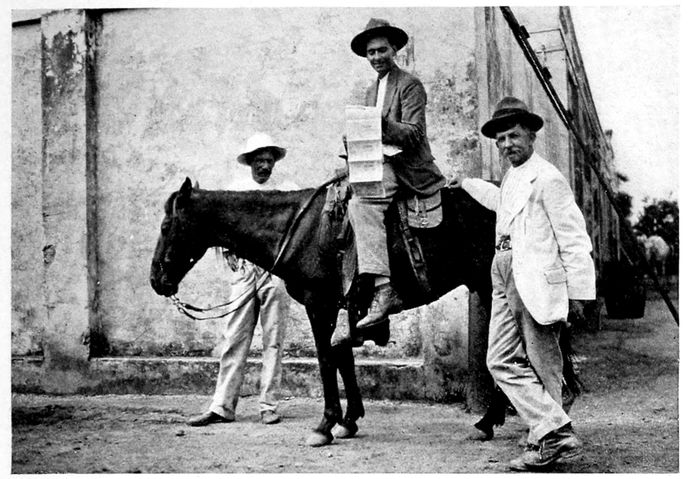
Vendors of lottery tickets in rural Cuba
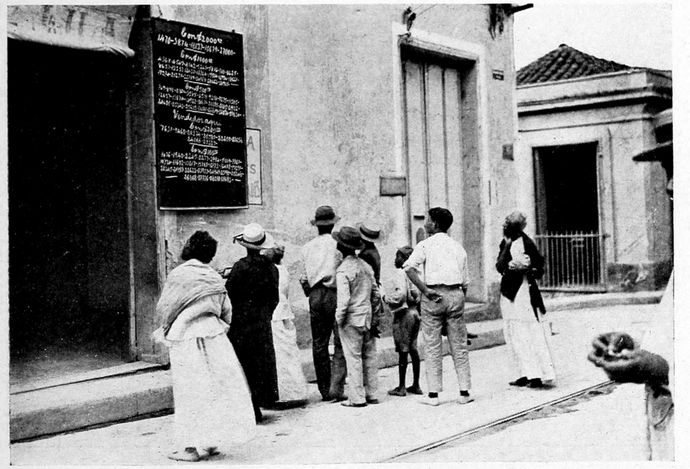
The winning numbers of the lottery
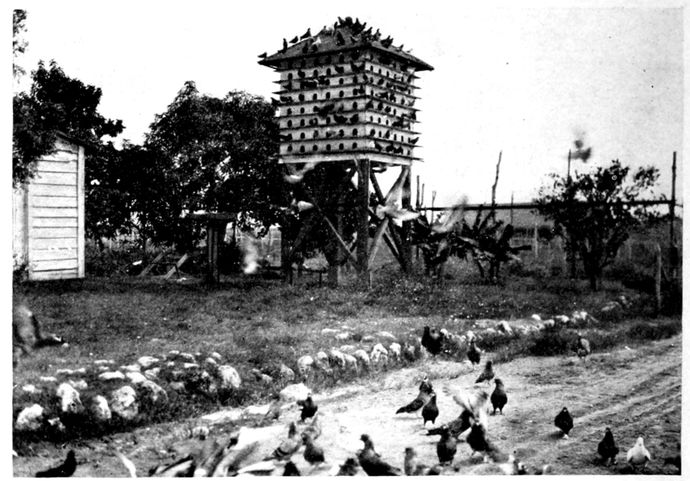
Pigeons are kept to clear the tobacco fields of insects
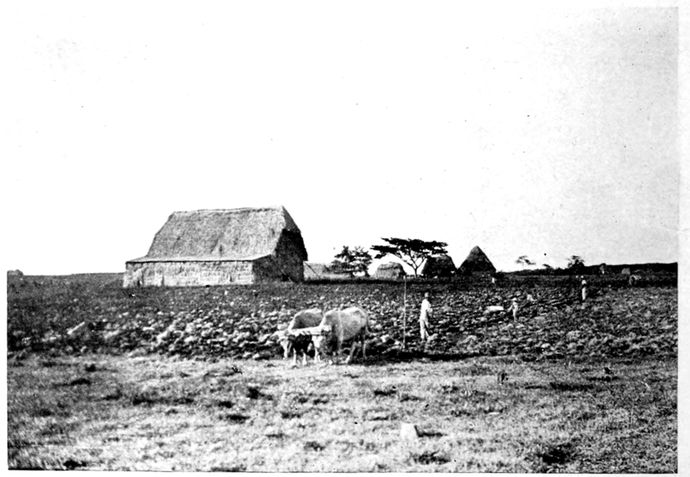
Ploughing for tobacco in the famous Vuelta Abaja district. The large building is a tobacco barn, the small ones are residences of the planters
33The very Government cannot shake off the habits of its forebears,
despite the tutelage of a more practical race. Public office is more
apt than not to be considered a legitimate source of personal gain. As
in Spain, a general amnesty is ever smiling hopefully at imprisoned
malefactors. The Spanish tendency to forgive crime, combined with
the interrelationship of miscreants and the powers that be, has not
merely abolished, in practice, all capital punishment; it tends to release
evil-doers long before they have found time to repent and change their
ways. Men who shoot down in cold blood—and this they do even
in the heart of Havana—have only to prove that the deed was done
“in the heat of the moment” to have their punishment reduced to a
mere fraction of that for stealing a mule. The pardoning power is
wielded with such Castilian generosity that the genial editor of Havana’s
American newspaper wrathfully suggests the “loosing of all our distinguished
assassins,” that the enormous cárcel facing the harbor entrance
may be replaced by one of the hotels sadly needed to house
Havana’s “distinguished visitors.”
Amid all this the island capital is deeply marked, too, with the influence
of what Latin-America calls “the Colossus of the North.”
One sees it in the strenuous pace of business, in the manners and
methods of commerce. The dignified lethargy of Spain has largely
given way to the business-first teachings of the Yankee gospel. Billboards
are almost as constant eyesores in Havana and her suburbs as
in New York; huge electric figures flash the alleged virtues of wares
far into the soft summer nights. Blocks of office buildings, modern
in every particular, shoulder their way upward into the tropical sky.
With few exceptions the sons of proud old Cuban families scorn to
dally away their lives, Castilian fashion, on the riches and reputations
of their ancestors, but descend into the commercial fray.
34One sees the American influence in many amusing little details.
The Cuban mail-boxes are exact copies of our own, except that the
lettering is Spanish. Postage-stamps may be had in booklet form,
which can be said of no other foreign land. Street-car fares are five
cents for any distance, with free transfers, rather than varying by
zones, as in Europe. Barbers dally over their clients in the private-valet
manner of their fellows to the north. Department stores operate
as nearly as possible on the American plan, despite the Spanish tendency
of their clerks to seek tips. Cuban advertisers struggle to imitate
in their newspaper and poster announcements the aggressive, inviting
American manner, often with ludicrous results, for they are
rarely gifted with what might be called the advertising imagination.
In a word, Havana is Spain with a modern American virility, tinged
with a generous dash of the tropics.
I have said that the two opposing influences do not mix, and in the
main that rule strictly holds. A glance at any detail of the city’s life,
her customs, appearance, or point of view, suffices to determine whether
it is of Castilian or Yankee origin. But here and there a fusing of
the two has produced a quaint mongrel of local color. Havana bakes
its bread in the long loaves of Europe, but an American squeamishness
has evolved a slender paper bag to cover them. The language of gestures
makes a crossing of two figures, a hiss at the conductor, and a
nod to right or left, sufficient request for a street-car transfer. The
man who occupies the center of a baseball diamond may be called
either a pitcher or a lanzador, but the verb that expresses his activity is
pitchear. Shoe-shining establishments in the shade of the long, pillared
arcades are arranged in Spanish style, yet the methods and the prices
of the polishers are American.
Barely had we stepped ashore in Havana when I spied a man in the
familiar uniform of the American Army, his upper sleeve decorated
with three broad chevrons. I had a hazy notion that our intervention
in Cuba had ceased some time before, yet it would have been nothing
strange if some of our troops had been left on the island.
“Good morning, Sergeant,” I greeted him. “Do you know this
town? How do I get to—”
But he was staring at me with a puzzled air, and before I could
finish he had sidestepped and hurried on. I must have been dense
that morning, after a night of uproar on the steamer from Key West,
for a score of his fellows had passed before I awoke to the fact that
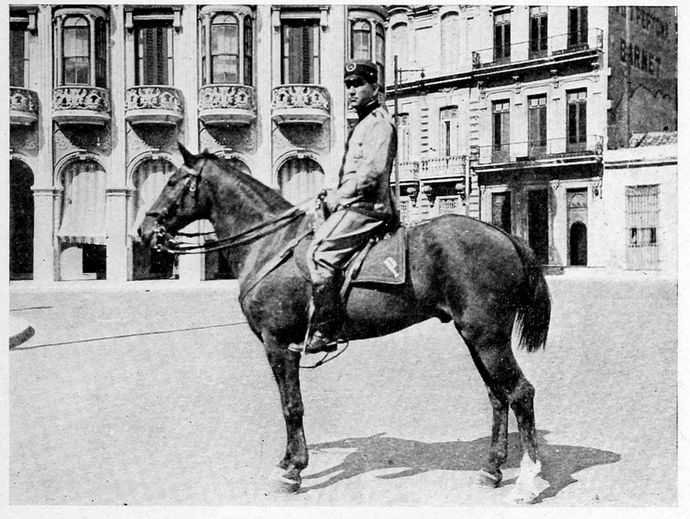
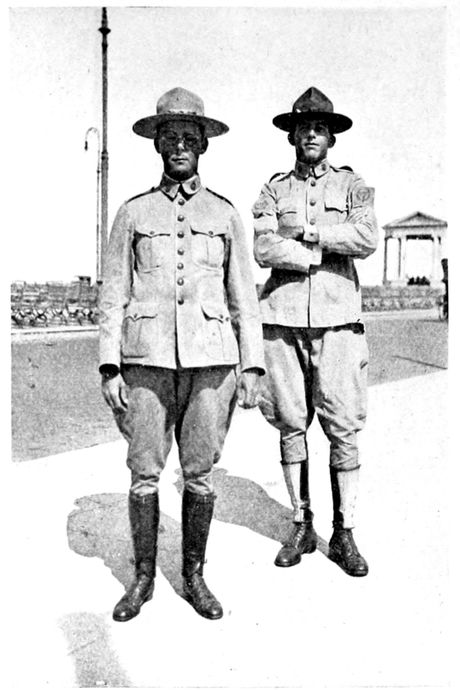
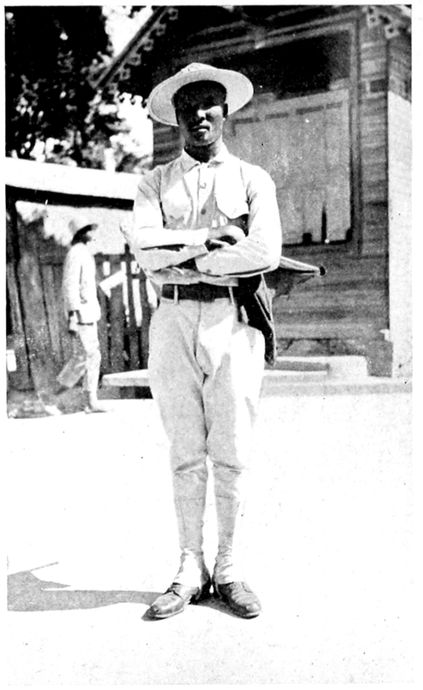
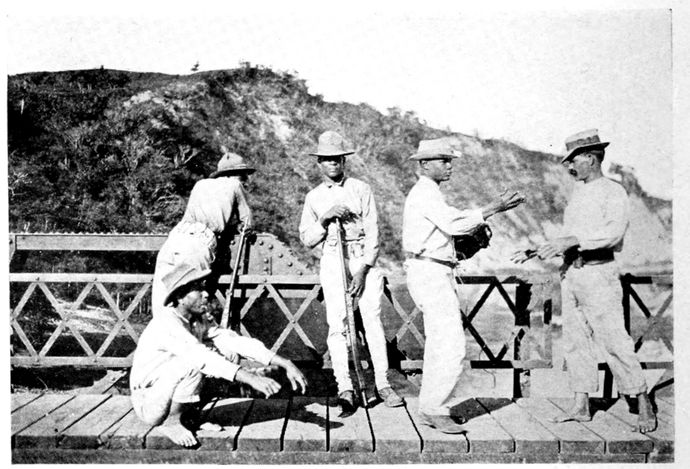
35they were not American soldiers at all. Cuba has copied nothing
more exactly than our army uniform. Cotton khaki survives in place
of olive drab, of course, as befits the Cuban climate; frequent washings
have turned most of the canvas leggings a creamy white. Otherwise
there is little to distinguish the Cuban soldier from our own until
he opens his mouth in a spurt of fluent Spanish. He wears the same
cow-boy sombrero, with similar hat-cords for each branch of the
service. He shoulders the same rifle, carries his cartridges in the old
familiar web-belt, wears his revolver on the right, as distinct from the
left-handed fashion of all the rest of Latin-America. He salutes,
mounts guard, drills, stands at attention precisely in the American
manner, for his “I. D. R.” differs from our own only in tongue. The
same chevrons indicate non-commissioned rank, though they have not
yet disappeared from the left sleeve. His officers are indistinguishable,
at any distance, from our own; they are in many cases graduates of
West Point. An angle in their shoulder-bars, with the Cuban seal in
bronze above them, and the native coat of arms on their caps in place
of the spread eagle, are the only differences that a close inspection of
lieutenants or captains brings to light. From majors upward, however,
the insignia becomes a series of stars, perhaps because the absence
of generals in the Cuban Army leaves no other chance for such
ostentation.
The question naturally suggests itself, “Why does Cuba need an
army?” The native answer is apt to be the Spanish version of “Huh,
we’re a free country, aren’t we? Why shouldn’t we have an army,
like any other sovereign people? Poor Estrada Palma, our first president,
had no army, with the result that the first bunch of hoodlums to
start a revolution had him at their mercy.”
These are the two reasons why one sees the streets of Havana, and
all Cuba, for that matter, khaki-dotted with soldiers. She has no designs
on a trembling world, but an army is to her what long trousers
are to a youth of sixteen, proof of his manhood; and she has very real
need of one to keep the internal peace within the country, particularly
under a Government that was not legally elected and which enjoys little
popularity.
There were some fourteen thousand “regulars” in the Cuban Army
before the European War, a number that was more than tripled under
compulsory service after the island republic joined the Allies.
To-day, despite posters idealizing the soldier’s life and assuring all
Cubans that it is their duty to enlist, despite a scale of pay equalling our
36own, their land force numbers barely five thousand. Many of these
are veterans of the great European war,—as fought in Pensacola,
Florida. Some wear fifteen to eighteen years’ worth of service stripes
diagonally across their lower sleeves; a few played their part in the
guerilla warfare against the Spaniards before the days of independence,
and have many a thrilling anecdote with which to overawe each
new group of “rookies.” In short, they have nearly everything in
common with our own permanent soldiers—except the color-line.
I have yet to see a squad of white, or partly white, American soldiers
march away to duty under a jet-black corporal, a sight so commonplace
in Havana as not even to attract a passing attention.
Havana has just celebrated her four-hundredth birthday. She confesses
herself the oldest city of European origin in the western hemisphere.
Her name was familiar to ocean wayfarers before Cortés
penetrated to the Vale of Anáhuac, before Pizarro had heard the first
rumors of the mysterious land of the Incas. When the Pilgrim Fathers
sighted Plymouth Rock, Havana had begun the second century of her
existence. In view of all this, and of the harried career she led clear
down to days within the memory of men who still consider themselves
youthful, she is somewhat disappointing to the mere tourist for her
lack of historical relics. This impression, however, gradually wears
off. Her background is certainly not to be compared with that of
Cuzco or of the City of Mexico, stretching away into the prehistoric
days of legend; yet many reminders of the times that are gone peer
through the mantle of modernity in which she has wrapped herself.
From the age-worn stones of La Fuerza the bustle of the city of to-day
seems a fantasy from dreamland. In the underground passages of old
Morro, in the musty dungeons of massive Cabaña, the khaki-clad soldiers
of Cuba’s new army look as out of place as motor-cars in a Roman
arena. The stroller who catches a sudden unexpected glimpse of the
cathedral façade is carried back in a twinkling to the days of the Inquisition;
Spain herself can show no closer link with the Middle Ages
than the venerable stone face of San Francisco de Paula. The ghosts
of monks gone to their reward centuries ago hover about the post-office
where the modern visitor files his telegram or stamps his picture postals.
The British occupied it as a barracks when they captured Havana in
the middle of the last century, whereby the ancient monastery was considered
desecrated, and has served in turn various government purposes;
37yet the shades of the past still linger in its flowery patio and flit
about the corners of its capacious, leisurely old stairways.
Old Havana may be likened in shape to the head of a bulldog, with
the mark of the former city wall, which inclosed it like a muzzle, still
visible. The part thus protected in olden days contains most of
Havana’s antiquity. Beyond it the streets grow wider, the buildings
more modern, as one advances to the newer residential suburbs. Amusing
contrasts catch the eye at every turn within the muzzled portion.
Calle Obispo, still the principal business street, is a scant eighteen feet
wide, inclusive of its two pathetically narrow sidewalks. The Spanish
builders did not foresee the day when it would be an impassable
river of clamoring automobiles. They would be struck dumb with
astonishment to see these strange devil-wagons housed in the tiled
passageways behind the massive carved or brass-studded doors of the
regal mansions of colonial days, as their fair ladies would be horrified
to find the family chapels turned into bath-rooms by desecrating barbarians
from the North. Office buildings that seem to have been bodily
transported from New York shoulder age-crumbled Spanish churches
and convents; crowds as business-bent as those of Wall Street hurry
through narrow callejones that seem still to be thinking of Columbus
and the buccaneers of the Spanish main. Long rows of massive pillars
upholding projecting second stories and half concealing the den-like
shops behind them have a picturesque appearance and afford a needed
protection from the Cuban sun, but they are little short of a nuisance
under modern traffic conditions. Old Colón market is as dark and unsanitary
as when mistresses sent a trusted slave to make the day’s purchases.
Its long lines of cackling fowls, of meat barely dead, of tropical
fruits and strange Cuban vegetables, are still the center of the old
bartering hubbub, but beside them are the very latest factory products.
One may buy a chicken and have it killed and dressed on the spot for a
real by deep-eyed old women who seem to have been left behind by a
receding generation, or one may carry home canned food which colonial
Havana never tasted.
The city is as brilliantly lighted as any of our own, by dusky men
who come at sunset, laboriously carrying long ladders, from the tops
of which they touch off each gas jet as in the days of Tacón. Ferries
as modern as those bridging the Hudson ply between the Muelle
de Luz and the fortresses and towns across the harbor; but they still
have as competitors the heavy old Havana rowboats, equipped, when
38the sun is high, with awnings at the rear, and manned by oarsmen as
stout-armed and weather-tanned as the gondoliers of Venice. Automobiles
of the latest model snort in continual procession around the
Malecón on Sunday afternoons, yet here and there a quaint old family
carriage, with its liveried footmen, jogs along between them. Many
a street has changed its name since the days of independence, but still
clings to its old Spanish title in popular parlance. A new system of
house numbering, too, has been adopted, but this has not superseded
the old; it has merely been superimposed upon it, until it is a wise door
indeed that knows its own number. To make things worse for the
puzzled stranger, the two sides of the street have nothing in common,
so that it is nothing unusual to find house No. 7 opposite No. 114.
Havana is most beautiful at night. Its walls are light in color, yellow,
orange, pink, pale-blue, and the like prevailing, and the witchery
of moonlight, falling upon them, gives many a quaint corner or narrow
street of the old city a resemblance to fairyland. But when one
hurries back to catch them with a kodak in the morning, it is only to
find that the chief charm has fled before the grueling light of day.
The architecture of the city is overwhelmingly Spanish, with only
here and there a detail brought from the North. The change from the
wooden houses of Key West, with their steep shingled roofs, to the
plaster-faced edifices of Havana, covered by the flat azoteas of Arab-Iberian
origin often the family sitting-room after sunset, is sharp and
decided. Among them the visitor feels himself in a foreign land indeed,
whatever suggestions of his own he may find in the life of the
city. The tendency for low structures, the prevalence of sumptuous
dwellings of a single story, the preference for the ground floor as a
place of residence, show at a glance that this is no American city.
Yet the single story is almost as lofty as two of our own; the Cuban
insists on high ceilings, and the longest rooms of the average residence
would be still longer if they were laid on their sides. To our Northern
eyes it is a heavy architecture, but it is a natural development in the
Cuban climate. Coolness is the first and prime requisite. Massive
outer walls, half their surfaces taken up by immense doors and windows,
protected by gratings in every manner of artistic scroll, defy
the heat of perpetual summer, and at the same time give free play
to the all but constant sea breezes. The openness of living which this
style of dwelling brings with it would not appeal to the American sense
of privacy in family life. Through the iron-barred rejas, flush with
the sidewalk, the passer-by may look deep back into the tile-floored
39parlor, with its forest of chairs, and often into the living-rooms beyond.
At midday they look particularly cool and inviting from the
sun-drenched street; in the evening the stroller has a sense of sauntering
unmolested through the very heart of a hundred family circles.
Old residents tell us that Havana is a far different city from the one
from which the Spanish flag was banished twenty years ago. Its best
streets, they say, were then mere lanes of mud, or their cobbled pavements
so far down beneath the filth of generations that the uncovering
of them resembled a mining operation. Along the sea, where a boulevard
second only to the peerless Beira Mar of Rio runs to-day, the last
century left a stenching city garbage-heap. The broad, laurel-shaded
Prado leading from the beautiful central plaza to the headland facing
Morro Castle was a labyrinthian cluster of unsavory hovels. All
this, if one may be pardoned a suggestion of boasting, was accomplished
by the first American governor. But the Cubans themselves
have continued the good work. Once cleaned and paved, the streets
have remained so. Buildings of which any city might be proud have
been erected without foreign assistance. In their sudden spurt of
ambition the Cubans have sometimes overreached themselves. A
former administration began the erection of a presidential palace destined
to rival the best of Europe. About the same time the provincial
governor concluded to build himself a simple little marble cabin. Election
day came, and the new president, after the spendthrift manner
of Latin-American executives, repudiated the undertaking of his
predecessor, which lies to-day the abandoned grave of several million
pesos. The governor of the province was convinced by irrefutable
arguments that this half-finished little cabin was out of proportion to his
importance, and yielded it to his political superior. It is nearing completion
now, a thing of beauty that should, for a time at least, satisfy
the artistic longings even of great Cuba. For it has nothing of the
inexpensive Jeffersonian simplicity of our own White House, fit only
for such plebeian occupants as our Lincolns and Garfields, but is worthy
a Cuban president—during the few months of the year when he is
not occupying his suburban or his summer palace.
Havana has grown in breadth as well as character since it became
the capital of a free country. While the population of the island has
nearly doubled, that of the metropolis has trebled. Víbora, Cerro, and
Jesús del Monte have changed from outlying country villages of
thatched huts to thriving suburbs; Vedado, the abode of a few scattered
farmers when the Treaty of Paris was signed, has become a great
40residential region where sugar-millionaires and successful politicians
vie with one another in the erection of private palaces, not to mention
the occasional perpetration of architectural monstrosities. Under the
impulse of an ever-increasing and ever-wealthier population, abetted
by energetic young Cubans who have copied American real-estate methods,
Havana is already leaping like a prairie fire to the crests of new
fields, which will soon be wholly embraced in the conflagration of
prosperity.
One of the purposes of Cuba’s revolt against Spain was the suppression
of the lottery. For years the new republic sternly frowned
down any tendency toward a return of this particular form of vice.
To this day it is unlawful to bring the tickets of the Spanish lottery
into the island. But blood will tell, and the mere winning of political
freedom could not cure the Cuban of his love for gambling. Private
games of chance increased in number and spread throughout the
island. The Government saw itself losing millions of revenue yearly,
while enterprising persons enriched themselves; for to all rulers of
Iberian ancestry the exploitation of a people’s gambling instinct seems
a legitimate source of state income. New palaces and boulevards cost
money, independence brings with it unexpected expenditures. By the
end of the second intervention the free Cubans were looking with favor
upon a system which they had professed to abhor as Spanish subjects.
The law of July 7, 1909, decreed a public revenue under the name of
“Lotería Nacional,” and to-day the lottery is as firmly established a
function of the Government as the postal service.
There are two advantages in a state lottery—to the government.
It is not only an unfailing source of revenue; it is a splendid means
of rewarding political henchmen. Colectorías, the privilege of dispensing
lottery-tickets within a given district, are to the Cuban congressman
what postmasterships are to our own. The possession of
one is a botella (bottle), Cuban slang for sinecure; the lucky possessor
is called a botellero. He in turn distributes his patronage to the lesser
fry and becomes a political power within his district. The whole makes
a splendidly compact machine that can be turned to any purpose by
the chauffeur at the political wheel.
The first and indispensable requisite of a state lottery is that the
drawings shall be honest. Your Spanish-minded citizen will no more
do without his gambling than he will drink water with his meals; but
let him for a moment suspect that “the game is crooked” and he will
41abandon the purchase of government tickets for some other means of
snatching sudden fortune. The drawing of the Cuban lottery is surrounded
by every possible check on dishonesty. By no conceivable
chance could the inmost circle of the inner lottery councils guess
the winning number an instant before it is publicly drawn. But there
is another way in which the game is not a “fair shake” to the players,
though the simpler type of Cuban does not recognise the unfairness.
The average lottery, for instance, offers $420,000 in prizes. The legal
price of the tickets is $20, divided into a hundred “pieces” for the convenience
of small gamblers, at a peseta each. Thirty thousand tickets
are sold, of which 30% of the proceeds, or $180,000, goes to the government
or its favorite henchmen. That leaves to begin with only
fourteen of his twenty cents that can come back to the player. Then
the law allows the vender 5% as his profit, bringing the fractional
ticket up to twenty-one cents. If that were all, the players would still
have even chances of a reasonable return. But the “pieces” are never
sold at that price, despite the law and its threat of dire punishment,
printed on the ticket itself. From one end of the island to the other
the billeteros demand at least $30 a billete; in other words the public
is taxed one half as much as it puts into the lottery itself to support
thousands of utterly useless members of society, the ticket-sellers, and
instead of getting two-thirds of its money back it has a chance of rewinning
less than half the sum hazarded. The most optimistic negro
deckhand on a Mississippi steamboat would hardly enter a crap
game in which the “bones” were so palpably “loaded.” Yet Cubans
of high and low degree, from big merchants to bootblacks, pay their
tribute regularly to the Lotería Nacional.
Barely had we arrived in Havana when the rumor reached me that
the billeteros could be compelled to sell their tickets at the legal price,
if one “had the nerve” to insist. I abhor a financial dispute, but I
have as little use for hearsay evidence. I concluded to test the great
question personally. Having purchased two “pieces” at the customary
price, to forestall any charge of miserliness, I set out to buy one at the
lawful rate. A booth on a busy corner of Calle Obispo, a large choice
of numbers fluttering from its ticket-racks, seemed the most promising
scene for my nefarious project, because a traffic policeman stood close
by. I chose a “piece” and, having tucked it away in a pocket, handed
the vender a peseta.
“It is thirty cents,” he announced politely, smiling at what he took
to be my American innocence.
42“Not at all,” I answered, blushing at my own pettiness. “The
price is twenty cents; it is printed on the ticket.”
“I sell them only at thirty,” he replied, with a gesture that invited me
to return the ticket.
“The legal price is all I pay,” I retorted. “If you don’t like that,
call the policeman,” and I strolled slowly on. In an instant both the
vender and the officer were hurrying after me. The latter demanded
why I had not paid the amount asked.
“The law sets the price at twenty cents,” I explained. “As a guardian
of order, you surely do not mean to help this man collect an illegal
sum.”
The policeman gave me a look of scorn such as he might have turned
upon a millionaire caught stealing chickens, and answered with a sneer:
“He is entitled to one cent profit.”
“But not to ten cents,” I added triumphantly.
The guardian of law and order grunted an unwilling affirmative,
casting a pitying glance up and down my person, and turned away with
another audible sneer only when I had produced a cent. The vender
snatched the coin with an expression of disgust, and retains to this day,
I suppose, a much lower opinion of Americans.
This silly ordeal, which I have never since had the courage to repeat,
proved the assertion that the Cubans may buy their lottery-tickets at
the legal price, but it demonstrated at the same time why few of them
do so. Pride is the chief ally of the profiteer. The difference between
twenty cents and thirty is not worth a dispute, but the failure of the
individual Cuban to insist upon his rights, and of his Government to
protect them, constitutes a serious tax upon the nation and enriches
many a worthless loafer. With some forty lottery drawings a year,
this extra, illegal ten cents a “piece” costs the Cuban people the neat
little sum of at least $12,000,000 a year, or four dollars per capita.
The drawings take place every ten days, besides a few loterías extraordinarias,
with prizes several times larger, on the principal holidays.
They are conducted in the old treasury building down near the
end of Calle Obispo. We reached there soon after seven of the morning
named on our tickets. A crowd of two hundred or more heavy-mouthed
negroes, poorly clad mestizos, and ragged, emaciated old
Chinamen for the most part, were huddled together in the shade at the
edge of the porch-like room. A policeman—not the one whose scorn
I had aroused—beckoned us to step inside and take one of the seats
of honor along the wall, not, evidently, because we were Americans,
43but because our clothing was not patched or our collars missing. At
the back a long table stretched the entire length of the room. A dozen
solemn officials, resembling a jury or an election board, lolled in their
seats behind it, a huge ledger, a sheath of papers, an ink-well and several
pens and pencils before each of them. At the edge of the room, just
clear of the standing crowd of hopeful riffraff, was a similar table
on which another group of solemn-faced men were busily scribbling
in as many large blank-books, with the sophisticated air of court or
congressional reporters. Between the tables were two globes of open-work
brass, one perhaps six feet in diameter, the other several times
smaller. The larger was filled with balls the size of marbles, each
engraved with a number; the smaller one contained several thousand
others, representing varying sums of money.
Almost at the moment we entered a gong sounded. Four muscular
negroes rushed forth from behind the scenes and, grasping two handles
projecting at the rear, turned the big globe over and over, its myriad of
little balls rattling like a stage wind-storm. At the same time an individual
of as certain, if less decided, African ancestry, solemnly
shuffled the contents of the smaller sphere in the same manner. Then
the interrupted drawing began again. Four boys, averaging eight years
of age, stood in pairs at either globe. At intervals of about thirty seconds
two of them pulled levers that released one marble from each
sphere, and which long brass troughs or runways deposited in cut-glass
bowls in front of the other two boys. The urchin on the big
globe side snatched up his marble, called out a long number—in most
cases running into the tens of thousands—and as his voice ceased, his
companion opposite announced the amount of the prize. Then the
two balls were spitted side by side on a sort of Chinese reckoning-board
manipulated by another solemn-faced adult, who now and again
corrected a misreading by the boy calling the numbers.
For the hour we remained this monotonous formality went steadily
on, as it does every ten days from seven in the morning until nearly
noon, ceasing only when all the balls in the smaller sphere have been
withdrawn. Each of these represents a prize, but as considerably
more than a thousand of them are of one hundred dollars each—or a
dollar a “piece”—the almost constant “con cien pesos” of the prize-boy
grew wearisome in the extreme. The men at the reporters’ table
scribbled every number feverishly with their sputtering steel pens,
but the “jury” at the back yielded to the soporific drone of childish
voices and dozed half-open-eyed in their chairs—except when one of
44the major prizes was announced. Then they sat up alertly at attention,
and inscribed one after another on their massive ledgers the number
on the ball which an official held before each of their noses in turn,
while the patch-clad gathering outside the room shifted excitedly on
their weary feet and scanned the “pieces” in their sweaty hands with
varying expressions of disgust and disappointment. Now and then the
boys changed places, but only one of them, of dull-brown complexion
and already gifted with the shifty eye of the half-caste, performed his
task to the general satisfaction. The others were frequently interrupted
by a protest from one of the recorders, whereupon the number
that had just been called was emphatically reread by an adult, amid
much scratching of pens in the leather-bound ledgers. If the monotony
of the scene was wearisome, its solemnity made it correspondingly
amusing. An uninformed observer would probably have taken it for
at least a presidential election. Rachel asserted that it reminded her
of Alice in Wonderland, but as my education was neglected I cannot
confirm this impression. What aroused my own wonder was the fact
that some two score more-or-less-high officials of a national government
should be engaged in so ridiculous a formality, and that a sovereign
republic should indulge in the nefarious profession of the bookmaker.
But to every people its own customs.
If I had fancied it the fault of my own ear that I had not caught
all the numbers, the impression would have been corrected by the
afternoon papers. All of them carried a column or more of protest
against the “absurd inefficiency” of the boys who had served that
morning; most of them made the complaint the chief subject of their
editorial pages. The Casa de Beneficencia—an institution corresponding
roughly to our orphan asylums—was solemnly warned that it must
thereafter furnish more capable inmates to cantar las bolas (“sing the
balls”) on pain of losing the privilege entirely. Not only had the
“uninstructed urchins” of that morning made mistakes in reading
the numbers—a dastardly thing from the Cuban point of view—but
had pronounced many of them in so slovenly a manner that “our special
reporters were unable to supply our readers with correct information
on a subject of prime importance to the entire republic.” Beware that
it never happened again! It was easy to picture the poor overworked
nuns of the asylum toiling far into the night to impress upon a multi-complexioned
group of fatherless gamins the urgent necessity of learning
to read figures quickly and accurately, if they ever hoped to become
45normal, full-grown men and perhaps win the big prize some day themselves.
Winning tickets may be cashed at any official colectoría at any time
within a year, but such delays are rare. Barely is the drawing ended
when the venders, armed with the billetes of the next sorteo, hurry
forth over their accustomed beats to pay the winners and establish a
reputation not so much for promptitude as for the ability to offer lucky
numbers. The capital prize, $100,000 in most cases, is perhaps won
now and then by some favorite of fortune, instead of falling to the
Government, collector of all unsold winners, though I have never
personally known of such a stroke of luck during all my wanderings
in lottery-infested lands. Smaller causes for momentary happiness
are more frequent, for with 1741 prizes, divisible into a hundred
“pieces” each, it would be strange if a persistent player did not now
and then “make a killing.” But even these must be rare in comparison
to the optimistic multitude that pursues the goddess Chance, for on
the morning following a drawing the streets of Havana are everywhere
littered with worthless billetes cast off by wrathy purchasers. Wherefore
an incorrigible moralist has deduced a motto that may be worth
passing on to future travelers in Cuba:
“Buy a ‘piece’ or two that you may know the sneer of Fortune,
but don’t get the habit.”
Three days before the wedding of my sister, mama, she and I went to the
house of my future brother-in-law to put Alice’s things in order. The novio
was not there. He had discreetly withdrawn to a hotel and only came home
now and then for a few moments to give orders to the servants. If he found
us there he greeted us in the hall and did not enter the rooms except as we
invited him. As there were no women in his family we had to occupy ourselves
with all these matters.
“Listen, my daughter,” said mama, one night, after the novio had gone, “when
to-morrow you take leave of your fiancé do not pass beyond the line marked on
the floor by the light of the hall lamp.” My sister started to protest, “But, mama,
what is there wrong in that?” “Nothing, daughter, but it is not proper. Do as
I tell you.” Alice, though slightly displeased with the order, always obeyed it
thereafter.
These two quotations from one of Cuba’s latest novels give in a nutshell
the position of women in Cuba. Like all Latin-American countries,
especially of the tropics, it is essentially a man’s country. One
of the great surprises of Havana is the scarcity of women on the
streets, even at times when they swarm with promenading men. The
46Cuban believes as firmly as the old Spaniard that the woman’s sphere
is strictly behind the grill of the front window, and with few exceptions
the women agree with him. The result is that her interest in life
beyond her own household is virtually nil. The “Woman Suffrage
Party of Cuba” recently issued a pompous manifesto, but it seems to
have won about as much support on the island as would a missionary
of the prohibition movement. In the words of the militants of the sex
in Anglo-Saxon lands, “the Cuban woman has not yet reached emancipation.”
The clerks, even in shops that deal only in female apparel, are almost
exclusively male. The offices that employ stenographers or assistants
from the ranks of the fair sex are rare, and those usually recruit such
help in the United States. Except on gala occasions, it is extremely
seldom that a Cuban girl of the better class is seen in public, and even
then only in company with a duenna or a male member of her immediate
family, and few married women consider it proper to appear unaccompanied
by their husbands, despite American example. As another
Cuban waiter has put it, “One of our greatest defects is the little or
entire lack of genuine respect for women. Though we are outwardly
extremely gallant in society and sticklers for the finer points of
etiquette and courtesy, we almost always look upon a woman merely as
a female and our first thought of at least a young and beautiful
woman is to imagine all her hidden perfections. The instant a lady
comes within sight of the average Cuban gathering all eyes are fixed
upon her with a stare that in Anglo-Saxon countries would be more
than impertinent, which pretends to be flattering, but which at bottom
is truly insulting.” He does not add that the women rather invite
this attention and feel themselves slighted, their attractions unappreciated,
if it is not given. Yet of open offenses against her modesty the
Cuban lady is freer than on the streets of our own large cities. Even
in restaurants and gatherings where those of the land never appear, an
American woman is treated, except in the matter of staring, with
genuine courtesy by all classes.
The custom of living almost exclusively in the privacy of her own
home has given the Cuban woman a tendency to spend the day in
disreputable undress. Their hair dishevelled, their forms loosely enveloped
in a bata or in a slatternly petticoat and dressing-sack, usually
torn and seldom clean, their toes thrust into slippers that slap at every
step, they slouch about the house all the endless day. Unless there
are guests they never dress for lunch, seldom for dinner, but don
47instead earrings, necklaces, bracelets, and an astonishing collection of
finger rings, powdering their faces rather than washing them. During
meals the favorite topics of conversation are food and digestion; if
one of them has had any of the numerous minor ailments natural to a
life of non-exertion, it is sure to be the subject of a cacophonous discussion
that lasts until the appearance of the inevitable toothpicks.
Servants, with whom they associate with a familiarity unknown in
Northern homes, are numerous, and leave little occupation for the
mothers and daughters. The women never read, not even the newspapers,
and their minds, poorly trained to begin with in the nun-taught
“finishing schools,” go to seed early, so that by late youth or early
middle age their faces show the effects of a selfish, idle existence and
a life of continual boredom. But lest I be accused of being over-critical,
let me quote once more the native writer already introduced:
In one of the interior habitations a piano sounded, beaten by a clumsy hand
that repeated the same immature exercise without cessation. There was general
discussion in the dining-room at all hours of the day, mingled with the shrieks of
a parrot which swung on a perch suspended from the ceiling and the constant
disputes of the children, who were snatching playthings from one another, heaping
upon each other every class of verbal injury. The mother sewed and the
older children tortured the piano during entire hours, or polished their nails with
much care, rubbing them with several kinds of powders. When they had finished
these occupations they slouched from one end of the house to the other, throwing
themselves in turn upon all the divans or into the cushioned rocking-chairs and
yawning with ennui. Their skirts fell from their belts, loosened by the languid
and lazy gait. The mother did not want the girls to do anything in the house for
fear they would spoil their hands and lose their chances of marriage. On the
other hand, in the afternoon when the hour of visits drew near the time was
always too short to distribute harmoniously the color on their cheeks and lips
and to take off the little hair papers with which they artificially formed their
waves or curls during the day.
This continual hubbub seems to be customary to every household;
all intercourse, be it orders to servants or admonitions to the insufferable
children, being carried on by yelling. And there are no worse
voices in the world than those of the Cuban women. Whether it is
due to the climate or to the custom of reciting in chorus at school, they
have a timbre that tortures the ear-drums like the sharpening of a saw,
and all day long they exercise them to the full capacity of their lungs.
Under no circumstances is one of them given the floor alone, but the
slightest morsel of gossip is threshed to bits in a free-for-all whirlwind
of incomprehensible shrieking.
48On the other hand, the Cuban woman accepts many children willingly,
and in accordance with her lights is an excellent wife and mother.
Indeed, she is inclined to be over-affectionate, and given to serving her
children where they should serve themselves, with a consequent lack
of development in their characters. The boys in particular are
“spoiled” by being granted every whim. The men are much less
often at home than is the case with us, and seldom inclined to exert a
masculine influence on their obstreperous sons. The result is a lack
of self-control that makes itself felt through all Cuban manhood, a
“touchiness,” an inclination to stand on their dignity instead of yielding
to the dictates of common sense.
But if she is slouchy in the privacy of her own household, the Cuban
woman is quite the opposite in public. The grande toilette is essential
for the briefest appearance on the streets. American women assert
that there is no definite style in feminine garb in Cuba, and I should
not dream of questioning such authority, though to the mere masculine
eye they always seem “dressed within an inch of their lives” whenever
they emerge into the sunlight. But it does not need even the
intuition of the sometimes unfair sex to recognise that a life of physical
indolence leaves their figures somewhat dumpy and ungraceful, seldom
able to appear to advantage even in the best of gowns. Nor is it hard
to detect a sense of discomfort in their unaccustomed full dress, which
makes them eager to hurry home again to the negligée of bata and
slippers.
If the men monopolize other places of public gathering, the churches
at least belong to the women. There are few places of worship in
Havana, or in all Cuba, for that matter, that merit a visit for their own
sake. Though most of them are overfilled with ambitious attempts
at decoration, none of these is very successful. A single painting of
worth here and there, an occasional side chapel, one or two carved
choir-stalls, are the only real artistic attractions. But several of them
are well worth visiting for the side-lights they throw on Cuban customs.
As in Spain, every variety of diseased beggar squats in an appealing
attitude against the façades of the more fashionable religious
edifices during the hours of general concourse. Luxurious automobiles,
with negro chauffeurs in dazzling white liveries, sweep up to the foot
of the broad stone steps in as continual procession as the narrow streets
permit, but the passengers who alight are overwhelmingly of the gown-clad
gender. Within, the perfume of the worshipers drowns out the
incense. A glance across the sea of kneeling figures discloses astonishingly
few bare heads. The Cuban men, of course, are “good
Catholics,” too, but they are apt to confine their church attendance to
special personal occasions. The church has no such influence in public
affairs in Cuba as in many parts of the continent to the southward; so
little indeed, that public religious processions are forbidden by law,
though sometimes permitted in practice. If the Jesuits are still a
power to be reckoned with, so are los masones, and the mere proof of
irreligion is no effective bar to governmental or commercial preferment.
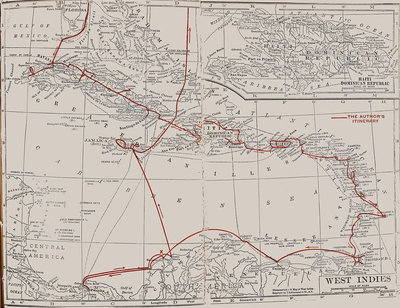
[Click anywhere on map for high resolution image.]
49A deaf person would probably enjoy Havana far more than those of
acute hearing. I have often wondered why nature did not provide us
with earlids as well as eyelids. A mere oversight, no doubt, that would
not have been made had the Cuban capital existed when the first models
of the human being were submitted. Havana may not hold the noise
championship of the world, but at least little old New York is silent
by comparison. Unmuffled automobiles beyond computation, tramcars
that seem far more interested in producing clamor than speed,
bellowing venders of everything vendible, are but the background of an
unbroken uproar that permeates to every nook and cranny of the city.
Honest hotel-keepers tell you frankly that they can offer every comfort
except quiet. Even in church you hear little but the tumult outside,
broken only at rare intervals by the droning voice of the preacher. It
is not simply the day-time uproar of business hours; it increases
steadily from nightfall until dawn. In olden days the sereno, with his
dark lantern, his pike, pistol, bunch of keys, whistle, and rope, wandered
through the streets calling out the time and the state of the weather
every half-hour. His efforts would be wasted nowadays. The long-seasoned
inhabitants seem to have grown callous to the constant turbulence;
I have yet to meet a newcomer who confesses to an unbroken
hour of sleep. If you move out to one of the pensions of Vedado, the
household itself will keep you constantly reminded that you are still
in Havana. The Cubans themselves seem to thrive on noise. If they
are so unfortunate as to be denied their beloved din, they lose no time
in producing another from their own throats. After a week in Havana
we took a ferry across the harbor and strolled along the plain behind
Cabaña Fortress. For some time we were aware of an indefinable
sensation of strangeness amounting almost to discomfort. We had
covered a mile or so more before we suddenly discovered that it was
due to the unaccustomed silence.
50
Steamers to Havana land the traveler within a block or two
of the central railway station, so that, if the capital has no fascination
for him, there lies at hand more than four thousand
kilometers of track to put him in touch with almost any point of the
island. The most feasible way of visiting the interior of Cuba is by
rail, unless one has the time and inclination to do it on foot. Automobiles
are all very well in the vicinity of Havana, but the Cuban,
like most Latin-Americans, is distinctly not a road builder, and there are
long stretches of the island where only the single-footing native horses
can unquestionably make their way. There is occasional steamer
service along the coasts, and with few exceptions the important towns
are on the sea, but even to visit all these is scarcely seeing Cuba.
The railroads are several in number and as well equipped as our
second-class lines. One ventures as far west as Guane; there is a rather
thorough network in the region nearest the capital; or the traveler
may enter his sleeping-car at Havana and, if nothing happens, land at
Santiago in the distant “Oriente” some thirty-six hours later. Unfortunately
something usually happens. The ferry from Key West
brings not only passengers, but whole freight trains, and among the
curious sights of Cuba are box-cars from as far off as the State of
Washington basking in the tropical sunshine or the shade of royal
palms hundreds of miles east of Havana. First-class fares are higher
than those of our own land, but some eighty per cent. of the traveling
public content themselves with the hard wooden benches of what, in
spite of the absence of an intervening second, are quite properly called
third-class. Freight rates are said to average five times those in the
United States. Women of the better class are almost as rarely seen
on the trains as on the streets of Havana, with the result that the few
first-class coaches are sometimes exclusively filled with men, and
all cars are smoking-cars.
There are sights and incidents of interests even in the more commonplace
first-class coaches. In the November season, when the mills
51of the island begin their grinding, they carry many Americans on their
way back to the sugar estates, most of them of the highly skilled labor
class in speech and point of view. Now and again a well-dressed native
shares his seat with his fighting-cock, dropping about the bird’s
feet the sack in which the rules of the company require it to be carried
and occasionally giving it a drink at the passengers’ water-tank.
At frequent intervals the gamester shrilly challenges the world at large;
travelers by Pullman have been known to spend sleepless nights because
of a crowing rooster in the next berth. Train-guards in the uniform
of American soldiers, an “O. P.” on their collars—this being the
abbreviation of the Spanish words for “Public Order”—armed with
rifle, revolver, and a long sword with an eagle’s-head hilt in the beak
of which is held the retaining strap, strut back and forth through the
train, usually in pairs. Most of them are well-behaved youths, though
the wide-spread corps on which the government largely depends to
overawe its revolutionarily inclined political opponents is not wholly
free from rowdies. The trainboy and the brakemen have the same
gift of incomprehensible language as our own, and only a difference in
uniform serves in most cases to distinguish the name of the next station
from that of some native fruit offered for sale. The wares of
the Cuban train vender are more varied than in our own circumspect
land. Not only can he furnish the bottles that cheer, in any quantity
and degree of strength, but also lottery tickets, cooked food, and
oranges deftly pared like an apple, in the native fashion. There is
probably no fruit on earth which varies so much in its form of consumption
in different countries as the orange.
But it is in third-class that one may find a veritable riot of color.
Types and complexions of every degree known to the human race
crowd the less comfortable coaches. There are leather-faced Spaniards
returning for the zafra, fresh, boyish faces of similar origin and
destination, Basques in their boinas and corduroy clothes, untamed-looking
Haitians sputtering their uncouth tongue, more merry negroes
from the British West Indies, Chinamen and half-Chinamen, Cuban
countrymen in a combination shirt and blouse called a chamarreta, men
carrying roosters under their arms, men with hunting dogs, negro girls
in purple and other screaming colors, including furs dyed in tints
unknown to the animal world, and a scattering of Oriental and purely
Caucasian features from the opposite ends of the earth. Perhaps one
third of the throng would come under the classification of “niggers”
in our “Jim Crow” States; Southerners would be, and sometimes
52are, horrified to see the blackest and the whitest race sharing the same
seat and even engaged, perhaps, in animated conversation. In a
corner sits, more likely than not, an enormous negro woman with a
big black cigar protruding from her massive lips at an aggressive
angle and a brood of piccaninnies peering out from beneath her voluminous
skirts like chicks sheltered from rain by the mother hen. All
the gamut of sophistication is there, from the guajiro, or Cuban peasant,
of forty who is taking his first train-ride and is waiting in secret
terror for the first station, that he may drop off and walk home, to
others as blasé as the entirely respectable, cosmopolitan, uninteresting
travelers in the chair-car and Pullmans behind.
There are express trains in Cuba, those that make the long journey
between the two principal cities sometimes so heavy with their half
dozen third, their one or two first-class, their Pullman, baggage, express,
and mail-cars, that it is small wonder the single engine can keep
abreast of the time-table even when washouts or slippery, grass-brown
rails do not add to its troubles. Section-gangs are conspicuous by
their scarcity, and those who contract to keep the tracks clear of vegetation
by a monthly sprinkling of chemicals do not always accomplish
their task. But there is nothing more comfortable than loafing along
in the wicker chairs to be found in one uncrowded end of the first-class
coach, without extra charge, with the immense car-windows wide
open, far enough back to miss the inevitable cinders, through the perpetual,
palm-tree-studded summer of the tropics. Even the expresses
are, perhaps unintentionally, sight-seeing trains, though they are frequently
more or less exasperating to the hurried business man. But,
then, one has no right to be a hurried business man in the West Indies.
The slower majority of trains dally at each station, according to
its size, just about long enough to “give the town the once over”;
or, if it is large enough to be worth a longer visit, one is almost certain
to catch the next train if he sets out for the station as soon as it arrives.
The scene at a Cuban railway station is always interesting. Except
in the largest towns, most of the population comes down to see the train
go through, so that the platform is crowded half an hour before it is
due, which usually means an hour or two before it actually arrives.
The new-comer is apt to conclude that he has little chance of getting a
seat, but he soon learns by experience that few of these platform
loungers are actual travelers. The average station crowd is distinctly
53African in complexion, though perhaps a majority show a greater
or less percentage of European ancestry. Pompous black dames in
gaudy dresses, newly ironed and starched, with big brass earrings and
huge combs in their frizzled tresses, their fingers heavy with a dozen
cheap rings, stand coyly smoking their long black cigars. A man with
his best rooster under one arm and his best girl on the other stalks
haughtily to and fro among his rivals and admirers. An excited negro
with a gamecock in one hand waves it wildly in the air as he argues,
or tucks it under an armpit while he wrestles with his baggage. A
colored girl in robin’s-egg blue madly powders her nose in a corner,
using a pocket mirror of the size of a cabinet photograph. Guajiros
in chamarretas with stiffly starched white bosoms which give them a
resemblance to dress shirts that have not been tucked into the trousers,
a big knife in a sheath half showing below them, the trousers themselves
white, or faintly pink, or cream-colored, even of gay plaids in
the more African cases, their heads covered with immense straw hats
and their feet with noiseless alpargatas, gaze about them with the wondering
air of peasants the world over. Rural guards of the “O. P.”
strut hither and yon, making a great show of force both in numbers
and weapons. Children of all ages add their falsetto to the constant
hubbub of chatter. Here and there a worn-out old Chinaman wanders
about offering dulces for sale. A negro crone engaged in that unsavory
occupation technically known as “shooting snipes” picks up an abandoned
cigar or cigarette butt here and there, lighting it from the remnant
of another and dropping that into a pocket. The first-class waiting-room
is crowded, but the departure of the train will prove that most
of the occupants have come merely to show off their finery or examine
that of their neighbors. A white-haired old negro man wheels back and
forth in the bit of space left to him a white baby resplendent with pink
ribbons. When the train creaks in at last, would-be baggage carriers
swarm into the coaches or about departing travelers like aggressive
mosquitoes. The racial disorderliness of Latin-Americans, and their
abhorrence of carrying their own bags, make this latter nuisance universal
throughout the length and breadth of the island. It is of no
use for the American traveler to assert his own ability to bear his
burdens; no one believes him, and they are sure to be snatched out of
his hands by some officious ragamuffin before he can escape from the
maelstrom. In some stations a massive, self-assertive negro woman
“contracts” to see all hand baggage on or off the trains, keeping all
54the rabble of ragged men and boys, some of them pure white, in her employ
and collecting the gratuities herself in a final promenade through
the cars.
Sometimes the train stops for a station meal, the mere buffet service
on board being uncertain and insufficient. Then it is every one for
himself and hunger catch the hindmost, for one has small chance of
attracting the attention of the overworked concessionary if the heaping
platters with which the common table is crowded are empty before he
can lay hand upon them. Then he must trust to the old Chinamen
who patiently stand all day along the edge of the platform, or even
well into the night, slinking off into the darkness with their lantern-lighted
boxes of sweets and biscuits only when the last train has rumbled
away to the east or west.
We were invited to spend a Sunday at a big tobacco finca in the
heart of the far-famed Vuelta Abajo district in Cuba’s westernmost
province. With the exception of Guanajay the few towns between
Havana and Pinar del Rio, capital of the province of the same name,
have little importance. The passing impression is of rich red mud,
a glaring sunshine, and a wide difference between the rather foppish,
over-dressed Havanese and the uncouth countrymen in their bohíos,
huts of palm-leaves and thatch which probably still bear a close resemblance
to those in which Columbus found the aborigines living.
Then there are of course the royal palms, which grow everywhere in
Cuba in even greater profusion than in Brazil. The roads are bordered
with them, the fields are striped with their silvery white trunks,
their majestic fronds give the finishing touch to every landscape.
Pinar del Rio itself has the same baking-hot, glaring, dusty aspect
of almost all towns of the interior in the dry season, the same curious
contrasts of snorting automobiles and guajiros peddling their milk on
horseback, the cans in burlap or leaf-woven saddlebags beneath their
crossed or dangling legs. Beyond, the mixto wanders along at a jog
trot, now and then stopping for a drink or to urge a belligerent bull
off the track. Here a peasant picks his way carefully down the car
steps, carrying by a string looped over one calloused finger two lordly
peacocks craning their plumed heads from the tight palm-leaf wrappings
in which their bodies are concealed; there a family climbs aboard
with a black nursegirl of ten, whose saucer eyes as she points and exclaims
at what no doubt seems to her the swiftly fleeing landscape
show that she has never before been on a train. Tobacco is grown
55in scattered sections all over Cuba, but it is most at home in the gently
rolling heart of this western province. Being Sunday, there was little
work going on in the fields, but when we passed this way two days
later we found them everywhere being plowed with oxen, birds following
close on the heels of the plowmen to pick up the bugs and
worms, women and children as well as men transplanting the bed-grown
seedlings of the size of radish tops. Time was when the narcotic
weed had all this region to itself, but the lordly sugar-cane is
steadily encroaching upon it now, daring to grow in the very shadow
of the old, brown, leaf-built tobacco barns.
Don Jacinto himself did not meet us at the train, but his giant of a
son greeted us with an elaborate Castilian courtesy which seemed curiously
out of keeping with his fluent English, interlarded with American
college slang. How he managed to cramp himself into the driving
seat of the bespattered Ford was as much of a mystery as the apparent
ease with which it skimmed along the bottomless Cuban country road
or swam the bridgeless river. I noted that it bore no license tag and,
perhaps unwisely, expressed my surprise aloud, for Don Jacinto’s son
smiled quizzically and for some time made no other answer. Then
he explained, “Those of us who are old residents and large property
holders in our communities do not bother to take out licenses; besides,
they are only five dollars here in the country, so it is hardly worth
the trouble.”
Our host, a lordly-mannered old Spaniard who had come to Cuba
in his early youth, received us on the broad, breeze-swept veranda of
his dwelling. It was a typical Spanish country house of the tropics,
low and of a single story, yet capacious, rambling back through a
large, wide-open parlor, a dining-room almost as extensive, and a
cobbled patio to a smoke-blackened kitchen and the quarters of the
dozen black domestics who were tending the pots or responding with
alacrity to the slightest hint of a summons from Don Jacinto or his
equally imperious son. The living rooms flanked the two larger chambers,
and were as tightly closed as the latter were wide open. The
guest room opening directly off the parlor contained all the conveniences
that American influence has brought to Cuba, without losing
a bit of its Castilian architecture. There were of course neither
carpets nor rugs in the house, bare wooden floors being not only cooler,
but less inviting to the inevitable insects of the tropics. A score of
cane rocking-chairs, the same round rattan which formed the rockers
curving upward and backward to give the chair its arms, and a bare
56table, constituted the entire furniture of the parlor. On the unpapered
wooden walls hung two framed portraits and a large calendar. Boxes
of cigars lay invitingly open in all the three rooms we entered and
another decorated the table on the cement-paved veranda.
This last was the principal rendezvous of the household. There
a peon dumped a small cartload of mail, made up largely of technical
periodicals; there the servants and the overseers came to receive orders.
The demeanor of the inferiors before their masters was in perfect
keeping with the patriarchal atmosphere of the entire finca.
Thus, one easily imagined, plantation owners commanded and servants
unquestionably obeyed in the days of slavery. There was a certain
comradeship, one might almost say democracy, between the two, or
the several, social grades, but it was not one which carried with it the
slightest suggestion of familiarity on either side.
Luncheon was a ceremonious affair. Rachel, being the only lady
present, was given the head of the table, with Don Jacinto on her
right. In theory the ladies of the household were indisposed, but it
was probably only the presence of strangers, particularly a male
stranger, which kept them from appearing, if only in bata and curlpapers.
Below our host and myself, on opposite sides, the company
was ranged down the table in careful gradations of social standing,
empty chairs separating those who were too widely different in rank
to touch elbows. Thus there was a vacant chair between the son of
the house and the head overseer and, farther down, two of them
separated the company chemist from a sort of field boss. Conversation
was similarly graded. The chief overseer did not hesitate to
put in a word or even tell an anecdote whenever guests, father or son
were not speaking; the chemist now and then ventured a remark of
his own, but the field boss ate in utter silence except when some question
from the top of the table brought from him a respectful monosyllabic
reply. Of the food served on one mammoth platter after
another I will say nothing beyond remarking that two thirds of it was
meat, all of it well cooked, and the quantity so great that the whole assembled
company scarcely made a noticeable impression upon it. Over
the table hung an immense cloth fan like the punkahs of India, operated
in the same manner by a boy incessantly pulling at a rope over
a pulley in the far end of the room. Its purpose, however, was different,
as was indicated by its name, espanto-moscas (scare-flies), for
Cuba’s unfailing breeze would have sufficed to keep the air cool;
but when the wallah suddenly abandoned his task with the appearance
of the coffee the flies quickly settled down upon us in a veritable cloud.
It may be that the tobacco fields attract them, for they are ordinarily
far less troublesome in the West Indies than during our own summers.
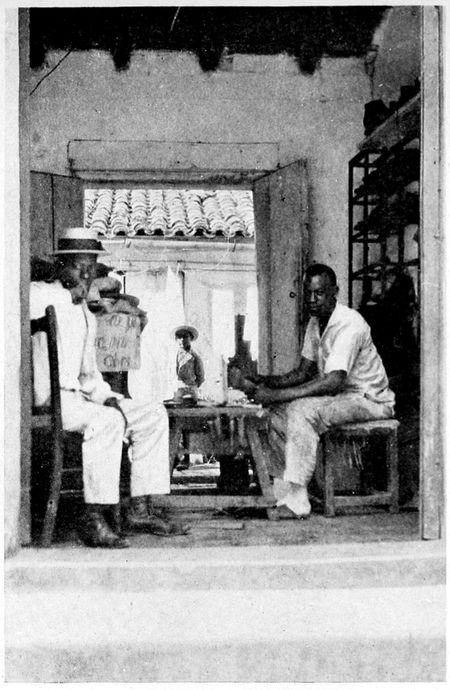
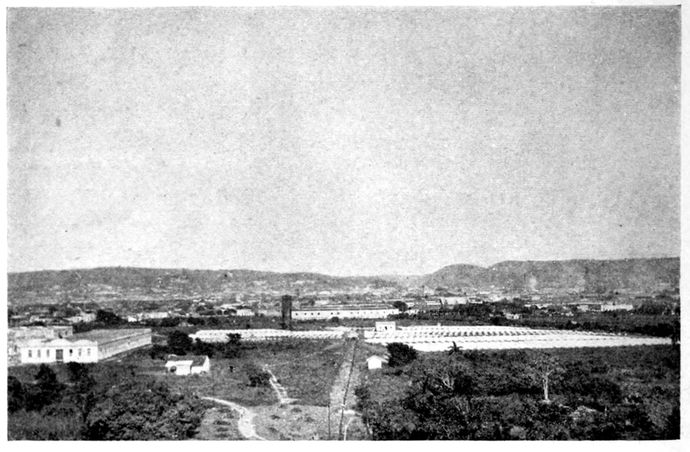
Matanzas, with drying sisal fiber in the foreground
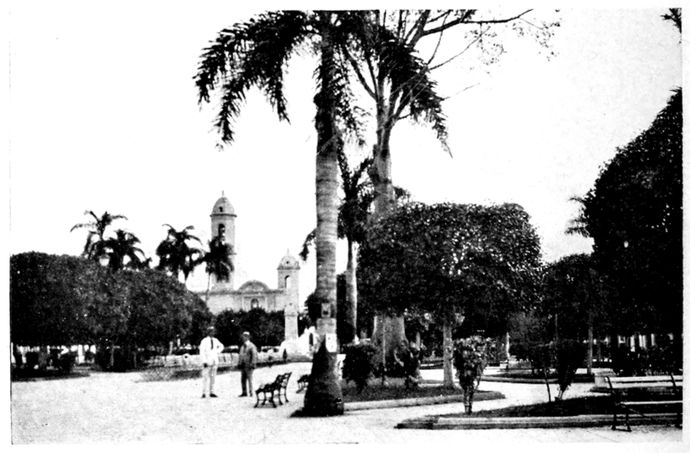
The Central Plaza of Cienfuegos
57November being merely planting time the finca presented a bare appearance
compared with what it would be in March, when the tall
tobacco plants wave everywhere in the breeze. Behind the house was
a dovecote which suggested some immense New York apartment house,
so many were its several-storied compartments. A handful of corn
brought a fluttering gray and white cloud which almost obscured the
sun. Pigeons and chickens are kept in large numbers in the tobacco
fields to follow the plows and eat the insects which would otherwise
destroy the seeds and the young plants. The supply barn was the
chief center of industry at this season, with its plows and watering-pots
marshaled in long rows, its tons of fertilizer in sacks, its cords of
baled cheese-cloth, its bags of tobacco seed, so microscopic in size that
it takes four hundred thousand of them to weigh an ounce. The seed-beds
were at some distance. There the seed is sowed like wheat and
the plants grow as compactly as grass on a lawn until they are about
twenty days old, when they are transferred to the larger fields and
given room to expand almost to man’s height. For acres upon acres
the rolling landscape stood forested with poles on which the cheese-cloth
would be hung a few weeks later, the vista recalling the hop-fields
of Bavaria in the spring-time. The idea of growing “wrapper” tobacco
in the shade, in order to keep the leaves silky and of uniform
color, is said to have originated in the United States and to have made
its way but slowly in Cuba, where planters long considered a maximum
of sunshine requisite to the best quality. To-day it is in general vogue
throughout the island.
We whiled away the afternoon on the breezy veranda, where the more
important employees of the finca and men from the neighboring town
came to discuss the crop, to say nothing of helping themselves to the
cigars which lay everywhere within easy reach. There was something
delightfully Old World about the simplicity of this patriarchal
family life, perhaps because it had scarcely a hint of Americanism
and its concomitant commercial bustle. Among the visitors was a
lottery vender on horseback, who sold Don Jacinto and his son their
customary half dozen “strips,” these being sheets of twenty or thirty
“pieces” of the same number. The company doctor parted with
thirty dollars for a “whole ticket.” Each had his own little scheme
58for choosing the numbers, one refusing those in which the same figure
was repeated, another insisting that the total of the added figures
should be divisible by three, some depending on dreams or fantastic
combinations of figures they had seen or heard spoken during the day.
The workmen on the estate, as on every one in Cuba, were inveterate
gamblers. Not only did they buy as many “pieces” each week as
they could pay for, but they all “played terminals,” that is, formed
pools which were won by the man guessing correctly the last two
numbers of the week’s winning ticket.
We visited tobacco estates in other parts of Cuba and saw all the
process except the cutting and curing before we left the island. At
Zaza del Medio, for instance, whole carloads of small plants are
handled during November. They are very hardy, living for three or
four days after being pulled up by the roots from the seed-beds.
Strewn out on the station platform in little leaf-tied bundles, they were
counted bunch by bunch and tossed into plaited straw saddlebags, to
be transported by pack-animals to fields sometimes more than a day’s
journey distant. Surrounded on all sides by horizonless seas of sugarcane,
the Zaza del Medio region is conspicuous twenty miles off by its
tobacco color, not of course of the plants, but of the rich brown of
plowed fields and the aged thatch-built tobacco barns. We rode that
way one day, our horses floundering through mammoth mud-holes,
stepping gingerly through masses of thorny aroma, and fording saddle-deep
the Zaza River. Here the small planter system, as distinctive
from the big administrative estates of Vuelta Abajo, is in vogue.
We found lazy oxen swinging along as if in time to a wedding march,
dragging behind them crude wooden plows protected by an iron point.
A boy followed each of them, dropping a withered small plant at
regular intervals, a man, or sometimes a woman, setting them up
behind him. Immense barns made of a pole framework covered entirely
with brown and shaggy guinea-grass bulked forth against the
palm-tree-punctuated horizon. The similarly constructed houses of the
planters were minute by comparison. Here, they told us, tobacco
grows only waist high, in contrast to the six feet it sometimes attains in
Pinar del Rio province. In February or March the plants are cut off
at the base and strung on the poles which lie heaped in immense piles,
and hung for two months in the airy barns. Then they are wrapped
in yagua and carried back to the railroad on pack-animals. Yagua, by
the way, which is constantly intruding upon any description of the
West Indies, where it is put to a great variety of uses, is the base of
59the leaf of the royal palm, the lower one of which drops off regularly
about once a month. It is pliable and durable as leather, which it resembles
in appearance, though it is several times thicker, and a single
leaf supplies a strip a yard long and half as wide.
Rivals, especially Jamaica, assert that the famous tobacco vegas of
Cuba are worn out and that Cuban tobacco is now living on its reputation.
The statement is scarcely borne out by the aroma of the cigars
sold by every shop-keeper on the island, though to tell the truth they
do not equal the “Habana” as we know it in the North. This is possibly
due to the humidity of the climate. The new-comer is surprised
to find how cavalierly the Cuban treats his cigars, or tobacos, as he calls
them. Even though he squanders dos reales each for them he thrusts
a handful loosely into an outside coat pocket, as if they were so many
strips of wood. For they are so damp and pliable in the humid Cuban
atmosphere that they will endure an astonishing amount of mistreatment
without coming to grief. Contrary to the assertions of Dame
Rumor, Cubans do not smoke cigarettes only; perhaps the majority, of
the countrymen at least, confine themselves to cigars.
There are cigar-makers in every town of Cuba, though Havana
almost monopolizes the export trade. How long some of the famous
factories have been in existence was suggested to us by a grindstone
in the patio of the one opposite the new national palace. There the
workmen come to whet their knives each morning, and they had worn
their way completely through the enormous grindstone in several places
around the edge. The methods in Havana cigar factories are of course
similar to those of Cayo Hueso, as Cuba calls our southernmost city.
In one of them we were shown cigars which “wholesale” at fifteen
hundred dollars a thousand, though I got no opportunity of judging
whether or not they were worth it, either in tobacco or ostentation.
The stems of the tobacco leaves are shipped to New York and made
into snuff. An average wage for the cigar makers was said to be five
dollars a day. They each paid that many cents a week to the factory
reader, who entertains the male workmen with the daily newspapers,
and the women, by their own choice of course, with the most sentimental
of novels. Girls will be girls the world over.
The dreadful habit of using tobacco has progressed since the day
when Columbus discovered the aborigines of the great island of Cubanacan
smoking, not Habana cigars, but by using a forked reed two ends
of which they put in their nostrils and the other in a heap of burning
tobacco leaves.
60Neither space nor the reader’s patience would hold out if I attempted
to do more than “hit the high spots” of our two months of journeying
to and fro in Cuba. There is room for a year of constant sight-seeing
and material for a fat volume in the largest of the West Indies, though
to tell the truth there is a certain sameness of climate, landscape, town,
and character which might make that long a stay monotonous despite
the glories of at least the first two of these. While he lacks something
of that open frankness of intercourse which we are wont to think
reaches its height in our own free and easy land, and the exclusiveness
of his family life puts him at a disadvantage as an entertainer of guests,
the Cuban himself, particularly outside the larger cities, is not inhospitable.
But his welcome of visitors from the North is overshadowed
by the unbounded hospitality of the American residents of Cuba,
whether on the great sugar estates, the fruit farms, in the scattered
enterprises of varied nature in all corners of the island, or in the many
cities that have become their homes. Merely to enumerate the unexpected
welcomes we met with from our own people in all parts of the
island would be to fill many pages.
The cities, on the whole, are the least pleasant of Cuba’s attractions.
Their hotels, and those places with which the traveler is most likely to
come in contact, are largely given over to the insular sport of tourist-baiting
even before mid-winter brings its plethora of cold-fleeing, race-track-following,
or prohibition-abhorring visitors from the North.
Havana, I take it, would be the last place in the world for the lover of
the simplicities of life, as for the man of modest income, in those winter
months when its hotels turn away whole droves of would-be guests and
its already exorbitant prices climb far out of sight from the topmost
rung of the ladder of reason. Incidentally Cuba is in the throes of
what might be called a “sugar vs. tourists” controversy. Its merchants
would like to draw as many visitors as possible, but even its tourist
bureau sees itself obliged to “soft pedal” its appeals. If still more
visitors come, where is the island to house them? Time was when her
more expensive hotels, especially of Havana, stood well nigh empty
through the summer and welcomed the first refugees from Jack Frost
with open arms, or at least doors. It is not so to-day. Sugar planters
from the interior, who would once have grumbled at paying a dollar
for a night’s lodging in a back street fonda, now demand the most
luxurious suites facing the plaza and the Prado, nay, even house their
families in them for months at a time, to the dismay of foreign visitors.
Stevedores who were once overjoyed to earn two dollars a day sneer
61at the fabulous wages offered them now, knowing that a bit of speculation
in sugar stocks will bring them many times the amount to be had by
physical exertion. The advice most apropos to the modern visitor to
Cuba whose tastes are simple and whose fortune is limited would be,
perhaps, to come early and avoid the cities.
We found Pinar del Rio town, for instance, far less beguiling than
a journey we made from it over the mountain to the Matahambre mines.
A peon met us with native horses where the hired Ford confessed its
inability to advance farther. Along the narrow trail the vegetation was
dense and tropical. Royal palms waved high along the borders of the
small streams; red-trunked macicos, yagrumas with their curious upturned
leaves showing their white backs, broke the almost monotony
of the greenery. Here and there we passed a brown grass hut which
seemed to have grown up of itself, a little patch of malanga, boniato,
or yuca, the chief native tubers, about it, a dark woman paddling her
wash against the trunk of a palm-tree on the edge of a water-hole,
several babies in single white garments or their own little black skins
scurrying away into the underbrush as we rode down upon them. A
few horsemen passed us, and a pack-train or two; but only one woman
among the score or more we met was mounted. She was a jet-black
lady in a bedraggled skirt and a man’s straw hat, who teetered perilously
on her uncomfortable side-saddle, yet who gazed scornfully down her
shaded nose at Rachel, riding far more easily astride. Finally, when the
sun was high and the vegetation scrubby and shadeless, and we had
climbed laboriously up several steep, bare hillsides only to slide down
again into another hollow, a cleft in the hills gave us a sudden panorama
of the sea, and almost sheer below us lay spread out the mining town.
The setting was barren, as is that of most mines, though five years
before it had been covered with a pine forest, until a cyclone came to
sweep it wholly away and leave only here and there a dead, branchless
trunk in a reddish soil that gave every outer indication of being sterile.
A network of red trails linked together the offices, the shafts and the
reduction plant, the red-roofed houses of the American employees, and
the thatched huts of the mine workers.
Mining is not one of Cuba’s chief assets, but this particular spot
is producing a high-grade copper. Ore was discovered here by a deer
hunter wandering through the forest of pines, but before he could
make use of his knowledge the region was “denounced” by another
Cuban and still belongs to his family, though there is some bitter-worded
doubt as to which branch of it. It goes without saying that the manager
62is an energetic young American. The laborers are chiefly Spaniards,
for the Cubans are too superstitious to long endure working underground.
The company builds its own roads, and has installed a telegraph
and post-office without government aid, yet it pays full rates
on its telegrams or letters. We went far down the shaft into the
damp blackness of the eighth and tenth levels, hundreds of feet below
the surface, following the galleries and “stopes” to where the workmen
were piling the bluish rock into the little iron hand-cars, the dull echoing
thud of the dynamiting on some other level sending a shudder through
the mountain. All night long the mine worked tirelessly on, the suspended
ore-cars swinging down their six-mile cables across the gorge
to the loading bins on the edge of the sea.
We followed them in a Ford next morning, from the treeless uplands
down through an oak-grown strip where half-wild hogs fatten themselves,
unwisely, for the plumper of them are sure to grace native
boards during the fiesta of Noche Buena, then along a strip of palms to
the Atlantic. A launch scudded down the coast with us to Esperanza,
a long range of mountains, rounded in form, gashed with red wounds
here and there, looking lofty only because they were so near at hand,
seeming to keep pace with us as if bent on shutting us out of the level
country behind them. After luncheon in the “best hotel,” with a hen
under my chair and a pig under Rachel’s, we Forded to Viñales, the
road running for miles under the very lee of a sheer mountain wall,
trees, especially of the palm variety, rising everywhere out of the
crevices of the soft white rock and seeming to keep their foothold by
clutching the wall above with their upper branches. Caves with
elaborate stalactite and stalagmite formations gaped beneath them, until
we rounded the spur and passed through a sort of mountain portal into
the familiar, rolling, dense-grown interior again.
We returned to Pinar del Rio by guagua, a four-seated mail and
passenger auto bus such as ply in many sections of rural Cuba. Its
driver was as wild as his brethren of Havana, and the contrivance
leaped along over the bad roads like a frolicsome goat. Fortunately the
usual crowd had missed their ride that morning and we could stretch
our legs at ease. Only a leathery old lady who dickered for a reduction
in fare, two or three guajiros in their best starched chamarretas, a
villager’s shoes which were to be resoled, and two turkeys in palm-leaf
cornucopias made up the passenger list. The shrill whistle in place
of a horn warned dawdling countrymen to beware, for our chauffeur
had scant respect for his fellow-mortals.
63Of the several towns which the traveler in Cuba is more or less sure
to visit the first is usually Matanzas, both because it is the first place
of any importance on the way eastward and because it boasts two
natural phenomena that have been widely reported. The town itself,
wrapped around the head of a deeply indented bay, has nothing that
may not be found in a dozen other provincial towns,—unpaved streets
reeking with mud or dust, according to the weather, a cement-floored
central plaza gay with tropical vegetation and flanked by portales, or
massive arcades, and constant vistas of the more formal hours of family
life through the street-toeing window grilles. The pursuit of tourists
is among its favorite sports, and not only are the prices and accommodations
of hotels infinitely more attractive in the mouths of their runners
at the station than at their desks, but the entire town seems to be
banded together in a conspiracy to force foreign visitors to hire automobiles.
At least we were forced to learn by experience rather than
by inquiry that the street-cars carry one two thirds of the way to either
of the “sights” for which the place is noted, or that one can stroll
the entire distance from the central plaza in half an hour.
The Yumurí valley is, to be sure, well worth seeing. From the hermitage
of Montserrat, erected by the Catalans of the island on a slope
above the town, the basin-shaped vale has a serene beauty, particularly
at sunrise or toward sunset, which draws at least a murmur of pleasure
from the beholder. Royal palms, singly and in clumps, dot the whole
expanse of plain with their green plumes and silvery trunks and climb
the slopes of the encircling hills, which lie like careless grass-grown
heaps of cracked stone along the horizon. Even by day the silence is
broken only by the distant shouts of a peasant or two struggling with
their oxen and plows; the occasional lowing of cattle floats past on the
stronger breeze of evening. The Cubans rank this as their most entrancing
landscape, but I have seen as pretty views from the abandoned
farms of Connecticut. For one thing the colors are not variegated
enough in this seasonless land to give such scenes the beauty lent by
changing leaves, though much else is made up for by the majesty of
the royal palms.
A gentler climb at the other end of town, between broad fields of
rope-producing cactus, brings one to a cheap wooden house which might
pass unnoticed but for the incongruous rumble of an electric dynamo
within it. In sight of the commonplace landscape it is easy to believe
the story that the caves of Bellamar remained for centuries unknown
until a Chinese coolie extracting limestone for a near-by kiln discovered
64them by losing his crowbar through a hole he had poked in the earth.
To-day they are exploited by the rope-making company which owns
the surrounding fields. The main portion of the huge limestone cavern
has been fitted with electric lights, which of themselves destroy half
the romance of the subterranean chambers; the temperature is that
of a Turkish bath, and the stereotyped chatter of the guide grows
worse than tiresome. But it would be a pity to let these minor drawbacks
repel the traveler from visiting Cuba’s weirdest scene. The cave
contains more than thirty chambers or halls, the chief of which is the
“Gothic Temple,” two hundred and fifty by eighty feet in extent, its
lofty roof upheld by massive white columns. There are immense
natural bath-tubs, forming waterfalls, fantastic grottoes and nature-sculptured
figures of all shapes and sizes along the undulating central
passageway that stretches far away into the unlighted earth. Mounds
that look like snow-banks, towering walls that seem shimmering curtains,
white glistening slopes down which one might easily fancy oneself
tobogganing, so closely do they resemble our Northern hillsides in
mid-winter, resound with the cackling voice of the irrepressible guide.
Of stalagmites and stalactites of every possible size there is no end, some
of them slowly joining together to form others of those mighty columns
which seem to bear aloft the outer earth. The caves are admirably
fitted, except in temperature, to serve as setting for the more fantastic
of Wagner operas.
If the train is not yet due, it is worth while to visit the rope factory
near the station. As they reach full size the lower leaves of the henequen
plants are cut off one by one and carried to the crushing-house
on a knoll behind the main establishment. Here they are passed between
grooved rollers, the green sap and pulp falling away and leaving
bunches of greenish fibers like coarser corn-silk, which shoot down
across a little valley on cables to the drying-field. Looped over long
rows of poles, they remain here for several days, until the sun has
dried and bleached them to the color of new rope. Massive machines
tended by women and men weave the fibers together in cords of hundreds
of yards long and of the diameter of binding-twine; similar machines
twist three of these into the resemblance of clothes-lines, which
in their turn are woven together three by three, the process being
repeated until great coils of ship’s hawsers far larger than the hand
can encircle emerge at the far end of the room ready for shipment.
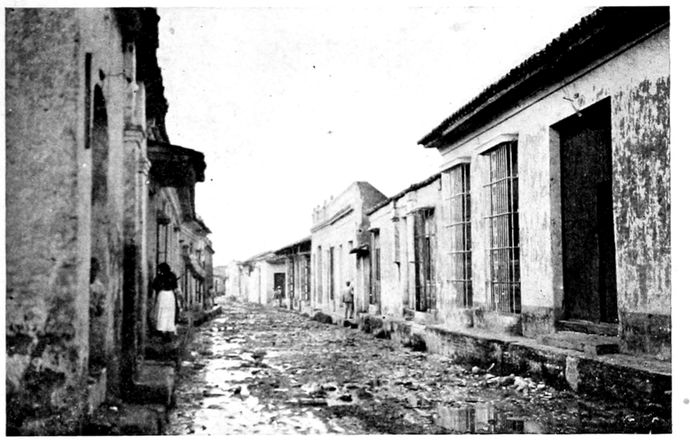
A principal street of Santa Clara
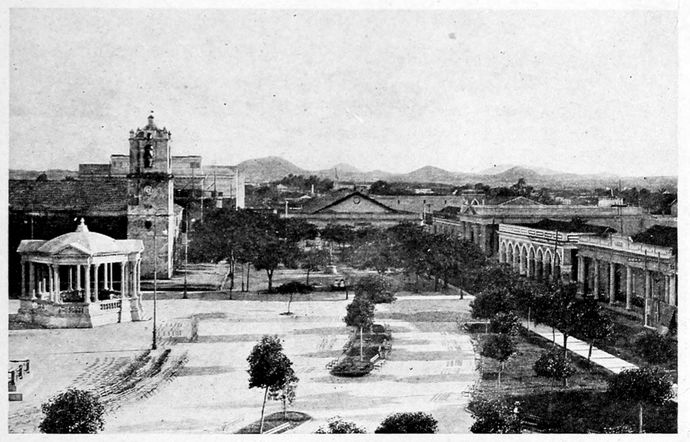
The Central Plaza of Santa Clara
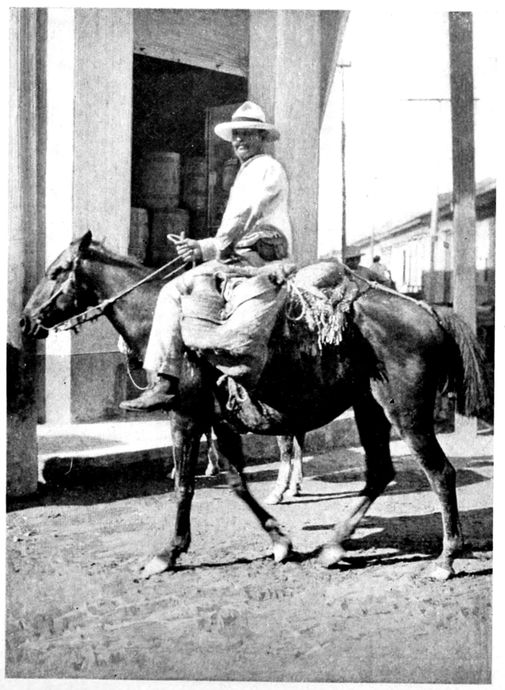
A dairyman, Santa Clara district
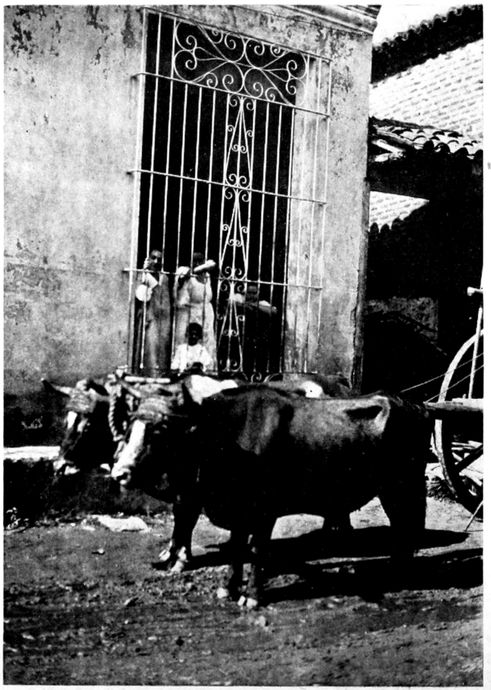
65From Matanzas eastward fruit and garden plots, and the more intensive
forms of cultivation, die out and the landscape becomes almost
unbroken expanses of sugar-cane. The soil is more apt than not to
be reddish. Automobiles disappear; in their place are many men on
horseback and massive high-wheeled carts drawn by oxen. On the
whole the country is flat, uninteresting, with endless stretches of canefields,
palm-trees, and nothing else. A branch line will carry one to
Cárdenas, but it is hot, dusty, and dry, as parched as the Carolinas in
early autumn, scarcely worth visiting unless one takes time to push on
to its far-famed beach long miles away. Far-famed, that is, in Cuba,
where beaches are rare and water sports much less popular than might
be expected in a land where the sea is always close at hand and summer
reigns the entire twelve-month. Now and again some unheralded
scene breaks the cane-green monotony. There is the little town of
Colón, for example, intersected by the railroad, which passes along the
very edge of its central plaza, decorated with a bronze statue of Columbus
discovering his first land—and holding in his left hand a two-ton
anchor which he seems on the point of tossing ashore.
The older railroad line ends at Santa Clara, one of the few important
towns of Cuba which do not face the sea. But the two daily expresses
merely change engines and continue, in due season, to the eastward.
An energetic Anglo-Saxon pushed a line through the remaining two
thirds of the island within four years after American intervention,
without government assistance, without even the privilege of exercising
the right of eminent domain, though the Spaniards had been “studying
the project” for a half century. There are no osteopaths in Santa
Clara. They are not needed; a ride through its incredibly rough and
tumble streets serves the same purpose. In Havana it is often impracticable
for two persons to pass on the same sidewalk; in many of these
provincial towns it is impossible. The people of Santa Clara seem
content to make their way through town like mountain goats, leaping
from one lofty block of cement to mud-reeking roadway, clambering to
another waist-high sidewalk beyond, mounting now and then to the
crest of precipices so narrow and precarious that the dizzy stranger feels
impelled to clutch the flanking house-wall, only to descend again swiftly
to the street level, climbing over on the way perhaps a family or two
“taking the air” and greeting them with an inexplicably courteous
“Muy buenas noches.” The citizens grumble of course at the condition
of their streets and make periodical demands upon the federal government
to pave them, as in all Latin America. The question often suggests
itself, why the dev—, I don’t mean to be profane, whatever the
provocation,—but why in—er—the world don’t you get together
66and pave them yourselves? But of course any newsboy could give a
score of reasons why all such matters as that are exclusive affairs of
“the government,” and he would pronounce the word as if it were
some supernatural power wholly independent of mere human assistance.
In contrast, the central plaza of course is perfectly kept and, though
empty by day, is more or less crowded in the evening, particularly when
the band plays. Seeing only the crowd which parades under the royal
palms in the moonlight, the visitor might come to the false conclusion
that the majority of the population is white, and he would make a similar
error in the opposite direction if he saw the town only by day. At the
evening promenade there is a great feminine display of furs, though it is
about cold enough for a silk bathing-suit; the club members have a
pleasant custom of gathering in rocking-chairs on the sidewalks before
their social meeting-places facing the square. Club life in Cuba follows
the lead of family life in the wide-openness of its more public
functions, though of course there is more intimate club and family
activity far to the rear of the open parlors.
If one is in a lazy mood one rather enjoys Santa Clara, though a
hurried mortal would probably curse its leisurely ways, its languid
style of shopping, for instance, with chairs for customers, and the invariably
male clerks thinking nothing of pausing in the midst of a purchase
to discuss the latest cock-fight with a friendly lounger. We
voted the place picturesque, yet when we took to wondering what made
it so we could specify little more than the crowds of guajiros astride
their horses, their produce in saddle-sacks beneath their elevated legs,
who jogged silently through the muddy streets. Some of these were so
superstitious in the matter of photography that they could only be
caught by trickery. In the evening hours almost every block resounded
with the efforts of amateur pianists. The Cubans are always beating
pianos, but they are strangely unmusical. I have been told that a
famous Cuban pianist won unstinted applause in New York, but of the
hundreds we heard on the island each and all would almost infallibly
have won something far less pleasing.
Musically the Cuban is best at the native danzón, a refinement of
the savage African rumba. But every town large or small has its
weekly concerts. Perhaps the most amusing one we attended was at
the sugar-mill village of Jatibonico. The players were simple youths
of the town, as varied in complexion and garb as the invariably tar-brushed
promenaders who filed round and round the grass-grown
plaza. The instruments were so unorthodox that we paused to make an
67inventory of them. Besides a cornet played by an energetic youth who
now and then made it heard far beyond the reach of the rest of the
uproar, there was a trombone and two of what seemed to be half-breeds
among horns, the manipulators of which varied the effect by now
and then holding their hats over the sound exit. Then there was a
cow-horn-shaped gourd which was scraped with a stick, a block of ebony
that was periodically pounded by the same man who tortured the bass
viol, two kettle-drums which would not be silenced on any pretext,
a large metal bowl shaped like a water-jar, that had originally come
from Spain filled with butter, in the single opening of which the player
alternately blew and sucked, giving a weird, echo-like sound, and, to fill
in any possible interstices of sound left, two heathenish rattles. The
band had no leader; each played or paused to smoke a cigarette as the
spirit moved him, and all played by ear. The unexpected sight of white
people among the promenaders caused the entire band to begin a series
of monkey-like antics in an endeavor to outdo one another in showing
off, until the tomtom effect of the entertainment took on a still more
African pandemonium. To this was added the rumble of frequent
trains along the near-by track and the vocal uproar of the promenaders,
striving to imitate in garb and manner the retreta audiences of the larger
cities. Long after we had retired a bugle-burst from the enthusiastic
cornet-player now and then floated to our ears through the tropical night,
for the amateurs had none of the weariness of professional musicians.
When the plaza audience deserted them toward midnight, they set out
on a serenading party to the by no means most respectable houses.
Some of them sang as well as played, in that horrible harmony of
Cuba’s rural falsetto tenors, only one of whom we ever heard without
an all but overwhelming desire to fling the heaviest object within
reach.
Cienfuegos, on the seacoast south of Santa Clara, is said to derive
its name from the exclamation of a sailor who beheld a hundred Indian
fires along the beach. It might easily have won a similar designation
from some wrathful description of its climate. The town was laid out a
mere century ago by a Frenchman named Déclouet, and many of its
streets still have French names. It is reputed to be the richest town
per capita on earth, though the uninformed stranger might not suspect
that from its appearance. It gives somewhat more attention to pavements
than some of its neighbors, to be sure, and has electric street-cars.
But ostentation of its wealth is not among the faults of Cienfuegos,
perhaps because it takes its cue from its wealthiest citizen, who
68is said to lead by more than a neck all the millionaires of Cuba. Like
Mihanovisch in the Argentine, or the first Astor and Vanderbilt in our
own land, this financial nabob of Cuba began at the bottommost rung of
the ladder, having arrived from Spain in alpargatas and taken to carrying
bags of cement on the docks. To-day he is past eighty-five and
owns most of the property in Cienfuegos and its vicinity, yet, as one of
his fellow-townsmen put it, “if you meet him on the street you want
to give him an old suit of clothes.” During the war he was placed
on the British black-list, and was forced to come often to a certain
consulate in an effort to clear himself, yet he invariably came on foot
even though Cienfuegos lay prostrate under its skin-scorching summer
noonday. He lived across the bay, and while there were millions involved
in the business on hand at the consulate, he invariably persisted
in leaving in time to catch the twenty-cent public boat, lest he be forced
to pay a dollar and a half for a special launch. He abhors modern ways
and in particular the automobile, and refuses to do business with any
one who arrives at his office in one. The story goes that for a long
time after the rest of the island had adopted them Cienfuegos did not
dare to import a single automobile for fear of the wrath of its financial
czar.
But if the miser of Cienfuegos holds the palm for wealth, one of his
near rivals in that regard outdoes him in political power. He, too,
is a Spaniard, or, more exactly, a Canary Islander, like many of the
wealthiest men of Cuba. To be born in the Canary Islands and to
come to Cuba without a peseta or even the rudiments of education seems
to be the surest road to riches. I could not risk setting down without
definite proof to protect me the perfectly well-known stories of how
“Pote” got his start in life. Though he owns immense sugar estates
and countless other properties of all kind throughout the island, he is
rarely to be distinguished from any unshaven peon, and even when
a new turn of the political wheel brings him racing to Havana in a
powerful automobile he still looks like some third-class Spanish grocer.
Not until long years after the island became independent did the government
become powerful enough to force “Pote” to remove the
Spanish flag from his buildings and locomotives, and the “J. R. L.” on
the latter still give them the right of way over many a rival cane-grower;
for “Pote,” whisper the managers of corporation sugar-mills,
has ways of getting his product to the market which those who must
explain to auditors and directors higher up cannot imitate.
It is not without significance for the future of Cuba that men of
69this type, uneducated, unscrupulous, utterly without any ideal than the
amassing of millions, wholly without vision, have the chief power in its
affairs. Politically the island has been freed from Spanish rule,
economically it is still paying tribute not merely in material things, but
in spiritual, to the most sordid-minded of the grasping peninsulares.
One other town and I am done with them, for though Sagua la
Grande and Caibarien, Ciego de Avila and picturesque Trinidad, at
least, are worthy a passing notice, there is something distinctive about
Camagüey, though the difference is after all elusive and baffling. For
one thing it is more than four hundred years old; for another it is the
largest town in the interior of Cuba. Even it, however, did not shun
the coast by choice, but ran away from the northern shore in its early
youth to escape the pirates, and, to make doubly sure of concealment,
changed its name from Puerto Principe to that of the Indian village
in which it resettled. Its antiquity is apparent, appalling, in fact.
Projecting wooden window grilles, heavy cornices, aged balconies, also
of wood, and tiled roofs hanging well over the street, crumbling
masonry, all help to prove the city a genuine antique. Few of its streets
are straight, few parallel, few meet at right angles, the result being to
give the visitor a curiously shut-in feeling. It is said that this civic
helter-skelter is due to the fact that the refugees from the harassed coast
staked their claims and built their houses at random in their haste to
get under cover, though there is a bon mot to the effect that the streets
were purposely made crooked to fool the pirates. The town is noted
for its tinajónes, in the legitimate sense, that is, for in Spanish the word
means not only an immense earthenware jar, but a person with a large
capacity for liquid refreshment. Some of these jars would easily
contain the largest human tinajón; the majority of them are more than
a hundred years old; there are said to be none younger than sixty.
They serve the same purpose as our cisterns. Several ancient churches
lift their weather-dulled gray walls and towers above the mass of old
houses. The majority of these are down at heel, their façades battered
and cracked, though the patios or small gardens in their rear are gay
with flowers and shrubbery. Most of its streets were once paved, but
that, too, was long ago, and during the frequent rainy days one must
pick one’s way across them by the scattered cobbles embedded in mud
as over a stream on stepping-stones. The railroad once offered to pave
at its own expense the slough bordering the station, but the local
politicians would not permit it, for the same reason that Tammany
prefers to let its own contracts. Even the social customs of Camagüey
70are ancient. If “any one who is any one” dies, for instance, as they
do not infrequently, “everything” closes and all social functions are
abandoned, often to the dismay of hostesses. The town is said to be
famed for its beautiful women and its skilled horsemen; its color-line
is reputed more strict and its negro population less numerous than in
the rest of Cuba, at least three of these things being credited to the fact
that the region was long given over to cattle rather than sugar-cane,
requiring fewer slaves. The casual visitor, however, sees little to confirm
these statements.
To-day even Camagüey province has succumbed to the cane invasion,
like all Cuba, and the raising of cattle has become a secondary industry.
Droves of the hardy, long-horned, brown breed may still be grazing
the savanna lands, searching the valleys for tasty guinea-grass, standing
knee-deep in the little rivers, but Cuba now imports meat, in contrast
to the days when the exporting of cattle was one of her chief sources
of revenue. The climate has had its share in bringing this change.
Not only does it cause the milk to deteriorate in quantity and quality
within a very few years, but the animals decrease steadily in size from
generation to generation. Butter, unless of the imported variety, is as
rare in Cuba as in all tropical America, and the invariable custom of
boiling milk before using makes it by no means a favorite beverage.
Besides, the constant drought in the United States does not extend to
Cuba. But all these causes are but slight compared with the skyrocketing
price of sugar, which is swamping all other industries in the
island, nay, even its scenery, beneath endless seas of cane.
Our good hosts of Tuinucú varied their hospitality by bearing us
off on a two-days’ horseback journey into the neighboring mountains.
A hand-operated ferry and a road that was little more than a trail,
except in width, brought us to the Old World town of Sancti Spiritus,
founded in 1514 and rivaling in medieval architecture and atmosphere
almost anything Spain has to offer. Here a práctico, which corresponds
to, but is apt to mean much less than a guide, took the party in charge
and trotted away toward the foothills. A group of priests in their
somber, flowing gowns and shovel hats grinned offensively at the unwonted
sight of ladies riding man-fashion, and the townsmen stared
with the customary Latin-American impudence, but the countrymen
greeted us with the dignified courtesy of old Castilian grandees. Pack-trains
shuffled past in the deep dust now and then, the dozen or more
undersized horses tied together from tails to halters. The fact that
71this left the animals no protection from the vicious flies meant no more
to the compassionless guajiros than did the raw backs under the heavy,
chafing packs. Cuba, like all Latin America, is a bad country in which
to be a horse, or any other dumb animal for that matter. Much of the
country was uncultivated, though royal palms and guinea-grass testified
to its fertility. Big dark-red oxen or bulls were here and there plowing
the gentler hillsides, more of them stood or lay at ease under the
spreading ceiba trees. The region was once famed for its coffee, but
even the few bushes that are left get no care nowadays and the time
is already at hand when they are to give way before the militant sugarcane.
We turned into an old estate where a hundred slaves had once toiled.
All but a corner of it was overgrown with bush; the massive old plantation
house had lost all its former grandeur except the magnificent views
from its verandas. A disheveled family of guajiros inhabited it now,
its cobbled courtyard seldom resounded to the hoofs of horses bringing
guests to its very parlor door, the broad, brick-paved coffee-floor was
grass-grown between its joints, the old slave inclosure had been turned
over to the pigs, feeding on palmiche, the berries of the royal palm.
The slattern who thrust her head out of the ruined kitchen building
had little claim to propriety of appearance, though she answered a
joking question as to whether she, too, would ride astride with a fervent,
“Not I, God protect me!”
Reminiscences of slave days brought forth the story of “Old Concha”
as we rode onward. She had been a slave on Tuinucú estate as
far back as any one could remember, still is, in fact, in her own estimation.
No one knows how old she is, except that she was married and
had several children when the mother of her present mistress was a
child. Her own answer to the question is invariably “thirteen.” All
day long she potters about the kitchen, though great effort has been
made to get her to rest from her labors. She refuses to accept wages,
only now and then “borrowing” a peseta, the total averaging perhaps
five dollars a year, and being mainly spent for tobacco. Whenever any
of the modern servants are remiss in their duties or show a suggestion
of impudence she warns them that the “master’s” whip will soon be
tingling their legs, then, recalling herself, sighs for the “good old
days” that are gone. She is the chief authority on forgotten family
affairs, though incapable of keeping the “in-laws” straight. In her
early days Concha accompanied her mistress to the United States.
Arrived at the dock in New York, she submitted to her first hat, on the
72warning that she would be conspicuous without it—and raised it to
all white people with whom she spoke. A custom officer questioned
her right to bring in the fifty large black cigars which she had first
attempted to conceal about her person, doubting that they were for her
own use. Concha lighted one forthwith and quickly convinced the
skeptic of her ability to consume them. It is useless to try to throw
anything away at Tuinucú; Concha is certain to retrieve it and stow
it away in her little room, with her “freedom paper” and her souvenir
hat.
By sunset we were surrounded by mountains, though perhaps those
of central Cuba should rather be called ranges of high hills. The little
village of Banao was thrown into a furor of excitement by the arrival
of “caballeros,” and particularly by the announcement that we planned
to camp out on the mountainside. Picnics are as unknown to the Cuban
as to the rest of Latin America. Boys swarmed around us and scampered
ahead in the swiftly falling darkness to show us a spot well up
the slope where water and a bit of open ground were to be found.
They told us many lugubrious tales of the dangers of sleeping in the
open air and implored us to return instead to the hovels they shared
with their pigs and chickens. When it became evident that we were
not to be turned from our reasonless and perilous undertaking, they
took to warning us at every step against the guao, quite fittingly pronounced
“wow!” This is a species of glorified poison ivy, equally
well named pica-pica. Drawbacks of this kind are rare in Cuba, however,
where there are few poisonous plants, no venomous snakes, not
even potato-bugs! The boys remained with us gladly until the last
scraps of the camp-fire meal had disappeared, but fled with gasps of
dismay at the suggestion that they spend the night there.
The traveler in the West Indies must learn to rise early if he is to
catch the best nature has to offer. Noonday, even when less oppressively
hot than our own midsummers, thanks to the unfailing trade-wind,
is glaring in its flood of colors, insistent, without subtleties. But
dawn and sunrise have a grandeur and at the same time a delicacy, as if
the light were filtered through gauze upon the green-bespangled earth,
which even the gorgeous sunsets and the evanescent twilight cannot
equal. As we watched the new day steal in upon us through the dense
foliage, it would have been easy to fancy that we had been transported
to some fantastic fairyland in which the very birds were bent on adding
to the subtle intoxication of the visitor’s senses.
We beat the sun to the grotto of cold, transparent water and by
73the time it began to express itself in terms of heat were scrambling
through the jungle to the nearest summit. Fresh coffee was to be had
on many a bush for the picking; and inviting the red berries looked,
too, until a taste of them had destroyed the illusion. He who fancies
Cuban mountains are not high is due to revise his notions by the time
he has dragged himself up the face of one of them through jagged
rocks half concealed beneath the matted brush, over veritable hedges of
needle-pointed cactus, now and again clutching as the only escape from
toppling over backward a treacherous handful of “wow.” Our garments
were torn, our hands cut and stinging with pica-pica, our guide
had degenerated from the fearless fellow of the night before to an
abject creature who asked nothing better than to be left to die in peace
by the time we reached the summit; and even then it was no real summit
at all, but only the first of half a dozen knobs which formed a species of
giant stairway to some unknown region lost in the clouds. In the light
of the struggle it had cost us to cover this infinitesimal portion of the
scene before us we seemed mere helpless atoms lost in the midst of a
ferocious nature which clothed the pitched and tumbled world far
beyond where the eye could see in any direction; or, to put it more
succinctly in the words of our host, we looked like worn-out fleas
caught in the folds of a thick and wrinkled carpet.
The ride homeward was by another road, boasting itself a camino
real, but little more than a wide trail for all its claim to royalty. Black
ranges studded with royal palms cut short the horizon. Guajiros
slipped past us here and there on little native horses of rocking-chair
gait; others rode more slowly by perched on top of their woven-leaf
saddle-bags, bulging with produce, a chicken or two usually swinging
by the legs from them; all bade us a diffident “Muy buenas.” Trees
worthy of being reproduced in the stained-glass windows of cathedrals
etched the sky-line. The stupid peon who posed as guide, flapping his
wings with the gait of his horse like a disheveled crow, knew the names
of only the most familiar growths, which would not so much have
mattered had he not persisted in digging up false ones from the depths
of his turbid imagination. Of the flowers, fruit, and strangely tame
long-tailed birds he had as little real knowledge, though he had seen
them all his life. Nor did he even know the road; I have never met
a Latin-American “guide” who did. A negro boy on horseback singing
his cows home from pasture; a peasant in the familiar high-crowned,
broad-brimmed hat of braided palm-leaves hooking together
tufts of grass with a crotched stick and cutting them off with a machete;
74children gathering the oily palmiche nuts which are the chief delicacy of
the Cuban hog, were among the sights of the afternoon. Next to
sugar certainly the most prolific crop in Cuba is babies. Black, brown,
yellow, and all the varying shades between, they not only swarm in
the towns, but cluster in flocks about the smallest country hut, innocent
of clothing as of the laws of sanitation, with no other joy in life than to
roll about on the ground inside or around their little homes and suck
a joint of sugar-cane. The houses of the peasants, still called by the
Indian name of bohío, owe nothing to the outside world, but are wholly
built of materials found on the spot, their very furnishings being woven
palm-leaf hammocks, hairy cowhide chairs, pots and dishes made from
gourds picked from the trees. The gates to many fincas, mildly resembling
the entrances to Japanese temples, drew the eyes to more commodious
residences as we neared Sancti Spiritus once more, each casa
vivienda of a single low story covered with a tile roof which projected
far out over the earth-floored veranda surrounding it. Nor were these
much different from the humbler bohíos except in size, and perhaps an
occasional newspaper to keep their owners somewhat in touch with the
outside world.
The day died out as we were jogging homeward along the dusty
flatlands between endless vistas of sugar-cane. But as I have not the
courage to try to describe a Cuban sunset I gladly yield the floor to the
native novelist known to his fellow-countrymen as the “Zola of the
Antilles,” who has no fear of so simple a task:
The sun agonized pompously between incendated clouds. Before it opaque
mountains raised themselves, their borders dyed purple, orange, and violet.
The astra itself was not visible, hidden behind its blood-streaked curtain, but
one divined its disk in the great luminous blot which fought to tear asunder the
throttling clouds; and on high, light, white cupolas, like immense plumages, were
floating, reddened also, like the dispersed birds of a great flock that had been
engaged in sanguinary combat. A vast silence had established itself, the solemnity
of the evening which was rapidly expiring, with that brevity of the twilight
of the tropics, which is similar to a scenic play arranged beforehand. On the
blue-gray line of the sea the clouds had floundered in an immense stain of violet
color, furrowed with obscure edges which opened themselves like the spokes of
a gigantic wheel, in a dress of whitish blue, raising itself to the rest of the
heavens. The disk of the sun was no longer evident; but, far off, some separate
little clouds seemed to be touched by a lightly purple dyestuff. The picture
changed with the celerity of an evening sunset on the stage, visibly obscuring
itself, and by degrees, as if in that stage setting some one were shutting off, one
after the other, the electric batteries, until the scene had been left in darkness.
In a few minutes the great violet stain, formerly full of light, passed through all
75the tones of color, to convert itself into a great lake, without brilliance, in
which swam lead colored flocks of birds dyed with black. The delicate dyestuff
which embroidered for an instant the remote little clouds had suddenly
rubbed themselves out. Only an enormous white plume, stretched above the
place in which the sun had sepulchered itself, persisted in shining for a long
time like a fantastic wreath suspended over the melancholy desolation of the
crepuscule. Afterward that went out also.
76
Cuba produces more sugar than any other country in the world.
During the season which had just begun at the time of our
visit she expected to furnish four million tons of it. Barely
as large as England, being seven hundred and thirty miles long and
varying in width from twenty-two to one hundred and twenty miles,
the island is favored by the fact that the great majority of her surface
is level or slightly rolling, though the Pico de Turquino rises 8320 feet
above the sea. Her soil is largely of limestone formation, with very
little hard rock. She has considerable deep red earth which, scientists
say, is deteriorated limestone without a trace of lime left in it. Fresh
limestone brought down from the hills and scattered upon this quickly
restores its virgin fertility, and it responds readily to almost any other
fertilizers. There are regions in Cuba where this reddish soil permeates
all the surrounding landscape, including the faces, garments, and offspring
of the inhabitants, giving its color even to their domestic animals.
At least four fifths of the wealth and happiness of her population depends
on her chief industry, and it is natural that everything else should
take second place in the Cuban mind to the production of sugar.
French colonists running away from their infuriated slaves in Haiti
brought with them the succulent cane, and at the same time a certain
love of comfort and various agricultural hints which may still be traced
on some of the older estates. But the industry has been modernized
now to the point where science and large capital completely control its
methods and its output. The saying is that wherever the royal palm
grows sugar-cane will flourish, while the prevalence of guinea-grass is
also considered a favorable sign. As these two growths are well-nigh
universal throughout Cuba, it would seem that the island is due to become
an even greater leader in sugar production that she is already.
The making of a Cuban sugar plantation is a primitive and, from our
Northern point of view, a wasteful process consistent with virgin lands
and tropical fecundity. Thus it seems in many parts of the island, particularly
in the Oriente, the largest and most eastern of Cuba’s six
77provinces. Here vast stretches of virgin forest, often three to five
thousand acres in extent, are turned into cane-fields in a few months’
time. The usual method is to let contracts for the entire process, and
to pay fixed sums for completely replacing the forests by growing cane.
Bands of laborers under native capataces begin by erecting in the edge
of the doomed woods their baracones, crudely fashioned structures
covered with palm-leaves, usually without walls. Here the woodsmen,
more often Jamaican or Haitian negroes than Cubans, swing their hammocks
side by side the entire length of the building, if the long roof
supported by poles may be called that, a few of them indulging in the
comfort of a mosquitero inclosing their swinging couch, all of them
wrapping their worldly possessions in the hammock by day. Then with
machetes and axes which to the Northerner would seem extremely
crude—though nearly all of them come from our own State of Connecticut—they
attack the immense and seemingly impenetrable wilderness.
The underbrush and saplings fall first under the slashing machetes.
Next the big trees—and some of these are indeed giants of the forest—succumb
before the heavy axes and, denuded of their larger branches,
are left where they lie. Behind the black despoilers the dense green
woodland turns to the golden brown which in the tropics means death
rather than a mere change of season, and day by day this spreads on and
on over plain and hillock into regions perhaps never before trodden by
man. The easy-going planters of the olden days were apt to spare at
least the royal palms and the more magnificent of the great spreading
ceibas. But the practical modern world will have none of this compassion
for beauty at the expense of utility. As an American sub-manager
summed up the point of view of his class, “If you are going to grow
cane, grow cane; don’t grow royal palms.” Everything falls before
the world’s demand for sugar, translated by these energetic pioneers
from the North to mean the unsparing destruction of all nature’s splendors
which dare to trespass upon the domain of His Majesty, the
sugar-cane. Mahogany and cedar—though occasionally the larger
logs of these two most valuable of Cuban woods are carried to the railroad
sidings—are as ruthlessly felled as the almost worthless growths
which abound in tropical forests. Here and there the contractor
leaves an immense caguarán standing, in the hope that he may not be
compelled to break several axes on a wood far redder than mahogany
and harder than any known to our Northern timberlands. But the
inspector is almost sure to detect his little ruse and to require that the
78landscape be denuded even of these resisting growths. Logs of every
possible size and of a hundred species cut up the trails over which the
sure-footed Cuban horses pick their way when the first inspection parties
ride out through the fallen woodland.
The clearing of a Cuban forest has in it little of the danger inherent
in similar occupations in other tropical lands. Not only are there no
venomous snakes to be feared, but there are few other menaces to the
health of the workmen. Now and again a belligerent swarm of bees is
encountered, along the coast streams the dreaded manzanillo sometimes
demands the respect due so dangerous a growth. The sap of the
manzanillo is said to be so poisonous that to swallow a drop causes
certain death; hands and face sprayed with it by a careless blow of
the ax swell up beyond all semblance to human form. When one of
these rare species is found, the woodsmen carefully “bark” it and
leave it for some time before undertaking the actual felling. But with
few exceptions this is the only vegetation to be feared in a Cuban
wilderness. Even the malarial fevers which follow not the cutting,
but the burning, of the woodlands are less malignant than those of other
equatorial regions.
The burning usually takes place during the first fortnight of March,
at the end of the longest dry season. Indeed, extreme care is exercised
that the firing shall not begin prematurely, for the consumption of
the lighter growths before the larger ones are dry enough to burn would
be little short of a catastrophe for the contractors. When at last the
fires are set and sweep across the immense region with all the fury of
the element, fuel sufficient to keep an entire Northern city warm during
the whole winter is swept away in a single day. At first thought it
seems the height of wastefulness not to save these uncounted cords of
wood, these most valuable of timbers, but not only would the cost of
transportation more than eat up their value before they could reach a
market, without this plenitude of fallen forest the burning would not be
successful and the fertility of the future plantation would suffer. The
time is near, however, scientists tell us, when the Cubans must regulate
this wholesale destruction of their forests or see the island suffer
from one of those changes of climate which has been the partial ruination
of their motherland, Spain.
When the first burning has ended, the larger logs remaining are
heaped together and reburned. Some of them, the júcaro, for instance,
continue to smolder for months, this tree having even been known to
burn from top to bottom after catching fire thirty feet from the
79ground. Though it is usual in the open savannas, plowing is not
necessary in these denuded woodlands. Here all that is necessary is to
hoe away the grass and the bit of undergrowth that remains. The
primitive method of planting in the slave days still survives. In some
sections a man sets out along each of the proposed rows carrying in
one hand a long sugar-cane and in the other a machete. He jabs
the cane into the ground at intervals of about three feet, slashes off the
buried end with his cutlass, and marches on, to repeat the process at
every step. More often nowadays one man goes ahead to dig holes
with a heavy hoe, while another following him drops into each of them
a section of cane and covers it with a stamp of his bare heel. Two
joints and sometimes three are planted in each hole, to insure the
sprouting of at least one of them. There is a more scientific system
of planting, in which a rope with knots given distances apart is used,
but the first method is more prevalent in the feverish haste of the
Oriente. The fact that charred logs and stumps still everywhere litter
the ground rather helps than hampers the growth of the cane, for as
these rot they add new fertilizer to the already rich soil.
Cane requires some eighteen months to mature in the virgin lands
of Cuba, and will produce from twelve to twenty yearly crops without
replanting. So prolific is the plant in these newer sections that when
a lane several meters wide is left between the rows it is often almost
impenetrable a year later. Cane high above the head of a man on
horseback is by no means rare in these favored regions. By the beginning
of our northern autumn the whole island is inlaid with immense
lakes of maturing cane, the same monotonous panorama everywhere
stretching to the horizon; the uniformly light green landscape, often
spreading for mile after mile without a fold or a knoll, without any
other note of color than the darker green of the rare palm-trees that
have escaped destruction, grows fatiguing to the sight. Cane-fields
without limit on each hand, flashing in the blazing sunshine, have a
beauty of their own, though it is not equal to that of a ripening wheat-field
with the wind rippling across it. There is less movement, less
character; it has a greater likeness to an expressionless human face.
Yet toward cutting-time sunrise or sunset across these endless pale
green surfaces presents swiftly changing vistas which are worth traveling
far to see.
The “dead season,” corresponding to the Northern summer, is a time
of comparative leisure on the sugar estates. It is then that the higher
employees, Americans in the great majority of cases, take their vacations
80in the North; it is then that the Spanish laborers who come out
for each yearly zafra return to enjoy their earnings in their own land.
Then there is time for fiestas among the native workmen and their
families and those from the near-by islands, who frequently remain
the year round, time for “parties” and dances among the English-speaking
residents of the batey. The batey is the headquarters of the
entire central, as the sugar estate is called in Cuba. It clusters about
the ingenio, or mammoth sugar-mill, which stands smokeless and silent
through all the “dead season,” its towering chimneys looming forth
against the cane-green background for miles in every direction. Here
the manager has his sumptuous dwelling, his heads of departments their
commodious residences, the host of lesser American employees their
comfortable screened houses shading away in size and location in the
exact gradations of the local social scale. Usually there are company
schools, tennis-courts, clubs, stores, hospital, company gardeners to
beautify the surrounding landscape. Outside this American town,
often with a park or a flower-blooming plaza in its center, are scores
of smaller houses, little more than huts as one nears the outskirts, in
which live the rank and file of employees of a dozen nationalities.
In the olden days, when many slaves were of necessity kept the year
round, the batey was a scene of activity at all seasons. But the patriarchal
plantation life, the enchantment of the old family sugar-mill
where each planter ground his own cane, has almost wholly disappeared
before these giants of modern industry which swallow in a day
the cane that the old-fashioned mill spent a season in reducing to
sugar.
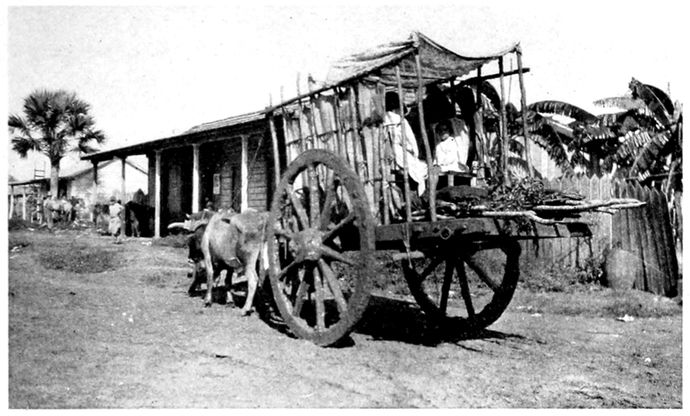
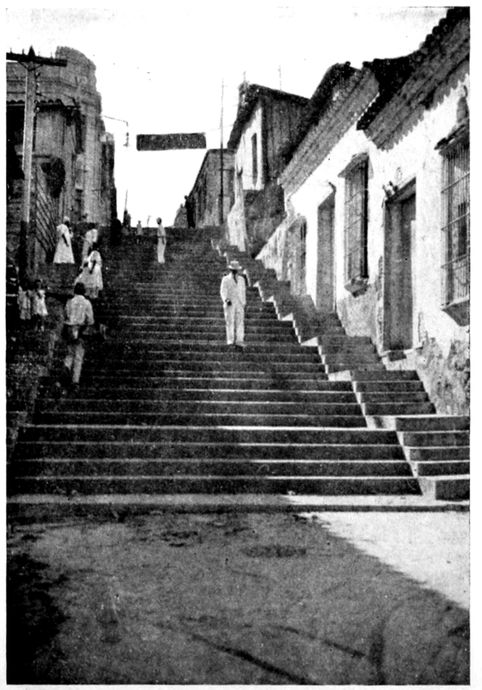
A street of Santiago de Cuba
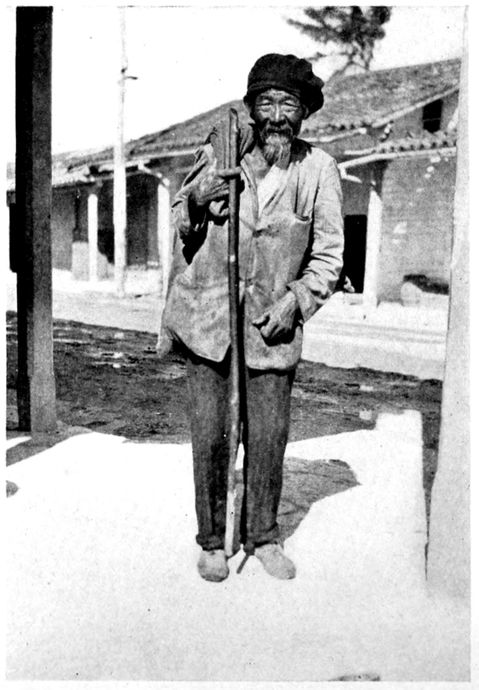
Not all Chinamen succeed in Cuba
81With the expiration of slavery the patrician style of sugar raising died
out. It became necessary, largely for lack of labor, partly for convenience
sake, to separate the agricultural from the other phases of the
sugar industry. The more customary method to-day is to divide the
estate into a score or more of “colonies,” each in charge of, or rented
to, a colono, who operates almost independently, at least until the cutting
season arrives. A few companies are run entirely on the administrative
system, directing every operation from planting to grinding from a
central office; some own little land themselves, but buy their cane of the
independent planters in the surrounding region. But the colono system
gives promise of surviving longest. For one thing, in case of
drought or other disaster, the loss falls in whole or part on the planter
instead of being entirely sustained by the company. Even when the
land from which they draw their cane is not their own property, the
companies keep a force of inspectors who ride day after day through
the cane-fields, offering advice to the colonos here, ordering them to
change their methods there, if they are to remain in the good graces
of the central management. The latter keeps in its offices large maps
of all the region from which its mill is fed, noting on each plot the
condition of the soil, the age of the cane, particularly whether or not
it has been burned over, that it may be assigned its proper turn for
cutting when the grinding season begins.
Fires are the chief bugaboo of the sugar growers. All the fields
are cut up into sections by frequent guardarayas, open lanes some fifty
yards wide which serve not only as highways, but as a means of confining
a conflagration to the plot in which it starts. In many cases there
are little watch towers set up on stilts from which to give warning in
case of fire, while special employees sometimes patrol the fields during
the drier months. Rural guards of the “O. P.” corps have orders to
be constantly on the lookout for incendiaries; when a fire starts they
immediately surround the field, and woe betide the luckless mortal who
is caught in it, for all Cuba is banded together to punish the man who
wantonly or carelessly brings destruction upon their principal product.
A cane fire is an exciting event, not to say a magnificent sight.
Starting in a tiny puff of vapor where some careless smoker has tossed
a match, from a passing locomotive, or by intention, it quickly gives
warning by the black-brown column of smoke which rises high into the
clear tropical heavens. Whistles, bells, anything capable of making a
noise, join in the din which summons planters, employees, and neighboring
villagers to stem the threatened catastrophe. By the time the
bright red flames begin to curl above the cane-tops men and boys of
every degree, color, and nationality are racing pell-mell from every
direction toward them, colonos, overseers, rural guards, Americans,
Chinamen, Spaniards, West Indian negroes, Cubans ranging from the
village alcade to bootblacks. Many of these bring with them machetes,
others catch up clubs, handsful of brush, the tops of banana plants, and
fall to threshing the flames, which by this time are crackling like the
tearing up of thousands of parchments. Men on horseback race up
and down the open lanes, directing the fighters, ordering the cutting of
a new guardaraya there, commanding the lighting of a back-fire yonder.
The air is full of black bits of cane leaves, the sun is obscured by the
grayish-brown smoke which envelops all the struggling, shouting multitude
and covers the field with an immense pall. A gust of wind sends
the flames jumping to another plot, whirlwinds caused by the heat catch
82up the sparks and scatter them at random. New-comers join in the
turmoil, indifferent alike to their garments and their skins. Half-asphyxiated
men stumble out to the open air, gasp a few lungsful of it,
and dash back into the fray; the now immense column of smoke can
be seen over half the province. The pungent scent of crude sugar
ladens all the air. Bit by bit the leaping flames decrease under the
chastisement of hundreds of weapons, or confess their inability to leap
across a wider guardaraya. The crackling loses its ominous sound, the
voices of men are heard more clearly above it, gradually it succumbs
to the noise of threshing bushes, the last red glare dies out, and the
struggle is over. The motley throng of fighters, smeared, smudged,
and torn, emerge into the open lanes, toss away their improvised
weapons, and straggle homeward in long streams, while sunset paints
the now distant smoke-cloud with brilliant colors, flecked by the little
black particles which still float in the air. The burning of a cane-field
does not mean the complete loss of its crop. Only the leaves are consumed;
the parched canes are still standing. But these must be cut and
ground quickly if their juice is to be turned into sugar; the ringing of
the heavy cane-knives resounds all through the following day, and by
night the field stands forlorn and ugly in its nudity.
One by one during the month of October the mills of the island begin
their grinding. The cutting has started two days before, and incessantly
through the weeks that follow the massive two-wheeled carts,
drawn by four, six, ten, even twelve oxen, drag the canes to the mill,
now straddling the charred stumps and logs which litter new fields for
years after the first planting, now wallowing in the sloughs into which
they have churned the lanes and highways. Or, if the fields are too
far away, the ox-carts halt at railway sidings, where immense hooks
catch up their entire load and deposit them in cane-cars, long trains
of which creak away in the direction of the ingenio. The planters are
paid on a percentage basis, from five to seven arrobas of sugar, or its
equivalent in cash at that day’s market quotation, for a hundred arrobas
of cane, a system which gives the colono his share in any increase in
price. The workmen, more than half of whom are foreigners, are paid
by the “task,” their earnings depending on their strength and diligence.
The natives have a reputation for doing less than their competitors.
There are Cubans who work in both the tobacco and sugar zafras, but
most of them are content to spend from four to six months in the cane-fields
earning their five to eight dollars a day, and to loaf and buy
lottery tickets the rest of the year. The result is that the entire island
83has a toilsome, preoccupied air during our winter months and a holiday
manner throughout the summer.
Grinding time is the antithesis of the “dead season.” Then the dull
sullen grumble of the mill never ceases, fiestas and “parties” are forgotten,
all but the higher employees and the field-men alternate in their
twelve-hour shifts between night and day, with little time or inclination
left for recreation. The chimneys of the ingenios belch forth constant
columns of smoke, by night their blaze of electric lights makes them
visible far off across the country. Once dumped in the chutes the canes
have no escape until they have reached the market, or at least the
warehouse, in the form of sugar. Rivers of juice run from beneath
the rollers to the boiling vats; the centrifugals, most often tended by
Chinamen, whirl the thick molasses into grains, great bags of which
are stood end up on the necks of burly negroes and trotted away to the
almacen. The porters must be burly, for Cuba still retains the bag
used in slave days, holding thirteen arrobas, or two hundred and seventy-five
pounds, and the negroes insist they must run with them to keep
from falling down. It has more than once been proposed to reduce
the size of the bags, but this would require a change all the way back
to India, where jute and bags originate.
From the days of the primitive trapiche, when two logs turned by
an ox or a donkey constituted a Cuban sugar-mill, through the period
of individual growing and grinding, when an army of slaves worked
under the whip for the benefit of an ignorant and often lazy and licentious
owner who considered that work his right, down to the immense
ingenio and extensive batey of modern times, Cuba has been more or
less exploited for the benefit of other lands and peoples. Even to-day,
when fabulous wages are paid to the men who do the actual toiling
under the tropical sun, much of the profit from her soil brings up
eventually in the pockets of others. Few are the centrals which do not
win back a considerable portion of the wages they are forced to pay
by maintaining company stores in which the prices are exorbitant, or
in selling the right to maintain them. Many an American manager
frankly admits the injustice of this, yet all assert themselves unable
to remedy it. Of the sums carried off by workmen from other lands
the Cubans have no complaint, admitting that they earn their hire.
But there is a growing tendency to grumble that the island is being
more thoroughly exploited now than in the days of slavery, for it
comes to the same thing, they contend, whether the larger portion of
their national riches go to Spanish masters or to stock-holders who have
84never set foot on Cuban soil. Notwithstanding that the island claims
more wealth per capita than any other land on earth, the inhabitants are
not satisfied, either with themselves or with circumstances, as a brief
extract from the native novel already several times quoted will indicate:
They [foreign stock-holders] are the owners of everything, soil and industry.
We abandon it to them with good grace so long as they leave to us the politics
and public careers, that is, the road of fraud and life with little work. On the
other hand they, the producers, profoundly despise us. It is the case of all
Latin-America. While we gnaw the bone the true exploiter, who is no Cuban,
eats the meat. And if we growl, showing our teeth, all they have to do is to
complain to the diplomats. Then they hand us a kick, one on each side, and the
matter is settled.
In contrast to the United States, Cuba grows wilder, more pioneer-like,
from west to east. The traveler is aware of this increase of
wilderness about the time he passes Ciego de Avila and the line of the
old trocha across the island at the slenderest part of its waist, where
are still seen remnants of the long row of forts from sea to sea with
which the Spaniards vainly hoped to keep the rebels in the eastern end
of the island and save at least the advanced and more populous western
half from open rebellion. There are, to be sure, aged towns and
pueblos on the sunrise side of the trocha. Camagüey, for instance,
could scarcely be called a parvenu; and Baracoa, on the extreme eastern
beach of the island, is Cuba’s first settlement. But the fact remains
that the traveler feels more and more in touch with primeval nature
as he advances to the eastward.
Small as it looks on the map, it is hard to realize that for vast
distances the island of Cuba is still the unbroken wilderness of the days
of Columbus. Though it is frequently broken by long stretches of
civilization, the virgin forest is always near at hand on this eastward
journey. There are frequent sugar estates, immense stretches of pale-green
cane from horizon to horizon, but they are of the rough, wasteful,
unfinished type of all pioneering. Cattle dot the great savannas, sleek,
contented-looking cattle of a prevailing reddish tinge, and scarcely bearing
out the assertion that the Cuban climate tends to dwarf their size.
These unpeopled savannas are often of a velvety brown, now gently
rolling, more commonly as flat as the sea itself, and stretching away
farther than the eye can follow with the same suggestion of endlessness.
Gazing out across them, one likes to let the imagination play on
the simpler pre-Columbian days when only the Siboney Indians trekked
85across them in pursuit of the one four-foot game with which nature
stocked the island, the diminutive jutía.
Of a score of striking trees with which these more open regions are
punctuated, the broad-spreading, open-work, lace-like algarrobo, thorny
and of slight value, is the most conspicuous, almost rivaling the ceiba
and the royal palm in the ability to etch the sky-line with its artistic
tracery. Stations are far apart and primitive in character in this
region. Now and again one of special interest brings the long Habana-Santiago
train to a laborious and often lengthy halt. There is Omaja,
for example, said to have been settled by immigrants from Nebraska,
and laboring under the Cubanization of the name they brought with
them. It is the same sun-washed collection of simple dwellings and
wide-open pioneer stores as everywhere greets the eye of the Cuban
traveler. Yet the American’s influence is seen in the immense width of
its one street and the more sturdy aspect of its wooden houses, crude,
yet not without the simpler comforts. The Americans of Omaja, like
several other groups that have settled in Cuba, came to plant fruit, with
the accent on the toronja, or grape-fruit, so popular on Northern breakfast-tables,
yet so scorned by the rural Cuban. But it was their bad
luck to strike one of those curious dry spots frequent even in the wettest
American tropics, and most of the score who remain have turned their
attention to lumber. There are long rows of sturdy fruit-trees, however,
as heavy with grape-fruit as a Syrian peddler with his pack, and
hundreds of the saffron-yellow spheres lie rotting under the trees.
Lack of transportation answers for many incongruities. Some of the
orchards have been planted with cane, and only the deep-green crests
of the trees gaze out above the pale-verdant immensity. Yet prosperity
seems to have come to some of the settlers despite droughts and
scarcity of rolling-stock, for in the neighborhood of Omaja are several
big farm-houses of the bungalow family which can scarcely be the
products of Cuban taste.
Beyond come more miles of the lightly wooded wilderness, everywhere
spotted with cattle, here and there a large banana plantation,
and frequent half-clearings in the denser forest, heaped with huge logs
of red mahogany and other valuable woods. The railroad itself does
not hesitate to make ties and trestle beams of the precious caoba, the
aristocracy of which is much less apparent in its own setting than after
the expense of distant transportation has been added to its cost. Then
again, like a constant reiteration of the main Cuban motif, come the
endless seas of cane, sometimes full-grown and drowning all else except
86the majestic palms, sometimes just started in a flood of the bluer young
plants that cannot yet conceal the burned stumps and charred logs of
regions recently deforested. For a while cultivation disappears entirely,
and the dense virgin forest, just as nature meant it to be, impassable,
hung with climbing lianas, draped with “Spanish moss,” its huger
trees bristling with flowerless orchids of green or reddish tint, its countless
species of larger vegetation choked by impenetrable undergrowth,
shuts in the track for many an uninhabited mile.
But hungry mankind does not long endure this unproductive slovenliness
of nature. Gangs of men as varied in color as the vegetation in
species are laying waste new areas of wilderness, and preparing to complete
with fire the work of their axes and machetes in taming the unbroken
soil for human purposes. Half-naked families of incredible
fecundity swarm to the doors of thatch cabins, to gaze after the fleeing
train like wild animals catching their first glimpse of the outside world.
It would be easy to imagine that the clearing away of the forest has
uncovered these primitive dwellings and their denizens, as it has brought
to light the ant-nests in the crotches of the trees. They seem as little
a part of the modern world as the shelter of some prehistoric Robinson
Crusoe.
At Cacocúm, the junction for Holguín, up in the hills to the north,
the primitive and the latest advances of civilization mingle together.
Gaping guajiros watch the unloading of apples and grapes, the chief
delicacies of Cuban desserts, that were grown in the northwesternmost
corner of the United States. The tougher breeds of automobiles wait
to whiz immaculate travelers from distant cities away into the apparently
trackless wilderness; inhabitants of those same Robinson Crusoe
huts come down to exchange roasted slabs of the half-savage hogs which
roam the forests for silver coins and crumpled paper bearing the effigy
of American Presidents.
Farther on, we were still more forcibly snatched back to the present
and the modern. The train burst suddenly upon an immense expanse
of cane, beyond which a low range of mountains, black-blue with a
tropical shower, stretched away with ever-increasing height to the
southward. Almost at the same moment we drew up at the station of
Alto Cedro, junction of the line from Nipe Bay, into which a ship
direct from New York had steamed that morning. It had brought
one of the first flocks of migratory human birds that annually flee
before the Northern winters, made doubly rigorous now by a nationwide
drought. The Cuban passengers of the first-class coach were as
87suddenly and completely swamped under the aggressive flood of touring
Americans as were the native chests and bundles in the baggage-car
beneath a mountain of trunks which flaunted the self-importance of
their owners. The tales of sad mistakes in picking lottery numbers and
debate on the probable arrobas of the cane zafra, in the softened Spanish
of Cuba, turned to chatter of the latest Broadway success and to
gurgles of joy at escaping from a coalless winter, in a tongue that
sounded as curiously anachronistic in this tropical setting as the heavy
overcoats with which the new-comers were laden looked out of place.
The moon was full that evening, and its weird effect was enhanced
by a slight accident that left the car without lights. Royal palms,
silhouetted against the half-lighted sky, stood out even more strikingly
than by day. The moonlight fell with a silvery sheen on the white-clad
negroes who lined the way wherever the train halted, casting dense-black
shadows behind them. Below San Luís junction, where automobiles
offered to carry passengers down to Santiago in less time than the
train, the vegetation grew unusually dense, the most genuinely tropical
we had ever seen in Cuba. Immense basins filled with magnificent
clusters of bamboo, royal palms in irregular, but soldierly, formations
along the succeeding crests, masses of perennial foliage heaped up in
the spaces between—all shimmered in the moonlight as if the earth
had donned her richest ball-dress for some gala occasion. We sped
continually downward, snaking swiftly in and out through the hills
despite the frequent anxious grinding of the brakes. Here we sank into
the trough of one of the few deep railway cuts in Cuba, there we rumbled
across viaducts that lifted us up among the fronds of the royal palms.
A white roadway darted in and out in a vain attempt to keep pace with
us. Now we plunged into tunnels of vegetation, to burst forth a moment
later upon a vast rolling plain washed by the intense tropical moonlight,
which seemed to fall on the humble thatched roofs scattered about
it with a curiously gentle, caressing touch. Our descent grew gradually
less swift, the hills diminished and shrank away into the distance, and
at length the lights of Santiago, which had flashed at us several times
during the last half-hour, spread about us like a surrounding army.
The short stretch between San Luís and Santiago is one of the prettiest
in Cuba. Travelers covering it twice would do well to make
one trip in automobile. It was our own good fortune to pass four
times over it under as many varying conditions. The two-engine
climb in the full blaze of day shows the scene in a far different mood
than under the flooding moonlight; the ascent at sunset has still another
88temperament; yet it would be hard to say which of the three
journeys more fully emphasizes the beauty of a marvelous bit of
landscape. Possibly the trip by road has the greatest appeal, thanks
chiefly to an embracing view of Santiago and all its wooded-mountain
environment from the crest of a precipitous headland. In the early
days of American occupation a splendid highway was built, perhaps
in the hope that the Cubans would some day be moved to carry it on
across the island to Havana, perhaps that they might have a sample
of real roadway to contrast with their own sad trails. But the natives
do not seem to have taken the lesson to heart. They call the road
“Wood’s Folly,” and though it still retains some of its former perfection,
the condition into which it has already been permitted to lapse
does not promise well for the future. To the Cubans, content, apparently,
to jounce over all but impassable caminos, the building of
good highways will probably be long considered a “folly.”
Though comparisons are odious, Santiago is the most picturesque
city of Cuba, so far as we saw it in two months of rambling to and
fro over most of the island. This is due largely to the fact that it is
built on and among hills. Seen from the bay, or from several other
of the many points of vantage about it, the city lies heaped up like a
rock pile, the old cathedral, which some unhappy thought has subjected
to a “reforming,” crowning the heap, which spreads out at the base
as if it had lain too long without being shoveled together again.
Several other church-spires protrude above the mass, but none of them
is particularly striking. Taken separately, perhaps its houses are little
different from prevailing Cuban architecture elsewhere; built as they
are on the natural terraces of the hills, they are lifted into plainer
view, each standing forth from the throng like the features of persons
of varying height in a human crowd. Huge walls from ten to twenty
feet high prove to be merely the foundations of the dwellings above,
which look out head and shoulders over their next-door neighbors below,
to be in turn overshadowed by their companions higher up. Santiago
confesses to more than four centuries of age, and proves the
assertion by her appearance. The medieval architecture which the
conquistadores brought with them direct from Spain has persisted, and
has been reproduced in newer structures more consistently than in
Havana. The red-tiled roofs curve outwardly far over the street with
a curiously Japanese effect. Balconies high above the pedestrian’s
natural line of vision prove on nearer approach to jut out from the
ground floor. Sometimes the steep streets tire with their climbing
89and break up frankly into broad stairways. In other places they fall
away so swiftly that they offer a complete vista of multicolored house-walls,
plunging at the end into the dense blue of the landlocked harbor.
Santiago is picturesque because of its quaint old customs, its amusing
contrasts, the fantastic colors of its buildings, and the tumbled
world that lies about it. All Cuban cities offer a motley of tints, but
Santiago outdoes them all in the chaotic jumble of pigments. In a
single block we found house walls of lavender, sap green, robin’s-egg
blue, maize yellow, sky gray, Prussian blue, salmon, tan, vermilion,
and purple. This jumble of colors, with never two shades of the
same degree, gives the city a kaleidoscopic brilliancy under the tropical
sun that is equally entrancing and trying to the eye. Of quaint old
customs there is that of setting the entrance-steps sidewise into the
wall of the house, so that it must be a sharp-eyed resident who recognizes
his own doorway. It is a less open town than others of Cuba,
for the steepness of the streets has raised the windows above the level
of the eye, and only here and there does the stroller catch that comprehensive
glimpse of the interior which elsewhere gives him a sense of
intruding upon the family circle. It has, however, those same wide-open,
yet exclusive, clubs whose members love to lounge in full sight
of their less-favored fellow-citizens. Of contrasts between the old
and the new there are many. Pack-trains of mules and asses pass
under the very lee of the balcony dining-room overlooking the central
plaza, where migratory mortals sup in full-coursed, solemn state. On
Saturdays all sorts and conditions of human misery crawl in and out
among luxurious automobiles, begging their legitimate weekly pittance.
There are few Fords in Santiago; the steepness of her streets
make more powerful cars essential to certain progress. On the other
hand, the medieval horse-drawn carriage rattles and shakes its palsied
way though the narrow calles with a musical jangle of its warning bell.
Time was when Santiago was a sink of disease, if not of iniquity.
It has largely recovered from that condition, and its hundred thousand
inhabitants, tainted in the vast majority of cases with the blood of
Africa, no longer live in constant fear of sudden death. The principal
streets are well paved; its dwellings and places of public gathering
are moderately clean, though in the dry winter season dust swirls
high and penetratingly with every gust of wind. The third city of the
island in commercial importance—Cienfuegos having outstripped it
in this respect—it is the second in political significance. Some rate it
90first in the latter regard, for it is usually the pot in which is brewed
the most serious causes of indigestion for the Central Government at
Havana. Santiago has always been noted for an Irish temperament
that makes it constitutionally “ag’in’ the gover’ment.”
Outside the center of town its streets are little more than mountain
trails. The houses degenerate to thatched hovels of mud and plaster;
full-blooded negroes loll in dingy doorways, which give glimpses of
contentment with pathetically few of this world’s comforts. Not a
few of these outskirts’ inhabitants are Jamaicans. One recognizes
them by their ludicrous attempts at aloofness from the native black
Cubans, by their greater circumspection of manner. Here and there
a group of them, usually all women, struggle to make some native
urchin understand the error of his ways and the reason for their incomprehensible
displeasure, and patter off, at least loudly discussing
his misbehavior in their heavy, academic English. In these sections
the picturesqueness of Santiago is apt to express itself chiefly in the
variety and pungency of its odors.
Officially the city is “Santiago de Cuba,” so called by its sixteenth-century
founders to distinguish it from its namesake, Santiago de
Compostella in Spain. Foreigners and even the Cubans of the Western
provinces address it familiarly by the first name; the natives of the
Oriente dub it “Cuba.” Walled on all sides by what to the Cubans
are high mountains, it offers a striking panorama from any high point
in the city. In places the ranges of big hills, culminating in Pico Turquino,
are as brown, bare, and nakedly majestic as the Andes; in others
they are half wooded with green scrub forests, above which commonly
float patched and irregular cloud canvases on which the tropical sunsets
paint their masterpieces with lavish and swift hand.
The city cemetery across the harbor is somehow less gruesome than
most Cuban burial-places. For one thing, it is unusually gifted with
grass and trees and the aery forms of tropical vegetation, instead of
being the bare field of most campos santos in Spanish America. Its
graves, however, are family affairs, built of cement and six or eight
“stories” deep, so that the coffins are set one above the other, as their
time comes, in perfect chronological order. Over the top, commonly a
bare three or four feet above the grass, is laid a huge stone slab, preferably
of marble, with immense brass or nickeled rings at each corner
by which to lift it, and space on its top for a poetic epitaph to each succeeding
occupant. As in all Spanish countries, the tombs of all but the
wealthiest inmates are rented for a term of years, at the end of which
91time, if the descendants fail to renew the contract, the bodies are tossed
into a common graveyard, to make room for those of greener memory.
Martí, the Cuban “Father of Liberty,” is buried here, and Estrada
Palma, promoted from humble pedagogue in one of our own schools
to first President of Cuba. But neither holds the chief place in the
heart of the Cuban masses. That is reserved for Macéo, the negro
general killed just before the dawn of independence during a foolhardy
scouting expedition in the woods of Cacahual, in company with a bare
half-dozen soldiers. The gardeners seemed unusually industrious in
the cemetery the day of our visit; it was only next morning that we
discovered they were preparing for the Cuban “Memorial day,” which
is observed throughout the island, with much spouting of poetry and
laying on of flowers, on December 7, the anniversary of Macéo’s death
at the hands of the Spaniards.
San Juan Hill is a mere knoll in comparison with the ranges that
surround it on all sides. A street-car sets one down within a few hundred
yards of it, or one may stroll out to it within an hour along a
very passable highway. The “peace tree,” an immense ceiba under
which the contending generals came to terms, is peaceful indeed now,
with only the twittering of birds to break the whisper of its languid
leaves, except when a flock of tourists swirl down upon it in one of
Santiago’s hired machines and bellow for “Old Jeff” to come and tell
them, in the inimical dialect of our Southern “darky,” the story of his
last battle. From the ugly brick tower which marks the summit of
the only Cuban hill known to the average American, El Caney lies
embowered in its thick-wooded mountain-slope a few miles away, the
same dawdling, sleepy village it was when the Americans stormed it
more than twenty years ago.
Morro Castle, unlike its prototype in Havana, is not visible from the
city; nor is the Caribbean itself. As one chugs-chugs down the landlocked
bay, “Cuba” shrinks away, and finally disappears entirely in a
fold of the fuzzy hills, before the ancient fortress, framed in the bluest
of blue seas, comes into sight. Beyond the point where the Merrimac
failed in its perilous mission a sheltered cove, with a rusted cannon
here and there among the bushes, gives landing-place, and leaves the
visitor to scramble upward along an ancient cobbled roadway completely
arched over in place with the rampant vegetation. Nature is similarly
toiling to conceal the old fortress from modern eyes, and bids fair
in time to succeed. The dismal dungeons, the gruesome death-chamber,
are still there, but the decay that has let the sunshine filter into them
92here and there has robbed them of their terror, and left only an imperfect
setting for the anecdotes of a bygone age. Lizards and others
of their sort are the only inhabitants of El Morro now, and through the
huge holes in the outer walls made by American cannon one may gaze
out along the Caribbean to the hazy, mountainous shore where still lie
some of the skeletons of Cervera’s fleet.
Whatever else he misses in Santiago, the traveler should not fail to
spend a Sunday evening in the central plaza. It is a small block
square, completely paved in asphalt, and furnished with an equal profusion
of comfortable benches and tropical vegetation. Any evening,
except in the rainy season when the afternoon shower is delayed, will
find it a study in human types; but toward sunset on Sunday it becomes
the meeting-place par excellence of Santiago’s élite. They gather in
almost exact order of social rank, the smaller fry first, then the more
pompous citizens, until, by seven in this “winter” season, the families
that the foreign visitor never sees at any other time of the week
stalk past in the continual procession. The men, formed three or
four or even six abreast, march on the inside, clock-wise; the women
saunter in similar formation around the outer arc of the circle in the
opposite direction. A pace of about a mile an hour is a sign of proper
social breeding. Negroes are by no means lacking in any Santiago
gathering, but they are in the minority at this weekly promenade.
The color line is not sharply drawn, but it is approximate, in that each
rank or group has its own gradations of tints. The women seldom
wear hats; the younger girls tie with a single ribbon the hair that hangs
down their backs. Rice powder is in plentiful evidence on every
feminine face, very few of which, candor obliges the critical observer
to admit, can be called attractive. The men, never robust, more often
slender to the point of effeminacy, one and all wear stiff straw hats,
tipped back at exactly the angle approved by the Latin-American version
of Parisian fashion. A felt hat is prima-facie evidence of a
foreigner; a Panama, all but universal in the country towns, is almost
never seen. Swarms of children of all sizes and colors, the offshoots
of the wealthier families, ludicrously overdressed, scamper in and out
with an abandon in inverse ratio to the social strata to which they
belong. Saucy, rather insolent boys of from twelve to fourteen, dressed
like their elders down to the last trousers’ crease, swing their diminutive
canes and strut along among the men, who treat them with that
curious oblivion to their immaturity that is prevalent in all Latin
America. Young as they are, they are old enough to ogle the little
93girls of similar age in the approved fashion, half admiringly, half suggestively,
with a cynical shadow of a smile that seems to belie the
patent evidence of their age. Nor are the over-dressed little maids
behindhand in the game of mutual admiration their elders are playing,
and they pass the same quick signs of recognition to their small boy
friends as do their older sisters to their own forward admirers.
If the municipal band plays the retreta, this inevitable Sunday evening
is enlivened, but Santiago comes for its weekly promenade whether
there is music or not. By the height of the evening every plaza bench,
the entire quadrangle of stone balustrade backed by the low grille inclosing
the square, are compactly occupied with admiring citizens or
with older promenaders catching their breath after their undue exertions.
Seven-passenger cars filled with elaborately upholstered matrons
deathly pale with rice powder, with a few elderly, over-slender males
tucked in between them, snort round and round the square; the electric
lights among the palm-trees disclose a slowly pulsating sea of humanity,
chiefly clad in white; the murmur of a thousand low voices resembles
the sound of a broken waterfall; the musical tinkle of the steel triangles
of sweetmeat-sellers blends harmoniously into the suppressed
uproar. “Every one worth knowing” knows every one else in the
throng. The straw hats are frequently doffed with elaborate courtesy;
gentle little bows pass incessantly between the two opposing columns;
the language of fans is constantly in evidence. The requirements of
dress are exacting at this general weekly airing. Ladies of Santiago’s
upper circle must indeed find it a problem not to be detected
here too often in the same gown; the men of the town may be seen
hurrying homeward every Sunday afternoon from their café lollings
or their cock-fights to don their spotless best; negroes of both sexes,
starched and ironed to the minute, walk with the circumspection of
automatons just removed from excelsior-packed boxes. From our
Northern point of view, there is much ill-mannered staring, an ogling
of the younger women which, though accepted as complimentary in
Cuba, would be nothing short of insulting with us. But with that exception,
and a tendency of columns a half-dozen abreast not to give
way when courtesy would seem to demand it, there is a general politeness,
an evidence of good-breeding in the slight social amenities of
daily life, that it would be hard to duplicate in our own brusk-mannered
land.
The plaza promenade is a more general gathering-place, a more
thorough clearing-house of common acquaintance, than any included
94in Anglo-Saxon institutions. Nowhere do the inhabitants of our own
cities so thoroughly mingle together irrespective of class. At the
weekly meeting business men make many of their coming engagements—or
explain the breaking of one arranged the week before. Here
old friends who find no other chance to get together spend an hour
talking over old times; here youth forms new acquaintances, here
kindred spirits who might otherwise never have met make enduring
friendships. The exclusiveness of family life wherever Spanish civilization
has set its stamp is offset by the intercourse fostered by these
Sunday evenings in the public plazas. There the first tender glances
pass between youth and maid, to be followed, with due propriety of
delay, by soft words whispered through the reja of her prison-like home,
and finally by his admittance, under parental supervision, to the chair-forested
parlor, whence there is seldom any other escape than past
the altar. There, too, looser characters sometimes form their attachments,
but always with due outward propriety. The best-behaved city
of our own land cannot be freer from visible evidence of human perversity
than the island of Cuba.
Toward eight the plaza throng begins to thin out. The more haughty
ladies of the vida social and their cavaliers stroll away up the laboriously
mounting streets toward the better residential districts. The
second social stratum follows their lead in all but direction, descending
instead the calles that pitch downward toward the harbor. All
but the rattletrap automobiles that ply for hire have snorted away.
The average tint of the promenaders grows steadily darker. Within
a half hour the plaza has become plebeian again both in manner and
garb; in place of the compact throng their remain only a few scattered
groups. In contrast, the luxurious clubs, facing the square, have
taken on new life. The municipal council meets in its wide-open
chamber across the way, a rabble peering in upon it through the heavy
iron bars of the rejas. Inside, beneath an elaborate painting of Santiago’s
first alcade—who was none other than the conqueror of Mexico—taking
his first oath of office, politician-faced men of varying degrees
of African ancestry slouch down into their seats with the super-bored
attitude of legislators the world over. On a rostrum backed
not by likenesses of Cuba’s native heroes, but by a portrait of Roosevelt
as a young-man and another of our own President, a kinky-haired
orator begins a peroration that rouses shrill roars of delight from the
reja-hugging mob far into the moonlighted tropical night.
95Cuba’s patron saint, though she has never received official papal
sanction, is the Virgin of Cobre. The tale of her miraculous appearance
is monotonously similar to that with which most Spanish-speaking
peoples explain their dedication to some particular enshrined doll.
Some three hundred years ago, the legend runs, two men and a negro
slave boy from the village of Cobre, not far from Santiago, went to
Nipe Bay to gather salt. There they found, floating on the water, an
image of the Virgin, bearing the Child on one arm and holding aloft
a gold cross. After various vicissitudes which the mere heretic may
pass over in silence the image was set up in a shrine on the top of
Cobre hill, in a church that had been specially erected for it.
The figure is of wood, about fifteen inches high, and gaudily decorated
with the silks and jewels given by the pious believers. If one
may accept the testimony of the Cubans of the less-educated class,
particularly the fishermen, the Virgen de Cobre has performed many
astounding miracles. At any rate, her priestly attendants have been
richly showered with worldly gifts, and her shrine is surrounded
with costly votive offerings—or was, at least, until some one ran away
with most of them about the time Spanish rule in Cuba was abolished.
Pilgrims still flock to Cobre, especially during the first days of September,
and if they do not leave gifts of value, at least they decorate the
church with crude and amusing drawings depicting the miracles that
have been performed for them, or with wax likenesses of the varying
portions of their bodies that have been cured by her intercession. A
guagua crowded with women of the masses jolts out to Cobre from
Santiago even during the off season. Now and then one runs across
Cuban women of similar antecedents wearing copper-colored ornaments
and even entire costumes of that shade, as signs of having dedicated
themselves, in gratitude for her favors, to the Virgin of Cobre.
Many a Cuban church displays a replica of the famous image, with a
miniature boat, carved from wood and bearing the three salt-gatherers,
beneath it.
But the world changes, and the time came when the Virgin entered,
in all innocence, into conflict with practical modern forces beyond her
control. Copper was discovered in the hill beneath her. An English
company contracted to make good any damage their mining operations
might cause to the venerated shrine. During their tenure the church
suffered no injury. The mine was worked to what was considered
the limit of its real productiveness under old methods and was then
96abandoned. When world conflict suddenly made copper worth increased
exertion, Cobre was taken over by an American syndicate.
The mine had meanwhile filled with water. When the new company
began pumping this out, the old supporting timbers gave way and the
church of the Virgin on the hilltop above began to sink. In time it fell
completely out of sight. A new shrine, monotonously like the spire-less
and uninspiring country churches to be found throughout all Cuba,
was erected for the Virgin and her pilgrims farther down the valley.
The Archbishop of Santiago—for the old Eastern city still remains
the religious capital of the island despite Havana’s greatness—entered
suit against the new company on the strength of the old English agreement.
In his innocence of things worldly and geological the ecclesiastic
feared that the tricky Yankees were forestalling him by washing
out the ore in liquid form. An injunction ordered them to stop pumping,
and the mine rapidly filled again with water. At length the prince
of the church won his suit, with damages in excess of the value of
the mine. The Americans abandoned what had become a more than
useless concession, and to-day a mineful of water, colored with copper
sulphates and lapping undetermined streaks of ore, remains the property
of the Virgin of Cobre.
Daiquirí is not, as Rachel was justified in supposing, a cocktail factory,
but an eminently respectable iron mine belonging now to a great
American syndicate. It lies a score of miles eastward along the coast
from Santiago, and may be reached—when the company chooses it
shall be—by a little narrow-gage railroad older than Cuban independence.
From a dusty suburb of the eastern metropolis we traveled
thither by cigüena, as Cubans call a Ford with railroad feet. The half-breed
conveyance roared down a dry and rocky cavern to the coast,
bursting out upon the incredibly blue Caribbean beside a forgotten
Spanish fortress all but hidden under the rampant vegetation. For a
time the line spins along on the very edge of the sea, which lashes constantly
at the supporting boulders, and affords the seeker after scenic
beauties an entrancing vista of mountain headlands protruding one
after another into the hazy distance. This coastal region has little
in common with the fertile and richly garbed flatlands of the interior.
Jagged coral rock, known as dientas de perro (dog’s teeth) to the
Cubans, spreads away on the left and here and there rises in forbidding
cliffs on the right. Vegetation is prolific, as always in the tropics,
wherever a suggestion of foothold offers, but it is a dry and thorny
97growth, a menacing wilderness that invites few inhabitants. Only one
abode of man breaks the journey, a cluster of sun-faded huts known
as Siboney, on a rock before which stands a monument to the American
forces that landed here for the march on Santiago.
Farther on, where the sea hides its beauty behind a widening strip
of rocks and bristling vegetation, are a few fertile patches densely
covered with cocoanut and banana groves. A cocoanut plantation is
the lazy man’s ideal investment. Once it is planted, he has only to wait
until the nuts drop to have a steady income, taking the trouble to husk
them if he cares to save something on transportation, but needing to
exert himself no further unless thirst forces him to walk up a
tree and cut down one of the green nuts filled with its pint of cool
and satisfying beverage. The mountains rose to ever more impressive
heights as the tireless Ford screamed onward, their culminating
peak exceeded only by the Pico Turquino, peering into the sky from
a neighboring range. Half bare, brown of tint, wrinkled as the Andes,
they rise majestically into the sky, and if they are not high mountains,
as mountains go the world over, they are at least lofty enough
to be cloud-capped in the early mornings and now and then during the
day. Mining villages, of which there are several besides the “mother
mine” of Daiquirí, began to appear, perched on projecting knobs and
knolls, long before we drew up at the port where hundreds of tons of
ore are dropped every week directly into the ships—when ships can
be had.
The mines themselves are laid out in full sight between heaven and
earth. For they are open-work mines, each “bench” like the step of
a giant stairway, reminding one of the Inca terraces of Peru. Steam-shovels
gnaw at the two horseshoe-shaped amphitheaters, frequent
explosions rouse the languid mountains to the exertion of sending
back a long series of echoes, and the gravity-manipulated ore-buckets
spin constantly away across the void to the crushers below. Here, too,
the workmen are Spaniards who remain in Cuba only long enough
to carry a villager’s fortune back to their native land, and their labor
in the open air gives them a tint far different from the human moles
of most mining communities. Their houses are pitched high on a
conical hill far above the mine, the married men living on the topmost
summit, the “single village” farther down the slope, no doubt in order
to convince the benedicts that they have risen to higher things. A
locomotive dragged us up to the bit of a town, whence we rode on horseback
to the crest of another foothill, on which stood in splendid isolation
98the residence of the bachelor manager. Of the veritable botanical
and zoölogical gardens with which he had surrounded himself, of the
beauty of the scene as the sun sank into the Caribbean far below, the
rustling of the cocoanut palms in the steady breeze, and the distant
sounds of the mining community settling down for the night I need say
nothing except that we regretted we had not a hundred days instead of
one to spend there.
The manager had lived through several revolutions, the latest less
than three years before, and had grown accustomed to have some
brakeman or miner in his employ march into his office at the head of
a dozen ragamuffins and announce that he had been made a colonel
overnight. Luckily our host was quite plainly liked by all classes of
the community, so that such visits were usually mere social calls, and
he had only to congratulate the new military genius, give him a drink
and smoke a cigarette with him as a sign of equality to have him offer
the mine his protection even unto death and stalk merrily away at
the head of his “troops.” On the mountain-sides across a mighty
gully and high above us were still the remnants of old French coffee
plantations, with native squatters in the old houses. By daylight the
steep slopes stood forth like aged tapestries, golden brown in tinge except
where they were dotted with immense mango-trees which looked
at this distance like tiny green bushes. There one may find dogs, cats,
cattle, guinea-fowls, pigs, and coffee all gone equally wild since the
days when the plantation owners fled.
Wedded as it is to its sugar industry, Cuba is nevertheless capable
of producing many other things. Of four-footed game there is little,
as in all the West Indies. The aborigines must have been mainly vegetarians,
for the only animal on the island at the time of the discovery
was the jutía, which looks like a combination of rat, opossum, and
woodchuck, lives in mangroves and hilly places, feeds on the bark of
trees, and is so tame and stupid it may be killed with a club. It is still
eaten, “its flesh being much esteemed by those who like it,” as one
description has it, though to the unaccustomed it is oily and insipid.
During the last century deer were introduced, which are fairly plentiful
in some parts of the island and would be more so if there were game
laws and any feasible means of enforcing them. Jutías and boniatos
frequently constituted the entire commissary of the insurgents against
the Spaniards. The latter is a tuber so prolific that an acre, free from
insects, has been known to produce fifty thousand pounds of it in eighteen
99months. Its chief rival in the peasant’s garden and on most
Cuban tables is the malanga, the taro of the South Seas, easily distinguishable
by its large heart-shaped leaves. Of the feathered species
there is a larger representation than of quadrupeds. Wild turkeys,
called guanajos, abound, the flocks of guineas are sometimes so large
as to do serious damage to the crops. The indigenous birds are distinguished
more by their color than by their ability to sing. The best
of them in the latter respect is the sinsonte, which not only imitates the
songs of other birds, but has been known to learn short pieces of music.
Snakes are rare and never venomous, the largest being a species of boa
constrictor with a tan-colored skin, so sleepy and harmless that small
boys climb the trees in which it sleeps and knock it to the ground with
sticks. Cuban oysters are much smaller than ours, though the natives
claim they are more succulent and nutritious. There are lobsters also,
but the finest of all Cuban sea foods is the congrejo moro, a huge crab
with a beautiful red and black shell. Little corn is grown, and still
less rice, though the latter invariably makes its appearance at the two
daily meals. Vegetables, except for the malanga and boniato, are rare,
as in all tropical America; fruit, on the other hand, almost unlimited.
There are twenty varieties of bananas, seedy oranges may be had anywhere,
the mango, pineapple, mamey, guayaba, mamoncillo, guanábana,
chirimoya, sapote or níspero, the papaya, a tree-grown melon superior
to our best cantaloupes and with a taste of honeysuckle, and
the grape-fruit are among the many island delicacies, but only the pineapple
and grape-fruit are cultivated with any attention. Even with
all these fruits to choose from the most familiar Cuban dessert is the
apple, imported from our Northwestern States and retailing at from
twenty to thirty cents each. Unfortunately, though most American
fruits arrive in Cuba in perfect condition, few of those grown in Cuba
can endure the journey to the United States. Lastly, for the ever-present
palma real could not be left out of any mention of Cuban
products, this most beautiful of the island’s trees is as useful as it is incomparable
as a landscape decoration. The royal palm has no bark and
the trunk is hollow, so that with a very little labor it can be fashioned
into waterpipes or split into a rough and ready lumber. The fronds
make splendid roofing, light, yet impermeable. The yagua, or leaf base,
has a score of uses. Pigs prefer the oily little nuts which hang in
clusters beneath the leaves to any other food. The branches to which
these seeds are attached make good brooms; salt can be had from the
100roots; the “cabbage” from which the leaves gradually form makes an
excellent salad, raw or cooked, and lastly, the lofty tree is peerless as a
lightning-rod.
Daiquirí and Cobre by no means exhaust the places of interest in
the mammoth eastern province of Cuba. There are branch railroad
lines, for instance, to the western, northern, and southern coasts of
the province, each several hours from Santiago. On the way to Manzanillo
one passes the village in which the “Grito de Yara” began the
revolt against Spanish rule, and in the neighborhood of which some of
the old revolutionary leaders still live. Antilla, in the north, faces
one of the most magnificent bays in the New World; beyond the town
of Guantánamo, noteworthy for its unbroken chorus of roosters, two
little railways flank the opposite shores of the gulf of the same name,
one of them passing through an entrancing little valley. The other
wanders across a flat, thorny, and rather arid land to Caimanera, noted
for its salt beds and as the nearest place free from the American
drought which reigns perpetually over the station of our marines and
sailors holding our naval base of Guantánamo Bay.
He who comes to Cuba with the rigid American conception of the
gulf separating the African and the Aryan races will find our ward
little inclined to follow our lead in that particular matter. In the
Havana custom-house his belongings will be examined by a black
man. The finest statue in Cuba is that of the negro general, Macéo;
had he lived he would in all probability have been the island’s first
president. One soon becomes accustomed to seeing negroes slap white
men on the back with a familiar “Hello, Jim,” and be received by an
effusive handshake. Sextets gathered for a little banquet at café tables
frequently show as many gradations of color, from a native Spaniard
to a full African, repulsive perhaps for his diamond rings and over-imitation
of Parisian manners, and are served by obsequious white
waiters. The majority of Cuban negroes, however, seem less objectionable
than those in the lands where the color-line is closely drawn.
Accustomed to being treated as equals, many of them have developed
a self-respect and a gentlemanliness rare among our own blacks, or
even among our working class of Caucasian blood. They have, too,
a pride in personal appearance scarcely inferior to that of the sometimes
over-dressed white Cubans. Mark Twain once stated that there
is much to be said for black or brown as the best tint for human complexions;
one is often reminded of the remark in noting how handsome
101some of these black Cuban dandies look under their stiff straw
hats.
Negroes, of course, are by no means in the majority in the largest
of the Antilles, though most Cubans probably have African blood in
their veins. In the Oriente may still be found traces of the Siboney
Indians. Immigrants from all the varied provinces of Spain, African
slaves, Chinese coolies, creoles from Haiti, Louisiana, and Florida, and
a scattering of many other races have mingled together for generations;
and from this blending of east and west, north and south, tempered by
the tropical climate, emerges the Cuban. To a certain extent all these
types have kept their racial characteristics, but they are only lost under
the overwhelming influence of what may be called the national Cuban
character, which varies little from that of all Latin-Americans. Like
all nations, the islanders have their good and their bad points. The
simple amenities of life are more thoroughly cultivated than in our own
quick-spoken land. Rudeness is rare; courtesy is wide-spread among
all classes. One would scarcely expect to see duplicated in our large
cities the action of a mulatto traffic policeman stationed on the busiest
corner of Havana’s plaza, who waited for a lull in the task assigned
him to cross the street and, raising his cap, corrected a direction he
had given me a moment before. I have heard a woman tourist who
failed to understand one of these immaculate guardians remark petulantly
to her companions, “You’d think they’d make them learn English,
wouldn’t you?” Our native tongue is often useless in Cuba, to be
sure; but how would it be if they, whoever they are, required travelers
to learn Spanish before entering a Spanish-speaking country? The
general courtesy is sometimes tempered by unintentional lapses from
what we understand by that word; Cubans call one another, for instance,
and try to call Americans, by a hissing “P-s-t,” which is not
customary in our own good society. They are emotional and excitable;
their necessity for gesticulation frequently requires them to put
down a telephone receiver in order to use both hands; they have little
concentration of attention, and are much given to generalizing from
superficial appearances to save themselves the labor of going to the
bottom of things. Of quick intelligence, they learn with facility when
there is anything to be gained by learning, but memory rather than
thought is their dominant faculty. This last is probably due to the
antiquated methods of the schools, that make the child a mere parrot
and never develop his powers of judgment and comparison, which
often remain inactive and dormant throughout life.
102His politeness has its natural counterpart of insincerity until, in
the perhaps too harsh words of one of his own people, “we cultivate
falsehood with a facility which becomes prodigious.” This insincerity
is perhaps natural in a society that lived for centuries under constant
suspicion of infidelity and surrounded by an atmosphere of distrust
on the part of the Spanish rulers. Pride, which often reaches the
height of a virtue among the Spaniards, is apt to degenerate in the
Cuban to mere vanity, making him more susceptible to flattery than
to reason. “Our dominating nervous temperament,” says the native
critic quoted above, “has contributed to make us irritable, sometimes
insufferable. On account of this sensitiveness we have more sensations
than ideas, more imagination than understanding, with the result
that when we turn our attention to anything the pretty is apt to have
more importance than the true or useful. We are better path-followers
than originators; we prefer to triumph by astuteness rather than by
reason; we are prodigal, and for that reason the thirst for riches is our
dominant characteristic. The rascality of our priests, largely from
Spain, has made the average Cuban, if not an atheist, at least a skeptic
and indifferent in religious matters.”
Americans who have lived in Mexico, of whom there are many now
in Cuba, all make comparisons unfavorable to the Cubans. We did
not meet one of them who was not longing for the day when they, men
and women alike, could return to the land of weekly revolutions. “I
hear,” said a visitor from the North, “that the Cubans are rather
slippery in business.” “Say rather,” replied an old American resident,
“that they are good business men, with the accent on the business.”
This verdict seems to be almost unanimous. The Cuban has a habit
of beating himself on the chest and shouting about his honor at the
very moment when both he and his hearers know he is lying. It
is natural, perhaps, that the heat of the tropics should breed hatred
for work and cause men to become tricky instead. But this trickery
is less conspicuous in business than in politics. The war gave Cuba
an enormous commercial impulse, yet there are comparatively few
Cubans in commerce. Parents prefer that their sons adopt professions
or enter government service. A Cuban congressman ended his
appeal for a bill authorizing the government to send a hundred youths
abroad each year to study commerce with, “Those who do not succeed
in business can become government agents and consuls.” The notion
of foisting the failures upon the state awakened not a titter of surprise
103among his hearers; they had long been used to that custom under
Spanish rule.
The Cubans are always discussing politics, though the great majority
of them have no voice whatever in the government. To an even greater
extent than with us the best men shun political office. The few of
this class who enter politics soon abandon it in disgust and to an ignorant
and avaricious clique are left the spoils. More than one representative
has learned to sign his name after being elected. One admitted
in public debate that he thought the Amazon was in Europe;
another scoffed at the idea that Cuba was entirely surrounded by
water. Congressmen go to their sessions armed, and revolvers are
frequently drawn during some heated controversy. Some of them
have been known to take advantage of the immunity from arrest to
refuse to pay their rent and to make attacks upon women. A recent
president was elected on a platform of cock-fighting, a national lottery,
and jai alai, this last being the Basque game of pelota, at which
gambling flourishes at its best. The president now in power was apparently
all that a president should be during the first few months of
his term; to-day only those on whom he has showered favors have a
good word for him. “The Liberal who ruled before him was a
grafter,” say natives and foreign residents alike, “but at least he let
other people get theirs, while this man grabs everything for himself.
In other words he is as Conservative as the other was Liberal.” If
one is to believe local opinion, Cuba has had but two honest and efficient
rulers since her independence, some say in her history,—her first
elected president and her first American military governor. Love for
the latter is almost universal; one frequently hears the assertion that,
if he could run and honest elections could be held, he would be elected
president of Cuba by an overwhelming majority, notwithstanding that
the average Cuban does not like the average American.
Graft, known in Cuba as “chivo,” is hereditary in the chief of the
West Indies. In olden days Spain looked upon Cuba as a legitimate
source of quick and easy gain. Royal grants were bestowed upon
favorites; titles and positions were created as a means of securing
all the profit possible. The few years of American rule did little to
eradicate this point of view, and the old idea still persists. Political
positions are treated quite frankly as opportunities for amassing private
fortunes, and the man in public life who does not take complete advantage
of his position is openly rated a fool. The reign of “chivo”
104is supreme through all the grades of officialdom; it is not necessary to
seek examples, they are constantly thrusting themselves upon the attention.
Investigation has shown that half the owners of private automobiles
and many liquor dealers have paid no licenses, but have “fixed
it up” with the inspectors. During a recent hurricane the new sea-wall
along the Malecón in Havana was totally wrecked, though the portion
built during American rule suffered scarcely any damage. The
millionaire Spanish contractor had saved on cement by giving part of
the sum which should have been spent for it to those whose business
it was to pass upon his work. The director of the national lottery made
enough in four years to buy one of the largest sugar centrals on the
island, and his position, you may be sure, did not come to him gratis.
A real estate company offered to furnish the oil and tarvia if the government
of Havana would pave the streets of a new suburb; one fourth
of the material was actually used for that purpose and the rest was
sold by the public officials. The church is not behindhand in the pursuit
of “chivo.” Priests demand fabulous sums for marrying, and
advise the guajiros and laboring classes who cannot pay for the ceremony
to go without, as thousands of families have done, many of them
having accepted it years later as Christmas presents to themselves and
their children from American employers. During the recent census
conservative enumerators failed to enroll liberal citizens, thereby depriving
them of the right to vote; and if the tables had been turned,
the only difference would have been that the other party would have
lost their ballots. During the war a chain was lowered each evening
across the mouth of Havana harbor as a protection against submarines;
an English captain who knew nothing of the new rule against entering
the port at night was arrested by a Cuban naval officer and then
told that the matter could be “fixed up” for a twenty-dollar bill.
“Concessions” and “permits” are the chief aids of the “chivo”-seeker.
Each morning six men who have a “concession” netting them
a neat little sum for gathering the rubbish floating on the water row
across the harbor and back without touching the acres of flotsam, and
hurry away to their private jobs early in the day. Havana has several
new concrete piers, but they are not used because of “concessions”
to the owners of tumbledown wharves. The same is true of a new
garbage incinerator; lighterage “concessions” cost fortunes in time
and money to ships entering the harbor. Nothing can be built in Cuba
without a permit. The man who wishes to erect a house in Havana
105draws up his plans and submits them to the city architects. As often
as he comes to get them, he is informed that “the man who works on
these matters is not here now, but”—and if he takes the statement
at par, the plans are placed at the bottom of the pile again as he leaves;
but if he inadvertently slips a greenback of large denomination among
them, the permit is forthcoming within twenty-four hours. One must
have a permit to make the slightest alterations in house or office. An
American who had secured a permission to paint his house was
threatened with arrest for adding a second coat without another permit,
and forced to “fix it up.” When he tried to erect a fence he
found that it could not be constructed of wood, but ten dollars made the
inspector so blind that one erected of that material is represented on the
city maps as made of cement and iron. The man who examines your
baggage upon arrival in Havana will not pass it for hours or even days
unless you accept his offer to have it transported to your hotel by draymen
of his choosing and at his price, and so on, through all the vicissitudes
of life and every branch of daily intercourse. Like the lianas
and parasites which cling to the trees of Cuban forests, the productive
class of the nation is everywhere supporting these useless hangers-on;
and like those giants of the vegetable world the fertility of the island
makes it strong enough to bear the burden without any serious impairment
of its health and prosperity.
106
We sailed away from Cuba on the Haitian Navy. It happened
that the fleet in question put into Guantánamo Bay
to have something done to her alleged engine at a time
which happily coincided with our own arrival at the eastern end of the
island. Otherwise there is no telling when or how we should have
made our second jump down the stepping-stones of the West Indies,
for Cuba and Haiti do not seem to be particularly neighborly.
The once proud Adrea of the New York Yacht Club is a schooner
of almost a hundred tons, and still preserves some of her aristocratic
features despite the lowly state to which she has fallen under her new
name of L’Indépendance. Time was when the fleet of the Black Republic
boasted more than twice its present strength; but the larger half
of it was sold one day to the “slave trade,” as they still call the carrying
of negro laborers to the sugar-mills of Cuba, and on the two masts
of L’Indépendance has fallen the entire burden of preserving the Haitian
freedom of the seas.
Eleven wild men, all of them, except one yellow fellow for contrast,
blacker than the shades of a rainy-season midnight, made up her crew,
and the deep-blue and maroon flag of sovereign Haiti flew at her stern.
But there was a lighter tint superimposed upon this dark background
both of flag and crew. The former bore the white shield which announces
a white man in command, and her three officers, averaging
the advanced age of twenty-five, were as Caucasian as a New England
village. In real life they were a bo’s’n of the American Navy
and two enlisted men of our far-flung Marine Corps, hailing from such
quaint corners of the world as Cape Cod, Toledo, and Indianapolis;
but in that topsyturvy fairy-world of the West Indies they were all first
lieutenants of the “Gendarmérie d’Haïti.”
By noon of a midsummer day in December L’Indépendance was
rolling across the Windward Passage in a way out of all proportion to
her importance or to the mere playfulness of the Caribbean waves.
107When morning broke, the two horns of Haiti loomed far to the rear
on each horizon, and we had already covered some two thirds of our
journey.
But not so fast, lest the inexperienced reader get too hasty and
optimistic a notion of wind-wafted travel. A schooner is a most romantic
means of conveyance—when there is something to fill her
sails. I can imagine no greater punishment for American impatience
than to be sentenced to lie aimlessly tossing through the hereafter
in tropical doldrums where even the fish scorn to bite. Evidently the
winds within the gaping jaws of Haiti are as erratic as the untamable
race that peoples its mountainous shores.
However, let us avoid exaggeration. We did move every now and
then, sometimes in the right direction, occasionally at a spanking pace
that sent the blue waters foaming in two white furrows along our
bows. Yet the mountainous ridges on either hand crept past with
incredible leisureliness. All through the second night the tramp of
hurrying bare feet and the stentorian “French” of the officers sounded
about the deck cots we had preferred to the still luxurious cabins below—and
by sunrise we had covered nearly twenty miles since sunset!
Gonave Island, with its alligator snout, floated on our starboard all that
day with a persistency which suggested we were towing it along with
us. Brown and seeming almost bare at this distance, it showed no other
signs of life than a few languid patches of smoke, which the mulatto
cabin-boy explained as “Burn ’em off an’ then make ’em grow.” It
was well that he had picked up a fair command of English somewhere,
for the mere fact that we both prided ourselves on the fluency of our
French did not help us in any appreciable degree to carry on conversation
with the black crew. The youthful officers, with that quick adaptability
which we like to think of as American, had mastered their new
calling even to the extent of acquiring that strange series of noises
which is dignified in the French West Indies with the name of
“creole,” but it would never have been recognized even as a foster-child
on Parisian boulevards.
The mountainous northern peninsula on our port grew slightly more
variegated under an afternoon sun that gave the incredibly blue landlocked
sea the suggestion of an over-indigoed tub on wash-day. The
peninsula was brown, for the most part, with a wrinkled and folded
surface that seemed to fall sheer from the unbroken summit into the
placid blue gulf, and only here and there gleamed a little patch of
green. Yet it must have been less precipitous than it seemed, for we
108made out through our glasses more than one clustered village along the
hair-line where sea and mountains met, and now and then a fishing
smack crawling along it put in at some invisible cove.
Before the third day waned, our goal, Port au Prince, was dimly
to be seen with the same assistance, a tiny, whitish, triangular speck
which seemed to stand upright at the base of the hazy mountain-wall
stretching across the world ahead. The wind, too, took on a new life,
but it blew squarely in our faces, as if bent on refusing us admittance
to our destination. The shore we were seeking receded into the dusk,
and the men of endless patience which sailing-vessels seem to breed
settled down to battle through another night, with little hope of doing
more than avoid retreat. We were rewarded, however, with another
of those marvelous West Indian sunsets which only a super-artist could
hope to picture. Ragged handsful of clouds, like the scattered fleece
of the golden-brown vicuña, hung motionless against the background
of a pink-and-blue streaked sky, which faded through all possible
shades to the blackening indigo of the once more limitless sea.
How long the winds might have prolonged our journey there is no
knowing. Out of the black night behind us there appeared what seemed
a pulsating star, which gradually grew to unstar-like size and brilliancy.
Excitement broke out among the three white mariners. One of them
snatched an electric lamp and flashed a few letters of the Morse code
into the darkness. They were answered by similar winkings on the
arc of the approaching star. This shifted its course and bore down
upon us. The captain caught up a megaphone and bellowed into the
howling wind. The answer came back in no celestial tongue, but in
a strangely familiar and earthly dialect: “Hello! That you, Louie?
Tow? Sure. Got a line, or shall I pass you one?” A search-light
suddenly revealed the navy of Haiti like a theatrical star in the center
of the tossing stage; a submarine-chaser snorted alongside us with
American brevity; our sails dropped with a run, and a few moments
later we were scudding through the waves into the very teeth of the
gale. When I awoke from my next nap, L’Indépendance was asleep at
anchor in a placid little cove.
Port au Prince is not, as it appears from far out in the bay, heaped
up at the base of a mountain-wall, but stretches leisurely up a gentle,
but constant slope that turns mountainous well behind the city. Off and
on through the night we had heard the muffled beating of tomtoms,
or some equally artistic instrument, and occasionally a care-free burst
109of laughter, that could come only from negro throats, had floated to
us across the water. The first rays of day showed us a stone’s-throw
from a shore which the swift tropical dawn disclosed as far denser in
greenery than a Cuban coast. The city lay three miles away across
the curving bay. Two slender wireless poles and the stack of a more
distant sugar-mill stood out against the mountain-range behind, while
all else still hovered in the haze of night. Then bit by bit, almost
swiftly, the details of the town began to appear, like a photographic
plate in the developer. A cream-colored, two-towered cathedral
usurped the center of the picture; whitish, box-like houses spotted the
slope irregularly all about it, and the completed development showed
scores of little hovels scattered through the dense greenery far up
the hillsides and along the curving shore. Then all at once a bugle
sounded, an American bugle playing the old familiar reveille, and full
day popped forth as suddenly as if the strident notes had summoned
the world to activity.
Two blacks, manning the schooner’s tender, set us ashore in the
Haitian “navy-yard,” a slender wooden pier along which were moored
three American submarine-chasers. An encampment of marines eyed
us wonderingly from the doors of their tents and wooden buildings,
beyond which a gateway gave us entrance to a thoroughly Haitian scene.
A stony country road, flanked by a toy railway line, was thronged with
the children of Ham. Negro women, with huge bundles of every
conceivable contents on their heads, pattered past with an easy-going,
yet graceful, carriage. Others sat sidewise on top of assorted loads
that half hid the lop-eared donkeys beneath them. Red bandanas and
turbans of other gay colors showed beneath absurdly broad palm-leaf
hats. Black feet, with the remnants of a slipper balancing on the
toes of each, waved with the pace of the diminutive animals. The
riders could scarcely have been called well dressed, but they were immaculate
compared with the throngs of foot travelers. A few scattered
patches of rags, dirty beyond description, hung about the black
bodies they made no serious effort to conceal. Men in straggly Napoleon
III beards clutched every few steps at the shreds which posed
as trousers. Stark naked urchins pattered along through the dust;
more of them scampered about under the palm-trees. Bare feet were
as general as African features. More than one group sidled crabwise
to the edge of the road as we advanced and gazed behind them with
a startled expression at the strange sound made by our shod feet.
Scores of the most primitive huts imaginable, many of them leaning
110at what seemed precarious angles, lined the way. Before almost all
of them stood a little “shop,” a few horizontal sticks raised off the
ground by slender poles and shaded by a cluster of brown palm-leaves.
Vacant-faced negro men and women, none of them boasting a real
garment, tended the establishments squatting or lolling in the patches of
shade which the early morning sun cast well out into the roadway.
The stock in trade of the best of them would not have filled a market-basket.
A cluster of bananas; a few oranges, small, but yellower
than those of Cuba; bedraggled-looking alligator-pears; dust-covered
loaves of bread, no larger than biscuits, made up the most imposing arrays.
Many of the “merchants” had not advanced to the stick-counter
stage, but spread their wares on the ground—little handsful of tiny
red beans laid at regular intervals along a banana-leaf, similar heaps
of unroasted coffee, bundles of fagots, tied with strips of leaf, that
could easily have gone into a coat-pocket. Now and again some black
ragamuffin paused to open negotiations with the lolling shopkeepers,
who carried on the transaction, if possible, from where they lay, rising
to their feet only when the heat of the bargaining demanded it.
The smallness of each purchase was amusing, as well as indicative of
Haitian poverty. One orange, a single banana, a measureful of a
coarse, reddish meal tinier than the smallest glass of a bartender’s paraphernalia,
were the usual amounts, and the pewter coins that exchanged
owners were seldom of the value of a whole cent. With rare exceptions
the purchasers wolfed at once what they had bought as they pattered
on down the road.
Details came so thick and fast that it was impossible to catch them all,
even with a kodak. Compared with this, Cuba, after all, had been
little more than semi-tropical. Here the vegetation, the odors, the very
atmosphere were of the genuine tropics. Breadfruit-trees, with their
scolloped leaves, which we had never seen in the larger island to the
westward, shouldered their way upward among the cocoanut-palms.
Mango-trees, as dense as haystacks, cast their black shadows over the
rampant undergrowth. But always the eyes came back to the swarms
of black people, with their festoons of rags contrasting with, rather
than covering, their coal-tinted bodies. What might have seemed a
long walk under a tropical sun became a short stroll amid this first
glimpse of an astonishingly primitive humanity.
For all their poverty, the inhabitants seemed to be frankly happy
with life. They had the playfulness of children, with frequent howls of
full-throated laughter; they seemed no more self-conscious at the super-tattered
111state of their garments than were the ambling, over-laden
donkeys at the ludicrous patchiness of their trappings. That lack of
the sense of personal dignity characteristic of the African came to their
rescue in the abjectness of their condition. For they were African, as
thoroughly so as the depths of the Congo. We had strolled for an
hour, and reached the very edge of the city itself, before we met not
a white man, but the first face that showed any admixture of Caucasian
blood. Compared with this callous-footed throng the hodgepodge of
Cuban complexions seemed almost European.
As we neared the town, a train as primitive as the scene about us
chattered round a bend in the tunnel of vegetation, the front of its
first-model engine swinging like the trunk of an excited elephant. The
four open, wooden cars that swayed and screamed along behind it were
densely packed with passengers, yet even here there was not a white
face. The diminutive tender was piled high with cordwood little
larger than fagots, and the immense, squatty smokestack was spitting
red coals over all the surrounding landscape. As the train passed, the
negro women along the road sprang with a flurry of their ragged skirts
upon the track and fell to picking up what we took to be coins scattered
by some inexplicably generous passenger. Closer investigation
showed that they were snatching up live coals with which to light
the little brown clay pipes which give them a flitting resemblance to
Irish peasants.
A lower-class market was in full swing in a dust-carpeted patch of
ground on the city water-front. Here the wares were more varied than
in the roadside “shops,” but sold in the same minute portions. American
safety-matches were offered not by the box, but in bundles of six
matches each, tied with strips of leaf. Here were “butcher-shops,”
consisting of a wooden trough full of meat, which owed its preservation
to a thorough cooking, and was sold by the shred and consumed on
the spot. Scrawny, black hags, who had tramped who knows how many
miles over mountain-trails with an ox-load of oranges or coarse tubers
on their heads, squatted here all the morning selling a penny-worth of
their wares at a time, the whole totaling perhaps forty cents, to be
squandered for some product of civilization which they would carry
home in the same laborious fashion. The minority of the women
venders had come on donkeys and were frank in impressing upon
their more lowly sisters the aristocracy which this sign of wealth and
leisure conferred upon them. A native gendarme, dressed in a cheap-looking
imitation of the uniform of our own marines, but as African
112of soul beneath it as the most naked of his fellow-citizens, strutted
back and forth through the throngs of clamorous bargainers. Now
and again, when a group grew too large for his liking, he charged into
it, waving a long stick and striking viciously at the legs and backs of
all within reach, irrespective of sex or age. Far from fighting back
or even showing resentment, the childlike blacks fled before him, often
with shrieks of laughter. Ours were the only white faces within the
inclosure, yet we were given passage everywhere with an unostentatious
consideration that in less primitive societies would be called extreme
courtesy.
Beggars as inhumanly sunk in degradation as the lowest pariahs of
India shuffled in and out, mutely holding forth filthy tin cups to those
barely a degree above them in want and misery. Near the gate a
seething crowd was collected around a pushcart filled with tin cans of
all sizes, tumbled pellmell together just as they had been slashed open
and tossed aside by a marine mess orderly. An old woman was selling
them to eager purchasers, who looked them over with the deliberate
care one might give an automobile offered for sale, parted at length
with the price agreed upon, after long and vociferous negotiations, and
wandered away gloating over the beauty of their new acquisition, some
of them talking to it in their incomprehensible “French.” The prices
varied from “cinq cob” (5 centimes, or 1 cent) for a recent container
of jam or pork and beans to a gourde (twenty cents) or more for the
five-gallon gasolene tins that make such splendid water buckets on the
head of the Haitian women. In another corner was arranged in the
dust a display of bottles of every conceivable size, shape, and previous
occupation, from three-sided pickle flasks to empty beer bottles, constituting
the entire stock in trade of two incredibly ragged females.
Scarcely a scrap or remnant, even of things which we hire men to
carry to the garbage heap, but had its value to this poverty-stricken
throng. Particularly was anything whatever resembling cloth made
use of to the utmost end of its endurance. One of the best dressed
of the pulsating collection of tatters was a powerful black fellow who
strutted about in a two-piece suit fashioned from unbleached muslin
that had entered upon its second term of servitude. Unlike those of his
fellows, both garments were whole, except for one three-cornered rent
in what, to a less self-confident being, would have been an embarrassing
position. Diagonally across the trousers, just above this vent, blazed
the word “Eventually,” and below it the pertinent query, “Why not
now?”
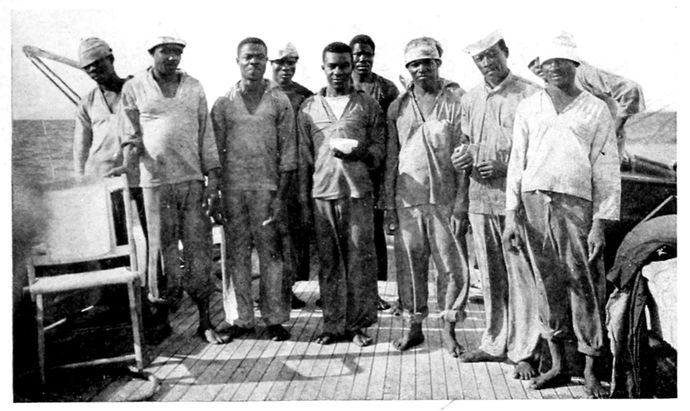
The entire enlisted personnel of the Haitian Navy
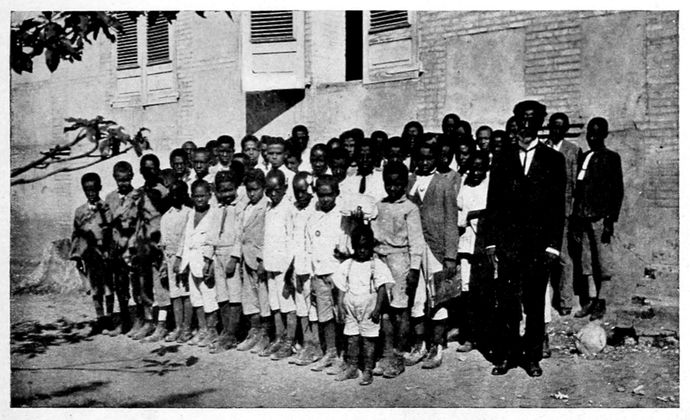
A school in Port au Prince
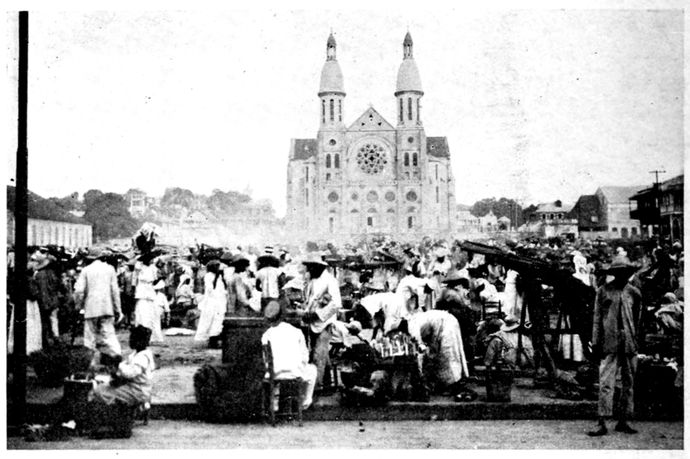
The Central Square and Cathedral of Port au Prince on Market Day
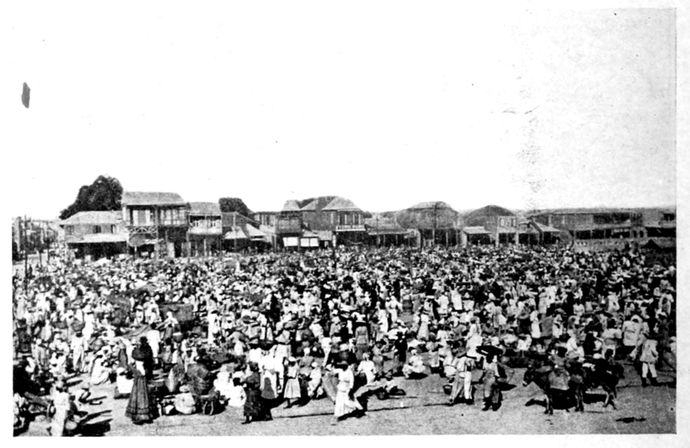
Looking down upon the market from the Cathedral platform
113The American residents of Port au Prince complain that visitors of
scribbling propensities have given too much space to its comic-opera
aspect. It is hard to avoid temptation. The ridiculous is constantly
forcing itself into the foreground, innocently unaware of distracting
attention from the more serious background. For there is such a background,
one which should in all fairness be sketched into any picture of
Haiti which makes a pretense of being true to life. If there has been
a constant tendency to leave it out, it is probably due to the fact that
the average wanderer over the face of the earth finds most “interesting”
the incongruous and the ludicrous.
To close our eyes, then, for the moment to the more obvious details,
the capital of the Black Republic is by no means the misplaced African
village which common report would indicate. Its principal streets are
excellently paved with asphalt; scores of automobiles honk their way
through its seething streams of black humanity. Even along the water-front
the principles of sanitation are enforced. Barefooted “white
wings,” distinguished by immense green hats of woven palm-leaves
worn on top of their personal headgear, are constantly sweeping the
city with their primitive bundle-of-grass brooms. A railroad, incredibly
old-fashioned, to be sure, but accommodating a crowded traffic
for all that, runs through the heart of the town and connects it with
others considerable distances away in both directions. An excellent
electric light service covers the city. Its shops make a more or less
successful effort to ape their Parisian prototypes; its business offices
by no means all succumb to the tropical temptation to sleep through the
principal hours of the day. The French left it a legacy of wide streets,
though failing, of course, to bequeath it adequate sidewalks. Its architecture
is a surprise to the traveler arriving from Cuba; it would be
far less so to one who came direct from Key West. Wooden houses
with sloping roofs are the general rule, thin-walled structures with huge
slatted doors and windows, and built as open as possible to every breeze
that blows, as befits the climate. There are neither red tiles, strangely
tinted walls, nor Moorish rejas and patios to attract the eye. Indeed,
there is little or nothing in the average street vista to arouse the admiration,
though there is a certain cause for amusement in the strange juxtaposition
of the most primitive African reed huts with the attempts of
Paris-educated mulattoes to ape, with improvements of their own, their
favorite French châteaux.
Only two buildings in Port au Prince—one might perhaps say in all
Haiti—boast window-glass. One is the large and rather imposing
114cathedral, light yellow both outside and within, flooded with the aggressive
tropical sunshine in a way that leaves it none of the “dim and mystic
light” befitting such places of worship. The other is the unfinished,
snow-white presidential palace, larger and more sumptuous than our own
White House. The cathedral looks down upon the blue harbor across
a great open square unadorned with a single sprig of vegetation; the
palace squats in the vast sun-scorched Champs de Mars, equally bare
except for a Napoleonic statue of Dessalines, his tell-tale complexion
disguised by the kindly bronze, and attended by a modest and deeply
tanned Venus of Melos. The absence of trees in the public squares
gives assistance to the wooden houses in proving the city no offshoot of
Spanish civilization. The tale runs that the Champs de Mars was once
well wooded until a former president ordered it cleared of all possible
lurking-places for assassins.
But Port au Prince is by no means unshaded. The better residential
part up beyond the glaring parade-ground makes full use of the gorgeous
tropical vegetation. Here almost every house is hidden away in
its grove of palms, mangos, breadfruit, and a score of other perennial
trees, and flowering bushes, ranging all the way from our northern
roses to the pale-yellow of blooming cotton-trees and enormous masses
of the lavender-purple bougainvillea, crowd their way in between the
tree-trunks. Oranges, bananas, and the pear-shaped grape-fruit of
Haiti hang almost within reach from one’s window; alligator-pears
may be had in their season for the flinging of a club; he who cares to
climb high enough can quench his thirst with the cool water of the
green cocoanut. The dwellings here are spacious and airy, their ceilings
almost double the height of our own, and if they lack some of the
conveniences considered indispensable in the North, they have instead
splendid swimming-pools and, in many cases, such a view of the lower
city, the intensely blue bay, and the wrinkled brown ranges of the
southern peninsula as would make up for a far greater scarcity of
the stereotyped comforts.
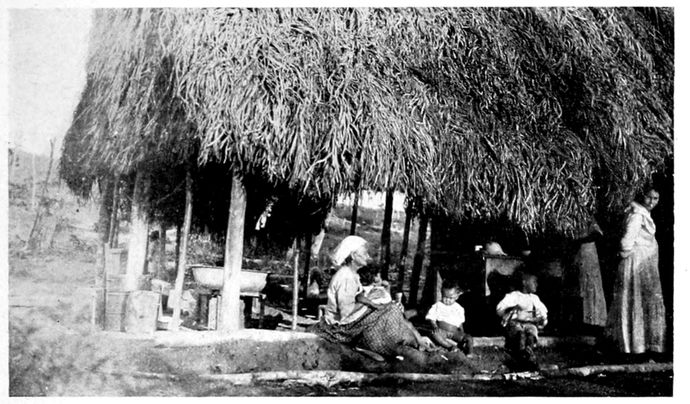
A Cuban residence in a new clearing
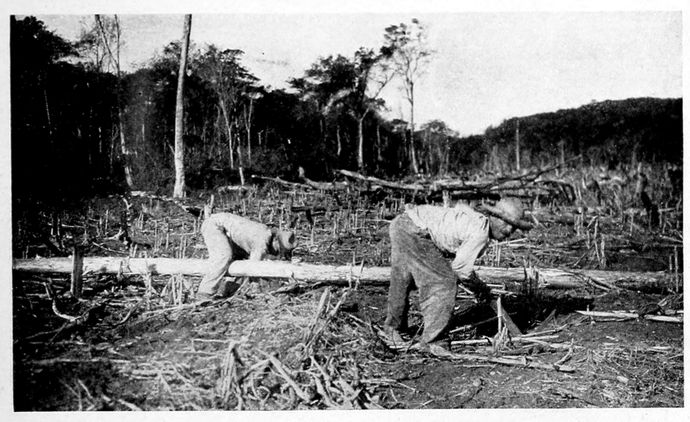
Planting sugar-cane on newly cleared land
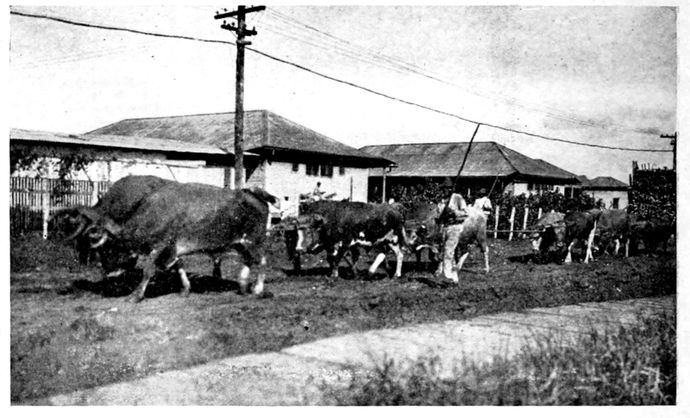
Hauling cane to a Cuban sugar mill
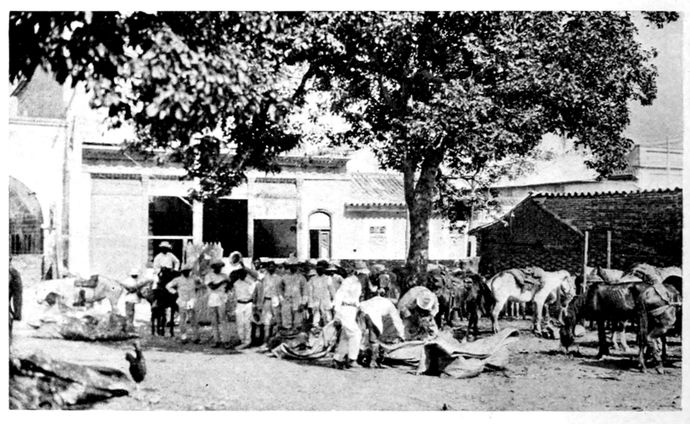
A station of a Cuban pack-train
115It is a leisurely, but constant, climb from the water-front to these
forest-embowered dwellings. Port au Prince is not blessed with a
street-car system, and its medieval railroad staggers only to the upper
edge of the Champs de Mars. Moreover, the painted drygoods-boxes
on wheels are invariably so densely crammed with full-scented blacks
that not only the white residents, but even the haughty yellow ones,
rarely deign to patronize the spark-spitting conveyance. Long-established
families have their private carriages; the parvenus from foreign
lands own, borrow, or share automobiles; mere clerks and bookkeepers
jog homeward on their diminutive Haitian ponies; and chance visitors
trust to luck and the oily-cushioned wrecks that ply for hire, finishing
the journey on foot from the point where the bony and moth-eaten caricature
of a horse refuses longer to respond to the lashings and screams
of the tar-complexioned driver. Fortunately, it is perfectly good
form to “catch a ride” with any car-owning member of one’s own
race.
Let me not leave the impression, however, that the majority of those
who ascend the city depend on gasolene or horseflesh. At least two
thirds of them walk, but it is the two thirds that do not count in polite
parlance. All day long, though far more incessantly, of course, in the
delightful coolness of early morning or the velvety air of evening,
processions of black people of varying degrees of raggedness plod
noiselessly up and down the stony streets of the upper town. Noiselessly,
that is, only in their barefooted tread; their tongues are rarely
silent, and frequent cackles of unrestrained laughter sound from the
bundles beneath which their woolly heads are all but invariably buried.
For be it large or small, a mahogany chest of drawers or a tin can three
inches in diameter, the Haitian always bears his burdens on his head.
Her head would be more nearly the exact truth of the case, for the
women rarely permit their lords and masters to subject themselves to
the indignity of toil. But the merest child of the burden-bearing sex
is rarely seen abroad except under a load that gives her the appearance
of the stem of a toadstool. Some of these uncomplaining females
serve the more fortunate residents of the hill; most of them trot to and
fro between the market and the tiny thatched cabins sprinkled far up
the range behind the city like rice grains on a green banana leaf.
Where the streets break up beyond the last man’s-size dwellings, narrow
trails tunnel on up through the prolific greenery to these scattered
huts of the real Haitian, among which it is easy to imagine oneself
in the heart of Africa.
Five years ago there were barely a score of white men in Port au
Prince, and not many more than that in all Haiti. To-day there are
perhaps three hundred American residents, without counting a large
force of occupation and their families, and to say nothing of a considerable
sprinkling of French, the remnants of what was a flourishing
German colony until an epidemic of internment fell upon it, and a
scattering of Italian, Syrian, and similar tradesmen. The Americans
of the first category are carrying on or opening up new enterprises
116that promise to offer Haiti a prosperity not even second to that of
Cuba. No one who has visited the island can question the extraordinary
fertility of its soil. The overwhelming portion of it is as virgin
as if the French had never exploited what was once the richest of their
colonies; revolutions have become, by force majeure, a thing of the
past. Every new undertaking must, to be sure, be built or rebuilt
from the ground up. During their more than a century of freedom
the negroes have done nothing but destroy. They have not even exercised
their one faculty, that of imitation, for they have been too much
shut off from the rest of the world to find anything to imitate. Though
the sugar-cane was introduced into Cuba by the French refugees from
Haiti, the entire country cannot at present compete with the largest
single sugar-mill in the prosperous island to the west. The Haitian
laborer has lost all knowledge of the sugar-making process except his
own primitive method of producing rapadoue. He must be taught all
over again, and he is not a particularly apt pupil; moreover, complain
the men who are striving to make Haiti bloom once more with cane,
no sooner is he taught than the Cuban planters entice him across the
Windward Passage with wages ten times as high as he receives at home.
But capital is beginning to recognize that despite its obvious drawbacks
Haiti offers a rich future, and several syndicates have already
“got in on the ground floor.”
The American residents of Port au Prince, men, women, and children,
swear by it. I have yet to meet one who is eager to leave; many
of those who go north for extended vacations cut them short with a
cry of “take me back to Haiti.” To the misinformed northerner its
very name is synonymous with revolution and sudden death. Outside
the field of romance there is about as much danger of meeting with
violence from the natives as there is of being boiled in oil at a church
“sociable.” There is not a deadly representative of the animal or
vegetable kingdom on the island; except for some malarial regions of
rather mild danger the climate is as healthful as that of the best state
in our union—with due regard, of course, to the invariable rule that
white women should season their residence with an occasional invigorating
breath of the north. The Americans have acquired one by one,
as some yellow politician has lost his grasp on the national treasury,
the grove-hidden houses in the upper town, some of them little short
of palatial. There they live like the potentates of the tropical isles
of romance. The blacks are respectful, childlike in their manner, and
have much of the docility of the negroes of our South before the Civil
117War. They work for wages which, as wages go nowadays, are less
than a song. House servants receive from five to eight dollars a month,
and the one meal a day to which the masses have long been accustomed
rarely costs a twenty-cent gourde. Families who could scarcely afford
the luxury of a single “hired girl” in the land of their birth keep five
servants in Haiti, a cook, butler, upstairs maid, laundress, and yard
boy; for the Haitian is strictly limited in his versatility, and the cook
could no more serve a dinner than a laundress could give the yard its
daily sweeping. They are usually stupid beyond words, with the
mentality of an intelligent child of six, but they are sometimes capable
of great devotion, with a dog-like quality of faithfulness; and between
them all they swathe the existence of their masters in the comfort of an
old-time Southern plantation. All this is but half the story of contentment
with Haitian residence, for the mere fact that the sun is certain
to break forth in all the splendor of a cloudless sky as sure as the
morning comes round is sufficient to make the cold and dismal north
seem a prison by comparison.
There is a certain amount of friction between the several classes
of Americans in Port au Prince, not to mention heroic efforts in “keeping
up with Lizzie.” Ten-course dinners with all the formality and
ostentation which go with them are of daily occurrence; “bridge”
flourishes by day and by night, with far from humble stakes, and dances,
whether at the American Club or in private houses, are not conspicuous
for their simplicity. The two things go together, of course; it is of
little use to disagree with a man if you cannot prove yourself his
equal by “putting up as good a front” as he does. Roughly speaking,
our fellow-countrymen in the Haitian capital may be divided into
four classes, though there are further ramifications and certain points
of contact. Each class has its own faults and virtues, and comes
naturally by them. The half dozen civilian officials who hold the chief
offices of our “advisory” share in the civil government have in too
many cases been chosen for their political standing rather than for
their ability or experience in such tasks as that they are facing. The
navy and the marine officers, between whom a rift now and then shows
itself, have the characteristics of the military calling the world over.
They are by nature direct and autocratic, rather than persuasive and
tactful; they have an almost childish petulance at any fancied slight
to their rank, which does not make it easy for them to coöperate with
the civilian officials. Of their efficiency in their chosen profession there
is no question, but our policy of assigning them to administrative positions
118simply because they are already on the national pay-roll and expecting
them to shine in tasks which call for a lifetime of training
quite opposite to that they have received has its drawbacks. The very
qualities which make for success in pacifying the country hamper them
in dealing with the better class of natives, who are, to be sure, negroes,
yet who have the sensitive French temperament and are much more
amenable to persuasion than to bullying. By chance or design the
great majority of our officers in Haiti are Southerners, and they
naturally shun any but the most unavoidable intercourse with the
natives. This is one of the chief bones of contention between the forces
of occupation and the American civilians engaged in business. The
latter, while still keeping a color-line, contend that the natives of education
should be treated more like human beings. They deplore the
narrow view-point, the indifference to industrial advancement, the occasional
schoolboy priggishness of the officers, and the latter retaliate
by considering the term business man as synonymous with money-grabbing
and willingness to cater to the natives for the sake of trade.
Not that these differences cause open rifts in the American ranks, but
the atmosphere is always more or less charged with them. The native
of education, on his side, resents the whole American attitude on the
race question, and not wholly without reason. The color-line is justifiable
in so far as it protects against intermingling of blood, characteristics,
and habits, but there is a point beyond which it becomes d—d
foolishness, and that point is sometimes passed by our officers in Haiti.
After all, the Haitians won their independence without our assistance,
and to a certain extent they are entitled to what they call their dignité
personelle. The Southerner is famed for his ability to keep the
“nigger” down, but he is less successful in lifting him up, and that is
the task we have taken upon ourselves in Haiti.
As every American should know, but as a great many even of those
who pride themselves on keeping abreast of the times do not, Haiti
has been an American protectorate since the summer of 1915. There
is a native government, to be sure, ranging all the ebony way from
president to village clerks, but if it functions efficiently, and to a certain
degree it does, it is thanks to a few hundred of our own marines and
certain representatives of our navy. How this strange state of affairs,
so contrary to the forgiving spirit of the present administration, came
about is a story brief and interesting enough to be worth the telling.
The Spanish discoverers—for one must be permitted a running
119start if one is to race through the reeking fields of Haitian history—soon
wiped out the native Indian population in their usual genial, but
thorough, way. Fields will not plant, or at least cultivate, themselves,
however, even in so astonishingly fertile a land as the island that
embraces the republics of Haiti and Santo Domingo. Hence the
Frenchmen to whom the western end of the island eventually fell, after
varying vicissitudes, followed the custom of the time and repopulated
the colony with negro slaves. Prosperity reigned for a century or
more. There are still jungle-grown ruins of many an old French
plantation mansion to be found not merely within the very boundaries
of the Port au Prince of to-day, but in regions that have long since
reverted to primeval wilderness. Unfortunately, for the French at
least, the slave-traders supplied this particular market with members of
some of Africa’s more warlike tribes, the descendants of whom, taking
the theories of the French Revolution au pied de la lettre, concluded to
abolish their masters. Under a genuine military genius with the blood
of African chieftains in his veins, one Toussaint l’Ouverture, and his
equally black successor, Dessalines, the slaves defeated what was in
those days a large French army, commanded by the brother-in-law of
the great Napoleon, and drove the French from the island. New
Orleans and Philadelphia received most of the refugees, whose family
names are still to be found in the directories of those cities. Except
for a few persons the French never returned, and Haiti has been
“the Black Republic” since 1804.
The result was about what our Southern statesmen would have
prophesied. In theory the government of Haiti is modeled on that of
France; in practice it has been the plaything of a long line of military
dictators of varying degrees of color and virtually all rising to power
and sinking into oblivion—usually of the grave—on the heels of
swiftly succeeding revolutions. There have been a few well-meaning
men among them, the last of whom, named Leconte, was blown up in
1912, palace and all. Most of them were interested only in playing
Cæsar, or, more exactly, Nero, over their black fellow-citizens until the
time came to loot the national treasury and flee, a program which was
frequently cut short by appalling sudden death. The detailed recital
of more than a century of violence, of constant bloody differences
between the mulattoes and the genuine blacks, would be a tale too long
for the modern reader.
In 1915 the presidency was occupied by a particularly offensive black
brother named Guillaume Sam. Though it has not been so recorded,
120Sam’s middle name was evidently Trouble. Foreign war-ships took
to dropping in on Port au Prince and demanding the payments of
debts to foreigners. Up in the northern peninsula, as usual in mango-time,
when the trees of the island constitute a commissary, revolution
broke out, and, to top off his woes, Sam was busy marrying off his
daughter and installing her in a new palace. In his wrath at being
disturbed at such a time Sam passed the word to his chief jailer to
clean out the penitentiary, some of the political prisoners in which
were no doubt in sympathy with the revolutionists, but many of whom
were there merely because they had aroused the personal enmity of
Sam, or some of his cronies. The sentence was carried out more like
a rabbit-hunt than an execution. In an orgie in which the primitive
instincts of the African had full play the two hundred or more prisoners
were butchered in circumstances better imagined than described.
Among them were many members of the “best families” of Port au
Prince. It is not recorded that any of this class took personal part in
the revenge that followed, but they undoubtedly instigated it. The
rank and file of the town, those same more or less naked blacks who
are ordinarily docile and childlike, surrounded the palace. Sam had
taken refuge in the French legation. For the first time even in the
turbid history of Haiti, the sanctuary of a foreign ministry was violated
by the voodoo-maddened mob. Sam was dragged out, cut to pieces,
and tossed into the bay. Then our marines landed and, to use their
own words, “the stuff was all over.”
American control is due to continue for at least twenty years from
that date. A treaty drawn up soon after the landing of our forces,
and subsequently renewed, provides for the form under which our
“assistance” shall be exercised, as well as specifying the time limit.
An American financial adviser, who is far more than that in practice,
an American receiver of customs, and heads of the engineering and
sanitation departments, are required by the terms thereof, and the final
decision in most matters of importance lies with the American minister.
Unlike the Republic of Santo Domingo in the eastern end of the island,
Haiti still retains her native government, but its acts are subject to
a relatively close supervision by the officers above named, despite the
pretense that our share is only “advisory.”
There are both natives and foreigners who contend that Haiti is
fully capable of governing itself if the white man will go away and let
the Black Republic alone. The following incident is not without its
bearing on the subject:
121The Rotary Club of Port au Prince decided in the fifth year of
American occupation to assess every member five dollars for the purpose
of providing a community Christmas for the poor children of the
city. Never had a Christmas-tree been seen in Haiti outside the homes
of American or other foreign residents. The vast majority of Haitians
had no conception that so benevolent a being as Santa Claus existed.
The Port au Prince branch of the club had been very recently organized.
Its membership included not only the representative business
men of all grades in the foreign colony, but it had made a special
point of overlooking the color-line and admitting as many Haitians
as white men. A little closer intercourse now and then between the
two races, it was felt, would do no one any harm, and the experience
of similar clubs in Cuba suggested that it might do considerable good.
The military colony, of course, took no part in this flagrant violation
of its strict Southern principles beyond granting its official blessing, but
the civilians had long contended for a broader-minded attitude.
There was no difficulty in finding representative Haitians of sufficient
culture to be worthy a place in such an assembly. Men educated
in Paris, graduates of the best universities in other European capitals,
men who spoke the French language as perfectly as the French themselves,
men who could give the average American business man cards
and spades in any discussion of art, literature, and the finer things of
civilization, were to be found in the best Haitian homes. The native
membership as finally constituted included cabinet ministers, former
ambassadors to the principal world capitals, lawyers famous for their
oratory, and men who had produced volumes on profound subjects,
to say nothing of very tolerable examples of lyric poetry. The club
did not, it is true, completely obliterate the color-line. It merely moved
it along. A complete sweep of the crowded table at the weekly club
luncheons, with whites and Haitians nicely alternating, did not disclose
a single jet-black face. But that was not the fault of the club; it was
due to the fact that the benefits of higher education have seldom reached
the full-blooded Africans of the island, as distinguished from what are
known locally as the “men of color.”
The wives of the white club members took up the task of providing
a suitable Christmas where the men left off, and pushed the matter with
American enthusiasm. They canvassed the white colony for additional
funds; they solicited contributions in kind from the merchants of
Caucasian blood. Their evenings they spent in making things that
would bring joy to the little black babies, in putting the multifarious
122gifts in order, in laying new plans to make the affair a success. By
day they drove about in their automobiles through all the poorer sections
of the city, distributing tickets to the swarms of naked black
piccaninnies. Mobs of harmless, clamoring negroes surrounded their
cars, holding up whole clusters of babies as proof of their right to
share in the extraordinary generosity of the strange white people.
Seas of clawing black hands waved about them like some scene from
Dante’s Inferno in an African setting. A tumult of pleading voices
assailed their ears: “Cartes, mamá, donne-moi cartes! Moi deux petits,
mamá! Non gagner carte pour petit malade, mamá?”
The “ladies of color” of the other club members formed a committee
of their own and lent a certain languid assistance, but the brunt of the
work fell on the incomprehensibly generous whites. The men of the
yellow features were even more willing to leave matters to their
Caucasian associates. The latter were more experienced in the arrangement
of Christmas-trees; moreover, they could descend to vulgar
work, which the élite of Port au Prince could not indulge in without
losing caste. Curious creatures, these whites, anyway; let them go
ahead and spread themselves. The “men of color” were quite willing
to sit back and watch les blancs run the whole affair—except in one
particular, the distribution of tickets. In that they were more than
ready to coöperate. They even made the generous offer of attending
to all that part of the affair. The minister of public instruction came
forward with a plan in keeping with his high rotarian standing. If the
bulk of the tickets, say two thirds of them, for instance, were turned
over to him, he would personally accept the arduous labor of distributing
them to the school-children. Now you must know that the school-children
of Port au Prince constitute a very small proportion of the
young population, and that they are exactly the class which the sponsors
of the Christmas-tree were not trying to reach. Furthermore, do not
lose sight of the fact that the men of color must be constantly on the
qui vive to keep their political fences in order. Even the ladies of the
Haitian committee advised against the minister’s proposition. He,
they whispered, would divide the tickets between his favorite teachers,
who in turn would distribute them to their pet pupils.
Meanwhile Christmas drew near. A band of black men were sent
far up into the mountains to fetch down a pine-tree. They are numerous
in some parts of Haiti, occasionally growing side by side with the
palms. The blacks could not, of course, understand why they must
lug a tree for two or three days over perpendicular trails when trees
123of a hundred species abounded in the very outskirts of Port au Prince;
but this was not the first time they had received absurd orders from
the incomprehensible blancs. They selected as small a tree as they
dared and started down the mountain-side. As the wide-spreading
branches hindered their progress, they lopped most of them off. How
should they know that the inexplicable white men wanted the branches
to hang things on? The gentleman of color, right-hand man of their
great national president, who had transmitted the order to them had
said nothing about that, nor explained how the branches might be
bound close against the trunk by winding a rope around them.
Christmas morning came. Several Americans defied the tropical
sun to direct the labors of another band of blacks engaged in planting
a diminutive pine-tree with a few scattered twigs at its top, and to hide
its nudity beneath another tree of tropical luxuriance, out on the
glaringly bare Champs de Mars before the grand stand from which
the élite of Port au Prince watches its president decorate its national
heroes after a successful revolution. The rotarians of color could
not, of course, be expected to appear at such a place in the heat of the
day.
The ceremony was set for five o’clock, and was expected to last until
nine. The American Electric Light Company had contributed the illumination,
and its manager had installed the festoons of colored lamps
in person. The American chief of police had assigned a force of native
gendarmes to the duty of keeping order. It would be almost their
first test of handling a friendly crowd in a friendly manner. Hitherto
their task had been to hunt down their caco fellows with rifle and
revolver, an occupation far better fitted to their temperament and
liking. An American of benevolent impulses had consented to play
Santa Claus, and give the little black urchins a real Christmas, with all
the trimmings.
Poor Santa Claus did not get time even to don his whiskers. By
two the crowd began to gather. By three all the populace of Port au
Prince’s humble sections had massed about the tree which the incomprehensible
blancs had planted for the occasion instead of performing
their strange rites under one of the many live trees with which the city
abounded. Word had been sent out that full dress was not essential.
Old women who had barely two strips of rag to hang over their dangling
breasts, boys whose combined garments did not do the duty of a pair of
swimming-trunks, had tramped up from their primitive hovels on the
edges of the city. If they were ragged far beyond the northern meaning
124of that term, at least their strings and tatters were as clean as water
and sun-bleaching could make them. The women and most of the men
carried or dragged whole clusters of black babies, most of them as
innocent of clothing as a Parisian statue. As they arrived, the children
were herded within the roped inclosure about the tree. Only
adults with infants in arms were permitted inside the ropes; the jet-black
sea of small faces was unbroken clear around the wide seething
circle. It was hard to believe that there were so many piccaninnies
in the world, to say nothing of the mere half-island of Haiti. Outside
the ropes an immense throng of adults, mingled with better-dressed
children without tickets, was shrieking a constant falsetto tumult that
made the ear-drums of those in the focus of sound under the tree
vibrate as if their ears were being incessantly boxed. A “conservative
estimate” set the number present at ten thousand.
Up to this point the gentlemen of color, even those who had been
appointed on the original committee, had kindly refrained from interference
with their more Christmas-experienced white associates—except
in the aforementioned matter of tickets. Now they appeared en
masse to give the distinction of their presence and the sanction of
their high caste to so praiseworthy an undertaking. Cabinet ministers,
newspaper editors, the bright lights of the Haitian bar, the very president
of the republic, strutted down the human lanes that were opened
in their honor and took the chief places of vantage on the distributing
platform beneath the tree. Their dazzling dernier cri garments made
the simple American committeemen look like the discards of fortune.
Their features were wreathed in benign smiles. They stepped forth to
the edges of the platform and waved majestic, benevolent greetings to
their applauding constituents outside the ropes. Some one handed the
president a toy horn. He put it to his lips and blew an imaginary blast
to prove what a bonhomme he was at heart and how thoroughly he
entered into the prevailing spirit. The other gentlemen of color assumed
Napoleonic poses; they raised their voices in oratorical cadences,
and, when these failed to penetrate the unceasing din, they waved their
hands at the heaps of gifts about them with sweeping gestures that said
as plainly as if they had spoken in their impeccable French, “See, my
beloved people, what I, in my bounty, have bestowed upon you!”
Soon after four the minister of public works snatched up a bundle
of presents and flung them out into the sweltering sea of upturned
little faces. That was neither the hour nor the manner of distribution
that had been agreed upon, but what should a great political genius
125know of such minor details? Besides, there was no hope of delaying
the ceremony much longer. The surging throng was in no mood to
watch the absurd antics of the unfathomable white people, with their
patched-up tree and their queer ideas of order and equal distribution.
What they wanted were the presents, and at once. Those behind were
already climbing over those in front in an effort to get at the heaped-up
wares. If the original plan of waiting until nightfall and the colored
lights had been carried out, the gifts would probably have disappeared
in a general mêlée.
The beau geste of the Rotary vice-president was a signal for all his
yellow confrères to distribute largess to their clamoring constituents.
In vain did the white women attempt to exchange gifts for tickets,
according to the system they had worked out. Their kinky-haired
associates would have no such restrictions. As long as a hand was
held out to them they continued to thrust gifts into it, perfectly indifferent
to other hands clutching tickets that were being wildly flourished
about them. There were presents of every possible usefulness to
Haitian poverty—shoes, stockings, hats, shirts, suits, collars, ties,
bales of cloth cut in sizes for varying ages of children’s garments,
candy, toys, food stuffs ranging all the way from cakes to cans of
sardines. The plan had been to gage each gift by the appearance of
the recipient. There was nothing particularly Santa Claus-like in handing
a necktie to a boy who had not shirt enough to which to attach a
collar, nor in wishing a pair of stockings off on a youth whose feet
had never known the imprisonment of shoes. Stark-naked black
babies whose ribs could be counted at a hundred paces were not so
much in need of an embroidered sailor-blouse as of a tin of biscuits.
But all this meant nothing to the excited Haitians on the platform.
They poured out gifts as if the horn of plenty were their own private
property. The ministers caught up whole armfuls of presents and
flung them clear over the heads of the invited children into the shrieking
mobs beyond the ropes. The adults out there were far more likely
to vote for them at the next elections than were the half-starved urchins
beneath them. One cabinet member was seen to toss bundle after
bundle to an extraordinarily tall negro who was known to wield great
political power among the masses. Meanwhile the helpless little urchins
within the circle rolled their white eyes in despair and frantically waved
the tickets clutched in their little black hands, until they went down
under the bare feet of those fighting forward behind them.
The native gendarmes in their uniforms so like that of the American
126marines were preserving order much as the pessimists had predicted.
One of them, starched and ironed to the minute, approached an American
distributor and asked, with the sweet-faced courtesy of a Southern
lady of the old school, for one of the riding-whips which some merchant
had contributed. “Here’s a fine fellow,” said the unadorned Santa
Claus to himself, “a real soldier. He wants a whip to use on mounted
duty, and so gentle-mannered a chap will make only proper use of it.”
The gendarme accepted the gift with a polite bow and a grateful smile
and marched back across the ring—to strike full in the face with all
his force a pitiful old black woman who was being forced forward by
the crush behind, and to rain blow after blow on her bare head and
breast and on the naked infant she had brought on the invitation of the
ticket clutched in its tiny hand. What was the good of protesting?
He had been ordered to hold back the crowd, and as he had been forbidden
to use the revolver strapped at his side, how else could he do so?
If he had been checked in his onslaught, he would have spent the rest of
the afternoon wondering what these strange Americans wanted, anyway.
By dint of superhuman exertions the white distributors succeeded in
exchanging something or other for every ticket. But it was a sadly
mis-gifted swarm of children who finally rescued themselves from the
maelstrom. Tiny tots who had set their hearts on a cake or a package
of candy held up the neckties they knew no use for with a “Pas bon
pour moi! Donne gateau!” The greatest demand was for shoes.
“Non, non, papa! soulier, soulier!” came incessant shrieks from the
urchins who waved unwelcome gifts before the weary distributors.
The gentlemen of color had continued to strew armfuls of presents
upon the throng beyond the ropes. The minister with the lanky confederate
had tossed him assorted wares enough to break the back of a
Haitian donkey—a feat verging on the impossible. When there was
nothing else left, he flung him several huge native baskets which a lady
of the committee had loaned for the occasion. These he followed with
the decorations snatched from the tree. Then he took to unscrewing
from their sockets the electric light bulbs belonging to the company
that had contributed the useless illuminations. This was too much
even for the benevolent-featured man who had been cast for the rôle
of Santa Claus. He gathered the slack of the minister’s immaculate
trousers in one hand and set him down out of reach of further temptation.
The festivities were entirely over by the time the blazing-red tropical
127sun sank behind the mountainous range to the westward. The throng
streamed out across the Champs de Mars like a lake of molten lead
that had long been dammed up and had suddenly broken its dikes.
Not a scrap even of the tickets that had been canceled by being torn in
two remained. In Haiti everything has its commercial value. For
days to come little heaps of these bits of cardboard would be offered
for sale by the incredibly ragged old women of the more miserable
market-places, to be made use of the voodoo gods know how. Among
the last of the gentlemen of color to leave the platform was a pompous
being resplendent in Port au Prince’s most fashionable raiment. He
was a graduate of the Sorbonne, a political power in the Black Republic,
an officer of the Rotary Club, and the editor of Haiti’s principal newspaper.
In one hand, which he held half concealed beneath the tails of
his frock-coat, he grasped a dozen bright-colored hair-ribbons and
several silk handkerchiefs which he had filched from the basket of
presents that had been intrusted to him for distribution.
128
The word caco first appears in Haitian history in 1867. The
men who took to the bush in the insurrection against President
Salnave adopted that pseudonym, and nicknamed zandolite
those who supported the government. The semi-savage insurrectionists,
flitting at will through the rugged interior of the country, indifferent
alike to the thorny jungle and the precipitous mountains, saw in
themselves a likeness to the Haitian bird which flies freely everywhere,
and in their opponents a similarity to the helpless caterpillars on which
it feeds. The two terms have persisted to this day.
Haiti has never since been entirely free from cacos, though there
have been occasional short periods when the country has been spared
their ravages. Let a new president lose his popularity, however, or
some ambitious rascal raise the banner of revolt, and the bandit-revolutionists
were quick to flock together, beginning their operations as
soon as the mangos were ripe enough to furnish them subsistence.
With the exception of a few ephemeral leaders with more or less of
the rudiments of education, the cacos are a heterogeneous mob of
misguided wretches who have been cajoled or forced into revolt by
circumstances of coercion. Ragged, penniless, illiterate fellows in the
mass, they gather in bands varying from a score to thousands in
number, depending on the reputation, persuasiveness, or power of compulsion
of their self-appointed leaders. The latter, though in some
cases men of standing, are more often as illiterate as their followers.
Now and again one of them, usually with some Caucasian blood in his
veins, has personal ambitions either of making himself President of
Haiti in the long-approved manner, or at least of becoming powerful
enough to force the Government to appoint him ruler of a province
or of a smaller district. Others are merely the agents of disgruntled
politicians or influential “respectable citizens” of Port au Prince or
others of the larger cities, who secretly supply funds to the active insurrectionists.
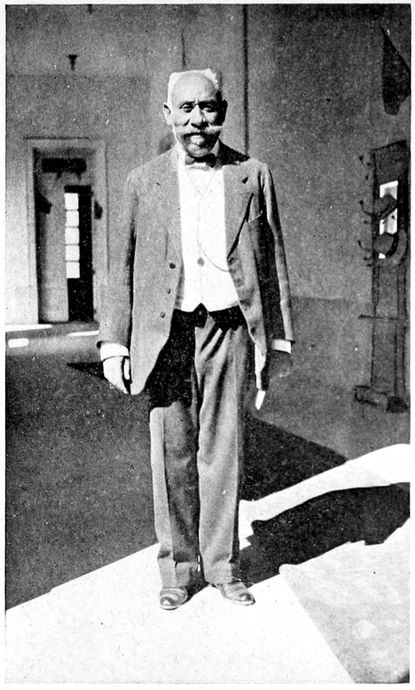
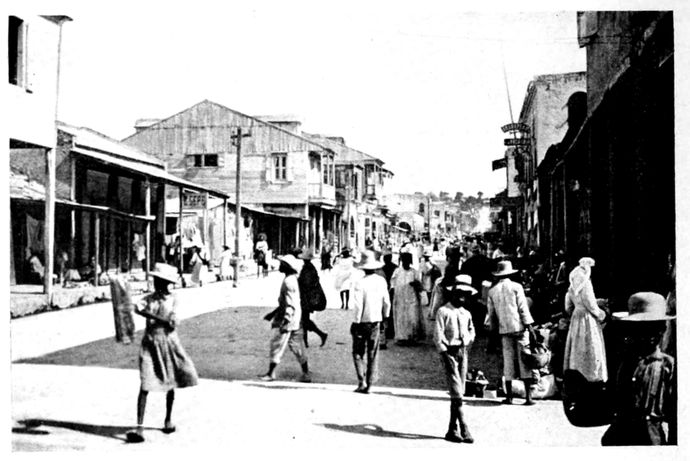
A street in Port au Prince
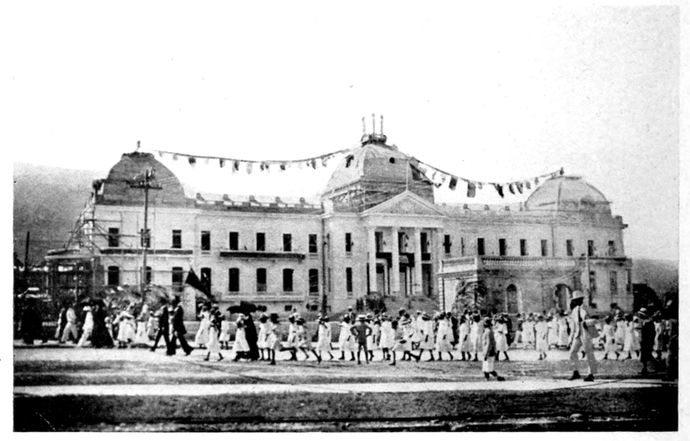
The unfinished presidential palace of Haiti, on New Year’s Day, 1920
129The backwardness and poverty of Haiti are largely due to the constant
menace of these roving outlaws. Travel has often entirely disappeared
from many a trail; more than one fertile region has been
left wholly uncultivated and virtually uninhabited because of marauding
bands of cacos. Cattle, once plentiful throughout the republic, have
almost wholly disappeared, thanks to the fact that their flesh furnishes
the chief means of livelihood and their hides the one sure source of
income for the bandits. The depredations of the cacos have cost the
Black Republic most of its wealth and the greater share of its worldly
troubles.
Some two years after American occupation cacoism took on a new
life. In perfect frankness it must be admitted that this was partly
the fault of the Americans. Next to the cleaning up of Port au Prince
the most important job on hand was the building of roads. If Haiti
is to take her place even at the tail end of civilization, she must become
self-supporting—in other words, able to pay her foreign debts, both
public and commercial. The prosperity of French days, when the
island exported large quantities of coffee, sugar, and cotton, has as
completely disappeared under the anarchy of the blacks as have the old
plantations. What little the country might still export, consisting
mainly of coffee, could not get down to tide-water for lack of highways,
those which the French built having been wholly overgrown by
the militant jungle.
In their eagerness to furnish the country with this first obvious step
to advancement the forces of occupation resurrected an old French
law called the corvée. We still have something of the sort in many of
our own rural districts—the requirement that every citizen shall work
a certain number of days a year on the roads. But there is a wide
difference between the public-spirited Americans and the wild black
men into which the mass of Haitians has degenerated. Neither they
nor their ancestors for several generations have seen the need of roads,
at least anything more than trails wide enough along which to chase
their donkeys. But they probably would have endured the resurrected
corvée had it been applied in strict legality, a few days’ labor in their
own locality, instead of being carried out with too energetic a hand.
When they were driven from their huts at the point of a gendarme
rifle, transported, on their own bare feet, to distant parts of the country,
and forced to labor for weeks under armed guards, it is natural that
they should have concluded that these new-coming foreigners with
white skins were planning to reduce them again to the slavery they
had thrown off more than a century before. The result was that a
130certain percentage of the forced laborers caught up any weapon at
hand and took to the hills as cacos. If they have any definite policy,
it is to imitate their forefathers and drive the white men from the
island. One chief announced the program of killing off the American
men and carrying their women off to the hills. The mass of Haitians
believe that the world’s supply of white men is very limited; it is beyond
their conception that there are many fold more of them where these
came from. Their ancestors drove out the French, and they not
only did not come back, but the blacks were never subjected to any
punishment—at least any their simple minds could recognize as such—for
their revolt. Why could not a new Toussaint l’Ouverture accomplish
the feat over again?
Our mistake in the matter has been corrected. The American officer
who countenanced, if he did not sanction, these high-handed methods
has gone to new honors on other fields of battle; the young district
commanders whose absolute power led them to apply too sternly their
orders to build roads have returned to the ranks, and the corvée has
been abolished. But the scattered revolt persists, and in the opinion of
all but a few temperamentally optimistic residents, either Haitian or
American, is due to continue for some time to come. That forced labor
was not the cause of cacoism, for it is in the Haitian blood to turn
caco; but it made a fertile field of ignorant, disgruntled negroes from
which the bandit leaders were able to harvest most of their followers,
and it gave added strength to the chief argument of the rascally leaders—the
assertion that the Americans had come to take possession of
Haiti and reëstablish slavery. To this day even the foreign companies
which have no trouble in recruiting labor for other purposes cannot hire
the workmen needed to build their roads. The thick-skulled native
countrymen see in that particular task the direct route to becoming
slaves.
For more than two years courageous young Americans have been
chasing cacos among the hills of central and northern Haiti, with no
other ulterior motive than to give the Black Republic the internal peace
it has long lacked and sadly needed. All of them are members of our
Marine Corps, though many of them are in addition officers of the
Gendarmerie of Haiti, with increased rank and pay. Take care not to
confuse these two divisions of pacifiers, for the gendarmerie has a
strong esprit de corps, and a just pride in its own achievements, in
spite of being still marines at heart. For a long time the native
gendarmes, of whom twenty-five hundred, officered by marine enlisted
131men, have been recruited by our forces of occupation, were efficient
against the bandits only when personally led by Americans. Merely
to shout the word “Caco!” has long been sufficient to stampede a
Haitian gathering of any size. Bit by bit, however, the gendarmes
have been taught by practical demonstration that they are better men
than the cacos, and the immediate job of hunting down the bandits is
gradually being turned over to these native soldiers. American supervision,
nevertheless, for years to come will certainly be necessary to
eventual success.
Though the world has heard little of it, our caco-hunters have performed
feats that compare with anything done by their fellows in
France. In fact, their work has often required more sustained courage
and individual initiative, and has brought with it greater hardships.
In the trenches at their worst the warrior had the support and the sense
of companionship of his comrades and a more or less certain commissary
at the rear; if his opponents were sometimes brutal, they clung
to some of the rules of civilized warfare. In Haiti many a young
American gendarme officer has set forth on an expedition of long duration
through the mountainous wilderness, often wholly alone, except
for three or four native gendarmes, cousins to the cacos themselves,
sleeping on the bare ground when he dared to sleep at all, subsisting
on the scanty products of the jungle, his life entirely dependent on his
own wits, and his nerves always taut with the knowledge that to be
wounded or captured means savage torture and mutilation, to be followed
by certain death. Bit by bit the native gendarmes have been
trained to fight the cacos unassisted, and three or four of them have
now reached commissioned rank; but the best of them still require
the moral support of a white leader, and the energetic American youths
scattered through the “brush” of Haiti have the future peace of the
country in their keeping.
It must be admitted that the cacos do not constitute a dangerous army
in the modern sense of the word. Their discipline is less than embryonic,
their weapons seldom better than dangerous playthings. One rifle
to five men is the average equipment, and many of these are antiquated
pieces captured from the French expeditionary force under Leclerc that
was driven from the island more than a century ago. Some of them
are of no more use than the cocomacaque, or Haitian shillalah, even
when their possessors can obtain ammunition. Such cartridges as fall
into the hands of the cacos are usually wrapped round and round with
paper to make them fit the larger bore of their ancient guns, and the
132bullet that comes zigzagging down the barrel is seldom deadly beyond
two hundred yards. But the possession of a rifle, even one worthless
as a firearm, is a sign of leadership that carries with it great personal
pride, and an occasional caco owns a high-powered modern carbine.
The mass of them are armed with machetes, rusty swords of the olden
days, or revolvers even more useless than the rifles.
The lesser military ranks are not in favor among the cacos. Every
leader of a band is a general, and usually a major general at that.
Most of them have been commissioned by the caco-in-chief—on a slip
of paper scrawled with a rusty pen, or even with a pencil, by the one
man on his staff who can write a more or less legible hand. These
“commissions” all follow the prescribed form which has been stereotyped
in Haiti since the days of Dessalines:
“Liberté Egalité Fraternité
République d’Haiti
Informé que vous réunissez les conditions et aptitudes voulues—Informed
that you possess the qualifications and aptitude desired, I
hereby appoint you general of division operating against the Americans
and direct that you proceed with your troops to attack”—this or that
hamlet or village in the hills. The expression “Opérant contre les
américains” is seldom lacking in these scribbled rags, and some of them
raise the holder to higher dignities than were ever reached by mere
field marshals on the battle-grounds of Europe. The “commission,”
for instance, of the “Chief of Intelligence” of the caco-in-chief reads
succinctly, “I name you as chief of the Division of Spies to spy everywhere”—an
order that has at least the virtue of leaving the recipient
unhampered with that division of responsibility which has been the
bane of civilized warfare. Incidentally the intelligence system of the
cacos is their strongest point. Like most uncivilized tribes the world
over, they have some means of spreading information that makes the
telegraph and even the radio seem slow and inefficient by comparison.
An uninformed stranger, reading these highfalutin’ “commissions,”
might easily picture the caco “generals” as mightier men than Foch
and Pershing combined, instead of what they really are, stupid, uneducated
negroes dressed in the dirty remnants of an undershirt and
cotton trousers, a discard straw or felt hat with a bit of red rag sewed
on it as a sign of rank, and armed with a rusty old saber or a revolver
that has long since lost its power to revolve.
133The cacos have a mortal fear of white soldiers. Scores of times a
single marine or gendarme officer has routed bands of a hundred or
more, killing as many as his automatic rifle could reach in the short
period between their first glimpse of him and the time it takes the
ragged “army” to scatter to the four points of the compass through
thorny undergrowth or cactus-hedges which no white man could penetrate
though all the forces of evil were pursuing him. The natives
cannot “savez” this uncanny prowess of les blancs, and commonly
attribute it to the sustaining force of some voodoo spirit friendly to the
white man. This belief is to a certain extent a boomerang, for the
Haitian gendarmes often fancy themselves immune in the presence of
a white superior, and more than one of them has bitten the dust because
he insisted on calmly standing erect, smoking a cigarette, and placidly
handing cartridges to the marine who lay hugging the ground beside
him, pumping lead into the fleeing cacos. With a white man along
how could he be hurt? Up to date at least three thousand bandits
have been killed as against four Americans,—a major and a sergeant
who were shot from ambush, and two privates who lost their lives by
over-confidence.
Captured correspondence shows what a terrible war is this guerre
des cacos:
“The Americans,” reads the report of one général de division to his
superior, “attacked us in force on the night of the 13–14th. I found
myself with a shortage of ammunition, but I succeeded in borrowing
ten carbine cartridges and three revolver bullets and was able to hold
the situation in hand.” As a matter of fact the American “force”
consisted on this particular occasion of three marines, and the “general”
“held the situation in hand” by scurrying away through the
mountains so fast that it was a week or more before he got any considerable
number of his band together again.
“I write to tell you,” says another great military genius, “that I
had a cruel battle before Las Cahobas the other day, with one wounded.
I also tell you that I arrested General Ulysses St. Raisin for being drunk
and disarmed him and he is under guard in my camp. Also that
General Etienne Monbrun Dubuisson had a big battle with the Americans
last week and besides having a soldier severely wounded he had
one délégué taken by the whites.”
The Americans who are striving to bring internal peace to Haiti
have come to the unanimous conclusion that the mere killing of cacos
will not wipe out banditism. They have hunted them by every available
134means, including the use of aëroplanes. The cacos show a wholesome
terror for the latter, which they call “God’s wicked angels”; they
have suffered “cruel” losses before the machine-guns of the determined
American youths who are pursuing them, but they continue their
cacoism. All efforts are now being bent to two ends—to kill off
the chiefs and to weed the country of firearms. In the early days
of the occupation the native caught in possession of a rifle was given
five years at hard labor, and many of them are still serving sentence,
though the penalty has recently been reduced to six months. Every
report of “jumping” a band or a camp of cacos ends now with a regular
formula in which only the numbers differ: “Killed 1 general and 2
chiefs; captured 9 rifles, 6 swords, 11 machetes.”
The tendency of the caco to use his rifle chiefly as ballast to be
thrown overboard when the appearance of a white soldier gives his
black legs their maximum speed has helped this weeding out of weapons,
as the time-honored Haitian custom for opposing warriors to mount a
prominent hillock and hurl foul-mouthed defiance at their foes has
raised the scores of American marksmen. Recently an intelligent
propaganda has been carried on by the gendarmerie to induce the misled
rank and file to come in and surrender their arms, receiving in exchange
a small cash equivalent and a card attesting them bons habitants. This
offer of amnesty, which has already shown gratifying results, is brought
to the attention of the bandits chiefly through the market-women, who,
swarming all over Haiti, have always been the chief channel of information
for the cacos, with whom they are in the main friendly despite
having frequently been robbed of their wares by some hungry “army.”
The chief drawback to this plan, however, is a certain lack of team-work
between the two corps of caco-hunters. The marines have orders
to shoot on sight any native carrying a rifle—a perfectly justifiable
command, since there is no other distinguishing mark between a bon
habitant and a caco. But the result is that the chief who has determined
that surrender to the nearest gendarme officer is the better part
of valor, or the caco “volunteer” who has at last succeeded in eluding
his own sentries, is forced to wrap his weapon in banana-leaves and
sneak up to within a few miles of town, hide his firearm, and apply
at the gendarmerie for a native soldier to protect him while he goes
to get it.
In most cases the bandits travel in small groups until called
together for some projected attack. But more than one permanent
camp, veritable towns in some cases, has been found tucked away in
135some mountainous retreat. The latest of these to be destroyed had
seventy-five houses, a headquarters building (with two hundred chairs),
a voodoo temple, and a cockpit; for the caco remains a true Haitian
for all his cacoism, and will not be separated from his voodoo rites, his
fighting cock, and his women except in case of direst necessity.
Of many courageous feats performed by the American youths in
khaki who are roaming the hills of Haiti one stands out as the most
spectacular. Indeed, it is fit to rank with any of the stirring warrior
tales with which history is seasoned from the days of the Greeks to the
recent World War. Hearing it, one might fancy he was listening to
a story of the black ages of Haiti when Christophe was ruling his sable
brethren with bloody hand, rather than to something accomplished a
bare half-year ago by a persevering young American.
Charlemagne Masena Péralte was a member of one of the two
families that have long predominated in the village of Hinche. He was
what the Haitians call a griffe, a three-fourths negro. The French
priest with whom he served as choir-boy and acolyte remembers him
well as “a boy who was not bad, but haughty and quick to take offense.”
When he had learned what the thatched schoolhouse of Hinche had to
offer, Charlemagne was sent to Port au Prince, where he finished the
course given by French ecclesiastics. In other words he was a man
of education by Haitian standards. Like many of the sons of the
“best families” in Haiti, he decided to go into politics rather than
pursue a more orderly profession. But politicians are thicker than
mangos in the Black Republic, and for some reason things did not
break right for Charlemagne. Wounded in his pride and denied
his expected source of easy income, he followed the long-established
Haitian custom in such matters. He gathered a band of malcontents
and penniless cacos about him and marched against the capital. The
Government realized the danger and bought Charlemagne off by appointing
him commandant of an important district. A few years later,
when a new turn of the political wheel left him again among the “outs,”
he followed the same route to another official position. It got to be a
habit with Charlemagne to force each succeeding government to appoint
him to office.
Finding himself in disfavor with the American occupation, he set
out to work his little scheme once more. It does not seem to have
occurred to him that conditions had changed. Captured, and convicted
of cacoism in October, 1917, by an American court martial sitting in
136his native town of Hinche, he was sentenced to five years at hard
labor.
A year later, while working on the roads in company with other
inmates of the departmental prison at Cap Haïtien, he eluded his
gendarme guards and escaped. Taking to the bush, he set out to
organize a new band of cacos. The corvée, then at its height, made
his task easier. To turn the scales still more in his favor, the large
gang working on the highway at Dignon, near his home town, had
not been paid in more than three months, thanks to that stagnation of
circulation to which quartermaster departments are frequently subject.
“Come along,” said Charlemagne, “and I’ll get you your money,” and
some three hundred disgruntled workmen followed him into the mountains.
Within a few months he was signing himself “Chief of the Revolutionary
Forces against the American nation on the soil of Haiti,” and
had gathered several thousand cacos about him. The magic name of
General Charlemagne spread throughout the island. Every leader of
a collection of lawless ragamuffins sought to be “commissioned” by
him. He appointed more generals than ever did a European sovereign.
Every lazy black rascal with nothing to lose and everything to gain
joined his growing ranks. When the simple countrymen would not
follow him by choice, they were recruited by force. He assassinated
and punished until his word became law to any one out of reach of gendarme
protection. He spread propaganda against the American officers,
asserted that they had orders to annex the country, and posed as the
savior of Haiti, calling upon the people to help him drive out the white
oppressors as their fathers had done more than a century before.
As a matter of fact, the patriotism of Charlemagne, of which he
constantly boasted in pompous words, consisted of nothing more or less
than an exaggerated ego and an overwhelming desire to advance his
own personal interests. He had that in common with all the yellow
politicians of Haiti. But he played the patriotic card with unusual
success. Disgruntled politicians and men of wealth who had some
personal reason for wishing the occupation abolished gave him secret
aid. The simple mountain negroes really believed that they were fighting
to free Haiti from the white man, and that under the great General
Charlemagne the task would soon be accomplished. The corvée happened
to have been abolished soon after the “general’s” escape from
prison; he quickly took personal credit for the change and promised
the simple Haitians to free them in the same manner of all foreign
137interference. Before the end of 1918 he attacked his native town
with several thousand followers and was not easily repulsed. It was
decided to put the marines in the field against him, and for eight
months they pursued him in vain. If anything, the caco situation was
becoming worse instead of better. Despite the “jumping” of many a
band and camp by the marines and the gendarmerie, the central portion
of the country was becoming more and more bandit-ridden. It became
apparent that the pacification of Haiti depended chiefly on the elimination
of Charlemagne.
Herman H. Hanneken was a typical young American who had joined
the Marine Corps soon after finishing at the preparatory school on the
corner of Cass and Twelfth streets in his native town of St. Louis.
After taking part in the Vera Cruz demonstration, he was sent to
Haiti with the first forces of occupation, in August, 1915. There he
reached the rank of sergeant, and in due time became in addition a captain
in the Gendarmérie d’Haïti. It was in the latter rather than the
former capacity that he took part in the little episode I am attempting
to report, which was strictly an affair of the gendarmerie as distinguished
from their brotherly rivals in arms, the marines.
In June, 1919, Captain Hanneken was appointed district commander,
with headquarters in the old town of Grande Rivière, famous in
Haitian military and political annals. A powerful fellow of more than
six feet, who had reached the advanced age of twenty-five, he was
ideal material for the making of a successful caco-hunter. Having
recently returned from leave in the States, however, and his former
stations having been in peaceful regions, he had little field experience
in the extermination of bandits. Moreover, his extreme modesty and
inability to blow his own horn had never called him particularly to the
attention of the higher officials of the gendarmerie. No one expected
him to do more than rule his station with the average high efficiency
which is taken for granted in any of the hand-picked marines who are
detailed as gendarme officers.
Captain Hanneken, however, had higher ambitions. Having familiarized
himself in a month with the routine of his district, he found time
weighing heavily on his hands. He turned his attention to the then
most pressing duty in Haiti, the elimination of Charlemagne. Unfortunately
for his plans, there were almost no cacos in the district of
Grande Rivière. He could not encroach upon the territory of his
fellow-officers; the only chance of “getting a crack” at the bandits was
to import some of them into his own region.
138Jean Batiste Conzé, a native of Grande Rivière, was a griffe, like
Charlemagne; he also belonged to one of the “best families” of his
home town. But there his similarity with the chief of the cacos ceased.
He had always been a law-abiding citizen, and had once been chief of
police on his native heath. Like all good Haitians, he realized the
damage and suffering which the continued depredations of the bandits
were causing his country. Moreover, he was at a low financial ebb;
but that is too general a condition in Haiti to call for special comment,
beyond stating that a reward of two thousand dollars had been offered
for Charlemagne, dead or alive.
One night Captain Hanneken asked Conzé to call upon him at his
residence. When he was certain that the walls had been shorn of their
ears, he addressed his visitor in the Haitian “creole,” which he had
learned to speak like a native:
“Conzé, I want you to go and join the cacos.”
“’Aiti, mon capitaine!” cried Conzé, “Moi, toujou’ bon habitant, de
bonne famille, me faire caco?”
“Exactly,” replied Hanneken; “I want you to become a caco chief.
I will furnish you whatever is necessary to gather a good band of
them about you, and you can take to the hills and establish a camp of
your own.”
The conference lasted well into the night, whereupon Conzé consented,
and left the captain’s residence through the back garden in order
to call as little attention as possible to his visit. A few days later,
toward the middle of August, he disappeared from town, carrying with
him in all secrecy fifteen rifles that had once been captured from
the cacos, 150 rounds of ammunition, several swords, and a showy
pearl-handled revolver that belonged to Hanneken. He was well
furnished, too, with money and rum, the chief sinews of war
among the cacos. With him had gone a personal friend and a trusted
native gendarme who was forthwith rated a deserter on the captain’s
roster.
Conzé took pains to be seen by the worst native element as he was
leaving town, among whom he had already spread propaganda calling
upon them to join him in a new caco enterprise. On the road he held
up the market-women and several travelers, taking nothing from them,
but impressing upon them the fact that he had turned bandit. All
this was reported to Captain Hanneken by his secret police. He told
them to keep their ears open, but not to worry, that he would get the
rascal all in good season. One morning a written notice appeared in
139the market of Grande Rivière. It was signed by Conzé and berated the
commander of the district in violent terms, calling upon the inhabitants
to join the writer and put an end to his oppression. People recalled
that Conzé and the big American ruler of the town had once had words
over some small matter. Within three days the talk in all the district
was of this member of one of Grande Rivière’s most prominent
families who had turned caco.
Specially favored by his rifles, rum, and apparently unlimited funds,
Conzé soon gathered a large band of real cacos about him. When
questions were asked, he explained that he had captured the weapons
from the gendarmerie by a happy fluke, and the wealthy citizens of
Grande Rivière, disgusted with the exactions of American rule, were
furnishing him with money. The new army established a camp at
Fort Capois, at the top of a high hill five hours’ walk from Grande
Rivière. Now and then they made an attack in the neighborhood,
Conzé keeping a secret list of those who suffered serious damage and
never allowing his men to give themselves over to the drunken pillaging
that is so common to caco warfare. The people accounted for
this by recalling that Conzé had always been a more kindly man than
the average bandit leader. Meanwhile the new chief continued his
recruiting propaganda. He made personal appeals to those of lawless
tendency, he induced several smaller bands to join him, he sent
scurrilous personal attacks on Captain Hanneken to be read in the
market-place. The law-abiding citizens of Grande Rivière, well aware
of the advantages of American occupation and fearful of a caco
raid, appealed to the district commander to drive the new band out
of the region. Hanneken reassured them in a special meeting of the
town notables with the assertion that he already had a scheme on
foot that would settle that rascal Conzé.
At the same time he had as many real worries as the good citizens,
though of a different nature. The first was a threat by the nearest
marine commander to wipe out that camp at Fort Capois if the
strangely laggard gendarme officer did not do so. It would have been
fatal to Hanneken’s plans to take the marines into his confidence; the
merest whisper of a rumor travels with lightning speed in Haiti. Besides
Conzé and his friend the gendarme “deserter,” the only persons
whom he had let into the secret were his department commander
and the chief of the gendarmerie in Port au Prince. Even his own
subordinate officers were kept wholly ignorant of the real state of affairs.
In spite of this extreme care, he was annoyed by persistent
140rumors that the whole thing was a “frame-up.” Conzé, ran the
market-place gossip, was really a zandolite, a “caterpiller” in the
pay of the Government and the Americans. General Charlemagne,
stationed far off in the district of Mirebalais, had been warned to look
out for him, a more or less unnecessary “tip,” since it is natural to
Haitian chiefs to be suspicious of their fellows. In vain Conzé sent
letters written by his secretary, the “deserted” gendarme, in proper
caco style—most of them dictated by Hanneken—to the big chief,
offering the assistance of his growing band. For a month he received
no reply whatever. Then Charlemagne wrote back in very courteous
terms, lauding Conzé’s conversion to the cause of Haitian liberty, but
constantly putting him off on one polite pretext or another. These
letters, always sent by women of caco sympathies, were a week or more
old before the replies came back through devious bandit channels, and
the situation often changed materially within that length of time, upsetting
Hanneken’s plans. Meanwhile Conzé cleared the region about
him, built houses for his soldiers, and made Fort Capois the talk of all
the cacos. Each new recruit was given a draft of rum and what
seemed to him a generous cash bounty, and better food was served than
most of them had tasted in their lives. Still Charlemagne would have
nothing to do with him beyond the exchange of polite, non-committal
notes.
At length the caco-in-chief sent one of his trusted subordinates to
report on the situation at Fort Capois. General ’Tijacques marched
into Conzé’s camp one evening at the head of seventy-five well-armed
followers, every man with a shell in his chamber. His air was more
than suspicious, and he ended by openly accusing Conzé of being a
zandolite.
“If I am, go ahead and shoot me!” cried the latter, laying aside his
weapons and ordering his men to withdraw. ’Tijacques declined the
invitation, but all night long he and his men sat about the fire, their
weapons in their hands, while Conzé slept with the apparent innocence
of a babe. When morning broke without an attack upon him, ’Tijacques
was convinced. He kissed Conzé on both cheeks, complimented
him on joining the “army of liberation,” and welcomed him as a
brother in arms. When Conzé presented him with a badly needed
suit of clothes, a still more desired bottle of rum, and money enough
to pay his troops a week’s salary of ten cents each, he left avowing
eternal friendship.
A day or two later Charlemagne sent another of his generals, Papillon,
141on a secret mission to arrest Conzé and bring him to his own
camp. It was merely a lucky coincidence that Hanneken had decided
on that very night to “attack” Fort Capois, as he had already done
several times before. Conzé, who made three nightly journeys a week
to Grande Rivière on the pretext of getting more money from the inhabitants
friendly to his cause, and entered Hanneken’s house through
the back garden, was instructed how to conduct himself in the affair
to avoid personal injury. For all that, the American had hard work
to keep his gendarmes from wiping out the camp entirely. In the
midst of the fighting he slipped aside in the bushes and, smearing his
left arm with red ink, wrapped it up in a bandage generously covered
with the same liquid. Then he sounded the retreat, and the gendarmes
fell back pell-mell on Grande Rivière. The next morning the market-place
was agog with the astonishing news. The cacos of Fort Capois
had repulsed the gendarmes! Moreover, the great Conzé himself
had wounded the redoubtable American captain! It would not be
long before the bandits descended on Grande Rivière itself! Some of
the frightened inhabitants seized their valuables and fled to Cap Haïtien.
For days Captain Hanneken wandered disconsolately about the
town with his arm in a sling. When his own officers or friends joggled
against it by accident, he cried out with pain. His greatest difficulty
was to keep himself from being invalided to the rear, or to keep the
solicitous marine doctor from dressing his wounds. News of the
great battle quickly reached Charlemagne. Meanwhile the agent he
had sent to arrest Conzé met ’Tijacques on the trail.
“You’re crazy!” cried the latter when Papillon whispered his orders.
“Conzé is as sincere a caco as you or I. I will myself return to
Charlemagne and tell him so.”
The report of ’Tijacques, added to the news that Conzé had wounded
the accursed American commander, as well as repulsing his force,
won the confidence of Charlemagne—with reservations, of course;
he never put full confidence in any one, being too well versed in Haitian
history. He invited Conzé to visit him at his headquarters. There he
commissioned him “General Jean,” thanked him in the name of Haitian
liberty, and promised to coöperate with him. Incidentally, he relieved
him of the pearl-handled revolver that had once belonged to their common
enemy, Hanneken. It was too fine a weapon to be carried by
any one but the commander-in-chief, he explained. Before they parted,
he promised the new general to join him some day in Fort Capois.
142Meanwhile the “deserted” gendarme had joined Charlemagne’s
forces and had so completely won his confidence that he was made his
private secretary. He found means of reporting conditions and plans
now and then to Hanneken. Conzé and Charlemagne entered into
correspondence in planning a general attack on Grande Rivière. Here
Hanneken well knew that he was playing with fire. If anything went
wrong and Grande Rivière was taken, nothing could keep the cacos
out of Cap Haïtien, the second city of Haiti and the key to all the
northern half of the country. Besides, how could he be sure that his
agents were not “double-crossing” him instead of Charlemagne?
Negotiations continued all through the month of October. Toward
the end of that month Charlemagne, his brother St. Remy Péralte,
several other generals, and many chiefs arrived at Fort Capois, bringing
with them twelve hundred bandits. In company with “General
Jean” they planned a concerted attack on Grande Rivière. At the same
time the programs of two other assaults, on the towns of Bahon and
Le Trou, were set for the same date. The chief value of the latter
was that they would keep the marines busy and leave the larger town
to the protection of the gendarmes.
Charlemagne’s forces were to approach Grande Rivière from the
Fort Capois side and to charge across the river when they received
the signal agreed upon. Conzé’s men were to descend upon the city
from the opposite direction, and “General Jean” was to give the signal
himself by firing three shots from an old ruined fortress above the town.
As it was well known that Charlemagne never attacked personally with
his troops, but hung back safely in the rear, it had been arranged
through Conzé that he await events at a place called Mazaire and enter
the city in triumph after the news of its capture had been brought to
him.
On the night set, the last one of October, Captain Hanneken ordered
ten picked gendarmes to report at his residence. With them was his
subordinate, Lieutenant William R. Button, who had just been let
into the secret. The doors guarded against intrusion, Hanneken told
the gendarmes to lay aside their uniforms and put on caco-like rags
that had been gathered for the occasion. The two Americans dressed
themselves in similar garments and rubbed their faces, hands, and such
portions of their bodies as showed through the tatters, with cold cream
and lamp-black. Then the detail sallied forth one by one, to meet
at a place designated, where rifles that had been secretly conveyed there
were issued to them.
143The pretended cacos took up their post at Mazaire behind a bushy
hedge along which Charlemagne must pass if he kept his rendezvous.
While they lay there, Conzé and his following of real cacos, some seven
hundred in number, passed close by them on their way to attack Grande
Rivière. This had been reinforced with a large number of gendarmes
and a machine-gun manned by Americans under the personal command
of the Department Commander of the North, all barricaded in the
market-place facing the river. Conzé gave the preconcerted signal, and
Charlemagne’s army dashed out of the foothills toward the stream.
It was only the over-eagerness of the barricaded force, which failed
to hold its fire long enough, that made the caco casualties number
merely by the dozen rather than by the hundred.
At the height of the battle Charlemagne’s private secretary, the “deserted”
gendarme, crawled up to Hanneken and informed him that the
caco-in-chief had changed his mind. With his extraordinary gift of
suspicion, he had smelled a rat. He would not come down to Mazaire
until the actual winner of the battle came to him to announce the capture
of Grande Rivière.
To say that Captain Hanneken received the news quietly is merely
another way of stating that he is not a profane man. Here he had
planned and toiled for four months to do away with the arch caco and
break the back of the rebellion that was holding up the advancement
of Haiti, only to have all his plans fail through the over-suspicion of
the outlaw politician. He had run the risk of having the headquarters
of his district captured, with dire, far-reaching results that no one
realized better than himself. He had played the part of a dime-novel
hero, descended to the rôle of an actor, which his forceful, straight-forward
nature detested, only to be left the laughing-stock of his fellow-officers
of the gendarmerie, to say nothing of the “kidding” Marine
Corps, in which he was still a sergeant. Incidentally, he had
staked the plan to the extent of eight hundred dollars of his own money,
which there was no hope of recovering through the devious channels
of official reimbursement if that plan failed, though as a matter of fact
this latter detail was the least of his worries. It was not a question of
a few paltry dollars, but of success.
If all these thoughts passed through his head as he lay concealed
in the bushes with his dozen fake cacos, they passed quickly, for his
next command came almost instantly. It was by no means the first
time in this hide-and-seek game with Charlemagne that he had been
forced to change his plans completely on the spur of the moment.
144“Button,” he whispered, “we will be the successful caco detachment
that brings the news of the capture of Grande Rivière to Charlemagne.”
Led by Jean Edmond François, the “deserted” gendarme and private
secretary of the caco-in-chief, the little group set out into the mountains.
Charlemagne, said the secretary, had come a part of the way
down from Fort Capois, but had camped for the night less than half-way
to the town. It was nearing midnight. Heavy clouds hung low
in the sky, but the stars shone here and there through them. For
three hours the detail stumbled upward along a difficult mountain
trail. Neither of the Americans knew how soon the gendarmes would
lose their nerve and slip off into the night, frightened out of all discipline
by the dreaded name of Charlemagne. There was no positive
proof that they were not themselves being led into an ambuscade, and
they knew only too well the horrible end that would befall two lone
Americans captured by the bandits. To make matters worse, Button
was suffering from an acute attack of his old malaria, though he was
too much a marine and a gendarme officer to let that retard his steps.
The detachment was halted at last by a caco sentry, who demanded
the countersign. It happened that night to be “General Jean,” in
honor of Charlemagne’s trusted—with reservations—ally, Conzé.
François, the “deserted” gendarme, gave it. The sentry recognized
him also as the private secretary of the great chief. He advanced him,
but declined to let the detail with him pass without specific orders from
Charlemagne. The secretary left his companions behind and hurried
on.
The disguised gendarmes mingled with the caco outpost and announced
the capture of Grande Rivière, adding that the population was
eagerly waiting to receive the great Charlemagne and his doughty warriors.
Shouts of triumph rose and spread away into the night. In
all the years of American occupation no town of anything like the size
of Grande Rivière had ever been taken by the cacos. It was the death-knell
of the cursed whites, who would soon be driven from the great
Republic of Haiti, as they had been many years before.
Nearly an hour after his departure the secretary returned, to report
that Charlemagne had ordered the detachment to come to him immediately
with the joyful news.
“But,” added François, “there are six series of outposts between
here and Charlemagne’s headquarters. There isn’t a chance in the
world that we can pass them all without being detected, and cacos
swarm everywhere along the trail. It is a question of turning back,
mon Capitaine, or of leaving the trail and sneaking up over the mountain
through the brush.”
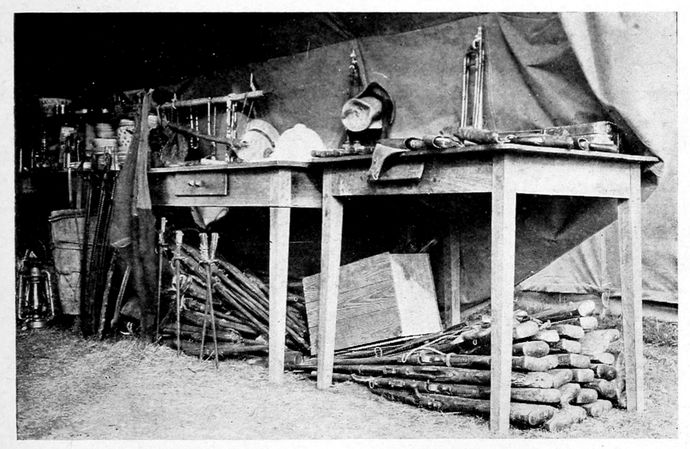
A small portion of one collection of captured caco war material
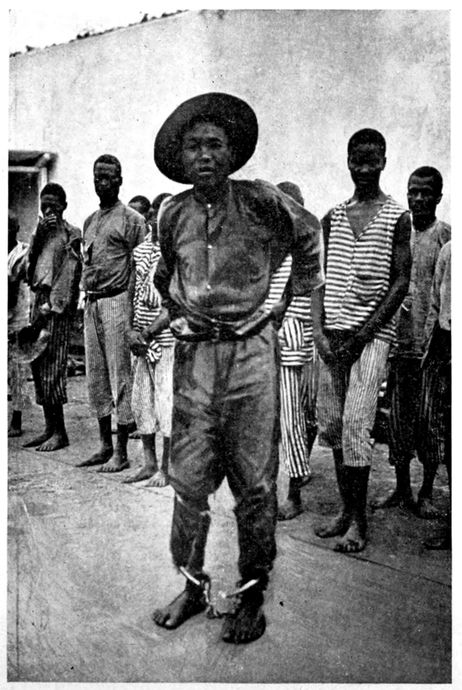
The caco in the foreground killed an American Marine
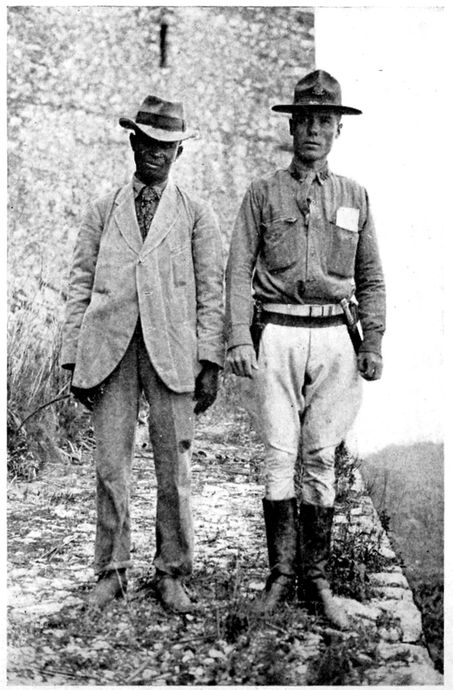
Captain Hanneken and “General Jean” Couze at Christophe’s Citadel
145“And lose ourselves for good and all,” added Hanneken, in his ready
“creole.” “Nothing doing. Take the lead and keep to the trail.”
The first outpost advanced the detachment without question. The
score of negroes who made it up seemed to be too excited with the taking
of Grande Rivière to be any longer suspicious. Some five minutes
later the group was again halted, this time by an outpost of some forty
men. Their leader scrutinized the newcomers carefully one by one
as they passed, the latter, in turn, shuffling along with bowed heads,
as if they were completely exhausted with the climb from Grande
Rivière, which was not far from the truth. Several of the bandits along
the way were heard to remark in their slovenly “creole,” “Bon dieu,
but those niggers are sure tired.” The third and fourth outposts gave
the party no trouble, beyond demanding the countersign, except that
casual questions were flung at them by the cacos scattered along the
trail. These the disguised gendarmes answered without arousing suspicion.
Perfectly as he knew “creole,” Hanneken avoided speaking
whenever possible, and left the word to François, fearful of giving himself
away by some hint of a foreign accent or a mischosen word from
the southern dialect, with which he was more familiar. No white
man, whatever his training, can equal the slovenly, thick-tongued pronunciation
of the illiterate Haitian.
At the fifth outpost the leader was a huge, bulking negro as large
as Hanneken, and he stood on the alert, revolver half raised, as the
detail approached. The giving of the countersign did not seem to
satisfy him. He looked Hanneken up and down suspiciously and
asked him a question. The captain, pretending he was out of breath,
mumbled an answer and stalked on. It happened to be his good luck
that he is blessed with high cheek bones and a face that would not be
instantly recognized as Caucasian on a dark night. Button, on the
other hand, seemed to arouse new suspicion. He was carrying an
automatic rifle and, in order to conceal the magazine, bore it vertically
across his chest, his arms folded over it. The negro sentry caught
the glint of the barrel and snatched Button by the arm.
“Where did you get such a fine-looking rifle?” he demanded.
Hanneken, scenting trouble, had halted several paces beyond, his
hands on the butts of the revolver and the automatic which he carried
on his respective hips. It would have been easy to kill the suspicious
negro, but that would have been the end of his hopes of reaching
146Charlemagne—and probably of the two Americans. For though the
disguised gendarmes were all armed with carbines, they would have
been no match for the swarms of cacos about them, even if their taut
nerves did not give way in flight under the strain.
Button, however was equal to the occasion.
“Let me go!” he panted, jerking away from the negro leader.
“Don’t you see that my chief is getting out of sight?”
The black giant, still suspicious, yielded with bad grace, and the
Americans hurried on. The sixth outpost was the immediate guard
over Charlemagne, about thirty paces from where he had spread his
blanket for the night. François gave the countersign, took two or three
steps forward, whispered in Hanneken’s ear, “he is up there,” and
slipped away into the bushes. The gendarmes had likewise disappeared.
The Americans advanced to within fifteen feet of a faintly
blazing camp-fire. On the opposite side of it a man stood erect, his
silk shirt gleaming in the flickering light. He was peering suspiciously
over the fire, trying to recognize the newcomers. A woman was
kneeling beside the heap of fagots, coaxing it to blaze. A hundred or
more cacos were lined up to the right, at a respectful distance from the
peering chief.
Two negroes, armed with rifles, halted the Americans, at the same
time cocking their pieces. Hanneken raised his black, invisible automatic
and fired at the chief beyond the fire, at the same time shouting,
“Let her go, Button!” in an instant the kneeling woman scattered the
fire with a sweeping gesture and plunged the spot in darkness. Button
was spraying the line of cacos to the right with his machine-gun.
The disguised gendarmes came racing up and lent new legs to the fleeing
bandits. When a space had been cleared, Hanneken placed his
handful of soldiers in a position to offset a counter-attack, and began
groping about the extinguished fire. His hands encountered a dead
body dressed in a silk shirt. This, however, was no proof that his mission
had been accomplished. Some of Charlemagne’s staff might have
boasted silk shirts, also. He ran his hands down the body to a holster
and drew out the pearl-handled revolver which he had loaned to Conzé,
and which had been appropriated in turn by Charlemagne. The caco-in-chief
had been shot squarely through the heart.
When daylight came, the hilltop was found to be strewn with the
bodies of nine other bandits, while trails of blood showed that many
more had dragged themselves off into the bushes. Among the wounded,
it was discovered later, was St. Remy, the brother of Charlemagne,
147who afterward died of his wounds. The captured booty included nine
rifles, three revolvers, two hundred rounds of ammunition, seven swords,
fifteen horses and mules, and Charlemagne’s voluminous correspondence.
This latter was of special value, since it contained the names
of the good citizens of Port au Prince and the other larger cities who
had been financing the caco-in-chief. Most of them are now languishing
in prison. But let me yield the floor to Captain Hanneken’s official
diary of the events that followed. Its succinctness is suggestive
of the character of the man:
Nov. 1, 1919.—Killed Charlemagne Péralte, Commander-in-Chief of the
bandits. Wounded St. Remy Péralte. Brought Charlemagne’s body to Grande
Rivière, arriving 9 A. M. Went to Cap Haïtien with the body. Received orders
to proceed to Fort Capois next morning. Went to Grande Rivière via handcar,
arriving 9 P. M. Wrote report re death of Charlemagne. Left Grande Rivière
with seven gendarmes, via handcar to Bahon, arriving midnight.
Nov. 2.—Left Bahon 1 A. M. with seven gendarmes. Arrived 200 yards from
first outpost of Fort Capois at 5 A. M. Crawled to 150 yards from outpost and
remained there until 6:30 A. M., waiting for detachment from Le Trou to attack
at daybreak, when six bandits came in our direction. Opened fire, killing three.
All bandits in various outposts retreated to main fort. Advanced and captured
the first, second, and third outposts. Got within 300 yards of fort when they
opened fire from behind a stonewall barricade. They fired a cannon and about
40 rifle shots. Crawled on our stomachs, no cover. Fired the machine gun and
ordered the gendarmes to advance 15 yards and open fire. Kept this up until
we arrived within 150 yards, when we espied the bandits escaping. Entered fort,
burned all huts and outposts. Left Fort Capois at 9 A. M. Arrived in Grande
Rivière 2 P. M., very tired.
The most exacting military superior cannot but have excused this
last somewhat unmilitary remark. Fatigue does not rest long on
Captain Hanneken’s broad shoulders, however, and he soon had his
district cleared again of the cacos he had imported for the occasion.
The two-thousand-dollar reward was divided between Conzé and his
one civilian assistant. Captain Hanneken, Lieutenant Button, and the
gendarmes who accompanied them, were ordered to Port au Prince to
be personally thanked by the President of Haiti and decorated with
the Haitian medaille d’honneur, a ceremony against which the captain
protested as a waste of time that he could better employ in hunting
cacos. At this writing he is engaged again in his favorite sport in
another district. His Marine Corps rank has been raised to that of
second lieutenant, while Conzé has been appointed to the same grade
in the Gendarmérie d’Haïti, with assignment to plain-clothes duty.
The death of Charlemagne has probably broken the back of cacoism
148in Haiti, though it has been by no means wiped out. Papillon, with
’Tijacques and several other rascals as chief assistants, is still roaming
at large in the north, and the youthful Bénoît is terrorizing the mountainous
region in the neighborhood of Mirebalais and Las Cahobas.
But the gendarmerie, assisted by the Marine Corps, may be trusted to
bring their troublesome careers to a close all in good season. One of
the chief problems of the pacifiers at present is to convince the ignorant
caco rank and file that the great Charlemagne is dead. His superstitious
followers credit him with supernatural powers, and many a captured
bandit, when asked who is now his commander-in-chief, still
replies with faithful simplicity, “Mais, c’est Charlemagne.” The
public display of his body at Grande Rivière and Cap Haïtien produced
an effect that will not soon be forgotten by those who witnessed it,
but even that has not fully convinced the cacos hidden far away in the
mountains. So great was the veneration, or, more exactly, perhaps,
the superstition, in which he was held that it was found necessary to
give him five fake funerals in as many different places, as a blind,
and to bury his body secretly in the out-of-the-way spot, lest his grave
become a shrine of pilgrimage for future cacos.
149
Of many journeys about Haiti, usually by automobile and in
the company of gendarme officers, the first was to the caco-infested
district of Las Cahobas. A marine doctor bound on
an inspection trip there had a seat left after his assistant and a native
gendarme had been accommodated. Among the four of us there were
as many revolvers and three rifles, all ready for instant action. One
can, of course, hire private cars for a tour of Haiti, but quite aside from
the decided expense, a Haitian chauffeur under military orders is much
to be preferred to one who is subject to his own whims; moreover,
there is much more to be seen and heard in gendarme company, and,
lastly, if one chances to “pop off” a caco, there is not even the trouble
of explaining, for one’s companions will do that in their laconic report
to headquarters.
There are few roads in the West Indies as crowded as that broad new
highway across the plain which is a continuation of the wide main
street of Port au Prince. By it all traffic from the north and west
enters the capital. The overwhelming majority of travelers are market-women,
most of them barefooted and afoot, but a large number are
seated sidewise on their donkeys or small mules, balancing on their
toes the slippers, which are never known to fall off under any provocation.
Pedestrians carry their invariably heavy and cumbersome loads
on their heads, the haughtier class in crude saddle-bags, and the sight
of this river of jogging humanity, often completely filling the broad
highway as far as it can be seen in the heat-hazy distance, is one of
which we never tired as often as we rode out through it.
At the time of the outbreak against the French the population
roughly was made up of thirty thousand whites, as many “people of
color,” and four hundred and fifty thousand blacks. There has been,
of course, no census since that time, but signs indicate that Haiti has
now two and a half million inhabitants, for however unproductive the
semi-savage hordes may be in other ways, they are diligent in the
process of multiplication. White people are more rare to-day, even if one
counts our forces of occupation, than before the revolt, the mixed race
150has not greatly increased, so that fully nine tenths of the population
are full-blooded Africans. Close observers are convinced that, thanks
mainly to the constant revolutions, there are three females to every
male, and of the latter a considerable number are now roaming the
hills of the interior as cacos. Furthermore, the men take little part in
selling the country produce. The result is that the stream of humanity
pouring into the capital is almost entirely made up of jet-black women
and girls.
The throng was particularly dense on the morning of our journey to
Las Cahobas, for it was Friday, and the great weekly market in Port
au Prince begins at dawn on Saturday morning. An American once
stationed himself at the typical negro arch of triumph, straddling the
entrance from the Cul-de-Sac to the capital, and counted thirty thousand
travelers in an hour, of whom all but about two hundred were
market-women. They were somewhat less multitudinous during our
stay in Haiti, for the Americans had recently set a maximum scale of
prices for foodstuffs, and many of the women had gone on strike and
refused to bring their produce to town. They had another grievance in
the requirement to sell most things by weight. For generations they
had sold only by the “pile,” consisting of three articles of such things
as eggs, plantains, yams, and the like, or of tiny heaps in the case of
grains and similar produce; few of them, moreover, could afford to
buy scales, and they resented the right given purchasers to appeal to
gendarmes stationed in the market-places for the verifying of weights.
But only those who had seen it under still more crowded conditions
would have realized that the highway was not thronged to its full
density on this particular morning.
Through the main street, out past the only modern sugar-mill in
Haiti, for miles across the plain, our constantly honking Ford plowed
through this endless procession of black humanity, casting it aside in
two turbulent furrows of donkeys, mules, women, and multifarious
bundles. There is nothing more amusing, and pathetic, too, than the
behavior of the primitive masses of Haiti before an automobile. This
is scarcely to be wondered at in a country where any wheeled traffic
except a very rare ox-cart crawling along on its creaking and wobbling
wheels was unknown up to a few years ago, and where the half-dozen
automobiles of Port au Prince could not make their way into the country
until the Americans had begun the reconstruction of the roads.
But it is proof, too, of the close relationship of the Haitians to their
savage brethren in central Africa. Just like this, one can easily imagine,
151the latter would act at the sudden apparition of a strange machine
which the great mass of Haitians firmly believe is run by voodoo spirits
devoted to the white man.
The highway, like most of those the Americans have built, is of
boulevard width, and there is ample room for even such a throng as
this to pass an automobile in safety. But the primitive-minded natives
are terror-stricken at sight of one bearing down upon them. The
mounted women invariably tumble off their animals and fall to beating,
pushing, and dragging them to the extreme edge of the road, at the
same time shrieking as if the Grim Reaper had suddenly appeared before
them with his sickle poised. The pedestrians succumb to a similar
panic, so that the journey out the flat highway presents a constant vista
of dismounting women and a turmoil of animals and frightened human
beings tumbling over one another in their excited eagerness to get well
out of reach of the swiftly approaching demon of destruction. Farther
on, where the road begins to wind, and the cuts into the hills are often
deep, the scene is still more laughter-provoking, for the startled animals
invariably bury their noses in the sheer road-banks and will not, for all
the cajolery or threats in the world, swing in sidewise along them. If
they are donkeys, the women pick up their hind quarters and lift them
out of the way by main force; when they are too large for this courageous
treatment, the riders put a shoulder to the quivering rumps,
abandon those useless tactics to drag at the halters as the machine
draws nearer, and finally bury their faces also in the bank, as if to
shut out the horrible experience of seeing their precious animals mutilated
beyond recognition.
Still more distracting to drivers is the behavior of persons approached
from the rear. A horn is of little use in this case. The Haitian’s
hearing is acute enough, but his mind does not synchronize in its various
faculties; he is aware of a disagreeable noise behind him, but that
noise does not register as a warning of danger and a call for action.
Then, when at last he realizes that it means something and is addressed
to him, or when the bumper or fender touches his ragged coat-tail, he is
electrified into record-breaking activity. Unfortunately, his psychology
is that of the chicken, and in eight cases out of ten he darts across the
road instead of withdrawing to the side of it. This happens even when
he is far out of danger at the edge of a wide street or highway, and
every automobile trip through the crowded parts of Haiti is a constant
succession of interweaving pedestrians bent on getting to the opposite
side of the road.
152An American estate manager who drives a heavy car at a high rate
of speed, yet who is noted for his freedom from accidents, was bowling
alone one September afternoon far out in the country. The road was
twenty-two feet wide, and he was driving to the right of it, without an
animate object in sight except for one ragged countryman plodding
along the extreme left in the same direction. Seeing no reason to do so,
he did not blow his horn. Suddenly the pedestrian caught sight of the
car out of the tail of an eye and darted across the road. The machine
struck him squarely and knocked him, as was afterward proved by
measurement, fifty-two feet, then ran completely over him. The driver
hurried him back to a hospital, where it was found that the only injuries
he had sustained were a few minor bruises and a gash on the head.
This was treated, and a few days later he was discharged, and returned
to his hut, where he died the next week of blood poisoning caused by
the native healer whom he insisted on having redress his almost healed
wound.
Though somewhat stony and grown with an ugly, thorny vegetation,
the great Cul-de-Sac plain is noted for its fertility. Here the aborigines
cultivated cotton and tobacco; at the time of French expulsion it had
nearly seven thousand plantations, chiefly of sugar-cane, which was
brought to Haiti from the Canary Islands early in the sixteenth century.
The French had covered it with a thorough irrigation system,
with a grand bassin in the hills above and streams of water spreading
from it like the fingers of the hand to all parts of the plain. There
were numerous splendid highways between towns and estates, and the
ninety thousand acres were dotted with fine residences, hundreds of
sugar-mills, and many coffee, cotton, and indigo works. To-day the
roads which our forces of occupation, or the two American companies
that are beginning to reclaim some of the plain, have not found time
to restore are rutty successions of mud-holes so narrowed by ever-encroaching
vegetation as to resemble the trails of blackest Africa, or
have disappeared entirely. There are a few rude bridges, usually
patched upon the crumbling remains of once fine French structures, but
as a rule streams are forded. Except where the newcomers have
constructed new ones, the saying in Haiti is, “Never cross a bridge if
you can go around it.” Many of the former estates are completely
overgrown with brush and broken walls, trees rise from former
courtyards, the remnants of once sumptuous halls are the haunts of
bats, night birds, and lizards. In some of the less dilapidated ruins
negro families now cluster; most of them live in shanties patched together
153of jungle rubbish, their only furnishings a sleeping-net and a
German enamelware pot. Whatever else he lacks, the Haitian always
has the latter, its holes stopped with corncobs until they become too
large, when the pot is filled with earth, planted with flowers, and set up
in a conspicuous position about the hovel. Everywhere are to be found
reminders of the prosperous days when Haiti was France’s richest
colony. Large, semispherical iron sugar-kettles, rusted, broken, and
full of holes, lie tumbled everywhere along the highway and across the
plain. Old French bells bearing pre-Napoleonic dates and quaint inscriptions,
ruined stone aqueducts, mammoth grass-grown stairways,
rust-eaten machinery, inexplicable stone ruins of all shapes and sizes,
are stumbled upon wherever the visitor rambles.
The characteristic sour stench of a dirty little sugar- and rum-mill
only rarely assails the nostrils. The natives have lost not only the
energy, but almost the knowledge, required for the growing and making
of sugar, producing only rapadoue, dark-brown lumps of crude, coagulated
molasses, which, wrapped in leaves, are to be found in every
Haitian market. The American companies found the people so ignorant
of agricultural methods that it was impossible to introduce the
colono system. The men and women who work in the sugar- and
cotton-fields of these new enterprises are as patched and ragged a crew
as can be found on the earth’s surface. The average daily wage for
adult male laborers in Haiti is a gourde, or twenty cents, a day, women
and boys in proportion. The new companies have raised this to thirty
cents. In theory the laborers are fed by their employers, but it would
be considerable exaggeration to call the one gourdful of rice-and-bean
hash which a disheveled, yet dictatorial, old negro woman was dishing
out to each of a long line of gaunt and soil-stained workmen on one
of the estates at which we stopped one evening the nourishment needed
for a long day in the fields. Except for a sugar-cane, a lump of
rapadoue, or possibly a bit of rice or plantain, which they find for themselves
in the morning, this is the only food of the Haitian field laborer.
So lazy have they become in their masterless condition that this one
meal a day has come to be the habitual diet of the masses and all they
expect of their employers; but the impression on both sides that this
is all they need is probably costing the companies more in lack of
efficient labor than they themselves realize. Only at one season during
the year does the average Haitian get more than these slim pickings;
that is in mango-time, and then the roads and trails are carpeted with
the yellow pits.
154Dusty, thorny, and hot, the Cul-de-Sac plain continued as level as the
sea at its edge to where we began to climb the steep slope of wrinkled,
rusty mountains shutting it off abruptly on the north and offering a
panorama of rare beauty from Port au Prince, particularly when sunrise
or sunset gives them a dozen swiftly changing colors. As we rose
above it, the reedy edged first of two large lakes, one of which stretches
on into the Republic of Santo Domingo, broke the red-brown carpet
with a contrasting shimmer of blue at the eastern end, and the mountains
behind the capital stood forth in silhouette against the transparent
tropical sky. The aboriginal name “Haiti” means a high and mountainous
land; like its inhabitants, its scenery and vegetation are more
savage than those of Cuba. So steep was the new road climbing diagonally
up the face of the range that we were twice compelled to dismount
and call upon a gang of road laborers to push the machine
over the next stony rise. The stream of market-women continued to
pour down this in cascades. Many of the heavy black faces would have
made splendid gargoyles. Almost all of the women wore gowns of
blue denim; the year before, the driver said, they had all worn purple,
but the style had changed only in color. Once we met a lone marine,
and higher up paused at a camp where there were several of them.
But they were not the spick-and-span “leather-necks” we know taking
their shore leave along Broadway. They wore only the indispensable
parts of their uniforms, on the faces of those old enough to produce it
was a week’s growth of beard, and they clutched their rifles with the
alert and ready air of expecting to use them at any moment, for we
were now entering a region constantly harassed by cacos.
We grasped our own weapons and closely watched the brush-covered
banks on each hand, as well as every approaching traveler. There are
only two ways of telling a caco from a harmless Haitian; if he is armed
or if he runs. Then the orders are to fire, for the “good citizens” do
not carry weapons and are very careful to move slowly and be prepared
to flourish their bon habitant card at sight of a white face or a
gendarme uniform. Several times I fancied for an instant that we
had been attacked, until I grew accustomed to the thump of stones with
which the road was ever more thickly strewn striking the bottom of the
car with reports startlingly like rifle-shots. From the crest of the first
range we descended into the Artibonite Valley, remarkable for its
colors. A constant series of rusty red humps, more beautiful at a distance,
no doubt, than to a hungry marine climbing over them expecting
at any moment to run into a caco ambush, patches of scenery almost
155equal to the Alps in color, slender pines standing out against the red
and tumbled background, here and there a clump of palm-trees to give
contrast and a suggestion of peaceful tropical languor, spread before
us farther than the eye could see.
As far as the marine-garrisoned town of Mirebalais the road was
passable, though it had steadily deteriorated from the modern highway
of the plain to a road made only by the feet of animals and men. It
would have been an exceedingly optimistic stranger, however, who
could ever have attempted to drive an automobile over the mountain
trail that lay beyond, yet over which the doughty Ford climbed as
if military orders forbade it to give up so long as it retained a gasp of
life. Here and there we forded a considerable stream, meeting at one
of them a group of marines driving pack-laden donkeys and cattle, in
some cases astride the latter, more often splashing thigh-deep through
the water, and with a score of produce-bearing natives plodding at
their heels for protection. Farther on we passed an airplane camp,
from which “God’s wicked angels,” as the natives call them, periodically
bombard the retreats of the cacos. Rumor has it that these warriors
of the air have not always made certain of the character of the
gatherings they attack, and the cacos once sent a protest to England
against the Americans for using a means of warfare which the “Haitians
fighting for their liberty” cannot combat or imitate.
The name of Las Cahobas, the old Spanish form of the word for
mahogany-trees, is an indication of the fact that it was formerly within
the territory of Santo Domingo. It is a miserable little town in which
the palm-trunk huts that are the lowest form of dwelling in Cuba are
considered residences de luxe. A whitewashed jail where the hundred
or more black inmates, most simply dressed in two-piece suits of red-and-white
striped cotton, seem only too glad to get their three meals
a day, two of them with meat rations, was the chief sight of interest.
Some of the gendarme guards had become so thoroughly Americanized
under their marine officers that they “rolled their own,” closed their
tobacco-sacks with their teeth, and returned them to hip-pockets exactly
as required by our military manuals. It is remarkable what can be
done with a backward race under proper guidance. The officers themselves,
nearly all enlisted men in the organization from which they had
been loaned, were, like most of those I met throughout the country,
forceful, energetic, efficient chaps, many of whom spoke the native
“creole” as if they had been born in the district. In the North we
scarcely think of a corporal or sergeant of marines as standing particularly
156high in the social scale; in these Haitian villages they have
almost the power of absolute monarchs, and are treated with corresponding
respect by their native subjects. Even the village accounts
are periodically brought to them to be audited. So accustomed do the
Haitians become to obeying the commander of the district in which
they live that it is difficult to get them to change their allegiance. A
marine major who had long reigned in a certain region summoned all
the native authorities to meet a newly arrived lieutenant colonel, explaining
that the latter was thereafter the commander in chief; yet as
long as the major remained, he never broke the natives of the habit of
appealing to him first of all whenever any official matter turned up.
On the edge of Las Cahobas, as here and there along the road to
it, was a Haitian cemetery. These are invariably bare and sun-scorched,
the graves covered with vault-shaped structures ranging from
heaped-up cobbles to almost elaborate stone and plaster mounds. Without
crosses or any other indication of the Christian faith, they seem
to be direct importations from the interior of Africa, and though one
knows that the stones are piled there primarily to keep the energetic
Haitian pigs from rooting up and feasting on the corpses, it is hard
to think of them as anything but the African’s protection against the
voodoo spirits which must be forcibly prevented from escaping out of
bodies committed to the earth. The usual Haitian funeral is accompanied
with strange rites destined to exorcise these same spirits, after
which others of a totally different nature enliven the proceedings, for
the corpse is generally carried on the heads of men who dance and sing
in a drunken orgy all the way to the burial-ground.
Market-women were still straggling toward town when we returned.
The view of the Cul-de-Sac plain toward sunset, carpeted with brown
and green vegetation, speckled here and there with little houses, the
lakes on the left and the ocean on the right reflecting the colors of the
purple and lilac clouds which hung above the mountains, was as striking
as any I had seen in many a day. Nearer the capital the road was
still almost crowded, while here and there under the trees beside it the
women, their big straw hats off now, but still wearing their brilliant
bandanas, had camped for the night, and were cooking their humble
dinners on fagot fires. Once we found a woman bareheaded, but this
was because she was tearing her hair and shrieking in what seemed to
be physical agony. As she caught sight of my uniformed companions,
she rushed out upon them and reported that she had been robbed by
cacos of the produce she had expected to spread out in the big market-square
157before the cathedral by the dawn of Saturday. Such things
happen even on the broad highway into Port au Prince, while more
often still gendarmes are sent out along the road by some colonel or
major whose wife has invited guests, with orders to buy the chickens
and turkeys needed before they reach the close competition of the
market. In either case the women are deeply disgruntled, for the mere
selling is only half their pleasure in offering their wares.
Of the other two highways out of Port au Prince one climbs into the
hills to Pétionville, from which a trail leads to cool and refreshing
Furcy, among its pine-trees, four thousand feet above the sea. A
longer road is that to the southern peninsula. Leaving the capital at
the opposite end of the main street from that to the Cul-de-Sac, it
passes the “navy yard” and skirts the bay for miles beyond. It, too,
is apt to be crowded with market-women, and with donkeys, women,
and men carrying rock salt from Léogane. Half-way to that town
there is a clearing in the dense woods famed as the scene of frequent
voodoo rites, and for a long space the road is bordered by the scraggly
tree-bushes of an abandoned castor-bean plantation from which our
Government once hoped to produce oil for its airplanes. Léogane is a
town of considerable size, the usual grass-grown square of which is
faced by a quaint old church of what might almost be called Haitian
architecture. Churches were the only buildings spared by the infuriated
slaves in their revolt against the French, as the priests were the
only white people who escaped attack, but neglect and the tropical climate
have in most cases completed the work of destruction. The town
and the region about it is one of the few places in Haiti where the
malarial mosquito abounds. Here, too, are to be found many bush-grown
ruins of French plantations. Far to the westward along the
tongue of land forming the southern horn of Haiti, and to be reached
only by horse or boat, is the town of Jérémie, near which the elder
Dumas was born, the son of a French general and a negro slave.
The gendarme officer with whom I was traveling on this occasion,
however, had come to inspect Jacmel, on the southern coast. At two
and a half hours by Ford from the capital, the last part of it by a
narrow dirt roadway winding through high hills, we changed to moth-eaten
native horses and rode away down the River Gauche, which we
forded one hundred and eighteen times during the next four hours.
The black soil was fertile, and cultivated in scattered patches even to
the tops of the hills. Coffee in uncared-for luxuriance often bordering
158the way showed what this region had been under the French. It was
still well populated, for the people of the southern peninsula have
never revolted, and cacos are unknown, though there is much petty
thieving. At every turn of the trail startled, respectful negroes raised
their hats as we passed, only a few of them having the half-sullen air
of their fellow-countrymen elsewhere at sight of Americans. Their
little huts of thatch, or tache, as yagua is called in Haiti, were everywhere
tucked away in the bush, cattle and pigs were numerous, though
all animals except the goats had a half-starved appearance. Bananas
and oranges grew in profusion; the trail was strewn with the peelings of
the native pear-shaped grape-fruit. Frequent patches of Kafir-corn,
called pitimi, the “creole” abbreviation of petit maïs, waved their lofty
heads of rice-like grain in the breeze. Immovable donkeys now and
then blocked the trail, indifferent alike to the shrieks of their drivers
and to the commanding voice of the native gendarme who accompanied
us. Here and there washing parties of women were beating their rags
on stones at the edge of the stream and spreading them out in the sun
to bleach, their almost nude black bodies glistening in the sunshine and
their tongues cackling incessantly until a glimpse of us reduced them to
sudden silence. Several times we passed voodoo signs—a chicken
with its entrails removed hanging by one leg from a pole, the white
skull of a horse decorated with bits of red rag set on the top of a
cactus-bush. Now and then we came across the most primitive form
of cane-crusher except the human teeth. It consisted of a grooved
stick driven through a tree or post, with a bit of sapling fastened at one
end. While one negro held a sugar-cane, another rolled the sapling
back and forth along it, the juice running down the groove into a gourd
or pot. Wherever the breeze reached us the weather was agreeable;
in the breathless pockets of the hills the humid heat hung about us like a
hot wet blanket.
The marine-gendarme commander of Jacmel met us with an automobile
farther out along the trail than one had ever been driven before,
and the astounded natives fled shrieking before it as if the malignant
spirits they fancied they could hear groaning under its hood were visibly
pursuing them. In the town itself the people greeted their benevolent
despot with just such antics as one might fancy their forefathers performed
before their African chiefs. Jacmel, however, has a number
of “citizens of color” of education and moderate wealth. The hills
about it grow two crops of coffee a year, cotton and cacao alternate all
the year round, veritable forests of cotton-trees cover the sites of old
159French plantations, and there is considerable shipping, though the bay
is deep and dangerous. But its prosperity is mainly due, of course, to
its lifelong freedom from cacos and revolutions. It is a hilly town of
six thousand inhabitants, with sharp lines of caste, more stone buildings
than are usual in Haiti, a Protestant as well as a Catholic church,
an imposing hotel de ville, with the familiar misstatement “Liberté,
Egalité, Fraternité” on its façade, “summer” homes in its suburbs,
and a tile-roofed market. Strangers but seldom disrupt the languid
tenor of its ways, however, and not only is there no hotel, but not even
a place to get a cup of coffee and a sandwich, unless one accept the
hospitality of marines or gendarme officers. Some years ago a foreign
company erected an electric light plant, fitted up all Jacmel with elaborate
poles or underground wires, operated for one night, collected their
government subsidy and as much as possible from the citizens, and fled.
To this day the town continues to worry along with such lights as might
be found in an African village. In 1896 it was completely wiped out
by fire, the land and sea breeze joining to pile the flames so high that
the population was forced to flee to the hills, leaving all their possessions
behind.
On our return to Port au Prince the road, particularly from Léogane
in, was even more densely thronged than usual; for it was the last day
of the year, and New Year’s is not only Haiti’s day of independence,
but the one on which presents are given, after the French custom.
Women carrying on their heads heaps of native baskets higher than
themselves, others with as disproportionate loads of gourds, donkeys
laden to the point of concealment with anything there was any hope of
selling for gifts at that evening’s big market, filled the tumultuous wake
behind us. I called that afternoon on the mulatto President of Haiti
in the unfinished palace, and caught him and the minister of finance
in the act of shaking and rearranging the rugs in preparation for the
coming festivities. No doubt a president whose duties are assumed by
men from the outside world must find something to do to pass the
time. Next day, however, there was no such informality in his manner
as he was driven in silk-hat solemnity to a Te Deum in the cathedral.
Four prancing horses drew the presidential carriage, preceded and followed
by a company of native horsemen in more than resplendent uniforms
and drawn sabers. At the door he was met by the archbishop
and all the higher officers of our forces of occupation, who fell in
behind the august ruler as he marched down the central aisle, flanked
at close intervals by negro firemen in brilliant red shirts of heavy
160flannel and shining metal helmets. In their wake came all the élite of
Port au Prince, some in silk hats and full dress, nearly all in brand-new
garb, for New Year’s takes the place of Easter in this respect in
Haiti, and so generously perfumed that the clouds of incense arising
about the altar made no impression upon the nostrils. Outside, the
great open square and the adjacent streets were compact seas of upturned
black faces. The booming of cannon frequently punctuated the
ceremony, though the beating of tomtoms would have been more in
keeping, and the cost of the powder might then have been spent in
running the trade school which had just been abandoned for lack of
funds. Faces running all the gamut from white to black were to be
seen in the glaringly yellow interior, but none of the former were
Haitian, and the latter were in the decided majority. The clergy were
white, the acolytes black; the formality and solemnity which reigned
could scarcely have been equaled in the elaborate functions in Notre
Dame of Paris.
A Cuban bon mot has it that “The Haitian is the animal which most
nearly resembles man.” Without subscribing to so broad a statement,
it must be admitted that they are close to the primitive savage despite a
veneer of civilization which all but hides the African in the upper
class and is so thin upon the masses as to be transparent. Tradition
has it that when the uprising against the French was planned the conspirators
gave every slave some grains of corn, telling him to throw one
away every day and attack when none remained, for in no other way
could they have known the date. To this day the intelligence of the
masses is of that caliber. Readily capable of imitation, they initiate
nothing, not even the next obvious move in the simplest undertakings.
They have not a trace of gratitude in their make-up, no sexual morality,
unbounded superstition, and no family love. Mothers gladly give away
their children; if they ever see them again there is no evidence of gladness
shown on either side. They have a certain naïve simplicity and
some of the unintentional honesty that goes with it; they have of
course their racial cheerfulness, though even that is less in evidence
than among most of their race. A French woman who has spent nearly
all her life in Haiti long tried to discover some symptoms of poetical
fancy or love for the beautiful among the full blacks. One day she
found a servant sitting in the back yard looking up into the tree-tops.
Asked what he was thinking about, he answered, “I am not thinking;
I am listening to the breeze in the cocoanut-palms.” That is the sum
total of sentiment during long years of observation. Family relations
are little short of promiscuous. Girls who have reached the age of
ten are made to understand that they must be on the lookout for lovers;
mothers refuse to support them after they have grown old enough to
live with a man. An old maid is considered a freak of nature in Haiti,
and such freaks are exceedingly rare in the Black Republic.
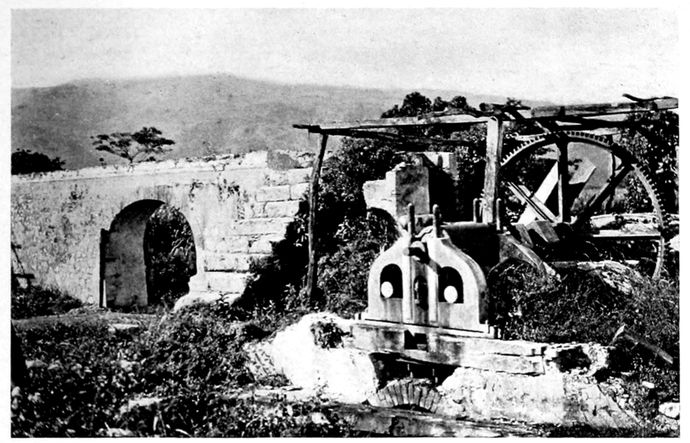
Ruins of the old French estates are to be found all over Haiti
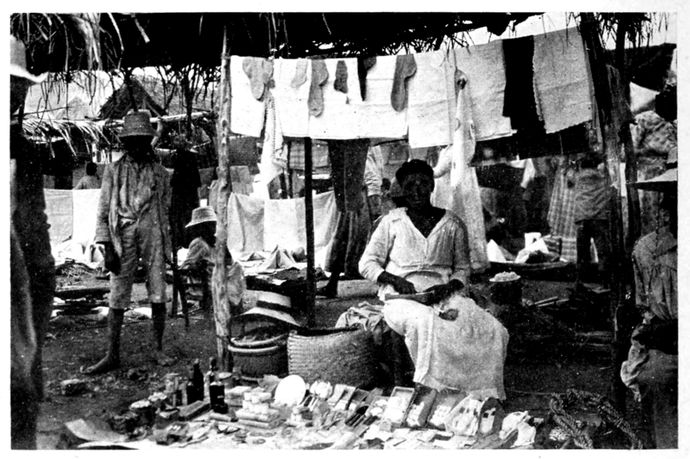
The market women of Haiti sell everything under the sun—A “General Store” in a Haitian market
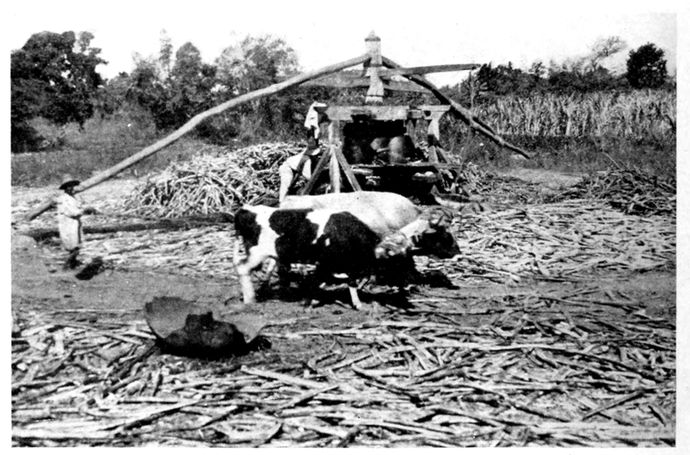
There are still more primitive sugar mills than these in Haiti
161More temperamental than our own negroes, the Haitians are incredibly
childlike in their mental processes. A certain gendarme officer
whose butler was frequently remiss in his duties had him enrolled in
the native corps in order to bring military discipline to bear upon him.
A few days later the servant requested that he be given the right to
carry arms, like other gendarmes. The officer good naturedly gave him
a harmless old revolver that had been captured from the cacos. A few
days later reports began to leak into headquarters that the national force
was terrorizing the inhabitants of a certain section of Port au Prince.
The detectives got busy, and found that the gendarme-butler, his day’s
service over, was in the habit of patrolling that part of town in which
he was born and where he was well known, strutting back and forth
among his awed fellow-citizens during the evening, and from midnight
on beating on house doors and commanding the inmates, “in the name
of the law,” and at the point of his revolver, to come outside and line up
“for inspection.” He had no designs upon their possessions, but was
simply indulging his love for display and authority. When his employer
took his putative weapon away from him again, he wept like a
child of six. His grief, however, was short lived, for when the President
called at the home of the officer on New Year’s afternoon, he
found the butler so dressed up that he inadvertently shook hands with
him as one of the guests.
Abuse of authority is a fixed fault in the Haitian character, as with
most negroes. Of the several reasons why there are only two or three
native lieutenants in the gendarmerie, lack of intelligence and dishonesty
are less conspicuous than the inability to wield authority lightly. The
Haitians of the masses have only three forms of recreation, dances,
cock-fights, and voodooism. They have not even risen to the level of
the “movies,” for though there are two cinemas in the capital and one
in Cap Haïtien, these are too “high brow” for any but the upper class.
Of pretty native customs we found only one—that of hanging up little
colored-paper churches with candles inside them at Christmas-time.
The Haitians are inveterate gamblers, which is only another way of
saying that they abhor work. As the negro admires the successful and
162dominant, so he has supreme contempt for the broken and discredited.
The Germans who once ruled the commercial roost in Haiti and who
were interned after our entry into the war would find no advantage in
returning, even if they were permitted to, for they have lost for life
the respect of the natives by allowing themselves to be arrested. The
profiteering Syrians who have largely inherited their control of commerce
have far more standing to-day despite their slippery methods.
Between the primitive bulk of the population and the slight minority
of educated citizens, mainly “people of color,” there is a wide gulf.
Haiti has no middle class, not even a skilled labor class. Those who
have ambition or wealth enough to go in for “higher education” will
have nothing to do with anything even suggestive of manual labor.
The ability to read, write, and speak French automatically brings with
it a contempt for work and workers. As in all Latin America, an agricultural
school is worse than useless, because it serves only to spoil
what might have been good foremen, and the mere possession of a
scrap of paper announcing the holder a graduate of such an institution
is prima-facie evidence that he intends to loaf in the shade all the rest
of his days. The result is that the population is made up of poverty-stricken,
incredibly ignorant laborers and peasants, and of lawyers,
“doctors” of this and that, and the political-military class which
tyrannizes and fattens on the African masses.
Superficially, the educated class of Haiti is pleasant to meet, though
the first impression seldom lasts. It has all the outward manners of
the French, with none of their solid basis. In discussions of literature
and art these “gens de couleur” could give the average American business
man cards and spades; in actually doing or producing something
worth while they are completely out of their depth. Once in a blue
moon one runs across a full-blooded negro who shows outcroppings of
genius. We were invited to meet such a one at the home of a “high
yellow” senator on New Year’s eve, a pianist who had studied in Paris.
I had been told that there were several fine musicians in Haiti, but, in
the light of other experiences, had inwardly scoffed at the idea. It required
but very little time to be convinced that here at least was one.
The man not only played the best classics in a manner that would have
been applauded in the highest class of concert halls, but gave several
pieces of his own composition which could hold their place in any program.
He had played a few times in the United States, but the drawback
of color had proved insurmountable, and as there is naturally no
income to be derived from such a source in Haiti, Ludovic Lamothe
163now holds a minor clerkship in the ministry of agriculture! When he
had finished, the senator himself sat down at the piano and gave an
exhibition which, I have no hesitancy in asserting, could scarcely have
been duplicated by any member of our own upper house, and one which
reminded us by contrast of the uproarious rag-time that was even at
that moment reigning along Broadway. Yet it was such men as these
that our marines once evicted from the Haitian senate with, “Come on,
you niggers, get out of here!” Even the Southerner who had been
induced to come with us, and whose muscles seemed to tense with inward
horror as our host greeted him with a handshake and introduced
him to the pianist, gradually shrank down into his chair in unconscious
acknowledgment of his own ignorance of the higher things of life as
compared with these cultured “niggers.”
We met a few other men of this type at the yearly “Haitian ball” in
the chief native club, which American civilians attend, to the unbounded
disgust of the forces of occupation. Yet the primitive African now
and then showed itself in the whitest of them. Those who know them
well say that even Haiti’s élite, educated in Europe or the United
States, are apt to forget their Christian faith when troubles assail them
and go to a “Papa Loi” for a wanga, or charm, and pay for a voodoo
ceremony. In Paris lives a certain Mme. Thebes, in high repute among
those who believe in sorcery and prophecy. If the stories which gradually
leak out from the confidences of returning natives to their friends
are trustworthy, she tells all Haitians that they are some day to become
president of their country, not a bad guess under old conditions, though
the supernatural madame does not seem to have kept up with the times.
More than one revolution has been started on the strength of her
prophecies. Some of these upper-class “people of color” are descendants
of the same families who fled to Philadelphia and New Orleans
at the time of the slave revolt. The members who remained
behind were or have since become intermixed with the blacks. At least
one American connected with the forces of occupation was introduced
at a presidential reception to a colored family of the same name, which
turned out to be relatives. As the American chanced to be a Southerner,
it is easy to imagine whether the discovery brought joy and
mutual social calls.
Stories of human sacrifices, cannibalism, and occult poisonings are
always going the rounds in Haiti, though it is difficult to find any one
of unquestioned integrity who has actually seen such things himself. I
met two gendarme officers who asserted they had found the feet of a
164black baby sticking out of a boiling pot, and there are numbers of well-balanced
Americans in Haiti who are firmly convinced that all three of
the crimes above mentioned are practised. Certainly many of the natives
look hungry enough to eat their own children. The body of a
marine was once found in a condition to bear out the charge of cannibalism,
but it has never been proved that this was not the work of
hogs or dogs. Most frequent of all, say the believers, are the cases of
blood-sucking, the victims being preferably virgins. Not long before
our occupation a baby in the best district of Port au Prince died for loss
of blood, which an old neighbor later confessed to having inflicted while
the mother was out of the room. The daughter of a former minister is
said to have been similarly treated by her grandmother and a prominent
man. The rite over, they pronounced her dead, and she was buried
with much pomp, the grandmother, according to the story, replacing
with coffee the embalming fluid that was poured down her throat. Five
years later a rumor of her existence having reached a priest through
the confessional, what is believed to be the same girl was discovered in
a hill town. She was wild, unkempt, demented, and had borne three
children. The coffin was dug up, and in it was found her wedding
dress,—for though she was only eight or nine at the time, it is the
custom in Haiti to bury young girls in such garments,—but the autopsy
proved the remains to be those of a man, the legs cut off and laid alongside
the body. That there are Haitian Obeah practitioners who have so
remarkable a knowledge of vegetable poisons that they can destroy
their enemies or those of their clients without being detected seems to be
generally admitted. Some of these poisons are said to be so subtle
that the victims live for years, dying slowly as from some wasting disease,
or going insane, deaf, blind, or dumb, with the civilized medical
profession helpless to relieve them. Men of undoubted judgment and
integrity, some of them Americans, claim to have positive proof of such
cases.
The less gruesome forms of Obeah and voodooism are known to be
practised in Haiti. The former is a species of witchcraft by men and
women who are supposed to possess supernatural powers, and who certainly
have far greater sway over the masses of the people than priests
or presidents. For a small sum they will undertake to help in business
matters, to create love in unresponsive breasts, possibly to put an enemy
out of the way, and some of the “stunts” they perform are beyond
comprehension. Voodooism, unlike the other, is a form of religion, the
deity being an imaginary “great green serpent,” with a high priest
165known as “Papa Loi” and a priestess called “Maman Loi.” Chicken
snakes and a harmless python are kept as sacred beings in Haiti, and
fed by the faithful. In theory the serpent deity demands sacrifices of
a “goat without horns”; in other words, a child, preferably white.
But there is no positive evidence to prove that anything more than
goats, sheep, or roosters are actually sacrificed. These simpler rites
are carried on almost openly, and are accompanied by all sorts of
childish incantations, with such nonsensical fetishes as red rags, dried
snakes and lizards, human bones, or portions of human organs, stolen
perhaps from graveyards. The most frequent form of revenge among
the Haitian masses is the burying of a bottle filled with “charms” of
this nature, over which are recited various incantations at certain
phases of the moon, in the hope of bringing destruction or lesser punishment
on the object of the enmity. So firm is the belief of the negroes
in the power of Obeah that they sometimes succumb to fear and
die merely because some one has cast such a spell upon them. A French
priest who was traveling through the country called at a cabin one
night to ask the occupant to show him the way. The man refused,
whereupon the priest, being denied the customary form of expressing
displeasure, began to recite a quotation from Ovid. To his surprise
the native dashed out of his hut, fell at his feet, and offered to do anything
he demanded, if only he would not “put Obeah” on him. Perhaps
the most serious result of these practices is the appalling number of
children who die under the ministrations of voodoo “doctors.”
A group of Americans once offered to pay for a voodoo supper if
they were allowed to attend it. White men are seldom admitted to the
native ceremonies; some have suffered for their intrusion. In this case
there was the added fear that the officials who saw the rites would
forbid them thereafter; but a Frenchman finally persuaded the natives
that it would be to their advantage to let the Americans see one of their
festivities in order to prove that they were harmless. How much was
left out because of the guests there is of course no means of knowing.
About seventy dollars was spent for corn-meal, tafia (crude native
rum), sacrifices, and other things required, and to pay the chief performers
their fees. The temple was decorated with flags and various
fetishes. The ceremony began with a tomtom dance by the priests,
who were soon joined by the high priestess, wearing a white skirt, a
red waist, and a brilliant bandana, and waving spangled flags. Then
a goat, scrubbed to spotless white, its horns gilded, and a red bow on
its head, was brought in. The priestess danced about it with a snaky
166motion, holding her shoulders stiffly and giving her waist the maximum
of movement. Then she got astride the goat and rode round and
round, clinging to its horns. Every few minutes the priests gave her
tafia until she had worked herself into a real or feigned paroxysm of
excitement. To say that she was intoxicated would perhaps be putting
it too strongly, for the average Haitian is so soaked in rum from birth
that it has little visible effect upon him.
At length a priest caught up a handful of corn-meal and, with what
appeared to be two careless gestures, formed a perfect cross with it on
the ground. Candles were placed at the ends of the cross, then tafia
and other liquors were poured along the lines of corn-meal, the priestess
meanwhile continuing to ride the goat with hideous contortions. Finally
she dismounted, slipped off the white skirt, leaving her entirely
clothed in red, and while a priest held the goat by the front feet she
pierced a vein in its neck and drank all the blood she could contain.
For a time she seemed to be in a stupor; then she began to “prophesy”
in loathsome, incomprehensible noises, which a priest “translated,”
probably in terms of his own choosing. While this pair howled, the
goat was prepared and put in caldrons to cook, with rice, beans, tafia,
salt, pepper, and lard. Old women stirred the contents of these with
their bare hands, which had been bleached almost white by frequent
emersions in similar boiling messes. When the food was cooked, the
priestess came suddenly out of her trance and fell to with all the negroes
present, who were still sitting about in a circle eating sacred goat
meat and drinking tafia when the white spectators finally left.
“The only thing wrong with the Haitians is lack of education,” says
a recent investigator, which can scarcely be doubted, since it is true
of all mankind. By some oversight, perhaps, no mention of schools and
courts was made in the treaty under which we are administering the
country. The French maintained no schools for the negroes, and it
goes without saying that conditions scarcely improved during the century
and a quarter of independence. An American superintendent,
who is quite properly a Catholic and of Louisiana creole stock, has been
appointed, and is in theory directly responsible to the native minister
of public instruction. But the higher American civilian officials, clinging
perhaps too closely to the letter of the treaty, have not seen fit to
assign any great amount of the public revenues of Haiti to this purpose.
There are thirteen hundred teachers in the country, probably
the majority of whom are in no way qualified for their task, and of
the fifty thousand pupils enrolled barely one in three is in regular attendance.
167In other words, not ten per cent. of the children of school
age get even primary instruction, and less than one per cent. ever reach
the secondary schools. The law school in Port au Prince, with thirty
students, is reported to be efficient; the medical school is frankly a farce.
Teaching methods are in all but a few cases primitive, consisting of little
more than monologues by the “teacher,” to which the pupils listen only
when nothing else occupies their attention. A thorough reform in this
matter is essential to the task we have undertaken in Haiti, unless we
subscribe as a nation to the old Southern attitude that the negro is
better off without education. The present generation is hopeless in
this as in many other regards; it remains to be seen whether we will and
can lift the next out of the primitive savagery which at present reigns.
The popular language of Haiti bears no very close resemblance to the
tongue from which it is largely descended. The slaves came from
different parts of Africa, in some cases belonging to enemy tribes, and
“creole” is the natural evolution of their desire to talk with one another.
The resultant dialect has French as a basis, but it is so abbreviated,
condensed, and simplified, and includes so many African
words, that it has become almost a new language. It is quite distinct
from the patois of Canada and even of the French West Indies, though
there are points of resemblance. It has not even the inflection of real
French, and only now and then does one knowing that language catch
an intelligible word. Haitian voices have a softness equal to those of
our Southern darkies, and are in marked contrast to the rasping tones
of Cuba. It is a local form of politeness to use a squeaky falsetto in
greetings, and women of the masses curtsy to one another when they
shake hands, probably a survival from slave days originally adopted as
a sign of their equality to their expelled mistresses. Gender, number,
case, modes, tenses, and articles have almost completely disappeared.
As a rule, only the feminine form of adjectives has survived. Plurality
is indicated, when it is necessary, by a participle. Many words have
been abbreviated almost out of recognition. Plaît-il? has become
“Aiti?” The Dominicans over the border are called “Pagno.” The
word bagaille, probably a corruption of bagage, means almost anything;
servants told to “pick up” that bagaille grasp whatever is nearest at
hand; bon bagaille and pas bon bagaille are the usual forms of good
and bad. “Who” has grown to be “Qui monde ça?” Many words
have changed their meanings entirely; the urchin who approaches you
rubbing his stomach and mumbling “grand gout,” wishes to impress
upon you the very probable fact that he has “large hunger.” On the
168whole, it is probably an advantage, in learning Haitian “creole,” not
to know real French.
The automobile in which we took our final leave of Port au Prince
plowed its way for several miles along the thronged highway across the
Cul-de-Sac plain, then turned west through an endless semi-desert
bristling with thorny aroma. A dead negro lying a few yards from
the road on the bare ground awakened no surprise from our native
chauffeur or the gendarme in plain clothes beside him. There were
no vultures flying about the body. Those natural scavengers were once
introduced into Haiti, but the natives killed and ate them. Soon we
came out on the edge of the sea, along the foot of those same cliffs
we had seen while rolling in the doldrums on the Haitian navy three
weeks before. What had then seemed a sheer mountain wall was in
reality a flat narrow plain backed by sloping hills. Naked black fishermen
were plying their trade thigh-deep in the blue water. Gonave
island and the southern peninsula were almost golden brown under the
early sun. For a long time the thorny desert continued, for southern
Haiti had for months been suffering from drought. There were several
ruins of ox-and-kettle sugar-mills, here and there evidences of former
plantation houses; miserable native huts leaning drunkenly against
their broken walls. Once we passed a massive old stone aqueduct.
The parched and sun-burned landscape was now and then broken by
green oases of villages. A little railroad followed us all the way to
St. Marc, but there was no sign of trains. The town was carpeted in
dust, a ruined stone church towered above the low houses, a dust-and-stone-paved
central square had a grandstand and a fountain screaming
in the national colors. Down on the edge of the deep bay crooked,
reddish logwood dragged in by donkeys was being weighed on large
crude wooden scales. This chief product of the region to-day lay in
heaps along the dusty road beyond. Cannon bearing the Napoleonic
device and date, left by the ill-starred expeditionary force under
Leclerc, served as corner-posts of the bridges. The dense green of
mango-trees contrasted with the dry mountain-walled plain; nowhere
was there a sprig of grass, seldom a sign of water. Pitimi grew rather
abundantly, however, and there was some cotton. About the mouth
of the Artibonite, sometimes called the “Haitian Nile,” was a spreading
delta of greenery. Miserable thatched huts of mud plastered on reeds
were numerous, yet blended so into the dull, dry landscape as scarcely
to draw the attention. Negroes carrying huge loads of reed mats now
169and then jogged past in the hot dust; everywhere was what a native
writer calls “l’aridité désolante de la campagne.” Yet though the
drought occasionally flagellates portions of it, there is scarcely a spot
in Haiti which would not produce abundantly under anything like proper
cultivation.
Arid hills, with parched, purple-brown scrub forests, shut in the
town of Dessalines, with its pathetic little forts that were long ago designed
to protect the general of the same name. A small, dust-covered,
baking-hot town well back from the sea in a kind of bay of the plain,
it was indeed a negro capital. Farther on the dust and aridity largely
disappeared. There was considerable cotton showing signs of languid
cultivation, some fields were being hoed, others irrigated, as we
snaked in and out along the wrinkled skirts of the rocky range on the
right. Crippled beggars lined the way even here; in fact, there is a
suggestion of India in the numbers of diseased mendicants squatting
beside the dusty, sunny roads of Haiti. Women and children were
bathing in brackish streams. Then it grew arid again, and we found
Gonaïves, more than a hundred miles from the capital, in a very dry
setting on the edge of a smaller bay. It claims twenty-five thousand
inhabitants, some of whom live in moderate comfort. As in Port au
Prince, one was assailed on all sides by the modern Haitian motto,
“Gimme fi’ cents,” which is really not so serious a demand as it sounds,
since it only means five centimes. It was in Gonaïves that independence
was declared in 1804, and from here Toussaint l’Ouverture was
sent to France in chains. The town is engaged chiefly in commerce.
From it we turned back north by east into the country. A pathetic
little railroad again began to follow us. The first few miles over a
range of foot-hills were burned as dry as all the southern slope; then,
as we climbed higher, it grew rapidly greener, the dust disappeared,
we forded several small rivers many times, and were completely shut
in by fresh and verdant vegetation before we reached Ennery.
This is a stony, sleepy little hamlet among the mountains, famed in
Haitian history as the place where Toussaint was living when the
French general Brunet wrote him, asking for an interview, at which
he was traitorously arrested and sent to end his days in a French
dungeon. There we left the road to Cap Haïtien and, still fording,
rising constantly over long humps of ground, always turning, gradually
gained coffee-growing elevation. A fine new road, passing one
large marine camp, carried us higher still, until green mountains stood
all about us, the air grew pleasant as that of our Northern spring-time,
170and at length we found ourselves among pine-trees. Just after sundown,
in the soft gray-blue evening of the temperate tropics, we sighted
the little white church of St. Michel, beyond which we spun across a
floor-level plateau a little farther to the residence of an American estate
manager. To say that we had covered a hundred and fifty miles comfortably,
with one short and one long stop, between daylight and dark
gives some idea of what American occupation has done for Haitian
roads.
The great plains, fourteen hundred feet high, were flooded with
moonlight all through the night, in which I several times awoke shivering
for all my heavy blankets. By day the sea-flat plateau proved to
be covered with brown grass beneath which was the blackest of loamy
soil. Gasolene tractors were turning this up, working by night as well
as by day, and operated by Haitians who had been trained on the spot
under American overseers. It was virgin soil, for this region was
Spanish territory in the time of the French and had been used only as
grazing land. The new company would soon have hundreds of acres
planted in cotton, with other crops to follow. Such enterprises, multiplied
many fold, are among the most immediate needs of Haiti.
Colonel W—— of the Marine Corps and Major General W——,
Chef de la Gendarmérie d’Haiti, who are one and the same person,
set out that afternoon on an inspection trip through the heart of Haiti,
and invited me to go along. The region being caco-infested and a
“restricted district” in which white women were not allowed to travel,
Rachel was to continue by automobile on the well-guarded highway to
Cap Haïtien. The colonel and I left the plantation by car also, skimming
for more than an hour across the wonderful grassy plain without
any need of a road. Groups of horses were grazing here and there,
but there were no cattle. Occasionally we met a lone gendarme plodding
along in the shoes to which he was still far from accustomed.
An unfinished road carried us on from where the plain began to break
up into rolling country, with clusters of trees in the hollows. Now
and then the colonel brought down one of the deep-blue wild pigeons
which flew frequently past, but the flocks of wild guineas usually
found in this region had evidently been warned of his marksmanship.
Four-footed game does not exist in Haiti, and even its harmless reptiles
are rare; Noah evidently did not touch the West Indies. Gradually
the forest appeared, growing thicker and thicker, until we were
inclosed in tunnels of vegetation, fording many small rivers. Suddenly
a great hubbub ahead caused us to make sure that our rifles were in
171readiness, but it was only a cock-fight in the woods, the men standing,
the women seated on little home-made chairs outside the male circle
about the ring, made of barrel staves driven upright into the ground.
In the next mile we passed a dozen black men, each with a rooster
under one arm, hurrying to the scene of conflict.
At the town of Maissade we halted at a marine camp on a hill overlooking
the surrounding country, and commanded by Captain Becker, a
famous hunter of cacos. His tent was almost filled with captured
war material: rifles of every kind in use a century ago corded like so
much stove-wood; revolvers and pistols enough to stock a museum
devoted to the history and development of that arm; French swords
dating back to the seventeenth century; rapiers such as flash through
Dumas’s stories; heaps of rusted machetes, battered bugles, bamboo
musical instruments, and hollow-log tomtoms from voodoo temples;
drums abandoned by Leclerc; ragged pieces of uniform decorated with
ribbons; dozens of hats and caps of “generals,” of felt, cloth, and
straw, all more or less ragged, and all bearing such signs of rank as
might be adopted by small boy warriors. Then there were beads and
charms, Obeah vials found on the bodies of dead cacos, mysterious articles
of unknown purpose and origin. The captain dissected one of the
charms. It consisted of a bullet wrapped in a dirty bit of paper on
which were scrawled a few strange characters, the dried foot of a
lizard, and what was apparently a powdered insect, all inclosed in a
brass cartridge-shell, with a string attached to it long enough to go
around the neck of the original owner, whom it was supposed to protect
against bullets. The captain had shot him a few days before, and
as he fell he cried out in “creole,” “O Mama, they’ve got me!” then
died cursing the Obeah man for making an imperfect charm. Some of
the cacos in the region had recently surrendered, and had been made
“division commanders,” with the duty of helping to hunt down their
former comrades. One of them had showed the marine who shot him
the bullet which he had dug out of his flesh with a machete, and now followed
him everywhere like a faithful dog.
In the town itself the gendarme detachment was in command of
a native lieutenant who was rated an excellent officer, but he had
barely a touch of negro blood. Beyond was a road of boulevard width
along which we spun at thirty-five miles an hour. Wild pigeons, parrots,
and negroes far less ragged than those of Port au Prince enlivened
the striking scenery, and at sunset we drew up before the gendarmerie
of Hinche, the birthplace of the departed Charlemagne. There was
172something amusingly anachronistic in the sight of half a hundred marines
playing baseball and basketball on the plain about their camp
at the edge of town, for Hinche itself had little in common with such
scenes.
All Haitian towns have a close family resemblance. There is always
a big, brown, bare, dusty central place, with a tiny bandstand with
steps painted in the national colors and surmounted by a single royal
palm-tree, called the “patrie.” From this radiate wide, right-angled
dirt streets lined by low houses, some of plastered mud, a few whitewashed,
many of split palm trunks, most of them of tache, nearly all
with earth floors, all except the few covered with corrugated iron in
the center of town being roofed with thatch. Some have narrow
sapling-pillared porches paved with little cobblestones, these sometimes
also whitewashed; and where houses are missing are broken hedges of
organ cactus on which hang drying rags of clothing. Facing the place
is a more or less ruined church, farther off a large open market-place,
with perhaps a few ragged thatch-roof shelters from the sun. Then
there is sure to be a spick-and-span gendarmerie, with large numbers
of docile prisoners and proud black gendarmes, perhaps a group of
marines, or at any rate of their native prototypes, here and there stalking
through the dusty streets, ignoring the respectful greetings of the
teeming black populace squatted in their doorways or on their dirt
floors. Little fagot fires on the ground behind or beside the huts, a
well-worn path down to the river, and an indefinable scent of the
tropics and black humanity living in primitive conditions complete the
picture. Men who have seen both assert that a Congo village is a
paradise compared with a Haitian hamlet.
The curate came over to smoke a cigarette and drink a sip of rum
with us after supper. He was a large, powerful Frenchman from
Brittany, of remarkably fine features, sparkling blue eyes, and no recent
hair-cut or shave, dressed in an ecclesiastical bonnet and enormous
“congress” shoes run down at heel, and the long black gown which
seems so out of place, yet is really very convenient, in the tropics. For
twelve years he had shepherded Hinche and the neighboring region,
being much of the time the only white man in it. He expected to complete
twenty-five years’ residence, then go home in retirement. He
traveled freely everywhere within his district, caco sentinels and the
bands themselves hiding when he passed rather than molest him.
Cannibalism was certainly practised to this day, in his opinion, especially
among the hills, where there were many negroes older than he
173who had never come to town. There was less superstition in this district,
he asserted, because the people came somewhat under the more
civilized Dominican influence. While we talked, two former cacos,
now “division chiefs,” came in to report to the efficient young American
gendarme commander, simple old souls with childlike eyes and
Napoleon III beards whom one would scarcely have suspected of harming
a chicken. The day before two native women had brought in a caco
whom they had cudgeled into submission, and that afternoon an old
man, unarmed, had presented the commander with another, leading
him by a rope around the neck.
In these circumstances we set out on horseback next morning in no
great fear of the bandits, though we kept our rifles and revolvers
handy. With us went a curious dwarf who lived in the next town and
who had attached himself to the Americans like a stray mastiff, which
he closely resembled in expression and in his devotion to them. He
was of full size from the waist upward, but his legs were scarcely a
foot long, and his bare feet hardly reached to the edges of the saddle in
which he sat, once he had been placed there, with all the assurance of a
cow-boy of the plains. Then there was “Jim,” looking like the advance
agent of a minstrel show. “Jim” was a descendant of American negroes,
his grandparents having come from Philadelphia to Samaná,
Santo Domingo, where a number of black colonists from our northern
states settled at the invitation of the Haitians when they ruled the
whole island. He spoke a fluent English, with a mixture of Southern
and foreign accent, as well as “creole” and Spanish, and having
served the colonel as interpreter years before during the marine advance
from Monte Cristi to Santiago, had come to Haiti to join him again
when he took charge of the gendarmerie. He had been assigned to
plain-clothes duty, but “Jim’s” conception of that phrase did not include
the adjective, and he had set forth on what promised to be anything
but a dressy expedition in a garb well suited for a presidential
reception. This was already beginning to show the effects of scrambling
through the underbrush in quest of the wild pigeons which had
fallen before the colonel’s shotgun.
The mayor of Hinche, a first cousin of Charlemagne, saw us off in
person, holding the colonel’s stirrup and bidding him farewell with
bared head. We forded the Guayamoc River and wound away through
foot-hills that soon gave way to a brown, level savanna which two years
before had been covered with cattle, now wholly disappeared. Once we
climbed over a large hill of oyster-shells, which geologists would no
174doubt recognise as proof that the region was formerly under the sea;
but the French colonists of long ago were probably as fond of oysters
as are their fellow-countrymen to-day, and it is worthy of note that
these were all half-shells. We passed one small village in a hollow,
with a mud hut full of gendarmes; the rest of the morning the dry and
arid, yet lightly wooded, country was almost wholly uninhabited. For
long spaces the scornful cries of black crows were the only sounds
except the constant switching required to keep our thin Haitian horses
and mules on the move.
Thomasique, where we halted for lunch at the mud-hut gendarmerie,
was a dismal little hamlet of lopsided thatched hovels. The commander
of the district had found a new use for captured caco rifles, using the
barrels as gratings for his outdoor cooking-place. The juge de paix,
the magistrate, and the richest man of the town, ranging in color from
quadroon to griffe, called to pay their respects to the general, frankly
admitting by their attitude that the young American lieutenant of gendarmes
was their superior officer. Under his guidance the revenues
of Thomasique had increased five fold in a single month. It was evident
from the manner of the judge that he had something on his chest,
and at length he unburdened himself. The Government, it seemed,
had not paid him his salary—of one dollar a month—for more than
half a year, and he respectfully petitioned the general to take the matter
up with the president upon his return to Port au Prince. There was
probably a connection between his lack of funds and the auditing of the
village accounts by the lieutenant.
The country was more broken beyond. Pine-trees of moderate size
grew beside girlishly slender little palms with fan-shaped leaves. A
high bank of blue gravel along a dry river-bed would probably have
attracted the attention of a miner or a geologist. In detail the country
was not pretty; in the mass it was vastly so. Brown, reddish, and
green hills were heaped up on every hand; the play of colors across
them, changing at every hour from dawn through blazing noonday into
dusk and finally moonlight, made up for the monotony of the near-by
landscape. There were almost no signs of humanity, the silence was
sometimes complete, though here and there we passed the evidences of
former gardens in dry arroyos. Toward sunset we burst suddenly out
among banana-groves, starting up a great flock of wild guineas, and at
dark rode into Cerca la Source, a more than usually whitewashed little
town nestled among real mountains. It was Sunday, and the great
weekly cock-fight having just ended at the barrel-stave pit in a corner
175of the immense open place, the hubbub of settling bets had not yet
subsided, and for a half hour afterward scores of negroes with pretty
game-cocks under their arms wandered about in the moonlight shouting
merry challenges to one another for the ensuing Sabbath.
Beyond Cerca la Source a steep mountain trail climbs for hours
through the stillness of pine-forests where birds, except the cawing
crows, are rare and almost no human habitations break the vista of
tumbled world over which even the native horses make their way with
difficulty. A telephone wire known among the marines as the “beer-bottle
line,” those being the only insulators to be had when it was constructed
by our forces of occupation, is the one dependable guide
through the region. Four hours brought us to a score of sorry huts in
a little hollow known as La Miel. Even that had its hilltop gendarmerie
and prison, commanded by a native sergeant, who had his force drawn
up for inspection when we arrived, though he had no warning of the
colonel’s approach or any other proof of his official character other than
the blouseless uniform he wore. A white rascal owning a marine uniform
could play strange tricks in Haiti. Even here there was a big
French bell of long ago supported by poles at some distance from the
broken-backed church, and Spanish influence of the Dominicans beyond
the now not very distant border showed itself in such slight matters as
the use of “yo” for “ge” and “buen” instead of “bon.” There followed
a not very fertile region, with more pine-trees and long, brown,
tough grass, with only here and there a conuco, shut in by the slanted
pole fences native to Santo Domingo, planted with weed-grown pois
Congo, manioc, and tropical tubers. In mid-afternoon, where the vegetation
grew more dense, it began to rain, as we had been warned it
would here before our departure from Port au Prince. The first
sprinkle increased to a steady downpour by what would probably have
been sunset, the trail became toboggans of red mud down which our
weary animals skated for long distances, or sloughs so deep and slopes
so steep that we were forced to dismount and wade, or climb almost
on all fours. Dripping coffee-bushes under higher trees sometimes
lined the way, the best information we got from any of the rare
passers-by was that our destination was a “little big distance” away.
That it remained until we finally slipped and sprawled our way into it.
It rains the year round in the dismal mountain village where we spent
the night, until the thatched mud houses are smeared with a reeking
slime, and the earth floors are like newly plowed garden patches in the
early spring. The place was more than three thousand feet above the
176sea, and the cold seemed to penetrate to the very marrow even within
doors. It was ruled with an iron hand by an “old-timer” who had
been so long a sergeant in the Marine Corps that he had come to divide
all the world into exact gradations of rank. My companion he unfailingly
addressed as “the General,” never by the familiar pronoun
“you,” and he took personal charge of everything pertaining to his
comfort, even to removing his wet garments and extracting the bones
from his chosen portions of chicken. Nothing would induce him to eat
before the general had finished or to sit down in his presence. Myself
he treated almost as an equal, or as he might have another sergeant
who slightly outranked him in length of service, with now and then a
hint of scorn at my merely civilian standing. He was probably as
small a man as ever broke into our military service, yet the stentorian
voice in which he invariably gave his commands to the great hulking
negro who served as cook in the unsheltered “kitchen” outside and as
general factotum about the hut never failed to cause that person to
prance with fear. The natives he addressed in the same tone, and the
whole town seemed to spring to attention when he opened the door and
bawled out into the night for the mayor to “Report here on the double
quick.” How the Haitians managed to understand his English was a
mystery, but they lost no time in obeying every order. After the general
had retired, the lieutenant, for such was his rank in the gendarmerie,
confided to me that he had several books on “creole” and was
preparing to learn it. As I had been on the lookout for something of
the kind since my arrival in Haiti, hitherto in vain, I expressed a desire
to see them. The lieutenant cast aside a soaked tarpaulin and handed
me half a dozen French grammars such as are used in our own
schools.
The colonel’s clothing was dry and newly pressed when we set out
again next morning, though my own was still dripping. “Jim’s” plain
clothes were by this time worthy a still more commonplace adjective,
for in addition to the mishaps of the trail, he had spent the night in
them on the bare earth floor of the gendarme barracks. There came a
few more red mud toboggans, then we came out on a vista of half
northern Haiti, to which we descended by a rock trail worn horseback
deep in the mountain-side and so steep that even “Jim” for once
deigned to dismount. The rain ceased a few hundred feet down,
though the sky remained dull and overcast, in striking contrast to the
speckless blue heavens of southern Haiti, for the seasons are reversed
in the two parts of the country. A few hours’ jog across another savanna
of denser vegetation than the plateau of St. Michel brought us
to the considerable town of Ouanaminthe, on the Dominican border,
where an automobile bore us away to the west. The great Plaine du
Nord, once completely covered with sugar-cane and dotted with French
plantation houses and mills, was now a wilderness teeming with blue-legged
wild guineas, here and there some bush-grown stone ruins,
through which a mud road and a single telephone wire forced their way.
We passed the populous towns of Terrier Rouge and Le Trou, famed
for their caco sympathies, and Limonade, in the grass-grown old church
of which Christophe, Emperor of northern Haiti, was once stricken with
apoplexy, and brought up in the mud and darkness at Cap Haïtien.
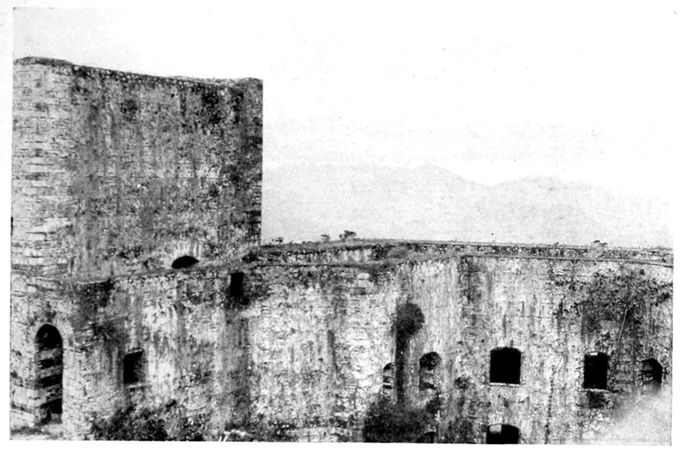
A corner of Christophe’s Citadel. Its situation is such that it could only be well photographed from an airplane
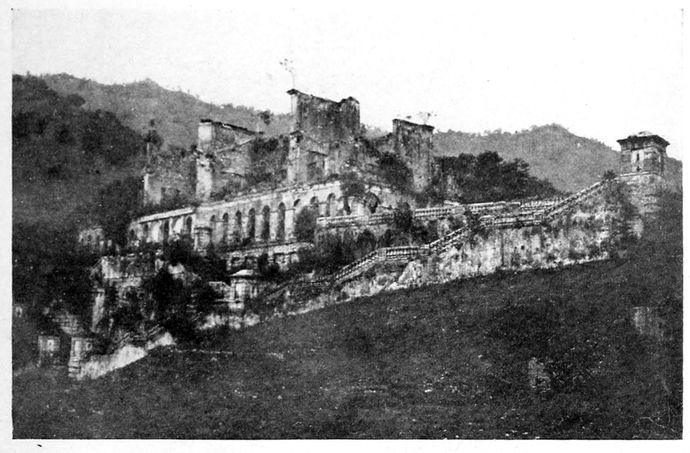
The ruins of Christophe’s palace of Sans Souci
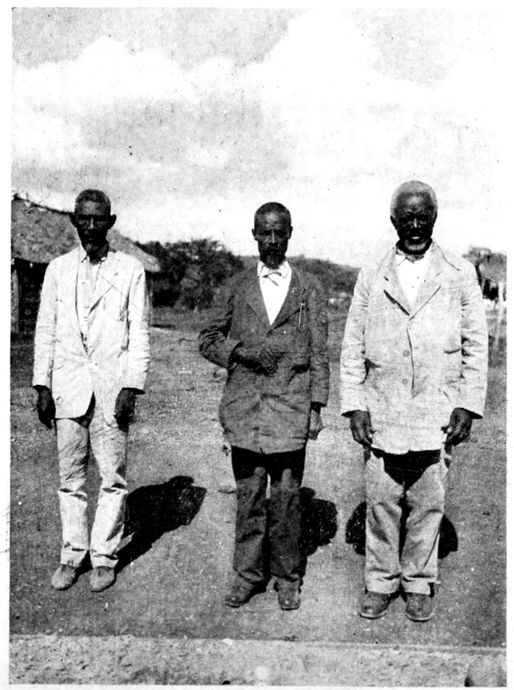
The mayor, the judge, and the richest man of a Haitian town in the bush
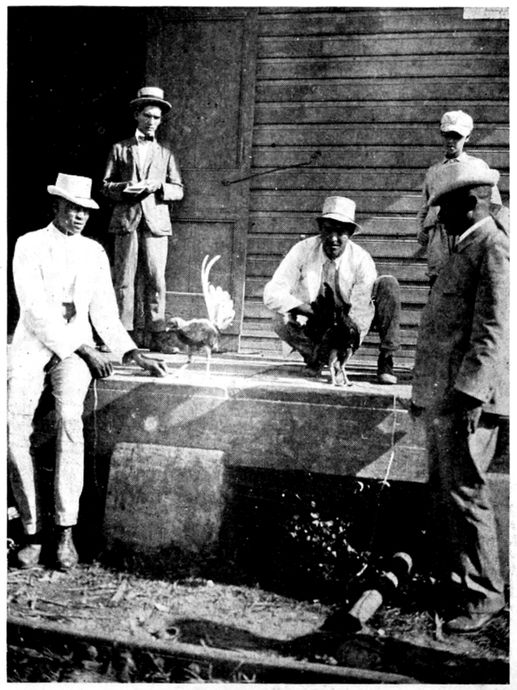
Cockfighting is a favorite Haitian sport
177Meanwhile Rachel had reached “the Cape,” as it is familiarly called,
by the usual route. Leaving Ennery, this had begun at once to climb
the mountain Puilboreau, winding in and out along its wrinkled face.
The vegetation was rather monotonous, with a yellowish tinge to the
several shades of green, now and then an orange cactus blossom, a
purple morning glory, a pink vine, or the old-gold bark of a tree adding
a touch of color. The view back down the valley, with its tiny specks
of houses, remained unbroken until they reached the summit three
thousand feet above the sea at Bakersville, so called for the marine
who had charge of this difficult bit of road building, when there burst
forth as far-reaching a scene to the north. The Plaisance Valley lay
under the heavy gray veil of a rain-cloud, the harbor of Cap Haïtien
visible far below, and far off on the horizon was the faint line of what
seemed to be Tortuga, chief of Haiti’s “possessions” and once the favorite
residence of buccaneers. The change of landscape was abrupt;
heavy, dense green vegetation smelling of moisture surrounding the
travelers on every hand as they wound down the mountain-side by a
mud-coated highway, passing here and there gangs of road laborers.
This northern slope was more thickly inhabited, thatched huts conspicuous
by their damp brown against the greenery occasionally clustering
together into villages in which some of the mud walls were whitewashed
or painted. Market-women bound for “the Cape,” men grubbing in
the fields, women paddling clothes—sometimes those in which they
should have been dressed—in the streams, all gave evidence of the
slighter dread of cacos on this northern slope. Then came another
climb and a descent into the valley of the Limbé, some miles along
which brought them to the village of the same name and to the greatest
difficulty to the automobilist in Haiti.
The fording of the Limbé is certain to be the chief topic of conversation
178between those who have traveled from Port au Prince to Cap Haïtien.
At times it is impassable, and has been known to delay travelers
for a week. This time men and women were crossing with bundles on
their heads and the water barely up to their armpits. A gang of prisoners
was brought from the village gendarmerie, the vitals of the car
removed and sent across on their heads, then with the passengers sitting
on the back of the back seat, the baggage in their laps, the reunited
gang, amid continual shrieks of “Poussez!” and an excited jabbering
of “creole,” eventually dragged and pushed the dismantled automobile
to the opposite shore. An hour and a half passed between the time it
halted on one bank and started out again from the other, which was
close to a record for the crossing. From there on the wide, but muddy,
road, now thronged with people returning from market with their purchases
or empty baskets, passed many ruins of old plantations, and the
crumbling stone and plaster gate-posts which once flanked the only
entrances to them.
Cap Haïtien, the second city of Haiti, sometimes called the “capital
of the North,” is situated on a large open bay in which the winds frequently
play havoc. On its outer reef the flagship of Columbus came
to grief on Christmas eve, 1492, and the discoverer spent Christmas as
the guest of the Indian chief who then ruled the district. The wreckage
of the Santa Maria was brought ashore near the present fisher village
of Petit Anse, and here was erected the first European fort in the New
World. In the days of Haiti’s prosperity Cap Haïtien was known as
the “Paris of America” and rivaled in wealth and culture any other
city in the western hemisphere. Then it had an imposing cathedral,
several squares and places decorated with fountains and statuary, and
was noted for its fine residences and urbane society. Old stone ruins
still stretch clear out to the lighthouse on a distant point. Destroyed
by the revolting blacks, by Christophe in his wars against Pétion, by
an earthquake or two, and by more than a century of neglect and tropical
decay, it retains little evidence of its former grandeur. Some of its
wide streets, however, are still stone-paved, and bear names which carry
the imagination back to medieval France. A few of its citizens live in
moderate comfort; the overwhelming majority are content to loll out
their days in uncouth hovels. It is so populous that it supports a
cinema, and some of its business houses are moderately up to date and
prosperous, though these are in most cases owned by foreigners. The
acrid smell of raw coffee everywhere assails the nostrils; coffee spread
179out on canvas or on the cement pavement of one of its few remaining
squares is constantly being turned over with wooden shovels by barefooted
negroes who think nothing of wading through it; here and
there one passes a warehouse in which chattering old women sit thigh-deep
in coffee, clawing over the berries with their fleshless black talons.
Its market-place is large and presents the usual chaos of wares and
hubbub of bargaining; its blue vaulted cathedral easily proves its antiquity,
and American marines are everywhere in evidence. On the
whole, its populace is somewhat less ragged than that of Port au Prince,
but whatever it lacks in picturesqueness is made up for by the view of
its surrounding mountains crowned by the great Citadel of Christophe.
Election day came during our stay at “the Cape.” In olden times
such an event was worth coming far to see, provided one could keep out
of the frequent mêlées accompanying it. Under the Americans it is
tame in the extreme. To obviate the necessity of counting more votes
than there are inhabitants, the marines have introduced a plan charming
in its simplicity. As he casts his ballot, each voter is required to
dip the end of his right forefinger in a solution of nitrate of silver.
The nail of course turns black, for the finger-nails even of a negro are
ordinarily light colored,—and remains so until election day is over.
Far be it from me to suggest that such a scheme might be adopted to
advantage in our own country. A few district commanders, to make
doubly sure, use iodine. The rank and file accept this formality as
cheerfully as they do every other incomprehensible requirement of their
new white rulers, most of them making the sign of the cross with the
wet finger. But the haughty “gens de couleur” are apt to protest
loudly against this “implied insult to my honor,” and if they can catch
the American official off his guard, are sure to dip in the wrong finger
or merely make a false pass over the liquid, meanwhile scowling into
silence the low-caste native watchers.
Haiti has long dreamed of some day uniting the several bits of miniature
railroad scattered about the country into a single line between the
two principal cities. The existing section in the north, twenty odd
miles in length, connects Cap Haïtien with Grande Rivière and Bahon.
Its fares, like those of the equally primitive lines out of Port au Prince,
are so low that for once the assertions of the owners that they lose
money on passengers can be accepted without a grin of incredulity.
To raise them, however, is not so simple a matter as it may seem, for
the Haitian masses are little inclined as it is to part with their rare
gourdes for the mere privilege of saving their calloused feet. There
180were far more travelers along the broad highway out of “the Cape”
than in the little cars themselves in which we followed it through a
region that might have been highly productive had it been as diligently
tended by man as by nature. The train stopped frequently and long
at forest-choked clusters of negro huts varying only in size. Such
scenes had grown so commonplace that we found more of interest in the
car itself, particularly among the marines who sprawled over several of
the seats. The majority of our forces of occupation are so decidedly
a credit to their country that it needed the contrast of such types as
these to explain why the “Gooks,” as the natives are popularly known
among their class, generally resent our presence on Haitian soil. Loudmouthed,
profane, constantly passing around a grass-bound gallon
bottle of rum, and boasting of their conquests among the negro girls,
they were far less agreeable traveling companions than the blackest of
the natives. Their “four years’ cruise in Hate-eye,” one would have
supposed in listening to them, was a constant round of these things and
“fighting chickens,” with an occasional opportunity of “putting a lot
of families in mourning” thrown in. Yet underneath it all they were
good-hearted, cheerful, and generous, despite the notion prevalent
among too many Americans that boisterousness and rowdyism is a
proof of courage and manhood.
Grande Rivière is a town of some consequence in Haiti, prettily situated
in a river valley among green hills. Its grassy place and the
unfailing “patrie” in its center are decided improvements on most of
those in the republic; the several large church bells under a roof of
their own at some distance from the building itself still retain their
musical French voices. A dyewood establishment is its chief single industry.
The crooked logwood, carved down to the red heart before it
leaves the forests, is gnawed to bits by a noisy machine, boiled in a succession
of vats, the red water running off through sluiceways, and the
waste tossed out to dry and serve as fuel, and the concentrated product,
thick as molasses, is inclosed in barrels for shipment. Scarcely an hour
passes between the picking up of a log and the rolling away of the
barrel containing its extract.
But of all the sights in any Haitian town the market-place is surest
to attract the idle traveler. It was Saturday, or beef day, and two
long lines of venders were dispensing mere nibbles of meat to the
clamoring throng of purchasers, no portion of the animal being too
uninviting to escape consumption. Of a hundred little squares on the
ground dotted with “piles” of miscellaneous wares the inventory we
181made of one is characteristic of all, and its sum total of value probably
did not reach two dollars. There were long, square strips of yellow
soap, brooms and ropes made of jungle plants, castor-beans (the oil
from which is used in native lamps), unhulled rice, all kinds of woven
things from baskets to saddle-bags, peanuts, green plantains, pitch-pine
kindling for torches, huge sheets of cassava bread, folded twice, rock
salt, gay calicoes, all tropical fruits, unground pepper, old nails, loose
matches, cinnamon bark, peanut and jijimi sweets, pewter spoons, scissors,
thread, little marbles of blue dye, unassorted buttons, cheap knives,
safety-pins, yarn, tiny red clay pipes and the reed stems to go with
them, rusted square spikes of the kind used a century ago, shelled corn,
ground corn, pitimi, several kinds of beans, tiny scraps of leather, four
tin cans from a marine messroom, five bottles of as many shapes and
sizes, one old shoe, and a handful of red berries used in Haiti as beads.
A bare five days from New York stands the most massive, probably
the most impressive single ruin in America. One might go farther and
say that there are few man-built structures in Europe that can equal
in mightiness and in the extraordinary difficulties overcome in its construction
this chief sight of the West Indies. Only the pyramids of
Egypt, in at least the familiar regions of the earth, can compare with
this gigantic monument to the strength and perseverance of puny man,
and the pyramids are built down on the floor of the earth instead of
being borne aloft to the tiptop of a mountain. It is curious, yet symbolical
of our ignorance of the neighbors of our own hemisphere, that
while most Americans know of far less remarkable structures in Europe,
not one in a hundred of us has ever heard of the great Haitian Citadel
of Christophe.
We caught our first view of it from “the Cape.” The January day
had broken in a flood of tropical sunshine, which brought out every
crack and wrinkle of the long mountain-range cutting its jagged outline
in the Haitian sky to the southward of the city. On the top of its highest
peak, called the “Bishop’s Bonnet,” stood forth a square-cut summit
which only the preinformed could have believed was the work of man.
Twenty-five miles away it looked like an enormous hack in the mountain
itself, a curious natural formation which man could never have imitated
except on a tiny scale. It is a standing joke in Cap Haïtien to
listen in all solemnity to newcomers laughing to scorn the assertions of
the residents that this distant mountain summit was fashioned by human
hands.
182Now and again as we journeyed toward it on the little railroad to
Grande Rivière we had a glimpse of the citadel through the dense tropical
vegetation, yet so slowly did it increase in size that its massiveness
became all the more incredible. Where we descended at a cross-trail
in the forest a group of small Haitian horses was already awaiting us.
The gendarme officer in charge of them was a powerful young American
beside whom a native of the color known as griffe, in civilian garb,
looked like a half-grown boy. For the pilots assigned us on this excursion
were none other than Captain Hanneken and Jean Batiste, now
Lieutenant, Conzé, the exterminators of Charlemagne.
The trail broke out at length into a wide clearing which stretched
away as far as the eye could follow in each direction, its grassy surface
cut up by several wandering paths along which plodded a few natives
and a donkey or two. It was once the “royal highway” between Christophe’s
main palace and Cap Haïtien, outdoing in width the broadest
boulevards of Europe. An hour or more along this brought us to
Milot, a small town lined up on each side of the road like people
awaiting a procession of royalty. At the back of it the highway ended
at a great crumbling ruin which had about it something suggestive of
Versailles.
Christophe’s palace of Sans Souci, for such it was, is wholly uninhabitable
to-day, yet there is still enough of it standing to indicate that
it was once one of the most ornate and commodious structures in the
western hemisphere. Two pairs of mammoth gate-posts, square in
form and nearly twenty feet high, guard the entrance to the lower yard-platform,
bounded by a heavy stone wall. On the inside these are hollowed
out into unexpected sentry-boxes, for Christophe was a strong
believer in many guards. Higher up, sustained by a still stronger wall,
is another grassy platform, from which a stairway as broad and elaborate
as any trodden by European sovereigns leads sidewise to a balustraded
entrance court, also flanked by sentry-boxes. Crumbling walls
in which many small bushes have found a foothold tower high aloft
above this to where they are broken off in jagged irregularity. The
palace was evidently five stories high, built of native brick and plaster,
and the architecture is still impressive despite its dilapidated condition
and for all its African-minded ostentation. The roof has completely
given way, and in the vast halls of the lower floor grow wild oranges
and tropical bush. Those higher up, of which only the edges of the
floors and the walls remain, are said to have included a great ball-room,
an immense billiard-hall, separate suites for the emperor and his black
183consort, and apartments for the immediate royal family. At some distance
from the palace proper stand the lower walls of the former lodgings
of minor princes, a host of courtiers, the stables, and the caserns.
The several parterres, once covered with rare flowers watered by irrigating
canals, are mere tangles of jungle. The caimite-tree under
which the black tyrant is said to have sat in judgment on his subjects,
after the example of Louis IX of France, still casts its mammoth shade
in the back courtyard; a small chapel lower down that was probably
used by the lesser nobles serves Milot as a church; with those exceptions
there is little left as Christophe saw it. Our forces of occupation
are threatening to tear down the walls, which are soon likely to fall of
themselves, to clear away the vegetation, and to build barracks of the
materials that remain.
The narrow trail that zigzags from the back of the palace up the
mountain may not be the one by which those condemned under the
caimite-tree were carried or dragged to their death before the ramparts
of the citadel, but there remain no evidences of any other route.
Much of the way it is all but impassable even during a lull in the rainy
season, for the dense vegetation shuts out the sun that might otherwise
harden the mud in which the hardiest native horses frequently wallow
belly-deep and now and then give up in frank despair. For a time it
leads through banana- and mango-groves, with huts swarming with
negro babies here and there peering forth from the thick undergrowth;
higher still there is a bit of coffee, but the last two thirds of the journey
upward is wholly uninhabited. Only once or twice in the ascent
does one catch a glimpse of the goal until one emerges from a brown
jungle of giant grasses, to find its grim gray walls towering sheer overhead.
Before this mammoth structure the memory of Sans Souci sinks into
insignificance. As the latter is ornate and cheerful in architecture, the
citadel is savage in its unadorned masculine strength. The mighty stone
walls, twenty feet thick in many cases, are square-cut and formidable
in their great unbroken surfaces. The northern side is red with fungus,
the rest merely weather-dulled. Even the cannon of to-day would find
them worthy adversaries. Time, which has wrought such havoc on the
palace at the mountain’s foot, has scarcely made an impression on the
exterior of this cyclopean structure, and even within only the wooden
portions have given way. Great iron-studded doors groaning on their
mammoth hinges give admittance to an endless labyrinth of gloomy
chambers, dungeon-like in all but their astonishing size. Cannon of
184the largest makes known when the fortress was constructed are to be
found everywhere, some of them still pointing dizzily out their embrasures,
stretching in row after row of superimposed batteries, others
lying where the rotting of their heavy wooden supports has left them.
Many bear the royal arms of Spain’s most famous monarchs, several
those of Queen Elizabeth, and the rest evidences of English and French
origin. Tradition has it that Christophe mounted three hundred and
sixty-five cannon of large caliber in the citadel, and it is small wonder
that his successors have not had the courage to attempt to remove them.
The imagination grows numb and helpless at the thought of transporting
these immense weapons by mere man power to the summit of a steep
mountain three thousand feet above the plain below. Yet not only
these, but the uncounted mammoth blocks of stone of which the acres of
thick walls are constructed, the mortars, the iron chests, the smaller
cannon, the heaps of huge iron cannon-supports, the pyramids of cannonballs
that are found wherever the footsteps turn in the clammy chambers
or the jungle-grown courtyards, were all brought here by sheer force
of human arms.
Higher and higher the visitor mounts by great dank stairways through
story after story of immense rooms, the vaulted stone ceilings of a few
partly fallen in, most of them wholly intact, all dedicated to the grim
business of war, to come out at last in an upper courtyard with the ruins
of a chapel and the mammoth stone vault in which Christophe lies
buried. Some of the marvels of the place are the stone basins always
full of clear running water, the source of which no man has ever been
able to discover. Here the group of prisoners whom the captain had
sent ahead with the paraphernalia and provisions for an elaborate picnic
lunch were shivering in their thin striped garments until their black
faces seemed to be blurred of outline. Yet they had less cause to
tremble than their fellows of a century ago who were herded in this
same inclosure to await their turn for being thrown from the ramparts
above. For such was Christophe’s favorite method of capital punishment.
The throwing-off place is a long stone platform ten feet wide
at the very top of the citadel. From its edge the sheer wall drops to a
sickening depth before it joins the mountain-slope almost as steep,
forming that great hack in the summit which looks from “the Cape”
like a natural precipice. Men hurled from this height must have fallen
nearly a thousand feet before they struck the bushy boulder-strewn
face of the mountain, down which their mutilated remains bounded and
slid to where they brought up against a ledge of rock or a larger bush,
185there to lie until their whitened bones crumbled into dust. Multitudes
of his subjects are said to have met this fate under the black tyrant,
some in punishment for real crimes, more for having unintentionally
aroused his enmity or to satisfy his whims. The story goes that Christophe
and his British ambassador once got into a friendly argument on
the subject of soldierly discipline. The black emperor contended that
there was no order which his troops would not unhesitatingly obey,
and to prove his point he led his guest to the top of the citadel, where
he set a company to drilling and at a given command caused it to march
off the edge of the wall. This particular tale should perhaps be taken
with a grain of salt, but there is unquestionable evidence of similar playful
acts on the part of the heartless monarch.
Once the visitor can withdraw his eyes from the jagged Golgotha
below, the view spread out before him is rivaled by few in the world.
All Haiti seems to be visible in every detail: the ocean, the entire course
of meandering rivers, high mountains, deep valleys, a sea of greenery,
form a circular panorama bounded only by the limitless horizon. Little
houses in tiny clearings on the plain below, a dozen towns and villages,
“the Cape,” Ouanaminthe, even the hills of Santo Domingo, stand
forth as clearly as if they were only a bare mile away, some flashing
in the tropical sunshine, others dulled by the great cloud shadows crawling
languidly across the landscape.
Henri Christophe was a full-blooded negro who passed the early days
of his life as the slave of a French planter. When the blacks rose
against their masters he led the revolt on his own plantation and quickly
avenged his years of bondage. Serving first as a common soldier under
Toussaint l’Ouverture, he rose to the rank of general and became one of
the chief supporters of Dessalines. The assassination of the latter in
1806 left Christophe commander-in-chief of the Haitian forces and led
to his election as the first President of Haiti. His first official act was
to protest against the newly adopted constitution on the ground that it
did not give him sufficient power. Civil war broke out between him
and the mulatto general Pétion, who drove him into the north and
became president in his place, leaving Christophe the official ranking of
an outlaw. Pétion, however, was never able to conquer his rival. Proclaiming
himself president under a new constitution drawn up by an
assembly of his own choosing, the rebel took possession of the northern
half of the country and ruled it for thirteen long years with one of the
bloodiest hands known to history.
In 1811 he proclaimed himself king, honored his black consort with
186the title of queen, and proceeded to form a Haitian nobility consisting
of his own numerous children as “princes of the royal blood,” three
“princes of the kingdom,” eight “dukes,” twenty “counts,” thirty-seven
“barons,” and eleven “chevaliers,” each and all of them former
slaves or the descendants of slaves. These jet-black “nobles,” many
of whom added to their titles the names of such native towns as Limonade,
Marmalade, and the like, soon became the laughing-stock of
more advanced civilizations, though candor forces the admission that
Christophe was only following the example of those who ennobled the
robber barons of Europe in earlier centuries, with the slight difference
in the matter of complexions. As “King Henry” he surrounded himself
with all the pomp and ceremony of royalty, erected nine palaces,
of which Sans Souci was the most magnificent and the only one that has
not completely disappeared, built eight royal châteaux, maintained great
stables of horses and royal coaches, innumerable retainers and servants,
and a tremendous bodyguard. Later, feeling that he had not done himself
full honor, he named himself hereditary emperor under the title
of “Henri I,” and having come within an ace of conquering the entire
country, settled down to govern his portion of it in a manner that would
have been the envy of Nero.
The name of Christophe, in so far as it is known at all, is synonymous
with unbridled brutality. Yet there is a certain violent virtue
in the efforts by which the ex-slave sought to force his unprogressive
black subjects to climb the slippery ladder of civilization. He founded
schools, distributed the estates of the exiled Frenchmen among the
veterans of his army, reëstablished commercial relations with England
and the United States, created workshops in which the word “can’t”
was taboo. His methods were simple and direct. Causing a French
carriage to be placed at the disposition of his workmen, he ordered them
to produce another exactly like it within a fortnight on pain of death.
Similar tasks were meted out in all lines of endeavor, the tyrant refusing
to admit that what white men could do his black subjects could not
do also. His despotism, however, was not bounded by the mere desire
for advancement. When he passed, the people were compelled to kneel,
and death was the portion of the man who dared look upon his face
without permission. Thievery he abhorred, and inflicted capital punishment
for the mere stealing of a chicken. It came to be a regular part
of his daily life to order men, women, and even children thrown from
the summit of the citadel.
Tradition asserts that thirty thousand of his black subjects perished
187in the building of this chief monument to his ambition. All the French
and Belgian architects and the skilled mechanics who worked on it are
said to have been assassinated when it was finished. The tale is still
going the rounds in Haiti that the emperor once came upon a gang of
workmen idling about one of the massive blocks of stone destined for
the citadel above, and demanded the reason for their inaction.
“It is too heavy, Sire,” replied the workmen; “we cannot carry it
to the mountain-top.”
“Line up,” ordered the tyrant; then turning to his bodyguard, he
commanded, “Shoot every fourth man. Perhaps you will feel stronger
now,” he remarked to the survivors as he rode onward.
On his return, however, the stone was no higher up the hill.
“It is quite impossible, your Majesty,” gasped the foreman; “it will
not budge.”
“Throw that man from the precipice,” said the despot, “and repeat
the order of this morning.”
The remaining workmen, according to the tale, succeeded in carrying
the stone to its destination.
Such stories always hover about those mighty monuments that seem
impossible without supernatural aid, yet no one who has beheld the success
with which the forces of gravity have been derided in this incredible
undertaking, incredible even in the enormousness of the structure
itself without taking into account its extraordinary situation, will question
its cost in such details as a few thousand more or less human lives.
Obsessed with the idea that the French would try to reconquer the
country, Christophe had resolved to erect a stronghold that would be
an impregnable place of resistance against them, or at worst a “nest-egg
of liberty,” which would afford certain refuge to the défenseurs
de la patrie until better days dawned for them. There he stored vast
quantities of grain and food, of ammunition, flints, bullets, powder,
soggy heaps of which are still to be found, clothing, tools, and a gold
reserve amounting to more than thirty million dollars. His enemies
saw in the citadel only a pretext to indulge his innate barbarism, to
decimate his people for the mere pleasure of playing Nero. It may be
that this is not a just verdict. Christophe felt that he incarnated the
soul of his black brethren and that belief made him wholly insensible
to any other consideration. The mere fact that his lack of perspective
and his ignorance of such details as the feeding of a long-besieged garrison
made his seemingly impregnable fortress an utter waste of effort
may speak poorly for the instruction which his French masters gave
188him, but it does not belittle the actual accomplishment of his superhuman
undertaking.
Christophe as violently died as he had lived. Stricken with apoplexy
in the church of Limonade, he attempted to cure himself by heroic
measures, such as rum and red-pepper baths. Finding this of no avail
and refusing to outlive his despotic power over his subjects, he shot
himself through the head. Barely was his body cold, if we are to believe
current stories, when his officers and retainers sacked the palace
of Sans Souci in which it lay, the wealth of many Haitian families of
this day being based on the spoils from this and his other royal residences.
The corpse was carried to the citadel and covered with quick
lime, but tradition asserts that it retained its life-like appearance for
many years afterward and was on view to all who cared to peer through
the glass heading of the vault until a later ruler decreed this exposition
“indecent,” and ordered the remains to be covered with earth.
189
Ouanaminthe is the Haitian “creole” name for a town
which the Spaniards founded under the more euphonious
title of Juana Mendez. It is the eastern frontier station for
those who travel overland by the northern route from Haiti to Santo
Domingo. We might have been stranded there indefinitely but for the
already familiar kindness of our fellow-countrymen in uniform who are
scattered throughout the negro republic. Public conveyances are unknown
in Ouanaminthe. Strangers are more than rare, and the natives
trust to their own broad, hoof-like feet. Walking is all very well for a
lone bachelor with no other cares than a half-filled knapsack. But with
a wife to consider, the long trail loses something of its primitive simplicity;
moreover there sat our baggage staring us in the face with a
contrite, don’t-abandon-me air. In what would otherwise have been
our sad predicament, Captain Verner, commanding the gendarmérie of
Ouanaminthe, came to our rescue most delicately with the assertion that
he had long been planning to run over to Monte Cristi on a pressing
matter of business.
The captain’s Ford—his own, be it noted in passing, lest some committee
of investigation prick up its ears—was soon swimming the
frontier river Massacre with that amphibian ease which the adaptable
“flivver” quickly acquires in the often bridgeless West Indies. The
change from one civilization to another—or should I call them two
attempts toward civilization?—was as sudden, as astonishingly abrupt,
as the dash through the apparently unfordable stream. Dajabón,
strewn from the sandy crest of the eastern bank to the arid plains
beyond, reminded us at once of Cuba; to my own mind it brought back
the memory of hundreds of Spanish-American towns scattered down
the western hemisphere from the Rio Grande to Patagonia. With one
slight exception the island of Santo Domingo is the only one in the
New World that is divided between two nationalities; it is the only one
on earth, unless my geography be at fault, where the rank and file speak
two different languages. Yet the shallow Massacre is as definite a
dividing line as though it were a hundred leagues of sea.
190Unlike the Haitian shacks behind us, the dwellings of Dajabón were
almost habitable, even to the exacting Northern point of view. Instead
of tattered and ludicrously patched negroes of bovine temperament
lolling in the shade of as ragged hovels of palm-leaves and jungle rubbish,
comparatively well-dressed men and women, ranging in complexion
from light brown to pale yellow, sat in chairs on projecting
verandas or leaned on their elbows in open windows, staring with
that fixed attention which makes the most hardened stranger self-conscious
in Spanish-America, yet which, contrasted with the vacant
black faces of Haiti, was an evidence at least of human intelligence
and curiosity. The village girls, decked out in their Sunday-afternoon
best, were often attractive in appearance, some undeniably pretty, qualities
which only an observer of African ancestry could by any stretch
of generosity grant to the belles of the Haitian bourgs behind us.
Even the change in landscape was striking. Whether the Spaniard
colonized by choice those regions which remind him of the dry and
rarely shaded plains of his own Castille and Aragón, or because he
makes way with a forest wherever he sees one, he is more apt than not
to be surrounded by bare, brown, semi-arid vistas. Haiti had, on the
whole, been densely wooded; luxuriant vegetation, plentifully watered,
spread away on every hand. The great plain that stretched out before
us beyond Dajabón was almost treeless; except for a scattering of
withered, thorny bushes, there was scarcely a growing thing. The
rainfall that had been so frequent in the land of the blacks behind us
seemed not to have crossed the frontier in months. In contrast to
caco-impoverished Haiti, large herds of cattle wandered about the brown
immensity, or huddled in the rare pretenses of shade; but what they
found to feed on was a mystery, for there was nothing in the scarce,
scanty patches of sun-burned herbage that could have been dignified
with the name of grass. Even where something resembling a forest
appeared farther on it turned out to be a dismal wilderness of dwarf
trees with spiny trunks and savage thorny branches without a suggestion
of undergrowth or ground plants beneath them. Dead, flat,
monotonous, made doubly mournful by the occasional moan of a wild
dove, a more dreary, uninspiring landscape it would be hard to imagine;
the vista that spread away as far as the eye could see seemed wholly
uninviting to human habitation.
It must be an unpromising region, however, that does not produce
at least its crop of mankind. Clusters of thrown-together huts, little
less miserable in these rural districts, it must be admitted, than those
191of Haiti, jolted past us now and then, their swarms of stark-naked
children of eight, ten, and even twelve years of age scampering out
across the broken, sun-hardened ground to see us pass. Yet in one
respect at least even these denizens of the wilderness were superior to
their Haitian prototypes—they really spoke their native language.
Familiar as we had both been for years with French, it was rare indeed
that we got more than the general drift of a conversation in Haitian
“creole.” The most uneducated dominicano, on the other hand, spoke
a Spanish almost as clear and precise as that heard in the streets of
Madrid. There must be something enduring, something that appeals
to the most uncouth tongue, in the Castilian language. Hear it where
you will, in all the broad expanse of Central and South America, in
the former Spanish colonies of the West Indies, from the lips of
Indians, negroes, mestizos, or the Jews of the Near East, banished from
Spain centuries ago, with minor variations of pronunciation and enriching
of vocabulary from the tongues it has supplanted, it retains almost
its original purity. What a hybrid of incomprehensible noises French,
on the other hand, becomes in the mouths of slaves and savages we had
all too often had impressed upon us in Haiti, and were due to have the
lesson repeated in the French islands of the Lesser Antilles. Even our
own English cannot stand the wear and tear of isolation and slovenly
vocal processes with anything like the success of the Castilian. The
speech of Canada and of Barbados, closely as those two lands are
linked to the same mother country, seem almost two distinct languages.
But if the Dominicans spoke their language more purely, their voices
had none of the soft, almost musical tones of the negroes beyond the
Massacre. There was a brittle, metallic, nerve-jarring twang to their
speech that was almost as unpleasant as the high-pitched chatter of
Cuban women.
If we noted all these differences between the two divisions of the
island, there was another that impressed us far more forcibly at the
moment. In all our jolting over the roads of Haiti, good, bad, and
unspeakable, we had never once been delayed by so much as a puncture.
In the first mile out of Dajabón we were favored with four separate
and distinct blow-outs. The twenty-eight miles between the frontier
and Monte Cristi—for it is best to hear the worst at once—netted
no fewer than ten!
It was shortly after the fifth, if my memory is not failing, that the
open plain gave way to a thorn-bristling wilderness through which had
been cut a roadway a generous twenty feet wide—shortly after certainly,
192otherwise the sixth blow-out would have intervened. I use
the term roadway advisedly, for road there was really none. The
Dominican scorns the building of highways as thoroughly as do any
of his cousins of Spanish descent. With American intervention he
was forced, much against his will and better judgment, to divert a
certain amount of public moneys and labor to making wheeled communication
between his various provinces possible. But though you
can drive an unbridled horse along any open space, you cannot choose
the path he shall make within it. Wide as it was, the roadway was
an unbroken expanse of deeply cracked and thoroughly churned brown
mud, sun-burned to the consistency of broken rock. Along this the first
traveler after the long forgotten rains had squirmed and waded his
way where the mud was shallowest, with the result that the only
semblance to a road wandered back and forth across the misshapen
roadway like a Spanish “river” in its ludicrously over-ample bed.
Here and there we were forced to crawl along the extreme edge of
one or the other of the bristling walls of vegetation; frequently the
only passable trail left the roadway entirely and squirmed off through
the spiny forest, the thorny branches whipping us in the faces. Huge
clumps of organ cactus and others of the same family forced us to
make precarious detours. At the top of a faint rise we sighted the
“Morro” of Monte Cristi, a great bulking rectangular hill that guides
the mariner both by land and sea to the most western port of Santo
Domingo. Our hopes began slowly to revive when—“Groughung!”
the sixth mishap befell us—or was it the seventh? I remember that
the eighth overtook us at the bottom of the rise, when both daylight
and our patches were giving out. The ninth found us in total darkness,
and disclosed the fact that there was not a match on board. The
lamps of the car had ceased to function months before; one does not
Ford it by night in the island of Santo Domingo except upon extreme
provocation. A hut discovered back in the bush was likewise matchless,
but the supper fire on the ground beside it still had a few glowing
embers. While Rachel held the blaze of one of those dried hollow reeds
that do duty as torches in Santo Domingo as near us as was prudent,
we improvised a patch that would have caused an experienced chauffeur
to gasp with astonishment. Each rustling of the thorny brush about
us drew our fixed attention. There are bandits in Santo Domingo as
well as in Haiti, and they have far less reputation for making speed to
the rear. The captain carried a revolver, an American Marine being
equally at home in either of the island republics. But the danger of
international complications had prevented his black gendarme assistant
from bringing with him the rifle that might be badly needed. My
visions of losing a congenial companion were vastly enhanced once
when a crashing in the bushes caused us to whirl about on the defensive.
A stray cow ambled past us and away into the black night.
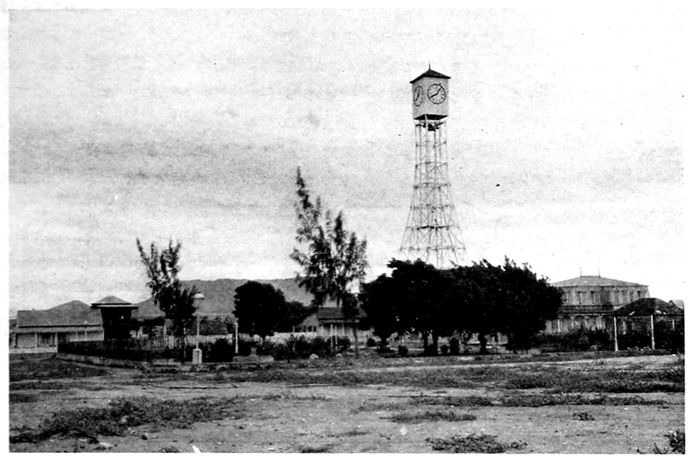
The Plaza and clock tower of Monte Cristo, showing its American bullet hole
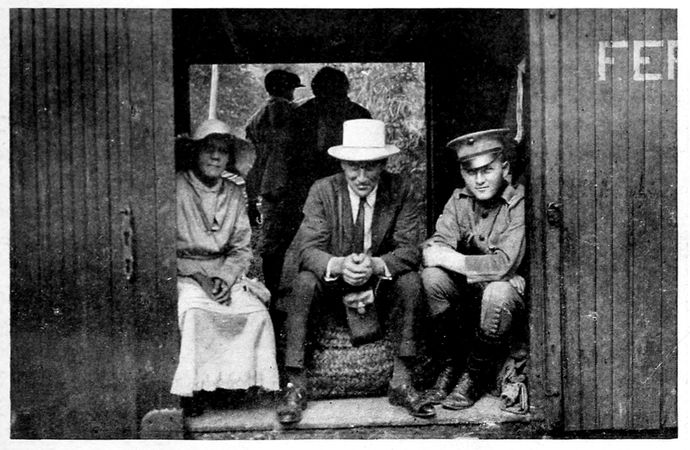
Railroading in Santo Domingo
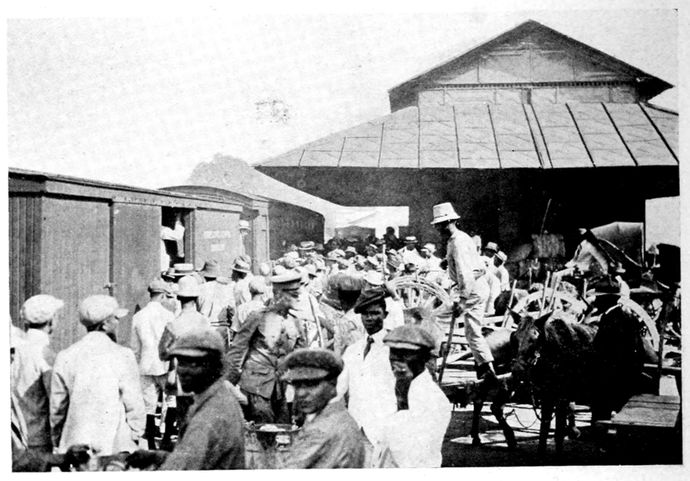
The tri-weekly train arrives at Santiago
193With the tenth mishap, lightless and patchless, we lost the final
remnants of patience and forced our sorry steed to hobble along on
three feet. The road had a pleasant little way of eluding us when least
expected, and a dozen times within the next hour we brought up
against the forest wall, finding our way again only by the sense of
touch. Then at last appeared a flicker of light. But it was only the
hamlet on the bank of the River Yaque, across which we must be
ferried on what looked in the darkness like the top of a soap-box.
Fortunately it takes little to float a Ford. Our crippled charger staggered
up the steep bank beyond this principal stream of northern
Santo Domingo, and a half hour later we rattled into the considerable
town of Monte Cristi.
Its streets were as wide as the hilltop roadway behind us, but like it
they had only reached the first stage of development. Worst of all
we were forced to run the full length of nearly every one of them in
the vain quest of some suggestion of hostelry. Our predicament would
have been one to bring salt tears to the most hardened eyes but for
the saving grace of all the island of Santo Domingo—our own people
in uniform. Barely had we discovered the commander-in-chief of
Monte Cristi, a Marine captain bearing the name of one of our early
and illustrious Presidents, than he broke all records in hospitality within
our own experience by turning his entire house over to us. We were
never more firmly convinced of the wisdom of American intervention
in Santo Domingo than at the end of that explosive day.
The otherwise dark and deserted town was gathered in its best
starched attire in the place where any Spanish-American town would
naturally be on a Sunday evening—in the central plaza. This, to
begin with, was strikingly unlike the bare open squares of Haiti,
with their unfailing tribune-and-palm-tree “patrie.” First of all, it
was well paved, an assertion that could not be made of any other spot
in town. An elaborate iron fence surrounded it, comfortable benches
were ranged about it, trees and flowering shrubs shaded it by day and
decorated it by night, the only public lights in town cast an unwonted
brilliancy upon the promenading populace, circling slowly round and
194round the square, the two sexes in opposite directions, their voices
and footsteps half drowning the not too successful efforts of a group
of misfitted males in the center of the plaza to produce musical sounds.
It was as typically Spanish a scene as the deserted barren place, with
the weird beating of tomtoms floating across it, is indigenous to the
republic of Haiti.
It was not until morning, however, that we caught full sight of the
chief feature of the plaza and the pride of Monte Cristi. By daylight
a monument we had only vaguely sensed in the night stood forth in all
its dubious beauty. In the center of the now deserted plaza rose a near
replica of the Eiffel Tower, its open-work steel frame crowned by a
large four-faced clock some fifty feet above our dizzy heads. Well
might the Monte Cristians pride themselves on a feature quite unique
among the plazas of the world.
From this clock tower hangs a tale that is too suggestive of Dominican
character to be passed over in silence. Some years ago, before the
intrusive Americans came to put an end to the national sport, a candidate
for the Dominican Congress came parading his candidacy about
the far corners of the country. In each town he promised, in return
for their aid in seating him in the august assembly, that the citizens
should have federal funds for whatever was most lacking to their civic
happiness. Monte Cristi, being farthest from the cynical capital of
any community in Santo Domingo, took the politician seriously. The
town put its curly heads together and decided that what it most wanted
was—not a real school building to take the place of the rented hut
in which its children fail to learn the rudiments of the three R’s, nor
yet pavements for some of the sandhills that are disguised under the
name of streets. What it felt the need of more than anything else was
a town clock that would cast envy on all its rivals for many miles
around. The politician approved the choice so thoroughly that he advised
the opening of negotiations for its purchase at once, without
waiting for the mere formality of congressional sanction. In due
time the monstrosity was erected. But for some reason the newly
elected congressman’s influence with his fellow-members was not so
paramount as his faithful supporters had been led to believe. Some
of them still contend that he did actually introduce a resolution to provide
the noble and patriotic pueblo of Monte Cristi with a prime necessity
in the shape of a community time-piece; if so the bill died in committee,
unattended by priest or physician. For months Monte Cristi
bombarded the far-off capital with doleful petitions, until at length,
195with the sudden coming of the Americans, congress itself succumbed,
and the two thousand or so good citizens of the hapless town found
themselves face to face with a document—bearing a foreign place of
issue at that, caramba!—reading succinctly:
“To one clock and tower, Dr........$16,000
Please Remit”
To cap the climax, the ridiculous Americans who had taken in charge
the revenues of the country brought with them the absurd doctrine that
municipalities should pay their bills. Years have passed since the
successful politician visited the northwest corner of the country, yet
Monte Cristi is only beginning to crawl from beneath its appalling
clock tower, financially speaking, and to catch its breath again after
relief from so oppressive a burden. Small wonder that her sand-hill
streets are unpaved and that her children still crowd into a rented hovel
to glean the rudiments of learning.
But the history of the famous clock tower does not end there. Those
who glance at the top-heavy structure from the south are struck by a
jagged hole just above the face of the dial, midway between the XII
and the I. It is so obviously a bullet-hole that the observer could not
fail to show surprise were it not that bullet-holes are as universal in
Santo Domingo as fighting cocks. Thereby hangs another tale.
In the early days of American occupation the choice of commanders
of the Guardia Nacional detachment in Monte Cristi was not always
happy. It was natural, too, that a group of marine officers, bubbling
over with youth, sentenced to pass month after month in a somnolent
Dominican village, should have found it difficult to devise fitting
amusement for their long leisure hours. Pastimes naturally reduced
themselves to the exchange of poker chips and the consumption of
certain beverages supposedly taboo in all American circles and doubly
so in the Marine Corps. The power of Dominican joy-water to produce
hilarity is far-famed. It came to be the custom of the winning
card player to express his exuberance by drawing his automatic and
firing several shots over his head. This means of expression would
have been startling enough to the disarmed Dominicans had the games
been played in the open air with the sun above the horizon. But the
rendezvous was naturally within doors, usually in the dwelling of the
commander, and the climax was commonly reached at an hour when
all reputable natives were wrapped in slumber. The sheet-iron roof
that sheltered us during our night in Monte Cristi corroborated the
196testimony of the inhabitants that they had frequently sprung from
their beds convinced that yet another revolution was upon them.
One night a difference of opinion arose among the players as to the
hour that should be set for the cashing in of chips. The commander
offered to settle the problem in an equitable manner. Stepping to the
door, he raised his automatic toward the famous $16,000 clock and
fired. The decision was made; the game ended at twelve:thirty. It
is not particularly strange under the circumstances that the inhabitants
of Monte Cristi are not extraordinarily fond of Americans or of
marine occupation.
The mail coach—in real life the inevitable Ford—left Monte Cristi
the morning after our arrival, obviating the necessity of wiring to
Santiago for a private car. The fare was within reason, as such things
go in the West Indies—sixteen dollars for a journey of some eighty
miles—and despite the pessimistic prophecies of our host we had
the back seat to ourselves the entire distance. Our driver, of dull-brown
hue, was of the same quick, nervous temperament as his Cuban
cousins, and scurried away at thirty miles an hour over “roads” which
few American chauffeurs would venture along at ten. Yet he was surprisingly
successful in avoiding undue jolts; so often had he driven
this incredibly rough-and-tumble route that he knew exactly when and
where to slow up for each dry arroyo, to dodge protruding boulders or
dangerous sand beds, to drop from one level to another without cracking
a spring or an axle. The machine was innocent of muffler, hence it
needed no horn, and as an official conveyance it yielded the road to no
one, except the few placid carts whose safety lay in their massiveness.
Many miles of the journey were sandy barren wastes producing only
dismal thorn-bristling dwarf forests. Every now and then we dodged
from one wide caricature of a road to another still more choppy and
rock-strewn; occasionally we found a mile or two of tolerable highway.
The scarcity of travelers was in striking contrast to Haiti. The few
people we met were never on foot, but in clumsy carts or astride gaunt,
but hardy, little horses. Houses of woven palm-leaves, on bare, reddish,
hard soil sheltered the poorer inhabitants; the better-to-do built their
dwellings of split palm trunks that had the appearance of clapboards.
Villages were rare, and isolated houses wholly lacking. Outdoor mud
ovens on stilts, with rude thatched roofs over them, adorned nearly
every back or side yard. At each village we halted before a roughly
constructed post office to exchange mailbags with a postmaster who in
197the majority of cases showed no visible negro strain. Pure white inhabitants
were frequent in the larger pueblos; full-blooded African
types extremely rare. Santo Domingo has been called a mulatto country;
we found it more nearly a land of quadroons.
What even the sparse population lived on was not apparent, for
almost nowhere were people working in the fields, and the towns seemed
to be chiefly inhabited by fairly well-dressed loafers, or at best by
lolling shop-keepers. Probably they existed by selling things to one
another. The stocks of the over-numerous shops were amply supplied
with bottled goods, but with comparatively little else, and that chiefly
tinned food from the United States. No old sugar kettles, no ruined
French estates, no negro women in broad straw hats or slippers flapping
with the gait of their donkeys, no improvised markets or clamoring
beggars along the way—none of the familiar things of Haiti were in
evidence, except the fighting cocks. Such horsemen as we passed
rode in well upholstered saddles, doubly softened by the Spanish-American
pellon, or shaggy saddle rug. The women accompanying them
clung uncomfortably to clumsy side-saddles, and were dressed in far
more style than their Haitian prototypes, pink gowns being most in
favor, and in place of the loose slippers the majority wore shoes
elaborate enough to satisfy a New York shop-girl. Cemeteries at the
edge of each town were forests of wooden crosses, contrasting with the
coffin-shaped cement tombs of Haiti.
Guayovin, a town of considerable size and noted for its revolutionary
history, the scattered hamlet of Laguna Salada, the larger village of
Esperanza, one pueblo after another was the same blurred vista of
wide, sandy streets, of open shop fronts and gaping inhabitants. We
soon detected a surly attitude toward Americans, a sullen, passive
resentment that recalled the attitude of Colombia as I had known it
eight years before. There was more superficial courtesy than in our
own brusk and hurried land; the Dominican, like all our neighbors to
the southward, cultivates an exterior polish. But with the exception
of a few who went out of their way to demonstrate their pro-American
sentiments, to express themselves as far more pleased with foreign
occupation than with the continual threat of revolution, the attitude
of silent protest was everywhere in the air.
At the end of fifty kilometers, in which we had forded only one
pathetic little stream, the landscape changed somewhat for the better,
though at the same time the “road” became even more atrocious.
Hitherto the only beauty in the scene had been a pretty little flowering
198cactus bush, like an inverted candelabra, and the soft velvety colors of
the barren brown vistas. Now the thorny vegetation, the chaparral,
and the cactus gave way to clumps of bamboo, to towering palms, and
other trees of full stature, while corn and beans began to clothe the still
deadly-dry soil. High hills had arisen close on the left, higher ones
farther off to the right; then ahead appeared beautiful labyrinths of
deep-blue mountains, range after range piled up one behind the other
in amphitheatrical formation, culminating in the cloud-coiffed peak of
Tino, some ten thousand feet above the sea and the highest point in
the West Indies.
Navarrete, strung along the beginning of an excellent highway that
was to continue, except for two unfinished bridges, to Santiago, boasted
real houses, some of palm trunks, most of them of genuine lumber with
more corrugated iron than thatched roofs, some of their walls of faded
pink, green, or yellow, many of them frankly unpainted. A considerable
commercial activity occupied its inhabitants. Beyond, the country
grew still greener, with groves of royal palms waving their ostrich
plumes with the dignified leisureliness of the tropics, and the highway
began to undulate, or, as it seemed to us behind our over-eager chauffeur,
to pitch and roll, over low foot-hills. We picked up a rusty
little railroad on the left, farther on a power line and a dozen telegraph
wires striding over hill and dale, raced at illegal speed through
Villa Gonzalez, and entered a still more verdant region of vegetable
gardens in fertile black soil. Then all at once we topped a rise from
which spread out all the splendid green valley of Yaque, Santiago de
los Caballeros piled up a sloping high ground a couple of miles away,
with mountains that had grown to imposing height still far distant to the
right. A truck-load of marines, monopolizing the right of way in
the innocently obstructive manner we had often seen in France, blocked
our progress for a time; then we swung past the inevitable shaded
plaza of all Spanish-American towns, and drew up with a snort at the
Santiago post office just as the cathedral clock was striking the hour
of three.
Before we had time even to set foot in Santiago we were greeted by
my old friend “Lieutenant Long” of Canal Zone police fame, who had
already put the town in a proper mood for our reception. Since the
days when we had pursued felons together along the ten-mile strip of
Panamanian jungle the erstwhile lieutenant, now more fittingly known
as “Big George,” had added steadily to his laurels as a good and true
199servant of mankind. From the defelonized banks of the canal to the
command of the sleuths of Porto Rico had been a natural step, and
when he had detected everything worth detecting in our West Indian
isle, and fathered a company of the 17th Infantry during the late international
misunderstanding, “Big George” accepted the Augean task of
initiating the Dominicans into the mysteries of their new American-sired
land tax.
Considerably more than four hundred years ago, when the redskin
north of the Rio Grande had yet to scalp his initial pale face, there
was founded in the fertile valley of the Yaque the first of the many
Santiagos that to-day dot the map of more than half the western
hemisphere. Thirty Spanish gentlemen, as the word was understood
in those roistering days, hidalgos who had followed on the heels of
Columbus, were the original settlers, and because of their noble birth
they were permitted by royal decree to call their new home by the name
it still officially bears,—Santiago de los Caballeros. Although the
present inhabitants of the aristocratic old town by no means all boast
themselves “gentlemen” either in the conquistador or the modern
sense of the term, some of the leading families can trace their ancestry
in unbroken line from those old Spanish hidalgos. Many of these descendants
of fifteenth century grandees still retain the armor, swords,
and other quaint warlike gear of their ancestors. A few have even
kept their Caucasian blood pure through all the generations and frequent
disasters of that long four hundred years, but the vast majority
of them give greater or less evidence of African graftings on the family
tree. The Cibao, as the northern half of Santo Domingo is called,
is the region in which the Spaniards first found in any quantity the
gold they came a-seeking, and gentlemanly Santiago has ever been its
principal city. Twice destroyed by earthquakes, like so many cities
of the West Indies, sacked by pirates and invaders more times than it
cares to remember, it has persisted through all its mishaps.
But in spite of its flying start Santiago has by no means kept pace
with many a parvenu in the New World. Barely can it muster twenty
thousand inhabitants, and in progress and industry it has drifted but
slowly down the stream of time. Revolutions have been its chief setback,
for the innumerable civil wars that have decimated the population
of the republic ever since it asserted its freedom from the Spanish
crown have almost invariably centered about the city of caballeros. A
hundred Spanish-American towns can duplicate its every feature.
About the invariable central plaza, with its shaded benches, diagonal
200walks, and evening promenaders, stand the bulking, weather-peeled
cathedral with its constantly thumping, tin-voiced bells, the casa consistorial
where the municipal council dawdles through its weekly meetings,
the wide open yet exclusive clubs, and the residences of the most
ancient families, their lower stories occupied by shops and cafés. In
contrast to this proudly kept square the wide, right-angled streets that
radiate from it are either congenitally innocent of paving or littered
with the remnants of what may long ago have been cobbled driveways.
As in all Spanish-America the lack of civic team-work is shown in the
sidewalks; which are high, low, ludicrously narrow, or lacking entirely,
according to the personal whim of each householder, and rather family
porches than public rights of way. Its houses, mostly of one story,
never higher than two, are something more than half of wood, the
remainder being adobe or baked-mud structures that some time in the
remote past had their façades daubed with whitewash or scantily painted
in various bright colors. The cathedral, the municipal building, many
a private residence, our very hotel room were speckled with bullet-holes
more or less diligently patched, corroborating the verbal evidence of
Santiago’s revolutionary activities. There is a faint reminder of the
Moors in the tendency for each trade to monopolize one street to the
exclusion of the others. A dozen barbershops may be found in a single
block, cafés cluster together, drygoods shops with their languid male
clerks shoulder one another with a certain degree of leisurely, unindividualistic
aggressiveness. Farther out, the unkempt streets
dwindle away between lop-shouldered little huts that seem to need the
supporting mutual assistance shared by their neighbors nearer the center
of town.
There is not a street car in all the island of Santo Domingo, or Haiti,
as you choose to call it. Dingy, wretched old carriages, their horses
only a trifle less gaunt and ungroomed than those of Port au Prince,
loiter about a corner of the plaza, behind the cathedral, shrieking their
pleas at every possible fare who passes within their field of vision.
Automobiles are not unknown, but they have not yet invaded Santiago
in force. The inevitable venders of lottery tickets, which in Santo
Domingo are of municipal rather than national issue and resemble the
handbills of some itinerant family of barn-stormers, pester the passer-by
every few yards with spurious promises of sudden fortune. In the
cathedral the visitor finds himself face to face at every step with admonitions
that women must have their heads covered and that worshipers
shall not spit on the floor. The first command is universally recognized,
201if only by the spreading of a handkerchief over the frizzled
tresses, but the latter is by no means so faithfully obeyed. If there is
anything whatever individualistic about St. James of the Gentlemen
that distinguishes it from its countless cousins below the Rio Grande,
it is the stars and stripes that wave above the ancient fortress overlooking
the placid River Yaque, and the groups of American marines who
come now and then striding down its untended streets.
The average santiagueño reaches the dignity of clothes somewhat
late in life. Naked black or brown babies adorn every block, the sight
of a plump boy of five taking his constitutional dressed in a pair of
sandals, a bright red hat, and a magnificent expression of unconcern
attracts the attention of no one except strangers. Girls show the
prudery of their sex somewhat earlier in life, but many a boy learns
to smoke cigarettes, and even long black cigars, before he submits to
the inconvenience of his first garment. It may be this sartorial freedom
of his earlier life that makes the Santiago male prone to sport a costume
that belies his years. Youths of sixteen, eighteen, and some one
might easily suspect of being twenty, display an expanse of brown legs
between their tight knee-breeches and short socks that makes their
precocious tendency to frequent cafés, consume fiery drinks and man-size
cigars, and enamorar las muchachas doubly striking. They are
intelligent youths, on the whole, compared with their Haitian neighbors,
with a quick wit to catch a political argument or the mysteries of
a mechanical contrivance, though they have the tendency of all their
mixed race to slow down in their mental processes soon after reaching
what with us would be early manhood. La juventud of Santo Domingo
is beginning to look with slightly less scorn upon the use of the hands
as a means of livelihood, an improvement which may be largely credited
to American occupation, not so much through precept and example as
by the reduction in political sinecures and the institution of genuine
examinations for candidates to government office.
In character, as in physical aspect, Santiago is true to type. The
outward forms of politeness are diligently cultivated; actual, physical
consideration for the comfort or convenience of others is conspicuous
by its scarcity. The same man who raises his hat to and shakes hands
with his neighbor ten times a day shows no hesitancy in maintaining
any species of nuisance, from a bevy of fighting cocks to a braying
jackass, against the peace and happiness of that same neighbor, nor in
hugging a house-wall when it is his place to take to the gutter. A
haughtiness of demeanor, an over-developed personal pride that it
202would be difficult to find real reason for, burden all except the most
poverty-stricken class. Amid the medley of tints that make up the
population the casual observer might conclude that the existence of a
color-line would be out of the question in Santiago. As he dips beneath
the surface, however, he finds a very decided one, nay, several, dividing
the population not into two, but into three or four social strata, though
the lines of demarkation are neither as distinct nor as adamant as with
us. Thus one of the tile-floored clubs on the central plaza, the chair-forested
parlor of which stands ostensibly wide open, admits no member
whose ancestry has not been unbrokenly Caucasian, while another
across the square welcomes neither pure whites nor full-blooded Africans.
An amusing feature of this club exclusiveness is that the first
society, after what is said to have been violent debate, declined to admit
American members, as a protest against “the unwarranted interference
by superior force in our national affairs.” In retaliation, or rather, in
supreme indifference to this attitude, the forces of occupation have
acquired the premises next door and take no back seat to the Dominicans
in the matter of exclusiveness. It may be the merest coincidence that
whenever a dance is given in the American clubrooms a still more blatant
orchestra, seated close up against the thin partition between the two
social rendezvous, furnishes the inspiration for a similar recreation.
The principal business of Santiago, if one may judge by the frequent
warehouse doors from which issues the acrid smell of sweating tobacco,
is the buying and selling of the narcotic weed. It comes in great bales,
wrapped in yagua, or the thick, leathern leaf-stem of the royal palm,
of which each tree sheds one a month and which is turned to such a
variety of uses throughout the West Indies. Women and boys are
constantly picking these bales apart and strewing their contents about
in various heaps, to just what purpose is not apparent to the layman,
for they always end by bundling them up again in the self-same yagua,
in which dusky draymen carry them off once more to parts unknown.
A considerable amount of the stuff is consumed locally, however, for
Santiago boasts one large cigar factory and a number of small ones,
ranging down to one-room hovels in which the daily output could probably
be contained within two boxes—were it not the custom in Santo
Domingo simply to tie them in bundles.
The smoker must conduct himself with circumspection in American-governed
Santo Domingo. Each and every cigar is wrapped round
not only with the usual banded trademark, but also with a revenue
stamp. Now beware that you do not indulge that all but universal
203American habit of removing the band before lighting the cigar. In
Santo Domingo it is unlawful to withdraw this proof of legal origin
until the weed has been “partially consumed,” and the official expert
ruling on that phrase is that the clipping off of the consumer’s end does
not constitute even partial consumption, which only the burning of a
certain portion of the customarily, opposite extremity, accomplishes.
Furthermore, when at last you do venture to remove the decoration, do
not on any account fail to mutilate it beyond all semblance to its original
state. If you are detected in the perpetration of either of the unlawful
acts above specified, no power can save you from falling into the hands
of “Mac,” who sits in the same office with “Big George”—whenever
one or both of them are not pursuing similar malefactors in another
corner of the Cibao—facing the charge of unlawfully, wilfully, and
maliciously violating Article 12 of the Internal Revenue Law of the
sovereign República Dominicana, and there is no more certain road to
the prisoner’s dock.
But I am getting ahead of my story. “Mac” will make his official
entry all in due season. What I started to explain was why one may
frequently behold an elephantine Dominican market woman, often with
a brood of piccaninnies half concealed in the folds of her ample skirt,
parading down the street with the air of a New York clubman in
spite of the bushel or two of yams or plantains on her head, puffing
haughtily at a cigar the band of which falsely suggests that she has
recently squandered a dollar bill with her tobacconist. Indeed, many
an over-cautious Dominican avoids all possibility of falling into the
net by smoking serenely on through band, stamp, and all, which, to tell
the truth, does not particularly depreciate the aroma of the average
native cigar.
There is sound basis for Article 12. In the good old days when
there were no battalions of marines to interfere with the national
sport of Santo Domingo the stamp tax was already in force, and the
consumption of cigars was almost what it is to-day; yet for some
occult reason it scarcely produced a tenth of its present revenue. First
of all there were the “chivo” cigars,—chivo meaning not merely goat
but something corresponding to our word “graft” in the Spanish West
Indies—which never made any pretense of bearing a stamp. Some
of them were made secretly; a veritable pillar of the social structure
of Santo Domingo was discovered to be operating a clandestine cigar-factory
long after the Americans took up this particular bit of the
white man’s burden. Others were privately placed on the market by
204legitimate manufacturers, who supplied a certain percentage of legal
stock also. A third scheme was to fill the pockets of the native inspector
with a choice brand and advise him to forget the matter; still
another alternative was to buy the stamps at a bargain from some
revenue official who was hard pressed for ready cash. But the favorite
means of avoiding contributions to the wily politicians in the capital
was simplicity itself. A cigar-maker purchased a hundred revenue
stamps and wrapped them about his first hundred cigars. His retailer,
who might be himself, his wife, his cousin, or at least his compadre,
greeted the purchaser with a smiling countenance. “Cigars? Why
certainly. Try these. Cómo va la señora hoy? Y los niños?
Curious exhibition that fourth pair of cocks gave on Sunday, verdad?”
Bargains are not struck hastily in Santo Domingo. By the time the
transaction was completed the retailer had ample opportunity idly to
slip the bands off the cigars and drop them into his counter drawer.
The purchaser made no protest, even if he noticed the manipulation,
for he was buying cigars, not revenue stamps. It is vouched for that
the same band saw continual service in the old days for a year or two.
But it is a careless smoker to-day who ventures to thrust a cigar into
his pocket without making sure that its proof of legality is intact.
“Big George” arranged that we should spend the first Sunday after
our arrival in the most typical Dominican style of celebration,—the partaking
of lechón asado. His choice of scene for the celebration, too, was
particularly happy. An hour’s easy jog from town—easy because the
saddle-horses of Santo Domingo, like those of Cuba, are all “gaited,”
that is, gifted with a singlefoot pace that makes them as comfortable
seats as any rocking-chair—brought us to the estate of Jaragua, the
exact site of the first founding of Santiago by the Castilian hidalgos. It
was the first earthquake that caused them to transfer it from this heart of
the valley to the bluff overlooking the Yaque. The ruins of an old brick-and-stone
church, of a water reservoir or community bath, and long
lines of stones embedded in the ground marking the remnants of
cobbled streets and house walls, are half covered with the brush and
jungle-grass of a modern hog farm. Magnificent royal palms rise
from what were once private family nooks; immense tropical trees
spread over former parlors more charming roofs than their original
coverings of thatch; the pigs frequently root up ancient coins that may
long ago have jingled in Columbus’ own pocket.
Under the dense, capacious shade of a fatherly old mango-tree sat a
205negro peon, slowly turning round and round over a fire of specially
chosen, aromatic fagots a suckling pig, or lechón, spitted on a long
bamboo pole. In the outdoor kitchen of the rambling, one-story, tile-roofed,
delightful old Spanish country house a group of ebony servants
of both sexes and all ages were preparing a dozen other native dishes
the mere aroma of which made a hungry man withdraw to leeward and
await the summons with what patience he could muster. Our host and
his family, with just enough African tinge to their ancestry to make
their hair curl, hurried hither and yon, striving to minister to our
already perfect comfort. There is no more genuine hospitality than
that of the higher class hacendados of rural Latin-America, once they
have cast aside the mixture of shyness and rather oppressive dignity in
which they commonly wrap themselves before strangers.
In due leisurely season the chief victim of the day’s feast, his mahogany
skin crackling from the recent ordeal, bathed in his own tender
juices, was slid down the bamboo pole to a giant platter and given the
place of honor on the family board. Flanked on all sides by the results
of the kitchen industry,—heaping plates of steamed yuca, mashed
yams bristling with native peppers, boiled calabash, plump boniatos,
golden Spanish chick-peas, even a Brobdingnagian beefsteak—and
these in turn by the now thoroughly congenial hosts and guests, a barefoot,
wide-eyed servant behind every other chair, the celebration began.
Spanish wines which one would never have credited with finding their
way to this far-off corner of the New World turned the big bucolic
tumblers red and golden in perhaps too rapid succession. Dominican
tales of the olden times, American pleasantries reclothed in rattling
Castilian, reminiscences of Haitian occupation from the still bright-eyed
grandmother, all rose in a babel of hilarity that floated away through
the immense open doorways on the delightful trade winds that sweep
constantly over the West Indies. But alas for the brevity of human
appetite! Long before the center of attraction had lost his resemblance
to the eager little rooter of the day before, while the Gargantuan beefsteak
still sat intact, eyeing the circle with a neglected air, one after
another of the sated convivialists was beckoning away with a scornful
gesture of disinterest the candied and spiced papaya which the servants
were bent on setting before him. What, too, shall I say of the dastardly
conduct of “Big George?” For with his help the lechón, nay,
even the neglected beefsteak, might have been reduced to more seemly
proportions before they were abandoned to the eager fingers of the
gleaming-toothed denizens of the kitchen. The painful truth is that
206the defelonizer of Porto Rico, the erstwhile dread of Canal Zone criminals,
the man who had so often given a “summary” to a hapless member
of the 17th Infantry for being a moment late at reveille, was absent
without leave. Even “Mac,” with his whole family of little Mackites,
their chubby faces giving a touch of old Erin to this Dominican landscape,
had arrived on the scene at the crucial moment. What excuse,
then, can one fabricate for an unhampered bachelor whose seven-league
legs might have covered the paltry distance between new and
old Santiago in a twinkling, yet who had chosen to desert his bidden
guests in the heart of a bandit-infested island? Can even poetic license
pardon a man, particularly a man who dents the lintels of half the doors
he passes through, who remains at home to write sonnets when he
might be partaking of lechón asado? Certainly the admission of such
irrelevant testimony as the fact that the horse furnished him by an
unobserving Dominican was not capable of lifting clear of the ground
the seven-league legs already stigmatized cannot rank even as extenuating
circumstances.
207
There are two railroads in Santo Domingo, confined to the
Cibao, or northern half of the Republic, which by their united
efforts connect Santiago with the sea in both directions. The
more diminutive of them is the Ferrocarril Central Dominicano, covering
the hundred kilometers between Moca and Puerto Plata, on the
north coast, with the ancient city of the Gentlemen about two thirds
of the way inland. It is government owned, but takes its orders from
an American manager. It burns soft coal, as the traveler will soon
discover to his regret, and, unlike most lines south of the Rio Grande,
it has only one class. The result is that the single little passenger train
which makes the round trip three times a week and keeps the Sabbath
contains a motley throng of voyagers. I say “contains” with hesitation,
for that is somewhat straining the truth. The bare statement that
its gauge is six inches short of a yard should be sufficient hint to the
imaginative reader to indicate the disparity between travelers and cars.
In fact, any but the shortest knees are prone to become hopelessly
entangled with those of one’s companion or in the rattan seat-back
ahead, and the fully developed man who would view the passing landscape
must needs force his head down somewhere near the pit of his
stomach. The train has its virtues, however, for all that. The more
than indefinite periods it tarries at each succeeding station give the
seeker after local color ample opportunity to make the thorough
acquaintance of every town and its inhabitants, particularly as it is the
custom of the latter to gather en masse along the platforms.
We made up a party of four for the journey. “Big George,” his
sonnets safely despatched to his clamoring publisher, was sadly needed
to stifle a feud between his two native subordinates in the northern port;
the rumor of an illicit still in the same locality had been enough to send
“Mac” racing to the station. We wormed our way into one of the
two passenger coaches with mixed feelings. For Rachel it was commodious
enough. After years of experience with the cramped and
weak-jointed furniture of Latin-America I should naturally not be so
208lacking in foresight as to choose—or be chosen by—a wife who
required an undue amount of space. “Mac” and I, too, had been
booted about this celestial footstool long enough to accept a certain degree
of packing without protest. But if “Big George” stuck doggedly
to the platform and gazed pensively along the roofs of the cars ahead to
where the wool-pated fireman and engineer were struggling to contain
themselves within the same cab, it was not for the sole purpose of
gathering inspiration for new sonnets from the fronds of the passing
palm trees.
However, I was near forgetting to bring “Mac” in for his formal
introduction, and there is no better time to redeem my promise than
while we are tearing along at eight miles an hour over a region we
have already viewed by Ford. Top sergeant of a troop of American
cavalry that won laurels in the Spanish-American war, he had chosen
to remain behind in Porto Rico when his “hitch” was ended. There
he helped to set our new possession to rights and took unto himself
the foundation of a family. With the establishment of American
control of customs in Santo Domingo in 1907 he was the first of our
fellow-countrymen to accept the dangerous task of patrolling the
Haitian-Dominican frontier. Many a party of smugglers did he rout
single-handed; times without number he was surrounded by bandits,
or threatened with such fate as only the outlaws of savage Haiti and
their Dominican confederates can inflict upon helpless white men falling
into their hands. “Mac” made it his business never to be helpless.
His trusty rifle lost none of the accuracy it had learned on the target-range;
the tactics of self-preservation and the will to command he had
gained in his long military schooling stood him in increasing good
stead. Even when he was shot from ambush and marked for life
with two great spreading scars beneath his shirt, he did not lose his
soldierly poise, but wreaked a memorable vengeance on his foes before
he dragged himself back to safety. “Mac” does not boast of these
things; indeed, he rarely speaks of them, except as a background of
his witty stories of border control in the old days. But his colleagues
of those merry by-gone times still tell of his fearless exploits.
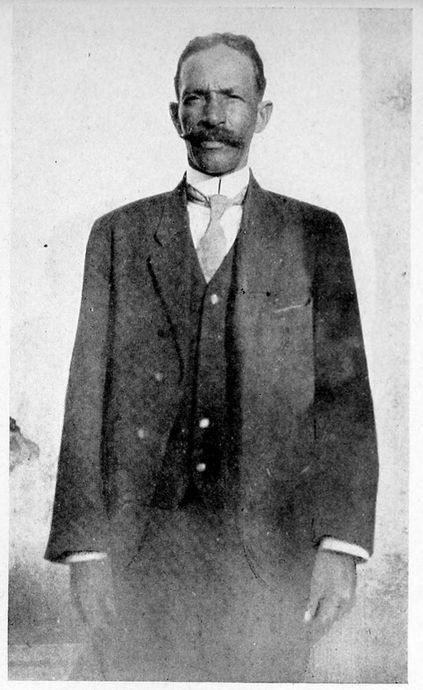
Gen. Deciderio Arias, now a cigar maker, whose revolution finally caused American intervention in Santo Domingo
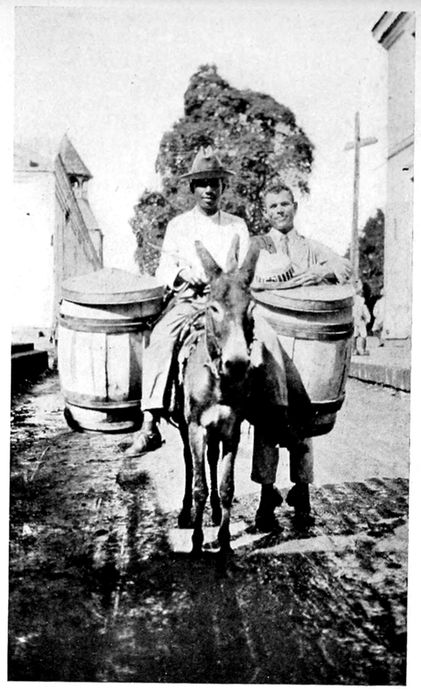
A bread seller of Santo Domingo
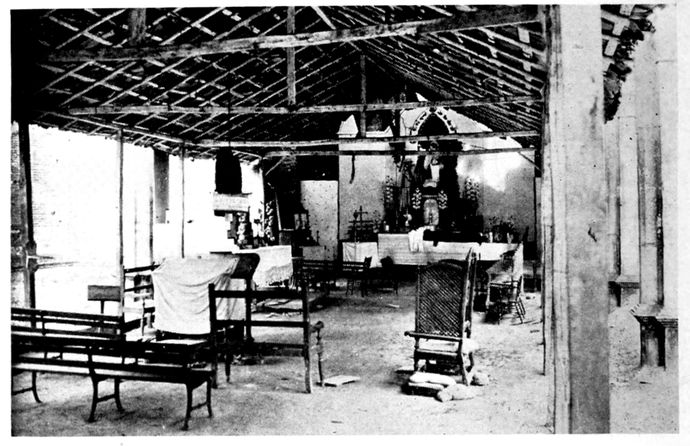
The church within a church of Moca
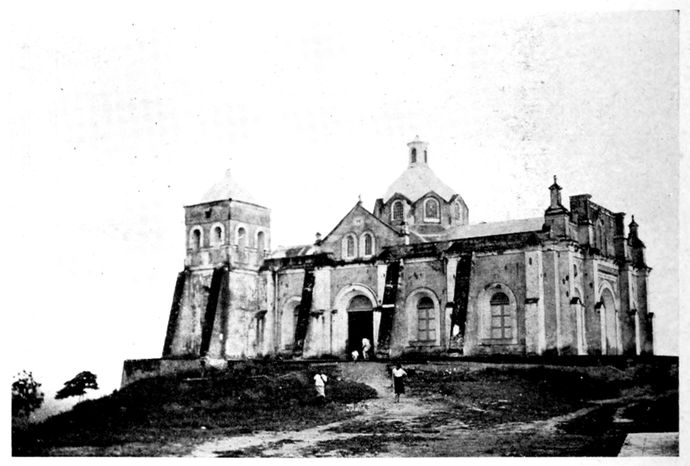
The “holy place” of Santo Domingo on top of the Santo Cerro where Columbus planted a cross
209Beyond Navarrete, where the railroad begins to part company with
the highway from the west, the train took to climbing in great leisurely
curves higher and higher into the northern range of hills. Royal palms
stood like markers for steep vistas of denser, but less lofty, vegetation;
scattered houses of simple tropical construction squatting here and there
on little cleared spaces—cleared even of grass, which the Spanish-American
seems ever to abhor—broke the otherwise green and full-wooded
landscape. Worn out rails did duty as telegraph poles; the
power line that brings Santiago its electric light from Puerto Plata
smiled at our pigmy efforts to keep up with it. Higher still the railway
banks were lined with the miserable yagua and jungle-rubbish shacks of
Haitian squatters. An editorial in the least pathetic of Santiago’s daily
handbills masquerading under the name of newspapers had protested
the very day before against this “constant influx of undesirable immigration.”
Indeed, the American governor had recently been prevailed
upon to issue a decree tending to curtail the increase in this sort of
population.
Under this new decree all natives of other West Indian islands resident
within the Dominican Republic must register within four months
and be prepared to leave if their presence is deemed undesirable; those
who seek admission in the future must have in their possession at
least fifty dollars. “Santo Domingo for the Dominicans” is the
slogan of those who have gained the governor’s ear. If they are to have
immigration, let it be Caucasian, preferably from Latin Europe. This
demand sounds well enough in print, but is sadly out of gear with the
facts. The Dominican Republic covers two-thirds of the ancient island
of Quisqueya, which has an area equal to that of Maine or Ireland.
Its more than 28,000 square miles, four times the size of Connecticut
and richer in undeveloped resources than any other region of
the West Indies, is inhabited by a population scarcely equal to that of
Buffalo. Nearly two-thirds of those inhabitants are of the weaker
sex; moreover a large percentage of the males are too proud or too
habitually fatigued to indulge in manual labor, which is the most crying
need of the country. Caucasian settlers would cause it to contribute
its fair share to the world’s bread-basket, were there any known
means of attracting them. But as there seems to be none, its virgin
fields must await the importation of labor from its overcrowded island
neighbors, particularly from that land of half its size and three times
its population which is separated from it only by a knee-deep frontier.
Yet what Haitian laborer boasts a fortune of fifty dollars? A black
plutocrat of that grade would remain at home to end his days in ease
in his jungle palace or finance a revolution. The Dominican is not
unjustified in wishing to keep his land free from the semi-savage hordes
beyond the Massacre, but a hungry world will not long endure the
sight of one of its richest garden spots lying virtually fallow.
Beyond a tunnel at the summit of the line, 1600 feet above the sea,
210the passengers poured pellmell into a station restaurant. Its long
general table was sagging under a half-dozen styles of meat and all
the known native vegetables and fruits. But woe betide the traveler
who clung to the dignity of good breeding! For he would infallibly be
found clamoring in vain for something with which to decorate his second
plate when the warning screech of the toy locomotive announced
that it was prepared to undertake new feats.
The Atlantic slope of the little mountain range was more unbrokenly
green than the interior valley behind, for it has first choice of the
rains that sweep in from the northeast. Coffee, corn, shaded patches
of cacao, and the giant leaves of the banana clothed the steep hillsides.
Cattle grazed here and there beneath the dense foliage. About the
Perez sugar-mill horn-yoked oxen butted along the bottomless roads
massive two-wheeled carts piled high with cane. Several of the wiser
passengers, a woman or two among them, had sought more commodious
quarters in the “baggage car” ahead, an open box car in which one
might pick a steamer chair or some little less comfortable seat from the
luggage piled helter-skelter against the two end walls. “Big George”
invaded the roof above, where some of us felt impelled to follow, lest
his sonnetical abstraction cause him to be left hanging from the telegraph
wire that sagged low across the line at frequent intervals. This
free-and-easy, take-care-of-yourself-because-we-don’t-intend-to manner
of operating public utilities is one of the chief charms of the American
tropics.
At La Sabana, with its majestic ceiba tree framing the jumping-off
place ahead, we halted to change engines. The ten per cent grade
down to the coast had led to the recent introduction of powerful Shea
locomotives to take the place of the former rack-rails that lay in
tumbled heaps along the edge of the constantly encroaching vegetation.
Wrecks of cars, like helpless upturned turtles, rusting away beneath
their growing shrouds of greenery below the embankment of several
sharp curves, suggested why the change had been made. Trees and
bushes completely covered with ivy-like growths as with green clothing
hung out in the blazing sunshine to dry lined the way. The wide-spread
view of the foam-edged coast of the blue Atlantic, with the red
roofs of Puerto Plata peering through the trees, shrank and faded away
as we reached the narrow plain, across which we jolted for ten minutes
more through sugar, mango, and banana-bearing fields before the
passengers disentangled themselves on the edge of the sea.
211The port was somewhat larger, more sanitary and more enterprising
than we had expected. Cacao, sugar, and tobacco were being run on
mule-drawn hand-cars out to a waiting steamer, though, strictly speaking,
the open roadstead can scarcely be called a harbor. The town was
pretty, shaded in its outer portions by cocoanut and other seaside
tropical trees, and with all the usual Spanish-American features. A
church completely covered with sheet iron walled one side of the delightful
little plaza, about which were the customary open clubs, one
of them occupied by American marines, whose rag-time phonographs
and similar pastimes ladened the evening breezes more than all the
others. The cemetery on the edge of the sloping hills was agreeably
decorated with bushes of velvety, dark red leaves, but I remember it
rather because of the name of a marine sergeant on the bulkhead of
one of those curious Spanish rows of bureau-drawer graves set into
the massive outer wall. Strange final resting-place of an American
boy! Nor was he of this new generation of “leather-necks” that has
settled down to make Santo Domingo behave itself; he had been left
there early in the century, probably from some passing ship. The
familiar time-battered carriages with their jangling bells rumbled
languidly through the streets; a match factory that lights all the cigars
of the revolutionary republic jostled for space among the dwellings;
swarms of mosquitoes drove us to take early refuge within our bed-shielding
mosquiteros; American bugle calls broke now and then on the
soft night air, and a large generous bullet-hole gave the final national
touch to our weak-showered, tubless hotel bathroom.
Our longer trip eastward from Santiago happily coincided with the
monthly inspection tours of their district by “Mac” and “Big George.”
The run to Moca through a rich, floor-flat valley spreading far away
to the southward gave new evidence of the fertility of Santo Domingo.
Bananas and cacao, maize and yuca in the same fields, now and then a
coffee plantation, constituted the chief cultivation. Tobacco was being
transplanted here and there. Frequent villages were hidden away
in the greenery; nowhere was there any evidence of such abject poverty
as that of Haiti. A section of the new national highway which, under
American incentive, is destined some day to connect Monte Cristi with
the far-off capital, followed the railway, but its black loam surface,
hardened into enormous cracks and ruts since the end of the last rainy
season, made it too venturesome a risk even for the courageous Ford.
212A long viaduct lifted the train across what Spanish-Americans call a
river, and a moment later we had come to the end of the government
railroad.
Moca, famous for its coffee, which is so often taken to be of Arabic
origin, is rated a “white town,” because of a slightly increased percentage
of pure, or nearly pure, descendants of Castilians. Thanks to
the coffee-clad foot-hills to the north and the broad, fertile plain to
the south and east, it is wealthy above the average, and rumor has it
that much gold might be dug up from its back gardens and patios.
There is special reason for this, for like its neighbor, Salcedo, it has
ever been a center of revolutionists, bandits, and political intrigues.
Two presidents have been assassinated in its streets; its hatred of
Americans is as deadly as it dares to be under a firm marine commander.
An excellent, cement-paved, up-to-date market contrasts with
the dusty open spaces, with their squatting, ragged negresses, in Haiti.
What was designed to be an imposing stone church, however, has never
reached anything like completion. Not long ago the resident padre
had the happy thought of instituting a lottery to swell the contributions
from his tardy parishioners, and two glaringly new square cement
towers are the result of the inspiration. But time moves more swiftly
than the best devised schemes; as the towers rise, the already aged
stone walls go crumbling away, and the real place of worship consists
merely of a ragged thatched roof on stilts covering only a fraction
of the half-walled inclosure.
The Ferrocarril de Samaná y Santiago, neither of which towns it
actually reaches, connects at Moca with the government line and runs
to the port of Sanchez on the east coast, with short branches to La
Vega and San Francisco de Macoris. It is popularly known as the
“Scotch line,” is some thirty years old and still equipped with the
original rolling stock, but has a meter gauge, more commodious and better
ventilated cars, a more easily riding roadbed, a daily service in
both directions except on Sunday, and makes slightly better speed than
its rival. The short run to La Vega, with a change of cars at Las
Cabullas, is along the same rich valley. Founded by Columbus himself
in a slightly different locality, this center of a splendidly fertile
cacao and agricultural district is a near replica of Moca, all but surrounded
by the river Camú. Rich black mud, as is fitting in a region
producing the chocolate-yielding pods, slackens the footsteps of visitor
and resident alike in all but the few blocks bordering on the plaza
though all its streets were once paved with stone by a Haitian governor.
213“Mac” found interest in its distilleries, shops, and revenue office;
“Big George” made use of those seven-league legs to set the property
valuation of the town in one short day, but our own curiosity centered
about the “Holy Hill” and the ruins of the original settlement. To
tell the truth the latter does not give the traveler’s imagination much
to build upon. A few miles from the modern town, along a stone-surfaced
section of that national highway-to-be, are the remnants of
a few stone walls, a low ancient fortress or two, and slabs of good
old Spanish mortar that has outlived the flat, pale-red bricks it once
held together, all hidden away in the hot and humid wilderness of
a badly tended cacao plantation.
The great place of pilgrimage of the region, indeed, the most venerated
spot in all Santo Domingo, is the Santo Cerro, a plump hill surmounted
by a massive stone church, a mile or so nearer the town.
Now and again some faithful believer still comes from a distant corner
of the republic and climbs the long stony slope on his knees, though
such medieval piety has all but died out even in Santo Domingo. The
church at the summit is in the special keeping of Nuestra Señora de
las Mercedes, whose miraculous cures are reputed to have no superior
anywhere in the Catholic world. A town of superstitious invalids
clusters about the entrance to the inclosure in wretched thatched huts;
on certain days of the year the sacred hilltop is crowded with the more
modern type of pilgrim, who not infrequently comes by carriage or
motor.
The story runs—and up to a certain point at least it is historically
accurate—that Columbus and his men had camped on the hill, when
they beheld swarming up from the vega below a great horde of Indians,
bent on their immediate destruction. The discoverer was equal to the
occasion. Ordering his men to cut a branch from an immense níspero
tree beneath which he had been resting, he fashioned it into a crude
cross, and planted it before the advancing enemy. “Then,” as the
cautious old Italian padre who to-day replaces his illustrious fellow-countryman
put it, “I was not present, so I cannot vouch for it, but
they say”—that the Virgin of Las Mercedes appeared in the sky above
and saved the day for the conquistadores. At any rate the Indians
were repulsed, and the Spaniards at once set about building La Vega,
old La Vega, that is, at the foot of the hill.
The church of pilgrimage is modern, marking the site of the ancient
one that was erected over the improvised cross. It, too, is liberally
marked with patched bullet-holes, for Dominican revolutionists
214have no compunction in using even a sacro-sacred edifice as a barricade.
Inside, in addition to the richly garbed doll over the altar
and the usual gaudy bric-a-brac of such places, there is a square hole
in the marble pavement of the principal chapel, filled with yellowish
soil. This purports to be the exact spot on which Columbus erected
the cross, and the healing properties of the earth within it depend only
on the faith of the seeker after health—and certain other indispensable
little formalities which are inseparable from all supernatural cures.
Pious Dominicans step into the santo hoyo barefooted, muttering
promesas, or promises of reward to the attendant Virgin if their health
is restored, and even those who decline to uncover their pedal infirmities
in so public a place carry off a pinch or a handful of the sacred
earth. Yet the “holy hole” is not the deep well one would fancy four
centuries of such excavation must have left it. If anything it is slightly
above the level of the ground outside the church. For no matter how
much of the yellow soil is carried off during the day, morning always
finds the hole filled again by some “miracle”—which somehow brings
up visions of a poor old native peon wandering about in the darkest
hours of the night with a sack and a shovel.
The original níspero stood for more than four hundred years in the
identical spot where Columbus found it. Not until the month of May
before our visit did it at length fall down—“por descuido; for lack
of care,” as the present padre put it, sadly. But the pious old Italian
has planted in its place a “son” of the historical tree,—a twig that
already shows a will to fill the footsteps of its “father”—and from
the wood of the latter he has made a boxful of little crosses which he
gives away “to true believers as sacred relics; to others as souvenirs”—though
there is nothing to hinder the recipient of either class from
dropping into the padre’s bloodless hand a little remembrance “for my
poor.”
Even though Columbus had never climbed it nor “miracles” been
performed upon it, the holy hilltop would be a place worth coming far
to see, or at least to look from. The wonderful floor-flat Vega Real,
the most splendid plain in Santo Domingo, if not in the West Indies,
is spread out below it in all its entirety. Dense green, palm-dotted
above its sea of vegetation, even its cultivated places patches of unbroken
greenery, with Moca, Salcedo, far-off “Macoris,” and half a
dozen other towns plainly visible, a sparkling river gleaming here and
there, walled in the vast distance by ranges that rise to pine-clad
heights, there are few more extensive, verdant, or entrancing sights in
215the world than this still more than half virgin vale. Compared with it
in any respect the far-famed valley of Yumurí in Cuba is of slight importance.
Several hours’ ride across this world’s garden of the future, with a
change to, and later from, the main line, brought us at nightfall to
San Francisco de Macoris. Unlike nearly every other town of Santo
Domingo, this one is of modern origin, a mere stripling of less than
a century of existence. It lies where the Vega Real begins to slope
upward toward the northern range, with extensive cacao estates of
rather indolent habits hidden away among the foot-hills behind it.
A flat town of tin roofs, its outskirts concealed beneath tropical trees,
it offers nothing of special interest to the mere traveler.
A nine-day fiesta in honor of Nuestra Señora de la Altagracia, which
had broken out with an uproarious beating of discordant church bells,
tinny drums, and home-made fireworks during our day in La Vega
raged throughout all our stay in “Macoris.” All the population capable
of setting one foot before the other joined in the religious processions
that frequently wended their funereal way through the half-cobbled
streets. We found amusement, too, in a local courtroom, where justice
was dispensed by a common-sense old judge in an informal, unbiased
way that seemed strange in a Latin-American atmosphere, particularly
so in a country where a bare five years before most decisions
went to the highest bidder. The improvement suggested that Santo
Domingo could be a success so long as some overwhelming power holds
it steady by appointing the better class of officials and keeping an
exacting eye constantly upon them. A third point of interest which
no visitor to the Macoris of the north should neglect is a chat with
“old man Castillo.” Born in 1834, his mind still extremely active,
this grandson of old Spain has been one of the chief sources of information
to the wiser Marine commanders of the district. His personal
reminiscences of Haitian rule, how as a boy he marvelled at the
high hats and gorgeous but often ludicrously patched uniforms of the
black troops from the west, make a colorful picture worth beholding,
even were he not the only surviving general of the war, contemporary
with our own struggle between the north and the south, that brought
the final expulsion of Spanish rule from Santo Domingo. His summing
up of the present status of the revolutionary republic is that of
nearly all the conservative, thoughtful element of the population. For
twenty years he had been convinced that intervention would be for
216the future good of the country; for at least ten he had ardently desired
it; he would consider it a national misfortune to have it withdrawn
before a new generation has been thoroughly cured of the empleomania
and unruliness which had become the curse of Dominican life. Mistakes
had been made by the forces of occupation, rather by subordinates
than by the higher command, but the whole list of them, he was convinced,
had been easier to bear than the least of their constantly recurring
revolutions.
The engine that had dragged us up to the edge of the vega had not
sufficiently recovered from its exertions to venture down again, and the
locomotive from the main line was forced to delay its appointed task
to come and get us. It is typical of the easy-going charm of the
tropics that the engineer of the day before had profanely declined to
exchange his coal-fed steed for that of his colleague from the east,
despite telegraphic orders from the master of transportation, duly and
officially transmitted through the station agent, hence our not unprecedented
delay. Beyond the junction of La Jina the densely green
vega changed gradually to broad, brown savannahs not unlike our own
Western prairies. These slowly gave place again to mata, uncultivated
half-wilderness with flat open spaces. Pimentel, a considerable town
at which travelers to the more important one of Cotui changed from
car seats to saddles, was followed by Villa Riva on the Yuma, the
largest river in the West Indies and navigable for small schooners.
The landscape grew still more open, with immense trees casting here
and there the round shadows of noonday and cacao beans drying on rude
raised platforms or on leaf-mats spread frankly upon the ground before
every bohío, or thatch and palm-trunk dwelling. Royal palm
trees stretched in close but broken formation across the flatlands and
on up over a high ridge like the soldiers of an arboreal army in disordered
rout. Then the train rumbled out across a swampy region
where the flanges of the rails were frequently covered by the brackish
water and the exhausted engine stumbled into Sanchez only three hours
late.
Strewn along the base of a rocky wooded ridge on the inner curve
of the great horseshoe bay of Samaná, Sanchez is not much to look at
despite its considerable importance, from a Dominican point of view,
as the chief northeastern port and the headquarters of the “Scotch
line.” Several large sheet-iron warehouses and a long wooden pier
sprinkled with cacao beans and the plentiful cinders of a switch engine
are its chief features. Since the virtual repeal of the export tax on
217cacao, with “Big George” and the new real estate taxation to take
its place, its activity has somewhat increased.
Like many another corner of Santo Domingo, mosquito- and gnat-bitten
Sanchez would be a dreary spot indeed but for the presence of
our little force of occupation. The natives themselves recognise this,
as their constant appeals for medical attention from the uninvited
strangers demonstrate. With the possible exception of the capital, the
republic is so scantily supplied with physicians that the navy doctors
who have the health of the marines in their keeping are permitted to
engage in civil practice. Even in Santiago, with its 20,000 inhabitants,
the great majority of the population had hitherto no other remedy
for their varied ailments than the sticking of a green leaf on each
temple. The bright youth of the country saw no reason to submit
to the arduous training incident to the medical profession when the
study of revolutionary tactics promised so much quicker results.
Small wonder the poor ignorant populace, knowing no better course
to take, repair in their illness to the Santo Cerro, there to smear themselves
with holy dirt in the ardent hope of improvement; and it may
be that the simple priests who abet them in those absurd antics are not
so rascally as they seem from our loftier point of view, for they too
may in their ignorance be more or less sincere believers in this nonsense.
Sanchez saw, though it may not have noted, the breaking up of our
congenial quartet. “Mac” had received orders to proceed overland
through the bandit-famed province of Seibo to the capital, and accepted
my protection and guidance on the journey. That region being
a “restricted district” for women, Rachel was forced to submit to the
tender mercies of the Clyde Line; while “Big George,” whether through
devotion to duty, a disparity between his own length and that of his
salary, or for a newly developed fear of personal violence, herewith
takes his final leave of this unvarnished tale.
Three hours in an open motor-boat manned by Marines, close along
an evergreen shore stretching in a low, cocoanut-clad ridge that died
away on the eastern horizon, brought the surviving pair of us to Samaná.
Tumbled up the slope of the same ridge, with a harbor sheltered by
several densely wooded islets, the town was more pleasing than the
busier Sanchez. Great patches of the surrounding cocoanut forest
were brown with the ravages of a parasitical disease that attacks
leaves, branches, and fruit not only of these, but of the cacao plants
218of the region. Saddle-oxen, once common throughout both divisions
of the ancient Quisqueya, ambled through the streets, their heads
raised at a disdainful angle by the reins attached to their nose-rings.
The soft soil and the frequent rains of the Samaná peninsula account
for their survival here in spite of the ascending price of beef and
leather. This, too, was a town of bullet-holes, for revolutionists have
frequently found its isolation and its custom-house particularly to their
liking. It is a rare house that cannot show a scar or two, and both
the sheet-iron Methodist churches are patched like the garments of
a Haitian pauper.
The existence of two such anomalies in a single town of Catholic
Santo Domingo calls the attention to the most interesting feature of
Samaná, an American negro colony of some two thousand members
scattered about the peninsula. Nearly a century ago, when the black
troops from beyond the Massacre had overrun the entire island, the
Haitian king, president, or emperor, as he happened at the moment to
be called, opened negotiations with an abolition society in the United
States with the hope of attracting immigration. Several shiploads of
blacks, all Northern negroes who had escaped or bought their freedom,
responded to the invitation. Most of them came from Pennsylvania,
Ohio, and New Jersey; one of the towns of the peninsula is still known
as Bucks County in memory of the exiles from that part of the first-named
state. Numbers of the new-comers foiled the purpose of the
Haitian ruler by quickly dying of tropical diseases; a very few found
their way back to the United States. The survivors settled down on
the five acres of land each that had been granted them, the Haitians
having frankly ignored all other promises.
Their descendants of the fourth or fifth generation are proud to
this day of their “American” origin. They hail one in the streets of
Samaná and lose no time in establishing their special identity, in a
naïve, respectful manner that has all but disappeared among their
brethren in our own land. Scattered over all the Samaná peninsula,
some of them have been absorbed by the Dominicans, but a considerable
colony has never inter-married with the natives and still retains the
speech and customs their ancestors brought with them. The majority
are farmers, moderately well-to-do, living miles out in the country and
only now and then riding to town on horse- or ox-back. Unlike most
of their neighbors they do not live in concubinage, but are married in
their own churches. They are not liked by the Dominicans, who seem
to resent their superior education and customs, though all admit that
219they are good citizens and good workers, though not fighters, as
Americans on custom border control soon discovered. Bigger men
both physically and mentally than the natives, they live in what seem
real homes compared with the miserable dirt-floor huts of the Dominicans
of the same color. Wherever a glimpse through a doorway shows
comfort, cleanliness, and a shelf of books one is almost sure to find
English spoken. It is a remarkably pure English, too, for a tongue
that has been cut off from its source for nearly a century, far superior
to that of the British West Indies, though with certain peculiarities
of negro accent. With rare exceptions the “Americans” do not mix
in politics, though they were frequently forced to fight on one side
or the other during the revolutions, because neutrals, abhorred like a
vacuum, lost both liberty and property no matter which side won. In
such times no protection was given non-combatants, except to foreigners,
and the “American” negroes of Samaná are legally Dominicans
despite their protests. One cannot but be proud of the strength
of American influence, of the compliment to our civilization which is
implied by the insistence of these exiles on keeping a sort of separate
nationality, by the strong tendency toward good citizenship they have
maintained through all their generations.
In a little parsonage on the edge of town lives the Rev. James, pastor
of the A. M. E. church, and temporarily in charge also of the Wesleyan
place of worship, locally known as St. Peter’s. His bishop, curiously
enough, lives in Detroit. Pastor James is a full-blooded negro whose
male ancestors have been ministers for generations. Sent to the
Northern States for his final schooling, like many children of the
colony, he worked his way through Beloit College. His wide fund of
information on all subjects would make many of our own ministers
seem narrow by comparison; yet he has little of that curious mixture
of humility and arrogance which is so common among educated
negroes. Even in such minor details as refraining from the use of
tobacco his personal habits are a contrast to the often licentious lives
of Dominican priests. In his fairly voluminous library so rare in
Santo Domingo, such books as “Up from Slavery,” “Negro Aspirations,”
and many other tomes, magazines, and encyclopedias of a serious—and
what is more, not merely religious—nature attract the eye.
Each of the churches has some three hundred members, many of
whom ride in from miles around on Sundays. Inside the bullet-riddled
edifices the un-Catholic pews, the mottoes in English over the pulpits,
the old-fashioned organs all add to the American atmosphere.
220A third church is maintained in the region, and the colony has several
schools of its own. Among the best American influences the colonists
have retained is the un-Dominican tendency to help themselves and
not depend upon the government in such matters. Complete segregation
of sexes, from the youngest pupils to the teachers, has been adopted
in these schools, where both Spanish and English are taught. Unlike
Haiti, Santo Domingo grants such institutions no government aid.
The pastor receives half his salary from mission funds from the
United States, and the other half not at all, because local contributions
are eaten up by educational requirements.
The Rev. James has a fund of stories, more amusing to the hearer
than to the teller, for those who care to listen. During one of the
last revolutions, for instance, the town was attacked during services,
and the congregation, putting more faith in self-help than in supernatural
aid, stopped in the middle of a prayer to cut a hole through
the church floor, and remained on the ground beneath until Monday
morning. The colony, in the opinion of its pastor, is eager to have
American occupation continue, or at least to have the United States take
possession of the bay of Samaná, as it has that of Guantánamo in
Cuba, that forces may be close at hand to curb revolutions. Influential
Dominicans, he is convinced, prefer the present status, with the
exception, of course, of the politicians, and even the rank and file are
beginning to see the error of their former ways and to wish peace,
security, and no more destruction of their farms and herds more than
complete national independence. On the whole it is remarkable how
this colony has maintained its customs intact through all the long years
since its establishment. Once given a good start the negro seems to
endure the deteriorating influences of the tropics better than the white
man. The Rev. James, four generations removed from the temperate
zone, is far more of a credit to civilization than many a Caucasian who
has lived a mere twenty years in equatorial lands.
Samaná has a French, or, more exactly, a Haitian colony dating
back to the same period, hence many of its inhabitants speak English,
Spanish, and “creole.” This portion of the population, living chiefly
in the far outskirts, is as much inferior to the Dominicans as the latter
are to the “Americans.” Neapolitans and “Turks” monopolize most
of the commerce, and as usual do no productive labor. Coffee was
formerly grown in some quantity on the peninsula, but cacao was
planted in its place when the latter began to command high prices.
Now that the blight has attacked this and there is hardly enough of
221the former produced for local use, exports are slight. Bananas could
be grown in abundance; oranges are so plentiful that the town boys
play marbles with them, but there is no market, or rather no transportation
for such bulky products, which are sold only in small quantities
to passing ships for their own use.
Among the sights of the town is a fine new cockpit as carefully
planned as our metropolitan theaters. It resembles a tiny bull-ring,
the fighting space surrounded by upright boards painted a bright red,
a comfortable gallery rising about the outer circle, ringside boxes
furnished with good cane chairs saving the élite the annoyance of mixing
with the collarless rank and file. Cozy little dens for the fighting
cocks open directly into the ring; a bright new thatched roof shades
spectators and feathered gladiators alike; an outer wall of yagua rises
just high enough to give the breeze free play, yet at the same time to
prevent the tallest citizen from seeing the contest without paying his
peseta at the neat little ticket window. The “American” residents
roll pious eyes at the mention of this nefarious sport. Not merely do
they consider it beneath them to attend such exhibitions, but look upon
them as a particularly sinful way of losing caste, since they are always
held on the “holy Sabbath.”
We sailed across the bay on the mailboat Nereida, a wretched little
single-masted derelict no larger than an average lifeboat. Though its
bottom was already heaped with broken rock ballast, an incredible load
of American patent medicine, of flour, rum, soap, cigarettes, sprouted
onions, cottonseed oil, and sundry odds and ends was tumbled into
it before the mails finally put in an appearance an hour after sailing
time. Nine passengers and a crew of two, all negroes except “Mac”
and myself, crowded the frequently sea-washed deck. What our fate
would have been had one of the sudden squalls for which West Indian
waters are noted overtaken us it was all too easy to imagine.
A steady wind on the beam carried us diagonally across the gulf
in the general direction of our destination without the necessity of
tacking. The shore we were leaving was the scene of the first bloodshed
between Columbus and the aborigines of the New World, the
forerunner of countless massacres. The bay was once offered to the
United States by a Dominican president, but a single congressman
caused us to decline the honor. Tiny fishing boats with palm-leaf
sails ventured a few miles out from the land, then abandoned to us
the seascape, which remained unbroken until we neared the southern
222shore well on in the afternoon. Constant quarrels between the two
halves of the crew on the advisability of tacking or not tacking enlivened
all our snail-like, zigzag course along the face of the land, and
black night had come before we climbed over the water-soaked cargo
to the drunken pier of Jovero.
A gawky village of some six hundred inhabitants, boasting only one
two-story house, this out-of-the-world place was quickly thrown into
a furore of curiosity over its unexpected white visitors. Even the
commander of the guardia detachment was a native lieutenant; the
most nearly Caucasian resident was the town treasurer, a young
“Turk” from Tripoli, in the back of whose more than general store
we were finally served a much needed meal. With three thousand persons
in the region only two copies of a weekly newspaper, according
to the post master, brought them the world’s news, and that was a
pathetic little sheet from across the bay. No wonder false rumors
have a free field in such a community. Cattle, pigs, cacao, and an
unseasoned tobacco sold in mouldy-scented rolls six feet long, called
andullos, made up the scanty exports of the district. Barely one per
cent. of its territory is under cultivation, for like all the province of
Seibo bandits still harass it long after the rest of the republic has been
pacified.
Under superior orders the native lieutenant assigned a sergeant and
eleven men of the guardia to accompany us through the bandit haunts
beyond. As they lined up for final inspection they were spick and
span out of all parallel in my tropical experience, from newly ironed
breeches to oiled rifles; ten minutes later they were marching knee-deep
through a river in the well-polished shoes they would gladly have
left behind had American discipline permitted it. Their own fault,
I mused, for they might have spent some of their ample garrison leisure
in building a bridge; but I soon withdrew the mental criticism. A
single bridge would not much have improved that route. It consisted
of a wide cleared space through the mountainous forest, and nothing
more—rather less, in fact, for in many places neither the stumps or
the huge felled trunks had been removed. Streams succeeded one another
in swift succession; the almost constant rains of this region had
made the steep slopes precarious toboggans of red mud, where they were
not corduroyed with camclones, slippery ridges of earth with deep
troughs of muddy water between them. Here and there the guards
were forced to climb a slimy bank virtually on their hands and knees;
in other places the mud clung to their feet in hundred-weight; with the
223densest vegetation on either hand cutting off all suggestion of breeze,
the sweat dripped from them in streams. Within half an hour the
bedraggled, soaked, mud-plastered rifle-bearers staggering before and
behind us along the trail showed slight resemblance indeed to the perfectly
starched and polished young men who had been drawn up for
the lieutenant’s inspection.
“Mac” and I on our sorry mounts were not much better off. It
was beginning to be apparent why one can get from Santiago to New
York more easily and in less time than to the Dominican capital. The
ex-“top,” as a high government official, had been given Jovero’s best
mule, but it would be easy to imagine a better one. My own steed had
long since become a candidate for the glue factory and his suffering
air had already riddled my conscience before a shifting of the saddle-cloth
disclosed an open sore on his back larger than my two hands.
Santo Domingo needs such a law as that with which we cured the
Canal Zone of this heartless Latin-American custom of working their
animals in a mutilated condition. But what could one do under the
circumstances but urge on the suffering beast? We had come too far
for me to turn back in the faint hope of getting another mount; it was
as necessary to reach Seibo as it was not to leave “Mac” in the lurch,
and even had I taken to my feet along with the mud-caked guards the
abandoned animal would have been almost certain to fall into the still
less compassionate hands of the bandits.
Precautions against the latter now began to be taken in earnest.
We were approaching a labyrinth of sharp gullies and high hills which
had always been a favorite lurking-place of the outlaws. Any turn of
the now narrow trail would have made a splendid ambush. Drenching
showers at frequent intervals made it easy for the ruffians to sneak
up through the bush unheard; the heavy humidity of a tropical rainy
season deadens sounds even when the sun shines. The sergeant arranged
his men in skirmish formation, with strict orders not to “bunch
up” under any circumstances. A barefoot native on horseback, who
had overtaken us soon after our departure from Jovero, was forbidden
to ride ahead of the party. We had no means of knowing whether
his assertion that he had hastened to join us for safety’s sake, after
waiting a fortnight for a chance to make the journey, was truth or pretense.
These preparations concluded, we moved forward ready for
instant battle.
Nothing of the kind occurred. I might have known it would not;
there is no greater Jonah on earth than I for scaring off adventure.
224Trails worn deeper than a horseman’s head and so narrow as to rub
our elbows offered attackers comparative immunity; the dense jungle
might easily have concealed a score of men within a yard or two on
either side of us; the steepness of the mountain-top, forcing us to
dismount and drag our weary, stumbling animals behind us, left us
scant breath to spend in physical combat, yet nothing but the deep, oppressive
silence of a tropical wilderness enlivened our laborious progress.
By the time the summit was reached we were ready to believe
that the bandits of Seibo were a myth. An unbroken expanse of
vegetation, dark green everywhere, spread away to the limitless southern
horizon. Yet the rains ceased abruptly at the crest of the range,
and the trail that carried us swiftly downward was as dry as the
Sahara.
The sergeant gradually relaxed his vigilance and let his men once
more straggle along at will, though he watched closely the rare travelers
who began to appear. Several of the guards, I found, as we
grouped together again for a rest, spoke to one another in Samaná
English rather than Spanish. When I gave a cheering word in the
latter tongue to a ragged native civilian who had plodded at my horse’s
heels since the beginning of the journey, he glanced up at me with
an expression of incomprehension and asked the guard behind him
to interpret my remark. He was Canadian born, had been seven years
in the sugar fields of Cuba without learning a word of Spanish, and
had been robbed by Haitian cacos of everything except his tattered hat,
shirt and trousers. “Nobody told me there were that kind of people
in that country,” he explained, plaintively, “I never thought such things
of people of my color.” The wisdom gained from that unexpected
experience developed a precaution that had held him nearly three weeks
in Jovero awaiting a safe opportunity to proceed to the sugar district
of southeastern Santo Domingo.
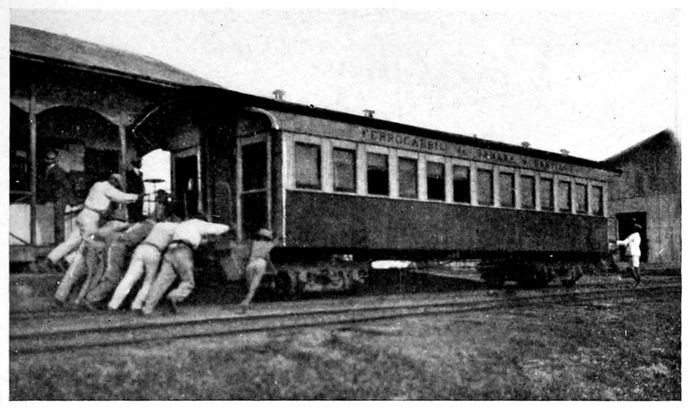
A Dominican switch engine
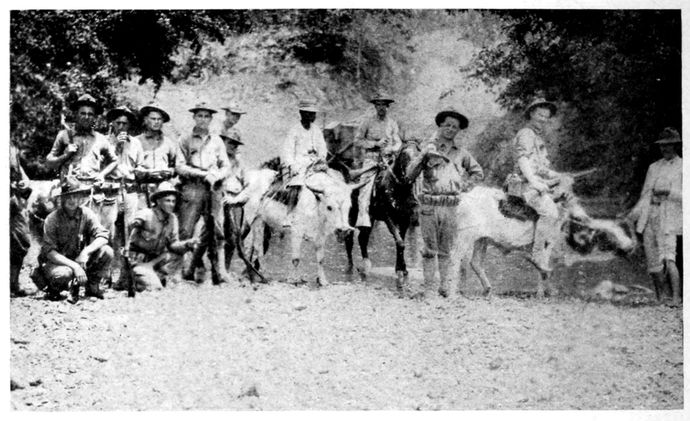
American Marines on the march
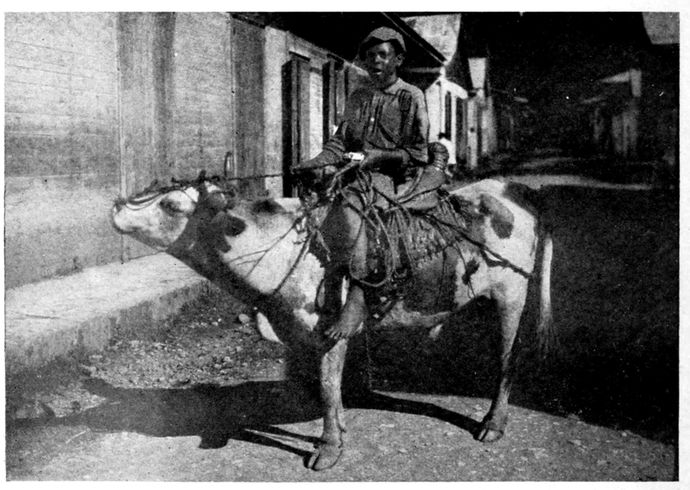
225We were soon down on the flatlands again, but it was a long time
before the first signs of cultivation broke the dreary wilderness. This
was a cacao canuco, or tiny plantation, overgrown with brush and
weeds and with the scarred ruins of a hut in one corner of it. More
of them lined the way for mile after mile, all abandoned for the past
three years, fear of the bandits making it impossible even to pick the
pods that ripened, rotted, and fell beneath the trees. These endless
gardens choked with weeds made this wonderfully fertile valley seem
doubly pitiful in its uncultivated immensity. The guards, who, after
the fashion of their kind, had made no provision whatever against a
long day’s hunger, climbed the rotting stick fences and picked half-green
bananas and papayas, or lechosas, as the Dominican calls them,
from the untended plantations. At length huts still standing began to
appear, then inhabited ones, occupied almost exclusively by women,
showed that we were approaching the safety zone. The creak of
guinea hens, like rusty hinges, commenced to break the silence; goats
took to capering out of our way; better dressed people of both sexes
gradually put in an appearance, crowing cocks challenged one another
in ever increasing number, and at sunset the again road-wide trail became
the main street of the town of Seibo.
The capital of a province without so much as the pretense of a
hotel is a rarity even in backward Santo Domingo. Nothing but the
most miserable of thatched huts, with three human nests on legs in one
tiny room, and a back-yard reed kitchen attended by a ragged old
negro crone, offers accommodation to unbefriended strangers in Seibo.
It is perhaps the most out-of-the-way, astonished-at-strangers, unacquainted-with-the-world
town of any size that can be found in the
West Indies. Though a large detachment of marines camp at its
bandit-threatened door, it showed unbounded surprise to see American
civilians. Groups of almost foppishly dressed men lounged about its
streets, yet the town itself was little short of filthy. A curious old
domed church, some of it built four hundred years ago, its original
color faded to a spotted pale-blue, and its aged square tower surmounted
by a marine wireless apparatus, is the only building of importance.
From the top of this, or the one other place in town where one can go
upstairs, Seibo is seen to be surrounded by low hills, everywhere
wooded, without a hut outside its compact mass, its skirts drawn up
like those of a nervous old maid in constant dread of mice. The inevitable
fortress that gives Haitian and Dominican villages a likeness to
the castle-crowned towns of medieval Italy watches over it from a
near-by knoll and houses its guardia garrison. Built almost entirely
of wood, the low houses of the better class are roofed with sheet-iron,
the poorer with palm-leaf thatch. It has no plaza but merely a stony
plowed rectangle of unoccupied ground in its center. The public school
has no doors between its rooms, hence is a constant uproar of teachers
and classes shouting against one another. Seibo bears the reputation
of being always “agin’ the gover’ment,” and it is not strange that we
found its people somewhat more surly toward Americans than those
of the Cibao.
That did not hinder them from obeying “Mac’s” official commands
226with fitting alacrity, however, whether they were a hint to shop-keepers
to display their licenses as the law required or a whisper to his local
subordinates to correct their methods. The slip-shod ways of native
rule cannot long endure where an exacting American official drops in
unexpectedly every now and then to inspect things down to the slightest
detail. Such close-rein methods are indispensable to the proper functioning
of revenue laws in Santo Domingo. Your Latin-American
can seldom rise to the point of impersonal application of governmental
decrees; with him it is always a personal matter between official and
inhabitant. Checked up in the courteous yet firm manner which “Mac”
had learned by long contact with this race, his subordinates had a
curious resemblance to backward schoolboys whom a teacher holds up
to scratch by frequent kindly assistance with a threat of the switch
behind it. The government of occupation has done everything possible
to remove temptation from both inspected and inspector in internal
revenue matters. Every distillery, for instance, is so constructed
that the owner may watch his product behind iron bars as it
runs from still to receptacle, yet not a drop can he extract without
calling upon the inspector to produce his keys. By such contrivances
Santo Domingo is being gradually weaned away from the irregularities
that were long the curse of its financial legislation.
An invitation from the major in command caused us to change with
alacrity on our second day in Seibo from the “hotel” to a tent in the
marine camp on the edge of town, with a far-reaching view, an unfailing
breeze, and a “swimming hole” in the river below. Here,
by dint of spending most of the day insisting, by offering twice the
local rate for good mounts, by promising a peon “guide” a week’s
pay for a day’s work, by seeing that the horses were within the marine
corral before going to bed, and by being generally and strictly from
Missouri, we succeeded in getting off the next morning at five. The
air was damp and fresh. For the first time in five years I beheld the
Southern Cross I had once known like the features of an old friend.
Endless forests with a level roadway cut through them shut us in all
through the morning, only a few canucos breaking the perspective of
sheer forest walls. As in Haiti, the peasants of Seibo live back out of
sight from the main trails, for fear of bandits, as the vicinity of some
of our railroads is still shunned out of dread of marauding tramps.
At another large marine camp we left the roadway and sagging telegraph
wire to La Romana and struck due southward along a half-cleared
trail that after an hour or more brought us out upon the sun-toasted
227advance guard of the cane-fields of the south. Amid the stumps
and logs of immense tropical trees, black with the recent burning, baby
sugar-cane was already turning bright green the broad expanse of
newly felled forest. Negroes almost without exception from the
French or British West Indies were adding row after row of the
virgin fields to the sugar supply of a hungry world. Farther on, beyond
another strip of forest soon due for the same fate, came immense
stretches of full-sized cane, then toiling groups of cane-cutters,
huge creaking cane-carts, finally a railroad that scorns to carry anything
but cane, and by ten we had brought up at the batey of Diego,
our mounted “guide” straggling in far behind us.
Many of the workmen of the surrounding “colonies” had gone on
strike that morning. The Dominican delegate to the recent labor
conference in Washington had brought back with him this new method
of bringing to terms the “wicked American and Cuban capitalists who
would starve us while carrying off our national wealth.” It was noticeable,
however, that only a small fraction of the idle groups crowding
the batey were natives of the country; the great majority of them
grumbled in the easy-going drawl of the British negro. Small wonder
the arguments of the Spanish-speaking manager who harangued them
from the door of the office fell chiefly on uncomprehending ears. Besides,
though their own arguments were simpler, they were not easily
refuted. “Wi’ rice twenty-fi’ cent a pound an’ sugah eighteen cent in
Macoris town what y’u go’n’ a do, mahn, what y’u go’n’ a do? An’
de washer lady she ax you a shilling fo’ to wash a shirt! How us can
cut a caht-load o’ canes fo’ seventy cent? Better fo’ we if us detain
we at home.”
Leaving manager and strikers to settle their differences without our
assistance we climbed to the top of a car-load of cane and were soon
creaking away across the slightly rolling country. A train so long
that it had to be cut in two at the first suggestion of a grade squirmed
away before us like a great green snake. The land became one vast
expanse of sugar-cane, broken only by the clustered buildings of the
bateys and dotted here and there by a royal palm or ceiba, which the
woodsmen had not had the heart to fell. Branch railroads, like the
ribs of a leaf, brought the product of all this down to the main line,
whence it poured into the capacious maw of the Central Santa Fé,
the tall chimneys of which appeared toward sunset, backed far off by
a slightly yellowish Caribbean.
San Pedro de Macoris on the southern coast is a more important
228town than its near namesake of the Cibao, yet it is disappointing for
all its size. With a certain amount of modern bustle, more city features
than we had seen since Santiago, a fair percentage of full white
inhabitants, and a rather “cocky” air, it exists chiefly because of a
bottle-shaped harbor with a dangerously narrow entrance between reefs,
while its docks are largely manned by British negroes.
We finally found passengers enough to afford the trip by automobile
from Macoris to the capital. With the single exception of the
Haitian journey to Las Cahobas, I have never known of a worse road
being actually covered by automobile. Sandy or stony beyond words,
a constant succession of rocks, stumps, scrub trees, sun-baked mud-holes,
without a yard of smooth going, it was in fact no road at all,
but so often had travelers followed the same general direction that a
kind of route had grown up of itself. Several times we came to
temporary grief; once we ran into a tree and smashed a case of Cuban
rum that had been tied on the running-board, and as the chauffeur felt
impelled to “save” as much of the precious stuff as possible, his driving
was far from impeccable during the rest of the journey. One
after another we bounced through such towns as La Yeguada, Hato
Viejo, Santa Isabela, all spread out carelessly on the flat, dry, prairie-like
country peculiar to the coral formation of southern Santo Domingo.
In one place the mud was so deep that we were forced to turn aside for
a few yards into the private property of a Cuban ex-general, who occupies
a wattled hut with his illegitimate brood of mulattoes. This
wily individual, in spite of the fact that he draws a generous monthly
pension through a foreign bank in the capital, has placed a guard at his
gate and collects two dollars from every passing automobile. Then
came more sugarcane, another large mill with its creaking ox-carts
and striking negroes, and from San Isidro on sixteen kilometers of
excellent highway to Duarte, a suburb of the capital, and across the
Ozama river into Santo Domingo City. The American governor of
the republic had recently made the official announcement that sixty per
cent. of the great national highway from the capital to Monte Cristi
was already completed! He could scarcely have taken his own words
seriously had he been privileged to follow us in the opposite direction.
229
This is not the place to recapitulate in detail the busy history
of Santo Domingo,—how the island of Quisqueya, or Haïti,
was discovered by Columbus on his first voyage and named
Hispaniola; how it was gradually settled by the Spaniards, who as
usual massacred the aborigines and imported African slaves in their
place to cultivate the newly introduced sugarcane; how French
buccaneers from Tortuga eventually conquered the western end of the
island and were recognized by having a governor sent out from France;
how battles raged to and fro between the French and the Spaniards
until something like the present frontier between Haiti and Santo
Domingo was established; how the English expedition sent out by
Cromwell was repulsed and contented themselves with occupying Jamaica
instead; how the negroes of Haiti at length rose against their
masters and drove the French from the island, then ruled the whole
of it for twenty-two years; how the República Dominicana won her
independence from Spain, voluntarily surrendered it again, regained
it in 1865, and entered into that career of constantly recurring revolutions,
in which the winner always became president and his supporters
the possessors of the public revenues, that eventually led to the present
American occupation. The interest of the modern reader is more apt
to begin with this century. In 1906, in order to keep Germany, Belgium,
Italy, and several other creditors from landing in Santo Domingo
to collect the debts of their nationals, the United States advanced $20,000,000
and took over the custom houses as security. The following
year the United States and the Dominican Republic signed a convention
under which the former was to appoint a receiver for bankrupt
Santo Domingo, five per cent. of the custom receipts to cover the
expenses of the receivership and a certain amount to be set aside to
pay off the national debts and provide a sinking fund. The convention
further stipulated that Santo Domingo could not contract new public
indebtedness without American consent, and that the United States
could intervene if conditions within the country threatened to interfere
with the collection of the custom duties.
230The Dominicans soon broke the former agreement. The government
illegally sold revenue stamps at a fraction of their value; pagarés
were issued at great discounts; goods were purchased in the United
States and abroad without being paid for or legally sanctioned. In
five years following 1907 there were six presidents, including the Archbishop.
In 1911 Cáceres was shot by his own cabinet members because
they were not allowed to graft enough. The United States
superintended the elections of 1914, with the understanding that all
parties should abide by the result. A hard task that for the Dominicans.
Within a year another revolution broke out, secretly sponsored either
by the president himself for the advantage it would give the government
in spending power, or by the opposition party, led by the minister
of war. This outbreak was soon suppressed. In 1916 President
Jimenez had barely retired to his summer palace when this same Deciderio
Arias, a turbulent cacique who had been given the war portfolio
in the hope of keeping him quiet, decided that his chief should
never return to the capital. Supported by the military forces, with
the police split between the two factions, this coup d’état was on the
point of winning, when, at the end of April, 1916, the American Minister
sent word that there was trouble again in Santo Domingo. Then
the United States, which had “offered its good services” many times
before and endured Dominican conditions with far too much patience,
decided to act. An ultimatum was sent to Arias announcing that the
United States would no longer permit the establishment of government
by revolution. Marines from Haiti had been landed at Fort
San Gerónimo with orders to support the government of Jimenez,
and with his clandestine approval, and took the capital with little difficulty.
The president publicly repudiated his secret agreement, in spite
of having everything in his favor, and announcing in a bombastic pronunciamento
that his “dignity” would not permit him to endure a
foreign military occupation, resigned with all his government. For
this the marines were duly thankful; it simplified the whole problem.
Meanwhile a force had landed at Puerto Plata and at Monte Cristi,
and fought their way overland, suffering considerably from snipers on
the way. Arias, who had escaped with all his supporters from the unprotected
side of the city, hurried to the Cibao and attempted to hinder
the marine advance, but was forced to surrender with the capture of
Santiago. His power was still paramount in the capital, however, and
he forced congress to make Hernandez y Carbajal, who had returned
from long exile in Cuba, president. The United States refused to
231recognise this illegal election and declined to let the government have
any money, with the result that the country was left without rulers.
Finally American military occupation was proclaimed and our forces
took over the entire government of Santo Domingo, a status compared
with which the mere “advisory” one of our marines in Haiti was far
more complicated, and has remained so to this day.
When the Americans took over Santo Domingo the republic was
millions in debt—something like $40 per capita, to be exact—completely
bankrupt, and the salaries of all but the higher officials were
long in arrears. Now, after less than four years of occupation, there
is some $4,000,000 in the treasury. The new land tax alone—which
it has been impossible to duplicate in Haiti, where laws are still made by
a native congress,—has already produced nearly a million. Most of
this goes back to the municipalities. The old taxes bore far more on
the poor man than on the man of property. Moreover, the government
of occupation has collected more than three times as much from
these older sources than was the case under native rule, chiefly because
there is no tax-gatherer’s graft and the friends of the government
are no longer let off unpaid. Every disbursement is now paid by
check, on voucher in duplicate, and the same man cannot buy and pay.
A few American civilians in supervising positions receive their salaries
from Dominican funds—and render many times value received. The
great bulk of the higher officials are of no expense whatever to the natives,
being members of our military forces drawing their pay from
the United States treasury.
The sovereignty of the República Dominicana has never ceased. Its
functions are merely administered by representatives of the United
States Navy and Marine Corps, officially called “The Military Government
of the United States in Santo Domingo.” There is no president
or congress. Even the laws are made by the military governor, an
American admiral. There have been no elections since our occupation;
all officials down to the least important are appointed, directly or indirectly,
by the Americans. The latter control all financial matters
and exercise supervision over the official acts even of the smallest
municipalities. American money, chiefly torn, patched, sewn, dirty,
half-illegible bills, constitutes the circulating medium. On the other
hand, the republic has its own schools, courts, and minor officials.
The Dominican flag flies from all public buildings except American
headquarters. In short, in so far as any definite policy has ever been
232announced, we are in Santo Domingo to do exactly what we did in
Cuba.
The Americans found the whole question of land titles one of incredible
chaos and fraud. Not only were there few definite deeds
in existence, but the country was overrun with what are known as
“peso titles.” In the old days the King of Spain gave grants of land
without any conception of the limits thereof, often supremely ignorant
of its whereabouts. Not infrequently the same parcel was given to
three or four of his faithful subjects. The grantees, who in many
cases had never seen their property, divided their holdings among
several children. The latter had no clear idea either of the amount
or the location of their property. So they said, “Well, I think it is
worth so many pesos,” whereupon each child was given his fraction
of that amount—on paper—and thus the subdivision went on through
many generations. Thousands of these “peso titles” were sold to
speculators, or to natives or foreigners who had worse than hazy
ideas of their worth. Then on top of this there grew up a big business
in fake titles. As many as four thousand have been presented, where
fewer than four hundred showed any evidence of being real. Moreover,
the real ones, being often hundreds of years old and written by
men who could neither spell nor find proper writing materials, were
more apt to look spurious than did the false ones. To clear up this
intolerable situation the Americans decreed that all land titles not
proved up to a certain date reverted to the government. The ruling
caused some injustices, but these were unavoidable under the circumstances
and as nothing compared with the old order of things.
The introduction of a land tax also has caused many who might otherwise
have drifted on in the good old tropical way to clear up their
titles. A certain amount of litigation between the government and
individuals is still going on, but the whole problem is gradually coming
to an orderly solution.
Another question which the Americans faced upon their arrival
was the disarming of the country. It had long been the custom in
Santo Domingo for even the small boys to carry revolvers. Among
the weapons were many costly pearl-handled ones; most of them had
been manufactured in Springfield, Mass., or Hartford, Conn. A date
was set when all firearms must be turned in to the military government.
The penalty for non-compliance was at first made very severe.
There are men still serving sentence in the road-gangs of Santo
Domingo for having guns in their possession three years ago. At
233present the standard punishment is six months’ imprisonment and
$300 fine. With the exception of the bandit-infested province of
Seibo, the entire country has now been completely cleared of firearms,
at least those in actual use. Some, to be sure, are buried or hidden
away in the jungle, but time and the rust of tropical climates will soon
take care of those. The Americans burned whole roomsful of rifles;
more than 200,000 revolvers have been thrown into the sea outside the
capital. To-day it is difficult even for provincial officials to get permission
to carry a shooting iron.
As in other lands under temporary or permanent American rule,
from Haiti to the Philippines, a native constabulary was organized.
The Guardia Nacional of Santo Domingo, consisting at present of a
company of some eighty men in each of the fourteen provinces, has
the same organization as the Marine Corps. Its members enlist for
three years, and privates get $15 a month. Their uniform lacks only
the hat ornament and somewhat more durable dye-stuffs to be an exact
copy of that of our “leather-necks.” The only difference in equipment
is the “Krag Jorgensen” instead of the “Springfield.” The
officers are marines, usually sergeants, except in the higher commands
and a very few natives who have climbed to “shave-tail” rank. All
commands are given in English. A “non-com.” can put his men
through the whole drill in that language, yet if you ask him his name,
the answer is almost certain to be “No hablo Inglés.” Unlike the
Gendarmérie of Haiti the Guardia is confined in its duties to matters
of national defense; municipal police still keep order in the cities.
We got the impression during our short stay that the Guardia officers
were not quite the equal of those of the Gendarmérie. For one thing
the pay is less attractive, though that of the men is fifty per cent. higher.
Recently, too, all marine sergeants holding commissioned rank in the
Guardia have unwisely been reduced to privates during their absence
from their permanent organizations, with the unfortunate result that
the few native lieutenants get more pay than their American captains,
unless the latter are also commissioned officers of the Marine Corps.
The native rank and file of the Guardia have a cocky, half-insolent
air quite foreign to their simpler fellows of Haiti; they look as if they
would be better fighters, more clever crooks, and not so easily disciplined.
The cacos of Santo Domingo are called gavilleros, caco in that country
meaning merely thief or burglar. They are usually armed with
“pata-mulas” (mule hoofs), which are rifles that have been cut down
234into revolvers, partly because they are too lazy to carry the whole gun,
partly because the abbreviation is easier to conceal. In the olden days
any one with a few hundred dollars could raise an “army,” especially
by making copious promises of government jobs to everyone if—or
rather, when—his side won. Not until the Americans came were
these anti-governmental groups called bandits; they were dignified with
the title of revolutionaries. Santo Domingo had long run more or
less wild; many of its men preferred taking to the hills at fifty cents
a day with rations and the possibility of loot to doing honest work
at a dollar a day. As with all Spanish-sired races, the Dominicans
have the gambling instinct well developed. They love the lotteries
of life; they would rather take a chance on winning some big prize
as bandits or revolutionists to toiling in safety at peaceful occupations.
Then, too, many were forced to join these outlaw bands, lest their
houses be burned or their families injured. The gavillero situation
had been bad before the Americans landed. It became worse under
the occupation, for reasons that we shall see.
To begin with, Arias released nearly all the criminals in the country
during his revolt against the Jimenez government. These quickly
turned bandits; later on they pretended to be patriots fighting the
American occupation. As a matter of fact the majority of them
were fighting for food, rather than for either political or patriotic
reasons, but bombast is one of the chief qualities of the Latin-American.
The forces of occupation might in some ways have handled this bandit
situation better than they did; largely because of ignorance of local
customs, partly because of inefficiency and a certain amount of brutality,
they made something of a mess of it, or at least let it become more
serious than it need have done.
Two regiments of marines are engaged in the occupation of teaching
the Dominicans how to live without lawlessness—a scant 5000 of them
among a population of 750,000. Unfortunately there are flaws in all
organizations. There are marine commanders in Santo Domingo so
just and broad-minded that they are almost loved by the naturally
hostile population; there were others who have little real conception
of their duties. The rascally, brutal, worthless, “Diamond Dick”
class of American sometimes gets into the Marine Corps as into everything
else and tends to destroy the good name of the majority. Boys
brought up on dime novels and the movies saw at last a chance to
imitate their favorite heroes and kill people with impunity: some of
them, too, were Southerners, to whom the Dominicans after all were
235only “niggers.” The great majority of the forces of occupation were
well meaning young fellows who often lacked experience in distinguishing
outlaws from honest citizens, with the result that painful injustices
were sometimes committed.
These ignorant, or movie-trained, young fellows were sent out into
the hills to hunt bandits. They came upon a hut, found it unoccupied,
and touched a match to the nipe thatch. They probably thought such
a hovel was of no importance anyway, even if it were not a bandit
haunt, whereas it contained all the earthly possessions of a harmless
family. In their ignorance of local customs they could not know that
the entire household was out working in their jungle yuca-garden.
Or they found only the women and children at home, and burned the
house because these could not explain where their man was. Or again,
they met a man on the trail and asked him his business, and because
he could not understand their atrocious imitation of Spanish, or they
his reply, they shot him to be on the safe side. In still other places they
burned the houses of innocent accomplices, because bandits had commandeered
food and lodging there. If one can believe half the stories
that are current in all circles throughout Santo Domingo, the Germans
in Belgium had nothing on some of our own “leather-necks.”
A parish priest of Seibo, who seemed, if anything, friendly to the
occupation, told me of several cases of incredible brutality of which
he had personal knowledge. He could not divulge the secrets of the
confessional, but he could assure me that many of the victims had been
innocent even of hostile thoughts. The Guardia, he asserted, included
some of the worst rascals, thieves, and assassins in the country, men
far worse than the gavilleros, and these often egged the naïve Americans
on to vent their own private hates. Scarcely a month before a sad
personal experience had befallen him. On Christmas Day he had
gone with acolytes to another town to attend a fiesta, when a drunken
marine had fired his rifle twice into the wattled hut where it was
being held and killed a boy of ten who was at that moment swinging
the censer.
I cannot vouch for all the padre’s statements, but rumors of this
kind were strikingly prevalent among natives and Americans all over
Santo Domingo. On the other hand we must remember that the
bandit-hunters often have no certain means of telling a gavillero from
a “good citizen,” and they cannot always afford to give a man the
benefit of the doubt. One is as apt as the other to look like an honest,
simple, harmless fellow, and there have been sad mistakes on the
236side of leniency also, which have naturally led to over-caution. The
Dominican is quite versatile enough to be a bandit one day and to be
found scratching the ground of his jungle garden with his machete
the next. Captured gavilleros have boasted that they hid their guns
in a cane-field when a hostile force appeared, came out and helped the
marines unsaddle, drank a round with them in the neighboring licorería,
and recovered their weapons as soon as the hunters had taken to the
trail again. The Guardia, too, has not always been free from spies.
The difficulties of the situation, and the necessity of a wide knowledge
of local customs and conditions on the part of those sent to handle
it, is exemplified by the miscarriage of a plan to clear a certain district
of Seibo of outlaws. The government of occupation ordered all “good
inhabitants” to come into the towns on a certain day, so that the bad
ones might be more easily corralled. But the gavilleros have a better
news service than those who have no particular reason to keep their
ears to the ground. The former learned of the order, concealed their
weapons, and hastened into the villages, with the result that those who
were shot were chiefly honest, simple peasants.
There have been several battles of importance between the marines
and the gavilleros since the occupation. The latter are more worthy
adversaries than the Haitian cacos, though the defeat of a band of four
hundred by a score of Americans is not considered an extraordinary
feat. Thanks either to his Spanish antecedents or to his revolutionary
history, the Dominican has a ferocity and a desprecio of human life
that makes it unwise to be compassionate. More than thirty marines
have been killed in Santo Domingo, as against only four in Haiti.
One band has announced a determination to completely exterminate
the white foreigners, and makes a practice of horribly mutilating the
dead and wounded. A persistent rumor has it that one of its leaders
is an American.
The story of the killing of the bandit chieftain of Santo Domingo
is not so heroic as the extermination of Charlemagne in Haiti—nor as
definite. Vicentico and his men had overrun almost the entire province
of Seibo. In July, 1917, one account has it, a gunnery sergeant who
spoke imperfect Spanish went into his district unarmed and in “civies”
and spent a week in winning the chief’s confidence. The Americans,
he told him, had lost hope of defeating so expert a warrior and would
make him a general and chief of the Guardia, with places for the best
of his men, if he would disband his forces and support the occupation.
Another version is that the real go-between was a “Turk” shopkeeper
237who had known him in other days. Questions of individual
glory aside, Vicentico at length set out with seventy picked men to
report to the marine commander. On the way he was suddenly startled
to hear one of the wild birds of Seibo utter its peculiar shriek in a
tree-top above him.
“You are betraying me!” cried the chieftain, whirling upon the
“Turk”—or the sergeant—and covering him with his “pata-mulas.”
“That bird has never failed to warn me of danger.”
The emissary, who was evidently gifted with a superhuman tongue,
managed to talk his way back into the confidence of the outlaw, and the
journey proceeded. Arrived at the American headquarters, Vicentico
marched haughtily in upon the marine colonel, his swarthy face twitching
with triumph, and announced himself ready to take over the command
of the Guardia.
“You are under arrest,” said the colonel, dryly.
“Caramba!” cried the outlaw, while a detachment of marines disarmed
his seventy followers, “I knew I should have listened to that
bird!”
Just what happened after that is not very clear, except that it was
nothing of which to be particularly proud. One version runs that the
gunnery sergeant entered the outlaw’s cell one night and told him, amid
curses and crocodile tears, that his superiors had repudiated their
promise, but that he would redeem his own unintentional treachery in
the matter by helping the bandit to escape at once—whereupon guards
carefully posted outside met him with a volley sanctioned by the ley de
fuga of his own race. Another termination of the tale has it that a
group of marine officers, “lit up after a big party,” staggered to the
prison and vindicated the loss of some of their comrades by shooting
the outlaw with his handcuffs still on, and without even allowing him
time to call a priest. Just how much truth there is in these varying
accounts, or combinations of the two, will probably remain a mystery,
but even the marines themselves do not often boast of the killing of
Vicentico.
Chronic pessimists and sworn enemies of the occupation assert that
the Americans have made ten bandits for every one they have killed.
Without taking this statement at par, there is at least a grain of truth
in the complementary assertion that the killing of Vicentico made all
Seibo turn gavilleros. In some sections only women, children, and old
men are seen; the young bucks have all taken to the hills. The leaders
that are left have no confidence in Americans, especially those in a
238marine uniform, and they will no longer enter into negotiations of
any nature. The province wants revenge for what it considers the
treacherous betrayal of one of its popular heroes. We should remember
the time-honored Spanish attitude towards bandits—something mere
warriors, with no time to study history, cannot be expected to know.
The government of Spain has always been more or less an oppressor
of the common people; those who rise against it, either singly or in
groups, are looked upon somewhat as champions of the helpless masses.
The favorite heroes of Spanish dramas to this day are bandidos, and
they are always equally noted for their absolute indifference to personal
danger and for their knightly code of honor, to say nothing of their
unfailing generosity toward the poor. It is not hard, therefore, to
understand why los Americanos fell far down the moral scale of Seibo
province by their uncaballeresco treatment of Vicentico.
If I may continue this unprejudiced explanation of things as they
seemed to be in Santo Domingo at the beginning of 1920 without giving
the false impression that the great majority of our forces of occupation
are not a credit to the land of their birth, I would add a word about
the effect of personal conduct. A few marines, some officers among
them, vary the monotony of their assignment by starting irregular
households; a somewhat larger number take undue advantage of their
isolation from our new and not too popular constitutional amendment.
The former lapse would attract but little attention in Santo Domingo,
where it is almost a national custom, were it not an American habit
to boast ourselves superior to other races in such matters, at least in
view-point. The result is a frequent sneering whisper of “hypocrites.”
As to the second, like all Latin races the Dominican is seldom a teetotaler,
but he is even more seldom seen under the influence of liquor,
at least publicly. In a land where any man of standing loses caste by
the slightest evidence of intoxication, the effect on the popular mind
of what to their self-appointed rulers is merely a “little celebration”
is extremely unfortunate. The result of these things, of a certain
amount of crude autocracy, and a tendency to let red tape have the
precedence over common sense, is that our forces of occupation are
far less popular in Santo Domingo than they could be.
There has been a growing tendency on the part of the Dominicans
to show their enmity openly. Several outbreaks at dances and fiestas,
ranging from individual encounters to near-riots, have indicated the
feeling against Americans. Marine officers dancing with Dominican
239girls have been subjected to unpleasant scenes. Our men are less
often invited to native clubs than formerly. A less serious and more
amusing index, almost universal south of the Rio Grande, is the increasing
refusal to call us Americans. Several newspapers have permanently
adopted the clumsy adjective “Estadunidense.” If our Southern
neighbors have their way I suppose we shall soon be calling
ourselves “Unitedstatians,” or, as a fellow-countryman who has lived
so long among them as to admit their contention always writes it,
“Usians.”
What we need in such jobs as that in Santo Domingo are “long time
men,” soldiers who have learned by experience that the task is rather
one of education than of oppression. I should like to see all those
removed from our forces of occupation who have not a proper respect
for Dominicans; not an unbounded respect—I haven’t that myself—but
who at least admit that our wards are human beings, with their
own rights and customs, and not merely “Spigs” and “niggers.”
There is too much of that “nigger” attitude among the more ignorant
class of Americans, who too often make the color-line a protection
against their own shortcomings.
“Mac”—or “Big George,” for that matter—is an excellent example
of the kind of American we want in such places. An early
training that has taught self-control as well as the power to command,
a long enough residence to speak Spanish perfectly, with all its local
idioms, a bit of Irish blarney, which goes a long way with these simple
and really good-hearted people, a due knowledge and regard for their
customs and point of view, yet with a sense of humor to see and
enjoy, rather than be annoyed by, their ridiculous side—in short, a
real American, by which I do not mean the boisterous, bullying fellow
who sees no good outside the United States, but one who can adapt
himself to all conditions, return courtesy for courtesy, concise and
straight-forward, living up to the law in every particular, always giving
common sense the right of way over red tape, kindly worded in all his
dealings, yet always letting possible recalcitrants sense the revolver
loaded and cocked under his—the government’s—coat. Such are the
men needed for these jobs, not the haughty autocrat nor the ignorant
“rough-neck.”
The majority of Dominicans object to American occupation for several
reasons. A list of the most potent might run something as follows:
That of the bad boy made to behave himself; the resentment of
politicians who have lost their hold on the public purse; the knowledge
240that the Americans consider themselves a superior race; the sharpness
of the American color-line; the military censorship; “unconstitutional”
American military courts; the order against carrying arms; the alleged
breaking by the government of occupation of the Dominican law restricting
immigration. There are others, but they are unimportant as
compared to these.
The first two or three need no explanation. Few Americans realize
how irksome is our attitude on the negro question in a country where
not one inhabitant in ten can show an unquestionable Caucasian pedigree.
Even the Dominicans have a color-line; I have yet to find a
country inhabited by negroes that has not; but they see no justice in
ranking a well-educated, influential citizen of more than the American
average of culture in the same socially impossible category as an illiterate
black dock laborer, simply because his hair is curly and his complexion
slightly dulled. As to the censorship, the occupation calls it
excessively lenient; Dominican writers find it “intolerable.” That it is
stupid goes without saying; it seems to be a universal rule that a censor
must be supremely ignorant of literature and forbidden even to have a
speaking acquaintance with the classics. Yet with an uninstructed,
inflammable population and a pest of irresponsible, self-seeking scribblers,
no military occupation could exist without taking measures to
curtail printed sedition. This is a rock on which the rather popular
military governor and even the best class of natives have split asunder.
The Comisión Consultiva, headed by the Archbishop, that was formed
to give the admiral unofficial advice on Dominican matters beyond his
natural ken, resigned at the beginning of 1920 because the “insupportable”
censorship was not wholly abolished, instead of being merely
softened.
The Cortes Prebostales come in for a large share of Dominican
invective. The American military courts, they protest, sometimes try
and punish those who have been acquitted by the native courts, and vice
versa. It is unconstitutional, they cry. True enough, but so is it unconstitutional
to have made it necessary for a foreign military force
to assume the government of the country. Courts martial are resorted
to only in cases of carrying arms, insurrections, assaults on members
of the forces of occupation, and sales of liquor to men in uniform. It
takes no great amount of thinking to see how impossible it would be
to have such matters passed upon by Dominican judges. For one thing,
none of them are covered by the civil laws of Santo Domingo.
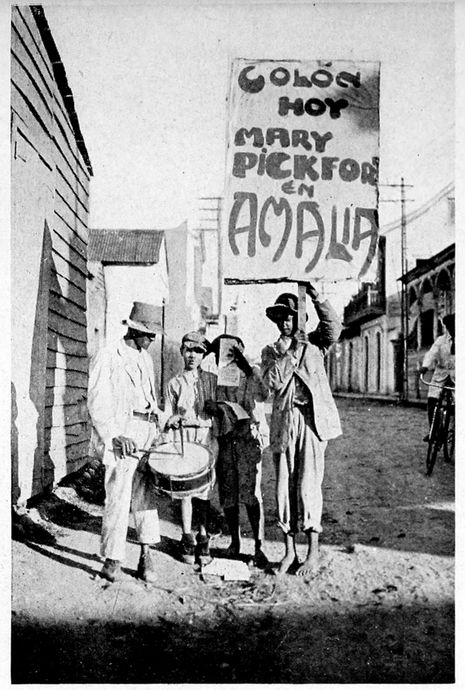
Advertising a typical Dominican theatrical performance
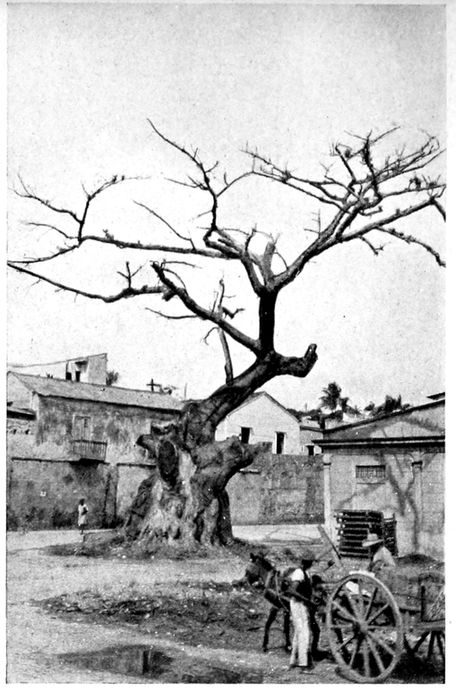
A tree to which Columbus tied one of his ships, now on the wharf of Santo Domingo City
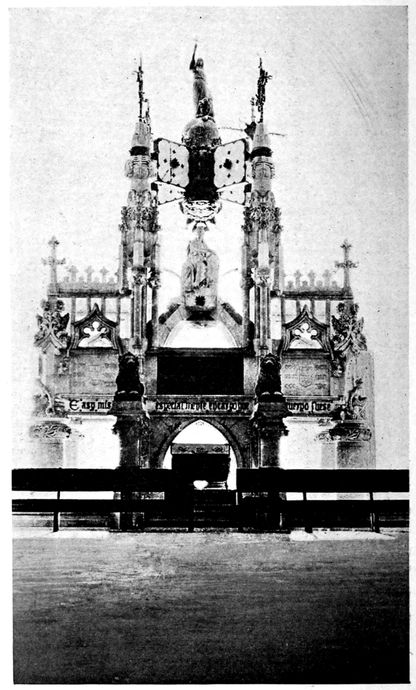
The tomb of Columbus in the Cathedral of Santo Domingo City
241It is naturally irksome to a man who has always considered a revolver
as a sign of caste, an adornment similar to a diamond ring or a gold-headed
cane, to be forced to dispense with this portion of his attire.
But not much can be said for the plaintiff in this case. There is more
reason for sympathy with the countrymen who cannot even have a
shotgun to kill the crows, woodpeckers, guinea-fowls, and parrots that
destroy his crops. The man, too, is entitled to a hearing who has
hundreds of laborers under his command in the wilder sections of the
country, or who lives on the edge of the bandit zone, yet who can have
nothing better than a machete with which to protect himself or his
family. Our experience of the close resemblance between gavilleros
and respectable citizens, however, has sadly shattered our confidence,
and it is difficult even for native officials whose duties carry them about
the country to get permission to dress themselves up in firearms.
I have already spoken of the dog-in-the-manger attitude of the
Dominicans on the subject of immigration. Their complaints on this
score have become less acute since the military government promulgated
the recent decree of registration and proof of self-support for alien
laborers. There is still some grumbling, however. Native law forbids
the bringing in of negro or Oriental workmen “except in cases of
emergency.” The Americans, they assert, have permitted too many
blacks from the neighboring islands to take employment in the great
cane-fields of the South. Yet surely the harvesting of sugar is an
“emergency” to the unsweetened world of to-day. Also, the American
steamship line that monopolizes the carrying of goods to and from
Santo Domingo brings stevedores from Turk’s Island and other points
to work the cargoes, dropping them again at their homes, and the
Dominicans complain that this lowers their standard of living. The
fact is that the native laborers are not merely indolent; they are distressingly
independent. About Thursday a bunch of them get together
and say, “We have enough to live on until Tuesday. Why should
we work?” So off goes the bunch on a dance-fiesta-cockfight spree
and the canes wither in the field or cargoes lie untouched in the hold
or on the dock. The workmen of the South, in particular, have the
reputation of being the best time-killers in the world. The great sugar
centrals of that region could not exist without the privilege of bringing
in Haitian or British West Indian laborers.
Abhorring steady labor as he does, the Dominican has been quick
to catch the drift of modern trade unionism in demanding exorbitant
wages for indifferent work. At the recent labor conference in Washington
Santo Domingo was represented by the mulatto son of a German,
242formerly governor of Puerto Plata, and a man who could not but have
chuckled at his own humor in addressing the conference as “my fellow
workmen.” Denied the privilege of holding office in the old style under
American rule, these professional politicians are attempting to get a
strangle-hold on the public purse by forming labor unions and appealing
to the American Federation of Labor to bring its powerful influence
to bear on the military government. The parade of a score of gremios
during our stay in the Dominican capital, nearly all of them formed
within six months, shows what success is attending their efforts. The
labor dictator of America seems to have fallen into the trap. He requests
that the laborers of Santo Domingo be given “full liberty of
action,” which sounds to those of us who have been there like permission
to take a gun and turn bandit. Measured in dollars and cents
the wages of the Dominican laborer are not high; balanced against the
work he actually accomplishes they show him rather the exploiter than
the victim. No one on earth, least of all the occupation, is hindering
him from doing a good day’s work and getting reasonably well paid for
it—except his own indolence, which in the end is apt to leave him
swamped beneath foreign immigration in spite of any political manipulations.
Among those I talked with about their country’s “wrongs” was
Deciderio Arias, the former war minister who added the last straw to
American patience. He runs a pathetic little cigar factory in Santiago
now, sleeping on a cot in one corner of it, and professes, I hesitate to
report, a great friendship for “Big George.” A proud, rather ignorant
mulatto, with perhaps a touch of Indian blood, a commanding manner
still despite his reverses and the high degree of outward courtesy of
all his people, he is, or pretends to be, fairly well satisfied with American
occupation. All he wanted, he asserts, was internal peace for his
beloved native land, and the marines have brought that, or nearly so.
But he regrets that the Americans do not study the customs and
“psychology” of the Dominican people, rather than jumping to the
conclusion that what is good for themselves is unquestionably good for
all other races.
Then there was Santo Domingo’s chief novelist and literary light, the
pride of La Vega. He is perhaps the most outspoken opponent of the
occupation in the country. “Cuba and Porto Rico have always been
colonies,” he frothed, “and are used to having a rule of force thrust
upon them. But Santo Domingo won her own independence single-handed
243and what we want, what we must have, is LIBERTY!” He
did not add that the meaning of the word in this particular case was the
right of continual revolution, but it was easy to supply that footnote for
him. His wrath was scornful toward those of his fellow-countrymen
who had “debased themselves” to accept office under the occupation,
and he asserted that all who had done so were “the dregs of our national
life.” The novelist’s testimony was somewhat discounted, however,
by “Mac’s” characterization of him as a “one-cylinder crook,” who
had been removed from public office for selling cancelled revenue
stamps.
The parish priest of Seibo was far more favorable to the occupation.
A native Dominican, without a hint of the asceticism of the French
priests in Haiti, with a generous waist-line and the face of one who
enjoys to the full all the good things of life, he had the ripe judgment
of a man of the world, rather than the view-point of the cloister.
All intellectual Dominicans, he explained, are ashamed that it was
necessary, yet they know it is for their own good, that the Americans
have “annexed” the country. The lesson has been hard to
bear, but it was unavoidable, and now they have learned it so well
that they “will never do it again”—it sounded like the cry of a bad
boy under the paternal strap—if only we will let them govern themselves
and still hold a menacing hand over them. It is the old Latin-American
cry for protection without responsibility. Every Dominican
would bless the United States if the marines were withdrawn and an
advisory governor left. They would never again steal public office or
government funds. They have been taught that continual revolutions
are not a mere pastime, but a crime. The intellectual Americans of the
occupation had done much good, he asserted, but their works had been
largely offset by those of the other class. For all the violence he had
reported, he seemed to have no hard feelings against us, but he felt
that the time had come for us to go away. He “had heard it said”
that the gavilleros would return to their canucos and settle down again
as soon as the Americans leave. Many of them were simple rascals
who had no sense of patriotism whatever, but only a desire to live by
robbery and plunder. They were as apt to kill their own countrymen
as Americans, rather more so, in fact, for the latter went armed and
the Dominicans could not. Yet many of them had been driven to the
hills by force of circumstances—by threats from the real bandits,
by the marines mistaking an innocent family for gavillero sympathizers,
or a man was falsely given a bad name and dared not come in and give
244himself up, for fear of suffering the fate of Vicentico. Once these
unwilling outlaws abandoned the fight the rest would have no choice
but to disband.
It is difficult to admit, however, that Santo Domingo is now ready
to govern itself, not because there are no educated and honest men
in the country, but because these cannot get into power. Force rules;
just elections are impossible. As in all Latin-America, with few
exceptions, parties depend upon and take the name of their leader.
Principles do not interest the rank and file in the least. In the old
days the president always appointed a military man as provincial leader,
that his “party” might not assert any signs of independence. Every
district had its little local cacique, or tribal chief. Elections were two-day
affairs. Woolly countrymen were brought in from the hills and
voted at once. The cacique got them shaved and voted them again; got
them a hair-cut and voted them again; gave them a new shirt and voted
them again. On the second day a half-dozen more disguises preceded
their repeated visits to the polls. It is hard to believe that a bare four
years of occupation have completely cured the Dominicans of such
habits. The Americans, in fact, have never yet attempted to hold an
election, hence there has been no new ideal held up to them in this
matter. Under the old régime judges divided fines among themselves,
and it cost much effort to get them to give up this privilege. Now
they are apt to give ludicrously light fines, because it all goes to the
internal revenue, in which they are not personally interested. Like a
wayward boy who was never taught to govern himself, but was merely
exploited by a heartless stepfather, from whom he finally ran away,
Santo Domingo has no real conception of how to conduct itself in
political matters, and up to the present occupation no one has ever
attempted to teach it what it never learned from Spain or experience.
Some Dominicans would be satisfied with an American protectorate,
provided they could have their own congress and a certain show of
autonomy. Many thoughtful citizens want us to remain until a new
generation has been trained to administer their affairs. So far little
such training has been done, and it will take a long time to break them
of their “Spig” habits. Cuba and Porto Rico have always been used
to obeying the law, yet they have scarcely yet approached proper self-government.
Santo Domingo has always run more or less wild; she
needs a complete new standard of honor and morals. Among other
things this will require at least twenty-five years of good elementary
schooling. Nor should it be a hesitant, over-kindly schooling. The
245textbooks adopted should contain such pertinent queries as: “What
are the chief faults of Dominicans (of Latin-Americans in general)
which it is necessary to correct before they can take their proper place
in the modern world? Answer: We must get rid of Caudillismo, of
personal instead of political parties”—and so on, with what may seem
offensive frankness. Not only should Americans remain long enough
in Santo Domingo to train a new generation, but we should tell them
at once that such is our firm intention. The rumor that our troops
are about to be withdrawn is always going around the country, leaving
no one a certain peg on which to hang his hat. Remember how we
hate the uncertainty of a presidential year. There should be a proclamation
by our own federal government to the effect that we are going
to remain for many years—I should say fifty, until all the present
generation has disappeared—and that there is no use kicking meanwhile
against the inevitable. Instead of that the present governor
tells them that he will do all in his power to get them a civil government
soon and to have the troops withdrawn, remaining perhaps as a civil
governor. I do not believe they are ready for any such move, certainly
not to handle their own finances, which is what they wish above all to
do. Bit by bit they should be initiated into the mysteries of real self-government,
but we should avoid the error we made in Cuba, and to
some extent in Porto Rico, of graduating them before they have finished
the grammar grades. If the unborn generation can be reared without
political pollution from the living, there is promise even in such a race
as the Dominican. However, have you ever set out on a journey
astride a mongrel native horse and expected him to keep up with a
thoroughbred?
The military occupation has made mistakes; all military governments
do. But they are by no means so many nor so serious as those the
Dominicans made themselves. There have been cases of arbitrariness,
snap judgments, and injustice, but on the whole American rule is just,
justifiable, and well done. Some of the trouble comes from the fact
that navy youths of no experience are given important secretarías that
require men of exceedingly mature judgment—though, to be sure, the
governing of Santo Domingo, with its bare 750,000 inhabitants, is little
more than a mayor’s job, except in extent of territory. A second
drawback is that the most important posts are in the hands of men
who know not a word of Spanish and must do all their work through
interpreters, usually of the politician stripe, with results easily imagined.
246There is no reason whatever why graduates of Annapolis or West Point
should not know what has become so important a language to their
calling. Did anyone ever hear of a German professional officer who
did not speak at least English and French fluently? Some of the time
that is now given to “social functions” and the learning of afternoon-tea
manners could easily be sacrificed to our new requirements. Lastly,
there should be more knowledge and interest in our scattered wards
among our higher officials at home. It is not particularly helpful to a
naval officer suddenly appointed governor of such a place as Santo
Domingo to have the secretary who should outline his policy turn from
the map on which he has just looked up that unknown spot and make
some such reply as, “Orders? Don’t bother me with details. I have
more important matters requiring my attention. Go down there and
sit on the lid.”
As an example of the improvements already accomplished by the
occupation there is the matter of marriage. Formerly it was almost
impossible for the mass of the people to form legal unions; the cost
was too great and the requirements of birth certificates and other
formalities insurmountable. As a result, marriage had come to be
looked upon as a superfluous ceremony. This condition, more or less
universal throughout the West Indies, is a deliberate legacy of olden
times. The exploiters of the islands, particularly the Spaniards,
abetted by the church, whose prosperity depended on their prosperity,
purposely made marriage difficult among the laboring classes. A married
woman and her children could demand support from her husband;
a mere consort added to the available labor supply, because she was
obliged to earn her livelihood in the fields and to send her children
there early in life. Though there were men who treated their irregular
families as legal dependents before the Americans came, illegitimate
children were frequently abandoned, mistreated, or exploited to a
degree that drove many of them to turn bandit. At best they suffered
for want of a firm fatherly hand in their early years. The occupation
attacked this problem by forcing men to pay for the support and schooling
of their “outside” children. As little stigma attaches to this
social misbehavior in Santo Domingo, there was seldom any difficulty
in establishing the parentage. It was usually common knowledge.
Even the priests have families in the majority of cases, many of them
frankly acknowledging their sons and daughters. There are men in
Santo Domingo, some of them veritable pillars of society, who suddenly
saw their burdens increased from two or three children to twenty-five
247under the new law. Marriages are now free, and are public ceremonies.
They almost always take place at night, and crowds gather outside the
wide-open, lighted house. Members of the family come out and talk
with friends in the throng now and then but do not invite them inside.
About the parlor table sit the bride and groom, the notary and the priest,
surrounded by the standing relatives and intimate amigos and compadres.
There is much signing of documents and ledgers, each followed
by a sort of rapturous sigh from the curious throng in the street,
which under no circumstances short of a downpour gives any signs of
breaking up until the new couple has retired from the scene. Most
dances, fiestas, and family celebrations are like that in Santo Domingo,
where the principal room always faces the street and the heat makes
closed doors and windows worse than superfluous. Sometimes these
open, chair-forested parlors are on a level with the sidewalk, sometimes
several feet below it, but it is impossible to avoid a peep inside,
even if one does not join the crowd. Besides, there is nothing secretive
about such Dominican festivities; the bride who did not see a throng
gathered before her door on her wedding night would probably weep
her eyes out before morning.
When the Americans arrived there were only 18,000 pupils nominally
attending the schools of Santo Domingo. There were no rural schools
whatever. Many “teachers” never taught at all, but were merely
political henchmen who drew salaries, some of them wholly illiterate.
Some of them farmed their “pupils” out or worked them in their
own fields. Superintendents and inspectors rarely did either, and
kept no records whatever. Listen to a passage from a novel by a
sworn enemy of the occupation:
The average Dominican woman frequented—the word is well chosen—a
school of first letters sustained and directed by a priest, where she learned to
read and write after a fashion, the barest rudiments of arithmetic and geography,
and a world of prayers which the good priest made special effort to teach
her. She had the catechism at her fingers’ ends, but except for the forms of
devotion she was a complete ignoramus who took seriously any nonsense told
her by those who happened, falsely or otherwise, to have her confidence.
There was not even a basis on which to build an educational system.
Those charged with the task had to begin from the ground up. The
peculiar status of Santo Domingo gives it an American Minister of
Public Instruction and a native superintendent, the reverse of the case
in Haiti. Both are earnest men, but pedagogy is not on the curriculum
at Annapolis. No attempt has been made to Americanize the schools,
248as in Porto Rico and the Philippines, which is proper enough politically
but questionable educationally. Every man has been made personally
responsible for the men under him, clear down through the system.
The occupation now has 100,000 pupils in the schools, with as many
still unprovided for; but many of the former attend only half time for
lack of accommodations. Dominican illiteracy still exceeds ninety per
cent., and information passes chiefly by word of mouth, with consequent
garbling. An attempt is being made to have the university in the
capital teach only “practical” subjects, banishing the lofty culture with
which the Latin-American loves to flirt. One gets the impression,
however, that there is more attention and expense bestowed upon the
elaborate educational pamphlets that pour in a constant stream from
the government presses than on the adobe school houses and the barefoot
urchins who attend them.
The Dominican of the masses is kindly, hospitable, long-suffering,
and hopeful; in spite of having been exploited and mistreated for
centuries, despite his tendency to settle things by force of arms and
his low value on human life, he is still simple and good-hearted underneath.
Even in the days of revolution lone Americans went in safety
where a company of marines now moves with caution. The mothers
of American girls married to officers of the occupation would be horrified
to know that their daughters use murderers from the Guardia
prisons as cooks and servants, yet such arrangements scarcely attract
a passing comment among the Americans in Santo Domingo. Like
all Latin-Americans, the dominicano has no compassion, either for
animals or his fellow-men. Brave enough in physical combat, he has
little moral courage—I have already mentioned the inability of native
officials to discipline their own people. Worst of all, he has no idea
how to curb his politicians. The best families emigrated to Cuba
during the twenty-two years of Haitian rule, and the latter closed the
university and many of the schools as superfluous luxuries, which may
be among the reasons why the “higher” classes do not measure up correspondingly
in character with the masses. A rise in the social scale
seems frequently to bring a drop in moral standards. As an example:
The son of a shoemaker worked his way through school with truly
American spirit; he studied medicine in Paris, learned English and
French, is a voracious reader of all the literature of his profession in
several languages. Yet when a poor countryman with a broken skull
was brought in to him by a Guardia detachment, he declined to attend
249him, after beginning the operation, because no one could assure him
his $500 fee.
The Dominicans have few strictly native customs, their chief characteristic
being their fondness for revolutions. They are gay, vivacious,
and frivolous, fond of music and dancing, and find a great deal of
amusement in the most trivial pastimes. Bull-fights have long since
disappeared, but cock-fighting is the universal male sport, and on Sundays
and feast days the cockpit is the center of attraction. Not a city
or village is without its gallera; in the country districts there is sure to
be one within easy distance of every collection of thatched huts. On
any holiday the traveler along the principal roads and highways is
certain to meet a cavalcade of horsemen, each carefully carrying in a
sack what the initiated know to be a prize rooster.
The chief gallera of Santo Domingo City was just back of our
lodging. On Sunday we were awakened at dawn by its uproar, which
varied in volume but never once ceased entirely until sunset. In the
afternoon I wandered into the enclosure; paid an admission fee of
twenty-five cents, and, climbing the tank-like outer wall, crowded into
a place up near the round sheet-iron roof. The sport is legalized and
a part of the gate-money goes to the municipality, netting some $1,500
a year. This is a mere bagatelle, however, compared to the sums that
change hands among the spectators during a single day’s sport. Like
most Spanish games, betting is the chief raison d’être of the cock-fight.
The constant, deafening hubbub recalled the curb market of New York,
as well as the ball games of Havana. Before each separate contest
there were long waits while the shrieking spectators placed their wagers
on the two haughty, gorgeous birds tenderly held by their owners or
hired seconds.
It came as a surprise to find what class of men attend these contests
in the capital. The circle of faces rising eight tiers high above
the earth-floored pit were in many cases wholly free from negro strain;
the great majority of the audience was not merely well-dressed, they
showed considerable evidence of moderate affluence. Wealthy merchants
and men high in local affairs, two or three ex-ministers, were
pointed out to me as owners of one or several contending cocks.
“Chickens” would be a more exact term, for the fighters, unlike the
spectators, were not confined to one sex. The toilettes of the birds
were fantastic in the extreme—each had been clipped, picked, or otherwise
250denuded of its feathers on various parts of the body, particularly
the thighs and neck, according to the whim or expert opinion of its
trainer, and the appearance of its bare skin demonstrated that it was
indeed in the “pink” of condition. An invariable formality preceded
each contest. On a square board hanging stiffly on poles from the
roof was placed a pair of scales in which the two opponents were
weighed in their sacks, custom requiring that they balance one another
to the fraction of an ounce. Then, when a lull in the betting showed
that the spectators had decided their odds, the owner or his agent
filled his mouth with rum and water and spurted it in a fine spray over
the bird from haughty head to bare legs, and the fight was on.
The first battle after my arrival was between a black hen and a red
India rooster. From the moment of release they went straight at it,
like professional boxers. Now and then they clinched, but as there
was no referee to separate them they eventually broke away themselves.
Then the rooster took to running round and round the ring,
the hen after him, which a “fan” beside me called clever strategy.
During the early part of the fight the favorite changed with every peck,
or slash of the spurs. Shouts loud as those at a Thanksgiving football
game seemed to set the tin roof above us to vibrating. The shrieks of
the bettors were emphasized by waving hands, by jumping up and down,
by shaking money in one another’s faces and placing wagers at a distance
by lightning-quick, cabalistic gestures. Those who hazarded a
mere ten dollars a “throw” were the most insignificant of “pikers”;
on every side flashed hundred-dollar bills, sometimes two or three of
them in the same hand. Screams of ecstasy greeted each clever spur-stroke,
awakening a loathsome disgust for one’s fellow-men. I found
myself wondering how many of these shrieking fanáticos had a tenth
as much nerve as their gamey chickens. Certainly none of them would
have endured so much punishment without crying quits. Gradually
the bets dropped from even to ten to one. The rooster was getting the
worst of it. He had gone stone blind, his head was a mass of blood,
he was so groggy on his feet that he fell dizzily on his side now and
then, only to struggle up again and fight on, pecking the air at random
while his opponent continued a grueling punishment. The owner on
the side lines kept shouting frantic advice to him,—“Anda, cobarde!
Pica, gallo!” A lucky peck or spur-thrust sometimes suddenly gives
the battle even to a blind cock, hence there was still hope. Toward
the end the rooster frequently lay down from sheer fatigue, his opponent
respecting his fallen condition with knightly honor and never once
251touching him until he had wobbled to his feet again. The exhibition
became monotonously disgusting, even some of the “fans” began to
protest, and at length the owner stepped into the pit with a deprecating
shrug of the shoulders and snatched up the rooster, rudely, in one hand,
like some carrion crow. His bleeding head hung as if he were dead.
Even when a gamecock wins, it cannot fight again for months; if it
loses it means the garbage heap or at best some pauper’s pot. A man
at the ringside pulled the natural spurs off the defeated bird for use
on some other less well-armed fowl, losing bettors began to hunt up
the winners and pay their debts, and another throng invaded the ring
in preparation for the next disgusting contest.
Santo Domingo City, more often called “La Capital” within the
country, is a prettier town than Santiago, and somewhat larger. It
is less compact, has more trees and open spaces, and many curious old
ruins,—palaces, gates, fortresses, and churches—so many old
churches, in fact, that some of them are now used as theaters and
government offices. Of the several ancient stone gateways remaining
from its former city wall the most curious is the “Puerta de la Independencia,”
opening on a pretty outer plaza—curious because the
Dominicans pretend it is the gate through which the triumphant army
entered after driving out the Haitians in 1844, though any street urchin
knows the entry was really made by a less ornate gate nearer the sea.
Then there is the aged tree down in the custom house compound on
the banks of the Ozama river to which Columbus is said to have tied
one of his ships. The cathedral on the central plaza is a picturesque
pile of old stone, without tower or spire, and noteworthy for the
elaborate tomb of the famous Genoese just inside its main portal.
Without going into the vexed question of whether the bones it contains
are really those of the great discoverer, except to say that Havana,
Valladolid, Seville, and Santo Domingo City are all equally certain
that they have the genuine remains, one can at least say that the tomb
itself is worth visiting. Indeed, though a trifle ornate for American
tastes, it is astonishingly artistic to the traveler long familiar with the
almost universally ludicrous “art” of Latin-American churches. With
its splendid bronze reliefs, its excellent small figures in marble, and its
inspiring general form, it might almost rank as the gem of ecclesiastical
architecture south of the Rio Grande.
Once in the cathedral there are several other things worth a glance
before leaving, though its tiny windows give the interior an eternal
252twilight. Two or three paintings by Velasquez and Murillo have a
genuine value; a picture brought over by Columbus can be seen only
by means of the sexton’s key; a cross which the discoverer of America
is said to have set up nearby is protected by glass doors let into the wall
because the faithful and the curious were given to chipping off pieces
as sacred relics or souvenirs. The mahogany choir-stalls, the pulpits,
and the altars are all of rich-red old woodwork. There is an excellent
tomb of the archbishop who was once president. Indeed, it does not
seem necessary to be of Columbian stature to be able to sleep one’s
last sleep beside the doughty old navigator. During our stay in the
city the marble floor was opened a few feet from the historic tomb to
receive the remains of a Syrian merchant, long resident in “La Capital”
but deceased in New York, whose only claim to glory seemed to be a
fortune easily won and wisely spent. The interior of the cathedral has
been generously “restored” by daubing the walls with gleaming white.
It was planned to whitewash the aged outer walls also, but the Pope
vetoed the suggestion, for which the Dominicans seem to have a grievance
against him.
The government palace, occupied now by Americans in navy and
marine uniforms, is full of capacious leather-upholstered chairs, in
striking contrast to the average uncomfortable Dominican seat. No
wonder they fought one another to become president. Ostentation is
more important than real use among the two score or more automobiles
with wire wheels and luxurious tonneaux that hover about the central
plaza, though there are good macadam roads for 16, 25, and 30 kilometers
respectively in as many directions. The theaters are seldom
occupied by actors in the flesh, though now and then there is a bit of
opera. The only regular attractions are the movies, which begin at
nine in theory, nearer ten in practice, and feature the same curly-haired
heroes and vapid-faced heroines that nightly decorate the screens
in the United States. Like all Latin-Americans, the people of “La
Capital” are great lovers of noise. Despite American rule the crack-voiced
church bells begin their constant din long before dawn. During
the “flu” epidemic, with its endless succession of funerals, they
thumped for nine mortal days without a pause, until the marine doctors
protested that most of the victims were dying for lack of sleep. Automobiles
scorn to use mufflers; carriages are constantly jangling their
bells. Every boy in town is an expert whistler, and every passer-by
will find some way of making a noise if he has to invent it. The
253throngs returning from the cinemas habitually make slumber impossible
until after midnight. One comes to wonder if it is not this
constant lack of sleep that makes the Dominicans so nervous, inattentive,
and racially inefficient.
Small as it looks on the map it is not a simple matter to cover all
Santo Domingo in a few weeks. Among the parts we missed were the
southwestern provinces, including the town of Azua, seventy miles
from the capital, founded in 1504 by Don Diego Velazquez, who later
conquered and settled Cuba. Thereabouts once dwelt many illustrious
sons of old Spain, among them Cortés, the conqueror of Mexico,
Pizarro, who subjugated Peru, and Balboa, the discoverer of the Pacific.
A much shorter route from Port au Prince to the Dominican capital
is that through this region, but it is chiefly by water. Lake Azua,
partly in Haiti, is fifty-six feet above sea-level, and a paradise for duck-hunters.
Lake Enriquillo, only five miles east of the other, and named
for the last Indian chief who opposed the Spaniards, is a hundred feet
below the sea and more salty than the ocean itself. Nor should the
traveler to whom time is unlimited fail to visit the high mountain
ranges in the center of the country, with their breakneck trails and
luxuriant vegetation.
One of the drawbacks of West Indian travel is the lack of shipping
between the islands, particularly the larger ones. Only in the ports
themselves can one get the slightest data on sailings, and often not even
there. This is especially true of Santo Domingo, one of whose chief
misfortunes is the American line that holds a virtual monopoly of its
sea-going traffic. Not only are its freight and passenger rates exorbitant,
its treatment of travelers and shippers worse than autocratic,
and some of its steamers so decrepit that they take twenty-six days
for the run down from New York, halting every few hours to pump
out the vessel or patch something or other essential to her safety,
but it keeps a throttle hold on poor Santo Domingo by more or less
questionable means. Not long ago another line proposed to establish
traffic between the island and New Orleans. One of its steamers put
into a Dominican port, offering to take cargo at reasonable rates.
Though the warehouses along the wharves were piled high with cacao,
not a bag was turned over to the newcomer. Her captain button-holed
a shipper and asked for an explanation.
“It’s like this,” whispered the latter, “we should like to give you
254our cargo, but if we do, the other line will leave our in-coming goods,
on which we are absolutely dependent, lying on the dock in New York
until they rot.”
The captain visited several other ports of the republic, with the same
result, and the proposed line to New Orleans died for lack of nourishment.
Disgruntled natives assert that the monopoly keeps its hold
because it has a large fund with which to starve out competitors, and
because its president is a member of our Shipping Board. The Dominicans,
however, are losing patience, and there are signs that the freight
that should go in American bottoms will gradually go to British, Dutch,
and later to German steamers.
We were spared all this through the kindness of the military governor,
who sent us to La Romana on a submarine chaser. Lest some
reader be subject to seasickness by suggestion, I shall not say a word
about the ability of these otherwise staunch little craft to cut incredible
acrobatic capers on a barely rippling sea. The fact that we noted the
gaunt old American battleship Memphis still sitting bolt upright on
the rocks beside the seaside promenade of the capital just where a wave
tossed her in September, 1916, the dangerous bottle entrance to the
harbor of San Pedro de Macoris, with its wrecked schooner, and the
water that spouted a hundred feet into the air through the coral holes
along the low rocky coast and hung like mist for minutes before it fell,
must be accepted as proof that we are experienced sailors. At length
appeared the red roofs of La Romana, with its narrow river harbor,
similar to that of the capital, and the Santo Domingo we knew was forever
left behind.
Though it is in Dominican territory, La Romana is virtually American,
a vast estate belonging to a great sugar company of Porto Rico.
Thanks largely to it, sugar is the chief product of Santo Domingo.
Here again was one of the huge centrals with which we had grown
so familiar in Cuba, with its big-business atmosphere, its long rows of
excellent dwellings built of light coral rock along the edge of the jagged
coast, its own stores, clubs, movies, and its many miles of standard-gauge
railroad. We rode about this all the next morning, past immense
stretches of cane, most of it recently cut, through bateys of white
wooden huts raised on stilts, sidetracked now and again by long trains
of cane, hungry bees hovering about them, and finally out upon great
tracts where the company is pushing back the forests and the bandits
to make way for increased sugar production. La Romana embraces
a quarter million acres, of which only 16,000 are under cane, immense
255as the fields already look. Three fourths of the estate is estimated
good cane land, and the foothills make excellent pasture as fast as they
are cleared. The felling of these great forests, with what would seem
to the uninformed a wanton waste of lumber, has already altered the
rainfall of the region. Formerly the rains were regular; this year not
a drop fell in January, yet during the forty-eight hours of our visit in
early February, the gauges registered more than five inches. The
country women were everywhere paddling about under strips of yagua
in lieu of umbrellas.
The company employs from 7500 to 9000 men, of whom a bare hundred
are Americans, most of them dwelling in the great central batey.
The rest are chiefly Haitians and Porto Ricans, with a large sprinkling
of negroes from all the other West Indian islands. English, Porto
Rican, and Dominican schools are maintained, the teachers of the two
former being paid out of company funds. There are very few Dominican
employees, the natives, though good ax-men, being usually “too
Castilian to work for a living.” Wages range from an average of $1.20
a day for cane-cutters to $4 for mechanics, with twelve-hour shifts
and a twenty per cent. bonus for all. The contrast between this productive
region and the great virgin wilderness of most of Santo Domingo
gave serious meaning to the parting words of the company
punster, “What the Dominicans need most is to stop raising Cain and
go to raising cane.”
We left La Romana and Santo Domingo on one of the two cane
boats that ply nightly between this dependency and the mother country.
She was the flat-bottomed steamer Glencadam from the Great Lakes,
flying the British flag and captained by a quaint old Scotchman whose
cabin far forward contained almost transatlantic accommodations.
Once more I draw the curtain, however, on the merely personal matters
of pitch and roll, greatly abetted in this case by the recent rains, which
had made it impossible to gather more than half a cargo. The very
canes themselves were showing a tendency to waltz before we had
passed the mouth of the river and turned our nose toward Porto Rico,
already lying cloud-like and phantasmal on the eastern horizon.
256
“When the queen asked for a description of the island,” says
an old chronicle, “Columbus crumpled up a sheet of paper
and, tossing it upon the table, cried, ‘It looks just like that,
your Majesty!’”
If we are to believe more modern documents, the intrepid Genoese
made that his stock illustration for most of the islands he discovered.
Even the firm head of Isabela must have wobbled under its crown
as one after another of the misnamed “West Indies” were pictured
to her in the same concise fashion, and brushed off into the regal wastebasket.
Fortunately, paper was cheaper in those days. Or was it?
Perhaps it was the wrath born of seeing her last precious sheet turned
into an island that soured the queen’s gratitude, and brought the doughty
discoverer to dungeons and disgrace.
Questions of wanton waste aside, there could be no more exact
description of Porto Rico. The ancient jest about quadrupling the
area of a land by flattening it out all but loses its facetiousness when
applied to our main West Indian colony. Barely a hundred miles
long and forty wide, a celestial rolling-pin would give old Borinquen
almost the vast extent of Santo Domingo. Its unbrokenly mountainous
character makes any detailed description of its scenic beauties a
waste of effort; it could be little more than a constant series of exclamations
of delight.
For all its ruggedness, it is as easy to get about the island as it is
difficult to cover the larger one to the westward. There is not a spot
that cannot be reached from any other point between sunrise and sunset.
A railroad encircles the western two thirds of the island, with
trains by night as well as by day. When the Americans came, they
found a splendidly engineered military road from coast to coast, with
branches in several directions. If this sounds strange of a Spanish
country, it must be accounted for not by civic pride or necessity, but in
the vain hope of defending the island from armed invasion. To-day
there are hundreds of miles of excellent highway covering Porto Rico
with a network of quick transit that reaches all but the highest peaks of
its central range. It is doubtful whether any state of our union can
rival this detached bit of American territory in excellence and extent
of roads, certainly not in the scenic splendor that so generally flanks
them.
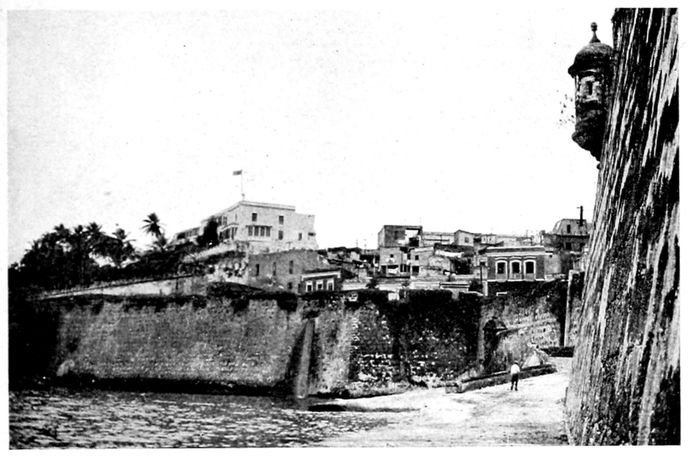
Ponce de Leon’s palace now flies the Stars and Stripes
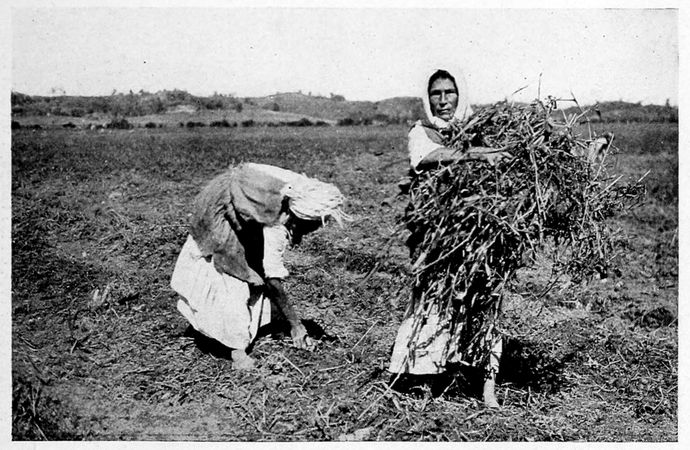
Thousands of women work in the fields in Porto Rico
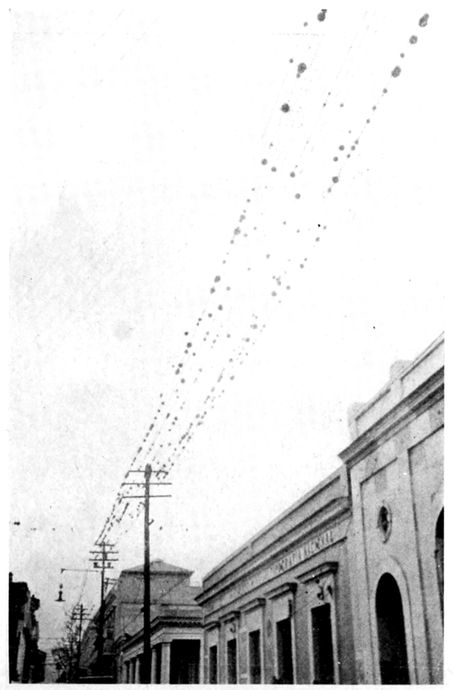
Air-plants grow even on the telegraph wires in Ponce
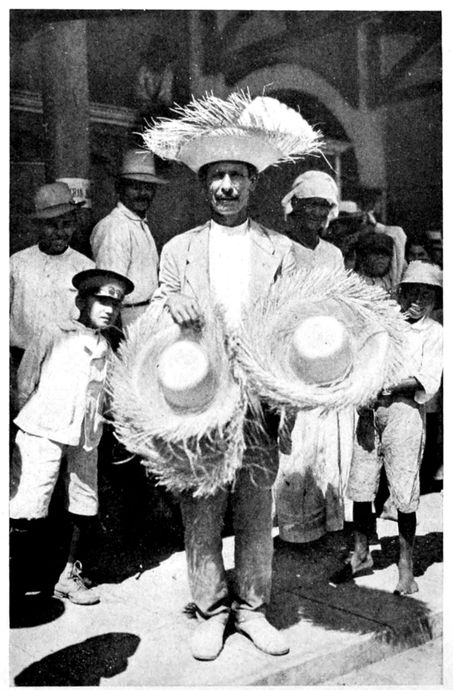
A hat seller of Cabo Rojo
257Automobiles flash constantly along these labyrinthian carreteras,
many of them bearing the licenses of “the Mainland.” If the visitor
has neglected to include his own car among his baggage and trembles
at the thought of the truly American bill that awaits the end of a private
journey, there are always the guaguas, pronounced “wawas” by all
but those who take Spanish letters at full English value. Scarcely a
road of Borinquen lacks one or two of the public auto-buses each day
in either direction, carrying the mails and such travelers as deign to
mix with the rank and file of their fellow-citizens of Spanish ancestry.
My tastes no doubt are plebeian, but I for one gladly pass up the
haughty private conveyance for these rumbling plow-horses of the
gasolene world. They have all the charm of the old stage-coaches that
prance through the pages of Dickens, except for the change of horses.
In them one may strike up conversation with any of the varied types
of rural Porto Rico, and the halt at each post-office brings little episodes
that the scurrying private tourist never glimpses.
“We divide the people of Porto Rico into four categories for purposes
of identification,” said the American chief of the Insular Police,
“according to the shape of their feet. The minority, mostly town-dwellers,
wear shoes. Of the great mass of countrymen, those with
broad, flat feet, live in the cane-lands around the coast. The coffee
men have over-developed big toes, because they use them in climbing
the steep hillsides from bush to bush. In the tobacco districts, where
the planting is done with the feet, they are short and stubby. It beats
the Bertillon system all hollow.”
The man bent on seeing the varying phases of Porto Rican life
could not do better than adopt the chief’s broad divisions of the population;
for our over-crowded little Caribbean isle is a complex community,
as complex in its way as its great stepmother-land, and one
that defies the pick-things-up-as-you-go method. Small as it is, it contains
a diversity of types that emphasizes the influence of occupation,
immediate environment, even scenery, on the human family.
San Juan, the capital—to give the shod minority the precedence—is
compacted together on a small island of the north coast, attached to
the rest of the country only by a broad macadam highway along which
258stream countless automobiles, and strictly modern street-cars and their
rival auto-buses in constant five-cent procession. It was a century old
when the Dutch colonized New Amsterdam. Small wonder that it
looks upon its scurrying fellow-citizens from “los Estados” as parvenus.
Palaces and fortifications that antedate the building of the
Mayflower still tower above the compact, cream-colored mass, most of
them now housing high officials from the North. Casa Blanca, built
for Ponce de Leon—the younger, it is true—now resounds to the
footsteps of the American colonel commanding the Porto Rican regiment
of our regular army. The governor’s palace, almost as aged,
has an underground passage that carried many a mysterious personage
to and from the outer sea-wall in the old Spanish days, and through
which more than one American governor is said to have regained his
quarters at hours and under conditions which caused him to mumble
blessings on Castilian foresight, though it is hard to give credence to
this latter tradition, for how could he escape the all-seeing American
chief of police who occupies the lower story? The Stars and Stripes
still seem a bit incongruous above the inevitable Morro Castle, while
the tennis-court in its moat and the golf-links across its grassy parade-ground
have almost a suggestion of the sacrilegious. Of the cathedral
with its green plaster covering there is little to be said, except that the
solemn Spanish dedication over the bones of Ponce de Leon loses something
of its solemnity in being signed by Archbishop Monseñor Bill
Jones. The mighty sea-wall that holds the sometimes raging Atlantic
at bay, and massive San Cristobal fortress at the neck of the town are
worth coming far to see, but they have that in common with many a
Spanish-American monument.
For after all, San Juan is still a son of Spain, despite the patently
American federal building that contains its post-office and custom-house.
Its architecture is of the bare, street-toeing façade, interior-patio
variety, its sidewalks all but imaginary, its noise unceasing.
Beautiful as it looks from across the bay, heaped up on its nose of land,
it has little of the pleasant spaciousness of younger cities, and withal
no great amount of the Latin charm with which one imbues it from
afar. Its Americanization consists chiefly of frequent “fuentes de
soda” in place of its bygone cafés, and a certain reflection of New
York ways in its larger stores, whose almost invariably male clerks
sometimes know enough English to nod comprehendingly and bring an
armful of shirts when one asks for trousers. Something more than
259that, of course; its dressier men have discarded their mustaches as a
sign of their new citizenship, and many a passer-by who knows not a
word of English has all the outward appearance of a continental
American. Base-ball, too, has come to stay, though the counter influence
may be detected in the custom of American schoolmarms of attending
the bet-curdling horse races in the outskirts of the capital on Sunday
afternoons.
The central plaza on a Sunday evening has a few notes of uniqueness
to the sated Latin-American traveler. It is unusually small, a
long, narrow rectangle with few trees or benches, cement paved from
edge to edge, and burdened with the name of “Plaza Baldorioty.” The
Porto Rican seems to like free play in his central squares; more than
a few of them have been denuded of the royal palms of olden times,
and are reduced to the bare hard level of a tennis-court. A few years
ago a venturesome American Jew conceived the plan of providing
concert-going San Juan with rocking-chairs in place of the uncomfortable
iron sillas that decorate every other Sunday-evening plaza south
of the Rio Grande. Strangely enough, the innovation took. Now
one must be an early arrival at the weekly retreta if he would exchange
his dime for even the last of the rockers that flank the Plaza Baldorioty
four rows deep on each side. While the municipal band renders its
classical program with a moderate degree of skill, all San Juan rocks
in unison with the leader’s baton. All San Juan with the color-line
drawn, that is; for whether it is true that the well-groomed insular
police have secret orders to ask them to move on, or it is merely a time-honored
custom, black citizens shun the central square on Sunday
evenings, or at most hang about the outskirts. There is no division of
sexes, however, another evidence perhaps of American influence.
Señoritas sometimes good to look at in spite of their heavy coating of
rice powder trip back and forth beside their visibly enamored swains
as freely as if the Moorish customs of their neighboring cousins had
long since been forgotten. For the time-honored promenade has not
succumbed to the rocking-chair. One has only to turn his rented seat
face down upon the pavement, like an excited crap-player, to assure
his possession of it upon his return from the parading throng, whose
shuffling feet and animated chatter drown out the music a few yards
away, and no great harm done. In that slow-moving procession one
may see the mayor and all the “quality” of San Juan, a generous sprinkling
of Yankees, and scores of American soldiers who know barely a
260word of English, yet who have a racial politeness and a complete lack
of rowdyism that is seldom attained by other wearers of our military
uniform. Then suddenly one is aware of a tingling of the blood as the
retreta ends with a number that, far from the indifference or scorn it
evokes in the rest of Latin America, brings all San Juan quickly to its
feet, males uncovered or standing stiffly at salute—the Star-Spangled
Banner.
From the sea-wall one may gaze westward to Cabras Island, with
its leper prisoners, and beyond to Punta Salinas, “poking its rocky nose
into the boiling surf.” Ferries ply frequently across the bay to pretty
Cataño, but it is far more picturesque at a distance. From San
Juan, too, the tumbled deep-green hills behind the little town have a
Japanese-etching effect in the mists of the rainy season that is gradually
lost as one approaches them, as surely as when the sun burns
it away.
But there is more to modern San Juan than this old Spanish city
huddled together on its nose of rock. It has grown in American
fashion not only by spreading far beyond its original area, but by
boldly embracing far-flung suburbs within the “city limits.” Puerta
de Tierra, once nothing more than the “land gate” its name implies,
is almost a city of itself, a pathetic town of countless shacks built of
tin and drygoods boxes, spreading down across the railroad to the
swampy edge of the bay, where anemic babies roll squalling and naked
in the dirt, and long lines of hollow-eyed women file by an uninviting
milk-shop, each holding forth a pitifully small tin can. It is far out
across San Antonio Bridge, however, that the capital has seen most of
its growth under American rule. More than half of its seventy thousand,
which have raised it, perhaps, to second place among West Indian
cities, dwell in capacious, well-shaded Miramar and Santurce. Time
was when its people were content to make the upper story of the
old town its “residential section,” but it is natural that the desire for
open yards and back gardens should have come with American citizenship.
Ponce, on the south coast, gives the false impression of being a larger
city than the capital, loosely strewn as it is over a dusty flat plain and
overflowing in hovels of decreasing size into the low foot-hills behind.
It is the most extensive town in Porto Rico, and, like many of those
around the coast, lies a few miles back from the sea, for fear of pirates
261in the olden days, with a street-car service to its shipping suburb of
Ponce-Playa. Air-plants festoon its telephone wires, and its mosquitos
are so aggressive that to dine in its principal hotel is to wage a constant
battle, while to disrobe and enter a bathroom is a perilous undertaking.
It was carnival time when we visited Ponce. By day there was little
evidence of it, except for the urchins in colored rags who paraded
the streets and the unusual throngs of gaily garbed citizens who
crowded the plaza on Sunday afternoon. At night bedlam broke loose,
though, to tell the truth, the uproar was chiefly caused by automobile-horns.
The medieval gaieties of this season have sadly deteriorated
under the staid American influence. What there is left of them takes
place chiefly within the native clubs, each of which has its turn in
gathering together the élite of the city and such strangers as can establish
their ability to conduct themselves with Latin courtesy. We succeeded
in imposing ourselves upon the Centro Español. But there
were more spectators than spectacle in its flag and flower-festooned
interior. Toward ten the throng had thickened to what seemed full
capacity, but it was made up chiefly of staid dowagers and solemn
caballeros whose formal manners would have been equally in place at
a funeral. Only a score of girls wore masks, and these confined their
festive antics to pushing their way up and down the hall, squeaking
in a silly falsetto at the more youthful oglers. Even confetti was
strewn sparingly, evidently for lack of spirit of the occasion, for the
mere fact that a small bag of it cost $1.50 seemed no drawback to
those who would be revelers. At the unseemly hour of eleven the
queen at length made her appearance, escorted to her throne by pages,
knights and ladies-in-waiting, while courtiers flocked about her with
insistent manners that could be called courteous only in Latin-American
society. But her beauty was tempered by an expression that suggested
bored annoyance, whether for the tightness of her stays or the
necessity of avoiding lifelong disgrace by choosing one of these pressing
suitors before a year had passed there was no polite means of learning.
The most aggressive swain led her forth and the dancing began.
It differed but slightly from a dance of “high society” in any other
part of the world. I wandered into the “bar.” But alas! I had
forgotten again that I was in my native land. There was something
pathetically ludicrous in the sight of the score of thirsty Latin-Americans
who gazed pensively at the candy, chewing-gum, and “soft drinks”
that decorated what had once been so enticing a sideboard, for after
262all they were not of a race that had abused the bottled good cheer
that has vanished.
Mayagüez was more like the ghost of a city than a living town. Its
ugly plaza was a glaring expanse of cracked and wrinkled cement
across which wandered from time to time a ragged, hungry-looking
bootblack or a disheveled old woman, dragging her faded calico train,
and slapping the pavement in languid regularity with her loose slippers.
On his cracked globe pedestal in the center of the square the statue of
Columbus stood with raised hand and upturned gaze as if he were
thanking heaven that he had not been injured in the catastrophe. Of
the dozen sculptured women perched on the balustrade around the
place several had lost their lamps entirely; the rest held them at tipsy
angles. The massive concrete and mother-of-pearl benches were
mostly broken in two or fallen from their supports. Workmen were
demolishing the ruined cathedral at the end of the square, bringing
down clouds of plaster and broken stone with every blow of their
picks, and now and then a massive beam or heavy, iron-studded door
that suggested the wisdom of seeing the sights elsewhere. House after
house lay in tumbled heaps of débris as we strolled through the broad,
right-angled streets, along which we met not hundreds, but a scattered
half-dozen passers-by to the block. The majority of these were
negroes. The wealthier whites largely abandoned the town after the
disaster. Spaniards gathered together the remnants of their fortunes
and returned to more solid-footed Spain; Porto Ricans began anew
in other parts of the island. The sisters of St. Vincent de Paul have
a bare two hundred pupils now where once they had two thousand.
It was hard to believe that this was a city of teeming, over-crowded
Porto Rico.
Eighty years ago earthquakes were so continuous in this western
end of the island that for one notable six months the population ate
its food raw; pots would not sit upon the stoves. But the new generation
had all but forgotten that. Guide-books of recent date assert in
all sincerity that “Porto Rico is as free from earthquakes as from
venomous snakes.” Then suddenly on the morning of October 11,
1918, a mighty shake came without an instant’s warning. Within
twenty seconds most of Mayagüez fell down. The sea receded for
several miles, and swept back almost to the heart of the town, tossing
before it cement walls, automobiles, huge iron blocks, débris, and
263mutilated bodies. Miraculous escapes are still local topics of conversation.
A merchant was thrown a hundred yards—into a boat that
set him down at length on his own door-step. A great tiled roof fell
upon a gathering of nuns, and left one of them standing unscratched
in what had been an opening for a water-pipe. Scientists, corroborated
by a cable repair-ship, explain that the sea-floor broke in two some
forty miles westward and dropped several hundred fathoms deeper.
Lighter quakes have been frequent ever since; half a dozen of them
were felt all over Porto Rico during our stay there. The inhabitants
of all the western end are still nervous. More than one American
teacher in that region has suddenly looked up to find herself in a deserted
school-room, the pupils having jumped out the windows at the
first suggestion of a tremor.
Mayagüez is slowly rebuilding; of reinforced concrete now, or at
least of wood. Little damage was done on that October morning to
wooden structures, which is one of the reasons that the crowded hovels
along the sea front have none of the deserted air of the city proper. A
still more potent reason is that this class of inhabitants had nowhere else
to go. By Porto Rican law the entire beach of the island is government
property, for sixty feet back of the water’s edge. As a consequence,
what would in our own land be the choicest residential section is everywhere
covered with squatters, who pay no rent, and patch their miserable
little shelters together out of tin cans, old boxes, bits of driftwood,
and yagua or palm-leaves, the interior walls covered, if at all, with
picked-up labels and illustrated newspapers.
One can climb quickly into the hills from Mayagüez, with a wonderful
view of the bay, the half-ruined city, with its old gray-red tile roofs,
rare now in Porto Rico, and seas of cane stretching from the coast to
the foot-hills, which spring abruptly into mountains, little huts strewn
everywhere over their crinkled and warty surface as far as the eye
can see.
Its three principal cities by no means exhaust the list of important
towns in Porto Rico. Indeed the number and the surprising size
of them cannot but strike the traveler, the extent even of those in the
interior astounding the recent visitor to Cuba. There is Arecibo, for
instance, a baking-hot, dusty place on a knoll at the edge of the sea,
with no real harbor, but a splendid beach—given over to naked urchins
and foraging pigs—and a railroad station that avoids the town by a
264mile or more, as if it were suffering from the plague. San Germán,
founded by Diego Columbus in 1512, destroyed times without number
by pirates, Indians, all the European rivals of Spain, and even by
mosquitos, which forced its founders to rebuild in a new spot, has
moved hither and yon about the southwestern corner of the island
until it is a wonder its own inhabitants can find it by night. Or there
is Cabo Rojo, where hats of more open weave than the Panama are
made of the cogolla palm-leaf of the palmetto family.
Yauco, a bit farther east, is striking chiefly for the variegated haystack
of poor man’s hovels resembling beehives, that are heaped up the
steep hillside in its outskirt and seen from afar off in either direction.
Guayama is proud, and justly so, of its bulking new church, which is
so up-to-date that it is fitted with Pullman-car soap-spouts for the saving
of holy water. Maunabo, among its cane-fields, lies out of reach
of buccaneer cannon, hurricanes, and tidal waves, like so many of the
“coast” towns of old Borinquen, and does its seaside business through
a “Playa” of the same name. It still holds green the memory of the
stern but playful young American school-master who first taught its
present generation to salute the Stars and Stripes, but though it boasts
a faultless cement building now in place of the hovel that posed as
escuela pública in those pioneer days, it seems not to have learned the
American doctrine of quick expansion as well as some of its fellows.
Beyond Maunabo the highway climbs through huts and rocks that
look strangely alike as they lie tossed far up the spur of the central
range, then past enormous granite boulders that suggest reclining elephants,
and out upon an incredible expanse of cane, with pretty Yabucoa
planted in its center and Porto Rico’s dependent islands of Vieques
and Culebra breaking the endless vista of sea to the southward.
Humacao and Naguabo have several corners worthy a painter’s sketchbook,
and soon the coast-line swings us northward again to sugar-choked
Fajardo, with its four belching smokestacks, and leaves us
no choice but to cease our journeyings by land or return to San Juan.
There we may dash across or around the bay to Bayamón, a “whale
of a town and a bad one,” in the words of the police chief, but also
the site of the “City of Puerto Rico” that afterward changed its name
and location and became the present capital. Of the towns that dot
the mountainous interior the traveler should not miss Caguas and
Cayey, Coamo and Comerio, Barranquitas and Juana Diaz, Lares and
Utuado, and a half-dozen others that are no mere villages, including
Aibonito (Ai! Bonito!—Ah! Pretty!) set more than two thousand
265feet aloft, and famed for its fresas, which in Porto Rico means a fruit
that grows on a thorny bush beside the little streams of high altitudes,
that looks like a cross between a luscious strawberry and a mammoth
raspberry and tastes like neither.
But it is high time now to descend to Coamo Springs for the one unfailingly
hot bath in the West Indies—when one can induce the servants
to produce the key to it.
Some eighty years ago a man was riding over the breakneck trail
from Coamo to Ponce to pay a bill—there is a fishy smell to that
last detail, but let it pass—when he lost his way and stumbled by
accident upon a hot spring. Making inquiries, he found that the
region belonged to a druggist in the southern metropolis and that his
own broad acres bounded the property on the left. He called on the
druggist and after the lengthy preliminaries incident to any Spanish-American
deal, offered to sell his own land to the apothecary.
“It’s of no use to me,” he explained, “and as you have the adjoining
land—and—and”
“Why,” cried the druggist, “my own finca is not worth a peseta to
me! Why on earth should I be buying yours also?”
“Well, then, I’ll buy yours off you,” suggested the horseman;
“there is no sense in having two owners to a tract that really belongs
together. Let’s settle the matter and be done with it. I happen to
have two thousand dollars with me. I was going to pay a debt with
it”—the fishy smell was no olfactory illusion, you see—“but—”
The druggist jumped at the chance, the titles were transferred, and
the horseman rode homeward—no doubt giving his creditor a wide
berth. He built a shack beside the hot spring, carved out a bath in the
rock, invited his friends, who also found the strange custom pleasant,
and gradually there grew up around the place a hotel famous for its—gambling.
Clients willingly slept in chairs by day, when rooms were
full, if only they could lose their money by night. By the time the
Americans came Coamo Springs was synonymous with the quick exchange
of fortunes. A more modern hotel had been built, with a
broad roofed stairway leading down to the baths, and rooms enough
to ensure every gambler a morning siesta. Then one day—so the
story goes, though I refuse to be hauled into court to vouch for it—an
American governor who was particularly fond of the attraction of the
place, betook too freely of the now forbidden nectars and ended by
smashing up most of the furniture within reach, whereupon the proprietor
sent him a bill for $1000 damages. Two days later the governor
266learned officially, to his unbounded surprise, that gambling was
going on at Coamo Springs! The place was at once raided, and to-day
the most model of old ladies may visit it without the slightest risk
of having her sensibilities so much as pin-pricked.
I came near forgetting entirely, however, what is perhaps the most
typical town of Porto Rico. Aguadilla, nestling in the curve of a wide
bay on the northwest coast, where the foot-hills come almost down
to the sea, and with a pretty little isle in the hazy offing, has much the
same proportion between its favored few and its poverty-stricken
many as the island itself. A monument a mile from town commemorates
the landing of Columbus in 1493 to obtain water, though Aguada,
a bit farther south, also claims that honor. The distinctly Spanish
church, too, contains beautiful hand-carved reproductions in wood
of Murillo’s “Assumption” and “Immaculate Conception,” noteworthy
as the only unquestionably artistic church decorations in Porto
Rico. The merely human traveler, however, will find these things of
scant interest compared to the vast honeycomb of hovels that make up
all but the heart of Aguadilla.
The hills, as I have said, come close down to the sea here, leaving
little room for the pauperous people of all Porto Rican suburbs.
Hence those of Aguadilla have stacked their tiny shacks together in
the narrow rocky canyons between the mountain-flanking railroad and
the sea-level. So closely are these hundreds of human nests crowded
that in many places even a thin man can pass between them only by
advancing sidewise. Built of weather-blackened bits of boxes, most
of them from “the States,” with their addresses and trademarks still
upon them, and of every conceivable piece of rubbish that can deflect
a ray of sunshine or the gaze of passers-by, they look far less like
dwellings than abandoned kennels thrown into one great garbage-heap.
Of furnishing they have almost none, not even a chair to sit
on in many cases. The occupants squat upon the floor, or at best take
turns in the “hammock,” a ragged gunnysack tied at both ends and
stretched from corner to corner of the usually single room. A few
have one or two soiled and crippled cots, but never the suggestion of a
mosquitero, though the mosquitos hold high revel even by day in this
breathless amphitheater. For wash-tubs they use a strip of yagua
pinned together at one end with a sliver and set on the sloping ground
beneath the hut to keep the water from running away at the other.
The families are usually large, in spite of an appalling infant mortality,
267and half a dozen children without clothing enough between them to
properly cover the smallest are almost certain to be squalling, quarreling,
and rolling about the pieced-together floor or on the ground beneath
it.
For the hovels are always precariously set up on pillars of broken
stone under their four corners, and the earth under them is the family
playground and washroom. There is no provision whatever for sewerage;
water must be lugged up the steep hillside from the better part
of the town below. Break-neck ladder-steps, slippery with mud and
with a broken rung or two, connect ground and doorway. The poverty
of Haiti, where at least there is spaciousness, seems slight indeed
compared to this.
Yet this is no negro quarter. Many of the inhabitants are of pure
Caucasian blood, and the majority of them have only a tinge of African
color. Features and characteristics that go with diligence and energy,
with success in life, are to be seen on every hand. Nor is it a community
of alms-seekers. It toils more steadily than you or I to be
self-supporting; the difficulty is to find something at which to toil.
Scores of the residents own their solar, or patch of rock on which their
hut stands; many own the hut itself. Others pay their monthly rental,
though they live for days on a handful of plantains—pathetic rentals
of from twenty to thirty cents a month for the solar and as much for
the hovel, many of which are owned by proud citizens down in the
white-collar part of the town.
For all their abject poverty these hapless people are smiling and
cheerful, sorry for their utter want, yet never ashamed of it, convinced
that it is due to no fault of their own. That is a pleasing
peculiarity of all the huddled masses of Porto Rico. They are quite
ready to talk, too, on closely personal subjects that it is difficult to
bring up in more urbane circles, and to discuss their condition in a
quaintly impersonal manner, with never a hint of whining.
I talked with an old woman who was weaving hats. She lived alone,
all her family having died, of under-nourishment, no doubt, though
she called it something else. The hat she was at work upon would
be sold to the wholesalers for thirty cents; it was almost the equal of the
one I wore, which had cost five dollars,—and the material for two of
them cost her twenty cents. She could barely make one a day, what
with her cooking and housework. Cooking of what, for Heaven’s
sake? Oh, yams and tubers, now and then a plantain from a kind
friend she had. One really required very little for such labor. She
268smiled upon me as I descended her sagging ladder and wished me much
prosperity.
A muscular fellow a bit farther on, white of skin as a Scandinavian,
was “a peon by trade,” but there was seldom work to be had. He
sold things in the streets. It was a lucky day when he made a profit
of fifteen cents. His wife made hats, too. With three children there
was no help for it, much as he would like to support his family unassisted.
The house? No, it was not his—yet; though he owned the
solar. The house would cost $32; meanwhile he was paying thirty
cents a month for it.
A frail little woman in the early thirties looked up from her lace-making
as I paused in her doorway. In her lap was a small, round,
hard cushion with scores of pins stuck in it, and a wooden bobbin at
the end of each white thread. She clicked the bits of wood swiftly as
she talked, like one who enjoyed conversation, but could not afford
to lose time at it. Yes, she worked all day and usually well into the
night—nodding at a wick in a little can of tallow. By doing that she
could make a whole yard of lace, and get eighty cents for it. It took
a spool and a third of thread—American thread, mira usted—at ten
cents a spool. Fortunately, she was young and strong, though her
eyes hurt sometimes, and people said this work was bad on the lungs.
But she had her mother to support, who was too old to do much of
anything—the toothless crone, grinning amiably, slouched forward
out of the “next house,” which was really another room like the incredibly
piece-meal shack in which I stood, though with a separate
roof. The rent of the two was thirty cents; they were worth thirteen
dollars—the lace-maker mentioned that enormous sum with a catch
in her breath. Then she had a little girl. There had been four children,
but three had died. Her husband was gone, too—Oh, yes, she
had been really married. They had paid $3.75 for the ceremony.
She had heard that the Protestants did it cheaper, but of course when
one is born a Catholic.... Some women in the quarter were “only
married by God,” but that was not their fault. She never had time
to go to mass, but she had been to confession four times. There had
been no charge for that. Her daughter—the frizzly-headed little tot
of six or seven had come in munching a mashed boniato in a tiny
earthen bowl, with a broken spoon—went to school every day. She
hoped for a great future for her. She had gone to school herself,
but she “wasn’t given to learn.” She couldn’t get the child the food
the teacher said was good for her. Even rice was sixteen cents a
269pound, and those—pointing to three or four miserable roots in the
burlap “hammock”—cost from one to four cents apiece now. And
clothing! Would I just feel the miserable stuff her waist was made
of—it was miserable indeed, though snowy white. Then she had
to buy a board now and then for two or three cents to patch the house;
the owner would never do it. Once she had tried working in a warehouse
down by the wharf. The Spaniards said they paid a dollar a
day for cleaning coffee—because the law would not let them pay less,
or work women more than eight hours a day. Yet the cleaners must
do two bags a day or they didn’t get the dollar, and no woman could
do that if she worked ten, or even twelve, hours. Clever fellows, those
peninsulares! The little basket of oranges in the doorway? Oh, she
sold those to people in the gully, when any of them could buy. Some
days she made nothing on them, at other times as much as four cents
profit. But “that goes for my vice, for I smoke cigarettes,” she concluded,
as if confessing to some great extravagance.
Down in the plaza that night a score of ragged men lolled about a
cement bench discussing wages and the cost of food. Beans cost a
fortune now; sugar was sixteen cents; coffee, their indispensable coffee,
thirty-two. They did not mention bread; the Porto Rican of the
masses seldom indulges in that luxury. And with the sugar centrals
in the neighborhood paying scarcely a dollar a day, even when one
could find work! “I tell you, we working-men are too tame,” concluded
one of them; “we should fight, rob....” But he said it in a
half-joking, harmless way that is characteristic of his class through
all Porto Rico.
It is time, however, that we leave the towns and get out among the
jíbaros, as the countrymen are called, from a Spanish word for a
domesticated animal that has gone wild again.
The American Railroad of Porto Rico was originally French, as its
manager is still. Though it is narrow-gauge, it has a comfort and aseo
unknown even in Cuba, a cleanliness combined with all the smaller
American conveniences, ice water, sanitary paper cups, blotter-roll
towels—prohibition has at least done away with the yelping trainboy
and made it possible to drink nature’s beverage without exciting
comment. Its fares are higher than in the United States,—three cents
a kilometer in first and 2¼ in the plain little second-class coaches with
their hard wooden benches that make up most of the train. The
single first-class car is rarely more than half filled, for all its comfortable
270swivel chairs. Automobiles and the lay of the land, that makes
Ponce less than half as far over the mountain as by rail, accounts for
this; though by night the sleeping-car at the rear is fully occupied by
men, usually men only, who have adopted the American custom of
saving their days for business. The sleeping compartments are arranged
in ship’s-cabin size and run diagonally across the car, to leave
room for a passageway within the narrow coach. These two-bunk
cabins are furnished with individual toilet facilities, thermos bottles of
ice water, and electric lights, and many Porto Ricans have actually
learned that an open window does not necessarily mean a slumberer
turned to a corpse by morning. The trainmen are polite and obliging
in an unostentatious way that make our own seem ogres by comparison.
In short, it is a diligent, honest little railroad suiting the size of the
country and with no other serious fault than a tendency to stop again
at another station almost before it has gotten well under way.
For nearly an hour the train circles San Juan bay, the gleaming,
heaped-up capital, or its long line of lights, according to the hour, remaining
almost within rifle-shot until the crowded suburbs of Bayamón
spring up on each side. Then come broadening expanses of cane,
with throngs of men and women working in the fields, interspersed
with short stretches of arid sand, or meadows bright with pink morning-glories
and dotted with splendid reddish cattle. Beyond comes
a fruit district. Under Spanish rule scarcely enough fruit was grown
in Porto Rico to supply the local demand. The Americans, struck
with the excellency of the wild fruit, particularly of the citrus variety,
began to develop this almost unknown industry. But among the
pathetic sights of the island is to see acre after acre of grape-fruit,
unsurpassed in size and quality, rotting on the trees or on the ground
beneath them. While Americans are paying fabulous prices for their
favorite breakfast fruit, many a grower in Porto Rico is hiring men
to haul away the locally despised toronjas and bury them. Lack of
transportation is the chief answer—that and a bit of market manipulation.
Not long ago the discovery that the bottled juice of grapefruit
and pineapple made a splendid beverage led a company to undertake
what should be a booming enterprise, with the thirsty mainland as
chief consumers. But the promoters quickly struck an unexpected
snag. The available supply of bottles, strange to relate, was quickly
exhausted, and to-day the company manager gazes pensively from his
windows across prolific, yet unproductive, orchards.
The pale-green of cane-fields becomes monotonous; then at length
271the blue sea breaks again on the horizon. Beyond Arecibo the railroad
runs close along the shore, with almost continuous villages of
shaggy huts half hidden among the endless cocoanut-grove that girdles
Porto Rico, the waves lapping at the roots of the outmost trees. These
without exception are encircled by broad bands of tin. During an
epidemic of bubonic plague the mongoose was introduced into the
island, as into nearly all the West Indies, to exterminate the rats.
The rodents developed new habits and took to climbing the slanting
cocoanut trees, which afforded both food and a place of refuge. The
bands of tin have served their purpose. To-day both rats and snakes
are scarce in Porto Rico, but the inhabitants discovered too late that
the chicken-loving mongoose may be an even greater pest than those
it has replaced. Cocoanuts brought more than one Porto Rican a
quick fortune during the war. Now that the gas-mask has degenerated
into a mural decoration, however, immense heaps of the fibrous
husks lie shriveling away where the armistice overtook them, and even
the favorable state of the copra market seems incapable of shaking
the growers out of their racial apathy.
Several pretty towns on knolls against a background of sea attract
the eye as the train bends southward along the west coast. Below
Quebradillas the railroad swings in a great horseshoe curve down into
a little sea-level valley, plunges through two tunnels, and crawls along
the extreme edge of a bold precipitous coast, past mammoth tumbled
rocks, and all but wetting its rails in the dashing surf. A few tobacco
patches spring up here, where the mountains crowd the cane-fields out
of existence, women and children patiently hoeing, and men plowing
the pale-red soil behind brow-yoked oxen. Crippled Mayagüez drags
slowly by, new seas of cane appear, then the splendid plain of San
Germán, with its vista of grazing cattle and its pepinos gordos, reddish
calabashes clinging to their climbing vines like huge sausages. Beyond,
there is little to see, except canefields and the Caribbean, until we rumble
into Ponce, spread away up its foothills like a city laid out in the sun
to dry. On the southeastern horizon lies an island the natives call
Caja de Muertos—“deadman’s box,” and it looks indeed like a coffin,
with the lighthouse on its highest point resembling a candle set there
by some pious mourner. Local tradition has it that this is the original
of Stevenson’s “Treasure Island.”
The train turns back from Ponce, but the railroad does not, and
one may rumble on behind a smaller engine to Guayama. Some day
the company hopes to get a franchise for the eastern end of the island
272and encircle it entirely. A private railroad covers a third of the remaining
distance as it is. But the traveler bent on circumnavigating
all Porto Rico must trust to guaguas, an automobile, or his own exertions
through this region, and swinging in a great curve around the
Luquillo range, with the cloud-capped summit of the island purple and
hazy above him, eventually fetches up once more in sea-lashed San
Juan. By this time, I warrant, he will long for other landscapes than
spreading canefields.
Sugar was shipped from Porto Rico as early as 1533, but the Spaniards
gave it less attention than they did coffee. For one thing their
methods were antiquated. Two upright wooden rollers under a
thatched roof, turned by a yoke or two of oxen, was the customary
cane-crusher. Here and there one of these may be seen to this day.
The big open iron kettles in which they boiled the syrup are still strewn
around the coast, some of them occupied in the plebeian task of catching
rain-water from hovel roofs, many more rusting away like abandoned
artillery of a by-gone age. All the coastal belt is dotted with
the ruins of old brick sugar-mills, their stocky square chimneys broken
off at varying heights from the ground, like aged tombs of methods
that have passed away. They do not constitute a direct loss, but rather
unavoidable sacrifices to the exacting god of modern progress, for
barely sixty per cent. of the sugar contents was extracted by the contrivances
of those ox-gaited, each-planter-for-himself days.
It is natural that combinations of former estates, with immense central
engenios, should have followed American possession. To-day four
great companies control the sugar output of Porto Rico, from Guánica
on the west to Fajardo in the east. Like the mammoth central of
Cuba, they reckon their production in hundreds of thousands of bags
and utilize all the aids of modern science in their processes. Their
problem, however, is more complex than that in the almost virgin
lands of Cuba and Santo Domingo. The acreage available for cane
production is definitely limited; virtually all of it has been cultivated
for centuries. Charred stumps and logs of recent deforestation are
unknown in Porto Rican canefields. Instead there is the acrid scent
of patent fertilizers and, particularly in the south, elaborate systems of
irrigation. After each cutting the fields must be replanted; in Cuba
and the Dominican Republic they reproduce for eight to twelve years.
A few areas never before devoted to cane have recently been planted,
but they are chiefly small interior valleys and the loftier foothills well
back from the coast. For the Porto Rican sugar producer is forced
to encroach upon the mountains in a way that his luckier fellows of the
larger islands to the westward would scorn, and his fields of cane are
sometimes as billowy as a turbulent Atlantic.
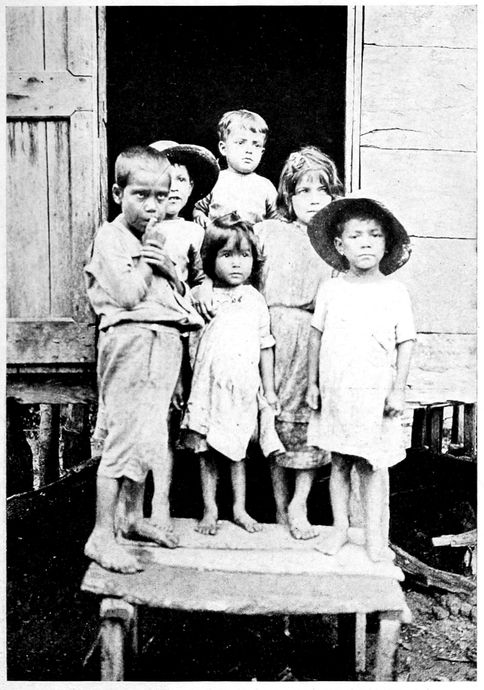
There are school accommodations for only half the children of our Porto Rico
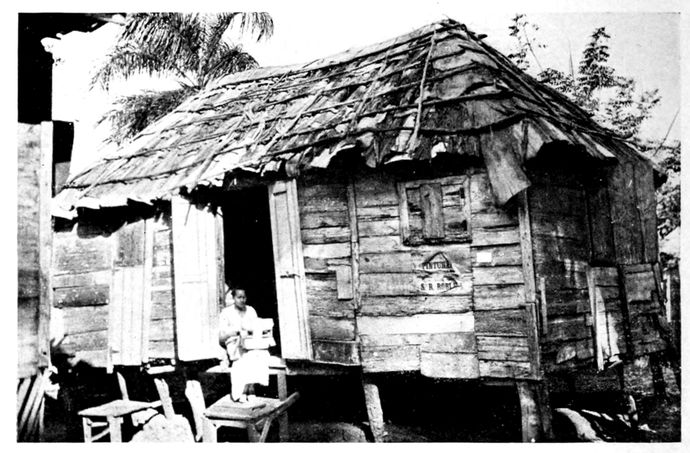
The home of a lace-maker in Aquadillo
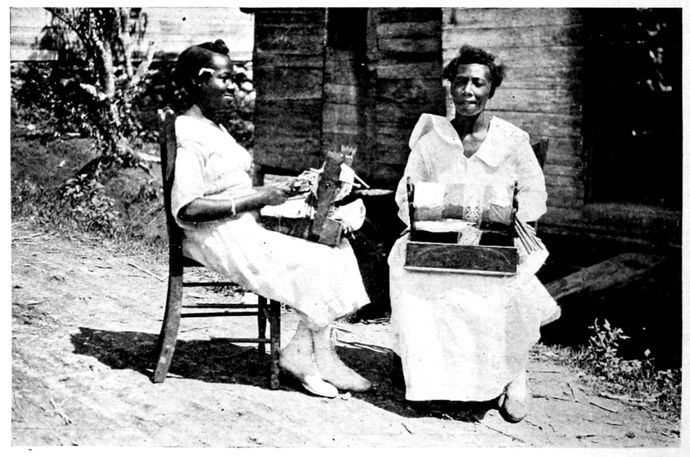
The Porto Rican method of making lace
273Porto Rico was in the midst of a wide-spread strike among the sugar
workers during our stay there. All through this busiest month of
February there had been constant parades of strikers along the coast
roads by day and thronged mitines in the towns each evening. The
paraders were with few exceptions law-abiding and peaceful despite
the scores of red flags that followed the huge Stars and Stripes at the
head of each procession. When the authorities protested, the strike
leaders explained that red had long stood as the symbol of the laboring
class in Spanish countries. They were astounded to learn that to
people beyond the blue sea that surrounds them, the color meant lawlessness
and revolt by violence, and they lost no time in adopting instead
a green banner. When this in turn was found to have a similar
significance in another island somewhere far away, they chose a white
flag. It was not a matter of one color or another, they said, but of
sufficient food to feed their hungry families.
Negro spell-binders from the cities, evil-faced fellows for the most
part, whose soft hands showed no evidence of ever having wielded a
cane-knife, harangued the barefoot multitudes in moonlighted town
streets. When the head of the movement was taken to task by neutral
fellow-citizens for not choosing lieutenants more capable of arousing
general public sympathy and confidence, he replied with a fervent, “I
wish to God I could!” But the ranks of Porto Rican workmen do
not easily yield men of even the modicum of education required to
spread-eagle a public meeting. Held down for centuries to almost
the level of serfs, they have little notion of how to use that modern
double-edged weapon, the strike. They do not put their heads together,
formulate their demands, and carry them to their employers.
Inert by nature and training, they plod on until some outside agitator
comes along and tells them they shall get higher wages if only they
will follow his leadership, whisper to one another that it would be
nice to have more money, and quit work, with no funds to support
themselves in idleness or any other preparation. It is the old irresponsibility,
the lack of foreplanning common to the tropics. Then,
that they may not be the losers whichever side wins, they strive to
keep on good terms with their employers by telling them that only the
fear of violence from their fellows keeps them from coming to work,
274being so docile by nature that they would not hurt even the feelings
of their superiors.
This time the strikers had been encouraged by what they mistook
to be federal support. The American Federation of Labor had sent
down as investigating delegates two men of forceful Irish wit who
were naturally appalled to find their new fellow-citizens living under
conditions unequalled even among their ancestral peat-bogs. What
they did not recognize was that all over Latin-America, even where land
is virtually unlimited and there are no corporations to “exploit” the
populace, the masses live in much the same thatched-hut degradation.
Their familiarity, with the Porto Rican environment was as negative
as their knowledge of the Spanish language; they made the almost universal
American mistake of thinking that what is true of the United
States is equally so of all other countries, and their straight-forward
national temperament made them, no match for the wily, intricate
machinations of native politicians.
Porto Rico had not been so lively since the Americans ousted the
Spaniards. I had an opportunity of hearing both sides of the case,
for with the privilege of the mere observer I was equally welcome—whatever
the degree may have been—in the touring car of the delegates
and at the dinner-tables of the sugar managers.
“These simple fellows from the States,” said the latter, “think they
can solve the problem of over-population by giving $2.50 a day to all
laborers, good or bad, weak or strong. The result would be to drive
the best workmen out of the country, and leave us, our stock-holders,
and the consumers, victims of the poorest. Like the labor union movement
everywhere, it would give the advantage to the weakling, the
scamper, the time-killer. We have men in our fields who earn $3.50
a day, and who will tell you they do not know why on earth they are
striking. Men who can cut six tons of cane a day on piece-work will
not cut one ton at day wages. Then there are men so full of the hookworm
that they haven’t the strength to earn one dollar a day. We
centrals insist on keeping the ajuste system that has always prevailed in
Porto Rico—the letting of work by contract to self-appointed gang
leaders; and we will not sign a minimum wage scale because there is
no responsible person to see that the terms are carried out on the
laborer’s side. We refuse to deal with the strikers’ committees because
we cannot listen to a lot of bakers and barbers from the towns who
do not know sugarcane from swamp reeds. There is nothing but
politics back of it all any way. This is a presidential year; that explains
275the sudden interest of politicians in the poor down-trodden
laboring class. Our men earn at least $1.75 a day—and they seldom
work in the fields after two in the afternoon. Besides that we give
every employee a twenty per cent. bonus, a house to live in if he
chooses, free medical attention, half-time when they are sick, and the
privilege of buying their supplies in our company stores at cost. Cuba
pays higher wages, but the companies get most of it back through
their stores. We run ours at a loss; I can prove it to you by our
books; and we give much to charity. Hungry indeed! Do you know
that our biggest sales to our laborers are costly perfumes? They may
starve their children, but they can always feed fresh eggs to their
fighting-cocks. There is hardly a man of them that is not keeping
two or three women. If we paid our men twice what we do, the only
result would be that they would lay off every other day. Let them
strike! We can always get hillmen from the interior or men from
Aguadilla who are only too glad to work for even less than we are
paying now.”
I found Santiago Iglesias literally up to his ears in work at the
headquarters of the Socialist-Labor party, a few doors from the governor’s
palace. About him swarmed several of the foxy-faced individuals
he had himself privately deplored as assistants. A powerful
man in the prime of life, of pure Spanish blood, the radical Porto
Rican senator was quite ready to recapitulate once more his view of
the situation. If he was “playing politics”—and what elective government
official is not every time he opens his mouth or turns over
in bed?—he gave at least the impression of being genuinely distressed
at the condition of Porto Rico’s poverty-bred masses. We had conversed
for some time in Spanish before he surprised me by breaking
forth into a vigorous English, amusing for its curious errors of pronunciation.
The minimum wage demanded, for instance, which recurred
in almost every sentence, always emerged from his lips with
the second f transformed into an s. That is the chief trouble with
Santiago, according to his opponents—his methods are “too fisty.”
“There has been a vast improvement in personal liberty in Porto
Rico under American rule,” he began. “But the island has been surrendered
to Wall Street, to the heartless corporations that always
profit most by American expansion. Moreover, American rule has
forced upon us American prices—it always does—without giving
our people the corresponding income. Formerly all our wealth went
to Spain. Now it goes to the States, but with this difference,—under
276Spanish rule wages were low but the employers were paternal; they
thought occasionally about their peons. At least the workers got
enough to eat. The corporations that have taken their place are utterly
impersonal; the workmen who sweat in the sun for them are no more
to the far away stock-holders than the canes that pass between the
rollers of their sugar-mills. When they get these magnificent returns
on their investment do the Americans who hold stocks and bonds in
our great centrals ever ask themselves how the men who are actually
earning them are getting on? No, they sit tight in their comfortable
church pews giving thanks to the Lord with a freer conscience than
ever did the Spanish conquistadores, for they are too far away ever
to see the sufferings of their peons.
“The sugar companies can produce sugar at a hundred dollars a
ton; they are getting two hundred and forty. The common stock of
the four big ones, paid from fifty-six to seventy dollars last year on
every hundred dollars invested, not to mention a lot of extra dividends,
and their profits for this zafra will be far higher. The island is being
pumped dry of its resources and nothing is being put back into it. In
the States not twenty per cent. of the national income goes out of the
country; the rest goes back into reproduction. In Porto Rico seventy
per cent. goes to foreigners, and of the thirty left wealthy Porto Ricans
spend a large amount abroad. We do not want our land all used to
enrich non-resident stock-holders; we need it to feed our own people.
There is not corn-meal and beans enough now to go round, because
the big sugar centrals hold all the fertile soil. They have bought all
the land about them, even the foot-hills, so that the people cannot
plant anything, but must work for the companies. Stock-holders are
entitled to a fair profit on the capital actually invested—actually, I
say—and something for the risk taken—which certainly is not great.
But the Porto Ricans, the men, and women, and the scrawny children
who do the actual work in the broiling tropical sun should get the rest
of it, in wages. We should tax non-resident sugar companies ten per
cent. of their income for the improvement of Porto Rico; we should
borrow several millions in the States and give our poor people land
to cultivate, and pay the loan back out of that tax. But what can we
do? The politicians, the high officials are all interested in sugar.
They and the corporations form the invisible government; they are the
law, the police, the rulers, the patriots. Patriots! The instant the
Porto Rican income-tax was set at half that in the States the corporations
made Porto Rico their legal residence. When the federal government
277would not stand for the trick and forced them to pay the
balance they cried unto high Heaven. Porto Rican law forbids any
company or individual to own more than five hundred acres. They
get around the law by trickery, by dividing the holdings among the
members of the same family, by making fake divisions of company
stock. The Secretary of War and other federal officials come down
here to ‘investigate.’ They motor across our beautiful mountains,
have two or three banquets in the homes of the rich or the central
managers, and the newspapers in the States shout ‘Great Prosperity
in Porto Rico!’ I tell you it is the criminal lack of equity, the same
old blindness of the landed classes the world over and in all ages that
is driving Porto Rico into the camp of the violent radicals.
“You admire our fine roads. All visitors do. You do not realize
that they were built because the corporations needed them. And did
we pay for them by taxing the corporations? We did not. We paid
for them by government bonds—that is, we charged them up to the
children of the peons. You have probably found that we have inadequate
school facilities. The corporations, the invisible government,
do not want the masses educated, because then they would not have
left any easily manipulated laboring class. Nor do I take much stock
in this over-population idea. At least I should like to see the half
million untilled acres turned over to the people before I will believe
emigration is necessary. Sixty per cent. of Porto Rico is uncultivated,
yet eighty per cent. of the population goes to bed hungry every night
in the year. Then there is this cry of hookworm. Do not let the
Rockefeller Foundation, a direct descendant of the capitalists, tell you
lies about ‘anemia.’ The anemia of Porto Rico comes from no
worm, but from the fact that the people are always hungry. It is
the sordid miserliness of corporations, bent on keeping our peons reduced
to the level of serfs, in order that they may always have a cheap
supply of labor, that is the fundamental cause of the misery of Porto
Rico, of the naked, barefoot, hungry, schoolless, homeless desolation of
the working classes.”
The calm and neutral observer, neither underfed nor blessed with
the task of clipping sugar-stock coupons, detects a certain amount of
froth on the statements of both parties to the controversy in Porto Rico.
But he cannot but wonder why the sweat-stained laborers in the corn-fields
should be seen wearily tramping homeward to a one-room thatched
hovel to share a few boiled roots with a slattern woman and a swarm
of thin-shanked children while the Americans who direct them from
278the armchair comfort of fan-cooled offices stroll toward capacious
bungalows, pausing on the way for a game of tennis in the company
compound, and sit down to a faultless dinner amid all that appeals
to the aesthetic senses. Least of all can he reconcile the vision of
other Americans, whose only part in the production of sugar is the
collecting of dividends, rolling about the island in luxurious touring
cars, with the sight of the toil-worn, ragged workers whose uncouth
appearance arouses the haughty travelers to snorts of scorn or falsetto
shrieks of “how picturesque.”
The problem in Porto Rico, as the reader has long since suspected, is
the antithesis of that in Santo Domingo. In the latter island the difficulty
is to get laborers enough to develop the country; in the former
it is to find labor enough to occupy the swarming population. Barely
three-fourths of a million people are scattered through the broad insular
wilderness to the westward; the census of 1920 shows little
Porto Rico crowded with 1,263,474 inhabitants, that is nearly four
hundred persons to the square mile. There are several reasons for this
discrepancy; for one thing Santo Domingo has been fighting itself
for generations, while Porto Rico has never had a revolution. The
obvious solution of the problem has two serious drawbacks. The
Dominicans do not welcome immigration; they wish to keep their
country to themselves. The Porto Rican is inordinately fond of his
birthplace. Send him to the most distant part of the world and he
is sure sooner or later to come back to his beloved Borinquen. Emigration
from the island can reach even moderate success only when
entire families are sent. The letters of Porto Rican soldiers no nearer
the front than Florida or Panama were filled with wails of homesickness
that would have been pitiful had they not been tinged with what to the
unemotional Anglo-Saxon was a suggestion of the ludicrous.
There is a Japanese effect in the density of population of our little
West Indian colony. When the traveler has motored for hours without
once getting out of sight of human habitations, when he has noted
how the unpainted little shacks speckle the steepest hillside, even among
the high mountains, when he has seen the endless clusters of hovels that
surround every town, whether of the coast or the interior, he will come
to realize the crowded condition. If he is a trifle observant, he will
also see everywhere signs of the scarcity of work. Men lounging in
the doors of their huts in the middle of the day, surrounded by pale
women and children sucking a joint of sugar-cane, are not always
279loafers; in many cases they have nowhere to go and work. While the
women toil at making lace, drawn-work, or hats, the males turn their
hands to anything that the incessant struggle for livelihood suggests.
The man who spends two days in weaving a laundry basket and plods
fifteen or twenty miles to sell it for sixty cents is only one of a thousand
commonplace sights along the island highways.
A job is a prize in Porto Rico. If one is offered, applicants swarm;
many a man “lays off” in order to lend his job to his brother, his
cousin, or his compadre. Naturally, employers take advantage of this
condition. The American labor delegates told the chief of police that
he should be the first to lead his men on strike, for certainly he could
not keep them honest at forty-five dollars a month.
“Oh, yes, I can,” retorted the chief, “for while we have barely eight
hundred on the force, there are twelve thousand on the waiting-list, and
every policeman knows that if he is fired, he will have to go back to
punching bullocks at a third as much.” Mozos and chambermaids in
the best hotels seldom get more than five dollars a month. Street-car
men get from sixteen to twenty-five cents an hour, depending on the
length of service. In a large clothing factory of Mayagüez, fitted with
motor-run sewing-machines, only a few of the women get a dollar a
day; the majority average fifty cents. The law, of course, requires
that they be paid a minimum wage of a dollar; but what is a mere
law among a teeming population which the Spaniards spent four centuries
in training to be manso and uncomplaining? The favorite trick
is to pay the dollar, and then fine the women fifty cents for not having
done sufficient work. Among the regrettable sights of the island are
groups of callous emissaries frequenting the leading hotels who have
been sent down as agents of certain American department stores to
reap advantage from the local poverty. These comisionistas motor
about the island, placing orders with the wretched native women, but
by piece-work, you may be sure, to avoid the requirement of paying
a dollar a day. American women who are paying several times what
they once did for Porto Rican lace, blouses, and drawn-work, may fancy
that some of this increase goes to the humble mujeres who do the work.
Not at all. They are still toiling in their miserable little huts at the
same ludicrous prices, while their products are being sold on the
“bargain” counters in our large cities, at several hundred per cent.
profit. So thoroughly have these touts combed the country that the
individual can nowhere buy of the makers; their work has all been
contracted far in advance.
280
The American who, noting the Stars and Stripes flying everywhere
and post-offices selling the old familiar postage-stamps,
fancies he is back in his native land again is due for a shock.
Though it has been Americanized industrially, Porto Rico has changed
but little in its every-day life. Step out of one of the three principal
hotels of the capital and you are in a foreign land. Spanish is as necessary
to the traveler in Porto Rico who intends to get out of the
Condado-Vanderbilt-automobile belt as it is in Cuba, Mexico, or South
America. Though it is not quite true that “base-ball and poker are
the only signs of American influence,” the other evidences might be
counted on the fingers. There is the use of personal checks in place
of actual money, for instance; venders of chickens carry them in
baskets instead of by the legs. Offenders are tried by a jury of their
peers; the native regiment wears the uniform of our regular army;
it would take deep reflection to think of many more instances. Only
one daily newspaper in Porto Rico has an English edition. The first
American theatrical company to visit the island since the United States
took it over was due the week we left. There are barely ten thousand
American residents; except in the capital and the heart of two or
three other cities one attracts as much gaping attention as in the wilds
of Bolivia. In a way this conservatism is one of the charms of the
island. The mere traveler is agreeably disappointed to find that it has
not been “Americanized” in the unpleasant sense of the word, that
it has kept much of its picturesque, old-world atmosphere.
English is little spoken in Porto Rico. That is another of the surprises
it has in store for us, at least for those of us old enough to remember
what a splurge we made of swamping the island with American
teachers soon after we took it over. It is indeed the “official”
language, but the officials who speak it are rare, unless they come from
the United States, in which case they are almost certain to be equally
ignorant of Spanish. The governor never stirs abroad without an
interpreter. The chief of police rarely ventures a few words of
281Castilian, though there is scarcely a patrolman even in the heart of
San Juan who can answer the simplest question in English. Can any
one think up a valid reason why a fair command of the official tongue
should not be required of natives seeking government employment?
Spanish is a delightful language; its own children are no more fond
of it than I am. But after all, Porto Rico differs from the rest of
Spanish-America, in that it is a part of the United States. She aspires
some day to statehood. That day should not come until she knows
English; it is not a question of one language in place of another, but
of mutual understanding.
To be sure, English is compulsory in all the schools of the island,
but few pupils learn it thoroughly enough to retain it through life.
Most of them can read it in a parrot-like manner; if they speak it at
all, it is to shout some half-intelligible phrase after a passing American.
“Aw right” is about the only expression that has been thoroughly
Portoricanized. That is not exactly the fault of the pupils. The ear
shudders at the “English” spoken even by those teachers who are supposed
to be specialists in it; the rest are little short of incomprehensible.
Passed on from one such instructor to another, the English that finally
comes down to the pupils resembles the original about as much as an
oft-repeated bit of gossip resembles the original facts. It might almost
be said that there has been no progress made in teaching Porto Rico
English in the twenty years of American rule, or at least in the last
fifteen of them.
On the whole the state of education in Porto Rico is a disappointment.
It is a surprise to the visitor who has thought this essential matter
was settled long ago to find sixty per cent. of the population illiterate,
few countrymen over thirty who can read, and scarcely a third of the
children of school age in school. We had, of course, much to make up.
In 1898, after four centuries of ostensibly civilized government, there
was but one building on the island specially erected for educational
purposes. The total enrollment in the schools, with a population of
nearly a million, was 26,000. Three-fourths of the males of voting
age were wholly illiterate. Pupils were “farmed out,” teachers drew
salaries without ever going near a schoolhouse, all the old Spanish
tricks were in full swing. But that was twenty years ago. Yet the
department of education asks for twenty years more to bring things
up to a “reasonable standard.” Why? Moreover, at the rate things
have been moving it will not nearly do that. The thousand and more
school-buildings that have been erected, tropical Spanish in architecture,
282well lighted and ventilated, of concrete in the towns and wood in the
country, their names in English over the entrances, are all very well,
but they are far from sufficient. The census taken just before our
arrival showed almost a half million children of school age, with 181,716
enrolled, and 146,561 in average attendance. Of the 2984 teachers
only 148 were Americans. The only inducement Porto Rico offers
to instructors from “the States” is an appeal to the love of adventure.
Those who wish to make a trip to the tropics may be sure of a position—at
a lower salary than they receive at home, and with the privilege
of paying their own passages down and back to profiteering steamship
companies. No wonder the “English” of Porto Rico is going to
seed.
In the graded school system of the towns all instruction is given
in that maltreated tongue except the class in Spanish. In the rural
schools all the work is given in Spanish except a class in so-called
English as a special subject in all grades above the first. The University
of Porto Rico, seventeen years old, has fewer than a thousand
students. The Agricultural College in Mayagüez has some two hundred.
Private institutions like the Polytechnic Institute of San Germán
are doing yeoman service, but why should the education of Porto
Rico depend on private enterprise? The natives claim that the trouble
is that nearly all the commissioners of education sent down from the
United States have been political appointees; the latter lay the blame
to the fact that salaries and disbursements are set by the native legislature.
Somewhere between the two the education of Porto Rico is
suffering.
For all their misfortunes, or perhaps because of them, the Porto
Ricans, especially outside the large cities, are hospitable and soft-mannered,
characterized by a constant courtesy and a solicitude to please
those with whom they come in contact, with little of that bruskness of
intercourse for which “the Mainland” is notorious. The island has
a less grasping, less materialistic atmosphere than Cuba, it is less sinister,
less cynical, more naïve, its people are more primitive and simple,
though industrial oppression and American influence are slowly changing
them in this regard. Their naïveté is often delightful. It is reported
that a company of youthful jíbaros drafted into the Federal
service during the war waited on their captain one day and asked for
their “time,” as they did not care for a job in which they had to wear
shoes! The children are rarely boisterous, rather well-bred, even
where little chance for breeding exists. As a race they have kept
283many of the peculiarities of their Spanish ancestry. They are still
Latin Americans in their over-developed personal pride and their lack
of a sense of humor. Moorish seclusion of women still raises its head
among the “best families.” The horror in the slightest suggestion of
manual labor, of a lowering of caste, still oppresses the “upper” class.
Few of them would dream of carrying their own suitcase or a package
from a store, even though they must abandon them for lack of a peon.
Though they are far more polite than our own club-swingers in superficial
matters, it has required persistent training to get the insular police
to forget their high standing and help across the street women or
children of the socially inferior class. Finally, Porto Ricans are little
to be depended upon in the matter of time; mañana is still their watchword
despite twenty years of Anglo-Saxon bustle. But, for that
matter, Americans get hopelessly irresponsible on this same subject
after a few years in the tropics.
The unprepared visitor will find Porto Ricans astonishingly white,
especially in the interior. There are few full negroes on the island;
sixty per cent. of the population have straight hair. Yet there is a
motley mixture of races, without rhyme or reason from our point of
view. Mulatto estate owners may have pure white peons working for
them; a native octoroon is frequently seen ordering about a Gallego servant
from Spain. There is still considerable evidence of Indian blood in
the Porto Rican physiognomy, for the aborigines, taking refuge in the
high mountains, were wiped out only by assimilation. Then there are
Japanese or Chinese features peering forth from many a hybrid face.
The Spaniards brought in coolies to work on the military roads, and
they mixed freely with all the lower ranks of the population. Yet
pure-blooded Orientals are conspicuous by their absence; so overcrowded
a community does not appeal even to the ubiquitous Chinese
laundryman. For the same reason Jews, Syrians, and Armenians have
not invaded the island in any great numbers, though one now and then
meets an olive-skinned peddler tramping from village to town with a
great flat basket filled with bolts of calico and the like on his cylindrical
head.
Small commerce is almost entirely in the hands of Spaniards, thanks
to whom the mixture of races that made Latin-America a hybrid is
still going on—to say nothing of an exploiting of the simple jíbaros
that would have been scorned by the old straight-forward, sword-brandishing
conquistadores. The modern Spaniard, especially the
284Canary Islanders, come over as clerks, live like dogs until they have
acquired an interest in their master’s business, and eventually set up
a little store for themselves. Sharp, thrifty, heartless, utterly devoid
of any ideal than the amassing of a fortune, they resort to every species
of trickery to increase their already exorbitant profits. The favorite
scheme is to get the naïve countrymen into a gambling game, manigua,
the native card-game, for instance, and to urge them on after their
scanty funds are exhausted with a sweet-voiced “Don’t let that worry
you, Chico, I’ll lend you all you want. Go ahead and play,” until they
have a mortgage on “Chico’s” little farm or have forced him to sign
a contract to sell them all his coffee at half the market price. Then
when his fortune is made, the wily Iberian leaves each of his concubines
and her half-breed flock of children a little hut, goes back to Spain,
marries, and bequeaths his wealth to his legitimate offspring. Many a
little plantation is still encumbered with these “manigua mortgages.”
To the casual observer there seems to be no color-line in Porto Rico;
but in home life and social matters there is comparatively little mingling
of whites and blacks above the peon class. In the Agricultural College
at Mayagüez, for instance, this question is left entirely to the pupils.
The students draw their own color-line. Clubs are formed that take
in only white members, though a few of these might not pass muster
among Americans. The colored boys do not form clubs because they
cannot afford to do so. In the early days the teachers gave a dance
to which all students were invited without distinction. But the darker
youths brought up all sorts of female companions from the playa
hovels, and the experiment was never repeated. Yet it is no unusual
sight to see a white and a mulatto youth sharing a textbook in the shade
of a campus mango-tree.
There remain few strictly insular customs to distinguish Porto Rico
from the rest of Latin-America. The native musical instrument is a
calabash, or gourd, with a roughened surface over which a steel wire is
rubbed, producing a half-mournful, rasping sound almost without
cadence. Thanks perhaps to American influence, the church bells are
musical and are rung only by day, in grateful contrast to the incessant,
broken-boiler din of other Spanish-settled countries. The Rosario, a
kind of native wake, consists of all-night singing by the friends and
relatives of the recent dead. Possibly the most universal local custom
is that of using barbed-wire fences as clothes-lines, to the misfortune
even of the linen of trustful visitors. The panacea for all rural ills
seems to be the tying of a white cloth about the head. Doctors seldom
285go into the country, but let the sick be brought in to them, whatever
the stage of their illness. More than ten thousand, chiefly of the hut-dwelling
class, died of “flu” during the winter of 1918–19, largely
because of this inertia of physicians.
One must not lose sight of their history in judging the present condition
of the Porto Rican masses. It is only fifty years since slaves
over sixty and under three were liberated, and later still that slavery
was entirely abolished. No wonder the owners were glad to be rid
of what fast breeding had made a burden, especially with free labor
at twenty cents a day. Yet they were indemnified with eight million
dollars from the insular revenues. Nor was servitude confined to
Africans. Spain long used Porto Rico as a penal colony, and when
public works no longer required them, the convicts were turned loose to
shift for themselves. Most of them took to the mountains where
the “poor white” population is numerous to this day. Yet the later
generations are no more criminal than the Australians; if there is
much petty thieving, it is natural in a hungry, overcrowded community.
The insular police established by the Americans have an efficiency
rare in tropical countries. Their detective force rounds up a larger
percentage of law-breakers than almost any other such body in the
world. The insular character of their beat is to their advantage, of
course; few Porto Ricans can swim. The island has long since been
“cleaned up,” and the unarmed stranger is safer in its remotest corners
than on Broadway. In olden days the Porto Rican was as fond of
making himself a walking arsenal as the Dominican; ten thousand
revolvers were seized in nine years, and miscellaneous weapons too
numerous to count have been confiscated and destroyed. To-day,
except in the rare cases when a desperado like “Chuchu” breaks loose,
or strikers grow troublesome, the spotlessly uniformed insular force
has little to do but to enforce the unpopular laws that have come with
American rule.
Porto Rico voted herself dry in 1917. Three varying reasons are
given for this unnatural action, according to the point of view of the
speaker. Missionaries assert that, thanks largely to their work with
the populace, the hungry rank and file determined that their children
should not grow up under the alcoholic burden that had blasted their
own success in life. Scoffers claim the people were misled by psychological
suggestion. The majority make the more likely assertion that
the result was largely due to a mistake on the part of the ignorant
peons. The “dries” chose as their party emblem the green cocoanut,
286a favorite rural beverage. Their opponents decorated the head of their
ballot with a bottle. Now, the bottle suggests to the jíbaros of the hills
the Spaniards who keep the liquor shops, and they hate the Spaniards
as fiercely as they are capable of hating anything. Whatever the
workings of their obscure minds, the unshaven countrymen came down
out of the mountains to the polls, and next morning Porto Rico woke up
to find herself, to her unbounded surprise, “bone-dry.” The mere fact
that the politicians and the “influential citizens” almost in a body,
and even the American governor, who saw insular revenues cut down
when they sadly needed building up, were against the change had nothing
to do with the case. Since then the insular police have confiscated
hundreds of home-made stills and thousands of gallons of illicit liquor.
It is rumored that they would like to indict the Standard Oil Company
as an accessory before the fact, for virtually all the stills that languish
in the police museum in San Juan are made of the world-wide five-gallon
oil can, some of them ingenious in the extreme.
Cockfighting was forbidden by American edict soon after we took
over the island—and in retaliation the Porto Rican Legislature forbade
prize-fighting, even “practice bouts.” But there is no law against
keeping fighting-cocks, and where there are game-cocks there is bound
to be fighting, at least in Latin-America. The police are on the constant
lookout for clandestine riñas de gallos. One point in favor of
the sleuths is that, though they cannot arrest people for harboring prize
roosters, they can bring them up on the charge of cruelty to animals
if they pick and trim the birds as proper preparation for battle requires.
Americans who have lived long in Porto Rico assert that
cock-fighting and the lottery are so indigenous to the island that there
is little hope of really stamping them out. Indeed, even the police are
in sympathy with the sport, though they may not let that sympathy interfere
with doing their duty. High American officials sometimes ask
what there is wrong in running a lottery, so long as other forms of
gambling are permitted, especially as the old government lottery kept
up many benevolences. Why, they ask, should not the poor man be
allowed to “take a chance” as well as speculators on the stock exchange?
Roosters and billetes are two things that are sure to come
back if Porto Rico wins her autonomy during the life of the present
inhabitants. Possibly the next generation will be like-minded; one of
the absorbing tasks of the insular police is to keep street urchins from
gambling on the numbers of passing automobiles.
It is not surprising that Porto Rico has more than her share of
287juvenile offenders. Sexual morality is on a low plane in the island.
Though there is less public vice than with us, the custom of even the
“best citizens” to establish “outside families” is wide-spread. Even
the “Washington of Porto Rico,” who is pointed out as the model
man of the island, always kept two or three queridas, and lost none of
his high standing with the natives for that reason. Estate owners are
well-nigh as free with the pretty wives of their peons as were old
feudal lords. Women of this class are often more proud to have a son
by the “señor” than by their own husbands. The latter are easy-going
to a degree unknown among us; they may be cajoled by presents
or threatened with discharge—and where else shall they find a spot
to live on?—or at worst they can seek consolation in the arms of their
own queridas. The men usually acknowledge their illegal children
without hypocrisy, but they frequently abandon them to their own
devices. Homeless children are one of the problems of all Porto
Rican cities; in San Germán a gang of little ruffians roost in trees by
night. The cook of an American missionary family openly gave all
her wages, except what went for the rent of her hovel, to her “man,”
who was married to another. It was not that he demanded it; there
is little of the “white slave” attitude in Porto Rico, but she was proud
to do so and it is costumbre del país. Much as they deplored such an
employee, the missionaries endured her, knowing only too well by
experience that they might look farther and fare worse. Few Porto
Ricans of the better class permit their women to go to confession, however
strictly they keep up the other forms of religion. Out of church
the priests are frankly men like other men, and seldom have any
hesitancy in admitting it. One famous for his pulpit eloquence brazenly
boasts himself “the most successful lover in Porto Rico.”
It is natural that there should be a certain political unrest in Porto
Rico. The island does not know, for instance—nor does any one else,
apparently—whether it is a colony or a possession of the United
States, or whether it is an integral part of it. A bit of history is
required to explain the situation. The island was under the jurisdiction
of Santo Domingo from its settling to the end of the sixteenth century,
when a royal decree made it an independent colony. For a long time
it was not self-supporting—thanks, no doubt, largely to the dishonesty
of its governors. Its government became such a burden that Spain
assigned a certain proportion of the treasure it was drawing from
Mexico to support it. Incidentally this came near making Porto Rico
288British, for ships bringing funds from Mexico were repeatedly made
the objects of attack, and the commander of one of these fleets once
attempted to occupy the island, but disease among his soldiers forced
him to abandon the enterprise, taking with him only such trophies as
he could tear from churches and fortresses. When, a hundred years
ago, the wave of rebellion swept over all the Spanish colonies, Santo
Domingo declared her independence and offered to coöperate with
Porto Rico in winning hers also; but a majority of the inhabitants
remained loyal to the crown. In 1887 a popular assembly in Ponce,
while acknowledging allegiance to Spain, demanded a certain measure
of autonomy. There was danger that the Cuban insurgents would
send an expedition to Porto Rico to join the malcontents there. Hence
on November 28, 1897, Spain granted Porto Rico local government
in so far as internal affairs, budgets, customs, and treaties of commerce
were concerned. She was to have an elective legislature, an upper
house appointed by the governor, and a cabinet composed of residents
of the island. The following February such a cabinet was appointed,
and on March 27—note the date—elections were held. In other
words Porto Rico had won autonomy without recourse to bloodshed,
and was on the eve of exercising it when the Maine was blown up.
Moreover, she had never in her history asked to be separated from
Spain.
When the Americans came, a postal system was organized, the
government lottery was suppressed, freedom of speech and of the press
was restored, a police force of natives under American officials was
established, strict sanitary measures were adopted, free schools were
opened, provision was made for the writ of habeas corpus and jury
trials, the courts were reorganized, imprisonment for political offenses,
chains and solitary confinement were abolished, the foreclosure of mortgages
was temporarily suspended, Spanish currency was replaced
by American, local officials were elected, and a civil government was
established on May 1, 1900. Note, however, that with all this Porto
Rico did not get as much autonomy as it had already won from Spain.
Gradually the island has almost reached the point politically where the
Spanish-American War found it, but meanwhile there had been much
discontent. Then along came the “Jones bill.” This provides for
an elective legislature, extends the appointive judiciary system, admits
a delegate to our Congress, and grants American citizenship to Porto
Ricans. But the acts of the insular legislature must be approved by
the American governor, and six of the heads of departments that make
up the Executive Council are Americans. The Porto Ricans chafe at
citizenship without statehood. The island complains that it is an
organized but not an incorporated territory of the United States.
Though it enjoys many of the rights of territories, and a larger exemption
from federal taxation than ever did any other American territory,
it is not politically happy.
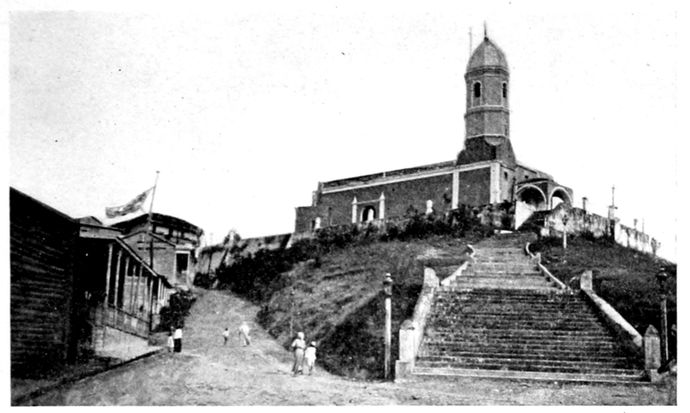
The place of pilgrimage for pious Porto Ricans
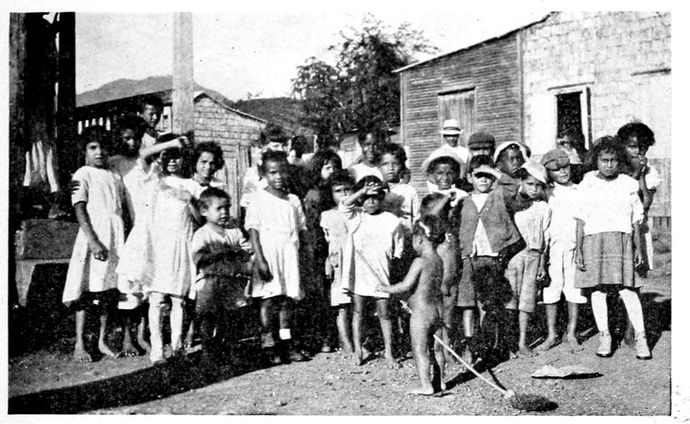
Porto Rican children of the coast lands
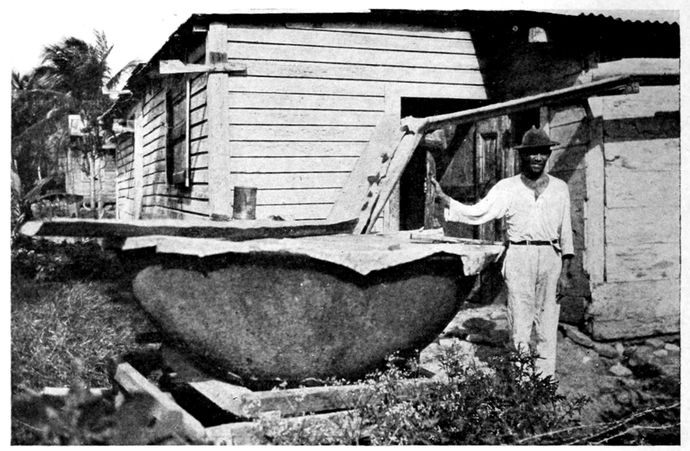
The old sugar kettles scattered through the West Indies have many uses
289There are four political parties in Porto Rico. The Republicans,
who have little in common with our “G. O. P.,” though they send delegates
to its conventions, want immediate statehood. The Unionists,
contrary to their title, demand independence. There is a strong socialist
and labor party, and a minor group that desires a return to Spanish
rule. These divisions are not so definite as they seem, if we may
believe an unusually informative native postmaster of the interior.
“The people with small government jobs,” he asserted, “many
school teachers among them, secretly long for independence, chiefly in
the hope of getting more graft. The Spaniards still mix secretly in
politics and are really independentistas, though pretending to want statehood.
Porto Rico would be wholly Americanized now if the governors
had not ignorantly put in anti-American políticos. There has
really been only one competent governor since the Americans took Porto
Rico. We are decidedly not yet ready for jury trial; there was one
of the most serious mistakes. It was also a mistake to make us American
citizens collectively. We should have been given individual choice
in the matter. Now if you accuse a man of not acting like an American
citizen he cries, ‘Pah! They made me an American citizen. I
had nothing to say about it.’ The best people think we need twenty
years of military rule before we are given even local liberty. A plebiscite
would give a false opinion because the politicians and the small-estate
owners, who are chiefly Spanish, would send their peons down
to vote for independence without any notion of what it means. And
the best class wouldn’t vote. Do you think I would have my photograph
and thumb-print taken, like a common criminal, in order to cast
my ballot? The people do not know how to be free, after centuries
of Spanish slavery. If independence were signed at eight o’clock to-morrow
morning, I should leave Porto Rico at nine!” he concluded,
vehemently.
There is, of course, no more reason why Porto Rico should have
her independence than that Florida should. That she is entitled to be
made a fully incorporated territory now, and a state in due season,
seems the fitting course. But she is decidedly not yet ready for statehood.
290For one thing she must first know English. The partial
autonomy she already enjoys shows her far from prepared for self-rule.
Uncle Sam is always in too big a hurry to give his wards local
government; also we listen perhaps too much to Latin-American criticism.
We are not used to the sob-eloquence of the race, which at
bottom means very little. The legislature and native insular officials
are by no means free from intrigue, graft, and dishonesty. Towns
with $100,000 incomes spend half of it in salaries to the mayor and
his colleagues. Teachers were forced to pay ten per cent. of their
wages into political funds, and the native court found that “they can
do what they wish with their salaries.” The great socialist senator
himself, rumor has it, bought land in Santurce at a dollar an acre, had
public streets put in, and sold out at three dollars, though that, to be
sure, might have happened in Trenton or Omaha. Even the post-offices
are said to be corrupt with local politics.
So long as there is a great apathetic, illiterate, emotional mass of
voters self-government can be no more than a farce, in Porto Rico
or elsewhere. No Anglo-Saxon party leader can hope to keep pace
with the suave machinations of Spanish-American politicians. They
can think of more tricks overnight than he can run to earth in a week.
Some years ago a youthful American was approached by a Porto
Rican political leader with a request to come and address a public
meeting.
“But I don’t know a word of Spanish!” he protested.
“All the better,” replied the politician; “we want you to speak in
English.”
“I never made a speech in my life,” continued the American.
“Talk about anything whatever,” pleaded the other, “the weather,
the scenery, baseball.”
The youth, who was not averse to a “lark,” mounted the platform
and began to expound in choppy words the glories of baseball. At
the end of each sentence the politician silenced him with a gesture and
“interpreted” his statements to the crowded peons, who, to the speaker’s
astonishment, greeted each well-rounded Spanish phrase with howls
of delight. Not until the meeting was over and one of his hearers had
addressed him by a name that was not his own, did the youth awaken
to the fact that he had been introduced as the son of the governor, and
that the Spanish portion of his speech had been an explanation of how
anxious his “father” was to have the “interpreter” elected to the
291office he sought. “Dice el americano (the American says)” is still
one of the by-words of Porto Rican politics.
But after all one does not visit so beautiful and fascinating a country
as Porto Rico to chatter of its problems, but to meet its curious people
and to marvel at its glorious scenery. More mountainous than even
Haiti and Santo Domingo, the island is such an unbroken labyrinth
of hills, ranges, and high peaks, of deep valleys, perpendicular slopes,
and precipitous canyons, that its rugged beauty seems never-ending.
That beauty, too, is enhanced by the great amount of cultivation, by
the character it gains over the often uninhabited island to the westward
in being everywhere peopled, by the great variety of colors that
decorate it especially in this tropical spring-time of February. Even
along the rolling coastal belt the highways are lined with the green- and
red-leaved almendras, or false almond-trees, which here and there carpet
the roads with Turkish rugs of fallen leaves. Higher up comes the
roble, or flowering laurel, with its masses of delicate pink blossoms,
then the bucaré-trees, used as coffee shade, daub the precipitous hillsides
with splotches of burnt-orange hue; still farther aloft come
beautiful tree ferns, symbolical of high tropical altitudes, and everywhere
stand the majestic royal palms and the dense, massive mango-trees,
in sorrel-colored blossom at this season, to crown the heavy green
vegetation that everywhere clothes the island. For although almost
every acre of it was denuded of its native forest growth by the tree-hating
Spaniards, nature and the necessities of man have replaced its
unbroken verdure.
It would be hard to say which of the several splendid roads across
the island offers the best glimpse of this scenic fairyland. Some swear
by the Ponce-Arecibo route, through the magnificent Utuado valley;
others find nothing to compare with the stretch between Comerio and
Cayey, the heart of the tobacco district; the most traveled certainly is
the great military highway of the Spaniards, from San Juan to Ponce,
the first half of it rivalled now by an American-built branch through
Barranquitas. Perhaps the most beautiful bit of all is the journey
from Guayama up to Cayey, that, too, by a route that antedates our
possession. One unconsciously compares these achievements of the old
Spanish engineers with our more recent efforts, and the comparison is
not always favorable to the Americans. The Spaniard built in that
leisurely fashion of European highways, which prefers wide detours
292to over-steep grades; his successor here and there betrays the impatience
of his race by a too abrupt turn or a sharper slope. Yet the works of
both are splendidly engineered, with never a really dangerous spot to a
sane driver, for all the hairpin curves, the precipitous mountain walls
above and below, the lofty bridges over profound canyons at the bottom
of which insignificant brooks meander or roaring torrents tear
seaward as if fleeing from the wrath of the towering peaks above,
according to the season. There are reminders of Europe at every
turn,—crenelated bridge-parapets, kilometer-posts and white fractions
of them at every hundred meters, squatting men wielding their
hammers on roadside stone-piles, caminero huts every few miles. It
is the latter, in particular, that explain the unfailing near-perfection of
Porto Rican highways. Brick or stone dwellings for the capataces,
or road foremen, who must proceed at once to any broken roadbed,
rain or shine, are interspersed with the too miserable huts of the peones
camineros, who toil unceasingly day after day in the up-keep of the
highways, like scattered railroad section-gangs. This system, a direct
legacy from Spain, would be the answer to our own road troubles, were
it possible to find men in our country willing to spend their lives at low
wages in such an occupation.
Travel is unceasing along these splendid island roads. Automobiles,
creaking ox-carts and massive tarpaulin-covered freight wagons drawn
by several teams of big Missouri mules, mail-busses and crowded
guaguas, horse carriages and now and then a string of pack-animals
to contrast with the flying motors, make endless procession along the
way, while countless barefoot pedestrians flank the blurred roadsides.
Only the horsemen so frequent elsewhere in Latin-America are conspicuous
by their scarcity. In contrast to carefully tended highways
are the constant successions of miserable huts, built of anything that
will hold together, some of them so close to the precipitous edge of
the road that the front yard sometimes comes tumbling down into it
in the rainy season. Others are pitched up the mountain sides to the
clouds above, many of the slopes so sheer that the little garden patches
stand almost on end. A case once actually came to court of a man
who sued his neighbor for pushing his cow off his farm, entailing great
labor to hoist her up again. Little American-style schoolhouses, the
Stars and Stripes always flying above them, the whole interior from
teacher to pupils visible through the wide-open doors, flash past.
Lounging men are frequent, women everywhere making lace or drawn-work
squat like toads in the doorways of their patched hovels, no one
293of which is insignificant or inaccessible enough not to have the census-enumerator’s
tag tacked in plain sight on its bare front wall.
From Guayama almost at sea-level the old Spanish carretera climbs
quickly into the cooler air, in snaky fashion, the town and the cane-green
valley below diminishing to a picture framed by the white
beach-line and the fuzzy mountain-slopes, then mounts by tortuous
curves and serpentine loops around the brinks of dizzy precipices to a
height of three thousand feet. For a time it clings along the cliff of a
magnificent little valley, giving an endless succession of vistas, panoramas
of mountains, ravines, and forested slopes, enhanced by frequent
glimpses of the deep-blue Caribbean. No one of these highways is
twice alike; morning or evening, under the blazing tropical sun or
veiled with mountain showers, there is always a different aspect.
Then suddenly it bursts out high above the valley of Cayey, the roof-flecked
red of the town surrounded and packed as far as the eye can
see with cloth-covered tobacco-fields, the crowning beauty of Porto
Rican scenery. As we drop downward by more hairpin curves and
climb again into the hills beyond, the steep mountainsides are everywhere
covered in enormous patches with what look like the snowfields
and glaciers of Switzerland, transported to the tropics. All through
the region the big unpainted wooden barns of the American Tobacco
Company bulk above the shade-grown immensities, as if half buried
by drifted snow, until the entranced beholder finds it hard to remember
that he is in a land of perpetual summer, despite the royal palms that
here and there spring aloft from the white landscape. Elsewhere the
unclothed fields are planted in endless rows of tobacco, on, up, and
over hill after mountain, some of them so steep as to make cultivation
seem impossible, and all looking as if their velvety green fur had
been put in order by a gigantic comb.
Here one meets wagon-loads of tobacco plants and men carrying
them in baskets on their heads, tiny plants in the transplanting season,
great clusters of the full-grown leaves in cutting-time. He is a simple
fellow, the stubby-footed toiler of these regions, so naïve that he often
tucks away for years the checks with which the company pays for his
produce, instead of cashing them. They are always “good,” he argues,
and easily concealed, and he seems never to have heard of the word
interest.
“Where does all this stuff go?” demanded an American tourist who
had been motoring for hours through these tropical glaciers, “I have
never seen much Porto Rican tobacco in the States.”
294“Ah, but when it reaches New York it becomes Habana,” explained
the tobacco agent. “You see, we mix it with the Cuban.”
“About one leaf of Habana to a bale of this,” suggested the tourist.
“Well, something like that,” admitted the tobacco-man.
The holy place of Porto Rico—for it would be a strange Latin-American
country without one—is the old church of Hormigueros,
a yellow church high on a hill, conspicuous afar off and with the inevitable
cane of the coast lands stretching away from it as far as the
pilgrim can see. The pious still climb its great stone stairway on their
hands and knees, though rarely now except during the big fiesta in
September. The story is that, some time back in the days of legend,
a bull attacked a man in the field below. The man prayed to the Virgin,
promising to do something in her honor if she would save him, and
at the very instant his life was about to be gored out the bull dropped
dead at his feet. There is a colored picture of that miracle in the
church on the hill, which was built by the grateful man, who also entailed
the estate he owned below to support it in perpetuity. To-day
the lands are producing sugar cane for the Guánica Central, which pays
rent to the church—and which also hastens to contribute when the
parish priest suggests that money is needed for a fiesta or for some
other purpose. For if the company does not respond, the priest calls
a holiday, digging up some old saint out of the church calendar, and
the fields round about go begging for laborers.
There is at least one other “sight” which the visitor to Porto Rico
should not miss, for it throws a striking side-light on Latin-American
character. In the hilly little town of Barranquitas is the birthplace
of Luís Muñoz Rivera, often called the “George Washington of Porto
Rico.” A cheap, thin, little clapboarded building, uninviting by our
standards, though almost palatial to the simple country people, it has
been turned into a museum to the dead insular hero, such a museum
as cannot often be seen elsewhere. At the back of the house a lean-to
garage has been built to accommodate the expensive touring-car in
which his remains were carried to the cemetery. Not that Rivera
owned an automobile; he was too honest a servant of his country to
have reached that degree of affluence. It was loaned for the funeral
by one of the dead man’s admirers, a senator and the owner of a large
sugar central. When the mourners returned, it was decided to make a
Porto Rican “Mount Vernon” of the humble residence of the departed
statesman, to which end the rich senator not only contributed generously
295in money, but added the improvised funeral-car. There it stands to
this day, its brand new tires lifted off the garage floor by wooden
horses, the license of four years ago still on its blunt nose, the plank
framework that was built out the back of it to hold the coffin still
intact. Inside the house is the narrow spring cot on which the hero
died, covered with those poetically lettered purple ribbons of which the
Latin-American mourner is so fond, and a score of other belongings,
similarly decorated. These include a tin bath-tub on wheels, a leather
valise, the high-hat box indispensable to diplomats, several photographs
of the deceased, death-masks of his face and of his hands, his last
umbrella—one almost expects to find his last toothbrush, with a purple
bow on the handle—all of them more or less covered with cobwebs.
On his writing-table lies a specially bound volume of his book of poems,
called “Tropicales,” and, most striking tribute of all, an elaborate bit
of embroidery done in the various shaded hair of his female admirers.
Rivera differed from most politicians in being strictly honest. Not
only did he live within his government salary; he gave a large share
of it to the poor. Bit by bit hatchet-and-cherry-tree stories are already
growing up about his memory. As the leader of the Unionist party
he was violently anti-American, went to the United States to fight for
the independence of the island—and came back ardently pro-American.
His admirers assert that “he would have been the salvation of Porto
Rico had he lived,” though exactly what they mean by the statement
they probably have little notion themselves.
There are two drawbacks to walking in Porto Rico, though the ardent
pedestrian will not let them deter him from his favorite sport. For
one thing an American attracts attention, and loses the incognito that
makes walking in Europe, for instance, so pleasant. Then the roads
are too good. The hard macadam surfaces which are the joy of the
motorist are not soft underfoot, and the rushing automobiles have
small respect for the mere foot-traveler. There are, of course, many
unpaved trails in and over the mountains, but they were scarcely passable
at the time of our visit, for Porto Rico seems to have no definitely
fixed wet and dry season.
I rambled about several sections of the island on foot. There was
the trip to and about Lares, for instance, in the heart of the coffee
district. The men of the over-developed big toes are less in touch with
the outside world than either the cane or tobacco planters. The coffee
industry is the only one that suffered by the island’s change of sovereignty.
296Though it was not introduced into Porto Rico until more
than two centuries after the sugar-cane, the Arabian berry was the king
of the island when General Miles landed the first American troops at
Guánica. The loss of their free markets in Spain and Cuba, however,
caused the coffee men to succumb under a discouragement from which
they have not wholly recovered to this day. It is this, no doubt, which
accounts for the careless methods of the cafetales, where jungle, weeds,
and parasites often choke the bushes, while the berries are dried on
half-cured cowhides laid in the open streets or on hut floors, with
chickens, dogs, goats, and naked children, to say nothing of pigs,
wandering over them at will. Such conditions will of course improve
when the United States, the greatest coffee-drinking nation on the
globe, finally learns that a berry equal to any in the world can be
produced on American soil.
In Lares region the crop is taken a bit more seriously. There are
brick coffee-floors in many a yard, and the bushes cover even the crests
of the mountains, though the stranger might not suspect it, hidden as
they are by the sheltering trees. They are pretty in their white blossoms
in the February season, and the bucaré trees flame forth everywhere
on the steep slopes. The Spaniards, who own many of the
estates, pay fifty cents “flat” a day to their peons. The more generous
Porto Rican growers, if their own assertions may be taken at par,
pay sixty cents, with the right to eat the oranges and guineos, or small
bananas, that fall from the trees, the rent-free possession of an acre
of ground on which to build a hut and graze a cow, a pig, or a few
chickens, and plant a garden, and such free firewood as may be picked
up on the estate. Formerly they paid thirty cents and gave two meals
a day, but the cost of food has caused them to “advance” wages instead.
The women and girls of the region spend most of their time
making lace or drawn-work, as elsewhere, unless they are attracted to
the cafetales in picking season by the higher inducement of forty cents
a day.
I paused to talk with a youth who kept a roadside “shop.” It consisted
of a few plantain leaves and pieces of boxes laid together into
a kind of shelter and counter. He rarely made a half-dollar daily
profit, he admitted, but that was all he could earn in the coffee fields,
and there he wore out his shoes, which cost much money. He was an
ardent friend of Americans, like many of the country people. Asked
to explain his friendship, he based it chiefly on the fact that they required
the police to speak politely to everyone, did not allow beating,
and punished their own people as well as Porto Ricans, whereas the
Spaniards always used to be let off free. Then the Americans gave
free schools. He had gone to one himself, “but he was not given
to learn.” It is a familiar refrain all over Porto Rico, even from
persons who have every outward evidence of being bright as our
average. Doctors say there is a special reason for this backwardness.
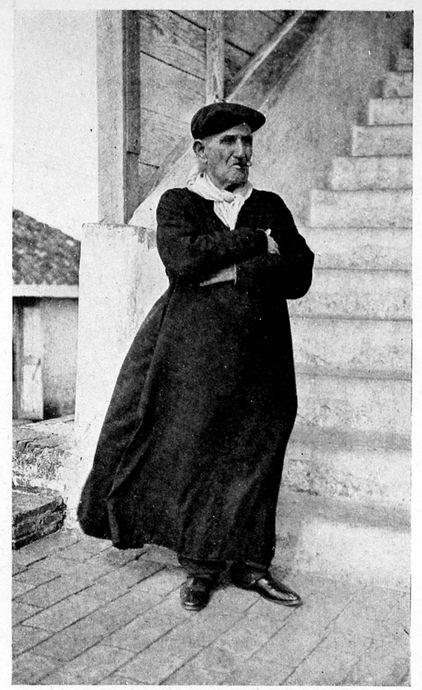
The priest in charge of Porto Rico’s place of pilgrimage
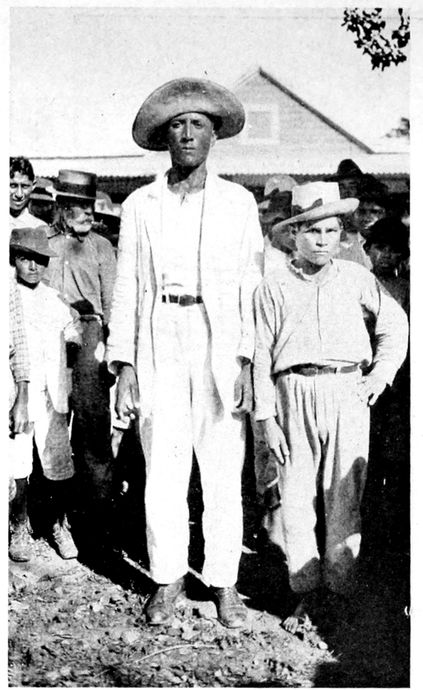
One reason why cane-cutters cannot all be paid the same wages
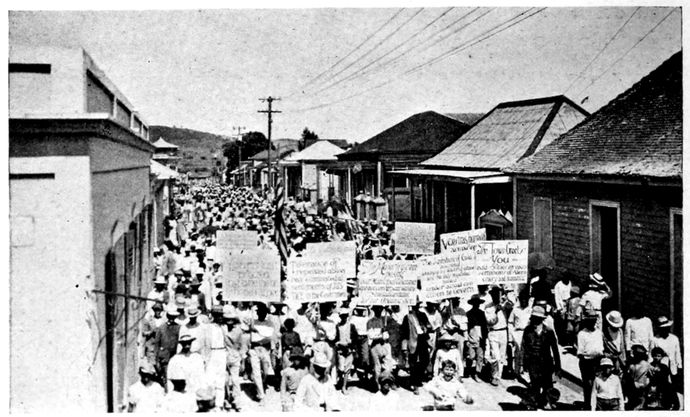
A procession of strikers in honor of representatives of the A. F. L.

“How many of you are on strike?” asked Senator Iglesias
297The peons of the region, silent-footed, listless, are often pure
Caucasian in type; indeed their pasty-white complexions frequently
contrast with the tanned faces of northern visitors. Now and again
one wanders by looking startlingly like a three-day corpse. They are
victims of the hookworm. There is more hookworm in Porto Rico,
those who should know tell us, than in any other country on the globe,
with the possible exception of India and Ceylon. The disease was
brought by African slaves—along with most of the troubles of the
West Indies—and while it does little harm to negroes, it is often
fatal to the whites. The population in the rural areas makes no sanitary
provisions, and soil pollution is wide-spread; they invariably go
barefooted, with the result to be expected. Ninety per cent. of the
laboring class was infected with hookworm when we took over the
island. An active campaign was waged at once and had good results,
but with partial autonomy the populace has fallen back almost into its
first pitiable condition. The Rockefeller Foundation has recently offered
three fourths of the preliminary expense of a new attack on the
disease, if the insular government will bear the rest. For the cure is
simple; it only requires persistence. Drafted soldiers were treated for
it, and one may easily detect the superiority in energy of the camineros
and laborers who are still to be seen in remnants of their old uniforms.
In a way it is Porto Rico’s most serious problem. Even a light infection
causes serious mental retardation, and much money that is spent
on schools is lost because of this defective mentality.
The hookworm is troublesome chiefly in the rural districts. The
poor of the cities, who are bread eaters, have sprue instead. Of late
only certified yeast from the United States has been permitted on the
island; moreover, sprue may be cured by vaccination. A more serious
thing is the prevalence of “t. b.”—which missionaries on the island
dub “tin box.” Since the Americans came, there has been a constant
increase in zinc roofs and sheet-iron houses over the old open-as-wool
thatch hovels, and as the countryman persists in closing by night even
the single tiny window, like that in the end of a box-car, up under the
eaves of his shacks, weak lungs are increasing.
298Fruit is abundant along the roads of Porto Rico. Mere bananas
are so plentiful that they are often abandoned to the goats and pigs;
in Lares a man with a wheelbarrow full of them was selling the largest
and best at seven cents a dozen. Wild oranges, sweet, and juicy, for
all their seeds, line the highways in what seems quantity sufficient to
supply the entire demands of the “Mainland.” Most of them never
reach the market. Here and there one runs across a crude packing-house
among the hills, but the fact that a box containing an average
of one hundred and fifty oranges, picked, sorted, crated, and hauled to
the coast, sells for fifty cents answers the natural query. In the trade
these are known as “east-side oranges,” and are generally sold by
pushcart men in the tenement districts of our large cities—at how
many hundred per cent. increase in price purchasers may figure out for
themselves.
Vegetable growing has never been favored by the inhabitants of our
strictly agricultural little West Indian possession. Like all Latin-Americans,
they are content to do as their forefathers have done, and
stick to the yams, yautías, and ñames, a coarse species of sweet potato,
which grow almost wild, and will have nothing to do with Yankee
innovations, though radishes mature in twelve days, and even Irish
potatoes may be grown in the higher altitudes, and the market price of
such vegetables is high. Bit by bit the jíbaros may be coaxed to improve
their opportunities. Clusters of beehives are already common
sights in the island, which can be said of no other section of tropical
America. The Federal Agricultural Experimental Station at Mayagüez
is to be thanked for this improvement. The old legend that bees lose
their custom of laying up honey after a few seasons in a winterless
land was found to be a fallacy, though they mix with the wild black
bees of the island and the queens have to be killed and replaced periodically
to keep the swarms from following the example of tropical man
and refusing duty. Dyewoods, cabinet woods, and timber for building
are wholly lacking in Porto Rico. Imported lumber costs $100 a
thousand square feet. No wonder huts are made of yagua, thatch, and
odds and ends. Indeed, the Federal institution mentioned above finds
it can get better lumber out of packing-boxes than it can buy on the
island. Porto Rico’s peculiar condition, a tropical country in which
practically all that the people produce is shipped out of the country,
and nearly all they consume shipped in, makes eventual improvement
of these conditions imperative. It strikes the casual observer as extraordinary,
for instance, that there are no large manufacturing industries
299on the island, with its excellent sources of water-power and
its unlimited supply of cheap labor.
I drifted out along the road from Aguadilla southward one day.
The first man to arouse my interest was a little peon caminero clearing
the highway edge of weeds, who was so pretty he would have made a
charming bride in proper garments. His wages were $27.60 a month.
He rented a “house” at $1.50 monthly, so large a house because he
kept his wife’s mother and two sisters, “for they have no other shelter.”
He said it casually, as one speaks of the weather, without the
faintest hint of the boasting an American of his class could scarcely
divorce from such a statement. A bit farther on a diseased old beggar
sat on the edge of the road, the bottom of the dirty old straw hat on the
ground before him sprinkled with copper cents—“chavos,” they call
them in Porto Rico, though the beggars soften their appeal by using the
diminutive “chavito.” There is a suggestion of India in the island’s
prevalence of alms-seekers,—blind men led by a boy or a dog, distressing
old women publicly displaying their ailments, cripples and
monstrosities wailing for sympathy from the passer-by. Scarcity of
land and employment, abetted by the bad Latin-American custom of
giving alms indiscriminately even to children, has brought a plague
of professional beggars. One such fellow in Mayagüez has pleaded
himself into possession of a twenty-acre finca—and is still begging.
A mendicant of San Germán complains that the time-table is so badly
arranged that he has to run to meet two trains. An American medical
missionary offered to remove the cataracts from his eyes free of charge,
but he declined to have his means of livelihood cut off. One of our
Porto Rican hosts was responding to the appeal of an old woman for
a “chavito” when a boy rushed up and cried, “Don’t give her anything,
señor, she has a cow!” The crone dashed after the urchin with
an astonishing burst of speed, and returned out of breath to wail, “It
is true, caballero, I admit it is true. But I have no pasture, and I must
beg now to support the cow.”
A long row of men were hoeing new sugarcane for the “Central
Coloso,” the tall stack of which broke the almost flat horizon behind
them. They watched my approach, plainly suspicious that any man
wearing shoes might be a company spy, and worked with redoubled
energy. They were paid $1.50 for a nine-hour day, except two who
were “sick” and a boy of seventeen, at two thirds that amount, and the
capataz, who differed from the others only by the lack of a hoe, at
300$1.80. As I turned away, the latter asked in a soft voice if I could tell
him the time. Then he drew from his pocket an Ingersoll watch and,
apologizing for his atrevemiento (“daring”), requested me to show
him how to set it, the men under him at the same time protesting that
“he should not make so bold with gentlemen.” A stout, pure-white
peon patching the road farther on, snatched off his hat as I spoke to
him. His wages had gone up during the past year—from seventy-three
to eighty cents a day! But he could earn little more than half
that in the coffee estates at home, so he had been glad to come down
to the coast to work. I drifted upon and strolled for a while along
the railroad. The section hands were getting a dollar a day, which
sets Porto Rico thirty years back in that regard, for I remember that
like wages were paid then on the branch line that passed my birthplace.
Perhaps the island’s laborers earn no more than they receive; a gang
of ten men were loading a cane-cart in a neighboring field a single
cane at a time. The two old women who were picking up rubbish
beyond them had never been married, but they had three and four
children respectively. They had always been paid forty cents a day,
but now they had been promised a dollar. Whether or not they would
get it only pay-day could tell. They accepted with alacrity the cigarettes
I offered. At noon I stepped into a shop-dwelling to ask for
food. The lunch that was finally prepared would not have over-fed a
field laborer, yet the cost was eighty cents. The family was moderately
clean, and energetic above the average. The four children all went
to school. On the wall of the poor little hovel, surrounded on all sides
by cane-fields, the oldest boy had chalked in English, “We have no
sugar because we have sent it all to the poor people of Europe.”
Along the soft-dirt private road to the central I met an intelligent
looking man of thirty or so, capable in appearance as any American
mechanic, Caucasian of race, his hair already turning gray. He begged
for a peseta. I opened my mouth to ask why a big, strong fellow in
the prime of life should be asking for alms, when my eyes fell upon
his left-leg. It was swollen to the knee with elephantiasis, both the
trouser-leg and the skin having burst with the expansion. A year ago,
he said, he had been out on a Sunday excursion in the country, and
had stopped to wash his feet in a creek. They smarted a bit on the
way home, but he thought nothing of it until, some time later, his left
foot began to swell. He was a cigar-maker by trade, and the Sanidad
had refused to let him work in such a condition, yet the government
would not take care of him. So he wandered about the country, where
301the people were more kindly than in the towns. The leg did not
exactly hurt any more, but it seemed to drag all his left side down with
its weight. He would gladly go and have it cut off, if he could find
a place to have it done, though people said even that would not do
much good. Tears were near the brim of his eyes, but they did not
well over. Hopeless cases of this kind seem much more pitiful when
one can talk to the sufferer and find him a rational human being, of
some education, than when they are merely the dog-like wretches of
India, who seem scarcely capable of thought.
One morning I stepped off the night train to Ponce and struck out
across the island by the Utuado road. It was an hour before I had
emerged from the populous suburbs of the town. Automobiles snorted
past without once offering a “lift.” Not that I wanted one, but one
gets an impression of selfishness in a community that passes a foot-traveler
without a suggestion of help. It was not universal here, however.
Before I had climbed a mile into the foot-hills a man in a rattletrap
buggy pulled his packages together in the seat and invited me to
jump in. It was hard to explain my refusal. There were many little
wayside “restaurants” where one would least expect any demand for
such accommodations. But people must win a livelihood somehow, as
one of the keepers explained. Then came a string of “villas,” of
Porto Ricans, Americans, and a few Englishmen, modest little summer
homes set where they could look down the valley upon the blue Caribbean.
Here and there were the creeper-grown ruins of old Spanish
country houses. Finally—a joke? I hardly think so, for the Latin-American
countryman has as little sarcasm as sense of humor—a
miserable little tin hut, in the yard of which the owner and his boy
were forking manure, was elaborately announced in large letters as
“Villa Providencia.”
At the first miriametro-post the coffee began, bananas and guayaba-trees
shading it. There passed much freight in tarpaulin-covered
wagons, the big brakes badly worn. A crowded guagua rumbled by,
the chauffeur and most of the passengers staring at me with an air
that said plainly, “Look at that stingy americano saving money by
walking!” Staring is universal in Porto Rico, at least outside the
larger cities. Even the “schoolmarms,” always well-dressed in spotless
but cheap materials, pause in their lessons to gaze at the sight that
has drawn the pupils’ attention.
Three hours up I had an extended view of the Caribbean, still seeming
barely a rifle-shot way. A boy of eight, living a few yards from
302a school, had never attended it, “because he had to take care of a sick
mare at home.” In the hovel-store where I had lunch three little girls
read English to me from their textbooks. I could understand them,
but only by giving their curious pronunciation the closest attention. Of
the information in their Spanish textbooks they had a moderate knowledge
for their years. The houses were constant; one was never out of
human sight or sound. The scarcity of dogs was in contrast to other
Latin-American countries; during an outbreak of bubonic plague some
years ago seven thousand were killed in Ponce alone. In a spot where
the roadside grew precipitous a sad-eyed peon stood looking at the little
garden before his house, which had fallen into the highway, more than
fifty feet below, during the night’s rain. Higher still the road reached
its point of greatest altitude and descended, more or less abruptly,
through artistic tree-ferns and clumps of bamboo to Adjuntas. All
I remember of the flat little town are the oranges heaped up at the
roadside, the drying coffee laid out on burlap sacks before the sleepy
little shops, and that “Ponce de Leon Brothers” kept one of the
clothing stores.
Many big auto-trucks were carrying bags of coffee in the direction
of Ponce, as others like them carry tobacco from the region of tropical
glaciers. The road forded a river, but so many stepping-stones had
been laid across it that I needed to take off only one shoe. A new
highway to Lares chewed its way upward into the almost chalky hills
to the left. We certainly build good roads in Porto Rico; the Spanish
influence seems to have survived the change of sovereignty. The highway
under my feet followed a rock-tumbled river all the rest of the
day. Census-tags decorated every hut. The enumerators did not skip
their political opponents, as in Cuba, and though the date had passed
after which the tags might be removed, not one of them had been
touched. Most of the people could not read the printed permission to
do so; besides, they would not dream of meddling in a government
matter. Sunset came early between the mountain walls piled high
above me on either side. Then fell the quick darkness of the tropics,
and there began a constant creaking that suggested young frogs. For
an hour I plodded on into the warm night, the road barely visible under
a crescent moon, in the faint rays of which the feathery bamboos that
lined the highway for a mile or more before reaching Utuado, looked
weirdly like faintly moving gigantic fans.
Utuado is a large town for its situation, and piled up the first slopes
of the hills about it in a stage-setting effect. Dense masses of fog—strange
303sight in the West Indies, where the fog-horn never breaks the
slumber of sea passengers—lay in its very streets until the tropical
sun wiped them away toward nine. Great precipices of limestone on
either side, a boiling river below, mountains of bold broken outline
ahead, marked the journey onward. The road climbed frequently,
even though it followed the growing river. Patches of tobacco, as well
as coffee, covered the steep hillsides; vegetation and mankind were
everywhere. Here and there the highway clung by its finger-nails and
eyebrows, as sailors say, along the face of the cliff. Then it regained
solid footing and broke out into a broad, flat coastland, hot, dusty, and
uninteresting, with cane and smoke-belching sugar-mills, and hurried
across it to Atlantic-washed Arecibo.
304
“It’s all I can do to keep from barking at you,” said a passenger
on the Virginia, as he crawled on hands and knees from one of
the four kennels that decorate her afterdeck. As a matter of fact,
we all did a certain amount of growling before the voyage was over.
Yet the four of us who had won the kennels were lucky dogs compared
to the unfortunate dozen or more who had to snatch what sleep they
could curled up on the bare deck or in a single sour-smelling cabin below,
where neither color, sex nor seasickness knew any distinction.
The weakest link in the shipping chain down the West Indies is
that between our own possessions. Once a week a little schooner that
was built to defend America’s yachting championship, but which never
reached the finals, raises its wings in San Juan harbor and, the winds
willing, drops a flock of disgruntled passengers, the United States mails,
and an assorted cargo in St. Thomas and St. Croix in time to return for
a similar venture seven days later. Congressional committees, of
course, have their battleships, and the white-uniformed governors of our
Virgin Islands their commodious steam-yacht; but the mere garden variety
of tax-paying citizen has the privilege of tossing about for several
days on the Virginia, subsisting on such food as he has had the foresight
to bring with him, and drinking such lukewarm water as he can
coax from the schooner’s cask.
It is nearly fifty miles from Porto Rico to St. Thomas. All day long
our racing yacht crawled along the coast, San Juan and the island’s
culminating peak, El Yunque, equally immovable on the horizon, while
the half-grown crew alternated between pumping water from the hold
and playfully disobeying the orders of the forceless old mulatto captain.
Nine at night found us opposite Fajardo light—more than an hour
by automobile from our starting-point! While the crew slept, without
so much as posting a lookout, a boy of thirteen sat at the wheel, and
the kennel-less passengers tossed restlessly on their chosen deck spots.
A half-grown pig—the only traveler on board whose ticket specified
ship’s food—wandered disconsolately fore and aft, now and then
demanding admission to one or another of the four “cabins.” No
doubt he recognized them as built for his own, rather than the human,
species.
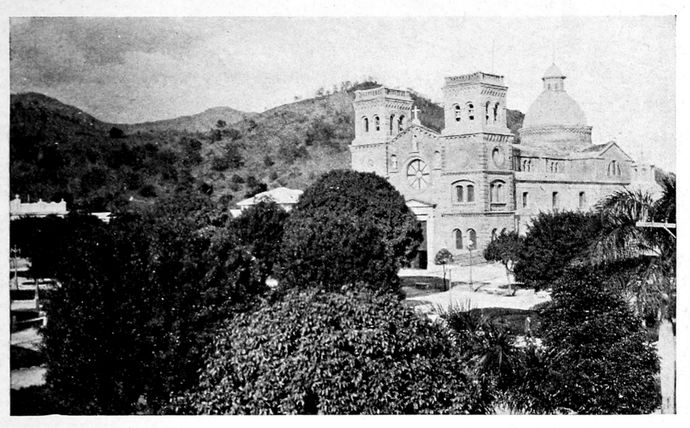
The new church of Guayama, Porto Rico
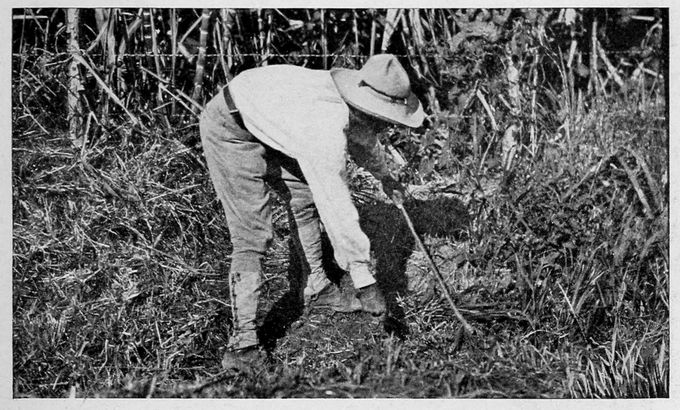
A Porto Rican ex-soldier working as road peon. He gathers the grass with a wooden hook and cuts it with a small sickle
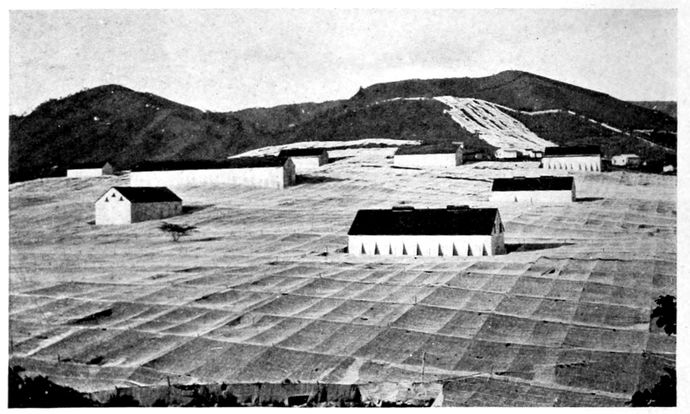
Porto Rican tobacco fields
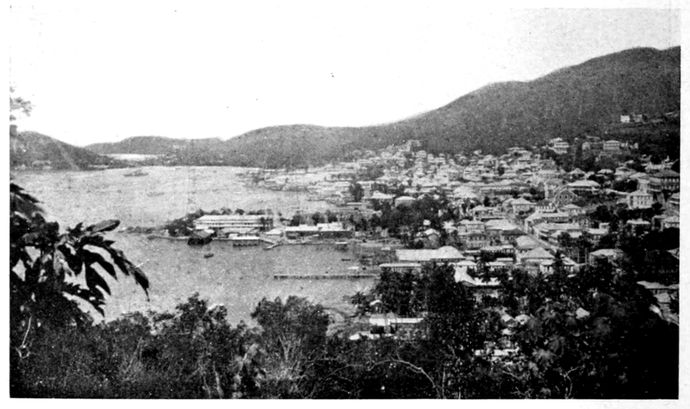
Charlotte Amalie, capital of our Virgin Islands
305Sunrise overtook us still within sight of Porto Rico, but with her
dependencies of Culebra and Vieques abeam, and the hazy mass of the
Virgin group visible on the horizon ahead. Brown, rugged, strangely
aged-looking, Culebra showed no signs of life except the lighthouse set
upon its highest cliff. Vieques, on the other hand, known to English-speaking
mariners as “Crab Island,” is a diminutive replica of Porto
Rico, with four large sugar-mills and a population of some eleven
thousand, American citizens all. The Danes once claimed this also,
but Spanish buccaneers established the more efficacious right of actual
possession, and at length the Porto Rican Government sent an expedition
to annex it to the Spanish crown.
With monotonous deliberation the Virgin group grew in size and
visibility. St. Thomas and St. John took on individuality amid their
flock of rocky keys, and British Tórtola gradually asserted its aloofness
from the American islands. Far off on the blue-gray horizon we could
even make out St. Croix, like a stain on the inverted bowl of sky.
Yet, though the breeze was strong, it was a head wind, and the ocean
current sweeping in from the eastward held us all but motionless when
we seemed to be cutting swiftly through the light waves. For five
profane hours we tacked to and fro within gunshot of a towering white
boulder jutting forth from the sea, and fittingly known as Sail Rock,
without seeming to advance a mile on our journey.
We turned the isolated precipice at last, and headed in toward mountainous
St. Thomas. Neither its scattered keys nor its long broken
coast-line showed any evidence of habitation, but at length three white
specks appeared on its water’s edge, and grew with the afternoon to a
semblance of Charlotte Amalie, a city rivaled in its beauty, at a distance,
by few others even in the beautiful West Indies. We greeted it
with fervent exclamations of delight, piled up white and radiant in the
moonlight on its three hills, like occupants of royal boxes at some gala
performance in its amphitheatrical harbor below. Scarcely a sound
came from it, however, except the languid swish of the waves on
what seemed to be the base of its lower houses, as we dropped anchor
near midnight within rowboat distance of the wharves. It had been an
unusually swift voyage, according to the uncommanding captain, a mere
two days instead of the four or five it frequently requires.
In due course of time a negro youth rowed out to examine us. He
306was an exceedingly courteous negro, to be sure, his white uniform was
spotless, and his English impeccable; but there was something incongruous
in the fact that American citizens must have his permission to
be admitted into one American possession from another. The “Grand
Hotel,” which virtually monopolizes the accommodation of transients
in St. Thomas, could not house us, or rather, on second thought, it
could, if we would be contented in the “annex” over a barber-shop
across the street. Its creaking floors were unbroken expanses of
spaciousness, but at least there was a mahogany four-poster in one
corner. We sat down on it with a sigh of contentment—and quickly
stood up again, under the impression that we had inadvertently sat
upon the floor. The Virgin Islands have not yet reached that decadent
degree of civilization that requires bed-springs. As to a bath—certainly,
it should be brought at once; and a half hour later a loose-kneed
negro wandered in and set down on the floor, with the rattle of
a hardware-shop in a tornado, a large tin pan, red with rust. All we
had to do, explained the ultra-courteous octoroon manager, was to call
another negro to bring a pail of water when—and the emphasis suggested
that the time was still far off—we “desired to perform our
ablutions.” The tub-bearer was evidently too worn out from his extraordinary
exertion to indulge in another before he had taken time to
recuperate.
That loose-kneed stroll of the Virgin-Islander is typical of all his
processes, mental, moral, or physical. It is not merely slow, rhythmical,
and dignified; there is in it a suggestion of limitless wealth, an untroubled
conscience, and an ancestry devoted to leisurely pursuits for
untold generations. In local parlance a “five minutes’ walk” means a
block. One must not even speak hastily to a native, for the only result
is wasted breath and the necessity of repeating the question in more
measured cadences. Politeness oozes from his every pore; “at your
sarvice, sar,” and “only too glad to be of use, ma’am,” interlard every
conversation; but any attempt, courteous or otherwise, to hurry the
Virgin Islander brings a sullen resentment which you will never
succeed in smiling away. As the navy men who are governing
him put it in the technical vernacular of their calling, he has only two
speeds,—“Slow Ahead” and “Stop.”
Once the visitor has shaken off the no doubt ridiculous notion that
things should be done in a hurry, or done at all, for that matter, he will
find our newly adopted children an amusing addition to the family.
Like all negroes in contact with civilization, they are fond of four-jointed
307words where monosyllables would suffice, and of pompous,
rounded sentences in place of brief-to-the-point statements. “Presently”
means “now”; “He detained from coming” is the local form of
“he can’t come.” Talking is one of the Virgin Islanders’ chief recreations.
They buttonhole the unknown passer-by and unburden themselves
to him at endless length, ceaselessly chattering on until he can
forge some excuse to tear himself away, when they hasten to ask their
friends if they, too, have seen “the stranger with the beard,” “the
American who arrived last night,” “that rich-looking gentleman in a
white helmet,” that the friends may not lose their chance of waylaying
the victim who is already listening to a new monologue around the
corner. If they can not find a hearer, they do not for that reason
abandon their favorite sport; it is commonplace to meet a pedestrian,
particularly a woman, chattering volubly to herself as she shuffles along
the street.
Their lack of self-restraint is on a par with their loquacity. When
the first navy hydroplanes flew into the harbor, the entire population
became a screaming mob of neck-craning, pointing, shoulder-clapping,
occupation-forgetting children. The winner of a dollar at the local
“horse” races, in which the island donkeys are now and then pitted
against one another, may be seen turning somersaults in the midst
of the crowd, or throwing himself on the ground, all fours clawing
the air, as he shrieks his ecstasies of delight. It is their joy to parade
the streets in their gayest costumes on any holiday, American, Danish,
or imaginable, that can be dragged into the calendar, dancing and
capering with an energy which their work-a-day manner never suggests.
Once a month, at full moon, the local band marches through
the town playing “Onward, Christian Soldiers,” the population trailing
en masse behind it, singing, clapping hands, and swaying their
rather slender, underfed bodies violently in cadence with the music.
They are ardent church-goers in theory, there being six large churches
of as many denominations in town—but it takes a rousing round of
hymns to bring the majority to indoor services, though boatmen far
out in the bay recognize a street meeting of the Salvation Army by the
howling chorus of “Lord, ha’ mercy on mah sou-ul,” which the cliffs
echo out to them.
The Sunday evening band concert, on the other hand, is staid enough
to make a Spanish-American retreta seem uproarious by comparison.
It begins at nine, after the last church service of a Britishly dead Sunday.
The native band, recruited by the administrative Americans,
308jet black in features and snow-white in uniform, mounts to the roof
of the old red fortress, while outwardly immaculate negroes, stroll
rather funereally about little Emancipation Park and along the edge
of the quay. The élite of the town sit in their houses, piled steeply up
the pyramidal hills, and let the music float up to them on the harbor
breeze. Our new fellow-countrymen are ostentatiously patriotic in
all that concerns mere formalities. Every morning at eight all St.
Thomas becomes static when the marine band plays our national anthem.
The market-women on the wharf halt as if suddenly turned to
stone, holding whatever posture they happen to be caught in until the
last note has died away; the very boatmen in the bay sit with their
poised oars motionless. Flags burst forth not merely on our own holidays,
but on Danish, on every possible fête day, public or private, even
on the birthdays of distant relatives or mere friends. Curious superstitions
enliven the quaint local color. The appearance of a lizard in
the house is sure proof to the lower classes that there is soon to be an
addition to the family. Servant girls cannot be induced to remove
their hats, whether cooking, making beds, or waiting on table at the
most formal dinner, for fear of sudden death from “dew” falling
on their heads—though it be full blazing noonday.
The great majority of the population is undernourished. Even
when their earnings are sufficient, most of the money is spent on
dress. The chief diet of the rank and file is sugar. A sugar-cane
three times a day seems to be enough to keep many of them alive. The
morning meal for the rest consists of “tea” only, the local meaning
of that word being a cupful of sugar dissolved in warm water. Then
along in the middle of the afternoon they indulge in their only real
food, and not very real at that. This is a plate of “fungee,” a nauseating
mixture of fish and corn-meal, which to the local taste is preferable
to the most succulent beefsteak. The natural result of the constant
consumption of sugar is an early scarcity of teeth. Barely three
men in twenty could be enlisted in the native corps, chiefly because
of their inability to cope with navy rations.
It goes without saying that such a population does not furnish
model workmen. From Friday night to Tuesday morning is apt
to be treated as “the Sabbath.” The man who works two days a
week at eighty cents has enough to provide himself with sugar-cane
and “fungee.” On the whole, the women are more industrious than
the men, perhaps because the great disparity of sexes makes the possession
309of a “man” something in the nature of a luxury. Time was
when the women of St. Thomas were able to support their husbands
in a more fitting manner than at present. In the good old days hundreds
of ships coaled here every month; now many a day passes without
one bringing a throng of negresses scampering for the coaling-wharf
far out beyond “Bluebeard’s Castle.” In a constant stream the soot-draped
women jog up the gang-plank, balancing the eighty-pound
basket of coal on their heads, often without touching it, thrust out a
begrimed hand for the three cents a trip which a local labor leader has
won them in place of the original one, drop the coins into a dust-laden
pocket, dump their load into the steamer’s chute, and trot down again.
Sometimes the ship is a man-of-war that unfairly speeds up the pace
of coalers by having its band play rousing music on the upper deck.
Here and there a man may be made out in the endless chain of black
humanity. At least one of them works with his wife as a “team”—by
carrying the empty basket back to be filled while she mounts
with the full one. But most of the males have the point of view of the
big “buck nigger” who was lying in the shade of the coal-pile watching
the process with an air of languid contentment. “Why de coalin’
is done by women, sah?” he repeated, scratching his head for a reply.
“Why, dat’s woman’s work.”
The population of our Virgin Islands is overwhelmingly negro.
Even Charlotte Amalie cannot muster one white man to ten of African
ancestry, and not a fourth of the latter show any Caucasian mixture.
Once upon a time the Jews were numerous; there is still a Jewish
cemetery, but the synagogue has been abandoned for lack of congregation.
Though the islands were Danish for nearly two and a half
centuries, their language has always been English, probably because
their business has ever been with ships and men who, though it may
not always have been their native tongue, spoke the language of the
sea. Some six years before we purchased the islands the Danes made
an attempt to teach Danish in the schools. But though many little
negroes learned to chatter more or less fluently in that tongue, to the
detriment of more essential studies, the local environment proved too
strong, and the very Danish officials became proficient in English in
spite of themselves, though even the British school superintendent was
required to write his correspondence and reports in the official tongue.
The only element of the population that has never succumbed to
its environment, either racially or linguistically, are the “Chachas.”
310They are a community of French fishermen, who have themselves lost
any certain notion of how they came to be stranded on rocky St.
Thomas. Some two hundred of them live in their own village on the
outskirts of Charlotte Amalie; others are scattered along the trail to
a similar village called Hull, on the opposite side of the island. Intermarriage
has given them all a striking family resemblance, and
it is hours before the newcomer realizes that it is not the same man he
has met over and over again, peddling his fish, his goats, or his crude
straw hats in the streets of the town, but a score of more or less close
relatives. They have preserved their blood pure from the slightest
negro strain; but their aloofness has given them a sort of sick-bed
pallor, an anemia both of physique and manner, especially among the
women, an almost complete loss of teeth, and little power to resist disease.
Yet the men at least have by no means lost their old “pep.”
They can still fight in a two-fisted manner that is the awe of their
negro neighbors, and they venture fearlessly far out to sea in their
little narrow-chested fishing boats.
The adults speak a perfectly comprehensible French, but the
“creole” of the children is but little improvement on that of Haiti.
For many years they had their own school, taught by an old Frenchman
who drew the princely salary of five dollars a month. Since
his death the children have been attending the English-speaking Catholic
school, and some of them already mispronounce a certain amount
of that tongue—and can beg as fluently as the little black urchins
that swarm about any white stranger. But their aloofness from the
colored population remains. The latter scorn them as only a negro
can the white man who has fallen socially to his own level, though they
take care not to refer to them by the popular nickname within reach
of their hardened fists. The term is said to have had its origin in
the word chasser with which the fishermen interlard their cries. They
call themselves français, and have a simplicity which suggests they
have followed the same calling for many generations. Their houses
are mere cabins, with shingled walls and thatched roofs, scattered
about the sand knolls at the edge of the bay. These are always floored,
decorated with a few chromo prints of a religious nature, and have
a better claim to neatness than the hovels of the negroes about them.
While the latter loaf, the “Chachas” ply their chosen calling diligently,
but on Sunday afternoons they may be found in groups, playing
cards in the shade of their date palms, their curious hats of sewn
311ribbons of straw tossed on the sandy soil about them. They profess
complete indifference to their island’s change of sovereignty, except to
wonder in vague voices if it is this that has brought the appalling increase
in the prices of food.
Seen from any of its three hills, Charlotte Amalie looks more like a
stage setting than a real town. Its sheet-iron roofs, many of them
painted red, seem to be cut out of cardboard, and the steepness of
the slopes on which the majority of its houses are built suggests the
fantasy of the scene-painter rather than cold practicability. A single
long, level street, still known, on its placards at least, as Kronprindsens
Gade, runs the length of the town and contains nearly all its commerce.
The rest start bravely up the steep hills, but soon tire, like the inhabitants,
and leave their task incompleted. On the eastern side, where
the storms come from, the houses have glass windows, almost unknown
in the larger islands to the westward, and are fitted on all sides
with heavy wooden hurricane-shutters. If these are closed in time, the
roofs can withstand the frequent high winds that sweep down upon
the island, but the local weather prophet has an unenviable task, for
to give the signal for closing the shutters when there is no need for
it is as reprehensible from the native point of view as to fail to foresee
real danger. Bulky stone or brick ovens, separate from the houses,
are the only buildings with chimneys, and many of these were mutilated
by the hurricane of four years ago. Palm-trees and great masses
of red and purple bougainvillea add a crowning beauty to a scene that
would be entrancing even without them.
Of a score of solemn old buildings the most imposing is the residence
of the governor on the middle of the three hills. Higher still
stands a grim tower known as “Blackbeard’s Castle,” about which
cling many legends, but no other certainty than that it was built by a
turbulent colonist of long ago, who was credited, justly no doubt, since
that clan has not wholly died out in St. Thomas to this day, with being
a pirate. But this structure is of slight interest to the average visitor
compared to a similar one on the eastern hill, reputed far and wide
as the original “Bluebeard’s Castle.” Just how it gained this reputation
is not easily apparent, for its real history is almost an open book.
Built by the Danish government in 1700 as a fort, probably to overawe
the slaves in the town below, it remained the property of the king
until a century ago, when it fell into private hands. If any other
312proof of its entirely unromantic character is needed, it is sufficient to
know that it now belongs to an Episcopal clergyman living in Brooklyn!
With stone walls five feet thick, three rooms one above the other,
and all in all a pitiless visage, the tower easily lends itself to the
imagination as the scene of marital treachery. The old negro caretaker
will assure you that the dreadful crimes took place in it “jes’ like
de storybook tell.” The yarn that has a wider local belief is somewhat
different. According to this an old trader married a beautiful
girl of Charlotte Amalie and locked her up in the castle while he left
the island on business. During his absence she discovered a mysterious
old chest in the upper story and finally yielded to the feminine impulse
to open it. In it she found letters from a dozen of her husband’s
discarded sweethearts, all of whom still lived in the town. She
invited them to a banquet in the castle—the significant detail of how
she got the door open being passed over in silence—and poisoned
them. From there on the tale forks. One ending has it that the
husband returned, repented, and committed suicide while the beautiful
wife was being tried for murder; the other, that he rushed in and
carried her off just as she was about to be burned at the stake.
The eyes of the modern visitor are sure to be drawn to what looks
like an attempt to pave a large section of the steep hill behind the town.
A great triangular patch of cement gleaming in the sun on one of the
slopes brings to mind the island’s greatest problem. St. Thomas depends
entirely upon the rains for her water-supply, for the water to be
had by boring is so brackish that it ruins even a steamer’s boilers.
When renting or buying a house the most important question is to
know the size and condition of its cistern and what provision has been
made for filling it. In the dry season, which is heartlessly long and
appallingly dry, the poorer people wander from house to house begging
a “pan” of water, and the word means a receptacle of any size
or shape that will hold the precious liquid. The town is convinced
that its commercial decline is due to its lack of water, and that it will
come into its own again if only Uncle Sam will cover its hillsides with
cement or galvanized iron. If they had immense cisterns and a means
of filling them, they say, ships would no longer go to Ponce for water,
and perhaps pick up their coal in Porto Rico also, but would put in at
St. Thomas for all their supplies. To make matters worse, the change
of sovereignty has brought with it the inability to furnish other liquids
for which sea-faring men have looked to St. Thomas for centuries.
313That seemed the last straw, but another has since been added to the already
crushing burden. St. Thomas has long been famous for its bay
rum. As a matter of fact the bay oil comes from St. John and the rum
came from St. Croix, until the colonial council voted the islands “dry”—“as
if we were not dry enough already.” But the mixture and sale
thereof brought many a dollar into local pockets. Soon after the
“dry” law went into effect, the natives, to say nothing of our thirsty
marines, made the brilliant discovery that the addition of a bit of bay
oil to their favorite refreshment left it none the less exhilarating. Banished
hilarity returned. The governor was shocked beyond measure,
and the sale even of bay rum is now forbidden except on a police permit,
issued only on proof that it was not to be used for beverage
purposes. It is almost as easy to prove that the moon is made of
green cheese. The Virgin Islanders have several grievances against
the Americans who have adopted them, the strictness of their color-line,
for instance; but the greatest of these is prohibition.
The cluster of islands just east of Porto Rico was discovered by
Columbus on his second voyage; anything that escaped him on the
first journey seems to enjoy at least that secondary distinction. He
named them the Eleven Thousand Virgins; just why, not even his
biographers seem to know. It may be that he had just been awakened
from a bad dream, or possibly the expression was an old-fashioned
Italian form of profanity. It would be easy to think of a more appropriate
name, but they have remained the Virgin Islands to this
day.
The Spaniards stopped long enough to exterminate the Indians, but
it was a long time before any one thought it worth while to settle in
such a region. Nothing is more natural than that the name should
finally have attracted to it a party of Frenchmen. Evidently they
found it disappointing, for they did not increase. Then the Danish
West India Company laid claim to St. Thomas and its adjacent
islands, and in 1671 a governor was sent out from Denmark, who
founded the town of Charlotte Amalie, which he named for the then
Danish queen. Of course the British captured the place a few times,
and it was often harassed by fires, hurricanes, and slave rebellions,
all of which it more or less successfully survived. St. Thomas became
a harbor of refuge for pirates, and it frequently became necessary
for the English governor of Nevis to raid it—for the British,
you remember, did not believe in piracy. When the gentlemen enlisted
314under the skull-and-cross-bones banner had gone the way of
all rascals, the island soon won a place of importance as a distributing
center for slaves.
Meanwhile St. Croix, which is neither geographically, geologically,
nor historically a bona fide member of the Virgin group, had been having
a history of its own. The Knights of Malta colonized it first
with three hundred Frenchmen, but these soon decided that Santo
Domingo offered better real estate possibilities. Then when the Dutch
and the British had concluded that France had a better armed right to
it, the latter sold it to the Danish Company for 750,000 livres. Just
how much that was in real money I am not in a position to state, beyond
the assertion that it would buy far more then than it will nowadays.
Thenceforth St. Croix has followed the fate of the other Danish
West Indies.
Many of the colonists were disturbers of the peace or agitators,
the Bolshevists, in short, of those days, who found it to their advantage
to abandon the near-by French and British Leeward Islands.
They became too much for the Company, which in 1764 sold
the whole collection to the Danish crown. All three of the islands
of any importance were long planted in sugar-cane. It covered even
the tops of the hills, those of St. Thomas being cultivated by hand
in little stone-faced terraces. To-day sugar-cane has completely disappeared
from St. Thomas, almost entirely from St. John, and is
grown only on the level southern side of St. Croix. Several slave
uprisings had been suppressed with more or less bloodshed when Denmark
subscribed to the then astounding theory that slavery should
be abolished. The agricultural importance of the islands began at
once to decline. Free labor was cheap, but it would not labor. Then,
too, the competition of sugar grown more economically elsewhere and
Napoleon’s establishment of a bounty for beet-sugar growers began
to make life dreary for all West Indian planters.
However, as their agriculture declined, the importance of the Danish
islands as a shipping and distributing center increased, though
their days of greatest prosperity were from 1820 to 1830, when the
two coincided. St. Thomas harbor was forested with the masts of
sailing vessels, carrying goods to and from the four points of the
compass. Then along came Robert Fulton with more trouble for the
poor harassed islanders. Steam navigation made it easy for the
West Indies and South America to import goods direct from Europe,
and the Virgin Island merchants began to lose their rake-off. They
315picked up, however, by establishing a coaling station and making St.
Thomas a free port and a general depot of sea-going supplies. Before
the World War scores of ships entered the harbor every week;
now the pilot often does not drop his feet from his hammock to the
floor for several days at a time.
For all this, the islands were a liability rather than an asset to the
Danes, and they had long been looking for some kind Samaritan to
take them off their hands. Under Lincoln, Secretary Seward negotiated
a treaty by which we were to have all the group except St.
Croix for $7,500,000. A vote of the population showed them overwhelmingly
in favor of the change; the Danish Government was
paternal, but it was far away and unprogressive. The treaty was
ratified in Denmark. The king issued a manifesto telling his loyal
subjects how sorry he was to part with them, but assuring them, as
fathers always do, that it was for their own good. He did not mention
that he needed the money. Two years later he was forced to
admit in another royal document that he was not parting with them,
after all. Senator Sumner, chairman of our Foreign Relations Committee,
did not walk hand in hand with President Johnson. For two
years he kept the treaty in his official pocket, and when it did at length
reappear under Grant, it was adversely reported.
In 1902 a better bargain was struck. A new treaty setting the price
of the whole group at $5,000,000 was drawn up, and ratified by the
American Senate. But this time the Danish Rigsdag turned the tables.
Perhaps they had inside information on the future development of
American politics. If so it proved trustworthy, for by 1916 we were
in the hands of an administration to whom mere money was no object.
The Danes quickly caught the idea, the people themselves voted to sell
while the selling was good, and on the last day of March, 1917, old
Danneborg was hauled down and the Stars and Stripes raised in its
place.
I have yet to find any one who knows just why we bought the Virgin
Islands, still less why we paid twenty-five millions for them. As
a navy man engaged in governing them put it, “They are not worth
forty cents to us, or to any one else; though” he added, “it would have
been worth a hundred million to keep Germany from getting them.”
If the loss of the twenty-five millions were an end of the matter, we
might forget it; but it is costing us more than half a million a year to
support our little black children. Furthermore, the Danes made the
316most of their ripe opportunity not only in the matter of price, but in
an astonishing number of concessions in their favor. Evidently our
Government said to them, “Go ahead and write a treaty, and we’ll sign
it”; and then in the press of saving the world for democracy we did
not have time to glance it over before adding our signature.
If a farmer bought a farm for, say, twenty-five hundred dollars,
and found, when he came to take possession of it, that it would cost
him fifty dollars a year out of his pocket to run it, that it was inhabited
by a happy-go-lucky lot of negroes who expected him to do
many things for them, from curing their wide-spread disease to sending
them to school; if, furthermore, he discovered that the former
owners still held everything on the farm that was worth owning
except the title-deed, he would probably give it away to the first unsuspecting
tenderfoot who happened along. Unfortunately, governments
cannot indulge in that dying-horse method of laying down their
burdens. Even had the purchase price of almost three hundred dollars
an acre included everything of monetary value on the islands,
from the wardrobes of the inhabitants to the last peasant’s hut, we
should have made a bad bargain. But about all we got for our twenty-five
millions is the right to fly our flag over the islands, and half a
dozen old forts and government buildings entirely stripped of their
furniture. The Danish Government has the reputation of being conservative
and economical. It surely is, in more senses than one.
By the terms of the treaty “the movables, especially the silver plate
and the pictures, remain the property of the Danish Government and
shall, as soon as circumstances permit, be removed by it.” By virtue
of that clause they sold at auction every stick of furniture in the public
buildings; they tore the mirrors off the walls; they removed the gilt
moldings from them; they tried to tear off the embossed leathery
wall-paper, and left the rooms looking as if a party of yeggmen had
gutted them; they took down and carried away the rope on the government
flagpole! Economy is a splendid trait, but they might have left
us a chair in which to mourn the loss of our twenty-five—and more—millions.
Everything worth owning in the islands is still in private, principally
Danish, hands. When we planned to erect a naval station on
an utterly worthless stony hill on St. Thomas harbor, the owners demanded
twenty-five hundred dollars an acre for it. We must maintain
all the grants, concessions, and licenses left by the Danish Government.
317“Det Vestindiske Kompagni” retains most of the harbor
privileges; another Danish company, of which the principal shareholder
is Prince Axel, cousin of the king, holds the coaling rights, the
electric lighting rights, the right to operate a dry-dock. We cannot
even use American money in our new possessions. The Danish West
Indian bank has the exclusive concession for issuing notes until 1934,
paying a ten per cent. tax on profits to the Danish Government, and
the good old greenback must be exchanged for the domestic shin-plasters.
Naval men stationed in St. Thomas are forced to pay this
institution as high as two per cent. discount on their U. S. government
pay checks; the yearly budget of our new colony must be made in
Danish francs. But though the domestic money is officially in francs
and “bits,” the people talk in dollars and cents as universally as they
speak English instead of Danish. It is difficult to find anything left
by the old régime that is not protected by that curiously one-sided
treaty. An American remarked casually to an old Danish
resident one evening as they were strolling through Emancipation
Park:
“I think we’ll tear down that old bust of King Christian IX and
put one of Lincoln in its place.”
“Vat?” shrieked the Dane. “You can’t do that. Eet ees in de
treaty.”
By some oversight the Danes failed to provide for a few of the
minor concessions. There were the apothecaries, for instance. Under
Danish rule one was given exclusive rights in each of the three
towns and its contiguous territory. They were inspected often, old
drugs being thrown out; and they were not allowed to sell patent medicines.
Their prices are reasonable as monopolies go, their stores well
kept, and their stock ample, within Danish limits. When the islands
were sold, the apothecaries complained to the king that they were in
danger of being ruined by American competition; whereupon the king,
out of the goodness of his heart—and the fullness of the twenty-five
million—gave them $30,000 each. Four years have passed since the
druggists pocketed this salve to their injured profits, and they are
still doing business at the old stands without a rival in sight.
Indeed, there is little evidence of that influx of American business
men which was predicted as sure to follow the flag. So far the only
one is a young ex-marine who is breaking into the restaurant and
soda-fountain business. He has been fought at every step by the
318local merchants. Living exclusively on trade, with hundred per cent.
profits customary from time immemorial, the wealthier class of the
islanders have the cuteness of the shopkeeper developed to the nth
degree, and they will not readily consent to competition by rank outsiders
from the United States.
Among the things which the Danes left behind were their laws, and
their own judge to administer them. True, Judge Thiele has become
an American citizen, but it is a curious sight to see Americans-born
brought into court by negro policemen, to be tried by a man who is
still a foreigner in point of view and thinking processes in spite of
being no longer officially a subject of the King of Denmark. There
are those who claim he sides with the favorites of the old Government
to the decided disadvantage of Americans, though there are more
who speak well of him. It is enough to know that Americans are being
tried in American territory under the Napoleonic code, in that
laborious old-fashioned style by which the judge questions the witnesses,
dictates their answers in his own more cultured words to a
clerk, who writes them all down in laborious longhand in a great
ledger, to be sure that a change should be made in the judiciary system
of our Virgin Islands.
Having bought them, and being forced to support them for the rest
of our natural existence, it might be of interest to make a brief inventory
of our new possessions. The total area of the three islands,
with their seventeen keys, only three or four of which are inhabited,
is about 140 square miles. The census taken soon after the raising
of the Stars and Stripes showed something over twenty-six thousand
inhabitants, but several signs indicate that these are decreasing. The
only real value of the Virgin group proper is the splendid harbor of
St. Thomas. St. Croix, forty miles distant from it is considerably
larger than all the rest of this group put together, more populous,
more fertile, and could easily be made self-supporting governmentally,
as it always has been privately, particularly with the introduction of
an extensive system of irrigation.
A couple of trails zigzag up the reddish, dry hillside behind Charlotte
Amalie, scattering along the way a few hovels. They really lead
nowhere, however, for there is no other town than the capital on the
island. The hurricane of 1916 blew down most of the farm-houses
and many of the trees, and they were never rebuilt or replanted.
Once heavily forested, later Nile-green with sugar-cane, St. Thomas
319is now brown, arid, and dreary, with scarcely a tenth of its acreage
under even half-hearted cultivation. Being all “mountain,” fifteen
hundred feet high in one spot, with buttresses running down to the
sea in every direction, it can hardly be expected to compete with modern
agricultural methods. Moreover, eight of its ten thousand inhabitants
have been drawn into town by the higher wages of harbor work, and
though there is now a scarcity of that, they still remain, to the detriment
of what might be moderately productive plantations, forcing the
island to draw its food from St. John, the British Virgins, or Porto
Rico. A journey over the “mountain” brings little reward except
some marvelous views and yet another proof of how primitive the human
family may become.
A so-called road traverses the island from east to west. In company
with a navy doctor I bumped by Ford along the eastern half of
this to Water Bay. A cattle-raising estate called “Tatu,” with a
three-story, red-roofed dwelling, was the only sign of industry along
the route. Near the bay we overtook a man on his way—at nine
o’clock in the morning—to dig a well for the estate owner, and soon
talked him into rowing us across to St. John instead. For the wind
was dead ahead, and the old sail in the bottom of his patched and
weather-warped dory would have been far more hindrance than help
in negotiating the stormy three-mile passage between the islands. Once
landed, in Cruz Bay, we rented St. John’s only public means of conveyance,—two
hard-gaited horses named “Bess” and “Candy Kid”—and
rode out into the wilderness.
St. John is little more than that. Its twenty square miles have almost
entirely gone back to forest, through which a few trails meander
amid a silence as unbroken as that of Robinson Crusoe’s place of exile.
There is not a wheeled vehicle on the island; one may ride for
miles without meeting an inhabitant, and the very birds seem to have
abandoned it for more progressive climes. Yet rusted iron kettles and
the ruins of stone sugar-mills, scattered here and there in forest
and scrub, show that the island was once a place of industry. Sugar
and cotton plantations almost completely covered it when, in 1733, a
slave rebellion started it on a decline that has never since ceased. The
whites quelled the uprising, after a half hundred of them and four
times as many blacks had lost their lives, but the negroes won in the
end, for the last census showed but four white men on the island.
To-day it has barely eight hundred inhabitants, of whom, unlike the
other islands, the majority are men. A few mangoes and bananas,
320yams, okra, and a kind of tropical pumpkin keep its hut-dwellers alive.
Here and there is a little patch of cane, from which rum was made
before the Americans came to interfere with that; limes are cultivated
rather languidly in a few hillside orchards, and the high ridge between
Hope and Bordeaux is covered with bay-trees.
These vary in size from mere saplings to trees twenty feet in height.
The picking is best done in June, when men and boys break off the
smaller branches and carry them to the distilleries. Here the leaves
are cooked in sea water in immense brass decanters, from which the
bay oil is drawn off, and the leaves tossed out, apparently unchanged
except from green to a coppery brown. One hundred and thirty
pounds of leaves are required to produce a quart of oil, which sells
at present for six dollars, and has long had the reputation of being the
best on the market. The bay-tree estates give occasional labor to the
inhabitants, but their livelihood depends chiefly on their own little
patches of tropical vegetables, their cattle, and their fishing. From
the high points of the island one has an embracing view of the British
Virgin Islands, separated from our own by only a few miles, and
framed in the Caribbean like emeralds of fantastic shape in a setting of
translucent blue.
There are no towns on St. John. The nearest semblance to them
are a few scattered clusters of huts around the shores, where customs
are as backward as those of Africa, or Haiti. A handful of these
simple dwellings are rather picturesquely strewn up the steep fishhook-shaped
peninsula that forms the eastern end of the island, connected
to the rest by a narrow neck of land. Between this and what
might be called the mainland is Coral Bay, a harbor of far greater
depth than that of St. Thomas, and so much larger that, experts tell
us, the construction of two break-waters would make it a safe anchorage
for the largest navy in the world. But what, in the name of
Neptune, would the world’s largest navy find to do there?
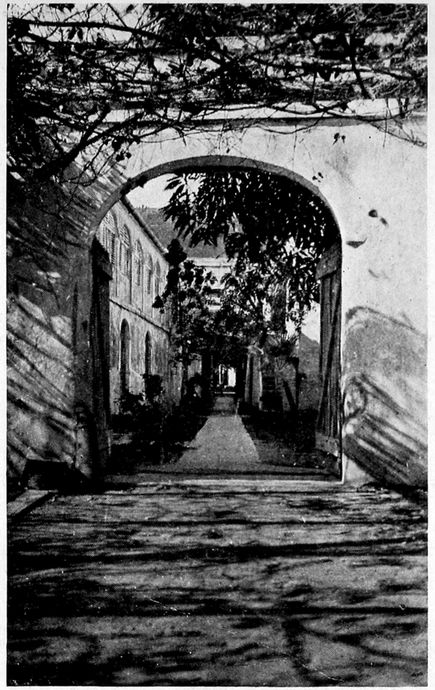
A corner of Charlotte Amalie
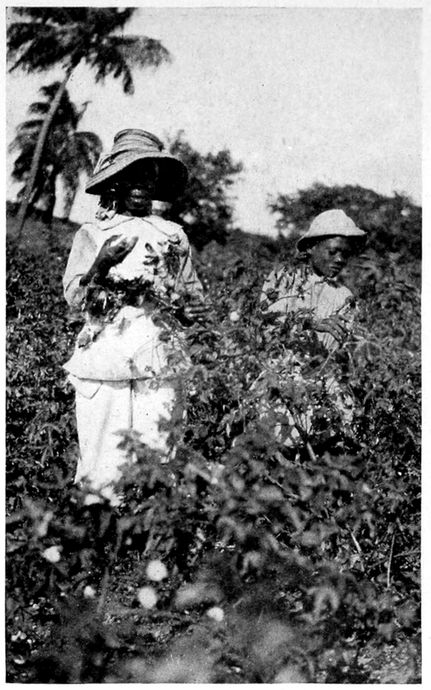
Picking sea island cotton, the second of St. Croix products
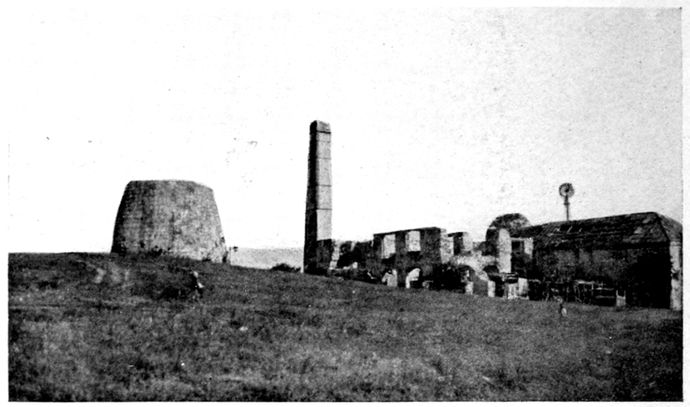
A familiar sight in St. Croix, the ruins of an old sugar mill and the stone tower of its cane grinding windmill
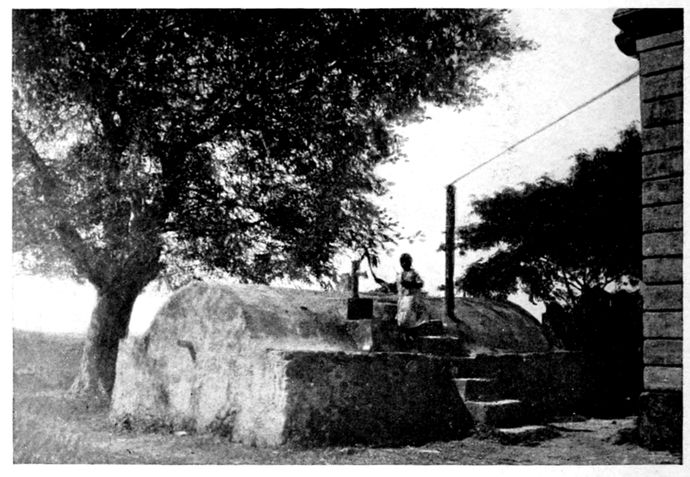
A cistern in which rain water is stored for drinking purposes
321We met all the élite of St. John at the Moravian mission of Emmaus
at the head of Coral Bay. The census showed the island inhabited
by one Catholic, forty Lutherans, and the rest Moravians, hence there
were few local celebrities missing at the annual “show” which happened
to coincide with our visit. Negroes dressed in their most solemn
garments, the men in staid black, the women in starched white, poured
in on horseback and afoot from moonrise until the first of the doleful
religious songs and the amusingly stupid dialogues began in the
school chapel. There was the black government doctor, the negro
owners of the two or three farms so large as to be locally known as
“estates,” the island’s few school teachers—its policeman himself
might have been there had I not deprived him of the use of his
“Candy Kid.” To tell the truth they gave a rather good impression,
decidedly a better one than the traveler-baiters of St. Thomas. They
were almost English in their cold leisurely deportment, yet more volubly
courteous, and with few exceptions they frankly looked down upon
white men. Many of them had the outward indices of education,
speaking with a chosen-worded formality that suggested a national
convention of pedagogues; not a hint of hilarity enlivened their intercourse.
Perhaps the most amusing part of all was the overdone company-manner
in which they treated their wives, those same wives who
no doubt would take up the chief family burdens again, once the night
had separated the gathering into its natural component parts.
We found Carl Francis more nearly what it is to be hoped our new
wards can all gradually be brought to resemble. A member of the
Colonial Council, notorious throughout the colony as the man who
dared tell the congressional committee in public session that the chief
trouble with the Virgin Islands is the laziness of their inhabitants,
he would outrank many a politician of our own land in public spirit,
for all his ebony skin. He confirmed the famous statement above
mentioned, but added that there were other things which St. John
needed for its advancement. It needs a mail service, for instance, such
as it had under the Danes, instead of being obliged to go to Charlotte
Amalie to post or receive its letters. It needs more schools, so that its
children shall not have to walk miles over the mountains morning and
evening. It must have something in the nature of an agricultural
bank to lend the inhabitants wherewithal to replant the old estates,
if St. John is to regain under the American flag something of its
eighteenth century prosperity.
If the Virginia was unworthy of her calling, what shall I say of the
Creole, which carried me from St. Thomas to St. Croix? A battered
old sloop of a type so ancient that her massive wooden rail resembled
that of a colonial veranda, barely fifty feet long, and nearly as wide,
her bottom so covered with barnacles that she did little more than
creep in the strongest breeze, she represented the last stage in ocean-going
traffic. Not only were there no other whites on board, but not
even a mulatto. The passenger-list was made up chiefly of a batch
of criminals and insane who were being sent to their respective institutions
322in St. Croix. Most of them wore handcuffs and leg-irons,
and the rattle of chains and the shrieks of their wearers suggested
the slave-ships of olden days. One of the mad women screamed for
unbroken hours in the lingo of the Dutch West Indies; another conducted
single-handed an entire church service, hymns, sermon, prayers,
and all.
Yet the crew were at least grown men, and if they were monkey-like
in their playful moods, they had real discipline and a sense of responsibility
when the time came for it that was a welcome contrast
to the surly indifference with which the boys on the Virginia carried
out their orders. The captain was a black man of the coast fisherman
type, but the most entertaining part of the voyage was the unfailing
“sir” with which the mate, a cadaverous old negro who wore a heavy
wool skating-cap and a sort of trench-coat fit for the Arctic even at
high noon, ended his careful repetition of the skipper’s every command.
Moreover,—for we are all apt to judge things from our own petty
personal-comfort angle—the captain and most of his men treated a
white man as if he were of royal blood. Not only did he find me a
canvas steamer-chair, but he refused any of the other passengers admittance
to the three-berth cabin, lest they should “disturb de gen’le-man.”
If only he had been able to adjourn the church service and
the other uproar beyond the bulkhead, I might have had a real night’s
sleep.
We left at five in the evening, and by sunrise had covered the forty
miles,—though not, unfortunately, in the right direction. Had our
destination been Frederiksted at the west end of the island, we should
have landed early. But the Creole’s contract calls for a service between
St. Thomas and Christiansted, the two capitals of our Virgin
group, and all day long we wallowed eastward under the lee of St.
Croix’s mountainous northern coast, while “de lepards,” as the sane
passengers called their unsound sisters below, shrieked their maudlin
complaints and the church service began over and over again with a
“Brethren, let us pray for her.”
Christiansted is prettily situated amid cocoanut-palms and sloping
cane-fields at the back of a wide bay, but a long reef with an exceedingly
narrow entrance gives it a poor harbor. Its white or cream-colored
houses, with here and there a red roof, lend it a touch that is
lacking in the half-dozen rather grim-faced villages and estates that
may be seen scattered to right and left along the rugged coast. The
town has wide, rather well-kept streets, many stone houses, an imposing
323government building, and climbs away up the stony slope behind
as if it had once planned to grow, but had changed its mind. Old-fashioned
chain pumps supply it with water, from wells rather than
from cisterns; a big Catholic church is barely outrivaled in size by
the Anglican; on the whole, it seems better swept than more populous
Charlotte Amalie. Its people are simple-mannered, rather “gawky,”
in fact, with a tendency to stare strangers out of countenance, and have
a leisureliness that shows even in the long-drawn “Good ahftehnoon,
sar,” with which they greet passers-by.
Christiansted, and all St. Croix, has a special grievance against the
Americans. Under the Danes the governor spent half the year in
this second capital. Now the ruler of the islands only occasionally runs
over from St. Thomas in his private yacht, often returning the same
day, and the Croixians feel slighted. When the admiral and his aides
land, it is mildly like the arrival of royalty. A band or two and most
of the population are drawn up in the sanded space facing the wharf,
whence all proceed to a meeting of the Colonial Council in the old
government building.
Across the street from this is a shop in which Alexander Hamilton
once clerked. His mother, born in St. Croix, married a man named
Levine, who abused her, whereupon she went to live with a Scotchman
named Hamilton in the neighboring British island of Nevis. There
Alexander was born, but when his father went to seek his fortune elsewhere,
the mother returned to her native island. While clerking in
the Christiansted shop, the son wrote his father a letter describing a
hurricane that had swept St. Croix, the father showed it to influential
friends, with the result that Alexander was sent to King’s College
(now Columbia University), and, thanks partly to Aaron Burr, never
returned to the West Indies. Meanwhile his mother remained in St.
Croix until her death, and was buried on a knoll a few miles west of
Christiansted. It is a pleasant burial place, with constant shade and
a never-failing trade wind fanning the flowers above it, a quaint old
homestead behind it, and a modern monument erected by an American
woman, inscribed:
Rachael Fawcett Levine
1736–1768
She was the Mother of Alexander Hamilton
St. Croix is far more of a real country than all the other islands
of the group put together. Not only is it much larger, being twenty
324miles long and five wide, but is much more extensively cultivated.
Three splendid roads run nearly the length of the island, with numerous
cross roads in good condition. Only the rocky eastern end is a
wilderness to which deer, brought into St. Croix by the British when
they controlled it during the Napoleonic wars, go to hide after the
cane-fields are cut, such a wilderness that hunters rarely succeed in
stalking the wary animals in the dense undergrowth. There are far
more signs of industry in St. Croix than in St. Thomas; its estate-owners
are on the whole an intelligent, progressive class, with a social
life quite different from that on the more primitive islands. When
one has seen St. Croix, the twenty-five million does not seem quite so
complete and irreparable a loss.
I took the “King’s Road” through the middle of the island. It
runs for fourteen miles, from Christiansted, the capital, to Frederiksted,
its rival. These names being too much effort for the negro
tongue, the towns are known locally as “Boss End” (either a corruption
of the French Bassin or an acknowledgement that the “bosses”
of the island always lived in the capital) and “West End.” The
northern side is abrupt, with deep water close to the shore, its highest
peak, Mount Eagle, rising 1180 feet. South of this range are
undulating, fertile valleys and broad, rolling plains not even suggested
along the northern coast, and the land slopes away in shoals and coral
ledges for several miles from the beach. The highways are maintained
by the owners of the estates through which they run; therefore
they follow a somewhat roundabout course through the canefields,
that the expense of maintenance may be more evenly divided.
They are busy roads, dotted with automobiles, of which there are
more than one hundred on the island, many donkeys, heavy two-wheeled
carts hauled by neck-yoked oxen, a kind of jaunting car of
the conservative gentry, and innumerable black pedestrians. The island
is everywhere punctuated with picturesque old stone windmill
towers that once ground cane, their flailing arms long since departed,
and gray old chimneys of abandoned sugar-mills break the sky-line on
every hand. Some of these dull-white heaps of buildings on their hilltops
look like aged Norman castles; there is something grim and northern
about them that does not fit at all with the tropics. They suggest
instead the diligence and foresightedness of the temperate zone. Old
human tread-mills may still be found among them, and slave-house villages
that in some cases are inhabited by the laborers of to-day. Rusted
325sugar-kettles, such as are strewn through the West Indies from eastern
Haiti to southern Trinidad, lie abandoned here and there throughout
the island.
Sugar-cane once covered even the tops of the hills, but to-day only
the flatter lands are planted, though there are splendid stretches of
cane-green valleys. The names of estates are amusing, and range
all the way from cynicism to youthful hopefulness,—“Golden Grove,”
“Work and Rest,” “Hope and Blessing,” “Whim,” “Slob,” “Judith’s
Fancy,” “Barren Spot,” “Adventure.” The ceiba, or “silk-cotton
tree,” beautiful specimens of the royal palm, the tibet-tree, full
of rustling pods that give it the name of “women’s-tongues” in all
the English-speaking West Indies, everywhere beautify the landscape.
Ruins of the slave rebellion, of the earthquake of 1848, of the disastrous
hurricane of 1916, are still to be found here and there. There
is a marvelous view from King’s Hill, with its old Danish gendarmérie,
now a police station, from which the central highway, lined by palms
and undulating through great valleys of cane, may be seen to where it
descends to “West End” and the Caribbean. In the center of the
picture sits Bethlehem, the largest sugar-mill on the island, with its
cane railway and up-to-date methods. For the modern process of
centralization is already spreading in St. Croix; the small independent
mills are disappearing, and with them much of the picturesqueness of
the island. These big mills, as well as most of the small, are owned
by Danes, half the stock of the largest being held by the Danish government.
Unfortunately St. Croix has put all its eggs in one basket,
or at most, two, sugar and sea-island cotton.
There is not a thatched roof on the island. The people live in
moderate comfort, as comfort goes in the West Indies. Toward sunset
the roads are lined with women cane-cutters in knee-length skirts,
with footless woolen stockings that suggest the tights of ballet-dancers,
to protect their legs in the fields, pattering homeward, with their big
cane-knives lying flat on the tops of their heads. Bits of colored rags
sewed on the hatbands of the men indicate that they are members of
the newly organized labor-union. They still bow and raise their hats
to passing white men, yet one feels something of that bolshevistic atmosphere
which their black leaders are fostering among them. The
King’s Road passes a large distillery, which prohibition has closed.
Formerly St. Croix made much rum; now it is giving its attention
rather to syrup than to sugar, as there is more money in the former;
but estate-owners are threatening to give up cane-growing and turn
326their fields into cattle pastures, so greatly have the wages of field laborers
increased in the last two years—from twenty-five cents to a
dollar a day. For St. Croix is one of the few islands in the West
Indies where “task work” has never taken the place of a fixed daily
wage. Cattle are plentiful on the island, from which they are sent to
Porto Rico in tug-towed open barges. Some of them are so wild that
they are brought down to the coast in cages on wheels, and all of them
are roped and swung on board with little regard to their bodily comfort.
Fredriksted, the third and last town of our Virgin Islands, is a
quaint, “Dutchy” place some five blocks wide and seven long, with
wide sanded streets, two-storied for the most part and boasting no real
public sidewalks; for though what look like them run beneath the
arcades that uphold the upper-story verandas, they are rather family
porches, shut off by stairways or barricades, which force the pedestrian
to take constantly to the sun-scorched streets. The town has only an
open roadstead; indeed, there is not a good harbor in the island. A
native band recruited by the American navy breaks the monotony of
life by playing here once a week, as it does daily in Christiansted.
The cable company is required by law to furnish the world’s news to
the press, but as the pathetic little newspapers are so small that they
can publish only a few items at a time, the despatches are habitually
some two weeks old, each taking its chronological turn irrespective of
importance.
I visited several schools in the Virgin Islands. When an American
school director arrived early in 1918 he found no records either of
schools, pupils, or parents. By dint of going out and hunting them up,
he discovered nineteen educational buildings on the three islands.
Ninety per cent. of the population can read and write after a fashion,
but the majority usually have their letters written by the public scribe,
of whom there is one in each of the three towns, in a set form that
gives all epistles a strong family resemblance. The school system
was honeycombed with all sorts of petty graft. A man who received
three dollars a month for keeping a certain school clean had not seen
the building in years. The town clock of Christiansted has not run for
five years, yet another favored person received a monthly stipend
for keeping it in order. The new director and his two American
assistants have still to contend with many difficulties. There are
327no white teachers; those now employed were trained either in Denmark
or in the Moravian schools, and the “English” of most of
them almost deserves to be ranked as an independent dialect. The
highest teacher’s salary is seventy-five, the average twenty-four dollars
a month. Boys of sixteen, drawing the regal income of ten dollars
monthly, conduct many of the classes. Those who served a certain
number of years under the Danes receive a pension from the
famous twenty-five millions. They are small pensions, like those that
went to all the small government employees whom the Danes left
behind, and those who still hold their places protest against telling
their new employer how much they draw from Copenhagen, fancying
it may result in a corresponding loss in the increase they fondly hope
for under American rule. Lack of funds has forced the director to
maintain many of the incompetents in office. One rural school we
visited is still taught by the local butcher, whose inefficiency is on a
par with his custom of neglecting his educational duties for his more
natural calling. But as the island budget does not permit an increase
of his monthly thirty-five dollars,—and in every case it is merely
Danish, not American, dollars,—no more competent substitute has yet
appeared to claim the butcher’s ferule.
The country schools have few desks; the children sit on backless
benches, their feet usually high off the floor. The tops of the desks
are in many cases painted black and used as blackboards. A rusty tin
cup was found doing service for all the thirsty; when the Americans
attempted to improve this condition by introducing a long-handled
dipper with an edge cut in repeated V shape, the teachers bent the
sharp points back and returned to the old dip-your-hand-in method.
Lessons are often done on slates or pieces of slate, which the teacher
periodically sprinkles with water from a bay-rum bottle, then requires
the sums to be erased in rhythmical unison. Formerly the teachers sat
in the middle of one large room, surrounded by eight different grades,
and the resultant hubbub may be imagined. The Americans put in
partitions, and the uproar is now somewhat less incoherent. In some
of the larger schools there were half-height partitions, with little
sliding-doors, through which the principal could peer without leaving
his central “office.” Loud protests have been heard because the
Americans nailed these up, forcing upon the sedentary gentlemen in
charge the exertion of walking around to the several doors. The
teaching methods were, and in many cases still are, of that tropically
328medieval type in which the instructor asks long questions that require
a single-word answer, even that being chiefly suggested by the questioner.
“What is the longest river in America? Now, then, Miss-Mis-sissi—”
The answer “pi!” by some unusually bright pupil, is followed by
exclamations of praise from the teacher. Like most negroes, the
Virgin Islanders have tolerable memories, but little ability to apply
what they learn. Not the least of the difficulties confronting the new
director was the reform of the Catholic schools, which had long put
great emphasis on matters of religion and treated other subjects with
scant attention. The attempt to better matters sent shrieks of protest
to Washington, whence the director’s hands were more or less tied by
misinformed coreligionists. Bit by bit the Virgin Island schools are
being improved, however, a decree permitting superintendents to fine
the parents of pupils absent without due cause, simply by sending a
policeman to collect the sum assessed, without any troublesome process
of law, having given a badly needed weapon against the once wide-spread
inattendance. Parents who decline, or are unable to pay the
fines, are required to work one day on the roads for every dollar unpaid.
There is no agriculture worth mentioning in St. Thomas and no
employing class in St. John, hence labor troubles have been chiefly
confined to St. Croix. The present leaders of the movement in the
larger island are three negroes, all of them agitators of the more or
less violent type, differing only in degree, and all more or less consciously
doing their best to stir up those of their own color. The
one considered the most radical is the least troublesome, as he can
readily be bought off. Another, a man of some education, runs a
newspaper advocating civil government,—that is, negro government,—preaching
that the white man is the enemy of the black, that St.
Croix belongs by right to the latter, and openly accusing the white
officials of incompetency and dishonesty. In addition to this, he publishes
secretly a scurrilous sheet that is doing much to inflame the primitive
minds of the masses. The third announced in a public meeting
that “if the governor don’t do what we want, we’ll take him out in
the bay and send him back where he come from.”
“Since the Americans came, it is all for the niggers,” said an old
English estate-owner. “The niggers even steal our fruit and vegetables,
carrying them to town a bit at a time in their clothes, for the
329policemen are all friendly or related to them. Let those black agitators
go on a bit longer, and we whites will have to leave the island.”
There are signs that the whites are in peril of losing the upper hand
in the island, particularly with the methods of the present governor,
who caters to the negroes with un-American eagerness. As an example,
though his private yacht may be on the point of steaming from
St. Thomas to St. Croix or vice versa, even American white women
are left to the mercies of the filthy Creole, lest the local merchants complain
that trade is being taken away from them. Yet native negro
girls are readily carried back and forth, because they happen to be
the daughters, relatives, or dependents of members of the colonial
council, or of some other local officials of the islands we are paying
taxes to support.
The negro newspaper man sees much “social injustice” in St. Croix,
of which certainly a customary amount exists; but he seems incapable
of noting the great disinclination to work and the fact that the “paltry
dollar a day” buys scarcely one tenth the amount of labor which constitutes
a day’s work in the white man’s countries with which he strives
to compare his own. In 1916 he went to Denmark and raised funds
to establish several labor-union estates on the island, where the negroes
might raise cattle, cane, and the like, each to get permanent possession
of the piece of land on which he was working as soon as he had paid
off the mortgage. But the farms are already, after a bare two years
in the hands of the union, largely overgrown with weeds, bush, and
miserable shacks, and about the only result of the move has been
the loss of more land to world production, and the infliction of the
sponsor with an exaggerated self-importance that has made him lose
the one virtue of the Virgin-Islander—his courtesy.
On the other hand, the employing class is by no means immune to
criticism. The larger sugar companies were paying cane-growers from
six to seven cents Danish for sugar at the same time that they were
selling it for from twelve to fourteen cents in American money. The
diligent Yankee who controls the lighterage, wharfage, and many other
monopolies at “West End,” as well as sharing with the newspaper
man the political control of the island, cannot be acquitted of the native
charge of exorbitance. A Danish company whose profits in 1919 were
more than a million sent all its gains to Copenhagen, instead of helping
to stabilize the exchange by depositing them in New York.
Among the troubles of St. Croix is the problem of what to do with
the “immigration fund.” Sugar production requires much labor; ever
330since slavery was abolished St. Croix has been constantly faced with the
difficulty of getting enough of it. A large percentage of the negroes
would rather become public charges than work more than a few days
a week. In 1854 the planters voluntarily assessed themselves ten cents
an acre to establish an immigration fund, the Government making up
the deficit. Laborers were brought from the other West Indian islands,
particularly from Barbados. Therein lies another grievance of the
planters, who assert that though Barbados implored the Government of
St. Croix to relieve the former island of some of its over-population,
when the request was granted, the Barbadian authorities emptied the
jails and sent out all their riffraff. With the establishment of American
rule, it became illegal to bring in contract labor, and though the
immigration fund now consists of more than seventy thousand dollars,
it is impossible to use it as originally intended. Does the money belong
to the planters, to the United States, or to the Danish Government?
The Croixians are still heatedly debating the question, and at the same
time are complaining of the scarcity and high price of willing labor.
Politically, St. Thomas and St. John, with their numerous neighboring
keys and islets, constitute one municipality, and St. Croix another.
Under the Danes the executive power was vested in a colonial governor
appointed by the crown; the legislative authority being held by a
colonial council in each municipality, some of the members likewise
crown appointments, some elected. With an American admiral as
governor, and naval officers as secretaries and heads of departments,
this system has continued, and will continue until our busy Congress
finds time to establish another form of government. Though the navy
men explain to them that they are virtually under a civil government
without the necessity of supporting it themselves, the natives are not
satisfied. Among other things the labor leader elected to the colonial
council of St. Croix demands the jury trial and “suffrage based on
manhood.” The vote is at present extended to males over twenty-five
having a personal income of three hundred dollars a year or owning
property yielding five dollars a month. Moreover—and this, I believe,
is more than we demand even in the United States—the voters
must be of “unblemished character.” Thus the Danes sought to insure
the ballot only to men of responsibility and there was good reason for
the limitation. To the casual observer it seems that the growing
tendency to give the natives the universal franchise should be combated,
unless the islands are to become Haitian.
331Last year one of the agitators went to the United States on the hopeful
mission of getting all the offices filled by natives—that is, negroes.
Luckily, his demands were not granted. Civil service already applies;
there is nothing to prevent a native from holding any but the higher
offices if he is fitted for the task; but native ability is not yet high
enough, nor insular morals stanch enough, to give any hope that a native
government would work efficiently without white supervision.
There is more justice in the plea for a homestead act that will turn
the uncultivated land over to the people, though even that should
be framed with care. One of the chief troubles with nearly all the
West Indies is the ease with which lazy negroes may squat on public
land. The islanders have one real kick, however, on the state of their
postal service. Under the Danes there were mail-carriers in the towns,
there were country post-offices, and a certain amount of rural delivery;
all school-teachers sold stamps, and mail was sent by any safe conveyance
that appeared. To-day there are only three post-offices and no
mail delivery, the country people must carry their own letters to and
from one of the three towns, those living on St. John being obliged to
bring and fetch theirs from Charlotte Amalie, and though a dozen
steamers may make the crossing during the week, the mails must wait
for the languid and uncertain Virginia or Creole. There are only four
postal employees in St. Thomas, in addition to the postmaster, a deserving
Democrat from Virginia who, in the local parlance, “does nothing
but play tennis and crank a motor-boat.” When one of the mail-schooners
comes in, the population crowds into the post-office in quest
of its mail, disrupting the service, each hopeful citizen coming back
again every half-hour or so until he finds that the expected letter has
not come. Yet carriers were paid only thirty-five dollars Danish under
the Danes, and three or four of them obviated all this chaotic confusion.
Roughly speaking, the St. Thomas division does not want civil government,
feeling it cannot pay for it, and St. Croix does, though her
colonial council has asked that no change be made for the present and
has implied that it expects the expense of government to be chiefly
maintained by congressional appropriation even after the change is
made. But this same body demands full jurisdiction over all taxation,
the one thing it is least competent to handle properly, for it would
result in the powerful and influential and their friends escaping their
just share of the burden. There are queer quirks in the taxation system
left by the Danes. Buildings, for instance, are taxed by the ell, or two
square feet, with the result that old tumble-downs often pay more than
332smaller modern and useful structures. There is a tax on wheels, so
that the largest automobile pays five dollars a year, as does the poor
man’s donkey-cart. Moreover, this money does not go to the maintenance
of roads, but into the colonial treasury, as does every other
cent of revenue. Under the Danes, even with lottery taxes yielding a
hundred thousand dollars a year, and a large income from liquor taxes,
the islands were never self-supporting. Our income tax in place of
these amounts to little, especially as many find ways to get out of paying
it. The public revenues of the islands are barely a quarter million a
year. We contribute an equal amount directly, and three hundred
thousand dollars a year in navy salaries besides, for the governor and
his assistants get no other recompense than their regular pay as naval
officers. There are a few persons, not Virgin-Islanders of course,
who advocate annexing the group to Porto Rico. Theoretically, this
plan would greatly simplify matters; in practice there would be certain
decided objections to it, though the scheme might be feasible if worked
out with care. Two things are indispensable, however, that during
the life of the present generation the islands be given no more autonomy
than they have at present, and above all that they be taxed by disinterested
outsiders.
A new code of laws, based on those of Alaska and reputed to contain
all the latest improvements in government, has recently been drawn
up for the Virgin Islands. Unfortunately, the colonial council can
reject that code if they see fit; that is another weakness in the treaty.
Already they have marked for the pruning-knife every clause designed
to improve the insular morals. The marriage ceremony, for instance,
has never been taken very seriously by the natives. Unions by mutual
consent are so numerous that our census-takers were forced to include
a fifth class in their returns—the “consentually married.” Illegitimacy
runs close to eighty per cent., far out-distancing even Porto Rico.
In fact, the mass of the islanders have no morality whatever in that
particular matter. Girls of fourteen not only have children, but boast
of it. The Danes are largely to blame for this state of affairs, for
there were few of them who did not leave “gutter children” behind,
though it must be admitted that our own marines and sailors are not
setting a much better example. The negro, being imitative, is particularly
quick to copy any easy-going ways of his superiors; hence there
is almost a complete absence of public sentiment against such unions
among the blacks. Formerly a special excuse was found in the high
cost of legal and church marriages, the fees for which were virtually
333prohibitive to the poorer classes. To-day they are only nominal, and
many an old couple has been married in the presence of their grandchildren.
The Danish laws compel the father to contribute two dollars
a month to the support of his illegal children, but though the man
seldom denies his possible parentage, the woman has frequently no
unquestionable proof of it. The new code would force men to marry
the mothers of their children.
“But how can we do that?” cried a member of the colonial council,
often referred to as “the best native on the island,” yet who makes no
secret of having his progeny scattered far and wide. “Most of us are
married already; besides, we would have to legalize polygamy to carry
out this proposed law. We are quite willing to continue the two dollars
a month to our outside children, but how can we marry their mothers?
They are not even of our own class!”
Illegitimacy gives rise to another problem. By the Danish laws
still in force every minor must have a guardian, and that guardian cannot
be a woman, even though she be the mother. Her older brother,
her father, or some more distant relative, slightly interested in his
task, commonly becomes the legal sponsor for her fatherless offspring.
The duties of a guardian are, succinctly, to “take charge of the minor’s
property,” with the resultant abuse to be expected. Policemen are
now and then appointed the legal guardians of a dozen or more young
rascals, and it goes without saying that they do not lie awake nights
worrying about the moral and material advancement of their wards.
Another clause that is not likely to escape the blue pencil of the
councils is that giving the authorities the right to search the persons
and carts of those carrying produce and to demand proof of its legal
possession. Yet without some such law there is slight hope of stamping
out the wide-spread larceny of growing crops.
One of our most serious problems in the Virgin Islands is to combat
disease. The Danes had only three doctors on the islands; now sixteen
navy physicians are busy all the time. Their fees are turned into the
colonial treasury, an arrangement nowhere else in force in American
territory. Half the children die as a natural course, though the islands
are really very healthful, and no white child born under proper conditions
has died since American occupation. There is no hookworm and
little malaria; but much pellagra and “big leg,” or elephantiasis. Tuberculosis
is common, and tests indicate that eighty per cent. of the
population is infected with a hereditary blood disease. There is a leper
colony in St. Croix. The present generation, in the opinion of the navy
334men, is hopeless. In the improvement of the next they are hampered
by the ignorance, indifference, and superstition of the parents. The
doctors of “West End” found nothing unusual in the case of a baby
that was brought to the hospital already dead because the father had
taken it first to a native healer, who put “chibble” (pot herbs) under
its nose to cure it of acute indigestion.
But there is a worse problem than that facing us in the Virgin
Islands—the elimination of the habit of trying to live off the exertions
of others. Thanks to their race, history, and situation, the islanders
are inveterate, almost unconscious, beggars. Young or old, black or
white—for environment has given even those of Caucasian ancestry
almost the same habits and “ideals” as the negro—they are all gifted
with the extended palm. If they do not all beg individually, they do so
collectively, in a frank, shameless assertion that they cannot support
themselves. The Danes left a “rum fund” that is designed to aid all
those who “have seen better days,” and to judge by the applicants the
entire population ranks itself in that category. The native woman
clerk at the “West End” police station does not hesitate to give any
one, even the four-dollars-a-day sugar-porters on the wharves, a certificate
that he is unable to pay for medical attention, though the navy
doctors’ fees are nominal and, even when they are paid, go into the
colonial treasury. The admiral-governor gave a reception to the natives.
Food was provided for five hundred—and was carried off by the first
hundred street women and urchins who surged through the door. Next
day a large crowd came to demand their share, saying they had got
nothing the day before. One of the “labor leaders” told the negroes
of St. Croix to hide their mahogany bedsteads and phonographs and
sleep on drygoods boxes while the congressional committee was
scheduled to visit the island. Of the entire crowd appearing before
that committee not one had the general good of the islands on his
lips, but all came with some petty personal complaint or request.
In short our new wards want all they can get out of us. They want
Uncle Sam to provide them with schools, with sanitation, with irrigation,
with galvanized hillsides, with roads—even in St. Croix, which
has better highways than almost any State in the Union—with public
markets, with libraries, with means of public transportation, with anything
else which, in his unsophisticated generosity, he chooses to give,
so long as he does not require them to contribute their own means and
labor to that end. The colonial council of St. Croix “hopes means will
be found to get Congress to appropriate a half million a year, a sum far
335beyond our own means, so that we can live up to the high ideals of our
great American nation.” It never seems to occur to them that the
schools, libraries, and streets in our cities are paid for by the inhabitants
thereof; they have the popular view of Uncle Sam as the world’s Santa
Claus. Yet many of the very members of that council have made
fortunes in St. Croix and probably could themselves pay a large part
of the sum demanded without any more difficulty than the average
American finds in paying his taxes. Naïve as they are, the Virgin
Islanders can scarcely expect Americans to adopt them and never let
them work or want again, yet they talk as if they had some such
thought in mind. Or, as a congressman put it during a public hearing,
“I doubt whether the farmers of my State of Kansas will be willing
to get up at four all summer and pay money into the federal treasury
so that you can sleep until nine in the morning and stroll in the park the
rest of the day.”
There is no reason why the Virgin-Islanders should not be sufficiently
taxed to support their own schools and other requirements. Even if
St. Thomas is now largely barren, many of its shopkeepers are steadily
growing wealthy. The Danish planters of St. Croix send fortunes
home to Denmark every year; at the present price of sugar they alone
should be able easily to contribute a sum equal to that they are demanding
from Congress. Should not even dollar-a-day negroes pay something
in taxes? It might develop their civic spirit. The Virgin-Islanders
need many things, it is true; but there are millions living in,
and paying taxes to, the United States who have by no means what almost
every Virgin-Islander has, or could have for a little exertion.
The future of the islands depends largely on whether or not we succumb
to our national tendency to make our wards mendicants for life, or give
them a start and let them work their own way through the college of
civilization.
Whenever I look back upon our new possessions I remember a significant
little episode that took place during our first day in St. Thomas.
A negro woman was sitting a short way up one of the great street
stairways that climb the hills of Charlotte Amalie. A descending
friend paused to ask her what was the matter, and she replied in that
slow, whining singsong peculiar to the community:
“Me knees jes wilfully refuse to carry me up dem steps.”
That is the trouble with most of the Virgin-Islanders. Their own
knees jes wilfully refuse to carry them up the stairway of civilization.
They will have to be lifted—or booted.
THE BRITISH WEST INDIES — CHAPTER XIV THE CARIBBEE ISLANDS — CHAPTER XV “LITTLE ENGLAND” — CHAPTER XVI TRINIDAD, THE LAND OF ASPHALT — CHAPTER XVII AFRICAN JAMAICA
337
339
Once he has reached our Virgin Islands, the traveler down the
stepping-stones of the West Indies has left his worst experiences
behind him. For while connections are rare and precarious
between the large islands of the north Caribbean, the tiny ones
forming its eastern boundary are favored with frequent and comfortable
intercommunication. Several steamship lines from the north make
St. Thomas their first stop, and pausing a day or two in every island
of any importance beyond, give the through traveler all the time he can
spend to advantage in all but three or four of the Lesser Antilles.
In these he can drop off for a more extended exploration and catch
the next steamer a week or two later.
A twelve-hour run from St. Croix, with a glimpse of the tiny Dutch
islands of Saba and St. Eustatius, peering above the sea like drowning
volcanoes, brought us to what the British so familiarly call St. Kitts.
Columbus named it St. Christopher, one legend having it that he discovered
it on his own patron saint’s day, another that he saw in its
form a resemblance to that worthy carrying in his arms the infant
Jesus. The resemblance is not apparent to the critical eye, but the admirals
of those days, you recall, were not compelled to take their grape-juice
unfermented. Besides, we must not be too hard upon the busy
“old man” of the caravel fleet. With a sailor thrusting his head into
the cabin every hour or so to say, “Another island, vuestra merced;
what shall we call it?” it was natural that the Genoese, having no
modern novels at hand, should curse his gout and hobble across to the
saints’ calendar on the opposite bulkhead.
St. Kitts has more nearly the form of a heaping plate of curry and
rice—curious this should not have occurred to the galley-fed seaman—culminating
in Mt. Misery, four thousand and some feet high, with an
eight hundred foot crater nicely proportioned to hold the curry and still
steaming with clouds of vapor that habitually conceal its summit. From
the shores to the steeper heights of the mountain the swiftly sloping
island is covered with sugar-cane; above that the woods are said to
340be full of monkeys, descendants of the pets which British soldiers
brought with them when St. Kitts was a bone of contention between
the French and the English. With one slight exception, this and the
neighboring island of Nevis are the only West Indies inhabited by our
racial ancestors, which are so troublesome that their direct descendants
below have given up trying to plant their gardens more than half-way
up the mountains.
Though St. Kitts was the first island of the West Indies to be settled
by the English, antedating even ultra-British Barbados in that regard
by nearly two years, its capital bears the French name of Basse Terre.
It is an uninteresting town of some seven thousand inhabitants, scarcely
one in a hundred of whom boast of a family tree wholly free from
African graftings, and most of them living in unpainted, weather-blackened,
shingle cabins hidden away in the forests of cocoanut palms.
Even the larger houses in the center of town are chiefly built of clapboards
or shingles, painted only by the elements, and with narrow
little eaves that give them the air of wearing hats several sizes too
small for them. The sums that are uselessly squandered on window-glass
would easily suffice to give the entire town a sadly needed coating
of paint, were it not that all such improvements are taxed out of existence,
as in most of the British West Indies. The only pleasant spot in
town is a kind of Spanish plaza run wild, generously shaded with royal
palms and spreading tropical trees, beneath which the grass stands ankle-high
and hens pilot their broods about among the brown windrows of
fallen leaves. Its unshaven condition rather enhances a certain rustic
beauty that is not marred by an unexpectedly artistic old stone fountain
in its center. Beyond the last lopsided negro hovels Basse Terre
is surrounded by cane-fields, with Mt. Misery piled into the sky close
behind them.
We had the misfortune to first land in British territory on a Sunday.
Basse Terre was as dead as if a general funeral were just over. It was
not simply that we bemoaned with the tourist-minded fellow-countrymen
from the steamer the fact that every “Liquor Store” was tight
and genuinely closed; the dreary lifelessness of the whole place got on
our nerves. The very trade wind seemed to refrain from any unnecessary
exertion; the citizens appeared to have given even their
minds a holiday and replied to the simplest questions with a vacant
stare. It was a “holy day” as truly as a French or Spanish Sunday
is a “day of feast,” or “festival.” I imagine heaven is much like an
English community on a Sunday—so piously dull that a new inmate
341would soon be on his knees imploring the gatekeeper to let him go
to the only other available place.
At eleven o’clock four species of church service broke out, the
Anglican, Catholic, Moravian, and what a black policeman in a white
blouse and helmet and the deliberate airs of a London “bobby” referred
to in a Sunday whisper as the “Whistling.” We went. One was
forced to, in self-defense and for the utter absence of any other form
of amusement. Then we understood why the community could endure
the apparent lack of recreation and exercise of its deadly Sabbath.
Negroes striving to maintain the cold, calm, rather bored English manner
from opening hymn to benediction supplied the former, and the
ups and downs of the Anglican service furnished the latter.
We found St. Kitts more down-at-heel, more indolent, less self-relying
than even our Virgin Islands. The shingle shacks of Basse
Terre were more miserable than those of St. Thomas; the swarms of
negroes loafing under the palm trees about them were as ragged as they
were lazy and insolent. Conrad’s “Nigger of the Narcissus,” you may
recall, came from St. Kitts. His replica, except in the genuineness of
his ailment, could be seen in any patch of shade. A white stranger
strolling through the poorer section was the constant target of foul
language and even more loathsome annoyances from both sexes and
all ages; in the center of town his footsteps were constantly dogged
by clamoring urchins who replied to the slightest protest with streams
of curses even in the presence of white residents and the serenely unconscious
negro policemen. The inhabitants were incorrigible beggars,
from street loafers to church wardens; even the island postmaster
begged, under the pretense of selling a historical pamphlet; the country
people left their “work” in the fields to shout for alms from the
passer-by.
A highway encircles the island, which is twenty-three miles long and
five wide. It flanks Brimstone Hill, sometimes called the “Gibraltar of
the West Indies” in memory of the part it played in the wars between
the French and English for the control of the Caribbean. Cane-fields
spread with monotonous sameness on either side of the moderately well-kept
roads, with here and there an old stone tower that was once a
windmill and what seems many chimneys to one who recalls how seldom
two are seen in the same horizon in Cuba. On the whole, the island
is not to be compared with St. Croix; despite its abundance of sugar
it has a poverty-stricken air, for St. Kitts seems to have lost its “pep,”
if ever it had any.
342It took two days to unload our one-day’s cargo in the harbor of Basse
Terre. The local stevedores were on strike and their places had been
taken by less experienced men from the neighboring island of Nevis.
This had magnified the constant enmity between the St. Kittens—or
whatever is the proper term—and the inhabitants of “that other
country,” as they called it; but it was an enmity without violence,
except of words, torrents of words in what close observers assert are
two distinct dialects, though the islands are separated only by a narrow
channel. The strikers, to all appearances, felt they had won their chief
aim by being allowed to lie on their backs in the shade of the cocoanut
palms.
The steamer’s loss was my gain, for the delay gave me time to visit
the island Columbus named “Nieve” from the snow-like clouds hovering
about it. Open sailing scows, perhaps three times the size of a
lifeboat, were constantly plying across the bay between the two capitals.
The wind was on the beam in both directions, and a dozen times I was
convinced that the waves that splashed continuously over the leeward
gunwale of the creaking old tub would fill her at the next squall sweeping
through the deep channel between the islands. But each time the
simple son of Nevis at the tiller met my questioning gaze with “Not
blow too bad to-day, boss,” now and then adding the reassuring information
that several boats were lost here every year. High on the windward
gunwale the plunging of the crude vessel was exhilarating in
spite of the apparent danger, but the negro women in their flashy
dresses, tin bracelets, and much cheap jewelry, who sprawled together
in the bottom of the boat in supreme indifference to the bilge-water
and filth that sloshed back and forth over them seemed to find nothing
agreeable in the experience.
The craft half righted herself at length under the lee of the island,
heaped up into the clouds in similar but more abrupt and compact form
than St. Kitts. One scarcely needed to go ashore to see the place, so
nicely were its sights spread out on the steeply tilted landscape. Like
its neighbor it was but slightly wooded on its lower slopes, but made
up for this by the dense vegetation of its monkey-infested heights. One
made out a few groves of cocoanuts, patches of cotton, and green
stretches of sugar-cane, with here and there a windmill tower, one of
which still survived, its slowly turning arms giving a mild suggestion
of the Azores. Charlestown soon appeared out on the end of a low
point, a modest little town with a few red roofs peering through the
cocoanut trees. Gingertown, five miles in the interior, and the village
343of Newcastle farther down the coast are the only other places of any
size, though the island is everywhere well populated. Time was when
Nevis was a famous watering place for Europe and America, with
thermal baths and medicinal waters, and an important capital named
Jamestown, from which all this region of the Caribbean was ruled.
But the city was destroyed one day by an earthquake and submerged
beneath the sea, where some of its coral-encrusted ruins can still be
seen not far from the shore. Natural causes led to the island’s gradual
isolation, and to-day, though its hot baths are exploited by an American
owned hotel, it becomes highly excited at the arrival of a stranger from
the outside world.
Charlestown had little of the insolence of St. Kitts, though it was
by no means free from beggars. Its masses were more naïve in manner,
even more ragged of garb. Nine pence a day is the average adult male
wage of even those who succeed in finding work. Obeah, or African
witchcraft, seemed still to maintain a hold, for even the native bank
clerk who piloted me about town acknowledged a belief in certain forms
of it. Two or three blocks from the little triangular park that marks
the center of town are the ruins of a gray stone building in which
Alexander Hamilton is reputed to have been born. British visitors are
more interested in the house where Nelson lived and the little church
in which he was married to the widow Nisbet, two miles up the sloping
hillside. Love for England does not greatly flourish in Nevis, if one
may take surface indications as evidence.
“We are ruled over by an autocrat, a white Barbadian magistrate,”
complained an islander of the better class, while the group about him
nodded approval. “England takes everything from us and does nothing
for us. If it were not for the prohibition that would come with it,
we would be glad to see the island under American rule.”
A forty-mile run during the night brought us to Antigua. Steamers
anchor so far off shore that a government launch is required to do the
work performed in most of the Lesser Antilles by rowboats. For
though there is a splendid double harbor on the opposite side of the
island, the English cling to their invariable Caribbean rule of building
the capital and only city on the leeward shore. Two pretty headlands
are passed on the way in, the more prominent of them occupied by a
leper asylum; both are crowned by fortresses dating back to the days
when England fought to maintain her hold on the West Indies. From
the bay St. John’s presents an agreeable picture in the morning sunlight,
344an ancient two-towered cathedral bulking above the greenery constituting
the most conspicuous landmark. It is much more of a town
than Basse Terre, though with the same wooden, shingled, often unpainted
houses, and wide, unattractive, right-angled streets. What
energy it may once have had seems largely to have departed, and for
all its size it has the air of a half-forgotten village. Its shops open
at seven, close from nine to ten for breakfast, and put up their shutters
for the day at four. On closer inspection the cathedral proves to be
two churches, one of wood enclosed within another of stone, as a protection
against earthquakes. The negro women of the market-place are
given to the display of brilliant calicos, but the population as a whole
has little of the color,—except in complexion—the dignity, and that
suggestion of Gallic grace of the French islanders.
Antigua, thirteen by nine miles, is lower and less mountainous than
St. Kitts, being of limestone rather than volcanic formation, with
less luxuriant vegetation, having been almost wholly denuded of its
forests. In consequence, it suffers somewhat for lack of rainfall,
though it is almost everywhere cultivated, and offers many a pretty
vista of rolling landscape, usually with a patch of sea at the end of
it. Sugar-cane is by far its most important product, though corn-fields
here and there break the lighter green monotony, and limes and onions
are piled high in crates on St. John’s water-front. The island roads
are tolerable. Automobiles, mainly of the Ford variety, make it possible
for the traveler to see its “sights” in a few hours with less
damage to the exchequer than in many of the West Indies. Women
in rather graceless colored turbans are more numerous than men in the
cane-fields, where wages average 4½ pence per hundred holes of cane,
whether for planting, hoeing, or cutting, making the daily wage of
the majority about fifteen cents. What they do with all that money is
a problem we found no time to solve, though there were evidences that
a fair proportion of it is invested in native rum. Like all the world,
Antigua has had her share of labor troubles during the past few years.
Two seasons ago much cane was burned by the incensed workers, but
the killing of several and the wounding of some thirty more by government
troops has settled the wage problem on its old basis. Though
many abandoned estates, with the familiar square brick chimneys and
armless windmill towers, dot the landscape, two sugar factories to-day
consume virtually all the cane. They are rather old-fashioned institutions,
with no such pretty, well-planned bateys and comfortable employee-houses
as are to be found in Cuba and Porto Rico. The hauling
345is chiefly done by tippy two-wheeled carts, drawn by mules in tandem,
occasionally by oxen, specially designed, it would seem, to spill their
loads each time an automobile forces them to the edge of the road.
Mangos and bamboo, in certain sections clumps of cactus and patches of
that troublesome thorny vegetation which the Cubans call aroma, are
the chief landscape decorations, except on the tops of the scrub-fuzzy,
rather than forested hills. Shacks covered with shingles from mudsill
to roof-tree, interspersed with fewer thatched and once whitewashed
huts, all of them somewhat less miserable than those of St. Kitts, house
the country people in scattered formation or occasional clusters bearing
such misnomers as All Saints’ Village. Like most of the Lesser
Antilles, Antigua was once French, but it has retained less of the patois
than the other islands of similar history.
The goal of most mere visitors to Antigua is English Harbor on the
windward coast, two almost landlocked blue basins in which Nelson refitted
his fleet in preparation for the battle of Trafalgar. Here stand
several massive stone buildings, occupied now only by the negro caretaker
and his family. In the great stone barracks is a patch of wall
decorated by the none too artistic hand of the present King George,
then a sub-lieutenant in the British navy, wishing in vari-colored large
letters “A Merry Christmas 2 You All,” the space being reverently
covered now by a padlocked pair of shutters. More popular with the
romantic-minded is the immense anchor serving as gravestone of one,
Lieutenant Peterson. The lieutenant, runs the story, was the rival of
his commanding officer for the hand of the island belle. On the eve of
a naval ball he was ordered not to offer the young lady his escort. He
appeared with her at the height of the festivities, however, she having
declined in his favor the attentions of the commander, whereupon the
latter shot the lieutenant for disobeying orders and caused him to be
buried that same night in the barracks compound.
Patriotism for the empire to which they belong is not one of the
chief characteristics of the Antiguans. Indeed, there is “no love
whatever” for England, if we are to believe most of those with whom I
talked on the subject.
“There never was any, even in the old days,” asserted a man whose
parents emigrated from England half a century ago. “Before the
war,” he continued, “England would not buy her sugar in the West
Indies because she could get it cheaper from the beet-growers in Germany
and Austria, thanks to their government bounty. The sugar we
sent to England often lay on the wharves over there for months, until
346we had to send money to pay wharfage and storage, and feed our sugar
to the hogs here at home. Once we enjoyed home rule; now our laws
are made by the Secretary for the West Indies in London, who thinks
we wear breech-clouts and speak some African dialect. They take
everything from us in taxes and do nothing for us in return. Our
governor thinks his only duty is to hold us down. He tries to be a
little tin god, permits no one else to ride in the public launch with
him when he goes out to a ship, and all that sort of thing. He came
here two years ago from a similar position in one of our African
colonies, where he was accustomed to see everyone bring him gifts and
bow their heads in the sand whenever he passed. He got a surprise
when he landed here. Except for a few nigger policemen, no one
paid him any attention whatever, except that the drunken fellows
shouted after him in the streets and called him foul names. We had no
conscription here, yet we sent a large contingent. The well-to-do whites
paid their way home to enlist; the poor ones went over with the niggers
and were slowly picked out after they got over there. And England
has not done a thing for a man of them. The blacks are angry because
they got no promotion and all the dirtiest jobs. Mighty few of us
would go again to fight for the blooming Empire.”
Antigua is the capital of what the British call, for political purposes,
the Leeward Islands, comprising all their holdings between Santa Cruz
and Martinique. Geographically this is a misnomer, the real leeward
islands being the Greater Antilles, from Cuba to Porto Rico inclusive,
and all the Lesser Antilles the windward islands, as the Spaniards
recognized and still maintain. But the unnatural division serves the
purpose for which it was made. St. John’s is the seat of the governor
and the archbishop of all the group, with the principal prison and
asylum. Anguilla, far to the north, near the Dutch-French island of
St. Martin, is of coral formation, comparatively low and flat. The
same may be said of Barbuda, large as Antigua and reputed to have
gone back to nature under the improvident descendants of the slaves
of the Codrington family that long reigned supreme upon it. Montserrat,
on the other hand, is very mountainous, a flat-topped, pyramidal
fragment of earth thirty-five square miles in extent, its lower slopes
planted with limes and cacao, its upper reaches forest-clad. White
ribbons of roads set forth from Plymouth, the capital, in what looks
like a determined effort to scale the precipitous heights, but soon give
up the attempt. The population of the island is mainly negro-Irish,
it having been settled by emigrants from the “Old Sod,” so that to this
347day Irish names predominate, freckled red-heads with African features
are numerous, and the inhabitants are noted throughout the West Indies
for their brogue and their gift of blarney.
Dominica, the southernmost and largest of the misnamed Leeward
Islands, is also entitled to several other superlatives. Most of the
West Indies boast themselves the “Queen of the Antilles,” but none
with more justice than this tiny Porto Rico isolated between the two
principal islands of “French America.” It is the highest of the Lesser
Antilles, Mt. Diablotin stretching 5314 feet into the tropical sky; the
wettest, being habitually surrounded by blue-black clouds that pour
forth their deluges by night or by day, in or out of season, even when
all the sky about it is translucent blue; and the world’s greatest enemy
of the scurvy, for it produces most of that fruit which has given the
British sailor the nickname of “limy.” Incidentally, it is the most
difficult of the West Indies in which to travel.
Roseau, the capital, sits right out on the Caribbean, the mountains
climbing directly, without an instant’s hesitation, into the sky behind it.
They are as sheer beneath water as above it and the steamer anchors
within an easy stone’s throw of the wharves. Boatmen in curious
little board canoes, showing their wooden ribs within and bearing such
French names as “Dieu Donne,” quickly surround the new arrival,
some of them bent on carrying her passengers ashore at a shilling a
head, others to dive for pennies thrown into this deepest-blue of seas,
which is yet so transparent that both coin and swimmer can be perfectly
seen as far down as lungs will carry them. Boats of the same quaint
structure and only slightly larger jockey for position along the ship’s
side to receive the cargo from her hatches. They are unreliable and
poorly adapted for the purpose, but their owners stick together in protecting
their monopoly and every modern lighter brought to Dominica
has invariably been scuttled within a week. Almost within the shadow
of the steamer other men are standing stiffly erect in the extreme stern
of their fishing canoes, steering them by almost imperceptible movements
of their single crude paddle, while their companions cast their
nets or throw stones within them to lure the fish to the surface.
Immense hauls they make, too, without going a hundred yards from
the shore. How many fish there must be in the sea when thousands
of fishermen can ply their trade about each of these West Indian
stepping-stones the year round and come home every day laden to the
gunwales with their catches!
348Roseau is scarcely more than a village. It is so small that all its
business is carried on within plain sight from the steamer’s deck,
though it strives to look very important with its few two-story stone
buildings, like a Briton in foreign parts aware that he must uphold the
national dignity unassisted. It is less given to wooden structures than
many of its rivals, and has a more aged, solid air, at least along the
water-front. An age-softened gray stone church that looks almost
Spanish, with an extraordinary width within, like a market-hall filled
with pews, and bilingual signs above the confessionals bearing the names
of French priests, seems conscious of its mastery over the few small
Protestant chapels. Higher still is one of the most magnificent little
botanical gardens in the world, with hundreds of tropical specimens
arranged with the unobtrusive orderliness of an English park.
I visited Dominica twice, and on the second occasion, having from
early morning until midnight, hired a horse to ride across the island.
Roseau Valley, a great sloping glen like a cleft in the mountains, climbs
swiftly upward to the clouds behind the town, a rock-boiling river,
surprisingly large for so small an island, pouring down it. At the
bridge across the stream on the edge of town is what claims to be the
greatest lime-juice factory on earth. I use both words with misgiving,
for it is no more a factory in our sense of the term than the white lumps
it ships away to a scurvy-dreading world are juice. Toward this a
constant stream of limes, which we would be more apt to call lemons,
is descending. Women and girls come trotting down out of the mountains
with bushel baskets of them, now and then sitting down on a
boulder to rest but never troubling to take the incredible load off their
heads. Donkeys with enormous straw saddle-bags heaped high with
limes pick their way more cautiously down the steep slope. Occasionally
even a man deigns to jog to town with a load of the fruit.
They lie everywhere in great yellow heaps under the low trees; they
weigh down the usually rain-dripping branches. Yet when they have
been grown and picked and carried all the way to town, they sell for
a mere seven shillings a barrel! Small wonder the human pack-horses
and even the growers are more extraordinarily ragged than any other
West Indians outside of Haiti.
Cacao plants, too, are piled up the steeps on either side of the roaring
river, for Dominica has that constant humidity and more than frequent
rainfall they love so well. The unbroken density of the greenery is
one, perhaps the chief, charm of the valley, as of all the island. Nowhere
in all the climb does the eye make out the suggestion of a clearing.
349Where man has not pitched his lime or cacao orchards, or planted
his tiny garden patch, nature forces the fertile black soil to produce
to its utmost capacity. It is an un-American density, as of an Oriental
jungle, all but completely concealing the miserable little huts tucked
away in it all over the lower hillsides; it makes up for the constant
succession of heavy showers that belie the sunny promises of the town
and harbor below. For the mountains of Dominica have an annual
rainfall of three hundred inches, twenty-five feet of water a year!
There are forty automobiles on the island of lemons, but they do not
venture far from home. The highway up the valley lasts a bare three
miles before it dwindles to a mountain trail that struggles constantly
upward, now steeply along the brink of the river far below, now in
stony zigzags that make no real progress, for all their pretense, except
in altitude. One has a curiously shut-in feeling, as if there were no
escape from the mighty ravine except by the narrow, slippery path
underfoot, which is, indeed, the case. Not even the jet black inhabitants
inured to mountain-climbing from birth, have attempted to
scale the heights by more direct paths than this zigzag trail up the roof-steep
bottom of the gorge. They speak among themselves a “creole”
as incomprehensible, even to one familiar with French, as that of Haiti,
though they babbled a bit of English that seemed to grow less fluent
and extensive with every mile away from the capital. There the white
stranger was subjected to an insolence and clamoring at his heels inferior
only in volume to that of St. Kitts; up here in the mountains
the passers-by yielded the trail and raised their ragged headgear with a
rustic politeness that would have been more charming had it not almost
invariably been followed by “A penny, please, sir” from both sexes
and all ages. For all their mountaineer diffidence, they are so given
to stealing one another’s crops that shops throughout the island are
“Licensed to Sell Protected Produce,” that the police may have a means
of detecting contraband. Perhaps they are scarcely to be blamed for
their light-fingered habits, with wages that rarely reach the lofty height
of a shilling a day.
The horse had leisurely English manners and the deliberate, loose-kneed
action of a St. Thomas waiter, so that we made far less progress
than his rangy form had promised. He showed, too, little of that endurance
and mountain wisdom for which the far smaller animals of
tropical America are noted. We reached the crest of the island at last,
however, and paused on the edge of a small fresh-water lake said to fill
the crater of an extinct volcano. Sedge-grass surrounded it and dense
350vegetation framed it on every side, but there was nothing remarkable
about it, except, perhaps, to the Dominicans. But the wealth of flora
was well worth the excursion. Tree-ferns, ferns large and small, wild
bananas, lime-trees, clumps of bamboo, and a score of other plants
and trees which only a botanist with tropical experience could name,
completely concealed the earth, as the trunks of all the larger species
were hidden under climbing parasites with immense leaves, and even
the sheer banks were covered with densest vegetation.
A fog, white and luminous, yet impenetrable to the eye at more than
twenty yards, covered all the island top. I urged the animal down a
far steeper, more stony, trail than that we had climbed, cut deeper than
a horseman’s head into the red-black mountainside and pitching headlong
downward into the foggy void. A half hour of utter stillness,
broken now and then by the brief song of the solitaire and the constant
stumbling of the horse’s hoofs over the stones, brought us suddenly
to the edge of the cloud, with a magnificent view of the jagged northern
coast edged by the white breakers of the Atlantic. A few negroes
again appeared, climbing easily upward, carrying their shoes on their
heads, an excellent place to wear them at present prices. Now and
then an aged, carelessly constructed hut peered out from the teeming
wilderness, but the sense of the primeval, the uninhabited, the unknown
to man, brooded over all the scene despite these and the stony
trail underfoot.
Halfway down I met two Carib Indians, easily distinguishable from
the bulk of the inhabitants by their features and color. They were
short and muscular, with more of the aggressive air of the Mexican
highlander than the slinking demeanor of the South American aborigines.
They carried their home-made baskets full of some native
produce on their shoulders, rather than on their heads, and apparently
spoke but little English. They came from the Carib reservation on the
north coast, the only one now left in all the West Indies over which,
except for the four larger islands, their man-eating ancestors ruled
supreme until long after the discovery. When at length, after long
warfare, England entered into a treaty with them, they were given two
patches of territory for their own. But the eruption of Soufrière in
St. Vincent in 1902 destroyed the colony on that island, and to-day the
three hundred of Dominica are the only ones left, and barely forty of
these, it is said, are of pure blood. They live at peace with their neighbors,
make baskets, catch fish, and are noted for their industry, as wild
tribes go, in agriculture.
351More than halfway down to sea-level huts began to grow frequent
again, most of them completely covered with shingles and all of them
devoid of any but the scantiest home-made furniture. Ragged, useless-looking
inhabitants stood in the doorways staring at the extraordinary
apparition of a white man, many of them calling out in cheerful voices
for alms as I passed. Dominica is evidently an island without timepieces;
almost everyone I met wanted to know the hour, just why
was not apparent, since time seemed to have less than no value to
them. My watch having been stolen in Havana and I having declined
to tempt West Indians again by buying another, I could not satisfy
their curiosity. Besides, the Caribbean is no place in which to worry
about time; the fact that the sun rises and sets is all the division of
eternity needed in such an African Eden.
At Rosalie, an old-fashioned sugar-mill and a scattering of huts on
the north coast, I made a calculation. The sun was high overhead; it
could not be later than two; the map in my hand showed the distance
around the eastern end of the island to be less than twice that over the
mountain; a coast road would be comparatively level and much to be
preferred to another climb of 2500 feet on a jaded horse. Besides, I
have a strong antipathy to returning the same way I have come. I
made a few inquiries. The childlike inhabitants on this coast spoke
almost no English and nothing that could easily be recognized as
French, but they seemed to understand both tongues readily enough. I
had only to ask if it were about four hours ride to the capital to be
assured that such was the case. It was not until too late that I realized
they were giving me the answer they thought would please me best, like
most uncivilized tribes, with perfect indifference to the facts of the case.
Any distance I chose to assume in my question was invariably the exact
distance; when I awoke to my error and took to asking direct instead
of leading questions, the reply was invariably a soft “Yes, sir,” with
an instant readiness to change to “No, sir,” if anything in my manner
suggested that I preferred a negative answer. But by this time I was
too far along the coast-road to turn back.
I had only myself to blame for what soon promised to be a pretty
predicament. Certainly I had traveled enough in uncivilized countries
to know such people cannot be depended upon for even approximate
accuracy in matters of distance or time. I surely was mountain-experienced
enough to realize that an island as small and as lofty as
Dominica could have but little level land, even along the coast. As a
matter of fact it had virtually none at all. Never did the atrocious trail
352find a hundred yards of flat going. One after another, in dogged,
insistent, disheartening succession, the great forest-clad buttresses of
the island plunged steeply down to the sea, forcing the stony path to
claw its way upward or make enormous detours around the intervening
hollows, only to pitch instantly down again from each hard-earned
height into a mighty ravine, beyond which another appalling mountain-wall
blocked the horizon immediately ahead. To make matters worse,
the horse began to show all too evident signs of giving out. In vain
did I lash him with such weapons as I could snatch from the jungle-wall
alongside, not daring to take time to dismount and seek a better
cudgel. Steadily, inevitably, his pace, none too good at the best, decreased.
By what I took to be four o’clock he could not be urged out
of a slow walk, even on the rare bits of level going; by five he was
merely crawling, his knees visibly trembling, coming every few yards
to a complete halt from which he could be driven only by all the punishment
I could inflict upon him. His condition was one to draw tears,
but it was no time to be compassionate. The steamer was sailing at
midnight. It would be the last one in that direction for two weeks.
Rachel was waiting to join me on it at Martinique and continue to Barbados.
No one on board knew I had gone on an excursion into the hills,
nor even that I had left the steamer. My possessions would be found
scattered about my stateroom; by the time the ship reached Martinique
it would be assumed that I had fallen overboard or suffered some
equally pleasant fate. I had barely the equivalent of five dollars on my
person, not an extra pair of socks, not even a toothbrush—and the
Dominica cable was broken. Clearly it was no time to spare the
cudgel.
But it was of no use. Near sunset the horse took to stumbling to
his knees at every step. For long minutes he stood doggedly in his
tracks, trembling from head to foot. The sweat of fatigue, as well as
heat, ran in rivulets down his flanks. I tumbled off and tried to lead
him. We were climbing another of those incessant, interminable buttresses.
With all my strength I could only drag him a few creeping
steps at a time. After each short advance he sat down lifelessly
on his haunches. If I abandoned him in the trail there was no
knowing whether the owners would ever see him again; certainly they
would not the saddle and bridle, and the owners were a simple mulatto
family of Roseau who could ill bear such a loss. But I could scarcely
risk further delay. The sun was drowning in the Caribbean; the hazy
form of Martinique thirty miles away was still on my port bow, so
to speak, showing that I had not yet turned the point of the island, that
I was not yet halfway to Roseau. It was stupid of me not to have
realized before that Dominica, for all its scant 35,000 ignorant inhabitants,
was almost as large as the French island in the offing, and
that to encircle one end of it was a stiff all-day job.
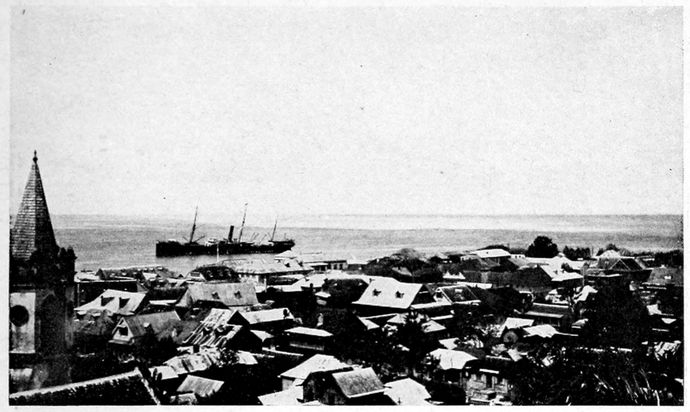
Roseau, capital of beautiful Dominica
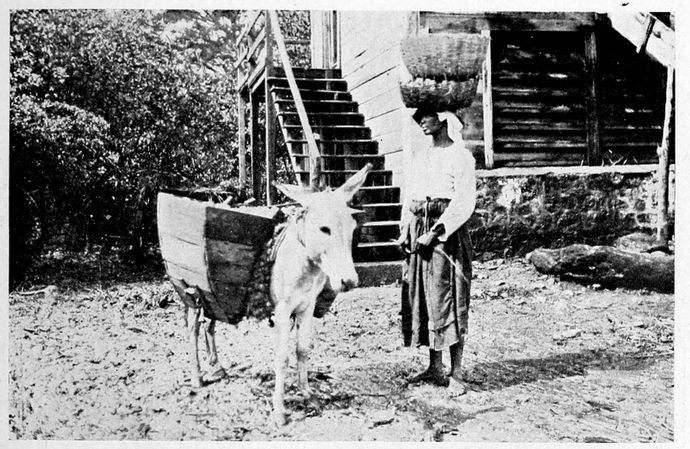
A woman of Dominica bringing a load of limes down from the mountain
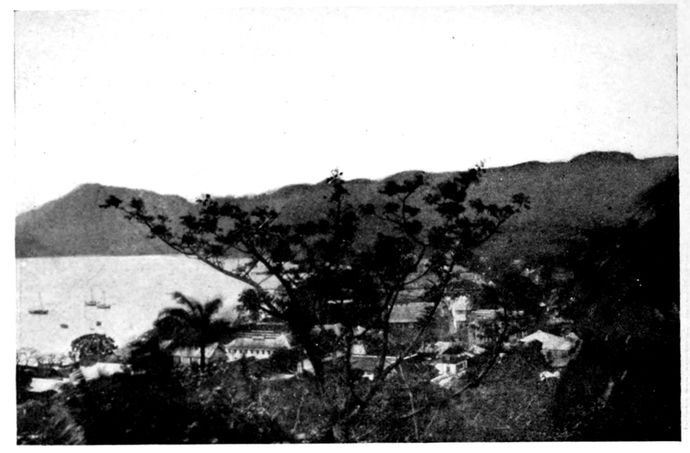
Kingstown, capital of St. Vincent
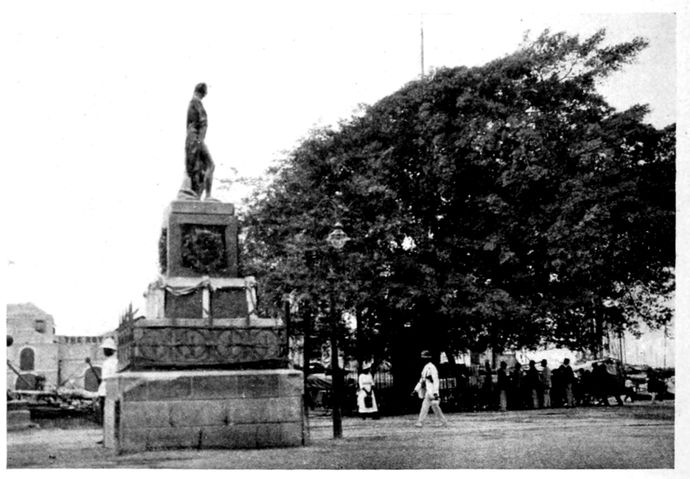
Trafalgar Square, Bridgetown, Barbados, with its statue of Nelson
353I was on the point of abandoning the animal when I caught sight of
a man climbing the trail far ahead of us, the first person I had seen
in more than an hour. I shouted, and for some time fancied he had
dashed off into the wilderness out of fear. Then a break in the vegetation
showed him again, and this time he halted. We reached him at
last, a stodgy negro youth in the remnants of hat, shirt, and trousers
who stood at attention, like a soldier, at the extreme edge of the trail,
an expression between fear and respectful attention on his stupid black
countenance.
“How far is it to Roseau?” I panted.
“Yes, sir,” he replied, seeming to poise himself for a dive into the
jungle void behind him.
“How many miles to Roseau?” I repeated, “five or ten or—”
“Yes, sir,” he reiterated, shifting his mammoth bare feet uneasily.
“I want to know the distance to the city,” I cried, unwisely raising
my voice in my haste and thereby all but causing him to bolt. “Can
I make it in six hours?”
“Yes, sir,” he answered, quickly. Then, evidently seeing that I was
not pleased with the answer, he added hastily, “N—No, sir.”
“Est-ce qu’ on peut le faire en six heures?” I hazarded, but he
seemed to understand French even less than English and stared at me
mutely. The brilliant idea of wasting no more time passed through the
place my mind should have been. I snatched out my note-book and
pencil.
“What’s your name?” I asked. “Can you write?”
He could, to the extent of laboriously and all but illegibly penciling
his name, to which I added his address, a tiny hamlet up in the mountains.
I explained the situation to him briefly in words of one syllable.
He seemed to follow me. At least he answered “Yes, sir” at the end
of each sentence.
“You will take the horse to the police-station in Grand Bay,” I
specified, having gathered from my map and his monosyllables that this
was the next town. “I will tell the police there what to do with him,
and I will leave five shillings with them to give you if you bring horse,
saddle and bridle, and do not try to ride him on the way.”
354“Yes sir,” he replied, taking the reins I held out to him, and I turned
and fled into the swiftly descending night.
I have climbed many mountains in my day, but none that were as
wearying as that endless succession of lofty ridges up the stony sides
of which I stumbled hour after hour in a darkness as black as the
bottom of a well, only to plunge instantly down again into another
mighty, invisible ravine. Several times I lost the trail; how I kept it
at all is a mystery. As I strained forward with every ounce of strength
within me I caught myself thanking fortune, or whoever has my particular
case on his books, that I had been a tramp all my days and had
kept myself fit for such an ordeal. Now and then I passed through a
“town,” that is, what voices told me was a scattered collection of huts
hidden in the vegetation and the night on either side of the trail, for a
hundred yards or two, along which a few ghostlike figures of negroes in
white garments dodged aside at sound of my shod footsteps, each time
soon giving way again to the deep stillness of an uninhabited wilderness,
broken only by the monotonous chorus of jungle insects. Which of
these places was Grand Bay I had no time to inquire, much less batter
my head against the native stupidity for sufficient time to find the police-station
and make known my case to slow-witted black officials. I
would think up some other way of meeting my obligations when I had
accomplished the more pressing mission on hand.
Once the trail came out on the very edge of the sea, crawling along
under the face of a sheer towering cliff, the spray dashing up to my
very feet; a dozen times it climbed what seemed almost perpendicularly
into the invisible, starless sky above for what appeared to my
wasting strength to be hours. I had eaten a hasty breakfast on board
early that morning. Four bananas was the sum total of food I had
been able to get along the way. My thighs trembled like the legs of a
foundering horse; more than once my wobbling knees seemed on the
very point of giving way beneath me. The rain had kindly held off
all afternoon, an unusual boon in Dominica, but the pace I was forced to
set had so drenched me in perspiration that it dripped in almost a
stream from the end of my leather belt.
Then all at once, at the top of an ascent I had told myself a score
of times I could never make, the lights of Roseau burst upon me, far
below yet seemingly no great distance away. There were a few lights
in what seemed to be the harbor, but not enough of them to be sure
they were those of a passenger-steamer. Yet hope suddenly stiffened
my legs as starch does a wilted collar. The town quickly disappeared
355again as I plunged down a stony but wide highway that had suddenly
grown up under my feet. Several times I was convinced it led somewhere
else than where I hoped, so incredibly interminable was the
descent to the town that had seemed so near. Even when I caught
sight of it again, where the road grew suddenly level, it lay far down
the coast, as far, it seemed, as it had been from the top of the range.
But the steamer was still there. I broke into a feeble run, for it could
not possibly have been much short of midnight, but fell back into a walk
when my legs had all but crumpled under me. Never had a small town
seemed so interminably long. Once I passed a “nighthawk” and
shouted a question at him over my shoulder. “About twelve,” he replied,
little suspecting the surge of despair his words sent through me.
As luck would have it, one boatman had remained at the wharf in hope
of a belated shilling. He got two. I had just begun to wring the
perspiration out of my coat into my cabin washstand when a long
blast of the siren and the chugging of the engines told me that we had
gotten under way.
Lest some ungentle reader carry away the impression that I had
increased the slight disrepute in which Americans are held in Dominica—for
our tourists land there frequently—may I add that I settled
in full all my obligations there through the purser of the steamer on its
return voyage? But to drop painful subjects and hark back to that
other visit to Dominica. Then we left at noon, and Roseau settled back
into another week’s sleep. There were several pretty villages tucked
away in the greenery along the shore, some of them with wide cobbled
streets, though hardly a yard of level ground, and each with a church
just peering above the fronds of the cocoanuts. A highway crawled
as far as it was able along the coast beside us, but soon gave it up
where the steep hills, looking like green plush, became precipitous mountains
falling sheer into the sea, yet with low forests clinging everywhere
to the face of them. Bit by bit the loveliest of the Caribbees, the most
unbrokenly mountainous of the West Indies, shrunk away behind us.
Tiny fishing boats with ludicrous little pocket-handkerchief sails ventured
far out, now standing forth against the horizon on the crest of a
wave, now completely lost from sight in a trough of the sea. But by
this time Martinique was looming large on the port bow, and we were
straining our eyes for the first glimpse of ruined St. Pierre.
St. Lucia, largest of the British Windward Islands and a bare twenty-five
miles south of Martinique, is the only one of the Lesser Antilles
356where the steamer ties up at the wharf. Castries, the capital, is situated
on the edge of what was once a volcano crater, but presents little
else of interest to those who have seen its replica in several of the other
islands. Like all the group to which it belongs politically, it was once
French and still speaks a “creole” jargon in preference to English.
It, too, is mountainous, with a Soufrière that rises four thousand feet
into the sky, and despite its thirty-five by twelve miles of extent, its
population is as scanty and as unprogressive as that of Dominica.
The most striking of its sights are the two pitons at the southern end
of the island, cone-shaped peaks rising more than 2500 feet sheer out
of the sea, as if they were the surviving summits of a Himalayan range
that sank beneath the waves before the dawn of recorded history.
The next of the stepping-stones is St. Vincent, for though Barbados,
a hundred miles due east of it, intervenes in the steamer’s itinerary,
it is neither geographically, geologically, nor politically a member of the
Windward group. St. Vincent was the last of the West Indies to come
into possession of the white man, for here the fierce Caribs offered their
last resistance and were conquered only by being literally driven into
the sea. It is ruggedly mountainous and unbrokenly green with
rampant vegetation, its jagged range cutting the sky-line like the teeth
of a gigantic saw. It, too, has its Soufrière, which erupted on the
afternoon before Pélée in Martinique, killing more than fifteen hundred
and devastating one end of the island. Rain falls easily on St. Vincent,
and even the capital is habitually humid and drenched with frequent
showers. This is named Kingstown, and lies scattered along the shore
at the foot of a wide valley sloping quickly upward to the jagged
labyrinth of peaks about which black clouds playfully chase one
another the year round. It is a gawky, ragged, rather insolent place of
unenterprising negroes, with a few scrawny leather-skinned poor
whites scattered among them. Some of these are of Portuguese origin,
and there is a scattering of East Indians. So colorless is the place,
except in scenic beauty, that the appearance of a woman of Martinique
in full native regalia in its streets resembles a loud noise in a deep
silence. Even the sea comes in with a slow, lazy swo-ow among the
weather-blackened fishing boats that lie scattered along its beach. So
quiet and peaceful is it everywhere out of sound of the clamoring
market-place that it would seem an ideal spot in which to engage in
intellectual labors, but there is no evidence that St. Vincent has ever
enriched the world’s art.
357Roads climb away from the capital into the pretty, steep hills that
surround it, among which are tucked red-roofed estates and negro
cabins. The island looks more prosperous in the country than in the
town. Its cotton is said to be unsurpassed for the making of lace,
and was selling at the time of our visit, for $2 a pound. In addition,
it produces cottonseed oil, arrow-root, cacao, and, above all, nutmegs.
The nutmeg grows on a tree not unlike the plum in appearance—residents
of Vermont have no doubt seen it often—the fruit resembling
a small apricot. Inside this is a large nut prettily veined with the red
mace that is another of the island’s exports, and the nut being cracked
discloses a kernel which, dried and cured, is carried down from the
hills in baskets on the heads of negroes and shipped to the outside
world as the nutmeg of commerce. The natives, if the swarthy West
Indians of to-day are entitled to that term, make also pretty little covered
baskets in all sizes, which sell for far less after the steamer has
blown her warning whistle than when she has just arrived.
The eight-hour run from St. Vincent to Grenada, capital of the
Windward group, is close to the leeward of a scattered string of islands
called the Grenadines, some of them comparatively large, mountainous
in their small way, others mere jagged bits of rock strewn at random
along the edge of the Caribbean, all of them looking more or less dry
and sterile. Grenada is rugged and beautiful, though it does not rival
Dominica in either respect. It has variously been called the “Isle of
Spices,” the “Planter’s Paradise,” and the “Island of Nutmegs.”
What claims to be the largest nutmeg plantation on earth—the West
Indians have something of our own tendency for superlatives—lies
among its labyrinth of hills; it produces also cinnamon, cloves, ginger,
and cacao. Though it is admittedly far more prosperous than St.
Vincent, it shows few signs of cultivation from the sea, for none of its
principal products in their growing state can be recognized from the
forest and brush that cover many an uncleared West Indian isle. The
high prices paid for nutmegs during the war, particularly by fruit preservers
in the United States, has brought fortunes to many of its
planters, despite the fact that the tree takes seven years to mature.
Many of the negroes, too, own their small estates and increase their
incomes by making jelly from the nutmeg fruit. Yet from the sea all
this is hidden under a dense foliage that completely covers the nowhere
level island. Along the geometrical white line of the beach are several
villages; higher up are seen only scattered huts and a few larger buildings,
358except where the two considerable towns of Goyave and Victoria
break the pretty green monotony.
But if Grenada must yield the palm for beauty to some of its neighbors,
St. Georges, the capital, unquestionably presents the loveliest
picture from the sea of any port in the Lesser Antilles, if not of the
West Indies. Nestled among and piled up the green hills that terminate
in a jagged series of peaks above, its often three-story houses pitched
in stages one above the other, larger buildings crowning here and there
a loftier eminence, the whole delightfully irregular and individualistic,
it rouses even the jaded traveler to exclamations of pleasure. The
steamer chugs placidly by, as if it had suddenly decided not to call,
passes a massive old fortress, then suddenly swings inshore as though
it had forgotten its limitation and aspires to climb the mountain heights.
A narrow break in the rock wall opens before it, and it slides calmly
into a magnificent little blue harbor and drops anchor so close to the
shore that one can talk to the people on it in a conversational tone.
Why the vessel does not tie up to the wharf and have done with it is
difficult to understand, for the blue water seems fathoms deep up to the
very edge of the quay. Strictly speaking, it is not a wharf at all, but
one of the principal streets of the town, and passengers in their staterooms
have a sense of having moved into an apartment just across the
way from the negro families who lean out of their windows watching
with cheerful curiosity the activity on the decks below.
The sun was just setting in a cloudless sky when we landed in St.
Georges, yet we saw enough of it before darkness came to veil the now
all too familiar negro slovenliness, though it could not disguise the
concomitant odors. The same incessant cries for alms, the same heel-treading
throngs of guides marked our progress, until we had shaken
them off in a long tunnel through a mountain spur that connects the two
sections of the water-front. For despite its distant loveliness, the town
was overrun by the half-insolent, half-cringing black creatures who so
mar all the Caribbean wonderland, until one is ready to curse the men
of long ago who exterminated the aborigines and brought in their place
this lowest species of the human family. On shore St. Georges was
different only in its steep, cobbled streets and its rows of houses piled
sheer one above another. Every other shop announced itself a “Dealer
in Cacao and Nutmegs.” In the clamoring throngs of venders squatted
along the curb the only unfamiliar sight was the blue “parrot-fish,”
with so striking a resemblance to the talkative bird as to be mistaken
for it at first glance. But even here there were evidences of Grenada’s
359greater prosperity. White men were a trifle more numerous; numbers
of private automobiles climbed away into the hills by what at least
began as excellent highways; a telephone line on which we counted
seventy-six wires disappeared into the interior over the first crest behind
the town. Then a full moon came up over the fuzzy hills, lending a
false beauty to many a commonplace old house-wall, restoring the
romance to the heaped-up town, and flooding the world with a silver
sheen long after we had steamed away in the direction of Trinidad.
360
The “Ancient and Loyal Colony of Barbados” lies so far out
to sea that it requires a real ocean voyage to reach it. Low
and uninteresting at first glance, compared to many of the
West Indies, it is by no means so flat as most descriptions lead one to
suppose. Seen from the sea it stretches up to a fairly lofty central
ridge that is regular from end to end, except for being a trifle serrated
or ragged in the center of the island. Dutch looking windmills, the
only survivors of the cane-crushers that have fallen into disuse and left
only the vine-grown ruins of their stone towers in all the rest of the
Lesser Antilles, are slowly turning here and there on the even sky-line.
Though the island is entirely of coral and limestone formation, glaringly
yellow-white under the blazing sunshine at close range, there is a suggestion
of England in the velvety slopes of its varied-green fields as
seen from far out in the bay. First settled by the English in 1624,
it boasts itself the oldest British colony that has remained unceasingly
loyal to the crown and accepts with pride the pseudonym of “Little
England.”
Barbados has come nearer than any other land to solving the vexing
“negro problem.” Cultivated in all its extent, with a population of
140,000 negroes and 20,000 whites on a little patch of earth twenty-one
miles long and fifteen wide, or 1200 human beings to the square mile,
without an acre of “bush” on which the liberated slaves could squat,
the struggle for existence is so intense that the black man displays
here an energy and initiative unusual to his race. The traveler hears
rumours of the Barbadian’s un-African activity long before he reaches
the island; he sees evidences of it before his ship comes to anchor in
Carlisle Bay. Not only is the harbor more active, more crowded with
shipping than any other in the Lesser Antilles, but it has every air
of a place that is “up on its toes.” All the languor, the don’t-care-whether-I-work-or-not
of nature’s favored spots are here replaced by a
feverish anxiety to please, an eager energy to snap up any job that
promises to turn a nimble shilling. Scores of rowboats surround
361the steamer in a clamoring multitude, their occupants holding aloft
boards on which are printed the names of their craft—unromantic,
unimaginative names compared to those of the islands that were once
or are still French, such as “Maggie,” “Bridget,” “Lillie White,”
“Daisy,” “Tiger.” In face of the fierce competition the boatmen
strive their utmost to win a promise from a passenger leaning over the
rail, to impress the name of their craft on his memory so that he will
call for it when he descends the gangway, to win his good-will by
flattery, by some crude witticism,—“Remember the ‘Maggie,’ mistress;
Captain Snowball”; “The ‘Lillie White,’ my lady; upholstered in and
out!” “The ‘Daisy,’ my gentleman; rowboat extraordinary to His
Majesty!” Meanwhile the divers for pennies, a few girls among
them, are besieging the passengers from their curious little flat-bottomed
boats of double wedge shape to toss their odd coins into the water
and “see the human porpoises” display their prowess. Yet, unlike
the pandemonium in the other islands, there is no scramble of venders
and beggars up the gangway to the discomfiture of descending passengers;
no crowding of boatmen about it fighting with one another
for each possible fare, to the not infrequent disaster of the latter. A
bull-voiced negro police sergeant, in a uniform that suggests he has
been loaned from the cast of “Pinafore,” keeps perfect order from
the top of the gangway, permitting boats to draw near only when
they are called by name and ruling the clamoring situation with an
iron hand. For there is this difference between the harbor police
of Barbados and those of all the other ports, that they speak to be
obeyed, permit no argument, and if they are not respected, they are
at least duly feared.
Bridgetown was static. The entire population was massed about the
inner harbor; beyond the bridge that gives the town its name stood
an immense new arch with the words “Welcome to Barbados” emblazoned
upon it. We thought it very kind of them to give us such
unexpected attention, until we discovered they were not waiting for
us at all, but for one whom some loyal but not too well schooled Barbadian
had named in chalk on a nearby wall the “Prints of Whales.”
This was the first time in half a century, it seems, that a member of
the royal family to which the “ancient and loyal” little colony has
shown unbroken allegiance had come to visit it. The black multitude
was agog with poorly suppressed excitement; white natives were
squirming nervously; even the few Englishmen in the crowd were so
thawed by the “epoch-making event” that they actually spoke to
362strangers. The harbor officer was so eager to lose none of it that he
let us pass without examination; an enterprising black youth won a
sixpence by finding us a place on a crowded barge a few yards from
the royal landing-stage. The tramways had been stopped; black troops
lined the vacant expanse of white main street that stretched away
toward the government house. Nelson’s one-armed statue in Trafalgar
Square had been given an oil bath; buildings were half hidden behind
the fluttering flags of all the Allies—the Stars and Stripes rarest
among them. Even nature had contributed to the occasion by sending
an unexpected little shower to lay the white limestone dust that
habitually rouses the ire of new arrivals. The island newspaper announced
a special holiday in honor of “the Prince, who will confer
upon the loyal inhabitants of this ancient colony the privilege of receiving
a message from his august father”; it still carried the advertisements
of the closed shops, imploring the citizens not only to
buy flags and decorations but to “get new clothes in honor of our
royal visitor.”
He landed twenty minutes after us. A salvo of twenty-two guns
from his battleship in the bay sent as many gasps of excitement and delight
through the eager multitude. The subconscious thought came
to us that it might be better to pay outstanding war debts than to
squander so much powder and coal, but it ill behooves an American
of these days to criticize our neighbors for squandering public funds.
Besides, it is no easy matter to keep up this loyalty-to-the-king business
nowadays, though England, surely, need have no fear of changes.
Then a white launch dashed up the cheering inner harbor, a curiously
boyish-faced young man in a gleaming white helmet stepped briskly
out on the landing-stage into a group of black policemen in speckless
girlish sailor suits, who seemed to lack an ostrich feather on
their round white straw hats, the governor in full-dress uniform and
the lord mayor in purple and red robes bowed low over the hand
that was proffered, and the prince and his suite were whisked away.
Black as it was, we were struck by the orderliness of the throng—what
a pandemonium such an event would have caused in the temperamental
French islands!—and its politeness, compared to the
other British West Indies. But if the excitement was suppressed
with British sternness, it was not voiceless. The brief glimpse of
the fêted youth had aroused a thousand exclamations like that of
the ragged old negro woman behind us, “Oh, my God! Dat’s he
himself! Oh Christ!” On the outskirts of the crowd another who
363had been so far away as to have caught, at best, a glimpse of the top
of the royal helmet was still confiding to her surroundings, “My
Jesus, but him good lookin’!” An old negro in a battered derby
through which his whitening wool peered here and there elbowed his
way through the dispersing crowd mumbling to himself, “No use
talkin’, it’s de British flag nowadays!” Farther on a breathless
market-woman was asking with the anxious tone of a master of
ceremonies who had missed his train and feared the worst, “Has my
gentleman landed yet?” But the enthusiasm was not unanimous, for
still another woman, who fell in with us down the street, asserted,
“Even if de prince landing, it all de same for we workin’ people.
De Prince Albert him landed fifty year ago, an’ de school-girls dat
fall wid de grandstand still hobblin’ about on dey broken legs.”
The prince spent a whole day in the ancient and loyal colony before
continuing his journey to Australia, most of it in the isolation of
the governor’s residence, but if he carried away an imperfect picture
of this isolated fragment of the empire, he could at least report to
his “august father” that it still retains its extraordinary loyalty to
the crown.
Bridgetown is very English, despite its complexion and dazzling
sunshine. Broken bottles embedded in the tops of plaster walls, which
everywhere shut in private property, shows that this, too, is an overcrowded
country where the few who have must take stern precautions
against the many who have not. The streets bear such ultra-English
names as “Cheapside,” “Philadelphia Lane,” “Literary Row,”
“Lightfoot’s Passage,” “Whitepark Road.” The very signboards
carry the mind back to England—“Grog Shop—The Rose of Devon,”
“Coals for Sale,” “Try Ward’s Influenza Rum—Best Tonic”; the
tin placard of some “Assurance Company” decorates every other
façade. Even the little shingle shacks in the far outskirts bear some unromantic
name painted above their doors; shopkeepers are as insistent
in giving their full qualifications as the clamoring boatmen in the
bay. “O. B. Lawless—American Tailor—Late of Panama” announces
a tiny one-room hovel. There is a British orderliness of public
demeanor even among the naturally disorderly negroes; the women have
neither the color sense nor the dignified carriage of their sisters of
Martinique, rather the gracelessness of the English women of the
lower classes. Yet in one thing Barbados is not English. It is
hospitable, quite ready to enter into conversation even with strangers.
364When it is not silent and deserted under the spell of a holiday or
its deadly Sabbath, Bridgetown pulsates with life. Its wharves are
as busy as all those of the rest of the Lesser Antilles put together,
as busy as our St. Thomas was before Barbados became the focal
point of the eastern Caribbean. Bales and bundles and barrels and
boatloads of produce pour into it as continuously as if every one of
its 160,000 were wealthy consumers of everything the world has to
offer. Its own product is constantly being trundled down to waiting
lighters—great hogsheads of sugar or molasses carried on specially
designed iron frames on wheels, each operated by three negroes who
have not lost the amusing childishness of their race for all their competition-bred
industry, for they invariably take turns in riding the
contrivance back to the warehouse, though the clinging to it must require
far more physical exertion than walking. Steamers, schooners,
lighters, rowboats, mule-trucks, auto-“lorries” are incessantly carrying
the world’s goods to and fro. Innumerable horse-carriages, scores
of automobiles, ply for hire. Excellent electric-lights banish the darkness
from all but the poorer class of houses. Yet despite the constant
struggle for livelihood,—or perhaps because of it,—Bridgetown has
little of the insolence of the other British West Indies. Applicants
for odd jobs swarm and beggars are plentiful, but the latter are unoffensive
and the former approach each possible client with a “Do
you want me, my gentleman?” so courteous that one feels inclined
to think up some imaginary errand on which to send them. They
seem to recognize that politeness is an important asset in their constant
battle against hunger, which gives them also a responsibility, a
reliability in any task assigned them, and a moderation in their demands
that is attained by few other West Indians.
Barbados has a tramway and a railroad, the only ones between
Porto Rico and Trinidad. True, they are modest little affairs, the
tramcars being drawn by mules. Yet the latter step along so lively,
the employees and most of the passengers are so courteous, and overcrowding
is so sternly forbidden that one comes to like them, especially
those lines which rumble along the edge of the sea in the never-failing
breeze, above all in the delightfully soft air of morning or evening.
It would be difficult in these modern days of indifferent labor to
find more courtesy, more earnest efficiency, and stricter living up to
the rules than among Bridgetown’s tram-drivers and conductors, yet
their highest wage is sixty-four cents a day. But for the war, the
system would long since have been electrified; the new rails have already
365arrived. There is no real reason, except civic pride, however,
that the mule-cars should be abolished. They are more reliable than
many an electric-line in larger cities; they are a pleasant change to
the speed-weary traveler; and the perfection with which their extra
mule is hitched on at the bottom of the one hill in town and unhitched
again at its summit without the loss of a single trot is a never-ending
source of amusement.
Sojourners in Barbados are certain to make the acquaintance of at
least the long tram-line to St. Lawrence. There are plenty of hotels
in the town proper, but they are habitually crowded with gentlemen
of color. White visitors dwell out Hastings way, some two miles from
Trafalgar Square. Unlike the French and Spanish towns of tropical
America, the downtown section of the Barbadian capital is almost
wholly given over to business—and negroes. The numerous white
inhabitants and most of the darker ones of any standing dwell in the
outskirts. There one may find parks shaded by mahogany and palm-trees,
splendid avenues lined by one or both of these species, comfortable
residences ranging all the way from tiny “villas” draped with
an ivy-like vine or gorgeous masses of the bougainvillea to luxurious
estates in their own private parks. Even the poorer classes in another
stratum still farther from the center of town dwell in neat little toy-houses
of real comfort, compared with the huts of the masses of Haiti
or Porto Rico. For miles along the sea beside this longest tram-line
one passes a constant succession of comfortable, light-colored houses
with boxed verandas, wooden shutters that raise from the bottom, and
a sort of cap visor over the windows. In many cases these boast
tropically unnecessary panes of glass through which one can make out
of an evening interiors of perfect neatness, homelike, well lighted,
furnished and decorated in taste, with none of the gaudy and crowded
bric-a-brac to be seen behind Spanish rejas in the larger islands.
The night life of Bridgetown is worth a ride behind the now weary
mules, if only to see a negro urchin diligently striving to light a candle
in a tin box on the end of his soap-box cart, lest he be hauled up for
violation of the ordinance forbidding vehicles to circulate after dark
without lamps. Promptly at sunset the black policemen have changed
their white helmets and jackets for German looking caps and capes.
On the way downtown one passes half a dozen wide-open churches and
chapels in which black preachers are vociferously exhorting their
nightly congregations to “walk in de way of de Lard”; one is certain
to rumble past the shrieking hubbub of a Salvation Army meeting
366or two. There are crowds of loafers on many a corner—jolly, inoffensive,
black idlers with the spirit of rollicking fun in their ebony
faces, bursting into howls of laughter at the slightest incident that
seems comical to their primitive minds. The filthy street-habits of
the French and Spanish islands are little in evidence, for the police
of Barbados are as vigilant as they are heavy-handed.
Downtown the activities of the day have departed. The larger
stores have closed at four, the small shops at sundown. Only a
scattered score of negro women squat in Trafalgar Square before their
little trays of peanuts, bananas, and home-made sweets, a wick torch
burning on a corner of them whether they are deposited on the ground
or are seeking lack of competition elsewhere on top of their owners’
heads. There is no theater in Bridgetown; the cinema is as sad a
parody on amusement as it is everywhere, but the audience is worth
seeing, once. The negroes sit in the “pit,” the élite, chiefly yellow of
tint, in a kind of church gallery. Shouts, screams, roof-raising roars
of primitive laughter, deafening applause whenever the frock-coated
villain is undone, mark the unwinding of the film from beginning to
end; it is a scene far different from the comparative dignity of a
black French audience. In the French and Spanish West Indies the
cinemas begin after nine and end around midnight; in Barbados they
start sharply at seven and terminate at ten with a rush for the last
mule-cars, with all but the swift out of luck, and Bridgetown settles
down to deathly Sunday stillness while the weary mules are still crawling
toward the end of their laborious day.
Or, if the visitor does not care to break up his evening by descending
into town, there are few more ideal spots in which to hear a
band concert than the little park known as Hastings Rocks, on the
very edge of the sea, especially under a full moon. I am an inveterate
concert-goer; one naturally becomes so in tropical America, where
other music is so rare, and I must confess a preference for the Spanish-American
type of concert over the Anglo-Saxon, for the gay throngs
of promenaders about the sometimes not too successful attempts to
render a classical program over the staid gatherings that listen motionless
to an uproar of “popular” music. But even this serves to
while away an evening and seldom fails to offer a touch of local color.
Thus in negro-teeming Barbados there is scarcely a suggestion of
African parentage to be seen at this stately entertainment on Hastings
Rocks. It is partly the sixpence admission that keeps the negroes
outside, but not entirely. Struck by the fact that there was only one
367mulatto boy and two light-yellow girls, all very staid and quiet, on the
seaside benches, I sought information of the negro gatekeeper. Yes,
indeed, he refused admittance to most of those of his own color, and
to some white people, too.
“You see,” he explained, “it is like this. Perhaps last night you
might go with a girl downtown, and then you come here to-night with
your wife; and if that girl allowed to come in here she might want to
get familiar and gossip with you. Or she might giggle at you. We
can’t have that,” he added, in a tone that reminded one that the Briton,
even when his skin is black, is first cousin to Mrs. Grundy. The English
sense of dignified orderliness and the negro’s natural gaiety, his
tendency to “giggle” at inopportune moments, do not mix well, and
the Hasting Rocks concert is one of those places where African hilarity
must be ruthlessly suppressed.
Besides Bridgetown, with its 35,000 or more inhabitants, Barbados
has a number of what might best be called large collections of houses,
such as Speightstown, Holetown—popularly known as “the Hole”—and
the like, but its population, surpassed in density, if at all, only by
China, a density compared to which that of Porto Rico seems slight
indeed, is spread so evenly over all the island that it is hard to tell
where a town begins or ends. The island is one of the most remarkable
instances of coral formation. Comparatively flat, when likened to
most of the West Indies, it consists of a number of stages or platforms
that have been built one after the other as the island rose slowly
and gradually from the sea to a height, at one point, of nearly 1200
feet. When first discovered it was surrounded by mangrove swamps
and tangled, rotting vegetation, but all this has since turned to solid
ground. The coral of which it is built contains some ninety per cent.
of lime, so that almost the whole island might be reduced to powder
in a lime-kiln. The rest of it consists of a species of sandstone known
as “Scotland rock,” which comes to the surface in the northwestern
part of the island.
Thanks to its geological formation, the close network of roads which
reaches every corner of Barbados, as well as all its bare open spaces,
are glaringly white and hard on the eyes, especially, if one may judge
by the prevalence of glasses among them, those of the white and
“high yellow” inhabitants. Yet, for the same reason, it is perhaps
the most healthful of the West Indies. It has no swamps to breed
malaria; the trade winds from the open ocean sweep incessantly across
368it. Once it was troubled with typhoid, but the establishment of a
single unpolluted water supply for the whole island has done away
with this danger. There is great equability of temperature day or
night the year round. The wet season, from June to October, is less
so than in most tropical lands; though visitors and European inhabitants
complain of the midday heat, except in December and January, it is
always cool compared to midsummer in the United States. Fresh, dry,
and constantly laden with ocean ozone, it is a climate that makes little
demand upon the strength and vital powers. All indications point to
the fact, however, that it is no place for white women as permanent
residents, for virtually without exception they grow scrawny, nervous,
and weak-eyed, their pasty complexions sprayed with freckles under
their veils.
All roads lead to Bridgetown, but to follow them in the opposite
direction to any chosen point is not so simple a matter. Signboards
are almost unknown, no doubt being considered a superfluity in so
small and crowded a community. The country people, though willing
enough, are often too stupid to give intelligible directions, though
they make up for this by a persistency in showing one the way in person
which no amount of protest can overcome. Ask a question or give
them any other slightest excuse to do so, and they will cling to the
white pedestrian’s heels for miles in the hope of picking up a penny or
a “bit,” always taking their leave with, “I beg you for a cent, sir.”
Indeed, that is the constant refrain everywhere along the dazzling but
excellent highways. Women and men shout it from the doors of
their little cabins; children scamper after one, the black babies are
egged on by their elders as soon as they can toddle, each shrieking the
invariable demand in a tone of voice which suggests that refusal is
impossible. They seem to fancy that white strangers cross the island
for no other purpose than to distribute a cartload of English coppers
along the way. Almost as incessant are the demands upon the kodak-carrier
to “Make me photo, sir,” or, “Draw me portrait, master.”
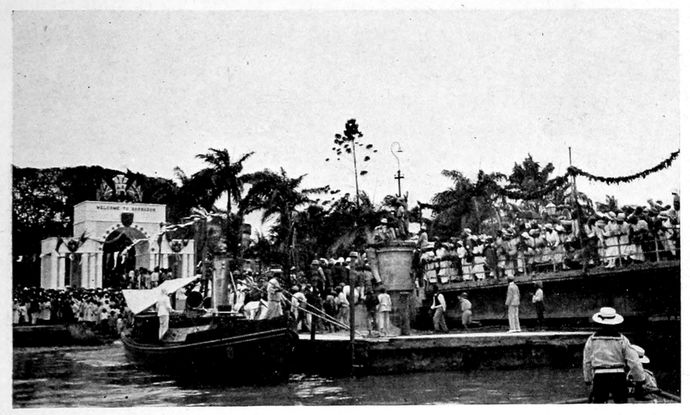
The Prince of Wales lands in Barbados
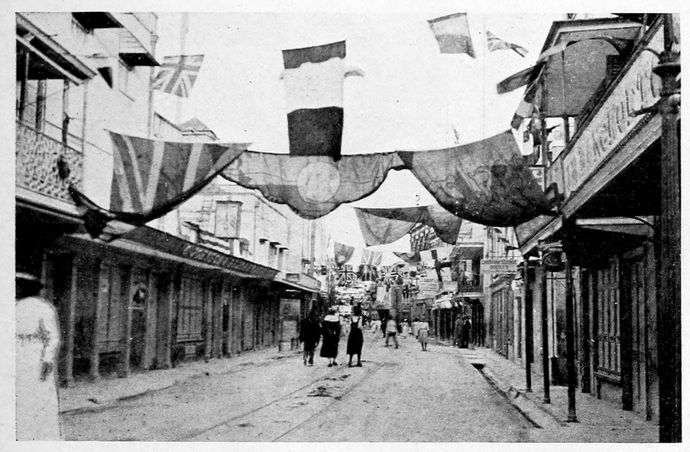
The principal street of Bridgetown, decorated in honor of its royal visitor
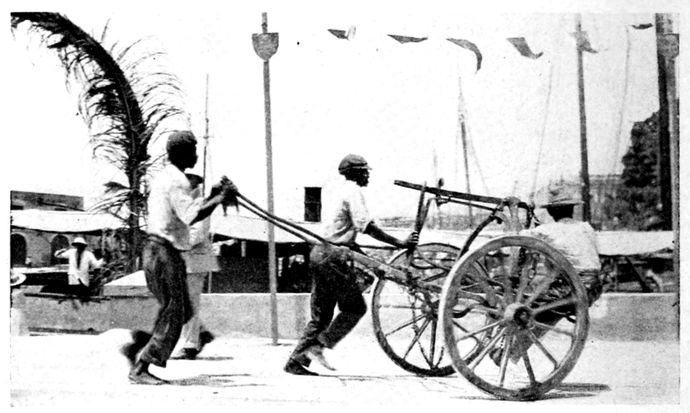
Barbadian porters loading hogsheads of sugar always take turns riding back to the warehouse
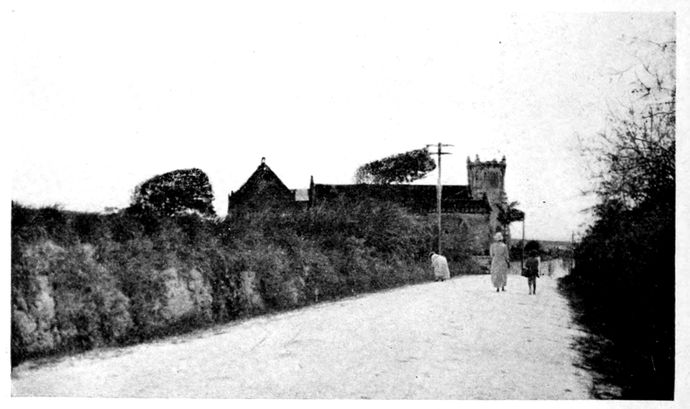
There is an Anglican Church of this style in each of the eleven parishes of Barbados
369On week-days the highways of Barbados are as crowded as city
streets. Heavy draft horses and mules, auto-trucks large and small,
are constantly descending to Bridgetown with the cumbersome hogsheads
of sugar and molasses, or returning with supplies for the
estates. There is an endless procession of almost toy-like carts, each
drawn by a single small donkey, the two wheels habitually wobbly,
the name, address, and license number of the owner in crude letters
on the front of the diminutive box. The donkey is the invariable beast
of burden of the Barbadian of the masses. He carries to town the
products of little gardens; he brings the supplies of the innumerable
small shops throughout the island; the country youth takes his “girl”
riding in his donkey-cart; in later years the whole ebony family packs
into it for a jolt across the country. Unlike the rest of tropical America,
Barbados does not ride its donkeys or use them as pack-animals;
nor, to all appearances, are they abused. Centuries of British training
seems to have given the black islanders a compassion rare among
their neighbors. Horsemen and pack-mules are likewise unknown
along the white highways; oxen are rare; pedestrians are much less
numerous than one would expect in so populous a community, while
bicycles are as widely in use as in England.
There is a curiously English homelikeness about the landscape,
which, if it is seldom rugged, is by no means monotonous. Every
acre of ground is utilized; forbidding stone-and-mud walls topped by
spikes or broken glass line the roads for long distances; villages, or at
least houses, are so continuous that one is almost never out of human
sight or sound. Coral is so abundant and wood so expensive that
immense limestone steps often lead up to tiny wooden shacks, as out
of proportion to their foundations as statues to their pedestals. The
majority of the rather well-kept little negro cabins, however, are
simply set up on small blocks of coral at the four corners. More than
one band of hilarious sailors from visiting battleships have amused
themselves by removing one of these props and tumbling a Barbadian
family out of their beds in the small hours of the night.
Shopkeeping might almost be called the favorite sport of the “Badeyan”;
the lack of jobs enough to go round has led so many to adopt
this means of winning a possible livelihood that the island has been
called “Over-shopped Barbados.” Everywhere wayside shanties bear
the familiar black sign with white letters, varying only in name and
number: “Percival Brathwaite—Licensed Seller of Liquors—No.
765.” Inside, perhaps behind a counter contrived from a single
precious board, are a few crude shelves stocked mainly with bottles
of rum or with cheap “soft drinks,” a few shillings’ worth of uninviting
foodstuffs flanking them. The Barbadians have long been known
as the “Yankees of the West Indies.” They are far more diligent
merchants than most natives of tropical America, so much so that
neither the Chinese, Jews, Portuguese, nor Syrians, so numerous in
the other islands, can compete with them to advantage. But their
knowledge of book-keeping is scanty, and it is often only the visible
370end of his light resources that convinces the petty shopkeeper that he
is losing, rather than gaining at the popular pastime.
Every little way along the island roads other shanties bear the sign
of this or that “Friendly Society.” These are a species of local insurance
company or mutual benefit association. The negroes pay into
them from three pence to a shilling a week,—some of the poorer
neighbors nothing at all,—and receive in return sickness or accident
benefits, or have their funeral expenses paid in case of death. But
they are typically tropical or African in their indifference to a more
distant to-morrow, for at the end of each year the remaining funds are
divided among those members who have not drawn out more than they
paid in, and with perhaps as much as five dollars each in their pockets
the society indulges in a hilarious “blow-out.” Equally numerous are
the signboards of “agents” of the undertakers of Bridgetown. They
do not believe in waiting for the sickle of Father Time, those deathbed
functionaries of the capital, but drum up trade with Barbadian
energy. The island’s newspaper habitually carries their enticing pleas
for clients:
“OUR DEAD MUST BE BURIED,” begins one of these appeals.
“In the SAD HOUR why trouble yourself over the Dead when you
can see E. T. ARCHER GITTENS, the up-to-date and experienced
UNDERTAKER face to face? Look for the Hearse with the
GOLDEN ANGEL!” There follows a “poem” of twenty-four
verses setting forth the advantages of being buried by Gittens and
ending with the touching appeal:
Just take a ride to Tweedside Stable
And you’ll see that this is no Fable.
Phone 281 night or day
And you’ll hear what Gittens has to say.
He and his staff are always on hand
To accommodate any class of man.
“All orders will be promptly executed at MODERATE PRICES.
A TRIAL WILL CONVINCE.”
No doubt it would.
The Barbados government railway—one could not call it a railroad
in so English a community—is an amusing little thing twenty
years old and some two hours long, though that does not mean as much
in miles as one might expect. On week-days its passenger-train sometimes
makes a one-way journey, at a cost of four shillings and sixpence
371for first and two shillings for second-class travelers, but on Sundays
it indulges in the whole round trip. From the station near the
famous bridge from which the capital takes its name, the little train
tears away as if excited at its own importance, through slightly rolling
cane-fields, rocky white coral gullies, past frequent Dutchy windmills
flailing their shadows on the ground. Vistas as broad as if it
were crossing a continent instead of a tiny parcel of land flung far
out into the ocean, spread on either hand, that to the right flat and
almost desertlike in its aridity, the north broken in rugged low ridges,
with many scattered villages and gray heaps of sugar-mills on their
crests. The soil is so thin one marvels that it will grow anything,
yet every acre of it shows signs of constant cultivation, the long expanses
of cane broken here and there by small patches of corn, cassava,
yams, and the sweet potatoes on which the mass of the population
depends for nourishment. Every few minutes the train halts
at a station seething with cheerful black faces; everywhere it crosses
white coral roads, some of them cut deep down through the limestone
ridges. Trees are almost plentiful, but they all show evidence
of having been planted. The Spanish discoverers, it is said, gave the
island its present name because its forests were bearded (barbudos)
with what is known in our southern states as “Spanish moss,” but
this, like the original woods, has long since disappeared.
Sunday is as dead as it can only be in a British community. The
cattle and mules stand in the corrals eating dry cane-tops; the square
brick chimneys of the boiling-houses emit not a fleck of smoke. Only
in rare cases even are the windmills allowed to work, though for some
reason nature does not shut off the bracing trade-wind. This is so
constant that it forces all the branches of the trees to the southwest,
until even the royal palms seem to be wearing their hair on one side.
Fields brown with cut cane-tops contrast with the pale green of those
still unharvested; the general sun-flooded whiteness of the landscape
is painful to the eyes. Here and there is a patch of blackish soil, but
it has the vigorless air of having long been overworked, a looseness
as of volcanic lava.
In less than an hour the Atlantic spreads out on the horizon ahead.
Rusty limestone cliffs, a jagged coral coast against which the sea dashes
itself as if angry at the first resistance it encounters since passing the
Cape Verde Islands many hundred miles away, stretch out to the
north and south. We come out to the edge of it, fifty feet above,
then descend to a track so close to the surf that the right of way must
372be braced up with old rails. It is a dreary, barren-dry, brown-yellow
coast, yet of a beauty all its own, with its chaotic jumble of huge rocks
among which hundreds of negroes are bathing stark naked and spouting
holes out of which the thundering surf dashes high into the air.
Farther north the landscape grows almost mountainous, but we have
already reached Bathsheba, where Sunday travelers habitually disembark,
leaving the train to crawl on alone to a few tiny oil-wells
around the next rugged promontory.
I climbed the sheer cliff a thousand feet high above Bathsheba,
its face covered with brown grasses, ferns, creeping plants, and the
smaller species of palm that cling to each projecting rock as if their
available nourishment were as scanty and precious as that of the
teeming human population. The view from the summit forever banishes
the notion that Barbados is flat. All “Scotland,” as the northern
end of the island is called, is laid out before you, broken and pitched
and jumbled until it resembles the Andes in miniature. White ribbons
of roads and a network of trails are carelessly strewn away
across it, hundreds of huts are scattered over its chaotic surface, and
an immense building stands forth on the summit of its highest hill.
Jagged, gray-black sandstone boulders of gigantic size contrast with
the white limestone to give the tumbled scene the aspect of having
been left unfinished by the Builder of the western hemisphere in his
hurry to cross the Atlantic. Below, this scene spreads away to infinity,
its scalloped, foam-lashed shore clear-cut in the dry, luminous
atmosphere as far as the eye can see in either direction. Behind, the
picture is tamer, though by no means level. Rolling cane-fields, with
here and there a royal palm, numerous clusters of huts, and the ubiquitous
chimneys and windmills of sugar-factories breaking the sky-line,
stretch endlessly away to the yellow-brown horizon.
I returned to Bridgetown on foot—he who still fancies the island
is level and tiny should walk across it on a blazing Sunday afternoon—passing
not more than a score of travelers on the way. Once I
paused to chat with a group of “poor whites,” as they call themselves,
or what their black neighbors refer to as “poor buckras” or “red
legs.” These reminders of our own “crackers” are numerous in
Barbados, especially in the “Scotland” district. They are descendants
of the convicts or prisoners taken in the civil wars of England during
the Commonwealth or the Duke of Monmouth’s rebellion. Chiefly
Scotch and Irish, some of them royalists of the nobility, they were
sent to the island by Cromwell between 1650 and 1660 and sold to the
373planters for 1500 pounds of sugar a head. It is doubtful whether
any of them would be worth that now. Branded and mutilated to prevent
their escape, treated more brutally than the blacks by whom they
are held in contempt to this day, they steadily declined in health and
spirits until their present descendants, with the exception of the few
who rose to be planters, are listless and poverty-stricken, degenerate
victims of the hookworm and of intermarriage. The original prisoners
wore kilts; hence the tropical sun soon won them the nickname
of “red legs,” which has persisted to this day, perhaps because their
bare feet have still a distinctly ruddy tinge. But their faces are corpse-like
in color and their bodies thin and anemic. Of the adults in this
group, not one had more than a half dozen crumbling fangs in the
way of teeth.
Yet they seemed moderately well-informed and of far quicker intelligence
than the sturdier blacks who so despise them. Their air
of honest simplicity acquitted them of any suggestion of boasting
when they asserted that the “poor whites” never steal cane and other
growing crops, the theft of which by the negroes, despite heavy penalties,
is one of the curses of the island. The chief topic of conversation,
nevertheless, was that inevitable post-war one the world over, the
high cost of food. Coffee, their principal nourishment, they took
nowadays without sugar, and though it had sold at sixteen cents a
pound when the war ended, it was now forty. Rice, sweet potatoes,
meal, even breadfruit, “the staff of Barbados,” had trebled in price.
Their “spots,” as they call their gardens, were constantly being robbed
by the negroes. It was no use trying to keep a goat or a sheep; some
black thief was sure to carry it off.
I succeeded at length in bringing up the matter of education. They
sent their boys to the public schools, but it was not safe to send the
girls. There were elementary schools in every parish, where each
pupil paid a penny a week. The teachers were nearly all men and all
were colored. In the higher public schools, which an average tuition
of $72 a year put out of reach for most of them, the teachers were
usually Englishmen; but the color-line was drawn only in the private
schools, of which there were plenty for those who could afford them.
While they talked I noted that the enmity between the two races was
camouflaged under an outward friendliness; the greetings between the
group of “red legs” and the black passers-by had a heartiness of tone
that might easily have deceived an unenquiring observer.
One of the sights of Barbados is the large, old, gray stone Anglican
374church in each of the eleven parishes. Their erection was decreed
way back in the days when the Earl of Carlisle, having a superior
“pull” with the King of England, ousted Sir William Courteen as
founder of the colony. They are as English in their sturdy bulkiness,
with their heavy crenelated stone towers and the replica of an English
country churchyard about each of them, despite the difficulty of digging
graves in hard limestone, as the English sparrows which flock about
the neighboring cane-fields. The Anglicans, having gotten in on the
ground floor, have almost a monopoly in the island, though other denominations
have no great difficulty in establishing their claims to endowments.
The Catholics, of whom there are barely a thousand, have
only one small church. Even the shouting sects seem to have less
popularity among the Barbadians than in most negro communities.
Religion is reputed the true bulwark of the social order in Barbados,
but it is rather because the long established churches serve to maintain
the class distinctions on which this is based than because they
succeed in holding the negroes up to any particularly high standard
of morals. Mrs. Grundy is strongly entrenched in all the British West
Indies, but her influence is rather superficial among the black masses,
who have a considerable amount of what other races call the “hypocrisy”
of the Anglo-Saxon.
But Sunday is no time to see Barbados. I walked entirely across the
island without meeting one donkey-cart, so numerous on week-days.
There was scarcely a wheeled vehicle in all the long white vista of
highways, except a rare bicycle and the occasional automobile of a
party of American tourists. Pedestrians were as rare; the people
were everywhere shut in behind their tight-closed wooden shutters, a
few of them singing hymns, most of them sleeping in their air-tight
cabins. The few I roused, out of mere curiosity, treated the annoyance
as something bordering on the sacrilegious. Nowhere was there
a group under the trees; never a picnic party; not a sign of any one
enjoying life. Bridgetown itself, compared to the swarming uproar
of the “prince’s day,” was as a graveyard to carnival time.
With the dawn of Monday, however, the island awakens again to
its feverish activity, and one may easily catch an auto-truck across the
floor-flat, dusty plain stretching some five miles inland from the capital
and drop off on the breezy higher shelves of the island. Something
of interest is sure to turn up within the next mile or two.
The Barbadian, for instance, digs his wells not to get water, but to
375get rid of it. They are to be found everywhere, often at the very
edge of the highway and always open and unprotected. They are big
round holes cut far down into the jagged coral rock, splendid places,
it would seem, into which to throw something or somebody for which
one has no use. This is exactly their purpose, for they are designed
to carry off the floods of the rainy season. Barbados has no rivers
and no lakes, or rather, these are all underground, some of them in
immense caverns. In former days the mass of the population depended
for its water supply on shallow, intermittent ponds, the better
class on private arrangements. Now two central pumping stations
and more than a hundred miles of underground pipe furnish the entire
island with excellent, if lukewarm, water from the unseen rivers.
Instead of the roadside shrines of the French islands, the limestone
embankments of Barbadian highways have faucets at frequent intervals.
Water is free to those who fetch it from these. The better
class residents are everywhere supplied by private pipes at a nominal
sum per house. Business places pay thirty cents per thousand gallons,
which is considered so expensive that only one estate on the
island is irrigated though drought is frequently disastrous in the west
and south.
The stodgy windmills everywhere fanning the air are used exclusively
for the grinding of cane. It is a rare patch of landscape that
does not show at least half a dozen of these toiling away six days of
the week. The fact that they have survived in Barbados, of all the
West Indies, may be as much due to its unfailing trade wind as to the
crowded conditions which make the innovation of labor-saving devices
so unpopular. Methods long since abandoned elsewhere are still in
vogue in Barbadian sugar-mills. The cane is passed by hand between
the iron rollers in the stone windmill tower. The big hilltop yard about
this is covered with drying bagasse, or cane pulp, which is finally
heaped up about the boiling-house in which it serves as fuel. The
juice runs in open troughs from the windmill to this latter building,
where it is strained and left to settle until the scum rises to the surface.
Then, this being skimmed off, it is boiled in open copper kettles. A
negro watches each of them, dipping out the froth now and then
with a huge soup-ladle and tossing the boiling liquid into the air when
it shows signs of burning. Toward the end of the process the
“sugar-master” is constantly trying the syrup between a finger and
thumb, in order to tell when the crystals are forming and when to
“strike” the contents of the kettle, which must be done at the right
376moment if the sugar is to be worth shipping. From beginning to
end the work is done by hand, and a Barbadian sugar-mill has little
resemblance, except in its pungently sweet odor, to the immense centrals
of Cuba.
In the early days the sugar-men had much trouble in transporting
their product because of the deep gullies and bad roads. Once upon
a time camels were used, but though they answered the purpose
splendidly, being very sure-footed and capable of carrying the price
of a “red leg” each, they died for lack of a proper diet. To this day
Barbadian sugar or molasses is shipped in the cumbersome 110–gallon
hogsheads which were adopted in the days of camels, though the hauling
is now done on mule or auto-trucks.
With an unlimited supply of cheap labor, it is natural that the Barbadian
planters should cling to the old processes. Indeed, the estate
owner who attempts to bring in new machinery is heartily criticized
by his competitors, while the establishment of new mills is out of the
question, there being already too many factories for the available acreage.
The sugar planters, nine out of ten of whom are as white as the
Anglo-Saxon can be after many generations of tropical residence, hold
all Barbados, leaving only the steeper hillsides and the less fertile patches
as “spots” on which the “red legs” and the negroes plant their
yams, arrow-root, sweet potatoes, and cassava. They live in luxurious
old manor houses, usually on high knolls overlooking their not particularly
broad acres, half-hidden in groves of mahogany-trees, which
are protected by law from destruction. With few exceptions they
are the descendants of English colonists, and still keep the British
qualities their ancestors brought with them, keep them so tenaciously
that in some ways they are more English than the modern Englishman
himself. There are suggestions that they are as short-sighted as most
conservatives in taking the last ounce of advantage of the crowded
conditions to keep the laboring masses at ludicrously low wages.
Molasses, which the Barbadians call “syrup,” has advanced from seven
cents to a dollar a gallon in the past few years, yet the planters are still
paying about a shilling per hundred “holes” of cane, making it impossible
for the hardest workers to earn more than “two and six”
a day, though the prices, even of the foodstuffs grown on the island,
have nearly all trebled. The pessimists foresee trouble and cite the
continual presence of a battleship in Barbadian waters as proof that
even the government fears it. But though they constitute only one
eighth of the population and the percentage is steadily decreasing,
377the whites have always ruled in Barbados. As early as 1649 the
slaves planned to kill them all off, and kept the secret of the conspiracy
so well that it would probably have succeeded but for a servant who
gave the planters warning on the eve of the attack. In 1816 there
came another fierce negro rebellion, which was put down with an iron
hand. Since then the blacks have been given little real voice in the
government, despite their overwhelming majority, and the traveler
of to-day finds Barbados the one island of the British West Indies in
which the negroes are not beginning to “feel their oats.”
Some attribute the patent difference between the Barbadian and
other negroes of the western hemisphere to his origin in Sierra Leone,
while the rest came from the Kru or the Slave Coast, but there is little
historical evidence to support this contention. Still others credit his
superior energy and initiative to the absence of malaria in the island.
Most observers see in those qualities merely a proof that the negro
develops most nearly into a creditable member of society under physical
conditions which require him either to work or starve. Whoever
is right, the fact remains that Barbados is one of the few places where
emancipation was not disastrous, and that the Barbadians are probably,
on the whole, the most pleasant mannered people in the West Indies,
if not in the western hemisphere. Except for rare cases of rowdyism,
they are always courteous, yet without cringing. Even those in
positions bringing them into official contact with the public are, as is
too often the reverse in many another country, extremely obliging,
cheerful, yet never patronizing, rarely brusk, yet efficient and prompt,
fairly true to their promises, for a tropical country, and have little
of that aggressive insolence which is becoming so wide-spread among
the negroes in our own country and the other British West Indies.
The crowded condition of the country evidently makes the constant
meeting of people a reason to cut down friction to the minimum, while
the necessity of earning a livelihood where work is scarce leads them
to be careful not to antagonize any one.
That they are amusing goes without saying. The magnificent black
“bobby” in his white blouse and helmet, for instance, does not reply
to your query about the next tramway with, “Goin’ to Hastings?
Better geta move on then,” but with a mellifluous, “Ah, your destination
is Hastings? Then you will be obliged to proceed very rapidly;
otherwise you are in danger of being detained a half-hour until the
next car departs.” Yet they are not a people that grows upon one.
As with all negroes, there is a shallowness back of their politeness, a
378something which reminds you every now and then that they have no
history, no traditions, no ancient culture—such as that which is apparent,
for instance, in the most ragged Hindu coolie—behind them.
Small as it is, there are many more points of interest in Barbados.
There is Speightstown, for example, where whaling is still sometimes
carried on; Holetown, with its monument to the first English colonists;
a marvelous view of all the ragged Atlantic coast from the parish
churchyard of St. John’s, in which lies buried a descendant of the
Greek emperors who was long its sexton; Mt. Hillaby, the highest
point of the island, from which one may look down upon all the chaotic
jumble of hills in St. Andrew’s Parish, better known as “Scotland,”
or in the south the broad, parched flatlands of Christ Church, the only
one of the eleven parishes not named for some saint of the Anglican
calendar. Or there is amusement, at least, among the huts tucked away
into every jagged coral ravine, in noting the curious subterfuges adopted
to wrest a livelihood from an overburdened and rather unwilling soil.
Every acre of the island being under cultivation, there is, of course,
no hunting; wild animals are unknown, except for a few monkeys in
Turner’s Woods. These are rarely seen, for so human have they become
in their own struggle for existence that they post a guard whenever
they engage in their forays and flee at his first intimation of
danger. Negro boys earn a penny or two a day for keeping the
monkeys off the cane-fields. There being no streams or lakes, the
island has no disciples of Isaac Walton, but the Barbadians are inveterate
fishermen, for all that. Time was when the little boats which
are constantly pushing out to sea in water so clear that one may see
every crevice of the coral bottom sixty feet below brought back more
fish than the island could consume. Then one might buy a hundred
flying-fish for a penny; to-day these favorites of the Barbadian table
cost as high as two pence each, while the equally familiar dolphins
cost twice that a pound. “Sea eggs,” which are nothing more or less
than the sea-urchin of northern waters, are a standard dish in this
crowded community, for the same reason, perhaps, that the French
have discovered the edible qualities of snails.
Barbados is the only foreign land ever visited by the father of our
country. In the winter of 1751–52, nearly a quarter of a century before
the Revolution, Captain George Washington, then adjutant general
of Virginia at one hundred and fifty pounds a year, accompanied
his brother on a journey in quest of his health. Major Lawrence
379Washington of the British army, owner of Mt. Vernon, fourteen years
older than George, had been suffering from consumption since he
served in the expedition against Cartagena in South America. They
sailed direct to Barbados, then a famous health resort, by schooner.
The skipper must have been weak on navigation, for, says George’s
journal, “We were awakened one morning by a cry of land, when by
our reckonings there should have been none within 150 leagues of us.
If we had been a bit to one side or the other we would never have
noticed the island and would have run on down to ——”, the future
father of our country does not seem to have a very clear idea just where.
In fact, schoolmarms who have been holding up the hatchet-wielder
as a model for their pupils—unless some millionaire movie hero has
taken his place in the hearts of our young countrymen nowadays—will
no doubt be horrified to learn that George was not only weak in
geography, but even in spelling. He frequently speaks of “fields of
cain,” for instance, and sometimes calls his distressing means of conveyance
a “scooner,” or a “chooner.” But let him speak for himself:
Nov. 4, 1751—This morning received a card from Major Clark welcoming us
to Barbados, with an invitation to breakfast and dine with him. We went—myself
with some reluctance, as the small pox was in the family. Mrs. Clark
was so much indisposed [the italics are mine] by it that we had not the pleasure
of her company. Spent next few days writg letters to be carried by the Chooner
Fredericksburg to Virginia.
Thursday 8th. Came Captn Crofton with his proposals which tho extravagantly
dear my Brother was obliged to give. £15 pr Month is his charge exclusive
of Liquors & washings which we find. In the evening we remov’d some of
our things up and ourselves; it’s pleasantly situated pretty near the sea and abt
a mile from the Town, the prospective agreable by Land and pleasant by Sea
as we command the prospect of Carlyle Bay & all the shipping in such a manner
that none can go in or out with out being open to our view.
The Washingtons evidently lived near the same spot now inhabited
by American tourists, any two of whom would be only too happy nowadays
to pay forty-three dollars a month for board and lodging,
“Liquor” or no liquor. Capt. Crofton, the rascally profiteer, must
have made a small fortune out of his “paying guests,” for they were
always being invited out to meals at the “Beefstake & Tripe Club”
or elsewhere. Church members, however, will be glad to see the next
entry, despite of that unhappy break about the “Liquor”:
Sunday 11th. Dressed in order for Church but got to Town too Late. [What
man ever kept his sense of time in the tropics?] Went to Evening Service.
380Thursday 15th. Was treated with a play ticket to see the Tragedy of George
Barnwell acted. [George, you see, was no money-strewing tourist. But then,
he was not an American in those days.]
Saturday 17th. Was strongly attacked with the small Pox sent for Dr. Lanahan
whose attendance was very constant till my recovery and going out which
was not ’till thursday the 12th December.
December 12th. Went to Town visited Maj. Clarke (who kindly visited me
in my illness and contributed all he cou’d in send’g me the necessary’s required
by ye disorder).
Kind of him, surely, after his other little contribution to “ye disorder”
in the shape of that first invitation. The only real result of the
Washingtons’ trip to Barbados was that our first President was pockmarked
for life, for Lawrence got no good out of the trip. George
went back to Virginia and Lawrence to Bermuda, where he grew
steadily worse, and finally went home to die at Mt. Vernon the following
summer bequeathing the estate to his younger brother.
Washington speaks constantly in his journal of the hospitality of
Barbados. That characteristic remains to this day, where it is carried
to an extreme unknown in England and rarely in the United
States. Of all the Lesser Antilles, one leaves Barbados, perhaps,
with most regret.
381
AS his steamer drops anchor far out in the immense shallow
of the Gulf of Paria, the traveler cannot but realize that at
last he has come to the end of the West Indies and is encroaching
upon the South American continent. The “Trinity” of
fuzzy hills, to-day called the “Three Sisters,” for which Columbus
named the island have quite another aspect than the precipitous volcanic
peaks of the Lesser Antilles. Plump, placid, their vegetation
tanned a light brown by the now truly tropical sun, they have a strong
family resemblance to the mountains of Venezuela hazily looming into
the sky back across the Bocas. Fog, unknown among the stepping-stones
to the north, hangs like wet wool over all the lowlands, along
the edge of the bay. The trade wind that has never failed on the long
journey south has given place to an enervating breathlessness; by seven
in the morning the sun is already cruelly beating down; instead of the
clear blue waters of the Caribbean, the vast expanse of harbor has
the drab, lifeless color of a faded brown carpet. Sail-boats, their
sails limply aslack as they await the signal to come and carry off the
steamer’s cargo, give the scene a half-Oriental aspect that recalls
the southern coast of China.
There is little, indeed, to excite the senses as the crowded launch
plows for half an hour toward the uninviting shore. Seen from the
harbor, Port of Spain, with its long straight line of wharves and warehouses,
looks dismal in the extreme, especially to those who have left
beautiful St. Georges of Grenada the evening before. Yet from the
moment of landing one has the feeling of having gotten somewhere
at last. The second in size and the most prosperous of the British
West Indies may be less beautiful than the scattered toy-lands bordering
the Caribbean, but a glance suffices to prove it far more progressive.
Deceived by its featureless appearance from the sea, the traveler
is little short of astounded to find Port of Spain an extensive city,
the first real city south of Porto Rico, with a beauty of its own unsuggested
from the harbor. Spread over an immense plain sloping
382ever so slightly toward the sea, with wide, right-angled, perfect asphalt
streets, electric-cars as up-to-date as those of any American city covering
it in every direction, and having most of the conveniences of
modern times, it bears little resemblance to the backward, if more
picturesque, “capitals” of the string of tiny islands to the north. The
insignificant “Puerto de los Españoles,” which the English found here
when they captured the island a mere century and a quarter ago, was
burned to the ground in 1808; another conflagration swept it in 1895,
so that the city of to-day has a sprightly, new-built aspect, despite
the comparative flimsiness of its mainly wooden buildings. There
are numerous imposing structures of brick and stone, too, along its
broad streets, and many splendid residences in the suburbs stretching
from the bright and ample business section to the foot of the encircling
hills.
Long before he reaches these, however, the visitor is sure to be
struck by the astonishing variety of types that make up the population.
Unlike that of the smaller islands, the development of Trinidad came
mainly after African slavery was beginning to be frowned upon, and
though the negro element of its population is large, the monotony of
flat noses and black skins is broken by an equal number of other
racial characteristics. Large numbers of Chinese workmen were imported
in the middle of the last century; Hindu coolies, indentured
for five years, were introduced in 1839, and though the Government
of India has recently forbidden this species of servitude, fully one
third of the inhabitants are East Indians or their more or less full-blooded
descendants. Toward the end of the eighteenth century large
numbers of French refugees took up their residence in Trinidad, and
the island to-day has more inhabitants of this race than any of the
West Indies not under French rule. Many of the plantation-owners
are of this stock, improvident fellows, if one may believe the rumors
afloat, who mortgage their estates when times are hard. Then, instead
of paying their debts when the price of sugar and cacao make them
temporarily rich, they go to Europe “on a tear.” Martinique and
Guadeloupe have also sent their share of laborers, and there are sections
of Trinidad in which the negroes are as apt to speak French as
English. Portuguese, fleeing persecution in Madeira, added to this
heterogeneous throng, while Venezuelans are constantly drifting across
the Bocas to increase the helter-skelter of races that makes up the
island’s present population.
All this mixture may be seen in a single block of Port of Spain.
383Here the stroller passes a wide-open, unfurnished room where turbanned
Hindus squat on their heels on the bare floor, some with long
shovel-beards through which they run their thin, oily fingers, some in
the act of getting their peculiar hair-cuts, nearly all of them smoking
their curious tree-shaped pipes, all of them chattering their dialects
in the rather effeminate voices of their race. On the sidewalk outside
are their women, in gold nose-rings varying in size from mere buttons
to hoops which flap against a cheek as they walk, silver bracelets from
wrists to elbows, anklets clinking above their bare feet, the lobes of
their ears loaded down with several chain-links, as well as earrings,
their bare upper arms protruding from the colorful cheap shrouds in
which they wrap themselves, a corner of it thrown over their bare
heads. There are wide diversities of type, even of this one race. Here
a group of Madrassis, several degrees blacker than the others, is
stretched out on another unswept floor, there a Bengalee squats in a
doorway arranging his straight black hair with a wooden comb. Mohammedans
and Brahmins, sworn enemies throughout the island as at
home, pass each other without a sign of recognition. Men of different
castes mingle but slightly, despite the broadening influence of foreign
travel; they have one and all lost caste by crossing the sea, but all in
equal proportion, so that their relative standing remains the same. The
influence of their new environment has affected them in varying degrees.
Two men alike enough in features to be brothers, the one in an elaborate
turban, loose silky blouse, and a flowing white mass of cloth hitched
together between his legs in lieu of trousers, the other in a khaki suit
and a Wild West felt hat, stand talking together in Hindustanee.
Women in nose-rings, bracelets, and massive silver necklaces weighing
several pounds are sometimes garbed in hat, shirt-waist, and skirt, sometimes
even in low shoes with silver anklets above them.
Next door to these groups, or alternating between them, is a family
of the same slovenly, thick-tongued, jolly negroes who overrun all the
West Indies. The difference in color between these and the Hindus,
even the swarthy Madrassis, is striking; the one is done in charcoal,
the other in oil colors. As great is the contrast between the coarse
features of the Africans and those of the East Indians, so finely modeled
that they might be taken for Caucasians, except for their mahogany
complexions. Even in manners the two races are widely separated.
While the negro is forward, fawningly aggressive, occasionally insolent,
the Hindus have a detached air which causes them never to intrude
upon the passer-by, even to the extent of a glance. They might be
384blind in so far as any evidence of attention to the other races about
them goes. Abutting the negro residence is perhaps a two-story house
with a long perpendicular signboard in Chinese characters, a shop below,
a residence above, with many curious Celestial touches. Then comes
a building placarded in Spanish, “Venezuelans very welcome,” where
not a word of English is spoken by the whole swarming family. On
down the street stretch all manner of queer mixtures of customs, costumes,
races, language, end names. Sing How Can keeps a provision
shop next to Diogenes Brathwaite’s “Rum Parlor,” flanked on the
other side by Rahman Singh, the barber, who in his turn is shut in by
the leather sandal factory of Pedro Vialva. Women in the striking
costume of the French islands stroll past with a graceful, dignified
carriage; a man in a red fez pauses to talk to a man with a veritable
cloth-shop wound about his head. Negro Beau Brummels speaking a
laboriously learned English with an amusing accent, stately black policemen
in spotless white jackets and helmets and those enormous shoes,
shining like the proverbial “nigger’s heel,” worn by all British negroes
in uniform, solemnly swinging their swagger-sticks with what suggests
the wisdom of the ages until a chance question discloses how stupid they
are under their impressive and patronizingly polite manner; now and
then a disgruntled Venezuelan general whom Castro or Gomez has
forced to seek an asylum under the Union Jack; a pair of sallow shopkeepers
sputtering their nasal Portuguese—all mingle together in the
passing throng. Then there are intermixtures of all these divergent
elements, mainly of the younger generation—a negro boy with almond
eyes, a youth who looks like a Hindu and a Chinaman, but is really
neither, a flock of children with unusually coarse East Indian features
and woolly hair playing about a one-room shop-residence the walls of
which are papered negro-fashion with clippings from illustrated newspapers;
farther on a Portuguese rum-seller with a mulatto baby on his
knee; a few types who look like conglomerations of all the other races,
until their family trees must sound like cocktail recipes. Both the
Chinese and the Hindu residents of Trinidad are thrifty; many of
them are well-to-do, for the former have indefatigable diligence in their
favor, and the latter, who neither gamble nor steal, have no very serious
faults, except the tendency to carve up their unfaithful wives. But
there are failures among both races, even in this virgin island. Outcasts
who were once Hindu or Chinese, sunk now to indescribable filth
and raggedness, slink about with an eye open for a stray crust or
cigarette butt. Under the saman trees in Marine Square East Indian
derelicts dressed in nothing but a clout, a ragged jacket sometimes
dropped in a vermin-infested heap beside them, are sleeping soundly
on the stone pavement upon which white men, sipping their cocktails
in the Union Club, look down as placidly as if they were gazing out
the windows along Piccadilly.
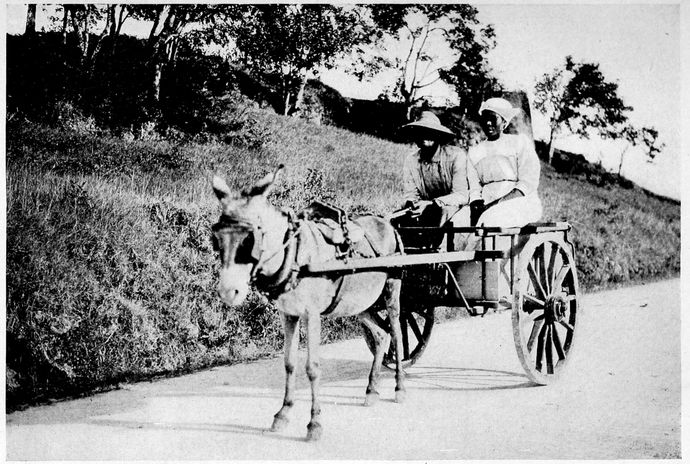
The turn-out of most Barbadians
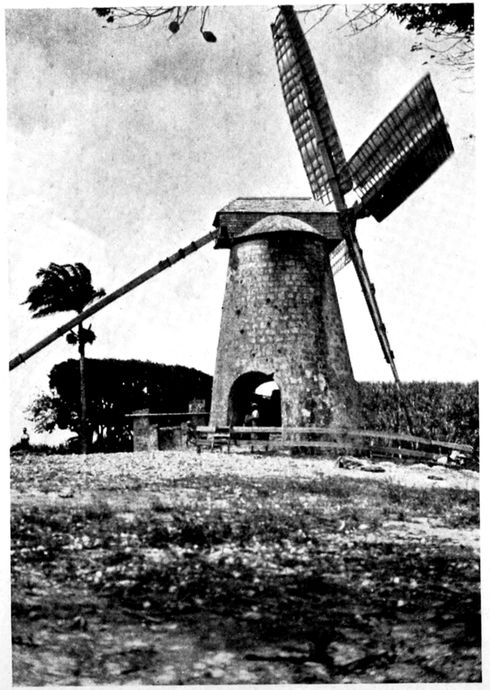
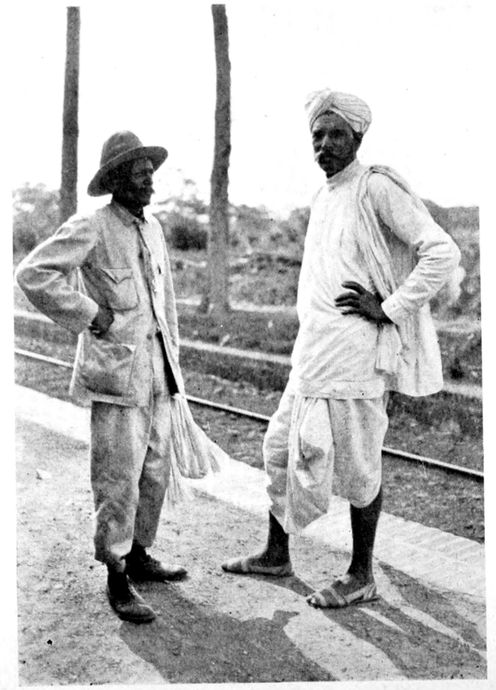
385Modern street-cars carry this racial hash, or as much of it as
can afford to ride, about the well-paved city and its shady suburbs.
Single car-tickets cost six cents, but a strip of six may be had for a
shilling. So many citizens are unable to invest this latter sum all at
once, however, that numerous shopkeepers add to their profits by selling
the strip tickets at five cents each. Port of Spain has perhaps the
finest pair of lungs of any city of its size in the world. Beyond the
business section is an immense savanna, smooth as a billiard-table—magnificent,
indeed, it seems to the traveler who has seen no really level
open ground for weeks—called Queen’s Park. Here graze large herds
of cattle, half Oriental, too, like the people. There is ample playground
left, too, for all the city’s population. In the afternoon, particularly
of a Saturday, it presents a vast expanse of pastimes seldom seen in
the tropics. The warning cry of “Fore!” frequently startles the mere
stroller, only to have his changed course bring him into a cluster of
schoolboys shrilly cheering the prowess of their respective teams. The
game which outdoes all others in popularity is that to the American
incredibly stupid one of cricket, which rages—or should one say
languishes?—on every hand, notwithstanding the fact that Trinidad is
within ten degrees of the equator. Nor is it monopolized by the better
classes, for every group of ragged urchins who can scrape together
enough to get balls, wickets, and that canoe-paddle the English call a
“bat” takes turns in loping back and forth across the grass, to what
end the scorer knows. If there is a color-line on the savanna, it is between
the few pure whites, many of them Englishmen who have “come
out” within the present century and brought all the unconscious snobbishness
of their own island with them, and the olla podrida of all the
other races. Among the latter the lines are social, rather than racial,
so that Hindu-mulatto-Chinese youths, leaning on their canes, gaze
with scornful indifference upon other youths of similar labyrinthian
parentage whom chance has not raised to the dignity of annexing collars
to their shirts. But there is room enough for all on the immense
savanna.
Here and there it is dotted with huge, spreading trees, which grow
more thickly in the residential section surrounding it. The original
386inhabitants called the island “Iëre,” or “Caïri,” meaning the “land of
humming-birds.” It is still that, but it is also the land of magnificent
trees and the land of asphalt. One may doubt whether any fragment
of the globe has so high a percentage of perfect streets and roads—no
wonder, surely, when it may have its asphalt in unlimited quantities for
the mere digging—and the giants of the forest which everywhere
spread their canopies give its rather placid landscape a beauty which
makes up for its lack of ruggedness. Behind Queen’s Park is a delightfully
informal botanical garden in the middle of which sits the massive
stone residence of the governor. Several times a week a band concert
is given on his front lawn, a formality bearing slight resemblance to the
Sunday-night gathering in a Spanish-American plaza. It takes place
in the afternoon and is attended only by the élite, though this does not
by any means confine it to Caucasian residents, for there are many
others, at least of the island-born Chinese and Hindus and their intermixtures,
who count themselves in this category, while negro and East
Indian nursemaids are constantly pursuing their overdressed charges
across the noiseless greensward. Any evidence of human interest is
sternly suppressed in the staid and orderly gathering. They sit like
automatons on their scattered chairs and benches, no one ever committing
the faux pas of speaking above a whisper. Woe betide the mere
American who dares address himself to a stranger, for British snobbery
reaches its zenith in Trinidad, and the open-handed hospitality of Barbados
is painfully conspicuous by its absence.
Trim lawns bordered with roses, hibiscus, poinsettia, variegated
crotons, and a host of other brilliant-foliaged plants surround the homelike,
though sometimes overdecorated, residences of the generously
shaded suburbs. Over the verandas hang mantles of pink coronella,
violet thumbergia, red bougainvillea, often interlacing, always a mass
of bloom, at least in this summer month of April. Maidenhair ferns
line the steps leading to the portico, rare orchids cling to the mammoth
branches of the spreading trees, the air is sweetly fragrant with the
odors of cape jasmine and the persistent patchouli. With sunset cigales,
tree-toads, and a host of tropical insects begin to chirrup their nightly
chorus—an improvement on the flocks of crowing roosters that make
the whole night hideous in the town itself, not only in Port of Spain,
but throughout the West Indies.
A magistrate’s court is an amusing scene in any of the Antilles;
it is doubly so in the racial whirlpool of Trinidad. An English “leftenant,”
assigned the task of prosecuting for the crown, but who never once
387opened his mouth, was the only white man present on the morning I
visited this farcical melodrama. A mulatto magistrate whose offensive
pride of position stuck out on him like a sore thumb held the center
of the spotlight. Never did he let pass an opportunity to inflict the
crudest of witticisms, the most stupid of sarcasm on prisoners and witnesses
alike. In the language of English courts he was known as
“Your Worship,” a title by which even white men are frequently compelled
to address those of his class in the British West Indies, where
the law knows no color-line. A group of colored reporters sat below
him in the customary railed enclosure, jotting down his every burst of
alleged wit for the delectation of their next morning’s readers, who
would be regaled with such extraordinary moral truths as “His Worship
told the defendant that instead of living off his mother and sister he
should go and do some honest work to support them and himself,” or
“His Worship remarked that the witness seemed to be afflicted with a
clogging of his usually no doubt brilliant mental processes.” Beyond
the rail was packed the black audience that is never lacking at these
popular entertainments in the British West Indies.
The prisoners and the two pedestal-shod black policemen on either
side of them, stood stiffly at attention just outside the rail during all the
trial. Witnesses assumed a similar posture in a kind of pulpit, took
the oath by kissing a dirty dog-eared Bible—even though they were
Hindus or Chinese—and submitted themselves to “His Worship’s”
caustic sarcasm. The mere fact that the majority of them were
patently and clumsily lying from beginning to end of their testimony did
not appear to arouse a flicker of surprise in the minds of magistrate,
the lawyers of like color, or the open-mouthed audience. The testimony
in each case was laboriously written down in longhand by a
dashingly attired mulatto clerk, though evidently not word for word,
for these fell too fast and furiously to be caught in full. The accused
was always given permission to cross-examine the witnesses, with the
result that a vociferous quarrel frequently enlivened the proceedings.
The majority of cases were petty in the extreme, matters which in most
countries would have been settled out of court with a slap or a swift
kick. But nothing so pleases the British West Indian, at least of the
masses, as a chance to appear in the conspicuous rôle of plaintiff, or
even as witness. One black fellow had charged another with calling
his wife a “cat.” “His Worship” found the case a source of unlimited
platitudes before he dismissed it by adding five shillings to the crown’s
resources. A fat negress accused a long and scrawny one of offering
388to “box me face,” and as British West Indian law takes account of
threats, the lanky defendant was separated from her week’s earnings,
though she scored high with the audience by proving that the accuser
had also used threatening language, thereby subjecting her to a similar
financial disaster.
Corporal punishment is still in vogue in the British Antilles. Two
negro boys had been playing marbles, when one struck the other with a
stick. “His Worship” ordered the defendant to receive ten strokes
with a tamarind rod, to be administered by a member of the police force.
The order was immediately executed in a back room to which casual
spectators were not admitted. To judge from the shrieks that arose
from it, the punishment was genuine, but they were probably designed
to reach the magistrate’s ear, for when I put an inquiry to the big
black chastiser some time later, he replied with a grin, “Oh, not too
hard; perhaps a tingle or two at the end jes’ to make him remember.”
Even adults are not always spared bodily reminders. A vicious looking
negro with a hint of Chinese ancestry who was convicted for the
fourth time of thieving was sentenced to one year at hard labor and six
lashes with the “cat.” But as this punishment was inflicted at the
general prison, there was no means of learning how thoroughly the
implement was wielded.
Though a Chinese and a Hindu interpreter were present, all the witnesses,
happening to be youthful and evidently born in the colony, spoke
perfect English—as it is spoken in Trinidad. It was somehow incongruous
to hear a Hindu woman in her silken shroud and a small cartload
of jewelry burst forth, as soon as she had kissed the unsavory
Bible with apparent fervor, in the negro-British dialect and contradict
the assertions of the accused with some such rejoinder as “Whatyer
tahlk, mahn, whatcher tahlk?” Those surprises are constantly being
sprung on the visitor to Trinidad, however, for notwithstanding the
composite of races and the fact that English was not introduced into
the island until 1815, it is decidedly the prevailing language. It is a
common experience to hear a group that is chattering in Hindustanee
suddenly change to British slang, or to turn and find that the discussion
of the latest cricket match in the broad-vowelled jargon of the British
West Indian negro is between a Chinese and a Hindu youth, both
dressed in the latest European fashion. Natives of the islands assert
that “the English of a typical Trinidadian is probably as strongly in
contrast to that of a typical Barbadian as the language of any two parts
389of the British Empire.” But to the casual visitor they sound much
alike, and far removed from our own tongue. We might readily understand
the expression “I well glad de young mahn acquit,” but few of us
would recognize that “Don’t let he break me, sir,” means “Do not
give him a job after refusing it to me.” An incensed motorman cried
out to a Chinese-Hindu negro hackman who was impeding his progress,
“Why y’u don’ go home wid dis cyart ef y’u can’ drive et?” to which
came the placid reply, “Why you vex, mahn? Every victoria follow he
own wheels.” As in the French islands, a banana is called a “fig” in
Trinidad, while walls are everywhere decorated with the warning
“Stick no Bills.”
Speaking of bills of another sort, those of the smaller denominations
are badly needed in the British islands. With the exception of Jamaica,
they reckon their money in dollars and cents, but they are West Indian
dollars, worth four shillings and two pence each and following the
English pound in its rise or fall. Notes of five dollars are issued by the
Colonial Bank and the Royal Bank of Canada, but with the exception
of Trinidad and its dependency, Tobago, the government of which
issues one- and two-dollar bills, there is no local small change, and the
already overburdened visitor to these tropical climes must load himself
down with a double handful of English silver and mammoth coppers
each time he breaks a five-dollar bill. To add to his struggles with the
clumsy British monetary system, prices are given in cents, when there
are no cents. Small articles in the shops are tagged 24c, 48c, 72c,
and so on, never 25c, 50c, or 75c, which is easy enough, for those are
the local terms for one, two, or three shillings. But it is not so simple
for the heated and hurried stranger to calculate that the euphonism
“thirty-nine cents” means a shilling, a sixpence, a penny, and a “ha’penny,”
and to find the real significance of a demand for $5.35 requires
either a pencil and paper or long practice in mental arithmetic. Perhaps
the least fatiguing method is to spread on the counter the whole contents
of one bulging pocket and trust to the clerk’s honesty—except that he,
too, even if he is trustworthy, is apt to be weak in mental arithmetic.
The fall in the value of the pound sterling following the war forced
the Trinidad government to enact a new ordinance forbidding “the
melting down of silver coins current in the colony, the keeping possession
of more silver than is needed for current expenses, or the buying
or offering to buy silver coins at more than their face value.” The
drop in exchange had given the metal more worth than the coins themselves,
390and the Hindu custom of turning the family wealth into bracelets
and anklets for the women was threatening to make small financial
transactions impossible.
Marital felicity is by no means universal in Trinidad, if one may
judge from the columns of warnings to the public in its newspapers.
In a single issue may be found a score of insertions testifying to this
impression and to the mixture of races:
The Public is hereby notified that I will not be responsible for any debt or
debts contracted by my wife, Daisy Benjamin, she having left my house and
protection.
Izakiah Benjamin,
Petit Valley, Diego Martin.
The Public is hereby notified that I will not hold myself responsible for any
debts contracted by my wife Eparaih, she being no longer under my protection
and care.
His
Ramdow X
Mark
Bejucal, Caroni.
Witness to Mark: Santiago Wilson.
The Public is hereby notified that I will no longer be responsible for the debts
of my wife, Yew Chin, she having left my house and protection without any
just cause.
Lee Wo Sing,
Rock River Road, Penal.
Occasionally the other side of the house is heard from:
The Public are hereby warned that the undersigned will not be responsible for
any debts contracted by my husband, Emmanuel Paul, as we are no longer associated
as husband and wife.
Margaret Paul,
Lance Noir, Toco.
The Spanish influence may be seen in the custom of doctors and
dentists advertising “Lady in Attendance,” to add reassurance to their
female clientele.
The Government of Trinidad runs an excellent railway and coast
steamer service. The cars are of three classes, with cross-seats, as in
Europe, though with a few compartment partitions. Shades resembling
cap-visors project over the windows, and the trains are as clean
and orderly as those of Porto Rico. First class is small and exclusive,
occupying only one third of a coach, and the rare traveler in it is apt
391to be taken for an important government official and saluted by all
railway employees and stared at with envy and astonishment by the
“garden” variety of voyagers. Even the few white citizens usually
travel second-class, though this is by no means free from African and
Asiatic mixtures. The bulk of the train is made up of third-class
coaches, their hard wooden benches crowded with every possible combination
of negro, Hindu, Chinese, Venezuelan, Portuguese, and French
blood, with an occasional poor white, and presents a truly cosmopolitan
conglomeration of garb and tongue. Employees are as varied in origin.
A big-bearded “collector,” or station-agent, with Hindu features which
seem strangely out of place under his placarded cap, rebukes a Chinese-Hindu
passenger in the amusing “English” of the West Indies, then
slaps a jet black “head guard” on the back with a “How goes?” and
gets the reply, “Oh, getting on poc’ á poc’.” In addition to these
vigilant ticket-seekers, there are inspectors whose official caps read
“Head Examiner,” a title which more than one stranger has misconstrued.
Trains are frequent. They are drawn by large oil-burning Montreal
engines with white “drivers” and set forth from Port of Spain, like
our own fliers, over a roadbed in excellent condition for the first
twenty miles or more. Beyond that, as the line breaks up into its
several branches, the engines get smaller and smaller; the engineers
become mulattoes, then blacks, with only a tropical sense of the value of
time; the tracks are more and more congested with train-loads of cane
in the cutting season, with the result that a well-arranged time-table
is often disrupted. Swampy stretches of mangroves to the right and
left flank the first few miles. Groups of prisoners, in yellow, white, or
orange-colored caps, according to whether they are misdemeanants,
felons, or “long-timers,” are turning some of these into solid ground.
Cocoanut plantations soon supersede the swamps, to be in turn replaced
by cane, as flat lands spread farther and farther away on the left
to the base of high hills or low mountains rather arid in appearance,
despite the density of their brush and forest, red trails here and there
climbing their wooded flanks.
Ten minutes out the considerable town of San Juan imposes the first
halt, its platform seething with a multi-colored throng struggling with
every manner of queer luggage. A few miles farther on, at the base
of El Tucuche, the highest peak of Trinidad, is the old Spanish capital
of the island, San José de Oruña, now called St. Joseph. Unlike the
British, the conquistadores preferred to build their principal towns
392some miles back from the sea. It did them little good in this case,
however, for St. Joseph was burned to the ground by that prince of
buccaneers, Sir Walter Raleigh, and here the Spanish governor, Chacón,
surrendered the island to a superior British force in 1797 without a
fight, which may be one of the reasons why a street of the old capital
is named for him. St. Joseph lies a bit up hill from the station, with a
magnificent view of the vast Caroni plain, a floor-flat vega dense
with vegetation, dotted with villages, and here and there the stacks of
sugar-mills, called usines in Trinidad. Scattered, somewhat hilly, with
the languid, capacious air of a village, the old capital is interesting to-day
for its flora and its historical reminiscences. Veritable grandfathers
of trees, with long beards, their immense branches thickly
grown with orchids and other flowering parasites, shade it at every
hour of the day. Humming-birds flit in and out among its masses of
red and purple bougainvillea. The trade wind, which seldom reaches
Port of Spain, sweeps down through a break in the brownish-green
hills which hem the former capital in; if it is uncomfortably hot at
noonday, it is because all Trinidad is aware of its proximity to the
equator. Of Spanish ruins it has none, but there are numerous Venezuelan
inhabitants, and the Castilian tongue and customs have to some
extent survived. Here, too, are strange interminglings of races and
tongues—“El Toro Store” on Piccadilly Street; a rum-shop called
“The Trinidadians’ Delight” on Buena Vista Street. In its dry and
stony cemetery are monuments with Chinese, Spanish, Hindu, French
and English names, some of the last all too evidently those of negroes.
The newspapers of Trinidad announced a “Big Field Day and Race
meeting” at Tunapuna, a few miles beyond St. Joseph, on Easter
Monday. Having lived through five British holidays in the brief ten
days since our landing in Barbados, we ventured to hope that here
might be something less deadly dull. Had we paused to reflect, we
should have known that white people did not attend these popular
festivities. The horror on the face of an English native to whom we
mentioned our destination might have given us the same information,
had we not taken it to be an expression of pain at being addressed
without a formal introduction.
Tunapuna is as Hindu as St. Joseph is Spanish. The domes, or,
more exactly, spheres of a white Brahmin temple bulk high above its low
houses. These are little mud-plastered houses, for the most part, with
dents poked in their walls before they have dried, by way of decoration,
which seem to be direct importations from India. The broad asphalt
393highway bisecting the town was as seething a stream of humanity as
the Great Trunk Road. Hindus in their anklets and toe-rings, their
clanking bracelets and light-colored flowing garments, made up the
bulk of the throng, with here and there a Venezuelan driving a pack-laden
donkey to give contrast to the picture. If the place had a European
section, it eluded our attention; it looked like a village of India
in which a few African settlers had taken up their residence.
The “field day” was held on a broad level space in the center of
town. Constant streams of vari-colored Trinidadians, all clad in their
most gasp-provoking holiday attire, poured into it from special trains
that arrived in close succession. A bandstand covered with palm-leaves
had been erected for the higher social orders, but even this was
no place for a white spectator who did not care to arouse conspicuous
attention. There were perhaps half a dozen white men, all British
soldiers, scattered through the hilarious throng, but not a woman of her
own race to keep Rachel in countenance. Of near-whites there was
no scarcity, all of them affecting the haughty English manner in the
vain hope of concealing the African in their family wood-pile. Some
of the mixtures of race, language, and custom were incredible. Next
to us sat a woman who appeared to be half Hindu and half English,
who spoke Spanish, and who carried a quadroon baby with straw-colored
hair and almond-shaped blue eyes. We awarded her the palm
for human conglomeration, but there were many more who could have
run her a close race.
The contests consisted mainly of bicycle races, an uproarious hubbub
invariably breaking out among the motley judges and officials after each
of them, causing great delay before the shotgun which served as starting
pistol set the stage for a new controversy. In view of the fact that
the contestants were vari-colored youths who probably lived in unpainted
shanties and wore shoes only on Sundays, the tableful of prizes
beside us was amusing. Among them we noted a gold-plated jewel-box,
a cut-glass fruit-dish, an ice-cream freezer, a gold-scrolled liqueur set,
a hatstand of gilt-tipped ox-horns, two manicure sets, a pair of marble
horses, and several overdecorated small clocks. One of the many
dandies who were continually displaying their graces to the feminine
portion of the stand, under the pretense of finding the open space before
it more comfortable than the chairs, protested that the prizes “lacked
show.” Up to that moment that had seemed to us the one thing they
did not lack. This particular individual, a mulatto with a touch of
Chinese, wore a tweed coat and white flannel trousers, an artificial
394daisy in his buttonhole, a brown necktie embroidered at the top with
flowers and at the bottom with the word “Peace” in large letters, and
carried a riding-crop. Those of his companions who were not armed
with this latter sign of field-officer rank all bore canes. One of them
flaunted a cravat decorated with the flags of all the Allies. The majority
frequently removed their hats, regardless of the blazing sunshine,
quite evidently for the purpose of showing that their hair was not
curly, an improvement for which several quite evidently had to thank
“Mme. Walker’s Peerless Remedies.” An inattentive spectator might
have concluded from the wagers shouted back and forth among them
at the beginning of each race that they were persons of unlimited
wealth, but it was noticeable that very little money actually changed
hands. Here, too, the lines of demarkation were social, rather than
racial. A Hindu youth dressed in the latest imitation of London
fashion might call across the compound to his equally ornate Chinese
friend, “Heh, Lee! Come down, mahn!” but he gave no sign of seeing
the East Indian in khaki and a battered felt hat who sold peanuts in
tiny measures cleverly arranged so that most of the nuts stuck to the
bottom when they were upturned in the purchaser’s hand.
Beyond Tunapuna next day other Hindus in the loose garb of their
homeland were clawing about the rice blades in their little paddy-fields,
cut up into small squares by low dikes. Wattled huts, with East
Indians squatted on their heels in the bare, hard-trodden spaces before
them, intermingled with wooden shanties, sometimes with lace curtains
at the glassless windows, shanties fairly bursting with their swarming
negro families. Tall, slender flagpoles from which flew little red
flags, some of them already bleached white, showed where goats had
been sacrificed in the frequent ceremonies of the Brahmin inhabitants.
Little white Hindu temples alternated with small negro churches.
Through Tacarigua, with its clusters of buildings flung far up the red-scarred
hillsides, Arouca, Dabadie, the procession of huts and cabins
continued. Almost without exception they were unpainted and unadorned
with anything but the barest necessities, for Trinidad, too,
labors under the discouraging “improvement tax.”
Arima, the last settlement of the aborigines before they disappeared
from the island as a race, spreads over a slightly elevated plateau, its
wide streets and well separated houses giving an impression of unlimited
elbow-room, its huge trees and flowery shrubbery making up for its
drygoods-box style of architecture. Here is Trinidad’s chief racetrack,
395enclosing a grassy playground that almost rivals Port of Spain’s
savanna, but the incessant staring of the inhabitants suggests that
white men are ordinarily rare sights in this important cacao center, as
they are in many sections of the island.
Beyond Arima the hills die out and for miles the track is walled by
uncultivated brush or virgin forests, with only a rare frontier-like village
and a few young cacao plantations sheltered from the sun by the
bois immortel, or what Spaniards call madre del cacao. Hindus are
more numerous in this region than negroes. The railway ends at the
thriving town of Sangre Grande, though it hopes soon to push on to
the east coast. Chinese merchants and the resultant half-breeds are
unusually numerous; Hindu women in full metallic regalia, sitting in
buggies like farmers’ wives in our western prairie towns, some of them
smoking little Irish-looking clay pipes, and silversmiths of the same
race, naked but for a clout, plying their trade in back alleys, are among
the sights of the place.
The Ford mail-and-passenger bus in which I continued my journey
was driven by a youth, whose grandparents were respectively Chinese,
Hindu, negro, and white. The first had given him an emotionless
countenance and a strict attention to business, the second a slender,
almost girlish form and a silky complexion, the third wavy hair and an
explosive laughter, and the last frequent attacks of that haughty surliness
so common to mulattoes or quadroons. Among the passengers
was a Hindu girl of striking beauty. She spoke excellent English with
a strong West Indian accent, was tastefully and specklessly dressed in
a Caucasian waist, black silk skirt, and kid shoes, wore her silky black
hair done up in European fashion, and had the manners of an English
débutante of the sheltered class. Yet in her nose she wore two gold
rings, her arms gleamed with silver bracelets from wrists to elbows,
about her neck was a string of heavy gold coins, and a flowered silk
wrap was flung about her shoulders and head. Beside her sat a youth
of the same race, completely Europeanized in garb and manner. In
front, separated from this pair by one of the slow-witted, scornful
negroes who filled most of the two seats, was an East Indian in full
white Hindu regalia,—a simple, faintly purple turban, white caste
marks across his forehead and in front of his ears, and a string of
black, seed-like beads about his neck. Not once during the journey did
he give a sign of recognition to his Anglicized compatriots.
We snorted away along an asphalt highway bordered by large cacao
estates, passing many automobiles, some of them driven by Chinese and
396Hindus, even through a great forest with many immense trees, their
branches laden with orchids and climbing vines. Except for one low
ridge the country was flat, with not even a suggestion of the rugged
scenery of most West Indian islands. Long hedges of hibiscus in full
red bloom lined the way through the considerable town of Matura,
where negroes far outranked the Hindus in numbers and Chinamen
kept virtually all the shops. Soon the landscape turned to cocoanut
plantations, the now narrow road mounted somewhat, and the Atlantic
spread out before us. But it was shallow and yellowish, not at all
like the sea-lashed east coasts of Barbados or Dominica, the shores of
its many bays and indentations low and heavily wooded, a hazy clump
of hills stretching far away into the south. Then came a cluster of
ridges and mounds of earth covered with primeval forest, only little
patches of which had been cleared to give place to the most primitive,
weather-beaten thatched huts. These were scattered at long intervals
along the way and all inhabited by negroes, the other races evidently
finding the region too undeveloped for their more civilized taste. Nineteen
miles from Sangre Grande the bus halted at a cluster of hovels
on Balandra Bay, the road, which pushes on to the northeast point of
the island, being impassable for vehicles.
From that point one may see the important island of Tobago, the
chief of Trinidad’s dependencies and the most recent of England’s
possessions in the West Indies. It is reputed to have been the most
fiercely contested bit of ground in the western hemisphere, having
been constantly disputed by the French, Spanish, and English, until it
finally fell to the latter in 1803. To this day it is surrounded by the
ruins of old forts. French names still survive in its capital, Scarborough,
and the splendid system of roads it once boasted have been
allowed to go back to bush under British rule. In 1889 it was annexed
to Trinidad, though it retains its own elective financial board. Like
many of the British West Indies, Tobago has seen the insolence and
aggressiveness of its negroes greatly increased by the example of those
who were debauched in France, and was forced to suppress one riot
with considerable bloodshed. The island may be reached weekly by
government steamer from Port of Spain.
At St. Joseph the more important branch of the railway turns south
and, sending an offshoot through a fertile cacao district and the oil
regions about Tabaquite to Rio Claro, follows the coast of the Gulf
397of Paria to the edge of the southern chain of hills. A so-called express
train connects the capital with the metropolis of the south once a week,
but on account of the English “staff system” in vogue, its speed is
frequently checked and sophisticated passengers get on or off as it
slows up at each station to exchange the iron hoop which is the engineer’s
passport for the ensuing section. Broad, flat vegas spread on
either hand beyond the old Spanish capital, the northern range of hills
withdrawing to the edge of the horizon. Great pastures with huge
spreading trees, some of them gay with blossoms, and thick clumps of
bamboo alternate with extensive cane-fields, most of them covered with
the young shoots after the recent cutting in this April season. Here
and there stands a large usine, or sugar-mill, with long rows of coolie
dwellings, some housing a dozen families side by side, while outside the
estate are crowded together the tin-roofed shacks of the negro and
Hindu workmen who prefer to house themselves, rather than submit
to the exacting sanitary rules of the company. The fields that are still
uncut have those fat yellow canes with long joints that are the joy
of the sugar grower, for the Caroni plain is famed for its fertility.
Humped Indian bulls and their tropic-defying offspring dot the pastures
and corrals. From Canupia a road leads to Alligator Village, where
Hindus may be seen standing naked and motionless on their flimsy
little rafts made of woven palm-fronds catching cascadura, the choicest
delicacy of Trinidad. The natives have a saying that whoever tastes
the flesh of this cross between a turtle and a lizard must return to end
his days in the island.
Cacao plantations, shaded by forests of high trees, gradually replace
the cane-fields as the train speeds southward. Parasites and climbing
lianas, that death-dealing vine called matapalo by the Spaniards and
“Scotch attorney” by the Trinidadians, which finally chokes to death
the tree that sustains it, usurping its heritage of nourishment, give the
forest wall the appearance of a great carelessly woven tapestry.
Wattled huts as primitive as those of Haiti, many of them of spreading
cone shape, thrust their thatched roofs above the vegetation, giving
many a vista a touch that carries the mind back to India. Chaguanas,
Carapichaima, Couva—the towns nearly all bear Spanish names—are
populous, though California has a mere handful of hovels. Near
the last the low wooded foothills of the central range begin to peer
above the flat cane and cacao lands to the left; then the train bursts
suddenly out on the edge of the gulf amid a flurry of cocoanut palms.
398Claxton’s Bay and Point-à-Pierre again recall Trinidad’s mixture of
tongues, and at length the staff-hampered “express” staggers into
San Fernando.
The second city of Trinidad has but ten thousand inhabitants. It is
strewn over a clump of wooded knolls at the base of Naparima Hill,
rising six hundred feet above it. Its population is so overwhelmingly
East Indian that even the English residents are forced to learn Hindustanee.
“His Worship,” the mayor, is a Hindu; on certain days of
the week the visitor who strolls through its wide, asphalted streets
might easily fancy himself in a market city of central India. Such
signs as “Sultan Khan, Pawn Broker,” “Samaroo, Barber,” or “Jagai,
Licensed to Deal in Cacao and Licenseable Produce” are triply as
numerous as the shops bearing such patently negro mottoes as “To
Trust is to Burst.”
A toy train runs from San Fernando through rolling fields of cane
to Prince’s Town, which name it adopted in honor of a visit long years
ago by the present king and his brother. The “staffs” in this case
are human. Every mile or less the engineer halts to take on board
from a kind of sentry-box a uniformed negro wearing a bright red
cap—which, no doubt, makes it possible to reduce his wages by half—stenciled
with the number of the section for which he is responsible.
Prince’s Town lies in the Naparima plain, the second of Trinidad’s
great fertile vegas; or one may visit another portion of it by continuing
to the end of the main line. On the way are Débé, almost wholly a
Hindu town, with a stream of many castes pouring down its highway,
and Penal, with its miles of Hindu vegetable gardens and its mud-and-reed
huts that seem to have been transported direct from India. Then
comes a long run through an almost uninhabited wilderness, though
with considerable cacao on its low, jungle-like hills, and finally Siparia,
a rapidly growing frontier village where busses and automobiles are
waiting to carry travelers to the slightly developed southern side of the
island.
As we raced back down the hill again my hitherto private first-class
compartment—no, I shall not divulge the secret of why I chanced to be
displaying this sign of opulence and snobbishness—was invaded by the
first American I had met in Trinidad outside the capital. He was an
oil-driller from one of the newly developed fields. But though he had
been drawing three times the salary of a college professor, he had
“threw up the job because me an’ that there field-man didn’t hitch.
He’s only a Britisher, anyway.” What might have been a pleasant
399conversation was disrupted by my new companion with such remarks as
“Panama? Where’s that? Up towards New Orleans?” “Hindus?
Is them Hindus with rings in their noses? I thought them was East
Indians.” There is a saying in Trinidad, as in many other parts of the
world, that only fools or Americans ride first-class. This man was
both, for he was “afraid to go second for fear my friends’ll see me
an’ think I’m goin’ broke”—an impression that would not have been
at fault, as he had “blowed” his princely wages as fast as he earned
them.
The favorite excursion from Port of Spain is that by government
steamer through the Bocas Islands, which are scattered along the northwestern
horn of Trinidad. First comes a cluster of jagged rocks
with a few large trees, called Five Islands, government-owned and
occupied by from one to three houses each, which may be rented by
the week when they are not in use as quarantine stations. On one of
them is the principal prison of the colony, and convicts in charge of a
guard row out for the supplies and mail from town. Indeed, the
journey is a constant succession of rowboat parties, not to say mishaps,
for it is frequently blowing a gale about the Bocas, and as the steamer
nowhere ventures close to shore, passengers and groceries are often
subjected to thorough duckings, if nothing worse. The larger islands
are privately owned, and dotted with pretentious “summer” homes
of those who cannot spend the hottest months in Grenada or Barbados.
An entire bay of one of them belongs to the son of the inventor of one
of Trinidad’s most famous products, “Angostura Bitters.” I am not
in a position to divulge the secret of its manufacture, beyond stating
that it contains rum, mace, nutmeg, and powdered orange skins, which
latter detail accounts for the fact that the market-women of Port of
Spain pare their oranges as we do an apple and that the stone fences
of the town are always littered with orange-peelings drying in the
sun.
Monos Island lies beyond the mainland, and between that and the
last and largest, rejoicing in the name of Chacachacare, are several
bocas, or channels, through which pass steamers touching at Trinidad.
The colony was in an uproar at the time of our visit because the
government had proposed to turn Chaca—but why repeat it all?—over
to the lepers. Thanks largely to its Hindu population, Trinidad
has more than its share of these sufferers, and though they are “isolated”
in an asylum on the mainland or in their own homes, they are
400frequently found mingling with holiday throngs. Trinidadians protested
against advertising the prevalence of leprosy by housing the invalids
on the most conspicuous part of the colony, and the charge of
graft was as freely bantered back and forth as in our own merry land
under similar conditions. From Chacachacare one may see a great
stretch of Venezuela across the straits, the spur of the Andes on which
sits Caracas rising higher and higher into the sky and disappearing at
length in the direction of lofty Bogotá.
But to most strangers Trinidad has little meaning except as the home
of the “asphalt lake.” Strictly speaking, it is neither the one nor the
other, being rather a pitch deposit, but it would be foolish to quibble
over mere words. It is sufficient to know that the spot furnishes most
of the asphalt for the western hemisphere.
To reach it one must return to San Fernando by train and continue
by government steamer. This frequently flees before the ebbing tide
and anchors far out in the shallow, yellowish gulf until its passengers
have been rowed aboard, then turns southwest along a flat, uninteresting
coast. The pea-soup-colored sea swarms with jelly-fish that resemble
huge acorns in shape and color and on which whales come to feed at
certain seasons. Among them floats another species with long tendrils,
a mere touch of which leaves a sharply stinging sensation for hours
afterward. The steamer touches at half a dozen villages down the
long southern prong of Trinidad, rounding the point twice a week to
Icacos, reputed the largest cocoanut plantation in the world. It is
owned by an old Corsican who “came out” in his youth as a porter,
and who, in the words of the captain, “is of no class at all,” yet he has
a mansion in Port of Spain, several daughters married to French
counts, and so much money “he doesn’t know arithmetic enough to
count it.”
But our interests are in the first port of call out of San Fernando.
A bit beyond the reddish town of La Brea (the Spanish word for
pitch) a very long pier with an ocean steamer at the far end of it and
iron buckets flying back and forth between it and the land, like a procession
of sea-gulls feeding their young, juts out into the gulf. Not
so many years ago all the population of this spot, called Brighton, lived
on the pier, the shore being famous for a fever that brought almost
certain death within two days. This completely disappeared, however,
when American concessionists turned the jungle into pasture land. The
air is full of pelicans, clumsily diving for fish or awaiting their turn for
a seat on the protruding jib boom of a wrecked schooner, along which
others sat as tightly crowded together as subway passengers in the
evening rush-hour.
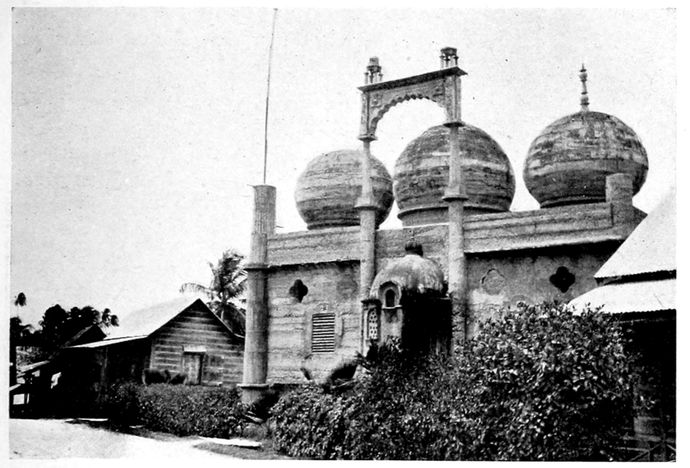
Trinidad has many Hindu temples
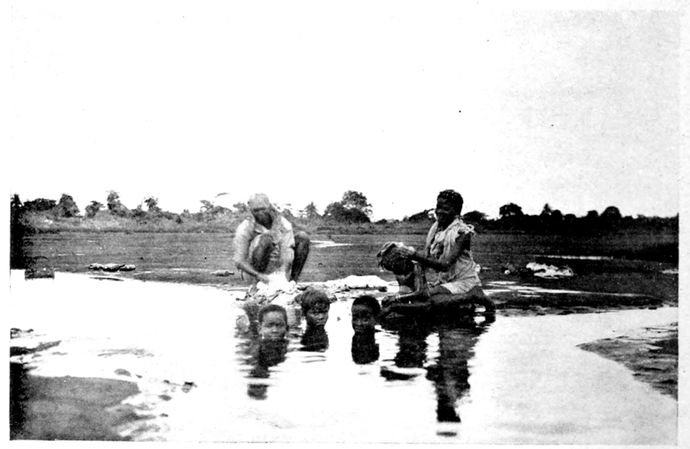
There is water, too, in the crevices of the asphalt field
401We landed with misgiving, having often heard of “that terrible walk”
from the pier to the “lake.” No doubt it seems so to many a tourist,
being nearly ten minutes long up a very gentle slope by a perfect
macadam highway. Beside it buckets are constantly roaring past on
elevated cables, carrying pitch to the ship or returning for a new load
with an almost human air of preoccupation. The highway leads to
the gate of a yard with a mine-like reduction plant peopled with tar-smeared
negroes, immediately behind which opens out the “lake.”
The far-famed deposit is not much to look at. It is a slightly concave,
black patch of a hundred acres, with as definite shores as a lake
of water, surrounded by a Venezuelan landscape of scanty brush and
low, thirsty palms. To the left the black towers of half a dozen oil-wells
break the otherwise featureless horizon. About the surface of
the hollow several groups of negroes work leisurely. One in each
group turns up with every blow of his pick a black, porous lump of
pitch averaging the size of a market-basket; the others bear these away
on their heads to small cars on narrow tracks, along which they are
pushed by hand to the “factory.” That is all there is to it; an easier
job for all concerned would be hard to find. A trade wind sweeps
almost constantly across the field, the pitch is so light that the largest
lump is hardly a burden, from the nature of the case the pace is not
fast, and the workers are so constantly in sight that an overseer is hardly
needed, nor piece-work required. The men are paid eighty cents a
day of ten hours, which seems much to them and little to their employers,
producing mutual satisfaction. The work calls for no skill
whatever; it is carried on in the open air, with women venders of food
and drink free to come and go; on the side of the concessionists the
deposit offers not even the difficulty of transportation, being barely a
mile from the ship, furnishing its own material for the necessary
roads, and virtually inexhaustible. The holes dug during the day fill
imperceptibly and are gone by morning, the deepest one ever excavated
having disappeared in three days. Only a small fraction of the field
is exploited, it could easily keep all the ships of the world busy.
Should it ever be exhausted, there is a still larger deposit just across
the bay in Venezuela. In the slang of financial circles, “it is like
finding it.”
The lake is soft underfoot, like a tar sidewalk in midsummer, the
heels sinking out of sight in a minute or two, and has a faint smell of
402sulphur. In a few places it is not solid enough to sustain a man’s
weight, though children and the barefooted workmen scamper across
it anywhere at sight of a white visitor for the inevitable British West
Indian purpose of demanding “a penny, please, sir.” A crease remains
around each hole as it refills, some of these rolling under like the edge
of a rising mass of dough, and in these crevices, the rain gathers in
puddles of clear, though black-looking, water in which the surrounding
families do their washing. Only negroes are employed as laborers;
the twenty-five white men in the higher positions are nearly all Americans,
those with families housed in company bungalows on the slope
above the gulf, the bachelors in a company hotel. Most of the pitch
goes directly to the steamer, but as it is one-third water, and royalties,
duties, and transportation are paid by weight, a certain proportion is
boiled in vats in the “factory” and shipped in barrels constructed on
the spot. From the vat-platforms spreads out a vast panorama, with
San Fernando at the base of its lonely hill, Port of Spain on its gently
sloping plain, the entire Gulf of Paria, the Bocas Islands, and the mountains
of eastern Venezuela all in plain sight.
The pitch lake was known even in the days of Sir Walter Raleigh,
who “payed” his vessels here during lulls in buccaneering, but it has
been exploited only during the last few decades. Three hundred thousands
tons have been shipped during a single year, the revenue to the
Government of Trinidad in 1912 being £63,453. Indeed, one of the
main reasons why the island has a much more prosperous air than its
neighbors is that millions have been paid into its treasury in royalties
and duties from its only “lake.” When a steamer is loading, buckets
and negroes toil all through the night in the glare of electric-lights.
The barrels of the refined product were first stowed on their sides, but
as they flattened out into a four hundred pound cube that could neither
be rolled nor lifted, they are now stood on end, tier after tier. The
crude pitch becomes a solid mass during the journey north, and must
be dug up again with picks when it reaches Perth Amboy.
403
It may be that our affection for Jamaica is tempered by the difficulties
we had in reaching it. Lying well inside the curve described
by the other West Indies, the scarcity of shipping caused by the
World War has left it almost unattainable from any of the other islands
and hardly to be reached, except directly from New York or Panama.
We first attempted to visit it from Santiago de Cuba, early in our
journey. But as this would have meant spending an interminable
twenty-four hours, and perhaps much more, on a little coasting-steamer
not even fit for the “slave traffic” in which it is chiefly engaged, at
a fare equal to that from St. Thomas to Barbados in an ocean liner,
the depositing of an equal amount to pay the expenses of a very probable
quarantine of a week because of a few scattered cases of smallpox
in Cuba, and the unwinding of a formidable mesh of red tape, we
decided to defer our call and pick up the island on the way home.
That surely would be easy, we concluded, for traffic certainly should
be frequent between the two largest of the British West Indies. Arrived
in Trinidad, however, we found that island as completely cut off
from Jamaica as if they belonged to two enemy powers. We at length
succeeded in coaxing the captain of a British freighter—the most
pleasant craft, by the way, of all our journey—touching at every port
on the north coast of South America and spending three weeks on the
way, to carry us to Panama, whence another steamer bore us back
again to several Columbian ports and eventually landed us in Jamaica
seven weeks after leaving Trinidad. Had we not set our hearts on
making our tour of the West Indies complete, we should have long
since invited the principal British island to withdraw to a sphere where
the temperature is reputed to be more than tropical.
The first view of Jamaica and of its capital is pleasing. A mountainous
mass, gradually developing on the horizon, grows into a series
of ranges which promise to rival the beauty of Porto Rico. Beyond
a long, low, narrow, sand-reef lies an immense harbor, on the further
shore of which Kingston is suspected, rather than seen, only a few
wharves and one domed building rising above the wooded plain on
404which the low city stands. The hills behind it tumble into a disordered
heap culminating in the cloud-swathed peak of what are most fittingly
called the Blue Mountains. On this strip of sand, known as the Palisadoes,
lies buried the famous buccaneer, Sir Henry Morgan, once
governor of Jamaica, and at the extreme end of it stands the remnant
of the old capital, Port Royal. In the good old days of pirates, who
made it their headquarters, the depository of their loot, and the scene
of their debauchery, this was the most important town in the West
Indies, some say the richest and most wicked spot on earth. One must
be chary, however, of too hastily granting such superlatives. An earthquake
befell it one day, sinking all but a fragment of the town beneath
the sea, and a new capital, named Kingston, was founded on what
promised to be safer ground across the bay. A later century brought
regret that a still more distant site had not been chosen. To-day Port
Royal consists of a quarantine station and a small village so isolated
from the mainland that servant women brought from it to the capital
have been known to shriek with dismay at sight of their first cow.
Ships circling the reef on their way in or out of the harbor sail over
the very spot where pirates once held their revels, and negro boatmen
still assert that on stormy evenings one may hear the tolling of Port
Royal’s cathedral bell, lying fathoms deep beneath the waves.
One’s first impression of the Jamaicans, as they lounge about the
wharf eyeing each trunk or bundle several minutes before summoning
up the energy to tackle it, is that they are far less courageous in the face
of work than their cousins, the Barbadians. This is closely followed
by the discovery that Kingston is the most disappointing town in the
West Indies. With the exception of a few bright yellow public buildings
and a scattered block or two of new business houses, it is a negro
slum, spreading for miles over a dusty plain. Scarcely a street has
even the pretense of a pavement; the few sidewalks that exist are
blocked by stairways, posts, and the trash of a disorderly population,
or degenerate every few yards into stretches of loose stones and earth.
The only building worth crossing the street to see is that domed structure
sighted from the bay, the Catholic cathedral. To be sure, the earthquake
wrought great havoc, but that was thirteen years ago, time
enough, surely, in which to have made a much farther advance toward
recovery.
The insolence of nearly all the British West Indies reaches its zenith
in Kingston. Even in the main street clamoring black urchins and
no small number of adults trail the white visitor, heaping upon him
405foul-mouthed taunts, all but snatching his possessions out of his hands
in broad daylight; diseased beggars plod beside him in bare feet that
seem never to have known the luxury of a scrubbing, scattering their
germs in a fine gray limestone dust that swirls in blinding clouds which
envelop everything in a yellowish veil whenever a breath of wind stirs
or a street-car sweeps past. Loose-mannered black females ply their
trade with perfect impunity, shrieking worse than indecencies at unresponsive
passers-by; assaults and robbery are frequent even by day.
One must be vaccinated and often quarantined before entering Jamaica,
yet it is doubtful whether any island of the West Indies has more
evidence of disease than Kingston itself. Those who carry firearms
must deposit them at the custom house, yet with the possible exception
of Hispaniola, a revolver is more often needed in the Jamaican capital
than anywhere in the Caribbean, as several harmless Chinese merchants
learned to their sorrow during our brief stay there. The town is dismal,
disagreeable, and unsafe for self-respecting white women at any
hour; by night it is virtually abandoned to the lawless black hordes
that infest it. Weak gas-lights give it scarcely a suggestion of illumination;
swarms of negroes shuffle through the hot dust, cackling their
silly laughter, shouting their obscenity, heckling, if not attacking, the
rare white men who venture abroad, love-making in perfect indifference
to the proximity of other human beings, while the pompous black policemen
look on without the slightest attempt to quell the disorder.
The white residents of Kingston seem to live in fear of the black
multitude that make up the great bulk of the population. When hoodlums
and rowdies jostle them on the street, they shift aside with a slinking
air; even when black hooligans cling to the outside of street-cars
pouring out obscene language, the white men do not shield their wives
and daughters beside them by so much as raising their voices in protest.
When cursing, filthy market women pile their baskets and unwashed
produce in upon them and crowd their own women out of their places,
they bear it all with humble resignation, as if they were the last survivors
of the civilized race wholly disheartened by an invasion of
barbarian tribes. The visitor who flees all this and retires is lucky to
catch half an hour of unbroken sleep amid the endless uproar of
shouting negroes, the barking of innumerable dogs, and the crowing of
more cocks than even a Latin-American city can muster. It would be
difficult, indeed, to say anything bad enough of Kingston to give the full,
hot, dusty, insolent, half-ruined picture. The traveler will see all he
wants and more of the capital in the time he is forced to remain there
406on the way to or from his ship without including a stay in his itinerary.
Port au Prince is clean and gentlemanly in comparison.
The electric street-cars, manned by ill-mannered crews and rocking
like ships in a storm over the earthquake-undulated ground, run far
out of town. They must, in order to reach anywhere worth going.
Beyond Half Way Tree the sloping Liguanea plain grows green and
the rain that seems never to descend to Kingston gives the vegetation
a fresher coat, yet the way is still lined for a long distance by negro
shacks. Only when one reaches the open meadows of Constant Spring
or the residence section served by another branch of the line does anything
approaching comfort, cleanliness, and peace appear. Yet even
the boasted Hope Gardens, set far back at the base of the Blue Mountain
range, have little of the open, breezy beauty of the Queen’s Park in
Trinidad. Until he has drifted farther afield, the stranger will not
cease to wonder what charms bring Jamaica its large colony of winter
tourists. Even then he must conclude that the prevalence of a tongue
closely enough resembling English to be sometimes comprehensible and
the legal existence of John Barleycorn give the island its handicap over
Porto Rico.
Unlike the other British West Indies, Jamaica clings to the English
monetary system. The two colonial banks issue pound notes and
higher, which are easily mistaken for those in dollars from the other
islands, as more than one new cashier has discovered too late to rescue
his first month’s salary. The word “dollar” is frequently heard, but
it is merely a popular euphonism for four shillings. Then there are
local pennies and half-pennies of nickel alloy that are not readily distinguished
from the English shilling and two-shilling pieces. Jamaica
belongs to the postal union, but, unlike the other colonies of the empire,
she does not subscribe to the British postal convention with the United
States, with the result that visitors commonly find their letters taxed
three pence extra postage, to the continual advantage of the local government.
This latter gives the impression of being both backward and clumsy.
A governor and a privy council of not more than eight members are
appointed by the crown. The legislative body is presided over by the
former and consists of five of the latter, ten other crown appointees, and
a custos, elected by the people, from each of the fourteen parishes.
British male subjects of twenty-one who occupy house property and
pay taxes of thirty shillings, or who receive a nominal salary of fifty
407shillings a year, are qualified voters. A recent enactment gives the
few women possessing certain qualifications a limited right to vote.
Parish boards can recommend legislation, but only the high colonial
officials can actually make laws or pay out money. No bills involving
questions of finance are passed if opposed by nine elective members,
yet those same custodes cannot initiate legislation. Moreover, the king
may disallow any law within two years of its passing. The result is
a division of responsibility from power and frequent deadlocks that
make the apparent autonomy of the island a continual process of
“standing pat.”
The few white officials are slow, antiquated, precedence-ridden, in
striking contrast to the young and bustling, if sometimes poorly informed
rulers of our own dependencies. Indeed, a journey to the
West Indies is apt to cause the American to rearrange his notions of
the relative efficiency of the English, and the French or ourselves, as
colonizers. We are sadly in need of a Colonial Office and a corps of
trained officials to administer what we dislike to call our colonies, but
even our deserving Democrats, or Republicans, as the case may be,
scarcely hamper the development of our dependencies as thoroughly as
do its medieval-minded rulers that of Jamaica. An example or two
will suffice to illustrate the point. The government railway was lifted
out of its slough of despond and rehabilitated by an experienced administrator.
When he found, however, that his £1000 a year did not
suffice to keep him in shoes, the insular powers let him go rather than
increase his pittance. Back in the Middle Ages that was a generous
stipend for railway managers. By a recent law the Government of
Jamaica has decided to take over the making, and later the distribution,
of rum. At the time of our departure it was advertising for “an
experienced superintendent” at the breath-taking salary of £2000 a
year! No doubt there was a rush of managers of Cuban sugar centrals
contending for this noble prize.
It may be of interest to know that Jamaica is livid with fear that she,
too, may be struck by prohibition, and is hastily erecting all manner of
protective lightning-rods. Her newspapers carry columns of arguments
pro and con, most of them clinched with quotations from the
Bible, as if that had anything to do with the case. Reading the impassioned
utterances of the “wets,” one might suppose that the United
States is in the act of organizing a great army of grape-juicers to descend
upon Jamaica and wrest from her all bottled joy in life, while
the casual observer gets the impression that the great majority of the
408islanders would rather die at the doors of their rum distilleries and
liquor shops than suffer that ignominious fate.
With the exception of Barbados, where special conditions exist,
Jamaica has remained a possession of the British crown longer than
any other land, and the influence of the English on the African race can
perhaps nowhere be better studied. It is not particularly flattering.
The Jamaican has all the faults of his rulers and his own negro delinquencies
to boot. He is slow-witted, inhospitable, arrogant when he
dares to be, cringing when he feels that to be to his advantage. The
illegitimate birth-rate is exceedingly high, sexual morality extremely
shaky among the masses. Though the country people are sometimes
pleasing in their simplicity, they quickly take on the unpleasant characteristics
of the town dwellers when they come in contact with them,
the most conspicuous being an unbridled insolence and a constant desire
to annoy what may quite justly be called their betters. Part of this
rudeness is due, no doubt, to the same cause as that of our laboring
classes—a misguided attempt to prove their equality by scorning the
amenities of social intercourse. A large percentage of it, however,
is easily recognizable as native African barbarism, which increases by
leaps and bounds as the suppression of former days weakens. If he is
working for you or selling you something, the Jamaican can be softly
courteous; when he has no such reasons to repress his natural brutality
his impudence is colossal.
Even more than in the other British islands the masses of Jamaica
have been “spoiled” by the war. Official reports credit the “B. W. I.”
regiments with “excelling in many acts of bravery”; private information,
even from some of the very men who dictated the official reports,
has a different tenor. According to this they were useless in actual warfare,
not a man of them having died facing the enemy; even as labor
battalions they were not worth their keep, and their conduct was such
that both the French and the Italians protested against their being stationed
within reach of the civil population. Whichever of these reports
is more trustworthy, there is no doubt that the hospitality shown these
crude-minded blacks by a certain class of European women, and the
fuss made over them upon their return, have given their rulers a problem
which will scarcely be solved during the present generation.
Those who have spent their lives with the Jamaica negro—and to a
certain extent he is typical of his race in all the British West Indies—agree
in the main with the casual observer in the summing up of his
characteristics. He is apt to take little pride in his work and to meet
409any criticism with “Cho, too much boderation; can’t do better.” He
sees little immorality in lying, and the man who expects truth from
him according to the Anglo-Saxon standard will be grievously disappointed.
Exactness in such matters as age, distance, names, and the
like means nothing to him. His answer to a roadside inquiry is almost
certain to be “not too far,” and his age may change by ten years or
more within the space of two sentences. He has the child’s tendency
to exaggeration and the building up of stories out of whole cloth, yet
he can scarcely plead the same excuse as the child, for his imagination
is, at best, in a comatose state. Gratitude seems to have been completely
left out of his make-up. He dearly loves a bargain or a dispute;
the shop-keeper who has only one price arouses his hostility, and to
appear in court either as plaintiff, defendant, or witness is one of his
favorite forms of amusement.
“Like the Irish,” as one English Jamaican puts it, “he does himself
more credit abroad than at home; like them he is quite ready to emigrate
and goes where the dollar calls, rather than aping the Englishman, who
prefers a competency under the Union Jack to possible riches under
another flag. If there is one thing he dislikes more than another,”
continues this authority, “it is sarcasm. He will stand any amount of
‘cussing,’ but he keenly resents ridicule of any kind.” What this critic
does not add is that the sarcasm must be extremely broad if the average
Jamaican is to recognize it as such.
The lower classes are much given to “teefing” small articles, particularly
food. One might almost say that the chief curse of the island
is “praedial larceny,” as they still spell it in Jamaica, which means
the stealing of growing crops. Newspapers, public reports, and private
conversations contain constant references to this crime, prosecutions
for which nearly doubled in the year following the war. Many
people no longer take the trouble to plant a crop of ground provisions,
knowing that they will almost certainly be stolen by black loafers before
the owners themselves can gather them. The main faults of the masses,—insolence,
lying, illegitimacy, slackness in work, and thieving,—can
scarcely be laid to drink; for though Jamaica rum is famous and drunkenness
is on the increase, the women, who drink comparatively little,
are as bad as the men in all these matters.
Prisons and penal institutions are more in evidence in Jamaica than
schools. While the latter are small and inconspicuous, the prison in
Kingston is larger than Sing Sing, in Spanish Town there is another
almost as large, and many more scattered throughout the island. The
410police, who are virtually all jet black, are poorly disciplined and much
inclined to look misdemeanors, indecency, and even crime in the face
without being moved to action. Pompously proud and inclined to insolence,
also, they seldom fail to take advantage of their power over
white men whenever it seems safe to do so. For there is little color-line
in legal matters, and not only can whites be arrested by black officers,
but they run a splendid chance of being tried by colored magistrates.
The tendency to give the higher positions of responsibility in the police
force to young Englishmen who have been decorated in the war or who
have influential friends, yet who are more noted for their card playing
and dancing than for ability or diligence in their new calling, has enhanced
a situation which the better class of Jamaicans view with alarm.
There are one hundred and sixteen constabulary stations on the island
and a force of a thousand regular constables, supplemented by almost
as many district deputies, yet Jamaica is by no means so well policed as
Porto Rico with its insular force of scarcely eight hundred.
Even the friendly critic already quoted finds little to praise in the
Jamaican except his cheerfulness, his loyalty, within limits, to those
he serves, and his kindness to his own people, and he admits that the
first of these qualities is often based on lack of ambition, “though it is
nevertheless pleasant to live with.” On the other hand, lack of equal
opportunity is not without its effect on the negro character. Jamaica
suffers from the same big estate and primogeniture troubles that hamper
the masses in England. Slightly larger than Porto Rico, with five
hundred thousand acres still held by the crown and with only half of
the remainder under cultivation, the rest being wooded or “ruinate,”
as they call it in Jamaica, the island is principally in the hands of the
whites. These strive to keep their estates intact and hold the negro in
economic subjection.
“Negroes who come back from Panama or Cuba with in some cases
hundreds of pounds are seldom able to buy property,” complained one of
their sponsors. “It is only when the white man becomes very poor
or the negro very rich that he can get a chunk of some big estate. The
big owners too often pasture, rather than plant, their best land and
rent out the worst to the small peasants, at one pound an acre a year.
If the rented land turns out to be too stony or otherwise useless, that
is the peasant’s loss and the owner’s gain.” One difficulty in bettering
this condition, however, is the disinclination of the peasantry to pay
regularly. On the whole, the planters show little generosity toward
their laborers, thereby increasing the feeling between the two races.
411Though it is the most populous of the British West Indies, and the
largest, unless one follows the English habit of including British Guiana,
Jamaica is much less densely inhabited than Porto Rico, for it is natural
that two islands so nearly alike in size, situation, and formation should
constantly suggest comparison. When the British took Jamaica from
the Spaniards in 1655, it had but 4200 inhabitants. Half a century
later the population was more than two thirds negro. In 1842, four
years after the abolition of slavery, the first shipload of indentured East
Indians arrived, but this practice had almost ceased long before the
Indian Government recently put a legal end to it. The Chinese coolies
were tried for a time, but only in small numbers, and their descendants
now confine themselves almost entirely to keeping what we would call
“grocery stores.” Both the Hindus and the Chinese, and for that
matter the native whites, speak the slovenly Jamaican dialect, and there
remains little of the Oriental garb and racial mixture so conspicuous in
Trinidad.
“On my arrival in Jamaica in 1795,” says one of its governors, “I
found a vast assembly of French emigrants of all ranks, qualities and
colors, who had fled from the horrors of Santo Domingo”—by which,
of course, he meant Haiti. Many Cubans came also when their island
was under Spanish rule. But all these elements scarcely moderate
Jamaica’s distinctly African complexion. The visitor is apt to be
astounded by the blackness of the great bulk of the population. The
percentage of full blacks is in striking contrast to the mulatto majority
in the French islands, where the mixture of races is not very sternly
frowned upon, and still more so to the Spanish-American tropics, where
miscegenation is so common that nearly everyone is a “colored person.”
By her last census, which is nearly ten years old, Jamaica claims 831,383
inhabitants, of whom 15,605 were white, 17,380 Hindus, and 2,111
Chinese. The fact that she has barely two hundred to the square
mile, as compared to twelve hundred in Barbados, is probably not
without its bearing in the visible difference of energy between the two
islands.
The color-line in Jamaica, and it is more or less typical of that in
all the British West Indies, falls somewhere between our own and
the rather hazy one in vogue in the French islands.
“I think the English individually,” said a Jamaican sambo, that
is a three fourths negro, who had worked on the Canal Zone, “like us
412black people still less than you Americans do; but governmentally
they treat us as equals, and you do not. Yet in some ways I prefer
the American system. An Englishman says you are his equal, but
you had better not act as if you were. The American says, ‘You’re
a damned nigger and you know it,’ and there is no hypocrisy in the
matter.”
Strictly speaking, there are two color-lines in the British West Indies.
Unlike the United States, where “black” and “colored” are
synonymous terms when applied to the negro race, there is a middle
class of “colored people,” as there are Eurasians in India, though
actual membership in it implies a certain degree of education, culture,
wealth, or influence. There are “colored” men who rank themselves
and are ranked as negroes, working shoulder to shoulder with them in
the fields; there are others who sit side by side with their white
brethren on the judicial bench and reach high rank in church, politics,
medicine, law, and commerce. Color may almost be said to be no
bar to promotion in official life, within limits. This middle set is extremely
assertive in its pride and, on the whole, is more disliked by
the negroes than are the whites themselves.
On a Jamaican train one day I fell into conversation with an octoroon
school-teacher. He was a forcible fellow who had evidently retained
most of the qualities of his white ancestors. For some time I
avoided any reference to the matter of human complexions, having no
desire to offend him. Before long, however, he began to expatiate on
the necessity of keeping the “niggers” in their place.
“Hoho,” said I to myself, “so you consider yourself a white
man?”
But he did not, for soon he began to explain the position of “us
colored people.” He often met fellow-teachers who were negroes, he
said, but no negro ever entered his house, nor had he ever introduced
his daughter to one of them.
“The nigger,” he went on, “always gets cocky when he is given
either authority or encouragement. If I invite a negro to my house,
the next thing I know he is proposing to my daughter and I have to kick
him out, for in Jamaica the colored girl forever loses caste by marrying
a black man. I would rather die than marry a negro woman,
yet I would no sooner marry a white woman, because it would be hell
in a few years. At the same time I know that a white man would
have the same fear, if I were his guest. So I do not go to his house,
even if I am asked, for he would be patronizing; and I do not invite
413a white man to my house because I know he would feel he was doing
me a favor and an honor.
“By the way,” he asked later, “how would I get on in the United
States? How did you know I am colored? My hair is pretty good.”
He smiled rather pathetically, passing a hand over it.
It was straight as my own, and his skin was no darker than that of
many a Spaniard. Yet, though he might not have been suspected in
Paris, or possibly even in London, any American would have recognized
him as a negro at a glance. I told him so frankly, and he accepted
the statement with consummate good sense. Thanks to the
point of view he had expressed, there is little further mixture of races
going on in the British West Indies, with the possible exception of
Trinidad, and the three castes will probably remain intact and will each
have to work out its own destiny.
Included in the government of Jamaica are the Turks and Caicos
Islands, which belong geographically to the Bahamas, as they once did
officially. Transportation between them and the mother island is
worse than uncertain, and they depend chiefly on their salt beds and
emigration for their livelihood. There are a few small islands scattered
close along the coast of Jamaica, but none of them is of any importance.
The Jamaica Government Railway is one of the oldest in the world,
having been first opened to traffic in 1845. It is almost two hundred
miles long, running diagonally across the island from Kingston to
Montego Bay, and north and eastward to Port Antonio, with two
small branches. The fares are high, being about seven cents a mile
first-class and half as much for second. The latter is really third-class
in all but name, with hard wooden benches and scanty accommodations,
and carries virtually all the traveling population. In it one will
find the poorer whites, such as ministers with their thin, hungry-looking
wives, and other poverty-stricken mortals, contrasting strongly
with the “husky,” broad-shouldered negroes with their velvety black
skins, beautiful as mere types of the animal kingdom. Here and there,
perhaps, sits a young Chinaman, inscrutable, seeing and thinking of
it all, no doubt, yet never giving a hint of his thoughts, a Celestial still
though born on the island. Then there is a scattering of all grades of
yellow, some of them so much so that they try to smile one into the
belief that they are white. In a corner of one of these coaches is a
negro in a wire cage, the railway post-office. First-class consists of
a little eight-seat compartment in the end of one, or at most two,
414coaches, stiff-backed, hot, dusty, commonly filled with tobacco-smoke
and scarcely a fit place for a white woman. Occasionally it is crowded
with Chinese shopkeepers and the bundles of wares they would not
find room for in the other class, but more often it, too, is distinctly
African in tinge. For like the island, the “J. G. R.” is overwhelmingly
negro. All the trainmen are full blacks, as are virtually all the passengers.
The “trainboy” is a haughty negro woman in near-silk
garb, enormous earrings, and a white, nurse-like cap, who sells chiefly
beer and never calls out her wares. In the island dialect a local train
is a “walkin’ train,” and all Jamaican trains fall into this category, as
do all those in the West Indies except in Cuba and, to a slight degree,
Trinidad. There are no train manners. In a Spanish country if you
put so much as a cane in a seat your possession of it is assured and
respected to the end of the journey. Put all your baggage, and your
coat and hat in addition, into a Jamaican train-seat and you will probably
come back to find your possessions tossed on the floor and some
impudent black wench occupying your place. Why the “J. G. R.” is
so ungodly as to run Sunday trains on its Port Antonio branch, I do
not know. They are about the only things that do move in the British
West Indies on the Sabbath.
From Kingston the train jolts away through the swirling dust
across a flat, Arizona-like plain studded with cactus, though moderately
green. Soon come broad stretches of banana fields, bananas
planted in endless rows down which one can look as through archways,
many of the plants heavy with their bunches nearing maturity,
others showing little more than the big purple flower shaped like a
swollen, unhusked ear of corn, along the stem of which a miniature
bunch is just starting. Between these are other fields, with trees
girdled and blackened where some forest is being killed to make way
for more bananas. Negro women with oval market baskets on their
heads tramp energetically along the white highway; now and then
the refined features of a Hindu break the monotony of brutal negro
faces, though he has lost his distinctive garb. Then comes the prison
farm of St. Catherine’s Parish, with its green gardens, its irrigation
ditches filled with clear water, and its horde of prison laborers. But
the train is already coming to a screeching halt in the former capital
of the island, twelve miles from Kingston.
As in Trinidad the Spaniards preferred an inland site for their
principal city, and this Villa de la Vega was founded by Columbus’s
son Diego after they had abandoned their first capital of Sevilla Nueva
415on the north coast. The English, being a maritime people before all
else, first set up their government in Port Royal, but even they could
not endure a capital that had sunk beneath the sea, and returned to the
old Spanish headquarters. This had come to be called St. Jago de la
Vega, a name still to be found on ancient mile-posts along the roads
of the vicinity, but that was too much of an effort for the thick negro
tongues and the place was rechristened Spanish Town. It remained
the capital of the island until 1870, and still retains the records’ office.
Set in a flat plain half covered with bushy trees, it is but a very
trifle cooler and not much more pleasant than Kingston. There are
still many Spanish names and features in Spanish Town, but only
one family which speaks that language, and very few Catholics. An
old red brick cathedral recently restored is said to be the oldest in the
British colonies, Anglican now, of course, and open only during services.
Spanish Town has scarcely ten thousand inhabitants, though it
disputes with Montego Bay and Port Antonio the second place among
towns of the island. In its center is still a kind of Spanish plaza, with
only its grass and trees left, and surrounded by old yellow brick government
buildings—all of which, one learns with surprise, were built
by the English. Under the portico of one of these is a statue of Rodney,
who raised the Union Jack over the French in the West Indies,
dressed in that glorified undershirt or incomplete Roman toga worn
no doubt by all British admirals in those heated days. The old capital
has an open market which is a trifle better dressed, though more bestial
and insolent than those of Haiti, and its only hotel is a negro joint overrun
with plate-licking cats and setting hens, which masquerades under
the name of “Marble Hall.”
Though it was for a century and a half under Spanish rule, Jamaica
shows few signs of Iberian influence, except in its geographical names.
Some of these remain pure, but the majority of them have been corrupted
by the thick-tongued negroes into something only faintly resembling
the original. Thus Managua has become Moneague, Agua
Alta is now Wag Water, a place once noted for its manteca, or lard, is
Montego Bay, and Boca del Agua has adopted the alias of Bog Walk.
When England wrested Jamaica from Spain the property which the
Spaniards could not take with them they largely destroyed, so that
no real Spanish building has remained intact. Unlike Trinidad the
Spanish tongue is almost never heard in Jamaica.
The train continues across the flat plain, everywhere thinly covered
with big bushy trees. Indeed one of the stations is called Bushy
416Park, where an old brick aqueduct which looks Spanish, though it
probably is not, still carries water across the cane-fields. Muscular
negro youths in rags, either without the possibility or the desire to earn
better garments, swarm about the stations and into the cars, pouncing
upon the luggage of any traveler who shows the slightest sign of descending.
An hour and a half from Kingston, beyond the station for
Old Harbour, the land begins slowly and gradually to rise, and one is
soon overlooking a vast tree-bushy rather than forested country.
Broad fields of henequen, jute sisal, or rope-cactus, as you choose to
call it, are planted in rows on rather arid looking ground completely
covered with high brown grass. The first suggestion of beauty in the
landscape appears near May Pen. A “pen” in the Jamaica dialect
means a grassy field or a pasture, and “pen keeping” is the local term
for breeding and raising cattle. Here and there the inevitable old
square brick chimneys of sugar-mills dot the ever descending plain,
which at length begins to be hidden by low foothills. Sapling-like forests
spring up along the way, and the logwood that grows in scattered
quantities all over the island lies piled at the railway stations,
the outer layer of wood roughly hacked away, leaving only the reddish
heart. Schooners carry north many cargoes of these crooked
logs and the still more awkward stumps, while several mills on the
island turn it into an extract that is shipped in barrels to color our
garments dark-blue or black. Jamaica produces also a certain amount
of fustic, a smooth, straight tree which gives a khaki color.
Soon the soil, or “sile,” as they call it in Jamaica, turns reddish
and clearings and habitations become rare. By this time we were the
only white persons on the train and shortly after that the only passengers
in the first-class coach. A larger engine took us in tow and
we climbed 865 feet in the next six miles. Dense, almost unpopulated
forests, like some sections of eastern Cuba, covered the ever more
rugged landscape; but if the scenery flanking Jamaica’s railway is more
striking than that visible from the trains in Porto Rico, it is because
it passes through rather than around the island, for on the whole our
own West Indian colony is more beautiful. The train continues to
climb until it attains an altitude of 1680 feet at Green Vale, then descends
steadily past several villages of no great importance, through
numerous “tubes,” as Jamaicans call a tunnel, now and then past long
stretches of bananas, otherwise through almost a wilderness broken
only by tiny corn or cane-fields about the rare negro shacks. At Catadupa
it breaks out upon a vast vista of wooded valley, and sinks at
length into a square mile of sugar-cane beyond which lies Montego Bay
on the northern coast.
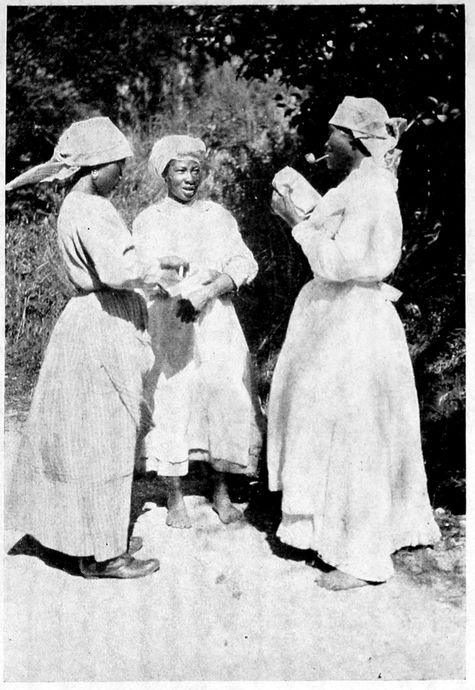
As I passed this group on a Jamaican highway, the woman reading the Bible was saying, “So I ax de Lard what I shall do”
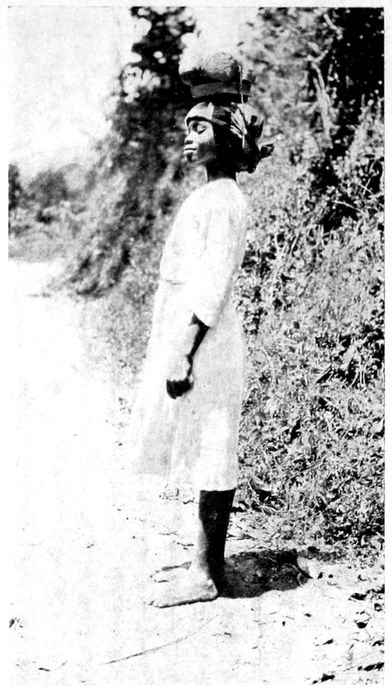
“Draw me portrait please, sir.” The load consists of school books and a pair of hobnail shoes
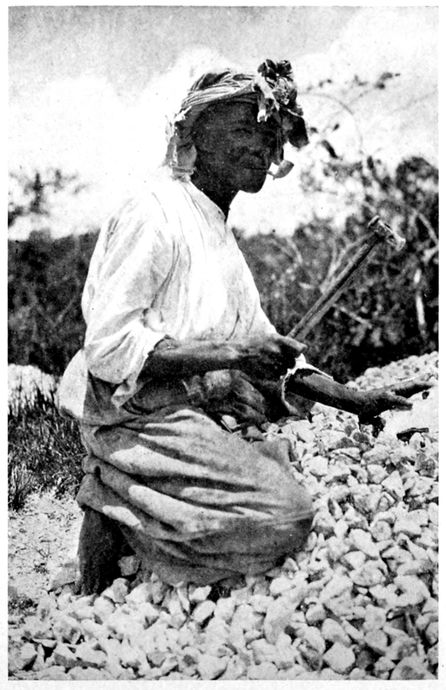
A very frequent sight along the roads of Jamaica
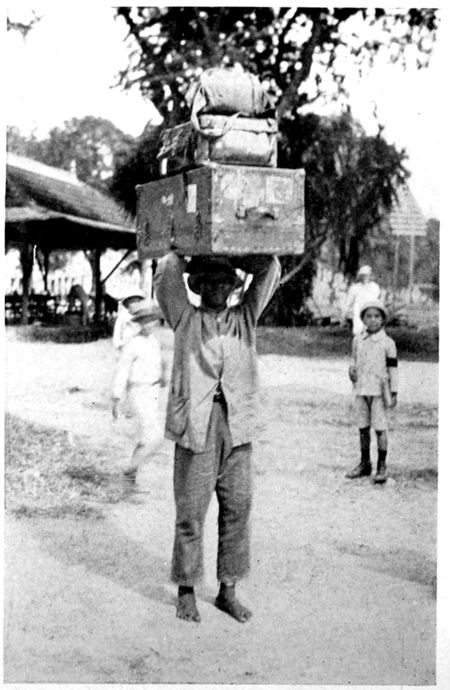
Our baggage following us ashore in one of the French islands
417But we had long since left it, to drive by “buggy”—our American
term for a country carriage has somehow become acclimated in Jamaica—into
the Manchester hills. The trip from Kingston to Mandeville,
2200 feet above the sea, is like one from downtown New York to
the Berkshires in July. Indeed the visitor to Manchester Parish
might almost fancy himself in Connecticut, in spite of the prevalence
of negroes. The gray stone fences, with big horses ankle-deep in the
grassy pastures behind them, the rolling stretches of corn, the very
birds bear out the illusion. Even the clumps of bamboo seem to be
growing on Connecticut hillsides; the orchids and tree-ferns contrast
strangely with a weather and landscape of the temperate zone; Mandeville
itself, long famous as a health resort for the residents of the
sweltering coast lands, has that air of calm repose of some old New
England village.
Carriage driving has more nearly survived modern invention in
Jamaica than in any other of the West Indies, perhaps for the double
reason of the high price of “gas” and the existence of good horses.
The Jamaican horses are famed throughout the Caribbean for their
size and endurance—also for their hard gait as riding animals. They
are not handsome, being usually lank and goose-rumped, but they are
so docile they may sometimes be driven without being broken and they
retain the size of their English ancestors instead of degenerating into
the runts of most tropical America, and they are unusually free from
disease. Breeders claim that they remain so sound in spite of the
enervating climate largely because of the limestone formation of the
island and the recuperative effects of its high altitudes. At any rate
there are few places where a negro-driven buggy and pair cannot be
had on short notice. Many splendid draft mules are also bred on the
island.
I preferred, however, to set out on foot from Mandeville for a jaunt
diagonally across the island. Walking is not a favorite recreation
among either the white or the “colored” castes, though there is no
good reason other than inertia why it should not be in the temperate
highlands. Jamaica has more than two thousand miles of good roads,
far outdoing those of Porto Rico in extent, though they are narrower
and sometimes poorly kept, partly because many of them are parochial
roads, unknown in the neighboring island. “Finger-boards” point
418the way everywhere. The high altitudes of Manchester, as of several
other parishes, lack only the shade-grown tobacco fields and the variegated
tints of intensive cultivation to rival in beauty our own West
Indian colony. Birds are always singing, scattered little white houses
speckle the immense green hillsides, the road banks are often carpeted
with “wandering Jew” enough to make the fortune of an American
florist, or they are hung with tapestries of what look like daisies, while
other flowers bloom on every hand. In a climate pleasant even at noonday
one would scarcely recognize the Berkshire landscape as tropical
but for a banana, a giant fern, or a palm tree here and there in the
foreground.
Little stone and brick coffee floors, called “barbecues” in Jamaica,
frequently flank the roadway. Manchester parish grows much coffee,
though it rarely reaches the American market, for England consumes
all the island produces. Here the bushes are usually unshaded,
protecting trees being unnecessary, if not harmful, at such an altitude.
Instead of the little toy donkey-carts of Barbados there are big rattling
mule wagons. Donkeys are sometimes ridden, occasionally used
as pack-animals. The peasants have little of the insolence of the
towns, but greet the traveler with a kind of military salute and a
gentle “Good day, sah.” Most of them wear caps, as in Barbados,
though the similar headgear of the women in that island is here replaced
by bandannas, usually red and never topped off with a hat as
in Haiti. The men, and many of the women, smoke home-made pipes
with long curved stems, buying their tobacco in long coils called “jackass
rope,” which the war forced to the painful price of a shilling a
yard, though it was once but two pence. Fully developed girls of
twelve eye the passer-by with crudely coquettish airs. Information
as to distance is given in “chains” if at all, the customary answer
being a non-committal “not too far, sah.” The great bulk of the country
population is jet black, though in the towns there are all grades of
yellow, from the impudent slight-cast down to mulattoes.
It was in the cabin of one of the latter that I took shelter from the
afternoon shower, in a region rejoicing in the name of Split Virgin.
He was perhaps two thirds Irish and one third negro, but always referred
to his black neighbors as “niggers.” On the walls of his unpainted
board parlor hung framed chromo portraits of his white ancestors.
The inevitable topic of conversation of course was the high
cost of living—where can one escape it? A “head” of sugar had
advanced from a “gill” (three farthings) to six pence; corn cost
419more than the chickens to which it was fed increased in worth; wild
nuts were more expensive than the flesh they added to his hogs.
Calico, put in his wife, all cloth in fact, was getting impossible. Soon
they would have to go naked—which reminded me that one never
sees naked children in Jamaica, unlike most of the Caribbean islands.
A man could not even grow his own food any more; three fourths of
his yam holes were robbed at night by the thieving “niggers.” The
war and the travel and experience that went with it had debauched
even the better class of them, until they were slothful, proud, insolent,
and wasteful.
I stopped that night in a mulatto house that took in lodgers, the only
point of interest being the dug-out log that served as bath-tub. The
invariable Jamaican question in making new acquaintances is “Please,
sah, who you is; y’u’ name, please sah?” Once they know your name
they seem to feel that everything is all right. But you must have a
name, with a mister in front of it. You never say your name is
Smith. Your name is Mr. Smith. I tremble to think what might
befall a stranger in rural Jamaica who did not happen to have a name,
and a mister to prefix to it.
Over the top of the island range at Coleyville, with its wireless station,
I passed a Jamaica sugar-mill with a daily capacity of one gross
“heads.” It consisted of two upright wooden rollers turned by a
donkey, an oval iron kettle set into the top of a mud furnace, and a
score of little tin cups in which are hardened the one-pound dark-brown
lumps of crude sugar that are called “heads” and which form
a principal article of diet among the country people. Long-tailed
humming-birds shimmered among the flowers at the roadside. Broad
green vistas of banana plants, their broad leaves whipped to ribbons
by the trade wind, filled many a valley, sometimes climbing part way
up the surrounding slopes. Road gangs, usually of two men, were
frequent; negro women young and old, sometimes in long groups,
sometimes quite alone, were to be found in every mile, sitting on stone
piles and wielding their hammers. They are paid a shilling a “box”
for breaking up the stones, which they must hunt for in the fields and
carry to the roadside, earning an average, if they told the truth, of nine
pence a day. It was planting time for ginger, which grows in little
patches on the steep red hillsides. The plant, which is pulled in February
or March, somewhat resembles a currant-bush and only the root
is valuable, the bushes being broken up and used in the following May
or June as seed. With good luck a Jamaica peasant may get 2000
420pounds of cured ginger to the acre. Wages varied in this region from
“one and six” to “two and six,” one of the workmen told me, adding
regretfully “de cultivators in de hills can’t afford de dollar” (four
shillings) “dat am payin’ now de sugar estates.” Shingle and wood
houses were the rule here, and they were better than the rural hovels
of Porto Rico, perhaps because the material is more plentiful.
Each morning I met flocks of black children, carrying their slates
and their few books on their heads, hurrying to school, usually in the
church, from which a chorus of hymns invariably arose as soon as the
pupils were gathered. In the early days the government of Jamaica
did little toward educating the populace, but left it to the denominational
schools. Only a few years ago was the penny a week, still required
of pupils in most of the British West Indies, abolished, and
though there are public schools now in every parish, the Moravians,
Anglicans, Catholics, Presbyterians, the Church of Scotland, the Baptists,
the Wesleyans, and the Church of Jamaica get government subsidies
for educational purposes. England’s school record in Jamaica
is as low as our own in Porto Rico. Slightly more than half the
children of school age are enrolled, and the attendance of these is fitful.
There is compulsory attendance only in Kingston and two or
three other towns. Only three out of every hundred pupils reach
the sixth grade, and in all the island fewer than three thousand continue
in school after the age of fourteen. School inspectors play an
important part in the social life, each having about seventy schools
in his charge, which he must visit twice a year. The Jamaica government
has often been warned against the danger of teaching her democracy
to read unless she also taught it to think, but the warning has
never been taken very seriously.
The country churches of Jamaica are small and unimposing compared
with those of Barbados, though they are more numerous and
often conspicuous in their prominent settings on the green hillsides.
The sects seem to run in streaks. In this ginger region—most fittingly
perhaps—the Church of Scotland holds sway, the ministers
receiving their stipends and their instructions from the land of
heather. Farther on the Baptists prevailed, and every little negro
urchin I questioned announced himself a faithful follower of that
sect. On a high hilltop they had built a stone church as high as the
eaves, then suddenly abandoned it, apparently because it had occurred
to them that there was no water available at that height. The
Jamaicans are much given to religious expression. It is nothing rare
421to hear them “callin’ on de Lawd” as they tramp along the roads, and
their antics sometimes reach the height of religious insanity. Such
seemed to be the case of a ragged old woman I passed during my second
day’s tramp, or else she was pretending the power of prophecy for
the benefit of the score of wide-eyed negroes squatting on the ground
about her as she marched back and forth preaching with all the inflections
of a negro minister and ending each exhortation with a
“Bless de Lawd, Oh, mah soul!” which echoed back from the neighboring
hills. Tombstones are less numerous in Jamaican churchyards
than one would expect, perhaps because of the custom of burying people
on their own property. One often comes upon a little cluster of
graves in a lonely bit of woods, or beside a country hut, some of them
dating from the slave days. Most of them are covered by a mound
of stone and cement, without crosses or other upright monument,
some are large vaults, all are well kept and usually freshly whitewashed.
Strangely enough the negroes do not seem to be in any way superstitious
about them.
Annotto and pimento are two important products of the Jamaican
hills that are sure to draw the pedestrian’s attention. The former
is a reddish berry in a kind of chestnut-burr pod, which grows on a
spreading bush and, being boiled, gives an oily extract that is used as
a dye. Pimento is what we know as allspice, and is the only Jamaican
export indigenous to the island. The tree grows some thirty feet high
and its greenish-gray bark and glossy green leaves cause it to stand
out conspicuously from the surrounding forest. When crushed in the
hand the leaves emit a strong aromatic odor, but they have no commercial
value. The berry, of the size of a currant, grows in clusters, is
glossy black when ripe and very pleasant to the taste. But it must
be gathered before that, and has then a peppery, astringent quality.
They are picked by sending a small boy up the tree to break off the
ends of all the branches he can reach and throw them to the ground,
where the berries are gathered by women and children and carried
to the “barbecues,” where they are dried like coffee.
Irish potatoes can be grown in the highlands of Jamaica; there are
some nutmegs; the oranges are green in color and of poor quality;
there are sapotes (which are here called naseberries, a corruption of
the West Indian Spanish níspero), grapefruit, shadducks (a pear-shaped
grapefruit with a reddish pulp), the chocho, and a dozen other
purely tropical fruits and vegetables. But with the single exception
of the pimento all these products have been imported, though many of
422them have fervently adopted their new home. In 1793, for instance,
when a famine was ravaging the island, William Bligh brought the
breadfruit tree from the South Seas, and to-day it is as familiar a
sight as African faces.
A furzy, almost treeless, red soil region surrounded me on my
second afternoon. I was flanking the famous cockpit country, made
up of numerous basins in close proximity and densely wooded from
top to bottom, wilder forms of what are known in Minnesota as
“sink-holes.” In these the Maroons took refuge in their wars with
the English. The Maroons (an abbreviation of cimaroon, said to
be derived from the Spanish cima, or mountain top) were originally
slaves of the Spanish, who took to the cockpit country after England
captured Jamaica, where they were joined from time to time by runaway
slaves of the newcomers. England won her title to the island
almost without a struggle, but it took two regiments to keep the
Maroons from recapturing it. For nearly two hundred years they
lived in wild freedom in the mountain recesses, frequently descending
to harry the lowlands and carry off the cattle. The government
at length entered into a treaty with them, granting them 2500 acres of
land, and getting in turn their assistance in quelling uprisings of the
slaves or repelling foreign invasion. They were a bold, hardy lot of
men, holding the servile peasant population in great contempt, knowing
every inch of the hills and forests, and were great hunters, either
of human or four-footed game. In warfare they dressed themselves
in green leaves which caused them to blend invisibly into the landscape.
It has always been the policy of the Government to keep the Maroons
at odds with the rest of the population, England’s familiar old scheme
for dominion, like the accentuation of caste lines in India. To-day,
though there are several so-called Maroon towns in the cockpit country
and another in the northeastern parish, there are said to be almost
no “pure blooded” Maroons left. They still exist in name, however,
and have their own chiefs, churches, and schools, and once a year
they are paid an official visit by the custos of the parish, when they
“dress up in leaves and similar rubbish and go through a lot of childish
hocuspocus.” In theory at least they are more independent than
the other negroes—which is strong language indeed—but though
every little while some black countryman bullies his neighbors by
claiming to be a Maroon, there is nothing by which to distinguish the
423present descendants of the warlike slaves from those whose ancestors
peacefully awaited emancipation.
Wayside shops are somewhat less numerous in Jamaica than in
Barbados, and it is significant of a larger American influence here that
they are called stores. The best of them, virtually all the provision
shops in fact, are kept by Chinamen, unknown in “Little England.”
Even in the most remote corners of the mountainous interior one
comes upon Celestials plying their chosen trade, most of them of the
younger generation, born in Jamaica and speaking the same slovenly
tongue as their negro clients, yet retaining all their native attributes,
sphinx-like, taciturn, unflaggingly diligent, apparently wholly devoid
of curiosity, only rarely succumbing to the native influence to the extent
of mumbling an indifferent “Where y’u go?” or “What y’u
name?” In striking contrast to Barbados, too, are the stocks of imported
canned and salt fish, even in stores on the edge of the sea. Every
scattered collection of huts has its post office, always bearing the blue
sign “Quinine for Sale.” Single pills of the febrifuge are sold in
printed envelopes at a farthing each, though there are few coins of that
size in circulation, and he who buys a penny-worth gets his four pills
in as many separate envelopes. The favorite native occupation seems
to be the patching of shoes. It is a rare mile that does not have at
least one “shoemaker” seated in the door of his tiny shanty or single
room, striving to make both ends meet with a few scraps of leather and
a handful of nails. Almost the only native manufacture, however,
is the weaving of “jippi jappa” hats, a very coarse, poor imitation of
the Panama, though the country people make all shapes and sizes of
baskets.
The language of Jamaica is at best curious; that spoken in the hills
seems almost a foreign dialect, and the stranger must listen attentively
and usually have phrases repeated before he understands them. He
is unlikely to catch more than the general drift of a conversation between
the natives. Yet few African words remain; what seem such
to the stranger turn out upon inquiry to be mutilated forms of English.
“No, please” and “Oh, yes, please, sah” are the habitual negative
and affirmative of the rural districts when addressing white persons.
Now and then the greeting of the older people is “Good mawnin’,
dear massa,” or “I tell you good evenin’, mistress.” It is always “I
couldn’t tell you,” never “I don’t know.” A white baby is a “bukra
pickney” to the country people; smile at any of their childish antics
424and they are flattered into confiding to one another “De bukra him
laugh.” African languages consist largely of gesture. With the
learning of English from the stolid Anglo-Saxon this has in
great measure disappeared. It is much more prevalent in the country
than in the towns, and much more marked when they are talking
to one another than when addressing a white man. The negro-English
of the masses is no more intelligible to the newcomer than
real English is to the rural population, and most planters save
themselves time and trouble by addressing their laborers in
their own dialect. The Jamaican negro is much given to talking
things over with himself, his brain evidently refusing to work silently,
and it is the rule rather than the exception to hear those one meets
along the roads engaged in a soliloquy. In slavery days queer terms
were used for money and they are still heard in the rural districts
and in town markets. I found a Chinaman spending his spare time
between customers in wrapping up tiny packages of sugar and asked
him if they were a penny-worth, which seemed small enough indeed
at present prices. No, they are sold at a “gill,” or three farthings.
Two “gills,” or three “ha’p’nnies,” is a “quattie.” A shilling used
to be a “macaroni,” three pence was for some reason called “fippence,”
and to this day one occasionally hears the equivalent of thirty
West Indian cents referred to as “a mac an’ fippence.” The ejaculatory
“I mean to say” is as frequent in the speech of even the
peasants as it is in England.
What may be called proverbs for lack of a more exact name are
numerous among the masses of Jamaica. Let me quote a few, leaving
the reader to catch what meaning he can out of them:
“Better fe water trow ’way dan gourd fe bruck.”
“Black man tief, him tief half a bit; bukra tief, him tief whole a
estate.”
“Cock crow ’trongest ’pon him own dung’ll.”
“Cedar board laugh after dead man.”
“Don’ cry oveh milk wha’ trow ’way a’ready.”
“Dog hab too much owner him sleep widout supper.”
“Ebery dog tink himself lion in him massa yard.”
“Ebery John Crow tink him pickney white.”
“Ebery man know where him house a leak.”
“Follow fashin mek monkey cut him tail.”
“Get a quattie better dan a kick.”
425“Larn te dance a home befo’ y’u go outside.”
“Man no done grow mus’n laugh afteh short man.”
“Man get in trouble pickney breeches fit he.”
“Runnin’ ’bout too much de ruin ob woman an’ fowl.”
“Same ting sweet mout’ hu’t belly.”
“Sometime high standin’ collar stan’ top a empty belly.”
“Too much cousin broke shop.”
“When y’u hab bad husban’ don’ mek y’u sweethea’t ca’ y’u half
way.”
“Man run too fast run two time.”
“Ebery jackass tink him pickney a race horse.”
Folk lore shows evidence of English and African mixture. Here
is a story as it was told by our son’s Jamaican nursemaid, without the
inimitable pronunciation:
“One day a gentleman and lady have two girl. And they sent them
out to look for them granny. When them got in the thick wood and
them meet with a orangootang. The orangootang axed them where
are them going to. ‘I am going to look for my granny.’ And said,
‘Here is my granny.’ And them said, ‘No, you is not my granny.
My granny got a mark right on her mout’.’ And he went in the thick
wood took a knife scrape off his mout’ and come out and said, ‘Here is
your granny now.’ And he took dem and carry dem in his house and
just half cook de food dat carry for dem granny. And when night
come him eat off de middle of de biggest one and lef’ only de hand and
de head and de feet. And de little one said, ‘Granny, let I go outside.’
And he said go and de smallest one run home and can’t talk till three
days. And de father get twelve men and gone look for de orangootang.
And when he going six mont’ he catch de orangootang and put
him into de cage and when six mont’ come he throw kerosene oil on
him and light him a fire.”
Tenses mean nothing to the uneducated Jamaican, and the subjective
and objective pronouns are more likely to be reversed than not. Between
the plural and singular of either verb or noun he shows an engaging
impartiality, while the double negative is to him a form of emphasis.
Beyond Ulster Spring, a scattered town in a kind of cockpit so
full of mist in the early morning as to seem a lake, my road dropped
rapidly down a beautiful narrow valley, the high, ragged hills on both
sides tree-clothed in all but the barest white sheer spots. Little wooden
426houses were pitched on wooded knolls and jutting places that seemed
almost inaccessible. Here and there the ancient stone road-parapet
had fallen away, giving splendid opportunities for far swifter descent
on a dark night. Through the canyon echoed the voice of a negro
woman, singing hymns as she walked. Birds sang continually; from
the inaccessible little houses came the occasional bleating of goats.
Dry River Lake, evidently in the bottom of a prehistoric crater, shimmered
far below me, surrounded by the densest vegetation, and utter
silence. Jamaica has many rivers that disappear and reappear at random
throughout their course. Negro men on their way to work on the
jungled hillsides carried their machetes in one hand and a smouldering
block of wood in the other, to smoke out the mosquitos. Some bore
in addition a blackened five-gallon oil tin of water on their heads.
The day did not grow unpleasantly warm until I had passed Sawyer’s
Market and entered a long fertile plain, completely uncultivated, almost
uninhabited, studded with great clumps of bamboo. Dolphin Head,
the highest peak in western Jamaica, peered above the landscape to the
left. Then bit by bit the negroes grew numerous and impudent again,
and I knew that the sugar-bearing coastlands were at hand.
Negroes so black and ox-like that they seemed scarcely human
plodded past, never giving greeting as in the hills, though sometimes
shouting an obscene jest. Children ran at sight of me, as those of
Italy, for instance, do at sight of a negro. Ragged old women were
hoeing cane in the fields. They earned five shillings a week; the strongest
men three a day, at “task-work,” laboring from Monday to Friday.
Here and there was an old-fashioned rum-mill, recognizable by
its stench as well as by its old brick chimney and the heaps of rotting
cane-pulp about it. The cane-carts were hauled by three or four pairs
of oxen, a dozen men shrieking about them to urge them up the slopes
of the soft fields. Like most of those in Jamaica they were crosses
between English and East Indian cattle, particularly the Mysore breed.
Though inferior from the butcher’s point of view, these cross-breeds
are noted for their quickness and endurance under the yoke, and they
have a black, sun-resistant skin even when outwardly light-colored
or white. Once I passed a ruined old windmill tower, capped with
ivy, but they are rare in Jamaica. The thick, hot air hung motionless
after the afternoon shower. Rocky, bush-grown hills intruded again
where one expected flat, fertile coastlands, sugar-cane died out once
more, and with it the negroes.
Then suddenly the Caribbean appeared through a break in the hills,
427so high and dark-blue that it seemed at first a new mountain range,
and on the edge of it I caught a glimpse of Falmouth, not to be seen
again until I was treading its very streets. Many old stone ruins,
especially the foundations and steps of what had evidently been big
plantation houses, peered forth from the bush. There were other signs
that large estates had once flourished where all was not “ruinate.”
Dreary, silent, dismal, swarming with mosquitoes, the last few miles
led through an unbroken mangrove swamp. Myriads of land-crabs
of all sizes and colors, some huge as small turtles, others no larger
than flies, with green, red, cream-colored, and multi-colored backs,
scuttled into their holes as I passed. Falmouth had little to recommend
it, either as a place of abode or of sojourn. Sweltering even at
midnight, its streets impudent with lounging negroes, it recalled by
contrast the cool and simple little villages in the hills. I found lodging
in a room strewn with the greasy paraphernalia of a negro dentist
and which had not known the luxury of a broom or a dust-cloth in
weeks, though the mulatto house-owner complained that she “can’t get
no work to do.” A Salvation Army street meeting which erupted a
few doors away was the nearest replica of a Central African tomtom
dance, with clothes on and smeared with a thin English veneer, that
it has ever been my luck to behold in an ostensibly civilized country.
I had not intended to walk the twenty-two miles along the coast
from Falmouth to Montego Bay, but as the mail bus left at three in
the morning and private automobiles demanded three shillings a mile,
I changed my plans. Groups of ragged negro women came down out
of the hills singing, their dinner in a rag or a pail on their heads, and
fell to work in newly cleared cane-fields. Pedestrians were constantly
beating off the mosquitoes with leafy branches. Once there had been
big stone houses here also, now there were only miserable negro shacks
scattered among the cocoanut groves. The sea breeze was nearly always
cut off by these or mangrove jungles. The only noise except
occasional shrieking negroes was the cry of mourning doves and the
equally mournful “sough” of the slow breakers on the reefs far out
from shore. Fishermen were rare. Now and then the swamps disappeared
and the road plodded endlessly onward at the very edge of
the unruffled inner lagoons. I passed only one shop on the journey,
kept of course by a Jamaica-born Chinaman. Drinking water was not
to be had; the June sun beat down like a red-hot ingot; the incredibly
stupid watchmen, most of whom were females, could not be induced
428to sell a single one of the green cocoanuts under their charge. I adopted
the Jamaican custom of praedial larceny and, picking a plump green
nut now and then from the low young trees, jabbed a hole in it on a
sharp fencepost and quenched a raging thirst that returned again within
a half mile. Noisome carrion crows, with red heads instead of black,
unlike those of Trinidad, and called “johncrow” by the natives, moved
lazily aside as I advanced.
Midway between the two towns I passed a three-story mansion set
somewhat back from the sea on what was once one of the finest estates
in Jamaica. To-day it is closed and abandoned, yet needs no watchman,
for the negroes are convinced that it is haunted. Rose Hall it is called,
and its story has long been familiar throughout Jamaica. Here, runs
the yarn, lived a pretty Mrs. Palmer, who was so eccentric that she
caused the house to be built according to the divisions of time,—365
windows, 52 doors, 24 rooms, 12 of this, 7 of that, and so on. But
eccentricity seems to have been the least of her faults, for in this very
house, the tale goes on, she killed four husbands and was on the point
of sending the fifth to join them when he turned the tables.
At length the featureless road swung inland along the edge of an
immense bay, across which stood forth the wooded hills of Hanover
parish. Its waters were glass-smooth, but the sea-wall smashed for long
distances recalled that the Caribbean does not always lie so peaceful and
enticing. Cottages with bathing-suits hung over the veranda rails
began to appear, then white men, of whom I had seen but one in three
days, and he with a negro wife. Montego Bay aspires to be a tourists’
winter paradise, but unfortunately the town lies around behind a hill
that cuts off that life-saving trade wind which Jamaicans call “the doctor”
and in its place comes only the fitful land breeze known as “the
undertaker.” Then, too, it is short of water. Most of Jamaica is, for
unlike Barbados, which has not a tithe as many sources of supply, the
island depends chiefly on what it can catch from the rains. The
result is frequently to deprive the perspiring visitor of his bath. Tourist
literature would have us believe that “the band of the Montego Bay
Citizens’ Association performs in the Parade”—most Jamaican towns
have a dusty central square known by that name—“in the evenings,
and greatly adds to the pleasure of the visitor.” “Perform” it does
indeed, and none can deny that it adds to the risibility of nations; but
let no music lover be misled by this particular abuse of the maltreated
word “pleasure.”
429Of the many other beauties of Jamaica space precludes anything
more than brief mention. There are the cane-fields of Westmoreland
parish, for instance, the tobacco growing hills of St. Elizabeth, the
journey up the gorge to Bog Walk, St. Ann’s parish with its newly
born lake of Moneague, its many pimento trees, its beguiling Fern
Gully, where are to be found innumerable species of the plants that give
the ravine its name, from the maidenhair to the tree-fern, known locally
as the “rattadrum.” Here, too, are Roaring River Falls and the scene
of Columbus’ longest residence in the West Indies, for he lay a twelve-month
with his worm-eaten vessels in what is now called Dry Harbor.
But it would never do to leave Jamaica without getting a “close-up”
of her banana industry, and to do this to best advantage one should
go to Port Antonio. Above Bog Walk on the way there is Natural
Bridge, where the river cuts a great archway through the rocky hills,
the highway crossing it far above, recalling famous Rumichaca on the
boundary of Colombia and Ecuador, to say nothing of one of our own
scenic beauties. Here is a splendid place to end a Sunday stroll, for
there is a magnificent bath awaiting one amid the boulders over which
the river pours with a constant subway roar and, if one can elude the
gaping negroes who are otherwise sure to follow, no other observers
than the hundreds of little swallows always flitting in and out of their
nests in the rock cliffs. Then when the sun has lost its youthful ardor
one may climb again to the village and catch the afternoon train over
the mountains to the north coast. The region about Highgate almost
rivals the beauty of Porto Rico. Cacao, cocoanuts, clumps of bamboo,
the spreading breadfruit-trees, whole valleys full of bananas, some of
which climb far up the surrounding slopes, decorate the rugged landscape.
One looks almost in vain, however, as in all Jamaica, for the
queen of tropical vegetation, the royal—or, as the English unimaginatively
call it, the cabbage-palm. Then the train descends quickly
through tunnels and across lofty viaducts to Anotta Bay, a large collection
of wooden shanties noted for its mosquitoes, but with the blue
Caribbean stretching away beyond it to the horizon.
Along the edge of this the railway squirms through a wide fringe
of cocoanuts for two hours more. The frequent stations swarm with
female negro food-venders. Hindus are somewhat more numerous
and though even the women nearly all wear Jamaican dress their Aryan
features and unobtrusive manner distinguish them as quickly as their
nose-rings and massive necklaces from the African bulk of the population.
430At length comes Port Antonio, with its twin harbors, embowered
in hills half wooded with cocoanuts, an unexpectedly delightful place
to the traveler who has known other Jamaican coast towns. Here the
trade wind, unknown in Kingston, blows unceasingly, and that alone
doubles the worth of any West Indian spot. Irregular and more compact
than the two rivals it has probably outdistanced since the last
census, Port Antonio has a more thriving, sanitary, comfort-loving air,
thanks perhaps to the American influence of its banana trade.
Jamaica claims advantages over all the rest of the world for banana
cultivation. The vast tracts of virgin land in Central America and
Colombia are two days farther from the principal market. Costa Rica
is hampered by frequent droughts at the very season when the fruit
most needs rain; for the great game in banana growing is to have them
ready to cut at the time when other fruit is scarce in the north. Cuba
is a trifle too near the north pole, it is wedded to its sugar industry,
and its labor is several times more expensive than that of Jamaica.
Bananas demand heat, moisture, and a good fat soil, and all these may
be had in the largest of the British West Indies, particularly in the
northeastern parish of Portland, for the Blue Mountains which deny
Kingston and its vicinity the rainfall it needs precipitate most of it
here. What was then a little known fruit in American markets was
first planted on a large scale in this very parish a half century ago.
By 1894 it had become the most important export of the island, out-distancing
both products of the sugarcane, and twenty years later it
constituted sixty per cent. of Jamaica’s contribution to the world’s
larder. The war, abetted by three consecutive hurricanes, the banana’s
greatest enemy, reversed this condition, but the sugar-men themselves
do not long hope to hold their new lead.
I chanced to reach Port Antonio at the very height of a banana war.
The two powerful older companies had determined to annihilate a new
one by that simple little method of starving it to death. Before the
World War a bunch of bananas seldom sold for more than two shillings
and six pence in Jamaica, but the competition of the newcomers had
gradually forced this up to four shillings. In the single day of my
visit it advanced hourly by leaps and bounds,—five shillings, five
shillings and three pence commission, six shillings, six and six, seven
shillings, with a six pence commission if need be, and free transportation
to the port—as often as the interlopers covered their bids the imperturbable
managers of the powerful companies sent out new inducements
over their private telephone system, until the joyful planters of
431some sections were pocketing eleven shillings for every bunch of bananas
they could lay down at the roadside bordering their fields. The fruit
poured into Port Antonio in an endless stream, by motor-truck, by
wagon, pack-donkey, on the heads of men and women, for even the
negroes who had but a single bunch worth cutting hastened to part
with it at this unprecedented price.
But let us watch the process from the ground up, for the benefit of
those who know the banana only as it appears on the fruit-seller’s stand.
We have only to catch one of the mammoth trucks thundering away
empty into the hills in the direction of Mooretown, once a settlement of
Maroons. Every little while along the way, jolly, muscular negro
laborers swing up over the tail-board until by the time we have reached
Golden Vale, said to be the oldest export banana farm in the world,
there are enough of them to load the truck in a bare twenty minutes.
It is scarcely necessary to say, I suppose, that bananas grow on a
species of mammoth weed rather than a tree, that each produces a
single bunch, that this grows “upside down” from our fruit-stand point
of view, and that they must be cut before they are ripe. Golden Vale
looks like an immense green lake surrounded by mountains, up the
lower slopes of which the bananas climb for a considerable distance.
Close overhead sits Blue Mountain Peak, coiffed in blue-black clouds.
Hindu men, whom the overseers invariably address as “Babu,” do most
of the cutting, while the more powerful but less careful negroes do the
handling. The “Babus” wander in and out through the green archways,
giving a glance at each hanging bunch. When they see one which
has reached the proper stage of development, they grasp it by the protruding
stem, to which the big blue flower usually still clings, and pull
down “tree” and all with a savage jerk. A machete, called a cutlass
in Jamaica, flashes, a negro catches the bunch as it falls, another slash
severs the flower-bearing stem a few inches from the topmost bananas,
a third leaves the “tree” a mere stump, shoulder-high, and the cutters
continue their search. Days later, when its sap has run back into the
roots, the stump is cut off at the ground and a new shoot springs up to
produce next year’s bunch. The bunches that have been gathered
are wrapped in dry brown banana leaves, and carried to the roadside,
along which other brown heaps lie everywhere as we hurry down to the
port, the loaders dropping off one by one at their shanties or the frequent
rum-shops along the way. Quick handling is an absolute
requisite in the banana business, and many a planter has come to grief
by not giving sufficient attention to the question of transportation.
432Arrived at the wharves the truck is as quickly unloaded, and an endless
chain of negroes, nearly all women, take up the task of distribution,
according to size and destination. For there are “English” and
“American” bananas, grown in the same field and differing not at all
in species but by about ten days in their cutting time, so that the former
are lean and the latter fat. Moreover, a bunch is not by any means
always a bunch in the language of the banana companies. In the first
place they are more often called “stems,” and a “stem” must have at
least nine “hands” of fruit (the latter average a dozen bananas each)
if it is to be paid for as a full bunch. If it has more than that well and
good; that is the company’s gain and no one’s loss. But if there are
but eight “hands” it is rated two thirds of a “stem,” if seven, one half,
if six, one fourth, if less than that the planter might better have fed it
to his hogs or his laborers, for the buyers will have none of it. This
rating is less unjust than it appears, for the fewer the “hands” the
smaller and fewer are the bananas.
The slouching negroes who make up the endless chain, are not required
to tax their minds with these problems of size and nationality.
They use their heads, to be sure, but only in the manner that seems
best fitted to the race—as common carriers. Two men snatch up the
bunches one by one, casting aside the brown leaf wrappers, and lay each
one flat on a passing head, the owner of which shuffles away as if it
were burdened with nothing but a hat instead of an average weight of
eighty pounds. At the edge of the shed in which the bananas are piled
to await prompt shipment stands a high desk with three men, usually
quadroons or lighter, standing about it. The oldest, most intelligent,
and most experienced looking of these casts what seems to be a careless
glance at each “stem” and mumbles in a weary monotone, “English,
eight,” “American, nine,” “English, seven,” or some other of the
combinations; his most youthful companion makes a pencil mark on
the ledger before him, the least lively looking of the trio hands a metal
or cardboard disk to the carrier, who drops it into a pocket and slouches
on to the particular pile to which her burden has been assigned. On
the way she passes a negro armed with a cutlass, who lops off the
protruding ends of the stem in front of her nose and behind her ears
as she walks without so much as arousing a flicker of her drowsy,
black eyelids.
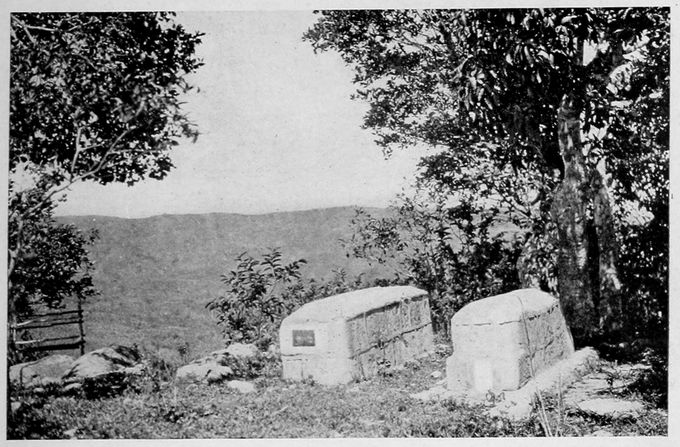
Private graveyards are to be found all over Jamaica
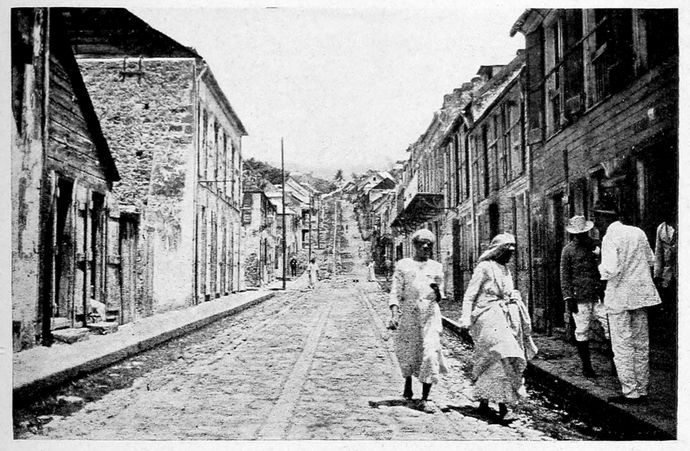
A street of Basse Terre, capital of Guadeloupe
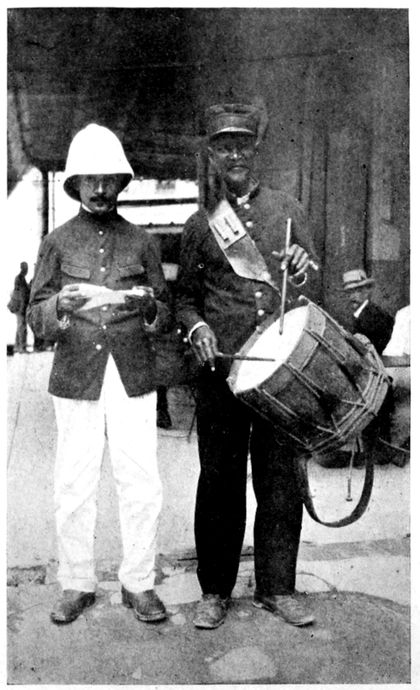
The town criers of Pointe à Pitre
433When the ship comes in, which must be that night or at latest next
day, a similar endless chain of negroes, more nearly male in sex,
carry the bananas on board, a tally-clerk ringing the bell of an automatic counter in his hand as each “stem” passes. In some ports a
wide leather belt takes the place of this human chain. But a large
gang is required for all that, and when the last pile has disappeared
from the wharf the carriers strew themselves about it and sleep soundly
on the hard planks until the next load arrives. Its quota supplied, the
steamer’s hatches are quickly battened down, icy air is turned in upon
the perishable cargo, and the vessel rushes full speed ahead for the
United States or England, where the fruit begins to rattle away in
other trucks before the mere human passengers have leave to descend
the gangway. Not until it has reached the retailer does it take on that
golden yellow hue that is familiar to the ultimate consumer.
I dropped off at Buff Bay station on the return journey for a jaunt
over the Blue Mountain range. The “finger-boards” announced the
distance to Kingston as forty-three miles, but there are many shortcuts
and an average pedestrian can make the journey in a single day. It
is a pleasant walk despite the fact that the first sixteen miles impose
a climb of 4080 feet to Hardware Gap. For the foothills begin at
once, and the road, narrow and grass-grown from disuse except near
the coast, climbs in almost constant shade along the bank of Buff Bay
river, and the trade wind sweeps incessantly up the valley. Jamaica
is noted for its birds, of which there are said to be more than forty
varieties peculiar to the island, and the majority of them seem to make
this region their chief rendezvous. Perpendicular banana fields cover
the hillsides here and there as high as they can endure the altitude.
Masses of bamboos lend a needed touch of daintiness to the dense
greenery, as a red-brown tree now and then speckling the steep slopes
adds contrast to what would be an almost monotonous color. Then
there are the akee-trees, numerous throughout Jamaica, with their
bright red, pear-shaped fruit, a favorite food among the negroes, though
it is deadly poison except at certain stages of its growth, and even
then is reputed the cause of the vomiting sickness that is prevalent
among the masses.
Higher up every turn of the road brings to view a new waterfall,
standing out against the greenery in flashing whiteness. No wonder
the aborigines called the island Xamayca, the land of springs and water;
and how one regrets that those same red men do not inhabit it still,
if only to give relief from the monotony of black, brutal faces that in
time grow almost intolerable to the traveler in the West Indies, until
there come moments when he would give all he possesses to see these
434gems of the Caribbean as they were before they became mere hives
of African slovenliness. But the only Arawaks left in the Jamaica of
to-day are those which uphold the arms of the colony on its shield.
Here indeed the ancient saying that “every prospect pleases and only
man is vile” reaches its full meaning.
I grew weary at length of the incessant negro impudence along the
way, which ranged from foul-mouthed shouts to more or less innocent
demands of “Heh, bukra, what you sell?” It is a ridiculous failing,
no doubt, but I detest being taken for a peddler. I took to shouting
back, “I am selling something to make niggers white. Want some?”
But, alas, sarcasm seldom penetrates the African skull. Far from resenting
my rudeness, the simple-minded souls greeted it with roars of
laughter or took it seriously, more often the latter. Dozens called
after me to know the price of this desirable remedy; several followed
me up the road offering to purchase; one old woman pursued me for
nearly half a mile; one group sent a boy running after me, clamoring
to know the cost of my wares. “A thousand pounds,” I called back
over my shoulder, which being duly reported in all solemnity to the
group, brought forth a chorus of giggles and a regretful-toned, “Ah,
him humbug we!”
The last two hours, from Jiggerfoot Market to the summit, was a
laborious climb, but unlike many such it was lightened by frequent
streams of clear, cold water. Then all at once I found myself at the
gap, or abra, as the Spaniards would call it, and upon me burst a view
worth many times the exertion. All the Liguanea plain from St.
Thomas parish to Spanish Town and beyond, far beyond, into the farthermost
hills of St. Catherine’s lay spread out like a colored map
on a draughtsman’s table, Kingston in full sight from the scattered rocks
far outside its harbor, with the sea breaking white upon them, to its last
suburbs among the foothills, the sand reef called the Palisadoes curving
like a fishhook about the harbor, the remnants of what once boasted
itself the most wicked town on earth at its point, the water about it
so clear that one might easily have fancied he saw the sunken city of
the buccaneers. There is spring water at the very edge of the gap
and if one has thought to bring a pocket lunch there is nothing to hinder
a long contemplation of this marvelous panorama, except the gradually
penetrating cold of the mountains, which seems indeed an anachronism
within plain sight of sweltering Kingston.
This sent me striding downward again sooner than I had expected.
A hill covered with an abandoned cluster of big barracks soon cut off
435Kingston and most of the plain, and left the eyes to contemplate a
nearer scene. Ahead, the road, leisurely and still grassy, had clawed
itself a foothold in the rocky hillside, sheer and wooded with scrub
growth everywhere except where landslides had scratched a white
line down its face. Birds sang lustily, as if tuning up their voices for a
later public appearance; human kind was pleasantly conspicuous by
its absence. Beyond, on the steep flank of Catherine’s Peak, the soldier
town of Newcastle, where British “Tommies” live in an agreeable
climate and still keep an eye on Kingston, went down like a giant’s
stairway into the gorge, an immense gorge always at my very feet, with
little strings of roads winding in and out along its bottom as if in vain
quest of an exit. And though the plain below had been faintly hazy
and there were banks of clouds in the sky high above, the twin peaks of
Blue Mountain range, 7360 higher than the sea, stood out as plainly as
though one might have thrown a stone over them.
Five miles constantly downward by a mountain trail, though it is
twice that by the highway, brings one from Newcastle to Gordontown,
a somnolent hamlet closely shut in by high hills and noisy with the little
river which furnishes Kingston its water. Down the bank of this
I hurried on to the plain of Liguanea, where rocking street-cars carry
one quickly into the insolent capital, for the mangoes were already
ripening and it was high time we sailed away from the island Columbus
called Santa Gloria.