The “Warwick Crown Prince”—“Spicy Jack”—Poor old Lal!—“Go
it, you cripples!”—A model horsekeeper—The coach
dines here—Coroner’s inquest—The haunted glen—Lal’s
funeral.
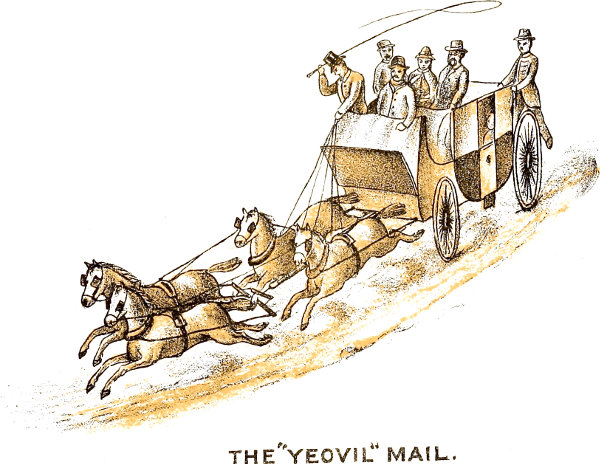
The coach which I have selected by
way of exemplifying my remarks was
the “Warwick Crown Prince,” and,
at the time I adopted it, was driven by Jack
Everett, who was reckoned in his day to be
as good a nurse, and to have fingers as fine,
as anybody in the profession.
He took the coach from The Swan with
Two Necks, in Ladd Lane, to Dunstable, and
there split the work with young Johnson, who,
though sixty years of age, had three older
brothers on the bench. “Spicy Jack” was the
beau ideal of a sporting whip. He was always
dressed to the letter, though his personal
appearance had been very much marred by
two coach accidents, in each of which he
fractured a leg. The first one having been
hurriedly set a little on the bow, he wished
to have the other arranged as much like it as
possible; the result being that they grew very
much in the form of a horse-collar. These
“crook’d legs,” as he called them, reduced his
stature to about five feet three inches. He
had a clean-shaved face, short black hair, sharp
intelligent blue eyes, a very florid complexion,
rather portly frame, clad in the taste of the
period: A blue coat, buttons very widely apart
over the region of the kidneys, looking as if
they had taken their places to fight a duel,
rather than belonging to the same coat. A
large kersey vest of a horsecloth pattern; a
startling blue fogle and breast-pin; drab overalls,
tightly fitted to the ankle and instep of
a Wellington boot, strapped under the foot
with a very narrow tan-coloured strap. The
whole surmounted by a drab, napless hat, with
rather a brim, producing a “slap-up” effect.
When at the local race-meetings, “Spicy Jack”
dashed on to the course in a sporting yellow mail-phaeton,
his whip perpendicular, his left hand
holding the reins just opposite the third button
of his waistcoat from the top. Driving a pair
of “tits” which, though they had both chipped
their knees against their front teeth, and one of
them (a white one) worked in suspicious boots,
produced such an impression upon the yokels that
no one but “Spicy Jack” could come on to a
racecourse in such form.[4]
All this appeared like “cheek,” but it was
quite the reverse; for in spite of the familiarity
which was universally extended to this “sporting
whip,” he never forgot his place with a gentleman,
and a more respectful man in his avocation did
not exist.
“Well, Jack, what are we backing?” was
the salutation of a noble lord who had given
him a fiver to invest to the best of his judgment.
“Nothing, my lord; we are not in the
robbery.”
“How’s that? we shall lose a race.”
“Well, you see, my lord, it was all squared
and the plunder divided before I could get on.”
Nobody knew the ropes at Harpenden, Barnet,
and St. Albans, when the platers ran to amuse
the public, and the public “greased the ropes,”
better than the waggoner of the “Crown Prince.”
This is a rest day and the “spare man” works.
Let us take a full load away from Ladd Lane.
Ten and four with all their luggage; roof piled,
boots chock full, besides a few candle-boxes in
the cellar.[5] She groans and creaks her way
through the city, carefully, yet boldly driven by
our artist, and when she leaves her London team
at the Hyde and emerges into an open road, she
steals away at her natural pace, which, from the
evenness of its character, is very hard to beat.
There was one coach, and only one, which could
give these fast stage-coaches ten minutes and beat
them over a twelve-mile stage!
It was before the legislature forbade the use of
dogs as animals of draught, that there dwelt upon
the Great North Road, sometimes in one place,
sometimes in another, an old pauper who was born
without legs, and, being of a sporting turn of mind,
had contrived to get built for himself a small
simple carriage, or waggon, very light, having
nothing but a board for the body, but fitted
with springs, lamps, and all necessary appliances.
To this cart he harnessed four fox-hounds,
though to perform his quickest time he preferred
three abreast. He carried nothing, and lived upon
the alms of the passengers by the coaches. His
team were cleverly harnessed and well matched
in size and pace. His speed was terrific, and as
he shot by a coach going ten or twelve miles an
hour, he would give a slight cheer of encouragement
to his team; but this was done in no spirit
of insolence or defiance, merely to urge the hounds
to their pace. Arriving at the end of the stage,
the passengers would find poor “Old Lal” hopping
on his hands to the door of the hostelry, whilst
his team, having walked out into the road, would
throw themselves down to rest and recover their
wind. For many years poor Old Lal continued
his amateur competition with some of the fastest
and best-appointed coaches on the road; his
favourite ground being upon the North Road,
between the Peacock at Islington and the Sugarloaf
at Dunstable. The latter place was his
favourite haven of rest. He had selected it in
consequence of a friendship he had formed with
one Daniel Sleigh, a double-ground horsekeeper,
and the only human being who was in any way
enlightened as to the worldly affairs of this poor
legless beggar.
Daniel Sleigh, as the sequel will prove, richly
deserved the confidence so unreservedly placed in
him—a confidence far exceeding the mutual sympathies
of ordinary friendship; and Daniel Sleigh
became Old Lal’s banker, sworn to secrecy.
Years went on, during which the glossy coats
of Lal’s team on a bright December morning—to
say nothing of their condition—would have
humbled the pride of some of the crack kennel
huntsmen of the shires. When asked how he
fed his hounds, he was wont to say: “I never
feed them at all. They know all the hog-tubs
down the road, and it is hard if they can’t satisfy
themselves with somebody else’s leavings.” Where
they slept was another affair; but it would seem
that they went out foraging in couples, as Old Lal
declared that there were always two on duty with
the waggon.[6]
When the poor old man required the use of
his hands, it was a matter of some difficulty to
keep his perpendicular, his nether being shaped
like the fag-end of a farthing rushlight; and he
was constantly propped up against a wall to
polish the brass fittings of his harness. In this
particular his turnout did him infinite credit.
Of course his most intimate, and indeed only
friend, Dan Sleigh, supplied him with oil and
rotten-stone when he quartered at Dunstable;
and brass, when once cleaned and kept in daily
use, does not require much elbow-grease. Lal’s
travelling attire was simplicity itself. His wardrobe
consisted of nothing but waistcoats, and
these garments, having no peg whereon to hang
except the poor old man’s shoulders, he usually
wore five or six, of various hues; the whole
topped by a long scarlet livery waistcoat. These,
with a spotted shawl round his neck, and an old
velvet hunting-cap upon his head, completed his
costume.
The seat of Lal’s waggon was like an
inverted beehive. It would have puzzled a man
with legs to be the companion of his daily
journeys. These generally consisted of an eight-mile
stage and back, or, more frequently, two
consecutive stages of eight and ten miles.
An interval of several years elapsed, during
which I did not visit the Great North Road.
When at length I did so, I hastened to inquire
for my old friends, many of whom I found had
disappeared from the scene—coachmen changed,
retired, or dead; horsekeepers whom I had known
from my boyhood, shifted, discharged, or dead.
Under any other circumstances than driving
a coach rapidly through the air of a fine brisk
autumnal morning, at the rate of eleven miles an
hour, including stoppages, the answers to my
inquiries would have been most depressing.
Dunstable was the extent of my work for
that day, which afforded me the opportunity of
working back on the following morning.
Arrived at The Sugarloaf, gradually slackening
my pace and unbuckling my reins, I pulled up
within an inch of the place whence I had so
often watched every minute particular in the
actions of the finished professionals.
D—— was the place at which the coach dined,
and, being somewhat sharp set, I determined to
dine with the coach, though I should have to
spend the evening in one of the dullest provincial
towns in England.
I had brought a full load down. The coaches
dined in those days upon the fat of the land.
Always one hot joint (if not two) awaited the
arrival of the coach, and the twenty minutes
allotted for the refreshment of the inward passenger
were thoroughly utilised.
A boiled round of beef, a roast loin of pork,
a roast aitchbone of beef, and a boiled hand of
pork with peas-pudding and parsnips, a roast
goose and a boiled leg of mutton, frequently
composed a menu well calculated to amuse a
hungry passenger for the short space allotted him.
The repast concluded and the coach reloaded,
I watched her ascend the hill at a
steady jog till she became a mere black spot
in the road. I then directed my steps to the
bottom of the long range of red-brick buildings
used as coach-stables, where I found old Daniel
Sleigh still busily engaged in what he called
“Setting his ’osses fair.”
This implied the washing legs, drying flanks,
and rubbing heads and ears of the team I had
brought in half-an-hour ago. Although the old
man looked after the “in-and-out” horses, he
always designated the last arrival as “My
’osses,” and they consequently enjoyed the
largest share of Dan’s attention: “Bill the
Brewer,” “Betsy Mare,” “Old Giles,” and “The
Doctor.”
Dan Sleigh was a specimen of the old-fashioned
horsekeeper, a race which has now
become obsolete. He had lived with Mrs.
Nelson, who was one of the largest coach
proprietors of the period, for thirty-nine years,
always having charge of a double team. He
rarely conversed with anybody but “his ’osses,”
with whom, between the h—i—ss—e—s which
accompanied every action of his life, he carried
on a sotto voce conversation, asking questions
as to what they did with them, at the other
end, and agreeing with himself as to the
iniquitous system of taking them out of the
coach and riding them into the horsepond, then
leaving them to dry whilst Ben Ball—the other
horsekeeper—went round to the tap to have
half-a-pint of beer. O tempora! O mores!
Many of his old friends had fallen victims
to this cruel treatment. A recent case had
occurred in the death of old Blind Sal, who
had worked over the same ground for thirteen
years, and never required a hand put to her,
either from the stable to the coach or from
the coach to the stable. She caught a chill
in the horsepond, and died of acute inflammation.
When I interrupted old Dan he was just
“hissing” out his final touches, and beginning
to sponge the dirt off his harness. He
recognised me with a smile—a shilling smile—and
the following dialogue ensued.
Daniel Sleigh was a man who, to use his own
words, “kep’ ’isself to ’isself.” He never went
to “no public ’ouses, nor yet no churches.” He
had never altered his time of getting up or going
to bed for forty years; and, except when he lay
in the “horsepital” six weeks, through a kick
from a young horse, he had never been beyond
the smithy for eleven years. In any other grade
of life he would have been a “recluse.”
His personal appearance was not engaging—high
cheek-bones, small gray sunken eyes, a large
mouth, and long wiry neck, with broad shoulders,
a little curved by the anno domini; clothed
always in one style, namely, a long plush vest,
which might have been blue once; a pair of drab
nethers, well veneered with blacking and harness
paste; from which was suspended a pair of black
leather leggings, meeting some thin ankle-jacks.
This, with a no-coloured string, which had once
been a necktie, and a catskin cap, completed
his attire. My attention had been attracted to
an old hound—a fox-hound—reclining at full
length on his side on the pathway leading to
the stables, his slumbers broken by sudden jerks
of his body and twitches of his limbs, accompanied
by almost inaudible little screams; leading me
to suppose that this poor old hound was reviewing
in his slumbers some of the scenes of his early
life, and dreaming of bygone November days
when he had taken part in the pursuit of some
good straight-necked fox in the Oakley or the
Grafton country.
“What is that hound?” I asked. “He looks
like one of poor Old Lal’s team.”
“Ah, that’s the last on ’em. They are all
gone now but poor old Trojan, and he gets very
weak and old.”
When I noticed him he slowly rose, and
sauntered across the yard towards a large open
coachhouse, used as a receptacle for hearses and
mourning-coaches. He did not respond to my
advances, except by standing still and looking
me in the face with the most wobegone expression
possible, his deep brow almost concealing
his red eyes. He was very poor, his long staring
coat barely covering his protruding hips and ribs.
There he stood, motionless, as if listening intently
to the sad tale Daniel Sleigh was graphically
relating.
“And what has become of poor Old Lal?” I
asked.
“Oh, he’s left this two years or more.”
“Whither is he gone?”
“I don’t know as he’s gone anywheres; they
took him up to the churchyard to be left till
called for. You see, sir, he never ’ad no kins nor
directors (executors), or anybody as cared whether
they ever see him again or not. He was an
honest man though a wagrant; which he never
robbed nobody, nor ever had any parish relief.
What money he had I used to take care of for
him; and when he went away he had a matter
of sixteen pounds twelve and twopence, which I
kep’ for him, only as he wanted now and again tenpence
or a shilling to give a treat to his hounds.”
“Where did he die?”
“Ah, that’s what nobody knows nothing about.
You see, sir, it was as this: He’d been on the
road a-many years; but as he had no house in
particular, nobody noticed when he came and
when he went; when he laid here o’ nights, he
used to sleep in the hay-house. The boys in the
town would come down and harness up his team
and set him fair for the day. He would go away
with one of the up-coaches, and not be here again
for a week (perhaps more). Well, there was one
time, it was two years agone last March, I hadn’t
seen nothing of Lal not for three weeks or a
month; the weather was terrible rough, there was
snow and hice; and the storm blowed down a-many
big trees, and them as stood used to ’oller and
grunt up in the Pine Bottom, so that I’ve heerd
folks say that the fir-trees a-rubbing theirselves
against one another, made noises a nights like a
pack of hounds howling; and people were afraid to
go down the Pine Bottom for weeks, and are now,
for a matter of that. For they do say as poor Old
Lal drives down there very often in the winter
nights. Well, one Sunday afternoon I had just
four-o’clocked my ’osses, and was a-popping a sack
over my shoulders to go down to my cottage; it
was sleeting and raining, and piercing cold, when
who should I meet but poor old Trojan. He come
up, rubbed my hand with his nose, and seemed
quite silly with pleasure at seeing me. Now,
though I’ve known him on and off this five or six
year, I never knew him do the like before. He
had a part of his harness on, which set me a
thinking that he had cut and run, and perhaps
left Old Lal in trouble.
”You see, sir, what a quiet sullen dog he is.
Always like that, never moves hisself quickly.
Still, when he come to me that Sunday, he was
quite different; he kep’ trotting along the road,
and stopping a bit, then he’d look round, then
come and lay hold of the sack and lead me along
by it.
“The next day there was another of poor Old
Lal’s team come to our place (Rocket), and he
had part of his breast-collar fastened to him.
They were both pretty nigh starved to death.
Trojan he went on with these manœuvres,
always trying to ’tice me down to the road leading
to the Pine Bottom. Word was sent up and down
the road by the guards and coachmen to inquire
where Old Lal had been last seen. No tidings
could be got, and strange tales got abroad. Some
said the hounds had killed and eaten him! Some
that he had been robbed and murdered! No
tidings could be got. Still old Trojan seemed
always to point the same way, and would look
pleased and excited if I would only go a little
way down the road towards the Pine Bottom
with him.
”Many men joined together and agreed to
make a search, but nothing could be found in
connection with the poor old man; so they gave
it up. One morning after my coach had gone,
I determined to follow old Trojan. The poor
old dog was overjoyed, and led me right down
to the Pine Bottom. I followed him pretty near
a mile through the trees and that, until at last
we come upon poor Old Lal’s waggon. There was
his seat, there was part of the harness, and there
lay, stone-dead, one of the hounds.
“No trace could be found of the poor old man,
and folks were more puzzled than ever about his
whereabouts.
”It seemed as though the waggon had got
set fast between the trees, and Trojan and Rocket
had bitten themselves free, the third, a light-coloured
one (a yellow one), had died.
“The finding of the waggon set all the country
up to search for poor Old Lal, but it wasn’t for
more’n a week after finding the waggon, that
Trojan and Rocket pointed out by their action
where to go and look for the poor old man. And
he was found, but it was a long ways off from his
waggon. There he lay, quite comfortable, by the
side of a bank. The crowner said the hounds
had given chase to something (maybe a fox crossed
’em) and clashed off the road, throw’d the poor old
man off—perhaps stunned with the fall—and the
hounds had persevered through the wood till the
waggon got locked up in the trees. And there
the poor things lay and would have died if they
had not gnawed themselves out of their harness.”
“And what was the verdict?”
“Oh, there was no verdic’! They never
found that.”
“There must have been some opinion given.”
“Jury said he was a pauper wagrant, that
he had committed accidental death, and the
crowner sentenced him to be buried in the parish
in which he was last seen alive.”
“Had he any friends or relatives?”
“No; he said he never had any. He had
no name, only Lal. Old Trojan has been with
me ever since we followed a short square box
up to the churchyard, containing the body of
poor Old Lal, where we left it. There was
nobody attended the funeral only we two. If
the old dog ever wanders away for a day or
two, he allers comes back more gloomier like
than he looks now.”
The old hound had been standing in the same
attitude, apparently a most attentive listener to
this sad tale, and when I attempted a pat of
sympathy he turned round and threaded his way
through the crowd of mourning-coaches; and
Daniel Sleigh informed me that the wreck of
poor Old Lal’s waggon had been stowed away
at the back of this melancholy group. Upon this
the old hound usually lay.
“And what about Rocket?”
“He was a younger and more ramblier dog.
He never settled nowhere. The last I heerd of
him, he had joined a pack of harriers (a trencher
pack) at Luton. He was kinder master of them,
frequently collecting the whole pack and going
a-hunting with them by hisself. He was allers
wonderful fond of sport. I mind one time when
a lot of boys had bolted a hotter just above the
mill, and was a-hunting him with all manner of
dogs, Old Lal happened to come along with his
waggon. The whole team bolted down to the
water’s edge, and just at that moment the hotter
gave them a view. The hue-gaze[7] was too much
for Rocket. He plunged in, taking with him
the waggon and the other two hounds. Poor
Old Lal bobbed up and down like a fishing-float,
always keeping his head up, though before he
could be poked out he was as nigh drownded as
possible. And this is what makes me think
Rocket was the instigator of the poor old man’s
death. He must have caught a view of a fox,
perhaps, or, at any rate, have crossed a line of
scent, and bolted off the road and up through
the wood, and after they had throwed the poor
old man, continued the chase till the waggon
got hung fast to a tree and tied them all
up.”
“Was there any wound or fracture about
poor Old Lal’s body which might have caused
his death?”
“None whatever; no mark, no sign of violence
which could have caused his death. They do say
he is often heerd ’ollering for help o’ nights since
he has been buried. There’s a-many people won’t
go through the Pine Bottom after dark to save
their lives.”