LONDON BRIDGE TO GRAVESEND.
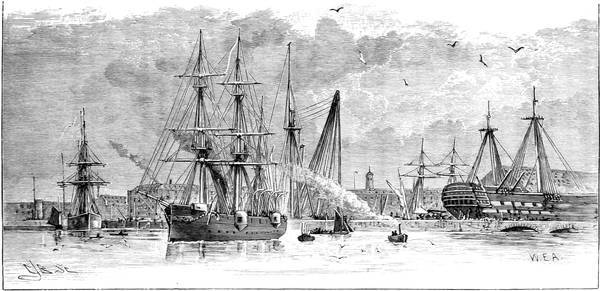
Hogarth’s Water Frolic—Billingsgate—Salesmen’s Cries—The Custom
House—Queen Elizabeth and the Customs—The Tower, and Tower
Hill—The Pool—The Docks—Ratcliff Highway—The Thames Tunnel—In
Rotherhithe—The Isle of Dogs—The Dock Labourer—Deptford and
Greenwich—Woolwich Reach and Dockyard—The Warspite.
THERE
is a mighty change in the river after it has passed Fishmonger’s
Hall. When the tide is running out it races through the arches of
London Bridge, and swirls round the buttresses, and eddies to right and
to left in such manner that the Thames waterman, having remembrance of
many disasters brought about by absence of knowledge or want of care,
amazes his passenger by his singular method of progression, rowing
round a clump of barges, getting under the hull of a steamer, shooting
across the river with the current, creeping slowly along by the
wharves, and otherwise manœuvring as if he were a general preparing
to take a town. It requires a long pull and a strong pull to shoot
the bridge against the tide, and often has it happened to the idler,
leaning over the buttresses, to behold an upturned boat floating below
him, and behind it the boatman and his passenger sustaining themselves
above water by clinging to the oars.
The Thames waterman of the present year of grace is by no means such
a picturesque person as the oarsman of former days. There is no salt
water flavour about him; he wears no indication of his calling; he
is, to all appearances, merely a landsman in a boat. It was otherwise
in jolly William Hogarth’s time. That great humorist drew, as the
tailpiece to an eccentric book, a queer little design of a grinning
Thames waterman, stout and jolly, seated on crossed oars, his legs
drawn up to his chin, a drinking-glass and an earthen pipkin dangling
from his gigantic heels. He was a creature all hat, boots, and broad
grin; whereas the waterman of to-day is rather a solemn sort of
person, very indifferently clad, who takes your shilling or your
half-crown as if you were doing him an injury.
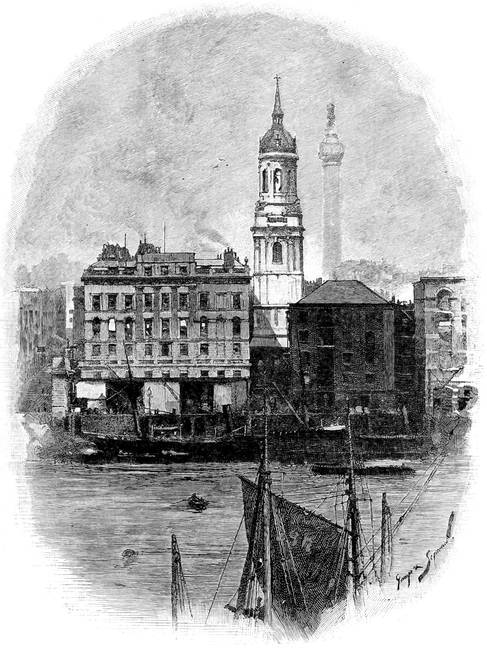
ST. MAGNUS’ CHURCH AND THE MONUMENT.
The tailpiece aforesaid adorns the last page of an entertaining
account of how Hogarth, and three friends of his, set off on a holiday
excursion to Gravesend, Rochester, and Sheerness, sailing over just
that space of water which we are about to explore. The four boon
companions set off from the Bedford Coffee House, in Covent Garden,
on the 27th of May, 1732. They spent a day in the neighbourhood of
Billingsgate, drinking, apparently, and Hogarth drew a caricature of a
long-shore humorist who was known as “the Duke of Puddledock,” which
said caricature, the rhyming chronicler of the expedition records, in
execrable verse, “was pasted on the cellar door.” Thackeray calls these
four, “a jolly party of tradesmen at high jinks,” and high jinks they
certainly had, Hogarth and one of his companions playing at hopscotch
in Rochester Town Hall. They went down the river in a “tilt boat,”
laughing and shouting and drinking, exchanging jokes with the watermen,
singing each other to sleep with jolly choruses, and behaving generally
in a manner that was highly indecorous and reprehensible. It was six
o’clock in the morning when they reached Gravesend, something like
twenty-four hours after their start. With the tide in your favour, on
the steamers which leave London Bridge twice a day, you may now make
the same bright and agreeable journey in two hours and a half.
And such a journey should every one make who wishes to realise, however
faintly, the picturesque magnificence, the prodigious commerce, the
splendid importance of the Thames. The crowded shipping of the Pool,
the steamers coming and going, the vessels lying at anchor here and
there, as if the river were a huge dock, only feebly represent the
vast tonnage which is borne on our grand and historic river every day
of every year. Behind the great piles of warehouses—towering over
the housetops, ornamenting the sky with a curious fretwork of masts
and spars and cordage—lie scores and hundreds of the vessels of all
nations, crowded into dock beyond dock, making a line of rigging, of
glittering yards and masts, of furled sails and flaunting canvas, on
either side of the Thames for mile on mile.
It is on the Tower side that the line is least broken. London Bridge
is scarcely left behind ere St. Katharine’s and London Docks come in
sight; then follow the enormous acreage of the East and West India
Docks, then come the docks at Millwall, and the Albert and Victoria
Docks, stretching onward to North Woolwich—a vast contiguity of dock
property, basin beyond basin occupied by some of the finest shipping
that roams the seas.
Earlier in the century, when the screw-steamer was as yet undreamed
of, and there had been no vision of the steam-tug which is so vast a
convenience to-day, this portion of the river presented at certain
seasons a much more stirring sight than now. Fleets of vessels, with
their sails spread, came in at every tide; hundreds of ships lay
crowding in the Thames at the mercy of the wind; it was a long panorama
of seafaring life, with no bellying smoke to impede the view. All that
has been changed by the wand of Science and the genius of Discovery.
If a vessel lies in the stream instead of in the docks, it is for
purposes peculiarly its own; and the dock gates, instead of opening to
whole fleets driven up by a prosperous wind, swing open to solitary,
but more gigantic, vessels propelled by steam.
Not that sailing-ships are no longer numerous in the Thames! The old
East Indiaman has departed, the ships of John Company are broken
to pieces; but the tall three-master is by no means an unfamiliar
object, and on the Thames waters below London Bridge one may encounter
schooners and brigs and brigantines galore. Nor has the number of
lighters and wherries and dumb-barges diminished. On most shipping
rivers these auxiliaries of trade have almost or wholly disappeared.
The uncouth keelmen of the Tyne are a race with few survivors, and
when the universally popular “Keel Row” is sung or played, it is
almost invariably without reference to its former signification. On
the Mersey no long line of coal-barges blocks the stream. The barge
and the keel have, indeed, had their day, and are now little more than
encumbrances; yet it is probable that they will be familiar objects for
years to come on the Thames. When the docks were made, the watermen
rose up in revolt against a threatened invasion of their privileges,
and were fortunate enough to secure for themselves new rights which
ensured their continuance and prosperity. So it happens that in
addition to the sailing-ships and schooners which may be seen at anchor
along either side of the Thames, there is a great number of smaller
craft, inconvenient but full of interest, greatly in the way, but very
delightful to the artist and the heedful possessor of a “quiet eye.”
No effective justice has ever yet been done to the lower portion of
the Thames. You will find it stated in most books on the subject that
the river ceases to be picturesque when it has passed St. Paul’s. A
French poet calls it “an infected sea, rolling its black waters in
sinuous detours”; and that is the despondent view that has been taken
by the majority of English writers. Yet in the eyes of those who
have roamed about this section of the river, and have loved it, only
at London Bridge does the Thames become really interesting. In the
higher reaches it is an idyllic river, swooning along through pleasant
landscapes; after St. Paul’s it takes on a new and more sombre sort of
glory, assumes a mightier interest, and is infinitely more majestic in
the lifting of its waters. Above London Bridge, even when the wind is
blowing, the waves are small and broken, like those of a mountain lake;
in the Pool the water surges and heaves in broad masses, the light
seems to deal with it more nobly, and the Thames assumes such majesty
as becomes a stream which flows through the grandest city, and bears so
great a portion of the commerce, of the world.
As for picturesqueness, one may behold a score of the finest possible
pictures from London Bridge itself. The grey tower of St. Magnus’
Church, smitten by a passing ray of sunlight, stands out bright and
shining behind the dark mass of buildings over Freshwater Wharf; beyond
it, more dimly seen, the Monument lifts its flaming crown; the Pool is
alive with hurrying steamers and clustering sails; Billingsgate is in
the midst of its traffic; the white face of the Custom House looks down
into the dun waters; and yonder rise the more sombre walls of our most
ancient fortress, the venerable quadragon of the White Tower, with its
four dark cupolas, dominating them all.
Round the spot on which Freshwater Wharf now stands clustered Roman
London. There are still some half-hidden relics of it under the recent
and handsome Coal Exchange in Thames Street. There, descending to the
foundations, one may find a hypocaust full of fair spring water, a
pavement floor, an ancient and austere seat built of Roman tiles, and
some pieces of ruined wall. It is the lower portion of a Roman house,
the most interesting and complete bit of evidence still remaining in
London of the Roman occupation of Britain.
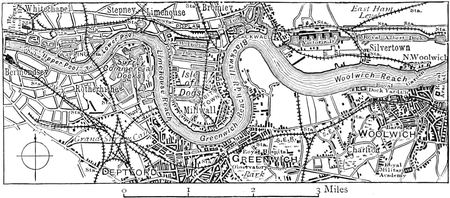
LONDON BRIDGE TO WOOLWICH.
The front of Billingsgate has altered its aspect of late. A wharf has
arisen where, heretofore, a couple of narrow gangways descended sheer
to the foreshore of the Thames, when it was exposed, and to the water,
when the tide was in. Many a Billingsgate porter has lost his life
hurrying up those gangways, yet, so conservative is the City of London
in its habits, that it is only a few years since the conclusion was
reached that the market would be no worse, and human life would be
all the safer, for a pier. With that very modern improvement one of
our London “sights” has changed its aspect. No longer may we behold
the four lines of white-jacketed figures, two bustling up from and
two hurrying down to the boats. Yet the white-jacketed figures are
there, and they bustle about as of old, though the work has become
indescribably easier, and is carried on by men in less constant peril
of their lives.
To see Billingsgate in the full tide of its work—and England has no
other sight to compare with it—one must rise with the sun in summer,
and long before the dawn in winter, when heavily-laden market-carts
from Kent are rumbling over London Bridge, whilst the homeless tramp is
still composing himself to slumber, and while still the mists cling to
the surface of the river so heavily as to seem beyond the power of any
mere London sunshine to raise or dispel.
At five in the morning, summer or winter, rain or shine, Billingsgate
seems to shake itself and start on a sudden into active and turbulent
life. In the night a series of long, low, snake-like steamers have
crept up the river, bearing freight from the fishing-smacks which are
pursuing their dangerous fortune in the North Sea. Just below where
they have dropped anchor cluster several broad-beamed, highly-polished,
Dutch schuyts, bringing oysters or eels to market, and reminding you,
by their bulk and build, of the stout, prosperous, slow-moving citizens
of Amsterdam. Little panting steam-tugs are hurrying here and there,
and amid a confused glare of lights, and a tempest of smoke and steam,
the Billingsgate porters, having waited for the five o’clock bell, rush
out in streams to schuyt and smack and steamer, pushing, shouting,
swearing, surging to and fro in the mist and steam and glare, working
with the energy of gnomes doomed to perform an allotted task ere the
first beams of morning surprise them at their toil.
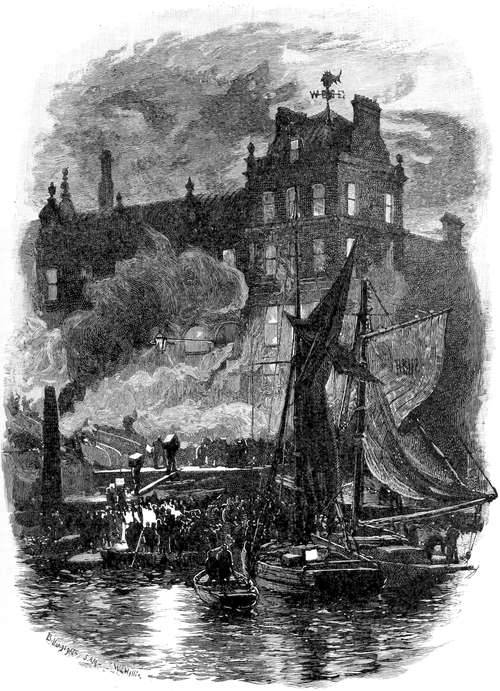
BILLINGSGATE—EARLY MORNING.
Thames Street, and Fish Street Hill, and Pudding Lane, and many a
street and alley roundabout, are crowded, packed, jammed, with vans and
carts and trollies. The stranger wanders bewildered and afraid among
all these, in danger of being knocked down by laden porters, run over
by market-carts, hustled out of all self-possession by feverish buyers,
or lost amongst such a wild and interminable confusion of vehicles as
no other place in the world can show.
For all that is known to the contrary, Billingsgate has been a
fish-market from the time when the ancient British inhabitants of the
proud hill on which the City of London stands put off in their coracles
to seek the means of livelihood in the broad waters which dock and
warehouse and wharf now confine in the comparatively narrow channel of
the Thames. There was a toll on fishing at Billingsgate when the Saxon
Æthelstan reigned. William III. made the market open and free for all
sorts of fish in 1699. Since that day many attempts have been made to
establish fish-markets elsewhere in London, but up to this time with
uniform non-success. It is not yet quite a score of years since the
present Billingsgate Market was completed. You may still read, in even
recent books, of “the elegant Italian structure” of Mr. Bunning, with
its towering campanile, its fine arcades, and its picturesque blending
of brick and stone. Mr. Bunning’s market, however, was too small for
its purposes; and in 1874 the present building was begun, and, in spite
of vast difficulties, was finished without disturbance of the business
of the day. It preserves much of the old “elegance” of structure, and
is partly Italian in style, but the smoke of the steamers clings to
it, and has blackened it so that, between the grey buildings above
Freshwater Wharf and the shining walls of the Custom House, it looks
like a patch of shadow in a field of light.
Fish was once indifferently delivered at Billingsgate or at Queenhithe,
on the other side of London Bridge. Henry III., at a loss how to
furnish pin-money for his wife, gave to her a tax on the fish landed
at Queenhithe Pier. It was a tax, too, which the fishmongers were very
reluctant to pay, and many were the fines inflicted on shipmasters
who tarried at Billingsgate instead of making their way to the royal
quay. Billingsgate fought that hard battle against royalty with great
resolution, and ultimately won. Since then it has become obstructive
on its own account, and has, in turn, successfully resisted any
invasion of its own exceptional privileges. The dealers at Billingsgate
must in those early days have been as rich, and quite as exclusive
and privileged, as are their successors of this latter part of the
nineteenth century, for it is recorded how, when the news was brought
to London of the victory which Edward I. had obtained over the Scots,
they paraded the city with over a thousand horsemen, accompanied by
the sound of trumpets, and the streaming of banners, and all the fine
pageantry of a picturesque time.
The daily supply of fish to Billingsgate amounts, on an average, to 500
tons. It is difficult to realise how prodigious a quantity is this;
but the imagination is assisted by reflecting that one ton of fish is
equal in weight to twenty-eight sheep, so that the day’s supply of 500
tons is equivalent to a woolly herd of not less than 14,000. London in
this manner draws to itself the great bulk of the fish that are caught
around our coasts; but, it must be understood, Billingsgate does not
exist for the advantage of metropolitan consumers alone. Most of the
large provincial towns draw upon the great fish-market of the Thames,
and almost as soon as the day’s supply is landed and sold much of it is
speeding off in fast trains to the great centres of industry, where it
is again distributed, it may be, to less important communities, and to
small hamlets nestling amid ancestral trees.
At Billingsgate you may make your purchases by the ton or the single
fish. There are fish-salesmen of varying degrees, some selling, in
large quantities, the fish as it is landed from the boats, others
selling over again to shopkeepers and to costermongers what they have
only themselves purchased some half-an-hour before. The more respected
and prosperous dealers, coming early, with long purses, have the pick
of the market, and are speeding off home again before the bell of
St. Paul’s has tolled the hour of nine. Then the costermongers come
crowding in, shouting, pushing, swearing, exchanging jokes, impugning
the freshness of the fish, boiling into anger at the prices asked from
them, and filling the market-hall with an amazing clatter of Cockney
tongues.
The attendance of the London coster is regulated by the supply of
fish. Sometimes only a few scores of these itinerant dealers are to
be encountered in Old Thames Street; sometimes they are present by
hundreds and thousands. It has never yet been discovered how the
intelligence of a profuse and cheap fish supply is diffused over
London; but it invariably occurs that when the market is overstocked
every costermonger in town has knowledge of the fact long before noon.
It is much as if the street-dealers were connected with Billingsgate
by electric wires. “Barrows” come racing by dozens over London Bridge;
Covent Garden Market is suddenly deserted by the most numerous class
of its customers; from Shadwell, from Kentish Town, from more remote
Hammersmith, the costermonger rushes off to Billingsgate as if for bare
life, and by mid-day cheap fish is being cried all through the London
streets and far off at the doors of “Villadom” in the suburbs.
The late Henry Mayhew has striven to give an idea of the confused
cries of Billingsgate in his wonderful and painstaking work on “London
Labour and the London Poor,” where the sounds heard above the general
din are represented thus:—“Ha—a—ansome cod! best in the market! All
alive! alive! alive, O!” “Yeo, ye—e—o! Here’s your fine Yarmouth
bloaters! Who’s the buyer?” “Here you are, guv’ner; splendid whiting.”
“Turbot, turbot! All alive, turbot!” “Glass of nice peppermint this
cold morning, a ha’penny a glass, a ha’penny a glass!” “Fine soles, oy,
oy, oy!” “Hullo, hullo, here! beautiful lobsters, good and cheap!” “Hot
soup, nice pea-soup! a—all hot, hot!” “Who’ll buy brill, O, brill, O?”
“Fine flounders, a shilling a lot! O ho! O ho! this way—this way—this
way! Fish alive! alive! alive O!” And in such fashion is business
carried on at Billingsgate every morning, amid a turbulence not to be
described.
It is a prosaic, evil-smelling business, this of fish dealing, relieved
by no such spectacles as were to be witnessed in the time of Stowe,
when, “on St. Magnus’ Day the fishmongers, with solemn procession,
paraded through the streets, having, among other pageants and shows,
four sturgeons, gilt, carried on four horses; and after, six-and-forty
knights armed, riding on horses, made ‘like luces of the sea;’ and then
St. Magnus, the patron saint of the day, with a thousand horsemen.” The
salesmen reserve their solemn rites in these days for the dinners in
Fishmongers’ Hall, and the only “Knights” they can boast of are those
ludicrous “men in armour” who make a part of the Lord Mayor’s Show.
Close by Billingsgate lies the long frontage of the Custom House,
conspicuous no less by reason of its bulk and position than for that
leprous whiteness which, on certain kinds of stone, is one of the
effects of the biting and crumbling atmosphere of London. The site is
one that should be dear to lovers of English poetry. Here Geoffrey
Chaucer officiated as Controller of Customs, the stipulation being that
he should write the rolls of his office with his own hand, and perform
his duties personally, and not by deputy. It may be that whilst his pen
was thus unpoetically employed, his mind wandered off to the “Tabard”
Inn, by the end of London Bridge, to its jolly landlord, “bold of his
speech, and wise and well-i-taught,” and to the curiously compounded
bands of pilgrims who gathered there on their way to the shrine of St.
Thomas at Canterbury. Here, also, came William Cowper, in one of his
fits of insanity, intent on suicide. The water was low, exposing the
foreshore, and there was a careless porter sitting on a bale of goods.
It seemed to the poor stricken poet as if the man were waiting there to
prevent the execution of his purpose, “and so,” he says, “this passage
to the bottomless pit being mercifully closed against me, I returned to
the coach,” which was really the only sensible thing he could do.
The present Custom House, built in 1825, contains one of the longest
and the most dingy-looking rooms in England. Here may be encountered
strings of British merchants and rough ship-captains waiting to
transact business relating to their cargoes. At one counter is kept a
record of vessels and their owners, at another the clearance of ships
outward is the subject of concern; at a third the skipper must hand in
a list of every article on board his vessel, and thence proceed from
counter to counter until he has satisfied all the requirements of the
law. In one corner of the building there is a Custom House Museum,
containing many quaint official documents, detailing how John Doe,
being a Papist, did not receive his quarter’s salary, and how some
other servant of the Customs has been docked of his wages because of
the indiscretion of somebody else’s wife; containing, also, curious
articles which have been employed in small acts of smuggling—a
stewardess’s crinoline that has been puffed out with a bottle of right
good Hollands, a book which has been made to do duty as a brandy-flask,
quantities of snuff that have been shipped as oilcake, and many other
curious examples of unexpected failure to evade the law. Those whose
business it is to detect cheats of this description love to retain
some memorial of their prowess, and in this manner it happens that the
Custom House Museum is valuable chiefly to those who care to study
human ingenuity in connection with dishonest purposes.
There is in existence a curious record concerning the Custom House and
Queen Bess. “About this time (1590),” writes the quaint author of “The
Historie of the Life and Reigne of that famous Princesse Elizabeth,”
“the commodity of the Custom House amounted to an unexpected value;
for the Queen, being made acquainted by the means of a subtle fellow,
named Caermardine, with the mystery of their gaines, so enhanced the
rate that Sir Thomas Smith, master of the Custom House, who heretofore
farmed it of the Queen for £14,000 yearly, was now mounted to £42,000,
and afterwards to £50,000, which, notwithstanding, was valued but as
an ordinary sum for such oppressing gaine. The Lord Treasurer, the
Earls of Leicester and Walsingham, much opposed themselves against this
Caermardine ... but the Queen answered them that all princes ought to
be, if not as favourable, yet as just, to the lowest as to the highest,
desiring that they who falsely accused her Privy Council of sloth or
indiscretion should be severely punished; but they who justly accused
them should be heard. That she was Queen as well to the poorest as to
the proudest, and that therefore she would never be deaf to their just
complaints. Likewise that she would not suffer that these toll-takers,
like horse-leeches, should glut themselves with the riches of the
realm, and starve her Exchequer; which, as she will not bear it to be
docked, so hateth she to enrich it with the poverty of her people.”
From which lion-like speech it appears that Queen Elizabeth more than
suspected her Privy Councillors of having intercepted moneys which
should have found their way to the Exchequer of the Crown.
After the Billingsgate fever is over, everything round about the Custom
House seems quiet and sleepy and still; yet an almost inconceivable
amount of business is transacted within its walls. Every merchant
receiving a cargo, every shipmaster going out or coming in, has
unavoidable business here. There is a series of counters, distinguished
by the various letters of the alphabet, and from one to another the
visitors to the Custom House continue to circulate, engaging in one
sort of transaction at one counter, and in some other sort at a
second, and third, and fourth. It is a long and wearisome process,
the discharge of the various duties appertaining to the entry and the
clearing out of ships—a process which, be it said, seems much less
trying to the clerks than to those on whom they are called upon to
attend.
In front of the Custom House there is a broad quay, used as a public
promenade, a true haven of rest to him who has lost heart and energy
in the almost vain attempt to escape from the crowd and the bustle of
Thames Street. At this spot, on New Year’s Morning, the Jews of London
were wont to assemble to offer up prayers in remembrance of that sad
captivity when their people sat down by the waters of Babylon and wept.
The custom has been discouraged of late years, but there are still
some professors of the ancient faith who follow the rule of their
forefathers, and offer up the time-worn prayers on the spot which was
consecrated by them in “the days that are no more.”
It is difficult to break away from that portion of the river on which
we seem already to have lingered too long. The Thames is here full
of interest and of crowding associations. Over the water, behind the
great, grim warehouses, slopes downward into Bermondsey that Tooley
Street which the three tailors—“we, the people of England”—have made
famous throughout the world. From amid grimy roofs and grey-brown walls
rises the tower of St. Olave’s Church, half-buried and lost amid a
London of which its builders never dreamed. Down here, in narrow street
and dim entry, the bewildered stranger begins to feel that, after all,
man is too small for the planet on which he lives. Great walls—of
granary, and store, and manufactory—reach over and above him, and
dwarf him into extreme littleness. He seems to be walking beneath high
cliffs by the sea. The whole air trembles and throbs with noise and
travail. Here and there, through some unexpected narrow opening, may
be discerned a thin strip of river, with ships and boats. At intervals
of every two or three hundred yards these openings occur, and they
lead down to old-fashioned Thames stairs, where the waterman plies his
trade. Lingering about the landing-places, or the streets and alleys
adjacent thereto, one meets occasional blear-eyed, evil-countenanced,
ill-clad men, who approach with a sinuous stoop of the shoulders, a
deferential ducking of the head, and a dirty thumb raised to the brim
of a greasy hat. These men will do anything for money except work. If
you employ one of them to conduct you to the stairs and to call a boat
he will pretend to hurry forward, but, without progressing much, will
look furtively behind, seem to measure your size and estimate your
running powers, and then proceed slowly in front, his evil-looking
thumb continually beckoning, and his croaking voice ejaculating, “This
way, sir; this way; this way, if you please.” He means no mischief
probably, but as you walk through these parts of London in such company
you are thankful it is daylight, and that even the alleys and courts of
the Surrey side are not absolutely impervious to the sun.
Some of these strange places have equally strange names. Pickle
Herring Street, and Shad Street, and other cramped thoroughfares with
ancient and fish-like designations, suggest that here, also, almost
directly opposite to Billingsgate, there must have been a market once.
There is scarcely even a shop or a public-house now. This is the
London that really works with a will. To the right are tanneries and
tallow-chandleries—their odour loads the atmosphere as if it were
a thick fog, incapable of any effort to rise—to the left are vast
granaries and wharves; and between them the narrow spaces are filled up
with hurrying vehicles and toiling men.
From the south to the north side of the river there is a continual
stream of labourers, some making their way under the river, like moles,
by means of the subway, some streaming down to the boat-landings and
casting off in batches into the tide. The subway is an iron barrel,
some six feet in diameter, which has been driven underground far below
the bed of the Thames. Walking through it, one hears, as a series
of dull, only half-audible, thuds, the lashing of a paddle-steamer
overhead. No other sound reaches that cramped, underground chamber, in
which one seems to be walking as in a coal mine, from the dark into the
dark. After this dreary journey, we ascend a flight of stairs that is
wearying, and that seems to be endless, and emerge on Tower Hill, into
the sunshine, and the presence of green trees, and the sight of what is
most venerable in the whole English realm.
Tower Hill is a sort of oasis in a desert filled with the whirling
sands of traffic—the terminus to the great lines of warehouses
which fill Thames Street. Surrounded by shops and offices and public
buildings, it is, but for the country cousin newly arrived to behold
“the sights,” almost as quiet as some retired corner of the parks.
Standing here, where so many historic heads have fallen, one may behold
the river streaming by, and watch the sun lighting up the polished
masts of a hundred vessels slumbering in the Pool.
On Tower Hill stands Trinity House, which claims notice here because
of its close connection with the river and with ships. Queen Elizabeth
made the Masters of Trinity the guardians of our sea-marks, and they
have now the sole management of our lighthouses and our buoys. Part of
their business is to mark out the locality of wrecks, and to announce
to the shipmasters of all nations any changes in the entrances to
English ports. At Trinity House is one of those numerous London
museums which are seldom seen—a museum of models of lifeboats, buoys,
lighthouses, life-saving apparatus, and other objects connected with
the safety of ships and voyagers at sea. Here the curious visitor may
spend an hour or two with advantage, and it will be matter for wonder
if he does not come away oddly instructed in many intricate matters
connected with the sea.
To all fairly informed Englishmen, the history of the Tower of London
is so familiar that it would be an impertinence to recount any portion
of it here. The “towers of Julius, London’s lasting shame”—not that
Cæsar really had anything to do with them—have the peculiarity of
being known, through some sort of representation, to most, even, of
those stay-at-home people who are said to have country wits. And let
it be said at once that at the first glance they are not nearly so
imposing as they are usually made to appear. “And that is the Tower?”
an American observed to me lately; “and that is the Tower? Well, then,
I guess the Tower was not worth crossing the Atlantic to see.” Yet,
even this unfavourable critic saw reason to change his views. It is
from the river, and not from Tower Hill, that the first inspection
of this venerable edifice should be made. Seated on an idle barge,
one may contemplate it at leisure; and it is only after leisurely
contemplation that its fine grouping, its richly varied colour, and its
compact massiveness force themselves on one’s slow appreciation. From
just behind where we are supposed to be seated, the adherents of the
Earl of Salisbury poured stone shot into the Tower precincts when Henry
VI. was king. Facing us, the lower portion now hidden by a quay wall,
is the round arch of Traitors’ Gate—
“Through which before
Went Essex, Raleigh, Sidney, Cranmer, More.”
with those steps still intact on which the Princess Elizabeth seated
herself, petulantly declining to make such an entrance to the Tower as
would declare her to be a traitor to the realm.
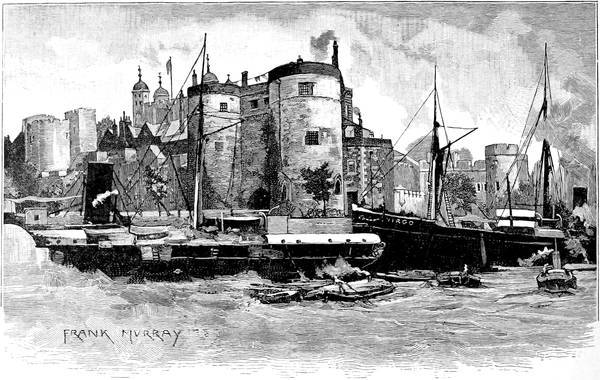
THE TOWER, FROM THE RIVER.
Up to quite recently, to the time of Mr. Shaw-Lefevre’s occupancy of
the office of Board of Works, indeed, the Tower, as seen from the
river, was much disfigured by modern buildings of exceeding ugliness,
which public feeling had long since condemned. Most of these have
now disappeared, but one such building, bearing the appearance of a
granary, still remains to break the face of the White Tower with its
dull red-brown. Beyond it one catches glimpses of quaint gabled roofs,
characteristic of periods as widely separated as those of Elizabeth and
Queen Anne. To the left are more buildings of old red-brick, with ivy
clustering over them, and beyond, home of many sad memorials, rise the
walls of the Beauchamp Tower, with, beside them, a curious lumber of
quaint, many-windowed, square turrets, jumbled together in different
ages for diverse purposes, and now used as lodgings for the Beefeaters
and the guard.
In the church of St. Peter ad Vincula, the situation of which one
may guess from the river, were interred the headless bodies of Queen
Catherine Howard, of Anne Boleyn, of the Countess of Shrewsbury, and
of Lady Jane Grey; of Sir Thomas More, of the first Cromwell, of
Seymour, Lord High Admiral, of his brother, the Protector Somerset,
and of many others whose illustrious positions were the occasions of
their own misfortunes. “There is no sadder spot on earth than this
little cemetery,” says Macaulay. “Death is there associated, not, as in
Westminster Abbey and St. Paul’s, with genius and virtue, with public
veneration, and with imperishable renown; not, as in our humblest
churches and churchyards, with everything that is most endearing in
social and domestic charities, but with whatever is darkest in human
nature and in human destiny; with the savage triumph of implacable
enemies, with the inconstancy, the ingratitude, the cowardice of
friends, with all the miseries of fallen greatness and of blighted
fame.” The most ancient and illustrious building that is mirrored in
the waters of the Thames is, indeed, also the home of the grimmest
memories. The Tower is a sad, depressing place to visit, the concrete
representative of all the darker events of our history.
The character of the Thames below London Bridge is best expressed by
the normal appearance of the Pool. And let me at once explain that the
Pool is the wide, curving stretch of river which extends from just
above the Tower to the neighbourhood of “Wapping Old Stairs.” Here, in
most abundance, you find “toil, glitter, grime, and wealth on a flowing
tide.” Mr. W. L. Wyllie’s picture, purchased out of the funds of the
Chantrey bequest, is a wonderfully characteristic description of the
aspect which the Thames presents in this busy portion of its course.
In the foreground a couple of coal-laden boats, with a little hasty
steam-tug beside them, are making slow headway against the tide; beyond
these, a great iron steamship rears up its vast bulk; a couple of
heavily-laden Thames barges are flying along under full sail; on either
side of the river there are confused masses of rigging, with here and
there the hull of a ship, half visible through whirling clouds of smoke
and steam. On the waterway, kept clear of all vessels at anchor for a
breadth of 200 feet, the strong white sunlight gleams, making clear to
the spectator what the poet Spenser had in his mind when, in his rich
vocabulary, he spoke of “the silver-streaming Thames.”
Spenser’s phrase is one which has been greatly misunderstood. The
Thames, even in its quietest and least corrupted days, can never have
been a very pellucid stream. When Taylor, the water poet, plied his
craft upon it he must have found almost as much difficulty in looking
into its mysterious depths as we find to-day. Certainly, to the local
colour of a swift-flowing river which brings down continuous deposits
of mud from far-off meadow-lands, such a word as “silvery” could never
properly be applied. Only when the sunlight struck the river, and its
rippled surface tremblingly gleamed back to the sky with a reflection
of its own brightness, could Spenser have been delighted by the aspect
of the “silver-streaming” waters, ebbing and flowing through London’s
heart, and bearing onward their heavy burden to the sea. Leaning over
the rail of a steamer outward bound, one is apt to forget everything
else in the contemplation of these brilliant and rapidly changing
effects of light, which seem to chase one another as if in mere
wantonness, and which, in no mood of wantonness, at every capricious
curve of the stream cast on the thick dusky waters some new and strange
glory.
The Pool is full of such life and movement as is to be encountered
on no other English river, for here the crowded ships do not merely
lie at anchor, waiting on wind and tide; they are busy loading and
unloading freights. One hears the grating of cranes and the shouts of
men; the peculiar “dumb-barges” of the Thames cluster round the hulls
of screw-colliers from Newcastle, and receive from them their separate
loads of coal; and excitable little steamers are running in and out as
if they had lost their way among the crowded shipping. In mid-stream
the traffic is almost as busy and confusing as that of a London street.
Vessels are coming up with the tide; barges are slowly floating onward,
their brown sails spread, tacking to the wind, their decks washed now
and again by some arrowy wave from a paddle-steamer. There is, as Mr.
Jefferies says, “a hum, a haste, almost a whirl,” for on the river work
proceeds at a more rapid pace than in the docks, and the Thames, it
must be remembered, is the busiest port on the surface of the globe.
It is hard to say whether the Pool is most beautiful and striking at
moonlight or in the dawn. Turner loved it best at the hour before
twilight, when the sky was robed in gold and crimson and purple, and
the Thames was ablaze with the light of the setting sun. At such
seasons it is indeed very glorious; yet to me it has always seemed most
beautiful in the morning, when the light is slowly diffusing itself
from behind a bank of purple cloud, and the face of the White Tower is
touched into pale gold, and there is a glittering radiance on turret
and roof, and the craft anchored in the stream are reflected to every
mast and spar and half-furled sail, and the river trembles in the new
radiance as if it were divided between delight and fear. Everything
is very still and soft and shadowy. It is such a scene as seems
appropriate to happy dreams. In another hour or two the river will be
awake, the twitter of birds flitting across the waters will be drowned
in the shouting of labourers and the shrieking of cranes; the stream,
its brief glory departed, will be churned up by paddle-wheel and screw;
the swarthy steam-colliers will come, hard and clear, out of the soft
haze, and the Thames will become a workaday river again, wonderful
still, but, after such a vision, too grimly prosaic and real. Yet it is
well to have seen it once with the dawn upon it, if only to learn how
those have libelled it who deny that it is “picturesque.”
In the seventeenth century there was, in the Upper, Lower, and Middle
Pools, space for 900 vessels. Nearly that number might now be packed
into the London and St. Katharine’s Docks, which lie just below the
Tower, hemmed in by what was once fashionable London, now fashionable
no more, but famous the world over as the accustomed haunt of the
seaman on shore. Before docks were constructed along Thames-side,
vessels were unloaded into barges and wherries, and river-robbery was a
thriving trade. Numbers of men lived, and grew rich, on what they had
contrived to steal from cargoes that were waiting to be discharged at
the wharves about London Bridge. Ships were sometimes as much as six
weeks in unloading, and a whole host of lightermen, carmen, porters,
and nondescripts thrived on the unconscionable delay. There were good
pickings in those times, and it is wonderful, when we consider with
how much rascality and obstruction our commerce had to contend, that
England ever became a great nation of carriers and traders.
The docks nearest to London Bridge cover the site of a church, a
hospital, and a graveyard.
More than 700 years ago, or, to be precise, in 1148, Matilda, the wife
of King Stephen, founded on a site just below the Tower a hospital
which was dedicated to St. Katharine. It endured, in one form or
another, to 1827, when the building was pulled down, and the hospital
was removed to Regent’s Park. In that same year was commenced the
construction of the St. Katharine’s Docks, which, by the employment of
2,500 workmen, were completed in the brief space of eighteen months.
They cover an area of twenty-three acres, ten of water and thirteen of
land. The docks are the most prosaic of all those which are to be found
along Thames shore. To the river they present a dull heavy frontage,
which suggests no connection with ships; on the land side they are shut
off from observation by a prodigiously high wall. Entering through
the gates you find three great basins, with ships lying close to the
wharves, and you have towering above you gigantic warehouses, dull and
dismal, but capable, you would suppose, of finding storage room for
half the commerce of a city. The cellars of St. Katharine’s Dock are
complex and amazing, but the docks themselves are going out of vogue,
for many of the ships which used to frequent them are now intercepted
before the lights of London come in sight, the Victoria and Albert
Docks, much lower down the river, absorbing a great proportion of the
traffic which was wont to make its way into the Pool.
The London Docks, much larger than those of St. Katharine, are
beginning to share in the same neglect. They are of more ancient date
than their neighbours, having been designed by Rennie, the architect
of London Bridge, in 1805. As many as three hundred vessels can find
a comfortable haven here. The warehouses will contain 220,000 tons of
goods; there is storage for 130,000 bales of wool; the wine-cellars
are among the marvels and attractions of London. “Here,” Mr. Sala has
remarked, “in a vast succession of vaults, roofed with cobwebs many
years old, are stored in pipes and hogsheads the wines that thirsty
London—thirsty England, Ireland, and Scotland—must needs drink.”
Curious persons come here with tasting orders, and are shown round
by brawny coopers, who seem marvellously wasteful of good wine, and
are more generous to their visitors than the most prosperous of City
merchants, with the best plenished of wine-cellars, is to his friends.
Many a visitor to the wine-cellars of the London Docks has found
occasion to regret, when he has reached the open air, that he has been
so easily tempted to pass too frequent opinions on too many varieties
of wine. In the cellars an amateur wine-taster is apt to overrate the
strength of his head; above ground once more, the breath of the river
brings him to a sense of his own incapacity for frequent and varied
potations, and he shamefacedly betakes himself to a cab, to escape as
quickly as may be from the scenes of his bibulous indiscretion.
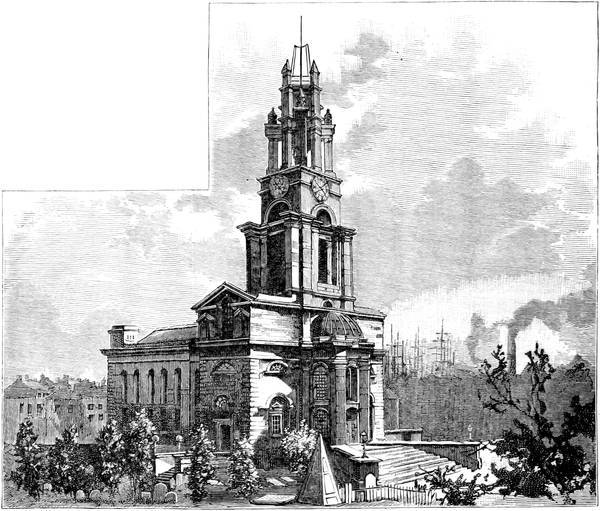
LIMEHOUSE CHURCH.
On the dockside one encounters men of all nationalities—the swart
Lascar, the dusky Suliote, the quiet pigtailed Chinaman, the grizzled
negro; Germans, Swedes, stout little Dutchmen; Americans, Fins,
Malays, Greeks, and Russians. Nowadays an English ship is a polyglot
institution. In the Sailors’ Home, near to the gates of St. Katharine’s
Docks, one may hear men conversing in all the European languages; in
the Asiatic Home, close to the India Docks, there is such a confusion
of tongues as dismayed the builders of Babel. Entering and departing,
the owners of all these voices, and the thousands of dock labourers,
lightermen, loafers, visitors, must pass the inspection of the police,
who stand at the dock gates always on the watch, and who do not scruple
to submit to close examination the garments of all those whose pockets
may happen to bulge unduly, or who, having entered in the morning with
a perfectly erect spine, stoop inexplainably at the shoulders when they
have completed their business at night. In the docks there is a perfect
system of espionage, and “the Queen’s Tobacco Pipe,” until recently
located at the London, and now at the Victoria Docks, has smoked many
thousands of little presents of tobacco that large-hearted sailors had
intended for the gratification of their friends.
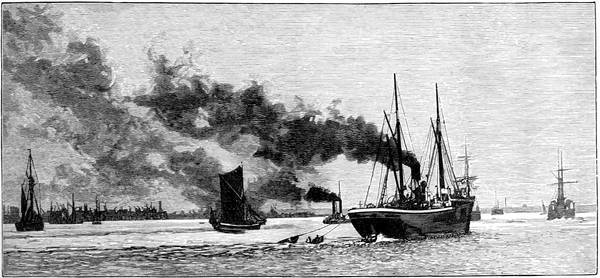
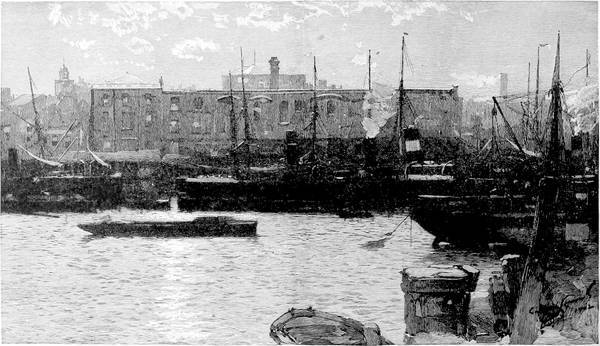
THE RIVER BELOW WAPPING.
The long, narrow, grimy, and dissolute lane known to Englishmen
everywhere as Ratcliff Highway, and now disguised under the name of
St. George’s Street East, begins its career near the gates of St.
Katharine’s Docks, and winds along like a great slimy snake towards
Limehouse and Blackwall. It is unvisited of all those who have not
business to transact with men who go down to the sea in ships; for this
is peculiarly the sailors’ quarter of London. Jack is to be encountered
at every step, not infrequently reeling somewhat, and with a lady of
loose manners on his arm. The shop-fronts are hidden behind strange
collections of oil-skins, sea-boots, mattresses, blankets, and the
miscellaneous assortment of articles specially provided for emigrants
and sailors. The public-houses, of which there are many, resound with
the noise of mechanical organs and string bands. The language one hears
is of a strictly nautical description; and every third house or so is a
lodging-house for sailors.
Of late years Ratcliff Highway has improved in character somewhat,
and many of the men who were wont to be fleeced and robbed in it have
been rescued from the crimps and sharpers by the Sailors’ Home; but
it has still much of its old disrepute left, and discreet persons do
not perambulate it after nightfall without the escort of the police.
Here the seafaring men of various nationalities separate themselves
into groups, and form little colonies of their own. The public-house
is their forum, to whatever nation they may belong. In one of these,
English is spoken, in another German, in a third Norwegian, in a fourth
Greek. Even the negroes have a special house of call of their own.
As for the Chinamen, they prefer to smoke opium in quietness, and so
they divide themselves between various Chinese lodging-houses, where
they can eat, in the properly orthodox manner, with chopsticks, and
assemble round a table at night to gamble with their friends. It is a
strange, stirring, disordered place, Ratcliff Highway. Its population
is changing with the arrival or departure of every ship, yet its aspect
and its frequenters always seem to be the same, similar in manners,
bent on the same amusements, afflicted by the same vices, reeling into
or out of the same doors. There is nothing here except an occasional
piece of nautical slang to suggest the jolly British tar. To a great
extent, indeed, the tar has ceased to be either jolly or British. The
majority of the sailors to be met with in Ratcliff Highway are visibly
and distinctly foreign. There are no white “ducks,” or raking straw
hats; nobody publicly “shivers his timbers,” or speaks in that mixed
and technical language which helps to make the characters of Captain
Marryat so delightful. Only on the stage is it nowadays possible to
encounter the sailor of tradition. The seaman who frequents Ratcliff
Highway outwardly resembles the stoker of a railway train, attired in
his second best suit. There is nothing romantic about him, nothing
picturesque; and if the river and the docks were not so near, and
the shops were not so nautical-looking, and one’s ears were not
occasionally saluted with “How goes it, Captain?” and “Hallo, mate!”
there would be nothing to suggest his connection with the sea.
All this was very different in Ned Ward’s time, when that lively writer
was collecting materials for his London Spy; very different, indeed,
when men who are only now middle-aged were in the bloom of their youth.
“Sometimes we met in the streets with a boat’s-crew,” says Ward, “just
come on shore in search of those land debaucheries which the sea denies
them; looking like such wild, staring, gamesome, uncouth animals, that
a litter of squab rhinoceroses, dressed up in human apparel, could not
have made a more ungainly appearance.... Every post they came to was
in danger of having its head broken.... The very dogs in the street
shunned them.... I could not forbear reflecting on the ‘prudence’ of
those persons who send their unlucky children away to sea to tame and
reform them.” And well he might wonder at that same prudence now, if he
saw how miserable and forlorn the British tar can look when his money
is spent, and how little his appearance is suggestive of those high
spirits which a life on the ocean wave is supposed to engender.
From Wapping, to which Ratcliff Highway will bring us, you may pass,
through the famous Thames Tunnel, under the river to Rotherhithe. Not,
however, as formerly, when the tunnel was reached by sets of circular
stairs, and toyshop keepers drove a meagre business under a dripping
and gigantic arch. At that period, the tunnel contained a central
arcade lighted by gas; nowadays, it is so dark that no man can discern
when he enters and when he leaves; for it has been absorbed into the
great railway system, and instead of traversing it on foot one is
whirled through it in a train, so that the traveller might be carried
underneath the Thames, at a depth of more than seventy feet below the
surface, without knowing that he had been on anything else but an
ordinary underground railway. The Tunnel cost nearly half a million of
money to construct, and twenty years elapsed—from 1823 to 1843—from
the time when it was designed by Brunel and the day when it was opened
to the public. As a place of resort for sight-seers it proved a
gigantic failure; as a railway tunnel, it is a means of communication
between the two most populous and busy districts of London.
Not that there are many signs of business to be encountered when one
leaves the tunnel by means of the railway station at Rotherhithe. At
the first glance the district round about seems quiet and sleepy and
secluded. Mr. Walter Besant came upon it unexpectedly and with great
joy, for here he found a world altogether in contrast with that which
he had left a little higher up the Thames—houses of quiet old sailors,
little churches and chapels, rows of small dwellings with flowers
blooming on the window-sills, timber-yards and lagoons and canals, and
a general air of retirement and repose. It is a narrow strip of shore,
Rotherhithe. On one side it is washed by the Thames; on the other, it
is hemmed in by the Surrey Commercial Docks. Sailor life in its better
aspects is to be encountered here, for the neighbourhood has been
haunted by seamen from Saxon times downwards, and the influence of
the quaint older world has not yet passed away. It was through being
a “sailor’s haven,” say the antiquaries, that Rotherhithe came by its
name. Here Canute cut deep trenches, which, according to one of the
friends of Samuel Pepys, who saw the remains of them in the course of
a walk from Rotherhithe to Lambeth, were intended to divert the course
of the Thames. At Rotherhithe Edward III. fitted out one of his fleets,
and close upon its borders, in Bermondsey, lived some of our early
kings.
The signs of the Rotherhithe inns—the “Swallow Galley,” and the “Ship
Argo”—seem to carry us back to “the stately times of great Elizabeth;”
and though the place itself must have altered greatly since then, the
manner of life of some of its inhabitants is much like that of their
predecessors must have been when stout, high-decked ships sailed by on
their way to the Spanish main, and Rotherhithe sent out its contingent
of vessels and men to fight against the Invincible Armada.
All but completely cut off from the rest of the world for many
generations, Rotherhithe has naturally made the river its highway, and
so, leading off from its quiet, old-world streets, there are everywhere
passages which end in boat-landings and stairs. The names of many of
these latter recall memories of a bygone time. There are King and Queen
Stairs, Globe Stairs, Shepherd and Dog Stairs, Redriff Stairs—Redriff
being the name under which, at one time, Rotherhithe was known—and
others that must have received their designations when most of the
land beyond Rotherhithe was marsh and wilderness. When the tide is
out the stairs are left high and dry, and the river becomes a narrow
channel between muddy flats, on which barges lie grounded, and the ribs
of old wrecks are to be seen, and a steamer heels carelessly over, one
side of its keel washed by the lapping tide.
On the opposite side of the river lies Wapping; the unique spire of
Limehouse Church is visible, rising high above masts, and roofs, and
chimneys, a landmark for miles; Stepney stands proudly dominant on
its elevated banks; and Ratcliff, half enveloped in thick atmosphere,
proclaims itself by the gleaming sunlight on its multitudinous roofs.
Of Wapping one cannot think without recalling one of the tenderest of
English popular songs:—
“Your Molly has never been false, she declares,
Since the last time we parted at Wapping Old Stairs;
When I swore that I still would continue the same,
And gave you the ’bacca-box, marked with my name.”
Wapping Old Stairs are still discernible from the river, but are
grievously difficult of identification, for, as at most other places
along these shores, great warehouses have taken the place of most of
the quaint-timbered old houses of former days. Yet at Wapping something
of the old appearance of things is visible still. Leaning forward on
to the shore, supported on mossy piles, green as the herbage of spring
or brown as the weeds of the sea, are groups of strange old houses,
with bay-windows, and overleaning balconies, and wooden walls, “clouted
over” with planks until they look like a suit of mended clothes.
The seafaring man’s love of vivid colour is everywhere visible. The
half-ruinous, time-worn buildings are painted after the manner of a
Dutch barge—green contending with red, and raw yellow striving to hold
its own against the imperial blue. In some of those curious accidental
lights which are so frequent on the Thames, the low bank of Wapping
assumes a peculiar glory of its own, heightened by the brown sails of
barges sweeping past, and as full of colour as any picture which even
Turner ventured to paint.
But from Wapping we must return once more to Rotherhithe, and to the
Surrey Docks. They are ensconced in a graceful bend of the river, ere
it curves back again round the far-projecting Isle of Dogs. There are,
it is said, no older public docks in Great Britain, the Act by which
the docks on the Surrey side were created bearing the date of 1696.
Even before that period, indeed, there had been docks in the same
situation “of considerable importance and benefit to the shipping.”
But docks which seemed large and important in the time of Queen Anne
would be ridiculously small and inefficient with our present trade.
The Howland Dock occupied ten acres when it was made; the Surrey
Commercial Docks cover 330 acres now. They derive an historic and
romantic interest from the fact that here the prize ships were brought
to be delivered of their cargoes, when the jolly Jack Tar got his
share of the prize-money, and, leave being granted, incontinently
went off to squander it among his friends. There is a story of one
such British sailor who entered the Bank of England with a warrant for
twenty pounds, and exclaimed to the amused and amazed clerk:—“That
will bother you, I reckon, mate; but never mind, if you haven’t got the
whole of the money in hand I’ll take half of it now, and call for the
rest another time, when it suits you.”
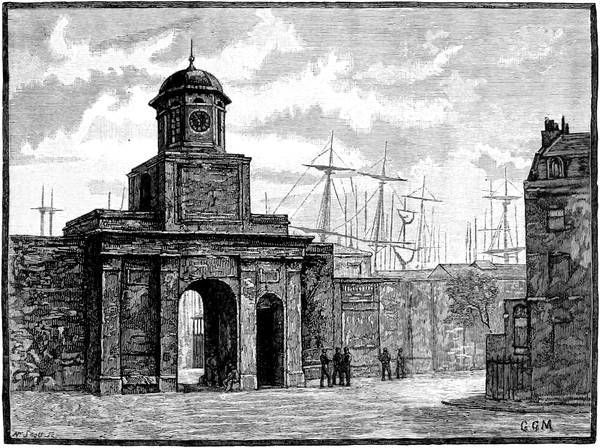
ENTRANCE TO THE EAST INDIA DOCKS.
From the lower portion of the Pool the river assumes wayward and
eccentric habits, broadening and curving, and looking at every turn,
when the tide is in, like a long chain of lakes. There is abundance of
motion, and the freest wash of water, for the wind has large surfaces
on which to play; and, also, the Thames is perpetually churned into
long sweeping billows by the wheels of steamers passing to and fro.
Henceforward every moderately straight portion of the river assumes the
name of Reach, the meaning of which is obvious enough. There is first
Limehouse Reach, then Greenwich Reach, and Blackwall Reach, and Bugsby
Reach, and Woolwich Reach, and so onward to the magnificent reach
at Gravesend. It is a devious course that is pursued by the vessels
making their way down the Thames, but one which is full of perpetually
varying interest, of ever-changing effects, of keen delight and breezy
sensation to him who has the faculty of observing other things besides
the muddiness of the Thames water.
Writing of this part of the river, Defoe describes grim sights in his
“Journal of the Plague.” He says of some of those who were terrified
for their lives, that “they had recourse to ships for their retreat....
Where they did so, they had certainly the safest retreat of any people
whatsoever; but the distress was such that people ran on board without
bread to eat, and some into ships that had no men on board to remove
them farther off, or to take the boat and go down the river to buy
provisions where it might be safely done; and these often suffered and
were infected as much on board as on shore. As the richer sort got
into ships, so the lower rank got into hoys, smacks, lighters, and
fishing-boats; and many, especially watermen, lay in their boats; but
those made sad work of it, especially the latter, for, going about for
provision, and perhaps to get their subsistence, the infection got in
among them and made fearful havock. Many of the watermen died alone
in their wherries, as they rid at their roads, and were not found
till they were in no condition for anybody to touch, or come near
them.” A grim picture of a weird imagination! Is it possible to form
a conception of anything more awful than these boats, floating up and
down with the tide, unnoticed, masterless, unowned, with their dreadful
burden of bodies dead of the Plague?
The Isle of Dogs is only an island because it is cut across by the
entrances to the East and West India Docks. It is a vast space of
dock property, hidden behind devious streets and towering wharves.
Originally it was “the Isle of Ducks,” the ducks to which allusion
was made having a vast swamp to wade and flounder in, and a solitude
peculiarly their own. Considerably less than a century, however, has
sufficed to change the whole aspect of the place. Where the ducks
disported themselves are now situated the East and West India and the
Millwall Docks. Originally an attempt was made to construct a shorter
course for vessels passing up and down the Thames. A new passage was
made straight through the peninsula, where the West India Dock is now
situated, but this, like the Thames Tunnel, proved to be a sad failure,
vessels maintaining their course round “the unlucky Isle of Dogges,”
just as they did in Pepys’ time. Round the long curve, engineering
and ship-building yards have arisen, with houses of workmen attached
thereto. The isle is populous, and dismal; and he would be a shrewd
observer who should guess that it had not been built on till shortly
after the century began.
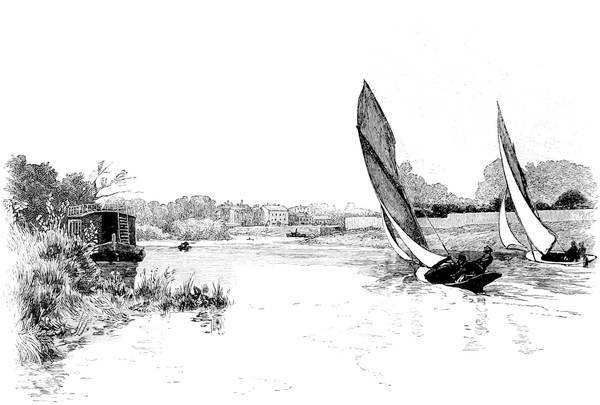
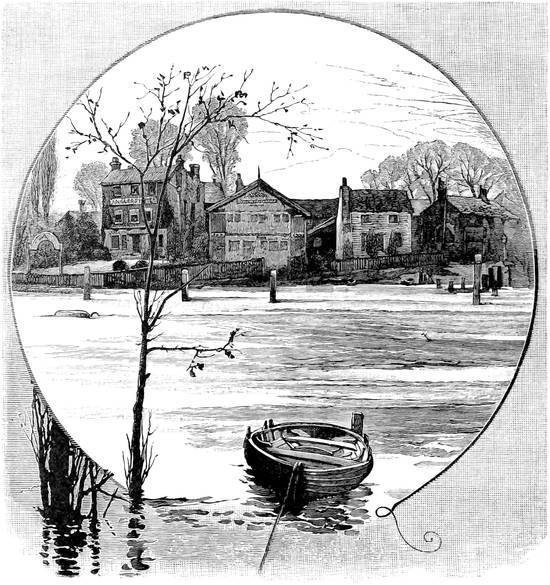
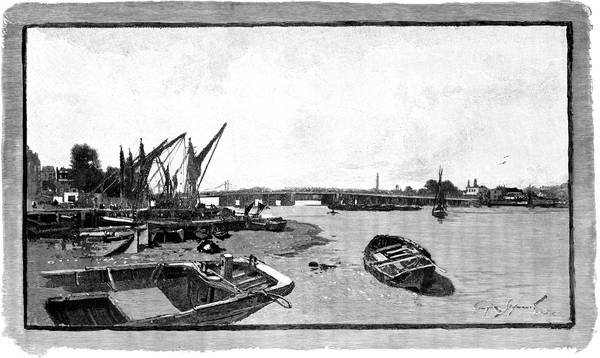
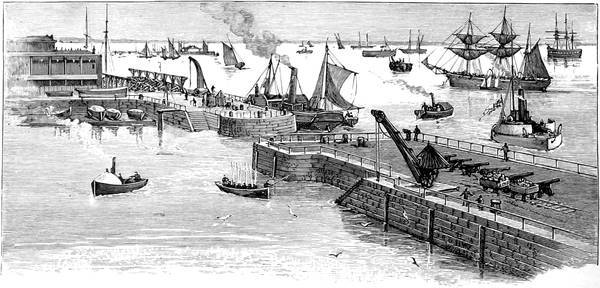
One of the illustrations accompanying this narrative (page 313)
represents a bend of the river at Millwall. It conveys, with much
completeness, an idea of the character of the banks. Near by, a little
further up the river, is the entrance to Millwall Docks. The name
arises from the fact that, in former days, the only buildings on the
Isle of Dogs were windmills. One of them was left till quite recent
years, a quaint Dutch-looking structure, built very solid, to resist
the high winds that blew unimpeded over the dismal peninsula, which
even the ducks had abandoned.
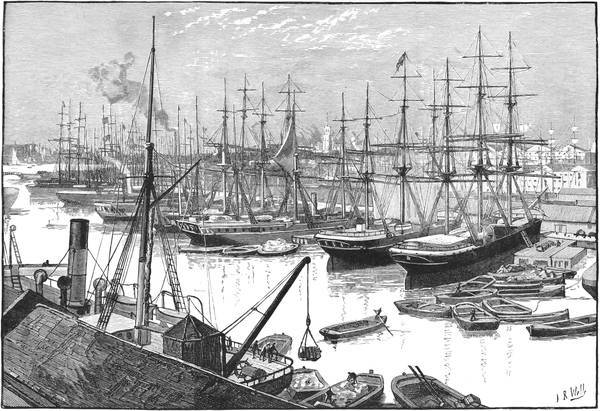
THE WEST INDIA DOCKS.
A little lower down the river there were erstwhile landmarks of another
sort. Gaunt gibbet-posts stood along the shore, with bones of pirates
bleaching upon them, and music of creaking chains. A reminiscence
of this variety of ancient Thames scenery survives in the name of
Execution Dock, which designation is only less repellant than another
favourite place-name of the same period—Hanging Ditch, to wit.
The docks at Millwall are chiefly employed by steamers of large tonnage
trading between London and the various European and American ports.
Great bands of emigrants set out from here to the New World, and as
their ships swing into the river there is much signalling to friends on
shore and much pathetic leave-taking on the decks.
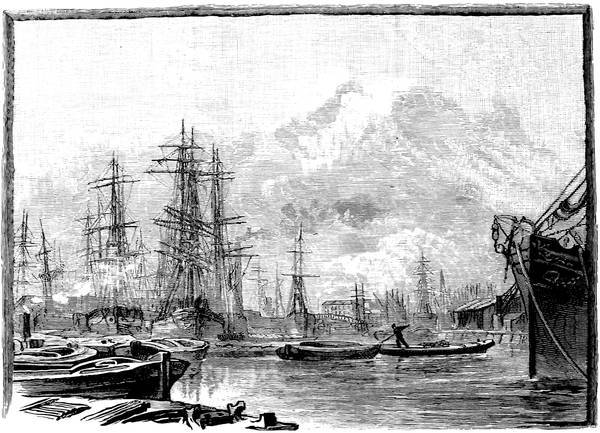
MILLWALL DOCKS.
The docks are two, joined by a bridge, and a tonnage of more than
1,000,000, “gross register,” passes in and out annually. Ready access
to the railways is to be found at Millwall, but many of the vessels
unload into dumb-barges, which swarm all over the Millwall waters, one
man on board each barge, propelling his craft with a pole, and seeming
to take his labour like a light recreation, and as if there were not
the slightest need for hurry in all the world. These dumb-barges,
sluggish and unwieldy, it is the common habit to denounce as one of
the nuisances of the Thames. They float upward or downward with the
tide; they are now “end on” across the river, floating sideways, and
now lazily making a tolerably straight course; they get in the way of
passing steamers, and are indescribably slow in getting out again.
The single man on board seems to be influenced by the habit of the
craft which he controls. He steadfastly declines to regard himself
as an inconvenience, and if the tide drifts him into the middle of
the stream he makes no haste to leave a clear course again, but prods
slowly away with his long pole, utterly careless of mankind, and with
an indifference to oath and objurgation which is positively sublime.
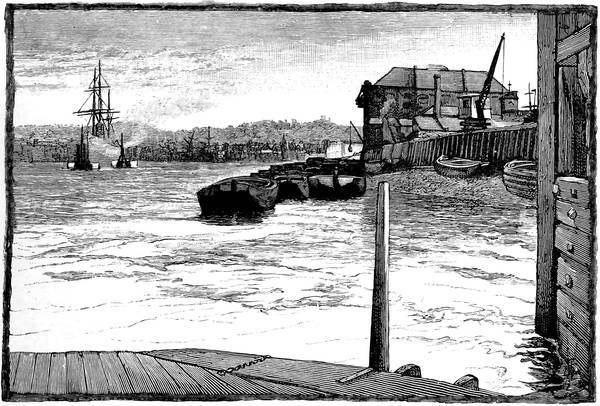
MILLWALL.
Compared to those at Millwall, the East and West India Docks,
stretching right across the neck of the peninsula, and making an island
of it in fact as well as in name, are of really gigantic dimensions. A
few years ago it was possible to declare, with a fair amount of truth,
that the West India Docks were the largest in the world. From the land
side they are approached by Commercial Road, the smaller of the two
great highways which are the main arteries of East London. At the first
glance the unsuspecting stranger might easily be led into supposing
that he had come suddenly upon an important series of fortifications.
The stone archway, crowned by a stumpy tower, which forms the entrance,
is impressively massive, and even forbidding; the surrounding walls
are very high, and seem to frown down a not unnatural curiosity to
penetrate their secret; there is also a ditch which suggests a moat,
and which looks as if the constructors had contemplated the possibility
of having some day to cut off all communication with the docks
otherwise than by water. Altogether, the West India Docks convey the
impression that they are carefully guarded and somewhat mysterious,
so that the nervous stranger within their gates traverses them not
without fear and trembling, and is apt to become alarmed lest he should
inadvertently trespass beyond his scanty privileges.
And from the Thames, also, the West India Docks look important and
imposing, the tall warehouses rising as high as the masts of the
vessels which break the regularity of their fronts, thus forming one of
the most striking objects of the north shore. Of all the docks on the
river, none is so likely to convey a concrete idea of the vastness of
our trade, of the manner in which British intelligence and enterprise
draw to the heart of London the spoils of the whole world. “I would
say to the intelligent foreigner,” exclaims one lively writer on
the subject, “look around and see the glory of England! Not in huge
armies bristling with bayonets, and followed by monstrous guns; not
in granite forts, grinning from the waters like ghouls from graves;
not in lines of circumvallation, miles and miles in extent; not in
earthworks, counterscarps, bastions, ravelins, mamelons, casemates,
and gunpowder magazines, lies our pride and our strength. Behold them
in yonder forests of masts, in the flags of every nation that fly from
those tapering spars on the ships, in the great argosies of commerce
that from every port in the world have congregated to do honour to the
monarch of marts, London, and pour out the riches of the universe at
her proud feet.”
It is impossible in any brief description to give more than a general
idea of the extent of accommodation for commerce provided by the
warehouses, sheds, and cellars of the West India Docks. The rum shed
alone, with cellars corresponding in size, covers a space of 200,000
square feet. In one building vast quantities of tea are stored, in
another, innumerable bags of fragrant coffee; here are sheds full of
solid blocks of mahogany, yonder are bags of indigo, boxes of fruit,
bales of cotton, bundles of hides, and sacks of tallow. The average
number of vessels lying at one time in the East and West India Docks is
215, all ships of large tonnage. The Dock Company keeps 2,500 persons
in regular employment for the loading and unloading of ships, and
employs as casual labourers nearly 3,000 men besides.
The London dock labourer, to whom of late much public sympathy has been
extended, is of two classes. The regular labourer, since the great
strike, has been fairly well paid for an unskilled artisan, and is
assured of constant employment. The casual labourer, with whom in many
cases hard work is a new experience, is in a very different case. The
starving and the outcast of all classes, to whom the whole of London
holds out no other prospect of employment, stream down as a last resort
to the Isle of Dogs, a sort of “going to the dogs” which is very grimly
real. In some cases, when additional labourers are wanted, handfuls of
tickets are thrown out among the eager and struggling crowd, and he who
is fortunate enough in the scramble to secure one of these is provided
with half a day’s labour; in others, a foreman stationed at the gates
secures the men he desires by scanning the throng and pointing to one
and to another who seems most capable of hard labour, or in most need.
It is a sad, a distressingly pathetic sight, this almost fiendish
struggle for a few hours’ work; and amongst those who engage in it
are men of fair birth, of good education, of proved ability, but of
irretrievably fallen fortunes, and with characters irrecoverably lost.
When the India merchants created the West India Docks they had a
capital of half a million pounds sterling. Enormous is the capital
that has now been sunk on the estate. At one time, when the owners had
made a larger profit than they were permitted by Act of Parliament to
divide, they bought a quantity of copper and roofed their warehouses
with that expensive material. The wharves, warehouses, and quays have
now a storage capacity of over 170,000 tons; in the cellars 14,000
sheep can be stored; the weekly wages paid at the West India Docks
alone amount to £5,000; the revenue of the company owning them is close
on £400,000 a year. Then there are the East India Docks beside—the
docks that are sung about in fo’castle songs, that are haunted by the
wives and sweethearts of sailors on the look-out for the good ship that
is homeward bound, that are dreamed of by Jack Tar when he is thousands
of miles away on the sea.
“Why?” asked Mr. W. Clark Russell, “are the East India Docks the most
popular of all docks among sailors?” “There are two reasons,” was
the reply. “Until the Victoria Dock was opened these docks were the
lowest down the river. They were consequently the first at which a ship
arrived on her return home. The East India Dock was always so popular,
owing to its convenience, compactness, and management, that, whenever
there was room, and arrangements would admit, ships entered it. The
advantage was great to the sailor. Once on shore, he had nothing to do
but jump into the train on the pier-head and be off. Another reason
was, the East India Dock was the home of the emigrant ship; and as it
was the first place where Jack met his Polly, so it was the last place
in which he bade her farewell and took his glass of grog.”
Along the bank of the Thames, opposite to the Isle of Dogs, lie, making
a long semicircle of streets, the twin towns of Deptford and Greenwich.
Behind them rise the Kentish hills, dark with trees, among which the
shadows seem continually to sleep. Deptford is redolent of historic
memories. Its old church, with embattled tower, easily perceived
from the river, contains the bones of Captain Edward Fenton, one of
Frobisher’s companions; Drake was knighted here, on board his own ship,
by that unmarried queen who so appropriately ruled our country in the
most adventurous period of English history. Here, Peter the Great came
to learn ship-building, residing at Sayes Court, the house of the
precise John Evelyn, who complains grievously of the semi-barbarian
monarch who broke down his hedges, and filled his house with “people
right nasty.” Master Samuel Pepys, Clerk of the Acts of the Navy, was
necessarily a more frequent visitor to Deptford, and he records, very
early in his famous Diary, how he repaired to Deptford after sermon,
“where,” he says, “at the Commissioner’s and the Globe we staid long;
but no sooner in bed but we had an alarm, and so we rose; and the
Comptroller comes into the Yard to us; and seamen of all the present
ships repair to us, and there we armed with every one a handspike, with
which they were as fierce as could be. At last we hear that it was
five or six men who did ride through the guard in the towne, without
stopping to the guard that was there, and, some say, shot at them; but
all being quiet there, we caused the seamen to go on board again.”
Up to quite recent years Deptford was famous for its dockyard,
established by Henry VIII., and employed in the construction of
vessels of war through the greater part of three centuries. The site
is occupied by a dockyard no longer; convicts are no more brought to
labour in gangs on the construction of men-of-war; there is no sound of
hammers, nor any shouting of overseers; the keel of no mighty ship is
being laid; the greatness of Deptford has departed with the era of our
wooden walls.
But as Deptford has lost its importance in our naval system it has
become one of the centres of our trade. Facing the river, like the
vanished dockyard, and occupying a portion of its former site,
is the great collection of buildings known as the Foreign Cattle
Market. All cattle landed in London from abroad are brought here to
be slaughtered, and in the vast shambles, which no person of nice
tastes should think of visiting, beasts are being killed and dressed
and quartered from morning to night, with an expedition which strikes
the beholder as something unnatural and amazing. From Deptford, it is
probable, proceeds the greater portion of London’s meat supply, and
even Smithfield gives a less striking idea of the vast capacity of
Englishmen for the consumption of animal food than do the Deptford
shambles.
Near the point to which we have now come the Ravensbourne enters the
Thames, and with it the first black instalment of the sewage of London.
The little river rises on Keston Heath, and flows sweetly through a
lovely country, wandering, as a poet has sung—
“In Hayes and Bromley, Beckingham Vale
And straggling Lewisham, to where Deptford Bridge
Uprises in obedience to the flood.”
On the bridge stands the boundary stone which marks the extremity of
Surrey and the beginning of Kent, and just beyond it, a little nearer
to the Thames, are stationed, above ground, one of the sewage pumping
stations of the London County Council, and, below, the point of meeting
of some of the principal sewers of southeast London.
Before us when we return to the river lies Greenwich Reach, broad and
beautiful, uncrowded by shipping, with curious half-wooden houses
on our right, with shoals of boats drawn up on the shore with the
magnificent front of Greenwich Hospital reflecting itself in the
waters. On the high bank above the landing-stage there is an obelisk
erected to Belot, the Arctic explorer, unimpressive and meagre enough
in itself, but beautiful as a tribute of praise from Englishmen to a
daring sailor of another, and, for many centuries, a hostile nation.
At Greenwich we are enjoined to
“Kneel and kiss the consecrated earth.”
It was the hospital which was thus alluded to as the means of
consecration, but the glorious building is not a hospital any more.
The fine old sea-dogs who used to find shelter here, and narrate to
each other the story of their adventures on all the seas of the world,
preferred fourteen shillings a week and their pension outside the walls
to the liberal rations and the small allowance of money to which they
were entitled by their residence indoors; so the place famous to all
Englishmen through many generations has become a Royal Naval College,
where young officers and engineers are trained in the technical and
scientific branches of their work.
The site is one of the most illustrious to be found within the
sea-washed borders of the British Isles. Here did the first of those
who “dined with Duke Humphrey” come to carouse, for here Humphrey,
Duke of Gloucester, had a manor-house, which he rebuilt and embattled,
enclosing what is now known as Greenwich Park. Humphrey’s choice of a
site for his residence was approved by many an English king, for Edward
IV. finished and beautified the Duke of Gloucester’s palace; Henry VII.
made it his favourite residence; Henry VIII., his brother, the Duke of
Somerset, the Queens Mary and Elizabeth, were born within its walls;
there the young King Edward died, and, a few days before his death,
was lifted up to the windows by his courtiers, that his clamorous
people might perceive him to be still living. Greenwich Palace was
to Queen Elizabeth what Osborne is to Queen Victoria; James I. was
wont to escape to it from London; the unfortunate Charles made it his
home; and when his son, who “never said a foolish thing and never did
a wise one,” came to his throne, he determined to build at Greenwich
the finest royal palace England had ever had. “To Greenwich by water,”
writes Pepys, “and there landed at the King’s House, which goes on
slow, but is very pretty.... Away to the king and back again with him
to the barge, hearing him and the duke talk, and seeing and observing
their manner of discourse. And good Lord forgive me, though I admire
them with all the duty possible, yet the more a man considers and
observes them, the less he finds of difference between them and other
men.”
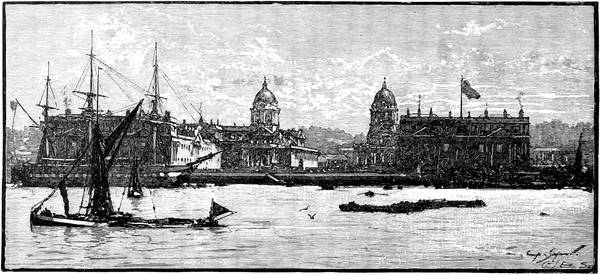
GREENWICH HOSPITAL.
The building which Pepys had seen in course of erection, occupying the
ancient site of “the Manor of Pleasaunce,” as the palace at Greenwich
was wont to be called, owes its present magnificence to the genius
of Wren, and its dedication to the purposes of a naval hospital to
the humanity of the Consort of William III. “Had the king’s life been
prolonged till the works were completed,” writes Macaulay, “a statue
of her who was the real foundress of the institution would have had
a conspicuous place in that court which presents two lofty domes and
two graceful colonnades to the multitudes who are perpetually passing
up and down the imperial river. But that part of the plan was never
carried into effect; and few of those who now gaze on the noblest of
European hospitals are aware that it is a memorial of the virtues of
the good Queen Mary, of the love and sorrow of William, and of the
great victory of La Hogue.”
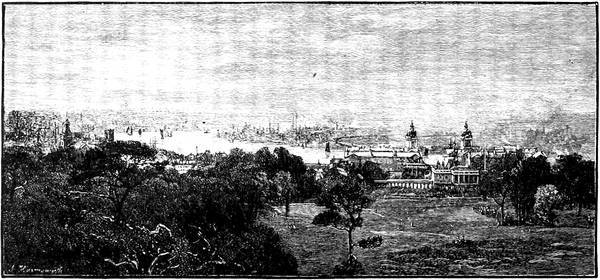
VIEW FROM GREENWICH PARK.
The battle of La Hogue was fought on the 24th of May, 1692. It
concluded a “great conflict which had raged during five days over a
wide extent of sea and shore.” The English had gained no such victory
over the French for centuries, and England, in spite of much popular
sympathy with James, in whose interest our ancient enemies had planned
the invasion of our country, went wild with enthusiasm. Many of the
wounded were brought to London and lodged in the hospitals of St.
Thomas and St. Bartholomew, and it was shortly afterwards announced
by the queen, in her husband’s name, that the building commenced by
Charles should be completed as a retreat for seamen disabled in the
service of their country. However, as Mr. Ruskin observes in reference
to the crown of wild olive, “Jupiter was poor.” Little progress was
made with the new hospital during Queen Mary’s life, but on her decease
her husband resolved to make it her monument. The inscription on the
frieze of the hall gives to the queen all the honour of the great
design; and though the hospital has now been diverted to other uses,
the memory of what it once was can never perish, and the grand edifice
will remain to Englishmen for ever
“The noblest structure imaged on the wave,
A nation’s grateful tribute to the brave.”
Wren’s subject seems to have inspired his higher genius, and none of
his works, not even St. Paul’s, is a worthier memorial of his powers.
It was Charles II. who planted the trees of Greenwich Park, now
remarkable for their great size and nobleness. From the crown of
the steep ascent on which the Observatory stands, once the site of
“Duke Humphrey’s Tower,” there spreads before the observer one of the
broadest and most impressive prospects to be encountered anywhere round
about London. Far down below lie, first, the Naval School, and then the
two great wings of the hospital, each lifting its beautiful dome aloft
into the blue of the sky; in front, the eye wanders, over the Albert
and Victoria Docks, to the valleys of the Lea and the Roding; to the
left, the river, broader than at any previous portion of its course,
bends suddenly round the Isle of Dogs, beyond which lies London, dim
and distant, its white towers and spires gleaming out of the haze, its
great cross of St. Paul’s glittering in the sunlight; to the right, the
Thames—laden with ships, alive with barges—flows on, a wide shining
space of water, past ship-building yards, and warehouses, and dry
docks, until it loses itself in the grey distance of the Kent and Essex
marshes.
Where the Lea—Walton’s river—after flowing through Bedfordshire, by
pleasant Hertford, on to Enfield, and Edmonton, and Bow, ends in an
estuary of unfathomable mud, and joins the Thames at Blackwall, we are
near to the entrance of the Victoria Docks.
At Blackwall, docks were being constructed in Pepys’ day, and he makes
this curious entry in his Diary:—“1665, Sept. 22nd. At Blackwall,
there is observable what Johnson tells us, that, in digging a late
Docke, they did twelve feet underground find perfect trees over-covered
with earth. Nut trees, with the branches and the very nuts upon them;
some of whose nuts he showed us. Their shells black with age, and their
kernell, upon opening, decayed, but their shell perfectly hard as ever.
And a yew tree (upon which the very ivy was taken up whole about it),
which, upon cutting with an addes, we found to be rather harder than
the living tree usually is.” Similar curiosities, it is probable,
lie waiting for discovery all along the Thames shore; and at the “New
Falcon” at Gravesend there is a perfect specimen of moss, with still
just a tint of green remaining in its fronds, which has been dug up
from many feet below the surface at Tilbury.
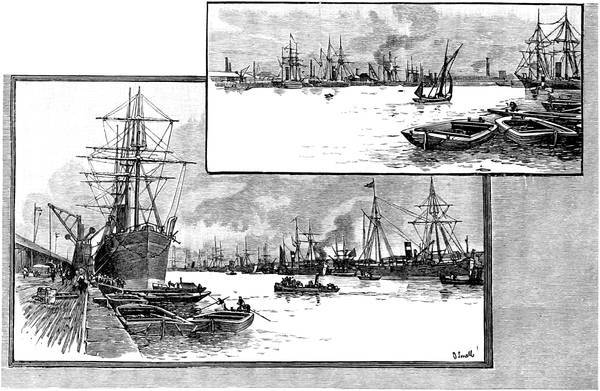
THE ALBERT DOCKS.
Far down the river the docks are spreading—growing longer, and deeper,
and roomier with the necessities of our trade. From the entrance to
Victoria Dock at Blackwall to that of the Albert Dock at North Woolwich
is a distance of more than three miles. The Albert Dock itself is a
long, straight expanse of two miles of water, lined on either side
by great ocean steamers lying stem to stern. It is always resounding
with the “Yo, heave oh!” of sailors, the shouts of bargemen, the cries
of dock labourers, the screaming and panting of steam-cranes, the
exclamations of bewildered passengers on the look-out for the vessel
which is to bear them over seas. Up the River Thames every year there
makes its way a vast fleet of 6,000 steamers and 5,000 sailing vessels,
with an aggregate of 6,000,000 tons burden. To one who desires to
understand clearly what life, and excitement, and perpetual going and
coming this entails, there could be no more stirring or instructive
sight than the Victoria and Albert Docks. Some of the great steamers
are like floating streets, almost as populous, with rooms like palaces,
and decks as clean as village hearthstones. From gigantic port-holes
strange wild faces and turbaned heads look out; the quays swarm with
coolies in blue and white tunics, with negroes in cast-off garments
from Wapping, with Chinamen in curious pointed shoes, and pigtails
neatly tied up for convenience. Above decks the officers may be heard
giving their orders in Hindostanee; the red-turbaned sailors speak to
their mates in unknown tongues; the howl with which a rope is hauled in
or a bale is lowered is not unlike the cry of tigers in the jungle.
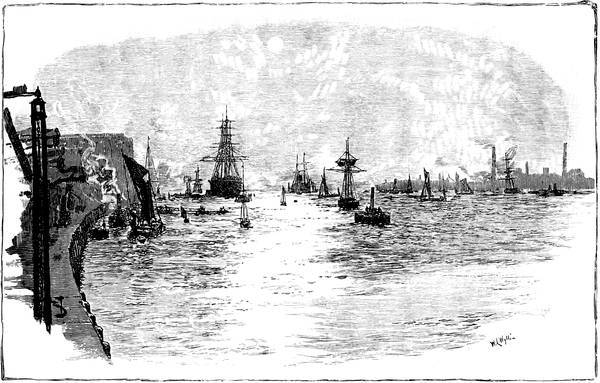
WOOLWICH REACH.
The Victoria Dock is very roomy, and comparatively quiet. It is a
series of great basins, with surrounding quays and projecting jetties.
Here are vast tobacco warehouses, and coal-sidings, and cellars for
frozen meat. Not many passengers come to or depart from Victoria Dock,
which is used chiefly by cargo steamers, bringing for the consumption
of Englishmen every variety of foreign produce. The tobacco warehouses
are one of the sights of dock-side London. They contain as much
tobacco, in bales of raw leaf, as would seem to be a sufficient supply,
not for England alone, but for the whole world, for many years to come.
The refrigerating chambers, spreading far underground, and designed
for the reception of frozen meat from Australia, New Zealand, the
River Plate, and Russia, provide accommodation for no less than 60,000
carcases. At the Victoria Dock are now located the furnace and chimney
which jointly make up “the Queen’s Pipe.” Here, also, are landed many
of the cattle which are slaughtered on the other side of the river, at
Deptford.
The Royal Albert Dock was opened for traffic no longer ago than the
year 1880. It is used by the great lines of passenger steamers—the
Peninsular and Oriental, the British India, the Orient, the Star, and
a score of others. Immense sheds run alongside the quay, capable of
storing a prodigious number of cargoes, and a vessel may be unloaded
and loaded in the course of a few hours. In the centre of the basin
there is a movable crane, which will take up a waggon containing twenty
tons of coal, and empty it in a few seconds into the hold of a ship.
The Royal Albert is at once the most pleasant and the most exciting of
all the docks of London. From the quays, it looks like part of a great
river unusually busy with ships. There is no cessation of activity
from the dawn of the day until dark. By one tide a great steamer is
departing for Australia, by another for Calcutta or Bombay. It is no
unusual thing to find that five or six great ocean steamships are timed
to leave the dock on a single day, to sail for ports so widely divided
as Sydney, Calcutta, Hong Kong, Port Natal, Japan, and the River Plate.
So important, indeed, has become the traffic of the Albert Dock that it
has become necessary to make for it a new inlet from the Thames.
Between the river and these gigantic docks lies the little colony
of Silvertown, still looking new and clean, so recently has it been
founded on the verge of the Essex marshes. Originally the Messrs.
Silver commenced a rubber manufactory here, and, finding how far they
were from the centres of population, had to build rows of cottages
for their workpeople. Silvertown is now renowned for its electrical
engineers, and has become quite a busy and prosperous centre of
industry.
But in reaching Silvertown we have almost missed the fine sweep of
Woolwich Reach, which is just as long as the Albert Dock, and is one of
the most beautiful stretches of the Thames. When night has settled down
upon the river, and the moon makes “a lane of beams” along the slowly
heaving water, and the lights burning on the misty banks tremulously
reflect themselves in broken pillars of flame, Woolwich Reach, with
its level shores, and its indications of great activities in temporary
repose, is in itself sufficient to relieve the Lower Thames of the
common and vulgar reproach that it lacks beauty. There is a quiet,
solemn, lapping of the waters; barges at rest, sailing ships at anchor,
a yacht lying here and there, break the line of the sky with their
tapering masts and their sails partially furled; a belated steam-tug
pants upward, with asthmatic breath, and from either shore comes the
dull regular throb of half-suspended life. The Lower Thames is never
so imposing as in the night-time, when the moon is pouring down long
streaks of light on the throbbing waters, and even the brown piles of
the river bank seem tinged with gold.
The three prominent objects on the Woolwich side are the barracks, the
dockyard, and the arsenal. Not that the arsenal can be said to be very
prominent, either, for it lies by the side of the river like a low line
of sheds, very bare and poor-looking, very disappointing, very unlike
what one would expect the chief arsenal of England to be. The barracks
alone relieve Woolwich from monotony. They rise high above the town,
with their great central quadrangle, and its four spires, looking not
unlike an enlargement of the Tower of London. Not far away rises the
square tower of Woolwich Church, with a populous graveyard beneath,
climbing over the summit of a hill. The houses of Woolwich rise above
each other like irregular terraces, for here the land is more abrupt
and uneven than elsewhere on Thames-side, as if it were asserting
itself before it came to the dead level of the neighbouring marshes.
The once-famous dockyard, closed in 1869, is represented by great,
empty, stone spaces, sloping to the river, and a pair of large,
singular-looking sheds, stored full of gun-carriages and implements
of war. Looking on it nowadays, it is hard to believe that up to
comparatively recent years it was employed in the construction of
our navy. No hammers resound there now, and the dockyard, silent and
sleeping, might well be the type of an age of national amity and
absolute peace.
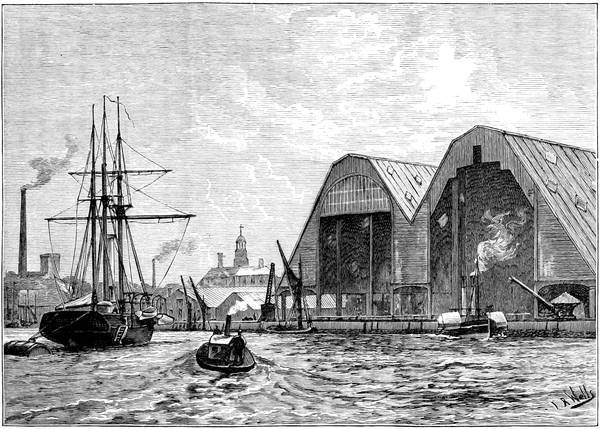
WOOLWICH ARSENAL.
But not so with the arsenal, which is busy night and day in forging the
bolts of war. A while ago a shower of military rockets burst upwards
from this busy centre of martial industry, spreading some ruin and
much consternation throughout the towns of North and South Woolwich,
scattering to right and to left, and penetrating the walls of houses
situated a mile or so from the opposite bank of the Thames. Such
accidents are always possible, despite the extremest care, and Woolwich
sleeps, like Naples, in more or less constant fear of eruption. The
choice of the place as a site for the Royal Arsenal was brought about
by the discovery there of a kind of sand peculiarly adapted for fine
castings, a fact which may help to explain the derivation of the name
from Wule-wich, “the village in the bay.” On the opposite side of the
river, under the shadow of the trees which line the banks below North
Woolwich Pier, elephants may occasionally be seen wandering, as calmly
as if this were their natural habitat, for here are the North Woolwich
Gardens, where, as at Rosherville, lower down the river, the folk of
East London come now and then to “spend a happy day.”
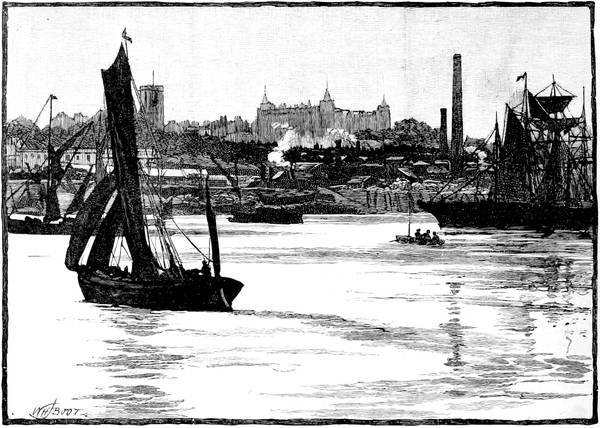
WOOLWICH.
Off Woolwich, lies the Warspite, a noble example of those English
frigates which did good service when England was still defended by
its wooden walls. And the Warspite, which was formerly known as
the Conqueror, is doing extremely good service now, for it is the
training-ship of the Marine Society, which, at the suggestion of Jonas
Hanway, the first Englishman who had the courage to carry an umbrella,
was formed in 1772 for the purpose of equipping wretched and neglected
boys for the sea. Since that date 60,000 boys, none of them criminals,
but many in great danger of falling into crime, have passed through
the Society’s hands, and have started life with honest purposes. A
finer looking lot of lads than those who swarm about the decks and
the rigging of the Warspite it would be difficult to find even in
a public school, and it is a proud day for the Marine Society when,
once a year, a fête is celebrated on board the noble old war vessel,
and the boys go through their evolutions in the presence of Royal and
distinguished strangers.
Admiral Luard, who commanded the Warspite whilst it was still called
the Conqueror, and carried a thousand sailors and marines, related a
few years ago how narrow an escape it had of going down with all hands.
Overtaken in a typhoon off Sumatra, it lay for many hours on its beam
ends, its hold fast filling with water, and altogether in a condition
so hopeless that all on board gave themselves up for lost. However,
good seamanship and excellent behaviour on the part of the men saved
the vessel to perform its present humane duty, and to endure as a type
and example of the sort of ship which once maintained our supremacy on
all the seas of the world.
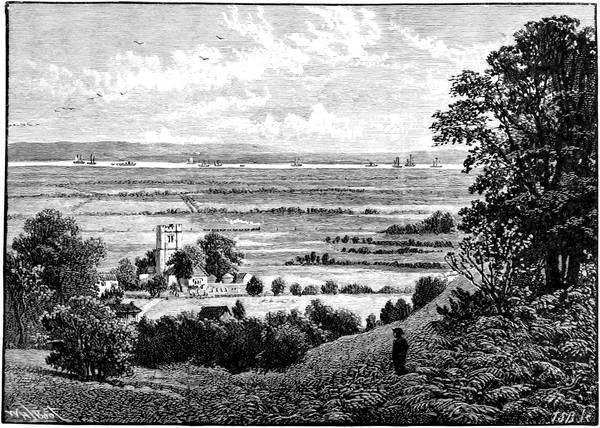
PLUMSTEAD.
Below Woolwich the Thames flows through low-lying lands, flat and
marshy, bounded at the distance of a mile or more by thickly-wooded
hills, at the feet of which nestle here and there grey church towers,
and little red villages, and occasional small towns. Looking down over
Plumstead, which is a singularly prosaic place in a remarkable fine
situation, the river is a mere thin streak, running between artificial
banks, like those of a Dutch canal. Over the green marshland below
us the river was once wont to spread itself like a great inland sea;
and at various periods, since stout walls were built to confine it to
a reasonable course, it has burst open its barriers and flooded the
country for mile on mile. In this manner was created Dagenham Breach,
where the river wall now encloses Dagenham Lake, famous for its bream
fishing. On the Plumstead side the river wall was broken down in Queen
Elizabeth’s reign, and repaired at tremendous cost. Dagenham Breach,
on the opposite shore, between where the River Roding and Raynham
Creek open on the Thames, was made so late as 1707, when the swollen
river, breaking down its barriers, rushed over 1,000 acres of land, and
carried 120 acres into the stream. The land swept away made a sand-bank
a mile in length, and stretching half-way across the river. The damage
was afterwards repaired by Captain Perry, who had been engineer to
Peter the Great, and who was voted £15,000 for an undertaking which had
cost him £40,472 18s. 8¾d.
The land enclosed by the Thames’ walls is mainly waste, but has a
quiet, singular beauty, which would be more appreciated, doubtless, but
for the fact that here, on either bank, London pours its two immense
streams of sewage into the river. Where the Plumstead and the Erith
marshes join each other, there may be seen at low tide a couple of
culverts, from which issue, twice a day, two thick, black, poisonous
streams. Just above them there is a substantial pier, and further
back, a large white building with a tall chimney, beside which the
Nelson column would seem to be dwarfed. Further back still, surrounding
a covered reservoir, there is a quadrangle of small, neat houses,
occupied by some of the workpeople of the London County Council. These
are the sewage works at Cross Ness. They are surrounded by gardens,
inside which the ground rises abruptly to the height of the dykes. All
around seems clean and pleasant, but underneath, built on arches of the
Roman aqueduct pattern, there is a huge reservoir, which receives most
of the sewage of the south side of the Thames. The large white building
which was first discernible is the pumping station, where there are
four great engines capable of lifting 120,000,000 gallons of sewage in
the twenty-four hours. For sixteen hours each day the sewage is being
pumped up from low-lying culverts into the reservoir; for four hours
at each tide it is being liberated into the Thames, which thereafter,
for some miles, becomes a pestilential river, bearing its dark and
unwholesome burden up and down and round about with every tide.
One might stand on the quiet Plumstead marshes and suspect nothing
whatever of all this. From thence the river is made invisible by its
dyke; but one observes, with an interest not unmixed with wonder, the
funnel of a steamer skirting along the level landscape, or the rich
brown sail of a Thames barge, or the bellying canvas of one of those
sailing-vessels which, to the number of 5,000 annually, still make use
of the port of the Thames.
The larger sewer works of what is called the Northern Outfall are
situated on the opposite side of the river, at Barking, where there
still remains a relic of the once famous Barking Abbey—the ancient
curfew tower, from which the inhabitants were wont to be warned to
extinguish their fires. Barking Abbey, which was a foundation of the
Benedictine order, dates back to the year 670, and was the first
convent for women in England. It originated with the Saxon saint,
Erkenwald, Bishop of London, whose sister, Ethelburgha, was its first
abbess. This lady made the convent, so renowned that two queens—the
wives of Henry I. and of King Stephen—thought it an honour to be
appointed to the office which so distinguished a woman had held. All
the abbesses of Barking were baronesses in their own right, and took
precedence of all abbesses in England. The last of the long line was
Dorothy Barley, who was compelled to surrender the abbey to “Bluff
King Hal” in 1539. The abbey church stood just outside the present
churchyard, and was 170 feet long, with a transept of 150 feet. The
curfew tower is the old gate of the outer court, and the room, of which
the window is shown in the engraving on the next page, was anciently
the chapel of the Holy Rood. In the near neighbourhood is the house
from which Lord Monteagle carried to the king a warning not to attend
the Houses of Parliament on the day fixed for the carrying out of the
Gunpowder Plot.
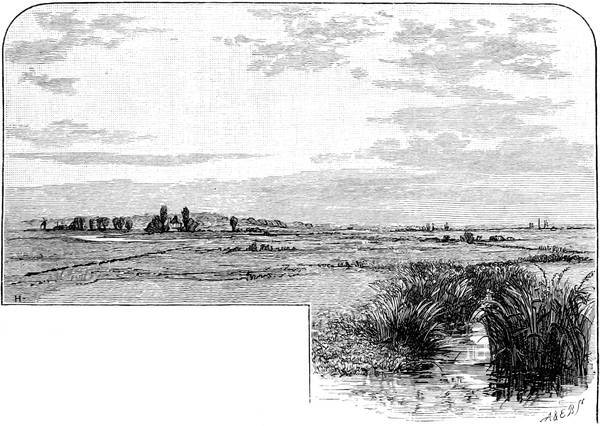
DAGENHAM MARSHES.
In Barking—sometimes called Tripcock—Reach we are afloat on a tide
of sewage. It discolours the water all around; it is sometimes churned
up by the wheels of the paddle-steamers; the odour of it assails the
nostrils at every turn; and yet Barking Reach is, with this exception,
an altogether delightful place on a spring or summer day, all the
more delightful if the day is one which follows upon or precedes a
day of rain; for the sky should be full of grey clouds and capricious
light to do justice to the landscape below Barking Reach. Fortunately,
even a vast burden of sewage, the refuse of the mightiest city in the
world, cannot destroy the natural beauty of the river. By Erith and
at Greenhithe it beslimes the low, muddy flats left exposed by the
receding tide; but out in the centre of the Thames how can it avail
against the influence of wind, and cloud, and sunlight? The river
smiles and sparkles, and reflects grey cloud and blue sky, just as if
it had no secrets to hide; and over the flat meadow-lands the shadows
chase each other like happy children at play. Steamers, barges,
sailing-vessels, coming and going, are almost as frequent here as in
the higher reaches. It is the peculiarity of the Thames that it is
never forsaken, or solitary, or at rest.
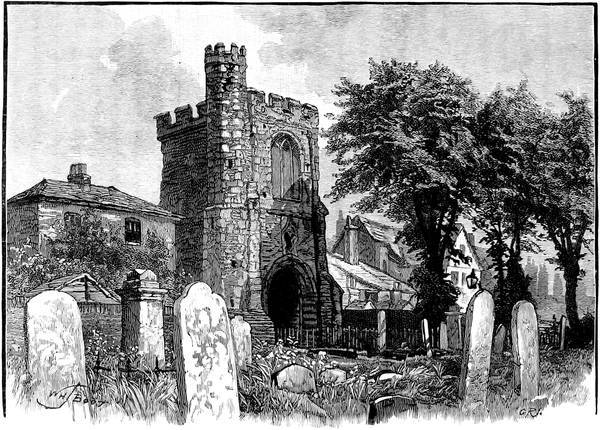
BARKING ABBEY.
On either bank, unsuspected by the chance excursionist, are frequent
powder magazines, which are a sort of introduction to Purfleet, where
there is such a store of explosives as, if they were fired, would shake
London to its centre, and possibly to its foundations. At Purfleet, by
the way, the river banks vary their monotony by rising up sheer and
white, in modest imitation of the chalk cliffs of Folkestone and Dover.
As we proceed further down the river the smell of chalk-burning will
taint the air somewhat disagreeably, and great white clouds of smoke
will fly in our faces and almost hide the sky.
Purfleet is a pretty and interesting town, notwithstanding the uses
to which it has been put, and the danger there must always be in
living there. The chalk hills are crowned with pleasant woods, and
over the river one looks across Greenhithe to the Kentish hills. Of
the country in that direction Cobbett, writing his “Rural Rides,” had
only a disparaging account to give. “The surface is ugly by nature,”
he said, “to which ugliness there has just been made a considerable
addition by the enclosure of a common, and by the sticking up of some
shabby-genteel houses, surrounded with dead fences and things called
gardens, in all manner of ridiculous forms, making, all together, the
bricks, hurdle-gates, and earth say, as plainly as they can speak,
‘Here dwell Vanity and Poverty.’” But Cobbett was by preference unjust,
and the little grey houses, each with its own circle of trees, are an
essential portion of the charm of these riverside landscapes, which,
else, would look dead and solitary.
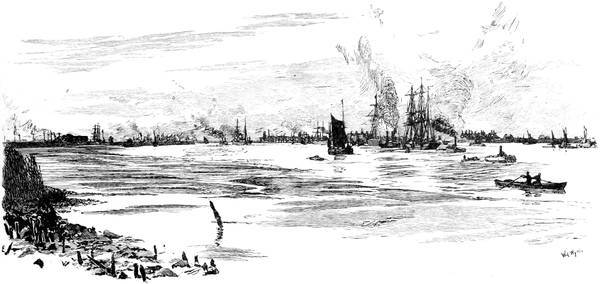
BARKING REACH.
Off Purfleet, on one of whose chalky cliffs the standard of England was
unfolded when the Spanish Armada threatened our liberties, lies the
reformatory training-ship Cornwall, once known as the Wellesley,
the flagship of the brave and adventurous Lord Dundonald. These
handsome old hulks, some of them used as reformatories, some of them
as training-ships for boys who have been rescued from poverty, and
one large group as a fever and small-pox hospital, are very frequent
between Erith and Northfleet, and greatly increase the interest of a
voyage down the Thames. Off Greenhithe, a famous yachting centre, the
Arethusa and the Chichester lie moored; at Gray’s Thurrock, on the
opposite side of the river, lie the Exmouth and the Shaftesbury,
the latter being the vessel which has been found so costly by the
London School Board.
The good-looking town of Erith faces the river just above Purfleet,
half-surrounded in the summer months by a fleet of small yachts at
anchor; and, just below, the Rivers Cray and Darent, making a clear
fork of shining water, meet together and flow as one stream into the
Thames. “Long Reach” Tavern, a quaint, solitary place, once much
frequented in the old prize-fighting, cockfighting days, by persons who
are usually spoken of as belonging to “the sporting fraternity,” stands
on the flat muddy ground of this estuary of the conjoined rivers; and
from this point the River Thames bends inland towards Dartford, again
taking a new direction at Ingress Abbey, where Alderman Harmer once
lived, in a house built out of the stones of old London Bridge.
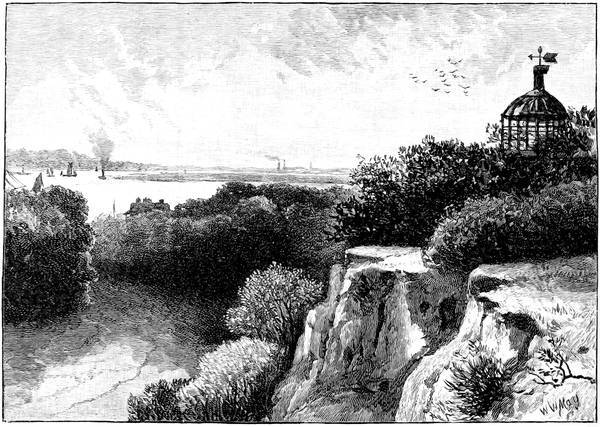
AT PURFLEET.
Around Ingress Abbey lies the village of Greenhithe, another yachting
station, with forty feet of water at the end of the pier at low
tide. Stone Church, said to have been designed by the architect of
Westminster Abbey, and beautiful and elaborate enough in some parts of
it to suggest close kinship with that great edifice, stands on a proud
eminence above the village, and is visible for miles around.
At Greenhithe the cement works commence, and extend themselves to
Northfleet, which is a town perpetually enveloped in a cloud of white
smoke, floating over the river in great wreaths, so that Tilbury and
Gravesend, lying only a brief distance away, are in some states of
weather completely hidden from sight until Northfleet has been passed.
To Tilbury is now to fall the often forfeited glory of containing
the largest docks in the world. The heavy traffic of the Thames is
gradually being arrested at a lower portion of the river. “One thing
hangs upon another,” remarks a recent writer, “and just as Tenterden
Steeple is accountable for Goodwin Sands, so the Suez Canal is
responsible for the Albert Dock, and for those that are being made
at Tilbury. The long, weight-carrying iron screws that are built to
run through the canal are not adapted for the turnings and windings
of Father Thames in the higher reaches, and so, after the fashion of
Mahomet, the docks now are sliding down the river to the ships instead
of the ships coming up the river to the docks.” Thus it happened that
some years ago the population of Gravesend began to be increased
by immense gangs of navvies, builders, and masons, who during the
day-time were engaged on the Tilbury side of the river in digging vast
trenches, building huge walls, and scooping out of the peat and clay
accommodation for the merchant navy of England.
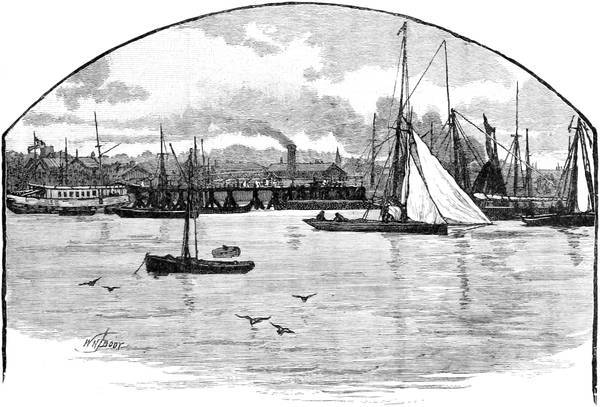
ERITH PIER.
The new docks at Tilbury are the property of the East and West India
Dock Company, which is forestalling competition by thus competing with
itself. They are being dug out of what has for centuries been a great
muddy waste. An army of nearly 3,000 labourers has been employed on the
excavations. When the docks are completed eight large steamers will be
able to take in coal at one time; the largest vessels built will be
able to enter the gates with ease; there will be wharves and warehouses
capable of accommodating no inconsiderable portion of the entire trade
of the Thames. Branch lines of railway will run along the wharves, and
be connected with each warehouse. The main dock occupies fifty-three
acres of ground. The jetties surrounding the basins will be forty-five
feet wide. At Tilbury, it is probable, the great work of furnishing
dock accommodation for the shipping using the Thames will be finally
brought to an end. It is all but impossible to imagine that the time
will ever arrive when the Albert, and Victoria, and Tilbury, and East
and West India Docks, will be too small for the demands of a trade
almost inconceivably greater than that which passes through the Port of
London now.
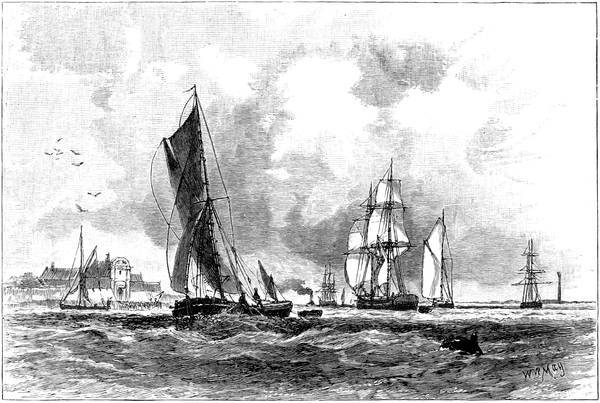
TILBURY FORT.
The proximity of this prodigious undertaking has driven away much
of the solitariness which, for some centuries past, has hung around
Tilbury Fort. That renowned but practically valueless fortification is
best known through the popular engraving after Clarkson Stanfield’s
picture. That artist, however, has used a painter’s license to the
full. He has given to Tilbury Fort a massiveness and a dignity to
which it can by no means lay claim. It is, on the contrary, rather
mean-looking, and is only saved from insignificance by its great stone
gateway, which is a sort of loftier Temple Bar.
It was when, in 1539, three strange ships appeared in the Downs,
“none knowing what they were, nor what they intended to do,” that the
idea of building a fort at Tilbury arose. Henry VIII., alarmed at
possibilities, built bulwarks and block-houses both at Tilbury and
Gravesend. It is stated, on authority which is somewhat doubtful,
that Queen Elizabeth reviewed her troops at this place when the realm
was threatened by the Spanish Armada, and that here she declared
that she thought it “foul scorn that the Pope or any other foreign
prince should dare to interfere with her.” On authority that is still
more than doubtful, she is said to have slept in the one room over
the great gateway. The statement that an Irish regiment, stationed
here just before the abdication of James II., crossed the river and
burnt and pillaged Gravesend, but was afterwards defeated with great
slaughter, is more authentic. At Tilbury Fort, Sheridan has laid the
scene of the burlesque tragedy embodied in The Critic, the heroine
of that piece being the Governor’s daughter, who went mad in white
satin, to the accompaniment of her faithful friend and companion, who
considered it to be part of her duty to go out of her senses in white
linen, as became the meaner condition of one who was paid to serve.
A great mystery is preserved concerning Tilbury Fort by the military
authorities, and any stray artist found sketching in its neighbourhood
is usually treated as if he were making drawings for the advantage of
the enemies of his country.
And now, having passed the Gardens at Rosherville, ingeniously
constructed out of old chalk-pits, having seen Tilbury old and new,
and having come to the end of this portion of our journey by water,
it is time for us to land at Gravesend, where Hogarth and his merry
companions put up at “Mrs. Bramble’s,” and, it is probable, took
shrimps and tea. Gravesend, let it be said at once, is rapidly losing
some of its most pleasant features. Coal-staithes and wharves have
invaded the picturesque foreshore. Very dull and depressing is the
entrance to the town, after passing those wonderfully grotesque baths
which were built according to the sham Oriental taste popularised by
George IV., who, as Praed says, was renowned
“For building carriages and boats,
And streets, and chapels, and pavilions,
And regulating all the votes,
And all the principles, of millions.”
“The first gentleman of Europe,” it may be confidently stated, never
built a boat half so neat, smart-looking, and handsome as the yachts
which, at the proper season, lie in the river in front of those sham
Oriental baths mentioned above. At Gravesend are to be seen assembled
the finest yachts which frequent the Thames, vessels, some of them
with twelve or fourteen stout sailors to man them, and as clean and
smart-looking as anything to be seen within the whole compass of the
seas.
As becomes one of the oldest ports in the kingdom, Gravesend—it was
called Gravesham in Domesday Book—is a town of narrow streets, of
quaint shops and houses, of old-fashioned inns and close courts and
alleys. The face which it turns to the river is like that of a battered
old sailor—scarred, sun-beaten, weather-worn, but pleasant and honest
withal. As in most seafaring towns, there is one long, cramped street,
in which the houses seem to elbow each other, running, a little back
from the river, almost from end to end! Far as it is removed from the
sea, there is a fine salt-water savour about Gravesend, and it has also
the recommendation of being situated in a pleasant country, for, after
ascending its steep streets and threading here and there a leafy lane,
there bursts upon the sight a glorious stretch of agricultural land,
beautifully uneven, with hills of gentle slope, and occasional patches
of woodland and garden and copse.
Of the history of Gravesend there is little that need be said. James
II. lived here, as Lord High Admiral, when he was Duke of York, and
escaped hence in a girl’s clothes when he was flying from his enemies.
On a hill behind the town there stands an old windmill, which is also
a landmark, and which occupies the site of a beacon, the lighting
of which was a call to arms. Aymer de Valence, one of the heroes of
Thackeray’s boyhood, and of many thousands of other boys of his period,
founded and endowed a church just outside Gravesend when Edward II. was
king. In 1780 five thousand soldiers were marched here to make a sham
attack on Tilbury Fort, and were handsomely refreshed, at the expense
of the General, when they had energetically stormed that fortification
with blank cartridge. About that time, or a little later, there was a
great scheme to make a tunnel under the Thames, between the town and
the fort, which scheme ended in nothing but the formation of a company
which appears to have spent fifteen or sixteen thousand pounds to no
purpose.
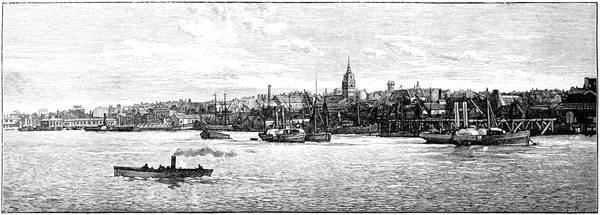
GRAVESEND.
At the present day Gravesend is much resorted to, first for the sake of
Rosherville Gardens, and then for tea and shrimps, for which it has a
reputation quite unique. Sam Weller’s pieman could make a beef, mutton,
or “a weal-and-hammer” out of the same festive kitten. The good folk
of Gravesend can serve up shrimps in ways so various, and so tempting,
that it is possible to dine off shrimps alone. At Gravesend, too,
whitebait may be eaten with as much pleasure as at Greenwich, and the
visitor to one of the inns of the place may watch the boatmen fishing
for the whitebait which is shortly to be served up to him hot from the
kitchen.
It is at Gravesend, indeed, that whitebait is now caught in most
profusion. The boatmen pursue the dainty little fish in small open
boats, and take it in long, peak-shaped nets, very small of mesh
and delicate of workmanship. Whitebait first became celebrated in
connection with the British Parliament towards the end of the last
century, when Sir Robert Preston, member for Dover, was in the habit
of asking his friend, Mr. Rose, Secretary of the Treasury, to dine
with him at Dagenham when the session closed. Whitebait must have
been had at Dagenham in plenty, and Mr. Rose made favourable report
of it to Mr. Pitt; so it came about that the Premier was invited to
try the whitebait for himself. Then it was that an annual Ministerial
dinner was organised, the scene of the whitebait banquets changing
from Dagenham to Greenwich, with an occasional dinner at Blackwall.
“Yesterday,” says the Morning Post of September 10th, 1835, “the
Cabinet Ministers went down the river in the Ordnance Barges to
Blackwall, to the ‘West India’ Tavern, to partake of their annual fish
dinner. Covers were laid for thirty-five.” And for something like
that number covers still continue to be laid, though the Ministerial
whitebait dinner now depends on the taste of Premiers, and is no longer
de rigueur.
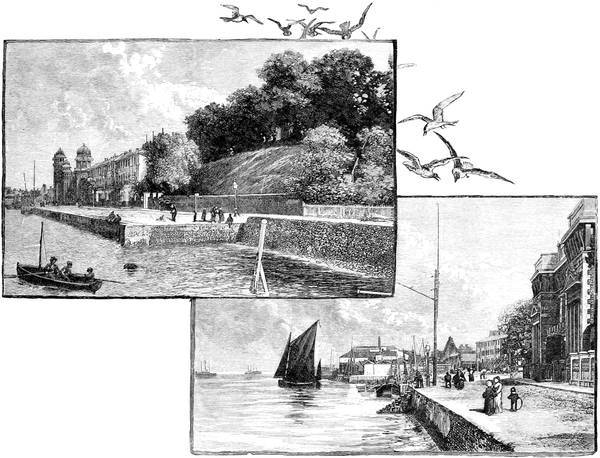
AT GRAVESEND.
The whitebait itself has been almost as much the subject of discussion
as the origin of salmon. Is it the young of herring, or of sprats,
or of fish of many varieties? The question would seem easy enough to
answer, though it can scarcely be said to have been finally answered
even now. The one thing really certain about whitebait is, that it is a
very dainty fish, equally good whether white or “devilled,” as grateful
to the palate whether fried in flour or broiled with a little cayenne.
Scientific opinion, after once appearing to be convinced that whitebait
is young shad, now inclines to the conviction that it is the young of
a variety of species. The whitebait itself, however, seems to conspire
in the concealment of its identity. Kept in captivity on one occasion,
it will turn into herring, kept in captivity on another, it becomes
the common sprat. Some specimens, indeed, have been known to assert
themselves as pipe-fish, gobies, and stickleback, so that, though the
whitebait fishermen resolutely assert the individuality of the species,
it will perhaps be on the whole more safe to take sides with the men of
science—and the accomplished cook.
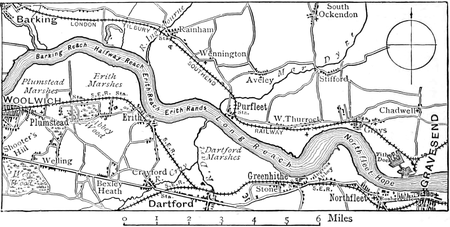
WOOLWICH TO GRAVESEND.
There is, from some points of view, no more interesting spot on the
Thames than Gravesend Reach. Here, after narrowing for a portion of
its distance, the river spreads out again, and proceeds on a perfectly
straight course to Cliff Creek. Gravesend Reach is three miles and a
half in length, and is usually more populous with shipping than any
other point between the Nore Light Ship and the Pool. All outward
bound ships must take their pilots on board at Gravesend, and so it
frequently occurs that here the last farewells are said and the last
kisses are given. In the Reach, vessels wait for the changing of the
tide, so that at one period of the day it is full of ships with their
sails furled, and, at another, of vessels newly spreading their canvas
to the wind. A breezy, stirring place is Gravesend Reach, enthralling
at all hours and in all weathers, stormy sometimes, sometimes as calm
as a lake on a windless night, but most beautiful on grey, uncertain
days, when the light shivers downward through flying clouds, and breaks
and sparkles on tumbling crests of wave; when the ships at anchor sway
hither and thither on the turbulent waters, and make with their masts
and cordage a continuous and confused movement against the sky; when
the barges coming up from the Medway tear and strain under their canvas
like horses impatient of the bit; when the half-furled sail flaps and
battles in the wind, and the sea-birds, now darting to the water, now
leaping towards the flying clouds, seem to be driven about against
their will. Gravesend Reach, where David Copperfield said adieu to Mr.
Peggotty and Mrs. Gummidge, where little Em’ly waved her last farewell,
where we lost sight of Mr. Micawber and the twins, where so many tears
have been shed, and so many hearts have seemed to be broken! What a
ceaseless current of commerce flows through it, inward to the mightiest
of European cities, outward to every country that the sun shines
on. Whither is bound the vessel that is unfurling its sails yonder?
Whither! To far Cathay, it may be; to obscure ports on the furthermost
verges of the world.
AARON WATSON.