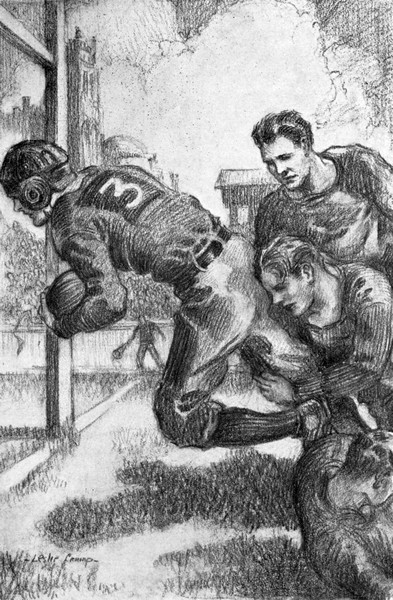
If Wednesday’s practice had been stiff Thursday’s
was adamantine. With the intention of providing
better defense for the drop-kickers the first
team was lined up near the goal and the substitutes
were set against them. With Steve Whittier
and Pep Kinsey alternating at kicking, all the rest
of the first team had to do was keep the substitutes
from breaking through or otherwise interfering
with the kick. Myers was behind the subs
and the manner in which he egged them on to
atrocities of attack proved him, in the minds of
the first team players, a man of singularly cruel
disposition. Friendship ceased and no quarter
was asked. Loring Cheswick at first, and then
Benning, sped the ball to the kicker and simultaneously
goaded by Myers’ commands to “Bust
it up! Get through! Use your hands!” and
“Fight ’em, Subs! Rip ’em up! Block that
kick!” the substitutes hurled themselves ferociously
forward and committed nearly everything
except murder.
Jim received hard knocks that afternoon. One
of the knocks set his nose to bleeding and another
crippled his left leg for the rest of the proceedings.
But he managed to disguise the damage
to his leg, and, of course, a bleeding nose was
a mere incident, and so he managed to stay in
and to give a very good account of himself. And
it seemed once that the Demon Coach, as Myers
was dubbed that afternoon, had determined to
concentrate on Jim until he got results. He sent
a two-man tandem at the right tackle position
until he was finally satisfied that he was wasting
his time. Perhaps he concluded that he was wasting
players, too, for the members of the tandem,
especially the second man, got rather roughly
treated in the course of events! Jim found the
head of the tandem could be thrown off in time
to give full attention to the next comer, and,
while Jim got some hard knocks, he certainly wore
that second man out!
Sometimes the subs did get through and the ball
went anywhere save over the goal, and then you
should have heard Coach Cade become eloquent!
As Jake Borden, right end, remarked, Johnny’s
words were more refined-like but they cut deeper.
Later, when the scrimmage started, Jim discovered
to his dismay that he was playing with the
subs. He jumped to the conclusion that he had
been demoted and felt rather badly, which fact
told somewhat on his playing, and, when the second
team came over and took the place of the
substitutes Jim was one of those who were sent
to the showers. As a matter of fact he had been
placed with the substitute team to strengthen the
right of its line, and retired after the first half
of the scrimmage because in the opinion of Jake,
the trainer, he had seen service enough. But
Jim didn’t know that, and he returned to Haylow
rather down in the mouth.
Friday’s practice was less severe, with the emphasis
on signal drill and the handling of punts
and passes, and the first-string players went
through only a ten-minute scrimmage and were
then sent off. Jim’s misgivings were slightly assuaged
when he read the list of the players who
were to go to New Falmouth the next afternoon
and found his name on it. If he was very bad, he
argued, they wouldn’t pay his railway fare!
Then, feeling more chirpy, he went back to Number
15 Haylow and ran into trouble.
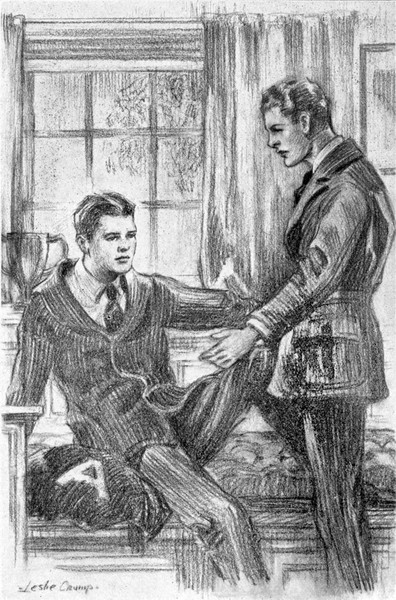
Clem, who had reached the room but a minute
before, was gazing perplexedly at the third
drawer in his chiffonier. He turned to Jim without
greeting to ask: “You haven’t had this
drawer open, have you, Jim?”
Jim blinked and shook his head. “No, Clem.
Why?”
“Well, just look at it, will you?” The drawer
held underwear, stockings, a blue flannel shirt,
a candy box with a piece of red Christmas ribbon
trailing from it, a pair of discarded garters; possibly
other things as well, but Jim’s attention was
held by the number of undergarments in sight
and the general disorder of the drawer’s contents.
He looked inquiringly at Clem.
“Nice mess, eh?” asked Clem indignantly.
“Some one’s been poking around in here. Look
at that box. It was tied with that ribbon. Someone
opened it and didn’t do it up again.”
“Well, I guess I’m the only one who could have
done it if you didn’t,” said Jim slowly, “and I’ve
never been near anything of yours, Clem. So it
looks—”
“Of course you didn’t do it,” answered Clem.
“I needn’t have asked you, only I was so—so
blamed mad—”
“You’re sure you didn’t leave the box untied?”
“Me? Why, there’s nothing in the box but a
lot of old gimcracks”—he removed the lid impatiently
for Jim’s benefit—“and I haven’t had it
open since I put it in there. Besides, hang it all,
Jim, you know I wouldn’t leave this drawer looking
like that!”
Jim wasn’t convinced of it, but he nodded
agreement. “Who do you suppose—” he began.
Then he asked quickly; “Anything missing?”
“Missing? Why, no, I guess not. Gosh, there’s
nothing here any one would want!” He had begun
putting the things in order again, folding
the garments and piling them neatly back in
place. He really seemed more disturbed by the
disorder of things than by the fact that some person
had intruded. “We’ll just have to lock the
door when we go out, Jim. I’ve been here three
years and this is the first time I’ve had anything
of mine troubled.”
“Suppose some one did it for a joke?” asked
Jim.
“Mighty poor joke,” Clem grumbled. “Any
one could come in here that wanted to when we’re
both out, but I don’t see why they’d want to muss
my drawer all up.”
“When did you look in here last, Clem?”
“This morning. I got a pair of socks out. It
was all right then.” Something rattled under his
hand as he spoke, and he picked up a steel key-ring
with five keys attached. “If folks are going
to get fresh this way,” he muttered, “I’d better
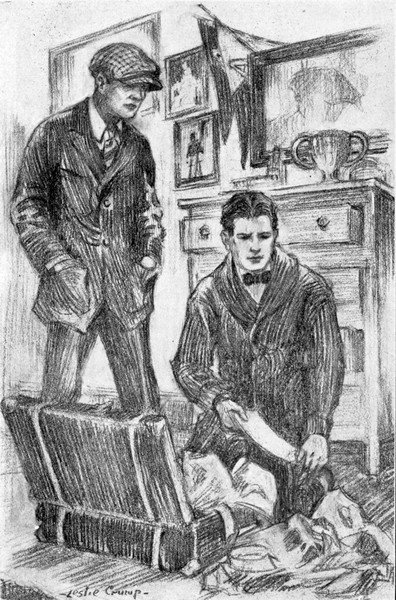
put these somewhere—” He stopped, stared
for an instant at the keys and then swung around
and strode to the closet. From the shelf he lowered
the black suit-case. In a moment he had unlocked
it and thrown the lid back. Jim, watching
over his shoulder, spoke relievedly.
“It’s there,” he said.
But Clem had the folded envelope in his hand,
and it was empty! He looked blankly over his
shoulder. “Well, what do you know!” he ejaculated.
Jim shook his head.
“Sure it was there, Clem?”
“Great Scott, you saw me put it there, didn’t
you? Night before last, or night— Gosh, that
makes me sore!”
“How much was in the envelope?” asked Jim.
“Twenty-seven—no, twenty-two dollars. I lent
you five. That left a two-dollar bill and four
five-dollar gold-pieces. Oh, I don’t care such an
awful lot about the money, but it’s rotten to know
that there’s a thief in the dormitory! Why, it
may be—”
“It might have been some one from one of
the other halls,” said Jim. “Or maybe a sneak-thief
from outside.”
“Oh, it might be any one!” Clem slammed
the bag shut and tossed it back to the shelf. “He
was after those keys, whoever he was, and that’s
the reason he messed everything up so. But
how did he know where they were, eh? The other
drawers are just as I left them. How about
yours? Better have a look.”
“I don’t think they’ve been touched,” Jim reported.
“Guess whoever was in here came while
we were both out this afternoon. How long were
you gone?”
“I haven’t been here since about half-past two,
until just now. I was over at Upton for an hour
or more. Then Carl Stevens and I went downtown.
What time’s it now? Twenty past five?
Well, that’s nearly three hours. When were you
up last?”
“Just before practice. About five to three, I
guess.”
Clem, hands in pockets, stared at the floor and
then flung himself into a chair. “Well, I’m going
to report it. Something will have to be done
if a fellow can’t leave his room door unlocked.
I don’t care a hang about the money, Jim, but I’d
certainly like to catch the sneak that got it!”
Jim, still standing, nodded. “Come to think
of it, Clem, it wouldn’t be hard for a fellow to
walk in the Meadow street gate and go through
a dozen rooms if he found ’em empty. All he’d
have to do would be pretend that he was looking
for some fellow and didn’t know where he lived,
sort of.”
“The way you looked for Dolf Chapin last
year,” said Clem, managing a brief smile. “Still,
he’d have to get past Mr. Tarbot, and his door is
nearly always open and looks right into the corridor
down there.”
“Yes, but I guess he isn’t always in,” said
Jim. “And even if he saw some one he mightn’t
know he wasn’t one of the fellows from another
hall. Gosh, I guess he can’t know more than
four hundred fellows by sight!”
“No, but there’s never been any stealing like
that since I’ve been here,” objected Clem. “Folks
don’t come on the campus unless they’ve got business;
fellows from the presser’s or the laundry
or—and even they aren’t supposed to come upstairs.”
“They do it, though.”
“Yes, I know, but— Now think a minute, Jim.
It must have taken a good five minutes to find the
keys in that drawer—and you can see by the way
things were left that he must have had to hunt
for them—and get the suit-case down and unlock
it and lock it and put the keys back and everything.
An outsider wouldn’t dare take the risk,
Jim. How’d he know that one of us wouldn’t
walk in on him?”
“Yes, it would be risky,” Jim owned somewhat
unwillingly.
“It sure would! No, sir, the guy that pulled
this trick knew that we were both out. I dare
say he watched us go. Then he had all the time
in the world.”
“Yes, but if he had so much time why did he
pull things around so in the drawer? Or why
didn’t he fix them back the way he found them?
He might have known that you’d notice and get
suspicious and miss the money.”
“Probably didn’t think about that. Oh, well,
I’ve got to go down and see Old Tarbox. Come
along and give your evidence, old son. He will
ask a lot of questions, I suppose.”
“Maybe you could make it clearer if you went
alone.”
“Well, he’d want to question you anyway,
sooner or later. Come on.”
So Jim went. Mr. Tarbot, whose suite of study,
bedroom and bath was the first on the right from
the dormitory entrance, bade them enter when
Clem had knocked on the half-open door and the
two filed in. The instructor was reading in a
deep chair set close to a window, but at sight of
Jim he suddenly sat up straight. “I’ve been
watching for you, Todd,” he announced briskly.
“Some one telephoned about ten minutes ago
from the Police Station. I didn’t understand
who he was. One of the officers, I fancy. He said
I was to ask you to come over there directly
you got in. He didn’t say what was wanted. I
hope your conscience is clear, my boy.” Mr.
Tarbot smiled to show that he was joking, but behind
the smile one might have detected anxiety.
Jim stared incredulously for an instant. Then
his face clouded suddenly.
“I’ll go right away, sir,” he replied.
Mr. Tarbot nodded and picked up his book
again. Clem, his mission forgotten for the
moment, followed Jim to the corridor. “What
the dickens do you suppose they want?” he asked
with lively curiosity. Jim shook his head. “Well,
I’ll go along and see you through,” chuckled
Clem. “Nothing like having a friend at court,
old son!”
Jim stopped at the bottom of the steps and
shook his head again. “You needn’t come, Clem,”
he said. “You’d better see Tarbot about—”
“Oh, that can wait. This is a lot more exciting.
Go? You bet I’ll go. Why, I may have to
bail you out!”
After an instant of indecision Jim went on and
Clem fell in beside him, chattering animatedly
to apparently deaf ears. Jim looked troubled,
and by the time they were half-way toward the
main gate Clem noted the fact and, after a second
puzzled glance at his companion, said: “Look
here, old son, if you’d really rather I didn’t go
along I won’t.”
Jim shook his head once more. “No, you
might as well come, I guess. If it’s what I think
it is—”
“What do you think it is?” asked Clem when
the other paused.
“Webb,” said Jim after a moment. “The
fellow I lent the money to. Maybe he didn’t go
away, like he said he would, and maybe he’s got
in trouble with the police.”
Clem whistled expressively. “Bet you that’s
just it!” he murmured. “I didn’t want to say
so, Jim, but I was absolutely certain that was he
I saw that day on West street.”
Jim nodded and they crossed Academy street
in silence and went into State. “Know where it
is?” asked Jim presently. “The police place, I
mean.”
“Yes, turn to the left on West. It’s about
four blocks over and one through. Opposite the
Odd Fellow’s building. Say, if they want money
to let him out, Jim, we’re in a mess, eh?”
Once more Jim nodded affirmatively. After
that conversation was virtually prohibited by the
fact that the home-seeking throngs on the busy
streets made it nearly impossible for the two
boys to stay together. After a five-minute hurried
walk they reached the Police Station, an old
red-brick building with an entrance of granite
steps and rusty iron-railings much too large for
the small, square edifice. Past the doorway, Jim
paused in doubt, but Clem, with a familiarity that
might have seemed suspicious to one of uncharitable
mind, straightway guided him to the right
and into a scantily furnished apartment occupied
principally by a broad oak railing, a large, flat-topped
desk and a large red-faced man in a blue
uniform. There were some minor furnishings
too, such as a few chairs, a telephone, three
framed pictures and a wobbly costumer which
sagged sidewise under the weight of a policeman’s
overcoat.
The big man behind the desk was proclaimed
a sergeant by the insignia on his sleeve and the
letters on the hat that perched rakishly on the
back of his bristly head. There was a cigar in
one corner of his mouth, a much-chewed, down-at-the-side
cigar that gave off rank fumes of
gray smoke and caused the sergeant to close one
eye as he viewed the arrivals.
“My name,” announced Jim in a voice so
fraught with guilt that the sergeant would have
been entirely justified in locking him up instantly,
“is Todd. They said over at school that
some one wanted to see me here—about something.”
“Oh, yes! Sure, young feller. Say, just step
in the next room, will you? That’s the door. The
Captain’s in there and he’ll ’tend to you. Sure,
you can go in, too, if you want.” The latter part
of the invitation was to Clem, who had hesitated
to follow his companion. So Clem trod closely
on the heels of Jim, and they passed through a
heavy door and found themselves in a second
room that was much like the first. Here, though,
there was a brilliantly red carpet on the floor,
the desk was a roll-top, there was an inhospitable
looking leather couch along one wall and the
single occupant, instead of being large and red
of countenance, was tall and lean, with a military
carriage and a healthily tanned face.
“Todd, eh?” he asked tersely. “Sit down,
please. This gentleman a friend of yours? I
see. Very well. I have a question or two to ask,
Mr. Todd. Know a man who calls himself James
Webster?”
“No, sir.” Relief struggled with doubt in
Jim’s face.
“Didn’t think you did, because I guess that
isn’t the fellow’s right name. Know any one with
a name like that?”
“I know a man whose name is Webb,” faltered
Jim. “His first name, I mean.”
“Webb, eh? What’s his last name?”
Jim’s hesitation was pronounced, but he finally
answered, “Todd, sir.”
Clem shot a quick, startled look at Jim. Jim
didn’t meet it. He was staring anxiously at the
police captain.
“Webb Todd? I see. Relative of yours?”
“Cousin; sort of. His mother and my mother
were half-sisters.”
“Not exactly a cousin, then, my boy. Known
him long?”
“Yes, sir, ever since I can remember. Up in
Maine. He lived right near us for a good while.”
“Seen him lately?”
“Yes, sir, twice. Once I met him on the street
and the next time he came to our room in Haylow
Hall. Is—has he been arrested?”
The Captain nodded. “Yes, we took him in
charge about four o’clock. He’s been loafing
around town for several days. He will be up in
court in the morning charged with vagrancy. I
dare say he’ll get off with a suspended sentence if
he agrees to quit town.”
Jim breathed loudly with relief.
“Only thing puzzles us,” continued the Captain,
“is where he got what we took off him.”
He opened a drawer at his side and took out a
small parcel. “Ever lend him money, Mr.
Todd?”
“Yes, sir.”
“How much money?”
Jim hesitated again. “Eight dollars and a
half,” he answered.
“That all?” Jim nodded. “Haven’t forgotten
any?” Jim shook his head. “Funny,” said
the Captain. He opened the parcel, displaying
a soiled envelope with a letter showing beyond
its torn edge, a cheap-pocket knife and an assortment
of coins. Three of the coins glittered
brightly in the light from the near-by window.
“This fellow had sixteen dollars and forty-one
cents when we searched him. Fifteen dollars was
in five-dollar gold coins. We asked him where he
got them. He said”—the Captain eyed Jim intently—“you
gave them to him.”
There was a moment’s silence. Jim was still
staring wide-eyed at the officer. Clem was staring
fascinatedly at the three gold coins. Then
the Captain’s voice came again. “Of course, if
you didn’t give them to him he probably stole
them and it’ll be up to us to find out where. It
probably won’t be hard, for gold-pieces are scarce
and folks who have them miss them if they disappear.
I didn’t believe the fellow’s statement,
because it didn’t seem likely to me that any of
you fellows at the school would have so much
money on hand. Judging from the condition he
was in when we took charge of him, he must have
had considerably more to start with. Anyhow,
that’s his story. Says he was looking for work
and was strapped and asked you for a loan and
you came across with twenty dollars in five dollar
coins. He was lying, eh?”
Silence again. Clem’s gaze was on Jim. Jim’s
was on the bright red carpet. Jim moistened his
lips with his tongue and looked again at the questioner.
He shook his head.
“No, sir, he wasn’t lying,” he said evenly. “I
had—forgotten.”
“Oh, you’d forgotten.” The Captain’s gaze
narrowed. “It’s a bad idea to forget things,
Todd, when it’s the police who want to know,”
he went on dryly. “You did give him the money,
did you? How much?”
“Twenty-two dollars—the last time, sir.”
“To-day?” Jim nodded. “Part gold, was it?”
“Four five-dollar gold-pieces and a two dollar
bill,” replied Jim.
“Quite a lot of money for you to have, wasn’t
it?”
“Yes, sir.”
The Captain stared at Jim a moment longer.
Then his gaze shifted to the collection of coins at
his elbow. He wrapped the paper about them
again and tossed the packet back in the drawer.
“Well, all right,” he said finally. “He says you
did and you say you did, and so I guess that
settles it. That’s all, Mr. Todd. Much obliged
to you.”
“He won’t be sent to jail, will he?” asked Jim.
“Don’t believe so. He ought to be, for he looks
to me like a bad egg. If you like to come over
to-morrow about nine-thirty and speak to the
Judge, I’ll fix it for you. You might say a good
word for the man if you’ve known him so long.”
“I’d like to,” answered Jim gratefully. Then,
hesitantly, “Could I see him, please, sir?”
“I guess so.” He pressed a button on the edge
of the desk and, when an elderly man in a police
uniform appeared, waved toward Jim. “This
gentleman wants to see the nut that was brought
in this afternoon; Webster’s the name he’s entered
under. Just show him down, Grogan.”
Jim followed the turnkey without a glance toward
Clem.
Ten minutes later Jim emerged from the station.
Clem had not waited. Jim made his way
back to school alone, hurrying at times, since the
six o’clock whistle had long since blown, and at
other times slowing to a pace that indicated that
his thoughts were concerned with a subject more
weighty than supper.