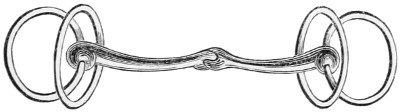
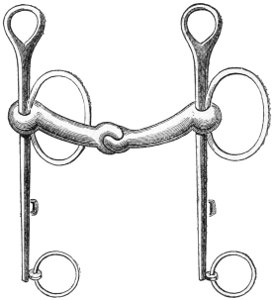
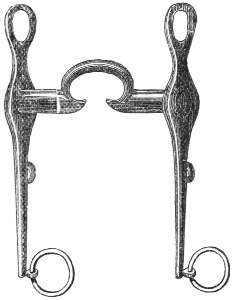
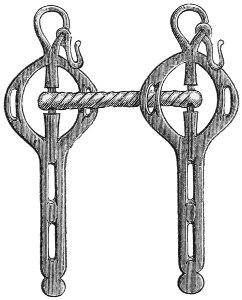
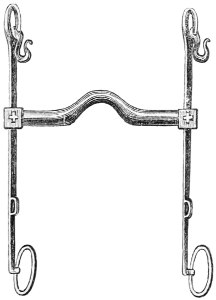
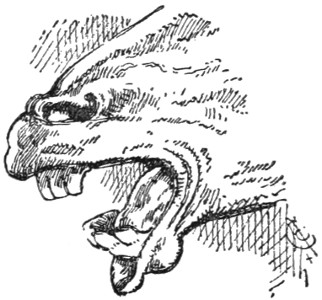
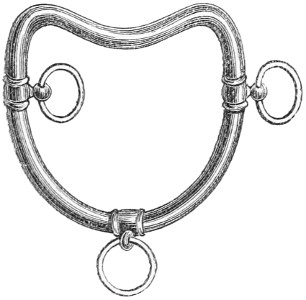
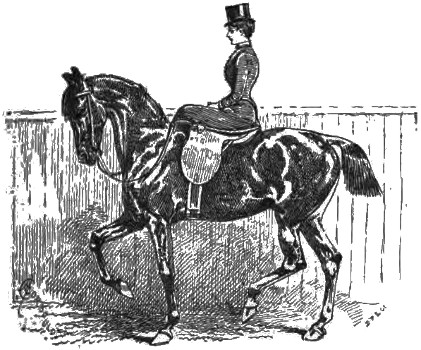
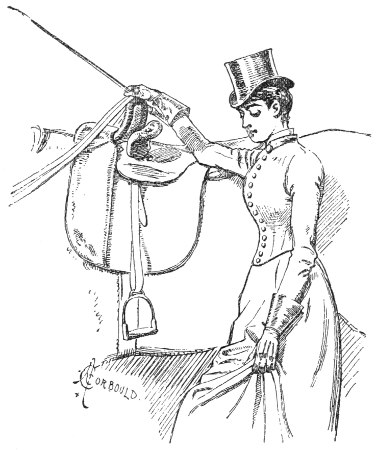
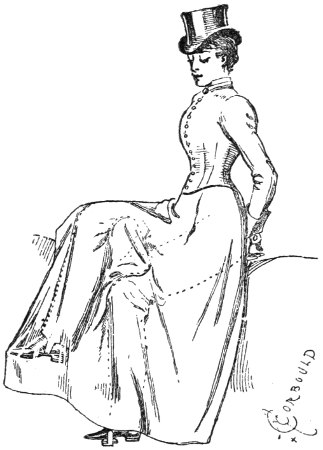
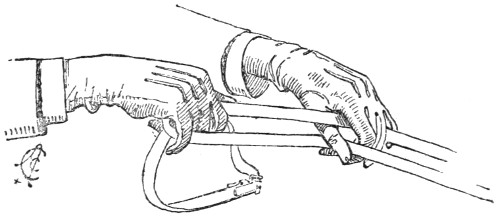
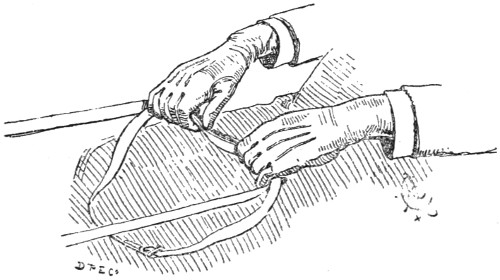
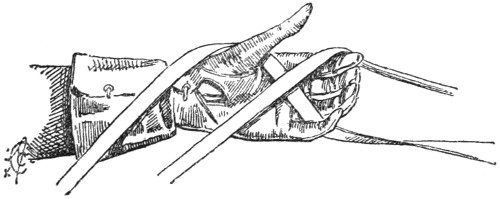
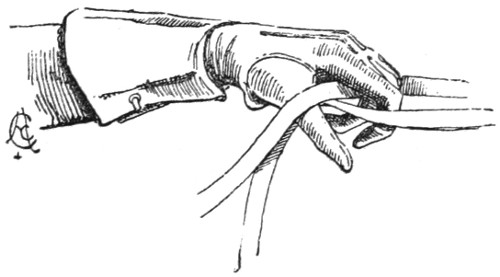
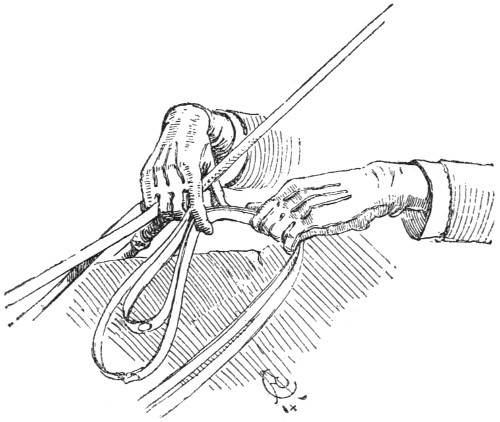
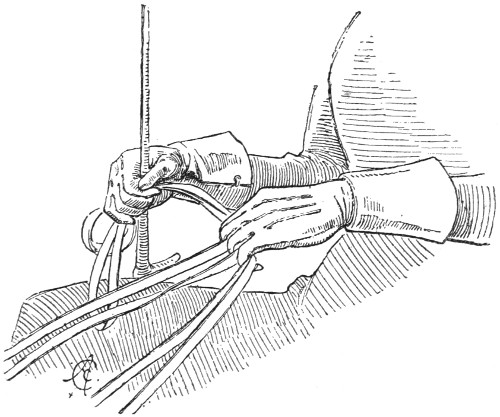
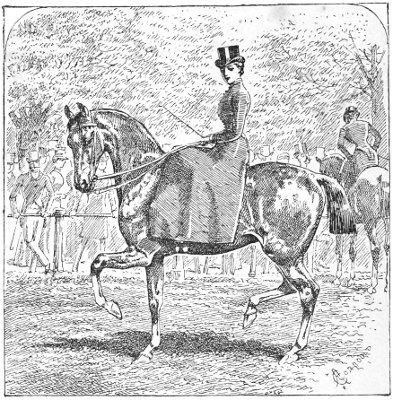
Mouths and Mouth-pieces.—The shape, delicacy, or
toughness of a horse’s tongue does not in the least contribute
towards making his mouth either tender or harsh;
but a difficulty is thrown in the way of bitting when the
tongue is broad in form, because in such case it covers the
bars of the mouth, and so prevents the mouth-piece from
acting properly upon them. The tongue is endowed with
immense susceptibility to pain or pressure, and any undue
compression of it causes intense suffering and fretting, and
entirely obviates the action of the bridle. I consider that
rollers, olives, twists, and all such devices, are not only
useless encumbrances, but are instruments of destruction
as well. The severity or mildness of a mouth-piece is
regulated by the thickness of that portion of the cannons
which acts upon the bars of the mouth. The curb-chain
ought to sit exactly on the beard, or chin, of the horse. If
he is tender-mouthed, it should be left very slack.
Country Riding-Suits for Men.—If you want to ride
in luxury in the country, get measured for a knickerbocker
garment, with continuations in the form of breeches, fitting
perfectly below the knee. This most sensible novelty can
be worn with or without leggings, so that if desired for
rough usage on the moors, the additions can be dispensed
with, or added if wanted for saddle use.
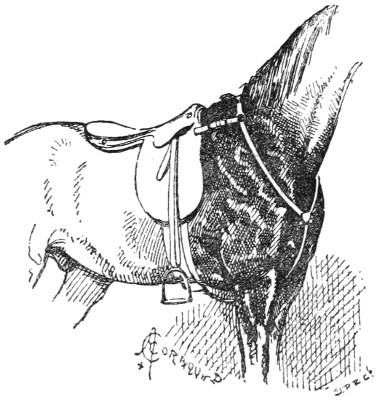
Hunting Breastplates are approved by many keen
sportsmen. I give a sketch of one.
Hustling Horses.—Never hustle a horse at a gap,
or in a crowd, or on any account cram him at his fences.
Give him time. He has, as Major Whyte Melville
used to say, “to carry the bigger fool of the two, and to
think for both.”
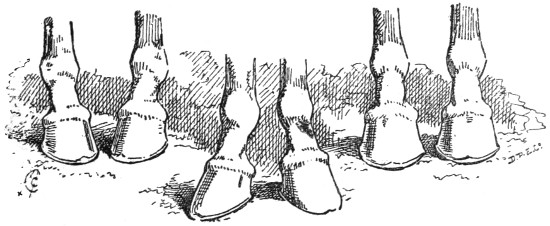
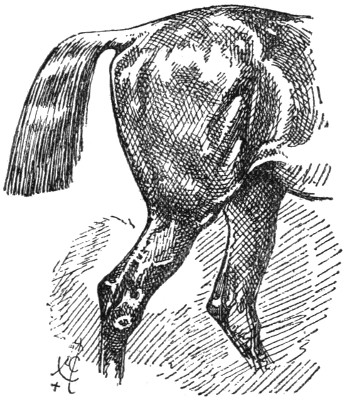
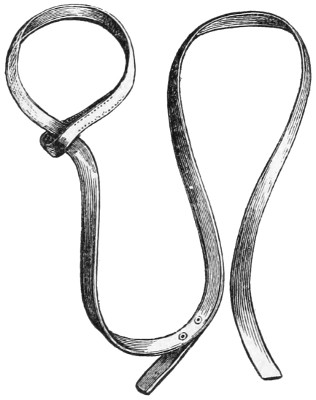
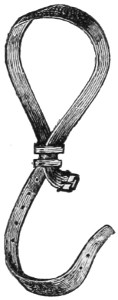
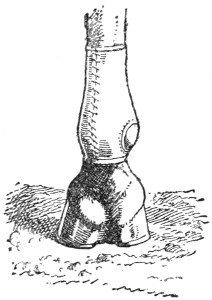
Brushing.—For a horse that “brushes” procure a
leathern boot, the colour of the foot, made of prepared
horse-skin, having the hair left on, and laced up the leg.
On, or just over the seat of injury, a concave piece of stout
leather should be let into the covering, and the hollow thus
formed (which acts as a protector) should be filled up with
a small pad of lint, previously saturated with zinc lotion.
This serves to cure the sore, and also prevents a recurrence
of it. I append a sketch.
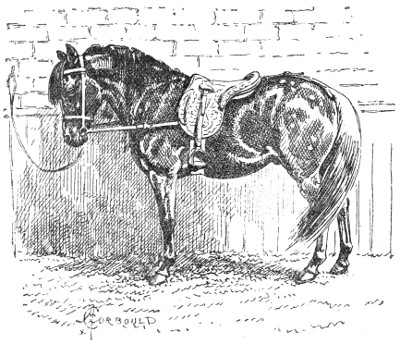
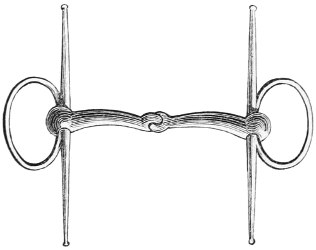
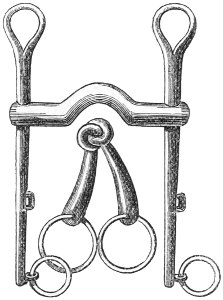
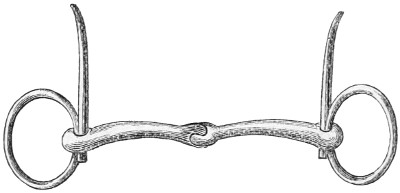
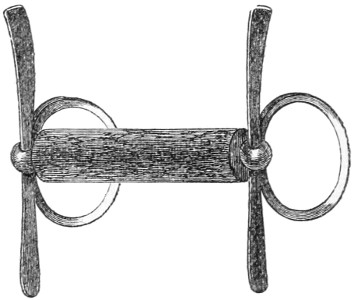
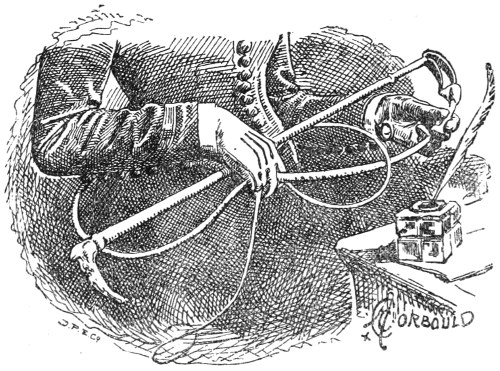
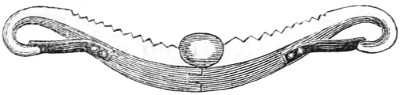
Sawmouth Bridoon.—This is a terribly severe bit,
and one which no good judge of training would permit to be
used among his horses. It is calculated to destroy rather
than to instruct. The illustration shows the nature of it.
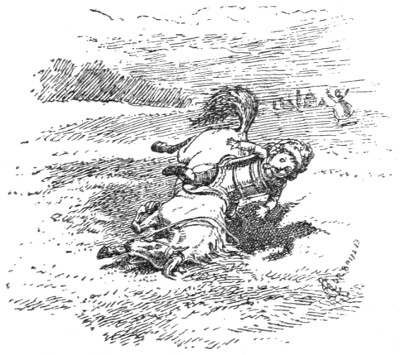
To Shoe a nervous or vicious horse, or a young sensitive
colt, take him to a skilled farrier—one who has a good
temper in addition to his other endowments—and while he
is working, take up your stand at the animal’s head, at the
same side as that on which the farrier is engaged. Hold the
bridle loosely in your hands, dispense with blinkers, and let
the horse see what is going on. You can manage this by
allowing him to turn his head when he tries to do so. Do
not permit any third person to come in the way during the
operation. It is a good plan to stand a horse that is to be
shod close by a wall. If the smith be unfortunately a duffer
at his work, instruct him to smooth the leg downwards
from the shoulder or thigh, as the case may be, lifting it
up and putting it down again, if the horse seems frightened,
and even going away for a moment, and again returning,
in order that confidence may become fully established.
The safest and surest method of overcoming irritability or
nervousness is to exercise a quiet kindness, combined with
a cool firmness of purpose; and to accomplish this end,
one, or at most two, persons, will be infinitely better than a
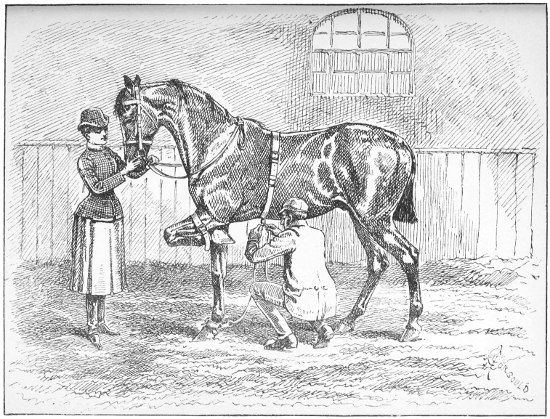
number. The adjoining sketch shows a horse under treatment
on principles of which I do not profess to approve,
although I am willing to acknowledge that there are cases
in which actual vice can only be overcome by severity and
brute force. The custom here depicted of casting an
intractable animal for the purpose of getting him shod is
common enough in almost all cavalry stables, and is seldom
accompanied by any cruelty, save on rare occasions, when
the attendant who carries the whip makes use of it to practical
purpose—a thing net often called for. When a horse is to
be shod thus, the ground about him is usually covered with
sacks, to break the force of his fall; but these the artist has
not thought it necessary to depict.
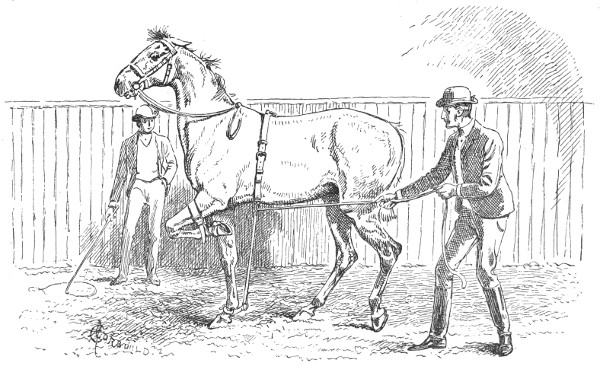
CASTING A VICIOUS HORSE IN A CAVALRY STABLE.
page 310.
Broken-winded horses require regular work, and
regular feeding. A generous diet, composed of oats, beans,
and barley, will be very good for them; and in place of
hay give about six pounds of wheaten straw every alternate
day, with carrots very frequently.
Veterinary Quacks.—No man has a right to be called
a veterinary surgeon who has not a diploma. A pretender
may assume the name—often does, in fact—but quackery
soon expires.
When a Horse clears his Nostrils immediately on
being pulled up, it is a sign that he has wind enough to go
both further and faster in his next gallop. When a minute
elapses the pace may still be increased though not much;
but when two minutes go over without the expected snort,
it is a proof that the exercise has been a little too hard
for the animal’s condition. Remember, when exercising a
young one, that you must not take too much out of him.
Frequent protrusion of the muzzle is a sign that distress is
at hand, and a settled thrusting forward of it shows that
the horse is at very nearly all that he can do.
Restlessness in horses—or temper, as many call it—is
more frequently noticeable in summer than in winter
time, and is caused by the troublesome flies which stick all
over the animals’ bodies. These creatures torment some
tender-skinned horses almost to madness; and when a
stamp is given, ears put back, or a leg lifted as if in pain,
immediate search ought to be made for the occasion of it.
Horses at pasture can, as a rule, defend themselves with
their teeth, feet, and tails: that is, when the latter appendages
are left them; but in this country, so eminently the
seat of wisdom and freedom, the effective instrument is
invariably removed, and Nature most unfairly handicapped,—as
if the sorrows of servitude are not sufficiently great
and numerous without augmenting them by caprice.
Bales are simple bars of wood, used largely in cavalry
stables to separate the horse-stalls. They are furnished at
each end with iron links, by means of which they are suspended
to hooks fastened at the head and heel-posts.
Sometimes they are made of iron, but well-seasoned oak
is quite sufficiently strong for the purpose. The usual
dimensions are eight feet long, and four inches in diameter,
and they are placed at a distance of about three feet from
the ground. The top part may be a fixture; but one end
or the other ought to be so arranged that in case of a horse
getting partially under it when lying down, it will move
readily upwards, according as the animal pushes it in his
rise. I have a strong objection to bales, because they
admit of horses biting and injuring one another, and are in
other ways undesirable; but that they are cheaper than
travises, I am, of course, prepared to allow. It is, however,
almost their sole claim to notice.
An idle Groom is generally an eye-server. The wisp
is oftener in his hand than the brush. When a horse does
not look amiss on being brought to the door, and yet that
his skin leaves a dirty whitish stain on the fingers when
they are pressed into it, the fact is proved beyond all doubt.
Thin-skinned horses will not stand a curry-comb; nor is
it necessary to use one where good strong brushes are
supplied, and made a proper use of.
The Curry-comb, when employed at all, should describe
a sweeping movement—never a rubbing one—and the
utmost gentleness should always accompany the using
of it.
When the proper Grooming of a horse is neglected,
he suffers in consequence. Lice, for instance, are never seen
in animals that are even moderately well taken care of;
but when once these pests appear, the spread of them is
amazingly rapid. Nothing but care and cleanliness will
eradicate them. Make a strong lather of black soap, wash
well with it, then again with clean water, and finally anoint
the patches where the lice are with a little mercurial ointment.
If they have spread over the surface of the body,
make a strong decoction of tobacco, and smear liberally
with a sponge. The same treatment will do for dogs.
To remove the soft coating of Hairs that grows
on the inside of a horse’s ears is not only unnecessary, but
is absolutely cruel. It has been furnished to the animal as
a protection against dust, flies, and dirt; and when taken
away, the ears are left exposed to the influence of the three
combined. All appearance of untidiness may be done
away with by holding the ear in the left hand with the
edges of it nicely evened, and then clipping lightly along
them with a sharp scissors. I would never on any account
permit nose-hairs to be clipped, or otherwise removed.
Horses are immensely sensitive to any interference with
them, and for sundry reasons they ought not to be
meddled with.
A Horse that is Cast under the Manger cannot
possibly rise until he is drawn backwards by an attendant.
Every time that he attempts to get up he strikes his
head, and is thus brought forcibly down again. In a
properly-constructed stable such a thing could not, however,
occur.
Old-Fashioned Mangers ought to be boarded in, so
that no hollow may exist under them.
Filling Horses’ Feet.—I am totally against this
system, but, when those who are partial to it are bent upon
carrying it out, they should see that it is done with fresh
moss, soft and very damp, pressed well into the feet, and
tucked away on the inside of the shoes.
The Semi-Military and Travelling saddle is made
to fit any horse, and is in great request among officers
serving abroad. Peat & Co., of Piccadilly, have patented
it, and the sealed pattern is at the War Office.
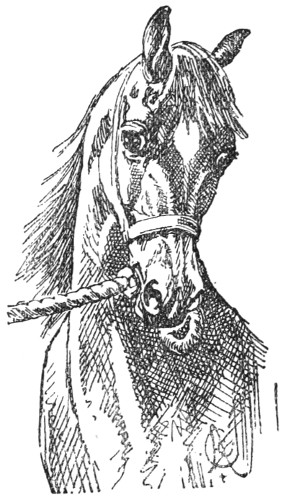
Biting the Collar-Rope.—If you want to see a horse
do this, leave him a rope about two or three feet too long;
shut him up in a close stable, and give him nothing to do.
It is not a vice, but rather one of the many signs of
weariness and idleness in which dumb animals indulge. I
append a sketch of a rope-biter.
A Horseman’s Skill in the management of his bridle-hand
consists in the discretion with which he makes the bit
be felt. It ought never to be used too severely, and its
effects should be moderated by the mildness and pliability
of the hand.
When Boiling Grain of any kind, give it plenty of
water, and keep it constantly stirred. If you neglect this
necessary precaution, it will stick to the bottom of the boiler,
and the burned part will acquire a nasty nauseous taste.
According as the water evaporates, add a fresh supply.
Never let the liquor boil over; it is a great waste to do so,
as it contains a large amount of nutriment. Oats will
need more boiling than beans; these latter more than barley,
carrots and turnips more than potatoes. Four measures of
oats, boiled and bursting, will fill seven measures; four of
beans, something over eight and a half; while four of barley
will fill quite ten. I have proved all these statistics in my
own stable.
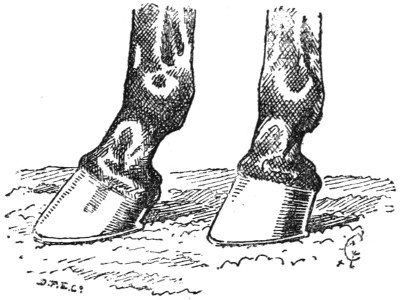
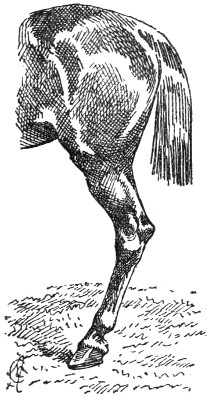
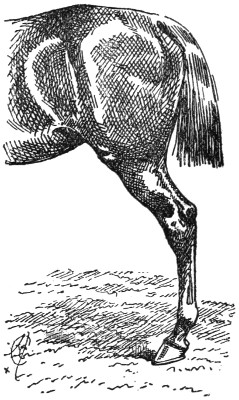
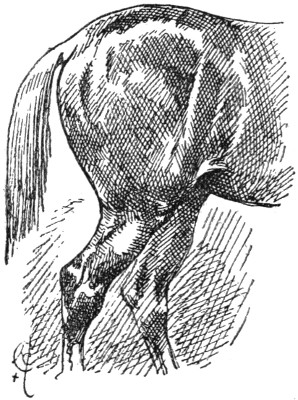
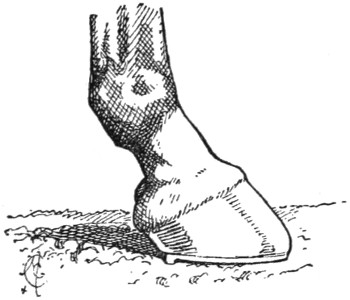
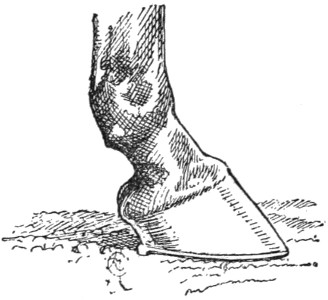
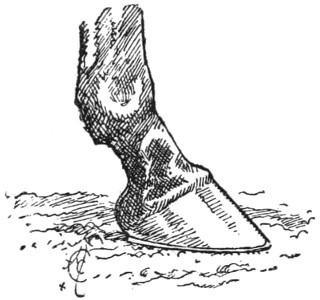
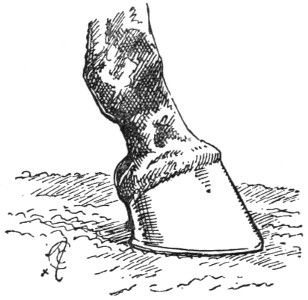
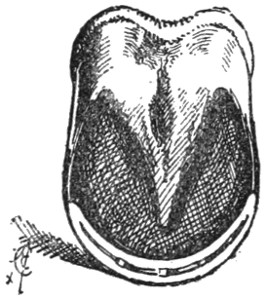
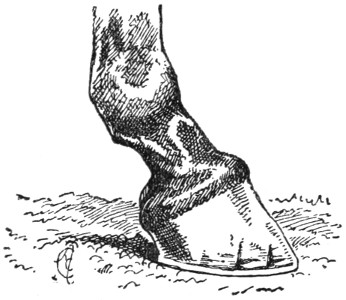
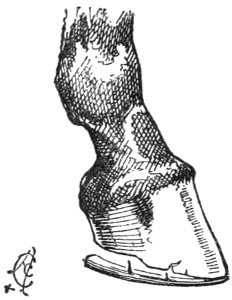
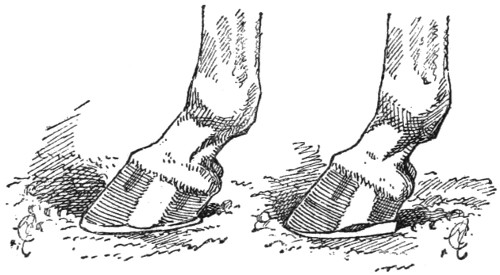
False Quarter is a defect of the outer wall of the
foot. I give a sketch of the only possible relief for it.
Rick in the Back will necessitate the throwing up of
the sufferer for at least six months. He must be placed in
a roomy stall, the hair over the seat of injury be carefully
removed, and the place kept moist with cloths dipped in a
lotion composed of tincture of arnica two ounces, and water
one pint. Soft nourishing food must be given, but no
medicine on any account whatever—the restoration to
finish with liquid blistering of a judicious kind.
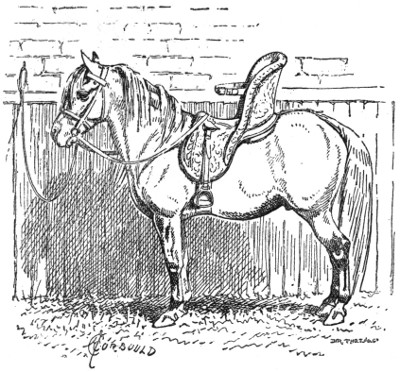
The safest Arrangement for Side Saddles, to
avoid risk of being hung up, or dragged after a fall, is that
adopted with “the level seat saddle,” by Messrs. Nicholls of
Jermyn Street. They have patented a bar for the stirrup
leather, extremely simple in construction, and which will
instantly disconnect it, should a rider have the misfortune
to get her foot caught when falling over the off-side of
the saddle. An elastic safety-band, stretched across the
heads, will, when a fall occurs, prevent the habit catching
on the saddle,—and the unpleasant predicament of a horse
galloping about, with his rider suspended by the skirt,
head downwards (as witnessed sometimes in the hunting-field),
will be avoided.
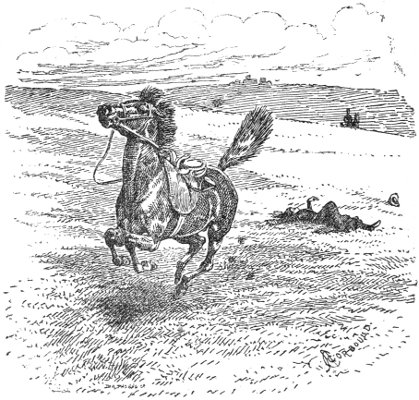
Take a Pistol with you on all occasions when going to
hunt, and in case of hopeless injury occurring to your
mount, make use of it, with all the quietness and celerity
you can command. Horses, when left to themselves,
rarely meet with mishaps; it is, therefore, only fair
that their riders should protect them against unnecessary
torture.
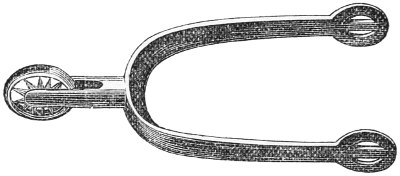
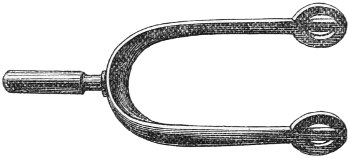
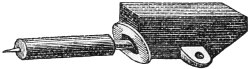
Ladies’ Spurs.—I have pleasure in appending sketches
of the only three of these—that I know of—that are manufactured
for ladies’ use. The Sewarrow is, I think excellent.
Lady equestrians frequently use a small pair of
hunting spurs of the shape worn by men—the right one
having a knob in place of a rowel. These are used with
Hessian boots, and look well when dismounted. The spike
of the spur is in all cases made amply long to fulfil its
purpose; to wear one of immoderate length would necessitate
having it made specially, and could not effect any
good. I like “box” spurs myself, and have always worn
them; but there is nothing objectionable in the strap, and
it has the advantage of being readily adjusted to any sort
of boot, whereas boots fitted with box spurs are generally
costly articles.
Crib-Biting may be prevented by removing all woodwork
from the vicinity of the horse, and if he persists in
gnawing his stable-partitions, smear them well with aloes,
and he will soon desist.
“Dishing” is a common expression among horsey
people. It signifies throwing out the forelegs in a kind of
side manner, which looks badly in the trot. I have seen
some very good horses do it, but it would certainly be
called defective action. To “dish” with one foreleg only
is a very frequent thing.
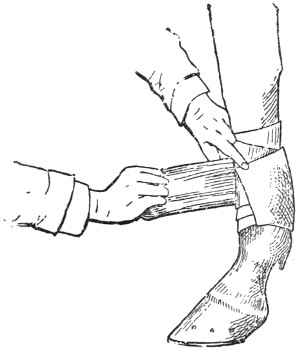
Bandaging.—When a horse’s legs have to be bandaged,
it is a good plan to coil the bandages completely round
the pastern, close to the hoofs, winding them around the
legs in spiral form (each coil overlapping the other) until
the legs are bound up to the knees or hocks, where the
bandages are secured. The pressure must be equal, and
not too tight. The strings should admit a finger after
being tied. I have never found a horse so treated attempt
to lie down, and it is far less irksome to an animal than
being tied up by the head.
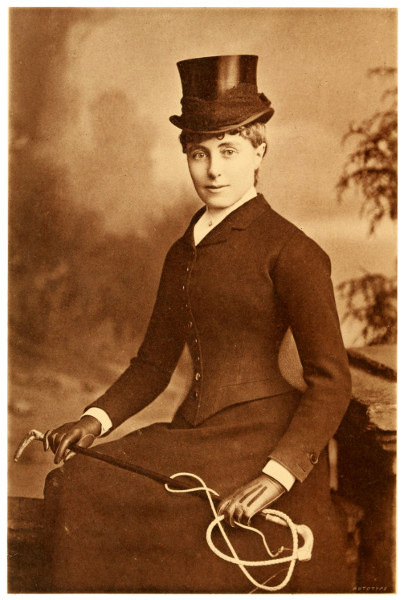
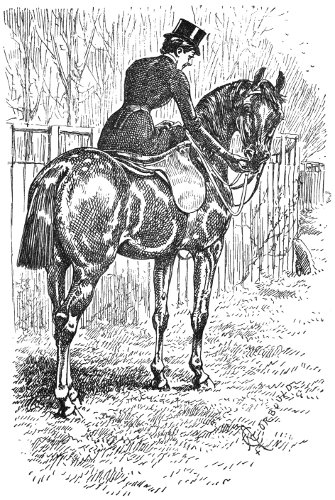
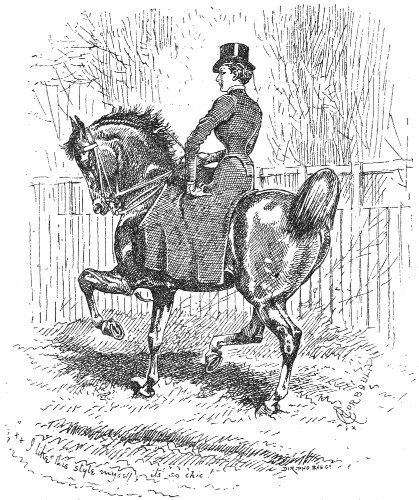
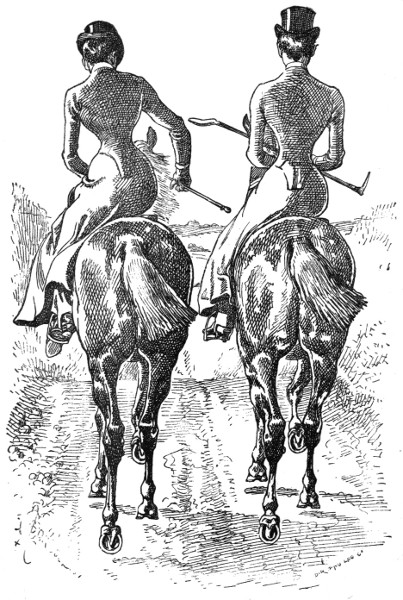
Habit-cutting is now perfection at most of the high-class
London houses. Bodices are exquisitely made—some
with stand-up collars, others slightly lapelled, to
show a portion of habit-shirt or tie. The backs are cut
with long seams, and the buttons placed low, so that even
a naturally short-waisted figure appears the contrary, being
lengthened and improved. The shaping in front is excellent.
The skirts are so artistically cut and seamed that
they fit at the back as closely as a man’s hunting breeches,
while the shaping at the knee is supplemented by a most
artistic and novel arrangement underneath, a sort of hollow,
into which the up-pommel fits completely, thus obviating
the necessity of having folds of cloth lying between the
right leg and the saddle. These skirts, held back by the
hand when the wearer is dismounted, look neat, and are of
convenient walking length.
Wall-licking.—If a horse shows a tendency to this,
leave a lump of chalk in his manger. A piece of rock-salt
left there as well will never be amiss.
Signs of Megrim.—When a horse suddenly throws up
his head, and holds it in the air and on one side, be assured
he has a megrim, and will be in danger of falling if driven
further without a stop. Pull up at once, and if cold water
can be had anywhere within reach of you, dash a bucket of
it over his head and neck.
Benumbed Leg.—When, for taming purposes, a horse’s
leg is strapped up for any length of time, it becomes
benumbed, and ought, when let down, to be rubbed
vigorously before the animal is allowed to walk upon it
If this is not done he will probably fall.
Hints for Amateur Jockeys.—The moment you
know that you are beaten in a race, pull up. You can gain
nothing by flogging your horse to the finish. If going well
and gamely, let him alone; if not, catch him with both
hands, and give him two or three kicks with the spurs, I
never advocate waiting, unless the mount is a very game
one. Jump off with the lead, and hold it as long as you
can.
Age Symptoms.—A horse that has passed his fourth
year has four incisors in each jaw, all fully grown.
A Seated Shoe signifies a regular, or ordinary, shoe,
which has only as much upper surface left as will admit of
the crust resting upon it.
Hiring Horses.—Windsor, Cheltenham, and Oxford
are about the best places I know of for jobbing light-weight
hunters. When an animal is found to suit, it ought to
be at once secured for the season. Horses can be had
at Barnstaple for Exmoor. Oxford is within reach of five
packs of fox-hounds. Capital hunting quarters can be
had there, and excellent horses—cheap too, in vacation
time, as there is not any one to ride them.
Defective Vision.—A horse that has any defect in his
sight should be at once rejected by the buyer. It is the
only safe way in dealing, unless the desire is to buy a blind
animal at a blind price. There is generally a plausible reason
given for every suspicious appearance, whether it be a
sightless eye or a pair of broken knees.
Blinkers.—I greatly disapprove of these for breaking.
Let the colt or horse see what you are doing. In
this I am aware that many disagree with me, but I usually
hold to my opinions, as I do not form them in a hurry.
Amateur Blacksmiths.—If you want to be independent
of the forge when frost sets in, you can do it in
this way. As soon as the hunting season has fairly
begun, have your horse’s shoes made with square holes
punched at the extremities and at the toes. Have these
fitted with slightly tapering plugs of steel, with sharp projecting
points. The plugs should be about two inches in
length, and must be made to fit the holes both accurately
and tightly, but not to go quite through the shoe to the
foot. When frost appears, and you want to go out, insert the
plugs yourself in the holes, tap them slightly on the points
with a hammer, and when the horse puts his weight on
them it will drive them “home.” The plugs will last for
three or four days, and are both cheap and easily renewed.
When you require to take them out, another quiet tap or
two (delivered a little at the side) will start them, owing to
the taper on the part that fits into the shoe.
“Hot Fitting.”—I entirely approve of this, when
properly conducted. It would need a very lengthy application
of a hot shoe to affect the hoof to any depth—quite
four minutes to cause a marked increase of temperature
in the upper part of the foot—while, in reality, the hot
shoe is not usually applied for more than three or four
seconds.
Temperature of Stables.—The average temperature
of a stable should be about 48° F. Never clip until the
whole of the winter coat has appeared—then do it once for
the entire season. Leaving the saddle-place unclipped will
be more likely to provoke galls than to prevent them.
Supply of Hay.—Six pounds of hay per diem is quite
sufficient for a horse, when plenty of other food is given.
Too much hay is a mistake.
Quartern.—Everybody knows that this weighs 2½ lbs.
Stable Forks.—Do away with steel, and use wooden
ones.
Shoes.—A set ought to last four weeks, unless the work
be constant and the going very hard.
Hunting Scarlet.—Do not don red in the hunting
field until your “salad” days are over. It is a remarkable
colour, and of late many excellent sportsmen have discarded
it altogether. This may, perhaps, be owing to the fact that
ladies are putting it on! Two fair Dianas who ride very
straight with the Meath hounds adopted scarlet last
season, and doubtless many more will ere long follow
suit. It is not to be admired, in my opinion, and can
scarcely fail to remind the beholder of things usually
associated with street-organs and itinerant grinders of
these instruments!
“Unknowing” Ones.—Ignorance concerning horsey
subjects is quite common among ladies who are otherwise
well educated, and, indeed, highly informed. Mrs. Beecher
Stowe relates of herself, in her ‘Sunny Memories,’ that
when dining one day with Earl Russell she spoke of hunting
as “a vestige of the savage state,” when, to her great astonishment,
she saw laughter on all the men’s faces. No
wonder. Fox hunting, or rather riding to hounds is an art
not yet a century old. Two of our most popular authoresses—I
might, perhaps, say the two most popular—make
such egregious mistakes on the subjects of hunting, racing
and betting, that men laugh, and women who know, say,
“What a pity it is!”
Hunting Centres.—A young Londoner cannot do
better than try his hand with the Surrey Foxhounds, or
with one of the Kentish packs. The hills of Surrey afford
good hunting ground, despite the flints, and the superfluity
of coverts.
When a Horse is Collar-shy, or nervous about the
adjustment of the crupper, have the latter made to unbuckle,
and procure a collar that opens at the top. This is, of
course, in case of being unable to reassure the animal by
kindness. Put beating and scolding entirely aside; they
have probably led to the evils that have to be cured.
The Foot “Home” in the Stirrup was for long a
favourite theory of mine, and one which I myself practised—especially
when travelling long distances, or going the
pace,—but then, I always rode in a plain little racing
stirrup, made sufficiently wide to enable the foot to work
easily in it, so that there was no possibility of its “sticking,”
or proving otherwise dangerous. Finding, however, that,
despite repeated warnings, ladies would persist in adopting
the various forms of so-called safety-stirrups, in which the
foot was absolutely embedded, the stuffing over the instep
helping to tighten the hold, I thought it safest and most
conscientious to discard my theory altogether and advocate
riding from the ball of the foot. To keep perpetually
saying, “Do as I do,” partakes rather of the egotistical and
self-sufficient, even where one may fairly add, “And no
harm will ensue,”—but if, added to this, there is apparently
a strong desire on the part of those spoken to to have
their own way, it is surely wise to offer them such directions
as will best obviate the chances of mishap. Here,
for instance, is an example of my meaning: Suppose that I
am in the habit of reading in bed, using a safety-lamp for
doing so, and I discover that it is a practice in my household
and elsewhere for others to read by the light of a half-burnt
candle, insecurely fastened into its socket in the
candlestick, and laid perhaps upon the pillow,—will it not
be better and safer for me to decry altogether the practice
of night reading, than to keep perpetually urging (without
hope of success) that safety-lamps ought in all cases to
be adopted?
When a Carriage is kept covered in a coach-house,
the cover ought to be constantly aired.
Never permit Water to Dry of itself on a vehicle, or
it will certainly leave stains.
Aprons, Heads, etc., that are composed of enamelled
leather, should be washed with soap and water, and rubbed
well with linseed oil—the former being constantly unfolded,
and the latter kept fully stretched.
Moths can be prevented from settling in the linings of
vehicles by mixing camphor and turpentine in a saucer,
and placing it inside, with all the windows drawn up. The
evaporation of the mixture will serve the purpose well.
Bolts and Clips of vehicles should be constantly looked
to, and tightened if loose; and all repairs should be done
at once, nothing being allowed to lie over.
Horse-collars should be so made that the weight
attached to the traces shall be distributed over the surface
of the shoulders when pulling, not concentrated on one
point, or, almost as bad, perpetually rubbing up and down.
A collar cannot be considered fitted, simply because it
appears all right when the horse is standing still. Set him
going at a good pace, and then judge of it. If he be a high-crested
animal, he will probably need a collar quite two
inches longer than seemed necessary when he stood at
ease. If the traces are attached too low to the hames, they
will draw the collar away from the upper part of the
shoulder. This can only be remedied by shifting the point
of the draught, till a proper bearing has been obtained.
Bencraft Hames.—There is sometimes immense difficulty
in fitting horses that are peculiarly shaped with
collars that will not gall them; in such cases the above
may be tried, as by using them the draught can be shifted
to suit the shoulders or the height of the wheels. They
have an awkward appearance, but nevertheless serve their
purpose admirably.
Shaft-tugs should be of a length to suspend the shafts
at exactly the correct height, by which I mean the centre of
the swell of the pad-flaps, measured both ways. When the
shafts are much bent, the tugs must be shorter than if
ordinarily straight. The traces must be of proper length,
otherwise the correct horizontal position of the shaft-tugs
cannot possibly be maintained. When too short the motion
of the horse forces tugs and pad forward, thus drawing the
crupper uncomfortably tight—and when too long, the
vehicle is drawn by the tugs instead of by the traces. It is
rare to sit behind a horse that one can pronounce properly
harnessed in every particular.
A Kicking-strap will be worse than useless—it will
chafe and irritate—unless properly put on. A strap that is
either too light or the reverse, or that passes in a direct
line from shaft to shaft, had better not be used at all. It
ought to be just loose enough, nothing more, to allow of
the horse travelling without feeling chafed by it, and should
be fastened at least two inches behind the hip-bones, as a
loin-strap would be.
Fitting the Bit to the Horse’s Mouth.—This,
as I have already stated, is an advisable plan. A Buxton
or Liverpool bit is commonly employed in harness, but
if a horse has a light mouth, he may travel well in a
snaffle. Buxton bits are made without ports. Experience
will tell whether the reins ought to be buckled to the
cheek or to the bars. In my opinion, almost all horses
go well in properly fitting bits. I altogether disapprove
of the enormous affairs with cheeks eleven inches
long, and weighing quite two pounds, which ignorance
sometimes makes use of. I believe that comparatively few
animals require bits of larger dimensions than one and
three-quarter inches for the upper cheek, and three and a-half
for the lower. This latter ought never to be more
than double the length of the upper portion. Even when
the reins are fastened to a ring below the cheek, the weight
of the projecting arm will effect the leverage of the entire
affair.
Horses addicted to Running away frequently lay
hold of the cheek of the bit; it is a fault in large measure
cultivated by using bits that are too broad for the mouth.
To avoid it, the cheeks might be bent backwards, after the
Wimbush pattern.
Correct Bitting gives control in harness without inflicting
pain. Any suffering that cannot be got rid of by the
horse dropping his head to the right position, is barbarous
cruelty, however it may be glossed over or concealed. Half
the horses that one sees in London and elsewhere, poking
their chins in an unnatural manner, are made to do so
by the use of powerful bits and severe curb-chains—yet
ignorance cannot be brought to see it, although the evils
of it are frequently and earnestly set forth.
Blinkers are generally considered indispensable adjuncts
to harness. Why, I do not know.
Bearing-reins are only tolerable when the snaffle bit is
suffered to hang well below the corners of the mouth, and
when the reins themselves are of such a length that the
instant the horse lifts his head and sets off, they become
amply slack. I cannot at all see why they should be
thought an absolute necessity for draught purposes, when
not used in the saddle. There are, of course, cases in which
they are advisable; when, for instance, extremely nervous
or badly-broken animals are of necessity driven through
crowded thoroughfares; but otherwise I cannot believe
that they are either necessary or ornamental.
Fashionable Coachmen concoct an instrument of
torture by drawing up the gag-bit until the horse’s mouth
is dragged back quite two inches: a curb much too
long and very much too wide being next added, and
strained up to the last extremity of tightness. The cruelty
of ordinary bearing-reins is unspeakably great, and to
the use of them may be attributed the loss of sight in
many fine young horses—undue pressure on the glands that
lie just under the angles of the jaws being the fruitful cause
of this melancholy evil.
Nagging at a horse’s mouth when driving him is a most
objectionable practice, and one that is, unfortunately, too
generally indulged in. If an animal appears sluggish, the
driver finds it easier to rouse him temporarily by means of
chucking at his mouth, than by either a suitable use of the
whip, or an investigation into the general state of his
health: a low or disordered condition of which is far more
frequently the cause of sluggishness than the “roguishness,”
of which helpless animals are often wrongfully accused.
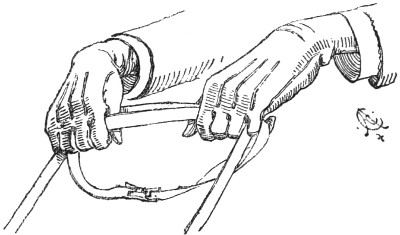
In Driving a Pair the arrangement of the coupling-reins
is a matter of vast importance; for, should one horse
be naturally faster in pace than his fellow, the whole comfort
of the drive will depend upon being able to regulate
the two animals to the same rate of going. To do this the
coupling-rein of the fast horse must be shortened by bringing
the buckle closer to the driver’s hands, so that a pull
will act on him before checking in any degree the speed of
the other horse. Coupling-reins should come to within six
inches of the driver’s fingers. I have seen a pair of runaways
stopped in a short time by laying a firm hold upon
the two inside reins, and dropping the outer ones.
Cantering in Harness is a very common fault, and can
only be stopped by pulling up and starting afresh at a trot.
A canterer in double harness may be controlled by putting
on him a pair of single harness-reins, as well as the double
ones.
Tandem.—I am not an admirer of tandem, but it is a
good way of exercising saddle-horses in the summer time,
and keeping them in condition. They should be always
placed as leaders. Steady, powerful harness horses will be
best to use as wheelers, the comfort and safety of the driver
being dependent upon their paces and behaviour. A leader
should be full of courage, and go always in the collar and
up to the bit. An improvement that I have been told of
for tandem-harness is to have three bars fastened to the
shafts: an effectual means of preventing the leader from
stepping over the traces.
Position when Driving.—I strongly object to the
standing position—as though merely leaning against the
box-seat of the vehicle—which many gentlemen-drivers
adopt. I believe that such an attitude must leave the
driver almost powerless to assist or resist his horses. The
position when driving should be firm, upright, and decided;
the elbows hanging at ease, close to the hips, but not laid
against them; the arms nicely rounded, and the hands held
at a moderate distance from the body. Nothing can be
worse than seeing the arms of the driver dragged forward
by the action of the horses that he is meant to control;
nor can anything be much more objectionable than flinging
up the wrists when coming to a stop, instead of shortening
the reins by passing the right hand quietly in front of the
left.
Really First-class Drivers rarely trust to holding
the reins in one hand only, even in single harness; or, if
they seem to do so, the right hand is ever ready to be laid
upon the off or right hand rein, while the forefinger falls
naturally upon the near one; by this means a gentle
pressure can be exercised either by it or by the exterior
angle of the hand which rests upon the off leather. A good
coachman will always at starting take the reins in both
hands; and animals ought to be trained to start slowly and
collectedly—not with anything that resembles a jerk. The
“show” in which some drivers delight to indulge, both at
starting and when the horses are at rest, by first flicking
them with the whip and then pulling them sharply up, cannot
be too strongly deprecated.
The Whip, although esteemed a necessary adjunct to
driving apparatus, should be used as sparingly as possible—more,
in fact, as an instructor, than as a means of inflicting
punishment. There is nothing nicer in driving than seeing
the whip in rest, and the horses, fearless of its severities,
going gaily up to their bridles, restrained by a master hand.
To be able to drive a Team is not considered a great
feat by many men, or, indeed, by some women, in these
latter days; but of course there is driving and driving—both
of different sorts. I approve of studying under a
first-class wagoner, and being guided entirely by him. To
be a good four-in-hand driver requires courage, coolness
temper, decision, quickness, strength and clearness of sight,
flexible hands, and good staying power in the arms and
back. I have seen but one woman in my life who was able
to drive a team of full-sized horses in best English style;
and I can only recall the names of seven or eight men who
could do so. Hundreds, of course, attempt it, and satisfy
themselves that they are doing splendidly; whereas, the
contrary is, as a rule, the case. Team-driving is not
suitable work for ladies. The mere exertion of holding
four free-going horses for even an hour at a stretch is
so great that, unless the muscles of the arms have been
strengthened by sculling, practising with dumb-bells, or
other gymnastic exercises, the driver will be thoroughly
done up, and at the mercy of any mischance that may
occur, before half the journey has been got over. A strong,
firm-handed, full-muscled man, with a cool nerve, a quick
eye, and his heart in the work he is engaged at, will make
the best driver of a dashing four-in-hand. The “golden
youth” who stand bolt upright against sloping cushions,
curling and uncurling their whips, touching up leaders
that need no touching, or letting them get out of hand—and
double-thonging steady-working wheelers, are simply
objects to laugh at, or to pity, or both.
To wield the Whip in a workman-like manner may
be practised without horses, by sitting at ease on an
elevation, with a good instructor close at hand. There are
correct uses for every part of it, down to the very point:
a proper position for the stick, and proper ways of using it
at various lengths—all of which have to be learned; and
nobody can be called a coachman who is not intimately
familiar with them—so much so that he can carry his whip
without apparently thinking about it, and hold it, use it,
and curl it, as if by a kind of instinct—precisely as all
these ought to be done.
A Team should be trained to Stand perfectly still
until the driver gives the word to go. A restless, uneasy,
shuffling, while the apron is being adjusted, the whip taken
up, and the reins gathered, is both unsightly and unpleasant.
The Wheelers in a four-in-hand coach ought to start it
and turn it round, without the leaders ever feeling the
traces; and they ought to stop the vehicle with the traces
of the leaders resting quite slack.
A good Driver will have his leaders so in hand at the
start that when they move they will be out of the collars,
and entirely clear of the splinter-bars.
Practice should be on level ground, and on roads devoid
of traffic. None save really first-class drivers ought ever
attempt to pilot a coach through a crowded thoroughfare.
Plenty of novices do it, and delude themselves with the
notion that they are driving beautifully, when in reality
they are only clearing the road—for, as a rule, people
leave a passage for a four-horsed coach, chiefly I fancy
through fear of being run down by it if they don’t speedily
get out of its way.
Driving a Team is, on the whole, very far from child’s
play, and it needs a smart wagoner to know and carry
out all the nice points of the art: how, for instance, to make
the wheelers work, when to put on the drags, when to run
down without them, how to regulate the pace, especially
when descending a steep decline, how to go nicely and collectedly
over the tops of all hills, whether great or small,
with numerous other minor matters, which study and
practice can alone teach.
Fourteen miles an hour is a tremendously fast pace
for leaders to trot. Such a rate of going would necessitate
that the wheelers should gallop. Speed is, I always think,
far less necessary than stamina in a four-in-hand team.
A well made up quartett, of which every horse has two
good ends, ought to travel from London to Epsom at a
fair steady pace, and come back in the evening in spanking
style.
A Team that will Trot briskly up the hill to the
Star and Garter at Richmond at the rate of, say, eight
miles an hour without the whip, may be pronounced a real
good thing.
If Four Horses cannot be matched in height, I
advocate conceding the difference to the wheelers. Age
will not matter very much—nor will colour—for merely
useful work; but go and action are all important.
A Good and humane Driver always looks to the condition
of each horse separately, when halting after a long
drive. An oatmeal drink with the chill taken off, and an
abundance of water splashed about the legs, prove great
refreshers. Exhausted horses are immensely benefited by
getting a scrape down, together with a “pick-me-up” of
warm ale.
An Upper Jaw Bit, and an Over Draw Check will
teach a youngster (when training for harness) almost as
much sense as he will learn by two months’ handling. The
apparatus sobers him—stops that peculiar, one-sided,
twisting kind of kick, or “lurch,” which beginners when
fresh are wont to indulge in—and, in short, teaches him to
trot his level best, without the aid of a kicking-strap. It
is called the “Carleton” Check—I presume from its inventor’s
name—and consists of a very small bar snaffle,
not much thicker than an ordinary lead pencil, with a loose
ring at either end. Straps, about half an inch wide, are
buckled to these rings, and are connected above the
horse’s nostrils by a narrow upper noseband: on the same
principle as an ordinary chin-strap. This little noseband
is necessary to keep the bit called an “upper jaw bit” in
its place: namely, under the upper jaw, just as the regular
bit is upon the under jaw. The little mouthpiece is very
slightly curved—a mere segment of a circle—and from it
the two straps run up the horse’s nose, and are joined
together on his forehead to prevent them chafing his eyes.
They are then continued between the ears, and along
the mane, to the water hook. At the spot where they
pass the headpiece they run through two square loops, in
which are “rolls,” or rollers, to allow the straps free play.
They are joined at the ends, and are made to hook over
the water hook, after which a tiny contrivance is slipped
on the hook, which renders it impossible for the horse (let
him fling his head about as he chooses) to throw the rein
off the hook. The hand, however, can release it in a flash—and
the whole affair is a perfect marvel of neatness and
ingenuity. Its good effects are, to raise the head, extend
the neck, and give free play to the lungs. It likewise
lengthens the gait, steadies the horse, prevents breaking,
obviates “hitching” behind, takes the pull off the driver’s
hands, and brings out a horse’s trot, if he has any at all in
him. The evils are, that it spoils a handsome erect carriage,
lowers the crest, and makes the animal poke his nose in an
unsightly manner. In short, it is invaluable for training
a road horse, or trotter, but the habitual use of it is undesirable
and even cruel, for a horse cannot possibly bend
while he has it on. So rigid are its effects, and so impossible
is it for an animal to lower his head while wearing
it, that I am of opinion it would put an effectual “stopper”
upon the tricks of the most confirmed buck-jumper living,
if connecting-straps were just passed, say, underneath the
saddle, and attached firmly to the crupper. This is merely
an idea,—but I should like to see it tested in a practical
way.
The Kemble Jackson is another kind of bit employed
very largely in the States, especially in Kentucky, which
is a very horsey district,—one of the most so, indeed, in
America. The Jackson can be used with or without an
upper jaw bit, and has the reins of the check to run through
loops directly under the ears—where some tandem lines
go. This has the effect of giving a lofty carriage to the
head, without making the horse poke his nose as the
Carleton does. No noseband is employed with it, and the
wearer can hold his head in handsome position—which is
an immense advantage with a carriage horse, in which up-headedness
is an essential attribute. It is in some points
quite before the Carleton, which latter (if constantly used)
imparts absolute rigidity to the muscles of the neck, and
intensifies the evil known as “ewe”-neck; but for helping
the trot, and teaching sense to a youngster, the Carleton
beats anything that I have ever seen.
ADVERTISEMENTS.
WM. SCOTT & CO., LADIES’ TAILORS,
37, DUKE STREET, ST. JAMES’S, LONDON.
WM. SCOTT & CO.,
HABIT MAKERS TO THE AUTHORESS.
(For Specimen see Frontispiece.)
Sole Makers of the ROYAL MEATH HABIT.
37, DUKE STREET, St. JAMES’S, LONDON,
And at SACKVILLE STREET, DUBLIN.
BEST QUALITY, HAND-SEWN
BOOTS AND SHOES,
At 30 per cent. less than West End prices.
ESTAB.
1839.
N. THIERRY.
ESTAB.
1839.
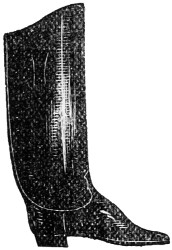
Ladies’ Riding-Boots,
All Patent Leather, 52s.
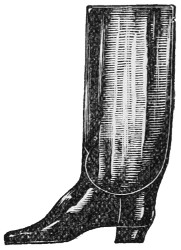
Ladies’ Riding-Boots,
All Patent Leather, 50s.
The Largest Stock and Largest Sale
in England of
LADIES’ RIDING BOOTS.
EVERY DESCRIPTION OF BOOTS
AND SHOES MADE TO ORDER
IN A FEW DAYS.
SPECIAL LASTS KEPT FOR
EVERY CUSTOMER.
London, 70, REGENT STREET, QUADRANT, W.
48, GRESHAM ST., & 131, FENCHURCH ST., E.C.
MANCHESTER, 2, St. Ann’s Square. LIVERPOOL, 5, Bold Street.
ILLUSTRATED CATALOGUES POST FREE.
PRICES OF A FEW ARTICLES, LADIES’ DEPARTMENT.
| BOOTS. |
| Button or Lace |
16/6 |
| Do. do. Polish, Louis XV. Heels, |
21/- |
| Do. Alpine or Tourist, |
23/- to 25/- |
| SHOES. |
| Oxford Tie Morocco, 10/6; Glacé, |
12/6 |
| Do. do. Glacé Kid, Louis XV. Heels, |
17/6 |
| Patent Dress Court Shoes |
7/6 |
A LARGE STOCK of Children’s Boots and Shoes, very durable and comfortable,
at Moderate Prices, and
EVERY VARIETY OF GENTLEMEN’S RIDING, SHOOTING, WALKING,
AND DRESS BOOTS AND SHOES.
AN OLD BOOT IS SUFFICIENT GUIDE FOR SIZE TO ENSURE A GOOD FIT.
PLEASE NOTE!—70, Quadrant, Regent Street, as there is another
house same name in the street.
“The most noted firm of Ladies’ Tailors in the world, and be it said the most
original.”—Court Journal.
By Special
Appointments to
Her Majesty the Queen.
H.R.H. the Princess
of Wales.
H.R. and I.H. the
Duchess of Edinburgh.
H.R.H. the Princess
Louise.
H.R.H. the Princess
Mary of Teck.
By Special
Appointments to
H.I.M. the Empress of
Russia.
H.M. the Queen of
Denmark.
H.M. the Queen of
Portugal.
H.R.H. the Duchess of
Connaught.
H.R.H. the Princess
Beatrice.
REDFERN,
LADIES’ TAILOR,
26, Conduit Street, London, W.
RIDING HABITS,
WITH ALL THE LATEST IMPROVEMENTS.
For HUNTING.
For THE ROW.
Their new Safety Skirt, cut on an entirely new principle, combines
with elegance the greatest comfort and security to the wearer.
“Habits are still worn short * * * Redfern has introduced a novelty
which, while giving greater freedom to the pommel knee and rendering the
risk of the habit catching much less than usual, fits to a nicety.”—Daily
News, Nov. 23rd, 1882.
SPECIALITIES IN COVERT & DRIVING COATS.
Branches—COWES (I.W.), PARIS, and NEW YORK.
To Ladies living in the country and abroad, Messrs. Redfern forward
Patterns of the newest materials for habits, &c. post free on application, and
guarantee a perfect fit without a personal interview.
HENRY PEAT & CO.,
SADDLERS AND HARNESS MAKERS,
By Appointment to H.R.H. the Prince of Wales,
173, PICCADILLY, LONDON.
SADDLERY OF EVERY DESCRIPTION
FOR
INDIA, AMERICA, AND THE COLONIES.
JAMES McMILLAN,
HUNTING BOOT MAKER,
104, JERMYN STREET, PICCADILLY, S.W.
LADIES’
‘ECONOMICAL,’ ‘PARK,’ ‘CROSS COUNTRY,’
‘TROPICAL,’ ‘NEWMARKET,’
AND ALL KINDS OF
RIDING BOOTS.
HOARE & SONS,
Specialité Habit Makers & Ladies’ Tailors,
252 & 253, HIGH HOLBORN, LONDON.
ESTABLISHED 1847.
“Ladies looking for high-class Tailoring at reasonable charges for Cash payment would
do well to give this old-established House a visit.”
“Evidently, only the most careful and experienced Foremen Tailors and best Workmanship
obtainable are employed.”
Habits for Park or Country, from 5 to 8 Guineas.
Specialité “PRINCESS” Habit, as worn by H.I.M. the
Empress of Austria.
HOARE & SONS’ own Registered Shape, from 6 to 9 Guineas.
Walking or Travelling Gowns, 4 to 8 Guineas.
Ulsters, from 3 Guineas. Covert Coats, from 2½ Guineas.
Specialité for Travelling—Lady’s Ocean Coat (regd.), with Removable
Cape and Hood, from 4 Guineas.
COUNTRY ORDERS.
Ladies can now be fitted as perfectly as if in Town by the assistance of a Pattern
Bodice (which can be sent by post), and a few measures taken by our Registered System,
thereby avoiding trouble and delay. This department is under the personal supervision of
a member of the Firm, and has proved most successful in every instance.
Patterns, Estimates, and Illustrations of the Newest Fashions Post Free.
IF YOU DESIRE REALLY WELL-POLISHED BOOTS, USE
E. BROWN & SON’S ROYAL MELTONIAN BLACKING. It renders them
beautifully soft, durable, and waterproof, while its lustre equals the
most brilliant patent leather.
E. BROWN & SON’S NONPAREIL DE GUICHE PARISIAN POLISH for Dress
Boots and Shoes, is more elastic and less difficult in its use than
any other.
E. BROWN & SON’S WATERPROOF VARNISH, for Hunting, Shooting, and Fishing
Boots, is strongly recommended to all Sportsmen.
E. BROWN & SON’S BROWN TOP-BOOT FLUID, POLISH, and POWDERS
of all Colours.
E. BROWN & SON’S MELTONIAN CREAM, for Renovating all kinds of Patent
Leather, Furniture, &c.
E. BROWN & SON’S ROYAL KID REVIVER for all kinds of Black Kid, Leather, &c.
E. BROWN & SON’S WATERPROOF HARNESS POLISH is far superior to all
others! it requires neither Oil nor Dye.
MANUFACTORY:
7, GARRICK STREET, COVENT GARDEN, LONDON, W.C.
And at 26, Rue Bergere, Paris.
E. BROWN & SON,
Purveyors to Her Majesty,
WERE AWARDED THE PRIZE MEDAL, 1862.
Retail Everywhere. Telephone, 3765.
RICHARD T. MARTIN,
Ladies’ Tailor and Costumier,
TO THE
Nobility and Gentry of Great Britain and Ireland,
85 & 86 GRAFTON STREET, DUBLIN.
CELEBRATED FOR
TRAVELLING AND WALKING COSTUMES,
GOWNS, COATS, DOLMANS,
AND
RIDING HABITS.
A large Assortment of all the leading Home and Foreign Materials always
in Stock. An Inspection Solicited.
ALFRED MANNING,
Robes, Modes, Nouveautés,
TO HER ROYAL HIGHNESS THE PRINCESS OF WALES,
AND
THE IRISH COURT,
102 and 103, GRAFTON STREET,
DUBLIN.
MR. JOHN FREEMAN, F.R.C.V.S.,
Veterinary Infirmary,
32, DAWSON STREET,
DUBLIN,
AND
GEORGE’S STREET,
KINGSTOWN.
T. H. FIELDER,
78, GRAFTON STREET, DUBLIN,
Late of LONDON, PARIS and NEW YORK,
LADIES’ TAILOR,
NOTED FOR
MANTLES, FURS,
WALKING, TRAVELLING, TENNIS, AND
YACHTING GOWNS,
JACKETS, COATS, AND ULSTERS.
COSTUMES FROM STOCK AND TO ORDER.
LADIES TAILOR TO HER EXCELLENCY COUNTESS OF
ABERDEEN, COUNTESS OF CARNARVON,
AND THE
NOBILITY AND GENTRY OF GREAT BRITAIN AND IRELAND.
Ladies living at a distance can rely on a PERFECT FIT by
sending a Bodice for size.
THE BEST MATERIALS, THOROUGHLY SHRUNK.
Full Sets of Patterns and Designs Post Free.
RIDING HABITS TO ORDER, FITTED IN THE SADDLE.
Perfection of Cut and Style. Accurate Fit Guaranteed.
MODERATE PRICES. Discount 5 per Cent. for Cash.
All Garments produced under the Personal Supervision of
T. H. FIELDER,
78, GRAFTON STREET, DUBLIN.
W. THACKER & CO., LONDON.
THACKER, SPINK & CO., CALCUTTA.
“Splendidly Illustrated Record of Sport.”—Graphic.
In Demy 4to. Thirty Plates and Map, £2 2s.
LARGE GAME SHOOTING
IN THIBET AND THE NORTH-WEST.
BY COLONEL ALEXANDER A. KINLOCH.
“Colonel Kinloch, who has killed most kinds of Indian game, small and great, relates
incidents of his varied sporting experiences in chapters, which are each descriptive of a
different animal. The photogravures of the heads of many of the animals, from the grand
gauer, popularly miscalled the bison, downwards, are extremely clever and spirited.”—Times.
STERNDALE’S
MAMMALIA OF INDIA.
One Hundred and Seventy Illustrations. 18s. 0d.
In Imperial 16mo. Uniform with “Riding,” “Hindu Mythology,” and
“Riding for Ladies.” 18s. 0d.
A NATURAL HISTORY
OF THE
MAMMALIA OF INDIA.
By R. A. STERNDALE, F.R.G.S., F.Z.S., &c.
AUTHOR OF “SEONEE,” “THE DENIZENS OF THE JUNGLE,”
“THE AFGHAN KNIFE,” ETC.
WITH 170 ILLUSTRATIONS BY THE AUTHOR AND OTHERS.
“The notices of each animal
are, as a rule, short, though on
some of the larger mammals—the
lion, tiger, pard, boar, &c.—ample
and interesting details
are given, including occasional
anecdotes of adventure.”—The
Times.
“Has contrived to hit a
happy mean between the stiff
scientific treatise and the bosh
of what maybe called anecdotal
zoology.”—The
Daily News.
“The very model of what a
popular natural history should
be.”—Knowledge.
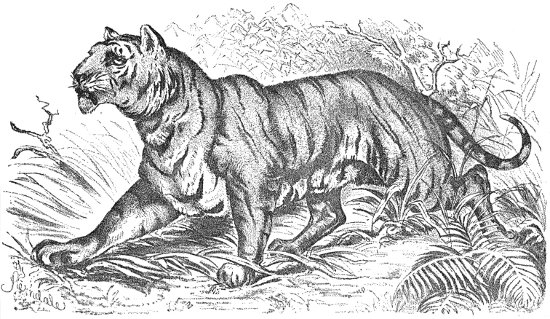
(Reduced from Original.)
By R. A. STERNDALE, F.R.G.S., F.Z.S., etc.
Oblong Imperial 4to. 16s.
DENIZENS OF THE JUNGLES:
A Series of Sketches of Wild Animals,
ILLUSTRATING THEIR FORMS AND NATURAL ATTITUDES.
WITH LETTERPRESS DESCRIPTION OF EACH PLATE.
By R. A. STERNDALE, F.R.G.S., F.Z.S.,
AUTHOR OF “NATURAL HISTORY OF THE MAMMALIA OF INDIA,” “SEONEE,” ETC.
- I.—Denizens of the Jungles.
Aborigines—Deer—Monkeys.
- II.—“On the Watch.” Tiger.
- III.—“Not so Fast Asleep as he
Looks.” Panther—Monkeys.
- IV.—“Waiting for Father.” Black
Bears of the Plains.
- V.—“Rival Monarchs.” Tiger
and Elephant.
- VI.—“Hors de Combat.” Indian
Wild Boar and Tiger.
- VII.—“A Race for Life.” Blue
Bull and Wild Dogs.
- VIII.—“Meaning Mischief.” The
Gaur—Indian Bison.
- IX.—“More than His Match.”
Buffalo and Rhinoceros.
- X.—“A Critical Moment.”
Spotted Deer and Leopard.
- XI.—“Hard Hit.” The Sambur.
- XII.—“Mountain Monarchs.”
Marco Polo’s Sheep.
“The plates are admirably executed by photo-lithography from the author’s
originals, every line and touch being faithfully preserved. It is a volume
which will be eagerly studied on many a table. Mr. Sterndale has many
an amusing and exciting anecdote to add to the general interest of the
work.”—Broad Arrow.
“The Volume is well got up and the Drawings are spirited
and natural.”—Illustrated London News.
LAYS OF IND. By Aliph Cheem.
COMIC, SATIRICAL, AND DESCRIPTIVE.
Poems Illustrative of Anglo-Indian Life.
Seventh Edition. Enlarged. Cloth, gilt. 10s. 6d.
“This is a remarkably bright little book. ‘Aliph Cheem,’ supposed to be
the nom-de-plume of an officer in the 18th Hussars, is, after his fashion, an
Indian Bon Gaultier. In a few of the poems the jokes, turning on local names
and customs, are somewhat esoteric; but, taken throughout, the verses are
characterised by high animal spirits, great cleverness, and most excellent
fooling.”—The World.
“Highly amusing ballads and songs, which have already in a former edition
warmed the hearts and cheered the lonely hours of many an Anglo-Indian,
the pictures being chiefly those of Indian life. There is no mistaking the
humour, and at times, indeed, the fun is both ‘fast and furious.’ Many portions
remind us of the ‘Bab Ballads.’ One can readily imagine the merriment
created round the camp fire by the recitation of ‘The Two Thumpers,’ which
is irresistibly droll.”—Liverpool Mercury.
“One of the most superb little presentation books we have ever seen.”—Indian
Mail.
“The ‘Lays’ are not only Anglo-Indian in origin, but out-and-out Anglo-Indian
in subject and colour. To one who knows something of life at an Indian ‘station’
they will be especially amusing. Their exuberant fun at the same time may
well attract the attention of the ill-defined individual known as ‘the general
reader.’”—Scotsman.
Uniform with “Lays of Ind,” “Riding,” &c. 10s. 6d.
HINDU
MYTHOLOGY:
VEDIC AND PURANIC.
BY
Rev. W. J. WILKINS,
OF THE LONDON MISSIONARY
SOCIETY, CALCUTTA.
Illustrated by very numerous Engravings
from Drawings by Native Artists.
REVIEWS.
“His aim has been to give a faithful account of the Hindoo deities such as
an intelligent native would himself give, and he has endeavoured, in order to
achieve his purpose, to keep his mind free from prejudice or theological bias.
To help to completeness he has included a number of drawings of the principal
deities, executed by native artists. The author has attempted a work of no
little ambition, and has succeeded in his attempt, the volume being one of
great interest and usefulness; and not the less so because he has strictly refrained
from diluting his facts with comments of his own. It has numerous
illustrations.”—Home News.
“Mr. Wilkins has done his work well, with an honest desire to state facts
apart from all theological prepossession, and his volume is likely to be a
useful book of reference.”—Guardian.
“In Mr. Wilkins’ book we have an illustrated manual, the study of which
will lay a solid foundation for more advanced knowledge, while it will furnish
those who may have the desire, without having the time or opportunity to go
further into the subject, with a really extensive stock of accurate information.”—Indian
Daily News.
In Imperial 16mo., uniform with “Lays of Ind,” “Riding,”
“Riding for Ladies,” &c. 8s. 6d.
THE
TRIBES ON MY FRONTIER:
An Indian Naturalist’s Foreign Policy.
By EHA.
With Fifty Illustrations by F. C. Macrae.
This remarkably clever work most graphically and humorously
describes the surroundings of a Mofussil bungalow. The
twenty chapters embrace a year’s experiences, and provide endless
sources of amusement and suggestion. The numerous able illustrations
add very greatly to the interest of the volume, which will
find a place on every table.
THE CHAPTERS ARE—
- I. A Durbar.
- II. The Rats.
- III. The Mosquitos.
- IV. The Lizards.
- V. The Ants.
- VI. The Crows.
- VII. The Bats.
- VIII. Bees, Wasps, et hoc genus omne.
- IX. The Spiders.
- X. The Butterfly: Hunting Him.
- XI. The Butterfly: Contemplating Him.
- XII. The Frogs.
- XIII. The Bugs.
- XIV. The Birds of the Garden.
- XV. The Birds at the Mango Tope.
- XVI. The Birds at the Tank.
- XVII. The Poultry Yard.
- XVIII. The White Ants.
- XIX. The Hypodermatikosyringophoroi.
- XX. Etcetera.
“Always amusing and never dull.”—Field.
“Full of accurate and unfamiliar observation.”—Saturday Review.
“Has the advantage of needing no preliminary knowledge of Natural History for its
enjoyment.”—Westminster Review.
Imperial 16mo. 18s. 0d.
Uniform with “Lays of Ind,” “Hindu Mythology,” “Riding,” “Natural
History of the Mammalia of India,” &c.
A POPULAR HANDBOOK
OF
INDIAN FERNS.
By COLONEL R. H. BEDDOME,
AUTHOR OF “THE FERNS OF BRITISH INDIA,” “THE FERNS OF SOUTHERN INDIA.”
“It is the first special book of portable
size and moderate price which has
been devoted to Indian Ferns, and is
in every way deserving of the extensive
circulation it is sure to obtain.”—Nature,
June 14th, 1883.
“I have just seen a new work on
Indian Ferns which will prove vastly
interesting, not only to the Indian
people, but to the botanists of this
country.”—Indian Daily News.
“‘The Ferns of India.’ This is a
good book, being of a useful and trustworthy
character. The species are
familiarly described, and most of them
illustrated by small figures.”—Gardeners’
Chronicle.
“Those interested in botany will do
well to procure a new work on the
‘Ferns of British India.’ The work
will prove a first-class text-book.”—Free
Press.
THREE HUNDRED ILLUSTRATIONS BY THE AUTHOR.
Uniform with “Riding for Ladies.”
Second Edition. Revised and Enlarged. Imperial 16mo. 10s. 6d.
RIDING:
ON THE FLAT AND ACROSS COUNTRY.
A Guide to Practical Horsemanship.
By CAPT. M. H. HAYES.
PROFUSELY ILLUSTRATED BY STURGESS.
Illustrated Sporting and Dramatic News.—“The book is one that no man who has ever
sat in a saddle can fail to read with interest.”
The Field.—“The general directions are in most cases in accordance with our own
opinions; and Mr. Hayes has supplemented his own experience of race-riding by resorting to
Tom Cannon, Fordham, and other well-known jockeys for illustration. ‘The Guide’ is, on
the whole, thoroughly reliable; and both the illustrations and the printing do credit to the
publishers.”
The Sporting Life.—“It has, however, been reserved for Captain Hayes to write what in
our opinion will be generally accepted as the most comprehensive, enlightened, and ‘all
round’ work on riding, bringing to bear as he does not only his own great experience, but the
advice and practice of many of the best recognised horsemen of the period.”
In Imperial 16mo. Illustrated. 8s. 6d.
INDIAN
RACING REMINISCENCES:
BEING
ENTERTAINING NARRATIVES AND ANECDOTES OF
MEN, HORSES, AND SPORT. ILLUSTRATED WITH
TWENTY-TWO PORTRAITS AND A NUMBER
OF SMALLER ENGRAVINGS.
By CAPT. M. HORACE HAYES.
AUTHOR OF “RIDING ON THE FLAT AND ACROSS COUNTRY,” “VETERINARY NOTES FOR
HORSE OWNERS,” “TRAINING AND HORSE MANAGEMENT IN INDIA,” ETC.
“The book is full of racy anecdote.... He is well known as an authority on everything connected with
the horse and horse-racing.”—Bell’s Life.
“All sportsmen who can appreciate a book on racing, written in a chatty style and full of anecdote, will
like Captain Hayes’ latest work.”—Field.
“The book is valuable from the fact that many hints on the treatment of horses are included.”—Illustrated
Sporting and Dramatic News.
“Many a racing anecdote and many a curious character our readers will find in the book, which is very
well got up, embellished with many portraits.”—Baily’s Magazine.
Second Edition, in Crown 8vo, Illustrated. 10s. 6d.
VETERINARY NOTES FOR HORSE-OWNERS.
AN EVERY-DAY HORSE BOOK.
By CAPT. M. HORACE HAYES.
OPINIONS OF THE PRESS.
Saturday Review.—“The work is written in a clear and practical way.”
The Field.—“Of the many popular veterinary books which have come
under our notice, this is certainly one of the most scientific and reliable. The
author tells us, in the preface to the first edition, that any merit which the
book may possess is to be ascribed to
the teaching of the Principal and
Professors of the New Veterinary
College at Edinburgh, where he
studied. It is much to be desired
that every student would make so
much use of his opportunities as Capt.
Hayes has done.
“Some notice is accorded to
nearly all the diseases which are
common to horses in this country,
and the writer takes advantage of his
Indian experiences to touch upon
several maladies of horses in that
country, where veterinary surgeons
are few and far between. The description
of symptoms and the directions
for the application of remedies
are given in perfectly plain terms,
which the tyro will find no difficulty
in comprehending; and, for the purpose
of further smoothing his path, a chapter is given on veterinary medicines,
their actions, uses, and doses. This information will be most acceptable to
the majority of horse-owners, and may be invaluable on an emergency when
no advice better than that of the village cow doctor can be obtained.”
Crown 8vo. 7s. 6d.
A
TEA PLANTER’S LIFE IN ASSAM
By GEORGE M. BARKER.
WITH SEVENTY-FIVE ILLUSTRATIONS BY THE AUTHOR.
This book aims at conveying to all interested in India and the
Tea industry an entertaining and useful account of the topographical
features of Assam; the
strange surroundings—human and
animal—of the European Resident;
the trying Climate; the Daily Life
of the planter; and general details
of the formation and
working of Tea
Gardens.
The illustrations,
by the Author, add
greatly to the interest
of the work.
“Mr. Barker has supplied
us with a very
good and readable description,
accompanied by numerous illustrations drawn by himself. What
may be called the business parts of the book are of most value.”—Contemporary
Review.
“Cheery, well-written little book.”—Graphic.
“A very interesting and amusing book, artistically illustrated from
sketches drawn by the Author.”—Mark Lane Express.
Fourth Edition, Crown 8vo. (in preparation).
A
MANUAL OF GARDENING
FOR
BENGAL AND UPPER INDIA.
By THOMAS A. C. FIRMINGER, M.A.
THOROUGHLY REVISED AND BROUGHT DOWN TO THE PRESENT TIME BY
J. H. JACKSON,
Editor of “The Indian Agriculturist.”
PART I.
Operations of Gardening.
- Chap. I.—Climate—Soils—Manures.
- Chap. II.—Laying-out a Garden—Lawns—Hedges—Hoeing
and Digging—Drainage—Conservatories—Betel
Houses—Decorations—Implements—Shades—Labels—Vermin—Weeds.
- Chap. III.—Seeds—Seed Sowing—Pot
Culture—Planting—Cuttings—Layers—Gootee—Grafting
and Inarching—Budding—Pruning
and Root Pruning—Conveyance.
- Chap. IV.—Calendar of Operations.
PART II.
Garden Plants.
- 1. Culinary Vegetables.
- 2. Dessert Fruits.
- 3. Edible Nuts.
- 4. Ornamental Annuals.
- 5. Ornamental Trees, Shrubs,
and Herbaceous Perennials.
Crown 8vo. 7s. 6d.
MANUAL OF
Agriculture for India.
By Lieut. F. POGSON.
1. Origin and Character of Soils.—2. Ploughing
and Preparing for Seed.—3. Manures and Composts.—4.
Wheat Cultivation.—5. Barley.—6.
Oats.—7. Rye.—8. Rice.—9. Maize.—10. Sugar-producing
Sorghums.—11. Common Sorghums.—12.
Sugarcane.—13. Oil Seed.—14. Field Pea
Crops.—15. Dall or Pulse.—16. Root Crops.—17.
Cold Spice.—18. Fodder.—19. Water-Nut.—20.
Ground-Nut.—21. Rush-Nut or Chufas.—22.
Cotton.—23. Tobacco.—24. Mensuration.—Appendix.
REVIEWS.
“POGSON’S AGRICULTURE.
“The work seems to us both in thoroughness
of execution and in clearness of arrangement entirely
to fulfil all the hopes that have been formed
of it. We cannot doubt that the Government
will heartily take up this most valuable book,
and circulate it both in the original and vernacular
translations throughout the length and
breadth of the land; nor should a moment be
lost, for it represents one of the most important
and most promising lines on which we can meet
that terrible Malthusian difficulty.”—Allen’s
Indian Mail.
“A work of extreme practical value.”—Home
News.
“Mr. Pogson’s advice may be profitably
followed by both native and European agriculturists,
for it is eminently practical and devoid
of empiricism. His little volume embodies the
teaching of a large and varied experience, and deserves to be
warmly supported.”—Madras Mail.
Complete in One Volume, 10s.; Interleaved, 11s.
A TEXT BOOK
OF
INDIAN BOTANY:
MORPHOLOGICAL,
PHYSIOLOGICAL,
and SYSTEMATIC.
By W. H. GREGG,
Lecturer on Botany, Hughli
College.
With 240 Illustrations.
Crown 8vo. 4s. 6d.
The Indian Cookery Book.
A PRACTICAL HANDBOOK TO THE KITCHEN IN INDIA:
ADAPTED TO THE THREE PRESIDENCIES.
Containing Original and Approved Recipes in every department of Indian Cookery;
Recipes for Summer Beverages and Home-made Liqueurs; Medicinal and
other Recipes; together with a variety of things worth knowing.
By A THIRTY-FIVE YEARS’ RESIDENT.
Third Edition, Revised.
Training and Horse Management in India.
By Captain M. HORACE HAYES,
Author of “Veterinary Notes for Horse Owners,” “Riding,” &c.
Third Edition. Crown 8vo. 8s. 6d.
“No better guide could be placed in the hands of either amateur horseman or veterinary
surgeon.”—The Veterinary Journal.
“A useful guide in regard to horses anywhere.... Concise, practical, and portable.”—Saturday
Review.
Prepared for the use of the Survey Department of India, and published under
the authority of the Government of India.
Royal 8vo. 30s. 0d.
A Manual of Surveying for India:
DETAILING THE MODE OF
OPERATIONS ON THE
TRIGONOMETRICAL,
TOPOGRAPHICAL,
AND REVENUE
SURVEYS OF INDIA.
COMPILED BY
Sir H. L. THUILLIER, K.C.S.I., Royal Artillery,
AND
Lieut.-Col. R. SMYTH, late Bengal Artillery.
One Vol. Small 8vo. 5s. 0d.
TALES FROM INDIAN HISTORY:
BEING THE
Annals of India retold in Narratives.
By J. TALBOYS WHEELER.
Forms a complete History of India from the earliest period to the present
day, drawn up as a series of “Narratives” for general reading in schools and
families. So far it will resemble the history of Scotland as told in Sir Walter
Scott’s “Tales of a Grandfather,” omitting all details and disquisitions which
are sufficiently given in the author’s larger histories of India, and seeking to
tell the progress of events in the most simple and attractive manner.
Reviews of Wheeler’s ‘Tales from Indian History.’
“While the work has been written for them (natives), it has also been
written for the people of England, who will find in the volume, perhaps for
the first time, the history of our great dependency made extremely attractive
reading. Mr. Wheeler’s narrative is written in a most graceful style; indeed,
he is master of the English language. He does not confine himself to the
mere dry details of history, but tells the adventures of Indian heroes and
heroines in legends of love and war; describes the village communities of
India, their organization and self-government; delineates the results of caste,
infant marriage, and other Hindoo institutions and usages as seen in the family
and social life of the people in villages and towns, as well as in courts and
palaces.... The work also contains valuable observations on the foreign
relations of the Indian Empire with Persia, Russia, Turkey, and China.
Altogether this is a work of rare merit.”—Broad Arrow.
“In going through an interesting book, the reader will be furnished with
a good general notion of Indian history, and learn besides something about
Indian modes of life.”—Queen.
“Will absorb the attention of all who delight in thrilling records of
adventure and daring. It is no mere compilation, but an earnest and brightly-written
book.”—Daily Chronicle.
“This little volume contains a history of India in the form of tales and
narratives, intended by the author for the people of India as well as for those
of the British Isles.”—Army and Navy Gazette.
“No young reader who revolts at the ordinary history presented to him in
his school books will hesitate to take up this. No one can read a volume such
as this without being deeply interested.”—Scotsman.
Entirely Re-written. Eighth Edition. Crown 8vo. 10s. 6d.
THE
MANAGEMENT AND MEDICAL TREATMENT
OF
CHILDREN IN INDIA.
By EDWARD A. BIRCH, M.D.,
Surgeon-Major Bengal Establishment.
Second Edition; being the Eighth Edition of Goodeve’s “Hints on the
Management of Children in India.”
Dr. Goodeve.—“I have no hesitation in saying that the present edition is for many reasons
superior to its predecessors. It is written very carefully, and with much knowledge and experience
on the author’s part, whilst it possesses the great advantage of bringing up the
subject to the present level of Medical Science.”
The Medical Times and Gazette, in an article upon this work and Moore’s “Family
Medicine for India,” says:—“New editions of these two well-known works have recently
appeared. They are both intended to supply in some measure the medical wants of our
numerous countrymen in India, who may be either far from professional help in emergencies
of sickness or of accident, or destitute of medical advice regarding the proper
management of their own health, and especially that of their children, in the trying climate
of Hindostan. Although we are, as a rule, very much opposed to popular medical instruction,
believing that the result is most frequently a minimum of serviceable knowledge
along with a vast preponderance of what is but partial, misleading, and dangerous, yet
the peculiar circumstances of many of our countrymen in India, together with the
special and insidious dangers of its varying climate, fully justify the publication of a
few trustworthy popular works to warn the unwary new-comer, before it be too late,
of the dangers he has to encounter, and to give judicious counsel to solitary individuals
and families who cannot enjoy the advantages of personal professional advice. Moreover,
the two works before us are in themselves probably about the best examples of
medical works written for non-professional readers. The style of each is simple, and as free
as possible from technical expressions. The modes of treatment recommended are generally
those most likely to yield good results in the hands of laymen; and throughout each volume
the important fact is kept constantly before the mind of the reader, that the volume he is
using is but a poor substitute for personal professional advice, for which it must be discarded
whenever there is the opportunity. Written with such objects, and in such a spirit, these
volumes cannot fail to be of the greatest service; and that they are appreciated is shown by
the rapid appearance of successive editions, the second mentioned and elder treatise having
now reached the seventh edition. We would add, that although they are specially written
for lay readers, there are few young medical officers proceeding to India who would not
receive several useful hints from these unpretentious volumes. But it is to parents or to
the guardians of European children in India that they must be of pre-eminent service.”
Published Annually, in Thick Royal 8vo., Price £1 16s.
THACKER’S
INDIAN DIRECTORY
EMBRACING
The whole of India and Burmah.
THE “TIMES.”
“The fact that this work, originally known as the ‘Directory of Bengal,’ has now
reached its 24th annual issue, is sufficient to recommend it to all those who are brought into
contact, in a military, civil, or commercial sense, with the civilization and intelligence of our
Eastern dependencies. No longer confined to the narrow limits of Bengal, Messrs. Thacker
furnish us with complete and detailed information respecting not only Calcutta, but also the
citizens of Bombay and Madras. The parts which relate to the yearly almanac, public
holidays, stamps, telegraphs, and customs are pretty much one and the same; but in most
other matters we have before us separate and distinct information as to the various departments
of Government and the arrangements of commerce, education, charitable societies and
hospitals, clubs, railways, and companies. There is also a separate Army list, we note, for
each of the three Presidencies. The alphabetical list of residents, comprising as it does a
full record of all those of our countrymen who have taken up their permanent abodes in any
of the Indian Presidencies, will be found of the greatest use to those in England who have
lost all clue to their relatives and friends in the far East and wish to discover their whereabouts.”—Aug.
28, 1886.
THE CALCUTTA “ENGLISHMAN.”
“Before everything, the volume before us is in reality what it professes to be—a
Directory for India. Besides an enormous mass of information of the purely Directory
kind, which must have taken a world of labour to collect and collate, the volume comprises
complete Army Lists for Bengal, Madras, and Bombay, including the Volunteers; lists of
officers in the various Government Departments; lists of the Tea, Indigo, Coffee, and other
estates in the country; and much valuable information regarding the Telegraphs, Postal
Rules, Law Courts, Charities, and a host of other subjects. Nothing more strikingly represents
the change that has come over India in recent years than this great Directory.”
THE “MANCHESTER GUARDIAN.”
“The Directory now includes every district and principal town in British and Foreign
India, every Native State, and in fact aims at being a directory to the whole of India. It
contains separate classified and street directories of each of the cities of Calcutta, Bombay,
and Madras, a remarkably comprehensive and detailed Mofussil Directory, and a vast
amount of general information relating to India, its Government, commerce, postal arrangements,
festivals, and official establishments.... The expansion of the work will be
welcomed as a response to the growing requirements of commerce with India.”
ADVERTISEMENTS.
ALEXANDER SCOTT,
RIDING-HABIT
MAKER,
15, South Molton St., Grosvenor Square, W.
SPECIALITY—SAFETY SKIRTS.
NEW WORKS BY CAPTAIN HAYES; IN THE PRESS.
IN DEMY 8vo.
SOUNDNESS AND AGE OF HORSES.
With One Hundred and Seventy Illustrations.
A Complete Guide to all those features which require attention when purchasing Horses,
distinguishing mere defects from the symptoms of unsoundness, with explicit instructions
how to conduct an examination of the various parts.
CHAPTERS.
- I.—Soundness.
- II.—Defects which are Absolute Unsoundness.
- III.—Defects which are not necessarily Unsoundness.
- IV.—Method of Examination.
- V.—How to Handle a Horse.
- VI.—Examination of the Mouth.
- VII.—Examination of the Eyes.
- VIII.—Examination of the Head, Neck, and Trunk.
- IX.—Examination of the Limbs.
- X.—Lameness.
OBLONG 4to.
THE POINTS OF THE HORSE.
A FAMILIAR TREATISE ON EQUINE CONFORMATION.
ILLUSTRATED BY J. H. OSWALD BROWN.
Describing the Points in which the perfection of each class of Horses consists;
illustrated by very numerous reproductions of Photographs of Living Typical Animals,
forming an invaluable Guide to Owners of Horses.
HENRY HEATH,
105, 107, & 109, OXFORD ST., W.
ONLY ONE ADDRESS
“THE MANUFACTORY.”
OVER AGAINST NEWMAN ST.
Established in the Reign of King
George the Fourth.
“Henry Heath, of 105, 107,
and 109, Oxford Street, has a very
sensible invention in the shape of
a soft-banded hat for riding.
The painful sensation experienced
from the pressure of the usual
hard hat is quite obviated in
the hat manufactured by Henry
Heath.”—Vide The Queen.
“The Hunting Hats made by
this Firm deserve commendation.”—Vide
The Queen, Nov. 21, 1885.
Prices 10s. 6d., 12s. 6d., 16s., 18s. 6d., &c.
In all Colours, to match Habit.
NEW SHOW ROOMS FOR LADIES’ HATS.
“One of the chief features of
Mr. Henry Heath’s manufactory,
at 105-107-109, Oxford
Street, is that hats are exactly
fitted to the heads of the customer.
This is ensured by a
very ingenious patented invention
in the shape of a soft metal
band, which takes the form
as well as the size of the
head.”
Post-free upon application.
HENRY HEATH
(Registered.)
The Melton.
Lady’s Tropical Hat
No. 150.
Henry Heath
THOMAS & SONS’ RIDING HABITS
AS RECOMMENDED BY
Mrs. POWER O’DONOGHUE, the most modern authority on
female equitation, are cut on the most improved Safety Principle,
and are unsurpassed for Fit, Style, and Durability.
A List of their Reasonable Charges will be sent on application.
The Latest Novelties in Tailor-Made Costumes, Coats, and Jackets.
Thomas & Sons, Tailors and Habit Makers,
48, South Molton Street, New Bond St., W.