Since Lepsius’ fortunate entrance into the haven of matrimony we have
devoted our whole attention to estimating his scientific achievements as
a master workman, leaving unmentioned his personal experiences, except
so far as they fell within the sphere of his scholarly labors. We
thought it better to depict his domestic life, and the man Lepsius, in
the circle of his family and friends, quite apart from his scientific
occupations. These latter were carried on in the sanctuary of his study,
in the lecture room, or in the public library. No one ever understood
more thoroughly than he how to disengage his mind from his special
pursuits, and to enjoy intercourse with wife or child, with individuals
or general society. None better knew how to participate with both
intellect and heart in animated conversations on art or literature,
science or politics. His special acquirements remained hidden until a
desire was expressed for information on such subjects, and he was
appealed to.
The Lepsius who returned from the Orient and founded a home of his own,
was essentially different from the young scholar who had been reckoned
among the conservatives in Göttingen, and whom we saw indignantly quit
Schleiermacher’s lectures on the Life of Jesus, in Berlin. During a long
sojourn in England, which had brought him into connection with the
leaders of political life, he had learned to appreciate the rights of
the people, and the advantages of a free state under a constitutional
government. He had spent three years in the East under unusual
conditions, always in a position of authority and subject to none. What
can so quickly expand even the most limited views, what can more
certainly conduce to an unfettered and vigorous use of existence, what
can more strengthen even the feeblest self-confidence, what can lead
with more imperious necessity to self-examination and to knowledge of
one’s own faults and merits, than a prolonged sojourn in the East, and
in the silent desert?
He had returned home entirely self-reliant, understanding himself and
his aims, and capable of maintaining his own stand in the face of
opposition. He had become a free-thinker of dispassionate and temperate
views, who had learned to despise the barriers which prejudices and
one-sided opinions of every kind malevolently set between men. He no
longer held to the dogmas and formulas of a circumscribed confession,
but he still adhered to that Christ to whom his free-thinking father had
taught him to look up as the harbinger of pure self-sacrificing human
love.
And the choice of this man had fallen upon a maiden of eighteen years.
All who knew her as a bride speak of her as a charming, happy creature,
full of childlike archness. But nevertheless passionate blood ran
through the veins of this young girl; Elizabeth’s finely cultivated mind
was restless and over-active, and her soul was completely filled with
ardent and fanatical religious zeal.
What contrasts! Seldom has there been a pair in every respects so
different; and yet they confirmed Schiller’s lines: “For where the
severe with the tender, where the strong and the gentle unite.” Love was
the metal of that bell whose voice had drawn them together, and bound
them to each other for a life time. It gave forth a pleasant sound, and
only one discord, which became especially perceptible in their latter
years, and which was produced by the great difference in their religious
convictions. This disturbed his ear but slightly, for, calm and assured
of his own aims, happy in his work and in his life, he devoted his time
to labor and science, and his intervals of recreation to his children,
to social pleasures, to the learned societies of which he was a member,
to his garden, to music, whose pleasures he gladly shared with his wife,
and to his beloved chess. At first she had attempted to realize the
dream of her girlhood, and to kindle his heart with the fire of her own
enthusiasm; but in vain. Tranquilly and cheerfully he accompanied her to
church, and whenever his occupations permitted it, usually on Sunday, he
took part in the daily household worship which she had instituted. He
allowed her to train the children, and to instil into them that
religious feeling in which he himself was not wanting, and in which he
recognized the loveliest flower of the soul, and of the feminine soul
especially. But he warned her against excess and exaggeration, which
were so alien to his own nature, and possibly this unsympathetic
attitude towards what to her was highest and holiest, only contributed
to cause in her ardent heart still warmer devotion to the doctrines of
her positive Protestant faith. We should here assert, in the most
decided manner, that this devotion was of the most unobtrusive kind.
Frau Lepsius never gave it public manifestation, and the only ones whom
she allowed to share in it were her nearest relatives, her pastor, and
her diary. She was ever averse to the course of the zealots and
pietists, who enjoyed such palmy days under Frederick IV., and once, on
hearing a sermon by the famous pastor Knak, she left the church in
indignation. The noble Jonas and the excellent Kögel were her pastors,
and certainly had more frequently to moderate than to kindle her zeal.
Her husband saw no reason for serious interference with the excessive
religious aspirations of her soul, for to him she gave everything that a
man can ask from the companion of his existence: a heart overflowing
with love, esteem heightened to admiration, and a warm interest in all
his labors and productions, even the most abstruse. In addition to this
she cared with prudence, skill and indefatigable industry for the
management and embellishment of the home, and there were few houses
where the hostess was able to make her guests so thoroughly at ease.
Nothing was farther from her thoughts than a puritanical renunciation of
the pleasures and delights of this world, and she gave a zest to the
household festivals by the inexhaustible fertility of her ideas in the
way of original representations and spectacles. She pleased in society
by her amiability and wit; she was the best of mothers; and as the
children grew up she was so excellent and untiring a teacher that he,
who had never had any confidence in his own ability as a pedagogue, was
glad and thankful to resign to her the charge of the mental and moral
education of the children. Among them were boys who were hard to govern,
yet they all turned out excellently. In matters of charity he gave her
entire liberty.
The inner being of this rare woman lies plain before us, and we are
permitted to follow the life of the Lepsius family almost from day to
day. We ourselves visited the house of Lepsius only as a friend and
guest, but the diary of its mistress, some twenty volumes, makes us a
member of the household. It is honest, simple, and yet written with
great intuitive perception. A number of poems are intermingled with the
excellent prose. They are mostly of religious tenor, and many of them
are distinguished by their lofty strain and beautiful thoughts. The
perusal of this journal has therefore afforded us genuine pleasure, and
it has exhibited to our soul as well as to our sight, the character of a
woman so singular and noble in her love, her activity and her aspiration
that we separate from it with sincere admiration, but also with deep
regret. It would be to abuse a great trust, were we to yield to the
desire to portray the character of its author from the avowals contained
in this journal, and yet this would excite quite different, and tenfold
greater, interest than that of her husband. For how much less alluring
to the psychologist is the calm progress of a man who came early to
maturity, his successful contests with the impulses of youth, and his
tranquil labors after the goal was attained, than the ceaseless
struggles of a woman distinguished above thousands by the ardor of her
soul and the keenness of her intellect. Yet we may be at least allowed
to extract from the diary all that can serve to give the reader a clear
idea of life in the home of Lepsius, its intercourse with the outside
world, and the experiences of its head as a husband, and as a member of
a select society.
Every betrothal has its history. Lilli (Elizabeth) Klein,[92] who was
greatly admired, had done some friends the favor to appear at an
entertainment as the fourteenth guest. The ominous number thirteen was
caused by Lepsius’ declining the invitation at a late moment. But,
nevertheless, he appeared, after all the guests were assembled, and it
was on this occasion that she made his acquaintance. “Oh Superstition”
she wrote in her diary, “for the first time I bless thee.”
Even this first meeting had carried the day with her. The next Sunday
she could not help thinking of him during the sermon, and when she
visited him with several of her relations, amongst whom there were some
young ladies, to inspect the curiosities which he had brought with him
from the Orient, her young heart was not only disturbed, but deeply
troubled, because he seemed to have paid more attention to her sister
than to her, and she already loved him.
The following day put an end to her anxiety. It was a Palm Sunday, and
that evening he wrote in his term-calendar “To-day the palm of life is
won,” while, at a later hour, she confided to her diary the rejoicings
of her heart. She prefaced the sentences with which she gave expression
to her rapture by Chamisso-Schubert’s “I cannot understand it, I cannot
believe it.”
She continues: “God, my God, how shall I thank thee for this unutterable
bliss! No, it is too great and too much, my Heavenly Father. ‘Beloved!’
Beloved by him! My heart is full, but I cannot write! My soul rejoices
in the thought; Beloved by him! But how can I prove myself worthy of
him?”
The letters which he wrote to Elizabeth also lie before us, and it is
not without deep emotion that we read these beautiful effusions of
tender passion from the profoundly touched heart of a man to whom we had
been accustomed to look up as an earnest teacher, and the dignified
senior master of our science. Here we see him succumb with lovable
weakness to a beautiful human emotion.
The passion for his “Lilli” compensates him for the magic of the East,
which he had felt so deeply a short time before, and he calls her his
“Shulamite” and his “Rose of Sharon.” Yet even in the bonds of love he
preserves the fundamental instincts of his soul, and he writes to her:
“Often and earnestly do I ask myself, my dear Lilli, whether it is not
after all ignoble selfishness, when I feel such intense bliss in your
devoted love, and in the consciousness that I have won you, so ardently
beloved a spirit, for my own. But then again I feel that through your
love all that is good in me is helped and strengthened, and I become
capable of a higher and purer love towards God and our fellow beings,
and then it seems as if it could not be wrong to desire such a relation
with all the strength of one’s soul; as if this happiness were our
vocation, seldom however to be attained untroubled, and never entirely
unalloyed, upon this earth. Oh, my Lilli, what a rare and rich life
would lie before us if the thoughts which we have exchanged in our
letters should one day become an actual living reality, not only in word
but in deed.”
The pure exultation of a maiden’s heart, overpowered by true love,
re-echoes from her diary throughout the whole time of the betrothal. It
is true that there were many differences of opinion between the
betrothed, especially when religious questions were discussed, but his
cheerful serenity was always able to make amends for whatever might have
wounded her feelings in such disputes, and, taken as a whole, their
betrothal was one long happy festival. He taught her the hieroglyphic
alphabet, and wrote out for her little protestations of love in the
picture writing of the old Egyptians. The learned man of five and thirty
was unwearied in the invention of tender speeches, and it must have
pleased Elizabeth-Lilli to have heard herself called, both in his
letters and from his lips, by eighteen pet names,—she counted them
herself. There was no lack on his side of verses, flowers, and acts of
homage. In the house of the Partheys, who had adopted the orphan niece
as a daughter, entertainment followed upon entertainment, gay excursions
to the country were arranged, and masquerades, at which Elizabeth was
obliged to appear in Turkish dress. But this gay life was contrary to
her inclinations and to his likewise. The wedding was celebrated on the
fifth of July, 1846, not in the old Nicolai house in Behren Street,
where they had first known each other, but at Dresden. The excellent
pastor Jonas, from Berlin, performed the marriage ceremony in the Church
of Our Lady, and after a brilliant wedding banquet the young couple went
to Pirna, the first stopping-place in a longer wedding trip which took
them, by way of Paris, to England. There they were cordially received by
the Bunsens, and the young wife found the eminent statesman and patron
of her husband so kind and friendly that her fear of appearing
embarrassed before him proved entirely unfounded.[93] She described
vividly everything noteworthy that occurred to her, and depicted with a
bold and ready pen the impression made on her by men and things. She saw
her Richard received everywhere with the same respect and cordiality;
the light of his fame enveloped and delighted her, but on their journey
home a charming attention fell to her lot also, for at Cologne her
father’s great mass, which she never yet heard, was performed in the
most admirable manner as a mark of respect to her.
On the seventeenth of September they returned to Berlin, and “Richard”
writes Elizabeth, “was forced to laugh at the childish delight which I
showed in the beautiful big house, our own house, (in Behren Street)
where I am to be mistress.”
They were soon installed, and the young couple, who were freed from all
material anxiety by the comfortable property of the wife and the salary
of the husband, could now return the hospitality which had been offered
them on all sides. In spite of her strict piety the wife showed herself
as much inclined as was her husband to social intercourse with agreeable
guests. A few weeks after their return the young couple entertained a
number of friends, and who these were we see from the memoranda before
us. On the third of November, 1846, there met at their house Gerhard, v.
Olfers, Homeyer, Max Müller, the Grimm brothers, Parthey, Carl Ritter,
Ehrenberg, Lachmann, L. Ranke and E. Curtius. On the fifteenth of
December there were assembled there A. v. Humboldt (who also visited
them on other occasions, and for whom, Frau Elizabeth writes, she felt a
genuine affection) v. Olfers, Boeckh, Pertz, Cornelius, v. Reumont, the
Grimm brothers, Homeyers, Strack, the Partheys, Schelling and Bethmann.
Such a company of illustrious men could at that time be brought together
nowhere but in Berlin, and if we consult the diary of Frau Lepsius and
Lepsius’ later note-books, and appeal to our own memory, we shall und
that the assemblage of noted colleagues and countrymen was constantly
increased by a number of eminent strangers. Amongst them were scholars,
travelers, statesmen, artists, and even the ambassadors of foreign
powers, who were unwilling to leave Berlin without having visited the
house of Lepsius. The most faithful friend of the family, beside the
Partheys and Pinders, was the valued traveling companion of the young
husband, Abeken, who had renounced his career as a divine, and was
constantly rising to higher and higher positions in the Foreign Office.
How kindly Frederick William IV. was disposed to Lepsius may be inferred
from the fact that soon after the return of the latter from his wedding
trip the King sent him fifteen hundred thalers towards the establishment
of the new household. Frau Elizabeth writes: “It is altogether a
peculiar feeling; to have in hand such a large sum that seems as if it
had fallen from heaven. I was quite troubled about our great good
fortune in material things, and I reminded Richard of the ring of
Polycrates. But as I read the day after in a letter from C. P. to
Richard: ‘Whoever has behind him such a fruitful and undesecrated youth
as you have, has a right to make claims upon life, which will not fail
to reward you abundantly.’ Nevertheless one is astonished, and such a
distribution of fortune seems almost unjust, if one considers what an
immeasurable sum and what great wealth such a gift would be to poor
people, and how to Richard it was only a pleasant proof of the King’s
good-will, which he calmly put in the fund for setting our house in
order. Five hundred thalers he reserved for current expenses, and soon
it had all vanished as it had come.”
In his own house Lepsius stood at the helm with a steady hand, but his
wife ever strove to make his voyage through life pleasant and happy.
Her struggle for greater calmness and a more equable nature is touching,
as is the loving humility with which she recognizes his superiority; and
often does a phrase, an interjection, in the midst of matter-of-fact
records, give expression to her true and tender love. She says: “It is
grand in Richard, that he can take everything so naturally. It comes
from his perfect honesty; if I could only educate myself up to him.”
When her first little daughter was able to stand alone she wrote:
“Richard and Anna, these names embrace my whole happiness, the fragrant
blooming shower of blessings which Our Father in Heaven pours upon me
from the abundant horn of plenty of His grace and love.”
The diaries are replete with such expressions. Especially neat and
pointed are the little sketches of eminent men drawn by the young wife.
Whoever was personally acquainted with Master Peter Cornelius, (he was
a friend of my mother’s, and indeed once made a portrait of me as a
boy), will admit that it would not be possible to depict his external
appearance more neatly and pointedly than in the following words from
the diary of Frau Lepsius. She writes: “A little, thick-set man, with a
black peruke, piercing black eyes, wide, kindly mouth, and with thought
upon his wrinkled brow.”
On the twenty-fifth of July, 1847, a daughter was granted to the young
couple. She received the name of Isis Anna. Minister Jonas, the
liberal-minded pastor of the household, found nothing wrong in the
choice of the name of the heathen divinity Isis, but strange to say,
Bunsen took serious exception to it, and gave expression to his
disapproval in a letter. The happy father answered in the following
letter, in which we see pleasantly manifested the joyous zest in life by
which he was at that time animated.
“Our little Isis gives us infinite delight; she thrives splendidly.
Her mamma has carried her point by giving her the name of Anna. I
foresaw that I should furnish a subject for witticisms, in the name
of Isis, to those people in Berlin who honor us with their
attention. It is necessary to throw them a few crumbs of that sort
from time to time, so that they may not devise something worse. I
was as little able to find any serious scandal in it as was the
excellent Jonas who administered the baptism. Scarcely any one
keeps to the Calendar for the sake of the Calendar itself, and I
should much prefer Friedhelm and Maxhelene, the children’s names
recently given by Ranke, to the Fides, Spes and Charitas, or Titus,
Ptolemeus, Sosthenes, Lot, Habakkuk, Methuselah, etc., of the
Calendar. Yet Ranke comes very near to offending against the only
limitation which I should admit; that of not choosing ludicrous
names. Take Erica, Berenice, (that is Veronica,) or Emin, which is
the name of young Wildenbruch, the elder brother of the talented
poet Ernest von Wildenbruch; no one has anything against such names
as these and innumerable others, though they too are as little in
the Calendar, and have as little Christian precedent, as a hundred
thousand ἁπαξ λεγόμευα from the birth of Christ to our time, in all
Christian countries. Besides, Isis, to every one who knows the
Egyptian goddess, is a very honorable name, which can only recall
the author of all good, a faithful spouse and sister, the model and
recognized prototype of all queens. What the Romans made of her
need trouble us as little as their opinion of the image of Jehovah
in the Jewish temple, and can as little cast suspicion upon her as
can the Christianity of the Königsberg impostors upon the name of
Christian. If, in another year, I have a boy to baptize I shall not
be obliged to call him Apis, as Osiris is already received in the
Christian Calendar, under a much more beautiful form as
Onophrius.[94] But I will take care not to impose upon him the
equally Christian name of the Typhon, “Set.” I should like to see
any one who would not as utterly fail in any theory for the giving
of Christian names, as did, not long since, the law forbidding the
Jews to bear Christian names. But, on the other hand, I consider it
very wise to give the clergy a certain freedom to exclude
unsuitable, scandalous names of every kind, according to their own
honest judgment.”
Little Anna was followed by a second girl, Elizabeth,[95] and the latter
by four boys, to the delight of the grandfather in Naumburg. For
although he had been blessed with six sons and three daughters,
strangely enough, he had had bestowed upon him no other “Lepsius”
grandchildren that those who sprung from the marriage of his son
Richard.
After the christening of Anna the family spent some delightful weeks in
lovely Ilsenburg. The winter was passed in cheerful sociability and
quiet enjoyment of their first-born, till in February, 1848, all other
interests were entirely overshadowed by the news of the revolution at
Paris. Lepsius had already foreseen when in Paris the downfall of the
citizen king Louis Philippe, and though he hoped that the next movement
for freedom in France would be of benefit to the political development
of Germany and Prussia, yet he feared that in those countries also
violent uprisings of the people would be unavoidable.
Each day was filled with increasing anxiety, the danger approached more
closely, and yet,—a notable sight—there was no break in the
fulfillment of the husband’s duties, and everything held its accustomed
course in the household, as well as in the social life of the capital.
Apprehension was aroused for Vienna, on account of the dreadful
Metternich administration; all ears were on the watch for every rumor.
The Emperor of Russia was said to have been poisoned, Metternich to have
been seized with an apoplectic fit in consequence of the news from
Paris, and the Pope to have taken flight, and abandoned Rome. In spite
of the tumult of the people on the streets during every evening of this
remarkably beautiful month of March, anxiety for Berlin was dissipated,
as in well informed circles they believed it certain that the King was
inclined to make great concessions. At last political interests overcame
all others, and the grave academical instructor Lepsius, in his private
lectures conversed with his pupils on the events of the day, instead of
discussing Egyptology. Then on the eighteenth of March the Berlin
revolution broke out, in the midst of the concessions of the King, and
the rejoicing of the populace. We are in possession of interesting
information on the course of this revolution, from the husband as well
as from the wife. In those days politics had such power over every true
man that even Lepsius took part in them incidentally. When Abeken
brought him a paper much needed just at that time, a good concise
proclamation for the Prince of Prussia, whom Lepsius especially
esteemed, he immediately carried it to the press which was working for
him, and had the foreman print, post, and distribute it. He understood
perfectly that the revolution indicated a great step forward in the
political life of his Fatherland, and his wife says that the
Kreuzzeitung people, in an underhand way, placed them in a false
position. The Bismarck family had lived in the same house with the
Lepsiuses, and once when popular songs of liberty and “Not yet, not yet,
is Poland lost,” had been sung during a social evening at their rooms,
Frau Elizabeth writes: “Thank God that the Bismarcks have left, or he
would have got us into the Kreuzzeitung as Republicans.” How times and
men change! These latter, fortunately, sometimes to better and greater.
In September, 1848, Lepsius went to Frankfort, and from his letters to
his wife we know with what warm interest he there followed the
parliamentary transactions in St. Paul’s Church. He had learned many
things from the statesman Bunsen, and we have seen (page 122) how keenly
he followed, from time to time, the course of ecclesiastical politics in
Prussia. On the whole his political opinions agreed with those of his
patron in London. He wished to be not only a scholar and father, but a
citizen also, and in 1848, he held it right “that every one should at
least follow some banner, and a bad one rather than none at all.”
In the beginning of the year 1849, the political situation threatened to
make it intolerable for his father to remain in Naumburg, under the
authority of the town commissioners of that place (he had resigned his
public office in 1847). Therefore Richard wrote to him: “If you should
actually resolve to leave Naumburg, here in Berlin you would certainly
find much the greatest satisfaction for your higher intellectual
pursuits and interests, which in themselves rank far above all political
interests. Libraries, art collections, learned societies of every kind
would be open to you, and in the more restricted circle of our own
household, our relations and most intimate friends, you would once more
find, as of old, peace, happiness and love, which have grown to be the
greatest necessity of your life.”
In spite of the slight value which he allotted in these sentences to
political interests, he yet followed the political development of his
Fatherland to the last with warm sympathy. In 1849 he attributed the
King’s change to a policy independent of Austria to Bunsen’s influence,
and as events continued to shape themselves in a more and more gloomy
fashion, he constantly insisted upon the necessity for a stronger
exhibition of Prussian power, as due to the hegemony of Germany.
He owed great gratitude to Frederick William IV. and acknowledged very
thankfully the favor which this monarch had manifested to him
personally, and the appreciation which he had always shown for his works
and efforts. But in 1850, he already spoke with deep anxiety of Prussian
politics. The Waldeck Process filled him with indignation, and in 1850,
Frau Elizabeth, who was the echo of her husband’s opinions, writes in
the journal: “Our proud Prussia, the only refuge of German hopes, once
more subject to the commands of Russia and Austria!... I have never seen
Richard so depressed on account of politics as he is now. I have seen
tears in W. Grimm’s eyes over Prussia’s,—Germany’s,—disgrace.... The
Prince of Prussia must be beside himself at the shameful turn of
affairs.... He will now be looked upon by all parties as the sole
salvation of Prussia.” After the humiliation at Olmütz, and the brave
stand of the Hessians for their constitution, she writes: “Jacob Grimm
said lately, ‘I am proud to be a Hessian.’ Alas for us, poor creatures,
that we must say ‘Let every Prussian be ashamed!’ In the worst days of
the revolution people were not so desperate and hopeless, so utterly
overwhelmed as now.... The king approves of everything, and is pleased
and cheerful!” Nevertheless she was warmly attached to Frederick William
IV. and says of him: “What a character! So noble, so conscientious, so
kind, with such a comprehensive mind,—and yet he is not a great man.”
Later, after Frederick William IV. had left Berlin and removed to
Potsdam, Lepsius wrote to his father: “Here the departure of the king
has the effect of a death upon us. The recollection of him is very
painful. On the other hand, new life springs up with the regency of the
prince. Without precipitation, and with due calmness, many changes will
soon be made, first in the leading men, and afterwards in the general
tendencies.” Lepsius gave lively expression to his delight at the dawn
of the so-called “new era.”
With what enthusiasm did he afterwards follow the upraising of his
Fatherland under King William I. Our noble Emperor was ever a gracious
master to him, and Lepsius was always among the chosen few invited to
the evening tea-drinkings in the imperial palace. To our colleague
Dümichen the Emperor spoke of Egyptology as “a science which our Lepsius
has called to life in Germany.” To the author of this biography also the
same great emperor, in the presence of their royal highnesses, the
Grand-Duke and the Grand-Duchess of Baden, expressed himself with a
warmth bordering on friendship regarding the great master of his
science.
The following occurrence, related by Frau Lepsius, is characteristic of
Frederick William IV. and his relation to Humboldt. A friend had been
invited to Potsdam with Lepsius and some others, and while there
ingenuously begged the king to speak a good word for him to the Duke of
Brunswick, who was also present. The applicant wished to be appointed
Musical Director at Brunswick. The monarch answered: “I cannot do
anything for you in this matter; you must apply to Humboldt.”
All men of intellectual eminence who came to Berlin always visited the
house of Lepsius. The excellent missionary, Krapf, was once a guest
there, and was invited to court with Lepsius. At table, the king asked
the missionary, philologist and geographer, “How long do you propose to
remain in Africa?” and the latter answered: “Until I am dead. All my
family are buried there, and where they are is my home.”
Besides his colleagues from the university and native and foreign
scholars, deputies to the Chamber, of all shades of opinion, also
frequented Lepsius’ house. It not only gave Frau Elizabeth the greatest
pleasure to listen to the conversation of these men, which often took
the form of lively debates, but it was also of real advantage to her.
Three years after her marriage she writes: “These distinguished persons,
with their different ways of thinking, strengthen the tolerance which
lies in Richard’s character, and teach me to accept and find pleasure in
each one as he is.”
On the ninth of November, 1851, was solemnized the baptism of the third
child and first son.[96] The godparents were the grandfather Lepsius,
Bunsen, represented by Abeken, Jacob Grimm, the great geographer Charles
Ritter, Ehrenberg, and several other ladies and gentlemen.
Lepsius had invited Bunsen to become a sponsor in the following words:
“As you have more or less stood godfather to all my intellectual
productions, I naturally have a lively wish that one of my real
children might enter into this beautiful and reverential relation
with you. Your friendly sympathy, and the fatherly love which you
have always bestowed upon me, far beyond my capacity for any
fitting return, permit me to hope that you will willingly fulfil
this desire also. But for the child your name will be a dower whose
value will increase with every year, and I already rejoice in
spirit over the time when I can finally lead him to a full
understanding of its significance. My wife insists that he shall be
called by my name; but besides that he shall be named Charles,
after my father, after you, and after Charles Ritter. Between these
two we may perhaps insert a third, about which we are still
hesitating, but it shall be neither a Pacomius, an Onophrius nor a
Nilus, but an honest German name, possibly Jacob, after your
fellow-godfather, Jacob Grimm, etc.”
At the christening it turned out that George and not Jacob had been
chosen as the third name. This was after the first known ancestor of the
Lepsius family, George Leps.[97] The christening feast was a merry one,
and the godmother has given a brief account of the toasts which were
drunk. That delivered by Jacob Grimm to the health of the godfathers is
so characteristic of him that to everyone acquainted with this
magnificent scholar and man it must seem as delightful as to the
godmother it must have been agitating. “I like,” so he began, “to come
to the christening of a child: it is always more agreeable than a
wedding or a funeral feast, where one usually sees nothing of the
principal persons.” He then found fault with the christenings of the
present day, the numerous godfathers, wherein the young Charles George
Richard was not lacking, and said that “formerly it was much more solemn
than now. Then there were only two godparents, the child was entirely
stripped—there was more to be seen—and it was first plunged under
water in the font, and then covered with a little shirt. More account
was made of the godparents. After baptism the child had to go to them on
every holiday, and received a gift from them. The church regarded
baptism as a regeneration, and therefore it was considered of much
greater importance; on this account the child was baptized
immediately.” Then he said that usually the godparents did not long
survive the child’s baptism (general contradiction), “his godfather had
died half a year after his christening; however the boy could learn his
name out of the books. The boy had three names, and that was
particularly stupid.” (This word was strongly emphasized, and Frau
Lepsius’ temper waxed hot). “He certainly only needed one, for when he
was fooling around on the street with other boys and his mother wanted
to call to him out of the window, she would not cry:
‘Charles-George-Richard come here,’ but ‘Richard, come here!’ He had
waited and listened, to see if the minister would not pronounce ‘Jacob’
too, but in vain. What was there though in that name to take exception
to? It was indeed a Jewish name, but still Jacob had been a good man,
and he could tell of many excellent people who had been called Jacob.
The name pleased him very well, and it grieved him that the child had
not been called by it.”
To these latter words Frau Lepsius adds the remark: “It grieved me too
very much at that moment, and still more afterwards.”
Here we will break off the description of this toast. It had touched the
honest man very nearly that he had to share with so many others the
honor of being godfather to the first-born son of his beloved Lepsius,
and he would have liked to see the little one grow up with his own good
name, as he had been led to expect. It was never his way to conceal his
feelings; but nothing was farther from the childlike nature of this man,
who in science was a giant, than any intention of giving pain.
His image still lives most vividly in my soul. For many years my mother,
and I with her, inhabited the same house with the Grimms, in Lenné
street, and I know how right Frau Lepsius was, when she said in her
diary that there was in all the world nothing more benevolent and
kind-hearted than William Grimm’s wife: that every one must feel to her
as towards a beloved mother. The kindness and cheerful friendliness with
which she added to the happiness of all of us brothers and sisters,—who
among us has forgotten them? When Jacob met me on the way to school he
always stroked my hair, and said: “Hurry, Flaxen-head.” It was Jacob
Grimm who afterwards introduced me to Lepsius: Frau Grimm I saw for the
last time when I was ill in bed, and she brought me a delicious cooling
drink of fruit juice. Every memory of her is connected with something
kind and lovely.
If we except Abeken, the most beloved of all the learned friends of the
Lepsius family were the Grimms and Gerhard, whose wife was Frau
Elizabeth’s intimate friend. This cordial feeling also extended to the
children of William Grimm, and especially to Hermann, whose first poetic
essays they watched with affection, but with impartial criticism.
So passed the weeks and months. The winter was given to work and social
pleasures in the city; in the summer the wife and children went into the
country. Longer journeys, such as the trip to upper Italy, were usually
undertaken in the autumn. The family were very comfortable at
Park-Birkenwäldchen near Berlin. In 1852 this was completely in the
country, but it has long since been absorbed by the metropolis of
Berlin. The husband often went thither to see his family, friends
accompanied him, and in the repose of this rustic life Frau Elizabeth
prepared the index for the letters from Egypt and Ethiopia. They were
dedicated to A. v. Humboldt, and he received them with gratitude and
emotion, although, to Lepsius’ regret, the friendship between them had
been troubled, in consequence of an affair which concerns people who are
still living, and therefore cannot be spoken of here.
In the summer of 1852, the first numbers of the great work on monuments
were completed. But they had not yet been sent out, although Lepsius for
several months had been insisting on their distribution. Finally he went
once more to Sans Souci to urge the expediting of the matter upon
Niebuhr, and found him walking with Gerlach upon a terrace. Just then
the King stepped out on an upper terrace, and when he became aware of
the Egyptologist called down to him “Lepsius, Lepsius.”
The monarch then shook him by the hand, and a conversation ensued which,
on account of its characteristic turn, we will give just as it was
recorded immediately afterwards.
King: “I have not seen you for along time. You have grown quite stout.”
Lepsius makes some reply, and then speaks of the delay in distributing
the completed numbers of the great work.
King (to Niebuhr): “Tell me exactly how it stands?”
Niebuhr: “It is just as Lepsius represents it. Your Majesty has
commanded the distribution, but the order has not been carried out.”
King: “Why, what delays it?”
Niebuhr: “I have already written three times to the Minister about it.”
King: “What Minister?”
Niebuhr: “Raumer.”
King: “Oh, then I understand it! If he has anything to do, it is always
a year before it is finished. But don’t repeat that to him. Complain
once more, Niebuhr!”
“Richard has also heard from Humboldt that the object of Niebuhr’s
mysterious mission this spring (1852), was to invite Bunsen to
resign,[98] which he, naturally, politely deprecated. And who was it
they wished to put in his place? Bismarck Schönhausen, that smart,
self-conceited young fellow! This is grand!”
Later Frau Elizabeth learned to appreciate fully this “smart young
fellow.”
That autumn Lepsius went alone to England and Scotland. In London he
worked successfully for the introduction of his standard alphabet. He
went by way of Leyden, and again immersed himself in the treasures of
the museum there, and enjoyed the hospitality of the excellent Leemans.
It was at Warmond, on the estate of the mother of the distinguished
Egyptologist and Director of the Museum that the idea of making a
similar delightful summer house for his own family first occurred to
him.
In September Frau Elizabeth journeyed to meet him at Strasburg, where
she was hospitably received by the family of Kreis, her husband’s
student friend. She then returned home with her husband by way of
Stuttgart, Munich and Nüremberg.
The old life began anew after their return. In addition to the
accustomed guests came also General von Radowitz and Count Raczynski,
both of whom Frau Lepsius characterizes sharply and aptly. She concludes
with the following parallel, after she has mentioned how astonishing the
wit and knowledge of Radowitz appear to her: “Raczynski does not lead
the conversation, he rather watches it, and lets himself be talked to;
on this account he likes the society of clever people, while Radowitz
prefers an astonished and attentive audience, as he is always striving
to make an impression.”
But such distinguished visitors were the exception: their large and
inspiring circle of acquaintances was almost exclusively composed of the
leaders of the Berlin literati. When there was no company in the
evening, and Lepsius was not attending any of the societies of which we
shall have to speak, he played chess, and liked to have his wife play on
the piano at the same time. Often too there were “musical evenings” in
which both husband and wife took part, together with guests, like
Hermann Grimm and others, who were not members. In the winter of
1852-53, a numerous company assembled nearly every week at the Lepsius
house. On the seventh of April we hear of their giving a large ball.
“The Old Guard comes to the front,” writes Frau Elizabeth. “Even I
resolved to dance again after an interval of eight years. At first it
seemed strange to me to be whirling round, but by degrees I took
pleasure in it again, especially in dancing with Richard, who was really
a very delightful host. It is so charming in him,—the way in which he
does everything that he has to do with his whole heart and without any
reserve, whether it be grave or gay.”
The pleasures of this winter were soon brought to an end, for the
mistress of the house lost her dearest friend, and in April died the
excellent father of the master of the house. The affliction of Lepsius
was great.
“Of all the family his father was nearest to him,” says Frau Elizabeth.
“He always felt the greatest delight and the most genuine sympathy in
everything that concerned Richard, in all his labors, his successes, his
honors; with him Richard could talk freely of all his intellectual
interests, for he understood all abstruse questions, and had, besides,
the strongest paternal feeling; delighted in our children, etc....
Richard thinks now with every book that when he has written it, he can
no longer give his father pleasure by sending it to him.”
A quiet season followed, and in their domestic retirement during the
ensuing months they made some experiments at table-tipping, according to
the current fashion at that time. They were very successful, and the
enthusiasm of the mistress of the house and her interest in the
supernatural were strongly excited; Lepsius himself treated the subject
more coolly. “Richard, Abeken and Edward saw that we lifted up our hands
by degrees, and yet the table moved; but, because it did not do so
again, Richard thinks we had deceived ourselves.”
When at last the formal mourning was laid aside, and life again imposed
its demands upon the Lepsiuses, the remembrance of the festival of
1852-53, formed the foundation for many charming performances, whose
theatre was to be the new house which the married pair were about to
build.
In October, 1853, the family had received notice to quit their dwelling
in Behren Street, on account of the sale of the property, and they had
therefore resolved to build a home of their own. With the same
enthusiasm with which she threw herself into everything, Frau Elizabeth
became interested in the carrying out of this idea, and, scale in hand,
drew plan after plan, until she at last completed a design which met
with the approval of her husband and his friends the architects,
especially Erbkam. In fact it provided for all the family needs; but the
choice of a building site was difficult. Lepsius at first fixed his eye
upon the great Seeger lumber yard, which was at that time on the drill
ground, now the Royal Square. It was then just about to be divided up,
but the lots there were so dear, and the owner felt so confident of the
purchase of the whole plot by the Treasury, that Lepsius was forced to
look about for another situation. Long weeks passed in this search, and,
among other strangers, the Lepsiuses received Oscar von Redwitz, before
breaking up housekeeping for the summer to go with some intimate friends
on a journey to Lübeck. The diary says of him: “He is the poet of the
sentimental-religious Catholic Amaranth, which is so much read, (though
not by us), and admired. He is a lively young Viennese, naïve, but not
at all sentimental, so that he is better than his work.” The future
undoubtedly proved that this talented poet was capable of things far
more charming than what were at that time his most celebrated works.
The wife and children passed the rest of the summer in beautiful
Friedrichroda, Elgersburg and Ilmenau in Thüringia, while the husband
went to Schlieffenberg in Mecklenburg, whither he had been invited by
Count Schlieffen, who had traveled through Egypt intelligently and with
open eyes and who had brought home with him a Nubian from the
neighborhood of the Cataract. As we know, Lepsius made use of this
African, named ‘Ali’, who was an intelligent man and had entire command
of his own language, to supply many deficiencies in the Nubian grammar,
at which he still continued to work.
In January, 1854, the Berlin Academy of Sciences had resolved to have
type cast for printing Lepsius’ standard alphabet, and before the
beginning of February, he traveled once more to London in order to
assure the acceptance of it on the other side of the Channel. The
well-known missionary Kölle had already declared that he should make use
of it. While Lepsius was working there with tact and success to
introduce his alphabet, his wife became the mother of a boy, who, after
the father’s return, received the name of Bernard at a merry and
delightful christening feast. This was the Christian name of Frau
Lepsius’ father, the celebrated composer, B. Klein. Among the many
god-parents of the child were A. v. Humboldt, the Counts von Schlieffen
and von Usedom, Peters, etc. Frau Lepsius was especially pleased with
the presence of Humboldt after the estrangement which had taken place
between him and Lepsius, but the obliging manner in which he said to
her: “I thank you especially for having had the kindness to give the
child my name,” could not inspire her with any warmth of feeling. E.
Curtius’ daughter, Dorothea, was baptized at the same time with little
Bernard. She afterwards became the wife of Richard, the eldest son of
the Lepsiuses. Jacob Grimm toasted the two children, and this time in a
very poetical and delightful manner. In the course of the toast he
compared the boy with hail, which descends roughly and impetuously, and
the maiden with snow, which murmurs softly and gently down.
The spring was passed in searching for a building site and in pleasant
social intercourse. On the twenty-fifth of May, 1854, they met Paul
Heyse for the first time at Schott’s, and Frau Elizabeth wrote in her
diary: “It is a long time since I have seen Richard so fascinated with
anyone as he was with this young, animated, candid, handsome, excellent,
enthusiastic, most lovable poet.”
Very painful to Lepsius was the downfall of his old patron and friend
Bunsen, which occurred at this time. He had been offered the position of
Minister of Ecclesiastical Affairs at Berlin, but in the beginning of
’54, while in London, he declared that in case of necessity Prussia
would side with England. This set the King quite beside himself and
General von Gröben was sent to London to reprimand Bunsen. The attempts
at mediation of his son Ernest, whom he had sent to Berlin, were vain,
and, in spite of the Prince of Prussia’s eager intercession for him, the
Camarilla, and especially Gerlach and Manteuffel, had such strong
influence over the King that he forsook his friend Bunsen, and permitted
him to be dismissed.
But the anxieties of house-building were soon to place all others in the
background, for a suitable plot was finally found in Bendler Street,
(which at that time was sparsely built up,) and was bought on favorable
conditions. The space at their disposal was large enough to permit of
laying out an extensive garden, beside the roomy house.
At the laying of the corner stone, on the eighteenth of October, 1854,
Lepsius made an admirable speech, from which we shall give some extracts
later on. This was of course the occasion of a festal celebration, and
friend Abeken composed the following sonnet for it:
“Within the ground all life doth first have birth,
Richly the tree unfolds its leafy pride,
Yet in the earth’s dark night its germ must hide,
And downward still the root strikes into earth.
And that this house may reach its highest worth,
The master now, with wisdom for his guide,
In the firm soil lays the foundations wide,
That he may bind it firmly with the earth.
Yet is there one firm ground where build we must,
On which our house’s peace we gladly found,
That still its sacred hearth with joy be filled;
This is fixed faith in God and happy trust,
With which forever love and hope are bound,
And thus a temple with the house we build.”
Lepsius had intentionally caused the corner stone to be laid where the
living room of the mistress of the house was afterwards to be raised,
and in his dedicatory speech he explained his motives for this in
beautiful words. The house when finished had a fine and stately
appearance, with its Gothic arches over doors and windows, its
battlements on tower and roof, its handsome entrance, its covered piazza
on the ground floor, and open balcony on the upper story, and its
inscriptions in carved stone.
When it was ready for habitation, Abeken, the former divine, added the
following second sonnet to the first:
That here the temple with the house should blend
On the foundation stone we wrote, and lo!
Sank it far underfoot, that even so
The darkling earth its strength to us might lend.
Yet must from Heaven the mighty power descend
That upward bids the earthly germ to grow,
And Life and Love must still from Heaven flow,
The sacred fire on the hearth to tend.
Therefore we lift our hands and hearts to Heaven,
And humbly here its blessing we await,
Praying for peace and safety as is due,
That Love and Light and Spirit may be given
Our handiwork henceforth to consecrate,
That this the home may be a temple true!
On the twelfth of July, 1856, Lepsius with his own hand wrote the
following maxims in a new diary of his wife’s.
God’s peace from Heaven
To this house be given.
Unless God’s grace we gain
Our building is in vain.
Within this little book be you
To these, our house’s mottoes, true.
The second motto was cut in stone, in Gothic letters and surrounded by
arabesques, over the broad projecting window of the wife’s room, on the
side of the building towards the street; the first was over the front
door. The palms over the entrance gate were intended to call to memory
the Palm Sunday on which Lepsius and his wife had been betrothed. The
wish expressed in the first motto was fulfilled, for the house in
Bendler Street was truly a temple of peace, under the visible favor of
God. Until the growing city of Berlin laid claim to the broad extent of
the beautiful garden and Lepsius felt himself forced to sell it, their
house was the home of true love, intimate family life, steadfast
reverence for God—in the man no less than in the wife,—and earnest,
unwearied labor, as well as cheerful song and music, and a happy
hospitality.
The father of Lepsius died before the house was completed, but he was
able to invite his mother to come and live with him “at Berlin, in the
country.” However, the beautiful outlook “towards the canal and
Schöneberg” was soon built up. The house was constructed in the English
Gothic style, which he had learned to like in Great Britain, and which
few understood as well as he (see page 131). To his delight, its
pleasing appearance, with the slightly-pointed arches over windows and
doors, and the balcony, with its Gothic parapet of sandstone, proved so
attractive that, as he wrote to his mother: “our neighbor has also built
in the Gothic style, and, indeed, two houses at once.” “I am to assist
him with money,” he continued, “for the third, on the corner, and the
man on the other corner will also build a Gothic house. That makes a
whole Gothic quarter.”
But how differently things turned out! The stately building which was to
have been a home for remote descendants has vanished from the earth,
and only a few traces remain of the Bendler Street Gothic. During the
first years after they moved into the new house they improved every
opportunity which offered to exhibit the beauty of the chosen style of
architecture. When for example it was necessary, on account of any
festivity, to “illuminate,” they lit up the whole front, and especially
the large balcony, with little lamps which followed the lines of the
arches.
The fine garden gave special pleasure to Lepsius. After he had had tea
at his writing table he always took a walk there, in winter as well as
in summer, and whether the weather was good or bad. He felt a “special
interest in it, and knew it all by heart.” The trees which soon
overshadowed it had been planted on various happy occasions by dear
guests and friends of the household, in memory of the delightful hours
which they had passed under the roof of Lepsius, and as a visible symbol
and token of the friendship which burgeoned and blossomed anew with each
year. Alexander von Humboldt, Bunsen, the Grimms, Ehrenberg, E. Curtius
and many others had planted their trees, and on each was a little tablet
which bore the name of him who had set it in the earth. Foreign friends
too, who could not come to Berlin and attend to the planting themselves,
sent small trees to be set out. For example, the Director of the museum
at Leyden, already mentioned several times, (see pages 123 and 245) sent
a variety of Betula which had been named after him Betula
Lemansiana, by a nursery gardener at Warmond. As the trees which he
first sent did not arrive he despatched others, and these throve and
long reminded the Lepsius family of their Dutch friend. The garden was a
living and shady temple of friendship, and what beautiful festivals were
celebrated there!
Plays and spectacular performances were often given in the fine spacious
apartments of this house on the birthday of the head of the family,
which occurred shortly before Christmas. They were distinguished by the
same thoughtful intelligence which had given rise to the tree-planting
and laid the corner stone under the living-room of the mistress of the
house. The ideas were usually furnished by Frau Elizabeth. Thus a fable
was once represented, interspersed with tableaux vivants, which the
children and their little friends undertook to produce. The subject was
the standard alphabet (see page 104) of their father, which was
personified as Miss Alphabeta Standarda, and represented in the
different stages of its development. The dialogue was both sprightly and
well written, in the best style of fable, and seasoned with many merry
and satirical allusions. At one time there were tableaux vivants after
antique personages and the pictures of Flaxman, and then again the trees
from the garden made their appearance. Before this, the treasure-house
of Rhampsinitus had been represented according to Platen. Similar
performances, always original, thoughtful, and excellently executed in
detail, delighted the guests, the children who usually had to take part
in them, and especially the host himself. When a ball was given, too,
they never failed to have particularly pretty and original cotillion
figures, for which the poet and faithful friend of the family, Abeken,
composed the verses.
On July the fourteenth, 1857, the third boy was born, and at his baptism
on the second of August, he received the name of Reinhold. He was named
after the brother who had never been forgotten, and who had expired in
Rome, when twenty-nine years old, in the arms of the godfather.
In September of the same year the Lepsiuses had the great pleasure of
welcoming Bunsen for the first time in their own house. He had been
invited by Frederick William IV. to take part in the assembly of the
“Evangelical Alliance” which met at Berlin. The King had indeed dropped
him as a statesman, but the letter of invitation which he sent to
Heidelberg, where the former ambassador then lived, was as cordial and
urgent as if the monarch had preserved his old friendship for him whom
he had “deserted.” Bunsen must come, wrote the King, firstly on account
of the business itself, secondly for the sake of his own (Bunsen’s)
renown, and thirdly to please the King. The latter wrote with great
enthusiasm of the “Alliance.” Finally, he added most cordially that
Bunsen must not refuse to let an old friend be his host and care for his
journey there and back and his entertainment in the palace. On Bunsen’s
arrival the King embraced him before the whole court, but only sent for
him once afterwards to converse with him. The Camarilla hated the man
of independent thought, and the King had already accustomed himself to
submit to it.
But on the other hand, Lepsius’ delight at receiving his revered patron
and fatherly friend in his own home, and showing him his house, was
unbounded, and as great as it was heartfelt. “On Sunday,” (September
thirteenth, ’57), writes Frau Elizabeth, “Bunsen was as lovely and
splendid as ever. At table he proposed our healths, with a little
speech, in which he first expressed his delight at being once more in
Berlin, where he had believed he could never come again, and whither he
had now been summoned in so honorable a manner that he could return with
pleasure. But to find us so agreeably and excellently settled was one of
the brightest spots of his sojourn here. In the most sincere and
heartfelt manner he expressed his happiness in our family fortunes, and
wished that God would still continue to bless us, and that; ‘Thy wife
shall be as a fruitful vine, thy children like olive-plants round about
thy table.’ He reminded us, too, that his friendship with Lepsius had
now lasted for more than twenty years, that he loved him like a son;
indeed the dear man even included me (Frau Elizabeth) in the circle of
his affections; ‘I love you like my own children.’
“How warmly and deeply were we touched by this speech, of which I have
here repeated only an imperfect fragment! If it were possible, I should
be fonder than ever of Bunsen. Where else, in a man of such distinction,
can one find such warmth and cordiality of feeling, such sincere and
faithful friendship?”
Every leisure hour was spent by Bunsen in the Lepsius’ house, which at
this time was the scene of a great celebration. This was arranged in
honor of the beloved and revered guest, and some of the most
distinguished members of the Alliance were invited to be present at it.
It is not necessary to say how pleasant it must have been to the
scholarly statesman to find assembled here Ehrenberg and Gerhard, J.
Grimm, whom he had not previously known, and with whom he conversed at
length, Pertz, Peters, Pinder, Geffken, Schelling, Stüler, Olfers,
Abeken, the former chaplain of his embassy, General Superintendent
Hoffman, Dr. Barth, the divine from Würtemberg, and many other leading
men in science and in the evangelical church. Lepsius was especially
delighted just at that time by once more meeting Lobstein, who had first
invited him in Bunsen’s name to take up the study of Egyptology, and who
had since become French ambassador to Sweden.
The members of the Alliance had assembled from all parts of the world.
They met in Berlin, held sessions, and listened to many orators, but the
great results which had been anticipated from this congress failed to
manifest themselves, or were dissipated in smoke; indeed, shortly before
its close the stamp of absurdity was set upon it by Krummacher of
Westphalia, who was a strictly orthodox pastor and the cousin of the
Berlin minister. At the last meeting but one this zealot openly, and in
a spirit of denunciation, expressed his regret that the famous French
preacher, Merle d’Aubigné, had, on the steps of the railway station,
embraced and kissed a man whose rationalism and Romanism must be a
terror to the assembly. The man thus proscribed was no less a person
than Bunsen. Unfortunately this absurd attack was not disregarded, but
called forth a most unpleasant controversy.
After these days of excitement life went on in its accustomed course for
the Lepsius household. The hours of leisure were agreeably spent in the
favorite diversions of the husband, boccia in the garden, and chess in
the house. New guests were added to the old. Among them were Wichern the
founder of the “reformatory for vagrant children” at Hamburg, whose
efforts filled Frau Elizabeth with enthusiasm, von Putlitz the poet, and
the charming Erdmann from Halle, who seasoned many a meal for them with
his delightful humor. Humboldt, too, came occasionally, and told them
much of the mournful condition of the King. The former was once
conversing on serious scientific subjects, and with the entire
concurrence of the monarch, but when Potsdam was spoken of, although he
was staying there at that time, the unhappy sovereign could not remember
where the place was. At this time, (1852), Lepsius presented his Book of
Kings, which was then completed, to the Prince of Prussia, (our
Emperor.) The latter showed himself full of interest in it, and after
this audience the author said he had been especially struck by the
quiet, simple, benevolent nature of the Prince, in contrast to the
intellectually active, restless character of the King.
Mommsen had been summoned to Berlin in 1857, and enjoyed meeting the
family of Lepsius, but with regard to scientific, and especially
chronological, questions, there was many a dispute between these two
great scholars.
Lepsius worked much in the garden for the sake of his health, and
whatever this plot of ground yielded, in the way of vegetables, fruit,
eggs and milk, (they kept chickens and a cow of their own), was named
Hathor-cabbage, Hathor-apples, etc. Hermann Grimm had given this name to
the special products of his friend’s place, and thus recalled the great
goddess who at Dendera was styled the “dispenser of all the goods of
life,” and to whom, as the feminine principle in nature, pertained all
the gifts which furnish sustenance and pleasure to man.
In 1858 the brothers Schlagintweit also returned from their successful
journey through Asia. They came to Berlin, and wished to sell their
collections there, but many things were unfavorable to this project,
and, altogether, they met with no good fortune in the Prussian capital.
Frau Lepsius relates that they had succeeded in bringing a white ass
from the Himalayas to Berlin, in good health and lively. When he arrived
his transport had already cost two thousand thalers. It was necessary to
take him from the railway station to the zoological garden; but in going
through Potsdam Street he became refractory, and would not follow his
leader any farther. They put a rope around his neck, to pull him
forwards by force, and the consequence was that the white ass from the
Himalayas choked, and met with an unforeseen death at Berlin in Potsdam
Street.
During the latter part of the summer of 1858 the family again stayed at
Ilsenburg in the Hartz, and in December of the same year Frau Elizabeth
presented her husband with the fourth and last boy. He received the name
of Richard Ernest John, and amongst the godfathers was the faithful
college comrade of the head of the family, A. Kreiss,[99] at that time a
minister at Strasburg, as well as E. Curtius, “our splendid, ideal
friend.” After the christening Frau Elizabeth wrote: “May his name John
ever remind me that it is my great and sacred task to rear him to be a
true John; one who loves his Lord and follows in his footsteps.” This
John has now became a divine, after having produced several promising
first works as a philosopher and student of æsthetics.
In April, 1859, Lepsius traveled to Munich, for the centennial
anniversary of the Academy, and there made the acquaintance of the
excellent Thiersch, J. v. Liebig, Riehl, E. Geibel and other scholars
and artists. He spent much time with his old friend, the celebrated
architect, v. Klenze, and he also visited Kaulbach in his studio. In the
summer of 1859 Lepsius refreshed himself by an excursion to Rügen with
his friend Wiese, and late in the autumn he took a trip with his wife
and the oldest little girl to Saxon Switzerland and Dresden, where they
also made the acquaintance of Schnorr von Karolsfeld. “I looked up,”
wrote Frau Elizabeth, “with a sort of devotion, to the old and thin but
fine and intellectually vivid face of this man, whose compositions
express such deep and fervent Christian feeling.” We also learn here
that the famous little castle of Souchay at Loschwitz on the Elbe is an
enlarged copy of the Lepsius house, which had especially pleased the
owner of the castle and his architect Arnold, in Berlin, whither they
had gone to investigate the different styles of house-building.
Lepsius and his wife were deeply distressed by the death of Alexander v.
Humboldt, on May sixth, 1859, but in the following months they
encountered other losses by death which were still harder to bear. Soon
after their return home Jonas, the faithful, large-hearted pastor of the
household, died, and his departure filled the family with grief. Among
those who knew him, and his truly admirable, profound and infinitely
lovable character, his memory must long be cherished for the candor and
courage with which, by words and actions, he defended the freedom of
religious conviction during the darkest days of church life in Prussia.
But yet another and more painful loss was ordained for the family, for
on the twenty-eighth of November, 1860, died Bunsen, the man to whom
Lepsius was most deeply indebted, and to whom he had clung with the love
of a son. Also on the third of January, 1861, Frederick William IV.
died, and the reverential words respecting him with which the wife
filled many pages of her diary, are to be considered as an echo of the
feelings with which the husband regarded this king, whose weaknesses he
could not overlook but whose great qualities he was glad to exalt in
order to give them grateful praise.
Among the old friends of the family were the Pinders and Partheys,
Erbkam, the Grimms, Trendelenburgs, Brandis, Olshausens, v. Sybel,
Beselers, Geffken, Duncker, v. Tiele, who was afterwards Assistant
Secretary of State, George v. Bunsen, the Wilmowskis, Count Usedom, and
the witty Strauss, who had traveled through Palestine, Wichern, Meyer
von Rinteln, the amiable Mrs. Curtis, with whom we ourselves were well
acquainted, the publisher Hertz, Count Schlieffen, Weidenbach, the
Homeyers, the Balans and Salpius, the Wieses, the two married couples of
Peters and Drakes, the traveler Robinson, Weiss, and so on. To these was
added Droysen, who had received an appointment at Berlin in 1859. But
the highest place among them all was held by “Uncle Abeken.” There is
some ludicrous association with this able man, on account of the
passages regarding him which appear in Busch’s interesting book on
“Count Bismarck and His People.” But Frau Elizabeth’s diary shows us
that he had a deep and faithful nature, that his quick intelligence
apprehended and appreciated the poetical aspect of every incident in
life, that he was a good adviser and ready in that capacity to render
every service, and also an indefatigable worker. Where duty demanded it
he knew how to keep silence as few men do, though he was of a
communicative disposition, and had made himself so at home in every
department of science that Lepsius counted him one of the most learned
men of his time. If he was questioned about political affairs, such as
the restoration of the constitution of 1831 in Hesse, the preparation of
which had devolved upon him, his only answer was: “I have not read the
papers to-day.” He had been no less faithful to the Bunsens than to the
Lepsiuses, and his little failings will be willingly overlooked by any
one who knows with what steadfast courage he stayed by the ambassador’s
wife at Rome during the worst cholera season, and what sacrifices he was
ready to make for his friends in case of need. One whom Prince Bismarck
so trusted could be no insignificant man. That in him which provoked a
smile was chiefly his low stature, his manner, which was sometimes
immoderately vivacious, and that sentimentality which even to Frau
Bunsen was not always agreeable. Nevertheless this distinguished lady
esteemed him very highly, though she occasionally begged him to write
her less about his feelings and more about facts. But at least this
sentimentality had nothing artificial about it. It sprang from an ardent
spirit, which was perhaps only too tender and impressible.—As long as
he taught at Göttingen, the favorite guest of the Lepsiuses was E.
Curtius, and his recall to Berlin afforded the greatest happiness to
that household. Max Müller too, when he came from Oxford, was received
with open arms, and the attachment which Lepsius felt to him, may be
discerned from the journal of his wife, as well as from his letters to
Bunsen. Amongst their younger friends George v. Bunsen had best known
how to win the hearts of the family.
Frau Elizabeth superintended the details of the children’s education
with the greatest care and affection, and in so doing often fatigued
herself to the point of exhaustion. The father directed the plan
according to which he desired the training of the boys to be conducted,
but it was only in questions of moment that he interposed and gave his
decision. Two ladies who were sisters of Hofmeyer the family physician,
and who had at one time conducted the principal school for young ladies
in Berlin, told Frau Lepsius at Easter, 1862, of a twelve year old
orphan, of English descent and good family, who was alone in the world
and entirely unprovided for. Frau Lepsius immediately declared her
willingness to adopt her, and receive her as a seventh child among her
own six. Her husband quickly consented, and they never regretted this
kind act, for, to their delight, Ellen grew up to be a lovely young
girl. She was always treated in every respect like one of the daughters
of the house, and, like them, she long since married.
After the accession of King William, Lepsius continued to observe the
course of politics attentively, and never neglected any of the duties of
a citizen. In 1862 he was chosen as an elector of the first electoral
class for his district, and by the conservatives, although he in no wise
approved of their efforts. His views coincided with those of the party
which at that time was called “Old Liberal.” His friend, Meyer von
Rinteln, stood well at court, and was full of court anecdotes. He once
told how the Elector of Hesse had got in a passion, and hurt himself so
seriously by giving his valet a thrashing, that he had been obliged to
keep his bed. Thereupon Herman Grimm improvised the following riddle.
“Had my whole been truly my second, he certainly would not have been
Obliged to seek my first in bed, as we have recently seen.”[100]
Queen Augusta, Meyer reported, had correctly guessed “Kurfürst.”
Meyer was also a very talented poet, and he once read his tragedy of
“German Youth” at Lepsius’ home, in the presence of General v. Willisen,
who had had to oversee the Prussian execution at Hesse. The tendency of
the play was to show that only under the Prussian imperial rule could
Germany obtain tranquility, peace and new power. Frau Lepsius had long
before confided the same thought to her diary, and Willisen agreed with
it warmly.
The wife was as fond of traveling as the husband, but during the first
half of the summer he was kept at home by his duties as professor, and
she by her interest in their own beautiful garden, and in the education
of the children. By midsummer Berlin became unendurable to them both,
and they were accustomed to leave home usually in July with the
children, who then had their holidays. In the autumn of 1863 they took a
longer journey, to Cologne and the Swiss Rhine, with their elder
daughter Anna and Uncle Abeken. Shortly before the master of the house
commenced his lectures they returned to Berlin, where their delightful
social life began anew. Frau Elizabeth suffered from many physical
ailments, especially “tic douloureux,” and had also assumed an almost
oppressive number of domestic, pedagogic, social and benevolent duties.
When she felt greatly in need of refreshment she retreated for a few
days to Sacrow, a pretty and charmingly situated little village on the
Havel near Potsdam, and on returning home she would resume with renewed
strength the labors which awaited her.
After the death of Jonas, the family pastor was first Snethlage, who was
then growing old, and afterwards the vigorous and manly Court Chaplain
Kögel. In spite of his tendency to greater strictness, this latter
entirely filled the place to Frau Lepsius of the deceased friend whom
she so deeply lamented. After one of his sermons (1865) she wrote in the
diary: “To be able to preach like Kögel! I should think that the highest
earthly happiness. What a blessing for us!”
On the twenty-eighth of February, 1866, Lepsius started on his second
journey to Egypt, the details of which are given on page 201. He was
alone except for the faithful draughtsman Weidenbach. While he was on
the way, Uncle Abeken became engaged to, and subsequently married,
Fraulein Helene von Olfers, a daughter of the Director of the museum.
The fear lest the old friend of the house should change proved
unfounded, for as a married man he still preserved his old friendship
for the Lepsiuses.
The master of the house returned home sooner than he had been expected.
He had given up the journey to upper Egypt for several reasons, chief
among which was the great inundation of the Nile. He was met at Berlin
by the clang of arms. A civil war appeared inevitable, and Bismarck was
as little of a favorite in Bendler street as in other constitutional
circles of the country, though the sagacity of Lepsius and the
information derived from Abeken, who always regarded his chief with
fervent admiration, had caused the Lepsiuses to repose great confidence
in him. At court, too, he had many more bitter opponents and enemies
than friends, and when, shortly before the war, Bismarck injured his
foot, a gentleman who held a situation near the Queen uttered the
pointed bon-mots, “His foot hurts him because he has gone too far,”
and “The cloven hoof is showing.”
But never did the feeling of a nation towards a great man undergo such a
sudden, universal and complete revolution as that towards Bismarck
during the short months of the war of 1866. At that time Frau Lepsius,
with the ardent enthusiasm peculiar to herself and with the assistance
of her daughters, made herself most useful in the Hospital Association
and still more in the Elizabeth Hospital. The diary records the
preliminaries of peace with anxious interest, and contains the
following anecdote, perhaps from the mouth of Abeken: “At the
negotiations for peace Benedetti began to speak cautiously of slight
enlargements of the French boundaries, as Prussia was now so well
rounded out. Then Bismarck cried: ‘Give me that in writing! To-morrow I
must present a demand for a credit of sixty millions for war expenses to
the Chamber; with this paper in my hand I can ask for double the sum.’”
Before the war many an angry word had been uttered against Bismarck in
Bendler Street, but when a party of literati had assembled there on the
twenty-second of July, 1866, they soon began to talk of politics, and
each one gave expression to the admiration with which Bismarck’s
greatness inspired him. Even Frau Lepsius praised the man whom she had
previously judged none too mildly. (See page 245.) They all agreed that
it was now possible for the first time to understand this great
statesman’s aims and mode of action, and that as an envoy to the Diet he
must undoubtedly have already grasped the idea which had now been
carried into execution in such a wonderful manner. But Wichern thought
he should have allowed his great intentions to be perceived a little
more plainly, so that he might have been better understood and not so
much hated. Lepsius then rose, and responded to this opinion of the
clever master of the “reformatory,” that it was the great characteristic
of Bismarck as a statesman that he knew how to keep silence for years,
and to pursue his aims quietly. A few days before this the great
Chancelor, on the occasion of the celebration of victory at Kroll, had
proposed his beautiful toast to “The Children of Berlin,” who were a
little rash in word, but had head and heart in the right place.
The wave of enthusiasm rolled high at that time. Every Prussian heart
beat full and quick for its King. Lepsius had always greatly extolled
his direct and honest nature, and his clear intelligence, which could
never be confused. He was delighted therefore at the Monarch’s saying to
him, “I myself proposed you,” when he received the red order of the
eagle of the second class in 1867, on the annual celebration of the
founding of that order.
The Court Chaplain Snethlage, who had been a faithful friend of the
family, resigned his office in July, 1867, and the diary contains the
following touching anecdote: “On a certain day one of the men of his
parish comes to Snethlage, assures him of his fidelity and reverence,
and then says to him, ‘But now I have a request to make of you: Preach
no more; it will not do any longer!’ Thereupon the Court Chaplain held
his peace for a short time, and then said, ‘You are right, it will no
longer do, and I will give up preaching.’”
In September of the same year Lepsius went to Paris and London with his
daughters, and in the autumn of 1869 he went to Egypt for the last time,
and chiefly on account of the celebration of the opening of the Suez
Canal.
When the war between Germany and France broke out, in 1870, the oldest
son, Richard, who was just approaching his examination previous to
matriculation, begged his parents to be allowed to take the field, and
both, with ardent patriotism, accorded him permission. But he was
rejected, as not yet sufficiently strong, and therefore, after passing
the examination, he visited the arena of war but once, under the command
of the army chaplain at whose disposal he had placed himself. His mother
meanwhile with restless zeal and the practical ability characteristic of
her, was working for the wounded. To put herself in a prominent position
was repugnant to her, her only object was to be of real service to the
hospital, and this she accomplished with the aid of her daughters and
others upon whom she was able to call. Many people brought their
donations to her and a large part of the linen and clothing for the
Berlin hospital, especially that for the chief depot, was got together
by her, and sewed and made ready under her supervision. In doing this
she was able to furnish remunerative work for so many poor women that
she wrote in the diary: “That is the only good thing about a war, that
one can employ so many needy women.” She forgot that it is war which
plunges so many women into poverty.
Lepsius was always ready to give and to advise, and delighted in all
that his wife and daughters accomplished. The news from the seat of war
was awaited with feverish excitement, and the successes of the
victorious troops were celebrated with enthusiasm. The inmates of the
Lepsius house received news at first hand from their many friends in
high places. Amongst these was now Dr. Stephan, the head of the
post-office department. The husband and wife also had a great liking for
the minister Frommel; a divine whose sermons Lepsius, who was no regular
churchgoer, liked because he “did not preach dogmatically but from and
of real life.” These are Lepsius’ own words, and he esteemed Frommel not
only as a divine, but as a clever, well-informed and agreeable
companion.
During the following years life flowed on more quietly. One after the
other the boys left school, and made substantial progress in their
professions. The girls became mistresses of families and mothers, the
garden ceased to be the scene of the merry games of childhood, the big
house, deserted by many of its younger inhabitants, became too large for
those who remained; but the old social life did not languish, and the
father, with undiminished energy, was still busied in his work rooms. If
a large number of friends was assembled in the Lepsius salons among them
was usually the Minister of the American Republic. This was at first the
grey haired historian Bancroft, afterwards the noble and accomplished
poet, Bayard Taylor, who successfully translated Faust into English, and
lastly Andrew White, the erudite and liberal-minded promoter of science
in the new world.
When Lepsius did not prefer to play chess,—often four-handed chess, or,
still better, with three players and a dummy,—he devoted many evenings,
as of old, to the “Herrenkränzchen,” or social club of learned friends,
in which he bore his part with pleasure, both giving and receiving.
Lepsius belonged to the old or little “Griechheit” during the first
years of his marriage and before he built his own house. Its members
were: Lepsius, E. Curtius, Gerhard, Abeken, Brandis, Wiese, and other
intimate friends. They read Greek classics, and so kept up their
familiarity with them and with the world of ancient Hellas, but this was
not the sole object of the “Griechheit,” which was rather intended to
enable friends of similar tastes and education to pass pleasant and
inspiring evenings together, where they might be happy, unconstrained,
and free from every sort of pedantry. After the reading and the
discussion which followed it, two chosen friends, the diplomat v.
Schlözer and the zoologist Peters, were admitted as so-called
“commensals,” and they all went to supper. The wife of the member at
whose house the society met presided at table, and often the friends
remained till a late hour over the merry meal, amidst the clinking of
glasses, and pleasant conversation.
With Abeken’s late marriage in 1866, the little “Griechheit,” so dear to
all its members, came to an end, though its resurrection was celebrated
some years afterwards. But in its new form the more critical and sharper
spirit of the present learned society of Berlin prevailed, instead of
the inoffensive cheerful tone, and the ideal humanistic thought of its
predecessor. Members of the various Faculties, Mommsen, the philosopher
Zeller, the mathematician Kronecker, H. Grimm, Wattenbach, the lawyer
Bruns, the archæologist Schöne, v. Sybel, and Waitz took part in it, and
among them, as representatives of the older “Griechheit” were E. Curtius
and Lepsius. The English ambassador, Lord Russel, the Greek ambassador,
Rangabé, and George v. Bunsen were also members.
The Wednesday or Literary Club had been founded by Bethmann-Hollweg and
Dorner, who was also a friend of the Lepsiuses. The Berlin literati
lived at wide distances apart, and this club was begun with the
intention of enabling them to meet, and thus giving an opportunity to
those who were conducting researches in the various domains of science
to enrich each other intellectually, through conversation, and mutual
communication of knowledge.
Each member was bound in turn to deliver a discourse upon some subject
within his special department of science. Another member had to provide
the entertainment, and thus the society met first at one house and then
at another. Of the old members many are now dead; those who survive will
recollect with satisfaction the delightful evenings in which Lepsius
participated with such pleasure.
To this society belonged Bethmann-Hollweg (the president), Dorner, Braun
the botanist, E. Curtius, Duncker the historian, Beseler and Bruns the
lawyers, Müllenhof the student of German law, language and history,
Twesten the grey-haired and vigorous theologian, Friedrichs the
archæologist, and also, for several years, Wichern, and Bancroft the
historian and American ambassador. Of the younger members we may name
the astronomer Förster and the geologist and geographer v. Richthofen,
who had returned from China, bringing with him important scientific
results. After Hermann had made himself at home as president of the
Supreme Church Council in Berlin, Dorner immediately inducted him into
the “Wednesday Club.” The architect Adler also found admittance to this
select circle, which was no less attractive to Lepsius than the
“Griechheit,” which met on Friday.
He scarcely went once a year to the Monday Club, although he was a
member of this very old society, to which Nicolai had once belonged, It
was composed of officials of high rank, and a few scholars. When there
was any matter regarding which Lepsius wished to have a personal
interview with one of the former, he was glad to go thither to find him
and engage his attention.
The Archæological and Geographical Societies he visited occasionally
from scientific interest.
If we did not have Lepsius’ own assurance that nothing so refreshed him
as the exhilarating intercourse with superior men, it would be hard to
understand how, during the latter lustrums of his laborious life, he
could conduct such numerous and profound researches to their conclusion,
when we consider that he was quite frequently bidden to the evening
tea-drinkings in the imperial palace, that even when chief librarian he
was never to be counted among the negligent members of the Griechheit
or of the Wednesday Club, and that in addition to this he had official
and social duties. But his mind, cheered and invigorated, soon retrieved
by the active labors of the morning those evening hours which had been
spent at the “Clubs.”
One after another the children had all flown from the parental nest. A
portion of the beautiful garden had to be sold, when Hildebrand Street
was made to connect Thiergarten Street with the grand canal. The latter
we used to know as a modest sheep pond, upon which the green duck-weed
floated like mould, and across whose sandy shores a few isolated trees
cast their shadow. Lepsius yielded to the demands of the growing city of
Berlin, and the vigorous old man, ever ready for new enterprises,
decided to sell the dear old house. In consequence of the great rise in
its value it had become too expensive a dwelling for its few inmates,
especially as Lepsius had just at that time encountered heavy pecuniary
losses. But neither he nor his wife wished to leave the dear old home,
and therefore they caused it to be moved, after they had found a
suitable lot of ground in Kleist Street on the borders of
Charlottenburg, in the extreme western part of Berlin. There it was once
more reared, and anyone who once knew the old house, and now seeks and
finds the new, will feel, as all of us of that generation must, that he
is under the power of a magic spell; for there before him stands the old
Lepsius homestead, just as it was in Bendler Street. The interior too
has undergone no change, and it is not only that the new house
resembles the old, but, in a certain sense, it is the same, for Lepsius
did not sell the materials of which his first dwelling-place had been
constructed, and after the new owner had torn down the scholar’s home in
Bendler Street, in order to erect a large apartment house on the site,
Lepsius had it carried to Kleist Street, stone by stone, door by door,
and window by window, and thus actually succeeded in living in the old
house on the new site. Unluckily, the good fortune which had so long
remained faithful to him did not follow him to the new home. He there
saw beloved members of his family fall a prey to severe illness, and
when he had enjoyed the new dwelling for a short time he was himself
attacked by the malignant disease which deprived us of our revered
Master, and his children of their dear father.
But, on the other hand, the old house had fully and completely fulfilled
the destiny to which its builder had consecrated it in a beautiful
speech at the laying of the corner-stone, August fifth, 1854. He then
said, speaking of his children and his wife: “This house is not meant
chiefly for us, but for our children. But for them we should never have
thought of building a house. To them it will be the home of their
parents, where their youth will develop, therefore it shall give them as
large a portion of the fresh air of heaven and of nature’s green, as it
is possible to obtain in a large city. They will people every corner
with their childish phantasies, and throughout life their recollections
will cling to every tree and shrub.”
Thus it happened; and the wife too, in the old house, which then was
new, took the very place which he awarded her in the same speech; “But
besides the children,” he had said, “it is to the woman, to the mistress
of the house, that the house belongs. There indeed the man may often
command or rebuke, but there the woman rules. The husband will live
there, but the wife will work there, will govern and provide. Her heart,
her eye and her mouth are the true homes of domestic peace, that
beautiful jewel of a happy home. As was said of old, she is the ‘house
honor;’[101] that is, upon her rests the honor of the house, and to her
is due the honor of the house. The proverb says ‘Every wise woman
buildeth her house.’ That has been a true saying in this case, for many
times has the whole plan passed through the sieve of her wisdom, and
each time it has come out finer. Therefore it is just that we should lay
the foundation stone exactly here, under the future room of the
housewife, as the corner-stone of the house’s honor and the house’s
peace.”
The children and friends were attracted to the new home in Kleist Street
as they had been to the old, and it gave Lepsius special gratification
to build a studio, as an annex to the family dwelling, for his son
Reinhold, who had meanwhile developed into a very promising portrait
painter. In the evening of his days Lepsius saw his two eldest sons lead
home as brides the daughters of two of his friends.
Grandchild after grandchild grew up beside the pair who were now waxing
old. The wife had many things to attend to and to watch over, now here
and now there; during the last lustrum, too, she had to care for her
husband, whose vigorous body had been spared by serious illness until
the slight apoplectic attack, already mentioned, impaired the use of his
hand. In November, 1883, when we last visited our revered teacher and
dear friend, we found him and his wife animated and cheerful in spite of
the many terrible blows of destiny which they had encountered. His
letters, which, after the apoplectic attack, had been written with a
trembling hand, had long since exhibited almost the same firm strokes of
the pen as in earlier days, and the writings which date from his latter
years show that his mind had retained its old elasticity and depth. But
soon after our farewell visit a disorder of the stomach began to
undermine his vigorous health, and at the same time his mind was greatly
disturbed by the severe illness of his beloved wife.
At Easter, 1884, he felt a premonition of his approaching end and faced
it with that serenity of mind which had always distinguished him. At
that time, when, without being really ill, he began to feel weak, he
often spoke of his impending death. At Whitsuntide he was forced to take
to his bed, and he now steadfastly regarded his approaching departure,
and quietly prepared for it. He caused his children to be summoned, and
clearly and thoughtfully talked over with them everything in his and
their material affairs which still required to be set in order. He made
a new will, as it had become necessary to change that already in
existence on account of the illness of the faithful companion of his
life, which was such as to preclude any hope of recovery. After that he
was a little better again. The physicians believed that the ulcer of the
stomach might heal, on account of the unusual vigor and soundness of the
rest of the system: but he did not share their hopes, although he
allowed his children to depart.
But soon afterwards the physicians became convinced that the ulcer had
developed into an incurable cancer of the stomach. Nevertheless he would
not cease work, and his last efforts were devoted to his science.
A polemic article against a Heidelberg colleague had already been sent
to press, and had been put in type, in order that it might appear in the
next number of the Journal of Egyptian Language and Archaeology. But
before this occurred he felt the precursors of death, and recalled the
controversial paper and had the type distributed, because he would not
close his scientific career “with a discord.”
Then, while in bed, he himself corrected the last pages of his “Linear
Measures of the Ancients,” and with the same careful, indeed painful,
accuracy which had distinguished his work in the days of health. He also
directed to what persons this book should be sent. Like a true German
scholar, Lepsius died in the midst of his labors. During the last three
days he for the first time occasionally lost his clearness of thought,
in consequence of bodily exhaustion, as for the five previous weeks he
had been able to take very little nourishment. His end was painless, and
his failing eyes looked round upon his children, to whom it was granted
to stand beside his deathbed. At the end he tried to speak to his eldest
son, but the brothers and sisters could only distinguish the name
“Richard.”
Lepsius drew his last breath on the tenth of July, at nine o’clock in
the morning. With entire interest and consciousness he, together with
all his children, had eight days before received the holy sacrament from
the faithful pastor of the family, the chief Court Chaplain, Kögel. The
words spoken beside the coffin of the deceased by that excellent divine
were a model of what a funeral discourse should be, and proved that it
had been given to Kögel to recognize fully those great qualities of mind
and heart which had ennobled the departed.

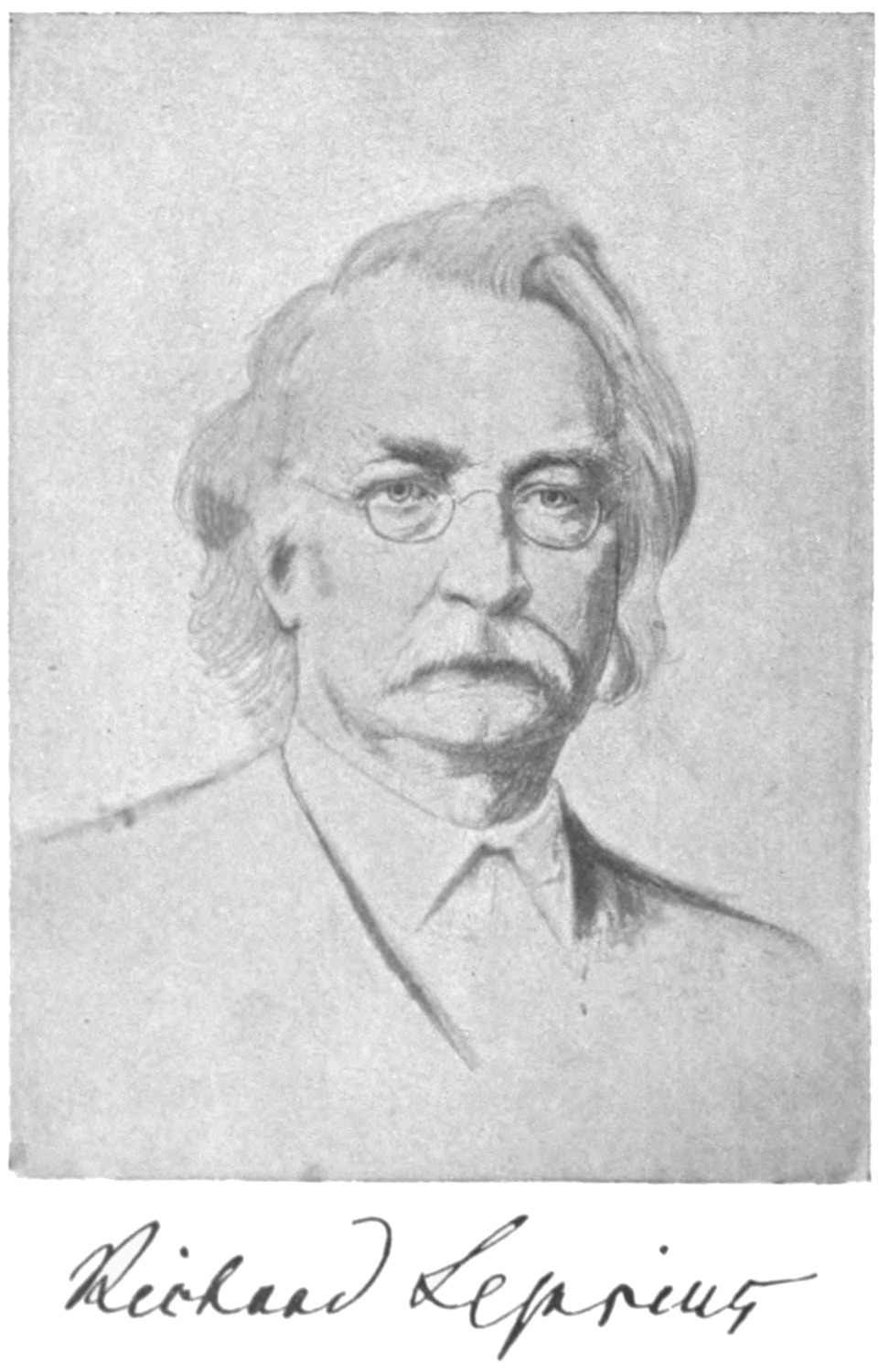
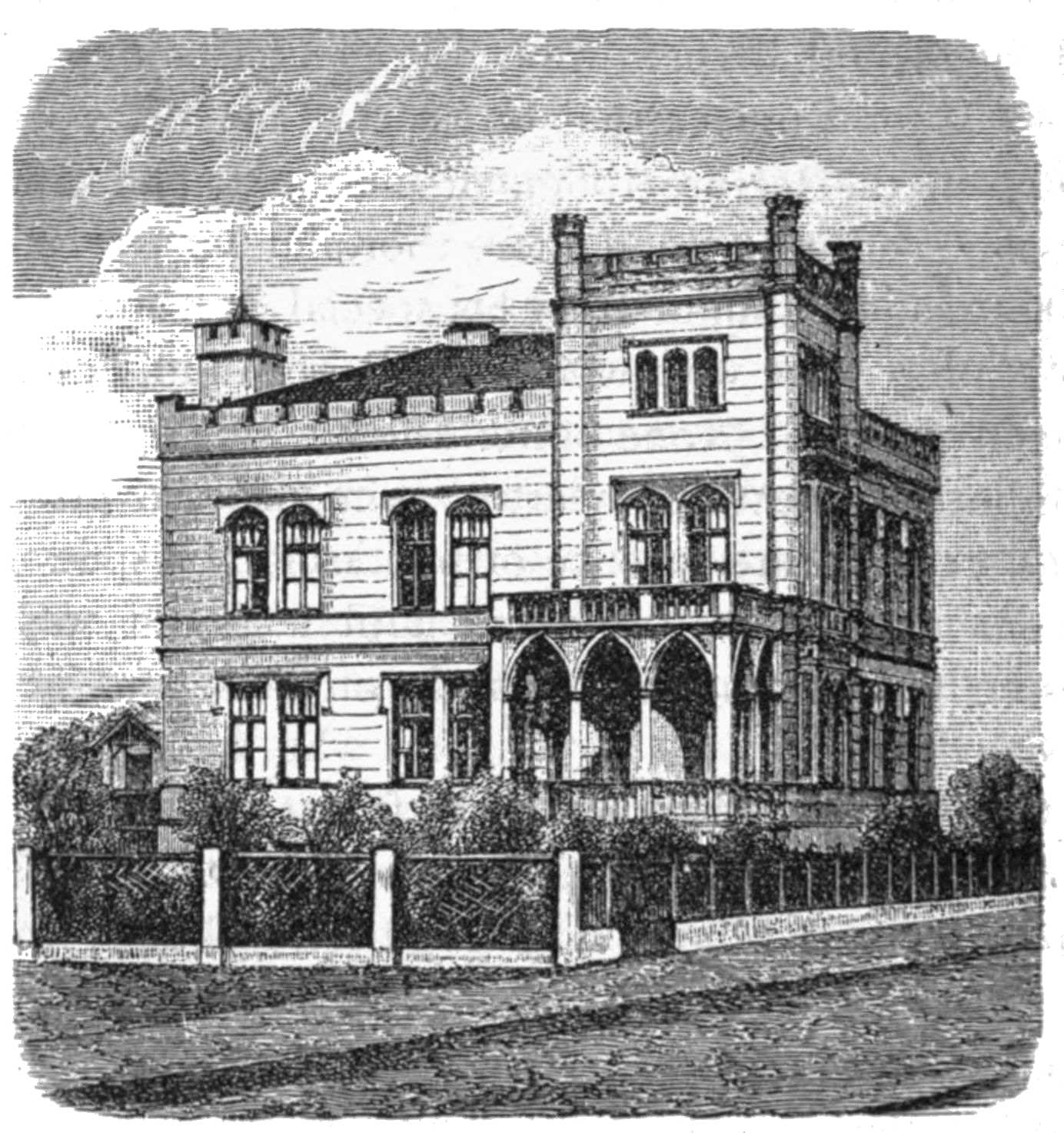
 dans
l’alphabet étrusque. Annali dell’inst. archeol. 1837. Roma Vol.
VIII. p. 164-170.
 —Vokal
in der tartarischen, slavischen und der rumänischen Sprache. [On
the Sounds of the Arabian Spoken Language, and Methods of Writing
Them, With Some Comments on the Hard Vowel
 ,
 und
 in den topographischen
Listen. [On the Signs
 ,
 and
 als Orgyia von 4 Ellen oder 6 Fuss. [On the Hieroglyphic Group