"An unsolvable but urgent problem may produce in a society, as in an
individual, an uncontrollable emotional tantrum, an emotional denial
of the problem's existence, or purposive research for a solution. In
olden days, the first reaction produced mass-tantrums then called
'wars.' The second produced frenziedly dogmatic ideologies. The third
produced modern civilization. All three reactions still appear in
individuals. If the first two should return to societies, as such...."
The Practice of Thinking
Fitzgerald
The descent, at least, was not routine. It was nerve-racking. The
force-field from the planet's giant steel landing grid reached out into
space and fumbled for the Med Ship. That was clumsily done. When it
found the ship, it locked on. And that was awkwardly handled. The rest
was worse. Whoever handled the controls, aground, was hopelessly inept.
Once the Med Ship's hull-temperature began to climb, and Calhoun had to
throw on the spacephone and yelp for caution. He did not see as much of
the nearing planet as he'd have liked.
At fifty miles of height, the last trace of blue sea vanished around
the bulge of the world. At twenty miles, the mountain chains were
clearly visible, with their tortured, winding ice rivers which were
glaciers. At this height three patches of green were visible from
aloft. One, directly below, was little more than a mile in diameter and
the landing grid was its center and almost its circumference. Another
was streaky and long, and there seemed to be heavy mist boiling about
it and above it. The third was roughly triangular. They were many miles
apart. Two of them vanished behind mountains as the ship descended.
There were no cities in view. There were no highways. This was an
ice world with bare ground and open water at its equator only. The
spaceport was placed in a snow-ringed polar valley.
Near landing, Calhoun strapped in because of the awkwardness with which
the ship was lowered. He took Murgatroyd on his lap. The small craft
bounced and wabbled as unskilled hands let it down. Presently, Calhoun
saw the angular girders of the landing grid's latticed top rise past
the opened ports. Seconds later, the Med Ship bumped and slid and
bounced heart-stoppingly. Then it struck ground with a violent jolt.
Calhoun got his breath back as the little ship creaked and adjusted
itself to rest on its landing fins after some months in space.
"Now," said the voice in the spacephone speaker—but it sounded as if
it were trying to conceal relief—"now stay in your ship. Our weapons
are bearing on you. You may not come out until we've decided what to do
about you."
Calhoun raised his eyebrows. This was very unusual indeed. He glanced
at the external field indicator. The landing grid field was off. So the
operator bluffed. In case of need Calhoun could blast off on emergency
rockets and probably escape close-range weapons anyhow—if there were
any—and he could certainly get around the bulge of the world before
the amateur at the grid's controls could hook on to him again.
"Take your time," he said with irony. "I'll twiddle my fingers. I've
nothing better to do!"
He freed himself from his chair and went to a port to see. He regarded
the landscape about him with something like unbelief.
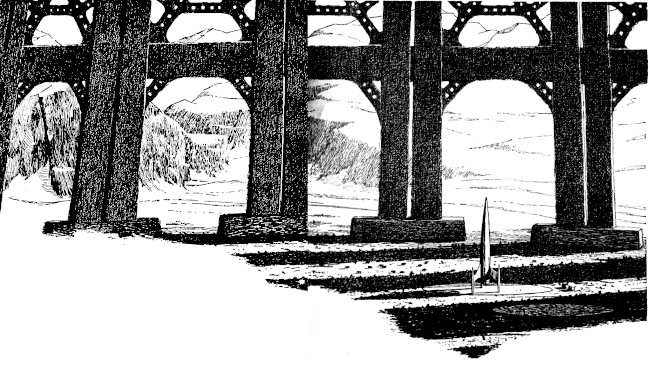
The landing grid itself was a full mile across and half as high. It was
a vast, circular frame of steel beams reaching heavenward, with the
curiously curving copper cables strung as they had to be to create the
highly special force-field which made space transportation practical.
Normally such gigantic structures rose in the centers of spaceport
cities. They drew upon the planet's ionosphere for power to lift
and land cargo ships from the stars, and between-times they supplied
energy for manufactures and the operation of cities. They were built,
necessarily, upon stable bedrock formations, and for convenience were
usually located where the cargoes to be shipped would require least
surface transportation.
But here there was no city. There was perhaps a thousand acres of
greenness—a mere vague rim around the outside of the grid. There was
a control-room building to one side, of course. It was solidly built
of stone, but there had been an agglomeration of lean-tos added to it
with slanting walls and roofs of thin stratified rock. And there were
cattle grazing on the green grass. The center of the grid was a pasture!
Save for the clutter about the grid-control building there were no
structures, no dwellings, no houses or homes anywhere in view. There
was no longer even a highway leading to the grid. Calhoun threw on the
outside microphones and there was no sound except a thin keening of
wind in the steelwork overhead. But presently one of the cattle made a
mournful bellowing sound.
Calhoun whistled as he went from one port to another.
"Murgatroyd," he said meditatively on his second round, "you
observe—if you observe—one of the consequences of human error. I
still don't know where I am, because I doubt that starplates have ever
been made from this solar system, and I didn't take one for comparison
anyhow. But I can tell you that this planet formerly had a habitability
rating of something like oh point oh, meaning that if somebody wanted
to live here it would be possible but it wouldn't be sensible. But
people did come here, and it was a mistake."
He stared at a human figure, far away. It was a woman, dressed in
shapeless, badly draping garments. She moved toward a clump of
dark-coated cattle and did something in their midst.
"The mistake looks pretty evident to me," added Calhoun, "and I see
some possibilities I don't like at all. There is such a thing as an
isolation syndrome, Murgatroyd. A syndrome is a complex of pathological
symptoms which occur together as a result of some morbid condition. To
us humans, isolation is morbid. You help me to endure it, Murgatroyd,
but I couldn't get along with only your society—charming as it is—for
but so long. A group of people can get along longer than a single man,
but there is a limit for any small-sized group."
"Chee," said Murgatroyd.
"In fact," said Calhoun, frowning, "there's a specific health problem
involved, which the Med Service recognizes. There can be partial
immunity, but there can be some tricky variations. If we're up against
a really typical case we have a job on hand. And how did these people
get that dust-ring out in space? They surely didn't hang it out
themselves!"
He sat down and scowled at his thoughts. Presently he rose again and
once more surveyed the icy landscape. The curious green pasture about
the landing grid was highly improbable. He saw glaciers over-hanging
this valley. They were giant ice rivers which should continue to flow
and overwhelm this relatively sheltered spot. They didn't. Why not?
It was more than an hour before the spacephone clattered. When Calhoun
threw the switch again a new voice came out of it. This was also a
male voice, but it was high-pitched as if from tension.
"We've been talking about you," said the voice. It quivered with
agitation which was quite out of reason. "You say you're Med Service.
All right. Suppose you prove it!"
The landed Med Ship should be proof enough for anybody. But Calhoun
said politely:
"I have the regular identifications. If you'll go on vision, I'll show
you my credentials."
"Our screen's broken," said the voice, suspiciously, "but we have
a sick cow. It was dumped on us night before last. Cure her and we'll
accept it as identification."
Calhoun could hardly believe his ears. This was an emergency situation!
The curing of a sick cow was considered more convincing than a Med Ship
man's regular credentials! Such a scale of values hinted at more than
a mere isolation syndrome. There were thousands of inhabited worlds,
now, with splendid cities and technologies which most men accepted with
the same bland confidence with which they looked for sunrise. The human
race was civilized. Suspicion of a Med Ship was unheard of. But here
was a world—
"Why ... certainly," said Calhoun blankly. "I suppose I may go outside
to ... ah ... visit the patient?"
"We'll drive her up to your ship," said the high, tense voice. "And
you stay close to it!" Then it said darkly. "Men from Two City
sneaked past our sentries to dump it on us. They want to wipe out our
herd! What kind of weapons have you got?"
"This is a Med Ship!" protested Calhoun. "I've nothing more than I
might need in an emergency!"
"We'll want them anyhow," said the voice. "You said you need to find
out where you are. We'll tell you, if you've got enough weapons to make
it worth while."
Calhoun drew a deep breath.
"We can argue that later," he said. "I'm just a trifle puzzled. But
first things first. Drive your cow."
He held his head in his hands. He remembered to throw off the
spacephone and said:
"Murgatroyd, say something sensible! I never ran into anybody quite as
close to coming apart at the seams as that! Not lately! Say something
rational!"
Murgatroyd said, "Chee?" in an inquiring tone.
"Thanks," said Calhoun. "Thanks a lot."
He went back to the ports to watch. He saw men come out of the peculiar
agglomeration of buildings that had been piled around the grid's sturdy
control building. They were clothed in cloth that was heavy and very
stiff, to judge by the way it shifted with its wearers' movements.
Calhoun wasn't familiar with it. The men moved stolidly, on foot,
across the incredible pasture which had been a landing space for ships
of space at some time or other.
They reached a spot where a dark animal form rested on the ground.
Calhoun hadn't noticed it particularly. Cattle, he knew, folded their
legs and lay down and chewed cuds. They existed nearly everywhere
that human colonies had been built. On some worlds there were other
domestic animals descended from those of Earth. Of course there were
edible plants and some wholesome animals which had no connection at all
with humanity's remote ancestral home, but from the beginning human
beings had been adjusted to symbiosis with the organic life of Earth.
Foodstuffs of non-terrestrial origin could supplement Earth-food, of
course. In some cases Earth-foods were the supplements and local,
non-terrestrial foodstuffs the staples. But human beings did not thrive
on a wholly un-Earthly diet.
The clump of slowly moving men reached the reclining cow. They pulled
up stakes which surrounded her, and coiled up wire or cordage which had
made the stakes into a fence. They prodded the animal. Presently it
lurched to its feet and swung its head about foolishly. They drove it
toward the Med Ship.
Fifty yards away they stopped, and the outside microphones brought the
sound of their voices muttering. By then Calhoun had seen their faces.
Four of the six were bearded. The other two were young men. On most
worlds men prided themselves that they needed to shave, but few of them
omitted the practice.
These six moved hastily away, though the two younger ones turned often
to look back. The cow, deserted, stumbled to a reclining position. It
lay down, staring stupidly about. It rested its head on the ground.
"I go out now, eh?" asked Calhoun mildly.
"We're watching you!" grated the spacephone speaker.
Calhoun glanced at the outside temperature indicator and added a
garment. He put a blaster in his pocket. He went out the exit port.
The air was bitter cold, after two months in a heat-metered ship, but
Calhoun did not feel cold. It took him seconds to understand why.
It was that the ground was warm. Radiant heat kept him comfortable,
though the air was icy. Heat elements underground must draw power
from somewhere—the grid's tapping of the ionosphere—and heated this
pasture from underneath so forage plants could grow here. They did.
The cattle fed on them. There would be hydroponic gardens somewhere
else, probably underground. They would supply vegetable food in greater
quantity. But in the nature of things human beings had to have animal
food in a cold climate.
Calhoun went across the pasture with the frowning snowy mountains
all about. He regarded the reclining beast with an almost humorous
attention. He did not know anything about the special diseases of
domestic animals. He had only the knowledge required of a Med Ship man.
But that should be adequate. The tense voice had said that this beast
had been "dumped," to "wipe out" the local herd. So there would be
infection and there would be some infective agent.
He painstakingly took samples of blood and saliva. In a ruminant,
certainly, any digestive-tract infection should show up in the saliva.
He reflected that he did not know the normal bovine temperature, so he
couldn't check it. Nor the respiration. But the Interstellar Medical
Service was not often called on to treat ailing cows.
Back in the ship he diluted his samples and put droplets in the usual
nutrient solutions. He sealed up droplets in those tiny slides which
allow a culture to be examined as it grows. His microscope, of course,
allowed of inspection under light of any wave length desired, and so
yielded information by the frequency of the light which gave clearest
images of different features of microörganisms.
After five minutes of inspection he grunted and hauled out his
antibiotic stores. He added infinitesimal traces of cillin to the
culture-media. In the microscope, he watched the active microscopic
creatures die. He checked with the other samples.
He went out to the listless, enfeebled animal. He made a wry guess at
its body-weight. He used the injector. He went back to the Med Ship. He
called on the spacephone.
"I think," he said politely, "that your beast will be all right in
thirty hours or so. Now, how about telling me the name of this sun?"
The voice said sharply:
"There's a matter of weapons, too! Wait till we see how the cow does!
Sunset will come in an hour. When day comes again, if the cow is
better—we'll see!"
There was a click. The spacephone cut off.
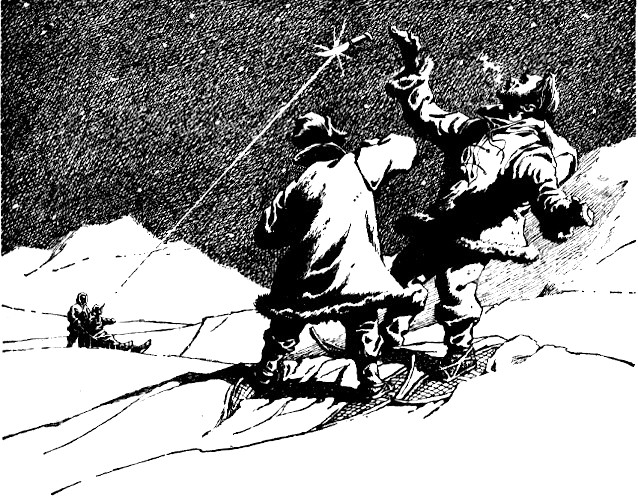
Calhoun pulled out the log-mike. There was already an audio record
of all ship-operations and communications. Now he added comments—a
description of the ribbon in the sky, the appearance of the planet, and
such conclusions as he'd come to. He ended:
"... The samples from the cow were full of a single coccus, which
seemed to have no resistance to standard antibiotics. I pumped the
beast full of cillin and called it a day. I'm concerned, though,
because of the clear signs of an isolation syndrome here. They're
idiotically suspicious of me and won't even promise a bargain, as if I
could somehow overreach them because I'm a stranger. They've sentries
out—they said somebody sneaked past them—against what I imagine must
be Two City and Three City. I've an impression that the sentries are
to enforce a quarantine rather than to put up a fight. It is probable
that the other communities practice the same tactics—plus biological
cold war if somebody did bring a sick cow here to infect and destroy
the local herd. These people may have a landing grid, but they've
an isolation syndrome and I'm afraid there's a classic Crusoe health
problem in being. If that's so, it's going to be nasty!"
He cut off the log. The classic Crusoe problem would be extremely
awkward if he'd run into it. There was a legend about an individual
back on old Earth who'd been left isolated on an island by shipwreck
for half a lifetime. His name was given to the public-health
difficulties which occurred when accidental isolations occurred during
the chaotic first centuries of galactic migration. There was one
shipwreck to which the name was first applied. The ship was missing,
and the descendants of the crew and passengers were not contacted until
three generations had passed. Larger-scale and worse cases occurred
later, when colonies were established by entrepreneurs who grew rich
in the establishment of the new settlements, and had no interest in
maintaining them. Such events could hardly happen now, of course, but
even a Crusoe condition was still possible in theory. It might exist
here. Calhoun hoped not.
It did not occur to him that the affair was not his business because
he hadn't been assigned to it. He belonged to the Med Service, and
the physical well-being of humans everywhere was the concern of that
service. If people lived by choice in an inhospitable environment, that
was not a Med man's problem, but anything which led to preventable
deaths was. And in a Crusoe colony there were plenty of preventable
deaths!
He cooked a meal to have something to occupy his mind. Murgatroyd sat
on his haunches and sniffed blissfully. Presently Calhoun ate, and
again presently darkness fell on this part of the world. There were new
noises—small ones. He went to look. The pasture inside the landing
grid was faintly lighted by the glowing ribbon in the sky. It looked
like a many-times-brighter Milky Way. The girders of the landing grid
looked very black against it.
He saw a dark figure plodding away until he vanished. Then he
reappeared as a deeper black against the snow beyond the pasture. He
went on and on until he disappeared again. A long time later another
figure appeared where he'd gone out of sight. It plodded back toward
the grid. It was a different individual. Calhoun had watched a changing
of sentries. Suspicion. Hostility. The least attractive qualities of
the human race, brought out by isolation.
There could not be a large population here, since such suspicions
existed. And it was divided into—most likely—three again-isolated
communities. This one had the landing grid, which meant power, and
a spacephone but no vision screen attached to it. The fact that
there were hostile separate communities made the situation much more
difficult, from a medical point of view. It multiplied the possible
ghastly features which could exist.
Murgatroyd ate until his furry belly was round as a ball, and settled
to stuffed slumber with his tail curled around his nose. Calhoun tried
to read. But he was restless. His own time-cycle on the ship did not
in the least agree with the time of daylight on this planet. He was
wakeful when there was utter quiet outside. Once one of the cattle made
a dismal lowing noise. Twice or three times he heard cracking sounds,
like sharp detonations, from the mountains. They would be stirrings in
the glaciers.
He tried to study, but painstaking analysis of the methods by which
human brains defeated their own ends and came up with wrong answers was
not appealing. He grew horribly restless.
It had been dark for hours when he heard rustling noises on the
ground outside—through the microphones, of course. He turned up the
amplification and made sure that a small party of men moved toward the
Med Ship. From time to time they paused, as if in caution.
"Murgatroyd," he said dryly, "we're going to have visitors. They didn't
give notice by spacephone, so they're unauthorized."
Murgatroyd blinked awake. He watched as Calhoun made sure of the
blaster in his pocket and turned on the log-mike. He said:
"All set, Murgatroyd?"
Murgatroyd said "Chee" in his small shrill voice just as a soft and
urgent knock sounded on the exit-lock door. It was made with bare
knuckles. Calhoun grimaced and went into the lock. He undogged the door
and began to open it, when it was whipped from his grasp and plunging
figures pushed in. They swept him back into the Med Ship's cabin. He
heard the lock-door close softly. Then he faced five roughly, heavily
clothed men who wore cloaks and mittens and hoods, with cloth stretched
tightly across their faces below the eyes. He saw knives, but no
blasters.
A stocky figure with cold gray eyes appeared as spokesman.
"You're the man who got landed today," he said in a deep voice and with
an effect of curtness. "My name's Hunt. Two City. You're a Med Ship
man?"
"That's right," said Calhoun. The eyes upon him were more scared than
threatening—all but the stocky man named Hunt. "I landed to find out
where I was," he added. "The data-card for my astrogator had been
punched wrong. What—"
"You know about sickness, eh?" demanded the stocky man evenly. "How to
cure it and stop it?"
"I'm a Med Ship man," admitted Calhoun. "For whatever that may mean."
"You're needed in Two City," said the deep-voiced Hunt. His manner was
purest resolution. "We came to get you. Get y'medicines. Dress warm.
Load us down, if you like, with what you want to take. We got a sledge
waiting."
Calhoun felt a momentary relief. This might make his job vastly
easier. When isolation and fear brings a freezing of the mind against
any novelty—even hope—a medical man has his troubles. But if one
community welcomed him—
"Chee!" said Murgatroyd indignantly from overhead. Calhoun glanced
up and Murgatroyd glared from a paw-hold near the ceiling. He was a
peaceable animal. When there was scuffling he got out of the way. But
now he chattered angrily. The masked men looked at him fearfully. But
their deep-voiced leader growled at them.
"Just a animal." He swung back to Calhoun. "We got a need for you," he
repeated. "We mean all right, and anything we got you can have if you
want it. But you're coming with us!"
"Are your good intentions," asked Calhoun, "proved by your wearing
masks?"
"They're to keep from catchin' your sickness," said the deep voice
impatiently. "Point to what you want us to take!"
Calhoun's feeling of encouragement vanished. He winced a little. The
isolation syndrome was fully developed. It was a matter of faith that
strangers were dangerous. All men were assumed to carry contagion.
Once, they'd have been believed to carry bad luck. But a regained
primitiveness would still retain some trace of the culture from which
it had fallen. If there were three settlements as the pastureslands
seen from space suggested, they would not believe in magic, but they
would believe in contagion. They might have, or once have had, good
reason. Anyhow they would fanatically refrain from contact with any but
their own fellow-citizens. Yet there would always be troubles to excite
their terrors. In groups of more than a very few there would always be
an impulse against the isolation which seemed the only possible safety
in a hostile world. The effectiveness of the counter-instinct would
depend in part on communications, but the urge to exogamy can produce
ghastly results in a small culture gone fanatic.
"I think," said Calhoun, "that I'd better come with you. But the people
here have to know I've gone. I wouldn't like them to heave my ship out
to space in pure panic because I didn't answer from inside it!"
"Leave a writing," said Hunt's deep voice, as impatiently as before.
"I'll write it. Make them boil, but they don't dare follow us!"
"No?"
"Think One City men," asked the stocky man scornfully, "will risk us
toppling avalanches on them?"
Calhoun saw. Amid mountain-country in a polar zone, travel would be
difficult at best. These intruders had risked much to come here for
him. But they were proud of their daring. They did not believe that
the folk of lesser cities—tribes—groups than theirs had courage like
theirs. Calhoun recognized it as a part of that complex of symptoms
which can begin with an epidemic and end with group-madness.
"I'll want this—and this—and that," said Calhoun. He wouldn't risk
his microscope. Antibiotics might be useful. Antiseptics, definitely.
His med-kit—"That's all."
"Your blankets," said Hunt. "Y'want them, too."
Calhoun shrugged. He clothed himself for the cold outside. He had
a blaster in his pocket, but he casually and openly took down a
blast-rifle. His captors offered no objection. He shrugged again and
replaced it. Starting to take it was only a test. He made a guess that
this stocky leader, Hunt, might have kept his community just a little
more nearly sane than the group that had set him to the cure of a sick
cow. He hoped so.
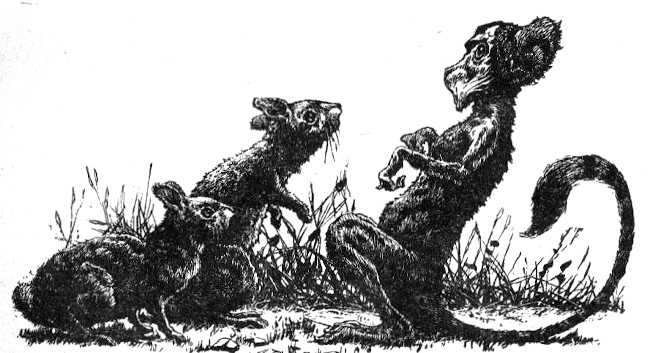
"Murgatroyd," he said to the tormal still clinging up near the
control-room's top, "we have a professional call to make. You'd better
come along. In fact, you must."
Murgatroyd came suspiciously down, and then leaped to Calhoun's
shoulder. He clung there, gazing distrustfully about. Calhoun realized
that his captors—callers—whatever they were—stayed huddled away from
every object in the cabin. They fingered nothing. But the scared eyes
of most of them proved that it was not honesty which moved them to such
meticulousness. It was fear. Of contagion.
"They're uncouth, eh?" said Calhoun sardonically. "But think,
Murgatroyd, they may have hearts of gold! We physicians have to
pretend to think so, in any case!"
"Chee!" said Murgatroyd resentfully as Calhoun moved toward the lock.