| Plate |
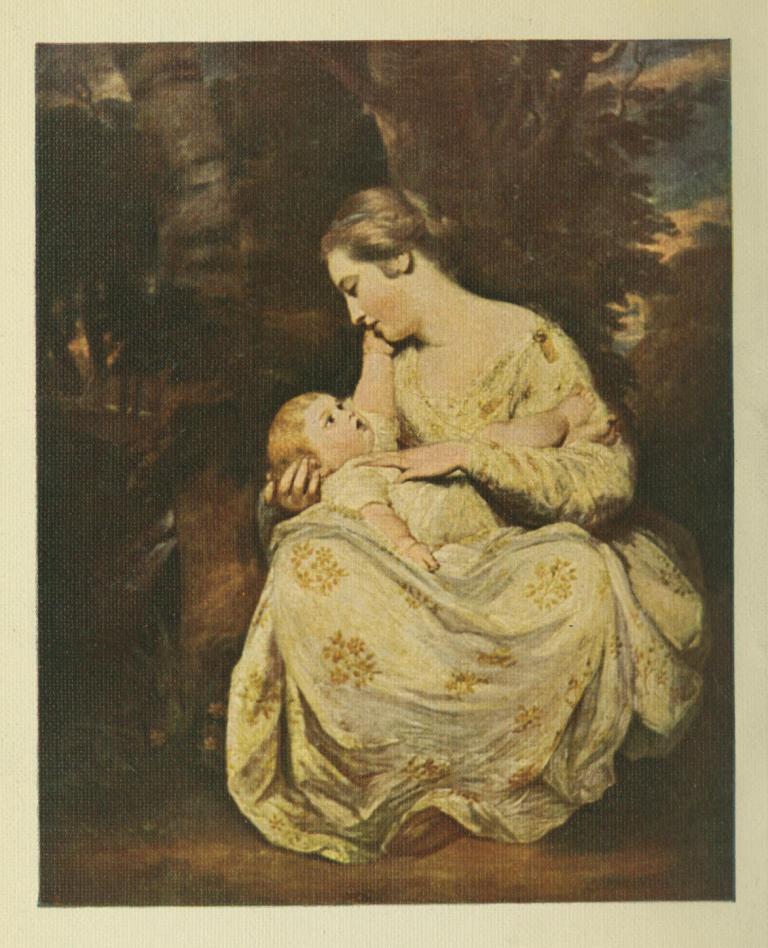
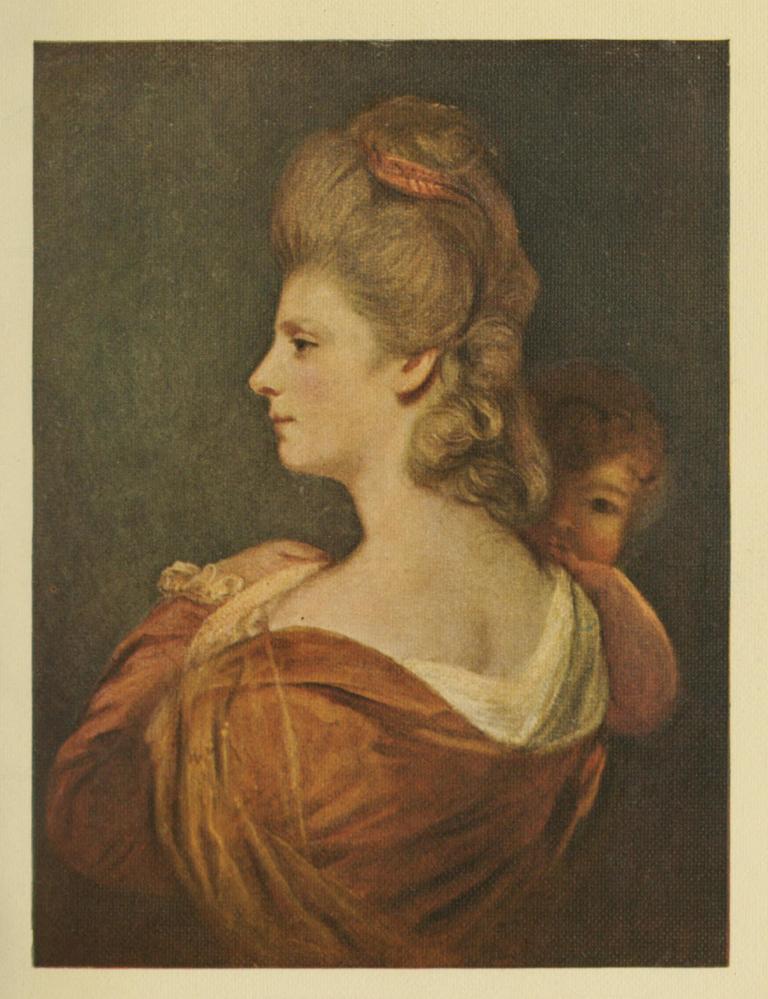
| I. | Mrs. Hoare and Child | Frontispiece |
| In the Wallace Collection, London |
| | Page |
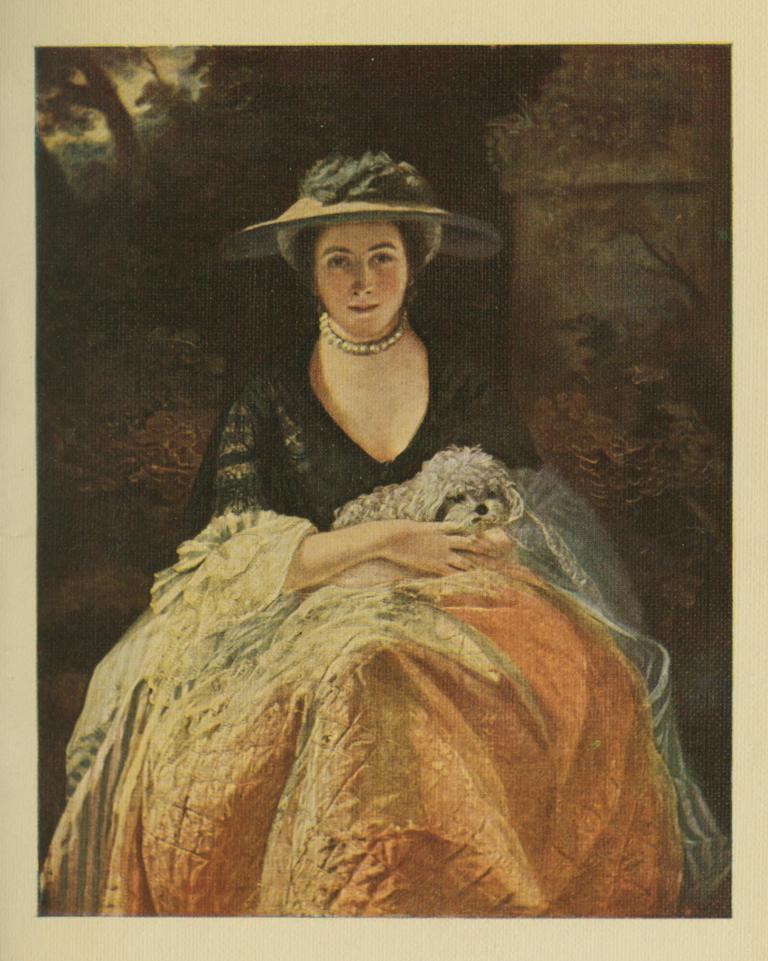
| II. | Nelly O’Brien | 14 |
| In the Wallace Collection, London |
| III. | The Three Graces | 24 |
| In the National Gallery, London |
| IV. | The Age of Innocence | 34 |
| In the National Gallery, London |
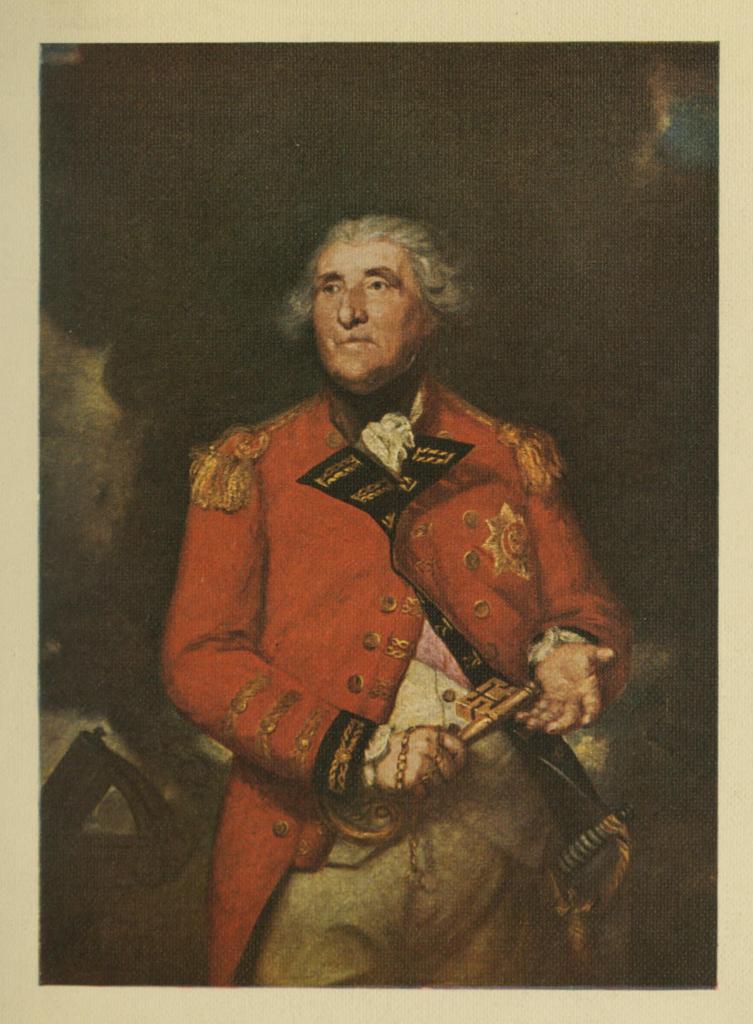
| V. | Lord Heathfield | 40 |
| In the National Gallery, London |
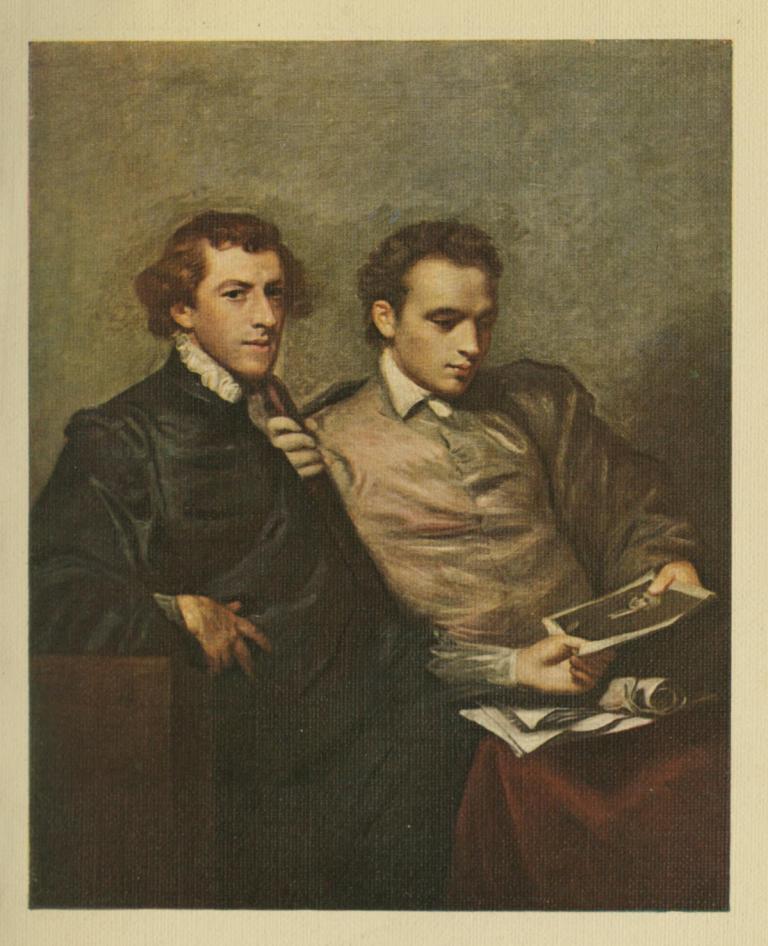
| VI. | Portrait of Two Gentlemen | 50 |
| In the National Gallery, London |
| VII. | Portrait of Lady and Child | 60 |
| In the National Gallery, London |
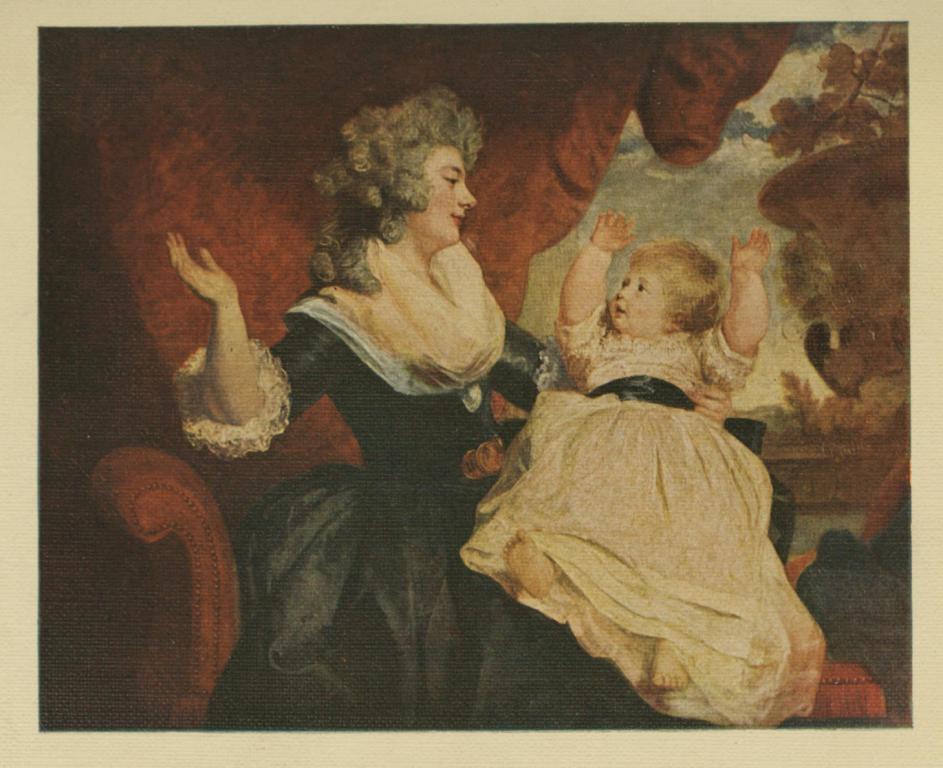
| VIII. | Duchess of Devonshire and Child | 70 |
| At Chatsworth House, Derbyshire |
There are certain men born to every
generation who approach life with
the complete assurance of distinction in any
work that they may have chosen for the
exercise of their gifts. They are strangers
to doubt and uncertainty; they disarm Fortune
by claiming freely as a right what she
is accustomed to grant grudgingly as a
favour—"they ride Life’s lists as a knight
might ride.” One feels that these fortunate
few are destined for success just as the
majority are doomed to failure, that nothing
save a long series of mishaps can keep them
from the goal of their ambition. They have
the temperament that makes achievement
easy, and a steadfast determination that the
demons of mischance cannot resist for long.
When one turns to consider English art
in the eighteenth century, the name of
Joshua Reynolds stands out in a brighter
light than any other. One would not say
that he was the greatest painter of his time—Gainsborough’s
gifts exceeded his in many
directions, and Romney enters into competition
too—but Reynolds was born under
a fortunate star, and Nature gave him as
a birthday present a rare mixture of talent,
industry, and common-sense, together with
a sober judgment that could not be turned
aside by passion or emotion. Such gifts,
if they do not always create a genius, may
enable their possessor to achieve work that
has certain affinities with the masterpieces
of the immortals. Nobody in these days
would deny for a moment that Reynolds
possessed qualifications of the highest order;
but ours is an age of hero-worship, and we
are rather inclined to go beyond our brief
in dealing with a representative man whose
work has survived the criticism (though,
alas, it has not always survived the atmosphere)
of nearly two centuries. Reynolds
is not the less a great painter because he
did not happen to be the great man so many
of his biographers have seen, nor was he a
heaven-sent genius of the kind that flutters
the musical dovecots from time to time.
Infant prodigies are hardly known in the
world of art, and Reynolds started life as
a clever young man determined to make a
name. He became soon a painter strong
enough to realise his own limitations and
those of his age, and to take the best possible
steps to secure for his own art, and incidentally
for that of his country, the highest
position in the esteem of the world at large.
Had there been no Reynolds there might
have been no Royal Academy—the Institution
in its earliest days was indebted very
deeply to him. Himself far above the
squabbles of the hour, he raised the Royal
Academy into the serene and almost untroubled
atmosphere in which he lived his
life.
PLATE II.—NELLY O’BRIEN.
(In the Wallace Collection)
This portrait is one of the best examples of Sir Joshua’s art,
and was painted in 1763. The shadow on the face is most skilfully
managed. The lace round the arm and the skirt are painted in
the artist’s best manner. It will be remembered that Sir Joshua
painted other portraits of this fascinating woman.
“I will be a painter, if you will give me
the chance of being a good one,” he is
said to have remarked when quite a lad,
and this is but one of the simple sentences
that hold and in a sense reveal the keynote
of his character. Reynolds was determined
to succeed. When he started his work
there were few people in England who could
guide him in the right way, and consequently
we must not look for any great
achievement in the early portraits. The
painter may be said to have owed his first
success to Commodore Keppel, who took him
on a cruise in the Mediterranean and helped
him to come into touch with the great masterpieces
that will probably stimulate artists
for all time. In return, the painter gave
the sailor a measure of fame that his naval
achievements would hardly have secured.
Italy turned the dross of Reynolds’ art to
fine gold, and he never shrank from acknowledging
the debt. Had he stayed in England
he might have been a greater man than
all his contemporaries, save Gainsborough
and Romney, but he could not have given
the world any one of the pictures that are
reproduced here. Art will not yield to inspiration
alone. The musician, or the literary
man, with very simple education may be
able to achieve wonders, but the artist
who looks to brushes and colours for his
medium must sacrifice diligently for many
years at the shrine of technique before his
hand can express what is in his brain. The
years between 1749 and 1752, devoted by
Reynolds to studying and copying the
Vatican frescoes and the pictures of Padua,
Milan, Turin, and Paris, were invaluable.
Indeed he was one of the greatest copyists
of his time, and Sir Walter Armstrong thinks
that one of his copies of a Rembrandt is
classed among the originals in the National
Gallery to-day!
Down to the year of the Italian journey
the young painter’s life had been quite
uneventful. Born in 1723 at Plympton in
Devonshire, where his father was a school-master,
he was apprenticed in London to
Thomas Hudson, a portrait painter of the
day and a Devon man too. Hudson gave
his pupil Guercino’s drawings to copy.
Before the time of apprenticeship had expired
Reynolds had quarrelled with his
master and gone back to Devonshire, where
he painted work that was of no great importance,
under the patronage of the first
Lord Edgcumbe. At his house Reynolds
met the Commodore Keppel, whose kindness
enabled him to see Italy, and it was
the sojourn in that real home of art that
brought Reynolds back to England a portrait
painter of the first class.
Michelangelo had impressed him deeply.
In later days he never lost an opportunity of
advising students to sit at the feet of the
great master, and the influence of the work
in the Sistine Chapel may be noted in the
famous picture of Mrs. Siddons, now to
be seen in the Dulwich Gallery. Ludovico
Caracci and Guido had given him hints
that were of infinite value in the moulding
of his technique; for colour he had gone to
Titian, Tintoretto, and Rubens, of whom the
last named was beginning to lose his appeal
in the last years of Reynolds’ life. Sir
Joshua had a supreme facility for taking
from every artist the best that was in him,
melting it in the crucible of his own thought,
and applying the product to his pictures.
There is no doubt that the sixteenth-century
Venetians impressed Reynolds as much as
they impressed Ruskin at a later date, but
in the middle of the eighteenth century the
school of Bologna was in the ascendant in
England, and it is through Reynolds’ actions
rather than his words that we see how Venice
had influenced him. Sir Walter Armstrong
thinks that Reynolds lived well rather than
wisely in Italy, and that when he came back
to town his wild oats were all sown, but it
is hard to find any justification for the belief
that Reynolds was at any time of his life a
free liver. The pleasures of the table may
have claimed him when he reached middle
age; indeed, Dr. Johnson said to him on
one occasion, “You complain about the tea
I drink, but I do not count the glasses you
empty,” or words to that effect. As far as
other forms of dissipation go, there is no
evidence that Reynolds was ever a victim
to them. He was always perfect master of
his self-control, and when the years had
toned down certain faults of thought and
manner, he became mellowed, like old wine,
and not less stimulating.
Students of the famous discourses that
Sir Joshua addressed annually to the Royal
Academy after he became first President
of the new institution, may be justified if
they suspect that the great painter adopted
the same rule in dealing with his students
that skilled musical composers use when
dealing with their pupils. A musican knows
that the laws of harmony and counterpoint
are not fixed, that the musical horizon
widens year by year, and that rules may
often be disregarded by a composer who
has something to say; but, in order that
composition may grow from some definite
form, it is necessary that the rules should
be mastered before they are disregarded. So
in dealing with things of art, Reynolds said
much to his audience that his own practice
did not bear out. He would not hint at
his own preferences quite so frankly as his
canvases did and it is not at all unlikely
that he realised as well as we do, that
while students, like the poor, are always
with us, great artists are few and far
between, and will survive all academic
limitations.
When Reynolds came back to England
in 1752, he went down to Devonshire to recruit
his health. While his sojourn abroad
had been productive of so much that had
been invaluable to him, he had met with
two unfortunate accidents. In Minorca
he had fallen from his horse and sustained
injuries that had left his face scarred for
all time. In the Vatican he had sustained
a chill that brought about the deafness
destined to be a life-long infirmity. So he
took holiday in the county he loved so
well, and after his return he opened a
studio in St. Martin’s Street, acting on
the advice of his friend and patron, Lord
Edgcumbe. There was no period of weary
waiting. Thanks to the quality of his work
and the patronage granted so freely, he
began at once to enjoy the success that
belongs to the popular portrait painter. A
little later he moved to Great Newport
Street, where the accommodation was better
suited to the growing claims of sitters, and
in 1760 he went to 47 Leicester Square,
now an auction-house, where he lived for
the remainder of his life. As he moved
he raised his prices, but nobody seemed to
mind. Everybody who was anybody, paid
cheerfully. So did some of the other people.
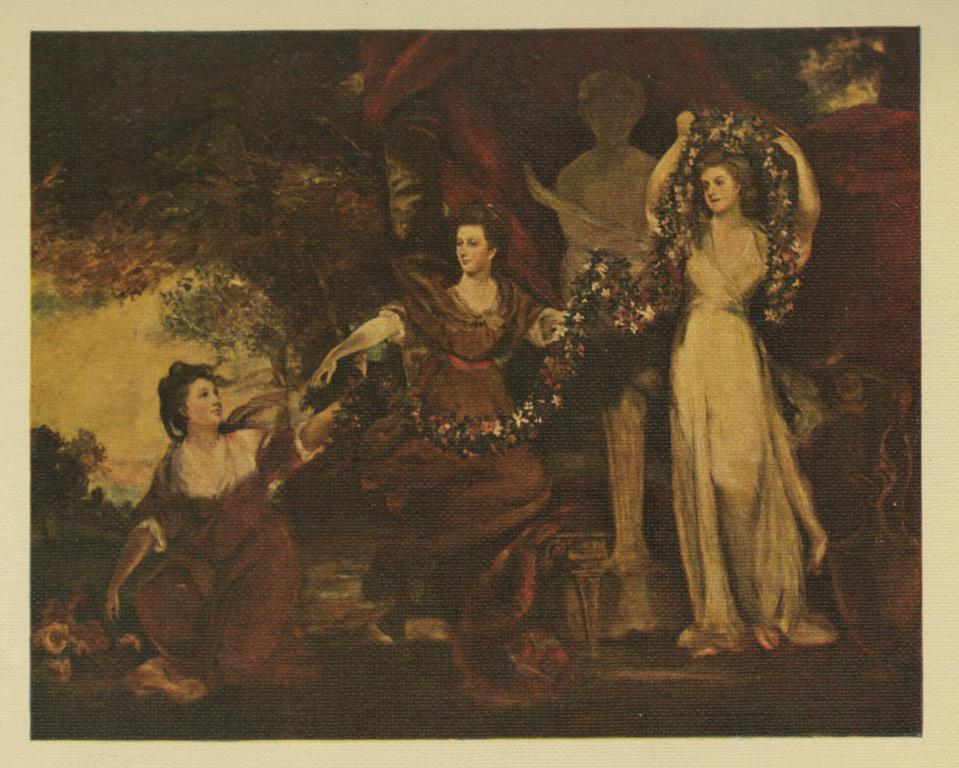
PLATE III.—THE THREE GRACES.
(In the National Gallery)
This picture was exhibited at the Royal Academy in 1774 and
called, “Three Ladies adorning a Term of Hymen.” It was
bequeathed to the National Gallery by the Earl of Blessington.
The Graces are the three daughters of Sir W. Montgomery. The
one on the left kneeling down is the Hon. Mrs. Beresford, in the
centre is the Hon. Mrs. Gardener, mother of Lord Blessington,
and on the right is the Marchioness Townsend.
Many artists remain painters all their
lives. Meet them in a studio or at a
private view and they are illuminating;
talk about another lying outside their
immediate interests and they are dumb,
or worse, for some talk without saying
anything, as though they were mere politicians.
Perhaps we have no right to
complain of this lack of mental dimensions,
but it is permissible to note with pleasure
the few cases in which an artist reveals
himself as an accomplished man of the
world. Reynolds would never have been
content to be nothing more than a painter,
and he chose his friends so wisely that
the living served him as well as the dead.
If the great artists of Italy had shed light
upon his path in one direction, what did
he not owe to the men of his own generation,
whose society must have been a
source of inspiration to any intelligent man?
Dr. Johnson himself could only have been
inspiring company, even though we may
think in our heart of hearts that the benefit
of the inspiration was not without serious
drawbacks. Reynolds enjoyed also the
intimate friendship of Garrick, Goldsmith,
Gibbon, and Burke, he consorted with many
other men who made some mark in the
world of thought, and in this atmosphere
the extraordinary receptivity of his mind
must have served him to great advantage.
He had human weaknesses to live down,
and it is to his credit that he conquered
all or most of them. Like so many honest
Englishmen, there was a touch of the snob
about him—witness his correspondence with
Lord Edgcumbe during the first visit to
the Continent. He was not without jealousy,
as may be seen from his pettish condemnation
of the work of Liotard, the miniature
painter and pastellist, and his references to
Gainsborough and Romney, whose success
and accomplishments galled him not a
little. He was vulgar, until he learned
refinement from the distinguished people
with whom he was brought into contact—witness
the gilded coach and gaudy liveries
he bought when he established himself in
Leicester Square, the coach in which his
unfortunate sister Frances was compelled
to drive in order that the man in the street
might stare open-mouthed and talk about
her brother. There is hardly a “Lion
Comique,” or a lady of the music halls
drawing prime minister’s salary for songs
blatant or obscene, who would commit such
an offence to-day, and against these lapses
from taste Sir Joshua’s acquaintance with
the best minds of his day failed to save him.
Perhaps the atmosphere of Leicester Square
in the eighteenth, as in the twentieth,
century was a little theatrical. Of course
the faults of a man and the merits of his
work are distinct and stand apart from
one another, but we are too apt to look
at Reynolds the man in the light of Goldsmith’s
epitaph, and it is the failing of
popular biography to supply popular people
with a measure of moral equipment that
would make a saint self-conscious. It is far
more interesting to see great men as they
lived, and understand that, like the rest of
us, they had a fair, or unfair, share of
faults. Had Sir Joshua possessed twice as
many failings, he would still remain one
of the greatest, if not the greatest, of
British portrait painters. Had he associated
all the virtues with less achievement, he
could not have interested us, because
happily we do not judge art by the moral
standard of the artist.
Perhaps the most remarkable side of
Reynolds’ mind was seen in its response
to the real truths that underlie all the arts.
He held his work to be a mode of expressing
human experience, he knew that there was
a domain lying beyond the reach of rules,
and bade his students look “with dilated
eye,” sacrificing detail to general effect for
the sake of the best and most imaginative
work. He declared without any reservations,
that he had found art in England in
the lowest possible state, he compared some
of his contemporaries’ work with sign-post
painting, but his fine courage was only stimulated
by the bad conditions that prevailed.
He sought to raise them, and as a portrait
painter, made it his business to discover
the perfections of his sitters, with the result,
that, as his genius was wholly interpretative,
his pictures stand rather less for his sitters
than for their time.
A weak man might have succumbed to
the temptations that beset Reynolds when
he had established himself in Leicester
Square. He was in a sense the darling of
society, earning a larger income than had
been gained by any of his contemporaries,
although he painted for prices that a third-rate
man could gain to-day, if we do not
regard the changed value of money. But
Reynolds never succumbed to society; he
conquered it, showing himself worthy of all
the success that came to him. He did his
best, he worked hard, relaxing his efforts
only when his position was unassailable, took
his enjoyment temperately, if we consider
the age in which he lived, and never forgot
that his chief aim and object in life was to
paint portraits, and to paint them as well
as he could. There were years in which
he completed from three to four portraits
every week, but by the time he was President
of the Royal Academy, the output had
fallen to sixty or seventy a year, no small
achievement for a man who was at liberty
to enjoy all that was best, and brightest,
and most enduring in London society, and
everything most attractive in the country.
The life and times of Sir Joshua have a
special interest for British artists, even
apart from his work, because he lived
through the years of storm and strife that
saw the development of the R.A. It is not
easy to tell in full the story of its establishment
without long and detailed references
to the quarrels and intrigues of the artists
of the day and even then it is not easy to
see the truth clearly through the mists of
controversy. None of Sir Joshua’s biographies
goes uncontradicted, and it is safe
to say that we must be content to forego
for all time exact knowledge of certain
incidents in the life of Reynolds. He had
considerable reserve, a fair sense of diplomacy,
and was not without knowledge that
there were foes as well as friends in the
crowd that surrounded him. His contemporaries
were often baffled by his silence,
and the secrets of his tastes and intimate
likes and dislikes died with him. He had
friends, but no confidantes. A brief outline
of the creation of the R.A. is all that needs
be given here.
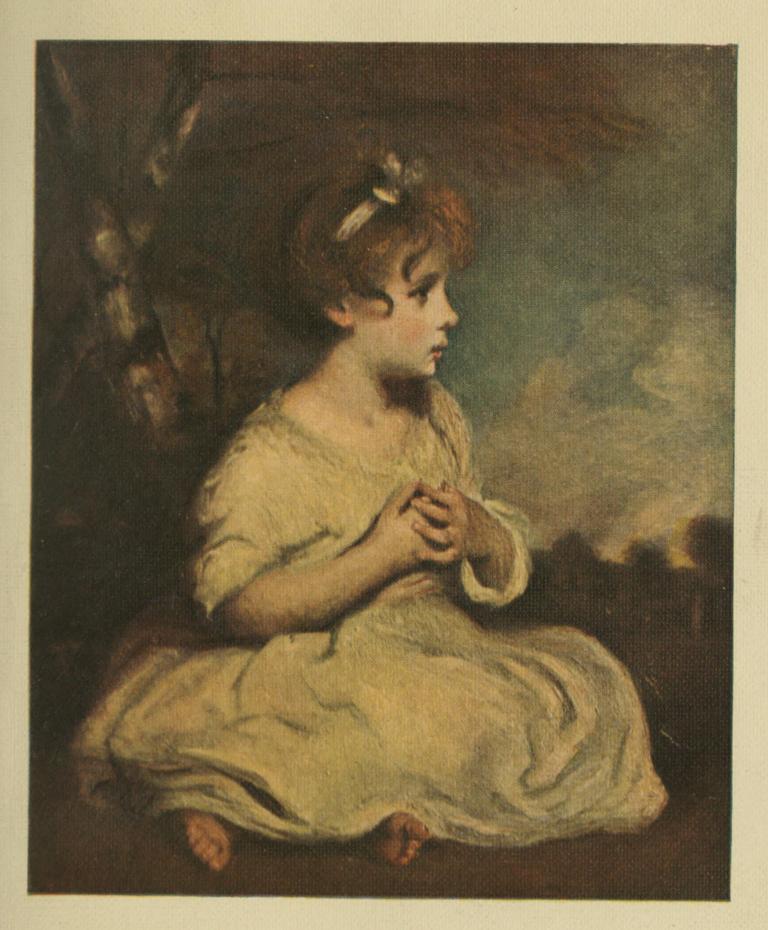
PLATE IV.—THE AGE OF INNOCENCE.
(In the National Gallery)
This picture was bought at the sale of Mr. Harman’s pictures.
It has been engraved two or three times and is one of the most
popular examples of the master’s work.
In the year 1760, when Reynolds was
approaching the zenith of his fame, an art
exhibition was held in London, attracted
a great deal of attention, and became an
annual institution. Thereafter, we begin to
hear of the Society of Artists, which received
from George III. a certificate of Incorporation
in 1765, blossomed out with the grandiloquent
title of the “Incorporated Society
of Artists of Great Britain,” and published
a list of two hundred and eleven members,
including Joshua Reynolds. An offshoot
from this society was known as the Free
Society of Artists; in the history of art there
have always been some men “agin the
government.” Heart-burning and jealousy
were associated with the work of the Incorporated
Society, and William Chambers the
architect, who had the king’s ear, brought
about the foundation of the R.A. Reynolds
took no visible part in the intrigue, in fact
he was abroad during the months when
the squabbles were most violent, and when
the Presidency was offered to him, he
asked for time to discuss the matter with
Dr. Johnson and Edmund Burke. Apparently
he had studied Shakspere’s “Julius Cæsar.”
In December 1768, the constitution of the
Royal Academy was signed by the King, and
the Incorporated Society was left to linger for
a few years in the cold shades of opposition
and then depart from a world that had no
further use for it. William Chambers and
Benjamin West seem to have done all that
was necessary to bring King George on to
the side of the new venture, which had
a very wide constitution, and thirty-six
original members, including two ladies, Angelica
Kaufmann and Mary Moser. William
Chambers became Treasurer, Dalton was
appointed Antiquary, Goldsmith was Professor
of Ancient History, and Dr. Johnson
stood for Ancient Literature. Curiously
enough, it was the foundation by Captain
Coram of the Foundling Hospital that led
indirectly to the creation of the Royal
Academy. Hogarth, who was a great friend
of Coram, gave pictures for the gallery in
the Hospital, Reynolds’ old master, Hudson,
Reynolds himself, and Wilson, a contemporary
painter of great achievement, did
the same. Mr. Claude Phillips, whose life
of Sir Joshua Reynolds is one of the best
written and most discerning tributes to the
master extant, thinks that the success of
the gallery at the Foundlings led to the
opening of the first exhibition of pictures
by living masters in 1860. The Society of
Arts was then six years old, and the Society
of Artists was established in friendly rivalry.
We have remarked that at the time when
the Incorporated Society of Artists was engaged
in the final quarrel that led to the
foundation of the Academy, Sir Joshua was
travelling abroad with Richard Burke. His
absence from the scene of strife is more
likely to have been diplomatic than unintentional.